The Professional World
Friday, April 4, 1902
Columbia, Missouri
Page text (machine-generated)
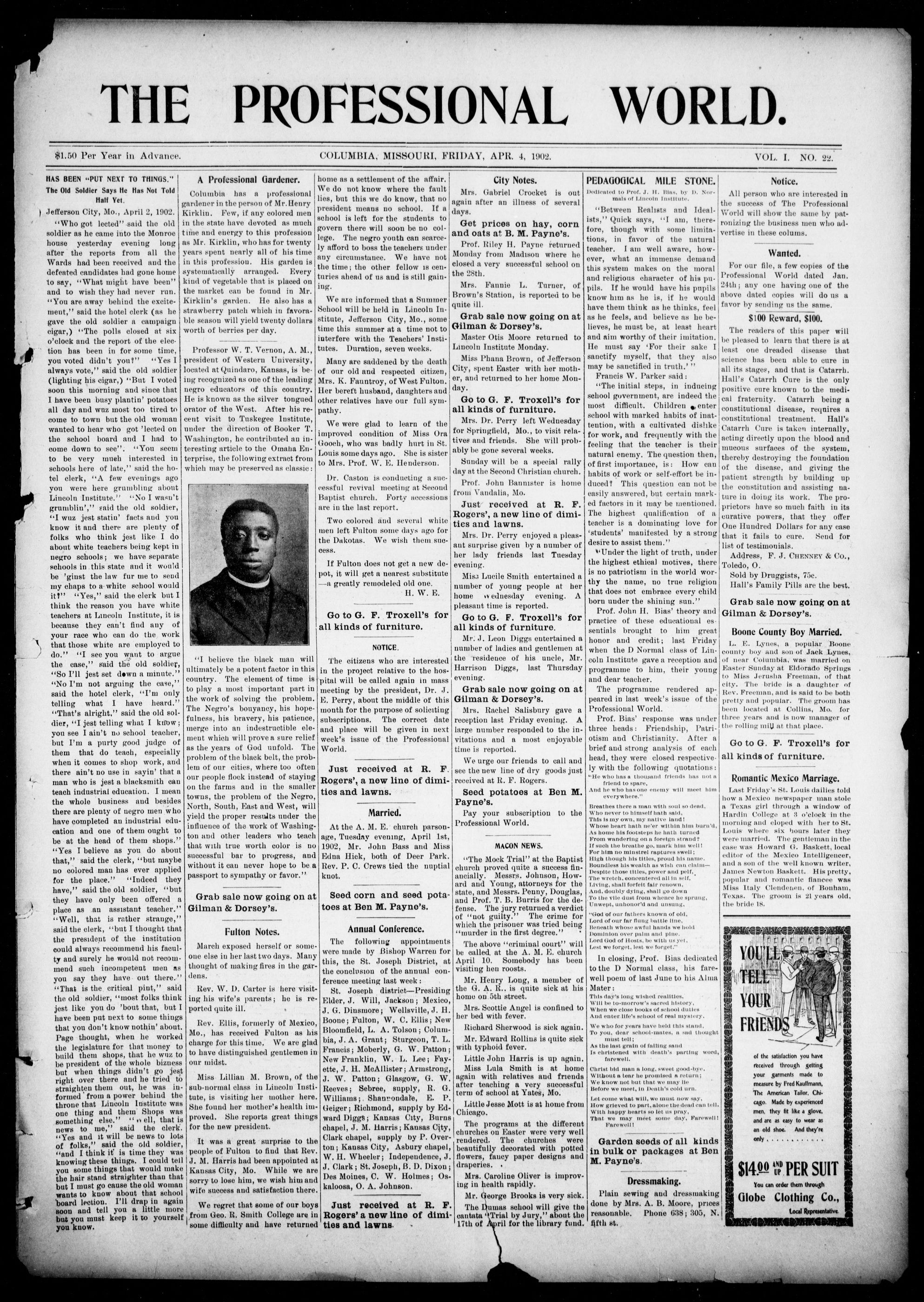
THE PROFESSIONAL WORLD.
$1.50 Per Year in Advance.
HAS BEEN "PUT NEXT TO THINGS."
The Old Soldier Says He Has Not Told Half Yet.
A Professional Gardener.
Columbia has a professional gardener in the person of Mr.Henry Kirklin. Few, if any colored men in the state have devoted as much time and energy to this profession as Mr. Kirklin, who has for twenty years spent nearly all of his time in this profession. His garden is systematically arranged. Every kind of vegetable that is placed on the market can be found in Mr. Kirklin's garden. He also has a strawberry patch which in favorable season will yield twenty dollars worth of berries per day.
Professor W. T. Vernon, A. M., president of Western University, located at Quindaro, Kansas, is being recognized as one of the leading negro educators of this country. He is known as the silver tongued orator of the West. After his recent visit to Tuskegee Institute, under the direction of Booker T. Washington, he contributed an interesting article to the Omaha Enterprise, the following extract from which may be preserved as classic
JOHN H. HARRIS
"I believe the black man will ultimately be a potent factor in this country. The element of time is to play a most important part in the work of solving the problem. The Negro's bouyancy, his hopefulness, his bravery, his patience, merge into an indestructible element which will prove a sure relief as the years of God unfold. The problem of the black belt, the problem of our cities, where too often our people flock instead of staying on the farms and in the smaller towns, the problem of the Negro, North, South, East and West, will yield the proper results under the influence of the work of Washington and other leaders who teach that with true worth color is no successful bar to progress, and without it can never hope to be a passport to sympathy or favor."
Grab sale now going on at Gilman & Dorsey's.
Fulton Notes.
March exposed herself or someone else in her last two days. Many thought of making fires in the gardens.
Rev. W. D. Carter is here visiting his wife's parents; he is reported quite ill.
Rev. Ellis, formerly of Mexico, Mo., has received Fulton as his charge for this time. We are glad to have distinguished gentlemen in our midst.
Miss Lillian M. Brown, of the sub-normal class in Lincoln Institute, is visiting her mother here. She found her mother's health improved. She reports great things for the new president.
It was a great surprise to the people of Fulton to find that Rev. J. M. Harris had been appointed at Kansas City, Mo. While we are sorry to lose him, we wish him and wife success and satisfaction there.
We regret that some of our boys from Geo. R. Smith College are in some difficulty and have returned
home as a settlement of the affair. We do not know where the fault lies, but this we do know, that no president means no school. If a school is left for the students to govern there will soon be no college. The negro youth can scarcely afford to boss the teachers under any circumstance. We have not the time; the other fellow is centuries ahead of us and is still gaining.
City Notes.
Mrs. Gabriel Crocket again after an illness of days.
Get prices on hay, and oats at B. M. Payne.
Prof. Riley H. Payne in Monday from Madison we closed a very successful so the 28th.
Mrs. Fannie L. Tur
We are informed that a Summer School will be held in Lincoln Institute, Jefferson City, Mo., some time this summer at a time not to interfere with the Teachers' Institutes. Duration, seven weeks.
Many are saddened by the death of our old and respected citizen, Mrs. K. Fauntroy, of West Fulton. Her bereft husband, daughters and other relatives have our full sympathy.
We were glad to learn of the improved condition of Miss Ora Gooch, who was badly hurt in St. Louis some days ago. She is sister to Mrs. Prof. W. E. Henderson.
Dr. Caston is conducting a successful revival meeting at Second Baptist church. Forty accessions are in the last report.
Two colored and several white men left Fulton some days ago for the Dakotas. We wish them success.
If Fulton does not get a new depot, it will get a nearest substitute—a greatly remodeled old one.
Go to G. F. Troxell's for all kinds of furniture.
NOTICE.
The citizens who are interested in the project relative to the hospital will be called again in mass meeting by the president, Dr. J. E. Perry, about the middle of this month for the purpose of soliciting subscriptions. The correct date and place will be given in next week's issue of the Professional World.
Just received at R. F. Rogers', a new line of dimities and lawns.
Married.
At the A. M. E. church parsonage, Tuesday evening, April 1st, 1902, Mr. John Bass and Miss Edna Hick, both of Deer Park. Rev. P. C. Crews tied the nuptial knot.
Seed corn and seed pota toes at Ben M. Payne's.
Annual Conference.
The following appointments were made by Bishop Warren for this, the St. Joseph District, at the conclusion of the annual conference meeting last week:
St. Joseph district—Presiding Elder, J. Will, Jackson; Mexico; J. G. Dinsmore; Wellsville, J. H. Boone; Fulton, W. C. Ellis; New Bloomfield, L. A. Tolson; Columbia, J. A. Grant; Sturgeon, T. L. Francis; Moberly, G. W. Patton; New Franklin, W. L. Lee; Fayette, J. H. McAllister; Armstrong, J. W. Patton; Glasgow, G. W. Reeves; Sebree, supply, R. G. Williams; Shannondale, E. P. Geiger; Richmond, supply by Edward Diggs; Kansas City, Burns chapel, J. M. Harris; Kansas City, Clark chapel, supply by P. Overton; Kansas City, Asbury chapel, W. H. Wheeler; Independence, J. J. Clark; St. Joseph, B. D. Dixon; Des Moines, C. W. Holmes; Oskaloosa, O. A. Johnson.
Just received at R. F. Rogers'a new line of dimities and lawns.
City Notes.
Mrs. Gabriel Crocket is out again after an illness of several days.
Get prices on hay, corn and oats at B. M. Payne's.
Prof. Riley H. Payne returned Monday from Madison where he closed a very successful school on the 28th.
Mrs. Fannie L. Turner, of Brown's Station, is reported to be quite ill.
Grab sale now going on at Gilman & Dorsey's.
Master Otis Moore returned to Lincoln Institute Monday.
Miss Phana Brown, of Jefferson City, spent Easter with her mother, and returned to her home Monday.
Go to G. F. Troxell's for all kinds of furniture.
Mrs. Dr. Perry left Wednesday for Springfield, Mo., to visit relatives and friends. She will probably be gone several weeks.
Sunday will be a special rally day at the Second Christian church.
Just received at R. F. Rogers', a new line of dimities and lawns. Mrs. Dr. Perry enjoyed a pleasant surprise given by a number of her lady friends last Tuesday evening. Misa Lucile Smith entertained a number of young people at her home wednesday evening. A pleasant time is reported. Go to G. F. Troxell's for all kinds of furniture. Mr. J. Leon Diggs entertained a number of ladies and gentlemen at the residence of his uncle, Mr. Harrison Diggs, last Thursday evening.
Grab sale now going on at Gilman & Dorsey's.
Mrs. Rachel Salisbury gave a reception last Friday evening. A large number responded to the invitations and a most enjoyable time is reported.
We urge our friends to call and see the new line of dry goods just received at R. F. Rogers.
Seed potatoes at Ben M. Payne's.
Pay your subscription to the Professional World.
MACON NEWS
"The Mock Trial" at the Baptist church proved quite a success financially. Messrs. Johnson, Howard and Young, attorneys for the state, and Messrs. Penny, Douglas, and Prof. T. B. Burris for the defense. The jury returned a verdict of "not guilty." The crime for which the prisoner was tried being "murder in the first degree."
The above "criminal court" will be called, at the A. M. E. church April 10. Somebody has been visiting hen roosts.
Mr. Henry Long, a member of the G. A. R., is quite sick at his home on 5th street.
Mrs. Scottie Angel is confined to her bed with fever.
Richard Sherwood is sick again.
Mr. Edward Rollins is quite sick with typhoid fever.
Little John Harris is up again.
Miss Lula Smith is at home again with relatives and friends after teaching a very successful term of school at Yates, Mo.
Little Jesse Mott is at home from Chicago.
The programs at the different churches on Easter were very well rendered. The churches were beautifully decorated with potted flowers, fancy paper designs and draperies.
Mrs. Caroline Oliver is improving in health rapidly.
Mr. George Brooks is very sick. The Dumas school will give the cantata "Trial by Jury," about the 17th of April for the library fund.
PEDAGOGICAL MILE STONE.
Dedicated to Prof. J. H. Bins, by D. Normals of Lincoln Institute.
"Between Realists and Idealists," Quick says, "I am, therefore, though with some limitations, in favor of the natural teacher. I am well aware, however, what an immense demand this system makes on the moral and religious character of his pupils. If he would have his pupils know him as he is, if he would have them think as he thinks, feel as he feels, and believe as he believes, he must be, at least heart and aim worthy of their imitation. He must say 'For their sake I sanctify myself, that they also may be sanctified in truth.'"
Francis W. Parker said :
"The initial steps, in inducing school government, are indeed the most difficult. Children enter school with marked habits of inattention, with a cultivated dishke for work, and frequently with the feeling that the teacher is their natural enemy. The question then, of first importance, is: How can habits of work or self-effort be induced? This question can not be easily answered, but certain marked factors in it may be mentioned. The highest qualification of a teacher is a dominating love for 'students' manifested by a strong desire to assist them."
"Under the light of truth, under the highest ethical motives, there is no patriotism in the world worthy the name, no true religion that does not embrace every child born under the shining sun." Prof. John H. Bias' theory and practice of these educational essentials brought to him great honor and credit; last Friday when the D Normal class of Lincoln Institute gave a reception and programme to him, their young and dear teacher. The programme rendered appeared in last week's issue of the Professional World.
Prof. Bias' response was under three heads: Friendship, Patriotism and Christianity. After a brief and strong analysis of each head, they were closed respectively with the following quotations: "He who has a thousand friends has not a friend to spare," And he who has one enemy will meet him everywhere."
Breathes there a man with soul so dead,
Who never to himself hath said,
This is my own, my native land!
Whose heart hath ne'er within him burn'd
As home his footsteps he hath turned
From wandering on a foreign strand?
If such the breathe go, mark him well!
For him no minstrel raptures swell;
High though his titles, proud his name.
Boundless his wealth as wish can claim—
Despite those titles, power and pelf,
The wretch, concentered all in self,
Living, shall forfeit fair renown,
And, doubly dying, go down
To the vile dust from whence he sprung,
Unwept, unhonor'd and unsung,
"God of our fathers known of old,
Lord of our far flung battle line,
Beneath whose awful hands we hold
Dominion over palm and pine.
Lord God of Hosts, be with us yet,
Lest we forget, lest we forget."
In closing, Prof. Bias dedicated to the D Normal class, his farewell poem of last June to his Alma Mater:
This day's long wished realities,
Will be to-morrow's sacred history,
When we close books of school duties
And enter life's school of real mystery,
We who for years have held this stand,
To you, dear school-mates, a sad thought
To you, dear school-mates, a sad thought must tell;
As the last grain of falling sand
Is christened with death's parting word,
farewell.
Christ bid man a long, sweet good-bye.
Without a tear he promised a return;
We know not but that we may lie
Before we meet, in Death's cold urn.
Let come what will, we must now say,
How grieved to part, alone the dead can tell.
With happy hearts so let us pray.
That we may meet some day, Farewell!
Farewell!
Garden seeds of all kinds
in bulk or packages at Ben
M. Payne's.
Dressmaking.
Plain sewing and dressmaking done by Mrs. A. B. Moore, prices reasonable. Phone 638; 305, N. fifth st.
VOL. I. NO. 22.
Notice.
All person who are interested in the success of The Professional World will show the same by patronizing the business men who advertise in these columns.
Wanted.
For our file, a few copies of the Professional World dated Jan. 24th; any one having one of the above dated copies will do us a favor by sending us the same.
$100 Reward. $100.
The readers of this paper will be pleased to learn that there is at least one dreaded disease that science has been able to cure in all its stages, and that is Catarrh. Hall's Catarrh Cure is the only positive cure known to the medical fraternity. Catarrh being a constitutional disease, requires a constitutional treatment. Hall's Catarrh Cure is taken internally, acting directly upon the blood and mucous surfaces of the system, thereby destroying the foundation of the disease, and giving the patient strength by building up the constitution and assisting nature in doing its work. The proprietors have so much faith in its curative powers, that they offer One Hundred Dollars for any case that it fails to cure. Send for list of testimonials.
Address, F. J. CHENNEY & CO., Toledo, O.
Sold by Druggists, 75c.
Hall's Family Pills are the best.
Grab sale now going on at Gilman & Dorsey's.
Boone County Boy Married.
L. E. Lynes, a popular Boone county boy and son of Jack Lynes, of near Columbia, was married on Easter Sunday at Eldorado Springs to Miss Jerusha Freeman, of that city. The bride is a daughter of Rev. Freeman, and is said to be both pretty and popular. The groom has been located at Collins, Mo. for three years and is now manager of the rolling mil at that place.
Go to G. F. Troxell's for all kinds of furniture.
Romantic Mexico Marriage.
Last Friday's St. Louis dailies told how a Mexico newspaper man stole a Texas girl through a window of Hardin College at 3 o'clock in the morning and eloped with her to St. Louis where six bours later they were married. The gentleman in the case was Howard G. Baskett, local editor of the Mexico Intelligencer, and a son of the well known writer, James Newton Baskett. His pretty, popular and romantic fliancee was Miss Italy Clendenen, of Bonham, Texas. The groom is 21 years old, the bride 18.
YOU'LL
TELL
YOUR
FRIENDS
of the satisfaction you have received through getting your garments made to measure by Fred Kauffmann, The American Tailor, Chicago. Made by experienced men, they fit like a glove, and are as easy to wear as an old shoe. And they're only
$14.00 AND UP PER SUIT
You can order them through Globe Clothing Co., Local Representative
RUFUS L. LOGAN, B. S. D., Editor.
COLUMBIA, : : : MISSOURI.
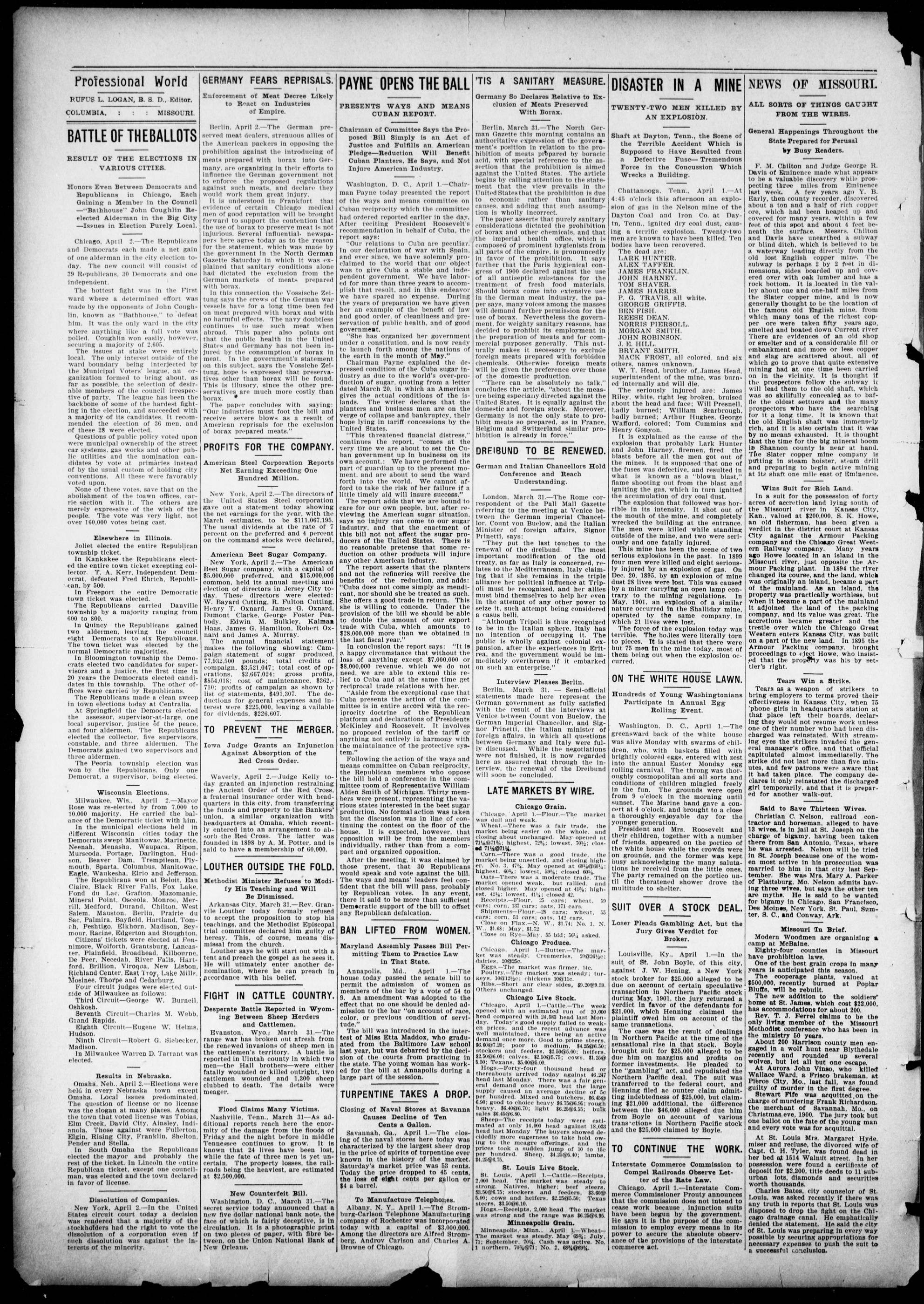
BATTLE OF THEBALLOTS
RESULT OF THE ELECTIONS IN
VARIOUS CITIES.
Honors Even Between Democrats and
Republicans in Chicago, Each
Gaining a Member in the Council
—"Bathhouse" John Coughlin Re-
elected Alderman in the Big City
—Issues in Election Purely Local.
Chicago, April 2.—The Republicans
and Democrats each made a net gain
of one alderman in the city election
today. The new council will consist of
39 Republicans, 30 Democrats and one
independent.
The hottest fight was in the First ward where a determined effort was made by the opponents of John Coughlin, known as "Bathhouse," to defeat him. It was the only ward in the city where anything like a full vote was polled. Coughlin won easily, however, securing a majority of 2,605. The issues at stake were entirely local. The only interest outside of the ward boundary being interjected by the Municipal Voters' league, an organization formed to bring about, as far as possible, the selection of desirable members of the council irrespective of party. The league has been the backbone of some of the hardest fighting in the election, and succeeded with a majority of its candidates. It recommended the election of 36 men, and of these 28 were elected.
Questions of public policy voted upon were municipal ownership of the street car systems, gas works and other public utilities and the nomination candidates by vote at primaries instead of by the usual custom of holding city conventions. All these were favorably voted upon.
None of these votes, save that on the abolishment of the town offices, carriage section with it. The others are merely expressive of the wish of the people. The vote was very light, not over 160,000 votes being cast.
Elsewhere in Illinois
Joliet elected the entire Republican township ticket.
In Kankakee the Republicans elected the entire town ticket excepting collector. T. A. Kerr, Independent Democrat, defeated Fred Ehrich, Republican, by 500.
In Freeport the entire Democratic town ticket was elected.
The Republicans carried Danville township by a majority ranging from 600 to 800.
In Quincy the Republicans gained two aldermen, leaving the council eight Democrats to six Republicans. The town ticket was elected by the normal Democratic majorities.
In Bloomington township the Democrats elected two candidates for supervisors and a justice, the first time in 20 years the Democrats elected candidates in this township. The other offices were carried by Republicans.
At Springfield the Democrats elected the assessor, supervisor-at-large, one local supervisor, justice 5f the peace, and four aldermen. The Republicans elected the collector, five supervisors, constable, and three aldermen. The Democrats gained two supervisors and three aldermen. The Peoria township election was won by the Republicans. Only one Democrat, a supervisor, being elected.
Wisconsin Elections.
Milwaukee, Wis. April 2—Mayor Rose was re-elected by from 7,000 to 10,000 majority. He carried the balance of the Democratic ticket with him. In the municipal elections held in different Wisconsin cities today the Democrats swept Manitowoc, Marinette, Neenah, Menasha, Waupaca, Ripon, Murscoda, Portage, Darlington, Hudson, Beaver Dam, Tremplelean, Plymouth, Sparta, Columbus, Manitowoc, Eagle, Waukesha, Elrio and Jefferson. The Republicans won at Beloit, Eau Claire, Black River Falls, Fox Lake, Fond du Lac, Grafton, Mazomanie, Mineral Point, Osooneau, Merrill, Medford, Durand, Chilton, West Salem, Mauston, Berlin, Prairie du Sac, Palmira, Bayfield, Hartland, Tomah, Peshtigo, Elkhorn, Madison, Seymour, Racine, Edgerton and Stoughton. Citizens' tickets were elected at Fenimore, Wolforth, Grantsburg, Lancaster, Plainfield, Broadhead, Kilbourne, De Peer, Needah, River Falls, Hartford, Brillion, Viroqua, New Lisbon, Richland Center, East Troy, Lake Mills, Mosinee, Thorpe and Cedarburg.
Four circuit judges were elected outside of Milwaukee as follows: Third Circuit—George W. Burnell Oshkosh.
Seventh Circuit—Charles M. Webb
Grand Rapids.
Eighth Circuit—Eugene W. Helms.
Hudson.
Ninth Circuit—Robert G. Siebecker, Madison. In Milwaukee Warren D. Tarrant was elected.
Results in Nebraska.
Omaha, Neb., April 2.—Elections were held in every Nebraska town except Omaha. Local issues predominated. The question of license or no license was the slogan at many places. Among the town that voted license was Tobias, Elm Creek, David City, Ainsley, Indianola. Those against were Fullerton, Elgin, Rising City, Franklin, Shelton, Pender and Stella. In South Omaha the Republicans elected the mayor and probably the rest of the ticket. In Lincoln the entire Republican ticket, except one councilman, was elected and the town declared in favor of license.
Dissolution of Companies
New York, April 2.—In the United States circuit court today a decision was rendered that a majority of the stockholders had the right to vote the dissolution of a corporation even if such dissolution was against the interests of the minority.
GERMANY FEARS REPRISALS.
Enforcement of Meat Decree Likely to React on Industries of Empire.
Berlin, April 2.—The German preserved meat dealers, strenuous allies of the American packers in opposing the prohibition against the introducing of meats prepared with borax into Germany, are organizing in their efforts to influence the German government not to enforce the proposed regulations against such meats, and declare they would work them great injury.
It is understood in Frankfort that evidence of certain Chicago medical men of good reputation will be brought forward to support the contention that the use of borax to preserve meat is not injurious. Several influential newspapers here agree today as to the reason for the statement, which was made by the government in the North German Gazette Saturday in which it was explained that sanitary conditions alone had dictated the exclusion from the German markets of meats prepared with borax.
In this connection the Vossische Zeitung says the crews of the German war vessels have for a long time been fed on meat prepared with borax and with no harmful effects. The navy doubtless continues to use such meat when abroad. This paper also points out that the public health in the United States and Germany has not been injured by the consumption of borax in meat. In the government's statement on this subject, says the Vossische Zeitung, hope is expressed that preservatives other than borax will be found. This is illusory, since the other preservatives are much more costly than borax. The paper concludes with saying: "Our industries must foot the bill and receive severe blows as a result of American reprisals for the exclusion of borax prepared meats."
PROFITS FOR THE COMPANY.
American Steel Corporation Reports Net Earning Exceeding One Hundred Million.
New York, April 2.—The directors of the United States Steel corporation gave out a statement today showing the net earnings for the year, with the March estimates, to be $111,067.195. The usual dividends at the rate of 7 percent on the preferred and 4 percent on the command stocks were declared,
American Beet Sugar Company.
New York, April 2—The American Beet Sugar company, with a capital of $5,000,000 preferred, and $15,000,000 common, held its annual meeting and election of directors in Jersey City today. These directors were elected; W. Bayard Cutting, R. Fulton Cutting, Henry T. Oxnard, James G. Oxnard, Dumont Clarke, George Foster Peabody, Edwin M. Bulkley, Kalman Hans, James G. Hamilton, Robert Oxnard and James A. Murray.
The annual financial statement makes the following showing: Campaign statement of sugar produced, 77,322,500 pounds; total credits of campaign, $3,521,047; total cost of operations, $2,667,024; gross profits, $854,018; cost of maintenance, $626,710; profits of campaign as shown by list of statements, $491,307. The deductions for general expenses and interest were $225,000, leaving a vailable for dividends, $226,607.
TO PREVENT THE MERGER.
Iowa Judge Grants an Injunction Against Absorption of the Red Cross Order.
Waverly, April 2.—Judge Kelly today granted an injunction restraining the Ancient Order of the Red Cross, a fraternal insurance order with headquarters in this city, from transferring the funds and property to the Bankers' union, a similar organization with headquarters at Omaha, which recently entered into an arrangement to absorb the Red Cross. The latter was founded in 1898 by A. M. Potter, and is said to have a membership of 60,000.
LOUTHER OUTSIDE THE FOLD.
Arkansas City, March 31. - Rev. Granville Louther today formally refused to accept the proposition to stop his teachings, and the Methodist Episcopal trial committee declared him guilty of heresy. This, of course, means dismissal from the church. Louther says he will start out with a tent and preach the gospel as he sees it. He will ultimately enter another denomination, where he can preach in accordance with his belief.
FIGHT IN CATTLE COUNTRY.
Evanston, Wyo.; March 31.—The range war has broken out afresh from the renewed invasions of sheep men in the cattlemen's territory. A battle is reported in Uintah county in which two men—the Hall brothers—were either fatally wounded or killed outright, two cattlemen wounded and 1,300 sheep clubbed to death. The details were meager.
Flood Claims Many Victims.
Nashville, Tenn., March 31—As additional reports reach here the enormity of the damage from the floods of Friday and the night before in middle Tennessee continues to grow. It is known that 24 lives have been lost, while the fate of three men is yet uncertain. The property losses, the railroads being the heaviest, are estimated at $2,500,000.
New Counterfeit Bill.
Washington, D. C., March 31. The secret service today announced that a new five dollar national bank note, the face of which is fairly deceptive, is in circulation. It is a photographic print on two pieces of paper, with fibre between, on the Union National Bank of New Orleans.
PAYNE OPENS THE BALL
PAYNE OPENS THE BALL
PRESENTS WAYS AND MEANS CUBAN REPORT.
Chairman of Committee Says the Proposed Bill Simply is an Act of Justice and Fulfills an American Pledge—Reduction Will Benefit Cuban Planters, He Says, and Not Injure American Industry.
Washington, D. C., April 1.—Chairman Payne today presented the report of the ways and means committee on Cuban reciprocity which the committee had ordered reported earlier in the day. After reciting President Roosevelt's recommendation in behalf of Cuba, the report says:
"Our relations to Cuba are peculiar. In our declaration of war with Spain, and ever since, we have solemnly proclaimed to the world that our object was to give Cuba a stable and independent government. We have labored for more than three years to accomplish that result, and in this endeavor we have spared no expense. During the years of preparation we have given her an example of the benefit of law and good order, of cleanliness and preservation of public health, and of good government.
"She has organized her government under a constitution, and is now ready to launch forth among the nations of the earth in the month of May."
Chairman Payne explained the depressed condition of the Cuba sugar industry as due to the world's over-production of sugar, quoting from a letter dated March 20, in which an American gives the actual conditions of the islands. The writer declares that the planters and business men are on the verge of collapse and bankruptcy, their hope lying in tariff concessions by the United States.
"This threatened financial distress," continues the report, "comes at the very time we are about to set the Cuban government up in business on its own account: We have performed the part of guardian up to the present moment, and are about to send the ward forth into the world. We cannot afford to take the risk of her failure if a little timely aid will insure success."
The report adds that we are bound to care for our own people, but, after reviewing the American sugar situation, says no injury can come to our sugar industry, and that the enactment of this bill not affect the sugar producers of the United States. There is no reasonable pretense that some reduction on other products will injure any other American industry.
The report asserts that the planters and not the refineries will receive the benefits of the reduction, and adds: "Cuba does not come simply as mendiant, nor should she be treated as such. She offers a good trade in return. This she is willing to concede. Under the provision of the bill we should be able to double the amount of our export trade with Cuba, which amounts to $28,000,000 more than we obtained in the last fiscal year."
In conclusion the report says: "It is a happy circumstance that without the loss of anything except $7,000,000 or $8,000,000 revenue, which we do not need, we are able to extend this relief to Cuba and at the same time get reciprocal trade relations with her. "Aside from the exceptional case that Cuba presents the action of the committee is in entire accord with the reciprocity doctrine of the Republican platform and declarations of Presidents McKinley and Roosevelt. It involves no proposed revision of the tariff or anything not entirely in harmony with the maintenance of the protective system."
Following the action of the ways and means committee on Cuban reciprocity, the Republican members who oppose the bill held a conference in the committee room of Representative William Alden Smith of Michigan. Thirty members were present, representing the various states interested in the beet sugar production. No formal action was taken but the discussion was in line of continuing the contest on the floor of the house. It is expected, however, that opposition will be from the members individually, rather than from a compact and organized opposition.
After the meeting, it was claimed by those present, that 30 Republicans would speak and vote against the bill. The ways and means' leaders feel confident that the bill will pass, probably by Republican votes. In any event, there it said to be more than sufficient Democratic support of the bill to offset any Republican defalcation.
BAN LIFTED FROM WOMEN.
Maryland Assembly Passes Bill Permitting Them to Practice Law in That State.
Annapolis, Md., April 1.—The house today passed the senate bill to permit the admission of women as members of the bar by a vote of 54 to 9. An amendment was adopted to the effect that no one should be denied admission to the bar "on account of race, color, or previous condition of servitude." The bill was introduced in the interest of Miss Etta Maddox, who graduated from the Baltimore Law school last year, but was debarred by the decision of the courts from practicing in the state. The young woman has worked for the bill at Annapolis during a large part of the session.
TURPENTINE TAKES A DROP.
Closing of Naval Stores at Savanna Causes Decline of Ten Cents a Gallon.
Savannah Ga., April 1.—The closing of the naval stores here today was characterized by the largest sheer drop in the price of spirits of turpentine ever known in the history of the market.
Saturday's market price was 53 cents. Today the price dropped to 45 cents, the loss of eight cents per gallon or $4 a barrel.
To Manufacture Telephones
Albany. N. Y.. April 1.—The Stromburg-Carlson Telephone Manufacturing company of Rochester was incorporated today with a capital of $3,000,000. Among the directors are Alfred Stromberg, Androv Carlson and Charles A. Browne of Chicago.
'TIS A SANITARY MEASURE
Germany So Declares Relative to Exclusion of Meats Preserved With Borax.
Berlin, March 31.—The North German Gazette this morning contains an authoritative expression of the government's position in relation to the prohibition of meats prepared by boracic acid, with special reference to the assertion that the prohibition is aimed against the United States. The article begins by calling attention to the statement that the view prevails in the United States that the prohibition is due to economic rather than sanitary causes, and adding that such assumption is wholly incorrect.
The paper asserts that purely sanitary considerations dictated the prohibition of borax and other chemicals, and that the imperial health office, which is composed of prominent hygienists from all parts of the empire, is pronouncedly in favor of the prohibition. It says further that the Paris hygienical congress of 1900 declared against the use of all antiseptic substances for the treatment of fresh food materials. Should borax come into extensive use in the German meat industry, the paper says, many voices among the masses will demand further permission for the borax. Borax, furtherless the government, for weighty purposes, has decided to prohibit its employment in the preparation of meats and for commercial purposes generally. This naturally makes it necessary to exclude foreign meats prepared with forbidden chemicals. Otherwise foreign meats will be given the preference over those of the domestic production.
"There can be absolutely no talk," concludes the article, "about the measure being especially directed against the United States. It is equally against the domestic and foreign stock. Moreover, Germany is not the only state to prohibit meats so prepared, as in France, Belgium and Switzerland similar prohibition is already in force."
DREIBUND TO BE RENEWED
German and Italian Chancellors Hold Conference and Reach Understanding.
London, March 31.—The Rome correspondent of the Pall Mall Gazette referring to the meeting at Venice between the German imperial Chancellor, Count von Buelow, and the Italian Minister of foreign affairs, Signor Primetti, says:
"They put the last touches to the renewal of the drelbund. The most important modification of the old treaty, as far as Italy is concerned, relates to the Mediterranean, Italy claiming that if she remains in the triple alliance her political influence at Tripoli must be recognized, and her allies must bind themselves to help her even in the attempt of any other power to seize it, such attempt being considered a casus belli.
"Although Tripoli is thus recognized to be in the Italian sphere, Italy has no intention of occupying it. The public is wholly against colonial expansion, after the experiences in Eritrea, and the government would be immediately overthrown if it embarked on such an enterprise."
Interview Pleases Berlin.
Berlin, March 31. — Semi-official statements made here represent the German government as fully satisfied with the result of the interviews at Venice between Count von Buelow, the German Imperial Chancellor, and Signor Prinetti, the Italian minister of foreign affairs, in which all questions between Germany and Italy were fully discussed. While the negotiations were not finished, it is now regarded here as assured that through the interview, the renewal of the Dreibund will soon be concluded.
LATE MARKETS BY WIRE.
**Chicago Grain.**
Chicago, April 1—Flour—The market was dull and weak.
Wheat.—There was a fair trade, the market being easier on the whole, and closing about unchanged. May opened at 71%@71%, highest; 72%; lowest; 70%; closed@71%@71%.
Corn.—There was a good trade, the market being unsettled, and closing higher. No. 3. 47%; May opened at 60%@60%, highest; 60%; lowest; 55%; closed 60%.
Oats—There was a moderate trade. The market opened weak, but rallied, and closed higher. May opened at 41%; highest; 42%; lowest; 414; closed 42.
Wheat.—Cars, 55 cars; wheat, 59 cars; corn, 137 cars; oats, 71 cars.
Shipments—Flour—28 cars; wheat, 55 cars; corn, 53 cars; oats, 142 cars.
Close on Flax.—N. W., $1.74; No. 1, N. W., $1.68; May, $1.72
Close on Rye—May. 55 bid; 56 asked.
Chicago Produce.
Chicago, April 1.—Butter.—The market was steady. Creameries, 20@26% c.
Edggs.—The market was firmer. 14c.
Poultry.—The market was steady; turkeys, 10@12% c; chickens 10@11c.
Ribs.—Short arr clear sides, $9.20@9.30.
Others unchanged.
Chicago Live Stock.
Chicago, April 1—Cattle. The week opened with an estimated run of 20,000 head compared with 24,583 head last Monday. Today's good supply failed to weaken, and the recent advance was well maintained, and demand once more. Good to prime steers, $6.00@7.20; poor to medium, $4.25@6.50; stockers and feeders, $2.50@5.00; heifers, $2.50@6.00; calves, $2.50@6.75; cows, $1.25@5.00; Texans, $5.00@7.00; a thousand head on thereabouts arrived today against 46,247 head last Monday. There was a fair general demand once more, but the large supply caused an average decline of 55 per hundred. Mixed and butchers, $6.45@6.00; good to choice heavy, $6.55@6.50; rough light, $7.00; light, $6.25@6.55; bulk sales, $6.45@8.00.
Sheep. The receipts today were estimated at only 14,000 head against 18,033 head last Monday. The buyers showed decidedly more eagerness to take hold owing to the meagre offerings, and the price took a sudden jump of 10 to 15c aook a sudden sheep. Sheep, $6.25@6.40; lambs, $6.25@7.5.
St. Louis Live Stock.
St. Louis, April 1—Cattle—Receipts,
2,000 head. The market was steady to
strong. Natives, higher; beef steers,
$3.50@6.75; stockers and feeders, $3.60@
5.00; cows and heifers, $2.25@6.50; Texas
Hogs—Receipts, 2,000 head The market
was strong and the range was $6.25@6.95.
Minneapolis Grain.
Minneapolis, Minn. April 1—Wheat—
The market was steady, May 69%; July,
71; September, 70%. Cash was active. No.
1 northern, 70%; No. 2, 88%@68%.
DISASTER IN A MINE
DISASTER IN A MINE
TWENTY-TWO MEN KILLED BY AN EXPLOSION.
Shaft at Dayton, Tenn., the Scene of the Terrible Accident Which is Supposed to Have Resulted from a Defective Fuse—Tremendous Force in the Concussion Which Wrecks a Building.
Chattanooga, Tenn., April 1.—At 4:45 o'clock this afternoon an explosion of gas in the Nelson mine of the Dayton Coal and Iron Co. at Daytn, Tenn., ignited dry coal dust, causing a terrific explosion. Twenty-two men are known to have been killed. Ten bodies have been recovered.
The dead are:
LARK HUNTER.
ALEX TAFFER.
JAMES FRANKLIN.
JOHN HARNEY.
TOM SHAVER.
JAMES HARRIS.
P. G. TRAVIS, all white.
GEORGE GRIFFFIS.
BEN FISH.
REESE DEAN.
NORRIS PIERSOLL.
MORGAN SMITH.
JOHN ROBINSON.
J. E. HILL.
BRYANT SMITH.
MACK FROST, all colored, and six others, names unknown.
W. T. Head, brother of James Head, superintendent of the mine, was burned internally and will die.
The seriously injured are: James Riley, white, right leg broken, bruised about the head and face; Will Presnell, ladly burned; William Scarbrough, badly burned; Arthur Hughes, George Wafford, colored; Tom Cummins and Henry Gonyon.
It is explained as the cause of the explosion that probably Lark Hunter and John Harney, firemen, fired the blasts before all the men got out of the mines. It is supposed that one of the fuses was defective, and resulted in what is known as a "blown blast," flame shooting out from the blast and igniting the gas, which in turn ignited the accumulation of dry coal dust.
The explosion that followed was horrible in its intensity. It shot out of the mouth of the mine, and completely wrecked the building at the entrance. The men were killed while standing outside of the mine, and two were seriously and one fatally injured.
This mine has been the scene of two serious explosions in the past. In 1899 four men were killed and eight seriously injured by an explosion of gas. On Dec. 20, 1895, by an explosion of mine dust 28 lives were lost. This was caused by a miner carrying an open lamp contrary to the mining regulations. In May, 1901, an explosion of a similar nature occurred in the Shalliday mine, operated by the same company, in which 21 lives were lost.
The force of the explosion today was terrible. The bodies were literally torn to pieces. It is stated that there were but 75 men in the mine today, most of them being out when the explosion occurred.
ON THE WHITE HOUSE LAWN.
Hundreds of Young Washingtonians Participate in Annual Egg Rolling Event.
Washington, D. C., April 1.—The greensward back of the white house was alive Monday with swarms of children, who, with baskets filled with brightly colored eggs, entered with zest into the annual Easter Monday egg rolling carnival. The throng was thoroughly cosmopolitan and all sorts and conditions of children mingled freely in the fun. The grounds were open from 9 o'clock in the morning until sunset. The Marine band gave a concert at 4 o'clock, and brought to a close a thoroughly enjoyable day for the younger generation.
President and Mrs. Roosevelt and their children, together with a number of friends, appeared on the portico of the white house while the crowds were on ground, and the former was kept busy acknowledging the many salutations he received from the little ones. The party remained on the portico until the theratened shower drove the multitude to shelter.
SUIT OVER A STOCK DEAL
Loser Pleads Gambling Act, but the Jury Gives Verdict for Breaker
Louisville, Ky., April 1—In the suit of St. John Boyle, of this city, against J. W. Hening, a New York stock broker for $25,000 alleged to be due on account of certain speculative transaction in Northern Pacific stock during May, 1901, the jury returned a verdict in favor of the defendants for $21,000, which Henning claimed the plaintiff owed him on account of the same transactions.
The case was the result of dealings in Northern Pacific at the time of the sensational rise in that stock. Boyle brought suit for $25,000 alleged to be due him on margins and profits on former investments. He pleaded to the "gambling" act, and repudiated the Northern Pacific deal. The suit was transferred to the federal court, and Henning filed acounter claim admitting indebtedness of $25,000, but claiming $21,000 additional, the difference between the $46,000 alleged due him from Boyle on account of various transactions in Northern Pacific stock and the $25,000 claimed by Boyle.
TO CONTINUE THE WORK.
Interstate Commerce Commission to Compel Railroads Observe Letter of the Rate Law. Chicago, April 1.—Interstate Commerce Commissioner Prouty announces that the commission does not intend to cease work because injunction suits have been begun by the government. He says it is the purpose of the commission to employ every means in its power to secure the absolute observance of the provisions of the interstate commerce act.
ALL SORTS OF THINGS CAU3HT
FROM THE WIRES.
General Happenings Throughout the State Prepared for Perusal
F. M. Chilton and Judge George R. Davis of Eminence made what appears to be a valuable discovery while prospecting three miles from Eminence last week. A few years ago Y. B. Early, then county recorder, discovered about a ton and a half of rich copper ore, which had been heaped up and covered for many years, within a few feet of this spot and about 4 feet beneath the surface. Messers, Chilton and Davis have unearthed a subway or blind ditch, which is believed to be a waterway leading directly from the old lost English copper mine. The subway is perhaps 2 by 2 feet in dimensions, sides boarded up and covered over with oak lumber and has a rock bottom. It is located in the valley about one and one-half miles from the Slater copper mine, and is generally thought to be the location of the famous old English mine, from which many tons of the richest copper ore were taken fifty years ago, smelted and boated down current river. There are evidences of an old shop or smelter and of a considerable fill or embankment and more or less copper and slag are scattered about, all of which go to prove that quite extensive mining had at one time been carried on in the vicinity. It is thought if the prospectors follow the subway it will lead them to the old shaft, which was so skilfully concealed as to baffle the oldest settlers and the many prospectors who have the searching for it a long time. It is known that the old English shaft was immensely rich, and it is also certain that it was by no means exhausted. It is thought that the time for the big mineral boom in Shannon county is near at hand. The Slater copper mine company is putting in steam hoister, steam drill and preparing to begin active mining at its shaft one mile east of Eminence.
Wins Suit for Rich Land
In a suit for the possession of forty acres of accretion land lying south of the Missouri river in Kansas City, Kan., valued at $200,000. S. K. Howe, an old fisherman, has been given a verdict in the district court at Kansas City against the Armour Packing company and the Chicago Great Western Railway company. Many years ago Howe located in an island in the Missouri river, just opposite the Armour Packing plant. In 1894 the river changed its course, and the land, which was originally an island, became a part of the mainland. As an island, the property was practically worthless, but when it became a part of the mainland it adjoined the land of the packing company, and its value was great. The accretions became greater and the trestle over which the Chicago Great Western enters Kansas City, was built on a part of the new land. In 1895 the Armour Packing company, brought proceedings to object Howe, who insisted that the property was his by settler's right.
Tears Win a Strike.
Tears as a weapon of strikers to bring employers to terms proved their effectiveness in Kansas City, when 75 'phone girls in headquarters station at that place left their boards, declaring they would not resume work unless one of their number who had been discharged was reinstated. With streaming eyes the strikers invaded the general manager's office, and that official capitulated almost immediately. The strike did not last more than five minutes, and few patrons were aware that it had taken place. The company declares it only reinstated the discharged girl temporarily, and that it is prepared for another walk-out.
Said to Save Thirteen Wives
Christian C. Nelson, railroad contractor and horseman, alleged to have 13 wives, is in jail at St. Joseph on the charge of bigamy, having been taken there from San Antonio, Texas, where he was arrested. Nelson will be tried in St. Joseph because one of the women most active in his prosecution was married to him in that city last September. She was Mrs. Mary A. Parker of Plattsburg, Mo. Nelson admits having three wives, but says the other ten are myths. He is said to be wanted for bigamy in Chicago, San Francisco, Des Moines, New York, St. Paul, Sumter, S. C., and Conway, Ark.
Missouri In Brief.
Modern Woodmen are organizing camp at McBaine.
Eighty-four counties in Missouri have prohibition laws.
One of the best grain crops in many years is anticipated this season. The cooperage plants, valued at $500,000, are named at Poplar Bluff, will be rebuilt.
The new addition to the soldiers' home at St. James, which cost $22,000, has accommodations for about 200.
Rev. T. J. Ferrel claims to be the only living member of the Missouri Methodist conference who has been in the ministry 50 years.
About 200 Harrison county men engaged in a wolf hunt near Blythedale recently and rounded up several wolves, but let all but one escape.
At Aurora John Vinso, who killed Wallace Ward, a Frisco brakeman, at Pierce City, Mo., last fall, was found guilty of murder in the first degree.
Stewart Flife was acquitted, on the charge of murdering Frank Richardson, the merchant of Savannah, Mo., on Christmas eve, 1900. The jury took but one ballot on the fate of the young man and every vote was for acquittal.
At St. Louis Mrs. Margaret Hyde, miser and recluse, the divorced wife of Capt. C. H. Tyler, was found dead in her bed at 1514 Walnut street. In her possession were found a certificate of deposit for $2,200, title deeds to 11 suburban lots, diamonds and securities worth thousands. Charles Bates, city counselor of St. Louis, was asked recently if there was any truth in reports that St. Louis was disposed to drop the fight on the Chicago drainage canal. He emphatically denied the statement. He said the city of St. Louis was preparing in every way possible by securing appropriations for necessary expenses to push the suit to a successful conclusion.
f . ° ‘ °
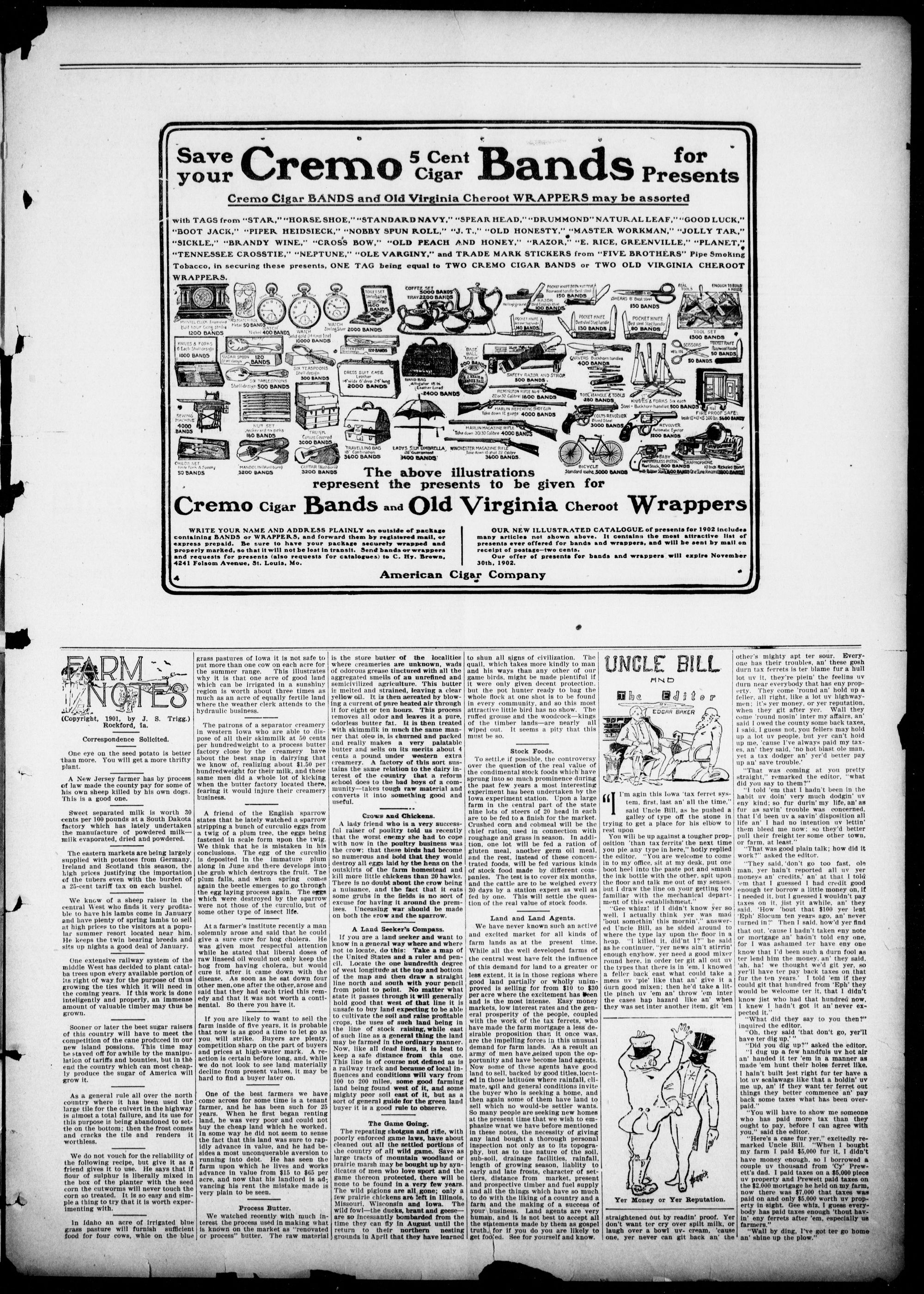
Save Cremo << Bands pe"
your Cigar Presents
Cremo Cigar BANDS and Old Virginia Cheroot WRAPPERS may be assorted
| with TAGS from “STAR,” “HORSE SHOE,” “STANDARD NAVY,” “SPEAR HEAD," “DRUMMOND” NATURAL LEAF," ‘GOOD LUCK,”
“BOOT JACK,” “PIPER HEIDSIECK,” “NOBBY SPUN ROLL,” “J. T.," “OLD HONESTY,” “MASTER WORKMAN," “JOLLY TAR,”
“SICKLE,” “BRANDY WINE,” “CROSS BOW,” “OLD PEACH AND HONEY,” “RAZOR,” “E. RICE, GREENVILLE,” “PLANET,)
“TENNESSEE CROSSTIE,” “NEPTUNE,” “OLE VARGINY,” and TRADE MARK STICKERS from “FIVE BROTHERS” Pipe Smoking
Tobacco, in securing these presents, ONE TAG being equal to TWO CREMO CIGAR BANDS or TWO OLD VIRGINIA CHEROOT
WRAPPERS.
See (iC: > Qo FTL ery eA baer emmrweh) “nt
“il G3) Ij h I Q. oe R. vse rmaragoo nares ) |) pb" i gees = ft [Dal
poem. HY NC) VE a ROI sci’ 130 0AN0s— (PN aaa aaah
Aza BOCA ICA IRS ey ea mat) oe fee peiien ere
Bornes traneet a pa DT amen ie Cy \ reba rl atande| | lp SOCuer Mt pete
ina ce che SOA og Nahr 2000 BANDS One rm le 130 BANDS | 20 BANDS ai
MOD BANDS, IA ta) ac (300 Banos
rraserons | FEvepna gl gisve nanos = Sa ernst
woo panos | G5 ne qe iS ae oe lepemmmg (ares Cer nodns Sees =
abies I) QS cachet ebivag 400 Ban
pe CRS ies [et = aiiauorne = atl
ED 0... Scoeanos fp | “seo vanes’ ee 0, ty = —— Fs elle
= Is K a "2400 BANDS: 226-32 Calbre 1600 BANDS! Tee EOS FD Hy
i E — SSS 7 oe
ue Bee a Tove ft 4060 BANOS Fc atuen wenn ote Ne
4000 ee, ON re MELO Ge 3000 BAN re ayayeR ; +
Banos weargniine mie, (ee ihe das 308 hore 4000 BAR : avcuee
ee CE wor amas, moe pet ee GNLD
Prins 3600 BANDS: 400 BANDS: 3é00 BANOS Cy Say bern Ae
CHO SE sey sanoiiaosean) — EATAR Mane Drerae OD Merck 600 BANDS in Rese ns
50 BANDS $200 wanos 3200 BANDS The above illustrations Sur sake 5000 BANDS Nhe tw 3StG0 SEO eSanO
; represent the presents to be given for
: :
Cremo cigar Bands as Old Virginia cheroot Wrappers
WRITE YOUR NAME AND ADDRESS PLAINLY on outside of package | OUR NEW ILLUSTRATED CATALOGUE of presents for 1902 includes
containing BANDS or WRAPPERS, and forward them by registered mail, or many articles not shown above. It contain» the most attractive list of
express prepaid. Be sure to have your package securety wrapped and presents ever offered for bands and wrappers, and will be sent by mail on
properly marked, so that it will not be lost in transit. Send bands or wrappers: receipt of postage—two cents.
and requests for presents (also requests for catalogues) to C. Hy. Brown, Our offer of presents for bands and wrappers will expire November
4241 Folsom Avenue, St. Louis, Mo. 30th, 1902,
ry American Cigar Company o
i
<
mW e BN
hill SSE
Dey) em
| “i KS a»
Vo red LO
2UZai. oer
(Copyright, 1901, by J. S. Trigg.)
Rockford, fa.
Correspondence Solicited.
One eye on the seed potato is better
‘than more. You will get a more thrifty
plant.
A New Jersey farmer has by process
of law made the county pay for some of
his own sheep killed by his own dogs.
‘This is a good one,
Sweet separated milk is worth 30
cents per 100 pounds at a South Dakota
factory which has lately undertaken
the manufacture of powdered milk—
milk evaporated, dried and powdered.
‘The eastern markets are being largely
supplied with potatoes from Germany,
Ireland and Scotland this season, the
high prices justifying the importation
of the tubers even with the burden of
a 25-cent tariff tax on each bushel,
We know of a sheep raiser in the
central West who finds It very profita-
ble to have his lambs come in January
and have plenty of spring lambs to seil
at high prices to the visitors at a popu-
lar summer resort located near him.
He keeps the twin bearing breeds and
sits up nights a good deal of January.
One extensive railway system of the
middle West has decided to plant catal-
ba trees upon every available portion of
its right of way for the purpose of thus
growing the ties which it will need in
the coming years. If this work is done
inteligently and properly, an immense
amount of valuable timber may thus be
grown.
Sooner or later the beet sugar raisers
of this country will have to meet the
competition of the cane produced in our
new Island possions. ‘This time may
be staved off for awhile by the manipu-
lation of tariffs and bounties, but in the
end the country which can most cheap-
ly produce the sugar of America will
grow it.
As a general rule all over the north
comntry where it has been used the
large tile for the culvert in the highway
is almost a total failure, and its use for
this purpose is being abandoned to set-
tle on the bottom; then the frost comes
and cracks the tile and renders it
worthless.
We do not vouch for the reliability of
the following recipe, but give it as a
friend gives it to use. He says that if
flour of sulphur is liberally mixed in
the box of the planter with the seed
corn the cutworms will never touch the
corn so treated. It 18 so easy and sim-
ple a thing to try that it is worth exper-
imenting with.
In Idaho an acre of irrigated blue
vass pasture will furnish sufficient
Besar fours cowaicwhie an ihe blue
grass pastures of Iowa it is not safe to
put more than one cow on each acre for
the summer range. This illustrates
why it is that one acre of good land
which can be irrigated in a sunshiny
region is worth about three times as
mitch as an acre of equally fertile land
where the weather clerk attends to the
hydraulic business.
‘The patrons of a separator creamery
in western Iowa who are able to dis-
pose of all their skimmilk at 50 cents
per hundredweight to a process butter
factory close by the creamery have
about the best snap in dairying that
we know of, realizing about $1.00 per
hundredweight for their milk, and these
same men did a whole lot of kicking
when the butter factory located there,
fearing it would injure their creamery
business.
A friend of the English sparrow
states that he lately watched a sparrow
stripping a bunch of curculio eggs from
a twig of a plum tree, the eggs being
fastened in scale form upon the twig.
We think that he is mistaken in his
conclusions. ‘The egg of the curculio
is deposited in the immature plum
along in June and there develops into
the grub which destroys the fruit. The
plum falls, and when spring comes
again the beetle emerges to go through
the egg laying process again. ‘The eggs
which were destroyed by the sparrow
were not those of the curculio, but of
some other type of insect life.
Ata farmer's institute recently a man
solemnly arose and said that he could
give a sure cure for hog cholera, He
was given most respectful attention
while he stated that liberal doses of
raw linseed oil would not only keep the
hog from having cholera, but would
cure it after it came down with the
disease. As soon as he sat down four
other men, one after the other,arose and
eaid that they had each tried this rem-
edy and that it was not worth a cont!-
nental, So there you have it.
If you are likely to want to sell the
farm inside of five years, it Is probable
that now {s as good a time to let go as
you will strike. Buyers are plenty,
competition sharp on the part of buyers
and prices at high-water mark. A re-
action is certain before long, and, while
we do not look to see land materially
decline from present values, it may be
hard to find a buyer later on.
One of the best farmers we have
come across for some time is a tenant
farmer, and he has been such for 25
years." When he first began renting
land, he was very poor and could not
buy ‘the cheap land which he worked.
In some way he did not seem to sense
the fact that this land was sure to rap-
idly advance in value, and he had be-
sides a most unconquerable aversion to
running into debt. He has seen the
farm upon which he lives and works
advance in value from $15 to $63 per
acre, and now that his landlord is ad;
vancing his rent the mistake made is
very plain to be seen.
Process Butter.
‘We watched recently with much in-
terest the process used in making what
is known on the market as “renovated
or process” butter. The raw material
is the store butter of the localities
where creameries are unknown, wads
of odorous grease tinctured with all the
aggregated smells of am unrefined and
semicivilized agriculture. ‘This butter
is melted and strained, leaving a clear
yellow oil. It is then aereated by blow-
ing a current of pure heated air through
it for eight or ten hours. ‘This process
removes all odor and leaves it a pure,
odorless butter fat. It is then treated
with skimmilk in much the same man-
ner that oleo is, is churned and packed
and really makes a very palatable
butter and sells on its merits about 4
cents a pound under western extra
creamery. A factory of this sort sus-
tains the same relation to the dairy in-
terest of the country that a reform
school does to the bad boys of a com-
munity—takes tough raw material and
converts it into something good and
useful.
Cxows and Chickens.
A lady friend who is a very success-
ful raiser of poultry told us recently
that the worst enemy she had to cope
with now in the poultry business was
the crow; that these birds had become
So numerous and bold that they woul’
destroy all eggs laid by the hens on the
outskirts of the farm homestead and
Kill more little chickens than 20 hawks,
‘There is no doubt about the crow being
a nuisance, and the fact that it eats
some grubs in the fields is no sort of
excuse for having it around the prem-
ises, Uneeasing war should be made
‘on both the erow and the sparrow.
A Land Seeker's Compass.
If you are a land seeker and want to
know in a general way where and where
not to locate, do this: Take a map of
the United States and a ruler and pen-
cil, Locate the one hundredth degree
of west longitude at the top and bottom
of the map and then draw a straight
line north and south with your pencil
from point to point. No matter what
state it passes through it will generally
hold good that west of that line it is
unsafe to buy land expecting to be able
to cultivate the soil and raise profitable
crops, the uses of such land being in
the line of stock raising, while east
of such line as a general thing the land
may be farmed in the ordinary manner.
Now, like all dead lines, it is best to
keep a safe distance from this one.
This line is of course not defined as is
a railway track and because of local in-
fluences and conditions will vary from
100 to 200 miles, some good farming
land being found west of it, and some
mighty poor soil east of it, but as a
sort of general guide for the green land
buyer it is a good rule to observe.
ie Gases Golan
The repeating shotgun and rifle, with
poorly enforced game laws, have about
cleaned out all the settled portions of
the country of all wild game. Save as
large tracts of mountain woodland or
prairie marsh may be bought up by syn-
dicates of men who love sport and the
game thereon protected, there will be
none to be found in a very few years.
The wild pigions are all, gone; only a
few prairie chickens aré left in Illinois,
Missouri, Wisconsin and Iowa, The
wild fowl—the ducks, brant and geese—
are so incessantly bombarded from the
time they can fly in August until the
return to their northern — nesting
grounds in April that they have learned
to shun all signs of civilization. The
quail, which takes more kindly to man
and his ways than any other of our
game birds, might be made plentiful if
it were only given decent protection.
but the pot hunter ready to bag the
whole flock at one shot is to be found
in every community, and so this most
attractive little bird has no show. ‘The
ruffed grouse and the woodcock—kings
of the timber lands—are nearly all
wiped out. It seems a pity that this
must be so.
Stock Foods.
‘To settle if possible, the controversy
over the question of the real value of
‘the condimental stock foods which have
sprung into so much prominence during
the past few years a most interesting
experiment has been undertaken by the
Iowa experiment station. Upon a large
farm in the central part of the state
nine lots of steers of 20 head in each
are to be fed toa finish for the market.
Crushed corn and cobmeal will be the
chief ration, used in connection with
roughage ani grass in season. In addi-
tion, one lot will be fed a ration of
gluten meal, another germ oil meal,
and the rest, instead of these concen
trated foods, will be fed various kinds
of stock food made by different com-
panies, The test is to cover six months,
and the cattle are to be weighed every
80 days by a station expert as well as
fed by one. This will settle the ques-
tion of the real value of stock foods,
Saud and aud Agents,
We have never known such an active
and excited market for all kinds of
farm lands as at the present time.
While all the well developed farms of
‘the central west have felt the influence
‘of this demand for land to a greater or
‘less extent, it is in those regions where
‘good land’ partially or wholly unim-
proved is selling for from $10 to $30
per acre where the excitement has Been
and is the most intense. Easy money
markets, low interest rates and the gen-
eral prosperity of the people, coupled
with the work of the tax ferrets, who
have made the farm mortgage a less de-
sirable proposition than it once was,
are the impelling forces in this unusual
demand for farm lands. As a result an
army of men have seized upon the op-
portunity and have become land agents.
Now some of these agents have good
land to sell, backed by good titles, locat~
ed in those latitudes where rainfall, cli-
mate, gpil and general conditions invite
the buyer who Is seeking a home, and
then again some of them have land to
‘sell which no would-be settler wants.
So many people are seeking new homes
at the present time that we wish to em-
phasize wnat we have before mentioned
in these notes, the necessity of giving
any land bought a thorough personal
Inspection not only as to its topogra-
phy, but as to the nature of the soll,
sub‘soil, drainage facilities, rainfall,
length of growing season, liablity to
early and late frosts, character of set-
tlers, distance from’ market, present
and prospective timber and fuel supply
‘and all the things which have so much
to do with the liking of a country and a
farm and the making of a success of
your business. Land agents are very
human, and {¢ is not best to accept ail
the statements made by them as gospel
truth, for if you do you are likely to
get fodied. See for yourself and know.
UNCLE BILL
Mhe @d itor
(oN eoenn ome
= gi
y Gi {
ee ee ONE enc se,
tem, first, last an’ all the time,”
said Uncle Bill, as he pushed a
galley of type off the stone in
trying to get a place for his elbow to
rest upon
You wWili be up against a tougher prop-
osition ‘than tax ferrits’ the next time
you pie any type in here,” hotly replied
the editor. “You are welcome to come
in to my office, sit at my desk, put one
boot heel into the paste pot and smash
the ink bottle with the other, spit upon
the floor and talk me out of my senses,
but I draw the line on your getting too
familiar with the mechanical depart-
ment of this establishment.”
"Gee whizz! if I didn't know yer so
well, I actually think yer was mad
‘pout somethin’ this mornin’.” answer-
ed Uncle Bill, as he sided around to
where the type lay upon the floor in a
heap, “I killed it, did'nt 12” he said
as he continuer, “yer news ain't stirrin’
enough enyhow, yer need a good mixer
round here, in order ter git all out uv
the types that there is in ‘em. | knowed
a feller back east what could take a
mees uy ‘pie’ like that an’ give it a
durn good mixen; then he'd take a lit-
tle pinch uv ‘em an’ throw ‘em inter
the cases hap hazard like an’ when
they was set inter another item, git ‘em
why,
exe |
|
Gs & 4
~ [x 7
‘ Up
ENALH\
2 Aa S
7 \ M
¥ y
i
if, is
i (4a
Yer Money or Yer Reputation.
straightened out by readin’ proof. Yer
don’t want ter ery over spilt milk, or
laugh over a bowl uv- cream, ‘cause
one, yer never can git back an’ the
other's mighty apt ter sour. Every-
one has their troubles, an’ these gosh
durn tax ferrets is ter blame fur a hull
lot uv it, they're piein’ the feelins uv
durn near everybody that has eny prop-
erty. They come ‘round an’ hold up a
feller, all right, like a lot uv highway-
men; it's yer money, or yer reputation,
when they git after yer. Wall they
come ‘round nosin’ inter my affairs, an’
said [ owed the county some back taxes,
I said, I guess not, you fellers may hold
up a lot uv people, but yer ean’t hold
Up me, ‘cause I've always paid my tax-
es, an” they said, ‘no hot blast ole man,
yet a tax dodger an’ yer'd better pay
up an’ save trouble.
“That was coming at you pretty
straight,” remarked the editor, “what
did you say to them?”
“1 told ‘em that T hadn't been in the
habit uy doin’ very much dodgin’ uv
eny kind; so fur durin’ my life, an’ as
‘fur as savin’ trouble was concerned,
‘that I'd been uy a savin’ disposition all
life an’ I had no intention uy lettin’
them bleed me now: so they'd better
pull their freight ter some other town,
or farm, at least.”
“That was good plain talk; how did it
work?” asked the editor.
“They said, ‘don't go too fast, ole
‘man, yer hain’t reported all uv yer
“moneys an’ credits.’ an’ at that I told
em that I guessed I had credit good
“enough ter borrow a little money on, if
I needed it, but I guessed I wouldn’t pay
‘taxes on it, jist yit awhile, an’ they
‘said, ‘How ‘bout that $100 yer lent
‘Eph’ Slocum ten years ago, an’ never
‘turned in?” ‘Then i said, how'd yer find
that out, ‘cause I hadn't taken eny note
‘or mortgage an’ hadn't told eny one,
‘for I was ashamed ter have eny one
| know that I'd been such a durn fool as
ter lend him the money, an’ they said,
‘ah, ha! we thought we'd git yer, so
| yer'll have ter pay back taxes on that
fur the ten years.’ T told ‘em if they
could git that hundred from ‘Eph’ they
would be welcome ter it, that I didn’t
know jist who had that hundred now,
I knew I hadn't got it an’ never ex-
| pected it.”
“What did they say to you then?”
| inquired the editor.
|, “Oh, they sald ‘that don't go, yer'll
have ter dig up.’”
“Did you dig up?” asked the editor,
“I dug up a few handfuls uv hot alr
an’ handed it ter ‘em in @ manner as
made ’em hunt their holes ferret like,
T hain't built Jest right fur ter have a
lot uy scalawags like that a holdin’ uv
me up, an’ if they want ter ferret out
things they better commence an’ pay
back some taxes what has been over-
paid.”
“You will have to show me someone
who has paid more tax than they
ought to pay, before I can agree with
you,” said the editor,
“Here's a case fur yer.” excitedly re-
marked Uncle Bill, “When I bought
my farm I paid $5,000 fur it, T didn’t
have money enough, so I borrowed a
couple uv thousand’ from ‘Cy’ Prew-
ett’s dad. I paid taxes on a $5,000 plece
uv property and Prewett paid taxes on
the 3.000 mortgage ‘he held on my farm,
now there was $7,000 that taxes
paid on and only $5,000 worth uy
| erty in sight. Gee whiz, I guess
body has paid taxes enough
'| in’ eny ferrets after ‘em, especially
| Eat by a1 ve got ter 0 hom
eae bi :
lan’ shine up the plow”.
RUFUS L. LOGAN, B. S. D. - EDITOR
TERMS OF SUBSCRIPTION.
One Year in Advance - - - $1.50
Six Months in Advance - - 1.00
Three Months in Advance - - .50
Single Copies - - - .05
Special rates of $1.00 per year to ministers.
Advertising Rates on Application.
Job Work of all Kinds Solicited.
Published Every Friday.
Entered at the postoffice at Columbia, Mo., as second class matter,
Jan. 15, 1902.
Agents wanted in every town in the state.
PRESS OF THE MISSOURI STATESMAN
SEND fifty cents and receive the Professional World for three months and compare it with other negro journals in Missouri.
SOME people have an idea that no one will know how much they know unless they are constantly telling it on the street and in public places. The age of humbuggery has passed and the individual who is constantly trying to show what he knows will, in most cases, show what he does not know.
OUR thanks are due the following named persons who have recently paid subscriptions to this paper: Prof. J. S. Harris, of Kansas City, Prof. R. L. Summers, of Chicago, Mrs. Lucy Stewart, Mr. Ernest Emory, and Mrs. Lucy Rollins, of Columbia, and Prof. R. H. Payne, of Madison.
THE Professional World recently sent out a number of notices to persons who ordered the paper asking them to please remit their subscriptions which were far past due. Some of the parties to whom these notices came at once remitted their subscriptions while others have failed to do so. We think that after waiting six months before calling your attention to this matter you should feel it your duty to respond. No business enterprise can exist on your promises, nor can bills be paid on wind.
THERE are in the United States 489 negro Baptist missionary associations, 12,776 Sunday schools, 31,114 officers and teachers 365, 854 scholars, 14,675 ordained preachers, 15,654 churches with a property valuation of $9,444,767. They baptized last year 69,613, with a church membership 1,864, 600, contributed to education last year $174,418.57; for school expenses, $35,580.95; for foreign missions, $7,069.64; for church expenses $2,595.39. There are sixty negro Baptist schools and colleges; thirty one of these are owned and controlled by negro Baptists, and a Baptist population, white and black, of 4,500,000, are one in eighteen of the population United States.—The Western Messenger.
Mr. Paxton Goes to Topeka.
Phil T. Paxton, who has been with the Matthews Mercantile Co. in Columbia for several months, left Tuesday for Topeka, Kansas, where he will be engaged in the mercantile business. Mr. Paxton is one of the most popular and obliging salesmen ever in Columbia, and we greatly regret his departure.
Easter in Columbia Churches.
The little folks of the Christian church last Sunday afternoon, under the direction of the pastor's wife, Mrs. C. H. Winders, gave a delightful Easter program. Every number on the program was well rendered and showed thorough work in drilling. A fine music service was the attraction at the Episcopal church. Special music and a good sermon in the forenoon edified the saints of the Presbyterian congregation. Rev. M. H. Moore at Methodist headquarters had a good audience to enjoy the service. Bro. Hatcher preached in the evening at the Baptist church, where a special program of Easter music was given by Mr. T. Carl Whitmer and the excellent choir. The colored churches of the town also held services with appropriate programs.
Charged With Assaulting a Ten- Year-Old Girl, Friday.
Adolph Wise, who has for the past year or two been a salesman in the grocery store of his brother, Henry Wise, in this city, was last Friday morning arrested on a charge of assaulting the 10-year-old daughter of Mr. and Mrs. J. A. Cason, who live on Broadway, opposite Stephens College. The girl, Lucille Griffith, is the stepdaughter of Judge Cason, and the family formerly lived at Brunswick, but more recently at Marshall, Mo. According to the child's story, the assault was made in the ware-room of the store. While making some purchases for her mother, the girl was told by the clerk that he would weigh her if she would go in there. On the information of the girl, and her parents, Prosecuting Attorney J. H. Murry had Wise arrested. At first he denied criminal intent, but soon suggested that he pay a fine, and let the matter be dropped. In Justice J. E. Boggs' court, he was released under bond of $800, which was furnished by his brother. Later, Mr. Murry, hearing that Wise had gone to the train to leave town, caused his rearrest by Officer Rothwell, and the case will come directly into the circuit court, the first charge having been dismissed. Wise, being then unable to furnish bond in the sum of $2,000, was taken to jail. The story of the alleged assault aroused a good deal of feeling, which, happily, did not vent itself in violence.
Meeting of Seniors.
Last Saturday evening President Jesse called a meeting of the University seniors and both criticised and advised with reference to their actions, past, present and future.
The President thought the seniors ought to exert a wider influence; ought to contribute more toward wholesome University life. He said at Princeton and Yale the senior was looked up to as a leader, a really great man. That seniors ought to so deport themselves that their inferior in rank would naturally look to them as leaders and fit examples. What the President said was with due deference to those below the senior. The superior in rank is not better but ought to be better fitted to lead. The classes this year were not inferior to classes sent out from here in former years and so far as students were concerned were not inferior to any in the country. He said reforms in this respect were necessary to keep up with the school's progress otherwise. It is a fine University and it is the duty of students to contribute more life to its public occasions.
Dr. Jesse said that the students ought to contribute more life to Commencement week. He was sorry that ordinarily the University Commencement was a dry affair and he invoked aid of the students to help to mend matters. Many diversions were suggested but the dance was discouraged. He said Monday and Tuesday were generally very dry days and he thought the classes ought to be able to redeem them.
Seniors in nearly all Universities, the President suggested, have class days. A baseball game is frequently given, the greatest of the year. Competitive drills often add much to the enjoyment of the Commencement occasion. Senior classes frequently give themselves a breakfast and have a general class reunion before breaking ranks. The students sometimes at other Universities provide some special entertainment at track athletics, give a musicale, etc. He was going to expect the students to do something to help break the monotony of Commencement.
The Doctor took another shot at cheating, saying he invoked the assistance of all students that wished the school purged of the evil. He said he had taken a solemn vow to fight cheating till it departed from the University. He said he was proud of the students as a body and would not be willing to trade with other states even though they do go awry sometimes on Friday night. The President frankly admitted, however, he didn't love them all.
The seniors represented at the meeting were lawyers, academics and engineers. Nine engineers occupied the parquet to the left; twenty-seven academics occupied the parquet on the right, while twenty-nine lawyers sat in Stephens College addition. The evening rains prevented a fuller representation but it is not at all unlikely that some reforms will be inaugurated as a result of the President's timely remarks.
Annual Reunion United Veterans, Dallas, Texas, April 22nd to 25th, 1902.
For the above occasion the M., K, & T. Ry., will sell excursion tickets under the following conditions: rate from Columbia $12.50 for the round trip; date of sale April 19, 19 and 21, final return limits April 30th, except that extension to May 15th may be secured by depositing ticket with joint agent together with fee of 50 cents before April 30th. For full particulars call on or address Katy's agent.
"Doktor Wespe" at th. University.
This admirable comedy in five acts by Benedix will be presented Tuesday, the 8th of April by students in the department of German. "Doktor Wespe" was first put upon the German stage in 1841. It captured the audience then, established the reputation of Benedix as a writer of comedy and has been the delight of the German people ever since. It abounds in humorous scenes and laughable situations arising out of the fact that several persons assume the same name.
The following cast of characters promises a creditable presentation of the play, several of whom have demonstrated in former years their ability to act:
Herr von Zendorf, a rich banker. Mr. Borgstadt Elisabeth, his daughter. Mrs. Leih Thekla, his niece. Miss Stone Thendelinde, his middle-aged sister.
Doktor Alfred Wespe, poet, dramatist, editor of a local paper.....Mr. Bek Ludwig Honau, artist.....Mr. Vaeth Wellstein, a young merchant.....Mr. Wilhite Schreier, studiasus.....Mr. Foster Christoph. Zendorf's old servant.....Mr. Urban Adam, Wespe's attendant.....Mr. Brann Friederike, servant.....Miss Henneke Johanne, servant.....Miss McCarty
Deaths of Well Known People
Alexander Riley, 78, died at Centralia Mar. 18.
Mrs. Lydia Stephens, whose maiden name was Corum, died Wednesday of last week at Bunceton, Mo. at age of 79 years.
Rev. L. M. Berry, a Baptist minister well known all over Missouri, died at Warrensburg, Tuesday of last week. He had been a pastor of 34 churches in 8 states.
Mrs. Patrick Carroll, aged 93, died in Cooper county Mar. 21. Her husband, who survives her, is 94. The aged couple were married 70 years ago in their native country, Ireland.
Miss Tomnie Winterbower, daughter of Mr. and Mrs. T. C. Winterbower, of Ashland, died last week in Kansas City, at the home of her sister, Mrs. C. D. Henry, whom she was visiting. Deceased was one of the most beloved young women who ever grew to womanhood in Ashland vicinity. Many friends grieve with the bereaved family.
Mrs. Maggie Ballew, beloved wife of C. S. Ballew, and a most excellent woman of Harg neighborhood, died Monday afternoon, March 31, 1934, of pneumonia. Mrs. Ballew had scarcely recovered from a serious spell of fever when she was taken with her fatal illness. Funeral service at Olivet Christian church, Tuesday, April 1, conducted by Revs. W. S. St. Clair and J. S. Parmer.
Mr. B. C. Gentry, a well known citizen living near Huntsdale, died Tuesday afternoon, of consumption, aged 62 years. Burial at Sugar Creek Baptist church, of which he had been a member for 25 years. Funeral by Rev. J. S. Parmer. Deceased leaves three daughters, Misses Gypsy, and Julia Gentry and Mrs. Melissa Hern. A friend of the family gives us this brief sketch of Mrs. Ballew's life;
Margaret Wade Ballew was born in Kentucky, Jan. 10, 1856, and died in Boone county, Mo., March 31, 1902, aged 46 years, 2 months and 20 days. She was married to C. S. Ballew Oct. 18, 1874. To this union were born two children, Sterling P. and Lizzie May Ballew, one of whom now survives, Sterling having died in 1895. Mrs. Ballew united with the Millersburg Baptist church in 1894 and was baptized by Rev. J. S. Parmer. She leaves a husband, a daughter, two sisters, three brothers and many other relatives and friends to mourn her early departure.
After Peddlers and Bucket Shops.
The city council Tuesday night passed an ordinance which requires peddlers and "mercantile agents" to take out a liseense, paying for that privilege $2 a day and a fee of 50 cts. to the city collector for issuing same. Violation of this ordinance shall be a misdemeanor, punishable by a fine of not less than $10 nor more than $100 on each conviction. "A mercantile agent" is defined as a person having a place of business in Columbia where orders for the sale and delivery of goods are taken or who shall go from place to place within the city limits taking orders for the sale of goods, wares, etc., for future delivery either by himself or some other person.
An ordinance was passed defining "bucket-shops" and fixing the penalty for maintaining, dealing with, or renting premises for the use of bucket shops. Heavy fines are prescribed for violations of this ordinance.
Wants to Help Others
"I had stomach troubles all my life," says Edw. Mehler, proprietor of the Union Bottling Works, Erie, Pa., "and tried all kinds of remedies, went to several doctors and spent considerable money trying to get a moment's peace. Finally I read of Kodol Dyspepsia Cure and have been taking it to my great satisfaction. I never found its equal for stomach trouble and gladly recommend it in hope that I may help other sufferers." Kodol Dyspepsia Cure cures all stomach troubles. You don't have to diet, Kodol Dyspepsia Cure digests what you
Society Tit-Bits.
Mrs. J. C. Jones treated a few of her literary friends on the evening of Good Friday to a delightful luncheon.
Mrs. Defoe on Friday, and Mrs. Thilly on Saturday, entertained in modest but elegant style, a limited number of the University professors. The "As You Like It" card club held its regular monthly meeting on Friday last with Miss Lucy Garth. The game for the evening was six handed euchre. The prizes, a cut glass vase and a gold picture frame, were won by Miss Freda Levy, a guest of the club, and Miss Carey Mountjoy. As a reward for hard work the club was served with a dainty lunch of chicken salad, potato chips, olives, beaten biscuits and punch. Though the name "As You Like It," doubtless has reference to Shakespearean times, the club is twentieth century and American; it is evident that these young ladies do not wish to be so closely identified with the romantic creature of Shakespeare's imagination as to forget how to cat. Next month the club meets with Miss Virginia Dyas.
Last Friday evening a pair of clerical legs were seen to vanish up the stairway of Phi Gams' hall where Miss Iglehart's dancing school was in session. But in shorter time than it takes to tell it, they reappeared, this time propelled by the righteous indignation of their owner, clearing five steps at a time, and collecting an impetus that carried him whizzing two blocks down the street.
Miss Pitman opened her doors a few nights ago to a party of her friends. The entertainment providid was ingenius, a game at bean-bag and a candy pull.
The crowd of young dancers that met in Stone's hall last Tuesday evening had no leader but their own determination for a good time. The room and the music had been hastily arranged for, the chaperones snatched at the last minute from their firesides. As so often happens with impromptu affairs, this dance, so far as pure enjoyment is concerned, was the success of the season; and if the wave of disappointment that swept through the hall at the twelve o'clock warning or the extravagant adjectives of the ladies as they came streaming through the door way meant anything, the boys must have felt gratified with the outcome of their enterprise.
It is a queer commentary on Columbia society that the girls at the band dance Monday evening were in the minority, notwithstanding the precaution taken by the boys to make extra charge for a gentleman coming without his lady. Mr. and Mrs. Jerould and Mr. and Mrs. Niedermeyer acted as chaperones for the evening.
Shot in His Left Leg.
For all kinds of sores, burns, bruises, or other wounds Dewitt's Witch Hazel Salve is a sure cure. Skin diseases yield to it at once. Never fails in cases of piles. Cooling and healing. None genuine but DeWitt's. Beware of counterfeits. "I suffered for; many years from a sore caused by a gun shot wound in my left leg." says A. S. Fuller, English, Ind. "It would not heal and gave me much trouble. I used all kinds of remedies to no purpose until I tried Dewitt's Witch Hazel Salve. A few boxes completely cured me." Peck Drug Co.
Fire Chief Geo. Klingbiel, of Columbia, announces a novel attraction for the fair this fall. He proposes a contest between the Columbia fire department and that of any other towns that may wish to enter. He wants to show the world that we are not without fire protection, and it is a fact that a fire in Columbia now has a mighty poor show.
Mr. and Mrs. Albert Hatch Davidson, of Augusta, Ga., have issued invitations to the marriage of their daughter, Ethel Campbell, to I. O. Hockaday, Jr., of Columbia, Mo. The wedding will take place in Augusta, April 16th. Miss Davidson was in Columbia last summer, guest of Miss Helen Conley, and was a favorite in Columbia society.
A mare belonging to James H. Reid met death in a peculiar way one night last week. Mr. Reid's son, Robert, was riding along the road near Cedar Creek bridge, when the animal fell and broke her neck. The rider was dazed and slightly hurt, but will suffer no permanent injury.
Last Sunday's Republic contained an interesting historic article by Col. Wm. F. Switzler giving an historical and statistical summary of the settlement and organization of the first five counties and the first legislature of Missouri. We wish to publish the article at an early date.
Marriages.
---
LONG-WILSON.—Miss Katherine Bedford Wilson, daughter of Mr. and Mrs. James Wilson of 4327 West Belle Place, St. Louis, was married on 5:30 o'clock, to Mr. Stephen Harriman Long, of that city. The bride has relatives in Columbia, being a niece of Mrs. Lizzie Morris and Miss Sallie Bedford.
New Cash Grocery!
We save you money by paying cash for Groceries. All new goods; highest price paid for produce and poultry. 708 W. Broadway, Phone 631.
RIPANS
I have been taking Ripans Tabules for the dyspepsia, and they have helped me wonderfully. I do not know any particular way they affect me; but they seem to give vigor to the entire system. I had a sort of languid feeling, but since taking the Tabules I feel spirited and have not that melancholy way about me. I think they are good for a general build up of the system, as they seem to act like a tonic. At druggists. The five-cent packet is for an ordinary occasion, the family bottle, sixty cents, contains a supply for a year.
Boone County Probate Court Docket
Settlements should be made on the days for which they are docked, and when not made the law requires citations and attachments to issue against delinquents unless continued by the court for good cause shown by application.
FIRST DAY, MONDAY, MAY 12, 1902.
Hawkins, Vincil R ......Hawkins, G, M, cur
Fountain, Odon ......Fountain, J, D, cur
Lyon, Robt ......Fountain, R, M, cur
Tucker, W, W ......Tucker, B, F, ex'
Firebaugh, E, P ......Mitchell, J, T, guar
Curry, Geo, F ......Gilbert, J, A, cur
Whifield, L, M ......Whifield, T, E, cur
Nichols, L, H, et al. ......Hart, L, D, cur
South, Lecia F, et al. ......South, J, D, cur
SECOND DAY, TURSDAY, MAY I3, 1902.
SECOND DAY, TUESDAY, MAY 19
Murray, Laura C ..... Norris, A. G., cur
Roberts, Gus and Ethel ..... Roberts, C. S., cur
Sappington, David E. et al., Sappington, N. E., cur x
Wilson, Maggie, et al. ..... Proctor, M. G., cur
Schwabe, H.J.C ..... Schwabe & Blanton, ex'ts
Booth, Ida P. et al ..... Booth, P. A., cur
Blythe, J. R ..... Harris, J. S., cur
Nichols, Bessie ..... Harris, J. S., cur
Bedford, W. G., et al ..... Bedford, E. B., cur x
THIRD DAY, WEDNESDAY, MAY 14, 1902.
Shock, J. M..... Shock & Dysart, exrs
Rollins, F. B..... Rollins, E. B., cu's
Bullard, J. F..... Bullard Jas., cur
Babb, R. F..... Babb & Babb, exrs
Panley, Curtis, et al..... Pauley, H. P, cur
Wilkinson, H. D., et al..... Devier, H. K, cur
Ornbun, J. L..... Smith, J. D, cur
FOURTH DAY, THURSDAY, MAY 15, 1902.
Stone, Henry..... McCallister, W. A, ad'mr'
Turner, Alice I..... McCallister, W. A, ex'mr'
Turner, Thos. E, et al..... McCallister, W. A, cur
Roberts, J. H..... Roberts, W. w, ad'mr'
Conley, C. W..... Coleman, J. W, ad'mr'
Murray, Still W, et al..... Murray, A. J, cur
Hurt, W. P..... Banks, H. h, ad'mr'
Machir, Jno..... Banks, H. h, ad'mr'
Davis & Hurt..... Davis, E. G, sur part
Fenton, W. H, H..... Fenton & Fenton, ad'mr'
FIFTH DAY, FRIDAY, MAY 16, 1902.
Riggs, Zadoc ..... Riggs & Denham ex's Crosswhite, J. J. ..... Crosswhite, H. H., cur Gooch, Laura ..... Threlkeld, H. C., ex's Bryson, Nancy ..... Bryson & Bryson adm's Cook. Alfie L., et al ..... Cook, D. W., cur Vawter, W. A., et al. ..... Conley, S. F., cur Bledsoe, Sarah E. ..... Conley, S. F., cur Martin, Amanda F. ..... Conley S. F., cur Arnold, Wm. H. ..... Bledsoe, A. C. adm
SIXTH DAY, SATURDAY, MAY 17, 1902.
Dickenson Claud B., et al. Carpenter, D. b, cur
Waugh, J. H ... Waugh & Sanders, exr's
Silver, Jas. H ... Bush, M. S., exr
Silver, Lillie F ... Bush, M. S., cur
Miller, Mary F ... Miller, C. M., admr
Rogers, James ... Rogers & Rogers, admr's
Robinson, Jane C ... Robinson, C. g, admr
Johnson, T. J ... Limerick, H. t, exr
Robinson, Mary W ... Robinson, J. w, exr
SEVENTH DAY, MONDAY, MAY 10, 1902.
Keel, Arch.....Keel, J, W., admr
Caldwell, Wm. C., et al.....Stover, J, H., cur
Christian, Bros.....Christian, W, F., surp
Bledsoe, Herod.....Bledsoe, J, T., admr
Early, S. W.....Early, C. H., admr
Cook, Jas. H.....Cook, W, W., admr
Smith, Major M, et al.....Smith, W, P., cur
EIGHTH DAY, TUESDAY, MAY 20, 1902.
Put Down Granitoid.
Kohl, the granitoid man, who recently finished with 9,000 feet for the University, will return to Columbia about the 10th of April to do a lot of sidewalk contracted here. Kohl uses only clean specially crushed rock (no sand and gravel) and the best cement, and guarantees his work not to crack, scale or break. He has reduced prices so that all may have granitoid. Orders left with J. A. Hudson, or sent to Geo. Kohl, Macon, Mo., will receive careful attention. Nothing improves property so much as a nice granitoid walk.
VESSER & TRUE. PANS
50 YEARS' EXPERIENCE
PATENTS
TRADE MARKS DESIGN
COPYRIGHTS & C.
Anyone sending a sketch and description may quickly ascertain our opinion free whether an invention is particularly valuable. Corporations strictly confidential. Handbook on Patents sent free. Oldest agency for securing patents, not taken through Sum & Co. receive special notice, without charge, of the
Scientific American.
A handsomely illustrated weekly. Largest circulation of any scientific journal. Terms, $3 a year; four months, $1. Sold by all newsletters.
MUNN & Co. 361 Broadway, New York
Branch Office, 65 F St., Washington, D.C.
Lodge and Church Directory.
Mrs. Irena Akers W. P.; Mrs. Lizzie Williams, W. S. Meeting first Monday in each month at 3 p. m.
Crispus Attucks Lodge,No. 62. Meetings 2nd and 4th Tuesdays in each month. Visiting members cordially invited. Caleb Hall, W. M. A. M. Schweich, W. S.
Acme Lodge, No. 24. Meetings second and fourth Fridays in each month. W. H. Turner, C. C. and D. D. G. C. W. W. Lampkins, M. F.
Amos Chapter, No. 30. Meetings second Friday in each month. Mrs. A. B. Moore, W. M. Mrs. Lizzie Richardson, W. S.
Rev. J. B. Parsons, pastor.
Preaching Sundays 11 a. m.
and 7:30 p. m.
Prayer meeting Wednesdays 7:30 p. m.
Everybody cordially invited to attend.
A. M. E. CHURCH.
Rev. P. C. Crews, Pastor. Preaching Sundays 11 a. m.; 7:30 p. m. Sunday school 2:30 p. m.
Sunday school 2:30 p. m.
Prayer meeting every
Wednesday eve, at 8:30; every body invited to attend.
Rev. J. Arlington Grant, pastor.
Preaching Sundays 11, a. m. and 7:30 p. m.
Sunday school, 9:30 a. m.
Prayer meeting Wednesdays 7:30 to 8:30; all are made welcome.
LODGE.
U. B. F.
K. P.
O. E. S.
M. E. CHURCH