The Professional World
Friday, April 18, 1902
Columbia, Missouri
Page text (machine-generated)
THE PROFESSIONAL WORLD.
$1.50 Per Year in Advance.
EDUCATIONAL POSSIBILITIES OF THE NEGRO.
From Booker T. Washington in The Student.
It is always easier to find errors than remedies; especially is this true in regard to the so-called Negro question. Yet I think I may be justified in saying that up to this time the chief mistake that has been made in the education of my people has been lack of a solid foundation.
By this I mean that the average Negro lacks the primary training for good citizenship—that of a thorough, practical education the foundation on which all permanent success is built. Almost without exception people of both races, North and South, agree that what the Negro chiefly stands in need of is education.
But the point is, what form of education, under present conditions, is most beneficial to the Negro. Unhesitatingly I am of the opinion that just now industrial education, coupled with thorough moral and ethical training, is what is most needed. By this I would not be understood to decry academic education, for I do not. Those who have the ambition and inclination, as well as the means, to secure what is regarded as "higher education" should by no means be discouraged, but I believe that industrial training should come first should be the basis of Negro education. This is the training that will teach the Negro thrift, economy and dignity of labor, and will soonest enable him to become an intelligent producer in the highest sphere of life. It is what will enable him to become a property holder, a larger taxpayer, a greater commercial factor—in short, will enable him to knit himself into the business life of the South.
It seems to me that in the past the mistake has been made of trying to run all people through a certain educational mold, regardless of the condition of the subject or the end to be accomplished.
Nowhere has this mistake been more productive of more disastrous results than among the Negroes in the South. Men have tried to use with these simple people, just freed from slavery, and with no past, no inherited traditions of learning, the same methods which they have used with the white man—"heir of all the ages."
The Negro is behind the white man, not from any inheritant difference in nature and desire, but because the race has not had the same chance. This fact, however that on the account of lack of opportunity the Negro is not at the same stage of evolution that the white man is, should not be overlooked by those who attempt educational and missionary work among the black people.
It is with an ignorant race as it is with a child; the race graves at first the superficial, the ornamental signs of progress, rather than the reality. Because his natural bent is toward the superficial. It should be no more strongly impressed upon the Negro that this is a mistaken sort of education.
Surely it is much wiser to teach colored girls to sew properly, to teach them intelligent and economical cooking, housekeeping, something of dairying and horticulture, than to give them French and music lessons—the consequence of which often is, as in several cases I have known personally, to awaken a desire for a musical instrument, which results in the parents of the girl going into debt to obtain a third rate piano or organ be fore a home is purchased. One piano lesson in a home of one's own is worth twenty in a rented log cabin. How much
better to teach young Negro men the dignity of manual labor, to give them practical instruction in the trades and to teach them theoretical and practical farming, rather than to awaken in them a desire to enter the already much crowded professions. Wisely and judiciously trained there is no limit to the educational possibilities of the Negro, but he can attain the highest, not by a single bound, but by the same process of mental and social evolution through which the white race has passed.
THE HOSPITAL PROJECT.
An Enthusiastic Meeting of Citizens.
The mass meeting of citizens to further consider the establishment of a negro hospital in Columbia, which was held at the Fifth Street Hall last Monday evening was well attended. The meeting was called to order by the president, Dr. J. E. Perry, and after a few preliminary remarks he introduced a number of persons who spoke encouragingly of the proposed hospital. The meeting was called for the purpose of receiving subscriptions, which are to be paid between the first of September and the first of January, 1902. An effort is being made to raise at least $1,000 on or before the above named dates then an effort will be made to secure an appropriation from the Missouri legislature to further the establishment of the institution. The following is a list of names of those who subscribed the amount opposite their names.
Dr. J. E. Perry.....$25.00
R. L. Logan.....25.00
Mrs. Maggie Redman.....10.00
Wallace Lilly.....10.00
Miss Alice Doyle.....5.00
Mr. Joseph Wynn.....5.00
Rev. J. A. Grant.....5.00
Mr. Chas. Grandeson.....5.00
Mr. W. W. Lampkin.....10.00
Mr. Jas. Persinger.....5.00
Mr. Werter Sails.....5.00
Prof. J. P. Washington.....5.00
Mr. Chas. Baker.....2.00
Alex. Kimbrough.....5.00
Mrs. Alice Marshal.....5.00
Dr. J. J. Kenner.....10.00
Miss Hettie Washington.....5.00
Mr. Roy Turner.....2.50
Mr. Jesse Harris.....2.50
Mr. E. Emory.....5.00
Mr. Geo. Washington.....5.00
Mr. John Washington.....5.00
Mr. Chas. Harris.....5.00
Mrs. F. M. Brashears.....5.00
Mr. Moss Williams.....5.00
LOST.
A new ladies shoe between C. B. Millers shoe store and the east broadway toll-gate finder please leave at Jas. william's barber-shop.
Notice.
All person who are interested in the success of The Professional World will show the same by patronizing the business men who advertise in these columns.
Wanted.
For our file, a few copies of the Professional World dated Jan. 24th; any one having one of the above dated copies will do us a favor by sending us the same.
STOLEN.
A nickle plated revolver, 32 calibre, was stolen from the home of Mr. John Burris on Ripley street last Sunday evening. Any information leading to the recovery of the same will be thankfully received by Mrs. Rachel Salisbury.
Dressmaking.
Plain sewing and dressmaking done by Mrs. A. B. Moore, prices reasonable. Phone 638; 305, N. fifth st.
COLUMBIA, MISSOURI, FRIDAY, APR. 18, 1902.
CLASS RECEPTION.
Jefferson City, April 15, 1902
Special to Professional World :
The beautiful home of Dr. Garnett was the scene of a brilliant and splendid social function given in honor of the B normal class, a few evenings ago. The parlor, library and dining room were most artistically decorated in the class colors, pink and white, and flowers. The color scheme was prominent in every feature of the evening's entertainment. It was strictly classical and a more suitable name could not have been found than was given to the entertainment, viz: Vesper cum classicis (an evening with the classics). The following programme was excellently rendered:
Instrumental Solo, Mrs. I. L. Garnett.
"Foundation and Importance of Latin," Dr. J. H. Garnett.
"Caesar," by Harry A. Clemons.
"From the Tiber to the Rhine," Miss Lizzie Sanderson.
Instrumental Solo, Miss Nettie Caves.
"Cataline," Leslie Clark.
"Cicero," Joseph Bias.
"Extract from Cicero," Arthur Buckner.
Instrumental Solo, Miss Ruby Bradshaw.
"Virgil," Miss Genoa Anderson.
"Siege of Troy," Miss Luana Johnson.
"Wanderings of Aeneas," Miss Mary Hawkins.
Vocal Solo, Miss Genoa Anderson.
"Extracts from Virgil," Simon Boone.
"Our Teachers," Hugh V. Wallace.
Token—Simon Boone.
The number "Token" meant a surprise to Dr. Garnett from the class in the form of a classic picture presented by Mr. Simon Boone. A more fitting token could not have been given and one that he highly appreciated. The menu consisted of chicken salad, cold slaw, beaten biscuit, olives, pickles and celery served on a lettuce leaf, chocolate, pink and white cake, pink and white cream.
At this juncture all were favored with a solo, "Far Away," by Prof. Clarke. Then all joined in singing "Home, Sweet Home," as a signal of departure. After thanking the host and hostess for their generous hospitality and for such a good time, all retired to their homes feeling that the motto at the end of the printed programme was entirely appropriate: "Haec olim meminisse juva bit" (It will delight us hereafter to remember these things.)
MRS. HAGWOOD DEAD.
Mrs. Delphenia Lange Hagwood, formerly of Columbia, but for several years a resident of St. Louis, died at the home of her sister, Mrs. J. L. Howell, in St. Louis, Wednesday morning, April 16th. Her remains will arrive here Saturday and funeral services will be held at two o'clock p. m., the same day at the Second Christian church, conducted by Rev. J. B. Parsons. Mrs. Hagwood leaves two brothers and four sisters, as follows: Mr. John Lange, manager of the Blind Boone Concert Co.; Mr. Thad. Lange, of this city; Mrs. Eugenia Boone, Mrs. M. L. Huggard and Mrs. W. H. Turner, of this city,
MARRIED
At the residence of Mr. and Mrs. Wingo Wednesday evening. Mr. John Crosswhite and Miss Mattie Johnson, Rev. J. A. Grant officiating.
FULTON NOTES.
Partly on account of dry weather, business is not quite so rushing here. Some of our farmers are alarmed over the slow appearance of green in their pastures.
Granville Galbreth, who suffered from scrofula for years, died Friday. We tender his bereft relatives and friends our full sympathy.
Mrs. M. Parsons has returned to her home in Jefferson City.
The horse show was an extra attraction to the stock sales here the first Monday. Many fine animals were on the streets. Sales were many and well attended.
We hear of a new and strong candidate in the race for superintendent of public schools of Missouri, Prof. J. U. White. He comes well recommended.
The third term examination occurred in the public schools here last week. We hope to hear of no failures.
Mr. Husher Austin, of Garrett, Mo., was in our city, a guest of Miss Nannie Butler, last week.
Misses Mandie Brown and Bessie McKamey were visitors in our school last week. We welcome visitors interested in education and also desire more visitors from patrons of the school.
Mr. Luther Nunily, of Portland, Mo., is here on a double mission—to see a lady friend and to secure employment. May he succeed in either undertaking.
THE ONLY NEGRO CLERK IN COLUMBIA
Mr. W. W. Lampkin, who clerks for the B. M. Payne Grocery Co., enjoys the distinction of being the only negro clerk in Columbia. Mr. Lampkin began clerking in a grocery store when quite a boy in Miami, Mo., and clerked in the same store for fifteen years. In 1896 he came to Columbia and engaged in the grocery business for himself, and enjoyed a good patronage for two years, when he sold out to W. W. Payne, accepting a position with him as a clerk. W. W. Payne sold his stock of goods to Ben M. Payne, who still retained Mr. Lampkin as clerk, which position he has filled with credit to his race. Mr. Lampkin owns a nice home on North Fifth street and has an interesting family. He is a deacon of the Second Baptist church, master of finance of the K. P. Lodge and one of Columbia's most respected citizens.
State of Ohio, city of Toledo, Lucas County,ss.
Frank J. Cheney makes oath that he is the senior partner of the firm of F.J. Cheney & Co., doing business in the City of Toledo, County and State aforesaid, and that said firm will pay the sum of One Hundred Dollars for each and every case of Catarrh that cannot be cured by the use of Hall's Catarrh Cure.
FRANK J. CHENEY.
Sworn to before me and subscribed in my presence, this 6th day of December, A. D. 1886.
(SEAL) Notary Public.
Hall's Catarrh Cure is taken internally and acts directly on the blood and mucous surfaces of the system. Send for testimonials,
free. F. J. CHENEY & Co.,
Toledo, O.
Sold by Druggists, 75c.
Hall's Family Pills are the best.
REV. ADAMS CALLED.
At a meeting of the members of the Second Baptist church last Tuesday evening, it was decided that the church would extend a call to Rev. A. A. Adams, of Omaha, Nebraska.
Lodge and Church Directory.
Mrs. Irena Akers W. P.; Mrs. Lizzie Williams, W. S. Meeting first Monday in each month at 3 p. m.
U. B. F.
Crispus Attucks Lodge,No. 62. Meetings 2nd and 4th Tuesdays in each month. Visiting members cordially invited. Caleb Hall, W. M. A. M. Schweich, W. S.
K. P.
Acme Lodge, No. 24. Meetings second and fourth Fridays in each month. W. H. Turner, C. C. and D. D. G. C. W. W. Lampkins, M. F.
O. E. S.
Amos Chapter, No. 30. Meetings second Friday in each month. Mrs. A. B. Moore, W. M. Mrs. Lizzie Richardson, W. S.
SECOND CHRISTIAN CHURCH.
Rev. J. B. Parsons, pastor.
Preaching Sundays 11 a. m.
and 7:30 p. m.
Prayer meeting Wednesdays 7:30 p. m.
Everybody cordially invited to attend.
A. M. E. CHURCH.
Rev. P. C. Crews, Pastor.
Preaching Sundays 11 a.m.; 7:30 p. m.
Sunday school 2:30 p. m.
Prayer meeting every Wednesday eve, at 8:30; every body invited to attend.
M. E. CHURCH
Rev. J. Arlington Grant, pastor.
Preaching Sundays 11, a. m. and 7:30 p. m.
Sunday school, 9:30 a. m.
Prayer meeting Wednesdays 7:30 to 8:30; all are made welcome.
Ex-Columbians in St. Louis.
Edward Butcher is located at 4242 Hunt Avenue.
Edwin Moss Watson is located at 603 Century Building.
Mrs. Pauline Edmonds is living at 102 Mississippi Avenue.
W. O. Gatewood is an attorney in the Commercial Building.
William Laws is making his home at 1818 Morgan Street.
Roy Truitt is with the Tillman Hat Store at 416 N. 6th Street.
Julius Schmidt is conducting a barber shop at 108 N. 7th Street.
Elbert Phillips is working for the Wainwright Brewing Company.
Mrs. L. J. Lougeay is engaged in the millinery bussness at 713 N. Vandeventer.
Mr. and Mrs. Minor York are living at about 2800 Russell Avenue with the parents of the former.
Mrs. Ida Kimbrough Strawn East is conducting a prosperous boarding house at 3146 Locust Street. Virgil Stone is one of her boarders.
Mr. and Mrs. Robert B. Gordon have a cozy home all to themselves at 2951 S. Compton Avenue. Their bright little boy Robert K. is just recovering from a severe attack of typhoid fever.
New President of Central College.
The election of Rev. Dr. Joseph H. Pritchett, of Nashville, Tenn., to the presidency of Central College Fayette, Mo., the leading educational institution of the Southern Methodist church in Missouri is announced. Dr. Pritchett is well and favorably known throughout the church connection, being at present one of the two missionary secretaries elected by the general conference. Previous to that he was for many years a member of the Missouri conference, serving as pastor, presiding elder and president of church schools at Fayette and elsewhere. He has taken the offer of the board under consideration and will announce his decision at the June meeting.
VOL. I. NO. 24.
University Pencilings.
The law library will soon consist of more than 10,000 volumes.
"Esmerelda" was given in the Auditorium last Monday night and was well received.
Dr. Jesse met with the executive committee of the School of Mines at Rolla last Monday.
Cripps, a University student, has been called home on account of the death of his grand-father.
The M. K. & T. offers one and one-third rates over any of its systems to all students coming to attend the Summer School.
The address of Mr. McPheeters, of St. Louis, to the men in the Auditorium last Saturday night was highly entertaining and practical.
A convocation was held in the Auitorium from 8:30 to 9:30 Wednesday morning in honor of the Missouri Christian Ministerial Institute being held in Columbia this week.
The golf links are closed to all on Sunday. Some are now making the inquiry as to why the Athletic Field is not also closed to the ball game. This seems to be a pertinent question.
Walter L. Chaney, president of the senior law class, proposes a special car to carry the class to Jefferson City and St. Louis June 5 and 6 to be admitted to the State and Federal courts.
The University alumni association of Jasper county met yesterday at Carthage. This association is composed of ex-students and alumni of the University. President Jesse addressed the gathering.
Missouri has arranged for a ball game with Washington University May 3, and a track meet May 24. Also arrangements will likely be made with Kansas University for a tennis tournament.
A University Bulletin has been recently published devoted to the department of law. It was prepared by Judge Alexander Martin, dean of that department and is a publication that should be widely circulated.
Again the "Mock Trial" has been postponed. Now it is to be held Wednesday, April 23. This time the management gave way to the High School authorities, who also had an entertainment booked for April 21.
The three Inter-State debates come now in rapid succession. The Missouri men, Maynard. Birch and Bates went to Kansas yesterday and will debate the K. U.'s to-night. The Illinois debate will be held April 25, while the Nebraska is now changed to May 8th.
F. O. Poston, clerk of Moot Court, reported a decision in Judge Yantis' court Tuesday evening in the case of Swank vs. Morgan, special judge Riley Price, rendering the opinion. The attorneys for the appellant were Brown, Chaney and Pearcey; for the respondent, Caruthers, Bradley and Price. Judgment for appellant.
Judge Martin is now busied in making his collection of books for the law library. The reports of the various states of the union have all been secured except those of Louisiana and Alabama and they also will soon be placed on the shelves. The Judge thinks that when the year closes this library will consist of the best lot of original productions of any library in the west.
To The Women.
Some women are just a trifle timid about going to a bank to transact business. And why? Simply because they are not familiar with the rules of banking. This shouldn't be so, and, indeed, this isn't so with those who come to this bank; for we aim to make every transaction so clear, and so plain, that dealing with a bank, soon becomes to them an easy habit.
We appreciate the patronage of ladies. Their business with us is already large and steadily increasing. If you are not now a patron, then please consider this an invitation to become one.
THE FARMERS BANK,
of Columbia.
50 YEARS' EXPERIENCE
PATENTS
TRADE MARKS DESIGNS
COPYRIGHTS & C.
Anyone sending a sketch and description may quickly ascertain our opinion free whether an invention is patentable. Commissions strictly confidential. Handbook on Patents sent free. Oldest agency for securing patents.
Patents taken through U.S. Co. receive special notice, without charge in the
Scientific American.
A handsomely illustrated weekly. Largest circulation of any scientific journal. Terms. $3 a year; four months. $1. Sold by all newspapers.
MUNN & Co. 361 Broadway, New York
Brandon Office, 65 F. St. Washington, D.C.
Professional World
THE NEWS CONDENSED.
MATTERS OF INTEREST FROM VARIOUS LOCALITIES.
General Happenings of the Wires Few Days Taken from the Wires and Condensed to Suit—Of Interest to All Who Wish to Know What Has Been Going on in This and Other Countries.
A cablegram received at the state department Wednesday from Consul McWade at Canton was to the effect that the rebels in Kwang-He, had been defeated, and were being pursued by the imperial troops. The missionaries were reported to be safe.
Fisher, Ill., a town containing 700 inhabitants near Bloomington, on the Illinois Central, was swept by fire Wednesday. All business houses were destroyed, involving a loss of $100,000.
The Russian military commander in the Kwang-Tung territory, Manchuria, reports 600 Chunchuses attacked the Russian post on Liau river last month. The Chinese were repulsed with a loss of 20 men killed. Two Russians were killed and five wounded.
Miss Maude DeWitt Talmage, daughter of Rev. Dr. T. DeWitt Talmage, and Clarence Frederick Wyckoff of Ithaca, N. Y., were married at Washington Wednesday at the residence of the bride's parents. Rev. Frank DeWitt Talmage of Chicago, a brother of the bride, officiated. Only relatives of the contracting parties and a few personal friends of the bride witnessed the ceremony.
Mr. Geary of the Leonard Seed company of Chicago, contracted for some 500 acres of land to seed with peas from the farmers at Wausaukee, Wis., each farmer putting in about five to ten acres. The Leonard company furnishes the seed and will pay the farmers $11.10 per bushel for it in the fall after it is harvested.
A general advance of about 10 per cent in wages of the cotton mill operatives went into effect Monday in practically every mill town in the southern part of New England except Fall river, where the increase was given last month. More than 75,000 hands are benefited by the raise.
The Panama Railway company's report for the year ended December 31, last, showed gross earnings of $3,196.709 and operating expenses of $2,435.207. After charging up $5,100 to depreciation and paying fixed charges of $496,812 there remained a surplus of $259,390.
The postoffice at Hudson, Pa., was broken into by four masked men and $1½ in stamps and $65 in money were taken. While the thieves were at work Father Spotanski of St. Joseph's Catholic church passed and was held up until the burglary was completed. The burglaries compelled Father Spotanski to witness the robbery. They threatened to shoot if he gave the alarm until they were out of sight, and when he succeeded in arousing the people the burglaries had too good a start to be captured.
The Chicago South Side club of Chicago is unanimous in its opposition to the admission of the colored clubs into the general federation at present. This sentiment prevailed at the annual meeting of the club this week, when delegates were appointed to represent the members at the biennial at Los Angeles next month.
The Interstate Independent Telephone and Telegraph company, controlling several independent companies, has given a $50,000,000 trust deed to the American Trust and Savings Bank of Chicago, drawing 5 percent interest, and due in twenty-five years.
The division of insular affairs of the war department gave out for publication a statement showing that the customs revenues of Cuba for the two months ended February 28, 1902, were $2,401,764, and for 1901 $2,535,334. The export duty was abolished on April 1, 1901, and exclusive of export duties these receipts show an increase over 1901 of $162,381.
The statement published in Europe that the eldest son of Mr. Kruger had taken the oath of allegiance to the British government in the Transvaal is positively denied by the Boer colony at Amsterdam. The Casper Kruker mentioned must, they say be a man of that name who is an inhabitant of Rustenburg, as Kruger's son is still in the field with the Boer commandes.
By a special order issued at London the customs officials at all the ports of the United Kingdom are forbidden to issue the usual order for entry to all vessels carrying free goods. This applies not only to timber, but to all cargoes at present free of duty.
Charles Lewis, of Berlin, Mich., who has brought suit against the Modern Woodmen society for $50,000 damages because of injuries alleged to have been received in an initiation into the society which necessitated the amputation of a leg, has been removed to his home in a dying condition. He has been in a local hospital for some time. A few days ago he grew up much worse that the doctors gave up hope of his recovery, and he was removed to his home. In the event of his death his heirs will take up the suit against the Woodmen.
State Geologist Blatchley of Indiana says that Indiana, Illinois, Ohio and Kentucky will be infested with the 17-year locust plague this summer, and that Indiana will have more locusts than all the other states put together. Only eastern Illinois will be affected, he says. The last appearance of the insects in Indiana was in 1885. They are expected to make their appearance about May 1. Geologist Blatchley is advising that few fruit trees be planted this year, as the locusts will practically destroy them.
The tariff committee of the federal house of representatives at Melbourne, Victoria, has fixed the duty on cotton and linen piece goods at 5 per cent ad valorem.
The census bureau estimates 66,436,000 bushels of wheat were exported, used for seed and ground in mills during the year ending June 30, 1900.
An unlicensed whisky still, which, according to revenue officers, was one of the largest ever discovered in New York, was raided in New York City this week.
James Jackson, a negro, aged 28, was hanged at Kansas City, Mo., Friday for the murder in December, 1900, of Prophet Everett, another colored man. The men quarreled over cards.
The senate committee on foreign relations considered but did not finally pass upon the bill granting an annuity of $5,000 a year to Miss Clara Barton for her services as president of the Red Cross.
The Renfost apartement building in Chicago, occupied by about 40 families, was destroyed by fire Friday. All the occupants escaped safely, Loss, $175,000. Patrick McCormick, a fireman, was killed.
The state insurance department of Wisconsin has collected in taxes and fees and turned over to the state treasurer for the first quarter of this year $438,258.80, which is $13,700 more than for the same period last year.
No athletic meet of the Western Intercollegiate association will be held this year. This announcement was made Friday by Wendell Huston, who was in charge of last year's meet. The meet was successful from an athletic standpoint, but lost money.
The largest quarterly receipts in the history of the postal service are recorded for the three months ended January 1 last, figures for which have just been completed. The receipts were $32,605.621; expenses. $30,947.131; excess of receipts over expenditures $1,058.490.
A train load of 228 hay fed Montana cattle, direct from the range, sold at Chicago, Tuesday, for $1.61@6.20, averaging 1,218 to 1,225 pounds. These prices are the highest for straight Western cattle since 1883, when some grassers sold in November of that year at $6.25. The record top for Western range cattle was in 1882, when $6.50 was paid in July.
The largest oil and gas land deal ever made in Marietta, O., has just been consummated, whereby the Ohio and California Refining Oil company has acquired 50,000 acres of oil and gas land in Mason, Jackson, Putnam and Kenawah counties in West Virginia, lying below the Guffey and Galley tract purchased last week by the Standard Oil company. The price is not made known, but it is said to be very large.
Hogs are dying in the Pine Creek valley, Wisconsin, in large numbers, and the malady is thought to be hog cholera. The heaviest loser is Edward Williams. Health Officer Boynton is of the opinion that the disease is not cholera, but as a precautionary measure ordered all the carcasses burned. The stnch resulting from the operation was such as to cause uncomplimentary comment for miles around.
President Raymond announces that Andrew Carnegie has given $40,000 to Union College at Schenectady, N. Y.
A decree was signed by President Loubet Tuesday providing for the participation of France at the St. Louis exposition, and appointing M. Michel Lagrave commissioner general of the French section.
Dr. B. D. Cox, a well-known physician of Jackson, Ky., was shot and instantly killed last night by an unknown man on the streets of Jackson. Dr. Cox was on his way home from his office when the shots were fired. The murder made his escape. The cause for the shooting is not known.
According to news received at St. Thomas, D. W. I., the largest find of diamonds in the Demerara country, British Guiana, since the diamond industry was started there, has been made on the property of the syndicate. As a result of about five weeks' work, 18,1000 stones were brought into Georgetown last Friday. The largest stone weighed eleven and one-half grains.
Mrs. James McGowan, 28 years old, of Tucker's Corners, a village in Ulster county, New York, has given birth to five children, all girls. All are doing well. Mrs. McGowan is the mother of three other children, a son and a pair of girl twins.
Since he became chief executive of the nation, President Roosevelt has become one of the most heavily insured men in the United States. The president has just taken out a policy for $50,000 in a New York company, besides continuing policies for smaller amounts which he had taken out long before he was elected governor of New York. President Roosevelt's policies, it is understood, exceed by $15,000 or $20,000 those held by President McKinley. Mrs. McKinley was paid about $60,000 on policies on her husband's life.
State's Attorney Deneen Tuesday announced Annie Berndt, one of the state's witnesses in the Toombs' case, at Chicago, and her infant, have been missing since Sunday, and has expressed the fear the woman had plunged into the lake with her child. Miss Berndt lived on the steamer Peerless with Toombs' wife, and left the boat a week before the death of Carrie Larson, for whose murder Toombs is undergoing a second trial.
Rev. Samuel Krell, pastor of the Methodist church at Lacona, Ia., who served in the Philippines as a private soldier in the Fifty-first Iowa volunteers, committed suicide here. He was disconsolete over his inability to secure a larger attendance to his church meetings.
Fifty feet of the dam at Post Lake on the Wolf river, fifty miles north of Appleton, Wis., went out, doing considerable damage. Fifteen square miles of country was flooded.
The indisposition of Queen Wilhelmina and developing complications caused the queen's mother to start Tuesday to visit her daughter. Two physicians are in attendance on the queen, and a noted gynecologist has been called in for consultation.
Lieutenant Bourre, Lieutenant Miller and nine blue jackets were instantly killed by the bursting of a 12-inch gun on board the British battleship Mars during practice off Berehaven.
Paris McKinley Fund
Paris, April 16.—The gala matinee performance at the Opera Comique today, in aid of the fund for a memorial to the late President McKinley at Canton, O., was a great artistic and financial success. The performance added over 20,000 francs to the Paris McKinley memorial fund, which now exceeds 50,000 francs.
HIS LIFE WORK CLOSES
REV. T. DEWITT TALMAGE NUM-
BERED WITH THE DEAD.
Noted Presbyterian Divine Passes Peacefully from Earth at His Home in Washington—Influenza Contributary Cause of His Death—Family at the Bedside at the Solemn Moment When End Comes.
Washington, D. C., April 14,—Rev. T. Dewitt Taimage, the noted Presbyterian divine, died at 9 o'clock tonight at his residence in this city. It had been evident for some days that there was no hope for recovery, and the attending physicians so informed the family. The patient gradually grew weaker until his life passed away so quietly that even the members of the family, all of whom were watching at the bedside, hardly knew he was gone.
The immediate cause of death was inflammation of the brain. Dr. Talmage was in poor health when he left this city for Mexico for a vacation and rest six weeks ago. He was then suffering from influenza with serious catarrhal conditions. Since his return to Washington some time ago he had been quite ill. Until Thursday, however, fears for his death were not entertained.
His last rational words were on the day preceding the marriage of his daughter, when he said, "Of course, I know you, Maud." Since then he had been unconscious.
At Dr. Talmage's bedside, besides his wife, were these members of his family: Rev. Frank Dewitt Talmage of Chicago, Mrs. Warren G. Smith, Brooklyn; Mrs. Daniel Mangam, Brooklyn; Mrs. Allen E. Donnau, Richmond, Va. and Mrs. Clarence Wyckoff and Miss Talmage of Washington.
Rev. Thomas Dewitt Talmage was born at Bound Rock, N. J., Jan. 7, 1832, and was therefore in his 71st year at the present time. He was educated in the University of the City of New York, but did not graduate there. He graduated from the New Brunswick, N. J. Theological seminary in 1856; was ordained as a Presbyterian preacher in the same year. He became the pastor of the Reformed Dutch church of Belleville, N. J.; then went to Syracuse, N. Y., where his pastorate extended from 1859 to 1862; he was stationed in Philadelphia from 1862 to 1869 and then went to the Central Church of Brooklyn, where he remained until 1894. From Brooklyn he went to Washington, D. C., remaining there ever since. He edited, during his career, the "Christian at Work," "Advance," "Frank Leslie's Sunday Magazine," and at the time of his fatal illness, was editor of "The Christian Herald."
Among Rev. Mr. Talmage's best known books were "Crumbs Swept Up." "Around the Tea Table," "Masks Torn Off," "The Marriage Ring," "Woman: Her Powers and Privileges," "The Earth Girdled," "The Pathway of Life," "Old Wells Dug Out," "Every Day Religion," and "Fishing Too Near Shore." He also issued numerous other volumes, although of the more than 50 works published under his name the majority are pirated from his works and were unanthorized. His sermons were published weekly for 29 papers, without the exception of a week, and recently through the syndicates were being published in 3,600 different papers, reaching, it has been estimated, 30,000,000 people in the United States and other countries, weekly. These sermons have been translated into most European and many Asiatic languages.
France to Send Imposing Mission.
Paris, April 16.—At the cabinet meeting today, Foreign Minister Delacasse communicated to his colleagues the text of a letter from President Roosevelt, inviting President Loubet, in most cordial terms, to send a representative to attend the inauguration of the Rochambeau monument at Washington on May 24. He said the French ambassador at Washington had been instructed to express to President Roosevelt the warm thanks of President Loubet and the government of France, and to inform President Roosevelt that a mission, consisting of a general, admiral and other officers, will be sent to the United States on board of French war ships.
Archbishop of Havana Protests.
Havana, April 16.—A question has arisen between the military government and the Archbishop of Havana with regard to the right of the church to collect certain burial fees for interments in the Cristobol Colon cemetery. This resulted today in the arrest of the chaplain of the cemetery for refusing to receive a body for interment without a certificate from the parish priest. The chaplain was fined $10. The archbishop has filed a protest with General Wood, claiming protection for the church under the treaty of Paris.
Porto Rican Labor Leader Acquitted.
San Juan, Porto Rico, April 16.—The supreme court rendered a decision today in the appeal of Santiago Iglesias, president of the Federation of Workmen, sentenced last December on the charge of conspiring to raise the price of labor. The court acquits Iglesias, but enforces $25 fine for contempt. Fifteen hundred members of the federation paraded through San Juan this afternoon. They stopped at the palace and Governor Hunt spoke a few words to them. There was a similar parade at Ponce when the news of Iglesias' acquittal reached there.
FIVE INHALE GAS AND DIE.
Widow and Three Children Found
Dead in Room in
New York.
New York, April 16.—Four persons
were found dead tonight in the apart-
ments of Esther Kohen, a widow. They
were killed by inhaling gas. The dead
are:
ESTHER KOHEN, aged 50.
HENRY KOHEN, aged 23.
LENAH KOHEN, aged 17.
EDITH FLOW, aged 16.
The door broke this evening,
and Henry Kohen was found dead on
the lounge in the parlor. The other
three were in a bed in another room.
The windows, fanlight and entrance
doors were tightly closed. Two unligh-
ted gas jets were turned in the parlor.
WORK ON THE DES MOINES.
Cruiser to be Launched as Soon as Protective Deck Armor is in Piace.
Boston, April 14.—The corn-pith cellulose for the waterline protection of the United States cruiser Des Moines has been received at the Fore River shipyard at Quincy, Mass. It is estimated that 6,720 cubic feet of this obturating material will be required for the protection of the cruiser, while each of the two battleships which are building need about 22,000 cubic feet.
The corn-pith, which comes from the composite of WBC in the form of briquettes s six inches square and weighing seven pounds per cubic foot. The purpose of this material is to prevent the entrance of water when the hull of a warship has been penetrated by a shot near the waterline. The corn-pith expands so rapidly when wet that it automatically stops up any ordinary hole until permanent repairs can be made.
The protective deck armor for the Des Moines is being put in place; the ship will be ready for launching as soon as the sheathing is completed. The armor plates are nickel-steel two inches thick and can only be bored for rivet holes with great difficulty. Tests have been made of the water-tightness of 100 of the cruiser's various compartments. In the course of the tests each compartment was filled with water by means of a donkey pump, the water being given sufficient pressure by the use of a small stand-pipe.
PEACE PACT THE TOPIC
PEACE PACT THE TOPIC
GREAT BRITAIN THRILLS IN EXPECTANCY.
Conclusion of the Negotiations in South Africa Impatiently Awaited by the Public—Announcement of the Conflict's End and a New War Tax to Go Hand in Hand—Cabinet Considers the Proposal.
London, April 14.—"Peace is within measurable distance." That probably sums up the present crop of rumors, conjectures, and deductions which has Great Britain by the ears. Reports of the definite end of the conflict of such length, involving so many lasting intricate issues, being arrived at practically without any time being devoted to negotiation, are palpably premature.
It is announced that the ministers at today's meeting, which lasted an hour, discussed a communication from Lord Kitchener. This was quite within reason, and government circles expect several similar messages from Kitchener before anything definite can be announced.
While Lord Kitchener's message may have been of vital importance, the Associated Press has good reasons to believe that the sudden summons of the cabinet ministers was due to the desire to ascertain whether or not the presentation of the budget could be postponed until the Klerdsdorp negotiations were settled one way or the other. Peace will not modify the crying need of additional revenue, but it would take off the sting from additional taxation, which is bound to raise a protest from every class or industry affected. In the national jubilation over the end of the war these individual protests would be lost sight of.
The cabinet council today, while it probably did not fulfill the sensationally attributed function of deciding between peace and war, undoubtedly reaffirmed the need for action, both as regards the home finances and the situation in South Africa.
Alleged Boer Demands.
Edinburgh, April 14.—The Evening News of this city, whose editor is in close touch with President Kruger, declares on the highest authority that the Boers are prepared to accept the following conditions:
They will not make absolute independence a cardinal feature, if they can come to a satisfactory agreement as to the future internal government.
The banishment and confiscation of property proclamation must be cancelled, and confiscated property must be restored to its owners, with remuneration for private stock and property destroyed or taken by the British.
Full recognition of the state debts contracted before and after hostilities and up to the date of the annexation proclamation issued by Lord Roberts, the language in question to be mutually agreed upon.
Amnesty for the Cape rebels.
Release of all political prisoners.
The date to be fixed when all prisoners of war will be returned to South Africa. The offices of one or two frinedly powers to be accepted to superintend the carrying out of the terms of peace.
Boer Peace Conference
Pretoria, April 14.—Acting President Schalk-Burger and Generals Botha, Meyer, Delarey, Steyn and DeWet arrived here this morning on a special train from Klerksdorp.
The Transvaal and Orange Free State delegates made the journey on separate trains, both of which were rushed through, the delegates traveling all night. The trains arrived close together. The two parties were not lodged together here, but were quartered in separate houses.
NEW TUNE FOR THE ANTHEM.
Rhode Island Society to Present Gold Medal for Popular Air for "America."
New York, April 14.—President Aga Bird Gardiner of the Rhode Island State Society of the Cincinnati announced today that the society would present a gold medal to the composer of a new tune for the national anthem, "America." Colonel Gardiner says that by general consent "America" has come to be the national anthem of this country, and, if a national tune can be found as inspiring as that of "God Save the King," it can be taught to school children and before long will be willingly accepted.
IN HALLS OF CONGRESS.
MATTERS OF LATEREST ACTED UPON BY LAWMAKERS.
Foes of Reciprocity Determined to Prolong the Discussion in the House—They Will Refuse to Permit Undelivered Speeches in the Record—Sub-Committee Unable to Reach Inauguration Agreement.
Washington, D. C., April 15.—Interest in the Cuban reciprocity debate in the house seems to be waning, judged by the attendance on the floor today, but the earnestness of the speeches on both sides of the question increased rather than decreased in intensity. That the Republican opponents of the bill are determined to prolong the struggle as much as possible was made manifest today by their refusal to allow the speeches to be printed in the Record.
The speakers today were Representatives McCall of Massachusetts and Brantley of Georgia for the measure, and Robertson of Louisiana and Stevens of Minnesota against.
Mr. Robinson of Indiana opposed Cuban annexation on the ground that it would threaten the welfare of the American wage-earner.
The apportionment bill was adopted early in the day after some criticism of the pneumatic tube provision.
The subcommittee of the house judiciary committee, consisting of Representatives Littlefield of Maine, Thomas of Iowa and Clayton of Alabama, has decided to report back to the full committee without recommendation the proposition to change the date of the inauguration of the president to the last Thursday in April. This decision was reached after hearing fully the arguments of those who have been urging the change. Differences of opinion among the members of the subcommittee developed during the discussion of the proposition, and the decision to report it to the full committee without recommendation will leave it in the same position it occupied before reference to the sub-committee was made.
Day in the Senate.
Washington, D. C. April 15.—The Chinese exclusion bill occupied the attention of the senate throughout today. Senators Foraker and McLaurin of South Carolina making extended speeches in opposition. Senator Foraker contended that the pending measure was violative of our treaty with China and calculated to prevent our commercial expansion in the far East. While strongly supporting the policy of the government to exclude Chinese laborers he maintained that this could best be accomplished by an extension of the present law, holding that the drastic provisions of the pending bill would cut off our cotton trade with China and thus wreck the cotton industry of the South. Senator Teller briefly responded to Senator Foraker, urging that the right to abrogate treaties was fully recognized. Senator Lodge of Massachusetts gave notice of an amendment striking out the much-discussed clause prohibiting the employment of Chinese sailors on American ships.
Place for Clarkson.
Washington, April 15.—The president has determined upon the appointment of James S. Clarkson of Iowa, formerly first assistant postmaster general, to be surveyor of customs of the post of New York.
The president has made these appointments for postmasters: Illinois-William E. Nipe, Mt. Carroll; George Baber, Paris; Wesley Wesley, Greene.
President Upholds Dole.
Washington, April 15.—The following official statement was made at the white house today:
"The president, after a most careful investigation, has come to the conclusion that Governor Dole's course has been such as to warrant his continuance as governor of Hawaii, and entitle him to the respect and hearty support of the administration."
Catholic Prelate Honored.
Washington, April 15.—The president has appointed Archbishop Ryan of Philadelphia a member of the board of Indian commissioners. He succeeds dislister who died recently, and is the first Catholic prelate appointed on the board.
Wins a Vassar Fellowship
Poughkeepsie, N. Y., April 15.—The faculty of Vassar college has awarded the Babbott Fellowship for the enusing year to Miss Elizabeth Jemper Adams of the class of 1833. Miss Adams is at present studying English in a Chicago university.
MERGER CASE BEFORE COURT
State of Washington Urges Federal Tribunal to Grant Injunction Against Consolidation.
Washington, D. C. 15. — The United States supreme court today heard the arguments in the merger case from the state of Washington. Attorney General Stratton appeared for the state concurring that this court is the only one that can properly hear the case and that, if it refuses to hear it, there is no tribunal to which the state can apply for redress of the wrong. He was frequently interrogated by the members of the court.
Replying he contended that the state had the right of an independent proceeding for injunction; that the Northern Securities company could not be reached by the state, and that the company would not come into a suit as was shown in the Minor case. He agreed with the suggestion of Justice Brewer that the railroads involved are interstate roads and on this account it was competent to appeal to the national authorities. Fanning up the case, Attorney General Stratton said the question presented is: "Whether the stock and power of control of the two gigantic lines of railway, traversing the states of Washington, Montana, North Dakota and Minnesota, may be consolidated so as to create a monopoly in the railway traffic therein, in defiance of the laws
or whether a corporate entity can be created and used for the express purpose of overthrowing the constitutional enactments of a number of sovereign states and thus accomplish indirectly that which this court has decided not to be done directly." Charles W. Bunn and Former Attorney General John W. Griggs appeared for the railroad and securities companies.
Contention for Companies.
Attorney Bunn contended that if the state of Washington could come to this court for relief it could go to the courts of New Jersey for it. He said there was no precedent for such a proceeding. Justice White suggested likewise that there was no precedent for such an enormous combine as that complained of in this case. To this suggestion Mr. Bunn said that while this might be true they must be proceeded with by legislation, if at all.
Attorney Griggs argued that the power of the supreme court cannot be invoked by one state to enforce the public laws of another, and contended in this instance that the state of Washington is attempting to control the corporate action of three companies, neither of which pretends to derive its existence or authority from that state
Illinois Inspection Law Unheld
Washington, D. C., April 15—In the United States supreme court today, Justice Brown announced the opinion in the case of the Consolidated Coal company vs. the people of Illinois, involving the constitutionality of the Illinois statute providing for the inspection of mines. The law was attacked on the ground of its discriminative features, in that it requires the inspection only of mines employing more than five miners, and in that it gives discretion to the inspectors to determine how many times a year a mine shall be inspected, and also what fees shall be charged for making the inspection. The court did not, however, sustain these exceptions, but held the law valid, thus affirming the decision of the supreme court of Illinois.
FLOUR MILLS TO CLOSE.
Fifty Percent of the Capacity of the Minneapolis Plants to be Stilled.
Minneapolis, April 15.—About 50 percent of the flour mill capacity of the city will be idle next week and for an indefinite time thereafter until conditions improve. This means loss of time to about 1,000 mill employees. The shutdown is partly due to the premium on May wheat, but principally because of the discriminatory rates on wheat and flour, especially in favor of wheat. This discrimination is the subject of negotiation between the millers and the railroads, and although the Wester roads are willing to equalize the rates the Eastern roads have so far declined to do so. The consequence is that the export demand for flour has fallen, it being more profitable to ship the wheat and grind it abroad. The roads maintain that flour is more expensive to handle than wheat.
Raise for Waterloo Shopmen
Waterloo, April 16.—Superintendent Harriman of the Illinois Central posted notices at the shops that a 10 and 15 per cent raise would be given the strikers and some returned to work on these terms. Those who remain out are considered discharged and cannot get back.
Strike at Carbondale.
Carbondale, Ill. April 16.—The operators of the Holliday mines having failed to grant two cents for drill mining agreed upon at the joint meeting at Peoria over 300 miners struck today. The operators ask for arbitration.
LATEST MARKETS BY WIRE.
Chicago Grain.
Chicago, April 17. -Flour- The demand was moderate and the undertone 4rm.
Wheat- Trade was very good, the market being stronger and closing higher. May opened at 75%@72%; highest, 74; lowest, 72%.
Corn- The market was active and weak early, but rallied and closed higher. May opened at 62%@62%; highest, 63; lowest, 61%@61%; closing, 62%@63%.
Oats- The market was active and caselier at rallied and closed higher. May opened at 75%; highest, 43; lowest, 42%; closing, 43.
Close on Rye- May, 55c; July, 56%c.
Close on Flax- N. W., $1,77; S. W., $1,56%; May, $1,67.
Receipts- Flour, 20 cars; wheat, 70 cars; oats, 60 cars; 27 cars.
Shipments- Flour, 19 cars; wheat, 133 cars; corn, 142 cars; oats, 122 cars.
Chicago Live Stock
Chicago, April 17.—Cattle—About 22,000 head have been marketed here so far this week against 21,177 head for the same time last week. These moderate supplies were taken at the highest prices ever seen in April. With estimated receipts of 4,000 head there was a good Tuesday market, the offerings consisting chiefly of butchering grades. Good to prime steers, $6.75 (7.40) poer to medium, $2.25 (6.60); stockers for readers, $1.40 (5.25; heffers, $2.50 (4.35); calves, $2.50 (3.25; cows, $1.09 (6.10); Texans, $2.50 (6.25).
Hogs—About 50,000 head have been marketed here so far this week against 38,411 head for the same time last week. The market continues to advance on active buying, and with estimated receipts today of 18,000 head, and 300 head left over from yesterday prices showed a further improvement of 5c per hundred. Mixed and butchers, $6.95(7.32); good to choice heavy, $7,557.35; rough and heavy, $8.95(7.25); light, $8.55(7.65); bulk sales, $9.95(7.30).
Deep—About 33,150 head have been marketed here on March 19, 2014. The same time after week 28, 064 head for the same time after week 150 had an estimated supply of 14,000 head today trade was fair at steady prices. Sheep, $1,556.00; lambs, $4,757.00.
Chicago Produce.
Chicago, April 17—Butter—The market was steady. Creameries, 24@29c; dairies, 24@27c.
Eggs—The market was firm at 15c.
Poultry—The market was steady. Turkeys, 10@124c; chickens, 101@112c.
Ribs—Short and clear sides, $9.65@9.75.
LITCHVILLE, NORTH DAKOTA.
Leading town on new Casselton branch Northern Pacific Railroad is a year old, has 20 business houses, and trade territory 50 miles across. Wants roller mill, miller, miller, dentist, photographer, tailor, contractor, builder, mason. Fertile farming, country, black loam, clay sub-soil, none better in Dakota. $12 to $17 an acre for improved farms, easy terms. Maps Litchville, North Dakota.
FARM NOTES
Copyrighted, 1902, by J. S. Trigg
Rockford, Ia.
Correspondence Solicited.
We live to enjoy a fly, sparrow and rat civilization.
Another improvement is the installment of a telephone in the country schoolhouse connecting the children with their country homes.
The best hay when made and the most difficult to make is clover. When it gets to be worth $8 to $10 per ton, we will make it in the right way—in the cock.
A spring chicken weighing two pounds sold in July will bring as much money as the same bird weighing four pounds sold in December. Does it pay to keep it?
A disk harrow, some grass seed and a drag brought into harmonio's operation on that weedy pasture during the month of April will do wonders for it next year. Try it.
A good bathroom should have a place on every new farm home built, even if not more than $1,200 is spent on such a home. It is not in any sense a luxury, but an absolute necessity.
While a possible crop of onions is 800 bushels per acre under exceptional conditions, an average crop may be placed at 800 bushels, or about twice as many bushels per acre as of potatoes
The old man runs a good deal of risk with either a young, spirited horse to pull his buggy or a young and spirited wife to keep house for him. He is liable to have a runaway in either case.
A scolding wife in the home is not a pleasing thing, but if a man makes her gather her own fuel, won't furnish her soft water and takes the egg money to buy his tobacco she has a right to scold all she wants to.
Men who have tried the White Holland turkies tell us that while they will stay at home and bring more in the market than the bronze birds they are too tender and lie down and die without any provocation at all.
We incline to the opinion that it is all right that our nice girls should get married after they have taught school two or three years. Teaching wears out a woman faster than maternity. We cannot pension our wormout teachers, and it is better for them to quit the business before they become broken down.
If you have a drove of hogs to feed summer, plan to have an acre of type each thirty hogs. Plow up
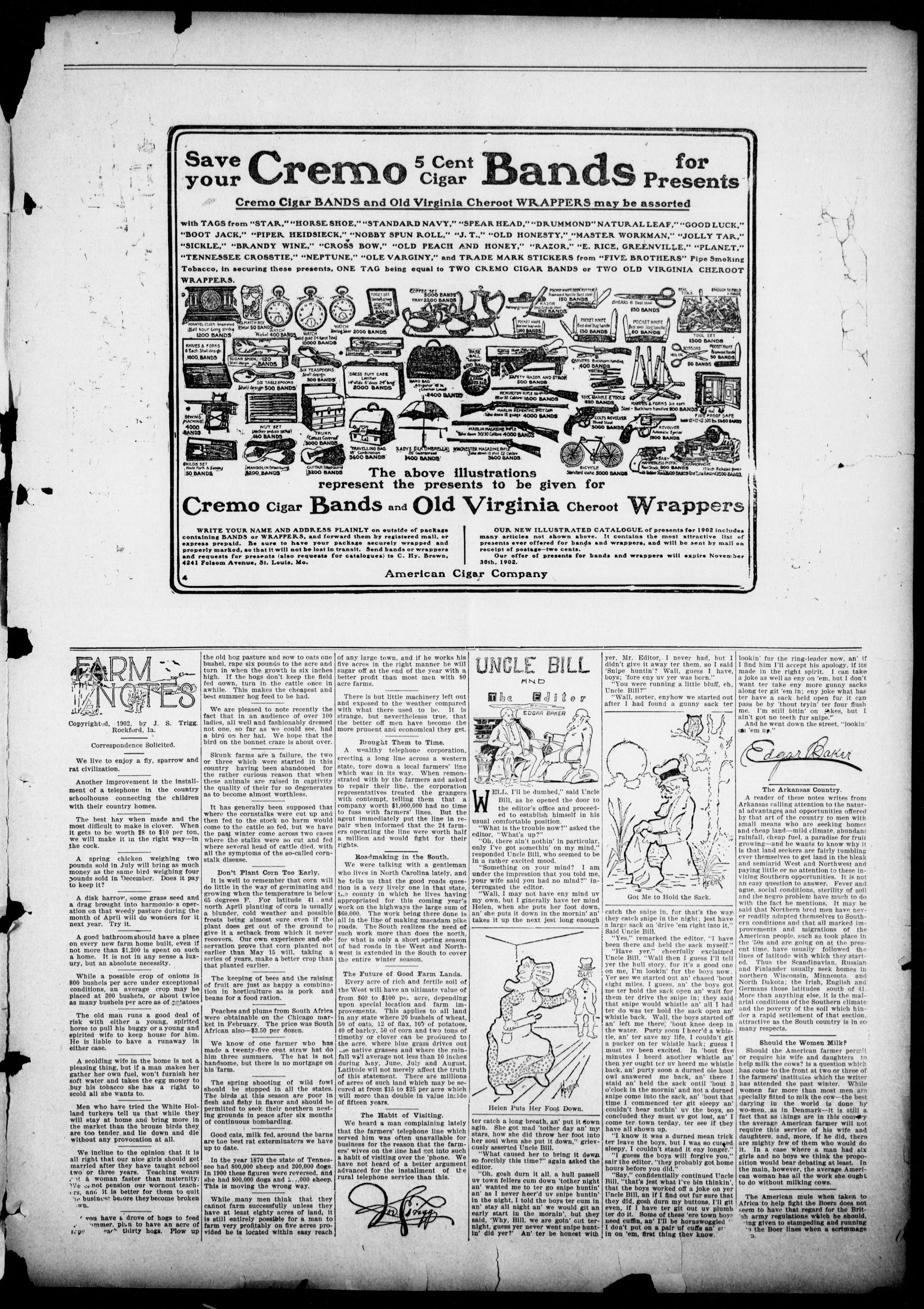
Save your Cremo 5 Cent Cigar Bands for Presents
Cremo Cigar BANDS and Old Virginia Cheroot WRAPPERS may be assorted with TAGS from "STAR," "HORSE SHOE," "STANDARD NAVY," "SPEAR HEAD," "DRUMMOND" NATURAL LEAF," "GOOD LUCK," "BOOT JACK," "PIPER HEIDSIECK," "NOBBY SPUN ROLL," "J. T.," "OLD HONESTY," "MASTER WORKMAN," "JOLLY TAR," "SICKLE," "BRANDY WINE," "CROSS BOW," "OLD PEACH AND HONEY," "RAZOR," "E. RICE, GREENVILLE," "PLANET," "TENNESSEE CROSSTIE," "NEPTUNE," "OLE VARGINY," and TRADE MARK STICKERS from "FIVE BROTHERS" Pipe Smoking Tobacco, in securing these presents, ONE TAG being equal to TWO CREMO CIGAR BANDS or TWO OLD VIRGINIA CHEROOT
Cremo Cigar Bands and Old Virginia Cheroot Wrappers
WRITE YOUR NAME AND ADDRESS PLAINLY on outside of package containing BANDS or WRAPPERS, and forward them by registered mail, or express prepaid. Be sure to have your package securely wrapped and properly marked, so that it will not be lost in transit. Send bands or wrappers and requests for presents (also requests for catalogues) to C. Hy. Brown, 4241 Folsom Avenue, St. Louis, Mo.
the old hog pasture and sow to oats one bushel, rape six pounds to the acre and turn in when the growth is six inches high. If the hogs don't keep the field fed down, turn in the cattle once in awhile. This makes the cheapest and best summer hog feed to be had.
We are pleased to note recently the fact that in an audience of over 100 ladies, all well and fashionably dressed not one, so far as we could see, had a bird on her hat. We hope that the bird on the bonnet craze is about over.
Skunk farms are a failure, the two or three which were started in this country having been abandoned for the rather curious reason that when these animals are raised in captivity the quality of their fur so degenerates as to become almost worthless.
It has generally been supposed that where the cornstalks were cut up and then fed to the stock no harm would come to the cattle so fed, but we have the past winter come across two cases where the stalks were so cut and fed where several head of cattle died, with all the symptoms of the so-called corn-stalk disease.
Don't Plant Corn Too Early.
It is well to remember that corn will do little in the way of germinating and growing when the temperature is below 65 degrees F. For latitude 41 and north April planting of corn is usually a blunder, cold weather and possible frosts being almost sure even if the plant does get out of the ground to give it a setback from which it never recovers. Our own experience and observation prove that corn planted not earlier than May 15 will, taking a series of years, make a better crop than that planted earlier.
The keeping of bees and the raising of fruit are just as happy a combination in horticulture as is pork and beans for a food ration.
Peaches and plums from South Africa were obtainable on the Chicago market in February. The price was South African also—$3.50 per dozen.
We know of one farmer who has made a twenty-five cent straw hat do him three summers. The hat is not handsome, but there is no mortgage on his farm.
The spring shooting of wild fowl should be stopped in all the states. The birds at this season are poor in flesh and fishy in flavor and should be permitted to seek their northern nesting grounds in peace after six months of continuous bombarding.
Good cats, milk fed, around the barns are the best rat exterminators we have up to date.
In the year 1870 the state of Tennessee had 800,000 sheep and 200,000 dogs. In 1900 these figures were reversed, and she had 800,000 dogs and 2,000 sheep. This is moving the wrong way.
While many men think that they cannot farm successfully unless they have at least eighty acres of land, it is still entirely possible for a man to farm very profitably on five acres provided he is located within easy reach
of any large town, and if he works his five acres in the right manner he will sugar off at the end of the year with a better profit than most men with 80 acre farms.
There is but little machinery left out and exposed to the weather compared with what there used to be. It is strange, but neverthelesss true, that the better off men have become the more prudent and economical they get.
Brought Them to Time.
A wealthy telephone corporation, erecting a long line across a western state, tore down a local farmers' line which was in its way. When remonstrated with by the farmers and asked to repair their line, the corporation representatives treated the grangers with contempt, telling them that a company worth $1,000,000 had no time to fuss with farmers' lines. But the agent immediately put the line in repair when informed that the 24 farmers operating the line were worth half a million and would fight for their rights.
Roadmaking in the South
We were talking with a gentleman who lives in North Carolina lately, and he tells us that the good roads question is a very lively one in that state, t. e. county in which he lives having appropriated for this coming year's work on the highways the large sum of $60,000. The work being there done is all in the line of making macadam pike roads. The South realizes the need of such work more than does the north, for what is only a short spring season of bad roads in the West and Northwest is extended in the South to cover the entire winter season.
The Future of Good Farm Lands.
Every acre of rich and fertile soil of the West will have an ultimate value of from $60 to $100 per acre, depending upon special location and farm improvements. This applies to all land in any state where 20 bushels of wheat, 50 of oats, 12 of flax, 100 of potatoes, 40 of barley, 50 of corn and two tons of timothy or clover can be produced to the acre, where blue grass drives out the native grasses and where the rainfall will average not less than 10 inches during May, June, July and August. Latitude will not merely affect the truth of this statement. There are millions of acres of such land which may be secured at from $15 to $25 per acre which will more than double in value include of fifteen years.
The Habit of Visiting.
We heard a man complaining lately that the farmers' telephone line which served him was often unavailable for business for the reason that the farmers' wives on the line had got into such a habit of visiting over the 'phone. We have not heard of a better argument advanced for the installment of the rural telephone service than this.
OUR NEW ILLUSTRATED CATALOGUE of presents for 1902 includes many articles not shown above. It contains the most attractive list of presents ever offered for bands and wrappers, and will be sent by mail on receipt of postage—two cents.
Our offer of presents for bands and wrappers will expire November 30th, 1902.
Sugar Company
UNCLE BILL
EDGAR BAKER
WELL, I'll be dumbed," said Uncle Bill, as he opened the door to the editor's office and proceeded to establish himself in his usual comfortable position.
"What is the trouble now?" asked the editor, "What's up?
"Oh, there ain't nothin' in particular, only I've got somethin' on my mind," responded Uncle Bill, who seemed to be in a rather excited mood.
"Something on your mind? I am under the impression that you told me, your wife said you had no mind?" interrogated the editor.
"Wall, I may not have eny mind uv my own, but I generally have ter mind Helen, when she puts her foot down, and I don't, when she takes it up the next jest long enough
Helen Puts Her Foot Down.
ter catch a long breath, an' put it down agin. She got mad 'tother day an' my stars, how she did throw her foot into her soul when she put it down," grievously asserted Uncle Bill.
"What caused her to bring it down so forcibly this time?" again asked the editor.
"Oh, gosh durn it all, a hull passell uv town fellers cum down 'tother night an' wanted me to ter go snipe huntin' an' as I never heed'd uv snipe huntin' in the night, I told the boys ter cum in 'a stay all night an' we would git an early start in the mornin', but they said, 'Why. Bill, we are goin' cut ternight, guess yer never went snipe huntin' did yer?' An' ter be honest with
HZO
yer, Mr. Editor, I never had, but I didn't give it away them, so I said 'Snipe huntin'? Wall, guess I have, boys; 'fore eny uv yer was born." "You were running a little bluff, eh, Uncle Bill?"
"Wall, sorter, enyhow we started out after I had found a gunny sack ter
HERBICK
Got Me to Hold the Sack.
catch the snipe in, fur that's the way they catch snipe in the night; jest have a large sack an 'drive 'em right into it," Said Uncle Bill.
"Yes," remarked the editor, "I have been there and held the sack myself." "Have yer," cheerfully exclaimed Uncle Bill, "Wall then I guess I'll tell yer the hull story, fur's a good one on me, I'm lookin' fur the boys now. Yer see we started out an' chased 'bout eight miles, I guess, an' the boys got me ter hold the sack open an' wait for them ter drive the snipe in; they said that snipe would whistle an' all I had ter do was ter hold the sack open an' whistle back. Wall, the boys started off an' left me there, 'bout knee deep in the water. Purity soon he heed a 'whistle, an' ter save my life, I couldn't git a pucker on ter whistle back; guess I must uv been excited. In 'bout five minutes I heed another whistle an' then yer趣 ter uv heerd me whistle back, an' purty soon a durned ole hoat owl answered me back, an' there I staid an' held the sack until 'bout 3 o'clock in the mornin' and not a durned snipe come into the sack, an' bout that time I commenced ter git sleepy an' couldn't hear nothin' uv the boys, so concluded they must uv got lost, an' I come ter town terday, ter see if they have all shown up.
"I know it was a durned mean trick ter leave the boys, but I was so cured sleepy. I couldn't stand it eny longer." "I guess the boys will forgive you," sair the editor, "they probably got home hours before you did." "Say," confidently continued Uncle Bill, "that's jest what I've bin thinkin', that the boys worked off a joke on yer Uncle Bill, an if I find out fur sure that they did, gosh durn my buttons, I'll git even, if I have ter git out uv plumb ter do it. Some of these 'ere town boys need cuffn, an' I'll be hornswoggled I don't put on a pair uf cuffs an' st in on 'em, first thing they know.
lookin' fur the ring-leader now, an' if I find him I'll accept his apology, if its made in the right spirit. I can take a joke as well as eny on 'em, but I don't want ter take eny more gunny sacks along ter git 'em in; eny joke what has ter have a sack held open fur it can pass be by 'thout teyni ter four flush me. I'm still bitin' on skes, but I ain't got no teeth fur sipe."
And he went down the street, "lookin' em up."
The Arkansas Country
A reader of these notes writes from Arkansas calling attention to the natural advantages and opportunities offered by that art of the country to men with small means who are seeking homes and cheap land—mild climate, abundant rainfall, cheap fuel, a paradise for fruit growing—and he wants to know why it is that land seekers are fairly tumbling over themselves to get land in the bleak and semiarid West and Northwest and paying little or no attention to these inviting Southern opportunities. It is not an easy question to answer. Fever and ague, social conditions, sterility of soil and the negro problem have much to do with the fact he mentions. It may be said that Northern bred men have never readily adapted themselves to Southern conditions and that all marked improvements and migrations of the American people, such as took place in the 50s and are going on at the present time, have usually followed the lines of latitude with which they started. Thus the Scandinavian, Russian and Finlander usually seek homes in northern Wisconsin, Minnesota and North Dakota; the Irish, English and Germans that latitudes south of 41. More than anything else, it is the malarial conditions of the Southern climate and the poverty of the soil which hinder a rapid settlement of that section, attractive as the South country is in so many respects.
Should the Women Milk?
Should the American farmer permit or require his wife and daughters to help milk the cows? is a question which has come to the front at two or three of the farmers' institutes which the writer has attended the past winter. While women far more than most men are specially fitted to milk the cow—the best darying in the world is done by wo-men, as in Denmark—it is still a fact that as things are in this country the average American farmer will not require this service of his wife and daughters, and, more, if he did, there are mighty few of them who would do it. In a case where a man had six girls and no boys we think the proposition would bear debating at least. In the main, however, the average American woman has all the work she ought to do without milking cows.
The American mule when taken to Africa to help fight the Boers does not seem to have that regard for the British army regulations which he should, given given to stampeding and running to the Boer lines when a scrimmage
RUFUS L. LOGAN, B. S. D. - EDITOR
TERMS OF SUBSCRIPTION.
One Year in Advance - - - $1.50
Six Months in Advance - - 1.00
Three Months in Advance - - .50
Single Copies - - - .05
Special rates of $1.00 per year to ministers.
Advertising Rates on Application.
Job Work of all Kinds Solicited.
Published Every Friday.
Entered at the postoffice at Columb-
umbia, Mo., as second class matter,
Jan. 15, 1902.
Agents wanted in every town in the state.
PRESS OF THE MISSOURI STATESMAN
SOME people have an idea that when they pay their subscription to a newspaper, they are at once placed on the editorial staff.
ONE of our exchanges announces that it will publish a list of all paid up subscribers. The Professional World has decided that we can better afford to publish a list of our unpaid up subscribers, which will appear later.
A
Our thanks are due the following named persons who have recently paid subscriptions to the Professional World. Prof. Virgil Williams, of Linneus; Gen. Odon Guitar and Mr. Harrison Diggs, of Columbia, and Rev. J. B. Parsons, of Jefferson City.
Some half-witted boys are engaging in placing obstructions on the sidewalks at night for persons to fall over. The police would do well to look after such nuisances, and give these youngsters who engage in such a job at making macadam for the city.
LAST Friday morning Henry Flutcher, a colored man, was hanged in St. Louis. A few minutes after the hanging, a telegram was received from Gov. Dockery, granting a ten days respite for Flutcher, which had been asked for by Flutcher's attorney. When the message asking that a respite be granted, was taken to the mansion Thursday evening, the Governor had retired, and opening a window, asked the messenger the contents of the message. On being told, he ordered it pushed under the door and returned to bed, granting a respite next morning. A few minutes after, the probably innocent man, had been hung. Such a blunder places a stain upon Gov. Dockery's administration that will always remain. While Henry Flutcher was an outcast and a criminal, he was nevertheless human, and no one of authority can afford to go leisurely to sleep when human life depends upon their decision alone.
City Notes.
Dr. J. E. Perry left Thursday morning for Topeka Kansas for a few days visit.
Rev. J. B. Parsons returned Wednesday morning from Jefferson city.
Dr. J. J. Kenner, who has recently been graduated from the medical department of the University of Nebraska spent several days in the city last week visiting Dr. J. E. Perry.
Rev. A. A. Adams of Omaha Nebraska preached at the second Baptist Church last Sunday morning and evening.
Rev. E. D. Greene, State missionary of Baptist Church of Missouri was in Columbia Thursday. Quarterly meeting will be held at the M. E. Church Sunday. Presiding Elder Rev. J. W. Jackson will preach. Rev. W. B. Oakes has been conducting revival services at the A. M. E. Church this week with success. Rev. T. L. Smith of Springfield, Ills. will preach at the second Baptist Church Sunday morning and evening.
Life Of Dr. Talmage.
He was born on January 7, 1832, in Bound Brook, N.J. Died Apr. 12, 1902 in Washington, D.C. His father, David T. Talmage, was a farmer, and the future clergyman was the youngest of twelve children. He was ordained by the Reformed Dutch Classie of Bergen, and soon received a certificate from Belleville, N.J. He went there with his bride. From Belleville the young minister was called to Syracuse, N.Y. He went to Philadelphia in 1862, and in 1869 received a call from the Central Presbyterian Church of Brooklyn, which had dwindled to the verge of dissolution.
His success in Brooklyn was immediate. He found a congregation of thirty-five members. It increased so rapidly that a new church was needed, and the first tabernacle was begun in 1870, a year after his arrival. Three times the Brooklyn Tabernacle, built through his efforts when his fame was highest, was burned to the ground. Each time the fire took place on Sunday and in no case was its cause ever discovered. After the last fire, which occurred in 1894, the congregation broke up and never was brought together again in such numbers as before.
As often occurs with clergymen who attract a large share of public attention Doctor Talmage was not without detractors. Charges of a serious nature were preferred against him by the Reverend Arthur Crosby in 1879, but the Presbytery acquitted him by a vote of 25 to 20. In 1891 Doctor Talmage sailed for Russia with a cargo of flour for the famine-stricken people there. He returned through England, preaching with great success. The third Tabernacle was burned on Sunday, May 13, 1894, after Dr. Talmage had preached his farewell sermon. He had celebrated his silver jubilee in the church a few days before and was about to resign.
After a trip to Honolulu he did resign on November 9, 1894, and then preached at various places until he accepted a call to the pastorate of the First Presbyterian Church in Washington, on September 20, 1895. Doctor Talmage was married three times. The bride who went with him to his first charge was Miss Mary Avery of Brooklyn. They were married in 1860. She was drowned in the Schuylkill River when he was pastor of his third church, which was in Philadelphia. Miss Susan C. Whittemore of Brooklyn was married to the young preacher in 1862. She died in August, 1895, in a Santarium. Mrs Charles Collier of Allegheny, Pa., became Doctor Talmage's wife on January 22, 1898, after an engagement of three weeks.
Cut Prices On Harness.
40 sets to select from. Team, plow, Surrey, single and double, buggy and express.
10 sets team, 3 different style pads, to select from. Traces, $1\frac{1}{2}$ and $1\frac{1}{4}$ inches wide; Lines, 1 inch wide. 18ft long; Collars, heavy wool-faced. Your choice while they last $22.
12 set single buggy, nickle and davis rubber trimmings; bridle, box loop over check; lines, 1 inch spring billet; breast collar, curved, with $1\frac{1}{4}$ inch traces attached. Saddle, 3 inch single strap, leather bottom and leather jockey your choice, $8.50.
Prices on all other harness reduced.
These harness are all my own make and made of good heavy leather.
Shop 8 St. up stairs. Iron stairway across the alley south of Statesman office.
2w. JULIUS A. THOM.
The "J. W.'s"
In running over the roster of city officers we find that "J. W." is a popular initial combination. For instance there is J. W. Sapp, Columbia's efficient treasurer, who wants something better and is asking to be made county treasurer. Then there is J. W. Benton, councilman from the 1st ward and his neighbor J. W. Reid, also councilman from the same ward. And last but not least J. W. Gray, a third ward councilman,—all splended men and officials.
Wanted!
Reliable man for manager of a branch office we wish to open in this vicinity. Here is a good opening for the right man. Kindly give good reference when writing. THE A. T. MORRIS WHOLESALE HOUSE, Cincinnati, Ohio. Illustrated catalogue 4 cts. stamps.
The Great Dismal Swamp
Of Virginia is a breeding ground of Malaria germs. So is low, wet or marshy ground everywhere. These germs cause weakness, chills and fever, aches in the bones and muscles, and may induce dangerous maladies. But Electric Bitters never fail to destroy them and cure malarial troubles. They will surely prevent typhoid. "We tried many remedies for Malaria and Stomach and Liver troubles," writes John Charleston, or Byesville, O., "but never found anything as good as Electric Bitters." Try them. Only 0c. Gilman and Dorsey guarantee
MACON NEWS.
Mr. Henry Long is very sick.
Mrs. V. A. Dodd and Mrs. Emma Robinson spent Sunday at Jacksonville, Mo.
Etta Lowthan, Lulu Smith and Roscoe Osborne are the graduates from Dumas School this year.
Mrs. Leaner Gooding and Mrs. Rebecca Higgins Burris will be present at the wedding of Miss Beatrice Harvey and Mr. Jefferson Fort at Moberly the 24 inst.
The Library Aid Concert Friday 18 inst. will be a departure from the old way of entertaining: "Trial by Jury," a cantata in two acts.
Miss Ida Jones is doing very excellent work in the Primary department of Dumas School.
The principal of Dumas School, Prof. T. B. Burris, with his teachers, sent out invitations to the mothers of the children in school last week, for the purpose of having a Mother's Meeting. Friday afternoon at the appointed hour Room 4 was well filled with interested parents, who, after expressing themselves about the work of each room previously inspected, partook of refreshments with the teachers went home feeling more determined to make their children prompt and punctual at school.
Death Of Wade Hampton.
Columbia, S. C., April 11.—General Wade Hampton died this morning at 9 o'clock. His death was not the result of disease, but of a general breakdown. General Hampton celebrated his eighty-fourth birthday last week.
General Wade Hampton was one of the most distinguished soldiers of the Confederacy. His daring was proverbial and his powers of endurance remarkable. His tone of character was heroic and his impulses chivalrous. Under his father's training he became a good horseman and a famous hunter.
He was born in Charleston, S. C., March 28, 1818. He was the son of Colonel Wade Hampton, who was a Lieutenant of Dragoons and in 1813 acted as Inspector General and Aide-Camp to General Jackson at New Orleans. General Hampton's mother was a daughter of Christopher Fitzsimmons, a wealthy planter. His grandfather was also named Wade, and he, too, was a distinguished soldier and General in the war of the Revolution.
General Hampton at the outbreak of the Civil War raised a fine body of cavalry at his own expense. This body was known as "Hampton's Legion," and it gave to the Confederacy some of its ablest Generals, including Butler, Stephen D. Lee, Pettigrew, Connor and Logan.
As a Colonel, Hampton was conspicuous in the battle of Manassas or "Bull Run," July 21, 1861. He was promoted to the rank of Brigadier General of Cavalry and commanded a brigade in the peninsula campaign. After Jeff Stuart's death, May 11, 1864, he became Commander in Chief of the Confederate cavalry of the Army of Northern Virginia.
The war ended, General Hampton accepted the result in good faith. He had lost a son, a brother and a nephew; had been wounded time and again himself and had been reduced to poverty.
After a brief residence in Baltimore, General Hampton returned to South Carolina and became Governor of the State in 1876. He supported Hayes against Samuel J. Tilden. In 1878 he was elected United States Senator and was reelected in 1884. The accession to power of the Tillman element ended his career in high elective office. President Cleveland, who had a high opinion of General Hampton, appointed him one of the United States Commissioners of Pacific Railroads. An accident in the hunting field resulted in the amputation of a leg. His first wife, by whom he had four children, died in 1851. His second wife was Miss Mary C. Duffle, daughter of Senator George M. Duffle of South Carolina. She died after the war. By her he had three children.
Probate Court Notes.
Alexander Riley's will was probated last week. He gives 280 acres and his residence in Centralia to his wife, Rachel Riley during her life, so long as she remains a widow; when she dies or marries, said property to become property of his children, Idalle, and Alexander; $25 each to his children by a former marriage, except three to whom is given $1 each. Will was witnessed by W. A. McCallister and H. S. Boothe, March 7, 1899. W. A. McCallister was appointed administrator of this estate with will annexed.
WHERE DEATH HAS BEEN.
CUNNINGHAM.—Mrs. Mary E. Cunningham, the subject of this sketch, died at her home, 501 Hollis St., Sunday evening, April 13, 1902, of cerebral-hemorrhage. She was born Dec. 25, 1835, being 67 years of age at the time of her death. Her malden name was Grooms; was married Nov. 13, 1856. Two children, a son and daughter survive her. She was buried last Tuesday and the funeral services were conducted by Rev. J. S. Parmer, Mrs. Cunningham had lived in Columbia 25 years, coming here from Howard county. She became a member of the Baptist church at Salem 32 years ago and has lived a consistent Christian since. Mrs. Cunningham's illness was very brief. At 6:15 o'clock Sunday morning she arose and while holding a burning match with which she intended to light the fire paralysis overcame her. With difficulty her daughter removed her to a bed where she lay unconscious till her death. She died at 4:15 o'clock on the evening of the same day she was stricken.
BERRY.—James Harvey Berry died at his home Monday morning, April 14, 1902, of cancer, from which he had suffered for several years. Mr. Berry was born near Brown Station sixty five-years ago. He was a member of the Christian church and funeral services were conducted by Eld. C. H. Winders Tuesday morning. He leaves a wife, one daughter and three sons. In 1848 or 1849 he went west and at Virginia City, Nevada, first met his wife, Miss Elizabeth Whitlock, who was born in Bristol, England. He was a mining engineer by profession but after his return from the west had been a grocer in Columbia fifteen or twenty years.
WATSON.—At 10 o'clock Saturday morning, April 12, 1902, the spirit of Mrs. Margaret Watson passed to the God who gave it. The end came peacefully. She died at her residence on the corner of Ninth and Locust streets. For several months she had been a sufferer from rheumatism until it had become chronic, ultimately causing her death. Mrs. Watson was the daughter of Mr. and Mrs. Wilson Hunt, of Kentucky. When a girl she was married to John Warde, of Callaway county, who died several years ago. In 1846 she was married to Mr. Samuel Watson, father of Dr. B. A. Watson, of this place. She leaves four children, John W. Warde, of Millersburg, Mrs. B. A. Watson, Miss Mollie Warde and Miss Georgie Warde, of Columbia. A pure, true Christian has fallen asleep.
Missouri Won 23 to 4.
The University may not be able to enlist a winning team of her men at foot ball but at base ball it is certainly different. The base ball team are winning straight along and if all signs don't fail will continue that course throughout the season.
In a good game last Monday on the Athletic Field Missouri beat Westminster to the tune of 23 to 4. Nine innings were played, requiring an hour and fifty minutes. Following was the line up:
Missouri. Position. Westminster.
McLemore Catcher.....Scobee
McCaslin Left field.....Stokes
Birney First base.....Drake
Gore Short stop.....Glahn
Broadhead Third base.....Rosbro
Rothwell Center field.....Seibert
Leib Second base.....Black
Washer Right field McCutchen
Hamilton Pitcher.....Sevier
Vaeth Pitcher.....Smith
Improvements at the University.
Extensive repairs are under way in the girls' department of the University this week. Four needle-baths and twenty-five curtain dressing closets provided each with four lockers are being put in. At present the girls are limited to one bath, a shaky screen or two and a row of dusty drawers. In order to make this change, the space now devoted to the wraps must be utilized, and unless other provisions are made Easter bonnets must kick about on the floor. Though the young ladies generally are tickled with the prospect of new quarters, a number of them have suggested that such improvements are a doubtful reflection by the board of curators on their personal habits of cleanliness.
Lawyer Street.
Eighth Street, which is also known as Court House Street, might just as well be called "Lawyer Street." The following lawyers have offices on this street in the block between the Court house and Broadway; Webster Gordon, Clark Robinson; George Barnett, Ed Gerig, J. L. Stephens, E. W. Hinton, E. M. Bass, N. T. Gentry, J. C. Gillespy, M. R. Conley, C. B. Sebastian, J. E. Boggs, Sam Banks, Wellington, Gordon, and Fleetwood Gordon—fifteen in all.
New Cash Grocery!
We save you money by paying cash for Groceries. All new goods; highest price paid for produce and poultry, 708 W. Broadway, Phone 631.
ind That we are Positively Headquarters for the Finest
Bear in Mind That we are Positively Headquarters for the Finest
And Portieres, New Rogers' Superlative Carpets and in all Grades. Don't buy U Assortment and get our Low P
teries, New Stock & Patterns
relative Carpets and Rugs are the Best Made
Don't buy Until you see our Superb
and get our Low Prices.
And Portieres, New Stock & Patterns Rogers' Superlative Carpets and Rugs are the Best Made in all Grades. Don't buy Until you see our Superb Assortment and get our Low Prices.
R. F. ROGERS,
RIPA
I had nervous general derangement tem. It had been a for twelve years. very poor and at the finger nails would be eating I would sit in my feet on something from swelling and off my shoes for the Whenever I experience remind me of past too elated to tell what have done for me, and then, because I have been. They needed.
REGISTER IN PATENT U.
BEFORE
A Wonderful Hair Straightener, a Flesh Probe with Puff and a Little Pink, and All seven of these articles pa one Dollar, or three times as much for two Dollars. Guaranteed and directed. Full directions on A WONDERFUL FACE BLEACH. A per directed. It will turn the skin of a black er, a mulatto person perfectly white and forty-eight hours a shade or two will be spots but bleaches out white, the skin it removes pimples, black-heads, sunburn box pits without any harm to the skin w
One package of our REFINED FACE which goes with every box sold, combleach and makes a beautiful finish-th
THE HAIR STRAIGHTENER, that good guaranteed to make the hair grow long and keeps it from falling out. The hair
One bottle of our FLESH PRODUC you to perfect health. After taking a few getting fat, round, rosy and developing thing for a thin or run-down person
RIPANS
had nervous indigestion and a
special derangement of the entire sys-
It had been a continual torture
twelve years. My blood became
poor and at times my toe and
nails would be diseased. After
I would sit in a chair and put
me on something to keep them
swelling and at times would take
my shoes for the misery I had.
Never I experience anything to
and me of past aches I cannot be
related to tell what Ripans Tabules
done for me. I still take one now
when, because I know how bad I
been. They were just what I
need.
REGISTERED
IN
PATENT OFFICE
U.S.
AFTER
Wonderful Face Bleach
generer, a Flesh Producer, a Refined Face Powder
a Little Pink, and a package of Love Powder.
These articles packed nicely in one box for
three times as much packed nicely in one box.
Guaranteed to do what we say if used as
all directions on all articles.
FACE BLEACH. A peach-like complexion obtained if used as
turn the skin of a black or brown person five or six shades light-
on perfectly white and a white person a model of beauty. In
shade or two will be noticeable. It does not turn the skin in
out white, the skin remaining beautiful without continual use.
black-heads, sunburns, freckles, bumps, wrinkles and small-
ly harm to the skin whatever
of our REFINED FACE POWDER with puff and a little pink,
every box sold, comes in very nicely after using the face
a beautiful finish--this being the finest on the market.
RIGHTENER, that goes in every box, is highly perfumed and
take the hair grow long and straight, makes it easy to comb
falling out. The hair begins at once to grow log and soft.
FLESH PRODUCER, that goes in every box, will restore
health. After taking a few drops of it, you will see that you are
rosy and developing a very pretty shape. This is a very fine
run-down person.
RIPANS
I had nervous indigestion and a general derangement of the entire system. It had been a continual torture for twelve years. My blood became very poor and at times my toe and finger nails would be diseased. After eating I would sit in a chair and put my feet on something to keep them from swelling. and at times would take off my shoes for the misery I had. Whenever I experience anything to remind me of past aches I cannot be too elated to tell what Ripans Tabules have done for me. I still take one now and then, because I know how bad I have been. They were just what I needed.
REGISTERED
IN
PATENT OFFICE
U.S.
BEFORE
AFTER
Hair Straightener, a Flesh Producer, a Refined Face Powder with Puff and a Little Pink, and a package of Love Powder. All seven of these articles packed nicely in one box for one Dollar, or three times as much packed nicely in one box for two Dollars. Guaranteed to do what we say If used as directed. Full directions on all articles.
A WONDERFUL FACE BLEACH. A peach-like complexion obtained if used as directed. It will turn the skin of a black or brown person five or six shades lighter, a mulatto person perfectly white and a white person a model of beauty. In forty-eight hours a shade or two will be noticeable. It does not turn the skin in spots but bleaches out white, the skin remaining beautiful without continual use. It removes pimples, black-heads, sunburns, freckles, bumps, wrinkles and small-box pits without any harm to the skin whatever
One package of our REFINED FACE POWDER with puff and a little pink, which goes with every box sold, comes in very nicely after using the face bleach and makes a beautiful finish--this being the finest on the market.
THE HAIR STRAIGHTENER, that goes in every box, is highly perfumed and guaranteed to make the hair grow long and straight, makes it easy to comb and keeps it from falling out. The hair begins at once to grow log and soft.
One bottle of our FLESH PRODUCER, that goes in every box, will restore you to perfect health. After taking a few drops of it, you will see that you are getting fat, round, rosy and developing a very pretty shape. This is a very fine thing for a thin or run-down person.
One box of Fa • Bleach, worth.....$1.00
One box of Hair Straightener, worth.....$1.00
One package of Lone Powder, worth.....1.00
One box of Refined Face Powder, with Puff.....$0.00
One bottle Flesh Producer, worth.....$5.00
Total.....$3.50
all the arti-
. or if
three
which in
and $2.
and the
with the mail, postage prepaid. You can send
Post Office or express money order, or in reg-
sealed letter. If you want it to come C. O. D., it
the express charges 35 Cts. extra. All goods
one will know contents except the receiver.
The Bell Drug Co.,
II West Jackson Street, - RICHMOND, VA.
goods through the mail, post money by Post Office or exp listered or a sealed letter. If will cost you the express ch packed so no one will know
goods through the mail, postage prepaid. You can send money by Post Office or express money order, or in registered or a sealed letter. If you want it to come C. O. D., it will cost you the express charges 35 Cts. extra. All goods packed so no one will know contents except the receiver.
LOAD STONE IN
EVERY BOX FREE. $
The Bell Drug Co.,
II West Jackson Street, - RICHMOND, VA.
---
RUGS
If you want all the above named articles send $1, or if you want three times as much in one box send $2, and we will send the
LOAD STONE IN
EVERY BOX FREE.
VESSER & TRUE.
Rugs, Carpets Straw Mattings Linoleums, Lace Curtains,
LOVE POWDER, that goes with every box, makes love and is the cause of many sweet kisses. This love powder is the greatest love-making thing on earth. You can make anyone love you that you want if used as directed. It is harmless and can be used in the presence of persons and they will not notice it.