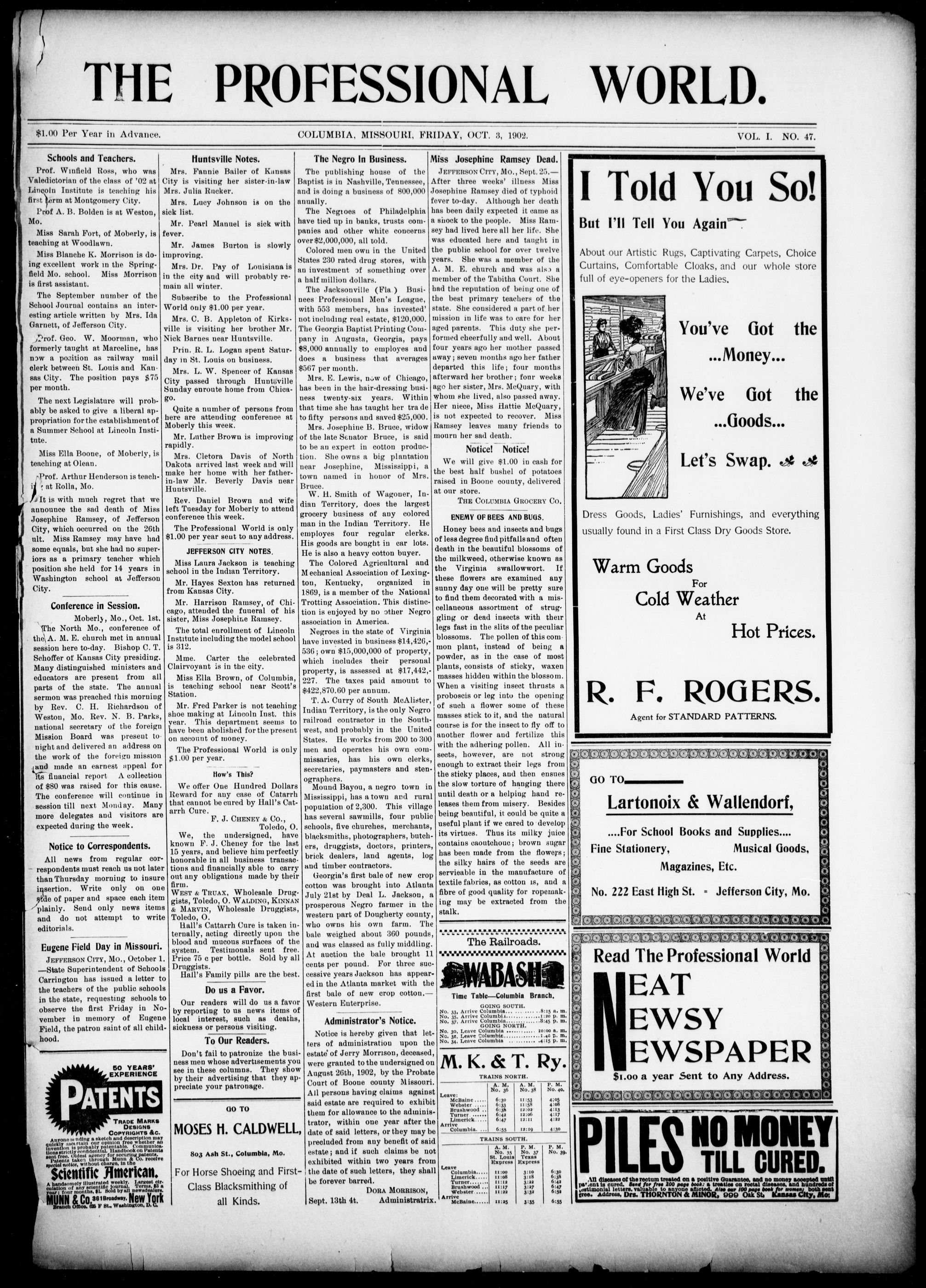
The Professional World
Friday, October 3, 1902
Columbia, Missouri
Page text (machine-generated)
Professional World
RUFUS L, LOGAN, B. S. D., Editor.
COLUMBIA. : : : MISSOURL
THE NEWS CONDENSED.
Advices from Macedonia show that the insurrectional movement there is increasing. The railroad and telegraph lines are damaged in many places. The International Association of Fire Chiefs at New York selected Atlantic City, N. J., as their next place of meeting and chose Chief Croker of New York president. Among the candidates for midshipmen who successfully passed at Annapolis are George B. Wright of Fergus Falls, Minn., and Herbert Emerson of Sloux Falls, S. D. Continuous rainfall over the entire eastern slope of the Rocky mountains from Montana to New Mexico has saved late crops and allayed fears of a shortage of water. Richard V. Dey, the San Francisco representative of Clarence H. Mackay, announces that within 80 days messages will pass over the Pacific cable between San Francisco and Honolulu.
Judge Joseph McCulloch, formerly county judge and treasurer of Woodford county, Illinois, is dead at his home in Clearfield, Iowa. The remains will be interred at Washburn, Ill.
Construction of the government building at the world's fair has begun. The building will be 200 by 800 feet, carrying a great dome and having a row of massive columns in front.
In a collision of freights on the Fort Wayne road at Kenwood Junction Pa., six cars were wrecked, two frame dwellings demolished, and three trainmen and two women seriously injured.
Mrs. Charles Gate of Grass Creek, Ind., while gathering vegetables in her garden, pricked her thumb with a sand burr, which has caused her death from blood-poisoning.
J. W. Bishop has been arrested at Sheffield, Eng., on a charge of robbing his employer at Burlington, Iowa, of $459. The police have notified the American state department of his arrest.
Frederick Wellington Ruckstubal has been appointed chief of sculpture of the Louisiana Purchase fair. He will have the active direction of the modeling of all sculptural effects at the exposition.
A space of 500 by 700 feet has been allotted at the St. Louis fair to the French government for its building. The building is to be a reproduction of the famous and beautiful Petit Trianon at Versailles.
The United States government Life Saving Station at the world's fair will stand at the inner angle of Arrowhead Lake, in the western part of the grounds. The lake is 1800 feet long and at the station is 450 feet wide.
Patrick J. Hyland, aged 36, yeoman on the cruiser Brooklyn, is dead at his home in New York. Hyland was one of the best petty officers in the navy. He was Dewey's chief yeoman on the Olympia at the battle of Manila Bay.
In a dispatch from Johannesburg the correspondent of the Daily Mail says he understands that Port Matala, two miles from Lorenzo Marques, Portuguese East Africa, has been leased to Great Britain.
Miss Isabel Hanger, social secretary to Mrs. Roosevelt, has fallen heiress to a snug fortune by the death of her aunt, Miss Frances Randall Hagner. It is believed that the total bequest will amount to about $100,000 in money and a handsome residence in Washington.
The elevator at the Emery & Bird Thayer Dry Goods company, Kansas City, carrying 25 young women employees, fell three stories at noon Thursday. A dozen girls were injured, but with the exception of Emma Parish, aged 18, who was hurt internally, it is believed none were seriously hurt.
R. H. Henry, world's fair commissioner for Mississippi, has visited 20 counties of his state and delivered over 30 addresses on the subject of Mississippi's representation at the coming exposition. Mississippi's appropriation for the world's fair is $50,000, but there is now talk of doubling it.
In some of the Milwaukee schools the coal famine is being felt to such an extent that the children have been compelled to furnish their own fuel. Wood boxes have been placed in the barracks, and the teachers have asked each pupil to bring two sticks of wood each day so that the barracks may be heated.
Col. John A. Ockerson, chief of the department of Liberal Arts, attended the semi-centennial meeting of the American Pharmacentical association at Philadelphia. The pharmaceutical display will form an important section of Col. Ockerson's great department, which will occupy a building covering nine acres.
The strange beast that has been killing hogs, sheep, calves and chickens in Howard and surrounding counties in Indiana has been killed by Charles Smeltzer of Greentown. The animal is four feet long, with slender body and short legs. It had long sharp claws, flat tail and flat, broad head, with bear-like ears. No one is able to classify the brute.
D. P. Erwin of Indianapolis who died a few days ago leaving an estate valued at nearly a million dollars, left $5,000 to five men who were formerly employed by him in his wholesale dry goods house. They had worked for him for many years. Erwin's young widow, whom he married about a year ago, gets the bulk of the estate. He was 60 years old.
At St. Joseph, Mo., Mrs. Magdeline W. Rode is dead and Dr. Walter H. Morris, her physician, is suffering from blood poison, as is E. J. Williams, the undertaker, as the result of a spider bite received by Mrs. Rode three weeks ago. Dr. Morris is confined to his room, having contracted blood poisoning from contact with the patient and Undertaker Williams is similarly stricken.
Exports of pig iron from England to the United States in August increased 65,409 tons in quantity and $200,335 in value. August shipments to us were 10,530 tons greater than those of July and only 16,494 tons less than the whole shipment of the first six months of 1902.
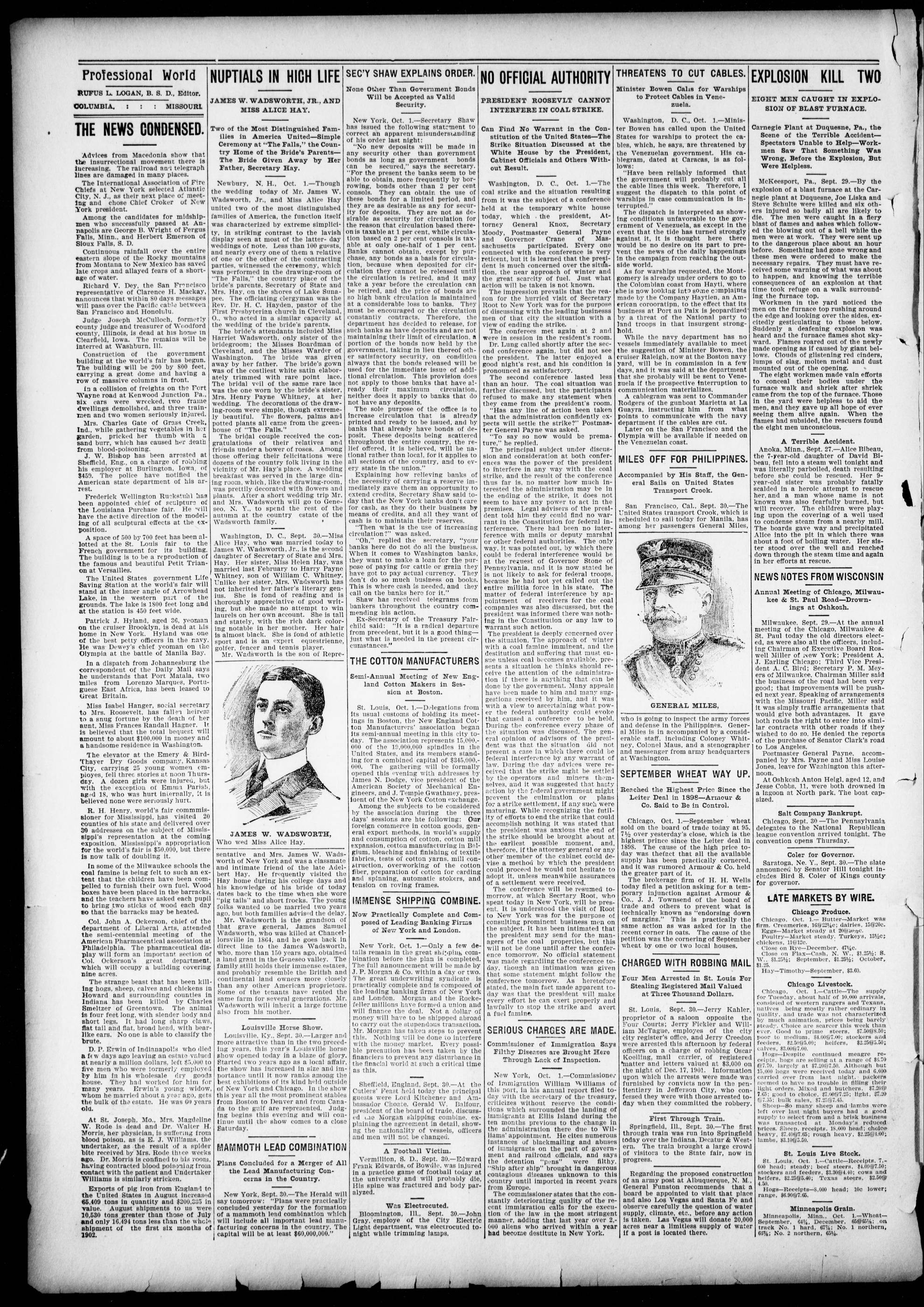
NUPTIALS IN HIGH LIFE
JAMES W. WADSWORTH, JR., AND MISS ALICE HAY.
Two of the Most Distinguished Families in America United—Simple Ceremony at "The Falls," the Country Home of the Bride's Parents—The Bride Given Away by Her Father, Secretary Hay.
Newbury, N. H., Oct. 1.—Though the wedding today of Mr. James W. Wadsworth, Jr., and Miss Alice Hay united two of the most distinguished families of America, the function itself was characterized by extreme simplicity, in striking contrast to the lavish display seen at most of the latter-day weddings of note. Less than 100 guests, and not many of them a relative of one or the other of the contracting parties, witnessed the ceremony, which was performed in the drawing-room of "The Falls," the country place of the bride's parents, Secretary of State and Mrs. Hay, on the shores of Lake Sunapee. The officiating clergyman was the Rev. Dr. H. C. Hayden, pastor of the First Presbyterian church in Cleveland, O., who acted in a similar capacity at the wedding of the bride's parents.
The bride's attendants included Miss Harriet Wadsworth, only sister of the bridegroom; the Misses Boardman of Cleveland, and the Misses Warder of Washington. The bride was given away by her father. The bride's gown was of the costliest white satin elaborately trimmed with rare point lace. The bridal veil of the same rare lace was the one worn by the bride's sister, Mrs. Henry Payne Whitney, at her wedding. The decorations of the drawing-room were simple, though extremely beautiful. The flowers, palms and potted plants all came from the greenhouse of "The Falls."
The bridal couple received the congratulations of their relatives and friends under a bower of roses. Among those offering their felicitations were dozens of the country folk living in the vicinity of Mr. Hay's place. A wedding breakfast was served in the large dining room, which, like the drawing-room, was prettily decorated with flowers and plants. After a short wedding trip Mr. and Mrs. Wadsworth will go to Geneeseo. N. Y., to spend the rest of the autumn at the country estate of the Wadsworth family.
Washington, D. C., Sept. 30—Miss Alice Hall, who was married today to James W. Wadsworth, Jr., is the second daughter of Secretary of State and Mrs. Hay. Her sister, Miss Helen Hay, was married last February to Harry Payne Whitney, son of William C. Whitney. Unlike her sister, Wadsworth has not inherited her father's literary genius. She is fond of reading and is thoroughly appreciative of good writing, but she made no attempt to win laurels on her own account. She is tall and stately, with the rich dark coloring notable in her mother. Her hair is almost black. She is fond of athletic sport and is an expert equestrienne, golfer, fencer and tennis player.
Mr. Wadsworth is the son of Repre-
JAMES W. WADSWORTH, who wed Miss Alice Hay.
sensitive and Mrs. James W. Wadsworth of New York and was a classmate and intimate friend of the late Adelbert Hay. He frequently visited the Hay home during his college days and his knowledge of his bride of today dates back to the time when she wore "pig tails" and short frocks. The young wanted to be married two years ago, but both families advised the delay. Mr. Wadsworth is the grandson of that grave general, James Samuel Wadsworth, who was killed at Chancellorsville in 1864, and he goes back in direct line to the James Wadsworth, who more than 150 years ago, obtained a land grant in the Geneese valley. The family still holds their immense estates, and probably resemble the British and continental land owners more closely than any other American proprietors. Some of the tenants have rented the same farm for several generations. Mr. Wadsworth will inherit a large fortune also from his mother.
Louisville Horse Show
Louisville, Ky., Sept. 30—Larger and more attractive than in the two preceding years, this year's Louisville horse show opened today in a blaze of glory. Started two years ago as a local affair the show has increased in size and importance until it now ranks among the best exhibitions of its kind held outside of New York and Chicago. In the show this year all the most prominent stables from Boston to Denver and from Canada to the gulf are represented. Judging begins this evening and will continue until the show comes to a close Saturday.
MAMMOTH LEAD COMBINATION
Plans Concluded for a Merger of All the Lead Manufacturing Concerns in the Country.
New York. Sept. 30.—The Herald will say tomorrow: "Plans were practically concluded yesterday for the formation of a mammoth lead combination which will include all important lead manufacturing concerns in the country. The capital will be at least $60,000,000."
SEC'Y SHAW EXPLAINS ORDER
None Other Than Government Bonds Will be Accepted as Valid Security.
New York, Oct. 1.—Secretary Shaw has issued the following statement to correct an apparent misunderstanding of his order last night:
"No new deposits will be made in any security other than government bonds as long as government bonds can be secured," says the secretary. "For the present the banks seem to be able to obtain, more frequently by borrowing, bonds other than 2 per cent consols. They can obtain the use of these bonds for a limited period, and they are as desirable as any for security for deposits. They are not as desirable as security for circulation for the reason that circulation based there is taxable at 1 per cent, while circulation based on 2 per cent consols is taxable at only one-half of 1 per cent. Banks cannot obtain, except by purchase, any bonds as a basis for circulation, because when deposited for circulation they cannot be released until the circulation is retired, and it may take a year before the circulation can be retired, and the price of bonds are so high bank circulation is maintained at a considerable loss to banks. They must be encouraged or the circulation constantly contracts. Therefore, the department has decided to release, for such banks as have deposits and are not maintaining their limit of circulation, a portion of the bonds now held by the government, taking in lieu thereof other satisfactory security, on condition always that the bonds released will be used for the immediate issue of additional circulation. This provision does not apply to those banks that have already their maximum circulation, neither does it apply to banks that do not have any deposits.
The sole purpose of the office is to increase circulation that is already printed and ready to be issued, and by banks that already have bonds of deposit. These deposits being scattered throughout the entire country, the relief offered, it is believed, will be national rather than local, for it applies to all sections of the country, and to every state in the union."
Explaining how relieving banks of the necessity of carrying a reserve immediately gave them an opportunity to extend credits, Secretary Shaw said today that the New York banks don't care for cash, as they do their business by means of credits, and all they want of cash is to maintain their reserves.
"Then what is the use of increasing circulation?" was asked.
"Oh," replied the secretary, "your banks here do not do all the business. When it comes to Washington banks, they want to make a loan for the purpose of paying for cattle or grain they have got to pay actual currency. They don't do so much business on books. This is where cash is needed, and they call on the banks here for it." Shaw has received telegrams from bankers throughout the country commending his action. Ex-Secretary of the Treasury Fairchild said: "It is a radical departure from precedent, but it is a good thing—just what is needed in the present circumstances."
THE COTTON MANUFACTURERS
Semi-Annual Meeting of New England Cotton Makers in Session at Boston.
St. Louis, Oct. 1.—Delegations from its usual customs of holding its meetings in Boston, the New England Cotton Manufacturers' association began its semi-annual meeting in this city today. The association represents 15,000,000 of the 19,000,000 spindles in the United States, and its members standing for a combined capital of $345,000,000. The gathering will be formally opened this evening with addresses by James N. Dodge, vice president of the American Society of Mechanical Engineers, and J. Tempie Gwathmey, president of the New York Cotton exchange.
Among the subjects to be considered by the association during the three days' sessions are the following: Our foreign commerce in cotton goods, general export methods, in world's supply and consumption of cotton, cotton mill expansion, cotton manufacturing in Belize, fabrication and finishing of textile fabrics, sets of cotton curry mill construction, overworking of the cotton fabric, preparation of cotton for carding and spinning, automatic stokers, and tension on roving frames.
IMMENSE SHIPPING COMBINE.
Now Practically Complete and Composed of Leading Banking Firms of New York and London.
New York, Oct. 1,—Only a few details remain in the great shipbuilding combination before the plan is completed. The full announcement will be made by J. P. Morgan & Co. within a day or two. The great underwriting syndicate is practically complete and is composed of the leading banking firms of New York and London. Morgan and the Rockefeller millions have formed a union and will finance the deal. Not a dollar of money will have to be shipped abroad to carry out the stupendous transaction. Mr. Morgan has taken steps to prevent this. Nothing will be done to interfere with the money market. Every possible precaution has been taken by the financiers to prevent any disturbance in the financial world at such a critical time as this.
Sheffield, England, Sept. 30. -At the Cutters' Feast held today the principal guests were Lord Kitchener and Ambassador Chote. Gerald W. Balfour, president of the board of trade, discussed the Morgan shipping combine, explaining the agreement in detail, showing the nationality of vessels, officers and men will not be changed.
A. Football Victim.
Vermillion, S. D., Sept. 20.—Edward Frank Edwards, of Bowdle, was injured in a practice game of football today at the university and will probably die. His spine was fractured and body paralyzed.
Was Electrocuted.
Bloomington, Ill., Sept. 30—John Gray, employee of the City Electric Light department, was electrocuted tonight while trimming lamps.
NO OFFICIAL AUTHORITY
NO OFFICIAL AUTHORITY
PRESIDENT ROOSEVLT CANNOT
INTERFERE IN COAL STRIKE.
Can Find No Warrant in the Constitution of the United States—The Strike Situation Discussed at the White House by the President, Cabinet Officials and Others Without Result.
Washington, D. C., Oct. 1.—The coal strike and the situation resulting from it was the subject of a conference held at the temporary white house today, which the president, Attorney General Knox, Secretary Moody, Postmaster General Payne and Governor Crane of Massachusetts participated. Every one connected with the conference is very reticent, but it is learned that the president is much concerned over the situation, the near approach of winter and the great scarcity of fuel. Just what action will be taken is not known.
The impression prevails that the reason for the hurried visit of Secretary Root to New York was for the purpose of discussing with the leading businessmen of that city the situation with a view of ending the strike.
The conferees met again at 2 and were in session in the resident's room. Dr. Lung called shortly after the second conference again, but did not see the president. The latter enjoyed a good night's rest, and his condition is pronounced as satisfactory.
The second conference lasted less than an hour. The coal situation was further discussed, but the participants refused to make any statement when they came from the president's room.
"Has any line of action been taken that the administration confidently expects will settle the strike?" Postmaster General Payne was asked.
"To say so now would be premature." he replied.
The principal subject under discussion and consideration at both conferences was the power of the president to interfere in any way with the coal strike, and the result of the conference thus far is, no matter how much interested the administration may be in the ending of the strike, it does not seem to have any power to act in the premises. Legal advisers of the president told him they could no warrant in the Constitution for federal interference. There had been no interference with mails or deputy marshal or other federal authorities. The only way, it was pointed out, by which there could be federal interference would be at the request of Governor Stone of Pennsylvania, and it is now stated he is not likely to ask for federal troops, because he had not yet called out the entire militia force in his state. The matter of federal interference by appointment of receivers for the coal companies was also discussed, but the president was informed there was nothing in the Constitution or any law to warrant such action.
The president is deeply concerned over the situation. The approach of winter with a coal famine imminent, and the destitution and suffering that must ensue unless coal becomes available, presents a situation he thinks should receive the attention of the administration if there is anything that can be done by the government. Many appeals have been made to him and many suggestions received by him, and it was with a view to ascertaining what power the federal authority could evoke that caused a conference to be held. During the conference every phase of the situation was discussed. The general opinion of advisors of the president was that the situation did not present a case in which there could be federal interference by any warrant of law. During the day advises were received that the strike might be settled by the operators and miners themselves, and it was suggested that hasty action by the federal government might prevent the culmination or plans for a strike settlement, if any such were maturing. While recognizing the futility of efforts to end the strike that could accomplish nothing it was stated that the president was anxious the end of the strike should be brought about at the earliest possible moment, and therefore, if the attorney general or any other member of the cabinet could devise a method by which the president could proceed he would not hesitate to adopt it, unless meanwhile assurances of a settlement were received.
The conference will be resumed tomorrow, at which Secarty Root, who spent today in New York, will be present. It is understood the visit of Root to New York was for the purpose of consulting prominent business men on the subject. It has been intimated that the president may send for the managers of the coal properties, but this will not be done until after the conference tomorrow. No official statement was made regarding the conference today, though an intimation was given that some statement might follow the conference tomorrow. As heretofore stated, the main fact made apparent today was that the president will make every effort he can exert properly and lawfully to stop the strike and avert a fuel famine.
SERIOUS CHARGES ARE MADE.
Commissioner of Immigration Says Filthy Diseases are Brought Here Through Lack of Inspection.
New York, Oct. 1.—Commissioner of Immigration William Williams of this port, in his annual report filed today with the secretary of the treasury, criticizes without reserve the conditions which surrounded the landing of immigrants at Ellis Island during the ten months previous to the change in the administration there due to Williams' appointment. He cites numerous instances of blackmailing and abuses of immigrants on the part of government and railroad officials, and says the detention "pans" were filthy, "Ship after ship" brought in dangerous contagious diseases unknown to this country until imported in recent years from Europe.
The commissioner states that the constantly deteriorating quality of the recent immigration calls for the execution of the law in the most stringent cases, and that 600 aliens who arrived within a year had become destitute in New York.
THREATENS TO CUT CABLES.
Minister Bowen Calis for Warships to Protect Cables in Venezuela.
Washington, D. C., Oct. 1.—Minister Bowen has called upon the United States for warships to protect the cables, which, he says, are threatened by the Venezuelan government. His cablegram, dated at Caracas, is as follows:
"Have been reliably informed that the government will probably cut all the cable lines this week. Therefore, I suggest the dispatch to this point of warships in case communication is interrupted."
The dispatch is interpreted as showing conditions unfavorable to the government of Venezuela, as except in the event that the tide has turned strongly against it, it is thought here there would be no desire on its part to prevent the news of the daily happenings in the campaign from reaching the outside world.
As for warships requested, the Montgomery is already under orders to go to the Colombian coast from Hayti, where she is now looking into some complaints made by the Company Haytien, an American corrooriatim, to the effect that its business at Port an Paix is jeopardized by a threat of the National party to land troops in that insurgent stronghold.
While the navy department has no vessels immediately available to meet the suggestion of Minister Bowen, the cruiser Raleigh, now at the Boston navy yard, will be in commission in a few days, and it was said at the department that she probably will be sent to Venezuela if the prospective interruption to communication materializes.
A cablegram was sent to Commander Rodgers of the gunboat Marietta at La Guayra, instructing him from what points to communicate with the navy department if the cables are cut.
Later on the San Francisco and the Olympia will be available if needed on the Venezuelan coast.
MILES OFF FOR PHILIPPINES.
Accompanied by His Staff, the General Sails on United States Transport Crook.
San Francisco, Cal., Sept. 30.—The United States transport Crook, which is scheduled to sail today for Manila, has among her passengers General Miles,
GENERAL MILES
GENERAL MILES,
who is going to inspect the army forces and defense in the Philippines. General Miles is in accompanied by a considerable staff, including Coloney Whitney, Colonel Maus, and a stenographer and messenger from army headquarters at Washington.
SEPTEMBER WHEAT WAY UP.
Reached the Highest Price Since the Leiter Deal in 1898—Armour & Co. Said to Be in Control.
Chicago, Oct. 1.—September wheat sold on the board of trade today at 95. $7\frac{1}{2}$ over yesterday's close, which is the highest prince since the Leiter deal in 1898. The cause of the high price today was the effect that all the available supply has been practically cornered, and has ruined Armour & Co. held the greater part of the brokerage firm of H. H. Wells today filed a petition asking for a temporary injunction against Armour & Co. J. J. Townsend of the board of trade and others to prevent what is technically known as "endorsing down of margins." This is practically the same action as was asked for in the recent corner in oats. The cause of the petition was the cornering of September wheat by one or two local houses.
CHARGED WITH ROBBING MAIL
Four Men Arrested in St. Louis For Stealing Registered Mail Valued at Three Thousand Dollars.
St. Louis, Sept. 30.—Jerry Kahler, proprietor of a saloon opposite the Four Courts; Jerry Fickler and William McTague, employees of the city register's office, and Jerry Creedon were arrested this afternoon by federal officers on a charge of robbing Oscar Koelling, mail carrier, of registered matter and letters valued at $3,000 on the night of Dec. 17, 1901. Information upon which the arrests were made was furnished by convicts now in the penitentiary in Jefferson City, who confessed they were with those arrested today when they committed the robbery.
First Through Train
Springfield, Ill., Sept. 30.—The first through train was run into Springfield today over the Indiana, Decatur & Western. The train brought a large crowd of visitors to the State fair, now in progress.
Regarding the proposed construction of an army post at Albuquerque, N. M., General Funston recommends that a board be appointed to visit that place and also Los Vegas and Santa Fe and observe carefully the question of water supply, climate, etc., before any action is taken. Las Vegas will donate 20,000 acres near a limitless supply of water if a post is located there.
EXPLOSION KILL TWO
EIGHT MEN CAUGHT IN EXPLO-
SION OF BLAST FURNACE.
Carnegie Plant at Duquesne, Pa., the
Scene of the Terrible Accident—
Spectators Unable to Help—Work-
men Saw That Something Was
Wrong, Before the Explosion, But
Were Helpless.
McKeesport, Pa., Sept. 29.—By the explosion of a blast furnace at the Carnegie plant at Duquesne, Joe Liska and Steve Schulte were killed and six others injured so badly all are likely to die. The men were caught in a ferry blast of flames and ashes which followed the blowing out of a bell while the men were trapped in the water to the dangerous place about an hour before. Something had gone wrong and these men were ordered to make the necessary repairs. They must have received some warning of what was about to happen, and knowing the terrible consequences of an explosion at that time took refuge on a walk surrounding the furnace top.
Workmen in the yard noticed the men on the furnace top rushing around the edge and looking over the sides, excitedly gesticulating to those below. Suddenly a deafening explosion was heard and the furnace flames shot skyward. Flames roared out of the newly made opening as if caused by giant bellows. Clouds of glistening red cinders, lumps of slag, molten metal and dust mounted out of the opening.
The eight workmen made vain efforts to conceal their bodies under the furnace walk and shriek after shriek came from the top of the furnace. Those in the yard were helpless to aid the men, and they gave up all hope of ever seeing them alive again. When the flames had subsided, the rescuers found the eight men unconscious.
A Terrible Accident.
Anoka, Minn., Sept. 27.—Alice Bibean, the 7-year-old daughter of David Bibeau, fell into a steam well tonight and was literally parobed, death resulting before she could be rescued. Her 9-year-old sister was probably fatally scaled in a heroic attempt to rescue her, and a man whose name is not known was also fearfully burned, but will recover. The children were playing upon the covering of a well used to condense steam from a nearby mill. The boards gave way and precipitated Alice into the pit in which there was about a foot of boiling water. Her sister stood over the well and reached down through the steam time and again in her efforts at rescue.
NEWS NOTES FROM WISCONSIN
Annual Meeting of Chicago, Milwaukee & St. Paul Road—Drownings at Oshkosh.
Milwaukee. Sept. 29.—At the annual meeting of the Chicago, Milwaukee & St. Paul today the old directors elected, as were also all the officers, including Chairman of Executive Board Roswell Miller of New York; President A. J. Earling Chicago; Third Vice President A. C. Bird; Secretary P. M. Meyers of Milwaukee. Chairman Miller said the business of the road had been very good; that improvements will be pushed next year. Speaking of arrangements with the Missouri Pacific, Miller said it was simply traffic arrangements that would give both advantages. It gave both roads the right to enter into similar contracts with other roads if they wished to do so. He denied the reports of the purchase of Senator Clark's road to Los Angeles.
Postmaster General Payne, accompanied by Mrs. Payne and Miss Louise Jones, leave for Washington this afternoon.
At Oshkosh Anton Heilg, aged 12, and Jesse Cobbs, 11, were both drowned in a lagoon at North park. The boat capsized.
Salt Company Bankrupt
Chicago, Sept. 30 — The Pennsylvania delegates to the National Republican league convention arrived tonight. The convention opens Thursday.
Coler for Governor
Saratoga, Ne. Y., Sept. 30.—The slate announced by Senator Hill tonight includes Bird S. Coler of Kings county for governor.
LATE MARKETS BY WIRE.
LATE MARKETS BY WIRE.
Chicago Produce.
Chicago, Oct. 1.—Butter—Market was
firm. Creameries, 16%22½c; dairyes, 15%20c.
Eggs—Market steady at 10%22½c.
Poultry—Market steady. Turkeys, 13½c;
chickens, 116½c.
Close on Rye—December, 47½c.
Close on Flax—Cash, N. W., $1.25½; S.
W., $1.25½; September, $1.25½; October,
$1.25.
Hay-Timothy-September, $3.60.
Chicago Livestock.
Chicago, Oct. 1—Cattle—The supply for Tuesday, about half of 10,000 arrivals, consisted of western rangers and Texans, natives being mostly rather ordinary in quality, and trade was not characterized by much animation, prices being barely above $10.00 per head, so we ever. Good to prime steers, $7.50@8.50; poor to medium, $4.00@7.50; stockers and feeders, $2.50@7.50; heifers, $2.25@5.50; calves, $3.00@7.00.
Hogs—Despite continued meagre receipts, hogs are selling at a range of $7.50@7.70, largely at $7.20@7.50. Although butchers are receiving today and carried over from last week, stockers seemed to have no trouble in filling their light orders. Mixed and butchers, $7.20@7.65; good to choice, $7.00@7.25; light, $7.20@7.55; bulk sales, $7.25@7.45.
Sheep—So many sheep and lambs were left over last night buyers had a good supply to select from and a brisk business to purchase. Prices, Sheep, receipts, 18,000 head; choice heavy, $7.40@7.65; rough heavy, $2.25@4.00; lambs, $3.10@5.50.
St. Louis Live Stock.
St. Louis, Oct. 1.-Cattle-Receipts. 7.000 head; steady; beef steers. $4.00@7.50 stocker and feeders. $3.30@4.40; cows and heifers. $2.25@5.40; Texas steers. $2.50@4. Hogs-Receipts.-S.000 head; 10c lower; range. $8.00@7.06.
Minneapolis Grain.
Minneapolis, Minn., Oct. 1. —Wheat:
September, 64%, December, 65%@; on track
1. no hard, 67%; No. 1 northern,
63%; No. 2 northern, 65%.
COPYRIGHT, 1901, BY J.S. TRIGG. ROCKFORD. IA CORRESPONDENCE SOURITED
Man can build a 20-story skyscraper in a year, but he can't make a spider's web in a night.
One of the aggravations of age is to have the rheumatism when the bass fishing is good in October.
In wet seasons, while a man may raise bigger crops, he always loses more of them. August rains make a terrible waste.
It is the busiest men who always have the most work to do. The more such a man does the more he finds that wants doing.
Considering the titanic power of the lightning stroke and its great frequency during the summer months, the wonder is that more damage is not done.
With all the food in sight and all the pigs and cattle, it must be that before many months the price of meats will get down to a figure where they will cease to be a luxury.
California is coming to the front with a new crop of growing importance—the soft shelled almond. This year the crop amount to 267 carloads, or 2,670 tons, worth out 12 cents per pound.
There is one comfort for the poor man this winter, even if his coal is likely to be high priced, and that is that he will be able to get all the good potatoes he wants at 30 cents a bushel or less.
The most expert chicken picker in the country is employed in a poultry packing house in Chicago. His record is 50 chickens in eight minutes one second. It is certain that the feathers fly when he gets to work.
We have rid a large lawn of the pesky squirreltail grass by persistent mowing during its seeding period and burning up the cuttings. If you keep this pest from going to seed, it will disappear.
Rural mall routes will compel the making of better highways. The government has not sentimental feelings on this subject and simply gives the alternative of fixing the roads or losing the service.
A heaping bushel basket of dead sparrows was gathered up in one section of a small interior Western town after one of the heavy storms of August. Hall plays the mischief with these birds.
The byproducts of the Chicago packing houses are worth $30,000,000 per year and are the sources of large profits connected with the business. Thirty years ago most of these byproducts were wasted.
If in a fit of public spirit you buy a wide-tired wagon, your neighbors will quite likely command your public spirit and keep right on using their old narrow-tired outfits, letting you smooth the highways for them.
The old poky way of farming with oxen and doing most of the farm work by hand in France is at last giving way to improved methods where the horse supplants the ox and the modern machine the hand labor.
The freight car with ball bearings, something we have often wondered did not come to the front, is out at last and is a pronounced success and if generally adopted is certain to still further reduce the cost of freight transportation.
The general government has finally abandoned further efforts at the improvement of navigation on the Missouri river. The railways have beaten the boats and captured nearly all the freight which was at one time carried on the river.
Central Iowa seems to be the center of the atmospheric disturbances and unusual rainfall of the year 1902, the rainfall being reported at three feet and even more in localities, doing immense damage to one of the finest crops ever raised in the state.
When a man can get his dairy herd up to an average of 350 pounds of butter per head, he can afford to entirely ignore the beef side of the business of stock raising. Such cows should be bred to secure as many heuer calves as possible which will do as well or better than their dams. The male calf should meet a theological fats—be disposed of as deacons.
Kansas farmers have learned that the grasshopper, heretofore regarded as a pest, may be made of much utility and profit. Large flocks of turkeys are raised and are easily taught to range the farms for the hoppers, of which they are very fond and fed upon which they become large and fat. This is the age of economics and utilities.
The growers of sweet corn for the canneries are this year getting $6 per ton for their product, equivalent to a return of about $18 per acre, besides the forage, worth not less than $4 per acre. As this crop is cheaply produced and draws very lightly upon the soil, it is a profitable one to raise.
The growing of cotton is being developed in Southern Russia, about 11,000 bales of the staple being produced last year. The growers now have representatives in this country examining the machinery used for making cotton-seed oil, the seed there produced having been up to this time almost wasted.
Twenty thousand Swedes came to this country in the month of July from the hills, valleys and towns of Sweden, every one of them, male and female, of the very best type of foreign citizenship, all industrious and thrifty and to be most easily and readily assimilated and transformed into good citizens here.
A man never really understands the risks which he runs in living until he becomes the possessor of a good microscope, and then he wonders he did not die years ago. The horribleness of invisible forms of life is calculated to give one the cold chills when one realizes that such life is in all air breathed, food eaten and water drank.
The great advantage of growing your own fruit lies in the fact that you can allow it to get to that stage of perfect maturity before using which makes it palatable and desirable, while nearly all of the imported fruits have to be picked so long before they arrive at this stage that much of their flavor and lusciousness are destroyed.
Talking about forage crops, we have a sample of Japanese millet which in 60 days from the date of sowing the seed produced 50 bushels of seed and five tons of fine fodder to the acre. The crop stood six feet high, and the stalks were green and juicy when the seed was ripe enough to grow. It is our opinion that the land upon which this crop was grown will need a rest or a tonic next year.
A good many farmers could do more to improve their condition by visiting some successful farmer in some other locality and studying his methods than they could in any other way. The man to learn from is the man who does things and not the man who can only tell how they should be done. We never yet visited a progressive and successful farmer but we found out some things which were of value.
There are three things which may be done with a few hours' work around many a farm home which would improve the appearance of things 100 per cent—repairing the fence around the doyard, trimming the trees and cutting the weeds around the premises and clearing up the old ragtag and boutail lot of broken machinery, old posts, wire, boards and the like. These decorations do not harmonize with a good house.
Few have any correct idea of the magnitude and importance of the meat inspection work of the government experts. During the past year 37,000,000 animals were inspected either before or after being slaughtered. Of 5,250,000 cattle inspected only one-fourth of 1 per cent were condemned, of 6,500,000 sheep only one-tenth of 1 per cent, and of 24,250,000 hogs only one-third of 1 per cent failed to pass inspection, a really remarkable showing of the good health of the stock of the country.
Careful experiments made show that pigs weighing about 50 pounds each, about 25 to the acre, placed in an alfalfa pasture, will make a gain of 100 pounds each during the growing season. This on alfalfa alone. If given a supplemental feed of grain the grain will, of course, be still better. This figures up a fine return fod the use of an acre of alfalfa—2,500 pounds of pork, worth, at the low figure of $4 per hundred-weight, $100. Another good thing is that hogs so fed are almost always free from disease.
Driest and Wettest Places
The wettest place in the United States, the locality where falls the most rain, as shown by the weather bureau reports, is Glennora, Ore., where the average rainfall for ten years has been 135.84 inches, while the driest place, the locality where the rainfall is least, is the weather bureau station at Newman Tank, in California, where for 12 years the rainfall has been only 1,223 inches per annum. Other stations in the state of Washington report over 100 inches of rainfall per year, while all through the desert regions of California and Nevada the annual precipitation is less than four inches. The sections of the country where the great crops are produced show up with from twenty-five to fifty inches of rainfall.
A Blessing in Digruise.
The excess of summer moisture which this year has prevailed over nearly all the north central states brought many benefits as well as some trouble and losses in its wake. For one thing, it finished up the chinch bugs and box elder bugs, both of which existed in such numbers as to be great pests. It gave the earth such a soaking up as it had not enjoyed for years and induced a healthful, vigorous growth of tree life in orchard and forest such as has not been seen for many seasons. It has replenished the water supply, started the springs to flowing again, filled up the lakes and emphasized the value of tile drainage on all low lands. Paradoxical though it seems, it has dried up the evil prophets who said that the removal of the timber lessened the rainfall and the drainage of swamps would convert the land into an arid desert.
It is claimed that the russet apples make the best vinegar—not stronger, but better flavored.
A binding twine lighter in weight and of superior tensile strength to the twine in ordinary use has been made this season from flax fiber alone. When we consider the enormous amount of twine now consumed and the fact that the raw material from which it is made is all the product of some foreign country and imported and the further fact that 2,000,000 or 3,000,000 tons of flax straw are as good as wasted each year in this country the importance of this discovery and invention may be in some measure realized.
Sheep for the Highway.
It would greatly improve the appearance of the country highways all over the country if a flock of sheep under the care of herdsman and a trained dog could be kept in the community for the sole purpose of pasturing down the sides of the roads. This would be done in the countries of the old world, where so much good land would never be permitted to go to waste year after year. So used, 200 sheep would completely transform the appearance of any four square miles of territory.
Best Time of the Year.
The best time of the whole year is just when summer blends into fall, when the tempestuous and electrical energy of nature is spent, when the rewards of toll in the garden and orchard and on the farm are ready for distribution, when hall, cyclone and flood can no longer mar the crop; when the black bass bite in the eddy down on the river and spring chicken and pumpkin ple become staples on the bill of fare. Life is then worth living, if ever.
Cloudbursts
We are asked what a cloudburst consists of. A popular idea seems to be that the water is let out of the clouds in the same manner that it is poured over a waterfall—in a solid mass. This is erroneous. A so-called cloudburst is simply an unusually heavy fall of rain—three, four and seometimes as much as six inches falling within a short time, a feature of electrical and cyclonic conditions of the atmosphere.
The government experts are working on an irrigation problem on the Salt river, in Arizona, which includes the building of a dam and reservoir in a canyon in the mountains and the impounding of a body of water 12 miles long, 100 feet deep and three miles wide, or sufficient water to irrigate 1,000,000 acres of desert land. Coupled with the use of the water will be the utilization of the immense water power thus created, which, in the language of the expert in charge, will be such that the power created by the discharge of the water needed to irrigate one acre of land will be sufficient then transmitted by electricity to pump water from deep wells to irrigate another acre.
On Rotary Lines
It is of interest to note that nearly all the improvements made in farm machinery have been along rotary lines. There is the revolving cylinder of the thrashing machine, the whirling disk of the cream separator, the circular saw, the rotary disk in place of the drag, the rolling colter, the disk plow, the windmill, the hay loader, the corn sheller, the corn shredder, the forage cutter, the motive power for harvesters and mowers applied is a rotary way. The application of this rotary principle has revolutionized the printing business, underlies all land and water transportation methods and seems to be in perfect harmony with the great natural law of rotation which regulates the motion of the earth and planetary system, the movement of storms and the recurrence of the seasons.
The young lady in New Jersey who drank two ounces of carbolic acid because her beloved did not make his evening call quite so long as usual is a partial answer to the beautiful conundrum. What will not woman do for the man she loves? It would appear that in order to prevent a recurrence of this tragedy we should have a standard time for evening calls, a limit that will carry young women safely beyond the carbolic-acid stage. It is usually the length of the young man's calls that drives the family to drink, although the quality of the potion is more soothing and less dangerous, and we should the more expect to see a young woman desperately producing a bottle as the hands of the clock creep to midnight. But so many women, so many minds. We must take the ladies as we find them, and be prepared at all times for the worst.—Chicago Post.
SHOT AT HIS KING
Probably Prince Nicholas of Greece, who is one of King George's five sons, inherits his will from his father, for the king's most prominent quality after his sound common sense, is his unfailing good humor.
The anecdote is related that the king was prowling Caliph-like about the military quays one dark night when he was challenged by a sentinel. King George, who did not wish to be recognized, took to his heels, whereupon the sentry fired on him. He was a good shot, and the bullet literally grazed the royal fugitive, cutting a piece out of his coat.
Next day the sentry was commanded to present himself at the palace, where the king received him, and after complimenting him both on the vigilance of his watch and the accuracy of his aim, pinned the Order of the Redemption on his breast.
Theodore C. Bates, a Massachusetts financier and promoter, travels not a little in connection with projects he has on hand, but always carries with him a supply of drinking water from his farm in the old Bay State. The water is from a spring near the spot where took place one of the most terrible Indian massacres in all the history of Massachusetts.
The forthcoming retirement from parliament of W. E. Lecky, the historian, is said to be due to heart weakness. He is the most fluent speaker in parliament and causes despair to stenographers because his speeches flow swiftly in a continuous stream of most elegant but difficult language, with never a pause or break, the result being that when he desires an accurate report he is forced to supply it himself.
Lieutenant J. M. Worrell, a Confederate officer, has presented to the state house, Columbus, O., a piece of the first flag pole ever erected in honor of Abraham Lincoln.
RANGE OF THE RAMAPOS.
A Wild Region Close to New York City.
New York Mail and Express: Who would believe that within 32 miles of New York City, there are mountain swellings in a district so wild and rough that they are inaccessible even to the feet of ponies; that no produce can be taken out to nor suppose caught in from these farms saved on the tacks of men; that the people gain their living by making baskets, wooden spoons and such light articles as they can transport on their shoulders; that even the bodies of the dead cannot be taken out, but must be buried in the forest or in the yards of the mountain cabins? A region where the people are as primitive in their ways, though not so lawless in their tendencies, as the Tennessee mountaineers? It is hard to believe, but it is true.
When, in the middle of August, I pitched my tent on the easterly side of the easterly range of the Ramapos, in Rockland county, close to a mountain stream, I did not know that just over the range of these wild mountains descendants of the Tory rangers of 1776 were yet to be found. I did not know that the higher reaches of the mountains were tolerably full of rattlesnakes of great size and beauty. I did not know that the wild dogs lived up there. I only perceived that the hills were beautiful, the air pure and invigorating, the woods practically unbroken, and the stream clear and cold. I perceived that there were no swells' places anywhere in the hills, and that the wood-ranger's pasturage was unbroken. The people who I met were cordial, smiling, suspicious. I like the Ramapos as the result of only a glance, and liked them still better after a camping acquaintance of a couple of weeks.
It certainly did not decrease my interest to know that, beginning some 20 or more years ago, sundry domestic dogs of large size, finding in the Ramapo woods no one to say them nay, had fled from the lowland farms to the hills, and had, after going quite wild, started a breed of creatures which has now taken on quite a type of its own.
Confidential Beauty
"My dear Mrs. Angel, let me congratulate you on your beautiful and clear complexion, causing you to have so youthful an appearance. I mention this fact abruptly because those two gentlemen friends of yours that just passed up the avenue remarked as they passme, 'by jove! isn't Mrs. A — stylish! Such beautiful skin—her complexion is perfect, and she don't look over thirty; and more, but I could not hear what it was. This is pleasing to ourselves, as you know; now g.w.e me my reward by telling me why and how it is—what is the secret, my oear friend? We are the same age, forty-one, so you can easily understand why I am so interested to know the secret of your youthful love-liness."
"You are the dear, good friend of my life, Clara; we ladies do like admiration, especially from those we love, may be from the opposite sex—so for this bit of pleasantry I will give you my secret. For seventeen years I have used Dr. T. Felix Gourand's Oriental Cream, the greatest preventative of those blemishes that causes premature appearance of age. It is my treat, my Angel, and here is Sherry's."
The Vienna correspondent of the Standard says: "The Vienna papers state that the International Parliament Conference on International Arbitration, which was originally postponed to the beginning of October, will not take place this year at all, but will be held next year, in August. The reason for this postponement, according to the committee, is that the members of some parliaments will be prevented from coming in October, when the sessions of several legislative chambers open. Several delegates, moreover, who wished to take part in the conference, were already on their way to Vienna at the time when it was first postponed, and they would not be able to make the journey again this year.
Mothers will find Mrs. Winslow's Sootling Syrup the best remedy to use for their children during the teething period.
No Admittance
Some doctors were talking the other day about the case of the Western woman who was indignant to find that her vermiform appendix had been removed when she hadn't expected it. One of them told this story:
A man was struck by a car on Broadway. He was removed to a hospital in an insensible condition. After a cursory examination the surgeon said: "We had better operate at once for appendicitis."
The patient was stripped in order that he might be prepared for the ordeal, and this legend was found tattooed on his chest: "In case of accident don't operate for appendicitis. It has been removed twice already."
They then concluded that he was only suffering from shock.—New York Sun.
BEWARE OF OINTMENTS FOR
CATARRH THAT CONTAINS
MERCURY.
as mercury will surely destroy the sense of smell and completely derange the whole system when entering it through the mucous surfaces. Such articles should be stored in a cool, dry place from reputable physicians, as the damage they will do is ten fold to the good you can possibly derive from them. Hall's Catarrh Cure, manufactured by F. J. Cheney & Co. Toledo, O., contains no irritants or chemicals directly upon the blood and mucous surfaces of the system. In buying Hall's Catarrh Curde be sure you get the genuine. It is taken internally and made in Toledo, Ohio, by F. J. Cheney % Co. Testimonials for Sale by Druggists. Price 75c per bottle. Family Pills are the best.
Perfectly So.
"Whatever else they may say about Scrubble, he at least writes clean verse."
"For instance?"
"Well, did you ever read his soap ads in the street cars?"—Baltimore News.
CASTORIA
For Infants and Children.
The Kind You Have Always Bought
Bears the
Signature of
Charles Flitton
The milky-way—the cow path.
NEWS OF MISSOURI.
ALL SORTS OF THINGS CAUGHT FROM THE WIRES.
General Happenings Throughout the State Prepared for Perusal by Busy Readers.
Imprisoned for a Joke.
A 4-year-old boy who had been missing from home for twenty-four hours was found locked in the closet of a vacant house at Kansas City. He was naked and almost hysterical. On investigation it was found he had been made a prisoner in the house by some older boys as a joke. In a little while longer, it is said, he would have died, or his mind have become unbalanced.
Fell Seven Stories to His Death.
Alexander Murray, a lieutenant of the Fire Insurance Patrol at Kansas City, fell seven stories through the freight elevator shaft in the Rock Island implement Company's building. No one saw him fall, but some time afterwards he was found in the basement at the bottom of the shaft, frightfully mangle. He was alive when found, but so soon Murray was trying to prevent damage, to the stock through a leaking roof when the accident occurred.
Sleeping Travelers Robbed
A dispatch from St. Joseph says two unknown men who boarded a Pullman sleeper on the Missouri Pacific train and robbed six passengers on the Pullman within a few hours after they barred the train, they got off at Kansas City over $1,000 to the good. The men went through the sleepers while the travelers were asleep and while the conductor was in another car. Those passengers who left their money in their trousers lost all their cash.
Demented Farmer Ends Life.
Samuel Grubb, a wealthy farmer, committed suicide at his farm, one and a half miles south of Oak Grove, about thirty miles east of Kansas City.
Grubb was about 50 years old, a bachelor and a cripple. He owned about 500 acres of land and was considered very wealthy. About three weeks ago he became partly insane, and was watched but disappeared from his home. A search was immediately instituted, and he was found hanging to the limb of a tre in one of his pastures. He had tied the rope about a limb and was holding the loose end in his hand when found. It is thought he pulled up the slack of the rope until he choked himself to death.
Grubb came to Jackson county twenty years ago from Indiana, and had since that time lived in that county.
Old Bribe Story Retold
Former Councilman Frederick G. Uthoff, who it is said, was "bunked" out of $45,000 or $50,000, it is alleged he received for his vote on the Central Traction bill by R. M. Snyder of Kansas City, has returned from Colorado to testify at Snyder's trial, and was in conference with Circuit Attorney Folk. It is believed that Uthoff's return is next in importance to the return of John K. Murrell.
Uthoff, it is said, received $50,000 from Snyder for his vote for the Central Traction bill. His name was last on the council list at St. Louis and his vote was the deciding one. Later Snyder, it is said, borrowed $45,000 from Uthoff and went to New York, whence Uthoff followed him. There Snyder induced Uthoff to sign an agreement by which he accepted $5,000, and denied that any offer of bribery had been made. Snyder was subsequently indicted.
The four prisoners now in the four courts, John H. Schnettler, John Helms, and Otto Schumacher, under $45,000 bonds each, and William Tambly under $30,000 bonds, made application to Judge Douglass of the criminal court for a reduction of their bonds.
Men Fight in Mid Air
At St. Louis two workmen engaged in putting some bolts into the end of an arm of the captive airship tower at Forest Park Highlands quarreled and fought a terribe battle on a narrow plank 110 feet above the ground. A misstep would have meant the death of both. Each tried to throw the other off the plank less than than two feet wide, while they struggled for possession of a heavy hammer. Several hundred pleasure-seekers and a range of animals were the struggle with abated breaths. Every man was powerless to do anything to stop the struggle, which threatened to cost the lives of both.
At a moment when it seemed that the two combatants must topple off to death, the hammer fell from Franklin Beal's hand, and, striking the framework of the tower with dull thuds, fell to the ground below. Guy Pearson at that moment had his arms tightly gripped around his opponent's waist, preparatory to hurling him to his death. The dull thuds of the falling hammer brought both men to their senses. Angry passions gave way to an overwhelming sense of their mutual peril, and, white-faced, weak and trembling, they dropped on their hands and knees and crawled back to the tower, descending to the ground below as men who had been near death and had not yet recovered from the shock. Neither would discuss their quarrel.
Missouri in Brief.
School enrollment shows a gain of 30,000 population in St. Louis.
Alfred Davis, member of the English Parliament, has been in St. Louis to inspect World's Fair plans.
Fifteen pioneer citizens of Clinton county, each of whom is more than 80 years old, are forming an old settlers' association.
Bartley Sillinger is held at the Four Courts, St. Louis, while police endeavor to learn where he got $750 in gold.
Missouri's record-breaking crops and steadily increasing prosperity are attracting favorable attention from the entire Union.
The Chicago and Alton Railway has decided to put in a switch at Sturgeon, in Boone county, giving that town, which is now on the Wabash, a competing line of railway.
Judge Gantt of the Supreme Court refused the petition of four men, indicted for bribery, for release on writ of habeas corpus and declined to change the amount of their bonds fixed by the lower court.
INCREASE OF GLACIERS.
Enormous Areas Are Now Covered by These Great Ice Rivers.
Ex. For the past five years physical geographers have been giving a great deal of attention to the study of glaciers. One question that has interested them very much is whether since the beginning of the historic period the glaciers of the world have augmented or diminished in area. No perfectly definite information with regard to this question has been obtained, though some general conclusions have been reached. It is traditional in the Alps, however, and some other regions that valleys now occupied by glaciers were formerly pasture lands. On the whole, it is certain that for several centuries till quite recently there was a gradual increase in the area of glaciation.
Glaciers everywhere are in a state of continual movement—they are constantly inceasing in length or shortening. Climatic variations are, of course, the cause of the oscillation, though the influence of climate upon glacial movement is not yet fully understood. When the laws governing the movement of glaciers are well known the science of meteorology will be considerably further advanced than it is today.
There is good evidence to show that in the Arctic regions in the eighteenth century and in part of the nineteenth century an important extension of glaciers occurred, n Spitzerbergen, for example, harbors which whalers had often visited in the seventeenth and early in the eighteenth centuries were filled later with glaciers, so that they could no longer be used by shipping. The advance of glaciers in Iceland is said to have covered places that had formerly been the sites of farms and churches. Glaciers seem, within the historic period, to have attained their greatest extent about 1860. Since that time few of them have grown to an important degree. Many of them have diminished in size, and others have entirely disappeared. This phenomenon has been observed in all parts of the world.
Whistled While He Worked.
John Tamson, the joiner who did odd jobs in a Scotland village, was employed by the schoolmaster to do some repairing, according to the Chicago Chronicle. The worthy pedagogue himself was superintending the operations while John gayly whistled "Yankee Doodle" and kept time to the tune with his plane.
"I say, John," says the schoolmaster, "if ye maun whistle, can ye no whistle a mair godly tune than that?"
"Very weel, dominie," returned the joiner, and he slowly moved his plane up and down to the mournful strains of the "Old Hundred."
The domine watched him in silence for a few minutes and then in gentler tone whispered:
"I say, John, did the guildwife hire ye by the day or the job?"
John slowly finished the verse he was whistling, then laid down his plane and replied:
"By the day, of course."
"Gin that's the case then I'm thinking ye had better start 'Yankee Doodle' again."
Then he left.
His Assets.
"What! You, a penniless, profligate nobody, wanting to marry my daughter!" exclaimed the irate millionaire, "Why, sir, you haven't a prospect in the world!"
"Pardon me," retorted the shabby count, "but you forget your daughter, sir."—Baltimore News.
What this new game of war seems to need is a thoroughly experienced baseball umpire—Baltimore American.
ABSOLUTE SECURITY.
Genuine Carter's Little Liver Pills.
Must Bear Signature of
Auckland Food
See Fac-Simile Wrapper Below.
Very small and as easy to take as sugar.
CARTERS' LITTLE LIVER PILLS.
FOR HEADACHE.
FOR DIZZINESS.
FOR BILIOUSNESS.
FOR TORPID LIVER.
FOR CONSTIPATION.
FOR SALLOW SKIN.
FOR THE COMPLEXION
Prize 25 Cents
GENUINE MUST HAVE SIGNATURE.
Purely Vegetable.
CURE SICK HEADACHE.
A Skin of Beauty Is a Joy Forever.
DR. T. Felix Gouraud's Oriental Cream, or Magical Beautifier.
Removes Tan, Pimples, Freckles Morbidity.
JURIFILS
AS WAYFILS AS
No beauties in our country
will do it.
Patches, rash and skin
discases,
diseases on beauty,
and deler detection
of has stood the test of 55 years,
and is so harmless we taste it to
so easily it is properly made.
Accept no contempt of similar name
—Dr. L. A. Sayre said to
a lady of the haut-ton (a patient): "As you laud
the beauties of CREAM as the least harmful of all the Skin
preparations." For sale by all Druggists and Fancy-Goods Dealers in the U. S., Canada and Europe.
Ferd. T. Hopkins, Prop., 37 Great Jones St. N. Y.
CENTRAL N. U. ---- NO. 31-02
Twentieth Century Negro Literature
WRITTEN BY
This book contains One Hundred Treaties on Thirty-Eight General Topics in which the negro problem is viewed from every possible ground. It will round up fully represent the higher stratum of negro citizenship. It will furnish the basis of future calculations on all race subjects. There are
100 PORTRAITS AND 100 BIGORGRIHES of the writers. See the pictures and read the lives of the highest most committed Negroes in every entire race. Over 700 large pages and retails at $2.50 in cloth, postpaid.
**AGENTS:** We want $5,000 cavassiers at once to introduce this great book. Highest commissioned Books on credit. Agent management at once. Write for our proposition at once. This is the opportunity of your life.
RUFUS L. LOGAN, B. S. D. - EDITOR
TERMS OF SUBSCRIPTION.
One Year in Advance - - - $1.00
Six Months in Advance - - .75
Three Months in Advance - - .50
Single Copies - - - .05
Advertising Rates on Application.
Job Work of all Kinds Solicited.
Published Every Friday.
Entered at the postoffice at Columbumba, Mo., as second class matter, Jan. 15, 1902.
Agents wanted in every town in the state.
PRESS OF THE MISSOURI STATESMAN.
Our thanks are due Mr. J. C. Cormackle, of Huntsville, for subscription to the Professional World.
The position taken by Bishop Shaffer in regard to the appointment of only competent ministers is a very commendable one. Ignorance in the pulpit is a greater drawback to negro progress than ignorance in the school room.
THE increase in taxation by the enactment of a free school-book law in Missouri would be practically nothing to the man who pays taxes now on $500 worth of property who have to pay only about 8 1-3 cents additional tax.
IF YOU do not receive the Professional World when you have ordered it notify us at once stating the numbers you have missed. This is a far better method than waiting two or three months and then telling your neighbors that you never receive your paper.
If a boy earns $5.00 shining shoes in a barber shop and another boy earns $5.00 as teller in a bank, who has the most money? AnsBoth have the same; but if one boy pays his $5.00 for a pair of patent leather shoes, and the other starts a bank account who will have the most in ten years?
WHOSE FAULT IS IT?
As we pass along the streets of the many cities and towns in Missouri we can see numbers of young men and women from 16 to 25 years of age who do practically nothing more than walk the streets, "hold up corners" and make themselves a nuisance by loud talking and boisterousness in the railway stations and other public places and become insulted if asked to desist by those in authority. When we see such it pains us because we know they represent us and we are unjustly classed with them by our superiors. But who is to blame for the conduct of these specimens of humanity? They were once children. This we all know. They once had parents; and now comes the question: Have their parents done their duty?
"Train up a child in the way he should go and when he is old he will not depart from it." Has this command been obeyed? In nine cases out of ten these parents have allowed their children to do as they pleased and the result of such parental negligence is what is stated. Parents, see to it that your children have something to do more than loaf on the streets.
A VERY MUCH ABUSED WORD.
Some person with a statistical turn of mind once figured up the cost of a year's sneezing. Another demonstrated just how much muscular energy is expended in the act of winking. It occurs to the Statesman that if some philanthropic individual would set
DR. D. W. OULP
---
himself to computing how much time, tongue and combustion of nerve-cell are wasted out of a man's lifetime by needlessly speaking the word "very," the aforesaid individual would be a genuine benefactor of his race.
This very small word is very often used in the English language when a sentence would be very much stronger and the meaning very much more forcible without it. If a merchant is successful in his business through judicious advertising in the Statesman, it is not enough for people to say that he is prosperous, but he is very prosperous. A man is not stingy, but very stingy, when the one good strong word "stingy" would convey the meaning forcibly. The minister is not simply a learned man, but a very learned man. A girl is not merely handsome and attractive; she is very handsome and very attractive. The qualifier has become so common that it is weakening to the word it is joined to. In nine cases out of ten where "very" is used to intensify human speech, a single bold word without the adverb would hit the meaning like a hammer. Brutus did not say, "As Caesar was very valiant I honor him; but as he was very ambitious I slew him."
"Very" seems to be a word designed by Providence for young ladies to express their feelings with. Our Columbia girls probably could not get along without it, but the English of the rest of us would be strengthened if the little qualifier was relegated almost wholly to the fair class to whom it belongs. It creeps into our literature as insidiously as the measles into a family of fifteen, and breaks out in the most unexpected places, even in high-toned and "cultivated" writing. Thus a newspaper, which poses as an authority on the art of literary composition, prints a description of a brilliant society wedding. Everybody and everything was very much this or that. The bride was a very charming and highly accomplished young lady, the groom was a very prominent business man, the bridal dress was very stylish and very elaborately trimmed, the floral decorations were very beautiful, the presents were numerous and very costly, the minister performed the ceremony in a very impressive manner, etc. Everybody was either "very" or "exceedingly," or "extremely," or "most highly," something. The account bristled with superlatives.
Did you ever notice the "veries" in a column of advertisements in any of the city papers? The writer has often combined instruction with amusement in this way. One "general housework" applicant was not content with being a "respectable woman and a good cook." She was "a very respectable woman and a very good cook." It should be enough, in all conscience, for a girl to say that she is a superior waitress. Superior means better than good, but one applicant tacks on the word "very," too, and thus be comes very better than good. Next, a chambermaid who is "very honest and extraordinarily clear and very careful about her work," wants a place. Another describes herself as a "very capable young lady, who has the very best city references." Of course she is far superior to the girl who is only a capable young woman, with the best city references.
The climax of veriness, however, was reached by a girl who advertised for a position not long ago in the Republic. She is "a very competent cook, understands waiting at table in a very efficient manner, and is in all respects very first-class.
"Are you broke?" asked one brake-
man of another. "No, but I'm brak-
ing," was the reply."—Atchison
Globe.
Professor—"What can you tell me
about the pre-glacial man?" Student—"He was one degree colder than the Boston girl."—Somerville Journal.
"This is one of the spiciest
books I ever read," remarked the
hardware drummer, as he turned
over another leaf. "So?" queried
the hotel clerk. "What's the name
of the authoress?"—The Scroll.
Charlie (after acceptance)—“Shall I speak to your father now?” Gladys—“Mercy, no! Not to him!” Charlie—“Your mother, then?” Gladys—“No, no! You must ask the cook if she would object to one more in the family.”—Town Topics. Barnes—“It is unlawful for a physician in France to inherit property left to him by a deceased patient.” Howes—“Consequently the physician is justified in getting all he can out of a patient in fees while he is alive.”—Boston Transcript.
The Poet and the Critic.—“Poets are born, not made,” asserted the poet. “I'm glad to hear you admit that,” returned the critic. “I had always supposed from your manner that you thought you came into the world in some superior and more original way.”—Chicago Post.
“Do you mean to tell me, Miss Quickstep,” demanded the young man, pale with wrath and mortification, “that you're tired of my coming to see you?” “No, Mr. Spoonamore,” she said, gently. “Not at all. I am hoping you'll find it out without my having to tell you.”—Chicago Tribune.
GRAY BECOMES BLACK
Experiments With Color of Military Uniforms at Varying Distance.
The uniform board, which is preparing for a general scheme of revision of the uniforms of the various branches of the United States military service, is conducting an interesting set of practical experiments to determine the best color to be adopted for the clothing of the army in the field. The attention of the board was drawn to the fact that the British army had abandoned the familiar khaki color in favor of a neutral gray tint, retaining the texture of the khaki, and a number of samples of the cloth have been secured for test. These have been contrasted with no less than four different hues of khaki manufactured in the United States, and eight men, each dressed in different hue, and placed side by side on the green sward of the mall at the foot of Seventeenth street have been for several days passing under the inspection of officers detailed by the board.
The officers who are supplied with field glasses, says the Washington Star, began their inspection at the corner of Seventeenth and I streets, a measured distance of 1,100 yards from the variegated squad of privates at the foot of the street on the mall, and at each 100 yards careful observations are taken to ascertain which of the uniforms is the least visible, and consequently the safest against sharpshooters. Up to the present it has been demonstrated that the khaki, in almost any shade, is vastly superior in point of invisibility to the neutral gray of the British army. This latter color was evolved as a result of the Boer war, and it is possible that the color conditions of the landscape in South Africa may be greatly different from the bright green sward of the mall, where these experiments are going on, but it is quite certain that at a distance the neutral gray deepens in color to almost a pronounced black.
Rats as Swimmers.
In Germany a close study is being made of the manner in which various animals swim, and pictures have been made to show how the water rat swims both when he is at his ease and when an enemy is pursuing him. While he is looking for prey, and scents no danger, this wily little animal goes through the water leisurely, but the moment he sees or hears an enemy, he changes his attitude and darts away, breasting the water at a great rate. Moreover, it is a singular fact that not only water rats, but all other rats and mice which live near the water, are splendid swimmers, and, thanks to their skill, are frequently enabled to escape from their enemies.—Cincinnati Commercial Tribune.
Regulated by the State.
The price of medicine in Prussia is regulated by the state, a new price list being published every year.
WALTHERS HAS ALL KINDS OF FURNITURE AND DOES FUNERAL DIRECTING.
Undertakers and Dealers in Caskets and Other Burial Goods.
GO TO
S. M.
For DRY GOODS
227 Madison Street
AGENT F
ANOTHER
WALTHERS HAS A
AND DOES F
POSITIV
CITY HALL BLDG. PHONE 303
Lodge and Church Directory.
LODGE.
S. M. T.
Mrs. Irena Akers W. P.; Mrs. Lizzie Williams,W. S. Meeting first Monday in each month at 3 p. m.
U. B. F.
Crispus Attucks Lodge,No. 62. Meetings 2nd and 4th Tuesdays in each month. Visiting members cordially invited. Caleb Hall, W. M. A. M. Schweich, W. S.
K. P.
Acme Lodge, No. 24. Meetings second and fourth Fridays in each month. W. H. Turner, C. C. and D. D. G. C. W. W. Lampkins, M. F.
Amos Chapter, No. 30. Meetings second Friday in each month. Mrs. A. B. Moore, W. M. Mrs. Lizzie Richardson, W. S.
LADIES COURT
Golden Queen Court No. 19 meets first Friday in each month. Mrs. Annie Williams M. A. M. Mrs. V. L. Waldon Sec.
ST. PAUL LODGE, NO. 12.
St. Paul Lodge, No. 12, A. F. & A. M., meets every first and third Tuesday in each month. A cordial invitation extended to all visiting brothers. J. A. Mosely, W. M. J. A. Grant, Secretary.
SECOND CHRISTIAN CHURCH.
Rev. J. B. Parsons, pastor.
Preaching Sundays 11 a. m.
and 7:30 p. m.
Prayer meeting Wednesdays 7:30 p. m.
Everybody cordially invited to attend.
A. M. E. CHURCH.
Rev. P. C. Crews, Pastor.
Preaching Sundays 11 a.
m.; 7:30 p. m.
Sunday school 2:30 p. m.
Prayer meeting every Wednesday eve, at 8:30; every body invited to attend.
M. E. CHURCH
Preaching Sundays 11, a. m. and 7:30 p. m.
Sunday school, 9:30 a. m.
Prayer meeting Wednesdays 7:30 to 8:30; all are made welcome.
SECOND BAPTIST CHURCH.
Rev. A. A. Adams, Pastor.
Keeps constantly on hand a fresh supply of staple and
FANCY GROCERIES
OUR PRODUCE WANTS
I doctored for a year and a
what the doctor told me
stones. I had read so m
but the relief Ripans Tab
ve other people, I though
uld get some. I have used e
the 5-cent boxes and have
a spell since.
PROCERIES.
CE WANTED.
PANS
a year and a half
actor told me was
and read so much
Ripans Tabules
table, I thought I
I have used eight
kes and have not
FANCY GROCERIES.
YOUR PRODUCE WANTED.
RIPANS
I doctored for a year and a half for what the doctor told me was gall stones. I had read so much about the relief Ripans Tabules gave other people, I thought I would get some. I have used eight of the 5-cent boxes and have not had a spell since.
AT DRUGGISTS.
the five-cent package is eno
an ordinary occasion.
faily bottle, sixty cents, cont
supply for a year.
Sundays 11 a. Strawberry
package is enough
ly occasion. The
ly cents, contains
ar.
Strawberry Plants.
The five-cent package is enough for an ordinary occasion. The family bottle, sixty cents, contains a supply for a year.
All the best varieties for this climate; true to name. Can supply you at any time from now till Oct. 1st. 50c per 100. Come and inspect the plants for yourself, and get prices on larger quantities.
HENRY KIRKLIN.
Gardiner
P. O. box 14, Phone 296.
HENRY KIRKLIN,
Gardiner
P. O. box 14, Phone 296.