The Professional World
Friday, February 6, 1903
Columbia, Missouri
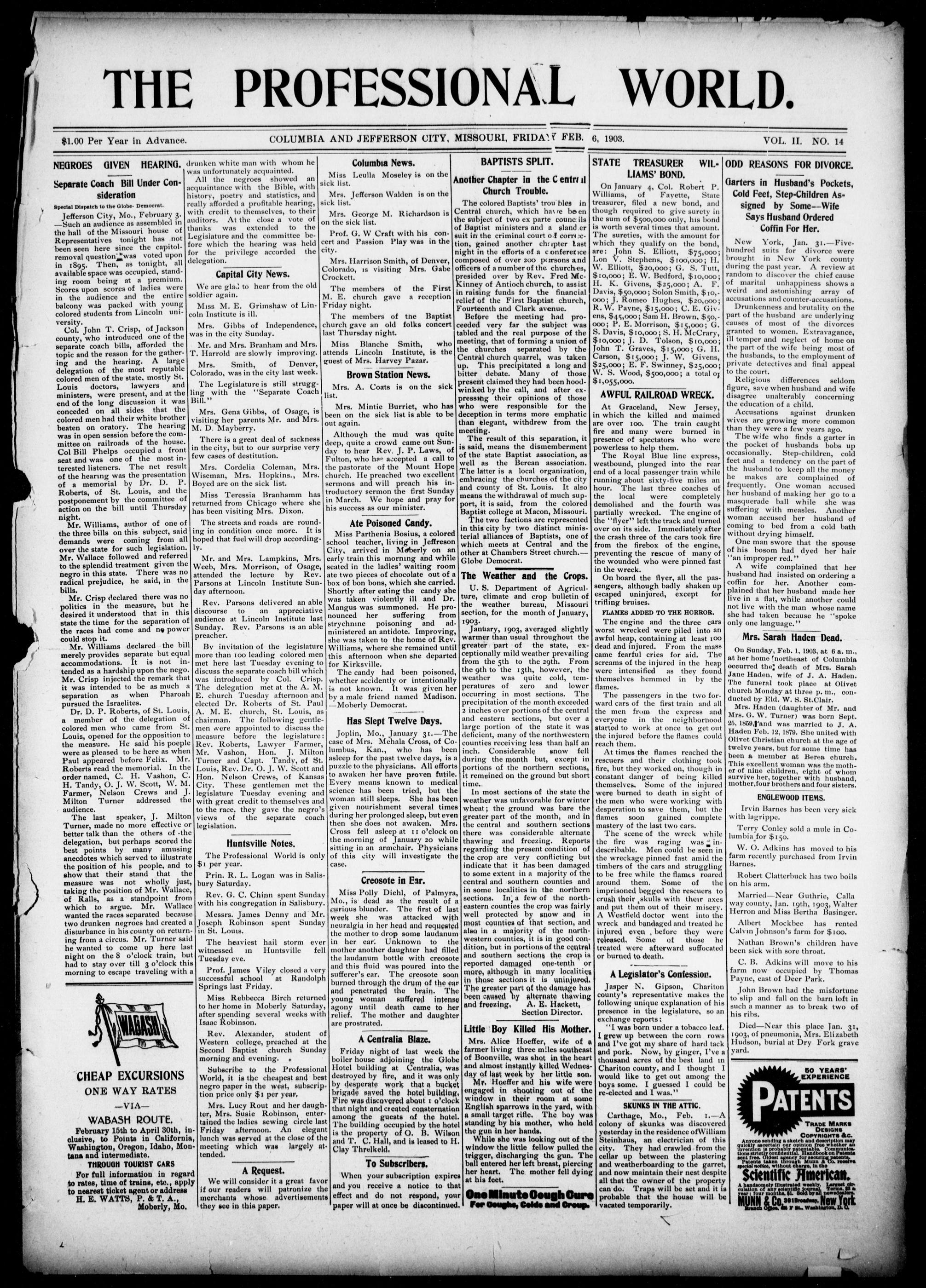
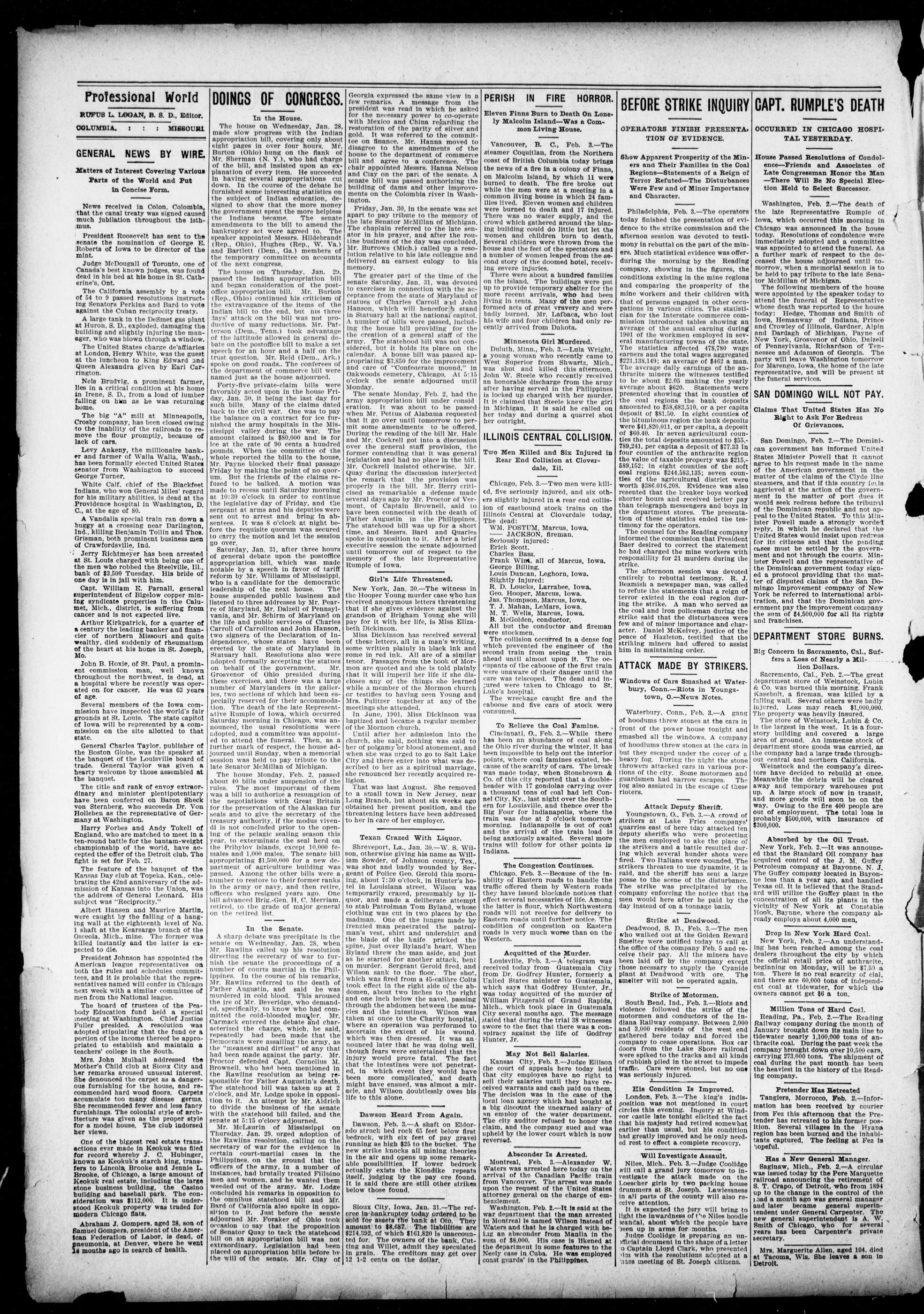
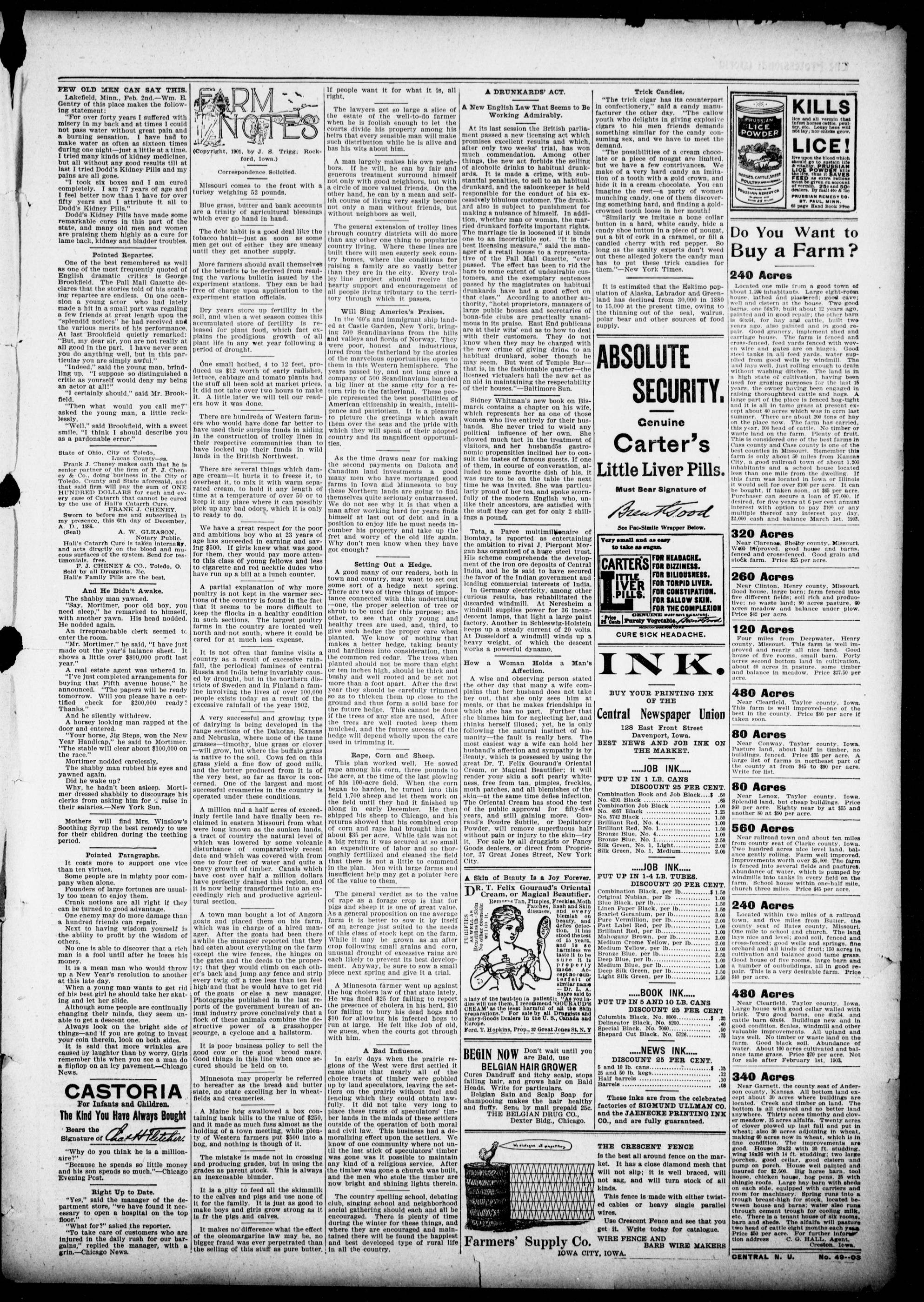
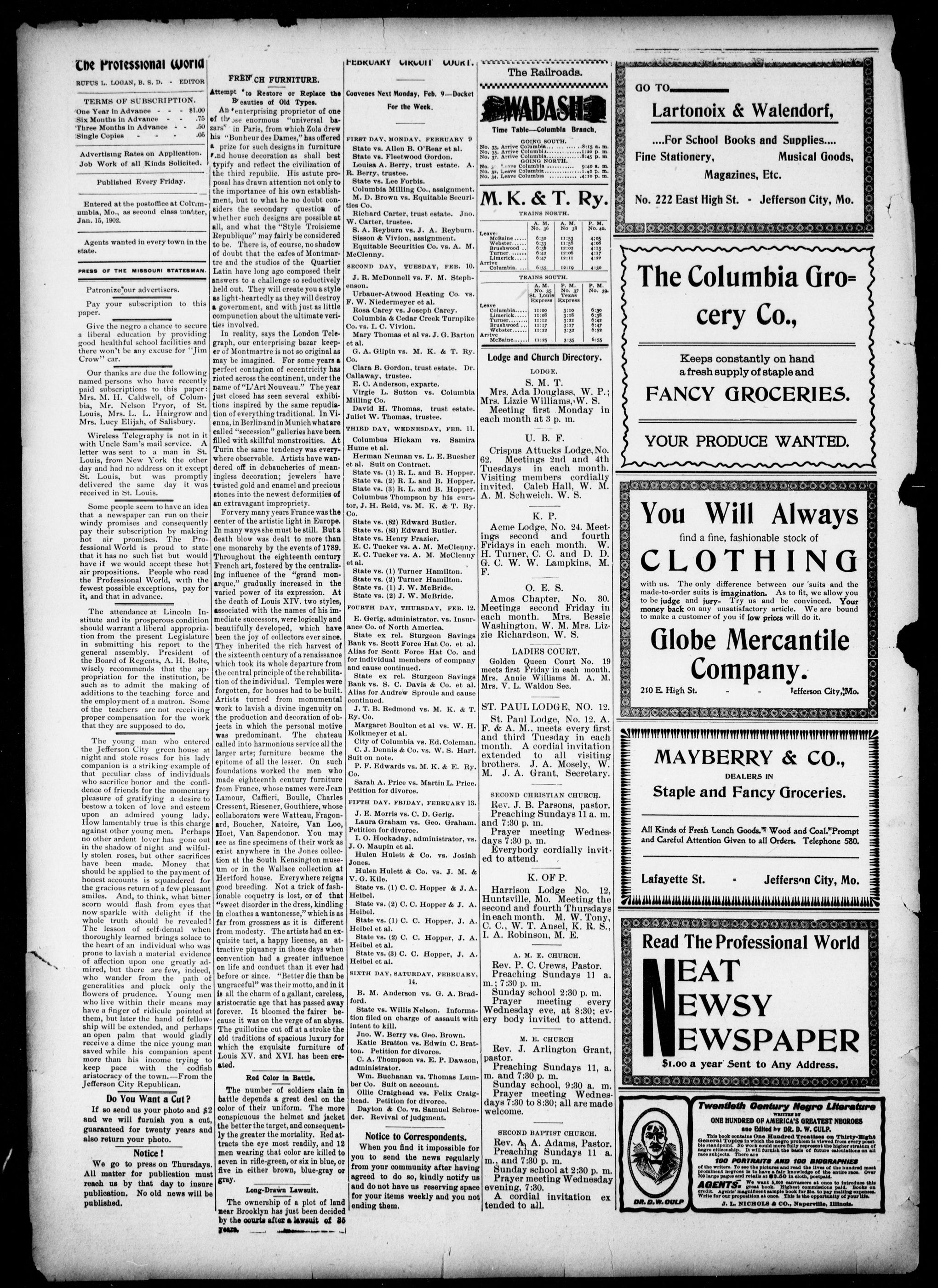
Page text (machine-generated)
THE PROFESSIONAL WORLD.
$1.00 Per Year in Advance
Separate Coach Bill Under Consideration
Special Dispatch to the Globe- Democrat. Jefferson City, Mo., February 3. Such an audience as assembled in the hall of the Missouri house of Representatives tonight has not been seen here since the capitol- removal question was voted upon in 1895. Then, as tonight, all available space was occupied, standing room being at a premium. Scores upon scores of ladies were in the audience and the entire balcony was packed with young colored students from Lincoln university.
Col. John T. Crisp, of Jackson county, who introduced one of the separate coach bills, afforded the topic and the reason for the gathering and the hearing. A large delegation of the most reputable colored men of the state, mostly St. Louis doctors, lawyers and ministers, were present, and at the end of the long discussion it was conceded on all sides that the colored men had their white brother beaten on oratory. The hearing was in open session before the committee on railroads of the house. Col Bill Phelps occupied a front seat and was one of the most interested listeners. The net result of the hearing was the presentation of a memorial by Dr. D. P. Roberts, of St. Louis, and the postponement by the committee of action on the bill until Thursday night.
Mr. Williams, author of one of the three bills on this subject, said demands were coming from all over the state for such legislation. Mr. Wallace followed and referred to the splendid treatment given the negro in this state. There was no radical prejudice, he said, in the bills. Mr. Crisp declared there was no politics in the measure, but he desired it understood that in this state the time for the separation of the races had come and no power could stop it.
Mr. Williams declared the bill merely provides separate but equal accommodations. It is not intended as a hardship upon the nego. Mr. Crisp injected the remark that it was intended to be as much a separation as when Pharoah pursued the Israelites. Dr. D. P. Roberts, of St. Louis, a member of the delegation of colored men who came from St. Louis, opened for the opposition to the measure. He said his people were as pleased to be here as when Paul appeared before Felix. Mr. Roberts read the memorial. In the order named, C. H. Vashon, C. H. Tandy, O. J. W. Scott, W. M. Farmer, Nelson Crews and J. Milton Turner addressed the audience.
The last speaker, J. Milton Turner, made no more effective or better talk than the others of the delegation, but perhaps scored the best points by many amusing anecdotes which served to illustrate the position of his people, and to show that their stand that the measure was not wholly just, taking the position of Mr. Wallace, of Ralls, as a standpoint from which to argue. Mr. Wallace wanted the races separated because two drunken negroes had created a disturbance in his county on returning from a circus. Mr. Turner said he wanted to come up here last night on the 8 o'clock train, but had to stay over till 3 o'clock this morning to escape traveling with a
WAGASH
CHEAP EXCURSIONS ONE WAY RATES
VIA
WABASH ROUTE.
February 15th to April 30th, inclusive, to Points in California, Washington, Oregon, Idaho, Montana and intermediate.
THROUGH TOURIST CARS
For full information in regard to rates, time of trains, etc., apply to nearest ticket agent or address
H. E. WAITTS, P. & T. A..
Moberly, Mo.
COLUMBIA AND JEFFERSON CITY, MISSOURI, FRIDAY FEB.
drunken white man with whom he was unfortunately acquainted. All the negroes showed an acquaintance with the Bible, with history, poetry and statistics, and really afforded a profitable hearing, with credit to themselves, to their auditors. At the close a vote of thanks was extended to the Legislature and the committee before which the hearing was held for the privilege accorded the delegation.
Capital City News.
We are glad to hear from the old soldier again.
Miss M. E. Grimshaw of Lincoln Institute is ill.
Mrs. Gibbs of Independence, was in the city Sunday.
Mr. and Mrs. Branham and Mrs. T. Harrold are slowly improving.
Mrs. Smith, of Denver, Colorado, was in the city last week.
The Legislature is still struggling with the "Separate Coach Bill."
Mrs. Gena Gibbs, of Osage, is visiting her parents Mr. and Mrs. M. D. Mayberry.
There is a great deal of sickness in the city, but to our surprise very few cases of destitution.
Mrs. Cordelia Coleman, Mrs. Wiseman, Mrs. Hopkins., Mrs. Boyed are on the sick list.
Miss Teressia Branhamm has returned from Chicago where she has been visiting Mrs. Dixon.
The streets and roads are rounding in condition once more. It is hoped that fuel will drop accordingly.
Mr. and Mrs. Lampkins, Mrs. Weeb, Mrs. Morrison, of Osage, attended the lecture by Rev. Parsons at Lincoln Institute Sunday afternoon.
Rev. Parsons delivered an able discourse to an appreciative audience at Lincoln Institute last Sunday. Rev. Parsons is an able preacher.
By invitation of the legislature more than 100 leading colored men met here last Tuesday evening to discuss the separate coach bill which was introduced by Col. Crisp. The delegation met at the A. M. E. church Tuesday afternoon and elected Dr. Roberts of St. Paul A. M. E. church, St. Louis, as chairman. The following gentlemen were appointed to discuss the measure before the legislature: Rev. Roberts, Lawyer Farmer, Mr. Vashon, Hon. J. Milton Turner and Capt. Tandy, of St. Louis, Rev. Dr. O. J. W. Scott and Hon. Nelson Crews, of Kansas City. These gentlemen met the legislature Tuesday evening and with great credit to themselves and to the race, they gave the negro's views of the separate coach legislation.
Huntsville Notes.
The Professional World is only $1 per year.
Prin. R. L. Logan was in Salisbury Saturday.
Rev. G. C. Chinn spent Sunday with his congregation in Salisbury.
Messrs. James Denny and Mr. Joseph Robinson spent Sunday in St. Louis.
The heaviest hail storm ever witnessed in Huntsville fell Tuesday eve.
Prof. James Viley closed a very successful school at Randolph Springs last Friday.
Miss Rebbecca Birch returned to her home in Moberly Saturday, after spending several weeks with Isaac Robinson.
Rev. Alexander, student of Western college, preached at the Second Baptist church Sunday morning and evening.
Subscribe to the Professional World, it is the cheapest and best negro paper in the west, subscription price only $1 per year.
Mrs. Lucy Rout and her daughter, Mrs. Susie Robinson, entertained the ladies sewing circle last Friday afternoon. An elegant lunch was served at the close of the meeting which was largely attended.
A Request.
We will consider it a great favor if our readers will patronize the merchants whose advertisements they see in this paper.
Columbia News.
Miss Leulla Moseley is on the sick list.
Mrs. Jefferson Walden is on the sick list.
Mrs. George M. Richardson is on the sick list.
Prof. G. W Craft with his concert and Passion Play was in the city.
Mrs. Harrison Smith, of Denver, Colorado, is visiting Mrs. Gabe Crockett.
The members of the First M. E. church gave a reception Friday night.
The members of the Baptist church gave an old folks concert last Thursday night.
Miss Blanche Smith, who attends Lincoln Institute, is the guest of Mrs. Harvey Pazar.
Brown Station News.
Mrs. A. Coats is on the sick list.
Mrs. Mintie Burriet, who has been on the sick list is able to be out again.
Although the mud was quite deep, quite a crowd came out Sunday to hear Rev. J. P. Laws, of Fulton, who has accepted a call to the pastorate of the Mount Hope church. He preached two excellent sermons and will preach his introductory sermon the first Sunday in March. We hope and pray for his success as our minister.
Ate Poisoned Candy.
Miss Parthenia Bosius, a colored school teacher, living in Jefferson City, arrived in Moberly on an early train this morning and while seated in the ladies' waiting room ate two pieces of chocolate out of a box of bon bons, which she carried. Shortly after eating the candy she was taken violently ill and Dr. Mangus was summoned. He pronounced her suffering from strychnine poisoning and administered an antidote. Improving, she was taken to the home of Rev. Williams, where she remained until this afternoon when she departed for Kirksville.
The candy had been poisoned, whether accidentally or intentionally is not known. It was given her by a male friend named Madison.—Moberly Democrat.
Has Slept Twelve Days.
Joplin, Mo., January 31.—The case of Mrs. Mehala Cross, of Columbus, Kan., who has been asleep for the past twelve days, is a puzzle to the physicians. All efforts to awaken her have proven futile. Every means known to medical science has been tried, but the woman still sleeps. She has been given nourishment several times during her prolonged sleep, but even then she does not awaken. Mrs. Cross fell asleep at 11 o'clock on the morning of January 20 while sitting in an armchair. Physicians of this city will investigate the case.
Creosote in Ear.
Miss Polly Diehl, of Palmyra, Mo., is dead as the result of a curious blunder. The first of last week she was attacked with neuralgia in her head and requested the mother to drop some laudanum in her ear. Unknown to the mother another daughter had filled the laudanum bottle with creosote and this fluid was poured into the sufferer's ear. The creosote soon burned through the drum of the ear and penetrated the brain. The young woman suffered intense agony until death came to her relief. The mother and daughter are prostrated.
A Centralia Blaze.
Friday night of last week the boiler house adjoining the Globe Hotel building at Centralia, was destroyed by fire, and it was only by desperate work that a bucket brigade saved the hotel building. Fire was discovered about 1 o'clock that night and created consternation among the guests of the hotel. The building occupied by the hotel is the property of O. B. Wilson and T. C. Hall, and is leased to H. Clay Threlkeld.
To Subscribers.
When your subscription expires and you receive a notice to that effect and do not respond, your paper will at once be discontinued.
BAPTISTS SPLIT.
Another Chapter in the Central Church Trouble.
The colored Baptists' troubles in Central church, which have been in the subject of two ex parte councils of Baptist ministers and a slander suit in the criminal court of corruption, gained another chapter last night in the efforts of a conference composed of over 200 persons and officers of a number of the churches, presided over by Rev. Fred McKinney of Antioch church, to assist in raising funds for the financial relief of the First Baptist church, Fourteenth and Clark avenue.
Before the meeting had proceeded very far the subject was tabled and the real purpose of the meeting, that of forming a union of the churches separated by the Central church quarrel, was taken up. This precipitated a long and bitter debate. Many of those present claimed they had been hood-winked by the call, and after expressing their opinions of those who were responsible for the deception in terms more emphatic than elegant, withdrew from the meeting.
The result of this separation, it is said, means the dismemberment of the state Baptist association, as well as the Berean association. The latter is a local organization, embracing the churches of the city and county of St. Louis. It also means the withdrawal of much support, it is said, from the colored Baptist college at Macon, Missouri. The two factions are represented in this city by two distinct ministerial alliances of Baptists, one of which meets at Central and the other at Chambers Street church. Globe Democrat.
The Weather and the Crops.
U. S. Department of Agriculture, climate and crop bulletin of the weather bureau, Missouri section, for the month of January, 1903.
January, 1903, averaged slightly warmer than usual throughout the greater part of the state, exceptionally mild weather prevailing from the 5th to the 29th. From the 9th to the 13th, however, the weather was quite cold, temperatures of zero and lower occurring in most sections. The precipitation of the month exceeded 2 inches over portions of the central and eastern sections, but over a large portion of the state it was deficient, many of the northwestern counties receiving less than half an inch. Considerable snow fell during the month but, except in portions of the northern sections, it remained on the ground but short time.
In most sections of the state the weather was unfavorable for winter wheat; the ground was bare the greater part of the month, and in the central and southern sections there was considerable alternate thawing and freezing. Reports regarding the present condition of the crop are very conflicting but indicate that it has been damaged to some extent in a majority of the central and southern counties and in some localities in the northern sections. In a few of the northeastern counties the crop was fairly well protected by snow and in most counties of that section, and also in a majority of the northwestern counties, it is in good condition, but in portions of the central and southern sections the crop is reported damaged one-tenth or more, although in many localities in those sections it is uninjured. The greater part of the damage has been caused by alternate thawing and freezing. A. E. Hackett, Section Director
Little Boy Killed His Mother.
Mrs. Alice Hoeffer, wife of a farmer living three miles southeast of Boonville, was shot in the heart and almost instantly killed Wednesday of last week by her little son. Mr. Hoeffer and his wife were engaged in shooting out of the window in their room at some English sparrows in the yard, with a small target rifle. The boy was standing by his mother, who held the gun in her hands. While she was looking out of the window the little fellow pulled the trigger, discharging the gun. The ball entered her left breast, piercing her heart. The mother fell dying at his feet.
One Minute Cough Cure
For Coughs, Colds and Coughs.
6. 1903.
STATE TREASURER LIAMS' BOND
On January 4, Col. Robert P. Williams, of Fayette, State treasurer, filed a new bond, and though required to give surety in the sum of $500,000 only, his bond is worth several times that amount. The sureties, with the amount for which they qualify on the bond, are: John S. Elliott, $75,000; Lon V. Stephens, $100,000; H. W. Elliott, $20,000; G. S. Tutt, $10,000; E. W. Bedford, $10,000; H. K. Givens, $25,000; A. F. Davis, $50,000; Sam Smith, $10,000; J. Romeo Hughes, $20,000; R. W. Payne, $15,000; C. E. Givens, $45,000; Sam H. Brown, $50,000; P. E. Morrison, $15,000; G. S. Davis, $10,000; S. H. McCrary, $10,000; J. D. Tolson, $10,000; John T. Graves, $15,000; G. H. Carson, $15,000; J. W. Givens, $25,000; E. F. Swinney, $25,000; W. S. Wood, $500,000; a total of $1,055,000.
AWFUL RAILROAD WRECK.
At Graceland, New Jersey, in which the killed and maimed are over 100. The train caught fire and many were burned in presence of spectators who were powerless to help them. The Royal Blue line express, westbound, plunged into the rear end of a local passenger train while running about sixty-five miles an hour. The last three coaches of the local were completely demolished and the fourth was partially wrecked. The engine of the "flyer" left the track and turned over on its side. Immediately after the crash three of the cars took fire from the firebox of the engine, preventing the rescue of many of the wounded who were pinned fast in the wreck.
On board the flyer, all the passengers, although badly shaken up escaped uninjured, except for trifling bruises.
FLAMES ADDED TO THE HORROR.
The engine and the three cars worst wrecked were piled into an awful heap, containing at least 100 dead and injured. From the mass came fearful cries for aid. The screams of the injured in the heap were intensified as they found themselves hemmed in by the flames.
The passengers in the two forward cars of the first train and all the men from the express and everyone in the neighborhood started to work at once to get out the injured before the flames could reach them.
At times the flames reached the rescues and their clothing took fire, but they worked on, though in constant danger of being killed themselves. Some of the injured were burned to death in sight of the men who were working with desperation to save them, but the flames soon gained complete mastery of the last two cars.
The scene of the wreck while the fire was raging was indescribable. Men could be seen in the wreckage pinned fast amid the timbers of the cars and struggling to be free while the flames roared around them. Some of the imprisoned begged the rescuers to crush their skulls with their axes and put them out of their misery. A Westfield doctor went into the wreck and bandaged and treated he injured even before they were released. Some of those he treated were afterward suffocated or burned to death.
A Legislator's Confession.
Jasper N. Gipson, Chariton county's representative makes the following unique explanation of his presence in the legislature, so an exchange reports: "I was born under a tobacco leaf. I grew up between the corn rows and I've got my share of hard tack and pork. Now, by ginger, I've a thousand acres of the best land in Chariton county, and I thought I would like to get out among the boys some. I guessed I could be re-elected and I was."
SKUNKS IN THE ATTIC.
Carthage, Mo., Feb. 1.—A colony of skunks was discovered yesterday in the residence of William Steinhaus, an electrician of this city. They had crawled from the cellar up between the plastering and weatherboarding to the garret, and now maintain their nest despite all that the owner of the property can do. Traps will be set and it is probable that the house will be vacated temporarily.
VOL. II. NO. 14
ODD REASONS FOR DIVORCE.
Garters in Husband's Pockets, Cold Feet, Step-Children Assigned by Some--Wife Says Husband Ordered Coffin For Her.
New York, Jan. 31.—Five-hundred suits for divorce were brought in New York county during the past year. A review at random to discover the chief cause of marital unhappiness shows a weird and astonishing array of accusations and counter-accusations. Drunkenness and brutality on the part of the husband are underlying causes of most of the divorces granted to women. Extravagance, ill temper and neglect of home on the part of the wife being most of the husbands, to the employment of private detectives and final appeal to the court. Religious differences seldom figure, save when husband and wife disagree unalterably concerning the education of a child.
Accusations against drunken wives are growing more common than they were a few years ago. The wife who finds a garter in the pocket of husbands bobs up occasionally. Step-children, cold feet and a tendency on the part of the husband to keep all the money he makes are complained of frequently. One woman accused her husband of making her go to a masquerade ball while she was suffering with measles. Another woman accused her husband of coming to bed from a cold bath without drying himself. One man swore that the spouse of his bosom had dyed her hair "an improper red."
A wife complained that her husband had insisted on ordering a coffin for her. Another complained that her husband made her live in a flat, while another could not live with the man whose name she had taken because he "spoke only one language."
Mrs. Sarah Haden Dead.
On Sunday, Feb. 1, 1903, at 6 a. m., at her home northeast of Columbia occurred the death of Mrs. Sarah Jane Haden, wife of J. A. Haden. The funeral took place at Olivet church Monday at three p. m., conducted by Eld. W. S. St.Clair.
Mrs. Haden (daughter of Mr. and Mrs. G. W. Turner) was born Sept. 25, 1859, and was married to J. A. Haden Feb. 12, 1879. She united with Olivet Christian church at the age of twelve years, but for some time has been a member at Berea church. This excellent woman was the mother of nine children, eight of whom survive her, together with husband, mother, four brothers and four sisters.
ENGLEWOOD ITEMS.
Irvin Barnes has been very sick with lagripe.
Terry Conley sold a mule in Columbia for $150.
W. O. Adkins has moved to his farm recently purchased from Irvin Barnes.
Robert Clatterbuck has two boils on his arm.
Married—Near Guthrie, Calla way county, Jan. 19th, 1903, Walter Herron and Miss Bertha Basinger.
Albert Mockbee has rented Calvin Johnson's farm for $100.
Nathan Brown's children have been sick with sore throat.
C. B. Adkins will move to his farm now occupied by Thomas Payne, east of Deer Park.
John Brown had the misfortune to slip and fall on the barn loft in such a manner as to break two of his ribs.
Died—Near this place Jan. 31, 1903, of pneumonia, Mrs. Elizabeth Hudson, burial at Dry Fork grave yard.
50 YEARS' EXPERIENCE
PATENTS
TRADE MARKS DESIGNS
COPYRIGHTS & C.
Anyone sending a sketch and description may quickly ascertain our opinion free whether an answer is correct or not. The documents strictly confidential. Handbook on Patents sent free. Oldest agency for securing patents. Receive special notice, without charge in the
FEW OLD MEN CAN SAY THIS.
Lakefield, Minn., Feb. 2nd.—Wm. E. Gentry of this place makes the following statement:
"For over forty years I suffered with misery in my back and at times I could not pass water without great pain and a burning sensation. I have had to make water as often as sixteen times during one night—just a little at a time. I tried many kinds of kidney medicines, but all without any good results till at last I tried Dodd's Kidney Pills and my pains are all gone.
"I took six boxes and I am cured completely. I am 77 years of age and I feel better now than I have for over fifty years and I attribute it all to Dodd's Kidney Pills."
Dodd's Kidney Pills have made some remarkable cures in this part of the state, and many old men and women are praising them highly as a cure for lame back, kidney and bladder troubles.
Pointed Repartee.
One of the best remembered as well as one of the most frequently quoted of English dramatic critics is George Brookfield. The Pall Mall Gazette declares that the stories told of his scathing repartee are endless. On one occasion a young actor who had later made a hit in a small part was regaling a few friends at great length upon the "splendid notices" he had received and the various merits of his performance. At last Brookfield quietly remarked: "But, my dear sir, you are not really at all good in the part. I have never seen you do anything well, but in this particular you are simply awful." "Indeed," said the young man, brindling up. "I suppose so distinguished a critic as yourself would deny my being an actor at all!" "I certainly should," said Mr. Brookfield. "Then what would you call me?" asked the young man, a little recklessly. "Well," said Brookfield, with a sweet smile. "I think I should describe you as a pardonable error."
State of Ohio, City of Toledo,
Louis County
Frank J. Cheney makes oath that he is senior partner of the firm of F. J. Cheney & Co., doing business in the City of Toledo, County and State aforesaid, and that said firm will pay the sum of ONE BILLION DOLLARS and every case of Catarrh that cannot be cured by the use of Hall's Catarrh Cure.
FRANK J. CHENEY.
Sworn to before me and subscribed in my presence, this 6th day of December, A. D., 1886.
(Seal) A. W. GLEASON,
Notary Public.
Hall's Catarrh Cure is taken internally, and acts directly on the blood and mucous surfaces of the system. Send for testimonials, free.
CHENEY & CO., Toledo, O.
Ball of all Drugsists, 75c.
Hall's Family Pills are the best.
And He Didn't Awake.
The shabby man yawned.
"Say, Mortimer, poor old boy, you need sleep," he remarked to himself, with another yawn. His head nodded. He nodded again.
An irreproachable clerk seemed to enter the room.
"Mr. Mortimer," he said, "I have just made out the year's balance sheet. It shows a little over $800,000 profit last year."
A real estate agent was ushered in. "I've just completed arrangements for buying that Fifth avenue house," he announced. "The papers will be ready tomorrow. Will you please have a certified check for $200,000 ready? Thanks."
And he silently withdrew.
A horse looking man rapped at the door and entered.
"Your horse, Jig Steps, won the New Year Handicap," he said to Mortimer. "The stable will clear about $100,000 on the race."
Mortimer nodded carelessly.
The shabby man rubbed his eyes and yawned again.
Did he wake up?
Why, he hadn't been asleep. Mortimer dressed shabbiy to discourage his clerks from asking him for raise in their salaries.—New York Sun.
Mothers will find Mrs. Winslow's Soothing Syrup the best remedy to use for their children during the teething period.
Pointed Paragraphs
It costs more to support one vice than ten virtues. Some people are in mighty poor company when alone. Founders of large fortunes are usually too mean to enjoy them. Crank notions are all right if they can be turned to good advantage. One enemy may do more damage than a hardened friend.
One enemy may do more damage than a hundred friends can repair.
Next to having wisdom yourself is the ability to profit by the wisdom of others.
No one is able to discover that a rich man is a fool until after he loses his money.
It is a mean man who would throw up a New Year's resolution to another at this late day.
When a young man wants to get rid of his best girl he should take her skating and let her slide.
Although some people are continually changing their minds, they seem unable to get a descent one.
Always look on the bright side of things—and if you are going to invest your coin therein, look on both sides.
It is said that more wrinkles are caused by laughter than by worry. Girls remember this when you see a man do a flipflop on an icy pavement.—Chicago News.
CASTORIA
For Infants and Children.
The Kind You Have Always Bought
"Why do you think he is a millionaire?"
"Because he spends so little money and his son spends so much."—Chicago Evening Post.
Right Up to Date.
"Yes," said the manager of the department store, "we have found it necessary to open a hospital on the top floor." "What for?" asked the reporter.
"To take care of customers who are injured in the daily rush for our bargains," replied the manager, with a grin.—Chicago News.
FARM NOTES (Copyright, 1901, by J. S. Trigg, Rockford, Iowa.)
Correspondence Sollicited.
Missouri comes to the front with a turkey weighing 52 pounds.
Blue grass, butter and bank accounts are a trinity of agricultural blessings which ever go hand in hand.
The debt habit is a good deal like the tobacco habit—just as soon as some men get out of either they are uneasy until they get another supply.
More farmers should avail themselves of the benefits to be derived from reading the various bulletin issued by the experiment stations. They can be had free of charge upon application to the experiment station officials.
Dry years store up fertility in the soil, and when a wet season comes this accumulated store of fertility is released for plant food, which fact explains the prodigious growth of all plant life in any wet year following a period of drought.
One small hotbed, 4 to 12 feet, produced us $12 worth of early radishes, lettuce, cabbage and tomato plants had the stuff all been sold at market prices. It did not take over two hours to make it. A little later we will tell our readers how it was done.
There are hundreds of Western farmers who would have done far better to have used their surplus funds in aiding in the construction of trolley lines in their respective communities than to have locked up their funds in wild lands in the British Northwest.
There are several things which damage cream—it hurts it to freeze it, to overheat it, to mix it with warm separated cream, to hold it any length of time at a temperature of over 50 or to keep it any place where it can possibly pick up any bad odors, which it is only to ready to do.
We have a great respect for the poor and ambitious boy who at 23 years of age has succeeded in earning and saving $500. If girls knew what was good for them, they would pay more attention to this class of young fellows and less to cigarette and red necktie dudes who have run up a bill at a lunch counter.
A partial explanation of why more poultry is not kept in the warmer sections of the country is found in the fact that it seems to be more difficult to keep the flocks in a healthy condition in such sections. The largest poultry farms in the country are located well north and not south, where it could be cared for at much less expense.
It is not often that famine visits a country as a result of excessive rainfall, the periodical families of central Russia and India being invariably caused by drought, but in the northern districts of Sweden and in Finland a famine involving the lives of over 100,000 people exists today as a result of the excessive rainfall of the year 1902.
A very successful and growing type of dairying is being developed in the range sections of the Dakotas, Kansas and Nebraska, where none of the tame grasses—timothy, blue grass or clover—will grow, but where the buffalo grass is native to the soil. Cows fed on this grass yield a fine flow of good milk, and the butter produced from it is of the very best, so far as flavor is concerned. One of the largest and most successful creameries in the country is operated under these conditions.
A million and a half acres of exceedingly fertile land have finally been reclaimed in eastern Missouri from what were long known as the sunken lands, a tract of country the natural level of which was lowered by some volcanic disturbance of comparatively recent date and which was covered with from one to four feet of water and quite a heavy growth of timber. Canals which have cost over half a million dollars have perfectly drained this region, and it is now being transformed into an exceedingly rich and productive agricultural section.
A town man bought a lot of Angora goats and placed them on his farm, which was in charge of a hired manager. After the goats had been there awhile the manager reported that they had eaten about everything on the farm except the wire fences, the hinges on the gates and the deeds to the property; that they would climb on each other's back and jump any fence and strip every twig off a tree less than ten feet high and that he would have to get rid of the goats or else a new manager. Photographs published in the last reports of the government bureau of animal industry prove conclusively that a flock of these animals combine the destructive power of a grasshopper scourge, a cyclone and a hailstorm.
It is poor business policy to sell the good cow or the good brood mare. Good things in this line when once secured should be held on to.
Minnesota may properly be referred to hereafter as the bread and butter state, no state excelling her in wheat-fields and creameries.
A Maine hog swallowed a box containing bank bills to the value of $250, and it made as much fuss almost as the holding of a town meeting, while plenty of Western farmers put $500 into a bog, and nothing is though of it.
The mistake is made not in crossing and producing grades, but in using the grades as parent stock. This is always an inexcusable blunder.
It is a pity to feed all the skimmilk to the calves and pigs and use none of it for the family. It is just as good to make boys and girls grow strong as it is fr the pigs and calves.
It makes no difference what the effect of the oleomargarine law may be, no bigger fraud was ever perpetrated than the selling of this stuff as pure butter.
If people want it for what it is, all right.
The lawyers get so large a slice of the estate of the well-to-do farmer when he is foolish enough to let the courts divide his property among his heirs that every sensible man will make such distribution while he is alive and has his wits about him.
A man largely makes his own neighbors. If he will, he can by fair and generous treatment surround himself not only with good neighbors, but with a circle of more valued friends. On the other hand, he can by a mean and selfish course of living very easily become not only a man without friends, but without neighbors as well.
The general extension of trolley lines through country districts will do more than any other one thing to popularize country living. Where these lines are built there will men eagerly seek country homes, where the conditions for raising a family are so vastly better than they are in the city. Every trolley line project should receive the hearty support and encouragement of all people living tributary to the territory through which it passes.
Will Sing America's Praises.
In the '60's and immigrant ship landed at Castle Garden, New York, bringing 500 Scandinavians from the hills and valleys and florids of Norway. They were poor, honest and industrious, lured from the fatherland by the stories of the marvelous opportunities open to them in this Western hemisphere. The years passed by, and not long since a company of 500 Scandinavians boarded a big linear at the same city for a return trip to the fatherland. These people represented the best possibilities of American citizenship in wealth, intelligence and patriotism. It is a pleasure to picture the greetings which await them over the seas and the pride with which they will speak of their adopted country and its magnificent opportunities.
As the time draws near for making the second payments on Dakota and Canadian land investments a good many men who have mortgaged good farms in Iowa and Minnesota to buy these Northern lands are going to find themselves quite seriously embarrassed. We do not see why it is that when a man after working hard for years finds himself at last out of debt and in a position to enjoy life he must needs incumber his property and take up the fret and worry of the old life again. Why don't men know when they have got enough?
Setting Out a Hedge
A good many of our readers, both in town and country, may want to set out some sort of a hedge next spring. There are two of three things of importance connected with this undertaking—one, the proper selection of tree or shrub to be used for this purpose; another, to see that only young and healthy trees are used, and, third, to give such hedge the proper care when planted. We know of nothing that makes a better hedge, taking beauty and hardiness into consideration, than the common red cedar. The trees when planted should not be more than eight or ten inches high, should be thick and bushy and well rooted and be set not more than a foot apart. After the first year they should be carefully trimmed so as to thicken them up close to the ground and thus form a solid base for the future hedge. This cannot be done if the trees of any size are used. After the trees are well rooted keep them mulched, and the future success of the hedge will depend wholly on the care used in trimming it.
Rape, Corn and Sheep.
This plan worked well. He sowed rape among his corn, three pounds to the acre, at the time of the last plowing of his 100-acre field. When the corn began to harden, he turned into this field 1,700 sheep and let them work on the field until they had it finished up along in early December. He then shipped his sheep to Chicago, and his returns showed that his combined crop of corn and rape had brought him in about $35 per acre. While this was not a big return it was secured at so small an expenditure of labor and so thoroughly fertilized and cleaned the field that there is not a little to commend in the plan. Men with large farms and insufficient help may get a pointer here of the value to them.
The general verdict as to the value of rape as a forage crop is that for pigs and sheep it is one of great value. As a general proposition on the average farm it is better to sow it by itself of an acreage just suited to the needs of this class of stock kept on the farm. While it may be grown as an after crop following small grains and corn, unusual drought of excessive rains are each likely to prevent its best development. Anyway, be sure to sow a small piece next spring and give it a trial.
A Minnesota farmer went up against the hog cholera law of that state lately. He was fned $25 for failing to report the presence of cholera in his herd, $10 for failing to bury his dead hogs and $10 for allowing his infected hogs to run at large. He felt like Job of old, we guess, when the courts got through with him.
A. Bad Influence.
In early days when the prairie regions of the West were first settled it came about that nearly all of the choice tracts of timber were gobbled up by land speculators, leaving the settlers on the prairie without fuel and fencing which they could obtain lawfully. It did not take very long to place these tracts of speculators' timber lands in the minds of these settlers outside of the operation of both moral and civil law. This business had a demoralizing effect upon the settlers. We know of one community where not until the last stick of speculators' timber was gone was it possible to maintain any kind of a religious service. After the timber was gone a church was built, and the men who stole the timber are now bright and shining lights therein.
The country spelling school, debating club, singing school and neighborhood social gathering should each and all be encouraged. There is plenty of time during the winter for these things, and where they are encouraged and maintained there will be found the happiest and best developed type of rural life in all the country.
A DRUNKARDS' ACT.
A New English Law That Seems to Be Working Admirably.
At its last session the British parliament passed a new licensing act which promises excellent results and which, after only two weeks' trial, has won much commendation. Among other things, the new act forbids the selling of alcoholic drinks to habitual drunkards. It is made a crime, with substantial penalties, to sell to an habitual drunkard, and the saloonkeeper is held responsible for the conduct of his excessively bibulous customer. The drunkard also is subject to punishment for making a nuisance of himself. In addition, whether man or woman, the married drunkard forfeits important rights. The marriage tie is loosened if it binds one to an incorrigible sot. "It is the best licensing measure," said the manager of a retail house to a representative of the Pall Mall Gazette, "ever passed. The effect has been to rid the bars to some extent of undesirable customers, and the exemplary sentences passed by the magistrates on habitual drunkards have had a good effect on that class." According to another authority, "hotel proprietors, managers of large public houses and secretaries of bona-fide clubs are practically unanimous in its praise. East End publicans are at their wits end as to how to deal with their customers. They do not know when they may be charged with the new crime of giving drink to an habitual drunkard, sober though he may seem. But west of Temple Bar—that is, in the fashionable quarter—the licensed victualers hall the new act as an aid in maintaining the respectability of their houses."—Baltimore Sun.
Sidney Whitman's new book on Hismarck contains a chapter on his wife, which represents her as one of those women who live entirely for their husbands. She never tried to wield any political influence of her own. She showed much tact in the treatment of visitors, and her husband5s gastrocnemial propensities inclined her to consult the tastes of famous guests. If one of them, in course of conversation, alluded to some favorite dish of his, it was sure to be on the table the next time he was invited. She was particularly proud of her tea, and spoke scornfully of the modern English who, unlike their ancestors, are satisfied with the stuff they can get for only 2 shillings a pound.
Tata, a Parce multimilieuire of Bombay, is reported as entertaining the ambition to rival J Pierpont Morgan has organized of a huge steel trust. His scheme comprehends the development of the iron ore deposits of Central India, and he is said to have secured the favor of the Indian government and leading commercial interests of India. In Germany electricity, among other curious results, has rehabilitated the discarded windmill. At Nereshea a windmill supplies power for 36 incandescent lamps, that light a large paint factory. Another in Schleswöld-Holstein keeps up a steady current of 20 volts. At Dusseldorf a windmill winds up a heavy weight, of which the descent works a powerful dynamo.
How a Woman Holds a Man's Affection
A wise and observing person stated the other day that many a wife complains that her husband does not take her out, that she only sees him at meals, or that he makes friendships in which she has no part. Further that she blames him for neglecting her, and thinks herself illused; yet, he is only following the natural instinct of humanity—the fault is really hers. The most easiest way a wife can hold her husband's affection and sympathy is by Beauty, which is possessed by using the great Dr. T. Felix Gouraud's Oriental Cream, or Magical Beautifier; it will render your skin a soft pearly whiteness, free from tan, pimples, freckles, moth patches, and all blemishes of the skin—at the same time defies infection. The Oriental Cream has stood the test of the public approval for fifty-five years, and still gaining more. Gouraud's Poudre Subfile, or Depilatory Powder, will remove superfluous hair without pain or injury to the skin—try it. For sale by all drummers or Fancy Goods dealers, or direct from Proprietor, 37 Great Jones Street, New York City.
SKin of Beauty Is a Joy Forever.
DR. T. Felix Gouraud's Oriental Cream, or Magical Beautifier.
Removes Tan, Pimples, Haircuts, Moth Damages, Skin Diseases, and every blemish on beauty, and maintains skin health and detection. It has stood the test of 65 years, and is harmless we taste it to be properly made. Accept no counterfeit of similar name.
DR. L. A. Sayre said to die will use them, I recommend 'GOURAUD'S CREAM' as the least harmful of all the 56th preparations. For sale by all Drugstores and Good Dealers in the U.S., Canada and Europe.
Ferd. T. Hopkins, Prop., 37 Great Jones St. N
BEGIN NOW Don't wait until you are Bald, use
BELGIAN HAIR GROWER
Cures Dandruff and itchy scalp, stops falling hair, and grows hair on Bald Heads. Write for particulars.
Belgian Skin and Scalp Soap for shampooing makes the hair healthy and fluffy. Send by mail prepaid 25c.
THE BELGIAN DRUG CO.,
Dexter Bldg., Chicago.
Trick Candies.
"The trick cigarette has its counterpart in confectionery," said a cake manufacturer the other day. "The callow youth who delights in giving explosive cigars to his men friends demands something similar for the candy consuming sex, and we have to meet the demand.
"The possibilities of a cream chocolate or a piece of nougat are limited, but we have a few contravances. We make of a very hard candy an imitation of a tooth with a gold crown, and hide it in a cream chocolate. You can imagine the rest—a party of women munching candy, one of them discovering something hard, and finding a gold-crowned tooth loose in her mouth!
"Similarly we imitate a bone collar button in a hard, white candy, hide a candy shoe button in a piece of nougat, put a bit of cork in a caramel, or fill a candied cherry with red pepper. So long as the sanity experts don't weed out these alleged jokers the candy man has to put these trick candies for them."—New York Times.
It is estimated that the Eskimo population of Alaska, Labrador and Greenland has declined from 30,000 in 1880 to 15,000 at the present time, owing to the thinning out of the seal, walrus, polar bear and other sources of food supply.
ABSOLUTE SECURITY.
Genuine Carter's
Little Liver Pills.
Must Bear Signature of
Brent Wood
See Fac-Simile Wrapper Below.
Very small and as easy
to take as sugar.
CARTER'S
LITTLE
LIVER
PILLS.
FOR HEADACHE.
FOR DIZZINESS.
FOR BILIOUSNESS.
FOR TORPID LIVER.
FOR CONSTIPATION.
FOR SALLOW SKIN.
FOR THE COMPLEXION
Price
25 Cents
GENUINE
MUST MAY SIGNATURE.
Purely Vegetable
CURE SICK HEADACHE.
INK.
BUY YOUR PRINTING INK
OF THE
Central Newspaper Union
128 East Front Street
Davenport, Iowa.
BEST NEWS AND JOB INK ON
THE MARKET.
PUT UP IN 1 LB. CANS
DISCOUNT 25 PER CENT.
Combination Book and Job Black.....$ .50
No. 4291 Black.....65
Combination Job Black.....1.00
No. 4957 Black.....1.25
No. 5742 Black.....1.50
Brilliant Red, No. 4.....1.00
Brilliant Red, No. 1.....1.50
Bronze Blue, No. 4.....1.00
Bronze Blue, No. 1.....2.50
Silk Green, No. 1, Light.....2.00
Silk Green, No. 1, Medium.....2.00
30 PER CENT.
Combination Black, per lb. $1.50
Original Nubian, per lb. 1.00
Blue Black, per lb. 1.50
Linen Paper Black, per lb. 1.50
Scarlet Geranium, per lb. 3.00
Pure Vermilion, per lb. 2.00
Raffinat Red, per lb. 1.00
Brilliant Red, per lb. 1.00
Mahogany Brown, per lb. 2.00
Medium Crome Yellow, per lb. 2.00
Medium Yellow, per lb. 1.00
Bronze Blue, per lb. 2.50
Deep Blue, per lb. 1.00
Medium Blue, per lb. 1.50
Deep Silk Green, per lb. 1.50
Light Silk Green, per lb. 1.50
Columbia Black, No. 8000.....$ .33
Delineator Black, No. 8200.....$ .40
Special Black, No. 7060.....$ .50
Shepard Cut Black, No. 5726.....$ .75
DISCOUNT 25 PER CENT.
5 and 10 lb. cans. $ .15
25 and 50 lb. kegs. .12
Half barrels .10
Barrels .08
These inks are from the celebrated
factories of SIGMUN ULLMAN CO.
and the JAENECKE PRINTING INK
CO., and are fully guaranteed.
THE CRESCENT FENCE
is the best all around fence on the market. It has a close diamond mesh that will not slip; it is well braced, will not sag, and will turn stock of all kinds.
This fence is made with either twisted cables or heavy single parallel wires.
Use Crescent Fence and see that you get it. Write today for catalogue.
WIRE FENCE AND
BARB WIRE MAKERS
Y, IOWA.
DEY2021 51010257019 5107
KILLS
lice and all vermin that
infest horses cattle, poultry,
leggings, goats, livestock
not lay; nor chicks grow.
LICE!
I live upon the blood which
should go to sustain life
& vitality. PRUSSIAN
RUME. If you steal, then
the line, thus it SAVES
life. Must be given on account
of vermin. 25c and 50c
dollars each. Do not
PRUSSIAN REMEDY CO.
BT. PAUL, MINN.
65 page Hand Book Free
Do You Want to Buy a Farm?
240 Acres
Located one mile from a good town of about 1,300 inhabitants. Large eight-room house, lathed and plastered; good cave; well and clisten at the house. Two good barns, one 58x70, built about 12 years ago, painted and in good repair; the other barn is 68x64, for hay and cattle, built two barns and a pair. Good granary, implement shed and carriage house. The farm is tenced and cross-fenced, feed yards fenced with woven wire and gates are on hinges. Good steel tanks in all feed yards, water supplied from good wells by windmill. The and lays well, just rolling enough to drain without washing ditches. The land is in a high rate of cultivation, having been raised for many years, the owner having been engaged in raising thoroughbred cattle and hogs. A large part of the place is fenced hog-tight and it is all in tame grass at present except about 40 acres which was in cern last summer. There are about 200 tons of hay on the place now. The farm has carried, this year, 100 head of cattle. No timber or wood is used. This is considered one of the best farms in Cass county and Cass county is one of the best counties in Missouri. Remember this farm is only about 50 miles from Kansas City, a good railroad town of about 1,300 inhabitants and a school house located less than one mile from the dwelling. If this farm was located in Iowa or Illinois, it would be bought, if taken soon, at $65 per acre. Purchaser can secure a loan of $7,000, if desired, for five years at 6 per cent annual interest with option to pay $100 or any multiple thereof any interest pay day, $2,000 cash and balance March 1st. 1905.
320 Acres
Near Clarence, Shelby county, Missouri.
Well improved, good house and barns,
fenced and cross-fenced. Good grain and
stock farm. Price $25 per acre.
260 Acres
Near Clinton, Henry county, Missouri.
Good house, large barn; farm fenced into
five different fields; soil rich and produc-
tive; no waste land; 80 acres pasture, 60
acres meadow and balance under plow.
Price $42 per acre.
120 Acres
Four miles from Deepwater, Henry county, Missouri. This farm is well improved and nearly all nice land. Good house of five rooms, small barn. Forty acres second bottom land in cultivation, about 40 acres in pasture, some timber and balance in meadow. Price $27.50 per acre.
480 Acres
Near Clearfield, Taylor county, Iowa. This farm is well improved—one of the best in the county. Price $80 per acre if taken soon.
80 Acres
Near Conway, Taylor county, Iowa. Pasture land, about half in timber, no buildings, fenced. Price $25 per acre. A large list of farms in northeast part of the county at from $45 to $90 per acre. Write for list.
80 Acres
Near Lenox, Taylor county, Iowa.
Splendid land, but cheap buildings. Price $60 per acre. Eighty near by at $55 and another 8 at $60 per acre.
560 Acres
Near railroad town and about ten miles from county seat of Clarke county, Iowa. Two hundred acres mice level land, balances on a 100-foot fence. Improvements worth over $5,000. The farm is fenced into several fields and pastures. Abundance of water, which is pumped by a well, is needed for the farm. School house within one-half mile church three miles. Price $45 per acre.
240 Acres
Located within two miles of a railroad town, and five miles from Butter, the county seat of Bates county, Missouri. One mile to school and church. The land is well fenced, and cross-fenced; good wells and springs, fine orchard and all kinds of fruit; 150 acres in cultivation and balance good tame grass. Good house of five rooms, large barn and barn buildings, all in good repair. This is a very desirable farm. Price $40 per acre.
480 Acres
Near Clearfield, Taylor county, Iowa. Large house with good cellar walled with brick. Two good barns, one 40x54, and cattle barn 60x64. Buildings new and in good condition. Scales, windmill and other valuable improvements. All upland and lays well. No timber on waste land on the property. Water supply. Water. About 100 acres cultivated and balance tame grass. Price $70 per acre. Not for sale after February 1st, 1903.
340 Acres
Near Garnett, the county seat of Anderson county, Kansas. All bottom land except about 30 acres where buildings are located. Creek and timber on land. The bottom is all cleared and no better land anywhere. Thirty acres timothy and clover meadow, 15 acres alfalfa. Twenty acres of playground, on large plots of wheat; also 30 acres adjoining in wheat, making 60 acres now in wheat, which is in fine condition. The improvements are good. House 20x32 with 20 ft. studding, wing 18x36 with 14 ft. studding; two large porches, good cellar, good cistern and pump on porch. House well painted and housed in chicken house. Big horse barn, 20 foot shingle roofs. Large hay barn with sheds on each side, equipped with carriers and room for machinery. Spring runs into a trough breast-high for stock, located between house and barns; water also runs through cement trough for cooling milk, etc. There is a tenant house of six rooms. House is two stories high, two head of cattle eight months each year. Price $50 per acre. For further information address C. G. HALL, Agent, Creston, Iowa.
CENTRAL N. U. N. 40-63
RUFUS L. LOGAN, B. S. D. - EDITOR
TERMS OF SUBSCRIPTION.
'One Year in Advance - - - $1.00
'Six Months in Advance - - .75
'Three Months in Advance - - .50
'Single Copies - - - .05
Advertising Rates on Application.
Job Work of all Kinds Solicited.
Entered at the postoffice at Colum-
umbia, Mo., as second class matter,
Jan. 15, 1902.
Agents wanted in every town in the
state.
Pay your subscription to this paper.
Give the negro a chance to secure a liberal education by providing good healthful school facilities and there won't be any excuse for "Jim Crow" car.
Our thanks are due the following named persons who have recently paid subscriptions to this paper: Mrs. M. H. Caldwell, of Columbia, Mr. Nelson Pryor, of St. Louis, Mrs. L. L. Hairgrow and Mrs. Lucy Elijah, of Salisbury.
Wireless Telegraphy is not in it with Uncle Sam's mail service. A letter was sent to a man in St. Louis, from New York the other day and had no address on it except St. Louis, but was promptly delivered the same day it was received in St. Louis.
Some people seem to have an idea that a newspaper can run on their windy promises and consequently pay their subscription by making hot air promises. The Professional World is proud to state that it has no such list but would have if we would accept these hot air propositions. People who read the Professional World, with the fewest possible exceptions, pay for it, and that in advance.
The attendance at Lincoln Institute and its prosperous condition should warrant a liberal appropriation from the present Legislature in submitting his report to the general assembly. President of the Board of Regents, A. H. Bolte, wisely recommends that the appropriation for the institution, be such as to admit the making of additions to the teaching force and the employment of a matron. Some of the teachers are not receiving proper compensation for the work that they are supposed to do.
The young man who entered the Jefferson City green house at night and stole roses for his lady companion is a striking example of that peculiar class of individuals who sacrifice honor and the confidence of friends for the momentary pleasure of gratifying a desire to bestow a token of love and esteem upon an admired young lady. How lamentably true is this charge against other young men. Perhaps no other ardent lover has gone out in the shadow of night and wilfully stolen roses, but other sacrifices have been made. Money that should be applied to the payment of honest accounts is squandered for the gracious return of a few pleasant smiles. And, to think, what bitter scorn would flash from eyes that now sparkle with delight if the whole truth should be revealed! The lesson of self-denial when thoroughly learned brings solace to the heart of an individual who was prone to lavish a material evidence of affection upon one greatly admired, but there are few, indeed, who wander from the path of generalities and pluck only the flowers of prudence. Young men who live within their means may have a finger of ridicule pointed at them, but later the hand of fellowship will be extended, and perhaps an open palm that would gladly receive a dime the nice young man saved while his companion spent more than his income trying to keep pace with the codfish aristocracy of the town.—From the Jefferson City Republican.
Do You Want a Cut?
If so send us your photo and $2 and we will furnish you a cut, guaranteed for twenty years and also return your photo.
Notice !
We go to press on Thursdays. All matter for publication must reach us by that day to insure publication. No old news will be published.
FREN.CH FURNITURE.
Attempt *to Restore or Replace the Beauties of Old Types.
An enterprising proprietor of one of those enormous "universal bazaars" in Paris, from which Zola drew his "Bonheur des Dames," has offered a prize for such designs in furniture and house decoration as shall best typify and reflect the civilization of the third republic. His astute proposal has drawn attention not only to the importance of his own establishment, but to what he no doubt considers the secondary question of whether such designs are possible at all, and what the "Style Troisième Republique" may fairly be considered to be. There is, of course, no shadow of doubt that the cafes of Montmarte and the studios of the Quartier Latin have long ago composed their answers to a challenge so seductively held out. They will create you a style as light-heartedly as they will destroy a government, and with just as little compunction about the ultimate verities involved.
In reality, says the London Telegraph, our enterprising bazar keeper of Montmartre is not so original as may be imagined. For some years a perfect contagion of eccentricity has rioted across the continent, under the name of "L'Art Nouveau." The year just closed has seen several exhibitions inspired by the same repudiation of everything traditional. In Vienna, in Berlinand in Munich what are called "secession" galleries have been filled with skillful monstrosities. At Turin the same tendency was everywhere observable. Artists have wandered off in debaucheries of meaningless decoration; jewelers have twisted gold and enamel and precious stones into the newest deformities of an extravagant impropriety.
Forvery many years France was the center of the artistic light in Europe. In many ways she must be still. But a death blow was dealt to more than one monarchy by the events of 1789. Throughout the eighteenth century French art, fostered by the centralizing influence of the "grand monarque," gradually increased in the varied power of its expression. At the death of Louis XIV. two styles, associated with the names of his immediate successors, were logically and beautifully developed, which have been the joy of collectors ever since. They inherited the rich harvest of the sixteenth century of a renaissance which took its whole departure from the central principle of the rehabilitation of the individual. Temples were forgotten, for houses had to be built. Artists turned from monumental work to lavish a divine ingenuity on the production and decoration of objects in which the personal motive was predominant. The chateau called into harmonious service all the larger arts; furniture became the epitome of all the lesser. On such foundations worked the men who made eighteenth century furniture from France, whose names were Jean Lamour, Caffieri, Boulle, Charles Cressent, Riesener, Gouthiere, whose collaborators were Watteau, Fragonard, Boucher, Natoire, Van Loo, Hoet, Van Sapendonor. You may see as fine specimens of their work as exist anywhere in the Jones collection at the South Kensington museum or in the Wallace collection at Hertford house. Everywhere reigns good breeding. Not a trick of fashionable coquetry is lost, or of that "sweet disorder in the dress, kindling in cloathes a wantonesse," which is as far from grossness as it is different from modesty. The artists had an exquisite tact, a happy license, an attractive piquancy in those days when convention had a greater influence on life and conduct than it ever had before or since. "Better die than be ungraceful" was their motto, and in it all the charm of a gallant, careless, aristocratic age that has passed away forever. It bloomed the fairer because it was on the verge of an abyss. The guillotine cut off at a stroke the old traditions of spacious luxury for which the exquisite furniture of Louis XV. and XVI. has been created.
Red Color in Battle.
The number of soldiers slain in battle depends a great deal on the color of their uniform. The more conspicuous the helmet and jacket the better the target, and consequently the greater the mortality. Red attracts the eye most readily, and 12 men wearing that color are killed to seven in rifle-green, or six in blue, or five in either brown, blue-gray or gray.
Long-Drawn Lawsuit.
The ownership of a plot of land near Brooklyn has just been decided by the courts after a lawsuit of 35 years.
FEBRUARY CIRCUIT COURT.
Convenes Next Monday, Feb. 9----Docket For the Week.
FIRST DAY, MONDAY, FEBRUARY 9
State vs. Allen B. O'Rear et al.
State vs. Fleetwood Gordon.
Louisa A. Berry, trust estate. A.
R. Berry, trustee.
State vs. Lee Forbis.
Columbia Milling Co., assignment.
M. D. Brown vs. Equitable Securities Co.
Richard Carter, trust estate. Jno.
W. Carter, trustee.
Equitable Securities Co. vs. A. M. McClenny.
Urbauer-Atwood Heating Co. vs. F. W. Niedermeyer et al.
Mary Thomas et al vs. J. G. Barton et al.
G. A. Gilpin vs. M. K. & T. Ry.
Co.
Clara B. Gordon, trust estate. Dr. Callaway, trustee.
E. C. Anderson, exparte.
Virgie L. Sutton vs. Columbia Milling Co.
David H. Thomas, trust estate.
Juliet W. Thomas, trustee.
THIRD DAY, WEDNESDAY, FEB. 11.
Columbus Hickam vs. Samira Hume et al.
Herman Neiman vs. L. E. Buesher et al. Suit on Contract.
State vs. (1) R. L. and B. Hopper.
State vs. (2) R. L. and B. Hopper.
State vs. (3) R. L. and B. Hopper.
Columbus Thompson by his curator, J. H. Reid, vs. M. K. & T. Ry. Co.
State vs. (82) Edward Butler.
State vs. (83) Edward Butler.
State vs. Henry Frazier.
E. C. Tucker vs. A. M. McCleunny.
E. C. Tucker vs. A. M. McCleunny et al.
State vs. (1) Turner Hamilton.
State vs. (2) Turner Hamilton.
State vs. (1) J. W. McBride.
State vs. (2) J. W. McBride.
FOURTH DAY, THURSDAY, FEB. 12.
E. Gerig, administrator, vs. Insurance Co. of North America.
State ex rel. Sturgeon Savings Bank vs. Scott Force Hat Co. et al. Alias for Scott Force Hat Co. and for individual members of company and cause continued.
State ex rel. Sturgeon Savings Bank vs. S. C. Davis & Co. et al. Alias for Andrew Sproule and cause continued.
J. T. B. Redmond vs. M. K. & T. Ry. Co.
Margaret Boulton et al vs. W. H. Kolkmeyer et al.
City of Columbia vs. Ed. Coleman.
C. J. Dennis & Co. vs. W. S. Hart. Suit on note.
P. F. Edwards vs. M. K. & E. Ry. Co.
Sarah A. Price vs. Martin L. Price. Petition for divorce.
FIFTH DAY, FRIDAY, FEBRUARY 13.
J. E. Morris vs. C. D. Gerig.
Laura Graham vs. Geo. Graham.
Petition for divorce.
L. O. Hockaday, administrator, vs.
J. O. Maupin et al.
Hulen Hulett & Co. vs. Josiah Jones.
Hulen Hulett & Co. vs. J. M. & V. G. Kile.
State vs. (1) C. C. Hopper & J. A. Heibel.
State vs. (2) C. C. Hopper & J. A. Heibel.
State vs. (1) C. C. Hopper, J. A. Heibel et al.
State vs. (2) C. C. Hopper, J. A. Heibel et al.
State vs. (3) C. C. Hopper, J. A. Heibel et al.
SIXTH DAY, SATURDAY, FEBRUARY, 14.
B. M. Anderson vs. G. A. Bradford.
State vs. Willis Nelson. Information filed on charge of assault with intent to kill.
Jno. W. Berry vs. Geo. Brown.
Katie Bratton vs. Edwin C. Bratton. Petition for divorce.
C. A. Thompson vs. E. P. Dawson, administrator.
Wm. Buchanan vs. Thomas Lumber Co. Suit on account.
Ollie Craighead vs. Felix Craighead. Petition for divorce.
Dayton & Co. vs. Samuel Schroeder. Revival of judgment.
Notice to Correspondents.
When you find it impossible for you to send the news regularly from your community after having agreed to do so, kindly notify us and do not have us reserving space for your items weekly and you not ending them.
GOING SOUTH.
No. 33, Arrive Columbia ..... 8:15 a. m.
No. 35, Arrive Columbia ..... 1:20 p. m.
No. 37, Arrive Columbia ..... 8:45 p. m.
GOING NORTH.
No. 3, Leave Columbia ..... 9:40 a. m.
No. 4, Leave Columbia ..... 1:45 p. m.
No. 34, Leave Columbia ..... 4:10 p. m.
M. K. & T. Ry.
TRAINS NORTH.
A. M. No. 36
A. M. No. 38
P. M. No. 40.
Leave:
McBaine ... 6:30 11:53 4:08
Webster ... 6:23 11:48 4:08
Brushwood ... 6:38 12:02 4:13
Turner ... 6:42 12:06 4:17
Limerick ... 6:47 12:11 4:27
Arrive
Columbia ... 6:55 12:19 4:30
TRAINS SOUTH.
A. M. No. 35
St. Louis Express
P. M. No. 37
Texas Express
P. M. No. 39
Leave:
Columbia ... 11:00 3:10 6:30
Limerick ... 11:08 3:18 6:38
Turner ... 11:12 3:22 6:42
Brushwood ... 11:17 3:27 6:47
Webster ... 11:22 3:32 6:52
Arrive
McBaine ... 11:25 3:35 6:55
Lodge and Church Directory.
Mrs. Ada Douglass, W. P.; Mrs. Lizzie Williams, W. S. Meeting first Monday in each month at 3 p. m.
U. B. F.
Crispus Attucks Lodge,No. 62. Meetings 2nd and 4th Tuesdays in each month. Visiting members cordially invited. Caleb Hall, W. M. A. M. Schweich, W. S.
K. P.
Acme Lodge, No. 24. Meetings second and fourth Fridays in each month. W. H. Turner, C. C. and D. D. G. C. W. W. Lampkins, M. F.
O. E. S.
Amos Chapter, No. 30. Meetings second Friday in each month. Mrs. Bessie Washington, W. M. Mrs. Lizzie Richardson, W. S.
LADIES COURT.
Golden Queen Court No. 19 meets first Friday in each month. Mrs. Annie Williams M. A. M. Mrs. V. L. Waldon See.
ST. PAUL LODGE, NO. 12.
St. Paul Lodge, No. 12. A.
F. & A. M., meets every first and third Tuesday in each month. A cordial invitation extended to all visiting brothers. J. A. Mosely, W.
M. J. A. Grant, Secretary.
Rev. J. B. Parsons, pastor.
Preaching Sundays 11 a. m.
and 7:30 p. m.
Prayer meeting Wednesdays 7:30 p. m.
Everybody cordially invited to attend.
K. OF P.
Harrison Lodge No. 12, Huntsville, Mo. Meeting the second and fourth Thursdays in each month. M. W. Tony, C. C., W. T. Ansel, K. R. S., I. A. Robinson, M. E.
A. M. E. CHURCH.
Rev. P. C. Crews, Pastor.
Preaching Sundays 11 a.
m.; 7:30 p. m.
Sunday school 2:30 p. m.
Prayer meeting every
Wednesday eve, at 8:30; every body invited to attend.
M. E. CHURCH
Rev. J. Arlington Grant, pastor.
Preaching Sundays 11, a. m. and 7:30 p. m.
Sunday school, 9:30 a. m.
Prayer meeting Wednesdays 7:30 to 8:30; all are made welcome.
Rev. A. A. Adams, Pastor.
Preaching Sundays 11 a.
m., and 7:30 p. m.
Sunday school at 2:30 p. m.
Prayer meeting Wednesday
evening, 7:30.
A cordial invitation ex
tended to all.
Lartonoix & Walendorf,
....For School Books and Supplies....
Fine Stationery, Musical Goods,
No. 222 East High St. - Jefferson City, Mo.
The Columbia Gro=cery Co.,
Keeps constantly on hand a fresh supply of staple and FANCY GROCERIES.
YOUR PRODUCE WANTED.
with us. The only difference between our suits and the made-to-order suits is imagination. As to fit, we allow you to be judge and jury- Try us and be convinced. Your money back on any unsatisfactory article. We are bound to make a customer of you if low prices will do it.
MAYBERRY & CO., DEALERS IN Staple and Fancy Groceries.
All Kinds of Fresh Lunch Goods. Wood and Coal. Prompt and Careful Attention Given to all Orders. Telephone 580.
210 E. High St.
MAY
Staple
All Kinds of Fr
and Careful Att
Lafayette S
Read T
NE
E
E
$1.00 a
DR. D. W. OULP
Jefferson City, Mo.
BERRY & CO.,
DEALERS IN
and Fancy Groceries.
A Lunch Goods. Wood and Coal. Prompt
tion Given to all Orders. Telephone 580.
Jefferson City, Mo.
The Professional World
AT
WSY
WSPAPER
ear' Sent to Any Address.
twentieth Century Negro Literature
ONE HUNDRED OF AMERICA'S GREATEST NEWORBS
& Edited by DR. D. W. CULP.
This book contains One Hundred Treatises on Thirky-
Eneral Tropics in which the negro problem is viewed from every
standpoint. No work could more fully represent the higher strate
and more furnish the basis of future calculations or
subjects. There are
100 PORTRAITS AND 100 BIOGRAPHIES
in writers. To see the pictures and read the lives of the hundred
and more, visit www.americaforchildren.com. Enlarge
large pages and retail at $2.50 in cloth, postpaid.
GENTS. We want 5,000 cavassiers at once to introduce
great book. Highest commissioned book.
Agents. We want 5,000 agents at once for our proposition at once. This is the opportunity of your life.
This book contains One Hundred Treaties on Thirty-Eight Objects in which the negro problem is viewed from every possible standpoint. It is a comprehensive negro citizenship. It will furnish the basis of future calculations on all race subjects. There are 100 PORTRAITS AND 100 BIOGRAPHIES of the negro, and the hundred most prominent negro is to have a fair knowledge of the entire race. Over 700 large pages and retails at $2.50 in cloth, postpaid. AGENTS: We want 5,000 canvassers at once to introduce this book to the public. We are on credit. AGENTS magnificent book for fee. to pay mailing expenses. Write for our proposition at once. This is the opportunity of your life.