The Professional World
Friday, February 20, 1903
Columbia, Missouri
Page text (machine-generated)
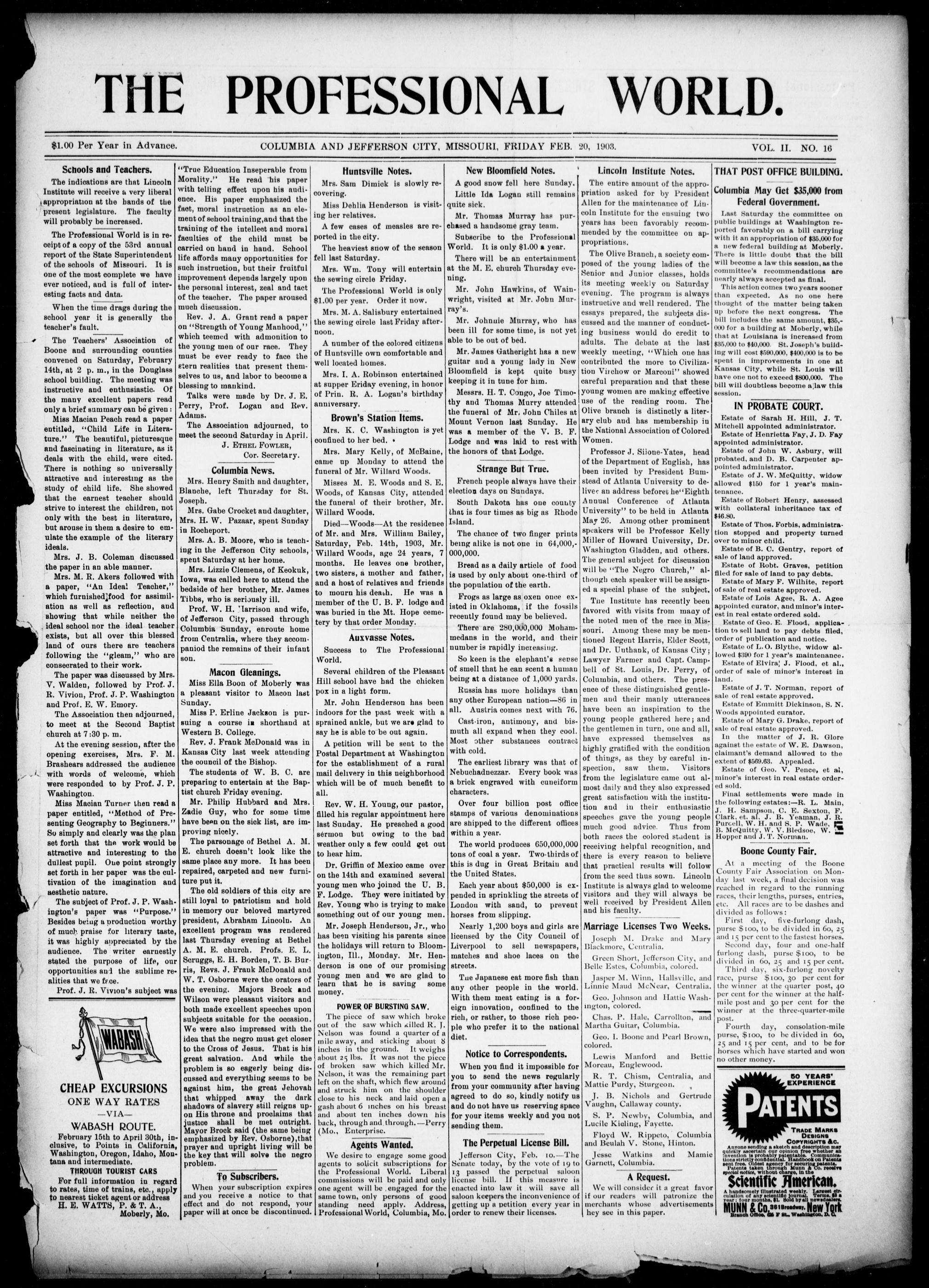
THE PROFESSIONAL WORLD.
$1.00 Per Year in Advance.
Schools and Teachers.
The indications are that Lincoln Institute will receive a very liberal appropriation at the hands of the present legislature. The faculty will probably be increased.
The Professional World is in receipt of a copy of the 53rd annual report of the State Superintendent of the schools of Missouri. It is one of the most complete we have ever noticed, and is full of interesting facts and data.
When the time drags during the school year it is generally the teacher's fault.
The Teachers' Association of Boone and surrounding counties convened on Saturday, February 14th, at 2 p. m., in the Douglass school building. The meeting was instructive and enthusiastic. Of the many excellent papers read only a brief summary can be given:
Miss Macian Peach read a paper entitled, "Child Life in Literature." The beautiful, picturesque and fascinating in literature, as it deals with the child, were cited. There is nothing so universally attractive and interesting as the study of child life. She showed that the earnest teacher should strive to interest the children, not only with the best in literature, but arouse in them a desire to emulate the example of the literary ideals.
Mrs. J. B. Coleman discussed the paper in an able manner.
Mrs. M. R. Akers followed with a paper, "An Ideal Teacher," which furnished food for assimilation as well as reflection, and showing that while neither the ideal school nor the ideal teacher exists, but all over this blessed land of ours there are teachers following the "gleam," who are consecrated to their work.
The paper was discussed by Mrs. V. Walden, followed by Prof. J. R. Vivion, Prof. J. P. Washington and Prof. E. W. Emory.
The Association then adjourned, to meet at the Second Baptist church at 7:30 p. m.
At the evening session, after the opening exercises, Mrs. F. M. Brashears addressed the audience with words of welcome, which were responded to by Prof. J. P. Washington.
Miss Macian Turner then read a paper entitled, "Method of Presenting Geography to Beginners." So simply and clearly was the plan set forth that the work would be attractive and interesting to the dullest pupil. One point strongly set forth in her paper was the cultivation of the imagination and aesthetic nature.
The subject of Prof. J. P. Washington's paper was "Purpose." Besides being a production worthy of much praise for literary taste, it was highly appreciated by the audience. The writer earnestly stated the purpose of life, our opportunities and the sublime realities that we free.
Prof. J. R. Vivion's subject was
WABASH
CHEAP EXCURSIONS
ONE WAY RATES
-VIA-
WABASH ROUTE.
February 15th to April 30th, inclusive, to Points in California, Washington, Oregon, Idaho, Montana and intermediate.
THROUGH TOURIST CARS
For full information in regard to rates, time of trains, etc., apply to nearest ticket agent or address
H. E. WATTS, P. & T. A.,
Mobberly, Mo.
COLUMBIA AND JEFFERSON CITY, MISSOURI, FRIDAY FEB. 20, 1903.
"True Education Inseperable from Morality." He read his paper with telling effect upon his audience. His paper emphasized the fact, moral instruction as an element of school training, and that the training of the intellect and moral faculties of the child must be carried on hand in hand. School life affords many opportunities for such instruction, but their fruitful improvement depends largely upon the personal interest, zeal and tact of the teacher. The paper aroused much discussion.
Rev. J. A. Grant read a paper on "Strength of Young Manhood," which teemed with admonition to the young men of our race. They must be ever ready to face the stern realities that present themselves to us, and labor to become a blessing to mankind.
Talks were made by Dr. J. E. Perry, Prof. Logan and Rev. Adams.
The Association adjourned, to meet the second Saturday in April.
J. ETHEL FOWLER,
Cor. Secretary.
Columbia News.
Mrs. Henry Smith and daughter, Blanche, left Thursday for St. Joseph.
Mrs. Gabe Crocket and daughter, Mrs. H. W. Pazaar, spent Sunday in Rocheport.
Mrs. A. B. Moore, who is teaching in the Jefferson City schools, spent Saturday at her home.
Mrs. Lizzie Clemens, of Keokuk, Iowa, was called here to attend the bedside of her brother, Mr. James Tibbs, who is seriously ill.
Prof. W. H. Harrison and wife, of Jefferson City, passed through Columbia Sunday, enroute home from Centralia, where they accompanied the remains of their infant son.
Macon Gleanings.
Miss Ella Boon of Moberly was a pleasant visitor to Macon last Sunday.
Miss P. Erline Jackson is pursuing a course in shorthand at Western B. College.
Rev. J. Frank McDonald was in Kansas City last week attending the council of the Bishop.
The students of W. B. C. are preparing to entertain at the Baptist church Friday evening.
Mr. Philip Hubbard and Mrs. Zadie Guy, who for some time have been on the sick list, are improving nicely.
The parsonage of Bethel A. M. E. church doesn't look like the same place any more. It has been repaired, carpeted and new furniture put it.
The old soldiers of this city are still loyal to patriotism and hold in memory our beloved martyred president, Abraham Lincoln. An excellent program was rendered last Thursday evening at Bethel A. M. E. church. Profs. E. L. Scruggs, E. H. Borden, T. B. Burris, Revs. J. Frank McDonald and W. T. Osborne were the orators of the evening. Majors Brock and Wilson were pleasant visitors and both made excellent speeches upon subjects suitable for the occasion. We were also impressed with the idea that the negro must get closer to the Cross of Jesus. That is his great salvation. And while the problem is so eagerly being discussed and everything seems to be against him, the great Jehovah that whipped away the dark shadows of slavery still reigns upon His throne and proclaims that justice shall be met outright. Mayor Brock said (the same being emphasized by Rev. Osborne), that prayer and upright living will be the key that will solve the negro problem.
To Subscribers.
When your subscription expires and you receive a notice to that effect and do not respond, your paper will at once be discontinued.
Mrs. Sam Dimick is slowly recovering.
Miss Dehlia Henderson is visiting her relatives.
A few cases of measles are reported in the city.
The heaviest snow of the season fell last Saturday.
Mrs. Wm. Tony will entertain the sewing circle Friday.
The Professional World is only $1.00 per year. Order it now.
Mrs. M. A. Salisbury entertained the sewing circle last Friday afternoon.
A number of the colored citizens of Huntsville own comfortable and well located homes. Mrs. I. A. Robinson entertained at supper Eriday evening, in honor of Prin. R. A. Logan's birthday anniversary.
Brown's Station Items.
Mrs. K. C. Washington is yet confined to her bed.
*
Mrs. Mary Kelly, of McBaine, came up Monday to attend the funeral of Mr. Willard Woods.
*
Misses M. E. Woods and S. E. Woods, of Kansas City, attended the funeral of their brother, Mr. Willard Woods.
Died—Woods—At the residence of Mr. and Mrs. William Bailey, Saturday, Feb. 14th, 1903, Mr. Willard Woods, age 24 years, 7 months. He leaves one brother, two sisters, a mother and father, and a host of relatives and friends to mourn his death. He was a member of the U. B. F. lodge and was buried in the Mt. Hope cemetery by that order Monday.
Auxvasse Notes.
Success to The Professional World.
Several children of the Pleasant Hill school have had the chicken pox in a light form.
Mr. John Henderson has been indoors for the past week with a sprained ankle, but we are glad to say he is able to be out again.
A petition will be sent to the Postal Department at Washington for the establishment of a rural mail delivery in this neighborhood which will be of much benefit to all.
Rev. W. H. Young, our pastor, filled his regular appointment here last Sunday. He preached a good sermon but owing to the bad weather only a few could get out to hear him.
Dr. Griffin of Mexico came over on the 14th and examined several young men who joined the U. B. F. Lodge. They were initiated by Rev. Young who is trying to make something out of our young men.
Mr. Joseph Henderson, Jr., who has been visiting his parents since the holidays will return to Bloomington, Ill., Monday. Mr. Henderson is one of our promising young men and we are glad to learn that he is saving some money.
POWER OF BURSTING SAW.
The piece of saw which broke out of the saw which killed R. J. Nelson was found a quarter of a mile away, and sticking about 8 inches in the ground. It weighs about 25 lbs. It was not the piece of broken saw which killed Mr. Nelson, it was the remaining part left on the shaft, which flew around and struck him on the shoulder close to his neck and laid open a gash about 6 inches on his breast and about ten inches down his back, through and through.—Perry (Mo., Enterprise.
Agents Wanted.
We desire to engage some good agents to solicit subscriptions for the Professional World. Liberal commissions will be paid and only one agent will be engaged for the same town, only persons of good standing need apply. Address, Professional World, Columbia, Mo.
New Bloomfield Notes.
A good snow fell here Sunday.
Little Ida Logan still remains quite sick.
Mr. Thomas Murray has purchased a handsome gray team.
Subscribe to the Professional World. It is only $1.00 a year.
There will be an entertainment at the M. E. church Thursday evening.
Mr. John Hawkins, of Wainwright, visited at Mr. John Murray's.
Mr. Johnnie Murray, who has been ill for some time, is not yet able to be out of bed.
Mr. James Gatheright has a new guitar and a young lady in New Bloomfield is kept quite busy keeping it in tune for him.
Messrs. H. T. Congo, Joe Timothy and Thomas Murry attended the funeral of Mr. John Chiles at Mount Vernon last Sunday. He was a member of the V. B. F. Lodge and was laid to rest with the honors of that Lodge.
Strange But True.
French people always have their election days on Sundays.
South Dakota has one county that is four times as big as Rhode Island.
The chance of two finger prints being alike is not one in 64,000,-000,000.
Bread as a daily article of food is used by only about one-third of the population of the earth.
Frogs as large as oxen once existed in Oklahoma, if the fossils recently found may be believed.
There are 280,000,000 Mohammedans in the world, and their number is rapidly increasing.
So keen is the elephant's sense of smell that he can scent a human being at a distance of 1,000 yards. Russia has more holidays than any other European nation—86 in all. Austria comes next with 76. Cast-iron, antimony, and bismuth all expand when they cool. Most other substances contract with cold. The earliest library was that of Nebuchadnezzar. Every book was a brick engraved with cuneiform characters. Over four billion post office stamps of various denominations are shipped to the different offices within a year.
The world produces 650,000,000 tons of coal a year. Two-thirds of this is dug in Great Britain and the United States.
Each year about $50,000 is expended in sprinkling the streets of London with sand, to prevent horses from slipping.
Nearly 1,200 boys and girls are licensed by the City Council of Liverpool to sell newspapers, matches and shoe laces on the streets.
The Japanese eat more fish than any other people in the world. With them meat eating is a foreign innovation, confined to the rich, or rather, to those rich people who prefer it to the national diet.
Notice to Correspondents.
When you find it impossible for you to send the news regularly from your community after having agreed to do so, kindly notify us and do not have us reserving space for your items weekly and you not sending them.
The Perpetual License Bill.
Jefferson City, Feb. 10.—The Senate today, by the vote of 19 to 13 passed the perpetual saloon license bill. If this measure is enacted into law it will save all saloon keepers the inconvenience of getting up a petition every year in order to renew their licenses.
Lincoln Institute Notes.
The entire amount of the appropriation asked for by President Allen for the maintenance of Lincoln Institute for the ensuing two years has been favorably recommended by the committee on appropriations.
The Olive Branch, a society composed of the young ladies of the Senior and Junior classes, holds its meeting weekly on Saturday evening. The program is always instructive and well rendered. The essays prepared, the subjects discussed and the manner of conducting business would do credit to adults. The debate at the last weekly meeting, "Which one has contributed the more to Civilization Virchow or Marconi" showed careful preparation and that these young women are making effective use of the reading room. The Olive branch is distinctly a literary club and has membership in the National Association of Colored Women.
Professor J. Silone-Yates, head of the Department of English, has been invited by President Bumstead of Atlanta University to deliver an address before he"Eighth Annual Conference of Atlanta University" to be held in Atlanta May 26. Among other prominent speakers will be Professor Kelly Miller of Howard University, Dr. Washington Gladden, and others. The general subject for discussion will be "The Negro Church," although each speaker will be assigned a special phase of the subject.
The Institute has recently been favored with visits from many of the noted men of the race in Missouri. Among these may be mentioned Regent Harris, Elder Scott, and Dr. Uuthank, of Kansas City; Lawyer Farmer and Capt. Campbell of St. Louis, Dr. Perry, of Columbia, and others. The presence of these distinguished gentlemen and their manly utterances have been an inspiration to the young people gathered here; and the gentlemen in turn, one and all, have expressed themselves as highly gratified with the condition of things, as they by careful inspection, saw them. Visitors from the legislature came out almost daily and they also expressed great satisfaction with the institution and in their enthusiastic speeches gave the young people much good advice. Thus from both races the colored student is receiving helpful recognition, and there is every reason to believe that practical results will follow from the seed thus sown. Lincoln Institute is always glad to welcome visitors and they will always be well received by President Allen and his faculty.
Marriage Licenses Two Weeks.
Joseph M. Drake and Mary Blackmore, Centralia.
Green Short, Jefferson City, and Belle Estes, Columbia, colored.
Jasper M. Winn, Hallsville, and Linnie Maud McNear, Centralia.
Geo. Johnson and Hattie Washington, colored.
Chas. P. Hale, Carrollton, and Martha Guitar, Columbia.
Geo. I. Boone and Pearl Brown, colored.
Lewis Manford and Bettie Moreau, Englewood.
R. T. Chism, Centralia, and Mattie Purdy, Sturgeon.
J. B. Nichols and Gertrude Vaughn, Callaway county.
S. P. Newby, Columbia, and Lucile Kieling, Fayette. Floyd W. Rippeto, Columbia and Beulah V. Stone, Hinton. Jesse Watkins and Mamie Garnett, Columbia.
A Request.
We will consider it a great favor if our readers will patronize the merchants whose advertisements hey see in this paper.
VOL. II. NO. 16
THAT POST OFFICE BUILDING.
Columbia May Get $35,000 from Federal Government.
Last Saturday the committee on public buildings at Washington reported favorably on a bill carrying with it an appropriation of $85,000 for a new federal building at Moberly. There is little doubt that the bill will become a law this session, as the committee's recommendations are nearly always accepted as final.
This action comes two years sooner than expected. As no one here thought of the matter being taken up before the next congress. The bill includes the same amount, $35,000 for a building at Moberly, while that at Louisiana is increased from $35,000 to $40,000. St. Joseph's building will cost $590,000, $400,000 is to be spent in improvements in one at Kansas City, while St. Louis will have one not to exceed $800,000. The bill will doubtless become a law this session.
IN PROBATE COURT.
Estate of Sarah H. Hill, J. T. Mitchell appointed administrator.
Estate of Henrietta Fay, J. D. Fay appointed administrator.
Estate of John W. Asbury, will probated, and D. B. Carpenter appointed administrator.
Estate of J. W. McQuitty, widow allowed $150 for 1 year's maintenance.
Estate of Robert Henry, assessed with collateral inheritance tax of $46.80.
Estate of Thos. Forbis, administration stopped and property turned over to minor child.
Estate of B. C. Gentry, report of sale of land approved.
Estate of Robt. Graves, petition filed for sale of land to pay debts.
Estate of Mary F. Wilhite, report of sale of real estate approved.
Estate of Lois Agee, R. A. Agee appointed curator, and minor's interest in real estate ordered sold.
Estate of Geo. E. Flood, application to sell land to pay debts filed, order of publication and notice.
Estate of L. O. Blythe, widow allowed $390 for 1 year's maintenance.
Estate of Elvira', J. Flood, et al., order of sale of minor's interest in land.
Estate of J. T. Norman, report of sale of real estate approved.
Estate of Emmitt Dickinson, S. N. Woods appointed curator.
Estate of Mary G. Drake, report of sale of real estate approved.
In the matter of J. R. Glore against the estate of W. E. Dawson, claimant's demand allowed to the extent of $569.63. Appealed.
Estate of Geo. V. Pence, et al. minor's interest in real estate ordered sold. Final settlements were made in the following estates:—R. L. Main, J. H. Sampson, C. E. Sexton, F. Clark, et. al. J. B. Yeaman, J. R. Purcell, W. H. and S. P. Wade, B. McQuitty, W. V. Bledsoe, W. Hopper and J. T. Norman.
Boone County Fair.
At a meeting of the Boone County Fair Association on Monday last week, a final decision was reached in regard to the running races, their lengths, purses, entries, etc. All races are to be dashes and divided as follows:
First day, five-furlong dash, purse $100, to be divided in 60, 25 and 15 per cent to the fastest horses.
Second day, four and one-half furlong dash, purse $100, to be divided in 60, 25 and 15 per cent.
Third day, six-furlong novelty race, purse $100, 30 per cent for the winner at the quarter post, 40 per cent for the winner at the half-mile post and 30 per cent for the winner at the three-quarter-mile post.
Fourth day, consolation-mile purse, $100, to be divided in 60, 25 and 15 per cent, and to be for horses which have started and won no other money.
50 YEARS' EXPERIENCE
PATENTS
TRADE MARKS DESIGNS
COPYRIGHTS & C.
Anyone sending a sketch and description may quickly ascertain our opinion free; another invention is probably patentable. Communications strictly confidential. Handbook on Patents sent free. Odeat agency for securing patents. Patents taken through Mum & Co. receive special notice, without charge, in the
RUFUS L. LOGAN, B. S. D., Editor.
COLUMBIA. : : : MISSOURL
Matters of Interest Covering Various
Parts of the World and Put
C. D. Peacock, head of the jewelry firm of that name, is dead of pneumonia at Chicago.
Col. Henry H. Bard, 91 years old, died on his farm at Pana, Ill., where he had lived 65 years.
The legislature of Kansas adopted a resolution in favor of electing senators by popular vote.
The British gunboat Barrier has captured in the Red Sea three pirate ships with their entire crews.
The safe in the Milwaukee depot at Wheaton, Minn., was blown open by burglaries and about $30 in cash secured therefrom.
The Nebraska senate has unanimously adopted a joint resolution favoring the election of United States senators by the people.
Dr. Randall Davidson has been enthroned as archbishop of Canterbury in Canterbury cathedral with much stately ceremonial.
The five story building on Lake street, Chicago, occupied by cigar, liquor and chocolate dealers, burned tonight. Loss $50,000.
Lieut. Governor Jones and the legislative delegation of Minnesota, have selected a site for the state building of Minnesota at St. Louis.
The heaviest snow in 14 years fell in Salt Lake City Wednesday. Street car traffic is demoralized and the railroads are having trouble.
A charter has been issued at Harrisburg, Pa., to the Henry Roelofs company of Philadelphia, capital $2,000,000, for the manufacture of hats.
The arguments in the Alexander grave robbing trial have been completed at Indianapolis. The case goes to the jury tomorrow morning.
A blizzard is raging throughout southern and western Wyoming. The stockmen are greatly alarmed for the safety of the herd and flocks.
William Duffy, Nationalist member of parliament, and three others who were imprisoned under the coercion act, have been released at Dublin.
Ansar college burned down at Hutchison, Mich., together with the library and furniture. Two hundred students lost all their belongings.
The report that the signature of J. P. Morgan has been forged on checks for large amounts is confirmed at the Morton Banking house in London.
"Cyclone" Kelly of San Francisco defeated Mike Shreck of Cincinnati at St. Louis in the fourth round of what was scheduled to be a 20-round fight.
Burglaries robbed Grace Episcopal church at Newark, N. J., securing vestments valued at $10,000. They tried to break a safe in which a costly chance is kept, but were unable to open it.
Admiral Dewey has been confined to his home for the past week with a severe cold and cough, and by the advice of his physician he has been compelled to cancel all engagements for the present.
David Plunket of Lexington, Ky., 70 years old, was shot twice in the back and mortally wounded today by Daniel Skinner at Putchinson station. It is reported that the shooting was without cause.
Opticians of North Dakota are in session in Fargo for the purpose of forming an organization. S. B. Millard, Litchfield, ex-president of the Minnesota association, gave an address last evening.
The dead body of Mrs. Ada Geiger was found at her home in Cincinnati, O. The woman had been murdered. Her husband notified the police, and, despite his protestations of innocence, was arrested.
An official cablegram from Guatemala says that Guatemala has not declared war, but that Salvador, Honduras and Nicaragua menace the Guatemala government, which is ready to defend its honor.
The oil-tank steamship Narragansett, the largest vessel of her kind in the world, was launched at Greenock for the Anglo-American Oil company. She can carry 11,000 tons of oil in her tanks. The boat is of 21,000 tons displacement. It is alleged as a result of investigation into the recent attempt to burn the state reformatory at Ogden, Utah, the officials have unearthed a conspiracy among the girl inmates to attack the teachers and authorities of the institution.
The great prevalence of smallpox in the coke region has prompted the officials of the Frick Coke company to issue an order calling for free vaccination of all of their 50,000 employees and their families. The order effects 300,000 persons.
The Evangelical Lutheran synod in session at Furlington, Iowa, elected the following officers: President, Rev. A. Noorbaum, Swedesburg; vice president, Rev. Joseph A. Anderson, Boone, Iowa; secretary, Rev. B. Madin, Bethesda; treasurer, C. O. Nelson, Olds.
The inquest on the remains of Anton Klisersof Sioux Falls. S. D., a jeweler who was found dead Monday morning in his apartments under circumstances which indicated that the case was suicidal, resulted in the discovery that he died from cyanide potassium poisoning, administered by his own hand.
Work on the National University War museum building at Mason City to cost $65,000, will be begun in a few days. Camp No. 100 of Illinois with Col. W. T. Church, Col. Leroy T. Stewart, and D. G. Robertson, has this matter in hand. The building will be donated by the people of Illinois to the National Memorial university.
The estate of Norman Kittson, valued at over $3,000,000, has just been closed in the probate court in St. Paul after fifteen years. The estate was divided equally among the eleven children. Commodor Kittson was an associate of James J. Hill in early enterprise.
CUBAN VETS TO HONOR MAINE
Will Raise a Monument to Commemorate the Victims—About the Isle of Pines.
Havana, Feb. 17.—President Palma will not send the coaling station's agreement to the senate until President Roosevelt has signed it. No delay is expected in completing the treaty covering the sovereignty of the Isle of Pines and incorporating the Platt amendment into a permanent agreement. There is no doubt here that the United States will recognize Cuban sovereignty over the Isle of Pines. Cuban veterans are preparing a bill for presentation to congress providing for erection of a monument in commemoration of victims of the Maine.
TYPHOID RAGES AT CORNELL
Three More Deaths Result—Eight Hundred Students Have Gone to Their Homes.
Ithaca, N. Y., Feb. 17.—Three more deaths from typhoid fever occurred today among students at Cornell university. They were J. O. Whois of Rochester, N. Y.; Henry Schoenborn of Hackensack, N. J., and Charles J. Schlenker of Batavia, N. Y. Eight new cases were reported today. Already eight hundred students have gone to their homes.
COLONEL PRATT IS RETIRED
He Immediately Resigns His Position
As Superintendent of the Carlisle Indian School.
Carlisle, Pa., Feb. 17.—Col. R. B.
Pratt has received official notice from
the war department that he had been
retired as colonel. He at once telegraphed
his resignation as superintendent of the
Carlisle Indian school to take effect
at once. Col. Pratt has been in
charge of the school for about 30
years.
AMERICAN BOWLERS TO SPLIT
There Is Possibility That Three States Will Cecee Unless Next Meet Goes to Milwaukee.
Indianapolis, Feb. 17.—There is a possibility of a split in the American Bowling association. Unless the next tournament goes to Milwaukee, it is probable that the bowlers of Iowa, Wisconsin and Minnesota will seced from the national association and form an interstate league. Northwestern bowlers believe they are entitled to the tournament next year. Chicago and Indianapolis hold the balance of power. Neither has signified which city it will support, whether Milwaukee or Louisville, although it is believed Chicago favors the former.
They Read Trashy Novels
Columbia. Mo. Feb. 18. After being out three days the jury in the case of Allan Oreas, who, with five other boys, is charged with the murder of Edward C. Chapman, station agent at Brown Station, returned a verdict of murder in the second degree and assessed the punishment at ten years in the penitentiary. Oreas was the first of the defendants to be tried, the trials of the other five having been continued until March 24. Chapman was shot and killed on the night of Sept. 28, 1902, and it is alleged that the tragedy was the culmination of a series of persecutions inflicted against him by Oreas and his companions, who called their band the "Bloody Nine," and who were influenced in their action by reading trashy novels.
Veteran Editor Is Ill
Springfield, Ill., Feb. 18—Charles H. Lampier, Sr., is lying critically ill at his home in this city with kidney trouble. Mr. Lampier was from 1846 to 1863 the editor and owner of the Illinois State Register. He was once elected state printer and was printer to the constitutional conventions of 1847 and 1861. He was twice clerk of the circuit court of Sangamon county and alderman of Springfield.
Child Is Declared Legal.
Kansas City, Mo., Feb. 18.—The Appellate court today upheld Mrs. Samuel Kraus, the divorced wife of a wealthy cattleman, who was accused by him of foisting off a foundling as his child to obtain additional alliance. The Krauses were married in 1890, and in 1897 a baby was born. Two years later Mrs. Kraus was granted a divorce and given the custody of the child and a judgment of $400 alimony. Kraus attempted to prove that his wife had secured the baby from a foundling home, in the belief that if they had a child he would treat her with more consideration. The court today sustained Mrs. Kraus' claim that she was the lawful mother of the child.
Firm Manufactures Idols
Philadelphia, Pa., Feb. 18.—Philadelphia ministers and returned missionaries are denouncing the manufacture of Buddhist idols in this city for sale in Coren. Mrs. W. H. Corliss and the Rev. Fredrick pool, missionaries from China, are loud in their disapproval. On the other hand, Bishop Cyrus D. Foss of the Methodist Episcopal church said he did not consider it as bad as the sending of aplum to India by England or the sending of beer to the Phillippines by the United States.
Medals for Finding Comets.
Geneva, N. Y., Feb. 18.—Dr. William R. Brooks, director of Smith observatory and professor of astronomy in Hopart college, has been awarded the Comt medal of the Astronomical Society of the Pacific for the discovery of his twenty-third comet. This is the seventh medal awarded to Dr. Brooks for his metary discoveries by this society. He also has the honor of holding the first medal ever bestowed by the society.
Defense Gains Strong Point
David City, Neb. Feb. 18—The defense in the trial of Mrs. Harvey Lillie, charged with killing her husband, trained a strong point today when judge Good ruled out the testimony of the defendant before the coroner's jury. Mrs. Lillies' story before the coroner's jury was considered weak and would have proven the strongest evidence the state could produce against her.
STRUCK BY A CYCLONE
STEAMER OLIVE IS SENT TO THE BOTTOM.
Seventeen People Perish—Survivors Are Rescued by the Steamer Pitfitt—Are In a Serious Condition—The Crew Was Mostly Colored—Beat Had Been Plying Between North Carolina and Virginia for Years.
Norfolk, Va., Feb. 18.—A cyclone struck the steamer Olive tonight and sent her to the bottom of Chowan river, off Woodley's pier. Seventeen people are known to have been drowned and the others rescued are in a serious condition. The whirlwind when it struck the Olive caused her to go over on her beams end and when she righted it was only to sink on account of the water she had taken. The majority of the passengers and crew were below at the time and had no opportunity to get to the pilot house. This was the only position left above water for in it, standing waist deep from the time of the accident until 6 o'clock in the morning, Captain Geo. H, Withey and five others were saved. No complete list of the dead has been obtained but it is known that the following perished:
JACOB IASOTTER, white; Rick Square, N. C.
MRS. BENNETT AND DAUGHTER,
Franklin, Va.
MRS. VAUGHAN, Franklin, Va.
FRANK HUNTER.
GEORGE BUTT.
W. H. EDWARDS.
ANDREW VAUGHAN, colored; deck-
hand.
ABRAHAM COOPER.
JOHN PRESCOTT, colored; fireman.
ESTHER WILLIAMS, colored; cook.
JOHN COOPER, colored; porter.
GEORGE WHITE, colored; preacher.
The names of the others are unknown.
At 6 o'clock this morning the river
steamer Pittt rescued the almost frozen
survivors, who had been standing in
the water waist deep for several hours.
The Olive was a small steamer that
had been plying between North Carolina
and Virginia for several years. She
left Franklin last evening for Edenton
and had almost reached her destination
when the cyclone struck her.
THE COLD SPELL CONTINUES
Reports From Various Points on the Weather—Rain, Sleet and Snow Does Much Damage.
Bloomington, Ill., Feb. 18. — The weather in central Illinois is moderating. Zero is registered tonight. Snow is again falling heavily.
35 Below in Michigan
Marquette, Mich., Feb. 18.—Intensely cold weather continues in northern Michigan, the thermometer registering from 10 to 35 degrees below zero.
Record in Kansas.
Topeka, Feb. 18. — The cold weather today made a new record for Kansas, the government thermometer registering a new record. The Center a woman was trapped to death.
Collievies Shut Down.
Shenandoah, Pa., Feb. 18.—Operations at the collieries here and at Shamokin have been suspended on account of the heavy snows and severe weather.
Blizzard in St. Louis.
St. Louis, Feb. 18. -Rain, sleet, snow and decidedly colder weather have followed in rapid succession during the past 24 hours, and the temperature is falling rapidly. A heavy fall of snow has given St. Louis and vicinity the worst blizzard in two years. Railroad and street traffic are impeded and telegraph and telephone lines are prostrated.
Serious Ohio Floods.
Cincinnati, Feb. 18.—The rain of the past two days has been followed by sleet and snow. The same conditions are reported throughout the Ohio valley, with serious floods in some localities.
Sleet In Ohio
Columbus, O. Feb. 18.—A severe sleet storm prevailed throughout Ohio yesterday and last night. Wires are down in all directions.
MISSING MAIL POUCH FOUND
Located at Indianapolis and Had Been Shipped from Cincinnati—Contained Fifty Thousand.
Indianapolis, Ind., Feb. 18.—The missing mail pouch, containing checks, money and drafts to the amount of $50,000, and the one which has caused the post office department so much concern has been built in to now safely housed in the office of the superintendent of mails here. The missing pouch arrived here today from Cincinnati at 12:45 o'clock over the Big Four.
How the pouch reached Cincinnati is a question yet to be settled. The mystery has been partly cleared, local officials believe, by the appearance of the pouch. It is not a leather pouch, such as is used in conveying valuable mail. The government is suffering from a shortage of leather pouches, and it recently converted a lot of cloth bags into first class mail pouches. The converted pouches are caught at the neck with leather clasps. The theory is that the pouch, in this instance, lost its destination tag and the mail clerks mistook the pouch to be one containing other empty pouches that were being sent back to the Cincinnati office, where the empty bags are stored. The pouch probably went to the Cincinnati pouch storage room and lay there unopened. It is believed the contents are intact. It will not be opened until tomorrow.
Board of Education Wins.
Detroit, Feb. 18.—Judge Hiser in the Wayne circuit court today, directed a verdict for the plaintiff in the sum of $444,731 in the case of the Dertio board of education against Henry R. Andrews, its former treasurer, and his bondsmen. Andrews was cashier of the wrecked City Savings bank of this city against which the board brought suit. The bondsmen will appeal the case.
SOUTH SWEPT BY A BLIZZARD
Fatalities Result From Wind Storm in South Carolina—Much Damage at Other Points.
Greenwood, S. C., Feb. 17.—A severe windstorm prevailed in this portion of South Carolina today. At Honepath, six men took refuge in W. A. Shirley's brick store. The store was demolished with fatal results. The dead are:
EARL M'GEE.
THOMAS AUSTIN.
The fatally injured are: Donald and Stone. Shirley was seriously hurt.
Five houses were blown down. Several persons are reported missing, and wires are down in numerous localities.
Bad Weather in Kentucky
Louisville, Feb. 17.—Rain, snow and sleet combined in many places with high winds are the prevailing conditions throughout the South tonight. Railroad traffic is delayed, and in a number of cities street railway service is almost at a standstill. Reports from Tennessee, Arkansas, Mississippi, Alabama, northern Texas, Georgia and all parts of Kentucky tell of damage done by a blizzard, of swollen streams and suffering on the part of man and beast and of traffic of all kinds being delayed. In some instances loss of life is reported.
Wind Storm In Georgia
Royston, Ga., Feb. 17.—A furious windstorm passed over the town of Bowman this afternoon, demolishing several houses and killing and injuring a number of persons. Wires are down and further particulars are unobtainable.
Snow In Kansas.
Kansas City, Mo., Feb. 17.—It commenced snowing here about 1:30 Saturday afternoon, and with the exception of a few hours a storm has been raging ever since. The snow is seven inches deep in the city and it is still falling. The thermometer stands at seven degrees above zero tonight. A heavy wind is drifting the snow badly. Reports from all over Kansas, northern Oklahoma and western Missouri show that the storm has been general and that the fall has been on an average about six inches. In Kansas passenger trains are stalled on the various roads and no trains are moving on schedule time. It is the heaviest snowfall of the year. Topeka, Kan., Feb. 17.—Kansas was swept by a blizzard yesterday. The snow is eight inches deep and drifting. Traffic is much delayed. The temperature is at zero and livestock in the West is suffering.
Blizzard In Illinois.
Peoria, Ill., Feb. 17.—A blizzard has been raging for 24 hours. Snow has fallen steadily and the wind has been blowing at a terrific rate. The streets of the city are blockaded with drifts and street car companies are having a hard fight to keep the tracks clear. All trains entering the city are delayed. If the storm continues throughout the night some of the roads will be closed and the loss to farmers will be considerable. The Illinois river is overflowing the lowlands and the outlook for the farmers is gloomy.
Cold In Texas.
Fort Worth, Tex., Feb. 17.—The coldest weather of the winter set in over northern Texas this afternoon and a blizzard is on tonight. The mercury registered in some places as low as 15 above zero and still falling. It has rained, more or less, on 107 days of the last 120 and the ground is soaked. The Trinity river has overflowed its banks below Fort Worth. It has been sheeting and snowing over northern Texas all day.
POWELL IS PUSHING MATTERS
He Insists That the Dominican Government Settle the Cases of the Clyde Line Steamers.
San Domingo, Feb. 16.—The minister for foreign affairs today made public a dispatch received from Secretary Hay announcing that a Dominican envoy to represent Santo Domingo's case at Washington would be received and heard, but pointing out that Minister Powell was entrusted with the task of conducting the concluding negotiations in regard to the claims of American citizens against Santo Domingo. Secretary General Sanchez informed Powell that the pending cases would not be further considered until after the return of the Dominican commissioner from the United States, which the American minister replied that the cases referred to will not admit of any further delay in settlement. He added that he cannot await the return of the he notified the secretary-general that a settlement must be effected within a few days. The determined stand was taken by Powell for the purpose of having the Clyde line and Ross cases settled and surprised the Dominican government. It is believed that the latter must yield.
Tramp Across Continent
Milwaukee, Feb. 17.—M. J. Maglin, an iron worker, formerly president of the Building Trades Council, will, if present intentions are carried out, start next April for a trip through every state in the union on foot. He will take with him as his companion a Manitowoc girl, to whom he will be married in the spring. The trip is the outcome of a wager.
Maglin is working on the Broadway bridge, and said of the proposed trip that as soon as the conditions are settled he will make them known. It is known, however, that the pair are to start without a cent and earn their living en route, returning before two years. If they win $5,000 will be theirs.
Demand Increase in Wages
Colorado Springs, Col., Feb. 17.—A strike of employees of the Standard mill, ordered by the Western Federation of Miners was begun yesterday. The demand is for the increase of all wages now below $3 daily, to unionize the mill and for a check on the alleged blacklisting.
The United States Reduction and Refining company, which owns the Standard, is practically the Cripple Creek mill combine, with headquarters here. The company operates five big mills, treating five and treating two-thirds of Cripple Creek's output. The strike may close all the mills.
5V ceilidhaklonferen
RESULTS OF BIG FIRE
ONE IS CREMATED AND SEVEN
BUILDINGS DESTROYED.
Tarentum, Penn., the Scene of a Big Conflagration — Loss Will Reach Fifty Thousand—Al Turner Dies At Alliance, Neb.—Topeka Jury Brings Charges of Murder—Crime and Accident Of a Day.
Tarentum, Pa., Feb. 16.—One person was cremated, two fatally hurt, two others seriously injured and seven buildings totally destroyed by fire early today. The dead are:
RAY CRAIG, 12 years old.
The injured:
D. J. Craig, will die.
Mrs. D. J. Craig, will recover.
Hope Craig, aged 8; will die.
Sherley Craig, aged 10; may die.
The fire originated in the Craig residence, which stood in the middle of a block of frame houses on Fifth avenue. The flames spread rapidly, and three buildings on either side of the Craig house were destroyed. The Craig family was forced to jump from the second story windows. Loss, $50,000.
Turner Dies at Alliance.
Alliance, Neb., Feb. 14.—A M Turner, who shot and killed E. M Dunlap at Dead, S. D., early this month, then fleeing to this place, where he was followed and shot by a boy named W. H. Silverdollar, died this morning. Silverdollar was arrested, but was released. The Turner's jury brought in a verdict saying Turner died of congestion of the lungs and not from the bullet wound he had received.
Jury Brings Murder Charge
Topeka, Kan., Feb. 16—The coroner's jury in the case of Amos L. Maxwell, who was killed in the Kansas insane asylum yesterday, returned a verdict today charging the attendants, Peterson and Neil, with the murder. The man's chest and ribs were crushed, and the body was disfigured by kicks alleged to have been administered by the attendants.
Forger Is Sentenced.
Des Moines, Iowa, Feb. 16.—J. R. Miller, with many aliases, who secured transportation from the Rock Island, Wabash and Great Western railways on forged checks, was today sentenced to eight years in the penitentiary. Miller is wanted at Sycamore, Ill., on a similar charge.
Shot on Street.
Lebanon, Pa., Feb. 16—Mrs. Ira Baker, aged 22, was shot dead tonight as she was standing on the street with her husband, and in resisting arrest David Schand, charged with the murder, killings, and assaults in jail. Mrs. Baker had testified against Schand at his trial for robbery of Mrs. Baker's steifower.
Train Wrecked Last Night.
Washington, Feb. 16.—Train No. 33, the New York and Florida express of the Southern railway, ran into an open switch at Ravensworth, Va., tonight. Fireman Walter Wigginton, colored, was killed, and Engineer Thomas Purvis is missing. So far as known none of the passengers are seriously injured. It is thought the switch was tampered with for the purpose of wrecking the train. The switch-light and lock wore gone. Auburn station, who ran it, detained at Burke, two times for Ravensworth, and told of the wreck, was detained as a suspect. He seems demented. Only the engine and mail car left the track.
BIG FOUR RULED IN CONTEMPT
Made a Contract to Ship Hay and Failed to Keep the Agreement. Now Must Pay $1,000.
Springfield, Feb. 16.—Judge Humphrey of the United States circuit court today fainted the Big Four $1,000 for contempt. Walter Nichols, the division freight agent of the road at St. Louis, was also fined for contempt. On complaint of the Planters' Express company the Big Four refused to keep the agreement to ship bales of hay for export at ordinary grain rates. Judge Jenkins of the United States circuit court of Chicago issued the order some time ago directing the company to carry the hay at rates which they had agreed to take. It was this order which the road violated.
DECISION IN DIVORCE CASE
Mother Is Given Child in the Famous Ventura Case Long Standing in Des Moines Court.
Des Moines, Feb. 16.—The famous Ventura divorce case was decided finally by Judge McVey in the district court today. Mrs. Ventura-Conrad being given the custody of her child, Lillian, five years ago Mrs. Ventura secured a divorce from Prof. Louis D. Ventura, but he was given the child and took her to California. Mrs. Ventura later married E. A. Conrad of Minneapolis and kidnaped the child. She sought a modification of the divorce decree, the court today deciding in her favor. The case attracted wide attention.
New York Bank Statement
New York, Feb 16.—The bank statement for the week (five days) is as follows: Loans, increased, $11,274,500; deposits, increased, $12,131,000; reserve increased, $16,500; surplus, decreased, $2,016,000. The extra United States deposits, decreased, $3,009,975.
Need More Money for Fund.
Cleveland, O., Feb. 16.—The McKinley National Memorial association has issued a statement to the effect that it has collected more than $500,000 during the first year of its organization. The association announces that it will be necessary to collect something more than $100,000 additional before anything will be done toward building the monument. The trustees have decided to undertake the collection of this additional sum through postoffice and department stores of the country by placing in their hands a supply of souvenir certificates to be given to all contributors of $1 or more.
INTEREST IN HUMBERT CASE
Nationalist Deputies Attempt to Implicate Combes—Defiant Addresses Are Made.
Paris, Feb. 16.—Premier Combes and the minister of justice were accused openly of being implicated in the Humbert affair during the debate in the chamber of deputies today. A scene of great disorder followed, in which the premier retired from the house amid the hissing of nationalists and the applause of his own supporters.
The incident began when Maurice Binder, nationalist, sought to interpellate Minister of Justice Wale on the Humbert affair. The deputy担心 that suspicion had long been directed against the cabinet over which presided that "weather cock Combes."
A scene of great disorder followed this statement, the members of the left demanding the removal of M. Binder. Premier Combes sought to gain recognition, but as M. Binder continued to shout at the top of his voice MM. Combes and Valle and the other ministers retired from the house, the left party applauding and the right party hissing.
The president, M. Bourgeois, then consulted with the chamber, which censured M. Binder. When he attempted to resume his speech the president suspended the sitting. The deputy continued his defiant speech after the session was resumed, but he was finally silenced by the president's threat to cause his removal from the chamber.
AFTER THE TURF COMPANIES
Commission In St. Louis Has Authority to Compel the Attendance of Members Of the Firms.
St. Louis, Feb. 16.—The legislative committees appointed to inquire into the business methods of the St. Louis grain and turf investment companies met in joint session today to examine witnesses. The representatives of all such companies have been requested to appear before the commission, and the sergeant-at-arms has been furnished with papers to compel their attendance.
After a session lasting until late this afternoon the grand jury adjourned until Monday. It is reported that six true bills have been returned, but none have been made public.
The grand jury spent the entire day investigating the Turf company's business. The officers are tonight looking for E. J. Arnold, head of the firm of Arnold and Co.
RENEWAL OF THE FUTURITIES
Kentucky Horse Breeders' Association Has Announced the Conditions for Their Thirteenth.
Lexington, Ky., Feb. 14.—The Kentucky Horse Breeders' association has announced the conditions for the 13th renewal of the Kentucky Futurity. One thousand dollars have been added to the stakes, which for years have been the richest of the trotting turf. The value this year is $22,000 for foals of 1903, divided as follows: Five thousand dollars for two-year-olds that trot at the fall meeting, 1905; $3,000 for three-year-old pacers at the fall meeting, 1905; $14,000 for three-year-olds that trot at the falling meeting in 1906. The association has already distributed among horsemen by means of Kentucky futurities $191,930, and the renewals now on hand which have not yet been raced for swell the total to $289,930.
HARVARD UNIVERSITY WINS
Defeats the University of Pennsylvania and Breaks the Record In Indoor Games.
Boston, Feb. 14.—At the Boston Athletic association's annual indoor track games tonight Harvard defeated the University of Pennsylvania by time of 1:30, breaking the record for 1,560 yards by 1 1-5 seconds. Amherst beat Georgetown in 3:09, breaking the record just made by Harvard.
Caldwell Assault Denied
Columbus, O., Feb. 16.—John Winder- and Dan Hanna arrived this afternoon from Charleston and later proceeded to Cleveland. Winder, when shown the press dispatches about the alleged assault on Representative Caldwell at Charleston this morning, declared the entire story false and that none of his party was connected with it whatever. He said they did not even see Caldwell at Charleston and was not at the banquet Friday night. He denied all knowledge of the alleged assault.
Further Investigations.
New York, Feb. 15.—Three men were arrested here today in their offices on Nassau street at the request of the postoffice inspector. They are charged with the improper use of the mails. Prisoners are: Henry C. Cartwright, alais Crawford; broker of Brooklyn; William Treadwell, alias George F. Stone, broker of Brooklyn, and Charles E. Goodrich, clerk of Manhattan. It is alleged the men are combination workers in "progressive turf speculation," under the firm name of "Crawford & Co., Turf Correspondents and Metropolitan turf commissioners." The arrests followed the receipt by the postoffice authorities of a letter from Mrs. Glirley of Mont Clair, N. J., complaining that she had sent money to the firm for speculation and had received no return or reply in spite of numerous letters.
Honors Go to Detroit Lad
Hartford, Conn., Feb. 16.—The William Thompson Fellowship, for purposes of study abroad, has been awarded by the faculty and trustees of the Hartford Theological seminary to Walter B. Pitkin of Detroit, Mich., a senior at the seminary. He will spend two years in Germany.
Will Erect Statue to Logan.
Carbondale, Ills., Feb 16.—After several years of agitation a movement has been started by the school children to erect a monument to the memory of General John A. Logan, who was born and reared in this country.
MAINE BEAR$ RAMPANT.
Removal of the Bounty on Dead Bruins Results in Too Many Live Ones.
(Bangor, Me., dispatch).—The Maine legislature at its present session will be called upon to decide which is the more important, the life of a human being or that of a bear. The legislature four years ago repealed the law providing for the payment of a bounty of $5 each on bears, because it had been represented that the game was becoming scarce, and that when it came to fun and excitement, any sportsman would rather kill one bear than a dozen deer.
Since the bounty was removed beats have been rapidly increasing, so that people living in remote regions have begun to circulate petitions for the restoration of the bounty. In sections where bears abound sheep raising has been abandoned by many farmers. The bears eat up the flocks, and it is a matter of record that a yoke of 2-year-old steers were recently killed and caten by bears in the town of Wesley. In the town of Byron, it is said, last fall, 27 sheep were thus destroyed.
Some women and children are afraid to go into the back lots to pick berries. Bruin is also hated by orchardists, because he not only steals all the sweet apples, but breaks off limbs as large around as a man's arm. The country people feel that they ought not to suffer all this simply in order that plenty of bears may be raised to turnish sport for visiting sportsmen. They are asking the legislature, accordingly to restore the bounty.
NEW CURE FOR LAME BACK
Rutledge, Minn., Feb. 16th—Mr. E. C. Getchell of this place relates a happy experience which will be read with interest by all those who have a similar trouble.
It appears that last winter Mr. Getchell was seized with a lameness and soreness in his back which grew worse and worse till at last it became very bad and made it very difficult for him to get about at all.
After a time he heard of a new remedy for backache which some of his friends and neighbors said had cured them and he determined to try it. The name of the remedy is Dodd's Kidney Pills and Mr. Getchell has proven that it is a sure cure. He says:
"I used two boxes of Dodd's Kidney Pills according to directions and my lame back was entirely cured and I am all O. K, again. Dodd's Kidney Pills are as good as represented."
This remedy is very popular here and has worked some remarkable cures of Backache and Kidney Trouble.
The Organized Militia.
From the report of Adjt. Gen. Corbin, sent to the Federal house of representatives yesterday, it appears that there are 118,159 organized militiamen in the United States, and that the total number of men in the country available for military duty is 10,853,396. The regular army can be recurred to 100,000 when necessary. The regulars with the organized militia would constitute a disciplined land force of 218,000 ready for immediate duty. Behind this large army is the reserve of nearly 11,000,000 men, many of whom have had some experience in the field. It is estimated that an army of 250,000 regulars, organized militiamen, and others having military training and experience could be placed in the field on short notice. The militia law, enacted a few days ago by Congress, is intended to increase the efficiency of the organized militia, and to bring it into uniformity as far as can be, with the regular army. —Philadelphia Ledger.
DEAFNESS CANNOT BE CURED
by local applications as they cannot reach the diseased portion of the ear. There is only one way to cure deafness, and that is by constitutional remedies. Deafness is caused by an inflamed condition of the ear, and that is by inflammation. When this tube is inflamed you have a rumbling sound or imperfect hearing, and when it is entirely closed Deafness is the result, and unless the inflammation can be taken out and this tube restored to its normal condition, hearing will be destroyed forever; nine cases out of ten are by inflammation which is nothing but an inflamed condition of the mucous services. We will give One Hundred Dollars for any case of Deafness (caused by catarrh) that cannot be cured by Hall's Catarrh Cure. Send for circulars, free. Hall's Family & Co., Toledo, O. Sold by Drummists. 75c. Hall's Family Pills are the best.
Philosophical
"Chills and fever must be a disagreeable disease."
"I dunno, stranger. You see, in the summer we have chills part of the time, and that keeps us cool, and in this weather we have fever part of the time, and that keeps us warm."—Washington Times.
Mothers will find Mrs. Winslow's Soothing Syrup the best remedy to use for their children during the teething period.
CRUMBS FROM KANSAS.
Some women in their party clothes look like Christmas dolls. Those persons you would really like to talk with are always going the other way. This is the situation: If you don't want to know a woman's age she would just as soon tell you, but if she thinks you are curious, she would die first. A number of wronged wives organized a Suffer in Silence club, and the neighbors say that they make as much noise at the meetings as you will hear at a Democratic rally. Speaking of catching a husband: An Atchison woman married her ideal and the woman next, door took what she could get, and was grateful, and the latter woman is the happier.
L. G. Emery, formerly employed in the New Orleans mint, has gone to China to assist in the introduction of modern methods of stamping coins.
CASTORIA
For Infants and Children.
The Kind You Have Always Bought
Bears the
Signature of
FARM NOTES
(Copyright, 1901, by J. S. Trigg, Rockford, Iowa.)
Correspondence Solicited.
Canada's spruce forests will furnish the printing paper for America for years and years to come.
It is much easier to train a well bred horse, dog or boy than a scrub. Good breeding implies superior intelligence.
Women are reclaiming some of the abandoned farms of the Eastern states by converting them into poultry and fruit farms.
The best timothy hay is quoted at $14 per ton in the larger cities this winter, which price and the very large yield of timothy in 1902 make the growing of this crop a profitable business.
Forty-eight smart Indiana girls have started for North Dakota in response to the call of the 500 bachelors who are holding down claims in that state and want wives. This is more sensible than organizing a woman's club.
We hate to see a fine farm homestead disfigured by advertising—some fake medicine or clothing ad. displayed on the roof of the barn or corncrib. Such ads, are a sure sign to fakirs and peddler sharks that a sucker lives there.
Consolidation in the alleged interest of economy of operation can be carried too far, the failure of the Elgin Creamery company, with 8,000 farmer patrons settling at 40 cents on the dollar its 300,000 obligations being an instance. Stick to your home organizations.
That durbar flummiddible business cost the people of India over $5,000,000, and when the next short crop comes, which is about every fifth year, they will be passing the hat—just like some white men who can find money to go to the circus even if they are living on public charity.
Six hundred of the better class of German citizens sat down recently to a banquet, the meat dishes of the menu being wholly horseflesh. It was got up by the Society for the Prevention of Cruelty to Animals, this society wishing to prove that the old horse was better fattened for food than worked to death.
One inducement for the old farmer to retain his home on his farm is the great difference in the rate of taxation which prevails between the country districts and our modern municipalities. The cost of municipal government constantly increases. The tax on an average 20,000 farm is say, $655, while the city tax on the same amount of money and credits would not be far from $300.
The present secretary of agriculture is a pronounced optimist and for that he commands our sincere respect, for optimists do something, see something and stir up the better side of humanity. He sees government irrigation, once a dream now a reality, and the growing of our own sugar to be sold to the consumer at the low price of 2 cents a pound a practical possibility in the near future.
A Northern man who moved to Arkansas five years ago with very limited means writes us extolling the advantages of that country as a home for the poor man. He says that land of good, fair quality can be obtained as low as $5 per acre, that no colored people are to be found in the county, that fruit of all kinds does exceedingly well, that the health of the people is unusually good and that the great need of the South is the incoming of energetic, live Northern farmers to develop its splendid possibilities.
We want to say a word about the morality and patriotism connected with the payment of small obligations. We have found in our experience that it is easier to collect $50 from some people than it is the pitty sum of half a dollar. A man's credit in the community in which he lives is largely determined by the fidelity and promptness with which he meets his small obligations. This applies with special force in the case of men with limited means to whom a creditable financial rating to the extent of their ability is often of the very greatest value.
"Does it pay to put a lightning rod on the barn?" we are asked. Frankly, we do not know. Figures for 1902 show that in a Western state fifty odd barns were struck by lightning and that none of these were rodded. Then there were thousands of barns not rodded which were not struck either. Theoretically if the rod is of the right sort and is properly put up it should form a protection, but when the points glisten on the roof and the earth connection is defective or destroyed it is a standing invitation to Jove to drop a bolt and smite the property of a fool. We have more faith in a good insurance policy than in a lightning rod.
Men make money where it takes ten acres to feed one steer, but it is not a pleasant country to do business in.
The congressmen are sending out their allotment of seeds to their granger constituents. Just the same old farce as ever.
We find that it does not pay to try to fruit the raspberry more than three or four years. It is more profitable to dig the old bushes up and set out new ones.
Poultry farming bids fair to pay better hereafter than ever before, and a pleasant and most profitable business is within easy reach of any enterprising man or woman.
The care of the calf for the first year largely determines its value as a beef animal. It should never be anything else than a miniature beef critter—always full, always fat.
The good milk cow is more than likely to be homely, as is the good brood mare or brood sow. Maternity and beauty of form and appearance do not go together in these cases.
Two cars of lemons en route for the East were caught in a blizzard. One car was got out and run into a roundhouse, where the lemons all froze: the other, left on the track, was buried up in a huge snowdrift, and never a lemon froze.
Everything in the cellar will keep better if the temperature can be kept just above the freezing point. Most cellars are kept too warm and are too poorly ventilated. When potatoes begin to sprout, you may know that your cellar is too warm.
Old pastures can be greatly improved by an early spring disking and the sowing of a little medium clover on them. Blue grass on certain soils often gets hidebound, and nothing is so good for it as to rip it all to pieces. It can't be killed by such treatment, but is always benefited.
Four hundred and fifty bright young men farmers' sons and their kind, attended the two weeks' special course at Ames, Iowa, Agricultural college this winter, stock feeding and judging and corn culture being taught by experienced men. This is the second year this plan has been tried, and it is a great success.
Georgia is fast becoming the great peach state of the union. Peaches pay better than cotton, and as the growing of fruit requires a higher order of intelligence than the growing of fiber the civilization of the state is benefited as well as its pocketbook.
A section of the West famous for many years for its great crops of onions, a crop of 400 or 500 bushels per acre being a common thing forty years ago, now counts a crop of 150 bushels per acre a good one, this fact being in line with the well established truth that no one crop can be produced in large excess in any place and escape the law of deterioration both in quantity and quality of crop.
A friend in Missouri writes us that squirrels do not hoard up a supply of nuts for the winter in any one place, but bury them in the earth here and there, where they are dug out as needed in winter. This is one of nature's cute ways of securing a distribution of seed, the nuts thus scattered being given just the right treatment to insure their germination in the spring, the squirrel not using them all for food.
Rye is not estimated at its true value as a fall and early spring forage crop up in the north country where the snow falls. Sown on the cut cornfield in September, then pastured till snow comes again as soon as it disappears in the spring it pays well even if the remnant is plowed under in May for other crops. Grass seed sown on such a field in March is almost invariably a sure catch. This fall and spring rye pasture is just the thing for the dairy cows.
An Illinois reader wants to get a piece of corn land into pasture as quickly as possible in the spring, and asks how he had better do it. We would put the land in the best possible shape with either disk or plow as soon as the ground was fit to work, sow two bushels of oats, six quarts of timothy and three of clover to the acre, and turn the cows in as soon as the oats were four or five inches high. Along the last of June or as soon as the oats not fed off got headed out I would run a mower over the field, when the timothy and clover would show up and make a good pasture from then on.
Call This Man Down.
A word to the presiding officers of farmers' institutes. Enforce a time limit on the persistent, driving, wandering speaker who is simply stuck on the sound of his own voice. These fellows destroy the interest and strangle the life out of such meetings. Invite something from the many rather than let the time be monopolized by the few, Class meeting institutes are always good ones. Because a man sits still in the audience it is no sign that he does not know and cannot tell something of much interest and value to the audience. The very best things brought out in these meetings are the personal and practical experiences of successful men of the community where such meeting is held.
Living Close to the Soil.
The advanced cost of the products of land is very sharply calling attention to the old truth that the closer a man lives to the soil the better he is off. The tendency has been of late years to get away from the soil, anywhere, any business, as far removed from it as possible. If the needs of the food which the soil produces could have been also gotten rid of it would not have mattered so much, but do what we will the old problem of something to eat is before us all three days a 365 days in the year. When a man entirely cuts loose from the soil, he becomes at once dependent. As an illustration of what we mean we give the bill of fare of a meal, and this particular meal is only a type of many which, on the writer's own table, invited and precipitated a discussion on this line. The flour of which the bread was composed, the coffee and the condiments were not produced on the farm or in the garden, but everything else on the table was—meat, butter, eggs, all the vegetables, fruits, pickles—a list of choice food products which, had they been bought, would represent a large slice of a good salary each year. Then the absolute wholesomeness and purity of such food produced at home count for a little—the heaping panful of strawberries just fresh from the garden, the fresh laid eggs, the Jersey cream—a pitcherful. When a man has to buy these things, only the few can afford such liberally. Then, better than all, is the daily consciousness of being able to do it yourself, the feeling of independence realized, and the resulting development of all the better side of one-nature in the doing of it. The typical American home of the coming years will be one where all this may be done, where man will still retain his God ordained connection with the soil, to his benefit both mentally, morally and physically.
Johann Singer
HIS FACE WAS FAMILIAR.
Treasury Agent Was Sure He Had Seen It, and Was Right.
"A couple of weeks ago," said a treasury agent, "I had as a seat mate at the dinner table on a Fall River boat a man whose countenance was bafflingly familiar to me, and yet I could not place him by any effort of memory-cudgelling. He was a man of fifty or so, with a very bald head, and a very thick, grayish mustache. We fell into conversation, as travelers will, during the progress of the dinner, but nothing that he let fall in his talk gave me the slightest clew as to his identity. Still I was absolutely positive that I had often and often seen his lineaments before, but just where I couldn't, for the life of me, imagine.
"We strolled to the smoking-room together and lit our cigars and went on with our travelers' talk. He was a polished and entertaining man, but his conversation was of such a general character that I was still quite unable to place him, I believe that my replies to him must have been absent-minded and vague I was so busily engaged in trying to figure out who he was. I ransacked the cavities of my memory in the attempt to fetch before my mental vision the faces of statesmen and politicians and men of affairs, but none of them fitted. After about half an hour of this sort of thing in the smoking-room, I could bear the uncertainty as to my companion's identity no longer. "Sir," I said to him, "I ask your indulgence if I seem unduly curious but I hate to believe that my memory is trifling with me at this comparatively early stage of my years. Your countenance is so perfectly and entirely familiar to me that it seems simply absurd that I cannot place you, and yet I cannot. Pardon me, if I ask to be en-lightened."
"Don't mention it," was the amiable reply of my companion, "Not to be familiar with my features would be to argue that you had been living in a cave for a good many years."
"Then he stopped, smiled, leaned over in his chair, and took a look at my shoes, much to my mystification.
"I perceive, he went on, still smiling, as he leaned back from his critical examination of my foot-covering, 'that you do not wear my brand, but, nevertheless, I can assure you that for years past I have manufactured the best three-and-a-half shoe—"
"It was not necessary for him to proceed any further. I identified him in a flash."—Washington Post.
HOW THE CONDUCTOR SAW IT.
Man with Three Hundred Sponges in a Bag Got on the Car After All.
"Hi, there, but you can't get on this car with that bundle!" called a Fulton avenue car conductor to a man with a bundle almost as large as a bale of hay.
"But it's raining," protested the man.
"I know that!"
"And it's been raining for two days."
"Yes, and it'll probably rain all day tomorrow as well, but that's got nothing to do with that bundle."
"But it has, you see. I've got 300 dry sponges here, and I'll sop most of the wet as we go along!"
The conductor was struck by the original idea and helped the bundle aboard—Brooklyn Citizen.
Thirty Years to Build a Clock
There is at the present time on exhibition in New York a wonderful astronomical clock, the result of thirty years' work of the inventor, the late Christian Gebhard of Baden, Germany. One clock consists of 15,000 parts, and dissects the orbite and mechanical movements, all of which are propelled by one weight.
In the center of the clock are ten dials, showing the time in ten great cities of the world—Washington, London, Paris, Berlin, etc. The clock has four different time systems—mean time solar or sun time, side-real or star time, and dismal time. Mean time is the universally accepted system of the world. Twelve o'clock today falls on the same second day as it did yesterday, but solar or sun time is irregular, losing and gaining during the year as much as 35 minutes, and for that reason no timepieces are regulated by it. Star time advances daily on mean time three minutes fifty-six and a half seconds daily, and as each day is that much longer than mean time, the year calculated by that system has always 366 days complete. The decimal time is a new idea used at present in several cities of France. By this there are 100 seconds to the minute, 100 minutes to the hour, and 20 hours to the day. A. m. and p. m. are thus entirely dropped, as the dial reads from one to 20.
ABSOLUTE SECURITY.
Genuine Carter's Little Liver Pills.
Must Bear Signature of
Aunt Wood
See Fac-Simile Wrapper Below.
Very small and as easy to take as sugar.
CARTER'S LITTLE LIVER PILLS.
FOR HEADACHE.
FOR DIZZINESS.
FOR BILIOUSNESS.
FOR TORPID LIVER.
FOR CONSTIPATION.
FOR SALLOW SKIN.
FOR THE COMPLEXION
Price
25 Cents
Furry Vegetable
CURE SICK HEADACHE.
Crescent Fence
We design our supporting
NOTHING SO GOOD FOR CHICKENS AS THE PRUSSIAN POULTRY
Makes Hens Lay and keeps them laying. Cures Chelsora, Roup and all diseases. It Strengthens Young Chicks and Helps them Grow. WOlfe is not be without Prussian Foultry Food. WOlfe would be it without Prussian Foultry Food. Prussian Foultry Food has no oil in it. Payno, Palmy, Palmville Ohio.
BELGIAN HAIR GROWER
Cures Dandruff and itchy scalp, stops
falling hair, and grows hair on Bald
Heads. Write for particulars.
Belgian Skin and Scalp Soap for
shampooing makes the hair healthy
and fluffy. Send by mail prepaid 25c.
THE BELGIAN GROWER
THE BELGIAN DRUG CO,
Dexter Bldg. Chicago.
A PICTURE OF HEALTH Do you wish to look like one?
There is a preparation made that will transform weak and sickly persons into veritable pictures of health. The preparation is known under the name of TONOCAPS. It is manufactured in the TONOCAPS city of Galesburg by Chemist Oscar D. Thorellus his Prescription Drug store on the northwest corner of Main and Seminary streets. Sent postpaid on receipt of 50c in stamps or money order. For further information, see address Oscar D. TONOCAPS etc., address Chemist Galesburg UU
102
THE ORIGINAL
WATERPROOF
OILED CLOTHING
TOWER'S
FISH BRAND
Made in black or yellow for all kinds
of wet work. On sale everywhere.
Look for the Sign of the Fish and
the name TOWER on the buttons.
A J TOWER CO. DOTTON MASS, U.S.A.
TOWEL CANADIAN CO. LTD. TORONTO, CAN.
a lady of the haunt (a patient): "As you ladies will use 0 bm. I recommend 'GOURAUD' CREAM as the least harmful of the Skin Fungus. I just use the U. S. Quinquies and Fancy-Goods Delivers in the U. S., Canada and Europe. Ferd. T. Hopk's, Prop. 37, Great Jones St. N, Y
The Perry Fountain Pen
has genuine merit in every particular. The barrel is made of the finest burnished or chased hard para rubber, the feed is very simple yet unsurpassed in its qualifications to do just what is intended. It is fitted with a 14 karat gold pen with iridium point.
Every Pen is Guaranteed to Give Satisfaction...
and is carefully inspected before being sent out. The pens are fitted with fine, medium, coarse and stub points to suit the purchaser. It
Is a First-Class Pen
and will prove a pleasure to the user as it always has a uniform flow of ink and will write without jerking or jarring or ruffling the feelings of the user.
To induce you to become one of our customers we will send you a Sample Pen, complete with box and filler for only $1.00
25 and 50c Pkg.
PURIFIES
AS WELL AS
Beautifies th. Skin
No other cosmetic
will do.
Removes Tan, Pimples,
Patches,
diseases.
The best all around fence on the market.
Made with either twisted cables or single heavy parallel wires.
Write today for catalogue etc.
LY CO. IOWA CITY,
IOWA.
OOD!
Do You Want to Buy a Farm?
Do You Want to Buy a Farm?
240 Acres
Located one mile from a good town of about 1,300 inhabitants. Large eight-room house, lathed and plastered; good cave; well and cistern at the house. Two good barns, one 55x70, built about 12 years ago, painted and in good repair; the other barn is 0x84x, for hay and cattle, built two years ago, also painted and in good reconditioning. In good condition, carriage house. The farm is fenced and cross-fenced, feed yards fenced with woven wire and gates are on hinges. Good steel tanks in all feed yards, water supplied from wells by windmill. The land lays well, just rolling enough to drain without washing ditches. The land is in a high state of cultivation, having been for grazing purposes for the last 15 years. It is raised on a raised, raised thoroughbred cattle and hogs. A large part of the place is fenced hog-tight and it is all in tame grass at present except about 40 acres which was in corn last summer. There are about 200 tons of hay on the place now. The farm has carried, this year, 100 head of cattle. No timber or wood on the farm. Duty of fruit This is owned on the basis in the county Cass县 and Cass county is one of the best counties in Missouri. Remember this farm is only about 50 miles from Kansas City, a good railroad town of about 1,200 inhabitants and a school house located less than one mile from the dwelling. If this farm was located in Iowa or Illinois it would sell for over $100 per acre. It can be rented to a school or a farm. Purchaser can secure a loan of $7,000 if desired, for five years at 6 per cent annual interest, with option to pay $100 or any multiple thereof any interest pay day, $2,000 cash and balance March 1st, 1903.
320 Acres
Near Clarence, Shelby county, Missouri.
Well improved, good house and barns,
fenced and cross-fenced. Good grain and
stock farm. Price $25 per acre.
260 Acres
Near Clinton, Henry county, Missouri.
Good house, large barn; farm fenced into
five different fields; soil rich and productive;
no waste land; 80 acres pasture, 60
acres meadow and balance under plow.
Price $4 per acre.
120 Acres
Four miles from Deepwater, Henry county, Missouri. This farm is well improved and nearly all nice land. Good house of five rooms, small barn. Forty acres second bottom land in cultivation, about 40 acres in pasture, some timber and balance in meadow. Price $37.50 per acre.
480 Acres
Near Clearfield. Taylor county, Iowa. This farm is well improved—one of the best in the county. Price $80 per acre if taken soon.
80 Acres
Near Conway, Taylor county, Iowa. Pasture land, about half in timber, no buildings, fenced. Price $35 per acre. A large list of farms in northeast part of the county at from $45 to $90 per acre. Write for list.
Near Lenox, Taylor county, Iowa.
Splendid land, but cheap buildings. Price
$00 per acre. Eighty near by at $55 and
another 80 at $00 per acre.
560 Acres
Near railroad town and about ten miles from county seat of Clarke county, Iowa. Two hundred acres mice level land, balanced with acreage of farmland. Improvements worth over $5,000. The farm is fenced into several fields and pastures. Abundance of water, which is pumped by windmills into tanks in every field on the land, is used for irrigation. Church three miles. Price $4 per acre.
240 Acres
Located within two miles of a railroad town, and five miles from Bueuer, the county seat of Bates county, Missouri, five miles to and church. The land mileage and level level of cross-fenced; good wells and springs, fine orchard and all kinds of fruit; 150 acres in cultivation and balance good tame grass, Good house of five rooms, large barn and building s, all in good repair. This is a very desirable farm. Price $40 per acre.
340 Acres
Near Garnett, the county seat of Anderson county, Kansas. All bottom land except about 30 acres where buildings are located. Creek and timber on land. The bottom is all cleared and no better land than the 30 acres timothy and clover meadow, 15 acres in the clover plowed up last fall and put in wheat; also 30 acres adjoining in wheat, making 60 acres now in wheat, which in fine condition. The improvements are good. House 20x23 with 20 ft. studding, wing 18x36 with 14 ft. studding; two large purchases, good clister and pouch in good coat. Horse insured for $2,500. Big horse barn, tool house, chicken house, hog pens, 25 with shingle roofs. Large hay barn with sheds on each side, equipped with carriers and room for machinery. Spring runs into a trough breast-high for stock, located between house and barns; water also runs through trough for cooling water etc. There is a tenant house of six rooms, barn and sheds. The alfaifa will pasture two head of cattle eight months each year. Price $50 per acre. For further information address C. O. HALL, Agent, Creston, Iowa.
CENTRAL N. U. 51-03
RUFUS L. LOGAN, B. S. D. - EDITOR
Advertising Rates on Application. Job Work of all Kinds Solicited.
Published Every Friday.
Entered at the postoffice at Colum-
umbia, Mo., as second class matter,
Jan. 15, 1902.
Agents wanted in every town in the
state.
PRESS OF THE MISSOURI STATESMAN
ROOSEVELT AND THE SENATE
Last week the United States Senate Committee on commerce decided to report adversely on the confirmation of Dr. Crum who has been appointed by the President as colector for the port of Charles to S. C., over the protest of the prejudiced whites of the south and two republicans are responsible for the committee's action as the committee is republican by two majority but two republican senators.
Voting with the democrats does mean, however, that Dr. Crum will not be confirmed or that President Roosevelt's party is not with him in his present dealing with the race problem. The Globe-Democrat has the following to say on the subject:
"Of course, the President's position is that he believes Dr. Crum is fit for the office to which he is nominated, and as there is no legal or moral barrier against his attainment of the post, the nomination must stand until the senate, by a full and fair vote rejects it. The President acknowledges his responsibility for the nomination. He will force the senate—the republican members of it as well as the democrats—to shoulder the responsibility of defeating the nomination, if it is to be defeated. This is the way the matter stands. Moreover, as the President seems to have made plain to some of the republican dodgers, the postponement of a decisive vote by the senate will not settle the question. If the term ends without action by the senate, the appointment will be made during the recess, and Dr. Crum will serve in the office until next December, at least, unless congress should be called in extra session and the senate should reject the nomination. The thing for the senators to do, therefore, is to bring the matter to a vote just as soon as possible, so as to settle it. Shuffling, evasion and dodging will not bring the incident to an end."
REMEMBER the Professional World is only $1.00 per year and contains all the latest news.
OUR thanks are due the following named persons for subscriptions recently: Mrs. Mary B. Strawn and Miss Rosa Agin, of Columbia.
THE Jim Crow bill was sent to engrossment by the house last Tuesday still there is little hopes for the passage of the bill by the present legislature.
It is gratifying to us to announce that the Professional World is becoming better established and getting on a more substantial basis each month of its life and that our subscription list is constantly increasing.
A COMPULSORY education law would no doubt be an excellent thing for Missouri, especially among the negro schools. It seems ridiculous that after providing for free schools the state of Missouri should find it necessary to compel its inhabitants to take advantage of these opportunities, yet, it is nevertheless a fact.
Do You Want a Cut?
If so send us your photo and $2 and we will furnish you a cut, guaranteed for twenty years and also return your photo.
CAPITAL REMOVAL FIASCO. The capital removal agony which last week distressingly disturbed the repose and business of the people of Jefferson City is over and we hope will forever remain a memory only. Excruciating as it was, the fiasco though for the time being painful to endure or contemplate has its compensations in the moral and civic reforms which it seems to have accomplished and the comfortable reassurance to the people of Jefferson City that that place most probably will forever remain the capitol of the State. To make this, however, doubly sure the people of the city will see to it that the Sunday closing of saloons, every day and night closing of gambling dens, and respect for the Christian sabbath are permanently established and law and order enforced by the municipal authorities.
It now seems assured that the capital removal resolutions introduced by Representative Charles J. Colden, of Nodaway, originated in fun. But Mr. Colden soon found he was playing with fire, and afforded another illustration of the moral of the fable of the boys and frogs in which while throwing stones was sport for the boys it was death to the frogs.
On Monday last Mr. Colden's resolutions were expunged from the record by a vote of 55 to 16, and the beautiful buildings now rest more securely and peacefully than ever upon the solid-rock eminence which they have graced for more than half a century. So mote it be!
Free Passesto Public Men.
To pass or not to pass is now a legislature-troubling problem in several states. In Utah the senate has passed a bill by 13 to 5 prohibiting the payment of mileage to state officials and legislators who ride on free passes. There were those who favored making pass-using unlawful, but the consensus of opinion appeared to be that it was better business to let the railway furnish the transportation and make the officials relinquish the double perquisite of mileage. Judges and other public officers defended both the pass and the mileage fee, on the ground that 10 cents a mile was only about right for traveling expenses, aside from transportation; and propositions, such as to increase salaries and prohibit passes or to make a limited allowance for traveling expenses found little favor. The senate hesitated over the problem what to do, supposing the official passholder had to make part of his traveling by other conveyance than the railway, but settled it by an amendment allowing mileage for portions of distances traveled, provided the officials paid fare for those portions. —Globe-Democrat.
THE SCHOOL TEACHER.
"It doesn't require much knowledge to teach a country school," says the Hutchinson News. "All the requirements necessary for a country school teacher is to be a primary, inintermediate and high school teacher combined. She must be able to rustle her own kindling wood, build her own fires, adjust the fallen stove pipes, put in window panes that the boys break, mend the broken desk, love the dull, unruly pupils as well as she does the bright, obedient scholar, or at least give no evidences of a different condition of affairs. She must be able to drive a horse, spank the unruly kids, keep the big boys from making love to her, keep out of neighborhood rows, and keep on the good side of all the people in the district. She must understand the school laws, and be able to interpret them to the school board. She must raise money for the school library, keep all kinds of records, plant trees on arbor day, be of an irreproachable moral character, and pass an examination in all the branches of modern education—in which half the college graduates ten years examination would flunk and in which an applicant for a $2,500 a year government position would fall. For all these varied accomplishments and for all this labor the school teacher receives the magnificent salary of $25 to $60 a month and finds herself until some one takes pity on her and finds her. Out of this sum she is expected to blow in a part of it each year in attending the county normal to fit herself more thoroughly for the earning of the magnificent salary.
Notice!
We go to press on Thursdays. All matter for publication must reach us by that day to insure publication. No old news will be published.
Notice.
Rev. J. B. Parsons of the Second Christian church is on the sick list at present and will not be able to meet his congregation until the 4th Sunday in this month.
The word Style has various significations. As used however in this paper it refers primarily and chiefly to mode of expressing thought in language whether oral or written, especially—to adopt the definition of the lexicons—such use of language in the expression of thought as exhibits the spirit and faculty of an artist in expression; chosen arrangement of words in discourse. Or, according to Chesterfield, "Style is the dress of thoughts," or according to Swift "proper words in proper places make the true definition of Style." It is derived from the Latin word "stilus," a style or writing instrument; manner of writing or mode of expression.
The general outline or contour of the human face in all nations and ages has been the same. Yet there are lines and lineaments and facial expressions in the countless millions of human beings that enable the beholder to distinguish one person from another. Although alike they present the marvelous paradox of not being alike or precisely the same.
In like manner and for like reasons, the Style of speakers and writers, although in many respects similar or even alike are distinguishable from each other by artists in expression. They are susceptible of subdivisions, analyses and classifications.
Having neither space nor purpose to trace even in outline all the phases of the subject which invite statement and discussion., we must be content with a single classification of Style, namely, Fact and Fancy, by which is meant that the Style of many writers and speakers of our own and former generations may be classified as belonging to one or the other of these subdivisions.
Fact is logical and argumentative, and is addressed to the judgment. Fancy is sentimental, rhetorical, air-built castle, "such stuff as dreams are made of" and is addressed to the emotions or sense of the beautiful in art or nature rather than to the powers of reason or analysis. Fact draws daggers from real scabbards. Fancy from air. Fact is history. Fancy is fiction. Fact is a veritable event. Fancy is an idealism. The one instructs, guides and determines the judgment. The other entertains, delights and enchants. This is its function and mission.
Primarily it is not a teacher, but a musician, a word and picture painter who is often clothed in red plush, and deems it no offence to leave the reader or hearer no wiser, no better provided with knowledge for the battles of life and the problems of practical business or official duty. Fact is actual history teaching by example. Fancy teaches in hyperbole, often in unnatural and impossible positions and circumstances. Fact is fact, to be relied upon in forming correct judgments of men and things, issues of daily life, and the multiplied and intricate questions which concern the duty and destiny of churches, states and nations. Fancy, or the fancy in style of writing or speaking is highly, suberbly, emotional and rhetorical, luxuriant in flouces and furbelows and in airy and beautiful nothings.
Devotees of this style dwell in fragrant gardens of orchids and not of carnation roses or lillies of the valley which are too common and too well known to the masses of men. Usually they are prolix, verbose, wordy, and can easily fill a column with a single idea. They are skilled chemists who by the processes of electro plating are able to thinly spread a small bit of gold over space the size of a ten acre field
Coldest of the Year.
The coldest day of the season in Columbia was Wednesday, Feb. 18, when at 7 o'clock a. m. the government thermometer registered 15 degrees below zero. The cold wave has been general, Tuesday the thermometer standing at 42 degrees below zero at Williston N. D. and as far south as Mobile Ala., the temperature went down to 22 above zero. In the Florida orange belt fear is entertained for safety of the trees. Telegraph and telphone wires have been snapped by the cold while railroad communication is delayed by snow and cold.
A crowd of citizens at Charleston, Mo., unable to buy coal from the railroad proceeded to break into the company's yards and confiscated a carload. It was all carefully weighed as it was distributed among the most needy and the railroad company will be paid in full.
In many sections of Missouri and Illinois the roads are so impassable because of snow and ice that the rural mail carriers did not start out on their routes. In other places where they did they were obliged to return.
The Railroads.
WABASH
| | A. M. No. 36 | A. M. No. 38 | P. M. No. 40. |
| :--- | :--- | :--- | :--- |
| **Leave:** | | | |
| McBaine... | 6:30 | 11:53 | 4:08 |
| Webster... | 6:33 | 11:85 | 4:08 |
| Brushwood | 6:38 | 12:02 | 4:13 |
| Turner... | 6:42 | 12:06 | 4:17 |
| Limerick... | 6:47 | 12:11 | 4:22 |
| Arrive Columbia... | 6:55 | 12:19 | 4:30 |
# TRAINS SOUTH.
| | A. M. No. 35 St. Louis Express | P. M. No. 37 Texas Express | P. M. No. 39 |
| :--- | :--- | :--- | :--- |
| **Leave** | | | |
| Columbia... | 11:00 | 3:10 | 6:30 |
| Limerick... | 11:08 | 3:18 | 6:38 |
| Turner... | 11:12 | 3:22 | 6:42 |
| Brushwood | 11:17 | 3:27 | 6:42 |
| Webster... | 11:22 | 3:32 | 6:52 |
| Arrive McBaine... | 11:25 | 3:35 | 6:52 |
Lodge and Church Directory.
Mrs. Ada Douglass, W. P.; Mrs. Lizzie Williams, W. S. Meeting first Monday in each month at 3 p. m.
U. B. F.
Crispus Attucks Lodge, No. 62. Meetings 2nd and 4th Tuesdays in each month. Visiting members cordially invited. Caleb Hall, W. M. A. M. Schweich, W. S.
K. P.
Acme Lodge, No. 24. Meetings second and fourth Fridays in each month. W. H. Turner, C. C. and D. D. G. C. W. W. Lampkins, M. F.
O. E. S.
Amos Chapter, No. 30. Meetings second Friday in each month. Mrs. Bessie Washington, W. M. Mrs. Lizzie Richardson, W. S.
LADIES COURT.
Golden Queen Court No. 19 meets first Friday in each month. Mrs. Annie Williams M. A. M. Mrs. V. L. Waldon Sec.
ST. PAUL LODGE, NO. 12.
St. Paul Lodge, No. 12, A.
F. & A. M., meets every first and third Tuesday in each month. A cordial invitation extended to all visiting brothers. J. A. Mosely, W.
M. J. A. Grant, Secretary.
Rev. J. B. Parsons, pastor.
Preaching Sundays 11 a. m.
and 7:30 p. m.
Prayer meeting Wednesday
days 7:30 p. m.
Everybody cordially invi
ed to attend.
K. OF P.
Harrison Lodge No. 12,
Huntsville, Mo. Meeting the
second and fourth Thursdays
in each month. M. W. Tony,
C. C., W. T. Ansel, K. R. S.,
I. A. Robinson, M. E.
A. M. E. CHURCH.
Rev. P. C. Crews, Pastor.
Preaching Sundays 11 a.
m.; 7:30 p. m.
Sunday school 2:30 p. m.
Prayer meeting every
Wednesday eve, at 8:30; every
body invited to attend.
M. E. CHURCH
Rev. J. Arlington Grant. pastor.
Preaching Sundays 11, a. m. and 7:30 p. m. Sunday school, 9:30 a. m. Prayer meeting Wednesdays 7:30 to 8:30; all are made welcome.
Rev. A. A. Adams, Pastor.
Preaching Sundays 11 a.
m., and 7:30 p. m.
Sunday school at 2:30 p. m.
Prayer meeting Wednesday
evening, 7:30.
A cordial invitation extended to all.
All Kinds of Fresh Lunch Goods. $ \textcircled{8} $ Wood and Coal. Prompt and Careful Attention Given to all Orders. Telephone 580.
with us. The only difference between our 'suits' and the made-to-order suits is imagination. As to fit, we allow you to be judge and jury- Try us and be convinced. Your money back on any unsatisfactory article. We are bound to make a customer of you if low prices will do it.
Lartonoix & Walendorf,
....For School Books and Supplies.... Fine Stationery, Musical Goods,
No. 222 East High St. - Jefferson City, Mo.
The Columbia Gro=cery Co.,
Keeps constantly on hand a fresh supply of staple and FANCY GROCERIES.
YOUR PRODUCE WANTED.
210 E. High St.
GO TO
Lartor
...For So
Fine Station
No. 222 East
The
Ke
a fr
FANG
YOUR
Read T
NE
NE
$1.00 a
DR. D. W. OULP
Jefferson City, Mo.
Will A fine, fashionable s OTH
very difference between us is imagination. As ury- Try us and be y unsatisfactory arti er of you if low prices be
e Merc ompan
oix & Wal
ool Books and ry,
Will Always
fine, fashionable stock of
WITHING
My difference between our suits and the
is imagination. As to fit, we allow you
try- Try us and be convinced. Your
unsatisfactory article. We are bound
of you if low prices will do it.
The Mercantile
Company.
Jefferson City, Mo.
oix & Walendorf,
Book Books and Supplies....
y, Musical Goods,
Magazines, Etc.
High St. - Jeffe
Columbia
Grocery Co
ops constantly on
fish supply of staple
Y GROC
PRODUCE W
e Profession
AT
WSY
WSPA
wear Sent to An
twentieth Centur
Columbia Gro-
very Co.,
has constantly on hand
with supply of staple and
GROCERIES.
PRODUCE WANTED.
The Professional World
AT
WSY
NWSPAPER
Year Sent to Any Address.
Twentieth Century Negro Literatur
Twentieth Century Negro Literature
WHITMAN
ONE HUNDRED OF AMERICA'S GREATEST NEGROES
and Edited by DR. D. W. CULP.
This book contains One Hundred Treaties on Thirty-Eight
General Topics in which the negro problem is viewed from every possible standpoint. No work could more fully represent the higher stratum of negro citizenship. It will furnish the basic of future calculations on all
This book contains One Hundred General Topics in which the negro is represented. So book could more grotto citizenship. It will furnish to us subjects. There are 100 PORTRAITS AND the writers. To see the pictures at prominent negroes is to have a fair large page and retails at 90.5 GENTS. great book. I will agents' magnificent sample site for our proposition at once. J. L. NICHOLS & C
This book contains One Hundred Treaties on Thirty-Emeral Topics in which the negro problem is viewed from every standpoint. No work could more fully represent the higher strata of citizenship. It will narrise the basis of future calculations and subjects. There are
100 PORTRAITS AND 100 BIOGRAPHIES the writers. To see the pictures and read the lives of the hundred ment negroes is to have a fair knowledge of the entire race. large pages and details at $2.50 in cloth, postpaid.
GENTS! great book. Highest commissions paid. Book it. Agents' magnificent sample book for $3e. to pay mailing expense for our proposition at once. This is the opportunity of your
J. L. NICHOLS & CO., Naperville, Illinois.
100 PORTRAITS AND 100 BIOGRAPHIES of the writers. To see the pictures and read the lives of the hundred most prominent migrants is to have a fair knowledge of the entires race. Over 100,000 migrants have been identified as AGENTS. We want 5,000 canvassers at once to introduce this credit. Agents magnificent book for 300 to pay mailing expense. Write for our proposition at once. This is the opportunity of your life.