The Professional World
Friday, April 17, 1903
Columbia, Missouri
Page text (machine-generated)
THE PROFESSIONAL WORLD.
$1.00 Per Year in Advance.
Columbia News.
Mr. William Homesly left Tuesday for Kansas City.
Miss Mattie Harris, of Centralia, spent Easter in Columbia.
Mr. George Overton, of Fulton, spent Sunday in Columbia.
Mrs. Alice Yeager and Miss Minnie Harris are on the sick list.
Easter programs were rendered at the different churches last Sunday.
Mr. Leonard Smith, of Rocheport, spent Saturday and Sunday in the city.
Mrs. A. A. Adams left Monday for an extended visit with her mother in Fulton.
Miss L. B. Muse, who has been teaching school at Poplar Bluff, returned home Monday.
The A. M. E. Church will have their quarterly meeting Sunday. Rev. Bryant will be with them.
Miss Ella N. Brown, who has been teaching school near Jefferson City, has returned home.
Mr. Hugh Wallace, of Lincoln Institute, spent Sunday and Monday with Dr. and Mrs. J. E. Perry.
Dr. and Mrs. J. E. Perry entertained a few friends last Monday evening, in honor of Mr. Hugh Wallace.
"Big Jim" Parker, the man who knocked down the assassinator of President McKinley, will lecture at the Second Baptist Church next Monday evening. Everyone should attend.
Do You Want a Cut?
If so send us your photo and $2 and we will furnish you a cut, guaranteed for twenty years and so return your photo.
Huntsville Notes.
Mr. Robert Watts, of Kewanee, Ills., is visiting in the city.
Subscribe for the Professional World. It is only $1.00 per year.
Quite a number from here spent Easter in Kansas City, last Sunday.
The closing exercises of Lincoln school will be held at Semple's opera house, Saturday evening, April 25th. A very neat program is being prepared.
The Sunday school children under the direction of Miss Logan Jackson, rendered quite an interesting program at the A. M. E. Church last Sunday evening.
Wanted For Our File.
A few copies of the Professional World, dated Feb. 13th, 1903. Any person having a copy of this date, will do us a favor by sending us the same.
Capital News.
Mrs. Mattie Alston, of St. Louis, is in the city.
Prof. J. S. Harris was in the city last week.
Get the Professional World for $1.00 per year.
Rev. A. Coleman, of Lebanon, Mo., is in the city.
Prof. J. W. Damel went to Kansas City last Friday.
Mrs. Minerva Johnson has been very ill but is better now.
Prof. Reed, of the D. and D. Institute at Fulton, spent Easter in the city.
Dr. G. H. Schaffer, of Topeka.
CASH OR CREDIT. Catalogue FREE. CENTURY MF'G CO.
COLUMBIA AND JEFFERSON CITY, MISSOURI, FRIDAY APRIL 17, 1903.
Kansas, passed through the city last Tuesday.
Mr. J. B. Parker, who gained fame by stiking down the man who assassinated Pres. McKinley, will lecture at the Second Baptist church Saturday evening April 18.
Miss Hallie Q. Brown, of Philadelphia, will give a recital at the Second Baptist Church Friday evening, April 24. Miss Brown is a noted elocutionist and comes well recommended.
Brown Station Notes.
Subscribe to the Professional World.
If you want to know the latest news read the Professional World.
Deacon A. Jackson was the guest of Mr. and Mrs. John Flynn, Sunday.
The farmers, with their utensils all ready, are just waiting on fair weather.
Merchant Mrs. M. F. Jackson is progressing nicely. She has an eagle eye for business.
Mr. James Persinger, of Columbia, was visiting his sister, Mrs. Mary Jackson Sunday.
Miss Cornelia Coates, who has been an exile for the past five months, returned home Sunday. Mr. and Mrs. A. Jackson were happily surprised Monday morning by the arrival of their daughter, Miss Sara, who is attending college at Macon. She will soon complete her course there. She returned to school Wednesday.
Salisbury Notes.
Miss Pearlie Harvey is on the sick list.
Pay your subscription to the Professional World.
Miss Mae Belle Minor left Sunday for Kansas City.
Mrs. Ella Harvey has been seriously ill but is better now.
School having closed, Prof. W. L. Smith has returned to his home to spend the summer.
Schools and Teachers.
The Centralia schools closed April 18th.
The term of school at Lineoln should shorten so as to close not later than the first of June of each year. Many of the students who attend there are forced to rely wholly on themselves for support while in school and have less than ten weeks to make preparations for the entire school year, whereas if the school should be closed by June 1st, fully three months would be given them, besides nothing is gained by continuing the school 'till the middle of June as many of the students leave before commencement, being forced to do so for the above mentioned reasons.
Ex-president Cleveland seems to have become very much interested of late in the education of the negro. He is said to have asked a young colored man who won a prize for an essay to permit him to read it. He will preside at a public meeting to be held at Madison Square garden concert hall, on Tuesday evening, April 14, under the auspices of the Armstrong association, for the benefit of the Tuskegee normal and industrial institute, Tuskegee, Ala. Other speakers will be Dr. Lyman Abbott, Edgar Garner Murphy, William H. Baldwin, Jr., and Booker T. Washington. The Hampton singers will attend.
It will pay you
to send for our Catalogue No. 6, quoting prices on Buggies,
prices on Buggies,
Harness, etc. We sell direct from
our Factory to Consumers at
Factory Prices. This guaranteed
Buggy only $33.50; Cash or Easy
Monthly Payments. We trust
honest people located in all parts
of the world.
Write for Free Catalogue.
MENTION THIS PAPER.
DEP'T 910. East St. Louis, Ill.
NEW MAYOR'S INAUGURAL.
While he is Republican, the Administration Will be Nonpartisan, Says Mr. Niedermeyer.
Last Saturday night was held the first session of the new city council, in which there are four new faces, and over which a new Mayor presides. The new members of council are Jas. W. Schwabe, J. W. Stone, Stanley Smith, and F. P. Miller. The holdovers are Messrs. Crouch, Benton, Lewis and Gray. When council convened Saturday evening, Mayor Niedermeyer after having taken the oath of office, delivered a brief inaugural, outlining his policy. He said:
"Gentlemen of the Council, it gives me pleasure to preside as Mayor over such an intelligent body of representative citizens. I deem it an honor that any man might well be proud of to be elected Mayor of our queenly little city. While personally I am a Republican in politics, I realize and hope that I am sensible to the fact that I was elected to this position by people of both parties, and I shall act in my appointments and rulings strictly as a non-partisan. I hope to be able to so conduct myself as Mayor that I will have the hearthy co-operation and assistance, not only of every member of this Council, but every public spirited citizen as well.
"I wish to say to you as men who have the interest of the whole people of Columbia at heart, that I will at all times be glad to have you approach me on every one of the important questions that are now before us for solution, to the end that we may counsel together for the good of all. Of one thung, gentlemen, I can assure you, it is my ambition to serve you faithfully and fairly, treating all of you as gentlemen, showing special privileges and favors to none; and at the end of my official term, if I can retire conscious that I have done my duty to the whole people, I shall be satisfied."
The former clerk, Jno. S. Bicknell was re-elected to his office. Mr. Crouch was chosen vice-chairman. Brief talks were made by the new members. Mr. Schwabe, of, the first ward, declaring that he is for the city's interests regardless of partisan politics. It was decided before adjournment to defer the appointing of committees till next meeting April 21, except the street committee, which the Mayor announced as follows: Messrs. Benton, Stone, Miller, and Lewis.
County Teacher's Association.
The Boone County association of colored teachers held their last meeting of this school year on Saturday, April 11.
The meeting on a whole was inspiring and contained much valuable information for the wise teacher who is ever seeking for new methods and new ways of controlling and training the children under his or her charge.
Ways and methods were suggested that not only lighten the teacher's labor, but at the same time preserves the health, gives added strength and value to the labors of the school room.
After the usual opening exercises and reading of the minutes, Mrs. Walden read an excellent paper on "The Relation of Teacher and Pupil," which showed deep thought and careful preparation on the part of the writer. One thought beautifully shown was the love that should be manifested by the teacher for the pupil, and that love most conscientiously shown towards those who need it most; taking as one finds it developing all that is true and best in it.
Mrs. J. B. Coleman followed with a paper on "Music in the public schools." This paper was one of the best on the program, being interesting, full of practical thought, and highly appreciated by the audience.
The writer showed the need of encouraging music in the school as a moral aid, and referred to the ethical value of music as a school exercise, as it not only calms.
soothes and cheers, but inspires hope, courage and purpose.
Mrs. M. R. Akers led the discussion with some well chosen remarks, followed by Prof. J. H. Coleman.
A paper, "An Ideal Teacher," was next read by Miss Mary Richardson. This theme, though old, has never been exhausted, as was shown by the writer, who presented many instructive ideas.
The wise teacher will not only attain a thorough knowledge of subjects to be taught, the best modern methods, but will love the work of teaching and possess an absolute fondness for it.
This subject was opened for discussion by Prof. J. P. Washington, who urged the teachers to become not weary in well doing but press forward and so approximate our ideals. He imparted to the teachers new zeal and courage.
Prof. Washington possesses rare ability as an orator and always entertains as well as instructs. The association then adjourned to meet at the A. M. E. church at 8:30 p.m.
The evening session was very interesting.
Rev. J. B. Parsons delivered an able address on "The Teacher in the World's Work." The subject was handled in a masterly way, nobly setting forth the idea that the teacher being an important factor should be measured by the standard of the mind.
The teacher should not have only sufficient knowledge but a scholarly mind. Books, courses of study, though important, are not the main factors but the teacher himself.
Miss Ella Brown gave a brief talk upon "Supplementary Reading in Public Schools," relating the benefit derived from such a course of reading, which should have its place on every daily program. She urged a careful selection of the books with regard to literary value, and also with reference to the present needs of the pupil and the work they are expected to do in the grades.
Miss J. Ethel Fowler next read a paper upon "Morals and Manners." The writer here showed not only a deep love for the beautiful in "Morals and Manners," but also the skill, judgment and taste to present them in so interesting a manner that they with elegance and grace charmed and instructed all.
This subject was discussed by Prof. E. W. Emory in a way that was especially deserving, and the audience was made to feel by his earnestness the vast importance of this subject. Dr. J. E. Perry had chosen the subject, "Hygiene of the School-room," which is one that deserves wide and earnest attention. The views presented by the writer demonstrated clearly this subject to be the most important science of the school-room, as the physical and moral development depend upon "Hygiene of the School-room." The subject was considered from the points, diet, exercise, seating and ventilation.
One thought emphasized was that one should possess a correct knowledge of the subject and not simply follow rules. Many practical suggestions were given that each should carry home and become benefitted by practising the same. A general discussion followed this paper.
Miss Lula Peach next entertained the audience by a recitation entitled "The Disturbance in the Church Choir," which was well rendered. Miss Peach has an easy, natural grace in speaking which readily holds the attention and wins the applause of the audience.
The last paper on program was read by Prof. J. H. Coleman of Moberly, Mo. His subject, "Hints on Teaching," was all full of most cheering thoughts, touching every interest of the teacher's work in a manner delightful, charming and convincing. His was a most scholarly production and well suited to crown the very successful day's work of the Boone county teachers. Dr. Jackson then delivered an address which, though brief, was encouraging and should be wisely considered by those in the teaching profession. The meeting then adjourned to meet at the call of the president some time after school opens next fall.
RAILROAD MEN HERE.
Will Expect the Farmers to Give Right of Way for Electric Road.
Hon. Geo. B. Harrison of Glasgow, president of the Missouri Central Electric railway; and G. McLaughlin of Boston, an expert, representing eastern capitalists, drove through the country from Harrisburg and Fayette last Friday and spent the day in Columbia, going on to Fulton in company with W. B. Cauthorn, the engineer. The object of the trip was to obtain all the information possible concerning the country, its people and its products, minerals, grain, stock, etc. Mr. McLaughlin is enthused with the prospects for good business, and can not make other than a favorable report to his employers in the east who expect to finance the new road as soon as the right-of-way is obtained.
Mr. McLaughlin said that electric railways are now meeting with such favor in sections where their operations are best known, and hence most appreciated, that the farmers are not only giving the right-of-way through their farms, but are actually giving the roads a bonus besides as an inducement to build.
He regarded it as very, very strange that any Boone county farmer should refuse to gladly give the right-of-way to an enterprise that would be of such incalculable benefit to the county and state.
Mr. Harrison says that every farmer who desires one will have the privilege of putting in a switch so that he can load cars with grain, stock, ect., right on his own premises.
Isn't that the kind of a railroad that will do to tie to and one that deserves the right-of-way through any farm it traverses in Boone county? Will the people along the proposed line of the electric road realize these advantages before it is too late and not permit this golden opportunity of a lifetime to pass them by forever? The building of the Missouri Central Electric railway all depends on the securing of the right-of-way. Just as soon as that is obtained the financial backing will be forthcoming and work will be begun on the road at once. At least this is the earnest declaration of the promoters of the enterprise, and we believe they are correct.
Notes About the World's Fair.
The Navy Department will detail the Marine band to participate in the dedication ceremonies at the World's Fair, St. Louis, April 30.
Word has been received from E. C. Green, World's Fair Commissioner to South Africa, that Rhodesia has accepted the invitation to participate in the World's Fair, St. Louis, 1904.
One of the features of the great military parade at the World's Fair, St. Louis, on dedication day, April 30, will be the battery of mountain artillery whose guns are carried in four sections on the backs of as many Missouri mules.
Information has been received by Col. J. A. Ockerson, chief of the department of Liberal Arts at the World's Fair, St. Louis, that engineering exhibits from the Argentine Republic have been shipped to the Argentine Consul General at New York City and will be forwarded to St. Louis. Oklahoma will be represented at the dedicatory exercises at the World's Fair, St. Louis. A special train will bring commissioners, Governor and Staff, full regimental staff, military band, a battalion of militia, and many distinguished citizens and guests, making five hundred persons in all.
Another competitor for the $900,000 prize offered in the aerial tournament at the World's Fair, St. Louis, has been announced. Bradford McGregor, of Covington, Ky., a designer and mechanical expert, has built a model of an airship which he says will be a success. He claims he will travel through the air from Covington to St. Louis to show that his plan of aerial navigation is correct.
VOL. II. NO. 24
Big Orchards in Boone.
The fine orchard of D. A. Robnett just east of town, containing 145 acres and something over 10,000 trees, is now in bloom and presents a most beautiful scene. If blossoms count for anything there will be a magnificent crop of apples this fall. The Robnett orchard is famous among fruit men for quantity of fine fruit, and its owner is president of the state horticultural society which is doing more than any other agency to further the small fruit industry in Missouri.
Prof. J. C. Whitten, of the horticultural department of the University, began this week the planting of an orchard of 240 acres near McBaine. The land he recently purchased was a well known river farm lying along the Katy road, and containing several small orchards. Mr. Whitten will put out several hundred peach and pear trees, this spring; and several thousand apple trees. He has faith in the soil of that section to produce as fine fruit as can be grown in this great state, which is now the greatest apple state in the Union. The hill farms along the river will grow the finest quality of grapes and small fruit, and should this kind of farming become popular in Boone county, we would soon lead the state in these matters.
Butter by Absorption.
When Charles M. Taylor, of Philadelphia, spilled his cream pitcher on his lunch table, over two years ago, he muttered something under his breath, but the peculiar actions of that cream on his tablecloth aroused his curiosity and set him to making experiments. The result is an invention for making butter by absorption without the aid of a churn or physical labor. When he wants butter now he takes a tin pan, puts in some absorbent cloth and a piece of blotting paper, pours in a quart of cream and puts the whole in the refrigerator over night.
In the morning he opens the refrigerator and finds over a pound of pure fresh butter ready for his breakfast table.
The advantages which Mr. Taylor claims for his invention are: No expensive outfit required; about fourteen ounces of butter can be made from one quart of cream; little labor; nature does the churning; can be made in quantities as wanted for table or commercial purposes; absolutely free from adulteration; greater percentage of butter made from cream than by churning; sanitary purity for invalidis; apparatus can be shipped at minimum cost, owing to light weight.—Indianapolis New.
WABASH
CHEAP EXCURSIONS ONE WAY RATES
VIA
WABASH ROUTE.
February 15th to April 30th, inclusive, to Points in California, Washington, Oregon, Idaho, Montana and intermediate.
THROUGH TOURIST CARS
For full information in regard to rates, time of trains, etc., apply to nearest ticket agent or address
H. W. WESTERN AVE.
Suits.....
—made to your—
...Measure
From $10.00, Up.
—By the—
COLUMBIA TAILORING CO.,
16, 9th st.,
COLUMBIA. . . MO.
RUFUS L. LOGAN, Editor
LITTLE LOLITA ARMOUR.
She Will Know Her Fate on the 17th of This Month—Dr. Lorenz is to Return.
Chicago, April 15.—The breaking of a plaster cast will tell whether little Lolita Armour is to be a cripple for life or perfect and sound in body. Her parents, Mr. and Mrs. J. Ogden Armour, are spending anxious hours, for on the 17th of April the question will be solved.
On that date Dr. Lorenz, the famous Vienna surgeon who came to this country especially to treat the little heiless to millions, will return to this country and break with his own hands the cast that he so tenderly wove about the little cripple's limb.
Surgeons who have become interested in the case, and who have studied Dr. Lorenz's method of bone-setting, are convinced that the patient little victim is cured, and that the breaking of the cast is simply the last act in the beautiful child's misfortune.
"I expect Dr. Lorenz on the 17th of this month," said Mr. Armour last night. "At first we intended to take little Lolita to Vienna, but business matters interfered. I have arranged with the doctor to come to this country again and complete the operation he so splendidly began. I have confidence that our little one will soon be well."
Lolita Armour was operated on several months ago by Dr. Lorenz for congenital dislocation of the hip. The results of the operation were, and are still, being watched by the medical men of the world. It was a most difficult operation, and the little patient stood it bravely. The results will be known in a few days, and the medical world is expectant.
BLUE FOR LIPTON.
Costly New Challenger Makes Poor Showing So Far.
Weymouth, April 15.—A fifteen mile run to leeward and beat home, giving a leeward and windward test of thirty miles under conditions as similar as possible to those expectable during the races for the America's cup off Sandy Hook, was the course set for the two Shamrocks today. The breeze was very light, not over five knots. The starting times were:
Shamrock I, 10:00:55.
Shamrock III, 10:01:00.
Shamrock III. 160.
In the reach across the mouth of the bay to get clear water for a straight run down the wind, Shamrock I led by nearly half a minute.
Shamrock III was about five minutes ahead of Shamrock I at the end of the leeward run.
Shamrock III won by seventeen minutes.
Although Shamrock II won over Shamrock I in three trials over a windward and leeward course of seven miles each way Wednesday, the results were apparently not entirely satisfactory to the men who had the designing of the new America cup challenger. In the first bout the old boat walked away from the new one in a spinnaker run, although it was slightly favored by shifting winds. The challenger won in all the windward tests of the day, but the showing as a whole did not fill the spectators with confidence, judging from their remarks. The bad fit of the challenger's mainsail was noticeable. It bagged so much that the gaff sagged to leeward, and it had already been hauled out to the end of the boom. The sail apparently must be recut.
Designer George L. Watson said he certainly did not like the challenger's performance on first run to leeward but the after performances he thought made ample amends.Its windwad work is already up to his best expectations, he said, and he looked for further improvement.
Silmaker Ratsey fenced the questions of the interviewer, but admitted that the challenger's performances were a tale of a different kind to that written by Shamrock II.
SWIFT WILL
Chicago, (Special).—Out of an estate of $12,200,000 disposed of by the will of Gustavus F. Swift, which was fled for probate yesterday, $250,000 is set aside to be distributed by the widow to charities. The remainder of the estate is given to the members of the family and the relatives of the testator. Final distribution is not to be made for ten years.
According to the petition which accompanied the will $12,000,000 of the estate is personal property. Louis F. Swift and Edward F. Swift, sons, and Edward Tilden are made trustees under the will, and to them is left in trust, for distribution under the provisions of the testament, all the personal property. The hearing was set for May 2.
What direction the proposed charities are to take has not been announced, further than that the provision of the will relating to them declares that Mrs. Swift is fully cognizant of the wishes of her husband in the matter and will carry them out at her discretion. Members of the family and the attorneys for the estate declared yesterday that Mrs. Swift had not taken them into her confidence in regard to the matter.
SCOTS MAKE SCENE.
Edinburg, Scotland, April 15. At a meeting here yesterday called to make preparations for the visit of King Edward to Scotland, a curious incident occurred. Several of the local Scottish officials refused to have anything to do with the king until he dropped the title of Edward VII. The objectors protested that the title was an insult to Scotland. They added that, judging from the addresses he received at Lisbon, even the king himself seemed to realize that he was only King of England. Considerable uproar prevailed, but the meeting ultimately refused to listen any further to the malcontents.
DECISION ON THE HILL MERGER CASE
DEVELOPING NEW PHASES DAILY
THE NEW JERSEY LAW
Means that No Power Granted By the State Shall Set at Defiance National Statutes
St. Paul, (Special)—The United States circuit court of appeals today handed down a decision in the suit of the United States against the Northern Pacific and Great Northern railway companies, but allowing the return of such stock as had been delivered to the holding company. The opinion is unanimous and in effect says that the Securities Company acquired the stock of Northern Pacific and Great Northern in virtue of a combination among the defendants in restraint of trade and commerce among the several states such as the anti-trust act denounces as illegal.
The opinion declares that under the admissions of the defendants, the Securities Company acquired control of the Burlington, Northern Pacific, and Great Northern interests, parallel and completing lines, and holds that the scheme thus consummated led inevitably to the following results: Control of the two roads in the hands of a single person; destroyed every more company competed in these two roads engaged in inter-state traffic, which were natural competitors for business, by pooling the earnings of the two roads for the common benefit of the stockholders of both companies and "According to the familiar
Washington, D. C., April 16.—Grave charges were filed yesterday against George W. Beavers, former superintendent of the salary and allowance division. They are that Mr. Beavers was the salaried representative of the Postal Clerks' association and used his official position to lobby for increased appropriations for the clerks. Beavers had the good will of many senators and representatives and it is charged he never missed an opportunity to urge upon them the necessity for increased allowances to the clerks and providing higher salaries. It is an indisputable fact that congress has largely increased the appropriations for clerks. These appropriations were made in aump sum and apportioned by Beavers.
The Postal Clerks' association is one of the most powerful in the country. It comprises practically every postal clerk from ocean to ocean, and the members of the organization number many thousands. It is also charged Beavers opposed proposed legislation increasing the pay of the letter carriers. The latter association has had representatives in Washington for a number of years and has, it is asserted, expended thousands of dollars in an endeavor to secure legislation favorable to its members. During the last session of congress the postmaster general directed its representatives to cease their efforts to secure the enactment of legislation providing for increased pay for carriers. The Letter Carriers' association has never been able to accomplish its aims, but it is a matter of record the clerks have received several increases. Whether this is due to the influence of Beavers is a matter which is now being investigated by Assistant Postmaster General Brisbow.
Ever since the investigation into the postoffice scandals began the friends and followers of the leaders of the ring have been loudly asserting that so soon as Postmaster General Payne returned to the city he would make it evident that the investigation was being pushed by malicious subordinates to points not intended to reach. Because he was the executive officer of the national Republican committee, it was asserted that the postmaster general would at once haul off the detectives to avoid a political scandal. He returned yesterday from Cuba and after a consultation with First Assist-
SPAIN'S SUB-MARINE NAVY.
Warship Reina Christiana Raised in Manila Bay—She Was Sunk by
Dewey on a Memorable Occasion:
Manila, April 13.—The warship Reina Christina, the flagship of Admiral Montojo, which was sunk by Dewey in Manila iay was floated by teacher yesteryear skeletons of about 80 of her crew were found in the hulk. There were 15 shell holes in the hull of the Reina Christina, and the main injection valve was missing, showing the ship was scuttled when Montojo abandoned her. The hull was in fair condition.
rule that every one is presumed to intend what is a necessary consequence of his own actions when done willfully and deliberately, we must conclude that those who convinced and executed the plan aforesaid intended, among other things, to accomplish these objects." The court discusses the meaning of the world "Trust" in the anti-trust act and says congress was careful or declare that a combination, if in restraint of interstate trade or commerce, or if it directly occasioned or affected such restraint, should be deemed illegal. The words "in restraint of commerce," don't mean "in unreasonable or partial restraint of trade, but any direct restraint thereof." The court further says that any agreement between competing roads requiring them to act in concert in fixing the rate for the carriage of passengers or freight over their respective lines from one state to another, is in direct restraint of commerce within the meaning of the anti-trust act. Congress has the power, the decision says, under the constitution to regulate commerce and to say that no contract or combination shall be legal which restrains interstate commerce by shutting off the operations of the general law of competition. The organization of the Securities Company, is held as an "accomplished act, which congress has denounced as illegal more effectually than by other methods."
Concerning the New Jersey charter the court says the question to be determined is whether the charter granted by the state can be used to defeat the will of the national legislature as expressed in the law relating to interstate trade, over which congress has absolute control, and after quoting the New Jersey law says the law means that no powers granted by the state shall be exercised to set at defiance and United States statutes. The contention that the existing combination is in violation of the anti-trust act and that the act unduly restricts the right of the individual to make a contract and is invalid, is declared to be entitled to little consideration.
New York, April 9.—Upon receipt of the news of the decision at St. Paul, Northern Securities stock broke from 105½; to 102.
New York, April 9.—The Northern Securities case will be appealed.
Washington. April 9: The interstate commerce commission today made the Northwestern, Burlington, Great Western, St. Paul, Wabash, and Rock Island railways, respondent in proceedings involving the legality of their local rates on grain and grain products, and issued an order requiring the roads to file an answer by May 1st.
art Wynne and Fourth Assistant Bristow, the two men who have been pushing the investigation so vigorously, the postmaster general issued a formal statement which has great significance. He assumes entire responsibility for the investigation and the guilty men in the department have been startled at the open declaration from Mr. Payne that political expediency would shield no one. In the course of his statement, Postmaster General Payne said: "During the months of January and February information and reports reached me which I deemed it for the public interest to investigate, and I personally gathered such information and facts as would enable the proper officers of the department to undertake a thorough investigation as to the truth or falsity of these reports.
"I directed Fourth Assistant Postmaster General Bristow to take the proper steps to institute the necessary inquiry, using for that purpose the postoffice inspectors of the division and such other methods as would thoroughly ascertain the truth or falsity of the charges or insinuations made, and he was instructed to proceed promptly and with vigor during my absence.
"Since my return this morning I have not seen General Bristow, so that I am not advised of the progress made. The investigation will continue, and if any wrongdoing is disclosed the parties guilty of such wrongdoing will be summarily dealt with. If the system or method of doing business in the department is faulty, proper remedies will be applied without fear or favor.
"I inaugurated the investigation with the determination that it should be exhaustive. It is proper for me to add that I laid before the president the information which I had in my possession and that he fully approved the action proposed by me."
NEW TARGET RECORDS.
Pensacola, Fla., April 15.—World's records are being smashed here with with frequency by the ships of the North Atlantic fleet. The Illinois lowered all records for accuracy with 18-inch guns, and today the Iowa took the record with six-pounder. The vessel was firing the guns of this size in the gulf this afternoon when the gunners fired thirty shots in succession, each falling true at a range of 100 yards.
Slump in the Stock.
New York, April 13.—The shares of the Northern Securities company today broke to 97, a decline of $5% points from last Thursday's quotations, which caused weakness all through the active stock list. A number of standard railway shares, including Pennsylvania and New York Central, made new low records for the present movements. Common report attributed the severe break to heavy selling by the Western clique and prominent local operators.
HILL'S BIG BOATS.
He Says They Will Practically Revolutionize Pacific Trade.
New London, Conn. April 15.—"They will revolutionize the carrying trade of the Pacific." The words are James J. Hill's—he was talking of the desy of the two great steamships building for the Great Northern railroad's Pacific line here in the yards of the Eastern Shipbuilding Company. Well might Mr. Hill make the prediction for these ships—the first of which, named the Minnesota, will be launched Thursday, April 16, at 12:30 p. m.—are the largest ships in every way in the world with the single exception of the recently completed Atlantic liner the Cedric, and the latter craft exceeds the Minnesota in displacement by only 870 tons. Some idea of the immense proportions of the Minnesota, is possible by comparison with the Cedric. The measurements are as follows:
Minnesota, Cedric
Length over all feet..... 630 700
Breadth, feet..... 73 75
Moulded depth, ft., inch..... 59 44
Draught, ft. and inches..... 33 33
Displacement, tons..... 37,000 37,870
Horse power..... 12,000 16,000
Speed, knots..... 14 16
But it is in carrying capacity that the Minnesota will exceed any vessel afloat, a capacity equal to that of half a dozen steamers of common size on the Pacific.
Forty-five cargo winches will feed its maw through as many hatches as the Cedric contains. The Minnesota can carry 400 head of cattle, 5,000 tons of coal and 8,000 tons of water. An entire locomotive can be shipped, ready to run out on some oriental railway; 1,500 passengers can be accommodated—150 first class, 150 second class 200 third class and 1,000 steerage—besides a crew of three hundred. Turned into an army transport, the Minnesota could carry ten full regiments and guns from an eight-inch down
The accommodations prepared for both passengers and freight are extended to the smallest details. All the staterooms of the Minnesota are on the outside and perfectly ventilated. The air will be thoroughly cooled in summer and heated in winter. The furnishings on the part of the boat occupied by passengers will rank with those of fast Atlantic passenger ships. Twenty-five miles of electric wiring will furnish all the power used except that of the main engines. Refrigerating machinery will make it possible to deliver fruit in Japan and Hong kong in the condition it was in when it was shipped. The cost of the ship when completed will be $2,500,000.
A COSTLY WINNING.
Chicago Contractor Spends $5,000 to
Contribute a $20, Ret
Chicago, April 15—When Joseph Downey, contractor and member of the board of education, reached his office yesterday morning after an absence of nearly four months he figured out that he had spent the better part of $5,000 to win a $20 bet made with Charles W. Gindela last December. To win the wager Mr. Downey traveled 14,000 miles and lost his opportunity to vote at the recent election. The $20 was paid him yesterday.
This unique wager was the outcome of a discussion which arose between the two gentlemen as to which had seen the greater part of the world. Mr. Downey admitted that his ambition was to visit China, and that he would do so as soon as certain business matters had been settled. There upon Mr. Gindlede jokingly said that China would have a republican form of government before Downey would become acquainted with it and that he was ready to bet $20 on his opinion. Quick as a flash his bet was taken, and within a week, Mr. Downey, accompanied by his wife and Mr. and Mrs. F. W. Bryan, neighbors, was on his way to Honkong. Stops were made at San Francisco, Honolulu, Yokohama, Nagasaki and Shanghai.
He does not think that his trip has been either expensive or unprofitable, as he claims he has brought back from the Orient a world of information. Mr. Downey's observations which he made during his trip were very interesting. In Japan and China was this especially true. "One of the remarkable traits of those eastern people," said Mr. Downey yesterday, "seems to be their uniform politeness and sobriety. Not once did I see a Chinaman or a Jap under the influence of liquor. The Japs are very clean too. They have no sidewalks, and every morning the housewives sweep the streets in front of their homes. It would be a good thing to have our street cleaning department take a trip to Japan and there gather a little information.
"Everywhere they are behind the times. Everything is done by hand and there is no machinery to speak of. It was a novel sight to see those Japs putting up a six-story building. It would take twenty or thirty of them to carry up the timbers, and the bricks and mortar were taken up on inclined planes in buckets and baskets. In Yokohama and Manila I noticed several steel structures going up. They were being built by Englishmen. Americans do not seem to be able to grasp the opportunities which offer themselves in these new countries. So far I could see, Englishmen controlled all the banks in China, and even in Manila the two American banks are being run by Englishmen. We are letting the chances of our lives go by in not exercising more energy in the development of these new countries."
HANNA SPEAKS.
Praises Work of Civic Federation in Dealing with Labor Issue.
Erie, Pa., April 15—Senator Hanna was the guest of honor and principal speaker last night at the second annual banquet of the Erie Chamber of Commerce. The senator was welcomed by Mayor Hardwick, the banquet reception committee and a large delegation of prominent business men. At the banquet Senator Hanna responded to the toast "Capital and Labor," saying that his subject was the most important extant to the people of this country, far above all political questions of the day. He confined much of his remarks to his connection with the Civic Federation, its objects and aims and the great amount of good work it has done.
MERGER DECISION MAKES PRICES FALL
CHICAGO POLICE RAID SWINDLING SCHEMES
ALL STOCKS DECLINE
Unner Heavy Selling Orders Prices
Prices Touched Lowest
Mark for Months
LOSS REACHES MILLIONS
Break in Northern Securities Caused Slight Flurry and Other Stocks Declined Rapidly
New York, April 16.—The full force on the stock market of the decision in favor of the government, handed down in the Northern Securities case last Thursday afternoon, was felt Monday. Under a volume of selling orders prices touched the lowest figure they have seen in a great many months. In the Broad street curb market the shares of the Northern Securities company broke more than 8 points, at one time late in the afternoon selling as low as 94, after opening at 103%. The high record for the shares is 118%; which was reached last September.
The break in the Northern Securities helped unsettle the stock market in general and by afternoon the market had declined greatly in many sections with the weakest features the shares of those companies that Wall street construed to be most directly affected by the decision. These included the shares of the anthracite coal roads and those of the various roads in the Gould system. There was very heavy selling of Baltimore & Ohio and Reading shares, the former at the close showing a loss for the day of $4\frac{1}{4}$ points and the latter a loss of $5\frac{1}{4}$. The selling of these stocks was accompanied by much adverse talk about the Pennsylvania railroad's ownership of Balti more & Ohio and Reading shares in view of the merger decision. Pennsylvania shares declined $2\frac{1}{2}$ points.
In the Gould group, Missouri Pacific lost 3½ points, Texas Pacific 4 points, and Wabash preferred 3½ points, the decline in this group being attributable to a Wall street conclusion that the decision does away with the long-talked-of Gould holding company. Union Pacific shares were heavily sold.
Chicago, April 16.—Two "get-rich-quick" concerns were raided yesterday by Detectives Woolridge and the gambling detail of the chief's office. The concerns raided are: Chicago Crescent company. Chicago Mail Order union. Star Distributors' union. Montana Mining, Loan & Investment company. The first three are controlled by Harry Altizer, who had offices at 59 Dearborn street. John J. Jacobs controlled the Montana Mining, Loan & Investment company at 225 Dearborn street. Altizer was arrested and taken to the Harrison street police station. Jacobs was not at his office and W. J. Grosklus and J. L. Gittings, who were there, were taken to the police station under charges of conducting a gambling game.
The raids were the result of an investigation by Detective Wooldridge after he had received complaints. The Montana Mining, Loan & Investment concern was the first raided. Detectives Wooldridge, Schubert, Borne and Warren entered the office shortly before noon. With a patrol wagon stationery and papers of the concern were taken to the police station.
The object of this concern, according to its prospectus, is to "make money for its stockholders." The company offered to sell 100,000 stock certificates at $1 each, each month, aggregating $100,000. On this it loans $55,000 leaving a surplus of $45,000, of which $20,000 was to be used in "prospecting, locating or leasing or working mines, for purchasing and otherwise acquiring mining property and real estate."
Persons who held stock tickets were instructed to keep them as receipts against the company until $120 worth were had, when they were to be presented at the main office in Butte Mont, and a share of stock re
NEW TARGET RECORDS.
Pensacola, Fla., April 15.—World's records are being smashed here with with frequency by the ships of the North Atlantic fleet. The Illinois lowered all records for accuracy with 13-inch guns, and today the Iowa took the record with six-pounder. The vessel was firing the guns of this size in the gulf this afternoon when the gunners fired thirty shots in succession, each falling true at a range of 100 yards.
the suggestion being made that the merger decision may seriously interfere with the company's holding Southern Pacific shares. The net loss sustained by Union Pacific was 3% points, and at one time the stock sold at 86%, which is the lowest it has seen since 1901.
St. Louis & San Francisco shares made a sensational decline of 8% points on the belief that the carrying through of the Rock Island-Frisco merger would be interfered with. Other notable declines were:
St. Paul, 3% points; Chicago & Northwestern, 4% points; Illinois Central, 3% points; Delaware, Lackawanna & Western, 8 points, and Amalgamated Copper, 3% points.
It was evident that extensive liquidation had been forced by the exhaustion of margins and the uncovering of stop-loss orders. It was also thought that other shares had been sold to protect holdings of Northern Securities stock. While rumors circulated in Wall street that powerful financial interests had come together and would afford support to the market, there was not at any time much indication or such support. The closing of the market was weak, the rallies from the lowest prices being very slight, and apparently due merely to a limited buying to cover "short" contracts. The money market showed no unusual disturbance, and call rates did not get above 6 per cent, closing at $2\frac{1}{2}$ per cent.
The stock exchange sales of stocks for the day were 1,328,700 shares. It was the second largest day so far this year, the high record for the year having been 1,563,900 shares on Jan. 9. Some idea of the tremendous decline in prices that has taken place since the crest was reached in the bullish market stock wave on Sept. 9 of last year is afforded by the table given below. It shows the high prices touched on that day by 20 prominent railroad stocks and the low prices of yesterday together with the outstanding capitalization and a loss in market value of more than $400,000,000 on the basis of yesterday's low figures. On Sept. 9, 1902, the average price at the close of the market of these 20 stocks was $129.36 a share. The closing prices, however, were not the highest of that day, so that the average at one time was much greater. The average of the 20 stocks at the close of the market yesterday was $106.15 a share.
On the New York stock exchange 166 different stock issues were dealt in, not to mention bond issues, all of which have shown great declines. The total loss on market value will run probably to a billion. The losses in detail can some of the leading stocks, were as follows:
Adams Express .....$
Amalgamated Copper .....$
American Express .....$
Anaconda Copper .....$
Baltimore & Ohio .....$
Chesapeake & Ohio .....$
C., M. & St. P. .....$
D., L. & W. .....$
Great Northern .....$
Illinois Central .....$
New York Central .....$
Pennsylvania .....$
Reading .....$
Union Pacific .....$
ceived for the same. This, according to the prospectus, would require a period of ten years. Detective Wooldridge said: This is a lottery game. The Montana Mining, Loan & Investment company has no mines, no winners of loans and before the ten years are over in which to obtain a share the company will break up. I arrested these men because they are conducting a lottery and gambling game." Grosklus and Gittings said they were in Jacobs' employment only a short time and believed the methods of their employer legal. The raid on Altizer's office was made next. The literature of the three concerns which Altizer is said to have been operating was confiscated. From the complaint which caused the raid the police learned that Altizer failed to pay dividends to investors in the Chicago Crescent, a monthly magazine.
WILKIE WANTS IT.
The Chief of the Secret Service After a Treasury Berth. Washington, D. C., April 15.—John E. Wilkie, chief of the secret service, is a candidate for assistant secretary of the treasury to succeed M. E. Alles, who will retire to become vice president of a Washington bank May 1. Wilkie's candidacy is not taken seriously in the treasury department. Assistant Secretary Armstrong, who now has charge of the customs division, is also said to be willing to accept a transwer to the desk of Alles and take charge of fiscal affairs. Wallace H. Hills, chief clerk of the treasury, is another candidate for the place soon to be made vacant.
The desire for this place is based on the opportunity it holds out for future employment as presidents or vice presidents of banking institutions. It has been called the kindergarten desk of the treasury department ever since Lyman J. Gage became secretary.
BEAT THE APRIL RECORD.
New York, April 10.—The heaviest week's immigration at Ellis island ever had in April 1, ended today. Since April 1, 38,100 emigrants have been landed, 10,200 arriving in port today. Commissioner Williams said the class of emigrants arriving is above the average regarding education and cultivation. A large majority of them go to the West and Northwest.
The average man can see where fame makes some mighty poor selections.
J. S. TRIGGS' NOTES OF THE FARM, ORCHARD AND GARDEN
Number of Trusts in this Country
Number of Trusts in this Country
The white horse is like milady's white dress—it takes lots of work to keep it fit to be seen on the streets.
Just so long as the price of hogs remains at $6 and over, just so long will the piano men be able to do business in the hog country.
Twenty-five hens well cared for will produce an income equal to that of an average cow and will cost less to keep and less work to care for.
If you milk a cow and try to fatten her at the same time, you had better let somebody else eat the meat. Even her tenderloin will be tough.
The juice of the sugar beet is twice as sweet as the sap of the maple tree, one hundred pounds of sugar beet yielding twelve pounds of sugar, white maple sugar will produce only four or five.
The wise farmer, if he has boys, will not introduce any trotting blood among his horses. A man can raise first class boys and draft horses together, but a 2:40 trotter on the farm has sent many a boy to the devil.
The silo is the most practical and economical agency for furnishing a succulent and nutritious winter ration for any kind of stock. Silage is every way as good as roots, is easier to feed and does not cost one-half as much to prepare.
That country will always best conserve the fertility of its soil where the frost locks it up tight for a period or not less than three months each year and covers it with snow. Winter rains on unfrozen soil are great robbers of fertility.
One fact has been very clearly demonstrated with reference to the experimental work in growing alfalfa in the corn states and that is that standing water on the field where it is sowed at any time of the year is absolutely fatal to the crop.
A Holstein cow at Utica, N. Y., has just broken the world's thirty day record. She gave during that time 2.754 pounds of milk, making 123 pounds, 81% ounces of butter. The world's official record previously stood at 113 pounds of butter.
Dishonesty on the part of the American cheeseemaker destroyed his English market for this product and gave to his shrewder and more honest Canadian competitor a market worth millions of dollars a year. It pays in the long run to be honest.
There should be more basswood seed out for shade trees. We doubt it among all the long list of native forest trees we have one which excels the basswood for hardiness, cleanliness and beauty of form and foliage it always grows more beautiful as it grows old.
In one small community in Kansas a drug firm in four weeks in January sold 102 ounces of strychnine, 214 ounces of cyanide of potassium, 48 bushels of poisoned wheat and 23½ gallons of carbon bisulphide, all for the purpose of destroying the prairie dogs on the farms of that community.
The question of food supply for animals produces some curious results. In Wyoming during the winter just passed the jack rabbits by thousands sought the protection of snow fence along the lines of railroad, while the wolves and coyotes from over a vast tract of country found the jack an easy victim.
Some people will keep a pretty decent looking front yard, but the back yard of their premises will be a terror. As a matter of fact, there should be no back yard to any home—that is a dump lot for all the rubbish of the place. Such a place always puts us in mind of a finely dressed lady wearing a dirty petticoat.
The finest forests to be found any where in the whole world clothe the mountains of the north Pacific coast Having wiped out the forests of New England, Michigan, Wisconsin and Minnesota, the lumbermen are now attacking the forests of Washington and Oregon to repeat, we suppose, the old story of wreck, ruin and devastation. They destroy in a day trees which took a thousand years to produce.
A merchant advertised for a clerk and got replies from four states inside of ten days from young men willing to work for $10 a week and board themselves. In the same town a husky young fellow willing to work by the month on the farm had six farmers after him in one day and willing to pay him the same wages the merchant paid the clerk. The average young man of today will dodge hard work if he can.
We have several inquiries as to when and how to sow alfalfa for Iowa and Missouri. Select good land, well drained, and sow without nurse crop the fore part of May, twenty pounds of seed to the acre. Run mower over the field when first blossoms appear; now again about five weeks later, and let the third crop remain on the land for the winter as a cover top. What will come of it the next year will depend on whether the soil conditions are favorable to its growth.
Congressman Charles E. Littlefield, of Maine, delivered a speech in the house of representatives at Washington, Feb. 6, in which he presented in official manner much important information concerning trusts in the United States. His facts and figures were prepared by Claude N. Bennett, manager of the congressional information bureau, a bureau maintained for the purpose of securing information for congressmen.
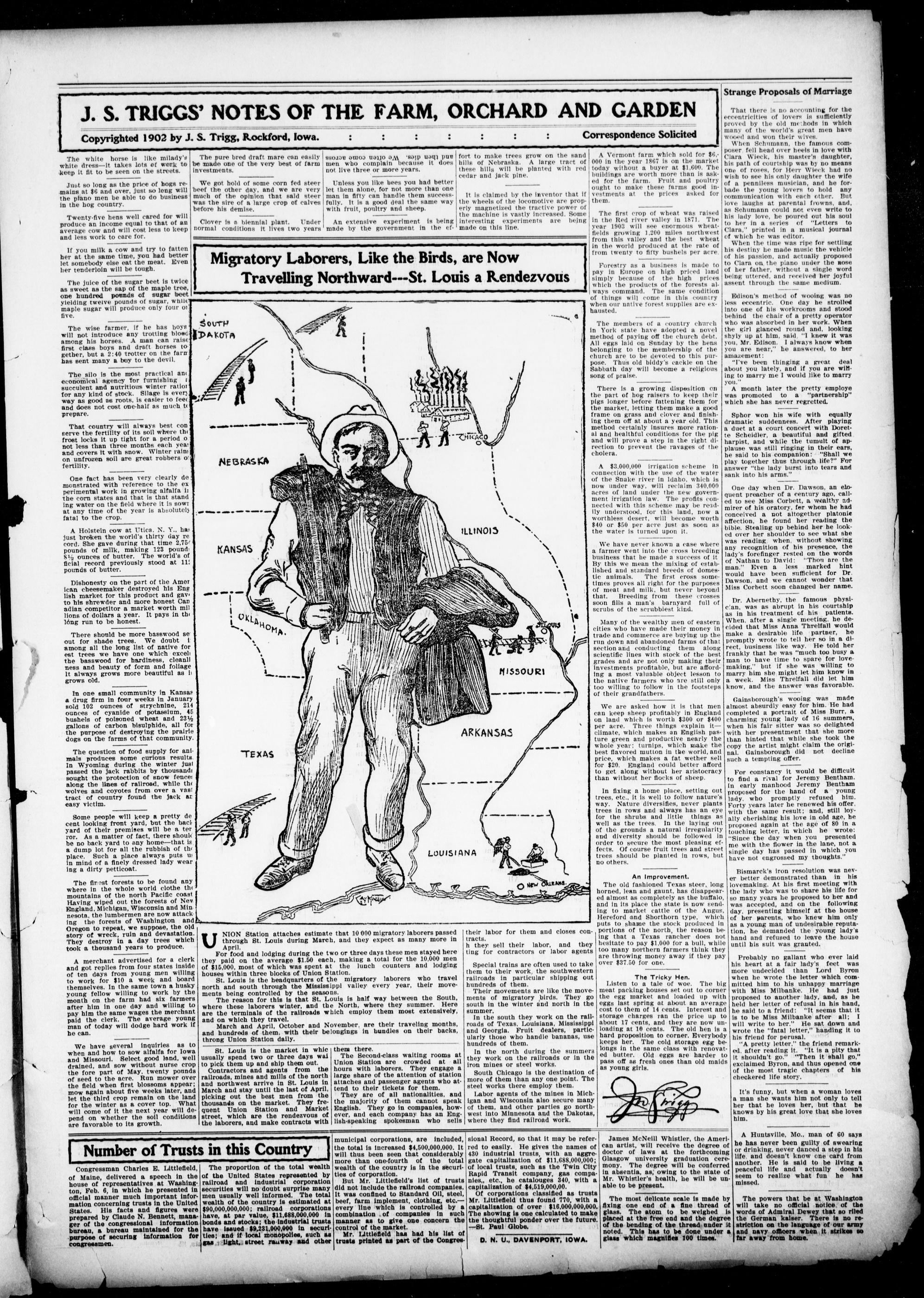
Migratory Laborers, Like the Birds, are Now Travelling Northward---St. Louis a Rendezvous
UNION Station attaches estimate that 10,000 migratory laborers passed through St. Louis during March, and they expect as many more in April. For food and lodging during the two or three days these men stayed here they paid on the average $1.50 each, making a total for the 10,000 men of $15,000, most of which was spent at the lunch counters and lodging houses within three blocks of Union Station.
St. Louis is the headquarters of the migratory laborers who travel north and south through the Mississippi valley every year, their movements being controlled by the seasons. The reason for this is that St. Louis is half way between the South, where these laborers winter, and the North, where they summer. Here are the terminals of the railroads which employ them most extensively, and on which they travel. March and April, October and November, are their traveling months, and hundreds of them, with their belongings in bundles on their backs, throng Union Station daily.
The pure bred draft mare can easily be made one of the very best of farm investments.
We got hold of some corn fed steer beef the other day, and we are very much of the opinion that said steer was the sire of a large crop of calves before his demise.
Clover is a biennial plant. Under normal conditions, it lives two years
Migratory Laborer Travelling New
SOUTH DAKOTA
NEBRASKA
KANSAS
OKLAHOMA.
TEXAS
UNION Station attaches estimates through St. Louis during March April.
For food and lodging during the they paid on the average $1.50 each of $15,000, most of which was spent at houses within three blocks of Union St. St. Louis is the headquarters of the north and south through the Mississippi being controlled by the season.
The reason for this is that St. Louis where these laborers winter, and that are the terminals of the railroads wi and on which they travel.
March and April, October and N and hundreds of them, with their be throng Union Station daily.
St. Louis is the market in whiche usually spend two or three days wail to pick them up and ship them out. Contractors and agents from the railroads, mines and mills of the north and northwest arrive in St. Louis in March and stay until the last of April, picking out the best men from the thousands on the market. They frequent Union Station and Market street, which are the rendezvous of the laborers, and make contracts with
Id. the proportion of the total wealth of the United States represented by railroad and industrial corporation securities will no doubt surprise many men usually well informed. The total wealth of the country is estimated at $90,000,000,000; railroad corporations have, at par value, $11,688,000,000 in bonds and stocks; the industrial trusts have issued $9,231,000,000 in securities; and if local monopolies, such as gas light, street railway and other
ssssoo euno unajo W saip uao puu puu men who complain because it does not live three or more years.
Unless you like bees you had better let them alone, for not more than one man in fifty can handle them successfully. It is a good deal the same way with fruit, poultry and sheep.
An extensive experiment is being made by the government in the ef-
rate that 10,000 migratory laborers passed March, and they expect as many more in two or three days these men stayed here each, making a total for the 10,000 men at the lunch counters and lodging Station. The migratory laborers who travel Mississippi valley every year, their movements, Louis is half way between the South, the North, where they summer. Here which employ them most extensively, November, are their traveling months, belongings in bundles on their backs,
them there.
The Second-class waiting rooms at Union Station are crowded at all hours with laborers. They engage a large share of the attention of station attaches and passenger agents who attend to their tickets for them. They are of all nationalities, and the majority of them cannot speak English. They go in companies, however, and each company has an English-speaking spokesman who sells municipal corporations, are included, the total is increased $4,500,000,000. It will thus been seen that considerably more than one-fourth of the total wealth of the country is in the securities of corporation. But Mr. Littlefield's list of trusts did not include the railroad companies. It was confined to Standard Oil, steel, beef, farm implement, clothing, etc. every line which is controlled by a combination of companies in such manner as to give one concern the control of the market.
as her Mr. Littlefield has had his list of trusts printed as part of the Congress
fort to make trees grow on the sand hills of Nebraska. A large tract of these hills will be planted with red cedar and jack pine.
It is claimed by the inventor that if the wheels of the locomotive are properly magnetized the trafic power of the machine is vastly increased. Some interesting experiments are being made on this line.
are Now
his a Rendezvous
ILLINOIS
ST. LOUIS
MISSOURI
ARKANSAS
ANA
NEW ORLEANS
their labor for them and closes contracts.
h they sell their labor, and they ting for contractors or labor agents
Special trains are often used to take them to their work, the southwestern railroads in particular shipping out hundreds of them.
Their movements are like the movements of migratory birds. They go south in the winter and north in the summer.
In the south they work on the railroads of Texas, Louisiana, Mississippi and Georgia. Fruit dealers, particularly those who handle bananas, use hundreds of them.
In the north during the summers they work on the railroads or in the iron mines or steel works.
South Chicago is the destination of more of them than any one point. The steel works there employ them.
Labor agents of the mines in Michigan and Wisconsin also secure many of them, and other parties go northwest into Minnesota and the Dakotas, where they find railroad work.
ional Record, so that it may be referred to easily. He gives the names of 430 industrial trusts, with an aggregate capitalization of $11,688,000,000; of local trusts, such as the Twin City Rapid Transit company, gas companies, etc., he catalogues 340, with a capitalization of $4,519,000,000.
Of corporations classified as trusts Mr. Littlefield thus found 770, with a capitalization of over $16,000,000,000. The showing is one calculated to make the thoughtful ponder over the future.—St. Paul Globe.
D. N. U., DAVENPORT, IOWA.
---
Correspondence Solicited
A Vermont farm which sold for $6,000 in the year 1867 is on the market today without a buyer at $1,600. The buildings are worth more than is asked for the farm. Fruit and poultry ought to make these farms good investments at the prices asked for them.
The first crop of wheat was raised in the Red river valley in 1871. The year 1903 will see enormous wheat fields growing 1,200 miles northwest from this valley and the best wheat in the world produced at the rate of from twenty to fifty bushels per acre.
Forestry as a business is made to pay in Europe on high priced land simply because of the high prices which the products of the forests all ways command. The same condition of things will come in this country when our native forest supplies are exhausted.
The members of a country church in York state have adopted a novel method of paying off the church debt. All eggs laid on Sunday by the hens belonging to the membership of the church are to be devoted to this purpose. Thus old biddy's cackle on the Sabbath day will become a religious song of praise.
There is a growing disposition on the part of hog raisers to keep their pigs longer before fattening them for the market, letting them make a good frame on grass and clover and finishing them off at about a year old. This method certainly insures more rational and healthful conditions for the pig and will prove a step in the right direction to prevent the ravages of the cholera.
A $3,000,000 irrigation scheme in connection with the use of the water of the Snake river in Idaho, which is now under way, will reclaim 340,000 acres of land under the new government irrigation law. The profits connected with this scheme may be readily understood, for this land, now a worthless desert, will become worth $40 or $50 per acre just as soon as the water is turned upon it.
We have never known a case where a farmer went into the cross breeding business that he made a success of it. By this we mean the mixing of established and standard breeds of domestic animals. The first cross sometimes proves all right for the purposes of meat and milk, but never beyond that. Breeding from these crosses soon fills a man's barnyard full of scrubs of the scrubbliest kind.
Many of the wealthy men of eastern cities who have made their money in trade and commerce are buying up the run down and abandoned farms of that section and conducting them along scientific lines with stock of the best grades and are not only making their investments profitable, but are affording a most valuable object lesson to the native farmers who are still only too willing to follow in the footsteps of their grandfathers.
We are asked how it is that men can keep sheep profitably in England on land which is worth $300 or $400 per acre. Three things explain it—climate, which makes an English pasture green and productive nearly the whole year; turnips, which make the best flavored mutton in the world, and price, which makes a fat wether sell for $20. England could better afford to get along without her aristocracy than without her flocks of sheep.
In fixing a home place, setting out trees, etc., it is well to follow nature's way. Nature diversifies, never plants trees in rows and always has an eye for the shrubs and little things as well as the trees. In the laying out of the grounds a natural irregularity and diversity should be followed in order to secure the most pleasing effects. Of course fruit trees and street trees should be planted in rows, but no others.
An Improvement.
The old fashioned Texas steer, long horned, lean and gaunt, has disappeared almost as completely as the buffalo, and in its place the state is now sending to market cattle of the Angus, Hereford and Shorthorn type, which puts to shame the stock produced in portions of the north, the reason being that a Texas rancher does not hesitate to pay $1,000 for a bull, while too many northern farmers think they are throwing money away if they pay over $27.50 for one.
The Tricky Hen.
Listen to a tale of woe. The big meat packing houses set out to corner the egg market and loaded up with eggs last spring at about an average cost to them of 14 cents. Interest and storage charges ran the price up to about 17 cents, and they are now unloading at 16 cents. The old hen is a hard proposition to corner. Everybody keeps her. The cold storage egg belongs in the same class with renovated butter. Old eggs are harder to pass off as fresh ones than old maids as young girls.
James McNeill Whistler, the American artist, will receive the degree of doctor of laws at the forthcoming Glasgow university graduation ceremony. The degree will be conferred in absentia, as, owing to the state of Mr. Whistler's health, he will be unable to be present.
The most delicate scale is made by fixing one end of a fine thread of glass. The atom to be weighed is placed at the free end and the degree of the bending of the thread under it noted. This has to be done under a glass which magnifies 100 times.
Strange Proposals of Marriage
That there is no accounting for the eccentricities of lovers is sufficiently proved by the old methods in which many of the world's great men have wooed and won their wives.
When Schumann, the famous composer fell head over heels in love with Clara Wieck, his master's daughter, his path of courtship was by no means one of roses, for Herr Wieck had no wish to see his only daughter the wife of a penniless musician, and he forbade the young lovers to hold any communication with each other. But love laughs at parental frowns, and, as Schumann could not even write to his lady love, he poured out his soul to her in a series of "Letters to Clara," printed in a musical journal of which he was editor.
When the time was ripe for settling his destiny he made music the vehicle of his passion, and actually proposed to Clara on the piano under the nose of her father, without a single word being uttered, and received her joyful assent through the same medium.
Edison's method of wooing was no less eccentric. One day he strolled into one of his workrooms and stood behind the chair of a pretty operator who was absorbed in her work. When the girl glanced round and, looking shyly up at him, said, "I knew it was you, Mr. Edison. I always know when you are near," he answered, to her amazement: "I've been thinging a great deal about you lately, and if you are willing to marry me I would like to marry you."
A month later the pretty employee was promoted to a "partnership" which she has never regretted.
Sphor won his wife with equally dramatic suddenness. After playing a duet at a court concert with Dorete Scheidler, a beautiful and gifted harpist, and while the tumult of applause was still ringing in their ears, he said to his companion: "Shall we play together thus through life?" For answer "the lady burst into tears and sank into his arms."
One day when Dr. Dawson, an eloquent preacher of a century ago, called to see Miss Corbett, a wealthy admirer of his oratory, fer whom he had conceived a not altogether platonic affection, he found her reading the bible. Stealing up behind her he looked over her shoulder to see what she was reading when, without showing any recognition of his presence, the lady's forefinger rested on the words of Nathan to David: "Thou are the man." Even a less marked hint would have been sufficient for Dr. Dawson, and we cannot wonder that Miss Corbett soon changed her name.
Dr. Abernethy, the famous physician, was as abrupt in his courtship as in his treatment of his patients. When, after a single meeting, he decided that Miss Anna Threlfall would make a desirable life partner, he promptly wrote to tell her so in a direct, business like way. He told her frankly that he was "much too busy a man to have time to spare for love-making," but if she was willing to marry him she might let him know in a week. Miss Threlfall did let him know, and the answer was favorable.
Gainsborough's wooing was made almost absurdly easy for him. He had completed a portrait of Miss Burr, a charming young lady of 16 summers, when his fair sitter was so delighted with her presentment that she more than hinted that while she took the copy the artist might claim the original. Gainsborough did not decline such a tempting offer.
For constancy it would be difficult to find a rival for Jeremy Bentham. in early manhood Jeremy Bentham proposed for the hand of a young lady, who promptly refused him. Forty years later he renewed his offer, with the same result; and, still loyally cherishing his love in old age, he proposed again at the age of 80 in a touching letter, in which he wrote: "Since the day when you presented me with the flower in the lane, not a single day has passed in which you have not engrossed my thoughts."
Bismarck's iron resolution was never better demonstrated than in his lovemaking. At his first meeting with the lady who was to share his life for so many years he proposed to her and was accepted, and on the following day, presenting himself at the house of her parents, who knew him only as a young man of undesirable reputation, he demanded the young lady's hand and refused to leave the house until his suit was granted.
Probably no gallant who ever laid his heart at a fair lady's feet was more undecided than Lord Byron when he wrote the letter which committed him to his unhappy marriage with Miss Milbanke. He had just proposed to another lady, and, as he held her letter of refusal in his hand, he said to a friend: "It seems that it is to be Miss Milbanke after all; I will write to her." He sat down and wrote the "fatal letter," handing it to his friend for perusal.
"A pretty letter," the friend remarked, after reading it. "It is a pity that it shouldn't go." "Then it shall go," exclaimed Byron, and thus opened one of the most tragic chapters of his checkered life story.
It's funny, but when a woman loves a man she wants him not only to tell her that he loves her, but that he knows by his great love that she loves him.
A Huntsville, Mo. man of 60 says he has never been guilty of swearing or drinking, never danced a step in his life and doesn't know one card from another. He is said to be living a peaceful life and actually doesn't seem to realize what fun he has missed.
The powers that be at Washington will take no official notice of the words of Admiral Dewey that so riled the German kaiser. There is no restriction on the language of our army and navy officers when it strikes so far away from home.
The Professional World
RUFUS L. LOGAN, B. S. D. - EDITOR
TERMS OF SUBSCRIPTION.
One Year in Advance - - - $1.00
Six Months in Advance - - - .75
Three Months in Advance - - - .50
Single Copies - - - .05
Advertising Rates on Application.
Job Work of all Kinds Solicited.
Published Every Friday.
Entered at the postoffice at Columbia, Mo., as second class matter,
Jan. 15, 1902.
Agents wanted in every town in the state.
Payments may be made in two cent stamps, by postal note, money order, by registered letter or express order.
Correspondence containing news of interest and importance is desired from all parts of the United States.
Communications should be made to reach us not later than Thursday morning, to insure inertion in the current issue.
No attention will be paid to anonymous communications.
Agents wanted everywhere. Write for terms.
Specimen copies sent to any address upon request.
PRESS OF THE MISSOURI STATESMAN.
NEGROES must learn to resent insults—they will have no limit unless resented.
AFTER all we are forced to acknowledge that Col. Henri Watterson is right in saying that the negro has too long been inclined to make somebody out of nobody. We have too many big little men.
WHEN Ben Tillman spoke in Minneapolis some weeks ago he was compelled to speak in a church as all of the opera house managers refused to admit him. Nevertheless the distinguished "fire eater" made his usual characteristic speech and is reported to have used profane language in the pulpit.
ANOTHER black spot was placed on the good reputation of "Grand Old Missouri," when a man was lynched at Joplin. Nothing was ever known to be accomplished by mob violence except the disgrace of the community in which such lawlessness occurred. No good citizen favors mob violence. Nor would he hesitate to condemn those who engage in such.
Gov. DOCKERY has cut off fifteen thousand dollars of the appropriation made by the recent legislature for Lincoln Institute. About one-third that which remains will be paid out to incompetent white men who are kept at Lincoln Institute. Solely for political reasons Lincoln Institute will never be what it should as long as such is the case.
Chautauqua Assembly:
TO THE PUBLIC:
After much consideration with the best thinkers and leaders of the west, and in accordance with their opinions and desires, we have decided to hold, annually, at Western University, a Chautauqua Assembly, to discuss problems affecting the welfare of the race.
The purpose of the movement will be to assist in securing and promoting "the unity and uplifting of the race."
The Chautauqua will comprehend the following departments: educational, professional, woman's club, business, industrial and agricultural.
Successful farmers, mechanics, business men, and women interested in club work, ministers, doctors, lawyers, teachers, musicians, and men of all professions, in short all who are striving to rise and assist their fellows, are invited to be present. Individuals successful in any walk of life are requested to be present and to participate in the discussions of the session. The synopsis of the programme will be published later. The first annual session will be held on the university grounds, commencement week, May 25, 26 and 27.1903.
It is desired that we may have the co-operation and support of all people in this effort to secure the
advancement of the cause of the negro.
For further information write to W. T. Vernon, chairman, or J.
N. Garrett, Secretary.
New School Laws.
In 1899 the State Superintendent of Public Schools distributed forty thousand copies of the revised school law. No revision has been made since and few changes have been made affecting the general operation of the schools. There is a demand now for copies of the law,and fifty thousand copies of a revision for 1903 will be ready for distribution in May. The last General Assembly did not pass any bill affecting the schools generally that will take effect before June 20. Below are given the changes recently made:
City, town and village school boards must select depositories for their money as county depositories are selected.
When county supervision is adopted the county commissioner-elect becomes superintendent.
When a city, town or village district is divided by county lines the part in either county cannot withdraw as may be done in rural districts.
Money derived from sale of bonds may be used to purchase sites as well as to erect buildings.
Any school district having 200 children by enumeration may organize with six directors, provide a high school and as many district or ward schools as are necessary to accommodate all children. Authority is given to the State Superintendent to classify high schools and prescribe minimum requirements and compels higher educational institutions to credit pupils with work done in such school in any approved subjects. Its object is to provide complete articulation of the entire public school system.
Teacher's certificates shall be reissued without examination and without fee—third grade once, second grade twice and first grade unlimited number of times so long as the holder continues to teach or to attend approved summer schools. When an applicant for certificate fails to complete or pass on all subjects at a regular examination he may have a second trial without additional fee. This does not apply to special examinations and limits the trial to a second and prohibits a third.
The law requiring a summer institute is repealed and a three days' meeting is substituted. The fees that have been used to pay expenses of the institute must be set aside to pay expenses of the fall meeting. Full explanation of the operation of all these will be given in the laws which will be ready for distribution about May 1. This will give everyone an opportunity to be informed before they take effect.
Let every annual meeting provide for library. The law says that not less than five cents per child shall be spent for library. This is important and must not be neglected. An excellent test of a teacher is how wisely he can use a few library and supplementary books.
Died.
BRANHAM—At his residence in Jefferson City, Saturday, April 11th, 1903, Rev. G. W. Branham. He had been a prominent citizen of Cole county for a number of years and was highly respected by all. He was a consistent christian and had been a member of the Baptist church for many years. His funeral services were held at the Second Baptist church, Sunday, and preached by Rev. H. J. Burton. His remains were in charge of the Masonic Lodge of which he was a member. He leaves four daughters and two sons, a wife, mother and many friends to mourn his death.
A small piece of borax dissolved in the mouth relieves hoarseness, and often allays a cough induced by throat irritation. Used often as a gargle it is healing for a cankered mouth or throat.
From the Little Rock True Democrat.
DIED.—In the vicinity of Little Rock, on Saturday, the 6th day of December 1862, Claiborne F. Jackson, Governor of the State of Missouri. The disease of which he died was the cancer of the stomach, from which he has been a sufferer for the last twenty years. He was confined to his bed for six weeks before his death, and during the last week was cheered by the presence of his family, who arrived here some ten days since.
Governor Jackson was born in Fleming county, Ky., on the 4th day of April, 1807, and when eighteen years of age emigrated to Missouri, where he made his home. In the war with the Indians on the frontier he raised a volunteer company and served as captain. He was afterwards elected to the Legislature of Missouri, both as Representative and Senator for ten or twelve terms, and was Speaker of the House for a term. During the session of 1848, the famous "Jackson resolutions" were passed by the Legislature of Missouri, named after their author, and saved the State from political thraldom.
Governor Jackson was also the author of the system of banking in Missouri; was bank commissioner for a long time, and connected with these institutions since their adoption. In 1860 he was elected Governor over all opposing factions.
He was a man of energy and ability, a States' Right Democrat of the Calhoun school, and a natural hater of tyrants. His reply to Cameron, and his unwearied exertions to secure for his beloved Missouri a place in the Confederacy, and to break the shackles with which her fair limbs are bound, are known to us all. He lived and died a patriot.
In the cemetery, three miles west of Arrow Rock, Mo, repose the remains of the old pioneers, Dr. John Sappington, Govs. M. M. Marmaduke and C. F. Jackson. Gov. Jackson's monument is 11 feet 6 inches in height, the first marble base about three feet 6 inches wide, die 3 feet wide, caps 3 feet 4 inches, surmounted by two beautiful columns standing 4 feet 6 inches in height with faultless urns on the top, all very highly finished from base up.
An Enjoyable Evening.
The young folks of Columbia society spent quite an enjoyable evening at the home of Mrs. J. W. Boone, last Friday evening. Although it was in the form of a surprise party, an elegant supper was spread at 12 o'clock and enjoyed by all regardless of the stormy weather outside. All was gayety and laughter within 'till the late hour of 2 a. m., when the guests departed thanking the hostess for admitting them on so bad an evening.
STATE OF OHIO, City of Toledo, } ss.
Lucas County.
FRANK J. CHENEY makes oath he is senior partner of the firm of F. J. CHENEY & Co., doing business in the City of Toledo, County and State aforesaid, and that said firm will pay the sum of ONE HUNDRED DOLLARS for each and every case of CATARRH that cannot be cured by the use of HALL'S CATARRH CURE.
FRANK J. CHENEY.
Sworn to before me and subscribed in my presence, this 6th day of December, A. D., 1886.
SEAL.
A. W. GLEASON.
Notary Public.
Hall's Catarrh Cure is taken internally, and acts directly on the blood and mucous surfaces of the sysm. Send for testimonials free.
F. J. CHENEY & Co., Toledo, O.
Sold by
Sold by an druggists, lbc. Hall's Family Pills are the best.
Simple remedies for softening and whitening the hands consists in the use of almond meal, cornmeal or oatmeal instead of soap, and then rubbing them with lemon juice or honey lotion or any similar ungent.
Bathe a bruise with vinegar as soon as the accident happens; if it can be kept in place, lay a cloth soaked in vinegar over the injury, wetting it as it dries, and there will be very little discoloration.
Lodge and Church Directory.
Mrs. Ada Douglass, W. P.; Mrs. Lizzie Williams, W. S. Meeting first Monday in each month at 3 p. m.
U. B. F.
Crispus Attucks Lodge, No. 62. Meetings 2nd and 4th Tuesdays in each month. Visiting members cordially invited. Caleb Hall, W. M. A. M. Schweich, W. S.
K. P.
Acme Lodge, No. 24. Meetings second and fourth Fridays in each month. W. H. Turner, C. C. and D. D. G. C. W. W. Lampkins, M. F.
St. Paul Lodge, No. 12, A. F. & A. M., meets every first and third Tuesday in each month. A cordial invitation extended to all visiting brothers. J. A. Mosely, W. M. J. A. Grant, Secretary.
Rev. J. B. Parsons, pastor.
Preaching Sundays 11 a. m.
and 7:30 p. m.
Prayer meeting Wednesdays 7:30 p. m.
Everybody cordially invited to attend.
K. OF P.
Harrison Lodge No. 12, Huntsville, Mo. Meeting the second and fourth Thursdays in each month. M. W. Tony, C. C., W. T. Ansel, K. R. S., I. A. Robinson, M. E.
A. M. E. CHURCH.
Rev. P. C. Crews, Pastor.
Preaching Sundays 11 a.
m.; 7:30 p. m.
Sunday school 2:30 p. m.
Prayer meeting every
Wednesday eve, at 8:30; every body invited to attend.
M. E. CHURCH
Rev. J. Arlington Grant,
pastor.
Preaching Sundays 11, a.
m. and 7:30 p. m.
Sunday school, 9:30 a. m.
Prayer meeting Wednes-
days 7:30 to 8:30; all are made
welcome.
SECOND BAPISTIST CHURCH.
Rev. A. A. Adams, Pastor.
Preaching Sundays 11 a.
m., and 7:30 p. m.
Sunday school at 2:30 p. m.
Prayer meeting Wednesday
evening, 7:30.
A cordial invitation ex-
tended to all.
LADIES COURT
Golden Queen Court, No. 19, meets first Friday in each month. Mrs. M. E. Ridgway, M. A. M., Mrs. Lizzie Richardson, Secretary.
O. E. S.
Amos Chapter, No. 30. Meetings second Friday in each month. Mrs. Bessie Washington, W. M. Mrs. Annie Williams, W. S.
50 YEARS' EXPERIENCE
PATENTS
TRADE MARKS DESIGNS
```markdown
```
Anyone sending a sketch and description may quickly ascertain our opinion free whether an invention is probably patentable. Communication is free. The patent office is free. Oldest agency for securing patents. Patents taken through Munn & Co. receive special notice, without charge, in the Scientific American. A handsomely illustrated weekly. Largest circulation of any scientific journal. Terms, $3 a year; four months, $1. Sold by all new dealers. MUNN & Co. 3618roadway. New York Branch Office, 6 F. St. Washington, D.C.
Agents Wanted.
We desire to engage some good agents to solicit subscriptions for the Professional World. Liberal commissions will be paid and only one agent will be engaged for the same town, only persons of good standing need apply. Address, Professional World, Columbia, Mo.
A Request.
We will consider it a great favor if our readers will patronize the merchants whose advertisements they see in this paper.
with us. The only difference between, our "suits" and the made-to-order suits is imagination. As to us, we allow you to be judge and jury- Try us and be convinced. Your money back on any unsatisfactory article. We are bound to make a customer of you if low prices will do it.
Keeps constantly on hand a fresh supply of staple and FANCY GROCERIES.
YOUR PRODUCE WANTED.
All Kinds of Fresh Lunch Goods. Wood and Coal. Prompt and Careful Attention Given to all Orders. Telephone 580.
COLLEGE
ON CREDIT.
$22.90
Free
Catalogue
CENTURY M.F.G. CO.
EAST ST. LOUIS, ILL.
Century Steel Range, No. 80-A-18
Has six 8-inch lids, oven 17x12x11,
splendid reservoir and warming close,
lined throughout with asbestos, burns
anything, best bakers and roasters on
Earth. Guaranteed 10 years. Weight
475 lbs. Only $22.90. Terms $8.00 cash,
balance payment $3.00 a month, no interest.
Shipped immediately on receipt of
0.00 payment. We trust honest
people located in all parts of the
World. Cash discount $1.50 on Range. Freight
average $1.25 for each 600 miles. Send
for free catalogue, but this is the greatest
bargain ever offered. We refer to
Southern Illinois National Bank.
CENTURY • MANUFACTURING • CO.
Dept. 910, East St. Louis, IL
Jefferson City, Mo.
Ladies Admire
....Perfect
Fitting garments,
and only first class
tailors can make
them.
Suits from $25.00, up.
Trousers from $6.00, up.
Merchant Tailor,
JEFFERSON CITY, MO
The Railroads.
WABASH
Time Table—Columbia Branch.
GOING SOUTH.
No. 33, Arrive Columbia ... 8:15 a. m.
No. 35, Arrive Columbia ... 1:20 p. m.
No. 37, Arrive Columbia ... 8:45 p. m.
GOING NORTH.
No. 30, Leave Columbia ... 9:40 a. m.
No. 32, Leave Columbia ... 1:40 p. m.
No. 34, Leave Columbia ... 4:10 p. m.
M. K. & T. Ry.
TRAINS NORTH.
Leave:
McBaine ... 6:30
Webster ... 6:33
Brushwood ... 6:38
Turner ... 6:42
Limerick ... 6:47
Arrive
Columbia ... 6:55
A. M. No. 36
A. M. No. 38
P. M. No. 40.
A. M. No. 35 St. Louis Express P. M. No. 37 Texas Express P. M. No. 39.
Leave
Columbia..... 11:00 3:10 6:30
Limerick ..... 11:08 3:18 6:38
Turner..... 11:12 3:22 6:42
Brushwood..... 11:17 3:27 6:47
Webster ..... 11:22 3:32 6:52
Arrive
McBaine..... 11:25 3:35 6:55