The Professional World
Friday, June 26, 1903
Columbia, Missouri
Page text (machine-generated)
THE PROFESSIONAL WORLD.
$1.00 Per Year in Advance.
You Can Always
The Latest Novelties
and up-to-date Goods
in every Department...
Our efforts are always direct goods for the same money or money than you can find els
Our efforts are always directed to furnishing better goods for the same money or the same goods for less money than you can find elsewhere;
BUT WE NEVER CUT THE
QUALITY TO MAKE
A CUT PRICE.
Schultz Dry Goods
= = = = and Ca
JEFFERSON
Columbia Notes.
Schultz Dry Goods = = = = = = = = = and Carpet Company, JEFFERSON CITY, MO.
Mrs. Frank Faris is on the sick list.
Mrs. Tessie Rumans is visiting in Hannibal.
Mrs. Alice William is reported sick this week.
Mrs. J. E. Perry arrived Saturday from Springfield.
Prof. S. T. Pettigrew, of Dalton, was in the city last week.
Order the Professional World. It is only one dollar per year.
Miss Maggie Drew is able to be out again, after a few days illness.
Miss Margeruite Ward, of Glasgow, is visiting Mrs. E. L. Boone.
Mr. and Mrs. Edward Henderson have moved into their new home on N. 3rd st.
Miss Blanche K. Morrison, of Springfield, is visiting her mother, Mrs. Dora Morrison, on 2nd st.
All Spring and Summer hats reduced to cost at Mrs. Adkinson's, over Murphy's Grocery Store.
Mr. James Matson and wife left Tuesday for Chicago, after spending several days with his mother who is seriously ill at the residence of her sister, Mrs. M. H. Caldwell.
S. M. T. Annual Sermon.
The annual sermon to S. M. T. society will be preached at the A. M. E., church Sunday evening by Rev. P. C. Crews, at 8 o'clock.
Capital City Notes.
Dr. J. H. Garnett is in Texas.
Mr. B. King is on the sick list.
Mr. J. M. Rutlege is on the sick list this week.
The summer school at Lincoln Institute is moving on quietly.
Prof. B. F. Allen left Monday to visit a number of colleges of the south.
Rev. J. R. Goins, C. G. M. of the Knights of Tabour is making a tour of the state visiting the state.
Mr. Phil Johnson, chief engineer at Lincoln Institute, has withdrawn from the firm of Gibbs & Framel.
Rev. J. H. Burton preached the annual sermon to the knights and daughters of the Tabernacle at the A. M. E. church last Sunday.
Twentieth Century Negro Literature
WHITE M
This book contains One Hundred Treatises on Thirty-Eight General Topics in which the negro problem is viewed from every possible perspective. The book is a negro citizenship. It will furnish the basis of future calculations on all race subjects. There are
100 PORTAITS AND 100 BIOGRAPHIES of the writers. See the pictures and read the lives of the hundred most prominent writers. There are 700 entire race. Over 700 large pages and retails at $2.50 in cloth, postpaid.
AGENTS: We want $5,000 canvassers at once to introduce this great book. Highest commission paid. Books on credit. Agent management. Write for our proposition at once. This is the opportunity of your life.
---
DR. D. W. OULP
cted to furnishing better or the same goods for less sewhere;
ods = = = = =
carpet Company,
CITY, MO.
Dr. J. E. Perry to Leave Co-
lumbia.
We do not know when we have been more shocked and pained with deeper regret of the loss of an individual from our midst, than when informed of Dr. Perry leaving Columbia, where he has practiced for years; doing a great work, as a christian, practitioner, and citizen. Why Dr. Perry should even consider leaving such a field as Boone county at this time, is to us, one of the mysteries of life—for he is much needed here, especially for the good of the people. As a physician he has been very successful, and has the confidence largely of the people who know him; and is respected by both races. To know him in the sick room is to find a friend, brother and sympathizer, in business a counsellor. He has done a most excellent work here among the people at large of this country, and has the ability, with the expression unusual to win friends wherever he goes. The gain of others where he may go, is our loss of a good and useful man in the person of Dr. Perry. He leaves us with deep regrets from his many friends who know and love him. Dr. Perry is a member of the Second Baptist church at this place; he is a faithful worker and trustee in all of its interests, and enjoys the full confidence of his brethren. We respect him for what he is, and has done for his church and community at large, and commend him to the church and public where he may locate to labor, as a man trustworthy of their patronage.
Pastor of the 2nd Baptist Church
Teachers' Institute Resolutions.
We, the teachers of Boone county, at the close of a most successful institute, extend to Prof. J. B. Coleman, our sincere thanks for his interest and untiring efforts in our behalf. We feel that much good has been done, that our store of knowledge has been increased, that new and renewed energy has been acquired, that our views regarding our work have been broadened and that our desire to reach higher in the great work before us
Century Negro Literature
WRITTEN BY
OE OF AMERICA'S GREATEST NEGROES
Edited by DR. D. W. CULP.
One Hundred Treatises on Thirty-Eight
which the negro problem is viewed from every possi-
kork could more fully represent the higher stratum of
will furnish the basis of future calculations on all
RAITS AND 100 BIOGRAPHIES
the pictures and read the lives of the hundred most
to have a fair knowledge of the entire race. Over
tails at $2.50 in cloth, postpaid.
we were 5,000 carvers at once to introduce this
book. Highest commission paid. Books on
different sample book for $3c. to pay mailing expenses.
at once. This is the opportunity of your life.
HOLS & CO., Naperville, Illinois.
COLUMBIA AND JEFFERSON CITY, MISSOURI, FRIDAY JUNE 26, 1903.
ind
has been increased.
Resolved, That we extend our thanks to the school board for so kindly allowing us the use of the school building.
Resolved, That we extend our heartfelt thanks to Supt. R. H. Emberson, for arranging so efficient a course of lectures and for his untiring efforts to make our work both pleasant and profitable.
R. DALLMEYER
THE B
JEFFERSON
LARGEST STOCK
Resolved, That we extend our sincere thanks to Dr. Whitten of the Agricultural Department of the State University, to Dr. Elwood of the chair of sociology of the University, to Dr. Elwang, pastor of the Presbyterian church, to Dr. Scott, instructor in elocution at the University, to Hon. W. T. Carrington, State Superintendent of public schools, to Prof. Greenwood, Supt. of K. C. public schools, Col. Switzler, editor and historian, and to Prof. R. E. Moore, supervisor of drawing and penmanship of Fort Worth, Texas, for their kind addresses during the institute. Resolved, That we recognize in our State Supt., Hon. W. T. Carrington, a man of great energy, intellectual force, and organized ability.
Resolved, That we endorse the Mo. School Journal as the organ of the teachers of the state and most earnestly recommend that each teacher in the county become a reader of this excellent paper.
Resolved, That we approve of teachers meeting together in associations during the months that their schools are in session, as we believe that many perplexing questions may be profitably discussed and much enthusiasm aroused at such meetings.
Resolved, That a copy of these resolutions be spread on our minutes, and that a copy be sent to the Mo. School Journal and to the county papers. Respectfully,
Beware of Ointments For Catarrh That Contains Mercury
as mercury will surely destroy the sense of smeli and completely derange the whole system when entering it through the mucous surfaces. Such articles should never be used except on prescriptions from reputable physicians, as the damage they will do is ten fold to the good you can possibly derive from them. Hall's Cattarrh Cure, manufactured by F. J. Cheney & Co., Toledo, O., contains no mercury, and is taken internally, acting directly upon the blood and mucous surfaces of the system. In buying Hall's Cattarrh Cure be sure you get the genuine. It is taken internally and made in Toledo, Ohio, by F. J. Cheney & Co. Testimonials free.
Sold by Druggists, Price 75c per bottle. Hall's Family Pills are the best.
Prof. Vernon Honored.
Rev. Wm. T. Vernon, president of Western University, Quindaro, Kan., has just returned from the commencement exercises at Wilberforce, O. While there the degree of Doctor of Divinity was conferred upon him. Wilberforce University is the oldest college for negroes in the United States.
J. G. Scott, of Osceola, Mo., was killed by lightning while on his way to church.
Policeman Albert Nichols, of Macon, Mo., was fatally stabbed by a negro he attempted to arrest.
May beat the record in the country's history in the number of immigrants arrived in the United States.
U. S. Grant, Jr., son of General Grant, announces his candidacy
YOUR TRADE SOLICITED
for the republican nomination for vice president.
The textile strike in the Lowell mills has been called off. The 17,-000 men involved have lost more than a million in wages.
Government exhibit at the Fair will include Liberty Bell, Washington's sword and many quaint relics of the revolution.
Exports of boot and shoes from the United States grew from half a million dollars in 1893 to over $6,-000,000 the current fiscal year.
E. Frank Scharding, of St. Louis, died from the effects of a blow on the head with a base ball bat in the hands of William Pedolsky.
A directory of the Beaumont oil field shows 582 wells, only 246 of which are producing. The daily output is estimated at 20,000 barrels.
The Mississippi River Commission met in St. Louis Wednesday to decide upon the distribution of $2,000,000 appropriated for river improvements.
The St. Louis postoffice is to be investigated soon in pursuance of the general investigation of the postoffice department. The supply department is to receive particular attention.
Statistics of the interior department show that the Indian is becoming self-supporting. Government rations are being refused and the red man is seeking employment and paying his own way.
Kansas farmers are calling for 28,000 hands to harvest the wheat crop. The State Employment Bureau can supply only one-fourth of the number, and the farmers are appealing to the large cities.
The striking freight handlers of Kansas City have been "blacklisted" by the railroads and can not now get tneir places back. Other men have been employed and freight is moving as usual.
The Pennsylvania minister who advertised for a wife who can cook, bake and sew, is willing to work, cares little for dress and will take her only pleasure in her home and God, is still waiting for his ideal.
A Brooklyn man designs a dirigible airship with flat gas bag and turtle-shaped back, which it is claimed, makes it perfectly safe if accidents occur. It has a speed of fifteen miles an hour against the wind.
New York financiers have organized a bank with $100,000,000 capital. This is the greatest capitalization of any financial institution in the world. The plan lacks only the government's sanction to begin operations.
The Teachers' Institute.
The Boone county teachers' institute which has been in session three weeks at Fred Donglass school building in Columbia, closed this week. Seventeen teachers were enrolled during the session and quite an interesting and profit-
DRY GOODS, GARPETS,
LADIES READY-TO-WEAR
GARMENTS.
THE VOTING CONTEST.
We present below the following new Professional World Voting Contest. On Every person who pays one year's subscription will be entitled to ten votes.
Mrs. L. E. Richardson,
Mrs. Macea Bass,
Mrs. Anna L. Hicks,
The lady receiving the highest number the prize, which is a fine broad cloth dress.
Clip the following eupon and fill out
I hereby cast
for Mrs.
most popular married lady in Boo
Name
present below the following names of ladies as ex-
citing World Voting Contest. Others will appear
when who pays one year's subscription or renewal
will be entitled to ten votes.
E. Richardson, Column
Beea Bass, Ashla
ona L. Hicks, Column
by receiving the highest number of votes will
which is a fine broad cloth dress pattern.
following cupon and fill out properly.
hereby cast
popular married lady in Boone county.
Name
We present below the following names of ladies as entries in Professional World Voting Contest. Others will appear next Every person who pays one year's subscription or renews their scription will be entitled to ten votes.
The lady receiving the highest number of votes will be the prize, which is a fine broad cloth dress pattern. Clip the following eupon and fill out properly.
able session was held. The work has been in charge of Prin. J. B. Coleman, whose ability for conducting other educational work is well known in the state. A number of excellent lectures were delivered during the session. Among them was one by Col. W. F. Switzler last Wednesday morning, and others by noted men during the session.
Meeting at Log Providence.
Last Sunday was the annual June meeting at Log Providence church, near Ashland. These meetings have been held regularly for perhaps 25 years and today they seem to attract no less attention than twenty years ago. Between four and five hundred people gathered at this historical spot last Sunday and after listening to an excellent sermon by Rev. A. A. Adams of Columbia, they were dismissed to have what is known as dinner on the ground, and under the large shade trees near the church the table linen was spread on the ground and the contents of the well filled baskets were placed at the disposal of the large crowd. A greater dinner was probably never spread and it is not at all probable that twelve baskets would have held what was left after the multitude had been fed. Probably 150 persons attended from Columbia.
Broken Lenses
repaired by us without a prescription if you bring us the pieces.
We make a specialty of repair work. Bring your watch and have it fixed right.
We do our Work Satisfactorily.
HENNINGER
Columbia's Leading
ENNINGER & WHEELS
Columbia's Leading Jewelers.
VOL. II. NO. 81
COMPANY
STORE.
RI.
T PRICES.
R
Mail Orders Promptly Filed
names of ladies as entries for
Others will appear next year
subscription or renews their
Columbia, Ms.
Ashland, Ms.
Columbia, Ms.
number of votes will be
dress pattern.
all out properly.
Boone county.
For Sale
A Fine
LYON & HEAVY
ORGAN
good as new. Cost $100
can be bought at a
Bargain.
Call on or addres
R. L. LOGAN.
COLUMBIA . . .
O. J. BROOKS,
ARTIST
PORTRAITS IN
OIL FROM LIFE.
PASTELS, CRAYONS
Studio 1512, North 6th Street
KANSAS CITY. . . . KANSAS
Nifong Manufacturing
DISTILLED WATER ICE
standard for
QUALITY, SERVICE AND PRICE
'Phone 16. Regular Morning and Night
Deliveries six days in the year
COLUMBIA . . . MISCHEN.
Broken Lenses
repaired by us without a prescription if you bring us the pieces. repair work. Bring your nt.
& WHEELER
ading Jewelers.
Rufus L. LOGAN, Editor
Columbia - - - - Missouri
THE PURE FOOD ACT.
It Will Be Carried Into Effect July 1—
Foreign Goods to be Sampl
Washington, June 20—Assistant Secretary Armstrong of the treasury department issued a circular letter carrying into effect, beginning July 1, the pure food act approved March 3. Under this act the secretary of the treasury has authority, upon request from the secretary of agriculture, to direct drawing by officers of the customs of samples at any custom-house from original packages of imported food products, drugs and liquors and to refuse to deliver to the consignee any such commodities as the secretary of agriculture may report to him as found upon analysis to be dangerous to health, or which are forbidden to be sold or which are restricted in sale in the countries in which they are made or from which they are exported or which shall be falsely labeled in any respect in regard to the place of manufacture or the contents of the package.
The circular says that on the receipt of requests from the department of agriculture, through the treasury department, for samples of such imported commodities, samples of solid food products not less than one quart each and samples of drugs in quantities to be designated at the time will be drawn and forwarded by express or mail to the department of agriculture at Washington, marked "Chief of Bureau of Chemistry." The cost of the samples will be reimbursed to the importer and the express charges will be paid to the forwarding companies by the department of agriculture on presentation of proper vouchers.
Commodities which are declared adulterated will be exported under customs supervision, under bond, conditioned for due landing abroad, and in default of exportation destruction under customs supervision must follow. Two days are given owners, importers or consignees of articles sampled within which they may present written testimony as to the harmless nature of articles imported. Provision is made for the legible labeling and branding in English of importations coming within the act and also for appeals to the secretary of the treasury.
GET-RICH-OUICK MAN.
The Head of the Scheme Gives Him
self Up in St. Louis.
St. Louis, Mo., June 20.—E. J. Arnold of the defunct get-rich-quick establishment of E. J. Arnold & Co. came down from Chicago yesterday, arranged bond for his appearance in court to answer seven charges of larceny by baillee growing out of the collapse of the turf investment bubble and last night started on his return to Chicago, where he asserts, he has lived unmolested since he fled from St. Louis last February.
Arnold asserted that he had made no especial effort to conceal his whereabouts. Mrs. Arnold, it will be remembered, went to Chicago a few days after the collapse of the turf concerns and he joined her there a few days later. They have been in Chicago practically all the time and Arnold asserts he has been a frequent visitor at the race tracks, where he made large bets with regularity.
MODERN WOODMEN.
Indianapolis, June 20.—The 13th head camp of Modern Woodmen of America closed today. The new officers were installed and the report of the law committee considered in detail. The local camp clerks will hereafter receive per 5 cents per month per member. The retiring Head consul, Northcott, was made a member of the head camp for life.
The Foresters broke camp this afternoon. The following teams made the highest records on daily inspection of quarters and received these prizes: First, Bronze Roman Vase Kent, team No. 2, 314; second, silver loving cup, Posey team No. 3120.
Three teams—Omaha, Harrisburg and Charter Oak, are tied for the third prize, a gold embossed Roman urn.
APPLY FOR HABEAS CORPUS.
Topeka, Kas., June 20.—In an application for a writ of habeas corpus, the Deweys allege the Berrys had been annoying them and the day of the murder they were attacked by the Berrys.
BOY KILLED BY LIGHTNING
Sloux Rapids, Ia., June 20.—Arthur Kingbloom, the 17-year-old son of Peter Kingbloom, who lives eight miles northeast of here, was instantly killed by lightning. Arthur and the hired man were unloading manure. The horses and the hired man were knocked down, but were unhurt. The lightning burned a streak down the left side of young Kingbloom's head and across his heart, killing him instantly.
HIGH OFFICIALS HARD HIT
Further Particulars About Postoffice Mess
MORE; DETAILS BROUGHT OUT
Carelesness Discovered in All Directions. Money Order Superintendent Dismissed.
Washington, June 24th -The federal grand jury, which has been investigating the postal affairs, will probably bring in five indictments today. Although every effort has been made to keep the public ignorant of the action to be taken, it is learned on unquestionable authority the jury has voted to return indictments against August W. Machen, Diller B. Groff, Samuel A. Groff, George E. Lorenz, and Mrs. Lorenz. The specific charge, it is understood, will be a conspiracy to defraud the government.
At the time of the arrest of Machen and the Groffs stories were in circulation there was a "go between," but the information was not conclusive enough to establish the identity of a particular party. Whether or not Mrs. Lorenz acted in this capacity is not known, but it has been suggested. however, the "go between" was a woman. Later in the day it was announced the indictments will probably not be returned until Monday.
(Washington dispatch to Chicago Chronicle, June 18.)—Wednesday was the blackest day of all the long series of dark days for the Postoffice department and Postmaster General Payne is in despair at the wholesale rottenness developed. The sensation of the day was the summary dismissal from office of James T. Metcalf, for many years superintendent of the money order system, on the charge of trying to induce Paul Herman, a bldder for the contract for printing money order blanks, to withdraw his bid in order that the contract might go, for $45,000 more, to the Wynkoop-Hallenbeck-Crawford Co. by whom Metcalf's son is employed. The downfall of Metcalf came as a great surprise to official circles, where he has long been held in high esteem.
Of almost equal sensation-producing power was the remarkable report of Fourth Assistant Postmaster General Bristow touching the charges of ex-Cashier S. W. Tulloch, which the postmaster general made public in the afternoon. This report amply corroborates the charges of irregularities in the Washington postoffice made by Tulloch and shows that the questionable disbursements cited were made on direct authority from high officials. The inspector whose report is quoted says the responsibility for the payment of double salaries to many persons and the squandering of thousands of dollars should be placed where it belongs, not on subordinates but on men high in rank.
Further sensational charges are soon to be made against A. W. Machen and his indictment for forgery is expected in a few days. There are rumors of other indictments to be returned at the same time.
The story of Metcalf's fall is briefly told in the following letter of dismissal signed by Postmaster General Payne at 5 o'clock yesterday afternoon:
Washington, June 17.—James T. Metcalf, Superintendent of Money Order System, Postoffice Department—Sir: You are hereby removed from the position of superintendent of the money order system.
The charges upon which your removal is based relate to your actions in the matter of the letting of the contract for money order forms. These charges were made known to you this morning by Fourth Assistant Postmaster General Bristow and Assistant Attorney General Robb of the Postoffice department and a transcript of your answer thereto is inclosed herewith.
It appears from your answer that when the proposals of the different competitors for the contract of supplying money order forms were opened Paul Herman of Rutherford, N. J. (formerly employed as foreman by the Wynkoop-Hallenbeck-Crawford Co. of New York, by which company it seems your son is also employed), was found to be the lowest bidder, his proposal being $45,000 below that of the next higher bidder—namely, the Wynkoop-Hallenbeck-Crawford company; that the bid of Herman as submitted was regular in form and that he had deposited a certified check for $5,000 as a forfeit.
It further appears that within a day or two the Wynkoop-Hallenbeck-Crawford company filed a protest against awarding the contract to Herman, alleging that he was not financially re-
sponsible, that a short time thereafter Mr. Herman called at your office and you advised him to withdraw his bid and reenter the employ of the Wynkoop-Hallenbeck-Crawford company, understanding at the time that such withdrawal would result in the contract being awarded to said company and consequently in a loss to the government; that you offered to write and did write a letter to said company apprising it of your interview with Herman and using your good offices in his behalf; that you advised Herman that his $5,000 deposit would probably be returned to him if he adopted your suggestion.
It further appears that you regarded Mr. Herman as possessing the mechanical qualifications requisite to the performance of the contract and that it was not any part of your duty to pass upon the question of his responsibility, financial or otherwise. It also appears that you did not acquaint your superior, First Assistant Postmaster General Wynne, with the fact that you had endeavored to have Mr. herman withdraw his bid. It further appears that a hearing has been had before Mr. Wynne upon the question of the financial responsibility of Mr. Herman, although it has developed since the submission of your answer this morning that you discouraged the granting of such a hearing and manifested a desire that the contract be awarded to the Wynkoop-Hallenbeck-Crawford company.
Postmaster General Payne, in announcing his action, stated that there was no charge that Mr. Metcalf had done anything that is amenable to the law, but said his conduct was a serious indiscretion that could not be overlooked. Mr. Metcalf, he said, always had been considered a faithful, efficient, painstaking and honest employee.
JOHN MITCHELL SUED
He Is Alleged to Have Furnished Mine Workers a Settlement Plan. Scranton, Pa., June 24—A Binghamton man, named Walts, has brought suit aaginst John Mitchell, president of the United Mine Workers, for $200,000, alleging that he furnished for the mine workers the plan that resulted in the settlement of the great strike of last year. He asserts that his ideas are precisely similar to those acted upon by President Roosevelt in the naming of the strike commission.
Attorney Joan J. Irving of Binghamton brought the papers here and served them upon Mitchell. James L. Lenahan of Wilkesbarre has been retained by Mitchell as his attorney. Attorney Lenahan stated last evening that Walts submitted written plans to Mitchell for the settlement of the strike, and later sent in a large number of other writings, for which he was asked to submit a bill. He did not do so, but kept on writing, and eventually sent in a bill that was considered unreasonable. Payment was refused, and now comes this suit.
KING PETER ROYAL CAPTIVE
Real Government of Servia Will be a Military Dictatorship.
Belgrade, Servia, June 24 — King Peter, the new ruler of Servia, is likely to be little more than a royal captive. The real government of the country will be a military dictatorship under the leaders of the revolution, Colonel Maschin and Colonel Mitschitch. The new king is almost without any personal adherents, and the ruling spirits of the army, it is thought probable, would just as readily murder him as they did his predecessor should he oppose their aims.
At the present moment the whole country is under military rule, and, although no prefects in the country districts have been revoked, each is accompanied by an army officer, who attends the prefect wherever he goes, even to the telephone. This policy has led to one good result; not a single case of disorder anywhere has been reported.
STORE OWNED BY CITY
Kenosha, Wis., June 24 —Municipal ownership is a hobby in Kenosha, and last night the city council decided to open a municipal store for the sale of all sorts of merchandise to the paupers of the city. No money will pass over the counters, but groceries, meats, dry goods, and even coal will be handled by the city and delivered to the dependents on orders issued by the poormaster. It is claimed that the plan will save the city more than $2,000 a year. The store will be for the sole use of paupers, and will be kept by the city poormaster.
OIL FIRM BANKRUPT.
Cleveland, June 24 -The Adams & Sarber Oil company today filed voluntary bankruptcy proceedings. As sets $175,000; liabilities, $330,000. The company operated extensively in oil lands and wells in Ohio, West Virginia and other states.
HANNA SAYS HE WILL REFUSE
Does Not Want Vice Presidential Nomination
COL. HERRICK ALSO DECLINES
Hanna's Friends May Force the Nomination Upon Him, as was Done with Roosevelt
Cleveland, O., June 22. Cleveland will have to forego the pleasure of having one of its representative citizens occupy the vice president's chair. During the last few days two prominent Cleveland republicans have been mentioned in connection with this position, Senator M. A. Hanna and Colonel Myron T. Herrick. Both these men have declined the honor and under no circumstances will they become candidates.
Hanna Will Not Have It.
Senator Hanna is not a candidate and will not be a candidate for the vice presidency of the United States. Moreover, he will not accept the nomination, even though it should come unsolicited, as it did to President Roosvelt in 1900.
"I don't want the position; I don't want the nomination; my ambitions do not lie in the direction of the white house and nothing could induce me to alter my declaration in this matter," was the manner in which the senator stated his position on the subject His eye flashed and he beat his cane impatiently upon the floor of the plaza of his Lake Avenue home as he spoke.
Colonel Myron T. Herrick was also emphatic in his reply to the question whether he would be a candidate. "My only ambition," he said, "is to become governor of Ohio. Having been nominated an the republican ticket, I propose bending all my energies for the immediate future to making my canvass for the election."
Might Be Forced to Run.
Ex-Congressman Corliss who was here some time ago said that he appreciated the fact that Senator Hanna would refuse the nomination. "What of that?" he asked at the time. "Didn't Roosevelt refuse in 1900 and wasn't it forced upon him in just this manner? "Will the nomination be forced upon Senator Hanna?" he was asked. "He will be our next vice president," was the reply, "whether he wants the position or not." "Force me to do anything I don't want to do?" demanded the senator when interviewed at his home.
The manner of Sonator Hanna when he made this statement was sufficient to convince the reporter that political slate-makers would have a job on their hands if they attempted to carry out Congressman Corliss' suggestion.
"Isn't it a fact," the senator was asked "that President Roosevelt made similar protests against the proposition?"
"Yes, it is," was the reply, "but the difference is that even though they should go so far as to nominate me against my will I would refuse to accept it."
Northcott Wants Second Place.
Indianapolis, Ind., June 22.—Lieutenant Governor William A. Northcott of Illinois, past head consul of the Modern Woodmen of America, will be a candidate for vice president of the United States before the national republican convention in 1904. Mr. Northcott allowed this announcement to be made quietly by his closest friends in the head camp of the Modern Woodmen yesterday. He left in the afternoon for Greenville, Ill., his home. The vice presidential chair has been the goal of Mr. Northcott's ambition more than a year.
LOOP-THE-LOOP MAN DIES
Tried to Do the Act on Roller Skates and Fractures His Skull.
Indianapolis, Ind., June 22.—Will Zimmerman, the young man who fell while attempting to loop the loop on roller skates in the cyclorama building last Thursday, died today. Zimmerman's skull was fractured.
$500,000 FOR MEMORIAL
Designs Are Invited and Work Will Be Pushed at Once.
Cleveland, June 22.—At a meeting of the trustees of the McKinley National Memorial association here today the reports presented showed total contributions amounting to about $500,000. It was decided that the designs should be at once invited, to be inspected and acted upon at such time as the board may determine.
MAJOR POND DEAD
Noted Manager of Lectures and Cordcerts Succumbs to Effect of a Surgical Operation.
New York, June 22.—Maj. James B. Pond, the well known manager of lecturers and singers, died at his home in Jersey City as the result of an operation on June 17 in which his right leg was amputated. Major Pond who had been in ill health for a month, two weeks ago underwent a slight operation, but the wound failed to heal satisfactorily and it finally became necessary to remove the leg.
Major Pond was born at Cuba, N. Y., in 1838, his parents, who were extremely poor, moved to Wisconsin when he was quite young. He worked about the home place until he was 13 years old, when he says his father thrashed him "for telling a lie which was not a lie," and he ran away to Fon du Lac, which impressed him as a grand city because boys of his own age wore shoes every day and there were board sidewalks.
His first job was as devil in the office of the Fountain City Herald at a salary of $25 a year and his keep. From Fond du Lac he went to Oshkosh and Madison and finally drifted to Kansas, where he became one of the publishers of the Herald of Freedom. Then he enlisted and served through the civil war.
Goes to Salt Lake City.
After a stay in St. Louis he drifted to Salt Lake City and went to work on the Tribune there. While he was there Ann Elliza Young, the nineteenth wife of Brigham Young, was converted by a Methodist minister, and it was decided to send her to Washington to plead the cause of the Gentiles in Utah.
Mr. Pond became interested in the arrangement of the trip and finally took charge of it. On the way to Washington he arranged several profitable lectures for Mrs. Young and thus began his career as a manager. He never forgot his newspaper training, and was one of the most skillful advertisers in the business. In the course o f time he bought out the Ridpath Lyceum bureau in Boston and went into the managing businesses in earnest. From that time on his career was a success, although he did undertake several ventures which were not entirely profitable. Maj. Pond in his day managed the lecture tours of nearly all the noted public speakers and scores of singers and performers.
CONEESSES TO SUICIDE
Woman Takes Carbolic Acid and Thes
Tella Priest About it.
Chicago, June 22.—Kneeling before a priest in the chapel of St. Peter's Roman Catholic church, last night, a woman confessed her sins, while she grew weaker and weaker from the effects of carbolic acid she had drunk with sulcidal intent a few minutes before.
As she finished her confession she fell unconscious before Father Eustus. Other priests had hurried for a physician, and when he arrived the police were summoned. The unconscious woman was taken to the county hospital, where it was said she probably would die.
The woman, it was learned later, called herself Mrs. Anna Nemit, and lived at 644 South Center avenue. A love affair is supposed to have caused her to wish to die.
SAVE NEGRO FROM MOB
Delaware Officials Make Show of Force in Guarding Slayer.
Wilmington, Del., June 22.—Two attempts to lynch George White, a negro, charged with assaulting and killing Helen Bishop, the 17year-old daughter of Rev. E. A. Bishop, were foiled before daylight yesterday morning through the watchfulness of the authorities and the lack of numbers in the attacking parties. Ever since the girl died as a result of injuries there has been talk of lynching. The police and guards of the county workhouse where White is confined have been keeping a close eye on the situation.
RACE FOR EMPEROR'S CUP
Eight Yachts Start on a Course of 300 Miles in Light Breeze.
Dover, Eng., June 22.—Eight yachts started today in the annual race for Emperor William's Cup, from Dover to Hellogoland, a distance of 300 miles. A light breeze was blowing.
CHARGED WITH IMMORALITY
Daniel McMillan of New Mexico is Removed by Roosevelt. Washington, June 22. —Presidena Roosevelt, after a conference with Attorney General Knox, signed an order removing Judge Daniel H. McMillan of the Supreme Court of New Mexico, on charges of general immorality. McMillen was originally appointed from Buffalo, N. Y. Judge Clement C. Smith, of Hastings, Mich., has been appointed to succeed him.
TALKS OF LABOR TROUBLE
Marshall Field Expresses His Opinion
FEARS FOR OUR PROSPERITY
It is the Part of Prudence to Look Into the Future.--- Mitchell On Coal Question.
Chicago, June 24.—A report in a financial newspaper yesterday that Marshall Field & Co.'s buyers had received orders to cease buying goods for the present, because of widespread labor troubles, was shown to Marshall Field last night. Mr. Field, in an authorized and dictated interview, denied this specific statement, and said:
"We feel if this agitation continues that labor will be out of employment, for the reason that the employer is now paying as much for labor as it is possible for him to pay and live. We are obliged to look long into the future because of that agitation, since we import our goods from all over the world and make large contracts in advance even in this country.
"Therefore I say it is the part of prudence only to look farther into the future than we have heretofore been doing. This prosperity we are now enjoying will not continue unless this agitation can be stopped, and unless labor is willing to continue earnestly at work at the present very high prices. These prices must certainly go down as soon as there is any material let-up in business. Personally, I have always been an advocate of good pay, short hours, and good, faithful service trying to keep all our employees thoroughly interested in the business. I have read the president's speech, and I have been much interested in that part of it in which the president warns us to enforce the laws of our country. In short, he says that the supreme safety of our country is to be found in a fearless and honest administration of the laws of the land. That, I am sure, voices the sentiment of every good citizen of the United States. Certainly, the weakest point in the government of the country today, and the one that is destined to bring us the greatest trouble, unless we have an immediate change, is the lax enforcement of law. The trouble is that the young people of the land are growing up to have no respect for law and order, and why should they have when they are not made to respect it? There is nothing we need in this country so much, I repeat, with reference to the labor question, as an enforcement of law. I know of my own knowledge that we would have had a much greater increase in manufacturing industries in Chicago during the past five years had it not been for labor troubles in Chicago. Why should manufacturers come here when they can go elsewhere and have very little or almost no trouble?"
PRINCIPAL GOES WRONG
Serious Charge Against Colorado Springs Educator.
St. Joseph, Mo., June 20.—Prof. E. L. Mason, recently principal of the Colorado Springs High school, who has been in St. Joseph several days trying to secure the vacant principalship of the High school, was arrested at the Chicago Great Western passenger station yesterday and was locked up at the central police station on the charge of disturbing the peace. Mason and Mr. and Mrs. James Jacobs of New York had taken berths in a Pullman car which stood in the yards to be attached to the train. Mason occupied the berth adjoining that to which Jacobs and his wife had been assigned. During Jacobs' temporary absence from the car he charged thatason insulted his wife.
PALACE OF GRAND VIZIER
Narrowly Escaped Being Blown up According to Rumor.
Paris, June 22.—A Buda Pesth dispatch says a rumor is current that the palace of the grand vizier at Constantinople narrowly escaped being blown up today by a dynamite bomb.
REVOLUTION FEARED IN PERU
Lima, Peru, June 22—The government is taking active measures to prevent any disorder in connection with the opening of congress, for which a proclamation has been issued by President Candamo. Apparently the government has sufficient force to maintain order. The government has decided to secure on a three years' contract geologist from the United States or Europe to study the fossil formations of Peru.
An Arkansas Planter
By OPIE READ
Printed by permission and copyright,
1896, by Rand, McNally & Co., Chicago
CHAPTER IV—(Continued.)
"I can't believe it," he said, stripping the leaves from the thorn bushes and briars that came within touch of his swinging hand. "I don't believe that you would marry a man unless you loved him and who—who—"
"Somebody," she said.
"Please don't tantalize me in this way. Tell me all about it." "You know Mr. Pennington——"
"Who, that poor fellow!" he cried. "You surely don't think of marrying him. Louise, don't joke with me. Why, he can't live more than three months." Now she halted and there was anger in her eyes as she looked at him, and resentful rebuke was in her voice when she spoke. "And you, too, fix the length of time he is to live. Why do you all agree to give him three months? Is that all the time you are willing to allow him?" He stepped back from her and stood fumbling with his great hands. "I didn't know that any one else had given him three months," he replied. "I based my estimate merely on my recollection of how he looked the last time I saw him. I am willing to allow him all the time he wants and far more than Nature seems willing to grant."
"No, you are not. You all want him to die."
"Don't say that, Louise. You know that I alin't that mean. But I acknowledge that I don't want you to marry him."
"What need you care? If I refuse to marry you what difference does it make to you whom I marry?"
"It makes this difference—that I would rather see you the wife of a man that can take care of you. Louise, they say that I'm slow about everything, and I reckon I am, but when a slow man loves he loves for all time."
"I don't believe it; don't believe that any man loves for all time."
"Louise, to hear you talk one might think you have been grossly deceived, but I know you haven't, and that is what forces me to say that I don't understand you."
"You don't have to understand me. Nobody has asked you to." She walked on and he strode beside her, stripping the leaves off the shrubs, looking down at her, worshiping her; and she, frail and whimsical, received with unconcern the giant's adoration.
"I told the Major that I loved you—"
"Told him before you did me, didn't you?" she broke in, glancing up at him.
"No, but on the same day. I knew he was my friend and I didn't know but—"
"That he would order me to marry you?"
A
"No, not that, but I thought he might reason with you."
"That is just like a stupid man he thinks he can win a woman with reason."
He pondered a long time, seeming to feel that this bit of observation merit-
that this bit THE MAJOR HUNG of observa- UP his WATOH. merited well-considered reply, and at last he said: "No, I didn't think that a woman could be won by something she didn't understand."
"Oh, you didn't. That was brilliant of you. But let us not spat with each other, Jim."
"I couldn't spat with you, Louise; I think too much of you for that, and I want to say right now that no matter if you do marry I'm going to keep on loving you just the same. I have loved you so long now that I don't know how to quit. People say that I am industrious, and they compliment me for keeping up my place so well, and for not going to town and loading about of a Sunday and at night, but the truth is there ain't a dog in this country that's lazier than I am. During all these years my mind has been on you so strong that I have been driven to work."
She had thrown down her iron weed blossoms and had put her hands to her ears to shut out his words as if they were a reproach to her, but she heard him and thus replied. "It appears that I have been of some service at any rate."
"Yes, but now you are going to undo it all."
"I thought you said you were going to keep on loving me just the same."
I thought you said you were going to keep on loving me just the same."
"What! Do you want me to?" There was eagerness in his voice, and with hope tingling in his blood he remembered that a few moments before she had called him Jim. "Do you want me to?"
"I want you always to be my friend."
Under these words he dropped and there was no eagerness in his voice when he replied: "Friendship between a great big man and a little bit of a woman is nonsense. They must love or be nothing to each other."
They had now reached the road that led past the Major's house. She turned toward home. "Wait a moment," he said, halting. She stopped and looked back at him. "Did you hear what I said?
"What about?"
"Hear what I said about a big man and a little woman?"
"No, what did you say?"
He fumbled with his hands and replied. "No matter what I said then. What I say now is good-bye."
"Good-bye."
She tripped along as if she were glad to be rid of him, but after a time she walked slower as if she were deeply musing. She heard the brisk trotting of a horse, and, looking up recognized Gideon Batts, jogging toward her. He saw her, and, halting in the shade, he waited for her to come up, and as she grew near he cried out, "Helloa, young rabbit."
She wrinkled her Greek nose at him, but she liked his banter, and with assumed offense she replied: "Frog."
"Well, then, what made you call me a young rabbit?"
"Because your ears stick out."
"I don't care if they do."
"Neither does a young rabbit."
"I call you a frog because your eyes stick out and because you are so puffy."
"Slow, now, my lady, queen of the sunk lands. Oh, but they are laying for you at home and you are going to catch it. I'd hate to be in your fix."
"And I wouldn't be in yours."
"Easy, now. You allude to my looks, eh? Why. I have broken more than one heart."
"Why, I didn't know you had been married but once."
He winced. "Look here, you musn't talk that way."
"But you began it. You called me a young rabbit."
"That's right, and now we will call it off. What a memory you've got. I gad, once joke with a woman and her impudence — which she mistakes for wit—leaps over all difference in ages. But they are laying for you at home
A man playing the guitar.
A Few Conundrums and Answers
A Few Conundrums and Answers
and you are going to catch it. I laughed at them; told them it was nonesense to suppose that the smartest girl in the state was going to marry——"
"You've said enough. I don't need your championship."
"But you've got it and can't help yourself. Why, so far as brains are concerned, the average legislator can't hold a candle to you."
"That's no compliment."
"Slow. I was in the legislature."
"Yes, one term, I hear."
"Why did you hear one term?"
"Because they didn't send you back, I suppose."
"Easy. But I tell you that the Major and your mother are furious. Your mother said——"
"She said very little in your presence."
"Careful. She said a great deal. But I infer from your insinuation that she doesn't think very well of me." "You ought to know." "I do; I know that she is wrong in her estimate of me. And I also know that I am right in my estimate of her. She is the soul of gentleness and quiet dignity. But you like me, don't you?" "I am ashamed to say that I like you in spite of my judgment."
"Easy. That's good, I must say. Ah, the influence I have upon people is somewhat varied. Upon a certain type of woman, the dignified lady of a passing generation, I exercise no particular influence, but I catch the overest young woman I ever saw. And bright young women in spite of themselves. The reason you think so much of me is because you are the brightthis puts me at a loss to understand why you are determined to marry that fellow Pennington. Wait a moment. I gad, if you go I'll ride along, with you. Answer me one question: Is your love for him so great that you'll die if you
A man playing the guitar.
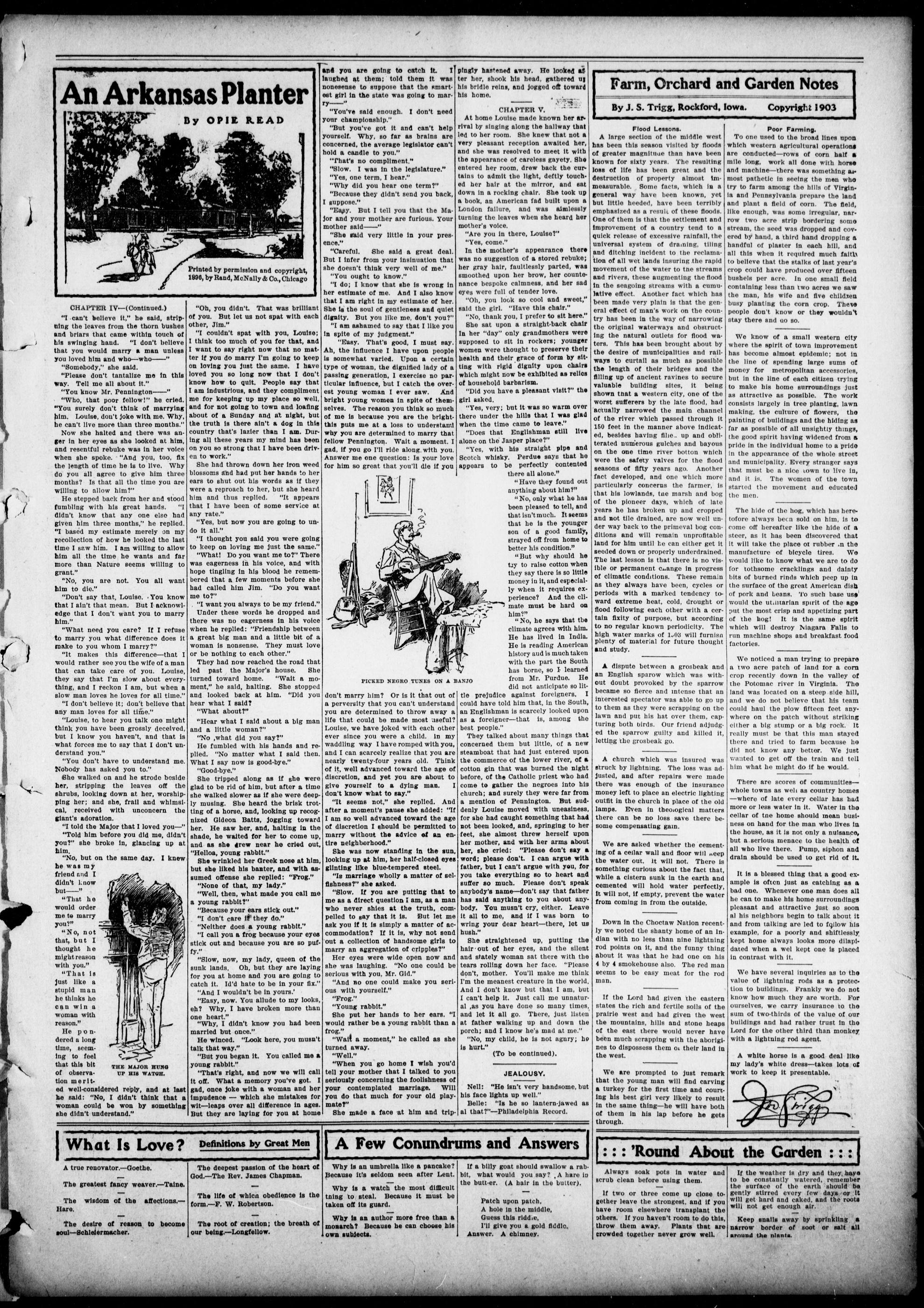
PICKED NEGRO TUNES ON A BANJO
don't marry him? Or is it that out of a perversity that you can't understand you are determined to throw away a life that could be made most useful? Louise, we have joked with each other ever since you were a child. In my waddling way I have romped with you, and I can scarcely realize that you are nearly twenty-four years old. Think of it, well advanced toward the age of discretion, and yet you are about to give yourself to a dying man. I don't know what to say."
"It seems not," she replied. And after a moment's pause she added: "If I am so well advanced toward the age of discretion I should be permitted to marry without the advice of an entire neighborhood."
She was now standing in the sun, looking up at him, her half-closed eyes glinting like blue-tempered steel.
"Is marriage wholly a matter of selfishness?" she asked.
"Slow. If you are putting that to me as a direct question I am, as a man who never shies at the truth, compelled to say that it is. But let me ask you if it is simply a matter of accommodation? If it is, why not send out a collection of handsome girls to marry an aggregation of cripples?
Her eyes were wide open now and she was laughing. "No one could be serious with you, Mr. Gid."
"And no one could make you serious with yourself."
"Frog."
"Young rabbit."
She put her hands to her ears. "I would rather be a young rabbit than a frog."
"Wait a moment," he called as she turned away.
"Well."
"When you go home I wish you'd tell your mother that I talked to you seriously concerning the foolishness of your contemplated marriage. Will you do that much for your old playmate?"
She made a face at him and trip-
A Few Conundrum
Why is an umbrella like a pancake? Because it's seldom seen after Lent.
Why is a watch the most difficult thing to steal. Because it must be taken off its guard.
Why is an author more free than a monarch? Because he can choose his own subjects.
pingly hastened away. He looked after her, shook his head, gathered up his bridle reins, and jogged off toward his home.
CHAPTER V.
At home Louise made known her arrival by singing along the hallway that led to her room. She knew that not a very pleasant reception awaited her, and she was resolved to meet it with the appearance of careless gayety. She entered her room, drew back the curtains to admit the light, deftly touched her hair at the mirror, and sat down in a rocking chair. She took up a book, an American fad built upon a London failure, and was aimlessly turning the leaves when she heard her mother's voice.
"Are you in there, Louise?"
"Yes, come."
In the mother's appearance there was no suggestion of a stored rebuke; her gray hair, faultlessly parted, smoothed upon her brow, her countenance bespoke calmness, and her sad eyes were full of tender love.
"Oh, you look so cool and sweet," said the girl. "Have this chair."
"No, thank you, I prefer to sit here."
She sat upon a straight-back chair In her "day" only grandmothers were supposed to sit in rockers; younger women were thought to preserve their health and their grace of form by sitting with rigid dignity upon chairs which might now be exhibited as relics of household barbarism.
"Did you have a pleasant visit?" the girl asked.
"Yes, very; but it was so warm over there under the hills that I was glad when the time came to leave."
"Does that Englishman still live alone on the Jasper place?"
"Yes, with his straight pipe and Scotch whisky. Perdue says that he appears to be perfectly contented."
"Have they found out anything about him?"
"No, only what he has been pleased to tell, and that isn't much. It seems that he is the younger son of a good family, strayed off from home to better his condition."
"But why should he try to raise cotton when they say there is so little money in it, and especially when it requires experience? And the climate must be hard on him?"
"No, he says that the climate agrees with him. He has lived in India. He is reading American history and is much taken with the part the South has borne, so I learned from Mr. Purdue. He did not anticipate so little prejudice against foreigners. I could have told him that, in the South, an Englishman is scarcely looked upon as a foreigner—that is, among the best people."
They talked about many things that concerned them but little, of a new steamboat that had just entered upon the commerce of the lower river, of a cotton gin that was burned the night before, of the Catholic priest who had come to gather the negroes into his church; and surely they were far from a mention of Pennington. But suddenly Louise moved with uneasiness, for she had caught something that had not been looked, and, springing to her feet, she almost threw herself upon her mother, and with her arms about her, she cried: "Please don't say a word; please don't. I can argue with father, but I can't argue with you, for you take everything so to heart and suffer so much. Please don't speak anybody's name—don't say that father has said anything to you about anybody. You mustn't cry, either. Leave it all to me, and if I was born to wring your dear heart—there, let us hush."
She straightened up, putting the hair out of her eyes, and the silent and stately woman sat there with the tears rolling down her face. "Please don't, mother. You'll make me think I'm the meanest creature in the world. And I don't know but that I am, but I can't help it. Just call me unnatural, as you have done so many times, and let it all go. There, just listen at father walking up and down the porch; and I know he's mad at me." (No, my child he is not sorry.)
"No, my child, he is not agny; he
hurt." (To be continued).
JEALOUSY.
Belle: "Is he so llantern-jawed as al that?"—Philadelphia Record.
If a billy goat should swallow a rabbit,
what would you say? A hare in the butt-er. (A hair in the butter).
Patch upon patch,
A hole in the middle,
Guess this riddle,
I'll give you a gold fiddle.
Answer. A chimney.
Farm, Orchard and Garden Notes
:::: 'Round About the Garden ::::
:::: 'Round About the Garden ::::
Flood Lessons.
A large section of the middle west has been this season visited by floods of greater magnitude than have been known for sixty years. The resulting loss of life has been great and the destruction of property almost immeasurable. Some facts, which in a general way have been known, yet but little heeded, have been terribly emphasized as a result of these floods. One of them is that the settlement and improvement of a country tend to a quick release of excessive rainfall, the universal system of draining, tiling and ditching incident to the reclamation of all wet lands insuring the rapid movement of the water to the streams and rivers, these augmenting the flood in the seagoing streams with a cumulative effect. Another fact which has been made very plain is that the general effect of man's work on the country has been in the way of narrowing the original waterways and obstructing the natural outlets for flood waters. This has been brought about by the desire of municipalities and railways to curtail as much as possible the length of their bridges and the filling up of ancient ravines to secure valuable building sites, it being shown that a western city, one of the worst sufferers by the late flood, had actually narrowed the main channel of the river which passed through it 150 feet in the manner above indicated, besides having file. up and obliterated numerous gulches and bayous on the one time river bottom which were the safety valves for the flood seasons of fifty years ago. Another fact developed, and one which more particularly concerns the farmer, is that his lowlands, the marsh and bog of the pioneer days, which of late years he has broken up and cropped and not tile drained, are now well under way back to the primeval bog conditions and will remain unprofitable land for him until he can either get it seeded down or properly underdrained. The last lesson is that there is no visible or permanent change in progress of climatic conditions. These remain as they always have been, cycles or periods with a marked tendency toward extreme heat, cold, drought or flood following each other with a certain fixity of purpose, but according to no regular known periodicity. The high water marks of 1.03 will furnish plenty of material for future thought and study.
A dispute between a grosbeak and an English sparow which was without doubt provoked by the sparrow became so fierce and intense that an interested spectator was able to go up to them as they were scrapping on the lawn and put his hat over them, capturing both birds. Our friend adjudged the sparrow guilty and killed it, letting the grosbeak go.
A church which was insured was struck by lightning. The loss was adjusted, and after repairs were made there was enough of the insurance money left to place an electric lighting outfit in the church in place of the old lamps. Even in theological matters there can be no loss save there become compensating gain.
We are asked whether the cementing of a cearl wall and floor will keep the water out. It will not. There is something curious about the fact that, while a cistern sunk in the earth and cemented will hold water perfectly, it will not, if empty, prevent the water from coming in from the outside.
Down in the Choctaw Nation recently we noted the shanty home of an Indian with no less than nine lightning rod points on it, and the funny thing about it was that he had one on his 4 by 4 smokehouse also. The red man seems to be easy meat for the rod man.
If the Lord had given the eastern states the rich and fertile soils of the prairie west and had given the west the mountains, hills and stone heaps of the east there would never have been much scrapping with the aborigines to dispossess them or their land in the west.
We are prompted to just remark that the young man will find carving a turkey for the first time and courring his best girl very likely to result in the same thing—he will have both of them in his lap before he gets through.
Always soak pots in water and scrub clean before using them.
If two or three come up close together leave the strongest, and if you have room elsewhere transplant the others. If you haven't room to do this, throw them away. Plants that are crowded together never grow well.
Poor Farming.
To one used to the broad lines upon which western agricultural operations are conducted—rows of corn half a mile long, work all done with horse and machine—there was something almost pathetic in seeing the men who try to farm among the hills of Virginia and Pennsylvania prepare the land and plant a field of corn. The field, like enough, was some irregular, narrow two acre strip bordering some stream, the seed was dropped and covered by hand, a third hand dropping a handful of plaster in each hill, and all this when it required much faith to believe that the stalks of last year's crop could have produced over fifteen bushels per acre. In one small field containing less than two acres we saw the man, his wife and five children busy planting the corn crop. These people don't know or they wouldn't stay there and so go.
We know of a small western city where the spirit of town improvement has become almost epidemic; not in the line of spending large sums of money for metropolitan accessories, but in the line of each citizen trying to make his home surroundings just as attractive as possible. The work consists largely in tree planting, lawn making, the culture of flowers, the painting of buildings and the hiding as far as possible of all unsightly things, the good spirit having widened from a pride in the individual home to a pride in the appearance of the whole street and municipality. Every stranger says that must be a nice town to live in and it is. The women of the town started the movement and educated the men.
The hide of the hog, which has heretofore always been sold on him, is to come off hereafter like the hide of a steer, as it has been discovered that it will take the place of rubber in the manufacture of bicycle tires. We would like to know what we are to do for tothsome cracklings and dalty bits of burned rinds which peep up in the surface of the great American dish of pork and beans. To such base use would the utantarian spirit of the age put the most crisp and appetizing part of the hog! It is the same spirit which will destroy Niagara Falls to run machine shops and breakfast food factories.
We noticed a man trying to prepare a two acre patch of land for a corn crop recently down in the valley of the Potomac river in Virginia. The land was located on a steep side hill, and we do not believe that his team could haul the plow fifteen feet anywhere on the patch without striking either a big stump or a big rock. It really must be that this man stayed there and tried to farm because he did not know any better. We just wanted to get off the train and tell him what he might do if he would.
There are scores of communities—whole towns as well as country homes—where of late every cellar has had more or less water in it. Water in the cellar of the home should mean business on hand for the man who lives in the house, as it is not only a nulsance, but a serious menace to the health of all who live there. Pump, siphon and drain should be used to get rid of it.
It is a blessed thing that a good example is often just as catching as a bad one. Whenever one man does all he can to make his home surroundings pleasant and attractive just so soon al his neighbors begin to talk about it and from talking are led to follow his example, for a poorly and shiftlessly kept home always looks more dilapidated when a wel kept one is placed in contrast with it.
We have several inquiries as to the value of lightning rods as a protection to buildings. Frankly we do not know how much they are worth. For ourselves, we carry insurance to the sum of two-thirds of the value of our buildings and had rather trust in the Lord for the other third than monkey with a lightning rod agent.
A white horse is a good deal like my lady's white dress—takes lots of work to keep it presentable.
If the weather is dry and they have to be constantly watered, remember the surface of the earth should be gently stirred every few days or it will get hard and caked, and the roots will not get enough air.
Keep snails away by sprinkling a narrow border of soot or salt all around the plants.
BUFUS L. LOGAN, B. S. D. - EDITOR
TERMS OF SUBSCRIPTION.
One Year in Advance - - - $1.00
Six Months in Advance - - .75
Three Months in Advance - - .50
Single Copies - - - .05
Advertising Rates on Application.
Job Work of all Kinds Solicited.
Published Every Friday
Entered at the postoffice at Columbia, Mo., as second class matter, Jan. 15, 1902.
Agents wanted in every town in the state.
Payments may be made in two cent stamps, by postal note, money order, by registered letter or express order.
Correspondence containing news of interest and importance is desired from all parts of the United States.
Communications should be made to reach us not later than Thursday morning, to insure insertion in the current issue.
No attention will be paid to anonymous communications.
Agents wanted everywhere. Write for terms.
Specimen copies sent to any address upon request.
PRESS OF THE MISSOURI STATESMAN.
IF you have ordered the Professional World and do not get it let us know.
THE lazier a man is the greater things he is going to do when tomorrow comes.
THE city should own and control the water and light plant in Columbia as well as in other cities.
IF people would only stop talking where they stop knowing half the evils of life would come to an end.
THE anti-cigarett law which makes it a penalty for any one to sell or to give cigaretts to a minor in Missouri, went into effect June 1st. It should be strictly enforced.
JUDGING from the water and light proposition recently submitted to the voters of Columbia, one would decide that the council thinks the voters are all graduates of the university.
HE who betrays another's secret because he has quarreled with him was never worth the sacred name of friend. A breach of kindness on one side will not justify a breach of trust on the other.
Persons who send articles to newspapers for publication should take pains to prepare them so that they may be set up without unnecessary trouble. Write only on one side of the paper and write plainly.
SAY what you will, but you are compelled to admit that the Professional World is the only negro paper published in this section of the country for $1.00 per year and contains as much news as any $2.00 per year paper.
The Negro Farmers Improvement Society of Texas which recently held its 7th annual session is composed of 3,000 negro farmers who own 50,000 acres of land, 8,000 head of cattle and 7,000 horses and mules. The principal object of the convention is to devise ways and means of cancelling mortgages.—Sedalia Times.
Our thanks are due the following named persons for subscriptions this week: Dr. J. E. Perry, Columbia, Mrs. Irena Grant, Deer Park, Mr. Ed Turner, Pierpont, Mr. Tom Johnson, Ashland, Mr. Marion Kelly of McBaine, Mrs. America L. Brown, Auxvasse, Miss B. K. Morrison, Springfield, Mrs. Maria Smith, Mrs. Emiline Williams, Mrs. Horace Williams, and Mr. John Washington, Columbia.
INTERESTING FACTS.
The English postoffice gives 20 per cent better speed in delivering parcels than the private carriers, and at a cost of six cents for one pound, 8 cents for two pounds and 24 cents for eleven pounds. A lot of typewritten matter was stored in a slightly damp vault for six months. On removal the paper and gall ink signatures were in
the best of condition, but all traces of the typewriting had disappeared.
According to Lord Rayleigh a film of oil on water may be so thin that its thickness is no more than one twenty-five millionth of an inch, which is computed to be, in all probability, the size of a molecule of the oil.
That the low lying territory of the Mississippi should at times be overflowed is not surprising if one considers that the "Father of Waters" draws supplies from 28 states, draining one third of the area of the United States.
In the election of 1892 there were in England and Wales 46,109 illiterates; in Scotland, 4,577; in Ireland, 84,919. At the 1895 election the figures were: Illiterates in England, 28,521; Scotland, 4,062; Ireland, 40,357.
A flock of ostriches at Phoenix, Ariz., now number more than 1,000 birds. Their increase is rapid, because a pair, barring accidents, will raise a brood each summer for 70 years. Each pair produces in feathers and eggs about $30 a year.
The Brooklyn bridge has lost place as one of the wonders of the world since the building of the Williamsburg steel bridge, a mile farther up the East river, and the bridge now building to Blackwell's Island will be more wonderful than either.
The scientific reason for popping of corn has been investigated by Prof. Kraemer, of Philadelphia, who finds that the endorsperm is more or less translucent and horny and its cells contain closely arranged polygonal starch grains having a central rarefied area. The degree of the expansion of these cells depends upon the relative amount of water and air in the grains.
E. J. Arnold, head of the "get rich quick" turf concern which failed in St. Louis several months ago, leaving thousands of dupes penniles, surrendered himself to the authorities to day and gave bond. Arnold has been in hiding since the crash came.
Notice of Special School Election
Notice is hereby given to the qualified voters of umbia state of Missouri, the county of Boone, the county of Missouri, that in connection with an order entered of record made by the Board of Education of said school district, a special election will be held.
The polls will be open from 7 o'clock a.m. to 6 o'clock p. m. of said day. Said election will be held for the purpose of submitting to the town council. Said district the following propositions to wilt:
JOHN L. HENRY, President Board,
jun 26-3w Secretary.
TAKE THE
WABASH
TO
DETROIT, MICH.
TO THE
INTERNATIONAL
EPWORTH - LEAGUE
CONVENTION
JULY 16-19, 1903.
The Missouri State Epworth
League has designated The Wabash
as the Official Route to Detroit.
Greatly Reduced Rates
The most attractive and lowest-priced summer trip ever offered. For particulars and souvenir fold ers write
W. D. Wood, L. S. McClellan,
T. P. A.
St. Louis, Mo.
W. P. A.
Kansas City, Mo.
H. E. WATTS, P. & T. A.,
NOBERLY, MO.
T
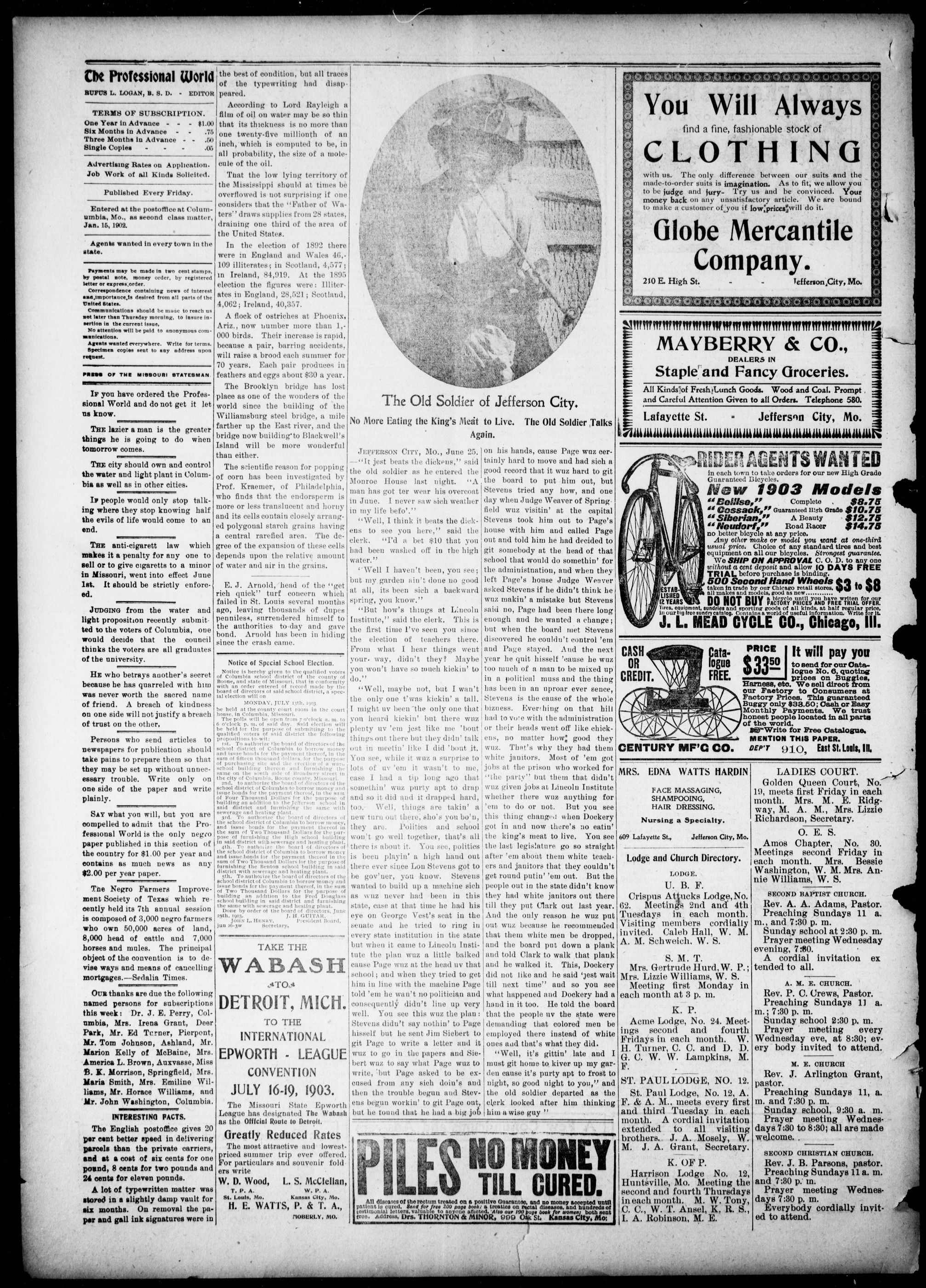
The Old Soldier of Jefferson City.
PILES NO MONEY TILL CURED. All diseases of the rectum treated on a positive Guarantee, and no money accepted until patient is cured. Send for free 200 page book: a treaties on rectal diseases, and hundreds of testimonial letters, valuable to anyone affected. Also our 100 page book for women; both sent trees. Address, Drs. THORNTON & MINOR, 999 Oak St. Kansas City, Mo.
JEFFERSON CITY, Mo., June 25.
—"It jest beats the dickens," said the old soldier as he entered the Monroe House last night. "A man has got ter wear his overcoat in June. I never saw sich weather in my life befo'."
"Well, I think it beats the dickens to see you here," said the clerk. "I'd a bet $10 that you had been washed off in the high water."
"Well I haven't been, you see; but my garden ain't done no good at all, its been sich a backward spring, you know."
"But how's things at Lincoln Institute," said the clerk. This is the first time I've seen you since the election of teachers there. From what I hear things went your way, didn't they? Maybe you won't have so much kickin' to do."
“Well, maybe not, but I wan't the only one t'was kickin' a tall. I might uv been the only one that you heard kickin' but there wuz plenty uv 'em jest like me 'bout things out there and they didn' talk out in meetin' like I did 'bout it. You see, while it wuz a surprise to lots of uv 'em it wasn't to me, case I had a tip long ago that somethin' wuz party apt to drap and so it did and it drapped hard, too. Well, things are takin' a new turn out there, sho's you bo'n, they are. Politics and school won't go well together, that's all there is about it. You see, politics is been playin' a high hand out there ever since Lon Stevens got to be gov'ner, you know. Stevens wanted to build up a machine as wuz never had been in this state, case at that time he had his eye on George Vest's seat in the senate and he tried to ring in every state institution in the state but when it came to Lincoln Institute the plan wuz a little balked cause Page wuz at the head uv that school; and when they tried to get him in line with the machine Page told 'em he wan't no politician and consequently didn't line up very well. You see this wuz the plan: Stevens didn't say nothin' to Page hisself but he sent Jim Siebert to git Page to write a letter and it wuz to go in the papers and Siebert wuz to say what Page wuz to write, 'but Page asked to be excused from any sich doin's and then the trouble begun and Stevens begun workin' to git Page out, but he found that he had a big job
Again.
on his hands, cause Page wuz certainly hard to move and had sich a good record that it wuz hard to git the board to put him out, but Stevens tried any how, and one day when Judge Weaver of Springfield wuz visitin' at the capital Stevens took him out to Page's house with him and called Page out and told him he had decided to git somebody at the head of that school that would do somethin' for the administration, and when they left Page's house Judge Weaver asked Stevens if he didn't think he wuz makin' a mistake but Stevens said no, Page had been there long enough and he wanted a change; but when the board met Stevens discovered he couldn't control 'em and Page stayed. And the next year he quit hiself 'cause he wuz too much of a man to be mixed up in a political muss and the thing has been in an uproar ever sence, Stevens is the cause of the whole bizness. Everything on that hill had to vote with the administration or their heads went off like chickens, no matter how good they wuz. That's why they had them white janitors. Most of 'em got jobs at the prison who worked for 'the party' but them that didn't wuz given jobs at Lincoln Institute whether there wuz anything for 'em to do or not. But you see this thing changed when Dockery got in and now there's no eatin' the king's meat to live. You see the last legislature go so straight after 'em about them white teachers and janitors that they couldn't get round putin' 'em out. But the people out in the state didn't know they had white janitors out there till they put Clark out last year. And the only reason he wuz put out wuz because he recommended that them white men be dropped, and the board put down a plank and told Clark to walk that plank and he walked it. This, Dockery did not like and he said 'jest wait till next time'" and so you see what happened and Dockery had a hand in it too. He told the board that the people uv the state were demanding that colored men be employed there instead of white ones and that's what they did.
"Well, it's gittin' late and I must git home to kiver up my garden cause it's purty apt to frost to night, so good night to you," and the old soldier departed as the clerk looked after him thinking him a wise guy."
You Will Always find a fine, fashionable stock of CLOTHING
with us. The only difference between our suits and the made-to-order suits is imagination. As to fit, we allow you to be judge and jury- Try us and be convinced. Your money back on any unsatisfactory article. We are bound to make a customer of you if low_prices"will do it.
MAYBERRY
DEALERS IN
Staple and Fancy
All Kinds of Fresh, Lunch Goods. W
and Careful Attention Given to all Or
Lafayette St. - Jeffe
BERRY & CO.,
SALERS IN
Fancy Groceries.
Goods. Wood and Coal. Prompt
to all Orders. Telephone 580.
Jefferson City, Mo.
AGENTS WANTED
to take orders for our new High Grade
and Bicycles.
Our 1903 Models
are," Complete $8.75
back," Guaranteed High Grade $10.75
brian," A Beauty $12.75
fort," Road Racer $14.75
bicycle at any price.
or make or model you want at one-third
price. Choice of any standard tires and best
on all our bicycles. Strongest guarantee.
UP ON APPROVAL C. O. D. to any one
event deposit and allow 10 DAYS FREE
before purchase is binding.
Second Hand Wheels
made by our Chicago retail stores,
and models good as new.
BUY a bicycle until you have written for our
FACTORY PRICES AND FREE TRIAL OFFER.
Supporting goods of all kinds, at half regular price,
contains a world of useful information. Write for it.
YCLE CO., Chicago, Ill.
All Kinds of Fresh Lunch Goods. Wood and Coal. Prompt and Careful Attention Given to all Orders. Telephone 580.
RIDER AGENTSWANTED
PRICE
$3350
Harness, etc. We sell direct from our Factory to Consumers at Factory Prices. This guaranteed Buggy only $33.50; Cash or Easy Monthly Payments. We trust honest people located in all parts of the world.
Write for Free Catalogue.
MENTION THIS PAPER.
DEP'T 910 East St. Louis, Ill.
---
---
210 E. High St.
ESTABLISHED
12 YEARS
Tires, equipment,
in our big free sun
J. L. M
CASH OR CREDIT. Catalogue FREE.
CENTURY MF'G CO.
FACE MASSAGING,
SHAMPOOING,
HAIR DRESSING.
Nursing a Specialty.
609 Lafayette St., Jefferson City, Mo
Lodge and Church Directory.
LODGE.
U. B. F.
Crispus Attucks Lodge,No.
62. Meetings 2nd and 4th
Tuesdays in each month.
Visiting members cordially
invited. Caleb Hall, W. M.
A. M. Schweich, W. S.
S.M.T.
Mrs. Gertrude Hurd, W. P.; Mrs. Lizzie Williams, W. S. Meeting first Monday in each month at 3 p. m.
K. P.
Acme Lodge, No. 24. Meetings second and fourth Fridays in each month. W. H. Turner, C. C. and D. D. G. C. W. W. Lampkins, M. F.
ST. PAUL LODGE, NO. 12.
St. Paul Lodge, No. 12. A. F. & A. M., meets every first and third Tuesday in each month. A cordial invitation extended to all visiting brothers. J. A. Mosely, W. M. J. A. Grant, Secretary.
K. OF P.
Harrison Lodge No. 12,
Huntsville, Mo. Meeting the
second and fourth Thursdays
in each month. M. W. Tony,
C. C., W. T. Ansel, K. R. S.,
I. A. Robinson, M. E.
Jefferson City, Mo.
It will pay you
to send for our Catalogue No. 6, quoting prices on Buggles,
Golden Queen Court, No. 19, meets first Friday in each month. Mrs. M. E. Ridgway, M. A. M., Mrs. Lizie Richardson, Secretary.
O. E. S.
Amos Chapter, No. 30. Meetings second Friday in each month. Mrs. Bessie Washington, W. M. Mrs. Annie Williams, W. S.
SECOND BAPTIST CHURCH.
Rev. A. A. Adams, Pastor.
Preaching Sundays 11 a.m., and 7:30 p. m.
Sunday school at 2:30 p. m.
Prayer meeting Wednesday evening, 7:80.
A cordial invitation extended to all.
A. M. E. CHURCH.
Rev. P. C. Crews, Pastor.
Preaching Sundays 11 a.
m.; 7:30 p. m.
Sunday school 2:30 p. m.
Prayer meeting every
Wednesday eve, at 8:30; every body invited to attend.
M. E. CHURCH
Rev. J. Arlington Grant,
pastor.
Preaching Sundays 11, a.
m. and 7:30 p. m.
Sunday school, 9:30 a. m.
Prayer meeting Wednes-
days 7:30 to 8:30; all are made
welcome.
SECOND CHRISTIAN CHURCH.
Rev. J. B. Parsons, pastor.
Preaching Sundays 11 a. m.
and 7:30 p. m.
Prayer meeting Wednes-
days 7:30 p. m.
Everybody cordially invi-
ted to attend.