The Professional World
Friday, September 25, 1903
Columbia, Missouri
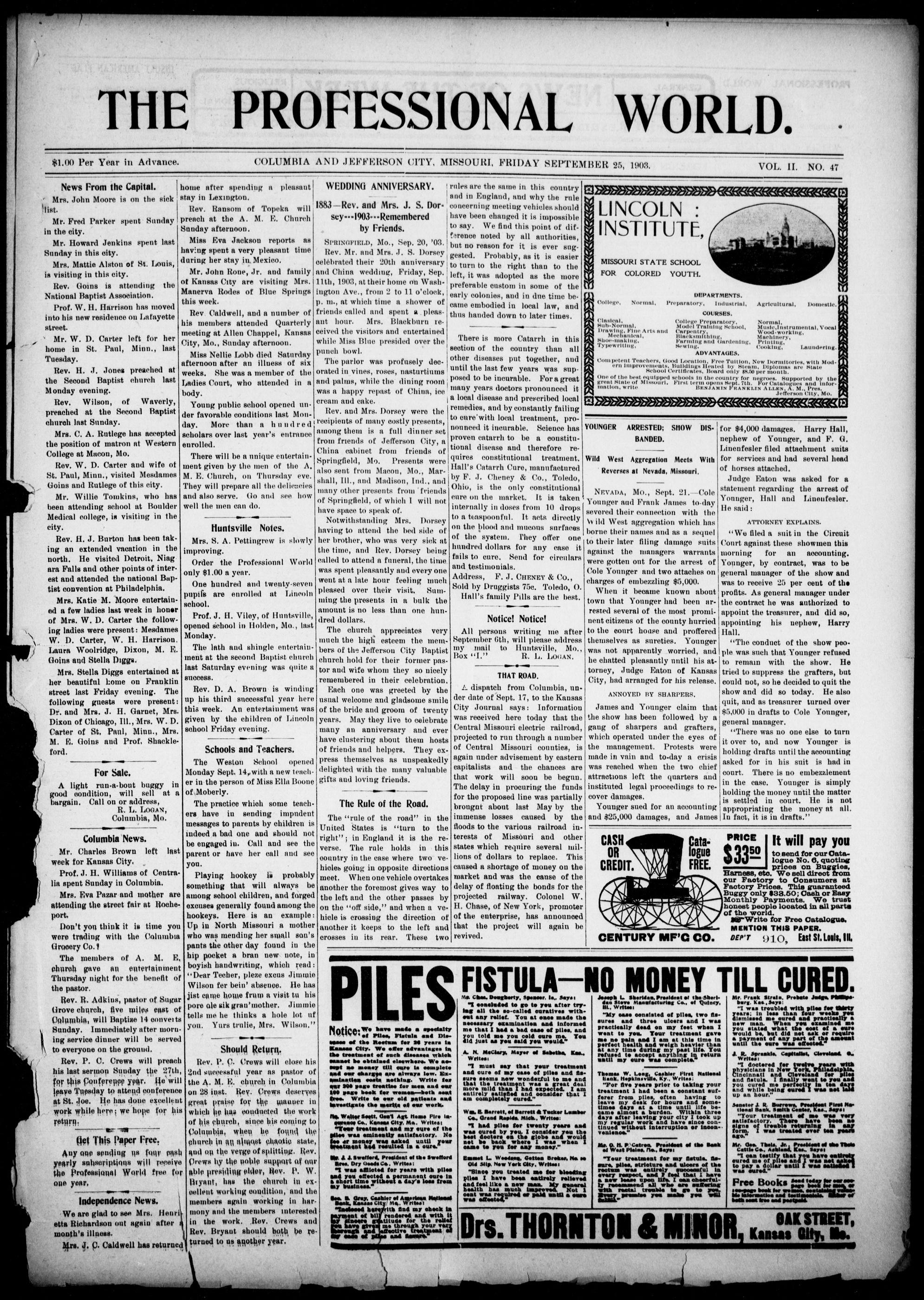
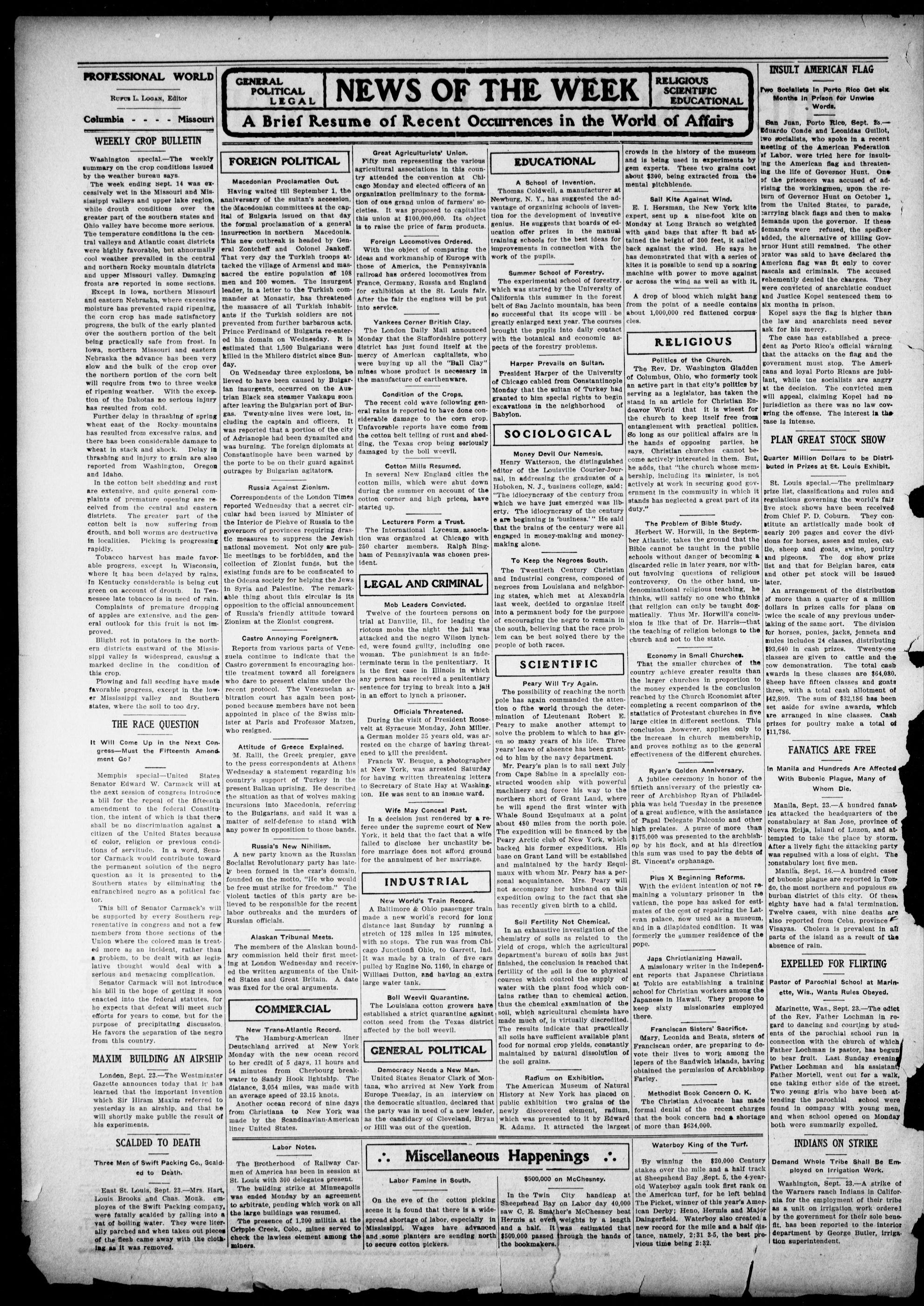
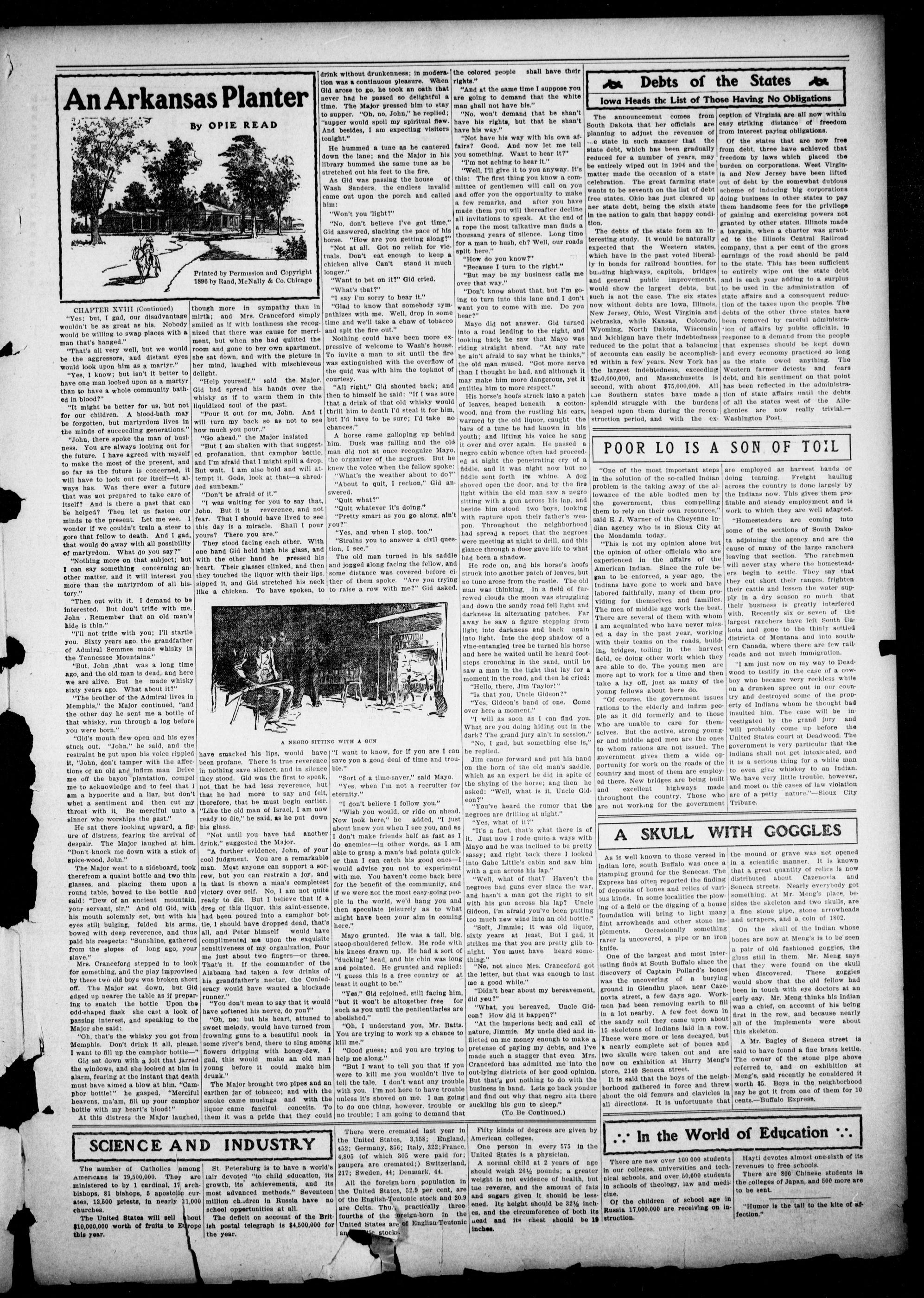
Page text (machine-generated)
THE PROFESSIONAL WORLD.
$1.00 Per Year in Advance.
Mrs. John Moore is on the sick list.
Mr. Fred Parker spent Sunday in the city.
Mr. Howard Jenkins spent last Sunday in this city.
Mrs. Mattie Alston of St. Louis, is visiting in this city.
Rev. Goins is attending the National Baptist Association.
Prof. W. H. Harrison has moved into his new residence on Lafayette street.
Mr. W. D. Carter left for her home in St. Paul, Minn., last Tuesday.
Rev. H. J. Jones preached at the Second Baptist church last Monday evening.
Rev. Wilson, of Waverly, preached at the Second Baptist church last Sunday.
Mrs. C. A. Rutlege has accepted the position of matron at Western College at Macon, Mo.
Rev. W. D. Carter and wife of St. Paul, Minn., visited Mesdames Goins and Rutlege of this city.
Mr. Willie Tomkins, who has been attending school at Boulder Medical college, is visiting in the city.
Rev. H. J. Burton has been taking an extended vacation in the north. He visited Detroit, Niagara Falls and other points of interest and attended the national Baptist convention at Philadelphia.
Mrs. Katie M. Moore entertained a few ladies last week in honor of Mrs. W. D. Carter the following ladies were present: Mesdames W. D. Carter, W. H. Harrison. Laura Woolridge, Dixon, M. E. Goins and Stella Diggs.
Mrs. Stella Diggs entertained at her beautiful home on Franklin street last Friday evening. The following guests were present: Dr. and Mrs. J. H. Garnet, Mrs. Dixon of Chicago, Ill., Mrs. W. D. Carter of St. Paul, Minn., Mrs. M. E. Goins and Prof. Shackleford.
For Sale.
A light run-a-bout buggy in good condition, will sell at a bargain. Call on or address,
R. L. LOGAN,
Columbia, Mo.
Columbia News.
Mr. Charles Brown left last week for Kansas City.
Prof. J. H. Williams of Centralia spent Sunday in Columbia.
Mrs. Eva Pazar and mother are attending the street fair at Rocheport.
Don't you think it is time you were trading with the Columbia Grocery Co.?
The members of A. M. E. church gave an entertainment Thursday night for the benefit of the pastor.
Rev. R. Adkins, pastor of Sugar Grove church, five miles east of Columbia, will Baptize 14 converts Sunday. Immediately after morning service dinner will be served to everyone on the ground.
Rev. P. C. Crews will preach his last sermon Sunday the 27th, for this Conference year. He will leave Tuesday to attend conference at St. Joe. He has done excellent work while here; we hope for his return.
Get This Paper Free.
Any one sending us four cash yearly subscriptions will receive the Professional World free for one year.
We are glad to see Mrs. Henrietta Richardson out again after a month's illness. Mrs. J. C. Caldwell has returned
COLUMBIA AND JEFFERSON CITY, MISSOURI, FRIDAY SEPTEMBER 25. 1903.
home after spending a pleasant stay in Lexington.
Rev. Ransom of Topeka will preach at the A. M. E. Church Sunday afternoon.
Miss Eva Jackson reports as having spent a very pleasant time during her stay in Mexico.
Mr. John Rone, Jr. and family of Kansas City are visiting Mrs. Manerva Rodes of Blue Springs this week.
Rev. Caldwell, and a number of his members attended Quarterly meeting at Allen Chappel, Kansas City, Mo., Sunday afternoon.
Miss Nellie Lobb died Saturday afternoon after an illness of six weeks. She was a member of the Ladies Court, who attended in a body.
Young public school opened under favorable conditions last Monday. More than a hundred scholars over last year's entrance enrolled.
There will be a unique entertainment given by the men of the A. M. E. Church, on Thursday eve. They will prepare all the delicacies and also serve. Go and see how well the men can do.
Huntsville Notes.
Mrs. S. A. Pettingrew is slowly improving.
Order the Professional World only $1.00 a year.
One hundred and twenty-seven pupils are enrolled at Lincoln school.
Prof. J. H. Viley, of Huntsville, opened school in Holden, Mo., last Monday.
The lath and shingle entertainment at the second Baptist church last Saturday evening was quite a success.
Rev. D. A. Brown is winding up his third successful year here this week. An entertainment was given by the children of Lincoln school Friday evening.
Schools and Teachers.
The Weston School opened Monday Sept. 14, with a new teacher in the person of Miss Ella Boone of Moberly.
The practice which some teachers have in sending impudent messages to parents by children is indeed a bad one and should not be engaged in. Call and see the parent or have her call and see you.
Playing hookey is probably something that will always be among school children, and forged excuses generally found among the hookeys. Here is an example: Up in North Missouri a mother who was mending her small son's pants the other day found in the hip pocket a bran new note, in boyish handwriting, which read: "Dear Techer, pleze excus Jimmie Wilson fer bein' absence. He has jist came home frum a visit tu his pore ole sik gran'mother. Jimmie tells me he thinks a hole lot of you. Yurs trulie, Mrs. Wilson."
Should Return.
Rev. P. C. Crews will close his 2nd successful year as pastor of the A. M. E. church in Columbia on 28 inst. Rev. Crews deserves great praise for the manner in which he has conducted the work of his church, since his coming to Columbia, when he found the church in an almost chaotic state, and on the verge of splitting. Rev. Crews by the noble support of our able presiding elder, Rev. P. W. Bryant, has the church in excellent working condition, and the members again working in harmony and the members interested in the work. Rev. Crews and Rev. Bryant should both be returned to us another year.
WEDDING ANNIVERSARY.
1883—Rev. and Mrs. J. S. Dorsey----1903----Remembered by Friends.
SPRINGFIELD, Mo., Sep. 20, '03. Rev. Mr. and Mrs. J. S. Dorsey celebrated their 20th anniversary and China wedding, Friday, Sep. 11th, 1903, at their home on Washington Ave., from 2 to 11 o'clock, p. m., at which time a shower of friends called and spent a pleasant hour. Mrs. Blackburn received the visitors and entertained while Miss Blue presided over the punch bowl. The parlor was profusely decorated in vines, roses, nasturtiums and palms, while the dining room was a happy repast of China, ice cream and cake.
Rev. and Mrs. Dorsey were the recipients of many costly presents, among them is a full dinner set from friends of Jefferson City, a China cabinet from friends of Springfield, Mo. Presents were also sent from Macon, Mo., Marshall, Ill., and Madison, Ind., and many other presents from friends of Springfield, of which I will not have space to speak of.
Notwithstanding Mrs. Dorsey having to attend the bed side of her brother, who was very sick at the time, and Rev. Dorsey being called to attend a funeral, the time was spent pleasantly and every one went at a late hour feeling much pleased over their visit. Summing the presents in a bulk the amount is no less than one hundred dollars. The church appreciates very much the high esteem the members of the Jefferson City Baptist church hold for their former pastor and wife whom they so nicely remembered in their celebration
Each one was greeted by the usual welcome and gladsome smile of the bride and groom of twenty years. May they live to celebrate many an anniversary and ever have clustering about them hosts of friends and helpers. They express themselves as unspeakedly delighted with the many valuable gifts and loving friends.
The Rule of the Road.
The "rule of the road" in the United States is "turn to the right"; in England it is the reverse. The rule holds in this country in the case where two vehicles going in opposite directions meet. When one vehicle overtakes another the foremost gives way to the left and the other passes by on the "off side," and when a vehicle is crossing the direction of another it keeps to the left and crosses in its rear. These two
Notice. We have made a specialty
of Piles, Flatulna and Disease
of the Rootsm for 20 years in
Kansas City. We offer advantages in
the treatment of such diseases which
cannot be obtained elsewhere. We accept
no money till cure is complete
and our charges are always low. Ex-
amination costs nothing. Write for
our 200 page treatise for men and our
100 page book for women—both sent
free. Write to our old patients and
investigate the merits of our work.
Mr. Walter Scott, Gcvt Art Home Fire In-
surance Co. Kansas City, Mo. Writes:
"Your treatment and my cure of the piles was aminently satisfactory. No fee or money was asked until your treatment had resulted in a cure."
Mr. J. J. Swefford, President of the Swefford Bres. Dry Goods Co. Writes:
"I was afflicted for years with piles and you effected a permanent cure in a short time without a day's loss from my business."
Sen. B. Gray, Cashier of American National Bank, Kansas City, Mo. Writes:
"Included herewith find my check in payment of bill rendered and with it my sincere gratitude for the relief we have given you and for the effective treatment of our case of piles and scarce."
Drs. THORNTON & MINOR, OAK STREET, Kansas City, Mo.
rules are the same in this country and in England, and why the rule concerning meeting vehicles should have been changed it is impossible to say. We find this point of difference noted by all authorities, but no reason for it is ever suggested. Probably, as it is easier to turn to the right than to the left, it was adopted as the more preferable custom in some of the early colonies, and in due time became embodied in local law, and thus handed down to later times.
There is more Catarrh in this section of the country than all other diseases put together, and until the last few years was supposed to be incurable. For a great many years doctors pronounced it a local disease and prescribed local remedies, and by constantly failing to cure with local treatment, pronounced it incurable. Science has proven catarrh to be a constitutional disease and therefore requires constitutional treatment. Hall's Catarrh Cure, manufactured by F. J. Cheney & Co., Toledo, Ohio, is the only constitutional cure on the market. It is taken internally in doses from 10 drops to a teaspoonful. It acts directly on the blood and mucous surfaces of the system. They offer one hundred dollars for any case it fails to cure. Send for circulars and testimonials.
Address, F. J. CHENEY & Co., Sold by Druggists 75c. Toledo, O Hall's family Pills are the best.
Notice! Notice!
All persons writing me after September 6th, will please address my mail to Huntsville, Mo., Box "I." R. L. LOGAN.
THAT ROAD.
dispatch from Columbia, under date of Sept. 17, to the Kansas City Journal says: Information was received here today that the Central Missouri electric railroad, projected to run through a number of Central Missouri counties, is again under advisement by eastern capitalists and the chances are that work will soon be begun. The delay in procuring the funds for the proposed line was partially brought about last May by the immense losses caused by the floods to the various railroad interests of Missouri and other states which require several millions of dollars to replace. This caused a shortage of money on the market and was the cause of the delay of floating the bonds for the projected railway. Colonel W. H. Chase, of New York, promoter of the enterprise, has announced that the project will again be revived.
Ms. Chas, Dougherty, Spencer, Ia., Says:
C. Ann Sledge, Spouse, I. A. Sayre
"I concluded to go to you after trying all the so-called curatives without any relief. You at once made the necessary examination and informed that I be the cause of piles, and you told me you could cure you. You did just as you said you would."
A. N. McClary, Mayer of Sabotha, Kan.
Writes:
"I must say that your treatment and cure of my case of piles and feature seems new wonderful to me and that the treatment was a great deal expected. I am entirely satisfied and consider that I am completely cured."
Wm. E. Barrett, of Barrett & Tucker Lumber Co., Grand Rapid, Mich., Writes:
"I had piles for twenty years and was cured by you. I consider you the best doctors on the globe and would not be back where I was when I came to you for any money."
Emmet L. Weedson, Gotten Broker, Ma so Old Slip, New York City, Writes:
"Since you treated me for bleeding plies I have been entirely relieved and feel like a new man. My general health has much improved. Not 1 cent was required or paid until a cure was affected."
LINCOLN: INSTITUTE,
MISSOURI STATE SCHOOL
FOR COLORED YOUTH.
DEPARTMENTS.
College, Normal, Preparatory, Industrial, Agricultural, Domestic.
COURSES.
Classical,
Sub-Normal,
Drawing, Fine Arts and
Mechanical,
Shoe-making,
Typewriting,
College Preparatory,
Model Training School,
Carpentry,
Blacksmithing,
Farming and Gardening,
Sewing,
Normal,
Music, Instrumental, Vocal
Wood-working,
Machinery,
Printing,
Cooking,
Laundering.
ADVANTAGES.
Competent Teachers, Good Location, Free Tuition, New Dormitories, with Modern improvements, Buildings Heated by Steam, Diplomas are State School Certificates, Board only $8.50 per month.
One of the best equipped schools in the country for negroes. Supported by the great State of Missouri. First term opens Sept. 7th. For Catalogues and information, write
BENJAMIN FRANKLIN ALLEN, A. M., Pres.
Jefferson City, Mo.
YOUNGER ARRESTED; SHOW DISBANDED.
Wild West Aggregation Meets With Reverses at Nevada, Missouri.
NEVADA, MO., Sept. 21.—Cole Younger and Frank James to-day severed their connection with the Wild West aggregation which has borne their names and as a sequel to their later filing damage suits against the managers warrants were gotten out for the arrest of Cole Younger and two attaches on charges of embezzling $5,000.
When it became known about town that Younger had been arrested several of the most prominent citizens of the county hurried to the court house and proffered themselves as sureties. Younger was not apparently worried, and he chatted pleasantly until his attorney, Judge Eaton of Kansas City, had arranged for his release.
ANNOYED BY SHARPERS.
James and Younger claim that the show has been followed by a gang of sharpers and grafters, which operated under the eyes of the management. Protests were made in vain and to-day a crisis was reached when the two chief attractions left the quarters and instituted legal proceedings to recover damages. Younger sued for an accounting and $25,000 damages, and James
CASH
OR
CREDIT.
Catalogue
FREE.
CENTURY MF'G CO.
Joseph L. S. Sheridan, President of the Sheridan Stove Manufacturing Co., of Quincy, IL. Writes:
"My case consisted of piles, two fixtures and three ulcers and I was practically dead on my feet when I went to you. Your treatment gave me no pain and I am at this time in perfect health and weigh heavier than before. I refused to accept anything in return until my cure was complete."
Theomas W. Long, Cashier First National Bank, Hopkinsonville, Ky. Writes:
"For five years prior to taking your treatment I had been a constant surferer from plies, often having to leave my desk for hours and some time without it. I came almost a burden. Within three days after leaving your city I took up my regular work and have since conquered without interruption or inconvenience."
Mr. O. H. P. Catron, President of the Bank of West Plains, PA; Says:
"Your treatment for my fistula, seizure, plies, stricture and ulcers of the rectum was entirely successful in every respect, and F feel that I have a new lease upon life. I can cheerfully recommend all who are suffering from fistula to you. Every promise you make you will succeed."
VOL. II. NO. 47
MENTS.
Industrial, Agricultural, Domestic.
USES.
Recratory, Normal,
Eing School, Music, Instrumental, Vocal
Wood-working,
Gardening, Machinery,
Cooking, Laundering.
TAGES.
Free Tuition, New Dormitories, with Mod-
ed by Steam, Diplomas are State
and only $8.50 per month.
Country for negroes. Supported by the
us Sept. 7th. For Catalogues and infor-
MIN FRANKLIN ALIEN, A. M. Pres.
Jefferson City, Mo.
for $4,000 damages. Harry Hall, nephew of Younger, and F. G. Linenefesler filed attachment suits for services and had several head of horses attached.
Judge Eaton was asked for a statement regarding the arrest of Younger, Hall and Linenefesler. He said:
ATTORNEY EXPLAINS.
"We filed a suit in the Circuit Court against these showmen this morning for an accounting. Younger, by contract, was to be general manager of the show and was to receive 25 per cent of the profits. As general manager under the contract he was authorized to appoint the treasurer, and did so, appointing his nephew, Harry Hall.
"The conduct of the show people was such that Younger refused to remain with the show. He tried to suppress the grafters, but could not, so he decided to quit the show and did so today. He also quit, and as treasurer turned over $5,000 in drafts to Cole Younger, general manager.
"There was no one else to turn it over to, and now Younger is holding drafts until the accounting asked for in his suit is had in court. There is no embezzlement in the case. Younger is simply holding the money until the matter is settled in court. He is not appropriating the money at all. In fact, it is in drafts."
It will pay you
to send for our Catalogue No. 6, quoting prices on Buggies, We sell directly.
Harness, etc. We sell direct from our Factory to Consumers at Factory Prices. This guaranteed Buggy only $33.50; Cash or Easy Monthly Payments. We trust honest people located in all parts of the world.
DEP'T 910, East St. Louis, Ill.
TILL CURED.
Mr. Frank Stain, Probate Judge, Phillips-
burg, Ma. days:
"I was troubled with piles for thirty
years; in less than four weeks you
dismissed me cured and practically a
new man. When you examined me
you stated what the cost of a cure
would be, but did not ask or require
a payment of any part of the amount
until the cure was effected."
J. R. Sprankle, Capitalist, Cleveland, O.
Writes:
"I doctored for twelve years with physicians in New York, Philadelphia, Cincinnati and Cleveland for piles and back pain. I cared for you you cured me perfectly in ten days and while being cured I was not laid up an hour."
Senator J. R. Burrowe, President First National Bank, Smith Center, Kauai, Hawaii
"Your treatment of me was very satisfactory. There have been no signs of trouble returning in any form. I was treated over ten years." Mr. Gee, Thole, Jr., President of the Tobi Cattle Co., Ashland, KS, Says:
"I can testify that you have entirely cured me of piles and I was not asked to pay a dollar until I was satisfied I was sured."
Free Books Send today for our soap page book for men, or two-page book for women, containing valuable information and toothpaste. Either of both sent free and postpaid.
OR, OAK STREET, Kansas City, Mo.
RUFUS L. LOGAN, Editor
Columbia - - - - Missouri
WEEKLY CROP BULLETIN
Washington special.—The weekly summary on the crop conditions issued by the weather bureau says. The week ending Sept. 14 was excessively wet in the Missouri and Mississippi valleys and upper lake region, while drought conditions over the greater part of the southern states and Ohio valley have become more serious. The temperature conditions in the central valleys and Atlantic coast districts were highly favorable, but abnormally cool weather prevailed in the central and northern Rocky mountain districts and upper Missouri valley. Damaging frosts are reported in some sections
Except in Iowa, northern Missouri and eastern Nebraska, where excessive moisture has prevented rapid ripening, the corn crop has made satisfactory progress, the bulk of the early planted over the southern portion of the belt being practically safe from frost. In Iowa, northern Missouri and eastern Nebraska the advance has been very slow and the bulk of the crop over the northern portion of the corn belt will require from two to three weeks of ripening weather. With the exception of the Dakotas no serious injury has resulted from cold.
Further delay in thrashing of spring wheat east of the Rocky mountains has resulted from excessive rains, and there has been considerable damage to wheat in stack and shock. Delay in thrashing and injury to grain are also reported from Washington, Oregon and Idaho. In the cotton belt shedding and rust are extensive, and quite general complaints of premature opening are received from the central and eastern districts. The greater part of the cotton belt is now suffering from drought, and boll worms are destructive in localities. Picking is progressing rapidly.
Tobacco harvest has made favorable progress, except in Wisconsin, where it has been delayed by rains. In Kentucky considerable is being cut green on account of drought. In Tennessee late tobacco is in need of rain. Complaints of premature dropping of apples are extensive, and the general outlook for this fruit is not improved. Blight rot in potatoes in the northern districts eastward of the Mississippi valley is widespread, causing a marked decline in the condition of this crop. Plowing and fall seeding have made favorable progress, except in the lower Mississippi valley and Southern states, where the soil to too dry.
THE RACE QUESTION
It Will Come Up in the Next Congress—Must the Fifteenth Amendment Go?
Memphis special—United States Senator Edward W. Carmack will at the next session of congress introduce a bill for the repeal of the fifteenth amendment to the federal Constitution, the intent of which is that there shall be no discrimination against a citizen of the United States because of color, religion or previous conditions of servitude. In a word, Senator Carmack would contribute toward the permanent solution of the negro question as it is presented to the Southern states by eliminating the enfranchised negro as a political factor.
This bill of Senator Carmack's will be supported by every Southern representative in congress and not a few members from those sections of the Union where the colored man is treated more as an incident, rather than a problem, to be dealt with as legislative thought would deal with a serious and menacing complication.
Senator Carmack will not introduce his bill in the hope of getting it soon enacted into the federal statutes, for he expects that defeat will meet such efforts for years to come, but for the purpose of precipitating discussion. He favors the separation of the negro from this country.
MAXIM BUILDING AN AIRSHIP
London, Sept. 23.—The Westminster Gazette announces today that it has learned that the important invention which Sir Hiram Maxim referred to yesterday is an airship, and that he will shortly make public the result of his experiments.
SCALLED TO DEATH
Three Men of Swift Packing Co., Scalded to Death.
East St. Louis, Sept. 23.—Mrs. Hart, Louis Brooks and Chas. Monk, employees of the Swift Packing company, were fatally scalded by falling into a vat of boiling water. They were literally parched and when taken out pieces of the flesh came away with the clothing as it was removed.
FOREIGN POLITICAL
Macedonian Proclamation Out.
Having waited till September 1, the anniversary of the sultan's accession, the Macedonian committees at the capital of Bulgaria issued on that day the formal proclamation of a general insurrection in northern Macedonia. This new outbreak is headed by General Zontcheff and Colonel Jankoff. That very day the Turkish troops attacked the village of Armensi and massacred the entire population of 108 men and 200 women. The insurgent leader, in a letter to the Turkish commander at Monastir, has threatened the massacre of all Turkish inhabitants if the Turkish soldiers are not prevented from further barbarous acts. Prince Ferdinand of Bulgaria re-entered his domain on Wednesday. It is estimated that 1,500 Bulgarians were killed in the Mhilero district since Sunday.
On Wednesday three explosions, be lieved to have been caused by Bulgarian insurgents, occurred on the Austrian Black sea steamer Vaskapu soon after leaving the Bulgarian port of Burgas. Twenty-nine lives were lost, including the captain and officers. It was reported that a portion of the city of Adrianople had been dynamited and was burning. The foreign diplomats at Constantinople have been warned by the porte to be on their guard against outrages by Bulgarian agitators.
Russia Against Zionism.
Correspondents of the London Times reported Wednesday that a secret circular had been issued by Minister of the Interior de Plehve of Russia to the governors of provinces requiring drastic measures to suppress the Jewish national movement. Not only are public meetings to be forbidden, and the collection of Zionist funds, but the existing funds are to be confiscated to the Odessa society for helping the Jews in Syria and Palestine. The remarkable thing about this circular is its opposition to the official announcement of Russia's friendly attitude toward Zionism at the Zionist congress.
Castro Annoying Foreigners.
Reports from various parts of Venezuela continue to indicate that the Castro government is encouraging hostile treatment toward all foreigners who dare to present claims under the recent protocol. The Venezuelan arbitration court has again been postponed because members have not been appointed in place of the Swiss minister at Paris and Professor Matzen, who resigned.
Attitude of Greece Explained:
M. Ralli, the Greek premier, gave to the press correspondents at Athens Wednesday a statement regarding his country's support of Turkey in the present Balkan uprising. He described the situation as that of wolves making incursions into Macedonia, referring to the Bulgarians, and said it was a matter of self-defense to stand with any power in opposition to those bands.
Russia's New Nihilism.
A new party known as the Russian Socialist Revolutionary party has later been formed in the czar's domain, founded on the motto, "He who would be free must strike for freedom." The violent tactics of this party are believed to be responsible for the recent labor outbreaks and the murders of Russian officials.
Alaskan Tribunal Meets.
The members of the Alaskan boundary commission held their first meeting at London Wednesday and received the written arguments of the United States and Great Britain. A date was fixed for the oral arguments.
COMMERCIAL
New Trans-Atlantic Record.
The Hamburg-American liner Deutschland arrived at New York Monday with the new ocean record to her credit of 5 days, 11 hours and 54 minutes from Cherbourg breakwater to Sandy Hook lightship. The distance, 3,054 miles, was made with an average speed of 23.15 knots.
Another ocean record of nine days from Christiana to New York was made by the Scandinavian-American liner United States.
Labor Notes.
The Brotherhood of Railway Carmen of America has been in session at St. Louis with 300 delegates present. The building strike at Minneapolis was ended Monday by an agreement to arbitrate, pending which work on all the large buildings was resumed. The presence of 1,200 militia at the Cripple Creek, Colo., mines served to check the lawless element among the miners.
Great Agriculturists' Union.
Great Agriculturists' Union. Fifty men representing the various agricultural associations in this country attended the convention at Chicago Monday and elected officers of an organization preliminary to the formation of one grand union of farmers' societies. It was proposed to capitalize this union at $100,000,000. Its object is to raise the price of farm products
Foreign Locomotives Ordered.
Foreign Locomotives Ordered.
With the object of comparing the ideas and workmanship of Europe with those of America, the Pennsylvania railroad has ordered locomotives from France, Germany, Russia and England for exhibition at the St. Louis fair. After the fair the engines will be put into service.
Yankees Corner British Clay.
The London Daily Mail announced Monday that the Staffordshire pottery district has just found itself at the mercy of American capitalists, who were buying up all the "Ball Clay" mines whose product is necessary in the manufacture of earthenware.
Condition of the Crops.
The recent cold wave following general rains is reported to have done considerable damage to the corn crop. Unfavorable reports have come from the cotton belt telling of rust and shedding, the Texas crop being seriously damaged by the boll weevil.
Cotton Mills Resumed.
In several New England cities the cotton mills, which were shut down during the summer on account of the cotton corner and high prices, have started up.
Lecturers Form a Trust.
The International Lyceum association was organized at Chicago with 250 charter members. Ralph Bingham of Pennsylvania was chosen president.
LEGAL AND CRIMINAL
Mob Leaders Convicted.
Twelve of the fourteen persons on trial at Danville, Ill., for leading the riotous mobs the night the jail was attacked and the negro Wilson lynched, were found guilty, including one woman. The punishment is an indeterminate term in the penitentiary. It is the first case in Illinois in which any person has received a penitentiary sentence for trying to break into a jail in an effort to lynch a prisoner.
Officials Threatened.
During the visit of President Roosevelt at Syracuse Monday, John Miller, a German molder 35 years old, was arrested on the charge of having threatened to kill the president.
Francis W. Beuque, a photographer at New York, was arrested Saturday for having written threatening letters to Secretary of State Hay at Washington. He was sent to an insane ward.
Wife May Conceal Past.
In a decision just rendered by a referee under the supreme court of New York, it held that the fact that a wife failed to disclose her unchastity before marriage does not afford ground for the annulment of her marriage.
INDUSTRIAL
A Baltimore & Ohio passenger train made a new world's record for long distance last Sunday by running a stretch of 128 miles in 125 minutes, with no stops. The run was from Chicago Junctioniion Ohio, to Garrett, Ind. It was made by a train of five cars pulled by Engine No. 1160, in charge of William Dutton, and having an extra large water tank.
Boll Weevil Quarantine.
The Louisiana cotton growers have established a strict quarantine against cotton seed from the Texas district affected by the boll weevil.
GENERAL POLITICAL
Democracy Needs a New Man.
United States Senator Clark of Montana, who arrived at New York from Europe Tuesday, in an interview on the democratic situation, declared that the party was in need of a new leader, as the candidacy of Cleveland, Bryan or Hill was out of the question.
Miscellaneous
Labor Famine in South.
On the eve of the cotton picking scene it is found that there is a widespread shortage of labor, especially in Mississippi. Wages have advanced and some planters are sending north to secure cotton pickers.
---
EDUCATIONAL
A. School of Invention.
Thomas Coldwell, a manufacturer at Newburg, N. Y., has suggested the advantage of organizing schools of invention for the development of inventive genius. He suggests that boards of education offer prizes in the manual training schools for the best ideas for improvements in connection with the work of the pupils.
Summer School of Forestry.
Summer School of Forestry. The experimental school of forestry, which was started by the University of California this summer in the forest belt of San Jacinto mountain, has been so successful that its scope will be greatly enlarged next year. The courses brought the pupils into daily contact with the botanical and economic aspects of the forestry problems.
Harner Prevails on Sultan.
President Harper of the University of Chicago cabled from Constantinople Monday that the sultan of Turkey had granted to him special rights to begin excavations in the neighborhood of Babylon.
SOCIOLOGICAL
Money Devil Our Nemesis:
Henry Watterson, the distinguished editor of the Louisville Courier-Journal, in addressing the graduates of a Hoboken, N. J., business college, said: "The idiocyncery of the century from which we have just emerged was liberty. The idiocyncery of the century are beginning is 'business.'" He said that the brains of the century were all engaged in money-making and money making alone.
To Keep the Negroes South.
The Twentieth Century Christian and Industrial congress, composed of negroes from Louisiana and neighboring states, which met at Alexandra last week, decided to organize itself into a permanent body for the purpose of encouraging the negro to remain in the south, believing that the race problem can be best solved there by the people of both races.
SCIENTIFIC
Peary Will Try Again.
Peary Will Try Again.
The possibility of reaching the north pole has again commanded the attention o f the world through the determination of Lieutenant Robert E. Peary to make another attempt to solve the problem to which to has given so many years of his life. Three years' leave of absence has been granted to him by the navy department.
Mr. Peary's plan is to sail next July from Cape Sabine in a specially constructed wooden ship with powerful machinery and force his way to the northern short of Grant Land, where he will spend the first winter with Whale Sound Esquimaux at a point about 480 miles from the north pole. The expedition will be financed by the Peary Arctic club of New York, which backed his former expeditions. His base on Grant Land will be established and maintained by the hardy Esquimaux with whom Mr. Peary has a personal acquaintance. Mrs. Peary will not accompany her husband on this expedition owing to the fact that she has recently given birth to a child.
Soil Fertility Not Chemical.
In an exhaustive investigation of the chemistry of soils as related to the yield of crops, which the agricultural department's bureau of soils has just finished, the conclusion is reached that fertility of the soil is due to physical courses which control the supply of water with the plant food which contains rather than to chemical action, thus the chemical examination of the soil, which agricultural chemists have made much of, is virtually discredited. The results indicate that practically all soils have sufficient available plant food for normal crop yields, constantly maintained by natural dissolution of the soil grains.
Radium on Exhibition.
The American Museum of Natural History at New York has placed on public exhibition two grains of the newly discovered element, radium, which was presented to it by Edward R. Adams. It attracted the largest
$500,000 on McChesney
In the Twin City handicap at Sheepshead Bay on Labor day 40,000 saw C. E. Smather's McChesney beat Hermis at event weights by a length and a half. It was estimated that $500,000 passed through the hands of the bookmakers.
RELIGIOUS
SCIENTIFIC
EDUCATIONAL
crowds in the history of the museum and is being used in experiments by gem experts. These two grains cost about $300, being extracted from the mental pitchblende.
Sall Kite Against Wind.
E. I. Horsman, the New York kite expert, sent up a nine-foot kite on Monday at Long Branch so weighted with sand bags that after it had attained the height of 300 feet, it salled back against the wind. He says he has demonstrated that with a series of kites it is possible to send up a soaring machine with power to move against or across the wind as well as with it.
A drop of blood which might hang from the point of a needle contains about 1,000,000 red flattened corpuscles.
RELIGIOUS
Politics of the Church.
The Rev. Dr. Washington Gladden of Columbus, Ohio, who formerly took an active part in that city's politics by serving as a legislator, has taken the stand in an article for Christian Endeavor World that it is wisest for the church to keep itself free from entanglement with practical politics. So long as our political affairs are in the hands of opposing parties, he says, Christian churches cannot become actively interested in them. But, he adds, that "the church whose membership, including its minister, is not actively at work in securing good government in the community in which it stands has neglected a great part of its duty."
The Problem of Bible Study.
Herbert W. Horwill, in the September Atlantic, takes the ground that the Bible cannot be taught in the public schools without danger of becoming a discarded relic in later years, nor without involving questions of religious controversy. On the other hand, undenominational religious teaching, he thinks, will satisfy no one who thinks that religion can only be taught dogmatically. Thus Mr. Horwill's conclusion is like that of Dr. Harris—that the teaching of religion belongs to the church and not to the state.
Economy in Small Churches.
That the smaller churches of the country achieve greater results than the larger churches in proportion to the money expended is the conclusion reached by the Church Economist after completing a recent comparison of the statistics of Protestant churches in five large cities in different sections. This conclusion, however, applies only to the increase in church membership, and proves nothing as to the general effectiveness of the different churches.
Ryan's Golden Anniversary.
a jubilee ceremony in honor of the fiftieth anniversary of the priestly career of Archbishop Ryan of Philadelphia was held Tuesday in the presence of a great audience, with the assistance of Papal Delegate Falconio and other high prelates. A purse of more than $175,000 was presented to the archbishop by his flock, and at his direction this sum was used to pay the debts of St. Vincent's orphanage.
With the evident intention of not remaining a voluntary prisoner in the vatican, the pope has asked for estimates of the cost of repairing the Lateran palace, now used as a museum, and in a dilapidated condition. It was formerly the summer residence of the pope.
Jans Christianizing Hawaii.
A missionary writer in the Independent reports that Japanese Christians at Tokio are establishing a training school for Christian workers among the Japanese in Hawaii. They propose to keep sixty missionaries employed there.
Franciscan Sisters' Sacrifice.
Mary, Leonida and Beata, sisters of Franciscan order, are preparing to devote their lives to work among the lepers of the Sandwich islands, having obtained the permission of Archbishop Farley.
Methodist Book Concern O. K.
The Christian Advocate has made formal denial of the recent charges that the book concern had a shortage of more than $634,000.
Waterboy King of the Turf.
By winning the $20,000 Century stakes over the mile and a half track at Sheepshead Bay, Sept. 5, the 4-year-old Waterboy again took first rank on the American turf, for he left behind The Picket, winner of this year's American Derby; Heno, Hermis and Major Dalingerfield. Waterboy also created a new record for the mile and a half distance, namely, 2:31 3-5, the best previous time being 2:32.
INSULT AMERICAN FLAG
Two Socialists in Porto Rico Get six Months in Prison for Unwise Words.
San Juan, Porto Rico, Sept. 23. Eduardo Conde and Leonidas Guillot, two socialists, who spoke in a recent meeting of the American Federation of Labor, were tried here for insulting the American flag and threatening the life of Governor Hunt. One of the prisoners was accused of advising the workingmen, upon the return of Governor Hunt on October 1, from the United States, to parade, carrying black flags and then to make demands upon the governor. If these demands were refused, the speaker added, the alternative of killing Governor Hunt still remained. The other orator was said to have declared the American flag was fit only to cover rascals and criminals. The accused vehemently denied the charges. They were convicted of anarchistic conduct and Justice Kopel sentenced them to six months in prison.
Kopel says the flag is higher than the law and anarchists need never ask for his mercy. The case has established a precedent as Porto Rico's official warning that the attacks on the flag and the government must stop. The Americans and loyal Porto Ricans are jubilant, while the socialists are angry at the decision. The convicted men will appeal, claiming Kopel had no jurisdiction as there was no law covering the offense. The interest in the case is intense.
PLAN GREAT STOCK SHOW
Quarter Million Dollars to be Distributed in Prizes at St. Louis Exhibit.
St. Louis special.—The preliminary prize list, classifications and rules and regulations governing the world's fair live stock shows have been received from Chief F. D. Coburn. They constitute an artistically made book of nearly 200 pages and cover the divisions for horses, asses and mules, cattle, sheep and goats, swine, poultry and pigeons. The dog show prize list and that for Belgian hares, cats and other pet stock will be issued later.
An arrangement of the distribution of more than a quarter of a million dollars in prizes calls for plans on twice the scale of any previous undertaking of the same sort. The division for horses, ponies, jacks, jennets and mules includes 24 classes, distributing $93,640 in cash prizes. Twenty-one classes are given to cattle and the cow demonstration. The total cash awards in these classes are $64,080. Sheep have fifteen classes and goats three, with a total cash allotment of $42,809. The sum of $32,186 has been set aside for swine awards, which are arranged in nine classes. Cash prizes for poultry make a total of $11,786.
FANATICS ARE FREE
In Manila and Hundreds Are Affected With Bubonic Plague, Many of
Whom Die.
Manila, Sept. 23.—A hundred fanatics attacked the headquarters of the constabulary at San Jose, province of Nueva Ecija, Island of Luzon, and attempted to take the place by storm. After a lively fight the attacking party was repulsed with a loss of eight. The constabulary lost five men. Manila, Sept. 16.—A hundred caser of bubonic plague are reported in Tondo, the most northern and populous suburban district of this city. Of these eighty have had a fatal termination. Twelve cases, with nine deaths are also reported from Cebu, province Visayas. Cholera is prevalent in all parts of the island as a result of the absence of rain.
EXPELLED FOR FLIRTING
Pastor of Parochial School at Marinette, Wis., Wants Rules Obeyed.
Marinette, Was., Sept. 23.—The edict of the Rev. Father Lochman in regard to dancing and courting by students of the parochial school run in connection with the church of which Father Lochman is pastor, has begun to bear fruit. Last Sunday evening Father Lochman and his assistant, Father Mortell, went out for a walk, one taking either side of the street. Two young girls who have been attending the parochial school were found in company with young men, and when school opened on Monday both were summarily expelled.
INDIANS ON STRIKE
Demand Whole Tribe Shall Be Employed on Irrigation Work.
Washington, Sept. 23.—A strike of the Warners ranch Indians in California for the employment of their tribe as a unit on irrigation work ordered by the government for their sole benefit. has been reported to the interior department by George Butler, irrigation superintendent.
An Arkansas Planter
By OPIE READ
Printed by Permission and Copyright
1896 by Rand, McNally & Co. Chicago
SCIENCE AND INDUSTRY
CHAPTER XVIII (Continued)
"Yes; but, I gad, our disadvantage wouldn't be as great as his. Nobody would be willing to swap places with a man that's hanged."
"That's all very well, but we would be the aggressors, and distant eyes would look upon him as a martyr."
"Yes, I know; but isn't it better to have one man looked upon as a martyr than to have a whole community bathed in blood?"
"It might be better for us, but not for our children. A blood-bath may be forgotten, but martyrdom lives in the minds of succeeding generations."
"John, there spoke the man of business. You are always looking out for the future. I have agreed with myself to make the most of the present, and so far as the future is concerned, it will have to look out for itself—it always has. Was there ever a future that was not prepared to take care of itself? And is there a past that can be helped? Then let us fasten our minds to the present. Let me see. I wonder if we couldn't train a steer to gore that fellow to death. And I gad, that would do away with all possibility of martyrdom. What do you say?" "Nothing more on that subject; but I can say something concerning another matter, and it will interest you more than the martyrdom of all history."
"Then out with it. I demand to be interested. But don't trifle with me, John. Remember that an old man's hide is thin."
"I'll not trifle with you; I'll startle you. Sixty years ago, the grandfather of Admiral Semmes made whisky in the Tennessee Mountains."
"But, John, that was a long time ago, and the old man is dead, and here we are alive. But he made whisky sixty years ago. What about it?"
"The brother of the Admiral lives in Memphis," the Major continued, "and the other day he sent me a bottle of that whisky, run through a log before you were born."
"Gld's mouth flew open and his eyes stuck out. "John," he said, and the restraint he put upon his voice rippled it. "John, don't tamper with the affections of an old and infirm man Drive me off the bayou plantation, compel me to acknowledge and to feel that I am a hypocrite and a liar, but don't whet a sentiment and then cut my throat with it. He merciful unto a sinner who worships the past." He sat there looking upward, a figure of distress, fearing the arrival of despair. The Major laughed at him. "Don't knock me down with a stick of spice-wood. John."
The Major went to a sideboard, took therefrom a quaint bottle and two thin glasses, and placing them upon a round table, bowed to the bottle and said: "Dew of an ancient mountain, your servant, sir." And old Gid, with his mouth solemnly set, but with his eyes still bulging, folded his arms, bowed with deep reverence, and thus paid his respects: "Sunshine, gathered from the glopes of long ago, your slave." Mrs. Cranceford stepped in to look for something, and the play improvised by these two old boys was broken short off. The Major sat down, but Gid edged up nearer the table as if preparing to snatch the bottle Upon the odd-shaped flask, she cast a look of passing interest, and speaking to the Major she said:
"Oh, that's the whisky you got from Memphis. Don't drink it all, please. I want to fill up the camphor bottle—"
At this distress the Major laughed.
The number of Catholics among Americans is 19,500,000. They are ministered to by 1 cardinal, 17 archbishops, 81 bishops, 5 apostolic curates, 12,500 priests, in nearly 11,000 churches.
The United States will sell about $10,000,000 worth of fruits to Europe this year.
though more in sympathy than in mirth; and Mrs. Cranceford simply smiled as if with loathness she recognized that there was cause for merriment, but when she had quitted the room and gone to her own apartment, she sat down, and with the picture in her mind, laughed with mischievous delight.
"Help yourself," said the Major. Gld had spread his hands over the whisky as if to warm them in this liquidized soul of the past.
"Pour it out for me, John. And I will turn my back so as not to see how much you pour."
GO AHEAD. THE MOST INHIBITED.
"But I am shaken with that suggested profanation, that camphor bottle, and I'm afraid that I might spill a drop. But wait. I am also bold and will attempt it. Gods, look at that—a shredded sunbeam."
"Don't be afraid of it."
"I was waiting for you to say that, John. But it is reverence, and not fear. That I should have lived to see this day is a miracle. Shall I pour yours? There you are."
They stood facing each other. With one hand Gid held high his glass, and with the other hand he pressed his heart. Their glasses clinked, and then they touched the liquor with their lips, sipped it, and Gid stretched his neck like a chicken. To have spoken, to
re
a
d
a
l
i
n
v
a
s
s
n
e. s
e r n
e e y
n d o f e
A NEGRO SITTING WITH A GUN
have smacked his lips, would have been profane. There is true reverence in nothing save silence, and in silence they stood. Gld was the first to speak, not that he had less reverence, but that he had more to say and felt, therefore, that he must begin earlier, "Like the old man of Israel, I am now ready to die," he said, as he put down his glass. "Not until you have had another drink" suggested the Major.
"A further evidence, John, of your cool judgment. You are a remarkable man. Most anyone can support a sorrow, but you can restrain a joy, and in that is shown a man's completeest victory over self. No, I am not quite ready to die. But I believe that if a drop or this liquor, this saint-essence, had been poured into a camphor bottle, I should have dropped dead, that's all, and Peter himself would have complimented me upon the exquisite sensitiveness of my organization. Pour me just about two fingers—or three. That's it. If the commander of the Alabama had taken a few drinks of his grandfather's nectar, the Confederacy would have wanted a blockade runner."
"You don't mean to say that it would have softened his nerve, do you?"
"Oh, no; but his heart, attuned to sweet melody, would have turned from frowning guns to a beautiful nook in some river's bend, there to sing among flowers dripping with honey-dew. I gad, this would make an old man young before it could make him drunk."
The Major brought two pipes and an earthen jar of tobacco; and with the smoke came musings and with the liquor came fanciful conceits. To them it was a pride that they could
ND INDUSTRY
St. Petersburg is to have a world's airl devoted "to child education, its growth, its' achievements, and its most advanced methods." Seventeen million children in Russia have no school opportunities at all.
The deficit on account of the British postal telegraph is $4,500,000 for the year.
an economic stocks
---
"Go ahead." the Major insisted
"Don't be afraid of it."
drink without drunkenness; in moderation was a continuous pleasure. When Gid arose to go, he took an oath that never had he passed so delightful a time. The Major pressed him to stay to supper. "Oh, no, John," he replied; "supper would spoil my spiritual flew. And besides, I am expecting visitors tonight."
He hummed a tune as he cantered down the lane; and the Major in his library hummed the same tune as he stretched out his feet to the fire. As Gid was passing the house of Wash Sanders, the endless invalid came up upon the porch and called him:
"Won't you 'light?'
"No, don't believe I've got time."
Gid answered, slacking the pace of his horse. "How are you getting along?"
"Not at all. Got no relish for victuals. Don't eat enough to keep a chicken alive Can't stand it much longer."
"Want to bet on it?" Gid cried.
"What to bet?"
"What's that?"
"I say I'm sorry to hear it."
"Glad to know that somebody sympathizes with me. Well, drop in some time and we'll take a chaw of tobacco and spit the fire out."
Nothing could have been more expressive of welcome to Wash's house. To invite a man to sit until the fire was extinguished with the overflow of the quid was with him the topknot of courtesy.
"All right," Gid shouted back; and then to himself he said: "If I was sure that a drink of that old whisky would thrill him to death I'd steal it for him, but I'd have to be sure; I'd take no chances."
A horse came galloping up behind him. Dusk was falling and the old man did not at once recognize Mayo, the organizer of the negroes. But he knew the voice when the fellow spoke:
"What's the weather about to do?"
"About to quit, I reckon," Gid answered.
"Quit what?"
"Quit whatever it's doing."
"Pretty smart as you go along, aln't you?"
"Yes, and when I stop, too."
"Strains you to answer a civil question, I see."
The old man turned in his saddle and jogged along facing the fellow, and some distance was covered before either of them spoke. "Are you trying to raise a row with me?" Gid asked.
"I want to know, for if you are I can save you a good deal of time and trouble."
"Sort of a time-saver," said Mayo.
"Yes, when I'm not a recruiter for eternity."
"I don't believe I follow you."
"Wish you would, or ride on ahead. Now look here," he added, "I just about know you when I see you, and as I don't make friends half as fast as I do enemies—in other words, as I am able to grasp a man's bad points quicker than I can catch his good ones—I would advise you not to experiment with me. You haven't come back here for the benefit of the community, and if we were not the most easy-going people in the world, we'd hang you and then speculate leisurely as to what might have been your aim in coming here."
Mayo grunted. He was a tall, big, stoop-shouldered fellow. He rode with his knees drawn up. He had a sort of "ducking" head, and his chin was long and pointed. He grunted and replied: "I guess this is a free country or at least it ought to be."
"Yes." Gid rejoined, still facing him,
"but it won't be altogether free for
such as you until the penitentiaries are
abolished."
"Oh, I understand you, Mr. Batts.
You are trying to work up a chance to
kill me."
"Good guess; and you are trying to
help me along."
"But I want to tell you that if you
were to kill me you wouldn't live to
tell the tale. I don't want any trouble
with you. I'm not here to have trouble
unless it's shoved on me. I am going
to do one thing, however, trouble or
no trouble; I am going to demand that
There were cremated last year in the United States, 3,158; England, 452; Germany, 856; Italy, 322; France, 4,805 (of which 305 were paid for; paupers are cremated;) Switzerland, 217; Sweden, 44; Denmark, 44.
All the foreign born population in the United States, 52.9 per cent, are of the English-Teutonic stock and 20.9 are Celts. Thus, practically three-fourths of the foreign-born in the United States are of Englisn-Teutonic
the colored people shall have their rights."
"And at the same time I suppose you are going to demand that the white man shall not have his."
"No, won't demand that he shan't have his rights, but that he shan't have his way."
"Not have his way with his own affairs? Good. And now let me tell you something. Want to hear it?"
"I'm not aching to hear it."
"Well, I'll give it to you anyway. It's this: The first thing you know a committee of gentlemen will call on you and offer you the opportunity to make a few remarks, and after you have made them you will thereafter decline all invitations to speak. At the end of a rope the most talkative man finds a thousand years of silence. Long time for a man to hush, eh? Well, our roads split here."
"How do you know?"
"Because I turn to the right."
"But may be my business calls me over that way."
"Don't know about that, but I'm going to turn into this lane and I don't want you to come with me. Do you hear?"
Mayo did not answer. Gid turned into a road leading to the right, and looking back he saw that Mayo was riding straight ahead. "At any rate he ain't afraid to say what he thinks," the old man mused. "Got more nerve than I thought he had, and although it may make him more dangerous, yet it entitles him to more respect."
His horse's hoofs struck into a patch of leaves, heaped beneath a cottonwood, and from the rustling his ears, warmed by the old liquor, caught the bars of a tune he had known in his youth; and lifting his voice he sang it over and over again. He passed a negro cabin whence often had proceeded at night the penetrating cry of a fiddle, and it was night now but no fiddle sent forth its whine. A dog shoved open the door, and by the fire light within the old man saw a negro sitting with a gun across his lap, and beside him stood two boys, looking with rapture upon their father's weapon. Throughout the neighborhood had spread a report that the negroes were meeting at night to drill, and this glance through a door gave life to what had been a shadow.
He rode on, and his horse's hoofs struck into another patch of leaves, but no tune arose from the rustle. The old man was thinking. In a field of furrowed clouds the moon was struggling and down the sandy road fell light and darkness in alternating patches. Far away he saw a figure stepping from light into darkness and back again into light. Into the deep shadow of a vine-entangled tree he turned his horse and here he waited until he heard footsteps cronching in the sand, until he saw a man in the light that lay for a moment in the road, and then he cried:
"Hello, there, Jim Taylor!"
"Is that you, Uncle Gideon?"
"Yes, Gideon's band of one. Come over here a moment."
"I will as soon as I can find you. What are you doing hiding out in the dark? The grand jury ain't in session." "No, I gad, but something else is," he replied. Jim came forward and put his hand on the horn of the old man's saddle, which as an expert he did in spite of the shying of the horse; and then he asked: "Well, what is it. Uncle Gideon?" "You've heard the rumor that the negroes are drilling at night."
"Yes, what of it?"
"It's a fact, that's what there is of it. Just now I rode quite a ways with Mayo and he was inclined to be pretty sassy; and right back there I looked into Gabe Little's cabin and saw him with a gun across his lap."
"Well, what of that? Haven't the negroes had guns ever since the war, and hasn't a man got the right to sit with his gun across his lap? Uncle Gideon, I'm afraid you've been putting too much new wine into an old bottle."
"Soft, Jimmie; it was old liquor, sixty years at least. But I gad, it strikes me that you are pretty glib tonight. You must have heard something."
"No, not since Mrs. Cranceford got the letter, but that was enough to last me a good while."
"Didn't hear about my bereavement, did you?"
"What, you bereaved, Uncle Gideon? How did it happen?"
"At the imperious beck and call of nature, Jimmie. My uncle died and inflicted on me money enough to make a pretense of paying my debts, and I've made such a stagger that even Mrs. Cranceford has admitted me into the out-lying districts of her good opinion. But that's got nothing to do with the business in hand. Lets go back yonder and find out that negro sits there suckling his gun to sleep."
(To Be Continued.)
Fifty kinds of degrees are given by American colleges.
One person in every 575 in the United States is a physician.
A normal child at 2 years of age should weigh $ 2 6 \frac{1}{2} $ pounds; a greater weight is not evidence of health, but the reverse, and the amount of fats and sugars given it should be lessened. Its height should be $ 3 2 \frac{1}{2} $ inches, and the circumference of both its head and its chest should be 19 inches.
POOR LO IS A SON OF TOIL
A SKULL WITH GOGGLES
... In the World of Education ...
The announcement comes from South Dakota that her officials are planning to adjust the revenues of the state in such manner that the state debt, which has been gradually reduced for a number of years, may be entirely wiped out in 1904 and the matter made the occasion of a state celebration. The great farming state wants to be seventh on the list of debt free states. Ohio has just cleared up ner state debt, being the sixth state in the nation to gain that happy condition.
The debts of the state form an interesting study. It would be naturally expected that the Western states, which have in the past voted liberally in bonds for railroad bounties, for building highways, capitals, bridges and general public improvements, would show the largest debts, but such is not the case. The six states now without debts are Iowa, Illinois, New Jersey, Ohio, West Virginia and Nebraska, while Kansas, Colorado, Wyoming, North Dakota, Wisconsin and Michigan have their indebtedness reduced to the point that a balancing of accounts can easily be accomplished within a few years. New York has the largest indebtedness, exceeding $250,000,000, and Massachusetts is second, with about $75,000,000. All the Southern states have made a splendid struggle with the burdens heaped upon them during the reconstruction period, and with the ex
"One of the most important steps in the solution of the so-called Indian problem is the taking away of the allowance of the able bodied men by the government, thus compelling them to rely on their own resources," said E. J. Warner of the Cheyenne Indian agency who is in Sloux City at the Mondamin today.
"This is not my opinion alone but the opinion of other officials who are experienced in the affairs of the American Indian. Since the rule began to be enforced, a year ago, the Indians have gone to work and have labored faithfully, many of them providing for themselves and families. The men of middle age work the best. There are several of them with whom I am acquainted who have never missed a day in the past year, working with their teams on the roads, building bridges, toiling in the harvest field, or doing other work which they are able to do. The young men are more apt to work for a time and then take a lay off, just as many of the young fellows about here do.
"Of course, the government issues rations to the elderly and infirm people as it did formerly and to those who are unable to care for themselves. But the active, strong younger and middle aged men are the ones to whom rations are not issued. The government gives them a wide opportunity for work on the roads of the country and most of them are employed there. New bridges are being built and excellent highways made throughout the country. Those who are not working for the government
As is well known to those versed in Indian lore, south Buffalo was once a stamping ground for the Senecas. The Express has often reported the finding of deposits of bones and relics of various kinds. In some localities the plowing of a field or the digging of a house foundation will bring to light many flint arrowheads and other stone implements. Occasionally something rarer is uncovered, a pipe or an iron knife.
One of the largest and most interesting finds at South Buffalo since the discovery of Captain Pollard's bones was the uncovering of a burying ground in Glendhu place, near Cazenovia street, a few days ago. Workmen had been removing earth to fill in a lot nearby. A few feet down in the sandy soil they came upon about 15 skeletons of Indians laid in a row. These were more or less decayed, but a nearly complete set of bones and two skulls were taken out and are now on exhibition at Harry Meng's store, 2140 Seneca street. It is said that the boys of the neighborhood gathered in force and threw about the old femurs and clavicles in all directions. It is unfortunate that
There are new over 100 000 students in our colleges, universities and technical schools, and over 50,000 students in schools of theology, law and medicine. Of the children of school age in Russia 17,000,000 are receiving on instruction.
ception of Virginia are all now within easy striking distance of freedom from interest paying obligations.
Of the states that are now free from debt, three have achieved that freedom by laws which placed the burden on corporations. West Virginia and New Jersey have been lifted out of debt by the somewhat dubious scheme of inducing big corporations doing business in other states to pay them handsome fees for the privilege of gaining and exercising powers not granted by other states. Illinois made a bargain, when a charter was granted to the Illinois Central Railroad company, that a per cent of the gross earnings of the road should be paid to the state. This has been sufficient to entirely wipe out the state debt and is each year adding to a surplus to be used in the administration of state affairs and a consequent reduction of the taxes upon the people. The debts of the other three states have been removed by careful administration of affairs by public officials, in response to a demand from the people that expenses should be kept down and every economy practiced so long as the state owed anything. The Western farmer detests and fears debt, and his sentiment on that point has been reflected in the administration of state affairs until the debts of all the states west of the Alleghenies are now really trivial.—Washington Post.
are employed as harvest hands or doing teaming. Freight hauling across the country is done largely by the Indians now. This gives them profitable and steady employment and is work to which they are well adapted.
"Homesteaders are coming into some of the sections of South Dakota adjoining the agency and are the cause of many of the large ranchers leaving that section. The ranchmen will never stay where the homesteaders begin to settle. They say that they cut short their ranges, frighten their cattle and lessen the water supply in a dry season so much that their business is greatly interfered with. Recently six or seven of the largest ranchers have left South Dakota and gone to the thinly settled districts of Montana and into south ern Canada, where there are few rail roads and not much immigration.
"I am just now on my way to Deadwood to testify in the case of a cowboy who became very reckless while on a drunken spree out in our country and destroyed some of the property of Indians whom he thought had insulted him. The case will be investigated by the grand jury and will probably come up before the United States court at Deadwood. The government is very particular that the Indians shall not get intoxicated, and it is a serious thing for a white man to even give whiskey to an Indian. We have very little trouble, however and most of the cases of law violation are of a petty nature."—Sioux City Tribune.
the mound or grave was not opened in a scientific manner. It is known that a great quantity of relics is now distributed about Cazenovia and Soneca streets. Nearly everybody got something. At Mr. Meng's place, besides the skeleton and two skulls, are a fine stone pipe, stone arrowheads and scrapers, and a coin of 1802.
On the skull of the Indian whose bones are now at Meng's is to be seen a pair of old fashioned goggles, the glass still in them. Mr. Meng says that they were found on the skull when discovered. These goggles would show that the old fellow had been in touch with eye doctors at an early day. Mr. Meng thinks his Indian was a chief, on account of his being first in the row, and because nearly all of the implements were about this skeleton.
A Mr. Bagley of Seneca street is said to have found a fine brass kettle. The owner of the stone pipe above referred to, and on exhibition at Meng's, said recently he considered it worth $5. Boys in the neighborhood say he got it from one of them for 10 cents.—Buffalo Express.
Hayti devotes almost one-sixth of its revenues to free schools.
There are 800 Chinese students in the colleges of Japan, and 500 more are to be sent.
"Humor is the tail to the kite of affection."
The Professional World
RUFUS L. LOGAN, B. S. D. - EDITOR
TERMS OF SUBSCRIPTION.
One Year in Advance - - - $1.00
Six Months in Advance - - .75
Three Months in Advance - - .50
Single Copies - - - .05
Advertising Rates on Application.
Job Work of all Kinds Solicited.
Published Every Friday.
Entered at the postoffice at Colum-
umbia, Mo., as second class matter,
Jan. 15, 1902.
Agents wanted in every town in the
state.
Payments may be made in two cent stamps, by postal note, money order, by registered letter or express order.
Correspondence containing news of interest and importance is desired from all parts of the United States.
Communications should be made to reach us not later than Thursday morning, to insure insertion in the current issue.
No attention will be paid to anonymous communications.
Agents wanted everywhere. Write for terms.
Specimen copies sent to any address upon request.
PRESS OF THE MISSOURI STATESMAN
SLACK GIRLS.
The girl who at the window waits,
With idle hands and dreamy look;
Who, by her actions, says she hates
The household work of maid or cook;
Who lets her mother work away
While she indulges in a play;
Howe'r refined that girl may be.
There's much that's lacking—don't you see?
The girl whose recitations show
No earnest work or careful thought;
Who fails in what she ought to know,
When skillful test of work is brought.
That girl will fail to win the prize—
Will fail while earnest workers rise—
A grand success she'll never be.
There's too much lacking—don't you see?
-American Methodist Magazine.
SUBSCRIBE to the Professional
World; only $1.00 per year.
NEGRO conventions as a rule
take up too much time in throwing
bonquets.
ED BUTLER is not the only man who will be sorry that he ever endorsed Joe Folk for an office.
THE methods of some school boards in which the school course is cut down to fit the teacher are deplorable.
IF Frank James succeeds in winning all the suits he has filed for damages, he will be rich in spite of his declaration that he does not want to be rich.
THE American Eagle of St. Louis seems to be trying to get straight with the world by recalling a statement it made sometime ago relative to trouble between a certain St. Louis lady and Joe E. Herriford of Chillicothe, Mo.
Of course Harry Hawes is not for Folk because Folk is opposed to Butlerism. And the Jefferson Club and Butlerism are close kin. We may recall the famous letter written by ex-Gov. Stone to Senator Ballard in which the Gov. called the Senator's attention to the fact that even though certain individuals were members of the party they could not be relied on in certain instances, as they were themselves "sui generis."
ON November 9th, 1900, the Jefferson City Daily Press, a paper then running in Jefferson City, contained an article under capitation: "A new deal at Lincoln Institute," in which a plea was made for placing a democrat at the head of that school because that party was in power in Missouri. The writer of the article could never be found. Perhaps the grand jury might find out who wrote this famous letter.
Work With the Will.
John Ruskin.
We are not sent into this world to do anything into which we cannot put our hearts. We have certain work to do for our hands, and that is to be done strenuously; other work to do for our delight, and that is to be done heartily; neither is to be done by halves or shifts, but with a will; and what is not worth this effort is not to be done at all.
The Forester and the Lumberman
By GIFFORD PINCHOT,
Forester, United States Department of Agriculture.
HE old idea that the forester was
lumberman, and, above all, the
timber, disappeared long ago f
foresters, or rather friends of
true forester ever held it—and
pearing from the minds of humb
is perhaps the happiest aspect o
tion, for the perpetuation alike
and of forestry depends up
toward this single question: D
HE old idea that the forester was the enemy of the lumberman, and, above all, the enemy of cutting timber, disappeared long ago from the minds of foresters, or rather friends of forestry—for no true forester ever held it—and is rapidly disappearing from the minds of lumbermen. And that is perhaps the happiest aspect of the whole situation, for the perpetuation alike of the industry and of forestry depends upon their attitude toward this single question: Do they or do they
not intend to get a second crop?
I am very far from wanting timber or the prospect of a timber lumbermen are more familiar than the supplies of certain kinds of the lumber trade is falling back longer hauls, and that the question manding an answer.
This is purely a business project on a business basis, ways with which the lumbermen not talking now about the effect winds, or on the general pros their places; but the question I wish the lumbermen's while, from at the forest as a part of their plan they cut off their timber and let it
The bureau of forestry offers preparing the basis upon which gently decided. What it does, trained skill at their command, for them the necessary figures, the spot who finds out what reference to the smaller sizes—grows, how much will be left of and how much will be standing years. We put the thing purely.
These methods of forestry everywhere in the United State far from me as possible to want of forestry unless they are going with timber owners is never the plans we submit, but always the find it wisest to do. I would take up a proposition in forest it would turn out well, because merely for present conditions.
There has been too long a force the lumbermen to do some will. I think it is time for the lumber a chance to do some things which
Cruelty an Ind
By GEN. ANDRELL that the United States of the country have a tion of the redmen of the Indian that cruel
The cruelty of the hypothesis that cruel beasts are not cruel devour the entrails he does it from great family play with and edly do this as practice in cate men who have been in the jaws pensated this exceptional appare the feline race a nervous paral sense of pain but pervents a rea
The cruelty of the Indian in through life as a distinguishing his special delight is the torture alive. As a man the torture of than any other act of his life, and heartfelt as when some spe anguish.
far from wanting to discuss the sur-
spect of a timber famine—question-
more familiar than I am; but it is per-
certain kinds of timber are rapidly
thee is falling back year by year on po-
and that the question of its continuan-
ver.
Only a business proposition, to be consid-
ered business basis. Forestry deals with t
with the lumbermen have but an indire-
tion about the effect of forests on the fl
the general prosperity—matters of vi-
the question I want to bring is simply
while, from a commercial point of
part of their plant, and from that point
timber and let the land go back for th
of forestry offers certain assistance
basis upon which such questions can
What it does is simply to put a o
their command. They pay the expen-
cessary figures. The way we do it is
finds out what there is on the groo
smaller sizes—how fast each diam-
which will be left of certain sizes after o
will be standing to the acre after a o
the thing purely and entirely on a bui
of forestry are not at present a
the United States as they will be late
possible to want to urge any man to o
less they are going to pay. The arran-
ers is never that they shall be comp,
but always that they shall apply th
do. I would be exceedingly sorry i
position in forestry and apply it if he
but well, because this is not a question
ment conditions.
Been too long a feeling that the forest-
men to do something or other agains
is time for the lumbermen to give the
some things which they would like to h
an Indian Char-
GEN. ANDREW A. BURT, U.
At the United States authorities and th
the country have done and are doing to
of the redmen of the plains cannot and
indian that cruelty in his composition
the cruelty of the Indian is inexplic-
thesis that cruelty is a normal trait o
are not cruel; for, although the v
cur the entrails of a deer while the a
does it from greediness alone. The n
my play with and torment their victims,
practice in catching. Besides, if we
were in the jaws of these animals, natu-
exceptional apparent cruelty by inflicting
a nervous paralysis which not only de-
of pervents a realization of the horror
of the Indian is inborn and inbred, a
distinguishing characteristic of his hu-
nt is the torture of every bird cr animal
in the torture of a human being gives
act of his life, and at no time is his
when some special ingenuity wrings.
I am very far from wanting to discuss the supplies of standing timber or the prospect of a timber famine—questions with which the lumbermen are more familiar than I am; but it is perfectly obvious that the supplies of certain kinds of timber are rapidly disappearing, that the lumber trade is falling back year by year on poorer material and longer hauls, and that the question of its continuance is already demanding an answer.
This is purely a business proposition, to be considered, accepted, or rejected on a business basis. Forestry deals with the forest in some ways with which the lumbermen have but an indirect interest. I am not talking now about the effect of forests on the flow of streams, on winds, or on the general prosperity—matters of vital importance in their places; but the question I want to bring is simply this: Is it worth the lumbermen's while, from a commercial point of view, to consider the forest as a part of their plant, and from that point of view should they cut off their timber and let the land go back for taxes?
The bureau of forestry offers certain assistance to lumbermen in preparing the basis upon which such questions can be most intelligently decided. What it does is simply to put a certain amount of trained skill at their command. They pay the expense and we prepare for them the necessary figures. The way we do it is to send a man to the spot who finds out what there is on the ground, with special reference to the smaller sizes—how fast each diameter class of trees grows, how much will be left of certain sizes after cutting out others, and how much will be standing to the acre after a definite number of years. We put the thing purely and entirely on a business basis.
These methods of forestry are not at present as fully applicable everywhere in the United States as they will be later on, and it is as far from me as possible to want to urge any man to adopt the methods of forestry unless they are going to pay. The arrangement we make with timber owners is never that they shall be compelled to apply the plans we submit, but always that they shall apply them or not as they find it wisest to do. I would be exceedingly sorry if any man should take up a proposition in forestry and apply it if he was not confident it would turn out well, because this is not a question of a few days or merely for present conditions.
There has been too long a feeling that the foresters were trying to force the lumbermen to do something or other against the lumbermen's will. I think it is time for the lumbermen to give the bureau of forestry a chance to do some things which they would like to have it do.
Cruelty an Indian Characteristic
LL that the United States authorities and the various societies of the country have done and are doing toward the civilization of the redmen of the plains cannot and does not take from the Indian that cruelty in his composition.
The cruelty of the Indian is inexplicable except on the hypothesis that cruelty is a normal trait of humanity. Wild beasts are not cruel; for, although the wolf may tear and devour the entrails of a deer while the animal is yet alive, he does it from greediness alone. The members of the cat family play with and torment their victims, but they undoubtedly do this as practice in catching. Besides, if we are to believe the men who have been in the jaws of these animals, nature has kindly compensated this exceptional apparent cruelty by inflicting on the victims of the felineace a nervous paralysis which not only deprives them of any sense of pain but pervents a realization of the horror of their position.
The cruelty of the Indian is inborn and inbred, and it clings to him through life as a distinguishing characteristic of his humanity. As a boy his special delight is the torture of every bird or animal he can get hold of alive. As a man the torture of a human being gives him more pleasure than any other act of his life, and at no time is his laughter so joyous and heartfelt as when some special ingenuity wrings a groan or cry of anguish.
Shortening the College Course
BY PRESIDENT ELIOT,
of Harvard University.
HE question of a three instead of a
for the degree of A. B. has arisen.
arts or science is to be required for
f university professional schools, the ro
should be as smooth and broad as
intent of society and the interest
that young men should be enabled
trained, upon the practice of a prof
s old, and it follows, therefore, that t
or preparatory to professional训
time the young men are 21 years old.
place on which the Harvard faculty h
in reducing the time required for
HE question of a three instead of a four-year course for the degree of A. B. has arisen. If such degree in arts or science is to be required for admission to university professional schools, the road to such degree should be as smooth and broad as possible. It is the intent of society and the interest of the individual that young men should be enabled to enter, welltrained, upon the practice of a profession by the time
trained, upon they are 25 years old, and it for ing preliminary or preparatory its end by the time the young m The principle on which the They propose, in reducing the three years, to make no reduc quired for the A. B. degree. degree of A. B., taken in three of attainment or power acquire has heretofore represented. While this change was g versity took the important step its three oldest professional so
they are 25 years old, and it follows, therefore, that the period of training preliminary or preparatory to professional training should come to its end by the time the young men are 21 years old.
The principle on which the Harvard faculty has acted is this: They propose, in reducing the time required for the A. B. degree to three years, to make no reduction whatever in the amount of work required for the A. B. degree. In other words, they propose that the degree of A. B., taken in three years, shall represent the same amount of attainment or power acquired, which the A. B. taken in four years has heretofore represented.
While this change was going on in Harvard college, the university took the important step of requiring the A. B. for admission to its three oldest professional schools, first in the divinity school, then in the law school, and lastly in the medical school. It had already established the graduate school in arts and sciences, for admission to which a preliminary degree was, of course, required. It is unnecessary to point out that this action gives the strongest possible support to the A. B. If taken by the universities of the country at large it would settle at once in the affirmative the question of the continued existence of the American college.
T
A
T
COLUMBIA, Mo., September 20. Missouri is going to break another record this year with a bumper nut crop. There will be nuts to crack for every man, woman and child in the State.
For several years the crop has been short, and, as a consequence, the quotation on the general market has been close around the $2.50 per bushel mark. This season the hickory trees are loaded and even the hazel bushes along the roadside are fairly clustered with nuts. The market price has not yet been established on hickory nuts, but the dealers predict a big trade after the first good frost and it is believed that shellbark varieties will start in at from 50 to 60 cents per bushel. The hazel nut crop will be a bumper.
Notice.
Persons desiring to employ help or persons desiring to secure employment, will do well to call and see me at the Herald office. J. F. VENABLE.
FIRE AT FAIR GROUNDS.
Five of the buildings of the Missouri State Fair and ten Missouri, Kansas and Texas freight cars were destroyed by fire Monday afternoon at the State Fair grounds in Sedalia, involving a loss of between $28,000 and $30,000.
The Great Southern Hair Pomade.
Softens, beautifies and promotes the growth of the hair.
PRICE 25c.
GOOD AGENTS WANTED.
Fill out this blank, mention this paper, and send it with $1.00 and you will receive by express $2.00 worth of the Pomade and terms to agents:
F. J. NOTT, PARIS MO.
Enclosed please find P. O. Money
Order for $1.00, for which send me
as per your offer, $2.00 worth of the
Great Southern Hair Pomade, and
terms to agents.
Name .....
Street .....
Town or City .....
County .....
State .....
Express Office .....
Date of this order .....
SEND ALL ORDERS TO
F. J. NOTT. Box 81, Paris, Mo.
Lodge and Church Directory.
LODGE.
U. B. F.
Crispus Attucks Lodge,No.
62. Meetings 2nd and 4th
Tuesdays in each month.
Visiting members cordially
invited. Caleb Hall, W. M.
A. M. Schweich, W. S.
S. M. T.
Florence Woods, W. P.; Mrs.
Lizzie Williams, W. S.
Meeting first Monday in each month at 3 p. m.
G. U. O. F.
Boone county light lodge, No. 3356. Meetings, 1st and 3rd Tuesdays in each month. Visiting members in good standing invited. W. H. TURNER, N. G. J. C. BURTON, P. S.
K. P.
Acme Lodge, No. 24. Meetings second and fourth Fridays in each month. W. H. Turner, C. C. and D. D. G. C. W, W. Lampkins, M. F.
ST. PAUL ODGE, NO. 12,
St. Paul ODGE, No. 12. A.
F. & third meets every first
and Tuesday in each
Watch This Space.
Reserved for
The Globe Mercan
210 East High St.,
JEFFERSON CITY.
JEFFERSON CITY, - - MISSOURI.
month. A cordial invitation extended to all visiting brothers. J. A. Mosely, W. M. J. A. Grant, Secretary.
Harrison Lodge No. 12,
Huntsville, Mo. Meeting the
second and fourth Thursdays
in each month. M. W. Tony,
C. C., W. T. Ansel, K. R. S.,
I. A. Robinson, M. E.
LADIES COURT.
Golden Queen Court, No. 19, meets first Friday in each month. Mrs. M. E. Ridgway, M. A. M., Mrs. Lizzie Richardson, Secretary.
Amos Chapter, No. 30. Meetings second Friday in each month. Mrs. Bessie Washington, W. M. Mrs. Annie Williams, W. S.
Rev. A. A. Adams, Pastor.
Preaching Sundays 11 a.
m., and 7:30 p. m.
Sunday school at 2:30 p. m.
Prayer meeting Wednesday
evening, 7:30.
A cordial invitation ex-
tended to all.
Rev. P. C. Crews, Pastor.
Preaching Sundays 11 a.
m.; 7:30 p. m.
Sunday school 2:30 p. m.
Prayer meeting every
Wednesday eve, at 8:30; every
body invited to attend.
Rev. J. Arlington Grant, pastor.
Preaching Sundays 11, a. m. and 7:30 p. m.
Sunday school, 9:30 a. m.
Prayer meeting Wednesdays 7:30 to 8:30; all are made welcome.
SECOND CHRISTIAN CHURCH.
Rev. J. B. Parsons, pastor.
Preaching Sundays 11 a. m.
and 7:30 p. m.
Prayer meeting Wednesdays 7:30 p. m.
Everybody cordially invited to attend.
Nifong Manufacturing Co.
DISTILLED WATER ICE,
standard for
QUALITY, SERVICE AND PRICE.
'Phone 16. Regular Morning and Special
Deliveries 365 days in the year.
COLUMBIA - - - - MISSOURI.
MRS. EDNA WATTS HARDIN
FACE MASSAGING,
SHAMPOOING,
HAIR DRESSING.
Nursing a Specialty.
609 Lafayette St., Jefferson City, Mo.
RIDER AGENTS WANTED
in each town to take orders for our new High Grade
Guaranteed Bicycles.
New 1903 Model
"Bellise," Complete $8.75
"Cossack," Guaranteed High Grade $10.75
"Siberian," A Beauty $12.75
"Neudorf," Road Racer $14.75
no better bicycle at any price,
Any other make or model you want at one-third
usual price. Choice of any standard tires and best
equipment on all our bicycles. Strongest guarantee.
We Ship ON APPROVAL O. O. D. to any one
without a cent deposit and allow 10 DAYS FREE
TRIAL before purchase is binding.
500 Second Hand Wheels $3 to $8
taken in trade by our Chicago all stores,
albums and models, good as new.
DO NOT BUY a bicycle until you have written for
the equipment and sporting goods of all kinds, at half regular price.
Do not purchase catalog. Contains a world of useful information. Write for
J. L. HEAD CYCLE CO., Chicago, HI
K. OF P.
O. E. S.
A. M. E. CHURCH.
M. E. CHURCH
cantile Co.,
High St.,
- - MISSOURI.
O. J. BROOKS ARTIST
PORTRAITS IN
OIL FROM LIFE,
PASTELS, CRAYONS,
Studio 1512, North 5th Street,
KANSAS CITY. - - - KANSAS.
I will be in Columbia for the
next few weeks at
HOTEL - KENNEDY
UMBRELLAS AND PARA-
SOLS RECOVERED AND
REPAIRED.
No extra charge for fixing frame if
cover is ordered, from 75c to $4.00.
ELIAS KAPELOWITZ.
Grocery Store
A full line of fresh Groceries. Cash paid for produce. Prompt deliveries.
OUR CASH PLAN
We charge for cost of goods and our profit only.
Their Credit Plan
They charge for cost of goods and profit, also expense of bookkeepers, interest and accounts and time. No. 2, W. Allen Street, COLUMBIA. MISSOU
ON CREDIT
$22.90
Free
Catalogue
CENTURY MFG. CO.
EAST ST. LOUIS, IL
Century Steel Range, No. 30-A-18
Has six 8-inch lids, oven 17x21x12,
splendid reservoir and warming closet,
lined throughout with asbestos, burns
anything, best bakers and roasters on
Earth. Guaranteed 10 years. Weight
475 lbs. Only $22 90. Terms $9.00 cash.
balance payment $3.00 a month, no interest.
Shipped immediately on receipt of
$8.00 payment. We trust honest
people located near you. Cash discount $1.50 on Range. Freight
average $1.25 for each 800 miles. Send
for free catalogue, but this is the greatest
bargain ever offered. We refer to
Southern Illinois National Bank.
CENTURY • MANUFACTURING • CO.
Dept. 910, East St Louis 610-222-2222
AGENTS WANTED
to take orders for our new High Grade
Bicycles.
1903 Model
" Complete $8.75
" Guaranteed High Grade $10.75
" A Beauty $12.75
" Road Racer $14.75
cycle at any price.
make or model you want at one thing.
Choice of any standard tires and best
all our bicycles. Strongest guarantees.
ON APPROVAL C. O. D. to any one