Richmond Planet
Saturday, July 27, 1901
Richmond, Virginia
Page text (machine-generated)
THE RICHMOND PLANET
VOL. XVIII NO. 32
THE FIRST CHURCH MUDDLE.
SURPRISE MANIFESTED
MR. BURRELL'S INTERFERENCE.
Stirring Scenes Within.-Attempt to Exclude Without a Hearing—"To Fix Him Next Time."
The barefaced attempt of Mr. Nelson Williams, Jr., who forged the names to the application for the church meeting to exclude John Mitchell, Jr. from the First Baptist Church without a hearing was a revelation to the people of Richmond, and has caused no end of comment.
It is a well-known fact that the Richmond City School Board has been most careful in its selection of teachers and that it never presumed that an instructor would be guilty of forging names to an application even to gratify a vain ambition in another direction.
ANOTHER SURPRISE
That Mr. Nelson Williams, Jr., who forged the names to the application should be made a missionary of the Sunday School Board and the American Baptist Publication Society has been another surprise.
Brother R T. Hill is President of the Virginia Baptist Sunday School convention. It has been known that the American Baptist Publication Society has been unusually careful in the selection of its representatives and colored peo-
It is now reported that Rev. D. L. Cosby has been transferred away from home and Nelson Williams, Jr., who forged the names to the application for the meeting appointed to his district for the time being. Now Rev. Cosby has been faithful to to the work in season and out of season, but it seems that some malign influence has been at work and Mr. Nelson Williams, Jr., who forged the names to the application for the meeting preaches and prays to the Sunday School children of the Commonwealth. Much good he can do in this direction. The trouble at the First Baptist Church will be long remembered. The scenes are as yet vivid in the memory.
THAT TRUE REFORMER RIPPLE
Leading the movement were those who three years ago were opposing President W. L. Taylor of the True Reformers.
It had always been the policy of the late Rev. W. W. Browne not to interfere with politics or religion. He was a Methodist, but no one ever charged him with dictating to the Bishop as to who his pastor should be.
President Taylor has followed in his footsteps. It seemed strange then that the First Baptist Church should have been subsidized, so to speak.
The cooperationists won only a partial victory. They had candidates and that was all. Prof. S. N. Vass spoke for Prof. A. W. Pegues as did Deacon Jas. Wilder.
Prof. J. E. Jones of the Virginia Union University had advocated Rev. J. Milton Waldron in the committee but all in vain.
These able divines were side-tracked and their supporters were virtually compelled to stand by Rev. W. T. Johnson, the True Reformer divine from Lexing-land is also a cooperationist, but who was nominated by two True Reformers.
INSULT ADDED TO INJURY
To show to what extent the people were over-ridden it is but fair to state that Rev. Robert Watkins, who was guard at the penitentiary during the Readjuster rule and is now a True Reformer canvasser led the movement to over-ride the Deacon Board.
Brother Nelson Williams, Jr., who forged the names to the application for the meeting announced in his paper that the doacons would not be put out if they would behave themselves.
Gray-headed officials, who had given the best years of their life to the church were insulted and howled down by a crowd, composed of youngsters and misses, who in turn were encouraged in this improper conduct by persons much older.
The result was that Mr. R. T. Hill, cashier of the True Reformers' Savings Bank was escorted in triumph to the chair, while the scene attending his entry upon the duties of the position rivalled that of a political convention. Those who were there will remember this surprising display.
BROTHER BURRELL ACTIVE
At the door stood Mr. W. P. Burrell, Grand Worthy Secretary of the True Reformers, who was canvassing and with his corps of workers doing all he could to influence the members in their choice of pastor. Brother Burrell is a member and a deacon of the Moore Street Baptist Church. He made open declarations:
that he had succeeded in influencing at least fifty votes for his candidate for pastor.
He had attended the First Baptist Church the Sunday preceding, over-book ing the field and exercising his skill as a successful organizer.
In the face of all this, the opposition was silenced. No one was permitted to discuss the situation and save for five minutes given each of two persons to speak of the merits of the candidates, free speech was as absolutely cut off as though one resided in the Czar's domains.
WANTED NO TROURLE.
Despite all this and not desiring to cause any trouble, being anxious to show that he had no personal feeling in the matter, and that he had attended the church meeting as an individual member, Brother Mitchell moved to make the election unanimous. The people whose rights had been trampled upon refused to respond and yet the vote was declared unanimous. So ended the meeting the first Monday night in June. 1901
Brother Mitchell remained quiet. The full proceedings of the meeting, evidently given out by an eye-witness appeared in the AMERICAN HERALD of June 8th and copies were distributed in this city. Nothing was said.
PURLISHED A REPORT TOO
Even Brother Nelson Williams, Jr., who forged the names to the application for the meeting published a report of the church meeting.
It was brother Mitchell's intention to attend the church-meeting Monday, July 1st and after explaining his position have nothing more to do with the affair.
He presumed that in as much as the clubs had secured the person desired, that the spirit of intolerance had died out and that he would be permitted to explain his position.
To his surprise, the same spirit existed: He was told to sit down, and was even threatened with disciplinary rules of the church.
COULD DISCUSS THE LETTER.
Finally, he was permitted to discuss the letter of Key W. T. Johnson, in which among other things, he called for the "amply provide" arrangement" or in other words asked for a large salary. The letter has been published. Hounded and interrupted, Brother Mitchell tried to speak. He waited for order which came not until a late hour. As editor of the PLANET, a month after the meeting, he published the church proceedings. For the first time during his career, men arose and questioned his right to publish church proceedings. They seemed unable to comprehend that he could publish anything he pleased being restricted only by the limits set by the commonwealth.
THE MEETING TO EXCLUDE.
Then came the application for a meeting to exclude, the secrecy attending the same, the forged names, the meeting of the Deacons the denial that the meeting was intended to exclude anybody.
The result is fresh in the minds of the public. Despite the fact that all cases of discipline according to the rule of the First Baptist Church should come before the Deacon Board, an effort was made to exclude Brother John Mitchell, Jr. without a hearing.
Brother Nelson Williams, Jr., who forged the names to the application declared that it was a public offense to do what he himself had done and made the motion to exclude.
Warm and long were the pleas made to prevent this hasty action.
BROTHER DAVIS AS A PROSECUTOR
Even Brother William Henry Davis, who published a campaign circular over his own name and distributed them in the First Baptist Church on Sunday, June 30th 1901 during the solemn rite of baptism was there advocating the exclusion of Brother John Mitchell, Jr., without a hearing.
With the defeat of the resolution came the remarks of Brother Nelson Williams, Jr., who forged the names to the application for the meeting, "We'll get him next time."
The next time will be Monday, Aug. 5th 1901.
TRUE REFORMERS CCNDEM NIT.
Conservative True Reformers here disapprove of this action on the part of these extremists and many of the best citizens in the city have been forward in expressing their disapproval of the procedure.
Fasting and prayer seems to be necessary, that God's spirit may hover over the congregation at the First Baptist Church and bring much peace out of great confusion.
ANOTHER INVITATION
The PLANET's columns are open to Brother Nelson Williams, Jr., who forged the names to the application for the meeting and any of the others whose conduct has been as surprising as it had been uncalled for.
The PLANET will continue to do business at its present stand and to present to the public any proceedings which will have a tendency to prevent other combinations of individuals from pursuing any such course as has been so plainly set forth in these columns.
We learn that Brother Nelson Williams, Jr., states that he did not forge the names, that three persons named did not authorize their signatures.
Still there was a formal application made on a hand-bill and the names are signed thereto.
The original application has been examined by the Deacon Board and those who know stated that it is in Brother
RICHMOND, VIRGINIA, SATURDAY, JULY 27, 1901
Williams' handwriting. Still, we are waiting to hear from Brother Williams. COLORED MAN PREACHING AS A B
STILL IN EVIDENCE.
We learn that Brother Robert Watkins, who wws guard at the penitentiary during the Readjuster rule preached at the First Baptist Church last Sunday afternoon. Brother R. T. Hill is recognized as chairman of the pulpit committee.
17TH ANNIVERSARY
Of the Pastorate of Rev. C. H. Phillips of Union Baptist Church of Beaver
June 14th was set apart as the commencement of this grand period in the work of this church, there being a rally appointed for this day. Though very rainy and discouraging the weather there was a decided success. Rev. W. W. Wines, Jr., of Richmond, Va., assisted the pastor on this occasion. He preached a very acceptable sermon from the subject, "The Prodigial Son." After which we proceeded to lift a collection to the amount of $170.72. The church was also presented with a handsome clock by Messrs. P. H. Robinson and Allen Haynes.
The pastor was also remembered in a very tangible way, being the recipient of a very beautiful gold watch and charm from the following named persons as a token of his faithful, untiring ser vice rendered during 17 years. The names of the donors are Deacon Wm. Holliday, brother Charles Johnson, Mesdames Lucy A. Howard, Laura Cosby, Hester Jones, Bethesda Taylor, Grace Berkley, Mollie Johnson, Rose Minor, Bettie Goodwin, Lizzie Williams; Misses Mary Jones, A. M. Robinson. Brother Wm. Minor, president; Mrs. Kissie Dabney, secretary; Mrs. Harriet Holliday, treasurer.
The Willing Workers Club, No. 1, of Richmond, presented the pastor a fine suit of clothes. The following are the names and amounts contributed: Mrs. Lizzie A. Winston, $3.00; Miss Lizzie Jones, $3.00; Mrs. Amelia Howard, $3.00; Miss Louisa E. Jones, $2.00; Miss Charlotte Williams, $2.00; Miss Ella Goodloe, $2.00; Miss Maria Howard, $2.00; Mrs. Rosa A. Parron, $1.00; Miss Jane Hooper, $1.00; Mrs Jane Howard, 50c.; Mrs. Amanda West, $1.50.
Rev. Robert Taylor of Richmond presented the pastor a very handsome willow rocker, which was very tastefully decorated with ribbon by his wife, Mrs. Susie Taylor. Sister Daisy Herndon of Union Church, Beaver Dam, presented a lovely head-rest for the rocker.
Mr. Cliffon Anderson presented the pastor 252, also Mrs. W. A. Robinson, 25c. For all of these beautiful tokens of rememberance and esteem the pastor desires to thank all who contributed. The rally was continued on the 3rd Sunday. The services opened with prayer from 11 o'clock to 11:30 a.m., at which time the pastor entered upon the regular service, assisted by Revs. E. C. Thompson, Robert Taylor and A. Waller.
The annual sermon was preached from Joshua 1:5 by the pastor. After which the collection was called for, which augmented the sum raised on the previous Sunday, $234.44. Besides the amount already in hand, there is at least $30 yet to come in.
We feel that we can truly say that the Lord has wonderfully blessed us and that we have the money in sight to pay the last dollar on our church edifice, which cost us $1800, built and paid for in less than three years.
At the same time we have been alive to our educational and missionary work and have responded to the call of our poor and needy members.
The presentations were made by Rev. W. W. Wines in very neat and appropriate remarks.
May God bless the work and the friends who contributed to make this anniversary a success.
The Reptile Crawled Down His Throat
While He Slept in Dismal Swamp.
SUFFOLK, VA., July 18—Word of a remarkable Dismal Swamp snake story, the result of which was the death of Grant Wilkins, a colored man, reached here this evening. The victim was literary choked to death in his sleep by a long black snake. Wilkins, whose home was in North Carolina, had started through the swamp alone to look after shingle timber. The weather being warm, he sat down by a big juniper tree to refresh himself and went to sleep. When found Wilkins was dead. Nearly three feet of live snake were protruding from his mouth. By his side were an empty beer bottle and a sardine box, remnants of his luncheon.
Wilkins's neck was swollen, his eyes protruded, and an expression of agony was on his face. It took the strength of two men to pull the snake from the corpse. Its head and about two feet of the body were inside. The reptile was killed. It is supposed that Wilkins was sleeping with his mouth open and the snake took it for a hole that needed investigation. Another theory is that the snake was attracted by sardines.
ELINKS, W. VA., July 22. To night the dead body of William Brooks (colored) swings from the lirch of a tree in the city park here, the Chief-of-Police, Robert Lily lies dying in a Cumberland (Md.) hospital from the effects of a bullet-wound inflicted by the colored man. This afternoon word was brought to the police station that William Brooks, a well-known colored man was creating trouble in the lower end of the town, and the aid of an officer to subdue him was asked. Chief-of-Police Robert Lily said he would go himself, and bring the man in.
RAN FROM HIM.
When Brooks saw the officer coming, he started to run for the house, and by the time Lily had come to the house, which had a good-sized crowd surrounding it, and ordered the man to come out, Brooks came to the window of a front room with a gun. Officer Lily ordered him to surrender and come peacefully to the lock-up. Brooks said that he would not go peaceably or any other way. Lily ran into the house for the colored man, the crowd outside made no offer to help and the crowd faced the desperate man alone.
A FIERCE STRUGGLE
Sounds of a fierce struggle could be heard, and the crowd that had gathered ran to the house to help.
When the room was geyed and both men were found on the floor in mortal combat. The colored man was shouting that he would not be taken alive, and the officer, silent but grim, held him with a death-grip. Suddenly the color of his right arm free from the grasp of the officer and, catching up a revolver that had fallen to the floor in the struggle, fired potat-blank at the officer.
SHOT THROUGH THE STOMACH.
Lily fell to the floor, shot through the stomach. When the officer released Brooks he, he broke from the room and ran, followed by a big crowd. For several squares he kept ahead of the crowd. Finally, after a chase of half a mile, Brooks was overtaken and captured. He fought desperately, but could not get away.
SHERIFF RECEIVES HIM.
Other officers came to the rescue, and with small ceremony Brooks was handed over to the Sheriff, to be taken to the city jail.
Just as the Sheriff reached the prison door and ordered the prisoner to walk into the jail, a mob of men, at least 400 strong, surrounded the officer, and demanded the prisoner. The Sheriff and guards refused, and made desperate resistance, but to no avail.
Brooks was seized, rushed through the streets, half walking and half-falling along, towards the City Park.
HANGED IN THE PARK
When the park was reached the men who were leading Brooks told him to walk under a big tree in the center of the park, and prepare to die. The colored man could not speak, and seemed almost insensible to what was going on. The rope was drawn up, and in a few minutes the body of William Brooks swung from the tree, lifeless. Then the mob dispersed.
Officer Lily's wounds are fatal. He is unable to talk, and can give but small explanation of the trouble that led to the shooting. The body of Brooks, up to a late hour this evening, still hung in the park.
RICHMOND, VA., July 17, 1901.
This is to certify that I have received from John Mitchell, Jr., Grand Worthy Counselor of the Grand Court of Virginia, One Hundred Dollars ($100.00) in payment of death claim of Sister Maria Hill, who was a member of Old Dominion Court, No. 14, Independent Order of Calanthe.
Signed: NARNIE C. JOHNSON.
Witnesses: J. C. Farley, R. J. Bass, W. H. Anderson.
Last Sunday, July 21st, 1901 was a great day at Seven Pines Baptist Church in Henrico Co., on occasion of Children's Day, the feature of the day was the able and fortable address delivered by Mr. W. H. Moore, of Vining Grove.
if the day was the able address delivered by Mr. mr., of Varina Grove, Va.ator by his scholarly arrated that in some fu would stand in the laboratory. At times he it.
A group has returned to Seminary, At-
PREACHING AS A BUSINESS.
[Anniston, Ala., Union Leader.]
The doctrine of hiring preachers and the preachers serving for wages is another outgrowth of the natural theology. Does the United States leave its ministers or even the post masters it appoints to be paid by the people or post, office he serves? No. Uncle Sam hires and pays them out of his treasury which he collects from the people. God hires the ministers of the gospel and pays them out of his treasury, which consists of the gifts of His people. Natural theology teaches that: a church pays a pastor. Christian, or Bible theology teaches that the Church pays to God a tax which Heuses to carry on His government, and to support the ministers as an officer of His kingdom. Preachers have so far lost sight of this truth in their work that they are leaving God, the head of the Church, the employer off, and going around contracting with the employees, the members of the church, to preach for them for so much.
They seem to think they can make better terms with the people that they are to oversee than they can with God who has hired them.
A theological professor said in the First Baptist Church, Richmond, Va., a few nights ago:
"This turning aside to contract with the people was right, and justified, Rev. W. T. Johnson, pastor elect, in not accepting the church until they set the salary. The Professor said preaching or pastoring a church was a matter of business; the common and natural force of this expression is that where there is no or too little money in pastoring, there is no pastoring. Theological Seminaries that teach young men such doctrine are against Christ and a curse to the world.
$150.00 Paid.
NEWPORT NEWS, VA., July 19, 1901.
This is to certify that I have received from John Mitchell, Jr., Grand Chancellor of the Grand Lodge of Virginia, One Hundred and Fifty Dollars ($180.) in payment of the death claim of my husband, Sir Anthony Black, who was member of Damon Lodge, No. 13, Knights of Pythias, N. A., S. A., E., A., A. and A.
Signed: MILLIE BLACK.
Witnesses:
J. E. Byrd,
W. T. Bell,
J. J. Booker, D. D. G. C.
A Romance of the Wheat Pit.
The End of the Deal is the title of an unusually good business serial story which is to begin in an early number of The Saturday Evening Post, of Philadelphia.
A famous transaction on the Chicago Board of Trade is the basis upon which the author, Mr. Will Payne, has founded this striking romance of the wheat pit. A charming love story runs through the stern and stirring plot.
Y. M. C. A. NOTES.
The members are very active regardless of the extreme hot weather.
Through the kindness of our white friends we have been well supplied with fans. They keep us very cool. Come in and share a part of our comforts. Among the many strangers who called to see us last week were Rev. Willis Robinson of Fredericksburg and Miss Hattie A. Burrell of Richmond.
The meetings in the city jail last Sunday were conducted by brother Stephen Briggs.
110 colored men, 50 white men, 22 colored women, 1 white woman, and 115 requested special prayers.
The address to the boys last Sunday by Master Joseph Bass was excellent in every way; Subject, "Self-Control," 1st, Will; 2nd, Mind; 8rd, Temper. These meetings are helping the boys to develop op much. Fathers and mothers take more interest in the Y. M. C. A. and you will not regret it. The boys need some protection.
Rev. Henry Anderson of the Second Baptist Church delivered a very timely address to the men last Sunday. Many good thoughts were presented to the men.
The chairman of the jail work will meet the committee Sunday, 10 a. m. at the Y. M. C. A. Building. 9o on time.
All citizens are invited to attend a citizens' meeting, Sunday 4, p. m. at the Ebenezer Baptist Church, under the auspices of the Y. M. C. A.
Now is your opportunity to show your interest in the grave questions which concern you. At this meeting you will hear the echos from the Y. M. C. A. Jubilee which was held in Boston, by General Secretary S. C. Burrell and Assistant State Secretary Mr. W. R. Walker. Special music by the choir of the church. Women and men are invited to this meeting. Free for everybody. Tell your neighbor.
Unity Lodge, No. 24 will Meet Friday night, August 9th at 8:30 p.m. All the members are earnestly requested to be out as there is some very important business to be transacted.
Sir W. Van Jackson, the K. of R. and S. of Unity Lodge, No. 24 is out in Chesterfield Co. for a week of recreation.
HANGED FOR EXCITING SUSPICION.
Stranger in Town, He Resisted Arrest; Shooting Follows.
NEW ORLEANS, July 20—Yesterday a strange colored man alighted from the fast mail train at Crowley. He was regarded with suspicion. Resisted arrest, a shooting began.
A crowd captured the colored man in the country, where he had fled, brought him back and hung him amidst the cheers of 500 persons.
In the hurry his name was not asked and his pockets gave no clue as to his identity.
I desire to know the whereabouts of my relatives. Their names are Mrs. Irene Pride, Mrs. Hattie Moore, and Mrs. Clara Debney. I have been away from Richmond for six years and any information will be thankfully received by Wheeler Pride,
Co. D., 24th U. S. Infantry Cabanutan,
Luzon, Philippine Islands.
COLORED FEMALES TO TAKE THEIR PLACES.
NEWPORT NEWS, July 29.—The strike of the laundry girls employed at the Clifton threatens to cause a general movement among other laundry girls looking to a demand for higher wages. The best paid girl now receive sixty cents a day; others receive only fifty cents. They want seventy-five cents. State-Organizer M. S. Belk is here and will organize the girls into a union 00:30 as they present their final dmand to their employers. The organization of a laundry girls' union will mean that employee of other laundries will join and then a general demand will be made for increased wages. The proprietors of the Clifton say they will not grant the demands and that they will continue to employ collar women to do their work. They have employed colored women to take the places of the white girls and this has created much unfavorable comment. The labor unions have subscribed enough money to keep the laundry girls out for some time and the latter feel sure of winning their fight.
Rev. K. Jeffries administered the Lord's Supper to a large congregation last Sunday.
Sunday School Mass Meeting exercises next Sunday at the Rising Mt. Zion Baptist Church at 3:30 p. m. A nice program will be rendered by the children and an address will be delivered to the parents and children by Rev. R. Beecher Taylor. All are invited to this service.
Missess Lucy and Elizabeth Taylor and little Miss Minnie Taylor visited Mesdames Mary Anthony and Vestella Randolph this week.
Rev. F. W. Williams and family are now residing at 804 State St.
Mrs. Elizabeth Dabney and her daughter, Miss Annie Dabney of Ohio are here visiting her sister Mrs. Martha Davis of State St.
Little Jas. E. M. Dickerson the oldest son of Mr. Monroe Dickerson was quite seriously injured by a fall from an electric car last Tuesday morning. The car started off too quickly.
Mr. William Tyler is much improved. Mesdames Hattie Brown, Fannie Booker, and Virginia Brown are sick at the present writing.
The Rising Mt. Zion Baptist Church will run a grand excursion to West Point next Monday; the 29th inst. Go and enjoy yourselves.
The Negro Department of the South Carolina Interstate and West Indian Exposition.
Thomas J. Jackson, Secretary and Field Agent, of the exposition to be held in Charleston, S. C. this winter, was in Richmond this week soliciting exhibits for the Negro Building. Mr. Jackson says the prospects are bright and that he feels sure that many worthy exhibits will be on exhibition in the Negro Building. He hopes to secure some very excellent exhibits from the colored people of Richmond and the state of Virginia. The Grand United Order of True Reformers ought to make a very creditable display being the oldest and most successful business organization among Negroes. The Colored Schools of the state might also send something and no doubt will be well represented. Prof. Kelly Miller of Washington, D. C is Manager of the Educational Bureau. Mr. Booker T. Washington, the Commissioner in chief plans to come to Richmond some time soon for the purpose of addressing a mass meeting in the interest of the Negro Department. The Negroes of Virginia owe it themselves and to the race to place something creditable in the Negro Building at Charleston. The colored people of Virginia are prospering and they ought to show it.
— Mrs. G. W. Hughes and little daughter of Huntington W. Va., are the guest of Mrs. Rosa K. Jones, 520 St. James St., Mrs. Jones and Mrs. Hughes visited the Conference held at Hampton Va., last week, Mrs. Hughes (nee Miss Annie Page) graduated from Harshorn in 1891.
ANOTHER COURT ORGANIZED.
Danville Comes to the Front—Mrs.
Holbrook's Effort.
Grand Worthy Counsellor John Mitchell, Jr., arrived here yesterday afternoon at about 5 o'clock for the purpose of organizing a Court of Calanthe. He was accompanied by Miss M. L. Chiles, the Grand Worthy Register of Deeds, who was to assist in the initiation.
Learning of the expected arrival Pythias Company, Uniform Rank, Knights of Pythias, Capt. W. A. Miller commanding, was out in full dress in honor of Sir Mitchell, who is brigade commander.
The officers and Sir Knights presented a fine appearance as with white helmets, crimson plumes and gleaming swords they gave the honors and marched to the tap of the drum, accompanying the Brigadier General.
Supreme Representative L. W. Holbrook was present with a magnificent "turnout," drawn by two fine black horses.
Sir Mitchell wore the fatigue uniforms of his rank.
White and colored citizens, thronged the streets and many were the compliments showered upon Capt. Millner and company upon their excellent showing.
The following are the officers; W. C., Mary N. Holbrook; W. Inspectrix, Nannie Ghaney; W. Inspector, Marion Parham; Senior Directress, Annie Page; J. D. Emma Brown; Orator, Bettie Lipscomb; Reg. of D., Amanda Hairston; R. of A., Susie Chafin; Receiver of Deposits, Lucy Watkins; Escort, Isabella Owens; Conductress, Lizzie Harvey; Assistant Cond., Ella Cobb; Herald, Mary Boisean; Protector, Julia Allen; Trustees, Mrs. Mary Keeesee, 18 months; Mrs. Hattie Bradshaw, 12 months; Mrs. Mary Rison, 6 months.
The new body will be known as Magnolia Court.
The following filled the chairs: G. W. C., Mr. John Mitchell, Jr.; G. W. Inspectrix, Mrs. Mary Morten; G. W. Inspector, Miss M. L. Chiles; S. D., Mrs. Priscilla Norman; J. D., Mrs. Mary Howard; O., Mrs. A. B. Clalborne; Cond., Mrs. Pattie Stokes; Ass't Cond., Mrs. Martha Gunn; Escort, Mrs. Maria Jones; Herald, Mrs. Sarah J. Holbrook; Protector, L. W. Holbrook.
This court was gotten up through the untiring efforts of Mrs. S. J. Holbrook. The members are enthusiastic. The Grand Worthy Counsellor gave Mrs. Holbrook much praise for her skill as an orator. Sir Mitchell left last night for Richmond. Miss Chiles expects to leave today.
A Quiet Wedding.
At 8:30 p.m., July 17th, at the residence of Mrs. M. E. Jones, cousin of the bride, Mr. Steve Samples and Miss Henrietta Rogers were united in the holy bonds of matrimoay by Rev. Durgee, pastor of the Second Baptist Church of Covington, Va. The bride wore a cream colored silk dress, with veil and slippers to match. The groom wore the conventional black. Only a few selected friends were present, including Mr. and Mrs. Robert Lee, Mr. and Mrs. Kimbo and Mr. and Mrs. Broady; the two Miss Nelson, Miss Bettie Jones of Stannton, Mrs. Annie Bannister. Among the gentlemen were Messrs: G. W. Steptoe, Sydney Sails, Nathan Johnson, Hunter Smith and Ed. Scott, together with several others that space will not allow us to mention.
Mrs. E. C. Means, of the genera manager of the Low Moor Iron Co. of Virginia, with several of her friends and Capt. J. C. Fowle were present.
As soon as the ceremony was over, amid congratulation from both white and colored, the bride and groom were conducted to the dining-room, where refreshments were served, thus passed a pleasant evening.
Lawyer J. H. Hayes addressed a large audience here July —, regarding the new constitution and the convention to be held at Charlottesville, Va., August 2nd. Let our district be fully represented there.
Mr. Isaac Morris, friend of Mr. H. Jones and watchman for the Iron Co., is visiting his sister and best girl in Philadelphia. We wish Mr. Morris a pleasant trip. G. W. J.
IMPROVED SCHEDULE BETWEEN
RICHMOND AND DURHAM, N. C.
Bast Service Ever Offered.
The Southern Railway's new train between Richmond and Durham N. C. is very popular. This train leaves Richmond daily at 9:30 a. m.; Burkeville, 11:08; Keysville 11:46; Chase City 12:21 p. m.; arrive Buffalo Lithia Springs, 3:40 p. m.; Clarksville 12:50; Oxford 1:37; Henderson 4:50; Durham 2:40; Raleigh 8:46. Connection is made at Burkeville for Farmvilla, Lynchburg and local station on the N. & W. Schedule north bound leaves Raleigh daily 8:45 a. m.; Durham 9:55; Oxford 11:50; Buffalo Lithia Springs 10:50. Clarksville 11:50; arriving Richmond 3:12 p. m., connecting with York River Line leaving Richmond 4:30 p. m. daily except Sundays, for Baltimore and points north and east. Connection is also made at Richmond with all rail route for Washington and points north.
jy 27 3t
NOT LIKE OTHER MEN
By Frederic Van Rensselaer Dey,
Author of "The Brotherhood of Silence," "The
Quality of a Sin," Etc.
CHAPTER L
THE SHALL THINK AS A MAN AND BE AS A MAN."
MAN and a woman faced each other in the center of a brilliantly lighted room. The woman's eyes were filled with
MAN and a woman faced each other in the center of a brilliantly lighted room. The woman's eyes were filled with
borrow that was only half manifest through the contempt and proud disdain with which her entire being seemed animate. Her form was erect, her head was thrown back, and her right hand clutched tightly the knotted lace which covered her bosom, while the left one hung loosely at her side. Her eyes, dark, luminous and filled with loathing, dread, anger and defiance, were unfilmingly fixed upon the man who confronted her. His features were distorted with passion. His eyes gleamed and glinted with jealous rage. His forehead and cheeks were waxen in bee, and his lips, slightly ported and bloodless, transformed what otherwise might have been a smile into an expression of ferocious triumph. He returned her contemptuous share with one of suppressed but inexplicable baited. Between them, prone upon the floor, senseless, inanimate, was the body of a man, apparently lifeless. It was a mature but effemoral barrier across which neither dared to tread. There had been one word spoken between the woman and the man since the latter, mannounced, entered the room and dealt the blow which completed the tableau; another she nor the senseless man between them was aware of his approach. Both had been oblivious to all things save themselves. She was the first to break the silence that followed upon the assault.
"You have killed him." she said. Her voice sounded strongly calm and unfeeling, but it baked her. She
The woman started toward him.
wondered vaguely why she did not scream aloud and tear her hair and throw herself upon that prostrate body in a passion of tears, entreaties and accusations.
"He is not dead; he will revive," was the low toned reply, deadly calm. "It is you who deserve death, not be. For him I feel nothing but contempt: for you"—he paused, shrugged his shoulders with an expression which words could not have conveyed.
"For me—what?" she inquired calmly.
"Words, mere words," he responded coldly. "Recriminations are useless. I will not indulge in them. This is the first time since I was a boy that I have lost my temper. I will not report the experience. I have a few words to say before this person receives. They will be the last that you will ever hear me utter."
"Say them; I listen."
I will arrange that an ample amount be paid to you. You may make your own excuses for my absence. I will make none. If the reasons for my departure are ever known, the knowledge will come from you or from him; not from me. That is all."
He did not bestow a glance upon the silent form at his feet. His face had regained its wonted calmness; the fury had gone from his eyes; there was only pain there now.
The woman started toward him. Her body moved, but not her feet. She could not step across that mute barrier that was stretched between them, but her devouring eyes watched him while she crossed the room to the door and reached out one hand to open it.
"Philip," she said.
He turned and faced her. He did not reply, but waited for her to continue.
"I was about to ask—nothing," she finished haughtily. Pride conquered all other impulses.
He inclined his head, opened the door, crossed the threshold, reclosed the door and stood alone in the silent hallway. For a moment he besitched. Then he sighed, mounted the stairs and entered a room on the second floor, where for many minutes he stood with folded arms, gazing down upon the occupant of a canopied crift, upon a rosy, smiling, sleeping baby girl, a living picture of personified innocence, the only living, human thing in which God has permitted man to behold absolute purity and goodness.
"One year ago today you came to me. I cannot, I will not, leave you here," unmerciful the man.
Methodically he turned away. With deliberate calmness he busied himself with the preparations upon which he had determined, and a half hour later he descended the stairs and went out through the front door. Upon his left arm rested the infant, still sleeping; in his right hand he carried a catched. Behind him was his luxurious home, to which he gave no thought. Within it, in the room where he had garted with his wife, a man had just staggered to his feet to behold upon the floor near where he had fallen the senseless form of the woman who only short time before had stood so proudly above his own inanimate body.
Later the man who bore the sleeping baby in his arms was ushered into a pretentious house that fronted upon Central park—for the unhappy scene occurred in the city of New York, and a few moments afterward was seated in the library bobbed closed doors. The infant, still asleep, was securely ensconced in the depths of a huge armchair, and vis-à-vis with the unhappy father was a strong, booby browsed, square jawed man who looked ten years older than he really was.
"I must have one confident, Maxwell," the self-willed man said calmly, "and you see the only man in all the world whom I love to trust."
He began then at the beginning. He told a story which covered the lapse of nearly two years. He referred to his wife not bitterly, not sugary, but with sadness and pain. He omitted nothing concerning death, and he condemned his rectal with these words.
"I could not have my baby three, so I brought her with me. I shall take her away, and we will disappear for ever from the sight and gradually from the memory of everybody who has known me — from everybody except yourself. I shall change my name and only pen shall know who I am. My property fortunately is nearly all in negotiable securities and can easily be transferred. My real estate I wish you to accept in trust for my wife, paying her the income from it as long as she lives. It will simply provide for her every want and leave her a comfortable surplus besides. You can draw all the papers and forward the new deeds to me."
"And the reversion—what about that in case of the death of your wife?" asked the lawyer.
"Let the reversion be to you as trustee for the benefit of my heirs. If I ever want the property, I will come to you for it."
"Are you aware that you are placing more than a million in my possession?"
"Perfectly. I have twice as much more, as you know, in negotiable securities. That will suffice for me."
"You will not apply for a divorce?"
"Certainly not."
"What name will you assume?"
What name will you assume? "Yours, I think - that is, your last one. If you will permit it, I will call myself Richard Maxwell."
"Why not Philip Maxwell?"
"No: I will retain nothing of the poet.
I am only 20 years old, but as long as
I am permitted to live my life shall be
devoted to that child. Philip Barrington
ceased to exist an hour ago. I will
sleep here in your house tonight. If I
may. In the morning I will ask you to
take some checks to the banks for me
and secure in their places cashier's
checks that I may deposit, where I
please; also to withdraw my securities
from the safe deposit vaults and bring
them to me. Such other affairs as need
attention I will remember before morning,
and before might tomorrow I will be
goed."
"Where will you go?"
"I have not decided. I probably will
not decide for some time to come. I
will let you know in good time."
"You are very unwise. Philip. Your
suspicions may be unbounded, your
conclusions wrong."
"Perhaps so," wearily. "My decision is irrevocable, however, so we will not discuss it."
"You cannot be father and mother to that child—to that little girl. If she were a boy, it would be different."
"I will be father, mother—everything—to her. Do not argue with me. Max. Will you show me where I am to sleep? My duties begin at once. I shall not avoid them."
Not until the man who had decided that he was bequeathor to be known only as Richard Maxwell was alone in the room that had been assigned to him—no, not alone, because the little girl, still quietly sleeping unconscious of the tragedy that had already occurred in her young life, reposed upon the bed—not until then did he show any sign of the ravages of the mental whirlwind that had passed over him, and even then his face did not lose its calm, although tears trickled down his cheeks and splashed unheeded upon the pillow where rested the companion of his future.
He remained thus silent for several moments, and then he began restlessly to pace the floor with bowed head and hands clasped behind his back, up and down, up and down, endlessly, ceaselessly, untriflingly, his footsteps falling with absolute precision, keeping time like the ticking of a clockone, two, three, four, five, six, seven, turn: one, two, three, four, five, six, seven, turn-bear after hour. Once the baby awakened, and its little voice murmured, "Mamuna" and then the father went to the bedside, raised the
small head tenderly, administered a swallow of water, touched the rosey cheeks with his lips and saw the gentle, sleepy eyes close again in slumber. Then once more he began that restless, tireless pacing and kept it up until the curtains that shrouded the windows became transparent with the advent of dawn, a gray light stole into the room, sparrows began to twitter on the window ledges, and the world slowly awakened to a new day.
After breakfast, while the child stood clinging to a chair between them or sat upon the floor in the midst of an agglomeration of parlor bribe-a-brace that had been hastily provided for its amusement. Richard Maxwell and his attorney concluded the conversation of the preceding night.
"I've thought it all out," he said,
"and I have fought it all out as well.
My course is laid as certainly as is
that of a sea captain who sails for a
distant port, and I shall follow it as
blindly, depending only upon my chart
and my compass."
"You have not silent, Phil!"
"Call me Richard. No, I have not slept."
"Nor rested."
"No."
"I know you too well to argue with you," said the lawyer gravely. "so I will not attempt to do so. Give me your instructions, and I will follow them to the letter. There is only one suggestion that I will make."
"What is that?"
"Your affairs in the future, which you cannot fully prearrange, may require a reference—a personal reference, I mean. Since you have chosen to take the same name as mine, let it be understood, wherever you are, that we are brothers. Teach the child that she has an uncle Dan here in New York, and make your will before you leave title house, appointing me as her guardian in case anything happens to you."
"I have thought of that. Max—vacuately. It is kind of you to suggest it. Will you draw the will?"
"Yes."
"Everything to the child at the age of 21: yourself as guardian and sole executor. You know better than I do how to arrange it."
"I have thought better of the cashier's checks. I prefer to leave no trace behind me that may be followed. I will draw what I need for immediate expenses. I will give checks to you for the balance and will draw on you when I have selected a place of deposit. The securities you will convert into cash and repurchase others in the name of Richard Maxwell. They can be forwarded to me at any time when I need them."
"What is the baby's name?"
"She has none. We have postponed giving her a name because we could never find one that was entirely pleasing. But I have thought of that also. I shall give her a name now."
"Tell me what it is to be."
"My mother was a Liske: let that be the name of my child."
"Not necessarily. It may belong to either: a man or a woman. At all events, it suits my purposes. Let her be named in the will Lisle Maxwell, child—not daughter—CHILD of Richard Maxwell."
"Why that way?"
"Because I desire it. Lisle shall be my son and my daughter in one, and I shall educate her to be both. She is the only child I will ever have. I wanted a son; she shall be my son; I will hear her as a son. I will train her to face the world as a man would face it. I will teach her the ways of the world as a man would learn them; I will instruct her in all things as a man should be instructed, and until she is old enough to know for herself she shall not discover that she is not masculine. She shall not know that there are women in the world."
"You had better cut her throat at once," said the lawyer crumfi.
"Max," replied the father slowly. "let there be no argument or comment upon anything or concerning anything that I have decided to do. Nothing short my own death can alter a plan that I have made."
"Very well. What more have you to say now?"
"Only this: My wife will apply to you for information concerning me. You will tell her all that is necessary con-
"What a beautiful baby girl!" she re- marked gently.
"What a beautiful baby girl!" she remarked gently.
receiving the arrangements for her in-come. You will say that I came here with the child—omitting its name—that I left instructions with you and that I went away again without telling you where I should go. You will instruct her no further on any point whatever, and to every other human being you will be entirely silent."
At 7 o'clock that evening, when the St. Louis express rolled out of the station of the Pennsylvania railroad, the stationer of one of the Pullman sleepers was occupied by a man who was traveling alone with a little child which nestled upon his shoulder in happy content, and a woman who noticed the child and was attracted by its beauty paused, patted its little hands and remarked gently:
"My baby is a boy, medam," was the calm reply, and thus was begun the strange career of Lisle Maxwell.
CHAPTER II.
It was the week of the annual "round up" in the Smoky valley, which nestles in the embrace of towering mountains along the western boundary of the state of Nevada. Upon the crest of a rise of ground which overlooks the entire valley a horseman, who had just risen over the height, reined in his mount and with bated breath and eager enthusiasm surveyed the spectacle before him.
"It is grand-beautiful!" be exclaimed aloud. "It is strange that my father has never permitted me to see it before; strange that he hesitated now. But I am here in spite of him, and he will not send me back. He must not. I will not go."
The youth turned his head and looked back in the direction from which he had come, and there was a pleased, if somewhat anxious, smile upon his face when he noted toward the southeast a heavy cloud of dust which extended backward along the trail as far as the eyes could reach, but which was steadily though slowly coming nearer. To his practiced eyes that cloud explained
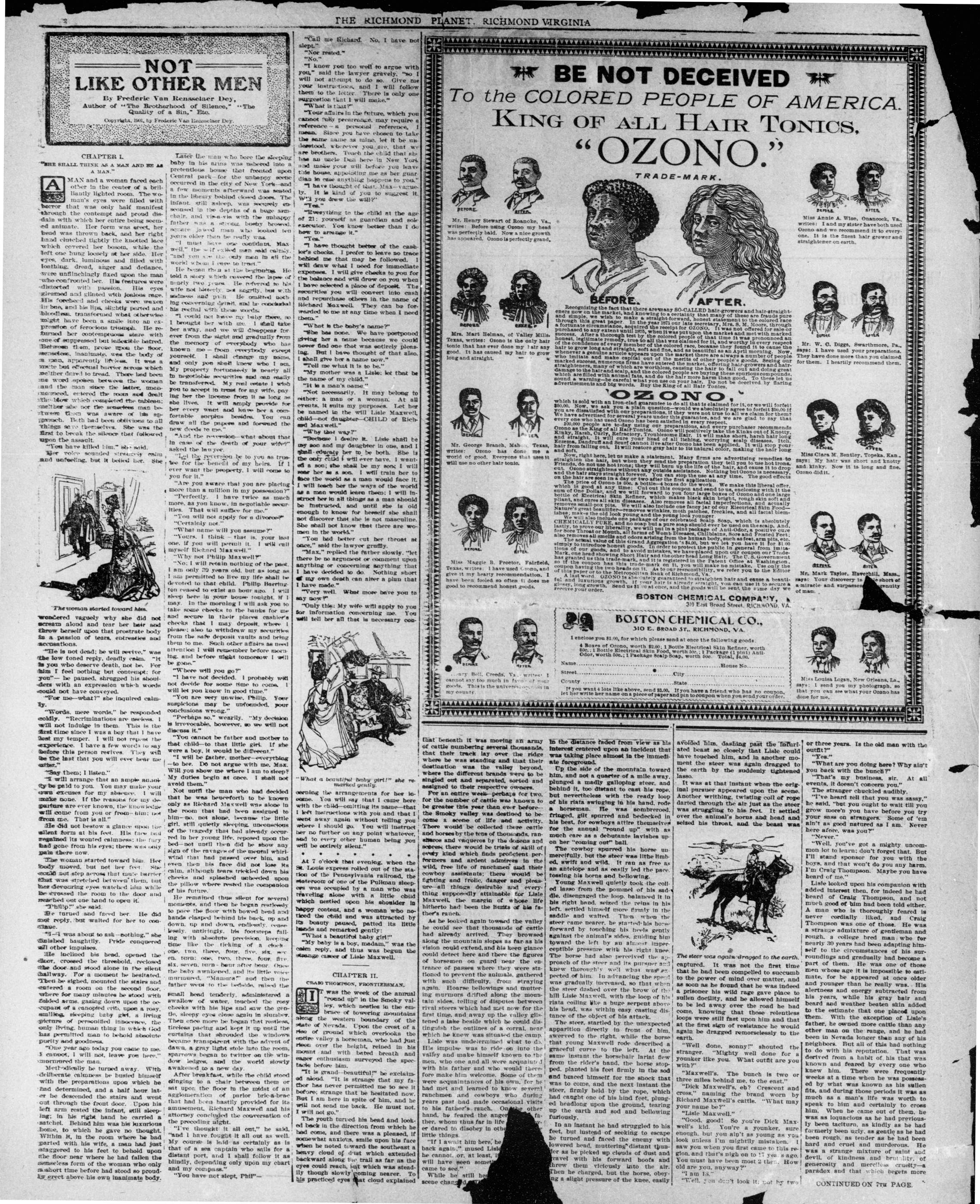
BE NOT DECEIVED To the COLORED PEOPLE OF AMERICA. KING OF ALL HAIR TONICS. "OZONO."
Mr. Henry Stewart of Roanoke, Va. writes: Before using Ozono my head was perfectly bald. Now a nice growth has appeared. Ozono is perfectly grand.
MRS. MART HELMAN, of Valley Mills,
Texas, writes: Ozono is the only hair
tonic that has ever done my hair any
good. It has caused my hair to grow
long and straight.
Mr. George Branch, Mahon, Texas,
writes: Ozono has done me a
world of good. Everyone that uses it
will use no other hair tonic.
Miss Maggie B. Proctor, Fairfield,
Texas, writes: I have used Coono, and
give it my hearty recommendation. I
have been fooled so often it does me
good to recommend honest goods.
BEFORE
AFTER
Jenny Bell, Creeds, Va., writes: I
cannot say too much in favor of honest
goods. This is the universal opinion in
my county.
that beneath it it was moving an army of cattle numbering several thousands, that their track lay over the ridge where he was standing and that their destination was the valley beyond, where the different brands were to be singled out and separated, sorted and assigned to their respective owners.
For an entire week—perhaps for two, for the number of cattle was known to be greater this year than ever before—the Smoky valley was destined to become a scene of life and activity. There would be collected there cattle and horses by the tens of thousands, ranches and vauqueros by the dozens and scores; there would be trials of skill of every kind which finds proficient performers and ardent address in the wild, free life of ranchmen and their cowboy assistants; there would be fighting and frolic, danger and pleasure—all things desirable and everything supposedly attainable for Lisi Maxwell, the margin of whose life hitherto had been the Burbs of his father's ranch.
As he looked again toward the valley he could see that thousands of cattle had already arrived. They browsed along the mountain slopes as far as his vision could extend, and his keen glance could detect here and there the figures of horsemen on guard near the entrance of passes where they were stationed to prevent the animals, gathered with such difficulty, from straying again. Horse bellowings and muttering murmurs drifted along the mountain slides, telling of disputes between rival steers which had met now for the first time, and away up the valley glistened a lake beside which he could distinguish the outlines of a corral, near which he knew was situated the camp
Lisle was undetermined what to do. His impulse was to ride on into the valley and make himself known to the men, who one and all were acquainted with his father and who would therefore make him welcome. Some of them were acquaintances of his own, for he had met and learned to know several ranchmen and cowboys who during years past had made occasional visits to his father's ranch. On the other hand, he feared the anger of his father, whom thus far in life never dared to disobey in other little things.
"If I await him here, he back again," mused Lisle, he cannot, or at least, he will have seen something to see."
TRADE-MARK.
BEFORE. AFTER.
BEFORE.
Recognizing the fact that there are many eners now on the market, and knowing to a and simple, we wish to make a straight-fi through this, and make until year 1871 a fortune circumstance, acquired the week purchased to any extent until 1875, when it success, thorough test by the color honest, legitimate, write, and do the confidence of every member of the color hair to grow long and straight, soft and fine, whatever a genuine article appears upon the who imitate and make capable of the marked success, numerous firms have entered straighteners, many of which are worthless, damage to the hair, dread, and the colored, which are filled with animal fakes, and do the sound a warning-be careful what you use of advertisements and big words. Buy the Kin
Recognizing the fact that there are many SO-CALLED hair-growers and hair-straighteners market, and knowing to a certainty that many of these are frauds pure and simple, we need to be careful in order, honest statement to the colored race through this great paper. In the real life, Mrs. S. M. Moore, through a fortunate circumstance, acquired the receipt for ZOONO to subsucceed to any extent until 1875, when it was put upon the market and met with marked honesty, legitimate rumors through test by the colored people of that time it was pronounced an honest, legitimate rumor that was claimed for it, and worthy in every respect of the confidence of every member of the market. It was to cause the hair to grow long and straight, soft and fine, and as beautiful as an Anvil mill. Our genuine article appears upon the market there are always a number of people who marked success, numerous firms, out of the merits of other people' s goods. Seeing our straighteners, many of which are worthless, causing the hair-growers and hair-straighteners to the hair and scalp, and the colored people are buying these spurious comings and sound a warning—be careful on your hair. Do not be deceived by flaring advertisements and big words. Buy the
OZONO.
which is sold with an iron-clad guarantee to do all that is claimed for it, or we will forfeit it. You have a plain question—would we absolutely agree to forfeit $60,000 if you are dissatisfied with the offer and they were not true to all we claim for them? We have advertised for several years under that offer, and we are glad to say that every one who has used Orono has been satisfied in every respect.
which is sold with an iron-clad guarantee to you. You a plain question-
you are disaffected with our payment. We have advertised for several years under
every one who has used Ozono has been satisfied.
Ozono is the King of all hair. Using our piece,
Ozono as the King of all hair, we will cure
Kinky, Harsh, Curry, Refractory, Troublesome
and straight. It will cure your head of
Ozono and Scurl cannot live after
hair from falling out. It will restore gray hair
and soft.
Now right here, let us make a statement
straighten the hair and skin. Remember, you send
Friends, do not use hot irons; they will cut
out. Ozono straightens without any outside
nature the hair stays straight forever. You can
on the hair, old look, and much more.
The price of Ozono is 60c, a bottle of
which is good at any time. Cut out this
sum of pencil, and we will forward to
bottle of Elephant Skin Food, which m
plant, and cures all skin diseases. Also
remove small-pox pits. We will also
include a great beautifier—removes wrinkles,
ishes; makes the hair liberal, we will put
CHEMICALLY PURE, and no soap but a purifi
we will also include one package for
Sore Throat or Metropolitan Bank of
also remove all smells and odors arising from
the actual value of this Grand Aggregate
simply produce honest goods. In order
tions of our business, we will put
Mark, one head showing Short Hair and the
granted us this trade-mark, and it is now
so if the coupon has this trade-mark on
coupon having the two head of
of this paper or to the Metropolitan Bank of
and word. OZONO is absolutely great
ful, and immense growth. If your hair is
glossy, long growth. Send us $1.00 at once,
receive your order.
BOSTON
BOSTON C
310 E. BROAD
I enclose you $1.00, for which please send
4 Boxes of Ozono, worth $2.00; 1 B
60c; 1 Bottle Electrical Skin Food,
Odor, worth 50c; 1 Package Scalp S
Name.
Street
County
If you want 4 lots like above, send $3.00.
let her write her name on a piece of paper.
10,000 people are to-day using our preparations, and every purchaser recommends Ozone will positively take the Kinks out of Knotty, Rinky, Harah, Harah, Refray, Carefree and straight. It will make short, harah hair long and straight. It will cure your hair of all itching. It will acclimate Ecmae, Dandruff and Scurf cannot live after Ozone has been applied. It will stop your hair from falling out. It will restore gray hair to its natural color, making the hair long and soft. Now, right here, let us make a statement. Many firms are advertising remedies to straighten the hair, but when they send the preparation they tell you to use, they do not use hot irons; they will burn up the life of the hair, and cause it to drop. Ozone will not any outside assistance. Nothing but Ozone is necessary, and the hair stays straight forever and the use at any time. The good effects on the hair are seen in a day or two after the first use.
The price of Ozono is 50c, a bottle- 4 boxes do the work. We make this liberal offer, which is any time: Cut out this coupon and send to us, enclosing with it the sum of one Dollar, the sum of our large boxes of Ozono and one large bottle of Electrical Skin Refiner, which makes our skin pliant, and cures all skin diseases. Also removes all facial imperfections, and actually Nature's great beautifier will also include one fany jar of our Electrical Skin Food—ishes, make a the old look young and the young look old.
We will also include one package of our celebrated Scall Soap, which is absolutely CHICALLY PURE, and no soap but a pure soap should ever be used on the scape. And, lastly, we will include a pint package of Anti-Odor, a positive cure for Sore Throat or Mouth, and Chillants. Sore and Frozen Feet; also removes all smells and odors arising from the skin. We will also actual value of this Grand Aggregation's $4.00, but we let you have it for $1.00 simply because honest goods. In order to protect the pub in general from imitations of our goods, we have placed upon our coupon our Trade-Mark, one head showing Short Hair and the other having been granted us this trade-mark, and it is registered in the Patent Office at Washington, D.C. This trade-mark on it, you will make no mistake. Use only the coupon having the two marks, and your responsibility, we refer you to the Editor of this paper or to the Metropolitan Bank of America.
A last word. GZONO is absolutely guaranteed to straighten hair and cause a beautiful, healthy growth. Send us $10 at once, and the goods you will receive will be delivered.
1 enclose you $1.00, for which please send at once the following goods:
4 Boxes of Ozone, worth $0.20, 1 Bottle Electrical Skin Refiner, worth
$0.60, 1 Bottle Electrical Skin Food, worth $0.60, 1 Package (1 pint) Anti-
Odor, worth $0.60, 1 Package Soap Soap, worth $0.60, Total, $4.00.
If you want 4 lots like above, send $30.00. If you have a friend who has no coupon, let her write her name on a piece of paper and pin to coupon when you send your order.
In the distance faded from view as his interest centered upon an incident that was taking place almost in the immediate foreground.
Up the side of the mountain toward him, and not a quarter of a mile away, plunged a medly galloping steer, and behind it, too distant to cast his rope, but nevertheless with the ready loop of his rata swinging in his hand, rode a horseman. He was somberroed, fringed, gift spurred and bedecked in his best, for cowboys attire themselves for the annual "round up" with as much care as a debutante lavishes upon her "coming out" ball.
The cowboy spurred his horse unmercifully, but the steer was the limelined, swift and wild. It ran as free as an antelope and as easily led the pace, tossing his horns and bellowing.
Young Maxwell quietly took the colled lasso from the pommel of his saddle, disengaged the loop, balanced it in his right hand, seized the reins in his left, settled himself more firmly in the saddle and waited. Then when the steer came nearer, he started his horse forward by touching his heels gently against the animal's sides, guiding him toward the left by an almost imperceptible pressure with his right knee. The horse had also perceived the approach of the steer and its pruner and knew thoroughly well what was expected of him. In advancing the speed was gradually increased, so that when the steer dashed over the brow of the hill Lisle Maxwell, with the loop of his riata rclating like a huge serpent above his head, was within easy casting distance of the object of his attack.
The steer, startled by the unexpected apparition directly in front of him, swerved to the right, while the horse that young Maxwell rode described a graceful curve to the left. At the same instant the horsebairn lariat flew from the rider's band, the horse stopped, planted his feet firmly in the sod and buced himself for the shock that was to come, and the next instant the steer, firmly held by the rope, which had caught one of his hind feet, plunged headlong upon the ground, tearing up the earth and sod and bellowing furiously.
In an instant he had struggled to his feet, but instead of seeking to escape he turned and faced the enemy with lowered head, muttering'distant thunder as he picked up clouds of dust and travel with his forward hoofs and threw them viciously into the air. Then he charged, but the horse, obeying a slight pressure of the knee, easily
```markdown
```
SO-CALLED hair-growers and hair-straight-tertainty that matter of necessity makes poor our late secretary, Mrs. S. M. Moore, through the office of Mr. Moore, was not offered for sale or as put upon the market and met with married people of that time it was pronounced an as claimed for it, and worthy in every respect the market, of other people's goods. Seeing our it the matter of offering the powers of causing the hair to fall out and doing great people are buying these spurious compounds, hair more harm than good. To these let us your hair. Do not be deceived by flaring of all Hair Tonies.
do all that is claimed for it, or we will forfeit
would we absolutely agree to forfeit $30.00 if
they were not true to all we claim for them?
we are glad to say that
died in every respect.
paraparesis, and every purchaser recommends
to make the Kinks out of Knotty,
he Hair, he Wash, we are glad to say that
ill itching, worrying scalp diseases. Itch,
Ozono has been applied. It will stop your
hair to its natural color, making the hair long.
Many firms are advertising remedies to
the preparation they tell you to use hot trons.
We make this liberal offer
coupon and send to use, enclosing with it the
you four large boxes of Ozono and one large
skin black skin bright, rough skin soft and
in the human body with the U. & government
one fancy jar of our Electrical Skin Food—moth patches, freckles, and all facial blemishes younger.
Celebrate soap, Soap, which is absolutely
soap should ever be used on the scalp. And,
pint package of Anti-Odor, a positive item
in the human body with the U. & government
$30.00, but we let you have it for $1.00
to protect the public in general from imita-
tion upon our coupon our Trader
other head long Hair. The Patent Office at Washington,
it you will make no mistake. Use only the
city, we refer you to the Editor
Richmond, VA.
Intended to straighten hair and cause a beauti-
ally straight, you can use it to secure a
and the goods will be sent the same day we
CHEMICAL COMPANY,
310 East Broad Street, RICHMOND, VA.
CHEMICAL CO.,
DIST. RICHMOND, VA.
and at once the following goods:
bottle Electrical Skin Refiner, worth
worth 500. 1 Package (1 pint), Anti-
cap, worth 600. Total, $4.00.
House No.
City
State.
If you have a friend who has no coupon,
and pin to coupon when you send your order.
avolded him, dashing past the infuriated beast so closely that Llisle could have touched him, and in another moment the steer was again dragged to the earth by the suddenly tightened lasso. It was at that instant when the original pursuer appeared upon the scene. Another writhing, twisting coll of rope darted through the air just as the steer was struggling to his feet. It settled over the animal's horns and head and seized his throat and the beast was
A
The steer was again dragged to the earth, captured. It was not the first time that he had been compelled to succumb to the power of mind over matter, and as soon as he found that he was indeed a prisoner his wild rage gave place to sullen doctility, and he allowed himself to be led away over the road he had come, knowing that those relentless loops were still fast upon him and that at the first sign of resistance he would again be dragged remorselessly to the earth.
"Well done, sonny!" shouted the stranger. "Mighty well done for a younker like you. What outfit are you with?"
"Maxwell's. The bunch is two or three miles behind me, to the east."
"Dick Maxwell's, eb? Crescent and cross," naming the brand worn by Richard Maxwell's cattle. "What may your name be?"
"Little Maxwell."
"Good, good! So you're Dick Maxwell's kid. You're a youkner, sure enough, but you ain't as young as you look unless I'm mightily mistaken. I saw you when you first came to this region, and that's nigh on to 17 years ago. You must have been most 2 then. How old are you, anyway?"
"I am 13."
"Well, you don't look it; not by two
BROTHER AFTER
Miss Annie A. Wise, Onanocock, Va. writes: I and my sister have both used Ozono and we recommend it to everyone. It is the finest hair grower and straightener on earth.
Mr. W. C. Digga, Swarthmore, Pa.
says: I have used your preparations.
They have done more than you claimed
for them. I heartily recommend them.
MISS Clara M. Bentley, Topeka, Kan.
says: My hair was short and knotty
and kinky. Now it is long and fine.
Ozono did it.
MR. MARK TAYLOR. HAVEHILL, Mass.
says: Your discovery is the short of a miracle and surpasses the genuity of man.
Miss Louisa Logan, New Orleans, La.
says: I send you my photograph, so
that you can see what your Ozono has
done for me.
or three years. Is the old man with the
outfit?"
"Yes."
"What are you doing here? Why ain't
you back with the bunch?"
"That's my business, sir. At all
events, it doesn't concern you."
"I've heard tell that you was sassy," he said, "but you ought to wait till you grow more'n you have before you try your sass on strangers. Some of 'em ain't as good natured as I am. Never here afore, was you?" "Never."
"Well, you've got a mighty uncommon lot to learn; don't forget that. But I'll stand sponsor for you with the boys, and that won't do you any harm. I'm Craig Thompson. Maybe you have heard of me."
Lisle looked upon his companion with added interest then, for indeed he had heard of Craig Thompson, and not much good of him had been told either. A man who is thoroughly feared is never cordially liked, and Craig Thompson was one of those. He was a strange admixture of gentleman and rough, a college bred man who for nearly 30 years had been adapting himself to the circumstances of his surroundings and gradually had become a part of them. He was one of those men whose age it is impossible to estimate, for he appeared at once older and younger than he really was. His alertness and energy subtracted from his years, while his gray hair and beard and weather beaten skin added to the estimate that one placed upon them. With the exception of Lisle's father, he owned more cattle than any other man on the range, and he had been in Nevada longer than any of his neighbors. But all of this had nothing to do with his reputation. That was derived from a habit of his that was known and feared by every one who knew him. There were frequently weeks at a time when he was possessed by what was known as his sullen fits, and during those periods it was as much as a man's life was worth to speak to him and certainly to cross him. When he came out of them, he was as loquacious as he had previously been tacuform, as kindly as he had formerly been ugly, as gentle as he had been rough, as tender as he had been hard and cruel and murderous. He was a strange mixture of saint and devil, of kindness and brutality, of generosity and merciless cruelty—a paradox and that which begets more
CONTINUED ON 2TH PAGE
THE PLANET
HAVE QUEER FAITH.
Mohave Indians Believe That Spirits Die Four Times.
Then They Return to Earth and Become Part of the Soil—No Reward or F punishment in the Spirit World.
WHEN one crosses the Colorado river at the Needles, on the
river at the Needles, on the Santa Fe line to California, he generally sees a large number of Indians at the depot, some with pottery, others with beadwork, and still others with bows and arrows, which they seek to sell to the tenderfoot tourist. The pottery is sunbaked clay and will fall to pieces almost at a look, and the bows and arrows were never intended to be shot with. They are made and painted in fine Mohave style to catch the white man's eye and sell. No! it is a mistake to say they are painted in Mohave style, for I have several of their own old bows and arrows, actually used in the chase and in war, and they are unpainted and exceedingly plain. But they are dangerous weapons, for all that, and I have seen a deer brought down with them at a distance of between 200 and 300 yards.
In the early days of the white men's travel in their territory the Mohaves were far from reliable. Perhaps one ought to say they could always be relied upon to kill any party of white men that they thought they were capable of handling. Many a spot, both on the Arizona and Colorado sides of the river, could tell a tale of sanguinary and determined battle fought to a finish between a horde of naked Mohaves and a small band of adventurous travelers or prospectors. Many a scalp was lifted, and many a dance of victory held in those days before the white men had fully and completely demonstrated their power. In 1858 Ives and his band of explorers and soldiers went up the Colorado, through the territory of the Mohaves, into the Black canyon, the Painted canyon, and as far as the
```markdown
```
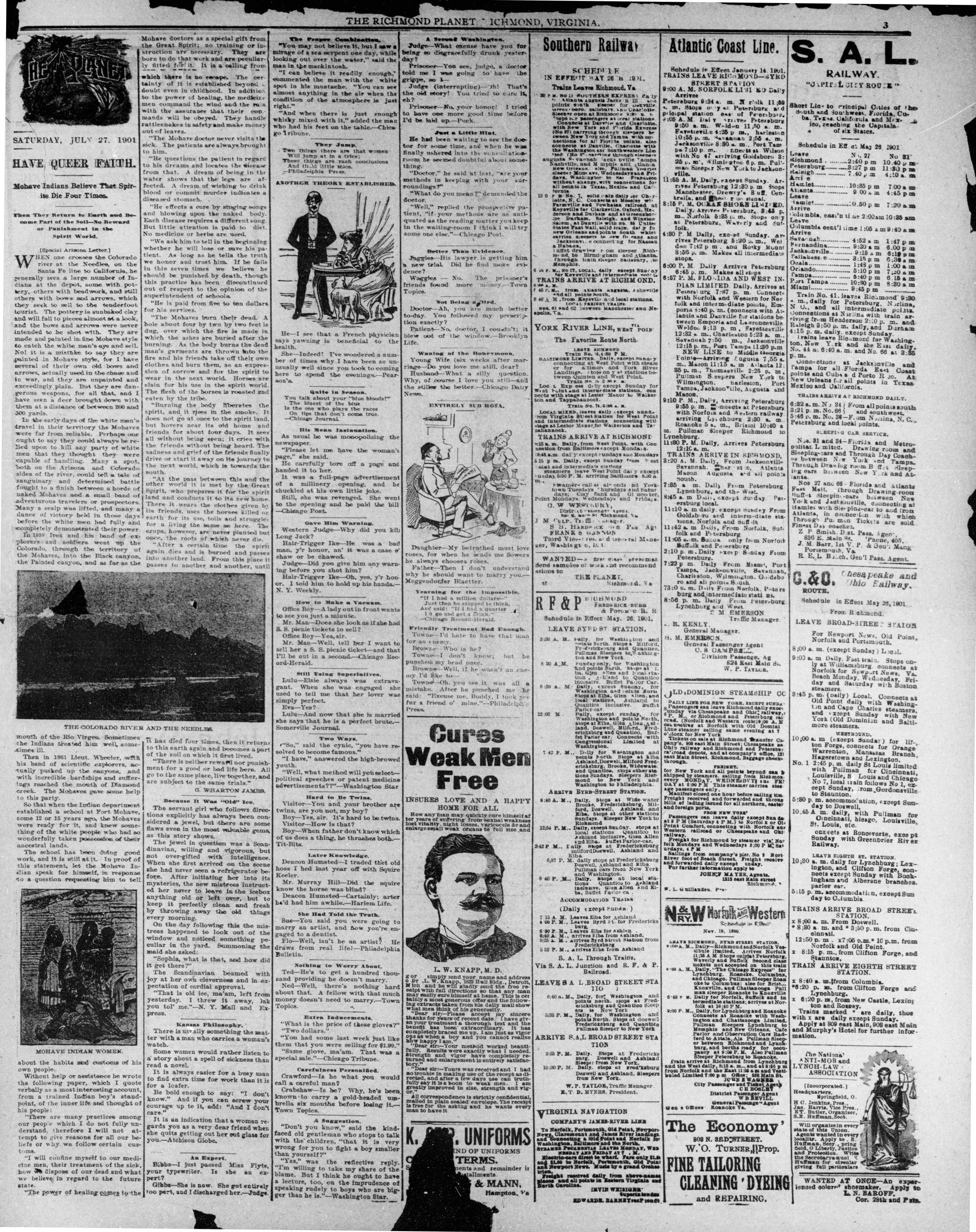
THE COLORADO RIVER AND THE NEEDLES
mouth of the Rio Virgen. Sometimes the Indians treated him well, sometimes ill.
Then in 1861 Lieut. Wheeler, with his band of scientific explorers, actually pushed up the canyons, and with incredible hardships and sufferings reached the mouth of Diamond creek. The Mohaves gave some help to this party.
So that when the Indian department established a school at Fort Mohave, some 12 or 15 years ago, the Mohaves were ready for it, and knew something of the white people who had so wonderfully taken possession of their ancestral lands.
The school has been doing good work, and it is still at it. In proof of this statement, let the Mohave Indian speak for himself, in response to a question requesting him to tell
MOHAVE INDIAN WOMEN.
about the habits and customs of his own people.
Without help or assistance he wrote the following paper, which I quote verbally as a most interesting account, from a trained Indian boy's standpoint, of the inner life and thought of his people:
"There are many practices among our people which I do not fully understand, therefore I will not attempt to give reasons for all our beliefs or why we follow certain customs.
"I will confine myself to our medicine men, their treatment of the sick, how I dispose of our dead and what we believe in regard to the future state.
"The power of healing comes to the
Mohave doctors as a special gift from the Great Spirit; no training or instruction are necessary. They are born to do that work and are peculiarly fitted for it. It is a calling from which there is no escape. The certainty of it is established beyond a doubt even in childhood. In addition to the power of healing, the medicine men command the wind and the rain with the assurance that their commands will be obeyed. They handle rattlesnakes in safety and make money out of leaves.
"The Mohave doctor never visits the sick. The patients are always brought to him.
"He questions the patient in regard to his dreams and locates the disease from that. A dream of being in the water shows that the legs are affected. A dream of wishing to drink blood or commit murder indicates a diseased stomach.
"He effects a cure by singing songs and blowing upon the naked body. Each disease requires a different song. But little attention is paid to diet. No medicine or herbs are used.
"We ask him to tell in the beginning whether he will lose or save his patient. As long as he tells the truth we honor and trust him. If he fails in this seven times we believe he should be punished by death, though this practice has been discontinued out of respect to the opinion of the superintendent of schools.
"He is paid from five to ten dollars for his services.
"The Mohaves burn their dead. A hole about four by two by two feet is dug, over which the fire is made in which the ashes are buried after the burning. As the body burns the dead man's garments are thrown into the fire and his friends take off their own clothes and burn them, as an expression of sorrow and for the spirit to wear in the next world. Horses are slain for his use in the spirit world. The flesh of the horses is roasted and eaten by the tribe.
"Burning the body liberates the spirit, and it rises in the smoke. It does not go at once to the spirit land, but hovers near its old home and friends for about four days. It sees all without being seen; it cries with the friends without being heard. The sadness and grief of the friends finally drive or start it away on its journey to the next world, which is towards the south."
"At the pass between this and the other world it is met by the Great Spirit, who prepares it for the spirit land and conducts it to its new home. There it wears the clothes given by its friends, uses the horses killed on earth for its use, toils and struggles; for a living the same as here. The crops, however, are never planted but once, the roots of which never die.
"After a certain time the spirit again dies and is burned and passes into another land. From this place it passes to another and another, not!
and another, until
It has died four times, then it returns to this earth again and becomes a part of the soil on which it first lived.
"There is neither reward nor punishment for a good or bad life here. All go to the same place, live together, and are subject to the same trials."
Because it was "Old Ice.
The servant girl who follows directions explicitly has always been considered a jewel, but there are some flaws even in the most valuable gems, as this story shows.
The jewel in question was a Scandinavian, willing and vigorous, but not over-gifted with intelligence.
When she first arrived on the scene she had never seen a refrigerator before. After initiating her into its mysteries, the new mistress instructed her never to leave in the icebox anything old or left over, but to keep it perfectly clean and fresh by throwing away the old things every morning.
On the day following this the mistress happened to look out of the window and noticed something peculiar in the yard. Summoning the maid she asked:
The Scandinavian beamed with joy at her own cleverness and in expectation of cordial approval.
"That is old ice, ma'm, left from yesterday. I threw it away, lak you tol me."—N. Y. Mail and Express.
Kansas Philosophy.
There is usually something the matter with a man who carries a woman's watch.
Some women would rather listen to a story about a spell of sickness than read a novel.
It is always easier for a buey man to find extra time for work than it is for a loafer.
Be bold enough to say: "I don't know." And if you can screw your courage up to it, add: "And I don't care."
It is an indication that a woman regards you as a very dear friend when she quits getting out her out glass for you.-Atchison Globe.
Bibbs—I just passed Miss Flyte, your typewriter. Is she an expert?
Gibbs—She is now. She got entirely too pert, and I discharged her.—Judge
An Expert
The Proper Combination.
"You may not believe it, but I saw a mirage of a sea serpent one day, while looking out over the water," said the man in the mackintosh.
"I can believe it readily enough," commented the man with the white spot in his mustache. "You can see almost anything in the air when the condition of the atmosphere is just right."
"And when there is just enough whisky mixed with it," added the man who had his feet on the table.-Chicago go ribune.
ANOTHER THEORY ESTABLISHED.
He—I see that a French physician says yawning is beneficial to the health.
She—Indeed! I've wondered a number of times why I have been so unusually well since you took to coming here to spend the evenings—Pearson's.
Quite in Season
You talk about your "blue bloods!"
The bluest of the blue
Is the one who plays the races
On tips that don't come true.
—Chicago Journal.
His Mean Insinuation.
As usual he was monopolizing the newspaper.
"Please let me have the woman's page," she said.
He carefully tore off a page and handed it to her.
It was a full-page advertisement of a millinery opening, and he chuckled at his own little joke.
Still, she was revenged. She went to the opening and he paid the bill —Chicago Post.
Gave Him Warning.
Western Judge—Why did you kill Long Jack?
Hair-Trigger Ike—He was a bad man, yr honor, an' it was a case o' chaw or be chawed.
Judge—Did you give him any warning before you shot him?
Hair-Trigger Ike—Oh, yes, yr honor.
I told him to hold up his hands.—N. Y. Weekly.
How to Make a Vacuum.
Office Boy—A lady out in front wants to see you just a minute.
Mr. Man—Does she look as if she had S. S. picnic tickets to sell?
Office Boy—Yes, sir.
Mr. Man—Well, tell her I want to sell her a S. S. picnic ticket—and that I’ll be out in a second—Chicago Record-Herald.
Still Using Superlatives.
Lulu—Else always was extravagant. When she was engaged she used to tell me that her lover was simply perfect.
Eva—Yes?
Lulu—And now that she is married she says that he is a perfect brute.—Somerville Journal.
"So," said the cynic, "you have resolved to become famous."
"I have," answered the high-browed youth.
"Well, what method will you select—political speeches or patient medicine advertisements?"—Washington Star
Hard to Be Twins
Visitor--You and your brother are twins, are you not, my boy?
Boy—Yes, sir. It's hard to be twins.
Visitor—How is that?
Boy—When father don't know which of us does a thing, he thrashes both.—Tit-Bits.
**Later Knowledge.**
Deacon Humsted—I traded the old hoss I hed last year off with Squire Keeler.
Mr. Murray Hill—Did the squire know the horse was blind?
Deacon Humsted—Cartially; arter he'd had him awhile.—Harlem Life.
**She Had Told the Truth.**
Sue—You said you were going to marry an artist, and how you're engaged to a dentist.
Flo—Well, isn't he an artist? He draws from real life!—Philadelphia Bulletin.
Ted—He's to get a hundred thousand providing he doesn't marry. Ned—Well, there's nothing hard about that. A fellow with that much money doesn't need to marry—Town Topics.
Extra Inducements
"What is the price of these gloves?"
"Two dollars."
"You had some last week just like them that you were selling for $1.99."
"Same glove, ma'am. That was a special sale."—china go Tribune.
Carefulness Personified
Crawford—Is he what you would call a careful man?
Crabshaw—Is he? Why, he's been known to carry a gold-headed umbrella six months before losing it.—Town Topes.
A Suggestion
"Don't you know," said the kind-faced old gentleman who stops to talk with the children, "that it is very wrong for you to fight a boy smaller than yourself?"
"Yes," was the reflective reply. "I'm willing to take my share of the blame. But I think he ought to have a lecture, too, on the imprudence of speaking rudely to boys who are bigger than he is." - Washington Star.
A Second Washington.
Judge—What excuse have you for being so disgracefully drunk yesterday?
Prisoner—You see, judge, a doctor told me I was going to have the grippe, so I—
Judge (interrupting)—Oh! That's the old story! You tried to care it, eh?
Prisoner—No, your honor! I tried to have one more good time before I'd be laid up—Puck.
furt a Little Hint
He had been waiting to see the doctor for some time, and when he was finally ushered into the consultation room he seemed doubtful about something.
"Doctor," he said at last, "are your methods in keeping with your surroundings?"
"What do you mean?" demanded the doctor.
"Well," replied the prospective patient, "if your methods are as antiquated as the reading matter you keep in the waiting-room I think I will try some one else." - Chicago Post.
Better Than Evidence
Juggles—His lawyer is getting him a new trial. Did he find more evidence?
Waggles — No. The prisoner's friends found more money.—Town Topics.
Not Being n Bird.
Doctor—Ah, you are much better to-day. You followed my prescription exactly?
Patient—No, doctor, I couldn't; it blew out of the window.—Brooklyn Life.
Waning of the Honeymoon.
Young Wife (six weeks after marriage—Do you love me still, dear?
Husband—What a silly question.
Why, of course I love you still—and the stiller the better.—Chicago Daily News.
ENTIRELY SUB ROSA.
Daughter—My betrothed must love roses, for when he sends me flowers he always chooses roses.
Father—Then I don't understand why he should want to marry you.—Meggendorfer Blaetter.
Yearning for the Impossible.
"If I had a million dollars—"
Just then he stopped to think.
And said: "If I had a quarter
I'd go and get a drink."
—Chicago Record-Herald.
Friendly Treatment Bad Enough.
Towne—I'd hate to have that man for an enemy.
Browne—Who is he?
Towne—I don't know; but he punched my head once.
Browne—Well, if he wasn't an enemy I'd like to—
Towne—Oh, you see it was all a mistake. After he punched me he said: "Excuse me, Buddy, I took yer fur a friend o' mine."—Philadelphia Press.
Cures Weak Men Free
INSURES LOVE AND A HAPPY HOME FOR ALL
How any man may quickly cure himself af ter years of suffering from xenolite weakness lost vitality, night losses, varicocele &c and enlarges small weak organs to full size, and
L. W. KNAPP, M. D.
g or . simply send your name and address to Dr. L.W. Knapp, 1822 Hall Eldg., Detroit, MI 49140 and he will gladly send the free receipt with full directions so that any man may easily eure himself at home. This is certainly a most generous offer and the following extracts taken from his daily mail show what me think of his generosity.
"Dear sir: Please accept my sincere thanks for your recent date. I have given your treatment a thorough test and the benefit has been extraordinary. It has completely braced me up. I am just as vigorous as when a boy and you cannot realize how happy I am."
"Dear sir: Your method worked beautifully. Results were exactly what I needed. Strength and vigor have completely returned and enlargement is entirely satisfactory."
"Dear sir: Yours was received and I had no trouble in making use of the receipt as directed, and after a few days use can truthfully say it is a boon to weak men. I am greatly improved in size, strength and vigor."
All correspondence is strictly confidential, malled in plain sealed envelope. The receipt is free for the asking and he wants every man to have it
K. SUP. UNIFORMS
THE BIND OF UNIFORMS
TERMS.
Sale of improvements and remainder it
installments.
& MANN,
Hampton, Va.
Southern Railway
SCHEDULE
IN EFFECT WAY 26TH 1901.
Trains Leaves Richmond, Va
30 P.M. NO 11 SOUTHERN EXPRESS Daily
Atlanta Angela Jacks in ill and
points on both sleeper for Nashville,
sleeper car/bus and Charlotte.
Sleeper open at Richmond 9:30 P.M.
TOPS on passengers at real stations
Connects at Darwin and Charlotte.
(No 57) carrying through sleepers beween New York and Tamua with connections for all Florida points, also connecting with the Washington and Southwestern Limits (No 57) carrying through sleeper augusta, Vanahah 'sacks ville ' ampa
Kawville, Kawville, New Orleans, also, Pullman tourist sleeper onave, Wednesdays and Fridays, Washington with connection without all points in Texas, Mexico and California
12 0
12 0
12 0
7, solid daily at or Charlotte, N.C. Connects at Moseley with Farmville and Powhatan railroad at Keysville for Clarkville, Oxford, Heath, Durham, Raleigh, and Winnslow, at Darwin with no. 86 United States Fast Mail, solid train, day for all carriers sleeper to New Orleans and Jacksonville, e connecting for Nassau or a Hababa, b drawing on sleeper Richmond, to Birmingham and Atlanta, through train sleeper Sanction, to Memphis
6 00 P. M. No. 19 local daily except Sunday, b drawing on sleeper Richmond, to Birmingham and Atlanta, through train sleeper Sanction, to Memphis
6 00 P. M. No. 19 local daily except Sunday, b drawing on sleeper Richmond, to Birmingham and Atlanta, through train sleeper Sanction, to Memphis
TRAINS ARRIVE AT RICHM OND.
6 00 A. M.
4:40 P.M., from Atlanta Augusta, Ashville
and all points North.
8:40 A.M. Morgantown, and local stations.
LOCAL PRIEST TRAIN.
Nos. 63 and 62 between Manchester and Ne-
apolis, Va.
YORK RIVER LINE, WEST POIN
The Favorite Routes North.
LEAVE SICHOMD
Train No. 6,4:30 P.M.
BALTIMORE LIMITER.
Connecting West Point with steam
connections. West Point with steam
for a timber and York River
Landings. stops on y at stations be-
tween Quinten and West Point.
Loc. L. Expes. daily except Sunday for West Point and intermediate stations. connects with stage at Lester Manor to Walker ton and Tappahannock.
Train No. 74. 5:00 a. M.
Local mines daily except Sunday from Virginia Street Station for West Point and intermediate stations connecting with stage at Lester Manor for Walker and Tappahannock.
TRAINS ARRIVE AT KICHMON
6:15 a. m. Dally, from West Point, with Gon
0:45 a. m. daily except Sunday, on Mondays.
0:45 a. m. daily except Sundays and Mondays
6:15 p. m. Dally, except Sunday from West
oist and intermediate stations
steamers leave West Point daily except
sunday. 5:50 P. M. arriving Baltimore 8:30 a. m.
Steamer call at al-onds and York-
town Tuesdays' hours and Satur-
days; Clay bank and Gluceter,
Point Monday's weddings and Fridays.
O. W. WRY,
District of New York,
K. K. Richmond,
J. M. CUP. Traff. manager.
S. B. HARDWARD. in Pas Agt
FRANK S. GANSON
Third Vice-President and General Manager, Washington, D. C.
WANTED—A NEW CORP. PERMITTED
dend samples of work and recommend
ations to
THE PLANET.
M. Richmond, Va.
RF&P
RICHMOND
FREDERICK BURG
& PORTO R. R.
Schedule in Effect May. 26, 1801.
LEAVE SYDNEY STATION.
8:30 A. M. Daily for Washington and
points North, Stops a Milford,
Frederickburg and Quantum,
Pullman Sleepers to Washington
and New York.
8:20 A. M. Sunday only, for Washington
and points North, Glen Allen and local
station, Ashland to Quantum
invasive. Buffet Father Car.
8:50 A. M. Daily for Washington and points North,
Stops a Ella, Glen Allen, and local
station, Ashland to Quantum inclusive. Buffet
Park.
12:00 M. Daily, except sunday, for Washington and points north to St. Louis at St. Louis and land, Doswell, Milford, Fred ericksburg and Quantico, Buff for Iowa. Connects with Congressional Limited at Washington.
7 42 P. M., Dilly for Washington and points north to St. Louis at Ashland and land, Doswell, Fred ericksburg, Brooke, Widewater, and Quantico, stops other states from Sunday to elephants Kobayama to New York and Washington to Philadelphia.
ARRIVE EYED-STREET STATION.
8:40 A. M., Daily, Stops at Wide water Brooke, Fredericksburg, Milford, Doswell, Ashland, and Elba. Stops at other stations Sundays. Sleeper New York to Richmond.
12:54 P. M., Daily, except Sunday, stops at local stations Quantico to Ashland inclusive, Glen Allen and Elba. Buffalo, Fredericksburg.
242 P. M., Daily, stops at Fredericksburg milford/Doswell, Ashland and Elba.
6:37 P. M. daily stops at Fredericksburg Doswell, Ashland and Elba. Pullman to New York and Washington.
8:40 P. M., Daily, stops at local stations Quantico to Ashland inclusive, Glen Allen and Elba. Buffet factor ca.
(Daily except Sunday)
7 15 A. M. Leaves Elba for Ashland
4 00 P. M. Leaves Byrd St. for Fredericksburg.
6 20 P. M. Leaves Elba for Ashland.
6 40 A. M. Arrives Elba from Ashland.
8 25 A. M. Arrives Byrd Street Station from Fredericksburg.
5 52 P. M. Arrives Elba from Ashland
S. A. L. Through Trains.
Via S. A. L. Junction and R. F. & P. Railroad.
LEAVE S A L, BROAD STREET STATION
6:40 a. M., Daily, for Washington and points north, stops at Fredericksburg, Quinnipiac Sleepers to New York.
3:35 P. M., Daily, for Washington and points North, stops at doswell Fredericksburg and Quantico Fullman Sleepers to New York.
ARRIVE S A L, BROAD STREET STATION
2:35 P. M. Daily, Stops at Fredericksburg, Dowell and Ashland Sleepers from New York.
10:30 P. M. Daily, stops at redksburg Dowell and Ashland. Sleepers from New York.
W. P. TAYLOR, Traffic Manager.
E. T. D. MYERS, President.
VIRGINIA NAVIGATION
To Norfolk, Portsmouth, Old Point, Newport-
News, Clarendon and James River landings,
and connecting a old Point and Norfolk for
Washington. Steamship FOGONATON LEAVES MONDAY, WED
NEDDY AND FRIDAY AT 7. M.
Histrio-cars direct to wharf. Fare only $1.50
and $1.00 to Norfolk, Portsmouth, Old Point
newport News. Music by a grand Orchestra.
Freight received daily from above-named
places and all points in Eastern Virginia and
North Carolina.
IEVIN WESIGER'
Superintendent
EDWARDE, BARNEYRE, P. son 8
Atlantic Coast Line.
Schedule in Effect January 14. 1901.
TRAINS LEAVE KICOND—SYRD
STREET STATION
9:00 A. M. NORFOLK LIMI ED Daily
Arrives
Petersburg 9:34 a. m. M. rolk 11:59
a. m. Stops on or Petersburg and
principal station east of Petersburg.
9:05 A. M. Daily arrive Petersburg
9:50 a. m. Weldon 11:50 a. m.
Fayetteville 4:25 p. m. harleston
10:55 p. m. Savannah 2:55 a. m.
Jacksonville 8:80 a. m. Port Tampa
7:10 p. m. Insects at Wilson
with No 47 arriving Goldsboro 8:
25 p. m., Wilmington 6 p. m.
Pulaski Sleeper New York to Jacksonville.
11:55 A. M. Daily, except Sunday. Ar-
ticles Petersburg 12:30 p. m. stops
Manchester Drewry's Buff. Centralia,
and the Bronx.
8:15 P. M. OCEAN SHORE LIMIED.
Daily. Arrives Petersburg. 8:45
p. m. Norfolk 5:35 p. m. Stops only
at Petersburg, Waverly and Sutkof.
4:30 P. M. Daily, expt. Sunday. Arrives Petersburg 5:20 p. m., Weldon 7:42 p. m., and Rocky Mount 8:56 p. m. Makes all intermediat stopa.
6:00 P. M. Daily Arrives Petersburg 6:45 p. m. Makes all stops
6:57 P. M. FLO-IDA AND WEST INDIAN LIMITED. Daily. Arrives at Petersburg 7:87 p. m. Connects with Norfolk and Western for Norfolk and intermediate points, Emporia 8:40 p. m. (connects with Atlantic and Danville for stations between Emporia and Lawrenceville Weldon 9:13 p. m. Sayettesville 12:32 a. m. Charleston 5:23 a. m. Savannah 7:50 p. m. Jacksonville 12:15 p. m. Port Tampa 11:30 p. m. NEW LINE to Middle Georgia Points—Arriving Augusta 7:55 a. m., Mason 11:15 a. m. Atlanta 12:35 p. m., Thomasville 2:25 p. m., Paulman Sleepers New York to Wilmington, harleson, Port Tampa, Jacksonville, Augusta and Macon.
9:10 P. M., Daily, Arriving Petersburg
9:55 p. M., Connects at Petersburg
with Norfolk and Western railway
arriving Lyschburg 2:30 a. m.
Roanoke 5 a. m., Briscal 10:40 a. m.
Pullman Sleeper Richmond to
Lynchburg.
11:80 P. M. Daily, Arrives Petersburg
12:1C a. m.
TRAINS ARRIVE IN RICHMOND,
8:20 A. M. Daily, From Jacksonville
Savannah. Charleston, Atlanta
Mason Augusta and all points
south.
7:85 A. M. Daily, From Petersburg
Lynchburg, and the West.
8:45 a. M. daily, except Sunday
Petersburg local.
11:10 a. m. daily, except Sunday From
Goldebro and intermediate stations,
Norfolk and Suffolk.
11:42 a. m. Daily, From Norfolk, Suffolk and Petersburg
11:05 a. m. Suffolk only from Norfolk
Suffolk and Petersburg
2:10 p. m. Daily except Sunday From
Petersburg.
:22 p m. Daily From Miami, Port
Tampa, Jacksonville, Savannah,
Charleston, Wilmington, Goldsboro
and all points. Sigh.
Traffic Manager
. R. KENLY,
General Manager.
H. M. EMERSON,
General Passenger Agent
C. S CAMPBELL,
Division Passenger. Ag
824 East Main St.
W. P. TAYLOR.
OLD DOMINION STEAMSHIP CO.
DAILY LINE FOR NEW YORK, EXCEPT SUNDAY.
Passenger can leave daily except Sunday.
Sunday via Chesapeake and Ohio.
6 P.M. or Richmond and Petersburg rail.
(North, Western and Eastern route) 9:00 A.M.
Cork, 9:00 A.M. Old Domini
Line steamer sailing same evening at 9
o'clock for New York
Line steamer Richmond Transfer
Company, 9:00 a.m. Main Railway
Ohio railway and Richmond and Petersburg,
ra'road denotes, and at company's office,
MIDLain Street. Richmond. Baggage check-
through.
PRESENT.
for New York and all points beyond can be
shipped by train.
every MONDAY WEDNESDAY.
DAY at 5:00 P.M. This steamer carries size
age passengers only.
Sunday before selling time.
Freight received and forwarded and through
bills of lading issued for all northern, eastern
and foreign ports.
OLD DOMINION NEW YORK.
Passenger can leave daily except Sunda
at 3 P.M (Saturday or 4 P.M.) to Norfolk or Old
comfort, connecting with Norfolk or
Western railroad or Chesapeake and Ohio.
Freight for Richmond by steamer via Nor-
wester and Wednesdays 5:00 P M Sat-
sundays 4:30 P
W. L. Guillauden. P.e.
N & C
RY. W Norfolk and Western
N & C
RY. W Norfolk and Western
LEAVE RICHMOND, NYBED STREET STATION.
9:00 A.M. Daily—Richmond and Norfolk Vestibule limited. Arrives Norfolk
Mississippi by Jaynes Petersburg,
Waverley and Suffolk. Tickets not accepted on this train
9:00 A.M. Daily—The Chicago Express" for
Pulaski, Columbus,
and Chicago. Pullman Sleepers
oke to Columbus: also for Brist.
Knoxville, and Chattanooga Pull
Mississippi. Daily for Norfolk, Suffolk and
intermediate stations; arrives at Norfolk
at 16:00 P.M.
9:00 P.M. Daily for Richmond and Roanoke
Concerts at Roanoke with Washington and Chattanooga Limited.
Pullman Sleepers Lynchburg to
Parlor and Observation Cars Radrief to Attalas. Ala Pullman Sleeper
between Richmond and Lynchburg and
Parlor and Observation Cars Radrief to Attalas. Ala Pullman Sleeper
Sleeper Peterburg to Roanoke.
Frain arrive at Richmond from Lynchburg and the West
from Norfolk and the East 11:30 a.m and Vesti
buled Limited 7:00 p.m. Office: 588 Main St.
City Passenger and Ticket Agent
CH BOULET
District Passenger Agent
WEST WILLIAM
General Passenger-Agent
men's Office. Roanoke Va.
The Economy'
808 N. 3RD STREET.
W. O. TURNER,|| Prop.
FINE TAILORING
CLEANING 'DYEING
Short Line to Principal Cities of the South and Southwest, Florida, Cuba, Texas, California and Mexico, reaching the Capitals of six States.
Tamiel ..... 0:50 p m 7:20 a.m
Arrive
Columbia, easyn time 2:00am 10:35 am
Leave
Columbia cent' time 1:05 am 9:40 am
Arrive
Savannah 4:52 a m 1:47 p m
Fernandina 3:90 a m 6:00 p m
Jacksonville 9:15 a m 6:19 p m
Tallahassee 8:15 p m 6:30 p m
Ocala 1:48 p m 1:00 a m
Orlando 5:10 p m 7:20 p m
Tampa 5:40 p m 6:15 a m
Port Tampa 10:30 p m 8:30 a m
Miami 9:45 p m
Train No. 41. leaves Richmond 9:30
a.m., daily for Petersburg, Norfolia,
N. O., and all intermediate points.
Connections at Norfolia with train
arriving from Henderson 2:00 p.m.
and Raleigh 8:50 p.m. d.m., and D. hern
4:15 p.m. daily. except Sunday.
Trains leave Richmond for Washington,
New York and the East daily.
No. 44 a. 6:40 a.m. and No. 66 at 8:35
p.m.
Connections at Jacksonville and
Fampa for all Florida East Coast
and Gulf Coast and Forto R. 20.
At New Orleans for all states in
Texas-Mexico and California.
TRAINS ARRIVE AT RICHMOND DAILY
8:32 a. m. N. 34 From all points south
8:21 p. m. N. 66] and southwest.
5:46 p. m. N. 38-F. u. N. cina, N. C.
Petersburg and local points.
SLEEPING CAR SERVICE
Nos. 31 and 34- Florida and Metropolitan Limited. Drawing room and Sleeping-cars and Through Day Coaches between New York and Tampa. Through Drawing room B affect sleeping-cars between New York and Atlanta.
Nos. 27 and 66- Florida and Atlanta East Mait. Through Drawing-room Buff- Sleeping-cars between New York and Jacksonville, connecting as diamonds with Sleeping-car to and from Atlanta, in connection with which Through Puma Men tickets are sold. Finest Day coaches.
Z P. Smith. D. St. Pass. Agent.
R.E.L.Brueh, Gen'l Pass. Agent.
For Newport News, Old Point,
Norfolk and Portsmouth.
8:00 a. m. (except Sunday) Local.
9:03 a. m. Daily, Fast train. Stops only
at Williamaburg, connects at
Norfolk for Newport News, Va.
Beach Monday, Wednesday, Friday
and Saturday with Boston
steamers.
8:45 p. m. (daily) Local. Connects as
Old Point daily with Washington
and Cape Charles steamers,
and except Sunday with New
York (Old Dominion and Baltimore
steamers.
WESTBOUND.
10:00 a. m (except Sunday) for lion Forge, connects for Orange Warrenton, Manassas Branch, Hagerstown and Lexington.
No. 1 2:45 p. m. daily St Louis limited with Pullman for Cincinnati, Louisville, S. Louis and Chicago No 7, local train follows No 1, except Sunday, from Gordonville to Staunton.
5:80 p. m. accommodation, except Sunday to Bosswell.
10:45 A. m. daily, with Pullman for Cincinnati, chicago, Louisville, St. Louis, etc.
connects at Ronceverte, except Sunday with Greenbrier River Railway.
LEAVE EIGHT ST. STATION.
10:80 a. m. daily for Lynchburg; Lexington, and Clifton Forge connects except Sunday with Buckingham and Alberene branches. parler ear.
5:15 p. m. accommodation, except Sun day to Columbia.
* 8:30 a. m. and * 8:30 p. m. from Cincinnati.
12:50 p. m. x7: 05 p. m. * 10 p. m. from
Norfolk and Old Pain.
x 8:15 p. m., from Clifton Forge, and Staunton.
TRAIN ARRIVE EIGHTH STREET STATION.
x 8:40 a. m. from Columbia.
*8:20 p. m., from Clifton Forge and Lynchburg.
x 6:20 p. m. from New Castle, Lexington and Rospey.
Apply at 809 east Main, 908 east Main and Murphy's Hotel for further information.
The Nationa'
ANTI-MOB and
LYNCH-LAW
ASSOCIATION
[Incorporated.]
Headquarters,
Springfield, O.
H. C. Josephine
Jas. Harrih Vice Pres.
E.T. Butler, Organizer,
S.E. Huffman, Sect.
Will organize in every
state of this Union.
Agents wanted in every
joint Huffman,
Huffman, Seey., pring
field, O Liberty, Justice
and Protection. Write
the Secretary, Huffman for circular
giving fall particulars
The Nation'
ANTI-MOB and
LYNOH-LAW
ASSOCIATION
[Incorporated.]
Headquarters,
Springfield, O.
H.C. Jenkins, Proas,
J. E. Kern, Secretary,
E.T. Butler, Organiser,
S.E. Huffman, Scot.
Will organize in every
state of this Union.
Agents wanted in every
bevity. Apply to E.
Huffman, Seymour, Pring
nold, O. Liberty, Justice
and Protection. Write
the Secretary for ocular
Giving full particulars
WANTED AT ONOE—An experi-
enced colored shoemaker. Apply to
L.N. BAROFF.
Cor. 29th and Purs.
THE PLANET
Published every Saturday by JOHN MITCHELL
JR., at 811 North 4th Street, Richmond, Va.
Published every Saturday by JOHN MITCHELL,
JR., at 311 North 4th Street, Richmond, Va.
JOHN MITCHELL, JR., - EDITOR.
All communications intended for publication
should be sent so as to reach us by Wednesday.
One Copy, one year, $1.50
One Copy, eight months, 1.00
One Copy, six months, 8.00
One Copy, four months, 3.50
One Copy, three months, 4.50
Single Copy, 0.05
ADVERTISING RATES.
For one inch, one insertion, $ 50
For one inch, each subsequent insertion, 25
For two inches, three months, 6.00
For two inches, six months, 10.00
For two inches, nine months, 14.00
For two inches, twelve months, 20.00
Marriage and Funeral Notices, 50
Standing and Transient Notices per line, 10
#POSTAGE STAMPS OF A HIGHER DENOMINATION THAN TWO CENTS NOT RECEIVED ON SUBSCRIPTIONS.
THE PLANET is issued weekly. The subscription price is $1.50 a year, in advance.
There are four Ways by which money can be sent by mail at our risk: In a Post Office Money Order, by Bank Check or Draft, or an Express Money Order, and when none of these can be procured, in a Registered Letter.
MONEY ORDERS.—You can buy a Money Order at your Post Office, payable at the Richmond office, and we will be responsible for its safe arrival.
EXPRESS MONEY ORDERS can be obtained at any office of the American Express Co., the United States Express Co., and the Wells Fargo Company, and you will be responsible for money sent by any of these companies. The Express Money Order is a safe and convenient way for forwarding money.
REGISTERED LETTER.—If a Money Order is received or you are in need of not within your reach, your Postmaster will register the letter you wish to send on payment of ten cents. Then, if the letter is lost or stolen, it cannot be received. You can send money in this manner at our risk.
We cannot be responsible for money sent in letters in any other way than one of the four ways mentioned above. If you send your money in any other way, you must do it at your own risk.
RENEWALS, ETC.—If you do not want THE PLANET continued for another year after your subscription has run out, you then notify us by email and continue it. The courts have decided that subscriptions do not do not order their paper discontinued at the ration of time for which it has been paid are valid liable for the payment of the subscription until when they order the paper discontinued.
COMMUNICATIONS:—When writing to us to renew your subscription or to discontinue our paper, you should give your name and address in full, otherwise we cannot find your name on our books.
CHANGE OF ADDRESS:—In order to change the address of a subscriber, we must be sent the former as well as the present address.
Entered in the Post Office at Richmond, Va., as second class matter.
SATURDAY, JULY 27, 1901
THE Chattanooga, Tenn., SEARCH-LIGHT says "a Negro cannot come within a thousand miles of getting justice in Alabama." This is a tite way of expressing a gospel truth.
COLORED men, we cannot afford to indulge in the excesses practiced by the lower classes of white people. We must cultivate good manners and practice politeness. We should be careful not to insult either white or colored people. By being watchful of our conduct and cautious in our behavior, we can put to shame those who so unmercifully condemn us.
WE did not think that it would ever become necessary for us to state that we have the right to publish church-proceedings or any other kind of proceedings. The courts and not the churches have been designated as the place for punishment for any flagrant abuse of the privileges granted. It's strange that some people in the business did not seem to know this.
THE Suffrage Committee of the Constitutional Convention of VIRGINIA seems to be discussing the citizen of color just as though he was an alien and an outsider. The plan offered by Senator DANIEL is both unjust and unconstitutional. It embraces some of the most odious features of the Louisiana constitution and makes the registrars and petty election officials the absolute judges of who should and who should not vote.
We regard it as the last desperate effort to do something which will "play to the galleries," now occupied by the Negro-haters of the commonwealth.
FACTS FOR THE CONVENTION.
THERE is something startlingly pathetic in the condition of the colored man in the south to-day which appeals to the heart of every conscientious Christian man who takes the time or exercises the patience to investigate the situation as it is and not as it is painted to be.
For 250 years, this people constituted the servile race and was regarded as the legitimate prey of the meanest white elements in the land of sunshine and flowers.
Kind-hearted, docile, faithful and generous to a fault, the colored people won the love and respect of all that was good amongst the white people of the Southland.
Almost unconsciously, they drew to themselves the best white blood in the country and caused the ablest, noblest, truest, richest elements to recognize their merit and concede their true worth, declaring the colored people to be the best servile class that God had ever permitted to be created.
But in the midst of all this praise and to an extent adulation, the poor white element looked on with envy and long-
ed for the time when they could "even up" with the Negroes of the southern domain.
The war came, then followed reconstruction and in its wake, the attendant evils of a new regime.
Bitterness, hatred, recriminations were all crowded into the space of a few years, but the colored man was declared to be a freeman and a citizen.
From owning nothing, he became a tax-payer, a property-owner and a man of the professions.
He labored 250 years for the white man and forty years for himself.
As a result of his efforts, his wealth in Virginia is now fifteen million dollars, according to the official reports of the State Auditor and this must be conceded to be less than the actual amount which should be accredited to him.
In the country at large, he owns nearly six hundred million dollars worth of property.
His residences no longer partake of the nature of the log-cabin, but are built on the most improved style. Here may be found pianos, touched by maiden fingers, playing the best selections of WAGNER or MENDELSOH.
Now comes the poor whites, who seeing that they are being outstripped in the race, call for more laws and demand a cessation of progress.
Declaring themselves superior, they are yet unwilling to prove it; but insist that the Negro shall not be permitted to work, although they criticize him if he steals.
The colored people's educational progress has been so rapid that they are calling for the removal of the prop. They want the taxes paid on property owned by colored people and none other applied to the payment of the expenses of the colored schools. They are blind enough not to see that rich men can with reason make a similar demand with reference to the poor whites, for it is a singular thing, nevertheless true, that money knows no color. The 250 years unrequited toil is not considered. The colored people as producers have made no impression upon their minds. They pay no attention to the fact that the Negro produces six hundred million dollars per year of the wealth of eleven southern states which upon an equation would charge up about fifty million dollars per annum to Virginia.
In the face of these facts, the unconstitutional "constitutional" convention is seated in our national capital, trying to find a way to disfranchise the Negro, although each member of it is pledged as a citizen of the United States not to disfranchise him.
What will be the outcome of all this?
No one can tell. The mandate of the Norfolk, Va., Democratic Convention was to restrict the suffrage, so to disfranchise all of the Negroes and not disfranchise any white man.
This is a Siamese puzzle. It was a command to do the impossible. To carry out this order is to commit perjury and in addition, to enact a constitutional provision which will not stand the test of the courts.
The colored people are not worrying themselves about the matter. As to the elective franchise, that has been already taken away, nullified by fraud and made a mockery in the streets of the cities.
The thieves have tired of their vocation. They are trying to find a way to ease consciende.
They what to transfer the questionable methods to the shoulders of all the people. But, fraud is fraud, no matter where it finds a lodging place.
Whether in or out of the constitution, it will be a blot upon the commonwealth and a rebuke to the men who are commanded to enforce it.
God has guided the Negroes throughout all of their afflictions and in the midst of all of their adversities, and He will continue to do so to the end of time, the unconstitutional "constitutional" convention of VIRGINIA to the contrary notwithstanding.
HE'LL bring all things right in His own time.
THE retirement of Hon. WILLIAM J. BRYAN from the active leadership of the Democratic Party arouses in the mind of the conservative voter a doubt as to the outcome of such a movement.
That the sound money element of that party will return, if it allowed it to control it, admits of no question.
Can the change be brought about within three years, will the populistic and free coinage of silver voters rally under the banner of the New York Democracy and follow the pathway emblazoned by the clear-cut utterances of Ex-President CLEVELAND? Perhaps it will, but such a change of front will be but the signalizing of the advent of the millennium.
Hunt Goes to Porto Rico.
Washington, July 24.—William H. Hunt, the present secretary of Porto Rico, has been selected to succeed Governor Charles H. Allen upon the retirement of the latter from the insular government. Former Judge William H. Hunt is a lawyer of good standing and a son of Judge Hunt, who was secretary of the navy under President Garfield. He was formerly for several years on the common pleas bench in Montana.
Grain To Be Raised In Philippines.
Washington, July 24.—It has been suggested to help reduce the expenses in the Philippines that a large portion of the food supplies now shipped from the United States be raised in the Philippines. It is believed that vegetables for the men and grain and hay for the animals can be raised there. The quartermaster's department now sends 2,900 tons of oats and 3,000 tons of hay to the Philippines each month.
RICHMOND PLANET, RICHMOND, VIRGINIA
Terrible Accidents That Have Happened To Daring Aeronauts
course through his brain as his arms seem to be slowly but all too surely drawn from their sockets? It seems hours that he is hanging, but it is only a few minutes. Bit by bit the rope slips through his pulsed fingers. He can hold on no longer. A last shriek of despair and he feels himself burling down, down, down to his death.
A WEEK'S N
Thursday
Maurice Robi arranging for a world.
The wages of Harrinburg roll
It is a bright day in July. The morning is yet early, but thousands of people are wending their way to the famous Vauxhall gardens, London. Gossips are busy with their tongues. Something great is on the tapis to produce so much excitement, and well before 8 o'clock the vast gardens are thronged with an eager, expectant crowd. In the middle of the grounds the bulk of a huge balloon swags gracefully from side'to side, and here is the center of excitement, for it is known that one daring man, Robert Cocking, by
VAN GOGH
COLLAPSE OF COCKING'S PARACHUTE
name, is about to attempt something
never hitherto achieved—no less, in
fact, than to descend from the clouds
by means of a parachute.
A hoarse cheer rises on the air as
at a given signal the ropes are severed
and the huge balloon soars away to
toward the firmament. The car is occupied by a Mr. Green and a fellow
aeronaut, and the spectators below
perceive that Cocking, the intrepid
parachutist, is suspended by a smaller
basket beneath, with his parachute
beside him.
Up in the clouds all is silence, but at
length Mr. Green hears Cocking's
voice:
"How high are we, Mr. Green?"
"About 1,000 feet."
"Good. Let me know when we are
1,500 feet and then every 500 until we
reach 5,000 feet. That's the height
from which I want to descend."
At length the fateful words "Five thousand feet!" are announced. "Let go!" cries Cocking, and Mr. Green severs the ropes which keep the parachute fast to the car.
Down below the spectators are craning their necks. They see the balloon shoot suddenly upward and a tiny speck come hurtling down with terrible rapidity. They know it is Cocking, and a thrill runs through every nerve.
Nearer and nearer, thundering to earth, comes the doomed man. Nothing can save him, and strong men shudder and women faint. Then all is over. Smashed to a jelly, poor Cocking, the victim of his own intrepidity, lies dead on the stones of the street.
It is Sunday morning in the pleasant city of Bordeaux, southern France. For some days previously the inhabitants of the city have been excited over the announcement that an Englishman, Leutenant Gale, will on this particular Sunday make a sensational balloon ascent. The novelty of the entertainment consists in the fact that Mr. Gale will dispense with the usual car and will ascend seated on the back of a pony.
Thousands of excitement loving Frenchmen and Frenchwomen assemble hours before the time fixed for the ascent at the Hippodrome Vincennes. Everything is favorable for the event. The balloon known as the "Royal Cremorne" is filled with gas, and when Mr. Gale appears, accompanied by the pony, cheers ring out far and near.
All is ready. The pony is securely lashed to the ropes attached to the netting, Mr. Gale takes his place on its back, the stentorian order to let go is uttered, and up shoots the balloon. Mr. Gale is seen seated gracefully on the animal, the bridle in one hand, while he salutes the audience with the other. A shudder of fear goes through the audience as the pony makes an effort as if to free itself, but its rider is perfectly calm and collected.
Slowly the balloon sails away, and some distance from Bordeaux it is observed to be descending. Skillful aeronaut as he is, Lieutenant Gale brings the balloon safely to ground, where it is held by over a hundred peasants by whom it is eventually secured to a tree.
The horse is loosened, and then a terrible thing happens. Believed of the weight of the animal, the balloon makes an upward dart. Mr. Gale is hanging on to one of the ropes, and before the peasants can lay hands on the netting the grappler attached to the tree is dragged out, and the unfortunate aeronaut is whirled aloft, hanging with both hands to the frail rope. Horrified, the onlookers can do nothing. They see the whirling figure of the balloonist as he makes frantic efforts to climb up the rope. They see him spun this way and that, and, spellbound, they watch for that critical moment when nature must give out and the wretched man must come thundering to his doom. The balloon reaches a height of over 2,000 feet and sweeps along for a distance of two miles. What must be the agony of the miserable man dangling from that rope? What thoughts must
course through his brain as his arms seem to be slowly but all too surely drawn from their sockets? It seems hours that he is banging, but it is only a few minutes. Bit by bit the rope slips through his palsied fingers. He can hold-on no longer. A last shriek of despair and he feels himself hurling down, down, down to his death.
His mangled body is not discovered for some days afterward, and when it is the spectators are horrified at the terrible nature of the injuries which he has received.
We turn now to the vast continent of America and find the City of Mexico agog with excitement. It is announced that the American parachutist, Professor Carter, is to make a descent from the clouds.
Only that day has the professor arrived from the United States, and unfortunately his tried and trusty attendants are not with him. Knowing the risky nature of his business, he is reluctant to rely on local aid to get the balloon and the other apparatus ready and proposes a postponement. The management, however, will hear nothing of it. The excitable Mexicans would wreck the place if the promised entertainment did not come off. With many misgivings, therefore, Professor Carter sets to work to get the balloon ready.
Carter's preparations are hurried in the extreme, and he is glad when at length the balloon is filled and held down by hundreds of willing hands. He takes his seat on a trappee bar, for he has no basket, and looks up to see that the parachute by, which he is to descend is in its place. Then he gives the signal to let go, and with a bound he starts on his upward journey.
He commences presently to go through his performance, which consists of some trapeze acts, and as soon as these are completed he prepares for his great dive from the clouds.
First of all he carefully examines the parachute, and his heart grows cold within him when he sees that some one must have detached the thin cord which should have held the top of the parachute to the netting of the balloon.
What to do at the moment he cannot decide. The balloon is already getting higher and higher. If he cuts away the other ropes of the parachute, it will collapse underneath him, and he will fall into it instead of its spreading out above him.
But something must be done, otherwise he will risk the balloon collapsing and so enveloping him that escape would be impossible.
His mind is soon made up. He will throw himself from the bar, hoping that by making a good spring to clear the overhanging folds of the parachute. He falls clear of the folds and for some distance drops like a plummet. The earth is rushing up to him with lightninglike rapidity. Will the parachute never open? All seems lost, when of a sudden the horrible fall is arrested, and with a great crack the parachute opens.
Carter gazes aloft. The parachute is open, it is true, but only partially so. Then he notices a rent that is getting gradually bigger and bigger, while several of the ropes are entangled. Although his headlong fall has in some
A
PROFESSOR CARTER'S AWFUL PALL measure been stopped, he knows that unless the ropes can be disentangled he will probably be dashed to pieces. He shakes the ropes, but too late. The earth soars up toward him. His body strikes it with a great thud and rebounds nearly six feet. People rush toward him from all directions. It is impossible that he can live they all declare. But live he does, though it is by a miracle. His spine is broken, all the ribs on one side, both thighs, both arms and collar bone are fractured, yet Carter lives, a wreck of his former self and for years an example of the greed of the populace for life risking entertainments.
Fifteen Hundred Teamsters Idle.
San Francisco, July 24—Fifteen hundred teamsters are now idle, and practically no merchandise was moved yesterday. Collector of Customs Stratton swore in several drivers in the employ of the Overland Freight and Transfer company as government inspectors without compensation. This was done at the request of Superintendent Fuller, of the Overland company, which has the contract to haul the bonded goods to the warehouses and appraisers' stores, and is a precaution taken to make any interference unavoidable.
Prominent Lumber Dealer Owned.
Island Heights, N. J., John C. Craig, a wholesale lumber dealer of Philadelphia, was drawn up a day afternoon in Tampa for bathing. His two boys and eight years, but could not help with 32 years of age, more near Dewey.
Maurice Robinson, of New York, is arranging for a motor trip around the world.
The wages of the puddlers at the Harrisburg rolling mills will be increased from $3.50 to $3.75 a ton beginning July 16.
Charlemagne Tower, United States ambassador to Russia, will give a banquet at which 32 covers will be laid, to Anthony J. Drexel.
On the St. Louis, which sailed yesterday was James J. Van Alen, who is going to England to receive the decoration of the Order of St. John of Jerusalem from King Edward.
The Denmark ministry, formed April 27, 1900, has resigned. King Christian has requested the ministers to retain their portfolios pending the appointment of a new cabinet.
Friday, July 13.
William Farrell, known as the lumber king, of Arkansas, died yesterday.
A syndicate of St. Louis capitalists has been formed for the purpose of developing the iron fields of Kentucky. An Australian fortune of $40,000,000 is to be divided among the heirs of the late Josiah Tyson, residing in Georgia and Alabama. Lord Russel, a British peer, pleaded guilty yesterday to the charge of bigamy and was sentenced to three months' imprisonment. Daniel J. Lamont, vice president of the Northern Pacific railroad, dgnes the report that he is to be selected as president of that road. Henry Alexander, colored, shot and killed Phillip Bennet and Benjamin Carter, both white, at Dinges, W. Va., yesterday and then fled to the mountains. Saturday, July 20. Indiana has completed her annual job of packing "French" peas.
B. J. T. Bosnaguit has decided to bring a British cricket eleven here for a short tour in the coming autumn.
Alfred Piatti, the composer and violincellist, died yesterday at Bergamo, Italy. He was born in 1822.
William H. Reynolds, comptroller of the state of Florida, died at Tallahassee yesterday.
Dr. Gustave A. Andreen, professor of Scandinavian language at Yale university, has accepted the presidency of August college at Rock Island.
Marquis Maliispina, the new Italian ambassador to the United States, has written from Rome to a friend in Washington that he will arrive her in the early part of September.
Dr. William H. Gobrecht died at Washington yesterday aged 72 years. He was the author of well known surgical works. He served on Gen. Hancock's staff.
Luther B. Richardson, former mayor of Grand Forks, N. D., and formerly territorial secretary, died last evening. Nine passengers were seriously injured and several others painfully bruised at Chicago in the wreck of a Madison street cable car yesterday. Bishop S. C. Breygolf of Reading, Pa., made the principal address at the Pan-American Bible congress in Buffalo last night. The United States torpedo boat Adder will be launched from the Crescent shipyards at Elizabeth, N. J., this afternoon. A. B. Cummins, Republican candidate for governor of Iowa, had his shoulder dislocated and body cut and bruised, by being thrown from a buggy in a runaway at Dubuque, last night. The sinking of the sea level on the North Sea coast has been confirmed. There has been a decrease in the depth of the water at the mouth of the Elbe of from 16 feet to 18 feet since 1895.
The death of Signor Francesco Crisi
pl. of, Italy, is feared.
Major Donaldson, a prominent Atlantic City business man, died yesterday.
General Rafael Uribe, the Colombian revolutionary leader, has mysteriously disappeared from New York city.
Mrs. Kruger, wife of former President Kruger of the South African Republic, was buried at Pretoria Sunday.
From four to six cars of vegetables are now being shipped from Chicago daily to drouth stricken sections in Illinois and Missouri.
Secretary Hircock returned unexpectedly to Washington yesterday in order to supervise personally the final chapters of the Oklahoma land opening.
Wednesday, July 24.
The Commercial Law League opened its seventh annual convention at Putin Bay, O., yesterday. The United Mine Workers of America will make an effort to organize all West Virginia miners. Contracts were let yesterday for the new road which gives the Wabash a Pittsburg entrance. Russia's wheat crop is reported almost ruined as a result of the drouth over there. Sarah Knapp, 78, and William White, 80, eloped from the Binghamton, New York, almshouse yesterday. The sixteenth annual convention of the Brotherhood of St. Andrew, an organization of the Episcopal Church, will be held in Detroit, beginning today.
Cornish Was Probably Lynched.
Beaufort, S. C., July 24—During last week a negro sailor named William Cornish entered the homes of several white women at Port Royal and it is alleged attempted assaults upon them. On Sunday he was captured and placed in jail there under guard of a deputy. About midnight last night the screams of a man were heard in the outskirts of the town, followed by six pistol or rifle shots in rapid succession. This morning the deputy was found in the jail tied hand and foot and his prisoner missing. Nothing has since been heard of Cornish.
Baltimore and Ohio Dividend.
New York, July 24—The Baltimore and Ohio railroad directors declared the usual semi-annual dividend of 2 per cent on the common and the preferred shares yesterday.
Rumors of Peace Negotiations. London, July 24. "We hear rumors, says the Daily News, "that negotiations with a view to peace in South Africa are proceeding in London."
FREE TO ALL!
TO THE COLORED PEOPLE OF THE WORLD:
Be not deceived by loud advertisements that promise much and accomplish little. Do not send your money away until you know what you are going to get for it. We do not ask you to send us your money until we have proved to your own satisfaction that
BEFORE USING PICTURES TAKEN AFTER USING
LUSTORONE Straightens Kinky, Nappy, curly Hair. No hot irons are to be used at all. LUSTORONE straightens without any outside assistance. LUSTORONE is put up in two forms. No.1 causes the hair to grow long, silky, straight and beautiful. No.2 cures all forms of dandruff, tettor, eczema and all scalp diseases, and feeds roots of the hair. The two are used in connection. No.1 is used at night. No.2 is morning. They must both be used in the treatment. LUSTORONE is fully guaranteed to straighten kinky hair, stop the hair from falling, restore hair in its natural color, and create a new growth of hair on bald spots. It is not possible for any one to make a hair tonic to equal LUSTORONE.
We have thousands of testimonials like the following we have not space to publish: Mrs. Mary Young Fowler, California, writes, Lustronone is a God-send to suffering humanity. Send me $5.00 worth at once. I know what it did for me.
TO SECURE A FREE SAMPLE OF LUSTORONE
send us your name and address and enclose 12c, to pay postage and we will mail to you a sample of LUSTORONE No.1 and No.2 (2 packages) same day money is received. This sample will convince you of the truth of our assertions.
Buckroe Beach!
RIGHT ON THE CHESAPEAKE BAY. SEA-BATHS, SEA-FOOD, SEA-AIR.
The managers of the Bay Shore Summer Resort, on the electric car line near Hampton and Old Poor have pleasure in announcing that their Resort will open to the public for the season of 1900 on Wednesday. This popular Resort is now undergoing important improvements: A large pavilion to accommodate 700 people is now being erected and a neat hotel with comfortable rooms and spacious parlors and private dining room is being built. The equipment is thorough and the service is the best.
Special attention given to Church, Sunday.school and Society picnics and excursions. Large Hall for Summer Conventions. NO LIQUORS.
Correspondence solicited, Address,
BAY SHORE HOTEL COMPANY,
P. O. Box 364, Hampton, Va.
John W. Murray, [Formerly with John Podesta]
No. 126 and 128 N. 18th St. Prompt Delivery of Goods.
KNIGHTS OF COLUMBUS OF THE WORLD
TO WHOM IT MAY CONCERN:
This organization has been chartered and legally instituted under the laws and statute of the state of New York, for the purpose of uniting together all acceptable men on the Broad Bases of Charity—Beneficial and to promote the Social and Moral condition of humanity.
Direct military and uniform ranks will secure for this organization a direct ranks of all sacred institutions of modern events, a grand oppose men. Deputies wanted in all sections of the country to organize Kindly address.
This organization has been chartered and legally instituted under the laws and statute of the state of New York, for the purpose of uniting together all acceptable men on the Broad Bases of Charity—Beneficial and Fraternal and to promote the Social and Moral condition of humanity.
Its two distinct military and uniform ranks will secure for this organization a place in the front ranks of all sacred institutions of modern events, a grand opportunity for active men. Deputies wanted in all sections of the country to organize lodges.
Kindly address
G. W. ALLEN Supreme Voyager,
334 W. 53rd Street, New York.
Old hunters say
The MARLIN
WOMAN'S UNION.
(INCORPORATED JULY 14, 1919)
MARLIN FIRE ARMS CO.
NEW HAVEN, CONN.
SUMMER POAKDEKS WANTED
Mrs. J. T. Allens. Cumberland county, Va. 15 minute a walk from Farmville station. Plenty of vegetable and fruit. Good mineral water of all kinds and a very quiet place. For other information apply to
rs. J. F. ALLEN,
Farmville, Vg. Box 71
THE MARRIAGE OF THE
MARRIES
Old hunters say
The MARLIN
has so many things to comm-
mit it. The top of the
action is always closed, the
technique the most simi-
lar to the form attractive. It seems to throw its buillets a little
more accurately and plant
them with a little more force
to dekrate them. It dekrate a 38-55 or 30-30.
130 gourds, 300 Illustr-
ations. Copyright by Penguin.
V. P. & F. K. of W.
(UNKNOWN DATE, JULY, 1898)
HOME OFFICE:
ST. LUKE'S HALL, 900 ST. JAMES
RICHMOND, VA.
We pay sick Benefits Promptly.
Death Benefits in 24 hours after satis-
factory proof has been filed in the
Office.
OFFICERS & BOARD:
PRES., - - - - - ROSA K. JONES
VICE-PRES., - - MAGGIE L. WALKER
TRAS., - - FANNIE C. THOMPSON
SRC'Y & MAN'GR, PATSIEK, ANDERSON.
LIZZINE M. DAMMALLS, M. LOU HARRIS.
Cristian Work - rs Assembly Montreal
N. G. Juv. 21st Januaries, 4pm, 1801.
W. C., July 21st, August 4th, 1801.
For the above occasion the Southern Railway will sell tickets from all stations or its lines in Virginia to Black Mountain, N. C. railroad station for Montreat, N. C. and return at fare one and one-third for the round trip, selling dates July 19th to 22nd inclusive with return limit August 8th, and from all stations in North Carolina at one fare for the round trip, selling dates from North Carolina points July 20th to 23rd inclusive, with return limits Aug. 8th.
ACETYLNET
SATURDAY, JULY 27, 1901
Another Problem Solved.
Mr. Suburb—My dear, don't you
think that instead of building a $10,000
house, and putting in $600 worth
of furniture, it would be better to
build two $5,000 houses and put $300
worth of furniture in each?
Mrs. Suburb—Of all things! What
for?
Mr. Suburb—So we'll always have
one house to live in while the other
is being cleaned—N. Y. Weekly.
To the Letter.
"Take that dog off the street, or I'll run you in," ordered the conscientious policeman.
"But why?" asked the man with the dog. "He has a license on."
"That's all right as far as it goes, but that's a Spitz dog, and we have strict orders to enforce the ant-expectoration ordinance." — Baltimore American.
A Broken Engagement
"I hear your engagement with Miss Minks is broken off? How's that?" Hill—Well, you see, that beast of a parrot of hers was always yelling: "Oh, Charlie, you shouldn't." Hampson—But what difference did that make? Your engagement was not a secret. Bill—No, and my name isn't Charlie. Glasgow Times.
Remarkable.
Briggs—That doctor is certainly a wonderful physician! This medicine of his cured me.
Briggs—Is that all he gave you?
Briggs—Yes. Told me to take ten drops after each meal, give up my business for two months and live in the open air. Now, look at me!—Puck.
A Kentucky Suspicion
"Do you agree with the people who assert that milk is not a wholesome article of diet?" "Well," answered Col. Stilwell, "I wouldn't like to make positive assertions. But I have heard it rumored that they put a great deal of water into it."—Washington Star.
As Others See Us
Wedley—What's the matter with your friend Softleigh?
Singleton—He's in love—lost his heart, you know.
Wedley—Huh! Judging from the noise he makes one way, think he had lost his collar beard—Chicago Daily News.
from the think he Chicago
He—I can't understand Taylis rejecting me last night.
She—Never mind. You'll soon get over it.
He—O, I've got over it right enough, but I can't help feeling so doosid sorry for her. I shan't ask her again!—Punch.
Cheap Music
Fair Customer—Have you a piece called the "Moonlight Sonata?"
Clerk—Yes, madam — "Beethoven's Moonlight Sonata." Here it is.
"What is the price?"
"Only 20 cents."
"Oh, that's too cheap. Show me something better."—N. Y. Weekly
Origin of the Fead
"Deacon Passnip and Deacon Hayrake don't seem to be on speaking terms."
"No; you see, Deacon Hayrake prayed for rain when Deacon Passnip's day was down!"—San Francisco Bulletin.
But wait a moment, wait!—
The man who does is the man, my son,
For you to emulate.
—Chicago Record-Herald.
THE TRIALS OF WEALTH.
"I'm glad I wasn't born rich. Just tink of havin' ter go around dressed like Sat kid." - N. Y. Journal.
It Would Seem So
From the beginning of things, it seems,
Woman insisted on having her way;
But something's wrong if she only talks,
What should she say.
-Chicago Daily News.
His Economic Difficulty
"Did you ever notice how Wabesley bestishes and seems to gope for the right expression when he is talking?" "Yes; his supply of words is never equal to his demand."—Chicago Tribune.
Culinary.
"There are only two kinds of cooks."
"For instance."
"Those that can't cook and will cook—and those that can cook and won't."—Chicago Record-Herald.
His Mistake.
Ethel—He telegraphed his proposal to her.
Maude—And did she accept him?
Ethel—No; she said that she had no use for a man who would waste his money telegraph tolls instead of spending it for caramels—Somerville Journal.
Unlocked For
He—There's one thing I'm glad of.
If anything should happen to me my wife's father would always take care of her.
She—But suppose something should happen to your wife's father?—Leslie's Weekly.
Two Different Views.
Said a physician to a friend:
"For all the patients I attend
Nowadays, fail is told.
Replied the friend: "I'm not led
To doubt it, for 'tis often said,
That dead men tell no tales."
—Chicago Daily News.
THE TEASING THING.
He—I have spoken to your mother.
She—Have you! And did she accept
you?—Ally Sloper.
Vanity. All Is Vanity.
Mrs. Howler—Ashbury, that was a most excellent sermon you preached on "vanity" this morning.
Rev. Howler—Well, I think, my dear, that I can flatter myself that there are very few men in this universe who could have done better.—Puck.
Woman's Mental Complexity.
"Harriet, you spend ten dollars invisibly, and then economize on a dime."
"That's all right, Harry; I feel ten dollars' worth of virtuous complacency over saving the ten cents."—Chicago Times-Herald.
Face Value.
"My face is my fortune," she quoted.
"It's no crime to be poor," commented her dearest chum.—Philadelphia Times.
More Than Good
"Entre nous," said Miss Ayers, who
delights in talking dictionary French,
"are you very fond of Mr. Goodhart?"
"Well," replied May Brightley, "he's
a very good friend of mine."
"Ah! Your bon bon ami?"
"Better than that. He's my bonbon
ami. He brings me a box every time
he calls."—Catholic Standard and
Times.
The Arithmetic of Love.
Gladys Beautigirl—I insisted last
nights that Jack and I should count the
kisses we exchanged.
Maud Askington—What was the resu-
t?
Gladys Beautigirl—Why, after
awhile we disagreed as to whether we
were in the sixth or seventh hundred,
and we had to begin all over again.
Town Topics.
In a Tight Place
"You look thoughtful to night, Smith," remarked Brown, as he stretched himself on the bed. "Yes," sighed Smith; "I have just got a note from the landlady." "What does she say?" "She says that I must pay my back board at once, or her daughter will sue me for breach of promise. I'm thinking what I'd better do." -Tit-Bite.
Unlucky Thirteen
tang unhucky about the figure 13?
He—Do I? Why, I bought my wife
a rocking-chair on her birthday,
which decurred on the 13th of this
month; it cost me $13, and I have
already stubbed my toe against it in
the dark 13 times.—Yonkers State-
man.
Advice to Amateurs
Ranter—We're getting up an amateur theatrical society, and we're looking for a good motto—something appropriate, you know.
Ranter—What's the matter with "Think twice before you act?"—Philadelphia Times.
Where to Find Best
Doctor—You are mentally exhausted. I advise you to send your family to the country.
Patient—But I can't leave my business.
Doctor—Of course not—you stay in the city and get a rest—Judge.
Twins.
"Any musical instruments?" the assessor asked.
"Two," the tired-looking citizen replied.
"What are they?"
"Both boys."—Chicago Record-Herald.
Observing the Proprietors.
Mrs. Wilton—I don't see much difference in your friend Barnes since he joined the church.
Mr. Wilton—O, but there's a great difference. When he goes fishing on Sundays now he goes around to the back door when he comes home with his string of fish—Boston Transcript.
Did the Best She Could.
Louise (in surprise)—You don't mean to say Grace Pretty married a millionaire old enough to be her father? Good gracious! Why did she do such a thing?
Muriel—Why, she couldn't catch one old enough to be her grandfather.—Brooklyn Life.
Afrad of Their Lives.
Yeast—Do the robins come and pick the bread crumbs from your lawn?
Crimsonbeak—They used to, but they don't any more.
"How do you account for that?"
"My wife makes her own bread."—Yonkers Statesman.
Love That Makes No Return.
For love he forselt his friends
For love he turned away
From honors such as men are glad
To strive for night and day;
For love he lost what robber men
Now he be most loath to lose.
And... he must be because
Twas all for love of booze.
—Chicago Record-Herald.
THE RICHMOND PLANET, RICHMOND, VIRGINIA.
Combat With an Immense Ape More Than Six Feet Tall
off branch after branch he would "heft" it and then, apparently finding it too light, would throw it at the men below, each time with that angry bowl pitched in a higher key. Mr. Paschen had seen all he wanted of the animal and had fought him all that he cared for. He advanced hastily and fired twice just as the gorilla, having at last
Perils Of Log Driving
The largest gorilla ever seen in the world was killed by a German colonist in German West Africa and is now on exhibition in the Museum Umlauff in Hamburg.
This great brute, for whose hide and skeleton more than $5,000 has been unsuccessfully offered, is 6 feet 7 inches high. His arms, when they are out-
THE GORILLA ATTACKS THE TREE.
TORE OFF A BRANCH.
stretched, measure 9 feet 1 inch from the end of the middle finger of one hand to the end of the middle finger of the other. His hands are 10 3-5 inches long. Put a foot rule on one of your hands, and you will get some idea of how huge a monster this is.
The man who killed him is H. Paschen, a native of Schwerin, Germany. He represents a Hamburg firm in the little station of Yaunde, almost in the heart of the Cameroons. He did not hunt the beast for the delight of the chase. Men do not hunt the devil if they can help it, and a devil the gorilla is. This part of Africa is the chosen home of the hideous beast.
About a year ago some savages hunting for small game on the outskirts of the primeval forest along the southern shore of the Nyong river, in the Cameroon district, just where it emerges from the high lands and spreads out on the level, forming a succession of mismatic swamps, spied a gorilla. They fled without waiting to see him too closely, and consequently when they reached the nearest trading station and reported excitedly that they had seen the biggest m'punu that ever had been seen by mortal eyes their inability to give details made the white men incredulous. But soon more reports came in. A black woman, straying from a kraal at dusk, was heard to shriek horribly, and the negroes, hastily arming themselves, were just sallying out to help her when they were checked by the roar and then the chest beating of a gorilla. One daring man crept out far enough into the darkness to make out the form of a mighty manlike creature dragging the woman away among the trees. A few days afterward her remains were found several miles off, deep in the forest. She had been torn to pieces.
At last the beast became so bold that he set up his dwelling place within gunshot of the Yaunde station, where Mr. Paschen lived. Here, undeterred by the sight of the long, busy warehouse buildings and the constant traffic, the gorilla continued his depredations until the white man was furious, for the beast's proximity was harming his business enterprises. The natives would not venture along even the beaten roads, and, although Mr. Paschen still did not credit their tales of his size and courage, he determined to rid the neighborhood of the uncanny visitor.
At last, however, the ape became too darling. He showed himself openly in a swamp near the station and was so utterly careless of danger that he did not even try to hide when Mr. Paschen, who had been brought to the spot by excited negroes, approached an opening in the bushes and aimed at him. Instead the creature advanced threateningly, and only then did the hunter realize what a huge beast I. was that he had to face. But it was too late to retreat, even had Mr. Paschen wished to do so. Gnashing his white fangs, now roaring, then uttering curious guttural sounds that volleyed in a deep, thunderous bass from his mighty chest, beating his breast only he produced a noise like great muffled drums, the gorilla advanced with quick running leaps. Mr. Paschen fired at his head, but missed his aim because the gorilla leaped into the air as the shot was fired. The projectile therefore, instead of piercing his brain, entered his black, leathery chest. It tore a great hole from which the blood rushed in a stream. Any other big game would have dropped as soon as struck. The gorilla instead seemed only to gain renewed fury. He rushed toward his antagonist with a bowl. His wicked eyes were rolling, and a dull red flared in them. Mr. Paschen, knowing that he would not have time for more than one
other shot, so fast did the gorilla advance, knelt down and waited in order to make absolutely sure of his aim. Just as he was about to fire at the demoniac face the monster swerved and the next instant was 40 feet high in a mighty cottonwood tree. He began to tear immense boughs off and hurt them with all his might at his foes. It was evident to all that his design was not to escape, but to obtain a club with all to do battle. As he pulled
off branch after branch he would "heft" it and then, apparently finding it too light, would throw it at the men below, each time with that angry howl pitched in a higher key. Mr. Paschen had seen all he wanted of the animal and had fought him all that he cared for. He advanced hastily and fired twice just as the gorilla, having at last found a club that suited him, started to climb down. Both bullets hit him, and he tumbled to the ground dead.
While domestic animals have sometimes been pressed into duty as mail carriers and service by pigeons is common, yet the most vivid imagination
has probably never conceived of a fish as a postman. Not withstanding several instances are recorded where they have performed such service, a very extraordinary case of a fish acting as a letter carrier comes
```markdown
```
from Reikliavik, in Iceland. On April 29 of last year a certain Captain Christiansen of the steamship Laura received an unimportant letter from the sheriff of Vestermann while the ship was lying at the latter port. Having perused the missive, the captain threw it carelessly overboard, and his astonishment may be well imagined when on the 15th of the following month the identical communication, soiled and disfigured, was handed to him by the consul of Reikliavik, to which place it had actually traveled in the stomach of a large codfish and had been extricated from the same by a local fisherman. Seeing that Vestermann lies some 180 miles from Reikliavik, the latter must have traveled that distance between April 29 and May 15, the scaly postman consuming just over two weeks in its submarine journey.
There have, however, been cases before this of fish undertaking the carriage of letters. Some 15 years ago a whale which was stranded on the south coast of France was found, upon being cut open, to contain a mailbag, wherein there reposed many hundreds of letters. The bag in question formed part of a collection which was being conveyed to Guadalupe by a wrecked steamer, and the letters, though somewhat dingy, were in a perfect state of preservation. They were at once sent to their destination, each letter being marked on the outside, "Delayed through shipwreck."
Duke Clarence Saw
Flying Dutchman
One of the spectral ships best known to landsmen generally is the Flying Dutchman, with which Captain Marryat made his readers acquainted. The Flying Dutchman was trying to round the Horn some time in the early part of the seventeenth century. The ship was repeatedly driven back by contrary wind and tides until the ship's captain, Vanderdecken, swore a fearful oath he would round it if it took till judgment day. Vanderdecken was taken at his word, and now for three centuries he and his sworn crew have
been battling to round the cape. Sailors watch with fear and trembling when their ships are rounding the Horn, afraid that every moment may bring into view the spectral Flying Dutchman. It is believed that every appearance of the Flying Dutchman will be followed by death or misfortune to
33
some of the crew of the ship that sees the ghost vessel. In the private journal of the late Duke Clarence and his brother, the present Duke of Cornwall and York, during their cruise on the Bacchante in 1879-82 an account is given of their experience with the Flying Dutchman, which they fell in with near Sydney. The duke wrote:
"July 11, 1881, at 4 a. m., the Flying Dutchman crossed our bows. A stranger red light, as of a phantom ship all aglow, in the midst of which light the masts, spars and sails of the brig 200 yards distant stood out in bold relief. As it came up the lookout man on the forecastle reported it as close on the port bow. The night being clear and the sea calm, 13 persons altogether saw it, but whether it was Van Diemen or the Flying Dutchman or who else must remain unknown. The Tourmaline and Cleopatra, which were sailing on our starboard bow, flashed to ask whether we had seen the strange red lights. At a quarter to 11 a. m., the ordinary seaman who had this morning reported the Flying Dutchman fell from the foretopmast crossroes and was smashed to atoms. * * * At the next port we came to the admiral also was smitten down."
Constitution Won Again.
New Haven, Conn., July 24.—Again yesterday did the Constitution prove speedier than the Columbia in light airs and fuky weather. It was in the first squadron run of the New York Yacht Club from Huntington to Morris Cove.
Unlucky Day for Hubby.
"Charley, dear," said young Mrs. Torkins, "I am going to turn over a new leaf."
"In what connection?"
"I'm going to stop being superstitious. I have always disliked to begin anthony day."
Perils Maine
Of Log Rivermen
Have a Fearful
Experience
In Holeb's
Falls
Driving
River driving in Maine is a perilous
vocation under the best conditions, but
when logs jam and falls are to be run
the dangers to be met are enough to
appall even the veterans of the drive.
Recently a crew was at work with a drive on a hard set of falls known among the river set of northern Maine as Holeb's falls. This section of rough water is three-quarters of a mile long, and in it there are three turns and as many "pitches." The two upper drops can be run by boats at the present season, but the lower and longest drop is filled with jagged rocks that toss biblows high in the air and make the passage of a boat next to impossible.
The other day the crew of men at work on Holeb's fails was called upon to break a bad jam at the entrance to the lower pitch. The jam was formed in the center of the stream against a great bowler and could not be reached from shore. It was decided that one of the boats should be brought down from the quiet water above the Fails and used in placing the dynamite under the logs. The men who had charge of the boat were notified and at once started to run the two upper pitches. The boat contained Michael and Thomas Brennan, Joseph Dulac and Peter Paradis, the latter well known as "Pete Paragee" all along the river. The two upper pitches were successfully taken, and the boat swung into the eddy above the jam.
Often a jam of more than 100 logs will go through that lower pitch without more than a dozen logs being in sight and these only when they struck the great rocks and were thrown in the air by the pressure. Old Holeb had claimed many victims in the years that lumbering had been carried on in that
LADY
OVER HOLLEN'S FALLS.
section of the state. Baker ledge marks
the spot where two men were drowned
during the spring of 1861. At that time
the ledge was marked by placing an old
tin baker, then commonly used by the
cooks on the drive, at the crest of the
ledge, near where the accident occurred.
The tin baker is still there and
gives it its name.
The boat was set against the head of the jam, as boats are usually set against jama. Just as Mike Brennan stepped on to the logs and seized the bow of the boat the jam settled. Believing the jam about to go through the pitch, Tom Brennan in the stern sang out, "Shove off!" In swinging out from the jam the car handled by Pete Paradis became entangled with two logs, and the boat dipped, shipping several barrels of water. This threw the boat off its intended course, and before the crew could again control it the craft was in the white foam of the pitch and being rapidly borne toward what had always been supposed to be certain death in such cases.
Consternation took possession of the river drivers on the shore, yet some dashed down off the rocks toward the foot of the falls, ready for the first sign of a living thing that might be seen in the waters of the eddy below. Those who remained at the head of the falls saw their comrades being tossed about in the swirling waters, enveloped in a mist of spray that was thrown up.
Pete Paradis clung to an oar, the other had lost his; the Brennan boys were clinging to the sides of the craft as it struck the great swell in the center of the pitch. Then boat and men disappeared from sight, as it was supposed, forever. The men at the head of the falls saw several splinters of the boat thrown into the air and knew that it had met the expected fate.
When half a dozen half crazed men reached the foot of the falls, they were thunderstruck at seeing the head and shoulders of a man clinging to an oar being swept by the swift currents of the eddy down the river. With a yell Andrew Peterson sprang into the water and in a few strokes reached the body of Pete Paradis. When Peterson had reached the shore, he saw the rest of the men in the water struggling with the forms of the rest of the boat's crew. All reached the shore with their burdens and set about reviving the sufferers. The men working over the form of their comrades laughed and cried in turn. It was the first instance on record where old Holeb had given up its victim's body, and the rescue was deemed a great miracle.
Tom Brennan has a fractured shoulder and several bad cuts from the jagged rocks. Mike Brennan has a compound fracture of the right leg below the knee and is cut in several places about the body. Joe Dulac has three
fractured ribs, a sprained ankle and bad cuts; Paret Parelis comes out without a fracture, but is badly cut across the abdomen and along the lower limbs.
Gabe Crandall, a violinist of Deep Hollow, Pa., owes his life to his skill as a fiddler and the fact that snakes are susceptible to musical sounds.
He was walking along a narrow road out on the mountain side on his way to Halstead, where he was engaged to furnish music for a dance. When he reached a point in the road where it winds around a sharp spur and is narrow, he heard the warning noise of a rattlesnake, and looking up he saw a big reptile directly in his path.
A man playing the violin.
Gabe took to his heels, but had taken only a few steps when another rattier rose up from the woods on the side of the highway. There was not enough room to pass the snake without being bitten, and the terrified fiddler backed up against the ledge and pondered.
It occurred to him that he had read somewhere of persons charming snakes with music. Drawing his violin from its box, he began to play. The music was soft and soothing, and the player put his whole soul into it. As the low notes of the violin were played the big snakes gradually uncolled, as if they were coaxed by the music, and stretching themselves out glided toward the fiddler. This move did not delight Gabe, but he sawed away more violently than before. Closer came the snakes and faster went the bow. When within two feet of the terrified musician, the snakes halted, and, winding themselves up, lifted their heads close together.
Then Gabe's nerves gave way. He grabbed the neck of his fiddle and brought it down with crushing force on the heads of the snakes. The blow stunned them, and Gabe soon dispatched them with stones. The violin was destroyed.
Old Time Lynching
On the Plains
One winter morning in 1874 an ox train had reached the Sidney crossing of the North Platte. The next morning, after fording the river, one of the bullwhackers, named Patterson, got drunk and left the corral. He came across a bunch of range cattle and immediately opened fire, killing several.
An hour later George Sass came to Charley Moore, the ox train boss, and made complaint, saying he would hold him responsible for the loss of the cattle. Just then Patterson appeared. Sass wheeled his horse to depart, when suddenly Patterson leveled his revolver and shot him dead.
At 9 o'clock in the morning a little procession headed by the wagon and corpse and followed by Patterson on horseback with
horseback, with his arms pinion-
rounded behind, surrounded by 20 or more quiet cowboys and six or eight bull whackers, all mounted, started for Sidney. Not many words were spoken on that journey. The men knew what would take place, for every plan had been made. Even the cruel Patterson
A man standing on a barrel, holding a sword, with a crowd behind him.
was wise enough to realize the situation and made no inquiries as to his fate. He knew it was to certain death that he was riding toward Sidney. But he was cool. Coming down the steep bluff into the town, the little posse took the middle one of the three coulees, and as the prisoner reached the level at the mouth he suddenly found himself deserted by his captors, who swept their horses at a given signal to either side. In another instant a band of over 100 horsemen appeared, coming down the ravines, and before Patterson realized the situation a lariat sped out from the long arm of a cowboy. The loop landed true to the object for which it was intended. Patterson was dragged over the cactus and prickly pears to a telegraph pole beside the Union Pacific railroad track. Brunised and bleeding, he stood erect on a barrel, and a cowboy began to climb the pole with the end of the lariat. A thousand people witnessed the scene that followed. Word had been sent to Fort McPherson, only a short distance away, and a troop of infantry was dispatched on the double quick. The mob swung back to let the soldiers through, and there was no disturbance. It was all over.
Patterson was dead
And no man ventured to say that justice had not been done.
Noblesse Oblige.
"Beg your patron, kind lady," began the polite beggar, "but I'm badly in need of money."
"I wonder if you deserve help," said the kind lady, suspiciously. "If I were to give you a penny, what would you do with it."
"Your generosity would overwhelm me, ma'm; I'd buy a post card and write you a note of thanks."—Tit-Bits.
The Darned Socks.
The hospital nurse leaned over the form of the prostrate sufferer. "Your feet are torn and bleeding." she said; "you must have had a terrible journey." "It was my wife's fault. She insisted"—a sudden look of anguish came over the face of the patient"—"on darning those socks herself."—Lesile's Weekly.
EXPERT ADVICE.
"What would you advise me to make of this colt, a trotter or a pacer?"
"I'd make sausage of him."—N. Y.
Journal.
A Peculiarity.
Some men of wealth have made a lot.
And, pray, what have they done with it?
The tempest and to what they've got
Instead of being fun with it!
-Washington Star
Waiting to Start.
Impatient Husband- Will you ever come away from that looking-glass, Clara?
Wife (pleasantly) — You forget, Algy, that art is long.
Husband (sharply) — I remember, madam, that time is fleeting. — Leslie's Weekly.
Same Old Disenchantment.
"Disappointed in love's young dream again?" queried her legal adviser.
"Yes, sir. It's the same old nightmare," replied the actress who was trying to procure her third divorce.
—Chicago Tribune.
About Haircuts.
Sunday School Teacher—What do we learn from the story of Samson? Little Boy (rubbing his head thoughtfully)—That it doesn't payter have women folks cut a feller's hair. Chicago Chronicle.
Denverites Condole With Kruger. Denver, Colo., July 24—In consequence of the death of Mrs. Kruger, the editors of The News, The Post, and The Times and a number of prominent citizens, including James B. Orman, governor of Colorado; R. H. Wright mayor of Denver, and Commander W. D. Snyman yesterday sent the following message to President Kruger: "Accept our heartfelt condolences in your bereavement, assuring you that the heart of every American bleeds for you and your people."
Might Have Died a Millionaire.
St. Louis, July 24.—David A. Block,
a well known member of the Merchants'
Exchange, died yesterday in
moderate circumstances, though he
might have passed away a millionaire.
He believed with Carnegie that it was
almost a crime to be rich, and several
months ago, acting on this theory, he
called his children about him on his
birthday and distributed his fortune
among them equally. Mr. Block was
well known in financial circles of Chic-
ago and New York.
Tornado In Minnesota
New Ulm, Minn., July 24. —A tornado passed a mile north of here yesterday, wrecking several buildings and injuring two men. August Woodman and William Thomlits, employed as carpenters on buildings being erected on a farm, sought shelter in a barn. The storm demolished the structure and the men were severely injured.
Younger Boys As Saleemen.
Stillwater, Minn., July 24.—Coleman and James Younger, after their 28 years in the state prison, will begin work as salesmen for a St. Paul dealer in gravestones and monument. Warden Wolffert yesterday signed the contract for their new work, and they will leave for St. Paul to begin their new duties today.
WONDERFUL DISCOVERY Curly Hair Made Straight By
THE HAIR CARE PROGRAM
OZONIZED OX MARROW
(Copyrighted.)
This wonderful handmade oil is the only easy preparation in the world that makes kinky or curly hair straight as shown above. It nourishes and strengthens hair, falling out or breaking off, cures dandruff and makes the hair grow long and silky. Sold over the internet, it is available for hardiness. Testimonials free on request. It is the first preparation ever sold for straightening hair. Get the Original Ozonized Ox Oil. The genuine never fails to keep the hair straight. It is the greatest necessity for ladies, gentlemen and children. It is the greatest advantage of this wonderful pomade. It is the best and most economical. It is available for anybody to produce a preparation equal to five cents. Sold by drugsale and dealers or send us 50 cents for one bottle or 1.40 for three bottles. Send postal or express money order. Write your name and address plainly to
D20NIZED OX MARROW CO.
76 Warner Ave. Elk Grove, Illinois
Medical, Dental and Pharmaceutical
Colleges.
Thirty-fourth Session (1901-1922)
will begin Oct. 1.
Tuition fee in medical and Dental Col-
lege each $80. Pharmacy College,
$70. All students must register
before Oct. 12th, 1901.
For catalogue or further information
apply to
F. J. SHADD, M. D, See'y.
901 R St. N. W.
Washington, D. Q.
HE PLANET
SAT DAY, JULY 27, 1901
TEMPERANCE
THE BRICKLAYER'S VISION.
Does His Saviour's Face and from the Drunkard's Path Enter the Way of Sobriety and Righteousness.
When the best moral results follow on unusual or abnormal event, any discussion of its natural or supernatural agency cannot change the fact. Many believe that there are messages from Heaven more direct than the written revelation; and the believers are generally those whose experience answers for their faith.
Eighty years ago, in a country town of west New England, lived a drunkard locally known as "Distillery Struck Jacob." In his early manhood he had been thrifty, industrious and temperate, the husband and father of a happy family. Both he and his young wife had inherited some property. Jacob the bricklayer had a good home, and was looked upon as a rising man. When he was about 25 years old the offer of a job on a distillery chimney same to him, with a promise of high wages, as a skilled workman was wanted. He accepted with some reluctance, being an abstainer himself, and disapproving the then almost universal use of strong drink. While at work on the job he acquired the taste for liquor, through the example and persuasions of hismates, and his downward career began. Such is the story of the way he got his name. For 12 years "Distillery Struck Jacob" was a sot. He did no work, but led a shiftless life, spending
A man and a woman sitting on a bench.
his time with the low and ribald company found at any tavern within 10 or 12 miles of his home.
Alcohol weakened his mind, and even partially paralyzed his body. No one believed that the drinking, swearing, staggering loafer could be far from the drunkard's end. No one but his wife. She prayed for him, and hoped and waited. He never abused his family. He only disgraced them. In his cups he often boasted of his "good, pious wife" and his smart children.
One August night he came home from a long spree, and went to bed and slept quietly. This was a grateful circumstance, for his nights at home were too often so noisy as to suggest incipient mania. In the morning he dressed, washed and sat down to breakfast with the family. Then, instead of his pipe, he found a pocket Bible and went out and sat under a tree to read. He read all day. He seemed to have forgotten his drink and his tobacco. His children wondered. His wife watched him, cried softly to herself, and whispered: "God help him!"
For six months Jacob spent most of his time reading and meditating—and gathering back his lost health and strength. By that time he had worn out one Bible and procured another. Gradually and quietly he began to speak of his changed feeling, and to seek his old associates in dissipation that he might carry to them the message of redemption. They laughed and called him "looey." Church-members held aloof and distrusted him when he asked their fellowship. At last, modestly, he dated the revolution of his life, and told its cause—which to him never ceased to be a miracle. In a dream, that August night, he had seen the Saviour. The behavior of the renewed man was evidence enough of his sincerity. It was not until 35 years later that he died, a beloved and humble old Christian, having outlived all his family and became totally blind.
If it was an imagined vision that changed the sot into a saint, the fancy was no less a Divine visit. It was such a dream as the Hebrew poet defines in the thirty-third chapter of the Book of Job. "Youth's Companion."
Rum and Tobacco Fleah.
Speaking of the recent killing and eating of two missionaries by cannibals of Fly river, Guinea, the Portland Oregonian says: "These savages do not eat missionaries because they have any religious hostility for them as preachers of a new faith; they only eat them because, as non-consumers of rum and tobacco, their flesh is far more palatable than that of any other type of white man. In the judgment of a cannibal, the meat of a missionary is better eating than anything else, except the flesh of a young child, another non-consumer of tobacco and ardent spirits. These cannibals not seldom share the lives of American and Euro-
pean sailor for the simple reason that their flesh is so impregnated with the flavor of alcohol and tobacco as to be as unpalatable as we find that of crowes, gulls, buzzards and other carrion-consuming birds."
ONE EMPLOYER'S PLAN.
Saw a Manufacturer as Washington Ind., Has Worked Wholesome Performs in Lives of His Employees.
In the little city of Washington, Ind., whose population is less than 10,000, there is a factory for the manufacture of bent wood products. Mr. L. H. Creagln, the proprietor, knew that many of the 100 men in his employ were men of intelligence and even refinement and capable of appreciating the truths of Scripture, yet he noticed that few them attended church. On inquiring of them the reason why, he learned that many of them stayed away from church because of the social distinctions which pervaded in that small town.
Mr. Creagin doubted this, and thought it a very insufficient excuse, but on further investigation he found that his men were nearly right. How Mr. Creagin sought to change this state of things is interestingly told in the Christian Herald.
In a kind and brotherly way Mr. Creagain talked with his men, and said he would like to show them in a practical way what the truths of Christianity were. His plan was that for 35 minutes every morning there would be a talk on some practical Bible truth by a minister. The following Monday a well-known minister in the city took his place at seven o'clock in a long room of the factory where all the men were assembled and spoke upon the subject: "Things to Think About." Every man paid close attention. There was no exhortation, no pleading, only a plain Gospel talk. At a quarter past seven the factory wheels were set in motion and every man went to his place.
Every morning since then—and that was several months ago—at the blowing of the whistle, the men gather in the large room. The minister has never been late, and no employee has ever been late at the early service. Every man is paid at his regular wage rate for the time he puts in listening to the morning address. The minister, also, is on the factory payroll, and every week receives a check from Mr. Creagin for his services.
The experiment has been very successful. The object Mr. Creagin had in view has been accomplished, viz.: To clear the minds of the men from false premises, and set them thinking right.
One thing more Mr. Creough has established, that is, the total abstinence pledge. Almost every man in his employ has signed a pledge and has kept it. When it is taken, the "token dollar" is handed to the signer of the pledge, and that particular and identical dollar is kept in a safe place and regarded as a sign of the faith their employer reposes in his men. The pledge is as follows:
"My pledge. God helping me, I hereby seemly promise to abstain from the use of alcohol. I also promise to refrain from visiting all places where such intoxicants are sold. When I feel justified in breaking the provision of this pledge, I hereby promise to return to Mr. L. H. Creough his dear recipient from him.
"Name... Date
"THE FULL DINNER PAIL."
Some Facts Which Speak Eloquently to the Working Man of the Wisdom of Temperance.
The American people spent for drink last year $1,069,249,833. This money was an absolute loss to the men who spent it. They received no valuable thing in exchange for their cash.
It was not only a loss, but an actual damage. It impaired their wage-earning ability and reduced their productive power.
It caused a loss to every other industry by reducing the drinker's ability to buy other things.
Their drinking made harder times for the grocer, the butcher and baker, whom they did not pay or could not patronize.
The amount of last year's drink, if spent for the necessities of life, would give work in shop, factory and field to 1,649,586 men.
It gives work in producing raw material and in manufacturing drink to only 300,901 men.
Closed gin mills would mean a chance to earn a living for 1,348,685 of the men who are now hunting a job.
A vote to close the places where "booze" is sold is a vote for plenty of food in the dinner pail and upon the table of every workingman.—Christian Work.
TEMPERANCE GRIST.
I hardly know any more potent cause of disease than alcohol.—Sir W. Gull, M. D.
A cigarette stent pays the penalty in the esteem in which he is held.—Washington (Ia.) Democrat.
The production of both gold and silver in the United States, including Alaska, $134,847,485, would be sufficient to pay the drink bill of the American people for only a month and a half.
An English law passed in 1774 providing that not more than five dollars can be recovered for liquor debts, was tested lately by a physician who owed over $250. The law was declared valid, and the liquor dealer is out $245.
A well-known temperance worker says: "I once examined the inmates of the Christian Home for Intemperate Men in New York city as to the way they reached the last ditch of drunkenness, and 80 per cent. told me that they began with beer."
The last was the century of effort in the cause of temperance, so that hundreds of thousands of abstainers, young and old, are doing what they can do to stand between the living and the dead, and to stay the terrible plague of intemperance.—Christian Work.
Ambition.
My happiness would be complete
With what I have if I
Could know that no one else below
The sky had more than no
One else stood quite as high.
—Chinese Record Herald
RICHMOND PLANET, RICHMOND, VIRGINIA
"We've got poets in this neighborhood," said an uptown druggist to one of his regulars.
"Why?"
"Hired girl from some place came in here this morning and asked for 'glory of rhyme,'"
"What did you give her?"
"A chance to go back and find out what she wanted."
"And what was it?"
"Chloride of lime."—Detroit Free Press.
Heard in the Pantry.
The Clothes Horse said to the Kitchen Soales:
"Ah, let me have my weigh!"
The Sealer then sighed and soft replied:
"I cannot say you neigh."
—Brooklyn Life.
SPOTTED ON THE SPOT.
First Shirtwaist Man—There goes Mr. Schermerhorn in a new shirtwaist!
Second Shirtwaist Man—That is no new shirtwaist! That's one of his last summer's shirtwaists—see how large the sleeves are!—Brooklyn Eagle.
Cherished.
The man who thinks he knows it all
We oft abuse him.
"That engagement of young Mr. Dolley and Miss Kittish is broken off." "What was the cause?"
"Oh, Dolley put his foot in it, as usual."
"How?"
"He was trying to pay her a compliment and said she'd been looking real pretty the last few days."—Detroit Free Press.
Merely n Conversation.
Jones—Yes, Maria, the infatuation shown by you women for foreign titles is appalling, and if allowed to go unchecked may sap the foundations of the republic. No, I won't be home for dinner; I'm going to be installed grand worshipful sir knight commander of the Eminent Nobles of Thingumbob—Judge.
Jill—Oh, he got tired paying coal bills and he tried to economize by burning kerosene oil.
"Failed, I suppose?"
"Well, he's gone up, all right."—Yonkers Statesman.
The Old Story.
"I wonder what Eve said when she found she had to leave the Garden of Eden," said Mr. Grumpin's wife.
"It was just about what all women say when they are starting on a journey. She complained that she didn't have a thing to wear."—Washington Star.
Throwing Good After Bad.
"This hunting up the makers of counterfeit money costs a good many thousand dollars a year," said the secret service man.
"Well, that's what you'd throw good money after bad, wouldn't you?" said the taxpayer—Yonkers Statesman.
He (welling but bashful)—Slow but sure is my motto.
She (almost discouraged)—Well, you could not have selected a more appropriate one. You are slow enough, that's sure.—Chicago Daily News.
Misgivings.
"That was a very lucid document you prepared," said the friend. "Yes," answered the statesman, dubiously. "I made it so lucid that I am afraid the public will fail to regard it as able and profound."—Washington Star.
Not Hard to Satisfy.
"Some men are easily satisfied," remarked the Observer of Events and Things. "There is the clockmaker, for instance; he never gets any extra pay, and yet every day he works over time." - Yonkers Statesman.
Too Quick.
Hobb—If you ever make any money in Wall street, never tell your wife. Nobb—Why not? Nobb—Why not? Nobb—She'll spend it for you before you've had a chance to lose it yourself.—Judge.
The Long and Short of it.
"I wonder why it takes pay day so long to come around?" "It only seems long when you're short, and the shorter you are the longer it seems."—Philadelphia Press.
Cause for Congratulation.
Drummer—Any mail for me—John H. Klawback? Pettyville Postmaster—Nope. Drummer—Good! The firm hasn't fired me yet!—Puck.
A Man of Small Calliber.
"They say she has more money than her husband can possibly spend."
"I don't doubt it. I never thought he had much ability."—Town Topics.
Quite Another Story.
"Some men hold their age well," remarked the observer of events and things; "but when it comes to holding a baby, that's another story."—Yonkers Statesman.
"Well- have the old menu and some new people."-Detroit Free Press.
THE WHITE FRONT PRINTING HOUSE 311 N. 4th St., Richmond, Va.
Our Job Department
IS THOROUGHLY EQUIPPED FOR THE PROMPT DELIVERY OF ALL KINDS OF JOB WORK. OUR PRICES ARE THE LOWEST, CONSISTENT WITH FINE STOCK AND GOOD WORK.
OUR LATEST DESIGNS IN STATIONERY FOR BALLS, PARTIES, ENTERTAINMENTS MAY BE SEEN AT THIS OFFICE.
The Richmond Planet
The Richmond Planet
As an Advertising Medium cannot be surpassed. Our Solicitor will quote you Special Rates. As a Family Paper, it is not to be excelled in any quarter. It is known of all men. One Year, $1.50; Six Months, 80 cents. For further information, call on.
New Telephone, 328.
W. S. SELDEN.
FUNERAL DIRECTOR
AND EMBALMER.
Warerooms:
1508 E. Broad Street,
OLD PHONE, 920.
RESIDENCE,
1308 E. Leigh St.
Richmond, Virginia.
S. J. GILPIN.
506 E. BROAD STREET,
Richmond, Va.
DEALER IN
Fine Boots, Shoes,
and Ladies Gaiters,
All Kinds of Fine Footwear.
When You Are Sick
Fure and Fresh Modiemes only will
sure you then purchase your
Drugs and Medicine from;
Leonard's
Reliable
Prescription
Drug Store
724 North Second Street.
Wm. Tennant,
9 E. Duval St. Richmond, Va.
—Dealer in—
FINE GROCERIES, MEATS,
VEGETABLES, CIGARS
TOBACCO AND FEED.
WOOD AND COAL;
PRICES LOW.
Goods Strictly First-class and
vered free.
SECOND TO NONE.
WOMAN'S CORNER-STONE
BENEFICIAL ASSOCIATION.
INCORPORATED, MARCH, 1897.
Office: 502 W. Leigh St.
Authorized Capital, $5,000:
Claims promptly paid as soon as satisfactory notice of sale or death is placed in home office
OFFICE
LOUISA E. WILLIS President
KATE HOLMES, President
BETTIE BROWN, Treasurer
MILDRED COW
Secretary
BOARD
LOUISA E. WILLIS LMU
MATTIE E. LMU
From a Dodger to a Three-sheet Poster, Business Cards of all sizes, Note, Letter and Bill-heads, Placards, Statements, Envelopes, Checks, Financial Cards, Order and Financial Book for Lodges and Societies, Policies, Application Blanks, Medical Certificates, Tags, Labels, Minutes, Lodge and Society Constitutions.
Tonsorial Artist.
20 W. Leigh St., Richmond, Va.
FIRST CLASS SHAVING
AND HAIR-CUTTING.
Our Styles are the Latest and cannot be easily imitated. Your patronage respectfully solicited.
Your purchase you would do well to call at the most reliable furniture house in the city and see the fine line of Refrigerators, Mattings, Oil-Cloths, And in fact everything that is needed in house furnishings.
Of every description; also the latest designs in ROCKERS and special CHAIRS. Our goods are the best for the price and the price is very low.
C. G. Jurgen's Son
421 EAST BRCAD ST.,
between 4th and 5th Street
DENTISTRY.
PAINLESS EXTRACTION
Fine Dentistry is possible only with fine material fashioned into correct form with infinite care and skill.
Money invested in fine Den-
istry pays a high rate of
interest oftener for a
life-time.
The interest is beautiful Teeth, Com-
fort, Pleasure and Health.
Office Hours: From 8 A. M. to 6 P.
M. Old Phone, 816.
DR. P. B. RAMSEY
102 W. Leigh St., Richmond, Va.
DON'T
SPOIL
you
mepresentation
make it straight
and handmade with the origi-
nals
Ozonized O Marrow an
PEEL SAFE. It is
mation that has stood the
test of time and never fails to give per-
satisfaction. It renders the hair soft, places
and glossy and makes it grow. Sold over
40 years and used by thousands. Warr-
anted harmless. Testimonial
on request. Only 50 cents. Sold by dea-
or or send us $1.40 Postal or Expres-
sion Order for three bottles, express pain
Write your name and address plainly to
To all who owe the Pittsburg agent,
Mr. Joseph Evans: Please settle up
with him at once. The Planet can be
obtained at Mr. Nelson Coleman's resta-
turant 1814 Wylie Ave., Pittsburg,
Pa.
WE WANT YOUR TRADE.
JOHN MITCHELL, JR., Proprietor,
311 N. 4th St., Richmond, Va.
NELSONS STRAIGHTINE
THE LATEST DISCOVERY
FOR MAKING
KNOTTY KINNY CURLY HAIR STRAIGHT
Read Carefully
BEFORE AFTER
Agents Wanted
STRAIGHTINE is a safe, certain and reliable preparation. It is absolutely free from all injurious chemicals and cannot injure the most delicate head. It not only straightens the hair, but removes Dandruff, stimulates the roots of the hair keeps it from failing cut, and produces a rich, long and luxurious head of hair. Cures all kinds of scalp diseases. Straightline is richly perfumed, and is in every way an elegant article for the toilet. It has been tested by then sands with the unanimous verdict that it is the best preparation made. Price, 25 cents at drug stores, oresent by mail to any address for 30 cents in stamps. Address, NELSON MANUFACTURING CO., Richmond, Va.
Agents wanted. Write for terms.
W. I. JOHNSON, FUNERAL DIRECTOR AND EMBALMER.
Office & Warerooms, 207 N. Foushee St. Corner Broad. HACKS FOR HIRE: Orders by Telephone or Telegraph filled. Wedding, Suppers and Entertainments promptly attended. Old 'Phone, 686, Residence in Building, New Phone, 48.
$25000.00 A Barrel of Money
Will be earned by our Agent before Christmas.
Do you realize that Cotton is bringing the highest price that it has done for over ten years. Do you realize that in the North and West industries are springing up, factories are running, wages are increasing, and peace, happiness, and prosperity is with us, and money is going to be plentiful and aburdant—North, South, East and West. In every pocket you will hear the chink of coin, and every pocket-book will be fat with greenbacks. Our Agents are already coining money—some of them making as high as $80.00 weekly. Our laboratory is running night and day to fill orders. Our goods are giving such decided satisfaction, every one is pleased. My friend, don't waist time, for time is money; but sit right down and write to us, and we will oll you how to make money every minute in the day, if you will only be our Agent. It does not matter whether or not you are at work. You can work in spare time. Our Agents are all prospering and rising in the world. Write off all particulars to
Boston Chemical Co. 310 East Broad St., Richmond
EATY GREET
SATURDAY, JULY 27, 1901
NOT LIKE OTHER MEN
Author of "The Brotherhood of Silence," "The Quality of a Sin." Etc.
Copyright, 1901, by Frederick Van Sensorel Dey.
CONTINUED FROM 2ND PAGE.
outside interest than any other human attitude, a mystery.
"Why ain't you ever been here before, sonny?" he asked presently. "Or maybe that ain't any of my business either."
"My father would not permit me to come."
"Oh, that's it, eh? And he gave in this time, did he?"
"No."
Craig Thompson couckled again.
"Don't you see, Lisle, that you have answered t'other question? That's why you're ahead of the bunch. Just jumped the stockade, flew the corral, let out, stamped all by yourself, names that steer you roped in such good style, and Dick thinks you're rounded up safe and sound at home eh? Is that the ticket?"
"That is exactly the situation, Mr. Thompson," replied Liske slowly. "When I first saw you swinging after the steer, I was wondering whether I had better keep down the valley or turn back and meet my father. But you have answered the question for me, for now I've got to help you in with this steer." "Amph! Look here, Liske. Just wonder that we've shook hands, will it? That makes us friends. Now, I'm going to give you some advice, and strikes me that for a kid who has missed all his life, if it alight only 18 years, punching cattle, roping steers, shooting stars out of the sky and occasionally pinking an Indian or a maverick man—for that's what I've heard about you—you need it as much as any other I know. In the first place, don't any of the boys up, but onesa, or they'll make a curtsey you before you're 24 hours your senior. In the second place,
behind. They aren't elegant, but it's God's truth. In the third place, tie up to Craig Thompson for anything that you can foresee at this writing, and if he happens to have one of his fits on don't you mind 'em. They ain't for everybody, and they won't be for you. Here comes two of my boys. They'll take this critter, and we can ride in more socially."
They were soon relieved of the care of the steer, and then they rode on silently side by side for some distance.
"Why wouldn't Dick ever let you come here before?" asked Thompson presently.
"I don't know. He would never tell me," replied Lisle.
"Welk I can tell you."
"You can! Why is it?"
"I'll tell you by asking a question or two. Didn't you wing one of my cowboys, a fellow named Cummings, about a year ago when he was over at your place after a bunch of steers that had strayed away?"
"Yes."
"What did you do it for?"
"Because he was impertinent."
"Exactly. What did he say?"
"He said that I was cut out for a woman and spoiled in the making. I convinced him that I was quicker with my gun than he was, anyway."
"Correct. He ain't forgot it, and he won't very soon. He's gone back east, but he left a piece of one of his ribs out here to remember you by. However, that is why Dick don't want you to come here. See?"
"No."
"He's afraid somebody else will say the same thing; that's all."
Lisle brought his horse to a sudden stand. His face darkened and his black eyes fashed ominously.
"Do you say the same thing?" he asked quietly, but in a tone which conveyed much more than did the words that were uttered.
"Lord, what a fire eater you are! Not I don't say the same thing, but it would be a compliment if I did, for women are a hanged sight better than men. But that ain't here nor there. Some of the boys will say it, or something very much like it, and if you are going to shoot every one that does you had better lose no time in selecting a good place to start your graveyard. You won't be long in filling it."
"Why should they say such a thing
us that?"
"Well, there are a good many seas-
ons. Are you going to take what I
say friendly or are you going to get
mad?"
"I'll not be angry."
"Good. Well. I s'pose it's because
you ain't developed much. You're 18,
and you look in some ways like a boy
of 14. Your voice ain't changed enough
to suit the taste of such people as like
arrange other people's affairs for
me. That's one thing. It's a good
voice, but it's soft and tender and kind-
cooing, like a girl's. 'Twon't hurt it
if you add a pound or to its
weight.'
"Would else?"
"Nothing else that I can just put my
anger on unless it's your whole outfit.
You have spent so much of your time
in the house reading and studying,
playing your piano and such like that
your face has got something in it that men don't wear much out here. It's called refinement, and these cusses round here think that all the refinement in the world belongs to women. I want you to understand that every reason that any of the crowd such as you will find here can have for telling you that you are like a woman is a compliment, and you ought to take it as one. Don't get toad. Smile and look pleased, for, Lisle, there ain't no better thing on the top of God's earth than a good woman."
"I don't believe that you know," said Lisle quietly, but with such deep conviction that Thompson gased at him earnestly for a moment in silence.
"Don't I?" he said presently in a voice that was perceptibly altered.
"Well, maybe I don't, but I think I do. Some day, maybe, I'll tell you the story that makes me think so. Now, tell me why you said that."
"My father has taught me ever since I can remember that women are the curse of the world, and I believe him. He is wise concerning everything else, and he would not instruct me falsely." An audible grunt was the only reply that Craig Thompson made, and the two rode on in silence several rods.
"I would like to see a woman," remarked Lisle, permitting his train of thought to end in a spoken sentence. "I have never seen one in my life."
"Whoa!" cried Thompson, pulling his horse up with a jerk. Then he jammed his spurs deep into the animal's sides, so that it snorted and made two or three buck jumps before it settled down again into ordinary decorum. The ranchman's face was working in the strangest fashion, but whether with an effort to suppress a laugh or an oath it is impossible to say. At last, more to himself than to the young man at his side, the Nevadian remarked: "Any man who will give a boy that sort of fodder to chaw on is a blamed scoundrel."
Lisle Maxwell heard the words. He halted his horse as suddenly as Thompson had previously checked his and by a sudden pressure of one of his knees compelled it to turn so that it stood directly across the path of the other animal. His right arm straightened out, and Thompson found himself looking into the barrel of a "44."
"Take that back, Craig Thompson," said Lisle in a low tone, but there was an intense meaning behind the words. The ranchman had never been nearer death than at that instant, and he knew it. But he only smiled, and there was something in the altered expression of his face which Nevadians were not accustomed to see there. All the hard lines had disappeared. All the harshness was gone, and his eyes, which ordinarily gave back a steely glitter for every gaze which they encountered, softened into a translucent sparkle while he said slowly:
"I'll take it back, Lisle, every word of it, for the Lord/knowns that I never meant it to sound as you took it. You needn't put your gun down till I've got through talking, cause I've got something to say, and after that, if you want to use it on me, you can go ahead, and I won't make any kick. "I like you, Lisle, and I would honor you for killing me if you did it to resent an imputation against your father. I spoke on general principles. And now you listen. You've heard lots of bad things about me, and, supposing me to be as bad as them reports, do you think it would be logical to believe every other man in the world bad because I am or every
Thompson found himself looking into the barrel of a "41"
Thompson found himself looking into the barrel of a "44."
man good because your father is? 'Tain't sense, is it? If you know enough to know that we're all born of women, and I suppose you do, you know that a woman was your mother, and there's one little fact you want to tie to all your life, because if you don't there won't be anything else that is worth trying to. It's this: Your mother was a good woman if every other woman ever born into the world was bad, and so was my mother and the mother of every one of that wild set of fellows that'll soon be raising bades around here. A woman may be bad before she's a mother, and she may be bad after she's a mother, but there ain't no exceptions to the rule that every one of 'em is good when she's a mother, so you see, Lisle, I didn't cast any reflections on your father when I said that. I only took your mother's part without thinking of him at all, and I wouldn't be of much account as a friend to you or to any man if I didn't do that. That's right, put up your gun. Now, shall we shake hands? That's the ticket. Maybe when you know me better you'll—know me better.'
Then, side by side, in the beginning of a friendship which was destined to continue through bitter trials for Lisle Maxwell, they rode into camp just as the van of Dick Maxwell's outfit rose over the ridge where their acquaintance began.
CHAPTER III
DURING the remainder of that day Craig Thompson impressed everybody who knew him with the idea that he was on the point of having one of his dreaded "fits," but if any one of them had studied him closely he would have known better, for the expression of his face was childlike in its gentleness. But his loquacity was gone, for he was thinking. He had volunteered and been accepted as the intermediary between son and father, and his interview with Richard Maxwell had left upon him an impression which he was endeavoring, without success, to define. Lisie had objected to intermediation, believing
THE RICHMOND PLANET RICHMOND VIRGINIA
But Craig Day was on him and to a man outly marital exact from employ one time disobey-agnition in this as they one man perfectly white as
concee, dark hair, through which glittened a falot suggestion of bornished copper, was kept haul shorn, so that it fell in wavy and rebellious messes beneath the broad brim of his Texas sombreo. She had given his brilliant eyes a certain boldness of expression which does not belong to women, and there was a polee about his bend which had nothing suggestive of the feminine about it. The loose garments in which he was costumed were certainly and yet imperceptibly different from those of his companions, due in every instance to suggestions from the father, who never forgot nor neglected anything that had to do with his purposes.
disregard of my wishes, Lister Richard Maxwell as soon as with his son, but without exp the least sign of anger.
"No, sir."
"You know that I did not want to come here, did you not?"
"I did."
"That is going against my wish. I cannot always be guided by sir. The time will come when oblige to decide for myself this one instance I have antice. I have seen the camp. I will home now if you order me to do. I wish you to do so. I do not it."
Lisle's voice was a rich contrituto, rather soft for a man, to be sure, but sufficiently strong nevertheless. In a drawing room, issuing from the throat of a society belle, it would not have been out of place. There was really nothing masculine about it, yet it was heavy enough for a youth of 18. Craig Thompson described it perfectly when he said that it was "kinder cooling, like a girl's." Craig's interview with the ranch owner had been short, and when he came away after it was over he was no better informed concerning what the outcome of Lisle's disobedience would be than he was before it began.
The only change that had taken place in the appearance of Richard Maxwell since that night 17 years ago when he had called upon his lawyer with the baby in his arms can be summed up in the white hair and the brazed skin which time and exposure had imparted. In all other respects he was the same. He and Thompson were known to each other. During the time that Maxwell had spent in Nevada they had often met, so that no introduction was necessary.
"How are you, Maxwell?" was Thompson's greeting when they met, and they shook hands cordially.
"Glad to see you, Thompson," was the rejoinder. "The boys are getting the stock in rather earlier than usual this year, are they not?"
"A little. There's more of it to get in. I've got three or four thousand extra. You must have as many."
"More. I think."
"I see you've brought your kid along with you this time," said Thompson, ramming home a wad of tobacco with which he was replenishing his pipe. "Fine had that, Maxwell." He did not look up as he made the remark. If he had, he would not have seen the elightest alteration in the expression of his companion. But Maxwell did not immediately answer. When he did, it was to ask a question. "He has arrived, then?" he asked quietly. "Yes; about an hour or two ago. I met him out on the ridge while I was chasing a steer that would have given me a deuce of a run if it hadn't been for young Lisle's rope. He said he wasn't coming to the round up, but I had to have some help to get that critter in, so I persuaded him to come along. Then he volunteered to ride out to a distant bunch of mine, and that's where he is now, I reckon. I wish I had a kid like him."
"If you see him before I do, will you send him to me?" said Maxwell.
"Sure, I say, Maxwell, have you messed with anybody yet?"
messed with anybody yet?
"No. I shall follow my old custom and mess with my own outfit. Thank you all the same."
"Humph!" thought Thompson as he moved away from the presence of Lisle's father. "I'll be a dozen of the best 5-year-olds in my bunch that Dick Maxwell is madden'n a hornet, only he'll be hanged if he'll show it." Then he mounted his horse and dashed away in the direction that Lisle had taken.
They met half a mile outside of the camp.
"Say, Lisle." exclaimed Craig when they had pulled up their horses and were walking them along side by side, "how does the old man look when he's mad, eh?"
"Was he angry, Mr. Thompson?"
"Call me Craig; it's easier. That's what I'm trying to find out. I'll be blamed if I know whether he was mad or pleased. Are you going back if he tells you that you've got to?"
"Cortisly."
"Well, that's dutiful. I approve of it. But I wouldn't do it."
"You do not know my father."
"Correct. I don't. And I know Craig Thompson. Craig and me are reasonably well acquainted, and he does lots of things that I don't approve of. That would be one of 'em. I ain't advising you against your father's authority, not a bit of it. Don't get any such idea into your head. Say, there's one thing that you might be turning over in your noddle while you are getting ready for the interview. It's
A
"How are you, Maxwell?" was Thompson son's greeting
this; I managed to give him the impression that you hadn't any idea of coming here; that you were only looking on to the scene over the ridge when my steer came along and that you had to help me in; that I asked you to do it. See?
"Thank you; you well, there is now how you can work the thick thins think best, but if you had the old man you're welcome, but at any holy minute.
He touched me and
the direct way to be the best, but Craig convinced him that his own way, was preferable and had dispatched him on a supposedly important errand to a berdman who had charge of an outlying bunch of cattle.
Richard Maxwell was a natural martinet. Clockwork was not more exact than were the rules of his life, from which he never deviated. His employees liked him, but at the same time they feared him. The slightest disobedience was regarded as a resignation from his employ, and Lise was in this respect as subservient to him as they were. Maxwell was a handsome man too. Although his hair and perfectly trained mustache were as white as snow, there was not a line upon his perfect face. His eyes were his most remarkable features, for there was within their depths something so sambar, so threatening, so force and so repellent that strangers instinctively avoided them and then looked again to discover the cause. But it was undiscoverable. The more one looked the more obscure seemed the reason for avoidance, for the surface glance upon them, although searching and deep, had nothing in it of those qualities which at first repelled. His eyes were undeniably large, and they described a perfect oval. If eyes can be intensely black, his were so, and in hue the long lashes which fringed them and the rather heavy brows that shaded them were blacker still.
You would not have said that Lisele's eyes were like his father's, but you would have insisted that Richard Maxwell's eyes were like his son's, with the difference that where the glance of the elder man repelled that of the younger attracted.
Lisle Maxwell's training had been all that the heart of a young man could desire, and his father had been his tutor in everything. Particularly had his instruction been thorough in every branch of knowledge which properly should belong to young manhood, and Lisle could not remember when anybody save his father had waited upon his wishes—at least until he was old enough to go abroad. After that the cowboys instructed him in riding and lasso throwing. He could ride like an Apache Indian, rope the wildest steer that ever trod the ranges of Nevada, shoot from the back of his galloping horse with revolver or ride infinitesimal articles thrown into the air by his admiring instructors; he could leap from his horse to the ground and mount again while the creature was upon a mad run and could cast his handkerchief or his hat upon the plain and then, dashing past at the topmost speed of his horse, pick it up again; he could catch and mount and successfully ride the wildest and most untamed horse that ever belonged on Crescent and Cross ranch. There was nothing along those ranges that man could do which he had not been taught to do and to do well, better even than his instructors, and as a proficient in every manly sport—in marksmanship, horse-manship and courage—he was known and admired throughout that wide circle which had its yearly rendezvous in the Smoky valley.
Richard Maxwell had lived up to the statement he made to his lawyer 17 years ago. Liske Maxwell was a boy in every generally accepted sense of the word. He had grown up as a boy and lived as a boy. He had studied as a boy and thought as a boy, and he had no conception of what girls and women were other than that they were something to be religiously avoided. Regarding the question of sex, his father had kept him as profoundly ignorant as a babe, and the words "girl" and "woman" were to him only terms for the expression of a thought, and that thought he had been taught to regard as repugnant. Indian women—squaws—he had seen frequently, but he had not observed much difference between them and the men except that they were uglier, more brutal and dirtier. Throughout all his studies, and they were manifold and thorough, books calculated to direct his thoughts into channels which might reveal to him his real identity had been rigorously excluded, and be had no more idea who and what he really was than be possessed 17 years ago when sleeping upon his father's arm he was stolen away from his mother's loving care. That is why the masculine pronoun is used now in referring to him.
One can understand how such a man as Richard Maxwell might accomplish all this without once making a mistake. Every question asked by the growing child was answered directly, concisely and decisively and with words that bordered so nearly upon the whole truth that they left that part which was unrevealed apparently unworthy of mention. There was a code of morals on that ranch compared with which the rigid rules of a Shaker settlement would be a travesty, and the cowboy who once forgot or neglected them related his forgetfulness thereafter in the employ of another man than Richard Maxwell.
The interior of the house where Lise had passed all these years was lavishly extravagant. Nothing was left to be desired. Abyssinia's greatest king could not have provided a happier valley for a new Rasselas, with the exception that there was no Dinarbis with whom to share its joys. The entire place, inside and outside, presented the spectacle of the abode of a man who had regulated his whole life to the fulfillment of one idea and had succeeded. Seventeen years had not, in a single particular, witnessed the avoidance of one of the multitudinous cares reordered necessary for the fulfillment of a theory such as bis, utterly impracticable in its conception and scientifically impossible of completion, and yet Lise Maxwell had arrived at the age of 18 without once imagining that woman is a necessary quantity in existence and in the perpetuation of mankind.
Nature had in some ways conspired with Richard Maxwell, for she had not hastened her work of development. Neither had she retarded it, but she had done for Lisle what she rarely does for woman. Muscular development had kept pace with femurine growth so that as yet there was nothing about the figure of Richard Maxwell's son to suggest that he was not what he appeared to be. The sun had browned his naturally olive tinted skin so that the rich, red blood beneath could only suggest its presence by imparting a deeper tinge, and his
you can
think best,
he old man
at any
rode on,
ther alone
"Is this
disregard of my wishes, Lisle?" asked Richard Maxwell as soon as he was with his son, but without expressing the least sign of anger.
"No, sir."
"You know that I did not wish you to come here, did you not?"
"I did."
"That is going against my wishes."
"I cannot always be guided by them, sir. The time will come when I will be obliged to decide for myself. In this one instance I have anticipated it. I have seen the camp. I will return home now if you order me to do so."
"I wish you to do so. I do not order it."
"Then I will remain. If the surroundings here will contaminate me, it is better that it should happen in your presence than in your absence."
"Very well, you may remain for a day or two at least, with the understanding that if at any time I desire you to return you will do so without demur."
"Certainly, sir."
That was all there was of it, and Craig Thompson, when he heard what had taken place (for Lisle did not regard it out of place to repeat the conversation to him), was delighted.
"Lisle," he said, "you've got more force and sand behind that pretty girl face of yours than half of the men out yonder. If, now, you could only sprout a hair or two on that upper lip of yours, I'd like it. They'll grow, though, after a while."
[TO BE CONTINUED.]
"Charlie," said the young mother, "I've decided on a name for baby. We will call her Imogen." Papa was lost in thought for a few minutes. He did not like the name, but if he opposed it his wife would have her own way. "That's nice," said he, presently. "My first sweetheart was named Imogen, and she will take it as a compliment." "We will call her Mary, after my mother," was the stern reply.—Tit-Bite.
All in the Adjective.
If Oldboy's merely called a dog Ready to fight is he. But if a sad dog he is called He thinks it flatters.—Chicago Tribune.
A
Small Man—Yes, sir, he's a contemptible scoundrel, and I told him so! Big Man—Did he knock you down? Small Man—No; I told him—er—through the telephone.—Sketch.
Then and Now.
*Inerva, dear," he called her when he was tied to her for life; But things are different now than then. And she's called "My nervy wife."—Chicago Daily News.
*Wealth Brings Freedom.* Silas—These blamed city table manners are all bosh. If I only had a few thousand dollars I'd show you how to eat with my knife.
Cyrus—Suppose you had a few millions?
Silas—Gosh! Then I'd sharpen the carvin knife on my boot.—Chicago Daily News.
*An Over-Crowded Exhibit.* Agent—Dear sir, can't I induce you to try our new carbon photograph system? It makes the homeliest people look distinguished.
Mr. Crusty—No; get out! There are just 50,000,000 too many distinguished people in this country now.—Chicago Record-Herald.
"A woman ought to be able to trust her husband implicitly."
"Yes," answered Mr. Meekton, "I was the proud recipient of a mark of confidence this morning. Henrietta actually gave me a piece of goods to take down to the store and match for her."—Washington Star.
Grand Selection
A Fair Selection.
Caller—You are getting some very beautiful names in your novel. Do you think they will increase the sales?
Anthoress—Most assuredly! There are so many people who want a fancy name for the baby.—Chicago Daily News.
Loenting the Blame.
Father—Whose fault is it that you are not nearer the head of the class?
Son—It's the fault of the other fellows!
Father—How is that?
Son—Cause they're smarter'n I be.
Tit-Bits.
A Fair Reasoner.
Miss Flightie—Reason? I should say I did. I picked up a paper only yesterday, and reasoned out all the points in the joke column.—N. Y. Weekly.
The Wrong Person.
Willie—Papa, I told the doctor I wanted him to take back the baby, and he said he would have to see you.
Skimson—What was your reply?
"I said that so far as I could see you didn't have much to say about it."—Brooklyn Life.
"The majority adopted a resolution limiting the time of each woman for speaking on any question" to three hours."—Leslie's Weekly.
"I'll tell you how it is, parson," said the board of trude clerk. "You've married us and you'll admit that it is a good deal of a speculation. Now, I will pay you $2 (the regular fee) now and call it square, or I will wait 60 days and pay you what experience teaches me the job is really worth to me, even if it's $100." The elergyman looked long and sarnestly at the energetic, determined young woman and sighed. "Give me the $2," he said.
"Give me the $2," he said.—Chicago Post
Figure It Out
When we want advice that's helpful
We must buy it, all agree.
We get nothing good, for nothing.
That's not good for nothing. See?
-Philadelphia Press.
SIGGET MISUNDERSTANDING
Stout Party—Now, then, waiter, what have you got?
Watter—Calves' brains, deviled kid-
neys, fried liver—
Stout Party—Here! Bother your
complaints. Give me the menoo! —
Punch.
The Parting.
"Twas time that we our way retrace—
We two, sweet-hearting—
eet-marting-
And, when we came
night place,
Just at the parties.
"Lucky man!" said one girl to another, at the church wedding, as the bridal couple walked up the aisle.
"Why lucky man?" asked her companion.
"Lucky because the bride wears a veil and people can't see what a fright he's marrying." — Yonkers Statesman.
Dull Business.
"Just set it for five o'clock," said the young lawyer, who had bought an alarm clock. "I won't want to change it." "Always get up at that hour, eh?" remarked the clerk. "Oh, no. That's my time for going home. This clock is for my office."—Philadelphia Press.
Sulted Him Better
Scripts are quite the thing this year," suggested the tailor. The alderman started nervously, but quickly recovered himself. "I think," he said, endeavoring to speak carelessly, "that something in the nature of a check would be more in my line."—Chicago Post.
How It Looked
Farmer Greene-What's ole man Perkins' son studying fer to be, at college?
Farmer Anlegreese-A missionary, I guess! He keeps touching the ole man up for "indemnity" every week or two—Puck.
There Was an Antidote.
"How is it that Miss Young broke her engagement with you? I thought she dotted on you?"
"So she did; but when she learned that I had once engaged to her mother's sister, it proved an antidote."—N. Y. Herald.
Gouge Game,
"You lost your money when you bet on that fellow's height, don't you?"
"Yes, but he took an unfair advantage. He straightened up his bow legs and made himself two inches higher."—Chicago Tribune.
The Custalo House
Having remodeled my bar, and having an up-to-date place, I am prepared to serve my friends and the public at the same old stand.
Choice Wines, Liquors and Cigars.
FIRST CLASS RESTAURANT
Meals At All Hours.
New 'Phone, 1281. Wm. Onstalo, Pro
H. F. Jonathan
Fish Oysters & Produce
120 N. 17th St., Richmond, V.
Orders will receive prompt attentio
Phone 157.
S. W. ROBINSON.
NO. 23 NORTH 18TH ST.
DEALER IN
FINE WINES, LIQUORS,
CIGARS, &c.
All Stock Sold as Guaranteed.
PROMPT ATTENTION.
Your patronage is respectfully solicited.
A.
MR.S. MARTH, the world renowned, and highly celebrated business and test Medium reveals everything. No imposition. Can be consulted upon all affairs of life, business, love and marriage a specialty. Every mystery revealed, also of absent, deceased and living friends. Removes all troubles and estrangements, challenges any Medium who can exceed her in starting revelations of the past, present and future events of one's life. Remember she will not for any reason you; you may not face facts without nonsense, nor can you upon all affairs of Life Love, Journals Marriage Friends, etc. with description of future companion. She is very accurate in describing missing friends, nonfiction stories, business, law, journeys, stories, wills, divorce and speculation is valuable. He reads your destiny—good or bad; she withhold nothing.
MFS MARTH tells your entire life past, present and future in a DEAD TRANCE, has the power of any two Mediums you ever met. In tests she tells your mother's full name before marriage, the names of all your family their ages and description. the name and business of your present husband the name of your next if you are to have one, the name of the young man who now calls on you, the name of your future husband, and the day, month and year of your marriage, how many children you have or will have; whether your present sweetheart will be true to you and if he will marry you; if you have no sweetheart she will tell you you will have and his name, business and day of acquaintance. All your future will mankind in an honest cleat and plain manner; and dead dance. Mothers should know the one-cess of their husbands and children young ladies should know everything about the sweethearts or intended husband. Do not keep company, marry or go into business until you know all, do not let silly religious scruples prevent your consulting.
Madame is the only one in the world who can tell you the WILL OF your future nurse, who is the date of marriage, and tells whether the one you love is true or false. There are some persons who believe that there is no truth to be gained from consulting a Medium, but such beliefs are contrary to the truth. It is only from the lack of discrimination that such a conclusion can be reached. It is not every one who placards himself or herself a medium that can stand a test of what he or she is. And a person of an enquiring mind may ask the reason why it is simply that these advisers do not take theuble to study hun an nature. They do not spend their thoughts for a moment with acquiring the art of phaselessy and kindred branches that will save a tendercy to make the pathway to the road of the business clear and avoid of all obstacles.
It is an undeniable fact that persons will come for advice in full knowledge of what they want to know, and yet soon as they confront a Medium they their utmost endeavor to dispel from their minds what they know and hear if it will be rehearsed by the medium. To get the secret out of the art used by many unprincipled mediums, but to take hold on the head and gain control of the mind thereby as matter of impossibility to most of them. And yet this can be done by consulting Mee, Marth the mystery becomes a realization. This subject has received attention by eminent college professors. So it is grasped usively that although taurus are ringers in our midst with oily tongues, perhaps the gates of wisdom have not been closed to the entire profession.
It takes a great deal of study to become an accomplished medium and oper- continuous and untiring effort. easy to the well of apparently unfathomable mysteries has been secured by MRS. MARTH for the benefit of humanity.
ADVICE BY LETTER. $1.00
RECURS FROM 10 A. M., TO 9 P.
MRS. M. B MARTH
246 W. Blst St., (near 5th Ave.)
New York City.
Enclose stamp for reply.
Please mention the PLANET.
JOHN M. HIGGINS,
CHOICE GROCERIES,
WINES LIQUORS,
AND CIGARS.
PURE GOODS, FULL VALUE FOR
THE MONEY.
1610 East Franklin Street,
[Near Old Market.]
RICHMOND, VIRGINIA
First-class Hacks and Caskets of all descriptions. I have a spare room for bodies when the family have not a suitable place. All country orders are given special attention. Your special attention is called to the new style Oak Caskets. Call and see me and you shall be wilted on kindly. NEW PHONE, 1198.
PATENTS
Oversee, and Trade-Marks obtained and all patent business conducted by ODORATE FEED. Our Office is OPERATED AT PATENTS and we can secure person in less time than those from Washington.
Send a drawn photo, with description. We advise, if patentable, our cost, charge. Our see not does this patent is secured.
How to Obtain Patents.
THE PLANET
SCHLEY TO TAKE ACTION
Will Ask for Investigation By a Court of Inquiry.
SUIT AGAINST MACLAY NEXT.
Stung By Adverse Criticism, the Hero of Santiago Will Request Judicial Research of His Conduct at the Fourth of July Battle.
Washington, July 24.—The Washington Post telegraphed Admiral Schley that in an editorial it insisted that heowed it to himself as well as to his friends to begin proceedings against Mr. Maclay, the author of the "History of the United States Navy," to disprove the latter's charges, adding:
"Will you do this? Please wire statement."
Yesterday it received the following telegram:
Great Neck, L. I., July 23.
I believe the first step should be an investigation of all matter by a court,
then a civil action afterwards. I am preparing to take this course.
W. S. Schey.
The Post, as a result of extensive inquiries based upon the admiral's dispatch, said in part this morning: "Admiral Schley proposes to ask an investigation at the hands of a naval court of inquiry and then to sue Historical Maclay for libel. His action is the sequel to the developments during the past week, when the entire country has been stirred by the publication of the unexamined abuse poured out upon him in the third volume of S. S. Maclay's 'History of the United States Navy,' in which publication Schley is said to have run away in scatfight flight, and is, in addition, denounced as a coward, a cur and a traitor.
"The Schley court of inquiry will unoubtedly be one of the most celebrated cases in the naval or military history of the country. The high rank of the officers involved in the controversy, and the intense public feeling which has been aroused will combine to give to the investigation a dramatic interest. Nothing has occurred in Washington for many years that will compare with it.
"The appointment of the court of inquiry is expected to be made by Secretary Long, though it would be in the power of the president to make the selections if he chose. This is hardly likely to occur, however.
"Mr. Long has already stated that if Admiral Schley requested a court inquiry he would grant the request, and has also expressed his willingness to personally select the court. While he has not made any statement as to its personnel, there is every reason to believe that he favors Admiral Dewey and Rear Admirals Ramsey and Denham, the two latter being now upon the retired list. The name of Admiral Walker has been suggested, but it is known that he has expressed views upon the Sampson-Schley controversy in antagonism to Schley, and his appointment would, therefore, be seriously questioned."
Owing to the fact that so many probable witnesses are at widely diffused points, it is not likely that the court will get to work for some time. Admiral Sampson, who will, next to Admiral Schley, be the principal figure at the inquiry, is stationed at the Boston navy yard. The captains of the vessels participating in the Santiago battle are at various stations. Captain Cook of the Brooklyn, is at Annapolis; Captain Clark, of the Oregon, is at Lague Island; Captain Chadwick, of Admiral Sampson's flagship, the New York, is at Newport; Captain, now Admiral, Taylor, of the Indiana, is at the Brooklyn navy yard; Captain, now Rear Admiral, Evans, is detailed as a member of the board of inspection and survey in this city, but is now off on a yachting trip; Captain Higginson, of the Massachusetts, is commander of the North Atlantic squadron; Lieutenant Commander Wainwright, of the Gloucester, is superintendent of the Naval Academy at Annapolis; Lieutenant Sharp, of the Wixen, is executive officer of the Hartford, which is now off the coast of Sweden, and Captain Philip, of the Iowa, is dead.
NEGRESS MAY BE LYNCHED.
Believed That Brooke's Companion Shot Chief of Police.
Cumberland, Md., July 24.—Chief of Police Robert A. Lilly, of Elkins, W. Wa., for the shooting of whom negro William Brooks was lynched Sunday night at Elkins, died at the hospital here last night from his wounds. The authorities are hunting for a ngress, a companion of Brooks', who also shot Lilly. Citizens declare she will meet with Brooks' fate if caught. Brooks' body was cut down at noon yesterday, after hanging 16 hours. The coroner's jury rendered a verdict of strangulation at the hands of unknown persons.
Reputed Murderera Located
Topeka, Kan., July 24.—Four persons, believed to be members of the Bender family, accused of committing a score of murders at their home near Galena, Kan., 20 years ago, are believed to have been located near Port Collins, Colo., and Governor Stanley has issued requisition papers on the governor of Colorado for their return to this state. The first steps towards bringing the suspects to Kansas were taken upon the representations of Frank Ayers, of Port Collins, who asserts that one of the quartette, Kate Aaron, was once his wife.
BUT LITTLE CORN LEFT
INJURY IS NOW BEYOND REPAIR.
Meanwhile the Temperatures Still Remain Over the 100 Mark, and Rain of Any Amount is Not Promised for Days.
New York, July 24.—There is every reason for believing that the early reports of damage to the corn crop by the drought have not been exaggerated. On the contrary, it is quite evident that the situation is very much worse than at first reported, and that now much of the injury is beyond repair.
The region of worst damage lies within an irregular circle of about 600 miles in diameter, with St. Joseph, Mo., as an approximate centre.
The following question was sent to a large number of bank presidents in Iowa, Nebraska, Missouri and Kansas by The Journal of Commerce:
"Kindly wire your opinion of percentage of damage to corn and live stock by drought in your vicinity."
The answers indicate very serious losses in the region specified. In Kansas many report 75 per cent, damage to corn; in Missouri the majority of reports are between 50 and 75 per cent, damage; in Nebraska the reports are generally between 33 and 50 per cent, damage, while in Iowa the injury is generally between 25 and 30 per cent. It would seem from the returns given that a loss of 50 per cent in this district would be an exceedingly moderate estimate. This would indicate a loss of at least 312,900,000 bushels in the region of greatest drought, and probably considerably more. It should be borne in mind that these figures and reports refer only to the small district of greatest damage. No attempt has been made to ascertain the injury elsewhere. The damage to live stock is considerable in Missouri and Kansas, but very slight in Iowa and Nebraska.
NO RAIN FOR DAYS.
Temperatree Still Average Over 100 in the Corn Belt.
Washington, July 24.—With the exception of scattered thunder storms, the most important of which so far, at least as reports to the weather bureau show, was that at North Platte, Neb., where 8-100 of an inch of rain fell, the drought and intense heat continued yesterday throughout the states of the corn belt. Temperatures again averaged over 100 degrees in that area, making the thirty-sixth consecutive day in which the thermometer has risen to 90 degrees and higher. According to present indications there seems to be no prospect of a generous rain for the next two days at least. Beyond that time the officials will not make any predictions. Generally speaking, the temperatures in the superheated area were not quite so high as on Monday.
Some of the maximum temperatures reported to the weather bureau at various places were: Atlanta, Ga., 86; Buffalo, 84; Cincinnati, 94; Davenport, Ia., 104; Denver, 90; Des Moines, 100; Indianapolis, 86; Jacksonville, 90; Kansas City, 102; Little Rock, 80; Memphis, 104; New York, 90; North Platte, 92; Omaha, 101; Pittsburg, 88; St. Louis, 106; St. Paul, 100; Springfield, Ill., 100; Washington, D. C., 99; Springfield, Mo. 106.
GENERAL SOUTHERN NEWS
Jamestown, Tennessee, July 23.—A telephone message from Sunny Brook, Ky., says: "Another oil well has been struck. Oil flows at the rate of 100 barrels per hour according to the report received here."
Montgomery, Ala., July 23.—At the constitutional convention yesterday section 45 of the executive department was adopted as follows: "The legislature shall pass such laws as they may deem expedient to suppress the evil practice of dueling."
Richmond, Va., July 19.—The Prohibition state convention in session here yesterday, nominated the following ticket: For governor, O. C. Rucker, of Bedford; lieutenant governor, W. T. Bondick, of Accomac; attorney general, F. S. Lee, of Salem. A platform, briefly but vigorously decouncing the liquor traffic, and declaring in favor of honest elections and against division of the public school fund was adopted.
Alexandria, Va., July 17—Acting Mayor Paff has inaugurated a campaign against hogs within the city limits. It is a coincidence that about the same date in 1758-143 years ago—the town authorities ordered "that some effectual methods be taken to suppress the keeping and raising of hogs by the inhabitants of this town." Complete success has never been attained. Nashville, Tenn., July 19.—Three negro murderers were hanged here yesterday from the same scaffold. It was the first triple execution in this city. Those hanged were "Babe" Battis, Duser Thompson and Abe Retway. Retway was hanged for the wanton murder of an aged white man, while the others paid the death penalty for killing a negro "spotter" for the police.
Valdosta, Ga., July 20—Fire broke out at 10.80 o'clock last night in the furniture warehouse of S. B. Godwin. An entire block was destroyed. Besides the furniture warehouse, the Christian church, Valdosta Times Publishing company and the Valdosta furniture store, were destroyed. The damage will amount to $50,000. The origin of the fire is supposed to have been caused by rats igniting some combustibles in the warehouse. Luray, Va., July 17—The Virginia Press Association, in annual session here, discussed the following topic today: "Rural Free Delivery and Its Effects Upon the Country Press," by Yardley L. Brown, of Hamilton; "The Value of Personals," by W. L. Harrison, of Bedford City; "Educational and Physical Culture," by Mr. Beasley, of South Boston, and "Newspaper Cooperation," by W. S. Copeland, of the Richmond Times.
Lynchburg, Va., July 17.—The Lynchburg Gas company, which is a part of the combination known as the Lynchburg Traction and Light com-
pany, has awarded contracts for the laying of 16,000 feet of new gas mains in the city's streets to replace some of the old pipe. The Lynchburg Traction and Light company has matured plans for improvements in its power house to cost $30,000. Extensive changes are also to be made in the street car system.
Montgomery, Ala., July 19.—"Shall the negro hold office?" was the question discussed yesterday in the constitutional convention. It was caused by the bringing up for discussion section 17 of the legislative department report which reads: "No person convicted of embezzlement of public money, bribery, perjury or other infamous crime, shall hold any office or legislature or capable of holding any office just in the state." Watts, of Montgomery, should be amended by providing that no negro shall hold any office in the state. Considerable debate followed.
Cleveland, Miss., July 22.—A band of armed negroes, none of whom was known, rode into Cleveland at half past one o'clock yesterday morning and stopped a party of three white men on the main street. Being called on to identify themselves the negroes answered by bringing their rifles into play. But the white men were quicker and one of the negroes was instantly killed. The others escaped. The trouble grew out of the lynching of Jesse PhKips, a negro leader, in the earlier part of Saturday night.
Parkersburg, W. Va., July 22.—The mystery known as Ellis Glenn seems now to be in a fair way to be cleared up. Counsel for the defense received from Marietta yesterday a letter containing a photograph of Elbert Glenn taken in that city in 1886, with a sword statement that the picture was taken there and that Elbert Glenn was a man. A comparison of the two photos shows a great difference in the two people and strengthens the statement made a few days ago that Elbert Glenn was here in the court room and can be produced.
Hot Springs, Va., July 17.—The announcement is made by Mr. Frederick Sterry, manager of the hotels here, that plans are already being drawn for a magnificent new house, which will completely overshadow the Old Homestead, recently burned. The company hopes to have part of the new structure ready for occupancy by fall and the entire plant completed by next spring. In the meantime the Virginia hotel and cottage, which were not in any way injured by the fire, are all open for the entertainment of guests. The commodious bathhouse is also open, as usual, and was in no way damaged.
Memphis, Tenn., July 13.—Chief of Police Richards has received a letter from a firm of buyers of Loconia, Ark., in regard to a supposed robbery, followed by a double or triple murder. Two flatboats landed near there a few days ago, and since that time the parties have disappeared. The scene is at an isolated place. This morning a photograph of the boats, with three men and a woman and a baby, were discovered near the scene. A trunk which had been broken open with a hatchet was also found in the swamp. Papers bearing the name of F. M. Vogus, Metz, W. Va., were also found.
London to Investigate Our Railways.
London, July 24. - Yesterday the London county council voted to send a tramways manager and an electrical engineer to the United States to investigate street railways, especially the "shallow underground lines" of the Boston system, which it is proposed to construct here.
MAY TRY COLORED WORKMEN.
Chicago Company Imports 300 Ne
groee—Trouble Is Feared
Chicago, July 24.—The advent at Melrose Park today of 300 nogro workmen, 25 women and three preachers, imported from Mobile, Ala., by the Latrobe Steel and Coupler Works, is awaited with interest by the residents of the suburb and the 600 workmen now employed in the plant. Threats of the workmen to strike for higher wages are believed by many to have been the cause of the importation. Officials of the company deny this, but the workers see a strange similarity between this importation and the rumors that colored men were to be taken to the Pennsylvania works of the steel trust. "They are going to try it on the dog out here first," was the remark made by one of the workmen. Trouble is feared. Governor Gates will be asked to try and prevent the importation of the negroes.
FROM THE WEST END.
Fifth Baptist Sunday School Elect Of fleers—To Install Sunday, 3:30 P. M.—River View Grand Rally.
The officers have been elected by the Fifth Baptist Sunday School and will be installed Sunday, July 28th, at 3:30 p. m.
Moses G. Lewis, Superintendent; M. L. Crittenden, Assistant Superintendent Joseph Davis, Secretary; Miss Mabel Harris, Ass't Sec'y; J. L. Brown, Treasurer; Miss Finette Harris, Organist; Tasyl, Chorister; Daniel Brown, Librarian; Junius Orange, Ass't Librarian; Miss Sarah L. Carter, Representative to the Sunday School Convention at Lynchburg, Va.
A splendid programme has been arranged for the Annual Exercises Sunday afternoon. Short addresses will be made by prominent visiting speakers.
Members of other Sunday Schools are cordially invited to be present. All are welcome.
The school is in good condition having rendered much financial aid to the church during the past year. As a mark of the high appreciation, the school reelected all her old officers unanimously.
GRAND RALLY AT RIVERVIEW.
Grand rally at Riverview next Sunday. Rev. Gordon of Washington, D.C. will preach at 11:30 and 3:30. Lord's supper at 4 o'clock. These services are made exceedingly interesting and all friends are invited to be present and aid the church in her efforts to raise a large amount of money that is much needed to pay off her indebtedness. Rev. Gordon is a most excellent speaker. All should await themselves of this opportunity to hear this tible diving. Rev. George E. Johnson baptized ten
candidates on last Fourth Sunday!
Rev. Champ, pastor bids all welcome.
Remember Aug. 6th is the occasion of annual outing of the 5th Baptist Sunday School to Spottswood Park. De Witt, All orderly persons cordially invited to go with them and spend a day of pleasure. Plenty good water and shade. Adults, 50 cents; children under 12 years, 25 cents round trip. See bill.
K. of P. Officers Installed
Fulton Lodge, No. 42 met Monday night, July 22 with a good gathering. After the regular routine of business, Deputy Grand Chancellor Willis Wyatt, assistant Baker; Eaker; Capt. A. J. Smith installed the following officers for the ensuing term:
Rev F. W, Williams, C. C.; W. H. Scott, M. of W.; Thos. Paige, V. C.; William E. Brown, P.; B. W. Whiting, K, of R. and S.; J. O. Dawson, M. of F. Thomas A. Jones, M. of E.; R. G. Porter, M. of A., Leroy Morris, I. G.; Jas. H. Banks, O. G.
This lodge is in a prosperous condition. May God continue his blessings with us, Amen.
Fulton Court also met the same evening and had an interesting meeting.
Remember the Old Boys Excursion to Washington, Aug. 11th.
—The Republican State Convention will meet at Rosanoke, Va., Aug. 21st.
—Dr. R. E. Jones, president of the Woman's League Training School and Hospital has returned from an extended trip north. He was accompanied by his Madame.
—Miss Lizzie Burrell continues ill and universal regret is expressed over her deplorable condition.
—Mrs. W. A. Saunders left home Thursday, July 18th with her baby to spend the summer with her father in New Kent Co., Va.
—Mrs. Gracie A. Troy of Portsmouth Va. spent a pleasant time in the city during the session of the Tents.
—Mr. James M. Evans, of Walla Walla, Washington sent us $3.00 paying his subscription for nearly two years in advance. He likes the PLANET.
52:50—RICHMOND TO BALTIMORE.
Via Popular York River Route.
Leave Richmond via Southern Railway daily except Sunday 4:30 p.m. The first route to Pan-American Exposition station is Cape May. Cape May, etc. Special excursion tickets to Atlantic City and Cape May on sale Wednesday of each week. $700 Round trip, good eighteen days, returning.
Round trip season tickets $11.00. $4.
round trip ticket between Richmond
and Baltimore.
IMPORTANT NOTICE
Dear Co-Workers:
After considering the various interests of our Convention, the Board, after consultation with Rev. R. C. Quarles, G. P. Inge, Esq., Rev. R. B. Hardy, Rev. Toliver and other friends of Charlottesville, with whom the Virginia Baptist State Sunday School Convention will meet, has decided to have the Convention convene on the original date, AUGUST 21st, 1901, as the First Baptist Church of which Rev. R. C. Quarles is pastor.
All Schools, Unions, Conventions, Associations, etc., are urged to take notice of the above statement.
Send names of delegates and representatives to Rev. R. C. Quarles as soon as elected, so that ample provisions may be made for entertaining them.
R. T. Hill, President;
W. P. '8ps, Chairman;
NELSON WILLIAMS, JR., Sec'y.
jy-13-4t
VIRGINIA BAPTIST STATE SUNDAY-SCHOOL CONVENTION.
Danville, Va., July 5th, 1901.
To the Sunday--Schools, Associations,
Unions, and all connected with the
VIRGINIA BAPTIST STATE SABBATH-
SCHOOL CONVENTION.—Greeting:
We take this means of calling your
attention to the fact that the annual
meeting of your Convention will con-
vene with the First Baptist Church Sunday-
School (of Charlestonville, Va., on
Thursday before the fourth Lord's Day
in August, 1901.
The state B. Y. P. U. will hold its annual meeting also on Wednesday preceding, so that all delegates who desire to do so may have an opportunity to attend the sessions of both bodies. It may be useless to remind you that it is your duty to be represented at this gathering, as you have been so very dutiful in the past. But we are living in an active, earnest, and progressive present. Conditions have changed. New issues are to be met, and if you are convinced that the position taken by the Convention up on the questions that are now being agitated in our State is the best calculated to advance your representation as a denomination and as a people than show your faith by your works by being represented at Charlottesville. It is the earnest desire of the Board that our representation shall be larger and our contributions greater than at any previous session.
See to it, brethren, that you send up more money for Home Missions. The Board cannot successfully do the work we have undertaken unless you contribute more liberally. Do not forget our educational work. We have obligations that are pressing. They must be met. Union University, Hartshorn College and Academy, all expect help at your hands. All will be needed. At our last session we decided to do our Foreign Mission work through the Lot Carey Foreign Mission Convention. Send up, therefore, something with which to carry out this obligation.
Come to Charlottesville. Come with a renewed zeal. Come with a determined and fixed purpose to support and advance all the objects for which our Convention funds. The Convene will meet on the original date Aug. 21, 1901.
Reduced rat railroad lines ville
The Greatest Offer Yet JUST WHAT THE LADIES WANT. Actual Size. Send A Good Photograph.
Send A
WE WILL SEND YOU YOUR PICTURE THEREON FREE OF CHARGE
They can be worn by either lions. We have made special to furnish all new subscribers these handsome Medallion free together with a good Photograph colors and we will send the 1 inclose 5 cents extra to pay p will be refunded. Send us one yearly subscribers, two Medallion.
Now is the time to take advantage of the subscription.
JOHN MITCHELL, JR.,
Publisher, THE PLAN
Please find enclos to the following address:
NAME,.....
STREET,.....
CITY OR TOWN,....
WE WILL SEND YOU A HANDSOME GOLD-PLATED BREAST-PIN WITH YOUR PICTURE HANDSOMELY COLORED AND REPRODUCED THEREON FREE OF CHARGE.
They can be worn by either male or female, being called either Button or Medallions. We have made special arrangements with one of the largest concerns in the country to furnish all new subscribers, who pay $1.50 cash in advance for the PLANET one of these handsome Medallion free of charge. Fill out the Coupon and send it with $1.50 together with a good Photograph of the person whose features you desire reproduced in colors and we will send the button or medallion. All photographs will be returned. Inclose 5 cents extra to pay postage on the same. If you are not satisfied, your money will be refunded. Send us one yearly subscriber and we will send one Medallion. Two yearly subscribers, two Medallions.
Now is the time to take advantage of the offer. The Medallion alone is worth the price of the subscription.
Please find enclosed $1.50 for the Planet for one year, which you will send to the following address:
Find enclosed photograph
d photograph w
Find enclosed photograph which I desire inserted in medallion or button.
L. J. HAYDEN,
INDIAN HERB MEDICINE MAN,
404 West Broad Street,
Greatest Healer of the Sick on Earth,
Cures all Diseases or No Charge.
I cure all diseases that are known to man or beast or no charge, no matter what your disease, sickness or affliction may be, and store you to perfect health. Millions of people, the best and leading ones in the United States, will testify that I am the most wonderful healer of all complaints in the world. I use nothing but herbs, roots, barks, gums, balsams, leaves, seeds, berries, flowers and flowers. I have cured thousands that the most skillful physicians and the best hospital physicians in America have given up to die and said there was no cure for them.
I cure the following diseases: Heart Disease, Consumption, Blood, Kidney, Bladder, Stricture, Piles in any form, Vertigo, Quincy, Sore Threat, Lung, Dyspepsia Indigestion, Rheumatism in any form, Pain, Aches of any kind, Colds, Bronchial Troubles, Sores, Skin Diseases, all itching sensations, all Female Complaints, La Grippe or Pneumonia, Ulcers, Carbuncles, Boils, Cancer, the worst forms without the use of knife or instruments; Rezema, Pimples on face and body, Diabetes of the Kidneys or Bright's Disease of the Kidneys. I cure any disease, no matter of what nature. All Venereal diseases a specialty. Medicine sent to any address by express: For full particulars, send two-cent stamp for answer, 404 West Broad St., Richmond, Va.
BUCKROE BEACH!! BUCKROE BEACH!!
BUCKROE BEACH!!
BUCKROE BEACH!!
The 2nd Bapt. Church Sunday School
WILL RUN ITS ANNUAL
EXCURSION!
FROM RICHMOND TO Buckroe Beach, TUESDAY, AUG. 6, 1901.
FROM RICHMOND TO
Buckroe Beach,
TUESDAY, AUG. 6, 1901.
Train leaves O. & O. Depot, Broad
St. Station, 8:30 A. M. sharp.
Returning, leaves Buckroe Beach at 7
P. M.
Short stops at Hampton going and re-
turning.
Fare for the round-trip: Adults, $1.00;
children, 50 cents.
You are cordially invited to go with us.
SYDNEY STANTON, Sup't
THOMAS H. HOPKINS, Chairman;
REV. Z. D. LEWIS, D. D., Pastor.
jy-30-3t
Short stops at Hampton going and returning.
Fare for the round-trip: Adults, $1.00;
children, 50 cents.
You are cordially invited to go with us.
SYDNEY STANTON, Sup't
THOMAS H. HOPKINS, Chairman;
REV. Z. D. LEWIS, D. D., Pastor.
jy-30-3t
Wanted Weekly-100 Cooks,
Housemaids and Waitresses for New
York and other Northern cities. Wag-
es from $3.00 to $5.00 per week. Tran-
portation furnished. Also 50 Farm
hands for Maryland.
R. W. ELSON,
417 E. Broad St., Richmond, Va.
ELSON,
Richmond, Va.
Actual Size.
A. D. PRICE,
All orders promptly filled at short notice by telegraph or telephone. Halls rented for meetings and nice entertainments Plenty of room with all necessary conveniences. Large picnic or band wagons for hire at reasonable rates and nothing but first-class carriages, buggies, etc. Keeps constantly on hand fine Funeral Supplies.
OPEN ALL DAY & NIGHT-Man on Duty All Night.
BLACK SKIN REMOVER.
REGISTERED
IN
PATENT OFFICE
U.S.
BEFORE
A Wonderful Face Bleach.
AND HAIR STRAIGHTENER.
both in a box for 2, or three boxes for $2. Guaranteed to do what, "yay and to be used in the world." One box is all that is required if used as directed.
A WONDERFUL FACE BLEACH.
A PEACH-Like complexion obtained if used as desired. Will turn the skin of a black or brown person four or five inches white. Will suitato person perfectly white, in forty-eight hours shade or two will be noticeable. It does not turn the skin in spots but bleaches out white, the skin re-raising beautiful with white spots. Will remove wrinkles, freckles, dark spots, pimples or bumps or black heads, making the skin very soft and ample with small pox, pits, tan, liver spots removed and with small pox pits, tan, liver spots you get the color you wish, stop the progression.
THE HAIR STRAIGHTENER
that goes in every one dollar box is enough to make anyone's hair grow long and straight, and makes the hair fall out. High perfumed and makes the hair soft and soft, of our customer say one of our dollar boxes is worth ten dollars yet we sell it for one dollar a box. NO WILL thrown in free. Any person handwritten a letter or Post-Office money order, express money order or registered letter, we will send it through the mail postage prepaid; or if you want it sent C. O. D. it will be collected. In any case where it fails to do what we claim, we will return the money or send a box free of charge. Packed so that no one will know contents except receiver.
CRANE AND CO.,
122 west Broad Street,
RICHMOND, VA.
ATTENTION.
FIFTH STREET
BAPTIST CHURCH
MEMBERS!!
Dear members, away from Richmond;
your Church is now making her last
efforts to free herself from debt.
The Third and Fourth Sundays in July
(present month) have been set apart
as RALLY days. Will you not send
something to help your Church?
The members at home are giving from
$1.00 to $6.00 to help us.
Your devoted pastor.
W. F. Graham.
108 East Leigh Street,
Richmond, Va.
Always reliable, first-class service on the Old Boys excursion to Washington, Aug. 11th. Go with them!
PHONE, 577 A. D. F THE FUNERAL DIRECTOR,
Gives away a Bicycle every month. A chance with every purchase or repair job, I matter how small the price. Come to see me. Only shop run power in West-end. 3-30-31
KNOW YOU
FATE
M.
MADAM ALVIAH.
Wonderfully Gifted Clairvoyant and Business Medium.
If your lost or absent friends interest you; if you desire to be more successful; if you desire to have your domestic trouble removed; your lost love returned; your enemies converted into staunch friends in your word, whatever may be your trouble, suspicion, desires, call on this Wonderfully Gifted Agent.
If secret enemies have hurt you, the madam can remove their evil influences and cure you.
Madam Alviah advises you with a more than human foresight and power. She can diagnose disease through her Clairvoyant sight. Readings by mail, send soiled pocket handkerchief, $1.00, 2 cent stamp and receive complete life reading. All business strictly confidential.
MADAM ALVIAH,
321 Brook Avenue, Richmond.
NEW PHONE, 1133.
PRICE,
EMBALMER AND LIVERYMAN.