Richmond Planet
Saturday, June 28, 1902
Richmond, Virginia
Page text (machine-generated)
THE RICHMOND PLANET
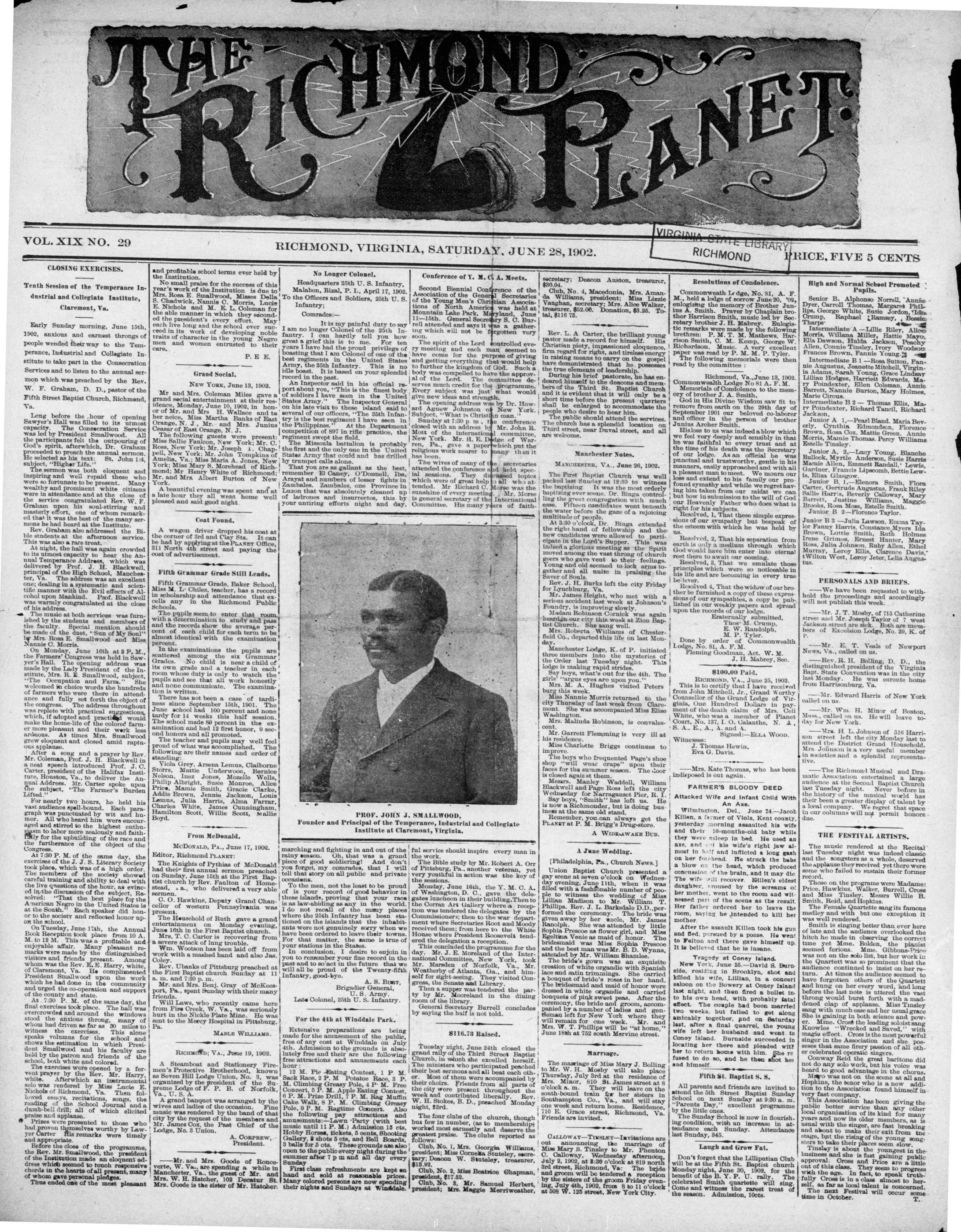
CLOSING EXERCISES.
Early Sunday morning, June 15th, 1902, anxious and earnest throngs of people wended their way to the Temperance, Industrial and Colligiate Institute to take part in the Consecration Services and to listen to the annual sermon which was preached by the Rev. W. F. Graham, D. D., pastor of the Fifth Street Baptist Church, Richmond, Va.
Long before the hour of opening Sawyer's Hall was filled to its utmost capacity. The Consecration Service was led by President Smallwood. All the participants felt the outpouring of God's spirit, afterwhich, Dr. Graham proceeded to preach the annual sermon. He selected as his text: St. John 1:4, subject, "Higher Life."
The sermon was both eloquent and inspiring and well repaid those who were so fortunate to be present. Many wealthy and prominent white citizens were in attendance and at the close of the service congratulated Rev. W. F. Graham upon his soul-stirring and masterly effort, one of whom remarked that it was the best of the many sermons he had heard at the Institute. Rev. Graham also addressed the Bible students at the afternoon service. This was also a rare treat.
At night, the hall was again crowded to its utmost capacity to hear the Annual Temperance Address, which was delivered by Prof. J. H. Blackwell, principal of the High School, Manchester, Va. The address was an excellent one; dealing in a systematic and scientific manner with the Evil effects of Alcohol upon Mankind. Prof. Blackwell was warmly congratulated at the close of his address.
The music at both services was furnished by the students and members of the faculty. Special mention should be made of the duet, "Sun of My Son!" by Mrs. Rosa E. Smallwood and Miss Nannie C. Morris. On Monday, June 16th at $ P. M., the Farmers' Congress was held in Sawyer's Hall. The opening address was made by the Lady President of the Institute, Mrs. R. E. Smallwood, subject, the Occupation and Farm." She wowed in choice words the hundreds of farmers who were there in attendance and fully seated forth the object of the congress. The address throughout was replete with practical suggestions, which, if adopted and practiced, would make the home-life of the colored farmer more pleasant and their work less arduous. At times Mrs. Smallwood grew eloquent and closed amid ruptuous applause.
After a song and a prayer by Rev. Mr. Coleman, Prof. J. H. Blackwell in a neat speech introduced Prof. J. C. Carter, president of the Halifax Institute, Houston, Va., to deliver the Annual Address. Mr. Carter spoke upon the subject, "The Farmer's Burden Lifted."
For nearly two hours, he held his vast audience spell-bound. Each paragraph was punctuated by wit and humor. All who heard him were encouraged and stirred to the highest enthusiasm to labor more zealously and faithfully for the upbuilding of the race and the presence of the object of the Congress.
At 7:30 P. M. of the same day, the exercises of the J. J. S. Literary Society took place, which was of a high order. The members of the society showed careful training and ability to deal with the live questions of the hour as evinced in the discussion of the subject. Resolved: "That the best place for the American Negro in the United States is at the South." Each speaker did honor to the society and reflected honor upon the school.
On Tuesday, June 17th, the Annual Book Reception took place from 10 A. m. to 12 M. This was a profitable and enjoyable affair. Many pleasant remarks were made by the distinguished visitors and friends present. Among whom was the Rev. E.E. Harry, white, of Claremont, Va. He complimented President Smallwood upon the work which he had done in the community and urged the co-operation and support of the county and state. At 7:30 P. M. of the same day, the flair encounters took place. The hall was crowded and around the windows stood the amusements, many of whom had driven car as 20 miles to witness the exercise. This alone speaks volumes for the school and shows the estimation in which President Smallwood and his family are held by the patron and friends of the school, both white and colored.
The exercises were opened by a fervent prayer by the Rev. Mr. Harry, white. Afterwhich an instrumental solo was rendered by Miss Lucie E. Nichols of Richmond, Va. Then followed essays, recitations, songs, the reading of the School Journal and a dumb-bell drill; all of which elicited praise and applause. Prizes were presented to those who had proven themselves worthy by Lawyer Carter His remarks were timely and appropriate. Before the close of the programme, the Rev. Mr. Smallwood, the president of the Institution made an eloquent address which seemed to touch responsive chords in the hearts of all present, many of whom gave personal pledges. Thus ended one of the most pleasant
and profitable school terms ever held by the Institution.
No small praise for the success of this year's work of the Institution is due to Mrs. Rosa E. Smallwood, Misses Della S. Chadwick, Nannie C. Morris, Lucie E. Nichols and M. E. L. Coleman for the able manner in which they seconded the president's every effort. May each living unit the school ever succeed in its work of developing noble traits of character in the young Negro men and women entrusted to their care.
P. E. E.
Grand Social.
NEW YORK, June 13, 1902.
Mr and Mrs. Coleman Miles gave a grand social entertainment at their residence, Monday, June 10, 1902, in honor of Mr. and Mrs. H. Wallace to her niece, Miss Martha Banks of East Orange, N. J., Mr. and Mrs. Junius Ceasar of East Orange, N. J.
The following guests were present:
Miss Sallie Faulcon, New York; Mr. C. Ross, New York; Mr. Joseph 1. Chappell, New York; Mr. John Tompkins of Amelia, Va.; Miss Maria A. Jones, New York; Miss Mary S. Morehead of Richmond; Mr. Henry White of Richmond; Mr. and Mrs. Albert Burton of New York.
A beautiful evening was spent and at a late hour they all went home well pleased and said good night.
Coat Found.
A wagon driver dropped his coat at the corner of 3rd and Clay Sts. It can be had by applying at the PLANET Office, 3rd and paying the cost of advertisement
Fifth Grammar Grade Still Leads.
Fifth Grammar Grade, Baker School,
Miss M. L. Chiles, teacher, has a record
in scholarship and attendance that
excels any in the Richmond Public
Schools.
The pupils seem to enter that room
with a determination to study and pass
and the records show the average
percent of each child for each term to be
almost identical with the examination
percent.
In the examinations the pupils are
scattered among the six Grammar
Grades. No child is near a child of
its own grade and a teacher in each
room whose duty is only to watch the
pupils and see that all work honestly
and none communicate. The examination
is written.
There has not been a case of tardiness since September 15th, 1901. The
June school had 100 percent and none
tardy for 14 weeks this half session.
The school made 80 percent in the
examination and had 12 first honor, 9 second
honors and all promoted.
The teacher and pupils may well feel proud of what was accomplished. The following are their names and order of standing:
Viola Grey, Arsena Lemus, Claiborne Storrs, Mattie Underwoo, Bernice Nelson, Inez Jones, Mozelle Wells, Philip Albright, Susie Monroe, Alice Price, Manie Smith, Gracie Clarke, Addie Brown, Jennie Jackson, Louis Lemus, Julia Harris, Alma Farrar, Charles White, James Cunningham, Hamilton Scott, Willie Scott, Mallie Bowl.
From McDonald.
McDONALD, PA., June 17, 1902.
Editor, Richmond PLANET:
The Knights of Pythias of McDonald had their first annual sermon preached on Sunday, June 15th at the First Baptist church by Rev. Faulton of Homestead, a.a., who delivered a very able sermon.
C. O. Hawkins, Deputy Grand Chancellor of western Pennsylvania was present.
The Household of Ruth gave a grand entertainment on Monday evening, June 16th in the First Baptist church.
Mrs. T. C. Carter is recovering from
Mrs. T. C. Carter is recovering from a severe attack of lung trouble. Wm. Wootson has been laid off from work with a mashed hand and also Jas. Coley. Rev. Ubanks of Pittsburg preached at the First Baptist church Sunday at 11 a.m. and 7:30 p. m. Mr. and Mrs. Benj. Gray of McKeesport, Pa., spent Sunday with their many friends. Will Laws, who recently came here from Fire Creek, W. Va., was seriously hurt in the Nickle Plate Mine. He was sent to the Mercy Hospital in Pittsburg, Pa. MABLE WILLIAMS.
RICHMOND; VA.. June 19. 1902.
A Steamboat and Stationery Firemen's Protective Brotherhood, known as Seven Hill Lodge Union, No. 3, was organized by the president of the Supreme Lodge of F. P. B. of Norfolk, Va., U. S. A.
A grand banquet was arranged by the wives and ladies of the occasion. Fine music was rendered by the band of that city by the request of the members and Mr. James Cox, the Past Chief of the Lodge, No. 3 Union.
A. CORPREW, President.
Mr. and Mrs. Goode of Ronceverte, W. Vm., are spending a while in Manchester, Va., the guest of Mr. and Mrs. W. H. Hatcher, 102 Decatur St. Mrs. Goode is the sister of Mr. Hatcher
RICHMOND, VIRGINIA, SATURDAY, JUNE 28, 1902.
M.
PROF. JOHN J. SMALLWOOD,
Founder and Principal of the Temperance, Industrial and Collegiate
Institute at Claremont, Virginia.
No Longer Colonel.
Headquarters 25th U. S. Infantry,
Malabon, Rizal, P. I., April 17, 1903.
To the Officers and Soldiers, 25th U. S.
Infantry:
Comrades:—
It is my painful duty to say I am no longer Colonel of the 25th Infantry. I can hardly tell you how great a grief this is to me. For ten years I have had the proud privilege of boasting that I am Colonel of one of the best regiments in the United States Army, the 25th Infantry. This is no idle boast. It is based on your splendid record in the past.
An Inspector said in his official report about you, "This is the finest body of soldiers I have seen in the United States Army." The Inspector General on his late visit to these island said to several of our officers, "The 25th Infantry is the best regiment I have seen in the Philippines." At the Department competition of 897 in rifle practice, the regiment swept the field.
The Missola battalion is probably the first and the only one in the United States Army that could and has drilled by trumpet calls alone.
PROF. JOHN J.
Founder and Principal of the Tem-
Institute at Clat
marching and fighting in and out of the rainy season. Oh, that was a grand piece of good soldiering! And don't you forget, my comrades, that I will tell that story on all public and private occasions.
To the men, not the least to be proud of is your record of good behavior in these islands, proving that your race is as law-abiding as any in the world. I do not recall of the many places where the 25th Infantry has been stationed on the islands that the inhabitants were not genuinely sorry when we have been ordered to leave their towns. For that matter, the same is true of your stations in the States.
In conclusion, I desire to enjoin in you to remember your fine record in the past and to so act in the future that we will all be proud of the Twenty-fifth Infantry, good-bye.
A. S. Burt,
Brigadier General,
U. S. Army.
Late Colonel, 25th U. S. Infantry.
For the 4th at Winddale Park.
Extensive preparations are being made for the amusement of the public, free of any cost at Windalee on July 4th. Admission to the grounds is absolutely free and their are the following free attractions and amusements each hour:
12 M. Pie Eating Contest, 1 P. M. Sack Race, 2 P. M. Potato Race, 3 P. M. Climbing Greasy Pole, 4 P. M. Free Concert, 5 P. M. Apple Eating Contest, 6 P. M. Prize Drill, 7 P. M. Rag Muffin Cake Walk, 8 P. M. Climbing Greasy Pole, 9 P. M. Ragtime Concert. Also the following pay attractions and amusements—Lawn Party (with best until 11 P. M.) Admission 13 cts, Hobby tickets, 5 cents, Shooting Gallery, 8 cts 6 cts, and Bell Boards, 3 balls for 5 cts. These grounds are also open to the public every night during the summer after 7 p.m and all day every Sunday.
First class refreshments are kept on hand and sold at reasonable prices. Many colored persons are now spending their nights and Sundays at Windalee.
Conference of Y. M. C. A. Meets.
Second Biennial Conference of the Association of the General Secretaries of the Young Men's Christian Associations of North America was held at Mountain Lake Park, Maryland, June 11-15th. General Secretary C. O. Burrell attended and says it was a gathering which will not be forbidden very soon.
The spirit of the Lord controlled every meeting and each man seemed to have come for the purpose of giving and getting everything that would help to further the kingdom of God. Such a body was compelled to have the approval of the Lord. The committee deserves much credit for the programme. Every subject was just what would give new ideas and strength.
The opening address was by Dr. Howard A. Aguinion of New York. Subject, "What is Christian man." Sunday at 7:30 p.m. in the conference closed with an address by Mr. R. B. Mott of the international committee, New York. Mr. H. E. Dedge of Warren, Pa., gave a paper which put the religious work nearer to many than it has been.
The wives of many of the secretaries attended the conference and held special sessions. They discussed topics which were of great help to all who attended. Mr Richard C. Morse was the sunshine of every meeting. Mr. Morse is general secretary of the International Committee. His many years of faith
SMALLWOOD,
perance, Industrial and Collegiate
remont, Virginia.
ful service should inspire every man in the work.
The Bible study by Mr. Robert A. Orr of Pittsburg, Pa., another veteran, yet youngful in action was the key of the sessions.
Monday, June 16th, the Y. M. C. A. of Washington, D. C., gave the delegates luncheon in their building. Then to the Corran Art Gallery where a reception was tendered the delegates by the Commissioners; then to the war department where Secretaries Root and Moody received them; from here to the White House where President Roosevelt tendered the delegation a reception.
This concluded the programme for the day. Mr. J. E. Moreland of the International Committee, New York, took Mr. Marsden of Norfolk, Va., Mr. Weatherby of Atlanta, Ga., and himself for sight-seeing. They visited Congress, the Senate and Library.
Then a supper was tendered the party by Mr. Moreland in the dining room of the library.
General Secretary Burrell concludes by saying the half is not told.
$116.73 Raised.
Tuesday night, June 24th closed the grand rally of the Third Street Baptist Church, in which she excelled herself. The ministers who participated peached their best sermons and all beat each other. Most of them were accompanied by their choirs. Friends from all parts of the city were present throughout the week and contributed liberally. Rev. W. H. Stokes, B. D., preached Monday night, $2rd.
The four clubs of the church, though but few in number, (as to membership) worked most earnestly and deserve the greatest praise. The clubs reported as follows:
Club, No. 1, Mrs. Georgia Williams, president; Miss Corneka Stuteley, secretary; Deacon W. Stuteley, treasurer, $18.92.
Club, No. 2, Miss Beatrice Chapman, president, $17.53.
Club, No. 8, Mr. Samuel Herbert, president; Mrs. Maggie Marriweather.
secretary; Deacon Auston, treasurer,
$30.04.
Club. No. 4, Macedonia, Mrs. Amanda Williams, president; Miss Lazie Vanghan, secretary; Mrs. Alice Walker, treasurer, $32.06. Donation, $3.25. Total, $116 73.
Rev. L. A. Carter, the brilliant young pastor made a record for himself. His Christian piety, impassioned eloquence, firm regard for right, and tireless energy in raising means to carry on the gospel have demonstrated that he possesses the true elements of leadership.
During his brief pastorate, he has endeavored himself to the deacons and members of the St. Baptist Church and it is evident that it will only be a short time before that the present quarters shall be enlarged to accommodate the people who desire to hear it.
The public should attend the services. The church has a splendid location on Third street, near Duval street, and all are welcome.
Manchester Notes
MANCHESTER, VA., June 26, 1902.
The First Baptist Church was well packed last Sunday at 12:30 to witness the baptizing. It was the most orderly baptizing ever seen. Dr. Binga controlling the great congregation with much ease. Fifteen candidates went beneath the water before the gaze of a rejoicing multitude of people.
At 3:20 o'clock, Dr. Binga extended the right hand of fellowship and the new candidates were allowed to participate in the Lord's Supper. This was indeed a glorious meeting as the Spirit moved among the vast throng of church goers who gave vent to their feelings. Young and old seemed to lock arms together and all unite in praising the Saver of Sonls.
Rev. J. H. Burks left the city Friday for Lynchburg, Va.
Mr. James Height, who met with a serious accident last week at Johnson's Foundation, is improving slowly.
Madam Robinson Cornick was again heard on our tour this week at Zion Baptist Church. She sang well.
Mrs. Roberta Williams of Chesterfield Co., departed this life on last Monday.
Manchester Lodge, K. of P, initiated three members into the mysteries of the Order last Tuesday night. This lodge is making rapid strides.
Say boys, what's out for the 4th. The girls" "argus eyes are upon you."
Mrs. M. A. Hughes visited Petersburg this week.
Miss Nannie Morris returned to the city Thursday of last week from Claremont. She was accompanied Miss Elise Washington.
Mrs. Malinda Robinson, is convalescent.
Mr. Garrett Flemming is very ill at his residence.
Miss Charlotte Briggs continues to improve.
The boys who frequented Page's shoe shop "will wear crape" upon their faces for the summer season. The door is closed against them.
Messrs. Manley Waddell, William Blackwell and Page Ross left the city Wednesday for Narraganset Pier, R. I.
Say boys, "Smith" has left us. He is now a Richmonder, but is doing business at the same old stand.
Remember, you can always get the PLANET at P. M. Brigg's Drug-store.
A WIDE-AWK BUR.
A June Wedding.
[Philadelphia, Pa., Church News.]
Union Baptist Church presented a gay scene at seven o'clock on Wednesday day evening, June 11th, when it was filled with a fashionable number of people to witness the wedding of Miss Lillian Madison to Mr. William T. Phillips. Rev. J. L. Barksdale D.D., performed the ceremony. The bride was given away by her uncle, Mr. James Ranolph. She was attended by little Sophia Prescose as flower girl, and Miss Egeltina Venie as maid of honor. The bridesmaid was Miss Sophia Prescose and the best man was Mr. B. D. Wynns, attended by Mr. William Shamlee. The bride's gown was an exquisite creation of white organdie with Spanish lace and satin trimmings. She carried a bonquet of bride's roses in her hand. The bridesmaid and maid of honor were dressed in white organdie and carried bonquets of pink sweet peas. After the ceremony, the bride and groom, accompanied by a number of ladies and gentleman left for New York where they will remain for one week. Mr. and Mrs. W. T. Phillips will be "at home," June 18th at 752 south Merrive street.
Marriage.
The marriage of Miss Mary J. Bolling to Mr. W. H. Mosby will take place Thursday, July 3rd at the residence of Mrs. Minor, 810 St. James street at 8 o'clock a. m. They will leave on the south-bound train for her sisters in Southampton Co., Va., and will stay one week and return home. Residence, 710 E. Grace street, Richmond, Va. Friends are invited.
CALLWAY—TINSLEY—Invitations are out announcing the marriage of Miss Mary B. Tinsley to Mr. Phenton C. Calloway, Wednesday afternoon, July 2, 1902, at 8:30 o'clock at 819 north 3rd street, Va: The bride and groom will be tendered a reception by the sisters of the groom Friday evening, July 4th, 1902, from 8 to 11 o'clock at 508 W. 125 street, New York City.
Resolutions of Condolence.
Commonwealth Ldge, No. 81, A. F. M., held a lodge of sorrow June 20, '08, enoligizing the memory of Brother Junius A. Smith. Prayer by Chplain brother Harrison Smith, music led by Secretary brother J. H. Mabrey. Enoligis remarks were made by the following brother Smith, M. K. Mathews, Harrison Smith, C. M. K. Cap, Georg Richardson. Music. A very lively paper was read by P. M. M. Ptler.
The following memorials were then read by the committee :
Richmond, Va., June 13, 1903.
Commonwealth Lodge No 81 A. F. M.
Memorials of Condolence to the memory of brother J. A. Smith.
God in His Divine Wisdom saw fit to remove from earth on the 29th day of September 1901 our beloved co-laborer and officer in the person of brother Junius Archer Smith.
His loss to us was indeed a blow which we feel very deeply and sensibly in that he was faithful to every trust and at the time of his death was the Secretary of our lodge. As an official he was punctual and trustworthy, gentle in his manners, easily approached and with all a pleasant man to meet. We mourn our loss and extend to his family our profound sympathy and while we regret having him taken from our midst we can but bow in submission to the will of God our Heavenly Father who does what is right for his subjects.
Resolved, 1, That these simple expressions of our sympathy but bespeak of the esteem with which he was held by us.
Resolved, 2, That his separation from earth is only a medium through which God would have him enter into eternal rest there to await our coming.
Resolved, 3, That we emulate those principles which were so noticeable in his life and are becoming in every true belief.
Resolved, 4, That the widow of our brother be furnished a copy of these expressions of our sympathies, a copy be published in our weekly paper and spread upon the records of our lodge.
Done by order of Commonwealth
Lodge, No. 81, A. F. M.
Fleming Goodman, Act. W. M.
J. H. Mabrey, Sec.
$100.00 Paid.
RICHMOND, VA., June 25, 1903.
This is to certify that I have received from John Mitchell, Jr., Grand Worthy Counsellor of the Grand Lodge of Virginia, One Hundred Dollars in payment of the death claim of Mrs. Celi White, who was a member of Planet Court, No. 137, I. O. Galanthe, N. A. S. A. E., A. A. and A.
Signed: -ELLA WOOD.
Witnesses:
—Mrs. Kate Thomas, who has been indisposed is out again.
FARMER'S BLOODY DEEP
Attacked Wife and Infant Child With An Axe.
Wilmington, Del., June 24.—Jacob Killen, a farmer of Viola, Kent county, yesterday morning assaulted his wife and their 10-months-old baby while they were asleep in bed. He used an axe, and cut his wife's right jaw almost in half and inflicted a long gash on her forehead. He struck the babe a blow on the head, which produced concussion of the brain, and it may die. The wife will recover. Killen's oldest daughter, aroused by the screams of her mother, went to the room and witnessed part of the scene as the result. Her father ordered her to leave the room, saying he intended to kill her mother.
After the assault Killen took his gun and fled, pursued by a posse. He went to Felton and there gave himself up. It is believed that he is insane.
Tragedy at Coney Island.
New York, June 25. —David S. Burnside, residing in Brooklyn, shot and killed his wife, Lillian, in a concert saloon on the Bowery at Coney Island last night, and then fired a bullet into his own head, with probably fatal effect. The couple had been married two weeks, but failed to get along amicably together, and on Saturday last, after a final quarrel, the young wife left her husband and went to Coney Island. Burnside succeeded in locating her there and pleaded with her to return home with him. She refused to do so, and he then shot her and himself.
Fifth St. Baptist S. S.
All parents and friends are invited to attend the 5th Street Baptist Sunday School on next Sunday at 9:30 a.m. "Parents Day," excellent programme by the little ones. The school is now in flourishing condition, with an increase in attendance each Sunday. Attendance last Sunday, 845.
Laugh and Grow Fat.
Don't forget that the Lilliputian Club will be at the Fifth St. Baptist church Monday night, June 30, 1902, for the benefit of the B. Y. P. U. rally. The Come and witness the best treat of the season. Admission: 10cts.
High and Normal School Promoted Pupils.
Senior B. Alphonso Norrell, 'Annie Dyer, Carroll Thomas, Margaret Phillips, George White, Susie Jordan, Idra Crump, Raphael Ramsey, Bessie Tharps'
Intermediate A —Lillie Riley, Alice Morris, Willana Miller, Hattie Mayo, Ela Dawson, Hula Jackson, Peachy Allen, Connie Tinsley, Ivory Woodson Frances Brown, Fannie Young.
Intermediate B 1 —Rosa Sutton, Fannie Augustus, Jeanette Mitchell, Virginia Adams, Sarah Young, Grace Lindsay Lillian Hodges, Harriett Edwards, Mary Poindexter, Ellen Coleman, Annie棉, Nannie Burton, Mary Holmes, Mary Marcus.
Intermediate B 2 —Thomas Ellis, Mary Poindexter, Richard Tancil, Richard Jackson.
Junior A 1 —PearlBland, Maria Beverly, Cynthia Edmondson, Florence Brown, Rosa Cox, Mattie Green. Annie Morris, Mamie Thomas. Percy Williams Estelle Tinsley.
Junior A. 2.,—Icacy Young, Blanche Bullock, Myrtle Anderson, Susie Harris Manie Allen, Emmett Randall', Lewis, Gardner, Francis Lipscomb, Bettie Lewis, Eliza Glasgow.
Junior B. 1,—Elenora Smith, Flora Carter, Gertrude Augustus, Frank Riley Sallie Harris, Beverly Calloway, Mary Barrett, Justine Williams, Maggie Bowie Rhea Moss, Estelle Smith.
Junior B.
Junior B 2—Florence Taylor.
Junior B 3—Julia Lawson, Emma Taylor Fanny Harris, Constance Myers Ida Brown, Lottie Smith, Ruth Holmes Irene Grimes, Ernest Hunter, Mary Ross, Julia Johnson, Ruby Allen, Ethel Murray, Leroy Ellis, Clarence Davis, tWilton West, Leroy Jeter, Lelia Augustus.
PERSONALS AND BRIEFES
We have been requested to withhold the proceedings and accordingly will not publish this week.
Mr. J. T. Mosby, of 715 Catherine street and Mr. Joseph Taylor of 7 west Jackson street are sick. Both are members of Excelsior Lodge, No. 29, K. of P.
Mr. E. T. Veals of Newport News, Va., called on us.
Rev. R. H. Bolling, D. D., the distinguished president of the Virginia Bapt. State Convention was in the city last Monday. He was enroute home from Harrisonburg, Va.
Mr. Edward Harris of New York called on us.
Mr. Wm. H. Minor of Boston, Mess., called on us. He will leave today for New York.
Mrs. H. L. Johnson of 516 Harrison street left the city Monday last to attend the District Grand Household. Mrs Johnson is a very useful member in societies and a splendid representative.
The Richmond Musical and Dramatic Association entertained a large audience at the Second Baptist Church last Tuesday night. Never before in the history of the musical world has their been a greater display of talent by a local company. We regret that space in our columns will not permit honors due.
THE FESTIVAL ARTISTS.
The music rendered at the Recital last Tuesday night was indeed classic and the songsters as a whole, deserved the applause they received yet there were some who failed to sustain their former record.
Who on the programme were Madame: Pricie Hawkins, Wallace Burrell, Cross and Miss Tinsley. Mosses Willie B. Smith, Reid, and Hopkins.
The Female Quartette sang its famous medley and with but one exception it was well rendered.
Smith is singing better than ever here of late and the audience overlooked the hitch he made in observing the correct time yet Mme. Bolden, the pianist seemed ferious. Mme. Gibbons-Price was not on the solo list, but her work in the Quartett was so prominent that the audience continued to insist on her return. At times the audience seemed to have forgotten others of the Quartett and hung on her every word, and long before the last note is uttered the vast throng would burst forth with a maddened clap of applause. Miss Tinsley sang with much ease and her usual grace She is gaining in both science and power. Cross the leading soloist sang Knowles "Cooked and Saved," with magic effect. Cray is the most powerful singer in the Association and she possesses that same fiery passion of all other celebrated operatic singers. Conway Reid the great baritone did not do any solo work, but his voice was heard to good advantage in the chorus. Mme. was not on the scene at all, Hopkins, the tenor who is a new addition to the Association found himself in very fast company.
This Association has been giving the public better service than any other local organization of its kind for many years and now its older members, as is usual with the singer, are fast breaking and about to make their exit from the stage, but the rising of the young singers to take their places seem slow.
Tinsley is about the youngest in the business and she is fast gaining public approval. Cross and Price are a little out of this class. They seem to progress in fact, to speak truthfully about the business almost to herself, as far as local talent is concerned. The next Festival will occur some time in October.
THE PLANET
CAMPFIRE STORIES
BUILDING THE MONITOR.
Interesting Account of the Stirring Event and an Attendant Incident.
There is the man who was bondsman for the construction of the Monitor."
This remark is often made at the capitol as Representative Sperry, of Connecticut, is pointed out. It was 40 years ago that Mr. Sperry signed his name to the instrument that pledged every dollar he had in the world on the success of an experiment—that the United States navy department was not willing to back, which a great many people thought was a foolish one, but the success of which marked the turning point in the naval fights of the war.
Mr. Sperry never speaks of his connection with the affair. He is very modest upon that score, and it is only with difficulty that he can be drawn into discussing it. He got results—and that's all there was to it, says the Washington Star.
But Mr. Sperry's story of the bonding of the constructors of the Monitor, the fiscal act which was antecedent to the great military drama, is very interesting.
"I was a young fellow," said Mr. Sperry, "but was full of patriotism and ardor for the success of the union cause, and I guess that was why the projectors of the Monitor approached me to back the scheme with a bond for the successful building of the vessel.
"John A. Griswold, of Troy, at that time a member of congress; Cornelius S. Bushnell, of New Haven, and a western man named Winslow were the builders. The vessel was designed by Ericsson, as is well known, but these three men were to construct her. The navy department was skeptical of the practicability of Ericsson's idea, and declined to advance the money unless bond could be provided to secure the department against loss if the plans should not work out successfully.
"There was great commotion about the building of the confederate ram Merrimac. We knew that she was going ahead at the Gosport navy yard and would be the most formidable vessel aftow. She was iron-clad, and the thought of that invincible ship being turned loose among the wooden vessels of the coast was a terrible one.
"She could have levied tribute on every city along the coast from the Chesapeake to Maine, and would have had everything her own way. Well, when the Monitor was proposed, people said that was just the thing if it would work out. But many people were doubtful about the 'cheese box,' as they jeeringly called Ericsson's vessel.
"Mr. Bushnell thought she could be built. So Mr. John Drew, of New York, and myself went on his bond with the navy department and the work was started at Greenpoint, N. Y. It was nip and tuck between the two rivals which should be complete-
TRIEGRAPH OFFICE
NEWS OF THE BATTLE.
ed and get to sea first. Everybody knows how the union vessel was finished, went down the coast and was in Hampton roads when the Merrimac came out.
"I will never forget the day of the battle. It was an exciting time in New Haven, for we had a kind of local pride in the Monitor, on account of Mr. Bushnell's connection with her construction. All day long erowds clustered around the telegraph office, receiving bulletins of the fight.
"Mr. Bushnell and I were there, too, you may depend upon it. At last, along about five or six o'clock in the evening came the news that the Merrimac had been disabled by the Monitor and had put back to port. Bushnell, who was a strapping fellow, with a hand in proportion to his size, brought his hand down on my shoulder with a whack that nearly knocked me down.
"Sperry," says he, 'your bond is safe.' I tell you, there was great celebrating in New Haven that time. A peculiar thing is that the original bond we signed has never been found. No one knows what became of it."
Where Swearing Comes High.
In an angry dispute with a neighbor.
John Bloomfield, of South Portsmouth, Ky., became profane, and launched several curses at his opponent. A Kentucky law imposes a fine of one dollar for each curse; and Mr. Bloomfield had to pay $15, this being the number of curses in which he had indulged.
MAINTAINING DISCIPLINE.
How a Captain Enforced His Commands Upon an Insubordinate Sergeant.
"Some of the company officers," said the major, in the Chicago Inter Ocean, "had in the first year of the war original methods of maintaining discipline. I remember a captain in the Twenty-second Illinois who scorned the ordinary methods of punishing the privates of his company. While we were at Bird's Point, Mo., in the fall of 1861, I passed his quarters one day and found him behind his tent pounding a man as large and active as himself. The captain was stripped to shirt and trousers, and was fighting for the mastery.
"For five or ten minutes it was give and take between him and his antagonist. Then the latter was knocked down and said he had enough. Then the captain put on his cont, sent the man to the orderly's tent, and sat down to smoke with me. He said he made it a rule to trounce every man who was saucy or insubordinate, and as his men were mostly from the country, and given to independent notions, he found the plan to work well. He said he would no more think of bucking and gagging one of his men than he would of shooting him.
"Twenty-five years after the close of the war I found the same sort of a captain in the regular army. One day
TO SETTLE THE MATTER.
I stopped at a station on the Union Pacific railway, not far from an army post. Several soldiers in charge of a sergeant were unloading supplies from freight cars on the switch when a captain drove up and spoke irritably and impatiently to the sergeant, charging him with negligence and laziness. The sergeant attempted to explain, but the captain called him a sun of a gun, or words to that effect, ordered him to shut up and get through with his work.
"The sergeant, a big, strapping fellow, said that if the captain was not an officer, he would make him take that back, or lick him. The captain said at once that he would drop the officer for ten minutes, if the sergeant really wanted to lick him. The sergeant said he did, and the two went into the large vacant freight house to settle the matter. The captain threw off his coat and the sergeant his blouse and belt, and after calling the station agent to act as referee, the two shook hands and went at it.
"The sergeant was the larger man, and depended on his strength. The captain was, however, well trained, and in the end worsted his antagonist. The sergeant, recovering slowly from a knock-down blow, was asked by the captain: 'Do you think you can lick me now?' The sergeant said at first the didn't know, but before he got to his feet he said he was satisfied he couldn't do it. Thereupon the captain said: 'Very well. If you are quite certain in your own mind that you can't lick me, I recall all remarks about you being a son of a gun, but I still stand by the specification as to negligence and laziness unless these supplies are at the fort in an hour.' The supplies were there on time, and the captain assured me at a later date that the sergeant held no grudge against him."
PRIVATE ALLEN'S NEW STORY
About a German Veteran Who Was Given to Boasting of His War-Time Exploits.
John Allen is in town—John Allen, of Tupelo. That means that a new crop of stories will appear in the capitol cloak-rooms. Here is one for a starter, says the Washington Star.
"There is an old fellow in East St. Louis named Zollenbaum, who is quite a character. He saw a little service in the union army, but regards himself as a hero. One night, in a Grand Army campfire, he was reciting his various exploits, which, by much repetition had grown considerably, both in number and character. He told how in one battle he had killed four confederates in a hand-to-hand combat, and in another battle had slain six. His recital, accompanied by a profuse gesture and a deep, rich German accent, elicited much enthusiastic applause.
"But at the close of his remarks a modest little man in the rear of the hall, wearing a medal of honor, arose and called attention to the fact that the two battles the gentleman mentioned had occurred on the same day, 1,500 miles apart.
"This blowbade fair for a moment to stagger the doughy Zollenbaum; but he was equal to the occasion.
"My vrend,' he shouted, 'comrades of de Grand Army, we have a tam rebel in our midst. Rouse mit him!' and in the confusion Zollenbaum marched proudly from the hall."
A Smile.
A smile may hide a man's thoughts, just as paint may hide a woman's complexion—Chicago Daily News.
Friend—We are going to name the twins?
Enthusiast—Ping and Pong—N. Y Press.
THE RICHMOND PLANET, RICHMOND, VIRGINIA
ONE WOMAN'S AWFUL WORK.
Gave Glass of Home-Made Wine to Reclaimed Drunkard and Sent Him to His Doom.
A reclaimed drunkard in northern Ohio obtained the position of carrier of the rural mail. He was agreeable, kind, polite, exact in fulfilling his duties. All went well until the frosts of late autumn rendered his drives somewhat chilly; then a generously disposed but heedless woman carried to him one afternoon as he stopped at her mail box a glass of home-made wine. He was cold, the temptation to drink the enticing draught was great, he did so and came to his home town ready for more liquor, the vow of a year broken, his stability overthrown, church pledges ignored and fireside happiness darkened forever, it is feared. His handsome, devoted, sad-faced wife indignantly beheld the ruin of her hopes and knew the end had come. In a passion of tears she said: "How could a woman wreck my husband, who was trying so hard to be temperate, and true to his promises?" She continued: "I thought him perfectly safe when traveling the country roads. He had no saloons to pass. He came home happy, though often tired. We had added comforts, for his pay, though small was sure and prompt and until this Delilah came out with her wine and offered him a drink we were again enjoying peace, content, and modest prosperity. Now he will lose his place.
A GLASS OF HOME MADE WINE.
will again be irritable and morose and will land in the gutter." Her prophecy was soon fulfilled. The carrier failed in his duties, and after official remonstrance and an attempt to reform, at the same farm-house upon another cold tempestuous day he accepted a drink of fermented wine, had a smash-up on the way home, and was discharged in disgrace from the rural service. If the thoughtless country woman had been properly instructed in temperance she would not have lured the wretched man to his doom. A safeguard line of temperance work might well be inaugurated along the rural mall routes.—Temperance Tribune.
BRIGHT AND SHINING EXAMPLE
What Quinney, Mass., Has Been Able to Do Without the Blighting Influence of Saloons.
Scoffers will pale and enemies of the inebriating cup will take heart when they read the figures about Quincy, Mass. Quincy is an attractive little city near Boston, and would be quite worth a line or two on its own account, but the figures here referred to are not so much about Quincy as a nice town near Boston as they are about Quincy as a Type and as a Shining Example. In the state of Massachusetts, every city has a chance to say whether or not liquor shall be sold within its borders, and for 20 years Quincy has answered with a stern and determined no. Therefore, Quincy is become the type of a saloonless city. Now, read what has happened to Quincy. During the two decades aforesaid, the city has more than doubled in population, its assessment valuation has increased threefold, the deposits in its savingsbanks have increased fivefold, and the new houses are now five for every one in existence twenty years ago. If some doubting Thomas suggests that all this might have happened to Quincy, even if there had been a saloon, here is a finisher. While the population was increasing 120 per cent, the amount expended for the poor department of the city decreased 12 per cent. Any one who, after digesting these figures, will go by a liquor saloon without crossing over to the other side of the street ought to be railroaded to a gold cure establishment without a moment's delay.—N.Y. Post.
ITEMS.
By vote of the national council of the Knights of Columbus, in annual session at New Haven, Conn., no more death benefits will be paid to members who are liquor dealers.
The British board of trade furnishes a table concerning the consumption of intoxicating liquors in four countries, showing that the United States is consuming less than half as much per capita as Great Britain, France or Germany.
It is plain that the thoughts of the Swedish people were early turned to the danger of strong drink, for in the "Edda," a book of ancient mythological poems, probably originating in the eighth or ninth century, warnings may be found against strong drink.
The Massachusetts state sanitarium at Rutland, where consumptives are sent and given the out-of-door treatment, has practically discarded the use of alcoholic stimulants. Expert opinion, as expressed at the recent tuberculosis congress in London, coincides with the experience of the physicians at Rutland.
When He Decided,
Edith—You know that new horse papa named after you? Well, he's proved to be quite worthless, and papa is going to shoot him.
Ferdy—Indeed! But I didn't know he named him after me.
Edith—Well, he didn't till he decided to shoot him—Puck.
The Lesser Evil.
Theatrical Manager—Well, that's the best I can do for you. You've been
Idle all season so far. Now, will you remain idle all the rest of the season, or take this small part?
Lowe Comedy—I'll take it. In this case a small role is better than a whole loaf.—Philadelphia Press.
Not in Great Haste.
"If you don't like the gait of this train, you may get out and walk," said the conductor of a southern railway, angrily.
"Oh, I'm not in that much of a hurry!" replied the passenger.—Ohio State Journal.
A Familiar Response.
Cholly—I called on that pretty Miss Pompard, who clerks at the ribbon counter at Sellall & Whooper's department store, last night.
George—Have a nice call?
Cholly—No; she sent down word that she was sorry, but she was "just out!"—Puck.
TRAMP BITES A DOG.
And a Short Time Afterward the Faithful Animal Is Attacked by the Rables.
An aged tramp, stopped at the farm of Prof. E. Burgess, in Greenfield township, Lancaster, O., a few days ago and asked for something to eat. After speaking, he was attacked with a peculiar fit. His eyes rolled and his limbs
DASHED DOG TO THE GROUND
twitched, while froth gathered on his
twitches and he gave wild cries and groans.
A shepherd dog belonging to the farm attacked the man, and he grappled with the animal, lifting it from the ground as though it were a puppy. The animal fought viciously to get free, but the man held it with the strength of a maniac and sunk his teeth in its shoulder. He then dashed the dog to the ground, and turning ran out of the yard and disappeared. The dog was in a dazed condition, and soon it was discovered he was frothing at the mouth. The animal then bounded into the house and caused a tie among the members of the family by showing unmistakable signs of rabies. He made a circuit of the house and then disappeared over the same road as that taken by the tramp. The people in the neighborhood, much alarmed, are trying to locate the tramp.
Women Rarely Die Suddenly. Sudden deaths among men are eight times greater than those among women.
"Nature," said Miss Mismi Brown,
"doesn' nebber make nuffin' in vain."
"Well," answered Mr. Erasmus Pinkley,
"it's sometimes seems to me dat dar
is a whole lot o' animals walkin' around
dat might jes' as well of been 'possums."
—Washington Star.
The Outside View.
Average Man—There's a run on another bank. Just look at those depositors crowding in. The foolie! That's what makes money tight. That whole crowd should be carted off to a lunatic asylum.
Friend—You are allowing your deposits to remain, I presume.
Average Man—Um—er—I haven't any funds in that bank. N.Y. Weekly.
Expert Pulse Reader.
"I suppose," said the physician, smiling, and trying to appear witty while feeling the pulse of a lady patient—"I suppose you consider me an old humbug?" "Why, doctor," replied the lady, "I had no idea you could ascertain a woman's thoughts by merely feeling her pulse."—Tit-Bits.
Just Before Dawn
Yeast—They say the darkest hour is just before the dawn.
Crimsonbeak—Yes; well I know when I've gone home in the morning, and knew my wife was waiting for me, things looked unusually black.—Yonkers Statesman.
Interested.
"I hear that Gazzam is thinking of buying a horseless carriage," said Manhattan.
"Indeed?" queried the Brooklynite.
"And what have they named the baby?"—Judge.
"Not at all funny. After he got it he found he couldn't control it."—Yonkers Statesman.
Now He Won't.
"Jones is just married."
"Ha! ha! That's a good joke on Jones."
"A good joke?"
"Yes; he's always boasted of being independent."—Detroit Free Press.
A Dismal Outlook
First Heir—How are we going to get enough money to live on while the lawyers are settling the estate?
Second Heir—That isn't what worries me. What are we going to do afterwards?—Brooklyn Life.
"Yes," said an ex-customer, "I bought one yesterday and got a skipping rope in mine."—Yonkers Statesman.
CURES WEAK MEN FREE.
Insure Love and a Happy Home For All.
How any man may quickly cure himself after years of suffering from sectual weakness, loss vitality, night losses, varicose, etc., and enlarge small weak organs to full size and vigor. Simply send your name and address to Dr. Knapp Medical Co., 1823 Hull Building, Detroit, Mich., and they will gladly send the free receipt with full directions so that any man may easily cure himself at home. This is certainly a most generous offer, and the following extracts taken from their daily mail, show what method of their generosity.
Dear Sir, please accept my sincere thanks for your recent date. I have given your treatment through test and the benefit has been extraordinary.
It has completely braced me up. I am just as vigorous as when a boy and you cannot realize how happy I am."
Dear Sire--Your method worked beautifully. Results were exactly what I needed. Strength and vigor have completely returned and enlargement is entirely satisfactory."
Dear Sirs,—Yours was received and I had no trouble in making use of the receipt as directed, and can truthfully say it is a boon to weak men. I am greatly improved in size, strength and vigor." All correspond once is strictly confiden tial, mailed in plain, sealed envelope. The receipt is free for the asking and they want every man to have it. 4-5-02-ff
4-5-02-ff
WANTED-5 INDUSTRIES COLORED MEN
and women in each locality. $10 to $20 per
person made working for us, and much
good done for us. Part of rent is
of special interest to men and women or
race who desire to work themselves up. Full
particulars furnished free. Apply by letter.
UNITED M'F G. PUB. COMPANY,
1107 & 1109 E. Main St.,
Richmond, Va.
On to Chicago THE MIDDLE STATES AND MISSISSIPPI
VALLEY EXPOSITION
To be held Chicago from the 14th of August to the 14th of September, 1902. The first practical demonstration ever given to the people of the north of the development and growth of the Negro race in this section. A grand display of race process. The nation's first big event of the 20th century. The agio is the freest and most hospitable city in the United States. The greatest summer resort in the west. Do not fail to visit Chicago and the greatest of all Race Expositions. Special railroad rates. The 14th of August to the 14th September, 1902.
For information, address the
COMMITTEE,
No. 610 Garfield Boulevard,
Chicago, Illinois.
Miller, Grayes & Wright,
BILLIARDS AND POOL
SAMPLE ROOM,
Nos. 216-218-220 Eighth Street,
Huntington, W. Va.
Barber Shop Connected, 216 8th St.
Best Wines, Liquors, Beer, Cigars.
5-17-3m.
Seaboard Air Line R.R.
Short line to Principal Cities of the South
and Southwest. Florida, Florida, Texas, Califor-
nia and Mexico, reaching the Capitals of Six
States.
SCHEDULE IN EFFECT APRIL 13, 1902
TRAIN$ LEAVE RICHMOND-MAIN ST.
STATION-DAILY.
No. 27 No. 31,
2.15 P.M. 10.35 M.-Lv. Richmond.
2.15 P.M. 10.35 M.-Lv. Petersburg.
7.25 P.M. 11.30 M.-Lv. Tampa.
10.35 P.M. 7.30 A.-Ar. Hamlet.
10.35 P.M. 7.20 A.-Lv. Hamlet.
7.25 P.M. 7.20 A.-Lv. Atlanta.
2 A.M. 10.35 A.-Ar. Column.
(Eastern Time.)
1:35 A.M. 9:40 A.M. M.-Lv. Columbia.
2:15 A.M. 2:10 P.M. M.-Ar. Savannah.
9:15 A.M. 7:00 P.M. M.-Ar. Jacksonville.
10:35 A.M. 7:00 P.M. M.-Ar. Augustine.
3:45 P.M. 6:45 A.M. M.-Ar. Tampa.
10:22 P.M. 7:20 A.M. Lv. Hamlet.
7:50 A.M. 7:55 P.M. M.-Ar. Atlanta.
2:15 A.M. 10:35 A.M. M.-Columbia.
1:35 A.M. 9:40 A.M.-Lv. Columbia.
(Central Time.)
4:35 A.M. 9:10 P.M. M.-Ar. Savannah.
9:15 A.M. 7:00 P.M. M.-Ar. Jacksonville.
10:30 A.M. M.-Ar. Augustine.
3:45 P.M. 6:45 A.M. M.-Ar. Tampa.
10:35 A.M. 7:00 P.M. M.-Ar. Augustine.
10:22 A.M. 10:22 P.M. Lv. Chester.
8:43 A.M. 12:35 P.M. Lv.-Greenwood.
6:13 A.M. 2:50 P.M. Lv.-Athens.
7:50 A.M. 5:40 P.M. M.-Ar. Augusta.
11:35 A.M. 7:20 P.M. M.-Ar. Macon.
6:25 P.M. 6:25 P.M. M.-Ar. Montgomery.
2:50 A.M. 2:50 P.M. New Orleans.
7:25 A.M. 5:40 P.M. M.-Ar. Memphis.
6:55 P.M. 1:40 A.M. M.-Ar. Nashville.
8:50 A.M. 8:50 A.M. M.-Ar. Memphis.
Train No. 1548 Ride 9:10 P.M. m daily for Petersburg, Norfolk, N.C. and all intermediate points. Connect at Norfolk with Henderson 2:10 P.M. m and Raleigh 8:50 P.M. daily, and Durham 4 P.M. daily except Sunday.
Connections at Jacksonville and Tampa for all Florida East coast points and Cuba, and Porta Rica; at New Orleans for all points in Texas, Mexico and California.
TRAINS ARRIVE AT RICHMOND-DAILY
6:35 A. M. No 34 From all points South.
6:35 A. M. No 36, Norristown, N. C., Petersburg,
N. C.
SLEEI ING-CAR SERVICE
We promptly obtain U. S. and Foreign
PATENTS
Send model, sketch or photo of invention for free report on patentability. For free book, How to Secure TRADE-MARKS to Patents and C. ASNOW &
Opposite U. S. Patent Office WASHINGTON D. C.
C & O
PASSENGER TRAINS LEAVE AND
ARRIVE NEW MAIN-ST. STATION.
MAY 4, 1902.
LEAVE RICHMOND.
7:30 A. M., Except Sunday, Local to Newport
News.
8:35 A. M., Daily F. F. V. Limited to Old
Point, Norfolk and Portsmouth, makes
local stops except at Williamsburg
and Hampton.
10:30 A. M., Except Sunday, Local to Calverton
Clifton Forge, Connects for Orange,
Culpeper, and Manassas.
10:30 A. M., Daily for Lynchburg, Lexington,
Clifton Forge, Connects, except
Sunday for Rosney, Aberdeen and New
Castle.
2:45 P. M., Daily, St. Louis and Chicago Limit-
tion Car train, Pullman for
Ginnastus Loudville, and St. Louis,
to eight hours, quickest line West. Connects
for Virginia Hot Springs. Local train follows St. Louis Limited from
Gordonsville to Staunton, except Sund
4:00 P. M. Except Sunday, "Seashore Limited"
for Old Point, Norfolk and Portsmouth.
Portsmouth, except at D. S. S.,
places except at Williamsburg and
Hampton. Connects at Old Point with
Washington, Baltimore and Cape
Cinnamon, except at Norfolk with
5:00 P. D. S. S. for New York.
5:15 P. M. Except Sunday for Bremo.
5:30 P. M. Except Sunday to Doswell.
10:30 P. M. Daily F. F. V. Dining car train. Connects for Virginia Hot Springs, Pullman
Broadway, and Pulman Car to Cincinnati, and Pulman to
Cincinnati, Louisville, and the West.
ARRIVE NEW MAIN ST. STATION.
8:00 A. M. Except Sunday, from Doswell.
8:30 A. M. Daily from Cincinnati.
Except Sunday from Bremo.
16:30 A. M. Daily from Old Point Norfolk and
Portsford.
2:15 P. M. Except Sunday, from Old Pon t
c. 3:30 P. M. Daily from Norfolk and
Cinnamond.
6:30 P. M. Daily from Old Point, Norfolk and
Point.
9:15 P. M. Except Sunday from Clifton Forge
and Charlesties Beach.
Apply at 828 East Main Street, Murphy's Hote
for further information.
H. W. FULLER, JOHN D. POTTS
G. P. A. A. G. P. A.
ATLANTIC COASTLINE.
Schedule In Effect Jan. 14, 1902.
TRAINS LEAVE RICH ANE—BYRD
STREET STAI
8:00 a. m., NORFOLK I4 Daily. Arrives Petersburg 9. m., Norfolk 11:25 a. m., Stops y t Petersburg, Waverly, and Aft 9:05 a. m., Daily. Arrives Petersburg 9:49 a. m., Walden 11:30 a. m., Javetteville 4:25 p. m., Charleston y m., Savannah Tampa 7:10 p. m., Connects at Wilson with No. 47, arriving Goldsboro 3:25 p. m., Wilmington 10 p. m., Pullman Shiloh Street 11:55 a. m., Daily, exec tunny. Arrives Petersburg 12:35 Stops at Manchester, Drewry's m., centralla and Chester 3:00 p. OCEAN LIMITED Daily Arrives at Petersburg 3:30 p. M., Norfolk 5:20 p. m., bobs only at Petersburg Waverly, and Aft 4:30 p. m., Daily. Sunday. Arrives Petersburg m., Walden 7:35 p. m., Rocky Mount 10:30 p. M. Makes all intermediate at
6:56 P. M. Daily Arrives Petersburg 7 p.m.
M. Makeup Arrives Petersburg 7:59
P. M. FLOYD & WEST INDIAN LIMITED.
M. Arrives Petersburg 7:59
for Nor Larch and interment Empo
P. M. (Connects with Atlantic Empo
Daville for stations between Daville and dwarvenville) Weddon
9:30 P. M. (Connects with lesto A. M. Savannah 9:00 A. M.
Jack M. le12:45 P. M. Port Tampa at New
NEW TO MIDDLE GEORGIA
M. Arriving Augusta 7:55 A. M. Ma.
M. Arriving Augusta 7:55 A. M.
Thvillence 2:23 P. M. Pullman Sleeper New work to Wilmington, Charleston, P. r. Lampa, Jacksonville, Augusta and
9:10 P. M. Daily Arrives Petersburg 9:55 P. M. connects at Petersburg with Norfolk and Wendover
urg 2:30 A. M. Roanoke 5 A. M. Bristol
A. M. Pullman Sleeper Richmond nyburg
11:30 M. Daily Arrives Petersburg 12:10 A. M.
FKAINS ARRIVE RICHMOND
M. Daily, From Jacksonville, Savannah, Charleston, Atlanta, Macon, Augusta and all points South.
M. Daily, except Monday. From Tampa, St. Augusta, Jacksonville, Savannah and Charleston.
M. Daily, from Petersburg, Lynchburg and the West.
A. M. Daily, except Sunday, Petersburg local.
A. M. Daily, except Sunday, from Goldsboro and intermediate stations, Norfolk and Suffolk.
A. M. Daily, from Norfolk, Suffolk and Petersburg.
A. M. Sunday only. From Norfolk, Suffolk and Petersburg.
A. M. Daily, except Sunday. From Petersburg.
A. M. Daily, From Miami, Port Tampa, Savannah, Savannah, Charleston, Wilmington, Goldsboro, and all points South.
A. M. Daily, from Norfolk, Suffolk, and Petersburg.
A. M. Daily, From Petersburg, Lynchburg and West.
T. M. EMMERSON,
Traffic Manager.
J. R. KENLY, General Manager.
H. M. EMMERSON,
General Passenger Agent
O. S. CAMPBELL,
Division Passenger Agent,
838 East Main Street.
jan. 14.
Norfolk and Western R. R.
November 24th, 1901.
LEAVE RICHMOND (DAILY), BYRD
STREET STATION.
9:00 A. M. NORFOLK LIMITED. Arrives at
Petersburg, Wavley and Suffolk.
9:06 A. M. THE CHICAGO EXPRESS, for Lynchburg, Roanoke, Columbus and Chicago. Buffet Parlor Car Petersburg to Roanoke, Pulman Sleeper Roanoke to Roanoke, also for Bristol, Knoxville, and Chattanooga. Pulman Sleeper Roanoke to Rooxville.
3:00 P. M., Ocean Shore Limited. Arrives Nor-
westerly on Suffolk at Petersburg
Waverly and Suffolk on Cumberland
folk with Steamers to Boston, Provid-
ed by New York, Baltimore and Wash-
ington
8:10 P. M. for Lynchburg, and Roanoke. Connects Lynchburg, with Washington and Chaffinoga, Limited. Pulls Sleepsers Lynchburg to Memphis and New Orleans, Cafe, Parlor and Observation Cars Radford to Attalla, Ala. Pullman Sleepser between Richmond and Lynchburg. Berths ready for occupancy at 8:30 P. M. Also Pullman Sleeper Trains arrive Richmond from Lynchburg and the West daily at 7:35 A. M. and 8:56 P. M.; from Norfolk and the East at 11:10 A. m., 11:43 A. m., and 8:50 P. m.
Office 888 Main St.
JOHN E. WAGNER.
City Passenger and Ticket Agt.
C. H. BOSLEY,
District Passenger Agent.
W. B. BEVILL,
General Passenger Agent.
General Office; Roanoke, Va.
do. 18
Richmond, Fredericksburg and Potomac Railroad.
Schedule in Effect May 25, 1902.
Trains Leave Richmond Northward.
4:22 A. M. Daily from BRYD STREET STATION, for Washington and beyond.
Stations at Milford, Frederickburg and Alexandria. Stops Occoquan Sunday.
Sleeping Cars in Washington and New York. Dining Car.
6:45 a. m. Daily from MAIN STREET
Stations in Florida and Metropolitan Limited, for Washington.
Stops at Fredericksburg and Alexandria. Sleeping Cars to New York.
7:00 A. M. Except Sunday from Eba Station,
Sleeping Cars to Ashland and intermediate points.
6:30 P. M., Except Sunday, from ELBA STA-
TING, accommodation for Ashland and intermedi-
ate stations.
8:05 P. M., Daily from Byrd Street Station,
for Washington, and beyond. Stops at
East Kalamazoo, Dowell, Milford, Pred-
erence, Erie, Ticonto, and Alexandria. Stops at other
stations Sunday. Sleeping Car, Richi-
ment to New York and Washington to
Philadelphia.
11:15 P. M., Except Sunday, from ELBA STA-
TING, accommodation for Ashland and intermedi-
ate stations.
Trains Arrive in Richmond Southward.
6:40 A. M., Except Sunday at ELBA STATION Accommodation from Ashland and intermediate points.
8:25 A. M., Except Sunday at BYRD STREET STATION Accommodation from Fredrickburg, and intermediate points.
8:40 a. M., Except Sunday at St. Augustine. Stops at Alexandria, Occoquan Widewater, Frederickburg, Milford, Dowell, Ashland, and Elba. Stops at other stations Stopping car from New York to Richmond.
12:01 P. M., Except Sunday at BYRD STREET STATION. Stops at local stations, from Wickford to Ashland to Glen Allen and Elba.
2:32 P. M., Daily, at ELBA STATION. Stops at Alexandria, Lorton, Ocoquan. Fred ericksburg and Milford Sleeping Car from New York, Dining Car.
2:35 P. M., Daily, at MAIN STREET STATION. Stops at Alexandria, Fred ericksburg, Milford, Doswell and Ashland. Sleeping Car from New York.
6:00 P. M., Sunday at ELBA STATION. Accommodation from Ashland, and in terminate place.
7:15 P. M., Daily, at BYRD STREET STATION. Stops at Alexandria, Fredericksburg, Doswell, Ashland, and Elba Sleeping Car from New York to Washington. Dining Car.
8:50 P. M., Daily, at BYRD STREET STATION. Stops at Alexandria and local stations Quantico to Ashland incursive, Allen, and Elba. Buffet Parlor Car.
10 29 P. M., Daily at MAIN STREET
STATION, Florida and Metropolitan
Limited. Stops at Alexandria, Frederick,
and Ashland. Sleeping
Cars from New York.
11 500 P. M., Except Sunday, at ELBA STATION
Accommodation from Ashland.
SOUTHERN RAIL W Y
Schedule In Effect Feb. 16.
Trains Leave and Arrive 14th S
tation
10:20 A. M., No. 9 daily for Durah
ville, and all local stations
connecting at Burkerville with
for Durahville, Lynchbury
stations West Railway
tions on Norfolk Division
at Oxford for Henderson
P. M., No. 10 daily for Durah
ville, and all Florida
seville and all Florida
Nassau, etc., Connects
Chesapeake, and Powha
Greenboreboro, and Winston-Salem; at Ct
55, United States fast
points South
which carries sleeps; at New
Chesapeake,
Drawing Room She
Atlanta, to Richmond
to Atlanta, with Sleep
pham. Through
town with Sleep
bury to Memphis.
Dixing-Car.
11:30 P.M. No. 11, South express, daily for Atlanta, August Jacksonville, and with, with carrier for Danville, Greenboro, Sa. open at Richmond 1:30 P.M. M. Carleton with New York and Florida Express and South limited, which can call California to Augusta, Santa Vannah, Jacksville, Tennessee, Santa Monica, Memphis, Atlanta, New Orleans, etc. Complete D Carr Service, Also Pulmanant days an days Washington to SanFrancisco without change, with connections for points in Texas, Mexico and California.
6:00 P.M. No. 17, daily, except Sunday, for Keysville and intermediate points
TRAINS AR RIVE IN RICHMOND.
6 A.M.)
5:43 P.M.) Fro Atlanta, Augusta, Jacksonville, A,ville and all points South.
40 A.M.) Fro Laysville and local stations.
3:35 P.M.) Fro Durham, Charlotte, Danville and in indicate stations.
I. CAL FREIGHT.
Nos. 61 and between Manchester and Neapolis
YORK RIVER LINE, VIA WEST POINT.
THE AVORITE ROUTE NORTH.
LEAVE RICHMOND.
No. 16, Baltimore Limited, daily ex-upt Sunday for West Point, connect-11, West Point stenner for Baltimore and York river landings mondays, Wednesdays and Fridays.
2;16
n., No.10 Mondays, Wednesdays, Fridays
express for West Point, and intermediate
stations. Connects with stage at
Lester Minor for Walkerton and Tappahannock.
M., No. 74, local mixed. Leaves daily,
except Sunday for West Point and inter-
mediate stations, connecting with stage
at Lester Minor for Walkerton and Tappahannock.
TRAINS ARRIVE RICHMOND.
A. A. M., daily from West Point, with connection from Baltimore, Mondays, Wednesday and Fridays.
10:45 A.M. No, weddings and Fridays.
13:5P. M., daily except Sundays, from West Point and intermediate stations.
Steamers leave West Point Mondays, Wednesdays and Fridays 5:30 p. m., arriving Baltimore 8:30 a. m.
Steamers call at Almonds Clay Bank and oocester Point.
C W WESTBURY, D. P. A.
920 E. Main St., Richmond, Va.
S H HARDWICK, G. P. A.
F. S. GANNON.
Third Vice President and General Manager, Washington, D. C
ALPHEUS SCOTT.
Open Day and Night. Office and Ware rooms 3006 P St., Church Hill. Orders By Telegraph and Telephone promptly attended to. All business confidential. Old Phone No. 3183.
```markdown
```
THE SPUR OF FATE By Ashley Towne COPYRIGHT, 1801, BY CHARLES B.
```markdown
```
RRELL ha, been served with a good dinner, and on the morrow there was spread a palatable breakfast, after which he was permitted to enjoy a cigar. This lenency augured well.
ARRELL has, been served with a good dinner, and on the morrow there was spread a palatable breakfast, after which he was permitted to enjoy a cigar. This lenency augured well. It had the look of mere brief detention, and if there had been no question of Vera's safety he would have felt little anxiety. It was therefore a complete surprise to him when, about 10 of the forenoon, he was summoned to trial! The announcement was coldly made by the officer who had managed his arrest upon the previous evening.
Darrell demanded counsel and was informed that it was not customary. He insisted upon an interview with the official representative of his country and received the reply that his letter had been forwarded and that nothing more could be done. There was no alternative. He was forced to accept trial on the prosecutor's terms.
He was led before a singular tribunal. The judge sat in a courtroom bare as a barn, and there were not a dozen persons present, including prisoner, guards and clerks. A villainous looking individual with a face so unsymmetrical that he seemed to be made from the halves of two very different men that had been split longitudinally acted as state's attorney. He charged the prisoner with being an escaped Siberian convict, Sergius Bilowski. His opening remarks were brief, and he galloped through them at such a gait that Darrell had hard work to follow him. Witnesses were then admitted, one at a time, from an adjoining room. They swore to the prisoner's identity with such alacrity that three of them testified within five minutes. Darrell was not permitted to question them, but at the close of the farce he had a chance to testify in his own behalf. As if to make the proceedings perfectly fair, nobody questioned him. When he had said his say, the judge signed some documents, and the officer who had brought Darrell in received them.
"The prisoner will be taken to Gredskov," said the judge, "and will be returned to Siberia at the earliest opportunity."
He then left the bench, vanishing through a door behind it. Darrell was led back to the room in which he had been previously confined. He was not fettered, and there was no added severity in the treatment of him except that an armed guard was placed within the room, a gigantic fellow with a good natured face, who sat on a stool tilted back against the door with a short gun, like a cavalry carbine, across his knees. Darrell had struggled to preserve his self command throughout the tragic force of the trial, well aware that the approval of his own sense of honor was all he had to hope for. He had maintained a calm demeanor from first to last, and in his prison room he addressed his guard cheerfully.
"Where is this Gredskov?" he asked,
"Gredskov," was the reply, with a sort of pitying grin, "is a prison city in the Caucasian mountains. It is maintained for the purpose of guarding the captives taken among the rogues of the mountains—Circassians, robbers, Turks or any of the bad men who seek to plot against the caar. Every three months a prison train is made up for Siberia, where the prisoners are divided among the mining towns."
Darrell's stay in Stavropol was short. On the following morning he was placed with about a dozen other prisoners, all seemingly of the lowest type of peasants, and was conducted under a strong guard to the city gate. He had not been dressed in any sort of prison garb and still retained his minor belongings and the money that the searchers had missed, but his hat had been replaced by a cap and his overcoat by a ragged garment that might have been a part of an officer's outfit in the far pest.
Outside of Stavropol the road was smooth for a considerable distance, and the cavalcade moved slowly along through a rural scene of what might have been prosperous comfort and wealth had it not been for the stagnation arising from the policy of the deputized government of Getchikoff. At the end of the day's march they roasted at a little post village. In the morning they again advanced and at night reached Glugiers, on the main road leading to the pass over the Caucasus to Tiflis. Darrell was treated with no more and no less consideration than any other of the prisoners. To the officers and soldiers of the escort he was simply the nihilist Sergius Blowski, and no argument could make him anything more.
After leaving Gluglersk the way became more rugged, though the road itself was smooth and hard, traveled as it was by the numerous trading carvans from north to south that crossed and recrossed the mountains.
Finally they reached Mozdok, where a stay of two days was made. Their next stopping place was Vladikaukas, on the upward slope of the steep mountain pass.
Ten hours after leaving Vladikaukas, in the morning, the turrets of Gredskov could be seen.
Darrell knew nothing of Gredskov, and as none of the soldiers would talk to him and he was not allowed to speak to his fellow prisoners he could obtain no information in regard to it. But as the frowning battlements could be seen rising above the trees he noticed that the other prisoners became more dejected, and their faces expressed a terrible fear.
At the gate of Gredskov the cavalcade was met by an officer, who halted the prisoners and took from the captain of the escort a paper. This contained the list of names, and the two officers went over it together.
Even then Darrell was not allowed to speak, though he made a desperate attempt to tell the officer at the gate who he was.
Without ceremony he was taken from the column of prisoners, handed over to fresh guards and rudely hustled into a low building that was built close to and under the city wall.
Here he was thrust into a dungeon that was floored with stone, walled with stone and roofed with stone. There was one little window, which spened high in the wall. Through this narrow aperture, when standing upon his table, he could see an esplanae, upon which regiments of the city's garrison sometimes paraded.
For a day or two Darrell cherished the hope that he would be returned to
A man in a suit stands in front of a building, facing another man seated on a chair, who is holding a rifle.
"Where is this Gredskovt"
Stavropol, that the trick had been played to keep him out of the city at a critical time when his intervention in Vera's favor might have inconvenenced the authorities, but as the time wore on he began to realize that his view of the affair must be erroneous and that his liberty was lost forever unless he could win it back by his own hands.
While he fully realized the difficulties of his position, he did not despair. He knew that he was destined for Siberia, but the way to Siberia is long, and the opportunities to escape must be many.
The guard who controlled the door of Darrell's dungeon was a young Russian named Kewski. Accepting for granted the story of Sergius Bilowski that came with the prisoner bearing that name, he had treated Darrell with a sternness that forbade any attempt at conversation, but they were brought into more friendly relations by a singular happening.
One evening, when Darrell was watching through his window the evolutions of an unusually large force upon the esplanade, he was astounded to perceive Ivan Getchikoff mounted upon a horse and wearing the uniform of a brigadier. Evidently the rascal had enjoyed recent promotion. Surrounded by his staff, he took up a position within fifty years of Darrell's window, and the troops passed before him in review.
With no clear notion of the usefulness of the proceeding, but desiring to make his presence known to Getchikoff, Darrell repeated that imitation of the flute which had so surprised Ladislov in the Parisian cafe. The sharp sound reached Getchikoff's ears, and he recognized it. Darrell had the satisfaction of witnessing the nervousness of his enemy, and he was piping lustily when he heard the creaking of the door behind him. He snatched the big pen (not, of course, a necessary part of the musical performance) from his pocket and turned to face Kevski, the guard. "Where did you get a flute?" demand-
"Where did you get a flute?" demanded Kevski.
"I have had it in my pocket all along," said Darrell. "It is not exactly a flute. It is an American instrument."
"Why were you permitted to retain it?"
"My friend," said Darrell, who had solved this puzzle by long study, "it was safer to let me carry my own property out of Stavropol than to leave it behind. When prisoners' goods are ordered to be destroyed, they have a habit of turning up again, as you are aware. And mine would prove me an American."
"You are not a Russian; I know that," responded Kevski. "Is your name really Sergius Blowski?"
"It is not. My name, my friend, is Darrell. I am an American." Kevski seemed to be impressed.
"America! Ab! That is the place!" he said. "They have no prisons there!"
"Oh, hold on now! They do have prisons. We are not all angels," said Darrell. "And prisons are necessary in every land. But in America one must commit a crime to be sent to prison."
"I know, I know," said Kevski, eager to display his knowledge of the distant land of freedom. "My cousin, Andrea Kevski, is there. He wrote me a letter once. He is now a merchant, and his children go to school. He sits every Sunday in a church, and no inspector of police searches his house in his absence. It is a great country, that America."
"It is, indeed," said Darrell. "I wish it could know where I am. I think Starvropol would be treated to a sensation."
"Mush! My cousin says that in A
ica your people treat our people with friendship. He says that it is a great entry, where railroads go every day, that many of our people have large farms, and the taxes are so light that they can save money. Is it so?
"I think so. I know that there are many Russian villages in our great west."
"So. That is what my cousin called it, but I know little of those things. Could I get to America?"
"Well, if it was really an object and I got out of here, I think you might reach America."
"But we may escape and join Motman Khan," said Darrell.
"Furles of hell!" cried Kevski. "That is the worst of it! The commander of the city, General Stanovitch, has issued orders to the captain of the guard to kill all the prisoners and put all the prison guards under arms on the city wall."
"That's pleasant," said Darrell. "Are you to do the killing in my case?"
"God! Do not scoff!" exclaimed Kevski, with white lips. "I mean what I say! Hear the trumpets! The captain
"It is the magazine wall!" cried Kevski blown it up. There result of it."
Even the officers back upon the en staring across the came dashing across He yelled like a man colonel commanding Then a shell came housets. It struc under the hoofs of the messenger, and and beast in a fla
Kevski seemed to think that the conversation had gone far enough in this direction. He suddenly asked to see the musical instrument, which he examined with childish wonder, making a laughable attempt to extort a tone from it. Then he returned it and hastily left the cell. That evening Darrell had a much better supper than usual. On subsequent occasions the conversation was resumed, and at last Kevski was led to a definite statement regarding the possibilities of escape.
"It can be done," he said. "The officers of the prisoner trains do not care for persons. They convey only names. You are Sergius Blowski. There are in Gredskov men who have lived in the north and whose friends are near the Urals. One can be found to take your name and place."
"Very good. That gets him to Siberia. But what about me?"
"You and I must find a way to get to America."
"We'll find it." replied Darrell; "have no fear."
The days now passed less miserably. Kevski proved to be a youth of intelligence, and the hours spent in telling him about America shortened the prison days for Darrell.
"Soon we shall be away from here," said Kevski one day when a month had been spent in the Gredskov prison. "Orders have come to form a prison train for Siberia."
"Are there many to go?"
"Yes, many. You see, there is war in the Caucasus since you came to Gredskov. The Circassians have risen." "A revokt?" said Darrell. "Who leads it?" "A mysterious prince called Motman Khan. No one knows who he is. But he holds all the Circassians in his power. Prince Kilziar, the traitor, is one of the leaders also." "Kilziar!" said Darrell.
He fell to studying. What might this new turn of events mean to him? With the mysterious Motman Khan he had nothing to do, but Kilziar he would have given much to see, for undoubtedly Vern's fate must in some way be connected with this revolt of the Circassians. He even cherished the hope that she might have escaped the snarches of the Getchikoffs and have joined the revolutionists in the field. That, indeed, would be bad enough, for the power of the Russian government could not be overthrown, and the fate of the leaders of such a revolt would surely be death. He had now a triple reason to desire freedom, and he prayed heaven that Kevski had planned well. The man had become reticent and had begun to show traces of anxiety.
"The Circassians are coming," he said one day. "A small force that was sent from Stavropol to meet them has been cut to pieces. Motman Khan, the victorious prince, is on his way to Gredskov. There are here about 300 Circassians accused of one crime or another, all to be sent to Siberia. Motman Khan is coming to reduce the city and free his people."
"Tell me, Kevski," asked Darrell, "is there any word of a woman in this thing?"
"Woman! Oh, no!" answered Kevski, staring. "Women do not lead regiments.
"Some of them might well do it. You are sure there is no mention made of a woman's name?"
"No." Kevski laughed. "The only name spoken is the name of Motman Khan. He has a large army. It is armed with good guns and cannon. It was raised almost in a night, they say. Motman Khan is almost a god to his people. They worship him and follow him to death. Village after village has been taken. Russian rule is broken in the mountains. Gredskov is doomed unless the governor general
L. B.
"We are doomed!" sends us aid. His son was here to examine the defenses, but he left few men to re-enforce the garrison." "And what then, Kevski?" Kevski shrugged his shoulders.
"Then we shall all be put to the sword. You may not be, for Motman Khan will not kill the prisoners. They are mostly his own people. He will give them all a chance to join his army." Darrell heard this with a leap of the heart. It was the chance he wanted. It would bring him within the Circassian lines and give him an opportunity
or Vera among her mother's
the booming of heavy guns
and there was a commotion
of city.
time to the dungeon pale
"hoomed!" he cried. "There
America for me. Motman
tracking the city with his
to help has come from Stav
"But we may escape and join Motman Khan," said Darrell.
"Furles of hell" cried Kevski. "That is the worst of it! The commander of the city, General Stanovitch, has issued orders to the captain of the guard to kill all the prisoners and put all the prison guards under arms on the city wall."
"That's pleasant," said Darrell. "Are you to do the killing in my case?"
"God! Do not scoff!" exclaimed Kevski, with white lips. "I mean what I say! Hear the trumpets! The captain of the guard is coming! There is just one chance for you! I risk my life to give it! Follow me!"
CHAPTER VIII.
THE FALL OF GREDSKOV
T
HEY darted from the dungeon only a few minutes before the armed guards entered to obey the command of Stanovitch. The cries of the prisoners, who were being ruthlessly murdered, rang through the corridors of the prison. Kevski led Darrell by a dark and narrow way into a dungeon similar to the one he had quit. But here there was evidence that the guard had already been to obey the commands of the general. Two young mountainers lay upon the earthen floor with the lifeblood flowing from gaping wounds in their breasts and throats.
There was a window in this dungeon, as in Darrell's. It opened directly over a stone stairway leading to a parapet in the defences of the city. There were bars in the window, but Kevski found an iron instrument, with which the two men wrenched the bars away. Then they climbed through the window and ran up the stairway. In a small room on top of the wall there was a gunroom or small armory. Here were some spare uniforms that were held for the soldiers of the garrison. Darrell put on one of them over his other clothing. "Now we must take our places with the defenders," said Kevski.
He had scarcely uttered the words when a lieutenant on the lookout for stragglers appeared at the door and ordered them to follow him. They joined a party of a dozen men and when they emerged from the prison fell into line with a company that was forming. It was a motley crew, but was officered by experienced soldiers and well enough armed. Presently Darrell found himself upon the walls in a position commanding a view of a stretch of land so rough as to preclude the idea that an assault would be made at that point.
The nearest line of the enemy was upward of 500 yards distant, and there was a scattering and useless fire from both sides. Two batteries' of light field guns were visible farther back, but they were not in action. Between them and the skirmish line a considerable body of troops in fairly good formation were moving around to the right. From that direction came the heaviest firing, and there seemed to be considerable artillery at work. Wild shots from these guns occasionally flew clear over the town, and this fire, almost in their rear, constituted the chief danger of the defenders at the point where Darrell was posted. Some shells burst rather than, but no one was hurt. Darrell's share in the battle consisted in firing often enough to escape attracting the attention of an officer, but under the circumstances he found no difficulty in avoiding the chance of hitting any of the bestegers, whom he viewed as friends.
Presently the faint sound of cheering floated across the rugged expense from the lines of the encircling enemy. It came from the left, where there were trees that interrupted the view, and the cause of it was not immediately obvious. Soon, however, some mounted officers appeared heading a force which even at the distance showed a superiority of drill and equipment. The sound of the cheering increased. Evidently some idol of the army was among the officers. One of them, indeed, was seen to be distinguished by a rich attire, and the sunlight flashed upon his plumed cap and the hilt of his sword as if they were set with jewels. A long cloak of scarlet hung from his shoulders, and that, too, seemed to be jeweled upon the clasps at the throat. The word ran along the ranks of the defenders upon the wall:
"That is Motman Khan!"
And at the command of an officer there was some trial of marksmanship, but the range, though not beyond the power of their weapons, was far too long for the skill of the men. The splendid cavalcade moved on unharmed.
For an hour or more the conditions renalised nearly unchanged, so far as Darrell could observe. There was a slight increase of artillery fire upon the right, and the number of guns in action surprised Darrell, for the country round Gredskov was not favorable for the transportation of cannon. They seemed to be small pieces, it is true, but of a good modern type, to judge by the execution wrought by some of the shells. Gredskov was on fire in a hundred places, and the smoke rese straight up in the perfectly still air, hanging in the form of a great umbrella that spread wider and darker over the doomed city.
In the shelter of a row of stone buildings on the other side of an open space ... lay between the wall where Darrell was and the close built portion of the town a crowd of terrified people were huddled. They seemed to be mostly old men and boys.
"Where are the women?" asked Darrell of Kevski, and the latter replied that a great many had left the city, the besiegees having guaranteed them safety among the hills.
Darrell was surprised at this evidence of civilized warfare, and he said so.
"Wait till the town is taken," answered Kevski, with a shudder.
At this moment there came a great access of tumult from across the city. The noise of rifle firing increased. Terror stricken men and children, with a few screaming women, poured out from among the houses. Then came a heavy explosion that shook the very walls. A red glow flamed in the overhanging cloud.
"It is the magazine under the east wall!" cried Kevski. "A shell has blown it up. There must be ruin as a result of it."
Even the officers had turned their backs upon the enemy. They were staring across the city. A horseman came dashing across the open space. He yelled like a maniac, addressing the colonel commanding in that quarter. Then a shell came grouning over the housetops. It struck the earth almost under the hoofs of the horse that bore the messenger, and they vanished, man and beast, in a flash of flame and a cloud of sand, through which Darrell dimly saw the colonel, who stood upon the edge of the wall, reeling and with his hands clutching his breast. A captain, springing forward, clasped his superior in his arms, then lost his own balance, and they both fell headlong to the ground, where they lay still.
It was one of those incidents that have the seeds of panie in them. Men cried out with meanigless words, and in the midst of the uproar officers could be heard shouting orders that were mostly curses. A shout arose: "Our own men! The city is taken!"
And Darrell saw a struggling mass of soldiers in the Russian uniform retreating in the narrow streets. Then, with a scurrying as of rats, the force upon that part of the defenses scattered, each man for himself.
"It is over," gasped Kevski, turning a palid face toward Darrell.
"Not for us," answered the American. "We are all right." "Every soldier will be butchered!" cried Kewski. "I am a prisoner," said Darrrell. "Just let me strip off this uniform. Now then! We'll get back to our dungeon, and I'll look out for you." They dropped off the wall and ran along beside it. The prison was
W.C.
His hands fung up.
more than 300 yards distant, but before they reached it a force of Circassians surged out of the street opening on the esplanade, and a dozen or more of them fired a ragged volley, but the shots were all high.
Darrell halted instantly, facing this little force, his hands flung up. His first glance centered upon their officer, a rotund fellow, unmistakably German. Darrell was naturally unacquainted with the uniforms of the Circassian revolutionary army, but this plump little mercenary looked as if he might have the rank of captain. There was a red band around his cap, and it seemed pale in contrast with his face.
The smallest part of a second sufficed for those observations.
"Friends!" yelled Darrell in German, "Prisoners who have escaped the massacre!"
The sound of his native language surprised the captain so much that he screamed a command in the same tongue, his voice high pitched from excitement and overexertion. The soldiers understood his meaning, if not the words, and they advanced without firing. Darrell and Kevski were surrounded by a half savage crew, drunk with the fumes of blood, but the fat little German was a soldier through and through, and be had his men well in hand.
"We're safe as a church," whispered Darrell to Kevski, and then, addressing the captain, in German:
"I was a prisoner here and was saved by this man, who is a friend of Motman Khan, though he was forced to don a Russian uniform."
The captain hesitated for the space of about two seconds—longer than any minutes that Darrell ever remembered to have passed.
"Spare them!" said the captain, and then to Darrell: "Point out this prison. Lead me there."
Darrell waved his hand in the direction of the bulding, and the party advanced.
"Does Motman·Khan command in person?" Darrell asked as he ran on by the officer's side.
The audacity of the question gained an answer for it.
"He has gone on to Vladikankas," said the officer. "Prince Kilziar commands."
"I am known to him," said Darrell. "I aided a friend of his in Paris. He will reward you for sparing me."
"You shall be brought before him when this business is over," panted the weary German.
Another party of soldiers had by this time invaded the prison, and the structure resounded with yells of rage as the evidences of the massacre were discovered. Kevski shook with terror, believing that the slaughter of the prisoners meant death to every one wearing the uniform of Russia in that city. Nevertheless throughout the wild scene that followed the officer to whom they had surrendered succeeded in protecting them, and eventually they were lodged under guard in a room of the military barracks where they gathered about fifty other prisoners who by various kinds of good fortune had escaped the sword.
At 9 o'clock that evening Darrell and Kevski were summoned before Prince Kilzlan, who had established headquarters in the house that had been occupied by the Russian military commander whose dead body lay at that moment on a bench under the stone portico.
(TO BE CONTINUED.)
HORTICULTURE
MICE GIRDLED TREES.
They Can Be Saved from Destruction
If the Process Here Described
Is Carried Out.
Mention has recently been made of bridge grafting to save fruit trees injured by mice. The cut, showing how the work is done, is reproduced from a leaflet published by the New York agricultural experiment station, Geneva. To do this grafting take a twig of last year's growth and sharpen it to a wedge at both ends, as shown at Fig. 1. The twig should be a little longer than the distance across the wound, and stiff enough to prevent bending easily. With a half-inch chisel, with the bevel outward, make incisions through the bark to
1 2 3 BRIDGING INJURED TREES
the wood above and below the girdled spot. Press one of the sharpened ends of the twig into the lower cut, and, bending the twig, spring the other end into the incision above. These twigs should be placed along the wound about an inch apart. If just the right length they will be firm, and no tying is required. Put a small bit of wax at the points where the twigs enter the tree. It is not thought desirable to do this bridge-grafting on any but strong, vigorous trees. Girdled trees only a year or two old would better be removed and others put in their place.—Rural New Yorker.
CULTIVATION OF BEANS.
Use Seed from Reliable Sources Only and Plant in Thick, Well-
Nocrop responds more readily to good soil and cultivation than beans. The soil best adapted to it is a light, rich, well drained loam, which was manured for the previous crop. If too rank manure is used it is apt to make the plant run too much to vine. Beans are extremely sensitive to both cold and wet, and it is useless to plant them before the ground has become dry and warm. The largest return will result from planting in drills from two to three feet apart, and leaving the plants two to six inches apart in the row. Up to the time of blossoming they should have frequent shallow cultivation, but any cutting of the roots after the plants come into bloom is likely to cause the blossoms to blast and so cut off the crop. Remember that the cultivation of beans should always be very shallow, and that it is useless to expect a crop from a field so poorly prepared as to need deep stirring after planting. Varieties should be selected so as to give a succession both of string and green shelled beans. The wax padded varieties will degenerate into a mixture of green and wax padded plants unless there is constant attention given to the removing of any green padded plants which may appear in the seed crop, and the constant selection of plants of the highest type for stock seed. Hence, it is especially important to use seed from reliable sources only—Midland Farmer.
Cherry and Plum Culture
The cherry and plum can stand, and, indeed, need strong soil. Heavy manuring with fresh stable manure, however, is not advisable, says Iowa Homestead. Use rather old, well-rotted manure and the soil from around manure piles that is filled with leachings. The clearing up of old barnyards after most of the manure is hauled off and the leachings of hog yards and the cleanings of poultry yards and houses are all good fertilizers for both the cherry and the plum. Results can be secured from our commoner varieties that will surprise the cultivator and sell for a long price by employing this means, while common fruit grown in a common way may not be salable at all. The cherry can be made three-fourths of an inch in diameter and its color very materially heightened. The trees, too, are healthier, live longer and have greater thrift.
Variableness in Cow Peak
The most marked variation in the character of the cow pea is to be found in the color of the seed, which may be of any of the shades of black, white, red, brown, yellow, gray, green and purple, or they may be speckled with two or more of these colors. In shape they may be round, flat or broad kidney shaped or flattened at the ends. The period of ripening required by different varieties varies from 60 to more than 200 days, and the same variety will ripen seed in less time from late than from early planting and in less time in dry seasons than in seasons of an abundance of rain, while an excess of nitrogen in the soil retards both fruiting and maturity, increasing the yield of vine and not infrequently decreasing the yield of peas, as compared with less fertile soils.
PEACH TREE BORERS.
New York Horticulturist Says That Thorough Application of Tar Will Destroy Them.
For the last eight years I have set peach trees every year and I never fail to make a thorough application of the tar. With an old paint brush I put it upon the trunk of the trees
before settling, spreading the tar from the roots up the trunk from eight to 12 inches. I am careful to remove any borsers that many be in the trees as they come from the nursery. I keep in mind this fact that the coal tar will not kill the borer deeply buried under the bark, but will prevent the moth from depositing its eggs at the base of the tree. The application of the tar must be made annually thereafter, being sure to finish the work before the moth begins to fly, which I believe is from June 1 to 15 usually. In making these annual applications it is necessary to insure success that the earth be removed down to the roots. The bark from the roots up eight to 12 inches must be completely covered with the tar.
In case the tree is suffering from the effects of the shot hole borer or fruit bark beetle, I know of nothing that is equal to the coal tar as a remedy. In case of mechanical injury to a tree the tar is better than any paint or wash we have ever tried.-S. W. Wadhams, in American Agriculturist.
THE SAN JOSE SCALE.
Chinese Enemies to the Destructive Fruit Tree Parasite to Be Used in This Country.
The department of agriculture is preparing to fight the ravages of the San Jose scale throughout the country with its natural enemy, the ladybug, brought from the interior of China.
Assistant Botanist Marlatt has returned from the orient, where he sought the original home of the dreaded scale. Far in the interior of China, where European plants have not penetrated, he found the scales, and also the ladybugs which kept the scales in subjection and permitted the native plants to flourish. Mr. Marlatt started home with a good supply of these ladybugs, but only 16 survived on his arrival in this country, and 14 of these subsequently died. The two remaining ones, however, were nursed carefully by the government, with a view to fighting the scale in the same manner as in China. There are now 50 of them, requiring the constant gathering of scales from the department grounds for food.
Although not expecting the scales to be exterminated in this country, experts are planning to attack them with their natural enemies.
IMPROVISED ROLLER
Made from a Strong Keg, with a Steel Rod Through the Middle and a Steel Weight.
The importance of firming the soil after planting seed is emphasized in the works of Henderson and other authorities. Rolling holds the surface moisture, breaks lumps and presses the soil close about the seed. The difference between a thin, brok-
BARREL ROLLER.
en row and a thick, even one is often due to rolling. A good hand roller can be made from a strong keg with a steel rod through the middle as indicated in the drawing. Attach a stout handle from an old push cart or make one as shown. A stone weight is used inside.—Orange Judd Farmer.
Try an Acre of Alfalfa.
Alfalfa has been a standard crop of great usefulness in some western states for years past. Experiments have been made with it in many states east of the Mississippi. There have been failures, of course, but these experiments have demonstrated that it can be successfully and profitably grown in the middle and eastern states under the right conditions of soil and culture. Therefore it is recommended as a trial crop to progressive farmers who will study the needs of the plant-in the way of soils and management. Start with an acre or two, and don't give it up if the first and second attempts are failures. Experience only can give the skill required for a fair trial.
Soil for Sugar Beets
If you have nothing but poor soil on your farm do not try to raise sugar beets, no matter how many other favorable conditions you may possess. The better the soil, the larger the crop. It should be at least two years under cultivation. Never put beets on exposed slopes where the soil is liable to blow or wash. The beet grows on almost any soil except pure sand or gravel. The soil best suited to the normal development of beets is rich sandy loam with a porous clay subsoll. A soil excessively rich in nitrogenous matter is not the best and a shallow soil with a hard subsoll (hard pan) is to be avoided entirely.
Two Sorts of Injuries.
She—It is said that an injury to the tongue is repaired by nature with more rapidity than is the case with any other part of the system.
He—It is very different with an injury made by the tongue.—Yonkers Statesman.
Extravagant.
Bank President—Do you find any evidence that our cashier is living beyond his means?
Detective—Yes, I do. I find that he has had the plumbing in his house repaired twice within the last three months.—Judge.
Joyous Spring.
And now you note in farmhouse milk a sort of chromo taint.
As the old cow on the green hillside Eats the artist's tube of paint.
-Chicago Daily News.
HEY PLANET
Published every Saturday by JOHN MITCHELL
JR., at 811 North 4th Street, Richmond, Va.
For one inch, one insertion . . . $ 50
For one inch, each subsequent insertion . . . 20
For two inches, six months . . . 10.00
For two inches, six months . . . 10.00
For two inches, twelve months . . . 20.00
Marriage and Funeral Notices . . . 50
Standing and Transient Notices per line . . 10
# POSTAGE STAMPS OF A HIGHER DE-NOMINATION THAN TWO CENTS NOT RECEIVED ON SUBSCRIPTIONS.
THE PLANET is issued weekly. The subscription price is $1.50 a year, in advance.
There are FOUR ways by which money can be sent by mail at our risk.—In a Post Office Money Order, you can send money by an Express Money Order, and when none of these can be procured, in a Registered Letter.
MONEY ORDERS.—You can buy a Money Order at your Post Office, payable at the Richmond Post Office, and we will be responsible for its delivery.
EXPRESS MONEY ORDERS can be obtained at any office of the American Express Co., the United States Express Co., and the Wells Fargo Company. You are responsible for money sent by any of these companies. The Express Money Order is a safe and convenient way for forwarding money.
REGISTERED LETTER.—If a Money Order is registered with your reach, your Postmaster will Register the letter you wish to send us on payment of ten cents. Then, if the letter is lost or stolen, you can send money in this manner at our risk.
We cannot be responsible for money sent in letters in any other way than one of the four ways mentioned above. If you send your money in another way, you must do it at your own risk.
RENEWALS, ETC.—If you do not want THE PLANET continued for another year after your renewal, you may be required to obtain a Postal Card to discontinue it. The courts have decided that subscribers to newspapers who do not order their paper discontinued at the expiration date may have it held liable for the payment of the subscription up to date when they order the paper discontinued.
COMMUNICATIONS—When writing to us to renew your subscription or to discontinue our paper, you should give your name and address in full, otherwise we cannot find your name on our books.
CHANGE OF ADDRESS—In order to change the address of a subscriber, we must be sent by former as well as the present address.
Entered in the Post Office at Richmond, Va., as second class matter.
SATURDAY, JUNE 28, 1902.
THE sudden illness of King Edward VII of England shocked the entire civilized world and has caused universal sorrow, although the Boers will no doubt see in it God's hand afflicting the British Empire for its policy in annihilating two republics.
WILEY CAMPBELL (colored) was lynched at Laurel, Miss., by a mob of white men last Wednesday morning. He was charged with attempted criminal assault. No effort was made by the authorities to protect him.
GOVERNOR MONTAGUE is taking steps to bring to trial the lynchers of FRED TINSLEY (colored). It will be remembered that his body was found hanging to a tree, near Newport News, Va. Our present Chief Executive is conscientiously doing his duty, and in this will merit the approval of all good citizens.
THE effort now being made to cripple Rev. W. F. GRAHAM, D. D., because of his advocacy of racial advancement and self-reliance will not succeed.
Our true southern white friends have never failed to encourage us along business and industrial lines. Negro manhood is at a premium, and a man is short-sighted indeed not to see it.
THE United States Government bought a Philippine War for $20,000,000 which had bankrupted Spain. It has cost since over $170,000,000 and is still costing us.
It is now about to buy a Panama ditch for $40,000,000 which has bankrupted France, and is estimated to cost us over $200,000,000 to complete it.
The handling of finance by the government may be alright, but it looks "mighty extravagant" to "a man up a tree "
A most distressing tragedy occurred under the car-sheds of the Atlantic Coast Line last Tuesday night when HARVRY WILLIAMS (white) was shot by Detectives Jones and KAHN and fatally injured.
The cars had been systematically robbed of brasses and these private officers were watching for the thief or theives. They evidently presumed that the guilty parties were colored and in the darkness presumed that they were only killing a Negro. When the man was carried to the street, it was found that he was a white man, well-known to the police. Now, of course, it is evident that these officers were guilty of reckless firing, should have been more careful, and should be punished by the law for reckless firing. This is not the first time that white men in this locality have gotten doses for Negroes.
AGAIN WITH US.
THE unconstitutional "Constitutional" Convention reassembled last Wednesday for the purpose of ratifying the revised draft of the constitution. The work of this body has occasioned so much criticism that it was proposed that it should not adjourn sine-die, but take a recess for one year and thereby permit the reassembling of the body upon the call of the President. The new instrument seems to meet with heavy opposition from the white people of the state. Its provisions are far from satisfactory and it is for this reason that it was decided to take the extreme steps and proclaim it as the law.
To show to what stage of desperation these revolutionists have advanced, it is only necessary to call attention to the fact that members of the unconstitutional "Constitutional" Convention have proposed hanging those office-holders who declined to take the oath to maintain and support its unlawful provisions.
The unconstitutional "Constitutional" Convention declined to take the oath of office and yet is requiring every office-holder to do what it had declined to do.
The breach in the Democratic Party as a result of this revolutionary action is pronounced, but at present is not well enough defined to ensure the disruption of the organization to which both profess allegiance.
WEEK'S NEWS CONDENSED
Thursday, June 19
Toledo, O., has extended an invitation to President Roosevelt to stop there on his way to Detroit next September.
Cornell University's 24th annual commencement exercises were held at Ithaca, N. Y., yesterday.
The Turner Day & Woolworth ax- handle plant, at Louisville, Ky., was damaged by fire yesterday to the extent of $85,000.
The senate committee on naval affairs reported favorably the bill providing that Rear Admiral Schley be given the pay of a rear admiral on the active list.
Friday, June 20.
Lieutenant General Miles returned to Washington yesterday from his visit to Fort Riley, Kan.; West Point and other places.
The United States transport Kill patrick, with 150 marines, 53 enlisted men and 658 casuals, arrived at San Francisco yesterday from Manila.
Miss Helen Gould has given Mt. Hollyoke College, Northampton, Mass., $40,000 to endow a chair in Biblical literature, in memory of her mother.
William Crosby, of Warsaw, N. Y., yesterday shot his wife and mother-in-law, and then shot himself through the temple. The tragedy was caused by domestic troubles.
Saturday, June 21.
Frank Jones and John Johnson, negro murderers of a Hebrew peddler, were hanged at Ellicott City, Md., yesterday.
The house committee on Interstate and foreign commerce authorized a favorable report on the bill to pension members of the life saving service.
Ten-year-old Annie Reno was fatally burned at a rubbish heap in Braddock Pa., yesterday, and four others who went to her assistance were seriously burned.
The senate and house conferences reached an agreement yesterday on the military academy appropriation bill, naming $5,500,000 for new buildings at West Point.
Monday, June 23.
Woodrow Wilson will be Inaugurated president of Princeton University, Princeton, N. J., on October 22. President Roosevelt has decided to attend the next convention of the Spanish War Veterans at Indianapolis, Ind. Rev. Father Camillus, O. F. M. celebrated his 50th anniversary as a priest yesterday In St. Joseph's Church, Cleveland, O. The round house and 12 locomotives of the Southern Pacific Railroad at Presno, Cal., were destroyed by fire yesterday. Loss, $200,000. The 300 coal miners who have been on strike at the Sonman shaft, near Altope, Pa., to force recognition of the union, have won it and returned to work. Tuesday, June 24. Lord Kitchener and General French sailed from Cape Town, South Africa, for England yesterday.
The trolley strike at Toronto, Ont., was settled yesterday, the men receiving an increase in wages. Secretary of War Root attended the commencement exercises of Hamilton College, Clinton, N. Y., today. During a fift of despondency, J. R. Conkling, of Middletown, N. Y., shot his wife dead and then committed suicide. C. R. Walker and F. W. McElroy were killed in a collision during a fog on the Cleveland and Pittsburg Railroad at Mingo Station, O., yesterday morning.
Wednesday, June 25.
President Roosevelt attended the annual commencement of Harvard College, at Cambridge, Mass., today.
Civil government has been established in the Island of Mindoro and in the Island of Paraguay, Philippines.
President Roosevelt accepted the invitation to lay the corner stone of the new Dutch Reformed church in Washington on July 1.
The senate yesterday confirmed the nominations of John C. Bates and George W. Davis to be major generals in the United States army.
It is rumored in Philadelphia that Attorney General Elkin, of Pennsylvania, will succeed Justice Shiras as United States supreme court justice.
Words to King Edward. on, June 25.—The president leaving the White House road station on his trip to the following cablegram ward:esty, Edward VII., London—majesty to accept my since of sympathy and wisbe convalescence.
EODORE ROOSEVELT.
THE RICHMOND PLANET, RICHMOND, VIRGINIA.
BECHUANALAND
(BRITISH PROTECTORATE)
HALAMARI DESERY
SOUTH AFRICAN REPUBLIC
BRITISH
DECHUANALAND
ORANGE
STATE
CAPE TOWN
GOAL SIPH
L. Ngami
KNAMACY
Port Tull
Gobamba
Bukwayo
Victoria
MASWONALAND
Salibury
MATABELELAND
Keruman
UPINGTON
ORIGIONALAND
IMBERLE
HARWELL
WEST
WEST
UNION
UNION
UNION
Victoria West
Grand
Beertford
West
Grand
Beertford
West
EAST LONDON
GRANAMETOWN
Port Alfred
PORT ELIZABETH
INDIAN OCEAN
MAP OF SOUTH AFRICA. Showing the Extent of Territory Added to the English Empire by the Peace of Pretoria.
A Chronicle of the Stirring Events in South Africa During the Past Three and a Half Years.
For three years and one-half there has been waged in South Africa a war, the cause of which scarcely one person in ten could in tint eligently guess at, so completely has the cause been swallowed up in the din of confict. Even those directly responsible for the struggle; those who were most intimately connected with the diplomacy—or shall we say rather a deplorable lack of diplomacy—that immediately proceeded
Gen. Roberts.
ly one person in ten could in tennigly guess at, so completely has the cause been swallowed up in the din of conflict. Even those directly responsible for the struggle; those who were most intimately connected with the diplomacy—or shall we say rather a deplorable lack of diplomacy—that immediately preceded it, could scarcely give reasons for the war that would be acceptable to both sides. The writer does not pretend to be able to decipher a series of causes that might be offered with, at least of other readers of current history, as it is in a day in the newspapers of every civilized land, is familiar with the claims made by both sides, but out of these claims he does not intend to even attempt to unravel the real cause of armed conflict between the British and Boer in South Africa. When time has healed the wounds of the present
some close student of history, blessed with an ability to derive beneath the surface of things, may be able to offer a series of reasons that will be acceptable to maturity through which the student will run the heated blood of conflict. That time is not now.
A. B.
As we glory in the coming of peace
coming of peace, even though the and may not be just to our liking, it is enough that we go back through the more than three years of the war's history and recall some of the battles, the deeds of daring and bravery, the skilled generalship of leaders on both sides that have marked this conflict, now closed, no one of the memorable struggles of the past quarter of a century and more.
The real opening of the war may be said to have been October 9, 1808, at which time President Kruger sent to England the peremptory demand that nation return a satisfactory answer to the demands of the South African republic on or before 5 o'clock p. in., October 11, and that failure to do so would be regarded as a formal declaration of war. These demands included the acknowledgement of the complete sovereignty of the South African public as an international power and the
withdrawal of all British troops near its borders. All South Africa knew and the world knew that England would not accept such terms and prepared for war, and the preparations of the Boer troops for attack began immediately. Military expeditions from the Netherlands and others from the
withdrawal or all British troops near its borders. All South Africa knew and the world knew that England would not accept such terms and prepared for war, and the preparations of the Boer troops for attack began immediately. Military expedition from the Transvaal, and others from their ally, the undefended borders of English territory, prepared to strike quick and decisive blows if possible before England could prepare for the conflict.
Gen. Kitchener.
The Boers were by no means unprepared for such a conflict. The heavy revenue derived by the government for a number of years previously has been judiciously expended for defense, and they had stored away at Pretoria guns that were far superior to anything that England could use against them for a considerable time after the opening of hostilities. Their army was composed almost wholly of volunteers, but they were volunteers who were well trained in fighting methods of their own, methods of which England knew but little, and was not prepared to meet.
The armed strength of England in South Africa was at that time some 23,000 men of
Man with a Pull
Jester—I have an engagement this afternoon with a man who has a pull. Jimson—Politician? Jester—No, dentist. — Ohio State Journal.
All for Her
Mr. McCall—The woman I expect to marry must be beautiful, cultured, sweet-tempered and— Miss Passay (coyly)—Oh! you flatterer!—Philadelphia Press.
Sketch over War
South Africa During
Years.
all branches, of whom some 18,000 comprised
the force of Gen. Sir George White in
Natal, and the others were scattered in
small commands at different points in Gepe
Colony, the garrisons extending as far
north as Mafeking which Col., afterward
Gen., Baden Powel was defending with a
force of 1,200 men.
Gen. Petrus Jacobus Joubert, the hero of Majuba Hill and vice president of the South African republic, was selected as commander-in-chief of the allied armies of the Transvaal and the Orange Free State, and at once took personal command of the troops that invaded Natal and shut Gen. White up in Ladysmith.
In less than 24 hours after the actual beginning of the war as dated from the expiration from the time allowed in the Boer ultimatum, the British were placed at a disadvantage from which they number of weeks and did not recover for a without the loss of a large number of men and munitions of war.
A. B. B.
The number of troops with which Gen. Joubert had accomplished this coupe will probably not be known soon. In
known soon. In Gen. Cronje. South Africa it was generally estimated that the two republics had been able to place in the field an army of from 25,000 to 50,000 men, though Dr. Leyda, the diplomatic agent of the Transaval in Europe, claimed that they had not less than 100,000 men under arms. The first battle of the war was fought at Glencoe, Natal, October 20, 1898, when the Boers were defeated and their position captured by Gen. William Penn Symons, who paid for his victory with his own life, and 200 Boers were wounded. This was followed the day with a battle at Elandaldagte, in which Gen. French commanded the English troops and Gen. Kock the Boers. The Boers were defeated with a loss of 100 killed and 300
prisoners, among the killed being Gen. Kook. The British loss was 42 killed. But brilliant as were these English victories they had but little result other than opening a means of retreat to LadySmith, where Gen. White's entire force was rapidly concentrated.
pilots, among the killed being Gen. Kook. The British loss was 42 killed. But brilliant as were these English victories they had but little result other than opening a means of retreat to LadySmith, where Gen. White's entire force was rapidly concentrated.
With the mobilizing of Gen. White's force at Ladysmith practically the whole of the British force in South Africa was besieged in three places, and England realized that the subjugation of the burghers meant more than a holiday parade of her troops. The home government began immediate preparations for the sending of large reinforcements, and Gen. Sir Redvers Buller was assigned to chief command. He undertook the relief of Ladysmith and assigned to Gen. Lord Methuen the task of raising the siege at Kimberly.
Additional levies of troops to the number of 16,000 were poured into Durban, Natal, and with these Gen. Buller attempted the relief of Ladysmith, the garrison at which place was being hard pressed by the Boers, who were determined to force a surrender before assistance could come to the beaed town. It was on December 15 that
Gen. Buller began the advance which ended temporarily with the disaster to British arms at the Tugela river, in which the British battled 647 and wounded 348 missing. This battle, the first fought by Buller in South Africa, resulted in the loss of his reputation as a strategist and
C. W. B.
as a strategist and Gen. Stoyn.
the appointment of Lord Roberts to succeed in command. Gen. Buller was left, however, in command of the Ladysmith relief expedition, and after three failures succeeded in accomplishing that purpose on March 1, 1900.
While Gen. Buller was meeting with defeat along the Tugela, Gen. Methuen was making but little if any advance toward the relief of Kimberly. He was opposed by Gen. Magerstomina, suffered a serious reverse at Magerstomina, and forced to fall back to the Modder river with a loss of about 1,000 out of 13,000 he had engaged. In this battle the Gordon Highlanders lost nearly 700 officers and
position.
On December 10 Gen. Gatacare attempted
a surprise on the Boer troops at Stromberg,
in the north of Cape
Colony, but failed
after losing more
than 500 men who
were made prisoners
by the Boers.
MARQUES DE LA MAYORA
Such was virtually the condition of the British forces when Gen. Roberts and Gen. Kitchener, his chief of staff, landed at Cape Town on Jan-
Gen. White.uary 10, 1900. The new commander-in-chief left Buller to retrieve his fallen fortunes in Natal and took personal command of the reinforced army operating against Gen. Cronje in Cape Colony. The arrival of Roberts seemingly marked a turning point in the war. On January 24 Gen. Warren took Spion Kop, though it was later abandoned and Buller's army again retreated across the Tugela. By February 14 Roberts had pushed his army across the borders of the Orange Free State, and the following day Gen. French relieved Kimberly. On February 27 Gen. Cronje surrendered with 4,000 men at Paardeberg, and by March 13 the unchecked English advance had captured and occupied Bloemfontein, the Orange Free State capital. It was on March 27, 1900, that the Boers suffered the serious loss of Gen. Joubert, who died at Pretoria. At his death the burghers lost one of their most skilled leaders, a man
whose judgement every officer and private of the Boer army trusted implicitly, and who, had he who, had wielded the endly have done much toward bringing about, if not a different termination to the conflict, a much more dearly bought victory for England,
PETER H. BURKE
victory for England, Gen. Dewet.
could such a thing have been possible.
After the capture and occupation of Bloemfontein Gen. Roberts moved his army toward Pretoria at a rapid pace. Occasional Boer victories were reported, such as that at Sanna's post on March 30, when Col. Broadwood's forces were badly routed with a loss of seven guns, and the disaster at Reddersburg the following day, which resulted in the loss of 500 English troops, but in the main the British were successful and the war office at London and the English people began to feel that the war was about over. They could not at that time see another two years and more of fighting before them.
On April 5 Gen. Methuen retrieved a part of the laurels he had lost in the earlier part of the struggle by the capture of a con-
siderable Boeh force at Bosher乔. This was followed on April 8 by a Boer defeat at Wepener, another on April 11 at Fort Abram, another at atadorp on April 20, Windsorson on May 5 and at the town of Mafeking on May 13.
TROPHY
On May 20, the well come news was cabled to England that the
Gen. Baden-Powell, come news was cabled to England that the siege of Mafeking had been raised. For more than 200 days Col. Baden Powell's little force had defended the place against heavy odds, and the whole population had suffered terrible privations, but they had held out until the long expected relief had reached them, and the whole garrison were crowned with the victor's laurels by herloving England.
On May 24 the British troops under Roberta crossed the Vaal river, and on the 30th marched into the golden town of Johannesburg, where they received a warm welcome from the uitlanders, who had expected to witness the destruction of their property before they should be allowed to fall into the
hands of the English.
On the same day that Lord Roberts entered Johannesberg he issued the proclamation that made an English crown colony of the Orange Free State. Four days later he was in the Boer capital at Pretoria, and now, thought England, the war must speedily en
lands of the English.
On the same day that Lord Roberts entered Johannesberg he issued the proclamation that made an English crown colony of the Grand Prince State. Four days later he was in the Boer capital at Pretoria, and now, thought England, the war must speedily end.
Gen. Botha.
Gen. Roberts had now carried the war into the very heart of the enemy's country, and, with the exception of a number of raids into Cape Colony by the Boers, it has remained there. But the war was not over. England's rising huzzahs at British victories were tempered by news of British defeats. Roberts pushed active operations against the enemy in the eastern Transvaal, and on September 20, eight days after President Krueger had entered Portuguese territory, he reported to London the capturing and dispersion of the remnant of the Boer army in that section of the republic. True the enemy was scattered, but they were neither killed nor
captured, and then began the long guerilla warfare that continued down to the day peace was declared, and which brought many defeats and heavy losses to British arms, even though it has eventually resulted in a British victory that places all of South African territory under the English crown.
Gen. French.
On September 1 Gen. Roberts had issued a proclamation annexing the Transvaal to the British domains. He continued in supreme command until November 30, 1900, when he turned over the command to Gen. Kitchener and prepared to return to England. He can scarcely have realized the task he was leaving to the fearless officer whose laurels had been won on the battlefields of Egypt, and who, as chief of staff had done so much toward the success so far attained by English arms in the South African conflict. His training was of the kind that gave him a special fitness for the work or meeting the guerrilla tactics to which the Boers restorted as the only means left them to continue the struggle.
While large numbers of Boers were surrendering to the English authorities there were yet in the field such intrepid commanders as De Wet, Botha, Steyn, Delayar, Schalk-Burger and others, and each of them
had a sufficient following to enable them to defy either capture or annihilation. All through the year 1901 they forced upon England a conflict that leapt a steady demand for fresh troops and war munitions pouring into the war office at London, a demand that England seemed more
had a sultent forlowing to enable them to defy either capture or annihilation. All through the year 1901 they forced upon England a conflict that Lopt a steady demand for fresh troops and war munitions pouring into the war office at London, a demand that England seemed more willing than able to meet. Early in the year it was estimated that there were not more than 14,000 Boer troops still in the field, but these afforded occupation for all the vast English army, and still they could not capture or disperse effectively the wily leaders or their bands. The year brought with it such incidents
as the capture of Moderfontein by the Boers on February 3, three days after which 30,000 fresh troops left England to reinforce the army in South Africa. On April 10 the English heart was made glad by the opening of peace negotiations by Gen. Botha, but they amounted to nothing, and the war went on with varying success on either side.
The heavy losses seemed to fall to the English, for the reason, probably, that they were the only one of two contending forces in a position to suffer heavy loss. Boer commandees were occasionally captured or dispersed, but they were few, few numbers and the dent was soon for-
gotten. Other Boer victories of the year were the capture of Plummer's supply train on May 25; the almost complete destruction of the Seventh Yeomanry by Delarey on May 29; the capture of 200 Victorian Rifles on June 12, and the loss by Col. Benson of 25 officers and 250 men on November 1.
During this time, however, Gen. Kitchener had not been idle. His army had been pushing the Boer forces almost constantly; he had been rapidly extending the line of block houses that marked the permanent English advance, and while the record of the year showed some brilliant coupes on the part of the Boer generals they were of the kind that could result in no lasting benefit to the Boer cause, other than the inspiring of fresh vigor and hope to the contestants.
The victory of Gen. Delarey over Gen. Meituen on March 8 of this year was followed on April 11 by peace overtures, and is sup-
ence in prompting the peace terms offered by England. It was one of the most brilliant dashes of the war, and if it did nothing more it showed the London government that the war might be almost indefinitely ended. The forces in the field could not be induced to peace, and that they would not accept the terms of "unconditional surrender."
Something of His Life and Work in South Africa.
President Kruger, he who figured more prominently in the early part of this war that England declares is now over than any other one man, is a product of the hardy conditions that surrounded pioneer life on the South African veldt. He seems to have been born a leader of men. Unlike the majority of the Transvaal and Free State burghers, who are of Holland anestery, he is of German descent, his ancestors emigrating from the Potsdam district of Germany to South Africa in 1713.
Oom Paul was born in Colebury, Cape Colony, October 10, 1825. At the age of ten years he migrated with his parents from the place of his birth to the then unknown interior. In this new country his military life began at the age of 15, when he served in the wars with the Zulus as a field cornet in the Dutch army. In 1848 he took his place beside his father in the conflict with the British at the battle of Boomplaats.
When the British advance made further occupation of this territory objectionable to the Boers he became one of the leaders of the "trekkers" who moved to the Transvaal country. By 1861 he had risen in military rank until he was commander in
chief of the Boer army in the conflicts with the savage natives, a position which he retained until 1877, when England annexed the country to Cape Colony. During the war for independence, which virtually began and ended at Majuba Hill, he served as vice president of the triumvirate which governed the country. In 1883 he was elected to the presidency of the republic, and was thrice reelected, holding the position so long as his land which he had helped to build remained an independent state, and the past two years he has been forced to reside in England, his advanced age precluding the possibility of his taking any part in the active military campaign.
in independent two years in Europe, his possibility of active military
Old Phone, 1233. New Phone, 1553,
THE PRIVATE LIVERY
700 CATHERINE ST.,
QUICK TRANPERING
AND MOVING.
In his younger days he was great hunter, and during the long trekking trip from Cape Colony to the Transvaal he is credited with having killed no less than 250 lions.
**Orange Free State Population.**
The area of the Orange Free State is 48,326, and the population is given at 77,716 whites-40,571 males and 37,145 females. Of this total 51,910 were born in the Free State and 21,116 in Cape Colony. In addition to the whites there are 129,787 natives
JOHNSON,
DIRECTOR* AND EMBALMER.
Ims, 207 N. Foushee St. Corner Broad.
HACKS FOR HIRE:
Phone or Telegraph filled. Wedding, Sup-
tertainments promptly attended.
Residence in Building, New Phone, 48.
KNIGHTS OF COLUMBUS OF THE WORLD
W. I. JOHNSON. FUNERAL DIRECTOR AND EMBALMER.
Office & Warerooms, 207 N. Foushee St. Corner Broad. HACKS FOR HIRE: Orders by Telephone or Telegraph filled. Wedding, Suppers and Entertainments promptly attended. Old 'Phone, 686, Residence in Building, New Phone, 48.
KNIGHTS OF COLUMBUS OF THE WORLD
KNIGHTS OF COLUMBUS OF THE WORLD
TO WHOM IT MAY CONCERN:
This organization has been chartered and legally stipulated under the laws and statute of the state of New York, for the purpose of uniting together all acceptable men on the Broad Bases of Charity—Beneficial and the Social and Moral condition of humanity.ry and uniform ranks will secure for this organization all sacred institutions of modern events, a grand oppo-peuties wanted in all sections of the country to organi-ly address,
ALLEN Supreme voyager,
W 37th Street, New York City.
This organization has been chartered and legally stituted under the laws and statute of the state of New York, for the purpose of uniting together all acceptable men on the Broad Bases of Charity—Beneficial and Fraternal and to promote the Social and Moral condition of humanity. Its two distinct military and uniform ranks will secure for this organization a place in the front ranks of all sacred institutions of modern events, a grand opportunity for active men. Deputies wanted in all sections of the country to organize lodges. Kindly address.
G. W. ALLEN Supreme voyager,
646 W 37th Street, New York City
Gen. Methuen.
kind that could result in no lasting benefit to the Boer cause, other than the inspiring of fresh vigor and hope to the containtants.
The victory of Gen. Delarey over Gen. Methuen on March 8 of 1815 on April 11 by peace overtures, and is supposed to have had a considerable influ-
Gen. Delarey.
OOM PAUL KRUGER
PRESIDENT KRUGER:
A
New Outing and Picnic Park at Jones-
bero.
There is a New Outing and Picnic
Park, Jonesboro, at Fort Lee on the East-
ern Branch of the C. & O. R. K. con-
venient for Picnics by wagon or rail.
There is a large pavilion that will ac-
commodate 800 persons and other attrac-
tions such as swings, base ball etc.
Excellent water on the grounds. You
cannot find a more desirable resort for
church, Sunday School, society or priv-
ate picnics or one that will afford a
more perfect day of rest, recreation or
pleasure. For particulars as to dates
and rates apply at once to
Notice !!!
The East End Memorial Burial Association of Richmond informs the public that having purchased six (6) acres of land, situated in Henrico County, near the city of Richmond, adjoining Oakwood cemetery and that they are disposing of the same, in sections, half sections and at the following terms. Sections, $25.00 and Half Sections, $15.00.
The situation of this Cemetery is high, dry and rolling and accessible to the Richmond Traction Street Railway and Seven Pines Railway lines, adjoining Oakwood cemetery.
This Association has at a considerable expense divided this tract of land into sections, erected a fence around its boundaries, which with the additional improvements contemplated, will be an inducement to those desiring or contemplating purchasing resting places for their deceased relatives and friends.
The attention of the general public is solicited and advantageous inducements offered.
J. R. Griffin, President, No. 2412 E. Broad street; E. A. Washington, Secretary. Old 'Phone, 1983. For information, apply to John coleman, Keeper, No. 2920 P street; Wm. Custale, 702 East Broad street; W. H. Jones, 1037, St. Peter street; W. H. Lewis, 806 Buchanan street; Samuck Meredith, 1223 North 26th street; Joseph Robinson, No. 49 1st market or 2811 9-mile Road; D. J. Chavers, Supt., 1827 Carrington street.
RIPANS
There is scarcely any conditions of ill-health that is not benefited by the occasional use of a R-L-P-A-N-S Tables.
custalion use of a R-1-P-A-N-S Tabule.
For sale by Druggists. The Five-Cent
packet is enough for an ordinary occa-
tion. The family bottle, 60 cents, cen-
tains a supply for a year.
WANTED—Man and wife. Man to
take care of a horse and cow; woman to
cook; best wages paid.
Apply, 2601 Grove Ave., city.
THE MIDWAY LUNCH
ROOM,
726 N. 3rd St. Richmond, Va.
MEALS FROM 7 A.M. TO 8 P.M.
Term Reasonable, Quick Service.
Give Me A Call.
MRS. S. L. MITCHELL, Proprietress.
Go to Beach Park. Westpoint Excursion
and Picnic Grounds.—Only
30 Miles, One Hour's Ride From
Richmond, via Southern Ry.
A great many excursions have already been booked for "Beach Park" for June and July. The various attractions and improvements at this popular resort gives it more prominence each season. To close proximity to Richmond; and the unlimited supply of the most wholesome artesian water, together with many other natural advantages, places it second to none as a pleasure and health resort for Richmond people. King William Pier, a substantial structure, extending 689 feet in length, stretches wide over the York River, with water roofing as a protection from sun and rain, considerably to the beauty and convenience for pic-nic and other cutting parties. In addition to the new Beach Park Hotel, now being erected, you will find other hotels and many nice boarding houses, furnishing cheap rates and good first-class accommodations.
The principal attractions are such as fine fishing, boating, sailing, merry goround, shooting galleries, steam and naphtha launches, a large dancing pavilion with a band of music day and night, several wells of fine artesian water on the grounds, and various other attractions to suit the older people as well as the little ones.
For any other information apply at or write to the Southern Ry. office, 920 E. Main St., Richmond, Va.
AND MOVING.
Saddle or Driving Horses; Buggies and
Surries To Let at Lowest Prices.
N. B. Tandem Lessons Given. Strict
attention given to all orders.
George Jenkins, Proprietor.
V. P. & F. K. of W.
THE PLANET
THE IOWA COWBOY.
When the land was wild and the country new
And the crop fields only fenced around,
When snakes were plenty and horses few,
And pastures without mets or bound,
The farmer made work,
The youngest worker, and by that grace,
With only his own bare feet for steed,
Was a shrew observer, skilled to trace,
The truant ows to their lurking place.
His sight was keen, and the tell-tale track
Of the spotted cow with the broken hoof,
Or the tender-footed heifer's rack.
One light, three heavy, would leave him
proof.
In the dust or sod, and point the way
That the grazing herd had strayed at will
In its grassy wanderings that day;
And lead to the spot where they dalled
still.
In some sheltering grove, or beyond the hill.
If the day were spent, and the glooming fell,
And the breeze stillled down at overtide,
Trained was his ear for the leader's bell,
Palsing the air o'er the country side.
Never mistook he its far-off tone,
Throbbing, sobbing: "Here! Out here!"
No clucking cow bell save his own,
Sob as it might, thrilled his soul with
cries.
For the sobs to laughter turned on his ear.
All that wore feathers, down and wings,
He knew their voles, calls and ways;
Flicked the brook, four-footed things,
Tadpoles, small, sluggish crays,
Ants, and tumbble-bugs, and toads.
Crickets, hornets, bats and bees.
He had sought out their abodes,
And could tell you the names of all the
trees;
They were his chums, were all of these.
Old-time cowboy, long grown gray!
Bounding broncho, and buckskin suit
Fringed and mounted in brave array,
With a cartridge belt, and a gun to shoot,
Were not the outfit, then, when you
Were in the business. You'd to wear
A whistle hat—was the crown burst
through?
A cotton shirt, blue jeans a pair,
And one suspender to hold 'em there!
Old-time cowboys! not as of yore
Comes to your ears the sound of bell,
Telling you of the herd once more
Sounding out, neatly a deep-toned snail
Sounding out, neatly a deep-toned snail
Now and then, and here and there
Tolling its tale to the sunset's fire.
Leading some brother's spirit where
All the herded joys of his future are.
John B. Kaye, in Chicago Inter Ocean.
ON THE 7:40
EXPRESS
By FRANK H. SWEET.
AS THE 7:40 train began to pull away from the Alexandria station, an old, white-haired negro hurried across the platform and swung himself onto the rear car. He was very black and very dusty, and the single occupants of seats looked a little apprehensive as he shuffled diffidently through the car. But he did not offer to sit down. When he reached the opposite end, he took hold of a seat to steady himself and gazed around curiously, his big, wondering eyes roving from one face to another with the eager scrutiny of a child. Evidently he was very tired, for his shoulders began to slope, and every few minutes he shifted his feet as though they hurt him. At last a young man lowered his newspaper. "Here is a seat, uncle," he called, "you look tired."
The negro shuffled forward eagerly.
"Yes, sah! tank yo, sah!" he said,
gratefully, as he sank down. "Tse
plumb beat. Doe walk mons'rous
long way dis yer mawnin'. Yo' see,
as the young man folded his paper and
slipped it into his pocket. "Marse Henery
an' me lib obr in Prince George
A monkey in a cowboy hat sits in the back of a train, holding a newspaper and talking to another man in a suit.
on alue. Dahir me by myself."
"I see; and you are going south to look for work."
"No, sah; goin' back home—goin' back to ole Georgy." Into his eyes came a look of eager expectation, and he stroked the back of the seat softly, as though it were his old home in faraway Georgia.
"I ain't been dar in mos' thutty year," he went on, slowly, "not sense de Linkum men took we all's niggers. Dar was a whole passel of 'em, but dey all dun bruk away. Den de sheriff sol' de plantation, an dar wa'n't nutten lef' we all but the norf. We's bleeged ter hab money ter lib."
"And you stuck to Marse Henery?" The old negro looked at him in surprise.
"Oh co'se!" he answered, simply.
"Ise de body sarbent, an' Marse Henery could' git 'long 'thout he. He's a gen'leman, an' pended on bein' tuk car ob. But I'se bleeded ter be 'way in de day time case I'se a cyarpenter an' allera habs plenty wuk."
"What did Marse Henery do?"
"Marse Henerv!" indignantly. "why
he's gen'leman, I tells yo'. He ain't do nutten. He ain't nebber learn do t'ings like common wite fo'ks. He hab niggers for dat." "You don't mean that you have supported him ever since the war?" The old negro drew himself up with unconscious dignity.
"Yo' goin' talk like dot, I ain't got nutten mo' to plain."
"I beg your pardon," said the young man, hastily, "please go on."
"Yo' ain't know Marse Henery," commiserately, "so yo' don' un'stan' Ob co'se I wuk for him. He car fo'man' befo' de wah, didn't he? What nigger good for but wuk, I like know." A boy came through the car with a basket of sandwiches. The young man bought two and handed them to his companion. The old negro's eyes glistened. "Tank yo', massa! tank yo', sah!" he said, gratefully. "I didn't hab no breakas', an' money's too scape to buy t'ngs on de road. I war 'lowin' fill up arter I do reach Georgy." A few minutes later there was a slight ripple through the car. The conductor had entered and was calling for tickets. The young man produced his and held it in readiness. The negro fumbled anxiously through several pockets, and finally remembered that he had pinned his to his hat lining.
"Done tuk ebery cent I could scrape up ter buy dat," he said, triumphantly, as he produced it. "But des all right. I kin wuk, an' fo'ks don't need money wen dey's home Money's for trablin'." In the seat behind them was a shabbily dressed woman whose face had an anxious, frightened expression. Crowded on the seat beside her were several bundles, and in her arms was a white-faced, big-eyed baby. When the conductor touched her shoulder she started uneasily.
"Ticket, please."
A red flush of shame spread over the woman's face; then it disappeared, leaving her white and dogged.
"I haven't any."
The conductor grew stern.
"Very well. If you get off at the next station it will save us the trouble of putting you off," and he turned to the opposite seat.
The woman's eyes grew big with terror as she sprang up and caught him by the arm.
"Don't do that, sir! For God's sake, don't put me off!" she implored, hoarsely. "I've got to go. My husband has written for me to come. He's—he's dying," and a great sob rose to her white lips, but was resolutely choked back. "I tried to raise money," lowering her voice so the other passengers could not hear, "but couldn't. We sold everything we had so he could go south, as the doctor ordered. And now he's—he's—oh, my God! my God!" She turned from him and sunk weakly into her seat. The conductor shook his head.
"I'm sorry, madam," he said, kindly, "but we have only one rule. You must pay or get off. I can't risk breaking the rules. Ticket, please."
The old negro rose slowly to his feet.
"Iuse feared you'll hab to put me off, too, boss," he said, humbly. "Hit's mons'trous hard wuk for pore nigger like me raise money for ticket."
"Off at the next station," broke in the conductor, harshly. "We'll be there in a minute. If it was not so near I'd slow the train and put you off. This poor woman has some excuse, but you—bah!" The young man was about to make a protest, but something in the old negro's face restrained him.
Before the conductor reached the end of the car the speed began to slacken. The old negro rose and turned to his companion.
"Reckon I better be leabin"," he said. "Tank yo' for dem san wiches, an' I hope you'll' member me kliny. Here, missy," to the woman, who was gazing stonily from the window, and dropping his ticket into her lap, "here yo' ticket. I reckon yo' done drap ht. I hope yo' fin' dat husband' ain't so bad yo' tink' and before she could recover from her bewilderment, he had left the car and was shuffling down the platform. The young man half rose to call him back, then a remembrance of his own resources, or perhaps of some one waiting for him, caused him to sink back on his seat and stare blankly at the window. As the train moved out, he saw the old negro trugging along beside the track, evidently still bound for Georgia.—Ram's Horn.
A Blow at the Kilts.
It will, perhaps, surprise enthusiastic advocates for the retention of the kilt in Highland regiments to learn that the kilt, as at present worn, is only a modern fancy costume, and is not of Scottish origin at all. The honor of its invention is due to two Englishmen—an army tailor who accompanied Gen. Wade's forces to Scotland in 1719, and Thomas Rawlinson, overseer of some iron works in Glengarry's country. For more than a century previously, indeed, the tartan plaid had been the common garb of the Highlanders, but it was all in one place, wound in folds around the body, leaving the knees bare. Prior to the adoption of the tartan, which probably took place about the close of the fifteenth century, the long, loose saffron-colored skirt, the real "garb of old Gaul," was the Highland dress—London Daily Mail.
Two Strenuous for Him
Mr. Petronious de Hamme, the eminent tragedian, was compelled by the exigencies of the play to carry the heroine up a rocky defile night after night.
Mr. de Hamme was not so sturdy as he used to be, and when the management cast Miss Vera Hevelgh, who tipped the scales at 810 pounds, for the heroine, his spirits rose within him.
That night he made one mighty effort to carry her up the rocky defile, and then advanced to the footlights.
In an apologetic tone he inquired: "Is there a piano-mover in the audience?"—W. D. Neasib, in Woman's Home Companion.
No Change Either Way
"I can't permit you to take my daughter to an objectionable play." "Then she not an objectionable play." "Then she won't want to go."—Chicago Post.
THE RICHMOND PLANET, RICHMOND; VIRGINIA.
CONFESSED 31 MURDERS
Jane Toppan, Wholesale Poisoner. Makes a Statement.
DECLARES SHE IS NOT INSANE
Says She Could Not Help Committing
the Crimes, and That There Would
Have Been Many More Victims Hac
She Not Been Arrested.
Boston, June 25.—Jane Toppan, who was sent to the Taunton insane Asylum by a jury at Barnstable Monday where she was tried for the murder of Mrs. Mary D. Gibbs, has made a confession to her senior counsel, Judge Fred M. Bixby, that during her career as a professional nurse she killed no less than 31 human beings. Judge Bixby said that Miss Toppan had admitted that she had set fires and committed other serious acts. She said she could not help committing the crimes. She argued, moreover, that she was not insane. She said she knew she was doing wrong when she administered poison to her victims, and she asked Judge Bixby how, under the circumstances, she could be of unsound mind.
Morphine was Miss Toppan's agency for producing death. Many of her victims were unsuspecting and most intimate friends, others were the patients of reputable physicians, who employed her on account of her ability as a nurse. Miss Toppan was so expert in her knowledge of how to employ drugs and poisons that she was able to escape detection for years. In the detailed story as told to Judge Bixby by Miss Toppan she did not enumerate her many victims, although she did admit the killing of Mrs. Gibbs, Mrs. Harry Gordon, of Chicago, and Alden P. Davis, all of whom died at Cataumet last summer.
Miss Toppan murdered to gratify a passion. She was responsible for numerous fires in houses in which she was a nurse, and had she remained at liberty she admits that many more people would have died and many more incendiary fires would have occurred
Jane Toppan's crimes were revolting beyond all description, but the details perhaps will never be known, for the lips of her counsel are sealed. Her confession was not made as a story of wholesale murder, but has been drawn out little by little, from time to time, when he counsel have talked with her in Barnstable fall.
She said her impulses irresistibly compelled her to murder her patients in order that she might enjoy the sight of their struggles. She told how she killed each, saying she used morphine and atrophine mixed in mineral water and whiskey. In the presence of death she would gleefully tondle the patient, stare into the eyes as if it were to see the inner workings of the soul, do all possible to intensify the agony of the patients, and when the end came she would become herseli again.
Allenists say that Jane Toppan gmbodied the worst types of degeneracy, and with this clear, there was no doubt of her mental condition. While murder was Jane Toppan's greatest crime, there were many lesser forms of mental deprivacy, each in themselves deplorable. She told of setting fires in homes in which she was a nurse or visitor, and intimate acquaintances tell of peculations of money and jewelry.
Judge Bixby and the experts doubt the accuracy of portions of Miss Topan's confession, but it is doubtful if they can find evidence that will ever disprove or substantiate it. No matter what the doctors say, Miss Topan has stated that she killed those 31 people, and despite a reputation she has for being untruthful, this statement will doubtless have to be accepted as true.
ANXIETY IN LONDON
London Papers Are Hopeful For King's Recovery.
London, June 25—The London morning papers refer editorially to the dark shadow which has fallen over the nation, and to its utterly unprecedented character. While they strive to maintain an air of hopefulness, they have difficulty in concealing their anxiety at the danger which will hang over the king's life for some days to come. They exhort the public to abandon all idea of festivity, and to return soberly and prayerfully to the duties of everyday existence as most befitting the dignity of the nation.
The Daily Telegraph says: "The country will bear one more infliction, with all its sorrow, deprivation and infinite untowardness, as it has many times before borne troubles which for the time seemed overwhelming."
The Standard says that the message of condolence from President Roosevelt will be "gratefully accepted as a token that our friends and well-wishers abroad sympathize with us in a calamity which at best must impose an unwonted strain on the patience and fortitude of the nation."
The Dally Telegraph this morning says that when King Edward was told that an operation was imperative, he exclaimed: "Operation or no operation, I won't disappoint the people I must go to the Abbey."
The senate yesterday passed the Appalachian Forest Reserve bill, which provides for the purchase of 4,000,000 acres of land at a cost not to exceed $10,000,000.
Amusement.
"You say you are making garden simply for amusement?" "Yes," answered the patient man. "But there isn't any amusement in spading and stooping for hours!" "Yes, there is. It amuses my wife and children immensely." — Washington Star.
A Match.
Mabel- Blanche, are you going to accept Mr. Oldboy?
Blanche—But he does harmonize so lovely with my antique furniture. Judge.
The True Hair Grower and Hair Straightener IS FOUND AT LAST.
Acts Quicker. Smells Sweeter, and Easier Applied than Any Other Preparation. IT WILL TAKE THE PLACE OF ALL OTHER HAIR TONICS.
Cures Dandruff, Tetter, Itch, and all Scalp Diseases at once and forever. Straightens curly troublesome Hair in from 7 to 30 days, without the use of hot irons or any other mediums. When the Hair has become straight, which it surely will if you use GLOSSINE, it will stay straight forever. It will stop the Hair from falling out in 2 to 4 days. It will restore Gray Hair to its natural color in 30 to 60 days. It will grow Hair on the baldest head in from 10 to 40 days. It will improve the hair at once. You do not have to wait. Just as soon as it is applied the Hair will become soft, lustrous, pliant, and wavy, so that you can dress it in any style you wish. It has never failed to straighten and beautify the most obstinate, curly, refractory, troublesome Hair, and will be sure to give you supreme satisfaction. It is good for all kinds of Hair for white or colored, for ladies and gentlemen, children or grown-up people, babies, and boys and girls. Good for the Hair, the Mustache, and the Eye-Brows. It is made from roots and herbs and leaves, and is
HERE IS A TRUE AND GENEROUS
JUST READ THIS.
Now you must send to us a which will sell at retail for agree to use it on your own have commenced to use it done for you, they will e receive for same, to comp with us, and do us all the you actually $6.00 worth have seen your Hair, they GLOSSINE. PLEASE of GLOSSINE and seen and acme of all Hair Ton
To Continental
Enclosed please find the HAIR TONIC, worth sell all that I do not use aation of you allowing me is not true, you are to the future, I will endeave privileges as specified above.
JUST READ THIS. Now, here is the glorious opportunity we offer you. Remember, GLOSSINE at 50c. for an extra large box which will sell at retail for 50c. each or $6.00. We exact of you only the following easy conditions, which are easily compiled with: 1st. You agree to use it on your own Hair: 2d. Just as soon as you see the improvement in your own Hair (which will be in a few days only after you have commenced to use it) you must take it up to your friends, showing your own Hair to prove its merits, and, as they will see what it has done for you, they will eagerly buy it. 3d. You are to sell it for no less than 50c. per box, and you are to keep all of the money that you receive for some, to compensate you for your kind efforts in introducing the great remedy in your locality. All we ask is that you act fair you actually $6.00 worth of goods for only $2.00. Why? Because we know it will give you a beautiful head of Hair, and, when the people have seen your Hair they will wait thousands of boxes. Every one whom you sell a box, white or colored will be a walking advertisement for GLOSSINE. PLEASE DONOT WAIT A MINUTE, but fill out the Coupon and mail to us at once, and after you have received the $6.00 worth and acme of all Hair Tonics by the best people of the country, who are sending us hundreds of testimonials daily.
Enclosed please find the sum of $2.00, for which please send me at once twelve (12) of your regular large boxes of GLOSSINE HAIR TONIC, worth 50c. each, or $6.00 in all. In return for this favor, I hereby bind myself to use GLOSSINE on my own Hair, and to sell all that I do not use at no less than 50c. per package. I also agree not to cut the price under any consideration. And for and in consideration of you allowing me to keep the money that I receive for same, I agree to act as your Agent in the future. But if all that you have told me is not true, you are to return the $2.00 that I hereby send to you. If from sickness or any other good reason, I cannot act as your Agent in the future, I will endeavor to find some one who will take the Agency in my place. To all these agreements I hereby bind myself for the privileges as specified above. If you send only $1.00, 6 boxes, worth $3.00, will be sent to you.
HE FORGOT ONE THING.
Mr. Jenkins Thought He Had Vanquished Mrs. J., But Was No Match for That Good Lady,
When Mr. Jenkins went to his bedroom at half-past one it was with the determination of going to sleep, and with another determination that he would not be interviewed by Mrs. Jeffkins. So as soon as he had entered the door and deposited his lamp upon
A woman in a nightgown stands in front of a bed, holding a clock. A child lies in bed, looking up at the woman.
"WHY DON'T YOU TAKE OFF YOUR HAT?"
the dressing-table he commenced his speech:
"I locked the front door. I put the chain on. I pulled the key out a litl bit. The dog is inside. I put the kitten out. The cook took the silver to bed with her. I put a cane under the knob of the hall door. I put the fastenings over the bathroom windows. I put the cakebox back in the closet. I did not drink all the milk. It is not going to rain. Nobody gave me any message for you. I posted your letters as soon as I got into town. Your mother did not call at the office. Nobody died that we are interested in. Did not hear of a marriage or engagement. I was very busy at the office making out bills. I have hung my clothes over chair backs. I want a new-laid egg for breakfast. I think that is all, and I will now put out the light." Mr. Jenkins felt that he had hedged against all inquiry, and a triumphant smile was upon his face as he took hold of the gas-jet and sighted a line for the bed, when he was earthquakeed by a ringing laugh and the query from Mrs. Jenkins: "Why didn't you take off your hat?"
Half and Half
Towne—Bluffer must be doing very well. He tells me he has a city and country house now.
Browne—Yes, he's taken a small place in the suburbs where he gets none of the conveniences of the city, and all the inconvenience of the country.—Philadelphia Pres.
GLOSSINE
WHAT GLOSSINE WILL DO
DUSS OFFER-Not a Bluff to get your money, but a cheat
Now, here is the glorious opportunity to only $2.00 and the very moment you receive it, or 50c, each or $6.00. We exact of you only one new Hair. 2d. Just as soon as you see the item you must buy it up to your friends, show eagerly buy it. 3d. You are to sell it for no longer you for your kind efforts in introducing good you can, by showing the people, white for goods for only $2.00. Why? Because they will buy thousands of boxes. Every one DO NOT WAIT A MINUTE, but fill out the its good effects you will certainly become a citizen by the best people of the country, who receive the sum of $2.00, for which please send it at no less than 50c, per package. I also agree to keep the money that I receive for same return the $2.00 that I hereby send to you or to find some one who will take the Agent love.
If you send only $1.00, 6 boxes
Name
Street
(If any)
State
Nearest Express Office
Grand Picnic.
Ho, for a grand Picnic at Winddale Park by the Banks of Calanthe, Monday, June 30, 1902. Good music. Picny of refreshments. Come one, come all. All the Courts and Lodges are earnestly requested to join in with the children. Admission, 10cts.
WONDERFUL DISCOVERY
Curly Hair Made Straight By
1
For
Beast
The man who wishes
to hunt any animal or goose
from the largest to the smallest
will find the
Marlin
line complete. We make all shots of repenting
riders from an as to a gallant and brave
shotgun are the best value for the money ever
offered. All have the solid top action and
spread at the sides. Our most satisfactor
recoil-operating device now furnished on
all our shotgun makes it the most
breech-booting, gun ever, built.
Illustrated Cihag for 4 cts.
The Marlin Fire Arms Co.
How Hines, Cincinnati
or
Bird
GLOSSINE THE WONDER
QUEEN OF ALL HAIR TONICS
FOR DIRECTIONS
BOWLING
AFTER
SEE INSIDE!
STRAIGHTENS CURLY KINKY
KNAPPY HAIR
CONTINENTAL CHEMICAL CO
ST LOUIS, MO.
your money, but a chance we offer you to secure a beautiful head of
various opportunity we offer you. Remember, GLOSSINE
moment we receive the money we will at once send to you.
We exact of you only the following easy conditions, which
on as you see the improvement in your own Hair (which w
your friends, showing your own Hair to prove its merits,
are to sell it for no less than 50c. per box, and you are to
efforts in introducing the great remedy in your locality
the people, white and colored what GLOSSINE has done
Why? Because we know it will give you a beautiful he
boxes. Every one whom you sell a box white or colored
B, but fill out the Coupon and mail to us at once, and af-
certainly become our Agent. Remember that GLOSSINE
the country, who are sending us hundreds of testimonial
Coupon is worth $4.00 to You—$4.
Real-Order Agents' Co-
mplex, 1700 Lucas Ave., St. Louis, Mo.:
which please send me at once twelve (12) of your regular
all. In return for this favor, I hereby bind myself to use a
package. I also agree not to cut the price under any cons
I receive for same, I agree to act as your Agent in the fut-
hereby send to you. If from sickness or any other good
will take the Agency in my place. To all these agree,
only $1.00, 6 boxes, worth $3.00, will be sent to you.
P. O.
House No.
(if any)
Office.
1800
The Inventions of
the Nineteenth Cent
tury will save Many
Centuries of labor in ages to come.
True, above all things, of the
Remington
TYPEWRITER
Wyckoff, Seamans & Benedict 527 Broadway, New York Richmond Standard Typewriter Co. Richmond, Va.
so harmless that it can do no injury—not even to a three-day-old baby. Three boxes are sure to complete the treatment, and in most instances one box alone is sufficient. It is very cheap—50c. for an extra large size box, or $1.00 for three extra large size boxes, guaranteed a full and complete treatment. You will never have to use more than three boxes. After you have used that quantity your Hair will be in a perfect condition, and you will never have to use any Hair Tonic to kind again. It is the greatest wonder of the world, and will take the place of all other Hair Tonices on the market. No one, after once using GLOSSINE, will be able to Hair Tonic, because there is nothing to equal it in the whole wide world. Everybody be they white or colored, old or young, who will only use it, cannot fail to have a beautiful head of long, fine Hair. It is a wonder and as sure as sunrise. Who is it that will let a $1.00 bill prevent them from having a beautiful head of Hair?
beautiful head of hair, besides putting money in your pocket.
GLOSSINE sells at 50c. for an extra large box
face send to you 12 extra large boxes of GLOSSINE
ditions, which are easily compiled with: lat. You
Hair (which will be in a few days only after you
love its merits, and, as they will see what it has
you are to keep all of the money that you
your locality. All we ask is that you act fair
GLOSSINE has done for you. REMEMBER, we send
a beautiful head of Hair, and, when the people
write or colored will be a walking advertisement for
once, and after you have received the $6.00 worth
that GLOSSINE is now recognized as the standard
of testimonials daily.
To You—$4.00.
Is' Contract.
Is, Mo.:
your regular extra large boxes of GLOSSINE
myself to use GLOSSINE on my own Hair, and to
order any consideration. And for and in consider-
ment in the future. But if all that you have told
other good reason, I cannot act as your Agent in
these agreements I hereby bind myself for the
int to you.
It traverses a territory rich in undeveloped resources; a territory containing unlimited possibilities for agriculture, horticulture, stock raising, mining and manufacturing. And last, but not least it is
The Frisco System now offers the traveling public excellent service and fast time—
Between St. Louis and Kansas City and points in Missouri, Kansas, Arkansas, Oklahoma, Indian Territory, Texas and the Southwest.
Between Kansas City and points in Tennessee, Alabama, Mississippi, Georgia, Florida and the Southeast.
Between Birmingham and Memphis and points in Kansas, Arkansas, Oklahoma, Indian Territory, Texas and the West and Southwest.
Full information as to route and rates cheerfully furnished upon application to any representative of the Company, or to
Passenger Traffic Department,
Commercial Building,
Saint Louis.
No labor saving invention of the century appeals so strongly to the brain worker. It enables him to do twice the writing with 1900 half the labor and in half
```markdown
```
FRISCO
MYSTEM
The Scenic Route for Tourists.
SAY, FRIEND, DO YOU WANT TO BE A PARTNER? DO YOU WANT PARKER's Indian Lucky Charms positively bring luck to the owner in life, and positively no difference how bad your condition is, charm will make it better. It will also cause you to gain and control the affections of anyone you meet, and grape ones in nine days. No one can hurt grape characters have this charm, because it's a sure preventive. If you want to be natural sickness, if you want to be protected, this farm at once. Price $1 to $5. Sent any when you also tell what you want to know, and do anything that may harm some spells and. Do Adam Parker, 1243 S. 11th St.
NO PASSWORDS, GRIFS OR SIGNS.
TWO DAYS, buys properties for members and gives long-term them 25 per cent, on house rent, fuel, provisions and dry goods bill. Loans them money at small rates. Women pay for all complaints. Furnishes doctor and medicine free. Gives $30 to $450 at the end of the year, for years. Secures EMPLOYMENT for them FREE.
Having briefly outlined our intention in the foregoing, if you are satisfied that we can be of $1.00 to the president, Burke Jr. Buehr, 827 Lombard street, Philadelphia, and a certificate will be sent you and authority to act as agent.
Hand
CLAIRVOYANT.
Fortunes told. Send 12 cents, birthday 3 questions answered, your lucky birthstone and horoscope promptly mailed free. Gonzales heals Body and Mind, removes evil influences, remuites the saarated, causes speedy marriage, teaches how to make the one you love, loves, you, gives luck and success.
Address,
GONZALES, 236 Bergen St.
5-31-3mos.
Brooklyn, N. I.
Wanted Weekly-100 Cooks
Housemaids and Waitresses for Net York and other Northern cities. Wages from $3.00 to $5.00 per week. Transportation furnished. Also $5 Part hands for Maryland.
THE PLANET
RELIGIOUS MATTERS
WAITING FOR THE MORNING.
Jesus, my Lord, I'll wait for Thee
Until the morning.
I'm aware of this world of sin,
Its tears of despair plainly sin,
Its race wherein few ever win;
Yet I would bear the cross for Thee
Until the morning.
Jesus, my Lord, I'll wait for Thee
Until the morning.
Until the morning.
Some day my sun will seek its rest,
Strange glory lingering in the west,
While sparrows he them to their nest,
And stars shine o'er the wide, wide sea
Until the morning.
Jesus, my Lord, I'll wait for Thee
Until the morning.
Until the morning.
I meet lost friends when night is o'er,
I'll meet them when night is at more;
And love as once in days of yore-
But sweeter far Thy face to see,
In heaven's morning.
'Twill not be long; time hastens by-
Until the morning.
This life's a span, its course soon by
In work will all be quickly done.
Eye's will be brighten; arm's
And night gone by I will nightwake.
In God's glad morning
—Rebe Robert F. Sample, D. D., in the
Interior.
A SIMPLE STORY.
Of an English Mansion Whose Stone Steps Were Stepping Stones to Christian Character.
A certain English mansion, noted through many years for its hospitalities to clergymen, has a history which is interesting and unusual. A young bricklayer was one day passing along a London street, when he saw a servant maid in front of one of the houses, cleaning the steps. Her appearance pleased him, and he noticed that she did her work well. After a time he succeeded in learning her name and where she attended church. Then he became an attendant at the same place of worship, although his motive was merely to meet her. In a Dissenters' chapel they were first introduced to each other; and an acquaintance began, such as so often brings opposite forces face to face till the stronger prevails.
The young woman was sincerely religious, the young man was not. Her faith governed her life and sweetened her daily service. He saw no good in its profession or its ceremonial duties. But the girl was true and wise, and she did not wait, as too many have done, till her partiality for him weakened her best influence. He had sought her as she was, and her example and her loyal plety once in his way, were kept there by her friendly interest—nothing more.
He studied and questioned her, and studied and questioned himself. He began to read her Book and understand her worship; and then her faith appealed to him. He admired her firmness, and ceased to wonder why she could not love an unbeliever. It is quite common to challenge the sincerity of spiritual conversion in a sentimental case, but the young mason had genuine manhood, and when he had a confession to make it was an honest one. Led by the gentle girl who became his wife, he began a career of Christian usefulness that left its stamp on his generation.
He prospered in his business, and after a few years was able to erect a handsome home of his own.
In the making of it he carried out his ideal. He had determined that it should be a "wayside inn" for Christian ministers. It should never lack a prophet's chamber with the Shunammite "bed and a table and a stool and a candlestick" for any man of God who came by Sabbath appointment to his church, or who journeyed that way on evangelical duty. When the house was done and the screen of scaffolding taken away from the front door he invited his wife and children to the place, and made known his little surprise.
"There, Mary, do you recognize them?" he said. "Those are the steps you stood on when I first saw you. When your old employer's house was moved I bought them. They were touched by the feet of my good angel when she first came into my life, and I wanted them at home to keep me in mind."
Many years after the bricklayer became a wealthy brick manufacturer he lived to enjoy dispensing the hospitalities of his home, and the occasions were not far between when bishops and doctors and missionaries, whose gifts and labors gave luster to England's name, were welcomed up those steps so long ago consecrated by affection. Those plain stone stairs were a constant reminder of a young woman's faithful diligence, and they recalled to her husband his first foothold of Christian character, and his first uplift to happiness and fortune. That is why he cherished them.—Youth's Companion.
Some one said of a young lady: "She is so easy to live with." This is high commendation. This class of persons is not overcrowded. One easy to live with sees the bright side of things, makes the best of disappointments, gives up individual preferences for the sake of others, does not take offense at trifles or envy
the success of friends. Such a one is a congenial companion for old or young, and in scores of ways makes the machinery of daily life run smoothly.--United Presbyterian
RESIGNATION.
A Word for Those Who Think Their Lot Has Been Cast in Hard Places.
Thy will be done on earth, as it is in heaven
-St Matthew, v.10.
It would be an act of folly to be resigned to a disagreeable condition of affairs if that condition were avoidable. A man is bound to get its fullest extent of happiness out of life, and it is a sacred duty to do so. He ought to do his utmost endeavor to make his environments as pleasant and as cheerful as possible. If he foresees an evil he should carefully plan to get it out of his way, and work hard to accomplish that object. There is no reason why we should not extract from passing time the very best and pleasantest it is capable of furnishing. It is as much an injunction of religion to do this as it is to be just and honest and charitable. The old notion that one can be religious only when he is half miserable, or that we should be gloomy in order to please the Almighty, is now obsolete; it is a libel against Him who made the sky blue and scattered flowers over the earth.
The same rule holds good when a disagreeable condition is permanent and unavoidable; that is to say, it is a duty to take the brighter rather than the more sombre view of the situation and find as much peace and happiness as the circumstances contain. There is no life so narrow that it does not hold more of good than we at first think conceivable. If instead of looking with covetous eye on the superior benefits which others enjoy we set at work to live our own life in our own way we shall be surprised to find that flowers blossom in soil which we thought only productive of weeds. The great secret is to force ourselves into harmony with our surroundings—it is not always easy to do this—and compel them to yield their best product. This resignation is one of the loftiest of virtues and one of the most heroic.
I can imagine that a tree when cut down, split asunder, steamed and bent into the shape of a vessel's ribs may complain that it is hardly used; that it is unjust to tear it from its native forest and change its destiny and its purpose. But when the vessel is afloat, breasting the storms of old ocean and bearing a rich argyos from port to port. I can also imagine a strange awakening on the part of that tree and a conscious thanksgiving that it was not left to flourish with other forest trees, but was singled out for special duty by a special decree of Providence.
In like manner I have seen a human life crushed by a disappointment or by a berecavement or by some heart sorrow worse than death. It seemed as though all the light had gone out of it—a black night and gloom. And yet as time wore on the stars came out, and when the soul had become accustomed to the new environment there was a peace, a calm resignation which yielded no small degree of actual happiness. The narrow circle gave more than the larger circle of other days, and the burdened life had flowers in it which do not blossom in soil which is rich with excitement and pleasure. Many a man has learned what life means through affliction, and I sometimes think that our sorrows are the best part of us. The man who has his own way has a very poor way, and the one who is led by God is on the road to heaven.
Once feel God's hand on your shoulder and you will forget the world and make a world of your own. What others enjoy will be nothing to you, and what you will find in your own pathway when you are in the right relation to Him is sufficient for you. If we were to live here forever it would be different. Then we should feel hardly to be deprived of pleasures which others enjoy; but since this life is so short and the other life is so long what matters it that ethers have riches and we poverty, others leisure and we severe toil, or others health and we sickness? These things are mere details in the economy of the soul whose value we have greatly exaggerated. We can get on bravely and sturdily and live our little lives so worthily that when the perfect day comes we shall be warmly welcomed.
There are no circumstances in which we may not build character, and character is all there is to live for. Be patient, therefore, and the morning will break at last. Be cheerful even in the twilight of illness greatly prolonged and the shadows will disappear.
When the painful experience can be avoided your efforts must not cease, but when the unavoidable occurs fit yourself to it, let it be your mission to use it to your soul's advantage, and you will soon learn that no life is without peace and joy. Resignation is itself a source of comfort and happiness.-George H. Hepworth, in N. Y. Herald.
RELIGIOUS TRUTHS.
Christ is the source of all inspiration in art, science and life.—Rev. M. P. Smith, R. C.
To associate with the highest means the birth of high ideals and the love and harmony of the highest things.—Rev. D. W. Tevis.
Self-indulgence and indifference to human wrongs lead to disbelief in God's goodness and cause belief in eternal justice to fade away. Deliberate sin means moral atrophy. It means the withering of the root that goes down into the soil of eternal truth.—Rev. J. P. Forbes.
For a Good Reason.
Carrie—Why did Clara give Jack the mitten?
Belle—She heard that he had been handling her reputation without gloves.—Town Topics.
THE RICHMOND PLANET, RICHMOND, VIRGINIA
Very Much in Demand.
Towne—I see there's a new cashier at the bank. I suppose Smugley was discharged?
Browne—Not exactly. They're offering double his old salary to get him back.
Towne—Ah! Resigned, eh?
Browne—Not exactly that, either. They're offering a thousand pounds reward for him—Tit-Bits.
Rather Egotistical.
"I wouldn't marry the best man on earth," said the fair female, who had been up against a game of solitaire for some 40-odd summers.
"Huh!" growled the old bachelor, "I see no reason why you should have permitted that remark to escape. I didn't ask you to make my life a burden."—Chicago Daily News.
An Accomplised Maid.
"Yaas," said Mrs. Newin Sassley, "my deah dahter is perfectly devoted to music; she is of such an ahtistic temperament!"
"Indeed?"
"Why, it would make youah heart glad to see that deah cheh-lid giving money to the organ grinders!"—Baltimore News.
Playing Ghost is Expensive.
It cost Truman Metzgar just $175 to have a little fun as a ghost. He is a farmer of Weymart Centre, N. Y., and to frighten his friend, Frank Chipman, he arrayed himself in a mask and a white sheet. When Chipman came along in a wagon out popped the "ghost," off ran the terrified horse, throwing the driver to the ground and breaking his arm. To avoid a lawsuit the "ghost" paid his victim $175.
"What am I to do? The diamond in my engagement ring has got a flaw in it!"
"Take no notice, by dear—love should be blind, you know."
"Yes—but it hasn't got to be stone blind!"—Alley Sloper.
Struck Herself Hard.
Yeast—I understand your wife was putting down carpets to-day. What do you suppose struck her?
Crimsonbeak—Oh, that's easy; the hammer—Yonkers Statesman.
Entitled to Happiness.
"And why, pray should I not be happy?" exclaimed the woman. "I haven't enough sense to know when I am deceived, and yet sense enough not to care to know."—Town Topics.
Advantages of Matrimony.
Friend—Did you lose anything in the Bustall bank?
Depositor—Not a cent.
"Well! well! If you knew the thing was going up why didn't you say so?"
"I didn't know. I had to go off on business, so I left my wife some blank checks. She went shopping."—N. Y. Weekly.
THE ELKWOOD
RESTAURANT
MEALS
SERVED ON EUROPEAN AND AMERICAN PLAN.
OPEN AT ALL HOURS.
AUGUSTUS PHILLIPS,
Proprietor.
W. R. Minor, Manager.
312 North 7th Street,
Richmond,
Virginia.
2-in-8-mos
N. Y. And BOSTON
LIMITED.
KNICKERBOCKER
SPECIAL,
SOUTH-WESTERN
LIMITED,
Famous Trains Between
BOSTON, CINCINNATI,
NEW YORK, CHICAGO
WASHINGTON, ST. LOUIS
Big Four Route.
NEW YORK CENTRAL,
BOSTON & ALBANY,
CHESAPEAKE & OHIO
Cafe, Library, Dining and Sleeping
Cars.
M. E. INGALLS, President.
W J. LYNCHE, G. P. & Ticket Agent
W. P. DEPPE, Aast. G. P. & T. A.
Cincinnati.
50 YEARS' EXPERIENCE
PATENTS
TRADE MARKS
DESIGNS
COPYRIGHT & C.
Anyone sending a sketch and description may
enlake accept our opinion free whether an
inquiry is required. Communications
strictly considered. Handbook on Patents
sent free. Oldest agency for securing patents.
New York Likeness Agency. No. to receive
special notice, without charge, in the
Scientific American.
A handwritten illustrated weekly. Largest compilation of any scientific journal. Taring, $3 a year; four months, $1. Sold by all new dealers.
MUNH & Co. 381 Broadway, New York
Rutledge Office, C. F. Washington, D. C.
THE WHITE FRONT PRINTING HOUSE 311 N. 4th St., Richmond, Va.
Our Job Department
IS THOROUGHLY EQUIPPED FOR THE PROMPT DELIVERY OF ALL KINDS OF JOB WORK. OUR PRICES ARE THE LOWEST, CONSISTENT WITH FINE STOCK AND GOOD WORK.
Fine Wedding Stationery...
OUR LATEST DESIGNS IN STATIONERY FOR BALLS, PARTIES, ENTERTAINMENTS MAY BE SEEN AT THIS OFFICE.
The Richmond Planet
The Richmond Planet
As an Advertising Medium cannot be surpassed. Our Solicitor will quote you Special Rates. As a Family Paper, it is not to be excelled in any quarter. It is known of all men. One Year, $1.50; Six Months, 80 cents. For further information, call on
New Telephone, 328.
JOHN M. HIGGINS.
CHOICE GROCERIES,
WINES LIQUORS,
AND CIGARS.
PURE GOODS, FULL VALUE FOR
THE MONEY.
1610 East Franklin Street,
[Near Old Market.]
RICHMOND, VIRGINIA
- S. W. ROBINSON.
NO. 23 NORTH 18TH ST.
DEALER IN
FINE WINES, LIQUORS,
CIGARS, &c.
All Stock Sold as Guaranteed.
* PROMPT ATTENTION.
Your patronage is respectfully solicited.
The Custalo House
Having remodeled my box, and having an up-to-date place, I am prepared to serve my friends and the public of the same old stand.
FIRST CLASS RESTAURANT Meals At All Hours,
New Phone, 1261. Wm. Custalo, Prog.
H. F. Jonathan
Fish Oysters & Produce
120 N. 17th St., Richmond, Va
Orders will receive prompt attention
Phone 157.
A. Hayes
Rischaes Hacks and Caskets of all descriptions. I have spare room for bodies when the family does not a suitable place. All country orders are given special attention. Your special call is called to the new style Oak Caskets. Call and see me and you shall be waited on kindly. NEW 'PHONE' 1198
From a Dodger to a Three-sheet Poster, Business Cards of all sizes, Note, Letter and Bill-heads, Placards, Statements, Envelopes, Checks, Financial Cards, Order and Financial Books for Lodges and Societies, Policies, Application Blanks, Medical Certificates, Tags, Labels, Minutes, Lodge and Society Constitutions.
MAKE Big MONEY by making and selling the best application for the hair known. Will straighten the most indifferent hair. Take advantage of this grand offer. Send one dime for receipt to
EDWARD B. SELBY,
Glyndon, Baltimore Co., Md.
6-14-4t
BEFORE MAKING
Your purchase you would do well to call at the most reliable furniture house in the city and see the fine line of
Refrigerators,
Mattings, Oil-Gloths,
And in fact everything that is needed in house furnishings.
Of every description; also the laest designs in ROCKERS and special CHAIRS. Our goods are the best for the price and the price is very low.
C. G. Jurgen's Son
421 EAST BROAD ST.,
between 4th and 5th Street
SECOND TO NONE. WOMAN'S CORNER-STONE BENEFICIAL ASSOCIATION.
INCORPORATED, MARCH, 1897.
Office: 502 W. Leigh St.
Authorized Capital, $5,000:
Claims promptly paid as soon as satisfactory notice of sickness or death is placed in home-office.
OFFICERS:
LOUISA E. WILLIAMS, President
KATE HOLMES, Vice-President
BETTIE BROWN, Treasurer
MILDRED COOKE JONES,
Secretary and Business Manager
BOARD OF DIRECTORS:
LOUISA E. WILLIAMS, KATE HOLMES,
MATTHEE P. JOHNSON, ANN M. JOHNSON,
BETTIE BROWN. MILDRED C. JONES.
DENTISTRY.
PAINLESS EXTRACTION
Fine Dentistry is possible only with fine material fashioned into correct form with infinite care and skill.
Money invested in fine Dentistry pays a high rate of interest after for a life-time.
The interest is beautiful Teeth, Comfort, Pleasure and Health.
Office Hours—From 8 A. M. to 6 P.
M. Old Phone, 876.
DR. P. B. RAMSEY,
102 W. Leigh St., Richmond, Va.
WE WANT YOUR TRADE.
stationery...
FOR BALLS, PARTIES,
Second Place
Our Solicitor will quote you
it is known of all men. One Yes
JOHN MITCHELL
ery...
PARTIES, ENTERTAINMENT
Planet
will quote you Special Rates. As
men. One Year, $1.50; Six Month
N MITCHELL, JR., Proprietor,
JOHN MITCHELL, JR., Proprietor,
311 N. 4th St., Richmond, Va.
---
W. S. SELDEN,
FUNERAL DIRECTOR
AND EMBALMER.
Warerooms:
1508 E. Broad Street,
OLD 'PHONE, 1484
RESIDENCE,
1308 E. Leigh St.
Richmond, Virginia.
S. J. GILPIN.
506 E. BROAD STREET,
Richmond, Va.
DEALER IN
Fine Boots, Shoes,
and Ladies Gaiters,
All Kinds of Fine Footwear.
A man is talking on a telephone.
ALL CASES
DEAFNESS OR NO
ARE NOW
by our new invention. Only the
HEAD NOISES CEAS
F. A. WERMAN, OF
Gentleman: Being entirely cured of deafness
a full history of my case, to be used at your disci-
rease. About five years ago my right ear began to
my hearing in this car entirely.
I underwent a treatment for catarrh, for three
her of physicians, among others, the most emi-
nior art critic, could help me, and even the
then cause, but the hearing in the affected ear
then saw your advertisement accidentally
ment. After I had used it only a few days ac-
tion, after five weeks, my hearing in the diseas
heartily and beg to remain
Very truly you
Our treatment does not interfere
Examination and
advice free.
YOU CAN CURE YOU
INTERNATIONAL AURAL CLINIC, 5
ALL CASES OF
BISS OR HARD HEAR
ARE NOW CURABLE
new invention. Only those born deaf are incurable.
NOISES CEASE IMMEDIATELY
A. WERMAN, OF BALTIMORE, SAYS:
entirely cured of deafness, thanks to your treatment, I will
be to be used at your discretion.
to my right car began to sing, and this kept on getting
entirement for catarrh, for three months, without any success, con-
sidering the most eminent car specialist of this city, who
did help me, and even that only temporarily, that the head-
ward in the affliction was treated.
entirement accidentally in a New York paper, and order
it only a few days according to your directions, the noises
my hearing in the diseased car has been entirely restored.
main
Very truly yours.
A. WERMAN, 730 S. Broadway, Baltimore
does not interfere with your usual occupa-
TION
YOU CAN CURE YOURSELF AT HOME
SALA AURAL CLINIC, 596 LA SALLE AVE., CHICAGO
DEAFNESS OR HARD HEARING ARE NOW CURABLE by our new invention. Only those born deaf are incurable. HEAD NOISES CEASE IMMEDIATELY. F. A. WERNER OF BALTIMORE, SAYS:
Gentleman $t$: Being entirely cured of deafness, thanks to your treatment, I will now give you a full history of my case, to be used at your discretion. I will right ear begin to sing, and this kept on getting worse, until I lost my hearing in this ear entirely. I underwent a treatment for catarrh, for three months, without any success, consulted a number of specialists, and received a treatment ear specialist of this city, who told me that only an operation could help me, and even then the head noises would then cease, but the hearing in the affected ear would be lost forever.
ment accidentally in a New York paper, and ordered your treatment. After I had used it to treat you to your directions, the noises ceased, and 10-day, after five weeks, my hearing in the diseased can be entirely restored. I thank you heartily and beg to remain. Very truly yours.
F. A. WERMAN, 750 B. Broadway, Baltimore, Md.
Our treatment does not interfere with your usual occupation.
Examination and YOU CAN CURE YOURSELF AT HOME at a nominal advice free cost.
INTERNATIONAL AURAL CLINIC, 596 LA SALLE AVE, CHICAGO, ILL.
NEW STORE11 FRESH DRUGST
Drugs, Medicines and Barbers' Supplies. Proprietors of Dr. Tupman's Remedies, Head-sache and Liver Pills, Liniment, Cough Syrup and Pile Oure. All give quick Relief. Price, 2g cts.
Prescriptions a specialty, and 20 per cent less than others. Mail orders forwarded at once.
Have you paid your subscription? If not do so at once.
ENTERTAINMENTS
net
u Special Rates. As a
ar, $1.50; Six Months,
JR., Proprietor,
---
MRS. P. C. EASLEY.
615 N. Second St.
ICE CREAM, CONFECTIONARIES,
| CAKES, ETC. |
Lawn and Picnic Parties, Festivals, Weddings etc., furnished with the best high-grade Ice Cream on the Shortest Notice.
Satisfaction Guaranteed.
6-7-3mos.
When You Are Sick
Pure and Fresh Mediomes only will
sure you then purchase your
Drugs and Medicine from:
Leonard's
Reliable
Prescription
Drug Store.
724 North Second Street.
SES OF
HARD HEARING
CURABLE
those born deaf are incurable.
SEE IMMEDIATELY.
BALTIMORE, SAYS:
Baltimore, Md., Murch 30, 1901,
is thanks to your treatment, I will now give you
action,
and this kept on getting worse, until I lost
months, without any success, consulted a num-
ent ear specialist of this city, who told me that
it only happened, that the head noises would
be lost forever, that the head noises would
be in a New York paper, and ordered your treat-
ing to your directions, the noises ceased, and
red ear has been entirely restored. I thank you
WERMAN, 700 S. Broadway, Baltimore, Md.
me with your usual occupation.
URSELF AT HOME at a nominal
cost.
956 LA SALLE AVE., CHICAGO, ILL.
New Phone, 478.
ROBT. S. FORRESTER,
FLORIST
215 E. Leigh Street,
BECHMOND, . . . VIRGINIA.
Plant Decorations, Choice Rosebuds,
Cut Flowers, Funeral Designs, House
Decorations for Wedding, Parties, &c.
a specialty. Give me a call.
THE PLANET
SATURDAY, JUNE 28, 1902
RELIGIOUS MATTERS
A PRAYER FOR PATIENCE.
For patience, Lord, in faith I ask,
That I may trials bear,
And count it not an irksome task
A cross with Thee to share;
The patience Thou didst ever show
In every trouble keen,
Abashing each malignant foe
By its supernal sheen;
The patience with an upward look
Into Thy Father's face,
Enabling Thee contempt to brook
With dignity and grace;
The patience that enriched Thy life
Of sorrow and of pain,
And turned for Thee all hate and strife
To everlasting
Abundant measure, Master mine,
Of this I ask in prayer.
That I, reflecting Thee, may shine
'E'en in the midst of care.
Forgive me that I ever gave
Myself to passion's frown;
O teach me, Lord, how to be brave
And how to keep my crown.
-Rev, William H. Bancroft, in Public
Ledger.
THE SECRET OF GROWTH.
Christ's Method of Helping Others—A Hint for Parents, Friends and Teachers.
"We can't make things grow," said an old gardener, significantly. "We can only get them to grow." That is a wide distinction, and one which applies to human as well as plant growth. The secret of the promotion of growth is not what we do to the plant or the soul, but what we do for it. Our work must be done through the medium of changed or bettered conditions. The only legitimate or effective way to induce growth in others, or in ourselves, is to make circumstances more favorable to growth. Stimulate by ministering to—that is the Divine law.
Too often we try to force mental or moral growth by chiding or shaming. But this is a wholly unnatural and fruitless method—as barren of results as would be the constant uncovering and squeezing of a young potato. The only way to make anything grow faster is to draw it out by fulfilling or improving the natural conditions of its expansion from within. Provide richer soil. Supply the elements particularly needed for individual growth. Water, weed, cultivate—this is the secret of both the plant gardener and the soul gardener. Is not nourishment the basis of all real stimulus?
The wise parent, friend, teacher, helper, will never use accusation or complaint as a means of growth promotion. That method only offends and stunts. To quietly improve the conditions and materials for the natural expansion of mind or soul, is the only reasonable, effective method. It was Christ's method; and none was ever so successful as He in expanding and enriching the individual human life.—Wellspring.
THE DUTY OF TOLERANCE.
Respect for the Honest Opinion and Convictions of Others Should Be Carefully Cultivated.
Intolerance carries with it a lack of belief in the sincerity of others, and a lack of respect for the opinion of others. The chances are that the man who differs from us in some question of belief has thought it over as carefully as we have and is as sincere in his conclusions as we are. Tolerance is an obligation upon us because it shows respect for the others.
Tolerance as a duty is a hard thing to maintain. It needs constant watching and prayerful care. For as soon as a man begins to grant that another who differs from him may be right, he is in danger of losing somewhat of the positiveness of his own conviction. It is not always easy to tell where tolerance ends and weak-
less begins. For there must be no much thing as the tolerance of error. It takes a very strong character, certified by prayer and watchfulness, to tolerate the opinions of others and not yield to their errors. Yet the same Paul who said, "Let us not judge one another any more," at Antioch, "withstood Peter to the face, because he was to be blamed."—Boston Congregationalist.
GEMS OF THOUGHT.
One moment's haste may work eternal waste—Wellspring.
Come take that task of yours which you have been hesitating before and shrinking and walking around and on this very day lift it up and do it. —Phillips Brooks.
Many build as cathedrals were built—the part nearest the ground finished, but that part which soars toward heaven, the curtails and spires, forever incomplete—Beechier.
Never be discouraged because good things get on so slowly here; and never fail to do daily that good which lies next to your hand. Do not be in a hurry, but be diligent. Enter into the sublime patience of the Lord. —George MacDonald.
See that your thoughts are pure and your deeds noble. Use the experiences of life, whether they be of joy or sorrow, as steps in an upward
climb. There is only one thing you can carry into eternity—your charter. See that it is what is should be and the jasper gates will gladly swing open to give you a welcome. Great Thoughts.
Taking No Chance
O'Hooligan—If yez don't like yer job, phwy don't yez resign?
Morality—Begob, me resignashun might be aciptid!—Ohio State Journal.
An Unvoidable Penalty.
"But I can't bear to be insulted!" said the statesman, resentfully.
"Well," said his friend, "you should have thought of that before you went into politics."—Brooklyn Life.
No Wonder.
"What started the fuss at the milkmen's ball?
"Some blamed fool asked one of the men if he had brought his pumps along"—Chicago Tribune.
It Works.
"So your wife is doing your own cooking now?"
"Yes. We had so much company we had to think up some scheme to keep them away!"—Philadelphia Bulletin.
THOUGHTLESS GETTUS.
Peculiar Predicament of a Bright Youngster Who Essayed to Do the Parachute Act.
Genius is certainly worth cultivating, and we cannot but feel a degree of admiration for the boy who tries to do something bright, even if he fails. Sometimes such an one is so carried away by a certain project that he forgets all about being cautious, and as a result turns on himself the laughter of those whom he had expected to astonish. The Little Chronicle tells an incident of this kind. A ten-year-old boy of Bellwood, Ill, had recently seen a man drop from a balloon with the aid of a parachute, and this gave his an idea. Accordingly he invited
TOOK A FIFTEEN-FOOT DROP.
some of his trusted friends to meet him at a certain tall tree at three p. m.
When they arrived he climbed to a high limb and jumped off, holding two open umbrellas in his hands. He expected to come down easy, like the parachute man, but the umbrellas turned wrong side out, and he struck the ground so hard that it took the boys several minutes to bring him to, although the branches through which he tumbled broke his fall. The doctor said he would have to stay in bed a week.
Jimmie had already had some experience in this line. Not long ago he rigged up a "shoot the chutes," and was gleefully sooting down the greased track in a soap box, when the box caught on a nail head, and he traveled about 15 feet through the air, resulting in a sprained ankle.
TIED WRONG STRING.
How a Modest New York Lady Attached an Irate Gentleman to Her Own Footgear.
A handsomely dressed lady, riding recently in a crowded Amsterdam avenue car, in New York, was fortunate enough to have a seat, but when nearing her destination she noticed that the lacing of her Oxford tie was fastened. It was the work of a moment, but a very warm and trying moment, to stoop down and knot it securely. When this was accomplished, her hat and veil readjusted, and her gloves once more carefully put on, it was time to signal the conductor. This she did, and after two vain attempts to rise, looked around indignantly, to find the cause of her retarded movements. She came face to face with a very irate gentleman, who had been
TIED TO HIS DEMURE NEIGHBOR.
sitting next to her, says the New York Times.
"Madame—madame, where are you trying to take me?" he demanded.
"I-you!" she stammered.
"Yas—look there!" He pointed to the floor, and in an instant she had grasped the situation. By mistake in groping she had found the lacing of his shoe, which she had taken for the other end of her own, and had fastened so carefully together that it took the gentleman quite five minutes to effect a release, under the amused glances of the other occupants of the car, which had traversed twice that number of blocks before the lady was ready to give another signal.
THE RICHMOND PLANET, RICHMOND; VIRGINIA
FIRST HONOR PUPILS
Monroe School.
1st Grammar, 92—Miss Kate C. Watkins, teacher: Manie Bagely, Lucy Johnson, Joseph Burruss.
8th Primary, 93—Miss Florence A. Aytes, teacher: Fannie Partee, Sallie Liggons, Mabel Dickerson.
7th Primary—Miss Emma A. Evans, teacher: Emma Poindexter, Florence Hampton, Irma Fields, Lillie Barrett.
6th Primary—Miss Susie B. Crump, teacher: Mary Palmer, Lillie Wright, Sarah Floyd, Virginia Tomila, Lillie Bates, Marion Ellington, Bessie Carv, Lydia Robinson, Washington Miles, Carrie Townes, Edna Stewart.
5th Primary—Miss Minnie M. Branch teacher: Bessie Gatewood, Leslie Wood, Annie Mosby, Ophelia Marks, Susie Goode, Johnie Epps, Bessie Haskins.
4th Primary—Miss Rosa B. Jackson,
teacher: Pearlie Baker, Letha Hood,
Amie Franklin, Henry Dickerson, Vara
Allen, Spotie Ross, James Anderson,
Hazel Dickerson, Creed Smith, Laura
Williams, Gertrude Jackson, Lillie
Johnson, Mary Claiborne, George
Greene, Charlie Terrell.
3rd Primary—Miss Gertrude D. Lawrence,
teacher: Fannie Bowman,
Boyd Armistead, Fred Smith, Bruce
Smith, Alice Thompson, Rebecca
Thompson, Antionett White, Carolina
Goode, Maud Hackett, Sarah Hewin.
2nd Primary—Miss Lucy J. Woodson,
teacher: Herbert Fleming, Arthur
Brown, Moses Smith, Jessie Bridges,
Langston Harris, Milly Craddock,
Robert Royster, York Taylor.
1st Primary—Miss L. J. Woodson,
teacher: Frank Sayles, Joseph Bowman,
Thomas Baker, Linward Morris,
James Barlow, Alease Smith, Traverse
Glasse, Gilbert Walker, Josephine
Woodson, Pearl Mosby, Frank Orange,
Robert Johnson, Nannie Tinsley, Geo.
Sales.
East End School.
5th Grammar—Mr. J. Andrew Bowler, teacher: Scott Gwathmey.
4th Grammar—Miss Rosa B Yancey, teacher: Otway Steward, Ernest Mayo.
2nd Grammar—Miss Rosa B. Moody, teacher: Henryene Taylor, Ethel Gwathmey.
1st Grammar—Miss Lucy V. Bolling, teacher: Earl Harris, Mabel Harris, Lily Woodson, Arthur Holmes, Lucile Lawrence.
8th Primary—Miss Annie M. Jackson, teacher: Emma Hill, Mary Tancil, Beatrice Christian.
7th Primary—Miss Nannie O. Wyatt, teacher: Bertha Browne, Martha Taylor, Ophelia Scott, Ethel Gordon, Roberta Dawson, Percy Jones.
6th Primary—Miss Lula A. Willis,
teacher: Frank Morton, Clara Garlick,
Willey Saunders, Lucile Brooks,
Lonnie Burton, Willie Preston, John
Lawrence, Cleopatra Scott, Aurelia
Hunter.
5th Primary—Miss Mary E. Willis,
teacher: Hattie Hunter, Madeline
Lewis, Fannie Wright, Bessie Kirby,
Eddie Washington, Harrison Edmondson,
Sallie Yates, Lucinda Williams,
Felix Gwathmey, Virginia Willis, Willie
Morton.
4th Primary—Miss Maud E. Mundin,
teacher: James Williams, Loua Berta
Ashton, Esther Coyle, Evangeline
Steward, Isabel Hool, William Corbett,
Violet Williams, Percy Brown,
Lizzie Dabney, Judson Clark, Molly
Johnson, Lavinia Manning, Della Turner.
3rd Primary—Miss Annie S. Keeney, teacher: Henrietta Parham, Lottie Harris, Ernest Warwick, Virginia Montague, Alma Scott, Bettie Harris, Annie Parham, Lizzie Brabby, Amelia Clarke, Joseph Fox.
2nd Primary—Miss Lula G. Haskins, teacher: Linwood Betts, Ida Bowe, Joseph Fauntleroy, James Parham, Warner Barr, Lennon Johnson, Jr. Ruth Bowie, Hattie Winstone, Mack, Joseph Lee, Irene, Claiborne, Charles Taylor, Junnis Christian, Jas Harris, Clifford Johnson, Pearl Watkins, Clarence Harris, Alex James, Pearl Gordon, Willie Johnson, Alice Brown, Fanny Hunt, Andrew Brown, Lily Haywood.
1st Primary—Miss Lula G. Haskins teacher: Joseph Dudley, Emma Ruffin, Purcell Cabiness, Tayler Taylor, Viola Martin, Ethel Gibbs, Bortha Cooper, Mary Harrison, William Perry, Nom Ruffin, Hattie Gibbs, Hattie Branch Louisa Jones, Marie Hammy, Jos. Pery, Helen Taylor, Bertha Baker, Lizzie Morton, Mary Crafton, Eddie Meredith Sadie Cooper, John Mitchell.
Self-Esteem.
The dolt who thinks that he is great
By chance may come to conquer fate
But wisdom, yoked to self-distrust,
has made the division's dust
—Washington, Spk.
For Example.
"Brooks," said Rivers, "that's the second time I've heard you use the phrase 'aching void.' I wish you would tell me how a void can ache."
"Well," said Brooks, reflecting a moment, "not to speak of a hollow tooth, don't you sometimes have the headache?"—Chicago Tribune.
His Honor Was Sorry.
"All I demand for my client," shouted the barrister, in the voice of a man who was paid for it, "is justice."
"I am very sorry I can't accommodate you," replied the judge; "but the law won't allow me to give him more than two years."—Tit-Bits.
He Reduced the Surplus
A $900 bank teller of New York city had expensive habits which his salary could not pay for. With covetous eyes he glanced daily at the bank's $160,000 surplus, and one day he and a quarter of the surplus disappeared. It would have been cheaper for the directors to have paid him a more generous salary.
Man with a Long Beard
A wonderful beard is worn by Jean Conlon, of Montlucon, France. It is ten feet, ten and one-half inches in length, and nearly five feet of it, when he stands erect, rests on the floor. The ends of his mustache hang below his waist.
Fisherman's Fierce Midnight Battle with a Lobster.
For a Time It Looked as If the Monster Crustacean Would Win, But at the Last the Man's Strategy Prevailed.
A midnight battle with a giant lobster, armed with powerful claws and worked up to good fighting trim, was fought by Charles McVane, fisherman and resident of Long Island, four miles from Portland, Me., in Cascoe bay.
Mr. McVane had been fishing all day with indifferent success and had decided to pull up and start for shore, so he loosened the sail of his 16-foot dory, and, with a freshening breeze from the eastward behind him, came bowling in from the cod ledges. As he neared Ram island, which is a barren strip of land with bold, rocky shores and entirely devoid of trees, he spied a large flock of sea duck huddled together in one of the tiny coves that run up into the shores of the island. McVane is an enthusiastic sportsman as well as fisherman, and the sight of the ducks had aroused his sporting instincts and made him forget the cheerful fireplace of his own cottage. So ardent did this duck hunter become in the pursuit of his game that he was surrounded by the chilly gloom of an April night almost before he knew it. The wind, too, was becoming decidedly more boisterous.
McVane is a man of action. With a sweeping glance at sea and sky, and not even stopping to pick up the last duck he had shot, he turned his boat's bow toward the island and beached it well up on a strip of sand on the lee shore, but despite all his precautions and his past experiences the fisherman made one bad mistake. He neglected to pull his dory out of the reach of the highest tides. McVane had been asleep, as he judges, some three or four hours.
GETTING THE SAFE GRIP.
when he was suddenly awakened by an ioy cold stream of water trickling under him and running up his trousers legs. Scarcely had he regained his senses when this forerunner of the deluge was followed by a mighty onruush of water that took him, his boat, and everything else in its way, pounding up the beach. Such was the force of the wave that a heavy piece of driftwood was hurled against McVane's head with sufficient force to render him unconscious for a few seconds.
When he recovered he was lying high and dry on the beach, but he had a horrible choking sensation, and his neck and throat felt as though clasped in a vice. Clutching with his hand he grasped the hard, cold shell of a monster lobster. He seized the claw that gripped his throat and tried to break its hold, but the sturdy fisherman had been weakened by the blow on the head and the immersion in the icy water. The giant crustacean clung with all the tenacity of its nature and the strength its unusual size gave it. McVeain rolled over on to his stomach and pinned the lobster under him; then he tried once more to force the cruel jaws apart, but, though he moved them slightly, he was yet too weak to do anything more. For fully five minutes the fisherman and the lobster struggled, one to release himself, the other to maintain its hold.
Perhaps the weight of the man's body was too much for the lobster or perhaps he repented of his midnight assault for it suddenly relaxed its strangling grip and in a second McVane had released himself and seized the lobster just back of the head and the base of the claws, the safe grip a fisherman knows so well. The exhausted Long Islander managed to carry the huge crustacean to high ground and fortunately found a deep, smooth hollow in the ledge, the silimy sides of which afforded no hold for the prisoner's claws and thus kept it safely until daybreak. McVane then whittled out wooden plugs, which he drove in the joint of the big claws, shutting their jaws and rendering them powerless.
He found his dory beached high and dry, and as soon as he had washed it out and dragged it to the water started for home with his prize.
McVane took the lobster to Portland and turned it over to Taxidermist John A. Lord, who has just finished mounting it. This monster measures four feet one and one-half inches from the tip end of its tail to the tip of the longest claw and it weighed 27½ pounds.
Works and Not Faith.
The professor had been annoyed by the tardy entrance of a student into the lecture-room, and pointedly stopped talking until the man took his seat. After class the student went to the desk and apologized.
"My watch was 15 minutes out of the way, sir. It's bothered me a good deal lately, but after this I shall put no more faith in it."
"It's not faith you want in it," replied the professor; "it's works."—Tit-Bits.
This offer is, without the least doubt, the greatest value for the least money ever offered by any newspaper in the whole history of journalism.
FULL SIZE
3½ cts.
SHEET MUSIC
a Copy
LARGE TYPE
UNABRIDGED
WE have made arrangements with one of the largest music houses of Boston to furnish our readers with ten pieces, full size, complete and unabridged Sheet Music for thirty-five cts. The quality of this sheet music is the very best. The comporess' names are household words all over the continent. Nous but high-pitched copyright on the most popular title is printed on regular sheet-music paper, from new plates made from large, clear type—including colored titles—and is in every way first-class, and worthy of your home. 3,600,000 copies sold!
This offer holds good to any of our subscribers or to any person sending as much as 50 cents for a subscription to the PLANET.
Address, JOHN MITCHELL, JR.,
311 N. 4th St, Richmond, Va.
The Greatest Offer Yet! JUST WHAT THE LADIES WANT. Send A Good Photograph.
WE WILL SEND YOU A HANDSOME GOLD-PLATED BREAST-PIN WITH YOUR PICTURE HANDSOMELY COLORED AND REPRODUCED THEREON FREE OF CHARGE.
They can be worn by either male or female, being called either Button or Medallions. We have made special arrangements with one of the largest concerns in the country to furnish all new subscribers, who pay $1.50 cash in advance for the PLANET one of these handsome Medallion free of charge. Fill out the Coupon and send it with $1.50 together with a good Photograph of the person whose features you desire reproduced in colors and we will send the button or medallion. All photographs will be returned. Enclose 5 cents extra to pay postage on the same. If you are not satisfied, your money will be refunded. Send us one yearly subscriber and we will send one Medallion. Two yearly subscribers, two Medallions.
Now is the time to take advantage of the offer. The Medallion alone is worth the price of the subscription.
Please find enclosed $1.50 for the Planet for one year, which you will send to the following address:
PRICE OF ABOVE PIECES.
Any 10 for 35 cents.
Any 21 for 65 cents.
Any 43 for $1.25.
Any 100 for $3.00.
This offer holds good to any
as much as 50 cents for a subscription
Address,
The
JUST
Actual Size.
Write your name, full address, and list of pieces wanted by the numbers, enclose this, with stamps or silver, and mail it bring to address given below, and the music will be sent direct from Boston, postage prepaid.
7
MRS. MARTH, the world renowned as highly celebrated Business and Test Medium, consulted upon all affairs of life, business, love and marriage a speciality. Every mystery, love and friendship. Removes all trope and stray mentions, challenges any Mediums who can answer present, future events or situations of the past she will not for any price flatter you; you may rest assured you will gain facts without non-verbal communication. Life, Love, Custipity, Marriage Friend, Etc. with full description of your future company, friends, enemies etc., business, law skills journey, contested wills, divorce and specialties destiny - good or bad; she withholds nothing.
And a person of an inquiring mind may ask the reason why. It is simply that these advantages mature. They do not spend their thoughts for a moment with acquiring the art of phrasiology, but with making the pathway to will have a tendency to make the pathway to will be the most clear and devoid of all obstacles. It is and undeniable fact that persons will want to know, and yet as soon as they confront a medium they try their utmost endeavor to dispel from their minds what they know so as to understand and accept the hold of the secret out of a person by unfaith and dishonest means is the art used by many. To get the secret out of a person by unfaith and dishonest means is the art used by many. To get the secret out of a person by unfaith and dishonest means is the art used by many.
And yet this can be done and by consulting
Mike, the seemingly mystery becomes a
realization.
This subject has received no little attention by eminent men and, even college professors. So I prove conclusively that although these are infirmities in our midst with oily tongues perhaps the gates of wisdom have not been opened. It takes a great deal of study so becomes an accomplished medium and by a continuous and uniting effort, the key to the well of apparently unfathomable knowledge has been secured by MRS. MARTH for the benefit of humanity.
ADVICE BY LETTER, $1.00.
HOURS 10 A. M. to 9 P. M.
MRS. M. B. MARTH,
246 W. 31st St. (Near 8th Avenue)
NEW YORK CITY.
Enclose Stamp for reply.
Please mention the PLANET.
Tonsorial Artist.
20 W. Leigh St., Richmond, Va.
FIRST CLASS SHAVING
AND HAIR-CUTTING.
Our Styles are the Latest and can
not be easily imitated. Your patronage
respectfully solicited.
Offer Yet!
ADIES WANT.
photograph.
ES
EZ NA
Tikee VEE
“te CER
re PONT
EDWARD VH
CRITICALLY ILL
His Majesty Operated on For
Appendicitis.
CORONATION IS POSTPONED
Physicians Announce His Conditioa
as Satisfactory.
ENGLAND STAGGGERED BY NEWS
A Large Abscess Was Successfully
Removed From the King’s Abdomen,
and the Belief Is Strong That His
Majesty. Wil! Recover—Foreign
Envoys Ready to Start Home—Coro-
nation Stands Being Torn Down.
London, June 25. — With dramatic
suddenness the king bas been strickea
down upon the eve of bis coronation.
Today he lies in a critical state at
Buckingham Palace.
In spite of the intensity of this tra-
gic interruption the lower elements
of London last night marched through
the flag-decked streets and a portion
of society in coronation gowns and
Jewels gathered at what is called a
gala coronation dinner at one of the
fashionable hotels. Even at the gates
of Buckingham Palace, within which
the ablest surgeons and physicians
remained in the hope of saving the sov-
ereign’s life, the tooting of horns and
the sound of other revelries could be
plainly heard. It must be admitted
‘that the revellers were misled by the
technical language of the bulletins;
they having no conception of the grav-
ity of King Edward's condition. The
thinking portion of the nation, how-
ever, went home numbed by the events
which the day had brought forth. In
Gescribable consternation prevails
throughout the country, and this con-
sternation is reflected in the cable
grams received from all the centres of
the universe.
King E¢sard is in a room facing the
Deautifal gardens of Buckingham Pal-
ace and far from the streets and the
crowd, If last night's progress ts main-
tained he will probably tide over the
effects of his severe operation, which
has successfully removed "the locai
trouble, But should any complications
occur, such as peritonitis or blood poi-
soning, It is feared bis majesty's pres-
ent physical and nervous condition
would prove unequal to the strain tn-
volved. There is consequently intense
anxiety as to the outcome. The king's
doctors believe that His Majesty would
have been dead before now except for
the operation. His condition became
80 alarminj; Monday night that at one
‘time it woo feared death might ensue
before the surgeon's knife could affora
him relief. Intense swelling of the ex-
tremities, accompanied by alarming
symptoms of mortification, consututed
the emergency whica demanded an tm-
meditate operation. To the last the
king tried to avoid this, and he was
willing to be carried té the Abbey for
‘the coronation ceremony in order that
ft Should occur as arranged. The influ-
ence of Queen Alexandra was erlisted,
however, end at an early hour yester-
day mornit g the royal patient was pre-
pared for ihe operation which, even in
the skilled hands of England's best sur-|
eons, was fraught with grave danger.
Shortly before 2 o'clock yesterday af-
ternoon His Majesty was moved from
his couch to the operating table and
the anaesthetic was administered. Ser
Frederiek Treves made the incision
‘Rear the p. tient’s groin and carried it
‘upwards, witn an outwara slant, for
Rearly four inches. The obstruction
was removed and a tuding was piaced|
tm the affected intestine.
King Edward's first words when he
returned to consciousness were to ask
for “George” and tne Prince of Wales,
who was waiting in the next foom was
immediately admitted to his father’s
presenee,
‘While the operation was being per.
formed the great central court yard of
Buckingham Palace was utterly de-
‘sorted and an impressive silence relgu-
ed throughout the building. The
equerries talked in whispers, vervants
tiptoed about and the teasion grew al-
most unbearable. Then the word was
passed around “all had gone well.”
Operation Successful.
At-2.46 p. m. yesterday the following
bulletin was posted at Buckingham
Palace regs rding the condition of King
Edward, who was operated On for
~ perityphiitis:
“The operation has been successfully
Performed. A large abscess has been
evacuated. The king bas borne the
‘operation yell and is in a satisfactory
condition.”
Perityphiitis, which is en old name
for a form of appendicitis, is the fa.
flammation of the tissues surrounding
the caecum or blind pouch situated
‘hetweon the large and small intestines,
‘The king had fallen into # quiet sleep
‘after the operation, showing no signs
‘of sinking ‘rom the shock of the opera-
tion,
‘The following bulletin was tesued at
11.10 o’elock Jast night:
“The king's condition is as”good as:
could be expected after 20 serious an
‘operation, His strength f¢ maintained;
thore fs less pain, and his majesty hes
taken a litte nourishment. It will be
wore days before tt wilt be possible to
Bay that King Edward ts out of danger,
ee
Wiest ee) a. as:
At 1 o'clock this morning it was
learned that King Edward was as well
AS could be expected, and that every:
thing was progressing satisfactorily.
At 20 minutes past 4 o'clock this
moming the officer of the guard at
‘Buckingham Palace informed a repre
Aentative of the Associated Press that
he understood that there was no new
development in the king's cendition.
At that hour the palace was. every:
where closed. and there were no signs
ot lite about the building except the
seniries cutside and a small lot of
messengers and-teporters awaiting &
possitte bulletin.
Queen Alexandra nas borne the
strain of the past week with the Drar-
est spirit, She was always fearful of
Wnat might happen. Her majesty took
der part in the festivities at Ascot and
elsewhere without revealing any sign
of ner Inward anxtety. and. when she
war told that no operation, was im
perative and that the coronation
‘would bare to be postponed, she quiet:
ly answered: “Have I not felt that this
would tappen?” and asked: “How
does the king bear it?" Upon recely
ing an sesuring reply, Queen Alexan:
dra exerted herself to appear cheerful
and to devise means to lessen the
king's grief and disappointment. ai
though she was evidently greatly dis:
tressed.
A brief notice has been published
in the Gazette, a8 a reeult of which
the entire state social and business
atrangements. throughout the eountry
are paralyzed. The order ts dated
from the earl “marsbal's cffice, and
reads as follows:
“I have to amnounce that the sol
enmity of the coronation of thelr ma-
Jesties, King Edward VIL and Queen
Alexandra, {s postponed from the 26th
toa date hereafter to be determined."
The best informed public opinion
rlaces the date of the coronation tn
about three months time, provided
King Edward progresses well in the
meantime.
Work On Stands Stopped.
Work on the stands erected on all
sides to enable people to view the
corenation procession was gradually
discontinued. The lord mayor has in-
structed the workmen to demolish the
stands In front of the Mansion House,
In Piccadilly, along nearly the whole
Iength of which workmen wote com-
pleting the decorations, and the road-
way was blocked with sightseers, news-
boys were yeiling the announcement
of the postponement of the coronation,
tut the workmen fn that part of Lon-
don stolidly continued to fintsh the
work, which they will only have to
take down.
Royal Guests To Go Home.
Nothing has yet been decided regard.
ing the movements of the foreign
guests. ‘Bhe first intimation which
Whitelaw Reid, the special‘ambasgador
of the United States to: the coronation,
had that anything was wrong was con-
tained in a communtoation ca
the state banquet which was to: re
been held at Buckingham’ Palace
night; but no mention was then made
of the postponement Of the greatvere-
mony of the week. - It 1s understood,
however, that the special ambassadors
and royal guests will return to. thelr
Tespective countries as soon as more
definite news Is recelved of the result
of the operation.
FEARED TO ALARM THE PUBLIC
reriiament Would Cause Panic.
London, June 25.—The house of com
mons was crowded yesterday by mem-
bers and others who were anxious to
hear the expressed statement of the
Bovernment leader A. J. Balfour, on the
Subject of the King’s {lness. After
reading the early bulletin refesring to
his majesty's {Itmess, Mr, Balfour said
he had intense gratification in saying
that a successful operation had been
performed on the king and that his
majesty was progressing as well as pos.
sible. :
“That announcement,” proceeded
Mr. Balfour, “removes a great load of
anxiety from our minds, My firet in-
clination on hearing the melancholy
news was to suggest'that the house
mark Its sense of disaster which has
defallen the whole community by ad-
journing. Rut on more careful refec-
tion I have ceme to the conclusion that
‘Such a course is ill-advised. I have
come to the conclusion that if the
house was to take the exeeptienal
course to which I have adverted, that
which is now anxiety in the public
mind might become a paine, and a
wholly exaggerated idea of the present
state of things might go abroad.
“The status of things fe undowbtedly
gnave, and I am convinced that M we
were to consider the king's condition
to be such that it woutd be improper
to carry on the business of the eoun-
try, we should produce a wholly false
impression In these elroumatances we
do not propose to suggest any excsp-
tional course, and I am only thawkful
to have becn able te inform the house
that so far as we Know at papeont
everything is going en as well as can
posstbly be expected.”
In the House of kords.
Lord Salisbury in the house of lords
sald: “All we cam do at present ts to
hope and pray for.the best aud con-
sole ourselves with the koowledge that
the surgeons entertain most satiefac-
tory view in regard to the progress of
the distinguished patient. More defi
nite Ieguage than this is impossibte,
An operation of singular severity has
been performed, and leaves behing ft
every hope of a prosperous issue, Some
‘weeks will In the best eveat eapee be-
fore his majesty ts restoped to Bia
usual health. The progres of his ma-
Jesty towards convalescence WAM be ao-
companied by the sympathy aud sia.
cere hopes and affection of hie subjects
‘We know that for three or more @ays
‘at least, and maybe longer, there wil
de uncertainty; there is comsolation
that matters cowld have hardly gone
Sa ates alle
‘Washington, June 26.—Jantes King,
82 yoars old, a Cana@lan, whe Mus
spent 20 years of eee Done-
wanda, N. Y.; was ard gon
}White House yesteréay aci@
examination Into bts menthi condiiten,
He said be wanted t comrines the
ters of the globe, mA We 4, “
pair of dividers” te locate the Ualited
Btates, ra
‘THE RICHMOND PLANET, RICHMOND. VIRGINTA.
ANSWER'T0 OPERATORS
Mr. Mitchell Says Miners’ Wages Can
Be Increased Without Raising Price
of Coat to Consumers—Railroads
Rod Peter to Pay Paul.
Witkesbarre, Pa, June 23—Prest
dent Jobo Mitchell, of the United Mine
Workers of America. yesterday issued
an sddress to the public in reply to
the letters of the operators declining
to accede to the demands of the union
which were published about ten daye
ago.
The address says that every possible
means was resorted to in the effort
to prevent the strike, claims that the
cost of living bas increased to the
point where the miner was compelled
to ask for higher wages, denies the
allegations of the operators that the
productive capacity of the mine work.
ers bas fallen off, but, on the other
hand. bas increased; claims that a tov
at the mines means anywhere from
2,740 to 3.190 pounds, instead Be 2,240,
snd says that more men are killed and
injured dm the anthracite mines of
Pennsylvania thaq were killed or
‘wounded during the Spanish-American
ago. The statement concludes with
snother appeal for arbitration.
In part President Mitebell says:
“The ratlroad presidents contend that
they cannot increase wages without
making @ corresponding increase in
the selling price of their product to
the consumer, and have accused the
mine workers of suggesting a propos!
tion that would impose a hardship
upon the pudlic by Inereasing the mar-
ket price. of coal ten cents a ton, the
amount that would have been required
to meet ali-the demands made by the
miners; however, thelr solicitude for
the public weal bas not deterred them
from advancing the market price of
their coal more than one dollar per
tom since the sttike was inaugurated,
without giving any part of this hd
crease to the mine workers. In sub
stantiation of our clatm that the coal
companies can afford to pay increased
Wages to the mine workers without
increasing the cost of coal to consum-
ers, we submit the following extracts
from the government reports, showing
‘the selling value of coal loaded on cars
at mines for the eleven years, begin:
ning with 1890 and ending with 1900,
as compared with 1901. The avera;
home value of all coal mined and ot
during this period was $1.48 per ton,
while a bulletin issued by Charles D.
Waleott, director of the United States
geological survey, says that for the
year 1901 ‘the increase in the value of
the anthracite product received at the
mines showed a gain of $27,748,169.
Of more @ian 31 per cent over that of
3900. ‘The average price for the mar
keted anttiracite coal was $1.87, she
Dighest figura. obtained since 1896"
“Prealdent “Baer, the recognized
spokesman of the coal.trust, made the
‘Statement that he was ready te sub
mit the books of the coal departments
for our examination, In order to prove
that wages could not be ‘Increased:
‘This proposition, om the surface, ap
pears reasonable, but when analyzed
it is positively absurd. Righty-five or
90 per cont. of all coal produced in the
anthracite regions is from mines
owned and operated by the various
coalcarrying railroads; the freight
charges for hauling a ton of anthracite
coal one mile are three times as great
as those of other roads for hauling a
ton of bituminous coal one mile; and
48 @ consequence, the eoal depart
ments, while actually earning enor.
mous profits on a legitimate business,
may and do appear to be losing money,
for the reason that the railway de
partments absorb the profits of the
coal departments by charging the coal
epartment exorbitant freight rates.
‘They thus rob Peter to pay Paul.
“In connection with this subject at-
tention ts respeatfully directed to the
fact that a ton of coal as the con-
sumer understands {t fs not a ton of
coal ae the miner fs pafd fer it; that
is to say, when the consumer purchases
‘& ton of coal he recetves 2,240 pounds,
‘8 legal ton; when the ratlroad com
panies transport coal to market they
Tecel¥e tariff upon 2,340 pounds, a le-
gal tons but when the miner is being
pait for bis lator he is required to
produce and load from 2.740 to 2.190
pounds for a ton, it is against
‘this flegrant injustice that the anthra:
cite mine workers so vigorously and
justly protest. The operators say, of
course, that the excess weight is re
quired to compensate them for im-
purities and refuse matter that is load-
ed with the coal and eannot be mar-
Keted; but if thetr statement be true,
why is It necessary to continue a sys-
tem of docking, by which at times
they arbitrarily deduct from a miner's
earnings from 10 to IS per cent. of
‘the total ac a penalty for loading tm-
purities for which they have already
penalized him in excess weight? The
miners have asked that the coal they
produce shall be honestly weighed and
coprectly recorded.”
AN ANSWER'TO MITCHELL
H. M. Olyphant Says Statement Ie
H. M. Olyphant Says Statement Is
Misleading.
New York, June 24.—President H.
‘M. Olyphant. of the Delaware and Hud-
son Company, made the following com-
Mmeat.on the statement of President
Mitehell, of the United Mine Workers
of America, isswed in roply te that of
the operators, in which the correspond-
enes leading up to the strike was made
pedlis.
* “Mitehell’s statement te misleading
and uarelisble as to facts and figures.
‘If Mitehell proposes to call out the bi-
taminows riners and paralyze the on-
tire tmdustries of the country he will
find that he bas taken upon his should-
ere « job bigger than he te able to cope
with. There will be no sebitration,
that i certain. We will operate our
mines with the mon that are on etrike
Bow. They wilt be only too glad to
ome beck, ad no strike leader wiil
be alts fo keep them out.”
Mz.+Olyphant éeciined “te enter inte
Any Getailed denial of the assvertions
made by President Mitchett,
Thamas P. Fowler, of the New York,
Qxtarto and Westers Company, sald:
“T have not =~ time to read Mitchell's
statement. Therefore, of course, I
have no tomment.to offer. When I
have read it f may bave something to
say.”
CLEVELAND DENOUNCED
Bryan Explains Absence From Cemo-
sratic Banquet In New York.
Lincoln, Neb.. June 24—The absence
of W. J. Bryan from the Demvicratic
harmony dinner at New York is pretty
Well explained by a statement given
but by afr Bryan last evening, com-
menting on the dinner. At the out
set, Mr. Bryan says there is no such
thing as Democratic barmony where
former President Cleveland is con-
cerned. He says:
“He (Cleveland) secured Bis nomt-
pation in 1892 by a secret bar
gain with the financiers; he filled hie
cabinet with corporation agents and
Placed railroad attorneys on the United
States bench, to look after the interest
of their former clients. He turned the
treasury over to a Wall street syndi-
gate, and the financtal member of his
cabinet went from Washington to be-
come the private secretary of the man
‘Who forced (?) the treasury department
to sell him government bonds at 108,
and then resold them at 1117. He tried
to prevent the adoption of the
income tax provision, he refused
to sign the only tari? re
form measere passed since the war,
and while thundering against the
trusts in his messages, did even lest
than Knox bes done to interfere with
thelr high-banded metheds.
- “The fight is on between a Democ-
racy thdt means Democracy and a
Clevolandism which means plutocracy.
Every speech made by Mr. Cleveland
shows more clearly the odiousness of
the policies for which he stands. We
have more fear from those who, lke
Mr. Hill, indorse Mr. Cleveland's
views, but conceal thelr real purpose
im ambiguous language.”
RIFLE RANGE CAVED IN
Three Men Crushed to Death at Sea
Girt, N. J.
Sea Girt, N. J., June 24—The par-
Usily completed rifle range caved in
yesterday, catching three men who
‘were trying to escape, b ween the top-
Dling front walls and the rear wall,
crushing them to death instantly. Gen-
eral Bird W. Spencer, the Inspector
Seneral of rifle practice of New. J-r-
sey, and his assistant, Lieutenant C |-
one! Richard B. Reading, who had o ly
the moment before stopped to talk tc
the men while on inspection of the
Work, had most miractlous escaper
from the same fate.
‘The men whe were Killed were: An-
son Hale, Jobn B. Marsh an@ Jacob
Schibley, residents of Manasquan, N. J
All three are married. Hale leaves »
family of eight and Schibley two chil-
dren.
Last winter the legisiature of New
‘Jersey appropriated $7,000 to rebulld in
concrete the butts of the rifle range.
‘The quartermaster general was put in
charge of the work. It had been com-
pleted with the exception of the frame
work ip the 00-yard pit, It was here
the men were working. Colonel Olcott
‘says the gecident was enused by. the
‘Men removing the braces too soon. The
woe wil not interfere with the
of the interstate contests ta
August and September,
~
WANTED—Two cooks—Men or wo-
men. One for priyate family, other
for small hotel. Apply at once with
Teferences to,
HENRY OLAY INN,
Ashland, Va.
WANTED—Active men and women
8 mail order managers at home. Wages
$10 per week to start. “Instructions, d0c.
in silver.
Address,
L, A. Browskrs,
Box 42, Woodstown, N. J.
14-4
_. WANTED—To find the relatives of
Dolla Mack. She died about a year agg
at Springfield, Mass. Her native home
was in Chesterfield County, Va.
Address,
‘Mrs. Lizzie Parker,
22 Tremont St.,
Providence, R. I,
Oe
BOTHWELL PARK.
Bothwell Park is now opened for pic-
nics and excursions; abeely lgeated,
about 23 miles north of Richmond city,
distance from the R. F. & P. Railroad,
Sale Wis epee itn ae oa
two good eeu extra good coo!
Ralroas ncge eter! Caco
roe fuctber etormatigt apaly to
J. R. FERRELL,
‘Union Depot, Richmond, Va.
6-14-38
“THE ECONOMY.”
B08 N. Srd St.,
Fine Tailoring,
CLEANING,
DYEING,
AND REPAIRING,
Ww. oO. ‘TURNER, PROPRIETOR,
ee ee ae be a fire eat
er’
‘To eat balls of fire without any troub-
een ‘by eat-
iow to cas fire and the receipts to do
‘it with, rte istration ac
pany each y Posi
bnreceipt of 1.00
Address all ordors to
oie ee
Ricetown, ‘hile
| _
WS Voor Fortune Free
By Astrological information you can be
tnd often e fortune made, a Tuined ifs pre
sect cal eee eet Sere
Uirihdate ltt two stamps for povtage and T
wa sends Fou oct fe nonin free antiert
gf Lowe, Heal aha Gpoccatich a made ler
Wockresowned ‘revealed, advice
ven. "and Saseyptlonsof she porn yoo
Be Pedi
a IN CABANISS, €t. James Hetel,
I a abet eh ee Os ee ee ee ee
—_—_— eens S EVES
ko apes ; :
: To the Readers of this Great Peper,
Y Know ail Men by these Presents. —G ecting:
. Whereas Storms, Tornadoes, Droughts, Floods and divers evils 4S
Qf have devasted the country, and whereas money is searce aud bread
gig is dear, and whereas we desire to show our Appreciation for the a
patronage so bountifally bestowed upon us by the noble readers of
yf this great paper; therefore, be it known to all who shall read. this fN
Gy Prociamation that, until further noties, we shall send to all who gt
shall send us their name and address on postal -
gy card a full size package of OZONO, Free of 4
gy charges, and not one cent to pay for this great jf
gy King of all Hair Tonics, which removes the curl &
ftom the hair and gives it length, lustre and 4
gy beauty, thus enabling any one to arrange the hair i
gy in any desired style or fashion. And whereas we i
gy send you this OZONO, King of all Hair Tonics @
gy and Hair Straighteners, to prove its superior mer-
its, now be it known that we send no sample, but &
% 2 full size package free. cn
a Therefore, write your name and address plain- fh
4 ly, so that you may receive the a
Y without delay, and send your letter quickly, as A
Y this great chance will not last forever, AR
Address, oe
3 = Boston Chemical Co., 8
Y, Manufacturing Chemists, a
% No. 310 East Broad Street, 8
he Richmond, Va. rx
eit oe ins ep eee ee
Say of Maye 1068, enmond, the
Henry Price, . see es +» Plaineisr
"S,
Ellen Price,. .. . ... . Defendant
1s cHtaxcuny.
‘The object of this suit is to. obtain a
aivorces vinealo, matrimonit by” the
intiff against the fendant. a
affidavit having been made and filed
that the defendant is a non-resident of
the state of Virginia, it is ordered that
she appear here within fifteen days aft-
erthedue publication hereof and do
whatever may be necessary to protect
her interest herein.
A <
“TReste: P. P. Wrxstox, Clerk
J. Henry Cratehfield, p.q.' 5-31-4t
To Ellen Price:
‘Tako notice that I shall on the
‘24th day of July, 1902, at tne office of
J. Henry Cratchiteld, numbered 1211 bs
E. Broad street in the city of Rich-
mond, Virginia, between the hours of
Glock a. mi. and 6o'clock p.m. of
» proceed to e de] i
Remnol Siteene et toed otis
4m my behalf ina certain suit tn johan
cery, dependin; e wand Equit
Gourt for the city of Richmond, Wi,
ginia, wherein you are defendant and 1
am plaintiff; and if from any cause, the
taking of tho said depositions be’ hot
commenced on that day, or, if com-
Figoed be snot concladed on that dar,
taking 9 SAME be -
ed and continued from day any
from time to time same place
‘between the same hours until ‘the same
eateries
| tie Enmce
‘counsel.
‘J. Henry Crutchfield, p. q.
A Baptist minister of 15 years exper.
ience as a first grade teacher, is desirous
of position in school 2onnected or ancon
neoted with pastoral duties, Can teach
any branch of University curriculum,
and stenography and typewriting.
‘A
Jams A. Burxs, A. B., Ph. 0.,
Principal District Schools, Box 81i,
‘Biloxi, Mies.
TCANVASSER |
to sell PRINTERS’ INK—
@ Journal for advertisers—
Published weekly at five
dollars a year. It tesches
the science and practice of
Advertising, and is highly
esteemed by the most
successful advertisers in
this country and Great
Britain. Liberal commis
sion allowed. Address
PRINTERS’ INK No. 10
l Spruce St., New roux j
Ss ews
. i | ee,
a
The Commanding Superiority
Is noticeable in many ways. Greater
quantity, better quality, more variety and
lower prices than you can find anywhere
else. It is a fact, too, that we are more
careful in the selection of patterns ani
and carry a greater number of exclusive
designs than any other establishments,
our vast business ‘causing the manufac.
turer to give us the preference,
<=> Our prices are pronouncedly low, and yet we are
always willing to arrange
TERMS OF PAYMENT TO SUIT OUR CUS-
TOMERS WITHOUT ANY ADDITIONL LOST.
You can come here with the surety of right treat-
ment and conscientious consideration. |
r
.
Mayer & Pettit,
Southern Fornitere and Carpet Co.,
Cor. Foushee & Broad Sts.
Se eae |
TONE CENT TO PAY!
Te THONDER
" OF Al RW TORIC
:
[root], SS) ali Ea
[ 2 &
y 7
| Bsme ORLY KINKY
a> KNADPY HAIR 2
|B CONTUNERTAL CHEMICAL CO
SLOU!s, mo.
GLOSSINE { Sietoston ine Wale and
cause it to grow long and beautitl.
Sythe yuu malate FRE eA,
a i
Prmplly © CONTINENTAL CHEMICAL CO.,
| ‘ST. LOUIS, io,
4
WOMAN'S UNION
8
(INCORPORATED, JULY, 1898.)
HOME OFFICE:
ST. LUKE’S HALL, 900 ST. JAMES
RICHMOND, VA.
We pay sick Benefits Promptly.
Death Benefits ina hours ster sat
istactory proof n filed in tl
Office.“ *
OFFICERS & BOARD:
Pres, - - Rosa K: Jonxs
NicwPrxs., -_ Macom L. WALKER
TRxas., Fasniz C. THomrsox
Sxc'y & Man’or, PaTsinK, ANDERSON.
Tazzim M. Dasncatrs, M. Lou HARRIS,
‘Vicrorta Moon,” LILLIAN H,
PAYNE, JULIA H. HAVEs,
Rosa E. Warsow, Datta Latwis,
MECHANICS” SAVINGS BANK
511 North 3rd Street, Richmond, Va.
_ Capital $25000.
i eriatentnirtemeriterntns Ceti ne ee
oO
———
———— ————S[[[==—__
4 PER CENT Interest Paid on All Deposits Remain-
ing 60 Days or over.
LOANS NEGOTIATED.—The patronage of the Public
is solicited. ;
Wes—For all information concerning Stock, Deposits, and
Loans, Etc., apply to the Cashier.
Apartments are fitted up with modern daproy ts. Building lighted wi
gu ANTES HOLTON Mek caurrpente Btcing Hed ”
; OFFICERS:
JOHN MITCHELL, JR. President. WM. A. HANKINS, Vice-President.
SEETHOS. H. WYATT, Casiier. eS
BOARD OF DIREOTORS:—J. O° Fanay,’'W. F. Granam, BE, R. Jerrenson
Ivo. R, Omnes, B. P. Vaxpenvatt, Src’y, 'D. J. Oaavens,” Wat. A. HANuins;
Joux Miron, Jn., Jno. T. Tavion, H. F. JonataaN, Tuomas Sarva,
LR. W. Waris, Tuos.1M. Oxumr, &. A Wa staxorox, J-3-OanTER,
‘Writs Ovsrato.
SLACA‘SKISLREMOVER.
-. a
CL
: =
caveat ovmer
8. vag ER
aor Sf Sates
A Wonderful Face’ Bleach.
AND HAIR STRAIGHTENER,
both in a box for 81, orthres boxes for #2 Garan
teat Go what wonay and tate toe ttaac Ta ts
orld.” One box is all that ia required if used as
Bievea. ;
A WONDERFUL PACE BLEACH.
ifort. Wilke ied ane semniog if amed at
ones rey dramas fghet anda latin
Setwo will be Botenable: TPGees not eens
Shit sous but boaahea out wit’ atin he
maining | os ay
Tuinps or Black honiis sank Poni PEE
Sedu Small for plus, sr SaaS
moved without harm to the akin." When you get
‘ho color you wiah, stop Using the preparations
THE MAIR STRAIGHTENER. - ~
‘Saat goesin every one dollar box is enough
Euaks parone ska roe tee
autre aie “MLS coma td
srr Ral sk Sd ae a ray
tony emtmie ay ce Saat aes
Toe adalinns eee seit tans Solis
Tog Tite RowSRRLL Garo it tia
rec bbcrmeney elem erpaaincine 2
neers oe eaesteaat eae go
Thauy case Where ade: "nat wo ciate,
Tiatue "Wucked sothat bocce wih gee!
‘tenis except receiver, is
© .CBANE AND 00, e
“5 Ma went Steet,
Baa rn ace!
"PHONE, 577 NEW PHONE, #83.
A. D. PRICE, 3!
a a ee. :
THE FUNERAL DIRECTOR, EMBALMER AND LET,
. 212 EAST LEIGH STREET. *o j
[Residence Next Door.]
OPEN ALL DAY & NIGHT—Man on Duty Ail Night: