Richmond Planet
Saturday, September 20, 1902
Richmond, Virginia
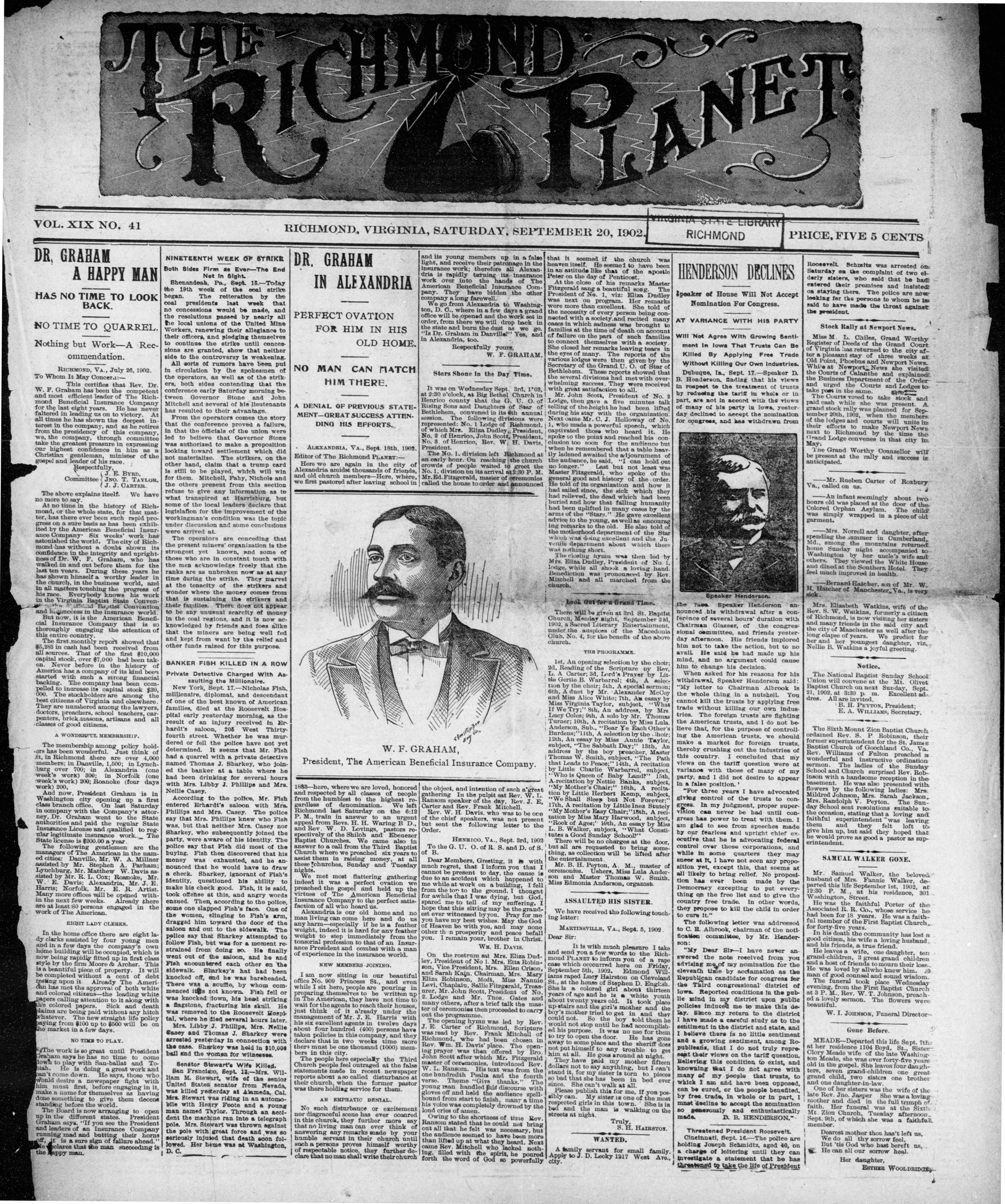
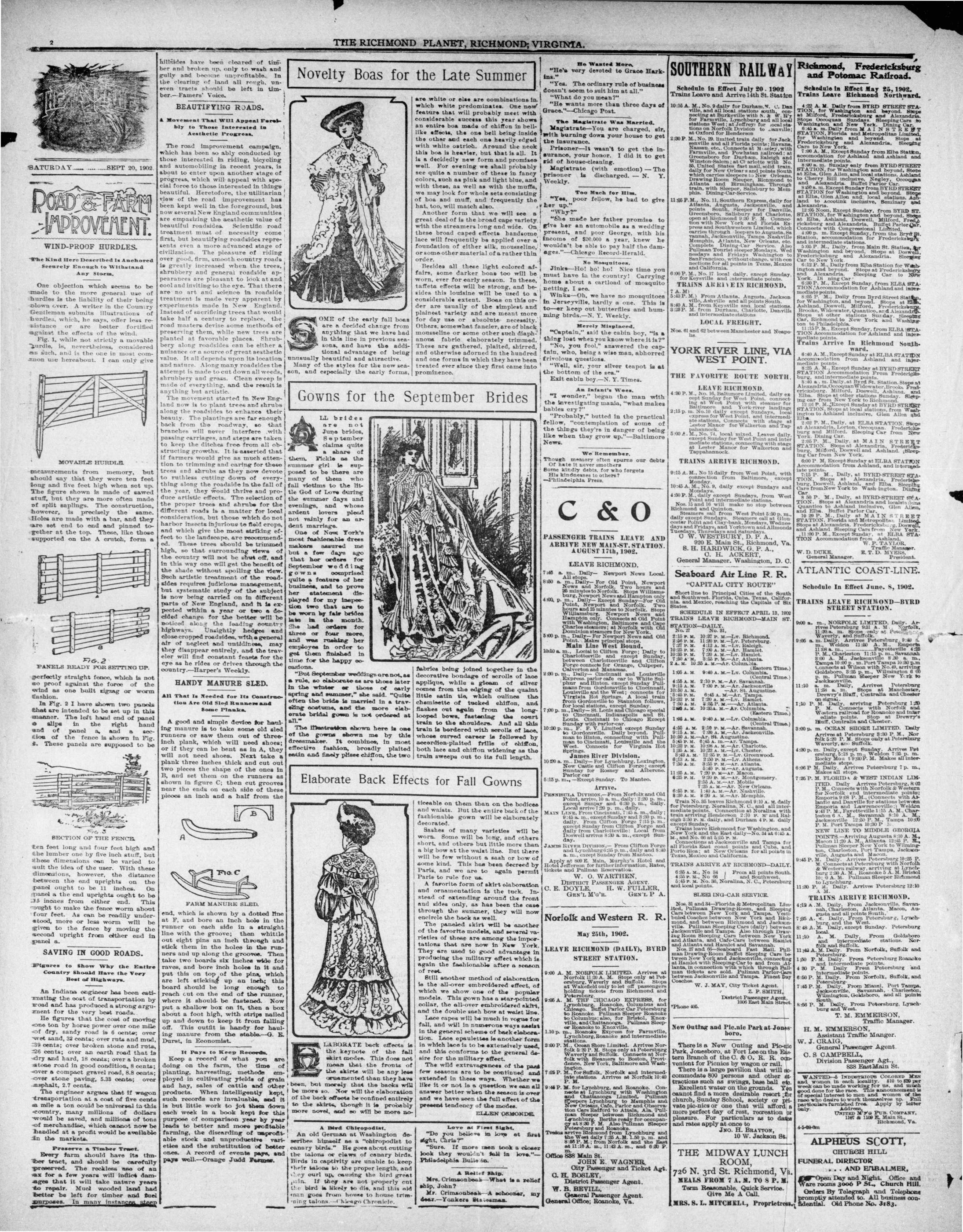
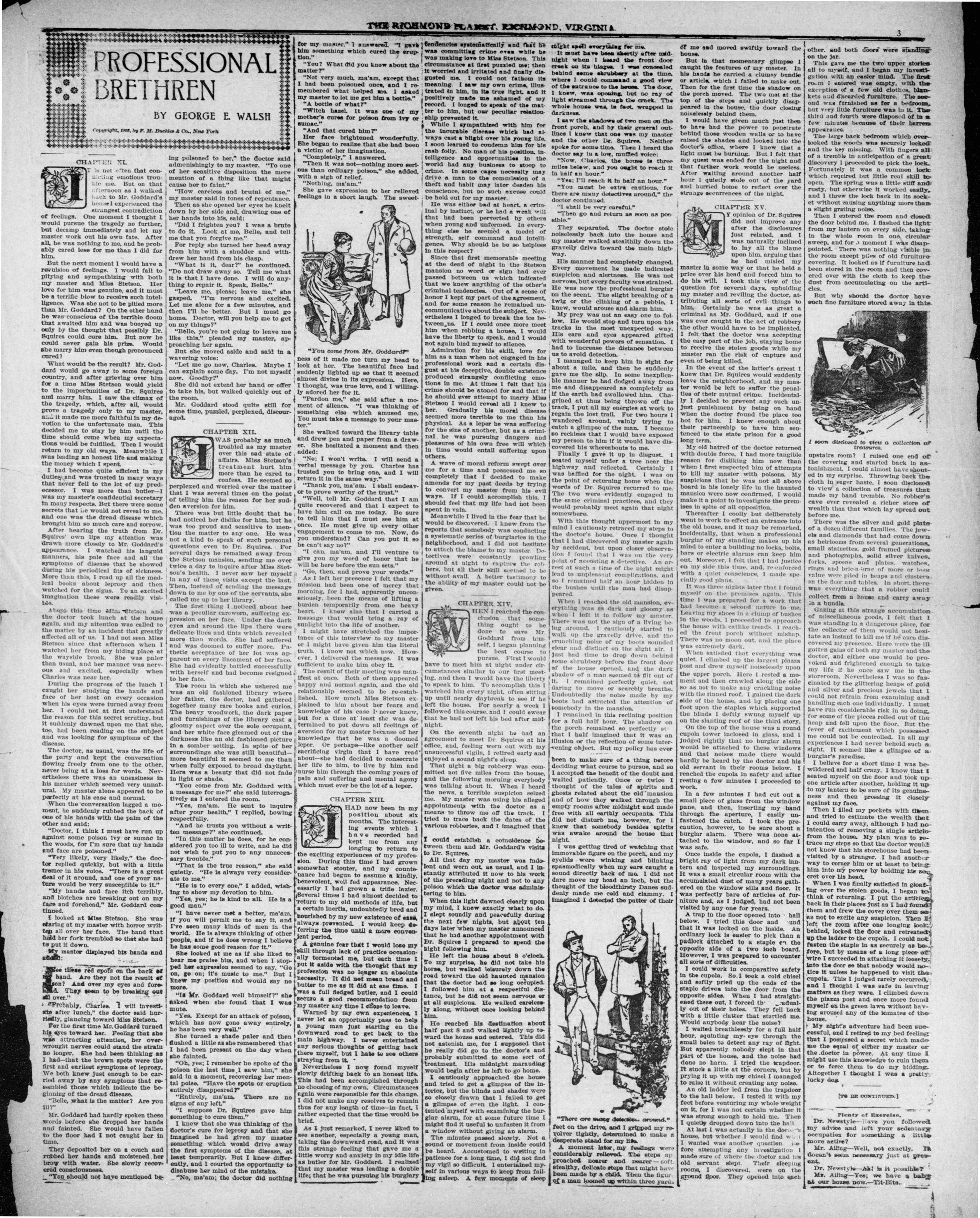
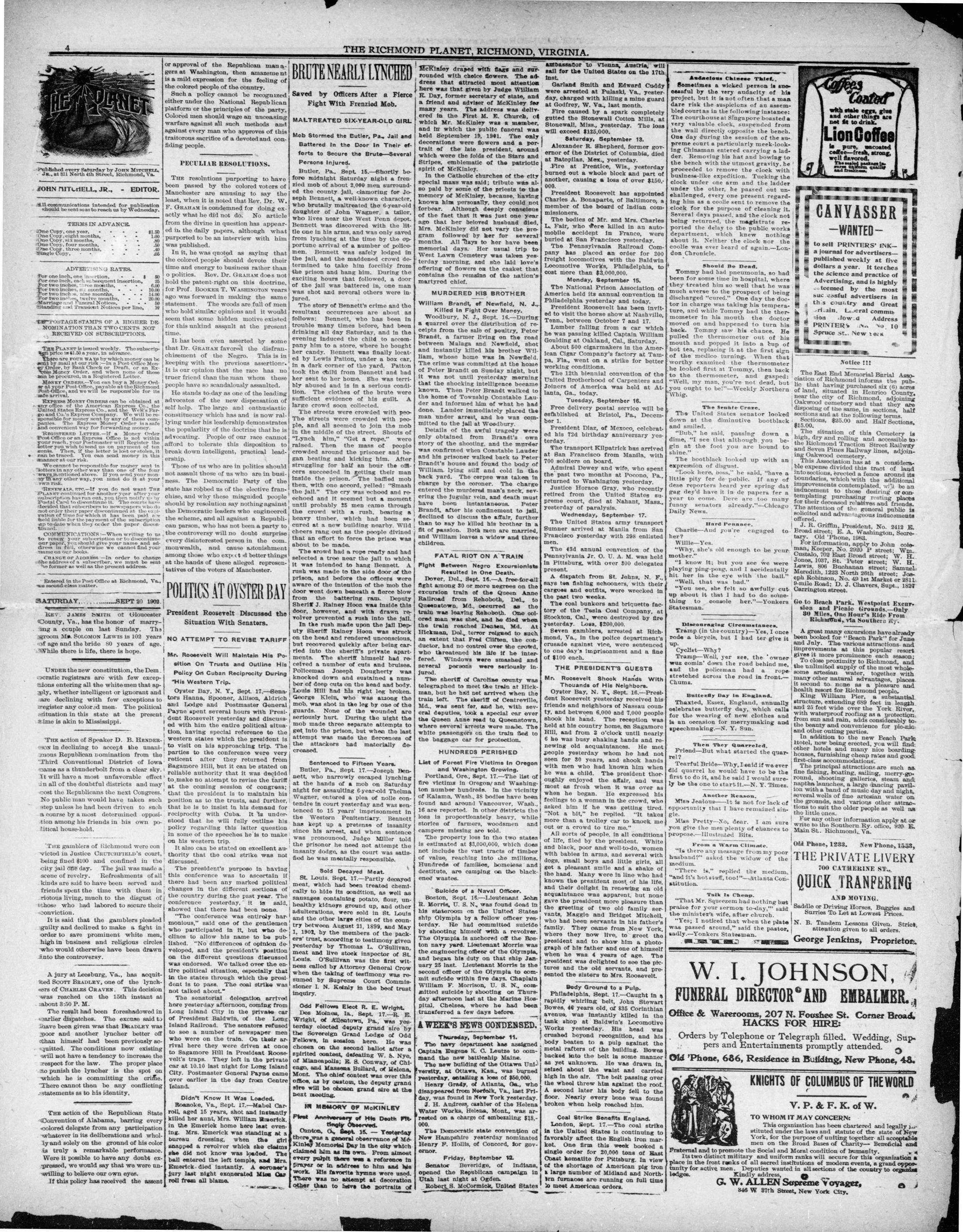
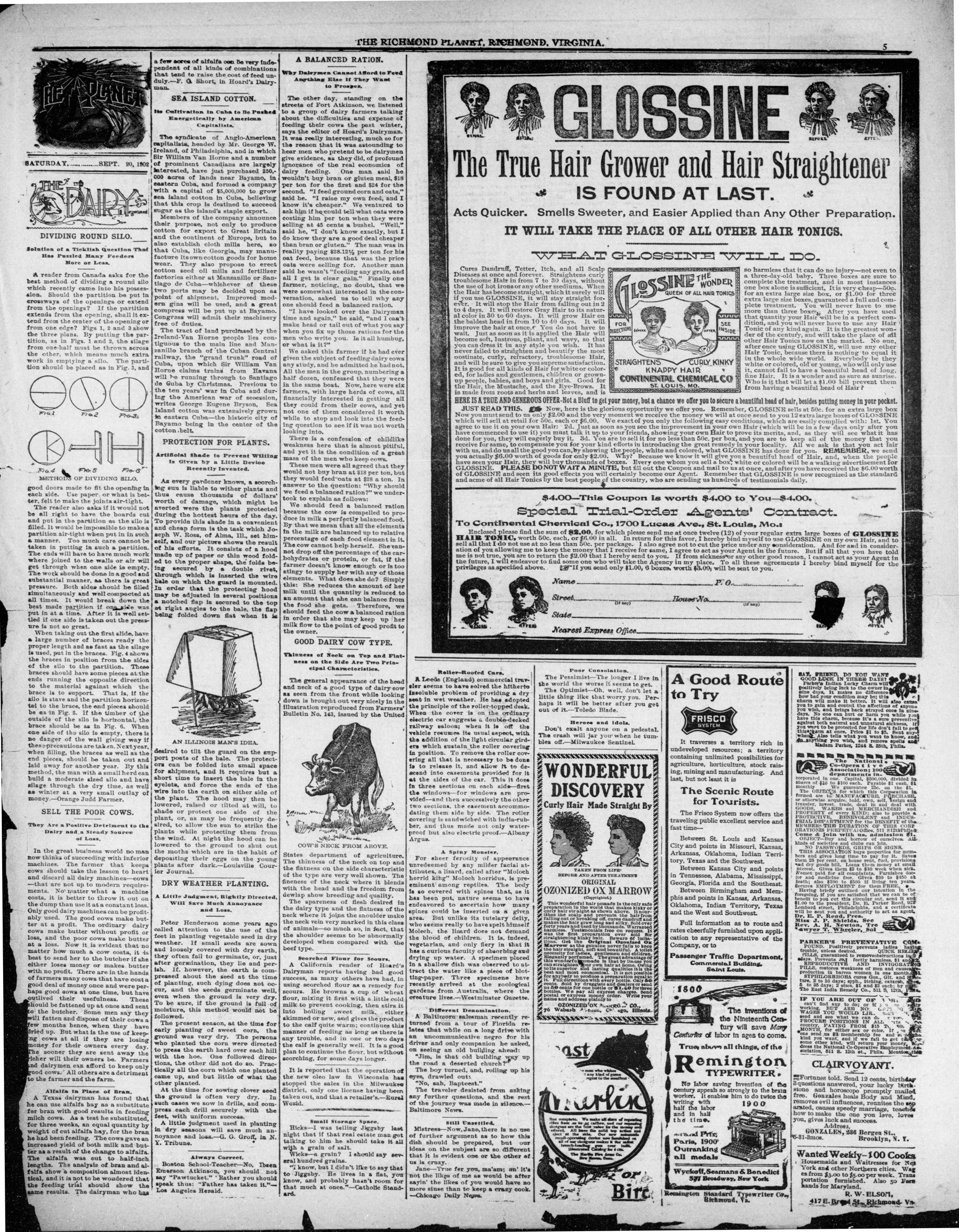
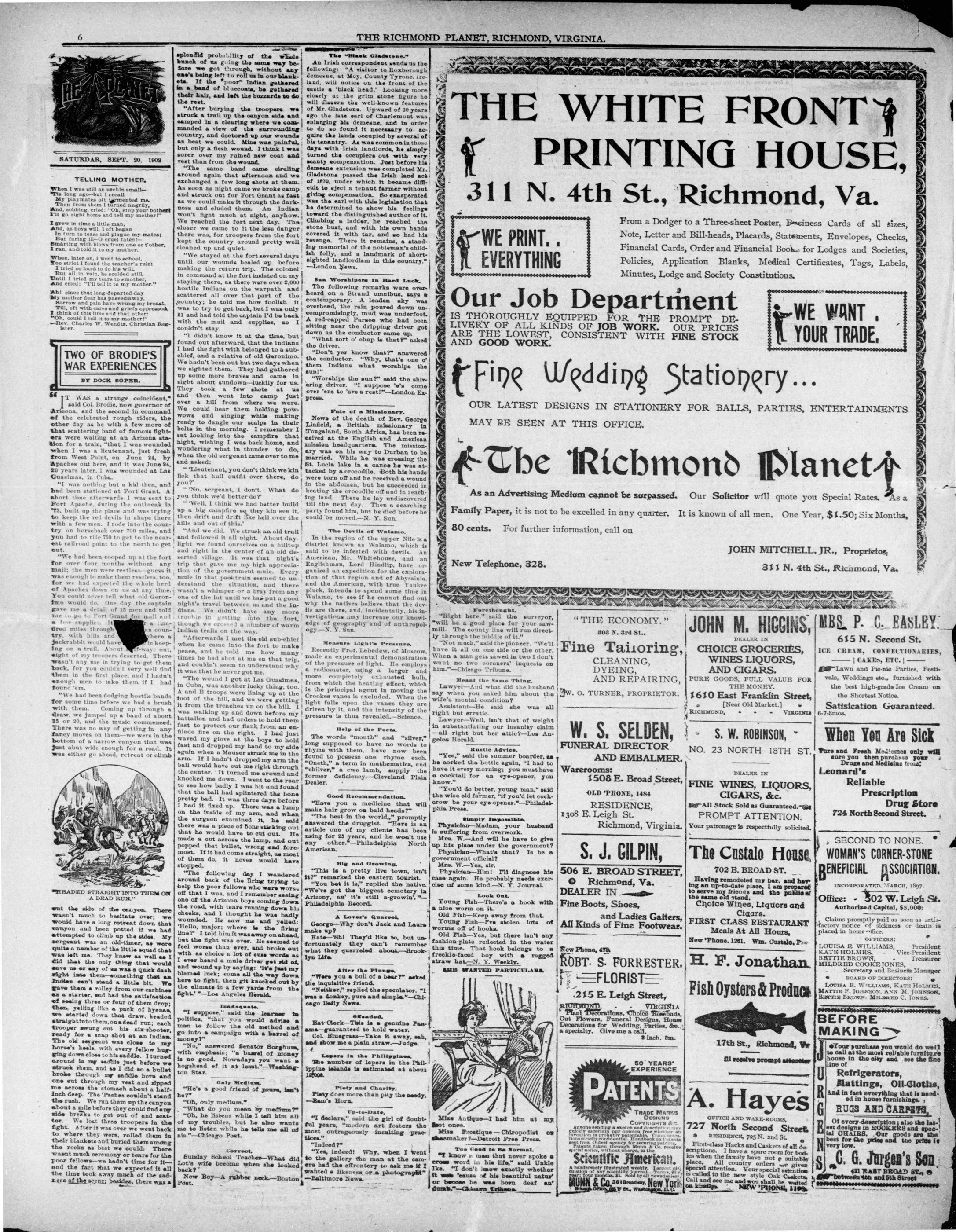
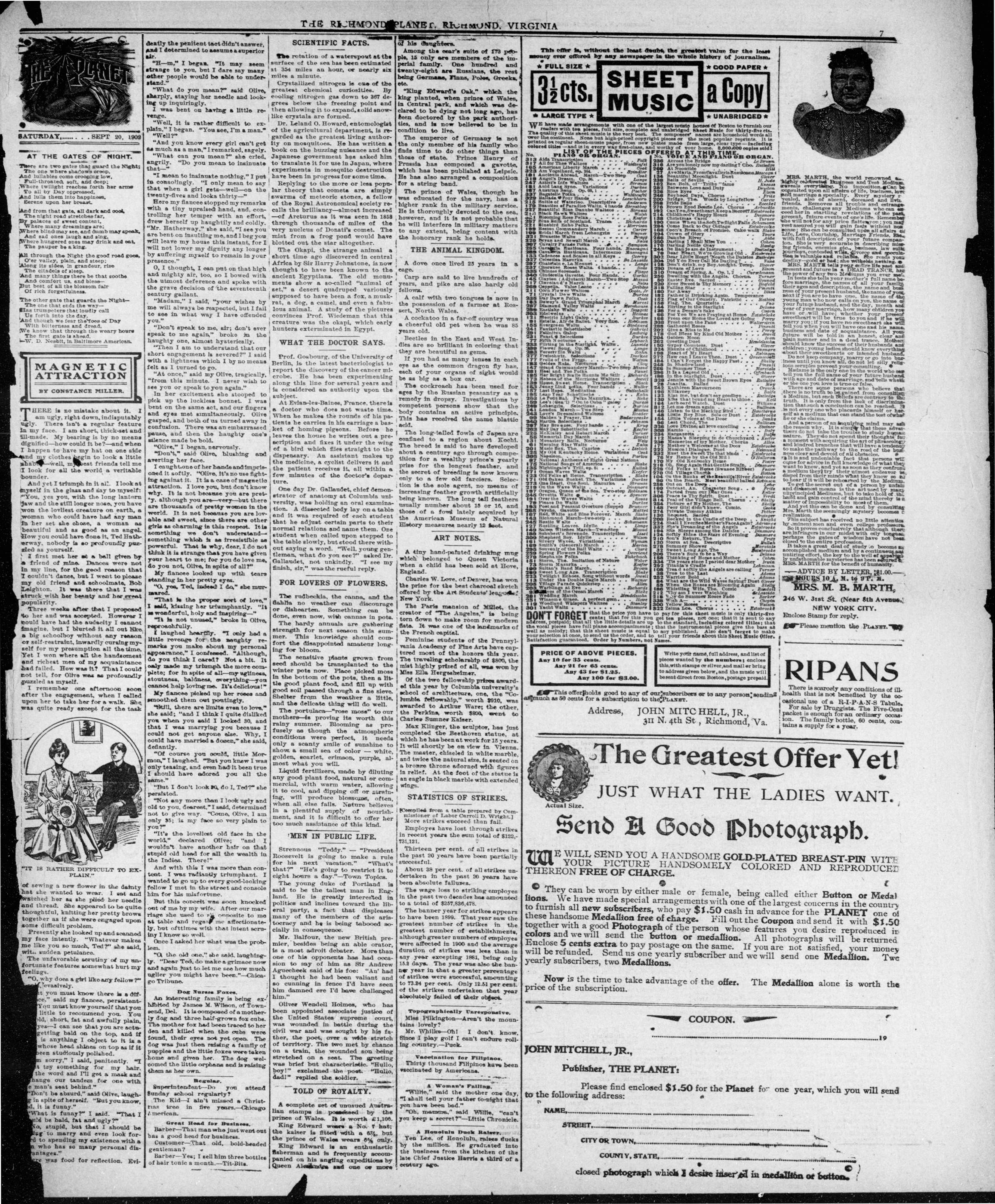
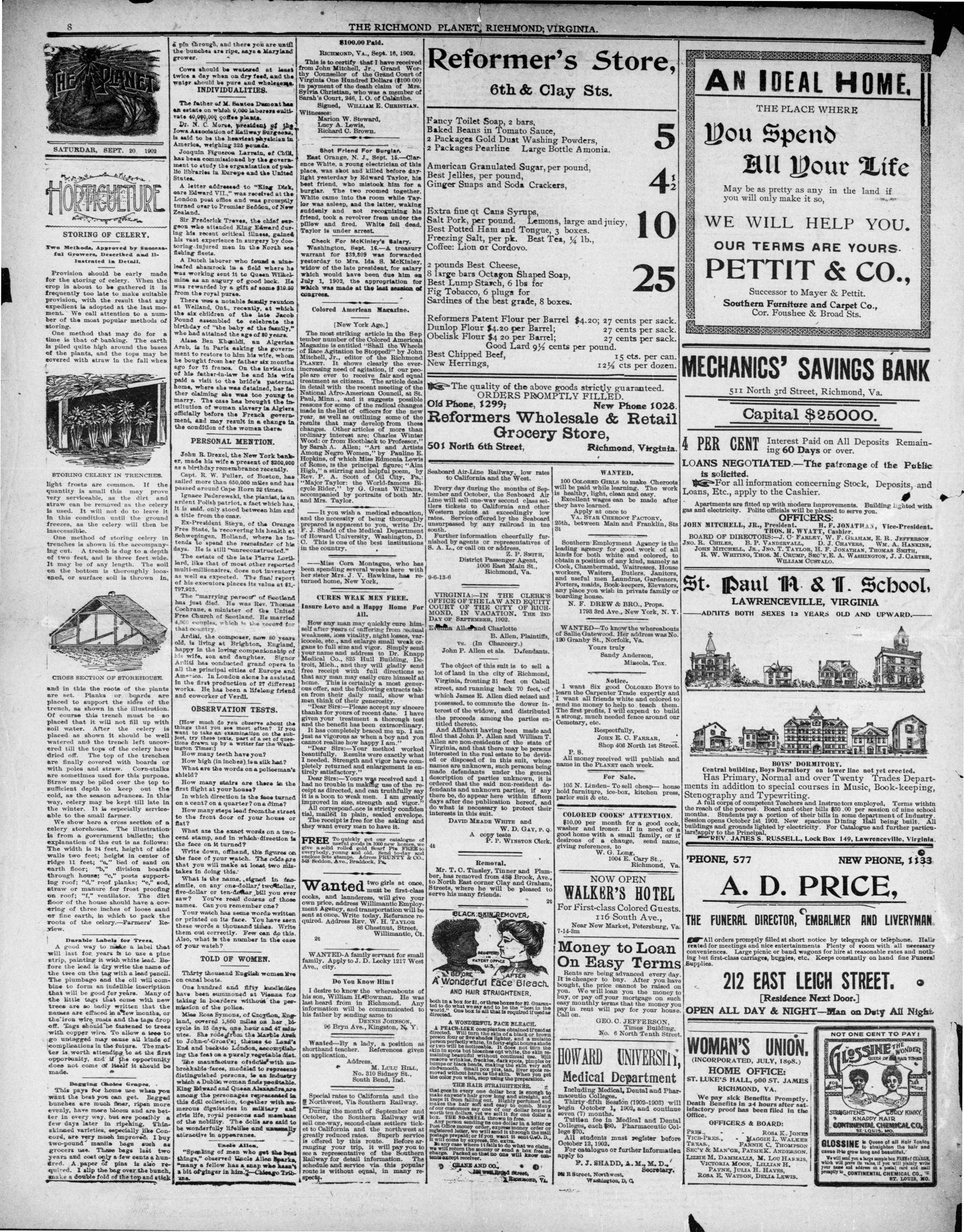
Page text (machine-generated)
THE RICHMOND PLANET
VOL. XIX NO. 41
DR. GRAHAM A HAPPY MAN
HAS NO TIME TO LOOK BACK.
NO TIME TO QUARREL.
Nothing but Work—A Recommendation.
RICHMOND, VA., July 26, 1902.
To Whom It May Concern:—
This certifies that Rev. Dr. W. F. Graham has been the competent and most efficient leader of The Richmond Beneficial Insurance Company for the last eight years. He has never faltered in leading us on to victory. At all times he has shown the deepest interest in the company, and as he retires from the presidency of this company, we, the company, through committee take the greatest pressure in expressing our highest confidence in him as a Christian gentleman, minister of the gospel and leader of his race.
Respectfully
Committee
J. E. BYRD,
JNO. T. TAYLOR,
J. J. CARTER
The above explains itself. We have no more to say.
At no time in the history of Richmond, or the whole state, for that matter, has there ever been such rapid progress on a sure basis as has been exhibited by the American Beneficial Insurance Company. Six weeks' work has astonished the world. The city of Richmond has without a doubt shown its confidence in the integrity and uprightness of Dr. W. F. Graham, who has walked in and out before them for the last ten years. During these years he has shown himself a worthy leader in the church, in the business world, and in all matters touching the progress of his race. Everybody knows his work. Dr. W. F. Graham's State Convention and his success in the insurance world. But now, it is the American Beneficial Insurance Company that is so thoroughly engaging the attention of this entire country.
The first monthly report showed that $5,888 in cash had been received from all sources. That of the first $10,000 capital stock, over $7,000 had been taken. Never before in the history of America has a company of its kind been started with such a strong financial backing. The company has been compelled to increase its capital stock $20. The stockholders are among the best citizens of Virginia and elsewhere. They are numbered among lawyers, doctors, preachers, school teachers, carpenters, brick mason, artisans and all classes of good citizens.
A WONDERFUL MEMBRRSHIP
The membership among policy holders has been wonderful. Just think of it, in Richmond there are over 4,000 members; in Danville, 1,500; in Lynchburg over 700; in Alexandria (one week's work) 300; in Norfolk (one week's work) 200; Roanoke (four days work) 200.
And now, President Graham is in Washington city opening up a first class office. On last Saturday in company with the company's attorney, Dr. Graham went to the state authorities and paid the regular State Insurance License and qualified to regular legitimate insurance work. The State license is $200,000 a year.
The following gentlemen are the managers of The American in the named cities: Danville, Mr. W. A. Millner assisted by Mr. Stephen A. Parham; Lynchburg, Mr. Matthew W. Davis assisted by Mr. R. L. Cox; Roanoke, Mr. W. E. Davis; Alexandria, Mr. J. E. Harris; Norfolk, Mr. E. R. Artist. Many more offices will be opened within in the next few weeks. Already there are at least 80 persons engaged in the work of The American.
EIGHT LADY CLERKS
In the office office there are eight lady clarks assisted by four young men and in a few days the company's own home building will be occupied, which is now being rapidly fitted up in first class style by the firm Moore & Archer. This is a beautiful piece of property. It will be completed without a cent of debt resting upon it. Already The American has met the approval of both white and colored citizens—the leading white papers calling attention to it along with the colored papers. Sick and death claims are being paid without any hitch whatever. The new straight life policy paying from $100 up to $500 will be on the market in a few days.
NO TIME TO PLAY.
The work is so great until President Graham says he has no time to come down to play with San-ballat and Toobi. He is doing a great work and can't come down. He says, those who would desire a newspaper fight with him must first, before engaging in it, make a name for themselves as having done something to give them decent standing before the world.
The Board is now arranging to open up in the different states. President Graham says, "If you see the President and leaders of an Insurance Company running mad and butting their horns off, it is a sure sign of failure ahead." He declares that the man succeeding is the happy man.
NINETEENTH WEEK OF STRIKE
Both Sides Firm as Ever--The End
Net In Slight.
Shenandoah, Pa., Sept. 15.—Today the 19th week of the coal strike began. The reiteration by the coal presidents last week that no concessions would be made, and the resolutions passed by nearly all the local unions of the United Mine Workers, renewing their allegiance to their officers, and pledging themselves to continue the strike until concessions are granted, show that neither side to the controversy is weakening. All sorts of rumors have been put in circulation by the spokesmen of the operators, as well as of the strikers, both sides contending that the conference early Saturday morning between Governor Stone and John Mitchell and several of his lieutenants has resulted to their advantage.
From the operators comes the story that the conference proved a failure, in that the officials of the union were led to believe that Governor Stone was authorized to make a proposition looking toward settlement which did not materialize. The strikers, on the other hand, claim that a trump card is still to be played, which will win for them. Mitchell, Fahy, Nichols and the others present from this section refuse to give any information as to what transpired at Harrisburg, but some of the local leaders declare that legislation for the improvement of the workingman's condition was the topic under discussion and some conclusions were arrived at.
The operators are conceding that the present miners' organization is the strongest yet known, and some of those who are in constant touch with the men acknowledge freely that the ranks are as unbroken now as at any time during the strike. They marvel at the tenacity of the strikers and wonder where the money comes from that is sustaining the strikers and their families. There does not appear to be any unusual scarcity of money in the coal regions, and it is now acknowledged by friends and foes alike that the miners are being well fed and kept from want by the relief and other funds raised for this purpose.
BANKER FISH KILLED IN A ROW
Private Detective Charged With Assaulting the Millipore.
New York, Sept. 17.—Nicholas Fish, millionaire, diplomat, and descendant of one of the best known of American families, died at the Roosevelt Hospital early yesterday morning, as the result of an injury received in Erhardt's saloon, 205 West Thirty-fourth street. Whether he was murdered or fell the police have not yet determined. It seems that Mr. Fish had a quarrel with a private detective named Thomas J. Sharkey, who joined the banker at a table where he had been drinking for several hours with Mrs. Libby J. Phillips and Mrs. Nellie Casey.
According to the police, Mr. Fish entered Erhardt's saloon with Mrs. Phillips and Mrs. Casey. The police say that Mrs. Phillips knew who Fish was, but that neither Mrs. Casey nor Sharkey, who subsequently joined the party, were aware of his identity. The police say that Fish did most of the buying. Fish then discovered that his money was exhausted, and he announced that he would have to draw a check. Sharkey, ignorant of Fish's identity, questioned his ability to make his check. Fish, it is said, took offense at this, and angry words ensued. Then, according to the police, some one slapped Fish's face. One of the women, clinging to Fish's arm, dragged him toward the door of the saloon and out to the sidewalk. The police say that Sharkey attempted to follow Fish, but was for a moment restrained from doing so. He finally went out of the saloon, and he and Fish encountered each other on the sidewalk. Sharkey's hat had been knocked off, and he was bareheaded. There was a scuffle, by whom commenced it so not known. Fish fell or was knocked down, his head striking a flagstone, fracturing his skull. He was removed to the Roosevelt Hospital, where he died several hours later.
Mrs. Libby J. Phillips, Mrs. Nellie Casey and Thomas J. Sharkey were arrested yesterday in connection with the case. Sharkey was held in $10,000 ball and the women for witnesses.
Senator Stewart's Wife Killed.
San Francisco, Sept. 13.—Mrs. William M. Stewart, wife of the senior United States senator from Nevada, was killed yesterday at Akameda, Cal. Mrs. Stewart was riding in an automobile with Henry Foote and a young man named Taylor. Through an accident the machine ran into a telegraph pole. Mrs. Stewart was thrown against the pole with great force and was so seriously injured that death soon followed. Her home was at Washington, D.C.
RICHMOND, VIRGINIA, SATURDAY, SEPTEMBER 20, 1902.
W. F. GRAHAM
DR. GRAHAM IN ALEXANDRIA
PERFECT OVATION FOR HIM IN HIS OLD HOME.
NO MAN CAN MATCH HIM THERE.
A DENIAL OF PREVIOUS STATE
MENT—GREAT SUCCESS ATTENDING HIS EFFORTS.
ALEXANDRIA, VA., Sept. 18th, 1902.
Editor of The Richmond PLANET—
Here we are again in the city of
Alexandria amidst thousands of friends,
old church members—Here, where,
we first pastored after leaving school in
W. F. G.
President, The American Be
1883—here, where we are loved, honored and respected by all classes of people from the humblest to the highest regardless of denomination. We left Richmond last Saturday on the 6:13 P. M., train in answer to an urgent appeal from Revs. H. H. Waring B D., and Rev. W. D. Lovings, pastors respectively of the Shiloh and Ebenezer Baptist Churches. We came also in answer to a call from the Third Baptist Church where we preached six years to assist them in raising money, at all these churches, Sunday and Tuesday noon. We met most flattering gathering indeed it was a perfect ovation we preached the gospel and held up the virtues of The American Beneficial Insurance Company to the perfect satisfaction of all who heard us.
Alexandria is our old home and no man living can come here and do us any harm—especially if he is a feather weight, indeed it is hard for any feather weight to step immediately from the torsorial profession to that of an Insurance President and combat with a man of experience in the insurance world.
NEW MEMBERS JOINING
I am now sitting in our beautiful office No. 909 Princess St., and even while I sit here, people are poning in preparing themselves to be written up in The American, they have not time to wait for the agents to reach their houses, just think of it already under the management of Mr. J. E. Harris with his six excellent agents in twelve days about four hundred (400) persons have taken policies in this company, and they declare that in two weeks time more there must be one thousand (1000) members in this city. The people here especially the Third Church people feel outraged at the false statements made in recent newspaper reports about as so called disturbance at their church, when the former pastor was there holding service for them.
AN EMPHATIC DENIAL.
No such disturbance or excitement nor disgraceful scene has ever occurred in this church, they further more say that no living man can ever think of answering any remarks made by your humble servant in their church until such a persons proves himself worthy of respectable notice, they further declare that no man shall write their church
and its young members up in a false light, and receive their patronage in the insurance work; therefore all Alexandria is rapidly turning its insurance work over into the hands of The American Beneficial Insurance Company. They have bidden the other company a long farewell. We go from Alexandria to Washington, D. C., where in a few days a grand office will be opened and the work set in order, from there we will drop back in the state and burn the dust as we go. "Is Dr. Graham in Danville?" Yes, and in Alexandria, too.
Respectfully yours,
W. F. GRAHAM.
Stars Shone in the Day Time.
It was on Wednesday Sept. 3rd, 1903, at 2:30 o'clock, at Big Bethel Church in Henrico county that the G. U. O. of Rising Sons and Daughters of Sear of Bethlehem, convened in its 6th annual session. The following divisions were represented: No. 1 Lodge of Richmond, of which Mrs. Eliza Dudley, President, No. 2 of Henrico, John Scott, President, No. 3 of Henrico, Rev. W. H. Davis, President. The No. 1. division left Richmond at an early hour. On reaching the church crowds of people waited to greet the No. 1. division on its arrival at 2:30 P. M. Mr. Ed. Fitzgerald, master of ceremonies called the house to order and announced
RAHAM,
Beneficial Insurance Company.
the object, and intention of such a great gathering. In the pulpit sat Rev. W. L. Ransom speaker of the day, Rev. J. E. Carter and Rev. Frank Mitchell. Rev. W. H. Davis, who was to be one of the chief speakers, was not present but sent the following letter to the Order.
HENRICO, VA., Sept. 3rd, 1902
To the G. U. O. of R. S. and D. of S. of B.
Dear Members, Greeting, it is with much regret, that I inform you that I cannot be present to day, the cause is due to an accident which happened to me while at work on a building, I fell from the top to the ground. I thought for awhile that I was dying, but God, spared me to tell of my suffering. I hope that this sitting may be the grandest ever witnessed by you. Pray for me you have my best wishes. May the God of Heaven be with you, and may none other than the prosperity and peace befall you. I remain your, brother in Christ.
W.M. H. DAVIS
On the rostrum sat Mrs. Eliza Dudley, President of No 1. Mrs. Etta Robinson, Vice President, Mrs. Ellen Crison, and Sarah Kain. Chairman, Mrs. Mary Eliza Robinson, Modt, Miss Nannie Levi, Chaplain, Sallie Fitzgerald, Treasurer, Mr. John Scott, President of No. 2. Lodge and Mr. Thos. Gates and many others, after a brief talk the master of ceremonies then proceeded to carry out the programme.
The opening hymn was led by Rev. J. E. Carter of Richmond, Scripture was read by Rev. Frank Mitchell of Richmond, who had been chosen in prison. Mr. H. Davis' place. The opening preamble was then offered by Bro. John Scott after which Mr. Fitzgerald master of ceremonies introduced Rev. W. L. Ransom. His text was from the one hundredth Psalm and the fourth verse. Theme "Give thanks." young man handled this discourse with gloves off and held the audience spellbound from start to finish, many a time his voice was completely drowned by the loud cries of amen.
Owing to the shortness of time Rev. Ransom stated that he could not bring cut all that he felt was necessary, but the audience seemed to have been more than lifted up at what they heard. Next came Rev. Mitchell who lacked nothing, filled with the spirit, he poured forth the word of God so powerfully
that it seemed if the church was heaven itself. He seemed to have been in an attitude like that of the apostle Peter on the day of Pentecost. At the close of his remarks Master Fitzgerald sang a beautiful song. The President of No. 1, viz: Eliza Dudley was next on program. Her remarks were more than excellent. She told of the necessity of every person being connected with a society, and recited many cases in which sadness was brought to families at the time of death on account of failure on the part of such families to connect themselves with a society, to close her remarks leaving tears in the face of many. The reports of the various lodgings were given of the Secretary of the Grand U. Star of Bethlehem. These reports showed out that the several divisions had met with overwhelming success. They were received with great satisfaction to all.
Mr. John Scott, President of No. 2 Lodge, then gave a five minutes talk telling of the height he had been lifted during his stay with the organization. Next came Mr. C. J. Holloway of No. 1, who made a powerful speech, which captivated those who heard it. He spoke to the point and reached his conclusion too soon for the audience but when he remembered that a table heavily ladened awaited the adjournment of the audience, he said, "I can hold out no longer." Last but not least was Master Fitzgerald, who spoke of the general good and history of the order. He told its organization and how it faced the sick which they had relieved and the dead which had been buried and how that falling humanity had been uplifted in many cases by the arms of the "Stars." He gave excellent advice to the young, as well as giving remarks to the old. He also told the motherhood department of the Star which was doing excellent and the Juvenile department about which there was nothing short.
The closing hymn was then led by Mrs. Eliza Dudley, President of No. 1, lodge, while all shook a loving hand. Benediction was pronounced by Rev. Mitchell and all marched from the church.
Look Out for a Grand Time.
There will be given at 3rd St. Baptist Church, Monday night, September 23d, 1903, a Sacred Literary Entertainment, under the auspices of the Macedonia Club. No. 4, for the benefit of the above church.
THE PROGRAMME.
1st, An opening selection by the choir; 2d, Reading of the Scripture by Rev. L. A Carter; 3d, Lord's Prayer by Little Gertie B. Warbarrel; 4th, A selection by the choir; 5th, A special sermon; 6th, A duet by Mr. Alexander McCoy and Miss Alice White; 7th, Am essay by Miss Virginia Taylor, subject, "What If We Try;" 8th, An address, by Mrs. Lucy Coles; 9th, A solo by Mr. Thomas Turner; 10th, A recitation by Miss L. Anderson, Sub., "Bear Ye Each Other's Burdens;" 11th, A selection by the choir; 12th, An essay by Miss Annie Taylor, subject, "The Sabbath Day;" 13th, An address by the boy preacher, Master Thomas W. Smith, subject, "The Path that Leads to Peace;" 14th, A recitation by Little Charlie Warbarrel, subject, "Who is Queen of Baby Land?" 15th, A recitation by Nettie Banks, subject, "My Mother's Chair;" 16th, A recitation by Little Herbert Kemp, subject, "We Shall Sleep but Not Forever;" 17th, A recitation by Little Inez Stutely, "My Mother's Easy Chair;" 18th, A recitation by Miss Mary Harwood, subject, "Rook of Ages;" 19th, An essay by Miss L. B. Walker, subject, "What Constitutes a Good Sunday School?"
There will be no charges at the door, but all are requested to bring something, as collection will be lifted after the entertainment.
Mr. B. H. Peyton, A. M., master of ceremonies, Ushers, Miss Lula Anderson and Master Thomas W. Smith, Miss Edmonia Anderson, organist.
ASSAULTED HIS SISTER
We have received the following touching letter:
MARTINSVILLE, VA., Sept. 5, 1902.
Dear Sir:
It is with much pleasure I take and send you a few words to the Richmond PLANET to inform you of a rape case which occurred here on Friday, September 6th, 1902. Edmond Williams raped Lucy Hairston on Cleveland St., at the house of Stephen D. Englsh. She is a colored girl about thirteen age and he is white youth about twenty years old. It took place up-stairs and the girl's mother and the boy's mother tried to get in and they could not. So the boy told them he would not stop until he had accomplished his purpose. It was no use for them to try to open the door. He has gone away to some place and the sheriff does not put himself to any trouble to get him at all. He goes ground at night.
They have paid my mother fifteen dollars not to say anything, but I can't stand it, for my sister is torn to pieces so bad that she has been in bed ever since. She can't walk at all.
Please publish this for me, if you possibly can. My sister is one of the most respected girls in this town. She is in bed and the man is walking on the streets at night.
A family servant for small family. Apply to J. D. Lecky 1217 West Ave., city.
RICHMOND
HENDERSON DECLINES
HENDERSON DECLINES
Speaker of House Will Not Accept Nomination For Congress.
AT VARIANCE WITH HIS PARTY
Will Not Agree With Growing Sentiment in Iowa That Trusts Can Be Killed By Applying Free Trade Without Killing Our Own Industries.
Dubuque, Ia., Sept. 17.—Speaker D. B. Henderson, finding that his views in respect to the treatment of trusts by reducing the tariff in whole or in part, are not in accord with the views of many of his party in Iowa, yesterday declined to accept the nomination for congress, and has withdrawn from
M. B.
the race. Speaker Henderson announced his withdrawal after a conference of several hours' duration with Chairman Glasser, of the congressional committee, and friends yesterday afternoon. His friends implored him not to take the action, but to no avail. He said he had made up his mind, and no argument could cause him to change his decision.
When asked for his reasons for his withdrawal, Speaker Henderson said: "My letter to Chairman Albrook is the whole thing in a nutshell. You cannot kill the trusts by applying free trade without killing our own industries. The foreign trusts are fighting the American trusts, and I do not believe that, for the purpose of controlling the American trusts, we should make a market for foreign trusts, thereby crushing out the industries of this country. I concluded that my views on the tariff question were at variance with those of many of my party, and I did not desire to appear in a false position."
"For three years I have advocated giving control of the trusts to congress. In my judgment, proper supervision can never be had until congress has power to treat with them. I am glad to see from speeches made by our fearless and upright chief executive that he is advocating federal control over these corporations, and while in some quarters they may sneer at it, I have not seen any proposition yet, except this, that seems at all likely to bring relief. No proposition has ever been made by the Democracy excepting to put everything on the free list and to give the country free trade. In other words, they propose to kill the child in order to cure it."
The following letter was addressed to C. E. Albrook, chairman of the notification committee, by Mr. Henderson:
"My Deer Sir—I have never answered the note received from you advising me of my nomination for the eleventh time by acclamation as the Republican candidate for congress for the Third congressional district of Iowa. Reported conditions in the public mind in my district upon public policies induced me to make this delay. Since my return to the district I have made a careful study as to the sentiment in the district and state, and I believe there is no little sentiment and a growing sentiment, among Republicans, that I do not truly represent their views on the tariff question. Believing this condition to exist, and knowing that I do not agree with many of my people that trusts, to which I am and have been opposed, can be cured, or the people benefited, by free trade, in whole or in part. I must decline to accept the nomination so generously and enthusiastically made. D. B. HENDERSON."
Threatened President Roosevelt.
Gincinnati, Sept. 16.—The police are
holding Joseph Schmidt, aged 40, on
a charge of loitering until they can
investigate a statement that he has
threatened to take the life of President
PRICE, FIVE 5 CENTS
Roosevelt. Schmitz was arrested on Saturday on the complaint of two elderly sisters, who said that he had catered their premises and insisted on staying there. The police are now looking for the persons to whom he is said to have made the threat against the president.
Stock Rally at Newport News.
Miss M. L. Cailes, Grand Worthy Register of Deeds of the Grand Court of Virginia has returned to the city after a pleasant stay of three weeks at Old Point, Phoebus and Newport News. While at Newport News she visited the Courts of Calanthe and explained the Business Department of the Order and urged the Courts and Lodges to take post in the same.
The Courts voted to take stock and paid cash while she was present. A grand stock rally was planned for September 30th, 1902, when the members of the lodges and courts will unite in their efforts to make Newport News next to Richmond by the time the Grand Lodge convenes in that city in May.
The Grand Worthy Counsellor will be present at the rally and success is anticipated.
Mr. Rueben Carter of Roxbury Va., called on us.
An infant seemingly about two hours old was placed at the door of the Colored Orphan Asylum. The child was simply wrapped in a piece of old garment.
Mrs. Norrell and daughter, after spending the summer in Cumberland, Md., among the mountains returned home Sunday night accompanied Washington by her uncle's wife and others. They viewed the White House and dined at the Southern Hotel. They feel much improved in health.
Bernard Hatcher, son of Mr. W. H. Hatcher of Manchester, Va., is very sick.
Mrs. Elizabeth Watkins, wife of the Rev. S. W. Watkins, formerly a citizen of Richmond, is now visiting her sister and many friends in the said city, and the city of Manchester as well after the long elapse of years. We predict for her and her youngest daughter, viz. Nellie B. Watkins a joyful greeting
The National Baptist Sunday School Union will convene at the Mt. Olivet Baptist Church on next Sunday, Sept. 21, 1902, at 3:30 p. m. Excellent address. All are invited.
B. H. PEYTON, President;
E. A. WILLIAMS, Secretary
The Sixth Mount Zion Baptist Church ordained Rev. S. P. Robinson, their former superintendent for the St. James Baptist Church of Goochland Co. Va. Rev. Williams of Fulton preached a wonderful and instructive ordination sermon. The ladies of the Sunday School and Church surprised Rev. Robinson with a handsome reception in the basement. He was also presented with flowers by the following ladies: Mrs. Mildred Johnson, Mrs. Sarah Jackson, Mrs. Randolph V. Peyton. The Sunday School sent resolutions suitable to the occasion, stating that a loving and faithful superintendent was leaving them and they felt loft to give him up, but said they hoped that he would prove as good a pastor as superintendent.
SAMUAL WALKER GONE
Mr. Samuel Walker, the beloved husband of Mrs. Fannie Walker, departed this life September 1st, 1902, at 12:30 P. M., at his residence, 301 Washington Street.
He was the faithful Porter of the Associated R. R. Co., whose service he had been for 18 years. He was a faithful member of the First Baptist Church for forty-five years.
In his death the community has lost a good citizen, his wife a loving husband and his friends, a true friend.
He leaves a wife, one daughter, ten grandchildren, 3 great grand children and a host of friends to mourn their loss. He was loved by all who knew him.
man of good counsel and sound wisdom.
The funeral took place Wednesday evening, from the First Baptist Church at 3 P. M., Rev. W. T. Johnson, preached a lovely sermon. The flowers were beautiful.
W. I. JOHNSON, Funeral Director
MEADE—Departed this life Sept. 7th at her residence 1104 Boyd, St. Sister Clory Meade wife of the late Washington Meade, she was over forty-five years old in the gospel. She leaves two daughters, seven grandchildren one great grand child, two sisters one brother and one daughter-in-law.
One of her sisters was the wife of the late Rev. Jno. Jasper She was a loving mother and died in the full trimp of faith. Her funeral was at the Sixth Mt. Zion Church, Tuesday afternoon, Sept. 9th, of which she was a faithful member.
Dearest mother thou hasn't left us, We do all thy sorrow feel, But 'tis God who hast boret us, He can all our sorrow heal.
THE LIFE
ROAD & FARM IMPROVEMENT. WIND-PROOF HURDLES.
The Kind Here Described Is Anchored Securely Enough to Withstand Any Storm.
One objection which seems to be made to the more general use of hurdles is the liability of their being clown over. A writer in the Counry Gentleman submits illustrations of hurdles, which, he says, offer less resistance or are better fortified against the effects of the wind.
Fig. 1, while not strictly a movable hurdle, is, nevertheless, considered as such, and is the one in most common use hereabout. I can only give
MOVABLE HURDLE
measurements from memory, but
should say that they were ten feet
long and five feet high when set up.
The figure shown is made of sawed
stuff, but they are more often made
of split saplings. The construction,
however, is precisely the same.
Holes are made with a bar, and they
are set end to end and pinned to
together at the top. These, like those
supported on the A crutch, form a
F16.2
PANELS READY FOR SETTING UP.
perfectly straight fence, which is not
so proof against the force of the
wind as one built zigzag or worm
fashion.
In Fig. 2 I have shown two panels that are intended to be set up in this manner. The left hand end of panel o slips in the right hand end of panel a, and a section of the fence is shown in Fig. 3. These panels are supposed to be
FIG. 3
SECTION OF THE FENCE
ten feet long and four feet high and the lumber one by five inch stuff, but these dimensions can be varied to suit the idea of the user. With these dimensions, however, the distance between the end uprights on the panel ought to be 11 inches. On panel a the end uprights ought to be 15 inches from either end. Thisought to make the fence worm about four feet. As can be readily understood, more or less worm will be given to the fence by moving the second upright from either end in panel a.
SAVING IN GOOD ROADS.
Figures to Show Why the Entire Country Should Have the Very Best of Highways.
An Indiana engineer has been estimating the cost of transportation by road and has produced a strong argument for the very best roads.
He figures that the cost of moving one ton by horse power over one mile of dry, sandy road is 6 cents; over wet sand, 32 cents; over ruts and mud, 39 cents; over broken stone and ruts, 26 cents; over an earth road that is dry and hard, 18 cents; over a broken stone road in good condition, 8 cents; over a compact gravel road, 8.8 cents; over stone paving, 5.33 cents; over asphalt, 2.7 cents.
The engineer argues that if wagon transportation at a cost of five cents a mile a ton could be universal in this country, many millions of dollars would be saved, and millions of tons of merchandise, which cannot now be handled at a profit would be available in the markets.
Pzserxe a Timber Trent
Every farm should have its timber tract, and should be carefully preserved. The reckless use of an ax for a few years will inflict damages that it will take nature years to repair. Muel wooded land had better be left for timber and fuel purposes. In many instances steep
hillsides have been cleared of timber and broken up, only to wash and gully and become unprofitable. In the clearing of land all rough, uneven tracts should be left in timber—Famers' Voice.
BEAUTIFYING ROADS.
A Movement That Will Appeal Forebly to Those Interested in Aesthetic Progress.
The road improvement campaign, which has been ably conducted by those interested in riding, bicycling and automobile in recent years, is about to enter upon another stage of progress, which will appeal with special force to those interested in things beautiful. Heretofore, the utilitarian view of the road improvement has been kept well in the foreground, but now several New England communities are emphasizing the aesthetic value of beautiful roadside. Scientific road treatment must of necessity come first, but beautifying roadside represents even a more advanced stage of civilization. The pleasure of riding over good, firm, smooth country roads is greatly increased when the trees, shrubbery and general roadside appearances are pleasant to look at and cool and inviting to the eye. That there are no art and science in roadside treatment is made very apparent by experiments made in New England. Instead of sacrificing trees that would take half a century to replace, the road masters devise some methods of preserving them, while new trees are planted at favorable places. Shrubbery along roadside can be either a nuisance or a source of great aesthetic value. It all depends upon its location and nature. Along many roadside the attempt is made to cut down all weeds, shrubbery and grass. Clean sweep is made of everything, and the result is anything but artistic.
The movement started in New England now is to plant trees and shrubs along the roadsides to enhance their beauty. The plantings are far enough back from the roadway, so that branches will never interfere with passing carriages, and steps are taken to keep the ditches free from all obstructing growths. It is asserted that if farmers would give as much attention to trimming and caring for these trees and shrubs as they now devote to ruthless cutting down of everything along the roadside in the fall of the year, they would thrive and produce artistic effects. The selection of the proper trees and shrubs for the different roads is a matter for local consideration, but those which do not harbor insects injurious to field crops, and which give the most striking effect to the landscape, are recommended. These trees should be trimmed high, so that surrounding views of the country will not be shut off, and in this way one will get the benefit of the shade without spoiling the view. Such artistic treatment of the roadsides requires judicious management, but systematic study of the subject is now being carried on in different parts of New England, and it is expected within a year or two a decided change for the better will be noticed along the leading country highways. Unsightly hedges and close cropped roadsides, with a general air of neglect and untidiness, may they disappear entirely, and the traveler will find constant feasts for the eye as he rides or drives through the country.—Harper's Weekly.
HANDY MANURE SLED
All That Is Needed for Its Construction Are Old Sled Runners and Some Planks.
A good and simple device for hauling manure is to take some old sled runners or saw them out of three-inch plank, which will need shoes; or if they can be bent as in A, they will not need shoes. Next take a plank three inches thick and cut out two pieces the shape of the ones in B, and set them on the runners as shown in figure C; then cut grooves near the ends on each side of these pieces an inch and a half from the
A
B
FIG. C
FARM MANURE SLED.
end, which is shown by a dotted line at F, and bore an inch hole in the runner on each side in a straight line with the groove; then whittle out eight pins an inch through and stick them in the holes in the runners and up along the groove. Then take two boards six inches wide for raves, and bore inch holes in it and put this on top of the pins, which are left sticking up an inch; this board should be long enough to reach cut on the end of the runner, where it should be fastened. Now put a shallow box on it, then a box about a foot high, with strips nailed up and down to keep it from falling off. This outfit is handy for hauling manure from the stable.—G. E. Durst, in Economist.
It Pays to Keep Records
It pays to Keep Records.
Keep a record of what you are doing on the farm, the time of planting, harvesting, methods employed in cultivating yields of grain and hay, sales of cattle and other products. When intelligently kept, such records are invaluable, and it is but little work to jot them down each week in a book kept for this purpose of comparison year by year leads to better and more profitable farming, the discarding of unprofitable stock and unproductive varieties and the substitution of better ones. A record of events pays, and pays well—Orange Judd Farmers.
THE RICHMOND PLANET, RICHMOND; VIRGINIA.
Novelty Boas for the Late Summer
Gowns for the September Brides
THE BRIDAL DRESS
Elaborate Back Effects for Fall Gowns
M
OME of the early fall boas are a decided change from anything that we have had in this line in previous seasons, and have the additional advantage of being beautiful and attractive.
OME of the early fall boas are a decided change from anything that we have had in this line in previous seasons, and have the additional advantage of being unusually beautiful and attractive. Many of the styles for the new season, and especially the early forms,
A
LL brides are not June brides, September claims quite a share of them. Fickle as the summer girl is supposed to be there are many of them who fall victims to the little God of Love during the summer days and evenings, and whose ardent lovers plead not vainly for an ardent marriage.
One of New York's most fashionable dress makers assured me but a few days ago that her orders for September wedding gowns comprised quite a feature of her business, and to prove her statement displayed for my insepection two that are to be worn by fair bridges late in the month. She had orders for three or four more, and was rushing her employees in order to get them finished in time for the happy occasion.
"But September weddings are not, as a rule, so elaborate as are those later in the winter or those of early spring and summer," she said. "Quite often the bride is married in a traveling costume, and the more elaborate bridal gown is not ordered at all."
The illustration shown here is one of the gowns shown me by this dressmaker. It combines, in most effective fashion, broadly plaited satin and finely plisse chiffon, the two
```markdown
```
LABORATE back effects is the keynote of the fall skirt modes. This does not mean that the fronts of the skirts will be any less ornamented than they have
LABORATE back effects is the keynote of the fall skirt modes. This does not mean that the fronts of the skirts will be any less ornamented than they have been, but merely that the backs will be more so. Nor will the elaboration of the back effects be confined entirely to the skirts, though it is probably more novel, and so will be more no-
A Bird Chiropodist.
An old German at Washington describes himself as a "chropistot to canary birds." He goes about cutting the talons or claws of canary birds. Birds in captivity are unable to keep their talons to the proper length, and they curl up, causing the bird great pain. If they are not properly cut the bird is likely to die, and this old man goes from house to house trimming talons.—Chicago Chronicle.
are white or else are combinations in which white predominates. One new feature that will probably meet with considerable success this year shows an entire boa made of chiffon in bell-like affections, the one bell being inside the other and each one heavily edged with white ostrich. Around the neck this boa is heavier, but that is all. It is a decidedly new form and promises well. For evening we shall probably see quite a number of these in fancy colors, such as pink and light blue, and with these, as well as with the muffs, we may look for whole sets consisting of boa and muff, and frequently the hat, too, will match also.
Another form that we will see a great deal of is the broad cape variety, with the streamers long and wide. On these broad caped effects handsome lace will frequently be applied over a foundation of either silk, mousselline, or some other material of a rather thin order.
Besides all these light colored affairs, some darker boas too will be worn, ever for early season. In these, taffetta effects will be strong, and besides this louisiane will be used to a considerable extent. Boas on this order are usually of the simplest and plainest variety and are meant more for day use or absolute necessity. Others, somewhat fancier, are of black moussellier or some other such diaphanous fabric elaborately trimmed. These are gathered, plaited, shirred, and otherwise adorned in the hundred and one forms in which they have been treated ever since they first came into prominence.
eptember Brides
fabrics being joined together in the decorative bondage of scrolls of lace applique, while a gleam of silver comes from the edging of the quaint little satin tie, which outlines the chemisette of tucked chiffon, and flashes out again from the long-looped bows, fastening the court train to the shoulders. And all this train is bordered with scrolls of lace, whose curved career is followed by accordion-plaited frills of chiffon, both lace and chiffon widening as the train sweeps out to its full length.
acts for Fall Gowns
ticeable on them than on the bodices and waists. But the entire back of the fashionable gown will be elaborately decorated.
Sashes of many varieties will be worn. Some will be long, and others short, and others but little more than a big bow at the waist line. But there will be few without a sash or bow of some kind. This has been decreed by Paris, and we are to again permit Paris to rule for us.
A favorite form of skirt elaboration and ornamentation is the tuck. Instead of extending around the front and sides only, as has been the case through the summer, they will now encircle the back as well.
The paneled skirt will be another of the favorite models, and several varieties of these are among the importations that are now in New York. They are used to good advantage in producing the military effect which is again the fashionable after a season of rest.
Still another method of elaboration is the all-over embroidered effect, of which we show one of the popular models. This gown has a star-pointed collar, the all-over embroidered skirt, and the double sash bow at waist line. Lace capes will be much in vogue for fall, and will in numerous ways assist in the general scheme of back elaboration. Lace epaulettes is another form in which lace is to be extensively used, and this conforms to the general desire for the military effect.
The wild extravagances of the past few seasons are to be continued and extended in these ways. Whether we like it or not is a question we can all answer better when the season is over and we have seen the full effect of the present tendency of the modes.
ELLEN OSMODE
"Sure. If more men took a closer look they wouldn't fall in love."—Philadelphia Bullion.
A Relief Ship.
Mrs. Crimsonbeak—What is a relief ship, John?
Mr. Crimsonbeak—A schooner, my dear.—Yonkers Statesman.
He Wanted More.
"He's very devoted to Grace Harkins."
"Yes. The ordinary rule of business doesn't seem to suit him at all."
"What do you mean?"
"He wants more than three days of Grace."—Chicago Post.
The Magistrate Was Married.
Magistrate—You are charged, sir, with burning down your house to get the insurance.
Prisoner—It wasn't to get the insurance, your honor. I did it to get rid of house-cleaning.
Magistrate (with emotion)—The prisoner is discharged. — N. Y. Weekly.
Too Much for Him.
"Yes, poor fellow, he had to give her up."
"She made her father promise to give her an automobile as a wedding present, and poor George, with his income of $20,000 a year, knew he wouldn't be able to pay half the damages."—Chicago Record-Herald.
No Mosquitoes.
Jinke—Ho! ho! ho! Nice time you must have in the country! Carrying home about a cartload of mosquito netting, I see.
Winks—Oh, we have no mosquitoes in Jerseyville, hardly a one. This is to—er keep out butterflies and humming birds. N. Y. Weekly.
Merely Misplaced
"Captain," said the cabin boy, "is a thing loot when you know where it is?" "No, you fool," answered the captain, who, being a wise man, abhorred frivolous questions. "Well, sir, your silver teapot is at the bottom of the sea." Exit cabin boy—N. Y. Times.
An Infant's Wear
"I wonder," began the man with the investigating mania, "what makes babies cry?" "Probably," butted in the practical fellow, "contemplation of some of the things they're in danger of being like when they grow up."—Baltimore News.
We Remember.
Though memory often spurs our debts
Of hate it never smothers
Some kindly debts, for who forgets
Blessed ones to others?
- Philadelphia
PASSENGER TRAINS LEAVE AND
ARRIVE NEW MAIN-ST. STATION.
AUGUST 17th, 1902.
LEAVE RICHMOND.
7:45 a. m., Daily - Newport News Local.
All stops.
8:50 a. m., Daily - For Old Point, Newport
News and Norfolk. Two hours and
35 minutes to Norfolk. Stop Williams-
burg, Newport News and Alamon, only.
4:00 p. m., Daily - Except Sunday - For Old
Point, Newport and Norfolk. Two
hours and Norfolk. Stop
Williamsburg, Newport News and
Hampton only. Connects at Old Point
with Washington, Baltimore and Cape
Charleston, Newport with Old
Dominion steamers for New York.
5:00 p. m., Daily - For Newport News and Old
Point. Makes principal stops.
Main Line Westbound.
10:10 a. m., Local to Clifton Fort. Daily to
Charlestonville and except Sunday,
between Charlestonville and Clifton
Forge connects for Orange, Culpeper,
Orange County.
2:30 p. m., Daily - Cincinnati and Louisville
Express, parlor cafe car to White Sul-
pentine, man from Gordonville to Cincinnati,
Louisville and the West; connects for
Virginia, Hot Springs train from
Gordonville to Stanton follows,
for local stations, except Sunday.
7:00 p. m., Daily - St. Louis and Chicago special
to Cincinnati, Indianapolis and St.
Louisville, Chicago except
Sunday with parlor-car.
10:50 p. m., ... F. limited except Sunday
with parlor-car to Hinton, connecting with Pul-
man to Cincinnati, Louisville and the
West. Connects for Virginia Hot
Springs.
James River Division.
10:20 a. m., Daily - For Lynchburg, Lexington,
New Castle and Clifton Force; except
Sunday for Rosney and Alberene.
5:15 p. m. — Except Sunday. To Manteo.
Arrive.
PENNENBULA DIVISIONS. - From Norfolk and Old
Point, arrive 10 a.m., daily: 2:20 p. m.,
except Sunny and 6:30 p. m., daily.
Local arrive 2:20 p. m., daily.
JAMES RIVER DIVISION.....From Cliffon Forge
and Lynchburg 6:25 p.m. daily and 8:30
a. m., except Sunday from Manteo.
Apply at 809 E. Main, Murphy's Hotel and
Hotel Jefferson for further information, Rates,
tickets and tickets.
W. O. WARTHIEN,
DISTRICT PASSENGER AGENT.
C. E. DOYLE, H. W. FULLER,
GEN'L M'G'R, GEN'L P A.
Norfolk and Western R. R.
LEAVE RICHMOND (DAILY), BYRD
STREET STATION.
9:00 A. M. NORFOLK LIMITED. Arrives at
Norfolk 11:20 A. M. Stops only at
Petersburg, Waverly and Suffolk. Stops
at M. A. Stops only. Holding tickets from Richmond and
Petersburg.
9:05 A. M. CHICAGO EXPRESS, for
Lynchburg, Roanoke, Columbus and
Chicago. Buffet Parlor Car Petersburg
to Roanoke. Pullman Sleeper Roanoke
to Columbus; also for Bristol, Knox-
ville, Calgary, Pullman Sleeper
Roanoke to Knoxville.
1.10 p. m., Roanoke Express for Farmville,
Lynchburg, Roanoke and intermediate
passes.
7:25 P.M., for Suffolk, Norfolk and Intermediate stations. Arrives at Norfolk 10:40 P.M.
9:46 P.M. for Lynchburg, and Roanoke. Connects at Lynchburg with Washington and Chattanooga United. Pullman Steepers Lynchburg to Memphis and New Orleans, Cafe, Parlor and Observation Cars Radford to Attala, Ala. Pullman Steeper between Richmond and Lynchburg. Bertha ready for occupancy at 8:30 P.M. Also Pullman Steeper, Petersburg and Roanoke.
Trains arrive Richmond from Lynchburg and the West daily 7:35 A.M. 1.50 p.m. and 8:55 P.M. from Norfolk and the East at 11:10 A.M., 11:42 A.m., and 8:50 P.m.
Office 888 Main St.
JOHN E. WAGNER. City Passenger and Ticket Agent.
C. H. BOSLEY, District Passenger Agent.
W. B. BEVILL, General Passenger Agent.
General Office: Roanoke, Va.
SOUTHERN RAILWAY
Schedule in Effect July 20, 1902
Trains Leave and Arrive 14th St. Station
10:35 A.M., No. 9 daily for Durham, W.C. Danville, and all local stations south, connecting at Burkeville with N. & W.R.Y. for Farmville, Lynchburg and all local stations West; at Jeffrey for local stations on Norfolk Division to Lanville; at Oxford for Benderson
2:30 P.M., No. 29. limited train daily for Jack, senville and all Florida points; Havana, Nassau, etc. Connected to Maseley, with Farmville, and Powhatan railroad; at Greensboro for Durbambi, Raleigh and Winston-Salem; at Cl arlotte with No. 85, United States first mail, solid train daily for New Orleans and points South which carries sleepers to New Orleans, Drawing Room Sleeper, Richmond to Atlanta and Birmingham. Through train, with Sleeper, Salisbury to Memphis, Dining-Car-Service.
11:05 P.M. No.11, Southern Express, daily for Atlanta, Augusta, Jacksonville, and Greenville, South. Sleeper for Danville, Gainesville, Selahville, Jacksonville, open at Richmond 9:30 P.M. M. Companion with New York and Florida Express and Southwestern Limited, which encounters Augusta, Vannah, Jacksonville, and Richmond. Memphis, Atlanta, New Orleans, etc. Complete Dining-Car Service. Also Prairie View, Selahville, Vannah, Jacksonville, and Richmond. San Francisco, without change, with connections for all points in Texas, Mexico and California.
6:00 P.M. daily, daily except Sunday, for keysville and intermediate points.
TRAINS ARRIVE IN RICHMOND.
7 A.M)
5:43 P.M. From Atlanta, Augusta, Jacksonville, Ashville and all points South.
8:40 A.M. From keysville and local stations.
2:38 P.M. From Durham, Charlotte, Danville and
LOCAL FREIGHT.
Nos. 61 and 62 between Manchester and Neapoils
YORK RIVER LINE, VIA WEST POINT.
THE FAVORITE ROUTE NORTH
4:36 P. M., No. 16, Baltimore Limited, daily except Sunday for West Point, point intermediate stations, connecting with Baltimore and York-river landings
2:15 p. M. no. 10 daily except Sundays, local intermediate stations, intermediate stations, connects with Lester Manor for Walkerton and Tappahannock
5:00 a. M. no. 74, local mixed. Leaves daily except Sunday for West Point and intermediate stations, connecting with stage at Lester Manor for Walkerton and Tappahannock
TRAINS ARRIVE RICHMOND.
9:15 A. M., No 15 daily from West Point, with
departure from Baltimore, Monday
10:45 A. M., No 9, daily except Sundays and
14:50 P. M., daily except Sundays, from West
Point and intermediate stations.
No 15 daily, make no stop between
Richmond and Quinton.
Steamers sail from West Point 5:30 p.m. daily from Central Point to Cedar Key, cester Point and Clay-Bank, Mondays, Wednesdays and Fridays, and Yokotown and Allmonda Tuesdays, Thursdays and Saturdays.
O W. HARDWICK, D. A., 920 E. Main St., Richmond, Va.
S. H. HARDWICK, G. P. A., C. H. ACKERT,
General Manager, Washington, D. O.
Seaboard Air Line R. R.
"CAPITAL CITY ROUTE"
Short line to Principal Cities of the South and Southwest. Florida, Cuba, Texas, California, and Mexico, reaching the Capitals of Six States
SCHEDULE IN EFFECT APRIL 13, 1992
TRAINERS LEAVE RICHMOND-MAIN ST.
STATION-DAILY.
No. 27 No. 31.
2.15 P.M. 10.27 P.M. M.-Lv. Richmond.
2.15 P.M. 11.29 P.M. M.-Lv. Petersburg.
7.15 A.M. 7:30 A.M. Lv. Alleghen.
10.35 P.M. 7:30 A.M. Lv. Hamlet.
10.35 P.M. 7:20 A.M. Lv. Hamlet.
7.50 A.M. 3.55 P.M. A.-Ar. Atlanta
2 A.M. 10.33 A.M. A.-Ar. Columbia
1.05 A.M. 9.40 A.M. Lv. Columbia
4.55 A.M. 2.10 P.M. A.-Savannah.
9.15 A.M. 7.50 P.M. A.-Ar. Jacksonville
10.35 A.M. 6.45 A.M. Lv. St. Augustine.
6.45 P.M. 6.45 A.M. Lv. Hamlet.
10.35 P.M. 7.20 A.M. Lv. Hamlet.
7.50 A.M. 9.25 P.M. A.-Ar. Atlanta
2.00 A.M. 10.38 A.M. A.-Ar. Columbia
1.05 A.M. 9.40 A.M. Lv. Columbia
4:55 A. M. 2:10 M. M.-Ar. Savannah.
10:50 A. M. -Ar. St. Jacksonville.
10:50 A. M. -Ar. St. Augustine.
5:40 M. M. 6:45 A. m.-Ar. Tampa.
10:50 M. M. 6:45 A. m.-Ar. Tampa.
10:50 M. M. 10:25 M. M.-Ar. Charlotte.
10:50 M. M. 10:25 M. M.-Ar. Charlotte.
8:48 M. M. 12:35 M. M.-Lv. Greenwood.
8:48 M. M. 12:35 M. M.-Lv. Greenwood.
7:50 M. M. 8:55 M. M.-Albany.
7:50 M. M. 8:55 M. M.-Albany.
5:40 M. M. -Ar. Augusta.
11:35 A. M. 7:50 M. M.-Ar. Montgomery.
6:25 M. M. 6:25 M. M.-Montgomery.
11:35 A.M. 7:20 P.M. M.-Ar. Macon
2:35 P.M. M.-Ar. Montgomery,
6:35 P.M. M.-Ar. Mobile
7:25 A.M. M.-Ar. New Orleans.
6:55 P.M. M.-Ar. Nashville
8:30 A.M. 8:20 A.M. M.-Ar. Memphis.
No Train 9.35 leaves Richmond 9:10 A.M. daily
for mediate points. Connection at Noralina with train
reaching Henderson 2:10 P.M. M. and Raleigh
3:55 a.m. daily, and Durant 4:10 P.m. daily
Trains leave Richmond for Washington, and New York and the East daily—No. 34 at 6:45 A.M. Connections at Jacksonville and Tampa for all Florida East coast points and Cuba, and Porto Rica; at New Orleans for all points in Texas, Mexico and California.
TRAINS ARRIVE AT RICHMOND-DAILY
6:35 A.M. No. 34 From all points South.
4:55 P.M. No. 66 From southwest.
4:55 M.P. No. 36, Noralina, N.C. Petersburg and
SLEEI ING-CAR SERVICE
Nos. 31 and 84—Florida & Metropolitan Limited, Pullman Drawing-Droom, and Sleeping Cars between New York and Tampa. Testified Coach between New York and Tampa, and between Richmond, and between Richmond and Jacksonville. Pullman Sleeping Cars (daily) between Jacksonville and Tampa. Also through Drawings, Coach between New York and Tampa, and Cafe-Cars between Hamlet and Atlanta, and Cafe-Cars between Hamlet and Atlanta and Hamlet and Savannah. Nos. 27 and 66—Seaboard Fast Mail. Pullman Coach between New York and Jacksonville, connecting at Hamlet with Sleeping Car to and from Atlanta, in connection with which through Pullman tickets are sold. Pullman Parlor-Cars between Jacksonville and Tampa. Finest Day Coachs. W. J. MAY, City Ticket Agent. Z. P. SMITH, District Passenger Agent, 1000 East Main Street
*Phone 405.
New Outing and Plic.nc Park at Jones boro.
There is a New Outing and Plo-nic Park, Jonesboro, at Fort Lee on the Eastern Branch of the O. & O. R. R. convenient for Pionics by wagon or rail.
There is a large pavilion that will accommodate 800 persons and other attractions such as swings, base ball etc.
Excellent water on the grounds. You cannot find a more desirable resort for church, Sunday School, society or private pic-nics or one that will afford a more perfect day of rest, recreation or pleasure. For teachers as to dates and rates apply at once to: JNO. H. BRAYTON, 10 W. Jackson St.
THE MIDWAY LUNCH ROOM
726 N. 3rd St. Richmond, Va
MEALS FROM 7 A.M. TO 8 P.M.
Term Reasonable, Quick Service.
Give Me A Call.
MRS. S. L. MITCHELL. Proprletress
Richmond, Fredericksburg and Potomac Railroad.
Schedule in Effect May 25, 1902.
Trains Leave Richmond Northward.
5:05 P.M. Daily, from Main St. Station, at Washington and beyond. Stops at Doswell, Alexandria and Alexandria. Sleeping Car to New York. 6:12 P.M. Daily from Elba Station for Washington and beyond. Stops at Fredericksburg. Sleeping Car to New York. Dl. driving Car. 6:30 P.M. Except Sunday, from ELBA STATION, Accommodation for Ashland and intermediate stops. 8:05 P.M. Daily from Street Station for Washington and beyond. Stops at Elba Ashland, Doswell, Milford, Fredericksburg,ooke, Idwater, Quantitative, and Alexandria. Sleeping Car, Richmond to New York and Washington to Philadelphia. 8:15 P.M. Except Sunday, from ELBA STATION Accommodation for Ashland and intermediate points.
Trains Arrive In Richmond South-
ward.
6:40 A.M. Except Sunday at ELBA STATION
Accommodation from Ashland and inter-
River Railway.
8:25 A.M., Except Sunday at BYRD STREET STATION Accommodation From Fredericksburg, and intermediate points.
8:40 a.m. Daily, at Byrd St. Station. Steps at Alexandria, Occoquan Widewater, Brook, Fredericksburg, Milford, Doswell, Ashland, and Elba stops at the stations Sunday. Sleeping car from New York to Richmond.
12:01 P.M., Except Sunday at BYRD STREET STATION, Stops at local stations, from Washington to Ashland inclusive, Glen Allen and Elba.
2:02 P.M., Daily, at ELBA STATION. Steps at Alexandria, Lorton, Occoquan, Fredericksburg and Milford. Sleeping Car from New York. Dining Car.
2:05 P.M., Daily, at MAIN STREET STATION. Steps at Alexandria, Fredericksburg, Milford, Doswell and Ashland. Sleeping Car from New York.
6:00 P.M., Except Sunday at ELBA STATION Accommodation from Ashland, and interregion points.
6:10 P.M., Daily, at BYRD STREET STATION. Steps at Alexandria, Fredericksburg, Doswell, Ashland, and Elba. Sleeping Car from New York to Washington. Dining Car.
8:50 P.M., Daily, at BYRD STREET STATION. Steps at Alexandria and Locations of Special Stations. Sleeping Car from Elba. Buffet Parlor Cash.
10 29 P. M., Daily at MAIN STREET
STATION, Florida and Metropolitan, Limited
Street at Alamanda, Frederick, New York,
11:30 P. M., Except Sunday, at ELBA STATION
Accommodation from Ashland,
W. D. TUCKER,
Traffic Manager.
W. D. DUKE,
E. T. D. MYERS,
President.
General Manager.
ATLANTIC COAST-LINE.
Schedule In Effect June. 8, 1902.
TRAINS LEAVE RICHMOND-BYRD
STREET STATION.
9:00 a. m. NORPOLK LIMITED. Daily. Arrives Petersburg 9:31 A. M. Norfolk, Waverly, at Petersburg, Waverly, and Suffolk.
9:06 a. m. Daily. Arrives Petersburg 9:40 a. m. Weldon 11:40 A. M. Emporium H. M. Emporium P. M. Charleston 11:15 p. m. Savannah 8:00 a. M. Jacksonville 8:30 a. m. Tampa 10:00 p. m. Port Tampa 10:30 p. m. Connects at son with arriving Dearry's Bluff 8:25 p. m. Pullman Sleeping New York to Jacksonville.
11:10 m. Daily. Arrives Petersburg 11:35 a. m. Stops at Manchester, Dearry's Bluff, Centralia and Chester on signal.
1:10 p. M. Daily. Arrives Petersburg 1:20 P. M. Commence with Norfolk and Western railroad for Roonoke and inar ediate points. Stop at Drowry's Bluff, Centralia and Chester.
3:00 p. m. OCEAN SHORE LIMITED. Daily Arrives at Petersburg 3:03 P. M. Norfolk 3:20 P. M. Stops only at Petersburg 3:40 p. m. Except Sunday. Arrives Pat ersburg, 5:18 p. m. Weldon 7:35 p. m. Rocky Mou t 9:00 P. M. Makes all intermediate stops.
6:06 P. M. Arrives Petersburg 7 p. m. Makes all stops.
7:26 P. M. FLORIDA & WEST INDIAN LIMITED.
Daily. Arrives Petersburg, 8:02 P.M.
Arrives Norfolk and intermediate points;
Emporia 9:08 P. M., (Connects with Atlantic and Danville for stations between Emporia and Norfolk)
9:48 P. M., Fayetteville 1:15 A. M. Charleston 6 A. M., Savannah 8:10 A. M.
Jacksonville 10 A. M. Tampa 10:50 P.
Port Tampa 10:30 P. M.
NEW LINE TO MIDDLE GEORGIA
POINTS—Arriving Augusta 8:10 A. M.
Macon 11:20 A. M., Atlanta 12:45 P. M.
Pullman Sleeper New York to Wilmington, Charleston, Fayetteville, Jacksonville and Macon.
9:45 P. M. Daily. Arrives Petersburg 10:25 P. M.
Connecticut Petersburg with M. Tampa, Fayetteville, Jacksonville and Macon.
10:45 P. M. Daily. Runoake 5 A. M. Bristolburg 2:30 A. M.
Pullman Sleeper Richmond to Lynchburg.
11:30 P. Daily. Arrives Petersburg 12:10 A. M.
TRAINS ARRIVE RICHMOND.
11:10 A. M. Daily From Goldsboro
and M. impidate stations. Nor-
k and Sufok.
intermediate points.
6:50 P. Daily. From Norfolk, Suffolk, and
Pembrokeshire.
Petersburg
7:45 P. M. Duty, From Miarri, Port Tampa,
Jacobville, Savannah, Charleston,
Wilmington, Goldsboro, and all points
South.
8:56 P. M. Daily, From Petersburg, Lynchburg and West.
H. M. EMMERSON,
Attractive Traffic Manger.
W. J. CRAIG,
General Passenger Agent.
C. S CAMPBELL,
Division Passenger Agt.,
838 East Main St.
WANTED--A INDUSTRIAL COLORED MEN
and woman in each locality. $10 to $30 per
week can be made working for us, and much
good done for the race. This announcement is
of special interest to men and women of the
man who desire to work themselves. Full
particulars furnished free. Apply by letter
only.
Address:
UNITED PUB COMPANY,
1867 & 1009 E. Main St.
Richmond, Va.
ALPHEUS SCOTT,
CHUBECH HILL
FUNERAL DIRECTOR
... AND EBALMER,
Open Day and Night. Office and Ware rooms 3006 P St., Church Hill. Orders By Telegraph and Telephone promptly attended to. All business confidential. Oid Phone No. 3483.
```markdown
```
PROFESSIONAL BRETHREN
BY GEORGE E. WALSH
Copyright, 1902, by F. M. Buchles & Co., New York
APTER XL
I is not often that con-
fusing emotions trou-
ble me. But on that
ing polsoned to her," the doctor said
admonishingly to my master. "To one
of her sensitive disposition the mere
mention of a thing like that might
cause her to faint."
CHAPTER XL
I
Is not often that con-
fusing emotions trouble
me. But on that
afternoon as I walked
back to Mr. Goddard's
house I experienced the
strangest contradiction
"How careless and brutal of me," my master said in tones of repentance. Then as she opened her eyes he knelt down by her side and, drawing one of her hands into his, said:
of feelings. One moment I thought I would pursue the tragedy no further, but decamp immediately and let my master work out his own fate. After all, he was nothing to me, and he probably cared less for me than I did for him.
"Did I frighten you? I was a brute to do it. Look at me, Belle, and tell me that you forgive me."
For reply she turned her head away from him with a shudder and withdrew her hand from his clasp.
But the next moment I would have a revulsion of feelings. I would fall to pitying and sympathizing with both my master and Miss Stetson. Her love for him was genuine, and it must be a terrific blow to receive such intelligence. Was she not to be pitied more than Mr. Goddard? On the other hand he was conscious of the terrible doom that awaited him and was buoyed up only by the thought that possibly Dr. Squires could cure him. But now he could never gain his prize. Would she marry him even though pronounced cured?
"What is it, dear?" he continued.
"Do not draw away so. Tell me what it is that I have done. I will do anything to repair it. Speak, Belle."
"Leave me, please; leave me," she gasped. "I'm nervous and excited. Let me alone for a few minutes, and then I'll be better. But I must go home. Doctor, will you help me to get on my things?"
"Belle, you're not going to leave me like this," pleaded my master, approaching her again.
But she moved aside and said in a wavering voice:
What would be the result? Mr. Goddard would go away to some foreign country, and after grieving over him for a time Miss Stetson would yield to the importunities of Dr. Squires and marry him. I saw the climax of the tragedy, which, after all, would prove a tragedy only to my master, and it made me more faithful in my devotion to the unfortunate man. This decided me to stay by him until the time should come when my expectations would be fulfilled. Then I would return to my old ways. Meanwhile I was leading an honest life and making the money which I spent.
"Let me go now, Charles. Maybe I can explain some day. I'm not myself now. Goodbye!"
She did not extend her hand or offer to take his, but walked quickly out of the room.
Mr. Goddard stood quite still for some time, puzzled, perplexed, discouraged.
CHAPTER XIL
I
WAS probably as much
troubled as my master
over this sad state of
affairs. Miss Stetson's
treatment hurt him
more than he cared to
confess. He seemed so
I had become quite efficient in my duties and was trusted in many ways that never fell to the lot of my predecessor. I was more than butler—I was my master's confidential secretary in many respects. But there were some secrets that he would not reveal to me, and one was the dread disease which brought him so much care and sorrow.
perplexed and worried over the matter that I was several times on the point of telling him the reason for her sudden aversion for him.
There was but little doubt that he had noticed her dislike for him, but he was too proud and sensitive to mention the matter to any one. He was not a kind to speak of such personal questions even to Dr. Squires. For several days he remained away from the Stetson mansion, sending me over twice a day to inquire after Miss Stetson's health. I never saw her myself in any of these visits except the last. Then, instead of sending the message down to me by one of the servants, she called me up to her library.
After hearing the truth from Dr. Squires' own lips my attention was drawn more closely to Mr. Goddard's appearance. I watched his languald manners, his pale face and all the symptoms of disease that he showed during his periodical fits of sickness. More than this, I read up all the medical books about leprosy and then watched for the signs. To an excited imagination these were readily visible.
The first thing I noticed about her was a peculiar careworm, suffering expression on her face. Under the dark eyes and around the lips there were delicate lines and tints which revealed more than words. She had suffered and was doomed to suffer more. Patietic acceptance of her lot was apparent on every lineament of her face. She had evidently battled successfully with herself and had become resigned to her fate.
Above this time Miss Stetson and the doctor took lunch at the house again, and my attention was called to the matter by an incident that greatly affected all of us. I had not seen Miss Stetson since that afternoon when I watched her from my hiding place at the wayside brook. She was paler than usual, and her manner was nervous and excited, especially when Charles was near her.
During the progress of the lunch I caught her studying the hands and face of her host on every occasion when his eyes were turned away from her. I could not at first understand the reason for this secret scrutiny, but it suddenly dawned upon me that she, too, had been reading on the subject and was looking for symptoms of the disease.
The room in which she ushered me was an old fashioned library where her father, the doctor, had gathered together many rare books and curios. The heavy woodwork, the dark paper and furnishings of the library cast a gloomy aspect over the sole occupant, and her white face gleaned out of the darkness like an old fashioned picture in a somber setting. In spite of her surroundings she was still beautiful—more beautiful it seemed to me than when fully exposed to broad daylight. Hers was a beauty that did not fade in light or shade.
The doctor, as usual, was the life of the party and kept the conversation flowing freely from one to the other, never being at a loss for words. Nevertheless there was an uneasiness in his manner which seemed very unnatural. My master alone appeared to be perfectly at his ease and normal.
"You come from Mr. Goddard with a message for me?" she said interrogatively as I entered the room.
When the conversation lagged a moment, he suddenly rubbed the back of one of his hands with the palm of the other and said:
"Yes, mn'tam. He sent to inquire after your health," I replied, bowing respectfully.
"And he trusts you without a written message?" she continued.
"Doctor, I think I must have run up against some poison tyr or sumac in the woods, for I'm sure that my hands and face are poisoned."
"In this matter he does, for he considered you too ill to write, and he did not wish to put you to any unnecessary trouble."
"Very likely, very likely," the doctor replied quickly, but with a little tremor in his voice. "There is a great deal of it around, and one of your nature would be very susceptible to it."
"That is the true reason," she said quietly. "He is always very considerate to me."
"He is to every one," I added, wishing to show my devotion to him.
"My hands and face itch terribly, and blotches are breaking out on my face and forehead," Mr. Goddard continued.
"Yes, yes; he is kind to all. He is a good man."
"I have never met a better, matam, if you will permit me to say it, and I've seen many kinds of men in the world. He is always thinking of other people, and if he does wrong I believe he has some good reason for it."
I looked at Miss Stetson. She was staring at my master with horror written all over her face. The hand that held her fork trembled so that she had to put it down. My master displayed his hands and hands:
She looked at me as if she liked to hear me praise him, and when I stopped her expression seemed to say, "Go on, go on; it's music to me." But I knew my position and would say no more.
Take these red spots on the back of my hand. Are they not the result of poison? And over my eyes and forehead. They seem to be breaking out all over."
"Is Mr. Goddard well himself?" she asked when she found that I was mute.
Probably, Charles. I will investigate after lunch," the doctor said hurriedly, glancing toward Miss Stetson.
"Yes. Except for an attack of poison, which has now gone away entirely, he has been very well."
For the first time Mr. Goddard turned his eyes toward her. Feeling that she was attracting attention, her overwrought nerves could stand the strain no longer. She had been thinking as I had—that the brown spots were the first and earliest symptoms of leprosy. We both knew just enough to be carried away by any symptoms that resounded those which indicate the beginning of the dread disease.
She turned a shade paler and then flushed a little as she remembered that I had been present on the day when she fainted.
"Oh, yes; I remember he spoke of the poison the last time, I saw him," she said in a moment, recovering her mental pulse. "Have the spots or eruption entirely disappeared."
"Entirely, ma'am. There are no signs of any left."
"Belle, what is the matter? Are you
ill?"
"I suppose Dr. Squires gave him something to cure them."
Mr. Goddard had hardly spoken these words before she dropped her hands and fainted. She would have fallen to the floor had I not caught her in time.
I knew that she was thinking of the doctor's cure for leprosy and that she imagined he had given my master something which would drive away the first symptoms of the disease, at least temporarily. But I knew differently, and I courted the opportunity to disabuse her mind of the mistake.
They deposited her on a couch and rubbed her hands and moistened her brow with water. She slowly recovered consciousness. "You should not have mentioned be-
"No, ma'am; the doctor did nothing
THE RICHMOND PLANET, RICHMOND, VIRGINIA
for my master," I answered. "I gave him something which cured the eruption."
"You? What did you know about the matter?"
"Not very much, ma'am, except that I had been poisoned once, and I remembered what helped me. I asked my master to let me get him a bottle."
"A bottle of what?"
"Witch hazel. It was one of my mother's cures for poison from ivy or sumac."
"And that cured him?"
Her face brightened wonderfully. She began to realize that she had been a victim of her imagination.
"Completely," I answered.
"Then it was not—nothing more serious than ordinary poison," she added, with a sigh of relief.
"Nothing, ma'am."
She gave expression to her relieved feelings in a short laugh. The sweet-
"You come from Mr. Goddard!"
ness of it made me turn my head to look at her. The beautiful face had suddenly lighted up so that it seemed almost divine in its expression. Here, I thought, was true love, and I willingly adored her for it.
"Pardon me," she said after a moment of silence. "I was thinking of something else which amused me. You must take a message to your master."
She walked toward the library table and drew pen and paper from a drawer. She hesitated a moment and then added:
"No; I won't write. I will send a verbal message by you. Charles has trusted you to bring one, and I will return it in the same way."
"Thank you, ma'am. I shall endeavor to prove worthy of the trust."
"Well, tell Mr. Goddard that I am quite recovered and that I expect to have him call on me today. Be sure to tell him that I must see him at once. He must give up every other engagement to come to me. Now, do you understand? Can you put it so he can't say no?" "I can, ma'm, and I'll venture to give you my word of honor that he will be here before the sun sets." "Go, then, and prove your words." As I left her presence I felt that my mission had been one of mercy that morning, for I had, apparently unconsciously, been the means of lifting a burden temporarily from one heavy heart. I know also that I carried a message that would bring a ray of sunlight into the life of another. I might have stretched the importance of this interview to my master or I might have given him the literal truth. I know not which now. However, I delivered the message. It was sufficient to make him obey it.
The result of their meeting was manifest at once. Both of them appeared happy and normal again, and the old relationship seemed to be re-established. How much Miss Stetson explained to him about her fears and knowledge of his case I never knew, but for a time at least she was determined to put down all feelings of aversion for my master because of her knowledge that he was a doomed leper. Or perhaps—like another self sacrificing virgin that I have read about—she had decided to consecrate her life to him, to live by him and nurse him through the coming years of pain and suffering and mental agony which must ever be the lot of a leper.
CHAPTER XIII.
HAD now been in my position about six months. The interesting events which I have recorded had kept me from any longing to return to
HAD now been in my position about six months. The interesting events which I have recorded had kept me from any longing to return to the exciting experiences of my profession. During this time I had grown somewhat stouter, and my countenance had begun to assume a kindly, benevolent, well fed appearance. Necessarily I had grown a trifle lazier. Several times I had almost decided to return to my old methods of life, but a certain inertia, undoubtedly bred and nourished by my new existence of ease, always prevented. I would keep deferring the time until a more convenient period.
A genuine fear that I would lose my skill through lack of practice occasionally tormented me, but each time I put it aside with the thought that my profession was no longer an absolute necessity. It did not mean bread and butter to me as it did at one time. I was a full fledged butler, and I could secure a good recommendation from my master any time I close to leave. Warned by my own experiences, I never let an opportunity pass to help a young man just starting on the downward road to get back to the main highway. I never entertained any serious thoughts of getting back there myself, but I hate to see others straying from it.
Nevertheless I now found myself slowly drifting back to an honest life. This had been accomplished through no choosing of my own. Circumstances again were responsible for this change. I did not make any resolves to remain thus for any length of time—in fact, I rather expected that the time would be brief.
As I just remarked, I never liked to see another, especially a young man, taking the downward road, and it was this strange feeling that gave me a little worry and anxiety in my idle life as butter for Mr. Goddard. I realized that my master was leading a double life; that he was pursuing his burglary
tendencies systematically and that he was committing crime even while he was making love to Miss Stetson. This circumstance at first puzzled me; then it worried and irritated and finally disgusted me. I could not fathom its meaning. I saw my own crime, illustrated in him, in its true light, and it positively made me ashamed of my record. I longed to speak of the matter to him, but our peculiar relationship prevented it.
While I sympathized with him for the incurable disease which had always cast a blight over his young life, I soon learned to condemn him for his rash folly. No man of his position, intelligence and opportunities in the world had any business to stoop to crime. In some cases necessity may drive a man to the commission of a theft and habit may later deaden his conscience, but no such excuse could be held out for my master.
He was either bad at heart, a criminal by instinct, or he had a weak will that had been perverted by others when young and uniformed. In everything else he seemed a model of strength, self command and intelligence. Why should he be so helpless in this respect?
Since that first memorable meeting at the dead of night in the Stetson mansion no word or sign had ever passed between us which indicated that we knew anything of the other's criminal tendencies. Out of a sense of honor I kept my part of the agreement, and for some reason he remained uncommunicative about the subject. Nevertheless I longed to break the ice between_us. If I could once more meet him when robbing a house, I would have the liberty to speak, and I would not again bind myself to silence.
Admiration for his skill, love for him as a man when not engaged in his professional work and a certain disgust at his deceptive, double existence produced strangely conflicting emotions in me. At times I felt that his crime should be atoned for and that if he should ever attempt to marry Miss Stetson I would reveal all I knew to her. Gradually his moral disease seemed more terrible to me than his physical. As a leper he was suffering for the sins of another, but as a criminal he was pursuing dangers and pleasures of his own free will which in time would entail suffering upon others.
A wave of moral reform swept over me for a time and possessed me so completely that I decided to make amends for my past deeds by trying to convert my master from his evil ways. If I could accomplish this, I should feel that my life had not been spent in vain.
Meanwhile I lived in the fear that he would be discovered. I knew from the reports that somebody was conducting a systematic series of burglaries in the neighborhood, and I did not hesitate to attach the blame to my master. Detectives were constantly prowling around at night to capture the robbers, but all their skill seemed to be without avail. A better testimony to the ability of my master could not be given.
CHAPTER XIV
W
HEN I reached the conclusion that something ought to be done to save Mr Goddard from himself, I began planning the best course to pursue. First I would
have to meet him at night under circumstances similar to our first meeting, and then I would have the liberty to speak to him. To accomplish this I watched him every night, often sitting up until nearly daybreak to see if he left the house. For nearly a week I followed this course, and I could swear that he had not left his bed after midnight.
On the seventh night he had an agreement to meet Dr. Squires at his office, and, feeling worn out with my unsuccessful vigils, I retired early and enjoyed a sound night's sleep.
That night a big robbery was committed not five miles from the house, and the following morning everybody was talking about it. When I heard the news, a terrible suspicion seized me. My master was using his alleged appointments with the doctor as a means to throw me off the track. I tried to trace back the dates of the various robberies, and I imagined that
I could establish a coincidence between them and Mr. Goddard's visits to Dr. Squires.
All that day my master was indolent and worn out, as usual, and I instantly attributed it now to his work of the preceding night and not to any poison which the doctor was administering to him.
When this light dawned clearly upon my mind, I knew exactly what to do. I slept soundly and peacefully during the next few nights, but about ten days later when my master announced that he had another appointment with Dr. Squires I prepared to spend the night following him.
He left the house about 8 o'clock. To my surprise, he did not take his horse, but walked leisurely down the road toward the old haunted mansion that the doctor had so long occupied. I followed him at a respectful distance, but he did not seem nervous or at all suspicious. He walked carelessly along, without once looking behind him.
He reached his destination about half past 8 and walked lightly up toward the house and entered. This did not astonish me, for I supposed that he really did go to the doctor's and probably submitted to some sort of treatment. His midnight marauding would begin after he left to go home.
I cautiously approached the house and tried to get a glimpse of the interior, but the blinds and shades were so closely drawn that I failed to get a glimpse of even the light. I contented myself with examining the burglar alarm, for at some future time I might find it useful to unfasten it from a window without giving an alarm. The minutes passed slowly. Not a sound or movement from inside could be heard. Accustomed to writing in patience for a long time, I did not find my vigil so difficult. I entertained myself in various ways to keep from falling asleep. A few moments of sleep
night spell everything for me.
It must have been shortly after midnight when I heard the front door creak on its hinges. I was concealed behind some shrubbery at the time, where I could command a good view of the entrance to the house. The door, I knew, was opening, but no ray of light streamed through the crack. The whole house was, in fact, wrapped in darkness.
I saw the shadows of two men on the front porch, and by their general outlines I knew that one was my master and the other Dr. Squires. Neither spoke for some time. Then I heard the doctor say in a low, muffled voice:
"Now, Charles, the house is three miles below, and you ought to reach it in half an hour."
"Yes; I'll reach it in half an hour."
"You must be extra cautious, for there are many detectives around," the doctor continued.
"I shall be very careful."
"Then go and return as soon as possible."
They separated. The doctor stole noiselessly back into the house and my master walked stealthily down the gravelly drive toward the main highway.
His manner had completely changed. Every movement he made indicated suspicion and alertness. He was not nervous, but every faculty was strained. He was now the professional burghar on the scent. The slight breaking of a twig or the clinking of a pebble, I knew, would arouse and alarm him.
My prey was not an easy one to follow. He would stop and turn upon his tracks in the most unexpected way. His ears and eyes appeared gifted with wonderful powers of sensation. I had to increase the distance between us to avoid detection.
I managed to keep him in sight for about a mile, and then he suddenly gave me the slip. In some inexplicable manner he had dodged away from me and disappeared as completely as if the earth had swallowed him. Chagrined at thus being thrown off the track, I put all my energies at work to regain the lost trail. For two hours I wandered around, vainly trying to catch a glimpse of the man. I became so reckless that I would have exposed my person to him if it would have discovered his whereabouts to me.
Finally I gave it up in disgust. I seated myself under a tree near the highway and reflected. Certainly I was baffled for the night. I was on the point of returning home when the words of Dr. Squires recurred to me. The two were evidently engaged in the same criminal practices, and they would probably meet again that night somewhere.
With this thought uppermost in my mind I cautiously retraced my steps to the doctor's house. Once I thought that I had discovered my master again by accident, but upon closer observation I found that I was on the very point of accosting a detective. An arrest at such a time of the night might lead to unpleasant complications, and so I remained half an hour hidden in the bushes until the man had disappeared.
When I reached the old mansion, everything was as dark and gloomy as when I left it to follow my master. There was not the sign of a living being around. I cautiously started to walk up the gravelly drive, and the crunching noise of my boots sounded clear and distinct on the night air. I just had time to drop down behind some shrubbery before the front door of the house opened, and the dark shadow of a man seemed to flit out of it. I remained perfectly quiet, not daring to move or scarcely breathe. Undoubtedly the noise made by my boots had attracted the attention of somebody in the mansion.
I remained in this reclining position for a full half hour. The shadow on the porch remained so perfectly stit that I half imagined that it was an Illusion or the reflection of some intervening object. But my policy has ever
been to make sure of a thing before deciding what course to pursue, and so I accepted the benefit of the doubt and waited patiently. Once or twice I thought of the tales of spirits and ghosts related about the old mansion and of how they walked through the empty rooms after midnight and made free with all earthly occupants. This did not disturb me, however, for I knew that somebody besides spirits was awake around the house that night.
I was getting tired of watching that immovable figure on the porch, and my eyelids were winking and blinking spasmodically when my ears caught a sound directly back of me. I did not dare move my head an inch, but the thought of the bloodthirsty Danes suddenly made me cold and clammy. I imagined I detected the batter of their
A
"There are many detective around," feet on the drive, and I gripped my revolver tightly, determined to make a desperate stand for my life. A moment later, my feelings were considerably relieved. The steps up proached nearer and nearer—soft stealthy, delicate steps that might have been made by a child. Then the figure of a man loomed up within three yards
of me and moved swiftly toward the house.
But in that momentary glimpse I caught the features of my master. In his hands he carried a clumsy bundle or article, which I failed to make out. Then for the first time the shadow on the porch moved. The two mot at the top of the steps and quickly disappeared in the house, the door closing noiselessly behind them.
I would have given much just then to have had the power to penetrate behind those wooden walls or to have raised the shades and looked into the doctor's office, where I knew that a light must be burning. But I felt that my quest was ended for the night and that further work would be useless. After waiting around another half hour I quietly stole out of the yard and hurried home to reflect over the strange occurrences of the night.
CHAPTER XV.
M
Y opinion of Dr. Squirews did not improve any after the disclosures just related, and I was naturally inclined to lay all the blame upon him, arguing that he had misled my master in some way or that he held a price over his head and forced him to do his will. I took this view of the question for several days, upholding my master and revilling the doctor, attributing all sorts of evil-things to him. Certainly he was as great a criminal as Mr. Goddard, and if one was ever caught in the act of robbery the other would have to be implicated. I felt that the doctor was accepting the easy part of the job, staying home to receive the stolen goods while my master ran the risk of capture and even of being killed.
In the event of the latter's arrest I knew that Dr. Squires would suddenly leave the neighborhood, and my master would be left to suffer the penalties of their mutual crime. Incidentally I decided to prevent any such unjust punishment by being on hand when the doctor found the place too hot for him. I knew enough about their partnership to have him sentenced to the state prison for a good long term.
My old hatred of the doctor returned with double force. I had more tangible reason for disliking him now than when I first suspected him of attempts to kill my master with poisons. My suspicions that he was not all above board in his lonely life in the haunted mansion were now confirmed. I would make it a point to investigate the premises in spite of all opposition.
Thereafter I coolly but deliberately went to work to effect an entrance into the old house, and it may be remarked, incidentally, that when a professional burglar of my standing makes up his mind to enter a building no locks, bolts, bars or electric alarms can keep him out. Moreover, I felt that I had justice on my side this time, and, re-enforced with a quiet conscience, I made specially good plans. It was three nights later that I found myself on the premises again. This time I was prepared for a work that had become a second nature to me. Leaving my shoes in a clump of bushes in the woods, I proceeded to approach the house with catlike treads. I reached the front porch without mishap. There was no moon out, and the place was extremely dark.
When satisfied that everything was quiet, I climbed up the largest pizza post and drew myself noiselessly upon the upper porch. Here I rested a moment and then crawled along the side so as not to make any crackling noise with the tinned roof. I gained the dark side of the house, and by placing one foot upon the staples which supported the blinds I deftly swung myself up on the slanting roof of the third story. On the top of the house was a round cupola tower inclosed in glass, and I judged rightly that no burglar alarm would be attached to these windows and that noises made there would hardly be heard by the doctor and his old servant in their rooms below. I reached the cupola in safety and after resting a few minutes I proceeded to work.
In a few minutes I had cut out a small piece of glass from the window pane, and then, inserting my hand through the aperture, I easily unfastened the catch. I took the precaution, however, to be sure about a burglar alarm. There was none attached to the window, and so far I was safe.
Once inside the cupola, I flashed a bright ray of light from my dark lantern and inspected my surroundings. It was a small circular room with the accumulated dust of many years gathered on the window sills and floor. It was perfectly bare of articles of furniture, and as I judged, had not been visited by any one for years.
A trap in the floor opened into a hall below. I tried this door and found that it was locked on the inside. An ordinary lock is easier to pick than a padlock attached to a staple on the opposite side of a two inch board. However, I was prepared to encounter all sorts of difficulties.
I could work in comparative safety in the cupola. So, I took a cold chisel and softly pried up the ends of the staple drives into the door from the opposite sides. When I had straightened these out, I forced them gradually out of their holes. They fell back with a little clatter that started me. Would anybody hear the noise?
I waited breathlessly for a full half hour, squinting my eye through the small holes to detect any ray of light. But apparently nobody slept in that part of the house, and the noise had done no harm. I tried the trapdoor. It stuck a little at the corners, but by prying it up with my chisel I managed to raise it without creating any noise.
An old ladder led from the tradepoor to the hall below. I tested it with my feet before venturing my whole weight on it, for I was not certain whether it was strong enough to hold me. Then I quietly dropped down into the hall. At last I was actually in the doctor's house, but whether I would find what I wanted was another question. Before attempting any investigation I made sure of where the doctor and his old servant slept. Their sleeping rooms, I discovered, were on the ground floor. They opened into each
other, and both doors were standing on the jar.
This gave me the two upper stories all to myself, and I began my investigation with an easier mind. The first room I entered was empty, with the exception of a few old clothes, blankets and discarded furniture. The second was furnished as for a bedroom, but very little furniture was in it. The third and fourth were disposed of in a few minutes because of their barren appearance.
The large back bedroom which overlooked the woods was securely locked and the key missing. With fingers all of a tremble in anticipation of a great discovery I proceeded to pick the lock. Fortunately it was a common lock which required but little real skill to open. The spring was a little stiff and rusty, but otherwise it worked easily, and I threw the lock back in its socket without causing anything more than a slight grating noise.
Then I entered the room and closed the door behind me. I fashed the light from my lantern on every side, taking in the whole room in one circular sweep, and for a moment I was disappointed. There was nothing visible in the room except piles of old furniture covering. It looked as if furniture had been stored in the room and then covered over with the cloth to keep the dust from accumulating on the articles. But why should the doctor have such fine furniture stored away in this
I soon disclosed to view a collection of treasures.
upstairs room? I raised one end of the covering and started back in astonishment. I could almost have shouted in my surprise. Throwing back the cloth in eager haste, I soon disclosed to view a collection of treasures that made my hand tremble. No robber's cave ever revealed a richer store of wealth than that which lay spread out before me.
There was the silver and gold plate of a dozen different families. The jewels and diamonds that had come down as heilbrams from several generations, small statuettes, gold framed pictures and photographs, solid silver knives, forks, spoons and plates, watches, rings and bride-a-race of more or less value were piled in heaps and clusters on the floor and tables. In short, there was everything that a robber could collect from a house and carry away in a bundle.
Gazing at this strange accumulation of miscellaneous goods, I felt that I was standing in a dangerous place, for the collector of them would not hesitate an instant to kill me if he once discovered my presence. Here were the lil gotten gains of both my master and the doctor, and either one would be provoked and frightened enough to take my life if he once saw me in the storeroom. Nevertheless I was so fascinated by the glittering heaps of gold and silver and precious jewels that I could not refrain from examining and handling each one individually. I must have run considerable risk in so doing, for some of the pieces rolled out of the heap and fell upon the floor. But the fever of excitement which possessed me could not be controlled. In all my experiences I had never beheld such a sight. It seemed like a glimpse of a burglar's paradise.
I believe for a short time I was be wildered and half crazy. I know that I seated myself on the floor and took up one article after another, holding it up to my lantern to be sure of its genuineness and then pressing it closely against my face.
Then I filled my pockets with them and tried to estimate the wealth that I could carry away, although I had no intention of removing a single article from the house. My plan was to retrace my steps so that the doctor would not know that his storehouse had been visited by a stranger. I had another way to corner him or at least to bring him into my power by holding his secret over his head.
When I was finally satisfied in gloating over the stolen goods, I began to think of returning. I put the artifact back in their places just as I had found them and drew the cover over them so as not to excite any suspicion. Then I left the room after one longing look behind, locked the door and retreated up the ladder to the cupola. I could not fasten the staple in as securely as before, but by means of a long piece of wire I succeeded in attaching it loosely into the door so that nobody would notice it unless he happened to visit the cupola. This I judged rarely occurred, and I thought I was safe in leaving matters as they were. I climbed down the plaza post and ence more found myself on the green lawn without having aroused any of the inmates of the house.
My night's adventure had been successful, and I retired to my bed feeling that I possessed a secret which made me the equal of either my master or the doctor in power. At any time I might use this knowledge to ruin them or to force them to do my bidding. Altogether I thought I was a pretty lucky dog.
[TO BE CONTINUED.]
Plenty of Exercise.
Dr. Newstyle—Have you followed my advice and left your sedentary occupation for something a little more active?
Mr. Alling—Well, not exactly. It doesn't seem necessary just at present.
Dr. Newstyle—Ah! is it possible?
Mr. Alling—Yes; we have a baby at our house now—Tit-Bits.
THE PLANET
Published every Saturday by JOHN MITCHELL
JR., at 811 North 4th Street, Richmond, Va.
JOHN MITCHELL, JR., - EDITOR.
All communications intended for publication
should be sent so as to reach us by Wednesday.
One Copy, one year, . $1.50
One Copy, eight months, . $1.00
One Copy, six months, . $0.80
One Copy, four months, . $0.50
One Copy, three months, . $0.40
Single Copy, . $0.05
For one inch, one insertion, . . . $ 50
For one inch, each subsequent insertion, . . . 50
For two inches, three months, . . . 6.00
For two inches, six months, . . . 10.00
For two inches, twelve months, . . . 14.00
For two inches, twelve months, . . . 20.00
Marriage and Funeral Notices, . . . 50
Standing and Transient Notices per line, . . . 50
THE POSTAGE STAMPS OF A HIGHER DENOMINATION THAN TWO CENTS NOT RECEIVED ON SUBSCRIPTIONS.
THE PLANET is issued weekly. The subscription price is $1.50 a year, in advance.
COMMUNICATIONS — When writing to us to renew your subscription or to discontinue our paper, you should give your name and address in full, otherwise we cannot find your name on our books.
CHANGE OF ADDRESS — In order to change the address of a subscriber, we must be sent to former as well as the present address.
Entered in the Post Office at Richmond, Va., as second class matter.
REV. JAMES SMITH of Gloucester County, Va., has the honor of marrying a couple on last Sunday. The groom Mr. SOLOMON LEWIS is 102 years of age and the bride 80 years of age. While there is life, there is hope.
UNDER the new constitution, the Democratic registrars are with few exceptions entering all the white men that apply, whether intelligent or ignorant and are declining with few exceptions to register any colored man. The political situation in this state at the present time is akin to Mississippi.
THE action of Speaker D. B. HENDERSON in declining to accept the unanimous Republican nomination from the Third Conventional District of Iowa came as a thunderbolt from a clear sky. It will have a most unfavorable effect in all of the doubtful districts and may cost the Republicans the next Congress. No public man would have taken such step unless he had been driven to such a course by a most determined opposition among his friends in his own political house-hold.
The gamblers of Richmond were convicted in Justice CRUTCHFIELD's court, being fined $100 and confined in the city jail one day. The jail was made a scene of revelry. Refreshments of all kinds are said to have been served and friends spent the time with them in riotous living, much to the disgust of those who had labored to secure their conviction.
It is said that the gamblers pleaded guilty and declined to make a fight in order to save prominent white men, high in business and religious circles who would otherwise have been drawn into the controversy.
A jury at Leesburg, Va., has acquitted Scott BRADLEY, one of the lynchers of CHARLES CRAVEN. This decision was reached on the 15th instant at about 3:50 P. M.
The result had been foreshadowed in earlier dispatches. The excuse said to have been given was that BRADLEY was poor and another lyncher better off than himself had been previously acquitted. The conditions now existing will not have a tendency to increase the respect for the law. The proper place to punish the lyncher is the spot on which he is committing the crime. There cannot then be any conflicting statements as to his identity.
THE action of the Republican State Convention of Alabama, barring every colored delegate from any participation whatever in its deliberations and wholly and solely on the ground of his color is truly a remarkable performance. Were it possible to have any doubt expressed, we would say that we were unwilling to believe our own eyes.
If this policy has received the assent
or approval of the Republican man-agers at Washington, then amazement is a mild expression for the feeling of the colored people of the country. Such a policy cannot be recognized either under the National Republican platform or the principles of the party. Colored men should wage an unceasing warfare against all such methods and against every man who approves of this traitorous sacrifice of a devoted and confiding people.
PECULIAR RESOLUTIONS.
THE resolutions purporting to have been passed by the colored voters of Manchester are amusing to say the least, when it is noted that Rev. Dr. W. F. GRAHAM is condemned for exactly what he did not do. No article from the divine in question has appeared in the daily papers, although what purported to be an interview with him was published. In it, he was quoted as saying that the colored people should devote their time and energy to business rather than o politics. Rev. Dr. GRAHAM does not hold the patent-right on this doctrine, for Prof. BOOKER T. WASHINGTON years ago was forward in making the same statement. The woods are full of men who hold similar opinions and it would seem that some hidden motive existed for this unkind assault at the present time.
It has been even asserted by some that Dr. GRAHAM favored the disfranchisement of the Negro. This is in keeping with the previous assertion. It is our opinion that the race has no truer friend than the man whom these people have so scandalously assaulted.
He stands to-day as one of the leading advocates of the new dispensation of self help. The large and enthusiastic constituency which has and is now rallying under his leadership demonstrates the popularity of the doctrine that he is advocating. People of our race cannot afford to tolerate this disposition to break down intelligent, practical leadership.
Those of us who are in politics should not assault those of us who are in business. The Democratic Party of the state has robbed us of the elective franchise, and why these misguided people should by resolution say nothing against the Democratic leaders who engineered the scheme, and all against a Republican parson, who has not been a party to the controversy will no doubt surprise every disinterested person in the commonwealth, and cause astonishment among those who expect better things at the hands of these alleged representatives of the voters of Manchester.
POLITICS AT OYSTER BAY
POLITICS AT OYSTER BAY
President Roosevelt Discussed the Situation With Senators.
NO ATTEMPT TO REVISE TARIFF
Mr. Roosevelt Will Maintain His Position On Trusts and Outline His Policy On Cuban Reciprocity During 'His Western Trip.'
Oyster Bay, N. Y., Sept. 17.—Senators Hanna, Spooner, Allison, Aldrich and Lodge and Postmaster General Payne spent several hours with President Roosevelt yesterday and discussed with him the entire political situation, having special reference to the western states which the president is to visit on his approaching trip. The parties to the conference were very reticent after they returned from Sagamore Hill, but it can be stated on reliable authority that it was decided to make no attempt to revise the tariff at the coming session of congress; that the president is to maintain his position as to the trusts, and further, that he is to insist in his demand for reciprocity with Cuba. It is understood that he will fully outline his policy regarding this latter question in some of the speeches he is to make on his western trip.
It also can be stated on excellent authority that the coal strike was not discussed.
The president's purpose in having this conference was to ascertain if there had been any marked political changes in the different sections of the country during the past year. The conference yesterday, it is said, showed that there had been none.
"The conference was entirely harmonious," said one of the gentlemen who participated in it, but who declines to allow his name to be published. "No differences of opinion developed, and the president's position on the different questions discussed was endorsed. We talked over the entire political situation, especially that in the states through which the president is to pass. The coal strike was not talked about."
The senatorial delegation arrived here yesterday afternoon, coming from Long Island City in the private car of President Baldwin, of the Long Island Railroad. The senators refused to see a number of newspaper men who were on the train. On their arrival here they were driven at once to Sagamore Hill in President Roosevelt's traps. They left in the private car at 10.10 last night for Long Island City. Postmaster General Payne came over earlier in the day from Centre Island.
Didn't Know It Was Loaded
Roanoke, Va, Sept. 17.—Mabel Carroll, aged 15 years, shot and instantly killed her aunt, Mrs. William Emerick, in the Emerick home here last evening. Mrs. Emerick was standing at a bureau dressing, when the girl snapped a revolver which she claims she did not know was loaded. The ball entered the left temple, and Mrs. Emerick died instantly. A coroner's jury last night exonerated Miss Carroll from all blame.
THE RICHMOND PLANET, RICHMOND, VIRGINIA.
BRUTE NEARLY LYNCHED
BRUTE NEARLY LYNCHED
Saved by Officers After a Fierce Fight With Frenzied Mob.
MALTREATED SIX-YEAR-OLD GIRL
Mob Stormed the Butler, Pa., Jail and Battered In the Door In Their efforts to Secure the Brute—Several Persons Injured.
Butler, Pa., Sept. 15.—Shortly before midnight Saturday night a frenzied mob of about 2,000 men surrounded the county jail, clamoring for Joseph Bennett, a well-known character, who brutally maltreated the 6-year-old daughter of John Wagner, a tailor, who lives near the West Penn depot. Bennett was discovered with the little one in his arms, and was only saved from lynching at the time by the opportunity arrival of a number of policemen. Bennett was safely lodged in the jail, and the maddened crowd determined to take him forcibly from the prison and hang him. During the exciting hours that followed, a door of the jail was battered in, one man was shot and several others were injured.
The story of Bennett's crime and the resultant occurrences are about as follows: Bennett, who has been in trouble many times before, had been drinking all day Saturday, and in the evening induced the child to accompany him to a store, where he bought her candy. Bennett was finally located by Lewis Patton, under a box car, in a dark corner of the yard. Patton took the child from Bennett and had her sent to her home. She was terribly abused and is in a serious condition. The clothes of the brute were sufficient evidence of his guilt. A large crowd soon collected.
The streets were crowded with peo-
The streets were crowded with people,
and all seemed to join the mob
in the middle of the street. Shouts of
"Lynch him," "Get a rope," were
raised. Then the mass of people
crowded around the prisoner and be-
gan beating and kicking him. After
struggling for half an hour the oce-
cers succeeded in getting their man
inside the prison. The baffled mob
mob, with one accord, yelled: "Smash
the jail." The cry was echoed and re-
eached and it seemed but a moment
until probably 25 men came through
the crowd with a rush, bearing a
heavy timber, which had been sec-
ured at a new building nearby. Wild
cheers rang out as the people divined
that an effort to force the prison was
about to be made.
The crowd had a rope ready and had selected a tree near the jail to which it was intended to hang Bennett. A rush was made to the side door of the prison, and before the officers were aware of the intention of the mob the door went down beneath a fierce blow from the battering ram. Deputy Sheriff J. Rainey Hoon was inside this door, however, and with drawn revolver prevented a rush into the jail. In the rush made upon the jail Deputy Sheriff Rainey Hoon was struck on the head and rendered unconscious, but recovered quickly after being carried into the sheriff's private apartments. The sheriff himself had received a number of cuts and bruises. Policeman Joseph Dougherty was knocked down and sustained a number of deep cuts on the head and body. Louis Hill had his right leg broken. George Klein, who was among the mob, was shot in the leg by one of the guards. None of the wounded are seriously hurt. During the night the mob made three separate attempts to get into the prison, but when the last attempt was made the fierceness of the attackers had materially decreased.
Sentenced to Fifteen Years
Conceded to Fifteen Years.
Butler, Pa., Sept. 17.—Joseph Bennett, who narrowly escaped lynching at the hands of a mob on Saturday night for assaulting 5-year-old Thelma Wagner, entered a plea of nolle contendre in court yesterday and was sentenced to 15 years' imprisonment in the Western Penitentiary. Bennett has kept up a protense of insanity since his arrest, and when sentence was pronounced, Judge Miller told the prisoner he need not attempt the insanity dodge, as the court was satisfied he was mentally responsible.
Sold Decayed Meat
St. Louis, Sept. 17.—Partly decayed meat, which had been treated chemically to hide its condition, as well as sausages containing potato, flour, unhealthy kidneys ground up, and other adulterations, were sold in St. Louis and the other large cities of the country between August 21, 1899, and May 1, 1892, by the members of the packers' trust, according to testimony given yesterday by Thomas L. O'Sullivan, meat and live stock inspector of St. Louis. O'Sullivan was the first witness called by Attorney General Crow when the taking of testimony was resumed by Supreme Court Commissioner I. N. Keinly in the beef trust inquiry.
Odd Fellows Elect R. E. Wright.
Des Moines, Ia., Sept. 17.—R. E.
Wright, of Allentown, Pa., was yesterday elected deputy grand sire by the Sovereign Grand Lodge of Odd Fellows, in session here. He was chosen on the second ballot after a spirited contest, defeating W. S. Nye, of Minneapolis; E. S. Conway, of Chicago, and Massena Bullard, of Helena, Mont. The chief contest was over this office, as by custom, the deputy grand sire will be chosen grand sire at the next meeting.
IN MEMORY OF MOKINLEY
First Anniversary of His Death PITT-
tingly Observed.
Canton, O., Soph 15. — Tuesday there was a general observance of McKinley Memorial Day in the city which claimed him as its own. From almost every pulpit there was a reference in prayer or in address to him and his work. His favorite hymns were used. There was no attempt at decoration other than to have the portraits of
McKinley draped with flags and surrounded with choice flowers. The address that attracted most attention here was that given by Judge William K. Day, former secretary of state, and a friend and adviser of McKinley for many years. The address was delivered in the First M. E. Church, of which Mr. McKinley was a member, and in which the public funeral was held September 19, 1901. The only decorations were flowers and a portrait of the late president, around which were the folds of the Stars and Stripes, emblematic of the patriotic spirit of McKinley.
In the Catholic churches of the city special mass was said; tribute was also paid by some of the priests to the memory of McKinley, because, having known him personally, they could not forbear. Although deeply conscious of the fact that it was just one year ago that her beloved husband died, Mrs. McKinley did not vary the program followed by her for several months. All days to her have been memorial days. Her usual trip to West Lawn Cemetery was taken yesterday morning, and she lald love's offering of flowers on the casket that contains the remains of the nation's martyred chief.
MURDERED HIS BROTHER
William Brandt, of Newfield, N. J.
Killed in Fight Over Money
Killed in Fight Over Money.
Woodbury, N. J., Sept. 16.—During a quarrel over the distribution of receipts from the sale of poultry, Peter Brandt, a farmer living on the road between Malaga and Newfield, shot and instantly killed his brother William, whose home was in Newfield. The crime was committed at the home of Peter Brandt on Sunday night, but it was not until yesterday morning that the shocking intelligence became known. Then Peter Brandt walked to the home of Township Constable Lauder and informed him of what he had done. Lauder immediately placed the man under arrest, and he was committed to the jail at Woodbury.
Details of the awful tragedy were only obtained from Brandt's own story of the shooting, and the murder was confirmed when Constable Lauder and his prisoner walked back to Peter Brandt's house and found the body of William lying stiff and cold in the back yard. The corpse was taken in charge by the coroner. The charge entered the murdered man's neck, severing the jugular vein, and death must have been instantaneous. Peter Brandt, after his confinement to jail, declined to discuss the affair, further than to say he killed his brother in a fit of passion. Both men are married, and William leaves a widow and three children.
FATAL RIOT ON A TRAIN
Flight Between Negro Excursionists
Resulted In One Death
Dover, Del., Sept. 16.—A free-for-all fight among 30 or more negroes on the excursion train of the Queen Anne Railroad from Rehoboth, Del., to Queenstown, Md., occurred as the train was leaving Rehoboth. One colored man was shet, and he died when the train reached Denten, Md. At Hickman, Dol, terror reigned to such an extent that Fred Clifton, the conductor, had no control over the crowd, who threatened his life if he interfered. Windows were smashed and several porrons were seriously injured. The sheriff of Caroline county was telegraphed to meet the train at Hickman, but he had not arrived when the train left. The sheriff of Centreville, Md., was sent for, and he, with several deputies, took a special car over the Queen Anne road to Queenstown, where several arrests were made. The white passengers on the train fled to the barge car for protection.
HUNDREDS PERISHED
List of Forest Fire Victims in Oregon and Washington Growing
Portland, Ore., Sept. 17.—The list of fire victims in Oregon/ and Washington number hundreds. In the vicinity of Kalamazoo, Wash., 38 bodies have been found and around Vancouver, Wash., 16 are reported. In other districts the loss is proportionately heavy, while stories of farmers, woodsmen and campers missing are told.
The property loss in the two states is estimated at $3,000,000, which does not include the vast tracts of timber of value, reaching into the millions. Hundreds of families, homeless and destitute, are camping on the blackened wastes.
Sulcide of a Naval Officer.
Boston, Sept. 16.—Lieutenant John R. Morris, U. S. N., was found dead in his stateroom on the United States ship Olympia by a fellow officer yesterday. He had committed suicide by shooting himself with a revolver. The Olympia is anchored off the Boston navy yard. Lieutenant Morris was the engineering officer of the Olympia, and began his duty on that ship January 25 last. Lieutenant Morris is the second officer of the Olympia to commit suicide within five days. Chaplain William F. Morrison, U. S. N., committed suicide by shooting on Thursday afternoon last at the Marine Hospital, Chelsea, where he had been transferred a few days before.
A WEEK'S NEWS CONDENSED.
Thursday, September 11.
The navy department has assigned Captain Eugene K. C. Leutz to command the new battleship Maine.
The new building of the Ottawa University, at Ottawa, Kan., was burned yesterday, entailing a loss of $50,000.
Henry Grady, of Atlanta, Ga., who disappeared from Norfolk, Va., last Friday, was found in New York yesterday.
J. H. Andress, cashier of the Helena Water Works, Helena, Mont., was arrested on a charge of embezzling $18,000.
The Democratic state convention of New Hampshire yesterday nominated Henry F. Hollis, of Concord, for governor.
Friday. September 12.
Senator Beveridge, of Indiana, opened the Republican campaign in Utah last night at Ogden.
Robert S. McCormick, United States
ambassador to Vienna, Austria, will sail for the United States on the 17th inst.
Garland Smith and Edward Cuddy were arrested at Pulaski, Va., yesterday, charged with killing a mine guard at Godfrey, W. Va., last month.
Fire caused by a spark completely gutted the Stonewall Cotton Mills, at Stonewall, Miss., yesterday. The loss will exceed $125,000.
Saturday, September 13.
Alexander R. Shepherd, former governor of the District of Columbia, died at Batopilas, Mex., yesterday.
Fire at Prentice, Wis., yesterday burned out a whole block and part of another, causing a loss of over $150,000.
President Roosevelt has appointed Charles A. Bonaparte, of Baltimore, a member of the board of Indian commissioners.
The bodies of Mr. and Mrs. Charles L. Fair, who were killed in an automobile accident in France, were buried at San Francisco yesterday. The Pennsylvania Railroad Company has placed an order for 200 freight locomotives with the Baldwin Locomotive Works, Philadelphia, to cost more than $3,000,000.
Monday, September 15.
The National Prison Association of America held its annual convention in Philadelphia yesterday and today. President Roosevelt has been invited to visit the horse show at Nashville, Tenn., between October 7 and 17.
Lumber falling from a car which he was passing killed Captain William Goulding at Oakland, Cal., Saturday. About 500 cigarmakers in the American Cigar Company's factory at Tampa, Fla., on a strike for better working conditions.
The 12th biennial convention of the United Brotherhood of Carpenters and Joiners of America was held at Atlanta, Ga., today.
Tuesday, September 16.
Free delivery postal service will be established at Bristol, Pa., December 1.
President Diaz, of Mexoco, celebrated his 72d birthday anniversary yesterday.
The transport Kilpatrick has arrived at San Francisco from Manila, with 700 soldiers on board.
Admiral Dewey and wife, who spent the past two months at Pocono, Pa., returned to Washington yesterday.
Justice Horace Gray, who recently retired from the United States supreme court, died at Nahant, Mass., yesterday of paralysis.
Wednesday, September 17.
The United States army transport Summer arrived at Manila from San Francisco yesterday with 298 enlisted men.
The 43d annual convention of the Pennsylvania Jr. O. U. A. M. was held in Pittsburgh, with over $00 delegates present.
A dispatch from St. Johns, N. F., says ten fishing schooners, with their cargoes and outfits, were wrecked in the past two weeks.
The coal bunkers and briquette factory of the Tesla Coal Company, at Stockton, Cal., were destroyed by fire yesterday. Loss, $200,000.
Seven gamblers, arrested at Richmond, Va., in the police department's crusade against vice, were sentenced to one day's imprisonment and a fine of $100 each.
THE PRESIDENT'S GUESTS
Mr. Roosevelt Shook Hands With Thouands of His Neighbors.
Oyster Bay, N. Y., Sept. 16.—President Roosevelt yesterday received his friends and neighbors of Nassau county, and between 6,000 and 7,000 people shook his hand. The reception was held at his country home, on Sagamore Hill, and from 2 o'clock until nearly 6 he was busy shaking hands and renewing old acquaintances. He met people yesterday whom he had not seen for 30 years, and shook hands with men who had known him when he was a child. The president thoroughly enjoyed the affair, and was most as fresh when it was over as when he began. He expressed his feelings to a woman in the crowd, who asked him if he was getting tired.
"Not a bit," he replied. "It takes more than a trolley car to knock me out or a crowd to tire me."
All sorts of people, in all conditions of life, filed by the president. White and black, poor and well-to-do, women with babies in arms, and several with dogs, small boys and little girls, all got a pleasant smile and a shake of the hand. Many were in line who had known the president most of his life, and their delight in renewing an old acquaintance was apparent, but none gave the president more pleasure than the greeting of two old family servants, Maggie and Bridget Mitchell, who had been servants in his father's family. They came from New York, where they now live, to greet the president and to show him a photograph of his father and one of himself when he was 4 years of age. The president was delighted to see the pictures and the old servants, and presented the sisters to Mrs. Roosevelt.
Body Ground to a Pulp
Philadelphia, Sept. 17.—Caught in a rapidly whirling belt, John Stewart Bowes, 46 years old, of 835 Corinthian avenue, was instantly killed in the tank shop at Baldwin's Locomotive Works yesterday. His head was crushed beyond recognition, and his body beaten to a pulp against the metal rafters of the building. Bowes backed into the belt in some manner as yet unknown. He was drawn in, seized about the waist and carried high in the air. The belt passing over the wheel threw him against the roof. A second later his body fell to the floor. Nearly every bone was found broken when help reached him.
Coal Strike Benefits England
London, Sept. 17. The coal strike in the United States is continuing to favorably affect the English iron market. One firm this week booked a single order for 20,000 tons of East Coast komatiite for Pittsburg. In view of the shortage of American pig iron a large number of Midland and Northern furnaces are running on full time to meet American orders.
Sometimes a wicked person is successful by the very audacity of his project, but it is not often that a man dare risk the auspices of an assembled courtas in the following instance: The courthouse at Singapore boasted a very valuable clock, suspended from the wall directly opposite the bench. One day during the session of the supreme court a particularly meek-looking Chinaman entered carrying a ladder. Removing his hat and bowing to the bench with the utmost gravity, he proceeded to remove the clock with business-like expedition. Tucking the clock under one arm and the ladder under the other, he passed out unchallenged, every one present regarding him as a coolie sent to remove the clock for the purpose of cleaning it. Several days passed, and the clock not being returned, the magistrate reported the delay to the public works department, which knew nothing about it. Neither the clock nor the coolie was ever heard of again.—London Chronicle.
CANVASSER
—WANTED—
Tommy had had pneumonia, so had been for some time in hospital, where they treated him so well that he was much everse to the prospect of being discharged "cured." One day the doctor in charge was taking his temperature, and while Tommy had the thermometer in his mouth the doctor moved on and happened to turn his back. Tommy saw his chance. He pulled the thermometer out of his mouth and popped it into a cup of hot tea, replacing it at the first sign of the medico turning. When that worthy examined the thermometer he looked first at Tommy, then back to the thermometer, and gasped: "Well, my man, you're not dead, but you ought to be!"—Weekly Northern Whig.
The Senate Cause.
The United States senator looked down at the diminutive bootblack and smiled.
"Bub," he said, passing down a dime, "I see that although you begin at the foot you are bound to shine."
The bootblack looked up with an expression of disgust.
"Look here, boss," he said, "have a little pity fer de public. If any of dese reporters heard yer spring dat gag dey'd have it in de papers fer a year to come. Dere are too many funny senators already."—Chicago Daily News.
Charlie—And you're engaged to her?
Willie—Yes.
"Why, she's old enough to be your mother."
"I know it; but you see we were playing ping-pong, and I accidentally hit her in the eye with the ball." "Well, that was bad." "You see, she felt so awfully cut up about it that I had to do something to console her."—Yonkers Statesman.
Tramp (in the country)—Yes, I once rode a bicycle, but I had ter give it up.
Cyclist—Why?
Tramp—Weil, yer see, the 'owner wuz comin' down the road behind me, and the policeman had a rope stretched across the road in front.—Chums.
Butterfly Day in England.
Thaxted, Essex, England, annually celebrates butterfly day, which calls for the wearing of new clothes and is an occasion for merrymaking and speechnaking.—N. Y. Sun.
Friend—But what started the quarrel?
Tearful Bride—Why, I said if we ever did quarrel he would have to be the first to do it, and he said I would surely be the one to start it.—N. Y. Times.
Another Reason.
Miss Jealous—It is not for lack of opportunity that I have remained single.
Miss Pretty—No, dear. I am sure you give the men plenty of chances to propose.—Illustrated Bits.
From a Warm Climate.
“Is there any message from my poor husband?” asked the widow of the medium.
“There is,” replied the medium, “and it’s hot staff, too!”—Atlanta Constitution.
Talk Is Chemp.
“That Mr. Squeezed had nothing but praise for your sermon to day,” said the minister’s wife, after church.
"Yes; I noticed that when the plate was passed around," said the pastor, sadly—Yonkers Stateman.
W. I. JO
FUNERAL DIRECTOR
Office & Warerooms, 207 N.
HACKS F
Orders by Telephone or Tele-
pers and Entertainment
Old 'Phone, 686, Residence
JOHNSON,
DIRECTOR AND EMBALMER.
Ims, 207 N. Foushee St. Corner Broad.
MACKS FOR HIRE:
Phone or Telegraph filled. Wedding, Sup-
tertainments promptly attended.
Residence in Building, New Phone, 48.
KNIGHTS OF COLUMBUS OF THE WORLD
W. I. JOHNSON, FUNERAL DIRECTOR AND EMBALMER.
Office & Warerooms, 207 N. Foushee St. Corner Broad HACKS FOR HIRE: Orders by Telephone or Telegraph filled. Wedding, Suppers and Entertainments promptly attended. Old 'Phone, 686, Residence in Building, New Phone, 48.
KNIGHTS OF COLUMBUS OF THE WORLD
TO WHOM IT MAY CONCERN:
This organization has been chartered and legally instituted under the laws and statute of the state of New York, for the purpose of uniting together all acceptable men on the Broad Bases of Charity—Beneficial and the Social and Moral condition of humanity. Y and uniform ranks will secure for this organization all sacred institutions of modern events, a grand oppo-puties wanted in all sections of the country to organi-ly address,
ALLEN Supreme Voyager,
W 87th Street, New York City.
This organization has been chartered and legally instituted under the laws and statute of the state of New York, for the purpose of uniting together all acceptable men on the Broad Bases of Charity—Beneficial and
Fraternal and to promote the Social and
Its two distinct military and uniform
place in the front ranks of all sacred insti-
tunity for active men. Deputies wanted
ledges.
Kindly address,
G. W. ALLEN S.
846 W 37th Street
Fracaith and to promote the social and moral condition of humanity.
Fracaith and to promote the social and moral condition ranks will secure for this organization a place in the front ranks of all sacred modern events, a grand opportunity for active men. Deputies wanted in all sections of the country to organize ledges.
Kindly address,
Audacious Chinese Thief.
Should Be Dead
The Scribe Graze
Hard Penance
Cyclist—Why?
Butterfly Day in England.
Another Reason
From a Warm Climate
Talk Is Cheap
Pablo Picasso
Coffees Coated
with stale eggs, glue
and other things are
not fit to drink.
Lion Coffee
is pure, uncoated
coffee—fresh, strong,
well flavored.
The sealed package is
made from quality
and freshness.
to sell PRINTERS' INK—
a journal for advertisers—
published weekly at five
dollars a year. It teaches
the science and practice of
Advertising, and is highly
attested by the most
successful advertisers in
this country and Great
Britain. Lateral commi-
sion. Dowd Address
PRINTERS' No. No. 10
Spruce St. New York
The East End Memorial Burial Association of Richmond informs the public that having purchased six (6) acres of land, situated in Henrico County, near the city of Richmond, adjoining Oakwood cemetery and that they are disposing of the same, in sections, half sections and at the following terms. Sections, $25.00 and Half Sections, $15.00.
The situation of this Cemetery is high, dry and rolling and accessible to the Richmond Traction Street Railway and Seven Pines Railway lines, adjoining Oakwood cemetery.
This Association has at a considerable expense divided this tract of land into sections, erected a fence around its boundaries, which with the additional improvements contemplated, will be an induction to their desiring or contemplating purchasing resting places for their deceased relatives and friends.
The attention of the general public is solicited and advantageous inducements offered.
J. R. Griffin, President, No. 2412 E. Broad street; E. A. Washington, Secretary. Old 'Phone, 1983.
For information, apply to John colman, Keeper, No. 2920 P street; Wm. custaldo, 702 East Broad street; W. H. Lewis, Peter street; W. H. Lewis, 806 Buchanan street; Samuel Meredith, 1223 North 26th street; Samuel eph Robinson, No. 49 1st market or 8311 9-mile Road; D. J. Chavers, Supt., 1827 Carrington street
Go to Beach Park. Westpoint Excursion and Picnic Grounds...Only 30 Miles, One Hour's Ride From Richmond, via Southern RV.
A great many excursions have already been booked for "Beach Park" for June and July. The various attractions and improvements at this popular resort gives it more prominence each season. To close proximity to Richmond, and the unlimited supply of the most wholesome artesian water, together with many other natural advantages, places it second to none as a pleasure and health resort for Richmond people. Call William Pier, a substantial structure, extending 689 feet in length and 25 feet wide at the York River, with waterproof roofing as a protection from sun and rain, and considerably to the beauty and convenience for plo-nic and other outing parties. In addition to the new Beach Park Hotel, now being erected, you will find other hotels and many nice boardinghouses, furnishing cheap rates and good first-class accommodations.
The principal attractions are such as fine fishing, boating, sailing, merry-go-round, shooting galleries, steam and naphtha launches, a large dancing pavilion with a band of music day and night, several wells of fine artesian water on the grounds, and various other attractions to suit the older people as well as the little ones.
For any other information apply at or write to the Southern Ry. office, 920 E. Main St. Richmond, Va.
Old Phone, 1233. New Phone, 1553.
QUICK TRANFERING
Saddle or Driving Horses, Buggies and Surries To Let at Lowest Prices.
N. B. Tandem Lessons Given. Strict attention given to all orders.
George Jenkins, Proprietor.
V. P. & F. K. of W.
HEY PLANET
SATURDAY.....SEPT. 20, 1902
THE DAIRY DIVIDING ROUND SILO.
Solution of a Ticklish Question That Has Puzzled Many Feeders More or Less.
A reader from Canada asks for the best method of dividing a round silo which recently came into his possession. Should the partition be put in crossways of the openings or extend from the openings? If the partition extends from the opening, shall it extend from the center of the opening or from one edge? Figs 1, 2 and 3 show the three plans. By putting the partition, as in Figs 1 and 2, the silage from one-half must be thrown across the other, which means much extra work in emptying a silo. The partition should be placed as in Fig. 3, and
METHODS OF DIVIDING SILO.
good doors made to fit the opening in each side. Use paper, or what is better, felt to make the joints air-tight.
The reader also asks if it would not be all right to have the boards cut and put in the partition as the silo is filled. It would be impossible to make a partition air-tight when put in in such a manner. Too much care cannot be taken in putting in such a partition. The ends will have to have much work where joined to the walls or air will get through when one side is empty. The work should be done in a good and substantial manner, as there is great pressure. Both sides should be filled simultaneously and well compacted at all times. It would break down the best made partition if one side was put in at a time. After it is well settled if one side is taken out the pressure is not so great.
When taking out the first slide, have a large number of braces ready the proper length and as fast as the silage is used, put in the braces. Fig. 4 shows the braces in position from the sides of the silo to the partition. These braces should have some pieces at the ends running the opposite direction to the material against which the brace is to support. That is, if the silo is stave and the partition horizontal to the brace, the end pieces should be as in Fig. 5. If the timber of the outside of the silo is horizontal, the brace should be as in Fig. 6. When one side of the silo is empty, there is no danger of the wall giving way if these precautions are taken. Next year, when filling, the braces as well as the end pieces, should be taken out and laid away for another year. By this method, the man with a small hard can build a moderate sized silo and have silage through the dry time, as well as winter at a very small outlay of money.—Orange Judd Farmer.
SELL THE POOR COWS.
They Are a Positive Detriment to the Dairy and a Steady Source of Loss.
In the great business world no man now thinks of succeeding with inferior machines. The farmer that keeps cows should take the lesson to heart and discard all dairy machines—cows—that are not up to modern requirements. No matter what a machine costs, it is better to throw it out on the dump than use it at a constant loss. Only good dairy machines can be profitably used. The good cows make butter at a profit. The ordinary dairy cows make butter without profit or loss, and the poor cows make butter at a loss. Now it is evident that no matter how much a cow costs, it is best to send her to the butcher if she either loses money or makes butter with no profit. There are in the hands of farmers many cows that have cost a good deal of money once and were perhaps good cows at one time, but have outlived their usefulness. These should be fattened up at once and sent to the butcher. Some men say they will fatten and dispose of their cows a few months hence, when they have dried up. But what is the use of keeping cows at all if they are losing money for their owners every day. The sooner they are sent away theicher will their owners be. Farmers and dairymen can afford to keep only good cows. All others are a detriment to the farmer and the farm.
Alfalfa in Place of Bran.
A Texas dairyman has found that he can use alfalfa hay as a substitute for bran with good results in feeding milch cows. As a test he substituted, for three weeks, an equal quantity by weight of cut alfalfa hay, for the bran he had been feeding. The cows gave an increased yield of both milk and butter as a result of the change to alfalfa. The alfalfa was cut to half-inch lengths. The analysis of bran and alfalfa show a composition almost identical, and it is not to be wondered that the feeding trial should show the same results. The dairyman who has
a few acres of alfalfa can be very independent of all kinds of combinations that tend to raise the cost of feed unduly.—F. Q. Short, in Hoard's Dairyman.
SEA ISLAND COTTON.
Its Cultivation in Cuba to Be Pushed Energetically by American Capitalists.
The syndicate of Anglo-American capitalists, headed by Mr. George W. Ireland, of Philadelphia, and in which Sir William Van Horne and a number of prominent Canadians are largely interested, have just purchased 250,000 acres of lands near Bayamo, in eastern Cuba, and formed a company with a capital of $5,000,000 to grow sea island cotton in Cuba, believing that this crop is destined to succeed sugar as the island's staple export.
Members of the company announce their purpose, not only to produce cotton for export to Great Britain and the continent of Europe, but to also establish cloth mills here, so that Cuba, like Georgia, may manufacture its own cotton goods for home wear. They also propose to erect cotton seed oil mills and fertilizer factories either at Manzanillo or Santiago de Cuba—whichever of these two ports may be decided upon as point of shipment. Improved modern gins will be used, and a great compress will be put up at Bayamo. Congress will admit their machinery free of duties.
The tract of land purchased by the Ireland-Van Horne people lies contiguous to the main line and Manzanillo branch of the Cuban Central railway, the "grand trunk" road of Cuba, upon which Sir William Van Horne claims trains from Havana will be running through to Santiago de Cuba by Christmas. Previous to the ten years' war in Cuba and during the American war of secession, writes George Eugene Bryson, Sea Island cotton was extensively grown in eastern Cuba—the historic city of Bayamo being in the center of the cotton.belt.
PROTECTION FOR PLANTS.
Artificial Shade to Prevent Wilting Is Given by a Little Device Recently Invented.
As every gardener knows, a scorching sun is liable to wither plants and thus cause thousands of dollars' worth of damage, which might be averted were the plants protected during the hottest hours of the day. To provide this shade in a convenient and cheap form is the task which Joseph W. Ross, of Alma, Ill., set himself, and our picture shows the result of his efforts. It consists of a hood made up of paper or thin wood folded to the proper shape, the folds being secured by a double rivet, through which is inserted the wire bale on which the guard is mounted. In order that the protecting hood may be adjusted in several positions a notched flap is secured to the top set right angles to the bale, the flap being folded down flat when it is
AN ILLINOIS MAN'S IDEA
desired to tilt the guard on the support posts of the bale. The protectors can be folded into small space for shipment, and it requires but a short time to insert the bale in the eyeclets, and force the ends of the wire into the earth on either side of the plant. The hood may then be lowered, raised or fitted at will, to shade or protect one side of the plant, or, as may be frequently desired, to allow the sun to strike the plants while protecting them from the wind. At night the hood can be lowered to the ground to shut out the moths which are in the habit of depositing their eggs on the young plants after dark.—Louisville Courier Journal.
DRY WEATHER PLANTING.
A Little Judgment, Rightly Directed Will Save Much Annoyance and Loss.
Peter Henderson some years ago called attention to the use of the feet in planting vegetable seed in dry weather. If small seeds are sown and loosely covered with dry earth, they often fail to germinate, or, just after germination, they lie and perish. If, however, the earth is compressed about the seed at the time of planting, such dying does not occur, and the seeds germinate well, even when the ground is very dry. To be sure, if the ground is full of moisture, this method would not be followed.
The present season, at the time for early planting of sweet corn, the ground was very dry. The persons who planted the corn were directed to press the earth hard over each hill with the hoe. One followed directions, the other did not do so. Practically all the corn which one planted came up, and but little of what the other planted.
At the time for sowing clover seed the ground is often very dry. In such cases we sow in drills, and compress each drill securely with the feet, with uniform success.
A little judgment used in planting in dry seasons will save much annoyance and loss.-G. G. Groff, in N. Y. Tribune.
Always Correct.
Boston School-Tescher—No, Ibsen Emerson Atkinson, you should not say "Pawtucket." Rather you should speak thus: "Father has taken it."—Los Angeles Herald.
THE RICHMOND PLANET, RICHMOND, VIRGINIA.
A BALANCED RATION.
Why Dalrymen Cannot Afford to Feed Anything Else If They Want to Prosper.
The other day, standing on the streets of Fort Atkinson, we listened to a group of dairy farmers talking about the difficulties and expense of feeding their cows the past winter, says the editor of Hoard's Dairyman. It was really interesting, much so for the reason that it was astounding to hear men who pretend to be dairymen give evidence, as they did, of profound ignorance of the real economics of dairy feeding. One man said he wouldn't buy bran or gluten meal, $18 per ton for the first and $24 for the second. "I feed ground corn and oats," said he. "I raise my own feed, and I know it's cheaper." We ventured to ask him if he could tell what oats were costing him per ton when they were selling at 45 cents a bushel. "Well," said he, "I don't know exactly, but I do know they are a good deal cheaper than bran or gluten." The man was in reality paying $28.12% per ton for his oat feed, because that was the price oats were selling for. Another man said he wasn't "feeding any grain, and all I get is clear gain." Finally one farmer, noticing, no doubt, that we were somewhat interested in the conversation, asked us to tell why any one should feed a balanced ration.
"I have looked over the Dairyman time and again," he said, "and I can't make head or tail out of what you say when you fix up those rations for the men who write you. Is it all humbug, or what is it?" We asked this farmer if he had ever given the subject of feeding dairy cows any study, and he admitted he had not. All the men in the group, numbering a half dozen, confessed that they were in the same boat. Now, here were six farmers, with large herds of cows, all financially interested in getting all they could from their cows, and yet not one of them considered it worth while to stop and look into the feeding question to see if it was not worth looking into. There is a confession of childlike weakness here that is almost pitiful, and yet it is the condition of a great mass of the men who keep cows.
These men were all agreed that they would not buy bran at $18 per ton, but they would feed oats at $28 a ton. In answer to the question: "Why should we feed a balanced ration?" we undertook to explain as follows:
We should feed a balanced ration because the cow is compelled to produce in milk a perfectly balanced food. By that we mean that all the elements in the milk are balanced up to relative percentage of each food element in it. The cow cannot help herself. She cannot drop off the percentage of the carbohydrates or protein, or fat, if the farmer doesn't know enough or is too stingy to supply her with any of those elements. What does she do? Simply this: She reduces the amount of her milk until the quantity is reduced to an amount that she can balance from the food she gets. Therefore, we should feed the cow a balanced ration in order that she may keep up her milk flow to the point of good profit to the owner.
GOOD DAIRY COW TYPE.
Thinness of Neck on Top and Flatness on the Side Are Two Principal Characteristics.
The general appearance of the head and neck of a good type of dairy cow as seen from the front while looking down is brought out very nicely in the illustration reproduced from Farmers' Bulletin No. 143, issued by the United
COWS NECK FROM ABOVE.
States department of agriculture.
The thinness of the neck on top and the flatness on the side characteristic of the type are very well shown. The fineness of the neck where it blends with the head and the freedom from dewlap show breeding and quality.
The spareness of flesh desired in the dairy type and the flatness of the neck where it joins the shoulder make the neck vein very marked in this class of animals—so much so, in fact, that the shoulder seems to be abnormally developed when compared with the beef type.
Sporshed Flour for Soo
Scorched Flour for Scours.
A California reader of Hoard's Dairyman reports having had good success, as many others have had, in using scorched flour as a remedy for scours. He browns a cup of wheat flour, mixing it first with a little cold milk to prevent cooking, then stirs it into boiling sweet milk, either skimmed or new, and gives the product to the calf quite warm; continues this manner of feeding as long as there is any trouble, and in one or two days the calf is generally well. It is a good plan to continue the flour, but without scorching, for some days longer.
It is reported that the operation of the new oleo law in Wisconsin has stopped the sales in the Milwaukee district, only one license having been taken out, and that a retailer's.—Rural World.
Small Storage Space.
Hicks—I was telling Jiggsby last night that if that real estate man got talking to him he should take it all with a grain of salt.
Wicks—a grain? I should say several hundred grains.
"I know, but I didn't like to say that to Jiggsby. He lives in a flat, you know, and probably hasn't room for that much at once."—Catholic Standard.
The True Hair Grower and Hair Straightener IS FOUND AT LAST.
Acts Quicker. Smells Sweeter, and Easier Applied than Any Other Preparation. IT WILL TAKE THE PLACE OF ALL OTHER HAIR TONICS.
Cures Dandruff, Tetter, Itch, and all Scalp Diseases at once and forever. Straightens curly troublesome Hair in from 7 to 30 days, without the use of hot irons or any other mediums. When the Hair has become straight, which it surely will if you use GLOSSINE, it will stay straight forever. It will stop the Hair from falling out in 2 to 4 days. It will restore Gray Hair to its natural color in 30 to 60 days. It will grow Hair on the baldest head in from 10 to 40 days. It will improve the hair at once. You do not have to wait. Just as soon as it is applied the Hair will become soft, lustrous, pliant, and wavy, so that you can dress it in any style you wish. It has never failed to straighten and beautify the most oostinate, curly, refractory, troublesome Hair, and will be sure to give you supreme satisfaction. It is good for all kinds of Hair for white or colored, for ladies and gentlemen, children or grown up people, babies, and boys and girls. Good for the Hair, the Mustache, and the Eye-Brows. It is made from roots and herbs and leaves, and is
HERE IS A TRUE AND GENERAL
JUST READ THIS.
Now you must send to us which will sell at retail if agree to use it on your own have commenced to use done for you, they will receive for same, to come with us, and do us all the you actually $6.00 worth have seen your Hair, the GLOSSINE. PLEASE of GLOSSINE and seen and acme of all Hair Tonic
To Continental
Enclosed please find HAIR TONIC, worn sell all that I do not useation of you allowing me me is not true, you are the future, I will endeavour privileges as specified above.
JUST READ THIS. Now, here is the glorious opportunity we offer you. Remember, GLOSSINE sells at 50c. for an extra large box. Now you must send to us only $2.00 and the very moment we receive the money we will at once send to you 12 extra large boxes of GLOSSINE which will sell at retail for 50c. each or $6.00. We exact of you only the following easy conditions, which are easily complied with: 1st. You agree to use it on your own Hair: 2d. Just as you see the improvement in your own Hair (which will be in a few days only after you have commenced to use it) you must talk it up to your friends, showing your own Hair to prove its merits, and, as they will see what it has done for you, they will eagerly buy it. 3d. You are to sell it for no less than 50c. per box, and you are to keep all of the money that you receive for same, to compensate you for your kind efforts in introducing the great remedy in your locality. All we ask is that you act fair with us, and do us all the good you can, by showing the people, white and colored, what GLOSSINE has done for you. REMEMBER, we send you actually $6.00 worth of goods for only $2.00. Why? Because we know it will give you a beautiful head of Hair, and, when the people have seen your Hair, they will buy thousands of boxes. Every one whom you sell a box, white or colored will be a walking advertisement for GLOSSINE. PLEASE DONOT WAIT A MINUTE, but fill out the Coupon and mail to us at once, and after you have received the $6.00 worth of GLOSSINE and seen its good effects you will certainly become our Agent. Remember that GLOSSINE is now recognized as the standard and acme of all Hair Tonics by the best people of the country, who are sending us hundreds of testimonials daily.
Enclosed please find the sum of $2.00, for which please send me at once twelve (12) of your regular extra large boxes of GLOSSINE HAIR TONIC, worth 50c. each, or $6.00 in all. In return for this favor, I hereby bind myself to use GLOSSINE on my own Hair, and to sell all that I do not use at no less than 50c. per package. I also agree not to cut the price under any consideration. And for and in consideration of you allowing me to keep the money that I receive for same, I agree to act as your Agent in the future. But if all that you have told me is not true, you are to return the $2.00 that I hereby send to you. If from sickness or any other good reason, I cannot act as your Agent in the future, I will endeavor to find some one who will take the Agency in my place. To all these agreements I hereby bind myself for the privileges as specified above. If you send only $1.00, 0 boxes, worth $3.00, will be sent to you.
Name.....P.O.
Street.....House No.
State.....Nearest Express Office.
Roller-Roofed Cara.
A Leeds (England) commercial trueller seems to have solved the hitherto insoluble problem of providing a dry seat in wet weather. He has adopted the principle of the roller-topped desk. When the cover is on the ordinary electric car suggests a double-decked railway saloon; when it is off the vehicle resumes its usual aspect, with the addition of the light circular girders which sustain the roller covering in position. To remove the roller covering all that is necessary to be done is to release it, and allow it to descend into casements provided for it at the sides of the car. This it does in three sections on each side—first the windows—for windows are provided—and then successively the other two sections, the casement accommodating them side by side. The roller covering is sandwiched with india-rubber, and thus made not only waterproof but also electric proof.—Albany Argus.
A Spiny Monster.
For sheer ferocity of appearance unredeemed by any milder facial attributes, a lizard, called after "Moloch horrid king" Moloch horridus, is preeminent among reptiles. The body is so covered with spines that, as it has been put, nature seems to have endeavored to ascertain how many spines could be inserted on a given area. But unlike its tutelary deity, who seems really to have spelt himself Molech, the lizard does not demand the blood of children. It is, indeed, vegetarian, and only fiery in that it has a curious faculty of absorbing and drying up water. A specimen placed in a shallow dish was observed to attract the water like a piece of blotting-paper. Three specimens have recently arrived at the zoological gardens from Australia, where the creature lives.—Westminster Gazette.
Different Denomination
A Baltimore salesman recently returned from a tour of Florida relates that while on a long drive with an uncommunicative negro for his driver and only companion he asked, on seeing an old building ahead: "Jim, is that old building way up the road a deserted church?" The boy turned, and, rolling up his eyes, drawled out: "No, sah, Baptest." The traveler desired from asking any further questions, and the rest of the journey was made in silence.—Baltimore News.
Still Unsettled
Mistress—Now, Jane, there is no use of further argument as to how this dish should be prepared, but our ideas on the subject are so different that it is evident one or the other of us is crazy.
Jane—True for you, ma'am; an' it'a not the likes of me as would be after sayin' the likes of you would have no more since than to keep a crazy cook.
—Chicago Daily News.
WHAT GLOSSINE WILL DO.
BUS OFFER-Not a Bluff to get your money, but a clue.
Now, here is the glorious opportunity,
only $2.00 and the very moment we receive
a 50c. each or $6.00. We exact of you on
Hair: 2d. Just as soon as you see the
you must talk it up to your friends, she
gently buit it. 3d. You are to sell it for
mensenate you for your kind efforts in intro-
ducing you, by showing the people, whit-
of goods for only $2.00. Why? Because
you will buy thousands of boxes. Every one
DO NOT WAIT A MINUTE, but fill out the
goods good effects you will certainly be
cased by the best people of the country, whi-
the sum of $2.00, for which please send
the 50c. each, or $6.00 in all. In return for
not less than 50c. per package. I also a-
to keep the money that I receive for sam-
return the $2.00 that I hereby send to you
or to find some one who will take the Agen-
love. If you send only $1.00, 6 box
Name
Street
(if any)
State
Nearest Express Office
Poor Consolation.
The Pessimist—The longer I live in the world the worse it seems to get. The Optimist—Oh, well, don't let a little thing like that worry you. Perhaps it will be better after you get out of it—Toledo Blade.
Heroes and Idols
Don't exalt anyone on a pedestal. The crash will jar you when he tumbles off.—Milwaukee Sentinel.
WONDERFUL DISCOVERY
Curly Hair Made Straight By
This wonderful hair pomade is the only safe preparation in the world that makes kinky or frizzy hair soft, shiny and prevents the scalp and prevents the hair from falling out or breaking off, cures dandruff and it is also a great hair treatment for forty years and used by thousands. Warranted harmless. *Nestorialists free on request. If you want to straighten kinky hair. Beware of imitation. Marrow as the genuine never fails to keep the hair straight, soft and beautiful. A toilet cleaner. Elegantly perfumed. The great advantage of this wonderful pomade is that by its use you can achieve superior and lasting qualities it is the best and most economical. It is not possible without it. Full directions with every bottle. Only 60 or 80 cents for one bottle or 1,400 or send 80 cents for one bottle or 1,400 cents for two bottles. We pay all express charges. Send your name and address plainly to OZONIZED 'OX' CO.
east
or
Bird
the man who whiten
any kind of game
request to the smallest
marlin
line complete. We make all sizes of repeting
rifles from as to 25 caliber, and our repeting
shotguns are the Fox, Golden, and
shooter. All have the solid top action and
object of the blade. Our new machines
reco-operate Devil and furnished
all of our shotguns makes it the safest
between hand, built.
Illustrated Catalog for 6 cts.
The Marlin Five Arms Co.
Bury, Lancaster, Coventry.
GLOSSINE THE WONDER
QUEEN OF ALL HAIR TONICS
FOR DIRECTIONS
BEFORE
AFTER
SEE INSIDE
STRAIGHTENS
CURLY KINKY
KNAPPY HAIR
CONTINENTAL CHEMICAL CO
ST. LOUIS, MO.
finance we offer you to secure a beautiful head of hair
by we offer you. Remember, GLOSSINE is
the money we will at once send to you,
only the following easy conditions, which are
improvement in your own Hair (which we
saw your own Hair to prove its merits,
no less than 50c. per box, and you are to
producing the great remedy in your locality,
and colored, what GLOSSINE has done
we know it will give you a beautiful head
we whom you sell a box, white or colored
the Coupon and mail to us at once, and affe-
tive our Agent. Remember that GLOSSINE
are sending us hundreds of testimonials.
worth $4.00 to You—$4.00
Our Agents' Cor-
tas Ave., St. Louis, Mo.:
me at once twelve (12) of your regular e-
tax this favor, I hereby bind myself to use
Agree not to cut the price under any consi-
sence, I agree to act as your Agent in the future.
If from sickness or any other good re-
gency in my place. To all these agreement
exes, worth $3.00, will be sent to you.
P.O.
House No.
(if any)
A Good Route to Try
FRISCO SYSTEM
It traverses a territory rich in undeveloped resources; a territory containing unlimited possibilities for agriculture, horticulture, stock raising, mining and manufacturing. And last, but not least it is
The Scenic Route for Tourists.
The Frisco System now offers the traveling public excellent service and fast time—
Between St. Louis and Kansas City and points in Missouri, Kansas, Arkansas, Oklahoma, Indian Territory, Texas and the Southwest.
Between Kansas City and points in Tennessee, Alabama, Mississippi, Georgia, Florida and the Southeast.
Between Birmingham and Memphis and points in Kansas, Arkansas, Oklahoma, Indian Territory, Texas and the West and Southwest.
Full information as to route and rates cheerfully furnished upon application to any representative of the Company, or to
Passenger Traffic Department,
Commercial Building,
Saint Louis.
1800
The inventions of the Nineteenth Century will save Mary Centuries of labor in ages to come.
True, above all things, of the Remington TYPEWRITER.
No labor saving invention of the century appeals so strongly to the brain worker. It enables him to do twice the writing with half the labor and in half the time.
Grand Prix, Paris, 1900
Outranking all medals
Wyckoff, Seamans & Benedict
537 Broadway, New York
Remington Standard Typewriter Co.
Bichmond, Va.
so harmless that it can do no injury—not even to a three-day-old baby. Three boxes are sure to complete the treatment, and in most instances one box alone is sufficient. It is very cheap—50c. for an extra large size box, or $1.00 for three extra large size boxes, guaranteed a full and complete treatment. You will never have to use more than three boxes. After you have used that quantity your Hair will be in a perfect condition, and you will never have to use any Hair Tonic of any kind again. It is the greatest wonder and you will never take the place of other Hair Tonics now on the market. No one, after once using GLOSSINE, will use any other Hair Tonic, because there is nothing to equal it in the whole wide world. Everybody be they white or colored, old or young, who will only use it, cannot fail to have a beautiful head of long, fine Hair. It is a wonder and as sure as sunrise. Who is it that will let a $1.00 bill prevent them from having a beautiful head of Hair?
beautiful head of hair, besides putting money in your pocket.
Mr. GLOSSINE sells at 50c. for an extra large box once send to you 12 extra large boxes of GLOSSINE conditions, which are easily complied with: 1st. You Hair (which will be in a few days only after you love its merits, and, as they will see what it has and you are to keep all of the money that you your locality. All we ask is that you act fair GLOSSINE has done for you. REMEMBER, we send a beautiful head of Hair, and, when the people write or colored will be a walking advertisement for once, and after you have received the $6.00 worth that GLOSSINE is now recognized as the standard of testimonials daily.
To You—$4.00.
Is' Contract.
Mills, Mo.:
In your regular extra large boxes of GLOSSINE myself to use GLOSSINE on my own Hair, and to tender any consideration. And for and in consider- agent in the future. But if all that you have told my other good reason, I cannot act as your Agent in these agreements I hereby bind myself for the intent to you.
(If any)
SAL, FRIEND, DO YOU WANT
The National
Council for the
Association; 100
departments in-
corporated in one
Capital, $100,000, divided
in shares of $1 each; divided
in monthly
We guarantee 25c. on the $1.
The OBJECTS for which this Corporation is
involved are: education, employment,
transfer, invest, trade, deal in and deal with
or otherwise acquire, hold, own, sell, assign and
property of every KIND; also to provide a
PROTECTIVE, BENEVOENT and INDU-
CIPIENT, EMPLOYEE, FAMILY, FRIENDS
FAMERIES THE DURATION OF THIS CORRE
CREATIONS PERPETI(A)OICE, $115 $124Phill
Come & join with us, admission $1.
Parkinson's Indian Poker Charm will
positively bring luck to the owner in
nine days. It makes no difference
how much money the owner
charm will make it better. It will also cause
you to gain and control the affections of anyone
bring back strayed ones in nine
days. No one can be strayed in nine
days. This charm, because it is a sure preventive
both natural and unnatural sickness, if
wanted, will work in the same way
this charm at once. Price $1 to $1. Send any
where. Also tells what you want to know, and
anything you wish, and remove spells and
Madman Parker, 1244 S. 8th, Phila.
The National
Council for the
Association; 100
departments in-
corporated in one
Capital, $100,000, divided
in shares of $1 each; divided
in monthly
We guarantee 25c. on the $1.
The OBJECTS for which this Corporation is
involved are: education, employment,
transfer, invest, trade, deal in and deal with
or otherwise acquire, hold, own, sell, assign and
property of every KIND; also to provide a
PROTECTIVE, BENEVOENT and INDU-
CIPIENT, EMPLOYEE, FAMILY, FRIENDS
FAMERIES THE DURATION OF THIS CORRE
CREATIONS PERPETI(A)OICE, $115 $124Phill
Come & join with us, admission $1.
Parkinson's Indian Poker Charm will
positively bring luck to the owner in
nine days. It makes no difference
how much money the owner
charm will make it better. It will also cause
you to gain and control the affections of anyone
bring back strayed ones in nine
days. No one can be strayed in nine
days. This charm, because it is a sure preventive
both natural and unnatural sickness, if
wanted, will work in the same way
this charm at once. Price $1 to $1. Send any
where. Also tells what you want to know, and
anything you wish, and remove spells and
Madman Parker, 1244 S. 8th, Phila.
IF YOU ARE OUT OF WHAT YOU
can't find any to do; or if you
want to SUB-ARB NO. 10
WAGGED YOU SAY WE CAN'T
send and see what we can do, we
PROCURE POSITIONS IN ALL ITS
WAGES FROM $12.99 to $19.99
MONTH, for you or if you
one send us $2 membership fee and sit
the kind you want, and if we fail to get the
one you need, we will dress the National Co-Operative Employment Association, 511 S. 12 st. th. Philadelphia. Mentions the
CLAIRVOYANT.
Fortunes told. Send 12 cents, birthday
3 questions answered, your lucky birthstone
and horoscope promptly mailed
free. Gonzales heals Body and Mind,
removes evil influences, reunites the sep
anated, causes speedy marriage, teaches
how to make the one you love, loves
you, gives luck and success.
Address,
GONZALES, 296 Bergen St..
6-31-3mos.
Brooklyn, N. Y.
Wanted Weekly-100 Cooks
Housemaids and Waitresses for New
York and other Northern cities. Wages
from $3.00 to $5.00 per week. Trans-
portation furnished. Also 50 Fairs
hands for Maryland.
6
HEY PLANET
SATURDAR, SEPT. 20, 1908
TELLING MOTHER.
When I was still an urchin small—
Tis long age—but I recall
My playmates of tormented me.
Then from them I turned angrily.
And, sobbing, cried: "Oh, stop your bother!
I'll go right home and tell my mother!"
I grew in time a little man,
And, as boys will, I oft began
In turn to tense and plague my mates;
But faring ill—O cruel fates!—
Smattering with blows from one or t'other,
I ran, and told it to my mother.
When, later on, I went to school,
Too strict I found the teacher's rule;
I tried so hard to do his will,
But all in vain, he scolded still,
Until I tried my tears to smother,
And cried: "I'll tell it to my mother."
Ah! since that long departed day
My mother dear has passed away
Sorrow and pain have wring my breast,
Till, oft with cares and griefs oppressed
I think of this time and that other:
"Oh could I tell it to my mother!"
-Rev Charles W. Wendtz, Christian Reglster.
TWO OF BRODIE'S
WAR EXPERIENCES
BY DOCK SOPER.
T WAS a strange coincident," said Col. Brodie, now governor of Arizona, and the second in command of the celebrated rough riders, the other day as he with a few more of that scattering band of famous fighters were waiting at an Arizona station for a train, "that I was wounded when I was a lieutenant, just fresh from West Point, on June 24, by Apaches out here, and it was June 24, 20 years later. I was wounded at Las Gusimas, in Cuba.
"I was nothing but a kid then, and had been stationed at Fort Grant. A short time afterwards I was sent to Fort Apache, during the outbreak in 73, built up the place and was trying to keep the red devils in shape there with a few men. I rode into the country on horseback over 700 miles, and you had to ride 750 to get to the nearest railroad point to the north to get out.
"We had been cooped up at the fort for over four months without any mail; the men were restless—guess it was enough to make them restless, too, for we had expected the whole herd of Apaches down on us at any time. You could never tell what old Geronimo would do. One day the captain gave me a detail of 15 men and told me to go to Fort Grant for mall and a few supplies. It seemed a hundred miles through the country, with hills and where a jackrabbit would have been keeping on a trail. About 11-ways out, eight of my troopers deserted. There wasn't any use in trying to get them back, for you couldn't very well find them in the first place, and I hadn't enough men to take them if I had found 'em.
"We had been dodging hostile bands for some time before we had a brush with them. Coming up through a draw, we jumped up a band of about 15 or 20, and the music commenced. There was no way of getting in any fancy moves on them—we were in the bottom of a narrow canyon that was just abut wide enough for a road. It was either go ahead, retreat or climb
HEADED STRAIGHT INTO THEM ON
A DEAD RUN."
out the side of the canyon. There wasn't much to hesitate over; we would have a long retreat down that canyon and been potted if we had attempted to climb up the sides. My servant was an old-timer, as were quite a number of the little squad that was left me. They knew as well as I did that the only thing that would save us or any of us was a quick dash right into them—something that an Indian can't stand a little bit. We gave them a volley from our carbines as a starter, and had the satisfaction of seeing three or four of them drop; then, yelling like a pack of hyenas, we started down them, dead run; each trooper swung out his six-shooter, ready for a snap shot at an Indian. The old servant was close to my horse's heels, with every fellow hurging down close to his saddle. I turned around in my saddle just before we struck them, and as I did so a bullet broke through my saddle horn and one ent through my vest and ripped me across the stomach about a half-inch deep. The Pacaches couldn't rush. We run them up the canyon about a mile before they could find any side breaks to get out of and scatter. We lost three troopers in the fight. After it was over we went back to where they were, rolled them in their blankets and buried them among the rocks as best we could. There wasn't much ceremony or tears for the poor fellows—we hadn't time for it—and the fact that we expected all the time took away much of the sadness of the scens; besides, there was
splendid probability of the whole bunch of us going the same way before we got through, without any one's being left to roll us in our blankets. If the "poor" Indian gathered in a band of bluecoats, he gathered their hair, and left the buzzards to do the rest.
"After burying the troopers we struck a trail up the canyon side and camped in a clearing where we commanded a view of the surrounding country, and doctored up our wounds as best we could. Mine was painful, but only a flesh wound. I think I was sorer over my ruined new coat and vest than from the wound.
"The same band came circling around again that afternoon and we exchanged a few long shots at them. As soon as night came we broke camp and struck out for Fort Grant as fast as we could make it through the darkness and eluded them. An Indian won't fight much at night, anyhow. We reached the fort next day. The closer we came to it the less danger there was, for troopers from the fort kept the country around pretty well cleaned up and quiet.
"We stayed at the fort several days until our wounds healed up before making the return trip. The colonel in command at the fort insisted on my staying there, as there were over 2,000 hostile Indians on the warpath and scattered all over that part of the country; he told me how foolish it was to try to get back, but I was only £1 and had told the captain I'd be back with the mail and supplies, so I couldn't stay.
"I didn't know it at the time, but found out afterward, that the Indians I had the fight with belonged to a subchief, and a relative of old Garonimo. We hadn't been out but two days when we sighted them. They had gathered up some more braves and came in sight about sundown—luckily for us. They took a few shots at us and then went into camp just over a hill from where we were. We could hear them holding powwows and singing while making ready to dangle our scalps in their belts in the morning. I remember I sat looking into the campfire that night, wishing I was back home, and wondering what in thunder to do, when the old sergeant came over to me and asked:
"Lieutenant, you don't think we kin lick that hull outfit over there, do you?
"No, sergeant, I don't. What do you think we'd better do?"
"Well, I think we had better build up a big campfire so they kin see it, then drift and drift like hell over the hills and out of this."
"And we did. We struck an old trail and followed it all night. About daylight we found ourselves on a hilltop and right in the center of an old desert village. It was that night's trip that gave me my high appreciation of the government mule. Every mule in that packtrain seemed to understand the situation, and there wasn't a whimper or a bray from any one of the lot until we had put a good night's travel between us and the Indians. We didn't have any more trouble in getting into the fort, though we crossed a number of warm Indian trails on the way.
"Afterwards I met the old sub-chief when he came into the fort to make peace, and he told me how many times he had shot at me on that trip, and couldn't seem to understand why it was that he never got me."
"The wound I got at Las Guasimas, in Cuba, was another lucky thing, too. A and B troops were lining up at the foot of the hill, and we were getting it from the trenches up on the hill. I was walking up and down before my battalion and had orders to hold them fast to protect our flank from an enfilade fire on the right. I had just waved my glove to the boys to hold fast and dropped my hand to my side again when a Mauser struck me in the arm. If I hadn't dropped my arm the ball would have out me right through the center. It turned me around and knocked me down. I went to the rear to see how badly I was hit and found that the ball had splintered the bone pretty bad. It was three days before I had it fixed up. There was a lump on the inside of my arm, and when the surgeon examined it, he said there was a piece of bone sticking out that he would have to cut out. He made a cut across the lump, and out popped that bullet, wrong end foremost. If it had come straight, as most of them do, it never would have stopped.
"The following day I wandered around back of the firing trying to help the poor fellows who were worse off that I was, and I remember seeing one of the Arizona boys coming down the road, with tears running down his cheeks, and I thought he was badly wounded. He saw me and yelled: 'Hello, major; where is the firing line?' I told him it was away on ahead, but the fight was over. He seemed to feel worse than ever, and broke out with as choice a lot of cuss words as I ever heard a mule driver get rid of, and wound up by saying: 'It's just my blamed luck; come all the way down here to fight, then git knocked out by the climate in a few yards from the fight.' —Los Angeles Harald
Inadequate
"I suppose," said the learner in politics, "that you would advise a man to follow the old method and go into a campaign with a barrel of money?" "No," answered Senator Gorghum, with emphasis; "a barrel of money is no good. Nowadays you want a hogshead of it at least."—Washington Star.
Only Medium.
"He's a good friend of yours, isn't he?"
"Oh, only medium."
"What do you mean by medium?"
"Oh, he listens while I tell him all of my troubles, but he also wants me to listen while he tells me all of nls."—Chicago Post.
Correct.
Sunday School Teacher—What did Lot's wife become when she looked back?
New Boy—A rubber neck.—Boston Post.
THE RICHMOND PLANET, RICHMOND, VIRGINIA
An Irish correspondent sends us the following: "A visitor to Roxborough demesne, at Moy, County Tyrone, Ireland, will notice on the front of the castle a 'black head.' Looking more closely at the grim stone figure he will disarm the well-known features of Mr. Gladstone. Upward of 30 years ago the late earl of Charlemont was enlarging his demesne, and in order to do so found it necessary to acquire the lands occupied by several of his tenancy. As was common in those days with Irish landlords, he simply turned the occupiers out with very scanty compensation. Just before his demesne extension was completed Mr. Gladstone passed the Irish land lot of 1670, under which it became difficult to eject a tenant farmer without giving compensation. So exasperated was the earl with this legislation that he determined to show his feelings toward the distinguished author of it. Climbing a ladder, he reached the stone bust, and with his own hands covered it with tar, and so had his revenge. There it remains, a standing memorial of the nobleman's childish folly, and a landmark of short-sighted landlordism in this country." —London News.
Sun Worshipers in Hard Luck
Sun Worshipers in Hard Luck.
The following remarks were overheard on a Strand omnibus, says a contemporary. A leaden sky was overhead, the rain poured down uncompromisingly, mud was underfoot. A red-capped Parsee who had been sitting near the dripping driver got down as the conductor came up.
"What sort o' chap is that?" asked the driver.
"Don't yet know that?" answered the conductor. "Why, that's one o' them Indians what worships the sun!"
"Worships the sun?" said the shirering driver. "I suppose 'e's come over 'ere to 'ave a rest!"—London Express.
Fate of a Missionary
News of the death of Rev. George Linfield, a British missionary in Tongaland, South Africa, has been received at the English and American mission headquarters. The missionary was on his way to Durban to be married. While he was crossing the St. Lucia lake in a canoe he was attacked by a crocodile. Both his hands were torn off and he received a wound in the abdomen, but he succeeded in beating the crocodile off and in reaching land. There he lay undiscovered till the next day. Then a searching party found him, but he died before he could be moved.—N. Y. Sun.
The Devils of Walamo
In the region of the upper Nile is a district known as Walamo, which is said to be infested with devils. An American, Mr. Whitehouse, and an Englishman, Lord Hindipl, have organized an expedition for the exploration of that region and of Abyssinia, and the American, with true Yankee pluck, intends to spend some time in Walamo, to see if he cannot find out why the natives believe that the devils are there, and, incidentally, his investigations may increase our knowledge of geography and of anthropology—N. Y. Sun.
Measure Light's Pressure
Recently Prof. Lebedew, of Moscow, made an experimental demonstration of the pressure of light. He employs a radiometer, using a larger and more completely exhausted bulb, from which the heating effect, which is the principal agent in moving the Crookes vanes is excluded. When the light falls upon the vanes they are driven by it, and the intensity of the pressure is thus revealed.-Science.
Help of the Poeta.
The words "month" and "silver",
long supposed to have no words
to rhyme with them, have now been
found to possess one rhyme each.
"Oneth," a term in mathematics, and
"chilver," a ewe lamb, supply the
former deficiency.—Cleveland Plain
Dealer.
Good Recommendation
"Have you a medicine that will make hair grow on bald heads?"
"The best in the world," promptly answered the druggist. "Here is an article one of my clients has been using for 25 years, and he won't use any other."—Philadelphia North American.
Big and Growing
"This is a pretty live town, isn't it?" remarked the eastern tourist. "You bet it is," replied the native. "We've got the biggest cemetery in Arizona, an' it's still a-growin'."—Philadelphia Record.
A Lover's Quarrel
George--Why don't Jack and Laura make up?
Kate--Sh! They'd like to, but unfortunately they can't remember what they quarreled about--Brooklyn Life.
After the Plunge
"Were you a bull of a bear?" asked the inquisitive friend. "Notither," replied the speculator. "I was a donkey, pure and simple."—Chicago Daily News.
Oftended.
Hat Cork—This is a genuine Panama—guaranteed to hold water.
Col. Bluegrass—Take it away, sah,
and show me a plain straw.—Judge.
Lepers in the Philippines.
The number of lepers in the Philippine islands is estimated at about
12,000.
Plety and Charity
Pietty does more than pity the needy. —Ram's Horn.
Up-to-Date.
"I declare," said the girl of doubtful years, "modern art fosters the most outrageously insulting practices."
"Indeed?"
"Yes, indeed! Why, when I went to the gallery the man at the camera had the effrontery to ask me if I wanted a likeness or a photograph"
—Baltimore News.
THE WHITE FRONT PRINTING HOUSE
Our Job Department
IS THOROUGHLY EQUIPPED FOR THE PROMPT DELIVERY OF ALL KINDS OF JOB WORK. OUR PRICES ARE THE LOWEST, CONSISTENT WITH FINE STOCK AND GOOD WORK.
OUR LATEST DESIGNS IN STATIONERY FOR BALLS, PARTIES, ENTERTAINMENTS MAY BE SEEN AT THIS OFFICE.
The Richmond Planet
As an Advertising Medium cannot be surpassed. Our Solicitor will quote you Special Rates. As a Family Paper, it is not to be excelled in any quarter. It is known of all men. One Year, $1.50; Six Months, 80 cents. For further information, call on
---
New Telephone. 328.
"Right here," said the surveyor, "will be a good place for your sawmill. The county line will run directly through the middle of it." "Not much," said the pioneer. "We'll have it all on one side or the other. When a man gets sawed in two I don't want no two coroners' inquests on him."—Chicago Tribune.
Meant the Same Thing
Lawyer—And what did the husband say when you asked him about the wife's mental condition?
Assistant—He said she was all right but erratic.
Lawyer—Well, isn't that of weight in substantiating our insanity claim—all right but her attic?—Los Angeles Herald.
Rustle Advice.
"Yes," said the summer boarder, as he corked the bottle again, "I had to have it every morning; you must have a cocktail for an eye-opener, you know."
"You'd do better, young man," said the wise old farmer, "if you'd let cock-crow be your eye-opener."—Philadelphia Press.
Simply Impossible
Physician-Madam, your husband is suffering from overwork. Mrs. W.-And will he have to give up his place under the government? Physician-What's that? Is he a government official? Mrs. W.-Yes, sir. Physician-H'm! I'll diagnose his case again. He probably needs exercise of some kind.-N. Y. Journal.
Look Out.
Young Fish—There's a hook with a nice worm on it.
Old Fish—Keep away from that.
Young Fish—Five stolen lots of worms off of hooks.
Old Fish—Yes, but there isn't any fashion-plate reflected in the water this time. That hook belongs to a freckle-faced boy with a ragged straw hat. N. Y. Weekly.
THE WANTED PARTICULARS.
Miss Antique-I had him at my feet onee. Miss Frostique-Chiropodist or the emaker?-Detroit Free Press.
Too Good to Be Normal.
"I know a man that never spoke a cross word in his life," said Unkle Ike. "I don't know exactly whether it was 'cause of his beautiful nature' or because he was born deaf an dumb."—Chinna Tritha
From a Dodger to a Three-sheet Poster, Business Cards of all sizes, Note, Letter and Bill-heads, Placards, Statements, Envelopes, Checks, Financial Cards, Order and Financial Books for Lodges and Societies, Policies, Application Blanks, Medical Certificates, Tags, Labels, Minutes, Lodge and Society Constitutions.
"THE ECONOMY."
803 N. 3rd St.,
Fine Tailoring,
CLEANING,
DYEING,
AND REPAIRING,
W. O. TURNER, PROPRIETOR.
W. S. SELDEN.
FUNERAL DIRECTOR
AND EMBALMER.
Warerooms:
1508 E. Broad Street,
OLD PHONE, 1484
RESIDENCE,
1308 E. Leigh St.
Richmond, Virginia.
S. J. GILPIN,
506 E. BROAD STREET,
Richmond, Va.
DEALER IN
Fine Boots, Shoes.
and Ladies Gaiters All Kinds of Fine Footwear.
New Phone, 47th
ROBT. S. FORRESTER
FLORIST
215 E. Leigh Street,
RICHMOND VIRGINIA
Plant Decorations, Choice Rosebuds,
Out Flowers, Funeral Designs, Hous
Decorations for Wedding, Parties, &c.
a specialty. Give me a call.
50 YEARS' EXPERIENCE
PATENTS
COPYRIGHT & C.
TRADE MARKS
DESIGNS
Anyone sending a sketch and description may quickly ascertain our opinion free whether an invention is probably patentable, limitations strictly confidential, Handbook on patent sent free, Oldest agency for securing patents, Patents taken through Kinnan & co. receive special notice, without charge, in the
Scientific American.
A handsome illustrated annual issue, citation of any scientific journal. New year; four months, $1. Sold by all newsletters.
MUNN & Co. 361 Broadway, New York
Brande Office, F. St. Washington, D.C.
WE WANT YOUR TRADE.
stationery ...
FOR BALLS, PARTIES,
ond Pla
Our Solicitor will quote you
it is known of all men. One Ye
JOHN MITCHELL
ry...
PARTIES, ENTERTAINMENTS
Planet
fill quote you Special Rates. As a
en. One Year, $1.50; Six Months.
MITCHELL. JR., Proprietor.
JOHN MITCHELL. JR., Proprietor
311 N. 4th St., Richmond, Va.
JOHN M. HIGGINS, MBS P. C. E
DEALER IN
615 N. Second
---
615 N. Second St.
ICE CREAM, CONFECTIONARIES,
— | CAKES, ETC. |
Lawn and Pie-nio Parties, Festivals, Weddings etc., furnished with the best high-grade Ice Cream on the Shortest Notice.
CHOICE GROCERIES,
WINES LIQUORS,
AND CIGARS.
PURE GOODS, FULL VALUE FOR
THE MONEY.
1610 East Franklin Street,
[Near Old Market.]
RICHMOND, VIRGINIA
S. W. ROBINSON.
NO. 23 NORTH 18TH ST.
FINE WINES, LIQUORS,
CIGARS, &c.
All Stock Sold as Guaranteed.
PROMPT ATTENTION.
Your patronage is respectfully solicited.
The Custalo House
702 E. BROAD ST.
Having remodeled my bar, and having an up-to-date place, I am prepared to serve my friends and the public at the same old stand.
Choice Wines, Liquors and Cigars.
FIRST CLASS RESTAURANT
Meals At All Hours.
New 'Phone. 1261. Wm. Oustalo, Pro
H. F. Jonathan
Fish Oysters & Produce
17th St., Richmond, W
fill receive prompt attentior
Refrigerators,
Mattings, Oil-Cloths,
And in fact everything that is need ed in house furnishings.
RUGS AND CARPETS.
A. Hayes
OFFICE AND WARE-ROOMS,
727 North Second Street
RESIDENCE 727 N. St.
First-class Hacks and Caskets of all descriptions. I have a spare room for bodies when the house has not a suitable place. All country air is given special attention. Your special attention is called to the new style Oak Caskets Call and see me and you shall be waited on knickens NEW PHONE 1198
are room for bod
not suitable
orders are given
special attention
le Oak Cookets
shall be waited
PHONE 1196
S. C. G. Jurgen's Son
421 EAST BROAD ST.
between 4th and 5th Street
---
MBS. P. C. EASLEY.
Satisfaction Guaranteed. 8-7-smos.
When You Are Sick
Pure and Fresh Mediomes only will
eure you then purchase your
Drugs and Medicine from;
Leonard's
Reliable
Prescription
Drug Store
724 North Second Street.
SECOND TO NONE. WOMAN'S CORNER-STONE BENEFICIAL ASSOCIATION.
Claims promptly paid as soon as satisfactory notice of sickness or death is placed in home office.
OFFICERS:
LOUISA E. WILLIAMS, President
KATE HOLMES, Vice-President
BRETTE BROWN, Treasurer
MILDRED COOKE JONES,
Secretary and Business Manager
BOARD OF DIRECTORS:
LOUISA E. WILLIAMS, KATE HOLMES,
MATTIE F. JOHNSON, ANN M. JOHNSON,
BRETTE BROWN, MILDRED C. JONES.
BEFORE MAKING
*Your purchase you would do well!*
to call at the most reliable furniture
house in the city and see the fine
line of
E Of every description; also the la-
dest designs in BOOKERS and spe-
cies in BURS. Our goods are the
best for the price and the price is
very low.
THE PLANET
SATURDAY,.....SEPT 20, 1908
AT THE GATES OF NIGHT.
There are two gates that guard the Night:
The one where shadows opeep.
And lullabies come crooning low,
Full-throated soft, and deep;
Where wild fur forth her arms
To all by Day oppressed.
And lulls them into happiness,
Serene upon her breast.
And from that gate, all dark and cool,
The night road stretches far.
By palaces of sweet content,
Where many dreamings are;
Where blind may see, and dumb may speak,
And sad ones laugh and sing,
Where hungered ones may drink and eat,
The pauper be a king.
All through the Night the good road goes,
Oer valley, plain, and steep;
Along its slides, in grandeur, rise
The citadels of sleep.
And many blind be that soothe,
And comfort us, and bless—
But best of all the blossom fair
Of rich forgetfulness.
The other gate that guards the Night—
The one that ends the way—
Has trumpeters that loudly call
Us forth into the day.
A man of Nose of Day
With bitterness and dread.
We know that through the weary hours
The first gate is ahead.
W. D. Nesbitt, in Baltimore American.
THERE is no mistake about it. I am ugly, right down, indisputably ugly. There isn't a regular feature in my face. I am short, thick-set and ill-made. My bearing is by no means dignified—how could it be?—and when I happen to have my hat on one side and my clothes begin to look a little shabby—well, my best friends tell me I look for all the world a veritable bounder.
And yet I triumph in it all. I look at myself in the glass and say to myself: "You, yes you, with the long lantern jaw and the still longer nose, you have won the loveliest creature on earth, a woman who could have had any man in her set she chose, a woman as beautiful and as good as an angel. How you could have done it, Ted Hatherway, nobody is so profoundly puzzled as yourself.
I first met her at a ball given by a friend of mine. Dances were not in my line, for the good reason that I couldn't dance, but I want to please my old friend and schoolmate, Bob Leighton. It was there that I was struck with her beauty and her great popularity.
Three weeks after that I proposed to her and was accepted. However I could have had the audacity I cannot imagine, but I blurted it all out like a big schoolboy without any reason or self-restraint, inwardly curring my self for my presumption all the time. Yet I won where all the handsomest and richest men of my acquaintance had failed. How was it? That I could not tell, for Olivo was as profoundly puzzled as myself.
I remember one afternoon soon after the engagement, when I called upon her to take her for a walk. She was quite ready except for the task
"IT IS RATHER DIFFICULT TO EX-PLAIN."
of sewing a new flower in the dainty hat she wanted to wear. I set and watched her as she plied her needle and thread. She appeared to be quite thoughtful, knitting her pretty brows together as if she were engaged upon some difficult problem.
Presently she looked up and scanned my face intently. "Whatever makes me like you so much, Ted?" she said, with sudden petulance.
The unfavorable scrutiny of my unfortunate features somewhat hurt my feelings.
"O, why does a girl like any fellow?" could levavely.
that you must know there is a difference," said my fiancée, persistent. "You must know yourself that you are little to recommend you. You old, short, fat and awfully plain, yes—I can see that you are act-getting bald on the top, and if it is anything I object to it is a whose head shines on top as if it been studiously polished.
"Am sorry," I said, penitently. "Tit try something for my hair, the word and I'll get a mask and change our tandem for one with a man's seat behind."
"Don't be absurd," said Olive, laughing in spite of herself. "But you know, and, it is funny."
"What is funny?" I said. "That I should be bald, fat and ugly?"
No, stupid, but that I should be going to marry and even look forward to spending my existence with a man who has so many personal disantages.
ere was food for reflection. Evi-
dently the penitent tact didn't answer,
and I determined to assume a superior air.
"H—m," I began. "It may seem
strange to you, but I dare say many
other people would be able to understand."
"What do you mean?" said Olive,
sharply, staying her needle and looking
up inquiringly.
I was bent on having a little revenge.
"Well, it is rather difficult to explain." I began. "You see, I'm a man."
"Well?"
"And you know every girl can't get as much as a man." I remarked, sagely.
"What can you mean?" she cried,
angrily. "Do you mean to insinuate that—"
"I mean to insinuate nothing." I put
in consolingly. "I only mean to say
that when a girl gets—well—on the twenty-fives and looks thirty—"
Here my fiancée stopped my remarks with a tiny upraised hand, and, controlling her temper with an effort, drew herself up haughtily and coldly. "Mr. Hatherway," she said, "I see you are bent on insulting me, and I beg you will leave my house this instant, for I will not lower my dignity any longer by suffering myself to remain in your presence."
O, I thought, I can put on that high and mighty air, too, so I bowed with the utmost deference and spoke with the grave decision of the seventeenth century gallant.
"Madam," I said, "your wishes by me will always be respected, but I fail to see in what way I have offended you."
"Don't speak to me, sir; don't ever speak to me again," broke in the haughty one, almost hysterically.
"Then I am to understand that our short engagement is severed?" I said with a lightness which I by no means felt as I turned to go.
"At once," said my Olive, tragically,
"from this minute. I never wish to
see you or speak to you again."
In her excitement she stooped to
pick up the luckless bonnet. I was
bent on the same act, and our fingers
and eyes met simultaneously. Olive
gasped, and both of us turned away in
confusion. There was an embarrassed
pause, and then the haughty one's
silence made be bold.
"Olive," I began nervously.
I caught one of her hands and imprisoned it softly. "Olive, it's no use fighting against it. It is a case of magnetic attraction. I love you, but don't know why. It is not because you are pretty, although you are—very—but there are thousands of pretty women in the world. It is not because you are lovable and sweet, since there are other girls as charming in this respect. It is something we don't understand—something which is as irresistible as powerful. That is why, dear, I do not think it is strange that you have given your heart to me; for you do love me, do you not, Olive, in spite of all!" My fiancée looked up with tears standing in her pretty eyes. "O, you, Ted, indeed I do," she murmured. "That is the proper sort of love." I said, kissing her triumphantly. "It is wonderful, holy and inspiring—"
"It is not unused," broke in Olive, reproachfully.
I laughed heartily. "I only had a little revenge for the naughty remarks you make about my personal appearance," I confessed. "Although, do you think I cared? Not a bit. It only made my triumph the more complete; for in spite of all—my ugleness, stoutness, baldness, everything—you cannot help loving me. It's delicious!" My fiancee picked up her roses and smoothed them out poutingly.
"Still, there are limits even to love," she said; "and I think I quite disliked you when you said I looked 80, and that I was marrying you because I could not get anyone else. Why. I could have married a dozen," she said, defiantly.
"Of course you could, little Mormon," I laughed. "But you knew I was only tasting, and even had it been true I should have adored you all the same."
"But I don't look $0, do I, Ted?" she persisted.
"Not any more than I look ugly and old to you, dearest," I said, determined not to give way. "Come, Olive, I am only $3; is my face so very plain to you?"
"It's the loveliest old face in the world," declared Olive; "and I wouldn't have another hair on that stupid old head for all the wealth in the Indies. There!"
And with this I was more than content. I was radiantly triumphant. I wanted to go up to every good-looking fellow I met in the street and console him for his misfortune.
But this concert was soon knocked out of me by my wife. After our marriage she used to sit opposite to me at table and regale me affectionately, but oftimes with that intent servility I knew so well.
Once I asked her what was the problem.
"O the old one," she said, laughing. "Dear Ted, do make a grimace now and again just to let me see how much uglier you might have been."—Chicago Tribune.
Dog Nurses Foxen.
An interesting family is being exhibited by James M. Wilson, of Townsend, Del. It is composed of a motherly dog and three half-grown fox cubs. The mother fox had been traced to her den and killed when the cubs were found, their eyes not yet open. The dog was just then raising a family of puppies and the little foxes were taken home and given her. The dog welcomed the little orphans and is raising them as her own.
**Regular.**
Superintendent—Do you attend Sunday school regularly?
The Kid—I ain't missed a Christmas tree in five years.—Chicago American.
Barber—Yes; I sell him three bottles of hair tonic a month.—Tit-Bits.
THE RICHMOND PLANET. RICHMOND. VIRGINIA
SCIENTIFIC FACTS.
The rotation of a waterspout at the surface of the sea has been estimated at 354 miles an hour, or nearly six miles a minute. Crystallized nitrogen is one of the greatest chemical curiosities. By cooling nitrogen gas down to 307 degrees below the freezing point and then allowing it to expand, solid snowlike crystals are formed. Dr. Leland O. Howard, entomologist of the agricultural department, is regarded as the greatest living authority on mosquitoes. He has written a book on the buzzing nuisance and the Japanese government has asked him to translate it for use in Japan, where experiments in mosquito destruction have been in progress for some time.
Replying to the more or less popular theory that comets are simply swarms of meteoric stones, a fellow of the Royal Astronomical society recalls the brilliancy—almost increased—of Arcturus as it was seen in 1858 through thousands of miles of the very nucleus of Donatil's comet. The mist from a frog pond would have blotted out the star altogether. The Okapi, the strange animal a short time ago discovered in central Africa by Sir Harry Johnstone, is now thought to have been known to the ancient Egyptians. The old monuments show a so-called "animal of set," a desert quadruped variously supposed to have been a fox, a muskrat, a dog, a camel, and even a fabulous animal. A study of the pictures convinces Prof. Wiedeman that this creature was the okapi, which early hunters exterminated in Egypt.
WHAT THE DOCTOR SAYS.
Prof. Goasbourg, of the University of Berlin, is the latest bacteriologist to report the discovery of the cancer microbe. He has been experimenting along this line for several years and is considered an authority upon the subject.
At Evan-les-Baines, France, there is a doctor who does not waste time. When he makes the rounds of his patients he carries in his carriage a basket of homing pigeons. Before he leaves the house he writes out a prescription and fixes it under the wing of a bird which flies straight to the dispensary. An assistant makes up the medicine, a cyclist delivers it and the patient receives it, all within a few minutes of the doctor's departure.
One day Dr. Gallaudet, chief demonstrator of anatomy at Columbia university, was holding an oral examination. A dissected body lay on a table and it was required of each student that he adjust certain parts to their normal relations and name them. One student when called upon stepped to the table slowly, but stood there without saying a word. "Well, young gentleman, what do you see?" asked Dr. Gallaudet, not unkindly. "I see my sir, sir," was the rueful reply.
FOR LOVERS OF FLOWERS.
The rudbeckia, the canna, and the dahlia no weather can discourage or dishearten. Something can be done, even now, with cannas in pots. The hardy annuals are gathering strength for next season this summer. This knowledge should comfort the disappointed amateur longing for bloom.
The sensitive plants grown from seed should be transplanted to the winter pots now. Place picked moss in the bottom of the pots, then a little good plant food, and fill up with good soil passed through a fine sieve. Shelter from the weather a little, and the delicate thing will do well.
The portulaca—"rose moss" to our mothers—is proving its worth this rainy summer. Blooming as profusely as though the atmospheric conditions were perfect, it needs only a scanty smile of sunshine to show a small sea of color—white, golden, earlet, crimson, purple, almost what you will.
Liquid fertilizers, made by diluting any good plant food, natural or commercial, with warm water, allowing it to cool, and dipping off or grating, will produce blossoms, often, when all else falls. Nature believes in a plentiful supply of nourishment, and it is difficult to offer her too much assistance of this kind.
'MEN IN PUBLIC LIFE.
Strenuous "Teddy." — "President Roosevelt is going to make a rule for his next vacation." "What's that?" "He's going to restrict it to eight hours a day." "Town Topics. The young duke of Portland is said to be the tallest man in England. He is greatly interested in politics and inclines toward the liberal party, a fact that displeases many of the members of the aristocracy and he is being tabooed socially in consequence. Mr. Balfour, the new British premier, besides being an able orator, is a most adroit debater. More than one of his opponents has had occasion to say of him as Sir Andrew Aguecheek said of his foe: "An' had I thought he had been valiant and so cunning in fence I'd have seen him damned ere I'd have challenged him."
Oliver Wendell Holmes, who has been appointed associate justice of the United States supreme court, was wounded in battle during the civil war and was sought by his father, the poet, over a wide stretch of territory. The two met by chance on a train, the wounded son being stretched on a seat. The greeting was brief but characteristic. "Hullo, boy!" exclaimed the poet. "Hullo, dad!" replied the soldier.
TOLD OF ROYALTY.
A complete set of unused Australian stamps is possessed by the prince of Wales. It is worth £1,100. King Edward wears a No. 7 hat; the kaiser is fitted with a 6% but the prince of Wales wears 6% only. King Edward is an enthusiastic fisherman and is frequently accompanied on his angling expeditions by Queen Alexandria and one or more
Among the earl's suite of 173 people, 15 only are members of the imperial family. One hundred and twenty-eight are Russians, the rest being Germans, Finns, Poles, Greeks, etc.
"King Edward's Oak," which the king planted, when prince of Wales, in central park, and which was declared to be dying not long ago, has been doctored by the park authorities, and is now believed to be in condition to live.
The emperor of Germany is not the only member of his family who finds time to do other things than those of state. Prince Henry of Prussia has composed a gavotte, which has been published at Leipse. He has also arranged a composition for a string band.
The prince of Wales, though he was educated for the navy, has a higher rank in the military service. He is thoroughly devoted to the sea, however, and it is not probable that he will interfere in military matters to any extent, being content with the honorary rank he holds.
THE ANIMAL KINGDOM.
A dove once lived 25 years in a cage.
Carp are said to live hundreds of years, and pike are also hardy old fellows.
A calf with two tongues is now in the possession of a farmer at Rosert, North Wales.
A cockatoo in a far-off country was a cheerful old pet when he was 85 years old.
Beetles in the East and West Indies are so brilliant in coloring that they are beautiful as gems.
If you had as many lenses in each eye as the common dragon fly has, each of your organs of sight would be as big as a box car.
The cockroach has been used for ages by the Russian peasantry as a remedy in drops. Investigations by competent persons show that the body contains an active principle. This has received the name blattic acid.
The long-tailed fowls of Japan are confined to a region about Kochi. The breed is said to have developed about a century ago through competition for a wealthy prince's yearly prize for the longest feather, and the secret of breeding is now known only to a few old farcies. Selection is the sole agent, no means of increasing feather growth artificially being known. The long tall feathers usually number about 15 or 16, and those of a fowl lately acquired by the American Museum of Natural History measures nearly 12 feet.
ART NOTES.
A tiny hand-painted drinking mug which belonged to Queen Victoria when a child has been sold at Hove, England.
Charles W. Love, of Denver, has won the prize for the best charcoal sketch offered by the Art Students' League of New York.
The Paris mansion of Millet, the creator of "The Angels," is being torn down to make room for modern flats. It was one of the landmarks of the French capital.
Feminine students of the Pennsylvania Academy of Fine Arts have captured most of the honors this year.
The traveling scholarship of $800, the most highly prized of all, was won by Miss Ella Hergesheimer.
Of the two fellowship prizes awarded this year by Columbia university's school of architecture, one, the "Columbia fellowship," worth $10, was awarded to Arthur Ware; the other, the Perkina, worth $800, went to Charles Sumner Kaiser.
Max Klinger, the sculptor, has just completed the Beethoven statue, at which he has been at work for 15 years. It will shortly be on view in Vienna. The master, chiselled in white marble, and twice the natural size, is seated on a bronze throne adorned with figures in relief. At the foot of the statue is an eagle in black marble with extended wings.
STATISTICS OF STRIKES.
Compiled from a table prepared by Commissioner of Labor Carroll D. Wright. More strikes succeed than fail. Employees have lost through strikes in recent years the sum total of $122,731,121. Thirteen per cent. of all strikes in the past 20 years have been partially successful. About 38 per cent. of all strikes undertaken in the past 20 years have been absolute failures. The wage loss to striking employees in the past two decades has amounted to a total of $257,366,478.
The banner year for strikes appears to have been 1899. That year saw the greatest number of strikes in the greatest number of establishments, although greater numbers of employees were affected in 1900 and the average duration of strikes was less than in any year excepting 1861, being only 15.2 days. The year was also the banner year in that a greater percentage of strikes were successful, amounting to 73.24 per cent. Only 12.51 per cent. of the strikes undertaken that year absolutely failed of their object.
Topographically Unresponsive.
Miss Pilkington—Aren't the mountains lovely?
Mr. Whilke—Oh! I don't know. Since I play golf I can't endure rolling country.—Puck.
Vaccination for Filipinos.
Thirty thousand Filipinos have been vaccinated by Americana.
"Willie," said the mother one day,
"I shall tell your father to-night that
you have been bad."
"Oh, mamma," said Willie, "can't
you keep a secret?"—Little Chronicle.
A Honolulu Duck Raiser.
Yen Lee, of Honolulu, raises ducks
by the million. He graduated into
the business from the kitchen of the
late Chief Justice Harris a third of a
century ago.
This offer is, without the least doubts, the greatest value for the least money ever offered by any newspaper in the whole history of journalism.
FULL SIZE ★
3½ cts.
LARGE TYPE ★
SHEET MUSIC
a Copy
UNABRIDGED
WE have made arrangements with one of the largest music houses of Boston to furnish our readers with tea pieces, full size, complete and unabridged. Sheet Music for thirty-five cts. The quality of this sheet music is the very best. The composers' names are household words all over the continent. None but high-paid copyright pieces on the most reputable printed on a regular sheet-music paper, from new plates made from large, clear type, including colored titles — and is in every way first-class, and worthy of your home. 2,000,000 copies sold
This offer holds good to any of our subscribers or to any person sending as much as 50 cents for a subscription to the PLANET.
Address, JOHN MITC HELL, JR.,
311 N. 4th St, Richmond, Va.
The Greatest Offer Yet!
Send A Good Photograph.
WE WILL SEND YOU A HANDSOME GOLD-PLATED BREAST-PIN WITH YOUR PICTURE HANDSOMELY COLORED AND REPRODUCED THEREON FREE OF CHARGE.
They can be worn by either male or female, being called either Button or Medallions. We have made special arrangements with one of the largest concerns in the country to furnish all new subscribers, who pay $1.50 cash in advance for the PLANET one of these handsome Medallion free of charge. Fill out the Coupon and send it with $1.50 together with a good Photograph of the person whose features you desire reproduced in colors and we will send the button or medallion. All photographs will be returned. Enclose 5 cents extra to pay postage on the same. If you are not satisfied, your money will be refunded. Send us one yearly subscriber and we will send one Medallion. Two yearly subscribers, two Medallions.
Now is the time to take advantage of the offer. The Medallion alone is worth the price of the subscription.
Please find enclosed $1.50 for the Planet for one year, which you will send to the following address:
PRICE OF ABOVE PIECES.
Any 10 for 35 cents.
Any 31 for 65 cents.
Any 43 for $1.25.
Any 100 for $3.00.
Write your name, full address, and list of
pleces wanted by the numbers enclose
this, with stamps or silver, and mail or bring
to address given below, and the music will
besent direct from Boston, postage prepaid.
J.
MRS. MARTH, the world renowned, highly celebrated Business and Test Medium areveals everything. No imposition, can be consulted upon all affairs of life, business, love, and marriage a specialty. Every musty, vealed, also of absent, deceased and liv. friends. Reraives all trouble and estrangements, challenges any Mediums who can exceed her in startling revelations of the past present, future events of one's life. Remember the will not for any price flatteyou; you may rest assured you will gain facts without nom sense; She can be consulted upon all affairs of life, Love, Courtship, Marriage, Friends, E. with full description of your future compannion. She is very accurate in describing missing friends, enemies etc., business, law suit journeys, contested with, divorce and specul
In tests she tells your mother's full name before marriage, the names of all your family, their ages and description, the name and business of your present husband, the name of your next if you are to have one, the name of the young man who now calls on you, the name of your future husband, and the day, month and year of your marriage, how many children you have or will have; whether your present sweetheart will be true to you and if he will marry you; if you have no sweetheart she will tell you when you will have one and his name, business and date of acquaintance. All your future will be told in an honest, clear and plain manner and in a dead trance. Mother should know the success of their husbands and children; young ladies should know everything about their sweethearts or intended husband. Do not keep company, marry or go into business.
There are some persons who believe that a medical care is not gained from consulting a doctor, but such people must be truth. It is only from the lack of discrimination that such a conclusion can be reached. To every one who placards himself or herself as a doctor, can stand the test of what no she claims. And a person of an acquiring mind may say that a doctor does not take the trouble to study human nature. They do not spend their thoughts for a moment acquiring the art of phrasiology or kindred brainstem activity. They do not make the pathway to the road of the business clear and devoid of all obstacles. Personally, they came for advice in full knowledge, what they want to know, and yet as soon as they confromise a medium they try their utmost endeavor to hear if it will be rehearsed by the Medium. To get the secret out of a person by unfaithful means is the art used by many unfaithful means, including band and gain control of the mind thereby is a matter of impossibility to most of them. Mrs. Marth, the seemingly mystery becomes a realization.
This subject has received no little attention by prominent men and, even college professors. It is also a subject in our infringshrine in our midst with oily tongues perhaps the gates of wisdom have not been opened. It takes a great deal of study to become an accomplished medium and by a continuous uniting effort, the key to the well of apparatus is the MRS. MARTH for the benefits of humanity.
246 W. 31st St. (Near 8th Avenue.
NEW YORK CITY.
Enclose Stamp for reply.
Please mention the PLANET.
RIPANS
There is scarcely any conditions of ill-health that is not benefited by the co-casional use of a R-I-P-A-N-S Tabule.
For sale by Druggists. The Five-Oent packet is enough for an ordinary occasion. The family bottle, 60 cents, contains a supply for a year.
Offer Yet! ADIES WANT.
THE PLANET
STORING OF CELERY.
Two Methods, Approved by Successful Growers, Described and Illustrated in Detail.
Provision should be early made for the storing of celery. When the crop is about to be gathered it is frequently too late to make suitable provision, with the result that any expedient is adopted at the last moment. We call attention to a number of the most popular methods of storing.
One method that may do for a time is that of banking. The earth is piled quite high around the bases of the plants, and the tops may be covered with straw in the fall when
STORING CELERY IN TRENCHES. light frosts are common. If the quantity is small this may prove very serviceable, as the dirt and straw can be removed as the celery is used. It will not do to leave it in this condition until the ground freezes, as the celery will then be inaccessible.
One method of storing celery in trenches is shown in the accompanying cut. A trench is dug to a depth of two feet, and is three feet wide. It may be of any length. The soil on the bottom is thoroughly loosened, or surface soil is thrown in. CROSS SECTION OF STOREHOUSE
and in this the roots of the plants are set. Planks or boards are placed to support the sides of the trench, as shown in the illustration. Of course this trench must be so placed that it will not fill up with soil water. After the celery is placed as shown it should be well watered and the trench left uncovered till the tops of the celery have dried off. The top of the trenches are finally covered with boards or with poles and straw. Corn-stalks are sometimes used for this purpose. Straw may be piled over the top to sufficient depth to keep out the cold, as the season advances. In this way, celery may be kept till late in the winter. It is especially serviceable to the small farmer.
We show here a cross section of a celery storehouse. The illustration is from a government bulletin; the explanation of the cut is as follows: The width is 24 feet, height of side walls two feet; height in center of ridge 11 feet; "a," bed of sand on earth floor; "b," division boards through house; "c," posts supporting roof; "d," roof planks; "e," sod, straw or manure for frost proofing on roof; "f," ventilator. The dirt floor of the house should have a covering of three inches of loose sand or fine earth, in which to pack the roots of the celery.—Farmers' Review.
Durable Labels for Trees.
A good way to make a label that will last for years is to use a pine strip, painting it with white lead. Before the lead is dry write the name of the tree on the tag with a lead pencil. The plumbago and the oil will combine to form an indelible inscription that will be good for years. Many of the little tags that come with new trees are so badly written that the names are effaced in a few months, or the iron wire musts and the tags drop off. Tags should be fastened to trees with copper wire. To allow a tree to go untagged may cause all kinds of complications in the future. The matter is worth attending to at the first opportunity, and if the opportunity does not come of itself it should be made.
Bagging Choice Groups
This pays for home use when you want the best you can get. Bagged bunches are much finer, ripen more evenly, have more bloom and are better in every way, but are possibly a few days later in ripening. Thin-skinned varieties, especially like Concord, are very much improved. I buy two-pound manila bags such as grocers use. These bags last two years and cost only a few cents a hundred. A paper of pins is also required. I slip the bag over the bunch, make a double fold of the top and stick
a pin through, and there you are until the bunches are ripe, says a Maryland grower.
Cows should be watered at least twice a day when on dry feed, and the water should be pure and wholesome.
INDIVIDUALITIES.
The father of M. Santos Dumont has an estate on which 9,000 laborers cultivate 40,000,000 coffee plants.
Dr. N. C. Morse, president of the Iowa Association of Railway Burgees, is said to be the heaviest physician in America, weighing 325 pounds.
Joquin Figueroa Larrain, of Child, has been commissioned by the government to study the organization of public libraries in Europe and the United States.
A letter addressed to "King Dick, one Edward VII." was received at the London post office and was promptly turned over to Premier Seddon, of New Zealand.
Sir Frederick Traves, the chief surgeon who attended King Edward during his recent orritical illness, gained his vast experience in surgery by doctoring-injured men in the North sea fishing fleets.
A Dutch laborer who found a nine-leafed shamrock in a field where he was working sent it to Queen Wilhelmine as an augury of good luck. He was rewarded by a gift of some $10.50 from the royal purse.
There was a notable family reunion at Welland, Ont., recently, at which the six children of the late Jacob Pound assembled to celebrate the birthday of "the baby of the family" who had attained the age of 80 years.
Alise Ben Khouldi, an Algerian Arab, is in Paris asking the government to restore to him his wife, whom he bought from her father six months ago for 75 francs. On the invitation of his father-in-law he and his wife paid a visit to the bride's paternal home, where she was detained, her father claiming she was too young to marry. The case has brought the institution of woman slavery in Algiers officially before the French government, and may result in a change in the condition of the women there.
PERSONAL MENTION.
John B. Drexel, the New York banker, made his wife a present of $200,000 as a birthday remembrance recently.
Ignace Paderewski, the pianist, is an ardent Polish patriot, a fact which has, it is said, only stood between him and a title from the coar.
Ex-President Steyn, of the Orange Free State, is recovering his health at Sohwengenen. Holland, where he intends to spend the remainder of his days. He is still "unreconstructed."
The estate of the late Pierre Lorillard, like that of most other reported multi-millionaires, does not inventory as well as expected. The final report of his executors places its value at $1,797,925.
The "marrying parson" of Scotland has just died. He was Rev. Thomas Cochrane, a minister of the United Free Church of Scotland. He married 4,000 couples, which is the record for that country.
Ardisi, the composer, now 80 years old, is living at Brighton, England, happy in the loving companionship of his wife, son and daughter. Signor Ardisi has conducted grand opera in all the principal cities of Europe and America. In London alone he assisted in the first production of 27 different works. He has been a lifelong friend and coworker of Verdi.
OBSERVATION TESTS.
[How much do you observe about the things that you see most often? If you want to take an examination on the subject, try these texts, part of a set of questions drawn up by a writer for the Washington Times:]
How many teeth have you?
How high (in inches) is a silk hat?
What are the words on a policeman's shield?
How many stairs are there in the first flight at your house?
In which direction is the face turned on a cent? on a quarter? on a dime?
How many steps lead from the street to the front door of your house or flat?
What are the exact words on a two-cent stamp, and in which direction is the face on it turned?
Write down, offhand, the figures on the face of your watch. The odds are that you will make at least two mistakes in doing this:
What is the name, signed in fax
simile, on any one-dollar, two-dollar,
five-dollar or ten-dollar, bill you ever
saw? You've read dozens of those
names. Can you remember one?
Your watch has some words written
or printed on its face. You have seen
these words a thousand times. Write
them out correctly. Few can do this.
Also, what is the number in the case
of your watch?
TOLD OF WOMEN
Thirty thousand English women live on canal boats.
One hundred and fifty handlades have been summoned at Vienna for taking in boarders without the permission of the police.
Miss Rae Symons, of Cnoydion, England, covered 1,560 miles on her bicycle in 25 days, one hour and 47 minutes. She rode from the Marble Arena to John-o'Groat's; thence to Land's End and back to London, accomplishing the feat on a purely vegetable diet.
The manufacture of dolls with unbreakable faces, modeled to represent distinguished persons, is an industry which a public woman finds profitable.
King Edward and Queen Alexandra are among the personages represented in this doll collection, together with numerous dignitaries in military and civile life, royal persons and members of the nobility. The dolls are said to be wonderfully lifelike and unusually attractive in appearance.
Uncle Allen.
"Speaking of men who get the best things," observed Uncle Allen Sparka, "many a fellow has a snap who hasn't a bit of ginger in him."—Chicago Tribune.
THE RICHMOND PLANET, RICHMOND: VIRGINIA.
RICHMOND, VA., Sept. 16, 1902.
This is to certify that I have received from John Mitchell, Jr., Grand Worthy Counsellor of the Grand Court of Virginia One Hundred Dollars ($100.00) in payment of the death claim of Mrs. Sylvia Christian, who was a member of Sarah's Court, 246, I. O. of Calanthe.
Signed, WILLIAM E. CHRISTIAN.
Witnesses:
Marion W. Steward
Lucy A. Lewis,
Richard C. Brown.
East Orange, N. J., Sept. 15.—Clarence White, a young electrician of this place, was shot and killed before daylight yesterday by Edward Taylor, his best friend, who mistook him for a burglar. The two roomed together. White came into the room while Taylor was asleep, and the latter, waking suddenly and not recognizing his friend, took a revolver from under the pillow and fired. White fell dead. Taylor is under arrest.
Check For McKinley's Salary.
Washington, Sept. 16.—A treasury warrant for $39,809 was forwarded yesterday to Mrs. Ida S. McKinley, widow of the late president, for salary which would have been due him on July 1, 1902, the appropriation for which was made at the last session of congress.
Colored American Magazine
The most striking article in the September number of the Colored American Magazine is entitled "Shall the Wheels of Race Agitation be Stopped?" by John Mitchell, Jr., editor of the Richmond Planet. It shows clearly the ever-increasing need of agitation, if our people are ever to receive fair and equal treatment as citizens. The article deals in detail with the recent meeting of the National Afro-American Council, at St. Paul, Minn., and it suggests possible reasons for some of the radical changes made in the list of officers for the new year, as well as outlining some of the results that may develop from these changes. Other articles of more than interest are: Charles Winter Wood; or John A. Allen; Art and Artists by Sarah A. Allen; "Art and Artists Among Negro Women," by Pauline E. Hopkins, of which Miss Edmona Lewis of Rome, is the principal figure; "Aim High," a stirring and helpful poem, by Rev. P. A. Scott of Oil City, Pa.; "Major Taylor: the World-famous Bicycle Rider," by G. Grant Williams, accompanied by portraits of both Mr. and Mrs. Taylor.
—It you wish a medical education, and the necessity of being thoroughly prepared is apparent to you, write Dr. F. J. Shadd of the Medical Department of Howard University, Washington, D.C. This is one of the best institutions in the country.
—Miss Cora Montague, who has been spending several weeks here with her sister Mrs. J. V. Hawkins, has returned home, New York.
CURES WEAK MEN FREE.
Insure Love and a Happy Home For
All.
How any man may quickly cure himself after years of suffering from zestful weakness, loss vitality, night losses, varicosece, etc., and enlarge small weak organs to full size and vigor. Simply send your name and address to Dr. Knapp Medical Co., 825 Hull Building, Detroit, Mich., and they will gladly send free receipt with full directions so that any man may easily cure himself at home. This is certainly a most generous offer, and the following extracts taken from their daily mail, show what man think of their generosity.
"Dear Sirs:—Please accept my sincere thanks for yours of recent date. I have given your treatment a thorough test and the benefit has been extraordinary. It has completely braced me up. I am just as vigorous as when a boy and you cannot realize how happy I am."
"Dear Sirs:—Your method worked beautifully. Results were exactly what I needed. Strength and vigor have completely returned and enlargement is entirely satisfactory."
Dear Sirs:—Yours was received and I had no trouble in making use of the receipt as directed, and can truthfully say it is a boon to weak men. I am greatly improved in size, strength and vigor."
All correspondence is strictly confiden tti, mailed in plain, sealed envelope. The receipt is free for the asking and they want every man to have it.
FREE To quickly get our catalogue of useful goods in 1000 new homes, we give a solid rolled gold Scaf Pin FREE to everybody, young and old. Send to day and night, young and old. BRUNTY & CO., 548 Saddon, East Braddock, CO.
Wanted two girls at once, must be first-class cooks, and launderess, will give your own price, address Willimantic Employment Agency, and transportation will be sent at once. Write today. Reference required. Address REV. W. H. TAYLOR
WANTED-A family servant for small family. Apply to J. D. Lecky 1217 West Ave., city.
Do You Know Him?
I desire to know the whereabouts of his son, William H. Bowman. He was last heard from in Richmond. Any information will be communicated to his father by sending same to
DENNIS JOHNSON,
96 Bryn Ave., Kingston, N. Y.
Wanted—By a lady, a position as shorthand teacher. References given on application.
Address.
M. LULU HILL,
No. 310 Sidney St.,
South Bend, Ind.
Special rates to California and the Northwest, Via Southern Railway.
During the month of September and October, the Southern Railway will sell one-way, second-class settlers ticket to California and the northwest at greatly reduced rates. Superb service is offered by this route. Before arranging your trip, it will pay you to see a representative of the Southern Railway for detail information. The schedule and service via this popular route is without equal, in many respects.
Reformer's Store,
6th & Clay Sts.
Fancy Toilet Soap, 2 bars,
Baked Beans in Tomato Sauce,
2 Packages Gold Dust Washing Powder
2 Packages Pearline Large Bottle
American Granulated Sugar, per pound
Best Jellies, per pound,
Ginger Snaps and Soda Crackers,
Extra fine qt Cans Syrups,
Salt Pork, per pound. Lemons, laur
Best Potted Ham and Tongue, 3 bo
Freezing Salt, per pk. Best Tea, Y
Coffee: Lion or Cordovo.
Fancy Toilet Soap, 2 bars,
Baked Beans in Tomato Sauce,
2 Packages Gold Dust Washing Powders,
2 Packages Pearline Large Bottle Amonia.
American Granulated Sugar, per pound,
Best Jellies, per pound,
Ginger Snaps and Soda Crackers,
Extra fine qt Cans Syrups,
Salt Pork, per pound. Lemons, large and juicy,
Best Potted Ham and Tongue, 3 boxes.
Freezing Salt, per pk. Best Tea, $ \frac{1}{4} $ lb.,
Coffee: Lion or Cordovo.
2 pounds Best Cheese,
8 large bars Octagon Shaped Soap,
Best Lump Starch, 6 lbs for
Fig Tobacco, 6 plugs for
Sardines of the best grade, 8 boxes.
Reformers Patent Flour per Barrel
Dunlop Flour $4.20 per Barrel;
Obelisk Flour $4.20 per Barrel;
Good Lard 9½ cents
Best Chipped Beef,
New Herrings,
The quality of the above good
ORDERS PROMPTL
Old Phone, 1299;
Reformers Wholes
Grocery S
501 North 6th Street,
Reformers Patent Flour per Barrel $4.20; 27 cents per sack.
Dunlop Flour $4.20 per Barrel; 27 cents per sack.
Obelisk Flour $4.20 per Barrel; 27 cents per sack.
Good Lard 0½ cents per pound.
The quality of the above goods strictly guaranteed. ORDERS PROMPTLY FILLED.
Seaboard Air-Line Railway, low rates to California and the West.
Every day during the months of September and October, the Seaboard Air Line will sell one-way second class setters tickets to California and other Western points at exceedingly low rates. Service offered by the Seaboard unsurpassed by any railroad in the south.
Further information cheerfully furnished by agents or representatives of S. A. L., or call on or address.
Z. P. SMITH,
District Passenger Agent,
1006 East Main St.
Richmond, Va.
VIRGINIA:—IN THE CLERK'S OFFICE OF THE LAW AND EQUITY COURT OF THE CITY OF RICHMOND, IN VACATION. THE 2ND DAY OF SEPTEMBER, 1802.
Evanna Allen and Charlotte
B. Allen, Plaintiffs,
vs. (In Chancery.)
John P. Allen et al. Defendants.
The object of this suit is to sell a lot of land in the city of Richmond, Virginia, fronting 81 feet on Cabell street, and running back 70 feet, of which James E. Allen died seized and possessed, to commute the dower interest of the widow, and distributed the proceeds among the parties entitled thereto.
And Affidavit having been made and filed that John P. Allen and William T. Allen are non-residents of the state of Virginia, and that there may be persons interested in the real estate to be devided or disposed of in this suit, whose names are unknown, such persons being made defendants under the general description of parties unknown, it is ordered that the said non-resident defendants and unknown parties, if any there be, do appear here within fifteen days after due publication here, and do what is necessary to protect their interests in this suit.
DAVID MEADE WHITE and
W. D. GAY, P. Q.
A copy teste
P. P. WINSTON Clerk.
Mr. T. C. Tinsley, Tinner and Plumber, has removed from 488 Brook, Ave., to North East corner Clay and Graham, Streets, where he will be pleased to serve his many friends.
BLACK: SKIN REMOVER.
REGISTERED
IN PATENT OFFICE
U.S.
BEFORE AFTER
A Wonderful Face Bleach,
AND HAIR STRAIGHTENER.
both in a box for $1, or three boxes for $2. Guaranteed to do what we say and to be the "best in the world." One box is all that is required if used as directed.
A PEACH-Like FACE BLEACH.
A COUPLE OF FACE BLEACH obtained if used directly. Will turn the skin of a person four or five shades lighter, and a mutilate person perfectly five white. In four-eight hours shade the skin in spots but blushes out white, the skin in mattened beautiful without continual use. Will turn the skin in dark spots, pimples or bumps or black heads, men's and women's skin and smooth. Small pox plus, tan, liver spots removed without harm to the skin. When you get the color you wish, stop using the preparation.
THE HAIR STRAIGHTENER.
That gives every one dollar box is enough to make anyone look straight, bright, and keeps it from falling out. Highly protective makes the hair soft and easy to comb. Many worth ten dollars, way one of our dollar boxes is worth ten dollars, one of one dollar a box. THE NO-SMELL thrown in.
Any person sending us one dollar in a letter or Post Office money may express money order or registered letter, we will send it through the mail postage prepaid or if you want it sent C.O.A.D. Do it will cause by our postage extra.
In any case where it falls to do what we claim we will return the money or send a box free of charge. Packed so that no one will know contents except receiver.
GRANE AND CO.
120 west Broad street,
RAMMOND, VA.
Removal.
5
g Powders,
Bottle Amonia.
er pound,
ers,
4 1/2
us, large and juicy,
3 boxes.
ea, 1/4 lb.,
10
boxes.
arrel $4.20; 27 cents per sack.
; 27 cents per sack.
; 27 cents per sack.
cents per pound.
goods strictly guaranteed. PTLY FILLED. New Phone 1028. Salesale & Retail Store, Richmond, Virginia.
100 COLORED GIRLS to make Cheroots will be paid while learning. The work is healthy, light, clean and easy.
Excellent wages can be made after they have learned.
Apply at once to VA. STAR CHERoot FACTORY,
25th, between Main and Franklin, Sts 3t
Southern Employment Agency is the leading agency for good work of all kinds for both white and colored, to obtain a position of any kind, namely as Cook, Chambermaid, Waitresses, House workers, Waiters, Butlers, Janitors, and useful men Laundrens, Gardeners, Porters, maids, Book-keepers, Elevators, any place you wish in private family or boarding house.
WANTED—To know the whereabouts of Sallia Gatewood. Her address was No. 120 Granby St., Norfolk, Va.
Yours truly
Sandy Anderson,
Mixcola, Tex.
I want Six good COLORED BOYS to learn the Carpenter Trade expertly and I want all friends white and colored to send me money to help to teach them. The first profits, I will expend to build a strong, much needed fence around our Cemetery, etc.
All money received will publish and name in the PLANET each week.
105 N. Linden- To sell cheap—house hold furniture, ice-box, kitchen press, parlor suit & etc.
COLORED COOKS' ATTENTION.
$10.00 per month for a good cook, washer and ironer. If in need of a good home with a small family, or if desirous of a change, send name, giving references, to
WALKER'S HOTEL
For First-class Colored Guests. 116 South Ave., Near New Market, Petersburg, Va. 7-14-3m
Money to Loan On Easy Terms
Rents are being advanced every day. It is cheaper to buy. After you have bought, the price cannot be raised on you. We will loan you the money to buy, or pay off your mortgage on such easy monthly terms that the money you pay in rent will pay for your house.
HOWARD UNIVERSITY
HOWARD UNIVERSITY
Medical Department Including Medical, Dental and Pharmacutic Colleges.
Thirty-fifth Session (1902-1903) will begin October 1, 1902, and continue seven (7) months. Tuition fee in Medical and Dental Colleges, each $80. Pharmacentic College $70. All students must register before October 12, 1903.
For catalogue or further information apply to
F. J. SHADD, A. M., M. D.,
Secretary.
961 R Street, Northwest,
Washington, D. C.
25
15 cts. per can.
$12\frac{1}{2}$ cts per dozen.
WANTED.
Notice.
For Sale.
1004 E. Cary St. Richmond, Va
GEO.C. JEFFERSON,
Times Building,
No. 6 North Tenth Street
THE PLACE WHERE
You Speak
All Y
May be as pretty as a
you will only make it
WE WILL
OUR TERMS
PETTIT
You Spend
All Your L
May be as pretty as any in the land
you will only make it so,
WE WILL HELP YOU
OUR TERMS ARE YOUR
PETTIT & CO
May be as pretty as any in the land if you will only make it so.
Successor to Mayer & Pettit. Southern Furniture and Carpet Co. Cor. Foushee & Broad Sts. MECHANICS' SAVINGS
HANICS' SAVINGS
MECHANICS' SAVINGS BANK
511 North 3rd Street, Richmond, Va.
Capital $25000.
PER CENT Interest Pricing 60 Days
LOANS NEGOTIATED.—Tis is solicited.
For all information concerning Loans, Etc., apply to the Cashier.
Apartments are fitted up with modern gas and electricity. Polite officials will be
JOHN MITCHELL, JR., President.
THOS. H. WY.
BOARD OF DIRECTORS: J. C. FARR
NO. R. CHILES, B.P. VANDERVALL,
JOHN MITCHELL, JR., JNO. T. TAYLOR,
R. W. WHITING, THOS. M. CRUMP,
WILLIAM C.
St. Paul M.
LAWRENCEVILLE
ADMITS BOTH SEXES 12 YEARS
BOYS' DORM
Central building, Boys Dormitory.
Has Primary, Normal and
ments in addition to special co-
stenography and Typewriting.
A full corps of competent Teachers are the reach of the poorest. Board and other months. Students pay a portion of the Session opens October 1st 1902. New st. buildings and grounds lighted by electric lamps apply to the Principal.
REV. JAMES S. RUSSELL, L.
CENT Interest Paid on All Deposit in 60 Days or over.
NEGOTIATED.—The patronage of the solicited.
For all information concerning Stock, Dale, etc., apply to the Cashier.
OFFICERS:
CHELL, JR., President. H. F. JONATHAN, THOS. H. WYATT, Cashier.
OF DIRECTORS: J. C. FARLEY, W. F. GRAHAM, E. LLES, B. P. VANDERVALL, D. J. CHAVERS, W. COTHELL, JR., JNO. T. TAYLOR, H. F. JONATHAN, THOS. WHITING, THOS. M. CRUMP, SEC'Y. E. A. WASHINGTON, WILLIAM OUSTALO.
Paul M. & T. Scott
LAWRENCEVILLE, VIRGINIA
BOTH SEXES 12 YEARS OLD AND UNDER
BOYS' DORMITORY.
Real building, Boys Dormitory on lower line not yet built. Primary, Normal and over Twenty Trains. Addition to special courses in Music, Botany and Typewriting.
corps of competent Teachers and Instructors employed by the poorest. Board and other bills $50.00 per session. Students pay a portion of their bills in some departments as October 1st. 1902. New spacious Dining Hall built and grounds lighted by electricity. For Catalogue and the Principal.
V. JAMES S. RUSSELL, Lock Box 149, Lawrence.
E, 577
NEW PHOTO
A. D. PRICE
GENERAL DIRECTOR, EMBALMER AND BUDRERS promptly filled at short notice by telegraph or the meetings and nice entertainments. Plenty of room wives. Large picnic or band wagons for hire at reasonable class carriages, buggies, etc. Keeps constantly on h
212 EAST LEIGH STREET
4 PER CENT Interest Paid on All Deposits Remaining 60 Days or over.
LOANS NEGOTIATED.—The patronage of the Public is solicited.
For all information concerning Stock, Deposits, and Loans, Etc., apply to the Cashier.
Apartments are fitted up with modern improvements. Building lighted with gas and electricity. Polite officials will be pleased to serve you.
OFFICERS:
JOHN MITCHELL, JR., President. H. F. JONATHAN, Vice-President.
THOS. H. WYATT, Cashier.
BOARD OF DIRECTORS: J. C. FARLEY, W. F. GRAHAM, E. R. JEFFERSON
JNO. R. CHILES, B. P. VANDERALL, D. J. CHAVERS, WM. A. HANKINS,
JOHN MITCHELL, JR., JNO. T. TAYLOR, H. F. JONATHAN, THOMAS SMITH,
R. W. WHITING, THOS. M. CHRUMP, SEG'N. E. A. WASHINGTON, J. J. CARTER,
WILLIAM C. CURTIS
St. Paul M. & T. School,
1
THE HOTEL
Has Primary, Normal and over Twenty Trades Departments in addition to special courses in Music, Book-keeping, Stenography and Typewriting. A full corps of competent Teachers and Instructors employed. Terms within the reach of the poorest. Board and other bills $50.00 per session of nine school months. Stenography of their bills in some department of Industry. Session opens October 1st 1902. New grounding Hall being built. All buildings and grounded lights by electricity. For Catalogue and further particulars apply to the Principal. REV. JAIES S. RUSSELL, Lock Box 149, Lawrenceville, Virginia.
A. D. P
THE FUNERAL DIRECTOR, E
All orders promptly filled at short
treated for meetings and nice entertainment
conveniences. Large picnic or band wag
ing but first-class carriages, buggies, etc.
Supplies.
212 EAST LE
A. D. PRICE,
All orders promptly filled at short notice by telegraph or telephone. Hall rented for meetings and nice entertainments. Plenty of room with all necessary conveniences. Large picnic or band wagons for hire at reasonable rates and noth- first-class carriages, buggies, etc. keeps constantly on hand fine Funeral Supplies.
[Residence Next Door.]
OPEN ALL DAY & NIGHT-Man on Duty All Night.
WOMAN'S UNION.
(INCORPORATED, JULY, 1898.)
HOME OFFICE:
ST. LUKE'S HALL, 900 ST. JAMES
RICHMOND, VA.
We pay sick Benefits Promptly.
Death Benefits in 24 hours after sat-
satisfactory proof has been filed in the
Office.
OFFICERS & BOARD:
PRES., - - - ROSE K. JONES
VICI-PRES., - - MAGGIE L. WALKER
TRAS., - - FANNIE C. THOMPSON
SEC'V & MAN'GR, PATSIEK. ANDERSON,
LIZZIE M. DAMMALLS, M. LOU HAHRIS,
VICTORIA MOON, LULIAN H.
VICTORIA MOON, LILLIAN H.
PAYNE, JULIA H. HAYES,
ROSA E. WATSON, DELIA LEWIS.
---
'PHONE. 577
and
our Life
y in the land if
so,
HELP YOU.
ARE YOURS.
& CO.,
AVINGS BANK
ed on All Deposits Remain-
ns or over.
The patronage of the Public
Morning Stock, Deposits, and
improvements. Building lighted with
pleased to serve you.
ARS:
H. F. JONATHAN, Vice-President.
C. T. Cashier.
Y. W. F. GRAHAM, E. R. JEFFERSON
D. J. CHAVERS, W. M. A. HANKINS,
H. F. JONATHAN, THOMAS SMITH,
C. Y. E. A. WASHINGTON, J. J. CARTER,
STALO.
R. T. School,
E. VIRGINIA
ARS OLD AND UPWARD.
HISTORY.
On lower line not yet erected.
Over Twenty Trades Depart-
tures in Music, Book-keeping.
Instructors employed. Terms within
bills $50.00 per session of nine school
bills in some department of Industry.
Conious Dining Hall being built. Al-
v. For Catalogue and further particu-
tion.
Box 149, Lawrenceville, Virginia
NEW PHONE, 1133
PRICE,
BALMER AND LIVERYMAN
Notice by telegraph or telephone. Hall
is Plenty of room with all necessary
ans for hire at reasonable rates and noth-
keeps constantly on hand fine Funeral
HIGH STREET.
NOT ONE CENT TO PAY!
GLOSSINE THE WONDER QUEEN OF HAIR TONKS
FOR MEN
INSIDE
STRAIGHTENS
CORLY KINKY.
KNAPPY HAIR
CONTINENTAL CHEMICAL CO.
ST. LOUIS, MO.
GLOSSINE is Queen of all Hair Tonics to straighten the hair and cause it to grow long and beautiful.
We will send you a large sample box FREE of GLOSSINE which will prove its value if you will plainly write your name and address on a postal card and mail promptly to CONTINENTAL CHEMICAL CO.
ST. LOUIS, MO.
---