Richmond Planet
Saturday, October 25, 1902
Richmond, Virginia
Page text (machine-generated)
THE RICHMOND PLANET
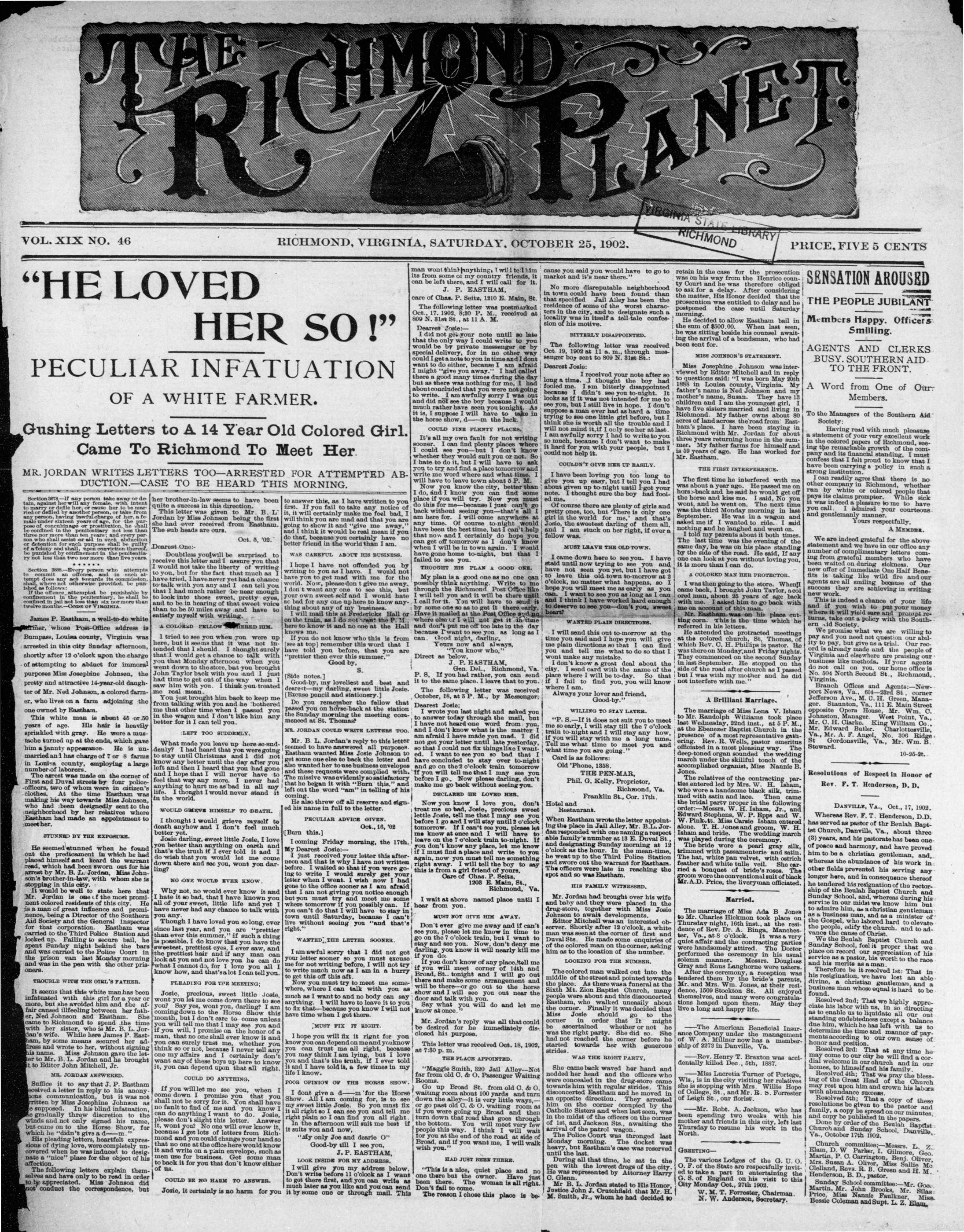
"HE LOVED HER SO!"
Gushing Letters to A 14 Year Old Colored Girl. Came To Richmond To Meet Her. MR. JORDAN WRITES LETTERS TOO—ARRESTED FOR ATTEMPTED ABDUCTION.—CASE TO BE HEARD THIS MORNING.
VOL. XIX NO. 46
"HE LO
PECULIA
OF A
Gushing Letters
Came To
MR. JORDAN WRITES LE
DUCTION.—CA
Section 3678.—If any person take away or detain, against her will any female, with intent to marry or defile her, or cause her to be married against her will, against any person, having harmful charge of her, a female under sixteen years of age, for the purpose of concubinage or prostitution, he shall be confined in the penitentiary not less than two years, and over any person who shall assist or aid in such abduction or detention for such purpose shall be guilty for more than two years of penitentiary not less than two nor more than five years.
Section 3888.—Every person who attempts to commit an offence, and in such attempt does any act towards its commission, against her will, otherwise provided, be punished as follows:
If the offence attempted be punishable by confinement in the peententary, he shall be confined in jail not less than six nor more than twelve months. — CODE OF VIRGINIA.
Bumpass, Louisa county, Virginia was arrested in this city Sunday afternoon, shortly after 12 o'clock upon the charge of attempting to abduct for immoral purposes Miss Josephine Johnson, the pretty and attractive 14-year-old daughter of Mr. Ned Johnson, a colored farmer, who lives on a farm adjoining the one owned by Eastham. This white man is about 45 or 50 years of age. His hair is heavily sprinkled with gray. He wore a musache turned up at the ends, which gave him a jaunty appearance. He is unmarried and I has charge of 7 or 8 farms in Louisa county, employing a large number of laborers.
The arrest was made on the corner of First and Duval streets by four police officers, two of whom were in citizen's clothes. At the time Eastam was making his way towards Miss Johnson, who was designed to sent to the neighborhood by her relatives where Eastam had made an appointment to meet.
STUNNED BY THE EXPOSURE
He seemed stunned when he found out the predicament in which he had placed himself and keard the warrant read, which had been sworn out for his arrest by Mr. B. J. Lordan, Miss Johnson's brother-in-law, with whom she is stopping in this city. It would be well to state here that Mr. Jordan is one of the most prominent colored residents of this city. He is a man of great influence and prominence, being a Director of the Southern Aid Society and the General Inspector Eastham was carried to the Third Police Station and locked up. Failing to secure ball, spent Sunday night behind the bars and was carried to the Police Court in the prison van last Monday morning and was in the pen with the other prisoners.
TROUBLE WITH THE GIRL'S FATHER.
It seems that this white man has been infatulated with this girl for a year or more, but she avoided him and the affair caused illfeeling between her father, Ned Johnson and Eastham. She came to Richmond to spend the time with her sister, who is Mr. B. L. Jordan's wife. While here James P. Eastham's wife secured her address and wrote to him his name. Miss Johnson gave the letter to Mr. B. L. Jordan and he brought it to Editor John Mitchell, Jr.
MR. JORDAN ANSWERED.
Suffice it to say that J. P. Eastham received a letter in reply to his anonymous communication, but it was not written by Miss Josephine Johnson as supposed. In his blind infatuation, he gradually threw discretion to the winds and not only signed his name, but came on to the Horse Show, for which he "didn't give a d—m." His pleasing letters, heartfelt expressions of dying love, were completely uncovered when he was induced to designate a "nice" place for the object of his affection. The following letters explain themselves and have only to be read in order to be appreciated. Miss Johnson did not conduct the correspondence, but
her brother-in-law seems to have been quite a success in this direction.
This letter was given to Mr. B. L. Jordan by Miss Johnson being the first she had ever received from Eastham. The sub heads are ours.
Oct. 5, '02.
Dearest One:
Doubtless you will be surprised to receive this letter and I assure you that I would not take the liberty of writing to you, but for the fact that much as I have tried, I have never yet had a chance to talk with you any and I can tell you that I had much rather be near enough to look into those sweet, pretty eyes, and to be in hearing of that sweet voice than to be 50 miles away and have to satisfy myself with writing.
A COLORDED FELLOW HERED HIM.
I tried to see you when you wore up here, but it seems that it was not intended that I should. I should surely that I would get a chance to talk with you that Monday afternoon when you went down to the store, but you brought John Taylor back with you and I just had time to get out of the way when I saw him with you. I think you treated me best mean. You just brought him back to keep me from talking with you and he 'bothered me that other time when I passed you in the wagon and I don't like him any better for it I can tell you.
;LEFT TOO SUDDENLY.
What made you leave up here so suddenly?
I had heard that you were going to stay until Christmas and I did not know any better until the day after you left and then I heard that you had gone and I hope that I will never have to feel that way any more. I never had anything to hurt me as bad in all my life. I thought I would never stand it in the world.
WOULD GIVE HIMSELF TO DEATH.
I thought I would grieve myself to death anyhow and I don't feel much better yet.
Josie darling, sweet little Josie, I love you better than anything on earth and that's the truth if I ever told it and I do wish that you would let me come down there and see you, wont you darling?
NO ONE WOULD EVER KNOW
Why not, no would ever know it and
I hate it so bad, that I have known you
all of your sweet, little life and yet
I have never had any chance to talk with
you any.
Though I have loved you so long, ever
since last year, and you are "prettier
than ever this summer," if such a thing
is possible, I do know that you have the
sweetest, prettiest eyes, I ever saw, and
the prettiest hair and if any man can
look at you and not love you he can do
what I cannot do, for I love you all I
know how, and that's all I can tell you.
PLEADING FOR THE MEETING:
Josie, precious, sweet little Josie, wont you let me come down there to see you? Say yes, wont you, darling? I am coming down to the Horse Show this month, but I don't care to come unless you will tell me that I may see you and if you will, I promise on the honor of a man, that no one shall ever know it and you can surely trust me, whether you think so or not, because I never tell any one my affairs and I certainly don't want any of these boys up here to know you, it can depend upon that all right.
COULD DO ANYTHING.
If you will let me see you, when I come down I promise you that you shall not be sorry for it. You shall have no fault to find of me and you know I can do anything I want to do. Josie, please don't slight this letter. Answer, it wont you! No one will ever know it, because I get lots of letters from Richmond and you could change your hand so that no one at the office here would know it and write on a pain envelope, such as man use for business. Get some man to back it for you that you don't know either of us.
COULD BE NO HARM TO ANSWER.
Josie, it certainly is no harm, for you
RICHMOND, VIRGINIA, SATURDAY, OCTOBER 25, 1902.
to answer this, as I have written to you first. If you fail to take any notice of it, it will certainly make me feel bad. I will think you are mad and that you are going to show it and "give me away." and I think it would be real mean if you do that, because you certainly have no better friend in the world than I am.
WAS CAREFUL ABOUT HIS BUSINESS
I hope I have not offended you by
writing to you as I have. I would not
have you to get mad with me for the
world. Now, please don't give me away.
I don't want any one to see this, but
your own sweet self and I would hate
sc bad for any one uphere to know any-
thing about any of my business.
I will mail this to Fredericks Hall or
on the train, as I do not want the P.M.
here to know it and no one at the Hall
knows me.
If you do not know who this is from
[see at top] remember this word that I
have told you before, that you are
"prettier then ever this summer."
Good by,
S.
[Side notes.]
Good-by, my loveliest and best and dearest—my darling, sweet little Josie. [Excuse pencil and stationery.]
Do you remember the fellow that passed you on horse-back at the station the Sunday morning the meeting commenced at St. Thomas?
MR. JORDAN COULD WRITE LETTERS TOO.
Mr. B. L. Jordan's reply to this letter seemed to have answered all purposes. Eastham wanted Miss Josie Johnson to get some one else to back the letter and also wanted her to use business envelopes and these requests were compiled with. The missive was evidently so satisfactory that he began it with "Burn this," and left out the word "am" in telling of his coming. He also threw off all reserve and signed his name in full to the letter.
I coming Friday morning, the 17th.
My Dearest Josia:—
I just received your letter this afternoon and that is why I have not written before. I waited so that if you were going to write I would surely get your letter when I went. I wish now I had gone to the office sooner as I am afraid that I am not giving you notice enough but you must try and meet me some where tomorrow if you possibly can. If you can't do that I will have to stay in town until Saturday, because I can't live without seeing you "and that's right."
WANTED. THE LETTER SOONER.
I am awful sorry that I did not get your letter sooner so you must excuse me for not writing before, I will not try to write much now as I am in a hurry to get this off this aft.
Now you must try to meet me somewhere, where I can talk with you as much as I want to and no body can say anything. I will have to leave it to you to fix that—because you know I will not have time when I get there.
MUST PIX IT RIGHT
I hope you will fix it right for you
know you can depend on me and you know
you can trust me all right, because
you may think I am lying, but I love
you and that's the truth, if I ever told
it and I have told it, a few times in my
life I know.
POOR OPINION OF THE HORSE SHOW.
I don't give a d——m 'for the Horse
Show. All I am coming for, is to see
my sweet little Josie. So you must fix
it all right so I can see you and tell me
right plain so I can find you all right.
In the afternoon will suit me best if
it suits you and now,
"My only Joe and dearie O"
LOOK INSIDE FOR MY ADDRESS.
I will give you my address below.
Don't write before 11 o'clock as I want to get there first, and you can write as much later as you like and you can send it by some one or through mail. This
man wont think anything, I will tell him it is from some of my country friends, it can be left there, and I will call for it. J. P. EASTHAM, care of Chas. P. Seitz, 1210 E. Main, St. The following letter was postmarked Oct. 17, 1903, 8:30 P. M., received at 809 N. 81st St., at 11 A. M.
Dearest Josie:—
I did not get your note until so late that the only way I could write to you would be by private messenger or by special delivery, for in no other way could I get a note to you in time and I don't want to do either, because I am afraid I might "give you away." I had called there a good many times during the day but as there was nothing for me, I had about concluded that you were not going to write. I am awfully sorry I was out and did not see the boy because I would much rather have seen you tonight. As it is, I suppose I will have to take in the horse show. d——m the luck.
COULD FINE PLENTY PLACES.
It's all my own fault for not writing sooner. I can find plenty places where I could see you—but I don't know whether they would suit you or not. So I hate to do it, but I will have to ask you to try and find a place tomorrow and write me word where and what time. I will have to leave town about 5 P. M. Now you know the city, better than I do, and I know you can find some place if you will try. Now you must do this for me—because I just can't go back without seeing you—that's all I need for. I will come anywhere any time I want to wish I would have been the best time, but I can't help that now and I certainly do hope you can get off tomorrow as I don't know when I will be in town again. I would have gone home to-night, but that I failed to see you.
THOUGHT HIS PLAN A GOOD ONE.
My plan is a good one as no one can possibly think anything. Write to me through the Richmond Post Office like I will tell you and it will be there until I call for it. You will have to send it by some one so as to get it there early. Have it mailed at the Post Office and no where else cr I will not get it in time and don't put me off too late in the day because I want to see you as long as I can. Good night, darling,
Years now and always,
"You know who,"
Direct as below,
J. P. EASTHAM,
Gen. Dal., Richmond, Va.
P. S. If you had rather, you can send it to the same place. I leave that to you.
The following letter was received October, 18, at 5 P. M., by Messenger; Dear Desi:
I wrote you last night and asked you to answer today through the mail, but I have not heard one word from you, and I don't know what is the matter I am afraid I have made you mad. I did not get your letter until late yesterday, so that I could not fix things like I wanted. I want to see you so bad that I want to see you again and go on the 2 o'clock train tomorrow. If you will tell me that I may see you before I go. Now please darling, don't make me go back without seeing you.
DECLARED HE LOVED HBR.
Now you know I love you, don't treat me so bad, Josie, precious sweet little Josie, tell me that I may see you before I go and I will stay until 2 o'clock tomorrow. If I can't see you, please let me know at once and I will have to leave on the 7 o'clock train to night. If you don't know any place, let me know if I must find a place and write to you again, now you must tell me something right away. I will tell the boy to say this is from a girl friend of yours.
I wait at above named place until I hear from you.
MUST NOT GIVE HIM AWAY.
Don't ever give me away and if can't see you, please let me know in time to go on the 7 o'clock train, but I want to stay and see you. Now, don't deny me darling, you know it will nearly kill me if you do:
If you don't know of any place, tell me if you will meet corner of 14th and Broad, St., tonight and I will go out there and make some arrangement and will be there—or go out to the horse show and I will see you out near the door and talk with you.
Say what you will do and let me know at once."
Mr. Jordan's reply was all that could be desired for he immediately disclosed his purpose.
This letter was received Oct. 18, 1902, at 7:30 p. m.
THE PLACE APPOINTED.
"Maggie Smith, 320 Jail Alley—Not far from old C. & O. Passenger Waiting Rooms.
Go up Broad St. from old C. & O,
waiting room about 100 yards and turn
down the alley—it is very little ways,
or go past old C. & O, waiting room as
if you were going up Broad and then
turn down that road that goes through
it. To me I meet very few
people this way. I think
for you at the end of the road at side
of Broad, and if you want me, I will walk
with you."
HAD JUST BEEN THERE.
"This is a nice, quiet place and no one there but the owner. Have just been there. The woman is all right. Don't fall to come. The reason I chose this place is be-
cause you said you would have to go to market and it's near there." No more disreputable neighborhood in town could have been found than that specified. Jail Alley has been the residence of some of the worst characters in the city, and to designate such a locality was in itself a tell-tale confession of his motive.
BITTERLY DISAPPOINTED.
The following letter was received
Oct 19, 1902 at 11 a.m., through messenger boy sent to 809 N. 31st St.:
Dearest Josie:
I received your note after so long a time. I thought the boy had fooled me. I am bitterly disappointed because I didn't see you to-night. It looks if it was not intended for me to see you, but I still live in hope. I don't suppose a man has lived in hope. I trying to see one little girl before, but think she is worth all the trouble and I will not mind it, if I only see her at last. I am awfully sorry I had to write to you so much, because I don't want to make it hard for you with your people, but I could not help it.
COULDN'T GIVE HER UP EASILY.
I have been loving you too long to give you up easy, but I tell you I had about given up to night until I got your note. I thought sure the boy had fooled me.
Of course there are plenty of girls and pretty ones, too, but There is only one girl in my room, that's Josie, the sweetest darling of them all, and I am stuck on her right, if ever a fellow was.
MUST LEAVE THE OLD TOWN.
I came down here to see you. I have staid until now trying to see you and have not seen you yet, but I have got to leave this old town to morrow at 2 o'clock, no matter what happens, so I hope you will meet me as early as you can. I want to see you as long as I can and I think I have worked hard enough to deserve to see you—don't you, sweet hearts?
WANTED PLAIN DIRECTIONS.
I will send this out to morrow at the time you said and I hope you will give me plain directions so that I can find you and tell me what to do so that I wont make any mistake.
I don't know a great deal about the city. I send card with the name of the place where I will be to-day. So that if I fail to find you, you will know where I am.
Always your lover and friend,
Good-by."
WILLING TO STAY LATER.
"P. S.—If it does not suit you to meet me so early, I will stay till the 7 o'clock train to night and I will stay any how, if you will stay with me a long time. Tell me what time to meet you and what time you are going."
Card is as follows:
Old 'Phone, 1858.
THE PEN-MAR,
Phil, G. Kelly, Proprietor,
Richmond, Va.
Franklin St., Cor. 17th.
Hotel and
Restaurant.
When Eastham wrote the letter appointing the place in Jail Alley, Mr. B. L. Jordan responded with one naming a respectable family's number at 18 E. Duval St., and designating Sunday morning at 12 o'clock as the hour. In the mean-time, he went up to the Third Police Station and swore out the warrant for Eastham. The officers were late in reaching the spot and so was Eastham.
HIS FAMILY WITNESSED
Mr. Jordan had brought over his wife and baby and they were placed in the drug-store, together with Miss Josie Johnson to await developments. Editor Mitchell was an interested observer. Shortly after 12 o'clock, a white man was seen at the corner of first and Duval St. He made some enquiries of of the colored man on the corner, asking him as to the location of the number.
LOOKING FOR THE NUMBER.
The colored man walked out into the middle of the street and pointed towards the place. As there was funeral at the Sixth Mt. Zion Baptist Church, many people were about and this disconcerted Eastham, who walked uneasily about the corner. Finally it was decided that Miss Josle should go to the corner in order that It might be ascertained whether or not he was the right party. She did so. She had not reached the corner before he started towards her with generous strides.
WAS THE RIGHT PARTY.
She came back waved her hand and nodded her head and the officers who were concealed in the drug-store came towards him with regular strides. This disconcerted Eastam and he moved in an opposite direction. They arrested him on the corner occupied by the Catholic Sisters and when last seen, was in the midst of the officers on the corner of 1st, and Jackson Sts., awaiting the arrival of the patrol wagon.
The Police Court was thronged last Monday morning. The docket was heavy, but Eastam's case was reserved until the last.
During all that time, he sat in the pen with the lowest dregs of the city. He was represented by Attorney Harry C. Glenn.
Mr B. L. Jordan stated to His Honor, Justice John J. Crutchfield that Mr H. M. Smith, Jr., whom he had decided to
retain in the case for the prosecution was on his way from the Henrico county Court and he was therefore obliged to ask for a delay. After considering the matter, His Honor decided that the prosecution was entitled to delay and he postponed the case until Saturday morning. He allowed to allow Eastamn bail in the sum of $500.00. When last seen, he was sitting beside his counsel awaiting the arrival of a bondsman, who had been sent for.
MISS JOHNSON'S STATEMENT
Miss Josephine Johnson was interviewed by Editor Mitchell and in reply to questions said: "I was born May 20th 1888 in Louisa county, Virginia. My father's name is Ned Johnson and my mother's name, Susan. They have 18 children and I am the youngest girl. I have five sisters married and living in Richmond. My father owns about 80 acres of land across the road from Eastham's place. I have been staying in Richmond with Mr. Jordan for about three years returning home in the summer. My father farms for himself and is 59 years of age. He has worked for Mr. Eastham.
THE FIRST INTERFERENCE.
The first time he interfered with me was about a year ago. He passed me on horse-back and he said he would get off the horse and kiss me. I said, No you wont, and he went on. The next time was the third Monday morning in last September. He was in a wagon and asked me if I wanted to ride. I said nothing and he laughed and went on. My parents about it both times. The last time my parents about evening of the same day, he was on his horse by the side of the road. He said, If any one can look at you without loving you, it is more than I can do.
A COLORED MAN HER PROTECTOR.
I was then going to the store. When I came back, I brought John Taylor, acolored man, about 35 years of age back with me. I asked him to go back with me on account of this man.
Mr. Eastham was on his place cutting corn. This is the time which he referred in his letters.
He attended the protracted meetings at the colored church, St. Thomas, of which Rev. C. H. Phillips is pastor. He was on Monday, and Friday nights. They came on the second Sunday in last September. He was on the side of the road after church as I passed but I was with my mother and he did not interfere with me."
A Brilliant Marriage.
The marriage of Miss Lena V. I. Sham to Mr. Randolph Williams took place last Wednesday, 22nd inst., at 5 P. M., at the Ebenezer Baptist Church in the presence of a most representative gathering. Rev. R. Wells, pastor emeritus affiliated in a most pleasing way. The deep-toned organ sounded the wedding march under the skillful touch of the accomplished organist, Miss Nannie B. Jones.
The relatives of the contracting parties entered by Mrs. W. H. Isham, who wore a handsome black silk, trimmed with satin and lace. Then came the bridal party proper in the following order:—Messrs. W. H. Isham, Jr., and Edward Stephens, W. E. Peps and W. W. Pinkatt. Miss Carsie Isham entered alone. T. H. Jones and groom. W. H. Isham and bride. The wedding march was played during the ceremony.
The bride wore a pearl gray silk, trimmed with passamaterie and satin. The hat, white pan velvet, with ostrich feather and white tulle veil. She carried a bouquet of bride's roses. The groom wore the conventional suit of black Mr. A.D. Price. The liverman officiated.
Married.
The marriage of Miss Ada B Jones to Mr. Charles Hickmon took place on Thursday night, 16th inst., at the residence of Rev. Dr. A. Binga, Manchester, Va., at 8 o'clock. It was a very quiet affair and the contracting parties were handsomely attired. The Doctor performed the ceremony in his usual solemn manner. Messrs. Donglass Gray and Eunus Langhorne were ushers. After the ceremony, a reception was tended them by the bride's parents, Mr. and Mrs. Wm. Jones, at their residence, 1509 Stockton St. All enjoyed themselves, and many were congratulations heaped upon them. May they live a long and happy life.
The American Beneficial Insurance Company under the management of W. A. Millner now has a membership of 2273 in Danville, Va.
Rev. Henry T. Braxton was accidentally killed Dec., 5th, 1887.
—Miss Lucretia Turner of Portage, Wis., is in the city visiting her relatives she is stopping with Mrs. Willie Hope of College, St., and Mr. R. S. Forrester of Leigh St., our florist.
—Mr. Robt. A. Jackson, who has been spending two weeks with his mother and friends in this city, left last Thursday to resume his work in the North.
GREETING
The various Lodges of the G. U. O. O. F. of the State are respectfully invited to take a part in entertaining the G. S. of England on his visit to this City Monday Oct., 27th 1903. W. M. T. Forrester, Chairman. N. W. Anderson, Secretary.
PRICE, FIVE CENTS
SENSATION AROUSED
THE PEOPLE JUBILANT
Members Happy. Officers Smilling.
AGENTS AND CLERKS BUSY. SOUTHERN AID TO THE FRONT.
A Word from One of Our Members.
To the Managers of the Southern Aid Society:
Having read with much pleasure a statement of your very excellent work in the colored papers of Richmond, seeing the remarkable growth of the company and its financial standing, I must confess that I felt proud to know that I have been carrying a policy in such a strong institution.
I can readily agree that there is no other company in Richmond, whether run by white or colored people that pays its claimsprompter. While sick it was indeed a pleasure to me to have you call. I admired your courteous and gentlemanly manner.
Yours respectfully,
A MEMBER.
We are indeed grateful for the above statement and we have in our office any number of complimentary letters coming from grateful members who have been waited on during sickness. Our new offer of Immediate One Half Benefits is taking like wild fire and our agents are all smiling because of the success they are achieving in writing new work. This is indeed a chance of your life and if you wish to put your money where it will yield sure and prompt returns, take out a policy with the Southern aid Society. We promise what we are willing to pay and you need not question our ability to pay, but give us a trial. Our record is already made and the people of Virginia and elsewhere are praising our business like methods. If your agents do not call on you, our home office is No. 504 North Second St., Richmond, Virginia.
Branch Offices and Agents:—Newport News, Va., 604–33rd St., corner Jefferson Ave., M. C. H. Green, Manager. Staunton, Va., 111 E. Main Street opposite Opera House, Mr. Wm. C. Johnston, Manager. West Point, Va., Mr. C. H. Clarke. King William Co., Mr. Edward Butler. Charlotteville, Va., Mr. A. F. Angel, No. 306 Ridge St Gordonville, Va., Mr. Wm. B. Steward.
10-25-2t.
Resolutions of Respect in Honor of Rev. F. T. Henderson, D. D.
DANVILLE, VA., Oct., 17, 1902
Whereas Rev. F. T. Henderson, D.D. has served as pastor of the thr Beulah Baptist Church, Danville, Va., about three (3) years, and his pastorate has been one of peace and harmony, and have proved him to be a christian gentleman, and, whereas the abundance of his work in other fields prevented his serving any longer here, and in consequence thereof he tendered his resignation of the rectorship of the Beulah Baptist Church and Sunday School, and, whereas during his service in our midst we know him but to admire him, as a christian gentleman as a business man, and as a minister of the Gospel, who labored hard to elevate the people, edify the church, and to advance the cause of Christ.
We the Beulah Baptist Church and Sunday School, feel it proper that we place on record our appreciation of his service as a pastor, his worth to the race and his merits as a man.
Therefore be it resolved 1st: That in his resignation, we have lost an able divine, a christian gentleman, and a business man whose equal is hard to be found.
Resolved 2nd; That we highly appreciate his labor with us, in so directing as to enable us to liquidate all our out standing endebtedness except a balance due him, which he has left with us to determine the time and manner of payments according to our own sense of honor and position.
Resolved 3rd: That at any time he may come to our city he will find a cordial welcome in our church and in our homes, to himself and his family.
Resolved 4th: That we pray the blessing of the Great Head of the Church may rest upon him and crown his labors with abundance success.
Resolved 5th; That a copy of these resolutions be given to the pastor and family, a copy be spread on our minutes, and copy be published in the papers.
Done by order of the Beulah Baptist Church and Sunday School, Danville, Va., October 17th 1903.
Church committee:—Messrs. L. Z. Elam, D. W Parker, I. Gilmore, Geo. Martin, P. C. Carrington, Benj. Oliver, Mrs. Susan A. Oliver, Miss Sallie Moe Clland, Revs. R. B. Green and H. M. Henderson, B. D. pastor.
Sunday School committee:—Mr. GooMartin, Mr. John Brooks, Mr. Silas Price, Miss Nannie Faulkner, Miss Bessie Coleman and Supt. L. Z. Elam.
2
aa
iy + ~
cae ee E
eee ia.
Bi Le Des
Ba ee
pro: eee
po ase Areata Nigra
SaroNUKY, .. OUT 35, tm02
DeULTRy
>, \AND Nigtzey
(7 ba > SD
CP BEES
AN AUTOMATIC FEEDER.
See ee
Cine
If the apparatus shown in the sc
ompanying drawing accomplishes the
purpose for which it was designed, it
will mean a large saving in the amount
of labor necessary in the care of fowls
and possibly economize also in the
amount of grain consumed by the
flock. A hopper, or storage reservoir,
is provided for holding a large quantity
of grain, the bottom being conical in
shape, to feed the grain into an open-
ing in the center. Beneath the open-
ing is a shoot, arranged to catch the
ES
ga =a
SB 235
i Ss SSS
S|
| Vi
i |
i | | { g
j WAM iVa= ee
\ th om >
— py)
lee GaN
SS Ey -- +
Seanad
HOW TRE MACHINE WORKS.
grain and prevent a continuous outflow
from the hopper. Suspended in close
proximity to the ground is what the
inventor calls a “bait box,” having a
small quantity of grain placed in fixed
eups, which are covered with glass or
fine wire netting. In the natural course
of events the fowls become hungry,
and, discovering the grain in the “bait
Dox," hop on one edge of the tray
and attempt to peck at the covered
kernels. The weight of the fowl tilts
the swinging rod which supports the
‘tray, and this oscillatory motion slides
‘the shoot back and forth beneath the
‘epening in the hopper, thus discharg-
ng the grains to the ground, to be de-
voured by the fowls. The quantity
delivered at one time te not great, but
as often as hunger drives the fowls
to peck at the bait the grain ts av-
tomatically delivered, and as fowls will
make little effort to get feed unless
they are hungry, it is possible that
there will be a saving fn the quantity
consumed over that which they might
be given if fed by hand, Zachariah
Xevers, of Santa Cruz, Cal., fe the in-
Yentor.—Cincinnat! Commercial Trib-
une.
EATING LIVE BEETLES.
A Summer and Fal Diet Which Is
Responsible for the Death of
Take Donk.
‘The turkey is an active bird and will
tat almost any kind of insecte when in
the fields. Frequently it will eat potato
beetles, but in such cases the turkey
will die unless it first kills the bugs be-
fore swallowing them, as the live bugs
remain in the crop for many days, de-
stroying the lining of the crop and
causing inflammation. Chickens sel-
dom eat potato bugs, but both chick-
ens and turkeys will eat chinch bngs,
which are smaller than the potato
beetle and are not #lways killed when
Picked up, If grasshoppers are caught
they are usually torn to pieces or
killed, as they are large and cannot be
swallowed without being injured or
killed; but whenever bugs of any kind
are swallowed alive. if they have hard
torerings on the bodies, the fowls will
be unable to pass them from the crop
to the gizzard, but soft insects may be
swallowed withont danger to the bird.
It may be stated that often the birds
will consume hard-bodied insects and
escape injury, and may go to and from
the fields daily with noharm resulting,
but some day they may be very hungry,
especially If insect food has not been
plentiful, and greedily fl their crops
rapidly without first destroying the
bugs, the result being disastrous,
‘When turkeys die, always open the
srops and examine the contente.—Mid-
tend Farmer.
Caine aa ia a a
When one thinks that any bee that
walks out of its oradle, pale, perhaps,
but perfect, knows at once all that is to
be known of the life and duties of a
Bee, complicated as they are, and com-
prising the knowledge of an architett,
@ wax-modeler, a nurse, a lady's maid.
a housekeeper, a tourist agency and a
field marshal, and then compares that
Yast knowledge with the human baby,
who is looked upon aa a genius if it
gurgles “Goo-goo,” and tries to gouge
ite mother’s eyes out with its fingers,
ane realizes that the boasted superior-
ity of the human brain depends large-
‘pon vanity.—Rural World.
Prost from Hens Ye Larme,
Most poultrymen estimate that each
Ben will afford a profit of one dollar «
year. This may seem small to some,
‘but it means after the interest on eap-
ital, food and other cash expenses are
paid. It = really a large profit, as
most of the hens are not valued at
more then half that sum each, and with
© flock of 30 hens it represents the in-
terest of $300 at «rx percent. When
one takes into consideration the fect
that on most farms the actual capital
invested fp poultry is very emall, the
profit from the hens fs usually quite
large.
THE BEES IN AUTUMN.
‘eoding Early for Winter Stores Ie
8 Practice Hixbly Recommended
thy: Baapedenaienaanaea:
The bees should be fed early, so they
can seal up their stores, and feeding at
this time not only insures good storea,
but it also creates brood rearing, which
is ax important as feeding. The teed
ing should be done to secure the best
results in promoting the production of
brood; to do this, they should be fed
regularly every day during the entire
month, so that at the close we have
the required amount of stores and se~
eral frames full of brood, besides @
good supply of young bees.
Sngar-fed colonies. {f properly fed,
usually winter better than those not
so fed, especially if there is no honey
flow at this time. We may exceptional-
ly have such a honey flow in autumn
that bees do not require any feed, but
this is very rare, and colonies that do
not have cnough stores in the hive at
the close of the honey harvest seldom
gain much during the balance of the
‘season. Late feeding just before going
into winter quarters is not good policy,
for the bees cannot seal up thelr
stores, even if they are fed sufficiently,
and no brood rearing will be done at
this time, and we lose half of the bene-
fits.
It is best when beginning to feed to
feed lightly for a week or more. This
will give the queen a chance to fill the
brood nest with eggs; then during the
latter part of the month feed more
heavily until the required amount Ss
given. Tees that are to be wintered
out of doors without extra protection
should be fed more; and 30 or 40
pounds will not be too much, If win-
tered in the cellar, 25 pounds is safe
enough. Some who make a specialty
feed less or carry them throngh with
less honey, but they feed in early
spring. Tt ts best to feed enough, or
give them enough honey during the fall
to both spring and winter them, for
they may be neglected in spring —A.
‘4M. Duff, in Farmers’ Voice.
| BEST EGG PRESERVERS.
jqatonaime, Salt and Water and silt
cate of Soda Mave Proved the
Mont Satisfactory.
Numerons experiments at times have
shown the worthlessness as egg pre-
servers of ashes, sulphur, permangate
of potash, gypsum. Dry salt kept eggs
fairly well, but injured the flavor. Vas-
eline or grease rubbed on the shells
worked well for short periods, but was
a failure in the ten months’ tests. The
old formula, one pound quicklime, one-
half pound salt and one gallon water,
Was a success, although flavor was
LADLE FOR STORAGE BEGGS.
slightly salty. Unfortunately the
clear lime pickle does not appear to
have been tested with the others.
‘The best success of all was with'we-
ter gloss or silicate of soda, This costs
40 to 60 cents per gallon and may be re-
uced with water when used to as low
as three per cent. water glass. The
eggs must be very fresh and should be
completely immersed In the solution,
Even this preparation was not succese-
ful in every case, but was usually #0,
the eggs being as good as fresh eggs
for cooking. The egg ladle, as por-
trayed, is a great convenience in hand-
Ung large numbers of eggs. It is made
of a round, shallow tin pan with a long
handle, the tin being perforated to
drain off the liquid. With it the eggs
may be gently lowered into the barrel
or tank without risk of breakage.
‘When wanted again they are removed
with the dipper and placed on arack of
slate to dry.—G. B. Fiske, in Farm and
Home.
atieide Mhaidien Ateshaa- diamine.
Olcomargarine men claim that their
product is a wholesome food. ‘The new
law Se now in force imposing a tax of
ten cents a pound on oleomargarine
colored to imitate butter. If nutri
tious and healthful oleomargarine
should be sold on ita merits, very
truthfully says the Globe-Demoerat.
Those who are willing to consume it
&8 a substitute for butter do not want
to pay anything additional for color
ing material. ‘The public hopes that
the new law will be rigidly enforced,
Adulteration or deception practiced in
food is a fraud on the people, and the
federal courts, when called on to act,
will see that the new regulations are
enforced.
Preparing Fowl for Market,
It will soon be time for the hucksters
to go around buying chickens and
other poultry. Make your fowls so
good that he will be ashamed to offer
you the going price or proud to give
you an advance. Evenif you do not get
fn advance the extra weight will pay
for putting on. Shut the birds you are
going to sell ina rather smail pen a
few days—from ten days to three
weeke—before you sell them and give
them all they will eat of corn meal and
wheat middlings mixed into a dough,
giving them as much as they will eat
of it. This makes thick flesh and
sweeet, tender and juicy meat_—Com-
mercial Poultry,
i eta hes, atc a Se
To the north when a bushel of corn
is bought or sold it means, or should
mean, a bushel of grain—that is, of
shelled corn, Asn rule o bushel of
ears of corn weigha from 68 to 75
pounds, according to the variety. If
when shelled the grain weighs 56
pounds and the cob 14 pounds, then 70
pounds of ears will be for that crop
equivalent to a bushel of shelled cors.
A bushel of shelled corn in most states,
as fixed by law, ‘a $6 pounds, though in
New York St is made 58 pounda, and in
some localities 60 pvands,
‘- Ge tes
Mr. Jumper—You seem to like to
talk to Whilka,
Mr. Jimpe—Yeo; be never reads the
papers, and everything you tell him 4
mawai~ Data Pree aan, .
THE RICHMOND PLANET, RICH OND; VIRGINIA,
.- . * your bust
Ene | jae
ASE RL SIAM! |=
iy when she crie
>. see
i oi matter he mu:
(#7) Deo Nor luxe os
for fo mon
eR) ee & heir ¥
6 “ap Or Pm. “A few year
<A spell of livelis
ING @ dog, Roger asked no ques-
tions of the man who had
Fought him from the city to this
white, vine-streaked villa by the for-
est river. He was a city dog: but,
after all, his home was and must be
the man’s home. ‘The man had raised
him from puppyhood, had nourished
and caressed him, loved him, talked
to him, made of him a companion and
confidante. Therefore he had been
content, nay, proud, to eit with him
in the creaking, rushing, swaying
train which brought them into the
woods, to follow through the dust,
between the wind-shaken trees, the
carriage that had carried him and his
bags to the white hotel that sat
looking down from the thicket on the
hill upon the murmuring, green wo-
ters of the river.
And the days which followed were
glorious, undreamed of days for Rog~
er, because he spent them hunt-
ing im wild, vine-hidden places, or
sitting by the man as he fished in the
swiftrunning waters, or lounging
about the house where there were
no other dogs. But at last one night
when the moon was coming over the
trees he saw the man come down
the plaza with a girl and followed
them, but the girl, who was very
beautiful, screamed when she saw
Roger following close at her heels,
and the man with anger in his voice
—a new note that hurt the dog—
shouted:
“Go Uack, you rascal! Go back!”
And as Roger stopped, his tail
sinking and his head very low, the
man picked up a clod and struck him
so that Roger sneaked away a few
paces into the shadows, and then,
unseen himself, followed the man
and the girl as they wandered away
to a moonlit knoll above the water
and sat whispering there unaware of
the two fond eyes watching them
trom @ dark copse in the timber.
But Roger was glad again the next
morning, for the man stroked him
< Hi
as if to make amends, and he fol-
lowed hia master about all morning
charging through the long grasa be-
fore him, circling about through the
woods, barking at the kildees, dart-
ing at grasshoppers and shouting fu-
viously at the strange, shining, leap-
ing creatures that the man lifted
from whe water at the end of a long,
thin string.
But in the afternoon the man and
the girl walked out again together,
and Roger was scolded again and
driven off with a stick. Her blue eyes
stared at him as if he were some wild
‘beast and her pretty lips did not
smile till he had crawled away under
the lattice of the veranda. Watching
througn the aisles of the trees, he
saw them walking toward the river,
and when they had unmoored the
skiff and the man had lifted the girl
into the cushioned seat astern, Roger
came skulking out of the sedges
pleading with his eyes and promising
to be a good dog if they would but
take him a-riding on the swift, shin-
ing water. But the girl gave a sharp
little screech and the man yelled.
“Go back, you rascally eur!”
‘They pushed their boat away into
the current, the man at the oars, and
the girl, laughing now and trailing
her white hands in the water, sitting
opposite. Roger, crestfallen and puz-
zled, ran along’ the margin of the
river watching his master till the
boat swung in at the opposite shore,
where a row of tiny, white closets
peeped from among the willows.
Into them went the man and the
girl, and presently came back to the
water's edge, their white limbs
gleaming in the sunlight, their faces
radiant with happiness, their laugh-
ter ringing across the river more mu-
sical than the voices of wind and wa-
ter. Roger saw them go hand in
hand into the shallows along the bar,
dashing the water into fountains,
planging like the great fishes, floun-
dering, shoutiog, playing. At last
the girl went slowly baek to the lit.
tle dressing-room and the man atroek
Doldly out into the stream Roger
sow bim eoming and barked a wel-
ome He theught his master wae
coming scroes and his dog's zn
waa singing again. But the man Snly
screamed as if in anger or pain, and
sank deeper in the water {ll Roger
could see only the dim fiash of his
Important,
1 never go to sleep at night
But this thought gives me painc
Mow can the old world eet slong
Unth T wake again?
~Cineianati Commercial-Tribune,
Quite Trae,
Hewltt—It ia worry, not work, that
kille,
Jewett—That's #0; especially when
& fellow. worries to death because he
eaanct got work —Brooklyn Life,
i.e en Gnd legs beneath the sur-
‘face of the rushing river. And he
ran again along the shore watching
bis master swept away by the waters
till at Inst he could see nothing but
the green and yellow ribbons of the
eeps, ruining like a millrace, flat,
secret, crooning and purring, snarl-
ing among the rocks Uke some great
cat jealous of its prey.
Roger stopped and waited, but the
man did not come up out of the wa-
ter. The sun swung low above the
western hills and the blue cranes
came skimming from the darkening
east, but Roger eat and watched
slone by the river and wondered.
‘Then through the darkness he saw
‘men with lanterns and long pikes in
‘thelr hands come down the river in
boats, trailing ropes through the wa-
ter and murmuring mysteriously
among themselves. Roger did not
underetand, but he felt the pressure
of some inexplicable horror, and,
howling as he went, he wandered
back to the white villa on the hill.
‘There upon a bench near the veranda
he found the man's garments, his
cap, his shoes, and about them, mut-
tering, a group of men and women.
But the girl was in the parlor, her
pretty face quite pale, her blue eyes
‘Yery bright, telling some story in
which his name, the man’s name,
came very often. But presently all
of them, men and women, wandered
away by two's und three's, in groups,
and the girl walked out into the’ ‘gar-
den with a strange young man.
Roger sow them, arm fn arm, go
slowly into the arbor, and soon heard
their voices singing @ merry baliad,
and thelr laughter made him believe
that, after all, perhaps all was ‘well
and that he, the master, would soon
come back singing and Inughing.
Then he saw the torches come like
8 sad procession up from the river,
ond, going to meet them, saw the
‘man, pale now and very silent, lying
‘on @ great plank, his long arms trail.
ing the grass. Roger slipped in be-
tween them and barked for joy, but
there was no sign of recognition
from the man, though the dog licked
the cold, dripping hands until some
one kicked him away.
Roger was puzzled by this queer
transformation of the man who had
been always #o splendidly alive. “Go
back, you rascal!” and the harsh
words and cuffs of the past few days,
Were no longer a mystery. Roger
Knew somehow thet these were but,
‘the words.and the deeda of the girl
enacted aS by the men. The
‘reason he did not understand, but, the
‘cause was plain enough. She did not
Uke dogs. Roger would have wel-
comed a kick or a curse now, but that
motionless coldness, that utter al-
lence, that sleep in the midst of tu-
mult and excitement, that total ob-
livion even of the girl aa she stood
above the man staring with scared
and yet unfeeling regard! What had
made the man like that?
The next day they took the man
away, but he did not call Roger,
though he followed the wagon down
through the tree-lined Iane to the
depot. They would not let him into
the train, end 20 he went back
again, and when he might sat look-
ing at the girl who laughed and sang
always except when Roger was by.
When zhey drove him away and he
knew that there was no answer to
his problem in them all, he went
@own to the river where the empty
boat tay moored, and, plunging in un-
chidden, swam down across to the
bar where the little white dreseing-
rooms peeped from among the wil-
lows.
He ran about the sands and eniffed
at the footprints in the sand—his
footprinta as he had walked, shout-
ing like a boy at play. Surely the
mystery all lay in the rushing river.
From where he stood knee-deep in
the cool water, Roger could hear the
chorus of voices singing at the white
villa on the hill opposite, He could
even distinguish her—the girl’s voice
—singing. And so he struck out
again into the current just as the
man hed done, cried out as the man
had cried and went away into dim,
Tushing depths, hoping, belfeving and
glad that he was following the man
even away from the girl and into the
mysteries which he neither under-
stood nor feared.—Chicago Record-
Heral4_
A Gigantic Barre! Top.
Chinamen in Astoria, Ore., amuse
themselves with a huge top made out
of an empty white lead keg. A
square opening is cut in the side,
and it takes three men to spin it,
one to hold the top and two to pull
the string with a etick which eeta St
in motion. While spinning it sounds
Uke the whistle of a steamer, and
can be heard three blocks away.
Mighty Lively O14 Get,
Mra. Eva Devoe, of East 8;
N. Y., in an up-to-date girl, aithogs
she fs 100 yeara old. She wants a
bicyele, as she hater to be behind the
times. “My family,” she saya, “seem
to think I'd better not have one, and
tTmaybe tt would look queer to see the
mether of a 72-year-old girl whirl
ing on a wheel.”
Se
Pa Calls the Tura.
Little Willie—Say, pa, what's a
double chin?
| Pa-—A double chin, my son, is an
exchange of words between your ma
‘and grandma.—Philadelphia Inquirer.
“No Danger,
“Do you have trouble with “your
oooks Boiliig the coffe too long?”
“Goodness, no! They don't stay long
enough for that."—Pwek.
Bet Mie Jeb.
“Your husband ts @ floorwalker in
© department story, isn't ho?
pe yea.
“Then, why don't you have him get
Bp and walk the door with the baby
when she cries?”
“I can't wake him up, When 1
shake him and tell him what's the
nutter he mumbles something about
soothing sirup in the drog depart.
-ment threo aisles down, and then
goes to snoring again.” — Chicago
Tribune
Their Vindictivelessness.
| “A few years ago, when we had a
‘spell of liveliness on us,” said the
landlord of the Pettyville tavern, a
trifle pessimistically, “we tried to get
the Insane asylum located here; but
Rustletown beat our best efforts and
eecured the institution. However,
our people are not resentful, and the
fact that the asylum didn’t come to
Pettyville don't prevent some of us
Pettynllains from goin’ to the
@sylum, once in awhile.”—Puek.
What Ping-Pong Is Clke,
“Ring-pong,” said the lady in the
Golfing ekirt, “is just like golf.”
“It is just like tennis,” declared the
lady in the linen suit,
“You're both wrong," observed the
heavyset gentleman who was wiping
his brow and breathing with evident
effort. “It's just like hard work."—
Indianapolis News.
eae Laie
“How do you get the reputation ot
being so much richer than you are?”
asked the intimate friend,
“Very easily. I wear my old clothes
as long as possible and never admit
that I"have any money that I could
lend. People take it for granted that
I must be prosperous."—Washington
Btar,
‘Why Lot Went.
Lot, upon being notified that his wife
had turned to salt, was observed to
shed tears.
“Why in blazes couldn't she have
turned to coal?” he muttered angrily.
But this vision of a sudden fortune
having been speedily shattered, he re-
sumed his weary march onward.—N. Y.
‘Times.
At Home All Day,
“Why weepest thou, woman?”
“My lord will be buried this day.”
“My wife was buried yesterday. To-
‘morrow I must get me another.”
Wheretpon the widow shook th¢
ashes from her shining hair, dried het
eyes, and, looking into the face of the
widower, smiled.
“I will be at home to-morrow all
day,” she said.—Smart Set.
ee
PASSENGER TRAINS LEAYE AND
ARRIVE NEW MAIN-ST. STATION.
OCTOBER Sth, 1903,
—ae Ye SRNR IND.
Hee Loi: Broept Sunday Newport Now
=
ewe a 2 goer ta
imo oe ieee
; Wars eae toNeriah sto
Newport News.
t smpton only. Connects at Old ec
Bacto teasers’ at Martale Sh
5200p. ms For Newport News and Old
Bane eater Wega
aoa tain Line West’ Bound.
gy Tocial Beowpt Banday' te Clifton
2900. gy Belg Cumann tnd _Loater
90 p. they Dally
Eullmwens rome Cocteau oy Ce
Yirgtnia” Hoe Speinage’ alone! teen
Fro Cordonvillt to Bienes Yollsen
Ecrocal sation, xoeph Sanday
1190p. ms Belly St, Las and Chon fecal
fille GincsmatIndfanapats, 8 eau
wae mame River Division.
m, Dalle For Lynchiourg, Lexington,
op, omer and “alberene snd "Sev
535 p. may Except Sunday, To Bremo,
Arrive.
Paxonagra Drvistox — From Norfolirand Old
oie, agai, dally an 0
Dem daly: sem mc, and F200 pein
Mane Line, From Gbvctanatt, 7:45 a. m. daily;
and G0 ps me dally, Prom Ohio
Rn cek eure oan
Jace D From ae Forge
id Lyncane a ps Gail and 920
tn, exeept Sunday froin Bremo:
Apply at 800 £. Matin, meer Hotel and
Hotel Jefferson for further information, Rates,
tickets and’ Pullman ‘Hescrvation.
W. 0. WARTHEN,
_ DistRict PASskNOER AGENT.
0. DOYLE, -H. W. FULLER,
Grs'L Wo'e. Gey’ P.A.
Norfolk and Western R. R.
Sopt. 28th, 1902,
LEAVE RICHMOND (DAILY), BYRD
STREET STATION.
ee ee aera a
Neviale 10-4 5. Blope oti ay Pet
Mepis Wa bs gra ohh
SERA Sats had ace
Sesame
006.4. Mn THE “SHICAGO EXPRESS, for
pos HONGO, PENS Sr
penterg,_ ence: Cores and
Bie Sng fee Gere
Petats AN hele
Sr Ghancke 00 Rnoeetlles an ee
Ve ey
Eeatter Boat ead Tecra
pi Air ties gt ie crea
Sat yeast Anais
ies hates eaanete a es
See mee, cman ater
gence, New York, Baltimore ‘and Waa-
1257. M., for Suffolk, Norfolk aud intermed.
ames Ne at ras
ate Ms Lpetbae oot Reverb, Soe
Eat Sade lana inti
Serene artes
Ee oemcioete nee
ete Sites Mone
Eoeaeeen ea ote!
meu Pera ea for ge
See STE Sa cee wn
cae ane ane Taree ot
8:86 P. M.; from Norfolk and the oe
Shae oases Pas
‘Office 888 Main St.
JOHN E. WAGNER,
Oity Passenger and Ticket Agt.
©. H. BOSLEY,
District Passenger Agent.
W. B. BEVILL,
it.
ener Cases eee Ae
ee
WO: A. M., Ne N.C. Dat
re Sea te ey
Pai
ie oie
Ex faci aapabbere aed al
Ne
tore Vorieger oi
240. Mo; limite tral dally for Jack
Fees oeeed aio
Greensboro for ‘Darks ‘and
Shier or Bosh ate
‘SS, United States faet mail, tran
Sibir teas cee
Bud cogiesaferso Nee, Sea
Bromine ea pon
| train, with Gleopar salitbury 2. Mee
EE Gabbe se
6 P.M., No. 11, Southern daily
ie eos a
jreenaboro, Sal sbary and Charlotee
Pee ig Gs
Reva Sohater met
Sao aac ee ea
Hemsky ‘nen, Nomina
Sores, pining Car pecven
Ee neyrneper dena
RR ae Brite ant
nections for all points in ‘Texas, Mexico
Senet
ape goes ah tae
MEMEO. kel day. sxcoe Sander
TRAINS AK RIVE IN RICHMOND,
ore
ABs em ae
SSF ha, Mom Atante, ogee, ck
94 He Bom irate a kn ations
SBE: Sd Dee
LOCAL FREIGHT.
suomiw irene ahaa
YORK RIVER LINE, VIA
WEST POINT.
THE FAVORITE ROUTE NORTH.
ar EE
‘ee ee oes
Taltimore and. Xotkeriver: lessen
‘2515 p. am. No.0 daily ex: Sundays, local
‘aprein tor Went Bott. ana tikcrmed
Exetor Mande for Walkerton soap
8:00. St. No. 74, local mixed. Leaves daily,
—- Sunday for West Point and inter
St" Lanter Mande for’ ‘Walkerton 6a
Tappahiannock
TRAINS ARRIVE RICHMOND.
ob. = Xo J8.dally trom Went Point, wit
10:6 A.M NO, dally excopt Sundays and
te
08. °
aig eet snare oe IONE
Senter Point andl ‘olts panics Mondars, Weduee
days: ge carr ‘and Alltonda
e Wa E Main St. Rich sara ve
: i a.
8. H. HARDWICK, G, P. A.,
0. H. AOKERT,
General Manage=. Washington, D. 0.
Arr Line Ramway
Short line to Principal Cities of the South
‘Southwest. Floris Osbe, Ares
Sin, nnd Mexico, roechtng the Gupltels or
SOHEDULE IN EFFSOT APRIL 15, 102
TRAINS LEAVE RIC) MOND—MAIN ST.
‘A TION- ¥.
‘Non Noe
2:15 Pa. 10:97 P. a— Ly.
PBR nae ech :
Pek ‘Une w ty.
were fwa wr
Deee [Dau Niy Hamlet
FAS Hy ggbakh mae, Atl
tint Wasa wear Osim
(Eastern Time.)
105 A. Rt cat Tons aaa )
($55 A.M 2:10 p. Mt. Ar, Savannah.
eet = Tao ect Tackle
= <hr de epee.
SAS PM. 6:45 A. Moar. Tay
PM TA Mie Hamer
HAM! waucar come >
~“" Baxtern Tine.)
1064.2. 9:04... Columbia,
(Be tan ena ee
AM 220» wae,
BRE EA Seas Seoatina
30 a: Arne: Atagastiogs
Hoce en er,
YB Acs 1038.4 3c—bv: Chester
jase Wate Sit Ceased.
G18 acm. 2:80 P. M.—Ly. Athens.
AA ER eae Alae
aba w Tad sear Sige
i Ua Se Seti gomery,
~ 2:05 A. M.—ar. Mobile enna
ERA eoAE Bee Steam,
0:50 wa. ‘Twi tear Noshethe
Sie Et Soe ee
‘Train No.9 leaves Richmond 9:10 4. ». daily
for Betorsbary: Novation BG ca atl ea
agliste paint “Coninection 8¢ Noratfan with
Genin aerving Henderson S30 No a aaa tae
Semeecnien and Durham 4 P.M. daily
“Tenia leave Richmond for Washington, and
Now York and tho Bast daily "Nor Sia 638 a.
weTan No. wat bos re
Sannectons nt iackvonville and, Tampa for
Rockers Sroka runes
Bot Manlos wind Cues
TRAINS ARRIVE AT RICHMOND—DAILY.
6B5a.m., No From all points South.
435 now No & “anid: Southwest:
5:45 B. M. No. 36, Noralina, N. C., Petersburg
and local points,
SLEEIING-CAR SERVICE,
Nos, 81 and +—Ploride & Metropolitan. Lis
146, Pullman. Drawing-ftown, ‘kod ‘mec
Sars between New Wonk cea nee eae
Daled Cosshea Detwors New vere eea Vike
Thond, Sd Setwreus Hickstond cha Sete
Hille.’ Pullman Sleeping Cave cass) Sererees
ing Hom Sleeping Core Gorrenr Rew eee
ng oom tleeping Caen wetieees New Ye
Sit Atlante, nnd ‘CafeCars’ Yetween Haslet
Sig Atlante aad Hamict ara Sorasgaae
pas Deng loom Bucs Stoping Cart be
Tween Now fore and dackoonethons caster
SUEtanast with rey ant fos ae
inten connection eth which “Cael pa
an cot ate cols Peisran
Eetwreon Jecucnvilicand Some Anes Bes
ow, J. MAY, City Ticket Agent.
2 P. SMITE,
District agent
pts ry
"Phone
‘Now Outing and Picnic Park at Jones
| boro.
_ Thereis a New Qnting and Piosnie
Park, Jonesboro, at Fort Lee on the Eas.
tern Branch of the 0. & O, R. R. com
‘YVenient for Picnics by wagon or rail.
| There isa large pavilion that will ac.
commodate 800 persons and other at-
‘actions such as swings, base ball etc.
/ Excellent water on the grounds. You
cannot find a more, desirable resort for
sharch, Sunday , society or pri-
‘vate plo-niosor one that will affords
more perfect day of rest, recreation ot
pleasure. For particulars as to dates
‘sud rates apply at once to
dxo. H. Bravtox,
. 10'W. Jackson St,
THE MIDWAY LUNCH
ROOM;
726 N. 3rd St. Richmond, Va.
MEALS FROM 7 A.M. TO 8 P.M.
Give Me A Call.
‘MRS. 8. L, MITOHEL, Proprictress.
Richmond, Fredéeicksborg
and Potomac Ratlroad.
qaghedule in Rffect May 25,1902.
: from
fi Bie oer ee
Bove car
rashington’ and Seas ©
CRere Daly from MaT Wer h Ge
pratio’. ane Limited:
oem cork.
tito Mi except Sunday trom Kiba Sta
accomodation, fof Aabiaad ‘cad sikinst eo
ieieredin po eee
BRATION: tor Wan Pieces ae
Re kibes Glas ‘Satan
‘Sod “dana eae one
Sn. 8
sty ON for Woahingte ned ‘STREET
tana %3, “scootinis a ‘Seminary ae
12% Noon, Except Sunday, from BYRD ST.
Se alte. Aahanae teen zone Ses
a :
Sotatect ust Ainge, Pung Paton
ap apace eae pao
Bint mi
a5 eel
hee Daily 00, Soe
yw at a ea
Rrslerbure sand “Aloxsndta’® Bist
(aoiih St Dull from ibe ation for Waah-
spgionsnd teyond. Stopentiutinad Peedi
York “Dt hing Gants mms Car to New
SPM. Estep Sunday, trom ELBA SPA-
TION sAcesimmodation for Ashinnd aid inter:
ediakepo
S24 B'S “bay, trom Byrd. Sront Station,
for Washington, and pryond por ot Elbe,
‘Siulnna, oral a friciabare”
Brooke, Widewater, Quantico, and Alexandria
Stopes sah cunae wiations “Gonna
Gar Richmond to” New ork and’ Waslbuye
Tdse, ms Ietepe Banday, trom ELBA joa.
TIGR Actrinmocation for Aaland snd ela
Trains “Arrive In Richmond South-
ward.
:40 A.M. Except Sunday at ELBA STATO:
Ascouuotation from. Aabland and fate
BS26 A. St Except Sunday at BYRD STREET
STATION Accommodation Brom Freee,
pple eee ec aera
Alcrendria,Gceosinn Widernie ene Reet
delcasbure, SltGeds Doemell hanes, oo
eGo tothe eon pana alee
wba: Secu Sunday BYRD STRmEr
STATION, Stops at local tions, from Wash
{ngton to Ashinod ‘inclusive, Glen Allen and
2.02 P. M., Daily, at ELBA STATION. Stops
at Alexandria Lofton, Oops oie eee
ang nt tliord Blocning Car fron "Rew
2:05 P. M., Daily, at MAIN STREET
STATION, ‘smopett “tied, SER ERT
Milford. Doswell and Ashland. (Sleep
Boe Gar trom New York i
$0) P.M. Except Sunday at ELBA @TATION
Ascoutsintion fromm ‘Ashinod, amd ir dorms
sent
TA Pe M., Dally, at BYRD-STREET sr,
TON, Seth hates eh ee
Gare fromNow Tork to" Wash ington. Diane
800 P. M., Daily, at BYRD-STKEET STA-
ainpe at Alansind tn can teeing
“Guaniieo tS Ashinnd inclaive Gia Aisa
o2a'Eite. “Butter Parlor Car
iw PSM Daly at MATN STREET
STATION. Florida and secon. lamited.
Stops at Aicragara, Precerisabere. Inara
“Anhiand. "Bleeping Gave from "ilew Tore
0h. Me, Reeope Senday. ae RDA BEA
Ee Serene
fo Meneeae.
.D. DURE, rb MYERS
Ve Sinceleee. no nas,
siegeee: COAST-LINE.
Schedule In Effect June. 8, 1902,
TRAINS LEAVE RICHMOND—BYRD
STREET STATION.
9:00 a. m., NORFOLK Day. Ar
Hess Dorersbury OB cna nore
iS m ei Sac
oat oO er eee, tg
Bai ticiaseas it a eaae
Sa AM Sekmcrihe SSS
Tampa 10:65 g 0-Port Tampa 10:3),
orgs a ion vite NU acti
Goldabaro, dam pam, Wilmington 6
Backhaee eee Mew Tere to
50 Spa a’ eens seeeet
Drowry’s Bluff, Centralia and Chester
oun
10 P, Be" Day, ariving Potorsbare 1:50
ae Seorsit 48
Vet ale een er
:
sist Geckaln and Ghbet Sr.
ee ee
‘Arcives a8 Petersburg 8:0 P. 3, Nor
Th Wee salvar Porn
Se see
Dally, erowps Beadey. Arrives Pot
(oP eater ie ete Woking FS oe
Rocky Stow 10x08, Me Makes all inter
sony Soiate "a,
e007 3 °Dally “Rives Peters i
eee a ves sburg Tp. m.
‘7:25P. M. FLORIDA & WEST INDIAN LIM-
TEED. Dally “Arrives Petersburg,
P.M, Conneste with Norfolk & Westera
for Norfolk and. puteemmediots guing:
Ersporia ds FM (Connects with abe
ferOc'and Das vdtste reeset Naren
Ergporig apa” Lewtencemig Weldon
| ERR peciniiel Bh Shae
fee Werte Si0 ae
Jacksonville ‘12:40 P.M. Tampa 10:05
; P.M. Port Tampa 1080 FM.
NEW LINE TO MIDDLE GRORGIA
POINTS —Arciving Augusta 10 A. Be
SOE aha nem. te
ton, Charleston, Port Tamaya, Seca
ONSP.M. “Dallye Arrives Potor 10:35 PL
SPR Gonnectaat entbare wil Marto
cae net erent
Sarg 2A he Roannes OM Meee
ESAS, Piltees Bley chee
Fak oe LC ae cae aay
TRAINS ARRIVE RICHMOND.
124.M. Daily. From Jacksonville, Savan-
1 Ty Chanter ‘lanes Macon, "Re
1a a SME Re atone, Lynch
$48.3 ‘Dally, except Bunday. Petersburg
uz0 “RM. Dally, From Goldsboro
tends tntermatinte wtations Noe
sys g foueand Bufo:
ere a eeee From Norfolk, Suffolk and
bl PE Sy ,difom Petersburg Roanoke
40 PM “Daily From Petersburg and
‘gitermediate points,
60 P. = Daily. From Norfolk, Suffolk, and
TMS PL a a Soe aia. Port Tampa,
Wikstinetab, Goldsboro, and all points
56 P.M. Daily. Fre bare,
080 p. SE batty, Brom Potersbure, Lynch
T. M. EMMERSON,
‘Traffic Manager.
H. M. EMMERSON,
Assistant Trafic Manger,
W. J. ORAIG,
General Passenger Agent.
0.8 CAMPBELL,
Division Passenger Agt.,
‘888 EastMain St.
erential nee omen petal
WANTED Inpusrmous Conan, Mier
and “women in enck locality. 0 te sabre
Neck serie made working for ws, and much
Sood done for tho rece. ‘This sancanstemen
St epecint interest to hen and’ worse ef tie
Face who desire to work themselves eh. “TET
a eee Apply by letter
ony Tid Bese se"
Tushwoad, Va,
ALPHEUS SCOTT,
OHURGH HILL
FUNPRAL DIPECTAD
SNR PERE IU
+++ AND EMIBALMER,
‘Open Day and Night Office and
ire roome ace Pst coo Hie
Orders By Telegranh and Telephone
‘ttended to. All business com
Roongal’ Ou owe ‘3183.
i ‘ |
BE HE Et 1 HIE HE OI HE Hest
Ht or tt
$3 e t= it
‘eee \VELLOW te
ay 5)
ee i v
_ AA ee
oe) eee
VSEl % uy IN CHINA. #3
geen [NN] Ev caatros oawe. st
C2 =f & Coprright, 1900,
tt SS 4 By Paul R. Reynoida, $33
sit RR Me HS Be
CHAPTER IV. | tea pees Misti aie ee
‘THE KILLING oF THE HORSES. he had long fita of mental abstraétior
Sao ee ee ee eee
him. Many people came to Windsor
and Slough during the season. It was
hardly possible that an ordinary man,
for such he would have appeared to
the casual observer, would have been
noticed. Be that as ft may, no trace of
him was discovered, and as he did not
come forward of his own free will T
soon abandoned afl hope of hearing of
him.
‘What also added 2 deeper mystery to
‘the crime was the fact that nothing
had been stolen from the bouse, though
my mother’s cash box. which contain-
ed her jeweiry and some £10 or £15 in
gold, stood on s chair by the dressing
table, absolutely beneath the eyes of
the assassins. The egg shaped mark on
the forehead was 8 thing to which the
police attached no Importance. To
them it had no meaning, and they con-
sequently dismissed it with scant cere
mony. It had been dfscovered that the
marks had been produced by the appll-
cation of @ powerful acid, but they had
Do Goubt that if the brand meant any-
thing at all it had simply been done to
mystify the Investigatora.
And so fn time the sensation lost Its
charm, and people began to forget.
‘The police were stfll supposed to have
the matter in band, and I recollect well
‘that they advanced some ingenious but
utterly erroneous theortes concerning
the crime, and there their utility ended.
My vnele and I wero still convinced
that the man with tho strange eyes
was at the bottom of the mystery and
that he could likewise explain the
meaning of the sign, for that the two
Were associated I implicitly believed.
If the police shared this conviction,
they made little of {t. Murderers never
took the trouble to mark their dead un-
Jess It was specially designed to throw
the authorities off the scent. My fa-
ther’s w: letter could not possibly
Ramee iittcrine: eile reference
enemies could only mean enemies in
business, such as any man was likely
to have. If there had been a man or
any particular number of men to dread,
would he not have sald who they were
and to what extent their hatred was
likely to carry them? As for the story
0€ the gatepost and the sign—well, I
was only a boy, and it Is so easy_for a
boy to Imagine things. The mere fact
‘of the disappearance of the sign show-
ed bow little my evidence was to be
‘trusted.
I now went to live with my uncle,
and many and mauy a time we discuss-
ed the pros and cons of the case, trying
to bulld up some satisfactory clew to
work upon. But we always came back
to our original starting place, the man
with the strange eyes.
“I believe,” said my uncle, “if we
could only lay our bands on him we
‘should soon solve the mystery. Your
father has led a strange life, Davie,
and I should not be surprised to bear
that he had mixed himself up with the
secret societies of the far east. That
man with the strange eyes, whose na-
tionality neither you nor your poor
mother could guess, must have been
either a Jap of a Chinese, and from
what I have read of those easterns
and their societies I know them to be
cruel and callous to a degree. There-
fore, my lad, we must be very careful,
for {f it Is as I believe we have a terrt-
ble enemy to grapple with.”
And so for weeks at a time he never
let me out of his sight. I slept in a
room next to his, in the partition of
which be had had a door constructed.
He saw himself to the locking of the
house, going the rounds every night
after dark with a revolver tn his hand.
I know he tnwardly prayed for a meet-
ing with the man with the strange
eyes, but that gentleman never put in
an appearance. And yet, though he
‘sald nothing, I knew that he also fear-
ed the coming, and with that end in
‘view he took me out in the fields every
ay and gave me pistol practice until I
became quite an adept. He was a cap-
{tal shot himself, and he taught me to
use the rifle as well as the gun. “It
may be useful ome day,” he used to
say, and I knew what was passing {n
his mind.
And so in this way the next six
months passed, and the winter had
come, with its short days and ‘ts long,
did nights. By this time the “great
‘Windsor mystery,” as it had been call-
ed, had become a thing of the past, and
my youth enabled me to regard it with
equanimity. No further word had
come from my father. Had he been
living in any civilized city or town he
céuld bardly have failed to read of his
Wife's murder. But nothing came
from him, and sometimes we suspected
that the same power that had struck
down my mother had wrought tts
Vengeance on him. Be that as it may,
he was to all intents and purposes
dend. My uncle now regarded me as
his child, and had he been my father |
could not have loved him more.
‘The grief through which he had late.
\y passed bad steadied him considera.
bly. The face wae still kind, thougt
robbed of much of tts ruddiness, but
the reckless, devil may care expression
had entirely vanished. The man had
fesponsibilities pow if be bad never
————
Which he shook off with a great effort.
We rode and drove incessantly, and I
noticed that he always peered into the
eyes of every stranger we passed.
Sometimes he took me to town for a
week, and together we haunted all the
most popular resorts of the metropolis.
We tramped the great thoroughfares
from the Marble areh to the bank, from
Bt. Paul's to Hyde Park corner. And
ail for what? Ho never sald, but I
knew it was for the man with the
strange eyes. Time after time he used
to say to me, “Davie, are you quite
| sure you would know him again?”
And then I would go through a minute
description of the man as he appeared
, to me tn the garden that day,.and so
' often had I repeated the story that he
knew It a8 well as I, and if I omitted
‘any particular he would say, “You for-
got to mention the black tle with the
‘White spots,” or “Eis boots were rather
square at the toes.”
But nothing ever came of our wan-
derings, though we had many false
alarms, for in London, where one sees
s0 many different faces, it would have|
been strange had we not encountered
4 few disappointments, Men of for-
eign appearance in particular we mark-
ed as our quarry, especially those who
have the brand of the east or the far
east. But though at the sight of a
man I have sometimes felt my heart
leap to my throat a closer inspection
Aissipated the hope, or, rather, I should
say the fear, for there was more of
fear than of hope tn it.
And so the time flew on, and a bitter-
ly cold January was drawing to a close.
A good atx months had already passed,
and in that time the world forgets
much. I know that { had redehed that
state In which I no longer experienced
any difficulty in lulling my fears, and
I could sleep without dreaming of try.
Ing to escape from a man with strange
eyes who pursued me with a gleaming
knife and who was ever on the point of
stabbing me Just as I woke. I think
my uncle also was beginning to rest,
though rest be would not while bis sis-
ter’s murderer was at large. But he
was Just a little moré contented, less
given to gloomy fits of abstractiv.t,
when something happened that set us
all in a whirl again.
T thought one night, waking sudden-
ly, that some one was trying to force
the window of my room, but after ly-
ing for many minutes listening tntent-
ly T came to the conclusion that It was
nothing but my fancy. So, secure In
the possession of a well barred win-
dow, I soon fell asleep again. But
When T awoke in the morning I still
retained a recollection of my fright
and, rapidly dressing, went out to In-'
vestigate that side of the house, but}
though I subjected it to a pretty close
scrutiny I saw nothing that led me to
suspect the presence of an enemy.
However, on skirting the back of the
building { passed close to the stable,
upon the door of which I saw some-
thing that made me stag. A step or
two closer assured me that I had not
been mistaken. There, distinctly vist-
ble, was the fatal egg shaped sign
drawn grimly with a red pencil,
I looked and looked again and then
drew closer to make sure that there
was no mistake. Every nerve in me
was now trembling with excitement,
and for several moments I stood look-
ing at the dreadful thing Uke one un-
able to realize {ts meaning. ‘Then,
forcing my numbed Iimbs Into action,
I tmrned about and hurried into the
house, bursting into my uncle's room
with: “The sign! The sign!”
“The sign!” he shouted excitedly,
turning round with lightninglike ra-
pidity. “Do you mean the”—
“Yes, yes; the same. Comel It is on
the stable door-”
‘Without further words he dashed by
me, out through the back of the house
to the yard, I at his heels. Before the
stable door he stood and very narrowly
serutinized the tracing,
“It 1a the same?” he said. “It 1s lke
the one you saw on the gatepost?*
“Bxactly, but bigger.”
“Then,” said he, “our enemies are
close at hand.”
I then told bim how I woke ap tn the
night fancying I heard some one at my
window. He started and looked very
serious.
“Why did you not call me?"
‘Because I lay awake a long time
Ustening, and, not hearing the sound
repeated, I easily persuaded myself
that I was dreaming.”
“It was wrong of you,” he sald. “Call
me always if you hear anything sus-
Piclous. We have a desperate set of
People to deal with, Davie. We must
lessen thelr number on every possible
occasion. Now run in and fetch me
the keys of the stable. We must sce if
everything ts all right aide.”
I did as I was bidden and on return-
Ing found him closely examining the
door, But with the exception of the
sign there was nothiyg to show that it
had been tampered with. The lock
‘was tntact, and when the key was in-
ferted Into {t the spring flew back
with a sharp click. But when the door
‘was thrown open we saw at once that
something had happened.
The horses (my uncle kept two of
them) were stretched out in thelr stalls
stiff and cold. I knew this at once by
BIVEMOND PLANG@T. RICHMOND. VERCINT
‘With a cry, be sprang into the stable
and began closely to examine them.
‘There were no streams of blood to
trace to thelr fount, but just at the
back of the ears a wound about half
an inch long was discovered. The
piercing of the vertebrm had at once
Paralyzed the brain, and the poor ant-
mals bad fallen dead without a strug.
gle.
For a long time my uncle stood look-
ing at the two beautiful horses that
had been bis pride, bis face white and
drawn, bis lips working convulstvely.
= 5
i a
(fh@ Rorece wore stretched theer
stalls thf and ene or
‘Then presently he turned to me, and I
saw that his eyes were full of passion.
“Davie,” he sald, “we must find out
who did this. We must discover the
meaning of thet sign. The murderer
of your mother and the slayer of these
horses is the same man. We must be
careful or our turn will come—careful,
you understand—eo careful that he
‘shall never take us unawares. I must
seafch for this man and wring his se-
ret from him. Your father might give
‘us the clew if we only knew where to
find him, but probably he is dead him-
‘self, with tho fatal sign stamped deep
‘on his forehead. We will regard this
calamity, which is meant to destroy
our pence, as. friendly hint and be al-
‘Ways op our guard, and If you ever
meet the man with the strange eyes
Hoot him. Don’t stop to think, but
shoot him dead. He will cross your
ial until oné of you is exterminated.
n't spare him.”
‘Then, with a desperate coldness
which showed how strong was the hate
within him, be examined the horses
again and then all the stable, never
‘peaking a word outright, but mutter-
ing darkly all the while ‘Then, his
rxamination concluded, he got a bucket
of water and a cloth and wasbed the
sign from the door.
“This is no job for the police,” he
said, “though we must call them in.
Say nothing of the sign or we shall
Gighten people, and they will fight shy
of us. ‘This Is a business we must see
through by ofrselves.””
When our groom came, he was great-
ly surprised to find us up and about.
He was more surprised when he saw
what had happened. My uncle at once
Qispatched him to acquaint the police.
CHAPTER V.
THE RETURN OF THE WANDERER,
As we fully expected, nothing came
of the police Investigation. Such a
wanton, senseless crime they failed ut-
terly to comprehend, and, not knowing
all that we knew or all that we sus-
pected, they had little to stimulate
them to great exertions. Sometimes I
oubted my uncle’s wisdom in with-
holding the story of the sign. It would
At least havo put the authorities on the
right track, but as my mother’s mur-
derer was still at large and they were
supposed to be assiduously searching
for him {t could have furthered his
capture but little to tell of our suspt-
cions. As for making a polnt of the
egg shaped symbol, that would un-
doubtedly have lald us under the sus.
picion of being a marked family and
4s such not pleasant neighbors. No;
take It all in all, he was perhaps wise.
The erime had been committed. There
was the evidence of It. If the police
captured the perpetrator, we should
know where to look for my mother’s
murderer.
But some weeks slipped by, and with
them went all my uncle's patience, and
at last he told me that the strain of in-
cessant watching was proving more
than he could bear.
“I am convinced,” said he, “that the
police will never discover the perpetra-
tor of this outrage, and as they cannot
afford us the necessary protection we
must seo to our own welfare. Davie,
my lad, I am sick to death of being
hunted, and I {intend to turn hunter
myself. I have no doubt whatever
that this man or men will follow us, s0
that our chance of one day meeting
him ts not remote. You know what to
do. Kill him without a moment's hest-
tation Just as you would a mad dog.
But you are young yet, and I have de-
eided to put you tn a place of security.
I will work on alone.”
‘Then one day, without warning, we
left the house and went to London, my
uncle taking a couple of rooms for us
In Chelsea. He then entered into com-
‘munication with his lawyer, and after
some little delay he succeeded In let-
ting his cottage to a couple of highly
respectable splnsters who sighed for
the felicities of a rural life. Next the
subject of school was broached, a sub-
Ject not at all to my liking, but my
uncle considered that another two ot
three years at least were necessary to
complete my education, and, feeling
that he was right, I consented. More-
over, my life of the last few months
had made an old man of me before my
time, and I sorely needed the compan-
tonship of youth.
So in due time T was packed off to a
School in the heart of the Midlands, my
uncle having carefully chosen the situ-
ation. There 1 was known as James
Davie, my uncle, for reasons of hia own,
wishing me to take his name. Perhaps
those reasons would not be difficult to
guess. If by chance my own name of
Kingston should come to the ears of
certain people, even the crowded school
might be no protection. Perhaps it was
‘a little superfluous caution on my un-
cle’a part, but I could not quarrel with
‘him on that account. Besides, I bad no
particular love for my father’s honored
of mah sccoet- te. seat and of
preferred James Davte to Davie’
Kingston.
‘My life was now extremely pleasant,
and, exeept when I got a letter trom!
my uncle, I scarcely thought of the|
horrors of the past. [ was surrounded
by young companions. I lived the free.
open life of a boy, nnd If I did not en:
Joy my studies overmuch I made up
for my lack of intellectual energy by
developing @ wonderful aptitude for
games.
During this perfod my uncle proved
‘@ most consistent correspondent, dis.
Patching @ letter to mo every. week
with unfailing regularity. It was a
contract we had entered into, for It
Would be the means whereby I might
know {f be was still allve. I tn turn
Was to write as often, but after having
had a few letters sent to bis club he
degged me to desist and send them on
to bis lawyer, to whom I was at once
to telegraph in case of an emergency.
He did not explain himself more fully,
but I needed no fuller explanation.
Then he began his wanderings, and
I got letters in succession from Hast-
Ings, Bastbourne, Brighton, Worthing
and so on from many towns and many
counties, and they all repeated the
same note: “I am still searching for
the man with the strange eyes.” To
me {t seemed singular that he should
not forget, and once I even went 80 far
as to suggest something of the sort,
but the answer [ received made me
feel ashamed of my presumption. “She
‘was my sister,” he sald, “and yet 1
eannot forget, but she was your moth-
er.” Only those few underlined words,
yet what @ world of meantng they con-
Yeyed.
With the advent of the holidays he
alwayp came and took me away with
him, and upon each successive occasion
I eaw how sadly his quest was affect-
ing him. “From a jolly fellow he had
grown morose and gloomy and was;
losing weight in a manner that might
have been considered alarming had It!
not suited him so well. Truth to tell,
he had been somewhat inclined to’
fleshiness and a ruddiness of counte-
nance of which a fastidious observer
could not approve.” Had I not known
the cause of this change I should prob-
ably have welcomed it; knowing, I had
some difficulty in concealing my alarm.
‘The world was not big enough for bim
and his sister’s murderer. He was like
one groping in the dark, but some-;
where behind that darkness was the
light, and he would see it one day.
In the comparatively calm seclusion
of this school the next two years of my
Ufe slipped peacefully away, ‘The past
was dropping further and further
astern. The horrors of two years ago,
if not quite obliterated from my mew-:
ory (such a thing could hardly be with.
my uncle, still pursuing his grewsome
quest), had grown faint in the distance,
and with the happy fortune of youth I
looked forward, with but an occasional
glance back. Not that I had forgotten.
or ever could forget my mother, but at
17 one ¢annot paint the world black.
palnt he ever #0 vilely. |
And yet if I had ever indulged tm the
hope that my misfortunes were at an.
end I soon had good cause to restet my
Premature congratulations. Fate had
only been trifling with me so far. My
real trial was about to begin.
I remember one day belng sent for
by the head master and told that a gen-
tleman was waiting to see me tn the
visitors’ room. ‘Thinking It waa my
‘uncle and delighted at this unexpected
visit, I rushed toward the door, and,
finding it open, bounded tn, my hand
outstretched. But tstead of encoun-
tering the well known face and figure
& gaunt stranger slowly rose from a
chair tn the far end of the room, where,
he had been sitting, bis back to the
Uaht. His beard was gray, his hair
gray and worn thin about the temples.
I saw that he had deep sunken eyes
and heavy brows that bristled conspic-
uously. Once a man of conspicuous
stature, his powerful shoulders now
drooped forward in a way that be-
tokened the presence of {Il health. His
face was very pale, and across the
bridge of a commanding nose the skin
was drawn tightly.
‘Without speaking he advanced slow-
ly toward me, and I saw that his eyes,
deep set and plercing as they were,
Wore a frightened, hunted expression
which filled me with considerable ap-
prehension. Nor was I the more re-
Heved when he threw a stealthy glance
from side to side and nodded for me to
close the door. I grew suspicious In an
instant and tnyoluntarily drew back
from him, I remembered my uncle's
warnings end beheld in this man a pos-
sible enemy. He saw my Indecision
and smiled, and that act recalled me to
& sense of dignity. I was now a big
fellow and not to be frightened by a.
shadow. ‘
“Your name is James Davie?” be
sald. .
“Yes, air.”
“But it used to be Davie Kingston?
Startled and more suspicious than
ever, I watched him closely. ;
“I will not deny it,” I said. “But how
do you know?”
He advanced still closer and fixed his.
Dat T managed td stammer ont, “For
Enow of course that my mother is
dead?”
A great shiver seemed to sweep hin
from head to foot, and involuntarily he
cast an uneasy glance across his sheul
der.
“Yes; your uncle has told me.”
“She was murdored on the day she
got your letter wa- ‘ng her against
tome persons unknown.”
“Yes, yes," he answered rather testi:
ly. “I have heard all about it”
“Who were those persons?” I asked.
“Was one of thom a dark complexion.
ed man with strange, Chinese eyes?”
Again he threw that frightened look
over his shoulder and bent bis head as
though Ustening for some step ot
sound. =
“I don’t know,” he said, but not wit-
out some confusion. “i am not quite
sure of What I referred to. However,
ft is all over now. We bave other
‘things to think of.”
He went back to his seat by the win-
dow and sat there, scanning me intent:
ly.
“You are a strapping fellow,” he sald
suddenly. “How old are you?"
“Seventeen.”
He rested his head in his hand and
began to think, and I saw the furrow
deepen between his brows and the
brows themselves come together untit
they formed a forbidding line across
his face. I knew what was passing tn
his mind, and I did not envy bim the
Possession of it.
“Lot mo see," be sald. “It ts nine
years since I have seen you?”
“Nine years,” I answered. =,
“And she bas been dead"—
“Two years.”
“Heavens,” he cried suddenly, slap-
Ding his forehead, “my brain is going?”
“Her death created a sensation,” 1
continued. “It 1s strange that you
Should not have heard of it.”
“No, not strange, considering where
I was at the time.”
“We made sure that you were tn
some out of the way place—or dead.”
“Dead!” be cried. “Yes, by heavens!
I might have been dead 50 times.”
‘Then recollecting himself he added in
7 Bs
“You are a Setow,” eatd
«Fe uddentys How ou are yout
@ lower tono: “An out of the way place,
‘48 you say. I was cruising in the south
sea islands at the time, a place with-
‘out newspapers and telegraphs. Poor
Lucy, poor, poor Lucy!"
| “You heard, of course, that the mur.
derers branded my mother on the fore-
head?”
“Aye, aye, the hidden meaning,” be
nee “I know, I know.”
“The hidden meaning?” I echoed.
} He started, and the suspicious, mts.
trustful look leaped once more to his
eyes. Then, not without an effort, be
| began a confused explanation.
“Aye,” be sald, “had it not a hidden
meaning? Your uncle told me that no
one understood its significance.”
“True, but we were always under
the impression that you would know
and that you would tell ua.”
“That is your uncle's opinion. He ts
a stupid fellow. I bave no patieace
wt him.”
“He has been very good to me,” I an-
Swered stoutly, allowing no one to
speak slightingly of him, “and he lov:
ed my mother dearly.”
| “E suppose you mean to insinuate
‘that I didn’t?’ This, I presume, is the
way he has brought you up to respect
your father?"
| ‘Then assuming a more generous alt
he continued: “Iknow be 1s a good fet
Jow, and I adfalt that I have beep
| much to blame, but you don't know all
| Perhaps one day you may. Then you
shall Judge, Dut until then suspend
your judgment and remember that mis
fortune often comes uninvited. But
time presses,” sald he, looking at his
watch. “You Uke this school?
“Very much.”
“You are bappy here?”
“Yes.”
T had nothing to complain of, Learn.
ing was a bit irksome, tho blessings of
. which I did not fully appreciate. But
in this I merely claimed kinship with
my kind.
“But you will not be very sorry to
leave?”
I looked at bim inquiringly. There
was something behind the question
whieh made me pause.
“Am I to leave, air?”
“Yes,” he sald. “I have decided to
take you away with me.”
This was what I neither wished nor
expected, and I mumbled, rather un-
‘graciously I fear, something about my
uncle and his disappointment if I
should quilt without his knowledge.
A cloud spread itself over my fa-
ther’s face. I saw that the reference to
my uncle annoyed him, and I thought
he was going to say something un-
pleasant. However, he caught the word
on the tip of his tongue and held it
fast. With a curious amile he drew a
letter from his pocket and handed {t to
me. Opening It hastily, I at once recog-
nixed my uncle's handwriting. It was
but a short note and was to this effect:
My Dear Davie—Tho bearer of this note is your
father. “He waite you, and you must go with
Bim. T need my nothing more to a lad wher 1
Dave grows to regard aa my aoa. 1 am still
marching, marching; still the sume restlows epiit
Seapets Geek enone nek
Jeera) will mapy te larwardd to ee
I handed back the note to my father,
and he received it with a peculiar
smile. He seemed to know that he
‘would have no more trouble with me.
Much as he may haye disliked to admit
the fact, he knew that to me my un:
cle’s word was law.
“Must I go at once?” I asked.
He nodded slowly. “Yes. I want to
reach North Wales tonight. Run 01
and pack your box. I will see the head
master and give him the uccessary ex.
planations.””
Ho rose and moved toward the bell,
and I now noticed that he walled with
alimp. He saw me look, but he offered
‘no explanation beyond “I have been In
the wars, my lad, but they heve mot
done for me yet. This arm,” said he,
Ufting his left hand, which fell back
With a Ifeless swing, “was once as
good as the other, but a knife among
the tendons don't tmprove them.
Strange things happen In some parts of
the world.”
I thought that strange things happen
everywhere and that oue of the stran-
gost was the coming back of this man
from the dead, but I kept the thought
to myself and ran away to prepare for
the journey.
(10 Ba conTINUED)
SCHOOL AND COLLEGE.
Religious instruction is not given
tm Japanese schools.
There are 40,000 more children of
‘school age than seats in the New
York schools.
In 1886 every child in the public
yhools cost Prussia $6 a year. To-
fey the cost is $12. The total sum
‘expended Inst year on public schools
was 269,042,375 marks ($65,786,160).
Ex-Senator Carter, of Montans, has
Presented to the university of that
State his private collection of con-
gressional records, giving a complete
history of legislation from the be-
ginning of the first congress to the
close of the last. This, Mr. Carter
Says, helps to “fill up" the library of
® struggling educational institution
‘and saves a great deal of space and
rent for himself.
The most interesting of the faculty
changes at Yale the coming year is
‘the addition of John Hayes Ham-
mond, the mining engineer, to the
foculty. He will have charge of the
work in mining at the Sheffield sci-
entific school, which has never before
been collected under a single head.
Asmmond's experience is world-
wide, he having been connected for
Years with the Rand mines and with
expert work In Montana and Colo-
redo.
Jean Jussieu, a French cynic, writ-
ing in the Paris Revue, expresses
grave doubts of the efficacy of the
American schools and universities.
He avers that the latter are gov-
erned by mere endowment seekers,
men of shrowd address and of high
social position who can confidently
nd successfully approach million-
alres with requests for additions to
the great funds accumulating under
university control. These vast sums,
M. Jession avers, are wasted in the
construction of great buildings and
the cause of education is not propor
Uonately advanced.
_ IMPORTED INFORMATION.
| For the first time on the Itallan
coast a shark has attacked and de-
voured a bather in the sea near Na-
ples,
It iv one of the duties of the Berlin
fire brigade to supply steel cylinders
containing oxygen for use in cases of
gas poisoning.
In 1900 France exported 3000 horses
more than she imported, whereas Ger-
many had to import 90,000 more than
she exported.
A recent German travelerin the Cau-
casus reports that he saw many hand-
some men, but not one of the beau-
tiful women for which that region is
famous, although in the villages every-
body turned out to see him.
The bicycle erase shows no abate
ment in France. Good roads have kept
the wheel from falling into oblivion.
True, there are not so many wheels
seen on the boulevards and parks, but
in the country the wheeling tourist is
as promiscuous ae ever. At the sea-
side and summer resorts the wheel is
still the favorite method of locomo-
ton.
KANSAS PHILOSOPHY.
There are some people who look as
low spirited as an old family horse.
A girl learns sooner than a boy that
St 1s necessary to conceal many things
trom company.
| An Atchison man wante this tn-
scribed on his tombstone: “Here lies
the biggest fool thet ever lived.”
_ The man who has nothing to do will
usually be found in every petty plece
of meanness going on in the commun-
ity.
When you are expressing an opinion.
ft 1s unpleasant to have some one
Sround who remembers what you have
said on the subject at some other time.
There is very little difference be-
tween a good person and a bad one.
Get well acquainted with a good man,
and you will find much to condemn,
and an intimate acquaintance with a
bad man will result in the discovery of
much to commend.—Atchison Globe.
' POINTED PARAGRAPHS.
Happy are they who don't want the
things they can’t get.
_No, Cordelia, we can’t all be hero-
worshipers; somo of us must be
heroes.
Many & woman who makes a mana
mighty poor wife makes him a rich
husband.
Do a mana favor and he will consid-
er you under everlasting obligations
to him.
When cupid visite Boston he discards
his bow and arrows end usea o bean-
shooter.
} Many @ man who couldn’t train a
dog decently imagines that he is an
ideal child trainer.
Though the pen may be. mightier
than the sword, it can't come up to the
seratch when pitted against the ink-
eraser.—Chicago Daily News.
LATE FASHION SUGGESTIONS.
._In the new hate four or five strong
colore are groupes.
Some of the newest autumn modele
show sleoves of velvet in gowns of
cloth,
Odd Uttle Moen handkerchiefs ore
seen with purple butterflies worked im
the corners, :
Te the new art gold are shows
brooches formed of blossome or shells
with lovely feminine heads set in the
center.
One of the daintiest things in nech-
weer ie a French stock of white louls-
ine silk combined with linen cord and
hand work.
In the new goods one finds golden-
rod yellows both in cloth ond silk and
‘@ deep sumec red. The greeas are
dull and deep tn tone. '
eee
SS -—- S
RECENT COURT RULINGS.
| An insolvent corporation is held, in
the National Wall Paper company va.
Solumbia national bank (Neb.), 56 Ie
RA. 121, to have no right to give pref-
erence to @ debt due from ft on which
the pificers ond directors are bound es
sureties,
A tenant for life in possession of
real estate is held, in Hanna vs. Pak
mer (Ill.). $6 L. R A. 93, not to be
‘able to obtain an ebsolute title to the
property, either directly or indirectly,
by suffering it to be sold for taxes
and then acquiring a tax title. ‘
Statements made by defendant inam
‘action for libel, not voluntarily but im
answer to inquiries made of him by
interested parties touching defama-
tory remarks made by other persona,
are held, in Buisson vs. Huard (Iowa),
56 L. R. A. 202, to be within the protess
tion of the rule ee to privileged com
munications.
Account books of one charged with
having obtained money by false pre-
wnses are held, in Blum va. state
(Md.), 66 L. R.A. 322, not to be admis
sable in evidence against him, under
the rule protecting him from giving
evidence against himself, although
they hed been voluntarily turned over
to receivers appointed by the court
in @ proceeding to which the accused
consented.
A farm occupied as a homestead is
held in Rattey vs. Barker (Kan.), 56
L. R. A. 33, upon the death of the own
‘er who died intestate, leaving a daugh-
ter 27 years old as hie sole heir, who
continues to occupy the land, to be
subject to tale for the debts of the
decedent. With this care a very ex-
tensive note reviewing authorities on
rights of child or children in home
stead of parent.
The owner of a life insurance pollcy
having agreed to pay a city for sup
port furnished him ont of its poor
fund, the city is held, in McQuillan vs.
Mutual Reserve Fund Life association
(Wis.), 56 L. R. A. 233, to be his creditor
for the value of the enpport furnished
within the meaning of theclause inthe
policy providing that, in case of its
assignment to a creditor, it shall be
valid only to the amount of his claim.
GLIMPSES OF FALL STYLES.
‘The latest new skirt shown is one
composed of three flounces from waist
to bottom.
Changeable silk linings are the prop-
er thing for nearly all gowns, both
taflor-made and more dressy gowns.
Green fs «till a fashionable color,and
one finds emerald golf green and ser-
pent green are the prevailing shades.
Garlands of small artificial flowers,
held together by narrow velvet ribbon,
are used to trim mousseline evening
frocks.
In the new fall wraps and dresses the
ornamental stitching is done heavier
than last season, and showy effects are
produced by embroidery.
Among autumn fabrics are Scotch
plaids in dark bine and green tailor
gowns. Lovely satin-finished cloths
Gre shown in all the new shades.
Cardeases have increased in size and
some in soft suede in pale gray, flam-
ing red or golden brown, ornamented
with gray, silver and gilt designs.
From the advance showing it is un
doubtedly a fact that the long coat
Will be the real winter coat. It is made
of silk, of ribaline, eatin cloth, serge
or melton,
The very latest belt novelty is called
the Virot, and je an artistically made
belt having the new postilion back
effect. Some have fringed ends, oth-
era the new metal and silk tascel
These belts are made out of a good
quality of satin and taffeta ribbons.
FOR THE HOME. :
Very beautiful are the vases of por
celain covered with a network of sik
ver filagree work.
Desk furnishings are shown in gold-
en copperware. A large inkstand of
this material is supplied with a per
rack mede from small brownish red
antlers.
Among the decorations for dens are
Moors’ heeds in dull brown againet a
darker colored shield, which reste
against a bright silken or felt banner
of red and gold.
Vases that represent flowers are
among the pretty things in china. They
are really exquisite and represent
calla blossoms, Iflies of the valley,
tulips and other lovely buds,
A double vegetable dish in quad-
ruple plate is so made that the handle
on the cover can be easily removed
and the dish converted into two sep-
arate and useful serving dishes.
Among unique things to add to the
man’s den are match scratchers. These
are oblong in shape and bear the por-
trait of @ beautiful woman in a hand-
some gown the trailing skirt of which
is cleverly made of sandpaper. This
clever device beare the motto: ' “A
Striking Girl,” in quaint lettering.
Wa gue Sean,
“Is it love?” asked the doubter.
“T rave about her Bair, her eyes; I
seek her out on all occasions; I am
content to hold her hand for hours
at a time; I find a heretofore um
known rapture in her smiles and
kisses; but is it really love?”
“I shonld judge,” replied his pro-
saic friend, “that it ought to be.”
“Ah, but is it?”
“Well, I can tell you how to find
out.” .
“How?” ;
“Marry her."—Chicago Post. j
THE PLANET
published every Saturday by JOHN MITCHELL,
JR., at 811 North 4th Street, Richmond, Va.
JOHN MITCHELL, JR. - EDITOR.
All communications intended for publication
should be sent so as to reach us by Wednesday.
ADVERTISING RATES
For one inch, one insertion, . . . 8 60
For one inch, each subsequent insertion, . . . 25
For two inches, three months, . . . 4.00
For two inches, nine months, . . . 10.00
For two inches, nine months, . . . 14.00
For two inches, twelve months, . . . 20.00
Marriage and Funeral Notices, . . . 19
Standing and Transient Notices per line, . . .
POSTAGE STAMPS OF A HIGHER DENOMINATION THAN TWO CENTS NOT RECEIVED ON SUBSCRIPTIONS.
THE PLANET is issued weekly. The subscription price is $1.50 a year, in advance.
There are FOUR WAYS by which money can be sent by mail at your risk. - In a Post Office Money Order, you can send money by an Express Money Order, and when none of these can be procured, in a Registered Letter.
MONEY ORDERS. - You can buy a Money Order at your Post Office, payable at the Richmond office, and we will be responsible for its delivery.
EXPRESS MONEY ORDERS can be obtained at any office of the American Express Co. the United States Express Co., and the Well's Farmer's Co. responsible for money sent by any of these companies. The Express Money Order is a safe and convenient way for forwarding money.
REGISTERED LETTER. - If a Money Order is registered, your reach, your Postmaster will Register the letter you wish to send on us payment of ten cents. Then, if the letter is lost or stolen, it can be sent money in this manner at our risk.
We cannot be responsible for money sent in letters in any other way than one of the four ways mentioned above. If you send your money in another way, you must do it at your own risk.
RENEWALS, ETC.—If you do not want THE PLANET continued for another year after your paper is delivered, you can claim a Postal Card to discontinue it. The courts have decided that subscribers to newspapers who do not order their paper discontinued at the expiration date hold liable for the payment of the subscription up to date when they order the paper discontinued.
COMMUNICATIONS—When writing to us to renew your subscription or to discontinue our paper, you should give your name and address. If you write we cannot find your name on our books.
CHANGE OF ADDRESS—In order to change the address of a subscriber, we must be sent 'to former' as we present address.
Entered in the Post Office at Richmond, Va., as second class matter.
COLORED men, do not be discouraged.
LAWLESS, disreputable colored men do us great harm. They must be discountenanced and sent to the rear.
LET us be polite to white people and equally so to colored ones.
WE should contend for our rights in a respectful way. We can win friends by it.
THERE are thousands of white people who sympathize with us. Let us do nothing to merit their disapproval.
WE are progressing rapidly along all industrial and business lines. Our bank accounts are steadily on the increase.
COLORED men, do not resist police officers. Submit to arrest in cities and fight your case out afterwards.
THERE is no use talking about yielding one's self up to a cowardly mob even when led by a sheriff. It is far better to fight it out to the death and die "with one's boots on."
UNFORTUNATE CRITICISMS
It is reported that Rev. W. F. GRAHAM, D. D., pastor of the Fifth Street Baptist Church and Rev. R. V. PEYTON, pastor of the Sixth Mount Zion Baptist Church were roundly scored by one of the speakers of the meeting held at League Hall Monday night for the purpose of awakening interest in the movement to contest the new unconstitutional constitution.
Rev. THOS. H. BRIGGS, whose &c and &c is said to have been foremost in this attack. This is to be regretted. We have no time to be attacking each other. It is said that this discourtesy was emphasized by the adoption of a resolution to return to Rev. PEYTON a letter which he had sent to the meeting in response to an invitation to be present expressing his views upon the subject
This intolerant spirit will not do. We should admire men who have the courage of their convictions and state in plain language exactly what they think to be the best course for our people to pursue.
To condemn them is to complicate the situation, invite antagonisms from other quarters and endanger the cause for which this organization professes to be contending. It seems to us that about the only people to be condemned "right through here now" are the members of the unconstitutional "Constitutional" Convention who forced upon us this hybrid product of the Devil's ingenuity.
Rev. W. F. GRAHAM, D. D., is one of the most remarkable racial products that have been produced hereaussouts for a long time. He is doing a great work, both spiritually and temporally. If
he has made any mistake, it has been in having anything to say whatever on the subject. He is open-hearted, able, and generous to a fault, and the people will hardly be willing to tolerate any assault upon him or his plans for the race's elevation and betterment.
As for Rev. R. V. PEYTON, his record at the place from which he came is an open book and his conduct, during his brief stay here has caused him to be given front rank among Richmond city's colored divines. He is one of the most powerful pulpit orators in this state and the easy manner in which he holds the congregation of the Sixth Mount Zion Baptist Church is evidence that he is steadily growing in public favor.
Striking at men of this stripe and calibre can do the cause no good, but much harm. Let us turn our guns upon the enemy!
BLOODY TIMES IN THE SOUTH LAND.
THE indications are that the nation is passing through one of the bloodiest periods of its history. The respect for the law is on the wane. The denial to the colored man of his man-hood rights and the curtailment of his privileges have whetted the apetites of the vicious for blood...
One of the most absurd legal trials ever known in the history of legal jurisprudence took place October 17th, 1902, at Nacogdoches, Texas. JIM BUCHANAN (colored) was charged with the murder of the Hicks family (white). A howling mob surrounded the sheriff and it was announced to this lawless body of men that the trial would be proceeded with. Conviction was a foregone conclusion. After the announcement of the verdict, it was realized that thirty days must intervene between the sentence and the day of execution.
The mob would brook no delay and the accommodating court officials proceeded to resolve themselves into a mob and permitted the prisoner to waive this right, which he could not legally waive and within two hours after his conviction, he was swinging from a scaffold, which had been hastily erected. Thus took place a judicial lynching. To our mind, the regular lynching with all of its terrors could have been no worse.
This act was bad enough, but on the 20th instant, CHARLES YOUNG, (colored) was burned at the stake at Forest City, Arkansas, by a mob of white men. He was charged with assaulting and murdering MRS. ED. LEWIS, white. The mob is said to have broken a promise made to the sheriff, who had promised a speedy trial. The details of the burning are horrible and sickening. The brutes who committed the murder are so foul and guilty as the man they executed. There has been and will be no effort made to punish the guilty parties who defy the law and those chosen to execute its mandates.
Another case took place in Hempstead, Texas. JIM WESLEY and REDDICK BARTON, (colored), charged with criminal assault and murder, after being tried, convicted and surrounded by a howling mob, were summarily taken from the sheriff and lynched. The mob had promised to desist and the order for troops was countermanded.
The outlook was threatening and the troops sent for. While the sheriff was awaiting their arrival October 21st, the mob broke into the court-room and seized the cowering prisoners, hanging them in the public square.
An attempt was made to have the thirty days before the execution waived, but the District Judge, knowing the law refused to permit it to be done. For this, he deserves all credit. These lawless conditions will eventually react upon these communities.
It brutalizes the localities in which they occur and makes this government the object of ridicule in all civilized countries. In many states of this union, we have a semi-civilized form of government. The victims are in reality a secondary consideration. It is the law and our form of government which is attacked and which suffers. Lynch law must go!
TWO NEW BISHOPS
Revs. Hartzler and Heil Elected By United Evangelical Conference.
Williamsport, Pa., Oct. 18.—The general conference of the United Evangelical Church elected Rev. H. B. Hartzler, D. D., of Harrisburg, former editor of the Evangelical, and Rev. W. F. Hell, of Allentown, formerly corresponding secretary of the general conference, as bishops for the term of four years, at a salary of $1,400 per annum, to succeed Bishops Dubs and Stanford.
L. Weist was elected a publisher. Bishop W. M. Stanford was elected as editor of the Evangelical. Bishop Dubs was elected editor of the Evangelische Zeitsschrift. Rev. W. H. Winks was elected as editor of Sunday School Literature and Keystone League Christian Endesavor Journal. These editors are elected for a term of four years.
Negro Burned By Mob.
Forest City, Ark., Oct. 21.—Charles Young, the negro charged with assaulting and afterwards murdering Mrs. Edward Lewis, white, was burned here last night by a mob of infuriated citizens of this county. Last evening the mob appeared at the jail, took Young from his cell against the protests and pleadings of Sheriff Williams. The mob took the negro to a point about half a mile east of town, bound him, piled wood around him and set fire to it. The negro begged piteously for his life, but the mob turned deaf ears to his pleadings. In a short time the flames reached him and he expired in the presence of the mob.
THE RICHMOND PLANET, RICHMOND, VIRGINIA.
HOLOCAUST IN CHICAGO
HOLOCAUST IN CHICAGO
Ten Men Lost Their Lives by Burning of Glucose Sugar Refinery.
ESCAPE WAS CUT OFF BY FLAMES
Those Who Lost Their Lives Worked On Seventh Floor, and Flames Spread So Rapidly That Escape Was Impossible.
Chicago, Oct. 22—By a fire which broke out shortly before midnight in the plant of the Glucose Sugar Refinery, situated at Taylor street and the Chicago river, that factory was almost entirely destroyed, and 10 men lost their lives. Those who perished were working on the seventh floor. The flames spread so rapidly that a man who was working on the third floor had barely time to escape with his life.
The plant of the refining company consisted of three buildings, the drying house, seven stories in height; the main refinery, 14 stories high, and another structure of four stories. The fire started in the drying house, being caused by an explosion. The flames spread very rapidly, and by the time the first of the fire department had arrived the building was ablaze from foundation to roof. It was impossible for the firemen to make any effective fight against the flames, and in a short time all the walls were down, and the building within one-half hour from the time of the explosion was a mass of debris. The fire was so hot that at one time it was feared that the Taylor street viaduct, across which access is had to the south side of the city, would be destroyed, but the firemen managed to save this after a hard struggle. They bent every effort toward saving the 14-story building of the refinery, but so intense was the fire in the drying house that this caught fire in several places and was badly damaged.
The men employed on the three lower floors of the drying house ran for the doors and windows as soon as they had knowledge of the fire, and all escaped. On the third floor one man was at work. He was compelled to run for his life down the stairs. He burst through a mass of flame when he reached the lower doorway and was badly scorched. Two minutes later would have made it impossible for him to escape. The men on the seventh floor had no chance whatever for their lives. Several of them left the windows and crawled along the sills in an effort to reach a place of safety, but with the exception of two men all those who attempted to reach safety in this way made up their minds that it was certain death and went back into the burning building. The two men took the chances of a leap, and their bodies were horribly crushed and mangled, and it was impossible for any of the men who saw them directly after their jump to identify them in any way.
Four other men jumped from the windows on the fourth floor. These men were terribly injured and were taken in police ambulances to the county hospital. The financial loss es estimated at $750,000.
TWO NEGROES LYNCHED
One Victim Was Taken From Court
Room By a Texas Mab.
Hempstead, Tox, Oct. 31. After being tried with legal form and procedure for criminal assault and murder and given the death penalty in each case, Jim Wesley and Reddick Barton, negroes, yesterday afternoon were taken from the authorities and lynched in the public square by an infuriated mob.
Barton was tried first. He pleaded guilty to criminal assault and then to the murder of Mrs. Susan Lowis, aged 63, on Sunday, October 12. The juries in each case, on which were several negroes, promptly returned verdicts assessing the death penalty. Wesley pleaded guilty to the murder charge, but while the second trial was going on a mob broke into the court room and attempted to take him, having learned that the sheriff finally had asked for troops. The mob was dispersed and the trial proceeded, the state putting through its testimony hurriedly in corroboration of the plea of guilty. The officers of the court sat about the room awaiting the coming of the troops, when there was a sudden movement on the part of several men in the room, the sheriff was overpowered and Wesley was taken by the mob and hurried away. Another part of the mob attacked the jail, and Barton surrendered to them without a struggle. The two prisoners were hustled to the public square and there executed by hanging.
CASTRO CLAIMS VICTORY
Venezuelan Rebele Retreated After
After Seven Days Downtick
After Seven Days' Hard Fighting,
Washington, Oct. 20.—In a telegram
to the state department, dated Caracas,
October 19, and received here yesterday
morning, Minister Bowen stated
that the revolutionary army had withdrawn from near Victoria and that the battle had ended with no decisive result. He also stated that the government troops still held Valencia.
Three Thousand Killed and Wounded.
La Victoria, Venezuela, Oct. 20.—A messenger has arrived here from the scene of the engagement near this place between government troops and revolutionists, bringing news that after seven days of terrible fighting, 9,000 rebels, under General Mendoza, had abandoned the field, having retired from their last positions, six miles from La Victoria, Friday night, retreating in the direction of Villa de Cura. According to President Castro,
the killed and wounded number 3,000
During the last days of the fighting the temperature rose to 116 degrees, and a visitor to the scene of the engagement declares he never saw such a terrible spectacle as was presented by the battlefield.
The victory of the government troops, which is said to be due to the personal courage of President
who twice, with a Mauzer rifle in his hand, charged at the head of his soldiers, is considered a serious setback for the cause of the revolutionists.
SENAATION IN COURT
Man Supposed to Be Murdered Ap-
pears Before Tennessee Justice.
Knoxville, Tenn., Oct. 21.—While the supreme court was in session in this city yesterday a man claiming to be Silas Hulin entered the court room unannounced and addressing Chief Justice Beard said: "I am Hulin, who was not killed by Clarence Peak." Young Peak's case was about to be called before the court.
Peak, who is the son of a prominent family, had been sentenced in the lower court to ten years in the penitentiary for the alleged murder of Silas Hulin at Clinton, Tenn. Peak is now in the insane asylum near here, a raving maniac, caused by this trouble. Hulin claims that Peak shot another man, whose name is now unknown, and that he (Hulin) escaped on the first train and wont to Colorado, from which state he came back here to prove that he was not dead. Hulin was a stranger at Clinton at the time of the shooting.
Austria Combatting Drunkenness.
Vienna, Oct. 20.—The bill for the purpose of combatting drunkenness, which is being prepared by the Austrian government, is the first measure of its kind in the history of Austria. It is an outcome of the strong pressure of public opinion and the efforts of the temperance party. It provides for the imprisonment of persons found intoxicated in a public place over a certain number of times within six months, and restricts the sale of bottled spirits, which, it is declared, leads to home drinking, to holders of special licenses. Only one such license is to be granted for every 500 inhabitants.
Well-Known Abolitionist Dead.
Baltimore, Md., Oct. 20.—Richard B. McCoy is dead at his home in Dublin, Harford county, aged 81 years. Mr. McCoy was a member of the Maryland legislature which met in extra session in 1861 to pass upon the question of state rights. He was a strenuous Abolitionist, but opposed to negro suffrage. He was one of a party who conferred with President Lincoln on negro suffrage the night preceding the latter's assassination.
$10,000 Beauty Ake Damages
Chicago, Oct. 20.—Louise Montague, actress, who was the "original $10,000 beauty" years ago, has brought suk for $100,000 against John A. Davidson, a millionaire dealer in marble. She averted Davidson induced her to leave the stage upon promise to build her a marble palace in New York and insure his life heavily in her favor. These promises, she says, were not kept. Miss Montague lives in New York and Mr. Davidson in Chicago.
$7 Debt Caused Suicide?
Lancaster, Pa., Oct. 22—Joseph Habeck, 19 years old, of Columbia, has disappeared, leaving a note that his body would be found in the Susquehanna river near Marietta, and giving as the cause for ending his life his inability to pay a debt of $7. He also requested in the note that four girls of Marietta act as his pallbearers.
Williams to Hang November 28.
Bridgeport, N. J., Oct. 21—In the Cumberland County court yesterday, Justice Charles E. Hendrickson sentenced Job Williams to be hanged November 26. Williams was convicted of the murder of aged John S. Holmes and Miss Catharine Shute his housekeeper.
A WEEK'S NEWS CONDENSED.
Thursday, October 18.
Nearly 10,000 delegates attended the national convention of the Disciples of Christ today at Omaha, Neh.
In a quarrel between striking miners at Shenandoah, Pa., last night Anthony Pokotikis was fatally stabbed.
Harry F. Longnecker, register of wills of Lehigh county, Pa., died yesterday at his home at Allentown' of typhoid fever.
The 10th annual session of the Kentucky Bankers' Association met at Paducah yesterday, with nearly 200 members present.
A Manilla dispatch says it will be three weeks before the American expedition against the Sultan of Bacolod in Mindanao will leave Camp Vicars.
Friday, October 17.
Judge Allen Hyden, of Booneville, Ky., who was shot from ambush last Monday, died yesterday.
Lieutenant Colonel Charles Porter, U. S. A., retired, died at Washington yesterday, after a long illness.
Schraft & Company's planning and moulding mill, at Newark, N. J., was destroyed by fire yesterday, causing a loss of $100,000.
President Roosevelt has appointed Rev. John Alvey Mills, an Episcopal minister of Massachusetts, to be a chaplain in the army.
The war department received a cable dispatch from Manila yesterday, announcing the death of 12 enlisted men in the army, only one being from cholera.
Saturday, October 18.
Three children at Cruger, Miss., who had been locked in the house by their mother, were burned to death yesterday.
Burglarrs raided the fur store of F. Banke, at Cleveland, O., and got away with the entire stock of goods, valued at $10,000.
Congressman Charles A. Russell, of Danielson, Conn., is seriously ill with nervous prostration and a complication of diseases.
The Baltimore and Ohio Railroad Company will build a big steamship pier at Locust Point, Md., at a cost of $500,000. It will be over 500 feet long.
Monday, October 20.
Two earthquake shocks, one severe, were felt Saturday afternoon at Memphis and Chattanooga, Tenn.
The total enrollment of Yale University for the present year is 2,785, an increase of over 100 over last year.
Governor Hunn, of Delaware, said on Saturday evening that he had decided not to call an extra session of the legislature to elect two United States senators.
PROBABLY ANNIHILATED
PROBABLY ANNIHILATED
British Troops In East Africa Attacked By Mad Mullah.
HEAVY LOSSES ON BOTH SIDES
Officer's Letter Received In London Says Troops Are In a Regular Trap, With No Supplies and Very Little Ammunition.
London, Oct. 20.—The foreign office has issued an undated dispatch from Colonel Cobbs, commanding one of the columns of British forces operating against the Mad Mullah in Somaliaill. The British forces engaged were composed entirely of native troops and levies. Colonel Cobbs says:
"My forces reached Erego October 5. When about one day's march north of Mudug it was attacked in the thick bush. Two advances were made, and the enemy was beaten back in the morning. Their losses were heavy, and we captured 100 rifles. Our force then proceeded to collect animals for transportation purposes and to join the detachment at the stockade camp. In the afternoon a reconnoissance was made, and after sharp fighting the enemy were again driven off.
"I deeply regret to report the following casualties: Colonel Phillips and Captain Angus and 50 men killed and about 100 men wounded. The latter include Captain Howard and Lieutenant Everett, but both are doing well. There were severe losses among the transport and riding camels. The force will advance to attack the enemy
"Colonel Swain is much hampered owing to the necessity of transporting the wounded and water. He is retiring on Bohothe. He asks that 600 further reliable troops be dispatched from Berbera forthwith."
Fears are entertained in London that the Somaliand expedition has been annihilated. A letter from an officer belonging to the Somaliand expedition, received here, shows that the British force is even in a more precarious position than has been indicated in the official dispatches. The writer says: "No one will appreciate this business until it is too late. We are in a regular trap, and how we are going to get out we do not know. We have had stifflish fights and have lost many men. The worst is that our blacks are funking and our camels have nearly all been killed or captured. We have next to no water, and we are miles from any wells. We have no supplies and nearly no ammunition."
An official connected with the Red Sea ports, in an interview published yesterday, says: "The Mullah and other turbulent chiefs have been liberally supplied with rifles by Americans and Germans, in spite of the British gunboats. The rifles supplied by the Americans were done up as cotton goods. This explains the frequent reference in consular reports to the fondness of the Somalis for American calicoes and shirttings. It is not calico the Somalis want, but the rifles inside the calico."
REJOICING IN COAL REGIONS
Demonstrations of Joy When It Was Learned That Strike Was Settled.
Shenandoah, Pa., Oct. 22.—News that the convention declared the strike off reached Shenandoah at 12 o'clock yesterday, and almost simultaneously every bell in the town was ringing and the whistles on every factory pealed their joyous notes. There was a spontaneous outpouring of people and ten minutes after the good news reached town the streets were crowded.
Wild Enthusiasm at Mahanoy City.
Mahanoy City, Pa., Oct. 22.—The news of the strike settlement has reached here with wild enthusiasm.
There was blowing of whistles, ringing of bells and a spontaneous outpouring on to the streets of almost the entire population of the town which absolved itself into a parade headed by a brass band. The entire fire department turned out and the clanging of the fire bells added to the din and noise of the happy and enthusiastic populace.
Shamokin, Pa., Oct. 22.—When the news that the strike had been declared off reached here English speaking miners generally approved the action of the convention. Some of the foreign speaking miners object to a resumption of work without an increase in wages. Men were at work last night repairing the mines. A number of engineers and firemen express the fear that they will not be re-employed.
Earl Roberts to Visit Us
London, Oct. 18.—it is learned that Generals Corbin, Young and Wood have tendered Earl Roberts a cordial invitation to visit the United States and that the British commander-in-chief replied at a late hour last evening that he had practically decided to accept the invitation in December of 1903, and that there was a possibility of his crossing in time to witness the international yacht races in that year. It is Earl Roberts desire that Generals French and Kelly-Kenny accompany him.
Deadly Diseases Threaten Troops. Kingston, Jamalca, Oct. 20. — The steamer Orinoco, from Colon, Colombia, which reached here yesterday, brings a report that yellow fever and small-pox have broken out among the forces of the Colombian government at Colon, and that there are ten deaths daily from these diseases among the soldiers there.
Appetizing.
Missionary—I have come to save you.
Cannibal Chief—You're just in time.
I am almost starved to death.—N. Y.
Journal.
Appropriate.
"I notice that somebody says that the pigskin has taken the place of the sheepskin for college diplomas." "That ought to suit the rooters."—Cleveland Plain Dealer.
has better strength and flavor than many so-called "fancy" brands. Bulk coffee at the same price is not to be compared with Lion in quality.
P.
tell you the full story one in the world who can tell you the full story of marriage, and tells which or the one you love of marriage.
There are some persons who believe that there is no truth to be gained from consulting a Miracle, and there are contrary to the truth. It is only from the Miracle that such a conclusion can be reached. It is not every one who placards himself or her reason that what can stand the test of what he or she claims.
And a person of an inquiring may ask the reason why. It is simply that these advertisements are human nature. They do not spend their thought a moment with acquiring the art of phrasology a moment with acquiring the art of phrasology that will have a tendency to make the branches that will have a tendency to make the business clear and devoid of all obstacles.
It is and undeniable fact that persons will come for advice in full knowledge of what they need, and a medium they try their utmost endeavor to a medium they their minds what they know so as to hear if it is worth the medium. To get the secret, out of a person by and dishesson means is the art used by many, and dishesson means is the art used to take hold of the hand and gain control of the mind. A matter of impossibility to most of them. Mrs. Marth the seemingly mystery becomes a realization.
This subject has received no little attention by prominent men and even college professors. More and more, there are infringers in our midst with other techniques, perhaps the gates of wisdom have not been closed to the entire profession. The study to become an accomplished medium and to uniting effort, the key to the well of apprehension unfathomable mysteries has been secured by MRS. MARTH for the benefit of humanity.
**ADVICE BY LETTER. $1.00.**
246 W. 31st St. (Near 8th Avenue.)
NEW YORK CITY.
Enclose Stamp for reply.
Please mention the PLANET.
Real Egotism.
Gyer—It's a fortunate thing for
the inhabitants of this terrestrial
ball that they are not treated nowa-
days as Ananias was for lying.
Myer—What would be the result
if such were the case?
Gyer—Why, there wouldn't be a
living soul on earth but you and
and—
Myer—And what?
Gyers—And you would be para-
lyzed.—Chicago Daily News.
Good Thing.
"Did you say that hair restorer is a
good thing?" asked the patron.
giving him a kiss the patron.
"Yes," answered the barber, with some slight hesitation; "it's a good thing. We sell several bottles a week."
"But how do you know it's a good thing?"
"Because the profit on every bottle is 75 cents." — Cleveland Plain Dealer.
W. I. JOE
FUNERAL DIRECTOR
Office & Warerooms, 207 N.
HACKS FO
Orders by Telephone or Tele-
pers and Entertainment
Old 'Phone, 686, Residence i
W. I. JOHNSON FUNERAL DIRECTOR AND EMBALMER.
Office & Warerooms, 207 N. Foushee St. Corner Broad. HACKS FOR HIRE: Orders by Telephone or Telegraph filled. Wedding, Suppers and Entertainments promptly attended. Old 'Phone, 686, Residence in Building, New Phone, 48.
KNIGHTS OF COLUMBUS OF THE WORLD
TO WHOM IT MAY CONCERN:
This organization has been chartered and legally
situated under the laws and statute of the state of New
York, for the purpose of uniting together all acceptable
men on the Broad Bases of Charity—Beneficial and
Fraternal and to promote the Social and M
Its two distinct military and uniform
place in the front ranks of all sacred insti
tunity for active men. Deputies wanted
lodges.
G. W. ALLEN Su
846 W 37th Street
It two distinct military and uniform ranks will secure for this organization a place in the front ranks of all sacred institutions of modern events, a grand opportunity for active men. Deputies wanted in all sections of the country to organize lodges. Kindly address.
Real Egotism
Myer—And what?
Good Thing
THE LORD OF THE WEST
Special rates to California and the Northwest, Via Southern Railway.
During the month of September and October, the Southern Railway will sell one-way, second-class settlers ticket to California and the northwest at greatly reduced rates. Superb service is offered by this route. Before arranging your trip, it will pay you to see a representative of the Southern Railway for detail information. The schedule and service via this popular route is without equal, in many respects.
CANVASsER
—WANTED—
to sell PRINTERS' INK—a journal for advertisers—published weekly at five dollars a year. It teaches the science and practice of Advertising, and is highly esteemed by the most successful advertisers in this country and Great Britain. Lateral commission allowed Address PRINTERS, No. 10 Spruce St., New York
The East End Memorial Burial Association of Richmond informs the public that having purchased six (6) acres of land, situated in Henrico County, near the city of Richmond, adjoining Oakwood cemetery and that they are disposing of the same, in sections, half sections and at the following terms. Sections, $25.00 and Half Sections, $15.00.
The situation of this Cemetery is high, dry and rolling and accessible to the Richmond Traction Street Railway and Seven Pines Railway lines, adjoining Oakwood cemetery.
This Association has at a considerable expense divided this tract of land interments, erected a fence around its boundaries, which with the additional improvements contemplated, will be an inducement to those desiring or outemplating purchasing resting places for their deceased relatives and friends.
The attention of the general public is solicited and advantageous inducements offered.
J. R. Griffin, President, No. 2412 E. Broad street; E. A. Washington, Secretary. Old 'Phone' 1983.
For information, apply to John coleman, Keeper, No. 2920 P street; Wm. Custaldo, 702 East Broad street; W. H. Jones, 1087 St. Peter street; W. H. Jones, 1087 St. Peter street; Samuel Meredith, 1233 North Street; Joseph Robinson, No. 49 1st market or 2811 9-mile Road; D. J. Chavers, Supt., 1827 Carrington street.
Go to Beach Park. Westpoint Excursion and Pienic Grounds.—Only 80 Miles, One Hour's Ride From Richmond, vln Southern Ry.
A great many excursions have already been booked for "Beach Park" for June and July. The various attractions and improvements at this popular resort gives it more prominence each season. To close proximity to Richmond, and the unlimited supply of the most wholesome artesian water, together with many other natural advantages, places it second to none as a pleasure and health resort for Richmond people.
King William Pier, a substantial structure, extending 889 feet in length and 25 feet wide over the York River, with waterproof roofing as a protection from sun rains, adds considerably to the beauty and convenience for picnic and other oning parties.
In addition to the new park Hotel, now being erected, you will find other hotels and many nice boarding houses, furnishing cheap rates and good first-class accommodations.
The principal attractions are such as fine fishing, boating, sailing, merry-go-round, shooting galleries, steam and naphtha launches, a large dancing pavilion with a band of music day and night, several wells of fine artesian water on the grounds, and various other attractions to suit the older people as well as the little ones.
For any other information apply at or write to the Southern Ry. office, 920 E. Main St. Richmond, Va.
Old Phone, 1233. New Phone, 1553.
THE PRIVATE LIVERY
700 CATHERINE ST.,
QUICK TRANFERING
AND MOVING.
Saddle or Driving Horses, Buggies and Surries To Let at Lowest Prices.
N. B. Tandem Lessons Given. Strict attention to all orders.
George Jenkins, Proprietor.
JOHNSON,
AND EMBALMER.
W. Foushee St. Corner Broad.
OR HIRE:
Graph filled. Wedding, Sup-
pts promptly attended.
In Building, New Phone, 48.
OF COLUMBUS OF THE WORLD
W. P. & F. K. of W.
ization has been chartered and legally in the laws and statute of the state of New purpose of uniting together all acceptable Broad Bases of Charity—Beneficial and moral condition of humanity. ranks will secure for this organization a institutions of modern events, a grand opper in all sections of the country to organi Supreme Voyager, New York City.
Notice!!!
8
STEUER
Aiea ANT,
i ny <
= r a
SATURDAY. ...........00T. 2, 1902
PevLTR y
Ae Ses
DI QBEES
BATH FOR THE DUCKS.
te May Be Used ee ee Sow.
' First, take an old barrel and knock
out the bottom. Dig a hole five feet
deep and put the open end of the bar-
Yel down. ‘Then make the box to suit
yourself, but mine is four by six feet
anda foot high. Cuta one and one-half
inch hole in the middle of the bottom
and then get two one and one half-inch
flanges and two pieces of one and one-
half-inch pipe, one piece being 14 Inches
Jong and the other ten inches. Take
the longer piece and a flange and screw
them together and then screw to the
Bottom of the box. Then put about a
foot of earth on top of the barrel and
eet your box down in the ground so
that the top Is even with the surface
of the ground. Screw a flange on the
inside of the box over the hole, the
same as the other, and screw the ten-
inch piece of pipe in so that youcan un-
screw it to let out the the water in
order to clean the box. Run the inlet
it, a
Tot, Nite Ca WE sp Nese Pr, cB hh
ye ie,
eae
onda Vi aaa
| Sy \! y:
| al a
Ss #
| THE BATHTUB IN PLACE.
Pipe marked “F" as near to the hydrant
©r source of water supply as possible,
so that a hose can be attached and the
water allowed to run in for 15 tb 20
minutes each day, so that the box will
be filled with clear water.
I keep a few ducks, and they thor-
oughly enjoy their bath_—Frank Kipp,
ingigliable Poultry Journal.
THE FINDING OF HONEY.
A Question That Has Engaged the
Attention of Learned Jurists
| Soeas Soa ike
Writing on laws relating to the find-
ing of honey, R. D. Fisher in Glean-
ings says: There was a sort of code
among bee-hunters in the earlier days
of this country, and is said to have
beea generally observed. It was to
the effect that when a bee tree was
located and marked with the initials
of the finder, his rights were prima
facie, and zealously observed. But
this code did not hold good in law,
‘especially against those holding an in-
terest in the land.
“If a person finds a bee-tree contain-
ing honey, or a hive of bees on an-
other's land, and marks ft at once with
his initials, he does not reclaim the
‘Dees and vest the exclusive property of
‘the bees or honey in himself, as
against one of the heirs having an in-
terest in the land; nor does he acquire
the right to bring in the courts the
Usual action of trespass against the
heir for cutting down the tree and car-
ying away the bees and honey,” says
the New York supreme court in the
case of Gillet vs. Mason.
An early and noted case Is reported
4m 1 (Root) Conn. Goodwin sued Mer-
rill for cutting down a tree in the
forest that had a swarm of bees in it,
and taking the honey which he (Good-
win) had previously discovered. Mer-
Till plead that said bees were a swarm
from his hive; that he had frequent-
ly “lined™ them to near said tree, and
that said bees were his property. ‘The
plaintiff replied that he found them
wild in the woods, and had a good right
to take them, The trial court gave the
Plaintiff judgment of 30 shillings dam-
age.
The supreme court reversed this
judgment, and said: “A man’s find-
ing bees in a treo «tanding upon an-
other man’s land gives him no right
either to the tree or bees; and a
swarm of bees going from a hive, if
they can be followed and known, are
‘not lost to the owner, but may be re-
claimed.”
As early as 1904 the New Hampshire
supreme court held that one who finds
@ swarm of bees in a tree on another's
land, marks the tree with bis initials,
and notifies the lend owner, cannot
maintain trover against the lind own-
et for the bees and boney which he
obtained and converted to hia own use
by felling the tree.
‘The Selection of Pallets,
* As your young stock grows, select
from all the broods the very finest,
strongest and most vigorous pullets
to keep for winter layers. Size,
strength and vigor have so much to
@o with egg production that one
should study this continually in the
flock and train the eye to see the best
egg producers while yet undeveloped.
Save all such for your own use; never
part with them unless you have more
than you need. After they are select-
ed keep them well under your own
eye and select trom all these the very
Dest egg producers to Iny the eggs
gFom which you will grow your future
k, and gradually you will gain in
egg production. The best hens are
‘the ones that lay the largest number
of eggs that are Of fair siz, good form
‘end nicely finished. Such eggs sell the
‘best, usually produce the bestand have
‘the best velue in the market.—Feath-
erm
SECRET OF SUCCESS.
Poultry Business Not Suitable for
Those Occnpicd with a Variety
‘of Other Things.
Buccess with poultry is only obtained
by the utmost care and watchfulness,
A crop of wheat after the seed is sown
requires no attention until harvest,
Corn demands considerable cultive-
tion, but there comes a time when that,
too, can be Inid by. But the cows and
the poultry must be cared for every
ay, from the beginning of the year um
ti its end. And of the two think
Poultry requires the more unremitting
care,
How foolish, then, for the man who
has had little success in general farm-
ing to rush into poultry raising on «
large scale because he reads in the
poultry books or papers thut there is
money init. Perhaps, too, his wife, by
giving a small flock the careit requires
haa done well with afew hens, But let
po man think he is going to get easy
money out of hens. If given proper at
tention they will pay & profit, and so
will most other farm animala and
crops. Of course, there is not so much
hard labor required as in some other
branches of farm work, but it is work,
Revertheless. A farmer who has a
liking for poultry will be more likely
to give a flock the food and care they
need than another, and such aman dum
ing the winter months, when he has
Uttle else to do, might be able to make
® good profit on his fowls. But it
must be remembered that they will
also require attention in the spring
and summer when other work presses.
Spring, too, ts the time when most
of the hatching ia done. To have good
winter layers one must hare early
hatched chicks; to have these one must
in most cnsea raise them himself. A
farmer who fs busy on the land is not
likely to spend his noons and evenings
looking for head lice or in taking pre-
cautions against rats and other chick-
enenemies. Yet this must all be done
or many of the chicks will never reach
maturity.
If « farmer has a family of dangh-
ters, or a son whose time is not fully
occupied, and, who will give the poul-
try due attention, {¢ will be all right
to increase the size of the flock. A
large majority of men will not give
‘poultry the care they should have
‘Most women would do so, and the at-
tention in small details, the “fussing”
which makes the difference between
‘success and failure in poultry raising, Is
far mote characteristic of the average
‘woman than the man. A woman will
Watch the little chicks more closely
than with the mother hen; she will ap-
ply grease to their heads or change
the feed at the first aign of drooping.
If the fowls show eymptoms of ecaly
leg, she will have them dipped in kero-
tene at the first appearance of the dis-
‘easo—but the scaly leg is a filthy dls
‘ease not likely to appear in a woman's
flock, unless brought there by pur-
chased fowls from some “mere man.”
If a fg] becomes eropbound she will
have the ctop opened, sewn up again,
and the fowl will be well before the
‘ordinary man would Know there wes
anything the matter.
| So turn the flock over to the women
folks, if they have not already all the
work they should do. Let them have,
of course, the gross receipts from the
poultry, and they will soon be buying
incubators and other up-to-date ap
pliances, and thus the farm poultry
‘business may tnerease in a natural and
profitable manner—N. Y. Tribune
Parca.
Fellow Feeling.
“You're an astronomer, are you?”
“Yes.”
“Shake! I'm s theatrical manager.
I wonder if you have as hard a time
finding new stare sa I bave.”—Chicego
Tribune.
WARM POULTRY HOUSE.
anid Gases aie
ete oe a tt
eee
‘This cros#-section view shows how
to construct a cheap poultry house
that will be warm. It is built on level
ground. Lay up a wall of flat rocks on
the north side, and against this heap
ER
ce
rs’
a
ap a good bank of earth. Lay a sill in
cement on the top of the wall and set
the rafters on this. Make the floor of
cement and carry this up on to the
rear wall a little way. Where flat
rocks are abundant euch as house can
be built very cheaply.—Farm Journal.
POULTRY PARAGRAPHS,
A lazy man would make a poor poul-
try man.
‘Two small poultry runs are better
than one large one.
Keep plenty of grit where the fowls
ean have access to it.
‘The best way tocure sickness among
the hens is to prevent it.
Better not keep the male birds with
the females during the moulting sea-
son.
Any fowls that are not to be car-
ried through the winter should besold
now.
‘The smaller and more crowded the
poultry quarters, the cleaner they
must be kept.
Do not fall into the common error
of thinking the poultry business can
be mastered in a day.
The Ontario station has demonstrat-
ed that wheat and bran make a whiter
flesh and corn a yellow one. ;
There is mighty little sickness
emong fowls which are properly
housed and given the right kind of feed
and attention. —Commercial Poultry.
THE RICHMOND PRaiiet, RICHMOND, VIRGINIA,
WOMAN SAVbS TRAIN
Her Cool Nerve at a Trying Moment
Prevents Disaster,
ae
Amsinted tn Her Heroic Rfort by @
Telephone and « Man with «
Bieyele—ttow She Found |
i: Pp iy
| A San Refeel (Cal) correspondent
writes that the cool nerve of a plucky
woman end the speed of aman riding
for life on a bigycle was all that saved
the Ukiah express, bound from Ukiah
to Tiburon on the line of the Califor«
nia Northwestern railway, from de-
etruetion late the other afternoon,
Mra, James Cochrane, wife of a welk
‘Known San Rafael attorney, was the
heroine of the incident, and to her
courage scores of passengers on the
endangered train owe their lives,
On that afternoon a storm of wind
‘swept over San Rafael. Near the out
skirts of town and close to the resi-
dence of Mrs. Cochrane a huge euca-
lyptus tree, fully 100 feet in height,
and two feet in diameter inite thickest
Part, was blown over ao thatthe heavy
Portion of its trunk lay squarely across
the tracks of the California North-
western railway. Shortly after five
clock Mrs. Cochrane, witha team of
hhorees, started on a drive into the
eountry. She passed close to the track
dp her carriage and saw the big tree
lying across the rails. Suddenly the
thought struck her that the Ukiah ex-
Press was about due. She looked at
her watch and it read 5:10 o'clock. A
feeling of dread passed over her as she
realized that the quick moving train
‘with ite long string of passenger cars
was due at 8:15 o'clock.
Hurriedly jumping from her car
riage, she ran down the track, hoping
to flag the train. Then the full peril
of the sitnation dawned upon her. The
tree had fallen just at the end of «
eurve, which wound itself about a tall
MMll. At the beginning of thecurve the
track emerged from a tunnel, and it
was evident that the engineer in his
Gi ,
a
Py Mi A aa
Me fn 2 N
“1 eM\ SS \
FAL
ge ‘ SHAVE.’
A CLOSE
tab would not be aware of his danger
until he was right upon it. .
Mrs. Cochrane confesses that she
grew sick with fear and the thought
came to her that the engineer emerg-
ing suddenly from the tunnel would
not understand her signal till too late,
‘Then she remembered the telephone,
and, turning back ran over the rough
‘ground toward the house, where a line
| ‘was installed. Once she stumbled, but
the distance was short and in less tham
‘two minutes she was ringing for the
railway depot. Train Dispatcher
Force answered her message. All that
he heard was: “Tree aerose the track
near the tunnel; hurry; a train is com
ing.”
Outside the station G. E. Gillbride, the
Daggage master, who is an expert bi-
cicle rider, was standing. Force called
to him the message, and with a jump
Gilbride had seized hie bicycle and was
off. Force threw him a signal fiag as
he started and yelled a string of orders
after him ashe spurted down the
street. The distance was only about
a mile and the bicyclist rode like the
wind. After he had gonea block he
heard the shrill whistle of the coming
train as it approached the tunnel. It
wos a race of men against a train with
& hundred lives depending on the re-
sult. Gillbride reached the fallen tree,
jumped from his bicycle, ran down the
track away to the mouth of the tun-
nel, and as the engine emerged from
the darkness flashed his red signal
flag before the startled engineer. The
whistles screamed “Brakes down,” and,
with the engine shivering with the ex-
ertion, the train came to a stop with
the nose of the locomotive’s cow
catcher searcely two feet from the
fallen tree. Engineer Lewis, his face
white from the peril, jumped from the
cab and hurried to the signalman.
“It was a close shave,” he gasped,
and as the questiowing passengers and
Conductor Crane pressed around him
he could only repeat: “It wae a close
shave, a close shave.”
Pretty soon a half hysterical woman
came down the track. It was Mrs.
Cochrane and she told of the finding
of the danger. The crew and passen-
gers thanked her over and over again.
Snaile Delight in Meate.
A German scientist recently pointed
ont that snails were eble to draw im
mense weights, and now a French nat-
uralist claims that there are few, if
any, animals which have « higher ap-
preciation of music than snails. Place
some snails on a pane of glase, he says,
and you will find that, as they move
over it they will make musical sounds
similar to those which a person can
produce by wetting his finger and then
rubbing it around a glass tumbler.
Complete airs, he points out, have been
played on tumblere in this way, and
he expresses the opinion that quite
as good results can be obtained by
using snails instead of fingers.
He Know the Pitts,
Farmer Hoefast—There's as many
miracles now as there ever was.
‘There's whole columns about miracles
every week in the Bungtown Bugle.
Mrs, Hoefast—If you'd read the pa-
Per, ‘stead of jus’ ekimmin’ over it,
you'd see them articles is all about
People gittin’ cured by Dr. Dosem's
Billious Pills—the same you tried.
Farmer Hoetast—Eh! Did those
Pills ever do anybody any good? Well,
that’s @ miracle—N. Y. Weekly.
#9 GLOSSINE 4 2
The True Hair Grower and Hair Straightener
Core Dandéuff, Tetter, Itch, and all Scalp
Diseases at once and forever. Steaightens curly
troublesome Hair in from 7 to 30 days, without
the use of hot ironsor any other mediums. When
the Hair has become straight, which it surely will
if you use GLOSSINE, it will stay straight for
; it will stop the Hair from faaltng out ind
todays, It will restore Gray Hair to its nature
@t color in 80 to 60 days. It ‘will Hair on
the baldest head in from 10 to'40 days, It will
improve the hair at once. You do not have to
wait, Just as soon as it is applied the Hair will
become soft, Iustrous, pliant, and wavy, 69, that
youcan dress it in aiy style you wish. Tehas
never failed to straighten and beautify the most
opstinate, curly, re , troublesome Hair,
and will be sure to give you supreme satisfaction.
It is good for all kinds of Hair for white or color-
ed, for ladies and gentlemen, children or grown-
up neople, ables, ond boys tnd girls. Good for
wists, tho Muctache, cud the iye-Drows:. T¢
is mado from roots and ‘herbs and leaves, and is
HERE [S A TRUE AND GENEROUS OFFER-Not a Bluff to get
JUST READ THIS. $08 Now, heré isthe gl
‘ow youmust send to us only $3.00 and the very
which will sell at retail for 90e. each or $6.00. 7
agree to use it on your own Hair: 2d. Just as so
ave coumenced ¢o use it) you must talk ¢ up tc
done for you, they will eagerly buy it, 3d. You
receive for same, to compensate you for your kin
‘with us, and do usall the good you can, by showin,
Cee ere estes
= iz, the a of
GLOSSINE. PLEASE DONOT WAIF A MINU
$4.00—This Coupon is worth $4.00 to You—$4.00.
Z 2 -
ss Special’ Irial-Order Agents’ Contract.
Te Continental Chemical Co., 1700 Lucas Ave., St. Louis, Mo.
Enclosed please find the sum of $8.00, for which please send me at once twelve (12) of your regular extra large boxes of GLOSSINE
HAIR TORIC, worth 60c. each, or ES in all. te reruns for this favor, I oe bind suyecit to use GLOSSINE on my own Hair, and to
sell all that I do not use at no less than 50c. per pees: I aiso agree not to cut the price under any consideration. And for and in consider-
ation of you allowing me to keep the money that I receive for same, 1 agree to act as your Agent in the future. But if all that you have told
me is not true, you are to return the $2.00 that T herchy send te you. If from sickness or any other good reason, I cannot act as your Agent in
tise future, I will endeavor to find some one who will take the Agency in my place. To all these agreements I hereby bind myseli for the
Perviloges as-epecified above. ~ {3FIf you cand only $1.00, 6 boxes, worth $4.00, will be eent to pou,
OI aap P+ Os ctrernetis
ns oe
| edo Since
.
ie sg eae Na Weareeh Mpbebs Oot z *
F Pers About,
“Mr. Cornrow looke tickled this
morning,” remarked the grocery
clerk as be brushed the files off the
theese.
“He's gotter a right to,” said Uncle
Jim from the cracker barrel. “He
poured @ lot of off in his well to
ill the moequitoes, and a week later
that city feller what sold him a
gold brick last winter came to board
with him.”
“Well? said the clerk.
“Well, Corarow’s sold his farm to
him for three times what he paid.
He's goin’ to bore for oil!”—Cincin-
nati Commercial.
‘Vacation Echo.
lark, bark! the dows do barle—
‘The folks ome back to town?
Some tn rage, and some with Jagm
‘An sunburnt good and brown,
~Philedeiphia Record.
WELL UNDERSTOOD.
j meses
Z|
eis |
we | Uae
Gi Wen
AY eee i
ENS Py,
Ae \ P|
by I ); |
ZI | Ji a NY)
A Ag! M7)
= U1) PP ial
| ee Meat
dt SAN Vi
AL
OT |
Lady Visitor (at Working Girls’ elnb,
giving some edvice on mennera)—
And, you know, ladies never speak
to gentlemen without an introduc
tion,
‘Lima—We knows yer don’t, miss,
an’ we offen_pitiw xer!—Paeh.
Her Opinion,
He—I don't know how I'm to make
both ends meet. I'm at my wit's end—
His Extravagant Wife—Well, that
isn’t so far from the beginning!—
Puek.
at athe sub Ola Seo ob
Housekeeper—Well, sir, what do
you want?
Tramp—Please, mum, I feel a fit
comin’ on, and I'll go somewhere else
and have It fer the small sum of o
@ime—n. Y. Weekly, :
An 044 Case,
She—I really think ehe fs unheppy
because she didn't marry her first
love.
He—You don’t mean it? Most peo-
ple are gind they didn’t—Brooklyn
Life.
Aw Importinent Query.
He—Yes, Ill admit that De ‘Jones
tna handsome fellow, dut he’s awful-
ly conceited.
She—Well, wouldn't you be con-
ceited if you were handsome?—Chi-
eene Deliv Wan: we
AZ ELALT GLOossrarr <x
Southern Employment Agency is the
leadin, for good work of all
Kinds for both white and colored, to om
tain a position of any kind, ‘namely as
Cook, Chambermaid, Waitresses, House
workers, Waiters, " Butlers, Janitors,
Porters aids, Book beopece tie tore,
8 a vators,
any place you Wish in Private family of
boning jouse.
N. F. DREW & BRO., Props.
1798 8rd Ave., near 100 St..
‘New York, N. Y.
FEA NAA A AANA DR
¢WONDERFUL
¢ DISCOVERY
% Curly Hair Made Straight By
% xfniheron
4 te ~ re
S & Same . ee
4 tC a9
Be ranex raow tore
sevoes anparren TaCsTMore
ORIGINAL
ZOZONIZED OX ee
4 (Copyrightad.)
G ocmpessamnunoatereace te eacaly ake
fis woe’ Seatnbe arena ih ee
anes he aura Wan aea thas eats
Sidelee Ramla Bo oe guste a
Mrraighienlog kiney tate, "Beware Of fmitse
Hes scutes eatin Semtieed we
homer reniges Siveay bocetie Senta
SSE pecfureh, ho gren ade cuu se
ede slenie four ore base Game Gefee
GPT ne ecpeteict rises Saas
feiss preperation Saale
I ystein.Seewe searrtentee Sate
SES uh nt cools er wha geee
Ee mars Oe
26. Webs occ, Ces, iota.
een “
“Stes aN
pay
N<-
if y ned
a a
"age open mae i of gms
pA Ge |
A Sane ttcceaseat es covet
A See Secs ee
A et enetnre rear
Sosa
Se clity Seer
roe
Ese
sj oe
= come = yD
als Birz
i HE
: OSSINE Woxer §
| {2 QUEEH OF ALL HAIR TONIGS
4 = |
i OS OPQ) foo
Ee OE
Oe ee:
x * = i
h STRAIGHTEN: TRULY. KINKY f
y KNAPPYHAIR = fh
H CONTINENTAL CHEMICALCO i
| ST. LOUIS, MO. i
RAR
|
A Good Route
to Try
)) FRISCO |
Cae
Tt traverses a territory rich in
undeveloped resources; a territory.
containing unlimited possibilities for
agriculture, horticulture, stock rais-
ing, mining and manufacturing. And
last, but not least it is
The Scenic Route |
for Tourists.
‘The Frisco System now offers the
traveling public excellent service and
fast time—
Between St. Lous and Kansas
City and points in Missouri, Kansas,
Arkansas, Oklahoma, Indian Terri-
tory, Texas and the Southwest.
Between Kansas City and points
in Tennessee, Alabama, Mississippi,
Georgia, Florida and the Southeast.
Between Birmingham and Mem-
phis and points in Kansas, Arkansas,
Oklahoma, Indian Territory, Texas
and the West and Southwest.
Foll information as to route and
rates cheerfully furnished upon appli-
cation to any representative of the
Company, or to
Passenger Traffic Department,
‘Commercial Building,
‘Saint Louls.
1800 =
e . A e
rt = ‘The inventions of
am Mix the Nineteenth Cen-
tury will save May
Centuries of tabor in ages to come,
Trae, abuvs all things, of the
<
Re mington
TYPEWRITER «
No oe lata neg hell
contury F
worker . Hvenabiee g himta do twice the
writing wit
half "the labor 1900
and in half <—
the time, ee
ta Ree
oe cued Prixy ie a) |
Paris, 1900 BM ; be 4
Outranking Qipao |
oll medals = 4,
ee
Wyckoff, Seamans & Benedict
(327 Broadway, New York
Remington standard Typewriter Co.s
Sees Tee
Sree ed Ea eee noe ave ES
a threeday-old baby. | Three. boxes are sure to
complete the treatment, and in most instances
one box alone is sufficient, Itis very cheap—50c-
for an extra large size box, or $1.00 for three
extra large size Boxes guarsoteed a fullond eam,
plete treatment. You will never have to use
‘ore than three boxcay After you have used
that quantity your HaiMwill be in a perfect con-
dition, and you will never have to use any Hair
Tonic of any kind again. It is the greatest won-
der of the century, and will take the place of all
other Hair Tonics now on the market. No erie,
after once using GLOSSINE, will use any other
Hair Tonic, because there is nothing to equal it
in the whole wide world. Everybody be, they
polite of colored, old or young, who will only use
it, cannot fail to'have a beautiful head of fong,
fine Hair. It is a wonder and as sure as sunrise,
Who is it that will let a $1.00 bill prevent them
from having a beautiful head of Heir?
§
‘mat, DO YOU WANe
SiS Ree in MaTOe TANT
ate fie atl ca i
pehias Wee ele Seaza
Far cit aces ace
Eee fot cities ma eT ROM ny
Soa el nse eee We Sa antena
Sea fs Seti ae acto are
Fa wade nar ogee cena
diets Se cata ct SS Nea ee
inp dis Shatcimcers ot Seat
inet babar sot conaeer ade
aretowmate strats
eae eee ee a fa
Also iy what you want to know, 2
ak, 5s Kee anu
‘Madam Purkes, 1244 8 85th, Phila,
Ps ee ee
‘The Nationale i
geomene tes
SeeoRaRta 3
aparece aw
semis e Sat ears Bato
SRI hse Ree eae at
Sab er ait
Be Suse af WAR ph cant ia
rng eae ced, Fee at
Sater nein ma gre ak as
Sacer ies uuan ae al
Eis Wine See ek
$obhiery at thant wots
FIGHT og “Geka ouiattaet RB
Fe iottienber seas wet es
Etihad okation“ of ie Cue
Sea APTA Oneal
Sane aol wre we Sgoaueton aie
SOE and eae enact ak
wie eet Cte
Sof Maw tok “Gah oh tone
sulla Rago on Sng agers gene
ne tea dis
$e eee aa leet Savant
Sittap Eesti ices ees Semi
Bact Pain te a ao ee ee
EiSie paul attests "Reus Se
EMSORAR cn sar ema vaste
Baceehaty ftioo uty ea eat
Saati ne dw bah 4
iia Wha eet een
Saas Se cotta eee
fast SrsSan aetae sar te
Plaris opciones Sova var Ree,
iptacace Pltinl, suds, Seabee
Ears Sra nnunty ac ee
Be Boe kesh ren
Bier gh Mielans see
Rae x i ewetas. Sp
Rey A: Be ertes: Ep GAG
PARKER'S PREVENTATIVE Cost
| tere aes
| en =
| itpeobucrve “anh ieviobe
| Pils restores weakese of meu tas et
| Bradaciton in barren women ‘tt one’ meet
goede 0 ayer yp ang, cna
| feat Mie heey oc ae
eee ee ns
IF YOU ARB OUT OF Won.
| eats toalany todon oe ae 3
| WaGRE you woubp ix. Sick “Sq
| Had ang ees what Wwe cut do von.
Proctue RosrioNS W sie, "tg
Gun, PAYING PWM. #15. 'n,
aMONTH, forcelther ex ee Soler. Ye ©
ove wood Us 42 ncmbarabtp Teo at
cme “other isd wil revere eee Se
feclaton, Sit & Sta ae Poa hag
CLAIRVOYANT.
—
~ Fortanes told. Send 12 cents, bi
Arg Sperveces your lucky -
stone and horoscope” promptly
iow Gonzales heais Boay and
oves evil influences, reunites P
arated, causes speedy marriage,
how to make the one you love, leves
You, gives luck and success,
GONZALES, S86 Bergen St —
; tay
S8i-Bmos. “Brooklyn, Nl.
Wanted Weekly-400 Contes
Housemaids and Waitresses for New
York and other Nerthern cities. Wag
cs co pes week. tans
a ea
for Maryland,
R. W- ELSor,
437 E. Broad St. Richmoud. V>.
RESCUE
SATURDAY, OCT. 25, 1809
KISSING THE BABY.
She kissed the baby—
So did I—
It was her sister's,
By the by—
She kissed the baby,
Crying: "Oh,
You cunning thing, I
Love you so!"
She kissed the baby,
I saw there,
And touched its cheek with
My lips there!
She kissed the baby,
I did, too!
She spied, and said: "You
Told me you
Detested babies!
Now I know
You told a story!
Say 'tis so!
It was a kiss you
Stole from her—
Come, don't deny! I
Saw you, sir!"
"You kissed the baby,
I saw where."
I told her, "and I
Kissed it there—
I don't know that
You could see.
But oh the kiss was
Sweet to me—
You kissed the baby,
So did I—
And now you're blushing!
Tell me why?"
I saw the lashes
Vell her eyes;
I saw the baby
Looking wise—
I heard the sighing
Girl protest;
I felt her purrring
On my breast—
Ah, sweetest words of
Tongue or pen;
"We kissed the baby"—
But not then!
-S. E. Kiser, in Chicago Record
Herald.
Her Promise
BURNING and shaking with fever, panting for breath, his head inclined toward the cold light of a sunless November day, which hardly reached his bed, Paul fell into a dose, then into a heavy, fitful sleep; his outstretched hand closing at times as if pressing another hand.
"Marie," he said, softly.
The young girl seated at his bedside bent tenderly over him ready to take his hand which in his troubled dreams was seeking hers, but his eyes didn't open, and he went on sleeping.
"Sleep, sleep, beloved one," she murmured almost audibly.
Large tears of despair suddenly rolled down her pale cheeks on her delicate hands, on the crochet lace her fingers fashioned unconsciously. The dainty work fell on the floor; she watched through tears the sleep of her cousin, her friend, her betrothed. Remembrances, especially happy ones, one more view seen through tearful eyes. Marie reviewed with intense emotion her life as a child, a young girl, so intimately bound up with Paul's own life.
She had but a faint recollection of her father, Capt. Martial. He had been designated for the Indo-Chinese colonies, as much for his bravery as a soldier as for his qualities as administrator. One night falling in an ambush he fought heroically, putting the pirates to flight, but losing his own life. Her mother survived her husband one year; she died of a broken heart, leav-
PAUL DID NOT SPEAK AGAIN. ting her orphan daughter to the care of her sister, Mrs. Duhamel, a widow in comfortable circumstances.
The great sorrows of childhood are easily dispelled. Marie had in her third aunt another mother; besides, in her cousin Paul she found a big brother, happy not to be alone any more at home, and who devoted himself to her at the very beginning. He was a precocious child of a very gentle, grave disposition. Moreover, he cared little for the friendship of his schoolmates, finding Marie his best companion. He taught her how to read and write, and enabled her by his instructions to follow the outside course where she completed her education. She grew up in a kind of wondering admiration for the goodness and the knowledge of her cousin. Then Paul entered the Polytechnic school, and came out the first; and, wishing to establish himself in Paris, he went on studying while waiting for the position promised him.
Only a few days ago, at a party given on her son's twenty-fifth birthday, Mrs. Duhamel had announced the engagement of Paul and Marie; the marriage to take place in the middle of December. The chilly November rains dimmed the skies. Paul had taken cold, he did not know where, and coughed at night.
"It is nothing," he said at first, till one evening, overpowered by an extreme lasitude, he was obliged to yield to his illness. The doctor, who came at once, called in a colleague for consultation; it was a serious care of pulmonary congestion. From this
time Marie did not leave Paul's boots, and hardly slept for five or six days. She stood there, brave and tender, when the broken-hearted mother succumbed to fatigue. While her beloved slept, the young girl wept silently. Clasping her hands in prayer, bending tenderly over him with the fervents will and the ardent vows of her chaste love, she watched his fitful sleep. He started at times, as if failing into abysses, muttering incoherent words of angulah, living in a world of nightmares and horrors. He woke up toward 8 o'clock, his features drawn and his breathing oppressed. Seeing his mother and Marie near him, his hand sought their united hands.
"Mamma, Marie, here, both of you, kiss me, oh, kiss me, for all life to come."
The mother lifted him and olapsed him to her heart, wiping the perspiration on his brow, the tears in his eyes.
"Dear child, thou livest?"
He answered by a slow motion of the head which seemed to deny the possibility of living. Noticing the look of anguish of his mother, he said: "Lay me down again, dear mother;" then, calmer, smiling sadly, he added: "I want to sleep again. I breathe easier. Go and rest, mother; you will be sick also."
"Yes," insisted Marle, "you must rest, mamma. I will watch and call you if necessary."
Paul fell asleep again and slept over an hour under the anxious gaze of the young girl. At 9:30, starting suddenly, he raised his arms, sat up in bed as if searching for a support. Then he fell back exhausted on the pillows.
"Marie, yes," he murmured, "thou art near me. I see thee. I feel thee. I feel thy tears falling on my hands. Dear one, art thou alone? Listen to me. I will speak very low, because it is sored, and thou must hear. Listen, dear one." He spoke softly, and at his words Marie stifled a cry.
"No, no, Paul, thou wilt not die, it is the fear that makes thee speak so." "Yes, Marie, I must die. Listen well, and tell me if thou wilt come." His voice sank lower and lower.
In the full light of the lamp, Marie turned paler and paler as she listened, her lips drawn with pain her left hand repressing the beating of her heart.
It was over. Paul did not speak again, but looked at her with eyes of love and anguish as if expecting an answer. She nerved herself by an effort of her will, uniting her gaze with that of her beloved, without trembling, although it was a terrible promise. She answered: "Yes, Paul. I will come." Their lips met in a kiss, silent and deep as death. Paul died in an hour after. Marie's grief was so intense, and brought on such alarming symptoms, that, fearing for her mind, loth to lose her, her aunt sent her (the day after the funeral) to a friend's house.
Marie remained prostrated for several days by unutterable sufferings. Then the calm came; this calm seemed to those around her more alarming than her grief. Her eyes, that seemed attentive to obscure and far away things, had taken a singular light, and so with the smile on her cold lips, in her pale, inscrutable face. Urged to speak, she said at last: "You want to know? My betrothed promised to be always near me—one hour before dying, in possession of his full senses, he told me: 'Do not weep, death will not part us; we will yet be united. I will come for thee in a month. Expect me at the very hour of my death. I will come.'"
They attempted to reason with her, but her pale smile was her only answer. Not to augment Mrs. Duhamel's sorrow, nothing was mentioned to her of Marle's answer. A week passed, and the young girl seemed calmer. Her excitement gave way to quiet melancholy. She expressed the desire to return to her aunt's home, and there she resumed her usual occupations, trying even to assuage the grief of the poor mother.
The 23d of December arrived. In the afternoon Marle complained of a violent headache. "I cannot come to dinner," said the young girl; "pray, dear mother, leave me alone to my thoughts."
"Yes, my child, I hope it is nothing more serious than a headache."
"Do not trouble yourself about me, mother. I only want to be alone—I must—sleep."
Marie did not come down during the evening. Her aunt heard her coming and going for awhile; then nothing more. Perfect silence. Mrs. Duhamel wanted to assure herself that Marie needed nothing. The door stood wide open, and the light shone in the hall. Marie had not gone to bed. Mrs. Duhamel advanced a few steps, but stood stupefied on the threshold. The lamp was burning brightly on the mantelpiece, and Marie, who had not heard her aunt coming, who did not even feel she was near, was seated motionless in an armchair, pale as death, her eyes only living, shining with supernatural light, fixed on the clock. She had discarded her mourning garments and put on the dress of her betrothed. Paul's ring was on her finger. The terrible silence within seemed intensified by the howling December winds and the falling rain pattering on the window panes outside.
Suddenly a violent gust opened the window; the lamp went out, and darkness reigned supreme. Mrs. Duhamel, terrified, seted with anguish, called "Marie!" At that very moment, in the silence following the lull of the wind, a breath passed—an almost immaterial voice—a sigh—"Yes, Paul, I come."
When, hearing the cries of Mrs. Duhamel, the servants brought a light, they saw Marie reclining in the armchair, pale but as beautiful as on the evening of her betrothal. She had died, a divine smile on her lips, the smile that welcomed her lover, who had not forgotten her, but come for her on the night that should have been their wedding day.—N. O. Times-Democrat.
"Yes; each was afraid the other would back out."—N. Y. Times.
THE RICHMOND PLANET, RICHMOND, VIRGINIA.
Rockaway Oyster Lake, near self king of All Izards Along Atlantic Coast.
"I have met a great many liars in my time," said Pilot Josh Lane to a New York correspondent the other day, "but John Lundy, a Rockaway oysterman, is far and away king of them all. It doesn't make any difference what you tell John in the way of a fairy tale, he will always go you one better. You may depend upon him, for he never falls.
"Two or three weeks ago I met John in a saloon in Long Island city. We got to talking about fogs, and I tried to impress him with the thickness of
LUNDY TELLING HIS STORY.
the fogs in London. I told him how people, standing on a street corner in London, could not see the lighted lamp on the post beside them; how people, after leaving their own doorstep, could not find their way back home, until the fog had lifted, and a dozen other stories all greatly embellished. But it was no use—I could not even faze him. This was the return I rot:
"Sonny, fogs may be pretty thick in that town, but they ain't half so bad as I've seen right here on Long Island. I remember once, 'bout ten years ago, when I was shinglin' the upright part of my house, a fog rolled in from the east fit to put a man's eyes out. I didn't take much notice of it at first, but kept on nailin' down shingles, an', by and by, it lighted up some, and what do you think I'd been doin', sonny? I was a half mile away from the house, and the shingles was lyn' on the field all the way back. That blamed fog was so thick I'd been nailin' shingles on it and didn't know it. And that ain't the worst fog I've seen, neither."
PAINTED HER GREEN.
Chicago Man Haled to Court by Sister-in-Law Whose Face He Had Decorated.
Surrounded by a number of friends and her face smeared with paint, Mrs. Anna Brandt, 76 Liberty street, appeared in Justice Dooley's court at the Maxwell street police station, Chicago. She told the court that her brother-in-law, Nathan Brandt, had painted her face because he believed she would be more handsome.
"Don't the paint look to be green?" inquired the astonished magistrate, as he adjusted his glasses. "Why, to be sure, it's a familiar sign," continued his honor, looking sternly at Brandt, who sought refuge behind Attorney Gilhorn.
"Yes, your honor, after he had painted my face he stood a few feet from
PAINTED HER FACE GREEN.
me and after having a good laugh, he said I ought to have been Irish instead of Jewish," said Mrs. Brandt, as she tried to wipe some of the spots of paint which she had left on her face in order to prove her assertions when she appeared in court. The complainant's story was corroborated by a number of witnesses. Brandt, when called to testify in his own behalf, did not deny having smeared the woman's face with the paint, but he said it was an accident. The case was continued.
Goat Dined on Banknotes
GOAT DIRECT ON banknotes.
A peasant woman whose little farm is near Brussels, Belgium, threw her jacket on the grass and went about her agricultural duties. Her pet goat found in the pocket of the garment a roll of banknotes amounting to about 1,200 francs, and ate them. The animal was killed, and the chewed paper, recovered from the stomach, was submitted to the bank, which paid out the amount after making a chemical analysis.
Obesity Called a Disease.
Obesity is regarded by Dr. Gabriel Leven, a French physician, as a nervous disorder. It is not a disease, but a symptom arising from various conditions, with some disturbance of nutrition—usually a kind of dyspepsia—as the foundation. Treatment is directed to the dyspepsia.
Mrs. Highup (coldly)—I received no invitation.
Mrs. Tiptop (with affected surprise)—Indeed? It must have miscarried. I had among my guests three foreign counts.
Mrs. Highup—So that is where they were? I desired to engage them last evening to wait at table
THE WHITE FRONT PRINTING HOUSE,
WE PRINT.. EVERYTHING
Our Job D
IS THOROUGHLY EQUIPPED
LIVERY OF ALL KINDS OF
ARE THE LOWEST, CONSI
AND GOOD WORK.
Fine Wed
OUR LATEST DESIGNS
MAY BE SEEN AT THIS
The R
As an Advertising Medium o
Family Paper, it is not to be excel
80 cents. For further information
Our Job Department
IS THOROUGHLY EQUIPPED FOR THE PROMPT DELIVERY OF ALL KINDS OF JOB WORK. OUR PRICES ARE THE LOWEST, CONSISTENT WITH FINE STOCK AND GOOD WORK.
Fine Wedding Stationery...
OUR LATEST DESIGNS IN STATIONERY FOR BALLS, PARTIES, ENTERTAINMENTS MAY BE SEEN AT THIS OFFICE.
The Richmond Planet
As an Advertising Medium cannot be surpassed. Our Solicitor will quote you Special Rates. As a Family Paper, it is not to be excelled in any quarter. It is known of all men. One Year, $1.50; Six Months, 80 cents. For further information, call on
```markdown
```
Fine Tailoring, CLEANING, DYEING, AND REPAIRING,
FUNERAL DIRECTOR
AND EMBALMER.
Warerooms:
1508 E. Broad Street,
OLD PHONE, 1484
RESIDENCE,
1308 E. Leigh St.
Richmond, Virginia.
506 E. BROAD STREET,
Richmond, Va.
DEALER IN
Fine Boots, Shoes,
RICHMOND. VIRGINIA
Plant Decorations, Choice Rosebuds,
Cut Flowers, Funeral Designs, House
Decorations for Wedding, Parties, &c.,
a specialty. Give me a call.
Scientific American.
A handsomely illustrated weekly. Largest circulation of any scientific journal. Torrance, 52 a
wheelchair-accessible building. MUNN & Co. 3618roadway. New York
Research Office. 65 S P St., Washington, D. C.
New Telephone, 328.
at our theater party, but the employment agent told me they were out.—Tit-Bits.
Didn't Want Crackers.
There once was a young lady Dr.
Who owned a bad parrot that mr.
He would likewine blissmehe,
Using language extreme—
All of which, so the lady said, shr.
—The Smart Set.
She—So you will never marry?
He—No, indeed. I am a believer in universal peace.—N. Y. Journal.
Keep One Eye Down.
To keep one's eyes upon the stars
And strive for Heaven is sweet.
But not at risk of tumbling in
The mudhole at your feet.
-Philadelphia Press.
None That Old.
"Old man Welthie dived yesterday," announced the first man, "and in his will he provides that every unmarried woman in town who is $5 years old shall receive $100,000."
"No takers," said the racy gent, who claimed to know something about women—Baltimore American.
Encouraging an Author.
Manuscript Reader—Here is a manuscript from some writer I never heard of.
Great Magazine Editor—Well, no use discouraging the poor fellow. Kick it around the floor, so it will look as if it had been carefully read, and send it back—N. Y. Weekly.
In Self-Defense.
"Jerry," said Flaherty, "why is it ye're gittin' so proud since ye're gittin' a bit of money ahead?"
"Me b'y,' tis like that wid all th' rich," said Jerry. "Tis a measure of protection ag'in me poor relations."— Indianapolis News.
A Veritable Fortune
Church—She is a Russian countess.
Gotham—Indeed! Has she much in
her own name?
Church—Has she? She's got nearly
the entire alphabet!—Yonkers States-
man.
Strange Influence
"Music exercises a wonderful influence," said the young woman who plays the piano.
"It does," answered Mrs. Corntosel. "Ever since one of our summer boarders sang 'Woodman, Spare That Tree,' years ago, my husband has refused to chop a stick of firewood."—Washington Star.
From a Dodger to a Three-sheet Poster, Business Cards of all sizes, Note, Letter and Bill-heads, Placards, Statements, Envelopes, Checks, Financial Cards, Order and Financial Books for Lodges and Societies, Policies, Application Blanks, Medical Certificates, Tags, Labels, Minutes, Lodge and Society Constitutions.
"THE ECONOMY." 803 N. 3rd St.,
W. O. TURNER, PROPRIETOR.
W. S. SELDEN.
S. J. GILPIN,
and Ladies Gaiters All Kinds of Fine Footwear.
ROBT. S. FORRESTER
FLORIST
50 YEARS'
EXPERIENCE
PATENTS
TRADE MARKS
DESIGNS
COMPANY
Anyone sending a sketch and description may
quickly ascertain our opinion free whether an
application is submitted by Patent Co.
tions strictly confidential. Handbook on Patents
sont free. Oldest agency for securing patents.
Patents taken through Mum & Co. receive
guided notice, without charge.
WE WANT YOUR TRADE.
rationery ...
FOR BALLS, PARTIES, I
ond Pla
Our Solicitor will quote you
is known of all men. One Ye
JOHN MITCHELL
ry...
PARTIES, ENTERTAINMENTS
Planet
fill quote you Special Rates. As a
en. One Year, $1.50; Six Months,
MITCHELL, JR., Proprietor.
JOHN MITCHELL, JR., Proprietor
311 N. 4th St., Richmond, Va.
---
JOHN M. HIGGINS,
615 N. Second St.
ICE CREAM, CONFECTIONARIES,
| CAKES, ETC. |
Lawn and Pio-zio Parties, Festivals, Weddings etc., furnished with the best high-grade Ice Cream on the Shortest Notice.
DEALER IN
CHOICE GROCERIES,
WINES LIQUORS,
AND CIGARS.
PURE GOODS, FULL VALUE FOR
THE MONEY.
1610 East Franklin Street,
[Near Old Market.]
RICHMOND, VIRGINIA
S. W. ROBINSON,
NO. 23 NORTH 18TH ST.
DEALER IN
FINE WINES, LIQUORS,
CIGARS, &c.
All Stock Sold as Guaranteed. PROMPT ATTENTION. Your patronage is respectfully solicited.
The Custalo House
702 E. BROAD ST.
Having remodeled my bar, and having an up-to-date place, I am prepared to serve my friends and the public of the same old stand.
Choice Wines, Liquors and Cigars.
FIRST CLASS RESTAURANT.
Meals At All Hours.
New 'Phone, 1281. Wm. Oustale, Pkw.
H. F. Jonathan
17th St., Richmond, Va
all receive prompt attention
Refrigerators, Mattings, Oil-Cloths, And in fact everything that is need ed in house furnishings. RUGS AND CARPETS.
A. Hayes
RESIDENCE, 725 N. 2nd St.
First-class Hacks and Caskets of all descriptions.
I have a spare room for bodies when the family have not suitable place.
All country orders given special attention. Your special attention is called to the new style Oak Caskets.
Call and see me and you shall be waited on kindly.
NEW FONDNE
pure room for bed-
have not a suitable
orders we given
or special attention
style Oak Concrete,
n shall be waited
PHONE: 1193
C. G. Jurgen's Son
421 EAST BROAD ST.
- S. W. ROBINSON.
MRS. P. C. EASLEY.
Satisfaction Guaranteed. 6-7-8moa.
When You Are Sick
Ture and Fresh Mediames only will
eure you then purchase your
Drugs and Medicine from.
Leonard's
Reliable
Prescription
Drug Store
724 North Second Street.
SECOND TO NONE. WOMAN'S CORNER-STONE BENEFICIAL ASSOCIATION.
Office: - 502 W. Leigh St.
Authorized Capital, $5,000:
Claims promptly paid as soon as satisfactory notice of sickness or death is placed in home office.
OFFICERS:
LOUISA E. WILLIAMS, President
KATE HOLMES, Vice-President
BETTIE BROWN, Treasurer
MILDRED COOKE JONES,
Secretary and Business Manager
BOARD OF DIRECTORS:
LOUISA E. WILLIAMS, KATE HOLMES,
MATTIE F. JOHNSON, ANN M. JOHNSON,
BETTIE BROWN, MILDRED C. JONES.
BEFORE MAKING
*Your purchase you would do well to call at the most reliable furniture house in the city and see the fine line of
Of every description; also the latest designs in ROCKERS and special OHAIRS. Our goods are the best for the price and the price is very low.
THE PLANET
COAL STRIKE DECLARED OFF
Miners' Convention Accepts Arbitration Proposition.
CHEERS GREETED DECISION
Mitchell Chosen to Present Men's Case to Arbitrators.
REJOICING IN THE COAL REGIONS
After Several Hours' Debate, In Which Speeches Were Made In Four Different Languages, Mine Workers Decided to Submit All Grievances to President Roosevelt's Commission.
Wilkesbarre, Pa., Oct. 22.—With a about that fairly shook the convention building, the representatives of the 147,000 mine workers, who have been on strike since last May, officially declared off at noon yesterday the greatest contest ever waged between capital and labor, and placed all the questions involved in the struggle into the hands of the arbitration commission appointed by the president of the United States. When the news was flashed to the towns and villages down in the valleys and on the mountains of the coal regions the strike affected inhabitants heaved a sigh of relief. Many days have gone by since more welcome news was received. Everywhere there was rejoicing, and in many places the end of the strike was the signal for impromptu town celebrations. The anthracite coal regions from its largest city—Scranton—down to the lowliest coal patch, has suffered by the conflict, and every one now looks for better times. While the large army of mine workers and their families, numbering approximately 500,000 persons, are grateful that work is to be resumed tomorrow, the strikers have still to learn what their reward will be. President Roosevelt having taken prompt action in calling the arbitrators together for their first meeting on Friday, the miners hope they will know by Thanksgiving Day what practical gain they have made. The vote to resume coal mining was a unanimous one and was reached only
```markdown
```
principal objection to accepting the arbitration proposition was that no provision was contained in the scheme to take care of those men who would fall to get back their old positions or would be unable to get any work at all. The engineers and pump men get better pay than other classes of mine workers, and they did not wish to run the risk of losing altogether their old places and be compelled to dig coal for a living. This question came up yesterday, and was argued right up to the time the vote was taken. No one had a definite plan to offer to overcome the objection, and the report of the committee on resolutions recommending that the strike be declared off, and that all issues be placed in the hands of the arbitration commission for decision, was adopted without the question being settled. A few minutes before adjournment, however, a partial solution was reached, when a delegates in the farthest corner of the hall moved that the problem be placed in the hands of the three executive boards for solution, and his suggestion was adopted. The principal speech of the day was made by National Secretary-treasurer W. B. Wilson, who practically spoke for President Mitchell and the national organization. In a strong argument he counseled the men to accept arbitration, the very plan the strikers themselves had offered, return to work and trust to the president's tribunal to do them justice.
Great enthusiasm was manifested when the vote on the resolutions was taken. President Mitchell came in for a share of the applause. When order was restored resolutions were adopted thanking all organizations and individuals for the assistance they have rendered the mine workers in the strike.
A resolution was also adopted recommending to state legislatures that no person under 21 years of age be employed in or about the mines for more than eight hours a day. Envelopes addressed to President Mitchell, at Wilkesbarre, were distributed among the delegates, with instructions that all pay envelopes, due bills, statements of wages, and anything that may help the miners in their case before the arbitration commission be sent to him. Hundreds Will Be Hindered at Wilkesbarre.
The question of taking care of all the men who will fall to get work immediately will be a serious one for the union. There is no doubt the executive boards will take care of the engineers, firemen and pump men, but there will be thousands of other classes of mine workers who will have to be looked after. In some places hundreds will not be able to get work for weeks, and in other localities, where the mines are in very bad condition, there will be an employment
warm debate. During the deepe speeches were made in forgugues—Slavonic, Polish and on. The three foreign-speakites favored the acceptance proposition.
for many workmen, as most of these mines will carry their idleness into next year. Now that the strike is over the volume of money relief will be erased, and the local union will be compelled to call upon the national organization for assistance when the money now on hand runs out. The officials who are willing to talk of the situation feel confident that the national body will come to the assistance and help all those who stood out during the suspension.
Hundreds of men, needed to repair the mines and otherwise place them in condition for operation, went to work this morning, the convention having decided that this was imperative in order to get the men at work quickly to satisfy the country's demand for coal. All the locals held meetings today, at which instructions were given the members regarding their application for work.
The proceedings in the convention indicate that there will be some friction in some of the local organisations over many little questions which will come up in connection with the men returning to the mines.
Mitchell Well Pleased.
President Mitchell received many congratulatory telegrams from all over the country after the news spread that the strike was ended. On his return to headquarters he was asked for an expression of his views on the action of the convention, and in reply he said:
"I am well pleased with the action of the anthracite mine workers. in deciding to submit the issues which culminated in the strike to the commission selected by the president of the United States. The strike itself has demonstrated the power and dignity of labor. Conservative, intelligent trade unionism has received an impetus, the effect of which cannot be measured. I earnestly hope and firmly believe that both labor and capital have learned lessons from the miners' strike which will enable them to adopt peaceful, humane and business methods of adjusting wage differences in the future."
After Mr. Mitchell had notified President Roosevelt of the action of the convention, and had received a reply to the effect that the commission would meet in Washington tomorrow, he sent out the official announcement through the press to the strikers that the strike was off. It was addressed to all miners and mine workers in the anthracite region, and was as follows: "You are hereby officially notified that it was unanimously decided by the delegates attending the special convention that all mine workers should report for work on Thursday morning, October 23, and that the issues which culminated in the strike should be referred for adjustment to the commission appointed by the president of the United States.
"We are authorised by the executive officers of districts 1, 7 and 9 to caution all those who resume work to exercise more than usual care in order that accidents to life and limb may be averted. Owing to the condition of the mines after an idleness of five months there will be great danger when work is resumed. We are prompted to offer this advice by the fact that at the close of the strike two years ago many more accidents and deaths occurred than take place when the mines are operating regularly."
President Mitchell has not made any arrangements regarding his future movements. He does not know whether he will go to Washington tomorrow. The miners' leader will act as the attorney for the men at all sessions of the commission and will have with him several assistants. Headquarters here will be kept open probably until after the award of the arbitration commission is announced. Reports from the small towns in the outlying regions are to the effect that celebrations of all kinds were held last night. Some of the larger towns celebrated the ending of the strike today. The greatest celebration, however, will be reserved for October 29—John Mitchell Day. That day will mark the second anniversary of the ending of the big strikes in 1900, when the men won a 10 per cent increase.
ARBITRATORS TO MEET
President Issued a Call As Soon As He Learned Strike Was Off.
Washington, Oct. 22.—Shortly before 8 o'clock yesterday afternoon, President Roosevelt received a telegram from Wilkesbarre, Pa., informing him that the convention of miners had declared off the anthracite coal strike. The telegram was signed by John Mitchell, chairman, and W. B. Wilson, secretary of the convention, and was identical with that made public at Wilkesbarre. Immediately on receipt of this information, the following telegram was sent to Mr. Mitchell:
"Washington, Oct. 21, 1902.
"John Mitchell, Wilkesbarre, Pa.
"Upon receipt of your telegram of this date, the president summoned the commission to meet here on Friday next, the 24th instant, at 10 a. m.
It is probable that the first sessions of the commission at which testimony will be taken will be held in Wilkesbarre, as that city will be most convenient for the miners' representatives. Other meetings will be held in Philadelphia or New York, or in both cities. Whether the sessions of the commission will be open to the public is a question the commission itself have to determine, but it is regarded as quite likely that at all sessions when testimony is taken, representatives of the press will be admitted. How long the hearings will continue, nobody can foretell. At their conclusion, each member of the commission will be supplied with a copy of the testimony adduced and will consider it at his leisure.
The two history mills of Henry
Kraemer and the residence of John
Unangst, at Naxarac near Easton,
Pa., were destroyed by fire Saturday
night. Loss, $100,000.
Tuesday, October 21.
The Cuban congress adjourned post
terday until November 3.
THE RICHMOND PLANET, RICHMOND: VIRGINIA
HONOR OF HONOR
VALLEY SCHOOL.
Week Ending October 17th, 1902.
6th Grammar—Theresa Braxton, Jennie McCullouch, Jessie Maacklin.
5th Grammar—Ira Frye, Clarence Jeter, Bernard Kemp, Carrie Rogers.
4th Grammar—Elizabeth Mitchell, Edward Stanton.
2nd Grammar—Albert Finch.
1st Grammar—Jos. Anderson, Otie Johnson, Gertrude Harris, Leroy Brown Maud Poindexter.
8th Primary—Bolden Crump, Marie Brown, Pearl Brown, Lelia White, Zoei Washington, Susie Williams.
7th Primary—Lily Jones, Vivian Kemp, Annie Holland, Lily Brooker, Willie Munford, George Thompkins. Josephine Robinson.
6th Primary—Mary Francis, Rosa Gaines, Rosa Perkins, George Murray, Ruby Macklin.
5th Primary, 44—John L. Dance, Victoria Anderson, Fannie Braxton, Susie Garner, Annie Hudson, Virginia Seaton, Eva Thomas, Mary Woodson, Gertrude Walbarrow, Zipporah Yearman.
5th Primary, 35—Mabel Grammar, Osborn Mason, Lula Fox, Eva Williams Thomas Scott, Morris Tyler, Freddie Tharps.
4th Primary—Ruby Johnson, Lena Brown, Peroy Lee, Henry Robinson.
3rd Primary, 37—Roland Ellett, Edward Taylor, Ida Hargrave, Essie Jenkins, Amanda Reid, Charlotte Smith, Lillie Hill, Clinton Jennings, Cornelius Manuel, Vincent Dixon, Pearl Brown.
3rd Primary, 38—Maria Brooks, Harry Black, J. M. Dabney, Willie Nash, Elizabeth Thomas, Gertrude Elllett, Annie White, Emma Moody, Rosa Wingfield, Robert Bell, Samuel Gaines, Edward Mankins.
2nd Primary, 89—Joseph Dixon, Cora Smith, Eli Anderson, Joseph Brown, Vernon Cheatham, Irvin Guy, Charles Hunt, Cabel Hill, Willie Burrell, Julia Moore, Cora Overton, Alma Minton, Katie Thomas, Cora Whitaker, Hattie White.
1st Primary, 40—Leon Cooke, George Brooks, Gladys Hill, Major Brown, Alex. Coles, Daniel Lewis, Robert Montgomery, Henry Overton, John Parker, Amanda Burrell, Mamie Harris, Mary Kinney, Laura Muse, Julia Parker, Lucy Overton, Blanche Smith.
2nd Primary, 41—William Coleman, John Willis, Charles Shields, John Gaines, John Hargrave, Chastain Williams, Adelle Jones, Edna Burns, Mabel Kelly, Lottie Robinson, Mabel Jones.
1st Primary, 42—Alex Dandridge, Milton Hepburn, Eddie Harding, Jackson Morris, George Robinson, Joseph Scott, Roberta Brooks, Clara Lewis, Annie Riley, Ruth Craft, Ruth Woodson, Willie Robinson.
WANTED COLORED Cotton Field hands to grow Cotton in West Africa. Comfortable homes and just treatment guaranteed. Deserving applicants please write to New Cotton Fields Limited, 48, Devonshire Chambers, Bishopsgatestreet, London, England.
VIRGINIA: In the Circuit Court for the County of Henrico, the 30th day of September, 1902. In Vacation, Thomas Robinson, Plaintiff Vs In Chancery, Nannie Robinson, Defendant. The object of this suit is to obtain a divorce a Mensa et Thoro by the plaintiff against the defendant. An affidavit having been made and filed that the plaintiff has used due diligence to ascertain in what county or corporation Nannie Robinson, the defendant is without effect, it is ordered that she appear here within fifteen days after the due publication hereof and do whatever may be necessary to protect her interest herein.
J. Henry Crutchfield, p. q.
To Nannie Robinson:
Take notice that I shall on the 21st day of November, 1902, at the office of J. Henry Crutchfield, numbered 1211½ E. Broad street, in the city of Richmond, Virginia, between the hours of 9 o'clock A. M. and 6 o'clock P. M. of that day, proceed to take the depositions of witnesses to be read as evidence in my behalf in a certain suit in Chancery, depending in the Circuit Court for the county of Henrico, Virginia, where in you are defendant and I am plaintiff; and if from any cause, the taking of the said depositions be not commenced on that day, or, if commenced, be not concluded on that day, the taking of the same will be adjourned and continued from day to day, or from time to time, at the same place and between the same hours until the same shall be completed.
Respectfully.
THOMAS ROBINSON.
By counsel.
J. Henry Crutchfield, p. q.
VIRGINIA; In the Law and Equity Court for the city of Richmond, this 30th, day of September, 1902.
The object of this suit is to obtain a divorce a vincula matrimonii by the plaintiff against the defendant.
The plaintiff having been made and filed that the defendant a non-resident of the State of Virginia, is ordered that she appear here within fifteen days after the due publication heroeof and do whatever may be necessary to protect her interest herein.
a copy
Teste; P. P. WINSTON, Clerk.
J. HENRY CRUTCHFIELD, ESQ. PQ.
TO SUSAN SMITE:
Take notice that I shall on the 20th day of November, 1902 at the office of J. Henry Crutchfield numbered 12111 E. Broad St., in the city of Richmond, Va., between the hours of 9 o'clock A. M. and 6 o'clock P. M., of that day proceed to take the depositions of witnesses to be read as evidence in my behalf in a certain suit in chancery depending in the Law and Equity Court for the city of Richmond, Va., wherein you are defendant and I am plaintiff and if from any cause the taking of the said depositions be not commenced on that day or if commenced be not commenced on that day the taking the same will be adjourned and continue from day to day, or from time to time at the same place and between the same hours until the same shall be completed.
10-2-02-4t.
How any man may quickly cure himself after years of suffering from seculal weakness, loss vitality, night losses, varicosece, etc., and enlarge small weak organs to full size and vigor. Simply send your name and address to Dr. Knapp Medical Co., 825 Hull Building, Detroit, Mich., and they will gladly send free receipt with full directions so that any man may easily cure himself at home. This is certainly a most generous offer, and the following extracts taken from their daily mail, show what man think of their generosity.
"Dear Sirs:—Please accept my sincere thanks for yours of recent date. I have given your treatment a thorough test and the benefit has been extraordinary. It has completely braced me up. I am just as vigorous as when a boy and you cannot realize how happy I am."
"Dear Sirs:—Your method worked beautifully. Results were exactly what I needed. Strength and vigor have complete strength and enlargement is entirely satisfactorily."
Dear Sirs:—Yours was received and I had no trouble in making use of the receipt as directed, and can truthfully say it is a boon to weak men. I am greatly improved in size, strength and vigor."
All correspondence is strictly confidential tial, mailed in plain, sealed envelope. The receipt is free for the asking and they want every man to have it.
WISE YOUNG MEDICS
Had to Swallow a Pill That Was Hard to Digest.
In Chicago he was known as an eminent specialist on diseases of the brain and nerves. When his name appeared in print it was followed by an array of dignified-looking abbreviations which gave it a very imposing appearance. It lent importance to the faculty of a leading medical college and to the staffs of several big hospitals.
Ten months of steady work, the doctor considered, entitled him to a reest, and his method of resting was to throw off his work entirely. So that when he presented himself as a passenger on a lake steamer for an extended cruise he had dropped his title and was just plain "John Blank." Even his cards vouchsafed no further information. It was the carde which misled two young doctors from a small neighboring city who took passage on the same steamer. On the trip the two younger physicians discussed the latest medical discoveries daily with an erudition which secretly amused "John Blank." The conversation drifted one day to the subject of nerves, when, noting the Chicago man's evident interest in the discussion, they drew him into the conversation. Their criticisms of the specialists quietly offered opinions were made in terms intended to make their meaning plain to a rather presumptuous layman, but "John Blank" allowed the younger man to have the last word.
The young men landed at Mackinac island and the specialist, says the Chicago Daily News, lost eight of them until a few days before his return. He had passed most of his time far up in Georgian bay and returning leisurely stopped off at Mackinac for a day or two. He walked right into trouble as
"YOU'RE THE MAN I WANT."
soon as he stepped on to the hotel plaza. A Chicago acquaintance, quietly smoking on the plaza, gave him a hasty greeting and hurriedly plunged into the hotel. Presently a disheveled man rushed from an elevator and seized the doctor. "Doctor," he exclaimed, "you're just the man I want. Our baby is sick—dying, we're afraid. Brain fever—unconscious; doesn't know me; telegraphed all over, but couldn't find you. We've had every doctor we could find up here, but none of them seems to think he's got any chance."
Swept along by this tide of explanation, the doctor finally stood in a darkened room beside a limp, unconscious child. Waving the mother and several attendants aside, he sat down close to the bed. Soon he motioned the father to accompany him from the room, but a voice from the foot of the bed interposed. "Speak right out, doctor; we will be glad to have your opinion."
The specialist hastiled in evident embarrassment. "If the child has had brain fever, doctors," he said, "you have cured him of that, but—" he motioned to the nurse to draw up the shades, and as the light streamed into the room turned again to the bed—I find something in the mouth which may contribute to the trouble somewhat. A slight surgical operation will doubtless assist somewhat." He reached for a lance from one of the medicine cases at hand and lanced the child's gum, where several teeth were struggling through.
There was a sigh of returning consciousness and presently the child opened its eyes.
"He will be all right in an hour or two," explained the doctor to the astonished parents. Then he turned toward his audience.
"The pressure on the nerves-" he began with his usual eagerness to explain, but he stopped abruptly. Before him, reddening with confusion, stood the two wise young doctors.
Want to Find Them.
I would like to know the whereabouts of my brothers William and Anderson Robinson. When last heard of they were working in Richmond. Also my sisters Sallie, Jane and Louisa Robinson, Sallie married and went to Washington to live. My father's name was Walker Robinson, he was absent at the time of the war and has not been heard from the siege. My mother's name was Martha Robinson, and when last heard of was living with Sallie. My name is Frank Robinson. Any information concerning them will be gladly received by addressing the same.
FRANK JOHNSON.
94 Ashland, St. New Haven, Conn.
3t.
REDUCED RATES VIA SOUTHERN
RAILWAY,
For Special Occasions.
Womans' Foreign Missionary Society
of Virginia, Richmond, Va., October
21st-24th, 1902.
Special rates four cents per mile one
way distance for round-trip; tickets on
sale Oct., 20th-21st, return limit Oct.
26th.
Annual Meeting Womans' Missionary
Union of Virginia and North Carolina,
South Boston, Va., Nov., 6th-8th, 1902.
Special rate as per Tariff Two will
apply; tickets on sale Nov., 3-4-5, return
limit November 10th.
Grand Chapter Royal Arch Masons
and Grand Commandery Knights Templar,
Richmond, Va., Nov., 11-13, 1902.
Four cents per mile one way distance
for round trip; tickets on sale Nov., 9 13
inclusive, with return limit 16th.
United Daughters of the Confederacy.
New Orleans, La, Nov., 12-18, 1903.
One first class fare for the round trip from all points; tickets on sale Nov., 8th-9th-10th, return limit ten days from date of sale.
American Bankers Association, New Orleans, La., Nov., 11-13, 1902.
One first class fare for the round trip from all points; tickets on sale Nov., 8-9-10, return limit ten days from date of sale.
Baptist General Association of Virginia Norfolk, Va., Nov., 13, 1902.
Four cents per mile, one way distance for round trip; tickets on sale Nov., 13-14, return limit Nov., 19th.
For detail information as to the above, inquire of any Southern Railway ticket agent.
WANTED -To know the whereabouts of Sallie Gatewood. Her address was No. 120 Granby St., Norfolk, Va. Yours, truww
BOOKER'S
The leading Grocery in the city for its low prices. This store should be patronized by all Afro-American, a full line of Green Groceries and Poltry, Wood and Coal.
All goods delivered free.
501 WEBSTER, STREET.
6mths
DENTISTRY
PAINLESS EXTRACTION
For beautiful Teeth, Comfort,
Pleasure and Health.
OFFICE HOURS:—From 8 A. M. to 6 P.
M. Old Phone, 816.
BLACK SKIN REMOVER
REGISTERED
PATENT OFFICE
U.S.
BEFORE
AFTER
both in a box for $1, or three boxes for $2. Guarantee what do we say and to be the "best in the world." One box is all that is required if used as directed.
A WONDERFUL FACE BLEACH.
A PEACH-Like complexion obtained by directed. Will turn the skin of a black or brown person four or five shades lighter, and a mulatto four or five shades darker. In four-sight hours a shade or two will be noticeable. The skin in skin but bleaches out white, the skin remaining beautiful without continual use. Will turn the skin dark, dark spots, pimples or bumps or black heads, mottled and smooth. Small pox plus, tan, liver spots removed without harm to the skin. When you get the color you wish, stop using the preparation.
THE HAIR STRAIGHTENER. that goes on every one dollar box is enough to make anyone look better. It keeps it from falling out. Highly perfec. and makes the hair soft and easy to comb. Many of the hair soft and may say one of our dollar boxes is worth ten dollars. One dollar box. The NO-SMELL thrown in fro.
Any person sending us one dollar in a letter or Post One money order, express money order or registered letter, will be sent by C. O. D., it will come by express. 256 extra. In any case where it fails to do what we claim, we will return the money or send a box of charge. Packed so that no one will know contents except receiver.
ORANE AND CO.
122 west Broad Street,
RICHMOND, VA.
WOMAN'S UNION.
(INCORPORATED, JULY, 1898.)
HOME OFFICE:
ST. LUKE'S HALL, 900 ST. JAMES
RICHMOND, VA.
We pay sick Benefits Promptly. Death Benefits in 24 hours after satisfactory proof has been filed in the Office.
OFFICERS & BOARD:
PRES., - - - ROSA K; JONES
VICE-PRES., - - MAGGIE L. WALKER
TREAS., - - FANNIE C. THOMPSON
SEC'V & MAN'G' PATSIE K. ANDERSON.
LIZZIE M. DAMMALLS, M. LOU HARRIS,
VICTORIA MOON, LILLIAN H.
PAYNE, JULIA H. HAYES,
ROSA E. WATSON, DELIA LEWIS.
THE NEW NEGRO POET.
A. B.
POETICAL W
POETICAL WORK OF PROF. JAMES E. McGIRT.
ROF. J. E. MCGIRT, Ph. B.
are declared by both American and English critics written in this age regardless of race or color, and the nature for his race, that will last for ages. The can be bought for half price for a few days. The cd volume silk finished, will be sent to any one bag to become agents, will ask for agent's terms wired byorsed by Mr. Julian Hawthorne, Col. A. K. McClox Rebecca Harding Davis, Margaret Sangster (order.)
by both American and English critics to be among the regardless of race or color, and that he has made race, that will last for ages. For half price for a few days. The complete work, finished, will be sent to any one sending $1.00.ents, will ask for agent's terms with their order. Julian Hawthorne, Col. A. K. McClure, Miss El-Harding Davis, Margaret Sangster and others.
His Poems are declared by both Amar
the greatest written in this age regarding
a work in literature for his race, that
The books can be bought for half p
two cloth bound volume silk finished,
Persons desiring to become agents, will
His poems are endorsed by Mr. Julian F
la Wheeler Wilcox Rebecca Harding F
(Send Money Order.)
poems are declared by both American and English critics to be a strong
the greatest, the most important, and that he has made
a work in literature for his races, that will last for ages.
The books can be bought for half price for a few days. The complete work, two cloth bound volume silk finished, will be sent to any one sending $1.00. Persons desiring to become agents, will ask for agent's terms with their order. His poems are endorsed by Mr. Julian Hawthorne, Col. A. K. McClnre, Miss Elia Wheeler Wilcox Rebecca Harding Davis, Margaret Sangster and others. (Send Money Order.)
WRITE, J. E. McGIRT,
Perot St., King's Bridge, N.Y.
DEAL HOME.
THE PLACE WHERE
Spend
All Your Life
pretty as any in the land if
may make it so,
LL HELP YOU.
ARMS ARE YOURS.
TIT & CO.,
issor to Mayer & Pettit.
Furniture and Carpet Co.,
Foushee & Broad Sts.
S' SAVINGS BANK
AN IDEA
THE PLACE
You Speak
All You
May be as pretty as
you will only make
WE WILL
OUR TERMS
PETTIT
Successor to
Southern Furniture
Cor. Foushee
MECHANICS'
AN IDEAL HOME
THE PLACE WHERE
You Spend
All Your Life
May be as pretty as any in the land
you will only make it so,
WE WILL HELP YOU
OUR TERMS ARE YOURS
PETTIT & CO.
Successor to Mayer & Pettit.
Southern Furniture and Carpet Co.,
Cor. Foushee & Broad Sts.
AN IDEAL HOME.
THE PLACE WHERE
You Spend
All Your Life
May be as pretty as any in the land if
you will only make it so,
WE WILL HELP YOU.
OUR TERMS ARE YOURS.
PETTIT & CO..
Successor to Mayer & Pettit.
Southern Furniture and Carpet Co.,
Cor. Foushee & Broad Sts.
MECHANICS' SAVINGS BANK
511 North 3rd Street, Richmond, Va.
Capital $25000.
4 PER CENT Interest ing 60 D.
LOANS NEGOTIATED.— is solicited.
For all information co Loans, Etc., apply to the Cash.
Apartments are fitted up with mod gas and electricity. Polite officials will OFFT.
JOHN MITCHELL, JR., President.
THOS. H. W.
BOARD OF DIRECTORS: J. C. FA.
JNO. R. OHILES, B. P. VANDERVALL.
JOHN MITCHELL, JR., JNO. T. TAYLOR.
R. W. WHITING, THOS. M. CRUME.
WILLIAM
'PHONE, 577
A. D. P
THE FUNERAL DIRECTOR,
All orders promptly filled at short treated for meetings and nice entertainment conveniences. Large picnic or band wa ing but first-class carriages, buggies, etc.
Supplies.
212 EAST LE
CENT Interest Paid on All Deposit ing 60 Days or over.
NEGOTIATED.—The patronage of Secited.
For all information concerning Stock, De d., apply to the Cashier.
It is fitted up with modern improvements. Building Society. Polite officials will be pleased to serve you.
OFFICERS:
HELL, JR., President. H. F. JONATHAN, W. THOS. H. WYATT, Cashier.
DIRECTORS:—J. C. FARLEY, W. F. GRAHAM, E. W. B. P. VANDERVALL, D. J. CHAVERS, W. W. HELL, JR., JNO. T. TAYLOR, H. F. JONATHAN, THOM HITING, THOS. M. CRUMP, SECY. E. A. WASHINGTON WILLIAM CUSTALO.
Interest Paid on All Deposits Remaining 60 Days or over.
TED.—The patronage of the Publication concerning Stock, Deposits, and the Cashier.
with modern improvements. Building lighted with officials will be pleased to serve you.
OFFICERS:
President. H. F. JONATHAN, Vice-President.
OS. H. WYATT, Cashier.
J. C. FARLEY, W. F. GRAHAM, E. R. JEFFERSON.
NDERVALL, D. J. CHAVERS, WM. A. HANKINS,
T. T. LYLOR, H. F. JONATHAN, THOMAS SMITH,
M. CRUMP, SECY, E. A. WASHINGTON, J. J. CARTER,
WILLIAM CUSTALO.
4 PER CENT Interest Paid on All Deposits Remaining 60 Days or over.
LOANS NEGOTIATED.—The patronage of the Public is solicited.
For all information concerning Stock, Deposits, and Loans, Etc., apply to the Cashier.
Apartments are fitted up with modern improvements. Building lighted with gas and electricity. Polite officials will be pleased to serve you.
OFFICERS:
JOHN MITCHELL, JR., President. H. F. JONATHAN, Vice-President.
THOS. H. WYATT, Cashier.
A. D. PRICE
GENERAL DIRECTOR, EMBALMER AND L
is promptly filled at short notice by telegraph or te
tings and nice entertainments. Plenty of room with
Large picnic or band wagons for hire at reasonable
class carriages, buggies, etc. Keeps constantly on hand
12 EAST LEIGH STREET
D. PRICE,
STORER, EMBALMER AND LIVERYMAN.
at short notice by telegraph or telephone. Halls entertainments Plenty of room with all necessary band wagons for hire at reasonable rates and noth-ggies, etc. Keeps constantly on hand fine Funeral
ST LEIGH STREET.
A. D. PRICE,
All orders promptly filled at short notice by telegraph or telephone. Halls rented for meetings and nice entertainments Plenty of room with all necessary conveniences. Large picnic or band wagons for hire at reasonable rates and nothing but first-class carriages, buggies, etc. Keeps constantly on hand fine Funeral Supplies.
212 EAST LEIGH STREET.
[Residence Next Door.]
Y & NIGHT—Man on Duty All Night.
STATE AGRI-
FAIR.
HOWARD UNIVERSITY,
OPEN ALL DAY & NIGHT—Man on Duty All Night.
NORTH CAROLINA STATE AGRI-
CULTURAL FAIR,
RALEIGH, N. C., Oct., 27-31, 1902.
For the above occasion the Southern
Railway will sell special round-trip
tickets to Raleigh, N. C., at one fare,
plus fifty (50) cents, for the round-trip,
which includes one admission to the
Fair, applying from all points within
the state of North Carolina; also Nor-
folk, Richmond, Lynchburg, Danville,
and intermediate points in the State of
Virginia; tickets on sale October 25th to
30th, with return limit November 3rd.
A very low rate will apply for military
companies and bands in uniform;
twenty or more on one ticket.
Seaboard Air-Line Railway, low rates
to California and the West.
Every day during the months of September and October, the Seaboard Air Line will sell one-way second class setters tickets to California and other Western points at exceedingly low rates. Service offered by the Seaboard unsturpassed by any railroad in the south.
Further information cheerfully furnished by agents or representatives of S. A. L., or call on or address,
Z. P. SMITH,
District Passenger Agent,
1006 East Main St.
Richmond, Va.
SELLING THE GREAT
The New Poet of the Race.
WRITE, J. E. McGIRT.
NEW PHONE, 1133.
Medical Department
Including Medical, Dental and Pharmacolo Colleges.
Thirty-fifth Session (1903-1903) will begin October 1, 1903, and continue seven (7) months. Tuition fee in Medical and Dental Colleges, each $90. Pharmaceutical College $70. All students must register before October 12, 1903. For catalogue or further information apply to
F. J. SHADD, A. M. M. D.
Secretary.
Money to Loan On Easy Terms
Rents are being advanced every day.
It is cheaper to buy. After you have
bought, the price cannot be raised on
you. We will loan you the money to
buy, or pay off your mortgage on such
easy monthly terms that the money you
pay in rent will pay for your house.
Call on.
GEO.C. JEFFERSON,
Times Building,
No. 6 North Tenth Street.