Richmond Planet
Saturday, December 6, 1902
Richmond, Virginia
Page text (machine-generated)
THE RICHMOND PLANET
VOL. XIX NO. 52
MR. WISE'S EFFORT.
Chief-Justice Speaks Plainly No Hope Before the Tribunal.
Appealed to the Supreme Court
Much interest was occasioned by the sensational application in the United States Circuit Court sitting in this city for a writ of prohibition restraining the Board of Canvassers of the state of Virginia from canvassing the vote for congressman in the election held under the new Constitution.
Hon. John S. Wise had been hunting on the Eastern Shore and owing to a storm prevailing, the steamer was delayed. He sailed across the bay in a sailing vessel and chartered a special train to bring him to this city in time for the argument, the regular one having left some time before his arrival at Old Point.
Chief Justice Melville W. Fuller and His Honor, Judge Edmund Waddell, Jr. presided. His Honor Judge Nathan Goff was absent. Court opened at 3:30 P.M. Friday, the 28th ult. His Honor Chief Justice Fuller ascended the bench followed by his associate.
The Commonwealth was represented by Attorney General W. A. Anderson assisted by Frank W. Christian, Esq. The petitioners were represented by Hon. John S. Wise of New York and James H. Hayes, Esq. of this city Many prominent persons were present. The remarkable feature of the affair was the open and pronounced hostility of the Chief Justice to the whole affair. Life surprising part too was the unqualified concurrence of Judge Edmund Waddell, with the legal opinion of the Chief Justice.
He virtually said that the counsel for the petitioners had erred in bringing the case into the United States. Court as that tribunal was without jurisdiction. Mr. Wise noted and appeal and the goes to the Supreme Court of the United States although it was mildly hinted that counsel had taken no steps to perfect the appeal.
Mr. Wise threatened to lay the matter before congress and did do so on last Monday. The matter was referred to Election Committee, number 1 and it reported unanimously in favor of Mr. Glass, alleging that the session was too short in which to pass ubn such a momentous question.
The following from the Dispatch explains itself:
Mr. Wise then began, in a weak, husky voice that grew strong and resonant as he proceeded with rhetoric and invective worthy of a better cause to lash the people of his native State for their alleged dooings.
He looked in rotund and portly personage, as he mopped his perspiring brow, like the immortal Mr. Pickwick, and certainly, when his flights of fancy were from time to time, and not infrequently interrupted by the sharp legal thrush of the court, put in the shape of appeals for information on points evidently rendered obscure by the redundance of the figures of speech in which the brilliant lawyer clothed his argument, he came to earth and fioundered about like as Dicken's hero writhing in the clutches of the learned Sergeant Buzuz, in the celebrated case of Bardell vs. Pickwick.
A BRILLIANT SCENE.
The scene which ensued was one not unworthy of the occasion. The orator had a theme which was not wanting in its show of merit and justice from the standpoint of the Pariah race for whom it was ostensibly made, and he handled it in a large, expansive manner, and with a vigor of personal and political activism which evoked frequent demonstrations unaccustomed applause in such a place from the sympathies among the audience, not even the peremptory voice of the court officer commanding "Order in the court" could entirely repress.
The orator, from time to time, lashed the Virginia leaders by name with scathing sarcasm and ridicule, until the Chief Justice finally interrupted him by suggesting that this was a court of law engaged in the consideration of grave legal and constitutional questions in which such personal allusions were irrelevant and out of place, and asked him to confine himself to the argument. Wise offered due apologies, and promised to eliminate the argument ad hominem in future, but he failed to keep his word entirely, resisting his favorite weapon occasionally, in spite of himself, though without using names.
FLAT ADMISSION
He said that this was not a contest of rival government, and admitted that every official named in the suit was a duly authorized officer of the State government.
He claimed that an organized conspiracy had been entered into by the constituted officers of the State to supplant the chart of government to which they had sworn allegiance.
The executive, legislative, and other branches of the government had betrayed the constitution they had sworn to uphold, had raised a strange flag and
were sailing under false colors. They might call it what they pleased, but there were other names given to this conduct on the high seas than that they gave it. They were bound under the old Constitution and by the plight of Virginia in resuming her place in the Union, the new Constitution to the electorate created and recognized by the old, and they had betrayed, that obligation.
THANKED GOD
He thanked God that there were no Lees and Wises in that convention who could be charged with betraying the hand that had patted them. They were a different breed of men and made no pledges that they did not keep. They were not of those who had crowded to Washington and begged to be permitted to come back into the Union on any conditions Congress might stipulate, and they were not the men to break the Constitution which some who claimed the people of Virginia were crazy to admit that some were willing to do. The speaker then emphasized the constitutional history of Virginia from the Ordinance of Secession, through the Reconstruction acts to the Constitution of 1869.
IRON-CLAD REQUIREMENT.
Every one of the States that had been out of the Union were required, as a prerequisite to their return, to subscribe to the provisions of those acts, and by their adoption of them they were bound never to disfranchise any citizen or as of citizens on account of race, color, or previous condition of servitude. Thus, the right of the people of Virginia to hold a Constitutional Convention was curriculised at the outset by the condition that it should be submitted to the electorate created at that time, and that no change in the Constitution should ever operate to deprive these people of their franchise.
For thirty years Virginia had kept her pledge, the people had lived and prospered under this Constitution, and no one ever dreamed that any one could break the pledges that had been given.
And then came the Constitutional Convention of 1901-1902. The members were elected with the pledge and understanding that the instrument should be submitted to the people. No one dreamed that it would be railroaded through and adopted as a ordinance.
The convention met in Richmond on the 12th day of June, and before they had gtten warm in their seats they discovered that they had not come here to amend the Constitution, but that they had come here to eliminate the Negro vote was the tune the body heartened to. What had they done in Mississippi? How did they work it in South Carolina? And then Mr. Wise singled out a wellknown statesman Mr. Goode he said, had manipulated negro votes before the convention, and was quite at home in the business.
It was here that the Chief Justice interrupted a stream of gall, winged by linguistic lightning, with an almost plaintive regret that the learned counsel confine himself to the argument.
The Court: I wish you would avoid personal allusions, Mr. Wise. This is a question of constitutional law and such allusions are irrelevant.
The orator's Pegasus came down with a thud and he apologized to the court while nopping his perspiring brow and looking around for the end of his thread which had escaped him in the confusion of the incident.
Only one member of the convention and taken the cath of office, said Mr. Wise. The others had refused to take it and the question was adjudicated and said that the acts of an official who had not submerged to the cath where one was made the prerequisite of holding the office, they null and void. They met and drew their pay and discussed and considered and they concluded that they were not officials. They did not know what they were, but they were satisfied what they were not.
He passed from one point to another very rapidly and with obvious connection and seemed to justify the expression of one of the attorneys present that his points were as "numerous as the sands of the sea-shore."
RHETORICAL PROCESSES.
By curious rhetorical processes he arrived at a statement of what his plaintiffs were. One of them, he said, had been denied a vote because the new Constitution only intended to include soldiers who fought in the war of 1808 and the war of 1861, and not those who fought in the Indian war.
Here the court made a point, and Mr. Wise seemed to be worsted, yet his gift for oratory and expression came to his aid in this case, as several times later, he was always ready with a reply, the vehemence and fire of which was in vivid contrast to the measured and cold tones of the Chief Justice.
DIFFERED WITH THE COURT
Laughher was evoked when a North Carolina case was cited by the Chief Justice, and Mr. Wise, with his usual quickness, said that that was a point on his side, "I don't think so," The Court asked Mr. Wise if the complainants undertook to register under the new Constitution and if they undertook to pursue the remedy to which they were entitled under the Constitution. Mr. Wise replied that one of the judges of the Corporation Court was out of town at the time, having gone fishing. The Court further asked if the complainants went to the Court of Appeals, and many one of them had offered to vote.
A QUESTION OF NAMES.
To these cold, pitiless questions o
RICHMOND, VIRGINIA, SATURDAY, DECEMBER 6, 1902.
matters of fact and detail Mr. Wise could only say that William H. Anderson offered to vote, but his name appeared on the register as William A. Anderson, and he was, therefore, denied the privilege.
The Chief Justice: There was enough there to evoke the action of the Court of Appeals. That court had not been wiped out. ' Further remarks of the Chief Justice indicated his opinion that the remedy should have been sought in the Virginia courts and not in the United States courts.
Mr. Wise referred again to the oath question, and the court asked whether the referee should take the oath invalidated the Constitution. Although Mr. Wise insisted that it did, it was not apparent that the court agreed, with him. The court went further, and said that it was a very old question, and was discussed fully in the book of Judge Tinson, of Chicago but that he did not think it was ever settled. However, he did not think the oath question was the real question.
THE QUESTIONS HAD COME UP.
The real question, the court said, was whether it was not a de facto convention. The court asked if an ordinance was void because it was not ordinary not of legislation, and said that the question had come up from North Carolina to the United States Court as to whether bonds issued under an ordinance of the Constitutional Convention were valid, and it was then that Mr. Wise did not agree with the court. The case stated that there were three questions the court came up before the convention. One was that the Constitution be submitted to the court. It said no. The second was "Should the Constitution be submitted to the new electorate" to which the convention answered "No." The third was "Shall it go off by itself" and the convention answered "Yes" by a vote of 47 to 88, which was less than a majority of the convention. The Chief Justice asked if it was a majority of the quorum, to which the reply was yes.
QUOTED MANY AUTHORITIES.
Mr. Wise here took up the legal aspect of the case, and read many extracts from decisions on constitutional questions and writers of constitutional law, such as Cooley, VonHolts, and others. Mr. Wise declared that he could not re-question the question to the Court of Appeals because the office, and it seemed to his mind that this was a good reason for seeking the right from the United States courts.
The Chief Justice then remarked that the Supreme Court of the United States refused to take jurisdiction where it was alleged that the criminal jurisdiction of Texas had been obliterated, the court saving that therefore it was not proper for the United States to interfere. And the Chief Justice also referred to a case from Kentucky, in a dispute between two Governors as to whom was elected. In reply to a question from the Chief Justice as to whether this was a suit against the State. Mr. Wise declared that it was not, and tried to show that officers are not the State.
The court remarked that the writ of prohibition lies from one court to another, and that where it had been held that the writ of prohibition did lie against an officer it would be against the man who undertook to usurp authority of a board on an office, and that the writ of prohibition would have to run against a board as a board, and the only inference to be drawn is that in the court's mind this writ sued out against executive officers as a board of officers of the State was a suit against the State, and the court declared that the first thing to be considered was the jurisdiction of the question.
WANTED MORE TIME.
This seemed to be the question on which the answers of the defendants hinged and the question which the court felt must first be decided, and Mr. use begged that time be allowed for arraignment authorities, declaring that he was worn out. The court then, at 5:30 o'clock took a recess for an hour.
The court reassembled promptly at 7 o'clock, and Mr. Wise resumed the argument where he left off, with the promise that he would soon come to the question of jurisdiction, but denied that there was any express authority for the convention to ordain the Constitution. He referred to the Constitution of 1869, Article XII, as having power to control all future amendments. He referred to many authorities, the Williams case, and others, and declared the Bill of Rights is a mere mockery in the face of the follows. He relied entirely on the Reed's statutes, section 629, to bring his action in bankruptcy. He cited the Blanton case in Virginia to so show that a suit against the office is not necessarily a suit against the State, and again insisted that the act of Congress readmitting Virginia to the Union was that on which the jurisdiction of this court rested.
ENGLISH LAW.
He then addressed himself to the writ of prohibition, and referred to the English law on this subject and to the American and English Encyclopedia, apologizing for the use of this latter authority, but adding that it was the best book for lazy lawyers, and "we all stick our noses in it." But the question seemed to be not whether this writ can be issued, but whether it can be issued by this court. The Chief Justice here asked him: "How can you prohibit that which is not a body?" and added that this is the same board as was constituted under the old law. HE GREW ELOQUENT Here Mr. Wise grew eloquent on the
election machinery, and said that the election machinery was here, but that they have put a new cog into it, that this is the grind out of the machine (ferring to the Board of Canvassers), and that it reminded him of a fish fertilizer manufactory from which he had just come. You put the fish in and he comes out a good fertilizer. He said he did not want to annoy the court with spelling apple pie, but the mechanism of this machine was: First, three representatives of the machine; a man comes to vote; then these three count the votes to suit themselves; then the vote is sent to the county commissioners, where it gets another shake down; they certify the aggregate to the Secretary of the Commonwealth, and he calls the board when the fit and has the vote tabulated to suit himself. Here is where my man suffers.
THE HOUSE THE JUDGE.
The Chief Justice here remarked: "The House is the judge of the qualifications of is own members, and there is no way of ignoring this fact."
Mr. Wise replied: I am not protecting the house, but the man who has no meal in his house." He did not want the house taken from over his head, and he wanted to protect the tax-paying citizens from the curtailment of their liberties.
The court here remarked that the writ of prohibition never goes where there is another remedy.
Mr. Wise apologized for reference to the Hon. John Goode, in his speech in the afternoon, and said that he was human; that when he saw a head he liked to tap it, and he did see some sticking up over the crowd. Mr. Wise said that he does not exist until a certificate is issued, and this is what they desire to prevent.
Officers Installed.
On Monday night, Dec. 1st, 1908. The Ever. True Beneficial Club, No. 1, was set apart by Mr. Jno H. Johnson, Soety and Genl. Manager of the Union Bloom of Youth Beneficial Club, No. 1, of Richmond, Va.
First business was the installation of officers by Bro. Jno H. Johnson, next an address by Bro. Benj. Mc. Gruder, next a board of thanks turned to Bro. Jno H. Johnson for his able address, next in order was an address by Bro. Whitt Mosby a member of the Lincoln Club Beneficial. John H. Mabrey, President of the Star Light Beneficial Club, No. 1, was present with Charley Warddy, the President of the Little Doves, in company with William Anderson and George Jackson.
Officers of Ever True Beneficial Club, No. 1: Daniel Clark Pres., Robert Parker, Financial Secretary, Arthur Lewis, Recording Secretary, Arthur Hayes, Treasurer.
Mr. J. L. Johnson, Jr., who was so badly injured by being thrown from an electric car at the corner of 7th and Clay Sts. Nov. 13th is improving. The car swung around the curve rapidly and the iron gate broke throwing him to the ground breaking three of his ribs and dislocating his hip and ankle.
Rev. Richard A. H. Carroll, presiding elder of the Petersburg District, of the Virginia Conference of the C. M. E. Church, held his first quarterly meeting at Bethel Chapel on Shaffin St., Sunday and Monday Nov. 30th, and the 1st inst., in spite of the continuous rain, a good time was had. He has agreed to stay over a few days and assist in a protracted meeting. He will be with us the week ending Dec. 13th. Come and hear him preach.
Rev. P. P. BALLOU. Pastor.
The Past Chancellors of Richmond and Manchester, are requested to attend the regular monthly meeting of the Past Chancellor's Council at the Pythian Castle Hall the third Wednesday in December at 8 o'clock P. M., Sir W. R. Green, Ruler, W. E. Mitchell, Secretary.
Help a worthy cause. Attend the grand opening of the Richmond Hospital next Monday night. See announcement.
GLENN TO BE TRIED AGAIN
Army Officer to Face Courtmartial For Cruelty in Phillipines
Cruelties in Philippines.
Manila, Dec. 3.—Orders have been received from Washington directing that Major Edward F. Glenn, of the Fifth Infantry, shall be put on trial a second time for alleged cruelty committed during the Samar campaign. Major Glenn is charged with having ordered the execution of several native guildes for misleading the American column sent against the enemy's stronghold.
Major Glenn himself reported the incident, which has been the subject of an extensive inquiry for several months past. Major General Chaffee ordered two investigations to be made by Inspector General Colimore and Major Watts, who made inquiries. General Chaffee forwarded their reports to Secretary Root before he relinquished his command, and without making any recommendation. Secretary Root now orders General Davis to formulate charges against Major Glenn and convene a court martial.
FROM CHARLOTTESVILLE.
Discussed the Constitution.
"In the new constitution of Virginia beneficial or detrimental to the colored man?" was the subject of discussion at the Ebenezer Baptist church on Monday night, November 24th. This subject was ably discussed by Messrs. G. P. Inge and Essox Alexander in the negative, and S. H. White and G. W. Lewis in the affirmative.
The judges were Revs. R. B. Hardy, J. C. Lias, D. Cave, A. B. Coleman and Rev. William Gibbons of Washington, D. C. Mr. J. A. Brown was Mod. The debaters spoke as though they were constitutional lawyers. Each side made strong argument. They saw a hard contest, won the subject. After the decision had been rendered by the judges, they all retired to the lecture room of church, where they enjoyed many refreshing things, which a committee of ladies had prepared.
"You know I can't live on love alone" said the girl dressed in black at Thompson's the other afternoon and she ordered a dozen fried oysters.
Returned Home.
Mr. Miles C. Debbress and bride have returned to the city and are now most closely located at their residence, 110-W. Leigh street. The reception Thanksgiving evening was a fine affair. The presents received were unusually numerous and costly.
Mr. Debbress is one of our best known citizens and a large number of the best citizens called upon him and his accomplished madame to congratulate them upon this most appropriate union.
"In the midst of life, We are in death."
ROWE—We have heard with regret the death of Mrs. Lucy Rowe of Burkerville, Va., who departed this life Nov. 20, 1902. She was a consistent Christian lady and was highly esteemed by her many friends. She leaves a husband and four children with a host of friends to mourn their loss. We extend our deepest sympathy to them in this their loss of a devoted and loving mother. They will find comfort in the promise of God that they will see her again, "Precious in the sight of the Lord is the death of his saints."
"Life's race well run,
Life's work well done,
Life's crown well won,
Now comes rest."
Rest, dear sister, we will meet thee.
PAGE—Deacon J. Roland Page departed this life at his residence, 11 N. Linden street, Richmond, Va., Wednesday, Nov. 26, 1902, in the 51st year of his age. He died waiting and trusting in the Lord. His funeral was from the Ebenezer Baptist Church of which he was a loving and devoted member for 39 yrs and a deacon for 2 yrs Friday, November 28th, 1902, at 11 o'clock, Rev. W. H. Stokes officiating.
He was a loving husband and a devoted father. He leaves a loving and devoted wife, 9 sons, 3 daughters, 2 sisters and a host of relatives and friends to mourn their loss.
W. 1. Johnson, funeral director.
His CHILDREN.
A Railroad Invention by a Colored Man.
Orville McNorton, Jr., a colored stenographer and school teacher, a graduate from Va. Union University has obtained a patent for an Automatic Railway Switch operating device. This invention relates to that part of a switch called a frog where the two inner rails cross. The device provides for a continuous rail for a locomotive coming in any direction across switches. It provides a long felt want among railroad men and this is why successful device invented to found safe and practical after severe test. Mr. McNorton has had offers to buy his patent, but has not accepted the amount proposed so far. His address is 515 St. Paul St., Baltimore, Md.
Wife Wanted.
Young business man wants a wife not over 35 years old, (mulatto) of good disposition, worth five hundred dollars in cash or property of similar value. Enclose picture with full particulars.
Address by letter,
H. D. J.,
336 W. 59th St.
New York City.
12-6-02-3t
Did you see the notice? The Hospital opening will commence December 8, 1902 at 406 East Baker street, at 8 p. m. See announcement.
In the production of the drama, "The Social Glass," Mr. Woodward, the author has made a hit. It is better than "Ten Nights in a Bar Room," and the temperance people everywhere can not do better than to encourage the production of this play.—Frankfort Crescent.
ANOTHER
LODGE THERE.
A. GRAND TIME IN
PETERSBURG.
THE TEAM FROM RICH-
MOND.
SIR JOHN BOLLING'S EFFORT.
KNIGHTS OF PYTHIAS RALLY
PETERSBURG, VA., Dec. 4th, 1902.
Grand Chancellor John Mitchell, Jr.,
arrived here last evening at about 8
o'clock for the purpose of instituting a
lodge of the Knights of Pythias, N. A.
S. A. E., A. A., and A. He was
accompanied by Capt. Thos. M. Crump.
G. K. of R. and S. Col. Jesse Scruggs,
Supreme Representative, S. S. Baker.
G. M. at A., Col. E. R. Jefferson, Capt.
Willis Wyatt, D. D. G. C. of the Richmond
District, Thos. H. Wyatt, Cashier
of the Mechanics Savings Bank, Wm.
E. Mitchell, Wm. Custalo.
MET AT THE TRAIN.
The party was taken in lighted carriages two blocks away where a body of well drilled prospective candidates headed by a band of music and under the command of Capt. John Bolling had come to met them to escort them to Mr. Thos. H. Brown's Hall where the initiation ceremonies were to take place. The maneuvers of the men created much attention on the part of both whi e and colored persons. The fact that they had been well drilled was apparent to all. They were highly complimented by Gen. Mitchell.
FILLED THE CHAIRS
During the initiation the following filled the chairs: G. C., John Mitchell, Jr, G. V. C., Thos. M. Crump, G. P., Thos. H. Wyatt, G. M. of W., William Custalo, G. M. at A., S. S. Baker and Jessie Scruggs, Assistants Wm. E. Mitchell. E. R. Jefferson, G. I. G., Willis Wyatt, G. O. G., Edward Wood, Attendants, D. B. Cornick, Moses Bats, W. H. Harris, Jacob Coleman, Alexander Elam.
The initiation was begun at 9:45 P.M. and completed at 24:45 A.M. M. There were 61 candidates and it will be readily seen that as each of the candidates were initiated separately in the second and third ranks that this was "lightening" speed. The newly made members were well pleased and the following were installed as officers of the new lodge-Chancellor Commander, J. T. Dangerfield, Vice Chancellor, William White, Prelate, R. W. Warden, Keeper of Records and Seal, David T. Hasting, Master of Finance, Willie H. Dupee, Master at Arms, Jesse Fobs, Master of Exchequer, F. A. Green; Inner Guard, James W. Bates, Outer Guard, Arthur Elder; Master of Work, John Bolling, Trustees; Cornelius Ward, Richard Hill, John T. Dangerfield.
FINE SUPPER.
After the ceremonies the entire body repaired to Wilkinson's Hall where the ladies had spread a most bountiful repast. This magnificent lodge was organized through the efforts of Sir John Bolling and he was highly complimented by the Richmond contingent. The Grand Chancellor declared that it was the largest body of men ever initiated at one time in a lodge since he had been in office.
The new lodge will be known as McKinley Lodge, No. 50. A company of the Uniform Rank will soon be organized with Sir John Bolling as Captain. The party returned to Richmond, via: Atlantic Coast Line at 3:35 A. M.
Mr. W. F. Denny, N. 3rd, St., entertained a party of friends Thanksgiving night. They all were happy.
The Mechanics' Savings Bank is erecting another six room house near 7th and Baker, Sts.
Well that-Thankgiving crowd at Thompson's Dining room certainly did eat. Turkey with cranberry sauce.
Councilman Satterfield of Marshall Ward has been kind enough to propose a fim Crow Street Car bill for Richmond city. The white folks are kicking, but the colored folks are saying nothing.
Rev. W. H. Stokes is having substantial success at the Ebenezer Baptist Church. He has the courage of his convictions and his people are supportin him.
Rev. Dr. Graham is in town. The Fifth St. Baptist Church is raising more money than it has ever been known to do before under similar conditions. Deacon Edinborough Archer is said to be one of the best money persuaders in the state.
It is a mighty cheap price. Five cents will admit you to the grand opening at the Richmond Hospital, 406 East Baker street during the week commencing December 8th, 1903.
We have received a most interesting and convincing pamphlet by Major Wm. H. Johnson. It was real before the Giffield Baptist Church of Petersburg, Va., and relates to the use of intoxicating lions as a beverage.
PRICE,FIVE 5 CENTS
ROLL OF HONOR
VALLEY SCHOOL
Week Ending [Nov. 28, 1902.
Sixth Grammar—Jennie McCullouch,
Mary Scott.
Fourth Grammar—Elizabeth Mitchell,
Eddie Stanton.
First Grammar—Geo. Bray, Maud
Poindexter, Otie Johnson, Jas. Anderson,
Leroy Brown, Hattie Covington,
Hattie Davis.
Eighth Primary—Alberta! Lockett,
Eleanora Nash, Rosa Nelson, Zoia
Washington, Susie Williams.
Seventh Primary—Annie Holland,
Annie Freeman, Earnest Edwards, Emmett
Coleman, Lily Jones.
Sixth Primary—Mary Francis,
George Murray, Virgine Courtney, Rosa
Perkins, Josephine Jackson, Lilian
West.
Fifth Primary, No. 34.—Spencer Dance, Thos. Kelly, Jos. Pernell, Fannie Braxton, Martha Dixon, Kate Flournoy, Annie Harris, Lizzie Johnson, Melissa Kenny, Eva Thompson, Mary Woodson, Gertrude Wallbarrow, Bessie Wells, Zipporah Yearnman.
Fifth Primary No. 35 Mabel Grammar, Hazel Tyler, Millie Washington, Charles Davis, Osborn Mason, Lula Fox, Morris Tyler, Virginia Brown, Blanche Eddleton.
Fourth Primary—Mattie Thomas Irene Pitchford, Ruby Johnson, Lula Duncan, Louise Duncan, Lena Brown, Arthur Hope, Ernest Branch
Third Primary No. 37—Ida Hargrave, Essie Jenkins, Roland Ellett, Doris Young.
Third Primary No. 38.—Elizabeth Thomas, Rosa Wingfield, Willie Nash, George Moody, Florence Jeanett, Mamie Thomas.
Second Paimary,—Alex Watt, Charles Hunt, Eli Anderson, Osbell Hill, Joseph Brown, John Moody, William Anderson Irvin Guy, Percy Moody Cora Smith Julia Moore, Nellie Kidd.
First Primary,—Henry Overton, Lonnie Williams John Parker, Major Brown, Leon Cooke, Wm Gregory, Gladys Hill, Mamie Harris, Laura Muse, Julia Parker, Blanche Smith.
Second Primary No. 41—Chastain Williams, Charles Shields, Percy Willis, Joseph Williams, John Hargrave, Adele Wells, Elizabeth Graves.
First Primary No. 42—Alex Dandrige, Harry Ellis, Osceola Jennings, Shirley Kenny, Sherman Kenny, Jackson Morris, Herman Orange, Willie Robinson, Jones Williams, Harry White, Sarah Allen, Ruth Craft Leola Jones.
BUFFALO, N. Y., Nov., 29th, 1902 John Mitchell, Jr., Esq.
If the persons John H. Moody and Rosa Moody are in Richmond, Va., and will forward their address to No. 433 Michigan, St., Buffalo, N. Y., they will find something to their interest by so doing. The persons reffered to are colored.
Yours respectfully,
JOHN H. 'PIERMAN,
433 Michigan, St., Buffalo, N. Y.
$150.00 Eadowment Paid
RICHMOND, VA., Dec. 1, 1902.
This is to certify that I have received from John Mitchell, Jr., Grand Chancellor of the Grand Lodge of Virginia, Knights of Pythias, ($150.00) One Hundred and Fifty Dollars in payment of the death claim of my husband, Wm. A. Hankins, who was a member of Old Dominion Lodge, No. 8, K. of P. N. A., S. A., E., A., A. and A.
Signed:
Mrs. ELIZA HANKINS.
Witnesses:
Eva G. Davis,
John R. Cogbill.
Rev. A. W. Shields, the evangelist of Washington was in the city this week and called on us. He was just from where he has been conducting a revival at the First Baptist Church of Williamsburg, Va. There were about 60 conversions as a result of his ministrations. He is the guest of his daughter, Wm. W. F. Graham.
Rev. C. H. Phillips, the evangelist has just returned from the Colored Reformatory in Hanover, where he was blessed with 35 conversions. At a previous meeting, he had 75 conversions. He is in great demand throughout the state.
Mrs. Woodward's "Nettleby" in the "Social Glass" was a fine piece of character acting--Frankfort Banner
---
"I have done as thou has commanded and still there yet is room" said a fellow at Thompson's Dining Room 702 E. Broad St., after he had eaten three Hamburg steaks and drank two cups of coffee.
The drama entitled "The Social Glass, or Victims of the Bottle" is above the average of modern dramas.—Louisville Sunday Argus.
THE PEELER
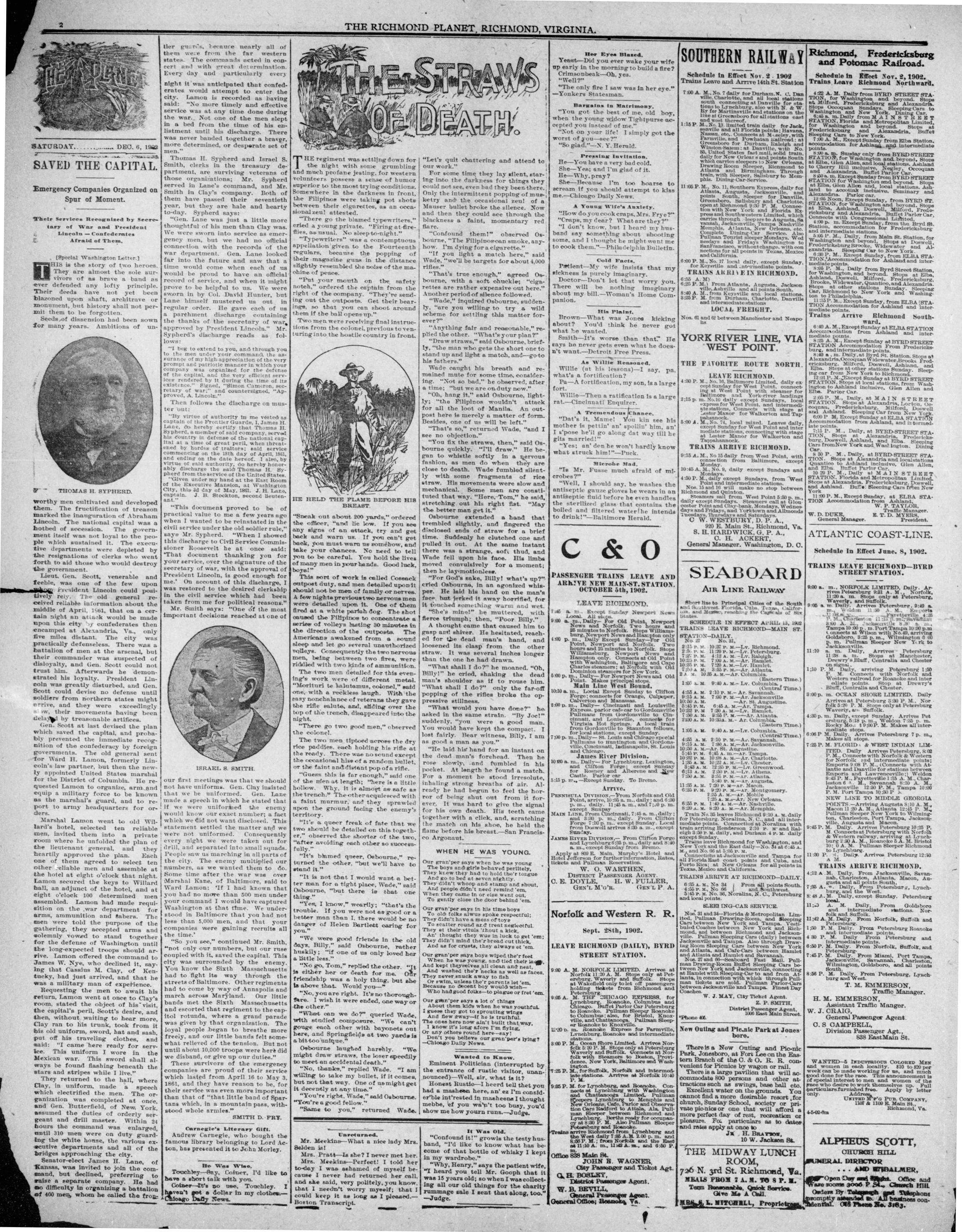
SAVED THE CAPITAL
Their Services Recognized by Secretary of War and President Lincoln - Confederates Afraid of Them.
THIS is the story of two heroes. They are almost the sole survivors of as brave a band as ever defended any lofty principle. Their deeds have not yet been blazoned upon shaft, architrave or monument, but history shall not permit them to be forgotten. Seeds of dissension had been sown for many years. Ambitions of un-
THOMAS H. SYPHERD.
worthy men cultivated and developed them. The fructification of treason marked the inauguration of Abraham Lincoln. The national capital was a hotbed of secession. The government itself was not loyal to the people which sustained it. The executive departments were depleted by the resignations of clerks who went forth to aid those who would destroy the government.
Lieut. Gen. Scott, venerable and feeble, was one of the few upon whom President Lincoln could positively rely. The old general received reliable information about the middle of April, 1561, that on a certain night an attack would be made upon this city by confederates then encamped at Alexandra, Va., only five miles distant. The city was practically defenseless. There was a battalion of men at the arsenal, but their commander was suspected of disloyalty, and Gen. Scott could not trust him. Afterwards he demonstrated his loyalty. President Lincoln was greatly disturbed, and Gen. Scott could devise no defense until soldiers from northern states might arrive, and they were exceedingly slow, their movements having been delayed by treasonable artifices.
Gen. Scott at last devised the plan which saved the capital, and probably prevented the immediate recognition of the confederacy by foreign governments. The old general sent for Ward H. Lamon, formerly Lincoln's law partner, but then the newly appointed United States marshal for the District of Columbia. He requested Lamon to organize, arm, and equip a military force to be known as the marshal's guard, and to report to army headquarters for orders.
Marshal Lamon went to old Willard's hotel, selected ten reliable men, invited them into a private room where he unfolded the plan of the lieutenant general, and they heartily approved the plan. Each one of them agreed to select ten other reliable men and assemble at the hotel at eight o'clock that night. Lamon secured the keys to Willard hall, an adjunct of the hotel, and at eight o'clock 100 determined men assembled. Lamon had made requisition on the war department for arms, ammunition and sabers. The men were told the purpose of the gathering, they accepted arms and solemnly vowed to stand together for the defense of Washington until the long-expected troops should arrive. Lamon offered the command to James W. Nye, who declined it, saying that Cassius M. Clay, of Kentucky, had just arrived, and that he was a military man of experience.
Requesting the men to await his return, Lamon went at once to Clay's room, stated the object of his visit, the capital's peril, Scott's desire, and then, without waiting to hear more, Clay ran to his trunk, took from it his old uniform, sword, hat and sash, put off his traveling clothes, and said: "I came here ready for service. This uniform I wore in the Mexican war. This sword shall always be found flashing beneath the stars and stripes while I live." They returned to the hall, where Clay, in uniform, made a speech which electrified the men. The organization was completed at once, and Gen. Butterfield, of New York, assumed the duties of orderly sergeant and drill master. Within 24 hours the command was enlarged, until 310 men were on duty guarding the white house, the various executive departments and all of the bridges approaching the city.
Senator-elect James H. Lane, of Kansas, was invited to join the command, but declined, preferring to raise a separate company. He had no difficulty in organizing a battalion of 400 men, whom he called the fron-
ther guards, because nearly all of them were from the far western states. The commands acted in concert and with great determination. Every day and particularly every night it was anticipated that confederates would attempt to enter the city. Lamon is recorded as having said: "No more timely and effective service was at any time done during the war." Not one of the men slept in a bed from the time of his enlistment until his discharge. There was never banded together a braver, more determined, or desperate set of men." Thomas H. Sypherd and Israel S. Smith, clerks in the treasury department, are surviving veterans of those organizations; Mr. Sypherd served in Lane's command, and Mr. Smith in Clay's company. Both of them have passed their seventieth year, but they are hale and hearty to-day. Sypherd says:
"Gen. Lane was just a little more thoughtful of his men than Clay was. We were sworn into service as emergency men, but we had no official connection with the records of the war department. Gen. Lane looked far into the future and saw that a time would come when each of us would be proud to have an official record of service, and when it might prove to be helpful to us. We were sworn in by Col. David Hunter, but Lane himself mustered us out, in regular order. He gave each of us a parchment discharge containing the thanks of the secretary of war approved by President Lincoln." Mr. Sypherd's discharge reads as follows:
"I beg to extend to you, and through you to the men under your command, the assurance of my high appreciation of the very prompt and patriotic manner in which your company was organized for the defense of our people, and the very efficient services rendered by it, the 18th existence." Signed, "Simon Cameron, secretary of war;" and counterstamped "Approved, A. Lincoln."
Then follows the discharge on muster out:
"By virtue of authority in me vested as captain of the Frontier Guards, I, James H. Lane, do hereby certify that Thomas H. Sypherd, a member of said company, served his country in defense of the national capital at a time of great peril, when threaten- ing, in May 18th, said service commencing on the 15th day, April and ending on the date hereof. I also, by virtue of said authority, do hereby honorably discharge the said Thomas H. Sypherd from the service of the United States.
Given under my hand at the East Room of the Mansion, at Washington City, this 2d day of May, 18th, J. H. Lane, captain. J. B. Stockton, second helen- ant."
"This document proved to be of practical value to me a few years ago when I wanted to be reinstated in the civil service under the old soldier rule," says Mr. Sypherd. "When I showed this discharge to Civil Service Commissioner Roosevelt he at once said: 'That document thanking you for your service, over the signature of the secretary of war, with the approval of President Lincoln, is good enough for me.' On account of this discharge, I was restored to the desired clerkship in the civil service which had been taken from me for political reasons."
Mr. Smith says: "One of the most important decisions reached at one of
ISRAEL S. SMITH.
our first meetings was that we should not have uniforms. Gen. Clay insisted that we be uniformed. Gen. Lane made a speech in which he stated that if we were uniformed the enemy would know our exact number; a fact which we did not want disclosed. This statement settled the matter and we were not uniformed. Consequently every night we were taken out for drill, and separated into small squads. People saw us marching in all parts of the city. The enemy multiplied our numbers, as we wanted them to do. Some time after the war was over Marshal Kane, of Baltimore, said to Ward Lamon: 'If I had known that you had no more than 500 men under your command I would have captured Washington at that time. We understood in Baltimore that you had not less than 5,000 men, and that your companies were gaining recruits all the time.'
"So you see," continued Mr. Smith, "not only our numbers, but our ruse coupled with it, saved the capital. This city was surrounded by the enemy. You know the Sixth Massachusetts had to fight its way through the streets of Baltimore. Other regiments had to come by way of Annapolis and march across Maryland. Our little bands met the Sixth Massachusetts and escorted that regiment to the capitol rotunda, where a grand parade was given by that organization. The loyal people began to breathe more freely, and our little bands felt somewhat relieved of the tension. But not until about 10,000 troops were herd did we disband, or give up our duties. These survivors of the emergency companies are proud of their service which lasted from April 16 to May 3, 1861, and they have reason to be, for their service was even more important than that of "that little band of Spartans which, in a mountain pass, withstood whole armies."
SMITH D. FRY.
Carnegie's Literary Gift.
Andrew Carnegie, who bought the famous library belonging to Lord Acton, has presented it to John Morley.
Be Wor Wise
Cother. It's no use. Touchley. I haven't got a dollar in my clothes.—Chicago Daily News.
THE RICHMOND PLANET, RICHMOND, VIRGINIA.
THE STRAWS OF DEATH.
Hee
Yeast—Did up early in the Crimsonbeard "Well?"
"The only f—Yonkers St.
Bargat
"You got t when the you cepted you in "Not on you worst of you "So glad."
THE regiment was settling down for the night with some grumbling and much profane jesting, for western volunteers possess a sense of humor superior to the most trying conditions. Somewhere in the darkness in front, the Filipinos were taking pot shots between their cigarettes, as an occasional zeal! attested.
"There go the blamed typewriters," cried a young private. "Firing at firefires, as usual. No sleep-to-night."
"Typewriters" was a contemptuous appellation given to the Fourteenth regulars, because the popping of their magazine guns in the distance slightly resembled the noise of the machine of peace.
"Put your mouth on the safety notch," ordered the captain from the right of the company. "They're sending out the outposts. Get their bearings, so that you can shoot around them if the ball opens up."
Two men were receiving final instructions from the colonel, previous to venturing into the hostile country in front.
HE HELD THE FLAME BEFORE HIS BREAST.
"Sneak out about 200 yards," ordered the officer, "and lie low. If you see any signs of an attack, try and get back and warn us. If you can't get back, you must warn us somehow, and take your chances. No need to tell you to be careful. You hold the lives of many men in your hands. Good luck, boys!"
This sort of work is called Cossack outpost duty, and men detailed upon it should not be men of family or nerves. A few nights previous two nervous men were detailed upon it. One of them fired at a white parah dog. The shot caused the Filipinos to concentrate a series of volleys lasting 30 minutes in the direction of the outposts. The Americans awakened from a sound sleep and let go several unauthorized volleys. Consequently the two nervous men, being between two fires, were riddled with two kinds of ammunition. The two men detailed for this evening's work were of different metal. "Morituri te kalutamus, colonel," said one, with a reckless laugh. With the easy nonchalance of veterans they gave the rifle salute, and, sliding over the top of the trench, disappeared into the night.
"There go two good men," observed the colonel.
The two men tipped across the dry rice paddies, each holding his rifle at the ready. There was no sound except the occasional hiss of a random bullet, or the faint and distant pop of a rifle.
"Guess this is far enough," said one of the men at length; "here is a little hollow. Why, it is almost as safe as the trench." The other acquiesced with a faint murmur, and they sprwled upon the ground facing the enemy's territory.
"It's a queer freak of fate that we two should be detailed on this together," observed the shorter of the two, "after avoiding each other so successfully."
"It's blamed queer, Osbourne," returned the other, "but we'll have to stand it."
"It is not that I would want a better man for a tight place, Wade," said Osbourne, "but there is that one thing."
"Yes, I know," wearly; "that's the trouble. If you were not as good or a better man than I there would be no danger of Helen Bartlett caring for you."
"We were good friends in the old days, Billy," said Osbourne, rather huskily; "if one of us only loved her a little less."
"No go, Tom," replied the other. "It is either her or death for me. Our friendship was a holy thing, but she is above that. Would you—"
"No, you are right. It's no thoroughfare. I wish it were ended, one way or the other."
"What can we do?" queried Wade, with studied composure. "We can't gouge each other with bayonets out here, and Springfields at two yards is a bit too unique."
Osbourne laughed harshly. "We might draw straws, the loser speedily to meet an accidental death."
"No, thanks," replied Wade. "I am willing to take my bullet, if it comes, but not that way. One of us might get it decently at any time."
"You're right, Wade," said Osbourne. "You're a good fellow."
"Same to you," returned Wade.
Unreturned
Mr. Meekins—What a nice lady Mrs. Selden is!
Mrs. Pratt—Is she? I never met her.
Mrs. Meekins—Perfect! I told her to-day I was ashamed of myself because I never had returned her call and she said, very politely, you know, that I needn't worry myself; that I could keep it as long as I pleased.
Boston Transcript.
"Let's quit chattering and attend to our work."
For some time they lay silent, staring into the darkness for things they could not see, even had they been there. Only the intermittent popping of musketry and the occasional zeal of a Mauser bullet broke the silence. Now and then they could see through the blackness a faint, momentary red flare.
"Confound them!" observed Osbourne, "The Filipinoscan smoke, anyhow. I'm dying for a cigarette."
"If you light a match here," said Wade, "we'll be targets for about 4,000 rifles."
"That's true enough," agreed Osbourne, with a soft chuckle; "cigarettes are rather expensive out here." Another period of silence followed.
"Wade," inquired Osbourne, suddenly, "are you willing to try a wild scheme for settling this matter forever?"
"Anything fair and reasonable," replied the other. "What's your plan?" "Draw straws," said Osbourne, briefly, "the man who gets the short one to stand up and light a match, and—go to his fathers." Wade caught his breath and remained mute for some time, considering. "Not so bad," he observed, after a time; "but we on duty now." "Oh, hang it," said Osbourne, lightly; "the Filipinos wouldn't attack for all the loot of Manila. An outpost here is merely a matter of form. Besides, one of us will be left." "That's so," returned Wade, "and I see no objection."
"You fix the straws, then," said Osbourne quickly. "Till draw." He began to whistle softly in a nervous fashion, as men do when they are close to death. Wade fumbled silently with some fragments of rice straw. His movements were slow and mechanical. Some men are constituted that way. "Here, Tom," he said, stretching out his first fist. "May the better man get it." Osbourne extended a hand that trembled slightly, and fingered the disclosed ends of straw for a brief time. Suddenly he clutched one and pulled it out. At the same instant there was a strange, soft thud, and Wade fell upon his face. His limbs moved convulsively for a moment; then he lay motionless.
"For God's sake, Billy! what's up?" cried Osbourne, in an agonized whisper. He laid his hand on the man's face but jerked it away horrified, for it touched something warm and wet. "She's mine!" he muttered, with fierce triumph; then, "Poor Billy." A thought came that caused him to gasp and shiver. He hesitated, reached for the dead man's hand, and loosened its clasp from the other straw. It was several inches longer than the one he had drawn.
"What shall I do?" he moaned, "Oh, Billy!" he cried, shaking the dead man's shoulder as if to rouse him. "What shall I do?" only the far-off popping of the rifles broke the oppressive stillness.
"What would you have done?" he asked in the same strain. "By Jo!" suddenly, "you were a good man. You would have kept the compact. I lost fairly. Bear witness, Billy, I am as good a man as you."
"He laid his hand for an instant on the dead man's forehead. Then he rose slowly, and fumbled in his pocket. At length he found a match. For a moment he stood irresolute, inhaling strong breaths of air. Already he had begun to feel the horror of being shut out from it forever. It was hard to give the signal for his own death. His teeth came together with a click, and, scratching the match on his shoe, he held the flame before his breast—San Francisco Argonaut.
WHEN HE WAS YOUNG.
Our gran'per says when he was young
The boys and girls behaved perilitly,
They knew they had to hold the'r tongue
And go to bed at seven nightly.
They tuck the'r arm up and shout.
And people didn't need 'mind' em.
When they came in or else went out,
To gently close the door behind 'em.
Our gran'per says in his time boys
To old folks alwus spoke respectful;
They didn't have a mess of toy
To scatter round and treat neglectful.
They et their vituls 'thou a kick,
An' thought they wus in luck to get 'em;
They didn't mind the'r bread cut thick,
And as for crusts, they always et 'em.
Our gran'per says boys wiped the'r feet
When he was young, snied their arm,
And kept themselves all clean and neat,
And washed the'r necks as well as faces,
Or swim, unless the'r parents let 'em.
Because no decent boy would wish-
Who had good folks to plague or fret 'em.
our 'say
Don't you believe our gerr's lying?
-Chicago Daily News.
Wanted to Know
Eminent Politician (interrupted by the entrance of rustic visitor, unannounced)—Well, sir, what is it? Honest Rusticio — Heard tell that you had a masheen here, an'zim I'm consider-ble int'rested in masheens I thought mebbe, if you won't too busy, you'd show me how yourn runs. — Judge
It Was Old.
"Confound it!" growls the testy husband, "I'd like to know what has become of that bottle of whisky I kept in my wardrobe."
"Why, Henry," says the patient wife, "I heard you tell Mr. Gooph that it was 15 years old; so when I was collecting all our old things for the charity rummage sale I sent that along, too."—Judge
Her Eyes Blazed
Yeast—Did you ever wake your wife
up early in the morning to build a fire?
Crimsonbeak—Oh, yes.
"Well?"
"The only fire I saw was in her eye."
—Yonkers Statesman.
Bargains in Matrimony.
"You got the best of me, old boy,
when the young widow Tightpurse accepted
you instead of me."
"Not on your life! I simply got the worst of you—see?"
"So glad."—N. Y. Herald.
Pressing Invitation
Pressing Invitation.
He—You have a very bad cold.
She—Yes; and I'm glad of it.
He—Why, pray?
She—Because I'm too hoarse to scream if you should attempt to kiss me.—Chicago Daily News.
A Young Wife's Anxiety.
"How do you cook craps, Mrs. Frye?" "Craps, my dear? What are they?"
"I don't know, but I heard you husband say something about shooting some, and I thought he might want me to cook them."—Philadelphia Bulletin
Cold Foots
Patient—My wife insists that my sickness is purely imaginary.
Doctor—Don't let that worry you.
There will be nothing imaginary about my bill—Woman's Home Companion.
His Plaint.
Brown—What was Jones kicking about? You'd think he never got what he wanted.
Smith—It's worse than that." He says he never gets even what he doesn't want.—Detroit Free Press.
As Willie Reseaned
Willie (at his lessons)—I say, pa,
what's a fortification?
Pa—A fortification, my son, is a large fort.
Willie—Then a ratification is a large rat—Cincinnati Enquirer.
A Tremendous Chance.
"Dat's it, Mame! You kin see his mother is pettin' an' spoilin' him, an'
I s'pose he'll go along dat way till he gits married!"
"Yes; an' den he won't hardly know what struck him!"—Puck.
Microbe Mad
"Is Mr. Fusse much afraid of microbes?" "Well, I should say, he washes the antiseptic gauze gloves he wears in an antiseptic fluid before he even handles the sterilized glass that contains the boiled and filtered water he intends to drink!"—Baltimore Herald.
C & O
PASSENGER TRAINS LEAVE AND ARKIVE NEW MAIN-ST. STATION. OCTOBER 5th, 1902.
LEAVE RICHMOND.
a. 5:00 a. Except Sunday Newport News
Local. All stops.
9:00 a. m., Daily. For Old Point, Newport
News and Norfolk. Two hours and
25 minutes to Norfolk. Stops Williams-
Burgh and
4:00 p. m., Daily Except Sunday. For Old
Point, Newport and Norfolk. Two hours and
25 minutes to Norfolk. Stops Williams-
Burgh and
Hampton only. Connects at Old Point
with Washington, Baltimore and Cape
Williamsburg and with Old
Dominion stations for New York.
5:00 p. m., Daily. For Newport News and Old
Point. Makes principal stops.
Main Line West Bound.
10:10 a. m., Daily. To Clifton Forge; connects for Orange, Calpure, Calverton and Manassas.
8:00 p. m., Daily. Cincinnati and Louisville
Forge; connects for Orange, Calpure, Calverton and Manassas.
8:00 p. m., Daily. Cincinnati and Louisville
Forge; connects for Orange, Calpure, Calverton and Manassas. Connects with
Virginia Hot Springs. A local train
from Fort Wayne follows,
for local stations, except Newport
7:30 p. m. Daily—St. Louis and Chicago special
Pullover to huntington and Gordon-
ville, Cincinnati, Indianapolis, St. Louis
and Chicago.
James River Division.
10.50 a. m. For Lynnburg, Lexington,
and Clifton Forge; except Sunday
for Rosney and Alberene and New
Castle. Parlor car
Arrive.
PENNISULA DIVISION — From Norfolk and Old
Point, arrive, 10; 35 a. m., daily; and 6; 30
p. m., daily; 11; 45 a. m., and 7; 0 p. m.
present. Support.
JAMES RIVER DIVISION — From Clifton Fores
and Lyndon B. Johnson Bldg. 8:30
and 8:40, on Sunday, from Brunswick
DISTRICT PASSENGER AGENT.
C. E. DOYLE,
GEN'L M'G'R.
H. W. FULLER,
GEN'L P. A.
Norfolk and Western R. R.
Norfolk and Western R. R.
LEAVE RICHMOND (DAILY), BYRD
STREET STATION.
9:00 A. M. NORFOLK LIMITED. Arrives at
Norfolk 11:30 A. M. Stops only at Petersburg, Waverly and Suffolk. Stops at Petersburg only to let off passengers holding tickets from Richmond and Petersburg.
9:05 A. M. THE CHICAGO EXPRESS, for Chicago, Buford, Columbus and Chicago, Buffet Parcher Car Petersburg to Roanoke. Pallman Sleeper Roanote to Columbus; also, for Bristol, Knoxville, and Chattanooga. Pallman Sleeper
8:30 P. M., Ocean Shore Limited. Arrives Norfolk
8:30 P. M. St. stops only at Petersburg
Washington, with the train to Petersburg
with Seamers to Boston, Providence, New York, Baltimore and Washington.
7:25 P. M., Suffolk, Norfolk and intermediate
stations. Arrives at Norfolk 10:40
P. M.
9:35 P. M. for Lynchburg, and Roanoke. Connects
at Lynchburg with Washington and
Seamers Lynchburg to Memphis and
New Orleans. Cafe, Parian and Observation
Cars Radford to Attain, Ala. Pullman,
Lynchburg, Berth ready for occupancy
at 8:30 P. M. Also Pullman Sleeper
Fotersburg and Roanoke.
Trains
8:30 daily 8:30 A. M. Lynchburg and
the West daily 8:30 A. M. p. m. and
8:30 P. M.; from Norfolk and the East
at 11:10 A. m. 11:49 A. m. and 6:50 P. M.
Offloe 888 Main St.
JOHN B. WAGNER,
City Passenger and Ticket Agt.
Q. H. BOSLEY,
District Passenger Agent.
W. B. BEVILL,
General Passenger Agent.
General Offloe; Boonoke Va.
SOUTHERN RAILWAY
Schedule In Effect Nov. 2, 1902
Trains Leave and Arrive 14th St. Station
7:00 A. M. No. 7 daily for Durham, N. C. Dan
south and Charlotte, and all local stations
south of Durham. Arrive at stations to
Lynchburg, also with N. & W.
Ry for Martinsville and stations on the
line at Greensboro for all stations east
and west.
1:15 P. M., No. 15 limited train daily for Jack
sonville and all Florida points: Havana,
Mississippi, and Connecticut at M.essey, with
Farmville and Fort Wayne at Farmville,
Greensboro for Durham, Raleigh and
Winston-Salem at Danville, with No.
15 United States fast mail, sold train
day, with New York and Philadelphia,
which carries sleeper to New Orleans.
Drawing Room Sleeper, Ricmond to
Atlanta and Birmingham. Through
travel with Durham to Memphis.
Dining-Car Service.
11:05 P. M., No. 11 Southern Express, daily for
Atlanta, Augusta, Jacksonville, and
points South, Sleeper for Danville
Greensboro, Salisbury and Charlotte,
through connection with New York and Florida
Express and Southwestern Limited, which
carries through sleeper to Angstua, Sa-
vannie, Jacksonville, Pampa Nashville,
Memphis, Atlanta, and complete Dining-Car Service.
Also Pullman Tourist sleeper Mondays. Wed-
days andidays Washington to
sandwiches, with sections for all points in Texas, Mexico
and California.
6:00 P. M., No. 17 local daily, except Sunday,
for Keysville and intermediate points.
TRAINS ARRIVE IN RICHMOND.
6:25 P. M.) From Atlanta, Augusta, Jackson
8:25 P. M.) From Atlanta, and all points south.
8:40 A. M. from Durham, Charlotte, Danville
8:25 P. M. from Durham, Charlotte, Danville
and intermediate stations
YORK RIVER LINE, VIA WEST POINT.
LEAVE RICHMOND.
4:30 P. M., No. 16, Baltimore Limited, daily except Sunday for West Point, connecting at West Point with steamer for Baltimore and York River landings
2:15 P. M., no. 16, Baltimore daily express for West Point, and intermediate stations, Connects with stage at Lester Manor for Walkout and Tap break.
5:00 A. M., No. 74, local mixed. Leaves daily except Sunday for West Point and intermediate stations, connecting with stage at Lester Manor for Walkout and Tap break.
TRAINS ARRIVE RICHMOND.
9:15 A. M. No 15 daily from West Point, with
departation from Baltimore, except
Monday.
10:45 A. M. No. 9, daily except Sundays and
Mondays.
4:50 P. M. daily except Sundays, from West
Point and intermediate stations.
No. 15 and 10 will make no stop between
Richmond.
Steamers sail from West Point 5:30 p. m. daily except Sundays. Steamers call at Gloucester Point and Yorktown, and Yorktown and Almonds Tuesday, Thursdays and Saturdays. C W. H. B. Richmond, C W. H. B. Richmond, 920 E. Main St., Richmond, Va. S. H. HARDWICK, G. P. A. C. H. ACKERT, General Manager, Washington, D. C.
SEABOARD AIR LINE RAILWAY
Short line to Principal Cities of the South and Southwest. Florida, Cuba, Texas, California, and Mississippi, reaching the Capitals of Six States.
SCHEDULE IN EFFECT APRIL 13, 1982
TRAINS LEAVE RICHMOND—MAIN ST.
STATION—DAILY.
No. 27
No. 31,
2:55 P. M. 10:37 P. M.—Lv. Richmond.
2:55 P. M. 11:29 P. M.—Lv. Petersburg.
2:55 P. M. 12:00 P. M.—Walch.
2:55 P. M. 7:50 A. M.—Ar. Hamlet.
10:35 P. M. 7:20 A. M.—Lv. Hamlet.
7:50 A. M. 3:55 P. M.—Ar. Atlanta.
2 A. M. 10:35 A. M.—Ar. Columbia.
1:05 A. M. 9:40 A. M.—Lv. Columbia.
(Eastern Time.)
4:55 A. M. 2:10 P. M.—Ar. Savannah.
9:15 A. M. 7:30 P. M.—Ar. Jacksonville.
10:50 A. M. —Ar. St. Augustine.
7:50 A. M. 6:45 P. M.—Appea.
10:32 P. M. 7:30 A. M.—Ar. Columbia.
7:50 A. M. 8:55 P. M. —Ar. Atlanta.
2:00 A. M. 10:34 A. M.—Ar. Columbia.
1:05 A. M. 9:40 A. M.—Lv. Columbia.
(Eastern Time.)
4:55 A. M. 2:10 P. M.—Ar. Savannah.
9:15 A. M. 7:30 P. M.—Ar. Jacksonville.
10:50 A. M. —Ar. St. Augustine.
5:45 P. M. 6:45 A. M.—Ar. Tampa.
10:32 P. M. 10:38 A. M.—Ar. Charlotte.
10:32 P. M. 10:38 A. M.—Ar. Charlotte.
8:48 A. M. 22:59 P. M.—Liv. Greenwood.
6:13 A. M. 2:50 P. M.—Lv. Athens.
7:50 A. M. 2:50 P. M.—Ar. Atlanta.
7:50 A. M. 2:50 P. M.—Ar. Atlanta.
11:35 A. M. 7:20 P. M.—Ar. Mason.
6:25 P. M. 9:20 P. M.—Ar. Montgomery.
6:25 P. M. 9:20 P. M.—Ar. Montgomery.
7:25 A. M.—Ar. New Orleans.
6:25 P. M. 1:40 A. M.—Ar. Nashville.
8:20 A. M. 8:20 A. M.—Ar. Memphis.
8:20 A. M. 8:20 A. M.—Ar. Memphis.
7:25 A. M.—Ar. New Orleans 9:10 A. M. daily for Petersburg, Norfolk, N. C. all inlate mediate points. Connection at Norfolk with train training Henderson 2:10 P. M. and Raleigh daily, and Durham 4 P. M. daily except Sunday.
Trains leave Richmond for Washington, and New York and the East daily-No. 14 at 6:45 A.M. Connections at Jacksonville and Tampa for all Florida East coast points and Cuba, and Porto Rica; at New Orleans for all points in Texas, Mexico and California.
TRAINS ARRIVE AT RICHMOND-DAILY.
6:35 A.M. No 34 From all points South.
4:55 P.M. No 66 And southwest.
4:55 P.M. No 98, Noralina, N.C., Petersburg and local points.
SLEEI ING-CAR SERVICE
Nos. 31 and 84- Florida & Metropolitan Limited, Pullman Drawing-Droom, and Sleeping Care between New York and Tampa. Vessel-built Coaches between New York and Richmond, and between Richmond and Jacksonville. Pullman Sleeping Cars (daily) between each facility and through Drawing Room Sleeping Cars between New York and Atlanta, and Cafe-Cars between Hamlet and Atlanta and Hamlet and Savannah. Pullman Hideouts are sold. Pullman Paper-Cars between New York and Jacksonville, connecting at Hamlet with Sleeping Car to and from Atlanta, in connection with which through Pullman Hideouts are sold. Pullman Paper-Cars between Jacksonville and Tampa. Finest Day Coaches.
W. J. MAY, City Ticket Agent.
Z. P. SMITH,
District Passenger Agent,
1006 East Main Street.
New Outing and Picnic Park at Jonesboro.
There is a New Outing and Picnic Park, Jonesboro, at Fort Lee on the Eastern Branch of the C. & O. R. R. convenient for Picnics by wagon or rail.
There is a large pavilion that will accommodate 800 persons and other attractions such as swings, base ball etc. Excellent water on the grounds. You cannot find a more desirable resort, for church, Sunday School, society or private picnics or one that will afford a more perfect day of rest, recreation or pleasure. For particulars as to dates and rates apply at once to
THE MIDWAY LUNCH ROOM,
726 N. 3rd St. Richmond, Va.
MEALS PROM 2 A. M. TO 8 P. M.
Terms Reasonable, Quick Service.
Give Me A Call.
Richmond, Fredericksburg and Potomac Railroad.
5:36 P. M., Daily, from Main St. Station, for Washington and beyond, Stops at Doswell, Fredericksburg Brooke, Wideline and Alameda, Sleeping Car to New York. 6:30 P. M., except Sunday from ELBA STATION, Accommodation for Ashland and intermediate points.
8:05 P. M., Daily from Byrd Street Station,
for Washington, and beyond. Stops at Elba,
Broadway, and Hawthorn. Fredericksburg,
Brooklyn, Wide Way, Alexandria.
Stops at other stations Sunday.
Car, Richmond to New York and Washington,
Philadelphia.
11:35 P. M., Sunday, from ELBA [STATION Accommodation for Ashland and intermediate points].
Trains Arrive Richmond South-
ward.
6:40 A.M. Except Sunday at ELBA STATION
Accommodation from Ashland and inter-
med colleges
11:00 P. M., Except Sunday, at ELBA STATION. Accommodation from: Ashland.
ATLANTIC COAST-LINE
Schedule In Effect June. 8, 1902.
TRAINS LEAVE RICHMOND—BYRD
STREET STATION.
9:00 a. m. NORPOLK LIMITED. Daily. Arrives Petersburg 9:31 A. M. m. Norfolk, 11:30 a. m. only at Petersburg, Worcester, and Suffolk.
9:05 a. m. Daily. Arrives Petersburg, 9:40 a. m. Weldon 11:30 A. M. Emporia, 11:30 a. m. Avggetvigel, 4:30 P. M. Charleston 11:30 a. m. 8:00 a. M. Jacksonville 8:00 a. m. Tampa 10:30 p. m. Port Tampa 10:30 p. m. connects with No.40, arriving 6:00 p. m. Baskerville 8:25 p. m. Pullman Sheeper New York to Jacksonville.
11:10 a. m. Daily. Arrives Petersburg 11:30 a. m. Stops at Manchester, Drewry's Bluff, Centralia and Chester on signal.
1:10 P. M. Daily. arrives Petersburg 1:50 P. M. County with North Western railroad for Roanoke and inter ediate points. Stop at Drewry's Bluff, Centralia and Chester.
3:00 p. m. OCEAN SHORE LIMITED. Daily arrives at Petersburg 3:30 P. M. Norfolk 3:20 P. M. Stops only at Petersburg.
4:30 p. m. Daily. except Sunday. Arrives Petrsburg, 5:18 p. m. Weldon 7:35 p. m. Rocky Mount t 9:00 P. M. Makes all inter ediate points.
6:00 P. M. Daily. arrives Petersburg 7 p. m. Makes all stops.
7:25 P. M. FLORIDI & WEST INDIAN LIMITED. Daily Arrives Petersburg, 8:02 P. M. Connects with Norfolk & Western North Carolina, Empronta 9:48 P. M. Connects with Atlantic and Danville for stations between Empronta and Lawrenceville); Weldon 9:48 P. M. Connects with Jacksonville 6 A. M. Savannah 8:10 A. M. Jacksonville 12:50 P. M. Tampa 10:30 P. M. Port Tampa 10:30 P. A.
NEW LINE TO MIDDLE GEORGIA POINTS—Arriving Angstua 8:10 A. M. Mackenzie 10:30 P. M. Pullman Sleeper New York to Wilmington, Charleston, Port Tampa, Jacksonville, Augstua and Macon.
9:45 P. M. Daily. Arrives Petersburg 10:25 P. M. Daily. Arrives Western Railway, arriving at Lynchburg 2:30 A. M. Roanoke 5 A. M. Bristol 10: 0 A. M. Pullman Sleeper Richmond to Lynchburg.
11:30 P. M. Daily. Arrives Petersburg 12:10 A. M.
TRAINS ARRIVE RICHMOND.
4:12 A. M. Daily. From Jacksonville, Savannah, Charleston, Atlanta, Macon, Augusta and all points South.
7:35 A. W. Daily, From Petersburg, Lynch,
8:48 A. W. Daily, except Sunday, Petersburg
local.
11:30 A. M. Daily, From Goldsboro
and intermediate stations, Norfolk and Suffolk.
11:42 A. M. From Norfolk, Suffolk and
Petersburg.
6:50 P. M. Daily From Norfolk, Suffolk, and Petersburg.
7:45 P. M. Daily. From Miami, Port Tampa, Wisconsin, Savannah, Charleston, Wilmington, Goldsboro, and all points South.
8:56 P. M. Daily. From Petersburg, Lynchburg and West.
T. M. EMMERSON,
Traffic Manager.
H. M. EMMERSON,
Assistant Traffic Manger.
W. J. CRAIG,
General Passenger Agent.
C. S. CAMPBELL,
Division Passenger Agt.,
838 East Main St.
WANTED-5 INDUSTRIES COLORED MEN
and women in each locality. $10 to $20 per
work done for the new. This announcement is
of special interest to men and women of the
face who desire to work themselves up. Full
particulars furnished free. Apply by letter
only.
UNITED M. F. O. PUB. COMPANY,
1107 & 1108 E. Main St.
Richmond, Va.
ALPHEUS SCOTT,
CHURCH HILL
MINERAL DIRECTOR
... AND ETHALMER,
Open Day and Night. Office and
Ware rooms 3000 P. St., Church Hill
Orders By Telephone and Telephons
promptly attended to. All business con-
dential. 08 Phone No. 3163.
キョウジ
I cannot consciously say that this information, though broken to my uncle by me with bated breath, occasioned him any surprise. Something very like a look of inward comprehension flew from his eyes to mine, and I read there a decided confirmation of my worst fears.
"Humph!" he muttered. "I expected as much. Let us make inquiries."
We accordingly went to the office and there learned that Mr. Wentworth had left during the dinner hour. In reply to a further inquiry we were informed that a telegram had been delivered to him during mealtime. But to the individual in charge this meant nothing. People were always coming and going. To us, however, it had a fuller significance. Why had that young gentleman left so hastily?
"I think I should like to look at the room," said my uncle as we turned away. "Let us go up stairs."
On reaching our floor we rang for the chambermaid and by her were admitted to the room which had lately been occupied by Mr. Wentworth, but a minute examination disclosed no clew to the antecedents of that young gentleman. The girl regarded my uncle with a half curious, half superior smile of astonishment as he peered here and there, but her look was strangest of all as I pointed to the bullet splash on the wall.
"Law," she gasped, "how did that happen?"
I told her, and asked if nothing had been heard of the report.
"Nothing," she answered. "But I don't understand it."
"Nor I. But there is the proof."
Here my uncle, who had been closely examining the mark, turned and said: "I can't find the bullet, Davie. It has been extracted."
It was true, but why I could not imagine. Jim shook his head sagely.
"The police have a way of following up slender claws," he said. "No doubt the person who extracted this bullet had a very good reason."
The next morning at breakfast my uncle, who was an insatiable reader of the newspapers, stopped suddenly in the midst of a perusal of his favorite journal (we all have one) and looked me blankly in the face. "Davie," he muttered below his breath, "the devils have been at it again."
My heart seemed suddenly to turn cold, for I knew to whom he referred.
"What is it? What has happened now?"
For reply he handed me the paper, pointing with his forefinger to a heading in large type. It ran thus: "Tragedy In a West End Hotel. Murder or Suicide?" A mist seemed to swim before my eyes. I was almost afraid to read. Then I pulled myself together, my brain, with strange insistence, assuring me of the fact that it could not refer to any one who was dear to me because, with the exception of my uncle, there was no one in the world I loved. Not that I was too selfish to love, but my destiny had not given me a choice of friends.
Looking down the column I saw that a man had been found dead in his room at the Victoria hotel. His breast had been pierced by a dagger, and the weapon itself, a curiously wrought piece of eastern workmanship, probably Malay or Chinese, was now in the hands of the police. The gentleman, it seems, who had registered in the visitors' book as Mr. Charles Hilbury of Melbourne had but lately arrived in this country with his wife and daughter, both of whom were naturally prostrated with grief. The report went on to say: "No cause is assigned for the deed—if it be one of suicide, as the officials seem inclined to believe—as the gentleman was supposed to be in comfortable circumstances. This fact renders the mystery still more incomprehensible." Then followed a description of the man and the manner in which he was discovered. A couple of lines in connection with his personal appearance burnt themselves into my brain: "On the deceased gentleman's forehead there is a strange elliptical mark, which is evidently the result of some former accident."
I dropped the paper with the one word, "The Sign!"
"Yes."
Our further attempts at eating were a hollow mockery. After a few ineffectual efforts I abandoned even the pretense. My uncle drank copiously of his coffee and turned once more to the news sheet. The food lay untouched before him. When he looked at me again, the trouble had settled deeper on his brow.
"What do you make of it?" I said, more by way of breaking the ominous silence than the expectation of gaining a new idea; for in my mind I had already sketched a vivid outline of the unhappy man's career. Needless to say we did not entertain the thought of suicide.
"It is evident," was the reply, "that this unfortunate Mr. Hilbury had, like ourselves, run counter to the society. How, or in what way, remains to be seen. Perhaps he may even have been an associate of your father. We shall see later on." He folded his paper preparatory to
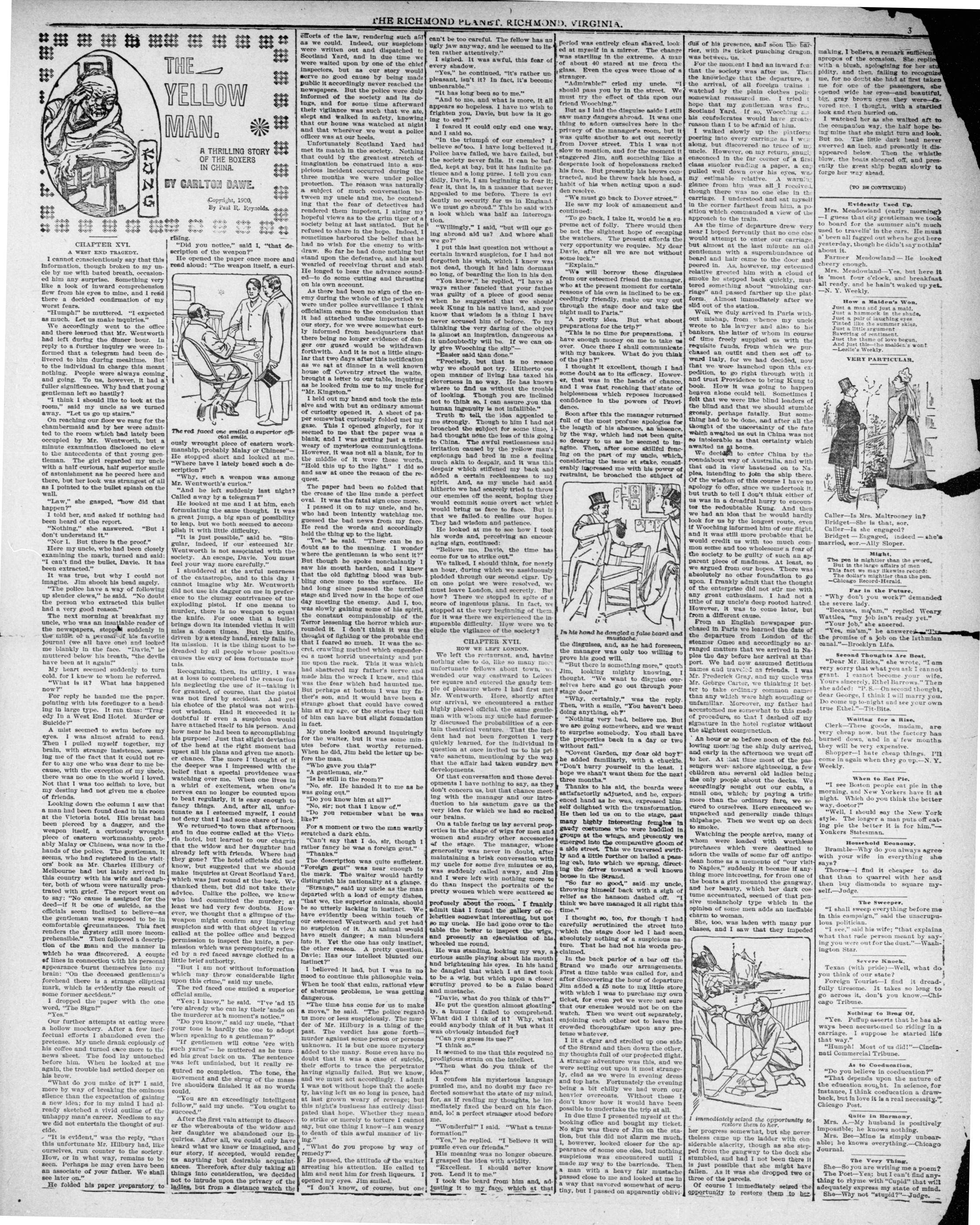
THE YELLOW MAN.
A THRILLING STORY
OF THE BOXERS
IN CHINA.
BY CARLTON DAWE.
rising.
"Did you notice," said I, "that description of the weapon?"
He opened the paper once more and read aloud: "The weapon itself, a curi-
The red faced one smiled a superior official smile.
ously wrought piece of eastern workmanship, probably Malay or Chinese”—He stopped short and looked at me. “Where have I lately heard such a description?” “Why, such a weapon was among Mr. Wentworth's curtos.” “And he left suddenly last night? Called away by a telegram”
He looked at me and I at him, each formulating the same thought. It was a great jump, a big span of possibility to leap, but we both seemed to accomplish it with little difficulty.
"It is just possible," sald he. "Singular, indeed, if our esteemed Mr. Wentworth is not associated with the society. An escape, Davie. You must feel your way more carefully."
I shuddered at the awful nearness of the catastrophe, and to this day I cannot imagine why Mr. Wentworth did not use his dagger on me in preference to the clumsy contrivance of the exploding pistol. If one means to murder, there is no weapon to equal the knife. For once that a bullet brings down its intended victim it will miss a dozen times. But the knife, driven by a steady hand, rarely falls in its mission. It is the thing most to be dreaded by all people whose position causes the envy of less fortunate mortals.
Recognizing, then, its utility. I was at a loss to comprehend the reason for his neglecting the use of it—taking it for granted, of course, that the pistol was not fired by accident. And yet his choice of the pistol was not without wisdom. Had it succeeded it is doubtful if even a suspicion would have attached itself to his person. And how near he had been to accomplishing his purpose! Just that slight deviation of the head at the right moment had upset all his plans and given me another chance. The more I thought of it the deeper was I impressed with the belief that a special providence was watching over me. When one lives in a whirl of excitement, when one's nerves can no longer be counted upon to beat regularly, it is easy enough to fancy things. And, after all, unfortunate as I esteemed myself, I could not deny that I had some share of look
We returned to town that afternoon and in due course called at the Victoria hotel, but learned to our chagrin that the widow and her daughter had already left with friends. Where had they gone? The hotel officials did not know, but suggested that we should make inquiries at Great Scotland Yard, which was just round at the back. We thanked them, but did not take their advice. Unlike the police, we knew who had committed the murder; at least we had very few doubts. However, we thought that a glimpse of the weapon might confirm any lingering suspicion and with that object in view called at the police office and begged permission to inspect the knife, a permission which was peremptorily refused by a red faced savage clothed in a little brief authority.
"But I am not without information which may throw considerable light upon this crime," said my uncle.
The red faced one smiled a superior official smile.
"Yes; I know," he said. "I've 'ad 15 'ere already who can lay their 'ands on the murderer at a moment's notice."
"Do you know," said my uncle, "that your tone is hardly the one to adopt when speaking to a gentleman?"
"If gentlemen will come 'ere with such yarn"—he muttered as he turned his great back on us. The sentence was left unfinished, but it really required no completion. The tone, the movement and the shrug of the massive shoulders finished it as no words could.
"You are an exceedingly intelligent fellow," said my uncle. "You ought to succeed."
After the first vain attempt to discover the whereabouts of the widow and her daughter we abandoned our inquiries. After all, we could only have heard what we knew or imagined, and our story, if accepted, would render us anything but desirable acquaintances. Therefore, after duly taking all things into consideration, we decided not to intrude upon the privacy of the ladies, but from a distance watch the
THE RICHMOND PLANET, RICHMOND, VIRGINIA.
efforts of the law, rendering such aid as we could. Indeed, our suspicions were written out and dispatched to Scotland Yard, and in due time we were waited upon by one of the chief inspectors, but as our story would serve no good cause by being made public it accordingly never reached the newspapers. But the police were duly informed of the society and its doings, and for some time afterward their vigilance was such that we ate, slept and walked in safety, knowing that our house was watched at night and that wherever we went a police officer was at our heels.
Unfortunately Scotland Yard had met its match in the society. Nothing that could by the greatest stretch of imagination be construed into a suspicious incident occurred during the three months we were under police protection. The reason was naturally a subject of much conversation between my uncle and me, he contending that the fear of detectives had rendered them impotent. I airing my hopeful views as to the grim tiger of a society being at last satiated. But he refused to share in the hope. Indeed, I sometimes harbored the belief that he had no wish for the enemy to withdraw. So far he had done nothing but stand upon the defensive, and his soul weared of receiving thrust and stab. He longed to hear the advance sounded—to do some cutting and thrusting on his own account.
As there had been no sign of the enemy during the whole of the period we were under police surveillance I think officialism came to the conclusion that it had attached undue importance to our story, for we were somewhat curtly informed from headquarters that there being no longer evidence of danger our guard would be withdrawn forthwith. And it is not a little singular that two days after this notification as we sat at dinner in a well known house off Coventry street the waite, brought a letter to our table, inquiring as he looked from me to my uncle for "Mr. Kingston."
I held out my hand and took the missive and with but an ordinary amount of curiosity opened it. A sheet of paper somewhat curiously folded met my gaze. This I opened gingerly, for it seemed to me that the paper was a blank, and I was getting just a trifle weary of mysterious communications. However, it was not all a blank, for in the middle of it were these words, "Hold this up to the light." I did so and saw at once the reason of the request.
The paper had been so folded that the crease of the line made a perfect oval. It was the fatal sign once more.
I passed it on to my uncle, and he, who had been intently watching me, guessed the bad news from my face. He read the words and accordingly held the thing up to the light.
"Yes," be said. "There can be no doubt as to the meaning. I wonder where the gentleman is who sent it?" But though he spoke nonchalantly I saw his mouth harden, and I knew that the old fighting blood was bubbling once more to the surface. He had long since passed the terrified stage and lived now in the hope of one day meeting the enemy. And I, too, was slowly gaining some of his spirit, the constant companionship of the Terror lessening the horror which surrounded it. I don't think it was the thought of fighting or the probable end that I feared so much. It was the secret, crawling method which engendered a most horrid uncertainty and put me upon the rack. This it was which had shattered my father's nerve and made him the wreck I knew, and this was the fear which had haunted me. But perhaps at bottom I was my father's son, and it would have been a strange ghost that could have cowed him at my age, or the stories they tell of him can have but slight foundation in fact.
My uncle looked around inquiringly for the waiter, but it was some minutes before that worthy returned. When he did, Jim held the letter up before the man.
"Who gave you this?"
"A gentleman, sir."
"Is he still in the room?"
"No, str. He handed it to me as he was going out."
"Do you know him at all?"
"No, str; not that I know of."
"Do you remember what he was like?"
For a moment or two the man warily scratched a dark chin.
"Can't say that I do, str, though I rather fancy he was a foreign gent."
"Thanks."
The description was quite sufficient.
"Foreign gent" was near enough to the mark. The waiter would hardly distinguish his nationality at a glance.
"Strange," said my uncle as the man departed with a load of empty dishes, "that we, the superior animals, should be so utterly lacking in instinct. We have evidently been within touch of our esteemed Wentworth and yet had no suspicion of it. An animal would have smelt danger; a man blunders into it. Yet the one has only instinct, the other reason. A pretty question, Davie: Has our intellect blunted our instinct?"
I believed it had, but I was in no mood to continue this philosophic vein. When he took that calm, rational view of abstruse problems, he was getting dangerous.
"The time has come for us to make a move," he said. "The police regard us more or less suspiciously. The murder of Mr. Hilbury is a thing of the past. The verdict has gone forth—murder against some person or persons unknown. It is but one more mystery added to the many. Some even have no doubt that it was a case of suicide, their efforts to trace the perpetrator having signally failed. But we know, and we must act accordingly. I admit I was not without hope that the society, having left us so long in peace, had at last grown weary of revenge; but this night's business has entirely dissipated that hope. Whether they mean to strike or merely to torture I cannot say, but one thing I know—I am weary to death of this awful manner of living."
"What do you propose by way of remedy?"
He paused, the attitude of the waiter arresting his attention. He called to him and sent him for fresh liqueurs. I opened my eyes. Jim smiled.
"I don't know of course, but one
can't be too careful. The fellow has an ugly jaw anyway, and he seemed to listen rather attentively." I sighed. It was awful, this fear of every shadow. "Yes," he continued, "it's rather unpleasant, isn't it? In fact, it's become unbearable."
"It has long been so to me."
"And to me, and what is more, it all appears so hopeless. I have no wish to frighten you, Davie, but how is it going to end?"
I feared it could only end one way, and I said so.
"In the triumph of our enemies? I believe so'toow. I have long believed it. Police have failed, we have failed, but the society never falls. It can be baffled, kept at bay, but it has infinite patience and a long purse. I tell you candidly, Davie, I am beginning to fear it; fear it, that is, in a manner that never appealed to me before. There is evidently no security for us in England. We must go abroad." This he said with a look which was half an interrogation.
"Willingly." I said, "but will our going abroad aid us? And where shall we go?"
I put this last question not without a certain inward suspicion, for I had not forgotten his wish, which I knew was not dead, though it had lain dormant so long, of bearding the lion in his den. "You know," he replied, "I have always rather fancied that your father was guilty of a piece of good sense when he suggested that we should seek Kung in his native land, and you know that wisdom is a thing I have never accused him of before. To my thinking the very daring of the object is almost an inspiration, dangerous as it undoubtedly will be. If we can only give Wooching the slip"—"Easter said than done." "Precisely, but that is no reason why we should not try. Hitherto our open manner of living has taxed his cleverness in no way. He has known where to find us without the trouble of looking. Though you are inclined not to think so, I can assure you that human ingenuity is not infallible."
Truth to tell, the idea appealed to me strongly. Though to him I had not broached the subject for some time, I had thought none the less of this going to China. The awful restlessness and irritation caused by the yellow man's espionage had bred in me a feeling much akin to despair, and it was this despair which stiffened my back and added a certain recklessness to my spirit. And, as my uncle had said, hitherto we had scarcely to throw our enemies off the scent, hoping they would commit some overt act which would bring us face to face. But in that we failed to realize our hopes. They had wisdom and patience.
He looked at me to see how I took his words and perceiving an encouraging sign, continued:
"Belleve me, Davie, the time has come for us to strike out."
We talked, I should think, for nearly an hour, during which we assiduously plodded through our second cigar. Upon one point we were resolved, we must leave London, and secretly. But how? There we stopped in spite of a score of ingenious plans. In fact, we stopped at the very beginning of them, for it was there we experienced the superable difficulty. How were we to elude the vigilance of the society?
CHAPTER XVII.
We left the restaurant, and, having nothing else to do, like so many more unfortunate fellows about town, we wended our way eastward to Leices terra square and entered the gaudy temple of pleasure where I had first met Mr. Wentworth. Here, shortly after our arrival, we encountered a rather highly placed official, the same gentleman with whom my uncle had formerly discussed the probabilities of a certain theatrical venture. That the incident had not been forgotten I very quickly learned, for the individual in question at once invited us to his private sanctum, mentioning by the way that the affair had taken sundry new developments.
Of that conversation and those developments I have nothing to say, as they don't concern us, but that chance meeting with the manager and our introduction to his sanctum gave us the very idea for which we had so racked our brains.
On a table facing us hiy several properties in the shape of wigs for men and women and sundry other accessories of the stage. The manager, whose generosity was never in doubt, after maintaining a brisk conversation with my uncle for some five minutes or so, was suddenly called away, and Jim and I were left with nothing more to do than inspect the portraits of the pretty women which were scattered so profusely about the room. I frankly admit that I found the gallery of celebrities somewhat interesting, but not so my uncle. He had gone over to the table the better to inspect the wigs, and presently an ejaculation of his wheeled me round.
He was standing, looking my way, a curious smile playing about his mouth and brightening his eyes. In his hand he dangled that which I at first took to be a wig, but which upon a closer scrutiny proved to be a false beard and mustache.
"Davie, what do you think of this?"
He put the question almost gloatingly, a humor I failed to comprehend. What did I think of it? Why, what could anybody think of it but what it was obviously intended for?
"Can you guess its use?"
"I think so."
It seemed to me that this required no prodigious strain on the intellect. "Then what do you think of the idea?"
I confess his mysterious language puzzled me, and no doubt my face reflected somewhat the state of my mind, for, as if reading my thoughts, he immediately fixed the beard on his face, and lo, a perfect stranger stood before me.
"Wonderful!" I said. "What a transformation!"
"Yes," he replied. "I believe it will puzzle even our friends."
His meaning was no longer obscure. I grasped the idea with avidity.
"Excellent." I should never hear
"Excellent. I should never know you. Lend it to me."
I took the beard from him and, adjusting it to my face, which at that
period was entirely clean shaved, looked at myself in a mirror. The change was startling in the extreme. A man of about 40 stared at me from the glass. Even the eyes were those of a stranger.
"Admirable!" cried my uncle. "I should pass you by the street. We must try the effect of this upon our friend Wooching."
But as I laid the disguise aside I still saw many dangers abroad. It was one thing to adorn ourselves here in the privacy of the manager's room, but it was quite another to set out secretly from Dover street. This I was not slow to mention, and for the moment it staggered Jim, and something like a desperate look of hopelessness racked his face. But presently his brows contracted, and he threw back his head, a habit of his when acting upon a sudden resolve.
"We must go back to Dover street."
He saw my look of amazement and continued:
"To go back, I take it, would be a supreme act of folly. There would then be not the slightest hope of escaping the watchers. The present affords the very opportunity we require. My dear Davie, after all we are not without some luck."
"Explain."
"We will borrow these disguses from our esteemed friend the manager, who at the present moment for certain reasons of his own is inclined to be exceedingly friendly, make our way out through the stage door and take the night mail to Paris."
"A pretty idea. But what about preparations for the trip?
"This is no time for preparations. I have enough money on me to take us over. Once there I shall communicate with my bankers. What do you think of the plan?"
I thought it excellent, though I had some doubt as to its efficacy. However, that was in the hands of chance, and I was fast reaching that state of helplessness which reposes increased confidence in the powers of Providence.
Soon after this the manager returned full of the most profuse apologies for the length of his absence, an absence, by the way, which had not been quite so dreary to us as he seemed to imagine. Then, after some skillful fencing on the part of my uncle, which considering the issue at stake, considerably impressed me with his power of restraint, he braced the subject of
In his hand he dangled a false beard and mustache.
the disguises, and, as he had foreseen, the manager was only too willing to prove his good will.
"But there is something more," quoth Jim, looking mighty knowing, I thought. "We want to disguise ourselves here and go out through your stage door."
"Why, certainly," was the reply. Then, with a smile, "You haven't been doing anything, eh?" "Nothing very bad, believe me. But we are going somewhere, and we want to surprise somebody. You shall have the properties back in a day or two without fall."
"Covent Garden, my dear old boy!" he added familiarly, with a chuckle. "Don't hurry yourself in the least. I hope we shan't want them for the next three months."
Thanks to his aid, the beards were satisfactorily adjusted, and he, experienced hand as he was, expressed himself delighted with the transformation. He then led us on to the stage, past many highly interesting fences in gaudy costumes who were huddled in groups at the wings, and presently we emerged into the comparative gloom of a side street. This we traversed swiftly and a little further on hailed a passing cab, into which we sprang, directing the driver toward a well known house in the Strand.
"So far so good," said my uncle, throwing himself back with a sigh of relief as the hansom dashed off. "I think we have managed it all right this time."
I thought so, too, for though I had carefully scrutinized the street into which the stage door led I had seen absolutely nothing of a suspicious nature. That he had not his words proclaimed.
In the back parlor of a bar off the Strand we made our arrangements. First a time table was called for, and after discovering the hour of departure Jim added a 15 note to my little store with which I was to purchase my own ticket, for even yet we were not sure that our enemies would not be on the watch. Then we went out separately, enjoining each other not to leave the crowded thoroughfare upon any pretense whatever.
I lit a cigar and strolled up one side of the Strand and then down the other, my thoughts full of our projected flight. A strange adventure was this, and we were setting out upon it most strangely, clad as we were in evening dress and top hats. Fortunately the evening being a bit chilly we had worn our heavier overcoats. Without these I don't know how it would have been possible to undertake the trip at all.
In due time I presented myself at the booking office and bought my ticket. No sign was there of Jim on the station, but this did not alarm me much. I, however, looked closer for the appearance of some one else, but nothing suspicious was encountered until I made my way to the barricade. Then a man with a heavy fair mustache passed close to me and looked at me in a way that savored somewhat of scrutiny, but I passed on apparently obliqu-
out of his presence, and soon the barrier, with its ticket punching dragon, was between us.
For the moment I had an inward fear that the society was after us. Then the knowledge that the departure, as the arrival, of all foreign trains watched by the plain clothes police somewhat reassured me. I tried to hope that my gentleman was from Scotland Yard. If so, Wooching and his confederates would have greater reason than I to be afraid of him.
I walked slowly up the platform peering into every carriage as I woke along, but discovered no trace of my uncle. However, on my return, snugly enclosed in the far corner of a first class smoker reading a paper, a cap pulled well down over his eyes, was my estimable relative. A warning glance from him was all I received though there was no one else in the carriage. I understood and sat myself in the corner farthest from him, a position which commanded a view of the approach to the train.
As the time of departure drew very near I hoped fervently that no one else would attempt to enter our carriage, but almost at the last minute an old gentleman with a superabundance of beard and hair came to the door and peered in. As, however, my esteemed relative greeted him with a cloud of smoke he stepped back quickly, muttered something about "smoking carriage" and passed farther up the platform. Almost immediately after we slid out of the station.
Well, we duly arrived in Paris without mishap, from whence my uncle wrote to his lawyer and also to his bankers, the latter of whom in course of time freely supplied us with the requisite funds, from which we purchased an outfit and then set off toward Italy, for we had decided, now that we were launched upon this expedition, to go right through with it and trust Providence to bring Kung to book. How it was going to happen heaven alone could tell. Sometimes I felt that we were like blind leaders of the blind and that we should stumble grossly, perhaps fatally. But something had to be done, and after all the thought of the uncertainty of the fate which awaited us out in China was not so intolerable as that certainty which awaited us at home.
We decided to enter China by the roundabout way of Australia, and with that end in view hastened on to Naples, intending to join the ship there. Of the wisdom of this course I have no apology to offer, since we undertook it, but truth to tell I don't think either of us was in a dreadful hurry to encounter the redoubtable Kung. And then we had an idea that he would hardly look for us by the longest route, even if Wooching informed him of our flight, and it was still more probable that he would credit us with too much common sense and too wholesome a fear of the society to be guilty of such an apparent piece of madness. At least, so we argued from our hopes. There was absolutely no other foundation to go upon. I frankly admit that the thought of the enterprise did not stir me with any great enthusiasm. I had not a title of my uncle's deep rooted hatred. However, it was to come later, but from a different cause.
From an English newspaper purchased in Paris we learned the date of the departure from London of the steamer Omee and accordingly so arranged matters that we arrived in Naples the day before her arrival at that port. We had now assumed fictitious names and traveled as friends. I was Mr. Frederick Gray, and my uncle was Mr. Gebrge Carter, we thinking it better to take ordinary common names than any which were high sounding or unfamiliar. Moreover, my father had accustomed me somewhat to this mode of procedure, so that I deshed off my signature in the hotel register without the slightest compunction.
An hour or so before noon of the following morning the ship duly arrived, and early in the afternoon we went off to her. At that time most of the passengers were ashore sightseeing, a few children and several old ladies being the only people about the decks. We accordingly sought out our cabin, a small one, which; by paying a trifle more than the ordinary fare, we secured to ourselves. Here ensconced we unpacked and generally made things shipshape. Then we went up on deck to smoke.
Watching the people arrive, many of whom were loaded with worthless purchases which were destined to adorn the walls of some far off antipodean home as a memento of "our visit to Naples," suddenly it became if anything more interesting, for from one of the boats a girl mounted the gangway, and her beauty, which her dark costume accentuated, seemed of that pensive melancholy type which in the opinion of some men adds an ineffable charm to woman.
She, too, was laden with many purchases, and I saw that they impeded
A man kneeling on the ground, reaching out to a woman standing behind him. The woman is facing the man, and they are both looking at a ship in the background.
I immediately seized the opportunity to restore them to her.
her progress somewhat, but she nevertheless came up the ladder with considerable alacrity, though as she stepped from the gangway to the dock she stumbled, and had I not been there it is just possible that she might have fallen. As it was she dropped two or three of the parcels.
Of course I immediately seized the opportunity to restore them to her.
making, I believe, a remark sufficient apropos of the occasion. She replies with a blush, apologizing for her stupidity, and then, falling to recognize me, for no doubt she had at first taken me for one of the passengers, she opened wide her eyes—and beautiful, big, brown eyes they were-favored me. I thought, with a startled look and then hurried on.
I watched her as she walked aft to the companion way, the half hope being mine that she might turn and look. But no. The little dark head never swerved an inch, and presently it disappeared below. Then the whistle blow, the boots sheered off, and presently the great ship began slowly to forge her way ahead.
(TO BE CONTINUED)
Evidently Used Up.
Mrs. Meadowland (early morning)
—I guess that city gentleman we took to board for the summer ain't much used to travelin' in the cars. He must a' been all fagged out when he got here yesterday, though he didn't say nothin' about it.
Farmer Meadowland—He looked cheery enough.
Mrs. Meadowland—Yes, but here it is 'most four o'clock, and breakfast all ready, and he hain't waked up yet.
—N. Y. Weekly.
How a Maiden's Won.
Just a man and just a maid.
Just a hammock in the shade.
Just a pair of laughing eyes.
Tinted like the summer skies.
Just a little argument.
Savoring of sentiment.
Just the theme of love begun.
And just this—the maiden's wont—
—Leslie's Weekly.
VERY PARTICULAR.
A
Caller—Is Mrs. Multrooney in?
Bridget—She is that, sor.
Caller—Is she engaged?
Bridget—Engaged, indeed —she's
married, sor. Ally Sloper.
Might.
The pen is mighter than the sword,
But in the large affairs of men
I like to take the likewise record:
The dollar's mighter than the pen.
-Chicago Record-Herald.
Far in the Future.
"Why don't you work?" demanded the severe lady.
"Because, ma'm'," replied Weary Wattles, "my job isn't ready yet."
"Your job," she sneered.
"Yes, ma'm'," he answered. "I'm the promise of a job on the Isthmian canal."—Brooklyn Lifa.
Second Thoughts Are Best.
"Dear Mr. Hicks," she wrote, "I am very sorry that what you ask I cannot grant. I cannot become your wife. Yours sincerely, Ethel Barrows." Then she added: "P.S.—On second thought, dear George, I think I will marry you. Do come up to night and see your own true Ethel."—Titt-Bits.
Waiting for a Rise.
Clerk—These goods, madam, are very cheap now, but the factory has burned down, and in a few months they will be very expensive. Shopper—I hate cheap things. I'll come in again when they go up.—N. Y. Weekly.
When to Eat Pie.
"I see Boston people eat pie in the morning, and New Yorkers have it at night. Which do you think the better way, doctor?" "Well, I should say the New York style. The longer a man puts off eating pie the better it is for him."—Yonkers Statesman.
Household Economy
Bramble-Why do you always agree with your wife in everything she says?
Thorne-I find it cheaper to do that than to quarrel with her and then buy diamonds to square myself.-Judge.
The Sweeper.
"I shall sweep everything before me in this campaign," said the unscrupulous politician.
"I see," said his wife; "that explains what that rude person meant by saying you were out for the dust."—Washington Star.
Severe Knock.
Texan (with pride)—Well, what do you think of our state?
Foreign Tourist—I find it dreadfully tiresome. It takes so long to go across it, don't you know—Chicago Tribune.
Nothing to Brag Of
"Yes. Puffup asserts that he has always been accustomed to riding in a carriage. I suppose he started life that way."
"Humph! Most of us did!"—Cincinnati Commercial Tribune.
A4 to Coeducation
Do you believe in coeducation? "That depends upon the nature of the education song. In science, for instance, I think coeducation a drawback, but in love it is a real necessity." Chicago Post.
Qalte In Harmony
Mrs. A.-My husband is positively impossible; he knows nothing.
Mrs. Bee-Mine is simply unbearable; he knows everything.-Chicago Journal.
The Very Thing
She—So you are writing me a poem?
The Poet—Yes; but I can't find anything to rhyme with "Cupid" that will adequately express my state of mind.
She—Why not "stupid?"—Judge.
THE PLANET
Published every Saturday by JOHN MITCHELL,
JR., at 811 North 4th Street, Richmond, Va.
JOHN MITCHELL, JR., - EDITOR.
All communications intended for publication
should be sent so as to reach us by Wednesday.
There are FOUR WAYS by which money can be sent by mail at your risk. - In a Post Office Monetary Money Order, and when none of these can be procured, in a Registered Letter.
MONEY ORDERS—You can buy a Money Order at your Post Office, payable at the Richmond and we will be responsible for its safe arrival.
EXPRESS MONEY ORDERS can be obtained at any office of the American Express Co., the United States Express Co., and the Well's Farmer's Responsible for money sent by any of these companies. The Express Money Order is a safe and convenient way for forwarding money.
REGISTERED LETTER. - If a Money Order is registered, your Postmaster will Register the letter you wish to send us on payment of ten cents. Then, if the letter is lost or stolen, you can send money in this manner at our risk.
We cannot be responsible for money sent in letters in any other way than one of the four ways mentioned above. If you send your monernother way, you must do it at your own risk.
RENEWALS, ETC.—If you do not want THE PLANET continued for another year after your payment has recounted, you can postal Card to continue it. The courts have decided that subscribers to newspapers who do not order their paper discontinued at the expiration date, it have been held liable for the payment of the subscription up to date when they order the paper discontinued.
COMMUNICATIONS—When writing to us to renew your subscription or to check our paper, you should give your name and address in full, otherwise we cannot find your name on our books.
On request at postage—In order to change the address of a subscriber, we must be sent be former as well as the present address.
Entered in the Post Office at Richmond, Va., as second class matter.
SATURDAY, ..... DEC. 6, 1903
"WITHOUT JURISDICTION."
THE United States Circuit Court in session in this city, with Chief-Justice MELVILLE W. FULLER (Democrat) and Judge EDMUND WADDILL, JR., (Republican) unanimously denied the application of Hon. JOHN S. WISE of New York and JAMES H. HAYES, Esq., of this city, representing the complainants for a writ of prohibition against the State Board of Canvassers to prevent the canvassing of the vote of the state under the new Constitution.
We are free to confess that the result was no surprise to us as the same had been foreshadowed in these columns. This court is composed of two judges of the Republican persuasion and one Democrat. Judge NATHAN GOFF did not preside although he had an undoubted right and it was his duty, we think, so to do. As the case stood, it was impossible for the state of Virginia to lose as long as Chief-Justice FULLER held out. Counsel for complainants were accordingly playing a losing game, which has been properly denominated, up against loaded dice. The court decided that it had no jurisdiction even though the state constitution was in controversy to the Constitution of the United States, and Chief-Justice FULLER openly declared that this view of the matter had been passed upon and decided by the Supreme Court of the United States.
This was cold comfort for the petitioners. In other words, the doctrine is enunciated that the state is sovereign and it cannot be made to comply with the plain decrees of the Constitution of the United States, which, so far as a state is concerned, is of secondary importance.
It is needless to ask our opinion of such a ruling. We have expressed it time and again. If States or parties ruling a state can violate the Federal Constitution with impunity, what use is the aforesaid Federal Constitution? Still, more outrageous decisions have been rendered by this same tribunal.
We read in history that this same body composed of other men under the nestorship of Chief-Justice TANEY declared that Negroes had no rights that white men are bound to respect.
Chief-Justice FULLER seems to be of the same opinion. For our part, we have warned our people against building their hopes upon any such foundations. The tide is against us and we must bide our time. We can secure more justice, such as it is, from these white men among whom we live than we can from these distinguished hypocrites who give out lengthy dissertations upon the rights of mankind.
When we wish to make contests to ascertain our rights under the law, we are going to the Supreme Court of Appeals of Virginia, feeling satisfied that we will find distinguished jurists who will have the nerve and the hardihood to do what they believe to be right
whether it be for us or against us.
There is one trait about the native, aristocratic white Virginian, he never deserts a friend. Most of our troubles come from the hands of this mongrel white element who never owned a slave and never knew the value of one.
For our part, we are sick and tired of experimenting.
Hon. JOHN S. WISE hurried to Washington and made an effort to shut Congressman-elect GLASS out of Congress. It is said that he was accompanied by Mr. HAYES. This "court" did have jurisdiction, but it flatly refused to exercise it and kindly postponed the event until after its own death, kindly assuring Mr. Wise that another Congress which was undergoing the period of gestation and would soon be born would no doubt heed his appeal and do what it had declined to do.
Mr. Wise is reported to have said that he was the only friend the Negro had left. If this be true, what is to become of the cases to be taken before the Anti-Negro Supreme Court of the United States? For our part, we are not east down or disappointed. The agitation may do us much harm now, but it will do us much good no doubt in the f tare.
We have abiding faith in some of these southern white men's sense of justice. They are at times treating us to genuine surprises Judge B. R. WELLFORD, JR., of the Circuit Court is a monument of justice and his successor, Hon. R. CARTER SCOTT will pass muster to be our court in the land.
Gov. A. J. MONTAGUE is a genuine Virginia product. That he could be evolved out of this mass of political corruption now sweeping over the state is a wonder. He has consciously lived up to his cath of office and administered the duties thereof without any regard for the prejudices of the hour, when dealing with vital questions.
His position in opposition to lynch-law has been worthy of all commendation. He has the back-bone to meet an issue and not to evade it on the plea of no jurisdiction. But to the subject under discussion: It is too late to criticise the efforts of the able counsel. They no doubt did the best they could. We shall be forced to follow along the usual lines marked out by the colored brother. When there is "a sea in front, a host behind and rocks on either hand," he drops down on his knees and looks to God, who "will bring all things right in His own time."
We have been cruelly deserted by our supposed friends, but let us work out our own salvation and cease this war fare upon ourselves. Although some people may think so, all of our white friends are not yet dead, and God and our own good behaviour will raise up others for us.
Colored men, the command to the Hebrews comes thundering to us through the centuries and may yet prove again a rallying cry to a similarly oppressed people:
"Speak unto the children of Israel that they go forward!"
ACTRESS MURDERED
Leading Woman at Keith's Philadel
Theater
phila Theatre Shot by Jealous Actor.
Philadelphia, Dec. 2. — Mrs. Kate Hassett, aged 28 years, leading woman in Keith's Eighth Street Theatre Stock Company, was shot and killed last night by Barry Johnston, a well-known actor who was formerly a member of Richard Mansfield's company, and who is well known to theatrical people throughout the country. After the murder Johnston attempted suicide. The tragedy occurred at Darrien and Wood streets, in Philadelphia's tenderloin. Johnston fired at his victim five times, two of the bullets taking effect, one in the left breast and the other in the left arm. Johnston shot himself through the breast and is not expected to live. The cause of the tragedy is believed to be jealousy.
The murder was one of the most sensational that has occurred here in a long time. The streets in the vicinity of the affair were filled with the usual midnight crowds. Johnston is said to have arrived here from New York Sunday. He had been paying considerable attention to the woman, it is said. He laid in wait for her at the stage door until after the performance. When Mrs. Hassett reached Darien street, between Wood and Vine streets, Johnston approached her, laid his hand upon her shoulder and almost hissed in her ear: "You have been untrue to me." Without another word he began shooting point blank at her. She fell at the first shot, the bullet piercing her breast. After firing three more shots at her the murderer fired a bullet into his own breast. Both were hurried to a hospital, but Mrs. Hassett died on the way.
Jersey Burglaries Arrested at Baltimore.
Baltimore, Md., Dec. 3. — Charles Newlin, aged 21; Daniel Adams, aged 18. and Alonzo Llewellyn, all claiming Millville, N. J., as their residence, were returned to their native town yesterday in charge of New Jersey policemen. The young men were picked up on here Sunday, having in their possession a lot of clothing and jewelry, valued at about $200. They confessed that they had robbed the store of Richard D. Wood and Co., of Millville, of the articles. A letter written by one of the young men intimated that the trio intended to ship on a cattle ship for London in a day or two from Newport News.
Beheaded By a Wire
Newark, N. J., Dec. 3.—J. W. Robbins, of Philadelphia, a brakeman on the Pennsylvania Railroad, while riding on top of a box car, came in contact with a low trolley wire at Market street crossing yesterday, where the tracks are being elevated, and was beheaded. His body fell on one side of the car and his head on the other.
THE RICHMOND PLANET, RICHMOND, VIRGINIA
PRESIDENT'S MESSAGE
PRESIDENT'S MESSAGE
Trusts Should be Regulated, But Industries Not Imperiled.
TARIFF COMMISSION PROPOSED
Mr. Roosevelt Says Capital and Labor Should Work Together For the Public Good—Cuban Reciprocity Urged. The Isthmian Canal.
Washington, Dec. 3. — The annual message of President Roosevelt was sent to congress today. In part it is as follows:
To the Senate and House of Representatives: We still continue in a period of unbounded prosperity. This prosperity is not the creature of law, but undoubtedly the laws under which we work have been instrumental in creating the conditions which made it possible, and by unwise legislation it would be easy enough to destroy it. There will undoubtedly be periods of depression. The wave will recede, but the tide will advance.
In my message to the present congress at its first session I discussed at length the question of the regulation of those big corporations which are popularly known as trusts. The experience of the past year has emphasized, in my opinion, the desirability of the steps I then proposed. A fundamental base of civilization is the inviolability of property; but this is in nowhere inconsistent with the right of society to regulate the exercise of the artificial powers which it confers upon the owners of property under the name of corporate franchises in such a way as to prevent the misuse of these powers. Corporations and especially combinations of corporations, should be managed under public regulation. Experience has shown that under our system of government the necessary supervision cannot be obtained by state action. It must, therefore, be achieved by national action. Our aim is not to do away with corporations. On the contrary, these big aggregations are an inevitable development of modern industrialism, and the effort to destroy them would be futile unless accomplished in ways that would work the utmost mischief to the entire body politic. We are not hostile to them. We are merely determined that they shall be so handled as to subserve the public good. We draw the line against misconduct, not against wealth.
In curbing and regulating the combinations of capital which are or may become injurious to the public we must be careful not to stop the great enterprises which have legitimately reduced the cost of production, not to abandon the place which our country has won in the leadership of the international industrial world, not to strike down wealth with the result of closing factories and mines, of turning the wageworker idle in the streets and leaving the farmer without a market for what he grows.
I believe that monopolies, unjust discriminations, which prevent or cripple competition, fraudulent overcapitalization and other evils in trust organizations and practices which injuriously affect inter-state trade can be prevented under the power of the congress to "regulate commerce with foreign nations and among the several states" through regulations and requirements operating directly upon such commerce, the instrumentalities thereof and those engaged therein. If it prove impossible to accomplish the purposes above set forth by such a law, then assuredly we should not shrink from amending the constitution so as to secure beyond per-adventure the power sought.
One proposition advocated has been the reduction of the tariff as a means of reaching the evils of the trusts which fall within the category I have described. To remove the tariff as a punitive measure directed against trusts would inevitably result in ruin to the weaker competitors who are struggling against them. Our aim should be not by unwise tariff changes to give foreign products the advantage over domestic products, but by proper regulation to give domestic competition a fair chance, and this end cannot be reached by any tariff changes. The question of regulation of the trusts stands apart from the question of tariff revision.
Moreover, if the tariff laws as a whole work well and if business has prospered under them and is prospering, it is better to endure for a time slight inconveniences and inequalities in some schedules than to upset business by too quick and too radical changes. It is most earnestly to be wished that we could treat the tariff from the standpoint solely of our business needs. Unquestionably these business interests will best be served if together, with fixity of principle as regards the tariff, we combine a system which will permit us from time to time to make the necessary re-application of the principle to the shifting national needs. One way in which the readjustment sought can be reached is by reciprocity treaties. It is greatly to be desired that such treaties may be adopted.
The cases in which the tariff can produce a monopoly are so few as to constitute an inconsiderable factor in the question, but, of course, if in any case it be found that a given rate of duty does promote a monopoly which works ill, no protectionist would object to such reduction of the duty as would equalize competition. In my judgement the tariff on anthracite coal should be removed and anthracite put actually where it now is nominally, on the free list. This would have no effect at all save in crises; but in crises it might be of service to the people.
How to secure fair treatment alike for labor and for capital, how to hold in check the unscrupulous man, whether employer or employee, without weakening individual initiative, without hampering and cramping the industrial development of the country, is a problem fraught with great difficulties and one which it is of the highest importance to solve on lines of sanity and
farsighted common sense. Exactly as business men find they must often work through corporations, so it is often necessary for laboring men to work in federations, and these have become important factors of modern industrial life. Both kinds of federation, capitalistic and labor, can do much good, and as a necessary corollary, they can both do evil. Every employer, every wageworker, must be guaranteed his liberty and his right to do as he likes with his property or his labor so long as he does not infringe upon the rights of others. It is of the highest importance that employer and employee alike should endeavor to appreciate each the viewpoint of the other and the sure disaster that will come upon both in the long run if either grows to take as habitual an attitude of sour hostility and distrust to the other. We are neither for the rich man as such nor for the poor man as such; we are for the upright man, rich or poor. So far as the constitutional powers of the national government touch these matters of general and vital moment to the nation, they should be exercised in conformity with the principles above set forth.
It would be both unwise and unnecessary at this time to attempt, to reconstruct our financial system, which has been the growth of a century; but some additional legislation is, I think, desirable. It is suggested that all future legislation on the subject should be with the view of encouraging the use of such instrumentalities as will automatically supply every legitimate demand of productive industries and of commerce, not only in the amount, but in the character of circulation; and of making all kinds of money interchangeable, and, at the will of the holder, convertible into the established gold standard.
I hope soon to submit to the senate a reciprocity treaty with Cuba. On May 20 last the United States kept its promise to the island by formally vacating Cuban soil and turning Cuba over to those whom her own people had chosen as the first officials of the new republic. I urge the adoption of reciprocity with Cuba not only because it is eminently for our own interests to control the Cuban market and by every means to foster our supremacy in the tropical lands and waters south of us, but also because we of the giant republic of the north should make all our sister nations of the American continent feel that whenever they will permit it we desire to show ourselves disinterested and effectively their friend
The congress has wisely provided that we shall build at once an isthmian canal, if possible at Panama. The attorney general reports that we can undoubtedly acquire good title from the French Panama Canal Company. Negotiations are now pending with Colombia to secure her assent to our building the canal. This canal will be one of the greatest engineering feats of the twentieth century, a greater engineering feat than has yet been accomplished during the history of mankind. The work should be carried out as a continuing policy without regard to change of administration and it should be begun under circumstances which will make it a matter of pride. For all administrations to continue the policy.
Of Porto Rico it is only necessary to say that the prosperity of the island and the wisdom with which it has been governed has been such as to make it serve as an example of all that is best in insular administration. On July 4 last, on the one hundred and twenty-sixth anniversary of the declaration of our independence, peace and amnesty were promulgated in the Philippine Islands. Some trouble has since from time to time threatened with the Mohammedan Moros, but with the late insurrectionary Filipinos the war has entirely ceased. Civil government has now been introduced.
The army has been reduced to the minimum allowed by law. There should be no halt in the work of building up the navy, providing every year additional fighting craft. The Monroe doctrine should be treated as the cardinal feature of American foreign policy, but it would be worse than idle to assert it unless we intended to back it up, and it can be backed up only by a thoroughly good navy.
We need a thousand additional officers in order to properly man the ships now provided for and under construction.
Gratifying progress has been made during the year in the extension of the merit system of making appointments in the government service. It should be extended by law to the District of Columbia. It is much to be desired that our consular system be established by law on a basis providing for appointment and promotion only in consequence of proved fitness.
Through a wise provision of the congress at its last session the White House, which had become disfigured by incongruous additions and changes, has now been restored to what it was planned to be by Washington. It is a good thing to preserve such buildings as historic monuments which keep alive our sense of continuity with the nation's past
THEODORE ROOSEVELT.
A WEEK'S NEWS CONDENSED.
The winter meeting of the Crescent City Jocky Club opened at New Orleans yesterday.
Archbishop Riordan, of San Francisco, arrived in New York last night on the steamer Celtic.
Frau Krupp has given $750,000 to establish a benefit fund for the workmen here in memory of her late husband.
The dowager empress will appoint Prince Chun to be the principal representative of China at the St. Louis Exposition.
Saturday, November 29.
John J. Allen, of Chicago, a prominent railroad man, died yesterday in London. His body will be sent home.
Bunce Quarles, of Boonville, Ky., a Kemble College student, who was injured two weeks ago in a football game at Marshall, Mo., died from his inju-
riles.
The plant and stock of the Currie Fertilizer Company, at Louisville, Ky., were damaged by fire yesterday to the extent of $50,000. The loss is covered by insurance.
The honorary degree of doctor of laws was conferred upon Professor Adolf Lorenz, the noted Vienna physician, by Northwestern University last night at Chicago.
Monday, December 1.
General Lew Wallace is seriously ill at his home in Crawfordsville, Ind.
The Italian government will establish wireless telegraphy between Genos and Buenos Ayres. Ambassador Cambon, of France, presented his letter of recall to President Roosevelt yesterday. An American Chamber of Commerce will be organized in Berlin, Germany, by American business men residing there. All telegraph operators on the Wisconsin Central Railway were granted an increase in wages, amounting to $5 monthly. Tuesday, December 2. The post office at Tomah, Wis., was robbed of $1500 in stamps Sunday. The thieves escaped. The third triennial convention of the National Council of Jewish Women opened in Baltimore today. New Hampshire's seventh convention for the revision of her state constitution convened at Concord yesterday.
Nelson and Frank Hamilton, aged 12 and 10 years respectively, were drowned at Millersburg, Mich., yesterday while skating.
According to the report of the secretary of the treasury the public debt amounts to $958,097,281, a decrease of $410,440 over September.
A charter was granted at Guthrie, O. T., to Oklahoma capitalists to build a 1000 mile railroad from Enid, O. T., to San Diego, Cal. Capital, $30,000,000.
Wednesday, December 3.
The Spanish-American War Nurses' Association met in annual convention at Washington yesterday.
Salem H. Wales, father-in-law of Secretary of War Root, died yesterday at his home in New York.
Attorney General Knox in his annual report to congress recommends an increase of salaries for judicial officers throughout the country.
John Lippincott, G. M. Fryberger and Albert Dunlap were arrested at Lancaster, Pa., yesterday, charged with robbing the post office at New Holland. The plant of the Brookville Manufacturing Company, at Brookville, Ind., was destroyed by fire yesterday. Loss, $125,000. Three car loads of candy and two of canned goods were destroyed.
GENERAL MARKETS
Philadelphia, Pa., Dec. 2. — Flour was steady; winter superfine, $2.60@2.80; Pennsylvania roller, clear, $3.10@3.25; city mills, extra, $2.85@Rye. Wheat was weak, $3.20@3.25 per bbl. Wheat was weak, $3.20@n. Pennsylvania, red, new, $76@76%. Corn. No. 2 yellow, local, 66c. Oats were quiet; No. 2 white, clipped, 37c.; lower grades, 34@35c. Hay was steady; No. limothy, $17.50@18 for large bales. Wheat was firm, $19@20. Pork was firm, family, $19@20. Poultry, 12½c for hens, and 8½c for old roosters. Dressed poultry, 14c for choice fowls, 16c for old roosters. Butter was steady, creamery, 31c. per pound; steady, New York and Pennsylvania, 25c per dozen. Potatoes were steady; choice, 63@65c. bushel.
Live Stock Markets.
East Buffalo, N. Y., Dec. 2 — Cattle were steady; prime steers, $4.25@6.50; butchers' steers, $4.25@5.25; heifers, $3.50@4.75; cows, $2.75@4.25; bulls, $2.75@4.25; Veals steady tops, $8.25@7.5; common steers, $8.25 fairly active and 10@15c, lower; heifers, $6.50@6.60; mixed, $6.40@6.50; yorkers, $6.35@6.40; pigs, $6.40@6.50; roughs, $7.57@6.50. Sheep and lambs steady; steers, $6.35, culls to good, $4.25@5.15; yearlings, $4.25@5.15; cows, $5.20@4; top good, $1.75@3.40.
East Liberty; Pa., Dec. 2 — Cattle were steady; choice, $6@.6.10; prime, $6@.6.10; logs active; prime heavies, $6.60@.6.65; diums, $6.55@.6.60; heavy yorkers, $6.60@.6.65; light yorkers, $6.50; pigs, $6.40; roughs, $6@.525; Sheep were steady; choice, $6.50; culds and common, $1.50@2; choice, $5.10@.530; veal calves, $6@.825.
Chaplain Milburn Resigns.
Chaplain Milburn Resigns.
Washington, Dec. 2.—Rev. W. H. Milburn, the blind chaplain of the senate, who is now in California, has forwarded his resignation to President Pro Tem Frye. It was placed before the senate today. His successor will be elected by the senate. Mr. Milburn, in his letter to Senator Frye, says ill health compels him to retire from the position, and he add: "It is with deep sorrow that I have come to this decision, as it was my cherished wish that, under the favor of the senate, I should conduct its religious services during the remainder of my days."
EX-SPEAKER REED STRICKEN
Suffered a Sudden and Severe Attack of Gastritis.
Washington, Dec. 3. — Ex-Speaker Thomas B. Reed had a sudden and quite severe attack of gastritis last evening. He was prostrated for a time, but Dr. Gardner, who was called in, succeeded in relieving his patient. The sudden illness of the ex-speaker caused considerable alarm to his friends, but several hours later Mr. Reed was getting on better than had been feared earlier in the evening.
Dr. Gardner made the following statement at 11 o'clock last night: "Mr. Reed had an attack of acute gastritis, and is resting very quietly now." The doctor did not call to see his patient again during last night, as Mr. Reed was improving.
Bradley's Resignation Accepted.
Asbury Park, N. J., Dec. 2. The common council last night accepted the resignation of Founder James A. Bradley as mayor of the city. This done, the council appointed a special committee to confer with Mr. Bradley, and at next Monday's meeting of the council his formal offer to sell the beach front and other public properties for $350,000 will be presented to the council.
LION COFFEE GIFTS
Christmas
Presents
FREE
BY USING
Lion Coffee
and returning the Lion heads, cut from the packages, to Woolson Spice Co., Toledo, O., you get a fine assortment of valuable presents Free of Cost—there is no advertising of any kind on them.
M.
MRS. MARTH, the world renowned and highly celebrated Business and Test Medium, reveals everything. No imposition. Can be handled by the life, business, love and marriage a specialty. No imposition. Revealed, also of absent, deceased and multifamily friends. Removes all trouble and estrangement. In any medium who can exceed her in startling ability, she past, present, future events of one's life. Reason she will not for any price flatter you: you may be able to gain facts without nonsense; She can be convinced of Life, Love, Courthist, Marriage Friend. Enough with full description of your future company, accurate in describing missing friends, enemies, and aw suits journeys, contested wives, divorce and marriage is valuable and reliable. She reads your daily mail and bad; she withholds nothing.
MRS. MARTH
present and future in a DEAD TRANSFER, have the power of any two Mediums you ever met. In the mother's full name before marriage, the name of your family, their ages and description, the name and nature of your present husband, the name of your young man who name you, the name of your future husband, and the day, year of your marriage, how many children you have, whether your present sweetheart will have you, and if he will marry you, if you have no sweetheart to tell you when you will have one and his name, business and date of acquaintance. All your business and date of acquaintance, clear and plain manner and in a demeanor, Mothers should know the success of their husband children; young ladies should know everything about their sweetheart or intended husband. You should go into business until you know all, do not religious serums prevent your consulting.
Madame is the only one in the world who can tell you the full name of your future husband with age and date of marriage, and tells whether the one you love is true or false.
It takes a great deal of study to become an accomplished medium and a link a continuity and accomplish the effort to the two apparently unfathomable mysteries has been supported by MRS. MARTH for the benefit of humanity.
ADVICE BY LETTER, $1.00.
HOURS From 10 A. M. to 9 P. M.
MRS. M. B. MARTH,
246 W. 31st St. (Near 8th Avenue.)
NEW YORK CITY.
Enclose Stamp for reply.
Please mention the PLANET.
Have you paid your subscription?
If not do so at once.
W. I. JOE
FUNERAL DIRECTOR
Office & Warerooms, 207 N.
HACKS FO
Orders by Telephone or Tele-
pers and Entertainmen
Old 'Phone, 686, Residence
JOHNSON,
DIRECTOR AND EMBALMER.
Ims, 207 N. Foushee St. Corner Broad.
HACKS FOR HIRE:
phone or Telegraph filled. Wedding, Sup-
tertainments promptly attended.
Residence in Building, New Phone, 48.
KNIGHTS OF COLUMBUS OF THE WORLD
W. I. JOHNSON FUNERAL DIRECTOR AND EMBALMER.
Office & Warerooms, 207 N. Foushee St. Corner Broad HACKS FOR HIRE: Orders by Telephone or Telegraph filled. Wedding, Suppers and Entertainments promptly attended.
TO WHOM IT MAY CONCERN:
This organization has been chartered and legally constituted under the laws and statute of the state of New York, for the purpose of uniting together all acceptable men on the Broad Bases of Charity—Beneficial and the Social and Moral condition of humanity, and uniform sanks will secure for this organization all sacred institutions of modern events, a grand oppose-pursues wanted in all sections of the country to organi-ly address,
ALLEN Supreme Voyages,
W 37th Street, New York City.
This organization has been chartered and legally instituted under the laws and statute of the state of New York, for the purpose of uniting together all acceptable men on the Broad Bases of Charity—Beneficial and
Fraternal and to promote the Social and M
Its two distinct military and uniform
place in the front ranks of all sacred insti
tunity for active men. Deputies wanted
lodges.
Kindly address.
G. W. ALLEN St
846 W 87th Street
Plain and adi to provide the Social and Moral condition of humanity. Its two distinct military and uniformanks will secure for this organization a place in the front ranks of all sacred institutions of modern events, a grand opportunity for active men. Deputies appointed in all sections of the country to organize lodges. Kindly address.
G. W. ALLEN Supreme Voyages,
840 W. 27th Street, New York, NY
A
AND MOVING.
Saddle or Driving Horses, Buggies and
Surries To Let at Lowest Prices.
N. B. Tandem Lessons Given. Strict
attention given to all orders.
George Jenkins, Proprietor.
Notice IIII
The East End Memorial Burial Association of Richmond informs the public that having purchased six (6) acres of land, situted in Henrico County, near the city of Richmond, adjoining Oakwood cemetery and that they are disposing of the same, in sections, half sections and at the rolling terms. Sections, $25.00 and Half Sections, $15.00.
The situation of this Cemetery is high, dry and rolling and accessible to the Richmond Traction Street Railway and Seven Pines Railway lines, adjoining Oakwood cemetery.
This Association has at a considerable expense divided this tract of land into sections, erected a fence around its boundaries, which with the additional improvements contemplated, will be an inducement to those desiring or contemplating purchasing resting places for their deceased relatives and friends. The attention of the general public is solicited and advantageous inducements offered. N. Griffin, President, N. 2412 E. Broad street; E. A. Washington, Secretary. Old Phone, 1983. For information apply to John coleman, Keeper, N. 2938 P. street; Wm. Custa, 702 East Broad street; W. H. Jones, 3057 E. Peter street; W. L. Lewis, 806 Buchanan street; Samuel Meredith, 1223 North 26th street; Joseph Robinson, No. 49 1st market or 3811 9-mile Road; D. J. Chavers, Supt., 1827 Carrington street.
Go to Beach Park, Westpoint Excursion and Pleinie Grounds...Only 30 Miles, One Hour's Ride From Richmond, vin Southern Ry.
A great many excursions have already been booked for "Beach Park" for June and July. The various attractions and improvements at this popular resort gives it more prominence each season; To close proximity to Richmond, and the unlimited supply of the most wholesome artesian water, together with many other natural advantages, places it second to none as a pleasure and health resort for Richmond people. King William Pier, a substantial structure, extending 689 feet in length and 25 feet wide over the York River, with waterproof roofing as a protection from sun and rain, adds considerably to the beauty and convenience for picnic and other outing parties. In addition to the new Beach Park hotel, now being erected, you will find other hotels and many nice boarding houses, furnishing cheap rates and good first-class accommodations.
The principal attractions are such as fine fishing, boating, sailing, merry-go-round, shooting galleries, steam and naptha launches, a large dancing pavilion with a band of music day and night, several wells of fine artesian water on the grounds, and various other attractions to suit the older people as well as the little ones. For any other information apply at or write to the Southern Ry, office, 920 E. Main St., Richmond, Va.
V. P. & F. K. of W.
HEY PLANET
COAL COMMISSION MEETS
Strike Hearings Resumed After Ten Days' Recess.
Commissioners Are Disappointed at the Failure of Miners and Operators to Agree On Some of the Points In Dispute.
Scranton, Pa., Dec. 3.—The anthracite coal strike commission appointed by President Roosevelt to adjust the trouble between the miners and operators resumed the hearings this morning at 10 o'clock. Commissioners Watkins, Clark and Parker, who constitute the sub-committee appointed to carry on the work of the commission during the Thanksgiving adjournment, have been in the city ever since the commission adjourned ten days ago. Judge Gray and Bishop Spalding arrived yesterday, and General Wilson and Colonel Wright came in late last night.
An informal conference of the commissioners was held last night and the sub-committee made a report of what little it had to do during the recess. When the commission adjourned week before last it was hoped by the arbitrators that the contending parties would come to an understanding on some, if not all, the points in dispute, and while they do not say anything, it is known that the commissioners are a little disappointed at the failure of the two parties to agree. They will now proceed as they have done heretofore and listen to all the information that either side has to present. The commissioners have no idea how long the hearings will continue.
When the adjournment was taken ten days ago for the purpose of permitting both sides to work on the mass of figures to be presented to the commission and incidentally try to patch up their differences, the miners were still presenting their side of the controversy. President Mitchell, the Rev. Dr. Peter Roberts, of Mahanoy City, Pa., a sociologist familiar with the anthracite coal industry, and several physicians had testified for the miners, and it was the intention to next place Thomas D. Nicholls, president of district No. 1, of the United Mine Workers of America, on the stand. This program, however, was changed, and it is now the intention of the attorneys for the Mine Workers to take up the conditions in the middle of the Hazleton district. For this purpose about 20 Italians and Polanders, among whom there were some women and children, were brought here yesterday afternoon from the Hazleton region. All of them, including the children, will take the witness stand and tell of the conditions prevailing among their people in that territory.
It is not publicly known why the mine workers decided to take up the middle region before the upper valley', unless it was done for the purpose of giving the miners' accountants more time to analyze the figures of the Wyoming and Lackawanna districts.
A Crusher
Mrs. Richmond—What do you do when your husband talks about his mother's cooking
Mrs. Bronxborough—I merely ask him to explain why so many of his family are dyspeptic.—Chicago American.
"Really! that's the very last thing I should have given her credit for."
"Oh! it's quite true, I assure you—she actually fancies that she's good-looking." - Ally Sloper.
When He is Weak
"So that is the wild animal tamer who travels with your show?"
"Yes; he's the fellow you see go into the cages and make the wild beasts stand around."
"I noticed he must have been handled roughly lately by the scratches on his face."
"Yes; but the animals had nothing to do with that. His wife is responsible for those. He can't seem to tame her."—Yonkers Statesman.
Closeness.
A man that's close we all despise;
He wears us, we find.
But when a girl with laughing eyes
Is close, we do not mind.
—Philadelphia Press.
Might Have Been Sure of It.
"Somehow," said the girl in blue,
"I can't help wishing I had accepted him."
"Why, dear?" asked the girl in gray.
"Why, he swore that he'd never be happy again, and I'm afraid he is."
"Ah, yes," commented the girl in gray reflectively. "As matters are now you can't be sure that he isn't, but if you'd married him you could make sure of it." -Chicago Post.
Ear-Marks
"Strange that the jury should give a verdict against him in his suit for damages."
"Oh! They had very strong evidence that he was a hypocrite."
"Why, no one testified to that effect."
"Perhaps not; but he wears flowing side-whiskers and a smooth lip and chin"—Catholic Standard and Times.
WILL REBUILD CAPE MAY
Pittsburg Syndicate Plan to Revolutionize the Summer Resort.
Will Construct Lake For Yachts and Build Modern Hotels and Cottages and Make Numerous Other Improvements.
Philadelphia, Pa., Dec. 1—Announcement was made last night that documents were filed at Trenton Saturday incorporating the East Cape May Company, having for its object the improvement and development of Cape May, the oldest seashore resort in the country, to an immense degree. A gentleman interested in the project says that Pittsburg capitalists have bought over 4,000 acres of land in and around the city and propose making changes that will revolutionize that resort. Their plans include the building of a new city, which they say they intend to make one of the finest resorts in the world. In this they declare they will be aided by the United States government and the Pennsylvania and Reading Railroad companies. Estimates of the cost of the project point to the ultimate outlay of $11,000,000.
Following an outlay of millions of dollars for improvements, the projects say the company will spend several millions more to attract people to Cape May, not only during the summer, but in the winter as well. In order to attract owners of yachts, deep waterways will be formed. The company intends constructing a lake for yachts, with a water surface covering 600 acres. Conferences with government officials at Washington have resulted in promises to deepen Cold Spring Inlet so that the largest ocean-going yachts will be able to enter the lake. Around this lake will be scores of cottages for yachtsmen and their families, and a substantial marine railway will be built for the use of yacht owners. Between Cape May and Atlantic City, a distance of 40 miles, there are waterways which are perfectly safe and navigable and over which yachts can be sailed without going to sea. It is proposed to improve these waterways and thus attract people from Atlantic City. Aided by the city, the Pittsburgers will pave all streets, lay new sidewalks and construct new sewers. The natural foliage for which the city is famous will be preserved and trees will be planted along all new streets.
It is-planned to build two and perhaps three of the most modern seaside hotels. This winter 100 cottages will be built and they are expected to be ready for occupancy next June. The work of rebuilding Cape May will begin early this month, by which time the necessary land will be secured and contracts let. The 100 cottages will cost $10,000 each, and will be built by a Philadelphia firm. The first hotel for which plans have been completed will cost $1,000,000. The projectors say 3,000 men will be employed all winter on the improvements.
The Cape May citizens and public officials are reported to be co-operating heartily with the new enterprise. Councils have already voted $100,000 for a new boardwalk and bulkhead along the beach fronting their property. The city of Cape May has also agreed to rebuild the water works and has already expended $125,000 on this project. The riparian commissioners of New Jersey have granted all the necessary rights to the East Cape May Company, and at their last meeting took steps to get the company similar rights to Two Mile Beach.
"Will you keep an eye on my horse, my son, while I step in and get a drink?"
"Yes, sir."
Stranger goes in, gets his drink comes out, and finds his horse missing.
"Didn't I tell you to take care of him, you young scamp?"
"No, sir; you told me to keep my eye on him, and I did till he got clean out of sight."—Tit-Bits.
At her husband's first half-smothered height,
Her care has is likely to price-cash:
he is likely to pricecough;
Then he blinks, she will sniff, and he's
dead luckily.
she will win, and her dead lucky if
She doesn't a rousing row klcwcch.
Miss Rosebud—I'm afraid I've caught cold. I have such a terrible headache.
Miss Lotus—Yes, dear, a cold always flies to the weakest spot, doesn't it?—Moonshine.
The Usual Thing.
I shot an arrow into the air;
It fell to earth—I knew not where—
Until a neighbor set up a howl
Because I'd killed a favorite fowl.
—Chicago Daily News.
A Stupid Fellow
Flaherty—He's not smart at all, at all, is he?
Flanigan—Smart? Faith, he's that dumb ye could talk behold his back roight before his face, an' he'd not know it.—Philadelphia Record
THE RICHMOND PLANET. RICHMOND. VIRGINIA
WHAT COURTS SAY IS LAW.
The lien of a mortgage given to secure payment of money loaned on a promissory note is held, in Newhall vs. Hatch (Cal.) 55 L. R. A. 673, to be extended, as against subsequent judgment creditors of the mortgager, by the renewal of the note before it is barred by the statute of limitations.
The opening of mines and mining of coal by the owner of a determinable fee in property of which the coal constitutes the chief value is held, in Gannon vs. Peterson (Ill.) 55 L. R. A. 701, not to be such waste as can be enjoyed by the owners of the expectancy, who claim under an executory devise.
One who, in the operation of his coal mines upon his own land, uses a cable running upon pulleys to haul coal cars from his mine, is held in Uttermohlen vs. Bogg's Run Min. and M. company (W. Va.) 55 L. R. A. 911, not to be liable for injury to a child trespassing on the premises by such cable and pulleys.
A railroad company which organizes a company to construct an extension of its system into another state and through it operate such extension is held, in Buie vs. Chicago, R. I. & P. R. Co. (Tex.), 55 L. R. A. 861, to be properly regarded as doing business in the latter state, so as to be liable to suit there, on causes of action arising out of the state, by service of process upon the officers of the new company.
An agreement between the beneficiary, of a spandthrift trust and the trustees by which he becomes entitled to a certain portion of the income absolutely, when by the terms of the instrument creating the trust the question whether any sum should be paid to the beneficiary, and, if so, what amount, and under what circumstances, was left to the discretion of the trustees, is held, in Murphy vs. Delano (Me.), 55 L. R. A. 727, to be void and not to bring the specified income within the reach of creditors.
WITH BRUSH AND CHISEL.
A tablet erected to mark the birthplace of George Peabody, the philanthropist, has been unveiled by the Peabody (Mass.) Historical society. About 700 pictures have been given by French artists to be raffled for at the Durand-Ruel galleries in Paris for the benefit of Boer women and children. Joseph M. Didusck, of Baltimore, has completed a marble bust of Mendelssohn to be offered as a prize at the sangerfest of 1903 at Baltimore for chorus competition. The Paris Beaux Arts has awarded the Due architecture prize of $700 to Albert Gulibert for the monument recently erected in the Rue Jean Goujon to the memory of the victims of the charity bazaar fire of 1897.
Frederick Goodall, the eminent English artist, complains of the general depreciation in the value of works of art executed by living artists. Some time ago he was earning $50,000 a year, but for the last three years his annual income has not exceeded $5,000. A scheme for preserving outdoor articles from France, M. Selves, prefect of the Selve, has submitted to the municipal council the official programme of the contest, a competition in artistic signs for houses, hotels, cafes, restaurants, booths, shops, studies, etc., open to French painters, sculptors, engravers, architects, fine art workmen and manufacturers.
THE VALLEY OF THE SHADOW.
In 1,336, or nearly one-third, of the 6,660 cases of suicide in Prussia during 1900, mental disease was a factor.
Assistant Fire Chief Heldig, of Berlin, accidentally set fire to curtains in his bedroom, and was suffocated before he could be rescued.
So many lovers have committed suicide together of late in Italy that the authorities now indict the survivor of any such tragedy for murder.
The official executioner of Tokio, Japan, in crossing a railway track, was struck by a train and decapitated as neatly as if by his own official weapon.
A murderer in Canada, awaiting execution, insisted on a game of ping-pong just preceding death, and also for a view of the scaffold, both of which wishes were gratified.
Dr. Jean Jacques, a well-known specialist of diseases, attached to the University of Paris, diagnosed his own ailment as indigestion when it should have been cancer of the stomach, and died.
A peasant woman at Salcine des Sus, Roumania, has just died at the age of 131 years, the figures being fully substantiated by documents in the possession of her family. For the past ten years she had lived entirely on milk, being toothless.
JEWELRY AND SILVERWARE
Brooches of corals set in old-fashioned stiff designs are again in vogue. Stick pins with Nubian heads, the turbans formed of baroque pearls, are shown in jewelers' shops. A new conceit for the adornment of the neck is a gold-linked bar about four inches long set with the turquoise matrix and sewed to a black velvet neckband, the bar, of course, extending horizontally across the front of the velvet ribbon. Handsome satin-finished silver breakfast sets consisting of a napkin ring, egg cup and tiny egg spoon, all gold lined and incased in leather, are shown. One of these sets is perfectly plain and smooth save for a narrow festoon of rosebuds in raised pattern.
"I see that the cartoons represent us as Goliath," said the first magnate, "and the law as David coming to do us battle." "Yes," laughed the second magnate; "but we have fixed all that." "How?" "The leather trust won't sell David enough material to make his sling."—N. Y. Times.
RECENTLY published reports of statisticians prove that neither bread, Indian corn nor potatoes is the staff of life, but the universally underestimated rice. This food has played an important part from time immemorial in the material life of peoples and nations, and at the present time constitutes the chief diet for fully one-half of the earth's population.
In the two most thickly inhabited countries of this earth of ours—China and India—rice is the national dish; as well as in Japan, the "land of the rising sun," where it is served with every meal. It supplants bread and potatoes among the active and intelligent natives of the East Asiatic island empire, and is esteemed as highly by the well-to-do as by the poor, whose only food it is.
It is probable that rice was first planted in China and India. From the former its cultivation was carried into the interior of Asia, as well as Japan and Corea. From an economic point of view, Japan is essentially an agricultural country, and, as such, of vast importance to the world's commerce. Of late years vast quantities of Japanese rice have been exported, although the home consumption is enormous. Of the entire arable territory of
THRASHING RICE IN THE LAND OF THE MIKADO.
Japan, one-fourth is devoted to rice growing, the annual product being approximately 4,000,000,000 tons.
The rainy season, which follows the monsoon changes in the spring, constitutes the natural foundation for rice culture in Japan, as well as in South and East Asia. But as the rains frequently are irregular, irrigation has been resorted to for several centuries. This method enables the peasants to secure two crops each year from the same field, which is not surprising to those familiar with the intensive methods of the Japanese agriculturists. The system of irrigation most in vogue divides the country in terrace-like tracts, which are separated by earth dams. Each of the dams has several openings for the control of the water, which covers the ground to a certain degree, and then escapes to the next field. In regions where water is scarce reservoirs are erected, which are frequently used for piscicultural purposes.
The seed beds are prepared with wonderful care. When the plants have reached a respectable height, which usually requires 35 days, they are pulled up and planted in the irrigated fields. While growing, the plants require constant care, and the ground must be kept free from weeds and watered and fertilized at regular intervals. This labor continues until the grass turns yellow. When the grain is ripe it is pulled up. The straw is used for various purposes, but more especially for the manufacture of baskets, matting and paper.
Each spike of rice contains from 30 to 100 grains of seed. The thrashing is done with wooden flails of hammer-like shape. Before being packed in bags made of the rice straw, the kernels are polished by being run through machines containing rough brushes.
A number of popular intoxicating beverages are brewed from rice, but more particularly rice beer, called saci in Japan, and samshu in China. This is the favorite drink of eastern Asia, although not as strong as the rice arrach distilled in India and Java.
The Japanese farmer is the most patient and industrious tiller of the soil in the world. With implements remarkable for crudity and unwieldiness, he produces astonishing crops. He understands the science of irrigation and fertilization. Just as soon as he can be persuaded to use American farm machinery he will prove an important factor in the affairs of the world—a consumer whose trade will be cultivated assiduously by the traders of the United States and Europe.
Buckingham Palace, London The Official City Residence of King Edward VII.
WHEN King Edward VII. selected Buckingham palace as his London residence he returned to the house of his birth; for in one of the apartments of this rambling structure he saw the light of the world 61 years ago. He is the first English king to inhabit Buckingham palace, which is the newest royal residence in London. It was never occupied by its builder, King George IV., who died before it was completed. On the spot where now stands the clumsy palace, which fronts on St. James' park, once was located the family mansion of the dukes of Buckingham, who, in the days of the Stuntrs, were the leaders of British nobility. George III. purchased the mansion soon after ascending the throne, and presented it to Queen Charlotte, all of whose children, with the exception of the eldest, were born there. After the death of George IV. his
BUCKINGHAM PALACE FROM THE SOUTH
brother and successor refused to reside in the renovated and enlarged palace, although $5,000,000 had been spent in modernizing it, and was far more roomy than St. James' palace where William IV. held court as long as he lived. Queen Victoria first occupied Buckingham palace in July, 1837, and a few years later parliament voted vast sums for its improvement. A new wing was added and the square completed. The front, originally designed by Nash, and cordially disliked by William IV., was torn down and replaced by a new facade, which, architecturally, is scarcely more attractive than was the old. The building operations were continued for seven years. During this time Queen Victoria and Prince Albert occupied rooms which were rendered obnoxious by the odor of paint, mortar and varnish. The young princes and princesses were housed in garret rooms; and, in order to take care of the rapidly increasing family, it was necessary to divide the apartments by partitions.
Since the demise of Queen Victoria, who, after the death of the prince consort occupied the palace only occasionally, large sums have been expended to prepare the neglected building for King Edward. For many reasons Buckingham is an excellent official residence. It is surrounded by magnificent gardens and a 50 acre park; and is situated close to Westminster. Queen Victoria was in the habit of driving from Buckingham palace to Westminster whenever she opened parliament in person—rare occurrence, however, after the passing away of her husband. Immediately in front of the eastern facade a magnificent monument in memory of Queen Victoria is to be erected.
King Edward is very fond of the palace, and expressed a desire to have the operation performed there, which postponed his coronation.
Weak Men Cured Free.
A
The world's greatest living specialist who discovered the grandest remedy ever known which has been the means of curing thousands of men of nervous debility lost vigor, varicocele, night losses, failing memory and all other consequences of youthful ignorance and other causes, and restoring the organs to full strength and vigor send; free to every sufferer the entire receipt so that each despairing man may cure himself at home and thus obtain the great re-
man who wishes
any kind of game
equent to the smallest
One complete. We make all sizes of repeating
rifles from an to ag, caliber, and our repeating
rifles are the best value for the money ever
offered. All have the solid big action,
and eject at the side. Our new automatic
recoil-acting device now finished on
all of our shooters makes it the effecf
breech-locking gun ever built.
Illustrated Catalog for 6 cts.
The Burlington Fire Arms Co.
New Burlington, Conn.
Tom—Why so melancholy, old man?
Jack—Miss Jones rejected me last night.
Tom—Well, brace up, there are others.
Jack—Yes, of course; but somehow I can't help feeling sorry for the poor girl.—Chicago Daily News.
Reduced.
"I had a sort of bargain vacation," remarked Thinman.
"Get off cheap, eh?" "No; went away weighing 130 pounds and came back tipping the scales at 128."—Cincinnati Commercial Tribune.
They Had and They Would. Paterfamilias—And could you support my daughter, sir? Her Lover—I have two strong arms. Paterfamilias—But can they support her? Her Lover—They often have, sir.—Tit-Bits.
A Poor Object Lesson. "My! My! My!" said the little girl's grandmother, "you mustn't make so much fuss when you have your hair combed. When I was a little girl I had my ear combed three or four times every day."
"Yes," said the child, pointing at the poor little gray knot on the back of the good old lady's head, "and see what you've got for it!"—Chicago Record-Herald.
Southern Employment Agency is the leading agency for good work of all kinds for both white and colored, to obtain a position of any kind, namely as Cook, Chambermaid, Waitresses, House workers, Waiters, Butlers, Janitors, and useful men Laundras, Gardeners, Porters, maids, Book-keepers, Elevators, any place you wish in private family or boarding house. N. F. DREW & BRO., Props. 1793 3rd Ave., near 100 St.. New York, N. Y.
CANVASsER
—WANTED—
to sell PRINTERS' INK—
a journal for advertisers—
published weekly at five
dollars a year. It teaches
the science and practice of
Advertising, and is highly
esteemed by the most
successful advertisers in
this country and Great
Britain. Lateral commission
allowed Address
PRINTERS, N. No. 10
Spruce St., New York
sult of perfect manly strength and vigor for life.
The doctor wants all suffering men to share with him, the knowledge he has personally attained. He sende the receipt free, and all the reader need do is to send his name and address to Dr. Knapp Medical Co., 825 Hull Building, Detroit Mtch., requesting the free receipt as reported in this paper. It is a generous offer, and all men ought to be glad to have such an opportunity.
SAY, FRIEND, DO YOU GOOD LUCK IN THREE DAYS!
Parker's Indian Lucky Charm will positively bring luck to the owner in time, and bring good luck to the new bad condition may be; this charm will make it better. It will allow you to gain control the affections of you wish and bring best results of slackness. If you want to be protected for life, this charm at once. Price $1 to $5. Send any information you want to know, and do anything you wish. Madam Parker, 824, S. 88th Street.
WONDERFUL
DISCOVERY
Curly Hair Made Straight By
TAKEN FROM LINE
OZONIZED OX MARROW
(Copyrighted.)
This wonderful handmade lily is the only safe preparation in the world that makes kinky or curly hair straight as shown above. It nourishes and protects hair, falls out or breaks off, cures dandruff and makes the hair grow long and silky. Sold over the holidays or by breaking out, testimonial free on request. It was the first preparation ever sold for its special uses. Get the Original Ozonized Ox lily at the genuine never fails to keep the hair straight. The necessity for ladies, gentlemen and children is perfumed. The great advantage of this wonderful handmade lily can straighten your own hair at home. Owing superior and lasting qualities it is the best and most versatile for anybody to produce a preparation equal to 50 cents. Sold by the weight with every bottle. Only 50 cents. Sold by the weight with express charges. Send postal or express mail to: Write your name and address plainly to:
OZONIZED OX MORRIS CO.
76 Wabash Avenue, Chicago, Illinois.
Wanted Weekly-100 Cooks
Housemaids and Waitresses for New
York and other Northern cities. Wage
es from $3.00 to $5.00 per week. Trans-
portation furnished. Also 50 Farm
hands for Maryland.
R. W. ELSON,
417 E. Broad St. Richmond, Va.
SATURDAY ..... DEC. 6, 1903
THEY CALL HIM A FAILURE.
They call him a failure; he passes by
in clothes that were threadbare long ago;
His droops forward that once was
high.
His step is unsteady and slouching and
slow.
The stubbles look gray on his wrinkled
face;
His eyes are heavy where pride once
shone;
He has stepped aside and has quit the race;
The hope that once led him to hurry has
flown.
They call him a failure; but one still clings
To the love that he gave her long ago;
She slits and she sews and she sometimes
sings
The words of brave songs that he used to
know.
Her face is fair and her eyes are bright
And still her kiss on his lips is pressed
When he shiftlessly shambles home at
night.
With a shriveled heart in his sunken
breast.
They call him a failure; they do not know
That he still is majestic in her glid sight;
Thoughts of her him and is foolish, oh,
He still is her girlhood's lightest.
S. E. Kiser, in Chicago Record-Herald.
Dined Out with His Valet
Unusual Experience of a
Titled Briton in New York
NOT every Englishman of title who makes a journey to this country has the privilege of dining with his valet at a New York house. But that experience recently befell one titled Briton who came here for the first time.
He and his wife crossed on one of the great liners and for good reasons kept more or less to themselves. One cause for this was the fact that neither one of them was able to enjoy life at sea very much. It is not difficult to see that another reason might have been found in the usual desire to keep away from the majority of their fellow-men which seems to grow stronger as Englishmen of title leave their country behind them.
The traveler, who was destined to dine with his valet after he had landed on this free soil, saw very little of his fellow-passengers, therefore. With her ladyship he kept his deck stateroom and mingled little with the rest of the ship's guests. With one family he was acquainted before they had met on the landing stage at Liverpool. They were New Yorkers with an exhaustive adoration for everything English which made this man little less than a terrestrial god in their opinion.
But if they loved a lord they were sufficiently acquainted with all the provisions of the book of snobbery not to show their preference too openly. So they knew enough to be only polite to his lordship and hold in check the exuberant hospitalities that occurred to them whenever they caught a glimpse of him or his wife.
Smooth-faced and gray, severely dressed in subdued weeds and quiet and as reserved in manner as if he had been a lord himself was his lordship's man. He was a gentleman's gentleman with a completeness that filled the phrase. His mere appearance was so impressive that nobody would have taken him for anything under the rank of a bishop—a somewhat youthful, worldly bishop, but certainly aristocratic. He seemed something like that to the American friends of his master. They made his acquaintance before the steamer had been out three days.
After 20 hours he was the devoted cavalier of the mother of the family, taking her into her steamer enair with a cere which she never realized was born of long experience, walking her not too actively up and down the deck at night and looking after her comfort in many little ways that make life on a steamer comfortable for a middle-aged woman who has yielded to avoiddupois without a struggle. Her son had met the man on deck, recognized that he was English and presented him immediately to his family.
His attentions were generally most assiduous at night. But they were agreeable at all times. His manners seemed perfect to the group to which he had attached himself. He had learned in fact from some very famous masters just what manners should be.
The journey ended and the friends parted. The treatment of his lordship by the family from New York had been so much in accord with English instincts that he and his wife parted from them on the day the steamer landed with great cordiality. That led to an invitation to dine with the New York family. Both of the foreigners realized that their own cordiality had prompted the invitation, so they accepted it.
It happened that the Americans possessed a family name which began with a letter well near to the top of the alphabet. His lordship's initial was far toward the other end. So the Americans did not see the gray-haired Englishman bustling among his lordship's bags, opening them for the custom house inspectors and keeping in charge my lady's maid. The English travelers came through the ordeal quickly, so far as their presence was required, and departed. The valet remained behind to superintend further inspection of the baggage.
It was in this position that his friends
on the steamer found him after they had finished with the revenue officers and were walking toward their carriage. It was a most auspicious pose for him to be found in. Scattered about him was the baggage of an Englishman of wealth, and that is always impressive. He took off his hat to the party. The matron stopped and the son and daughter flanked her on either side.
"I won't say good-by," she began, "for I want you to come to dinner with us on Tuesday. We are going to have some other English friends. So you must come."
The address and the card were handed over, and the valet, ignorant of the ill-fortune in store for him, was thrilled with a warm glow of satisfaction at his flattering introduction to America.
The night came. His master and mistress dressed and went out to dinner without indicating their destination. The other guest for the dinner was nearly ready when his master departed. It needed only a few minutes' preparation for him to put the finishing touches to his attire and start from the hotel. He rode in a hansom along the same road through which his employers had taken their way, feeling very much chatted at the unusual position in which he found himself.
In the meantime the two other guests of the evening had arrived. In all, there were to be 16 guests. One was still missing after the two in whose honor the dinner was given had arrived. But they had not long to wait. In a few minutes the butler announced him and the valet entered.
The astonishment of the Englishman may be imagined. It would have been difficult to tell which of the two from wholly different causes was the more uncomfortable. The employer, when his valet suddenly turned and faced him, stared as if he could not believe his eyes. The valet looked as if he had been caught with his hand in somebody's pocket.
But there was no time for a consideration of ways and means. Something had to be done on the instant, for the hostess had just turned to present the latest arrival.
"Don't you know one another?" she asked. "Why, we all crossed on the same steamer."
Then she said a few words of introduction and carried the valet on to another group to be presented.
"The emotions that passed through my mind," the master said later, in telling of his remarkable introduction to this country, "went through a remarkable range. I knew my valet to be an honest man. He was even introduced under his own name. What he had done was tremendous presumption. But I don't believe that he acted with the deliberate intention of deceiving. He had certainly not intended as the valets of fiction have done, to be taken for his master.
"I knew that to leave the house then or to order him to leave would make the situation intolerable for everybody. To let the facts be known then and there would embarrass the
"DON'T YOU KNOW ONE ANOTHER?"
hostess hopelessly as well as the rest of the guests. The man was obviously in a funk, and if I had told him to go or showed him by my expression that such was my wish, he would have rushed away in a second. So I decided to acknowledge the introduction by a bow and my wife did the same. The man was led away immediately to be presented to the other guests.
"In the minute that my wife and I were together we decided to remain perfectly quiet on the subject. Luckily, the man was placed at a distance on the other side of the table. When the women left the room he excused himself on the ground of another engagement and hurried away.
"When we got home that night to the hotel I found evidence of his services. I was not in the habit of seeing him under any circumstances until morning, and I awaited him with especial interest the next day. It seemed to me that I should have to let him go. I was just starting on a long tour, and had no idea where I should get another man so good, if indeed I found one of any kind. This thought always disturbed me, but it seemed there was nothing left for me to do but to tell him to go back to England, where he was at least free from the temptation of trying to go where he had no business.
"But I never had the opportunity of testing my fortitude in discharging him, for he never came back. A very respectable note was brought by one of the boys in the hotel. It told me that in view of what had occurred the night before he had decided to take passage on a steamer sailing that day for England. He said he had been up all night putting my affairs in readiness for his successor, who would find everything in good order. That was the last I ever heard from him, and I never saw him again—even at dinner."—N. Y. Sun.
The reckless racing automobilist has been dubbed the "automancer."
Miss de Muir—He says his salary is not sufficient to get married on.
Mother—Ah! Such a sensible young man as that ought to get married.—Puck.
---
THE RICHMOND PLANET, RICHMOND; VIRGINIA.
CHOICE BITS FROM THE POETS.
The Reward of Obstinacy.
"I am the boss! How wondrous proud the boast!
But on the bridge there stands a seller
mule.
Obbligator quite to kindness to mule.
And be you prince or pauper you must wait
Until the personage decides your fate.
And when he sees the angry, helpless throng,
The mule unfurls his ears and lifts his song.
He looks on all mankind as sorry dross,
And plants his hoofs and warbles: "I'm the boss!"
—Washington Star.
Sweet Things Await.
Sweet things awake thee, slumbering earth, Outlying in the rain;
Though skies above the darkly lower,
And chilling winds complain.
The romancer, Spring, shall charm
Thy tombid treasure away,
And o'er thy pulsing breast, shall break
the miracle of May.
Sweet things await thee, lonely wood,
Long scourged by tempest strong;
Life shall invade thy solitude—
A stir of wings, and song.
Green leaves shall clothe thy bough again,
A whispering throng alight.
And blossoms open at thy feet,
Like star-flowers in the night.
Sweet things await thee, pilgrim soul,
Thy journey o'er the sands
Whale beats the fierce, untempered light,
Along the shore of the sea.
Shall one day end beneath the palms
Where crystal fountains spring,
Where bivouac in shining tents,
The children of the King!
-Emma Herrick Weed, in Youth's Companion.
The Engineer
'Midet Maxima' click and rattle,
Quick-fires' crack and scream,
Dazed with the lust of battle,
Half blind with smoke and steam,
Men face the flying shamnel,
And dare the bursting shell,
When every gun's shambles,
And all the decks a ball!
No pralse or blame to spur me
In this my hour of trial,
I stand and grip the lever,
I stand and watch the dial.
I know no battle passion
To set my blood aglow,
I work in sober fashion,
But if we fall, I know
That boiled, or flayed, or stifled,
Or mashed amongst the gear,
I saw a "more non-combatant",
An unarmed engineer.
J. H. K. Adkins for Sprocter
A Song of Light
There is light in the skies and the shadows depart.
For the thought of you bringeth the morning, sweetheart!
The brightest of skies
Are a-dream in your eyes—
There is light, there is love in the world, dear.
There is light, and no longer in darkness
I stray:
You have kissed all the gloom—all the shadows away;
And I say, and I sing:
"Winter blooms like the spring—
There is light, there is love in the world, dear!"
There is love in the gardens where red roses throng;
And the sigh that was solemn now melts
in the song;
Skies--stars, dear, above you,
Sing sweet that you love you--
There is light, there is love in the world,
dear;
Fear is the sigh that was solemn now melts
—F. L. Stanton, in Atlanta Constitution.
The Way, to the Valley.
The way is long to the Valley of Rest,
Down the 65m, uncertain years;
But we'll reach the valley when God thinks
best,
And enter its shadows, sweet and blest,
Where is never a rain of tears!
We'll forget the gloom of the weary way
Where the thorns grew red along;
With answers sweet to the prayers we
pray.
The Spirit of Peace will speak that day,
And the sigh will be the song!
And deep in the beautiful Valley of Rest
We shall pass from the storm-swept weep;
With tired hands folded above the breast,
We shall say to the Sence how God knew
best.
And dream in the Light of God.
-F. L. Starton, in Atlanta Constitution.
A Greeting
Beside his horse and heavy load
With clouded brow the carter strode,
His thoughts all gray and out of tune,
Upon a brilliant day in June.
And as he swung along in pain,
There came toward him down the lane
A lady, who, with kindly grace,
Nodded and smiled into his face.
He did not owen turn to use
What shade those friendly eyes might be,
He merely felt that on his way
Something had beautified the day;
That there was one who seemed to care
Made life more possible to bear;
He cracked his whip and hummed a tune,
The echo of that brilliant June.
—Eleanor Esher, in Westminster Gazette.
The Man Who Wanted Advice.
He came to ask me for advice,
I sat and heard him through;
I gave the matter careful thought,
And then, in candor, told him what
I seemed it best to do.
A cloud appeared upon his face,
He tried to talk me down;
I sought for the best—
He came with friendship in his breast,
And left me with a frown.
MORAL
When men go out to seek advice,
Is truth what they demand?
Not if it shows rough ways before,
Or throws the slightest shadows o'er
The things that make them planned.
-S. E. Kiser, in Chicago Record-Hetraald.
Except His Mother.
Folks all called him no account;
Stamped him as a worthless loafer;
Said he never would amount
To a common striped gopher;
And a common owl commit-
so they vowed to one another—
They'd not be surprised a bit.
(That is, all except his mother.)
Till a sudden crisis came
Sacrifice and courage testing.
Leaped to lips a hero's name,
Laud from e'en the coldest wresting.
And the chap thus signalized
What that hat and no mother!
The chap thus wrested (That is, all except his mother.)
-Edwin L. Sobin, in Good Housekeeping.
A Corner in Eggs.
"That old hen just seems to be bursting with pride," remarked the farmer's dog.
"Pride? Nothing of the sort. It's eggs," replied the Leghorn rooster.
"She thinks she's a financier, and she's trying to stop laying until there's a rise in price."—Philadelphia Press.
An Applied Proverb.
An Applied Proverb.
"He laughs best who laughs last," quoted the man who is addicted to
THE WHITE FRONT PRINTING HOUSE.
Our Job Department
IS THOROUGHLY EQUIPPED FOR THE PROMPT DELIVERY OF ALL KINDS OF JOB WORK. OUR PRICES ARE THE LOWEST, CONSISTENT WITH FINE STOCK AND GOOD WORK.
Fine Wedding Stationery...
OUR LATEST DESIGNS IN STATIONERY FOR BALLS, PARTIES, ENTERTAINMENTS MAY BE SEEN AT THIS OFFICE.
The Richmond Planet
As an Advertising Medium cannot be surpassed. Our Solicitor will quote you Special Rates. As a Family Paper, it is not to be excelled in any quarter. It is known of all men. One Year, $1.50; Six Months, 80 cents. For further information, call on
New Telephone, 328.
proverbs.
"Yes," assented the matter-of-fact person, "I presume an Englishman does get a lot of fun out of a joke when he has once got it through his skull."
—Brooklyn Life.
The Americans.
First American—Which do you prefer, Marius, to be very rich or very poor?
Second American—If I had my choice, Aurelius, I should be neither. I should have about five millions.—Life.
The New Era.
Here's to the modern farmer gay
Whose life is smooth and bright.
How workers and sells his crops by day
And counts his cash by night.
—Washington Star.
IT MAKES A DIFFERENCE.
Mamma—Emerson, I told you you couldn't go in swimming and I observe that you have.
Emerson—Ily dear mother, you used the wrong verb. You should have told me that I 'must' not go in, not that I 'could' not.—Chicago Daily News.
A Temperance Ode.
The glazier may not care for drink.
Yet he's compelled, akas.
Before he startes upon his work
To always have his glass.
—Ally Skoper.
Easily Satisfied
Miss Youngun—What kind of a man would you like for a husband?
Miss Oldun—Oh, either a bachelor or a widow. I'm not particular which.
—Chicago Daily News.
As a Starter
Ferdy—Have you won her love yet?
Clarence—No; but I made a beginning. I've got all her relatives down on me—Puck.
Compulsory.
Bessie—Father asked him if he did.
—Chicago American.
Something Worth Cultivating.
"Truth is stranger than fiction."
"To most of us, yes; but still it's not so bad when you come to get on speaking terms with it"—Chicago Post.
A Conclusive Objection.
"Poverty is no disgrace," said the young woman with ideas of her own.
"No," said Mrs. Cumrox; "it's no disgrace. But it certainly is extremely unfashionable."—Washington Star.
From a Dodger to a Three-sheet Poster, Business Cards of all sizes, Note, Letter and Bill-heads, Placards, Statements, Envelopes, Checks, Financial Cards, Order and Financial Books for Lodges and Societies, Policies, Application Blanks, Medical Certificates, Tags, Labels, Minutes, Lodge and Society Constitutions.
"THE ECONOMY."
303 N. 3rd St.,
Fine Tailoring,
CLEANING,
DYEING,
AND REPAIRING,
W. O. TURNER, PROPRIETOR.
W. S. SELDEN.
FUNERAL DIRECTOR
AND EMBALMER.
Warerooms:
1508 E. Broad Street,
OLD PHONE, 1484
RESIDENCE,
1308 E. Leigh St.
Richmond, Virginia.
S. J. GILPIN.
506 E. BROAD STREET,
Richmond, Va.
DEALER IN
Fine Boots, Shoes,
and Ladies Gatters,
All Kinds of Fine Footwear.
New Phone, 478.
ROBT. S. FORRESTER,
FLORIST
215 E. Leigh Street,
RICHMOND,
VIRGINIA
Plant Decorations, Choice Rosebuds,
Cut Flowers, Funeral Designs, House
Decorations for Wedding, Parties, &c.
a specialty. Give me a call.
2 inch, 8m.
50 YEARS'
EXPERIENCE
PATENTS
TRADE MARKS
DESIGNS
COPYRIGHT & C
Anyone sending a sketch and description may quickly ascertain our opinion free whether an invention is patentable, communications strictly confidential. Handbook on sons free. Oldest agency for securing patents. Patents taken through Munn & Co. receive special notice, without charge, in the Scientific American.
A handwritten illustrated warranty. In case citation of any scientific journal. Terms: 4 year; four months, $1. Sold by all dealers: MUNN & Co. 361 Broadway, New York, Office 625 P. S. Washington.
WE WANT YOUR TRADE.
stationery...
FOR BALLS, PARTIES,
ond Pla
Our Solicitor will quote you
t is known of all men. One Ye
JOHN MITCHELL
311 N. 4th
ry...
ARTIES, ENTERTAINMENTS
Planet
al quote you Special Rates. As a
n. One Year, $1.50; Six Months,
MTCHELL, JR., Proprietor,
111 N. 4th St., Richmond, Va.
JOHN MITCHELL, JR., Proprietor
311 N. 4th St., Richmond, Va.
JOHN M. HIGGINS,
CHOICE GROCERIES,
WINES LIQUORS,
AND CIGARS.
PURE GOODS, FULL VALUE FOR
THE MONEY.
1610 East Franklin Street,
[Near Old Market.]
RICHMOND. VIRGINIA
NO. 23 NORTH 18TH ST.
FINE WINES, LIQUORS,
CIGARS, &c.
All Stock Sold as Guaranteed.
PROMPT ATTENTION.
Your patronage is respectfully solicited.
The Custalo House
702 E. BROAD ST.
Having remodeled my bar, and having an up-to-date place, I am prepared to serve my friends and the public at the same old stand.
Choice Wines, Liquors and Cigars.
FIRST CLASS RESTAURANT
Meals At All Hours.
New 'Phone, 1281. Wm. Oustalo, Pa.
H. F. Jonathan
Fish Oysters & Produce
17th St., Richmond, Va
ill receive prompt attendant
A. Hayes
First-class Hacks and Caskets of all descriptions. I have a spare room for bodies when the family have to use a suitable place. All country orders and special attention. Your special attention is called to the new style Oak Caskets. Call and see me and you shall be worried on kindly. NEW PRONOUNCE
S. G. G. Jurgen's Son
FILM SERROAD ST.,
between the 3rd and 5th Street
Oak Cockle
shall be warranted
PHONE: 1198
S. W. ROBINSON.
DEALER IN
MRS. P. C. EASLEY.
615 N. Second St.
ICE CREAM, CONFECTIONARIES,
| CAKES, ETC. |
Lawn and Picnic Parties, Festivals, Weddings etc., furnished with the best high-grade Ice Cream on the Shortest Notice.
Satisfication Guaranteed.
6-7-3mos.
When You Are Sick
Pure and Fresh Mediomes only will
sure you then purchase your
Drugs and Medicine from:
Leonard's
Reliable
Prescription
Drug Store
724 North Second Street.
SECOND TO NONE WOMAN'S CORNER-STONE BENEFICIAL ASSOCIATION.
INCORPORATED, MARCH, 1897.
Office: 502 W. Leigh St.
Authorized Capital, $5,000:
Claims promptly paid as soon as satisfactory notice of sickness or death is placed in home-office.
OFFICERS:
LOUISA E. WILLIAMS, President
KATE HOLMES, Vice-President
BETTIE BROWN, Treasurer
MILDRED COOKE JONES,
Secretary and Business Manager
BOARD OF DIRECTORS:
LOUISA E. WILLIAMS, KATE HOLMES,
MATTIE F. JOHNSON, MANN M. JOHNSON,
BETTIE BROWN, MILDRED C. JONES.
BEFORE MAKING
Your purchase you would do well to call at the most reliable furniture house in the city and see the fine line of Refrigerators, Mattings, Oil-Cloths, And in fact everything that is needed in house furnishings.
Of every description; also the latest designs in ROCKERS and spec-
tacles. Our goods are the best for the price and the price is very low.
HEY PLANET
SATURDAY..... DECEMBER 6 1902
FOR
SUNDAY
READING
LIGHT IN THE CEILING.
"Each room in my house has windows
That look on the earth abroad;
But none has panes in its ceiling
Where sight can be had of God.
"Each room in my house has windows
Where the earth looks in on me;
But none has panes in its ceiling
Through which the Heavens can see."
What is this thou sayest, neighbor?
Much mistaken must thou be;
Never yet has God the Builder
Built such house for the or me.
Each ceiling is all window
Through whose crystal sight may go
Upward to the highest Heaven,
Downward on the soul below.
God is gazing downward alway
On the soul that dwells within;
And that soul by gazing upward
Blessed sight of God may win.
Sight of God and Life, Eternal
Through the crystal dome of prayer,
Meets the smile of God descending
On the praying everywhere.
Windows toward the earth are many.
Oft may pleasing outlooks give;
But often not.
In each celling--Lock, Latch,
--Rev. E. F. Burr, D., in N. Y. Observation
FATE OR FAITH.
The Determination of the Will Counts for More Than Either Heredity or Environment.
At the base of action on the part of man is belief. This is a strong determining factor in what he does or does not do. It is that which directs his course. He carries with him on this course all the wealth or poverty of his talents and learning.
At present we are having a revival of belief in fatalism. Men are accepting the doctrines of heredity and environment and declaring that men are bound by them, that they shape a man's character and determine the conditions of his life. No man is to be praised by any position to which he may have attained or blamed for any evil excesses he has committed or any depths of sin to which he may have descended. The sense of personal responsibility is eliminated. Man is declared to be an automaton manipulated by some unseen master force. He is made up of certain elements; chemists are now searching for the proper proportions that they may put them together and make a man. This matter is carried still further; the world is declared to be bound in a rigid framework of law, with no place for the supernatural; God is usually bound. It a mighty energizing force. Acceptance of this fatalistic belief, for which so many strong arguments can be and are brought forward, sooner or later leads a man to give up any attempt to direct the e. d. r. of his own life. Why should he try? He feels that he has no power and would only be attempting the impossible. The question is asked: What chance has the boy or girl brought up in the slums of a great city or at the back side of the desert, to amount to anything? The burden of work so presses home upon the working man with small pay and a large family that he has no opportunity for anything approaching the culture of his mind and soul. The uselessness of the fight against fate is realized and men say: "What's the use, let us enjoy ourselves the best we can." "The don't care what we do" and the pleasure loving spirit comes in with a tendency to despair, and men easily give up life, by ending it at their own hands.
But there is another belief that puts men on an entirely different footing with God, the world and themselves. That is, faith in their freedom of thought and action; faith that they have power to direct their own lives; faith in a personal God, who takes account of men's efforts. Heredity and environment while accounting for much, do not account for everything. There is the personal element, the determination of the will, that can and does set them aside. Man may rise superior to his circumstances and make them his servants, rather than his masters. The boy born under the worst conditions in the slums or backwoods, by the use he makes of his faith in his freedom, often rises above the boy born and brought up above the best conditions, but who makes no use of them to grasp any better thing. The workingman in the factory by this personal element, faith in his freedom, has come to own the factory in which he formerly worked, or to rise superior to his conditions with a serene and triumphant spirit. Many a man, steeped in sin and bound by the chains of evil, has come to realize his condition, and through this faith, has turned to his Saviour, Jesus Christ, and has been transformed in life and character. Fate is a stone wall high and thick which stands directly across man's pathway; but by faith in his freedom, man rises in his might, pulls down that stone wall and goes on his way. The wide sea interposes a barrier to a free means of communication between the nations, but man builds fast steamships and makes the sea a help to a quicker way of communication. The very obstacles put in the path of the man who has this faith, prove the stepping stones to a larger material or spiritual success. The battle is half won when a man dares to take his fate in his own hands. The desseendant of a bad
lot of ancestors often makes up His mind that, by the grace of God, his life shall be the turning point for better things. Hard circumstances, which crush one man, only prove an inspiration to another man; not because he is better equipped to nugt them, our from the personal determining element in himself. Jesus could do no mighty works in certain places because of the lack of faith on the part of the people. Jesus said: "According to your faith." The Mount of Transfiguration always awaits. No man ever can or ever will do anything that amounts to much unless he believes he can do it. But if he believes and believes strongly enough there is practically no limit to the possibilides of his achievements. Nothing is more needed in our day than a strong protest against a belief in a scientific fatalism. There ought to be brought to the front again the doctrine of the freedom of our choices.—Chicago Advance.
PARTNERSHIP WITH GOD.
There Is an Incentive to Patience in the Thought of God's Forbearance with Men.
The example of God's forbearance and the incentive of His trust help to prepare us for that self-control and patient waiting which are perhaps the most difficult arts of living. Preachers of the strenuous life often forget that for one who dares to act there must be many who are compelled to wait and to endure. It is not the charge which commanders dread for their commands, it is the waiting before the word to charge is given. Action relieves the tension of the nerves and occupies the thought. The example of God's patience is not in itself a sufficient incentive in our time of need. God waits because He knows. He sees the end from the beginning and is never tempted to gather unripe fruit as we so often are. He asks us to be sharers of His patience and by the exercise of faith. We can wait because we believe. He tursts us in the partnership of work and waiting and we renounce and have patience because we trust Him for the end He promises.
So our patience becomes more than a trial—it becomes an opportunity of faith. If God is patient in what seems the halting progress of His kingdom, if He endures the slights and insults of His children; wewhom He has made His fellow workers cannot be impatient without refusing Him the trust He gives. It is a trial, the hardest trial for all active souls, but to be called to hard and special trial is a proof of special confidence. God honors every man to whom He gives this opportunity of patient faith.
This incentive of our partnership with God lightens the burden of our waiting and arms us to endure. It is easier to be patient for another's sake than for our own. Where we might yield, the thought of one who loves and trusts us and will suffer for our yielding makes us strong. It is well to keep before our minds the thought that God is with us and defends us, but never to the exclusion of the other thought that God depends upon us for His work and patience in the earth.
To the world God is the invisible and we are the visible partners of the holy and interesting life. God is patient because He desires repentance and return. It is for us to lok on men as He looks, with recognition of their infinite worth, their infinite possibilities. If and so far as we can gain His point of view, it will be possible for us to love our enemies because He loves them, and to pray for those who despitefully use us because we see in them an element of possible and Christlike brotherhood in the enduring life—Boston Congregationalist.
GEMS OF THOUGHT.
You cannot worship the Father while you are wounding the child.—Ram's Horn.
If you would be loved as a companion, avoid unnecessary criticism upon those with whom you live.—Arthur Helpa.
I will charge my soul to believe and wait for Him, and will follow His providence, and not go before it, nor stay behind it.—Samuel Rutherford.
Sometimes melancholy is greater than it would otherwise be through selfishness — through not rejoicing with them that do rejoice.—William Mountford.
Our object in life should not be so much to get through a great deal of work, as to give perfect satisfaction to Him for whom we are doing the work.—William Hay M. H. Aitken.
When you feel ill and indisposed, and when in this condition your prayer is cold, heavy, filled with despondency, and even despair, do not be disheartened or despairing, for the Lord knows your sick and painful condition. Struggle against your infirmity, pray as much as you have strength to, and the Lord will not despise the infirmity of your flesh and spirit.—Father John.
Knowing When to Stop
Knowing When to Stop.
Knowing when to stop and stopping are very different things. A man in a runaway motor car knows very clearly that it is time to stop, but that doesn't stop him. Many a man or woman has carelessly or willfully gotten into a bad habit, saying: "Oh! I am one who knows when to stop." That is probably true. The day will come when they will know very clearly that it is time to stop, but will not be able to do so. It is like taking hold of the handles of a strong electrical generator—very easy to take hold, but very hard to let go. The fingers of habit are bent and barbed like fishhooks; once in, they are hard to get out. The really wise man considers not only when to stop, but also when it is possible to stop; and he often finds, in so considering, that the best time of all to stop is before one has begun to go—S. S. Times.
Family History
"She has such a taking way, don't you think?" "Yes. She inherited it, I think Her mother was a kleptomaniac."—Chicago Record-Harald.
THE RICHMOND PLANET. RICHMOND. VIRGINIA
FISHING
"IT WAS SIMPSON'S STRING OF THIRTY-TWO FISH"
THE HOME SEEKERS.
Their tents rose on the prairies wide.
A street of tents on either side,
In Klowna;
By night the harvest moon looked down
Upon a sheeted, ghostly town
In strange array.
Like pilgrims journeyed as of old,
They sought new homes upon the wold
In Klowna—
To plant the seed and reap the grain
On Oklahoma's sunny plain
Some future day.
Now in El Reno's busy street
The passing group of settlers meet,
With amelia and jest
For good St. Catherines's mystic wheel
That brought so much of luck and weal
In swift behest.
A merry scene, a motley throng,
With here a frown and a song,
They come and go.
What hopes and fears in every heart
Within this strange home-seeking mart
None e'er may know.
They follow one alluring word,
The dearest that has e'er been heard
In any clime;
'Tis that of home, where tollers see
Fruition of fair industry,
At vintage time.
The wilderness shall blossom sweet
With fields and gardens fair to greet,
On every side—
'Mid orchards and the waving grain
May these homesteaders of the plain
In peace abide.
—Isadore Baker, in Overland Monthly.
A Few Fish Stories
"A GE cannot wither nor custom
stale their infinite variety,""
quoted the board of trade man as he
fanned himself with his hat and expelled his breath with a half whistle.
"But it's true," protested the leather merchant, drawing up a rocker and sinking into it with a sigh. "He doesn't look like much of a fisherman, and a liar doesn't usually show it—not if he's much of a liar—so I was rather inclined to disbelieve him myself when he told me about catching any such string as that. I haven't had 32 bites, let alone 32 fish, since I've been here."
"Fish bites, I suppose you mean," suggested the judge.
"Certainly," assented the leather merchant. "Of course," he resumed, "we might possibly have believed that he caught 32 fish, with a liberal discount for immediate credence if he had had the fish to show for it; but to come back and say that the string had broken loose from the boat and he had
"IT WAS SIMPSON'S STRING
lost them all seemed a little too strong."
"It did, indeed," agreed the judge.
"There is no precedent for letting more than one fish get a way at a time. Testimony introduced to that effect should at least be supported by the affidavits of witnesses. This man offered no material evidence in corroboration of his story, I believe."
"He showed the rod he caught 'em with, told the number, the kind and the probable weight and offered to lick any man who said it wasn't so," explained the leather merchant.
"I don't think I would have said anything about it myself," said the board of trade man. "I'm sorry he told it."
"I'm not," said the leather merchant, decidedly. "It was injudicious, perhaps, but as it happened it turned out all right. He did catch the fish. I'll tell you how I know it.
"I'm nothing if I'm not persevering." continued the leather merchant. "And this afternoon I thought I'd try again. I took minnows and worms and flies, all three. I thought I'd suit the appetite of the most fastidious fish that ever wiggled a tail if there was a tail wiggling in the lake—which I doubted. I got out into the middle of the lake, mark you, put on a worm and dropped in my line and almost immediately I felt a well-defined tug at my hook. I gave the rod a jerk, and began to haul in. Of all the splashing and jerking every which way you ever saw! It extended three or four feet out. I thought I'd got a whale, but I hadn't. What do you think I had got?"
"A can of salmon, maybe," hazarded the board of trade man.
"It was Simpson's string of 32 fish," said the leather merchant, impressively. "You see, he'd strung me on a thin line that didn't interfere with their breathing to any extent and they were, as lively and fresh as if they'd never taken a hook, let alone swimming about for three days tied together by the gills. They were just as Simpson had described them—17 rock base, four berring, seven sunfish, two perch, a bullhead and a shiner. Come down to the boathouse, and I'll show them to you."
Youth's Unrestraint
"Don't you sometimes long for your childhood's happy days?" said the sentimental person:
"Yes," answered Miss Cayenne, there are times when I would enjoy hanging on the fence and making faces at people I don't like, instead of having to say, "How do you do, dear? So glad to see you!"—Washington Star.
"That will be about all, thank you," said the judge.
"I don't see anything so remarkable about that," observed the board of trade man. "I'm willing to believe it. In fact, I do believe it. I suppose that every gentle brother of the angle in the course of his experience has had extraordinary things happen to him if his natural shyness and diffidence did not keep him from relating them."
"I wish the gentle brothers were shier," observed the judge.
"It reminds me of a little circumstance that occurred last season up at Crystalline, Minn," said the board of trade man. "There was a trout stream there that a friend of mine had reported to be a wonder and I made up my mind that I would have a lot of sport. I hadn't been fishing much of late years and I decided that I would do the thing up in style; so I went to a sporting goods emporium and blew myself freely. Rods, gaffs, landing nets, spoon hooks, files—a whole library of fly books, bait cans, patent reels, silk line, fish basket and everything you can think of. Then I got a couple of neat suits of grass cloth, a pair of wading boots and an ingenious kink full of little handy fishing implements. I wish I'd brought that outfit here. I think it was about the completeest that ever happened.
"Well, I got down to Crystalline and the next morning it was me up bright and early and down to the babbling brook with the grass-colored rags and the high boots and an edition de luxe of files. I found a likely looking pool and sat down to joint my red and fix my line, when I heard a rustle in the bushes and there stood a small, red-headed boy looking down at me.
"He was about 12 years old, I guess, and his costume was a pair of baggy knickerbockers, a suspender and some indications of a shirt. I never saw a boy more freckled or more contemptuous after he had sized me up. He was fishing, or about to fish, himself and his outfit consisted of a peeled willow pole, a line of grocery string, a cork float and a hook.
"He turned away from me with a blighting grin, impaled a worm on his hook and made a cast. I busked a purple gold and gold hackle and made my cast a moment later and almost immediately there was a rush, a swirl and a splash and I was kept busy passing out and winding in line for the next eight minutes, and at the end of that
G OF THIRTY-TWO FISH
time I landed as pretty a four-and-a-half-pound trout as ever you laid eyes on.
"To make a long story short, I fished there all that morning, hardly stirring from my tracks, and I had the bank just littered with trout, while that boy with his primitive apparatus fished right alongside of me and never got a bite. I felt sorry for him, and he was so serious and patient about it, too. I made up my mind I would give him one of my rods and a few flies, and as soon as I had gathered up my fish—wondering whether I could carry them all—I asked him what luck he was having as a preliminary to my kind offer.
"Aw, come off,' he says. Say, you've got more fish than you want and I can't go home without putting up some kind of a bluff. 'Sposen you sell me a quarter's worth of them.'"
"I think," said the judge, disgustedly, "that there should be limits to this sort of thing."—Chicago Daily News.
A Safeguard.
"Women are certainly queer creatures," remarked the old physician. "What is it now?" asked the druggist. "Why," answered the old pill dispenser, "I just received a postal card from a woman patient marked 'Personal.'" -Chicago Daily News.
New Order for Women
King Edward VII. is to establish a new order, it is said, which will confer honor on distinguished women. Since Baroness Burdett Coutts received her title, no woman has been elevated to the peerage because of her philanthropic benefactions.—London News.
Doors Does Not Hare Us.
There is one good thing about the Russian grand duke who is now visiting in this country, says the Chicago Record-Herald. He doesn't hang around in one place long enough to bore us.
Genuine Philosopher,
"Craps all burnt to flinders?"
"Yes."
"No rain in sight?"
"Not a drap."
"Totally ruint, ain't you?"
"Tetotally!"
"Well, what air you a-smillin' over?"
"I'm smillin' at the prospect of the
sheriff comin' to levy on nothin'!"—
Atlanta Constitution.
The Greatest Offer Yet! JUST WHAT THE LADIES WANT. Send A Good Photograph.
WE WILL SEND YOU A HANDSOME GOLD-PLATED BREAST-PIN WITH YOUR PICTURE HANDSOMELY COLORED AND REPRODUCED THEREON FREE OF CHARGE.
They can be worn by either male or female, being called either Button or Medallions. We have made special arrangements with one of the largest concerns in the country to furnish all new subscribers, who pay $1.50 cash in advance for the PLANET one of these handsome Medallion free of charge. Fill out the Coupon and send it with $1.50 together with a good Photograph of the person whose features you desire reproduced in colors and we will send the button or medallion. All photographs will be returned. Enclose 5 cents extra to pay postage on the same. If you are not satisfied, your money will be refunded. Send us one yearly subscriber and we will send one Medallion. Two yearly subscribers, two Medallions.
Now is the time to take advantage of the offer. The Medallion alone is worth the price of the subscription.
COUPON.
JOHN MITCHELL, JR.,
Publisher, THE PLANET:
Please find enclosed $1.50 for the Planue year, which you will send to the following address:
NAME,.....
STREET,.....
CITY OR TOWN,.....
COUNTY, STATE,.....
closed photograph which I desire inserted in medallion or button.
SYDNOR
AND
HUNDLEY,
LEADERS IN
Quality
Furniture
PARLOR SUITS.
We have some twenty-five or thirty suits bought, most of which will be in stock in a few days. "Don't do a thing" until you see this line.
MORRIS CHAIRS.
This always popular chair of rest will be in as much demand this fall as ever. Part of our stock has already arrived and $10 values vie with $15 values of a year ago.
Call, see our stock of Bad Room. Furniture and save time and money.
Passenger elevator.
Sydnor & Hundley,
709-11-13 E. Broad St.
1808
Remington Standard Typewriter Co.
Richmond, Va.
RIPANS
The inventions of the Nineteenth Century will save Mary Centuries of labor in ages to come. True, above all things, of the Remington TYPEWRITER
No labor saving invention of the century appeals so strongly to the brain worker. It enables him to do twice the writing with half the labor and in half the time.
D. Prix,
Paris, 1900
Outranking all medals
Wyckoff, Seamans & Benedict
527 Broadway, New York
There is scarcely any conditions of ill-health that is not benefited by the occasional use of a R-L-P-A-N-S Tabule. For sale by Druggists. The Five-Cent packet is enough for an ordinary occasion. The family bottle, 60 cents, contains a supply for a year.
The JUST
Actual Size.
WE have made arrangements with one of the largest music houses of Boston to furnish our readers with ten pieces, size, color, and unabashed Sheet Music. We have also made arrangements with the unabashed best. We have made arrangements with the household words all over the continent. None but high-priced copyright pieces or the most popular reprints. It is not only that we have made arrangements with the most colorful colored titles — and as in every way first-class, and worthy of your home, 3,000,000 copies sold.
PRICE OF ABOVE PIECES.
Any 10 for 35 cents.
Any 21 for 65 cents.
Any 43 for $1.25.
Any 100 for $3.00.
Write your name, full address, and list of pieces wanted by the numbers; enclose this, with stamps or silver, and mail or bring to address given below, and the music will be sent direct from Boston, postage prepaid.
This oter holds good to any of our subscribers to any person sending as much as 50 cents for a subscription to the PLANER.
Address, JOHN MITCHELL, JR.,
311 N. 4th St., Richmond, Va.
THE PLANET
LOVE'S PROOF.
How can I prove my love to you,
You whom I love so well?
What can I say, what can I do,
All doubts henceforth to quell?
No vows I make, vows are too weak,
In them no proof would lie;
Some other method I must seek
My heart to satisfy.
Nor can I smile on you alone,
As through the world we go;
Some other method must be known
To those who love would show.
No dear, I'll simply take your hand;
My life tune to your own;
As on we go, o'er rocks, through sand
With ne'er a sigh or moan.
We'll happy be when smiles the sun,
And laugh when falls the rain;
Making each day the only one,
Filled with its joy or pain.
No promises for future years,
No memories of past,
No shedding of regretful tears,
No coming hopes forecast;
A present hope, a present joy,
My love must be to you;
A hoop of gold without alloy,
That makes us strong and true.
circle, where each life complete
Within its lines may dwell;
Invisible, and yet so sweet
Each knows and feels the spell.
More tangible this proof will be
Than word, or look, or deed;
something that no man can see,
It satisfied our need.
Minnie Meserve Souie, in Boston Budget
I SEE How it is," the man said, bitterly. "Duty is such an easy catchword. If you love me, you couldn't give me up so calmly; but you don't love me—that's it."
The girl stood with her head drooping, the burning tears dropping down her face and onto her clasped hands. She lifted her eyes for a moment to the handsome, angry face, seen dimly through a mist of tears.
"Love isn't everything," she said. "Duty comes first!"
"Duty! Is it duty? It's only natural for sons and daughters to marry and leave their first home."
Lilian Grey's fair face flushed. "You are not putting it fairly, Arthur. It is not natural—at any rate it is not right—for an only daughter to leave a father who needs her, who cannot do without her."
"If that's all," said Arthur Morton, "Lt him live with us."
"No, that will not do. You, as my husband, would claim my first attention, and what ever you might do at first, you would by-and-by exact it."
"Far more," she answered, quietly, "than you love me."
"You've an odd way of showing it," he said. "Your father himself would not wish you to make such a sacrifice."
"Because he is unselfish; but my first duty is to him, and I must do it, whether I suffer or not—whether you suffer or not. There are other things to live for but happiness; I could not, besides, be happy, if I left my father in his old age and his loneliness."
"He may live for years; and your youth be wasted—"
"Wasted!" interrupted Lillian, with flashing eyes. "You seem to have no god but self. It's not my happiness you are thinking of, but your own."
"I WOULD SERVE FOR YOU, LILLIAN,
AS JACOB SERVED FOR RACHEL."
"Oh! very well," was the passionate retort; "if you only want an excuse to break with me—one is as good as another. I like a little more of heart and a little less of rigid sense of duty. Good-by!" Without a word more he turned from her and strode away down the field path. He was in a white heat of passion. Lilian looked after him in a sort of agony; then sank down on the meadow grass, covering her face and sobbing. But her bitterest grief was for the disillusionment of those moments; the keen sense of disapointment stabbed her like a knife. The man to whom she had given her heart had flashed out in his true colors, and shown himself selfish, exacting, unfeeling, save for his own happiness. Hard though the parting was, the girl felt that it was better so, better that the test had to be put, for it proved the metal of the man's character. She rose up after awhile, and walked slowly back to the pretty cottage where she and her gray-haired father lived. It was not until two or three days had passed that she told the old man what had happened, and that she had sent Arthur Morton day. He was grieved. "My child," said, "you should not—you have
your life to live—mine is almost over
—" But she knelt by him and took his
hand in both her own. "Father," she
said, "you must never speak to me like
that again. You are always first with
me."
"Well, dear," he said, tenderly. "perhaps it will not be very long."
But three years passed, and he still lived
But three years passed, and he still lived.
It was not to Arthur Morton that Lilian spoke; "but to a man older, graver, with a deep bronze on his cheek, and a steady light in his keen gray eyes.
"But, if you love me?" he said, takingw her hand in his.
"Yes," she answered, softly. "I love you—but—my duty comes first."
"I know it, Lilian. Am I not a soldier? But if I am content to wait?" "Ah! no. I must not let you do that! It may be years—"
"I would serve for you, Lilian, as Jacob served for Rachel. I must wait, for I love you. Do you think"—and now he drew her within his arms—"that I would lose the woman who steadfastly puts love and happiness away from her that she may do right?" How different this love from Arthur Morton's! Lilian yielded, and Bertram Langdon waited—waited two years, and then Lilian's father died.
"Why, Langdon, it's years since we met! How is the world going with you?" Arthur Morton was prosperous, but perhaps not quite contented; for the wife he had married was not like Lilian.
"I have no quarrel with the world just now," returned Col. Langdon, smiling. "Are you single, Morton?" (N.Y.)
"No—" a shade on the speaker's brow. "I am married; and you?" "A month-old husband; I waited for my wife two years." "You constant fellow! But why?" "Because my wife would not leave her father even for my sake. Such a woman is worth waiting for."
"What's her name, Langdon?" asked Arthur, in a changed tone. "Lilian Gray." Arthur nodded. "Well," he said, after a pause. "I congratulate you." But when he was alone again he sighed—sighed more than once. Perhaps, after all, he had made a great mistake; perhaps, after all. "such a woman was worth waiting for."—American Queen.
CRAB RACING AS A SPORT.
New and Popular Diversion of the Fashionable Frequenters of Eastern Seaside Resorts.
Crab-racing is not like Mark Twain's jumping frog game and it is not exactly like racing beetles off hot plates, but it suggests both those time-honored games. The crab race, however, is a new thing in sporting annals, and is said to be an English importation brought over from the English watering places by a young college student, reports an eastern exchange.
In this form of sport each of the contestants gets a crab to begin with and holds it "on the mark." The start is made at a place not far from the water, and when released the crab seeks its natural element. The person whose crab first passes under the wire which is stretched parallel with and close to the water wins the game and bet.
Some member of the party with a long net stands near the shore, so that as soon as a particularly fast crab gets into the water it can be scooped in and brought back for a start in a race for the feetest. The crabs go in all sorts of zigzags to the finish line.
A college youth who was at Glen Island recently with his mother and sweetheart suggested the sport. A Boston woman was rather suspicious of the game, fearing that it would not be held to be strictly good form according to Back Bay and Commonwealth avenue standards, but she was soon convinced of its propriety by a Brooklyn curate, who said there could be nothing fast about a crab.
A committee of three was appointed to obtain the crabs. After an hour's work some three dozen crabs were obtained and the track was made ready for the race.
Each maid, matron and man selected a crab, and in itself was merry sport. Trial races were run off first, and the crabs that proved to be selling platers were allowed to escape into the water.
Finally, after the animals had been well tried out, each contestant obtained a satisfactory crab and a book was started on the result of the races. Everything but money was wagered—gloves, candy, cigars, ribbons, dinners, soda water, ice cream or anything else that suggested itself to the ingenious sporting fraternity.
Much amusement was caused when the crabs began to elbow each other in the race. As in other races, this was apt to lead to a fight, and the crabs clinched and allowed themselves to be distanced. Water seemed to be the one thing that would cause the struggling crabs to break away, and it was voted that any crabs that stopped to fight should be flooded with a bucket of water.
The course was a 12-foot straightaway dash—that is, it was for the crabs who seemed to understand the game. Others that took a circuitous route to the shore were ruled off the track after one or two trials and more intelligent runners substituted.
Enter Italy Over Mountains.
Suzanne Henning, an American girl, 14 years of age, who has been staying at St. Moriz, has succeeded in climbing the mountains direct into Italy. She ascended the Diavolozza, crossed the Pers glacier, and descended Morteratsch glacier. She was accompanied by a maid and guides.
But Where Is His Q.
"Fine ruler; fine people," says Prince Chen concerning President Roosevelt and the United States. The educated Chinaman, you perceive, says the Chicago Tribune, has no trouble with his r.
Madge—What method of courtship does he use?
Prue—Oh, he affects to have found the only girl in the world who understands him—Detroit Free Press.
DESPERATE BURGLAR CAPTURED
Philadelphia Business Man, Charged
Philadelphia Business Man Charged With Many Robberies.
Philadelphia, Dec. 3. — The police last night divulged the identity of a mysterious prisoner who has been under surveillance at a hospital since Tuesday night of last week, when he was arrested by Policeman Carroll after a desperate encounter lasting over an hour. The man gave his name as Charles Westcott. The detective department learned that "Westcott" is in reality George Dickinson, a notorious burglar, who has been in prison in Charleston, S. C.; Trenton, N. J.; Boston and this city. Dickinson is also junior member of the firm of Weyl & Dickinson, of this city, manufacturers of novelties in shirts and waists.
On the night of November 25 Policeman Carroll observed Dickinson acting suspiciously on the front plaza of a West Philadelphia residence and attempted to arrest him. During the encounter the burglar secured possession of Carroll's revolver and shot the policeman in the foot. Both men are powerful, and for more than an hour they struggled to gain the mastery. Carroll finally bore his opponent to the ground just as assistance arrived. Then he fainted from loss of blood and exhaustion. Dickinson's body was a mass of bruises, and his head and face were terribly lacerated as a result of the beating administered by Carroll. Both men have since been in a hospital.
During their investigation the detectives unearthed Dickinson's room and recovered from the apartment $2,500 worth of silverware, jewelry and bride-a-brac. Seventeen persons, whose homes have recently been robbed, identified portions of this booty as their property.
Washington, Dec. 2. 2—Admiral Dewey resumed active sea duty yesterday for the first time since his return to the United States from his ever memorable cruise in Philippine waters. His four-starred pennant was hoisted on the president's yacht Mayflower at the Washington navy yard about 9 o'clock yesterday morning, and, accompanied by members of his staff, the admiral sailed away to assume direct command of the large fleet engaged in the manoeuvres in the Caribbean Sea. His staff included Rear Admiral Taylor, chief of the bureau of navigation, chief of staff; Captains Swift and Pillsbury, assistant chief of staff, and Commander Sargent, personal aid. The departure of the party was devoid of display and the customary salute to the admiral was omitted at his request.
The Mayflower will set her course direct for Culebra Island, off Porto Rico, and is due there next Saturday.
REPORT OF THE CONDITION OF THE Mechanics' Savings Bank
At Richmond, in the Commonwealth of Virginia, at the close of business, November 25th, 1902, made to the Auditor of Public Accounts of the Commonwealth of Virginia.
Suscribed and sworn to before me this 28th day of November, 1903.
J. THOMAS HEWIN,
Notary Public.
Correct—Attest;
D. J. CHAVERS,
JAMES O. FARLEY,
WILLIAM CUSTALO,
Directors
REPORT OF THE CONDITION
Nickel Savings Bank
I. E. A. Washington, cashier of the above named bank, do solemnly swear that the above statement is true, to the best of my knowledge and belief.
E. A. WASHINGTON, Cashier.
Subscribed and sworn to before me this 3rd day of December, 1902.
W. MORRIS BAILEY,
Notary Public.
My commission expires March 8th, 1905.
Correct—Attest:
R. F. TANCIL,
L. L. BANKS,
R. J. BASS,
Directors.
Reformers' Mercantile &
Wholesale and Retail Grocers A FRESH SUPPLY OF
AT LOWEST PRICES. New Figs, Dates, Citrons, Rai-ins, Candies and Nuts,
Now on Sale. Watch for our circulars next week.
Reformers Mercantile and Industrial Association,
501 N. 6th St. Richmond.
Old, 1299; New, 1028.
14th & Hull St., Manchester.
New 'Phone, 1697.
Hospital Opening
Under the Auspices of the WOMAN'S AUXILIARY
The WOMAN'S AUXILIARY is Organized to fit up and Maintain a Charity Ward for the Benefit of the Sick Poor of the City in the RICHMOND HOSPITAL AT 406 E. BAKER STREET. This ENTERTAINMENT will last ONE WEEK beginning MONDAY Dec. 8th, 1902, at 8 O'CLOCK, P. M.
THERE WILL BE A CHANGE OF PROGRAMME EACH NIGHT. Single Admission, 5 Cts. Season Tickets, (5 nights) 15 Cts
BROOKLYN.
English Tourists—Aw—that buttermilk was very nice, my dear. What payment do you expect for it?
Cottage Girl—We wouldn't be after asking any payment. Sure, we give it to the pigs!—Punch.
The Inexhaustible Diversion.
Man ranges, lest his life grow tame,
Through sports of every clime;
But Cupid plays just one old game
And wins it every time.
—Detroit Free Press.
Philosophy of the Young.
Little Johnny (after his auntie's wedding)—I know why they ain't no marriages in Heaven.
His Mamma—Why, dear?
Little Johnny—Cause they ain't no stores up there where folks could buy weddin' presents.—Chicago Record-Herald.
Faint-Hearted.
"Is it possible you caught Daffney trying to abduct your wife?"
"Yes; he wanted to back out at the last moment." - Town Topics.
Not a Safe Sort.
She--No. I like you very much, indeed, but I can ever marry a spend-thrift.
He--How do you know I am a spend-thrift?
She--By the way you have been wasting money on me--N. Y. Weekly.
Of More Value.
"Yes, we think he has real literary genius."
"Well, for heaven's sake, pound it out of him and give him a little business sense. Business sense is paid in 30, 60 or 90 days, while genius is paid in 30, 60 or 90 years."—Chicago Post.
The Great Temperance Drama!!
Entitled "The Social Glass" in five acts will be given at the Reformers' Hall on Monday, December 8th, 1902, under the auspices of Circle, No. 9, of the First Baptist Church, Rev. W. T. Johnson, B. D., pastor. This is the first time this play has ever been attempted in Richmond.
Don't fail to witness the murderous assault and the triumph of temperance in the third act. Orchestra will be furnished by one of Richmond's bands.
Remember the day and date, Monday evening, December 8th, 1903. Doors open at 7:30 P. M. Performance begins at 8:30 P. M.
General admission, 25 cents. Reserved seats, 35 cents; Gallery, 15 cents. Mr. Anderson Fields, Director; Mr. Charles J. Briggs, Stage Manager; Mr. H. G. Carter, Business Manager.
Why God let the Devil exist? Is a question that puzzles a millions of peoples. Yet few can satisfactorily answer it.
This book makes the matter clear. It tells' who the Devil is and where he came from. 10 Cents Each. Address all letters to. DR. S. W. PATTERSON. 45 W. 66th, St., New York, N. Y.
Fred G. Gray,
You can have all kinds of Stoves Repaired and put up. Also your Roofs, Gutters, Conductors Repaired and Painted at a reasonable price.
Your patronage will be highly appreciated.
FRED G. GRAY,
208 West Leigh St., Richmond, Va.
WOMAN'S UNION.
(INCORPORATED, JULY, 1898.)
HOME OFFICE:
ST. LUKE'S HALL, 900 ST. JAMES
RICHMOND, VA.
We pay sick Benefits Promptly.
Death Benefits in 24 hours after satisfactory proof has been filed in the
Office.
OFFICERS & BOARD:
PRES, - - - ROSA K. JONES
JICE-PRES., - - MAGGIE L. WALKER
TRAS., - FANNIE C. THOMPSON
SCV & MAN'G, PATSIE K. ANDERSON.
LIZZIE M. DAMMALLS, M. LOU HARRIS,
VICTORIA MOON, LUILIAN H.
VICORIA MOON, LILLIAN H.
PAYNE, JULIA H. HAYES,
ROSA E. WATSON, DELIA LHWIS.
BLACK SKIN REMOVER.
REGISTERED
PATENT OFFICE
U.S.
BEFORE
AFTER
A Wonderful Face Bleach.
AND HAIR STRAIGHTENER.
both in a box for $1, or three boxes for $2. Guaranteed to do what we say and to be the "best in the
world." One box all is that required if used as directed.
A WONDERFUL FACE B'LEACH
A PEACH-LIKE complexion obtained ifused as directed. Will turn the skin of a black or brown person four or five shades lighter, and a mulatto or two of white. In forty-eight hours shade or two will not be turned the skin in spots but bleaches the maining beautiful without, continual use. Will remove wrinkles, freckles, dark spots, pimples or black heads, making the skin very soft and smooth. In black heads, tan, liver spots removed without harm to the skin. You get the color you wish, stop using the preparer.
THE HAIR STRAIGHTENER
that goes in every one dollar box, enough to make anyone's hair grow long and straight, and keeps it from falling out. Highly perfumed and soft and easy to comb. Many of our customers like that. Our boxes are worth ten dollars, yet we sell it for $dollar a box. THE NO-SCILL in throw.
on behalf of us sending one dollar in a letter or
post-Office letter, express money order or
registered letter, we will send through the small
mail postage prepaid; or if you want it sent C. O. D.
it will come by express $26. extra.
will return the fails to do what we claim.
we will return the fails to do what we claim.
so that no one will know content
except the content.
THE NEW NEURO POET.
POETICAL WORK.
OF PROF. JAMES E. McGIRT.
RO F. J. E. MCGIRT, Ph. B.
as are declared by both American and English critics written in this age regardless of race or color, and that certain for his race fat will last for ages. The coat can be bought for half price. The coat and volume silk finished, will be sent to any one who becomes to agent, will ask for agent's terms with e endorsed by Mr. Julian Hawthorne, Col. A. K. McClox Rebecca Harding Davis, Margaret Sangster a Order.
my both American and English critics to be among
age regardless of race or color, and that he has made
race, that will last for ages.
for half price. The complete work,
finished, will be sent to any one. Send 75c.
agents, will ask for agent's terms with their order.
Mr. Julian Hawthorne, Col. A. K. McClhre, Miss El-
Harding Davis, Margaret Sangster and others.
WRITE, J. E. McGIRT,
ge, N. Y.
DEAL HOME.
His Poems are declared by both America the greatest written in this age regardless a work in literature for his race, that a The books can be bought for half price two cloth bound volume silk finished, w Persons desiring to become agents, will a His poems are endorsed by Mr. Julian Ha Wheeler Wilcox Rebecca Harding D (Send Money Order.)
His Poems are declared by both American and English critics to be among the greatest written in this age regardless of race or color, and that he has made a work in literature for his race, that will last for ages. The books can be for fun, for education, or for
The books can be bought for half price. The complete work, two cloth bound volume silk finished, will be sent to any one. Send 75c. Persons desiring to become agents, will ask for agent's terms with their order. His poems are endorsed by Mr. Julian Hawthorne, Col. A. K. McClure, Miss Ella Wheeler Wilcox Rebecca Harding Davis, Margaret Sangster and others. (Send Money Order.)
WRITE, J. E. McGIRT,
Perot St., King's Bridge, N.Y.
AN IDEAL HOME.
AN IDEAL HOME THE PLACE WHERE
You Speak
All Y
May be as pretty as
you will only make
WE WILL
OUR TERMS
PETTIT
You Spend
All Your Li
May be as pretty as any in the land
you will only make it so,
WE WILL HELP YOU
OUR TERMS ARE YOUR
PETTIT & CO
Spend
All Your Life
pretty as any in the land if
only make it so,
LL HELP YOU.
TERMS ARE YOURS.
TIT & CO.,
You Spend All Your Life
May be as pretty as any in the land if you will only make it so, WE WILL HELP YOU.
Successor to Mayer & Pettit. Southern Furniture and Carpet Co. Cor. Foushee & Broad Sts. MECHANICS' SAVINGS
HANICS' SAVINGS
S' SAVINGS BANK
MECHANICS' SAVINGS BANK
511 North 3rd Street, Richmond, Va.
Capital $25OQO.
4 PER CENT Interest B
ing 60 D
LOANS NEGOTIATED.—
is solicited.
For all information co-
Loans, Etc., apply to the Cash
Banking Hours: 9 A. M. to 4 P. M.
M. to
Apartments are fitted up with modu-
gas and electricity. Polite officials will
OFFI
JOHN MITCHELL, JR., President.
THOS. H. W.
BOARD OF DIRECTORS: J. O. FA-
JNO. R. CHILES, B. P. VANDERVALL,
JOHN MITCHELL, JR., JNO. T. TAYLOR
R. W. WHITING, THOS. M. CRUMP
WILLIAM
CENT Interest Paid on All Deposit in 60 Days or over.
NEGOTIATED.—The patronage of solicited.
For all information concerning Stock, Dept. etc., apply to the Cashier.
Hours: 9 A. M. to 4 P. M. Saturday 9 A. M. to 3 P. M. to 7 P. M.
Events are fitted up with modern improvements. Building strictity. Polite officials will be pleased to serve you.
OFFICERS:
CHELL, JR., President. H. F. JONATHAN, W. THOS. H. WYATT, Cashler.
OF DIRECTORS: J. C. FARLEY, W. F. GRAHAM, E. LES, B. P. VANDERVALL, D. J. CHAVERS, W. TOHELL, JR., JNO. T. TAYLOR, H. F. JONATHAN, THOM WHITING, THOS. M. ORUMP, SECY, E. A. WASHINGTON, WILLIAM CUSTALO.
Interest Paid on All Deposits Remaining 60 Days or over.
ATTED.—The patronage of the Publication concerning Stock, Deposits, and the Cashier.
to 4 P. M. Saturday 9 A. M. to 3 P. M. and 5 P. M. to 7 P. M. with modern improvements. Building lighted with officials will be pleased to serve you.
OFFICERS:
President. H. F. JONATHAN, Vice-President.
CHOS. H. WYATT, Cashier.
S.—J. C. FARLEY, W. F. GRAHAM, E. R. JEFFERSON, ANDERVALL, D. J. CHAVERS, WM. A. HANKINS, IO. T. TAYLOR, H. F. JONATHAN, THOMAS SMITH, S. M. CRUMP, SECY, E. A. WASHINGTON, J. J. CARTER, WILLIAM CUSTALO.
4 PER CENT Interest Paid on All Deposits Remaining 60 Days or over.
LOANS NEGOTIATED.—The patronage of the Public is solicited.
For all information concerning Stock, Deposits, and Loans, Etc., apply to the Cashier.
Banking Hours: 9 A. M. to 4 P. M. Saturday 9 A. M. to 3 P. M. and 5 P. M. to 7 P. M.
JOHN MITCHELL, JR., President. H. F. JONATHAN, Vice-President.
HOS. H. WYATT, Cashier.
BOARD OF DIRECTORES. F. E. J. IMPRESSOR
A. D. P
THE FUNERAL DIRECTOR,
All orders promptly filled at short
rented for meetings and nice entertainme
conveniences. Large picnic or band wa
ing but first-class carriages, buggies, etc
Supplies.
212 EAST L
A. D. PRICE
GENERAL DIRECTOR, EMBALMER AND L
ers promptly filled at short notice by telegraph or te
eetings and nice entertainments Plenty of room with
s. Large picnic or band wagons for hire at reasonable
class carriages, buggies, etc. Keeps constantly on hart
212 EAST LEIGH STREET
D. PRICE,
ECTOR, EMBALMER AND LIVERYMAN.
led at short notice by telegraph or telephone. Hallie
entertainments Plenty of room with all necessary
or band wagons for hire at reasonable rates and noth-
buggies, etc. Keeps constantly on hand fine Funeral
ST LEIGH STREET.
A. D. PRICE,
All orders promptly filled at short notice by telegraph or telephone. Halie rented for meetings and nice entertainments. Plenty of room with all necessary conveniences. Large picnic or band wagons for hire at reasonable rates and nothing but first-class carriages, buggies, etc. Keeps constantly on hand fine Funeral Supplies.
212 EAST LEIGH STREET.
[Residence Next Door.]
ALL DAY & NIGHT--Man on Duty
KER'S HOWARD UNI
& NIGHT--Man on Duty All Night HOWARD UNIVERSITY
OPEN ALL DAY & NIGHT--Man on Duty All Night
BOOKER'S
BOOKER'S
The leading Grocery in the city for its low prices. This store should be patronized by all Afro-Americans, a full line of Green Groceries and Polly, Wood and Coal. All goods delivered free.
A. C. Booker,
501 WEBSTER, STREET.
6mths
F. J. SHADD, A. M., M.D. Secretary. 001 R Street, Northwest Washington, D. G.
DENTISTRY
... PAINLESS EXTRACTION ...
For beautiful Teeth, Comfort,
Pleasure and Health.
OFFICE HOURS:—From 8 A. M. to 6 P.
M. Old Phone, 816.
DR. P. B. RAMSEY,
102 W. Leigh St., Richmond, Va.
P. B. RAMSEY,
High St., Richmond, Va.
GEO. O. JE
Th
No. 61Nor
'PHONE. 577
SELLING THE GREAT
The New Poet of the Race.
NEW PHONE, 1133
Medical Department Including Medical, Dental and Pharmacutic Colleges.
Thirty-fifth Session (1902-1903) will begin October 1, 1903, and continue seven (7) months.
Tuition fee in Medical and Dental Colleges, each $80. Pharmaceutical College $70.
All students must register before October 12, 1903.
For catalogue or further information apply to
Money to Loan On Easy Terms
Rents are being advanced every day.
It is cheaper to buy. After you have
bought, the price cannot be raised on
you. We will loan you the money to
buy or pay off your mortgage on such
pay monthly terms that the money you
pay in rent will pay for your house.
Call on.
GEO. C. JEFFERSON,
Times Building,
No. 6 North Tenth Street.