Richmond Planet
Saturday, March 5, 1904
Richmond, Virginia
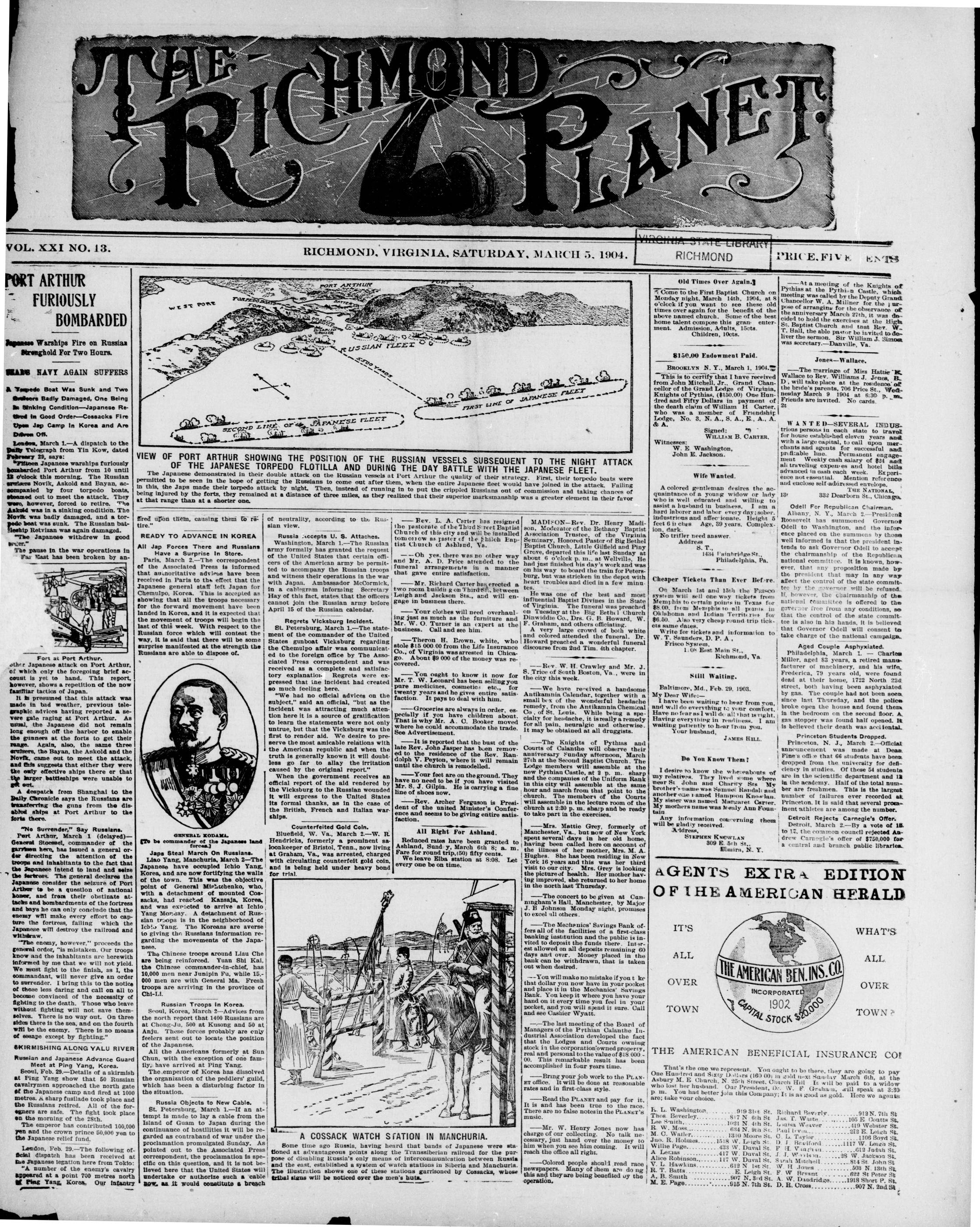
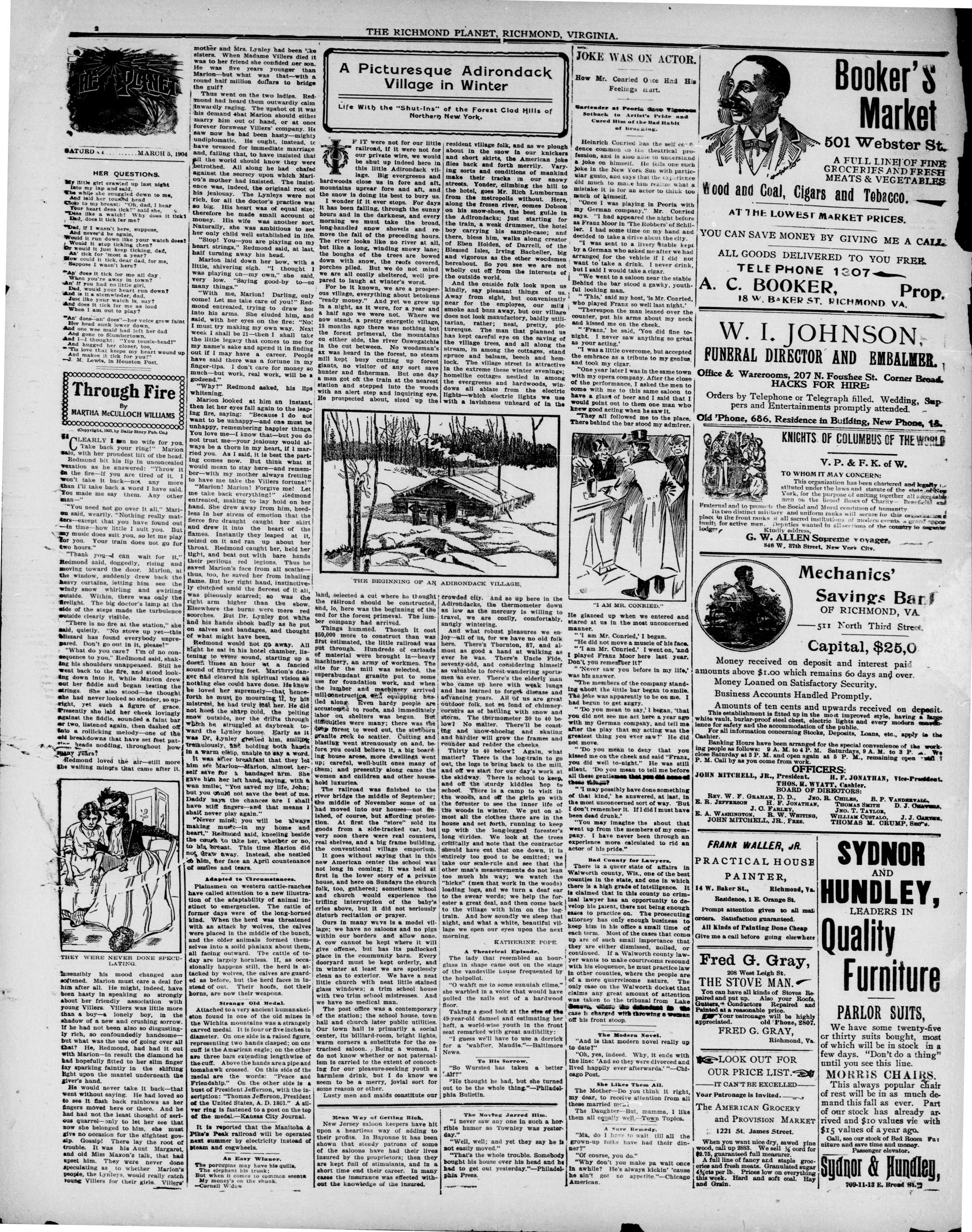
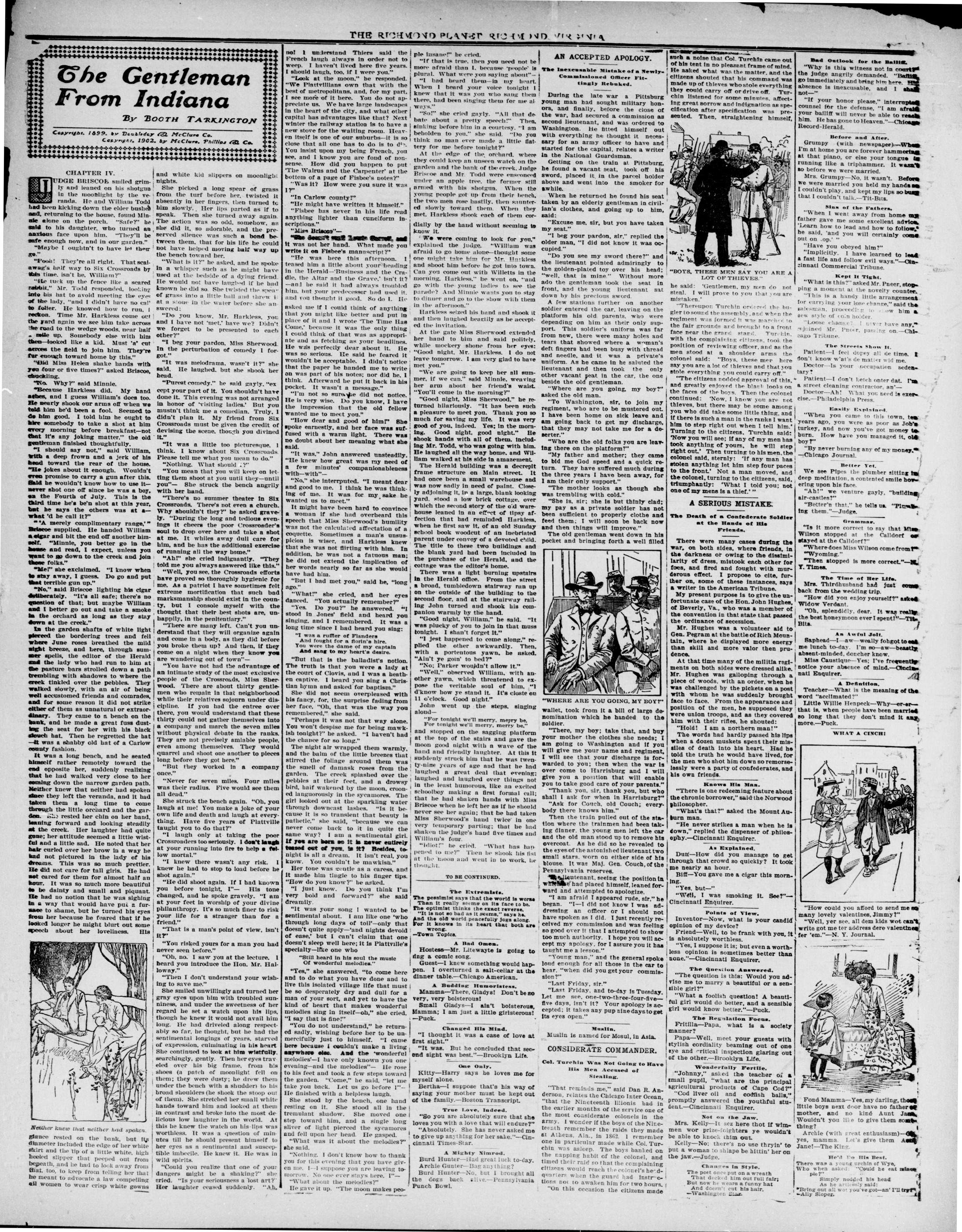
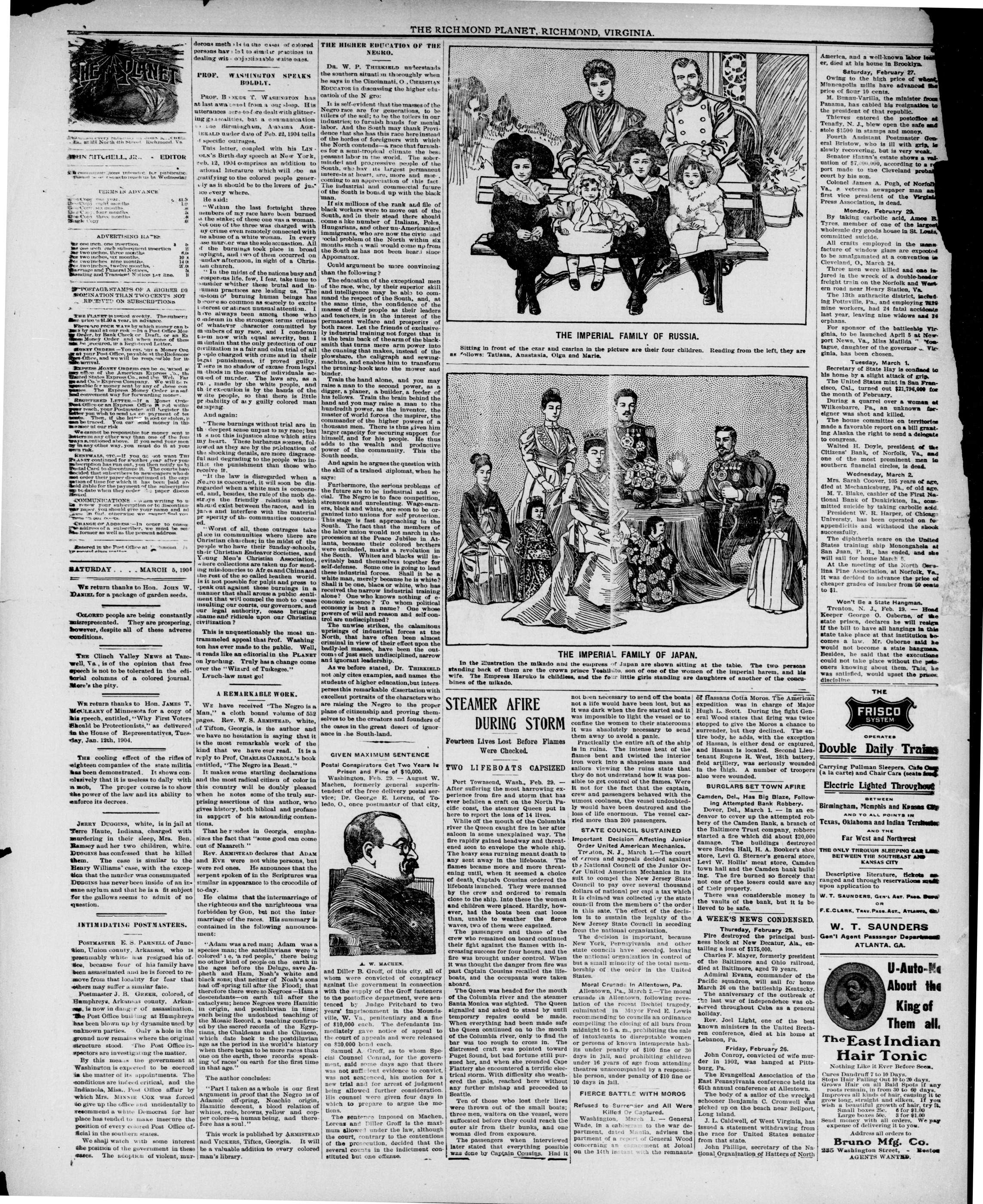
Page text (machine-generated)
THE RICHMOND PLANET
VOL. XXI NO. 13.
PORT ARTHUR FURIOUSLY BOMBARDED
Japanese Warships Fire on Russian
Strengthold For Two Hours.
HEADS NAVY AGAIN SUFFERS
A Tempedo Boat Was Sunk and Two
Gullsers Badly Damaged, One Being
In Sinking Condition—Japanese Re-
tired in Good Order—Cossacks Fire
Upon Jap Camp in Korea and Are
Driven Off.
London, March 1.—A dispatch to the
Daily Telegraph from Yin Kow, dated
February 29. says:
"Phiion Japanese warships furiously bombarded Port Arthur from 10 until 12 o'clock this morning. The Russian naval Novik, Askold and Bayan, accompanied by four torpedo boats, stepped out to meet the attack. They were, however, forced to retire. The Askold was in a sinking condition. The Novik was badly damaged, and a torpedo boat was sunk. The Russian battleship Retvizan was again damaged. "The Japanese withdrew in good order." The pause in the war operations in Far East has been broken by an-
Fort at Port Arthur.
other Japanese attack on Port Arthur, of which only the foregoing brief account is yet to hand. This report, however, shows a repetition of the now familiar tactics of Japan.
It is presumed that this attack was made in bad weather, previous telegraphic advices having reported a severe gale raging at Port Arthur. As usual, the Japanese did not remain long enough off the harbor to enable the gunners at the forts to get their range. Again, also, the same three cruisers, the Bayan, the Askold and the Novik, came out to meet the attack, and this suggests that either they were the only effective ships there or that the larger battleships were unable to get out.
A despatch from Shanghai to the Daily Chronicle says the Russians are transferring the guns from the disabled ships at Port Arthur to the forts there.
"No Surrender," Say Russians.
Port Arthur, March 1 (delayed)—General Stoessel, commander of the garrison here, has issued a general order directing the attention of the troops and inhabitants to the fact that the Japanese intend to land and seize the fortress. The general declares the Japanese consider the seizure of Port Arthur to be a question of national honor, and from their obstinate attacks and bombardments of the fortress and bays he can only conclude that the enemy will make every effort to capture the fortress, failing which the Japanese will destroy the railroad and withdraw.
"The enemy, however," proceeds the general order, "is mistaken. Our troops know and the inhabitants are herewith informed by me that we will not yield. We must fight to the finish, as I, the commandant, will never give an order to surrender. I bring this to the notice of those less daring and call on all to become convinced of the necessity of fighting to the death. Those who leave without fighting will not save themselves. There is no way out. On three sides there is the sea, and on the fourth will be the enemy. There is no means of escape except by fighting."
SKIRMISHING ALONG YALU RIVER
Russian and Japanese Advance Guard
Meet at Ping Yang, Kosea
Meet at Ping Yang, Korea.
Seoul, Feb. 29.—Details of a skirmish at Ping Yang show that 50 Russian cavalrymen approached the north gate of the Japanese camp and fired at 1000 metres. A sharp fusilade took place and the Russians retired. All of the foreigners are safe. The fight took place on the morning of the 28th.
The emperor has contributed 100,000 yen and the crown prince 50,000 yen to the Japanese relief fund.
London, Feb. 29.—The following official dispatch has been received at the Japanese legation here from Tokyo:
"A number of the enemy's cavalry appeared at a point 700 metres north Ping Yang, Korea. Our infantry
PORT ARTHUR
WEST PORE
FORPEDO POINT
TORT
BATTERY
BRANDED
DEMARLED
Cruiser
RUSSIAN FLEET
5,500 YARDS
FIRST LINE OF JAPANESE FLEET
SECOND LINE OF JAPANESE FLEET
The Japanese demonstrated in their double attack on the Russian vessels at Port Arthur the quality of their strategy. First, their torpedo boats were permitted to be seen in the hope of getting the Russians to come out after them, when the entire Japanese fleet would have joined in the attack. Failing in this, the Japs made their torpedo attack by night. Then, instead of running in to put the crippled Russians out of commission and taking chances of being injured by the forts, they remained at a distance of three miles, as they realized that their superior marksmanship was a greater element in their favor at that range than at a shorter one.
fired upon them, causing them to retire.
READY TO ADVANCE IN KOREA
All Jap Forces There and Russians have a Surprise In Store
of neutrality, according to the Russian view.
Russia Accepts U. S. Attaches.
Washington, March 1.—The Russian army formally has granted the request
—Rev. L. A. Carter has resigned the pastorate of the Third Street Baptist Church of this city and will be installed tomorrow as pastor of the Shilch Baptist Church of Ashland, Va.
MADISON—Rev. Dr. Henry Mason, Moderator of the Bethany Bapt Association Trustee, of the Virgina Seminary, Honored Pastor of Big Be Baptist Church, Little Gilfield and R Grove, departed this life last Sunday.
Have a Surprise In Store.
Paris, March 2.—The correspondent of the Associated Press is informed that authoritative advises have been received in Paris to the effect that the Japanese general staff left Japan for Chemulpo, Korea. This is accepted as showing that all the troops necessary for the forward movement have been landed in Korea, and it is expected that the movement of troops will begin the last of this week. With respect to the Russian force which will contest the way, it is said that there will be some surprise manifested at the strength the Russians are able to dispose of.
[Portrait of a military officer in uniform, wearing a decorated uniform with medals and insignia.]
GENERAL KODAMI
[To be commander of the Japanese land
force.]
Japa Steal March on Russians.
Liao Yang, Manchuria, March 2—The
Japanese have occupied Ichio Yang,
Korea, and are now fortifying the walls
of the town. This was the objective
point of General Mishchenko, who
with a detachment of mounted Cossacks,
had reached Kansaja, Korea,
and was expected to arrive at Ichio
Yang Monday. A detachment of Russian troops is in the neighborhood of Ichio Yang. The Koreans are averse to giving the Russians information regarding the movements of the Japanese.
The Chinese troops around Liau Che
are being reinforced. Yuan Shi Kai,
the Chinese commander-in-chief, has
10,000 men near Junipin Fu, while 15-
000 men are with General Ma. Fresh
troops are arriving in the province of
Chi-Li.
Russian Troops in Korea.
Seoul, Korea, March 2—Advices from the north report that 1400 Russians are at Chong-Ju, 500 at Kusong and 50 at Anju. These forces probably are only feelers sent out to locate the position of the Japanese. All the Americans formerly at Sun Chun, with the exception of one family, have arrived at Ping Yang. The emperor of Korea has dissolved the organization of the peddlers' guild, which has been a disturbing factor in the situation.
St. Petersburg, March 1.—If an attempt is made to lay a cable from the Island of Guam to Japan during the continuance of hostilities it will be regarded as contraband of war under the proclamation promulgated Sunday. As pointed out to the Associated Press correspondent, the proclamation is specific on this question, and it is not believed here that the United States will undertake or authorize such a cable now, as it would constitute a breach
RICHMOND, VIRGINIA, SATURDAY, MARCH 5, 1904.
THE TROOP
A COSSACK WATCH STATION IN MANCHURIA.
Some time ago Russia, having heard that bands of Japanese were stationed at advantageous points along the Transsiberian railroad for the purpose of disabling Russia's only means of intercommunication between Russia and the east, established a system of watch stations in Siberia and Manchuria. The illustration shows one of these stations garrisoned by Cossacks, whose tribal signs will be noticed over the men's huts.
of neutrality, according to the Rus slan view. Russia Accepts U. S. Attaches
Russia Accepts G. S. Attaches.
Washington, March 1.—The Russian army formally has granted the request of the United States that certain officers of the American army be permitted to accompany the Russian troops and witness their operations in the war with Japan. Ambassador McCormick, in a cablegram informing Secretary Hay of this fact, states that the officers cannot join the Russian army before April 15 of the Russian calendar.
Regrets Vicksburg Incident
St. Petersburg, March 1.—The statement of the commander of the United States gunboat Vicksburg regarding the Chemulpo affair was communicated to the foreign office by The Associated Press correspondent and was received as a complete and satisfactory explanation. Regrets were expressed that the incident had created so much feeling here.
"We had no official advice on the subject," said an official, "but as the incident was attracting much attention here it is a source of gratification to learn the statements were not only untrue, but that the Vicksburg was the first to render aid. We desire to preserve the most amicable relations with the American republic and when the truth is generally known it will doubtless go far to allay the irritation caused by the original report."
When the government receives an official report of the aid rendered by the Vicksburg to the Russian wounded it will express to the United States its formal thanks, as in the case of the British, French and Italian warships.
Counterfeited Gold Coln
Bluefield, W. Va., March 2.—W. R. Hendricks, formerly a prominent saloonkeeper of Bristol, Tenn., now living at Graham, Va., was arrested, charged with circulating counterfeit gold coin, and is being held under heavy bond for trial.
Rev. L. A. Carter has resigned the pastorate of the Third Street Baptist Church of this city and will be installed tomorrow as pastor of the Shilch Baptist Church of Ashland, Va.
Oh yes, there was no other way and Mr. A. D. Price attended to the funeral arrangements in a manner that gave entire satisfaction.
Mr. Richard Carter has erected a two room building on Third St., between Leigh and Jackson St., and will engage in business there.
Your clothes will need overhauling just as much as the furniture and Mr. W. O. Turner is an expert at the business. Call and see him.
Theron H. Brown, white, who stole $15 000.00 from the Life Insurance Co., of Virginia was arrested in Chicago. About $9 000 of the money was recovered.
— You ought to know it now for Mr. T. W. Leonard has been selling you pure medicines, cosmetics etc., for twenty years and he gives entire satisfaction. It pays to deal with him.
— Groceries are always in order, especially if you have children about. That is why Mr. A. C. Booker moved where he could accommodate the trade. See Advertisement.
— It is reported that the bust of the late Rev. Jasper has been removed to the residence of the Rev. Randolph V. Peyton, where it will remain until the church is remodelled.
— Your feet are on the ground. They have no need to be if you have visited Mr. S. J. Gilpin. He is carrying a fine line of shoes now.
— Rev. Archer Ferguson is President of the united Minister's Conference and seems to be giving entire satisfaction.
All Right For Ashland
Reduced rates have been granted to
Ashland, Sund y, March 6th 8; a, m
Tuesday trip,(50) fifty cents.
We leave Elkhorn at 8:08. Let
every one be on time.
FATION IN MANCHURIA. card that bands of Japanese were sta- the Transsiberian railroad for the pur- of intercommunication between Russia watch stations in Siberia and Manchuria. stations garrisoned by Cossacks, whose men's buts.
---
MADISON—Rev. Dr. Henry Madison, Moderator of the Bystant Baptist Association Trustee, of the Virginia Seminary, Honored Pastor of Big Bethel Baptist Church, Little Giffeld and Piny Grove, departed this life last Sunday at about 6 o'clock p.m. at Wellville. He had just finished his day's work and was on his way to board the train for Petersburg, but was stricken in the depot with heart troubles and died in a few minutes.
He was one of the best and most influential Baptist Divines in the State of Tennesse. The funeral was preached on Tuesday by the Big Bethel Church Dinwiddie Co., Desk B. Howard, W. F. Graham, and others officiating.
A very large crowd of both white and colored attended the funeral. Dr. Howard preached a wonderful funeral discourse from 2nd Tim. 4th chapter.
—Rev. W. H. Crawley and Mr. J. S. Trice of South Boston, Va., were in the city this week.
We have received a handsome Antikaminia Calendar, together with a small box of the wonderful headache remedy, from the Antikaminia Chemical Co. of St. Louis. While being a speciality for headache, it is really a remedy for all pain, neuralgic and otherwise. It may be obtained at all druggists.
The Knights of Pythians and Courts of Calanthe will observe their anniversary Sunday afternoon, March 27th at the Second Baptist Church. The Lodge members will assemble at the new Pythian Castle, at 2 p. m. . sharp and the companies of the Uniform Rank in this city will assemble at the same hour and march from that point to the church. The members of the Courts will assemble in the lecture room of the church at 2:30 p. m. sharp and be ready to take part in the exercises.
—Mrs. Mattie Grey, formerly of Manchester, Va., but now of New York spent several days in her old home, having been called here on account of the illness of her mother, Mrs. M. A. Hughes. She has been residing in New York 16 years and this was her third visit to our city. Mrs. Grey is looking the picture of health. Her mother having improved, she returned to her home in the north last Thursday.
—The concert to be given at Cunningham's Hall, Manchester, by Major J. B Johnson Monday night, promises to excel all others.
—The Mechanics' Savings Bank offers all of the facilities of a first-class banking institution and the public is invited to deposit the funds there. Interest allowed on all deposits remaining 60 days and over. Money placed in the bank can be withdrawn, that is taken out when desired.
—You will make no mistake if you tk that dollar you now have in your pocket and place it in the Mechanics' Savings Bank. You keep it where you have your hand on it every time you feel in your pocket, and you will spend it sure. Call and see Cashier Wyatt.
—The last meeting of the Board of Managers of the Pythian Calanthe Industrial Association developed the fact that the Lodges and Courts owning stock in the corporation-owned property, real and personal to the value of $18 000 - 00. This remarkable result has been accomplished in four years time.
—Bring your job work to the PLANET office. It will be done at reasonable rates and in first-class style.
—Read the PLANET and pay for it. It is and has been true to the race. There are no false notes in the PLANET's music.
—Mr. W. Henry Jones now has charge of our collecting. No talk necessary, just hand over the money to him when you see him coming. It will reach the office all right.
—Colored people should read race newspapers. Many of them are doing this and they are being benefited by the operation.
AGENTS EXTRA EDITION OF THE AMERICAN HERALD
IT'S
ALL
OVER
TOWN
THE AMERICAN BEN.INS.CO.
INCORPORATED
1902
CAPITAL STOCK $20,000
WHAT'S
ALL
OVER
TOWN?
THE AMERICAN BENEFICIAL INSURANCE CO.
That's the one we represent. You ought to be there, they are going to pay One Hundred and Sixty dollars (160 00) in gold next Sunday March 6th at the Asbury M. E Church, N. 25th Street, Church Hill. It will be paid to a widow who lost her husband. Our President, Dr. W. F. Graham, will speak at 3:30 p.m. You had better join this Company; It is as good as gold. We are agents are; take your choice.
K. L. Washington . . . 919 31st St. Richard Beverly . . . 912 N. 7th St
Thos Beverley . . . 817 N. 6th St. J. P. White . . . 105 E. Counts St.
Lee Smith . . . 1021 N. 4th St. Louisa Weaver . . . 419 Webster St.
R. W. Moss . . . 634 N. 9th St. Paul Levin . . . 213 E. Leigh St.
M. C. Wailer . . . 1310 Moore St. C. L. Taylor . . . 1106 Boyd St.
Juo R. Holmes . . . 1518 W. Leigh St. D. J. Bradford . . . 1117 W. Leugh St.
Wille Page . . . 433 W. Dval St. F. H. Vaughan . . . 613 Jadah St.
A. Lerner . . . 417 W. Dval St. J. J. Wollson . . . 28 W. Jackson St.
Albion Robinson . . . 117 W. Dval St. Sarah Mitchell . . . 814 St. John St.
V. L. Hawkins . . . 612 N. 1st St. W. H. Jones . . . 503 N. 13th St.
R. T. Batts . . . E. Leigh St. F. W. Brant . . . 622 St. Peter St.
A. B. Smith . . . 907 N. 3rd St. A. W. Daudridge . . . 1918 Short P. St.
M. E. Page . . . 915 N. 7th St. D. R. Cross . . . 917 N. 2nd St
Old Times Over Again.
Come to the First Baptist Church on Monday night, March 14th, 1904, at 8 o'clock if you want to see these old times over again for the benefit of the above named church. Some of the best home talent compose this gran enterment. Admission, Adults, 15cets.
$150.00 Endowment Paid
BROOKLYN N. Y., March 1, 1904.
This is to certify that I have received from John Mitchell, Jr., Grand Chancellor of the Grand Lodge of Virginia, Knights of Pythias, ($150.00) One Hundred and Fifty Dollars in payment of the death claim of William H Carter, who was a member of Friendship Lodge, No. 3, N. A., S. A., E., A., A. & A.
Signed:
WILLIAM B. CARTER.
Witnesses:
W. E Washington,
John E Jackson.
Wife Wanted.
A colored gentleman desires the acquaintance of a young widow or lady who is well educated and willing to assist a husband in business. I am a hard laborer and labor every day; sober, industrious and affectionate. Height 5 feet 6 inches Age, 39 years. Complexion, dark.
No trifler need answer.
Address
S. T.,
1434 Fainbridge St.,
Philadelphia, Pa.
Cheaper Tickets Than Ever Before
On March 1st and 15th the Fasco system will sell one way tickets from Memphis to certain points in Texas for $8.00, from Memphis to all points in Oklahoma and Indian Territories for $8.00, every cheap round trip tickets same date.
Write for tickets and information to W. T. Saunders, D. P. A.
Still Waiting.
Baltimore, Md., Feb. 29, 1903.
My Dear Wife:—
I have been waiting to hear from you,
and will do everything to your comfort.
Have no fear as I will do all that is right.
Having everything in readiness. I am
waiting patiently to hear from you.
Your husband,
JAMES HILL
Do You Know Them?
I desire to know the whereabouts of my relatives. They lived some where near St John and Charity Sts. My brother's name was Samuel Randall and another one named Hampson Knowlan. My sister was named Margaret Carter. My mothers name was Mealy Ann Fountain.
Any information concerning them will be gladly received.
Address,
STEPHEN KNOWLAN
309 E. 5th St.
Elmira, N. Y.
AGENTS EXP
OF IHE AMER
IT'S
—At a meeting of the Knights of Pythias at the Pythian Castle, which meeting was called by the Deputy Grand Chancellor W. A. Milner for the purpose of arranging for the observance of the coronary March 27th, it was decided to host the ceremonies at the High St. Baptist Church that met Rev. W. T. Hall, the able pastor be called to deliver the sermon. Sir William J. Simona was secretary—Danville, Va.
Jones—Wallace.
The marriage of Miss Hattie 'K
Wallace to Rev. Williams J. Jones, B.
D, will take place at the residence
of the bride's parents, 706 Price St.,
Wednesday March 9 1904 at 6:30 p. m.
Friends are invited. No cards.
---
WANTED—SEVERAL INDUSTRIous persons in each state to travel for house established eleven years and with a large capital, to call upon merchants and agents for successful and profitable line. Permanent engagement Weekly cash salary of $34 and travel expenses and hotel bills advanced in cash costs perience not essential. Mention reference and enclose self-addressed envelope. THE NATIONAL, 187 332 Dearborn St., Chicago
Odell For Republican Chairman.
Albany, N. Y., March 2—President Roosevelt has summoned Governor Odell to Washington, and the inference placed on the summons by those well informed is that the president intends to ask Governor Odell to accept the chairmanship of the Republican national committee. It is known, however, that any proposition made by the president that may in any way affect the control of the state committee by the governor will be refused. If, however, the chairmanship of the national committee is offered to the governor free from any conditions, so that the control of the state committee is also in his hands, it is believed that Governor Odell will consent to take charge of the national campaign.
Aged Couple Asphyxiated.
Philadelphia, March 1. — Charles Miller, aged 83 years, a retired manufacturer of machinery, and his wife, Frederica, 79 years old, were found dead at their home, 1722 North 22d street, both having been asphyxiated by gas. The couple had not been seen since last Thursday, and the police broke open the house and found them in the bedroom on the second floor. A gas stopper was found half opened. It is believed their death was accidental.
Princeton Students Dropped.
Princeton, N. J., March 2—Official announcement was made at Dean Pine's office that 66 students have been dropped from the university for deficiency in studies. Of these 54 students are in the scientific department and 12 in the academy. Half of the total number are freshmen. This is the largest number of failures ever recorded at Princeton. It is said that several prominent athletes are among the number.
Detroit Rejects Carnegie's Offer.
Detroit, March 2—By a vote of 18 to 12, the common council rejected Andrew Carnegie's offer of $750,000 for a central and branch public libraries.
BE PLANET
HER QUESTIONS.
My little girl crawled up last night
into my lap and said,
While she snuggled down to me,
And laid her hand down.
Close to my breast: "Oh dad, I hear
Your heart dess tick!" said she,
Dess like a watch! Why does it tick!
Dad, does it tick for me?
Dad, if I wasn't here, suppose,
And never'd be again,
Would it run down like your watch does!
Would it stop ticking then?
Or would it just keep ticking, dad,
And it tick for 'most a year?
How would it tick, dear dad, for me,
Supose I wasn't here?
As does it tick for me all day
When you're away in town?
Ant if you had no little girl,
Dad would your heart run down?
And is it a steward's hat?
Just like your watch its way.
And does it tick for me as loud
When I am out to play?
"An does-'an does'"—her voice grew faint
He head sank lower down,
And one wee maid had left her dad
And gone to Slumbertown.
And I thought: "You tolese head!"
And he handed her closer, too,
"Ts love that ties my heart wound up
And makes it tick in Houston Post.
J. M. Lewis, in Houston Post.
BREAKLY I am no wife for you.
Take back your ring!" Marion
said, with her proudest lift of the head.
Redmond bit his lip in unconcealed
vexation as he answered: "Throw it
in the fire—if you are tired of it. I
won't take it back—not any more
than I'll take back a word I have said.
You made me say them. Any other
man—"
"You need not go over it all," Marion
said, wearily. "Nothing really matters—except that you have found out—in time—how little I suit you. But my music does suit you, so let me play for you. Your train does not go for two hours."
"Thank you—I can wait for it," Redmond said, doggedly, rising and moving toward the door. Marion, at the window, suddenly drew back the heavy curtains, letting him see the windy snow whirling and swirling outside. Within, there was only the firelight. The big doctor's lamp at the side of the steps made the turbulence outside clearly visible.
"There is no fire at the station," she said, quietly. "No stove up yet—this blizzard has found everybody unprepared. Don't go out in it, please!"
"What do you care?" I'm of no consequence to you." Redmond said, shaking his shoulders unappeased. Still he went back to the fire, and stood looking down into it, while Marion drew out her fiddle and began testing the strings. She also stood—he thought she had never looked so slender, so upright, yet such a figure of grace. Presently she laid her cheek lovingly against the fiddle, sounded a faint bar or two, listened again, then dashed off into a rolllicking melody—one of the old breakdowns that have set feet patting heads nodding, throughout how many years?
Redmond loved the air—still more the wailing miners that came after it.
10
THEY WERE NEVER DONE SPECULATING.
Insensibly his mood changed and softened. Marion must care a deal for him after all. He might, indeed, have been hasty in speaking so strongly about her friendly association with young Villers. Villers was little more than a boy—a lonely boy, in the shadow of a new and crushing sorrow. If he had not been also so disgustingly rich, so confoundedly handsome—but what was the use of going over all that? He, Redmond, had had it out with Marion—in result the diamond he had hopefully fitted to her slim finger lay sparking faintly in the shifting light upon the mantel underneath the giver's hand.
He would never take it back—that went without saying. He had loved so to see it flash back rainbows as her fingers moved here or there. And he had had not the least thought of serious quarrel—only to let her see that now she belonged to him, she must give no occasion for the slightest gossip. Gossip! There lay the root of trouble. It was his Aunt Margaret, and old Miss Maxon's talk, that had upset him. They were never done speculating as to whether Marlon's people, the Lynsley, would really catch young Villers for their girls. Villers'
THE BEGINNING OF AN
land, selected a cut where he thought the rallroad should be constructed, and, lo, here was the beginning of the end for the forest primeval. The lumber company had arrived.
Things hummed. Though it cost $50,000 more to construct than was first estimated, the little railroad was put through. Hundreds of carloads of material were brought in—heavy machinery, an army of workmen. The site for the mill was selected, the superabundant granite put to some use for foundation work, and when the lumber and machinery arrived mill-construction and equipping hustled along. Even hardy people are accustomed to roofs, and immediately labor on shelters was begun. But difficulties were many; there was the deep forest to weed out, the stuccborn granite rock to scatter. Cutting and blasting went strenuously on and, before you could believe it, a big boarding house arose, more dwellings went up; careful, well-built ones many of them; and presently along came the women and children and other household luxuries.
The railroad was finished to the river bridge the middle of September; the middle of November some of us had moved into our houses—not finished, of course, but affording protection. At first the "store" sold its goods from a side-tracked car, but very soon there were real counters, real shelves, and a big frame building, the conventional village emporium. It goes without saying that in this new American center the school was not long in coming; it was held at first in the lower story of a private house, and here on Sundays the church folk, too, gathered; sometimes school and church would experience the trifling interruption of the baby's cries above, but it did not seriously disturb recitation or prayer.
Ours in many ways is a model village; we have no saloons and no plags within our borders and allow none. A cow cannot be kept where it will give offense, but has its padlocked place in the community barn. Every dooryard must be kept orderly, and in winter at least we are spotlessly clean as to exterior. We have a neat little church with neat little stained glass windows; a trim school house with two trim school mistresses. And we have no medical man.
The post office was a contemporary of the station; the school house, town hall and church public utilities. Our town hall is primarily a social center, its billard-room, bright lights, warm corners a substitute for the ostracised saloon. Being a woman, I do not know whether or not paternalism is carried to the extent of concocting for our pleasure-seeking youth a harmless drink, but I do know we seem to be a merry, joyful sort for some reason or other.
New Jersey saloon keepers have hit upon a heartless way of adding to their profits. In Bayonne it has been shown that steady patrons of some of the saloons have had their lives insured by the proprietors; then they are kept full of stimulants, and in a short time end their career. In many cases the insurance was effected without the knowledge of the insured.
mother and Mrs. Lynley had been 'like sisters. When Madame Villers died it was to her friend she confided her son. He was five years younger than Marion—but what was that—with a round half million dollars to bridge the gulf?
Thus went on the two ladies. Redmond had heard them outwardly calm inwardly raging. The upshot of it was his demand that Marion should either marry him out of hand, or at once forever forswear Villers' company. He saw now he had been hasty—mighty undiplomatic. He ought, instead, to have pressed for immediate marriage and, falling to, to have insisted that all the world should know they were betrothed. All along he had chafed against the secrecy upon which Marion's mother had insisted. The insistence was, indeed, the original root of his jealousy. The Lynleys were not rich, for all the doctor's practice was so big. His heart was of equal size; therefore he made small account of money. His wife was another sort. Naturally, she was ambitious to see her only child well established in life. "Stop! You—you are playing on my heart strings," Redmond said, at last, half turning away his head.
Marion laid down her bow, with a little, shivering sigh. "I thought I was playing on—my own," she said, very low. "Saying good-by to—so many things."
"With me, Marion! Darling, only come! Let me take care of you!" Redmond entreated, trying to draw her into his arms. She eluded him, and said, with her eyes on the fire: "No! I must try making my own way. Next week I shall be 21—then I shall take the little legacy that comes to me for my name's sake and spend it in finding out if I may have a career. People have said there was a fortune in my finger-tips. I don't care for money so much—but work, real work, will be a godsend."
"Why?" Redmond asked, his lips whitening.
Marion looked at him an instant, then let her eyes fall again to the leaping fire, saying: "Because I do not want to be unhappy—and one must be unhappy, remembering happier things. You love me—I know that—but you do not trust me—your jealousy would always be a thorn in my heart, if I married you. As I said, it is best the parking comes now. But think what it would mean to stay here—and remember—with my mother always freeting to have me take the Villers fortune!"
"Marion! Marion! Forgive me! Let me take back everything!" redmond entreated, making to lay hold on her hand. She drew away from him, heedless in her stress of emotion that the fierce fire draught caught her skirt and drew it into the heart of the flames. Instantly they leaped at it, seized on it and ran up about her throat. Redmond caught her, held her tight, and beat out with bare hands their peritous red legions. Thus he saved Marion's face from all scathe—thus, too, he saved her from inhaling flame. But her right hand, instinctively clutched amid the fiercest of it all, was pliably scarred; so was the right arm higher than the ebow. Elsewhere the burns were mere red scorches. But Dr. Lynley got white and his hands shook badly as he put on salves and bandages, and thought of what might have been.
Redmond would not go away. All night he sat in his hotel chamber, listening to every sound, starting up a dozen times an hour at a fancied sound of hurrying feet. Marion's danger had cleared his spiritual vision as nothing else could have done. He knew he loved his supremely—that henceforth he must go mourning if, by his mistrust, he had truly lost her. He did not heed the sharp cold, the pelting snow outside, nor the drifts through which he struggled at daybreak toward the Lynley house. Early as it was Dr. Lynley grew him, ambling tremliously, and holding both hands in a warm clep, unable to say a word. It was after breakfast that they let him see Marion—Marion, almost herself save for a bandaged arm. She gave him her left hand, saying, with a wan smile: "You saved my life, John; but you could not save the best of me. Daddy says the chances are I shall have stiff fingers—and that means I shall never play again."
"Never mind; you will be always making music—in my home and heart." Redmond said, kneeling beside the couch to take her, whether or no, to his breast. This time Marlon did not draw away. Instead, she nestled to him, her face an April countenance of smiles and tears.
Adapted to Circumstances.
Plainsmen on western cattle-ranches have called attention to a new illustration of the adaptability of animal instinct to emergencies. The cattle of former days were of the long-horned kind. When the herd was threatened with an attack by wolves, the calves were placed in the middle of the bunch, and the older animals formed themselves into a solid phalanx about them, all facing outward. The cattle of today are largely hornless. If, as occasionally happens still, the herd is attacked by wolves, the calves are guarded as before, but the herd faces in instead of out. Their hoofs, not their horns, are now their weapons.
Strange Old Medal.
Attached to a very ancient human skeleton found in one of the old mines in the Wichita mountains was a strangely carved medal. It is four or five inches in diameter. On one side is a raised figure, representing two hands clasped; on one cuff is the American eagle; on the other are three bars extending lengthwise of the cuff. Above the hands are a pipe and tomahawk crossed. On this side of the medal are the words: "Peace and Friendship." On the other side is a bust of President Jefferson, with the inscription: "Thomas Jefferson, President of the United States, A. D. 1801." A silver ring is fastened to a post on the top of the medal—Kansas City Journal.
It is reported that the Manitoba & Pike's Peak railroad will be operated next summer by electricity instead of steam and cogwheels.
An Easy Winner.
The porcupine may have his quills.
The elephant his trunk;
But when it comes to common scents.
My money's on the skunk.
-Cornell Widow.
THE RICHMOND PLANET, RICHMOND, VIRGINIA
A Picturesque Adirondack Village in Winter
Life With the "Shut-Ins" of the Forest Clad Hills of Northern New York.
THE BEGINNING OF AN ADIRONDACK VILLAGE
I
F IT were not for our little railroad, if it were not for our private wire, we would be shut up indeed here in this little Adirondack village. Big evergreens and evergreen
hardwoods close us in inore and aft, mountains uprear fore and aft, and the snow is doing its best to bury us. I wonder if it ever stops. For days it has been falling, through the sunny hours and in the darkness, and every morning we must take the broad, long-handled snow shovels and remove the fall of the preceding hours. The river looks like no river at all, but like a long, winding snowy lane; the boughs of the trees are bowed down with snow, the reofs covered, porches plilled. But we do not mind we are all cozily sheltered, well prepared to laugh at winter's worst.
For be it known, we are a prosperous village, everything about betokens "ready money." And yet we grew up in a night, as it were, for a year and a half ago we were not. Where we now stand, a pretty energetic village, 18 months ago there was nothing but the forest primeval, the mountains on either side, the river Oswegatchie in the cut between. No woodsman's ax was heard in the forest, no steam mill kept busy cutting up forest giants, no visitor of any sort save hunter and fisherman. But one day a man got off the train at the nearest station and stepped into the woods with an alert step and inquiring eye. He prospected about, sized up the
Lusty men and maids constitute our
Mean Way of Getting Rich.
resident village folk, and as we plough about in the snow in our knickers and short skirts, the American joke flies back and forth merrily. Varying sorts and conditions of mankind make their tracks in our snowy streets. Yonder, climbing the hill to the hotel, goes Mr. Rich Lumberman from the metropolis without. Here, along the frozen river, comes Dobson on his snow-shoes, the best guide in the Adirondacks; just starting for the train, a weak drummer, the hotel boy carrying his sample-case; and there, bless him, walks along creator of Eben Holden, of Darrell, of the Blessed Isles, Irving Bacheller, big and vigorous as the other woodsmens hereabout. So you see we are not wholly cut off from the interests of the outside world.
And the outside folk look upon us kindly, say pleasant things of us. Away from sight, but conveniently near for the employees, our mills smoke and buzz away, but our village does not look manufactory, baldly utilitarian, rather; neat, pretty, picturesque. The man that planned us has kept careful eye on the saving of the village trees, and all along the stream, in among the cottages, stand spruce and balsam, beech and hemlock. The village street is attractive in the extreme these winter evenings; homelike cottages nestled in among the evergreens and hardwoods, windows all ablaze from the electric lights—which electric lights we use with a lavishness unheard of in the
ADIRONDACK VILLAGE.
crowded city. And so up here in the Adirondacks, the thermometer down as low as the mercury is willing to travel, we are cozly, comfortably, snugly wintering.
And what robust pleasures we enjoy—all of us, for we have no old folk here. There's Thornton, 87, and almost as good a hand at walking as ever he was. There's Uncle Fide, seventy-odd, and considering himself as valuable to forest-wandering sportsmen as ever. There's the elderly man who came up here with weak lungs and has learned to forget disease and advancing years. All of us are great outdoor folk, not so fond of chimney-corners as of battling with snow and storm. The thermometer 30 to 40 below? No matter. There'll be coasting and snow-shoeing and skating and harder will grow the frames and rounder and redder the cheeks.
Thirty to 40 below? Again, what matter? There is the log-train to go out, the logs to bring back to the mill, and off we start for our day's work at the skidway. There is school to keep, and off the sturdy kiddies hop to school. There is a camp to visit in the woods, and off the girls go with the forester to see the inner life of the woods in winter. We put on almost all the clothes there are in the house and set forth, running to keep up with the long-legged forester's long strides. We look at the trees critically and note that the contractor should have cut that one down, it is entirely too good to be omitted; we take our scale-rule and see that the other man's measurements do not lean too much his way; we watch the "hicks" (men that work in the woods) loading logs, and we turn a deaf ear to the swear words; we help the forester a great deal, and then come back to the village with him on the log-train. And how soundly we sleep that night, and what a white, beautiful village we open our eyes upon the next morning.
KATHERINE POPE.
A Theatrical Episode
The lady that resembled an hourglass in shape came out on the stage of the vaudeville Louse frequented by the hooppollol.
"O wahft me to some sunuiah clime," she warbled in a voice that would have pulled the nails out of a hardwood floor.
Taking a good look at the size of the 49-year-old damsel and estimating her heft, a world-wise youth in the front seat remarked with great audibility:
"I guess we'll have to use a derrick for a 'wahfter, Maudle."—Baltimore News.
To His Sorrow.
"So Wursted has taken a better 'alf?"
"He thought he had, but she turned out to be the whole thing."—Philadelphia Bulletin.
"I never saw any one in such a horrible humor as Townley was yesterday."
"Well, well; and yet they say he is not easily moved."
"That's the whole trouble. Somebody bought his house over his head and he had to get out yesterday."—Philadelphia Press.
How Mr. Conried Once Had His Feelings Hard.
Gartender at Peoria Gave Vignettes Setback to Artist's Pride and Cured Him of the Bad Habit of Brushing.
Heinrich Conried has the self confidence common to the theatrical profession, and is also able to understand a joke on himself. He tells one such joke in the New York Sun with particular gusto, and says that the experience did much to make him realize what a mistake it is for an actor to think too much of himself.
"Once I was playing in Peoria with my German company," Mr. Conried says. "I had appeared the night before as Franz Moor in 'The Robbers of Schiller. I had some time on my hand and decided to take a drive about the city."
"I was sent to a livery table kept by a German who asked me after we had arranged for the vehicle if I did not want to take a drink. I never drink, but I said I would take a cigar.
"We went to a saloon near the stable Behind the bar stood a gawky, youthful looking man.
"This,' said my host, 'is Mr. Conrried, who played Franz so well last night."
"Thereupon the man leaned over the counter, put his arms about my neck and kissed me on the cheek."
"Franz, he said, 'You did fine tonight. I never saw anything so great as your acting.' "I was a little overcome, but accepted the embrace as a tribute to my genius, and took my cigar.
"One year later I was in the same town with my opera company. After the close of the performance, I asked the men to come with me to this same saloon to have a glass of beer and I said that I would point out to them one man who knew good acting when he saw it.
They all followed me to the place.
There behind the bar stood my adviser.
A
"I AM MR. CONRIED."
He glanced up when we entered and stared at us in the most unconcerned manner.
"I am Mr. Conried,' I began.
"He did not move a muscle of his face.
"I am Mr. Conried.' I went on, and I played Franz Moor here last year. Don't you remember it?
"Never saw you before in my life,' was hfs answer.
"The members of the company standing about the little bar began to smile. The joke was apparently to be on me. I had begun to get angry.
"Do you mean to say,' I began, 'that you did not see me act here a year ago with my German company, and tell me after the play that my acting was the greatest thing you ever saw?' He did not move.
"Do you mean to deny that you kissed on the cheek and said that 'Franz, you did well to-night.' He was still silent. 'Do you mean to tell me before all these gentlemen that you did none of these things?"
"I may possibly have done something of that kind,' he answered, at last, in the most unconcerned sort of way. 'But I don't remember it. If I did I must have been dead drunk."
"You may imagine the shout that went up from the members of my company. I have never been through an experience more calculated to rid an actor of his pride."
Bad County for Lawyers
Bad County for Lawyers.
There is a queer state of affairs in Walworth county, Wis., one of the best counties in the state, and one in which there is a high grade of intelligence. It is claimed that in this county no criminal lawyer has an opportunity to develop his talent, there not being enough cases to practice on. The prosecuting attorney has only enough business to keep him in his office a small time of each term. Most of the cases that come up are of such small importance that they are either dismissed, nolled, or continued. If a Walworth county lawyer wants to make courtrooms resound with his eloquence, he must practice law in other counties, where the people are of a more quarrelsome nature. The only case on the Walworth docket that claims any great amount of attention was taken to the tribunal from Lake County, the case is charged with throwing a woman off his front stoop.
"And is that modern novel really up to date?"
"Oh, yes, indeed. Why, it ends with the line: 'And so they were divorced and lived happily ever afterwards.'"—Chicago Post.
She Likes Them All.
The Mother—Do you think it right, my dear, to receive attention from all these married men:
The Daughter—But, mamma, I like them all equally well—Town Topics.
A Sure Remedy.
"Ma, do I have to wait till all the grown-up folks have had their dinner?"
"Of course, you do."
"Why don't you make pa wait once in awhile? He's always kickin' cause he ain't got no appetite."—Chicago American.
501 Webster St. A FULL LINE OF FINE GROCERIES AND FRESH MEATS & VEGETABLES
gars and Tebacco.
ST MARKET PRICES.
KEY BY GIVING ME A CALL.
DVERED TO YOU FREE.
JUNE 1307
ER, Prop.
ST. RICHMOND, VA.
JOHNSON,
VECTOR AND EMBALMER.
17 N. Foushee St. Corner Broad.
S FOR HIRE:
Telegraph filled. Wedding, Supp
ments promptly attended.
Place in Building, New Phone, 18
ITS. OF COLUMBUS OF THE WORLD
AT THE LOWEST MARKET PRICES. YOU CAN SAVE MONEY BY GIVING ME A CALL.
W. I. JOHNSON FUNERAL DIRECTOR AND EMBALMER.
Office & Warerooms, 207 N. Foushee St. Corner Broad. HACKS FOR HIRE: Orders by Telephone or Telegraph filled. Wedding, Suppers and Entertainments promptly attended.
V. P. & F. K. of W.
BOM IT MAY CONCERN:
a organization has been chartered and legally
under the laws and statute of the state of New
or the purpose of uniting together all acceptable
the Broad Bases of Charity—Beneficial and
Moral condition of humanity
uniform ranks will secure for this organization
and institutions of modern events a grand appo-
nanted in all sections of the country to organi-
zers.
This organization has been chartered and legally situated under the laws and statute of the state of New York, for the purpose of uniting together all acceptable men on the broad Bases of Charity—Beneficial and Fraternal and to promote the Social and Moral condition of humanity. Its two distinct military and uniform ranks will secure for this organization place in the front ranks of all sacred institutions of modern events a grand opportunity for active men. Deputies wanted in all sections of the country to organize lodger. Kindly address,
G. W. ALLEN Supreme voyager.
846 W. 87th Street, New York City.
Mechanics'
Savings Bank
OF RICHMOND, VA.
— 511 North Third Street.
Capital, $25,0
deposit and interest paid
in remains 60 days and over.
Insfactory Security.
Handled Promptly.
and upwards received on deposit.
in the most improved style, having a large
electric lights and every modern conveni-
cation of the public.
Stocks, Deposits, Loans, etc., apply to the
agged for the special convenience of the work.
P. M. Saturdays, 9 A. M. to 3 P. a. We
gain at 5 P. M., remaining open until
k.
FICERS:
T. H. P. JONATHAN, Vice-President.
WYATT, Cashier.
OF DIRECTORS:
JNO. R. CHILES, B. P. VANDERVALL,
THAN, THOMAS SMITH D. J. OMAVERA,
JNO. T. TAYLOR.
Money received on deposit and interest paid amounts above $1.00 which remains 60 days and over.
Money Loaned on Satisfactory Security.
Business Accounts Handled Promptly.
Amounts of ten cents and upwards received on deposit.
This establishment is fitted up in the most improved style, having a large white vault, burlar-proof steel chest, electric lights and every modern convenience for safety and the accommodation of the public.
For all information concerning Stocks, Deposits, Loans, etc., apply to the Cashier.
Banking Hours have been arranged for the special convenience of the work-
ing people as follows: 9 A. M. to 4 P. M. Saturdays, 9 A. M. to 3 P. M. We close Saturday at 3 P. M. and open again at 5 P. M., remaining open till 3 P. M. Call by as you come from work.
OFFICERS:
JOHN MITCHELL, JR., President. H. F. JONATHAN, Vice-President.
THOS. H. WYATT, Cashler.
BOARD OF DIRECTORS
WILLIAM CUSTALO, J. J. CARTER,
THOMAS M. CRUMP, SPCA.
SYDNOR AND HUNDLEY, LEADERS IN Quality Furniture
PARLOR SUITS.
We have some twenty-five or thirty suits bought, most of which will be in stock in a few days. "Don't do a thing" until you see this line.
MORRIS CHAIRS.
This always popular chair of rest will be in as much demand this fall as ever. Part of our stock has already arrived and $10 values vie with $15 values of a year ago.
Call, see our stock of Bed Room Furniture and save time and money.
Passenger elevator.
Sydnor & Hundley,
709-11-13 E. Broad St.
J. H. H.
M
1820
E. A. WASHINGTON, R. W. WHITING,
JOHN MITCHELL, JR., FREES.
FRANK WALLER, JR.
PRACTICAL HOUSE
PAINTER,
14 W. Baker St., Richmond, Va.
Residence, 1 E. Orange St.
Prompt attention given to all mail
orders. Satisfaction guaranteed.
Fred G. Gray,
THE STOVE MAN.
You can have all kinds of Stoves Repaired and put up. Also your Roofs, Gutters. Conductors Repaired and Painted at a reasonable price.
Your patronage will be highly appreciated.
FRED G. GRAY,
Richmond, Va.
LOOK OUT FOR
OUR PRICE LIST.
IT CAN'T BE EXCELLED
Your Patronage is Invited.
The AMERICAN GROCERY
and PROVISION MARKET
When you want nice dry, sawed pine wood, call up 2883. We sell $2.75, guaranteed full measurer.
A full line of fancy and staple groceries and fresh meats. Granulated sugar 4¢/cts per lb. Prices low on everything this week. Hard and soft coal. Hay and Grain.
The Gentleman From Indiana
By BOOTH TARKINGTON
```markdown
```
CHAPTER IV.
UDGE BRISCOE smiled grimly and leaned on his shotgun in the moonlight by the veranda. He and William Todd had been kicking down the elder bushes and, returning to the house, found Mimie alone on the porch. "Safe?" he said to his daughter, who turned an anxious face upon him. "They'll be safe enough now, and in our garden." "Maybe I oughtn't to have let her go."
"Pooh! They're all right. That scat-a-wag's half way to Six Crossroads by this time, isn't he. William?"
"He tuck up the fence like a scared rabbit," Mr. Told responded, looking into his hat to avoid meeting the eyes of the lady, "and I didn't have no call" to foller. He knew how to run, I reckon. Time Mr. Harkless come out the yard again we see him take across the road to the wedge woods, near half a mile up. Somebody else with him then—looked like a kid. Must 'a' cut across the field to join him. They're far enough toward home by this." "Did Miss Helen shake hands with you four or five times?" asked Briscoe, chuckling. "No. Why?" said Minnie.
"Because Harkless did. My hand athes, and I guess William's does too. He nearly shook our arms off when we told him he'd been a fool. Seemed to do him good. I told him he ought to hire somebody to take a shot at him every morning before breakfast—not that it's any joking matter" the old gentleman finished thoughtfully.
"I should say not," said William, with a deep frown and a jerk of his head toward the rear of the house.
"He jokes about it enough. Wouldn't even promise to carry a gun after this. Said he wouldn't know how to use it—never shot one off since he was a boy, on the Fourth of July. This is the third time he's be'n shot at this year, but he says the others was at a—what'd he call it?"
"A merely complimentary range," Briscoe supplied. He handed William a cigar and bit the end off another himself. "Minnie, you better go in the house and read, I expect, unless you want to go down to the creek and join those folks." "Me!" she exclaimed. "I know when to stay away, I guess. Do go and put that terrible gun up." "No," said Briscoe lighting his cigar deliberately. "It's all safe; there's no question of that; but maybe William and I better go out and take a smoke in the orchard as long as they stay down at the creek."
In the garden shafts of white light pierced the bordering trees and fell where June roses breathed the mild night breeze, and here, through summer spells, the editor of the Herald and the lady who had run to him at the pasture bars strolled down a path trembling with shadows to where the creek tinkled over the pebbles. They walked slowly, with an air of being well accustomed friends and comrades, and for some reason it did not strike either of them as unnatural or extraordinary. They came to a bench on the bank, and he made a great fuss dusting the seat for her with his black shouch hat. Then he regretted the hat—it was a shabby old hat of a Carlow county fashion.
It was a long bench, and he seated himself rather remotely toward the end opposite her, suddenly realizing that he had walked very close to her coming down the narrow garden path. Neither knew that neither had spoken since they left the veranda, and it had taken them a long time to come through the little orchard and the garden. She rested her chin on her hand, leaning forward and looking steadily at the creek. Her laughter had quite gone; her attitude seemed a little wistful and a little sad. He noted that her hair curled over her brow in a way he had not pictured in the lady of his dreams. This was so much prettier. He did not care for tall girls. He had not cared for them for almost half an hour. It was so much more beautiful to be dainty and small and piquant. He had no notion that he was sighing in a way that would have put a furnace to shame, but he turned his eyes from her because he feared that if he looked longer he might blurt out some speech about her loveliness. His
A
Neither knew that neither had spoken.
glance rested on the bank, but its
diameter included the edge of her white
stirt and the tip of a little white, high
hoeled slipper that peeped out from
behead, and he bad to look away from
that, too, to keep from telling her that
he meant to advocate a law compelling
all women to wear crisp white gowns
and white kid slippers on moonlight nights.
She picked a long spear of grass from the turf before her, twisted it ablessly in her fingers, then turned to him slowly. Her lips parted as if to speak. Then she turned away again. The action was so odd, somehow, as she did it, so adorable, and the preserved silence was such a bond between them, that for his life he could not have helped moving half way up the bench toward her.
"What is it??" he asked, and he spoke in a whisper such as he might have used at the bedside of a dying friend. He would not have laughed if he had known he did so. She twisted the spear of grass into a little ball and threw it at a stone in the water before she answered:
"Do you know, Mr. Harkless, you and I have not 'met,' have we? Didn't we forget to be presented to each other?"
"I beg your pardon, Miss Sherwood. In the perturbation of comedy I forgot."
"It was melodrama, wasn't it?" she said. He laughed, but she shook her head.
"Purest comedy," he said gayly, "except your part of it. You shouldn't have done it. This evening was not arranged in honor of 'visiting ladies.' But you mustn't think me a comedian. Truly, I didn't plan it. My friend from Six Crossroads must be given the credit of devising the scene, though you divined it."
"It was a little too picturesque, I think. I know about Six Crossroads. Please tell me what you mean to do."
"Nothing. What should, ?"
"You mean that you will keep on letting them shoot at you until they—until you"— She struck the bench angrily with her hand.
"There's no summer theater in Six Crossroads. There's not even a church. Why shouldn't they?" he asked gravely. "During the long and tedious evenings it cheers the poor Crossroads' soul to drop over here and take a shot at me. It whiles away dull care for him, and he has the additional exercise of running all the way home."
"Ah!" she cried indignantly. "They told me you always answered like this."
"Well, you see, the Crossroads efforts have proved so thoroughly hygienic for me. As a patriot I have sometimes felt extreme mortification that such bad marksmanship should exist in the county, but I console myself with the thought that their best shots are, unhappily, in the penitentiary."
"There are many left. Can't you understand that they will organize again and come in a body, as they did before you broke them up? And then, if they come on a night when they know you are wandering out of town"—
"You have not had the advantage of an intimate study of the most exclusive people of the Crossroads, Miss Sherwood. There are about thirty gentlemen who remain in that neighborhood while their relatives sojourn under discipline. If you had the entree over there, you would understand that these thirty could not gather themselves into a company and march the seven miles without physical debate in the ranks. They are not precisely amiable people, even among themselves. They would quarrel and shoot one another to pieces long before they got here."
"But they worked in a company once."
"Never for seven miles. Four miles was their radius. Five would see them all dead."
She struck the bench again. "Oh, you laugh at me! You make a joke of your own life and death and laugh at everything. Have five years of Plattville taught you to do that?"
"I laugh only at taking the poor Crossroaders too seriously. I don't laugh at your running into fire to help a fellow mortal."
"I knew there wasn't any risk. I knew he had to stop to load before he shot again."
"He did shoot again. If I had known you before tonight, I— His tone changed, and he spoke gravely. 'I am at your feet in worship of your divine philanthropy. It's so much finer to risk your life for a stranger than for a friend."
"That is a man's point of view, isn't it?"
"You risked yours for a man you had never seen before."
"Oh, no. I saw you at the lecture. I heard you introduce the Hon. Mr. Hallow."
"Then I don't understand your wishing to save me."
She smiled unwillingly and turned her gray eyes upon him with troubled suniness, and under the sweetness of her regard he set a watch upon his lips, though he knew it would not avail him long. He had driven along respectably so far, he thought, but he had the sentimental longings of years, starved of expression, culminating in his heart. She continued to look at him wistfully, searchingly, gently. Then her eyes traveled over his big frame, from his shoes (a patch of moonlight fell on them; they were dusty; he drew them under the bench with a shudder) to his broad shoulders (he shook the stoop out of them). She stretched her small white hands toward him and looked at them in contrast and broke into the most delicious low laughter in the world. At this he knew the watch on his lips was worthless. It was a question of minutes till he should present himself to her eyes as a sentimental and susceptible imbecile. He knew it. He was in wild spirits.
"Could you realize that one of your dangers might be a shaking?" she tried. "Is your seriousness a lost art?" Her laugh ceased suddenly. "Ah."
THE RICHMOND PLANET RICHMOND VIRGINIA
no! I understand Thiers said the French laugh always in order not to weep. I haven't lived here five years. I should laugh, too, if I were you."
"Look at the moon," he responded. "We Plattvillians own that with the best of metropolitans, and, for my part, I see more of it here. You do not appreciate us. We have large landscapes in the heart of the city, and what other capital has advantages like that? Next winter the railway station is to have a new stove for the waiting room. Heaven itself is one of our suburbs—it is so close that all one has to do is to do. You insist upon my being French, you see, and I know you are fond of nonsense. How did you happen to put The Walrus and the Carpenter" at the bottom of a page of Fisbeen's notes?"
"Was it? How were you sure it was I?"
"In Carlow county!"
"He might have written it himself."
"Fisbee has never in his life read anything lighter than cuneiform inscriptions."
"Miss Briscoes"
"The Secret and Lost Corner, and it was not her hand. What made you write it on Fisbee's manuscript?"
"He was here this afternoon. I teased him a little about your heading in the Herald—'Business and the Cradle, the Altar and the Grave.' isn't it?—and he said it had always troubled him, but your predecessor had used it, and you thought it good. So do I. He
"I'm not so sure she did not notice. He is very wise. Do you know, I have the impression that the old fellow wanted me to meet you."
"How dear and good of him!" She spoke earnestly, and her face was suffused with a warm light. There was no doubt about her meaning what she said.
"It was," John answered unsteadily. "He knew how great was my need of a few minutes' companionableness with—with"—
"No," she interrupted. "I meant dear and good to me. I think he was thinking of me. It was for my sake he wanted us to meet."
It might have been hard to convince a woman if she had overheard this speech that Miss Sherwood's humility was not the calculated affection of a coquette. Sometimes a man's unsuspicion is wiser, and Harkless knew that she was not flirting with him. In addition, he was not a fatuous man; he did not extend the implication of her words nearly so far as she would have had him.
"But I had met you," said he, "long ago."
"What!" she cried, and her eyes danced. "You actually remember?"
"Yes. Do you?" he answered. "I stood in Jones' field and heard you singing, and I remembered. It was a long time since I had heard you sing: "I was a ruffer of Flanders
"But that is the balladist's notion. The truth is that you were a lady at the court of Clovis, and I was a heathen captive. I heard you sing a Christian hymn and asked for baptism." She did not seem overpleased with his fancy, for, the surprise fading from her face, "Oh, that was the way you remembered," she said. "Perhaps it was not that way alone. You won't despise me for being mawkish tonight?" he asked. "I haven't had the chance for so long."
The night air wrapped them warmly, and the balm of the little breezes that stirred the foliage around them was the smell of damask roses from the garden. The creek splashed over the pebbles at their feet, and a drowsy bird, half waked by the moon, crooned languorously in the sycamores. The girl looked out at the sparkling water through downcast lashes. "Is it because it is so transient that beauty is pathetic," she said, "because we can never back to it in quite the same way? I am a sentimental girl. If you are born so it is never entirely tussed out of you, is it? Besides, tonight is all a dream. It isn't real, you know. You couldn't be mawkish." Her tone was gentle as a caress, and it made him tingle to his finger tips. "How do you know?" he asked. "I just know. Do you think I'm very bold and forward?" she said dreamily.
"It was your song I wanted to be sentimental about. I am like one 'who through long days of toll'—only that doesn't quite apply—and nights devoid of ease," but I can't claim that one doesn't sleep well here; it is Platttville's specialty—like one who
"Still heard in his soul the music
Of wonderful melodies."
"Yes," she answered, "to come here and to do what you have done and to live this isolated village life that must be so desperately dry and dull for a man of your sort, and yet to have the kind of heart that makes wonderful melodies sing in itself—oh," she cried, "I say that is fine!" "You do not understand," he returned sadly, wishing before her to be unmercifully just to himself. "I came here because I couldn't make a living anywhere else." And the 'wonderful melodies'—I have only known you one evening—and the melodies"—He rose to his feet and took a few steps toward the garden. "Come," he said, "let me take you back. Let us go before I!"—He finished with a helpless laugh.
She stood by the bench, one hand resting on it. She stood all in the tremulant shadow. She moved one step toward him, and a single long sliver of light pierced the sycamores and fell upon her head. He gasped.
"What was it about the melodies?" she said.
"Nothing. I don't know how to thank you for this evening that you have given me. I—1 suppose you are leaving tomorrow. No one ever stays here. I"—"What about the melodies?" He gave it up. "The moon makes peo-
ple insane!" he cried.
"If that is true, then you need not be more afraid than 1, because 'people' is plural. What were you saying about"—
"I had heard them—in my heart. When I heard your voice tonight I knew that it was you who sang them there, had been singing them for me always."
"So!' she cried gayly. "All that debate about a pretty speech!" Then, sinking before him in a courtesy, "I am beholden to you," she said. "Do you think no man ever made a little flattery for me before tonight?"
At the edge of the orchard, where they could keep an unseen watch on the garden and the bank of the creek, Judge Briscoe and Mr. Todd were ensured under an apple tree, the former still armed with his shotgun. When the young people got up from the bench, the two men rose hastily, then sauntered slowly toward them. When they met, Harkless shook each of them cor-
dially by the hand without seeming to know it.
"We were coming to look for you," explained the judge. "William was afraid to go home alone—thought some one might take him for Mr. Harkell and shoot him before he got into town. Can you come out with Willetts in the morning, Harkell," he went on, "and go with the young ladies to see the parade? And Minnie wants you to stay to dinner and go to the show with them in the afternoon."
Harkell seized his hand and shook it and then laughed heartily as he accepted the invitation.
At the gate Miss Sherwood extended her hand to him and said politely, while mockery shone from her eyes: "Good night, Mr. Harkell. I do not leave tomorrow. I am very glad to have met you."
"We are going to keep her all summer, if we can," said Minnie, weaving her arm about her friend's waist. "You'll come in the morning?"
"Good night, Miss Sherwood," he returned hilariously. "It has been a pleasure to meet you. Thank you so much for saving my life. It was very good of you, indeed. Yes; in the morning. Good night, good night." He shook hands with all of them, including Mr. Todd, who was going with him. He laughed all the way home, and William walked at his side in amazement. The Herald building was a decrept frame structure on Main street. It had once been a small warehouse and was now sadly in need of paint. Closely adjoining it, in a large, blank looking yard, stood a low brick cottage, over which the second story of the old warehouse leaned in an effect of tipsy affection that had reminded Harkless, when he first saw it, of an old Sunday school book woodcut of an inebriated parent under convoy of a devoted child. The title to these two buildings and the blank yard had been included in the purchase of the Herald, and the cottage was the editor's home.
There was a light burning upstairs in the Herald office. From the street a broad, tumbledown stairway run up on the outside of the building to the second floor, and at the stairway railing John turned and shook his companion warmly by the hand.
"Good night, William," he said. "It was plucky of you to join in that muss tonight. I shan't forget it."
"I jest happened to come along," replied the other awkwardly. Then, with a portentous yawn, he asked.
"Ain't ye goin' to bed?"
"No; Parker wouldn't allow it."
"Well," observed William, with another yawn, which threatened to expose the veritable soul of him. "I'd know how ye stand it. It's cloest on 11 o'clock. Good night."
John went up the steps, singing aloud—
For tonight we'll merry, merry be," and stopped on the sagging platform at the top of the stairs and gave the moon good night with a wave of the hand and friendly laughter. At this it suddenly struck him that he was twenty-nine years of age and that he had laughed a great deal that evening; laughed and laughed over things not in the least humorous, like an excited schoolboy making a first formal call; that he had shaken hands with Miss Briscoe when he left her as if he should never see her again; that he had taken Miss Sherwood's hand twice in one very temporary parting; that he had shaken the judge's hand five times and William's four.
"Iidiot!" he cried. "What has happened to me?" Then he shook his fist at the moon and went in to work, he thought.
TO BE CONTINUED.
The Extremists.
The pessimist says that the world is worse
Than it really seems on its face to be. For
it is worse than it exact reverse.
"It is not so bad as it seems to be."
And the old world peacefully joys along.
For it knows in its heart that both are
wrong.
-Two Poems
A Bad Omen.
Hostess—Mr. Litewayte is going to
ting a comie song.
Guest—I knew something would happen.
I overturned a salt-cellar at the
dinner table.—Chicago American.
A Budding Humorist.
A Bunting Hairpinless.
Mamma—There, Gladys! Don't be so very, very boisterous!
Small Gladys—I ain't bolstered, Mamma; I am just a little girlisterous!
-Puck.
Changed His Mind
"I thought it was a case of love at first sight."
"It was. But he concluded that second sight was best."—Brooklyn Life.
One Only.
Kitty—Harry says he loves me for myself alone.
Bertha—I suppose that's his way of saying your mother must be kept out of the family.—Boston Transcript.
True Love. Indeed.
"So you are absolutely sure that she loves you with a love that will endure"
"Absolutely. She has never asked me to give up anything for her sake."—Cincinnati Times-Star.
A Mighty Nimrod.
Burd Hunter—Had great luck to day.
Archie Gunter—Bag anything?
Burd Hunter—No, but I brought all the dogs back alive—Pennsylvania
Punch Bowl.
AN ACCEPTED APOLOGY.
The Inexcusable Mistake of a Newly Commissioned Officer Fittingly Rebuked.
During the late war a Pittsburgh young man had sought military honors, and finally, before the close of the war, had secured a commission as second lieutenant, and was ordered to Washington. He fitted himself out with everything he thought it necessary for an army officer to have and started for the capital, relates a writer in the National Guardsman.
Getting on the train at Pittsburg, he found a vacant seat, took off his sword, placed it in the parcel holder above and went into the smoker for awhile.
When he returned he found his seat taken by an elderly gentleman in civilian's clothes, and going up to him, said:
"Excuse me, sir, but you have taken my seat."
"I beg your pardon, sir," replied the older man, "I did not know it was occupied."
"Do you see my sword there?" and the lieutenant pointed admiringly to the golden-plated toy over his head; "well, that is mine." Without more ado the gentleman took the seat in front, and the young lieutenant sat down by his precious sword.
A few stations further on another soldier entered the car, leaving on the platform his old parents, who were depending on him as their only support. This soldier's uniform was far from new, there were many holes and tears that showed where a woman's deft fingers had been busy with thread and needle, and it was a private's uniform. As he came in he saluted the lieutenant and then took the only other vacant seat in the car, the one beside the old gentleman.
"Where are you going, my boy?" asked the old man.
"To Washington, sir, to join my regiment, who are to be mustered out. I have been home on sick leave and am going back to get my discharge, that they may not take me for a deserter."
"Who are the old folks you are leaving there on the platform?"
"My father and mother; they came to bid me God speed and a quick return. They have suffered much during the three years I have been away, for I am their only support."
"The mother looks as though she was trembling with cold."
"She is, sir; she is but thinly clad; my pay as a private soldier has not been sufficient to properly clothes and feed them; I will soon be back now and then things will improve."
The old gentleman went down in his pocket and bringing forth a well filled
"WHERE ARE YOU GOING, MY BOY?"
wallet, took from it a bill of large denomination which he handed to the soldier.
"There, my boy; take that, and buy your mother the clothes she needs; I am going to Washington and if you will give me your name and regiment, I will see that your discharge is forwarded to you; then when the war is over come to Harrisburg and I will give you a position that will enable you to take good care of your parents."
"Thank you, sir, thank you, but who shall I ask for when in Harrisburg?"
"Ask for Couch, old Couch; everybody there knows him."
Then the train pulled out of the station where the trainmen had been taking dinner, the young men left the car and the old man stood up to remove his overcoat. As he did so he revealed to the eyes of the astonished lieutenant two small stars, worn on either side of his blouse. It was Maj. Gen. Couch, of the Pennsylvania reserves.
a lieutenant, seeing the position in which he had placed himself, leaned forward and attempted to apologize.
"I am afraid I appeared rude, sir," he began. "I—I did not know I was addressing an officer or I should not have spoken as I did. I just recently received my commission and was feeling so good over it that I attempted to show too much authority. I hope you will accept my apology, for I assure you it has taught me a lesson."
"Young man," and the general spoke loud enough for all those in the car to hear. "when did you get your commission?"
"Last Friday, sir."
"Last Friday, and to-day is Tuesday.
Let me see, one-two-three-four-five
five days, isn't it? Your apology is
accepted; it takes any pup nine days to get
its eyes open."
CONSIDERATE COMMANDER
Col. Turchin Was Not Going to Have His Men Accused of Sterling.
"That reminds me," said Dan R. Anderson, relates the Chicago Inter Ocean, "that the Nineteenth Illinois had in the earlier months of the service one of the most considerate colonels in the army. I wonder if the boys of the Nineteenth remember the raids they made at Athens, Ala., in 1862. I remember one in particular made while Col. Turchin was asleep. The boys banked on the napping habit of the colonel, and timed their raid so that the complaining citizens would reach the colonel's headquarters when the guard had instructions not to awaken him for two hours.
"On this occasion the citizens made
such a noise that Col. Turchin came out of his tent in no pleasant frame of mind. He asked what was the matter, and the citizens shouted that his command was made up of thieves who stole everything they could carry off or drive off. Turchin listened for some minutes, affecting great sorrow and indignation as specification after specification was presented. Then, straightening himself.
"BOYS, THESE MEN SAY YOU ARE A LOT OF THIEVES."
he said: 'Gentlemen, my men do not steal. I will prove to you that you are mistaken.' "Thereupon Turchin ordered the bugler to sound the assembly, and when the regiment was formed it was marched to the fair grounds and brought to a front face near the grand stand. Turchin, with the complaining citizens, took the position of reviewing officer, and as the men stood at a shoulder arms the colonel said: "Boys, these men here say you are a lot of thieves and that you stole everything you could carry off."
"The citizens nodded approval of this, and greatly enjoyed the black looks on the faces of the boys. Then the colonel continued: 'Now, I know you are not thieves, but there may be some among you who did take some little thing, and if there is such a man in the ranks I want him to step right out when I tell him.' Turning to the citizens, Turchin said: 'Now you will see; if any of my men has took anything of yours, he will step right out.' Then turning to his men, the colonel said, sternly: 'If any man has stolen anything let him step four paces to the front.' Not a man moved, and the colonel, turning to the citizens, said, trumphantly: 'What I told you; not one of my mens is a thief.'
A SERIOUS MISTAKE.
The Death of a Confederate Soldier
at the Hands of His
Penny
There were many cases during the war, on both sides, where friends, in the darkness or owing to the dissimilarity of dress, mistook each other for foes, and fired and fought with murderous effect. I propose to cite, further on, some of these instances, says a writer in the American Tribune.
My present purpose is to give the unfortunate case of the Hon. John Hughes, of Beverly, Va., who was a member of the convention in that state that passed the ordinance of secession.
Mr. Hughes was a volunteer aid to Gen. Pegram at the battle of Rich Mountain, where he displayed more energy than skill and more valor then prudence.
At that time many of the militia regiments on both sides were dressed alike. Mr. Hughes was galloping through a piece of woods, with an order, when he was challenged by the pickets on a post with whom he was suddenly brought face to face. From the appearance and position of the men, he supposed they were union troops, and as they covered him with their rifles, he shouted: "Hold! I am a northern man!" The words had hardly passed his lips when a dozen muskets spent their missiles of death into his heart. Had he told the truth he would have lived, for the men who shot him down so remorselessly were a party of confederates, and his own friends.
Knows His Man.
"There is one redeeming feature about the chronic borrower," said the Norwood philosopher.
"He never strikes a man when he is down," replied the dispenser of philosophy.—Cincinnati Enquirer.
As Explained
Dun—How did you manage to get through that crowd so quickly? It took me nearly an hour.
Biff—You gave me a cigar this morning.
"Yes, but—"
"Well, I was smoking it. See?"—Cincinnati Enquirer.
**Points of View.**
Inventor—Now, what is your candid opinion of my device?
Friend—Well, to be frank with you, it is absolutely worthless.
"Yes, I suppose it is; but even a worthless opinion is sometimes better than none."—Cincinnati Enquirer.
The Question Answered
"The question is this: Would you advise me to marry a beautiful or a sensible girl?"
"What a foolish question! A beautiful girl would do better, and a sensible girl would know better."—Puck.
The Regulation Focus.
Fritilla—Papa, what is a society manner?
Papa—Well, meet your guests with stylish cordiality beaming out of one eye and critical inspection glaring out of the other—Brooklyn Life.
Wonderfully Fertile.
"Johnny," asked the teacher of a small pupil, "what are the principal agricultural products of Cape Cod?" "Cod liver oil and codhalls balls," promptly answered the youthful student.—Cincinnati Enquirer.
Not on the Jaw
Mrs. Kelly- It se here that if wim-
men wor prize-fighters ye wouldn't
be able to knock him out.
Kelly- No; there's no use thyin' to
put a woman to shhape be hittin' her on
the jaw.—Judge.
Changes in Style.
The poet once put on a wreath
That decked him out full fair;
Blow now he wears a funny hat
And doesn't he his hair.
—Washington Star.
Bad Outlook for the Ballif.
"Why is this witness not in court the judge angrily demanded." "Ballif go immediately and bring him here. His absence is inexcusable, and I shall not—"
"If your honor please," interrupt counsel for the defense, "I am afraid your ballif will never be able to read him. He has gone to Heaven."—Chicago Record-Herald.
Before and After
Grumpy (with newspaper)—When I'm at home you are forever hammering at that piano, or else your tongue is running like a triphammer. It wasn't so before we were married.
Mrs. Grumpy—No, it wasn't. Before we were married you held my hands I couldn't play, and kept my lips so bug that I couldn't talk—"Tit-Bits."
Sins of the Fathers
"When I went away from home my father gave me some excellent advice. 'Learn how to lead and how to follow,' he said, 'and you will certainly come out on op.'"
"Have you obeyed him?"
"Implicitly. I have learned to lead a fast life and follow evil ways."—Cincinnati Commercial Tribune
Kept It Tight
What is this? asked Mr. Pueer, stopping a moment at the novelty counter. "This is a handy little arrangement for carrying your lose change," said the salesman, proceeding to show him a new style of coin holder. "Loose change! I never have any," enjoined Mr. Pueer, passing on. Chicago Tribune.
The Streets Show It
Patricia I feelopy all de time.
don't know what's de matter wid me.
Doctor—is your occupation sedentary?
Doctor—Ah! What you need is exercise.—Philadelphia Press.
Easily Explained
"When you came to this town, ten years ago, you were as poor as Job's turkey, and now you've got money to burn. How have you managed it, old boy!" "By never burning any of my money. —Chicago Journal.
Better Yet.
We see Pipes the plumber sitting in deep meditation, a contented smile hovering upon his face.
"Ah!" we venture gayly, "building air-castles?"
"Better'n that," he tells us. "Plug them."—Judge.
Grammar.
"Is it more correct to say that Miss Wilson stopped at the Caldorf stayed at the Caldorf?" "Where does Miss Wilson come from "Wyoming."
"Then stopped is more correct."—M. Y. Times.
The Time of Her Life.
Mrs. Thirlrhusband had just come back from the wedding trip.
"How did you enjoy yourself?" asked Widow Verdant.
"Oh, splendidly, dear. It was really the best honeymoon ever I spent!"—Titia Bits.
An Awful Jolt
Saphead-I—aw—weally fohgot to eat me lunch to-day. I’m so-aw—beauty, absent-minded, doncher know.
Miss Caustique—Yes; I’ve frequently notice your absence of mind.—Cincinnati Enquirer.
A. Definition.
Teacher—What is the meaning of the word "acellated?"
Little Willie Henpeck—Why—er-er—that is, when people have been married so long that they don't mind it any more.—Puck.
WHAT A CINCH!
"How could you afford to send me many lovely valentines, Jimmy?"
"Well, yer see, all dem kids wot can't write got me ter address dere valentnes fer 'em."—N. Y. Journal.
Fond Mamma—Yes, my darling, the
little boys next door have no father
mother, and no kind Aunt Jane.
Wouldn't you like to give them some
thing?
Archie (with great enthusiasm)—Ok,
yes, mamma. Let's give them Aunt
Jane!—The King.
Simply nodded his head
As he artlessly said:
"Bring out all wot you've got—an' I'll try"
-Ally Sloper.
HEAVY PLANET
communicate more information for publication
and are pleased to reach us by Wednesday
TERMS IN ADVANCE
Copy one year. $1.5
Copy eight months. 1.9
Copy six months. 8
Copy four months. 5
Copy three months. 4
Single Copy. 0
ADVERTISING RATES
one inch, one insertion 3 5
one inch, each subsequent insertion 6 10
two inches, six months 10 10
two inches, six months 10 10
two inches, nine months 14 00
two inches, twelve months 20 00
mature and Funeral Notices 5 00
heading and Transit Notices Let One 10
POSTAGE STAMPS OF A HIGHER DE-
POSITION THAN TWO CENTS NOT
RECEIVED ON SUBSCRIPTIONS
THE PLANET is issued weekly. The subscri-
tive price is $4.50 a year, in advance.
Where are FOR WAYs by which money can be by mail or at our risk - In a Post Office Money Order, by Bank Check or Draft, or an Ex Money Order and when none of these money Orders - You can, not a Money Order at your Post Office, payable at the Richmond Office, and we will be responsible for it herewares. Money Orders can be issued at any office of the American Express Co., the United States Express Co., and the Wel. Farms and Co. Express Company. We will be responsible for the Express Money Order is a safe and convenient way for forwarding money.
REGISTERED LETTER - If a Money Order Office or an Express Office is not within the letter you wish to send to an payment of ten cents. Then, if the letter is not or stolen in the mail, our car send money in this manner at our risk.
We cannot be responsible for money sent in letters in any other way than one of the four ways mentioned above. If you send your mom or other way, you must do it at your own risk.
KENWALS, S.C.—If you do not want THE PLANET continued for another year after your subscription has run out, you then notify by postal Card to discontinue it. The courts have decided that subscribers to newspapers who do not order their paper discontinued at the expiration time of which it has been paid are saddled for the payment of the subscription up to date when they order a paper discoun
COMMUNICATIONS—on men writing to u renew your subscription or to discontinue paper, you should give your name and an address, otherwise we cannot find you. CHANGE OF ADDRESS—In order to canvase the address of a subscriber, we must be sent former as well as the present address.
Entered in the Post Office at Balmour.
SATURDAY . MARCH 5, 1909
We return thanks to Hon. JOHN W. DANIEL for a package of garden seeds.
COLORED people are being constantly misrepresented. They are prospering, however, despite all of these adverse conditions.
The Clinch Valley News at Tazewell, Va., is of the opinion that free speech is not to be tolerated in the editorial columns of a colored journal. More's the pity.
We return thanks to Hon. JAMES T. MOLELARY of Minnesota for a copy of his speech, entitled, "Why First Voters Should be Protectionists," as delivered in the House of Representatives, Tuesday, Jan. 12th, 1904.
The cooling effect of the rifles of eighteen companies of the state militia has been demonstrated. It shows conclusively that it is useless to dally with a mob. The proper course is to show the power of the law and its ability to enforce its decrees.
JERRY DUGGINS, white, is in jail at Terro Haute, Indiana, charged with murdering in their sleep, Mrs. Ben. Ramsey and her two children, white DUGGINS has confessed that he killed them. The case is similar to the Henry Williams' case, with the exception that the murder was consummated. DUGGINS has never been inside of an image asylum and that he is a fit subject for the gallows seems to admit of no question.
INTIMIDATING POSTMASTERS.
POSTMASTER E. S. PARNELL of Junction, Union county, Arkansas, who is presumably white has resigned his office, because four of his family have been assassinated and he is forced to remove from that locality for fear that others may suffer a similar fate. Postmaster J. B. GREER, colored, of Humphreys, Arkansas county, Arkansas, is now in danger of assassination. The Post Office building at Humphreys has been blown up by dynamite used by unknown parties. Only a hole in the ground now remains where the original structure stood. The Post Office inspectors are investigating the matter.
By this means the government at Washington is expected to be coerced in the matter of its appointments. The conditions are indeed critical, and the Indianola, Miss., Post Office affair by which Mrs. MINNIE Cox was forced to give up the office and incidentally to recommend a white Democrat for her place has tended to make insecure the position of every colored Post Office official in the southern states.
We shall watch with some interest the position of the government in these cases. The adoption of violent, mur-
derous meth 14 in the cases of colored persons have led to similar practices in dealing with objectionable white ones.
PROF. WASHINGTON SPEAKS BOLDLY.
PROF. BOOKER T. WASHINGTON has at last awakened from a oug sleep. His utterances here-to-fire dealt with glittering geocities, but a communication to the Birmingham, Auburn AGETERALD under date of Feb. 22, 1904 tells of specific outrages.
This letter, coupled with his LINOLN'S Birth-day speech at New York, Feb. 12, 1904 comprises an addition to national literature which will be as gratifying to the colored people generally as it should be to the lovers of justice everywhere.
"Within the last fortnight three members of my race have been burned at the stake; of these one was a woman. Not one of the three was charged with my crime even remotely connected with the abuse of a white woman. In every case murder was the sole accusation. All burnings took place in broad daylight, of them occurred on Sunday afternoon, in sight of a Christian church.
"In the midst of the nations busy and prosperous life, few, I fear, take time to consider whether these brutal and inhuman practices are leading us. The custom of burning human beings has become so common as scarcely to excite interest or attract unusual attention. I have always been among those who condemn in the strongest terms crimes of whatever character committed by members of my race, and I condemn them now with equal severity, but I maintain that the only protection of our civilization is a fair and calm trial of all people charged with crime and in their legal punishment, if proved guilty. There is no shadow of excuse from legal methods in the cases of individuals accused of murder. The laws are, as a rule, made by the white people, and their execution is by the hands of the white people, so that there is little probability of any guilty colored man escaping.
"These burnings without trial are in the deepest sense unjust to my race; but it is not this injustice alone which stirs my heart. These barbarous scenes, followed as they are by the publication of the shocking details, are more disgraceful and degrading to the people who inflict the punishment than those who receive it.
"It the law is disregarded when a Negro is concerned, it will soon be disregarded when a white man is concerned, and, besides, the rule of the mob destroys the friendly relations which should exist between the races, and in juries and interfere with the material pr sperity of the communities concerned.
"Worst of all, these outrages take place in communities where there are Christian churches; in the midst of the people who have their Sunday-schools, their Christian Endeavor Societies, and Young Men's Christian Association, where collections are taken up for sending missionaries to Afr. ae. and China and the rest of the so called heathen world. Is it not possible for pulpit and press to peak out against these burnings in a manner that shall arouse a public seni- tion that will compel the mob to cease institutio- naries, our governors, and our legal authority, cease bringing shame and ridicule upon our Christian civilization?
This is unquestionably the most untrammeled appeal that Prof. Washington has ever made to the public. Well, it reads like an editorial in the PLANET on lynching. Truly has a change come over the "Wizard of Tuskegee."
A REMARKABLE WORK.
We have received "The Negro is a Man," a cloth bound volume of 552 pages. Rev. W. S. ARMSTEAD, white, of Tifton, Georgia, is the author and we have no hesitation in saying that it is the most remarkable work of the kind that we have ever read. It is a reply to Prof. CHARLES CARROLL's book entitled, "The Negro is a Beast." It makes some startling declarations and the most radical citizen of color in this country will be doubly pleased when he notes some of the truly surprising assertions of this author, who gives history, both biblical and profane in support of his astounding contentions.
That he resides in Georgia, emphasizes the fact that "some good can come out of Nazareth."
Rev. ARMISTEAD declares that ADAM and EVE were not white persons, but were red ones. He announces that the serpent spoken of in the Scriptures was similar in appearance to the crocodile of to-day.
He claims that the intermarriage of the righteous and the unrighteous was forbidden by God, but not the intermarriage of the races. His summary is contained in the following announcement:
"Adam was a red man; Adam was a species man; the antidiluvians were 'a colored' i.e., 'a red people,' there being no other kind of people on the earth in the ages before the Deluge, save Japheth and Ham, Noah's white and black sons; that neither of Noah's sons had offspring till after the Flood; that therefore there were no Negroes—Ham s descendants—on earth till after the cataclysm; hence Negroes were Hamic in origin, and postdiluvian in time; such being the undoubted teaching of the Mosaic Record, a teaching confirmed by the sacred records of the Egyptians, the Chaldeans and the Chinese, which date back to the postdiluvian age as the period in the world's history when there began to be more races than one on the earth, those records speaking 'of races' on earth for the first time in that age."
The author concludes:
"Part I taken as a whole is our first argument in proof that the Negro is of Adamic offspring, Noachic origin, Hamitic descent, a blood relation of whites, reds, browns, yellow and copper colors—a human being, and therefore has a soul."
This work is published by ARMISTEAD and VICKERS, Tiften, Georgia. It will be a valuable addition to every colored man's library.
THE RICHMOND PLANET, RICHMOND, VIRGINIA.
THE HIGHER EDUCATION OF THE NEGRO.
DR. W. P. THIRKIELD understands the southern situation thoroughly when he says in the Cincinnati, O., CHRISTIAN EDUCATOR in discussing the higher education of the N gro:
It is self-evident that the masses of the Negro race are for generations, to be tillers of the soil; to be the toilers in our industries; to furnish hands for menial labor. And the South may thank Providence that she has this race here instead of the hordes of foreigners with which the North contends—a race that furnishes for a semi-tropical climate the best labor in the world. The sober-minded and progressive people of the South, who have its largest permanent interests at heart, are more and more coming to an appreciation of this fact. The industrial and commercial future of the South is bound up with the black man.
If six millions of the rank and file of black workers were to move out of the South, and in their stead there should come a like number of Italians, Poles, Hungarians, and other un-Americanized immigrants, who are now the civic and social problem of the North within six months such a wall would come up from the South as has not been heard since Appomattox. Could argument be more convincing than the following?
The education of the exceptional men of the race, who, by their superior skill and intelligence may be able to command the respect of the South, and, at the same time, the confidence of the masses of their people as their leaders and teachers, is in the interest of the permanent welfare and prosperity of both races. Let the friends of exclusively industrial training not forget that it is the brain back of the arm of the black man that turns mere arm power into the minute machine, instead of the plowshare, the caligraphy, and sewing-machine, and enables him to transform the pruning-hook into the mower and binder.
Train the hand alone, and you may raise a man to the second power, as a digger, a planer, a builder, a feeder of his tellows. Train the brain behind the hand and you may raise a man to the hundredth power, as the inventor, the master of world forces the inspirer, the commander of the higher powers of a thousand men. There is thus given him larger capacity for securing support for himself, and for his people. He thus adds to the wealth and productive power of the community. This the South needs.
And again he argues the question with the skill of a trained diplomat, when he says:
Furthermore, the serious problems of the future are to be industrial and social. The Negro is to face competition, strenuous and unrelenting. Wear-earners, black and white, are soon to be organized into unions for self protection. This stage is fast approaching in the South. The fact that the members of the labor union would not march in the procession at the Peace Jubiles in Atlanta, because their colored brothers were excluded, marks a revolution in the South. Whites and blacks will inevitably band themselves together for self-defense. Some one is going to lead these industrial forces. Shall it be a white man, merely because he is white? Shall it be one, black or white, who has received the narrow industrial training alone? One who knows nothing of economic science? To whom political economy is but a name? One whose powers of will and reason and self control are undisciplined?
The unwise strikes, the calamitous uprisings of industrial forces at the North, that have often been almost criminal in view of their effect upon the bodily-laden masses, have been the outcom of just such undisciplined, narrow and ignorant leadership.
As we before stated, Dr. THIRKIELD not only cites examples, and names the students of higher education, but intersperses this remarkable dissertation with excellent portraits of the characters who are raising the Negro to the proper plane of citizenship and proving themselves to be the creators and founders of the oases in the great desert of ignorance in the South-land.
GIVEN MAXIMUM SENTENCE
Postal Conspirators Get Two Years In
Prison, and Fine of $10,000.
Prison and Pine of $10,000.
Washington, Feb. 29. - August W. Machen, formerly general superintendent of the free delivery postal service; Dr. George E. Lorenz, of Toledo, O. once postmaster of that city
A. W. MACHEN.
and Diller B. Groff, of this city, all of whom were convicted of conspiracy against the government in connection with the supply of the Groff fasteners to the postoffice department, were sentenced by Judge Pritchard to two years' imprisonment in the Moundsville, W. Va., penitentiary and a fine of $10,000 each. The defendants immediately gave notice of appeal to the court of appeals and were released on $20,000 bond each.
Samuel A. Groff, as to whom Special Counsel Conrad, for the government, said some days ago that there was not sufficient evidence to convict, was not sentenced, his motion for a new trial and for arrest of judgment being allowed further consideration. His counsel were given four days in which to prepare to argue the motions.
The sentence imposed on Machen, Lorenz and Diller Groff is the maximum allowed under the law, although the court, contrary to the contentions of the prosecution, decided that the several counts in the indictment constituted but one offense.
FAMILY
Sitting in front of the cear and cearina in the picture are their four children. Reading from the left, they are as follows: Tatiana, Anastasia, Olga and Marie.
In the Illustration the milkado and the empress of Japan are shown sitting at the table. The two persons standing back of them are the crown prince Yoshihito, son of one of the women of the imperial harem, and his wife. The Empress Haruko is childless, and the four little girls standing are daughters of another of the concubines of the milkado.
STEAMER AFIRE DURING STORM
Fourteen Lives Lost Before Flames Were Checked.
TWO LIFEBOATS CAPSIZED
Port Townsend, Wash., Feb. 29. — After suffering the most harrowing experience from fire and storm that has ever befallen a craft on the North Pacific coast, the steamer Queen put in here to report the loss of 14 lives.
While off the mouth of the Columbia river the Queen caught fire in her after saloon in some unexplained way. The fire rapidly gained headway and threatened soon to envelope the whole ship. The heavy seas running meant death to any sent away in the lifeboats. The flames became more and more threatening until, when it seemed a choice of death, Captain Cousins ordered the lifeboats launched. They were manned by the crew and ordered to remain close to the ship. Into these the women and children were placed. Hardly, however, had the boats been cast loose than, unable to weather the fierce waves, two of them were capsized.
The passengers and those of the crew who remained on board continued their fight against the flames with increasing success for four hours, and the fire was brought under control. When it was thought the danger from fire was past Captain Cousins recalled the lifeboats, and the occupants were taken aboard.
The Queen was headed for the mouth of the Columbia river and the steamer Santa Monica was sighted. The Queen signalled and asked to stand by until temporary repairs could be made. When everything had been made safe the Queen continued on to the mouth of the Columbia river, only to find the bar was too rough to cross in. The distressed craft was pointed toward Puget Sound, but bad fortune still pursued her, and when she rounded Cape Flattery she encountered a terrific electrical storm. With difficulty she weathered the gale, reached here without any further mishap and proceeded to Seattle.
Ten of those who lost their lives were thrown out of the small boats; three men, waiters on the vessel, were suffocated before they could reach the outer air from their bunks, and one woman died from exposure.
The passengers when interviewed later stated that everything possible was done by Captain Cousins. Had it
THE IMPERIAL FAMILY OF RUSSIA.
and czarina in the picture are their four children, Olga and Marie.
THE IMPERIAL FAMILY OF JAPAN.
and the empress of Japan are shown sitting
own prince Yoshihito, son of one of the women
illness, and the four little girls standing are
not been necessary to send off the boats
not a life would have been lost, but as
it was dark when the fire started and it
was impossible to light the vessel or to
confine the women to their staterooms
it was absolutely necessary to send
them away to avoid a panic.
Practically the entire aft of the ship is in ruins. The intense heat of the flames bent and twisted the interior iron work into a shapeless mass and sailors viewing the ruins state that they do not understand how it was possible to get control of the flames. Were it not for the fact that the captain, crew and passengers behaved with the utmost coolness, the vessel undoubtedly would have been destroyed and the loss of life enormous. The vessel carried more than 200 passengers.
Order United American Mechanics.
Treaton, N. J., March 1.—The court of errors and appeals decided against the National Council of the Junior Order United American Mechanics in its suit to compel the New Jersey State Council to pay over several thousand dollars of national per capita a tax which it is claimed was collected by the state council from the members' $o' the order in this sate. The effect of the decision is to sustain the legality of the New Jersey State Council in seceding from the national organization.
The decision is important, because New York, Pennsylvania and other state councils have seceded, leaving the national organization in control of but a small minority of the total membership of the order in the United States.
Allentown, Pa., March 2.—The moral crusade in Allentown, following revelation of the recent Bechtel tragedy, culminated in Mayor Fred E. Lewis recommending to councils an ordinance compelling the closing of all bars from midnight to 5 a.m., prohibiting the sale of intoxicants to disreputable women or persons of known intemperate habits under penalty of $100 fine or 30 days in jail, and prohibiting children under 16 years of age from attending theatres unaccompanied by a responsible person, under penalty of $10 fine or 10 days in jail.
FIERCE BATTLE WITH MOBOS
Refused to Surrender and All Were Killed Or Captured.
Washington, March 1. — General Wade, in a cablegram to the war department, dated Manila, advises the partment of a report of General Wood concerning an engagement at Joloal on the 14th instant with the remnants
of Hassans Cotta Moros. The American expedition was in charge of Major Hugh L. Scott. During the fight General Wood states that firing was twice stopped to give the Moros a chance to surrender, but they declined. The entire body, he adds, with the exception of Hassan, is either dead or captured, and Hassan is located. Second Lieutenant Eugene R. West, 18th battery, field artillery, was seriously wounded in the thigh. A number of troopers also were wounded.
BURGLARS SET TOWN AFIRE
Camden, Del., Has Big Blaze, Following Attempted Bank Robbery. Dover, Del., March 1. — In an endear to cover up the attempted robbery of the Camden Bank, a branch of the Baltimore Trust company, robbers started a fire which did about $20,000 damage. The buildings destroyed were Sardes Hall, H. A. Booker's shop store, Levi G. Sterner's general store Levi W. Hollis' meat store, Camden town hall and the Camden bank building. The fire burned so fiercely that not one of the losers could save any of their property. There was considerable money in the vaults of the bank, but it is be lieved to be safe.
A WEEK'S NEWS CONDENSED.
Thursday, February 25.
Fire destroyed the principal business block at New Decatur, Ala., entailing a loss of $175,000.
Charles F. Mayer, formerly president of the Baltimore and Ohio railroad, died at Baltimore, aged 70 years.
Admiral Evans, commander of the Pacific squadron, will sail for home March 26 on the battleship Kentucky.
The anniversary of the outbreak of the last war of independence was observed throughout Cuba as a general holiday.
Rev. Joel Light, one of the best known ministers in the United Brethren conference, died at his home at Lebanon, Pa.
Friday, February 26.
John Conroy, convicted of wife murder in 1902, was hanged at Pittsburg, Pa.
The Evangelical Association of the East Pennsylvania conference held its 65th annual conference at Allentown.
The body of a sailor of the wrecked schooner Benjamin C. Cromwell was picked up on the beach near Bellport, Long Island. J. L. Caldwell, of West Virginia, has issued a statement withdrawing from the race for United States senator from that state. John Phillips, secretary of the National Organization of Hatters of North
America, and a well-known labor leader, died at his home in Brooklyn.
Saturday, February 27.
Owing to the high price of wheat, Minneapolis mills have advanced the price of flour 10 cents.
M. Bunau-Varilla, the minister from Panama, has cabled his resignation to the president of that republic.
Thieves entered the postoffice at Tenafly, N. J., blew open the safe and stole $1500 in stamps and money.
Fourth Assistant Postmaster General Bristow, who is ill with grip, is slowly recovering, but is very weak.
Senator Hanna's estate shows a valuation of $7,000,000, according to a report made to the Cleveland probation court by his son.
Colonel James A. Pugh, of Norfolk Va., a veteran newspaper man and first vice president of the Virginia Press Association, is dead.
By taking carbolic acid, Amoe B. Tyres, member of one of the largest wholesale dry goods house in St. Louis, committed suicide.
All crafts employed in the manufacture of window glass are expected to be amalgamated at a convention in Cleveland, O., March 24.
Three men were killed and one injured in the wreck of a double-headed freight train on the Norfolk and Western road near Henry Station, Va.
The 13th anthracite district, including Pottsville, Pa., and employing 729 mine workers, had 24 fatal accidents last year, leaving nine widows and 34 orphans.
For sponsor of the battleship Virginia, to be launched April 5 at Newport News, Va., Miss Matilda Montague, daughter of the governor, Virginia, has been chosen.
Tuesday, March 1.
Secretary of State Hay is confined to his home by a slight attack of grin.
his home by a slight attack of grip.
The United States mint in San Francisco, Cal., turned out $21,796,000 for the month of February.
During a quarrel over a woman of Wilkesbarre, Pa., an unknown foreigner was shot and killed.
The house committee on territories made a favorable report on a bill granting Alaska the right to send a delegate to congress.
Walted H. Doyle, president of the Citizens' Bank, of Norfolk, Va., and one of the most prominent men in southern financial circles, is dead.
Wednesday, March 2.
Mrs. Sarah Coover, 105 years of age, died at Mechanicsburg, Pa., of old age. M. T. Blake, cashier of the First National Bank of Dunkirkton, Ia., committed suicide by taking carbolic acid. President W. R. Harper, of Chicago University, has been operated on for appendicitis and withstood the shock successfully.
The diphtheria scare on the United States training ship Monongahela at San Juan, P. R., has ended, and she will sail for March 5.
At the meeting of the North Carolina Pine Association, at Norfolk, Va., it was decided to advance the price of cheaper grades of lumber from 50 cents to $1.
Won't Be a State Hangma
Trenton, N. J., Feb. 29. — Head
Keeper George O. Osborne, of the
state prison, declares he will resign
if the bill to have all hangings in this
state take place at that institution
becomes a law. Mr. Osborne said he
would not become a state hangman.
Besides, he said that the executions
could not take place without the pass-
oners knowing about them. This he
was satisfied, would upset the prison
discipline.
THE
FRISCO
SYSTEM
Carrying Pullman Sleepers, Cafe Cafe (a la carte) and Chair Cara (scate fixed)
Electric Lighted Throughout
BETWEEN
Birmingham, Memphis and Kansas City
AND TO ALL POINTS IN
Texas, Oklahoma and Indian Territories
AND THE
Far West and Northwest
THE ONLY THROUGH SLEEPING CAR LINE
BETWEEN THE SOUTHBEST AND
Kansas CITY
Descriptive literature, tickets may range and through reservations must upon application to
W. T. SAUNDERS, GEN. A. A. PAGE, PAGE, OR
F. E. CLARK TEAM ART ART, AMERICA
F.E.C.LARK, TRAV.PASS.ACT., ATLANTA.
W. T. SAUNDERS
Gen'l Agent Passsnger Department
ATLANTA. GA.
U-Auto-Me
About the
King of
Them all.
The East Indian Hair Tonic
Nothing Like it Ever Before Seen.
Cures Dandruff 7 to 10 Days.
Stops Hair Falling Out 10 to 20 days.
Grows Hair on all Bald Spots if any
roots remain, in from 30 to 60 days.
Improves all kinds of hair, causing it to
grow long, straight and silken. You
wish your hair can try it.
Small bags 25c, 5 for $1.99
Smart boxes. $1 for $1.
Large money with all orders. We pay
expense of delivering it to you.
Address all orders to
Bruno Mfg. Co.
235 Washington Street, - Boston
AGENTS WANTED
HE PLANET
DANCE
TEMPLE
BER GIFT.
The Story of the Little Handkerchief Which Rested on the Coffin of John B. Gough.
When the death of John B. Gough was announced wagon loads of flowers were turned back from the door of his home with the orders that these flowers be distributed among the poor. When the vast congregation of people came to the funeral there was not a flower upon the casket, the only decoration was a little, faded, tear-stained bandkerchief, and the story of that bandkerchief was this:
Many years before that a young lady had married a young man and they had gone to the city of New York to live.
After they had finally settled there the wife found that he was a drunkard and gambler, and soon he began to leave alone at night. Two little children came into their home, but he cared not for them, seemingly, for he would be out all night. Then he began to beat his family, curse them, and then began pawning the furniture. One by one the pieces of furniture that she had brought from old Kentucky were sent down to the pawnshop. After awhile this poor woman had to go out and wash for a living, that her children might have bread to eat. She had one treasure left.
I HAVE BROUGHT MY HANDKER- CHIEF."
that was the piano that her mother had given her on her wedding day. She would take her little tots and play on the piano and sing to them, then they would say their little prayers and go to bed.
She came home one night and her piano was gone. She knew what it meant. The last thing she had to tell of her old home had been pawned by her husband for drink. Her heart was breaking, but the babies came and asked her to sing. She put her arms around them and tried to sing the best she could without her piano. Somehow, the whisky had not tasted as good that night as usual. (Sometimes when mixed with a woman's tears it gets a little bitter.) Her husband came home not so drunk as usual. As he came around the house he looked in at the window and he saw the children in their little nighties and his wife was singing a bullaby song, then they prayed, kneeling down beside her. Each one asked God to bless them, to bless mamma, then to bless papa, and help him to be good and to bring him home sober. He slipped softly in and kneed down by his wife's side and said: "Wife, if you'll forgive me, I will never do it again." She said: "Tom, will you sign the pledge tonight?" He said: "I will." They went down together to a hall where John Bough, the great temperance lecturer, was giving a lecture. Tom went up and put his name down.
One day, at the time of Mr. Gough's illness, there came to his home a woman and she told her story to Mrs. Gough. She said: "I hoped I might give some presents to Mr. Gough, but I cannot do it. I have brought my handkerchief. I have not shed a tear since the night Tom signed the pledge. I brought this and thought I would gift it to Mr. Gough." When Mr. Gough gave this he told his wife to send all flowers that were sent him at his funeral to the poor and put nothing but that little handkerchief on his casket and tell the people that there was one soul on earth that he knew he had helped make better. When the people saw that little handkerchief on the casket of John B. Gough it taught them a lesson all the flowers in the world couldn't—Ram's Horn.
Poverty Caused by Drink
Upon the connection of poverty with drink the statements are uncompromising. "A Wesleyan minister says that in nearly every application to their relief fund the necessity was ultimately traced to drink on the part of man or wife, or both." "A Congregationalist says that it is at the root of all the poverty and distress with which they come into contact; drink has been the cause of leakage. A Church of England vicar speaks of it as 'the great trouble; the main cause of all poverty. In almost every application for relief there is a history of drink.'"—Temperance.
The Spider and His Web.
In proof of the allegation that drink deceives, Dr. Louis Albert Banks says: "The saloon is the spider and his web the American life, and the ter-
whelming majority of the files caught in his web are workingmen. The Christian church would kill the spider and destroy the web; it seeks to save a hundred thousand young men every year caught and engulfed in the loathsome net."
FRYING-PAN DRUNKARDS.
Utensil Cooks Food Poorly and Causes the Esters to Seek Relief in Liquor.
The distinction of drawing public attention to the fact that inefficient cooking is one of the principal incentives to drinking, pass with Sir William Anson, parliamentary secretary to the board of education, of London. Sir William informed the students of the Harris institute at Presson that indigestion was produced by bad cooking and continued indigestion led to drink. The relation of bad cooking to the drink habit has, however, been long known to medical men, as well as to conductors of cookery classes. The latter are doing admirable work on behalf of temperance reform, and inquiries elicited the welcome assurance that there is not a culinary student in London who has not the physiological and moral effects of bad cooking impressed upon her.
The officials of the national society's Training School of Cookery in Black-friars road have expressed their conviction that unskilled cooking is responsible for a vast amount of intemperance in the poorer and middle classes.
"A steady, hard-working man," said one of the principals, "returns home after a trying day, feeling very hungry, to a meal that is terribly indigestible. But the half-famished man must eat it or go hungry. Afterward he naturally suffers, and, as countless instances prove, repairs to the nearest public house for spirits to assuage his pain. By repetition of the process he acquires chronic indigestion, always repeatedly flying to the only remedy he knows."
The use, or rather the abuse, of the frying pan is, according to another authority, the origin of much alcoholic indulgence by workingmen. The frying pan, it appears, is the most popular culinary utensil with their wives, and most things prepared in a frying pan are indigestible.
A STORY ON CARNEGIE.
Total Abstainer Says Employees on Scotland Estate Who Abstain from Liquor Get More Pay.
Joshua L. Bailey, a well-known Philadelphia merchant, spoke at Ardmore, N.C., the other night on to all abstinence and 'old a story about Andrew Carnegie. "White in Washington about a week ago," said Mr. Bailey, "I met Mr. Carnegie, who, upon hearing that I was connected with the National Temperance society, said to me: "That's a splendid movement. I am not a total abstainer myself, but on my estate in Scotland at the end of every year I call all my men up and everyone who can swear that he has not taken a drink of liquor during the year gets ten per cent. added to his wages. I find that five-sixths of the men get the additional money."
Mr. Bailey suggested that perhaps if Mr. Carnegie set the example by abstaining himself, the other one-sixth might abstain.
PROGRESS OF REFORM
Oscar II, king of Sweden and Norway, has acceded to a petition of his temperance subjects to discontinue the christening of oattleships with wine.
The "blind pigs" in La Grange, Ill., must go, say the citizens of the suburb. They have asked the village board to devise means of ridding the town of them.
The city marshal of Hoopeston, Ill., has been removed from office because of insufficient activity shown in the prosecutions for violations of liquor ordinances.
The clergy of the state church of Sweden, assembled in national convention, unanimously petitioned the government to stop the sale of beer at all military establishments and camps.
God never compromises with any wicked thing. His laws against evil are all prohibitory. Satan is the author of compromise; and when men permit evil for a consideration it is not difficult to tell whose side they are on, or in whose interests they are working.—National Advocate.
In our southland 11 states are strengthening their laws. Look at Texas. In 1901, 53 counties had prohibition; in 1902, 104; June 15, 1903, 128 prohibition counties in the state. Some have been added since. The San Antonio Liquor Dealer declares that prohibitionists will carry the entire state in two years.
The fifty-sixth annual report of the Pennsylvania commissioners on lunacy shows that the increase of insanity from intemperance is from 20.6 per cent in 1900 to 21.1 per cent. In 1902, the ratio of intemperance to any other cause of insanity is given as five to one. Isn't drink the great befuddler?
Illinois Garden Spot.
Edward county, in Illinois, is a veritable garden spot. There is not a single prisoner confined in the county jail, nor has there been for several years. The jail is used exclusively as a shelter for tramps during the winter season. The county almshouse is without a single inmate. The circuit court in that model county seldom lasts over two days, owing to the remarkable absence of litigation. In the past two years there has not been a single criminal case tried there, and but one jury trial in all that time, and that was brought by a man who sued his mother-in-law for alienating his wife's affections. The county has not sent a prisoner to the penitentiary for 30 years, a record perhaps unequaled. Reason why: In 30 years there has been but one saloon in the county, and that was operated but a single year—National Advocate.
"Is that a dime novel you're reading, Henry?"
"Naw, it's er five-center."—Chicago America.
THE RICHMOND PLANET, RICHMOND, VIRGINIA
OLD LADY IS LIVELY
At the Age of One Hundred and Five She Chops Wood.
Enjoys Her Pipe, Eats with a Relish and Is Fond of a Choice Bit of Gossip—State of Maine Is Proud of Her.
The oldest person in Maine, if not the oldest in New England, is "Aunt" Lovieia Cox, of Harrington, who smokes a pipe, eats beefsteak and occasionally chops wood at the age of 105.
"Aunt" Lovich was born in the town of Columbia, Washington county, on January 12, 1799. She has always lived in remote spots, far from town, and so has attracted little attention from the newspapers, but her great age is perfectly authenticated by the town records of Columbia, and is well known to all her neighbors. She has only one daughter, her sole living relative, with whom she makes her home, this daughter being Mrs. Eliza Ann Shaw, aged 70.
When a newspaper man went to call upon the old woman the other day he found her rocking herself vigorously in an old-fashioned chair and smoking her pipe, while she read of murders and wars in one of the big newspapers. "Seems to me there's an awful lot of murders and crimes and big accidents nowadays," said she, "compared to what there used to be." When reminded that the world moved faster now than in the days of her youth, and that there are more ways of killing people, Aunt Lovicia replied:
"Well, yes; I s'pose so. They drink too much licker now, too. Why, they tell me that even the grand society ladies drink and smoke opium. When I was younger, most of them that was killed got shot in the war, but they don't have any wars with talking about now. That last one of ours was an awful fizzle. Not much like the civil war that my old man went into. He died down there, on the way from Alexandria to New Orleans. Wasn't shot—no; just died. His name was James Cox. My first husband, Daniel Tenney died a few years after we were married. I had four children by my second husband, but they're all dead except Eliza Ann, who takes care of me
ROCKING AND SMOKING
now. "Most every one else that I knew is dead, too." When asked about her health, Aunt Lovlina said, sitting bolt-upright and smiling at the reporter: "Healthy? Lor' bless yel, yes! I don't feel much if any different now than I did 25 years ago. I can eat a good, big slice of beefsteak and then go to bed and sleep sound, and I like a good, strong cup of tea.
"I've smoked since I was 30, and I've done my share and more of hard work, all the way from drudging about the house to helping my husband in the mowing field, besides working out for neighbors. I'd do more now, only Eliza Ann won't let me scarcely stir. She watches me as a cat watches mice. Says she's afraid I'll fall and break my bones. Still, I can chop wood when site isn't around, and I often bring in a bucket of water from t.at well out at the door. Yes, sir, I've seen the cars, and rld in them, and steamboats, too, and I've seen the 'tlectric lights over at Machias. There's one thing, though, that I've never seen yet, and want to see, and that's the Bangor fair, I like a good horse, and they have better horses up there than you ever see down this way."
Aunt" Lovlicia is 21 years older than the state of Maine, which was admitted to union in 1820; two years older than the town of Harrington, where she lives, and lacks but three years of being old as her native town, Colombia. As an illustration of her great vitality, a local physician relates that once, about two years ago, he was called to attend a man who had been injured on the road near Mrs. Shaw's house, and when he arrived, at midnight, he found "Aunt" Lovlicia, then 103 years old, up and bustling, keeping a hot fire going and warming blankets for the patient.
New Style Church Decoration.
A new style of church decoration has been adopted by the Grace Baptist church in Philadelphia. A dado of encaustic tiles is run around the walls of the main auditorium and members can have inscribed thereon their names by making a slight contribution towards defraying the debt of the church. The simple signature, on a small brick, costs one dollar. Larger spaces cost five dollars. Still larger squares cost from $20 upwards. A double row of colored marble squares in front of the pulpit platform, with a suitable carved inscription, costs $500 each.
A Jolly Little Fireman.
The smallest active member of a fire company in the United States, is Daniel A. Sell, of Gettysburg. He is only three feet eight inches in height, but it is believed he has attained his full growth, as his age is 63.
A Rush Promise.
Briggs—I have promised never to touch liquor again, if she will marry me.
Griggs—Don't you hate to have to break your promise?—Brooklyn Life.
Not to Be Kept.
Cifman—Do they keep a servant girl?
Subbubs—Cil certainly not. But as soon as one lays they engage another.
—Philadelphia Press.
THE WHITE FRONT PRINTING HOUSE 311 N. 4th St., Richmond, Va.
WE PRINT.,
EVERYTHING
Our Job D
IS THOROUGHLY EQUIPPED
LIVERY OF ALL KINDS OF
ARE THE LOWEST, CONSI
AND GOOD WORK.
Fine Wed
OUR LATEST DESIGNS
MAY BE SEEN AT THIS
The R
As an Advertising Medium c
Fam Paper, it is not to be excel
8D c. For further information
Departm
QUIPPED FOR THE PR
NDS OF JOB WORK. O
CONSISTENT WITH F
Wedding S
DESIGNS IN STATIONERY
AT THIS OFFICE.
Richm
Medium cannot be surpassed.
to be excelled in any quarter.
information, call on
Our Job Department
IS THOROUGHLY EQUIPPED FOR THE PROMPT DELIVERY OF ALL KINDS OF JOB WORK. OUR PRICES ARE THE LOWEST, CONSISTENT WITH FINE STOCK AND GOOD WORK.
Fine Wedding Stationery...
OUR LATEST DESIGNS IN STATIONERY FOR BALLS, PARTIES, ENTERTAINMENTS MAY BE SEEN AT THIS OFFICE.
The Richmond Planet
The Richmond Planet
As an Advertising Medium cannot be surpassed. Our Solicitor will quote you Special Rates. As a Fam Paper, it is not to be excelled in any quarter. It is known of all men. One Year, $1.50; Six Months, 80 c. For further information, call on
---
Fine Tailoring,
CLEANING,
DYEING,
AND REPAIRING,
W O. TURNER, PROPRIETOR.
W. S. SELDEN,
FUNERAL DIRECTOR
AND EMBALMER.
Warerooms:
1508 E. Broad Street,
RESIDENCE,
1308 E. Leigh St.
Richmond, Virginia.
S. J. GILPIN,
506 E. BROAD STREET,
Richmond, Va.
DEALER LN
Fine Boots, Shoes,
and Ladies Gaiters,
All Kinds of Fine Footwear.
H. F. JONATHAN Fish Oysters & Produce
120N.17th St., RICHMOND, VA.
ALL ORDERS WILL RECEIVE
PROMPT ATTENTION.
Long Distance Phone. 752.
ROBT. S. FORRESTER
FLORIST
HOURS FROM 10 A. M. TO 9 P. M
MRS. M. B. MARTH,
246 W. 31st St. (Near 8th Avenue.)
NEW YORK CITY.
Enclose Stamp for reply
Please mention the PLANET.
RICHMOND, VIRGINIA
Plant Decorations, Choice Rosebuds,
Cut Flowers, Funeral Destigns, House
Decorations for wedding, Parties, &c.
a specialty. Give me a call.
New Telephone, 328.
A. B.
MRS. MARTH, the *v*ird *renews* and highly celebrated Business and Test Medium, reveals everything. No imposition. Can be flexible, with life, business, love and marriage a special. Vital, vealed, also of absent, inaccessed and living friends. Removes all trouble and estrangements, challenges any Medium who can exert himself. In the past, present, future events of one's life. Reason she will not for any price faster you: you may rest assured you will gain facts without non-conflict upon all affairs of Life, Love, Courtship, Marriedness with full description of your future companion. She is very accurate in describing missing friends, enemies etc., business, law suits, and speculations. She is valuable and reliable. She is our destiny-good or bad; she withholds nothing.
MRS. MARTH tells you your entire life must be the power of future. DEAD TRANCE, has the power of the two Mediaries.
In tests she tells your mother's full name has, for marriage, the names of all your family, their ages and description, the name and bust-up name of the family. If you are the one, the name of your next if you are to have one.
The name of your son who has the name of your son who has the name of your future husband, and the day, month and year you have age, how many children you have, or will have a time to live in, they are to have a sweet heart will be true to you and if he will marry you; if you have no sweetheart she will tell you when you will have one and his name, if he is the only one who has the name of his future. All your future will be told in a honest, clear, clear and clear manner and in a dead trace.
The name of the success of their husbands and children of the world should know everything about them, they are to have a good life.
Do not keep company, marry or go into business until you know all, do not let silly religions scruples prevent your consultants.
If you are the only one who has the name of your future husband, and the age and date of marriage, and tells whether there are you love is true or false.
There are two persons who believe that their life is true. They are not the only one of the most unconsulting a Medium, but such beliefs are contrary to the truth. It is only from the lack of discrimination that such a conclusion can be reached. If you have a good place in his life or herself as a medium that can stand the test of what he or she claims.
And a person of an inquiring mind may ask the reason why. It is simply that these advertisements nature. They do not spend their thoughts for a moment with acquiring the art of phraseology and kindred branches that will have a tendency to be clear and devoid of all obstacles. It is and undeniable fact that persons will come for advice in full knowledge of what they need, and that they will need a medium they try their utmost endeavor to dispel from their minds what they know so as to hear if it will be rehearsed by the Medium, and dishonest means is the art used by many unprincipled Medians, but to take hold of the hand and gain control of the mind therely is a matter yet this can be done by consenting Mrs. Marth the seemingly mystery becomes a realization. The object has received no little attention by eumenon men and even college professors. So it proves conclusively that although there are infringers in our midst with oily tongues, perhaps the gates of wisdom have not been opened. It takes a great deal of study to become an accomplished medium and by a continuous and untiring effort, the key to the work of apparent success will be by Mrs. MARTH for the benefit of humanity.
ADVICE BY LETTER $1.00
From a Dodger to a Three-sheet Post Business Cards of all sizes, Note, Letter and Bill-heads. Piacards, Statements, Envelopes, Checks, Financial Cards. Order and Financial Book for Lodges and Societies, Policies, Application Blanks, Medical Certificate, Fags, Labels, Minutes. Lodge and Society Constitutions.
"THE ECONOMY." 303 N. 3rd St..
TRANSFER
2 inch. 8m.
WE WANT.
YOUR TRADE.
stationery...
FOR BALLS, PARTIES.
Second Place
Our Solicitor will quote you
it is known of all men. One Y
JOHN MITCHELL
ry...
PARTIES, ENTERTAINMENTS
Planet
fill quote you Special Rates. As a
en. One Year, $1.50; Six Months,
MITCHELL, JR., Proprietor,
JOHN MITCHELL, JR., Proprietor,
311 N. 4th St., Richmond, Va.
---
JOHN M. HIGGINS.
CHOICE GROCERIES,
WINES LIQUORS,
AND CIGARS.
PURE GOODS, FULL VALUE FOR
THE MONEY.
1610 East Franklin Street
[Near Old Market.]
RICHMOND, VIRGINIA
NO. 23 NORTH 18TH ST.
FINE WINES, LIQUORS,
CIGARS, &c.
All Stock Sold as Guaranteed.
PROMPT ATTENTION.
Your patronage is respectfully solicited.
ROBT. W. WILLIAMS.
FUNERAL DIRECTOR & EMBALMER.
Special attention given to all business entrusted to me. Carriages for funerals, receptions and marriages at all hours. Satisfaction guaranteed to all. til6-20-'04
A. Hayes
BEFORE
MAKING
First-class Hacks and Caskets of all descriptions. I have a spare room for bodies when the family has a suitable place. All country orders are given special attention. Your special attention is called to the new style Oak Caskets. Call and see me and you shall be watted on kindly.
The Custalo House
Having remodeled my bar, and having an up-to-date place, I am prepared to serve my friends and the public the same old stand.
Choice Wines, Liquors and Cigars.
FIRST CLASS RESTAURANT
Meals At All Hours,
New Phone, 1261. Wm. Oustalo, Pro
S. W. ROBINSON.
'Phone, 2778.
792 E. BROAD ST.
MRS. P. C. EASLEY
615 N. Second St.
ICE CREAM, CONFECTIONARIES,
| | CAKES, ETC. |
Lawn and Pio-nio Parties, Festivals, Weddings etc., furnished with the best high-grade Ice Cream on the Shortest Notice.
Satisfication Guaranteed.
6-7-3mos.
Pure and Fresh Mediemes only will
sure you then purchase your
Drugs and Medicine from.
Leonard's
Reliable
Prescription
Drug Store
724 North Second Street.
SECOND TO NONE. WOMAN'S CORNER-STONE BENEFICIAL ASSOCIATION.
INCORPORATED, MARCH, 1897.
Office: - 502 W. Leigh St.
Authorized Capital, $5,000:
Claims promptly paid as soon as satisfactory notice of sickness or death is placed in home office.
OFFICERS:
LOUISA E. WILLIAMS, President
KATE HOLMES, Vice-President
BETTIE BROWN, Treasurer
MILDRED COOKE JONES,
Secretary and Business Manager
BOARD OF DIRECTORS:
LOUISA E. WILLIAMS, KATE HOLMES,
MATTIE F. JOHNSON, AND K. JOHNSON,
BETTIE BROWN, MILDRED C. JONES.
Your purchase you would do wait to call at the most reliable furniture house in the city and see the fine line of Refrigerators, Mattings, Oil-Cloths, And in fact everything that is needed in house furnishings.
Of every description; also the laest designs in ROCKERS and special CHAIRS. Our goods are the best for the price and the price is very low.
between 4th and 5th Street
HEY PLANET
ROAD AND FARM IMPROVEMENT
SIMPLE WATER SYSTEM.
Designed by a Pigeon Farmer, But Adaptable to Every Kind of Ordinary Farm Industry.
After carrying water three times daily for 1,000 breeding pigeons for a time, I decided I would make it carry itself, so procuring about 200 feet of second-hand 1¼-inch iron pipe I set about it and after a few hours, I work I had the pleasure of seeing the watering done as before without the work of carrying about 12 bucketfuls of water daily. They would not drink this
WATER PANS
Dear
Dear
Rump
Dough
IMPROVISED WATER SYSTEM
ament, but it is quite necessary that pigeons should have fresh water each time they are fed and plenty of it for bathing in afterwards. The pump that furnished the water was some distance from the yards, and the piping had to pass two doors that were used several times daily, so that it was necessary to lower the pipe to the ground, passing the doors, then raising about two feet above first water pans and giving it a gradual fall to about one foot above the last pan, there being ten watering pans in all. I then drilled an eight-inch hole in pipe directly over each pan, the pipe being connected with pump trough, which would hold enough water for all pans. We would only have to pump the water and the piping would do the rest, and at the same time rest the attendant somewhat. To prevent freezing I put a small valve at lowest point near pump to let water out of pipe on ground.—Rural New Yorker.
THE FARM TELEPHONE
Dakota Experience Proves That It Has a Commercial as Well as a Social Value.
The chief uses of the telephone in rural neighborhoods in the east, probably, are neighborhood sociability, masking appointments for meetings and calling the doctor. Communication with dealers in produce is also possible, and many a farmer is thus enabled to decide just when to deliver such merchandise to advantage at the nearest market. A North Dakota paper declares that such means of keeping posted are especially valuable to the wheat growers of the northwest. This is the way in which that journal talks:
"The encroachment of modern facilities on older methods of doing business is strikingly exemplified in this part of the northwest this fall. These days of private telephones and telegraph lines to every station and almost every big farm throughout the state have brought the farmers into touch with the terminal grain markets of Duluth and Minneapolis in such a way as to euchre the country elevator lines out of all chance of profit by advance information. Often the changes in quotations at either Duluth or Minneapolis are in the hands of farmers at their homes within ten or 20 minutes after they have been made, and in some cases elevator companies having country line houses have found it difficult to keep even with the farmer. This is especially the case with a long continued advance or decline.
"A farmer will store his grain in the country house nearest his farm, and as long as prices advance or remain stationary he will let it stay there, taking a storage ticket, which he leaves with a friend in town or at the bank. Being in close touch with the terminal markets by telephone, he knows at once of any change in price, and if it is a decline he at once telephones to the bank or his agent to sell at the old price, and this is done so quickly that the sale is often made before the country elevator has received word by wire from Duluth to make a change in quotations. In that case the elevator line is out the difference in price, as it has to sell its grain on the terminal market at once."
Beauty Counts for Much
A beautiful and valuable farm across the way at one time could only be approached by a weed-grown lane. It was bought by a hard-working farmer with little surplus money, but plenty of determination. By a little thought and work he changed the bare front yard into attractive, park-like grounds. He hauled gravel at odd times, and set out a row of shade trees along the driveway. Smoothly-clipped sod took the place of the weeds along the lane. Maken altogether his place now has an air of dignity that it did not possess at one time.—Farm Journal.
Higher Home Life on Farma
The telephone and the trolley are rapidly banishing the isolation of the farm. As these extend rural life loses its most objectionable features. Men can live in the country and yet be in constant touch with their fellows. This means a higher home life for the people of the farm. The grange has always advocated better education for
the tillers of the soil. With the advance of education the grange itself will increase in numbers, in influence and in power. Organization is a condition of civilization; the one grows with the other.—J. T. Alman.
GOOD ROADS IN CONGRESS.
Senator Latimer Gives Five Reasons Why Government Should Aid in Building Highways.
Next to Panama and the canals, the subject of good roads appears to be the leading question before congress this winter. In fact, the Panama question had to stand aside while Senator Latimer made a speech on his good roads bill. He is the junior senator from South Carolina, and an enthusiastic supporter of the government aid proposition. The scheme outlined in his bill is quite similar to that of the Brownlow bill which is now occupying a large share of public attention. Each bill carries an appropriation of $24,000,-000 to be used during the next three years, and each provides that the federal government may aid in the improvement of the roads to the extent of one-half the expense; but the Latimer bill places three commissioners in charge of the proposed bureau of highways instead of one director.
Senator Latimer's speech was clear and convincing. He discussed the question along the usual lines. He answered the charge of "unconstitutionality" by citing the fact that congress had appropriated and the government had spent many millions for road-building in the early part of the last century. He also pointed out that the government continually uses the public roads as postroads and argued that it was not only constitutional but just that it should help to construct and maintain them.
The South Carolina senator summarized the arguments for national aid as follows:
First. Because the history of road building demonstrated that a complete system of public roads has never been constructed in any country except by the aid of the general government.
Second. Because the revenues of the government are raised largely upon articles consumed by all of the people, thereby distributing taxation equally, and as all the people could contribute to the construction and improvement of the roads, it is only by federal aid that this can be accomplished.
Third. Because it is the duty of the federal government to bear its just proportion of the expense for the construction and improvement of the roads which it uses for the delivery of the mails and for military purposes in time of war.
Fourth. Because better roads are a national necessity; they closely concern the general welfare of the nation, and are therefore a proper object of national aid.
Fifth. Because a surplus of about $200,000,000 is lying idle in the treasury which belong to the people and should be expended for their benefit in a manner which will accomplish the greatest good to the largest number.
HOME-MADE RAT TRAP
Man Who Designed It Says It Will Surely Clean Out All the Rodents Around the Barn.
Take a piece of wooden pump piping (a) with a three-inch hole through it. Saw it half through, as shown in the cut. Then take five pieces of old corset steels of suitable length and lay them between two small blocks of wood anout six inches long. Nail firmly together as at b. The steels
RELIABLE BAT TRAP
must be of different lengths, the middle one the longest, so that when slipped into the saw cut they will close the hole effectually.
Before putting the steels in the saw cut, put in some old rags or sheepskins to make a nest for the rats, also to keep them from seeing clear through. Put a little straw in the mouth of the hole to fix both ends of the piping allike. Put the trap under the barn still. If you have made the trap right you will clean out all the rats.—Henry Nesson, in Farm and Home.
The Morning Glory Post
An Indiana farmer writes the Chicago Record-Herald that he considers cattle the best destroyers of morning glories. He says: "Pasture such a field by cattle; they are fond of the leaves and vines, and will not allow the roots to send out a mass of long intertwining vines, but will nip the plant close to the ground, killing the vitality of the roots in one or two seasons. Another way is to seed such a field in grass. This should be sown with a nurse crop, which ought to be cut for hay. The next year's hay will contain very few morning glory vines; the third year none, provided the grasses used contained a good proportion of such. grasses as red top, or hard grass, or bluegrass. The grasses kill the 'pest.'
There are now in operation 19,398 routes. It is estimated that 3,260 additional routes can be established out of the appropriation now available, making 22,678 which will be in operation or ordered established by March 1, 1904. To maintain the service on these routes during the fiscal year from July 1, 1904, to June 30, 1905, will require $13,560,000. If congress should make a supplemental appropriation of $300,000 for the current fiscal year, as suggested, additional routes can be established, bringing the number in operation June 30, 1904, up to 24,500. In that event about $15,000,000 will be required to maintain the service during the next fiscal year.
Advertise!
The man who whispers down a well
About the goods he has to sell
Giving, fishing, golden dollars.
Like one who climbs a tree and hollers.
--Toledo I. Argus.
THE RICHMOND PLANET RICHMOND VIRGINIA
OLD DOMINION
HILL CITY
Nortt Line for Norfolk.
Leave Richmond daily at 7 p.m., stopping at Newport News in both directions.
Daily except Sunday by O. & O. Railway; 9:00 a. m., 4 p. m. 9 a. m. and 3 p. m. by N. & W. Railway; all lines
UNHAPPY HOMES Caused By
WONDER DISCO
Curly Hair M
Weakness in Men A Michigan Specialist Finds an Easy Way to Cure Any Case of Sexual Weakness Even in the Oldest Men. This Wonderful Cure Has a Most Marvelous Record of Successes.
SENT FREE TO ALL WHO
APPLY IN WRITING
There are thousands of cheerless homes in this country filled with discontent and unhappiness, lack in love and companionship through the sexual weakness and physical impairment of a man whose years do not justify such a condition. Indiscretions, abuses, and recklessness often cause a temporary cessation of vital power that instantly yields to the wonderful treatment discovered by the great specialist, Dr. H. O. Raynor, of Detroit, Michigan. It has remained for this great physician to discover that sexual weakness and similar troubles can be cured and in a remarkable short space of time. This treatment does not ruin the stomach, adding the miseries such injury entails, but it is a new treatment that easily and quickly restores your soulful voice.
The discovery is beyond doubt the most scientific and comprehensive that our attention has ever been called to. From all sides we hear private reports of cures in stubborn cases of sexual weakness, enlargement of the prostate, varicocle, spermatorrhhoea, lost manhood, im potency, emissions, prematurity, shrunken organs, lack of life power, bashfulness and timidity and like unnatural conditions. It does this without appliances, vacuum pumps, electric belts or anything of that kind.
Satisfactory results are produced in a day's use and a perfect cure in a short time, regardless of age or the
The lucky discovers a cause of the
lucky discovers a desire to get in touch with all men who use of such a treatment. They should address him in confidence, Dr. H. C. Raynor, 172 Luck Building, Detroit, Mich, and immediately on receipt of your name and address it is his agreement with this paper to send you a free receipt in formula of this modern treatment by which you can cure yourself at home.
BLUFF THAT DIDN'T WORK.
"Hubby, dear, I saw a simply charming hat to-day. You must buy it for me because it will set all my friends to talking."
"H'm! It seems to me they'll talk still more if you keep on wearing your old hat."—Filegende Blatter
A Safe Rule to Work On.
Whenever I am sure I'm right
I do not argue long.
Because from dear experience
I know that I am wrong.
—Chicago Record-Herald.
No Place to Go.
"Great Scott, Maria! You're not going to begin housecleaning now, are you?"
"Of course. Why not?"
"Why, they've closed up my club for repairs. I'll have to walk the streets."
—Chicago American.
Caught in His Own Trap.
Hardup—I'm very sorry, but I can't pay you to-day. You see, the grocer had just been here, and—
Butcher (interrupting)—Yes, I just met him, and he said you put him off because you had to pay me. So here's the bill—Tit-Bits.
The Irish of It.
"I'm sorry, Mrs. O'Toole, to hear that yer husband suffers from insomny. My husband had the same complaint, but he cured it."
"How did he, now?"
"Sure, he became a night watchman."
—Brooklyn Life.
Not Such a Bad Shot.
Gayboy (time one a. m.)—I say, old chap, isn't this a little late for you to be out? Aren't you afraid your wife will miss you?
Enpeck—I hope she will, but she can throw pretty straight for a woman.—Illustrated Bits.
Point of View.
Husband—What! A hundred dollars for an opera cloak? Why, it is perfectly ridiculous, my dear.
Wife—Yes, I know it is; but you said you couldn't afford an expensive one.—Chicago Daily News.
Husband (emphatically)—I can. It was at a dinner-party where there were 13 at table.—Tit-Bits.
Twice as Good.
"I see the agent has sold yez a carpet-weeper, Mrs. Maginnis. Is it as good as the old-fashioned broom?"
"It is, an' better, Mrs. Mulduckie. I can knock Maginnis twice as far wid it."—Tit-Bits.
Too Good to Miss.
"I suppose the hero and heroine of that story get married in the last chapter?" she said.
"No, divorced," replied her friend.
"Oh, how lovely. Will you let me borrow it when you get through?"—Chicago Record-Herald.
OLD DOMINION
Nrft Line for Norfolk
Leave Richmond daily at 7 p.
m., stopping at Newport
News in both directions.
Daily except Sunday by C. & O. Rau-
way, 9:00 a.m., 4 p.m. 9 a.m. and 3
p.m. by N. & W. Railway; all lines
connect at Norfolk with direct steamers
for New York, sailing daily except
Sunday, 7 p.
Steamers sail from company's wharf
(foot of Ash Street) Rockets.
K. F. CHALKLER, City Ticket Agt.,
1212 E Main St.
JOHN F. MAYER, Agt. Wharf Foot
of Ash St., Richmond, Va.
H.B. WALKER, V.P. & T.M., New York.
C & O
ROUTE.
CHESAPEAKE & OHIO
RAILWAY.
2 Hours and 25 Minutes to Norfolk.
LEAVE RICHMOND-EASTBOUND.
7:30 a.m.-daily-Local to Newport News
and way stations.
9:30 a.m.-Daily-Limited-Arrives Williamsburg
9:56 a.m. Newport News 10:20 a.m.
m., Old Point 11:00 a.m. Norfolk 11:25 a.m.
4:00 p.m.-Week days-Special-Arrives Williamsburg 4:36 p.m. Newport News 5:20 p.m. Old Point 6:30 p.m. Norfolk 6:25 p.m.
5:00 p.m.-Daily-Locals to Old Point.
AINLINE
10:30 p. m. Daily, days. Local to Fred's Hall
10:30 p. m. Daily, days. Local to Finnish,
Louisville, Louis and Chicago.
10:30 p. m. RIVER LINE.
10:20 a. m. ERIN EXERCISE BURG, Newburg,
Castle, Clifton Forge and principal
stations except Sunday to Lexington.
5:15 p. m. Newburg.
TRAIN 3 RIICH RICHMOND FROM
Newburg to Old Point 10:30 a. m., daily. 11:45
a. m. Ex. Newburg to Newburg. Newport
News Local 8 p. m. daily.
James River Line Local from *Ulton Forge*
8 p. m. daily. Bremen Accum. 8:30 a.m. m. Exx.
8 p. m. daily. Bremen Accum. 8:30 a.m. m. Exx.
DOYLE, W. O. WARTHEN.
Gen'l Manager. Dist. Fass. Agt.
SOUTHERN RAILW Y
SOUTHERN RAILW Y
Effective Jan. 10th, 1904.
TRAINS LEAVE RICHMOND.
7:00 a.m. -- Day. Local for Charlotte.
12:30 p.m. -- Daily. Fullman to Atlanta and Ft. bingham, New Orleans,
Montana; Cattail and the South.
6:00 p.m. -- Ut 4 y. Kesoyville.
10:30 p.m. m.-Daily. l.mited. Pullman ready
9:30 p.m. m.-Daily. YORK #1 VEK LINE
the favorite to rout. Baltimore and eastern
square. Richmond 4:30 p.m. Dally except
Sunday. Except Sunday. Local mixed for
West Point.
2:35 p.m. Mon. Wed. Fri. Local for West Point.
2:35 p.m. Mon. Wed. For West Point.
connecting with state parks and river
landings. Mon. Wed. and Friday.
BAIN'S ARIEVE RICHMOND.
$ 55 m. and $ 62.5 p. m. from all the South.
$ 39.8 p. m.
5.8 a. m. -From Keysville
5.2 a. m. -Baltimore and West Point.
5.5 p. m. -From West Point.
H. H. WRIGHT, D. A. BADWICK, G. P. A.
C. W. WRESTRUK, D. P. A. Baldwick, N.
ATLANTIC OAST-LINE
TRAINS LEAVE JICHNON DAILY
BYRD STREET STATION.
8:30 a.m. To all points South.
9:00 a.m. Petersburg and Norfolk.
12:20 p.m. Petersburg and N. & W. Wsz.
8:00 p.m. Petersburg and Norfolk.
14:10 p.m. Goldsboro local.
1:56 p.m. Petersburg local.
6:56 p.m. To points South.
9:35 p.m. Petersburg and N. & W. West.
11:30 p.m. Petersburg local.
TRAINS ARRIVE RICHMOND.
4:07 a.m. 7:35 a.m. 8:25 a.m. except Sunday
11:10 a.m. 11:42 a.m. 2:00 p.m. 6:50 p.m.
7:45 p.m. 8:46 p.m.
+Except Sunday.
C. S. CAMBELL, Div. Pass. Agt.
W. J. CBAIG, Gen Pass. Agt.
Norfolk and Western R. R. LEAVE RICHMOND (DAILY), BYRD STREET STATION.
6:00 A.m. NORFOLK LIMITED. Arrives at
Norfolk 11:30 A.M. Stops only at Peersburg, Waverly and Suffolk.
9:00 A.M. CHICAGO EXPRESSED Buffet Parlor
Car Petersburg to Lyncheburg 241 Rorak, Pullman River for Roncke to Columbus and Bluffville 50 (Linnville) also Rosoke to Knoxville, and Knoxville to Chattanooga and Memphis.
29.0 b. m. Roanoke Express for Farmville, Lynchburg, North Carolina, 8:00 p. m. Ocean Shores, limited Arrival Norfolk 8:30 p. M. Stoops state to Petersburg Wavell and Nashville. Canzone with Steamers to Boston, Providence, N. W.ork, Baltimore and Washington.
6:56 p. m. for Norfolk, all stations at c. 56 p. m. for Norfolk.
9:38 p. M. NEW OLLEANS SHORT LINE. Pullman Sleeper Richmond to Lynchburg, Petersburg to Roanoke; Lynchburg to Chattanooga. Memphis and Oklahoma. Dining Room. Trains arrive from the west 7:35 a. m. $ p. m and 8:56 p. m. from Norfolk 11:10 a. m. 11:32 a. m. from Nassau 6:30 p. m. Office Nassau East Main Street.
W. B. BEVILL. Gen. Pass. Art C. H. BOSLEY Div. Pass Agent.
SEABOARD
AIR LINE RAILWAY
Short Line to Principal Cities of the South and Southwest, Florida, Cuba, Texas and Mexico
Schedule in Effect Jan. 10th, 1904.
TRAINS LEAVE RICHMOND-MAIN ST.
TATION-DAILY
10:25 m. "SEABOARD FLORIDA LIMITED" composed of Dining Car, Pullman's most improved Dining Car, Double Drawing Room, Sleeping Cars, Compartment and Southern Pines, Hamlet, Camden, Columbia, Savannah, Jacksonville and St Augustine.
2:15 p. "SEABOARD MAIL," composed of latest improved day coaches, Pullman Sleeper, Henson, Hamlet, Car, Cafe Columbia, Savannah, Jacksonville, Pines, Hamlet, Pinehurst, Atlanta, Camden, Columbia, Savannah Jacksonville, St Augustine.
11:00 p. m. "SEABOARD EXPRESS," composed of day coaches, Pullman cars to Cars South of Hamlet, Pullman Sleeping Cars between Washington and Pinehurst; Henderson, Raleigh, Southern Camden, Columbia, Savannah, Jacksonville, St Augustine, Tampa and New Orleans.
9:10 p. "Special for Nortiana, Hamlet and Charlotte."
TRAINS ARRIVE RICHMOND-DAILY..
6:45 a. m.-No. 34, from Florida.
5:10 a. m.-No. 50, from Florida, Atlanta and
a. m.-No. southwest.
4:55 p. m.-No. 66, from Florida, Atlanta and
the Southwest.
5:20 p. m.-No. 88, from Norlina and Local
Points.
H. S. LEARD, Dis. Pass. Agt.,
No. 830 E Main St., Richmond, Va
The Greatest Offer Yet! JUST WHAT THE LADIES WANT. Send A Good Photograph.
WE WILL SEND YOU A HANDSOME GOLD-PLATED BREAST-PIN WITH YOUR PICTURE HANDSOMELY COLORED AND REPRODUCED THEREON FREE OF CHARGE.
They can be worn by either male or female, being called either Button or Medallions. We have made special arrangements with one of the largest concerns in the country to furnish all new subscribers, who pay $1.50 cash in advance for the PLANET one of these handsome Medallion free of charge. Fill out the Coupon and send it with $1.50 together with a good Photograph of the person whose features you desire reproduced in colors and we will send the button or medallion. All photographs will be returned. Enclose 5 cents extra to pay postage on the same. If you are not satisfied, your money will be refunded. Send us one yearly subscriber and we will send one Medallion. Two yearly subscribers, two Medallions.
Now is the time to take advantage of the offer. The Medallion alone is worth the price of the subscription.
Please find enclosed $1.50 for the F to the following address:
closed photograph which I desire inser ed in medallion or button.
TAKEN FROM LIZE:
T a wonderful hair pomade is the oily state
$\textcircled{1}$ wonderful hair in that makes k 37 or
$\textcircled{2}$ hair straight in that makes k 37 or
$\textcircled{3}$ hair straight in that makes k 37 or
$\textcircled{4}$ lazes the scalp, prevents the hair from fall
$\textcircled{5}$ makes the hair grow long and silky. Sold over
$\textcircled{6}$ makes the hair grow long and silky. Sold over
$\textcircled{7}$ makes the hair grow long and silky. Sold over
$\textcircled{8}$ harms and used by thousands. Warranted
$\textcircled{9}$ sold for straightening kinky hair. Beware of
$\textcircled{10}$ Ox Marrow as the genuine never fails to
$\textcircled{11}$ give a beautiful, beautiful,
giving it that healthy, life-like appearance
$\textcircled{12}$ not much desired. A noisy necessity for ladies
$\textcircled{13}$ giving it to its superior and fasting qualities it
$\textcircled{14}$ Owing to its superior and fasting qualities it
$\textcircled{15}$ is not possible for anybody to produce a product
equation equal to it. Full directions with every
$\textcircled{16}$ and dealer or send us SO coats for one bot-
tle and express charges. Send postal or express
money order. Please mention name of this
$\textcircled{17}$ address plainly to. Write your name and
address plainly to.
OZONIZED OX MARROW CO.
76 Wabash Ave., Chicago, Illinois.
Hello! Call Phone No. 4432.
NO. 430 N. 6TH STREET
And order your high grade goods
AT LOW PRICES
POLITE ATTENTION,
Prompt and free delivery to any part
of the City or Manchster.
E. F. LIGHTFOOT and
6mo R. D. GRANDERSON, Agts
ALPHEUS SCOTT,
OHURCH HILL
FUNERAL DIRECTOR
... AND ENBALMER,
Open Day and Night. Office and
Ware rooms 3006 P St., Church Hill
Orders By Telegraph and Telephone
promptly attended to. All business con-
fidential. Old Phone No. 3183.
DENTISTRY
PAINLESS EXTRACTION
For beautiful Teeth, Comfort.
Pleasure and Health.
OFFICE HOURS: From 8 A. M. to 6 I.
M. Old Phone, 816.
DR. P. B. RAMSEY,
102 W. Leigh St., Richmond, V.
Cheap Settlers' Tickets.
On the first and third Tuesday of each
month till April, 1904, the Frisco Sys-
tem (St. Louis and San Francisco Rail-
road) will sell reduced one-way tickets
from Birmingham, Memphis and Saint
Louis to all points in Arkansas, Kansas,
Missouri, Oklahoma, Indian Territory
and Texas. Write W. T. Saunders,
General Affient Passenger Dept., Atlanta,
Ga., for further information.
CHESAPEAKE & OHIO RAILWAY.
2000-Mile Tickets Discontinued.
On and after June 1, 2000-Mile Tickets will be withdrawn from sale and replaced by the 1000-Mile Refund Inter-
changeable Tickets heretofore announc-
Actual Size.
WE WILL SEND YOU A HANDY YOUR PICTURE, HAND THEREON FREE OF CHARGE.
They can be worn by either male lions. We have made special arrangement to furnish all new subscribers, who are these handsome Medallion free of chic together with a good Photograph of the colors and we will send the buttons. Enclose 5 cents extra to pay postage will be refunded. Send us one yearly subscribers, two Medallions.
Now is the time to take advantage price of the subscription.
JOHN MITCHELL, JR.
Publisher, THE PLANET:
Please find enclosed $1.50 to the following address:
NAME,.....
STREET,.....
CITY OR TOWN,.....
COUNTY, STATE,.....
closed photograph which
This offer is, without the least doubt, the greatest value to
money ever offered by any newspaper in the whole history of journalism
FULL SIZE
3½ cts.
SHEET
MUSIC
a C
LARGE TYPE
WE have made arrangements with one of the largest music houses of Boston
reader offices, full size, complete and unabridged Sheet Music for
The quality of this sheet music is the very best. The composer's names are ho-
over the continent. None but high-priced copyright pieces or the most popular
printed on regular sheet-music paper, from new plates made from large, clear,
colored titles—and is in every way first-class, and worthy of your home.
DON'T FORGET that the price you have to pay for this sheet music is only thirty-six cents; that for this you get ten pieces, not one; that it is sent to amp address, postpaid; that all the little details are up to the standard, including colored tiles; that the vocal pieces have full piano accompaniments; that the instrumental pieces give the ba melody; that the sheet music is equal to any published. Also forget to select your sole sheet, one to one, to send your friends about this Sheet Music. Satisfaction guaranteed. Order by Numbers, not Name.
This offer holds good to any of our subscribers much as 50 cents for a subscription to the PLANET. Address, JOHN MITCHELL, JR., 311 N.4th St., Richmond, Va.
PRICE OF ABOVE PIECES.
Any 10 for 35 cents.
Any 21 for 65 cents.
Any 43 for $1.25.
Any 100 for $3.00.
.
Write your name, full address, and
pieces wanted by the numbers;
this, with stamps or silver, and mall e
to address given below, and the mu...
besent direct from Boston, postage prepa...
REPETENT
RELIGIOUS MATTERS
do not shrink to nask for daily bread
who taught to us that daily bread
prayer:
And every evening they are plenteous still;
But in return, He simply doth entreat
That we should wear His yoke, and do His will.
We take His daily boon with eager hand,
And, like ungrateful children, cry for more;
Lord teach us how to pray and how to live!
To know that daily bread means daily cross;
that we who get are poor unless we give,
And losing self is gain instead of loss.
Rev Joel B. Slocum, in Boston Watchman.
THE WILL OF GOD.
We should always have reference to the Divine will, says Christian Work. James warns those who say "To-day or to-morrow We will go into such a city and continue there a year and buy and sell and get gain." by reminding them of the brevity of life, that it even a vapor that appeareth for a little time and then vanishshe away. It ill becomes one so transient and trail to boast of what he will do definitely on the morrow, and where he will tarry for exactly one yeal, and how he will trade and be sure of gain and not loss. "For that ye ought to say, If the Lord will, ye shall live and do this or that." "Except the Lord build the house, they labor in vain that build it."
Because men leave out of their reckoning the will of God and go their way, they often bring themselves and their friends into great perplexity and trouble. A change of location, a change of business, a change of church relations may be made wholly irrespective of God's plan and purpose, and may bring loss to all concerned and great dishonor to God. Such little things may change the destiny of unborn generations. Upon such slender threads do often hang eternal destinies.
But will not such thoughts make life an intolerable burden? Will this not make life one continual bondage? How can one always know and do the will of God exactly? When God's will is deliberately recognized as the best thing, it will not be hard to ascertain that will. "He that is willing to do His will shall know of the teaching." When one wills to do, he will know, and when he refuses to do, he will ease to know. When the heathen world "knew God, they glorified Him not as God, neither were thankful." And then they lost their knowledge of God, and became vain in their imaginations or reasonings, and their foolish heart was darkened. Professing themselves to be wise, they became tools, and degenerated into the grossest idolators.
Neither is God's will hard to do.
Paul exhorts us to present ourselves
as a sacrifice upon God's altar, "that
we may prove what is that good and
acceptable and perfect will of God."
He is not a hard Master. His yoke
is easy and his burden is light. "Lo,
I come! I delight to do thy will, O
my God!" When we say this we shall
not be greatly troubled by self or
friends or foes or circumstances.
The pleasures, wealth and honors of the
world will have but little power over
us. We shall ever be singing:
"We worship Thee, sweet will of God.
And all Thy ways adore.
And every day we live.
We seem to love Thee more."
Thus finding and doing God's will, it
remains for us to abide in it. "He
that endureth to the end shall be
saved." "If ye continue in my word,
then are ye my disciples indeed; and
ye shall know the truth and the truth
shall make you free."
"Safe in the center of Thy loving will,
My God and Father, this indeed is rest;
No sad forebodings now, no dread of ill;
How free from care I am, how truly
blest!
"Within that place of perfect faith hld,
From henceforth let me evermore abide,
My fears are gone, my restless longings
stilled;
My God, I trust Thee, and am satisfied.
"The blood of Christ has washed away my
sin,
And through that blood I am at peace with Thee;
My wife is Phine, no controversy now,
The peace that passeth knowledge keepeth me.
Toiling Terribly.
Easily wrought work is usually worthless work. "How hard shall I run?" inquired a novice of his trainer on the eve of a great race. "Until you drop," was the grim reply. "I toiled terribly." said Sir Walter Raleigh, explaining his method of achievement. "Ye have not yet resisted unto blood," wrote the apostle. The best work is wrought with travail. Do not despair, but rather rejoice, when things "come hard." - S. S. Times.
Attendance Upon Public Worship.
When a man can willingly forego even the outward services of religious
and stay away from the house of God, and let the seasons of devotion and communion pass by without a thought of regret, his faith and love must be at a low ebb. A living plant seeds water, a living soul longs for the refreshment of the sanctuary.—Henry Van Dyke.
Tongue and Lips Should Be Watched as Unruly Members Capable of Doing Great Mischief.
That is a solemnizing sentence in St. Matthew's Gospel beginning, "By thy words." It contains a warning which will startle anybody who will stop long enough to think about it. In this sentence Jesus ascribes to words a force and significance far beyond that which we grant them in our ordinary thinking. But is not Jesus right? Is it not true, as He declared, that it is out of the abundance of the heart that the mouth speaketh? The Chinese have a proverb, says Wellspring, expressing the same idea. "Words," the proverb says, "are the sounds of the heart." And, as Hazlett has observed, they are the only things which live forever. They live because man breathes into them the breath of his own immortality. A sound made by the lips is not a word until the soul pours into it its feeling or thought. A word is breath stamped by the mind.
If this be true then in a genuine sense words are deeds. They are among the most effective of all the deeds we perform. It is possible to caress and to strike with the mouth as really as with the hand. An orator is mighty because he can strike with his tongue. Demosthenes struck the Greeks so hard they could not refrain from striking Philip. James Otis and Patrick Henry struck, George III., and thus made our fathers brave enough to load their muskets. Beecher struck the north until the north struck down slavery. These illustrations illustrate the glorious power of words.
But think of the fatal imposture and down-pulling force of words! How many good causes have been struck down by men whose tongues were wicked! Every community bears the marks of the fearful ravages wrought by the tongue. The description of James is as true to life as the day he wrote it: "Behold, how much wood is kindled by how small a fire! And the tongue is a fire: the world of iniquity among our members is the tongue." Every one of us has been wounded by the words of some enemy or thoughtless friend, and alas how many our own indictious speech has injured! Our dictionaries will all plead against us trumpet-tongued at the judgment day. What a lot of foul and cutting words they contain, words that have pierced more hearts and let out the life blood of more lives than any dagger, sword or saber displayed in London Tower! Wise indeed the psalmist when he said: "I will take heed to my ways, that I sin not with my tongue: I will keep my mouth with a bridle."
FREEDOM AND FREEDOM.
There is a Fatal misconduct Which Human Presumption Is Not Ashamed to Call Liberty.
The liberty of the life without is of little service to him who is in the throes of slavery within. When the Master said that if He set men free they would be free indeed. He did not think for a moment of the circumstances of life. It was a freedom of the sort, that no chains of the earth could effect. Paul in prison was a freer man than the emperor on his throne. The emperor had outward freedom; his word was law, and there were many who stood ready to obey his first word; but he was a slave to a cruel passion; he was in chains of dissipation; he was bound hand and foot by the very life of freedom of which he boasted; he was in prison in the machine that made him so "free." But Paul was the free man; men could bind his feet but not his heart; they could put him in the inner dungeon and feed him on bread and water; but his was the freedom of the sons of God, and there was a table spread for him in the lower dungeon, at the head of which the Master sat. And there was a glory like unto that which never was seen on land or sea; Heaven opened before his mortal vision. This is the difference between freedom and "freedom!" What matters your outer liberty if within you hear the rattle of the chains! There is the freedom to drink strong drink—but there is a greater freedom in being able not to drink it. There is the freedom to go just where you please, and go where you choose to go—but there is a greater freedom in being able to refuse to go, when "the flesh lusteth against the spirit." There is only one real freedom; it is the freedom of the inner life. There are those who fare sumptuously every day; but their heart's food is ashes, is the east wind. And there are those whose fare is of the common sort, while a veritable banquet is spread before the heart. And your freedom—? "Save me from that fatal bondage which human presumptioned is not ashamed to call liberty?"—Baptist
HELPFUL AND TRUE.
Hope is the mainspring of life.—Socrates.
The cause of your failure is always within.—N. Y. Observer.
If we cannot live so as to be happy, let us at least live so as to deserve happiness.—Fichte.
The advantage of the fires of sorrow lies in the things which they cannot consume.—George Matheson.
Great positions are sometimes occupied by very small men. Learn to distinguish between the man and his place.—Wellspring.
We are to respect our responsibilities, not ourselves. We are to respect the duties for which we are capable, but not our capabilities simply considered.—W. E. Gladstone.
Understand that your wealth or your education or your religious light is not thoroughly made your own till you have begun to use it for other people.—Phillips Brooks.
Summer and Winter.
Each time its share of toll will bring.
No idling need we know.
When there's no snow for shovelling
There will be lawns to mow.
-Washington Star.
THE RICHMOND PIANET, RICHMOND, VIRGINIA
MAY PROSECUTE THE BEEF TRUST
MAY PROSECUTE THE BEEF TRUST
House Has Resolution Ordering Action by Commerce Department
HOW INJUNCTION IS VIOLATED
Washington, March 2.—Whether the 'beef trust' is violating the injunction resting against it is to be made the subject of official investigation by the department of commerce and labor, according to a resolution ordered reported favorably to the house by the committee on interstate and foreign commerce. Should the house take favorable action on the resolution, which is to be called up at the earliest possible moment by Chairman Hepburn, it will constitute the first instructions from congress to the new department to exercise the powers given it under the law to investigate the operation of industrial institutions.
The resolution was introduced in the house February 4, by Representative Martin, of South Dakota. Mr. Martin was given an extended hearing by the committee, in which he made the assertion that the "beef trust" was violating the spirit of the injunction, if not its letter. The resolution was amended so as to provide that the report of the investigation should go to the president, as provided in the law creating the new department, instead of to congress. Should the investigation show violations of the injunction the matter will undoubtedly be referred by the president to the department of justice, and the "trust" proceeded against for contempt of court.
To illustrate how he believed the injunction against the "beef trust" was being evaded by that combination, which, he stated, consisted of seven concerns, Mr. Martin said he was told by a stockman that he had just sold a train load of fat steers in Chicago. When he arrived in that city he sought bids for his stock. He went to the various concerns, but could secure a bid from only one. He finally accepted this bid. His curiosity had been aroused, and he resolved to see what the reason was for this condition. That night the steers were separated into seven equal lots and sent to the seven different concerns. Explaining further, Mr. Martin said that before the injunction was issued it was the custom of these firms to agree the night before on the price they would bid the next day for beef on the hoof.
To illustrate the profit that he asserted was being made by the "beef trust," Mr. Martin said that on February 1, 1902, the price of "good to extra steers" was $6.50 per hundredweight, and the price of "good to extra beef sides" was $8.37½; on August 1, 1903, the price of beef sides was the same as on February 1, but the price of live beef had dropped to $5.17 per hundredweight. During the month of August 293,000 steers were sold on the Chicago market, making, according to Mr. Martin, an additional profit to the "trust" for the month of $3,882,263. This sum, he declared, would permit of the payment of $5000 per day fine by the seven companies for violation of the injunction and leave a handsome profit resulting from the control of the price of beef.
DICK FOR U. S. SENATOR
Ohio Senate and House Choose Congressman For Hanna's Place
gressman For Hanna's Place.
Columbus, O., March 2.—The state senate balloted for a United States senator to succeed to the unexpired term of Mr. Hanna. Congressman Charles Dick, a strong Hanna man, received 27 votes, and Mr. Clarke, the opposition candidate, only 4.
The house vote resulted: Dick, 87; Clarke, 21.
The vote in the house and senate insures Dick's formal election at the joint session today.
Sudden Riches Turned His Brain.
Bessemer, Mich., March 1.—James Colgate, laborer and millionaire, of Hurley, has been taken to an insane hospital at Newberry. Colgate, who is 20 years of age, was a mine teamster until his grandfather, James Colgate, died in New Haven, Conn., and left him a fortune. Sudden riches turned the boy's brain.
Jerries and Munroe Matched.
New York, March 1.—Jim Jeffries
and Jack Munroe signed articles to
fight for the heavy-weight champion
ship of the world at the Yosemite Athletic Club, San Francisco, during the last week in May. A purse of $25,000 is guaranteed.
Roberval, Quebec, March 1.—Twelve Ives were lost in a fire which destroyed the home of Thomas Guay, at St. Felicien. When the fire was first noticed by neighbors, who live at some distance, the house had been burned to the ground. In it at the time were the eight small children of Thomas Guay, Mrs. Phillip Gagnon and her three small children. All were burned to death. Both Gagnon and Guay, the fathers, were absent working in the woods.
GENERAL KUROPATKIN
Commander of Russian Army in the
Far East.
THE PLANET FOR 1904.
FOLLOWING LIBERAL OFFERS:
To any person sending us a yearly subscription of $1.50 and the name of a friend or relative as a subscriber on the basis stated, we will send them, postage prepaid, a handsome gold-plated breast pin, with their photograph colored and placed therein. A handsome chromo, size 22x28 inches of the Battle of Shilch, the Battle of Fort Wagner, Fort Pillow Massacre, Fall of Petersburg, Battle of El Caney, Battle of Manila, Land Battle of Quasimas, showing charge of 9th and 10th Cavalry, charge of the 24th and 25th Infantry in rescue of the Rough Riders at San Juan Hill.
We will furnish pictures of the following: Abraham Lincoln, Frederick Douglass, Prof. Peecker T. Washington, President Theodore Roosevelt, Gen. U.S. Grant, Family Record for colored people, containing space for photographs of parents and ten children, Autograph copy of the Declaration of Independence, with portraits of all the signers thereof, President McKinley and his Cabinet, Explosion of the U.S. Battleship Maine, Admiral Dewey's Great Naval Battle of Cavite, Spanish and American Peace Commissioners.
Anyone sending two yearly subscribers will be entitled to two of any one of these offers.
We will send the St. Louis, GLOBE-DEMOCRAT, semi-weekly edition, one of the leading Republican papers in the United States to any one sending two yearly subscribers. We will send this great Republican journal to any subscriber who will pay the advance rate of $2.00. This will give the PLANET for one year and the St. Louis GLOBE-DEMOCRAT for one year.
To any one sending 25 yearly subscribers we will send a Sewing.Machine. To any one sending Seventy-five Subscribers, we will give a free trip to the World's Fair at St. Louis.
These Offers are made in good faith and will be carried out to the letter. The Cosmopolitan will be sent one year and the Pressman one year for so far both
Good, Live, Active Agents Wanted
IN EVERY PART OF THE COUNTRY. WRITE TO US FOR TERMS. ADDRESS:
```markdown
```
FOLLOW
To any person sending on the basis stated, we will send and placed therein. A handsome Pillow Massacre, Fall of Pele charge of 9th and 10th Cavalry Hill.
We will furnish picture President Theodore Roosevelt parents and ten children, Auto President McKinley and his Cavite, Spanish and American
Anyone sending two ye
We will send the St. Louis United States to any one send who will pay the advance rate one year.
To any one sending 25 scribbers, we will give a free tr
These Offers are made and the Platinum one year for
Good, Liv
IN EVERY PAR
JOH
Cheaper Tickets Than Ever Before.
On March 1st and 15th the Frisco system will sell one-way tickets from Memphis to certain points in Texas for $8.00, from Memphis to all points in Oklahoma and Indian Territories for $6.50. Also very cheap round trip tickets same dates.
Write for tickets and information to W. T. Saunders, D. P. A., Frisco System,
1108 East Main St., Richmond, Va.
VIRGINIA—In the Circuit Court of the County of Henrico, the 17th day of February, 1904:
THOMAS H. ROBERSON.....Plaintiff
VS.
EFFIE ROBERSON.....Defendant.
In Chancery.
The object of this suit is to obtain for the Plaintiff against the defendant a divorce a vincible matrimonii; and an affidavit having been made and filed that the defendant is a non resident of the State of Virginia, it is ordered that she do appear here within three days after the due publication of this order, in one of the papers published in the City of Richmond, and do what is necessary to protect her interest herein.
Samuel R. WADDL
A copy test. - Samuel P. WADDILL,
Clerk.
THOMAS, Atty.
TO EFFIE ROBERSON:
You are hereby notified that on the 6th day of April, 1904, at the office of Wm. H. Turpin, a Commissioner in Chancery, Room No.11, Shafer building, Richmond, Va., between the hours of 9 o'clock a. m., and 4 o'clock p. m., of that day. I shall proceed to take the depositions of Henry Coleman and others, to be read as evidence in my behalf in the above styled suit, pending in the Circuit Court of Henrico County, Virginia.
If from any cause the taking thereof be not commenced, or if commenced be not concluded on that day, the taking of said depositions will be continued from day to day, or from time to time between the same hours, and at the same place, until completed.
THOMAS H. ROBERSON,
Feb. 17th, 1904.
By Counsel.
In order to promote circulation and to create additional interest, we have decided to make the
knights of Pythias,
It pays an endowment and burial benefit of $200.00 for all ages. It pays $4.00 per week sick dues. The badge, costing 75 cents each is the only absolutely necessary regalia. For information concerning the organization of lodges, apply to the main office.
a feature and persons cannot do better than to enter the little ones in this mystic circle. The expense is nominal and the benefits all that could be expected. It pays from $1.00 to $1.50 sick dues and death benefits of from $30.00 to $40.00. If you have no Pythian Lodge or Court or Band in your neighborhood, organize one. For all information concerning the Children's Department, address.
For all information concerning special rates of membership for new lodges and courts address,
---
tictures of the following
velt, Gen. U. S. Grant.
Autograph copy of the
iss Cabinet, Explosion
American Peace Commission
no yearly subscribers w
St. Louis. GLOBE-DEMO
sending two yearly sub-
rate of $2.00. This w
g 25 yearly subscribers
the trip to the World's L
made in good faith and t
for both
Live, Ac
PART OF THE COU
HN MITC
fore.
RISCO
from
s for
s in
s for
tick-
ation
KNIGHTS OF PYTHIAVS.
F.C.B.
a feature and person
The expense is not to $1.50 sick dues.
Lodge or Court or
For all inform
For all inform
311 North Fourth St. Richmond, Va.
N. A., S. A., E., A., A. AND A. This organization is one of the most powerful in the country and its progress has been phenomenal. The Grand Lodge of Virginia has jurisdiction over all of the cities and counties in this state. Thirty males are required to organize a new lodge. The benefits paid constitute one of its strongest features, but the principles are greater than anything else. Founded on Friendship, based on Charity and established on Benevolence, the respectable, upright people of the state will find it an order worthy of their heartiest support.
The Courts of Calanthe
Is the Female Department of the Order. It requires a membership of thirty persons to organize a court. Its members are pledged to exhibit Fidelity, exercise Harmony and prove Love one for the other. It pays an endowment and burial benefit of $150.00. It pays $3.00 per week sick dues. The only expense for regalia is the cost of the badge, 50 cents and a rosette, costing 25 cents for funeral occasions. THE BANDS OF CALANTHE or Children's Department also constitutes
MRS. ANNA TAYLOR, W. M.,
120 W. Hill St., Richmond, Va.
JOHN MITCHELL, JR.,
311 N. 4th St., Richmond, Va.