Richmond Planet
Saturday, April 9, 1904
Richmond, Virginia
Page text (machine-generated)
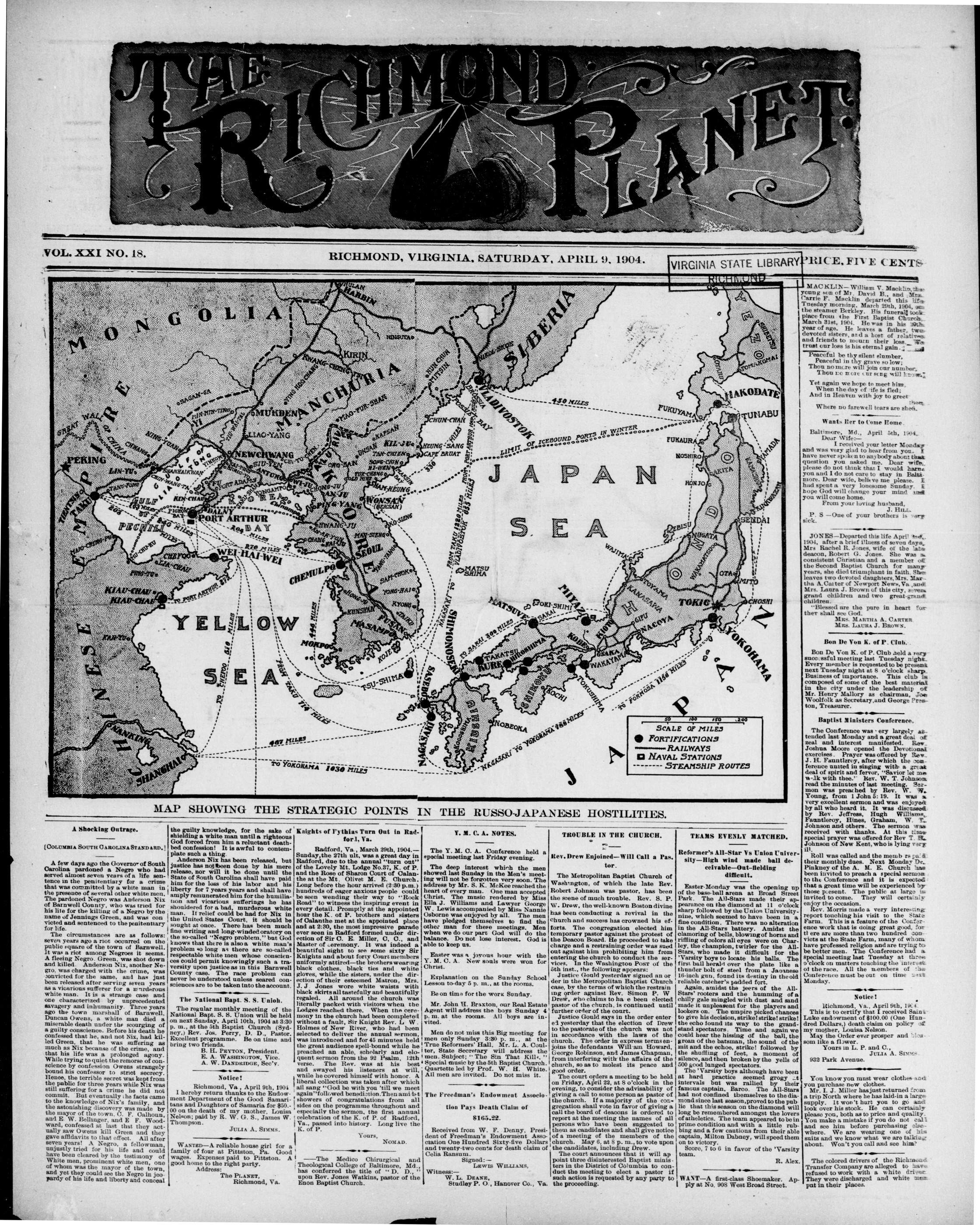
THE RICHMOND PLANET
MONGOLIA
MANCHURIA
PEKING
LIN-YU
GULF
PECUILI
WEI-HAI-WEI
CHEFON
KIAU-CHAU
KIAU-CHAB
YELLOW SEA
NANKING
SHANGHAI
MUKDEN
LIAO-YANG
NEWCHWANG
SIO-TEN
SHANHAIKWAN
CHIN-WANG-TAN
TANG-YONG
KIN-CHAU
ROREA
DALAY
PORT ARTHUR
BAY
CHEMULPO
SEOUL
SHIMONOSEM
NAGASAKI
TSU-SHIMA
NOBEOKA
KAGASAKI TO YOKOHAMA 1030 MILES
RICHLAND
SIBERIA
ADIVOSTOK
FUKUYAMA
LIMIT OF ICEBOUND PORTS IN WINTER
FUKAURA
NOSHIRO
AMADA
HONJO
SENDAI
WAJIMA
TOKI
YOKOHAMA
SCALE OF MILES
• FORTIFICATIONS
• RAILWAYS
• NAVAL STATIONS
• STEAMSHIP ROUTES
VOL. XXI NO. 18.
MON
RE
GREAT WALLOY CHINA
PERING
LIN-YU
TUNNING
TAMU
GULF
BOS
PECWILL
KAJO-CHENG-PUN
FING-YU
KIAU-CHAU
KIAU-CHAU
KAR-YU
HANKING
SHANG
A Shocking Outrage.
[COLUMBIA SOUTH CAROLINA STANDARD.
A few days ago the Governor of South Carolina pardoned a Negro who had served almost seven years of a life sentence in the penitentiary for a crime that was committed by a white man in the presence of several other white men. The pardoned Negro was Anderson Nix of Barnwell County, who was tried for his life for the killing of a Negro by the name of Jennings Green, and was convicted and sentenced to the penitentiary for life.
The circumstances are as follows: seven years ago a riot occurred on the public square of the town of Barnwell. It was a riot among Negroes it seems. A fleeing Negro, Green, was shot down and killed. Anderson Nix, another Negro, was charged with the crime, was convicted for the same, and has just been released after serving seven years as a vicarious sufferer for a murderous white man. It is a strange case and one characterized by unprecedented savagery and inhumanity. Three years ago the town marshall of Barnwell, Duncan Owens, a white man died a miserable death under the scourging of a guilty conscience. Before his death he confessed that he, and not Nix, had killed Green, that he was suffering as much as Nix because of the crime, and that his life was a prolonged agony. While trying to quiet the remorse of conscience by confession Owens strangely bound his confessor to street secrecy. Hence, the terrible secret was kept from the public for three years while Nix was still suffering for a crime he did not commit. But eventually the facts came to the knowledge of Nix's family, and the astonishing discovery was made by the mayor of the town. F. O. Calhoun, and E W. Bellinger, and E F. Oulhoun, confessed to last that they actually saw Owens kill Green and they gave affidavits to that effect. All after seven years! A Negro, a fellowman, unjustly tried for his life and could have been cleared by the testimony of White men, prominent white men, one of whom was the mayor of the town, and yet they could see the Negro in jeopardy of his life and liberty and conceal
the guilty knowledge, for the sake of shielding a white man until a righteous God forced from him a reluctant deathbed confession! It is awful to contemplate such a thing.
Anderson Nix has been released, but justice has not been done by his mere release, nor will it be done until the State of South Carolina shall have paid him for the loss of his labor and his liberty for 7 years years and shall have amply remunerated him for the humiliation and vicarious sufferings he has shouldered for a bad, murderous white man. It relief could be had for Nix in the United States Court, it should be sought at court. There has been much fine writing and long wielded oratory on the so-called "Negro problem," but God knows that there is also a white man's problem so long as there are so-called respectable white men whose consciences could permit knowingly such a traversity upon justice as in this Barnwell County case. The race problem can never be understood unless seared consciences are to be taken into the account.
The National Bapt. S. S. Uniob.
The regular monthly meeting of the National Bapt. S. S. Union will be held on next Sunday, April 10th, 1904 at 3:30 p. m., at the 5th Baptist Church (Sydney). Rev. Jos. Perry, D. D., Pastor, Excellent programme. Be on time and bring two friends. B. H. PEYTON, President. E. A. WASHINGTON, Vice. A. W. DANDRIDGE, Sec'y.
Notice!
Richmond, Va., April 9th, 1904
I hereby return thanks to the Endow-
ment Department of the Good Samaritans and Daughters of Samarina for $50.00 on the death of my mother, Louisa Nelson; paid by R. W. G. S., James W. Thompson.
JULIA A. SIMMS.
WANTED—A reliable house girl for a family of four at Pittston, Pa. Good wages. Expenses paid to Pittston. A good home to the right party.
Address:
The PLANET,
Richmond, Va.
RICHMOND, VIRGINIA, SATURDAY, APRIL 9, 1904.
Knights of Fythias Turn Out in Radford, Va.
Radford, Va., March 29th, 1904.—Sunday, the 27th ult. was a great day in Radford, due to the annual "turn out" of the Lovely Mt. Lodge No.37, K. of P. and the Rose of Sharon Court of Calanthe at the Mt. Olivet M. E. Church. Long before the hour arrived (2:30 p.m.) hundreds of eager anxious people could be seen wending their way to "Rock Road" to witness the inspiring event in every detail. Promptly at the appointed hour the K. of P. brothers and sisters of Calanthe met at the appointed place and at 2:30, the most impressive parade ever seen in Radford formed under direction of Sir C. E. Miller, C. C., and Master of ceremony. It was indeed a beautiful sight to see some sixty Sir Knights and about forty Court members formally attired the brothers wearing black silk gloves, white silk gloves, while the sisters, under the effect of their esteemed Matron, Mrs. J. J Jones wore white waists with black skirts all tastefully and beautifully regaled. All around the church was the Lodges reached there. When the ceremony in the church had been completed without a fault, Sir Knight Rev. L. W. Holmes of New River, who had been selected to deliver the annual sermon, was introduced and for 45 minutes held the great audience spell-bound while he preached an able, scholarly and eloquent sermon from the 92 Psalm, 12th verse. The Rev. was at his best and swayed his listeners at will, while he covered himself with honor. A liberal collection was taken after which all sang "God be with you 'till we meet again" followed benediction. Then aml bishowers of congratulations on programme throughout and especially the sermon, the first annual celebration of the K. of P. of Radford, Va., passed into history. Long live the K. of P.
NOMAD.
The Medico Chirurgical and Theological College of Baltimore, Md., has conferred the title of "D. D.," upon Rev. Jones Watkins, pastor of the Enon Baptist Church.
Y. M. C. A. NOTES.
The Y. M. C. A. Conference held a special meeting last Friday evening.
The deep interest which the men showed last Sunday in the Men's meeting not be forgotten very soon. The address of S. K. McKee reached the heart of every man. One led by Miss Ella J. Williams and Lawyer George W. Lewis accompanied by Miss Nannie Osborne was enjoyed by all. The men have pledged themselves to find the other man for these meetings. Men when we do our part God will do the balance. Do not lose interest. God is able to keep us.
Easter was a joyous hour with the Y. M. C. A. New souls were won for Christ.
Explanation on the Sunday School Lesson to day 5 p. m., at the rooms.
Mr. John H. Braxton, our Real Estate Agent will address the boys Sunday 4 p.m. at the rooms. All boys are invited.
Men do not miss this big meeting for men only Sunday 3:30 p.m. at the True Reformers' Hall, Mr. Carter, State Secretary will address the men. Subject: "The Sin That Kills." Special music by the 5th Baptist Church, Quartette led by Prof. W. H. White. All men are invited. Do not miss it.
The Freedman's Endowment Associo
Received from W. F. Denny, President of Freedman's Endowment Association One Hundred Sixty-five Dollars and twenty-two cents for death claim of Celia Ransum.
Signed:—
LEWIS WILLIAMS,
Witness:—
W. L. DEANE,
Studley P. O., Hanover Co., Va.
TROUBLE IN THE CHURCH.
Rev, Drew Enjoined—Will Call a Pas-
tor.
The Metropolitan Baptist Church of Washington, of which the late Rev. Robert Johnson was pastor, has been the scene of much trouble. Rev. S. P. W. Drew, the well-known Boston divine has been conducting a revival in the church and success has crowned his efforts. The congregation elected him temporary pastor against the protest of the Deacon Board. He proceeded to take charge and a restraining order was sued out against him prohibiting him from entering the church to conduct the services. In the Washington Post of the 5th inst., the following appears: Justice Gould yesterday signed an order in the Metropolitan Baptist Church case, by the terms of which the restraining order against Rev. Simon P. W. Drew, who claims to ha e been elected pastor of the church, is continued until further order of the court.
Justice Gould says in the order entered yesterday that the election of Drew to the pastorate of the church was not in accordance with the laws of the church. The order in express terms enjoins the defendants Will am Howard, George Robinson, and James Chapman, from interfering with the affairs of the church, so as to molest its peace and good order.
The court orders a meeting to be held on Friday, April 22, at 8 o'clock in the evening, to consider the advisability of giving a call to some person as pastor of the church. If a majority of the congregation shall vote in favor of giving a call the board of deacons is ordered to report at the meeting the names of all persons who have been suggested to be candidates and the position of a meeting of the members of the church. May 6, at 8 p.m., to vote upon the candidates, including Drew.
The court announces that it will appoint three disinterested Baptist ministers in the District of Columbia to conduct the meeting to elect a pastor if such action is requested by any party to the proceeding.
TEAMS EVENLY MATCHED.
Reformer's All-Star Vs Union Uilver
sity—High wind made ball de-
ceivable—Out-fielding
Easter-Monday was the opening up of the base-ball arena at Broad Street Park. The All-Stars made their appearance on the diamond at 11 o'clock sharp followed by the Union University, nine, which seemed to have been in a fine condition. There was no alteration in the All-Stars battery. Amidst the clamoring of bells, blowing of horns and riffling of colors all eyes were on Charleston, the champion, twirler for the All-Stars who played for the 'Varsity boys to locate his ball.' The first ball heralded over the plate like a thunderbolt of steel from a Japanese 16-inch gun, found its destiny in the old reliable catcher's padded fort.
Again, amidst the jeers of the All-Stars' rooters and the humming of a chilly gale mingled with dust and sand made it unpleasant for the players and lookers on. The umpire picked chances to give his decision, strike! strike! strike! the echo found its way to the grandstand spectators. Time and again we could hear the hissing of the ball, the groan of the batsman, the sound of the mit and the echo, strike! followed by the shuffling of feet, a moment of silence, and then broken by the yells of 500 good lunged spectators. No varsity boys although have been at hard practice seemed groggy - intervals but was rallied by their famous captain, Barco. The All-Stars had not confined themselves to the dunce since last season, proved to the dunce that this season on the diamond will long be remembered amongst the lovers of athletics. The team appeared to be in prime condition and with a little rubbing and a few cautions from their able captain, Milton Dabney, will speed them on to victory.
Score, 7 to 6 in favor of the 'Varsity team.
WANT—A first-class Shoemaker. Apply at No. 908 West Broad Street.
MACKLIN-William V. Macklin, the young son of Mr. David B., and Mr. Carrie F. Macklin departed this life Tuesday morning, March 29th, 1944, on the steamer Berkley. His funeral took place from the First Baptist Church, March 31st, 1944. How was in his 99th year of age. He leaves a father, two devoted sisters, and a host of relatives and friends to mourn their loss. We trust our loss is his eternal gain.
Peaceful be thy silent slumber,
Peaceful in thy grave so low,
Thou no more will join our number,
Thou no more our song will know.
Yet again we hope to meet him,
When the day of life is fled,
And in Heaven with joy to greet
Baltimore, Md., April 5th, 1904.
Dear Wife:
I received your letter Monday and was very glad to hear from you. I have never spoken to any body about that question you asked me. Dear wife, please do not think that I would harra you and I do not care to stay in Balkimore. Dear wife, believe me please. I had spent a very lonesome Sunday. I hope God will change your mind and you will come home.
From your loving husband,
J. HILL.
P. S—One of your brothers is very sick.
JONES—Departed this life April and 1904, after a brief illness of seven days, Mrs Rachel R. Jones, of the deacon, Robert G. Jones. She was a consistent member and a member of the Second Baptist Church for years, she died triumphant in faith. She leaves two devoted daughters, Mrs Martha A. Cutter of Newport News, Va, and Mrs Laura J. Brown of this city, seven grand children and two great-grand children.
"Blessed are the pure in heart for
them shall see God.
MRS. MARTHA A. CARTER
MRS. LAURA J. BROWN.
Bon De Von K. of P. Club.
Bon De Von K. of P. Club held a very successful meeting last Tuesday night. Every member is requested to be present next Tuesday night at 8 o'clock sharp. Business of importance. This club is composed of some of the best material in the city under the leadership of Mr. Henry Mallory as chairman, Joe Woolfolk as Secretary, and George Preston, Treasurer.
Baptist Ministers Conference
The Conference was very largely attended last Monday and a great deal of zeal and interest manifested. Rev Joshua Moore opened the Devotional exercises. Prayer was offered by Rev J. H. Fauntlercy, after which the conference united in singing with a great deal of spirit and fervor. "Savior let me walk with them." Rev W. T. Johnson read the minutes of last meeting. Sermon was preached by Rev W. W. Young, from 1 John 5:19. It was a very excellent sermon and was enjoyed by all who heard it. It was discussed Rev J. Jeffress, Hugh Williams, Fauntlercy, Graham W. T. Johnson and others. The sermon was received with thanks. At this time special prayer was offered for Rev T. H. Johnson of New Kent, who is lying very ill.
Roll was called and the memb resided their monthly dues. Next Monday Dr. Pinkney of the A. M. E. Church has been invited to preach a special sermon to the Conference and it is expected that a great time will be experienced by those present. The public at large is invited to come. They will certainly enjoy the occasion.
Rev. Morris made a very interesting report touching his visit to the State Farm. This is a feature of the Conference work that is doing great good, for it ere are more than two hundred convicts at the State Farm, many of whom have professed religion and are trying to be better men. The Conference had a special meeting last Tuesday at three o'clock on matters touching the interest of the race. All the members of the Conference must be out on time next Monday.
Notice!
Richmond, Va., April 9th, 1904
This is to certify that I received Saints
Luke endowment of $100.00 (One Hundred
Dollars.) death claim on policy of
my mother, Louisa Nelson.
May the Order ever prosper and bla-
May the Order ever prosper and blossom like a flower.
Yours in L. P. and C.,
JULIA A. SIMMES
932 Park Avenue.
You know you must wear clothes and you purchase new clothes.
Mr. I. J. Miller has just returned from a trip North where he has laid in a large supply. It won't hurt you to go and look over his stock. He can certainly please you, both as to price and quality. You make a mistake if you do not call and see him before purchasing elsewhere. We are wearing one of his suits and we know what we are talking about. Won't you call and see him?
The colored drivers of the Richmond Transfer Company are alleged to have refused to work with a white driver. They were discharged and white men out in their places.
THE SECRET
BEAUTY'S CALL.
Why should she waste any glad moments reading?
Why should she wish to be wise?
Why should she be an anxiously pleading, taking no note of her learning or breeding,
Caring for naught but her beauty. There lies
Only a way that is flowery before her.
Gently the breezes around her will blow;
Beauty is hers, so the world will adore her,
Asking not, caring not, what she may
know.
Why should she wrinkle her brow or be
worried
Over the affairs of the day?
Why should she care how the toller is hurried
Down to his grave to be hastily buried,
So that some other may profit? The way
Stretches beyond her through scenes that
are splendid-
Ah, see them waiting to worship her
there!
Fetted by Fate and by Fortune attended,
Wit she may lack, but the world will not
care.
Why should she waste any gay moments
learning
How to do that or do this?
Life is so short—there can be no returning—
Hide her not then from the ones who are
yearning
Just for the smiles she may give them,
the bliss
Of kneeling before her and gladly obeying
All the commands she may give in her
while she has beauty that merits display-
ing
The world will not care what her talents
S. E. Kiser, in Chicago Record-Herald
BY MYRTLE CONGER
(Copyright 1907, My Daily Story Pub. Co.)
HOWEVER tragic Jimmy's woes may have been to Jimmy, Wilmot evidently was rather amused by them.
"My dear fellow," he said, when Jimmy had finished speaking. "Of course your love was like no other. Every love is like no other—to the fellow concerned."
"But I could have taken an oath she loved me." Jimmy's voice was full of misery.
His friend smiled. "We take a great many oaths there's no possible grounds for," he said. "Have a cigar."
He pushed the box towards Jimmy, who took with the oath indifference.
I pushed the look towards Jimmy, who took one with gloomy indifference. "Cigars are excellent for wounded hearts—and vanity," his friend went on cheerfully. "Got these over in Cuba, myself. I keep them in reserve for special occasions." He looked at Jimmy as if expecting some show of appreciation. "Have a match," he said, proffering the one with which he had just lighted his own cigar.
Jimmy took it, but let it go out without using it. His friend smoked awhile in speculative silence.
"Success in love is a queer thing, Jimmy," he observed, following a curling line of smoke upward with his cigar. "A very queer thing. The deserving are not always the successful, by any means. Now in most human affairs, the gods have fixed laws, so that usually we can anticipate the consequence of most of the actions of men, but in love, the gods
OH, DON'T BE IMPATIENT, MY BOY,
LETS TALK IT OVER."
play at a kind of toss up with the hearts of men and women. If you are lucky, the heart of your choice may fall to you, but it's an uncertain game at best." "She gave me every kind of encouragement," Jimmy complained, with doleful voice.
His friend was studying the vanishing lines of smoke. "Given the same circumstances and two love affairs," he went on musingly, as if he were following out his own line of thought, rather than addressing Jimmy; he had not noted the latter's remark. "Given the same circumstances and two love affairs, one may be a success—that is success as defined in the lovers' dictionary; while the other may be an absolute failure—defined also in the same dictionary. It all depends on the final toss up of the gods."
"Your ideas have a sound," grumbled Jimmy, "but reasoning is not an anti-dote for a woman's 'No.' To argue how things come about isn't a cure for anything." Jimmy pushed the match tray suggestively across the table. Jimmy took no notice of it. "Speaking of reasoning," said Wilmot, not in the least disconcerted, "that reminds me. I know a man. He's one of the workmen in our factory. It pays to know one's workmen, Jimmy. This fellow is in love, too. Her name is Mandy, and she used to work in the factory. That's where he met her. She lives down in Hogan's place; and she's got red hair, and the accompanying freckles, and she's slightly cross-eyed." He paused, much
bodices, as well as in the shape of bands round or down the skirts. In the last mentioned situation, too, scallops of the material of the gown, bound round with the trimming fabric, as, for instance, cloth edged with sik, are adopted. Ribbon makes good strappings or bands, and can be bead in such variety that there is no difficulty in meeting the requirements in the way of color or relief of the dress material.
The average woman will certainly want a blue serge for the morning, and a black cloth frock of some sort for the afternoons at this time of year. Brown, of course, is some women's color, and then it may well take the place of black; but a dress of dark hue is a necessity, at any rate for those who live in London. It is good news to the woman who has to make the question of utility her first consideration, that Parisians will be wearing a great deal of black, and touches of black on almost everything.
Later on, I would suggest various inexpensive materials in the form of accordion-plaited, and even now, if you have bought some remnants of soft gray or black stuff, why not have them accordion-plaited in preparation for house frocks for early spring? Such a gown may be ever so simple, with a soft band swathed round the waist, finished perhaps with fringed sash ends. This frock is so comparatively inexpensive that it is worthy of consideration.
The same idea has been carried out in white cloths for afternoon wear on the Riviera, relieved with a touch of soft, black satin, oriental for preference.
We cannot all have blouses to match our skirts, as Dame Fashion says we should, but we can at least make unavoidable contrasts pleasing, and here the bolero, which is coming into fashion again, is of great assistance to us. It is really a charming garment and can be composed of anything you like.
This little bolero, which in some cases is almost sleeveless, is one of the best ways I know of utilizing odd lengths of chiffon, jet, embroideries, etc. Some are cut rather like the old-fashioned zouave, and are extremely becoming with the wide kid bands which we all love, owing to the fact that they make the waist look quite two or three inches smaller.
taken up with his own reflections.
Jimmy remained gloomily silent.
Presently, the other resumed. "Yet
they say that Mother Eve was wonder-
ously fair, and that sin brought all the
hideous things into the world. It's not
much wonder we are so continually ad-
monshed to hate sin, considering the
sights it has thrust upon us."
Jimmy moved impatiently in his chair.
"And the hovel she lives in!" the other
continued. "What a downward evolu-
tion must have been in progress from
Paradise to that! You've been in Hogan's
Place, haven't you, Jimmy?"
"No," returned Jimmy, shortly. "Mandays don't interest me."
His friend looked at him in some sur-
prise. "No, of course not," he said, re-
flectively. "There's such a vast diffe-
ence between your love for your angel
lady and Jeems' love for his Mandy."
He laughed a little.
"I'm sure I can't see any relation,"
Jimmy returned, resentfully.
"Oh, don't be impatient, my boy. Let's talk it over. There's nothing like reasoning a thing out. Philosophy really can be used as an antidote for love. A substitute, anway. You know what Dante did."
"Did what?"
"Did use it for a substitute." Wilmot was evidently surprised at Jimmy's lack of comprehension. "As I was saying, there is a vast difference between your love and Jeems', but it's only of caste, of caste, Jimmy. Jeems' talks factory gossip and slang to Mandy. He takes her stick candy and 18-cent chocolates on his regular nights. And takes her on excursion boat rides on the Fourth of July; then they have peanuts with popcorn and lemonade. For Christmas he gives her a celluloid hand mirror in which to admire her peculiar type of beauty."
"You seem to know a great deal about the affairs of your factory people."
"Oh, I don't know any of the details. I'm not interested in mere incidentals. I only know the nature of these people and I know that their affairs are conducted on about the order I have been describing to you.
Jimmy made a protesting gesture.
"And yet, Jimmy, it was the same kind of attraction that led you to talk soulful things to your beloved; and dainty bits of poetry and subtle flattery. Instead of the cheap candy, popcorn and peanuts, there were costly bon-bons in elaborate, tissueed boxes; and rare American beauties delivered by the proper buttons. In place of the annual boat ride excursion, there were repeated suppers at Delmonico's and boxes at the opera. With the degrees of civilization, things go up in quality and price, Jimmy. Then, there were tender, meaning hand-clasps instead of the unsavory kisses.
Jimmy leaned a little forward and opened his mouth to speak, but apparently thought better of it, and resumed his position in silence.
"And the love that gleams in Mandy's eyes when Jeems' rehearses coarse factory gossip, sitting on park benches on Sunday afternoons, how different that is from the genteel, comprehending light that glows in the eyes of your adored one, sitting with you amid the luxury of the Fifth avenue drawing room! Merely the difference of caste, differing much in favor of Mandy, for she was sincere and your angel was not." Jimmy scowled. Wilmot inspected his cigar, and perceiving it had gone out, relighted it, and offered the match to Jimmy, who took it, and this time lighted his cigar. Both men sat smoking awhile in silence, Jimmy indifferently, and Wilmot with evident enjoyment. "Now, love at 25—" the latter began, consolingly, "I'm 27." interrupted Jimmy.
"Well. 27. Oh, my boy, we can love such a lot of times. I was just going to say that love at 25 is only a fore-runner of the love that occurs each succeeding year until the shortness of life puts an end to our loving."
Jimmy brushed the ash from his cigar. He couldn't feel its soothing influence. His friend tossed the end of his into the open grate. "Let's have something to drink," he suggested, and without waiting for a reply, rank the bell and gave the order.
After the servant had left the room, Wilmot filled the glasses and offered one to Jimmy. "Let's drink to her better judgment, my boy." he said, "and to your love, a happy ending after all. Who knows what a woman's answer may be a second time." He raised his glass. "Who is she, Jimmy?" he asked, as if moved by some sudden thought.
Jimmy hesitated. "I don't think that matters, does it?" he said. "I told you she refused me, didn't I?"
"Now, see here, Jimmy, let's don't have any half-confidences. Who is she? I told you I wished to drink to her better judgment."
"I don't like to bring the girl's name into it," said Jimmy, reluctantly, "but I suppose you may as well know. Yes; you may as well know. It's Alice Harrison."
"Alice Harrison!"
Jimmy looked up.
Wilmot set his glass down upon the table with starling abruptness. The frail glass was shattered into fragments. The wine flowed upon the table.
"Well?" said Jimmy, irritably.
"Alice Harrison!"
"Yes; Alice Harrison. You wanted to know."
"Why, Jimmy, why she's—engaged to me."
In Old England
Among the inventions in the old times one for fixing the hair in position was advertised as follows: "A new method of stucking the hair in the most fashionionble taste, to fast with very little repair during the whole session of parliament. Price only 5 guineas. N. B.—He takes but one hour to build the head and two for baking it."
To Raise Her Own Cotton.
Five million dollars has been subscribed so far in England for promoting the cultivation of cotton in British colonies and Egypt. One part of the scheme is to send out a large number of overseers and experts in cotton growing to instruct the natives till they are familiar with the process.
Graded Affection
Housekeeper—Do you love children?
Applicant—It all depends on th' wages, mum!—Puck.
THE RICHMOND PLANET, RICHMOND, VIRGINIA.
Gossip of Seasonable Modes and a Glimpse at Those the Spring and Summer Will Bring.
OON it will be time to think of the Easter hat, and the milliners are showing many pretty modes for the occasion. Flowers, gold and a tendency toward ribbon are
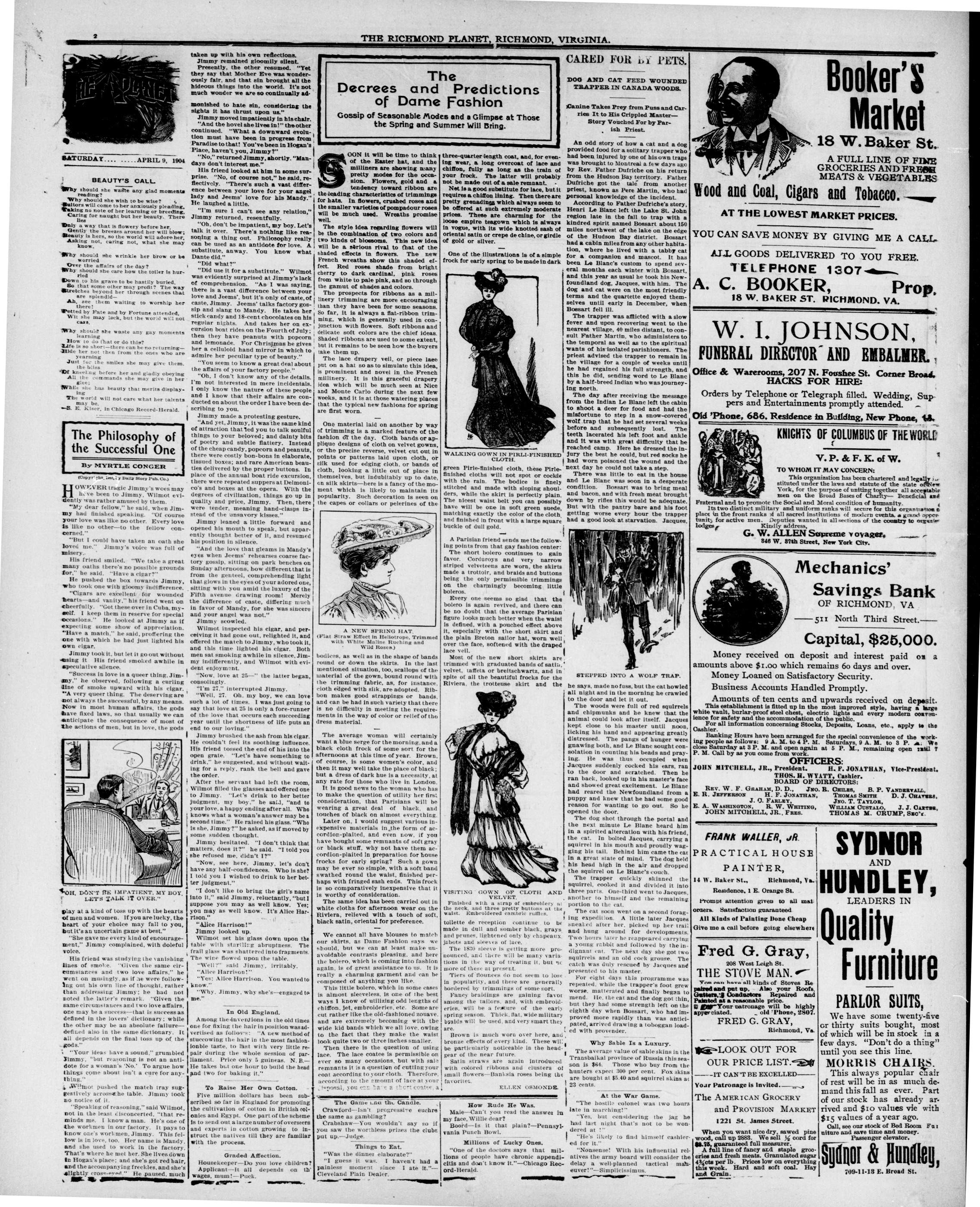
OON it will be time to think of the Easter hat, and the milliners are showing many pretty modes for the occasion. Flowers, gold and a tendency toward ribbon are the leading characteristics of trimmings for hats. In flowers, crushed roses and the smaller varieties of pompadour roses will be much used. Wreaths promise well. The style idea regarding flowers will be the combination of two colors and two kinds of blossoms. This new idea will be a serious rival to that of the shaded effects in flowers. The new French wreaths show this shaded effect. Red roses shade from bright cherry to dark cardinal, pink roses from white to pale pink, and so through the gamut of shades and colors.
The prospects for ribbons as a millinery trimming are more encouraging than they have been for some seasons. So far, it is always a flat-ribbon trimming, which is generally used in conjunction with flowers. Soft ribbons and delicate soft colors are the chief ideas. Shaded ribbons are used to some extent, but it remains to be seen how the buyers take them up.
The lace drapery veil, or piece lace put on a hat so as to simulate this idea, is prominent and novel in the French millinery. It is this graceful drapery idea which will be much seen at Nice and Monte Carlo during the next few weeks, and it is at those watering places that the typical new fashions for spring are first worn.
One material laid on another by way of trimming is a marked feature of the fashion of the day. Cloth bands or appliqué designs of cloth on velvet gowns, or the precise reverse, velvet cut out in points or patterns laid upon cloth, or silk used for edging cloth, or bands of cloth, looking a little out of place in themselves, but indubitably up to date, on silk skirts—here is a fancy of the moment which is likely to maintain its popularity. Such decoration is seen on the capes or collars or pelerines of the
A NEW SPRING HAT.
(Flat Straw Effect in Heliotrope, Trimmed
with White Mallee Ruching and
Wild Rosea)
Then there is the question of using lace. The lace coattee is permissible on ever so many occasions, but with sale remnants it is a question of cutting your coat according to your cloth. Therefore, according to the amount of lace at your disposal, you can have a short coattee a
"I guess it was. I haven't had a painless moment since I ate it."—Cleveland Plain Dealer.
three-quarter length coat, and, for evening wear, a long overcoat of lace and chiffon, fully as long as the train of your frock. The latter will probably not be made out of a sale remnant. Net is a good substitute for lace, but it requires a chiffon lining. Then there are pretty groomings which always seem to be offered at such extremely moderate prices. These are charming for the loose empire teagown which is always in vogue, with its wide knotted sash of in gold satin or crepe de chine, or girdle of gold or silver.
One of the illustrations is of a simple frock for early spring to be made in dark
B.
WALKING GOWN IN PIRLI-FINISHED CLOTH.
green Pirle-finished cloth, these Pirle-finished cloths will not spot or cockle with the rain. The bodice is finely stitched and made with sloping shoulders, while the skirt is perfectly plain. The nicest waist belt you can possibly have will be one in soft green suede, matching exactly the color of the cloth and finished in front with a large square buckle of dull gold.
A Parisian friend sends me the following points from that day fashion center
ing points from that gay fashion center:
The short bolero continues to gain favor. Corduroys and very narrow striped velvetteens are worn, the skirts made a trottoir, and braids and buttons being the only permissible trimming on the charmingly becoming little boleros.
Every one seems so glad that the bolero is again revived, and there can be no doubt that the average Parisian figure looks much better when the waist is defined, with a pouched effect above it, especially with the short skirt and the plain Breton sailor hat, worn well over the face, softened with the draped lace veil.
Most of the new short skirts are trimmed with graduated bands of satin, velvet, taffeta or bretschwartz, and in spite of all the beautiful frocks for the Riviera, the trotteuse skirt and the
H. C. Coulthard
VISITING GOWN OF CLOTH AND VELVET.
Finished with a strap of embroidery at the neck, and three pretty buttons at the waist. Embroidered cambric ruffles.
toilette de reception continue to be made in dull and somber black, grays and prunes, lightened only by chapeaux jabots and sleeves of lace.
The 1830 sleeve is getting more pronounced, and there will be many variations in the way of treating it, but no more of these at present.
Tiers of flounces do not seem to lose in popularity, and these are generally bordered by trimmings of some sort.
Fancy braidings are gaining favor among the tailors, and, with embroideries, will be a feature of the early spring season. Thick, flat, wide military braids will be used, and very smart they are.
Brown is much worn over here, and bronze effects of every kind. These will be particularly noticeable in the headgear of the near future.
Satin straws are again introduced with colored ribbons and clusters of small flowers—Banksia roses being the favorites. ELLEN OSMONDE.
Boord—Is it that plain?—Pennsylvania Punch Bowl.
Millions of Lucky Ones.
"One of the doctors says that millions of people have chronic appendicitis and don't know it."—Chicago Record-Herald.
DOG AND CAT FEED WOUNDED TRAPPER IN CANADA WOODS.
Canine Takes Prey from Puss and Carries It to His Crippled Master—Story Vouched For by Parish Priest.
An odd story of how a cat and a dog provided food for a solitary trapper who had been injured by one of his own traps was brought to Montreal a few days ago by Rev. Father Dufriche on his return from the Hudson Bay territory. Father Dufriche got the tale from another priest, known as Pere Martin, who had personal knowledge of the incident.
According to Father Dufriche's story, Henri Le Blanc left the Lake St. John region late in the fall to trap with a kindred spirit named Bossart about 150 miles northwest of the lake on the edge of the Hudson Bay district. Bossart had a cabin miles from any other habitation, where he lived with a tabby cat for a companion and mascot. It has been Le Blanc's custom to spend several months each winter with Bossart, and this year as usual he took his Newfoundland dog, Jacques, with him. The dog and cat were on the most friendly terms and the quartette enjoyed themselves until early in December, when Bossart fell ill.
The trapper was afflicted with a slow fever and upon recovering went to the nearest village, 40 miles distant, to consult Father Martin, who administers to the temporal as well as to the spiritual wants of his isolated parishioners. The priest advised the trapper to remain in the village for a couple of weeks until he had regained his full strength, and this he did, sending word to Le Blanc by a half-breed Indian who was journeying north.
The day after receiving the message from the Indian Le Blanc left the cabin to shoot a deer for food and had the misfortune to step in a snow-covered wolf trap that he had set several weeks before and subsequently lost. The teeth lacerated his left foot and ankle and it was with great difficulty that he reached camp. Here he dressed the injury the best he could, but red socks he had worn poisoned the wound and the next day he could not take a step.
There was little to eat in the house and Le Blanc was soon in a desperate condition. Bossart was to bring meal and bacon, and with fresh meat brought down by rifles this would be adequate. But with the pantry bare and his foot getting worse every hour the trapper had a good look at starvation. Jacques.
STEPPED INTO A WOLF TRAP.
he says, made no fuss, but the cat howled all night and in the morning he crawled to the door and let it out. The woods were full of red squirrels and chipmunks and he knew that the animal could look after itself. Jacques kept close to his master until noon, licking his hand and appearing greatly distressed. The pangs of hunger were gnawing both, and Le Blanc sought consolation in counting his beads and praying. He was thus occupied when Jacques suddenly cocked his ears, ran to the door and scratched. Then he ran back, looked up in his master's face and showed great excitement. Le Blanc had reared the Newfoundland from a puppy and knew that he had some good reason for wanting to go out. So he opened the door.
The dog shot through the portal and the next minute Le Blanc heard him in a spirited alteration with his friend, the cat. In bolted Jacques, carrying a squirrel in his mouth and proudly wagging his tail. Behind him came the car in a great state of mind. The dog held his head high in the air and dropped the squirrel on Le Blanc's couch. The trapper quickly skinned the squirrel, cooked it and divided it into three parts. One-third went to Jacques, another to himself and the remaining portion to the cat.
The cat soon went on a second foraging expedition. A little later Jacques sneaked after her, picked up her trail and hung around for developments. Two hours later he reappeared carrying a young rabbit and followed by the indignant cat. The next day she got two squirrels and an old cock grouse. The catch was duly rescued by Jacques and presented to his master.
For eight days this programme was repeated, while the trapper's foot grew worse, mattered and finally began to mend. He, the cat and the dog got thin, but they had some strength left on the eighth day when Bossart, who had improved more rapidly than was anticlated, arrived drawing a toboggan loaded with provender.
Why Sable Is a Luxury.
The average value of sable skins in the Transbaikal province of Russia this season is $64. Those who buy from the hunters expect 300 per cent. Fox skins are bought at $5.40 and squirrel skins at 23 cents.
At the War Game.
"The hostile colonel was two hours late in marching!"
"Yes, but considering the jag he had last night that's not to be wondered at!"
"He's likely to find himself cashiered for it."
"Nonsense! With his influential relatives the army board will consider the delay a well-planned tactical makeover!" - Simplificissimus.
J. H. H.
Booker'S Market
18 W. Baker St.
A FULL LINE OF FINE
GROCERIES AND FRESH
MEATS & VEGETABLES
Wood and Coal, Cigars and Tobacco.
AT THE LOWEST MARKET PRICES.
YOU CAN SAVE MONEY BY GIVING ME A CALL.
ALL GOODS DELIVERED TO YOU FREE.
TELEPHONE 1307
A. C. BOOKER, Prop.
18 W. BAKER ST. RICHMOND, VA.
W. I. JOHNSON,
FUNERAL DIRECTOR AND EMBALMER.
Office & Warerooms, 207 N. Foushee St. Corner Broad.
HACKS FOR HIRE:
Orders by Telephone or Telegraph filled. Wedding, Suppers and Entertainments promptly attended.
Old 'Phone, 686. Residence in Building, New Phone, 18.
KNIGHTS OF COLUMBUS OF THE WORLD
AT THE LOWEST MARKET PRICES.
YOU CAN SAVE MONEY BY GIVING ME A CALL.
ALL GOODS DELIVERED TO YOU FREE.
TELEPHONE 1307
A. C. BOOKER, Prop.
18 W. BAKER ST. RICHMOND, VA.
W. I. JOHNSON. FUNERAL DIRECTOR AND EMBALMER.
Office & Warerooms, 207 N. Foushee St. Corner Broad. HACKS FOR HIRE:
Orders by Telephone or Telegraph filled. Wedding, Suppers and Entertainments promptly attended.
Old 'Phone, 686. Residence in Building, New Phone, 18.
KNIGHTS OF COLUMBUS OF THE WORLD
V. P. & F. K. of W.
TO WHOM IT MAY CONCERN:
This organization has been chartered and legally situated under the laws and statute of the state of York, for the purpose of uniting together all acceptable men on the Broad Bases of Charity. Beneficial
V. P. & F. K. of W.
TO WHOM IT MAY CONCERN:
This organization has been chartered and legally
situated under the laws and statute of the state of New
York, for the purpose of uniting together all acceptable
men on the Broad Bases of Charity—Beneficial and
Fraternal and to promote the Social and Moral condition of humanity.
Its two distinct military and uniform ranks will secure for this organization a
place in the front ranks of all sacred institutions of modern events, a grand oppo-
tunity for active men. Deputies wanted in all sections of the country to organi-
lodge.
G. W. ALLEN Supreme voyager
846 W. 37th Street, New York City.
This organization has been chartered and legally situated under the laws and statute of the state of New York, for the purpose of uniting together all acceptable men on the Broad Bases of Charity—Beneficial and Fraternal and to promote the Social and Moral condition of humanity. Its two distinct military and uniform ranks will secure for this organization a place in the front ranks of all sacred institutions of modern events, a grand opportunity for active men. Deputies wanted in all sections of the country to organize lodges. Kindly address,
G. W. ALLEN Supreme voyager,
846 W. 87th Street, New York City.
Mechanics'
Savings Bank
OF RICHMOND, VA
— 511 North Third Street.—
Capital, $25,000.
Money received on deposit and interest paid on a amounts above $1.00 which remains 60 days and over.
Money Loaned on Satisfactory Security.
Business Accounts Handled Promptly.
Amounts of ten cents and upwards received on deposit.
This establishment is fitted up in the most improved style, having a large white vanit, burlar-proof steel chest, electric lights and every modern convenience for safety and the accommodation of the public.
For all information concerning Stocks, Deposits, Loans, etc., apply to the Cashier.
Banking Hours have been arranged for the special convenience of the working people as follows: 9 A. M. to 4 P. M. Saturday; 9 A. M. to 3 P. M. We close Saturday at 3 P. M. and open again at 5 P. M., remaining open until 7 P. M. Call by as you come from work.
OFFICERS:
JOHN MITCHELL, JR., President. H. F. JONATHAN, Vice-President.
THOS. H. WYATT, Cashier.
BOARD OF DIRECTORS:
REV. W. F. GRAHAM, D. D., JNO. R. CHILES, B. P. VANDERVALL,
E. R. JEFFERSON H. F. JONATHAN, THOMAS SMITH D. J. CHAVERS,
J. O. FARLEY, JNO. T. TAYLOR.
Money received on deposit and interest paid on a amounts above $1.00 which remains 60 days and over.
Money Loaned on Satisfactory Security.
Business Accounts Handled Promptly.
Amounts of ten cents and upwards received on deposit.
This establishment is fitted up in the most improved style, having a large white vault, burlar-proof steel chest, electric lights and every modern convenience for safety and the accommodation of the public.
For all information concerning Stocks, Deposits, Loans, etc., apply to the Cashier.
Banking Hours have been arranged for the special convenience of the working people as follows: 9 A.M. to 4 P.M. Saturdays, 9 A.M. to 3 P. We close Saturday at 3 P.M. and open again at 5 P.M., remaining open until 7 P.M. Call by as you come from work.
OFFICERS:
JOHN MITCHELL, JR., President. H. F. JONATHAN, Vice-President.
THOS. H. WYATT, Cashier.
BOARD OF DIRECTORS:
WILLIAM CUSTALO, J. J. CARTER
THOMAS M. CRUMP, SCOY.
SYDNOR AND HUNDLEY, LEADERS IN Quality Furniture
FRANK WALLER, JR.
PRACTICAL HOUSE
14 W. Baker St., Richmond, Va.
Residence, 1 E. Orange St.
Prompt attention given to all mail
orders. Satisfaction guaranteed
All kinds of Painting Done Cheap
Give me a call before going elsewhere
Fred G. Gray,
THE STOVE MAN.
You can have all kinds of Stoves Repaired and put up. Also your Roofa Gutters; Conductors Repaired and Painted at a reasonable price.
Your patronage will be highly appreciated. old 'Phone, 2807
We have some twenty-five or thirty suits bought, most of which will be in stock in a few days. "Don't do a thing" until you see this line.
Richmond, Va
MORRIS CHAIRS.
OUR PRICE LIST.
This always popular chair of rest will be in as much demand this fall as ever. Part of our stock has already arrived and $10 values vie with $15 values of a year ago. Call one stock of Bed Room.
The AMERICAN GROCERY and PROVISION MARKET
Call, see our stock of Bed Room. Fai
niture and save time and money.
When you want nice dry, sawed pine wood, call up 2883. We sell ½ cord for $8.75, guaranteed full measurer.
Sydnor & Hundley,
A full line of fancy meat staple groceries and fresh meats. Granulated sugar prices low on everything this week. Hard and soft coal. Hay and Grain.
709-11-13 E. Broad St.
Ghe Gentleman :
§ From Indiana |
By Bootn TARKINGTON
= —-— in’ fer ye,” he warned them. “Gi
CHAPTER IX. the road. Come by the fields. Fi
LL morning horsemen had |Lord’s sake, spread!” Then as su
cos eects enon had | ee Lee ae oe
seed Crossroads, sometimes sin. |{@to the weeds again. Lige and
a ee ee te ae ae tat elite
ee «6S. Okvener In company. At
1 o'clock the last posse passed through,
of its return to the county seat, and
after that there was a long, complete
silence, while the miry corners were
undisturbed by a single hoof beat. No
ankempt colt nickered from his musty
stall, The sparse young corn that used
to nod and chuckle greenly stood rigid
(a the fields. Up the Plattville pike
despeiringly cackled one old hen, with
her wabbllng, sailor run, smit with a
superstitious horror of nothing. She
uid hervelf in the shadow underneath
a rickety barn and was still.
) Goly on the Wimby farm were there
signs of life, The old lady who had
sent Harkless roses sat by the window
a morning and wiped her eyes, watch-
ing the horsemen ride by. Sometimes
they would hail her and tell her there
was nothing yet. About 2 o'clock hor
Wusband rattled up in a buckboard and
got out the shotgun of the late and
more authentic Mr. Wimby. This he
carefully cleaned and oiled in spite of
its hammerless and quite useless con-
ition, sitting meanwhile by the win-
ow opposite his wife and often look-
img up from his work to shake his
weak fist at his neighbors’ domicties
and creak decrepit curses and denun-
lations.
| But the Crossroads was ready. It
Kaew what was coming now. Fright:
ened, desperate, sullen, it was ready.
‘The afternoon wore on, and lengthen-
ing shadows fell upon a peaceful—one
Wweuld have said a sleeping—country.
The sun dried pike, already dusty,
stretched its serene length between
green borders flecked with purple and
Yellow and white weed flowers, and
the tree shadows were not shade, but
‘warm blue and lavender glows in the
general pervasion of still, bright light;
the sky curving its deep, unburnished,
Penetrable biue over all, with no sin-
gle drift of fleece upon it to be reflect:
#4 in the creek that wound along past
Willow and sycamore, dimpled but un-
murmuring. A woodpecker’s telegra-
phy broke the quiet like a volley of
pistol shots.
But far eastward on the pike there
Mowly developed a soft, white haze.
It grew denser and larger and grad-
uely rolled nearer. Dimly behind tt
could be discerned a darker, moving
nucleus that extended far back upon
the road.
A heavy tremor began to stir the air;
Taint, manifold sounds, a waxing, in-
‘creasing, multitudinous rumor.
The pike axcended a long, slight slope
leading west up to the Crossroads
Frem a thicket of ironweed at the
foet of this slope was thrust the visage
‘of an undersized girl of fourteen. Her
ferce eyes examined the approaching
cloud of dust intently. A. redness rose
wader the burnt yellow skin and col
‘ored the wizened cheeks,
‘They were coming.
She stepped quickly out of the tangle
‘and darted up the road. She ran with
‘the speed of a fleet little terrier, not
opening her lips, not calling out, but
holding ber two thin hands high above
her head; that was all. But Birnam
wood was come to Dunsinane at last,
And the messenger sped. Out of the
weeds in the corner of the snake fence,
in tbe upper part of the rise, silently
Ueted the heads of men whose sallow.
ness became a sickish white as the child
flew by.
The mob was carefully organized.
‘They had taken their time and had
prepared everything deliberately, know:
ing that nothing could stop them. Nc
ome bad any thought of concealment:
it was all as open as the light of day.
all done in the broad sunshine. Noth
jug had been determined as to what
‘was to be done at the Crossroads more
deGnite than that the place was to be
Wied out, That was comprehensive
eneugh; the details were quite certair
to occur. They were all on foot, march
fog In fairly regular ranks. In front
walked Mr. Watts, the man Harkless
hed abhorred in a public spirit and be
friended in private. Today he was «
here and a leader, marching to avenge
his professional oppressor and persona
brother, Cool, unruftied and to out
ward vision unarmed, marching the
wales in his brown frock coat and gen
erous Mnen, he led the way. On one
fide of him were the two Bowlers, on
the other was Lige Willetts, Mr. Watts
preserving peace between the young
wea with perfect tact and sang frold,
Yhey kept good order and a simili
tude of quiet for so many except far to
the rear, where old Wilkerson was
briaging up the tail of the procession,
dragging a wretched yellow dog by
Fope fastened around the poor cur's
poutesting neck, the knot carefully ar.
Tanged under bis right ear, In spite of
fyery command and protest Wilkerson
bod marched the whole way uproar
erly singing “John Brown's Body.”
Loo sun was in the west when they
susie iv sight of the Crossroads, and
the cabins on the low slope stood out
scularly against the radiance beyond.
+ they beheld the hated settioment
the levetofore orderly ranks showed
Wepesition to depart trom the steady
advainee and rash the shanties. Wil
lets, the Kowlders, Parker, Ross Scho
Beld and a dozen others dil, in fact,
break away and set a shutp pace up
the slope
Watts tried to: call them back
a as te | ee Sa eT ee ee
ly an he had appeared he dropped down
Into the weeds again. Lige and those
with him paused, and the whole body
came to a halt while the leaders con-
sulted. There was a sound of metallic
clicking and a thin rattle of steel. From
far to the rear came the voice of old
Wilkerson:
“John Brown's body lies a-moldering in
the ground,
John Brown's body Mes a-moldering in
‘the ground.”
A few near him as they stood wait-
Ing began to take up the burden of the
song, singing it in slow time like a
dirge. Then those farther away took
it up. It spread, reached the lenders.
They, too, began to sing, taking off
their hats as they joined in, and soon
the whole concourse, solemn, earnest,
Uncovered, was singing—a thunderous
requiem for John Harkless,
‘The sun was swinging lower, and
the edges of the world were embrolder-
ed with gold, while that deep volume
of sound shook the air, the song of a
stern, savage, just cause—sung perhaps
a8 some of the ancestors of these men
sang with Hampden before the bris-
tling walls of a hostile city. It had
froa and steel in it. ‘The men lying on
their guns in the ambuscade along the
fence heard the dirge rise and grow
to its mighty fuliness, and they shiver-
ed. One of them, posted nearest the
advance, had his rifle carefully leveled
at Lige Willetts, a fair target in the
road. When he heard the singing he
turned to the man next behind him
and laughed harshly, “I reckon we'll
see a big jamboree other side Jordan
tonight, hub?”
| ‘The huge murmur of the chorus ex-
|Panded and gathered in rhythmic
strength and swelled to power and
bee and thundered across the plain.
“John Brown's body Mes .a-moldering in
the ground,
|zonn Brown's body lew a-moldering in
the ground,
John Brown's ‘body les a-moldering tn
‘the ground,
HLS soul goes marching on?
Glory, glory, hallelwiah!
Gtory, glory, halleluiah!
Glory, glory, halleluiah?
His soul goes marching on!”
A gun spat fire from the higher
ground, and Willetts dropped where
he stood, but was up again in a second,
with a red line across his forehead
where the bail had grazed his temple.
‘The mob spread out like a fan, the
{men climbing the fence and beginning
the advance through the fields, thus
closing on the ambuscade from both
sides, Mr. Watts, wading through the
high grass in the fleld north of the
road, perceived the barrel of a gun
shining from the fence some distance
In front of bim and the same second,
although no weapon was seen in his
hand, discharged a revolver at. the
clump of grass and weeds behind the
gun, Instantly ten or twelve men
leaped from their hiding places along
the fences of both fields and, firing
hurriedly and harmlessly into the scat
tered ranks of the oncoming mob,
broke for the shelter of the houses,
where their fellows were posted. Tak
en on the, flanks and from the rear
there was but one thing for them to
do to keep from being hemmed in and
shot or captured. (They excessively pre
ferred being shot.) With a wild, high,
Joyous yell, sounding Uke the bay of
young hounds breaking into view of
their quarry, the Plattville men fol
lowed.
‘The most eastward of the debilitated
edifices of Six Crossroads was the sa.
loon. It bore the painted legends, on
the west wall, “Last Chance;” on’ the
east wall, “First Chance." | Next to
this and separated by two or three
acres of weedy vacancy from the cor.
ners, where the population centered
thickest, stood—if one may so predl
cate of a building which leaned In sev.
en directions—the house of Mr. Rob
ert Skillett, the proprietor of the sa
loon. Both buildings were shut up as
tight as their state of repair permit
ted. As they were farthest to the east
they formed the nearest shelter, and te
them the Crossroaders bent their flight
though they stopped not here, but dis
appeared behind Skillett’s shanty, pnt
ting it between them and their pur
suers, whose guns were beginning tt
apeak: The fugitives had a good start
and, being the picked runners of the
Crossroads, they crossed the open
weedy acres in safety and made fo
their homes. Every house had becom«
a fort. and the defenders would have
to be fought and torn out one by one
As the guns sounded, a woman in s
shanty near the forge began to scream
and Kept on screamtng,
On came the farmers and the men of
Plattville. ‘They took the saloon at a
run, buttered down the crazy doors
with a fence rail and swarmed inside
like busy insects, making the place
hum like a hive, but with the hotter
industries of destruction. It was empty
of life as a tomb, but they beat and
tore and battered and broke and ham-
mered and shattered like madmen; they
reduced the tawdry Interior to a mere
chaos and came pouring forth laden
With trophies of ruin, dnd then there
was a charry smell in the air, and a
slender feather of smoke floated up
from a second story window.
‘At the same time Watts led an as-
THE RICHMOND PLANST, Uf TMIND. VIRGINIA.
ae response; then, flourishing the paper,
hry he roared again: “Stop! A mistake!
IY tH. Tbave news! Stop, I say! Horner has
We Wi Eo got them!”
' 7 => To make himself heard over that
f b tempestuous advance was a feat; for
U \ ZZ him, moreover, whose counsels had so | )
. lately been derided, to interest the pur- {
UR fuers at such a moment enough to _——
Ya make them listen—to find the word—
a ES was a greater, and by the word and| SUCCESSFUL C
Sea) BRR} | DY. sestures at once vebementiy “im- —
cet he SAED——| | perious and imploring to stop them | It Consists of Hotbed
IN EN fa} | a8 2 stil! greater. But he did it. He Winter Storage
SN BABY, | | 22d come at just the moment before Ready fo
VW {ae BEA) | | the moment that would have been too
SRA EES late. They all heard him. They all! geven years ago Ib
Qe knew, too, that he was not trying tol pines hotted, een
R) @ | save tne Crossroads as a matter of | storage pit. It is th
S} (\ duty, because he bad given that up be- | combination I know fc
Ge, SRY | fore the mob lett Pinttvitle. Indeed, It | Commted Into oree
Sy Nee Sag | was a question if at the iast he had replaced by a door in ¢
RA) BHR | not tacitly approved, and no one feared Prope i depo ta
HEME) | dictments for the Jay’s work. It] Pert desing
Stoke MM | would do no harm to listen to what he Tt may be from thr
GEENA | 24 to say. The work could wait. It f gp cabled Gr ote
al PARES CUE | Would “keep” for five minutes. ‘They | Tsing tha tow obo
Fos ee eat began to gather around him, excited, | inches above eecane
the guns of the defenders sounded |
when, with a loud shout, Lige Willetts
leaped from an upper window on that
side of the burning saloon and landed
on the woodshed and, immediately
climbing the roof of the mansion itself,
applied a brand to the dry, time worn
clapboards. Ross Schofield dropped on
the woodshed close behind bim, his
‘arm lovingly Infolding a gallon Jug of
whisky, which he emptied (not without
‘evident regret) upon the clapboards as
‘Lige fired them. Flames burst forth
‘almost instantly, and the smoke, unit-
ing with that now rolling out of every
‘window of the saloon, went up to heay-
‘en in a cumbrous, gray column.
As the flames began to spread there
was a rapid fusillade from the rear of
the house, and a hundred men and
more, who had kept on through the
fields to the north, assailed it from be-
hind. Their shots passed clear through
the flimsy partitions, and there was a
screaming like beasts’ howls from with-
in. The front door was thrown open,
and a lean, fierce eyed girl, with a case
knife in her hand, ran out in the face
of the mob. At sound of the shots in
the rear they had begun to advance on
the house a second time, and Hartley
Bowlder was the nearest man to the
girl. With awful words and shricking
inconcefvably she made straight at
Hartley and attacked him with the
knife. She struck at him again and
again, and In her anguish of hate and
fear she was so extraordinary a specta-
cle that she gained for ber companions
the seconds they needed to escape from
the house. As she hurled herself alone
at the oncoming torrent they sped from
the door unnoticed, sprang over the
fence and reached the open lots to the
west before they were seen by Willetts
from the roof.
“Don't let ‘ein fool you!” he shouted.
“Look to your left! There they go!
Don't tet "em get away!”
‘The Crossronders were running across
the field. They were Bob Skillett and
his younger brother, and Mr. Skillet
was badly damaged. He seemed to be
holding his Jaw on his face with beth
hands. The girl turned and sped afver
them. She was over the fence almost
8 Soon as they were, and’ the three ran
In single file, the girl last. She was el-
ther magnificently sacrificial and fear-
less or she cunningly calculated that
the regulators would take no chances
of killing a woman-child, for she kept
between their guns and her two com-
panions, trying to cover and shield the
latter with her frail body.
“Shoot, Lige,” called Watts. “If we
fire from here we'll hit the girl, Shoot!”
Willetts and Ross Schofield were til
atanding on the roof at the edge ont
of the smoke, and both fired at the
same time, The fugitives did not turn.
‘They kept on running, and they had
nearly reached the other side of the
field when suddenly, without any pre-
monitory gesture, the elder Skillett
Aropped flat on his face, ‘The Cross
rouders stood by each other that day
for four or five men ran out of the
nearest shanty Into the open, lifted the
prostrate figure from te ground and
began to carry it back with them, But
Skillett was alive, His curses were
heard above all other sounds. Lige
and Schofield fired again, and one of
the rescuera stacgered. | Nevertheless
as the two men slid down from the roo!
the burdened Crossroaders were seen
to break into a ran, and at that, with
another yell, flercer, wilder, more joy.
ous than the first, the Plattville men
followed.
‘The yell rang loudly in the eare of
old Wilkerson, who had remained back
fn the road, and at the same instant
he heard another shout behind him,
He had not shared in the attack; but,
greatly preoceupied with his own his
trionie affairs, was proceeding alone
up the pike, except for the unbappy
yellow mongrel still dragged along by
the rope, and alternating, as was his
natural wont, from one fence to the
other, crouching behind every bush to
fire an imaginary rifle at the dog and
then springing out with triumphant
bellowings to fall prone upon the terri.
fied animal, It was after one of these
Vietories that a shout of warning was
| faised behind him, and Mr. Wikerson,
dy grace of the god Bacchus, rolling
out of the way in time to save his life
saw a horse dash by him, a big, black
horse whose polished flanks were drip.
ping with lather. Warren Smith was
the rider. He was waving a slip of yel
low paper high in the air.
He rode up the slope and drew rein
beyond the burning buildings just
ahead of those foremost in the pursuit.
He threw his horse across the road td
oppose their progress, rose in his stir
|rups and waved the paper over his
jhead. "Stop!" he roared. “Give me
one minute! Stop!” He had a grand
voice, and he was known In many
Tparts of the state for the xreat bass
roar with which he startled his juries
‘To be heard at a distance most men
lift the piteh of their voice. Smith
lowered his an octave or two, and the
Tesult was like an earthquake playing
an organ in a catacomb.
“Stop!” he thandered, “Stop!”
In answer one of the flying Cross
ronders turned and sent a bullet whis
j tling close to him, The lawyer paused
long enough to bow deeply in satirica
Tesponse; then, flourishing the paper,
he roared again: “Stop! A mistake!
I bave news! Stop, I suy! Horner has
got them!”
To make himself heard over that
tempestuous advance was a feat; for
him, moreover, whose counsels had so
lately been derided, to interest the pur-
suers at such a moment enough to
make them listen—to find the wont—
was a greater, and by the word and
by gestures at once vebemently im-
Perious and imploring to stop them
was a still greater. But he did it. He
had come at just the moment before
the moment that would have been too
late. They all heard him. They all
knew, too, that he was not trying to
save the Crossroads as a matter of
duty, because he had given that up be-
fore the mob left Plattville. Indeed, It
was a question if at the last he had
not tacitly approved, and no one feared
indictments for the Jay’s work. It
would do no harm to listen to what be
had to say. The work could wait. It
would “keep” for five minutes. ‘They
began to gather around him, excited,
flushed, perspiring and smelling of
smoke. Hartley Bowlder, won by
Lige’s desperation and intrepidity, was
helping the latter tie up his head. No
one else was hurt.
“What is it? they clamored impa-
tiently. “Speak quick!” ‘There was
another harmless shot from a fugitive,
and then the Crossronders, divining
that the diversion was in their favor,
secured themselves in their decrepit
fastnesses and held their fire. Mean-
while the flames crackled cheerfully
in Plattville ears. No matter what the
Proseeutor had to say, at least the Skil-
lett saloon and homestead were gone,
and Bob Skillett and one other would
be sick enough to be good for awhile.
| “Listen!” cried Warren Smith, and,
‘rising in his stirrups again, read the
Pash =
PX Ks
we ae
LES
) 2 TY
AY
peo
missive In his hand, a Western Union
telegraph form. “Warren Smith, Platt-
ville,” was the direction.
Found both shell men. Police familiar
with both, and both wanted here. One
arrested at noon in secondhand clothes
tore Wearing Harkless’ hat; also trying
to dispose torn full dress coat known to
have been worn by Harklest last night
Btainson lining believed blood. Second man
found later at freight yards tn empty
lumber car left Plattville 1p. m., badly
hurt, shot and bruised. Supposed’ Hark-
Yeas made hard fight. Hurt man taken to
Hospital “unconscious, Will die. Other
man refuses to talk ao far. Check any
movement Crossroad. ‘This clears Skil-
Tett, ete. Come over on 9:15 accommoda~
tion.
The telegram was signed by Horner,
the sheriff, and by Barrett, the super-
intendent of police at Rouen.
“It's all a mistake, boys,” the lawyer
said as he handed the paper to Watts
and Parker for inspection. “The ladies
at the judge's were mistaken, that’s all,
and this proves it. It's easy enough to
understand. ‘They were frightened by
the storm, and watching a fence a
quarter of « mile away by flashes of
Ughtning any one would have been
confused and imagined all the horrors
on earth. I don't deny but what I be-
Neved it for awhile, and I don't deny
but the Crossroads is pretty tough, but
you've done a good deal here already
today, and we're saved in time from a
mistake that would have turned out
mighty bad. This settles it. Horner get
& wire to go soon as they got track of
the first man. ‘That was when we saw
him on the Rouen accommodation.”
A slightly cracked voice, yet a huskt
ly tuneful one, was lifted quaveringly
on the alr from the roadside, where an
old man and a yellow dog sat In the
dust together, the latter reprieved at
the last moment, his surprised head
rakishly garnished with a hasty wreath
of dog fennel daisies.
“John Brown's body les a-moldering ‘t
‘the ground,
While we go marching on.”
‘Three-quarters of an hour later the
Inhabitants of the Crossronds, saved,
they knew not how; guilty, knowing
nothing of the fantastic pendulum of
opinion which, swung by the events o'
the day, had marked the fatal moment
of guilt now on others, now on them
who deserved it—these natives and
refugees, conscious of atrocity, dum
founded by a miracle, thinking the
world gone mad, hovered together it
@ dark, ragged mass at the crossin;
corners, while the skeleton of the rot
ting buggy in the slough rose behin¢
them against the face of the west
They peered with stupefied eye
through the smoky twilight.
From afar, faintly through th
gloaming, came mournfully to thel
ears the many voiced refrain, fainter
fainter:
“John Brown's bey lea a-moldering
John Erewn's body tes a-moldering
the provid
John Brown's body tten—molt— 6 #
(TO BE CONTINUED.)
Wonca BO Bika Ga Wecuenl
“I don't take any stock in thesa
trusts, anyway.”
“Don't believe there are such
things?”
“Oh, yes; but I haven't the money to
buy the stock.”—N. ©. Times-Demo-
erat, .
One Thing He Forgot.
An ambitious young Ph. D.
Got'a bid one day toa T.
‘At the YoMUG A
And he feit ike ad
On forgetting his F. 8. V. P.
f Yale Record.
cd at. ow )
AEDS EPIL IR heetial |
lk Ie RUSNHeS AU
SEARO
: AER. UN
SUCCESSFUL COMBINATION.
It Consists of Hotbed, Cold Frame and
Winter Storage Pit, Always
Ready for Use.
Seven years ago I built my first com-
dined hotbed, coldframe and winter
storage pit. It is the only successful
combination I know for such uses. When
converted into a storage pit, tNe sash is
replaced by a door in the end, makes ac-
cess possible without ‘disturuing any
part of covering.
It may be from three to five feet higt
at outside, or eaves. “Excavation is made
to bring the top of outer post about 12
inches above ground level. Make bot-
tom two or three Inches lower In centet
tor drain, with two-tnch tile. Use best
2 4g
i i
pale en reereert
hardwood posts, not less than 5x6 inches,
Tong enough to be set below bed level 24%
or three feet. It is to be permanent, and
only sound, long lasting timber should
be used for walls, and even these should
be heavily painted or covered with pitch.
Use boards or plank outside as well as in-
side of line of posts, providing dead air
Space, and protecting inside wall. All,
except side walls, Is of portable construc.
tion to allow taking down for driving
or backing team in while filling or re-
moving dirt, manure or stored crops.
Use a 4x4-inch ridgepole, as shown at A,
to support 2x4-ineh rafters, held to-
gether by heavy bent wire at B. Place
2x4-inch center uprights every six feet,
resting on flat stone or plank.
Nail 1xl-inch strip in the center of
each rafter for a sash guide. To prevent
wind penetrating or lifting sash use
ridge board on top, and a hook and eye
at bottom of each sash.—Reg. Stubbs, in
Farm and Home.
PROVIDE SOME COMFORT.
Every Farm Should Have an Attrac-
tive Yard, a Vegetable Garden
and a Berry Patch.
I think very few farmers appreciate
the comforts they might enjoy from
farm life if they would only make their
spare time count and try to make thelr
farms and homes neat and attractive.
Very few have their lawns graded or
use a lawnmower. Why not grade up
the yard, cut the burdock and sprouts
from around the cherry trees, nail up
those loose clapboards on the house
and paint it. Clean up around the barn
and remove those old broken down
fences and cut them up for wood.
All these things do not require much
money. I can see no excuse for some
farmers having disreputable looking
dooryards, for if they used their spare
time to advantage, a year or two will
make a great improvement.
Fence off a place for a garden, re-
more all stones and rubbish and make
the ground rich. Plant small vegeta-
bles, such as onions, radish and lettuce
in straight rows one foot apart and
cultivate with wheel hoe. Larger veg:
etables plant farther apart and culti
vate with horse. Better have a smal
ganten well worked than a large ont
half worked.
Do not forget the strawberries. Hav
them on the table from the first of Junc
until August. How many go to towr
to buy berries for shortcake for Sun:
day? Perhaps one quart, sometime
two or three, and this for a large famt.
ly, Sometimes they buy once in the
season, sometimes every Sunday. Thes
people do not know what they miss.—
Orange Judd Farmer.
“Dry Dust” for Spraying.
Mr. L. A. Goodman stated recently
that spraying was to-day a necessity
with the progressive apple grower. He
had been testing the merits of “dust
sprayg and while he did not fee! qual-
ited % state that It was altogether an
improvement over the old liquid form;
yet he had seen fit to use It, exclusively
‘onan orchard of over 400 trees. ‘Thor.
oughness seemed to be the keynote te
success. As to the “dust,” he pro-
nounced it safe, cheap, easily applied—
and no water hauling necessary. His
formula is as follows: Lime, 20 pounds;
paris green, one pound; dry Bordeaux
‘one pound; sulphur, one pound; con-
centrated lye, pulverized, one pound.
‘The dry dust spray fs without doubt
rapidly gaining friends, and we wil
all know more about it a few months
hence.—Midland Farmer.
Charcoal for House Plants,
There is nothing so good for hous
plants of all kinds as charcoal, says at
exchange. It will benefit both fotiag
and flowering plants, whether they are
grown in the parlor, the sitting roow
window or conservatory. Use it ix
lumps for the drainage in the bottom
of the pots. Pulverize it and mix witt
the soil as you would a fertilizer—one
part of charcoal to 16 parts of soll. I
will keep the sol! sweet and pure, Im:
parting strength and vigor to th
growth, depth and beanty to the color
Ing of both foliage and flower—S. B
Hopkins, in Cincinnati Tribune.
STYLE BRINGS BIG MONEY.
Wholesome Advice of a Chicago Com-
mission Man to Fruit Growers
of the Middle West.
Benjamin Newhall, a Chicago fruit
commission merchant, in a paper con-
tributed to the last session of the
Mlinois state horticulturists, said:
_ “Quality pays: style pays still bet-
‘Cer; and both together best of all. You
srowers know this, but probably we
dealers realize it even more fully.
For instance, recently we received @
car load of apples most of which sold
at $9 per barrel, but in that car were
some that sold at $1.50 per barrel
Both were called No. 1, but the $9 ap-
ples were bigh in flavor and color,
and perfect as to shape, put up in an
attractive package and finely packed.
‘The $1.50 applas were sound, but were
dull and uninviting in color, of poor
flavor and put up in a slovenly look-
img package and were poorly packed.
“We sold Seckel pears at $8 and $2
per barrel this fall on the same day,
and we got full price on both. It was
quality and style that made the differ.
ence. Not once, but many times we
have sold Jonathans, sound and fresh-
ly received the same day at $2 and
$10 per barrel. In fact this very thing
is one of the chief annoyances of our
trade. Few shippers realize the value
of Just a little of natnre's tinting on
the skin of an apple or how slight a
difference in this line will mean a dif-
ference of from 50 cents to $1.00 per
barrel in the price.
“You say you sold John Jones ap-
ples at $5 straight and for mine you
got only $4, both packed by the same
man on the same day, the orchards
within a mile of each other. How 1s
this?” What a hopeless task to reply
to sugh a question! “ay apples were
Just aif good as his, just as large, just
as smooth, just as carefully packed.
with Just as good cooperage.” All this
is true, my friend, but they were worth
$1.00 per barrel less in our market
Just the same and are harder to sell
at the difference. And why? It is ex-
cellence set off by style. That is why
the fruit from sunny valleys of
the far west outsells the best selec-
tions of the middie west. It may not
have mpre intrinsic merit, but it has
style.
Quality pays. Choose your varieties
wisely; take pains with your orchard
treatment. Study the market needs;
Dut above all cultivate style in fruit
packing and package, and when to
this style you add quality. you have a
combination that will sell your fruit
at prices that will often surprise you.
LOW-HEADED TREES BEST.
A System of Trimming Which Is Be-
coming Popular on Account of
Its Many Advantages.
| The Southern Agriculturist gives the
following reasons for the triiaming of
fruit trees to develop a low head:
| It might be dificult to state just
which is the most important. The
[great saving of expense and the great-
fer ease and comfort in gathering the
fruit is certainly an important one.
[Another is the greater convenience
in spraying, pruning and thinning
fruit. Again, if an apple drops to the
ground it is not ruined by the fall.
Another great gain, and perhaps the
greatest advantage of all when the
life of the tree is considered, is the
protection given to the roots from the
hot sun in summer. Trees thus pro-
tected make a better growth, and seem
more healthy, and I believe, will en-
dure much longer.
‘There is one other advantage to be
derived from this low training and
shading. It != the effect on the growth
of the branches. They being always
shaded asd so near the ground, it
causes the under side of the branch to
make a thicker group every year, there-
by causing a more upright growth. If
one should cut off one of these branches
and examine the cut he will find that
the heart is much nearer to the upper
side or above the center, and rings
showing the annual growth will be
much further apart at the under side,
whereas, if a branch is cut from a tree
with a high head and long trunk
(lower branch) it will be found that
the heart is growing in a more horizon-
tal direction. Such branches, when
laden with fruit, are much more like-
ly to bend down to the ground than
those which start near the ground and
grow more uprightly. One can there-
fore cultivate more _ conveniently
among the low headed trees than he
can among the higher and more spread.
tne heads.
LAYING OUT AN ORCHARD.
lastangesent Shown in Diagram Be-
: low Has Proved to Be a Sat-
isfactory One.
| Land is too valyable here to use any
unnecessary space with an orchard
Instead of planting trees in squares 25
feet apart each way, I find that the
BESSY
eee Gia A tag aaa
one. First plant the trees at the point
marked by X. ‘Then add the ones
marked 0. In this way a certain
Bote e pee ae
one-third more trees and the trees will
Gomer a ee
to get the rows straight, for a slight
variation will result in crowding.—
Orange Judd Farmer.
Mrs. Gotham—Of course, when you
share an apple with your little brother
you never take the largest half.
Emerson (of Boston)—Certainly not.
There being but two halves to an apple
there {s no “largest,” of course —Cath-
oli Standard and Times.
Wrong Diagnosis.
“{ think the reason why Himpsley
fails as a politician is that he doesn't
keep In touch with the people.”
“That shows you con't know him. He
has touched mighty near everybody he
ever got acquainted with.”—Chicago
Tribune.
A Form Financier.
“Johnnie, ll give you a dime to run
up and tell your sister I'm here.”
1 ““You'll have ter raise de ante, old
|man. She Jost gimme a quarter to tel
you she wasn't home!"—Chicago Amer:
ae
£
NO ORDINANCE NEEDED.
Marshal with a Gun Was Better tb
‘Tale Town Than Any Nember e® |
Legal Regulations,
“I was in a Wyoming town wheat
there came a fall of four feet of snow®
said a traveler to a Boston Globe
porter. “‘and being told that there
fo ordinances in regard to clearing
sidewalks, I was expressing my x
ments when the landlord of the
who had set men to clearing a path
his door, turned to me with:
“ “Don't be in a hurry stranger. Biff:
will be along by and by and make
all right.’
“I found that Bill was the city may
shal, and a couple of hours after brea
f Y |) ea &
kes xl
Pina
\ e N= hj) bi or
) MW Ya Giin?
Re
“J pee TE |
eee] 7 i
h. ee Ke i i -
watt ae
TW a
“GOING TO CLEAR IT OFFr: 4
fast he came along with a double-
Feled sbotsim. He passed the hotat O&
say to the saloon keeper next door:
“‘Jack, there's four feet of
here.”
"Tse It!” *
“Going to clear It off? i
anes
““All right. Tl be back in about amp
hour, and if you haven't started it PUR
begin to shoot it off.”
“The hint was sufficient and the
loon keeper was soon at work. ‘The
were several others who hung out,
were brought to time in the same
“In one instance the marshal had tay
begin shooting, but no sooner had tha
double charge plowed through the
snow and smashed out a panel of the
door than a man and a snow shovel
began work and kept it up until a path}
was cleared.
“They don’t need many town orditi=
ances in the far west. A man and @
shotgun can most always put thi
through.” Se
| age e eer
, ‘
e4)
ia a
Lg)
\ \ rm
(a io — fi VM {
. “ES NE
Niwa
3 | we
7 1G
f NI / >
AN
J il Hl Hi)
aie
SHR eee fi k
a
Mr. Squilis (pompously)—T've had =
great many grave cases in the past (war
months
Mr. Gripes (a rival)—So Grimes, the
undertaker, tells me—Chicago Amer
ican ae
J ‘Trouble Enough. ac
“Br'er Williams, whar sou think dtm
ole worl’ gwine ter?”
“De Lawd knows. Hit's all I kin d@
ter put brakes on myself.” —Atianty
Constitution 4
MAKES MEN VIGOROUS.
Valuable Prescription by Which Any
‘Ma. Can Make His Own Remedy
to Onre Himself at Home Sent.
Free to All. Write for it,
WILL MAKEA MAN OF YOU.
For the return of thst youthful feting of
mac ee rere arn a ee
eeenris fi poentes Posucnpe shies bole
ig Oa !
| Ca |
| OER
| See Sy
oN
EF SON.
bags a
VE Ro Meee
ROS =e Se
Gee MY
SF 7 ae AN
VN ies as \
LR dees ep
Zed) Pai
Loge Spy) +
eth DY ae Gy
aa Lg MY
Sian A/a |
Cah SOU
America’s Greatest Specialist.
Sloe wilh the micel clartiing suceemn. “Thouge,
fice arti the meat starting sucean.” Thora
oy beret ona eee
iavavm unserer cas me
Eeioarng tee arene
Regaine nh tte eins aca ee
Hesahsucte sete ce ae hes
EEPN SMG eta Peston ee
Sher mae aria sebar
iia Neca oe cate aenacaes
Sebel tare tise pees es
Ueber ieadineta Eomoaayotneree
Heatran a cay te
Seat a rea tits So
Flee bird autem heir fe
er aesrcr ihe mec cars,
eee emesaees cay otter
HRS Mra eerera cca ate
Sear erage lee gcse sol See
ae nih aaeaty Se
Rig eek aah, Sorceress
fais irs We wake nanthond ogee
Seer he come
Pl doa Sat dy and re mame
SERRA LETReRE ae See
SACRO a ea ce
Eee eesgudiedaiirits wens
reruns eosarsies peep eae
i iat ete totes ca how oa
Ue pete ay eae ot a
RR isi biat wile beg naat
Seeiaieh tay'one hase
eaaceeeer te ey, Or eer son hl
find the
HON. JOHN W. WISE of New York argued the case of JONES et al versus the State Board of Canvassers and SELDON and others versus the same on last Monday before the Supreme Court of the United States and thus rung down the curtain in the last act of the drama in this state. He had both the law and the argument on his side, but he spoke to men with deaf ears. They listened and that was all, for there was hardly a conservative person present, but what knew that they were simply complying with the forms of law by listening to Mr. WISE's speech.
One of the cases partook of the nature of a moot case inasmuch as Mr. Wise was asking the Supreme Court to restrain the State Board of Canvassers from canvassing the vote of Virginia, for the Congressmen, when as a matter of fact the vote had already been canvassed and the Congressmen-elect seated. We regret to note the steady trend of affairs against us, but no student of history will lose heart. Other races have met with similar set-backs, but the hand of God may be seen through it all and great principles will survive and in the end be triumphant.
THE VIRGINIA PASSINGER AND POWER COMPANY of this city announces that it will separate the races in the street-cars in this city. It is not required to do this by any law enacted by the legislature of Virginia, but so far as we have been able to observe such discrimination is optional with the company. We do not know a place where there is less friction on the street-cars than in this city and yet without any action by our city council, the company proceeds to announce its purpose and states that the rear of the street-cars will be for Negroes and the front part for white people and any of its conductors can, whenever they see fit cause a colored person, male or female, to get up and make room for any other person.
We hope that our people will comply with the rule or law, if they ride on the street-cars. To get on there and "jaw" at the conductors will afford some satisfaction, but it will not pay in the long run or the short one either. The evident intention of the Negro-haters is to foster bad feeling between the races and to force the colored people to commit some overt act which will be used as argument to prove that their desire and purpose is to over-ride the law.
Restored in the Post Office at Richmond, Ia.
second class postmaster.
JATURDAY . . . APRIL 9, 1904
Dr. W. P. THIRKIELD's conclusion of his address on "The Industrial and Higher Education of the Negro" is as praeworthy as any other portion of it.
He said:
A man, by the decree of the whites of the south, the Negro is becoming more and more a race apart. An ignorant people has a hard, rough upward, even when it has some fellowship in the civil and moral, the intellectual and religious life with those who have entered upon the larger and higher life.
Under slavery the Negro made rapid strides out of savagery because of his association in the home and in the Church with those who enjoyed superior advantages. He often heard the best preaching. His mind was thus trained to systematic thought. He learned much Scripture. He put Palm and prophecye into song. He wove into the strains of immortal melodies the pathetic history of Israel. He got ideas of law and order, the power of sustained work, the English language, and instruction in the Christian religion; without which practical education the marvelous history of the first generation outboundage never could have been written. Now, since by decree he is shut out from this fellowship in the civil and religious life of the Anglo-Saxon, and is largely shut up to his own Church, his own school, and i crowded out of political life and thought almost entirely, how imperative it is that he has, as leaders and helpers, those who have the strength and wisdom and self-control that come through the higher training!
He discussed the isolation of the Negro is follows:
"Without such leaders, teachers, moral and spiritual helpers, the future of the masses of the race is hopeless. Realize the situation; they are surreptitiously by a strong and dominant people, a race that has mastered and subjected every race with which it has come in contact—the race of Saxons
---
HE YELLOW
Published every Saturday by JOHN M. TCHELLA
TX., at 311 North 4th Street, Richmond, Va.
ADVERTISING RATES
for one inch, one insertion, . . . $ 50
for one inch, each subsequent insertion, . . . $ 25
for two inches, six months, . . . $ 20
for two inches, nine months, . . . $ 10.00
for two inches, twelve months, . . . $ 20.00
for two inches, twelve months, . . . $ 20.00
Standing and Transit Notices for line, . . . $ 45
POSTAGE STAMPS OF A HIGHER DE
NOMINATION THAN TWO CENTS NOT
RECEIVED ON SUBSCRIPTIONS.
The PLANET is issued weekly. The subscription
price is $1.50 a year, in advance.
There are YOUR WAYS by which money can be
Order, by Bank Check or Draft, or an Ex-
press Money Order, and when none of these
can be procured, in a Registered Letter.
In cannery, in cannery a Money Order
at your Post-Office, in mobile a Money Or-
der, and we will be responsible for its
arrival.
Express Money Orders can be obtained at
United States Express Co., and the Well, Free
and Co.'s Express Company. We will be
responsible for money sent by all of these com-
panies. Express Money Orders are safe and
convenient way for forwarding money.
REGISTERED LETTER—If a Money Order in your reach, your Postmaster will Rerise it upon you wish to send us on payment of ten cents. Then, if the letter is lost or stolen, you can send money in this manner at our risk.
We cannot be responsible for money sent in letters in any other way than one of the four ways above. If you send your money in any other way, you must do it at your own risk.
REHEARS, ETC.—If you do not want the submission has run out, you then notify us by a personal Card to discontinue it. The courts have who do not order their paper discontinue the time of time for which it has been paid are used liable for the payment of the subscription made when they order the paper discontinued.
COMMUNICATION—When writing to us renew your subscription or to discontinue it, you could give your name and address in full otherwise we cannot send us our orders.
CHANGE OF ADDRESS—In order to change the form as well as the present address.
We have received the "Knoxville College Bulletin" for March. It contains many creditable illustrations.
EDITOR D. R. WILKINS of the Chicago Conservator has been "enjoying" the "pleasures" of a libel suit, and announces that he won out.
"Get behind," Mr. Negro, says the Virginia Passenger and Power Company. On the railroad trains, they say, "Get in front."
WHERE are all those liberal-minded white men, who discountenanced the stirring up of race-prejudice? They seem to have "gone' w a y b a k and sat down."
THE "Jim Crow" street-car service for Richmond is an innovation to which the progressive, independent colored people of this city will hardly care to submit. Walking is good now,—let us walk.
THE COLORED AMERICAN MAGAZINE for April is an exceptionally fine number. Mr. JOHN C. FREUND's contribution on "A Trip to Paradise" is a most interesting feature. He pays a glowing tribute to the inhabitants of Jamaica and seems to have been deeply impressed with what he saw there.
---
THE Roanoke, Va., DAILY PRESS is thoroughly up-to-date journal and reflects great credit upon the management and the city in which it is located, provided it can be made a paying institution.
If the public will not strongly second the efforts of the progressive business men, who have made the venture, it will deserve all of the condemnation and discredit that its failure would enail. We wish the new venture abundant success.
THE VIRGINIA BAPTIST STATE CONVENTION will meet in Washington, D.C. in May and every Baptist Church should do its duty in the matter of raising money to defray the expenses of the body VIRGINIA THEOLOGICAL SEMIARY AND COLLEGE.
It is unfortunate that it is necessary to make such urgent appeals for support and it is to be hoped that a more systematic effort will hereafter be made under Rev. Dr. R. H. BOLLING's superb leadership to raise fifteen thousand dollars per annum. It can be done.
Much of the time of President G. W. HAYES could be saved to the school, if the money could be raised with less effort. He has done a grand work in the face of almost insurmountable difficulties and his directing ability and skilled leadership are needed at the collegiate institution of which he is the official head.
Let us apportion the expense and
raise the money. If we be for our selves, it will matter little at this time who is against us.
THE SUFFRAGE CASES ARGUED.
"JIM-CROW" STREET-CARS
We are of the opinion that this is a good time to stay off the street-cars. The good Lord has blessed most of us with big feet and we see no reason why we should not start early to work and proceed to use them. If the entire colored population or at least ninety per cent of it would agree to make the sacrifice and walk for a year, the agony produced on the white man's nerve centre, which is his pocket, would tend to cause an amelioration of our condition.
We never believed that such exhibitions of rank race prejudice would take place here and it follows too closely upon our elimination as a political factor. If colored people go on the street-cars, obey the regulations of the company, but our advice is to walk and sweat. Show to this corporation that independence and liberty are sweet and the day of the time-server is past. We hope that there may be no trouble; but should it come, it will not be because we did not warn the colored population in time. Suit yourselves in the matter. But above all things, conduct yourselves, colored people, as become a well-bred, but long-suffering people. Walking is good now. Stay off the street-cars!
DR. THIRKIELD'S CONCLUSION
Γe said:
THE RICHMOND PLANET, RICHMOND, VIRGINIA
that first conquered their conquerors, that subdued and now rules the two-hundred millions of India, that, through the Pilgrim Fathers, in America first 'fell on its knees, and then on the Aborigines', cruelly robbing them of their lands, that laid its hands on Australia and drove its inhabitants from its coasts; that has almost wiped out the native population of New Zealand;—a race, the vices of whose civilization have deminated, yea, almost destroyed, the Sandwich Islanders; a race that has now its hand on Africa—a beneficent and civilizing hand, but a mailed hand; a haughty and imperial race which, though it comprises only one-fifteenth part of mankind, now rules one third of the earth's surface, and one-fourth of all its people.
This is the race with which the Negro of America stands face to face, and must wrestle, hand to hand, and brain with brain, in working out its destiny. No race ever faced a sterner problem." The above is a caustic condemnation of the avariciousness of the Saxon race. He tells the truth, the whole truth, and nothing but the truth.
He continued:
"Mr. Blair, of Virginia, an ex-Confederate, ten years ago, with candor and truthfulness, thus emphasized the situation: 'What is the Southern problem, and its solution? The Southern problem is the settled determination of the law to忘ignore the equality of Negroes, deprive them of rights, keep them in absolute subjection, and suppress them as men and citizens. Coercion is running the South.'
"Think of their environment, And, in the loop run, this means more than heredity. Thoughtful Southern men see alarming elements in the situation. The masses of the people are being gradually crowded down into the Black Belt, away from civilization; down into the dark deltas of the Mississippi, and into horrible swamps of Arkansas, and into the bayous of Louisiana, where even the light is darkness, and where lions laws bind a million to the soil in practical peonage. These millions of the race are so cowed down by enforced servility to the white man, who has the wealth and power in his hands; so cut off are these masses from all knowledge of the world and civic aspiration and rational religious life, that the danger is that as mere tillers of the soil, or hirelings of men, all hope for a competency, and ambition for the higher life, shall be crushed out of them, 'till they cry out in the hopelessness of despair, in the language of Mrs. Browning's 'Runaway Slave.'
"I am black, I am black, but God made me they say
But if He did so. smiting back. He must have cast his work away Under the feet of His white creatures with a look of scorn. That dusky features might be trodden again to clay." The above statement is a word picture of existing conditions. He tells of the needs of the Negro and does it in the following graceful language.
"The Negro race, facing such conditions, needs a body of educated men as their leaders and helpers. Men in touch with the higher life of the world; men who know history; men who know of the struggles and triumphs of oppressed peoples in past ages; men who have intelligent trust and strength of purpose, based on a large knowledge of the part which Providence has played in the destinies of nations and peoples, large-minded, virile men, who can feel with gladstone in crucial hours, exulting over manpower in their defeat. 'Time and almighty truth are on our side; by their aid we will eventually carry the banner of triumph unstained, without rent or tatter, through the storm,' men who can hold aloft the torch of hope, lighted on the flaming altar of the world's undying literature of liberty; men who, in the struggle for human rights and freedom can ring;
'Milton is for us, Shakespeare is for us,
Burns, 'Shallley, they speak from their graves.'
men who, in the fiery ordeal through which every race that has risen to power has had to march, have slurring in their souls the spirit of Wordsworth, in his ode to Toussaint L'Overture:
*Thou hast powers that shall work for thee,*
*Air, earth and skies;*
*There is not a breathing of the common wind*
*That thou forget thee;*
*Thou hast great allies;*
*The friends are exultation, agonies prayers and love.*
And man's unconquerable mind."**
And again:
"It is the man of courage and faith—a courage not physical but moral; a high-souled courage in which the sense of immortality is strong; a courage, the very sinews of which have been wrought into steel by his mental wrestlings with the mighty problems of thought and destiny, forced on him in the higher life and education—that will sustain the Negro in the hard and strenuous battle for the higher life, for civil rights and political encrampishment and for industrial emancipation.
"Lincoln may break chains that fetter the feet and enslave the body, but the emancipation of mind and spirit must be wrought out by the Negro for himself. And the emancipators of the human mind, the angry men who wave wrought out civil and religious freedom for oppressed peoples, have come out from the gymnasium of the work-shops, not from the preparatory or industrial schools, but from the colleges.
Call the roll of the spiritual emancipators of men, and Calvin answers from the College of Geneva; Luther from the University of Wittenberg; Jerome from the Universities of Paris and Prague; Wicifl Lund Wesley from Oxford; Gladstone from the classic halls of Cambridge. Therefore, let us cling to the higher education for the elect sons and virile minds of every race, as the very sheetanchor of their hopes, and the basis of their true entrancinisement among men."
But we have reached the conclusion of this truly remarkable address.
Whether it results in our weal or our woe, it is best that all that he has said should be stated now. Selab.
MR. PAGE AND THE NEGRO
MR. THOMAS NELSON PAGE continues his discussion of "The Negro: The Southerner's Problem" in the April number of McCLURE'S MAGAZINE. He says:
"Having described the relation between the Whites and the Blacks of the South when emancipation came, and shown that it was never more kindly, it remains to show what changes have taken place since that time: how these changes
have come about, and what errors have been committed which still affect the two races. The dissension which has come between the two races has either been sown since the Negro's emancipation or is inherent in the new conditions that have arisen. When the War closed, and the emancipation of the Negroes became an established fact, the first pressing necrosis the South was to secure the means of living, for, in sections where the armies had been, the country had been swept clean, and in sections the entire labor system was disorganized. The internal management of the whole South, from the general government of the Confederate States to the domestic arrangement of the simplest household, had fallen to pieces.
In most instances—indeed, in all of which the writer has any knowledge—the old masters informed their servants that their homes were still open to them, and that if they were willing to remain and work, they would do all in their power to help them. But to remain in the first radiant holiday of freedom, was, perhaps, more than could be expected of human nature, and most of the Blacks went off for a time, though later a large number of them returned. In a little while the country was filled with an army of occupation, and the Negroes moved partly by curiosity, partly by the strangeness of the situation, and, perhaps mainly, by the lure of the rations which the government immediately began to distribute, not naturally flocked to the post of the garrison, leaving the fields unworked and the crops to go to destruction.
He faithfully portrays conditions at the close of the War when says:
"From the first, the conduct of the North towards the Negro was founded on the following principles: First, that all men are equal, and that the Negro is the equal of the White; secondly, that he needed to be sustained by the Government; and thirdly, that the interests of the Negro and the White were necessarily opposed, and that the Negro needed protection against the White.
The South has always maintained that these were fundamental errors."
We subscribe to these principles now. All men are legally equal and it is better expressed by the phrase, "equality before the law."
Mr. PAGE knows this. He knows that all white men are not equal, but he knows, too, that they are presumed to be equal before the law.
When Mr. PAGE argues that a man is inferior to another man simply on account of his color, he knows that he belies history and attacks the fundamental principles of the government itself.
The Negro did not need to be sustained by the government per se, but the laws of the land should have been upheld by the government, and the citizen of color would have been incidentally the beneficiary of such action.
That the Negro needed the protection against the Whites—synonym for Red Shirts, White Caps, Klu Klux Klan and the like now admits of no question. He should either have been protected or left with arms and ammunition with which to protect himself.
Mr. PAGE speaks truly when he states that "the South has always maintained that these were fundament errors."
Mr. PAGE continued:
"The chief trouble that arose between the two races in the South after the War grew out of the ignorance at the North of the actual conditions at the South, and the ignorance at the South of the temper and the power of the North. The North believed that the Negro was, or might be made, the actual equal of the White, and that the South not only rejected this dogma, but, further, that the South did not accept emancipation with sincerity, and would do all in its power to nullify the work which had already been accomplished, and hold the Negroes in quasi servitude. The South held that the Negro was not the equal of the White, and further held that, suddenly released from slavery, he must be controlled and compelled to work."
The above was unquestionably the South's position, and against this position the abilities of every intelligent citizen are concentrated. Any discrimination based on race or color is antagonized. Any discrimination based on condition is accepted. The one closes the door of hope to us; the other places it within our own power to enter, by the improvement of that condition against which complaint is made.
Mr. PAGE continues:
"Thus, the South holds that the question is vastly more far-reaching than the North deems it to be; that, indeed, it goes to the very foundation of race preservation. And this contention, so far from being a mere political tenet, is held by the entire White population of the South, as the most passionate dogma of the White race.
This confusion of definitions has in the past resulted in untold evil, and it is of the utmost importance that the truth, whatever it is, should be established. When this shall be accomplished, and done so clearly that both sides shall accept it, the chief difficulty in the way of complete understanding will be observed. So long as the two sections are divided upon it, the question will never be settled. As soon as they unite in one view, it will settle itself on the only sound foundation—that of unimpeachable economic truth."
He expresses his views clearly and says further:
"Teachers and money had come from the North for the education of the Negroes, and many schools were opened. But the teachers, at first, as devoted as many of them were, by their unwisdom alienated the good-will of the Whites and frustrated much of the good which they might have accomplished. They might have been regarded with distrust in any case, for no people look with favor on the missionaries who come to instruct them as to matters of which they feel they know more than the missionaries and the South regarded jealously any teaching of the Negroes which looked towards equality. The new missionaries went counter to the deepest prejudice of the Southern people. They lived with the Negroes, consorting with, them and appearing with them on terms of apparent intimacy, and were believed to teach social equality, a doctrine which was the surest of all to arouse enmity then as now. The result was that hostility to the public school system sprang up for a time. In some sections violence was resorted to by the rougher element, though it was of short duration, and was always confined to a small territory. Before long, however, this form of opposition disappeared and
the public school system became an established fact." It can be readily seen from Mr. PAGE's own admissions that the northern white school-marms were unwelcome visitors in the Southland and were as much ostracized as the poor, despised Negroes. And again:
"The next step in the alienation of the races was the formation of the secret order of the Union League. The meetings were held at night, with closed doors, and with pickets guarding the approaches, and were generally under the direction of the most hostile members of the Freedman's Bureau. The Whites regarded this movement with serious misgivings, as well they might, for, having as its basic principle the consolidation of the Negro race against the White race, it banded the Negroes in an organization which, with the exception of the Confederate Army, was the most complete that has ever been known in the South, and the fruits of which still survive to-day. Without going into the question of the charges that it taught the most inflammatory doctrines, it may be asserted without fear of question that its teaching was to alienate the Negroes from the whites; to withdraw them wholly from reliance on their former masters, and to drill into their minds the imperative necessity of adherence to their new leaders, and those whom they represented."
He continues his narrative:
"Then came the worst enemy that either race had ever had the post-bellum politician. The problem was already sufficiently complicated when politics were injected into it. Well might General Lee say with a wise knowledge of men: 'The real war has just begun. No sooner had the Southern armenia laid down their guns and the great armies of the North who had saved the Union disbanded, than the vultures who had been waiting in the secure distance, gathered to the feast. The act of a madman had removed the wisest, most Catholic, most conservative, and ablest leader, one whose last thoughts almost had been to 'restore the Union,' by restoring the government of the Southern States along constitutional lines; and well the politicians used the unhappy tragedy for their purposes. Those who had been most cowardly in war were bravest in peace, now that peace had come. Even in Mr. Lincoln's time the radical leaders in Congress had made a strenuous fight to carry out their views, and their hostility to his plan of pacification and reconstruction was expressed with hardly less vindictiveness than they exhibited later towards his successor."
In the above, he recognizes the fact that John Wilkes Booth, the dastardly assassin of President Abraham Lincoln was the worst enemy the south ever had.
It paved the way, not only to freedom for the Negro, but to the franchise as well.
He observed:
"The Southern people, unhappily, acted precisely as this element wished them to act; for they were sore, unquelled, and angry, and they met denunciation with defiance."
He says:
"Then came the crowning error: the practical carrying out of the theories by infusing into the body politic a whole race just emerging from slavery. The most intelligent and conservative class of the Whites were disfranchised; the entire adult Negro population were enfranchised. It is useless to discuss the motives with which this was done. No matter what the motives, it was a national blunder; in its way as great a blunder as secession."
Opinions differ, Mr. PAGE. We are not ready to say that it was a blunder and we will argue the question from any logical standpoint with the confidence that we can establish the fact that it was one of the wisest measures ever vouchsafed in the freeing of any people.
The colored people's progress is admitted to be phenomenal. When we say that the suffrage was responsible for much of it, we tell no secret, for it should be known of all men. If the enfranchisement of the Negro was a failure, then popular suffrage is a failure and the government of WASHINGTON, JEFFERSON and LINCOLN should be banished from the earth.
JAPANESE
NOW HOLD
ALL OF KOREA
The Mikado's Scouts Entered Wiju Monday Morning.
RUSSIANS RECROSS THE YALU
First Stage of Japan's Campaign Is Ended—Russian Army Playing a Waiting Game, Every Day Considered a Gain and a Loss to Japanese. London, April 5.—Eight weeks from the opening of the war sees Japan, without any real fighting, apparently in complete possession of Korea and the first stage of the campaign ended.
According to the Daily Mail's Kobe, Japan, correspondent, who telegraphs under date of April 4, a Ping Yang dispatch has been received there confirming the report from Shanghai that Japanese scouts entered Wiju, Korea, at 11 o'clock a. m., Monday, and that the Russians apparently retreated beyond the Yalu river, but no further news of any kind is to hand. Every-
MARQUIS IWAO YOYAMA, JAPAN'S CHIEF OF
STAFF.
thing, however, is regarded as pointing to the imminence of important developments. The Daily Mall's Seoul correspondent, telegraphing Monday, asserts that the landing of Japanese troops at Chinampo has now ceased, but that the port is guarded by a large fleet and the Japanese base has moved north from Ping Yang, where only a few troops now remain. The Times correspondent at Chefoo, cabing under date of April 4, says there was another bombardment of Port Arthur April 3, but that there are no authentic details of the engagement available.
Russians Got to Unsan First
St. Petersburg, April 5.—It is reported that 500 Cossacks, commanded by General Artamanoff, have occupied Unsan, Korea, forestalling the Japanese, who were marching on Unsan from Chong-Ju.
General Allen asked to Be Recalled.
Washington, April 5.—It was stated at the war department that Brigadier General Allen, of the Philippine constabulary, had been ordered from Seoul, Korea, to him regular station at Manila, at his own request, on the ground that the sources of information at Seoul regarding military operations are exhausted, and consequently there is no longer any object in his remaining there.
Japan's First Army Landed.
Japan's First Army Landed.
Chefoo, April 5.—The Nippon Yusen Kaisha has resumed its service between Korea and Northern China with foreign steamers. The first steamer has arrived from Chemulpo, and from the passengers it was learned that the last contingent of Japan's first army landed in Korea March 30. The army consists of 50,000 men, including coolie carriers. Japan has made Anju a frontal base, and has bridged the Cheng Cheng and Pak rivers and is ready to advance by three roads to the Yalu river. It will possibly be a month, however, before a big battle will be fought, as the artillery moves slowly on account of the poor horses and the bad management of the horses. Otherwise the organization of the Japanese forces is almost perfect. An immense quantity of supplies is going forward by coolie carriers.
It was also learned from the passengers that work had been resumed at the American mines at Unsan.
RUSSIA PLAYING WAITING GAME
Will Do No More Than Harrass Japanese Advance in Korea.
St. Petersburg, April 5.—As the time approaches for the opening of land operations on a large scale, the Russian authorities are exercising greater vigilance to prevent the news of their plans for the movement to and the disposition of troops in the theatre of war from going abroad where it might be of service to the enemy. For 10 days not a scrap of real information, except such as is thought contained in official dispatches, has been given out or has come from the front. There practically exists an embargo on news dispatches, those coming through being colorless and devoid of importance.
General Kuropatkin's plan of campaign is in the keeping of those who will betray nothing. Only the barest outlines are known and the rest is pure guesswork. That the general's plan of campaign has been worked out, and that it involves the playing of a waiting game until the disposition of the army has been completed, can be stated with positiveness. Every day is now considered a distinct gain for the Russians and a distinct loss for the Japanese. For this reason it can be confidently predicted that the Russians will not do more than harrass the Japanese advance in Korea. The gradual withdrawal of the Russians does not mean anything as determining the fighting capacities of the men of the respective armies, as this is part of the Russian tactics.
The melting of the snow in a mountainous country will render impassable in the spring the roads over which the Japanese must come, and this is considered to be almost as effective an
[Illustration of a military officer in uniform].
GENERAL SAKHAROFF, CHIEF OF THE RUSSIAN STAFF.
GENERAL SAKHAROFF, CHIEF OF THE RUSSIAN STAFF.
opposition as would a Russian army corps. The Russians also count upon a Japanese flanking movement in connection with a frontal attack, and therefore a Russian force has been disposed along the Tumen to prevent the entrance of a Japanese column there. Another flanking movement is expected at the head of the Liao Tung gulf near Newchwang, and everything there is being prepared to receive the enemy, but for the present the Russian military authorities believe that the Japanese game at this point has been blocked by the failure of the attempts to bottle up and render immobile the fleet of Vice Admiral Makaroff which, while free, will be a great menace to the movement of Japanese transports into the Gulf of Pe-Chili. Another effort to block Port Arthur is consequently expected daily.
One of the principal reasons for Viceroy Alexieff's visit to Port Arthur, in addition to inspecting the ships and defenses, is understood to have been for the purpose of consulting Vice Admiral Makaroff with a view to devising plans for defeating those attacks,
and to this end all additional possible precautions have been taken. Indeed it is hinted in high quarters that the next time the Japanese appear off Port Arthur they will find a surprise awaiting them.
No Japs Near Vladivostok
Vladivostok, April 6.—The military situation is quiet. There is no evidence of the presence of the enemy in this region. The prices of the necessities of life are very high on account of the lack of provisions. Kerosene is selling at $2 for a tin of 20 pounds.
No Japs In Manchuria Yet
St. Petersburg, April 6.—Major General Plug telegraphs from Mukden denying the reports of Japanese operations in Manchuria, and stating that there are no Japanese troops in Manchuria.
THE VIRGINIA LAUNCHER
Over 30,000 People See the First Glass Battleship Take the Water.
Battleship Take the Water.
Newport News, Va., April 6.—The first class battleship Virginia was launched at the yard of the Newport News Shipbuilding and Dry Dock company's yards in the presence of more than 30,000 people. State troops from half a dozen Virginia cities and Port Monroe participated in the celebration and parade attending the launching ceremonies.
As the sponsor, Miss Gay Montague, mounted the christening platform with her father, the governor, and Superintendent Post, she was given an ovation. The launching platform at the bow of the boat was crowded with invited guests. The entire governor's staff, Assistant Secretary of the Navy Darling, high army and navy officers, congressmen from this state and others, together with members of their families, were among those who occupied places on the stand.
The launching was without a hitch and one of the most successful in every way in the history of the shipyards. A few minutes after the launching of the battleship, Adam N. Calhoun, 70 years old, of Richmond, Va., who was among the spectators, fell into the dry dock adjacent to the Virginia's and was fatally injured. He lived but a few hours.
Recovered But to Die
New York, April 6.—Mrs. Cora Boyenton, 34 years old, of Hampton, Va., was found dead in bed, having been asphyxicated by illuminating gas in an apartment in West 117th street during the night. Mrs. Boyenton was the wife of W. H. Boyenton, of Hampton, and had been a sufferer from neurasthenia, having come north for treatment. She had recovered so well that she was ready to leave for home, and her husband, who had business in Baltimore, was to meet her in that city. The physician said he believed her death was accidental, but the case was reported to the coroner, who will investigate further.
Panama Switchmen Strike.
Panama, April 5. — The railroad switchmen have pointed in the strike of the railroad laborers. United States marines will be landed on the wharves and other property of the railroad, which the soldiers of the republic are now patrolling.
Death Ends Forty Days' East.
Appleton, Wis., April 5.—Miss Lizzie Hattsheim, 16 years of age, is dead, after a fast of 40 days, undertaken, it is said, to end her life, from which all pleasure had been banished by continuous ill health since birth.
U-Auto-No About the King of Them all.
U-Auto-No About the King of Them all.
The East Indian Hair Tonic
Nothing Like it Ever Before Seen.
Cures Dandruff 7 to 19 days.
Stops Hair Falling Out 10 to 20 days.
Grows Hair on all Bald Spots if any
roots remain, in from 30 to 60 days.
improves all kinds of hair, causing it to
grow long, straight and silken. If you wish
to a painful hair loss day, it
small boxes 25c, 6 for $1.00
Large boxes 50c, 3 for $1.00
Send money with all orders. We pay
expense of delivering it to you.
Address all orders to
Bruno Mfg. Co.
235 Washington Street, - Boston
ACNTS WANTED.
THE
FRISCO
SYSTEM
Carrying Pullman Sleepers, Cafe Cars (a la carte) and Chair Cars (seats free)
THE ONLY THROUGH SLEEPING CAR LEE BETWEEN THE SOUTHEAST AND KANSAS CITY
Descriptive literature, tickets arranged and through reservations made upon application to
W. T. SAUNDERS
Gen'l Agent Passsnger Department
ATLANTA, GA.
THE SYMBIET
JOHN P. ELKIN FOR SUPREME COURT
Governor of Pennsylvania Declined to be a Candidate.
GREAT SURPRISE TO LEADERS
Harrisburg, Pa., April 6.—Governor Pennypacker has declined to be a candidate for justice of the supreme court. Former Attorney General John P. Elkin was the unanimous choice of the delegates, after a complimentary vote had been cast for several "favorite son" candidates, at a caucus last night in the board of trade building.
Governor Pennypacker's declination, which was a great surprise to the party leaders, came in the form of a statement to the committee representing the Philadelphia delegation, which called at the executive mansion and formally notified him that the 88 Philadelphia delegates had unanimously endorsed him for the supreme court vacancy.
The statement follows: "In view of the possibility of some such action as you have taken, I have given careful consideration to the subject in a conscientious effort to reach a correct conclusion. I have examined the matter in all of its relations so far as I have been able to understand them, and I have concluded not to be a candidate and not to permit my name to be presented to the convention. In so doing I want further to say to you that this expression of consistent confidence coming from the people of the city which you represent, and where in my judicial work was done, will ever be one of the grateful memories of my life."
Mr. Elkin issued the following statement: "I have been asked to be a candidate for the nomination for the supreme bench, with assurances of practically a unanimous nomination. Many of my friends have urged me to favorably consider the proposition, and after careful deliberation I have determined to allow the use of my name as a candidate for the office of supreme judge before the convention."
If Mr. Elkin is elected in November he will serve for 21 years, at a salary of $20,000 a year. He came here as a candidate for delegate-at-large to the national convention, and would have been elected had he not consented to become a candidate for supreme court justice. There is much speculation among the delegates and others who are here to attend the convention as to whether his nomination will take him out of the field for the nomination for governor in 1906, for which he has been an avowed candidate.
The convention will elect Governor Pennypacker, O. D. Bleakley, of Franklin; James Elverson, of Philadelphia, and Francis L. Robbins, of Pittsburg, delegates-at-large. They will be instructed to vote for the nomination of President Roosevelt. Robert Pitcairn, of Pittsburg, and Clarence Wolf, of Philadelphia, will be nominated for presidential electors-at-large. Thomas H. Capp, of Lebanon, will be permanent chairman of the convention. The platform will endorse the national and state administrations.
General Conference of Lutherans.
Pittsburgh, Pa., April 6. The third general conference of Lutherans 'convened in the First English Lutheran church, Grant street. It will last three days. Delegates are present from New York, Philadelphia, Buffalo, Baltimore, Savannah, Rock Island, Chicago, Charleston, S. C., and many other eastern and western cities. Although a great number of principles and doctrinal matters are to be discussed, it is mainly to secure a greater degree of co-operation among the several bodies of the church that the conference will bend its best efforts.
Soldiers Want Better Food.
Cagiato, Aphil 5.—Soldiers at Fort Sheridan have protested against the quality and sameness of their rations and have petitioned the war department to improve the fare. If better food is not forthcoming, members of the 27th Infantry threaten not to reenlist at the expiration of their present terms. Since the return of the regiment from the Philippines 160 men have received their discharges, and not one has re-enlisted.
BIG FIRE AT WEST TAMPA, FLA.
Fifteen Business Blocks and Nearly 200 Tentacles Burned.
Tampa, Fla., April 5.—A fire swept West Tampa, and before it was practically under control had caused a loss which will exceed $500,000. The only death loss is that of a Cuban baby, which was burned in one of the cigar factories. A panic was created in the 40 factories located in the town when the fire began to spread, and hundreds of men, women and children fled from the factories. The factories of Santa Ella & Co. and Sam Caro & Co., both of Chicago, and J. M. Martinez and L. Sanchez, of Tampa, were the heaviest losers. The Santa Ella Company lost $125,000 worth of tobacco besides a large number of fine cigars. Fifteen blocks of business houses and nearly 200 tenements were destroyed. Hundreds of families of cigarmakers are homeless.
COAL ROADS MUST SHOW CONTRACTS
U. S. Supreme Court Upholds Appeal in Hearst Casa
JUSTICE DAY RENDERS OPINION
Washington, April 5.—The case of the Interstate Commerce Commission vs. Baird, commonly known as the anthracite coal case, was decided by the supreme court of the United States in favor of the contentions of the commission, the decision of the United States circuit court for the Northern district of New York being reversed. This is the case instituted before the commission by W. R. Hearst, of New York, who alleged discrimination by the railroad companies which reached the anthracite coal mines in Pennsylvania.
During the hearing some of the witnesses refused to produce certain contracts bearing upon the business of the railroad companies and the coal mines, which action was upheld by the circuit court of New York. The United States supreme court held that the contracts should have been supplied. The opinion was handed down by Justice Day.
In passing upon this point Justice Day said: "The railroads are all engaged in interstate commerce, and into their affairs and methods of doing business the commission sought to and is lawfully authorized by the commerce act to make investigation. The commission has the right to know how interstate traffic is conducted, the relations between the carriers and its shippers and the rates charged and collected. We see no reason why contracts of this character, which have direct relation to a large amount of carrying trade, can be withheld from examination as evidence by the commission."
He added: "It is to be remembered that we are not dealing with the ultimate fact of controversy or deciding which of the contending claims will be finally established. This is a question of relevancy of proof before a body not authorized to make final judgment but to investigate and make orders which may or may not be finally embodied in judgments or decrees of court. It may be that the commission or the courts will ultimately find that these contracts do not fix the compensation received by the carriers, and that, as claimed, the full rate is paid by these purchasing companies, and if there is a loss on these contracts it is made up on other business; but the question concerns the relevancy of proof and not whether it finally establishes the issue made one way or the other. The inquiry of a board of the character of the interstate commerce commission should not be too narrowly constrained by technical rules as to the admissibility of proof."
As to the Temple Iron Company contracts the court said: "It is argued that these contracts, if given in evidence, will tend to show a pooling of freight in violation of the fifth section of the commerce act. While this testimony may not establish such an arrangement it has in our opinion a legitimate bearing upon the question. There is a division of freight among several railroads whereby, by agreement or otherwise, the companies have a common interest in the source from which it is obtained. Furthermore, we think the testimony competent as bearing upon the manner in which transportation rates are fixed, in view of determining the question of reasonableness of rates into which the commission has a right to inquire." Justice Brewer dissented, but did not deliver an opinion.
PLEASURE SEEKERS DROWNED
College Use Their Lives.
Tampa, Fla., April 6.—Five persons, members of a pleasure party from the Florida Methodist College at Sutherland, were drowned near Anclote light house.
The dead are: Mrs. Walker, wife of the president of the college; Miss O'Connor, of Atlanta; Miss Slaughter, Miss McCray and Mr. Bouland, of Sutherland.
President Walker and Miss Newton reached the beach alive. The bodies of Mrs. Walker and Miss O'Connor have not yet been recovered. The bodies of the other three who lost their lives were washed ashore and recovered.
President Walker had taken the party out for a cruise to the lighthouse, but met rough weather and the boat was overturned in the gulf.
The Florida Methodist College is located at Sutherland, on the west coast of the gulf, about 30 miles from Tampa.
San Francisco, April 6.—The taking of testimony was concluded and argument begun in the Botkin trial. The case will probably be given to the jury tomorrow.
EGG ROLLING AT WHITE HOUSE
Scores of Children, Led By the Young Roosevelts, Enjoyed the Fun. Washington, April 5.—Hundreds of children, all of colors and conditions, participated in the Easter Monday egg rolling festival on the White House grounds. Scores of little ones, accompanied by mothers or nurses, were awaiting the opportunity to begin the sport, and early in the afternoon the grounds were thronged with children. Experience had shown that the sport of the children on previous egg rolling days had been interfered with by adults who were accompanied by little ones, and a regulation was enforced that no grown-ups should be admitted to the grounds unless they were in charge of children. The rule worked admirably. The youngsters practically had the grounds to themselves, and they enjoyed the day immensely. Ample police protection was afforded the little guests of the president and Mrs. Roosevelt, and they were guarded against every possible harm.
To add to the pleasure of the egg rolling party, President Roosevelt directed that the Marine Band should
give a concert in the grounds. The president's young children and some of their playmates also participated in the egg rolling fun.
To witness the sport, Mrs. Roosevelt invited the women of the cabinet circle and a party of her, young friends to the White House during the afternoon. They viewed the sport from the south portico of the White House. After luncheon, the president joined the party on the portico, remaining for a time to watch the children.
STEEL TRUST DIVIDEND
Declared On Preferred Stock, Although Earnings Show Decrease.
New York, April 6.—Directors of the United States Steel Corporation declared the regular quarterly dividend of 1% per cent. on the preferred stock. The amount thus applied to the dividend was $8,304,919, and in order to meet this payment a deficit for the quarter of $1,857,120 was created.
Earnings for the last quarter (March estimated at $5,800,000) amounted to $13,208,886, and although the lowest in the corporation's history they were better than the most extravagant estimates made by outsiders. They were less by $1,828,295 than earnings for the fourth quarter of last year.
The balance of $4,447,799 applicable to dividends was struck after $1,945,645 had been paid off to the sinking funds of the constituent companies depreciation and reserve founds, and $6,151,442 was charged to interest on the corporation's bonds and sinking funds for the quarter.
Earnings for the first quarter of 1903 were $26,068,707, and for the corresponding period of 1902 were $26,715,457, in both cases more than enough to meet the dividends on both preferred and common shares. Unfilled orders on hand for the quarter amounted to 14,136,961 tons, an increase of 921,838 tons over the quarter ended December 31 last.
The preferred dividend is payable May 16. Action on the dividend was reported to be unanimous. No action was taken on the question of a dividend on the common stock.
FATALLY SHOT BY SWEETHEART Girl Fires Two Shots Into Young Saloonkeeper.
Scranton, Pa., April 6.—Frank Callahan, a young saloonkeeper, of Green Ridge, was shot and probably fatally wounded by Emma Roberts, his sweetheart, at the ladies' entrance of the Grand Central hotel. They had attended a dance just across the street, and Callahan refused to go home with her. She followed him to the Grand Central and caught up with him as he was retreating through the side entrance. He called her vile names, and she shot at him twice. She had the revolver in her hand, covered with a handkerchief.
Callahan was taken to the state hospital, where it was found that a bullet had pierced the intestines in three places. It is feared he cannot recover. The girl was secured by one of Callahan's companions and turned over to Lleutenant Feeney. She says she was induced to leave her home in Kingston, a year ago, by Callahan on a promise that if she would come to Scranton he would marry her as soon as he got into business. He refused to keep the promise, even though on two occasions she made fake attempts at suicide by drinking water out of a vial marked poison, while Callahan was present. Callahan comes of a very good Scranton family.
Killed By a Runaway.
Wilkesbarre, Pa., April 6—John G. Shupp, a highly respected man, doing business here for the Frischmuth Tobacco company, was killed here. He ran into the street to stop a three-hitch team of horses attached to a fire engine, that were running away. In doing so, he fell, and the horses and engine passed over his head and body. The deceased was 48 years of age and leaves a wife and one daughter.
Pencoyd Iron Works to Resume.
Lancaster, Pa., April 5. Manuel Rutter, aged 59 years, was driving a dray wagon on West Walnut street, when a rein dropped from his hand. In reaching for it he fell from his seat, directly in front of the wheel, which passed over his head, breaking his neck. Death was instantaneous.
GENERAL MARKETS
Philadelphia, Pa., April 6. — Flour steady; winter superfine, $3.60@3.85; Penna, roller, clear, $4.60@4.80; city mills, fancy, $5.60@5.70. Rye flour was fulcrum, $5.60@5.70; bark, $1.06@1.07. No. 2 red Penna, new, $1.06@1.07. Corn was firm; No. 2 yellow, local, 55%¹³. Oats quiet; No. 2 white, clipped, 50c; lower grades, 48%¹³. Hay steady; No. 1 timothy, large bales, 48%¹³. Beef steady; No. 17.50@18. Beef was steady; beef hams, $20@21. Live poultry, 15c for hens, 10c for old roosters. Dressed poultry, 14%¹³ for choice fowls, 10c for old roosters. Butter steady; creamy, 10c for roosters. Worries and Penna, 19c dozen. Potatoes were steady; per bushel, $1.05@1.10.
Baltimore, Md., April 6. — Wheat was firmer; spot, contract, $1.05%@1.05%; spot, No. 2 red western, $1.06%@1.06%; steamer, $1.06%@1.06%; steamer, by sample, $9.76%@1.06%; do, on grade, 97c@1.06%. Corn firmer; spot, $52@1.25%; steamer mixed, 46%@48%c%; southern white corn, 40%@42%c%; do, yellow corn, 40%@42%c%. Oats firmer; No. 2 white, 48%@49%; No. 2 mixed, 48%@47c; Rye quiet; 48%@45c; Apple firm; 83%@84c. Butter firm; fancy imitation, 18%@19c; do, creamery, 26c; do, ladle, 17@18c; store packed, 12@13c. Eggs in brisk demand; per dozen, 18@19c.
Live Stock Markets.
Union Stock Yards, Pittsburgh, Pa,
April 6—Cattle were firm; choice,
$5@$2.50; prime, $4.75@4.90; fair, $3.40
@4.15. Hogs were higher; prime
heavy, $5.80@6; mediums, $6; heavy
orkers, $5.80@6; Yorkers, $5.80@6;
$5.65@5.00; sheep, $3.50
@5; Sheep were firm; prime wethers,
$5.20@5.40; common sheep, $2.50@
3.25; choice lambs, $6.25@6.35; veal
calves, $6.50@7.25.
Subscribe to THE PLANET.
OZONO
IS KING OF ALL HAIRTONICS
BE WARNED. By honest methods and is to-day the only gen-
ence, and possessing the confidence of the colored excited the cupidity of the unprincipled, who, to get injurious to the hair and skin, and dangerous to health and life. Be warned; don't send your money to get only in return a mass of lard and tallow and animal fats, that injure your hair and cause it to fall out, destroy its growth, and cause you to become bald. Deal with a legitimate firm, who will treat you fairly and give you value for your money. We do solemnly swear that our remedies are true to all we claim for them; that they do not contain any animal fat or injurious drugs, and we will return the money for every case of dissat-
isfaction. We refer to Metropolitan Bank, Richmond, Va., or to the editor of this paper. The word OZONO and the cuts shown in this advertisement are registered as our trade-mark in U. S. Patent Office. Any infringement will be promptly prosecuted.
OZONO positively straightens Knotty, Knappy, Kinky, Stubborn, Harsh, Refractory Hair. No injurious hot irons are necessary to produce this effect. OZONO does the work alone, and the use does not have to be kept up after the hair becomes straight, and washing the hair hastens the treatment, doing it good in every way. Cures Dandruff, Baldness, and all itching, running, scaly, humiliating Scalp Diseases; causes the hair to grow long and straight, soft, fine, and beautiful as an April morning. Price, 50c a box; 4 boxes does the work. OZONO cannot fail. Read our grand offer: Cut out this advertisement and send to us with $1.00, and we will send you immediately four boxes of OZONO; one bottle of ELECTRICAL SKIN REFINER, which makes rough skin soft and brightens up black skin several shades; also one bottle of SKIN FOOD, which removes Wrinkles, Freckles, Moth Patches, Tan, Liver Spots, Small-Pox Pits, Birthmarks, &c. It makes the aged look young, and the young look younger. We will also, to show our liberality, include a package of ANTI-ODOR, which removes all smells and odors arising from the human body—such as feet, arm-pits, &c.; cures Sore Throat and Mouth, Womb Diseases, Sore and Frosted Feet, &c. This grand combination, worth $3.50, we will send you on receipt of One Dollar, to introduce honest goods. Parties sending us $3.00 will receive four lots. Register your letters.
AGENTS WANTED.
BOSTON CHEMICAL COMPANY,
310 E.BROAD ST., RICHMOND, VA.
OZONO, KING OF ALL HAIR DRESSINGS ABSOLUTELY PURE. OZONO.
A Supreme Educational Need Met.
A Normal School devoted to the Professional Training of Teachers, furnishing that correlation of academic and industrial education, discipline, professional training and practical skill which will best fit them for teaching.
The Institute for Colored Youth with a most valuable history of sixty-six years in Philadelphia, Pa., presided over by such distinguished educators of the race as Charles L. Reason, E. D. Bassett and Fanny Jackson Coppin has been reorganized under Prof. Hugh M. Browne to meet what the late Dr. J. L. M. Curry considered the supreme need in the educational work among people, namely:
"A professional school which should combine teacher training, industrial training, kindergarten work and where better ideas of home life might be inculcated."
The school will begin its operations September 1902 at its new site at Cheyney, Pa., about nineteen miles from Philadelphia on the P. W. and B. R. R. The grounds cover 117 acres. The new buildings and the equipment will be up-to-date.
The institute has at present an endowment fund of about $210,000.
The proximity of Philadelphia will afford unusual educational advantages. The school is under the management of a Board of Members of the Society of Friends (Quakers) and is undenominational.
The corps of instructors will comprise only teachers of broad training and experience. The school is open to graduates of higher institutions, high schools and persons who have completed work in History, the Sciences, English and Mathematics equivalent to that required in the first three years of a high school course.
In addition to the other industrial subjects there will be a practical course on the "Useful Applications of Electricity." Teachers may take either the full or an abridged course. For full information write at once to the principal:
DENTISTRY
PAINLESS EXTRACTION
For beautiful Teeth, Comfort,
Pleasure and Health.
OFFICE HOURS:—From 8 A. M. to 6 P.
M. Old Phone. 816.
THE Frisco System
Sells twice a month on the 1st and 3rd TUESDAYS One way and round-trip tick-
OKLAHOMA & INDIAN TERRITORIES & TEXAS at greatly reduced rates. Why not investigate this prosperous section of country NOW? ADVERTISING MATTER AND RATES Upon Application To W. T. Saunders. D. P. A. 1108 East Main St., Richmond, Va.
Now Tourist Sleeping Car Line to California.
Commencing December 9th, the Frisco System will inaugurate through Pullman Tourist Sleeping Car service between Birmingham, Ala., and San Francisco, California. Cars will leave Birmingham at 10:20 p. m., every Tues. day, and will be routed via: the Frisco System to Kansas City, Rock Island System to Pueblo, Denver and Rio Grande and Rio Grande Western to Ogden and Southern Pacific to San Francisco.
Requests for reservations should be addressed to
W.T. SAUNDERS, General Agent Pass. Dept Corner Pryor and Decatur St's Atlanta, Ga A Supreme Need
This is the smallest and lightest weight (about 61-2 pounds) repeating gun ever manufactured, and opens up many new possibilities to the up-to-date sportsman. It is not a 16 barrel on 12 action, but a new, well-balanced, properly-proportioned gun that, with modern smokeless powders, enables a shooter to use a powerful load in a small shell and reduce, materially, the weight of shells and gun to be carried. The small, light gun handles fast, results in close holding and increased accuracy. [Full description in new Marlin Catalog No. A542, last out-Send three stamps for postage to THE MARLIN FIREARMS CO., NEW HAVEN, CONN.
Health, Wealth, Love, Luck and Prosperity
IS WAITING FOR YOU, IF YOU WILL ONLY ACCEPT IT.
THE GREATEST OFFER EVER
MADE TO THE PUBLIC.
Matters not who you are, or where you are, NOW IS YOUR
CHANCE TO RISE IN LIFE, GOD GAVE YOU THE
POWER, THESSE WONDERFUL PEOPLE
TEACH YOU HOW TO USE IT.
Are the GREATEST, MOST MYSTERIOUS and MOST POWERFUL WORKERS and TEACHERS OF SPIRITUALISM and SECRET MAGIC in the World, with over TWENTY YEARS of PRACTICAL EXPERIENCE, Having Worked for and Read the Lives of more than a HALF MILLION PERSONS. They have also taught over ONE THOUSAND PERSONS throughout the Country to become wonderful CLAIRVOYANT MEDIUMS. TODAY THEY HAVE THE GREATEST SYSTEM OF TEACHING and the most COMPLETE CORRESPONDENCE SCHOOL in America.
This is What They Guarantee to Teach You by Mail.
SPIRITUALISM, HYPNOTISM, MAGNETIC AND MENTAL HEALING, MIND READING, ASTROLOGY, WHITE AND BLACK ART, Calling up Spiritus, LOCATING BURIED TREASURES, TREASURES TO YOURSELF AND OTHER OR NATURAL DREAMS. They teach you how to DRAW to Yourself and Other OR WIVES. How to place persons under your INFLUENCE, how to REMOTE, how to REMOVE ALL EVIL INFLUENCES from Yourself and Others. Matters not what your desires are or what you wish to learn, these wonderful MEDICINS can teach YOU, DR. WHITE are making you this offer and what they remember that Dr. T.H. and MISS. DR. WHITE are graduating you will send you a DIPLOMA of highest honor, which will enable you to work in any town or city in this country. Don't Remain Poor all Your Life, this great offer is for you. YOU CAN HAVE IT FOR THE ASKING.
FREE.
The positively give away free to every Student, a BEAUTIFUL BREAST PLATE KNOWN as the GREAT CHARM OF MYSTERIES, which is worn to give you LOCK, HEALTH, WEALTH and PROSPERITY. this is indeed one of the greatest charms on earth. Don't write, write who are poor, downcast, and need your dependent and making thousands of dollars. You can do the same if you will allow the wonderful power and place you on the ROAD TO PROSPERITY. It is yours for the ASKING. Please mention the name of this paper when you write. Address all letters to
They positively give away free to every Student, a Beautiful BREAST PLATE known as the GREAT CHARM OF MYSTERIES, which is worn to give you LUCK, HEALTH, WEALTH and Prosperity. They are one of the greatest charms on earth. Don't wait, write today for it. They will and you will come from people who are poor, downcast and helpless, but now independent and making their dollars. You can do the same if you will allow them to TEACH you how to use your wonderful power and place you on the ROAD TO PROSPERITY. It is yours for the asking. Please mention the name of this paper when you write. Address all letters to:
DR. T. H, and MRS. DR. WHITE
National Train-
correlation of
discipline,
skill which
uable history of
each distinguished
sessett and Fanny
high M. Browne to
supreme need in
teacher training,
or ideas of home
1902 at its new
adelapea on the
new build-
about $210,000.
All educational ad-
a Board of Mem-
nominational.
Teachers of broad
educates of higher
completed work in
talent to that re-
will be a practical
course.
DOWNE,
South
HOME OFFICE
One of the s
fit Insurance
afford to be a
when our age
HONESTY T
A. WASHING
B. L. JORDAN,
JAMES T. OAK
THOS. M. O.
PHONE
A
THE FUNERAL
All orders pr
rented for meeting
conveniences La-
ing but first-class
Supplies.
212
```markdown
```
PROF. HUGH M. BROWNE.
CHEYNEY, PA.
Southern Aid Society
One of the strongest and promptest paying Sick Benefit Insurance Companies in the State. You cannot afford to be out of it and should not hesitate to join when our agents call on you.
HCNESTY THE BEST POLICY IS "OUR MOTTO"
OFFICERS AND BOARD:
A. WASHINGTON, PRESIDENT; EDWARD STEWARD, VICE-PRESIDENT;
WALTER E. BAKER, TREASURER;
B. L. JORDAN,
REV. SIDNEY B. STANTON,
HENRY B. BURWELL
JAMES T. OARTE B.
A. D. PRICE.
THOS. M. ORU MP. SECRETARY & GENERAL MANAGER.
All orders promptly filled at short notice by telegraph or telephone. Hail rented for meetings and nice entertainments. Plenty of room with all necessary conveniences. Large picnic or band wagons for hire at reasonable rates and nothing but first-class carriage, buggies, etc. Keeps constantly on hand fine Funeral Supplies.
OPEN ALL DAY & NIGHT--Man on Duty All Nigl
FREE
Wonder of the World
[Picture of a woman with a hat and a necklace. The background is a decorative oval frame with intricate patterns.]
YOUR LIFE READ FROM THE CRABLE TO THE GRAVE
For the benefit of those who wish to have their life read by the world's greatest life reader, one that can tell you all that you wish to know, give you luck, change your life from evil to good, reunite the separated, restore a lost love, draw to you your sweetheart, husband or wife, make people do as you wish them
In fact this wonderful UOMAN is the Greatest on Earth.
Now if you want to find out what your future life will be and what your past has been, and want to have it changed from evil to good, send at once to this wonderful medium.
Send lock of hair, date of your birth and 25 cents in silver, and receive your life written from cradle to grave. Do not send postage stamps. Address all letters to MRS. DR. WHITE.
1917 E. Pratt S. Baltimore, Md.
Mail. MIND READING BURied LEASES. They HUSBANDS or GONZ
GONZALES
The Greatest Clairvoyant & Fortune Teller the World Has Ever Known.
Unites Separated. Brings back the one you Love, Helps Quickly all in Trouble.
Removes Evil Influences, Cures Mysterious Diseases, Gives Lack and Success. Send Lock of Hair, Date of Birth and 12 cents. Ask three questions and receive Horoscope and Lucky Birthstone by mail. GONZALES, 236 Bergen St., Brooklyn, New York.
EERN AID ST.
OF VIRGINIA
-- 504 N 2nd St. R.
largest and promptest paying
companies in the State.
of it and should not he
s call on you.
BEST POLICY is "OUR
OFFICERS AND BOARD:
PRESIDENT; EDWARD STEWARD, V.
WALTER E. BAKER, TREASURER;
REV. SIDNEY B. STANTON,
MP, SECRETARY & GENERAL
77. RICHM
D. PRIC
DIRECTOR, EMBALMER
fully filled at short notice by telegram
nice entertainments. Plenty of r
nicic or band wagons for hire at res
g.s, buggies, etc. Keeps constant
EAST LEIGH ST.
Aid Society
VIRGINIA
2nd St. Richmond, Va.
omptest paying Sick Bene-
the State. You cannot
should not hesitate to join
you.
CITY is "OUR MOTTO"
AND BOARD:
AWARD STEWARD, VICE-PRESIDENT;
MER, TREASURER;
B. STANTON,
HENRY B. BURWELL
A. D. PRICE.
BURY & GENERAL MANAGER.
RICHMOND. VA.
PRICE,
EMBALMER AND LIVERYMAN
notice by telegraph or telephone. Hall
ents. Plenty of room with all necessary
agents for hire at reasonable rates and
c. Keeps constantly on hand fine Funses.
EIGH STREET.
[Residence Next Door.]
Y & NIGHT--Man on
HT--Man on Duty All Night
tl-8-13-6m.
6
HEAVY LANE
SATURDAY, ..... APRIL 9, 190
CAMPFIRE STORIES
Front.
"A good many soldiers," said the doctor, according to the Chicago Inter Ocean, "deserted to keep out of a night. I never knew but one man who deserted to get into a fight, and his story is worth telling. Peter Mayville enlisted in the Ninth Vermont regiment, which, with 12,000 other union soldiers, surrendered to the confederates under Jackson, September 15, 1862, at Harper's Ferry. Under the terms of the surrender all the enlisted men were at once paroled, and
ONE DARK NIGHT HE SLIPPED OUT
OF CAMP.
the Ninth Vermont was sent to Camp Douglas, Chicago, to guard confederate prisoners, until exchanged.
"This was a great disappointment to Peter Mayville, and, as exchange was delayed, the Vermonter became resilient, and then rebellious. One dark night he slipped out of camp and never returned. He was reported a deserter, and was so regarded by the men who knew him best. Mayville made his way to Pennsylvania, and enlisted, under the name of Peter Barry, in a regiment on its way to the front.
He saw hard service at once, and at Gettysburg lost both arms, and received other wounds. Not believing that he could recover, he told his story to the surgeon, and in the end was sent home to Vermont, in as good condition as was possible under the circumstances.
"Mayville had been something of a character in his home neighborhood, and was very generally known as Peter Newcome. This name was given him because his young Canadian wife, in the year they came from Quebec to Vermont, was conntly complaining to the neighbors when her husband was off carousing: 'Pete no come.' Peter was so persistent an offender that the neighbors came to call him Peter Nocome, or Newcome, and this clung to him after he reformed, and he was better known as Peter Newcome than as Peter Mayville. So when he returned, and, as Peter Barry, was given a pension of $? a month, there was less comment than there would have been under other circumstances.
"Barry did not deny that he had deserted from the Ninth Vermont, but he made it clear that he deserted because, with fighting going on in front, he could not bear the thought of idling away his time at Camp Douglas. As he could not be exchanged, and as he could not get into a fight as Peter Mayville, because Mayville was a paroled prisoner, he took the bull by the horns, and deserted into a fighting regiment. The pension officials convinced that Mayville's notions as to oath and parole were a little loose, but there was no doubt about the success of his plan to get into a fight. I saw him only a few years ago, a well-preserved, prosperous Vermont farmer, an armless hero to a people, who didn't care under what name he drew a pension."
Nine Pairs of Brothers.
About brothers in companies? In company I. Third Ohio, were nine pairs of brothers: George and Charlie Merrill, Curly and John Vanbrimer, John and Charles Hiskett, John and Charles Benedict, Milo and Simon Welch, Jasper and M Mann, Joseph and S. K. Moore, Edward and L. Reed, Lieut. Moore was left in hospital at Tigert Valley, W. Va., in October, 'G. George and Charlie Merrill lost their lives at the battle of Perryville, Ky.; Curly Vanbrimer lost an arm at that battle; John died in hospital. John Benedict was wounded at the battle of Stone river, and died in hospital. Lieut. Reed was captured on the Streight raid, near Rome Ga., and was sent to Charleston, S. C., with other officers, to be placed under fire of the union batteries during the bombardment of the city. He escaped and was hid away by an old negro, but was taken down with the yellow fever and died. Three pairs of those brothers (of which the writer is one) are still living. We went through all the battles and manches of the regiment from start to finish. We were in the Streight raid, and were captured by Forrest near Rome, Ga., were paroled and exchanged, and sent to
Camp Chase, O.-John A. Duncan, in National Tribune.
She Must Talk.
"What is 'unspeakable joy,' pa?"
"Happiness that woman never knows, my son." - N. Y. Times.
THE SERGEANT'S RETREAT.
I have been reading about the siege of Port Hudson as viewed by a confederate, and the reminder moves me to call up some recollections of my own, writes J. P. Lloyd, in the National Tribune. I remember when the first shell exploded over us—how my feet felt like pulling my body out of danger! How, just then, we were ordered into line of battle and moved up through the woods till we came in sight of the enemy's frightful big guns and their savage infantry with terrible rifles. We were ordered to retire then to the woods, where the confederates shelled us for all they were worth, cutting off great big limbs from the trees, and the limbs fell on us! We couldn't stand it long, and were moved forward into the open ground. There we lay down, and they got a cross-fire on us and let us have shells that exploded among us and solid shot that tore up the whole face of the landscape, and us with it. Then they got a position from which they could rake our line from end to end, and they added grape and canister to our dose, and it was so hot there that we couldn't he still, and we got up without orders—and we were just as ready to go forward out of that storm, as to go back to escape it. Gen. Dudley rode up and said we were the regiment for him. Well, we drove the robs in and we kept them there for 40 days.
I do not doubt that some of our boys will remember one day when we were sent out as alleged sharpshooters. We were to change from one hedge to another several rods nearer the enemy. We started too late, and it was light when we reached the first fence. I thought that we must obey the order to get to the second fence, light or dark, though the order was to get there in the dark. Therefore I said: "Now, boys, we have to get over that open ground mighty rapid, or there won't many, of us get there!" and I gave the order to "forward, double quick!" and ran ahead as I gave the order. By the time I got half way I found the confederate fire was so heavy, and the bullets so thick that I wanted cover the worst way; and I was almost sure that all of my comrades were dead or wounded by those bullets. I threw myself flat behind a small bunch of bushes, thankful for that much to protect me; but the bullets cut all of those bushes down almost as soon and as clear as a farmer could have done it with his brush-hook. I do not doubt that the rebbs were sure that I was shot to pieces, for they let up on me. But I fooled them a plenty! I got up like a jack in the box and retreated at a speed that I'm sure has never been beaten by civilized man afoot! Then they seared my worse than ever, for they opened their rifles on me again. I don't greatly doubt that every rifle in that fort was a repeater, and that the entire confederate army was in that fort, just then, every man with a rifle, and that every rifle was fired at me with a rapidity that broke its rec-
A SPEED THAT HAS NEVER BEEN BEATEN.
ord. If I don't think so now, I felt then that that was about the situation, I'd have been willing to sell those zipzippers, for a cent a thousand, for they would have set me up for life, a millionaire! However, I reached cover, and found all of the detail there! Confound them, not one had obeyed my order to "forward, double quick." They searched me for bullets and found that the only wound I had suffered was where a bullet made a long cross-cut slit in the side of my blouse!
A Famous Flag.
The war department has received from William Clausen, of New York city, the old flag of the First New York fire zouaves. This was the flag carried by the command in the civil war, and is the emblem which the gallant Col. Ellsworth replaced on the staff of the mansion house at Alexandria, Va., when he removed the confederate flag, for which act he sacrificed his life. Mr. Clausen says he came into possession of the flag as a gift from Andrew Goven, who was treasurer of Ellsworth post, G.A.R., and the custodian of the flag. Mr. Clausen has the documents to prove that the flag is an authentic relic, and he has sent it to the war department with the understanding that it shall be added to the war collection in Cullum memorial hall at West Point.—Washington Post.
Her Part in It.
"He says his wife is largely responsible for his business success." "Well, she has certainly made it absolutely necessary for him to earn more money."-Philadelphia Press.
His Hope.
The politician faces fate
With feelings very strong.
He says he's not a candidate
And hopes you'll say he's wrong.
Would you?
SAVED BY A PARROT.
Polly Gave Alarm When Would-Be Suicide Fell Heavily to Employers' Parlor Floor.
Amanda Rasp, a domestic employed at the home of Matthew C. Llwelfyn, at 736 Prospect avenue, Buffalo, N. Y., and who now is at the emergency hospital suffering from the effects of carboli-acid self-administered, probably owes his life to a large green parrot owned by her employer.
The girl had steadily refused to say the took the caustic with suicidal intent, though she admits having bought it at a near-by drug store shortly before. The Lewellyn family had retired when the girl returned from a visit to some friends. So far as can be learned she went directly to her room and there took the poison from her dresser. Then, fully dressed, she went to the front parlor downstairs and there swallowed the acid. Semi conscious and suffering terribly, she fell to the floor. The sound of the fall, it appears, did not arouse the Lewellyns, and there is little doubt the girl
SWALLOWED THE ACID
would have died had not a large Mexican parrot in an adjoining room given the alarm.
The bird apparently surmised something had gone wrong, for it set up such a screeching as to awaken Mr. Lewellyn, whose room is on the second floor.
Mr. Lewellyn hurried to the ground floor to investigate. He found the girl in the parlor gasping for breath. The emergency ambulance was called, and after a hard fight the surgeons said the girl was out of danger.
Once before, when the Lewellyn house was afire, the bird saved the lives of the occupants by making a noise.
WIFE HOLDS UP HUBBY.
Comic Results of a Saturday Shave
Afford Amusement to the People of Marion, Ind.
A correspondent, writing from Marion, Ind., to the Indianapolis Sentinel, says that George Sullivan, a merchant, who has been wearing a full beard for a long time, had it shaved off one Saturday night before going home.
When he entered the house his wife thought he was a burglar, seized a revolver and commanded him to hold up his hands. Sullivan declared he was not a burglar, but the head of the house. Mrs. Sullivan was excited and determined.
Sullivan, fearing he would be shot, extended his hands. His wife com-
A man and a woman are standing in front of a picture frame. The man is raising his hands up in a gesture of excitement or surprise, while the woman stands with her hands on her knees, looking at him with a look of curiosity.
"HOLD UP YOUR HANDS!" manded him to stand in that position and not to move or she would shoot. Mrs. Sullivan had daughter to telephone to police headquarters, which she did. The husband attempted to reason with his wife, but she wrenched him that she would shoot if he spotted another word or moved. The police station is ten squares from the Sullivan home, and the unfortunate man was compelled to stand with his hands extended above his head for nearly a half hour before the police arrived. Sullivan told the police who he was, but his wife refused to believe him until she discovered he wore a necklace which she had given him.
Clog Making in Wales
The manufacture of wooden shoes or clogs is quite a picturesque industry of Wales. There is a large demand for these shoes, for they are the popular footwear, not only for the Welch country-folk, but for hundreds of men, women and children who work in the factories.
New Acid with Big Name
Dr. William Foster, of the department of chemistry at Princeton university, has discovered a new acid, hereafter to be labeled with the interesting name trisulphoxy arsenic acid.
Natural Resentment.
She—How much do you honestly love me?
He—Do you mean to insinuate that I am ever dishonest in money matters?—Cincinnati Commercial Tribune.
Patrick—A cool thousand, is it? Bedad, guess it would burn a hole in me pocket.—Boston Transcript.
THE WHITE FRONT PRINTING HOUSE.
WE PRINT. .
EVERYTHING
Our Job D
IS THOROUGHLY EQUIPPED
LIVERY OF ALL KINDS OF
ARE THE LOWEST, CONSI
AND GOOD WORK.
Fine Wed
OUR LATEST DESIGNS
MAY BE SEEN AT THIS
The R
As an Advertising Medium c
Fam Paper, it is not to be excel
80 c. For further information
Departm
QUIPPED FOR THE PR
NDS OF JOB WORK. O
CONSISTENT WITH F
Wedding S
DESIGNS IN STATIONERY
AT THIS OFFICE.
Richm
Medium cannot be surpassed.
to be excelled in any quarter.
information, call on
Our Job Department
IS THOROUGHLY EQUIPPED FOR THE PROMPT DELIVERY OF ALL KINDS OF JOB WORK. OUR PRICES ARE THE LOWEST, CONSISTENT WITH FINE STOCK AND GOOD WORK.
OUR LATEST DESIGNS IN STATIONERY FOR BALLS, PARTIES, ENTERTAINMENTS MAY BE SEEN AT THIS OFFICE.
The Richmond Planet
As an Advertising Medium cannot be surpassed. Our Solicitor will quote you Special Rates. As a Fam Paper, it is not to be excelled in any quarter. It is known of all men. One Year, $1.50; Six Months, 80 c. For further information, call on
---
Pure and Fresh Mediomes only will
sure you then purchase your
Drugs and Medicine from:
Leonard's
Reliable
Prescription
Drug Store
724 North Second Street.
FUNERAL DIRECTOR
AND EMBALMER.
Warerooms:
1508 E. Broad Street,
RESIDENCE,
1308 E. Leigh St.
Richmond, Virginia.
506 E. BROAD STREET,
Richmond, Va.
DEALER IN
Fine Boots, Shoes,
and Ladies Gaiters,
All Kinds of Fine Footwear.
H. F. JONATHAN
Pish Oysters & Produce
ALL ORDERS WILL RECEIVE
PROMPT ATTENTION.
Long Distance Phone, 752.
ROBT. S. FORRESTER
FLORIST
RICHMOND, VIRGINIA
Plant Decorations, Choice Rosebuds,
Cut Flowers, Funeral Designs, House
Decorations for wedding, Parties &c.
a speciality. Give me a call.
New Telephone, 328.
M.
MRS. MARTH, the *viral* coworker and highly celebrated Busi*r*r and Test Medium*. Can be consulted upon all affair, cliff, business and marriage a special. Every mystery and living friends. Removes all trivial matters, challenges any Medium who can exceed her in stortifying revelations of the past, remember the person you remember she will not for any price flatter you. You rest assured you will gain facts without nonsense. She can be consulted upon all affairs of the company. *ey* accurate in describing missing friends, contested wills, divorce and speculations is valuable and reliable. She reads your
It takes a great deal of study to become an
administrator. You must be willing to
unbring effort, the key to the well of apparently
unfathomable mysteries has been secured by
MRS. MARTH for the benefit of humanity.
ADVIOE BY LETTER, $1.00.
HOURS FROM 10 A. M. TO 9 P. M.
MRS. M. B. MARTH,
246 W. 31st St. (Near 8th Avenue.)
NEW YORK CITY.
Enclose Stamp for Reply
Please mention the PLANET.
From a Dodger to a Three-sheet Poster, Business Cards of all sizes, Note, Letter and Bill-heads, Placards, Statements, Envelopes, Checks, Financial Cards, Order and Financial Books for Lodges and Societies, Policies, Application Blanks, Medical Certificates, Tags, Labels, Minutes, Lodge and Society Constitutions.
When You Are Sick
W. S. SELDEN.
S. J. GILPIN,
```markdown
```
WE WANT .
YOUR TRADE.
stationery...
FOR BALLS, PARTIES,
Second Place
Our Solicitor will quote you
it is known of all men. One Y
JOHN MITCHEL
ry...
PARTIES, ENTERTAINMENTS
Planet
will quote you Special Rates. As a
men. One Year, $1.50; Six Months,
MITCHELL, JR., Proprietor,
JOHN MITCHELL, JR., Proprietor
311 N. 4th St., Richmond, Va.
JOHN M. HIGGINS,
DEALER IN
MRS. P. C. EA
615 N. Second
---
615 N. Second St.
ICE CREAM, CONFECTIONARIES,
----' CAKES, ETC. |
CHOICE GROCERIES,
WINES LIQUORS,
AND CIGARS.
PURE GOODS, FULL, VALUE FOR
THE MONEY.
1610 East Franklin Street
[Near Old Market.]
RICHMOND, VIRGINIA
NO. 23 NORTH 18TH ST.
FINE WINES, LIQUORS,
CIGARS, &c.
All Stock Sold as Guaranteed.
PROMPT ATTENTION.
Your patronage is respectfully solicited.
'Phone, 1589. Residence No. 911 32d
Street.
ROBT. W. WILLIAMS.
S. C. G. Jurgen's Son
421 EAST BROAD ST.,
between 4th and 55th Street
FUNERAL DIRECTOR &
EMBALMER.
NO. 3019 P. STREET, BETWEEN
30TH AND 31ST STREETS.
RICHMOND VA
Special attention given to all business entrusted to me. Carriages for funerals, receptions and marriages at all hours. Satisfaction guaranteed to all. t116-20-704
A. Hayes
OFFICE AND WARE-ROOMS,
727 North Second Street
RESIDENCE, 725 N. 2nd St.
First-class Hacks and Caskets of all decriptions. I have a spare room for bodies when the family have not suitable place. All country orders give special attention. Your special attention is called to the new style Oak Caskets. Call and see me and you shall be watted on kindly.
The Custalo House
The Custalo House
702 E. BROAD ST.
Having remodeled my bar, and having an up-to-date place, I am prepared to serve my friends and the public at the same old stand.
Choice Wines, Liquors and Cigars.
FIRST CLASS RESTAURANT
Meals At All Hours,
New Phone. 1261. Wm. Custalo, Pra
S. W. ROBINSON.
792 E. BROAD ST.
MRS. P. G. EASLEY.
Lawn and Picnic Parties, Festivals, Weddings etc., furnished with the best high-grade Ice Cream on the Shortest Notice.
Satisfaction Guaranteed.
3-7-Bmos.
BEFORE
MAKING
Your purchase you would do well to call at the most reliable furniture house in the city and see the fine line of
Refrigerators,
Mattings, Oil-Cloths,
And in fact everything that is needed in house furnishings.
RUGS AND CARPETS.
Of every description; also the latest designs in ROCKERS and special OHAIRS. Our goods are the best for the price and the price is very low.
Jones—A penny for your thoughts,
my dear.
Bride—Please don't disturb me,
darling. I am working at such a problem.
It makes my head ache.
"At least tell me what it is about."
"I was wondering how we could spell
our name if we got rich."—N. Y.
Weekly.
Careful.
"You say he won't express an opinion on the war in the east?"
"No; he's running for councilman in his ward, you know."
"What has that to do with it?"
"Well, there's one Japanese and one Russian vote in the ward and he wants to catch 'em both"—Philadelphia Press.
Tramped on Wrong Foot.
"Dear me," said the chiropistol, at the good bishop put his foot upon the hassock, "that's a very bad toe you have. Looks as if it had been mashed."
"I guess it has. I took dinner with Brother and Sister Goodman yesterday, and the lady seems to have thought my foot belonged to her husband."—Chicago Record-Herald.
A Scheme.
"Dear," said the politician's wife, "there's a handsome big policeman whose beat embraces Mrs. Swellman's house. Can't you get him transferred to this neighborhood?"
"What for?" demanded her husband.
"Mrs. Swellman has an excellent cook and I want her."—Philadelphia Press
SATURDAY ... APRIL 9, 1890
THE DAIRY
Simple Way Whereby the Patrons of Country Creameries Can Avoid Many Vexatious Delays.
Many patrons of a creamery wagon live on crossroads and are obliged to meet the wagon at the junction of the main and the crossroad. This often necessitates a long and tedious wait, with valuable time lost. Have a closet built at the junction of the roads as
Outhouse
ROADSIDE MILK CLOSET.
suggested in the cut, with lock and key. Let the cremery man have a key to fit the lock, and the cream can be set in and left for the driver to collect when he comes along. Leave openings in the rear to ventilate the closet that, being closed, it may not be overheated by the sun. Several neighbors on a crossroad can unite in the use of such a closet, each one putting his name on his can, taking turns in carrying the cream.—Farm Journal.
USE ABSORBENT BEDDING.
Its Need in the Stable Is Known in Theory, Although Much Neglected in Practice.
Too much emphasis cannot be placed on the necessity for having plenty of absorbent bedding in all stables for two reasons, namely, to promote the comfort of the animals and to save the manure, especially the liquid excrement, which is the most valuable part of it. The need of clean, dry, abundant bedding must be generally known theoretically, although much neglected in practice. The value of liquid manure is, however, a thing people in general are very slow to learn or to do anything about. Among the best absorbents may be mentioned sawdust, straw, and land plaster, Sawdust, an excellent fertilizer in itself, retards the decomposition of the manure, but rots quickly when mixed with it. Where it is cheap and accessible, nothing better can be had. As most farmers have more straw than can possibly be used for feeding purposes, this is a most common and on the whole a most excellent bedding. Land plaster, where obtainable, is an excellent absorbent for stables, especially to hold the excessive ammonia in horse stables. -Prairie Farmer.
A FEW BUTTER BRIEFES
Butter should be worked as little as possible; just enough to make it compact and expel the superfluous moisture.
There is no apparatus that can get more butter out of the milk than the cow put into it. But care must be taken to get all the cow puts in.
In the dairy only the purest salt should be used. Salt that will not dissolve readily in water is unfit for butter. The quantity is a matter of taste and the better plan is to consult the taste of the consumer. Generally from three-fourths to one ounce per pound is used.
When the cream is made too warm before it goes into the churn in one sense the globules are cooked together, causing the casing to be attached, rather than the globules, and as the yellow of the butter is obscured by this envelope of casing the butter comes white and soft.
Peaches in Cold Storage
The Hartford Day Spring says that an experiment which has been successfully conducted this season by a number of South Haven fruit growers is the placing of peacher and pears in cold storage. Early in October, 1908, several bushels of peaches and pears were carefully picked, sorted and each piece of fruit wrapped in tissue paper; this was then wrapped in white print paper and placed on a shelf in cold storage. January 1 the fruit was taken out and placed on the local market in as good condition and finely flavored as though freshly picked. The price thus obtained was nearly three times that which the fruit from the same trees sold for at the time it was put in cold storage.
Extracted vs. Comb Honey.
Here in the east the comb honey in attractive shape commands a far larger call than the extracted does and more so during the last few years. The light weight foundation, pure and nearly transparent, has done away with the "hobo" of tough center comb which the consumer kleded on. What looks more pleasing than a fine cake of comb honey, well filled? On the other hand extracted honey cannot be put on table in as good
put up in packages to consumer has such a d goods that he prey which he knows is Townsend, in Ohio
WORLD'S OLDEST BUTTER
Jar Which Was Buried on a Nebraska Farm Fifty Years Age Just Brought to Light.
The age of butter has always been a fruitful theme for the would-be humorist, but the most exaggerated statement hardly exceeds the actual facts concerning some butter on exhibition in San Diego, Cal.
Mrs. M. A. Decatur, mother of J. J. Thompson, manager of the Postal Telegraph company in that city, is in receipt of a sample jar of butter made in 1858.
Fifty years ago Mrs. Decatur's home was on a Nebraska farm near Decatur. Among other natural advantages of the farm was a never-falling spring, the cool shallow of which made ideal place for the storage of milk and butter. At various times small jars of butter that were placed in the spring mysteriously disappeared, and the Indians, who were numerous at that time, were credited with having appropriated them. The mystery was solved, however, when a large jar of butter became imbedded in the sandy bottom of the spring, and in spite of all efforts to recover it sank from sight and was given up for lost. Time passed, the homestead was given into other hands, and the spring fell into disuse.
A few days ago a party of hunters discovered on the old farm the rim of a buried jar, which they fondly hoped might be a "pot of gold," but which proved, when unearthed, to be the long-lost jar of butter. When exposed to the air the jar crumbled to dust, but the butter remained intact. Although covered with green mold, the main body of the butter was of the original color and consistency.
A small piece was sent to Mrs. Decatur, while the large part has been placed in cold storage, and no doubt will find its way to the St. Louis exposition as the oldest butter in the world.
BUTTER A GOOD MEDICINE.
It Is the Most Delicate of Fatty Substances and Quite as Valuable as Cod Liver Oil.
Butter is so common a commodity that people use it and scarcely ever think what wonderful value lies at their hand in the parts of dainty yellow cream fat, says the American Cheesemaker. Of course, they know that it is useful in many branches of cookery, and that without its aid the table would be bare of its thinly rolled bread and butter, its delicate cakelets, and its other accessories. Beyond these uses the value of butter is a thing only vaguely thought of. But this delicate fat is as valuable as the dearer cod liver oil for weakly, thin people, and doctors have frequently recommended the eating of many thin slices of bread thickly spread with butter as a means of pleasantly taking into the bodily tissues one of the purest forms of fat it is possible to get.
Butter is a carbon, and all excess of it is stored up as fat in the body. It gives energy and power to work to those who eat heartily of it. So it is not economy at table to spare the butter, even to the healthy folk. For any one afflicted with consumption butter cookery, if plenty of fat can be digested, is one of the best ways of curing the disease if it is in its early stages or of keeping it at bay if advanced. Butter is not a simple fat, composed of merely one sort. It is a mixture of no less than seven different sorts of fats, and no more complex oil can be taken than this.
CURE FOR A JUMPING COW.
A Contrivance Which Cannot Fail to Work Complete Reformation in a Short Time.
Here is a sure cure for the jumping cow. Take a pole eight or ten feet long; tie rope around it nearly in the middle, big end at back; have rope fast
CURE FOR JUMPING COW
to a halter on the cow. Fasten the rope to the pole so when the cow lifts her head and walks along the back end of the pole will drag on the ground and the forward end will lift up. When she comes to the fence the end of the pole will run under the fence and hold her head down; she cannot jump.—Rural New Yorker.
Cruelty to Veal Calves.
I want to protest against the cruelty practiced in shipping live veal calves to market. They are taken to the calf pen at the railroad station early in the morning sometimes, and in the coldest weather left there exposed for several hours, often until late in the afternoon. Then they are hustled into the car and sent to some distant city, there to hunger and shiver with cold several days longer. Their mouths are sometimes tied shut to keep them from making a noise. I know of no other animal so shamefully treated. It is enough to melt a heart of steel, when passing a pen, to hear their cries. After such suffering they become feverish and their meat cannot be wholesome. It is much more humane to hogdress them and ship their carcasses. This can easily be done in cool weather.—Farmer's Wife, in Farmer Journal.
A Brilliant Suggestion.
Mike—Phy don't yz write to him
an' git he'biz yz — judge.
THE RICHMOND PLANET, RICHMOND VIRGINIA.
When Greek Meets Greek.
"I was taken in last night," says the first footpad.
"Get pinched?" asked the second.
"No." is the scornful answer. "Think I don't know the cops better than that? It was this way: I held up a guy and took his leather and ticker away from him, and first thing I knew he was talking about how dangerous my work was and how I ought to pervide for the future, and blow me if he didn't get me to sign an application for life insurance and give him all the money I had collected during the evening as a first payment on the policy!"—Judge.
OLD DOMINION ST. AM. SHIP COMPANY.
Night Line for Norfolk.
Leave Richmond daily at 7 p.m., stopping at Newport News in both directions.
Daily expet Sunday by O. & O. Railway, 9:00 a. m., 4 p. m., 9 a. m., and 3 p. m. by N. & W. Railway; all lines connect at Norfolk with direct steamers for New York, sailing daily except Sunday, 7 p.m.
Steamers sail from company's wharf (foot of Ash Street) Rockets.
K. F. CHALKLER, City Ticket Agt.
Tried It on the Crows.
The daughter of a country rector taught the choir boys a new tune at a Monday evening's practice, to be sung on the following Sunday. Sunday morning came.
"Well, Sammy," said Miss X——, "I hope you haven't forgotten the new tune, for we depend much on you."
"Naw, mum, not a bit. Why. I've been a-skeering the crows with it all the week."—Tit-Bits.
A Chance for Matilda.
Conjurer (pointing to his cabinet)—Ladies and gentlemen, I now call your attention to the great illusion of the evening. I will ask any lady in the audience to step on the stage and enter the cabinet. I will then close the door. When I open it again the lady will have disappeared, leaving no trace. Husband (to his wife)—Matilda, my love, do oblige the gentleman and walk up.—Tit-Bits.
All Down.
Mrs. Newlywed—Doctor, that bottle of medicine you left for baby is all gone.
Doctor—Impossible! I told you to give him a teaspoonful once an hour.
Mrs. Newlywed—Yes; but John, and I, and mother, and the nurse have each to take a teaspoonful in order to induce baby to take it.—Puck.
His Explanation.
"So Josh didn't hold his position very long?"
"No," answered Mrs. Corntossel.
"But it wasn't the boy's fault. It wasn't six weeks before he knew so much more about how to run the business than the man who owned it that they got jealous and discharged him."
—Washington Star
Exchange of Compliments
"I love you, papa," said four-year-old Margie, as she climbed upon her father's knee.
"And I love you, dear, when you are a good girl," rejoined her father.
"But, papa," continued Margie, not to be done. "I love you even when you ain't no good."—Cincinnati Enquirer.
A Consolation Balance
Pessimist—Then you still have faith in humanity?
Optimist—Of course; there are 80,-000,000 people in this country, and I still have faith in those who haven't played me any mean tricks.—Detroit Free Press.
Making the Best of It
Aunt Rural—Well. I *pose most of the rooms in those flats you live in are too dark for anything else.* N. Y. Weekly.
NEEDLESS ALARM
A
He—The fellah actually threatened to blow my bwains out!
She—Oh, how could he? Of course he wasn't serious.—Punch.
The Wings of Riches.
Rhinos have wings, so the wise men say,
But a plague on such wings as richese
They were only made for flying away
Away from us, from anywhere.
-Chicago Record-Herald
Some People.
"Some people regard Shakespeare's plays with almost as much reverence as they do the Bible."
"Yes. And are just about as familiar with them."—Chicago Record-Herald.
Another Libel on the Sex.
"Laura," said Mr. Ferguson, "do you suppose your mother would like to go with us to the concert to-morrow night?" "I am sure she would." "You might call her up by telephone and ask her." Now, Ruggles," he said to the friend that had called in, "we'll have a smoke. It takes two women half an hour to finish a talk over a telephone."—Chicago Tribune.
Cause and Effect
"John," said Mrs. Goodwin, "we will have to get rid of that parrot."
"Because why?" queried her husband.
"Because his language is getting to be simply awful," she replied.
"Well, it's your own fault, my dear," said John. "I told you not to hang his cage where he could hear the remarks the neighbors made about him."
—Cincinnati Enquirer.
The Red Flag
OLD DOMINION ST.
SHIP COMPANY.
Nit at Line for Norfolk.
Leave Richmond daily at 7 p.
m., stopping at Newport
News in both directions.
Daily except Sunday by C. & O. Railway,
9:00 a. m., 4 p. m., 9 a. m. and 3
p. m. by N. & W. Railway; all lines
connect at Norfolk with direct steamers
for New York, sailing daily except
Sunday, 7 p. m.
Steamers sail from company's wharf
(foot of Ash Street) Rockets.
H. B. WALKER, V. P. & T. M., New York.
Nov. 1st, 1903.
C & O
ROUTE.
CHESAPEAKE & OHIO
RAILWAY.
2 Hours and 25 Minutes to Norfolk.
LEAVE RICHMOND—EASTBOUND.
7:50 a.m.—daily—Local to Newport News
and way stations.
9:00 a.m.—Dailly—Arrived Williams.
9:50 p.m. - Limited - Arrives Williamsburg 9:38 a.m. - Williamsburg 9:38 a.m. - Old Point 11:30 a.m. - Norfolk 11:26 a.m.
4:50 p.m. - Week days - Arrives Williamsburg 4:36 p.m. - Newport News 5:30 p.m. - Old Point 6:30 p.m. - Norfolk 6:28 p.m.
5:50 p.m. - Dally - Locals to Old Point.
5:15 p. m. - Week days - Local to Fred's Hall
10:30 p. m. - Cincinnati, St. Louis and Chicago
10:20 a. m. - James River LINE
10:20 a. m. - Albany, Newburg, New
Castle, Clifton Forge and principal
stations except Sunday to Lexington.
5:15 p. m. - TRAINS ARIE RICHMOND FROM
Norfolk and Old Point 10:35 a. m. daily. 11:45
a. m. daily. 11:45 daily. Newport News 8:00 p. m. daily.
James River Line Local from 11fton Forge
p. m. daily. Bremo. Accom. 8 30 m. a. Ex.
m.
DOYLE, W. O. WARTHEN,
Gen'l Manager. Dist. Fess. Agt.
SOUTHERN RAILWAY
SOUTHERN RAILWAY
Effective Jan. 10th, 1904.
TRAINS LEAVE RICHMOND.
7:00 a.m. - Daily. Local for Charlotte.
12:30 p.m. - Daily. Limited. Bret Pullman
to Atlanta and Ft. Friaringham, New Orleans,
Memphis. Chattanooga and all the South.
6:00 p.m. - Daily. Keystone.
10:00 p.m. - Daily. Limited. Pullman ready
9:30 p.m. for all's South.
The favorite route to Baltimore and eastern
points Leave Richmond 4:30 p.m. Daily except
Sunday.
4:45 a.m.--Except Sunday. Local mixed for West Point.
2:15 p. m. Mon. Wed. Fri. Local for West Point
2:30 p. m. -Except Sunday. For West Point
connecting with steamers for Baltimore and
river landings. Mon. Wed. and Friday,
Saturday. Mon. Wed. and Friday.
5:55 a. m. and 6:42 p. m. -From all the south.
3:30 p. m.
4:40 a. m. -Fram Keysville.
4:45 a. m. -Baltimore for West Point.
4:50 a. m. -Fram Keysville. For West Point.
B. C. ACKERT, M. S. H. HARDWICK, G. P. A.
C. W. WESTBURY, D. P. A. -Richmond. Va.
ATLANTIC OAST-LINE
TRAINS LEAVE JICHMOND DAILY
BYRD STREET STATION.
9:35 p. m. Petersburg and N. & W. West
11:30 p. m. Petersburg local.
2'RAINS ARRIVE RICHMOND.
TRAINS ARKIVE RICHMOND.
4:07 a.m. 7:35 a.m. 8:23 a.m. m. except Sunday
11:10 a.m. m. 11:42 a.m. 2:00 p. m. 6:50 p. m.
7:45 p. m. 8:45 p. m.
Except Sunday
9:15 a.m. OLAMBELL, Div. Pass. Agt.
W. J. CUAIG, Gen. Pass. Agt.
Norfolk and Western R. R.
LEAVE RICHMOND (DAILY), BYRD
STREET STATION.
9:00 A. m. NORFOLK LIMITED. Arrives at
northeast 11:30 A. M. Stops only at Peersburg,
Boston.
0500 A.m. SHICAGO EXPRESS Buffet Parlo
Car Petersburg to Lynchburg and Nashua
Car Petersburg to Lynchburg and Nashua
Bluff tld tld Uncattati also Resoke to
Bluff tld tld Knoxville to Chattanooga and
demphe.
12:20 p. m. Noanoke Express for Farmville,
Lyndonburg, and Roanoke.
3:00 P.M. Ocean Shores, limited Arrives Nor
folk & 20 P.M. Stops only 1 Petersburg Waverly
and Suffolk. Canceled with Steamers to
Boston, Providence, New York, Baltimore and
Washington.
For Norfolk and all stations east
of Petersburg.
of Peterburg.
New Orleans SHORT LINE. Pull man sleeper Richmond to Lynchburg, Petersburg to Roanoke: Lynchburg to Chattanooga Memphis and New Orleans. Cafe Dining Car. p.m. to 5:30 a.m. p.m. and 5:30 p.m. from Norfolk 11:30 a.m. 11:32 a.m. m-a.m. and 6:50 p.m.
Olson Ng 883 East Mp. street.
W. B. L. C. H. BOSLEY
Gen. Pass. Act
Div. Pass Agent.
SEABOARD
AIR LINE RAILWAY
Short Line to Principal Cities of the South and Southwest, Florida, Cuba, Texas and Mexico
Schedule in Effect Jan. 10th, 1904.
TRAINS LEAVE RICHEM-DOWN MAIN ST. TATION-DALX
10:25 p. m. "SEABOARD FLORIDA LIMIT ED," composed exclusively of Pullman's most inprived Dining Car, Compartment Dining Room, Sleeping Car, Compartment Dining Room, Washroom, to Railroad Southern Pines, Hamlet, Camden Columbia, Savannah, Jacksonville and St. Augustine.
2:15 "SEABOARD MAIL," composed of latest improved day coaches, Pullman Car, Compartment Car to Henderson, Raleigh, Southern Pines, Hamlet, Pinehurst, Atlanta, Canden, Columbia, Savannah Jacksonville,
11:00 p. m. "SEABOARD EXPRESS," composed of day coaches, Pullman Cars to Atlanta, Jacksonville and Tampa, Cars South of Hamlet. Pullman Sleeping Cars between Washington and Pinehurst; to Henderson, Raleigh, Southern Pinehurst, Pinehurst, Atlanta, Tampa, Columbia, Savannah, Jacksonville, St. Augustine, Tampa and New Orleans.
9:10 a. m. Local for Norlina, Hamlet and Charlotte.
TRAINS ARRIVE RICHMOND-DAILY.
4:45 a. m.-No. 34, from Florida.
5:10 a. m.-No. 30, from Florida, Atlanta and
4:55 a. m.-No. 66, from Florida, Atlanta and the Southwest.
5:20 p. m.-No. 38, from Norlina and Local Points.
H. S. LEARD, Dis. Pass. Apt.
No. 830 E Main St., Richmond, Va
The Greatest Offer Yet! JUST WHAT THE LADIES WANT Send A Good Photograph.
WE WILL SEND YOU A HANDSOME GOLD-PLATED BREAST-PIN WITH YOUR PICTURE HANDSOMELY COLORED AND REPRODUCED THEREON FREE OF CHARGE.
They can be worn by either male or female, being called either Button or Medallions. We have made special arrangements with one of the largest concerns in the country to furnish all new subscribers, who pay $1.50 cash in advance for the PLANET one of these handsome Medallion free of charge. Fill out the Coupon and send it with $1.50 together with a good Photograph of the person whose features you desire reproduced in colors and we will send the button or medallion. All photographs will be returned. Enclose 5 cents extra to pay postage on the same. If you are not satisfied, your money will be refunded. Send us one yearly subscriber and we will send one Medallion. Two yearly subscribers, two Medallions.
Now is the time to take advantage of the offer. The Medallion alone is worth the price of the subscription.
COUPON.
JOHN MITCHELL, JR.
Publisher, THE PLANET:
Please find enclosed $1.50 for the one year, which you will to the following address:
NAME,.....
STREET,.....
CITY OR TOWN,.....
COUNTY, STATE,.....
closed photograph which I desire inserted in medallion or button.
R. F. & P Richmond, Frederickburg, and Potio-
Hello! Call Phone No. 4432.
RICHMOND GROCERY CO
NO. 430 N. 6TH STREET
POLITE ATTENTION.
Prompt and free delivery to any par of the City or Manchester.
E. F. LIGHTFOOT and
6mo R. D. GRANDERSON, Agte
ALPHEUS SOTT,
CHURCH HILL
FUNERAL DIRECTOR
... AND ENBALMER,
Open Day and Night. Office an Ware rooms 3006 P St., Church Hill
Orders By Telegraph and Telephone promptly attended to. All business coridental. Old Phone No. 3183
WONDERFUL
DISCOVERY
Curly Hair Made Straight By
OZONIZED OX MARROW CO.
76 Wabash Ave., Chicago, Illinois.
The
JUST
Actual Size.
Send A
WE WILL SEND YOUR
YOUR PICTURE
THEREON FREE OF CHA
They can be worn by eith
lions. We have made special
to furnish all new subscriber
these handsome Medallion fre
This offer is, without the least doubt, the greatest value for the least money ever offered by any newspaper in the whole history of journalism
FULL SIZE
3½ cts.
LARGE TYPE
SHEET MUSIC
a Copy
WE have made arrangements with one of the largest music houses of Rome, to train our readers with ten pieces, full size, complete and unbridged Sheet Music for sale—the quality of this sheet music is the very best. The composers' names are home to words owned by the public but high-priced copies of more popular works are printed on regular sheet-music from new plates made from large clear plastic colored titles — and is in every way first-class, and worthy of your home. 3,000,000 copies sold.
DON'T FORGET that the price you have to pay for this sheet music is only thirty-five cents; that for that you get ten pieces, not one; that it is sent to any address, postpaid; that all the little details are up to the standard, including colored titles; that the vocal pieces have full piano accompaniments; that the instrumental pieces give the bar your selection at once, to send the order, and to tell your friends about this Sheet Music Satisfaction guaranteed. Order by Numbers, not Names.
This offer holds good to any of our subscribers or to any persons sendi much as 50 cents for a subscription to the PLANET
PRICE OF ABOVE PIECES.
Any 10 for 35 cents.
Any 21 for 65 cents.
Any 43 for $1.25.
Any 100 for $3.00.
7
Write your name, full address, and
pieces wanted by the numbers;
this, with stamps or silver, and mail o
to address given below, and the num-
besent direct from Boston, postage prepaid
THE PLANET
WEEK'S NEWS CONDENSED
Thursday, March 31.
Commissioner of Pensions Ware has returned to Washington from the south much improved in health.
Captain W. S. Everett, one of the best-known business men of Atlanta, Ga., was killed in a runaway accident.
Frank Facemire, of Bridgeton, N. J., dropped dead in his home while greeting his daughter, who came to visit him.
Lady Minto, wife of the governor general of Canada, broke one of her legs in two places while skating at Ottawa.
Mrs. Chauncey Morlan, known as the fattest woman in the world, died in New York of diabetes. She weighed 420 pounds.
Friday, April 1.
The Pennsylvania Railroad company has ordered 2125 steel freight cars for immediate delivery. The Most Rev. John M. Farley, archbishop of New York, has arrived in New York from Naples. Engineer T. A. Kehurst was killed and three trainmen were injured in a collision of freight trains on the Northern Central railway near Parkton, Md. President Roosevelt has appointed Irving F. Baxter United States district attorney for the federal district of Nebraska, vice W. S. Summers, removed. Subpoenas have been sent out for witnesses to appear before the senate committee on privileges and elections in the Smoot inquiry on April 20, a postponement being made from the 12th.
Saturday. April 2.
The Milan exposition has been postponed from April, 1904, until next year. The Socialists of Kansas nominated Rev. Granville Lowther, of Wichita, for governor. Supporters of William R. Hearst were defeated at the Democratic primaries in Trenton, N. J. Secretary of the Treasury Shaw received a conscience contribution of $212 from Oswego, N. Y. The United States Pacific squadron, under Rear Admiral Glass, has arrived at Panama, from Callao, Peru.
Monday, April 4.
Seven persons have been indicted by the Milwaukee garnd jury in connection with municipal corruption.
The employes of the Cleveland, O., Traction Company have gone on strike, tieing up the whole line.
Mrs. Emma Watson, of Portland, Ore., has been arrested in Chicago in connection with land swindles in Oregon.
While riding on the pilot of a B. and O. engine, three men were killed in a rear-end collision near Clarksburg, W. Va.
Rev. William Rupp. A. M., D. D., professor of theology of the Reformed Seminary, in this city, died at his home, in Lancaster.
Tuesday. April 5.
Postmaster General Payne will go to Old Point Comfort, Va., to recuperate from his protracted illness.
Albert Robbins, president of the defunct Farmers' Bank at Auburn, Ind., is under arrest for embezzling $13,000. The Pennsylvania Railroad company has started the erection of repair shops at Trenton, N. J., to cost $1,056,000.
As a result of playing with powder and matches, three boys at Salt Lake City, Utah, were burned to death and one will be crippled for life.
Eugene Bloch has been sentenced to be hanged at Allentown, Pa., August 6 for the murder of Mrs. Kate Fratzinger, a new trial being refused.
Wednesday. April 6.
Wednesday, April 6.
The Ohio Democratic state convention will be held at Columbus, May 24 and 25.
Judge James C. Jenkins, of Atlanta, Ga., has been appointed a judge at large of the court of first instance of the Philippine Islands.
Mr. and Mrs. Grover Cleveland returned to Princeton, N. J., after a pleasure trip to the White mountains, where they spent Easter.
Cornelius Williams, the slayer of Millionaire Andrew H. Green, of New York, has been adjudged incane and committed to an asylum.
The Army Y. M. C. A. has been granted permission to establish its work at all army posts in the United States, Porto Rico and the Philippines.
Unnecessary Fear.
The Lawyer—I'm afraid I'm going blind.
The Friend--Never mind, old man.
So long as you retain your sense of
touch you'll be all right.—Judge.
Maw No Chicken:
Mother (at a party)—Why did you allow young Saphead to kiss you in the conservatory?
Daughter—Why, maw.
Mother—Oh, you needn't "why, maw," me. One side of his nose is powdered, and one side of yours isn't.—N. Y. Weekly.
The Taxpayer's View.
"Well, what's the use of arguing?" said the shiftless individual. "Talk is cheap."
"My dear sir," rejoined the taxpayer, "did you ever take into consideration the actual cost of a session of congress?"—Cincinnati Enquirer.
Completing the Sentence.
"That dress is becoming, my dear," said the man who thinks he is a diplomat.
She looked at him coldly for a moment and then replied:
"Yes. It is becoming threadbare."—Washington Star.
"Reformers" 6th and Clay. BUY OF US AND SAVE MONEY.
COME HELP US SOLVE THE NEGRO PROBLEM
It is your race and your store. Why not give us a call, when you need anything in our line? We are sure that we can please you both in price and in quality. Have just received a lovely line of suits for
Boys, Youths. and Men,
in Blue Serges, Clay Worsteds, Cassimeres and other popular fabrics. Ranging
in prices as follows:
CHILDREN SUITS $1.00 to $5.00
YOUTHS " $2.50 to $10.00
MEN'S " $3.50 to $15.00.
We defy competition in our Hat department. We handle the best 25 and
50c Straw Hats in the City, to say nothing of our better grades.
Our Shoe Department is now open for your inspection. We are the exclusive
Celebrated Kreator Shoe.
BOYS' AND GIRLS' SHOES FROM 50c to $2.00
MEN'S AND WOMEN'S " $1.00 to $4.00
An elegant line of White and Fancy Vests for Men and Boys. Minister's
Long Coats for Summer wear. We make a specialty of fitting stout and lean men.
Suits Made to Order.
Give us a trial. We will do our best to please you.
If you can't come yourself, send your Orders by mail and we will give
them our prompt and careful attention. Remember the place,
Miss Estelle C. Huccess of Baltimore, Md., is in the city spending Easter Holidays at the residence of Mr. John Braxton 1110, Tyler St.
Mrs Annie Davis of Richmond, Va., is visiting her son, Mr. C. A. Davis, 321 W. 41st St., New York.
Rev. W. R. Gullins was in the city this week.
Rev. J. D. Herben, Southern Evangelist of Washington, D. C., is in the city assisting Rev. W. F. Graham in his revival services.
Messrs J. D. Clarke, R. W. Bagnor, and H. W. Fitzgerald of Blackstone, Va., were in the city this week.
The colored hod-carriers have struck for higher wages and as a result several of the big contractors are unable to go on with their work. The men want an increase of 5cts an hour or $2.00 per day. The amusing phase of the situation is that the white union brick-layers work with "scab" colored hod-carriers who are filling some of the strikers places.
Southern Women Wanted
Young women to do plain cooking, washing and ironing for families in and around New York. Nice homes and good wages. Any woman that is willing to learn will be sent for. We send you tickets.
Address; EUNTER,
321 West 59th St.,
New York.
4t Agents wanted. Stamp for reply.
The Worm Talks Back.
"John," said the bargain-hunting half of the martinial trust as they sat at the breakfast-table, "I wish you would let me have $25 this morning."
"My dear," replied the bargain and lowly husband, "I wish you would break yourself of the habit you have of dreaming that I married an heiless."—Tit-Bits.
A Great Composer
"It was a mistake to ask that man if he thought America would ever produce a great composer. I am afraid you hurt his feelings." "I don't see why," responded the musical young woman.
"He is the inventor of a soothing sirup."—Washington Star.
What She Meant.
"Didn't I hear your wife refer to you as the human mince pie?" said the curious person.
"Yes," answered Mr. Sirius Barker.
"Is that a compliment?"
"Not exactly. She means that I never agree with anybody."—Washington Star.
Must Have Been Detained
"I don't suppose you ever remained in one place for a week!" said the exasperated lady to the girl who was leaving.
"Indeed, I was in my last place four months," replied the girl.
"What hospital were you in, pray!"—Yonkers Statesman.
THE RICHMOND PLANET, RICHMOND, VIRGINIA.
STATEMENT OF THE FINANCIAL CONDITION
OF
THE MECHANICS' SAVINGS BANK,
located at Richmond, in the State of
Virginia, at the close of business, March
28th, 1904, made to the State Corporation
Commission.
Resources.
Loans and Discounts. $ 1,183.00
Overdraft. 115.04
Stocks, bonds and mortgages. 4,180.84
Other real estate. 25,711.80
Furniture and Fixtures. 2,010.62
Exchanges for clearing house 212.27
Due from National Banks. 4,537.84
Specie, nickels and cents. 2,319.60
Paper Currency. 2,303.
All other items of Resources, viz 1,766.01
Total. $44,330.05
Liabilities.
Resources.
Capital stock paid in... $ 6,272.90
Surplus fund... 2,250
Surplus fund...
THOMAS H. WYATT, Cashier.
Correct-Attest:
W. F. GRAHAM,
D. J. CHAVERS,
JOHN MITCHELL, JR.,
State of Virginia, city of Richmond.
Sword to be subscribed before me this
6th day of April.
J. THOMAS HEWIN, Notary Public.
My Commission expires April 11th,
1906.
Mr. William Hondrick of Boston Mass. on us in company Mr. J. H. Hall.
Kin-Killa
A wonderful preparation for straightening kinky hair. Compounded from a physician's prescription, it is absolutely harmless. Will positively render the coarsest hair soft and wavy. Once tried always called for. Large size bottles 50 cents, or prepaid by mail for 10 cents or money-order. Send 10 cents in stamps.
Send 10 cents in stamps for generous sample to
Please mention this paper when ordering. 4t
THE PLANET FOR 1904.
FOLLOWING LIBERAL OFFERS:
To any person sending us a yearly subscription of $1.50 and the name of a friend or relative as a subscriber on the basis stated, we will send them, postage prepaid, a handsome gold-plated breast pin, with their photograph colored and placed therein. A handsome chromo, size 22x28 inches of the Battle of Shiloh, the Battle of Fort Wagner, Fort Pillow Massacre, Fall of Petersburg, Battle of El Caney, Battle of Manila, Land Battle of Quasimas, showing charge of 9th and 10th Cavalry, charge of the 24th and 25t Infantry in rescue of the Rough Riders at San Juan Hill.
We will furnish pictures of the following: Abraham Lincoln, Frederick Douglass, Prof. Booker T. Washington, President Theodore Roosevelt, Gen. U. S. Grant, Family Record for colored people, containing space for photographs of parents and ten children, Autograph copy of the Declaration of Independence, with portraits of all the signers thereof, President McKinley and his Cabinet, Explosion of the U. S. Battleship Maine, Admiral Dewey's Great Naval Battle off Cavite, Spanish and American Peace Commissioners.
Anyone sending two yearly subscribers will be entitled to two of any one of these offers.
We will send the St. Louis GLOBE-DEMOCRAT, semi-weekly edition, one of the leading Republican papers in the United States to any one sending two yearly subscribers. We will send this great Republican journal to any subscriber who will pay the advance rate of $2.00. This will give the PLANET for one year and the St. Louis GLOBE-DEMOCRAT for one year.
To any one sending 25 yearly subscribers we will send a Sewing.Machine. To any one sending Seventy-five Subscribers, we will give a free trip to the World's Fair at St. Louis.
These Offers are made in good faith and will be carried out to the letter. The Cosmopolitan will be sent one year and the Prairie one year for two for both.
Good, Live, Active Agents Wanted
```markdown
```
FOLLOW
To any person sending on the basis stated, we will send and placed therein. A handso Pillow Massacre, Fall of Pet charge of 9th and 10th Cavalry Hill.
We will furnish picture President Theodore Roosevelt, parents and ten children, Auto President McKinley and his Cavite, Spanish and American Anyone sending two years
We will send the St. Louis United States to any one send who will pay the advance rate one year.
To any one sending 25 scribbers, we will give a free trip These Offers are made in and the Pension one year for
Good, Live
IN EVERY PART
JOHE
The Piedmont Mutual Association.
Everybody can be protected. How?
By joining the Piedmont Mutual Association. (Inc.) The object of this Association is to establish and carry on a mercantile and industrial business on a fraternal basis. And to establish the kind of business in every locality among the race as the occasion best dictates. Any lady or gentleman may b come a member of this Association, by paying the joining fee of One Dollar and Fifty cents ($1.50). Members will be entitled to all the rights and privileges accruing to members of this Association under and by virtue of its Constitution and By laws, and shall be allowed to participate in the profits of the Association after payment of expenses, in promotion to the amount invested.
Persons wishing to represent us out of town can receive full information concerning our special arrangements with our special representatives by remitting to us $1.50 as above stated with two good references together with a 2ct postage stamper for reply.
Representatives wanted every where. Search diligently all history and it will be found that all great men and women, who did great and lasting work, and made on this world an undelible impression, were God loving and praying men and women. All religions are founded and sustained by countless prayers. All great individuals are founded and sustained by prayers to God, "Be with me, O Lord at all times, For abandoned to myself I shall surely fall."
Address all Communications to the PRIEMDON MUTUAL ASSOCIATION, Temporary office, 705 W. Leigh St., Richmond, Va.
WANTED—SEVERAL INDUSTRIous persons in each state to travel for house established eleven years and with a large capital, to call upon merchants and agents for successful and profitable line. Payments are agreed. Weekly cash salary of $24 and all traveling expenses and hotel bills advanced in cash each week. Experience not essential. Mention reference and enclose self-addressed envelope.
THE NATIONAL,
13t 832 Dearborn St., Chicago
In order to promote circulation and to create additional interest, we have decided to make the
Knights of Pythias,
It pays an endowment and burial benefit of $200.00 for all ages. It pays $4.00 per week sick dues. The badge, costing 75 cents each is the only absolutely necessary regalia. For information concerning the organization of lodges, apply at the main office.
a feature and persons cannot do better than to enter the little ones in this mystic circle. The expense is nominal and the benefits all could be expected. It pays from $1.00 to $1.50 sick dues and death benefits or $2.00 to $40.00. If you have no Pythian Lodge or Court or Land in your neighborhood, organize one. For all information concerning the Children's Department, address.
For all information concerning special rates of membership for new lodges and courts address.
KNIGHTS OF PYTHIAAS
F.C.B.
MINT
311 North Fourth St., Richmond, Va.
N. A., S. A., E., A., A. AND A. This organization is one of the most powerful in the country and its progress has been phenomenal. The Grand Lodge of Virginia has jurisdiction over all of the cities and counties in this state. Thirty males are required to organize a new lodge. The benefits paid constitute one of its strongest features, but the principles are greater than anything else. Founded on Friendship, based on Charity and established on Benevolence, the respectable, upright people of the state will find it an order worthy of their heartiest support.
The Courts of Calanthe
Is the Female Department of the Order. It requires a membership of thirty persons to organize a court. Its members are pledged to exhibit Fidelity, exercise Harmony and prove Love one for the other. It pays an endowment and burial benefit of $150.00. It pays $3.00 per week sick days. The only expense for regalia is the cost of the badge, 50 cents and a rosette, costing 25 cents for funeral occasions. THE BANDS OF CALANTHE or Children's Department also constitutes
MRS. ANNA TAYLOR, W. M.,
120 W. Hill St., Richmond, Va.
JOHN MITCHELL, JR.,
311 N. 4th St., Richmond, Va.