Richmond Planet
Saturday, April 16, 1904
Richmond, Virginia
Page text (machine-generated)
THE RICHMOND PLANET
V.
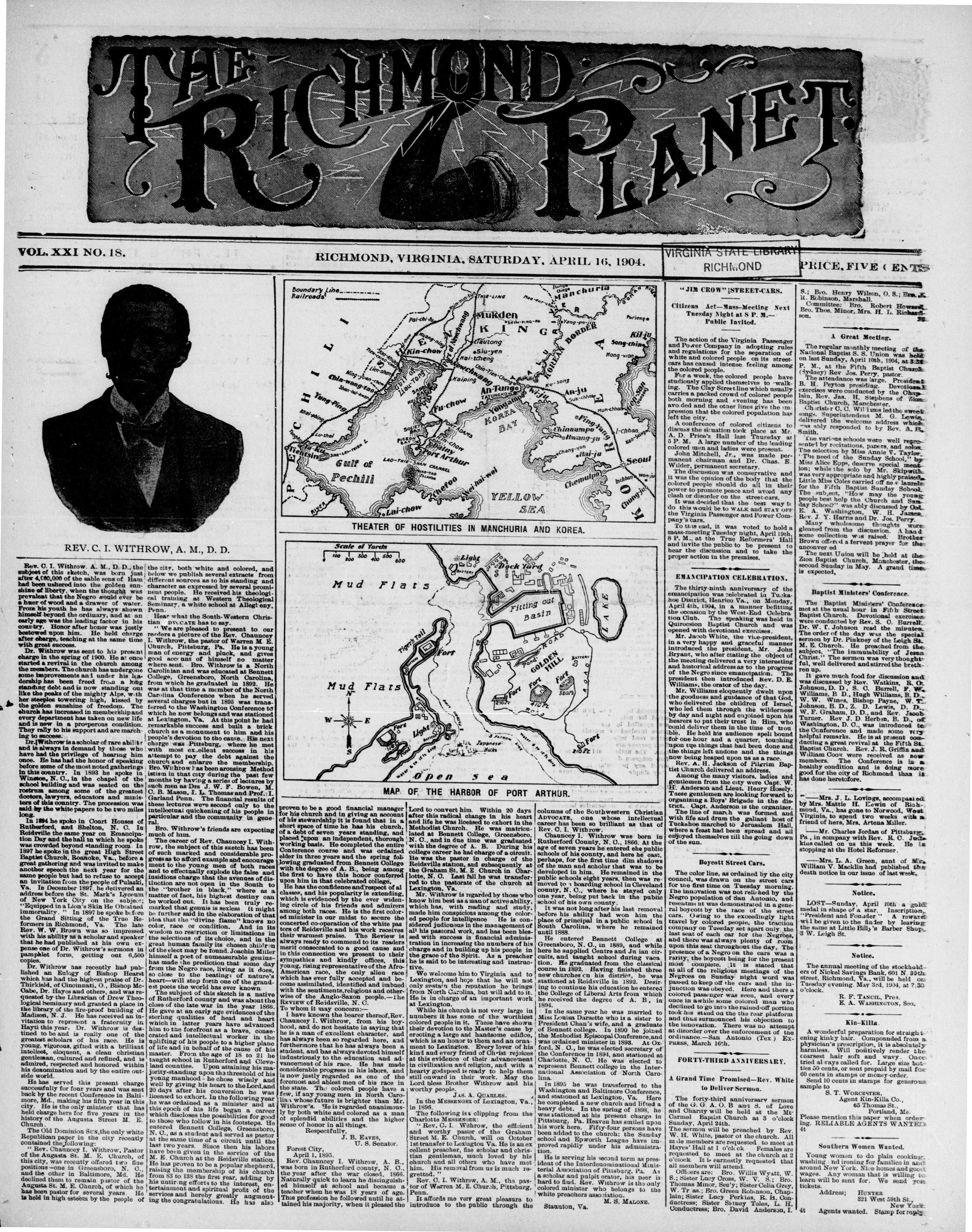
REV. C. I. WITHROW, A. M., D. D., the subject of this sketch, was born just after 4,000,000 of the sable sons of Ham had been unhered into the golden sunshine of liberty, when the thought was prevalent that the Negro would ever be a huner of wood and a drawer of water. From his youth he has always shown the joy of the ordinary, and at an early age was the leading actor in his country. Honor after success was in his bestowed upon him. He held charge after charge, teaching at the same time with great success.
the city, both white and below we publish several different sources as to his character as expressed by people. He received cal training at Wester Seminary, a white school Penn.
Hear what the South-West DVCCATE has to say We are pleased to pr bestowed upon him. He held charge after charge, teaching at the same time with great success.
Dr. Withrow was sent to his present charge in the spring of 1900. He at once started a revival in the church among the members. The church has undergone some improvements and I under his leadership has been freed from a long standing debt and is now standing out like the peaks of the mighty Alps, with her steeple towering high, kissed by the golden sunshine of freedom. The church has increased in membership and every department has taken on new life and is now in a prosperous condition. They rally to his support and are marching to success.
Dr. Withrow is a scholar of rare ability and is always in demand by those who have had the privilege of hearing him once. He has had the honor of speaking before some of the most noted gatherings in this country. In 1893 he spoke in Winston, N.C., in the chapel of the school building and was seated on the rostrum among some of the greatest doctors, lawyers, educators and ministers of this country. The procession was said by the white papers to be two miles long.
In 1894 he spoke in Court Houses of Rutherford, and Shelton, N. C. In Reidville the same year on Emancipation Day and the hall in which he spoke was crowded beyond standing room. In 1897 he spoke in the great High Street Baptist Church, Roonoke, Va., before a great gathering and was invited to make another speech the next year for the same people but had to refuse to accept an invitation from the people of Pulaski, Va. In December 1897, he delivered an address before the St. Mark's Lycée of New York City on the subject: "Equipped in a Lion's Skin He Obtained immortality." In 1897 he spoke before the Grand Sitting of the True Reformers in Richmond, Va. The late Rev. W. W. Brown was so impressed with his ability as a scholar and speaker that he had published at his own expense one of Dr. Withroh's sermons in pamphlet form, getting out 6,500 copies.
Dr. Withrow has recently had published an Eulogy of Bishop Hearst which has had the highest praise of Dr. Thirkield, of Cincinnati, O., Bishop McCabe, Dr. Hayes and others, and was requested by the Librarian of Drew Theological Seminary and granted a place in the library of the fire-proof building of Madison, N. J. He has received an invitation to represent a fraternity in Hayt this year. Dr. Withrow is destined to be and is really one of the greatest scholars of his race. He is young, vigorous, gifted with a brilliant intellect, eloquent, a clean christian gentleman, cultured and refined, and is admired, respected and honored within the coacmination and by the entire outside world. He has served this present charge successfully for four years and was sent back by the recent Conference in Baltimore, Md., making his fifth this city. He is the only minister that he held charge here for five years in the history of the Augusta Street M. E. Church.
The Old Dominion Sun, the only white Republican paper in the city recently contained the following: "Rv. Chaucey I. Withrow, Pastor of the Augusta St. M. E. Church, of this city, was recently offered two fine positions—one in Greensboro, N. C., and the other in Baltimore, Md. He declined them to remain pastor of the Augusta St. M. E. Church, of which he has been pastor for several years. He is held in high esteem by the people of
the city, both white and colored, and below we publish several extracts from different sources as to his standing and character as expressed by several prominent people. He received his theological training at Western Theological Seminary, a white school at Allegrety, Penn.
Hear what the South-Western Christian dvccate has to say.
"We are pleased to present to our readers a picture of the Rev. Chaucey I. Withrow, the pastor of Warren M. E. Church, Pittsburg, Pa. He is a young man of energy and pluck, and gives good account of himself no matter where sent. Bro. Withrow is a North Carolinian and was educated at Bennett College, Greensboro, North Carolina, from which he graduated in 1893. He was at that time a member of the North Carolina Conference when he served several charges but in 1895 was transferred to the Washington Conference to which he now belongs and was stationed at Lexington, Va. At this point he had remarkable success and built a brick church a monument to him and his children's death to the cause. His next charge was Pittsburg, where he met with most excellent success in his attempt to pay the debt against the church and enlarge the membership. Bro. Withrow has been around inism in that city during the past few months by having a series of lectures by such men as Drs J. W. F. Bowen, M. C. B. Mason, I. L. Thomas and Prof. I. Garland Penn. The financial results of these lectures were second only to the intellectual quickening of his people in particular and the community in general.
Bro. Withrow's friends are expecting much of him.
The career of Rev. Chanceuce I. Withrow, the subject of this sketch has been of such marked and considerable progress as to afford example and encourage ment to the young men of both races and to effectually explode the false and insidious charge that the avenues of distinction are not open in the South to the "brother in black," where as a matter of fact, his highest destiny can be worked out. It has been truly remarked that genius is sexless. It might be remarked that the elaboration of that idea that the "divine flame" knows no color, race or condition. And in its wisdom no restriction islimitations in the selections of its choice, in the great human family its chosen child-in of the elect may be found. Joachin Miller himself a poet of unmeasurable genius has made the prediction that some day from the Negro race, living as it does, so close to the beating of nature's heart—will step forth one of the grandest poets the world has ever known.
The subject of this sketch is a native of Rutherford county and is about the close of the late war in the year 1866. He gave at an early age evidences of the sterling qualities of head and heart which in latter years have advanced him to the forefront as a brave, consecrated and intellectual worker in the uplifting of his people to a higher plane of life and in behalf of the cause of his master. From the age of 18 to 21 he taught school in Rutherford and Cleveland counties. Upon attaining his majority-standing upon the threshold of his young manhood he chose wisely and by giving his heart to the Lord, and 20 days after his conversion he was licensed to teach. In the following year he was ordained as a minister and at this epoch of his life began a career which discloses the possibilities for good to those who follow in his footsteps. He entered Bennett College, Greensboro, N. C., as a student and served as pastor at the same time of a circuit in the last two years. Since then his labors have been given in the service of the M. E. Church at the Reidsville station. He has proven to be a popular shepherd, raising the membership of his church from 83 to 138 the first year, adding by his nutritious efforts to the interest, entertainment and spiritual profit of the services and hereby greatly augmenting the congratulations. He has also
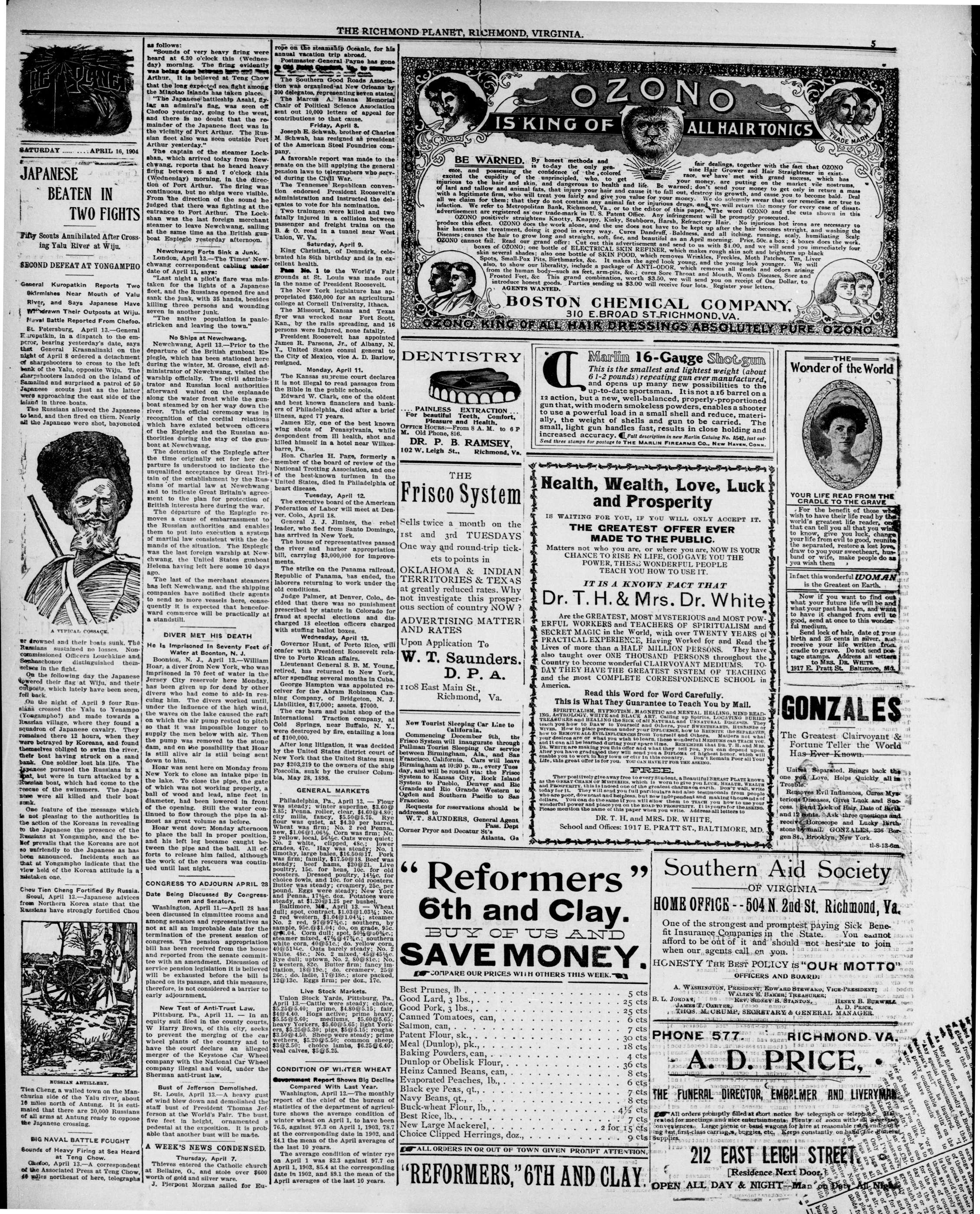
Boundary Line
Railroads
Mukden
KING
KOREAN BORDER
Pai-chi-hu
Muang-ning
Kin-chow
Port of Newhwang
Stautong
Siu-yen
Hai-cheng
Chin-Tien-Cheng
Kaiping
An-Tungo
TATUNGKOON
Wi-ju
An-ju
Suk-chhoe
Mun-chhoe
Ping-yang
Chinnampo
Hwang-ju
Chang-yon
Hai-ju
Seoul
Chemulpo
Inchhoe
Won-ju
Chung-ju
Yong-ju
KOREA
BAY
Port Adams
Pigon Bay
Shainy
Port Arthur
LAO-TNIE-SHAN CHANNEL
HAO-TAO
ISLANDS
YELLOW
SEA
Gulf of
Pechili
River
Lai-chow
THEATER OF HOSTILITIES IN MANCHURIA AND KOREA
Scale of Yards
0 100 200 300 400 500 600
Mud Flats
Light
Battery
Dock Yard
Fitting out
Basin
LAKE
Tiger's tail
Fort
ROAD
Pond
GOLDEN HILL
Battery
Fort
Fort
Fort
380 ft
Fort
410 ft
ROAD
Fort
210 ft
Fort
Light
Battery
Water & to 11th Samp
Japanese
Bulks
Open Sea
proven to be a good financial manager for his church and in giving an account of his stewardship it is found that in a short space of time he has his church, of a debt of seven years standing, and placed upon an independent, thorough working basis. He completed the entire Conference course and was ordained elder in three years and the spring following graduated from Bennett College with the degree of A. B., being among the first to have this honor conferred upon him in that celebrated college.
He has the confidence and respect of all classes, and his popularity is extending, which is evidenced by the ever widening circle of his friends and admirers among both races. He is the first colored minister in our midst to secure the concerted co-operation of the white passors of Reidsville and his work receives their warmest praise. The Review is always ready to commend to its readers merit consecrated to a good cause and in this connection we present to their sympathies and kindly offices, this young, rising representative of the Afro-American race, the only alien race that has finally accepted and become assimilated, identified and imbued with the sentiments of religious and otherwise of the Anglo-Saxon people.—1the Review of Reidsville, N. C.
To whom it may concern:
I have known the bearer thereof, Rev. Chancey I. Withrow, from his boyhood, and do not hesitate in saying that he is a man of excellent character, and has always been so regarded here, and furthermore that he has always been a student, and has always devoted himself industrially to the education and advancement of his race. He has made considerable progress in his labors, and is now justly regarded as one of the foremost and ablest men of his race in the state. The colored people have a few, if any young men in North Carolina whose future is brighter than Mr. Withrow's. He is regarded unanimously by both white and colored as a man of splendid abilities and the higher sense of honor in all things.
Rev. Chanucoey I. Withrow, A. B., was born in Rutherford county, N. C., the year after the war closed, 1866. Naturally quick to learn he distinguished himself at school and became a teacher when he was 18 years of age. This profession he followed until he attained his majority, when it pleased the
MAP OF THE HARBOR OF PORT ARTHUR.
manager account list in a church, mag, andorough ordained foliage among unfered age, of all
Lord to convert him. Within 20 days after this radical change in his heart and life he was licensed to exhort in the Methodist Church. He was matriculated at Bonnett College, Greensboro, N.C., and in due time was graduated with the degree of A. B. During his college career he had charge of a circuit. He was the pastor in charge of the Reidvill estate and subsequently at the Graham St. M. E. Church in Chilcot, N.C. Last fall he was transferred to the pastorate of the church at Lexington, Va.
columns of ADVOCATE career has Rev. C. I. Chance Rutherford age of save schools of perhaps, f of the man developed schmoved schmoved to country N.
Mr. Withrow is regarded by those who know him best as a man of active ability, which has, with reading and study, made him conspicuous among the colored people for intelligence. He is considered judicious in the management of all his pastoral work, and has been blessed with success in financial administration in increasing the numbers of his charge and in building up his people in the grace of the Spirit. As a preacher he is said to be interesting and instructive. We welcome him to Virginia and to Lexington, and hope that he will not only sustain the reputation he brings from North Carolina, but will add to it. He is in charge of an important work at Lexington.
While his church is not very large in numbers it has some of the worthiest colored people in it. These have shown their devotion to the Master's cause by erecting a large and handsome edifice, which is an honor to them and an ornament to Lexington. Every lover of his kind and every friend of Christ rejoices at this evidence of their advancement in civilization and religion, and with a hearty godspeed is ready to help them still onward in their work. May the Lord bless Brother Withrow and his worthy people.
JAS. A. QUARLES.
JNS. A. QUARLES:
In the Messenger of Lexington, Va.,
in 1866.
The following is a clipping from the
Charlotte Messenger:
"Rev, C. I. Withrow, the efficient and worthy pastor of the Graham Street M. E. Church, will on October 1st transfer to Lexington Va. He is an excellent preacher, fine scholar and Christian gentleman, much loved by his church and all others who have met him. His removal from us is much regretted."
Rev, C. I. Withrow, A. M., the pastor of Warren M. E. Church, Pittsburg, Penn.
It affords me very great pleasure to introduce to the public through the
columns of the Southwestern Christian Advocate, one whose intellectual career has been so brilliant as that of Rev. C. I. Withrow. Chanceyce I. Withrow was born in Rutherford County, N.C., 1866. At the age of seven years he entered the public schools of his county, and here he cast, perhaps, for the first time dim shadows of the man and scholar that was to be developed in him. He remained in the public schools eight years, then was removed to boarding school in Cleveland county, N.C., where he stayed only being put back in the public school of his own country. It was not long after his last removal before his ability had won him the place of principal in a public school in South Carolina, where he remained until 1888.
He entered Bennett College at Greensboro, N. O., in 1889, and while here he supplied Centre and Ju ian circuits, and taught school during vacation. He graduated from the classical course in 1893. Having finished three new churches on his district, he was stationed at Reidsville in 1892. Desiring to continue his education he entered the College of Liberal Arts from which he received the degree of A. B., in 1894. In the same year he was married to Miss Louisa Darsette who is a sister to President Chan's wife, and a graduate of Bennett college. In 1890 he joined the Methodist Episcopal Conference, and was ordained minister in 1893. At Oxford, N. O., he was elected secretary of the Conference in 1894, and stationed at Charlotte, N. C. He was elected to represent Bennett college in the International Association of North Carolina.
In 1895 he was transferred to the Washington and Baltimore Conference, and stationed at Lexington, Va. Here he completed a new church and lifted a heavy debt. In the spring of 1898, he was stationed at his present charge in Pittsburg, Pa. Heaven has smiled upon his work here. Fifty-four persons have been added to the church; the Sunday school and Epworth League have improved rapidly under his administration.
He is serving his second term as president of the Interdenominational Ministerial Association of Pittsburg, Pa. As a scholar andulpitor, his peer is hard to find. Reason is that he is the only colored minister who belongs to the white preachers association.
M. S. MALONE.
Staunton Va.
"JIM CROW" [STREET-CARS.
Citizens Act—Mass-Meeting Next Tuesday Night at 8 P.M.— Public Invited.
The action of the Virginia Passenger and Power Company in adopting rules and regulations for the separation of white and colored people on its street-cars has caused intense feeling among the colored people.
For a week, the colored people have studiously applied themselves to -walking. The Clay Street line which usually carries a packed crowd of colored people both morning and evening has been avoiled and the other lines give the impression that the colored population has left the city.
A conference of colored citizens to discuss the situation took place at Mr. A. D. Prew's Hall has Thursday at 5 P. M. A. Prew's number of the leading colored men and women were present.
John Mitchell, Jr. was made permanent chairman and Dr. Chas. E. Wilder, permanent secretary.
The discussion was conservative and it was the opinion of the body that the colored people should do all in their power to promote peace and avoid any clash or disorder on the street-cars.
It was decided that the best way to do this would be to WALK and STAY OFF the Virginia Passenger and Power Company's cars.
To this end, it was voted to hold a mass-meeting Tuesday night, April 19th, 8 P.M., at the True Reformers' Hall and invite the public to be present to hear the discussion and to take the proper action in the premises.
EMANCIPATION CELEBRATION.
The thirty-ninth anniversary of the emancipation was celebrated in Tuska-hoe District, Henrico Va., on Monday, April 4th, 1904, in a manner befitting the occasion by the West-End Celebration Club. The speaking was held in Quircosis Baptist Church and was opened with devotional exercises. Mr. Jacob White, the vice-president, in a very happy and graceful manner introduced the president, Mr. John Bryan, no one at the meeting the object of the meeting delivered was interesting and historical address as to the progress of the Negro since emancipation. The president then introduced Rev. D. E. Williams, the orator of the day.
Mr. Williams eloquently dwelt upon the goodness and guidance of that God, who delivered the children of Israel, who led them through the wilderness by day and night and enjoined upon his hearers to put their trust in Him, who could deliver them in the time of trouble. He held his audience spell bound for one hour and a quarter, touching upon tue things that had been done and the things left undone and the things now being heaped upon us as a race. Rev. A. H. Jackson of Pilgrim Baptist Church delivered an address. Among the many visitors, ladies and gentlemen from the city were Capt. W. H. Anderson and Lieut. Henry Hosely. These gentlemen are looking forward to organizing a Boys' Brigade in the district. Capt. Anderson is the organizer.
The line of march was formed and with fife and drum the gallant host of Tuckahoe marched to Jerusalem Hall, where a feast had been spread and all enjoyed themselves till the going down of the sun.
Boycott Street Cars.
The color line, as ordained by the city council, was drawn on the street cars for the first time on Tuesday morning. The innovation was not relied by the Negro population of San Antonio, and resentment was demonstrated in a general boycott by the race of the street cars. Owing to the exceedingly light travel by colored people, the traction company on Tuesday set apart only the last seat of each car for the Negroes, and there was always plenty of room upon this seat throughout the day. The presence of a Negro on the cars was a rarity, the boycott being for the present most complete. It is stated that all of the religious meetings of the Negroes on Sunday night word was passed to keep off the cars and the injunction was obeyed. Here and there a colored passenger was seen, and every once in awhile some colored man declined to go into the rained-off portion took his stand on the the rear platform and thus surmounted his objection to the innovation. There was no attempt at disorder over the enforcement of the ordinance.—San Antonio (Tex.) Express, March 16th.
FORTY-THIRD ANNIVERSARY.
A Grand Time Promised—Rev. White to Deliver Sermen
The forty-third anniversary sermon of the G. G. A. O. B and S. of Love and Charity will be held at the McCarmel Baptist Church at 3 o'clock Sunday, April 24th. The sermon will be preached by Rev. W. H. White, pastor of the church. All male members are requested to meet at Hayes' Hall at 1 o'clock. Females are requested to meet at the church at 2 o'clock. It is earnestly requested that all members will attend. Officers are: Willis Wyatt, W. S.; Sister Lucy Cross, W. V. S.; Bro. Thomas Minor, see 'Sey's Bible Grey, W. Tr. as; Bro. Green Robinson, Chain; Sister Lucy Perkins, R. H. Conductress; Sister Sister Tiney L. H. Conductress; Bro. David Andersen I.
R. Robinson, Marshall.
Committee: Bro. Robert Howard.
Bro. Thos Minor, Mrs. H. L. Richardson.
A Great Meeting.
The regular monthly meeting of the National Baptist S. S. Union was held on last Sunday, April 10th, 1904, at 3:34 P. M., at the Fifth Baptist Church (Sydney) Rev Jos. Perry, pastor
The attendance was large. President
B. Peyton presiding. Devotionals
exercised conducted by the Chap-
plain, Rev. Jas. K. of Zion.
Baptist Church, Manchester.
Christer C. C. Williams led the sweet songs. Superintendent M. G. Lowin delivered the welcome address which was ably responded to by Rev. A. R. Smith.
The various schools were well represented by recitations, papers, and solos. The selection by Miss Annie V. Taylor, "The Sunday School," by Miss Alice Eps, deserve special mention; while the Mr. Skipwith was very appropriate and highly praised, Little Miss Cole carried off no laurels for the Fifth Baptist School. The subject, "How may the young people best help the Church and Sunday School?" was ably discussed by Ool. E. A. Washington, W. H. James, Rev. J. Y. Harris and Dr. Jos, Perry.
Many wholesome thoughts were gleaned from the discussion. A hand some collection was raised. Brother Brown offered a fervent prayer for the university. The next Union will be held at the Zion Baptist Church, Manchester, the second Sunday in May. A grand time is expected.
Baptist Ministers' Conference
The Baptist Ministers' Conference met at the usual hour in Fifth Street Baptist Church. Devotional exercises were conducted by Rev. S. O. Burrell Dr. W. T. Johnson read the minutes. The order of the day was the special sermon by Dr. Pinkney of the Leigh St. M. E. Church. He preached from the subject, "The inmutability of Jesus Christ." The sermon was very thoughtful, well delivered and stirred the brethren up.
It gave much food for discussion and was discussed by Rev. Watkins, R. O. Johnson, D. D., S. C. Burrell, F. W. Williams, B. D., Hugh Williams, B. D., W. W. Wines, Bishop Payne, W. T. Johnson, B. D., Z. D. Lewis, D. D., W. F. Graham, D. D., and Rev. Jacob Turner. Rev J. D. Herbsen, B. D., of Washington, D. C., was introduced to the Conference and made some very helpful remarks. He is at present conducting a great revival at the Fifth St. Baptist Church. Rev J. R. Griffin and William Coov were received as new members. The Conference is in a healthy condition and is doing more good for the city of Richmond than it has done heretofore.
— Mrs. J. L. Lovings, accompanied by Mrs. Mattie H. Eewin of Richmond, Va., has gone to Norwood, West Virginia, to spend two weeks with a friend of hers, Mrs. Artena Miller.
Mr. Charles Jordan of Pittsburgh Pa., in company with Rev. R. C. Judekins called on us this week. He is stopping at the Hotel Reformer.
Mrs. L. A. Green, aunt of Mrs William V. Macklin had published the death notice in our issue of last week.
Notice.
LOST—Sunday, April 10th a gold medal in shape of a star, Inscription, "President and Founder." A reward will be given to the finder by leaving the same at Little Billy's Barber Shop 3 W. Leigh St.
Notice.
The annual meeting of the stockholders of Nickel Savings Bank, 601 N. 300th street, Richmond, Va., will be held on Tuesday evening. May 3rd, 1904, at 7:30 o'clock.
R. F. TANGL, Pros.
K. A. WASHINGTON, Sox.
Kin-Killa
A wonderful preparation for straightening kinky hair. Compounded from a physician's prescription, it is absolutely harmless. Will positively render the coarsest hair soft and wavy. Once tried al ways called for. Large size bottles 50 cents, or sent prepaid by mail for 60 cents in stamps or money-order. Send 10 cents in stamps for generous sample to
Please mention this paper when ordering. RELIABLE AGENTS WANTED
Southern Women Wanted
Young women to do plain cooking,
washing and ironing for families in and
around New York. Nice homes and good
wages. Any woman that is willing to
learn will be sent for. We send your
tickets.
Address; HUNTER
321 West 59th St.,
New York
4t Agents wanted. Stamp for repai
= : re
(we acaau ne:
vo est
V Cte
Ny
oo Bg
s /
SATURDAY.........APRIL 16, 100
peste EE
@S LONG AS MOTHER’s THI
‘My father’s he's a traveling man,
aaHe travels everywhere;
‘Me's been to Europe and Japan &
And seen the Russian bear;
‘Who stays ar home a week or 80,
Or mebby just a day,
And then the fir thing that you know
‘He's got to Ko away.
We're always glad when father's here,
‘Ho brings us lots of things,
Bie's deen all over, pretty near,
And he's cen queens sud kings:
We hardly seem to miss him, though,
And things go on ail right,
‘Wor mother bolts the doors, you know,
Bo we'll be safe at night.
{We seem, somehow, to get along,
All feelin’ pretty gay;
Where's hardly anything goee wrong
‘When father's far away;
ie's very kind and vers good
And we'd be awful giad
My have Bim stay here If be could—
stil things ain't so bad.
Bometimes when mother goes somewhere
And don't come home that night
When's when it's pretty lonesome there
“And nothing seems just right.
Fm glad boys’ mothers needn't go
‘To travel far away—
‘We seems adout a month or so -
When mother's gone a day.
—S. E. Kiser, tn Chicago Record-Herald.
By J.C. PLUMMER
‘Ghowretaht, 1904, by Dally Gory PubCon)
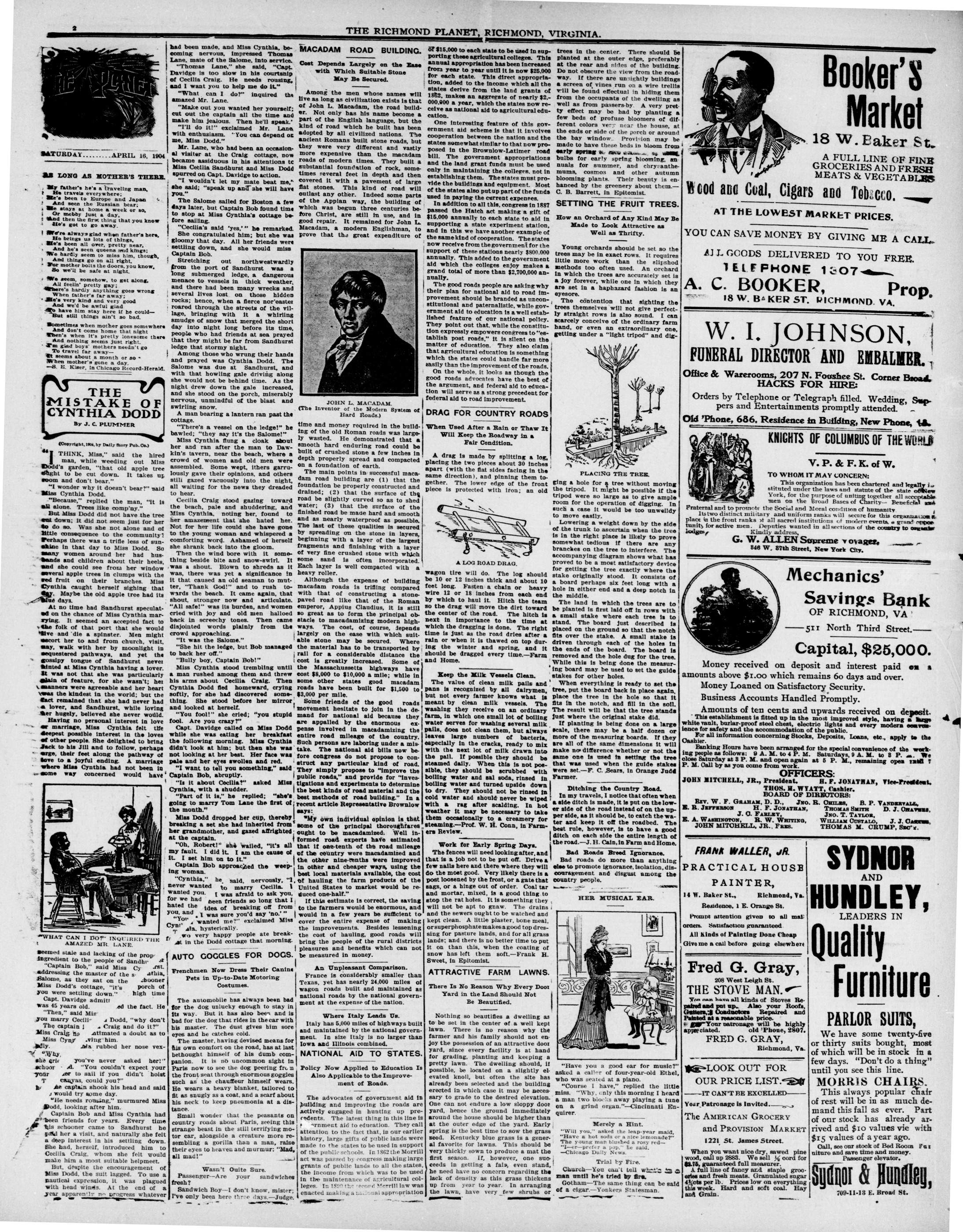
“#7 THINK, Miss,” said the hired
man, while weeding out Miss
Wodd's garden, “that old apple tree
Shght to be cut down. It takes up
oom and don’t bear.”
“I wonder why it doesn't bear?” said
Miss Cynthia Dodd.
“Because,” replied the man, “It is
H alone. Trees like comp'ny.”
But Miss Dodd did not have the tree
eat down; it did not seem just for her
#0 do 80, Was she not aione and of
Uittle consequence to the community?
Werhaps there was a trifle less of sun-
@Rine in that day to Miss Dodd. So
any women around her had hus-
‘ends and children about their heels,
and she could see from her window
several apple trees in clumps with the
wed fruit’ on their branches. Miss
Cynthia caught herself sighing that
a: Maybe the old apple tree had its
fue days.
At no time bad Sandhurst speculat-
© on the chance of Miss Cynthia mar-
ying. It seemed an accepted fact to
she folk of that port that she would
“Rive and ‘die a spinster. Men might
‘eecort her to and from church, visit,
say, walk with her by moonlight in
wequestered pathways, and yet the
fossipy tongue of Sandhurst never
‘Rinted at Miss Cynthia having a lover.
‘At was not that she was particularly
@dain of feature, for she wasn't; her
manners were agreeable and her heart
\was the kindest in the world; but the
act remained that she had never had
@ lover, and Sandhurst, while loving
Mer hugely, believed she never would.
Haying no personal interest in love
‘= marriage, Miss Cynthia felt tite
eepest possible interest in the loves
‘ef other people. She delighted to bring
Jack to bis Jill and to follow, perhaps
‘arge, their feet along the pathway of
fove to ® joyful ending. A marriage
where Misa Cynthia had not been in
@ome way concerned would have
1 /
‘sy ess j |
5 Ai ey
¥ eal
iS Veen
‘ D\ AA ( A ay
oe ==,
ena aaa
. ASA ee a
=i 1 Va
JS EASE
= S rap
Seemed stale and lacking of the
Angredient to the people of Sandie,
“Captain Bob,” said Miss Cy ft.
addressing the master of the 5 _athia,
Salome, as they sat on the _ -booner
‘Miss Dodd's cottage, “it's porch of
you were settling down.” high time
Capt. Davidge admitt
was 45 years old. ed the fact. He
“Then,” said Mis
wou marry Ceclli- 4 Dodd, “why don't
The captain} 4 Craig and do it?”
Miss Craig np —_atimated a doubt as to
Miss Cyny ving’ him.
paly. sta rubbed her nose vex-
(oy hy,
lie gre’ You've never asked her!”
schoor - A. “You couldn't expect your
your .er to sail if you didn't hoist
T _ cauyas, could you?”
bre captain shook his head and said
4¥ould try some day.
“He needs rousing,” murmured Miss
Pod, looking after him,
#. Captain Bob and Miss Cynthia had
Gr deen friends for years. Every time
is schooner came to Sandhurst he
paid her a visit, and naturally she felt
a deep interest in his settling down.
She had, herself, introduced him to
Cecilia Craig, whom she felt would
make him a most suitable helpmeet,
But, despite the encouragement of
Miss Dodd, the suit Ingged. To use a
Bautical expression, it was plagued
with head winds. ‘At the end of a
year_apparen'ly no progress whatever
“What can I do?” inquired the
amazed Mr. Lane.
“Make out you wanted her yourself;
cut out the captain all the time and
make him jealous. Then he'll speak.’
“I'll do it!” exclaimed Mr, Lang
with enthusiasm. “You can depend ot
me, Miss Dodd.”
Mr. Lane, who had been an occasion-
al visiter at the Craig cottage, now
decame assiduous in his attentions tc
‘Miss Cetllia Sandhurst and Miss Dodd
‘spurred on Capt. Davidge to action.
“I wouldn't let my mate beat me,”
she said; “speak up and she will have
you.”
‘The Salome sailed for Boston a few
days later, but Captain Bob found time
to stop at Miss Cynthia's cottage be
fore sailing.
“Cecilia's said *yes,’” he remarked.
‘She congratulated him; but she was
sloomy that day. All her friends were
Settling down, and she would miss
Captain Bob.
Stretching out —_northwestwardly
from the port of Sandhurst was a
long submerged ledge, a dangerous
menace to vessels in thick weather,
and there had been many wrecks and
Several lives lost. on those hiddeo
Tocks; hence, when a flerce nor'easter
roared through the streets of the vil-
lage, bringing with it a whirling
‘smudge of snow that merged the short
day into night long before its time,
people who had friends at sea prayed
that they might be far from Sandhurst
ledge that stormy night.
Among those who wrung their hands
and prayed was Cynthia Dodd. The
Salome was due at Sandhurst, and
with that howling gale driving along
she would not be behind time. As the
night drew down the gale increased,
‘and she stood on the porch, miserably
Rervous, unmindful of the blast and
swirling snow.
A man bearing a lantern ran past the
cottage.
“There's a vessel on the ledge!” he
bawled; “they say it’s the Salome!”
Miss Cynthia flung a cloak about
her and ran after the man to Daw-
kin’s tavern, near the beach, where a
crowd of women and old men were
assembled. Some wept, ithers garru-
lously gave their opinions, and others
stili gazed vacuously into the night,
all waiting for the news they dreaded
to hear.
Cecilia Craig stood gazing toward
the beach, pale and shuddering, and
Miss Cynthia, noting her, found to
her amazement that sho hated her.
Not for her life could she have gone
to the young woman and whispered a
comforting word. Ashamed of herself
she shrank back into the gloom.
‘Then the wind bore with it some-
thing beside bite and snow-swirl. It
was a shout. Blown to shreds as It
was, there was yet a significance in
it that caused an old seaman to mut-
ter, “Thank God!” and to rush to-
wards the beach. It came again, that
shout, stronger now and articulate.
“AN safe!” was its burden, and women
cried with joy and old men halloed
back in screechy tones. Then came
disjointed words plainly from the
crowd approaching. |
“It was the Salome.”
“She hit the ledge, but Bob managed
to back her off.”
“Bully boy, Captain Bob!”
Miss Cynthia stood trembling until
& man rushed among them and threw
his arms about Cecilia Craig. Then
Cynthia Dodd fled homeward, crying
softly, for she had discovered some-
ting. She stood before her mirror,
and looked at herself.
“You fool!” she ered; “you stupid
fool. Are you crazy?”
Capt. Davidge called on Miss Dodd
while she was eating her breakfast
the following morning. Miss Cynthia
didn't look at him; but then she was
not looking at her best. Her face was
pale and her eyes swollen and red. |
“I want to tell you something,” sald
Captain Bob, abruptly. |
“Is it about Cecilia?” asked Miss
Cynthia, with a shudder. |
“Part of it is,” he replied; “she's
going to marry Tom Lane the first of
the month.” |
Miss Dodd dropped her cup, thereby!
breaking a set she had inherited from
her grandmother, and gazed affrighted
at the captain. {
“Oh, Robert!” shd Wailed, “it’s all
my fault, I did it. I am the cause of
it. I set him on to it” |
Captain Bob approacted the weep-
ing woman. |
“Cynthia,” he said, nervously, “1,
hever wanted to marry Cecilia 1
wanted you. { wag afraid to ask you,
for we Had pen friends so long that I
mated the idea of breaking off from
rou. and | y was sure you'd say ‘no.’
‘Yor ‘wanted me?” exclaimed Miss
yO” sia hysterically.
* wo very happy people ate break-
" Jat in the Dodd cottage that morning.
AUTO GOGGLES FOR DOGS.
Frenchmen Now Dress Their Canine
Pets in Up-to-Date Motoring
Costumes.
‘The automobile has always been bad
for the dog unlucky enough to stay in
its way. But it has also bee and is
bad for the dog that rides in thecar with
his master. The dust gives him sore
eyes and he catches cold.
“Phe master, having devised means for
‘fis own comfort on the road, has at last
Dethought himself of his dumb com-
panion. It Is nd uncommon sight in
Paris now to see the dog peering fron
the front seat through enormous goggles
such as the chauffeur himself wears.
He wears a heavy blanket, tatlored to
fit as snugly as a coat, and a scarf about
his neck to keep pneumonia at a dis-
tance.
Small wonder that the peasants on
country roads about Paris, seeing this
strange beast in the still terrifying mo-
tor car, alongside a creature more re-
sembling a gorilla than a man, raise
their eyes to heaven and murmur: “Mad,
all mad!” ao
‘Wasn't Ouite Sure.
Passenger—Are your sandwiches
fresh?
Sandwich Boy—I don't know, mister;
Te only been here three days.—Judge.
Se ee cas p Baye hack ogy
RICHMOND PLANET, RICHMOND, VIRGINIT/
MACADAM ROAD BUILDING.
Cost Depends Largely on the Ease
with Which Suitable Stone
May Be Secured.
Among the men whose names will
live as long as civilization exists Is that
of John L. Macadam, the road build-
er. Not only bas his name become a
Part of the English language, but the
kind of road which he built has been
adopted by all civilized nations. The
ancient Romans built stone roads, but
they were very different and vastly
more expensive than the macadam
roads of modern times. They bulit a
Substantial foundation of rock, some-
times veveral feet in depth and then
covered it with a pavement of large
flat stones. ‘This kind of road will
outlast any other. Indeed some parts
of the Appian way, the building of
which was begun three centuries be-
fore Christ, are still im use, and in
good repair. It remained for John L.
Macadam, a modern Englishman, to
prove that the great expenditure of
Le eek
ee a ~_
~ Be va
.. asa
JOHN L, MACADAM
(The Inventor of the Modern System of
Hard House)
time and money required in the build.
ing of the old Roman roads was large
ly wasted. He demonstrated that a
smooth hard enduring road could be
built of crushed stone a few inches in
depth properly spread and compacted
on a foundation of earth.
‘The main points im sucessful maca.
dam road building are (1) that the
foundation be properly constructed and
@rained; (2) that the surface of the
Toad be slightly curved so as to shed
water; (3) that the surface of the
finished road be made hard and smooth
and as nearly waterproof as possible.
The last of these qualities is secured
by spreading on the stone in layers,
beginning with a layer of the largest
fragments and finishing with a layer
of very fine crushed stone with which
fome sand is often incorporated.
Each layer is well compacted with a
heavy roller.
Although the expense of building
macadam roads {s trifling compared
with that of constructing a stone-
paved road like that of the Roman
emperor, Appius Claudius, it is stil
40 great as to form the principal ob-
stacle to macadamizing modern high-
ways. The cost, of course, depends
largely on the ease with which suit-
able stone may be secured. Where
the material has to be transported by
rail for a considerable distance the
cost is greatly increased. Some of
the Massachussetts highways have
eost $8,000 to $10,000 a mile; while in
some other states good macadam
roads have been bullt for $1,500 to
$3,000 per mile,
Some friends of the good roads
movement hesitate to join in the de.
mand for national ald because they
are appalled by the enormous ex-
Dense involved in macadamizing the
entire road mileage of the country.
Such persons are laboring under a mis
take. The national ald bills now be-
fore congress do not propose to con-
struct any particular kind of road.
They simply propose to “improve the
public roads,” and provide for “inves-
tigations and experiments to determine
the best kinds of road material and the
Dest methods of road building.” In a
recent article Representative Brownlow
ays:
“My own individual opinion is that
fome of the principal thoroumhfares
ought to be macadamized: Well in-
formed road experts have estimated
That if one-tenth of the road mileage
of the country were macadamized and
the other nine-tenths were improved
in other and cheaper ways, using the
‘Dest local materials available, the cost
‘of hauling the farm products of the
United States to market would be re
duced one-half.”
If this estimate {s correct, the saving
to the farmers would be enormous, and
‘would in a few years be sufficient tc
cover the entire expense of making
the improvements. Besides lessenin;
the cost of hauling, good roads wil
bring the people of the rural district
| pleasures and benefits which can no
tn eesenered ta waar:
| Am Unpleasant Comparison.
France is considerably smaller than
‘Texas, yet has nearly 24,000 miles ot
wagon roads built and maintained as
national roads by the national govern-
ment at the expense of the nation.
‘Where Italy Leads Us.
Italy has 5,000 miles of highways built
and maintained by the national govern-
ment. In size Italy is no larger than
Towa and Iltnois combined,
NATIONAL AiD TO STATES.
Policy Now Applied to Education Is
Also Applicable to the Improve-
ment of Roads.
The advocates of government aid fn
puilding and improving the roads are
actively engaged in hunting up pre-
eedents. The latest thing In this line is
+ rnment aid to education. They call
attention to the fact that, in our earlier
history, large gifts of public lands were
made to the states to be used in support
of the publicschools. In 1802the Morrill
act was passed by congress making large
grants of public lands to all the states,
the Income from which was to be used
In the maintenance of agricultural col-
leges. In 182% the cerand Merrill law was
enacted making a ui..!oual appropriation
‘Of $15,000 to each state to be tised In sup-
Porting these agricultural colleges. ‘This
annual appropriation has been increased
frora year to year until it is now $25,000
for each state. This direct appropria-
ton, added to the income which all the
States derive from the land grants of
1882, makes an agererate of nearly $2,-
000.000 a year, which the states now re-
celve as national aid to agricultural edu-
cation.
One interesting feature of this gov-
ernment aid scheme ts that it involves
cooperation between the nation and the
states somewhat similar to that now pro-
Posed in the Brownlow-Latimer road
Dill. The government appropriations
and the land grant funds must be used
only in maintaining the colleges. not in
establishing them. Thestates must pro-
Vide the buildings and equipment. Most
of the states also putup part of the funds
used in paying the current expences,
Tn addition to all this, congress in 1887
passed the Hatch act making a gift of
$15,000 annually to each state to ald in
Supporting a state experiment station,
and in this we have another example of
the samekind of cooperation. ‘The states
now recelve from the government for the
support of these stations nearly $800,000
annually. This added to the government
ald which the colleges enjoy makes a
grand total of more than $2,700,000 an-
nually.
‘The good roads people are asking why
their plan for national ald to road tm-
provement should be branded as uncon-
stitutional and paternalistic, while gov-
ernment aid to education ts a well estab-
lished feature of our national policy.
They point out that. while the constitu-
tion expressly empowers congress to “es-
tablish post roads,” it is silent on the
matter of education. They also claim
that agricultural education is something
which the states could handle far more
easily than the improvement of the roads.
On the whole, it looks as though the.
good roads advocates have the best of
the argument, and federal ald to educa- |
tion will serve as a strong precedent for
federal ald to road improvement.
DRAG FOR COUNTRY ROADS
‘When Used After a Rain or Thaw It
‘Will Keep the Roadway in a
Fair Condition,
A drag is made by splitting a log,
Placing the two pleces about 30 Inches
@part (with the flat sides facing in the
same direction), and pinning them to-
gether. The lower edge of the front
Piece is protected with iron; an old
a
=
= 7X
=~ SS pv
g =e
A LOG ROAD DRAG.
‘wagon tire will do. The log should
be 10 or 12 inches thick and about 10
feet long. Fasten a chain or heavy
wire 12 or 18 inches from each end
by which to haul it. Hitch the team
So the drag will move the dirt toward
the center of the road. The hitch ts
next in importance to the time at
which the dragging is done. The right
time {s just as the road dries after @
rain or when it is thawed on top dur-
img the winter and spring, and it
should be dragged every time.—Farm
and Home,
Keep the Milk Vessels Clean.
‘The value of clean milk pails and
pans is recognized by all dairymen,
Dut not every farmer knows what ts
meant by clean milk vessels. The
washing they recelve on an ordinary
farm, in which one small lot of boiling
water serves for washing several milk
pails, does not clean them, but always
leaves large numbers of bacteria,
especially In the cracks, ready to mix
‘with the next lot of milk drawn into
the pail. If possible they should be
steamed daily. When this {s not poe-
sible, they should be scrubbed with
Dolling water and sal soda, rinsed in
Dotling water and turned upside down
to dry. They should not be rinsed in
cold water and should never be wiped
with a rag after scalding. In hot
weather it may be necessary to take
them occasionally to a creamery fot
steaming.—Prof. W. H. Conn, in Farm-
ers Review.
‘West: Gab Waste Guirtne Ties,
‘The fences will need looking after, and
that is a job not to be put off. Drivea
few nails here and there where they will
do the most good. Very likely there is a
post loosened by the frost, or a gate that
sags, or a hinge out of order. Coal tar
and mortar, mixed, is a good thing to
stop the rat holes. It is something they
will not be apt to gnaw. The drains
and the sewers ought to be watched and
kept clean. A little plaster, bone meal,
orsuperphosphate makesa good top dres-
sing for pasture lands, and for all grass
lands; and there is no better time to put
it on than this, when the coating of
snow has left them soft.—Frank H.
‘Sweet, in Epitomist.
ATTRACTIVE FARM LAWNS.
‘There Is No Reason Why Every Door
‘Yard in the Land Should Not
Be Beautified.
Nothing so beautifies a dwelling as
to be set In the center of a well kept
lawn. There is no reason why the
farmer and his family should not en-
Joy the possession of an attractive door
yard, since every facility 1s at hand
for grading, planting and keeping a
pretty lawn. ‘The dwelling should, it
possible, be located on a slightly el
evated knoll, but often the site has
already been selected and the building
erected in which case it may be neces
sary to grade to the destred elevation.
One can not endure a low sloppy door
yard, hence the ground immediately
around the house should be higher than
at the outer edge of the yard. Early
spring is the best time to sow the grasa
seed. Kentucky blue grass is a gener
al favorite for lawns. ‘This should be
very thickly sown to produce a mat the
first season. If, however, one sue
ceeds in getting a fal, even stand,
he need have no concern regarding the
lack of density as this grass thickens
up from year to year. In arranging
the lawn, have very few shrubs oF
trees in the center. There should be
Planted at the outer edge, preferably
‘at the rear and sites of the building.
Do not obscure the view from the road-
way. If there are unsichtly buildings
& screen of vines run on a wire trellis
ill be found effectual in hiding them
from the occupants of the dwelling as
well as from passers-by. A very pret:
ty effect may be had by planting a
few beds of profuse bloomers of dif.
ferent colors vers near the house, at
the ends or side of the porch or around
the bay window. Provision may be
made to have these beds in bloom from
early OPFINg % MAY wok my OE
bulbs for early spring blooming, an
nuals for summer, and chrysanthe-
mums, cosmos and other autumn
blooming plants. ‘Their beauty is en-
hanced by the greenery about them.—
©, B. Barrett, in Epitomist.
SETTING THE FRUIT TREES.
How an Orchard of Any Kind May Be
Made to Look Attractive as
‘Well as Thrifty.
Young orchards should be set so the
trees may be in exact rows. It requires
Uttle more work than the ‘slipshod
methods too often used. An orchard
in which the trees are accurately set is
& Joy forever, while one in which they
are set in a haphazard fashion Is an
eyesore.
The contention that sighting the
trees themselves will not give perfect-
ly straight rows is also sound. I can
scarcely conceive of the ordinary farm
hand, or even an extraordinary one,
getting under a “light tripod” and dig-
SANZ
¥
‘
Fy
i
a OY 5
&- bate ts,
Sha
fife ns
Ee A Sine
Sag
SEAS
Puce a
PLACING TRE TREE
fie Gist. ee
the tripod. It might be possible if the
tripod were so large as to give ample
Toom for the operation of digging. In
such a case it would be too unweildy
to move easily.
Lowering a weight down by the side
of the trunk to ascertain when the tree
is in the right place is likely to Prove
Somewhat tedious if there are any
branches on the tree to interfere. The
accompanying diagram shows what has
Proved to be a most satisfactory device
for getting the tree exactly where the
stake originally stood. It consists of
@ board perhaps six feet long with a
hole In either end and a deep notch in
the middle.
‘The land in which the trees are to
de planted Is first lafd off in rows with
& small stake where each tree is to
stand. The board just described is
Placed on the ground so that the notch
fits over the stake. A small stake is
driven through each of the holes in
the ends of the board. The board is
removed and the hole dug for the tree.
While this is being done the measur-
ing board may be used to set the guide
stakes for other holes.
‘When everything is ready to set the
tree, put the board back in place again,
place the tree in the hole so that it
fits in the notch, and fill in the soll.
‘The result will be that the tree stands
fust where the original stake did.
If planting is being done on a large
scale, there may be a half dozen or
more of the measuring boards. If they
tre all of the same dimensions it will
make no difference whether or not the
game one fs used fn setting the tree
that was used when the guide stakes
were set.—F. C. Sears, in Orange Judd
Werner.
| _ Ditching the Country Road.
| In my travels, I notice that often when
&@ side ditch fs made, it is put on the low-
er side of the road instead of on the up-
per side, as it should be, to catch the wa-
ter and keep it off the roadbed. The
‘Dest rule, however, is to have a good
‘ditch on each side the entire length of
the road.—J. H. Cain, in Farm and Home.
| Bad Roads Breed Ignorance.
Bad roads do more than anything
else to promote ignorance, isolation, dis-
couraxement and disgust among the
country people.
HER MUSICAL EAR.
:
j |
Vig = (al |
Al & ;
“Ni @veeccs| [FLL
‘ Q = y 2
_| SS
es a
Sofa eo
hes
ae oot
| uy
ne sili
Ai, Se
SAN
“Have you a good ear for music?”
asked a caller of four-year-old Ethel,
who was seated at a plavo.
“Course I have,” replied the little
miss. “Why, only this morning I heard
& man two blocks away playing a tune
on a grind organ.”—Cincinnati En-
quirer. Se en 0
Merely « Hint.
Wid yest aed ane bona pene toaba
tae commen eae eee
—ohicags Daily Weis
Rec ears
Church—You cau't tell wits So
man until he’s tried by fire,
Gotham—The same thing can be sald
of a cigar.—Yonkers Statesman.
CN EE’*”CC”C OO
yom = Booker’s
Ion. 207
eS arket
KONG I< 18 W.Eaker St.
Sere #\ A FULL LINE OF FINE
§ /41 fy? GROCERIES AND FRESH
, MEATS & VEGETABLES
Wood ano Coal, Cigars ana Tebs¢cO, nay
Za ee ee Serie oe neueN
AT THE LOWEST MARKET PRICES,
MDa Mee es
YOU CAN SAVE MONEY BY GIVING ME A CALL.
41L GOODS DELIVERED TO YOU FREE.
TELEPHONE 1207—__
A. C. BOOKER, Prop,
= 18 W. B¢ KER ST. RICHMOND. VA,
W. I. JOHNSON, |
oe . Si
FUNERAL DIRECTOR AND BMBALMER. ,
07 N. F Si
oe irocorae eee St. Corner Baoad.
‘lephy Tel h filled. Wedding,
ait ee ee oe
Old ’Phone, 686, Residence in Building, New Phone, t&
ere ee
QAretee KNIGHTS OF COLUMBUS OF THEWORLB
ie ee ————_ ;
eToys V. P. & F.K. of W.
(} 3 ee ‘TO WHOM IT MAY CONCERN:
i ] MRD até cceniton tn ton hate ond ray io
eC) =i 8 et ones bees hess er antes et
Fraternal and to promote the Social and Moral condition of humanity ’
Itstwo distinct military and uniform ranks will secure for this organtzaom &
place in the front ranks >t all sacred institutions of modern events 4 grand oppom
tunity for active ieee in allsections of the coustry to omeente
vere G. W. ALLEN Sopreme vovagerz, ._.. -
846 W. 87th Street, New York City.
aan NAN pone ga - ote
f @ ~\ Mechanics
_ BS ;
( gees \ Savings Bank
| ee OF RICHMOND, VA’
\ Slee y/ ——sxr North Third Street,
~S y space ae
ae Capital, $25,000.
Money received on deposit and interest paid om a
amounts above $1.00 which remains 60 days and over.
Money Loaned on Satisfactory Security.
Business Accounts Handled Promptly.
Amounts of ten cents and upwards received on depesit.
ens rhis cetablishment is fitted up in the most improved style, having = Mage
white vault, burlar-proof steol chest, electric lights and every’ modern comes.
fence for safety and the accommodation of the public.
For all information concerning Stocks, Deposits, Loans, etc, apply te the
‘Banking Hours have been arranged for the special convenience of the werk.
ing people ae follows: |9 A.M: to4P. MM. Saturdays, A.M. to 8 P. =
P.M. Oall by as you come from work. bn tyes
OFFICERS:
JOHN MITCHELL, JR., President, H.F. JONATHAN, Vice-President,
THOS. W. WYATT, Cashier,
BOARD OF DIREOTORS:
Rev. W. F. Gaanam,D.D., Jo. B. Oumurs, _B. P. Vaxpenvats,
BB. Jarrexson = HF. Joxarmam, | TnomasSurrm D. J. OmAVNES,
J. 9. Fantey, ‘Ino. T. TavLon,
E. A. Wasmmmeron, RB. W. Warrixe, = Wittiaw Overavo, J. J, Oaeewm,
JOHN MITOHELL, JR. Paes. THOMAS M. CRUMP, Szc'x.
!
FRANK WALLER, JR.
PRACTICAL HOUSE
PAINTER,
14 W. Baker St., Richmond, Va.
Residence, 1 E. Orange St.
Prompt attention given to all mal
orders. Satisfaction guaranteed
All Kinds of Painting Done Cheap
Give me a cail before going elsewhere
—
Fred G. Gray,
208 West Leigh St.
THE STOVE MAN. 7
cane eR
Painted = @ reasonable ee -
ea “old "Phose, Boe
FRED G. GRAY,
Richmond, Va.
W@>LOOK OUT FOR
OUR PRICE LIST.
——~IT OAN’T BE EXCELLED———
Your, Patronage is Invited._____,
‘The AMERICAN GROCERY
and Provision MARKET
) 1221 St. James Street.
wast, call up 2588. "We sll 3g cord fo
216, guaranteed fall measurer,
| A fall line of fancy ard staple groo-
Got pec Ibs Eooe low on overyehiag
en Hard and soft coal: ‘Hay
and Grain.
AND
HUNDLEY,
LEADERS IN
Quali
Furniture
PARLOR SUITS,
We have some twenty-five
or thirty suits bought, most
of which will be in stock ina
few days. “Don’t do a thing”
until you see this line.
MORRIS Whee
This always popular chair
of rest will be in as much de-
mand this fail as ever. Part
of our stock has already ar-
rived and $10 values vie with
$15 values of ayear ago.
Call, see our stock of Bed Room Far
niture and save time and money.
| Passenger elevator.
Sycao & undey,
709-11-18 E, Broad St.
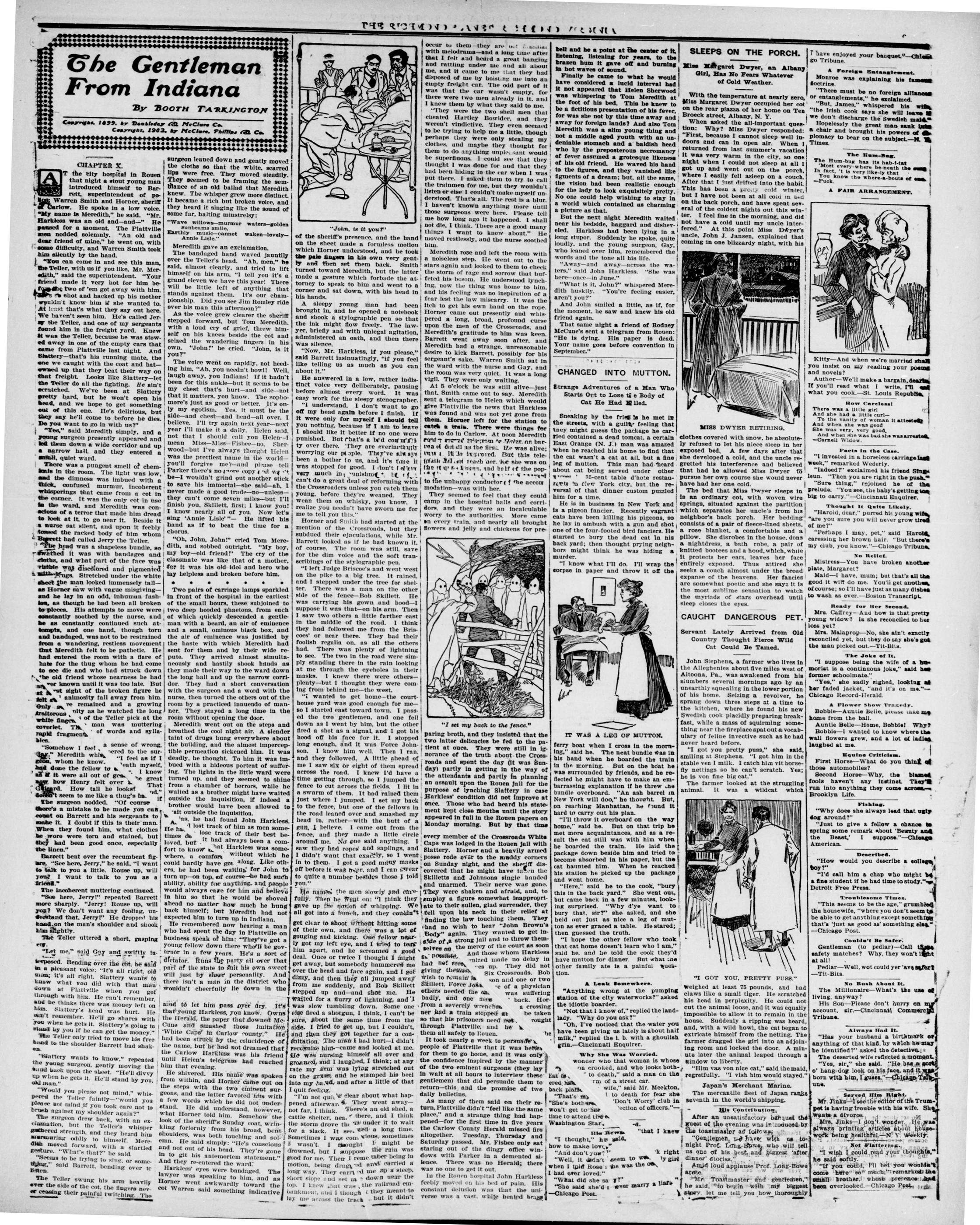
The Gentleman From Indiana
By BOOTH TARKINGTON
CHAPTER X.
T the city hospital in Rouen that night a stout young man introduced himself to Barrett, superintendent of police, Warren Smith and Horner, sheriff Carlow. He spoke in a low voice. "My name is Meredith," he said. "Mr. Harkless was an old and—and—" He paused for a moment. The Plattville men nodded solemnly. "An old and dear friend of mine," he went on, with some difficulty, and Warren Smith took him elently by the hand.
"You can come in and see this man, the Teller, with us if you like, Mr. Meredith," said the superintendent. "Your friend made it very hot for him before the two of 'em get away with him. He's shot and hacked up his mother wouldn't know him if she wanted to. At least that's what they say out here. We haven't seen him. He's called Jerry the Teller, and one of my sergeants found him in the freight yard. Knew it was the Teller, because he was stowed away in one of the empty cars that came from Plattville last night. And Slattery—that's his running mate, the one we caught with the coat and hat—owned up that they beat their way on that freight. Looks like Slattery—let the Teller do all the fighting. He ain't scratched. We've been at Slattery pretty hard, but he won't open his head, and we hope to get something out of this one. He's delirious, but they say he'll come to before he dies. Do you want to go in with us?"
"Yes," said Meredith simply, and a young surgeon presently appeared and led them down a wide corridor and up a narrow hall, and they entered a small, quiet ward.
There was a pungent smell of chemicals in the room. The light was low, and the dimness was imbued with a thick, confused murmur, incoherent whisperings that came from a cot in the corner. It was the only cot in use in the ward, and Meredith was conscious of a terror that made him dread to look at it, to go near it. Beside it a nurse sat silent, and upon it feebly tossed the racked body of him whom Bigrett had called Jerry the Teller.
The head was a shapeless bundle, so swathed it was with bandages and cloths, and what part of the face was visible.
Vase was discolored and pigmented with drugs. Stretched under the white sheet the man looked immensely tall—as Horner saw with vague misgiving—and he lay in an odd, inhuman fashion, as though he had been all broken to pieces. His attempts to move were constantly soothed by the nurse, and he as constantly continued such attempts, and one hand, though torn and bandaged, was not to be restrained from a wandering, restless movement that Meredith felt to be pathetic. He had entered the room with a flare of hate for the thug whom he had come to see die and who had struck down
the old friend whose nearness he had
ever known until it was too late. But
at first sight of the broken figure he
felt an animosity fall away from him.
Only we remained and a growing
raitorous city as he watched the long
white finger of the Teller pick at the
man was muttering
coverlet. The
of words and syllables.
"Somehow I feel, a sense of wrong,
dur." Meredith white, "I feel as if I
surged, whom he know. 'I feel as if I
had done the fellow to 'death myself,
all if it were all out of gen.' 'I know
how Henry felt over me.' The great
how Henry felt over me.' That
Gilbert. How tall he looks." "d"
don't seem to me like a thug's ha
The surgeon nodded. "Of course there's a mistake to be made you can count on Barrett and his sergeants to make it. I doubt if this is their man. When they found him, what clothes he wore were torn and stained, but they had been good once, especially the linen."
Barrett bent over the recumbent figure, "See here, Jerry," he said, "I want to talk to you a little. Rouse up, will you? I want to talk to you as a friend."
The incoherent muttering continued. "So here, Jerry!" repeated Barrett more sharply. "Jerry! Rouse up, will you? We don't want any fooling, understand that, Jerry!" He dropped his hand, on the man's shoulder and shook him slightly.
The Teller uttered a short, gasping cry.
"Let me," said Gay and swiftly in terposed. Bending over the cot, he said in a pleasant voice: "It's all right, old man; it's all right. Slattery wants to know what you did with that man down at Plattyville when you got through with him. He can't remember, and he thinks there was money left on him. Slattery's head was hurt. He can't remember. He'll go shares with you when he gets it. Slattery's going to stand by you if he can get the money." The Teller only tried to move his free
"The Teller only tried to move his free band to the shoulder Barrett had shaken.
"Slattery wants to know," repeated the young surgeon, gently moving the band back upon the sheet. "He'll divvy up when he gets it. He'll stand by you, old man."
"Would you please not mind," whispered the Teller faintly—"would you please not mind if you took care not to brush against my shoulder again?"
The surgeon drew back, with an exclamation, but the Teller's whisper gathered strength, and they heard him murmuring oddly to himself. Meredith moved forward, with a startled gesture. "What's that?" he said.
"Seems to be trying to sing, or something," said Barrett, bending over to listen.
The Teller swung his arm heavily over the side of the cot, the fingers never ceasing their painful twitching. The
surgeon leaned down and gently moved the cloths so that the white, scarred lips were free. They moved steadily. They seemed to be framing the semblance of an old ballad that Meredith knew. The whisper grew more distinct. It became a rich but broken voice, and they heard it singing like the sound of some far, halting minstrels:
"Wave willows--murmur waters--golden sunbeams smile,
Earthly music--cannot waken--lovely-
Earthly music—cannot waken—lovely—Annie Lise."
Meredith gave an exclamation.
The bandaged hand waved jauityl over the Teller's head. "Ah, men," he said, almost clearly, and tried to lift himself on his arm. "I tell you it's a grand cleen we have this year! There will be little left of anything that stands against them. It's our championship. Did you see Jim Romley ride over his man this afternoon?"
As the voice grew clearer the sheriff stepped forward, but Tom Meredith, with a loud cry of grief, threw himself on his knees beside the cot and seized the wandering fingers in his own. "John!" he cried. "John, is it you?"
The voice went on rapidly, not heeding him, "Ah, you needn't bow! Well, laugh away, you Indians! If it hadn't been for this ankle—but it seems to be my chest that's hurt and side—not that it matters, you know. The sophomore's just as good or better. It's only my egotism. Yes, it must be the side—and chest—and head—all over. I believe. I'll try again next year—next year I'll make it a daily. Helen said, not that I should call you Helen. I mean Miss-Miss-Fisbee—no, Sherwood—but I've always thought Helen was the prettiest name in the world—you'll forgive me—and please tell Parker there's no more copy and w't be-I wouldn't grind out another stick to save his immortal—she said-ah, I never made a good trade—no unless—they can't come seven miles—but I'll finish you, Skillie, first; I know you! I know nearly all of you. Now let's sing 'Annie Lisle'"—He lifted his hand as if to beat the time for a chorus.
"Oh, John, John!" cried Tom Meredith, and sobbed outright. "My boy, my boy—old friend!" The cry of the classmate was like that of a mother, for it was his old idol and hero who lay helpless and broken before him.
Two pairs of carriage lamps sparkled in front of the hospital in the earliest of the small hours, these subjoined to two deep hooded phaetons, from each of which quickly descended a gentleman with a beard, an air of eminence and a small, ominous black box, and the air of eminence was justified by the haste with which Meredith had sent for them and by their wide repute. They arrived almost simultaneously and hastily shook hands as they made their way to the ward down the long hall and up the narrow corridor. They had a short conversation with the surgeon and a word with the nurse, then turned the others out of the room by a practiced innuendo of manner. They stayed a long time in the room without opening the door.
Meredith went out on the steps and breathed the cool night air. A slender taint of drugs hung everywhere about the building, and the almost imperceptible permeation sickened him. It was deadly, he thought. To him it was imbued with a hideous portent of suffering. The lights in the little ward were turned up, and they seemed to shine from a chamber of horrors, while he waited as a brother might have waited outside the inquisition, if indeed a brother would have been allowed to 'aft outside the inquisition.
has, he had found John Harkless. A. he lost track of him as men sometimes lose track of their best betimes do it had always been a comforto, but that Harkless was somewhere, a comfort without which he could hardly have got along. Like others, he had been waiting for John to turn up on top, of course—he had such ability, ability for anything, and people would always care for him and believe in him so that he would be shoved ahead no matter how much he hung back himself; but Meredith had not expected him to turn up in Indiana.
He remembered now hearing a man who had spent the day in Plattville on business speak of him: "They've got a young fellow down there who'll be governor in a few years. He's a sort of dictator. Runs the party all over that part of the state to suit his own sweet will just by sheer personality. And there isn't a man in the district who wouldn't cheerfully lie down in the mud to let him pass over dry. It's that young Harkless, you know. Owns the Herald, the paper that downed McCune and smashed those imitation "White Caps in Carlow county." He had been struck by the coincidence of the name, but he had not dreamed that the Carlow Harkless was his friend until Helen's telegram had reached him that evening.
He shivered. His name was spoken from within, and Horner came out on the steps with the two eminent surgeons, and the latter favored him with a few words which he did not understand. He did understand, however, what Horner told him. Somehow the look of the sheriff's Sunday coat, wrinkling forlornly from his broad, bent shoulders, was both touching and solemn. He said simply: "He's conscious and not out of his head. They're gone in to git his antemortem statement." And they re-entered the ward.
Harkless' eyes were bandaged. The lawyer was speaking to him, and as Horner went awkwardly toward the cot Warren said something indicative
THE RICHMOND AVENUE (100) 100
A
"John, is it your?" of the sheriff's presence, and the hand on the sheet made a formless motion which Horner understood, and he took the pale fingers in his own very gently and then set them back. Smith turned toward Meredith, but the latter made a gesture which forbade the attorney to speak to him and went to a corner and sat down, with his head in his hands.
A sleepy young man had been brought in, and he opened a notebook and shook a stylographic pen so that the ink might flow freely. The lawyer, briefly and with unlegal agitation, administered an oath, and then there was silence.
"Now, Mr. Harkless, if you please," said Barrett insinuatingly, "if you feel like telling us as much as you can about it."
He answered in a low, rather indistinct voice very deliberately, pausing before almost every word. It was easy work for the sleepy stenographer. "I understand. I don't want to go off my head again before I finish. If it were only for myself I should tell you nothing, because if I am to leave I should like it better if no one were punished. But that's a bad commitment over there. They are everlartingly worrying our people. They've always been a bother to us, and it's time it was stopped for good. I don't belong very much in punishment. I can't do a great deal of reforming with the Crossroaders unless you catch them young, before they're weaned. They wean them on whisky, you know. I realize you needn't have sworn me for me to tell you this."
Horner and Smith had started at the mention of the Crossroads, but they subdued their ejaculations, while Mr. Barrett looked as if he had known it, of course. The room was still, save for the dim voice and the soft transcribings of the stylographic pen.
"I left Judge Briscoe's and went west on the pike to a big tree. It rained, and I stepped under the tree for shelter. There was a man on the other side of the fence—Bob Skillett. He was carrying his gown and hood—I suppose it was that—on his arm. Then I saw two others a little farther east in the middle of the road. I think they had followed me from the Briscoe's or near there. They had their foolish regalia on, as all the others had. There was plenty of lightning to see. The two in the road were simply standing there in the rain looking at me through the eyelashes in their masks. I knew there were others—plenty—but I thought they were coming from behind me—the west.
"I wanted to get home—the courthouse yard was good enough for me—so I started east toward town. I passed the two gentlemen, and one fell down as I went by him, but the other fired a shot as a signal, and I got his hood off his face for it. I stopped long enough, and it was Force Johnson. I know him well. Then I ran, and they followed. A little ahead of me I saw six or eight of them spread across the road. I knew I'd have a time getting through, so I jumped the fence to cut across the fields. I lit in a swarm of them. It had rained them just where I jumped. I set my back to the fence, but one of the fellows in the road leaned over and smashed my head in, rather—with the butt of a gun. I believe. I came out from the fence, and they made a little circle around me. No one said anything. I saw they had ropes and saplings, and I didn't want that exactly, so I went in to them. I got a good many masks off before it was over, and I can swear to quite a number besides those I told you."
He names the men slowly and carefully. Then he went on: "I think they gave up the notion of whipping. We all got into a bunch, and they could"
get clear to shoot without hitting some of their own, and there was a lot of gouging and kicking. One fellow nearly got my left eye, and I tried to tell him apart, and he screamed a good deal. Once or twice I thought I might get away, but somebody hammered me over the head and face again, and I got dizzy, and then they all jumped away from me suddenly, and Bob Skillett stepped up and—shot me. He waited for a furry of lightning, and I was slow tumbling down. Some one else fired a shotgun, I think, I can't be sure, about the same time from the side. I tried to get up, but I couldn't, and then they got together for a consultation. The man I had hurt—I didn't recognize him—came and looked at me. He was nursing himself all over and groomed, and I laughed, I think; at any rate my arm was lying stretched out on the grass, and he stamped his heel into my hand, and after a little of that I quit feeling.
"I'm not quite clear about what happened afterward. They went away—not far, I think. There's an old shed, a cattle shelter, nea, there, and I think the storm drove the van under it to wait for a slack. It see, and a long time. Sometimes I was conscious, sometimes it wasn't. I thought I might be drowned, but I suppose the rain was good for me. Then I remember being in motion, being dragged and carried a long way. They carried me up a steep, short slope and set me down near the top. I knew that was the railroad embankment, and I thought they meant to lay me across the track, but it didn't
occur to them—they are not familiar with melodrama—and a long time after that I felt and heard a great bang and rattling under me and all about me, and it came to me that they had disposed of me by hoisting me into an empty freight car. The odd part of it was that the car wasn't empty, for there were two men already in it, and I knew them by what they said to me.
"They were the two shell men that cheated Hartley Bowlder, and they weren't vindictive. They even seemed to be trying to help me a little, though perhaps they were only stealing my clothes, and maybe they thought for them to do anything unpleasant would be superfluous. I could see that they thought I was done for and that they had been hiding in the car when I was put there. I asked them to try to call the trainmen for me, but they wouldn't listen or else I couldn't make myself understood. That's all. The rest is a blur. I haven't known anything more until those surgeons were here. Please tell me how long ago it happened. I shall not die, I think. There are a good many things I want to know about." He moved restlessly, and the nurse soothed him.
Meredith rose and left the room with a noiseless step. He went out to the stars again and looked to them to check the storm of rage and sorrow that buffeted his bosom. He understood lynching, the thing he was home to him, and his feeling was no inspiration of a fear lest the law miscarry. It was the itch to get his own hand on the rope. Horner came out presently and whispered a long, broad, profound curse upon the men of the Crossroads, and Meredith's gratitude to him was keen. Barrett went away soon after, and Meredith had a strange, unreasonable desire to kick Barrett, possibly for his sergeant's sake. Warren Smith sat in the ward with the nurse and Gay, and the room was very quiet. It was a long vigil. They were only waiting.
At 5 o'clock he was still alive—just that, Smith came out to say. Meredith sent a telegram to Helen which would give Plattville the news that Harkless was found and was not yet gone from them. Horner left for the station to catch a train. There were things for him to do in Carlow. At noon Meredith sent a telegram to Helen on barrica to detail as the first. He was alive; was ill. He improved. But this telegram told her, for she was on the train to Carlow, and half of the population was with her.
They seemed to feel that they could camp in the hospital halls and corridors, and they were an incalculable worry to the authorities. More came on every train, and nearly all brought flowers and fely and chickens for pre
THE STORM
"I set my back to the fence." paring broth, and they insisted that the two latter delicacies be fed to the patient at once. They were still in ignorance of the truth about the Crossroads and spent the day (it was Sunday) partly in getting in the way of the attendants and partly in planning an assault upon the Rouen Jail for the purpose of lynching Slavery in case Harkless condition did not improve at once. Those who had heard his statement kept close mouths until the story appeared in full in the Rouen papers on Monday morning. But by that time
every member of the Crossroads White Caps was lodged in the Rouen jail with Slattery. Horner and a heavily armed posse rode over to the muddy corners on Sunday night, and the sheer discovery that he might have taken the Skillletts and Johnson's single handed and unarmed. Their nerve was gone. They were shaken and afraid, and, to employ a figure somewhat inappropriate to their sullen, glad surrender, they fell upon his neck in their relief at finding the力 touching them. They had no wish to hear "John Brown's Body" again. They wanted to get inside of a strong jail and to throw themselves on the mercy of the court as soon as possible. And those whom Harkless had not received made no delay in giving them up. They did not wish to remain in son and one or two Skilllett. Force John of a physician others needed the case was suffering badly, and one man back. Horror from a severely wrenched a crossing ner had a train stopped at be taken so that his prisoners need not brought through Plattville, and he them all safely to Rouen.
It took nearly a week to persuade people of Plattville that it was better for them to go home, and it was only the confidence inspired by the manner of the two eminent surgeons (they lay in wait at all hours to interview these gentlemen) that did persuade them to return—this and the promise of two daily bulletins.
As many of them said on their return, Plattville didn't "feel like the same place," and a strange thing had happened—for the first time in five years the Carlow County Herald missed fire altogether. Tuesday, Thursday and Saturday passed. Mr. Fishee only sat staring out of the dingy office windows with Parker in a demented silence. There was no Herald; there was no one to get it out.
In the Ronen hospital John Harkless feebly moved on his bed of pain. His constant delusion was that the universe was a vast, white heated brass
bell and he a point at the center of it listening, listening for years, to the brazen hum it gave off and burning in hot waves of sound.
Finally he came to what he would have considered a lucid interval had it not appeared that Helen Sherwood was whispering to Tom Meredith at the foot of his bed. This he knew to be a fictitious presentation of his fever, for was she not by this time away and away for foreign lands? And also Tom Meredith was a slim young thing and not a middle aged youth with an undeniable stomach and a baldish head who by the preposterous necromancy of fever assumed a grotesque likeness of his old friend. He waved his hand to the figures, and they vanished like figments of a dream; but, all the same, the vision had been realistic enough for the lady to look exquisitely pretty. No one could help wishing to stay in a world which contained as charming a picture as that.
But the next night Meredith waited near his bedside, haggard and disheveled. Harkless had been lying in a long stupor. Suddenly he spoke, quite loudly, and the young surgeon, Gay, who leaned over him, remembered the words and the tone all his life.
"Away—and away—across the waters" said John Harkless. "She was here—once in June."
"What is it, John?" whispered Meredith huskily. "You're feeling easier, aren't you?"
And John smiled a little, as if, for the moment, he saw and knew his old friend again.
That same night a friend of Rodney McCune's sent a telegram from Rouen: "He is dying. His paper is dead. Your name goes before convention in September."
Strange Adventures of a Man Who Starts Out to Lose the Body of Cat He Had killed.
Sneaking by the fries he met in the streets, with a guillot feeling that they might guess the package he carried contained a dead tomcat, a certain East Orange (N. J.) man was amazed when he reached his home to find that the cat wasn't a cat at all, but a fine leg of mutton. This man had heard about cat being served under other worms. 35-cent table d'hote restaurants in New York city, but the reversal of that dinner custom puzzled him for a time.
He is in business in New York and is a pigeon fancier. Recently vagrant cats have been killing his pigeons, so he lay in ambush with a gun and shot one of the four-footed bird fanciers. He started to bury the dead cat in his back yard; then thought prying neighbors might think he was hiding a murder.
"I know what I'll do. I'll wrap the corpse in paper and throw it off the
IT WAS A LEG OF MUTTON.
ferry boat when I cross in the morning," said he. The neat bundle was in his hand when he boarded the train in the morning. But on the boat he was surrounded by friends, and he reflected he might have to make an embarrassing explanation if he threw the bundle overboard. "An ash barrel in New York will doo," he thought. But, on reaching Manhattan, he found it hard to carry out his plan. "I'll throw it overboard on the way home," said he. But on that trip he met more acquaintances, and as a result the cat still was with him when he boarded the train. He laid the package down beside him and tried to become absorbed in his paper, but the cat haunted him. When he reached his station he picked up the package and went home.
"Here," said he to the cook, "bury this in the back yard." She went out, but came back in a few minutes, looking surprised. "Why dye want to bury that, sir?" she asked, and she held out just as nice a leg of mutton as ever graced a table. He stared; then guessed the truth.
"I hope the other fellow who took that cat home doesn't learn who I am," said he, and he told the cook they'd have mutton for dinner. But what the other family ate is a painful question.
A Leak Somewhere
"Anything wrong at the pumping station of the city waterworks?" asked the idiotic boarder.
"Not that I know of," replied the landlady. "Why do you ask?" "Oh, I've noticed that the water you have been giving us lately is about half milk," replied the i. b. with a ghoulish grin. "Cincinnati Enquirer.
Why She Was Worried.
wonder who that woman is whose
on crooked, and who looks both-
hat is "to death," said a man on the
ered car of a street car.
back pike "wife," said Mr. Meekton.
"That's it to death for fear she
"She's boths 'Don't Worry' club in
won't get to his section of officers."—
time to attend the
Washington St.
With the temperature at nearly zero, Miss Margaret Dwyer occupied her cot on the rear plaza of her home on Tea Broeck street, Albany, N. Y.
When asked the all-important question: Why? Miss Dwyer responded: "First, because I cannot sleep well indoors and can in open air. When I returned from last summer's vacation it was very warm in the city, so one night when I could not sleep at all I got up and went out on the porch, where I easily fell asleep on a couch. After that I just drifted into the habit. This has been a pretty cold winter, but I have not been at all cold in bed on the back porch, and have spent several of the coldest nights out this winter. I feel fine in the morning, and did not have a cold until my uncle interfered." At this point Miss Dwyer's uncle, John J. Jansen, explained that coming in one blizzard night, with his
A woman in a long dress stands on a balcony, looking out at a cityscape.
MISS DWYER RETIRING. clothes covered with snow, he absolutely refused to let his niece sleep in her exposed bed. A few days after that she developed a cold, and the uncle regretted his interference and believed that had he allowed Miss Dwyer to pursue her own course she would never have had her one cold.
The bed that Miss Twyer sleeps in is an ordinary cot, with woven wire springs, situated against the partition which separates her uncle's from his neighbor's back porch. Her bedding consists of a pair of fleece-lined sheets, a rose blanket, a comfortable and a pillow. She disrobes in the house, dons a nightdress, a bath robe, a pair of knitted bootees and a hood, which, while it protects her ears, leaves her face entirely exposed. Thus attired she seeks a couch almost under the broad expanse of the heavens. Her fancies are somewhat poetic and she says it is the most sublime sensation to watch the myriads of stars overhead until sleep closes the eyes.
CAUGHT DANGEROUS PET.
Servant Lately Arrived from Old Country Thought Fierce Wild Cat Could Be Tamed.
John Stephens, a farmer who lives in the Alleghenies about five miles west of Altoona, Pa., was awakened from his slumbers several mornings ago by an unearthly squealing in the lower portion of his home. Selzing a revolver, he sprang down three steps at a time to the kitchen, where he found his new Swedish cook placidly preparing breakfast, while a mass of squirming something near the fireplace spout out a vocabulary of feline invective such as he had never heard before.
"I got you pretty puss," she said, smiling at Stephens. "I got him in the stable v milk I milk. I catch him v horisely nettings so he can't scratch. Yes; he is von fine big cat."
The farmer looked at the struggling animal. It was a wildcat which
A
"I GOT YOU, PRETTY PUSS."
weighed at least 75 pounds, and had claws like a small tiger. He scratched his head in perplexity. He could not cut the animal loose, and it was equally impossible to allow it to remain in the house. Suddenly a ripping was heard, and, with a wild howl, the cat began to extricate himself from the netting. The farmer dragged the girl into an adjoining room and locked the door. A minute later the animal leaped through a window to liberty.
"Him vas von nice cat," said the maid, regretfully. "I vish him would stayed."
Japan's Merchant Marine
The mercantile fleet of Japan ranks seventh in the world's shipping.
His Contribution
After an unsatisfactory banquet the guest of the evening was introduced by the toastmaster as follows:
"Gentlemen, we have with us tonight Prof. Long-Bowe, who will tell us one of his best, and biggest 'after dinner' stories."
Amid loud applause Prof. Long-Bowe arose.
"Mr. Toastmaster and gentlemen," he said, "to begin with my biggest story let me tell you how thoroughly
I have enjoyed your banquet."—Chloe go Tribune.
A Foreign Entanglement.
Monroe was explaining his famous doctrine.
"There must be no foreign alliances or entanglements," he exclaimed.
"But, James," whispered his wish,
"the Irish cook says she will leave we don't discharge the Swedish maid.
Hopelessly the great man sank like a chair and brought his powers of plomacy to bear on the subject—N. Times.
The Hum-Bug.
The Hum-bug has its hab-1-dat
"Most every-where be-neath the In fact, it is very like-ly that
You know the where-a-bouts of—Puck.
A FAIR ARRANGEMENT.
Kitty—And when we're married shall you insist on my reading your poems and novels?
Author—We'll make a bargain, dear!
If you'll read what I write, I'll
what you cook—St. Louis Republic
How Careless
There was a little girl
And she was a little girl—
To the table when it attested
And when she was good
She was very, very good.
And when she was bad she was arrested. Cornell Widow.
Facts in the Case.
"I invested in a horseless carriage last week," remarked Wederly.
"Indeed?" exclaimed his friend Singleun. "Then you are right in the push." "Sure thing," rejoined he of the prelude. "You see, the baby's getting too big to carry."—Cincinnati Enquirer.
Thought It Quite Likely.
"Harold, dear," purred his young wife "are you sure you will never grow tired of me?"
"Perhaps I may, pet," said Harold, caressing her brown hair. "But there's my club, you know."—Chicago Tribune.
No Relief.
Mistress—You have broken another plate, Margaret?
Mald—I have, mum; but that's all the good it will do. You'll get another, of course; so I'll have just as many dishes to wash as ever.—Boston Transcript.
Mrs. Caffrey—And how is that pretty young widow? Is she reconciled to her loss yet?
Mrs. Malaprop—No, she ain't exactly reconciled yet, but they do say she's got the man picked out—Tit-Bits.
The joke of It
"I suppose being the wife of a humorist is a continuous joke," said her former schoolmate.
"Yes," she sadly sighed, looking at her faded jacket, "and it's on me."—Chicago Record-Herald.
A Flower Show Tragedy.
A Flower Show Tragedy.
Bobbie—Auntie Belle, please take me home from the ball.
Auntie Belle—Home, Bobbie! Why?
Bobbie I wanted to know where the wall flowers grew, and a lot of ladies laughed at me.
Equine Criticism.
First Horse—What do you think of those automobiles?
Second Horse—Why, the blamed fools haven't any instinct. They run into anything they come across—Brooklyn Life.
Fishing.
"Why does she always lead that ugly dog around?"
"Just to give a fellow a chance to spring some remark about Beauty and the Beast,' I suppose."—Chicago American.
Described.
"How would you describe a college boy?"
"I'd call him a chap who might be a fine student if he had time to study." Detroit Free Press.
Troublesome Times.
"This seems to be the age," grumbled the housewife, "where you don't seem to be able to get anything except something that's 'just as good as' something else." —Chicago Post.
Couldn't Be Safer
Gentleman (to pediar)—Call these safety matches? Why, they won't light at all!
Pediar—Well, wot could yer 'ave aster—Tit-Bits.
No Rush About It.
The Millionaire—What's the use of living, anyway?
His Son—Please don't hurry on my account, sir.—Cincinnati Commercial Tribune.
Always Had It.
"Has your husband a birthmark or anything of that kind, by which he may be identified?" asked the detective. The deserted wife reflected a moment, "Yes, sir," she said. "He has a sord o' hang-dog look on his face, and it was born with him, I guess."—Chicago Talk, una.
Served Him Right.
Mr. Jinks—I see the editor of the Trumpet is having trouble with his wife. She wants a divorce.
Mrs. Jinks—I don't wonder. He was always printing articles about housework being healthful—N. Y. Weekly.
Not Flattering.
"I wish I could read your thoughts," he said softly.
"If you could, I'll bet you wouldn't come here so much," remarked the small brother, whose presence had been overlooked. —Chicago Post.
THE PLANET
published every Saturday by JOHN MITCHELL
at 311 North 4th Street. Richmond, Va.
JOHN MITCHELL, JR., - EDITOR
communications intended for publication
should be sent to us to reach us by Wednesday
There are FOUR WAYS by which money can be sent by mail at our work. In a Post Office Money Order, the money Order, and when none of these are procured, in a Registered Letter. MONEY ORDERS—You can buy a Money Order at your Post Office, payable at the Richmond Post Office, and we will be responsible for its arrival. MONEY ORDERS can be owed at any office of the American Express Co., the United States Express Co., and the Well. For payment for money sent by any of these companies, the Express Money Order is a safe convenient way for forwarding money. REGISTERED LETTER—If a Money Order is registered, your Postmaster will register the letter you wish to send us on payment of ten cents. Then, if the letter is lost or stolen, it cannot be carved in car money in the manner at our risk. We cannot be responsible for money sent in letters in any other way than one of the four letters above. If you send your money in any other way, you must do it at your risk.
GENERALS, ETC.—If you do not want THE
LANE continued for another year after your
death, you can turn out, you can notify us by
a real Card to be sent to THE NEWSPAPERS who
will send you a new paper. The newspapers who
issue a new paper of time for which it has been paid
issue a new payment for the payment of the subscription
date when they order the paper discount.
COMMUNICA—When writing to u,
renew your subscription or to discontinue
paper, you should give your name and an
address. We advise we cannot find you our
CORPORATION. In order to change
address of a subscriber, we must be seen
formal as well as the present address.
Entered in the Post Office at Richmond.
second column matter
Torn "Jim-Crow" street-car law is being tried here first. It is not in operation in the other cities of Virginia.
COLORED people of this city pay taxes on one million dollars worth of property and if they have not enough self respect to walk for one year, it will be their own fault. Stay off the street cars and avoid trouble.
COLORED people should remember that they should discountenance all unlawful tendencies and strive to promote peace and harmony in the communities in which they live.
It seems that Senator B. R. TILLMAN has more influence in the United States Senate where a colored man is concerned than the President of the United States.
The confirmation of Dr. W. D. CRUM as Collective of the Port of Charleston, South Carolina, was postponed simply because the good Lord had afflicted Tillman with a bad case of sore throat.
STREET CAR mass-meeting at True Reformers' Hall, Tuesday, April 19th, 1904, at 8 o'clock.
Go early and hear how to avoid trouble. Stay off the street cars!
Do not get on the street cars to assert your rights.
Legitimate rights become legal "wrongs" in the face of the specific provisions of legalized regulations and the Mayor and Governor are obliged to call out the armed power of the state, when necessary to uphold the same.
Let us be peaceable, law-abiding and at the same time avoid trouble. Walking is good now. Stay off the street cases!
THE TIMES-DISPATCH says that the colored people' property, which is valued at eighteen million dollars, is partly mortgaged. Well, that doesn't affect the taxes paid on it.
And this journal knows that our esteemed white folks' property sometimes appears to be all mortgaged. The government itself will take 250 years to pay what it owes. When it comes to borrowing or owing money, the white folks are past-masters at the art.
A NEEDLESS INNOVATION.
We act since the close of the Civil War has tended to arouse a more bitter feeling of racial antagonism than the source pursued by the VIRGINIA PASSenger AND POWER COMPANY in adopting rules and regulations authorizing its irresponsible and responsible conductors to order its white and colored gatrons from this or that seat to this or that seat.
This feeling has been accentuated from the fact that there was and is absolutely no demand or excuse for such discrimination. The class of colored people, who have been the patrons of the line are well-behaved and orderly, submitting to indignities and insults from some of the prejudiced conductors, which would have called forth retaliation from a more sensitive and hot-headed class of people. In fact, it is conceded that in the matter of obeying the police authorities and good conduct on the street-railways, the colored people of this city will compare favorably with any orderly community in the world.
The relationship between the better elements of the two races has been most friendly, and at no time has the Richmond City Council deemed it necessary to pass any measure even remotely, looking to the discrimination which the VIRGINIA PASSENGER AND POWER COMPANY of its own motion proceeds to inflict upon this community.
Some Negro-hating member of the Council proposed such legislation, and we believe actually introduced it, but it must have been "laughed out of court" for it never emerged from the sombre surroundings of the committee room.
This was considered by the conservative colored people to be a good omen and the feeling of friendliness towards the white people here was strengthened.
It is known that the colored people of Virginia are among the best in the world for kindness, good manners and a disposition to serve with satisfaction those among whom they cast their lot. For this reason, Virginia servants for many years commanded the highest wages at the North and in many places now, they are eagerly sought.
This was due, to a large extent, to the courtliness of the true F. F. V. Virginia gentleman, to the "manor born," who had around him only well-bred servants and infused even into the field hands the spirit of true "Chesterfieldian" politeness for which our people were noted.
For years after the war closed an ill-mannered Negro was designated by the colored people themselves in tones of co-steup as "a corn-field Negro," and an ill-mannered white man, as "poor white trash."
BUT the VIRGINIA PASSENGER AND POWER COMPANY evidently did not know this. It is a northern corporation, which is no doubt trying to out-do itself in pandering to some of its Negro-hating patrons.
In this, it has over-stepped the bounds, and is meeting deserved condemnation at the hands of the respectable, conservative colored people and being most heartily criticized by the better class of white people of this community, whose parents owned a Negro and knew the value of one.
There are not half a dozen white families of standing in Richmond, whose members, both male and female do not come in closer contact with Negroes than it is ever possible to do during the transient acquaintanceship on the street cars.
They know that it is utterly impossible to give parlor-car accommodations for five cents and that people who wish to ride to themselves or keep from comin contact with Chinamen, Italians or Colored people should either hire cabs, or charter furniture wagons for their own convenience.
It seems then that this COMPANY has grievously misunderstood the situation and that President FRITZ SITTERDING, who, we believe is a German and General Manager HUFF, whom we believe is evidently anything else but a native born Virginian should hold sweet communion with the Virginians of the Mr. JOHN P. BRANCH or Mr. JOHN L. WILLIAMS' type. The former held the funeral of his black Mammy in his parler, and not to have done so wou'd have been in the face of the protests of the tender female members of his family.
They should call on the members of the Centenary Church in this city, who sent their stewards and designated white members of the congregation to act as pill-bearers over the remains of the old colored sexton, JOHN WHITE and whose pastor, in tones of emotion pronounced the eulogy over the remains then in transit to the grave.
No thought of racial separation was there apparent, and no one spoke of it. It is evident that the management of the company has been living in Richmond, but is not yet of it.
Capt. ALEXANDER B. GUIGON, the able young attorney for the company comes from true Virginia stock and can no doubt enlighten Mr. SITTERDING and Mr. HUFF on these matters, if they desire to be enlightened.
Judge GUIGON, admitted to be one of the ablest jurists who ever sat on the bench would have taken a seat beside a Negro, either male or female on a street-car or in a carriage. He had done so hundreds of times for he always kept Negro servants around to rear his children and to discharge the onerous cares of the household.
But enough, the COMPANY, in our judgment has made a mistake, and it at present insists upon following it out to its logical conclusion.
This is no time to threaten, or to attempt to retaliate. We should demonstrate that we have been well-bred and are students of good manners.
There is no discrimination on the side-walks and we are at present in a friendly relationship with the policemen. No Negro's head has come in violent contact with an officer's presiding club, with its accompaniment of bumps, blood and stars for more than a year and we can walk and be happy. Let us avoid trouble. Walking is good now. Stay off the street cars!
THE RICHMOND PLANET, RICHMOND, VIRGINIA
BRUTAL MURDER OF WATCHMAN
Robber Surprised at Work in Houston Club of Pennsylvania University.
NEGRO CONFESSES THE CRIME
Philadelphia, April 11. — John Thomas, the night watchman at the Houston Club of the University of Pennsylvania, which is situated on the campus in the heart of the university's group of buildings, was brutally murdered on the bowling alleys in the basement of the club house. The motive is believed to have been robbery, and Lawrence Gibson, alias John Oakley, a negro, was arrested on suspicion. Gibson was employed for a number of years as a utility man at Houston Hall.
Houston Hall is closed at 7 o'clock on Sunday evening. Shortly after that hour a student in passing the hall noticed that it had not been closed, and entered the building. As he did so he heard groans in the basement. He summoned assistance from the University Hospital, nearby, and the watchman, who was about 69 years of age, was found lying across one of the bowling alleys. The right side of his head was crushed in, one ear was partly cut off and one finger was severed from his left hand. The man was dead. One of the watchman's pockets was turned inside out. Near the body was found two chisels and an andiron. Blood was spattered over the alley and on several of the bowling balls. A stand where books and stationery are sold, just outside the bowling alleys, showed evidences of a struggle, part of the iron grill work surrounding the stand having been torn down.
A thorough search of the building was made. Under a cushion in a cozy corner on the main floor a blood-stained hatchet was found. Trails of blood led from the alleys to this spot and also to the bath room on the second floor, where blood-stained towels were also found.
Gibson was arrested at his home early in the day, and denied all knowledge of the crime until late in the afternoon, when he broke down and confessed to the murder. Self-defense is his plea. Gibson says he went to Houston Hall to call on Thomas. The watchman, Gibson says, evidently mistook him for a thief and attacked him. In the struggle he unintentionally killed the old man. He says there was a scuffle, in which Thomas attacked him with a pair of tongs, cutting his finger. The men struggled, and Gibson broke away, wrenching the tongs from Thomas. He hit the watchman with them. Thomas fell at the first blow, but got up and renewed the fight. Gibson struck him again and ran away. On going home he tore out and partly burned the bloody sleeve of his shirt. The detectives have the charred fragments.
The police do not believe this story, Superintendent of Police Quirk is of the opinion that revenge for being dismissed from Houston Hall was the motive for the murder, although he has not entirely discarded the theory of robbery. Gibson, whose complexion is so light that he easily passed as a white man, misrepresented himself as a student at the university and married a young white woman three weeks ago. When the deception was discovered he was discharged from Houston Hall. How he expected to get revenge, and his reason for attacking the watchman, the police decline to say. The authorities say that Gibson is wanted in Jamaica for some offense.
JERSEY LEGISLATURE OBDURATE
Met and Adjourned Without Action On
Morris Canal Aandonment Measure
Trenton, N. J., April 13.—The special session of the legislature convened yesterday afternoon in accordance with a proclamation issued by Governor Murphy and adjourned sine die last evening. The net result was the passage of four bills, the refusal by the Republican senators to consider the Morris canal abandonment proposition and acquiescence by the house Republicans in the attitude shown by the senators, and the confirmation by the senate of the five members of the board of prison inspectors who failed of confirmation on the last day of the regular session.
One of the bills passed was the antipigeon shooting bill, which was opposed in the senate by Senators Horner and Lee, and which received eight negative votes in the house.
A bill appropriating $250,000 for stone roads to take the place of a similar bill appropriating $270,000 passed by the regular session and vetoed by the governor, passed both houses without opposition. The governor will sign the bill appropriating $250,000.
The two other bills passed take the place of bills passed at the regular session and vetoed by the governor, because of incorrectness as to form. One was the Passaic valley flood bill and the other was the Jersey City sewer bill.
Boston Gets Episcopal Convention. Boston, April 11—Announcement has been made that the next general convention of the Episcopal church will be held in this city October 5 to 25. The sessions will be held in Emmanuel church, and it is estimated that some 7000 people will attend. The woman's auxiliary also will hold its triennial convention here, October 6 to 10. It is possible that the archbishop of Canterbury will attend the convention as a visitor and as a guest of the citizens of Boston.
Santa Barbara, Cal., April 11.—One of the Edison company's street cars ran off the track in this city and was turned over. Three people were instantly killed and two were so badly injured that they died soon after the accident. Twenty were more or less injured, sustaining bruises and broken bones. All are believed to have been residents of Santa Barbara.
A CHANCE FOR ALL Home-Builders and Speculators
BOTH SIDE 6TH AND 7TH STS.,OVERLOOKING C. & O.R.R. SHOPS, LOCOMOTIVE WORKS AND OTHER LARGE MANUFACTORIES
ALLEY.
2 3 4 5 6 7 8 9 10
125' 18' 30' 30' 30' 30' 30' 30' 30' 40'
STEARNS ST.
6TH ST. 65' WIDE
STONE
STONE
CROUCH
155' C
Sec. 7
7 8 9 10 11 12 13 14
17' ALLEY.
133' ST. 33' WIDE
STONE
Sec. 8
70' 75' 80' 85' 90' 95'
16 17 18 19
99' 104'
30' 30' 30' 30'
STONE
ST. 65' WIDE
7TH
Cheap Lots in the City's Center
NOW AVAILABLE FOR BUILDING PURPOSES. Houses here command immediate tenants at paying rates, One block from 5th St. Car Line. Terms: $50 cash on each lot, balance, long time, monthly, if desired.
CARDINAL SATOLLI COMING
CIRCULAR SOLIDER COMING
Will Visit Catholic University at
Washington and St. Louis Fair.
Rome, April 13.—Cardinal Satellil,
with the permission of the pope,
is going to the United States privately
Cardinal Sotell
Cardinal Satolli. and without a mission, arriving probably in June. As prefect of the congregation of studies, the cardinal will visit the Catholic University at Washington and he will also make a trip to the St. Louis Exposition. Several friends of the cardinal, who have invited him to their homes, expect that his visit will extend over a month. Cardinal Satolli's visit to the United States is considered most important, there being no record in recent times of a cardinal immediately attached to the papal court going abroad without being accredited an ablegate.
SENATOR QUAY ILL
Condition Is Not Critical, But Doctors Order Complete Rest.
Atlantic City, N. J., April 12.—United States Senator Quay, who came here from Washington a couple of weeks ago, is still in such poor health that he confines himself almost exclusively to the cottage he occupies at 100 States avenue, at the corner of Pacific. Quay is ill—seriously ill—but there is considerable exaggeration in the reports that would suggest his condition is critical. Senator Quay's physicians ordered the trip to the seashore and
prescribed that he should take a complete rest from the cares of public life. He sees scarcely any visitors and the few exceptions are some of his personal friends of many years' standing. To all others the reply is the same: "Senator Quay is not seeing any visitors."
Man and Wife Met Death On Bridge at Westville, N. J.
Woodbury, N. J., April 13.—Augustus Marticio and his wife Christina, of Philadelphia, were struck and killed by a West Jersey and Seashore train on the bridge over Timber creek, at Westville. The bodies were found by the trainmen of the Maurice river freight, the remains being frightfully mangled. The man, who was 27 years old, and his wife, aged 24, went to Westville to visit the woman's sister, and left her house, proposing to walk the track to the Gloucester ferry, and were run down on the bridge. The relative knew nothing of their fate until she saw from the window of her house the trainmen engaged in some task, which she soon learned was the gathering up of the remains of her sister and brother-in-law.
MURDER NEAR ALLENTOWN
Man Killed By Blunt Instrument Found Along Railroad.
Allentown, Pa, April 12.—Andrew Lasko, of Newport, Northampton county, a cement worker, 25 years old, was found dead along the Lehigh Valley railroad near Cement. His wounds show that he was not struck by a train, but was killed by a blunt instrument, the skull being fractured and his clothing badly torn. Blood stains indicated that the body had been carried half a mile to the place where found. The Greek Catholics observed Easter on Sunday. Lasko participated in the celebration at his boarding place, where he ejected three men who created a disturbance. The coroner's theory is that he was followed by these men and clubbed and choked to death.
Want Bryan Removed.
New Haven, Conn., April 13.—Counsel for Mrs. Grace Imogene Bennett appeared before Probate Judge Cleaveland with a petition that William Jen-
nings Bryan be removed as the executor of the estate of the late Philo S. Bennett, the chief allegation being that he is dissipating the funds of the estate in his legal actions in attempting to secure the probating of the "sealed letter" as a part of the will. The "sealed letter" gives Mr. Bryan $50,000. The court will set a date for a hearing.
Religious Maniac Mutilates Child. Oil City, Pa., April 12—Mrs. Luke Gough, aged 27 years, became insane on religion a week ago, but was not placed under restraint. Obeying what she conceived to be a divine command, she set her daughter Harriett, 8 months old, on top of a hot gas stove, and before the other children could bring assistance, cut the right hand of her child off at the wrist with a blunt paring knife. The mutilated victim may recover. Mrs. Gough was a member of the sect known as the Holy Rollers.
General Toral Still Living.
Madrid, April 13.—There is no truth in the story published in the United States that General Toral, who commanded the Spanish garrison at Santiago de Cuba at the time of the surrender of that place to the United States forces, had died at an insane asylum at Leganes. General Toral is still living at the Esauerado Hospital.
The Bechtels Acquitted.
Aleintown, Pa., April 12.—The last act in the tragedy growing out of the murder of Mabel Bechtel last October was taken in court when, on motion of District Attorney Lichtenwalner, a nolle pros was entered in the cases of Mrs. Catherine Bechtel, Miss Martha Bechtel and John and Charles Bechtel, mother, sister and brothers of the dead girl. All had been indicted as accessories after the fact and an additional indictment against the mother was for murder. In the cases against Martha, John and Charles a struck jury was drawn which returned a verdict of not guilty, by direction of the court.
Clever Scheme
The Hostler—Say, the horses won't eat that hay.
The Hustler—Well, tie it up in packages and advertise it as a new breakfast food.—Chicago American.
1113 Main Street.
ALL
reculators
Lots=24.
LOCOMOTIVE WORKS
ST BIDDER.
PREMISES,
19, 5-30 P. M.
EAST VACANT
Center
command immediate tenants at pay-
e, long time, monthly, if desired.
JUCTIONEERS.
Just Out!
If you have read the Pilgrims Progress by John Bunyan, you ought to be sure and read the
by Mrs. Lucinda Young. This Book sells for $1.00 and is meeting with great success all over the country. Truly a great book. Address all communications to
AGENTS WANTED.
ap16 6 m
THE
FRISCO
SYSTEM
Carrying Pullman Sleepers, Cafe Cars
(a la carte) and Chair Cars (seats free)
Electric Lighted Throughout
BETWEEN
Birmingham, Memphis and Kansas City
AND TO ALL POINTS IN
Texas, Oklahoma and Indian Territories
AND THE
Far West and Northwest
THE ONLY THROUGH SLEEPING CAR LINE
BETWEEN THE SOUTHEAST AND
KANSAS CITY
Descriptive literature, tickets arranged and through reservations made upon application to
W. T. SAUNDERS
Gen'l Agent Passsnger Department
ATLANTA, GA.
Subscribe to THE PLANET.
ea laNe
aa
’ EN
“yah : ay)
SATURDAY ..... .... APRIL 16, 1904
a
JAPANESE
> BEATEN IN
| TWO FIGHTS
Fifty Scouts Annihilated After Cross-
ing Yalu River at Wiju.
SECOND DEFEAT AT YONGAMPHO
General Kuropatkin Reports Two
Skirmishes Near Mouth of Yalu
River, and Says Japanese Have
| Wsdrawn Their Outposts at Wiju.
Noval Battle Reported From Chefoo.
Bt Petersburg, April 13.—General
F.vopatkin, in a dispatch to the em-
peror, bearing yesterday's date, says
that “General Krasnalinski on the
night of April 8 ordered a detachment
‘of sharpshooters to cross to the left
bank of the Yalu, opposite Wiju. The
#aarpshooters landed on the Island of
Samalind and surprised a patrol of 50
Japanese scouts just as the latter
‘were approaching the east side of the
{sland in three. boats.
The Russians allowed the Japanese
to land, and then fired on them. Nearly
‘il the Japanese were shot, bayoncted
t 5
Ry Rie Hy
{ ty
» {fA | CO—S=
fii \ ZEB
VU) XB
. LZ. =F
‘SF drowned and their boats sunk. The
Ressians sustained no losses. Non-
commissioned Oficers Louchkine and
Senhaschonoy distinguished — them-
elves in the fizht.
Qn the following day the Japanese
Neyere their flag at Wiju, and their
outposts, which lately have been seen,
fell back.
On the night of April 9 four Rus-
slams crossed the Yalu to Yenampo
(Yongampho?) and made towards a
Rassian village, where they found a
squadron of Japanese cavairy. They
Femained there 12 hours, when they
‘were betrayed by Koreans, and found
themselves obliged to swim the river,
thelr boat having struck on a sand
bank. One soldier lost his life. The
ese pursued the Russians in a
a were in turn attacked by &
boat, which had come to the
Tescue of the swimmers. The Japa-
nese were all killed and their boat
sunk.
One feature of the message which
4a not pleasing to the authorities is
the action of the Koreans in revealing
fo the Japanese the presence of the
Ruesians at Yongampho, and the be-
Mef prevatis that the Koreans are not
#0 unfriendly to the Japanese as has
deen announced. Incidents such as
that at Yongampho indicate that the
‘view held of the Korean attitude is a
mistaken one.
Chou Tien Cheng Fortified By Russia.
Seoul, April 13.—Japanese advices
from Northern Korea state that the
Russians have strongly fortified Chou
RS
Pan
Ae BUI
Ee BAN
rot tah fearon SY 9
pa on once FU
Rats ed Se
Ee ® |
te] Need Aes
ra
i, =e AYA
ANE ane ie
ile a Diner
Peper ease |
Oy eae at Fo ae
ee oe
Fe" ih?)
Sivsriy caucus
‘Tien Cheng, a walled town on the Man-
shurian side of the Yalu river, about
20 mifles north of Antung. It is esti-
mated that there are 20,000 Russians
of all erms at Antung ready to oppose
the Japanese crossing.
BiG NAVAL BATTLE FOUGHT
Sounds of Heavy Firing at Sea Heard
at Teng Chow.
‘Guefoo, April 13.—A correspondent
Of the Associated Press at Teng Chow,
$8 miles northeast of here, telegraphs
8 follows:
| “Sounds of very heavy firing were
Sheard at 6.30 o'clock this (Wednes-
day) morning. The firing evidently
‘was being done Devwaen Rees SeT Fert
Arthur. It Is belleved at Teng Chow
that the long Sxpécted sea Aght among
the Miaotao Islands has taken place.,
“The Japanese’battleshtp Asahi, fly-
jag an admiral’s flag, was seen off
Chefoo yesterday, going to the west,
and there fs no doubt that the re-
mainder of the Japanese fleet was in
the vicinity of Port Arthur. The Rus-
sian fleet also was scen outside Port
Arthur yesterday.”
‘Phe captain of the steamer Lock
shan, which arrived today from New-
chwang, reports that he heard heavy
firing between 5 and 7 o'clock this
(Wednesday) morning, in the direc-
tion of Port Arthur. The firing was
continuous, but no ships were visible.
From ‘the direction of the sound he
Judged that there was fighting at the
entrance to Port Arthur. The Lock-
shan was the last foreign merchant
steamer to leave Newchwang, sailing
at the same time as tho British gun-
boat Esplegle yesterday afternoon.
Newchwang Forts Sink a Junk.
London, April 13.—The Times’ New-
chwang correspondent cabling under
date of April 11, says:
“Last night a pilot's flare was mis-
taken for the lights of a Japanese
fleet, and the Russians opened fire and
sank the junk, with 35 hands, besides
killing three persons and wounding
seven in another junk.
“The native population is panic-
stricken and leaving the town.”
'No Ships at Newchwanc.
Newchwang, April 13—Prior to the
departure of the British gunboat Es
Piegle, which has been stationed here
during the winter, M. Grosse, civil ad-
ministrator of Newchwang, visited the
warship officially. ‘The civil adminis:
trator and Russian local authorities
afterward waited on the esplanade
along the water front while the gun-
boat steamed by on her way down the
tiver. This official ceremony was in
Tecognition of the cordial relations
which have existed between officers
of the Esplegle and the Russian av.
thorities during the stay of the gun-
boat at Newchwang.
The detention of the Esplegle after
the time originally set for her de-
parture {s understood to indicate the
unqualified acceptance by Great Pri-
tain of the establishment by the Rus-
sians “of martial law at Newchwang
and to indicate Great Britain's agree-
ment to the plan for protection of
British interests here during the war.
‘The departure of the Esplogle re-
moves a cause of embarrassment to
the Russian authorities and enables
them to put into execution a system
of martial law consistent with the de
mands of the situation. The Esplegic
was the last foreign warship at New.
chwang, the United States gunboat
Helena having left here some 10 days
ago.
‘The last of the merchant steamers
has left Newchwang, and the shipping
companies have notified their agents
to send no more vessels here, conse-
quently it ts expected that hencefor.
ward commerce will be practically at
‘fg standstill.
DIVER MET HIS DEATH
He Is Imprisoned In Seventy Feet of
Water at Boonton, N. J.
Boonton, N. J., April 13.—William
Hoar, a diver from New York, who was
imprisoned in 70 feet of water in the
Jersey City reservoir here Monday,
has been given up for dead by other
divers who had come to ald-in res.
cuing him. The divers worked until,
under the Influence of the high wind,
the waves on the lake caused the raft
on which the air pump rested to pitch
so that it was impossible longer to
supply the men below with alr. Then
the pump was removed to the stone
dam, and on the possibility that Hoar
is still alive air is still being sent
down to him.
‘Hoar was sent here on Monday from
New York to close an intake pipe in
the lake. To close the pipe, the gate
of which was not working properly, a
ball of wood and lead, nine fect in
diameter, had been lowered in front
of the opening. Still the water con-
tinued to flow through the pipe in al-
most as great volume as before.
Hoar went dow= Monday afternoon
to place the ball in proper position,
and his left leg became caught be-
tween the pipe and the ball. All ef.
forts to release him failed, although
the work of the rescuers was contin-
ued until last night.
CONGRESS TO ADJOURN APRIL 23
Date Being Discussed By Congress-
men and Senators.
Washington, April 11.—April 28 has
been discussed In cimmittee rooms and
among senators and representatives as
not at all an improbable date for the
termination of the present session of
congress. The pension appropriation
bill has been received from the house
and reported from the senate commit-
tee with an amendment. Discussion of
service pension legislation it is believed
will be exhausted before the bill is
placed on its passage, anid this measure,
therefore, is not considered a barrier to
early adjournment.
New Test of Anti-Trust Law.
Pittsburg, Pa, April 11. — In an
equity suit filed in the county courts,
W Harry Brown, of this city, seeks
to prevent the merging of the car
wheel plants of the country and to
have the court declare an alleged
merger of the Keystone Car Wheel
company with the National Car Wheel
company illegal and void, under the
‘Sherman anti-trust law.
Bust of Jefferson Demolished.
St. Louis, April 13—A heavy gust
of wind blew down and demolished the
staff bust of President Thomas Jef-
ferson at the World's Fair. The bust.
five feet in height, ornamented a
bedestal at the exposition. It is prob-
able that another bust will be made.
A WEEK’S NEWS CONDENSED.
Thursday, April 7.
‘Thieves entered the Catholic church
at Bellaire, 0. and stole over $600
worth of gold and silver ware.
J. Pierpont Morgan sailed for Bu-
THE RICHMOND PLANET, RICHMOND, VIRGINIA.
suman th» ESRI MUNG), VINGINIA
SE. eee
Sa ee > eS,
= ‘Southera ee “Associa-
i logan en opreountng bres sate
en stat
The A. Hanna 4
Chair of Political Sclence Association
Sent out 10,000 letters of appeal for
contributions to that cause. ‘
Friday, April 8.
Joseph E. Schwab, brother of Charles
‘M. Schwab, has resigned af president
of the American Steel Foundries com-
pany.
A favorable report was made to the
senate on the bill applying the general
pension laws to telegraphers who serv-
ed during the Civ] War.
The Tennessee Republican conven-
tion endorsed President Roosevelt's
administration and instructed the del-
egates to vote for his nomination.
Two trainmen were killed and two
fatally injured In a collision between
passenger and freight trains on the
B. & O. road in a tunnel near West
Union, W. Va.
Saturday, April 9.
King Christian, of Denmark, cele-
brated his 86th birthday and is in ex-
cellent health.
Paes Die. i to the World's Fair
grounds at St. Louis was made out
in the name of President Roosevelt.
‘The New York legislature has ap-
Propriated $260,000 for an agricultural
college at Cornell University, Ithaca.
‘The Missouri, Kansas and Texas
flyer was wrecked near Fort Scott,
Kan., by the rails spreading, and 16
persons were injured, none fatally.
President Roosevelt has appointed
James R. Parsons, Jr. of Albany, N.
Y., United States consul general to
the City of Mexico, vice A. D. Barlow,
resigned.
Monday, April 11.
‘The Kansas sujreme court declares
it is not illegal to read passages from
the Bible in the public schools.
Edward W. Clark, one of the oldest
and best known financiers and bank-
ers of Philadelphia, died after a brief
illness, aged 77 years.
James Ely, one of the best known
wing shots of Pennsylvania, while
despondent from ill health, shot and
Killed himself in a hotel near Wilkes-
barre, Pa.
Hon. Charles H. Page, formerly a
member of the board of review of the
National Trotting Association, and one
of the best-known turfmen in the
United States, died in Philadelphia of
heart disease.
Tuesday, April 12.
‘The executive board of the American
Federation of Labor will meet at Den-
ver, Colo., April 18.
General J. J. Jiminez, the rebel
leader, who fied from Santo Domingo,
has arrived in New York.
‘The house of representatives passed
the river and harbor appropriation
Dill, carrying $3,000,000 for improve-
ments.
The strike on the Panama railroad,
Republic of Panama, bas ended, the
laborers returning to work under the
old conditions.
Judge Palmer, at Denver, Colo., de-
elded that there was no punishment
prescribed by statute In Colorado for
fraud at special elections and dis-
charged 18 election officers charged
with stuffing ballot boxes.
Wednesday, April 13.
Governor Hunt, of Porto Rico, will
confer with President Roosevelt rela:
tive to Porto Rican affairs.
Lieutenant General S. B. M. Young,
retired, has returned to New York,
after spending several months in Cuba.
George Hampton was appointed re-
ceiver for the Abram Robinson Can-
ning Company, of Bridgeton, N. J.
Liabilities, $17,000; assets. $7000.
The car barn and paint shop of the
International Traction company, at
Cold Springs, near Buffalo, N. Y.,
were destroyed by fire, entailing a loss
of $100,000.
After long litigation, it was decided
by the United States district court of
New York that the United States must
pay $203,219 to the owners of the ship
Foscolia, sunk by the cruiser Colum-
bia, May 28, 1898.
5 GENERAL MARKETS
Philadelphia, Pa., April 13. — Flour
Was steady; winter superfine, $3.60@
8.85; Penna. roller, clear, $4.60@4.80;
city mills, fancy, $5.50@65.75. Rye
flour was ‘quiet, at $4.30 per barrel.
Wheat was firm; No. 2 red Penna.,
new, $1.06@1.06%. Corn was firm; No.
2 yellow, local, Seige. Oats were quiets
No. 2 white, clipped, 48c.; lower
ee 47e, Hay. was steady; No. 1
mothy, large bales, $16.50047. Pork
was firm; fernlly. it nee: Beef was
steady; beef hams, $20@21. Live
poultry, 15c. for hens, 10c. for old
Toosters. | Dressed poultry, i4%c. for
choice fowls, and 10c. for old roosters.
Butter was steady; Sey 25e. per
pound. Eggs were pieanys, lew York
and Penna., 17%¢c. doz. Potatoes were
steady, at $1.20@1.25 per bushel,
Baltimore, M@., April 13. Wheat
dull; spot, contract, ee No.
2 red western, $1.04@1.04%4; ‘steamer
No. 2 red, 91@97%c.; southern, by
sample, 95¢.@$1.04; do., on grade,’ 95¢.
@@i.04. Corn dull; spot, 50 B00 cn;
steamer mixed, 47% @47%c.; southern
white corn, 40@5lc.; do. yellow corn,
40@51%4c, Oats ae steady; No. 2
white. 48¢.; No. 2 mixed, 45@45\c.
Rye dull; uptown, No. 2, 8b@8ic.; No.
2 western, 82c. Butter firm; fancy im-
Itation, 18@19e¢.; do. creamerv, 25@
26c.; do. ladle, 17@18c.; store packed,
12@18c. Eggs firm; per doz., 17¢.
Live Stock Markets.
Union Stock Yards, Pittsburg, Pa.,
April 18. Cattle were steady; choice,
2505.40; prime, 34.80.15) fair
4@4.40. Hogs active; prime heavy.
5.55@5.60; mediums, $5.60@5.69;
Reavy Yorkers. $8,60@5.65; ligt York
$15, $5.25@5.205 igs, $5@9.15; Toughs
$3.50@4.50, “Sheep were steady; rime
Pethers. $5.20@9.50; common’ sheep,
$38.50; © choice lambs, $6.25@6.40;
Veal calves, $5@5.25.
CONDITION OF WINTER WHEAT
Government Report Shows Big Decline
Compared With Last Year.
‘Washington, April 12—The monthly
report of the chief of the bureau of
statistics of the department of agricul
ture shows the average condition of
winter wheat on April 1, to have been
76.5, against. 97.3 on April 1, 1903, 78.7
at the corresponding date in 1902, and
84.1 the mean of the April averages of
the Inst 10 years.
‘The average condition of winter rye
on April 1 was 823 against 97.7 on
April 4, 1908, $5.4 at the corresponding
date in 1902, and §9.1 the mean of the
April averages of the last 10 years.
Lt Poa a | ry t, ty os os = =
fete NS te Ne SE UGE Os LY ae SY MEV SR eS Se ae er eRe ee SEEN NF SIGE
PO ee NET ae
iS eS S 74 ve
(Oy eo (0) GY
Bea 4 Eee ete, DS EO
Pee is a: Ny
Bal ee 4 > as es \ WA ke) Ve
Ea e aie ir ratre - TAU ee Bee
ZO 3 IS KING OF | aees@yy ALL HAIR TONICS VQ ae
bord ZL ‘ie ———— aa ANE
ne, LOX. acre Sone RON
Gos oe We SR <P IG) ee
awe) 5 BE WARNED. , By honest methods and SSZe— tai dea her with the fast \ yl
rev ). By bom v fair dealings, together with ¢l ict that OZONO Pe
bet 2 ———————— is today the only gen. W gases eine Hgir Grower ‘and Hair Straightener in exist. (OAPs Beg
aC? ence. and possessing the confidence of -the ,colored ~—=NWies m= _ tace, we’ have’ met with grand success, which has ae
Rais excited the cupidity of the wnprincipled, who, to get — Swan ctr Money, are putting on the market ‘vile nostrums, © \\C Me
act / injurious to the bair and skin, and dangerous to health and life. Be warned; don’t send your money to get only in retura a mase 0
ee of lard and tallow and animal fats, that injure Your hair and cause it'to fall out, destroy its growth, and cause you to berome iid Deal Bad
KR with a legitimate firm, who will treat you fairly and give you value for your moncy. We do solemnly swear that our remedies are true to 3
rags all we claim for them; that they do not contain any animal fat or injurious drugs, and, we-will return the money for every case of dissat. oe
eet isfaction. We refer to Metropolitan Bank, Richmond, Va., or to the editor of this paper. “The word OZONO and the cuts shown in thie fap
id ‘advertisement are registered as’ our trade-mark in U.'S. Patent Office. Any infringement will be Promptly prosecuted. Fi
tend OZONO positively straightens Knotty, Knappy, Kinky, Stubborn, Harsh, Refractory Heir me injurious hot irons are necessary to ion
ere ‘produce this eficet, OZONO does the work alone, and the use does not have to be kept up after the hate becomes strright, and washing the fed
BA Rare hastens ‘the treatment, doing it good in every way. Cures Dandruff, Baldness. and all itching, running, scaly, humiliating Scalp hel
Fee | Diseases ; causes the hair to grow oe 3 and straight, soft, fine, and beautiful as an April morning. Price, 50c. a box; 4 boxes does the work. Pee
ets QZONO cannot fail. Read our grand offer: Cut out this advertisement and send to us with $1.00, and we will send you immediately four hay
Ms ;. boxes of OZONO; one bottle of ELECTRICAL SKIN REPINER, which makes rough skin soft and brightens up black ey 3
Riva skin several shades: also one bottle of SKIN FOOD, which removes Wrinkles, Freckles, Moth Patches, Tan, Liver Me
EY Spots, Small-Pox Pits, Birthmarks, &c. It makes the aged look young. and’ the young look younger. We will bs
ha also, to show our liberality, include a package of ANTI-ODOR, which removes all faaihe and odors arising a Ota
\ ra is
head (Say My from the human body—such as feet, arm-pits, &c.; cures Sore Throat and Mouth, Went Diseases, Sore and h, eat
ERY lost Frosted Feet, &e this grand combination, worth $3.50, we will send you on receipt of One Dollar, te if ey
Be ein” 3% introduce honest goods. " Partics sending us $3.00 will receive four lots. Register your letters. ine “FE ro
ch Fae Y AGENTS WANTED, dy =)-s) BB
Rk Sate \ cabs ; ne
ERQ77Y-\ BOSTON GHEMICAL GOMPANY. ‘eh ORM
Date ID, 310 E.BROAD ST.RICHMOND,VA. ee Ns
ONO: iN GORE ie Bee NGS ABSOLUTELY oR f te
LAGOON GO RING OM ACL HALE DRESSINGS ABSOLUTELD PURE. OZONG TS
DENTIST RY
a
+4,: PAINLESS EXTRACTION ...
For beautiful Teeth, Comfort,
Pleasure and Health,
Orrice Hours:—From 8 A.M.” to 6 P
M. Old Phone, 816.
DR. P. B. RAMSEY,
102 W. Leigh St., Richmond, Va,
2, ey Seay |
4 Marlin 16-Gauge Shotgun |
This is the smallest and lightest weight (about |
6 1-2 pounds) repeating gun ever manufactured, |
and opens up many new possibilities to the |
up-to-date sportsman, Itis not ax6 barrel ona |
12 action, but a new, well-balanced, properly-proportioned |
gun that, with modern smokeless powders, enables a shooter
to use a powerful load in a small shell and reduce, materi-
ally, the weight of shells and gun to be carried. The
small, light gun handles fast, results in close holding and
increased accuracy. @L Patt description in new Martin Catalog No. A542, eat oct
Send three stamps for postage to THE MARLIN FIREARMS CO., New Haven Gone
THE
Sells twice a month on the
tst and 3rd TUESDAYS
One way and round-trip tick-
ets to points in
OKLAHOMA & INDIAN
TERRITORIES & TEXAS
at greatly reduced rates. Why
not investigate this prosper-
ous section of country NOW ?
ADVERTISING MATTER
AND RATES
Upon Application To
W. T. Saunders.
D. P. a.
rr08 East Main St.,
Richmond, Va.
ee ea ae ee ee ee a ee
—, Wealth, Love, Luck
IS WAITING FOR YOU, IF YOU WILL ONLY ACCEPT 17.
THE GREATEST OFFER EVER
MADE TO THE PUBLIC.
Matters not who you are, or where you are, NOW IS YOUR
CHANCE TO RISE FN LIFE, GOD GAVE YOU THE
POWER, THES.3 WONDERFUL PEOPLE
TEACH YOU HOW TO USE IT.
IT IS A KNOWN FACT THAT
Dr. T.H.& Mrs. Dr. White
*
Are the GREATEST, MOST MYSTERIOUS and MOST POW-
ERFUL WORKERS and TEACHERS OF SPIRITUALISM and
SECRET MAGIC in the World, with over TWENTY YEARS of
PRACTICAL EXPERIENCE, Having Worked for and Read the
Lives of more than a HALF MILLION PERSONS. They have
also taught over ONE THOUSAND PERSONS throughout the
Country to beconte wonderful CLAIRVOYANT MEDIUMS. _TO-
DAY THEY HAVE THE GREATEST SYSTEM OF TEACHING
and the most COMPLETE CORRESPONDENCE SCHOOL in
America.
Read this Word for Word Carefully.
This is What They Guarantee to Teach You by Mail.
SPIRITUALISM. HYPNOTISM, MAONETIC and MENTAI. HEALING, MIND READ»
ING. ANTHOLOGY. WiTTTE and BLACK ART, Calling up Spirits, Loosen wei
THEASUUES and HEALING the Sicx ot all NiveuaL and UsNarUnat Diseoann aise
{each you how to Duaw to Yoursolt and Others, Jour Beak. iteeaRE
Wivis. How to placo porsons under your INPLUENGE, how 10 LaUNPTE the sereneehg,
how to REMOVE ALt, ENIH INFLUENCES from Yourselt Aud Others, Mathers war eet
Jour dosicos are oF what you wish to learn, {hose wonderful MipIaie sen rhs
and it cnn all be learned during your spare time, Hastwaen that Dac teak es
DB. Witire aro making you tis offer aud what they ‘tell Jou, You can aeninh ae
Afton you have gradaqed they will aond sown Ditiows OF higheat hone! witch ei
‘euabla you to work Iuthny town or city inthis countes.. bontt hemate hice etree
Lite, this great offer is for you, "Tou ca UAYRIT POM THE Anuano!
FREE.
‘Thoy poaltively gtvonway treo to every Student, a BoautifulBRRAgT PLATE known
as the GnuaT CHAM OF MumreRIES, Which 1s, Worn {O give You Lick Muaeee Were
‘tnd Paospmurry, tists indeed ous of tho greatest chatiaga axtthe’ baste ean eT
today for st. ” Thoy will send you full particulars and also tonttmonaie trom petty
Who Gro poor, downeast and helpless, Dut now fudopendent And making thoumen eee
wondortut power and placeyeu on the nanTO renee ee eR Tou HoN to Uke Four
Froaso moution tho name of tals Payer weea sou etna Radiata atta eeene aN.
DR. T. H, and MRS. DR. WHITE,
School and Offices: 1917 E. PRATT ST., BALTIMORE, MD,
A ee:
Now Tourist Sleeping Car Line to
tag ae fornia, oth,
Commenci December the
Frisco System will inaugurate through
Pullman Toarist Sleeping Onr service
between Birmingham, Ala,, and Sas
Francisco, Oalifornia. Oars’ will leave
Birmingham at 10:20 p. m., every Tues
diay, nd will bo routed via; the” Frise
System to Kansas City, Rook Island
System to Pueblo, Denver and Ric
Grande and Rio Grande Western to
Ogden and Southern Pacific to San
Francisco
Requests for reservations should be
addressed to
W.T. SAUNDERS, General Agent
Pass. pt
Corner Pryor and Decatur St’s
Atlanta, Gs
** Reformers ”
6th and Clay.
BUYZT OF US AND
SAVE MONEY.
Best Prunes, He. 1 ee 5 tts
Good Lard,3lbs,.. 2. 0 2 1... 1... 25 ets
Good Pork, 3lbs,.- 2... 2. ........25¢ts
Saxined | Lomatoes; can, °2 75/2) sic kde) ok, Se
SIRI Carew ete. east SSSR Lee ates 7 ts
Patent Flour, sk... ..............30¢ts
Meat (EEHOD)) DEsyi<ts-iep28 moe ia), cease ce. 2) aS ees
Baling Powders, cattails civ eles Sars ns 4 cts
Dunlop or Obelisk Flour,... 2... . 1... 36 cts
Heinz Canned Beans, can,, 2... 6 ce Se 8 ets
Evaporated Peaches, Ib,. 2. 2... 1... O06
Bide eve Pema gir cs Gb ian oe gle 7 cts
Navy Beane ta: cays i 2 Suse Wc ae eke See
Buck-wheat Flour, Ib,.. ...........4% cts
Best Rice bie sa alee a a ety
New Large Mackerel,.... ... .. ..2for 15 Cts
Choice Clipped Herrings, doz, .. 2. 2 2. we 9 cts
GALL ORDERS IN OR OUT OF TOWN GIVEN PROAPT ATTENTION,
——
“REFORMERS,” 6TH AND CLAY
4 .
5
———THE=———= ~s}
Wonder of the World
i (ED _
FED
: Xa
5a Ne
Ns
| \q
By Jey
ve i
Cae Ty
: why
< Se
al
YOUR LIFE READ FROM THE
CRADLE TO THE GRAVE
«For the benefit of those
wish to have their life read by
world’s greatest life reader,
that. can tell you all has 3 you
10 know, give you luck,
yourlite from evi to good, reuntie
‘he separated, restore a lost love,
draw to fon gl sweetheart, hus
band or wife, make people do as
you wish them >
Infact this wonderful (WOMAN,
is the Greatest on Earth. i
Now if you want to find
what your Reus life will be a
what your past has been, and witht:
to have it changed from evil te|
Food, send at once to this wonder
ful medium,
ir er lock of hair, date of your
birth 25 cents in silver, asc
receive your life written froa
cradle to grave. Donot send poe
Tage stamps. Address all wetter
to Rng, DR, Ware
1917 E. Pratt St_ Balumore, #4 }
The Greatest Clairvoyant &
Fortune Teller the World
| Has-Byer-Known,——_—_—-
ears ee a
United Separated, Baings back this
one fis Loye, Helps Quickly. all im
‘Trouble . E
Remoyes Evil Influences, Cures: Myw ,
terioys Diseases, Gives Luck and Sao-
cess. }(Berid Iuckiof Hip, Dato of Birk
and 18) i. ASK \thtee questions amd
recei¥@Blorscope and Lusky Birth
stone Wmail) GONZALES,-236 Ber _
gen St., Brooklyn; Néw York.
+ , 1-8:-18-4e
° "e} Pe O-vrrre ) | fz,;
Southern Aid Society \.
—— OF, VIRGINIA =
HOME OFFIGK --504.N. 20d St, Richmond, Va, -
One of the strongest and promptest Paying Sick Bene.
fit Insurance Companies in the State. You caanot
afford to be out of it and ‘should »not «hesitate to join :
when our, agents call,on you. | ° 7" “ as
HONESTY Tuk Bes? POLICY is “OUH MOTTO”.
OFFICERS AND BOARD: tae
A. WisnrxatOs, Piesipest; Epwago Stawako, Vice-PRESIDENT; :
Wa.tes B Baker! TReasuRen; 2 ’
B. L. Jowoas, ba Rev. Siose¥' B. Stanroy, Hevey B. BoRwet
James De OanreRy 19090 ‘A. D. PRiog,
» THOS, di: RUMP, SHORBTARY & GENERAL MANAGER.
PE PEAS RE Ei eR mt Rtg Fy g
PHONE 577: .:.. RICHMOND. VA...
Hh pprr “tas
in A. D. PRICE, & ec
a a oe — == oe
SHE “FUNERAL “DIRECTOR, EMBEL MER “AND LIVERY
Be ress Sessane carriage, buggies, etc, . Keeps constantly. onesie geen 2
mars . eet eee itet
212 EAST LEIGH STREET. ..<.3°:
| € [Residence Next Door. %, 1 3e2t a4
OPEN ALT, DAY & NIGHT=-Mlan ‘se Hedy Ait Miah
6
Pek fave
AN) FN eae
4 its pee is
‘ae i NO
bee a)
SATURDAY,.... .... APRIL 16,
MANIPULATING THE KEYS.
—— x
Barah Ann's a beauly, there leno doubt
ef that,
She dressed in the most bewitching style;
fer frock Is most becoming, and likewise
} as her bat—
eaTR 2,5 62 ut al nature seems to smite
got a grand plano which claims her
time at night,
| Bhe plays it with the very greatest case;
eall.on her each evening, and always take
Pe eetigne
‘When Sarah Ann manipulates the keys.
PHY Sarah Ann's, no siusserd, she works
Dard every day,
‘And Working brings the roses (0. her
‘cheek:
be’ in a lawyer's office just over ‘cross
|, the way,
And earns her fifteen dollars every week.
Ge owns her own typewriter, and does her
work up well,
And ail the day ‘she’s busy as the bees,
F Uke to sit and watch her, and hear the
Uttle bell—
‘When Sarah Ann manipulates the keys.
Fm looking to the day when she wil be
my loving wife,
‘That bappy time Is not xo far away:
¥ hope Tit always love her, as 1 do love
1 mY Hife,
& And never have an unkind thing to say.
Wer me, she says. no lateh-key in winter,
spring or fall,
No matter if I plead on bended knees;
3 think I see my finish—T'll not get out at all
When Sarah Ann manipulates the keys,
Yonkers Statesman.
The Girlinthe
Background
eee ee
——L—
FRONCO BUSTER siepped to, the
B door of the saloon, holding his glass
he conld see the colors of the sun-
Aight through the iiquor. The street
‘was cOmparatively deserted, for when
‘sowboys were in town it was customary
for the inhabitants to bethink them-
welves of needed duties indoors. The
color of the liquor proving satisfactory,
‘Bronco's hand dropped from its signifi-
emnt position on his hip pocket, and his
‘@yes swept the street.
“Hike here, you fellows!” he yelled
w@addenly. “Yonder's Billy Putterpat
furnin’ the corner. Let's cover the
street and corral him, an’ then make
faim dance.”
“Aw,” drawied another cowboy, who
‘was leaning against the counter, empty-
mg glasses and flinging them at who-
ever he thought might not be able to
dodge, and boiaing iis revuver iu read-
Aness to mcei possible vbjecucn to his
playfulness. “P2tterpat won't dance.
He's joined the little party of Mennon-
tes up country an’ gone plain. Ain't
yeu heerd? Billy ain't frivolous 20
more.”
“We're goin’ to give hima drink fust,”
significantly. “There won't be no
Wweuble then. You used to know Billy.”
‘The figure at the counter straightened.
“Why, of course, of course,” he con-
ceded; “a good drink will be ile for Pat-
terpat's feet. I did use to know Billy.
‘The only trouble with him was that all
tis brains and fun an’ everything was
dest in his feet, an’ with them gone plain
‘there couldn't be no Patterpat any more.
© o& 1G
PU, mk: bs zy
y en
Bethe thud EN \
AI (yh ~~ «(\ \
HOW us i oo
SS)
"Don't YE GIVE Ir 70 i, OTs
WWe'li ile ‘em with Billy's special mber-
=.” He huriew his iast emptied glass
miraight at Giouco's head, but not so
q@mickly as wo prevent its being caught
amd hurled baci: with such instant and
wmerring precision as to be shattered
auto @ hundred pieces against the hat
qwown of the sender. But instead of
angering him, the cowboy at the coun-
saly chuckled hilariously as he
"> head and shook the pieces
“is hat brim. He Mked
matually danger-
trom
POY woe. Ve lt eee ak Se ee
Cae ren as ae
Ha Shesce i ae ae
Dts) chats eee oem ae Ve
ES rca a eraevEe wate
Ble ds: Neeser ole aac
Mopar ure ee rete i enon:
Be ae
poor b seit: sy aosmbseg case
pie ee sleet ce Le eet
Biel iet be a < ig ae :
Soha Sh rae erie
Sees espe ae eae
Sa aine rye Bee a Rte
oy ily PalG:
RUN aE coe ake
eae anata vee icee nets
Bay Sabaler MA aaa ates
BAe Capt odie eet ences
Sam Swey, COMES SS Soe See er
ing from side to side for some avenue
of escape. The gradual spreading oi
the cowboys across the street brought
up mernories of past experience, and his
eyes bad begun to grow troubled and
fall of apprehension. At length he|
stopped and looked back; but it was too|
late now. Several of the cowboys were
gear thelr mustangs; and, as he turned.
they swung into their saddles and dashed
up the street. Ina few moments he was
in their midst, struggling and protest-
ing, his eyes big with terror of what he
felt was coming.
“Don't ye give it to me, gentlemen,”
‘a2 pleaded. “I'm plain now, an’
“ewouldn’t be right. I ain't danced in
six months, an’ ain’t tasted a drop.
Don’t ye make me now.”
“Look at that, Billy,” said Bronco,
‘holding up a bottle between Billy's
eyesandthesun. “Don’t that look good?
Just see how it smiles! It’s the very
best in town, an’ we've got more bot-
tles in waitin’. There's ten whole
glasses for ye, Billy, jeat for you. Think
how it'll feel runnin’ down your throat,
an’ remember how it smells. Lordy! 1
do feel almost like drinkin’ the whole
thing myself, But here, Billy.
He reached out the bottle suddenty,
and Billy's hands—bath of them—went
hungrily toward it. His eyes were shin-
ing, his lips trembling, his whole form
in @ quiver; but evew then with an al-
most superhuman effort he forced his
arms back to his side.
“Don't, Bronco,” he implored. “Don't,
don’t, don’t,” his voice rising quavering-
ly. “You know how't is with me.
Please don’t. 1 don’t want to.”
“It'll do you good,” inflexibly. “You're
gettin’ thin from goin’ without so long,
an’ it's beiter to enjoy the stuff trick-
lin’ down your throat slow than to have
it poured down in bottles full. You
know what we say goes, Billy, an’ you
must drink the whole thing.
Billy dropped upon his knees.
“Don't!” he repeated, dully. “I don't
want to. If T smell I can't stop then.
You an’ me's been good friends, Bron-
‘co, an’ I've danced an'—an’ drunk a lot
for you. Let me off this time. An’—an’
if you don’t mind, I'd like to say why.”
“Ob, let the poor devil make his con-
fession, Bronc,” interposed one of the
cowboys, geod naturedly. “You know
how’t is with Patterpat. If he smells,
as he says, he won't stop easy. It'll be
two months ‘fore he sobers up. Let him
start in right.”
Py shot him a grateful look.
vis like this” he said, with a pa-
thotie eagerness iu hus voice, “Six
monciss ago I happened to be up in the
couucry, an’ I saved a girl’s life. She
was caught by a bear, an'—an’ I s'pose
I acted some brave. At any rate, she
an’ her folks thought so, an’ took me in,
Since then I've been up there, an’ [ain't
tasted a drop, an’ I've been feelin’ that
mebbe I could make something of my-
self some time, like I used to think a
long time ago.” There was a catch in
his voice, then he went on in lower
tones: “Me an’ the girl was to be mar-
ried. T came down to-day for a ring
and license. They believe in me up
there, an’ I've joined in with them, an’”
—his eyes suddenly becoming steady and
augressive at a giggle from one of the
cowboys—“If't wasn’t for the whisky
T believe I could be a good man again, a
better one than you could ever be,
Danny. But. of course,” his voice again
dropping and his hand reaching me-
chanically toward the bottle, “this will
finish {t all. ‘Up there they don’t have
anything strong to drink, an’—an’ they
never suspected I was that way. When
they find this out, it'll be over with us,
I'l run through myself soon’s I can, an’
—an’ the girl an’ they'll feel sorry; but
you'll have your dance carnival. So we
won't all lose. Now you ean give me the
bottle, Bronco.”
But Bronco was now holding the bot-
le up between his own eyes and the
sun.
“Seems a pity to spile such good
stuff,” he sald, regretfully, “but it's got
to be did.” Then, in a londer voice:
“Here, you fellows, see that stone over
‘tother side the street. Well, everyone
who's got a bottle shy at that, an’ the
one who breaks into the most pieces will
co with Billy to see "bout the ring an’
license. Then we'll all club in for a
present, an’—"
Billy’s head went up suddenly. His
eyes Were moist.
“No, no,” he repeated. “I don’t want
no present, gentlemen. I've been work-
in’ hard up there, an’ have got some
ahead. I'm all right tong’s I can keep
away from that stuff.”
“Shet up, Billy,” Bronco retorted, un-
graciously. "Tain’t you; it’s a present
for the bride. An’ I reckon we'd better
mate it two of our best ponies. ‘They’It
be handy's anything up ‘mong them
Mennonite farmers. Now, fellows! one,
two, three, an’ crash!” And with the
last word, a half dozen or more bottles,
delivered from as many hands, crashed
against the stone.
A QUIET, RESTFUL TOWN.
Worry Doesn’t Linger Long for the
People Who Live in Nassau
---An Ideal Climate.
In Nassau, writes Loren R. Johnston,
in Four-Track News, the colored people
are fairly industrious, and if their “ole
woman” doesn’t have anything to sell
in the market, they will hitch up thelr
little mouse-colored donkey, and with
‘heir two-wheeled truck endeavor to
* few pennies. Many work in the
* pineapple grovesfi but most
*sring, and depend upon
~elihood. Nassau
vonge market, and
ared by the blacks,
on a commission
2 vessel. Day in and
aometer will settle
ind hardly vary a de-
y. The winds are con-
i by the sea and gult
place could be more con-
se who wish rest from the
rn civilization, Rest isin
all about the quaint old
il be reminded that there is
n the world where worry can’t
Jong.
Busy Idle Words.
you ever notice,” remarked the
ver af Events and Things, “how
& woman can keep idle words?”
comkere Statesmap,
THE RIGHIMOND PLANET RICHMOND, VIRGINIA.
Pi ee ION En GO a a eee eR REN Oe SEES GO OESERD SIGS ae nn ae
———— INVITE THE ATTENTION OF THE PUBLIC TO OUR——————__________
It is thoroughly equipped Cards, Policies, both straight We print Wedding Invita- opes, Note and Letter Paper,
to do all kinds of printing on life and benevolent, Physi- tions, and High Class Sta- | Bill-heads, Monthly Stace
short notice. We make a cian’s Certificates, Sick Cards, tionery for Balls, Parties, Pic. | ments, Business Cards, Fi
specialty of Society printing Application blanks, Agents nics and all entertainments of | nancial and Order Books,
and work for Insurance Com- Report Sheets, Rate Cards, a social nature. Cirenlars, Check-books, Pam-
panies, such as Financial ete. | We print Church Envel- | _ phlets, haa
OO ———— ae eee
EXCURSION WORK OF ALL DESCRIPTION.
a
We print Handbills, QuarterSheets, Half and Whole|;. 15 pleacors coins andto| We furnish “cuts” when desired and we will arrange to
Sheet posters, Tags, Tickets, Placards, Society Cards, Min-|give them the best service at|complete special work in our line. When in need of any work
xeeee 4 a the lowest prices, consistent]. i x = 5
utes, Visiting Cards, Mourning Stationery. Ratt cantieta choge work in our line, call and see us and estimates will be furnished. J
een
WE HAVE AN ELEGANT LINE OF SAMPLES
WHICH WE WILL SHOW ANY ONE DESIRING TO SEE THEM.
“ i
< : “ Hines
—< Our Stock Room Embraces a full Line s—
OF THE LATEST STYLE BOND, FINE WRITING—FLAT AND LINEN PAPER, ENVELOPES, ETC.
a
WE CAN PRINT A BILL AS SMALL AS A DODGER. WE HAVE ONE OF THE LARGEST ASSORTMENTS
A Three-Sheet Poster * i OF WOOD-TYPE
AS LARGE AS A FRONT DOOR. Of Any Job Printing Establishment in the city.
—————————— ec
| Our Presewr Corr or EmpLovnrs ane Coutperenr An, QUICK-WOKKING. OuR OFFice pie Ae EA
ee | 1s wrrwtin Easy Reacu or THe Puctic, Betnc wrrmix . FieTY YARDS oF Broap Sr. :
| e)3 _, Our street-entrance is retired and has no objectionable featared: the most (1 in ets itn Sie Rie eae a
Lone DisTANcE TELEPHONE, 2213.
Mamma—Even if he was wealthy
you should not worry so. You know
there are “just as eood fish in the sea
as ever were caught.”
Daugher—Yes, mamma; but you
know goldfish are uot cauzht in the
sea—Chicaxo Daily News.
URS. P. ¢. BASLRY,
615 N. Second St.
ICE CREAM, CONFECTIONARIES
——' CAKEs, ETC, | —
(AF Lawn and Pio-nio Partios, Foan
vals, Weddings eto., furnished wit
the best high-grade Ioe Cream ©
the Shortest Notice.
Satistcation Guaranteed
@ 7-8mos.
MMM Miutituax ~~
BEFORE
MAKING >
J 2Your purehase you would do wel
to call at the most rebablefarniture
eo the city and see the fine
line o
U Refrigerators,
Blattings, Oil-Cloths
R [And in fact everything that is need
ed in house furnishings.
qi RUGS AND CARPETS,
Of every deseription ; also the las
Ri jest designs in ROOKERS and apes
ial OF AIRS. Lael pores are the
best for the price ‘the price!
ioe
J
g| ,0. G. durgen’s Son
> 421 EaST BROAD 8T., ¢
MW between 4th and 5th Street
Geimeaehanaiaeuniennizentnemaustneee:
| STOLE TO BURY BABY.
“I Can’t Lock Him Up,” Said the Po-
lice Captain After Hearing the
Prisoner's Story.
It is reported from Kansas City that
Charles Gartman was arrested in the
act of robbing a public telephone box
of $3.
“What are you erying about, you big
baby?” asked a policeman, when he saw
tears in the eyes of the prisoner as he
was being searched at the Central sta-
tlon,
“There is a dead baby out at my
house,” the man answered, in a voice
broken by sobs, “and my wife is sick. 1
didn’t have a cent to bury the child.”
‘There was a hush, and then Police
man McGinnis was sent to Gartman's
fy jee
a
home to investigate. The man had told
the truth. The wife was very ill and
the dead child lay on the bed by her side.
When the policeman reported the cap-
tain ordered Gartman released.
“1 simply coulda’t hold that man,”
said the captain. “It would be too heart-
less. It's our duty to lock him up, 1
know, but I can’t do it. If the telephone
company wants to prosecute him they
will have to swear out a warrant.”
Comfortable the Year Around.
‘The winter temperature of the New
York subway is 40 degrees when the
thermometer above it shows zero and in
the hottest weather of summer the tem-
perature of the subway ig about 65 de-
grees,
After the Honeymoon.
She—You are like an old rooster.
You crow over everything you do. You
never hear me crow.
He—No, dear; you enly cackle—
Yonkers Statesman.
Future Ability.
“We've got a fine new talking ma-
chine up at our house.”
“That so? Run by a spring?”
“No, by air. It’s a girl baby.”—Cin-
cinnati Times-Star.
ea ee ea
The candidate's 4 jolly elf,
He vows he has no thought of pelf,
Yet when for place he maker his quest
He picks the one that pays the best.
=Washinetosn Star.
A Way Out.
Wife—Darling. we dincd at tho
Squatson’s just one week ago to night.
Do you realize that we must make our
dinner call?
Husband — Suppose we don’t.
Wouldn't they like it?
Wife—Why, they never would for-
give us—I'm sure they would never
ask us again,
Husband—Good! Then we won't
£0.—Brooklyn Life.
The Usual Way.
“Time is precious,” said the moral-
seer.
“It is." rejoined the demoralizer,
“and I've wasted lots of it.”
“By indulging in foolish pleasures,
eh?” queried the party of the preface.
“No,” replied the other, “by being
punctual in keeping my appointments
with others.”—Cincinnat! Enquirer,
Ought to Be.
“That pass is no good,” said the con-
ductor, handing it back. “It’s ten
years old.”
“Well, it ought to be good,” grum-
bled the passenger, paying hig fare
with great reluctance. “Your oid road
is ten years behind the times.”"—Chi-
cago Tribune,
‘ues tc ee
eee
aot
\ i YS P
MES. MARTH, the ¥ irid renowned and
ighly celebrated’ Baste’ t'and Fest" Medium,
rovenke everything, Nc innposttion. "Cat Bs
Shdmerriges speci Sdvesy “anges lore
Fenled, nino of absent Seceased "aa vine
Friends. “Removes ail trouble and nett’
ments, challenger any. Mediums whoees ge
Seed horn stafiling revelations ‘ef tse peat,
Brewent. future events of one's hfe: Renee:
ieywilf wot for'amy price ntter Your you may
retard gua wall ean facts Witt tout
fonee She can be consulted upon ail oats
Lite Love, Courtship, Marriage Wrietaa. Race
With fail deveription of your futnes Common’
Ton." She fs very. necurnte in aesorst.e woes
ing friends, enemies ete, business, ing mutts
jotrneys, contested wills divorce ahd "apeceiie
Hon is valuabie and “relivble Ske Toads Sue
eetany soca oF bad she withouds noting
Mae AEA tolls your entire lite “git and
mt and fature in & DEAD TRANCE, ta
Rishower of any two Medians you ever met
‘in tents she vella Your mother's fall names:
fore marriage, the names Of all sour Tame,
heir ain thd dewcription, the nano and ha
heat of your present husbsind, thennme ot soa
Bent Zou are to have gue, the name at ihe
Zou tan rho now” cals Sn you, the hate
jour future husband, and the day, month aed
Zane of your minrriage, how many ohiidien So
wwe oF will haves whether your peace
stvectivnrt wit be) true te you gh sehe wil.
unrry you: if you have no swectheart ake Wi
Sabres hr Joe aera pa toe ate
Fature will be viol an bonne, clgaryand
i manner and in anes, Mothers
Motil ia’ madata Sy Gr inatee
Shout the wecthenr a intended ‘nesta
‘Dot keep company” suarry OF go. tutor bow:
ane until yc inow ail, do net ot ly elle:
‘scruples prevent your consulting.
Manes bv wale eee a an
tell you the full naine of your ‘future husbond
Wik nye and date of marie ge, nnd Celis whet
Trine one you love ts truwe f false,
Sass Se” pares PEE balere hat
agro eno truth to be faim J from" contig
a Meatuam, but suck beets re comveare te eee
fruth. “itinoniy from the, sck ‘of disgetaisee
Sion that wich w conclosion wn be: reached it
innot every one who placards Innaself or het
selfs meat that‘oun stand the tnt otwiant
“And a pemmon of an ingnirmg mind may ask
gue renin why ft uni that these wager
Sinera do not take the trouble to wtudy: Memon
atone hey do not spond hee Sheth for
nd Kind rvcles tat wil hue @ endeney
Spo en
isa a ‘mons
come for advice in full knowledge o¢ what shox
Want fo know, and et an soon ue they eoueton
Eimedinm they try” their wimont endionvor oo
aitpel from eur tinds what they kaw’ 30.
tokear it it will be rehenrscd by: the Medias.
"To get theneeret out “of s_person by unkate
and dfnioncat cans She" art coed by “any
Snprincipled Mediums, Dut to take hold of ths
Band and gain control ofthe mind thereby isa
And yet ink can be towe and ‘by consulting
aire Marth the seemingly mystery becomes
Thin wubfact baa received no, ttle attention
byeminent mon and even college orofemore
“Eee prove couehusvely tint abou there
areinfringers nour mide with oily valine,
Serhaps the gates of wisdom have’ uot been
“loved to the ehtire proferaion,
Te takess great deal of mtudv to become an
accomplished inediam snd by a coptisnous and
Splining ifort, the kay to the wellof apparent:
5 ‘unfathomable mignterion hn poem cured by
fis. MAWTH for the benefit of humanity,
—ADVICE BY LETTER, $1.00.—
Gouns From 10 A.M. 109 P. M
MRS. M. B. MARTH,
246 W. 31st St. (Near 8th Avenue.)
NEW YORK CITY.
Knolse Stamp for reply
(MP case mention tke Player. “BQ
N
W. S. SELDEN’
FUNERAL DIRECTOR
AND EMBALM@:, -
Warerooms:
1508 E. Broad. Strexi,
OLD "PHONE, 1484 \
RESIDENCZ, i
1308 E. Leigh St. ‘
Richmond, Virginia.
aca eI ee
S. J, GILPIN,
506 E. BROAD STREET,
«Richmond, Va.
DEALER 11 a
Fine Boots, Shoes,
and Ladies Gaiters, |
All Kinds of Fine Footwear. |:
H. F. JONATHAN
Fish Oysters & Produce
120N. 17th St., RICHTOND, VA.
At OBOE ILL, REORIVE
ew Phone, 478.
RORT. S. FORRESTER
-=FLORIST—
215 E. Letgh Street,
RIOHMOND, - - VIRGINIA
Plant Decorations, Ohoice Rosebuds,
Decoration for Wedding’ FE Parton, ee
a specialty. Give mes. aaa Bg
When You Are Sick
‘Pure and Fresh Medicmes only wi!
eure you then oy fg
Leonard’s
Reliable
Prescription
Drug Store
724 North Second Street. _
"Phone, 1589. Resid No.
| esldence No. 11 soe
_
IROBT, W. WILLIAKS,
-FUNERAL DIRECTOR &
' EMBALMER.
NO. 3019 P. STREET, BETWEEN
30TH AND 31ST STREETS.
RICHMOND, - - - VA.
| _ Special attention given to all business
sntrasted to me. Carriages for faner-
“Is, receptions and merringes at all
“* ars. Satisfaction guaranteed to all.
_ 1-20-"04
een
A . Hayes
Sora cree a eee
‘727 » ‘orth Second Street,
a ama DENCE, 725N. and St,
7 Hacks and Caskets of all de-
iberecmes have a epere roca Sur bone
Seriptions, 1, umily have not e suitable
Place ais UBtry orders we, given
Scat etennich Your special attention:
iscalled tothe ay Sty! Os Cuaepte.
Call and sce mea “LLU. shall be wasted
on kindly, *
’Phone, 2778.
mata }
The Casta * House
702 B. BROAD ee aioe!
Having remodeled my“
thereto sma Sy” ballon
the same old stand. z cy
Choice Wines, Liquem and, i
Cigars.
FIRST CLASS RESTAURA NA *.
Meals At All Hoars,
Wor Phone. 1281, Wm. Ouewaid, Pay
Pines Sees MONTE |
— ee
S. W. ROBINSON, -
NO. 23 NORTH 18TH ST?
DRALIR IN
FINE WINES, LIQUORS,
CIGARS, &c.
g@FAll Stock Sold as Guaranteed.~@q
*PROMPT ATTENTION.
Your patronage is respecttully solicited,
JOHN M. HIGGINS,
CHOICE GROCER’ IES,
WINES LIQUORS,
AND CIGARS.
PURE GOODS, FULL VALUE FOR
‘THE MONEY,
$610 East Franklin Street,
. [Near Old Market.) ¢
Ricuwonn, + + + Ymomma
NEW YORK
SATURDAY ..... APRIL 16, 1900
A SUNSET SONG
Back of the gold hills the dying sun,
And the light of day, like a dream, is done;
Like a beautiful dream that we wain would
As masters cherish the dream of gold.
But dreams drift past—
Too bright to last;
And Night comes fast—and Night comes
fast!
Q well for the beautiful morning light,
It but be well for the falling Night;
It the heart can say, at the death of day,
It has been folded in Love away!
And Love well is past.
When Light is past,
And Night comes fast—and Night comes
fast!"
Back of the gold hills the dying sun,
But get—sweet rest, with the day's work
done!
In Night that is Light in the love of God.
—F. L. Stanton, in Atlanta Constitution.
Lucy Jane's Birthday
By SARA LINDSAY COLEMAN
(Copyright, 1901, by Daily Story Pub. Co.)
ECSTASIZING over the loveliness of the dress Lucy Jane was fashioning for her eighteenth birthnight party the girl, at the risk of a nip in the neck from the dressmaker's scissors, wriggled around viewing herself in the cracked little mirror that was so unfair to her young fairness and said: "It's lovely, you dear Lucy Jane. Isn't it a beautiful world?"
"Yes," said Lucy Jane, softly, "when one is 18 and loves it is."
"Ah," said the girl. "nobody understands as I do. you have been there yourself, if you are an old maid. And don't it fun? Did one ever threaten to ding himself into the river and almost frighten you into saying it? And did another snip off a strand of your hair quick? And did he, he, Lucy Jane, take one dozen instead of only just one!"
Lucy Jane leaned over the girl breathlessly; for the moment they were girls together.
"Yes," she said, just over her breath. "It was on my eighteenth birthnight." "Then why, why?" the girl stammered, her eyes questioning Lucy Jane's. "Never mind," said the woman gently. She opened the door for the girl to pass out and put an impulsive hand on her shoulder. "I hope you will be happy, dear," she said.
Lucy Jane went back to her work—but presently the girl's birthday gown fell from her hands to the floor and lay there. It was Lucy Jane's birthday—she was 40. Her eyes wore a faraway look as she gazed down the long road she had traveled since that eighteenth birthday. The stones cut her feet, the dust choked her as she went with memory over it.
At a knock at the door she started from her reverie. It was more dresses, no doubt. She was thankful for work, of course. But sometimes, when the house was piled ceiling high with work that never seemed to come to a finish and dreded back and nerves cried for rest, she wondered wearily if the villagers would ever give her time to die.
At the door pink roses were thrust in her face by a little black messenger, who beat a hasty retreat.
She recognized the roses—only one garden in the village produced such—she recognized the messenger, and although she wondered at the unusualness of the occurrence, she sniffed them delightedly. She loved flowers as her neighbors loved their babies.
When Lucy Jane drew a card from among the roses and read: "If it's yes, wear these," she was almost stifed by her heart's swift beatings. Her lips trembled; her eyes blurred. The rough road of her life had a turn in it and she saw a glimpse of the blue sky, caught a match of song from the bird's glad throat.
There had never been a time when Lucy Jane hadn't loved the sender of those roses. Their laughing little faces had kissed each other through a broken paling in the fence; they had stolen on snowy mornings to their rabbit trap—it was on his sled she had coasted, and later their voices had mingled in the village choir.
Lucy Jane's eyes went back to the written words—one couldn't doubt written words. She had walted, weared, wondered, watched; then, seeing her faded face in the mirror, she had crushed the dreams into a tight little ball down in the bottom of her heart and gone through her days in colorless content.
As Lawyer Coates awaited Lucy Jane in her prim little parlor he fidgeted. His errand was an awkward one. He had come to explain about the roses and some old time memories had overtaken him. He had loved Lucy Jane since their babyhood days when he had pulled the palings off the back fence that divided them; she had given him letters to mail to his rival with such persistence that he had ceased his attentions to her.
As he sat there he remembered the mad whirl of love and anger that had swept over him, and he smiled somewhat grimly as he told himself that the fire of that old love had burnt itself out. Poor Lucy Jane! Life had taken the roses out of her cheeks before they fairly bloomed. He wondered for the thousand time who was the mysterious Jim Jackson, and what had come between them.
When Lucy Jane greeted the lawyer she wore roses in her cheeks, in her hair and nestled in the belt of her gown
and as she saw her thus attired a great dismay fell on Lawyer Coates. He had come to tell her the roses with which she had decked herself were for the young widow across the street.
He sat down and looked at Lucy Jane out of the corner of his eye. There were little furrows of loneliness in the cheeks that had been so round.
"Lucy," he stammered; "Lucy Jane."
She turned her happy eyes upon him.
The lawyer was a tender man, and he hedged a little nearer, didn't he have to tell her about the muddle the little nigger had made of things.
"You don't care, Lucy?" He blurted out the words and hung anxiously on her answer.
"Care," she said. "I have cared all my life."
"Look here, Lucy," the lawyer said, earnestly. "I'm not worth it! And I want to tell you—"
"You needn't." her soft little laugh filled the room. "I always knew that you'd come back to me when you found out the truth."
"Lucy Jane!" desperately.
"And you are just as scared, now that you have got here, as if you were stepping on eggs. How did you find out? I used to pray till I wearied the Lord when I heard—never mind how—that you were jealous about those letters, 'Lord, let him find out that Jim Jackson was the cook's beau and not mine.'"
The lawyer stared at her stupidity. He had been a jealous young fool, but Lucy, his Lucy, had loved him straight through; they had lost more than 20 good years of happiness, and now, he groaned audibly, he was still a fool—the worst kind—an old one. He had rescued a flirtatious young widow's boy from a mud hole and her pretty thanks that sounded through his sentimental, empty soul through the long hours of the summer afternoon and prompted him to send the roses and with them an avowal of love.
With the instinct of the homing pigeon Lucy Jane nestled to him at the sound of that heartfelt groan.
"Dear," she said, "what troubles you?" The lawyer folded her in his arms. He didn't care a rap for all the scheming widows in the land—not if he had submerged them with roses, and pursued them with attentions—he would confess like a man. But suddenly, it came in a
THE LAWYER WAS A TENDER MAN
AND HE EDGED A LITTLE
NEARER
liberating flash of thought, he remembered that there was no confession to make to the widow—Lucy had got his roses; she had his declaration—the widow wasn't even aware that the tranquil waters of his life had been ruffled by pulling her Bobby from a mud hole. But Lucy was talking, her smothered voice coming from the depths of his coat, already she was taking the airs of a matron and saying: "Some men get such poor wives. I'm sorry for the poor young fellow that's going to marry the pretty widow across the street, even if I have just a picture acquaintance with him, for she's flight, and," whispering, "she's an awful cook."
"For the land's sake, Johnny," said the smiling, breathless Jane, "then 'twas the Lord!"
The lawyer got his breath in a quick little gasp of relief and chucked the last scrupe down deep in his heart to lie there with what he knew about those blessed roses till the judgment day.
"It was the Lord," he echoed, plausely.
PAINTS OF THE ANCIENTS.
Water Colors Were Invariably Used in the Olden Days---Pictures in Oil Are Modern.
Paints as now employed in the arts, both mechanical and decorative, were not known to the people of ancient times. Pigments they had in abundance, but the art of mixing them so as to make them enduring had not been discovered. Nowadays when the artisan is applying varnish he puts up a sign warning pass-by to beware of paint, which shows that by the average man varnish is regarded as a species of paint.
The two are, indeed, closely related, but it will surprise most people to learn that, while varnish is a product known in very remote ages, paint as used to-day is of comparatively recent origin.
The paint used in Babylon and Nineveh and in Pompeii was composed of pigments mixed not with oil but with water, to which had been added a little glue, egg albumen or perhaps sometimes casein, which is albuminous matter from milk, or the gluten from cereal grains. Glue, however, was the most universal binding material. Such paints are known as fresco paints or water colors. They have not gone out of use, as is illustrated by the reported statement that the New York rapid transit subway walls are to be painted throughout with some of these preparations.
You Bet He Does
"Mamma," asked small Floramay,
"does a lawyer know everything?"
"No. dear," replied her mother, "but
he thinks you think he does."—Cincinnati Engineer
His Business.
"I think," she said, "that he has deceived us all. I don't think he is anything more than a clerk." "Why?"
"Because, right in the middle of a proposal last night, his mind wandered and he said: 'You could wear a size smaller, miss, without any trouble at all.' I jerked my foot back, of course, but I knew right away why it was so easy for him to get on his knees before a girl.'"—Brooklyn Eagle.
Touching Music
Miss Yallerby—Dat Percy Mokington knl play de mos' intoxicatin' an' heabenly music on his banjo. Oh, my'
Clarence Coonley (sneerlingly)—Huh!
I guess rag-time am about dat niggah's limit!
Miss Yallerby (warmly)—T is, eh?
Yo' je ought ter heah dat man gib an imertation ob a spring chicken a sizillin' on de pan, er a hungry pickaninny eatin' a wateh-millyun! Talk about yo' real music!—Puch.
The Boss Was Wisa
Employer—You are having a decided flirtation with the girl who has charge of our telephone wire?
Truthful Clerk (with cold chills running up and down his spine, and with visions of instant dismissal)—Y-e-e-s, sir; but please, si—
Employer—Well, keep it up. She will give more attention to our calls if you do.—Tit-Bits.
Big Undertakings
"Talk about big jobs," said the Cheerful Idiot, while trying to look serious—"Well," said the Wetim, wearily. "Wheeling West Virginia may be some and Lansing Michigan may be rather a big surgical undertaking, but Flushing Long Island isn't such a tiny little sanitary stunt."—Baltimore American.
Well Done All Around
"Did the critic say anything when you told him I had sold that picture to an American millionaire?" asked the artist.
"Yes; he said 'Well done!'" responded the close friend.
"Ah! he meant the picture?"
"No; the American millionaire."—Tit-Bits.
Real Damage
Silas—By heck! I think the society for the preservation of American forests should get after those city hunters. Cyrus—You mean the society to prevent the extermination of game. Silas—No, they don't hit game. They take all the bark from the trees. Chicago Daily News.
Explained
"She claims to be a poet."
"Oh, that's impossible! All poets are males."
"How do you mean?"
"Well, you know the old saying, 'The poet is born, not maid.' "—Philadelphia Ledger.
Didn't Know How to Use It
Didn't Know How to Use It.
Miss Howjames (at the opera)—
Hasn't she a marvelous technique?
marvellous technique
Mr. Cahokla — Yes, but she doesn't—
er—seem to know how to manage it
gracefully. She gives it a sort of kick
when she turns around. —Chicago Tribune.
Title with Marriage
"You say that when she married she got a title?" asked the sweet thing. "Yes," answered the most popular girl in the neighborhood.
Positive Indications
Mabel—Did Gladys have a fashionable wedding?
Maude—Very. Why, her wedding-dress was nearly torn off before she got inside the church—Judge.
Devotion.
He paid her compliments before,
Brew now he pays her bills.
Isn't just to say that marriage
A man's devotion chills?
—Puck.
HE KNEW.
A
Edith—Did you speak to papa?
Edward—No use to try; I wouldn't
end him in.
Edith—Why not?
Edward—He owes me $10.—Chicago
Journal.
Epitaph.
Percy studied chemistry,
Studied long and late.
Percy breathed some chlorine gas,
He'll not graduate.
—Cornell Widow.
A Fairy Tale
"What would you consider the best general definition of a fairy tale?"
"Why, one that says 'And so they were married and lived happily ever afterward.'"—Chicago Post.
Brownovitch—Three weeks ago Higgles married a widow whose conversational powers attracted him.
Smithinskl—Well, what of it?
Brownovich—To-day he applied for a divorce because the aforesaid conversational powers almost distracted him.—Cincinnati Enquirer.
Difference.
"Women," remarked the after-dinner philosopher, "are all alike in one respect."
"In what respect?" asked the information seeker.
"In being different from each other," replied the philosophical observer.—Chicago Record-Herald.
OLD DOMINION STREAM
SHIP COMPANY
Leave Richmond daily at 7 p.m., stopping at Newport
News in both directions.
Daily except Sunday by O. & O. Railway, 9:00 a.m. m. 4. p.m. 9. a.m. and 8 p.m by N. & W. Railway; link connect at Norfolk with direct steamers for New York, sailing daily except Sunday, 7 p.m.
Steamers sail from company's wharf (foot of Ash Street) Rockets.
K. F. CHALKLER, City Ticket Agt., 1212 E. Main St.
JOHN F. MAYER, Agt. Wharf Foot of Ash St., Richmond, Va.
H. B. WALKER, V. P. & T. M., New York.
C & O
Nov. 1st, 1903.
2 Hours and 25 Minutes to Norfolk.
LEAVE RICHMOND—EASTBOUND.
7:50 a.m.—daily—Local to Newport News
and way stations.
9:00 a.m.—daily—Local to Newport News
9:30 a.m. Daily-Limited-Arrives Williams-
a.m. Daily a.m. Newport News 10:30 a.m.
p.m. Old Point 11:30 a.m. Norfolk 11:25
a.m.
4:30 p.m. Week-day Special-Arrives Williams-
a.m. Weekday 4:36 p.m. Newport News 5:38
p.m. Newport 6:30 p.m. Norfolk 6:25
p.m.
10:30 p. m. - New days. Local to Fred's Hall
10:30 p. m. - Dallas, Texas. Lincoln,
Louisville, St. Louis and Ohio.
10:20 a. m. ERRIVER LINE.
10:20 a. m. Erriver Birmingham, New
Castle, Clifton Forge and principal
stater, except Sunday to Lexington.
6:15 p. m. - Erriver Birmingham.
TAEIN3 RICHMOND FROM
10:30 p. m. 10:56 a. m. daily. 11:45
a. m. Ex. Sun. and 7:00 a. m.
New News Local 8:30 p. m. daily.
Chincinnati and West 7:45 a.m. m. daily
and 8:30 a.m. l. line Local from
Clifton Forge 8:10 p. m. Ex. Forge
Frederick's Hall Accommodation 8:10 a. m.
Ex. Sun
Jane River Line Local from / lifton Forge
6:35 p. m. daily, Bremo Accom. 8:30 a. m. Ex.
Sun
DOYLE, W. O. WARTHEN,
Gen'l Manager. Dist. Pasc. Art.
SOUTHERN RAILWAY
Effective Jan. 10th, 1904.
TRAINS LEAVE RICHMOND.
7:30 a. m.-Daily. Local for Charlotte.
12:30 p. m.-Daily. Limited, Brent Pullman
to Atlanta and Ft. Richmond, Orleans,
Memphis, Chattah age and age.
6:30 p. m.-Daily. For West Point.
10:30 p. m.-Daily. Limited, Pullman read.
9:30 p. m., for all to the South.
VERS LINE
The favorite to route,imore and eastern
points. Leave Richmond 4:30 p. m. Daily
except Sunday.
4:30 p. Except Sunday. Local mixed for
West Point.
2:15 p. Mon. Wed. Ft. Local for West Point.
4:25 p. m.-Except Sunday. For West Point,
connects, anchorage, Baltimore and
river landings. Miles Wet, Wed. and
H. C. ACKERT, G.M. S. H. BARDWICK, G. P.A.
C. W. WESTBURY, D. P.A., Richmond, Va.
ATLANTIC OAST-LINE.
TRAINS LEAVE JICH&OND DAILY
BYRD STREET STATION.
8:30 a. m. To all points South.
8:30 p. Petersburg and Norfolk.
12:30 p. Petersburg and W. West.
8:30 p. Petersburg and Norfolk.
4:30 p. Goldsboro local.
4:30 p. Goldsboro local.
6:38 p. To points South.
9:38 p. Petersburg and N. & W. West
11:38 p. Petersburg local.
**TEAINS ARRIVE RICHMOND.**
a. m. a. 7:35 p. m. a. except Sunday.
11:30 a. m. 11:24 a. m. 2:00 p. m., 6:50 p.
7:45 p. m., 8:45 p. m.
+Exercise
C. S. GAMBELL, Div. Pass. Agt.
W. J. CRAIG, Pass. Agt.
Norfolk and Western R. R.
LEAVE RICHMOND (DAILY), BYRD
STREET STATION.
9:00 A.M. CHICAGO EXPRESS Buffet Parlor
Car Petersburg to Lynchburg and Roarake
Bluefield to Cincinnati, Cincinnati and
Bluefield to Indianapolis also Roarake
Knoxville, and Knoxville to Chattanooga, and
Memphas.
9:00 P.M. Sooakie Express for Farmville,
Lynchburg, and Roarake.
9:00 P.M. Ocean Shores limited Arrives Nor-
westerly. Stop only at Petersburg Wav-
ery and Suffolk.
9:00 P.M. Boston, Providence, New York, Baltimore and
Washington.
6:55 P.m., for Northland, all stations east of Petersburg.
9:25 P.M. M. NEW ORLEANS SHORT LINE. Pullman Sleeper Richmond to Lynchburg, Petersburg to Roanoke; Lynchburg to Chattanooga. Trains arrive from the west 7:35 a.m. m. f. p.m. and 8:56 p.m. from Norfolk 11:10 a. m. 12:38 a.m. m. and 6:30 p.m. 13:08 a.m. 8:38 East Main street. W. B. BEVILL Gen. Pass. Agt H. C. BOSLEY Diy. Pass Agent.
SEABOARD
Short Line to Principal Cities of t
South and South west, Florida,
Cuba, Texas and Mexico
Schedule in Effect Jan. 10th. 19
10:25 p. m. "SEABOARD FLORID
ED," composed exclusively of
meetings, Dining Car, D
troom, Sleeping Car, C
Car and Observation Car
Southern Pines, Hamlet, C
hawavannah, Jackson'gus
tustin
2:15 p. m. "SEABOARD M
Artist improved day
Sleep, Pullman Pa
Car, to Henderson,
Pines, Hamlet, Pine'
den, Johnbush, Sa
St Augustine and
11:00 p. m. "SEABO'
posed of day ce
Adlaihe, Jackson
Cars South of
insets bet
hunts, Ham
den, Columt
St. August
mud, ce, Charlotte.
6:45 a. m.—No. 34, from Florida,
6:50 a. m.—No. 50, from Florida, At.
the Southwest.
4:55 p. m.—No. 68, from Florida, Atlanta a.
the Southwest.
5:20 p. m.—No. 36, from Norlina and Local
Points.
[H. S. L. EARD, Dis. Pass. Agt.
[No. 830 E Main St., Richmond, Va.]
Hello! Call Phone No. 4432.
RICHMOND GROCERY CO.
NO. 430 N. 6TH STREET
And order your high grade goods
AT LOW PRICES
POLITE ATTENTION,
Prompt and free delivery to any part
of the City or Manchester.
E. F. LIGHTFOOT and
6mo R. D. GRANDERSON, Agts
ALPHEUS SCOTT,
OHURCH HILL
FUNERAL DIRECTOR
... AND ENBALMER,
Open Day and Night. Office on
Ware rooms 3006 P St., Church Hill
Orders By Telegraph and Telephone
promptly attended to. All business con-
fidential. Old Phone No. 3183.
```markdown
```
WONDERFUL DISCOVERY
Curly Hair Made Straight By
```markdown
```
TH
J
Actual Size.
Se
W E W
THERE
T'
lions.
to fu
the
to
e
T'
ltons.
to fu
the
to
This offer is, without the least doubt, the greatest value for the least money ever offered by any newspaper in the whole history of journalism.
We made arrangements with one of the largest music houses of Boston, read a book, come to a concert, and Sheet Music to the quality of this sheet music is the best. The奏谱套装 is priced ¢ copyright pieces or the most popular printed on paper music. None but these are priced ¢ copyright pieces or the most popular printed on paper music. We are proud of our colored titles — and is in every way first-class, and worthy of your home. 3,000.
o clean our
hair! we'll see
who words all
repaint it
is it
be - hiding
cookies sold
HELLO WELCOME
DECISIONS IN MINE CASES
Empire of Conciliation Board' Adjusts
Five Grievances.
OPERATORS ARE SUSTAINED
Wilkesbarre, Pa., April 12.—Decisions were handed down by Carroll D. Wright, the umpire for the miners and operators conciliation board, who sat of the five cases only partially sustained one for the mine workers, through the latter is general and applied to check weighmen and how their wages shall be collected.
The grievances and the decisions are as follows:
Complaint of rockmen of numbers 1 and 2 collieries, Dunnmore, that they are not receiving any advance in wages on conditions; not sustained.
Complaint from D. and E. colliery, mouth, viz: to pay for props, no for chambers since the road mov-on side or place; no increase in workers wages working company work, sustained.
Complaint of Delaware and Hudson camps of Plymouth that most of you are in third class and very few the first or second class. Not sustained.
Complaint of Charles Dixon, of the Hartford colliery, People's Coal company that he has been discriminated because of activity in the workers union. Not sustained, but excision Mr. Wright scores the plaintiff for the extreme methods and such action is almost unnecessary but contends that it is their duty and they have the right to do so.
OUTER BARK
INNER BARK
LEFT SCIENCE
JOHN MITCHELL, JR.
Publisher, THE PLANET
Wood
Please find enclosed
address:
CLEARING CRAFTING
in the field of and stock, must be closely
relied upon. The work must be done in such
conner that the inside bark of wood
and stock are closed to con-
tinue.
COME HELP US SOLVE THE NEGRO PROBLEM.
It is your race and your store. Why not give us a call, when you need anything in our line? We are sure that we can please you both in price and in quality. Have just received a lovely line of suits for
Boys, Youths, and Men,
in Blue Serges, Clay Worsteds, Cassimeres and other popular fabrics. Ranging in prices as follows:
CHILDREN SUITS $1.00 to $5.00
YOUTHS " $2.50 to $10.00
MEN'S " $3.50 to $15.00.
We only competition in our Hat department. We handle the best 25 and 50c Straw Hats in the City, to say nothing of our better grades.
Our Shoe Department is now open for your inspection. We are the exclusive agents for the
Celebrated Kreator Shoe.
BOYS' AND GIRLS' SHOES FROM 50c to $2.00
MEN'S AND WOMEN'S " $1.00 to $4.00
Give net trial. We will do our best to please you.
If you can't come yourself, send your Orders by mail and we will give them our prompt and careful attention. Remember the place,
fact, and at a season of the year and under such circumstances that they may unite at once or as soon as growth starts. The success of the operation largely depends (1) on having the stocks and soils perfectly healthy; (2) in selecting the proper season, which varies somewhat with different plants; (3) in getting a perfect union of the inner barks of selon and stock at least on one side; (4) in making all the cuts with a sharp knife, that the parts in contact may have a smooth surface; (5) in doing the work rapidly, so that the surface may not be dried by exposure.
Grafting-wax is generally used for covering the wounds made in grafting. A good grafting-wax is one that will not become too soft in summer, so as to melt and run down the stock, or so hard in winter as to crack and split off. A very reliable grafting-wax is made by melting together four parts (by weight) of resin, two parts of beeswax and one part of tallow. When well melted, pour into a pail of cold water, grease the hands slightly, and pull the wax until it is about the color of pulled molasses-candy. Make into balls, and store for use. This wax should be warmed when applied. If it is too hard, more tallow and less resin may be used.
Clay is frequently used for covering wounds made by grafting, and gives quite as good results as any of the waxes if properly applied. For this purpose some very tenacious clay should be used, and it is thought to be improved when mixed with about one third fresh cow-dung and a little plasterer's hair. The whole mass should be thoroughly worked over before using.
Cleft-grafting is a very common form of grafting, and is more universally known and used than any other. It is commonly performed to change the bearing of apple, plum and various other trees and plants. It is generally the most practical method to use on branches two or three inches in diameter, but it also works well on quite small stocks.
Cleft-grafting is performed as follows: \ The place selected for the insertion of the selon should be where the grain of the wood is straight. The stock is then cut 'square' off with a sharp saw, and is split through its center with a grafting-chisel to a depth sufficient to allow the selon to be put in place. The cleft is held open by the chisel until the selon is cut and inserted, when the wedge is withdrawn, allowing the stock to close on the selon and so hold it in place. If the stock does not spring back so as to hold the selon firmly, it should be tightly drawn together with a string. The number of selons inserted will depend upon the stock. If the stock is not over three-fourths of an inch in diameter, one selon is enough to insert, but on larger stocks two may be put in. All the cut surfaces, including the ends of the selons, should now be covered with wax. The selon to be inserted in cleft-grafting should be cut wedge-shaped lengthwise.—Farm and Fireside.
Purpose of Pruning: Grapes
The purpose of pruning is to leave only a sufficient number of buds on canes of the current season's growth to give such an amount of fruit the coming season as the age and strength of the vine can support. Pruning should be varied somewhat to suit the habits of the different varieties. The stronger growing sorts should have more wood allowed them than the weaker ones. The vines should not be allowed to bear much fruit until strong enough to grow vigorous canes with strong laterals. Thrifty laterals develop fruit buds near the base. These laterals are cut back to from four to six buds, depending on the age and strength of the vine. Allow as much fruit to set as the vine can support and grow to perfection.—Farmer's Review.
He Found Fault.
"He criticised me for almost nothing!" moaned the wife.
The friends sought to comfort her, but she was not to be soothed. Between her sobs she told how her husband had expressed very unfavorable opinions of her new ball gown.
"But you said he criticised you for almost nothing," argued the sympathizers.
"So he did." Here she gave way to a fresh outburst of sobs. "He—he said I was wearing it."—judge.
What's in a Name
Dunop—I know why they call the place where you bet on the races a poolroom.
Ben Thayre—Do you? Why?
Dunop—Because that's where they soak you.—Town Topics.
THE RICHMOND PIANET, RICHMOND, VIRGINIA.
Saddening.
Never yet a sunrise.
But 'twas matched by solemn hush!
Never yet an hour's snowfall.
But bought hours of slush.
-Baltimore.
CANDY
Friend—Why do you always buy tar drops? Do you like them so?
Young Widow—No, but, you see, I am in mourning.—Chicago American.
The Cause of Her Anger.
He kissed her once. Next day she was as cold to him as ice.
What! Was she mad? Of course, because He had not kissed her twice.
—Philadelphia Ledger.
Before and After.
"Do you believe in the eternal fitness of things?" asked the Ludlow youth.
"I used to," said the Cumminsville sage, "but that was before my wife began to make my shirts."—Cincinnati Enquirer.
STATEMENT OF THE FINANCIAL CONDITION
OF
THE NICKEL SAVINGS BANK,
located at Richmond, in the State of
Virginia, at the close of business, March
28th, 1904. made to the State Corporation
Commission.
Resources.
J. HENRY JONES.
State of Virginia, city of Richmond.
Sworn to and subscribed before me this
8th day of April, 1904.
GEO W. LEWIS, Notary Public.
My Commission expires Feb., 5th,
1906.
U-Auto-No
About the
King of
Them all.
Nothing Like It Ever Before Seen.
Cures Dandruff 7 to 10 Days.
Soothes Dry Skin.
Stops Hair Failing Out 10 to 20 days.
Grows Hair on all Bald Spots if any
hairs remain, in from 30 to 60 days.
Roots of hair, of hair causing it to
grow long, straight.
You wish a beautiful growth of hair, try
Small boxes 25, 6 for 10.
Large boxes 25c. $ for $1.00
Large boxes with all 1.00
Send money with all orders. We pay
expense of delivering it to you.
Address all orders to
Bruno Mfg. Co.
235 Washington Street, - Boston
ACNTS WANTED
SOLVE
MIGRO PROBLEM.
may not give us a call, when you need
we can please you both in price and
line of suits for
us, and Men,
ties and other popular fabrics. Ranging
$1.00 to $5.00
THE PLANET FOR 1904.
FOLLOWING LIBERAL OFFERS:
To any person sending us a yearly subscription of $1.50 and the name of a friend or relative as a subscriber on the basis stated, we will send them, postage prepaid, a handsome gold-plated breast pin, with their photograph colored and placed therein. A handsome chromo, size 22x28 inches of the Battle of Shilch, the Battle of Fort Wagner, Fort Pillow Massacre, Fall of Petersburg, Battle of El Caney, Battle of Manila, Land Battle of Quasimas, showing charge of 9th and 10th Cavalry, charge of the 24th and 25t Infantry in rescue of the Rough Riders at San Juan Hill.
We will furnish pictures of the following: Abraham Lincoln, Frederick Douglass, Prof. Booker T. Washington, President Theodore Roosevelt, Gen. U.S. Grant, Family Record for colored people, containing space for photographs of parents and ten children, Autograph copy of the Declaration of Independence, with portraits of all the signers thereof, President McKinley and his Cabinet, Explosion of the U.S. Battleship Maine, Admiral Dewey's Great Naval Battle off Cavite, Spanish and American Peace Commissioners.
Anyone sending two yearly subscribers will be entitled to two of any one of these offers.
We will send the St. Louis, GLOBE-DEMOCRAT, semi-weekly edition, one of the leading Republican papers in the United States to any one sending two yearly subscribers. We will send this great Republican journal to any subscriber who will pay the advance rate of $2.00. This will give the PLANET for one year and the St. Louis GLOBE-DEMOCRAT for one year.
To any one sending 25 yearly subscribers we will send a Sewing.Machine. To any one sending Seventy-five Subscribers, we will give a free trip to the World's Fair at St. Louis.
These Offers are made in good faith and will be carried out to the letter. The Cosmopolitan will be sent one year and the Prairie one year for the two.
Good, Live, Active Agents Wanted
IN EVERY PART OF THE COUNTRY. WRITE TO US FOR TERMS. ADDRESS:
1
To any person sending on the basis stated, we will send and placed therein. A hands Pillow Massacre, Fall of Pe charge of 9th and 10th Caval Hill.
We will furnish picture President Theodore Roosevelt parents and ten children, Aut President McKinley and his Cavite, Spanish and American
Anyone sending two ye
We will send the St. Lo United States to any one send who will pay the advance rate one year.
To any one sending 25 scribers, we will give a free tri
These Offers are made and the PLANET one year for
Good, Liv
IN EVERY PAR
JOH
The Piedmont Mutual Association.
Everybody can be protected. How? By joining the Piedmont Mutual Association. (Inc.) The object of this Association is to establish and carry on a mercantile and industrial business on a fraternal basis. And to establish the kind of business in every locality among the race as the occasion best dictates. Any lady or gentleman may b come a member of this Association by paying the joining fee of One Dollar and Fifty cents ($1.50). All members will be entitled to all the rights and privileges accruing to members of this Association under and by virtue of its Constitution and By-laws, and shall be allowed to participate in the payment of the Association after payment of expenses, in proportion to the amount invested. Persons wishing to represent us out of town can receive full information concerning our special arrangements with our special representatives by remitting to us $1.50 as above stated with two good references together with a 2ct postage stamp for reply.
Representatives wanted every where. Search diligently all history and it will be found that all great men and women, who did great and lasting work, and made on this world an undelible impression, were God loving and praying men and women. All religions are founded and sustained by countless prayers. All great individuals, commonwealths and nationalities are maintained by prayers to God. "Be with me, O Lord at all times, For abandoned to myself I shall surely fall." Address all Communications to the PIEDMONT MUTUAL ASSOCIATION, Temporary office, 705 W. Leigh St., Richmond, Va.
WANTED—SEVERAL INDUSTRIous persons in each state to travel for house established eleven years and with a large capital, to call upon merchants and agents for successful and profitable line. Permanent engagement. Weekly cash salary of $24 and all traveling expenses and hotel bills advanced in cash each week. Experience not essential. Mention reference and enclose self-addressed envelope.
In order to promote circulation and to create additional interest, we have decided to make the
Knights of Pythias,
It pays an endowment and burial benefit of $200.00 for all ages. It pays $4.00 per week sick dues. The badge, costing 75 cents each is the only absolutely necessary regalia. For information concerning the organization of lodges, apply at the main office.
a feature and persons cannot do better than to enter the little ones in this mystic circle. The expense is nominal and the benefits all have could be expected. It pays from $1.00 to $1.50 sick dues and death benefits of from $0.00 to $40.00. If you have no Pythian Lodge or Court or Band in your neighborhood, or ransie one.
For all information concerning special rates of membership for new lodges and courts address.
KNIGHTS OF PYTHIAAS
F.C.B.
THE BERRY
311 North Fourth St., Richmond, Va.
This organization is one of the most powerful in the country and its progress has been phenomenal. The Grand Lodge of Virginia has jurisdiction over all of the cities and counties in this state. Thirty males are required to organize a new lodge. The benefits paid constitute one of its strongest features, but the principles are greater than anything else. Founded on Friendship, based on Charity and established on Benevolence, the respectable, upright people of the state will find it an order worthy of their heartiest support.
The Courts of Calanthe
The Courts of Calanthe
Is the Female Department of the Order. It requires a membership of thirty persons to organize a court. Its members are pledged to exhibit Fidelity, exercise Harmony and prove Love one for the other. It pays an endowment and burial benefit of $150.00. It pays $3.00 per week sick days. The only expense for regalia is the cost of the badge, 50 cents and a rosette, costing 25 cents for funeral occasions.
N. A., S. A., E., A., A. AND A.
JOHN MITCHELL, JR.,
311 N. 4th St., Richmond, Va.