Richmond Planet
Saturday, May 14, 1904
Richmond, Virginia
Page text (machine-generated)
THE RICHMOND PLANET
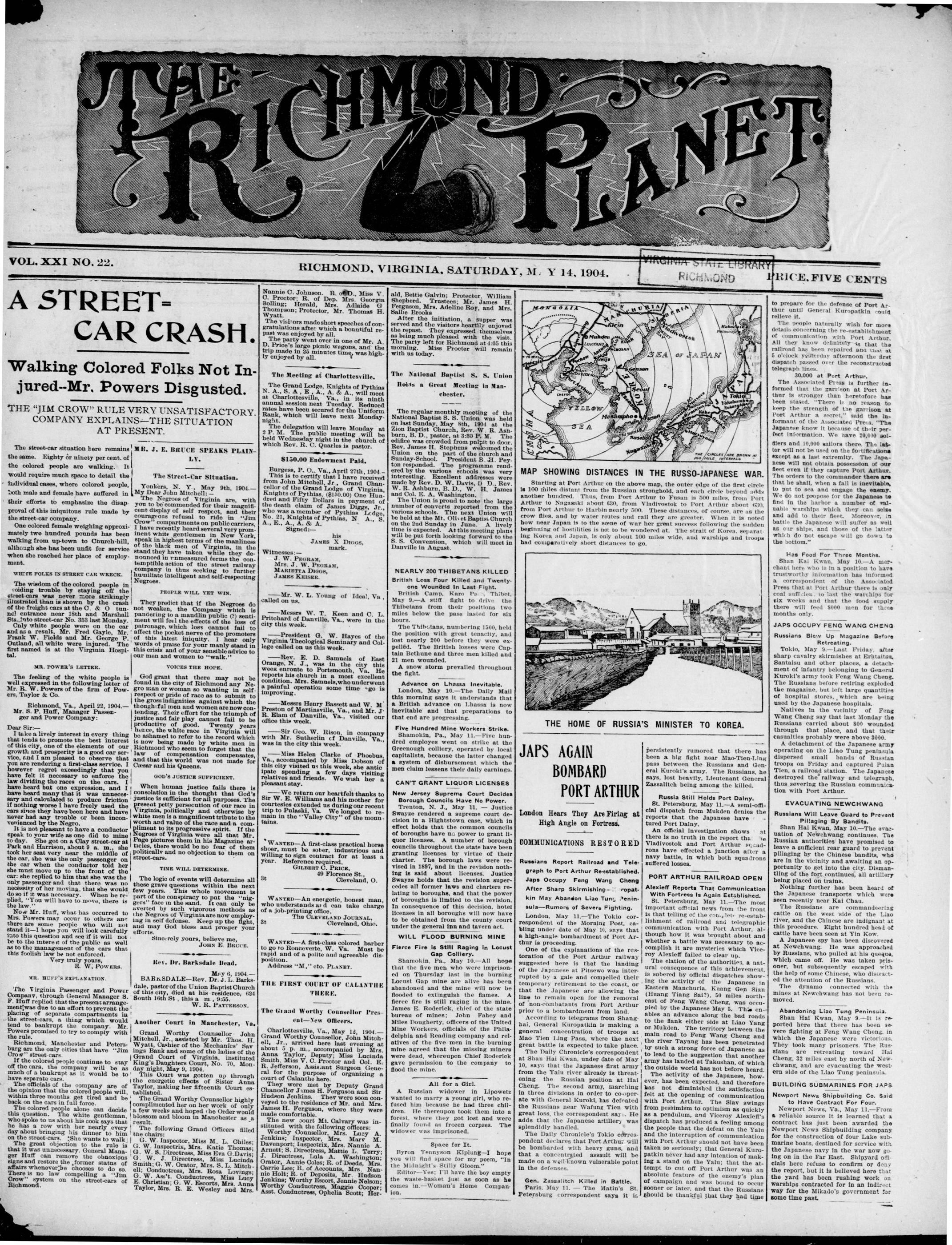
A STREET= CAR CRASH.
Walking Colored Folks Not Injured--Mr. Powers Disgusted.
THE "JIM CROW" RULE VERY UNSATISFACTORY COMPANY EXPLAINS—THE SITUATION AT PRESENT.
VOL. XXI NO. 22.
A STREET
CAR
Walking Colored
jured--Mr. Pow
THE "JIM CROW" RULE V
COMPANY EXPLAIN
AT PRI
The street-car situation here remains the same. Eighty or ninety per cent of the colored people are walking. It would require much space to detail the individual cases, where colored people, both male and female have suffered in their efforts to emphasize the disapproval of this iniquitous rule made by the street-car company.
One colored female weighing approximately two hundred pounds has been walking from up-town to Church-hill, although she has been unfit for service when she reached her place of employment.
WHITE FOLKS IN STREET CAR WRECK.
The wisdom of the colored people in coiling trouble by staying off the street cars was never more strikingly illustrated than is shown by the crash of the freight cars at the C. & O tunnel entrance near 18th and Marshall Sts,uto street-car No. 353 last Monday. Only white people were on the car as the blacks Gayle, Mr. Frank W. Fields and Mr. George Outland, all white were injured. The first named is at the Virginia Hospital.
MR. POWER'S LETTER.
The feeling of the white people is well expressed in the following letter of Mr. R. W. Powers of the firm of Powers, Taylor & Co.
Richmond, Va., April 22, 1904.
Mr. S. P. Huff, Manager Passenger and Power Company:
Dear Sir:
I take a lively interest in every thing that tends to promote the best interest of this city, one of the elements of our growth and prosperity is a good car service, and I am pleased to observe that you are rendering a first-class service. I however regret exceedingly that you have felt it necessary to enforce the law dividing the races on the cars. I have heard but one expression, and I have heard many that it was unnecessary and calculated to produce friction if nothing worse I have freely used the cars since they have been here and have never had any trouble or been inconvenienced by the Negro.
It is not pleasant to have a conductor speak to your wife as one did to mine to day. She got on a Clay street-car at Park and Harrison, about 9 a. m., she took her seat very near the middle of the car, she was the only passenger on the car when the conductor told her she must move up to the front of the car; she replied to him that she was the only passenger and that there was no necessity of her moving, that she would do so if it was necessary. When he replied, "You will have to move, there is the law." Now Mr. Huff, what has occurred to Mrs. Powers may occur to others and there are some people who will not stand it—I hope you will look carefully into this question and see if it will not be to the interest of the public as well as to the management of the cars that this foolish law be not enforced.
Very truly yours,
R. W. POWERS.
MR. HUFF'S EXPLANATION.
The Virginia Passenger and Power Company, through General Manager S. F. Huff replied that the present arrangement was due to an effort to prevent the placing of separate compartments in the street-cars, a thing which would tend to bankrupt the company. Mr. Powers promised to try to comply with the Richmond, Manchester and Petersburg are the only cities that have "Jim Crow" street cars. If the colored people continue to stay off the cars, the company will be as much of a bankrupt as it would be to have separate cars. The officials of the company are of the opinion that the colored people will within three months get tired and be back on the cars in full force. The colored people alone can decide the question. The white gentleman, who speeds us as fast as his cook says that he has a row with her nearly every day about bringing his dinner to him on the street-cars. "She wants to him
The great objection to the rule is that it was unnecessary. General Manager Huff can remove the obnoxious signs and restore the former status of affairs whenever he chooses to do so. There is no law compelling a "Jim Crow" system on the street-cars of Richmond.
MR. J. E. BRUCE SPEAKS PLAINLY.
The Street-Car Situation
Yonkers, N. Y., May 9th, 1904.—My Dear John Mitchell:—
The Negroes of Virginia are, with
you to be commended for their magnifi-
cent display of self respect, and their
courageous refusal to ride in "Jim
Crow" compartments on public carriers,
I have recently heard several very prom-
ent white gentlemen in New York,
speak the highest terms of the manliness
of the black men of Virginia, in the
stand they have taken while they de-
nounced in rmeasurement terms con-
temptible action of the street railway
company in thus seeking to further
humilate intelligent and self-respecting
Negroes.
PEOPLE WILL YET WIN
They predict that if the Negroes do not weaken, the Company which is pandering to a mandlin public (?) sentiment will feel the effects of the loss of patronage, which loss cannot fail to affect the pocket nerve of the promoters of this latest iniquity. I hear only words of praise for your manly stand in this crisis and of your sensible advice to our men and women to "walk."
VOICES THE HOPE
God grant that there may not be found in the city of Richmond any Negro man or woman so wanting in self-respect or pride of race as to submit to the gross indignities against which the thoughtful men and women are now contending. Their effort for the triumph of justice and fair play cannot fail to be productive of good. Twenty years hence, the white race in Virginia will be ashamed to refer to the record which is now being made by white men in Richmond who seem to forget that the law of compensation compensates, and that this world was not made for Caesar and his Queens.
GOD'S JUSTICE SUFFICIENT.
When human justice fails there is consolation in the thought that God's justice is sufficient for all purposes. The present petty persecution of our race in Virginia, politically and otherwise by white men is a magnificent tribute to the worth and value of the race and a common progressive spirit. If the Negroes of Virginia want that Mr. Page pictures them in his Magazine articles, there would be no fear of them politically and no objection to them on street-cars.
TIME WILL DETERMINE.
The logic of events will determine all these grave questions within the next few years. This whole movement is part of the conspiracy to put the "niggers" face in the sand. It can only be averted by such vigorous methods as the Negroes of Virginia are now employing in self defense. Keep up the fight, and may God bless and prosper your efforts.
Sincerely yours, believe me,
JOHN E. BRUCE.
Rev. Dr. Barksdale Dead.
May 6, 1904—
BARKSDALE—Rev. Dr. J. L. Barksdale, pastor of the Union Baptist Church of this city, died at his residence, 624
South 16th St, this a m, 9:55.
Another Court in Manchester, Va.
Grand Worthy Counsellor John Mitchell, Jr., assisted by Mr. Thos. H. Wyatt, Cashier of the Mechanics' Savings Bank and some of the ladies of the Grand Court of Virginia, instituted King's Daughters Court, No. 70, Monday night, May 9, 1904.
This Court was gotten up through the energetic effects of Sister Anna Taylor, making her fifteenth Court established.
The Grand Worthy Counsellor highly complimented her on her work of only a few weeks and hoped the Order would blossom and bloom in Manchester as a result.
The following Grand Officers filled the chairs:
G. W. Inspector, Miss M. L. Chiles; G. W. Inspectrix, Mrs. Katia Thomas; G. W. S. Directress, Miss Fiona G. Davies; G. W. J. Directress, Miss L. Lucinda Smith; G. W. Orator, Mrs S. L. Mitchell; Conductress, Mrs Rosa Lovings; G. W. As? Conductress, Mrs Nancy E. Christian; G. W. Escorts, Mrs Anna Taylor, Mrs R. E. Wesley, and Mrs
RICHMOND, VIRGINIA, SATURDAY, M. Y 14, 1904.
Nannie C. Johnson. R. of D., Miss V. C. Proctor; R. of Dep. Mrs. Georgia Bolling; Herald, Mrs. Adlaide G Thompson; Protector, Mr. Thomas H. Wyatt.
The visitors made short speeches of congratulations after which a bountiful repast was enjoyed by all.
The party went over in one of Mr. A. D. Price's large picnic wagons, and the trip made in 25 minutes time, was highly enjoyed by all.
ald, Bettie Galvin; Protector, William Shepherd; Trustees; Mr. James H. Ferguson, Mrs. Adeline Roy, and Mrs. Sallie Brooks
After the initiation, a supper was served and the visitors heartily enjoyed the repast. They expressed themselves as being much pleased with the visit.
The party left for Richmond at 4:05 this morning. Miss Procter will remain with us today.
The Meeting at Charlottesville
The Grand Lodge, Knights of Pythias
N. A., S. A, E., A., A & A., will meet
at Charlottesville, Va., in its ninth
annual session next Tuesday. Reduced
rates have been secured for the Uniform
school, which will leave next Monday-
night. The delegation will leave Monday at
2 P. M. The public meeting will be
held Wednesday night in the church of
which Rev. R. C. Quarles is pastor.
$150.00 Endowment Paid.
Burgess, P. O., Va., April 27th, 1904.—
This is to certify that I have received
from John Mitchell, Jr., Grand Chanc-
cellor of the Grand Lodge of Virginia,
Knights of Pythias, ($150.00) One Hundred
and Fifty Dollars in payment of
the death claim of James Diggs, Jr.,
who was a member of Pythias Lodge,
No 21, Knights of Pythias, N. A., S.
A., E., A. & A.
Signed:—
his
JAMES X DIGGS,
mark.
Witnesses:—
J. W. PEGRAM,
MRS. J. W. PEGRAM,
MARIETTA DIGGS,
JAMES KEISER.
Mr. W. L. Young of Ideal, Va.
called on us.
Messrs W. T. Keen and C. L.
Pritchard of Danville, Va., were in the
city this week.
President G. W. Hayes of the Virginia Theological Seminary and College called on us this week.
Rev. E. D. Samuels of East Orange, N. J., was in the city this week enroute to Portsmouth, Va. He reports his church in a most excellent condition. Mrs. Samuels who underwent a painful operation some time ago is improving.
Messrs Henry Bassett and W. M. Preston of Martinsville, Va., and Mr. J. R. Elam of Danville, Va., visited our office this week.
Sir Geo. W. Rison, in company with Mr. Sutherlin cf Danville, Va., was in the city this week.
Miss Helen Clarke of Phoebus, Va., accompanied by Miss Dobson of this city visited us this week, she anticipate spending a few days visiting relatives and friends. We wish her a pleasant stay.
We return our heartfelt thanks to Sir W. E. Williams and his mother for courtesies extended us during our recent trip to Pulaski, Va. We longed to remain in the "Valley City" of the mountains.
WANTED—A first-class practical horse shoer, must be sorer, industrious and willing to sign contract for at least a year. Reference required.
WANTED—An energetic, honest man, who understands and can take charge of a job-printing office.
The CLEVELAND JOURNAL,
3t
Cleveland, Ohio.
WANTED—A first-class colored barber to go to Ronceverte, W. Va. Must be rapid and of a polite and agreeable disposition.
Address "M," cto. PLANET.
THE FIRST COURT OF CALANTHE THERE.
The Grand Worthy Counsellor Present—New Offeers.
Charlottesville, Va., May 12, 1904.—Grand Worthy Counsellor, John Mitchell, Jr., arrived here last evening at about 5 p. m., accompanied by Mrs. Anna Taylor, Deputy; Miss Lucinda Smith, Miss V. C. Proctor and Col. E. R. Jefferson, Assisant Surgeon General for the purpose of organizing a court of Calanthe here.
They were met by Deputy Grand Chancellor James H. Ferguson and Sir Hudson Jenkins. They were soon conveyed to the residence of Mr. and Mrs. James H. Ferguson, where they were made comfortable.
The new court Mt. Calvary was instituted with the following officers:
succeeded with the following officers:
Worthy Counselor, Mrs. Lucy A.
Jenkins, Inspector, Mrs. Mary M.
Davenport, Inspectrix, Mrs. Nannie A.
Arnett, S. Directress, Mattie L. Terry;
J. Directress, Ida A. Washington;
Orator, Annie Coles, R. of Deeds, Mrs.
Carrie Lee; R. of Accounts, Mrs.
Nannie Holt; R. of Deposits, Mr. Hadson
Jenkins; Worthy Escort, Jennie Nelson;
Worthy Conductress, Maggie Cooper;
Asst. Conductress, Ophelia Scott; Her-
ald, Bettie Galvin; Protector, William Shepherd. Trustees; Mr. James H. Ferguson, Mrs. Adeline Roy, and Mrs. Sallie Brooks
After the initiation, a supper was saved and the visitors heartily enjoyed the they expressed themselves as being much with the visit.
The party left for Richmond at 4:05 morning. Miss Procter will remain with us today.
The regular monthly meeting of the National Baptist S. S. Union was held on last Sunday, May 8th, 1904 at the Zion Baptist Church, Rev. W. R. Ashburn, B. D., pastor, at 3:30 P. M. The edifice was crowded from pit to pit. Rev. James H. Stephens welcomed the Zion Baptist Church of the part of the church and Sunday School. President H. Peyton responded. The parish was well rewarded by the various schools was very interesting. Excellent addresses were made by Rev. D. W. Davis, D. D., Rev. W. R. Ashburn, B. D., W. H. James and Col. E. A. Washington. The Union is proud to note the large number of converts reported from the various schools. The next Union will be held at the Mt. Olive Baptist Church on Sunday in June. A lively time is expected in meeting plans will be put forth looking forward to the S. S. Convention, which will meet in Danville in August.
---
NEARLY 200 THIBETANS KILLED
British Loss Four Killed and Twenty-one Wounded In Last Fight.
British Camp, Karo Pa, Thibet, May 9.—A stiff fight to drive the Thibetans from their positions two miles below the pass lasted for six hours.
The Thibetans, numbering 1500, held the position with great tenacity, and lost nearly 200 before they were expelled. The British losses were Captain Bethune and three men killed and 21 men wounded.
A snow storm prevailed throughout the fight.
Advance on Lhassa Inevitable.
London, May 10.—The Daily Mail this morning says it understands that a British advance on Lhassa is now inevitable and that preparations to that end are progressing.
Five Hundred Mine Workers Strike.
Shamokin, Pa., May 11.—Five hundred employees went on strike at the Greenough colliery, operated by local capitalists, because the latter changed a system of disbursement which the men claim less earnings their daily earnings.
CAN'T GRANT LIQUOR LICENSES
New Jersey Supreme Court Decides Borough Councils Have No Power.
Trenton, N. J., May 11. — Justice Swayze rendered a supreme court decision in a Hightstown case, which in effect holds that the common councils of boroughs have no power to grant liquor licenses. A number of borough councils throughout the state have been granting licenses by virtue of their charter. The borough laws were revised in 1897, and in the revision nothing is said about licenses. Justice Swayze holds that the revision supercedes all former laws and charters relating to boroughs, and that the power of boroughs is limited to the revision. In consequence of this decision, hotel licenses in all boroughs will now have to be obtained from the county court under the general inn and tavern act.
WILL FLOOD BURNING MINE
Fierce Fire is Still Raging in Locust
Gap, Colliery.
Shamokin, Pa., May 10.—All hope that the five men who were imprisoned on Thursday last in the burning Locust Gap mine are alive has been abandoned and the mine will now be flooded to extinguish the flames. A fierce fire is still raging in the mine. James E. Roderick, chief of the state bureau of mines; John Fahey and Miles Dougherty, officers of the United Mine Workers, officials of the Philadelphia and Reading company and relatives of the five men in the burning mine agreed that the missing miners were dead, whereupon Chief Roderick gave permission to the company to flood the mine.
All for a Girl.
A Russian widower in Lipowetz wanted to marry a young girl, who refused him because he had three children. He thereupon took them into a forest, where they got lost and were finally found as frozen corpses. The widower was imprisoned.
Space for It.
Byron Tennyson Kiplung—I hope you will find space for my poem, "In the Midnight's Stilly Gloom."
Editor—Yes; I'll have the boy empty the waste-basket just as soon as he comes in.—Woman's Home Companion.
MONGOLIA
MANCHURIA
BARIA
Kin
Madhoshok
Muhden
LIAOTANO
CHOSAN
KONJU
Gensan
Seoul
KOREA
TOKIO
Yokohama
Yokosu
CHEFON
YELLOW
SEA
Massampho
Mysan
Tsu Shima
Sasebeho
Nagasaki
THE CIRCLES ARE DRAWN AT
100 MILE INTERVALS
MAP SHOWING DISTANCES IN THE BUSSO-JAPANESE WAR
Starting at Port Arthur on the above map, the outer edge of the first circle is 100 miles distant from the Russian stronghold, and each circle beyond adds another hundred. Thus, from Port Arthur to Fusan is 500 miles, from Port Arthur to Nagasaki about 630, from Vladivostok to Port Arthur about 630, from Port Arthur to Harbin nearly 500. These distances, of course, are as the crow flies, and by water routes and rail they are greater. When it is noted how near Japan is to the scene of war her great success following the sudden beginning of hostilities is not to be wondered at. The strait of Korea, separating Korea and Japan, is only about 100 miles wide, and warships and troops had comparatively short distances to go.
THE HOME OF RUSSIA'S MINISTER TO KOREA.
JAPS AGAIN
BOMBARD
PORT ARTHUR
London Hears They Are Firing at High Angle on Fortress.
COMMUNICATIONS RESTORED
Russians Report Railroad and Telegraph to Port Arthur Re-established. Japs Occupy Feng Wang Cheng After Sharp Skirmishing—Hropatkin May Abandon Liao Tung Peninsula—Rumors of Severe Fighting.
London, May 11.—The Tokio correspondent of the Morning Post, cabling under date of May 10, says that a high-angle bombardment of Port Arthur is proceeding.
One of the explanations of the restoration of the Port Arthur railway suggested here is that the landing of the Japanese at Pitsewo was interrupted by a gale and compelled their temporary retirement to the coast, or that the Japanese are allowing the line to remain open for the removal of non-combatants from Port Arthur prior to a bombardment from land. According to telegrams from Shanghai, General Kuropatkin is making a general concentration of troops at Mao Tien Ling Pass, where the next great battle is expected to take place.
The Daily Chronicle's correspondent at Shan Hai Kwan, under date of May 10, says that the Japanese first army from the Yalu river already is threatening the Russian position at Hai Cheng. The second army, marching in three divisions in order to cooperate with General Kuroki, has defeated the Russians near Wafung Tien with great loss, the correspondent says. He adds that the Japanese artillery was splendidly handled.
The Daily Chronicle's Tokio correspondent declares that Port Arthur will be bombarded with heavy guns, and that a concentrated assault will be made on a well-known vulnerable point in the defenses.
Gen. Zassalitch Killed in Battle.
Paris, May 11. — The Matin's St. Petersburg correspondent says it is
persistently rumored that there has been a big fight near Mao-Tien-Ling pass between the Russians and General Kuroki's army. The Russians, he says, lost heavily, Lleutenant General Zassallt being among the killed.
Russia Still Holds Port Dalny
St. Petersburg, May 11.—A semi-official dispatch from Mukden denies the reports that the Japanese have captured Port Dalny.
An official investigation shows that there is no truth in the report that the Vladivostok and Port Arthur squadrons have effected a junction after a navy battle, in which both squadrons suffered losses.
PORT ARTHUR RAILROAD OPEN
Alexieff Reports That Communication With Fortress Is Again Established.
St. Petersburg, May 11.—The most important official news from the front is that telling of the complete re-establishment of railroad and telegraphic communication with Port Arthur, although how it was brought about and whether a battle was necessary to accomplish it are mysteries which Viceroy Alexieff failed to clear up.
The elation of the authorities, a natural consequence of this achievement, is sobered by official dispatches showing the activity of the Japanese in Eastern Manchuria. Kuang Gen Sian (Huang Tiang Sai?), 50 miles northeast of Feng Wang Cheng, was occupied by the Japanese May 5. This enables an advance along the bad roads to the flank either side at Liao Yang or Mukden. The territory between the main road to Feng Wang Cheng and the river Tayang has been penetrated by such a strong force of Japanese as to lead to the suggestion that another army has landed at Takushan, of which the outside world has not before been
The activity of the Japanese, however, has been expected, and therefore has not diminished the satisfaction felt at the opening of communication with Port Arthur. The Slav swings from pessimism to optimism as quickly as a pendulum, and Viceroy Alexieff's dispatch has produced a feeling among the people that the defeat on the Yalu and the interruption of communication with Port Arthur should not have been taken so seriously; that General Kuropatkin never had any intention of making a stand on the Yalu; that the attempt to cut off Port Arthur was an absolute feature of the enemy's plan of campaign and was bound to occur sooner or later, and that the Russians should be thankful that they had time
to prepare for the defense of Port Arthur until General Kuropatkin could relieve it.
The people naturally wish for more details concerning the re-establishment of communication with Port Arthur. All they know definitely is that the railroad has been repaired and that at 5 o'clock yesterday afternoon the first dispatch passed over the reconstructed telegraph lines.
30.000 at Port Arthur.
The Associated Press is further informed that the garrison at Port Arthur is stronger than heterofore has been staked. "There is no reason to keep the strength of the garrison at Port Arthur a secret," said the informant of the Associated Press. "The Japanese know it because of their perfect information. We have 20,000 soldiers and 10,000 sailors there. The latter will not be used on the fortifications except as a last extremity. The Japanese will not obtain possession of our fleet even if they capture Port Arthur. The orders to the commander there are that he shall, when a fall is inevitable, to put to sea and engage the enemy. We do not propose for the Japanese to find in the harbor a number of valuable warships which they can seize and add to their fleet. Moreover, in battle the Japanese will suffer as well as our ships, and those of the latter which do not escape will go down to the bottom."
Has Food For Three Months
Shan Kai Kwan, May 10.—A merchant here who is in a position to have trustworthy information has informed a correspondent of the Associated Press that at Port Arthur there is only coal sufficient, to last the warships for six weeks and that the food supply there will feed $000 men for three months only.
JAPS OCCUPY FENG WANG CHENG
Russians Blew Up Magazine Before Retreating.
Tokio, May 9.—Last Friday, after sharp cavalry skirmishes at Erhtaitsa, Santalua and other places, a detachment of infantry belonging to General Kuroki's army took Feng Wang Cheng. The Russians before retiring exploded the magazine, but left large quantities of hospital stores, which are being used by the Japanese hospitals.
Natives in the vicinity of Feng Wang Cheng say that last Monday the Russians carried about 800 wounded through that place, and that their casualties probably were above 3000. A detachment of the Japanese army operating on the Liao Tung peninsula dispersed small bands of Russian troops on Friday and captured Pulan Tien, a railroad station. The Japanese destroyed the railway and telegraph, thus severing the Russian communication with Port Arthur.
EVACUATING NEWCHWANG
Russians Will Leave Guard to Prevent Pillaging By Bandits.
Shan Hai Kwan, May 10.—The evacuation of Newchwang continues. The Russian authorities have promised to leave a sufficient rear guard to prevent pillaging by the Chinese bandits, who are in the vicinity and awaiting an opportunity to get into the city. Dismantling of the fort continues, all artillery being placed on trains.
Nothing further has been heard of the Japanese transports which were seen recently near Kai Chau.
The Russians are commandeering cattle on the west side of the Liao river, and the Chinese are indignant at this procedure. Eight hundred head of cattle have been seen at Yin Kow.
A Japanese spy has been discovered at Newchwang. He was approached by Russians, who pulled at his queue, which came off. He was taken prisoner, but subsequently escaped with the help of some Chinese, who distracted the attention of the Russians.
The dynamo connected with the mines at Newchwang has not been removed.
Abandoning Liao Tung Peninsula.
Shan Hai Kwan, May 9.—It is reported here that there has been severe fighting at Feng Wang Cheng, in which the Japanese were victorious. They took many prisoners. The Russians are retreating toward Hai Cheng, 32 miles east by north of Newchwang, and are evacuating the western side of the Liao Tung peninsula.
BUILDING SUBMARINES FOR JAPS
Newport News Shipbuilding Co. Said to Have Contract For Four.
Newport News, Va., May 11.—From a reliable source it is learned that a contract has just been awarded the Newport News Shipbuilding company for the construction of four Lake submarine boats, destined for service with the Japanese navy in the war now going on in the Far East. Shipyard officials here refuse to confirm or deny the report, but it is believed here that the yard has been rushing work on warships contracted for in an indirect way for the Mikado's government for some time past.
HEY SPERNET
IDEALS.
Mom says he's good as he can be—
So gentlemenly an jolie.
An' she is awful sure that he
Would never throw a stone or fight.
She says he does as he is bid—
I think I'd like to lick that kid!
She says he never tears his cloes,
An' loves to wash his hands and face.
An' when he's through with things he goes
An' puts them back right in their place
I'm glad I'm not like him, you bet;
I'd hate to be a mommer's pet.
An' then he never makes a noise,
But plays at some nice, qulet game.
He isn't built like other boys.
I guess, but I am, all the same.
I'd think they'd put his hair in curl;
He isn't much better than a girl.
Mom talks about him all the time,
An' wishes I was more like him.
She thinks I ought to be, but I'm
Auld said the chance is sorter slim.
I think it'd just as lief
Run off an' be a play chief.
-Chicago Daily News
The Call of Arcady BY EDWIN J. WEBSTEK
WILLIAM, the tramp, was seated on a little bank by the side of the highway under the shade of a big elm. The day was warm, but not uncomfortable hot; he was eating a frugal yet satisfying lunch of bread and cheese, and nearby ran a brook from which he could quench his thirst when he had finished eating. Whenever he might tire of rural life, the railroad was only a short distance away, he could jump on a freight train and be quickly carried free of charge to the city. William, the tramp, was contented with his lot. But as his glance fell on a little cottage up the road, a vague unrest filled his heart. A young mother followed by a child clinging to her skirts had just come out of the cottage and was feeding the hens and ducks who flocked at her call. Near the house a man was plowing. He also heard the young housewife's call, and looking up from the furrow, threw her a kiss.
"Must be sort of nice, after all, to have a home, and a wife, and a baby like that fellow's got," thought William, the tramp, regretfully. "Used to think I would have one myself. But I guess I'd better give up that idea."
He brushed away the crumbs of bread and resumed his journey. At the next farmhouse he stopped and asked the woman who came to the door to give him something to eat. William was not hungry, but he might be before nightfall, so it was the part of a prudent man to try and lay in a supply of food. Even if he did not care to eat then, he could put it in his pocket.
But the woman called him a big, lazy tramp, and slammed the door in his face.
This did not worry William. He always expected a certain number of refusals during the course of a day, but like many other tramps in this big land had found that he was seldom forced
HE CONTINUED HIS WALK
to the unpleasant alternative of either working or going to sleep hungry. So whistling cheerily he continued his walk.
As he neared the curve of the road, William heard the thudding sound of horses' hoofs. To his experienced ear the galloping sounded louder yet more uneven than that common to an ordinary team of horses on a country road.
"Either that fellow is driving mighty fast or it is a runaway," he soliloquized. And he hurried around the curve in the road.
Down the highway, swaying from side to side in their mad gallop, came a team of horses, drawing a wagon which bounded up and down over the rough road, threatening each second to turn over. William's first instinct was to stand in safety at one side and let the frightened team pass. Then he noticed that a little girl was clinging in white-faced terror to the seat of the wagon.
For a moment he hesitated. To try to stop the team was to risk his life. Then the tramp gave a second glance at the frightened child, little more than a baby, on the seat of the wagon. He drew a long breath and ran in the direction of the team. Unless they were stopped before they reached the curve the wagon would be hurled into the ditch.
When a few yards distant from the runaway team William whirled around and began racing with them. As the horses caught up to him, he hurled his body forward, his hands out, he
gripped the reins firmly. He was dragged from his feet.
But now the long and varied experience of the tramp In catching fast freights stood him in good stead. As the horses plunged forward he only clung the tighter. Nearer and nearest to the curve drew the team. But even frenzied horses cannot run with 170 pounds of sturdy humanity hanging from the bits. Little by little they slowed down, until at last, with a few final, fierce tugs. William brought them to a standstill little more than a yard From the catch at the curve of the road And now that the danger was over the little girl, who had been clinging to the seat, broke into tearful sobs.
The owner of the farmhouse from which William had just been scornfully driven had seen the galloping team and was running to William's assistance His wife, who had just turned William away, was hurrying behind him. The farmer's face grew a little pale as he saw how near the ditch the team had been halted. "It's our Minnie," he said to his wife. "I never could have got there in time. She would have been killed if this brave man hadn't stopped the horses at the risk of his own life." "And I just refused him something to eat," replied the woman, with a big sob in her voice as she helped the child down from the wagon. The farmer looked hard at William. He had a deep-rooted dislike to tramps. But this one seemed different from the others.
"Can't you leave the life you're leading and come on my farm?" he inquired in tones far more cordial than William was accustomed to hearing. "I'll give you good wages, and the place will be a permanent one. It won't be long before a young man like you will have a home of his own, and perhaps a wife and child like the one you saved to-day. You're too good a man to be on the road. And you will find it grows harder and harder each year. By and by your strength will be gone, or you will miss your grip catching a freight some night, and then all that will be left for you will be the poor-house or the morgue."
William, the tramp, could feel his heart beating quicker. The vision of the little cottage with a wife and home of his own was drawing very close to him. Perhaps, after all— Then he looked down the long highway, bordered by green, arching trees in which the birds were singing. The smoke from a distant freight train floated lazily over the tree tops. At the sight a vague feeling of unrest stirred his pulse. The love of the careless, wandering, reckless life, banished for a moment, returned with renewed force. Arcady was calling her child, and the undefined call thrilled his heartstrings. William, the tramp, shook his head with a sigh.
"No, I can't do it." said he. "Somehow the love of the road is in my bones and I'm bound to go back to it, even if it does mean what you say in the end." And turning away, William, the tramp, walked rapidly in the direction of the drifting smoke. He had heard the call of Arcady and answered it. For though the end thereof was death, the path was very pleasant.-N. Y. Times.
BAD TELEPHONE MANNERS
Dignified Matron Who Has a Just Complaint to Make—Inexcusable Curtness Over the Wire.
A dignified matron who has a couple of debutantes in her family complained the other day that the "phone" was conducive to bad manners, reports the Chicago Tribune.
"I do not think I can be accused of being unprogressive," she said, "but I never shall become accustomed to telephone manners. This is what happens to me about every hour in the day:
"Phone bell rings. I, being convenient, answer. Masculine voice calls 'Hello.' Now I realize that the possessor of that voice is probably a youth of 20, and while I resent the familiar 'Hello' I respond, 'Hello,' and he begins:
"Who is this?"
"Who is this?' There is something so abrupt in this form of question that I feel like making an explanation that will not only be considered satisfactory but final, but having identified myself to the young man's satisfaction he proceeds:
"Oh, this is Mrs. B! Well, Mrs. B, I want to see Miss H. Will you tell Miss H. I want to speak to her?" "He does not apologize, sedelm says 'Thank you,' and never by accident says 'Please,' and allows me to hunt all over the house for the one he wants; sometimes grows impudent when I can't find her, and seems to ignore the rights of every one but himself."
COMPROMISED WITH RAT
Rodent in Summer Cottage Defied Attempts to Capture—A Subsidy Scheme That Worked.
A Portland man who maintains a summer cottage on the cape has during the past winter exercised a bit of diplomacy that achieved the desired result nicely, says the Kennebec Journal. During last fall a large rat made its appearance about the cottage and defied all efforts to trap or exterminate it, and the aggressive campaign was abandoned in despair. But it would not do to leave the rodent in full and free possession of the premises, as the mischief it might inflict on the furnishings during the winter would be considerable. The owner concluded to try an expedient that suggested itself to him, and, as before stated, the plan proved an emphatic success. At least once a week the cottage has been visited and a quantity of food left in the cellar. This arrangement was at once ratified by the rodent, which has abstained from depredations in consideration for the bounty upon which it has waxed sleek.
Bribery and corruption have been unearthied in the Swiss army, and officers of high rank have had to resign.
Density of Cuba's Population.
The density of relative population of Cuba is nearly the same as that of the United States.
THE RICHMOND PLANET, RICHMOND, VIRGINIA.
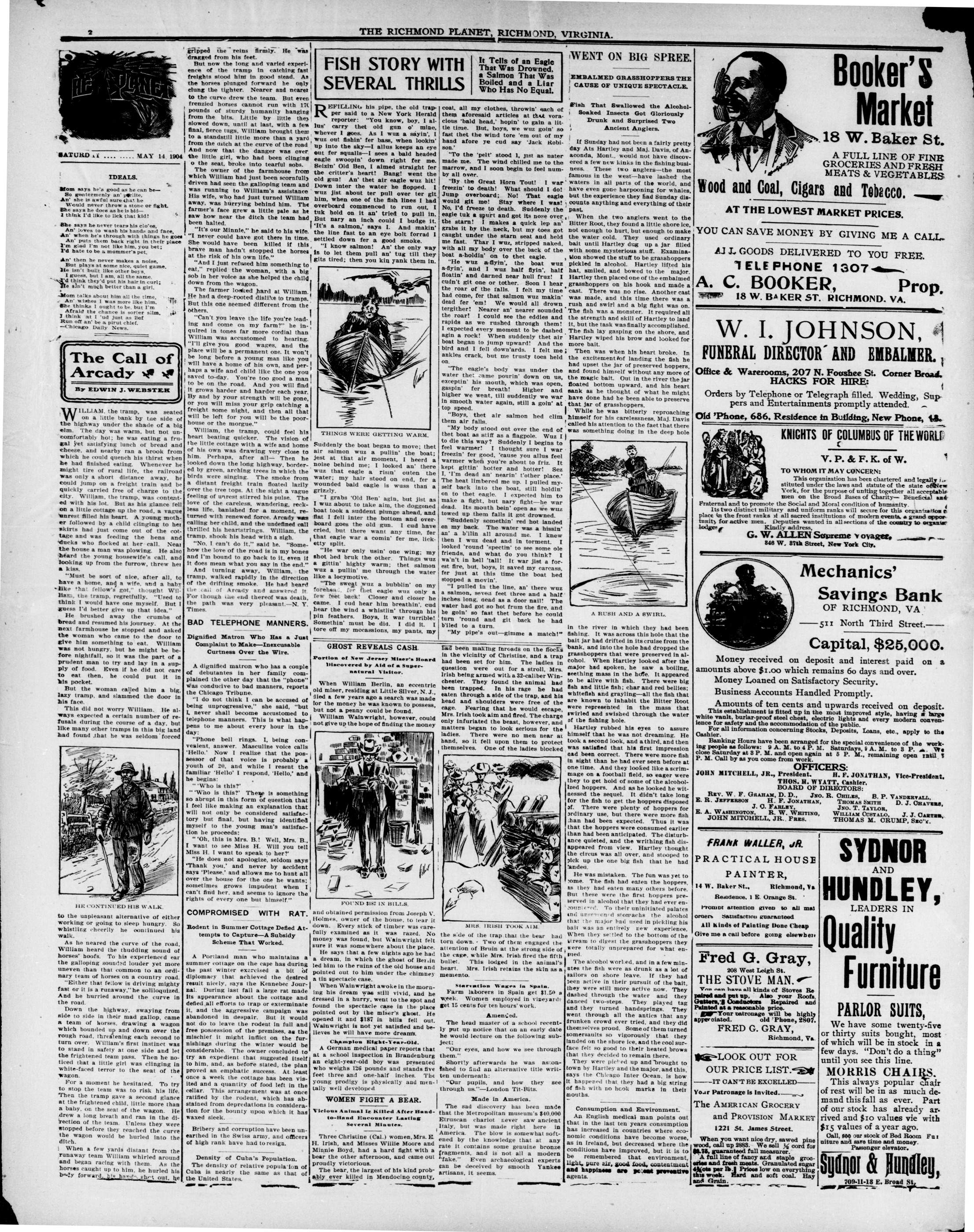
FISH STORY WITH SEVERAL THRILLS
R per said to a New York Herald reporter: "You know, boy, I alus' carry that the old gun o' mine, whever I goes. As I wuz a sayin', wuz out fishin' fer bass, when lookin' up into the sky—I allus keeps an eye out fer squalls—I sees a bald headed eagle swoopin' down right fer me. Seizin' Old Ben, I aimed straight fer the critter's heart! Bang! went the old gun! An' thet air eagle wuz hit! Down inter the water he flopped. I wuz jist about ter pull over ter git him, when one of the fish lines I had overboard commenced to run out, I tuk hold on it an' tried to pull in. But nary an inch could I budge it. 'It's a salmon,' says I. And makein' the line fast to an eye bolt forrad I settled down for a good smoke. "I know salmon! An' the only way is to let them pull an' tug till they gits tired; then you kin vann them in.
THINGS WERE GETTING WARM
Suddenly the boat began to move; that air salm wuz a pullin' the boat; jest at that air moment. I heerd a noise behind me; I looked an' there wuz that eagle a risin' outen the water; my hair stood on end, fer a wounded bald eagle is wuss than a grizzly.
"I grabs 'Old Ben' agin, but jist as I wuz about to take aim, the doggoned boat took a suddent plumge ahead, and flat I fell inter the bottom and overboard goes the old gun. I cud have cried, but there want any time, fer that eagle war a comin' for me, lickety split.
"He war only usin' one wing; my shot hed bruk the other. Things wuz a gittin' highy warm; the salmon wuz a pullin' me through the water like a locymotive.
The sweat wuz a bubblin' on my forehead, for theet eagle wuz only a few feet back! Closer and closer he came. I cud hear him breathin', cud hear the wind a whistlin' through his pin feathers. Boys, it war turrible! Somehim' must be did. I did it. I toore off my moccasins, my pants, my
GHOST REVEALS CASH
Portion of New Jersey Miser's Hoard
discovered by Aid of a Super-
natural Visitor.
When William Berlin, an eccentric
old miser, residing at Little Silver, N.J.
died a few years ago a search was made
for the money he was known to possess,
but not a penny could be found.
William Wainwright, however, could
not give up the hope of finding the money
FOUND $187 IN BILLS
and obtained permission from Joseph V. Holmes, owner of the house, to tear it down. Every stick of timber was carefully examined as it was razed. No money was found, but Wainwright felt sure it was somewhere about the place. He says that a few nights ago he had a dream, in which the ghost of Berin led him to the ruins of the old house and pointed out to him under the chimney a tn spectacle case. When Wainwright awoke in the morning his dream was still vivid, and he dressed in a hurry, went to the spot and found the spectacle case in the place pointed out by the miser's ghost. He opened it and $187 in bills fell out. Wainwright is not yet satisfied and believes he will have more dreams.
Champion Eight-Year-Old
A German medical paper reports that at a school inspection in Brandenburg an eight-year-old boy was presented who weighs 126 pounds and stands five feet three and one-half inches. The young prodigy is physically and mentally well developed
WOMEN FIGHT A BEAR.
Vicious Animal Iz Killed After Hand-to-Hand Encounter Lasting Several Minutes.
Three Christine (Cal.) women, Mrs. E H. Irish, and Misses Willie Moore and Minnie Boyd, had a hard fight with a bear the other afternoon, and came out proudly victorious.
The bear, the largest of his kind probably ever killed in Mendocino county,
ITH
LLS
It Tells of an Eagle
That Was Drowned.
a Salmon That Was
Boiled and a Liar
Who Has No Equal.
coat, all my clothes, throwin' each of
them aforesaid articles at the voracious 'bald head,' hopin' to gain a little time. But, boys, we wuz goin' so fast that the wind tore 'em out of my hand afore ye cud say 'Jack Robinson.'
"To the 'pelt' stood 1, just as nater made me. The wind chilled me to the marrow, and I soon begin to feel numb all over.
"By the Great Horn Tout! I war freezin' to death! What should I do! Jump overboard; No! That eagle would git me! Stay where I was! No, I'd freeze to death. Suddenly the eagle tuk a spurt and got its nose over the starn! I makes a quick lep an' grabs it by the neck, but my toes got caught under the starn seat and held me fast. Thar I wuz, stripped naked, with all my body over the back of the boat a-holdin' on to the tether.
"He wuz a flyin', the boat wuz a flyin', and I wuz half flyin', half floatin' and darned near hull fruz! I candn't git one or tother. Soon I hear the roar of the falls. I felt my time had come, fer that salmon wuz makin' dead fer 'em! We would all drown tergither! Nearer an' nearer sounded the roar! I could see the eddies and rapids as we rushed through them! I expected every moment to be dashed agin a rock! When suddenly the air boat began to jump upward! And the bird and I fell downards. I felt me ankles crack, but me trusty toes held on.
"The eagle's body was under the water that came pourin' down on us, exceptin' his mouth, which was open, gaspin' for breath! Higher and higher we went, till suddenly we war in smooth water again, still a goin' at top speed.
"Boys, thet air salmon hed clim them air falls.
"My body stood out over the end of the boat as stiff as a flagpole. Wuz I to die this way? Suddenly I begins to feel warmer! I thought sure I war freezin' fer good, 'cause you allus feel warmer when you're about to friz. It kept gittin' hotter and hotter! Sez I. 'I'm dead an' nearin' 'tother place.' The heat limbered me up. I pulled myself back into the boat, still holdin' on to the eagle. I expected him to make a fight, but nary fight—he war dead. Its mouth bain' open as we wuz towed up them falls it got drowned. "Suddenly somethin' red hot landed on my back. The water was a hissin' an' a b'ilin all around me. I knew then I wuz dead and in torment. I looked 'round 'spectin' to see some ole friends, and what do you think? I wasn't in hell 'tall!' It war jist a forest fire, but, boys, it saved my carcass, fer just at this time the boat hed stopped a movin'.
"I pulled in the line, an' there wuz a salmon, seven feet three and a half inches long, dead as a door nail! The water had got so hot from the fire, and he gain' so fast that before he could turn 'round and git back he had billed to a turn.
"My pipe's out—gimme a match!"
had been making throads on the flocks in the vicinity of Christine, and a trap had been set for him. The ladies in question were out for a stroll, Mrs. Irish being armed with a 32-caliber Winchester. They found the animal had been trapped. In his rage he had eaten through a side of the trap, and his head and shoulders were free of the cage. Fearing that he would escape, Mrs. Irish took alm and fired. The charge only infuriated the beast, however, and matters began to look serious for the ladies. There were no men near at hand, so it fell upon them to protect themselves. One of the ladies blocked
Y
MRS. IRISH TOOK AIM.
the side of the trap that the bear had torn down. Two of them engaged the attention of Bruin at the strong side of the cage, while Mrs. Irish fired the fifth bullet. This lodged in the animal's heart. Mrs. Irish retains the skin as a memento.
Starvation Wages in Spain.
Farm laborers in Spain get $1.50 a week. Women employed in vineyards get 15 cents for ten hours' work.
Amenced.
The head master of a school recently put up notice that on an early date he would lecture on the following subject:
"Our eyes, and how we see through them."
Shortly afterwards he was ascribed to find an alternative title written underneath:
"Our pupils, and how they see through us"—London Tit-Bits.
Made in America.
The sad discovery has been made that the Metropolitan museum's $40,000 Etruscan chariot never saw ancient Italy, but was made right here in America. The blow is somewhat softened by the knowledge that at any rate it contains some genuine bronze fragments, and is not all a modern "fake." Even archaeological experts can be deceived by smooth Yankee artisans, it seems.
WENT ON BIG SPREE
EMBALMED GRASSHOPPERS THE CAUSE OF UNIQUE SPECTACLE.
Fish That Swallowed the Alcohol-
Soaked Insects Got Gloriously
Drunk and Surprised Two
Ancient Anglers.
If Sunday had not been a fairly pretty day Ats Hartley and Maj. Davis, of Anaconda, Mont., would not have discovered a few new kinks in the fishing business. These two anglers—the most famous in the west—have lashed the waters in all parts of the world, and have even gone harpooning for whales, but the experience they had Sunday discounts anything and everything of their past.
When the two anglers went to the Bitter Root, they found a little shore ice, not enough to hurt, but enough to make the water cold. They used ordinary bait until Hartley dug up a jar filled with some mysterious stuff. Examination showed the stuff to be grasshoppers pickled in alcohol. Hartley lifted his hat, smiled, and bowed to the major. Hartley then placed one of the embalmed grasshoppers on his hook and made a cast. There was no rise. Another cast was made, and this time there was a rush and swirl and a big fight was on. The fish was a monster. It required all the strength and skill of Hartley to land it, but the task was finally accomplished. The fish lay gasping on the shore, and Hartley wiped his brow and looked for more bait.
Then was when his heart broke. In the excitement of landing the fish he had upset the jar of preserved hoppers, and found himself without any more of the magic bait. Out in the river the jar floated bottom upward, and his heart sank as he thought of what he might have done had he been able to preserve that jar of grasshoppers.
While he was bitterly reproaching himself for his carelessness, Maj. Davis called his attention to the fact that there was something doing in the deep hole
FISHERMANS
A RUSH AND A SWIRL.
in the river in which they had been fishing. It was across this hole that the bait jar had drifted in its cruise from the bank, and into the hole had dropped the grasshoppers that were preserved in alcohol. When Hartley looked after the major had spoken, he saw a boiling, seething mass in the hose. It appeared to be alive with fish. There were big fish and little fish; char and red bellies; whitefish and grayling—all the fish that are known to inhabit the Bitter Root were represented in the mass that swirled and swished through the water of the fishing hole.
Hartley rubbed his eyes to assure himself that he was not dreaming. He took a second look, and a third, and then was satisfied that his first impression had been correct. There were more fish in sight than he had ever seen before at one time. And they looked like a scrimmage on a football field, so eager were they to get hold of some of the alcoholized hoppers. And as he looked he witnessed the sequel. It didn't take long for the fish to get the hoppers disposed of. There were plenty of hoppers for ordinary use, but there were more fish than had been expected. Thus it was that the hoppers were consumed earlier than had been anticipated. The disturbance quieted, and the writhing fish disappeared from view. Hartley thought the circus was all over, and stooped to pick up the one big fish that he had handed.
He was mistaken. The fun was yet to some. The fish had eaten the hoppers, as they had eaten many others before. But these were the first hoppers preserved in alcohol that they had ever encountered. To their uninitiated palates and unseemed stomachs the alcohol that the major had used in pickling his bait was an entirely new experience. When they settled to the bottom of the stream to digest the grasshoppers they were totally unprepared for what enquired.
The alcohol worked, and in a few minutes the fish were as drunk as a lot of sailors on shore leave. If they had been active in their pursuit of the bait, they were still more active now. They dashed through the water and they danced two-steps. They played tag and they turned handsprings. They went through all the antics that any franken crowd ever tried, and they did themselves proud. Some of them turned somersaults so vigorously that they landed on the shore ice, and the cool surface felt so good to their heated brows that they decided to remain there. They were pieced up and brought to town by Hartley and the major, and this, says the Chicago Inter Ocean, is how it happened that they had a big string of fish with no hook marks in their mouths.
Consumption and Environment. An English medical man points out that in the last ten years consumption has increased in countries where economic conditions have become worse, as in Ireland, but decreased where the conditions have improved, but it is to be remembered that environment, light, pure air, good food, contentment and happiness are potent preventive agents.
J. H. B.
Booker'S Market
18 W. Baker St. A FULL LINE OF FINE GROCERIES AND FRESH MEATS & VEGETABLES
Wood and Coal, Cigars
AT THE LOWEST M
YOU CAN SAVE MONEY I
AJ J. GOODS DELIVER
TELEPHONE
A. C. BOOKER
18 W. BAKER ST.
W. I. JO
FUNERAL DIRECTOR
Office & Warerooms, 207 N.
HACKS F
Orders by Telephone or Tele-
pers and Entertainmen
Old 'Phone, 686. Residence
Cigars and Tobacco.
LOWEST MARKET PRICES.
MONEY BY GIVING ME A CALL.
DELIVERED TO YOU FREE.
PHONE 1307
OKER, Prop.
OKER ST. RICHMOND. VA.
JOHNSON,
RECTOR AND EMBALMER.
Ins, 207 N. Foushee St. Corner Broad.
BACKS FOR HIRE:
One or Telegraph filled. Wedding, Sup-
tertainments promptly attended.
Residence in Building, New Phone, 18.
KNIGHTS OF COLUMBUS OF THE WORLD
AT THE LOWEST MARKET PRICES. YOU CAN SAVE MONEY BY GIVING ME A CALL.
W. I. JOHNSON. FUNERAL DIRECTOR AND EMBALMER.
Office & Warerooms, 207 N. Foushee St. Corner Broad. HACKS FOR HIRE:
Orders by Telephone or Telegraph filled. Wedding, Suppers and Entertainments promptly attended.
Old 'Phone, 686. Residence in Building, New Phone, 18.
KNIGHTS OF COLUMBUS OF THE WORLD
V. P. & F. K. of W.
TO WHOM IT MAY CONCERN:
This organization has been chartered and legally situated under the laws and statute of the state of New York, for the purpose of uniting together all acceptable men on the Broad Bases of Charity.
KNIGHTS OF COLUMBUS OF THE WORLD
V. P. & F. K. of W.
TO WHOM IT MAY CONCERN:
This organization has been chartered and legally instituted under the laws and statute of the state of New York, for the purpose of uniting together all acceptable men on the Broad Bases of Charity—Beneficial and the Social and Moral condition of humanity.ry and uniform ranks will secure for this organization all sacred institutions of modern events, a grand oppo-puties wanted in all sections of the country to organi-ly address,
ALLEN Supreme voyager,
W. 87th Street, New York City.
Mechanics'
This organization has been chartered and legally situated under the laws and statute of the state of New York, for the purpose of uniting together all acceptable men on the Broad Bases of Charity—Beneficial and
Fraternal and to promote the Social and
Its two distinct military and uniform
place in the front ranks of all sacred ins
unity for active men. Deputies wante
lodges
Kindly address,
G. W. ALLEN S
846 W. 87th Street
Its two distinct military and uniform ranks will secure for this organization a place in the front ranks of all sacred institutions of modern events, a grand opportunity for active men. Deputies wanted in all sections of the country to organize lodges.
G. W. ALLEN Supreme voyages.
846 W. 87th Street, New York City.
Mechanics'
Savings Bank
OF RICHMOND, VA
— 511 North Third Street.—
Capital, $25,000.
Savings Bank
OF RICHMOND, VA
-511 North Third Street.
Capital, $25,000.
Money received on deposit amounts above $1.00 which re-
Money Loaned on Satisfaction
Business Accounts Handl
Amounts of ten cents and
This establishment is fitted up in the white vanit, burlar-proof chest steel, ele-
lence for safety and the accommodation
For all information concerning Stock Cashier.
Banking Hours have been arranged in people as follows: 9 A. M. to 4 P. M. close Saturday at 8 P. M. and open again P. M. Call by as you come from work.
OFFICE
JOHN MITCHELL, JR., President.
THOS. H. WY
BOARD OF F
REV. W. F. GRAHAM, D. D., JNK
E. R. JEFFERSON H. F. JONATHAN,
J. O. FARLEY
paid on deposit and interest paid on an
so which remains 60 days and over.
on Satisfactory Security.
ents Handled Promptly.
cents and upwards received on deposit.
itted up in the most improved style, having a large
steel chest, electric lights and every modern conven-
commodation of the public.
accurring Stocks, Deposits, Loans, etc., apply to the
seen arranged for the special convenience of the work.
M. to 4 P. M. Saturday, 9 A. M. to 8 P. We
and open again at 5 P. M., remaining open until % from work.
Money received on deposit and interest paid on amounts above $1.00 which remains 60 days and over.
Money Loaned on Satisfactory Security.
Business Accounts Handled Promptly.
Amounts of ten cents and upwards received on deposit.
This establishment is fitted up in the most improved style, having a large white vault, burlar-proof steel chest, electric light and every modern convenience for safety and the accommodation of the public.
For all information concerning Stocks. Deposits. Loans. etc. apply to the
For all information concerning Stocks, Deposits, Loans, etc., apply to the Cashier.
Banking Hours have been arranged for the special convenience of the working people as follows: 9 A. M. to 4 P. M. Saturdays, 9 A. M. to 8 P. M. We close Saturday at 8 P. M. and open again at 5 P. M., remaining open until 9 P. M. Call by as you come from work.
OFFICERS:
President. H. F. JONATHAN, Vice-President,
THOS. H. WYATT, Cashier.
BOARD OF DIRECTORS:
D. D., JNO. R. CHILES, B. P. VANDERVALL,
F. JONATHAN, THOMAS SMITH D. J. CHAVERS,
BLEY, JNO. T. TAYLOR.
JOHN MITCHELL, JR., President. H. F. JONATHAN, Vice-President. THOS. H. WYATT, Cashier. KENNEDY H. WYATT, Cashier.
E. A. WASHINGTON, R. W. WHITING,
JOHN MITOHELL, JR. PRES.
WILLIAM CUSTALO, J. J. CARTER,
THOMAS M. ORUMP, SEDY.
SYDNOR
AND
HUNDLEY,
LEADERS IN
Quality
Furniture
FRANK WALLER, JR.
14 W. Baker St.. Richmond, Va
Residence, 1 E. Orange St.
Prompt attention given to all mat
orders. Satisfaction guaranteed
Fred G. Gray,
208 West Leigh St.
THE STOVE MAN.
You can have all kinds of Stoves Repaired and put up. Also your Roofs, Gutters, p Coatings, Repaired and Painted at a reasonable price.
Your patronage will be highly appreciated.
old 'Phone, 2807.
FRED G. GRAY,
Richmond, Va.
PARLOR SUITS.
We have some twenty-five or thirty suits bought, most of which will be in stock in a few days. "Don't do a thing" until you see this line.
LOOK OUT FOR
OUR PRICE LIST.
IT CAN'T BE EXCELLED
Your Patronage is Invited.
The AMERICAN GROCERY
This always popular chair
of rest will be in as much demand this fall as ever. Part
of our stock has already arrived and $10 values vie with
$15 values of a year ago.
Call, 800 our stock of Bed Room Fur
niture and save time and money.
Passenger elevator
and PROVISION MARKET
1221 St. James Street.
When you want nice dry, sawed pine
wood, call up 2883. We sell $2 cord for
$7.75, guaranteed full measurer.
A full line of fancy and staple groo-
ries and fresh meats. Granulated sugar
46 shots per lb. Prices low on everything
this week. Hard and soft coal. Hay
and Grain.
Sydnor & Hundley,
709-11-18 E. Broad St.
---
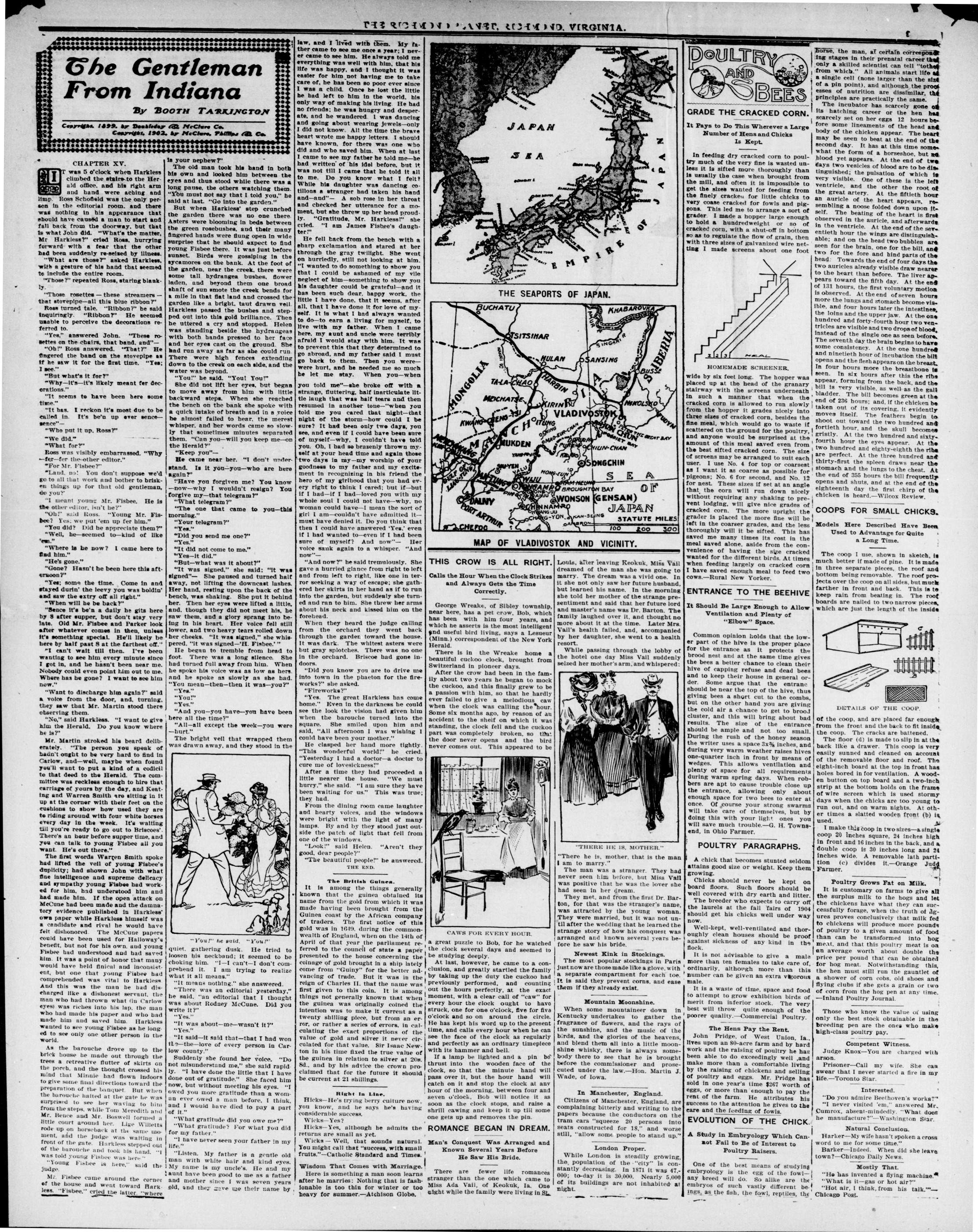
The Gentleman From Indiana
By BOOTH TARKINGTON
Copyright, 1899, by Beakley (B. McClure Co.
Copyright, 1902, by McClure, Phillips (B. Co.
"Want to discharge him again?" said a voice from the door, and, turning, they saw that Mr. Martin stood there observing them.
"No," said Harkless. "I want to give him the Herald. Do you know where he is?"
Mr. Martin stroked his beard deliberately. "The person you speak of hadn't ought to be very hard to find in Carlow, and—well, maybe when found you'll want to put a kind of a codiciat to that deed to the Herald. The committee was reckless enough to hire that carriage of yours by the day, and Keating and Warren Smith are sitting in it up at the corner with their feet on the cushions to show how used they are to riding around with four white horses every day in the week. It's waiting till you're ready to go out to Briscoes. There's an hour before supper time, and you can talk to young Fisbee all you want. He's out there."
The first words Warren Smith spoke had lifted the veil of young Fisbee's duplicity; had shown John with what fine intelligence and supreme delicacy and sympathy young Fisbee had worked for him, had understood him and had made him. If the open attack on McCune had been made and the damnatory evidence published in Harkless' own paper while Harkless himself was a candidate and rival he would have felt dishonored. The McCune papers could have been used for Halloway's benefit, not for his own, and young Fisbee had understood and had saved him. It was a point of honor that many would have held clinical and inconsistent, but one that young Fisbee had comprehended was vital to Harkless. And this was the man he had discharged like a dishonest servant, the man who had thrown what (in Carlow eyes) was riches into his lap, the man who had made his paper and who had made him and saved him. Harkless wanted to see young Fisbee as he longed to see only one other person in the world.
I
"What are those?" asked Harkless, with a gesture of his hand that seemed to include the entire room.
"Those?" repeated Ross, staring blankly.
"Those rosettes — these streamers — that stovepipe—all this blue ribbon?"
that steppete-all this blue ribbon?" Ross told tale. "Ribbon?" he said inquiringly. "Ribbon?" He seemed unable to perceive the decorations referred to. "Yes," answered John. "These rosettes on the chairs, that band, and—"
"But what's it for?"
"Why—it's—it's likely meant fer decorations."
"It seems to have been here some time."
"It has. I reckon it's most due to be called in. It's be'n up ever sence—sence"
"Who put it up. Ross?"
"We did."
"What for?"
Ross was visibly embarrassed. "Why—fer—fer the other editor."
"For Mr. Fisbee?"
"Land, no! You don't suppose we'd go to all that work and bother to brisken things up for that old gentleman, do you?"
"I meant young Mr. Fisbee. He is the other editor, isn't he?"
"Oh!" said Ross. "Young Mr. Fisbee? Yes, we put 'em up for him."
"You did? Did he appreciate them?"
"Well, he—seemed to—kind of like 'em."
"Where is he now? I came here to find him."
"He's gone."
"Gone? Hasn't he been here this afternoon?"
"Yes; some the time. Come in and stayed durin' the levy you was holdin' and saw the entry off all right."
"When will he be back?"
"Sence it's be'n a daily he gits here by 8 after supper, but don't stay very late. Old Mr. Fisbee and Parker look after whatever comes in then, unless it's something special. He'll likely be here by half past 8 at the farthest off." "I can't wait till then. I've been wanting to see him every minute since I got in, and he hasn't been near me. Nobody could even point him out to me. Where has he gone? I want to see him now."
As the barouche drove up to the brick house he made out through the trees a retreative flutter of skirts on the porch, and the thought crossed his mind that Minnie had flown indoors to give some final directions toward the preparation of the banquet. But when the barouche halted at the gate he was surprised to see her waving to him from the steps, while Tom Meredith and Mr. Bence and Mr. Boswell formed a little court around her. Lige Willetts rode up on horseback at the same moment, and the judge was waiting in front of the gate. Harkless stepped out of the barouche and took his hand. "I was told young Fisbee was here."
"Young Fisbee is here," said the judge.
Mr. Fisbee came around the corner of the house and went toward Harkless. "Fisbee," cried the word, "where
Is your nephew?
The old man took his hand in both his own and looked him between the eyes and thus stood while there was a long pause, the others watching them.
"You must not say that I told you," he said at last. "Go into the garden."
But when Harkless' step crunched the garden there was no one there. Asters were blooming in beds between the green rosebushes, and their many fingered hands were fungal open in wide surprise that he should expect to find young Fishee there. It was just before sunset. Birds were gossiping in the sycamores on the bank. At the foot of the garden, near the creek, there were some tall hydrangea bushes, flower laden, and beyond them one broad shaft of sun smote the creek bends for a mile in that flat land and crossed the garden like a bright, taut drawn veil. Harkless passed the bushes and stepped out into this gold brilliance. Then he uttered a cry and stopped. Helen was standing beside the hydrangeas with both hands pressed to her face and her eyes cast on the ground. She had run away as far as she could run. There were high fences extending down to the creek on each side, and the water was beyond.
She did not lift her eyes, but began to move away from him with little backward steps. When she reached the bench on the bank she spoke with a quick intake of breath and in a voice he almost failed to hear, the merest whisper, and her words came so slowly that sometimes minutes separated them. "Can you—will you keep me—on the Herald?"
"Keep you"—
He came near her. "I don't understand. Is it you—you—who are here again?"
"Have you forgiven me? You know now—why I wouldn't resign? You forgive my—that telegram?"
"What telegram?"
"The one that came to you—this morning."
"Your telegram?"
"Yes."
"Did you send me one?"
"Yes."
"It did not come to me."
"But—what was it about?"
"It was signed," she said; "it was signed"— She paused and turned half away, not lifting the downcast lashes. Her hand, resting upon the back of the bench, was shaking. She put it behind her. Then her eyes were lifted a little, and, though they did not meet his, he saw them, and a glory spring into being in his heart. Her voice fell still lower, and two heavy tears rolled down her cheeks. "It was signed," she whispered. "it was signed—H. Fisbee." He began to tremble from head to foot. There was a long silence. She had turned full away from him. When he spoke his voice was as low as hers, and he spoke as slowly as she had. "You mean—then—then it was—you?" "Yea."
"And you—you have—you have been here all the time?" "All—all except the week—you were—hurt." The bright vell that wrapped them was drawn away, and they stood in the
A man in a suit and hat is running away from a woman in a long dress, who is holding her hands up in fear. They are surrounded by a large flower bed with blooming flowers.
"You!" he said, "You!"
quiet, gathering dusk. He tried to loosen his neckband; it seemed to be choking him. "I—I can't—I don't comprehend it. I am trying to realize what it all means."
"It it means nothing." she answered.
"There was an editorial yesterday," he said, "an editorial that I thought was about Rodney McCune. Did you write it?"
"Yes."
"It was about—me—wasn't it?"
"Yes."
"It said—it said that—that I had won it—the love of every person in Carlow county."
Suddenly she found her voice. "Do not misunderstand me," she said rapidly. "I have done the little that I have done out of gratitude." She faced him now, but without meeting his eyes. "I owed you more gratitude than a woman ever owed a man before, I think, and I would have died to pay a part of it."
"What gratitude did you owe me?" "What gratitude? For what you did for my father."
"I have never seen your father in my life."
"Listen. My father is a gentle old man with white hair and kind eyes. My name is my uncle's. He and my aunt have been good to me as a father and mother since I was seven years old, and they gave me their name by
THE RICHMOND AVENUE, RICHMOND, VIRGINIA.
law, and I lived with them. My father came to see me once a year; I never came to see him. He always told me everything was well with him, that his life was happy, and I thought it was easier for him not having me to take care of, he has been so poor ever since I was a child. Once he lost the little he had left to him in the world, his only way of making his living. He had no friends; he was hungry and desperate, and he wandered. I was dancing and going about wearing jewels—only I did not know. All the time the brave heart wrote me happy letters. I should have known, for there was one who did and who saved him. When at last I came to see my father he told me—he had written" of his idol before, but it was not till I came that he told it all to me. Do you know what I felt? While his daughter was dancing coillons a stranger had taken his hand and—and"— A sob rose in her throat and checked her utterance for a moment, but she threw up her head proudly. "Grattitude, Mr. Harkless" she cried. "I am James Fisbee's daughter."
He fell back from the bench with a sharp exclamation and stared at her through the gray twilight. She went on hurriedly, still not looking at him. "I wanted to do something to show you that I could be ashamed of my vile neglect of him—something to show you his daughter could be grateful—and it has been such dear, happy work, the little I have done, that it seems, after all, that I have done it for love of myself. It is what I had always wanted to do—to earn a living for myself, to live with my father. When I came here, my aunt and uncle were terribly afraid I would stay with him. It was to prevent this that they determined to go abroad, and my father said I must go back to them. Then you were—were hurt, and he needed me so much he let me stay. When you—when
you told me"—she broke off with a strange, futtering, half inarticulate little laugh that was half tears and then resumed in another tone—"when you told me you cared that night—that night of the storm—how could I be sure? It had been only two days, you see, and even if I could have been sure of myself—why, I couldn't have told you. Oh, I had so brazenly thrown myself at your head time and again those two days in my—my worship of your goodness to my father and my excitement in recognizing in his friend the hero of my girlhood that you had every right to think I cared; but if—but if I had—if I had—loved you with my whole soul I could not have—why, no woman could have—I mean the sort of girl I am—couldn't have admitted it—must have denied it. Do you think that then I could have answered 'Yes,' even if I had wanted to—even if I had been sure of myself? And now"—Her voice sank again to a whisper. "And now"—
"And now?" he said tremulously. She gave a hurried glance from right to left and from left to right, like one in terror seeking a way of escape; she gathered her skirts in her hand as if to run into the garden, but suddenly she turned and ran to him. She shewed her arms about his neck and kissed him on the forehead.
When they heard the judge calling from the orchard they went back through the garden toward the house. It was dark. The whistest asters were but gray slotoches. There was no one in the orchard. Briscoe had gone indoors.
"Did you know you are to drive me into town in the phaeton for the fireworks?" she asked.
"Yes. The great Harkless has come home." Even in the darkness he could see the look the vision had given him when the barouche turned into the square. She smiled upon him and said, "All afternoon I was wishing I could have been your mother."
He clasped her hand more tightly. "This wonderful world!" he cried. "Yesterday I had a doctor—a doctor to cure me of lovesickness!"
After a time they had proceeded a little nearer the house. "We must hurry," she said. "I am sure they have been waiting for us." This was true; they had.
From the dining room came laughter and hearty voices, and the windows were bright with the light of many lamps. By and by they stood just outside the patch of light that fell from one of the windows.
"Look!" said Helen. "Aren't they good, dear people?"
"The beautiful people!" he answered.
THE END.
The British Guinea.
It is among the things generally known that the guinea obtained its name from the gold from which it was made having been brought from the Guinea coast by the African company of traders. The first notice of this gold was in 1649, during the commonwealth of England, when on the 14th of April of that year the parliament referred to the council of state a paper presented to the house concerning the coinage of gold brought in a ship lately come from "Guiny" for the better advancing of trade. But it was in the reign of Charles II. that the name was first given to this coin. It is among things not generally known that when the guinea was originally coined the intention was to make it current as a twenty shilling piece, but from an error, or rather a series of errors, in calculating the exact proportions of the value of gold and silver it never circulated for that value. Sir Isaac Newton in his time fixed the true value of the guinea in relation to silver at 20s. 8d., and by his advice the crown proclaimed that for the future it should be current at 21 shillings.
Right In Line.
Hicks—He's trying berry culture now, you know, and he says he's having considerable success.
Wicks—Yes?
Hicks—Yes, although he admits the returns are small as yet.
Wicks—Well, that sounds natural. You might call that "success, with small fruits."—Catholic Standard and Times.
Wisdom That Comes with Marriage. Here is something a man soon learns after he marries: Nothing that is fashionable is too thin for winter or too heavy for summer—Atchison Globe.
JAPAN
SEA
EMPIRE OF JAPAN
THE SEAPORTS OF JAPAN.
BUCHATU
TSITSIMAR
MONGOLLA
TA-LA-CHAO
MEICHATSE
KIN
KWANG CHENG TSI
MUNCH
MUNKDEN
KIN
KWANG
DALNY
PORT ARTHUR
CHEPOO
MAP OF VLADIVOS
BUCHATU
KSITSINAR
MULAN
SANSING
MONGOLIA
TALA-CHAO
HARBIN
MEICHATSE
KIRIN
VLADIVOSTOK
KWANG-GENS-YI
TULONG
OMAD-EUR-CHAN
PURING
CHIUN-CHAN
MUKDEN
YAMAN
SONGCHIN
MONG-TUN
WLIU
WONGAMRO
BROUGHTON BAY
PHYLOR
WONSON (GENSAN)
CHINAMRO
CHINAMRO
CHWANG-JU
CHANG-YON
KAN-SING
OAMBRO
SEA
OF
JAPAN
STATUTE MILES
100 200 300
MAP OF VLADIVOSTOK AND VICINITY.
THIS CROW IS ALL RIGHT.
Calls the Hour When the Clock Strikes and Always Gets the Time Correctly.
George Wreake, of Sibley township, near here, has a pet crow, Bob, which has been with him four years, and which he asserts is the most intelligent and useful bird living, says a Lesueur (Minn.) correspondent of the New York Herald.
There is in the Wreake home a beautiful cuckoo clock, brought from Switzerland in pioneer days.
After the crow had been in the family about two years he began to mock the cuckoo, and this finally grew to be a passion with him, so that he hardly ever failed to give a melodious caw when the clock was calling the hour. Some six months ago, by reason of an accident to the shelf on which it was standing, the clock fell and the cuckoo part was completely broken, so that the door never opens and the bird never comes out. This appeared to be
Walt
CAWS FOR EVERY HOUR.
a great puzzle to Bob, for he watched the clock several days and seemed to be studying deeply.
At last, however, he came to a conclusion, and greatly startled the family by taking up the duty the cuckoo had previously performed, and counting out the hours perfectly, at the exact moment, with a clear call of "caw" for every hour the clock ought to have struck, one for one o'clock, five for five o'clock and so on around the circle.
He has kept his word up to the present time, and calls every hour when he can see the face of the clock as regularly and perfectly as an ordinary timepiece with its hammer and bell.
If a lamp be lighted and a pin be thrust into the wooden face of the clock, so that the minute hand will pass over it, but the hour hand will catch on it and stop the clock at any hour of the morning, between four and seven o'clock. Bob will notice it as soon as the clock stops, and raise a shrill cawing and keep it up till some one gets up and removes the pin.
ROMANCE BEGAN IN DREAM.
Man's Conquest Was Arranged and Known Several Years Before He Saw His Bride.
There are fewer life romances stranger than the one which came to Miss Ada Vail, of Keokuk, Ia. One night while the family were living in St.
KHABAROVKA
SINGARIR
IBERIA
AN OSANSING
BUSSE
BIN
R
NKOLSKO
FUYIN
VLADIVOSTOK
CHUN
THE GREAT BAY
CHUN-CHAN
PURUNG CHUN-CHAN
OSONGCHIN
SEA
OF
WONSON (GENSAN)
JAPAN
STATUTE MILES
100 200 300
TOK AND VICINITY.
Louis, after leaving Keokuk, Miss Vail dreamed of the man she was going to marry. The dream was a vivid one. In it she not only saw her future husband, but learned his name. In the morning she told her mother of the strange presentiment and said that her future lord and master's name was Dr. Barton. The family laughed over it, and thought no more about it at the time. Later Mrs. Vail's health failed, and, accompanied by her daughter, she went to a health resort.
While passing through the lobby of the hotel one day Miss Vail suddenly seized her mother's arm, and whispered:
A
"THERE HE IS, MOTHER."
"There he is, mother, that is the man I am to marry."
The man was a stranger. They had never seen him before, but Miss Vall was positive that he was the lover she had seen in her dream.
They met, and from the first Dr. Barton, for that was the stranger's name, was attracted by the young woman.
They were married, but it was not until after the wedding that he learned the strange story of how his conquest was arranged and known several years before he saw his bride.
Newest Kink in Stockings
The most popular stockings in Paris just now are those made like a glove, with a separate compartment for each toe. It is said they prevent corns, and ease them if they already exist.
Mountain Moonshine
When some mountaineer down in Kentucky undertakes to gather the fragrance of flowers, and the rays of the sunshine, and the music of the birds, and the glories of the heavens, and blend them all into a little moonshine whisky, there is always somebody there to see that he is brought before the commissioner and prosecuted under the law.-Hon. Martin J. Wade, of Iowa.
In Manchester, England
Citizens of Manchester, England, are complaining bitterly and writing to the papers because the conductors on the tram cars "squeeze 20 persons into seats constructed for 18," and worse still, "allow some people to stand up."
While London is steadily growing, the population of the "city" is constantly decreasing. In 1871 it was 47,000; to-day it is 30,000. Nearly 5,000 of its buildings are not inhabited at night.
London Proper
POULTRY AND BEES
It Pays to Do This Wherever a Large Number of Hens and Chicks Is Kept.
In feeding dry cracked corn to poultry much of the very fine is wasted unless it is sifted more thoroughly than is usually the case when brought from the mill, and often it is impossible to get the sizes wanted for feeding from the finely cracked for little chicks to very coarse cracked for fowls and pigons. This led me to arrange a sort of grader I made a hopper large enough to hold a hundredweight or so of cracked corn, with a shut-off in bottom so as to regulate the flow of grain, then with three sizes of galvanized wire netting I made screens about one foot
HOMEMADE SCREENER
wide by six feet long. The hopper was placed up at the head of the granary stairway with the screens underneath in such a manner that when the cracked corn is allowed to run slowly from the hopper it grades nicely into three sizes of cracked corn, besides the fine meal, which would go to waste if scattered on the ground for the poultry, and anyone would be surprised at the amount of this meal saved even from the best sifted cracked corn. The size of screens may be arranged to suit each user. I use No. 4 for top or coarsest as I want it as coarse as possible for pigeons; No. 6 for second, and No. 12 for nest. These sizes if set at an angle that the corn will run down nicely without requiring any shaking to prevent lodging, will give nice grades of cracked corn. The more upright the grader is placed the more fine will be left in the coarser grades, and the less thoroughly will it be sifted. This has saved me many times its cost in the meal saved alone, aside from the convenience of having the size cracked wanted for the different birds. At times when feeding largely on cracked corn I have saved enough meal to feed two cows.—Rural New Yorker.
ENTRANCE TO THE BEEHIVE
It Should Be Large Enough to Allow Ventilation and Plenty of "Elbow" Space
Common opinion holds that the lower part of the hive is the proper place for the entrance as it protects the brood nest and at the same time gives the bees a better chance to clean their hive of capping refuse and dead bees and to keep their house in general order. Some argue that the entrance should be near the top of the hive, thus giving bees a short cut to the combs, but on the other hand you are giving the cold air a chance to get to brood cluster, and this will bring about bad results. The size of the entrance should be ample and not too small. During the rush of the honey season the writer uses a space $3\%$ inches, and during very warm weather raises hives one-quarter inch in front by means of wedges. This allows ventilation and plenty of space for all requirements during warm spring days. When robbers are apt to cause trouble close up the entrance, allowing only about enough space for two bees to enter at once. Of course your strong swarms will take care of themselves, but by doing this with your light ones you will save much trouble—G. H. Townsend, in Ohio Farmer.
POULTRY PARAGRAPHS
A chick that becomes stunted seldom attains good size or weight. Keep them growing.
Chicks should never be kept on board floors. Such floors should be well covered with dry earth and litter.
The breeder who expects to carry off the laurels at the fall fairs of 1904 should get his chicks well under way now.
Well-kept, well-ventilated and thoroughly clean houses should be proof against sickness of any kind in the flock.
It is not advisable to give a male more than ten females to take care of, ordinarily, although more than this number can be given an extra vigorous male.
It is a waste of time, space and food to attempt to grow exhibition birds of merit from inferior stock. The very best will throw quite enough of the poorer quality. Commercial Poultry.
The Hens Pay the Rent.
John Pridge, of West Union, Ia.. lives upon an 80-acre farm and by hard work and the raising of poultry he has been able to do exceedingly well and make more than a comfortable living by the raising of chickens and selling of poultry and eggs. Mr. Pridge has sold in one year's time $267 worth of eggs, or more than enough to pay the rent of the farm. He attributes his success to the attention he gives to the care and the feeding of fowls.
EVOLUTION OF THE CHICK
A Study in Embryology Which Cannot Fail to Be of Interest to Poultry Raisers.
One of the best means of studying embryology is the egg of the fowl—any breed will do. So alike are the embryos of such vastly different beings, as the fish, the fowl, reptiles, the
horse, the man, at certain corresponding stages in their prenatal career the only a skilled scientist can tell "tooth from which." All animals start life as a single cell (none larger than the size of a pin point), and although the processes of nutrition are dissimilar, the principles are practically the same.
The incubator has scarcely gone of its hatching career or the hen has scarcely set on her eggs 12 hours before some lineaments of the head and body of the chicken appear. The heart may be seen to beat at the end of the second day. It has at this time somewhat the form of a horseshoe, but no blood yet appears. At the end of two days two vesicles of blood are to be distinguished; the pulsation of which is very visible. One of these is the left ventricle, and the other the root of the great artery. At the fiftieth hour an auricle of the heart appears, resembling a noose folded down upon itself. The beating of the heart is first observed in the auricle, and afterwards in the ventricle. At the end of the seventieth hour the wings are distinguishable; and on the head two bubbles are seen for the brain, one for the bill, and two for the fore and hind parts of the head. Towards the end of four days the two auricles already visible draw nearer to the heart than before. The liver appears toward the fifth day. At the end of 131 hours, the first voluntary motion is observed. At the end of seven hours more the lungs and stomach become visible, and four hours later the intestines, the loins and fourth-fourth hour two bloods are visible and two drops of blood, instead of the single one as seen before. The seventh day the brain begins to have some consistency. At the one hundred and nineteenth hour of incubation the bill opens and the flesh appears on the breast. In four hours more the breastbone is seen. In six hours after this the ribs appear, forming from the back, and the bill is very visible, as well as the gait bladder. The bill becomes green at the end of 236 hours; and, if the chicken be taken out of its covering, it evidently moves itself. The feathers begin to shoot out toward the two hundred and fortyth hour, and the skull becomes gristly. At the two hundred and sixty-fourth hour the eyes appear. At the two hundred and eighty-eighth the ribs are perfect. At the three hundred and thirty-first the spleen draws near the stomach and the lungs to the chest. At the end of 355 hours the bill frequently opens and shuts, and at the end of the eighteenth day the first chirp of the chicken is heard. -Wilcox Review.
COOPS FOR SMALL CHICKS
Models Here Described Have Been Used to Advantage for Quite a Long Time.
The coop I use, shown in sketch, is much better if made of pine. It is made in three separate pieces, the roof and bottom being removable. The roof projects over the coop on all sides, but much farther in front and back. This is to keep rain from beating in. The roof boards are nailed to two narrow pieces, which are just the length of the inside.
DETAILS OF THE COOP
of the coop, and are placed far enough from the front and the back to fit inside the coop. The cracks are battened. The floor (d) is made to slip in at the back like a drawer. This coop is very easily sunned and cleaned on account of the removable floor and roof. The eight-inch board at the top in front has holes bored in for ventilation. A wooden button on top board and a two-inch strip at the bottom holds on the frame of wire screen which is used stormy days when the chicks are too young to run out, and on warm nights. At other times a slatted wooden front (b) is used. I make this coop in two sizes—a single coop 20 inches square, 24 inches high in front and 16 inches in the back, and a double coop is 30 inches long and 24 inches wide. A removable lath partition (c) divides it.—Orange Judd Farmer.
Poultry Grows Fat on Milk.
It is customary on farms to give all the surplus milk to the hogs and let the chickens have what they can successfully forage, when the truth of figures proves conclusively that milk fed to chickens will produce more pounds of poultry to a given amount of food than can be transformed into hog meat, and that this poultry meat is on an average worth about double the price per pound that can be obtained for hog meat. Notwithstanding this, the hen must still run the gauntlet of a shower of corn cobs, old shoes and flying clubs if she gets a grain or two of corn from the hog pen at any time.—Inland Poultry Journal.
Those who know the value of using only the best stock obtainable in the breeding pen are the ones who make high-class poultry pay.
Competent Witness
Judge Knox—You are charged with arson.
Prisoner—Call my wife. She can swear that I never started a fire in my life—Toronto Star.
Interested
"Do you admire Beethoven's works?" "I never visited 'em," answered Mr. Cumrox, absent-mindedly. "What does he manufacture?" - Washington Star.
Natural Conclusion
Harker—My wife hasn't spoken a cross word to me for some time."
Barker—Indeed. When did she leave town?—Chicago Daily News.
Mostly That
"He has invented a flying machine.
"What is it—gas or hot air?"
"Hot air, I think, from his talk."—Chicago Post.
THE PLANET
published every Saturday by JOHN A. AUCK
B. at 311 North 4th Street Richmond, Va
All communications intended for publica
should be sent so as to reach us by Wednesda
TERMS IN ADVANCE
Copy, one year, $1.50
Use Copy, eight months, 1.00
Use Copy, six months, .80
Use Copy, four months, .50
Use Copy, three months, .40
Single Copy, .60
ADVERTISING RATES
for one inch, one insertion, $ 50
for one inch, each subsequent insertion, $ 25
for two inches, three months, $ 20
for two inches, six months, $ 10.00
for two inches, nine months, $ 11.77
for two inches, twelve months, $ 30.00
for two inches, thirty months, $ 45.00
standing and Transition Notices per line.
POSTAGE STAMPS OF A HIGHER DR
COMINATION THAN TWO CENTS NOT
RECEIVED ON SUBSCRIPTIONS
THE PLANET is issued weekly. The subscrip-
tion price is $1.5 a year, in advance.
There are four WARS by which money can be
obtained in the Post Office. Money
Order, by bank Check or Drift, or in Ex-
press Money Order and when none of these
can be procured, in a Register Letter.
Money Order at your Post Office, payable at the Richmond
Post Office, and we will be responsible for its
arrival.
EXPRESS MONEY ORDERs can be obtained at
the United States Express Co., and the Wei, Far-
co and Co.'s Express Company. We will be
responsible for money sent by any of these com-
panies. The Mail, Money Poster is safe and
convenient way for forwarding money.
REGISTERED LETTER—If a Money Order
post Office or an Express Office is not with-
holding, you may send it to the post
letter you wish to send us on payment of
tokens. Then, if the letter is lost or stolen,
you can send money in this manner at our risk.
We cannot be responsible for money sent in
atters in any other way than one of the four
ways mentioned above. If you send your mon-
ney in another way, you must do it at your
own risk.
RENEWALS, ETC. If you do not want the
PLANET continued for another year after your
payment, you must re-continue it. The courts have
decided that subscribers to newspapers who do
not order their paper discontinued at the expire-
date, and said liable for the payment of the subscrip-
tion up to date when they order the paper dis-
counsured.
MUNICIA —When writing to us to
renew your subscription or to discontinue
our paper, you should give your name and
address in full, otherwise we cannot find you
their accounts.
CANCELING PRESS —In order to enqage
the address of a subscriber, we must be sent
the former as well as the present address.
Entered in the Post Office at Richmond.
Second class master.
COLORED people should read and support race journals.
A movement is on foot to establish an automobile service in this city.
Some colored folks can walk twenty-miles a day and be happy at the end of the trip.
THE "Jim Crow" department of the street-cars look as though colored folks were sent up town and couldn't.
THE present troublous conditions should emphasize the fact that colored people have no time to be fighting each other.
PRESIDENT ROOSEVELT is resting himself while the Democrats are fighting each other as to whom they shall nominate against him.
OUR dodging United States Supreme Court is somewhat tired, but will dodge a few more cases, if some one will be so impolite as to throw them up there.
WALKING is good now. Continue to stay off the street-cars and avoid trouble. Those who framed the law to injure us are very much chagrined to find that white folks are receiving the full effect of the blow.
---
We are not giving the street-car people any trouble on their cars, but we are causing many frowns on their countenances when they look at their pockets.
Colored folks are walking, yes, nearly all are walking.
The Virginia Passenger and Power Company officials are still trying to explain why they were forced to make a "Jim Crow" arrangement on the street-cars that it was not forced to make.
The more they explain, the angrier the white folks get, and the colored folks—are walking.
ME. THOMAS NELSON PAGE'S CONCLUSIONS.
MR. THOMAS NELSON PAGE contributes a third paper on "The Negro: The Southerner's Problem," to McClure's MAGAZINE for MAY.
It is the best and the worst of all of the dissertations that he has delivered upon this subject. He makes some remarkable concessions, but he blurs the whole by the concluding statements to which we shall call particular attention before we conclude our review of all that he has beed unkind enough to say. Mr. PAGE writes:
"Thirty-eight years have passed since the Negro was set free and became his
own master. By sentimentalists and Negro writers and orators most of the Negro's shor comings are usually charred to slavery, and undoubtedly slavery leaves certain traits which the student can readily detect. But most of the class of writers referred to ignore the fact that the Negro at the close of slavery was in a higher condition of civilization than when he came a savage from the hills of Africa; that, indeed, this very civilization of slavery America had given to him the only semblance of civilization which the Negro race has possessed since the dawn of history.
The above admits of no denial. It is the statement of a fact conceded by the pro Negro as well as the Anti-Negro elements of the Southland.
We concede the following also:
"Whatever evils slavery may have entailed upon the Negro, this much may unquestionably be predicted of it; it left him a trained laborer and in good physical condition. He started in on a new era with a large share of friendliness on the part of the South and with the enthusiastic good-will of the North. He had little property, and not more than two or three per cent, were able to read; but he commanded the entire field of labor in the South, while a certain percentage, composed of house-servants, had the knowledge which comes from holding positions of responsibility and from association with educated people."
But Mr. PAGE in stating that the Negro was a trained laborer carefully avoids the statement that he was a skilled mechanic. He knows that intelligence and education are the essential elements in the composition of a work man of the latter character. He makes the following glowing statement which in all of its essentials is specifically true:
"When the war closed, among the four millions of Negroes who then inhabited the South, there was, with the exception of the invalids, the cripples, and the superannated, scarcely adult who was not a trained laborer or a skilled artisan. In the cotton section they knew how to raise and prepare cotton; in the sugar belt they knew how to grow and grind sugar; in the tobacco, corn, wheat, and hay belt they knew how to raise and prepare for market those crops. They were the shepherds, cattle men, horse-trainers, and raisers. The entire industrial work of the South was performed by them. They were the treadmill servants; laundresses, nurses, and midwives. They were the carpenters, smiths, coopers, sawyers, whealwrights, bricklayers, and boatmen. They were the tanners and shoemakers, miners and stonecutters, tailors and knitters, spinners and weavers. Nearly all the houses in the South were built by them. They manufactured most of the articles that were manufactured in the South."
He gives the following interesting ap- proximate statistics:
"In 1860 there were in the Southern States between five and six hundred thousand slave owners and slave hirers, and there were four million and a quarter slaves, or about eight slaves to each owner. In Georgia, for example, there were in 1860, 462,198 slaves, owned by 41,084 owners. Of these slave owners, perhaps, every one had at least one house servant, and most of them had several. Striking and between the smaller slave owner and the larger, it would probably be found that the proportion of mechanics and artisans to the entire population was about the same that it is in any agricultural community, or as the man is known to be generally not as industrious and efficient as the free workman, the percentage was possibly higher than it is to day in the West or in the agricultural parts of the South. It is not pretended that this is more than a conjecture, but it is a conjecture based upon what appears a conservative estimate."
He then tells what the South has done for the Negro in the matter of education, without a single reference to what the Negro has done for the South in the matter of increasing its material wealth and adding to its industrial prosperity.
He says:
"Since that time over $109,000,000 has been expended by the South on the Negro's education, besides what has been expended by private charity, which is estimated to amount to $30,000,000."
The South has faithfully applied itself during all these years to giving the Negroes all the opportunities possible for attaining an education, and it is one of the most creditable pages in her history that in face of the horror of Negro domination during the Reconstruction period, of the disappointment, in face of the fact that the education of the Negroes has appeared to be used by them only as a weapon with which to oppose the white race, the latter should have persistently given so largely of its stores to provide this misused education. Of the $109,000,000 which the Southern States have since the war, applied to the education of the Negro by voluntary taxation, over $100,000,000 was raised by the votes of the Whites from taxation on the property of the Whites. Several times of late years, propositions have been made in various legislatures in the South to dovo e the money raised by taxation on the property of each race exclusively to the education of that race, but in every case, to their credit it is said, the propositions have been overwhelmingly defeated. The total expenditure for public schools in the South in the year 1898 1899 was $2,849 892, of which $5,699,978 was to sustain Negro schools."
Mr. P. Poggi states that the South has given the Negro ($109,000,000) one hundred and nine million dollars for education. What has the Negro given the South in wealth?
He boasts that one hundred million dollars of this money came from the direct taxation of the Whites. We rise to enquire who gave the Whites this property from which this taxation was derived? Let us see.
The official statistics show that the total number of bales of cotton produced in this country in the southern states, and almost exclusively by Negro labor for seventy four years, from 1839 to 1903, was (317 509,461) three hundred and seventeen million, five hundred and nine thousand, four hundred and sixty-one bales of cotton.
The price of cotton ranges in the markets from 13 cents per pound upwards. We have placed it at ten cents per pound and the value of this vast output which the Negroes have poured into the pockets of the white people of the South is ($15,463,710,750.70) fifteen billion, four hundred and sixty-two million.
THE RICHMOND PLANET, RICHMOND, VIRGINIA
seven hundred and ten thousand, seven hundred and fifty dollars and seventy cents or fifteen thousand, four hundred and sixty-two million dollars.
Now let Mr. PAGE value this cotton at 5 cents per pound and see even then the great value of the Negroes to the Southland, or let him make a liberal discount and allege that some of the cotton is picked by white labor.
Admitting this to be true now, he must concede that for all of the true—years preceding the Civil War—about seventy-nine years, the entire cotton crop was the product of Negro labor.
But what about the tobacco? The value of the tobacco crop for 1902 in VIRGINIA, NORTH CAROLINA, SOUTH CAROLINA, GEORGIA, FLORIDA, ALABAMA, MISSISSIPPI, LOUISIANA, TEXAS, ARKANSAS, TENNESSEE and KENTUCKY was ($40,115,068) forty million, one hundred and fifteen thousand and sixty-eight dollars.
Make your liberal reductions, Mr. PAGE, for the portion produced by white labor. You know that more than fifty percent of the tobacco crop is the product of the much abused black man of the Southland.
Here then, you have of only twostaple products of the South, sixty five thousand and million dollars worth of it produced by the Negroes to whom you, representing the white people of the Sunny South have given one hundred million dollars, extending over a period of forty-four years.
According to your own figures, you still have sixty-four thousand, nine hundred million dollars now to the credit of these Negroes, whom you alleged have been living upon the White man's bounty, Mr. PAGE.
Mark you, we have not figured on the corn, wheat, cats, sugar, molasses and the orchard and truck products of the Southland.
We ask you in all kindness, what becomes of your hospitality? Do you argue like Robin Hood or other Knights-errant of the road that you took only a part of our labor instead of all, or that admitting you took all, you distributed a per cent, be it ever so small, among the poor (Negroes) in the localities in which you plied your avocation and waxed fat upon the accumulations of others?
But enough, we shall deal with the question further in our next issue.
He Was Flourishing.
"I hear that Jimpkins is getting along fine in the city," said Hobbson.
"I supose he is, maybe; but I never thought he would," commented Niverly.
"His father told me he was flourishing, though."
"Yes, he is. He is teaching penmanship."—Judge.
Too True.
Yes, "asters by the brookside"
Make the asters in the brook.
But cook books in the kitchen
Don't always make a cook.
-N. O. Times-Democrat.
Cook—I wonder what would happen if tradesmen allers told the truth?
Made Some Reservation.
A man who bought stock in a co.
Inquired if its value would be.
They told him it could.
And it probably would.
Proved the price didn't so.
-Life
She Knew Him.
"We've got to economize," he said.
"Do you mean that literally?" she asked.
"Of course," he replied.
"Well, I'm glad of that," she said, "for you usually mean that I've got to economize when you say 'we.'" - Chicago Post.
Benevolent Microbes
And germs that you meet at the phone.
She was shy of the theatre-payhouse,
she was shy of the theatre-payhouse.
But she wasn't a bit bit of the microbes
If there were any on Archibad's lips.
I'll just stick with the original.
Grievance.
Clergyman—Yes, time is speeding on; eternity looms before us and the season will soon be buried in the past—
Giddy Girl—Isn't it dreadful? I haven't worn half my gowns yet.—New York Herald.
One Advantage
Myer—Some of these Biblical characters were smart people. Gyer—Yes; but we have one great advantage over them.
Myer—And that is?
Gyer—We are still living.—Chicago
Daily News.
It All Depends.
"They tell me," said the Ludlow youth. "that men who work live longest. Do you believe it?" "Well," replied the Cumminsville sage. "it depends a good deal on who they try to work."—Cincinnati Enquirer.
WENTZ WAS SHOT THROUGH HEART
Coroner's Inquest' Probing Death of Philadelphia Millionaire.
ACCIDENT, SUICIDE OR MURDER
Bristol, Va., May 11.—The shrunken and decayed body of Edward L. Wentz, the Philadelphia millionaire, was literally taken to pieces by physicians and detectives in the course of the coroner's inquest.
The startling feature of the inquest was the discovery of a 32-calibre pistol ball in the body, which might have been discharged from the empty pistol
EDWARD L. WENTZ
of the same calibre found 18 feet from the remains. The bail had passed through the fifth rib, entering in front, had penetrated the heart, a back rib, and lodged in the muscles of the back, one and a half inches from the spine. Several holes were found in the clothing other than where the bullets entered, but beneath the body was found intact. The right hand was found to be missing, and was probably borne away by wild beasts. A white pearl button, which could not have belonged to the murdered man, was found near. Detectives on the scene made careful examination of the pistol, finding it to be a Smith & Wesson. Two cartridges were on either side of the hammer, but the chamber under the hammer contained an empty shell, as well as the two lower chambers. A loaded cartridge of 32-calibre was found seven feet from the body. Many articles in his pocket were found intact.
At the conclusion of the inquest it was decided that nothing further could be gained by holding the body here longer. Consequently the special train which brought the brothers of the dead man, physicians and detectives to the scene, left today. The remains occupy the front section of the private car in which the party travel.
F. P. Dimalo, superintendent of the Pinkerton detective agency, of Philadelphia, who accompanied the Wenz brothers to the scene, will not return, but remains to make a thorough investigation, following the verdict of the coroner's jury.
It was stated by persons close to the Wentz boys that the question of reward will be settled as to the amount and time of payment after the verdict is rendered. The terms of the offer standing of the past month are said to be a "suitable raward," instead of a specified amount. The most intense excitement prevails, and at the inquest there were 500 persons gathered. There is a great difference of opinion as to the cause of Wentz's death, whether accident, suicide or murder. Many believe it was suicide.
Warrants Served On Suspects
Warrants Served On Suspects.
Knoxville, Tennessee. May 11.—Warrants were served on Silas Ison and Tom Wright, prisoners in jail at Tazewell, Tenn., charging them with the murder of E. L. Wentz, whose body was found near Big Stone Gap last Sunday. The two men were being held in jail on the charge of being fugitives from justice, awaiting orders from Virginia. The men were first suspected of being the murderers of Wentz, because a riding suit similar to one worn by Wentz when he went riding was found in their quarters in the mountains. This suit of clothing had blood stains on it. Wentz, it is said, was strongly opposed to these men running a blind tiger in Wise county, Va.
SAVED BY BRAVE ENGINEER
Scranton, Pa., May 9—James Shay, engineer at the Blue Ridge colliery, near Peckville, has made himself a fitting candidate for enrollment on the Carnegie hero roll. With flames all about him and a hose company playing a stream of water on him to keep his clothing from taking fire, he stood at the lever in the fiercely burning engine house and safely hoisted 15 men to the surface. A moment after he staggered out of the building, with his face and hands badly blistered, the roof of the building fell in. The engine room, the fan house and the shaft tower were completely destroyed. The loss is about $10,000.
Memorial Meeting to Judge Simonton
Richmond, Va., May 11.—Chief Justice Fuller, of the United States supreme court, sat with Judge Purnell, of North Carolina; Judge Brawley, of South Carolina; Judge Morris, of Maryland; Judge Goff, of West Virginia, and Judge Waddill, of the district court of Virginia, at a memorial meeting here to honor the late Judge Simonton. The chief justice was among those who paid tribute to the departed justice.
Suicide at World's Fair.
St. Louis, May 11.—Captain Walter Allen, of St. Louis, connected with the World's Fair Jefferson Guards, and a brother of former Congressmen John Allen, national World's Fair commissioner from Mississippi, committed suicide by shooting himself through the heart in a room in the dormitory of the Washington University, now utilized by the exposition. He left a note stating that ill health had driven him to commit the act.
CHIEF ENGINEER OF PANAMA CANAL
John F. Wallace to Have Charge of Construction of Waterway.
Washington, May 11. — Admiral Walker, president of the Panama canal commission, has received a telegram from John Findley Wallace, of Chicago, general manager of the Illinois Central railroad, accepting the appointment of chief engineer in charge of the construction of the canal. Mr. Wallace will receive a salary of $25,000 a year.
"Mr. Wallace has been considered for some time by members of the canal commission for the position of chief engineer," said Admiral Walker. "No one stands higher in his profession or is better equipped to take up the work mapped out than he, and the commission is to be congratulated on securing the services of such a man."
Mr. Wallace will take up his work with the commission on June 1. He will arrive in Washington on or before that date, and for the present will have his office at the headquarters of the commission in this city. It has not been determined when he will visit the isthmus, all matters of detail being left for a future conference with the commission.
In regard to the salary to be paid Mr. Wallace, Admiral Walker said that when a man undertakes to direct the construction of the Panama canal project it is necessary for him to burn his ships behind him, and that $25,000 is not too high for a man competent for so important a trust. "Whoever undertakes that task gives up his business in this country, for it will require all his time on the isthmus for an indefinite period," said the admiral.
During the recent trip of the Panama canal commissioners to the isthmus one of the subjects of discussion was the appointment of the chief engineer. It was agreed by every one that the man selected must possess exceptional qualifications, must be not only an engineer, but an administrator and executive, must have mature judgment, and yet energy of accomplishment; must be well known and favorably known, as a very great measure of the success of the commission would depend on the chief engineer.
While the commission was at sea on the way to the isthmus, a letter was written to Mr. Wallace, asking him to meet the members in New York on their return and talk the matter over. President Fish, of the Illinois Central, was very unwilling to have Mr. Wallace leave the service of the company, but the appointment having been tendered, left the decision entirely with Mr. Wallace himself. In reaching the conclusion to accept, Mr. Wallace gave up his prospects of promotion and a much higher salary than $25,000 a year, but by taking the position of chief engineer of the Panama canal his name will be attached to the greatest piece of construction ever undertaken.
It is estimated that about two years will be required to complete the surveys, make the estimates of cost and decide on the final plans. In round figures the canal will cost $200,000,000, and will require 10 years to complete. Aside from the engineers, machinists and other skilled labor, the constructive work will give employment to 50,000 men.
TO RULE CANAL ZONE
General Davis, of Panama Board, Will Be the Governor.
Washington, May 10. — President Roosevelt had a long conference with Secretaries Hay and Taft and Attorney General Knox, at which the regulations to govern the isthmian canal commission were determined upon finally.
General George W. Davls, the army member of the commission, is appointed governor of the American zone on the isthmus. Until the expiration of the 55th congress the isthmian commission will exercise legislative authority over the American strip. Governor Davis is given authority to appoint one judge, who shall exercise judicial authority.
The commission will report directly to the secretary of war as often as he may direct upon all phases of its operations. It will be under the same sort of control of the secretary of war as is the Philippine commission.
Sir Henry M. Stanley Dead
London, May 11. — Sir Henry M. Stanley, the African explorer, is dead. A fortnight ago Sir Henry, who has been in weak health some months, caught a chill, which resulted in a severe attack of pleurisy with complications. He was quite conscious to the last and able to recognize his wife. Before he died Sir Henry expressed a wish to be buried at his country seat, Furze Hill, Pirbringht, Surrey. The question, however, is being discussed of burying him beside Livingstone, in Westminster Abbey.
Body Found Floating In Delaware
Wilmington, Del., May 9. "The body of John W. Proudfit, of New Castle, was found floating in the Delaware river off that town by some fisherman. Proudfit was drowned on November 3 last by the capsizeing of his canoe, and it is supposed that the body has been imbedded in the bottom of the river throughout the winter. A reward had been offered by his relatives for the recovery of the body. Proudfit was a son of the late Rev. Alexander Proudfit, of Baltimore.
U. S. Warship Ordered to Chefoo
Washington, May 10.—The navy department has cabled Admiral Cooper, commander-in-chief of the Aslatic station, to send a cruiser and a gunboat to Chefoo. This is the nearest neutral port to Port Arthur, but is outside the zone of military operations. The selection of the vessels is left to Admiral Cooper.
MRS. POWELL FOUND GUILTY
Slayer of Estelle Albin Condemned to Prison For Life. Dover, Del., May 9. — Mrs. Mary Powell was convicted of the murder of Estelle Albin, the jury fixing the punishment at imprisonment for life. The jury deliberated just two hours
A.
MRS. MARY A. POWELL
then sent for the court, which, after a week's ordeal, adjourned subject to the call of the jury.
The jury was polled and Mrs. Powell was committed for sentence. "We have nothing to say after such a verdict," was all that could be obtained from Mrs. Powell's attorney, but Attorney General Ward, while not fully satisfied with the verdict, said: "The woman undoubtedly had great provocation."
The jury agreed on the sixth ballot.
NEW JERSEY REPUBLICANS
Endorsed Roosevelt and Elected Delegates to National Convention
Trenton, N. J., May 11.—The Republican state convention, which was held here for the purpose of electing delegates for the national convention, to be held in Chicago on June 21, was unusually enthusiastic, considering the fact that there were no contests of importance. The incidents of the convention were the ovation given to Clerk in Chancery Stokes, who it is expected will be nominated by the Republicans for governor this fall, and to Major Carl Lentz, the Republican leader of Essex, and State Assessor David Baird, the leader of his party in Camden county, and in fact in most of South Jersey.
The only hitch in the cut and dried program for the election of delegates-at-large was the unexpected objection offered by William Howland, of North Plainfield, to the unanimous election of the four men who had been named for the honor. The four men were Governor Franklin Murphy, United States Senators Kean and Dryden and State Assessor David Baird, of Camden. Mr. Howland stated that there was a sentiment in his county against the election of Mr. Baird. He said he did not know Mr. Baird personally, and only opposed him politically, as he did not believe he fully represented the Republican party. Mr. Howland spoke only a few words, and no one attempted to answer him.
The platform adopted by the convention was a strong endorsement of the Republican national and state administrations, and indirectly favored the nomination of President Roosevelt to succeed himself, although in keeping with the policy that has always prevailed in this state, the delegates were not instructed.
A WEEK'S NEWS CONDENSED.
Thursday, May 5.
All the woodwork in Pine mountain tunnel, on the Southern railway, near Columbus, Ga., was burned, and trains had to be stopped.
Secretary Taft has returned to Washington from the St. Louis Fair, where he represented President Roosevelt at the opening exercises.
Four bandits were garrorted at Santiago, Cuba, being the first legal executions since the Spanish regime.
President Roosevelt has appointed Adolph Grant Wolf, of the District of Columbia, to succeed Judge Sulzbacher as associate justice of the supreme court of Porto Rico.
Friday, May 6.
The 75th annual commencement of the Reformed Theological Seminary was held at Lancaster, Pa.
M. Waldeck Roussseau, the former premier of France, was operated upon by Paris surgeons for a malady of the liver.
A gas explosion demolished the house of James McDaniel, at Merion, Ind., killing Mrs. McDaniel and two children.
The Republican national committee will meet at Chicago, June 15, to hear all contests and prepare the temporary roll of delegates.
The blowing out of a controller on a Kansas City trolley car caused a panic among the passengers, in which 11 persons were injured, nine of them women.
Saturday. May 7.
United States Judge Bradford, of Delaware, will hear arguments in the Northern Securities case at Newark, N. J., May 21 and 22.
Curtis Jett, who murdered J. B. Marcum in the court house of Breathitt county, Ky., has accepted a life sentence rather than face a new trial.
The delegates to the biennial convention of the National Society of Colonial Dames of America were received by President Roosevelt at the White House.
Rev. E. N. Gerhart, D. D., LL. D., professor of theology and president of the Theological Seminary of the Reformed Church of the United States, died at his home at Lancaster, Pa., aged 87 years.
Monday, May 9.
Three men were badly hurt by the explosion of a battery on William K. Vanderbilt's yacht near New York.
James J. Hill and wife have given $1,500,000 toward the $3,000,000 Roman Catholic cathedral to be built at St. Paul, Minn.
Theodore Campbell, aged 14, of Millville, N. J., died at his home of what
the physicians say was excessive cigarette smoking.
Mrs. Sarah Draumadel, of Harrisburg, Pa., ran a pin in her thumb while washing clothes a week ago and died after terrible suffering from blood poisoning.
Tuesday, May 10
Barton F. Thorn, ex-state senator from Burlington county, N. J., died at his home at Crosswicks, aged 71 years. The loss sustained by the fire insurance companies of Germany in the recent Baltimore fire is officially stated as $352,240. Quarreling over a game of poker, Harry Simmons, of Chicago, shot and instantly killed L. B. Wickman. Simmons is under arrest. While fording a river near Milan, Kan., a wagon containing W. Hanlan, wife and five children overturned, and the woman and three children were drowned. Thomas Costello, for 28 years clerk in the paymaster's department of the Brooklyn navy yard, pleaded guilty to stealing $302 and was sentenced to five years in Sing Sing and $5000 fine. Wednesday, May 11. Vice President L. E. Estevey, of Cuba, has arrived in New York from Havana.
The 12th annual convention of the Pennsylvania Knights of Malta was held at Gettysburg.
Secretary of the Navy Moody and party arrived at Havana, Cuba, on the dispatch boat Dolphin.
Secretary of War Taft is detained at his hotel by illness. He has some trouble with his throat and a slight fever.
The mills of the Schaghticoke Powder company, at Troy, N. Y., were blown up and two men were killed and many buildings demolished.
GENERAL MARKETS
Philadelphia, Pa., May 11. — Flour
steady; winter superfine, $3.50@3.75;
Penna, roller, clear, $4.40@4.70; city
mills, mills, fancy, $5.20@5.35. Rye fowl
quiet; per barrel, $4.30. Wheat firm;
No. 2 Penna, red. $1.05$1.05@1.06. Corn
firm; No. 2 yellow, local, 54$1.26; Cota
quiet; No. 2 white, clipped, 47$1.26;
lower grades, 44c. Hay steady; No. 1
timothy, $18@18.50, large bale. Pork
firm; farm size, 16.50. Beef steady; beef
$20@20!; live oysters, beef, hens,
12$2; old roosters, 9.50. Dressed poultry
choice fowls, 13$3.c. old roosters,
10$1.06. Butter steady; creamed
Eggs steady; New York and Penna,
17$1.76. Potatoes firm; per bush $1.20
Baltimore, Md., May 11. — Wheat steady; spot, contract; $1; spot 12 red western; $1.01; steamer No. 2 red; 94c; southern; by sample, 95c;@$1.01; spot 13 red western; $1.01; steamer No. 2 quiet spot; 62%@$2.52; steamer 48%@$5.02; southern white and yellow corn; 55%@$8.52; Oats firm; No. 1 white; 48%@$4.12; No. 2 mixed; 43%@$4.12; Rye dull; uptown, No. 2, 79%@80; No. 2 western, 81c; Hay easier; 15.50; farmer mixed; 15.50; Butter firm; farm mutual; 19@20; do creamery; 25c; do ball; 15@16c; store packed; 12@13c; Bggr firm; per dozen, 17@18c
Live Stock Markets
Union Stock Yards, Pittsburgh, Pa.
May 11.—Cattle steady; charge, $5.35
$4.20; hogs active, $4.20
@4.25. Hogs active; prime heavy
mediums, $5.15@5.20; heavy Yorkers,
$5.15; light Yorkers, $5@5.10; pigs,
$4.75@4.85; roughs, $3@4.40; Sheep,
$4.75; prime weters, $4@5.00; choice
lambs, $6.16@5.20; veal calves,
$5@5.50.
DWARFS MAY FIGHT DUEL
A serious love affair in the world of dwarfs is just now engaging the attention of Paris, and it is hinted that the outcome may be a duel.
Princess Chihuahua, a tiny American woman, who was born in 1881, stands two feet six inches in her high-heeled boots, and weighs 19 pounds, is now on exhibition at Bostock's menagerie at the Paris Hippodrome.
Some time ago two dwarfs, who also happened to be in Paris—Auguste, who is 26 years old and stand three feet six inches high, and Delphin, aged 21, height two feet seven inches, went to see the little lady, and both fell desperately in love. Auguste is a French-
BOTH LOVE THE PRINCESS
man, and Delphin a German, and both started writing inflammatory love letters to the little princess, who, as became a well-bred young lady, handed the letters to her papa, a man of normal size and appearance.
The French dwarf is, however, of a feaulous and fiery character, and on hearing yesterday that the German dwarf Delphin had been to see the princess, and had handed her a bouquet which had been graciously accepted, is now beside himself with anger. He has threatened that if Delphin continues to pay such decided attention to the lady he will challenge him to fight a duel. Delphin, on the other hand, says that he is "not afraid of that big French bully Auguste."
Princess Chiquita, who converses equally well in English and German, declares that she is quite happy to remain as she is. Auguste, she said, she feared was rather quick-tempered, and Delphin was so ardent and sentimental that she hardly took to take all that he said for gospel truth. "I do hope the silly boys will not fight about me," she said.
"Do you live for money alone?"
"No — altogether." — Cincinnati Commercial Tribune.
THE PLANET
SATURDAY ..... MAY 14, 1904
SPRINGTIME
Once more, thank God! once more,
Bweet skies of sunlit blue
Shine on a world that thrilled anew
Is glad from ocean shore to shore.
The bilthe song sparrow on the bush,
In joyful bursts of song
Proclaims how springtime, looked for
long,
Has come our sallow cheeks to flush.
Warbling his minor love-notes three,
He, too, is one of Spring's first gifts.
And in the sweetly-smelling woods,
The little sisters of the Spring,
Newly awake, are listening
To the swift-bursting of the buds.
The noisy brooks all joyous flow,
And gladly now our eyes discern
The tuft of grass, the fronded fern,
And all that greener hastes to grow.
We, too, feel through our pulses run
Something akin to that which fills
The flower-stems on the many hills,
And glad we turn us to the sun.
God's springtime! Oh, the joy divine
Of being in the green world now,
Alive to see, and harken
Loud pipes the thrasher on the wing!
Loud pipes the thrasher on the pine!
Moses Teggart, in Springfield (Mass.)
Republican.
The Way to
Mamma's Heart
By BELLE MANIATES
MAURICE CRAMER sat before the piano in his studio, his fingers wandering in harmonious random over the keys. Though passionately fond of music, the giving of lessons to untouched voices had come to be drudgery to him, save in one instance to the pupil whose coming he now awaited. He heard her step in the corridor. Instantly he ceased playing and opened the door to admit Christine Vaughn—a girl as fair and fresh as a summer morning.
"Where is your music?" he asked after a moment's conversation.
"I haven't come to take a lesson," she replied, a shadow coming into her young eyes. "I have come to bid you a long farewell. Mamma and I leave for Parks to-night."
"To-night!" he repeated, vaguely, forcing a calm constraint to cover his overwhelming surprise. "Isn't it a very sudden journey?"
"Yee; mamma hasn't been feeling well of late, and the doctor ordered an ocean trip. She learned a day or two ago that some friends of ours in Boston were to sail to-night and so we made arrangements to accompany them. We are quite rushed in getting ready on so short notice. Mamma doesn't even know I am here," she added, naively. "I slipped away to tell you. I shall miss our lessons—"
"So shall I," he replied in a calm, even voice, but with painfully throbbing heart.
There followed a little desultory conversation in regard to her trip, a half agreement to correspond and then Christine left the studio.
At the age of 18, Christine Vaughn, though frank and impulsive, was fully matured in character. She did not belong to that class of mollusks so frequent among girls whose nature depend upon time and circumstances for development. Although, not possessed of genius or more than ordinary talent, she was a lover of music. Perhaps just at this time her devotion at its shrine received an impetus from the fact that she was greatly interested in her teacher. Maurice Cramer, impassive, cool and forceful, was just the sort of man to appeal to her proud and impetuous nature. She had reached that point in her attachment for him which was on the verge of ground marked "dangerous," and was so dimly aware of the fact that when the silent but strong hand of her mother intervened and snatched her away, she scarcely realized where she had been.
Mrs. Vaughn was a wise and subtle woman and well understood her daughter. When she saw the tendency of Christine's thoughts and Cramer's attentions, she offered no opposition seemingly. She allowed the singing lessons to continue and was most gracious and courteous to her daughter's instructor when he came to the house. Had she shown the slightest objection to the intimacy, she knew that Christine would be his warmest champion, so she systematically treated him as she did any ordinary caller.
Cramer was equally wise. He clearly understood that Mrs. Vaughn did not include him in the horoscope she had cast for her daughter's future. He was far too proud to fan these passing sparks of Christine's preference for him into a glowing flame, as he could easily have done. Knowing that in the mother's eyes he was an inferior who would show marked presumption in aspiring to be anything more to her daughter than her "teacher of voice," he took infinite pains to maintain a dignity and coldness of demeanor he was far from feeling. He dared not hope that Christine loved him. Her fancy for him he thought to be the first passing impulse of an untrained heart, "the primrose that fell to make way for the rose."
Mrs. Vaughn, though understanding his attitude, knew the danger of trusting to the strength of pride which so often totters at the touch of love. She
consulted her brother, Gen. Laurent, who was her adviser when she needed one. He appreciated the position and the necessity for immediate action.
"Julia," he said, impressively, "as a military man, I should say there is nothing so effective as 'removal from station.' There is danger in propinquity and opportunity. Make occasion for a prolonged trip abroad."
It was no difficult matter for Mrs. Vaughn to convince her physician that an ocean voyage was essential to her state of health. Christine, though bewildered at the suddenness of the journey, saw no hidden motive. They would be gone but a year, and perhaps an absence would bring Maurice to a realization of the pleasure he took in her society, in talking to her and cultivating her voice. In all their discussions on different subjects they experienced mutual interest, but their discussions had never touched upon personal topics, nor had he sought to interest her in himself.
She had come to his studio that morning to bid him adieu, vaguely hoping that something—she knew not what—might happen; nothing did, and she half expected to see him at board ship, but she found a box of flowers and a polite little note wishing her a bon voyage.
She enjoyed life in Paris to the full, but was quite ready to return home at the end of the year which was the proposed expiration of their trip. As the others in their party wished to continue their travels, another year found them still abroad.
These two years had not been idle ones with Maurice Cramer. He had finished the composition of an opera that had been a life work with him and it had been successfully put on the stage. The hit was tremendous and he had now found himself the lion of New York drawing rooms, a position he coveted with only one object in view.
It was with mingled sensations that he received a note from Christine one morning announcing their return and saying that she would be at the studio at her old lesson hour, which he had kept sacred to her memory. At the appointed hour she entered. As he heard the well-remembered knock and the opening of the door, he turned and rose with outstretched hand. Het
AT THE APPOINTED HOUR SHE ENTERED.
AT THE APPOINTED HOUR SHE ENTERED.
face was slightly flushed, but the dark eyes looked into his, searchingly, perhaps, but with the old expression of frank kindness.
He stood silent, unconscious that he still held her hand. She was like and yet so unlike the Christine of two years ago. A beautiful, striking-looking woman with complexion of the dawn, clear and delicate; her hair of golden hue, her eyes deep and dark.
The first slight constraint so often felt in the renewal of an intimacy soon disappeared. They talked of many things, reviewing other days, speaking of her travels and her coming plans. He felt her presence leaping like wine to his brain as they talked. Finally he asked her to sing to him.
"You can't criticise my method," she said, turning over the scattered music for a selection, "for I am the victim of many methods. Every place we visited meant a new master—every master a new method. I think I was introduced into the mysteries of all but one. I missed the signor in Florence who required his pupils to recline at full length while singing. His theory was that people breathed correctly only when in that position."
"Please don't sing," he said with a shudder. "I don't want to hear such a cosmopolitan production as your voice will be capable of."
"It isn't so bad. You see I only followed their instructions during my lessons. At home in my pricetic I was loyal to my teacher at home and sang as he had taught me."
He was about to commence the accompaniment to her song when there was a knock at the door, which Maurice answered. When he returned to the piano, he brought a note upon which Christine's eyes fell carelessly; then, recognizing the stationery and cres, she exclaimed:
"Why! Isn't that mamma's writing?"
"Yes;" he replied, his eyes shining with triumph and something else, "she has invited me to dine at your house to-night."
Christine's eyes sparkled.
"Mamma went daffy over music and musical celebrities while she was away. When we heard of the triumph you had scored I knew you had found the way to her heart."
"Christine, the way to her heart is but a secondary consideration to me. Its the way to your heart I want to find. Dear, I loved you ever since I gave you your first lesson."
"Maurice," she said, softly, "you found the way to my heart even then."
Age of Utility
According to the director of the mint the coins of Greece in the fourth century B. C. are regarded as more beautiful than any made to-day. Why cannot we have as beautiful coins? Because we desire "low relief," that is, figures which will not come out higher than the edges, so that our coins will stack. Moreover, the modern coin loses less by abrasion than the ancient. Thus the interests of beauty and utility stand in conflict, and this is a practical age.
In Leap Year.
Hopeless Widower—Nothing can meet a broken heart.
Hopeful Widow—Except re-pairing.
—Judge.
THE RICHMOND PLANET, RICHMOND, VIRGINIA.
SAD FATE OF SIR WALTER RA-
LEIGH IN CHICAGO.
Tramp Played Part with His Ragged Coat All Right, But the Lady, Afraid of Deadly Microbes, Flunked.
William E. Eagan, alias Reading Bill, read the story of Sir Walter Raleigh and his famous cloak the other afternoon and he was kicked and threatened with arrest and probably contracted pneumonia as a result.
Reading Bill's beat extends along Michigan boulevard from Jackson boulevard south to Harrison street, Chicago. He was patrolling it in the early afternoon when a woman, who looked as if she might be sympathetic, came along.
"Jest a dime, fair lady," began Reading Bill, and there was genuine hunger in his voice. "Maybe w'en I gits prosperous I'll meet you at Newport and pay you back."
There was hope in his voice, for the lady was fumbling in her shopping bag, "Here; take this and learn what stuff heroes are made of," said the woman, and she gave Reading Bill a book. It was almost as good as money to the tramp, for he is a litterateur. He darted into an alley, and a few minutes later was reading of Walter Raleigh and his cloak. It was toward evening when he again appeared on the boulevard. Then he met Red Face Mike. "Well, Red Face, you hungry?" asked Reading Bill. "Ain't heard of no miracles bein' performed lately, has you?" returned Red Face. "Well, you just come with me and in three hours we will be dinin' on the fat of the land, as the newspapers say," said Reading Bill, and the two hoboes disappeared.
The Chicago Inter Ocean says they were in front of the Auditorium theater at eight o'clock. It was the grand opera season, and the fashionable people arrive at that hour in Chicago. "In ten minutes I'll be a hero," said Reading Bill, as he stationed himself near the entrance. Carriage were arriving at the rate of ten a minute, but a hundred had passed
"YOU'RE UNDER ARREST."
when Red Face Mike felt a tug at his sleeve.
"Now, watch me," said Reading Bill, as he sprang forward.
At the curb stood a swell equipage. A man who looked as if prosperity and he were old friends had just alighted. Upon the step stood a woman, and the diamonds at her throat represented a fortune.
"I'll certainly spoil my dress," she said, as she pointed at the pool of water.
It was Reading Bill's cue.
"Permit me, lady," and his ragged coat had spread over the water. "Step upon this poor garment and tread your way to safety," and his hat was in his left hand while his right was folded over his breast.
"Murder!" shrieked the woman. "See the microbes on his coat! enough to kill an army," and she would have fallen had not the strong arm of her escort supported her.
"Wretch! What mean you by addressing a lady whom you have never met?" and the right foot of the escort assisted the unhappy tramp litterateur to reach the middle of the street.
"You're under arrest," said a blue-coat, as he caught poor Reading Bill by the trousers. "Why don't you brace up and behave?"
"Mister, I tried to brace up and be a hero," and there was conviction in his voice; "but people don't seem to care for heroes no more."
and sadly, he went to jail.
Lett $2,000 to His Horse.
A strange case of the affection a man may have for a dumb brute came to light at St. Louis when the will of Dr. John Gilwee was probated. The first clause of the instrument provided for a trust fund of $2,000, to be held in the name of a faithful old horse, Tony, which had served the physician continuously for nearly 23 years. The clause in the will was as follows: "In case that my horse, Tony, which I have used for nearly 23 years, survives me, I order that $2,000 of my estate be placed in trust at six per cent. per annum, and said interest used for his food, shelter and care so long as he lives, and after his death said $2,000 shall be divided among my legal heirs."
Girls in a Sandbag Duel
Two young women in Paris quarreled about a young man whom they both admired. They agreed to fight a duel. Meeting by appointment in a lonely park, at night, each took off a stocking and filled it with stand. Then they began to slash each other. One of the young women was so severely hurt that she had to be taken to a hospital.
Made Himself Disliked
"It seems to me that you can be depended on to say the wrong thing more than any other man that I know."
"What have I done?" "Insulted the Bliggins family." "Why, I tried to compliment them." "You said that their baby, who hasn't any hair, looked exactly like its father."
excited the capacity of the unprincipled, who, to get your money, are putting on the market vile nostrums, injurious to the hair and skin, and dangerous to health and life. Be warned; don't send your money to get only in return a mass of lard and tallow and animal fats, that injure your hair and cause it to fall out, destroy its growth, and cause you to become bald. Deal with a legitimate firm, who will treat you fairly and give you value for your money. We do solemnly swear that our remedies are true to all we claim for them; that they do not contain any animal fat or injurious drugs, and we will return the money for every case of dissatisfaction. We refer to Metropolitan Bank, Richmond, Va., or to the editor of this paper. The word OZONO and the cuts shown in this advertisement are registered as our trademark in U. S. Patent Office. Any infringement will be promptly prosecuted.
OZONO positively straightens Knotty, Knappy, Kinky, Stubbery, Hanky,
OZONO positively straightens Knotty, Knappy, Kinny, Stubborn, Harsh, Refractory Hair. No injurious hot irons are necessary to produce this effect. OZONO does the work alone, and the use does not have to be kept up after the hair becomes wright, and washing the hair hastens the treatment, doing it good in every way. Cures Dandruff, Baldness, and all itching, running, scalp Diseases; causes the hair to hang and straight, soft, fine, and beautiful as an April morning. Price, 50c a box; 4 boxes does the work. OZONO cannot fail. Read our grandmother's advertisement and send to us with $1.00, and we will send you immediately four boxes of OZONO; one bottle of ELECTRICAL SKIN ROOD, which removes Wrinkles, Freckles, Moth Patches, Tan Liver Spots, Small-Pox Pits, Birthmarks, &c. It makes the skin look young, and the young look younger. We will also, to show our liberality, include a package of ANTI-ODOR which removes all smells and odors arising from the human body—such as feet, arm-pits, &c.; cures Sore Throat, Mouth, Womb Diseases, Sore and Frosted Feet, &c. This grand combination, worth $3.50, we will send you in receipt of One Dollar, to introduce honest goods. Parties sending us $3.00 will receive four lots. Register your letters.
AGENTS WANTED.
"Yes?"
"Well, Bilgins is insulted on his own account, and his wife is insulted on behalf of the baby."—Tit-Bits.
The Servant Problem.
Mrs. De Vissitte—What! Worrying still over not having a servant girl?
Mrs. De Vissitte—Oh, then she is a bad have one now.
Mrs. De Vissitte—Oh, then she is a bad one, eh?
Mrs. De Stickatome—No, Indeed. On the contrary, she is such a good one that I am scared to death for fear of losing her.—Baltimore American.
Conflicting Testimony
"Say, give me a synonym for 'expert,' will you?" said the court reporter, nibbling his pen.
"What are you writing about?" asked the other.
"Expert testimony."
"Oh! the word 'conflicting' amounts to the same thing."—Philadelphia Press.
Just What Papa Wanted.
"But, papa," wailed the young woman, "you can have no idea how he loves me. He is willing to die for me this very minute."
"Well," said the old man, scratching his head, thoughtfully, "I don't know as I have any objection to that. I was afraid he wanted to marry you."—Tit-Bits.
Personal Experience
"The taste for classical music is something that comes with time and cultivation."
"That's right," answered Mrs. Cumrox. "I've noticed that some of these grand operas don't sound near as bad as they did at first." - Washington Star.
What's the Use.
Teacher—Thomas, mention a few of the proofs that the earth is round, like an orange.
Tommy Tucker (who has been playing truant)—I didn't know we had to have any proofs, ma'am. I thought everybody admitted it.—Chicago Tribune.
Force of Habit
"Tell me," she asked, after she had accepted him, "am I really your first and only love?" "Well—er—no, dear," replied the drug-clerk, "but you are something just as good." "Philadelphia Press."
Something Missing
One day three-year-old Margie was passing through the market with her mother, and seeing a strange-looking object, she asked what it was.
"Why, my dear, that's a head of cabbage," replied her mother.
"Zen where's its mouf an' eyeses?" asked the puzzled little miss.—Cincinnati Enquirer.
Just Out!
If you have read the Pilgrims Progress by John Bunyan, you ought to be sure and read the
SEVEN SEALS
by Mrs. Lucinda Young. This Book sells for $1.00 and is meeting with great success all over the country. Truly a great book. Address all communications to
MRS. LUCINDA YOUNG,
Lambertville, N. J.,
AGENTS WANTED.
ap16-6n
Kin-Killa
A wonderful preparation for straightening kinky hair. Compounded from a physician's prescription, it is absolutely harmless. Will positively render the coarsest hair soft and wavy. Once tried always called for. Large size bottles 50 cents, or sent prepaid by mail for 60 cents in stamps or money-order.
Send 10 cents in stamps for generous sample to
Please mention this paper when ordering
RELIABLE AGENTS WANTED
FIRST CLASS Restaurant.
Barber Shop, Pool Room, Boarding House and Employment Office. CHARLES H. BAILEY, Proprietor and Manager. Center Ave., opposite R. R. Station,
P. O. Box 219.
3mos Atlantic Highland, N. J.
This is the smallest and lightest weight (about 61-2 pounds) repeating gun ever manufactured, and opens up many new possibilities to the up-to-date sportsman. It is not a 16-barreled
12 action, but a new, well-balanced, properly-proportioned gun that, with modern smokeless powders, enables a shooter to use a powerful load in a small shell and reduce, materially, the weight of shells and gun to be carried. The small, light gun handles fast, results in close holding and increased accuracy. *Full description in new Marlin Catalog No. A542, just out-Send three stamps for postage to THE MARLIN FIREARMS CO. NEW HAVEN, GONN*
YOU
Can gain Health, Wealth, Love, Luck if you will only accept it. Matters m is your chance to rise in life; God ga people teach you how to use it. Drs. T. H. and Cornelia White Workers and Teachers of Spiritual Mental and Magnetic Healing and W have had over twenty years practice quarter of the globe in search of Science. Drs. T. H. and Cornelia W
Wealth, Love, Luck and Prosperity. It is waiting for you to accept it. Matters not who you are, or where you are are rise in life; God gave you the power and these wonders how to use it. and Cornelia White are the Greatest and most Powerful teachers of Spiritualism, Hypnotism, Personal Magnetics Healing and White and Black Art, in the world. The twenty years practical experience; they have visited every lobe in search of new truths in all mysteries of Occ H. and Cornelia White
Can gain Health, Wealth, Love, Luck and Prosperity. It is waiting for you, if you will only accept it. Matters not who you are, or where you are now is your chance to rise in life; God gave you the power and these wonderful people teach you how to use it.
Drs. T. H. and Cornelia White are the Greatest and most Powerful Workers and Teachers of Spiritualism, Hypnotism, Personal Magnetism, Mental and Magnetic Healing and White and Black Art, in the world. They have had over twenty years practical experience; they have visited every quarter of the globe in search of new truths in all mysteries of Occult Science. Drs. T. H. and Cornelia White
Teach you Spiritualism, Hypnotism, Personal Magnetism, Mental and Magnetic Healing and White and Black Art. They can teach you to call up Spirits; teach you to Locate Buried Treasures; teach you how to Heal the Sick of all Natural and Unnatural Diseases; teach you how to Draw to Yourself and Others, your Sweethearts, Husbands or Wives. Teach you how to Place Persons under your Influence; how to Reunite the Separated; teach you how to Remove All Evil Influences from Yourself and Others. Matters not what your Desires are, or what you wish to learn; these wonderful Mediums can teach you by their Simple and Complete Correspondence Course; they teach you by mail and you can learn in your home at your spare time.
Virtualism, Hypnotism, Personal Magnetism, Mental Ating and White and Black Art. They can teach you to heal you to Locate Buried Treasures; teach you to Heal Alcal and Unnatural Diseases; teach you how to Drawers, your Sweethearts, Husbands or Wives. Teach your sons under your Influence; how to Reunite the Separate. Remove All Evil Influences from Yourself and Other Desires are, or what you wish to learn; these wonders teach you by their Simple and Complete Correspondence, which you by mail and you can learn in your home at your
Teach you Spiritualism, Hypnotism, Personal Magnetism, Mental and Magnetic Healing and White and Black Art. They teach you to call up Spirits; teach you to Locate Buried Treasures; teach you to Heal the Sick of all Natural and Unnatural Diseases; teach you how to Draw to Yourself and Others, your sweethearts, Husbands or Wives. Teach you to Play with Persons under your Influence; how to Reunite the Separated; teach you how to Move All Evil Influences from Yourself and Others. Matters not what your Doing, or what you wish to learn; these wonderful Mediums can teach you by their Simple and Complete Correspondence Course; they teach you by mail and you can learn in your home at your spare time.
WRITE
To these Wonderful Workers for the
Correspondence Course; it is the grea
They have taught thousands of people
wonderful Chairvoyant Mediums; the
Hypnotists; they have taught thoughe
and Black Art. They can teach you
your life. Let them teach you how
free and full particulars to
Dr. White's College
Drs. T.
1917 E. Pr.
*Furful Workers for full particulars about their Marvel course; it is the greatest method of teaching in the world to thousands of people in all parts of the world to becoyant Mediums; they have taught thousands to becoyant taught thousands to master the Mysteries of Whi they can teach you. Don't remain Poor and downcast them teach you how to gain fame and fortune. Write *luculars to*
*White's College of Science,*
To these Wonderful Workers for full particulars about their Marvelous Correspondence Course; it is the greatest method of teaching in the world. They have taught thousands of people in all parts of the world to become wonderful Clairvoyant Mediums; they have taught thousands to become Hypnotists; they have taught thousands to master the Mysteries of White and Black Art. They can teach you. Don't remain Poor and downcast all your life. Let them teach you how to gain fame and fortune. Write for free and full particulars to
Dr. White's College of Science,
Drs. T. H. and CORNELIA WHITE,
1917 E. Pratt Street, Baltimore, Md., U. S. A.
(Please mention this paper.)
..... PAINLESS EXTRACTION .....
For beautiful Teeth, Comfort,
Pleasure and Health.
OFFICE HOURS:—From 8 A.M. to 6 P.
M. Old Phone, 816.
DR. P. B. RAMSEY,
102 W. Leigh St., Richmond, Va.
ON & CO.,
ERS IN
ND GAME.
The Institute for Colored sixty-six years in Philadelphia.
M. LAWSON & CO.
FISH, OYSTERS AND GAME,
FRESH MEATS & GROCERIES
All orders receive prompt attention.
619 Brook Ave. 'Phone 1580.
the educational work among us
"A professional school w
industrial training, kindergarten
life might be inculcated."
The school will begin its
site at Cheyney, Pa., about n
P. W. and B. R. R. The group
ings and the equipment will be
The institute has at present
The proximity of Philadelphia
THE
FRISCO
SYSTEM
REACHES ALL, POINTS IN
THE WEST AND SOUTHWEST.
HOMESEEKER round trip tickets on
sale 1st and 3rd CUESDAYS of each
month.
SPECIAL low round-trip rates to CAL-
IFORNIA points.
On sale in MAY and AUGUST. 10
DAYS STOP-OVERS AT ST. LOUIS.
Advertising matter forwarded and rates
with full information given upon
application to
W. T. SAUNDERS, D. P. A.,
1108 East Main St., Richmond, Va.
---
---
(Please mention this paper.)
fair dealings, together with the fact that OZONO uine Hair Grower and Hair Straightener in exist-race, we have met with grand success, which ha
A Supreme Educational Need Met.
A Normal School devoted to the Professional Training of Teachers, furnishing that correlation of academic and industrial education, discipline professional training and practical skill which will best fit them for teaching.
The Institute for Colored Youth with a most valuable history of sixty-six years in Philadelphia, Pa., presided over by such distinguished educators of the race as Charles L. Reason, E. D. Bassett and Fanny Jackson Coppin has been reorganized under Prof. Hugh M. Browne to meet what the late Dr. J. L. M. Curry considered the supreme need in the educational work among our people, namely:
"A professional school which should combine teacher training, industrial training, kindergarten work and where better ideas of home life might be inculcated."
The school will begin its operations September 1994 at its new site at Cheyney, Pa., about nineteen miles from Philadelphia on the P. W. and B. R. R. The grounds cover 117 acres. The new buildings and the equipment will be up-to-date.
The institute has at present an endowment fund of about $210,000.
The proximity of Philadelphia will afford unusual educational advantages. The school is under the management of a Board of Members of the Society of Friends (Quakers) and is undenominational.
The corps of instructors will comprise only teachers of broad training and experience. The school is open to graduates of higher institutions, high schools and persons who have completed work in History, the Sciences, English and Mathematics equivalent to that required in the first three years of a high school course.
In addition to the other industrial subjects there will be a practical course on the "Useful Applications of Electricity." Teachers may take either the full or an abridged course. For full information write at once to the principal:
YOUR LIFE READ FROM THE CRADLE TO THE GRAVE
For the benefit of those who wish to have their life read by the world's greatest life reader, one that can tell you all that you wish to know, give you huck, change your life from evil to good, reunite the separated, restore a lost love, draw to you your sweetheart, husband or wife, make people do as you wish them
In fact this wonderful UOMAN is the Greatest on Earth.
Now if you want to find out what your future life will be and what your past has been, and want to have it changed from evil to good, send at once to this wonderful medium.
Send lock of hair, date of your birth and 25 cents in silver, and receive your life written from cradle to grave. Do not send postage stamps. Address all letters
to MRS. DR. WHITE.
1917 E. Pratt St. Baltimore, Md.
GONZALES
The Greatest Clairvoyant &
Fortune Teller the World
Has Ever Known.
Unites Separated, Brings back the
one you Love, Helps Quickly all in
Trouble.
Removes Evil Influences, Cures Mysterious Diseases, Gives Luck and Success.
Send Lock of Hair, Date of Birth
and 12 cents. Ask three questions and
receive Horoscope and Lucky Birthstone by mail. GONZALES, 236 Bergen St., Brooklyn, New York.
the Educational Met.
quoted to the Professional Train-
furnishing that correlation of
industrial education, discipline,
ing and practical skill which
is for teaching.
Youth with a most valuable history of
P.A., presided over by such distinguished
les L. Reason, E. D. Bassett and Fanny
organized under Prof. Hugh M. Browne to
M. Curry considered the supreme need in
our people, namely :
which should combine teacher training,
en work and where better ideas of home
its operations September 1909 at its new
nineteen miles from Philadelphia on the
sands cover 117 acres. The new build-
e up-to-date.
At an endowment fund of about $210,000,
Philadelphia will afford unusual educational ad-
der the management of a Board of Mem-
(Quakers) and is undenominational.
It will comprise only teachers of broad
the school is open to graduates of higher
persons who have completed work in
and Mathematics equivalent to that re-
of a high school course.
Industrial subjects there will be a practical
tions of Electricity."
the full or an abridged course.
at once to the principal:
tl-8-13-6m.
PROF. HUGH M. BROWNP
CHEYNEY, PA.
HEY PLANET
SATURDAY, ..... MAY 14, 1904
RELIGIOUS MATTERS
PSALM LXVII.
God, be merciful to us,
And bless Thou us, Thy servants pray,
And cause the brightness of Thy face,
To shine on us with cheering ray:
The known on earth Thy way may be,
And nations Thy salvation see.
Oh, let the peoples praise Thee, Lord,
Let all the peoples give Thee praise,
Let all the nations all be glad,
And sing to thee joyous days!
For Thou wilt judge in righteousness,
Earth's nations shall Thy sway confess.
Oh, let the peoples praise Thee, Lord,
Let all the peoples give Thee praise,
The earth hath joyous days to increase,
And God will bless us all our days,
Yea, God, our God, will bless send,
Till He is feared to earth's far end.
— Edward A. Collier, in N. Y. Observer.
THE PERFECT HOME LIFE.
Not the Result of Luck or Happy Circumstance. But a Work for Brains and Heart.
Let us recognize that the making of a perfect home is a work of art and not the result of luck or happy circumstance. There is indeed a genius for architecture and a genius for poetry, a genius for science and a genius for music; but how slow we are to recognize that the perfect home is built by brains! For the outside of our home we choose, if we can afford it, an architect who has studied all styles and who knows every detail necessary to a perfect structure. We rejoice to see the material expression of his thought standing before us, with its many features running together into unobtrusive but attractive unity. How seldom it occurs to us that the invisible interior, the spiritual and intellectual home, the library of luminous thought, the rooms of love and sweet courtesy and gracious interchange of feelings and ideas, are more difficult to plan and far more difficult to execute than all this work in stone and wood! When the vision of the sculptor has taken shape of beauty to our delighted eyes, we are not silly enough to glory in the mallet and the chisel. We praise the artist's mind. Yet if the rough-hewn block should never yield its finest possibility, its veins are not of blood, nor running into nerves that suffer torture, and the sculptor's blunder sends no suffering through the marble fiber. But when we mar with thoughtless words and cutting speech the souls intrusted to our love, this hurts and keeps on hurting. Our blunder is a cruelty, our carelessness a crime.
Now the life in the family is a life of souls that shape each other daily, either into ugliness or beauty. The aged mother, fretful, impatient, imperious, irritable, discontented, is the work too frequently of selfish husband and disobedient children. They complain of her! God forgive them! They should complain of themselves, for they have made her what she is. That pale-faced girl, gentle, uncomplaining, her I mean with the hectic flush upon the cheek, who coughs at intervals and laughs to hide her cough —why, she is her mother's handicraft. Poor child, her mother always nags her so! Her fingers are full of rings, but a clasp of love were worth them all. Gowns! Dear me, she has no end of gowns! And the rough brothers are good to her, they think. And her father speaks of her with pride and then lets her serve him like a slave O these blundering sculptors of a human life, how they mar and mutilate in sheer neglect and selfishness the happiness they might create!
But yonder man, so strong, so cheerful, so serenely masterful in times of difficulty—whose handicraft, pray tell us, is that soul of his? The joint work likely of God and himself? O no! But of the mother that loved him, of the wife that he loves, of the children that rise up to call him blessed. And he has thought about his home. He took pains and brains to make it perfect. Busy all his life—for he has performed great tasks and evaded no duties—he has for all that never robbed the wife of his love, by giving to business the hours that belonged to her; he has never cheated his children wholly of their father's presence and their father's thoughtful care. He has faced calamity. Death, too, has struck him with his cruel wings—there are moments when his features show the traces of recollected bloom, but the
children as they gather round him rejoice to see the touches of their loving hands upon their father's features even as they feel the touch of his shaping intelligence upon their strong souls. While the wife of his love rejoices in him and in them, knowing quite well that they are the reward of her patient thoughtfulness and unwary hope. This interchange of influence inside the family is at once the mystery, the power and the possible destruction of its peace and joy. But the law of it must be grasped early and applied with luminous patience and sagacious love. Each household will encounter its own problem and each family must face its own difficulties; resolutely, courageously, cheerfully to apply one's mind to the solution and the conquest of them is the part of wisdom. But the chief thing, I repeat, is to recognize the divine sacredness of the tasks of family life, and, having assumed them,
to achieve them with calculating skill and unwavering affection.
But, thirdly, the home must be created now. For there is no knowledge and no device in the grave whither we are going. Think, says the wise man, how helpless are the dead towards the
Iving. Just what power we may have over this world when we become immortal spirits none of us may know. But one thing is quite clear, any power we may have hereafter will be limited by the memories of us in the minds of those with whom we lived. Even Jesus our Saviour submitted to this law. For He wrought His image into the hearts of His disciples, of Mary and Martha, and the women who ministered to Him, so that when He reappeared to them after the resurrection the sound of His voice thrilled their souls and the sight of His hands touching the bread He blessed told who He was, even as He vanished from their bewildered eyes. To-day is richer, if yesterday was beautiful. What can to-morrow be for us if empty of precious memories? The dead rest from their labors and their works do follow them, if there are any works to follow. Mother may die, but she may leave behind her recollections so gracious, so beautiful, so powerful that her new life with God is a perpetual reminder and a perpetual inspiration to her children. If she leaves no memories, her grave will have no power. The flowers that blossom above her dust are fragrant with no reminiscences and the poor dust is powerless to warn or to help, to encourage or to console. But if she leaves a precious image in her children's minds, then there is something for her angel finger to touch, by which to thrill, to master, then she has left a ladder for her beloved, up which their faith can help climb to be clasped once more in her glorified arms.
Browning has given expression to this idea in the wonderful lines addressed to his wonderful wife:
"O lyric love, half-angel and half-bird,
And all a wonder and a wild desire,
Boldest of hearts that ever braved the sun,
Can thy soul know change? Hall then,
Never taken from the realms of help.
Never may I commence my ssing, my due
To God who best taught song by gift of thee.
Except with bared head and beseeching hand.
That still despite the distance and the dark
What, was, again may be; some inter-
ference.
Of soul, some splendor once thy very
thought.
Some benediction anciently thy smile." You catch the poet's thought? The whole power of his beloved to help him in his loneliness originated in the splendor formerly her thought, in the benediction anciently her smile. God knows, I would not make you sad. But death may smite us any moment. Shall we have no anchor in the souls of those we love? Shall we drift out into the distance and the dark, never again to do them any good? Never to help them in their struggles, in their temptations, in their defeats, in their agony and sorrow? Aye, we shall vanish away into utter helplessness unless we do with our might whatever now we need to do—Dr. Charles J. Little in his "Angel in the Flame."
FACES THAT COMFORT ONE
Kindnesses Done Unconsciously Mean
the Most—Goodness Aware of
Itself Is Without Charm.
"I wish some people knew just how much their faces can comfort one!" The speaker was a young woman who had passed through deep sorrows; she was telling a friend how many people comforted her, though they were unconscious of it. The Epworth Herald tells the story. "I often ride down in the same street car with your father, and it has been such a help to me to sit next to him. There is something so good and strong and kind about him, it has been a comfort just to feel he was beside me. Sometimes, when I have been utterly depressed and discouraged, he has seemed somehow to know just the right word to say to me; but, if he didn't talk, why. I just looked at his face, and that helped me. He probably has not the least idea of it, for I know him so slightly, and I don't suppose people half realize, anyway, how much they are helping or hindering others!" There is a great deal of this unconscious kindness in the world. Moses wist not that his face shone. The best people are not aware of their goodness. According to the old legend, it was only when it fell behind him, where he could not see it, that the saintly man's shadow healed the sick. This is a parable. Goodness that is aware of itself has lost much of its charm. Kindnesses that are done unconsciously mean the most.
GEMS OF THOUGHT.
There is nothing in life which has not its lesson for us, or its gift—Rusklin.
Great ideas travel slowly, and, for a time, noiselessly, as the gods, whose feet were shod with wool.—James A. Garfield.
God reads our character in our prayers. What we love best, what we covet most, that gives the key to our hearts.—T. L. Cuyler.
The good things that we have missed in this world sometimes make us sad; but the sad things that we have missed should mitigate our sorrow, and give us a spirit of praise.—United Presbyterian.
Oh, the littleness of the lives that we are living! Oh, the way in which we fall to comprehend, or, when we do comprehend, deny to ourselves the bigness of that thing which it is to be a man, to be a child of God!—Phillips Brooks.
A religion that stays in the clouds is of no use to anybody. Religion must be definite, practical, 'useful—a binding rule of daily life—or else it is as much a mockery as the gilded prayer wheel of the Buddhist.—Philadelphia Young People.
The one who successfully deceives another makes it hard for himself afterwards when the deception shall have been discovered—as it is sure to be in time. He will always be distrusted, no matter whether he is again attempting deception or not. The only method that wins clear to the end is honesty.—Well-spring.
The Time.
"Youth is the time to learn."
"It shouldn't be. It's the time you know it all."—Cincinnati Commercial Tribune.
THE RICHMOND PLANET, RICHMOND, VIRGINIA.
JOB DEPARTMENT
VISION WORK C
arter-Sheets, Half and Whole
Placards, Society Cards, Min-
ing Stationery.
is to please
give them
the lowest
with satis
WE AN ELEGANT
WHICH WE WILL SHOW AN
Stock Room
LATEST STYLE BOND, FINE WRITT
AS SMALL AS A DODGER.
Sheet Poster
A FRONT DOOR.
OUR PRESENT CORP OF EMPLOYEES ARE
IS WITHIN EASY REACH OF THE PUBL
tired and has no objectionable features, the
enter without embarrassment or annoyance
, 2213.
Cut Out This Ad. and Mall to Us with Order
$1000
Given
To You
EXCURSION WORK OF ALL DESCRIPTIONS
EXCURSION WORK OF ALL DESCRIPTIONS
We print Handbills, Quarter-Sheets, Half and Whole Sheet posters, Tags, Tickets, Placards, Society Cards, Minutes, Visiting Cards, Mourning Stationery. OUR AIM is to please our patrons and to give them the best service at the lowest prices, consistent with satisfactory work. We furnish "cuts" when desired and we will arrange to complete special work in our line. When in need of any work in our line, call and see us and estimates will be furnished.
OF THE LATEST STYLE BOND, FINE WRITING—FLAT AND LINEN PAPER, ENVELOPES, ETC.
Our street-entrance is retired and has no objectionable features, the most fastidious lady being able to enter without embarrassment or annoyance.
Cures Dandruff, stops falling hair, turns gray hair black, grows hair on bald spots if any roots remain, causes hair to itch, soft, thick, straight and silken. Small, large box 50c. 3 for $1. Mailed to your address. OUR MAGIC SKIN BLEACH Beautifies the skin at once, the wonder of all complex creams for bleaching the skin, and for cure of pimples, tan freckles, etc. Large bottle 50c and $1.
SPECIAL OFFER FOR 30 DAYS.
1 bottle French Rose Shampoo . $ .50
1 bottle Magic Face Blend . 1.00
1 bottle Magic Face Blend
2 cakes Rose Cream Soap . 50
BRUNO MFG. CO.,
235 Washington Street,
Boston, Mass
destiny—good or
bad
present and future
the power of any
in tests she tell
for marriage,
their age and de-
ness of your pre-
decessor.
615 N. Second St.
ICE CREAM, CONFECTIONARIES
CAKES, ETC. |
Lawn and Pic-nic Parties, Fess
vals, Weddings etc., furnished with
the best high-grade Ice Cream
The Shortest Notice.
have or will you wish
to meet you; if you
tell you when you
business and da
future, we plain manner
should know the
children; young
children should be
Do not keep ce
ness until you la
together; Madame is the
tell you the full
with age and da
truth. It is only tion that such a is not every one self as a medium he or she claims and a reason the reason why. tisers do not tal nature. The moment with and kindred bra
Refrigerators,
Mattings, Oil-Cloths
And in fast everything that is need
ed in house furnishings.
RUGS AND CARPETS.
S. C. G. Jurgen's Son
421 EAST BROAD ST.,
between 4th and 5th Street
Subscribe to THE PLANET.
$1.50 per year.
It is thoroughly equipped to do all kinds of printing on short notice. We make a specialty of Society printing and work for Insurance Companies, such as Financial
EXCURSION
We print Handbills, Quarter-Sheet posters, Tags, Tickets, Placards, Visiting Cards, Mourning Stations
WE HAVE
Our St
OF THE LATES
WE CAN PRINT A BILL AS SMALL
A Three-Sheet
AS LARGE AS A FRO
OUR IS W
Our street-entrance is retired and fastidious lady being able to enter w
LONG DISTANCE TELEPHONE, 2213.
Not a Clean People.
Cleanliness is not understood in Thibet. What serves as clothing by da serves as bedding by night; the bathrobe, which constitutes a man's suit of clothes, is simply ungirded when he lies down to sleep. It is neither changed nor washed until it goes to pieces. The man inside the bathrobe fares no better.
Armenian Spinsters.
When an Armenian girl attains her seventeenth year, and is neither married nor engaged to be married, she has to undergo a strange punishment. For three days she has to fast, then for 24 hours her food consists of salt fish, and she is allowed nothing to quench her thirst.
Not an Every Day Occurrence.
Cheerful Widow—Why so dismal?
Future Husband—I am afraid our wedding trip will take all the cash I have saved up?
Cheerful Widow—What of it? A wedding trip only happens once in five or six years.—Illustrated Bits.
Polished Iron Work.
Polished ironwork can be preserved from rust by an inexpensive mixture made of copal varnish mixed with as much olive oil as will give it a degree of greasiness and afterwards adding to this mixture as much spirits of turpentine as of varnish.
Feather Beds.
Never place feather beds or pillows in the sun, for the sun, acting on the oil in the feathers, is apt to give them a rancid smell. The right plan is to air the beds and pillows on a dry, windy day, in a shady place out of doors.
A City's Problem.
The disposition of garbage has been one of the vexations problems of municipal sanitation in Memphis. Several years ago crematories were established there, and now nearly 120 tons of garbage are collected and consumed daily.
Canny Heir.
A miserly rich man by will directed his son and heir to put $5,000 from the estate into the father's coffin. The canny heir wrote out a check for the amount and buried that with his parent.
Season for Beggars.
Even beggars have their "season" in Constantinople. During the winter months the city harbors a much la,ger number of them than in the summer, when many migrate to the country.
Illinois' Cereal Center
the center of the production of the most important cereals—corn, wheat, oats, barley, rye and buckwheat—taken in the aggregate, is in Illinois, a few miles north of Quincy.
To Identify Father
Willie (who is lost)—He was a tall man with a bald-headed face—Butte Inter-Mountain.
Cards, Policies, both straight life and benevolent, Physician's Certificates, Sick Cards, Application blanks, Agents Report Sheets, Rate Cards, etc.
RK OF ALL
OUR AIM
is to please our patrons and to
give them the best service at
the lowest prices, consistent
with satisfactory work.
LEGANT I
SHOW ANY ONE DESIRING
from Embrace
NINE WRITING—FLAT AND
LOYEES ARE COMPETENT AND Q
THE PUBLIC, BEING WITHIN F
features, the most
or annoyance. FOR FUR
Jol
WHICH WE WILL SHOW ANY ONE DESIRING TO SEE THEM.
OUR PRESENT CORP OF EMPLOYEES ARE COMPETENT AND QUICK-WORKING. OUR OFFICE IS WITHIN EASY REACH OF THE PUBLIC, BEING WITHIN FIFTY YARDS OF BROAD ST.
10
MRS. MARTH, the veld renowned and highly celebrated Business and Test Medium, reveals everything. No imposition. Can be love and marriage a special. Every veld, also of absent deceased and living friends. Removes all trouble and estrangements, challenges any Mediums who can exert themselves in the future. Present, future events of one's life. Remember she will not for any price flatter you; you may rest assured you will gain facts without non-essential life, Love, Courtship, Marriage Friends. Et with full description of your future companion. She is very accurate in describing missing friends, enemies etc. business, law suits and other matters. The information is valuable and reliable. She reads your destiny—good or bad; she withholds nothing.
present and future in a DEAD TRANSFER, have the power of any two Mediums you ever met. In tests she tells your mother's full name before her age and description, their ages and description, the name and business of your present husband, the name of your mother, to have one, the name of the young man when you have one, the name of your future husband, and the day, month and year of your marriage, how many children you sweetheart will be true to you and, if you marry you: if you have no sweetheart she will you, when you will have one and his name, how many children you sweetheart will be told in an honest, clear and plain manner and in a dead trance. Mothers children, young ladies should know everything about their sweetheart or intended husband. Do not keep company, marry or go into business with your name of your future husband with age and date to tell which or the one you love is true or false.
There are some persons who believe that the result of their education is not a good result of human consulting a medium, but such beliefs are conscientiously truth. It is only from the sick of discrimination that such a conclusion can be reached. It is not every one who placards himself or herself. It is not the same thing that can stand the best of what he or she claims.
And a person of an inquiring mind may ask the reason why. It is simply that these adversaries do not take the right way human nature. They do not spend their thoughts a moment with inquiring the art of phraseology and kindred branches that will have a tendency to make the pathway of the road of the bus. It is not the same kind of all, but the result is to be the result of an undeniable fact that persons will come for advice in full knowledge of what they want to know, and yet as soon as they confront a need for help, it is the best to dispell from the world what they know to hear if it will be rehearsed by the Medium. To get the secret out of a person by unfair and dishonest means is the art used by many of the people who are so good to the land and gain control of the mind thereby is a matter of impossibility to most of them.
And yet this can be done and by consulting Mrs. Marth the seemingly mystery becomes a same.
This subject has received no little attention by eminent men and even college professors. So it proves conclusively that althouth there are infringers of the power with only tofugues, perhaps the gates of wisdom have not been closed the entire profession.
It takes a great deal of study to become an accomplished surgeon, a courageous and compassionate doctor, fort, the to the soldier, the unfathomable mysteries has been secured by MRS. MARTH for the benefit of humanity.
ADVICE BY LETTER, $1.00.
HOURS FROM 10 A. M. TO 9 P. M.
MRS. M. B. MARTH,
246 W. 31st St. (Near 8th Avenue.)
NEW YORK CITY.
Enclose Stamp for reply
Please mention the PLANET.
AFTER
LOVE
if you can produce a more harmless or better Hair Toulo than
All for $1.00. Send money with order. $3.00
MRS. P. C. EASLEY
Satisfication Guaranteed
6 7-8mos.
Your purchase you would do well. to call at the most reliable furniture house in the city and see the fine line of
Of every description; also the latest designs in ROOKERS and special OHAIRS. Our goods are the best for the price and the price is very low.
We print Wedding Invitations, and High Class Stationery for Balls, Parties, Picnics and all entertainments of a social nature. We print Church Envel-
ALL DESCRIBE
and to
service at
consistent
k.
We furnish "cuts" when des-
complete special work in our l
in our line, call and see us and
ST LINE OF S
DESIRING TO SEE THEM.
traces a full
AT AND LINEN PAPER, ENVELOP
WE HAVE ONE OF THE
OF WOOD
Of Any Job Printing E
T AND QUICK-WORKING. OUR OFFICE
WITHIN FIFTY YARDS OF BROAD ST.
FOR FURTHER INFORMATION, AP
John Mitch
311 N. 4th St
W. S. SELDEN,
FUNERAL DIRECTOR
AND EMBALMER.
Warerooms:
1508 E. Broad Street,
OLD 'PHONE, 1484
FOR FURTHER INFORMATION, APPLY TO
John Mitchell, Jr.,
John Mitchell, Jr.,
Reliable Prescription Drug Store 724 North Second Street.
MRS. M. B. MARTH
WE HAVE ONE OF THE LARGEST ASSORTMENTS OF WOOD-TYPE Of Any Job Printing Establishment in the city.
311 N. 4th St., Richmond, Va.
RESIDENCE,
1308 E. Leigh St.
Richmond, Virginia.
506 E. BROAD STREET,
Richmond, Va.
DEALER IN
Fine Boots, Shoes,
and Ladies Gaiters,
All Kinds of Fine Footwear.
H. F. JONATHAN Fish Oysters & Produce
TRANSFER
ALL ORDERS WILL RECEIVE
P-OMPT ATTENTION.
Long Distance Phone, 752.
ROBT. S. FORRESTER
FLORIST
RICHMOND, VIRGINIA
Plant Decorations, Choice Rosebuds,
Ous Flowers, Funeral Designs, House
Decorations for wedding, Parties, &c.
a specialty. Give me a call.
When You Are Sick
Fure and Fresh Mediames only will
sure you then purchase your
Drugs and Mediime from;
Leonard
opes, Note and Letter Paper, Bill-heads, Monthly Statements, Business Cards, Financial and Order Books, Circulars, Check-books, Pamphlets.
SCRIPTIONS
sired and we will arrange to
line. When in need of any work
estimates will be furnished.
SAMPLES
Line
DES, ETC.
LARGEST ASSORTMENTS
OD-TYPE
establishment in the city.
PLY TO
nell, Jr.,
Richmond, Va.
Phone, 1589. Residence No. 911 32d W. STREET.
ROBT. W. WILLIAMS,
FUNERAL DIRECTOR &
EMBALMER.
NO. 3019 P. STREET, BETWEEN
30TH AND 315T STREETS.
RICHMOND, --- VA.
Special attention given to all business
entrusted to me. Carriages for funerals, receptions and marriages at all hours. Satisfaction guaranteed to all.
t116-20-04
A. Hayes
OFFICE AND WARE-ROOMS,
727 North Second Street.
RESIDENCE, 725 N. 2nd St.
First-class Hacks and Caskets of all descriptions. I have a spare room for bodies when the family have not a suitable place. All country orders are given special attention. Your special attention is called to the new style Oak Caskets. Call and see me and you shall be waited on kindly.
'Phone, 2778.
The Custalo House.
702 E. BROAD ST.
Having remodeled my bar, and having an up-to-date place, I am prepared to serve my friends and the public the same old stand.
Choice Wines, Liquors and Cigars.
FIRST CLASS RESTAURANT.
Meals At All Hours.
New Phone, 1261. Wm. Oustale, Prep
S. W. ROBINSON.
NO. 23 NORTH 18TH ST.
DEALER IN
FINE WINES, LIQUORS,
CIGARS, &c.
All Stock Sold as Guaranteed.
*PROMPT ATTENTION.
Your patronage is respectfully solicited.
JOHN M. HIGGINS,
CHOICE GROCERIES,
WINES LIQUORS,
AND CIGARS.
PURE GOODS, FULL VALUE FOR
THE MONEY.
1610 East Franklin Street,
[Near Old Market.]
RICHMOND, VIRGINIA
THE SPACE
LIVE
STOCK
AN EFFECTIVE HOG FENCE.
Experienced Stockman Prefers Woven Wire to Planks, Because It Is Much Cheaper.
A hog fence must be strong and serviceable. The pocket fence, by some thought superior to woven wire, will soon rot off near the ground and in a few years is practically of no use. The plank fence is entirely too expensive with lumber at present prices. It makes a good, serviceable fence, but woven wire is just as good, costs less, and will last longer. The rail fence, when well made, serves all right for people of a "back" neighborhood, where up-to-date methods are not being introduced. But the best, neatest and most durable fence made is woven wire. All the kinds
CHEAP HOG FENCE
CHEAP HOG FENCE.
are good, but some are better than others.
Set your posts eight feet apart, deeply into the ground and brace well. Next bring on your wire. Lock at one end and then unroll the length of the wire. Now have prepared two boards into which bolts have been placed, one at each end, the other in the middle. Bolt these over the wire at a post, preferably a well-braced one. Now take two stout poles or irons, crowbars are best, place one at the lower edge and another at the upper end and pull gradually until the wire has been tightened. Then tack securely. Stretch as tight as possible.
Always place just below the woven wire a barbed wire for hog fence, as this prevents the hog rooting and demolishing it. Always stretch as tight as possible, for if not well made they are the poorest fence known. Place over the top two barbed wires, and you have a meat, servicable and up-to-date fence Mr. Hog will always respect; so will all other farm stock—Farm and Home.
HOW CHOLERA IS SPREAD.
Disease Is Carried to Many Herds by Men Who Have Been with Sick Animals.
Without doubt the best way to keep hog cholera out of a herd is to prevent any hogs that have been exposed to cholera coming into the said herd. The next precaution should be to prevent men that have been where hog cholera is, going into pens and yards where there are healthy herds of swine. We have frequently spoken of this as a means of bringing in cholera, but it is doubtful if we attach enough importance to it that we should. A man that was for some time connected officially with one of our leading experiment stations told the writer a few days ago that the cholera had been brought to the station again and again by visitors from farms where the hogs had the cholera. Men would come to the station and want to see the hogs. They would get over into the yards, handle the animals, and before leaving would carelessly remark that they had been losing a good many of their hogs from cholera. In due time after their visit the hog cholera would break out in the experiment station herd.
It is not possible for the station officials to cross-examine every man that wants to look at the hogs, but men themselves should have enough intelligence to realize that they are likely to carry the disease from their own herds to others. No man that has cholera in his herd should visit a herd having no cholera, unless he wears clothing he is reasonably sure is free from hog cholera germs. -Farmers' Review.
LITTLE NOTES ABOUT PIGS
The pig is a clean, healthy animal when it has a chance.
Usually a hog with harsh bristles has a coarse and thick skin.
The fattening hogs should have all the grain they will eat up clean.
While hogs should have plenty of water, it should be pure and fresh.
To secure choice pigs, the selection of the male is of the first importance.
Pigs will stand considerably more nutritious or rich food if it is given often and in small quantities.
Enterprising Iowa Stockman
The possibilities of an Iowa farmer exporting and accompanying his own shipment of cattle to England was illustrated at a recent meeting of the Calhoun County (la.) Meat Producers' association by Abram Cain, of Lohoville. Mr. Cain told of his experience in shipping to England 200 head of steers, of his own feeding, which he accompanied, and when the steers were placed upon the market at Liverpool
the commission men quoted them as being one of the finest bunches of cattle of their size that had ever been consigned to them from the United States, and he received the very highest fancy market price for his load of beef.
WORKING TEAM'S FEED BILL
It Varies in Different Parts of the Country, But $60 Per Animal Is an Annual Average.
A number of experiment stations have undertaken the task of ascertaining the cost of a work horse's food. At the New Hampshire station an experiment was conducted for a period of two years, during which the food and drink of five work horses were accurately weighed. A horse weighing in the vicinity of 1,200 pounds and working every day lost but little flesh when fed the following ration per day: Hay, ten pounds; bran, two pounds; corn, six pounds, and gluten feed, six pounds. Reckoning corn at $16 a ton, bran at $17, gluten feed at $18, and hay at $16 per ton this ration cost 19.3 cents per day. A ration consisting of ten pounds of hay, two pounds of bran, six pounds of corn and eight pounds of oats was sufficient to maintain an animal weighing 1,200 pounds, and cost 22.5 cents per day. When a ration composed of ten pounds of hay, one pound of cottonseed meal, two pounds of bran and eight pounds of corn was fed the cost was 17.4 cents per day. Horses at moderate work kept in good condition on this ration. It will be seen that the cost varied from 17 to 22 cents per day per animal. Horses of greater weight, of course, would require a heavier ration. As a rule a work horse weighing 1,500 pounds, doing ordinary farm labor, but kept fairly closely at business, will consume about 18 pounds of grain per day, and from ten to 15 pounds of hay. If grain can be purchased for two-thirds of a cent a pound, and as this is usually the case in the corn belt, the cost of grain would be 12 cents per day, while the hay, reckoned at eight dollars per ton, counting 12 pounds per day, would amount practically to five cents, thus making a total of 17 cents a day. At this rate the food of one animal for a year would amount to $62.05. This figure we consider to be a little too high, because it is scarcely possible to work an animal the entire year through, and during slack seasons the grain ration can be cut down considerably. While the New Hampshire station, above referred to, found that it cost on an average of $74.32 per animal, yet it will be seen by the cost of foods that some forms are unusually high in price, as, for example, hay at $16 per ton. It may be said in a general way that if horses are well fed and kept fairly busy during the entire year that their feed bill will run in the neighborhood of $50.—Rural World.
A FIVE HORSE EQUALIZER
How to Hitch the Animals So That Each One Will Do Its Proper Share of Work.
In placing one team ahead of another it is often very difficult to have them work together so that each will perform its share of the work. In a recent issue of the Nor'-West Farmer Mr. A. J. Ratan gives the following plan for a five-horse equalizer that will overcome this difficulty. He says:
"I have had considerable experience in breaking up grub land and have found that the very best results come
FIVE-HORSE EQUALIZER
from a good strong 14-inch grub plow. Two men, an ax, brush acythe and five horses comprise the best outfit that can be obtained for any field. In order to equalize the combined strength of the five horses an evener is made on the plan shown in the illustration. A piece of timber three by five and 15 inches long is selected. An inch hole is bored three-fifths of the distance from the end for the clevis which attaches the timber to the plow ring. A three-horse attachment is fastened to the short end, a chain is attached to the long end of the piece of timber, running between the two off side horses through their neckyoke ring and attached to a double-tree clevis for the lead team."
Price of Corn and Beef.
A noted cattle raiser says that the price of corn and beef should go together. When corn is high, beef must be high, or the farmer will go out of the cattle raising business. The man referred to declares that the large receipts of cattle during the past year are due to the steady unloading of the farmers that do not want to feed high-priced corn to medium-priced cattle. It also accounts, he says, for many of the animals arriving in a half fat condition. It is doubtless true that there is not a wide enough difference between corn-finished cattle and cattle that have received almost no fitting at all. When every bushel of corn a man puts into his beef cattle is put in at a loss, as is the case this year, farmers cannot be very enthusiastic in the finishing of cattle.—Farmers' Review.
Value of Farm Animals
The acting statistician of the department of agriculture has completed his estimate of the number and value of farm animals in the United States on January 1, 1904. Horses in the United States are worth $1,136,940,298. The totals for the country are shown in the following table:
| farm animals | Number | Value |
| :--- | :--- | :--- |
| Horse | 16,786,059 | $1,136,940,298 |
| Mules | 2,757,819 | 217,532,883 |
| Milch cows | 17,418,917 | 508,841,483 |
| Goat cattle | 54,638,418 | 171,171,967 |
| Sheep | 51,630,144 | 133,580,098 |
| Swine | 47,009,367 | 289,224,667 |
A cross sow is a dangerous animal to have around, and should be made fat and shipped at the earliest opportunity.
Fifth Keeps Them Warm.
The people of Thibet rarely wash, finding it warmer to be dirty.
THE RICHMOND PLANET. RICHMOND VIRGINIA.
BLACK LOCUST FOR POSTS.
The black locust makes excellent post timber in localities adapted to its growth; that is, where it is not killed by the borer it gets large enough for such use. The locust does not grow as rapidly as the softer woods, such as the catalpa, but it makes a very hard and durable post. We believe for most localities the yellow or honey locust will give better satisfaction than the black locust. So far as we are aware, this variety is not attacked by the borer. We have known trees of this variety to stand unharmed by the side of a black locust grove, every tree in which was killed. The black locust has the faculty of throwing up sprouts from the roots whenever the top is cut off or killed by borers, so that a grove of this variety is self-renewing and if planted a little thin in the start may be thickened up by cutting them off and inducing them to throw up sprouts from the roots. The great trouble is that the borer is liable to strike them just before they are large enough to be valuable as posts. The honey locust, while free from possible destruction by the borer, makes just as good post timber, and we believe grows about as fast as the black variety. The rate of growth, as with any other tree, depends much upon the conditions of the soil and rainfall. Under favorable conditions the larger trees in a grove of this timber should be five to eightinches through in 20 years, and should carry a fairly uniform size of trunk to a height of 25 feet.—Prairie Farmer.
AN EXCELLENT IMPLEMENT
It Does Splendid Service in Smoothing the Surface After Use of the Harrow.
Take a log the length of harrow, split it in two and attach each end of it.
SMOOTHING HARROW.
to a harrow, as portrayed by means of a stout wire about six feet long, placing the oval side of log down. Such an implement works well in smoothing the surface after the harrow—Mrs. C. Carpener, in Epitomist.
Importance of Potatoes
An acre planted to potatoes will yield more than ten times as much food material as when planted to wheat; 14 times more than rye or 17 times more than peas. The value of this crop appears to be very largely disregarded by farmers in this country. In Germany the yield per acre is two or three times as great and the total product six times as great. Besides consuming much more per capita than we do, the Germans use them for such manufactured products as starch, glucose and alcohol. The real resources of the potato should be more fully exploited in this country.
With hogs, clean beds and clean pens will do much to ward off lice and disease.
Both Disgusted
"Aren't you ashamed to be seen with a whisky bottle in your hand?" exclaimed the Rev. Geodman. "Faugh! it's, disgusting!" "It is so," replied Weary Willie. "I thought dey wuz a drink in it, but it's empty."—Philadelphia Press.
**Queer Transaction.**
It seems quite paradoxical. And hard to understand. The more debts are contracted The more they will expand.—Cincinnati Enquirer.
Mother—If I catch you chasing those hens again I'll wash your face every day next week!—Puck.
Sonny Gosling—C. O. D.
The angels brought me C. O. D,
Pa says, and made him pay
All charges for the trip, just like
A cart or bale of hay;
And then before they leave me, too,
They have promise that
He'd buy me clothes and caps and things
And milk to make me fat,
And lots of other things besides,
And scaries to have me weighed—
And pa declares the bargain was
The worst he ever made.
—N. Y. Herald.
Her Plans.
"What is she going to do with that
big inheritance?"
"Oh, she says she can afford a husband now."—Chicago Post.
An Inference.
"She is extremely intellectual!"
"Great Scott! she is as thin as all that?"—Woman's Home Companion.
A Parallel Case.
Miss Beachblow (at the church fair)—Oh, Mr. Dusnap! but this sofa-pillow. It has just been reduced from four dollars to 75 cents.
Mr. Dusnap (ruefully)—Can't do it. I had $10 five minutes ago, but now I am reduced to 15 cents.—judge.
OLD DOMINION STEAMSHIP COMPANY.
Nr. at Line for Norfolk.
Leave Richmond daily at 7 p.m., stopping at Newport
News in both directions.
Daily except Sunday by O. & O. Railway, 9:00 a. m., 4 p. m. 9 a. m. and 8 p. m. by N. & W. Railway; all lines connect at Norfolk with direct steamers for New York, sailing daily except Sunday, 7 p. m.
Steamers sail from company's wharf (foot of Ash Street) Rockets. K. F. CHALKLER, City Ticket Agt., 1212 E. Main St. JOHN F. MAYER, Agt. Wharf Foot of Ash St., Richmond, Va. H. B. WALKER, V. P. & T. M., New York.
Nov. 1st, 1903.
C & O
ROUTE.
CHESAPEAKE & OHIO
RAILWAY.
2 Hours and 25 Minutes to Norfolk.
LEAVE RICHMOND-EASTBOUND.
4:00 p.m.—Week days—Arrives Wil-
iamsburg 4:36 p.m. Newport News 5:30
p.m. Old Point 6:00 p.m. Norfolk 6:25
p.m. p.m.—Daily—Locals to Old Point.
p.m. p.m.—WESTBOUND.
10:10 a.m.—Except Sunday to Forge.
20:00 p.m.—Daily—Sally to Cincinnati, Louis-
ville, St. Louis and Chicago.
15:30 p.m.—Week days—Local to Fred's Hall
p.m. p.m.—Daily—Cincinnati,
Louisville, St. Louis and Chicago.
JAMES RIVER LINE.
10:20 a.m.—Day—Express to Lynchburg, New
Castle, Chicago, principal stairs
except Sunday to Luncheon.
15:15 p.m.—Week days—Local to Bremo.
11:35 NARS ARRIVE RICHMOND FROM
Norfolk 10:35 a.m. daily, 11:45
a.m. Ex. Sun, and 7:00 p.m. Newport
News Local 8:00 p.m. daily.
From Chichester and West 7:45 a.m. m. daily
Chichester Main Line Local From
Clifton Forge 8:10 p.m. m. daily
Frederick's Hall Accommodation 8:10 a.m.
E. Su
Jane River Line Local from Clifton Forge
6:35 p.m. daily. Bremo Accom. 8:30 a.m. Ex.
DONELY
SOUTHERN RAILWAY
SOUTHERN RAILWAY
Effective April 18th, 1904.
Fortworth,
12:30 p.m. m—Daily. Limited. Birmingham to
at Atlanta and Fu mingham, New Orleans,
Memphis, Chattah aqa and all the south.
6:00 p.m. m—Ex. turr. keysville.
10:06 p. m.-Daily, limited; Pullman ready
9:30 p. m.-Daily, limited
WORK EVERLINE
4:55 a.m.—Except Sunday. Local ralzed for West Point.
* 15 p. m.—Daily except Sunday. Local for West Point.
* 26 p. m.—Except Sunday. For West Point, connecting with steamers for Baltimore and river landings.
Steamers call at Clay Bank and Yorktown
Mondays, Wednesday and Fridays, and at
Gloucester and Blinn, Midland, Tuesdays,
Thursday and Saturday.
**TEAINS ARRIVE RICHMOND.**
8:35 a.m. and 6:32 p.m. - From all the South.
8:40 a.m. - From Durham and Durham.
8:45 a.m. - From Keysville.
9:25 a.m. - Baltimore and West Point.
9:10 a.m. - From West Point.
9:15 a.m. - From West Point.
C. A. CACKERT, G.M. S.H. HARDWICK, G.P.A.
C. H. W. WESTBRIGHT, D. P.A. Richmond, Va.
ATLANTIC OAST-LINE
8:30 a. m. To all points South.
8:30 a. m. Petersburg and Norfolk.
8:30 a. m. Petersburg and N. W. West.
8:30 a. m. Petersburg and Norfolk.
8:30 a. m. Goldboro local.
8:58 a. m. Petersburg local.
8:58 a. m. South.
8:38 a. m. Petersburg and N. W. West.
9:35 p. m. Petersburg and N. & W. West
11:30 p. m. Petersburg local.
TRAINS ARRIVE RICHMOND.
4:07 a. m. 7:35 a. m. 8:23 a. m. m. except Sunday
11:30 a. m. 10:30 a. m. 2:00 p. m. 6:50 p. m.,
7:45 p. m. 8:45 p. m.
+Except Sunday.
C. S. CAMBELLE, Div. Pass. Agt.
W. J. CRAIG, Gen. Pass. Agt.
Norfolk and Western R. R.
LEAVE RICHMOND (DAILY), BYRD
STREET STATION.
6:00 A. m. NORFOLK LIMITED. Arrives at
Peersburg. 2:00 A. Stops only at Peersburg,
2:30 A. Stops only at Peersburg.
8:00 A.M. CHICAGO EXPRESS Buffet Parlor
Car Petersburg to Lynchburg and Roakare,
Buffalo to New York and Bluffdale to
Cinnastati; also Roakas to
Knoxville, and Knoxville to Chattanooga, and
Memphas.
Roanoke Express for Farmville,
Lynchburg, and Ranobea.
3:00 P.M. Ocean Shores; limited Arrives Nor
Suffolk stops only. Wesberng Waverly
and Suffolk.
Boston, Providence, New York, Baltimore and
Washington.
6:56 P. m., for Norlskå d all stations east of Petersburg.
Office Ng SS8 East Main Street.
BROOKLYN
Gen. Passt. Art
Div. Pass Agent
SEABOARD
Short Line to Principal Cities of the
Southeastern United States,
Cuba, Mexico and Mexico.
Schedule in Effect Jan. 10th, 1904.
TRAINS LEAVE RICHMOND—MAIN ST.
c TATION—DAILY
10:25 p. m.—"SEABOARD FLORIDA LIMIT
D," composed exclusively of Pullman's
most in-proved Dining Car, Double Drawing
Car, and Observation Car, to Raleigh,
Southern Pines, Hamlet, Camden, Colum-
bia, Savannah, Jacksonville and St Augus-
ine.
2:15 p. m.—"SEABOARD MAIL," composed
of latest improved day coaches, Pullman
Sleeper, Pullman Parior Car and Cafe
Pines, Hamlet, Pinehurst, Atlanta, Cam-
den, Columbia, Savannah, Jacksonville,
St Augustine and Tampa.
11:00 p. m.—"BOSS CORP," composed of day coaches, Pullman Cars to
Atlanta, Jacksonville and Tampa. Cafe
Cars South of Hamlet. Pullman Sleeping
Car, Cafe Car to Henderson, Raleigh, Southern
Pines, Hamlet, Pinehurst, Atlanta, Cam-
den, Columbia, Savannah, Jacksonville,
St Augustine, Tampa and New Orleans.
9:10 p. m.—"Special for Norfina, Hamlet and
Charlotte."
TRAINS ARRIVE RICHMOND-DAILY.
6:45 a. m.-No. 84, from Florida.
5:10 a. m.-No. 85, from Florida, Atlanta and the Southwest.
4:55 p. m.-No. 63, from Florida, Atlanta and the Southwest.
5:20 p. m.-No. 88, from Norlina and Local Points.
H. S. LEARD, Dis. Pass. Agt.
[No. 800 E Main St., Richmond, Va]
The Greatest Offer Yet! JUST WHAT THE LADIES WANT. Send A Good Photograph.
WE WILL SEND YOU A HANDSOME GOLD-PLATED BREAST-PIN WITH YOUR PICTURE HANDSOMELY COLORED AND REPRODUCED THEREON FREE OF CHARGE.
They can be worn by either male or female, being called either Button or Medallions. We have made special arrangements with one of the largest concerns in the county, to furnish all new subscribers, who pay $1.50 cash in advance for the PLANET one of these handsome Medallion free of charge. Fill out the Coupon and send it with $1.50 together with a good Photograph of the person whose features you desire reproduced in colors and we will send the button or medallion. All photographs will be returned. Enclose 5 cents extra to pay postage on the same. If you are not satisfied, your money will be refunded. Send us one yearly subscriber and we will send one Medallion. Two yearly subscribers, two Medallions.
Now is the time to take advantage of the offer. The Medallion alone is worth the price of the subscription.
Please find enclosed $1.50 for the Plan one year, which you will to the following address:
closed photograph which I desire inserted in medallion or button.
When in need of a good, lively newspaper, subscribe to the PLANET.
Hello! Call Phone No. 4432.
RICHMOND GROCERY CO.
NO. 430 N. 6TH STREET.
And order your high grade goods
AT LOW PRICES.
POLITE ATTENTION,
Prompt and free delivery to any part
of the City or Manchester.
E. F. LIGHTF00T, and
6mo R. D. GRANDERSON, Agts
ALPHEUS SCOTT,
OHURCH HILL
FUNERAL DIRECTOR
... AND EMBALMER,
Open Day and Night. Office and
Ware rooms 3006 P St., Church Hill
Orders By Telegraph and Telephone
promptly attended to. All business con-
fidential. Old Phone 3183.
WONDERFUL
DISCOVERY
Curly Hair Made Straight By
Tf. a wonderful hair pomade is the only safe preparation in the world that makes kiner or oily hair look shiny. It imitates the scalp, prevents the hair from fallning, makes the hair grow long and silky. Solder over hairmares and used by thousands. Warranted hairmares and used by thousands. Warranted sold for straightening kiner hair. Beware of Or Harrow at the genuine never fails to hurt. It is healthy, life-like appearance, much desired. Aloides necessity for ladies. Owing to its superior and lasting quality it is possible for anybody to produce a preparative powder for directions with every bottle. Only 50 cents for one bottle and dealers or send us 50 cents for one bottle. Express charges. Send postal or express money when orderment. Write your name and address plainly to.
OZONIZED OX MARROW CO.
76 Wabash Ave., Chicago, Illinois
The
JUST
Actual Size.
Send A
WE WILL SEND YOU
YOUR PICTURE
THEREON FREE OF CHARGE
They can be worn by either
lions. We have made special
to furnish all new subscribers
these handsome Medallion free
together with a good Photogra
colors and we will send the
Enclose 5 cents extra to pay p
will be refunded. Send us one
yearly subscribers, two Medall
Now is the time to take a
price of the subscription.
JOHN MITCHELL, JR.
PUBLISHER, THE PLAN
Please find enclosed to the following address:
NAME,.....
STREET,.....
CITY OR TOWN,.....
COUNTY, STATE
closed photograph
This offer is, without the least doubt, the greatest value for the team money offered by any newspaper in the whole history of journalism.
We have made arrangements with one of the largest music houses of Boston so it is Irish music. The sheet music for this show is the best. The quality of this sheet music is the very best. The composers' note books are copyright pieces or the most popular reprints. It is printed on regular paper, from the same paper, from the same store. The colored titles in the way first-stiles, and worthy of your home. $2,000.00 on cosies sold. 18ST.
This offer holds good to any of our subscribers or to any person sendi much as 50 cents for a subscription to the PLANET.
Address, JOHN MITCHELL, JR.,
311 N.4th St., Richmond, Va.
PRICE OF ABOVE PIECES.
Any 10 for 35 cents.
Any 21 for 65 cents.
Any 43 for $1.95.
Any 100 for $3.00.
7
Write your name, full address, and
pleces wanted by the numbers;
this, with stamps or silver, and mail
to address given below, and the muni-
best direct from Boston, postage prepaid
HEY PLANET
ENGLISHMAN ENCASES BODY OF WIFE IN CEMENT.
George Crossman, Young Chap with Eight Wives, Kills Himself Rather Than Be Arrested by London Police.
Public interest in London continues to be largely absorbed in the extraordinary developments following the suicide of a man named George Crossman. On the night of March 23, Crossman, who was living in the respectable suburb of Kensalrise, killed himself to avoid arrest by the police, whose suspicions had been aroused regarding the contents of a trunk which Crossman was sending away from his house.
On opening the trunk the body of a woman was found encased in cement. Examination proved that she was murdered about six months ago and that she was one of Crossman's eight wives. Five of his wives were traced and found alive, one is dead and two are missing. The identity of the body found in the cement cannot yet be ascertained on account of decomposition and mutilation of the skull, which had been split with an ax or similar instrument. The police believe it possible the investigation may prove that Crossman adopted a similar method in ridding himself of other superfluous wives, of whom it is suspected he may have had several who have not yet been traced.
Though only about thirty years of age, Crossman's career rivals that of the most famous criminals. Under various aliases he led a double and even a triple married life, posing successfully, according to the necessity of the moment, as an engineer, compositor, wigmaker or bookmaker. His chief support, however, appears to have been his wives, several of whom he secured through advertisements. In 1899 Crossman was sentenced to five years' imprisonment for bigamy, and when he killed himself he still was on ticket of leave. Yet his neighbors always regarded Crossman as a respectable man, who led a quiet and uninteresting life. Crossman's first wife died, apparently, of natural causes, in 1897. He remarried in 1898 at Maidstone, and the same year contracted a bigamous marriage at Maidstone. For this he was sen-
A
CROSSMAN STARTED TO RUN.
lenced to five years' penal servitude.
Good conduct in prison enabled him to avoid the full term. Once free, he set to work to marry by wholesale. Wife No. 1 was quickly secured. She and her baby recently were living at Crossman's house at Kensalrise. At Reading Crossman secured a fifth wife, under the name of Seaton. A month later he married again. The whereabouts of this sixth wife are still uncertain. For a year he kept up the deception, and apparently none of his wives had the faintest suspicion of his honesty. Crossman found his eighth wife in the young daughter of a London railway employee, and she is supposed to be the victim he encased in cement.
At the time of his suicide Crossman thus had five wives, besides several children. The discovery occurred through the suspicions of a lodger to whom Crossman let some rooms at Kensalrise. For several weeks the lodger had noticed an obnoxious odor, and complained of it, but Crossman attributed it to the drains. At this period Crossman was living with one of his many wives, who occupied the same room where the dead body of another wife was concealed in a trunk. The lodger traced the odor to the trunk, and Crossman agreed to send it away. On the evening of March 23, while moving the trunk, the lodger's suspicions were further increased, and when he saw a black fluid ooze out of the trunk he went to the police station. Just as the grusome load was being lifted into a cart the police appeared.
With a cry Crossman started to run, with the police at his heels. Just as the foremost of his pursuers was at his heels Crossman drew a razor from his pocket and cut his throat, dying almost instantaneously. The body found in the trunk, from which the cement had now been chipped off, is that of a young, finely formed woman. It was only partially dressed. The police theory is that while she was disrobing Crossman struck her from behind with an ax, completely severing a portion of the skull, part of which is now missing.
The Electric Light Industry. Now we get far more illumination from electricity than from gas. According to figures just issued from the census office, there are nearly 4,000 electric light stations in the United States and
not quite 1,000 gas plants. The electric light plants are earning about $85,000,000 a year, and the gas plants $75,000,000 a year.
BILLYGOAT, DOG AND BOY.
Whenever Such a Combination Hap pens to Meet, Trouble Is Reasonably Sure to Come.
Steve Muscuga, a saloonkeeper of No. 18 Williams street, Bayonne, N. Y., gave his son a goat for a birthday present recently. The goat was christened Buck, but he was a very good-mannered goat. The other afternoon, Bum, the toothless bulldog, a family heirloom, made life so miserable for the goat that he decided to get the dog have the yard to itself.
A bad boy snapped a clothespin over Buck's tail and climbed a tree. Buck started for home, casting bleats and eyes at the strange pincher on his tail. Into the barroom raced the poor Buck and began chasing that clothespin about a circle.
When Bum appeared and started to finish the fight he had begun earlier in
BOOK
BEER
MADE FOR THE OTHER GOAT
the day Buck jumped on a chair. Bum was able to nip his legs. Buck jumped to the bar. There he was safe. He began chasing the clothespin again, when suddenly he got a glimpse of the looking glass. What he saw there made him forget the clothespin. Buck poised himself after the manner of his masonic brother about to administer the thirty-third degree. Then he shot himself at that other goat. Steve Mucsuga ran in with his rifle, believing the laborers from the gas house were raiding his place. When he saw what had happened, he took aim at the billy-goat and pulled the trigger. But Bum got in the way of the bullet and went down with a yelp. Mrs. Mucsuga ran in and fainted. Buck ran out, conscious of nothing except that he had smashed that other goat. Neighbors hurried in and found Mucsuga, with a smoking rifle, leaning over his prostrate wife, and good old Bum dead on the floor.
"Murder," they yelled. The police held Mucsuga until he proved to them that he hadn't murdered his wife. A general alarm was sent out for Buck.
CRIME CAUSES SENSATION.
German Musician Takes Lock of Hair from Dead Sweetheart in Church on a Wager.
A young German musician has been arrested at Berlin for committing a sensational crime which has stirred up all Berlin.
A few nights ago the Church of the Apostles was violently entered between one and three o'clock in the morning and a coffin containing the body of a young girl who had committed suicide was broken open.
The musician who was arrested was the former sweetheart of the girl, and he confessed before the police that he had broken into the church because of a bet made in a saloon near by that he would prove his courage by entering the
O
church, breaking open the coffin and putting a lock of his sweetheart's hair from her head.
As his excuse the young man pleads that he was half intoxicated, but the sentiment against him is so strong that he will probably be very severely punished.
**Starvation Wages in Italy.**
No wonder the working people of Italy are eager to come to the United States. In Italy laborers earn 40 to 50 cents a day; bricklayers 80 cents to $1; stone cutters and carpenters, 60 to 70 cents; painters and frescoers, 40 to 50 cents; experts, 60 to 75 cents.
**Japs Admire Long Noses.**
The Japanese are noted for long noses; therefore they are considered a mark of beauty. A Japanese girl with an unusually prominent nose is considered a belle.
First in Germany
The first woman who got the degree of doctor of medicine in Germany was the wife of a pastor named Erxleben. She got it at the University of Halle, just 150 years ago.
THE RICHMOND PLANET, RICHMOND, VIRGINIA
Trump—Please, mum, I don't want nothin' but the privilege of sittin' here and listening to Mme. Patti, th' great prima donna, sing.
Mrs. Youngwife—Goodness me! She isn't here.
"Parding, mum, but I hear her now."
"Why, that's my baby crying. But don't go. Dinner will be ready soon."—N. Y. Weekly.
He complained bitterly of the slowness of the train.
"If you don't like it," said the conductor, "why don't you get out and walk?"
Afraid you'd hitch the blamed train
out, me and make me drag it." Chicago
out.
First congress meets and day by day
Men speak 'mildst plaudits and acclaim'
Adjourns and strange to say
The world meets on about the same.
-Washington Star
"Look here," said the conductor, "this is a bad nickel."
"Well," said the passenger, "what do you want me to do with it? Spank it, or send it to church?"—Chicago Tribune.
Buy Your Goods From the AMERICAN GROCERY, 1221 St. James St.
They retail their goods at wholesale prices. They are also handling a nice line of fresh fish of all kinds at the lowest market prices. Wood and Ice by the wholesale or in any quantity you want. We can assure you a better service now as we run two delivery wagons. We will give you a few of our prices to show you how much you can save by buying from us:
Best Granulated Sugar. 43%
Best Water-ground Meal, per pk. 20
Good Salt Pork, per lb. 77%
Best Rib Pork. 10
California Ham. 94%
Snack & Tray Lard. 97%
Butchers' Land. 11
Pork and Beef Steak. 11-12
Fresh & Corn Shoulders. 10
Link & Tray Sausage. 10
Smoked Joles. 7
Small Can Tomatos. 6
Large. 8
Can Corn. 9-10
Condensed Milk. 5-10
Large Can Salmon. 9
Large Can Beef. 121%
Dunlop & Obelisk Flour, per bag 35
Harter's A No. 1. 36
Good Luck Powders. 4
TOBACCA AND CIGARS. 6
Green, Black or Mixed Tea. 35-40
Fresh Roasted Coffee. 10%-11-12%
Octagon Soap. per bar. 4
Good Family Soap. per doz. 20
Moon, Polio or Forest City 6 bars. 15
Nice Toilet Soaps
Large Candy & Cakes—Daily
Large buns of Fresh Fish
Croakers, Trout, Dutter Fish,
Hickory, Shad and Fresh Herrins
per bunch 10-25
Large Shad. 20-25
Extracts of different Flavors. Fresh
Eggs and Butter, and fresh Country
Produce at extremely Low Prices.
Call and see samples. Orders promptly
filled.
PHONE—2883.
THE AMERICAN GROCERY
AND PROVINSION MARKET,
1221 St. James St.
S. H. WILLIAMS, General Manager.
HALL MEMORIAL I
HALL MEMORIAI INDUSTRIAL SCHOOL
MASSILLON, OHIO.
ONE OF THE FINEST EQUIPPED
YOUNG LADIES IN THE NOV
Our building has been newly furnisf
Heated and Lighted by Natural Gas.
GIRLS ADMITTED H
Special Preparatory course for those desi
COURSES
DRESS MAKING
Music (Instrumental and vocal.)
SPECIAL COURSES IN ALL BRAN
WRITE FOR
FRANCES A. RILEY,
Tuition
Lodging.
Boarding in Institute
Our winter term opened January 12
ONE OF THE FINEST EQUIPPED BOARDING SEMINARIES FOR YOUNG LADIES IN THE NORTH. COMPETENT FACULTY.
Our building has been newly furnished throughout, modern conveniences—Heated and Lighted by Natural Gas.
GIRLS ADMITTED FROM 14 YEAR$ UP.
Special Preparatory course for those desiring to become Domestic Science Teachers.
COURSES SPECIAL.
FRANCES A. KILEY, PRESIDENT.
Tuition.....$50.00 per year
Lodging.....$2.00 per month
Boarding in Institute.....$9.00 per month
Our winter term opened January 12, 1904. Summer course closes. June 30
Special Course for Teachers of Domestic Science beginning May 16, closes Sept. 1.
All orders promptly filled at short notice by telegraph or telephone. Hallented for meetings and nice entertainments. Plenty of room with all necessary conveniences. Large picnic or band wagons for hire at reasonable rates and notting but first-class carriages, buggies, etc. Keeps constantly on hand fine Funnerr supplies.
OPEN ALL DAY & NIGHT--Man on Duty All Night
Always a Way.
"Afraid of what?"
THE PLANET FOR 1904.
```markdown
```
FOLLOW
To any person sent on the basis stated, we will and placed therein. A hail Pillow Massacre, Fall of the charge of 9th and 10th Cat Hill.
We will furnish pick President Theodore Roosevelt parents and ten children, President McKinley and his Cavite, Spanish and American.
Anyone sending two
We will send the St. United States to any one who will pay the advance one year.
To any one sending scribers, we will give a free These Offers are made and the PLANET one year for
Good, L
IN EVERY P
JOHN
INDUSTRIAL SCHOOL
FOLLOWING LIBERAL OFFERS:
To any person sending us a yearly subscription of $1.50 and the name of a friend or relative as a subscriber on the basis stated, we will send them, postage prepaid, a handsome gold-plated breast pin, with their photograph colored and placed therein. A handsome chromo, size 22x28 inches of the Battle of Shilch, the Battle of Fort Wagner, Fort Pillow Massacre, Fall of Petersburg, Battle of El Caney, Battle of Manila, Land Battle of Quasimas, showing charge of 9th and 10th Cavalry, charge of the 24th and 25t Infantry in rescue of the Rough Riders at San Juan Hill.
We will furnish pictures of the following: Abraham Lincoln, Frederick Douglass, Prof. Booker T. Washington, President Theodore Roosevelt, Gen. U. S. Grant, Family Record for colored people, containing space for photographs of parents and ten children, Autograph copy of the Declaration of Independence, with portraits of all the signers thereof, President McKinley and his Cabinet, Explosion of the U. S. Battleship Maine, Admiral Dewey's Great Naval Battle off Cavite, Spanish and American Peace Commissioners.
Anyone sending two yearly subscribers will be entitled to two of any one of these offers.
We will send the St. Louis, GLOBE-DEMOCRAT, semi-weekly edition, one of the leading Republican papers in the United States to any one sending two yearly subscribers. We will send this great Republican journal to any subscriber who will pay the advance rate of $2.00. This will give the PLANET for one year and the St. Louis GLOBE-DEMOCRAT for one year.
To any one sending 25 yearly subscribers we will send a Sewing.Machine. To any one sending Seventy-five Subscribers, we will give a free trip to the World's Fair at St. Louis.
These Offers are made in good faith and will be carried out to the letter. The Cosmopolitan will be sent one year and the PLANET one year for $2.00 for both
Good, Live, Active Agents Wanted
FED BOARDING SEMINARIES IN
WITH. COMPETENT FACULTY.
ed throughout, modern convenienc
FROM 14 YEARS UP.
ing to become Domestic Science Teach
SPECIAL.
MILLINERY
Food Economics
NCHES OF DOMESTIC SCIENCE
IN EVERY PART OF THE COUNTRY. WRITE TO US FOR TERMS. ADDRESS:
In order to promote circulation and to create additional interest, we have decided to make the
Knights of Pythias,
It pays an endowment and burial benefit of $200.00 for all ages. It pays $4.00 per week sick dues. The badge, costing 75 cents each is the only absolutely necessary regalia. For information concerning the organization of lodges, apply at the main office.
a feature and persons cannot do better than to enter the little ones in this mystic circle. The expense is nominal and the benefits all they could be expected. It pays from $1.00 to $1.50 sick dues and death benefits or from 5.00 to $40.00. If you have no Pythian Ledge or Court or Band in your neighborhood, or raise one
For all information concerning the Children's Department, address.
For all information concerning special rates of membership for new lodges and courts address.
KNIGHTS OF PYTHIAVS.
F.C.B.
311 North Fourth St., Richmond, Va.
This organization is one of the most powerful in the country and its progress has been phenomenal. The Grand Lodge of Virginia has jurisdiction over all of the cities and counties in this state. Thirty males are required to organize a new lodge. The benefits paid constitute one of its strongest features, but the principles are greater than anything else. Founded on Friendship, based on Charity and established on Benevolence, the respectable, upright people of the state will find it an order worthy of their heartiest support.
The Courts of Calanthe
The Courts of Calanthe
Is the Female Department of the Order. It requires a membership of thirty persons to organize a court. Its members are pledged to exhibit Fidelity, exercise Harmony and prove Love one for the other. It pays an endowment and burial benefit of $150.00. It pays $3.00 per week sick times. The only expense for regalia is the cost of the badge, 50 cents and a rosette, costing 25 cents for funeral occasions.
N. A., S. A., E., A., A. AND A
JOHN MITCHELL, JR.,
311 N. 4th St., Richmond, Va.