Richmond Planet
Saturday, July 23, 1904
Richmond, Virginia
Page text (machine-generated)
THE RICHMOND PLANET
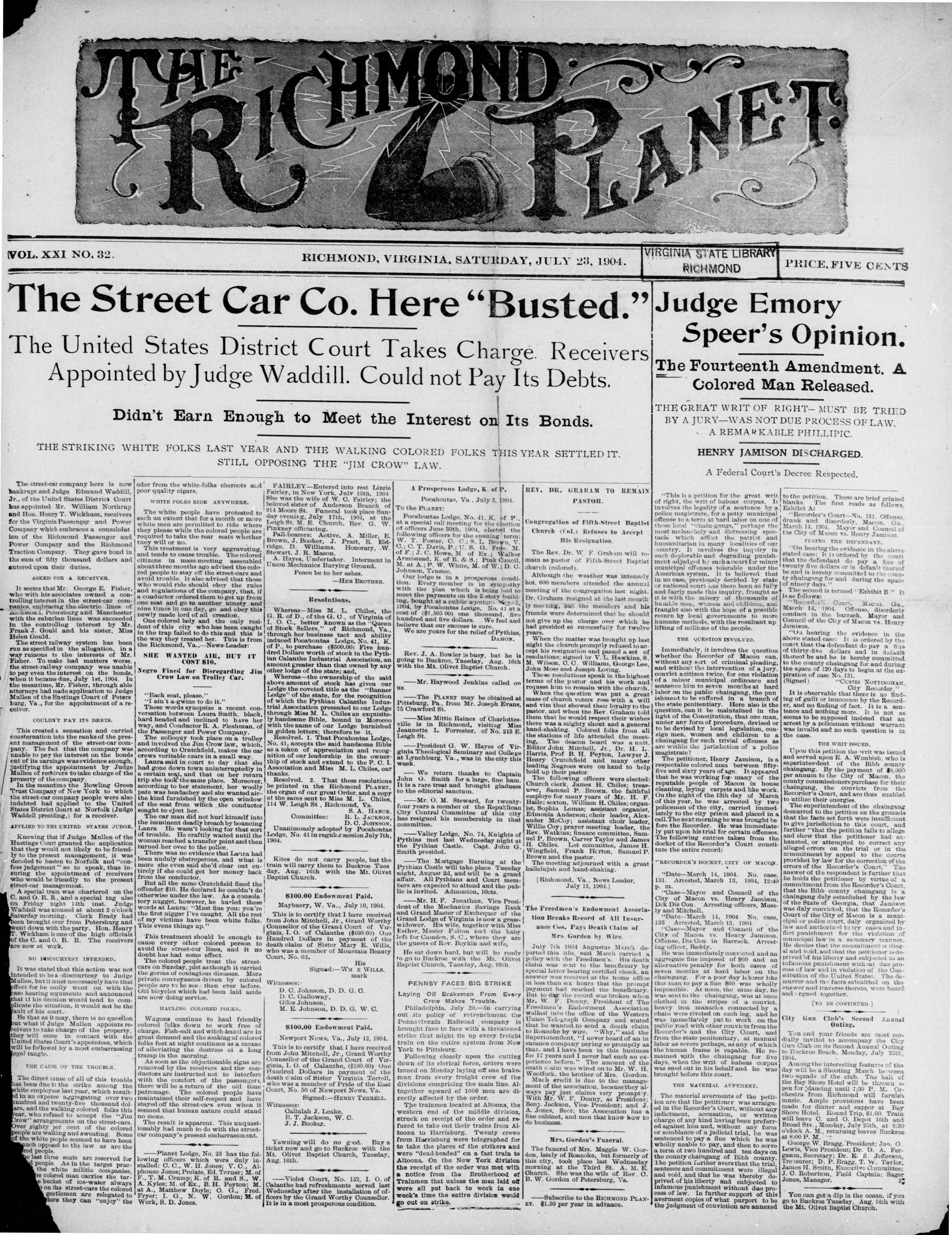
The Street Car Co. Here "Busted."
The United States District Court Takes Charge. Receivers Appointed by Judge Waddill. Could not Pay Its Debts.
THE STRIKING WHITE FOLKS LAST YEAR AND THE WALKING COLORED FOLKS THIS YEAR SETTLED IT. STILL OPPOSING THE "JIM CROW" LAW.
VOL. XXI NO. 32.
The St
The United
Appoint
Di
THE STRIKING W
The street-car company here is now bankrupt and Judge Edmund Waddill, Jr., of the United States District Court has appointed Mr. William Northrup and Hon. Henry T. Wickham, receivers for the Virginia Passenger and Power Company which embraces a consolidation of the Richmond Passenger and Power Company and the Richmond Traction Company. They gave bond in the sum of fifty thousand dollars and entered upon their duties.
ASKED FOR A RECEIVER.
It seems that Mr. George E. Fisher, who with his associates owned a controlling interest in the street-car companies, embracing the electric lines of Richmond, Petersburg and Manchester with the suburban lines was succeeded in the controlling interest by Mr. Frank J. Gould and his sister, Miss Helen Gould. The street railway system has been run as specified in the allegation, in a way ruinous to the interests of Mr. Fisher. To make bad matters worse, the street-railway company was unable to prevent the interest on the bond when it became due, July 1st, 1904. In the meantime, Mr. Fisher, through able attorneys had made application to Judge Mullen of the Hustings Court of Petersburg, Va., for the appointment of a receiver.
COULDN'T PAY ITS DEBTS.
This created a sensation and carried consternation into the ranks of the present management of the street-car company. The fact that the company was unable to pay the interest on the bonds out of its earnings was evidence enough, justifying the appointment by Judge Mullen of receivers to take charge of the property of the company. Bowling Green Trust Company of New York to which the street-car company people were also indebted had applied to the United States District Court at Norfolk (kudge Waddell presiding.) for a receiver.
APPLIED TO THE UNITED STATES JUDGE
Knowing that if Judge Mullen of the Hustings Court granted the application that they would not likely to be friendly to the present management, it was decided to hasten to Norfolk and "confess judgement" so to speak, thus insuring the appointment of receivers who would be friendly to the present street-car management.
A special train was chartered on the C. and O. R. R. and a special tug also on the C. and O. R. ins. Inside Waddell was moused at about 2 o'clock Saturday morning. Clerk Brady had been brought over from Petersburg and went down with the party. Hon. Henry T. Wickham is one of the high officials of the C. and O. R. R. The receivers are now at work.
NO DISCOURTESY INTENDED.
It was stated that this action was not intended to be a 'discourtesy to Judge Mullen, but it must necessarily have that effect for he coolly went on with the case hearing arguments and announced that if his decision would tend to complicate the situation, it would not be the fault of his court. But as it may there is no question what a judge Mullen appoints receivers to take charge of the case they will come in contact with the United States Court's appointees, which will be followed by a most embarrassing legal tangle.
THE CAUSE OF THE TROUBLE
The direct cause of all of this trouble has been due to the strike among the white employees last year, which resulted in an expense aggregating over two hundred and twenty-five thousand dollars, and the walking colored folks this year, who refused to accept the "Jim Drow" arrangements on the street-cars. Over eighty per cent of the colored people are walking and sweating. Some of the white people seemed to have been much opposed to the law as are the red people. The last three seats are reserved for white people. As in the target practice, the white militia companies, the colored man carries the tar-pile bucket of ice-water always on the street-cars the colored gentlemen are relegated to where they can "enjoy" the
Didn't Earn Enough to Meet the Interest on Its Bonds.
odor from the white-folks cheroots and poor quality cigars.
WHITE FOLKS RIDE ANYWHERE.
The white people have protested to such an extent that for a mouth or more white men are permitted to ride where they please while the colored people are required to take the rear seats whether they will or no. This treatment is very aggravating, and tends to cause trouble. The colored citizens in mass-meeting assembled about three months ago advised the colored people to stay off the street-cars and avoid trouble. It also advised that those who would ride should obey the rules and regulations of the company, that, if a conductor ordered them to get up from one seat and go to another ninety and one hundred feet, go and obey this newly made lord of the streets. One colored lady and the only resident of this city who has been caught in the trap failed to do this and this is the way they treated her. This is from the Richmond, Va.—NewsLeader:
SHE WANTED AIR, BUT IT COST $10.
Negro Fined for Disregarding Jin
Crow Law on Trolley Car.
"Back seat, please."
"I ain't a gwine to do it."
These words synopsize a recent conversation between Laura Smith, black, hard headed and inclined to have her way, and Conductor R. A. Fleshman, of the Passenger and Power Company.
The colloquy took place on a trolley and involved the Jim Crow law, which, according to Crutchfield, makes the car crews veritable cars in a small way.
Laura said in court to day that she had gone down town uninterrupted in a certain seat, and that on her return trip she took the same place. Moreover, according to her statement, her woolly pate was headache and she wanted air—the kind furnished by the open window of the seat from which the conductor sought to eject her.
The car man did not hurl himself into the imminent deadly breach by bouncing Laura. He wasn't looking for that sort of trouble. He craftily waited until the woman reached a transfer point and then turned her over to the police.
There was no evidence that Laura had been unduly obstreperous, and what is more she even said she'd clear out entirely if she could get her money back from the conductor.
But all the same Drutchfield fined the offender $10. He declared he couldn't do otherwise under the law. As a consolatory nugget, however, he hurled these words at Laura: "Must fine you: you're the first nigger I've caught. All the rest of my victims have been white folks. This events things up."
This treatment should be enough to cause every other colored person to avoid the street-car lines, and it no doubt has had some effect.
The colored people treat the street-cars on Sunday, just as though it carried the germs of contagious diseases. More private conveyances driven by colored people are to be seen: than ever before. Old bicycles which had been laid aside are now doing service.
HAULING COLORED FOLKS.
Wagons continue to haul friendly colored folks down to work free of charge. Fish-salt and witch-hazel are in great demand and the soaking of colored folks feet at night continues as a means of alleviating the distress of a long tramp in the morning.
As soon as the objectionable signs are removed by the receivers and the conductors are instructed not to interfere with the comfort of the passengers, there will be a return of the old time patronage. The colored people have maintained their self-respect and have stayed off the street-cars even when it seemed that human nature could stand no more.
The result is apparent. This unquestionably had much to do with the street-car company's present embarrassment.
Planet Lodge, No. 23 has the foliowing officers which were duly installed: O. C. W. H. Jones; V. C. A. phonso Jones; Prelate, Ed Turner; M. of T. M. Crump; K. of R. and S. W. A.yles; M. of Ex. B. H. Peyton; M at A. A. Oyley; O. G., Fred Fryer; I. G. N. W. Gordon; M. of Work, S. D. Jones.
RICHMOND, VIRGINIA, SATURDAY, JULY 23, 1904.
FAIRLEY -Entered into rest Lizzie Fairley, in New York, July 15th, 1904. She was the wife of W. C. Fairley; the beloved sister of Anderson Branch of 914 Moore St. Funeral took place Sunday evening g. July 17th, 1904, at the Leigh St. M. E. Church, Rev. G. W. Pinkney officiating. Pall-bearers: Active, A. Miller, E. Brown, J. Booker, J. Pratt, R. Eldridge, D. Williams. Honorary, W. Stewart, J. R. Mason.
A. Hayes, Undertaker, Interment in Union Mechanics Barring Ground
Resolutions.
Whereas—Miss M. L. Chiles, the G. R. of D., of the G. C., of Virginia of I. O. C., better known as the "Queen of Stock Sellers," of Richmond, Va., through her business activity and ability indeed Pocatontas Lodge, No. 41, K. No. to purchase ($500.00) Five hundred Dollars to book in the Pythian Calanthrop Industrial Company, an amount greater than that owned by any other lodge of the state; and
Whereas—the ownership of the said above amount of stock has given our Lodge the coveted title as the "Banner Lodge" of the state, for the recognition of which the Pythian Calante Industrial Association presented to our Lodge through Miss M. L. Chiles an exquisitely handsome Bible, bound in Morocco with the name of our Lodge burnished in golden letters; therefore be it,
Resolved. 1. That Pocahontas Lodge, No. 41, accepts the said handsome Bible as a token of appreciation and recognition of our leadership in the ownership of stock and extend to the P. C. I. Association and Miss M. L. Chiles, our thanks.
Resolved. 2. That these resolutions be printed in the Richmond PLANET, the organ of our great Order, and a copy of the same sent to Miss M. L. Chiles, 114 W. Leigh St, Richmond, Va.
S. A. HANCE
Committee: R. L. JACKSON,
D. C. JOHNSON
Unanimously adopted by Pocahontas Lodge, No. 41 in regular session July 7th, 1904.
Kites do not carry people, but the train will carry them to Buckroe Tues day, Aug. 16th with the Mt. Olivet Baptist Church.
$100.00 Endowment Paid.
This is to certify that I have received from John Mitchell, Jr., Grand Worthy Counselor of the Grand Court of Virginia, I. O. of Calanthe ($100.00) One Hundred Dollars in payment of the death claim of Sister Mary E. Wills, who was a member of Mountain Beauty Court, No. 62.
His
Signed:—WM x WILLS.
mark
M. E. Johnson, D. D. G. W. C.
$100.00 Endowment Paid.
Newport News, Va., July 12, 1904.
This is to certify that I have received from John Mitchell, Jr., Grand Worthy Counselor of the Grand Court of Virginia, O. Calhoun, (810) 400-0000 Hundred Dollars in payment of the death claim of Sister Virginia Terrell, who was a member of Pride of the East Court, No. 56 of Newport News, Va.
Signed:—HENRY TERRELL
Witnesses:
Callulah J. Leake,
B. T. Jackson, W. C.
J. J. Booker.
Yawning will do no good. Buy a ticket now and go to Buckroe with the Mt. Olivet Baptist Church, Tuesday,
Aug. 16th.
Violet Court, No. 152, I. O. of Calanthe had refreshments served last Wednesday after the installation of officers by the Grand Worthy Counsellor. It is in a most prosperous condition.
Pocahontas Lodge, No. 41, K. of P.
at a special call meeting for the election
of officers June 30th, 1904, elected the
following officers for the ensuing term:
W. T. Foster, C. C.; S. L. Brown, V.
C.; T. Davis, P.; U. S. G. Free, M.
of F.; J. C. Howe, M. of Ex.; Walker
Armistead, K. of R. & S.; Pink Cancil,
M. at A.; P. W. White, M. of W.; D. C.
Johnson, Trustee.
Our lodge is in a prosperous condit
ion. Every member is in sympathy
with the plan which is being laid to
meet the payments on the 3-story build
ing, bought at a public apotheon. Rev.
1904, by Pocahontas Lodge, No. 41 at a
cost of ($1,505 00) one thousand, five
hundred and five dollars. We feel and
believe that our success is sure.
We are yours for the relief of Pythias,
DAMON.
Rev. J. A. Bowler is busy, but he is
going to Buckroo, Tuesday, Aug. 16th
with the Mt. Olivet Baptist Church
The PLANET may be obtained at Pittsburg, Pa., from Mr. Joseph Evans, 75 Crawford St.
Miss Stittie Raines of Charlottesville is in Richmond, visiting Miss Jeannette L. Forrester, of No. 215 E. Leigh St.
President G. W. Hayes of Virginia Theological Seminary and College at Lynchburg, Va., was in the city this week.
We return thanks to Captain John G. Smith for a large, fine harm. It is a rare treat and brought gladness to the editorial sanctum.
Mr. O. M. Steward, for twenty four years a member of the Republican City Central Committee of this city has resigned his membership in that committee.
Valley Lodge, No. 74, Knights of Pythias met last Wednesday night at the Pythian Castle. Capt. John G. Smith presided.
The Mortgage Burning at the Pythian Castle will take place Tuesday night, August 2d, and will be a grand affair. All Pythians and Court members are expected to attend and the public is invited. Admission, 10cts.
Mr. H. F. Jonathan, Vice President of the Mechanics Savings Bank and Grand Master of Exchequer of the Grand Lodge of Virginia is now a grasswidower. His wife, together with Miss Esther, Master Falcon and the baby left for Camden, S. C., where they are the guests of Rev. Boykin and wife.
He sat down hard, but will be ready to go to Buckroe with the Mt. Oitvet Baptist Church, Tuesday, Aug. 16th.
PENNSY FACES BIG STRIKE
Laying Off Brakemen From Every Crew Makes Trouble
Crew makes trouble.
Philadelphia, July 20.—In carrying out its policy of retrenchment the Pennsylvania Railroad company is brought face to face with a threatened strike that might tie up every freight train on the entire system from New York to Pittsburgh.
Following closely upon the cutting down of its clerical force, orders were issued on Monday laying off one brakeman from every freight crew of the divisions comprising the main line. Altogether upward of 1000 men are directly affected by the order.
The trainmen located at Altoona, the western end of the middle division, struck on receipt of the order and refused to take out their trains from Altoona to Harrisburg. Twenty crews from Harrisburg were telegraphed for to take the places of the strikers and were "dead-headed" on a fast train to Altoona. On the New York division the receipt of the order was met with a notice from the Brotherhood of Trainmen that unless the men laid off were all put back to work in one week's time the entire division would go out on strike.
REV. DR. GRAHAM TO REMAIN
PASTOR.
Congregation of Fifth-Street Baptist Church (CoL) Refuses to Accept His Resignation.
The Rev. Dr. W. F. Graham will remain as pastor of Fifth-Street Baptist church (colored). Although the weather was intensely hot, 600 members attended the annual meeting of the congregation last night. Dr. Graham resigned at the last monthly meeting, but the members and his friends were determined that he should not give up the charge over which he had presided so successfully for twelve years. When the matter was brought up last night the church promptly refused to accept his resignation and passed a set of resolutions; signed by V. I. Hawkins, S. M. Wilson, C. C. Williams, George Lee, John Moss and Joseph Loving.
terms of the pastor and his work and request him to remain with the church. When the question was put a great mass of church voters rose with a will and vim that showed their loyalty to the pastor, and when the Rev Graham told them that he would respect their wishes there was a mighty shout and a general hand-shaking. Colored folks from all the stations of life attended the meeting. The deacon board was a unit, Editor John Mitchell, Jr., Dr. H. L. Harris, Prof B. H. Peyton, Lawyer J. Henry Crutchfield and many other leading Negroes were on hand to help hold up their pastor.
The following officers were elected: Church clerk, James H. Chiles; treasurer, Samuel P. Brown, the faithful employee for many years of Mr. H. F. Halle; sexton, William H. Chiles; organist, Sophia Lemas; assistant organist, Edmonia Anderson; choir leader, Alexander McCoy; assistant choir leader, Willie Coy; prayer meeting leader, the Rev. Watkins; finance committee, Samuel P. Brown, Carver Taylor and James H. Chiles. Let committee, James H. Wingfield, B. Hirton, Samuel P. Brown and the pastor.
The meeting adjourned with a great hallelujah and hand-shaking.
[Rihoond, Va., News Leader, July 12, 1904.]
The Freedmen's Endowment Association Breaks Record of All Insurance Cos. Pays Death Claim of Mrs. Gordon by Wire.
July 7th 1904 Augustus March departed this life, said March carried a policy with the Freedmen's. His death claim was sent to the beneficiary by special letter bearing certified check, an answer was received at the home office in less than six hours that the prompt payment had reached the beneficiary. But day the record was broken when W. F. Denny, President of The Freedmen; Endowment Association walked into the office of the Western Union Telegraph Company and stated that he wanted to death claim to Roanoke by wire. "Wip" filled the Superintendent, "I never heard of a insurance company paying so promptly as that, and I have been in this business for 17 years and I never had such an experience before." The amount of the death claim was wired on to Mr. W. H. Woolfork, the brother of Mrs. Gordon.
Much credit is due to the management of the association, because they always pay just claims very promptly. With Mr. W. F. Denny, as President; Benj. Jackson, Vice-President; and J. A. Jones, Sect; the Association has a fine cabinet, and men that know how to do business.
Mrs. Gordon's Funeral
The funeral of Mrs. Maggie W. Gordon, lately of Roanoke, but formerly of this city, took place last Wednesday morning at the Third St. A. M. E. Church. She was the wife of Rev. O. B. W. Gordon of Petersburg, Va.
Subscribe to the RICHMOND PLANET. ET. $1.50 per year in advance.
VIRGINIA STATE LIBRARY
RICHMOND
Judge En-
Speer's
The Fourteenth
Colored Ma
THE GREAT WRIT OF R
BY A JURY—WAS NOT
A REMARKA
HENRY JAMISO
Judge Emory Speer's Opinion.
The Fourteenth Amendment. A Colored Man Released. THE GREAT WRIT OF RIGHT-MUST BE TRIED BY A JURY-WAS NOT DUE PROCESS OF LAW. A REMARKABLE PHILLIPIC.
HENRY JAMISON DISCHARGED
A Federal Court's Decree Respected.
"This is a petition for the great writ of right, the writ of habeas corpus. It involves the legality of a sentence by a police magistrate, for a petty municipal offense to a term at hard labor on one of those local "chain-gangs," perhaps the most melancholy and distressing spectacle which afflict the patriot and humanitarian in many localities of our country. It involves the inquiry in such deplorable and degrading punishment adjudged by such a court for minor municipal offenses tolerable under the American system. It is believed that in no case, possibly decided by state or national court has there been so fully and fairly made this inquiry, frangt as it is with the misery of thousands of humble men, women and children, and frangt also with the hope of a possible return by local governments to more humane methods, with the resultant up lifting of millions of the people.
to the petition. These are blanks. The first read Exhibit A:
"Recorder's Court—No drunk and disorderly, March 14, 1904. Mayor of the City of Macon vs. He FINING THE DEF
"On hearing the evides stated case: It is ordered that the defendant do twenty-five dollars or in be and is hereby commit chaining for and due of ninety days."
The second is termed "is as follows:
"Recorder's Court, March 14, 1904. Offer conduct in the barrack Council of the City of M Jamison."
THE QUESTION INVOLVED.
Immediately, it involves the question whether the Recorder of Macon can, without any sort of criminal pleading, and without the intervention of a jury, convict a citizen twice, for one violation of a minor municipal ordinance and sentence him to seven months at hard labor on the public chaining, the punishment to be suffered in a branch of the state penitentiary. Here also is the question, can it be maintained in the light of the Constitution, that one man, under any form of procedure, devised or to be devised by local legislation, consign men, women and children to a chaining for such trivial offenses as are within the jurisdiction of a police maristrate?
The petitioner, Henry Jamison, is a respectable colored man between fifty-five and sixty years of age. It appeared that he was working for many of the reputable people of Macon in house cleaning, laying carpets and like work. On the night of the 13th day of March of this year, he was arrested by two policemen of the city, carried immediately to the city prison and placed in a cell. The next morning he was brought before the Recorder. He was immediately put upon his trial for certain offenses. The following entries taken from the docket of the Recorder's Court constitute the entire record:
"RECORDER'S DOCKET, CITY OF MACON
"Date—March 14, 1904. No. case
131. Arrested, March 13, 1904, 12:46
p. m.
"Case—Mayor and Council of the
City—Macon vs. Henry Jamison
Dok Dis Co.—Arresting officers, Mose-
ly and Mitchell.
"Date—March 14, 1904 No. case
133. Arrested, March 13, 1904.
"Case—Mayor and Council of the City of Camon vs. Henry Jamison, Offense, Dis Con in Barrack, Arresting officer, Reddy.
He was immediately convicted and an aggregate fine imposed of $60 and an alternative penalty for both cases of seven months at hard labor on the chaingang. For a poor day laborer like this man to pay a fine $60 was wholly impossible. At noon, the same day, he was sent to the chaingang, was at once clothed in the stripes of a convict, heavy iron manacles connected by a chain were riveted on each leg, and he was immediately put to work on the chaingang and her convicts from the Recorder's and the City Court, and from the state penitentiary, at manual labor as severe perhaps, as any of what the human frame is capable. He remained with the chaingang for five days, when the writ of habeas corpus was sued out in his behalf and he was brought before this court.
THE MATERIAL AVERMENT.
The material averments of the petition are that the petitioner was arraigned in the Recorder's Court, without any indictment, accusation, or written charge of any kind having been preferred against him and, without any form or semblance of a judicial trial, he was sentenced to pay a fine which he was wholly unable to pay, and then to serve a term of two hundred and ten days on the county chaingang of Bibb county. The petition further avers that the trial, the petitioner had been sentenced were illegal and void, and that he was thereby deprived of his liberty and satisfied infamous punishment without due process of law. In further support of this averment copies of what purport to be the judgment of conviction are annexed
PRICE,FIVE CENTS
mory
is Opinion.
Amendment. A
an Released.
RIGHT—MUST BE TRIED
DUE PROCESS OF LAW.
BLE PHILLIPIC.
ON DISCHARGED.
to the petition. These are brief printed blanks. The first reads as follows, Exhibit A: Recorder's Court—No, 131. Offense, drunk disorderly, Macon, Ga. March 14, 1904. Mayor and Council of the City of Macon W.
FINING THE DEFENDANT.
"On hearing the evidence in the above stated case: It is ordered by the court that the defendant do pay a fine of twenty five dollars or in default thereof hereby commit1 to the county chaining and during the space of ninety days." The second is termed "Exhibit B." It is as follows:
"Recorder's Court, Macon, Ga., March 14, 1904. Offense, disorderly conduct in the barrack. Mayor and Council of the City of Macon vs. Henry Jamison.
"On hearing the evidence in the above stated case: It is ordered by the court that the defendant do pay a fine of thirty-five dollars and in default thereof be and he is hereby committed to the county chainingg for and during the space of 120 days to begin at the expiration of case No.131.
(Signed)
"CUSTIS NOTTINGHAM, City Recorder."
It is observable that there is no finding of guilt or innocence by the Recorder, and no finding of fact. It is a sentence and nothing more. It is not as seems to be supposed insisted that an arrest by a policeman without warrant was inviol and no such question is in the case.
THE WRIT ISSUED.
Upon this petition the writ was issued and served upon E. A. Wimbish, who is superintendent of the Bibb county chaingang. By the payment of $,000 per annum to the City of Macon, the commissioners purchase for their chaingang, the tickets from the Recorder's Court, and are thus enabled to utilize their energies.
The superintendent of the chaiangang demurred to the petition on the grounds that the facts set forth were insufficient to give jurisdiction to this court, and further "that the petition fails to allege and show that the petitioner had exhausted, or attempted to correct any alleged errors on the trial or in the commitment by appeal to the courts provided by law for the correction of the errors of the Recorder's Court." The answer of the respondent is further that he holds the petitioner by virtue of a commitment from the Recorder's Court, that the Bibb county chaiangang is a chaiangang duly established by the law of the State of Georgia, that Jamison was duly convicted, that the Recorder's Court of the City of Macon is a municipal or police court, duly organized by law and authorized to try cases and inflict punishment for the violation of municipal law in a summary manner. He denies that the commitment is illegal and void, and that the petitioner is deprived of his liberty and subjected to an infamous punishment without due process of law and in violation of the Constitution of the United States. The demurrier and the facts submitted on the answer and traverse thereto, were heard and argued together.
[TO BE CONTINUED.]
City Gun Club's Second Annual Outing.
You and your friends are most cordially invited to accompany the City Gun Club on its Second Annual Outing to Buckroe Beach, Monday, July 25th, 1904.
Among the interesting features of the day will be a Shooting Match between two squads of the club. The hull of the Bay Shore Hotel will be thrown open for 'dancing until 7:30 P. M. Orchestra from Richmond will furnish music. Ample provisions have been made for dinner and supper at Bay Shore Hotel. Round Trip. $1.00. Train will leave C. and O. Depot 16th and Broad Sts. Monday, July 25th, at 8:30 o'clock A. M., returning leaves Buckroe at 8:00 P. M.
George W. Bragg, President; Jno. O. Lewis, Vice President; Dr. D. A. Ferguson, Secretary; Dr. E. R. Jefferson, Treasurer; D. P. Bragg, T. W. Taylor, James H. Smith, Executive Committee; J. C. Robertson, Field Captain; Sager Jones, Manager.
You can get a dip in the ocean, if you
are in the ocean with the Mr. Olivet Church.
"CUSTIS NOTTINGHAM,
City, Recorded,
HEY PLANET
SATURDAY ..... JULY 23, 1904
HE'S ALL RIGHT
We've puzzled over problems in our wooden-headed way.
We people old and grey;
We done our best to solve them, but, of course, with falling sight
is hard to see the light.
We find 'em still perplexing, which is owing to a great
our weakened intellect.
We are hopelessly old-fashioned and completely out of date
the youthful graduate.
We've grubbed and dug, perspiring, in the common, ugly dirt.
A quiet mischiefful, rough-and-tumble light weigher.
Not at all the higher thought.
It's not at all surprising that we've been fortunate.
Do the youthful graduate.
Pust watch him on the platform and just listen now while he—
Dr perhaps it is a she—
Breaks off sweet words of wisdom from the house he has under the watch.
It is then we understand
How beautifully simple are the things that puzzled us.
Over which we fret and fuss;
How—well, he'll show improvement over
Do why guy the graduate?
—Chicago Daily News.
THE INNOCENT THIRD PARTY
By KENNETT HARRIS
(Copyright, 1904, by Daily Story Pub. Co.)
YEAR is all! I ask," said the girl, passionately; "just a year of Guyoriczs in Pesth and I am an artist. Of course, I am not an artist now. Guyoriczs may have nothing to teach me, but I am not an artist, as far as a good engagement goes, until I have received the trademark from Pesth—made in Hungary."
"You are modest," said Starcom.
"You mean because I say that Guy-oriczs may have nothing to teach me? Well, tell me your candid opinion. Has he? But did ever a genius come out of Chicago? If I play—and I know I can play—they say, 'Who is she?' Oh, a little Chicago girl. I think she studied in Boston for a year or two. That explains the technique, of course.' I tell you, my friend, you've got to come before the public with European prestige. It's disgusting, but it's true. Not even Boston can wipe out the deep damnation of Chicago."
"Cut it out, Miriam," advised the young man, his eyes fastened hungrily on the dark beauty of her animated face. "Let's look over the list of vacant flats—and you can play to me evenings. You wouldn't get anything but heartbreaks and little squabbles out of the other, even if you succeeded."
She looked at him half contemptuously, half pityingly. "It may be as you say, Dick," she said, "but I won't be happy until I've had my chance and tried it. The best thing you can do is to help me."
"Help you to spoil my life."
"Nonsense! I've told you that if it were anyone it would be you, but if I came to you now I would spoil your life and my own, too. I want my year at least. You can't lend me the money, because you are too poor. If you could I wouldn't take it. Lots of people would lend me the money. Some of them would give it. Well, lend me your brains."
"Couldn't you sell your fiddle? You say it's worth $5,000. I should think that was an easy way out of the difficulty."
"I thought you would show a little more intelligence than that. My violin! I couldn't, Dick; you know I couldn't. It's all I have left, and dad's gift, besides. Poor dad! If he had only lived!"
Tears stood in the beautiful dark eyes and Starcom looked embarrassed "May I smoke?" he asked, presently. "It helps me to think, and I want to think of some way out for you." She nodded and he lit a cigar.
"Would you pawn it?" he asked suddenly, after a few puffs. "I should think that you ought to get a third of its value—that's what they generally allow me when I hypothecate my family jewels owing to temporary financial stress."
"The last financial stress was roses for me at that little concert, wasn't it?" she asked, smiling. "How many jewels did you hypothecate, Dick?"
"Eight," answered Starcom promptly. "It was jeweled in eight holes and had a lever movement."
"I thought that was it," she said, in a softened voice. "Dick, if I thought I could be happy I'd take you now, but I couldn't make you happy unless I was, my dear boy. You are good."
"Don't get that idea in your head," said Starcom. "I'm not. I'm just considering a burglary to help you out."
"Don't do that," she said. "No, Dick, I really respect you, and I want to have somebody respectable to lean on."
"Come on, then," said Starcom, airly. "I'm ready. I have another plan," he continued, when he had recovered from the withering glance she gave him. "I won't tell you what it is until I make sure about it. It will take ten days. Can you wait as long as that?"
"I expect to wait longer," she answered.
Within the time mentioned Starcom had his plan matured. "I didn't tell you what it was," he said, "because I know you would have thought it absurd. I have a friend in New York state—Cahoo-dawachlech. He is an eccentric old d*c* and rich as mud.
He's going to lend you the money. Miriam."
"Dick, you are crazy!"
"Not at all. He's a collector, and he wants your Amanti. Wait a moment, now, and don't interrupt. He will lend you the money on it on condition that if you die before you pay the fiddle goes to him, and he keeps it for you until you get back from Peeth, whether you pay before or not. He wants to inspect it first, of course, but that's a matter of form. We'll express it to him to-morrow, and I'll come around in the morning and help you to pack it."
"And do you think I'd trust it to the express company?"
"Oh, you'll insure it, of course," said Starcom. "I'll see to that, too. It's all right. Miriam."
The girl offered other objections, but Starcom overruled them in a brisk, businesslike fashion, and the next day he gave to the insura. and brought the b... around for the packing. It was nailed when he brought it, and he was obliged to ask the young woman for a hammer and chisel. She was gone two or three minutes only, but when she came back the box was opened.
"I got tired of waiting for you, and pulled the nails with my teeth," said Starcom, in his absurd way. "Now for the Amanti."
"How peculiarly the box smells," remarked the girl, putting her pretty little nose down to it. "Like naptha, or kerosene, or something."
"That's nothing," said Starcom. "It'll keep the damp out. A little more of the cotton to hold it snug, and then I'll trouble you for some nails. These are bent and I want to fasten it securely. Too bad to bother you to go out again."
That night the evil-smelling box, covered with labels and seals, was packed in an express car speeding to the affluent violin collector of Cahoon-dawachick. At nine o'clock the next morning it was piled with a heap of other baggage against the shady side of the Wigton depot, awaiting transfer to the branch line of Cahoon-dawachick. At 9:12, from some cause unknown—possibly a carelessly thrown match—the box caught fire. Wigton is a lonely sort of a place for a junction, and before the station agent and a stray passenger who was awaiting the Chicago express, noticed the blaze there was not much left of the box to jump on. The station master jumped on it.
THE FASHION
however, and rescued some charred splinters of a violin. "It's only a fiddle," he said to the passenger; "a good thing it was nothing valuable."
And so Miriam went to Pesth. She really was grieved over the loss of her Amanti; but Dick's remorse for having induced her to take the risk was so touching that she almost forgot her sorrow in consoling him. And then, of course, the insurance money softened the blow. When she came back she had the Guyoricz trade mark, but she did not seem enthusiastically anxious for a career.
"I wish I had not gone," she confessed to Starcom. "If I had my old violin back and my old life I believe I could be happy, after all. I'm worn out, Dick."
"Will I do without the violin?" asked Starcom.
"Dick, I've missed you the whole dreary time," she said, with a sigh of content, as he took her into his arms. It was rather a surprise for Miraml when she found that she had married a successful speculator. She was rather shocked, too, for she had ideas on the subject. It was another surprise when she found her old Amanti carelessly lying on the piano in the gorgeous music room that had been planned as another surprise. Starcom explained that an unscrupulous collector had substituted the cheap violin for the Amanti before it was shipped, but he was bound, in view of the restitution, not to divulge that unscrupulous person's name.
"I've sent the insurance company a check," he concluded, "so I guess nobody's got any kick coming. I know I haven't. It was a good thing, though that the spurious instrument happened to get burned."
Mrs. Starcom might have asked a good many questions, but she is trying to be satisfied with her husband.
Telephone Through Jungle.
The progress of civilization is shown by the completion of a telephone line through a thick jungle 750 miles wide, in the heart of Africa. "It has been built by the Belgian government to enable the various Belgian colonies to communicate with one another. The wires are strung on iron posts and on the largest trees of the jungle. Some of the poles are half a mile apart, where the wires cross a swift river or a dangerous swamp. Posts could not be used on account of the white ants, and the large number of elephants made it necessary to keep the wires high above the ground. As storms will throw trees across the line, and wasps will make their nests in the insulators, and natives are liable to steal the wire, the Belgian government expects to have trouble in keeping the line in operation." —Telephony.
Highly Successful
Highly Successful.
Jack Spart took Anti-Fat,
His wife took Anti-Lean,
And so to-day the both of them
Are sleeping in the green.
-Lippincott's Magazine.
THE RICHMOND PLANET, RICHMOND, VIRGINIA.
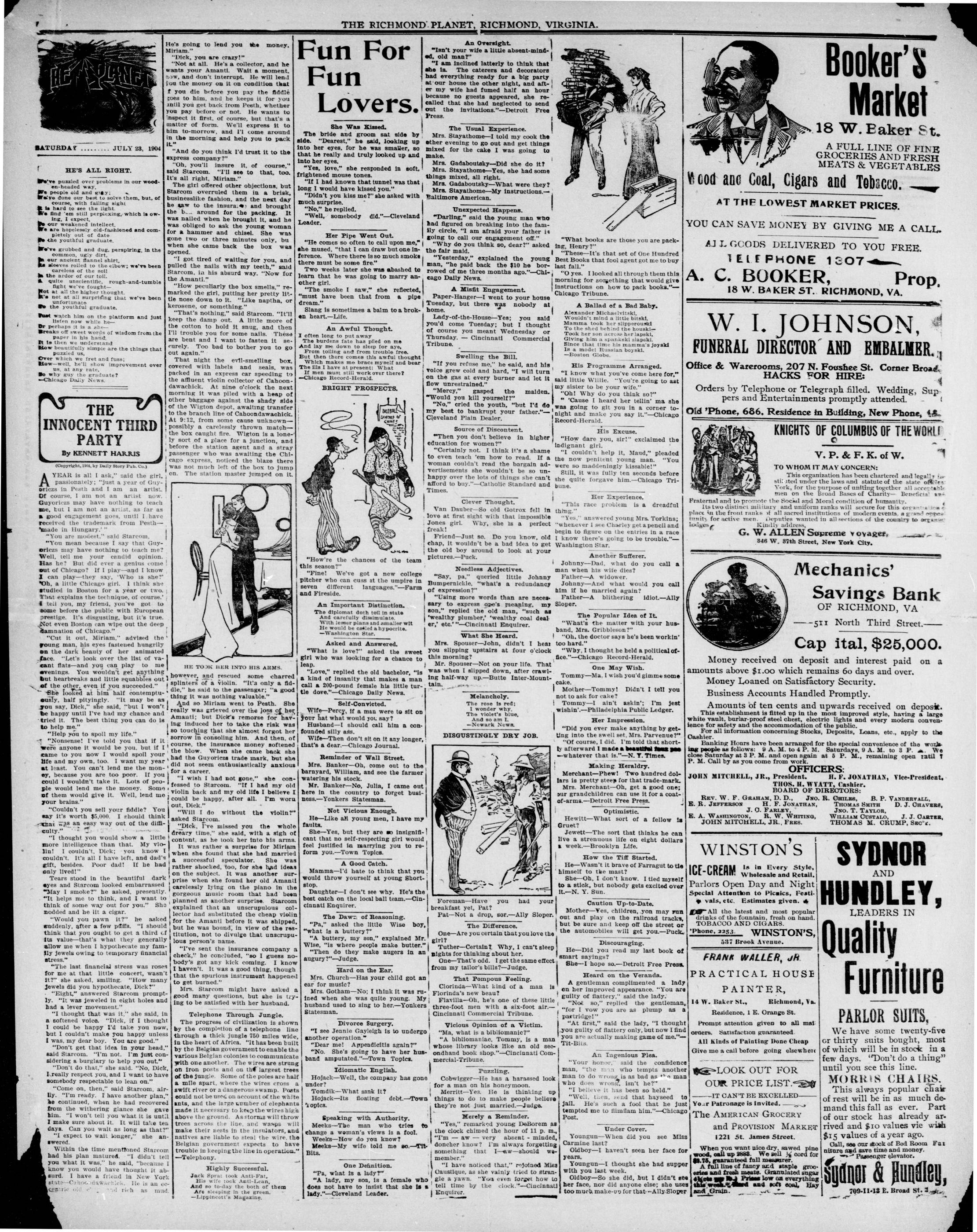
Fun For Fun Lovers.
She Was Kissed.
The bride and groom sat side by side. "Dearest," he said, looking up into her eyes, for he was smaller, so that he really and truly looked up and into her eyes.
"Yes, love," she responded in soft, frightened mouse tones. "If I had known that tunnel was that long I would have kissed you."
"Didn't you kiss me?" she asked with much surprise.
"No," he replied.
"Well, somebody did."—Cleveland Leader.
Her Pine Went Out
"He comes so often to call upon me," she mused, "that I can draw but one inference. Where there is so much smoke there must be some fire."
Two weeks later she was abashed to learn that he was going to marry another girl.
"The smoke I saw," she reflected, "must have been that from a pipe dream."
Slang is sometimes a balm to a broken heart.—Life.
An Awful Thought
The burdens fate has piled on me
And lay me down to sleep for aye,
From tolling and from trouble free.
But to the end of thought
Which makes me brace myself and bear
The lills I have at present: What
If men must still work over there?
—Chicago Record-Herald.
BRIGHT PROSPECTS.
BASILBAL
SCHOOL OF
GAMES
"How're the chances of the team
this season?"
"Fine! We've got a new college pitcher who can cuss at the umpire in seven different languages."—Farm and Fireside.
An Important Distinction.
The diplomat doth toll in state
And carefully dissimulate.
With lesser plans and smaller wilt
He would be casted a hypocrite.
—Washington Star.
Asked and Answered.
"What is love?" asked the sweet girl who was looking for a chance to leap.
"Love," replied the old bachelor, "is a kind of insanity that makes a man call a 200-pound female his little turtle dove."—Chicago Daily News.
Self-Convicted
Wife—Percy, if a man were to sit on your hat what would you say?
Husband—I should call him a confounded silly ass.
Wife—Then don't sit on it any longer, that's a dear.—Chicago Journal.
Reminder of Wall Street.
Mrs. Banker—Oh, come out to the barnyard, William, and see the farmer watering his stock.
Mr. Banker—No, Julia, I came out here in the country to forget business.—Yonkers Statesman.
Not Vicious Enough
He—Like all young men, I have my faults.
She—Yes, but they are insignificant that no self-respecting girl would feel justified in marrying you to reform you—Town Topics.
A Good Catch.
Mamma—I'd hate to think that you would throw yourself at young Short-stop.
Daughter—I don't see why. He's the best catch on the local ball team.—Cincinnati Enquirer.
The Dawn of Reasoning.
"Pa," asked the little Wise boy, "what is a buttery?"
"A buttery, my son," explained Mr. Wise, "is where people make butter."
"Then do they make augers in an anguery?"—Judge.
Hard on the Ear
Mrs. Church—Has your child got an ear for muscle?
Mrs. Gotham—No; I think it was ruined when she was quite young. My husband used to sing to her.—Yonkers Statesman.
Divorce Surgery.
"I see Jennie Gayleigh is to undergo another operation."
"Dear me! Appendicitis again?"
"No. She's going to have her husband amputated."—Town Topics.
Idiomatic English
Hojack—Well, the company has gone
under?
Tomdik—What sank it?
Hojack—Its floating debt.—Town
'opics.
Speaking with Authority.
Meeks—The man who tries to
change a woman's views is a fool.
Weeks—How do you know?
Meeks—My wife told me so.—Tit-
Bits.
One Definition
"A lady, my son, is a female who does not have to insist that she is a lady."-Cleveland Leader.
An Oversight.
"Isn't your wife a little absent-minded, old man?"
"I am inclined latterly to think that she is. The caterers and decorators had everything ready for a big party at our house the other night, and after my wife had fumed half an hour because no guests appeared, she recalled that she had neglected to send out the invitations."—Detroit Free Press.
The Usual Experience
Mrs. Stayathome—I told my cook the either evening to go out and get things mixed for the cake I was going to make.
Mrs. Gadaboutsky—Did she do it?
Mrs. Stayathome—Yes, she had some things mixed, all right.
Mrs. Gadaboutsky—What were they?
Mrs. Stayathome—My instructions.—Baltimore American.
Unexpected Happens
"Darling," said the young man who had figured on breaking into the family circle, "I am afraid your father is going to call our engagement off."
"Why do you think so, dear?" asked the fair maid.
"Yesterday," explained the young man, "he paid back the $10 he borrowed of me three months ago."—Chicago Daily News.
A Misfit Engagement
Paper-Hanger—I went to your house Tuesday, but there was nobody at home.
Lady-of-the-House—Yes; you said you'd come Tuesday; but I thought of course you meant Wednesday or Thursday. — Cincinnati Commercial Tribune.
Swelling the Bill
"If you refuse me," he said, and his voice grew cold and hard, "I will turn on the gas at every burner and let it flow unrestrained."
"Mercy," gasped the malden. "Would you kill yourself?"
"No," cried the youth, "but I'd do my best to bankrupt your father."—Cleveland Plain Dealer.
Source of Discontent
"Then you don't believe in higher education for women?" "Certainly not. I think it's a shame to even teach 'em how to read. If a woman couldn't read the bargain advertisements she wouldn't be so unhappy over the lots of things she can't afford to buy."—Catholic Standard and Times.
Clever Thought
Van Dauber—So old Gotrox fell in love at first sight with that impossible Jones girl. Why, she is a perfect freak!
Friend—Just so. Do you know, old chap, it wouldn't be a bad idea to get the old boy around to look at your pictures.—Puck
Needless Adjectives
"Say, pa," queried little Johnny Bumpernickle, "what's a redundancy of expression?" "Using more words are necessary to express one's meaning, my son," replied the old man, "such as 'wealthy plumber,' wealthy coal dealer, etc.'" -Cincinnati Enquirer.
What She Heard
Mrs. Spouser—John, didn't I hear you slipping upstairs at four o'clock this morning?
Mr. Spouser—Not on your life. That was when I slipped down, after crawling half-way up—Butte Inter-Mountain.
Melancholy.
The rose is red;
I wander why
The violet's blue,
And so am I.
-Newark News.
A
The Difference.
One—Are you certain that you love the girl?
One—That's odd. I get the same effect from my tail's bills?—Judge.
That Pompous Feeling
Clorinda—What kind of a man is Florinda's new beau?
Flavilla—Oh, he's one of these little three-foot men with a six-foot air.—Cincinnati Commercial Tribune.
"A bibliomaniac, Tommy, is a man whose library looks like an old secondhand book shop."—Cincinnati Commercial-Tribune.
Puzzling.
Cobwigger—He has a harassed look for a man on his honeymoon.
Merritt—Yes. He is thinking up things to do to make people believe they're not just married.—Judge
Merely a Reminder
"Yes," remarked young DeBorem as the clock chimed the hour of 11 p. m. "I'm — aw — very absent — minded, doncher know? I'm always forgetting something that I—aw—should wamember."
"I have noticed that," rejoined Miss Casquette, as she vainly tried to strangle a yawn. "You even forget how to tell time by the clock."—Cineinnat Enquirer.
C. H.
"What books are those you are packing, Henry?"
"These—it's that set of One Hundred Best Books that fool agent got me to buy last fall."
"O yes. I looked all through them this morning for something that would give instructions on how to pack books."—Chicago Tribune.
A Ballad of a Bad Baby.
Alexander Michaelvitski,
Wouldn't mind a little skisl.
Mamma took her slipperousl
To the shed behind the housi-
Took her son across her lapsl,
Ving him a spankslapsl,
Sinisl his mamma's joysl
is a model Russian boysl.
-Boston Globe.
His Programme Arranged
"I know what you've come here for," said little Willie. "You're going to ast my sister to be your wife." "Oh! Why do you think so?" "Cause I heard her tellin' ma she was going to git you in a corner tonight and make you say it."—Chicago Record-Herald.
His Excuse.
"How dare you, sir!" exclaimed the indignant girl.
"I couldn't help it, Maud," pleaded the now penitent young man. "You were so maddeningly kissable!"
Still, it was fully ten seconds before she quite forgave him—Chicago Tribune.
Her Experience
"This race problem is a dreadful thing."
"Yes," answered young Mrs. Torkins; "whenever I see Charley get a pencil and begin to figure on the entries in a race I know there's going to be trouble."—Washington Star.
Another Sufferer
Johnny—Dad, what do you call a man when his wife dies?
Father—A widower.
Johnny—And what would you call him if he married again?
Father—A blithering Idiot.—Ally Sloper.
The Popular Idea of It
"Wby, I thought he held a political office."—Chicago, Record-Herald.
Tommy—Ma, I wish you'd gimme some cake.
Mother—Tommy! Didn't I tell you not to ask for cake?
Her Impression.
"Did you ever make anything by get- ing into the swell set, Mrs. Parvenue?" "Of course, I did. I'm told that short-ly afterward I made a beautiful funz pose whatever that is." N. Y. Times.
Making Heraldry.
Merchant—Phew! Two hundred dollars is pretty steep for that trade-mark. Mrs. Merchant—Oh, get a good one; our grandchildren can use it for a coat-of-arma—Detroit Free Press.
Optimistic.
Hewitt—What sort of a fellow is Gruet?
Jewett—The sort that thinks he can live a strenuous life on eight dollars a week.—Brooklyn Life.
How the Tiff Started.
He—Wasn't it brave of Faragut to the himself to the mast?
She—Oh, I don't know. I tied myself to a stick, but nobody gets excited over it.—N, Y, Sun.
Caution Up-to-Date
Mother—Yes, children, yon may run out and play on the railroad tracks, but be sure and keep off the street or the automobiles will get you.—Puck.
Discouraging.
He—Did you read my last book of smart sayings?
She—I hope so.—Detroit Free Press.
Heard on the Veranda.
A gentleman complimented a lady on her improved appearance. "You are guilty of flattery," said the lady.
"At first," said the lady, "I thought you guilty of flattery only, but now I find you are actually making game of me."—Tit-Bits.
An Ingenious Plea
"Your honor," said the confidence man, "the man who tempts another man to do wrong is as bad as "the man who does wrong, isn't he?" "I believe it has been so held." "Well, then, send that hayseed to jall. He's such a fool that he just tempted me to filmflam him."—Chicago Post.
Under Cover.
Youngun—When did you see Miss Carmine last?
Oldboy—I haven't seen her face for years.
Youngun—I thought she had supper with you last week.
Oldboy—She did, but I didn't see her face, nor did anyone else; she uses too much make-up for that--Ally Sloper
M.
Wood and Coal, Cigars
AT THE LOWEST M
YOU CAN SAVE MONEY BY
AJ J. GOODS DELIVER
TELEPHONE
A. C. BOOKER
18 W. BAKER ST.
W. I. JOE
FUNERAL DIRECTOR
Office & Warerooms, 207 N.
HACKS FO
Orders by Telephone or Tele-
pers and Entertainment
Old 'Phone, 686. Residence in
Cigars and
BEST MARKET
MONEY BY GI
DELIVERED TO
ONE 13
MKER,
R ST. RICH
OHN
VECTOR AND
207 N. Foush
KKS FOR H
Vector Telegraph
tainments pr
idence in Buff
RIGHTS OF CO
sigars and Tobacco.
BEST MARKET PRICES.
MONEY BY GIVING ME A CALL.
DELIVERED TO YOU FREE.
ONE 1307
KER, Prop.
R ST. RICHMOND, VA.
JOHNSON,
VECTOR AND EMBALMER.
1307 N. Foushee St. Corner Broad.
KES FOR HIRE:
For Telegraph filled. Wedding, Supp-
niments promptly attended.
Science in Building, New Phone, 48.
RIGHTS OF COLUMBUS OF THE WORLD
Wood and Coal, Cigars and Tobacco.
AT THE LOWEST MARKET PRICES.
YOU CAN SAVE MONEY BY GIVING ME A CALL.
AJ J. GOODS DELIVERED TO YOU FREE.
TELEPHONE 1307
A. C. BOOKER, Prop.
18 W. BAKER ST., RICHMOND, VA.
W. I. JOHNSON, FUNERAL DIRECTOR AND EMBALMER.
Office & Warerooms, 207 N. Foushee St. Corner Broad HACKS FOR HIRE:
Old Phone, 686. Residence in Building, New Phone, 48.
WHOH IT MAY COME
This organization has
attended under the laws
for the purpose
on the Broad B
Social and Moral con-
d uniform ranks wi
nacred institutions
wes wanted in all se-
address,
LEN Supreme
6th Street, New Y
Mecha
SAVE
OF R
WHOM IT MAY CONCERN:
This organization has been chartered and legally in-
cled under the laws and statute of the state of Va-
riol for the purpose of uniting together all acceptable
on the Broad Bases of Charity—Beneficial a-
nal and Moral condition of humanity.
Uniform ranks will secure for this organization de-
rived institutions of modern events, a grand oppo-
sition wanted in all sections of the country to organi-
zress.
EN Supreme voyager,
North Street, New York City.
Mechanics'
Savings Bank
OF RICHMOND, VA
This organization has been chartered and legally stilted under the laws and statute of the state of New York, for the purpose of uniting together all acceptable men on the Broad Bases of Charity - Beneficial
Fraternal and to promote the Social and M
Its two distinct military and uniform
place in the front ranks of all sacred insti
tunity for active men. Deputies wanted
Lodges
Kindly address,
G. W. ALLEN Su
346 W. 87th Street,
It is two distinct military, and uniform ranks will secure for this organization a place in the front ranks of all sacred institutions of modern events, a great opportunity for active men. Deputies wanted in all sections of the country to organize lodges Kindly address,
G. W. ALLEN Supreme voyager,
846 W. 87th Street, New York City.
Capital, $25,000.
in deposit and interest paid on a
which remains 60 days and over.
Satisfactory Security.
Handled Promptly.
tats and upwards received on deposit.
up in the most improved style, having a large
chest, electric lights and every modern conveni-
odation of the public.
ing Stocks, Deposits, Loans, etc., apply to the
arranged for the special convenience of the world
to 4 P. M. Saturdays, 9 A. M. to 3 P. . We
open again at 5 P. M., remaining open until
the work.
Capital, $25,000.
a deposit and interest paid on a
which remains 60 days and over.
Satisfactory Security.
Handled Promptly.
tats and upwards received on deposit.
up in the most improved style, having a large
best, electric lights and every modern conven-
dation of the public.
Stocks, Deposits, Loans, etc., apply to the
arranged for the special convenience of the work
to 4 P. M. Saturdays, 9 A. M. to 3 P. . We
en again at 5 P. M., remaining open until 7
work.
Money received on deposit amounts above $1.00 which remain Money Loaned on Satisfaction Business Accounts Handle Amounts of ten cents and this establishment is fitted up in the white vault, burlar-proof chest, elec-ience for safety and the accommodation of For all information concerning Stockes Cashier Banking Hours have been arranged for ing people as follows: 9 A. M. to 4 P. M. close Saturday at 3 P. M. and open again P. M. Call by as you come from work. OFFIC JOHN MITCHELL, JR., President. THOS. H. WY BOARD OF I REV. W. F. GRAHAM, D. D., JNO. E. R. JEFFERSON H. F. JONATHAN, J. O. FARLEY.
Money received on deposit and interest paid on a amounts above $1.00 which remains 60 days and over.
Money Loaned on Satisfactory Security.
Business Accounts Handled Promptly.
Amounts of ten cents and upwards received on deposit.
This establishment is fitted up in the most improved style, having a large white vault, burlar-proof steel chest, electric lights and every modern convenience for safety and the accommodation of the public.
For all information concerning Stocks, Deposits, Loans, etc., apply to the Cashier.
Banking Hours have been arranged for the special convenience of the working people as follows: 9 A. M. to 4 P. M. Saturdays, 9 A. M. to 3 P. . We close Saturday at 3 P. M. and open again at 5 P. M., remaining open until 7 P. M. Call by as you come from work.
OFFICERS:
Ident. H. F.
S. H. WYATT, C.
ORD OF DIRECTE
JNO. R. CAM
ONATHAN, THE
THO
Indent.
H. F. JONATHAN, Vice-President.
H. H. WYATT, Cashier.
BAD OF DIRECTORS:
JNO. R. CHILLS, B. P. VANDERVALL,
NONATHAN, THOMAS SMITH D. J. CHAVERS,
JNO. T. TAYLOR.
JOHN MITCHELL, JR., President. H. F. JONATHAN, Vice-President. THOS, W. HYATT, Cashier.
E. A. WASHINGTON, R. W. WHITING,
JOHN MITCHELL, JR. FRES.
WINSTON'S
WINSTON'S
ICE-CREAM Is in Every Style,
Wholesale and Retail.
Parlors Open Day and Night
Special Attention to Picsics, Festi-
vals, etc. Estimates given.
All the latest and most popular
drinks of the fountain, fresh on hand.
TORACCO AND CIGARS
FRANK WALLER, JR.
PRACTICAL HOUSE
PAINTER,
14 W. Baker St., Richmond, Va.
Residence, 1 E. Orange St.
Prompt attention given to all mail
orders. Satisfaction guaranteed.
All Kinds of Painting Done Cheap
Give me a call before going elsewhere
IT CAN'T BE EXCELLED
Your Patronage is Invited.
The AMERICAN GROCERY
and PROVISION MARKET
1221 St. James Street.
When you want nice dry, sawed pine
wood, call up 2888. We sell ½ cord for
$7.75, guaranteed full measurer.
A full line of fancy and staple
groceries and fresh meats. Granulated sugar
40 lb. 1 lb. Primes low on everything
this week. Hard and soft coal, Hay
and Grain.
709-11-12 E. Broad St.
A
1821
LOOK OUT FOR
18 W. Eaker St. A FULL LINE OF FINE GROCERIES AND FRESH MEATS & VEGETABLES
V. P. & F. K. of W.
WILLIAM CUSTALO, J. J. CARTER,
THOMAS M. CRUMP, SEC. x
SYDNOR AND HUNDLEY, LEADERS IN Quality Furniture
We have some twenty-five or thirty suits bought, most of which will be in stock in a few days. "Don't do a thing" until you see this line.
MORRIS CHAIRS.
This always popular chair of rest will be in as much demand this fall as ever. Part of our stock has already arrived and $10 values vie with $15 values of a year ago.
Call, see our stock of Bad Room. Furniture and save time and money.
Passenger elevator.
Sydnor & Hundley,
PARLOR SUITS.
THE
SIGN OF THE
FOUR.
BY CONAN DOYLE.
Micholl.
CHAPTER VI.
BLOCK HOLMES GIVES A DEMONSTRA-
TION.
"Holmes," I said, in a whisper, "a
child has done this horrid thing."
"Now, Watson," said Holmes, rubbing his hands, "we have half an hour to ourselves. Let us make good use of it. My case is, as I have told you, almost complete; but we must not err on the side of over-confidence. Simple as the case seems now, there may be something deeper underlying it."
"Surely," said he, with something of the air of a clinical professor expounding to his class. "Just sit in the corner there, that your footprints may not complicate matters. Now to work. In the first place, how did these folks come, and how did they go? The door has not been opened since last night. How of the window?" He carried the lamp across to it, muttering his observations aloud the while, but addressing them to himself rather than to me. "Window is snibbed on the inner side. Framework is solid. No hinges at the side. Let us open it. No water pipe near. Roof quite out of reach. Yet a man has mounted by the window. It rained a little last night. Here is the print of a mold upon the sill. And here is a circular muddy mark, and here again upon the floor, and here again by the table. See here, Watson! This is really a very pretty demonstration."
I looked at the round, well-defined muddy discs. "That is not a foot-mark," said I.
"It is something much more valuable to us. It is the impression of a wooden stump. You see here on the sill is the boot mark, a heavy boot with a broad mould heel, and beside it is the mark of the timber-toe." "It is the wooden-legged man."
"Quite so. But there has been some one else—a very able and efficient ally. Could you scale that wall, doctor?"
I looked out of the open window. The moon still shone brightly on that angle of the house. We were a good sixty feet from the ground, and, look where I would, I could see no foothold, nor as much as a crevice in the brickwork. "It is absolutely impossible," I answered.
"Without aid it is so. But suppose you had a friend up here lowered you this good, stout rope which I see in the corner, securing one end of it to this great hook in the wall. Then, I think, if you were an active man, you might swarm up, wooden leg and all. You would depart, of course, in the same fashion, and your ally would draw up the rope, untie it from the hook, shut the window, snib it on the inside, and get away in the way that he originally came. As a minor point, it may be noted," he continued, fingering the rope, "that our wooden-legged friend, though a fair climber, was not a professional sailor. His hands were far from horny. My lens discloses more than one blood mark, especially toward the end of the rope, from which I gather that he slipped down with such velocity that he took the skin off his hands."
"This is all very well," said I, "but the thing becomes more unintelligible than ever. How about this mysterious ally? How came he into the room?"
"Yes, the ally!" repeated Holmes, pensively. "There are features of interest about this ally. He lifts the case from the regions of the commonplace. I fancy that this ally breaks fresh ground in the annals of crime in this country—though parallel cases suggest themselves from India, and, if my memory serves me, from Senegambia."
"How came he, then?" I reiterated.
"The door is locked, the window is inaccessible. Was it through the chimney?"
"The grate is much too small," he answered. "I had already considered that possibility."
"How then?" I persisted.
"You will not apply my precept," he said, shaking his head. "How often have I said to you that when you have eliminated the impossible, whatever remains, however improbable, must be the truth? We know that he did not come through the door, the window, or the chimney. We also know that he could not have been concealed in the room, as there is no concealment possible. Whence, then, did he come?" "He came through the hole in the roof," I cried.
"Of course he did. He must have done so. If you will have the kindness to hold the lamp for me, we shall now extend our researches to the room above—the secret room in which the treasure was found."
He mounted the steps, and, seizing a rafter with either hand, he swung himself up into the garret. Then, lying on his face, he reached down for the lamp and held it while I followed him.
The chamber in which we found ourselves was, about ten feet one way by six the other. The floor was formed by the rafters, with thin lath-and-plaster between, so that in walking one had to step from beam to beam. The roof ran up to an apex, and was evidently the inner shell of the true roof of the house. There was no furniture of any sort, and the accumulated dust of years lay thick upon the floor.
"Here you are, you see," said Sherlock Holmes, putting his hand against the sloping wall. "This is a trap-door which leads out onto the roof. I can press it back, and here is the roof itself, sloping at a gentle angle. This, then, is the way by which Number One entered. Let us see if we can find some other traces of his individuality."
He held down the lamp to the floor,
and as he did so I saw for the second
time that night a startled, surprised
look come over his face. For myself,
as I followed his gaze my skin was cold
under my clothes. The floor was
covered thickly with the prints of a
naked foot—clear, well defined,
perfectly formed, but scarce half the size
of those of an ordinary man.
"Holmes," I said, "in a whisper, a child has done this horrid thing."
He had recovered his self-possession in an instant. "I was staggered for the moment," he said, "but the thing is quite natural. My memory failed me, or I should have been able to foretell it. There is nothing more to be learned here. Let us go down."
"What is your theory, then, as to those footmarks?" I asked, eagerly, when we had regained the lower room once more.
"My dear Watson, try a little analysis yourself," said he, with a touch of impatience. "You know my methods. Apply them, and it will be instructive to compare results."
"I cannot conceive anything which will cover the facts," I answered.
"It will be clear enough to you soon," he said, in an off-hand way. "I think that there is nothing else of importance here, but I will look." He
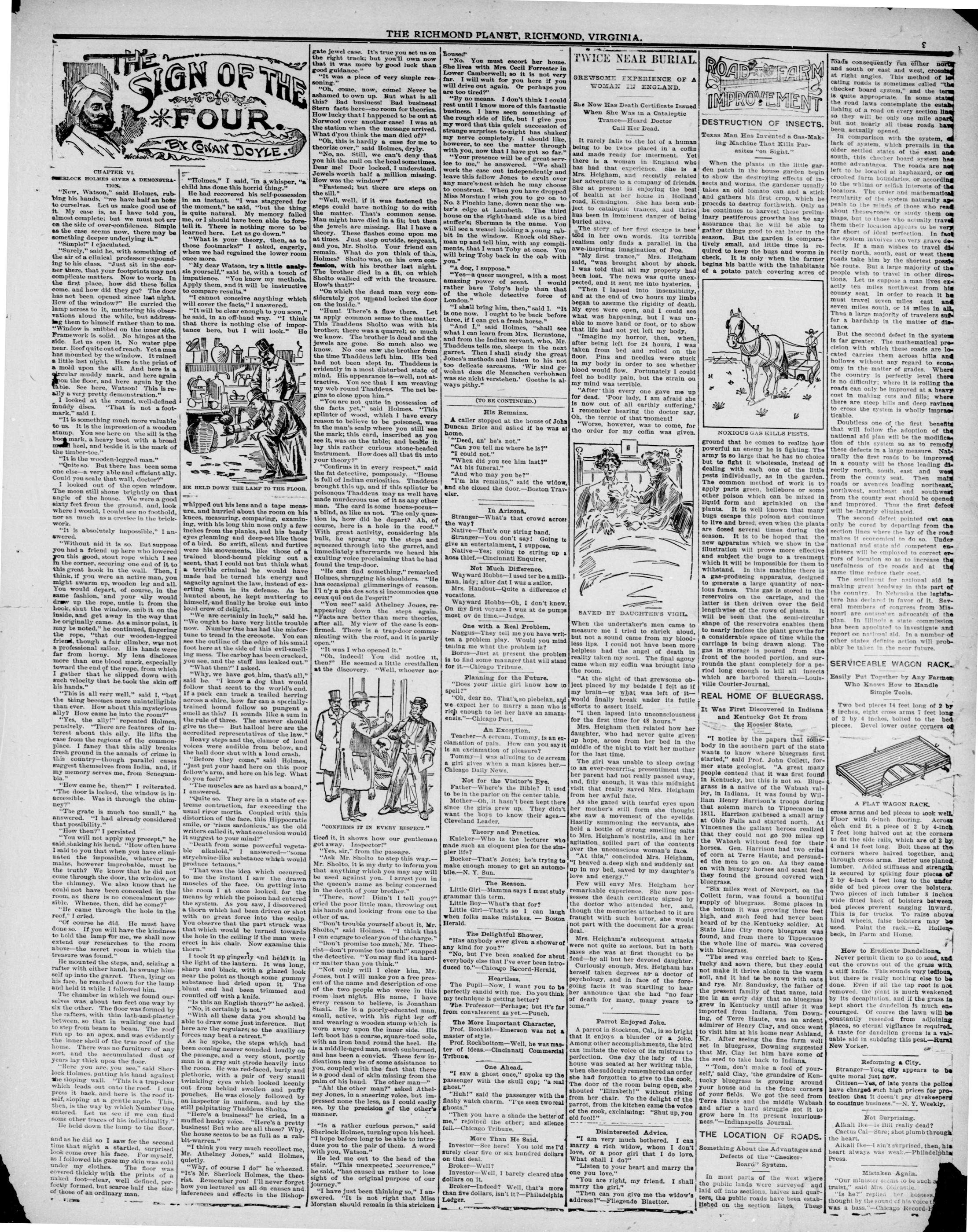
HE HELD DOWN THE LAMP TO THE FLOOR.
whipped out his lens and a tape measure, and hurried about the room on his knees, measuring, comparing, examining, with his long thin nose only a few inches from the planks, and his beady eyes gleaming and deep-set like those of a bird. So swift, silent and furtive were his movements, like those of a trained blood-hound picking out a scent, that I could not but think what a terrible criminal he would have made had he turned his energy and sagacity against the law, instead of exerting them in its defense. As he hunted about, he kept muttering to himself, and finally he broke out into loud crow of delight.
"We are certainly in luck," said he. "We ought to have very little trouble now. Number One has had the misfortune to tread in the creosote. You can see the outline of the edge of his small foot here at the side of this evil-smilking mess. The carboy has been cracked, you see, and the stuff has leaked out." "What then?" I asked.
"Why, we have got him, that's all," said he. "I know a dog that would follow that sent to the world's end. If a pack can truck a trailed herring across a shire, how far can a specially-trained hound follow so pungent a smell as this? It sounds like a sum in the rule of three. The answer should give us the— But halloo! here are the accredited representatives of the law." Heavy steps and the, clamor of loud voices were audible from below, and the hall door shut with a loud crash. "Before they come," said Holmes, "just put your hand here on this poor fellow's arm, and here on his leg. What do you feel?" "The muscles are as hard as a board," I answered. "Quite so. They are in a state of extreme contraction, far exceeding the usual rigor mortis. Coupled with this distortion of the face, this Hippocratic smile, or 'risus sardonicus,' as the old writers called it, what conclusion would it suggest to your mind?"
"Death from some powerful vegetable alkaloid," I answered—"some strychnine-like substance which would produce tetanus."
"That was the idea which occurred to me the instant I saw the drawn muscles of the face. On getting into the room I at once looked for the means by which the poison had entered the system. As you saw, I discovered a thorn which had been driven or shot with no great force into the scalp. You observe that the part struck was that which would be turned towards the hole in the ceiling if the man were erect in his chair. Now examine this thorn."
I took it up gingerly and held it in the light of the lantern. It was long, sharp and black, with a glazed look near the point as though some gummy substance had dried upon it. The blunt end had been trimmed and rounded off with a knife.
"Is this an English thorn?" he asked.
"No, it certainly is not."
"With all these data you should be able to draw some just inference. But here are the regulars; so the auxiliary forces may beat a retreat."
As he spoke, the steps which had been coming nearer sounded loudly on the passage, and a very stout, portly man in a gray suit strode heavily into the room. He was red-faced, burly and plethoric, with a pair of very small twinkling eyes which looked keenly out from behind swollen and puffy pouches. He was closely followed by an inspector in uniform, and by the still palpitating Thaddeus Sholto.
"Here's a business!" he cried, in a muffled husky voice. "Here's a pretty business! But who are all these? Why, the house seems to be as full as a rabbit-warren."
"I think you very much recollect me, Mr. Athelney Jones," said Holmes, quietly.
"Why, of course I do!" he wheezed. "It's Mr. Sherlock Holmes, the theorist. Remember you! I'll never forget how you lectured us all on causes and inferences and effects in the Bishop
THE RICHMOND PLANET, RICHMOND, VIRGINIA
gate jewel case. It's true you set us on the right track; but you'll own now that it was more by good luck than good guidance."
"It was a piece of very simple reasoning."
"Oh, come, now, come! Never be ashamed to own up. But what is all this? Bad business! Bad business! Stern facts here—no room for theories. How lucky that I happened to be out at Norwood over another case! I was at the station when the message arrived. What d'you think the man died of?" "Oh, this is hardly a case for me to theorize over," said Holmes, dryly.
"No, no. Still, we can't deny that you hit the nail on the head sometimes. Dear me! Door locked, I understand. Jewels worth half a million missing. How was the window?"
"Fastened; but there are steps on the sill."
"Well, well, if it was fastened the steps could have nothing to do with the matter. That's common sense. Man might have died in a fit; but then the jewels are missing. Hal I have a theory. These flashes come upon me at times. Just step outside, sergeant, and you, Mr. Sholto. Your friend can remain. What do you think of this, Holmes? Sholto was, on his own confession, with his brother last night. The brother died in a fit, on which Sholto walked off with the treasure. How's that?" "On which the dead man very considerately got up and locked the door on the inside."
"Hum! There's a flaw there. Let us apply common sense to the matter. This Thaddeus Sholto was with his brother; there was a quarrel; so much we know. The brother is dead and the jewels are gone. So much also we know. No one saw the brother from the time Thaddeus left him. His bed had not been slept in. Thaddeus is evidently in a most disturbed state of mind. His appearance is—well, not attractive. You see that I am weaving my web round Thaddeus. The net begins to close upon him."
"You are not quite in possession of the facts yet," said Holmes. "This splinter of wood, which I have every reason to believe to be poisoned, was in the man's scalp where you still see the mark; this card, inscribed as you see it, was on the table; and besie lay this rather curious stone-headed instrument. How does all that fit into your theory?"
"Confirms it in every respect," said the fat detective, pompously. "House is full of Indian curiosities. Thaddeus brought this up, and if this splinter be poisonous Thaddeus may as well have made murderous use of it as any other man. The card is some hocus-pocus—a blind, as like as not. The only question is, how did he depart? Ah, of course, here is a hole in the roof." With great activity, considering his bulk, he sprang up the steps and squeezed through into the garret, and immediately afterwards we heard his exulting voice proclaiming that he had found the trap-door.
"He can find something," remarked Holmes, shrugging his shoulders. "He has occasional glimmerings of reason. I'll n'y a pas des sots si incommodes que ceux qui ont de l'esprit."
"You see!" said Athelney Jones, reappearing down the steps again. "Facts are better than mere theories, after all. My view of the case is confirmed. There is a trap-door communicating with the roof, and it is partly open." "It was I who opened it." "Oh, indeed! You did notice it, then?" He seemed a little crestfallen at the discovery. "Well, whoever no-
"CONFIRMS IT IN EVERY RESPECT."
ticed it, it shows how our gentleman got away. Inspector!"
"Yes, sir," from the passage.
"Ask Mr. Sholto to step this way.—Mr. Sholto, it is my duty to inform you that anything which you may say will be used against you. I arrest you in the queen's name as being concerned in the death of your brother."
"There, now! Didn't I tell you?" cried the poor little man, throwing out his hands and looking from one to the other of us.
"Don't trouble yourself about it, Mr. Sholto," said Holmes. "I think that I can engage to clear you of the charge."
"Don't promise too much, Mr. Theorist—don't promise too much!" snapped the detective. "You may find it a harder matter than you think."
"Not only will I clear him, Mr. Jones, but I will make you a free present of the name and description of one of the two people who were in this room last night. His name, I have every reason to believe, is Jonathan Small. He is a poorly-educated man, small, active, with his right leg off and wearing a wooden stump which is worn away upon the inner side. His left boot has a coarse, square-toed sole, with an iron band round the heel. He is a middle-aged man, much sunburned, and has been a convict. These few indications may be of some assistance to you, coupled with the fact that there is a good deal of skin missing from the palm of his hand. The other man—" "Ahl the other man" asked Athelney Jones, in a sneering voice, but impressed none the less, as I could easily see, by the precision of the other manner.
"Is a rather curious person," said Sherlock Holmes, turning upon his heel. "I hope before long to be able to introduce you to the pair of them. A word with you, Watson."
He led me out to the head of the stair. "This unexpected occurrence," he said, "has caused us rather to lose sight of the original purpose of our journey."
"I have just been thinking so," I answered. "It is not right that Miss Morstan should remain in this stricken
"Louse?"
"No. You must escort her home. She lives with Mrs Cecil Forrester in Lower Camberwell; so it is not very far. I will wait for you here if you will drive out again. Or perhaps you are too tired?"
"By no means. I don't think I could rest until I know more of this fantastic business. I have seen something of the rough side of life, but I give you my word that this quick succession of strange surprises to-night has shaken my nerve completely. I should like, however, to see the matter through with you, now that I have got so far."
"Your presence will be of great service to me," he answered. "We shall work the case out independently and leave this fellow Jones to exult over any mare's-nest which he may choose to construct. When you have dropped Miss Morstan I wish you to go on to No. 3 Pinchin lane, down near the water's edge at Lambeth. The third house on the right-hand side is a bird stuffer's; Sherman is the name. You will see a weasel holding a young rabbit in the window. Knock old Sherman up and tell him, with my compliments, that I want Toby at once. You will bring Toby back in the cab with you."
"A dog, I suppose."
"Yes—a queer mongrel, with a most amazing power of scent. I would rather have Toby's help than that of the whole detective force of London."
"I shall bring him, then," said I. "It is one now. I ought to be back before three, if I can get a fresh horse."
"And I," said Holmes, "shall see what I can learn from Mrs. Bernstone, and from the Indian servant, who, Mr. Thaddeus tells me, sleeps in the next garret. Then I shall study the great Jones's methods and listen to his not too delicate sarcasms. 'Wir sind gewohnt dass die Menschen verhohnen was sie nicht verstehen.' Goethe is always pithy."
(TO BE CONTINUED.)
His Remains
A caller stopped at the house of John Duncan Brice and asked if he was at home.
"Deed, an' he's not."
"When did you see him last?"
"At his funeral."
"And who may you be?"
"I'm his remains," said the wldow,
and she closed the door.—Boston Traveler.
In Arizona.
Stranger—What's that crowd across the way?
Native—That's our string band.
Stranger—You don't say! Going to give an entertainment, I suppose.
Native—Yes; going to string up a hoss thief—Cincinnati Enquirer.
Not Much Difference.
Wayward Hobbs—Iused ter be a milkman, lady; after dat I wuz a sallor.
Mrs. Handout—Quite a difference of vocations.
Wayward Hobbs—Oh, I don't know.
On my first voyage I wuz at de pumps most ov de time.—Judge.
One with a Real Problem
Naggus—They tell me you have written a problem play. Would you mind teasing me what the problem is?
Borus—Just at present the problem is to find some manager that will stand for it.—Chicago Tribune.
Planning for the Future.
"Does your little girl know how to spell?"
"Oh, dear no. That's so plebian, and we expect her to marry a man who is rich enough to let her have an amanuensis."—Chicago Post
An Exception.
Teacher—A scream, Tommy, is an exclamation of pain. How can you say it is an exclamation of pleasure?
Tommy—I was alluding to de scream a girl gives when a man kisses her.—Chicago Daily News.
Not for the Visitor's Eye.
Father—Where's the Bible? It used to be in the parlor on the table.
Mother—Oh, it hasn't been kept there since the girls grew up. They didn't want the boys to know their ages.—Cleveland Leader.
Theory and Practice
Nklucker—Who is the lecturer who made such an eloquent plea for the simpler life?
Bocker—That's Jones; he's trying to make enough money to get an automobile—N. Y. Sun.
The Reason
Little Girl—Mamma says I must study grammar this term.
Little Boy—What's that for?
Little Girl—That's so I can laugh when folks make mistakes. — Boston Herald.
The Delightful Shower.
"Has anybody ever given a shower of any kind for you?" "No, but I've been soaked for about everybody else that I've ever been introduced to." — Chicago Record-Herald.
Heartless
The Pupil—Now, I want you to be perfectly candid with me. Do you think my technique is getting better?
The Professor—Perhaps; but it's far from convalescent as yet—Punch.
The More Important Character.
Prof. Bookish—Emerson was not a master of style.
Prof. Rockbottom—Well, he was master of ideas.—Cincinnati Commercial Tribune.
One Ahead.
"I saw a ghost once," spoke up the passenger with the skull cap; "a real ghost."
"Huh!" said the passenger with the flashy watch charm. "I've seen two real ghosts."
"Then you have a shade the better of me," rejoined the other; and silence fell—Chicago Tribune.
More Than He Said
Investor—See here! You told me I'd surely clear five or six hundred dollars on that deal.
Broker—Well?
Investor—Well, I barely cleared nine dollars on it.
Broker—Indeed? Well, that's more than five dollars, isn't it?—Philadelphia Ledger.
GREWSOME EXPERIENCE OF A WOMAN IN ENGLAND.
It rarely falls to the lot of a human being to be twice placed in a coffin and made ready for interment. Yet there is a woman in England who has had that experience. She is a Mrs. Heigham, and recently related her adventure to a company of friends. She at present is enjoying the best of health at her home in Holland road, Kensington. She has been subject to catalytic trances, and thrice has been in imminent danger of being buried alive.
The story of her first escape is best told in her own words. Its terrible realism only finds a parallel in the awe-inspiring imagination of Poe.
"My first trress," Mrs. Heigham said, "was brought about by shock. I was told that all my property had been lost. The news was quite unexpected, and it sent me into hysteria.
"I imagine my horror, then, when, after being left for 24 hours, I was taken from bed and rolled on the floor. Pins and needles were stuck in my body in order to see whether blood would flow. Fortunately I could feel no bodily pain, but the strain on my mind was terrible.
"After this every one gave me up for dead. 'Poor lady, I am afraid she is now out of all earthly suffering.' I remember hearing the doctor say. Oh, the terror of that moment!
"Worse, however, was to come, for the order for my coffin was given
C.
SAVED BY DAUGHTER'S VIGIL
When the undertaker's men came to measure me I tried to shriek aloud, but not a sound came from my bloodless lips. I could not have been more helpless the angel of death in reality taken my soul. The final agony came when my coffin was brought into the room.
"At the sight of that grewsome object placed by my bedside I felt as if my brain—or what was left of it—would finally break under its futile efforts to assert itself.
"I then lapsed into unconsciousness for the first time for 48 hours."
Mrs. Heighlam then related how her daughter, who had never quite given up hope, arose from her bed in the middle of the night to visit her mother for the last time.
The girl was unable to sleep owing to an ever-recurring presentiment that her parent had not really passed away, and, fitly enough, it was this midnight visit that really saved Mrs. Heigham from her awful fate.
As she gazed with tearful eyes upon her mother's still form she thought she saw a movement of the eyelids. Hastily summoning the servants, she held a bottle of strong smelling salts to Mrs. Heigham's nostrils, and in her agitation spilled part of the contents over the unconscious woman's face.
"At this," concluded Mrs. Heigham, "I heaved a deep sigh and suddenly sat up in my bed, saved by my daughter's love and energy."
Few will envy Mrs. Heigham her remarkable experience. She now possesses the death certificate signed by the doctor who attended her, and, though the memories attached to it are fraught with such horror, she would not part with the document for a great deal.
Mrs. Heigham's subsequent attacks were not quite so serious, but in both cases she was at first thought to be dead—by all but her devoted daughter. Curiously enough, Mrs. Heigham has herself taken degrees as a doctor of psychology, and in face of the foregoing facts it was startling to hear her announce that she had "no fear of death for many, many years to come."
Parrot Enjoyed Joke
A parrot in Stockton, Cal., is so bright that it enjoys a blunder or a joke. Among other accomplishments, the bird can imitate the voice of its mistress to perfection. One day the lady of the house was seated at her writing table, when she suddenly remembered an order she had forgotten to give to the cook. The door of the room being open, she shouted "Elizabeth!" without rising from her chair. To the delight of the parrot, from the kitchen came the voice of the cook, exclaiming: "Shut up, you old fool!"
Disinterested Advice
"I am very much bothered. I can marry a rich widow, whom I don't love, or a poor girl that I do love. What shall I do?" "Listen to your heart and marry the one you love."
"You are right, my friend. I shall marry the girl."
"Then can you give me the widow's address?"—Flegende Blatter.
ROAD FARM IMPROVEMENT
When the plants in the little garden patch in the house garden begin to show the destroying effects of insects and worms, the gardener usually takes an old tomato can and a stick and gathers his first crop, which he proceeds to destroy forthwith. Only as he continues to harvest these preliminary pestiferous growths has he any assurance that he will be able to gather things good to eat later in the season. But the garden is comparatively small, and little time is required to keep the bugs and worms in check. It is only when the farmer begins his battle with the inhabitants of a potato patch covering acres of
NOXIOUS GAS KILLS PESTS.
ground that he comes to realize how powerful an enemy he is fighting. The army is so large that he has no choice but to fight it wholesale, instead of dealing with each one of the little pests individually, as in the garden. The common method of work is to apply paris green, hellebore or some other poison which can be mixed in liquid form and sprinkled on the plants. It is well known that many bugs escape this poison and continue to live and breed, even when the plants are dosed several times during the season. It is to be hoped that the new apparatus which we show in the illustration will prove more effective and subject the bugs to a treatment which it will be impossible for them to withstand. In this machine there is a gas-producing apparatus, designed to generate a large quantity of noxious fumes. This gas is stored in the reservoirs on the carriage, and the latter is then driven over the field lengthwise of the rows of plants. It will be seen that the semi-circular shape of the reservoirs enables them to nearly inclose the plant growths for a considerable space of time while the carriage is being drawn along. The gas in storage is poured from the front of the hooded portion, and surrounds the plant completely for a period long enough to kill all insects which are harbored therein—Louisville Courier-Journal.
REAL HOME OF BLUEGRASS.
"I notice by the papers that somebody in the southern part of the state wants to know where bluegrass first started," said Prof. John Collett, former state geologist. "A great many people contend that it was first found in Kentucky, but this is not so. Bluegrass is a native of the Wabash valley, in Indiana. It was found by William Henry Harrison's troops during that solemn march to Tippecanoe in 1811. Harrison gathered a small army at Ohio Falls and started north. At Vincennes the gallant heroes realized that they could not go 200 miles up the Wabash without feed for their horses. Gen. Harrison had two cribs of corn at Terre Haute, and persuaded the men to go on. As they came on with hungry horses and scant feed they found the ground covered with bluegrass.
"Six miles west of Newport, on the Collett farm, was found a bountiful supply of bluegrass. Some places in the bottom it was growing three feet high, and such feed had never been heard of by the Kentucky soldier. At State Line City more bluegrass was found, and from there to Tippaconea the whole line of marc. was covered with bluegrass.
"The seed was carried back to Kentucky and sown there, but they could not make it thrive alone in the warm soil, and it had to be sown with oats and rye. Mr. Sandusky, the father of the present family of that name, told me in an early day that no bluegrass grew in Kentucky until after it was imported from Indiana. Tom Downing, of Terre Haute, was an ardent admirer of Henry Clay, and once went to visit him at his home near Ashland, Ky. After seeing the fine farm well set in bluegrass, Downing suggested that Mr. Clay let him have some of the seed to take back to Indiana.
"Tom, don't make a fool of yourself," said Clay, 'the grandisse of Kentucky bluegrass is growing around your house and in the fence corners of your fields. We got the seed from Terre Haute and the middle Wabash and after a hard struggle got it to grow here in its present luxuriousness." -Indianapolis Journal.
THE LOCATION OF ROADS.
Something About the Advantages and Defects of the "Checker-
Board" System.
In most parts of the west where the public lands were surveyed and laid off into sections, halves and quarters, the public roads have been established on the section lines. These
Roads consequently run either north and south or east and west, crossing at right angles. This method of locating roads is sometimes called "the checker board system," and the term is quite appropriate. In some states the road laws contemplate the establishing of a road on every section line so they will be only one mile apart but not nearly all these roads have been actually opened.
In comparison with the system, no lack of system, which prevails in the older settled states of the east and south, this checker board system has some advantages. The roads are not left to be located at haphazard, or crooked farm boundaries, or according to the whims or selfish interests of the locators. The order and mathematical regularity of the system naturally appeals to the minds of those who read about these roads or study them on maps, but to those who actually travel them their location appears to be very far short of ideal perfection. In fact the system involves two very grave defects. If a man wishes to travel directly north, south, east or west these roads take him by the shortest possible route. But a large majority of the people wish to travel in other directions. Let us suppose a man lives exactly ten miles northwest from his county seat. In order to reach it he must travel seven miles east and seven miles south, or 14 miles in all. Thus a large majority of travelers suffer a hardship in the matter of distance.
But the second defect in the system is far greater. The mathematical precision with which these roads are located carries them across hills and hollows without any regard to economy in the matter of grades. Where the country is perfectly level there is no difficulty; where it is rolling the roads can only be improved at a heavy cost in making cuts and fills; where there are steep hills and deep ravines to cross the system is wholly improducible.
Doubless one of the first benefits that will follow the adoption of the national aid plan will be the modification of this system so as to remedy these defects in a large measure. Naturally the first roads to be improved in a county will be those leading directly north, south, east and west from the county seat. Then main roads or avenues leading northeast, northwest, southeast and southwest from the county seat should be opened and improved. Thus the first defect will be largely eliminated.
The second defect pointed out can only be cured by departing from the section lines where the lay of the road makes it economical to do so. Under national and state aid competent engineers will be employed to correct errors of location so as to increase the usefulness of the roads and at the same time reduce their cost.
The sentiment for national aid is making great headway in this part of the country. In Nebraska the legislature has declared in favor of it. Several members of congress from Missouri are outspoken advocates of the plan. In Illinois a state commission has been appointed to investigate and report on national aid. In a number of other states definite action will probably be taken in the near future.
SERVICEABLE WAGON RACK.
Two bed pieces 14 feet long of 2 by 8 inches, eight cross arms 7 feet long of 2 by 4 inches, bolted to the bed pieces. Bevel lower outer corners of
A FLAT WAGON BACK
cross arms and bed pieces to look well
Floor with 6-inch flooring. Across
each end fit a piece of 2 by 4-inch
7 feet long halved out at the corners
to fit the side rails, which are of 2 by
4 and 14 feet long. Bolt these at the
corners where halved together, and
through cross arms. Better use planed
lumber. Added stiffness and strength
is secured by spiking four pieces of
2 by 4-inch 4 feet long to the under
side of bed pieces over the bolsters.
Two pieces of inch lumber 8 inches
wide fitted back of bolsters between
bed pieces prevent sagging inward.
This is for trucks. To raise above
hind wheels, false bolsters may be
used. Paint the rack.—E. Hollenbeck, in Farm and Home.
How to Eradicate Dandelion
How to Eradicate Dandelions. Never permit them to go to seed, and cut the crowns out of the grass with a stiff knife. This sounds very tedious, but there is really nothing else to be done. Even if all the tap root is not removed, the plant is much weakened by its decapitation, and if the grass is kept short the dandelion is much encouraged. Of course the lawn will be constantly reseeded from adjoining places, so eternal vigilance is required. A taste for dandelion greens is a valuable aid in subduing this pest.—Rural New Yorker.
Reforming City
Stranger—Your city appears to be quite moral just now.
Citizen—Yes, of late years the police have charged such high prices for protection that it doesn't pay dekeepers to continue business."—N. Y. Weekly.
Not Surprising:
Alkali Ike—Iis Bill really dead?
Cactus Cal-Sure; shot plumb through the heart.
Alkali Ike—I ain't surprised, then, his heart always was weak.—Philadelphia Press.
Mistaken Again
"Our minister seems to be such trulist," said Mrs. Oldcastle. "Is he?" replied her hostess thought by the sound of his voice it was a bass."—Chicago Record-H
THE PLANET
Published every Saturday by John B. Co.
JR. at all North 4th Street Richmond, Va.
JOHN MITCHELL, JR., - EDITOR
All communications intended for publication
should be sent so as to reach us by Wednesday
ADVERTISING RATES
THERE ARE FOUR WAYS by which money can be paid at mail or at邮局.—In a Post Office Mortgage, an An Ex Money Order and when money there can be procured, in a Registered Letter. MONEY ORDERS—Yon can buy a Money Ordn at your Post Office, payable at the Richmond Office, and we will be responsible for it. EXPRESS MONEY ORDERS can be occluded at the office of the American Express. So, the United States Express Co. and the Web. Far more convenient for money sent by any of these companies. The Express Money Order is a safe convenient way for forwarding money. REGISTERED LETTER—If a Money Order is registered, your Postmaster will Register the letter you wish to send on payment of ten dollars. Then, if the letter is lost or stolen, you can car send money in this manner at our risk. We cannot be responsible for money sent in any other way than one of the four ways mentioned above. If you send your mom or other way, you must do it at your risk.
REWARDS, TPC.—If you do not want The
LANET continued for another year after your
description has run out, you then notify us by
email or telephone to inform us. The courts have
deemed that subscriptions to newspapers who
order their paper discontinued at the expo-
dation of time for which it has been paid are
available for the payment of the subscription
to when they order the paper discontinued.
COMMUNICA.—When writing to a
person your subscription or to discontinue
paper, you should give your name and no
address, otherwise we cannot send you.
CHARGE OF ADDRESS.—In order to enclose
address of a subscriber, we must be se-
cured to us as well as the present address.
Entered in the Post Office at
SATURDAY . . . . JULY 23, 1904
THE STREET-CAR COMPANY
"BUSTED."
The long expected has happened and the street-car company of this city has been forced to admit that it is unable to pay its expenses. That this result in a large measure was brought about by the walking colored people admits of no question. The company alleged that the "Jim Crow" arrangement was necessary in order to keep the company out of the hands of the receivers, and consequent bankruptcy. We were confident that if the colored people would maintain their self-respect, and walk and sweat that it would result in the financial collapse of the street-car company. This prediction has been verified.
The Citizens Mass meeting advised the colored people to walk, and to those who would ride, the advice was given that they obey the law. As a result, numbers of white people have been arrested and fined and but one colored resident of this city has been the victim. This will be an object lesson to the Negro-hating management of the Virginia Passenger and Power Company. The entire electric railway system of Richmond, Manchester and Petersburg is now being operated by the United States District Court, Judge Edmund Waddeell, JR., presiding.
The receivers are Mr. WILLIAM NORTHROP and Hon. HENRY T. WICKHAM. It remains to be seen whether they will continue a system of operation which has proved injurious to the financial interests of the company, and directly disastrous to the income of the bondholders of the aggregated railway corporations.
The objectionable card should come down and the rules which are admitted failures should be obliterated from the cars of the street-car company.
Colored folks will yet see the red-flag over the street-car system, and until they are properly treated will walk from one end of this city to the other.
The street-car company is "busted." The colored people were instrumental in hastening its down-fall. Walking is good now. We are as yet staying off the street-cars.
JUDGE SPEER'S GREAT OPINION.
THE opinion of Judge EMORY SPEER delivered in the United States District Court of Georgia June 28, '04 in the case of HENRY JAMISON (colored) versus E. A. WIMBISH, Superintendent involving the rights of the petitioner under the Fourteenth Amendment to the Constitution of the United States is the most far-reaching decision delivered since the Civil War.
JAMISON, a respectable colored man was fined $60.00 for disorderly conduct while under the influence of liquor.
Being unable to pay the fine, he was sent to the penitentiary by the Recorder of the Police Court of Macon, Georgia, to work in the chain gang and wear stripes. He was not accorded a jury trial. His counsel, Mossis, ALEXANDER AKERMAN and CHARLES AKERMAN sued out a writ of habeas corpus and brought the c se before Judge EMORY SPEER of the United States District Court, alleging that JAMISON had been deprived of his liberty without due process of law. The very remarkable opinion was rendered and JAMISON was discharged from custody. This involves a very delicate question and emphasizes the fact that there are cases where the Federal Constitution can be invoked and a respect for its decrees maintained even to the point of nullifying the decrees of a state court.
That JAMISON had influential southern white friends is evident and no where have we seen any regret expressed that he was relieved from further punishment. The opinion is unquestionably a valuable addition to the legal literature of this generation. It sets a pace which no doubt other jurists may be induced to practice. The eloquently rounded sentences tell in no uncertain manner the intense feeling and the patriotic spirit which actuated the great man who delivered this phillipic. Let us hope that it marks the beginning of a new era and the mighty influence of the ringing declarations may penetrate the classic confines of the United States Supreme Court at Washington and awaken a reverberation from the supreme tribunal itself
It may be that the champions of human liberty shall come from the South and that the chief of them all will yet be found wearing the judicial ermine of Judge EMONY SPEER of Georgia.
RUSSIA DEFEATED IN FIERCE FIGHT
21 Battalions Thrown Against Japs Were Repulsed.
RUSSIANS LOST OVER 1000 MEN
Count Keller's Troops Engaged Enemy In Mountain Pass, and After Hard Fight Were Driven Back — Was a Reconnaissance on a Large Scale.
St. Petersburg, July 19.—The P russian and Japanese forces which are lined up expecting a clash grappled in a serious fight Sunday morning according to a report from General Kuropatkin received here late last night. The report indicated that the Japanese misinterpreted the movement and that lasted of it being an attempt to take Mo Tien Pass it was a reconnaissance on a large scale.
An important fact developed by the reconnaissance was the exact location of a powerful Japanese force secreted in the region between Fen Shul and Mo Tien Passes. Its strength is indicated by the fact that 21 battalions were insufficient to permanently force the Japanese positions, though some of them were occupied temporarily. On the other hand it would appear from the report that the Japanese were either disinclined or unable to follow Lieutenant General Keller when he retired to his former position at Ikhavan. The seriousness of the day's fighting is shown in General Keller's estimate that the Russian casualties were over 1000. General Kuropatkin's report is as follows:
"After the occupation by General Kuroki's army of the passes in the Fenshul mountain chain, our information concerning his forces and dispositions was in general inadequate. According to some reports, his army had been reinforced and he had even extended his forces to Saimatsza. Other reports stated that a displacement of his troops had been made in the direction of Ta Pass and Siuyen. There were even indications that Kuroki had transferred his headquarters from Tskhakhekan to Toulnpu.
"On July 17, in order to determine the strength of the enemy, it was decided to advance against his position in the direction of Lian Shan Kwan. Lleutenant General Count Keller had been instructed not to start with the object of capturing the pass, but to act according to the strength of the force he would find opposed to him.
"The left column of this expeditionary force, consisting of three battalions, was dispatched towards Sibey Pass. The centre column, commended by Major General Kashtalinsky, consisting of 14 battalions, with 12 guns, was destined to attack Siaokao Pass, the heights surmounted by the temple, and Wafarkwan Pass. The right column, one battalion strong, was occupying points where the roads leading to Sinkia and Lakho Passes cross, in order to cover the right flank of General Kashtalinsky's column. The general reserve was left at Ikhavuen, and a portion of the force occupied a position at that place.
"At 10 p. m., July 16, the head of the column advanced from Ikhavuan. At 11 o'clock a battalion of the second regiment dislodged a Japanese outpost at the point of the bayonet at the crossing of the Lakho and the Sinkla roads. The details of this engagement have not yet been verified, but its general course, according to telegraphic reports sent in by General Keller was as follows:
"During the night the Japanese had evacuated Siaokao Pass and the heights surmounted by the temple, leaving only outposts there. At dawn General Kashiallinsky's column occupied these passes, driving back the Japanese advance posts.
"At about 5.30 on the morning of July 17 the Japanese in considerable strength and with numerous guns occupied Wafankwan Pass and the moun-
THE RICHMOND PLANET, RICHMOND, VIRGINIA.
talious blufs to the south on the flank of General Kashtalinsky's column. From this position and from the crest of the mountains to the east of the heights surmounted by the temple, the enemy directed a very heavy rifle and artillery fire.
"General Kashtalinsky advanced to occupy the blufs, sending forward at first one and then three battalions, but the attempt failed, notwithstanding the support given by the horse mountain battery, as our field guns could not be brought into action on account of the nature of the ground.
"At about 8 a. m. General Keller, who was directing the fight around Ikhavuen, deemed it necessary to lend assistance to General Kashtalinsky's column by bringing up from the general reserve three battalions to the heights surmounted by the temple. In order to maintain the positions we had already occupied it was necessary, owing to the enemy's pressure, to reinforce immediately with other reserves the troops in the fighting line, but these positions, owing to their situation, were untenable.
"General Keller found the strength of the enemy so great compared with ours that he decided not to continue the fight and not to bring up either the special or the general reserves, especially owing to the fact that in case of his ultimately taking the offensive it would be necessary to attack without support of the field artillery.
"In consequence of this General Keller decided about 10.30 to withdraw his troops to the positions originally occupied in the Yanze Pass. The troops retired slowly, step by step, and in perfect order, covered by the fire of a field battery which had been brought into action.
"Towards midday an offensive movement by the enemy in the direction of the right flank of the Yanze Pass position developed, and at the same time a Japanese mountain battery was brought into position in the village of Tsoudiaputse, two and a half miles south of Ikhavuen.
"After 34 shots had been fired from the third battery of the third brigade, which held the saddle to the south of Yanze Pass, the Japanese battery was finally reduced to silence.
"The fight ceased at 3 p. m., and the troops returned to Ikhavuen.
"The Japanese advance was stopped above the valley of the lantakhe river at a position occupied and maintained by us.
"In consequence of a sleepless night and the heat of the day, our troops were greatly fatigued, having been over 15 hours on foot and fighting.
"Our losses have not yet been exactly ascertained, but General Keller reports that they exceed 1000."
Japs Lost 299 Men.
Tokio, July 20.—The Japanese losses in the fighting at Mo Tien Pass and its vicinity Sunday were 299 killed or wounded. General Kuroki estimates that the Russians lost more heavily.
RUSSIANS AGAIN BEATEN
Reported They Lost 2100 Men In Sharp
Fighting, at Tongsuchi
Newchwang, July 20. -Hard fighting has been going on for several days in the neighborhood of Tongschu, eight miles east of Tatchekiao. It is reported that the Russian loss in Monday night's engagement was 2100 and the Japanese loss 1200. The Japanese also have been in active contact with the Russians east of Halcheng, where there have been many minor actions. All along Kuropattkin's front and flank the Japanese are moving into position, but the general attack is being postponed until supplies and reinforcements come to the front. Progress along the Mukden roads and mountain passes is slow.
4000 Japs Blown Up?
Chefoo, July 20.—A junk with eight Russians and 50 Chinese on board arrived here, five days from Port Arthur. The Russians refused to talk, but the Chinese say that on July 11 and 12 the Japanese captured and occupied with 4000 men one of the eastern forts near Port Arthur. Before reinforcements arrived the Russians cut off the 4000 troops in the fort and exploded mines which resulted in the killing of every Japanese soldier in the place.
Another Warship Through Bosphorus. London, July 20.—The Constantinople correspondent of the Daily Mail, in a dispatch dated July 18, says:
"A Russian cruiser has just passed through the Bosphorus from Odessa, with several guns covered with canvas on her deck. She also carried torpedo tubes.
The Suez correspondent of the Daily Mail, under date of July 19, says: "The German steamer Sambia, it is stated, has been seized by the Russians and is expected here tomorrow.
RUSSIA EXPECTS TROUBLE
Bellieves Seizure of Neutral Vessels Will Lead to Complications.
St. Petersburg, July 20.—The first impression in diplomatic circles here that the action of the Russian volunteer fleet vessels in stopping neutral ships in the Red Sea to search for contraband of war would not give rise to international complications, is being superseded by the impression, which there is good reason to believe is well founded, that, instigated by Great Britain, it will at least lead to an interchange of views between the powers signatory to the treaty of Paris regarding the status of the remaining ships of the volunteer fleet now in the Black Sea.
Thus the old question of the Dardanelles may again become the subject of important diplomatic communications. Great Britain's shipping being the most directly involved, the indications are that she will insist upon a definition of the status of the volunteer fleet vessels still in the Black Sea. As a forcible reminder of what stopping British ships involves, it is likely that Great Britain's preliminary move may be the presentation of claims for demurrage for the detention of all ships stopped.
Russian Governor Assassinated.
St. Petersburg, July 18.—The vice governor of Elisabethphol was assassinated last evening. The assassination
tion occurred at Algshakent, a small place in the southwest corner of the government of Elisabethpol, close to the Persian frontier.
Conscience-Stricken Thief
Philadelphia, July 19. — Declaring that he is a conscience-striken thief, a man, who gave his name as George McCulla, of Pittsburg, gave himself up to the Philadelphia police. He declares that he embezzled $250 from the United Presbyterian Publication Board, of which he had been assistant manager for 17 years. From Pittsburg he said he went to Atlantic City, Cape May and Coney Island, and further declared that love for his wife and children caused him to surrender to the police. He was held to await the action of the Pittsburg authorities.
Oscar Straus For Roosevelt
New York, July 20.—Oscar S. Straus, of this city, who describes himself as "a liberal Democrat and latterly a Cleveland Democrat," and who was minister to Turkey under Cleveland's first administration, has notified President Roosevelt of his determination to give him his support.
LOOMIS' DEATH A MYSTERY
*Found Dead, Washed Up By Sea,*
*Verdict of Corpse's Lux*
Verdict of Coroners Jury.
Kingsbridge, July 19. "Found dead,
washed up by the sea in Bigbury bay,
Devonshire," was the verdict of the
J.
FREDERICK KENT LOOMIS. coroner's jury in the inquest on the remains of F. Kent Loomis. The evidence was very inconclusive and wholly conjectural, as pointed out by the coroner when he advised this open verdict, adding that although death was caused by a blow, there was nothing to justify the suspicion that it was fouly administered. Consul Stephens, of Plymouth, has charge of the body, which is in a fair state of preservation. It will be embalmed and sent home for burial as early as practicable.
MINERS SEE PRESIDENT
Wilkesbarre Committee Present Petition On Colorado Strike. Oyster, Bay, L. L. July 20.—President Roosevelt received the committee appointed last Sunday by the convention of the coal miners and allied crafts at Wilkesbarre, Pa. The mission of the commission was to present personally to the president a petition reciting the conditions in which organized labor has been placed by the action of the authorities of Colorado and requesting him to institute an investigation of the labor troubles in that state, with a view, if possible, of remedying the conditions now existing.
The committee met the president at his Sagamore Hill home last evening. They passed half an hour with Mr. Roosevelt in his library. The petition, which was the expression of 225,000 men of the union labor organizations of Northeastern Pennsylvania, was laid before the president. He read it carefully and then informed them he would be glad to do anything he properly could do to ameliorate the conditions existing in the state of Colorado. He indicated that an investigation of the labor troubles in that state is now being made by agents of the department of commerce and labor. Thus far the situation had not been such as would warrant interference by the federal government.
SCHEDULE FOR RURAL CARRIERS
Under New Act Two-Thirds of Force Receives Amounts of $100
RECEIVES INCREASE OF $100.
Washington, July 19.—The new salary schedule for rural mail carriers has been completed. The new schedule applies from July 1. The last congress raised the maximum salary from $600 to $720 a year. It was found that the maximum route was 24 miles long, and to carriers on routes of this length, numbering about 12,000, the minimum salary will be paid. The salaries of carriers on routes shorter than the maximum was fixed by deducting $18 for each mile less than 24. The net result has been that slightly over two thirds of the whole force of 24,500 rural mail carriers have received increases of $100 a year in their salaries. The remaining carriers have received increases of less than this amount.
Snake's Fatal Appetite
Elmer, N. J., July 18.—A black snake seven feet long and with a rabbit partly swallowed in its widely stretched jaws was on exhibition in front of the post office. The reptile "bit off more than it could chew," and was nearly choked to death when discovered at Maple Bridge, in the borough, by John Ackley, who put it out of its misery with his riding whip.
Baltimore Shipping Wheat West.
Baltimore, Md., July 20.—For the first time since 1877 Baltimore has been called upon to ship wheat to the west approximately 100,000 bushels of No. 2 southern red wheat have been forwarded to millers as far west as Cincinnati. It is said that a large part of the early western wheat is in bad condition owing to unfavorable weather, and certain millers, in order to meet their orders for flour, have been compelled to use some southern
wheat until the better grades of the western cereal begins to arrive from their own section. Orders for southern wheat have also been received from New York and Pennsylvania points.
CRISIS IN THE MEAT STRIKE
Packers Must Arbitrate or Allied Trades Will Come Out
JOINT CONFERENCE PROPOSED
Chicago, July 20.—The crisis in the stock yards strike will come soon. The allied trades unions in the stock yards, which are certain to become involved in the controversy if it is not soon settled, held a conference lasting five hours, and at its conclusion sent a letter to the packers asking for a joint conference between representatives of the strikers, of the packers and of the allied trades, to see if a settlement of the strike along peaceful lines cannot be reached. There was nobody who would say that the packers would agree to the conference, and it is impossible to say with certainty that the meeting will be held.
Arthur Meeker, manager for Armour & Co., speaking for the other packers, as well as for his own establishment, said that he would send a reply to the letter from the representatives of the allied unions. He declined to say, however, what the nature of the reply would be. The unions joining in the request for the meeting represent all the trades engaged in the packing industry, and they have joined in a final appeal for arbitration between the packers and the striking butchers. President Donnelly, of the Butchers' Union, said that he was anxious to have peace, but that unless it came with the proposed conference there would be a general sympathetic strike on the part of the allied trades unions.
The letter was signed by representatives of the Coopers, Packing House Teamsters, Stationary Firemen, Stationary Engineers, Steam Fitters, Steam Fitters' Helpers, Electric Workers, Carpenters, Car Workers, Millwrights and Machinery Erectors, Blacksmiths and Horseshoers Unions. Both sides still claim to have the advantage in the strike. The packers assert that they are operating their plants almost to their full capacity, while the strikers contend that the packing trade throughout the country is practically demoralized. The packers also assert that there is no necessity for any advance in the prices of meat, and declare that it is simply a "hold-up" by the retail dealers.
FIGHTING THE PACKERS
Philadelphia Butchers to Discontinue
Suplying Them With Meat
Supplying Them With Meat.
Philadelphia, July 19.—The Amalgamated Meat Cutters' and Butcher Workmen's Association has decided to fight the Philadelphia branches of the western packing houses. Since the strike started local independent butchers have been supplying in a small way the Philadelphia branches of the various western houses. Richard Butler, of New York, secretary and treasurer of the Sheep Butchers' Local Union, No. 10, came to this city and sought to have all local independent butchers discontinue supplying the western houses with dressed meat. In return for this the union agrees to supply all the men the independent concern might need to carry on the increased business. The prominent independents are willing to enter such an agreement, and a general meeting of all local independents will be held tomorrow at 1 p. m. at the West Philadelphia abattoir, with a view of having all local butchers to enter into the agreement.
The independent butchers feel confident that they can supply the entire city with meat. If the strike continues for any length of time and an agreement is reached with the union to supply men, it is possible that Philadelphia will supply a portion of the Atlantic seaboard with dressed meat. The independents declare that the city has the facilities and that live stock is plentiful.
FIVE DEATHS FROM HEAT
Thermometer In Greater New York Reached 100 Degree Mark.
New York, July 20.—The hot wave which struck the city Monday, bringing death and prostration, increased yesterday to the highest temperature of the year and added more victims to the list. Five deaths from heat occurred in Brooklyn. Four of the dead were infants and the other was an aged man. In Manhattan there were 10 prostrations but no deaths.
The heat was greatest at 2 o'clock yesterday, when thermometers on the street reached the 100 degree mark. The humidity was 43.
The parks were filled with women and children seeking escape from the oven-like tenements, and every public bath in the city was crowded, with hundreds outside waiting their turn.
A WEEK'S NEWS CONDENSED.
Thursday, July 14.
Mrs. Mary Miller, aged 84 years, was run down by a trolley car at Harrisburg, Pa., and fatally iplured. The steamer Nemesis, with 31 persons aboard, has been lost in a storm off the coast of New South Wales. An unknown colored man was lynched at Clayton, La., for murderously assaulting the white foreman of a saw mill. Oscar L. Judd, of Newark, N. J., whose skull was fractured in an automobile accident at Providence, R. L., died from his injuries. Congressman John S. Williams, Democrat leader in the house, will make speeches in the doubtful states during the coming campaign.
Friday, July 15.
In a saloon row at Baltimore, Md., Tom Walsh was shot and killed by R. E. Nunnally as the result of old feud.
Frank Ousley and John Johnson, both colored, were hanged together at Pittsburgh for murder. The custom house at Santiago, Cuba, was robbed of $6800, the theft being by an expert, as the safe was uninjured. Cleveland, O., saloonkeepers have begun a suit to test the constitutionality of the new local option law in Ohio. The New York subway is now practically complete, and will be turned over to the Interborough Company by the contractor on August 1.
Saturday, July 16.
Chester Cuff, 13 years old, of Salem, N. J., died of lockjaw from injuries received on July 4.
A Paris dispatch says President Loubet will offer Secretary of State Hay the Grand Cross of the Legion of Honor.
A B. & O. grain elevator at Chicago, containing a large quantity of grain, was destroyed by fire, entailing a loss of $350,000.
Osceola Kyle, of Alabama, took the oath of office in Washington as judge in the Panama canal zone, and will sail from New York in a few weeks.
Monday. July 18.
Rev. John E. Dallam, of St. Paul, was appointed a chaplain in the United States army. A cyclone swept over Chippaqua, N. Y., destroying five dwellings and killing Mrs. Hibbs, aged 80 years. Dr. Victor Sunserberger and brother Max were drowned in Jamaica Bay at Canarsie, L. L., while wading. William E. Gordon, a Reading railroad conductor, fell from an engine at Landingville, Pa., and was killed. The plant of the Alabama Rift Roofing company, at Montgomery, Ala., was destroyed by fire, entailing a loss of over $200,000.
Tuesday, July 19.
An unknown negro was shot to death at Evansville, Ind., for fatally stabbing a white man.
Hot! Hot
"Do You Know
Place in Town Is
Reformer
Hot! Hot! Hot!
"Do You Know Where the Coolest Place in Town Is?" "Yes," at the Reformers' Store,
And You will be Served with a Glass of ICED TEA FREE."
PICNIC S
Large cans cooked Chicken.....
Lunch Tongue, 1 pound can.
Large box Mustard Sardines.
American Sardines, 6 boxes.
Baked Beans, 6 cans.
Potted Ham and Tongue, 6 cans.
Large Cans Salmon, 3 cans.
St. Bernard Salmon, 2 cans.
Large Jars Pickle, 3 jars.
Assorted Preserved, 3 jars.
Large cans Dried Beet, 2 cans.
Fine Jelly, 6 glasses.
Large cans best Lobsters, 1 can.
French Peas, can.
Large bottle Heinz Pickled Onions.
Large cans Apricots, can.
Best Lard, pound.
Fine Meat, pk.
Granulated Sugar, pound.
Fine Mixed Tea, pound.
Gloss Lump Staren, pound.
Large Mackerel, 7 for.
Good Luck Powders 1 pound can.
Good Luck Powders ½ pound can.
Jumbo Vinegar, bottle.
Dunlop Flour, sack.
Obelisk Flour, sack.
Reformers' Store,
Reformers' Store, 6th and Clay Sts.
PHONE 1299. — — RICHMOND, VA.
Chas. Briggs,
McGIRT
MAGA
$5. Per Da
JAMES E. McGIRT, Ph. B.
"THE NEW POET."
Editor-in-Chief and Owner of "McGirt's Magazine."
GREAT periodical publ
that we may have a pa
races, the white as we
race may know the many great
race and what they are saying.
Thousands of white, as well as the e
Some of them declare that they have lea
colored race through this Magazine than
a doubt this periodical is far in advance.
Each month it contains articles from the
are just as sure of making $5.00 per day
swering this advertisement.
Write at once that you may be the t
terms, outfit, and a large number of Ma
at once.
Subscription Price to ever
JAMES E. McGIRT,
GREAT periodical published every month in order that we may have a paper that will be read by both races, the white as well as the colored, that the white race may know the many great men and women of the colored race and what they are saying and doing.
Thousands of white, as well as the colored, read this Magazine every month. Some of them declare that they have learned more about the great men of the colored race through this Magazine than they ever knew before and that without a doubt this periodical is far in advance of anything yet attempted by the Negro. Each month it contains articles from the greatest writers of the race. Agents are just as sure of making $5.00 per day selling this Magazine as they are in answering this advertisement.
Write at once that you may be the first in the field. Send 50c. for agents' te rms, outfit, and a large number of Magazines, with which you may begin work at once. Subscription Price to every one is One Dollar Per Year. Write—
IAMES E. McGIRT. 420 S. 11th St., Phila Pa.
GOOD FOR SHOES
The purchaser of each Pair of Shoes
from $1 00 upwards entitles you to a
Coupon.
25 Coupons will get you a Pair of our
BEST $1.50 SHOES.
W. W. Russell, the American minister to Colombia, is very ill at the home of relatives near Rockville, Md.
Senator P. C. Knox, of Pennsylvania, consulted with President Roosevelt at Oyster Bay on campaign matters.
Dr. Isaac Roberts, the famous English astronomer, died at his home at Crowborough, Eng., aged 75 years.
Charles G. Rockwood, president of the National Newark (N. J.) Banking company, died at the age of 90 years.
As a result of a fight among Italians who were playing ball at Mount Vernon, N. Y., two of them were fatally beaten and stabbed. Many arrests were made.
Wednesday, July 20.
The national convention of the Ancient Order of Hibernians was held at St. Louis.
The local option election at Greensboro, N. C., resulted in a victory for the "drys" by a majority of 423.
The Mexican pavilion at the St. Louis World's Fair was struck by lightning during a storm and slightly damaged. Unable to endure the excessive heat Frank D. Evans, of Pittsgrove, N. J. shot himself to death while visiting in Philadelphia. Two empty life boats of the steamer Norge, which foundered June 28, off the coast of Scotland, were washed ashore on the Orkney Islands.
Delaware Guard Feels the Heat. Coch's Bridge, Cof., July 20. The intense heat is seriously interfering with the work of the Delaware National Guard encampment here. There is no protection from the sun. For fear of causing numerous cases of heat prostration much of the field work has had to be abandoned. Under the direction of Lieutenant Chrystle, of the Eighth United States Infantry, there were various company drills to perfect the men for the final competitive drills to determine what men will be sent to the regular army manoeuvres at Manassas in September.
Hot! Hot! How Where the Coolest Is?" "Yes," at the ers' Store,
McGIRT'S MAGAZINE. $5. Per Day Sure.
Agents are making $5.00 per Day Selling "McGIRT'S MAGAZINE."
published every month in order
to a paper that will be read by both
as well as the colored, that the white
great men and women of the colored
playing and doing.
As the colored, read this Magazine every month,
have learned more about the great men of the
one than they ever knew before and that without
advance of anything yet attempted by the Negro.
from the greatest writers of the race. Agents
per day selling this Magazine as they are in an-
pose the first in the field. Send 50c. for agents'
of Magazines, with which you may begin work
so every one is One Dollar Per Year. Write—
RT, 420 S. 11th St., Phila Pa.
BOARDING & LODGING.
Rates Reasonable. All the Comforts
of Home
Orders received by letter or telegraph.
MRS. BOOKER LEFTWICH,
PROPRIETRESS,
S16 N. 2d St.,
Richmond, Va.
---
M'g r.
ie |
aN TES.
Hoppe:
a ANG}
Rs ya
dj EN gos en
STi
=
Al EA
CR ee ee
‘Thto Thine outstretched hand
‘We lay it all;
t Only at Thy commana
' Can fi befall;
“And secret good must hide
‘In seeming ill,
‘Welcomed and loved, because
It is Thy will
‘Thy will, that takes the sting
From overy cares
‘Thy will, that Joy can bring
From our despatr;
‘Thy will, that turns to gai
Our shame and loss,
‘That lets the crown remain,
And takes our cross,
Dear Lord, Thy gracious will,
‘Once _undersiood,
‘We in Thy hands tie sti;
Make Thou us good.
No fear, no care have we,
No way, no choice:
‘Whate'er ‘Thy teaching be,
We must rejoice,
Even the rod is sweet
In Thy employ:
There can be at Thy feet
Nothing but Joy;
Annd naught but sweetest peace
In any smart,
For souls whose life ts hid
In God's great heart.
Washington Home Magazine,
ITS PERENNIAL POWER.
Christianity a Constant and Varied
Factor in Human Life—Old,
Yet Ever New,
Spring {s nature's revelation of
‘Vitality. There has been the hiding
of power during the winter, now there
4s the exhibition of latent strength.
‘The trees seem to say: “We will
show you that we are alive;” the
fields exult in their veréure, the little
flowers compel attention by their
fragrance and beauty.
The perennial power of nature as
@een in the springtide expression is
@ help to remind us of the same char-
acteristic resident im Christianity.
‘The crisis makes it manifest,
This perennial power is seen In the
ability of Christianity to show up
sin till we are disgusted with it.
With a microscope the water from
@ pond appears disqusting. Chris
lanitr acts as a lens to give moral
sight ind sin shocks as it did the
dying thief by Its contrasts:
‘The sainted Mrs. Ballington Booth's
Presence In a prison made men feel
a@ longing to be soul-pure. The, Bible
48 not fonnd Sn the saloon, ete, be.
cause of its power to convince of sin.
This perennial power is seen in
that Christianity does not only dis
gust with sin, it redeems from stn,
says Rey. John H. Davis, A. M, In
Christian Work. The microscope re-
Veals truth and sends us away dis-
gusted, the scientist comes and says:
Boll the water and Gestroy its in-
Jurious properties. Christianity to
the sin-sick soul says you can be made
Perfectly whole, because its mission
is to save the lost,
Paul said: “And you hath He made
alive who were dead in trespasses
and sins.” To-day the same power
persists in Chrivtisnity.
Darwin, great m his own realm,
and who had been dwelling on the age-
working processes of evolution, was
‘@mazed at the wonder working power
of missionary effort, A barbaric self-
eating people were transformed into a
self-respecting, peace-loving people In
about a decade. He at once sent £20
($100) to the missionary society and
continued to do so annually. That
Was a tribute to grace and not to evo-
lution. Christianity comes in be
tween cause and effect in such a mar-
velous manner that what would be,
cannot come. Love overleaps law in
its eagerness to redeem. To save the
lost is the great reason Christ gave
for His coming. The substitution of
evolution for redemption is a danger.
ous procedure; the teachings of Dar-
win do not include the sin problem.
Social progress is determined by Its
morality and morality is the result of
Christianity.
Then again, the perennial power of
Christianity is seen in its inflvence
tn creating tueals.
The protests against slavery were
effective. Those against the Importa-
tions of Chinese as slaves into Afriea
Fecently are sure to compel England
to remedy this evil.
‘The personal life Is elevated because
the Christian is never satisfied. Paut
wanted the prize of perfection in
Christ Jesus. The Christian, like the
Nautilus, must shed his shell and
build “more stately temples,” as Dr.
Holmes puts it.
Then again there is the perennial
Power of the eternal hope. Without
‘the bright visions of a better life this
World would be a dungeon to many.
The poor widow gives the last bread
to her children, and thinks of the
home where they hunger no more.
The hero and home builder struggles
on, hoping to hear the “Well done.”
He endures his daily battle “as seeing
him who is invisible,” and “he has
respect unto the recompense of the
reward.” The darling child has gone
‘and the broken-hearted parents are tn
‘agony till they hear the Scripture,
“there shall be no more death, neither
Sorrow nor crying,” ete, then they
take heart and sunshine comes into
their lives.
Ever fresh is the power of Chris-
tlanity to heal sin and bless man-
kind. Never will it he Inadequate to
effect all the moral changes necessary
the world’s transformation and
moral progress.
“Dear @ying Lamb, Thy prectous blood
Shall never tese its power
‘PU all the ransomed church of Goa
Be saved 9 sin no more”
CHRIST AND COMMON TASKS
The Latter May Be Digmified and Glo-
rifled Under the Touch and — -
Presence of the Master,
Doubtless there are thousands of
consecrated and zealous Christians
who, compelled to expend their chief
life-force upon piain tasks in humbie
spheres, are inclined to regret that
their place or calling is not more
friendly to spiritual development.
Here is, for instance, a spiritually as-
piring young man who Is troubled be-
cause his daily work, though innocent
im itself, serves as a constant drag
upon his spiritual nature instead of
an encouragement to his spiritual
rogress. How much easier it would
be to be a Christian, he has thought,
if he might be employed in writing ed
itorials for a religious magazine, or
teaching in a college, or preaching the
Gospel, instead of endlessly adding up
columns of figures. Here again is a
large-spirited woman who feels that
her life might become vastly more
helpful to the cause of her Master if
she could escape the drudgery of
household cares, and become a lecturer
or authoress—follow some line that
loots especially friendly to moral ex-
pansion and some spiritual fruitful-
‘ness.
|_ But, says Rev. George Francis
Greene, D. D., in the N. Y. Observer,
two things may be said. First of all,
‘these occupations that look most
friendly to the growth of the soul have
their own peculiar temptations to spir-
{tual depression; they are not always
in themselves as helpful to spiritual
rosress as they seem. And in the next
Place, the main question for a servant
of Christ is not what our work is but
the spirit In which we do it. It is quite
as easy for the worker to redeem his
work as it is for the work to glorify
the worker. Because there were saints
“of Caesar's household” there was a
breath of the fragrance of Heaven
about the very throne of Nero. Tent-
making in the hands of St. Paul be-
comes an employment fit for a king.
The garments created by a Dorcas look
as though stitched with threads’ of
gold. Watching a\flock of sheep be-
comes as sweet a work as the vocation
Of him who has the gift of tongues,
when angels sing to the shepherds from
the clouds.
HOW HE WON THE BOYS.
A Little Story That Will Encourage
and Help the Teacher of
Restless Boys.
|, A young man, fresh from a rural
town in the east, was asked to teach
a large class of boys in a mission
school in one of the worst districts in
a great western city. He was zealous
in the Master's work and not unaware
of the difficulties in the duty confront-
ing him. But he had been a boy him-
self and not so long ago, elther, and
this, he fancied, was fairly good equip-
ment for the task, as it was,
| But he began to fear that the species
before him was pecullar—that never
jhad he encountered anything similar
or having aught in common with speci-
mens of the geuus boy whose habitat
jis the slums of a large city. There
was a point of contact, however.
‘The young man, inexperienced and
untrained, with visions of an orderly,
quiet Bible school far away rising be-
fore nim and blurring nearer things,
had within his breast a divine spark
of sympathy, says Amy Hardcastle
Pattison, in Raptist Union, and with
this glowing, he began the lesson
which was about the call of Simon
and Andrew.
| After a good-natured parrying of
such questions as “Mister, did Peter
wear gold spectickles?” and “Did An-
drew have pritty, red whiskers?”
(trust a street gamin for discovering
one’s small vanities), the attention
was arrested by a reference to the ac-
count of a fishing excursion of ex:
President Cleveland’s that had been
exploited in the papers the week be-
fore. Following this were personal
experiences—wide and varied—and
discussions as to the best bait, the
kind of a day to go a-fishin’, ete., etc.
From these the transition to the sea
of Galilee was easy and thence to the
wonderful words that came from the
lips of Him who, walking on its shore,
said: “Follow Me and I will make
fei micnaial gil ica
RAM’S HORN ARROW POINTS.
‘The soul is the secret of civilization,
‘There are no shipwrecks in a puddle.
Self-searching will cure self-seeking.
‘The dutiful are seldom the doubting.
Sin sears over the senses of the soul.
Fanaticism is the greatest foe of faith.
Character is fashioned by chastening.
He who seeks honor oft finds a har-
ness.
God puts out no light because It Is
little.
‘The chureh must keep her sympathies
down to lift the world up.
‘The garment of holiness is not sub-
ject to the vagaries of fashion,
There is no blessing in the tie that
binds the church and the devil.
The hope of the world is in that to
which our hearts turn in sorrow,
‘The Parent of all cannot honor those
who fail to honor their parents.—Ram's
Horn.
Dissimilarities.
Our dissimilarities in our homes are
often greater than our similarities, the
differences more than the correspond-
ences. But it is (he cohesion and unity
of these that make tie home so enjoy-
able. Many men of one mind are not so
valuable as factors in society as many
men of many minds brought cogether in
unity. The personality of each stimu-
lates all, remarks the United Presby-
terian. Diversity in unity forms the
most valuable association.
Avoiding a Crush.
Bacon—They say when that Mormon
elder was married the last time he did
not have his other wives present at the
teremony.
Egbert—No; it was said that ke hates
erowds.—Yonkers Statesman. ~
THE RICHMOND PLANET;*RICHMOND, VIRGINIA.
eee ee gO ERA
UNCLE NOSES Rl |
CLE MOSES RUSE. | THE WONDER OF
PLAYED BEAR IN ORDER TO .
CATCH SLY oLD BRUIN. | : This Wond
Vermont Farmer Dressed Up in Fur = : ‘As no one in the wor
Proved a Fine Decoy — Fellow 7 you. She will read y
Citizens Talk of Sending | : and control your hu:
me oa Le | Itmatters not what 5
Uncle Mose White's belled bear,
Which ever since it returned to civil.
zation after its winter snooze in the
‘mountains has been pestering inhabl-
tants roundabout Sherburne, Vt, bas
beon caught. #
‘The New York World says the bear
was belled by Uncle Mose last summer
to drive off other bears infesting the
Actality, and the whole township was
proud of Uncle Mose as originator of
the scheme until bruin got to stealing
lambs and otherwise making himself
obnoxious. The animal finally got to
Le such a nuisance that every one was
mighty glad when he holed up for the
winter. Folk never expected to lay
eyes on him again but with the first
warm spring sun Lack he came and
resorted to his old tactics,
The Uncle Mose wrote a letter to
Hiram Marsh, a Shrewbury hunter,
and in due time Yteceived a big pack-
age. Even village gossips failed to
learn its contents and when the farmer
took it home no one knew what it con-
tained. Probably all the details of
what followed never would have been
believed had not Sim Whittaker hap-
pened to need a new augur to tap
sugar trees. The one he sent to Rut-
land for didn't suit and so he went
over to Mose’s house one evening to
borrow one.
| As he heared the barn cross-lots he
heard a noise and saw a shagey anl-
| mal rubbing his back against an apple
tree. It was pretty dark, but he had
Ro difficulty in making out the form
|of a big bear and he moved up an elm
With such agility that he lost his hat,
|He had scarcely straddled a limb
when he heard a hollow tinkle and
‘glanced over his shoulder to see the
Hi comeliilid thi Ree. Sey
bie Wea
=X he /
iin Vite
All oss, Pile
“ony ,
it iN
= ena
fas ee
GOT OUT OF HIS BEAR SKIN.
dolled bear rubling up against another
tree a dozen rods off.
| The belled bear uttered a low whine
and the other responded with a gut-
‘tural grunt and moved cver to Sim's
tree. This finished Sim and he couldn't
have uttered a sound if his lite had de-
| pended upon it, At the trunk the bear
_stopped, looked up, clawed at the bark
and sat down. At this the belied bear
‘tossed h!s nose in the air, sniffed sus-
Pictously and rolled on the grass,
| Finally he moved slowly toward the
Darn, now and then looking over his
‘shoulder and grunting. Evidently the
Delled bear must do the trailing if
there were to be any further conf
dences. Following the waddling bear
‘with his eyes Sim was surprised to see
the dim outlines of a gun leaning
against the corner of the bara. Ig he
‘could only lay hands on that, he
thought, he could make short work of
one of the animals at least. The idea
excited him, and he moved. ‘The wad-
ating dear heard the noise, stopped
short and growled. It was a low growl,
| but it troze Sim into stlence, and with
bulging eyes he watched what followed.
| ‘The belted bear had advanced a few
"steps when the other reached the cor
ner of the barn, knocked down the
rifle with his paw, and picked it up in
his. forearms. ‘The next instant he lay
down on the weapon lovingly, wigsled
‘the stump of his tall and stretched out
on the grass. There was something
unnatural and uncanny in the way he
pushed the muzzle ef the gun around,
and when Sim heard the unmistakable
sound of a clicking lock, his heart
stood still.
Suddenly there was a flash, a loud
report followed by a how! of rage and
[pain from the belled bear and Sim
toppled out of the tree and struck the
ground with a dull thud. The next
moment he was in the arms of the
shooting bruin and a voire, Issuing
from within the shaggy head, was yell-
‘ing to him to keep quiet.
| “Consarn yo,” shouted the volce,
“keep quiet, ‘will ye? I hain’t killed
him yet.”
Then the paws again picked up the
gun and sent a bullet through the
‘belled bear’s head.
| At this Sim went straight Into hys
teries and Uncle Mose had to get out
Jot his bear skin and show himself In
| hs proper person before he could bring
Ms neighbor back to his senses.
| Sim gigsled and eried by turns, but
finally struck a mental balance and
then Uncle Mose explained that he had
dressed up in the skin of an old she
dear, borrowed from his friend Marsh.
[After all he was glad Sim had ap-
peared, as he could prove the truth of
the story. Mose is the most talked of
man fn the village to-day and they are
thinking of sending him to the legis
lature in the fall.
zy ‘Warned in Time.
Old Dumpps—A penny for your
thoughts,
Young Gumpps—I am trying to re-
member what it was my wife wanted me
to bring home.
) Old Dumpps—My! my! Don't fo ¥
»Femembering the things a wife warfts
‘you to bring home is a mighty bad habit
By the time you've been married ten
years, she'll be giving you a list as long
' as the tariff law.—N. ¥. Weekly.
;
> Dy
AA NU
A
otk
Mrs. Dr. Cornelia White
BIDDLE ASSAILANTS
GIVEN 49 YEARS
Three Negroes, Guarded by Soldiers,
Railroaded to Prison,
Mount Holly, N. J., July 16.—Aaron
Timbers, Jonas Sims and William Aus-
tin, the three negroes Who confessed
to assaulting Mrs. Elsi¢-Biddle, of Bur-
Ungton, were sentenced to 49 years each
In the state prison, at Trenton, air a
record-breaking trial. The three men
arrived in Mount Holly at 115 p. m.
Less than half an hour later they had
pleaded guilty, been given the extreme
penalty for their crimes by Judge Gas-
kill and were on their way to Trenton
to begin their long sentence,
‘When the three men, handcuffed to
threo detectives, stepped from the train
there were at least 1000 persons congre-
gated about the railroad station. Com-
pany A, New Jersey national guard,
quickly opened a passageway,and with-
in five minutes the criminals were In
the court house. Judge Gaskill had or
dered that the curious be excluded from
the court room, and in consequence of
this order only the newspaper men and
the guardsmen were admitted.
‘When the negroes were brought be-
fore the court Judge Gaskill appointed
counsel to defend the men. A brief
consultation was held between counsel
and the three men, and it was an-
nounced that the men would plead
guilty. Judge Gaskill accepted the plea,
and in pronouncing sentencé said:
“The Judgment of the law and sen-
tonce of the court fs that for the charge
of rape, to which you have just pleaded
guilty, each of you be confined in the
state prison at hard labor for the term
of 15 years; upon the charge of rob-
Dery, 15 years: upon tho charge of
assamit with intent to Kill an oflcer,
12 yours, and upon ge charge of rob-
bing the house of Witlam Streaker,
seven years, making a total of 49
years.”
The Gisposition of the cases of the
three criminals had consumed about 15
minutes. As soon as sentence had been
Pronounced, the men were removed
from the court house. As they appeared
at the entrance the soldiers formed
two columns of fours, and with the
men in the centre they marched down
a side street to the special train which
had brought them from Camden. The
first demonstration of any character
took place as the negroes neared the
train, Here a crowd of several hundred
men and boys had gathered. They
hooted and jeered the negroes, and the
cry of "Shoot ‘em” was heard distinct-
ly several times.
It was decided to run the special train
by way of Kinkora Junction, to avoid
any possible demonstration that might
be made should the men piss through |
Burlington, |
‘Trenton was reached at 2.90, and tho
men had begun thelr sentences at 245,
‘They had travelled 100 miles,were tried
and sentenced and placed in Jail in the
remarkably brief period of 6 hours and
15 minutes,
Judge Gaskill later explained the
swift methods employed in sending the
three negroes to the state prison. He
said: |
“The rapidity with which the casesot
the three assailants of Mrs. Biddle were
tried, sentenced and sent to prison may.
impress some citizens as being un-|
necessary, but the offleers knew what.
they were doing. ‘There was a meeting
of 200 men held Thursday night at
Rancocas, at which complete arrange-_
ments were made to blow open Mt
Holly jail Inst night, secure the tree
negroes and lynch them. ‘There is ab-
solutely no doubt in my mind that
these arrangements would have been
carried out.
“The sheriff’ had a spy at the meet-
ing, and it was his report that made
us know that under no circumstances
must the prisoners be allowed to pass
a night in jail here, I notified Gover-
nor Murphy, and a detail of the n:-
tional guard was immediately sent (o
Camden, I am very thankful that the
case is now closed,
“It was the women of the country
that drove the men to determine on
ee eee ie, eee
GORMAN MAY DECLINE
Now Considering Offer to Become
Democratic Committee Chairman.
New York,’ July 20.—Senator Gor-
man, as a result of the conferences of
the distinguished Democrats who have
been meeting here, has been asked to
become chairman of the Democratic
national committee. With great reluct-
ance he has taken the request under
consideratién, but it seems certain tnat
he will deeline. William F. Sheehan is
the next choice, but he also may not
accept, chiefly because he regards his
health as unequal to the strain. Should
neither Senator Gorman nor Mr. Shee-
han accept the chairmanship opinion Is
quite uncertain as to who may be
chosen. Judge Parker has declined to
ay who shou?’ be the chairman, pre-
tring to leave the matter entirely
with his adviscrs and the national
Diestaeatie cometttes sn
THE WONDER OF THE WORLD THE WONDER OF THE WORLD
ee
As no one in the world ever read it. She will tell you of things that will amaze and startle
you. She will read your full life from infancy to old age. Site will tell you how to aene
and control your husband, wife or sweetheart, and make them trely love and serve vow
Itmatters not what your desire may be, or how unlucky you have been, this mighty women
will tell you how to wain luck, change your life, cure you of all affliction, reumie te
separated, in fact make your life one of perfect happiness. She will tell you how to locres
buried treasures, ‘There will be nothing in your life’s story left untold. Remember thee
Mrs. Dr, White is not to be compared with the many so-called mediums.” The life readiney
that she will send you are carefully prepared documents, consistiny of from one te ton
thousand words of the greatest truths ever revealed. Many others have tried to give cog
a poor imitation of her work, but no living being has ever been able to approach it. Tostay
she is teaching thousands of Mediums, even the best call upon her for power. Mrs. Dr
White is acknowledged by press and public as being the greatest, most_truthful and most
marvelous life reader and White and Black Art Worker on earth. She has appeared
before all the Crown Heads of Europe and read their lives. Her readings are worth
thousands of dollars to any one, and not withstanding the fact that her uniform. price for
a full life reading of this character has been five dollars, she makes this Special Offer to
all readers of this paper. Please mention name of this paper when you write. Send date
of birth and the month you were born, fock of hair and twenty-five cents. Adress all letters to
Mrs. Dr. WHITE, 1917 E, Pratt Street, Baltimore, Md., U. S. A.
than the left, 1s less sensitive than the
latter to the effect of heat or cold.
Paper from Refuse Hops.
The discovery has been made that
good paper can be produced from the
refuse hops that have hitherto been
thrown away in breweries.
THIS CAT WAS SKEPTICAL.
It Refused to Believe That Desdemona
and Other Stage Characters
‘Were Dead.
The theater cat is always protruding
its presence on the stage when it is least
wanted, but the feline which keeps
Chase's theater free of rats, says the Uti-
¢a Observer, has a particularly erronne-
ous idea of the eternal fitness of things.
It was when the stock company was
playing “Othello” that the cat rendered
itself conspicuous, and therefore great-
ly disliked by its friends and actors.
Desdemona was dead, and all theother
characters were dead that could con-
veniently die, and were stretched on the
stage in various post mortem attitudes,
when the theater cat suddenly made
her way upon the stage,
She paused at the first prostrate body
she came to, and apparently said to her-
i F i Ysoes ae
ge! oS Solan ons
2c eed
Ln [je
<a
LE pf GS
Vie Ss
pr <j i Sy
PEW fox / goa
2 = i ae Te
- ‘) ee A.
Wee 7 NS
eno
self: “Ha! How is this?" Then she
looked at the body hard and went up
and sniffed delicately at its face to see
if she could render any assistance,
‘The body opened one eye and emitted
something very much like a giggle; so
the cat went on. No first aid to the
wounded was needed there, at any rate
The next body was aiso suspiciously
warm and smiling,
It did seem to this theatrical eat as
if grown humans ought to be able to find
something better to do than to Ie rig-
idly ona draughty floor while a man held
the center of tlie stage and talked. The
cat moved on to another body, and was
just about to nibble the ear of this one in
a-spirtt of sportiveness—for it was
breathing, too—when someone said
something in a hoarse whisper, and the
curtain went down amid a chorus of
laughs.
Records on Queer Substances,
The British museum contains rec-
ords and books written on bricks, oy-
ster shells, bones and flat stones, and
manuscripts on bark, ivory, leather,
lead, iron, copper and wood.
“Sitcaases ead Whales
“Your wife is a very sick woman,”
said the grave old physician, “and
while Ido not wish to alarm you, I
have my doubis as to her recovery.”
“Oh, she'll pull through all right,
doctor.” replied the wise husband,
“Her dressmaker sent home a new
gown yesterday and she hasn't tried
it on.""—Cincinnatt Enquirer.
Why She Was Disappointed.
A small miss who had but recently
mastered her caiechism confessed her
disappointment with itthus:
“Now, I obey the fifth commandment
2¢,honor my papa and mamma, yet my
days are not a bit longer in the land, for
I'm put to bed every night at seven
o'clock just the same.”—Tit-Bits. |
The Voice of Flattery. !
Judge (to old offender)—Have you
anything to say?
“Only this, my lord. It comforts me
to know that one wise man on the
Dench can undo much of the mischief
wrought by 12 idiots in the jury box.”
‘The minimum sentence was passed
by his lordship—Tit-Bits. + :
No Trouble About That.
“How do you account for the fact,”
asked the doctor, “as shown by actual
investigation, that 32 out of every 100
criminals in the country are left-|
handed?”
“That's easily accounted for,” sald the
professor. “The other 68 are right-
handed.”—Chicago Tribune.
Not the Same.
Chumley—Oh, we can’t hold our com
cert in that hall. The acoustic proper+
tles are wretched.
Dumley—That ain't one of the Koos-
tick properties; {t belongs to old man
Jones, and he’s all right.—Philadel-
phia Press.
COAL! COAL!
as ep AGH VOUR ORDER WITH a ae
¥ NOW ao pet It oo THE yt
LOWEST SUMMER
PRICE.
CRUMP & WEST COAL CO,
eee ee 18TH & CARY STS.
PHONE 577. RICHMOND. VA.
°e A. D. PRICE, - |
THE FUNERAL DIRECTOR, “EMBALMER AND LIVERYMAK:
Up ote rma dat aor mete b lash iene
Spe ig esas crag Ween cee erp sonny ov nd te Poser
212 EAST LEIGH STREET, ;
€ [Residence Next Door.] ,
OPEN ALL DAY & NIGHT--Man on Daty All Night}
HALL MEMORIAL INDUSTRIAL SCHOOL.
MASSILLON, OHIO.
ONE OF THE FINEST EQUIPPED BOARDING SEMINARIES FOR
YOUNG LADIES IN THE NORTH. COMPETENT FACULTY.
Our building has been newly furnished throughout, modern conveniences—.
Heated and Lighted by Natural Gas,
GIRLS ADMITTED FROM 14 YEARS UP.
Special Preparatory ocurse for those desiring to become Domestic Science Teachers,
COURSES SPECIAL.
DRESS MAKING MILLANERY
‘Music (Instrumental and vocal.) Food Economies,
SPECIAL COURSES IN ALL BRANCHES CF DOMESTIO SCIENCE.
MF WRITE FOR CATALOGUE.
Frasces A. Riney, - - = ss Prestoent.
MN ose cases renee Wont ale Mea ORL Preorea\ sa les. eons OOD Der year
TMMMIDES cc se env ger ve roe UUCdS SELECT ats ncaeorsesees per mon
Boarding in Institute 2000000800002 $9.00 per month
Our winter term opened January 12, 1904. “Summer course closes June 80,
Special Course for Teachers of Domestic Science beginning May 16, closes Sept. L
j SoseseeseeesooseasssssssoolSleeeeees |
Out of Town Orders Solicited
and will Receive Prompt and
Careful Attention.
Isaac Straus and Co.,
Family Wine, Liquor and Cigar
Store, 422 East Broad, St,
Richmond. Va,
WE MAKE A SPECIALTY OFgey"Mt.
Vernon, Gitean, Old darpen, Penebrosic
Hyer Wien a ae Oar North
Ginna Corn Whisy ahd Mouseats
abate Beast
Best and mont popular brands of CIGARS
Geiiplares of he City.” "Phone 2234
MurrermReaRr. 3
FIRST CLASS
:
Restaurant,
Barber Shop, Pool Room, Boarding
House and Employment Office. CHaries
H. Bar-ey, Proprietor and Manager.
Center Ave., opposite R. R. Station,
Lock, 13.
mos Atlantic Highland, N. J.
The Greatest Clairvoyant &
Fortune Teller the World
Has Ever Known.
Unités Separated. Brings back the
one you Love, Helps Quickly all in
Trouble.
Removes Evil Influences, Cures Mys-
terious Diseases, Gives Luck and Suo-
cess. Send Lock of Hair, Date of Birth
and 12 cents. Ask three questions and
receive Horoscope and Lucky Birth.
stone by mail. GONZALES, 236 Ber.
gen St., Brooklyn, New York.
| t1-8-13-6m.
be
i
disease.
A $5.00
READING FOR {
fool
Cut out this Coupon ;
and mail to us and
receive a Five Dol-
lar Reading for 25
Cents.
Senp 2 Cenr Stamp
Kin-killa
A wonderfal preparation for straight-
ening kinky hair. Compounded from a
povecian's: eran it is absolutely
armless. Will positively render the
coarsest hair soft and Wavy. Once
tried always called for. Large size bot-
tles 50 cents, or sent prepaid by mail for
60 cents in stamps or money-order.
Send 10 cents in stamps for generous
sample to
S. T. Worcester,
Agent Kin-Killa Co.,
’ 65 Thomas St,,
Portland, Me.
Please mention this paper when order-
ing. RELIABLE AGENTS WANTED
4 rm a ——
ee
OY
++.. PAINLESS EXTRACTION ....
For beautiful Teeth, Comfort,
Pleasure and Health,
Orrice Hours:—From 8 A. M. to 6P
M. Old Phone, 816.
DR. P. B. RAMSEY,
102 W. Leigh St., Richmond, Va,
THE
ex \
Opportunities for Atl.
No section of the United States pro-
vides the wonderful opportunities for
success to the capitalist, professional
man, farmer, miner, laborer, or trades
that exists tn the Great Southwest.
Missouri, Arkansas, Kansas, Oklaho-
ma, Indian Territory, Texas, New Mex-
icound Arizona await men With mons
ey, brain and muscle.
Science has declared the climatio
conditions of this section the grandest
in the world.
Special round trip tickets to permit
you to investigate and full information
furnished upon application to
W.T. Sauypers, D. P. A.,
Frisco S¥stext,
1108 E, Main St., Richmond, Va.
HE PLANET
RELIGIOUS MATIERS
HIS EIGHTY-SIXTH YEAR.
"All the days of my appointed time will wait till my change come."—Job 14:14
The weight of years is pressing
On this feeble beating heart,
And in voiceless accents tells me
I must soon from earth depart.
But it must never from my freedom
From all sorrow, sin and death.
For now "for me to live is Christ,"
And then "to die is gain."
My son is slowly setting
In the purple-curtained west,
And my heart is in sorrow.
Long since entered into rest;
And the evening star appearing
Shows me night is very near,
But I view the deepening shadows
With a faith that shows no fear.
They are waiting, blood-washed spirits
Of the loved ones gone before;
They are waiting, they are watching
At Heaven's open door;
And they'll meet me and they'll greet me
In his soul-mansioned home.
Where I'll see him. Saviour face to face,
And know as I am known.
C! Ye scenes of bliss and beauty,
Break not yet upon my sight!
Only wait until my vision
Can endure Heaven's lving light;
And ocean-panes of praises
Burst not the city
Let me wait till the sights and sounds
My sinless soul can share.
Now new radiant stars are rising,
Making night as bright as day,
And the best celestial city
I not yet far away.
For I seem to see the angels
As they wait with folded whig—
Wait to bear my ransomed spirit
To the palace of my King.
-S. H. Ford, in Chicago Standard
THE CHANGED CROSS.
Beautiful Story Which Enforces the Truth That God Knows Best
There is a poem called "The Changed Cross." It represents a weary one who thought her cross was surely heavier than those of others about her, and wished that she might choose another instead of her own. She slept, and in her dream was led to a place where many crosses lay—crosses of divers shapes and sizes. There was a little one, most beautiful to behold, set in jewels and gold. "Ago this one I can wear with comfort," she said. So she took it up, but her weak form shook beneath it.
Next she saw a lovely cross, with fair flowers entwined around its sculptured form. Surely that was the one for her. She lifted it, but from beneath the flowers were piercing thorns which tore her flesh.
At last, as she went, she came to a plain cross without jewels. This she took up, and it proved best of all, the easiest to be borne; and as she looked upon it, bathed in the radiance that fell from Heaven, she recognized her own old cross. She had found it again, and it was the best of all, and lightest for her.
God knows best what cross we need to bear. We do not know how heavy other people's crosses are, says J. R. Miller. We envy someone who is rich. His is a golden cross, set with jewels; but we do not know how heavy it is. Here is another whose life seems very lovely. She bears a cross twined with flowers. If we could try all the other crosses that we think lighter than ours, we should at last find that not one of them suited us so well as our own.
THROUGH OUR WINDOWS.
Love Will Give Us Sympathetic Light and Help Us See What Others Behold.
"Marthy says she can't see why I set so much store by this window. She says she don't see nothin' but a string of corn fields and a bit of dusty road," said the old woman, with faded eyes wandering out to her favorite view. "She don't know what I see on that old road. There's children a-comin' home from school—children that's grown up and scattered long ago—and neighbors a-passin' by just as they used to, though most of 'em's passed over Jordan now. There's days when it seems like my whole life travels by on that road. Marthy, she's kind-hearted; she wants to give me a front room in the new part of the house where it's all fixed up with improvements, for she ain't got much patience with my illin' for this old window. She don't see what I see from it."
That is why so much of our kindness is mistaken; we do not see, do not take our own. Every life has its own outlook, its own homes and aspiration, its own picture gallery of memories, and whatever blessings we would bestow upon it must be fitted to its point of view and not our own, says a writer in Forward. Only love can be really kind, the love that can put itself in another's place and so learn to understand. Could even the Master have been to us what He is if He had not patiently tendered, for thirty-odd years, looked at our human life as it shows through our windows?
Teachers who sometimes grow discouraged from what seems to be useless iteration, may take heart of hope from Susanna Wesley, says the New York Observer. Her husband once asked, concerning their son Charles: "How can you tell that boy's timing 20 times?" She replied: "Because if I had told him only 19 times I should have lost my labor."
THE WIRELESS TELEGRAPH.
World Just Beginning to Know of a System Which the Child of God Has Known for Ages.
There is no invention of this wonderful age more surprising than the wireless telegraph. For merchant and mariner to send messages shoreward and seaward further than a ship can be seen by a telescope seems more like fiction than fact. Such an invention is a vivid proof that a brain conceiving it must come from a source more than mortal. A great Russian once wrote: "I am, oh God, and surely Thou must be."
But more wonderful still, the creator of the brain that can originate such a wonder of practical science, has in all time had a wireless telegraph in operation, of inconceivably greater range than the one that now astounds the world, writes George May Powell. No earthly skill is needed to work it. No fees have to be paid for its use. Alone, on mid-ocean, or on desert, I can instantly ply it. Its message may mean volumes in the single word "help." Earth's thousand million people are each lovingly invited to use it freely and constantly. Down from the stars He telegraphs to every human soul. "Pray without ceasing." "Talk with Me as friend talks with friend." The heavenward dispatch may be the silent thought, the audible word or only
"The upward glancing of an eye. The silent falling of a tear."
Another has written: "Prayer is the slender nerve that moves the arm that wields the universe."
But do I accept the invitation to use this telegraph? If I do, sure I may be that "When life's fitful dream is over." I shall have a home "where the wicked cease from troubling and the weary are at rest." Often, every day, the telegram "Lord, what wilt Thou have me do?" will help me. In times of uncertainty as to what to do in worldly matters, as well as those spiritual, it will make the crooked places straight. The wireless telegraph of human science must have exact, specific time and place to operate successfully. At morn and at eventide, I too should have a regular time and place for private devotion. At least a few minutes of prayer and Bible reading.
John Quincy Adams, "the old man eloquent," once president of the United States, a man of whom Lord Brougham said: "He knew more than any other one who ever trod the globe except our Saviour." This man to the end of his life, every night offered the prayer his mother taught him:
"Now I lay me down to sleep,
I pray Thee, Lord, my soul to keep,
If I should die before I wake,
I pray Thee, Lord, my soul to take,
This I ask for Jesus' sake."
If I am faithful in this secret personal habit of prayer and Bible reading, I shall also be likely to have a family altar. The influence of this for good on those dear to me, is measureless. The harm to them if I do not have such a wireless telegraph station in my home is equally far-reaching. A church and a nation whose members and citizens have these two strongholds of individual and family prayer has limitless power for good. It is a living church and a living nation, without them it is a dying church and a dying nation.
Am I doing my part of this wireless telegraphing, or am I failing in it? If I am a Christian Endeavorer, I have promised to daily telegraph and read the Bible. If I have broken this promise I should pray very earnestly for wisdom and strength to so renew the vow and honestly to keep it. All these telegraphing privileges are mine if I have decided for time and eternity to serve God; and ask in the name of Christ.
RELIGIOUS ITEMS.
The daily paper is a poor substitute for daily prayer.—Ram Horn. Decay of conviction is the death bed of character—United Presbyterian. Some people love humanity. Others love men. The latter are the best lovers—Congregationalist.
It is better to say: "This one thing I do," than to say: "These 40 things I dabble in."—Washington Gladden. Economy no more means saving money than spending money. It means spending and saving whether time or money, or anything else, to the best possible advantage—John Ruskin.
To God our pain is but an instrument With which to work fulfillment of His
With which to work fulfillment of His plan.
To God our sorrow is the holy fire
By which we burnt into our anguished
lessons
The lessons that, if learned less bitterly,
Had been forgotten ere we saw their
worth.
— M. W. Wilkinson
Marian W. Wildman.
Every real and searching effort at self-improvement is of itself a lesson of profound humility. For we cannot move a step without warning and feeling the waywardness, the weakness, the vacillation of our movements or without desiring to be set upon the rock that is higher than ourselves.—W. E. Gladstone.
The superintendent of a city Sunday school was making an appeal for a collection for a Shut-in society, and said: "Can any boy or girl tell me of any shut-in person mentioned in the Bible? Ah, I see several hands raised. That is good. This little boy right in front of me may tell me. Speak up good and loud, that all will hear you, Johnnile." "Jonah," shrieked Johnnie.
Shine at Home.
A candle that won't shine in one room is very unlikely to shine in another. If you do not shine at home, if your mother and father, your sister and brother are not better and happier for your being a Christian, it is a question whether you really are one.—J. Hudson Taylor.
The Shortage of Power.
It had already grown quite dark, and there was something wrong with the electrical apparatus in the hotel. "What's the matter here, anyway?" asked a man of the hotel clerk. "Won't you please give us some light?" "I'd be very glad indeed to accommodate you, sir," replied the clerk. "If I only had the power."—Detroit Free Press.
THE RICHMOND PLANET, RICHMOND, VIRGINIA.
JOB DEPARTMENT
EXCURSION
We print Handbills, Quarter-Sheet posters, Tags, Tickets, Placards, Visiting Cards, Mourning Stations
WE HAVE
Our St
OF THE LATES
WE CAN PRINT A BILL AS SMALL
A Three-Sheet
AS LARGE AS A FRO
Our street-entrance is retired and fastidious lady being able to enter w
VISION WORK
Charter-Sheets, Half and Whole
Placards, Society Cards, Min-
ing Stationery.
WE AN ELE
WHICH WE WILL
Stock Ro
LATEST STYLE BOND, F
AS SMALL AS A DODGER
Sheet Poster
A FRONT DOOR.
OUR PRESENT CORP OF EMPLOYE
IS WITHIN EASY REACH OF
tired and has no objectionable
enter without embarrassment
, 2213.
EXCURSION WORK OF ALL DESCRIPTIONS
We print Handbills, Quarter-Sheets, Half and Whole Sheet posters, Tags, Tickets, Placards, Society Cards, Minutes, Visiting Cards, Mourning Stationery. OUR AIM is to please our patrons and to give them the best service at the lowest prices, consistent with satisfactory work. We furnish "cuts" when desired and we will arrange to complete special work in our line. When in need of any work in our line, call and see us and estimates will be furnished.
WE CAN PRINT A BILL AS SMALL AS A DODGER. A Three-Sheet Poster AS LARGE AS A FRONT DOOR. WE HAVE ONE OF THE LARGEST OF WOOD-
Our street-entrance is retired and has no objectionable features, the most fastidious lady being able to enter without embarrassment or annoyance.
LONG DISTANCE TELEPHONE, 2213.
by Mrs. Lucinda Young. This Book sells for $1.00 and is meeting with great success all over the country. Truly a great book. Address all communications to
MRS. LUCINDA YOUNG,
Lambertville, N. J.,
AGENTS WANTED.
ap16-6m
M. LAWSON & CO.,
DEALERS IN
FISH, OYSTERS AND GAME,
FRESH MEATS & GROCERIES.
All orders receive prompt attenu
usn
MRS. P. G. EASLEY.
BEFORE
MAKING
Refrigerators,
Mattings, Oil-Gloths.
And in fact everything that is need
ed in house furnishings.
RUGS AND CARPETS.
S. C. G. Jurgen's Son
EAST BROAD ST.,
between 5th and 5th Street
It is thoroughly equipped to do all kinds of printing on short notice. We make a specialty of Society printing and work for Insurance Companies, such as Financial
UMBRELLA SAVES A CHILD.
Little Girl Opened It and Fell from Train Lightly and Without Hurting Herself.
Ruth, the five-year-old daughter of Charles G. Walker, of Bennington, Vt., had a remarkable escape from death by falling from the platform of a south-bound train which was running 40 miles an hour.
Mr. Walker, with his two children, Ruth and Ina, reached the station just as the train was starting. The father
A girl holding an umbrella in the wind.
placed Ruth on the platform on the first car and turned for the other child. Before he could pick her up the train was moving too fast for him to board it. Little Ruth was sitting on the front platform, where she managed to remain for about three miles, holding her two small bundles and an umbrella. She raised her umbrella to prevent her hat from blowing away, and the strong current of air under the umbrella carried it, with the child clinging to it, off the train. She landed in a sand cut, uninjured. The fireman, who had happened to be looking back, saw some person leave the train. The train was stopped and was run back until the child was met. She was trudging along the track. One of the passengers on the train recognized the child and brought her safely home.
A Different Verdict.
Agnes—Oh, no; imitation is the sincerest stupidity.—Detroit Free Press.
Human Nature.
"Weren't you happler when you were poor?"
Madge-Physical culture is just splendid. I'm taking beauty exercises.
Majorie-You haven't been taking them long, have you?-Judge.
A Christian who engages in any lawful business is honoring God. He may be just as Heavenly-minded in trade as in preaching the Gospel.-Porter.
Cards, Policies, both straight life and benevolent, Physician's Certificates, Sick Cards, Application blanks, Agents Report Sheets, Rate Cards, etc.
WHICH WE WILL SHOW ANY ONE DESIRING TO SEE THEM.
OUR PRESENT CORP OF EMPLOYEES ARE COMPETENT AND QUICK-WORKING. OUR OFFICE IS WITHIN EASY REACH OF THE PUBLIC, BEING WITHIN FIFTY YARDS OF BROAD ST.
Just Out!
If you have read the Pilgrims Progress by John Bunyan, you ought to be sure and read the
BASS
619 Brook Ave. 'Phone 1580
ICE CREAM, CONFECTIONARIES
' CAKES, ETC. |
Lawn and Pic-nic Parties, Festivals, Weddings etc., furnished with the best high-grade Ice Cream or the Shortest Notice.
Satisfication Guaranteed.
6-7-8-mos.
*Your purchase you would do well to call at the most reliable furniture house in the city and see the fine line of
Of every description; also the latest designs in ROOKERS and spearheads. Our goods are the best for the price and the pride is very low.
Subscribe to THE PLANET. $1.50 per year.
WORK OF ALL
OUR AIM
is to please our patrons and to
give them the best service at
the lowest prices, consistent
with satisfactory work.
LEGANT I
SHOW ANY ONE DESIRING
om Embrace
LINE WRITING—FLAT AND
LOYEES ARE COMPETENT AND QUALIFIED OF THE PUBLIC, BEING WITHIN F
features, the most
or annoyance. FOR FUR
Jo
M.
MRS. MARTH, the world renowned and highly celebrated Business and Test Medium, will be consulted upon all affairs of life, business, love and marriage a specialty. Every mystery resembles a special friend. Removes all troubles and living friends. Removes all troubles and living moments, challenges any Medium who can expand, grow, present, future events of one's life. She will not for any price fatter you; you may want her to be a fact without nonsense. She can be consulted on your Life, Love, Courtship, Marriage Friends, ETC, with his description of your future company. She will describe your friends, enemies etc., business, law aux journeys, contested wills, divorce and speculative destiny. Our destiny - good or bad; she withholds nothing.
MRS. MARTH tells your entire life past and future, and shows you the power of any two Mediums you ever met. In tests she tells your mother's full name before marriage, the names of your mother and her husband, the name and business of your present husband, the name of your father, who have one, two, or three young man who know you, the name of your future husband, and the day, month and year of your marriage, how many children you have, how many children you will sweetheart will be true to you and 'if he will tell you when you will have one and she will tell you when you will have one and she will business and date of acquaintance. All your children, young ladies should know everything about your business, and in a dead manner should know the success of their husbands and children, young ladies should know everything about your business.
Do not keep company, marry or go into business until you know all, do not let silly religious scruples prevent your consulting. Tell you the full name of your future husband, with age and date of marriage, and tell whence the one you love is true or false. believe that there is no truth to be gained from consulting a Medium, but such beliefs re contrary to the truth. It is only from the ack of discrimination that you can be informed of an inquiring mind may ask the reason why. It is simply that these advertisers do not take the trouble to study human nature. They do not spend their thoughts for a business and devoid of all obstacles, and kindred branches that will have a tendency to make the pathway to the road of the business clear and devoid of all obstacles, and will come for advice in full knowledge of what they want to know, and yet as soon as they contrain a medium they try their utmost endover to hear if it will be rehearsed by the Medium. To get the secret out of a person by unfair and dishonest means is the art used by many to gain control of the mind thereby is a matter of impossibility to meet of them. And yet this can be done and by consulting Maitreya the seemingly mystery becomes a realization.
This subject has received no little attention by the public, and is not a new subject. It proves conclusively that all knowledge is infringers in our midst with other tenses, perhaps the gates of wisdom have not been closed. It takes a great deal of study to become an accomplished medium and by a continuous and uninterrupted study of the mysterious unfamiliar mysteries has been secured by MRS. MARTH for the benefit of humanity.
ADVICE BY LETTER, $1.00.
HOURS FROM 10 A. M. TO 9 P. M.
MRS. M. B. MARTH.
246 W. 31st S4. (Near 8th Avenue.)
NEW YORK CITY.
Enclose Stamp for reply
Please mention the RANEY.
We print Wedding Invitations, and High Class Stationery for Balls, Parties, Picnics and all entertainments of a social nature. We print Church Envel-
ALL DESCR
ons and to
service at
consistent
work.
We furnish "cuts" when de-
complete special work in our
in our line, call and see us an
T LINE OF S
DESIRING TO SEE THEM.
braces a full
AT AND LINEN PAPER, ENVELOP
WE HAVE ONE OF THE
OF WOOD
Of Any Job Printing B
NT AND QUICK-WORKING. OUR OFFICE
WITHIN FIFTY YARDS OF BROAD ST.
FOR FURTHER INFORMATION, A
John Mitch
311 N. 4th St
W. S. SELLDEN,
FUNERAL DIRECTOR
AND EMBALMER.
Warerooms:
1508 E. Broad Street,
OLD 'PHONE, 1484
FOR FURTHER INFORMATION, APPLY TO
John Mitchell, Jr.,
John Mitchell, Jr.,
nowned and best Medium, Station. Can be business, love mystery real and living and
and may ask these adver-
study human thoughts for
of phrasiology
have a tendency
to blustery
persons will
of what they
they confront
endeavor to
know as
the Medium.
New Phone, 473.
ROBT. S. FORRESTER
FLORIST
215 E. Leigh Street,
Reliable Prescription Drug Store 724 North Second Street.
A
WE HAVE ONE OF THE LARGEST ASSORTMENTS OF WOOD-TYPE Of Any Job Printing Establishment in the city.
311 N. 4th St., Richmond, Va.
RESIDENCE,
1308 E. Leigh St.
Richmond, Virginia.
506 E. BROAD STREET,
Richmond, Va.
DEALER IN
Fine Boots, Shoes,
and Ladies Gaiters,
All Kinds of Fine Footwear.
H. F. JONATHAN Fish Oysters & Produce
TRANSFER
ALL ORDERS WILL RECEIVE
PROMPT ATTENTION.
Long Distance Phone, 752.
RIOHOND, VIRGINIA
Plant Decorations, Choice Rosebuds
Cut Flowers, Funeral Designs, House
Decorations for Wedding, Parties, &c.
a specialty. Give me a call.
3 inch, 9m
Pure and Fresh Medicines only will
sure you then purchase your
Drugs and Medicine from:
Leonard's
opes, Note and Letter Paper, Bill-heads, Monthly Statements, Business Cards, Financial and Order Books, Circulars, Check-books, Pamphlets.
SCRIPTIONS
sired and we will arrange to
line. When in need of any work
estimates will be furnished.
SAMPLES
Line
PES, ETC.
LARGEST ASSORTMENTS
OD-TYPE
establishment in the city.
PLY TO
nell, Jr.,
., Richmond, Va.
'Phone, 1589. Residence No. 911 320
Street.
ROBT. W. WILLIAMS,
FUNERAL DIRECTOR &
EMBALMER.
NO. 3019 P. STREET, BETWEEN
30TH AND 31ST STREETS.
RICHMOND, - - - VA.
Special attention given to all business
entrusted to me. Carriages for fun-
als, receptions and marriages at all
hours. Satisfaction guaranteed to all.
t116-30-04
A. Hayes
RESIDENCE, 725 N. 2nd St.
First-class Hacks and Caskets of all descriptions. I have a spare room for bodies when the family have not a suitable place. All country orders are given special attention. Your special attention is called to the new style Oak Caskets. Call and see me and you shall be waited on kindly.
'Phone, 2778.
The Custalo House.
Having remodeled my bar, and having an up-to-date place, I am prepared to serve my friends and the public of the same old stand.
Choice Wines, Liquors and Cigars.
FIRST CLASS RESTAURANT
Meals At All Hours,
S. W. ROBINSON
NO. 23 NORTH 18TH ST.
FINE WINES, LIQUORS,
CIGARS, &c.
All Stock Sold as Guaranteed.
PROMPT ATTENTION.
Your patronage is respectfully solicited.
JOHN M. HIGGINS,
DEALER IN
CHOICE GROCERIES,
WINES LIQUORS,
AND CIGARS.
PURE GOODS, FULL VALUE
THE MONEY.
1610 East Franklin S
[Near Old Market.]
RICHMOND,
THE PLANET
HORTICULTURE
Saron de Taillac Describes How It Is Propagated and How It Performs Its Mission.
According to the letters pouring in, a recent article in the New York Herald on the mosquito plant has been read by thousands of people. In fact, so many inquiries have deluged Baron de Taillac, who introduced the phu-lo plant from the Tonquin country, in China, that the man is up to his neck in correspondence, and sends the following facts as to how to propagate the plant described:
He says the phu-lo seed must be sown in well prepared ground in the spring or autumn months. If sown in the spring the plant will attain its full growth by September, and be ready for fall business. If sown in the autumn, the phu-lo will be in full power early next season, when the mosquitoes begin singing national anthems, fresh from the marshes.
When the plants are large enough for transplanting they should be put
THE PHU-LO PLANT.
in rows, one yard or more apart, but never less than that space. During the hot months it should be explained that the plant thrives best in half-shaded location. Such a spot is preferable to the heat and glare of an open field. In its youth the plant is between a tobacco plant and a mullen. It is soft, green and spongy, yet bristling with a coat of hairy down, that must seem to the mosquitoes like a thicket of barbed wire fences, with which no wise or well-bred mosquito would attempt to fool. Being a perennial plant, it generates few seeds, but this is made up by the multiplicity of sprouts that shoot from its roots.
But the virtue of the wonderful plant which Baron de Taillac has imported from China are not confined to the ravages it creates among the mosquitoes. After doing inestimable service during the long hot months, when the mosquitoes are hungry and greedy, the plant may be used still further in the service of men as a fodder for cattle. Like the marvelous alfalfa plant, known to the Greeks and Romans, and now blooming green and beautiful in the deserts of Nevada and Colorado, it may be cut four times a year, furnishing abundant nutriment and succulent satisfaction to the most fastidious cow or steer. It is a good beaker, and is said to impart a delicate flavor to those choice cuts which bring top prices in the swell restaurants of the town.
Thus it will be seen that this humble plant, which an uneducated boy might take for a mullen, will work a revolution in the agriculture and mosquito economics of summer watering places.
It is absurd to imagine that there's any place on this earth except in the heart of a living volcano where mosquitoes are not present. It has been proven by the most authentic travelers that the little birds with wasp stings in their tails flourish mightly among the higher altitudes of the Rocky mountains, where the alder thickets are filled with their music. They were also a great hindrance to explorations in the midnight regions of the arctic circle and in the Kloondie country they are the chief terror of the gold miner. So this little insect is a universal habitant of the round earth, from the tropics to the polar regions, where neither heat nor icy blizzards seem to exterminate them. What the little flies live on in the arctic is not known. They certainly have few people to bite, and the ice-bergs are more numerous than the inhabitants, so it must be that they are simply insects of torture that should be kept at bay or exterminated. England gets along nicely with no mosquitoes, and is a vivid contrast to New Jersey, where in certain sections they are found in clouds.
The phu-lo plant does not exactly catch the mosquito in the coils of its foliage and squeeze it to death like those curious plants of the tropics that lure their prey within reach by a song, and then spring on it like a trap, suffocating it in automatic embraces. The Tonquin plant is a sort of vegetable nightmare to the mosquito, and, as previously stated, the insect dare not miss a dead line of these plants, norquent the premises where they are
Baron De Taillace, of No. 9 Buchanan place, Astoria, Long Island City, N.Y., says the New York Herald, is prepared to answer further questions in regard to this remarkable product of the Tonquin country.
TWO STRAWBERRY PESTS.
They Are Called False-Worm and Leaf Roller and Are Very Hard to Exterminate.
The Missouri station last year conducted some very interesting experiments and investigations in the destruction of the two worst strawberry pests in this country, the false-worm and the leaf-roller. The first is found to have but one brood which hatches from the time the first olsosoms appear till the berries are ripe. These can easily be held in check by dusting or spraying about the beginning and middle of this time. For the home patch or home market, it is best to dust the patch with pure, fresh pyrethrum, which can be done at any time, as it is absolutely harmless. This is, however, the most expensive and least effective of all the known remedies. For commercial growers, the best method is to use fresh powdered white hellebore in the proportion of one pound to every three gallons of water. This should be sprayed on before the berries are a third ripe, so that the rains and dews will have abundant time to dissipate any possible harmful effects from it.
The leaf-roller probably has only two broods in the north, but in southern Missouri it has three. This pest has so many ways of protecting itself that no kind of sprays or ordinary remedy does any good. Fortunately, however, fire doesn't hurt the plants any and does dispose of them very effectually. The plants should be mowed, dried, raked up on the rows and if necessary assisted by the addition of dry straw and the whole burned when the wind is in the right direction. In the south this should be done either in the middle of July, to catch the second brood, or in the middle of September, to catch the third. The plants will at once put forth a set of fresh green leaves free from pests of all kinds; the next year's crop will generally be remarkably successful.
PLANT LICE IN ORCHARDS.
They Are Exceedingly Hard to Kill and Ordinary Sprays Have Little Effect On Them.
Although plant lice probably often occur in orchards, they are very seldom found in such numbers as to be really troublesome or destructive. A noted exception was the past season in New York state, probably on account of the unusual weather conditions, which seem to have prevented the usual development of their natural enemies, the lady beetles. There are three kinds of plant lice that may occur on apple trees, namely, Fitch's apple aphis, the Rosy apple aphis and the Apple Leaf aphis. The last is the only one that lives on the apple all the year round and is doubtless responsible for the remarkable amount of damage done in western New York during the past season.
As these insects feed somewhat after the manner of a mosquito, by sucking up the internal juices of the plant through a long threadlike bill, therefore the ordinary poison sprays, such as bordeaux mixture or paris green, have little or no effect on them. They should rather be smothered and drowned in emulsions of kerosene, whale oil soap or tobacco. A spraying of this kind should be extremely thorough, as the insects are not killed unless hit with the spray, and they reproduce very rapidly indeed.
VERY CHEAP STEPLADDER
Convenient in the House During
Cleaning Time and Out of
Doors All the Time.
The illustration shows a cheap
handy stepladder. It need cost but
shows a cheap.
It need cost but
very little. It is
just five feet high,
and is most con-
venient in the
house during
cleaning time, and
out of doors at all
times. During the
fruit-picking sen-
very little. It is just five feet high, and is most convenient in the house during cleaning time, and out of doors at all times. During the fruit-picking season it is almost indispensable. The ladder proper is made of one by six boards, with the steps of the same material. The two opposite legs are two by two, properly braced. The board on the top should be of good inch boards with at least two cleats underneath. — Orange Judd Farmer.
New Lime and Oil Spray
A Delaware fruit grower, William Dickson, has worked out a new formula for the destruction of the San Jose scale. He calls it lime oil. This new combination will doubtless be responsible for many changes in the use of both crude petroleum or refined oil. Mr. Dickson slacks ten pounds of stone lime with five gallons of refined kerosene oil, after which he adds 25 gallons of water; this gives him 20 per cent, oil solution. It can be applied almost as easily as pure kerosene, does not injure the foliage and will kill the scale. It is much less trouble to make than the kerosene emulsion and more easily applied.—St. Louis Republic.
How to Grow the Currant
No other small fruit is so often found in the home garden and under so general neglect, and yet that under this condition produces fruit of some value, remarks Prof. Maynard. When well grown in a rich soil and properly pruned the fruit is of large size and is produced in large quantities. It succeeds well under the shade of fruit or ornamental trees, if the soil is made rich. To obtain the largest and best fruit the old wood (that over three years old) is cut away as the large fruit is borne on canes two and three years old.
Heart Is a Busy Organ.
All the blood in a man's body passes through his heart once in every two minutes.
THE RICHMOND PLANET. RICHMOND VIRGINIA.
HERE'S AN ODD CASE.
YOUNG NEW YORKER SUES AN
AFFECTIONATE MAIDEN.
Girl Hugged So Hard-That She Broke Admirer's Rib—Now the Victim Wants Her to Pay the Doctor's Bill.
Walter Lorraine, of Riga, N. Y., has brought an action against Marie Du Calm of Niagara Falls, to recover damages. It is charged by Lorraine that Miss Du Calm hugged him so tightly as to break one of his ribs. It appears that last winter the plaintiff was visiting Ottawa. While there he met the defendant, who was visiting an aunt in the Canadian city. Mutual subjects of interest drew the young people into an acquaintance-ship that speedily developed into an attachment of a deeper nature. Lorraine overstayed his original time, and the young woman also found it more agreeable than she had anticipated in the province. The ice carval was at its height, and the young people decided to go to Quebec to visit it, and to secure a number of photographic views, both being ardent amateur photographers.
The visit was made, and conversation was punctuated with the click of the kodak. Lorraine was to return home on the following day, and it was decided to develop the negatives that night. At the home of the defendant's aunt there had been fitted up a temporary dark room for the use of Miss Du Calm while she was visiting, and the room was fitted with the regular ruby lamp. That's where the red rays enter into the case.
Several negatives had been developed, and one in particular appealed to the enthusiastic nature of the defendant. As she saw the image of the gay scenes which they had witnessed earlier in the day she was completely carried away. With a gurgling, "Oh, Walter, doesn't anything like that make you love nature? I'm just going to give you a big hug!" she hurled
A
HER ARMS ENCIRCLED HIM herself at the plaintiff. As her arms encircled him there was a crackling sound, and Lorraine uttered a cry of pain.
Interest in the negatives terminated and the plaintiff was assisted to an adjoining room. His pallor alarmed the defendant, and she had a physician summoned. He decided that Lorraine had suffered a fracture of one of the ribs on the right side. Lorraine underwent the usual treatment, and under the pain incident to the knitting of the fractured bone his affection rapidly cooled.
Upon his return to Riga, he talked the matter over with friends, and they urged the bringing of an action to recover for his injuries. The advice of his counselors prevailed and he wrote and suggested that the expense incurred in treatment of his injuries be paid by the defendant. She refused to listen to any such proposition and then the law was called in.
In defense of her action Miss Du Calm sets up that she is of an affectionate and clinging nature, that the fact was well known to the plaintiff, and that up to the time of the unfortunate incident or accident that led to the estrangement the plaintiff had shown no disinclination to submit to caresses.
Furthermore, it is set forth that the action of the defendant at this time complained of was involuntary and due to the effect of the red rays of light resulting from the use of the ruby lamp, that it is a recognized scientific fact that the red rays are the most strenuous and likely to provoke excitability in one of ardent temperament, and their effect upon the defendant is and was at the time alleged in the complaint known to the plaintiff, wherefore judgment is asked that the complaint be dismissed with costs to the defendant.
Frigate Bird Sleeps on Wing
The frigate bird can feed, collect materials for its nest, and even sleep on the wing. The spread of the frigate bird's wings is very great, and it can fly at a speed of 96 miles an hour without seeming to move its wings to any great degree. Mr. J. Lancaster, an American naturalist, asserts that he has seen a frigate bird on the wing for a whole week, night and day, without rest.
Tonsorial Art in Cuba
The barbers in Cuba lather their patrons with their hands, from a bowl made to fit under the chin. A brush is not used.
How Often.
"It takes three generations to make a gentleman, they say."
"Yes; the first makes the dough, the second makes high connections, and the third makes an ass of itself." - Puck.
One of His Traits.
Kerwin—That's just like Swift. He was the most impulsive man I ever met—Cincinnati Enquirer.
Ugly Little Thing.
"Everybody says the baby looks like you. Doesn't that please you?"
"I don't know," replied Popley,
"but I tell you what; I'm glad nobody thinks of saying I look like the baby."
—Philadelphia Ledger.
Whyness of the Wherefore.
Fred—I always enjoy conversing with a spinster at a social gathering.
Joe—Because why?
Fred—She never bores one half to death by talking about old times.—Cincinnati Enquirer.
June 19, 1904.
C & O
ROUTE.
CHESAPEAKE & OHIO
RAILWAY.
2 Hours and 25 Minutes to Norfolk.
LEAVE RICHMOND-EASTBOUND.
7:35 a.m.-daily-Local to Newport News
Old Point and way stations.
9:00 a.m.
Lamited—Arrives Williams-
burg 9:25 p. m. *Support* 10:30 a.m.
m. Old Point 12:00 a.m. *Norfolk* 11:25
a.m.
4:30 p. m. —Daily —Special—Arrives Williams-
burg 9:25 p. m. *News* 5:28
p. m. Old Point 6:00 p. w. *Norfolk* 6:2
p. m.
5:00 p.m.-Daily-Locals to Old Point and Norfolk
5:00 p.m.-LINE-WESTBOUND
8:50 a.m.-Daily to Charlottesville and Except Sunday to Clifton Fond
2:00 p.m.-Daily-Special to Cincinnati, Louisville, St. Louis and Chicago
5:15 p. m.-Week days -Local to Orange.
10:45 p. m.-Daily -Limited to Cincinnati.
Louisville St. Louis and Chicago
AARP OVER LINE
10:20 a. m.-Daily -Express Lyonburg Lex-
ington, New Castle, Clifton Ford
installed stations,
15.5 p.m. - Week days - Local to Emont.
15.5 p.m. - Week days - Local to MOND FROM.
Norfolk and 4 Old Point 8:45 a.m.
4 a.m. daily. 7.30 p.m. m. daily and 10.25 p.m.
From Cincinnati and West 7.30 a.m. m. daily
and 8.30 p.m. m. daily. Main Line Local from
Orange Accommodation. 8.30 a.m. m. Ex. Sun.
James River Line Local from Clifton Fork
m. daily. Esmont Accom. 8.40 a.m. m. Ex.
Sun.
C. F. DOYLE, W. O. WARTHEN,
Gen'l Manager. Dst. Fass. Arg
SCUTHERN RAILWAY
Effective May 29th, 1904.
TRAINS LEAVE RICHMOND.
7:00 a.m.—Daily. Local for Charlotte.
12:30 p.m.—Daily. Limited, Brifet Pullman
to Atlanta and Fu ningham, New Orleans,
Memphis, Chattanooga and all the South.
6:00 p.m.—Ix., tux, Keysville,
New York.
11:00 p. m.-Daily limited. Paulman ready
9:30 p. m. daily limited. WORK EVERLINE
The favorite to play is Richmond 4:20 p.m. Daily except Sunday.
4:15 a. m.—Except Sunday. Local mixed for
2:15 p. m.—Daily except Sunday. Local for
3:15 p. m.—Daily except Sunday. Local for
2:15 p. m.--Daily except Sunday. Local for West Point.
4:20 p. m.—Except Sunday. For West Point,
connecting with steamers for Baltimore and
Stemmer call at Clay Bank and Yorktown.
Mondays, Wednesdays and Fridays, and at
Gloucester Point and Allmond, Tuesdays,
Thursday and Friday.
**CLAUS ABBEY RICHMOND.**
6:38 a. m. and 6:42 p. m.—From all the South.
6:38 a. m. From Charlotte and Durham.
4:40 p. m.—From Allmond.
9:25 a. m.—Baltimore and West Point.
10:45 a. m.—From West Point.
3:10 p. m.—From West Point.
SH. HATWICK, Post. Traf. M. g. r.
H. C. ACKERT, G. M. W. H. TAYLO, G. P. A.
C. W. WESTHURY, D. P. A., Richmond. Va.
ATLANTIC COAST-LINE.
TRAINS LEAVE RICHMOND DAILY
BYRD STREET STATION.
8:30 a. m. To all points South.
9:00 a. m. Petersburg and Norfolk.
12:20 p. m. Petersburg and N. & W. Wes.
12:20 p. m. Petersburg and N. Norfolk.
4:10 p. m. Goldsboro local.
5:56 p. m. Petersburg local.
9:25 p. m. To points South.
2:55 p. m. To points N. & W. West
11:20 p. m. Petersburg local.
Norfolk and Western R. R.
LEAVE RICHMOND (DAILY), BYRD
STREET STATION
6:00 a.m. m. NORFOLK LIMITED. Arrives at
Norfolk 11:10 a.m. M. Stops only at Peersburg,
Car Petersburg to Lynchburg and Roarake.
9:00 a.m. m. CHICAGO EXPRESS Buffet Parlor
Car Petersburg to Lynchburg and Roarake.
Mini Sleeper Roanek to Columbus and
Blue River to Roanek to Knoxville,
Knoxville, and Knoxville to Chattanooga,
Memphas.
m. Roanek Express for Farmville,
Lynchburg, and Roanek.
3:00 p.m. Ocean Shore, limited Arrives Nor
folk 3:00 p.m. M. Stops only. Petersburg Wav-
er, Providence, R. W. creek, Baltimore and
Washington.
SEABOARD
Short Line to Principal Cities of the South and South est, Florida, Ouba, Texas and Mexico
TRAINS LEAVE RICHMOND—MAIN ST.
STATION—DAILY.
TRAINS ARRIVE RICHMOND—DAILY.
6:45 a. m.—No. 24, from Florida.
5:10 a. m.—No. 28, from Florida, Atlanta and the Southwest.
4:25 p. m.—No. 26, from Florida, Atlanta and the Southwest.
5:20 p. m.—No. 26, from Nerium and Local Points.
H. S. LEAKE, Dis. Pass. Act.
No. 380 E Main St., Richmond, Va.
The Greatest Offer Yet! JUST WHAT THE LADIES WANT Send A Good Photograph.
WE WILL SEND YOU A HANDSOME GOLD-PLATED BREAST-PIN WITH YOUR PICTURE HANDSOMELY COLORED AND REPRODUCED THEREON FREE OF CHARGE.
They can be worn by either male or female, being called either Button or Medallion. We have made special arrangements with one of the largest concerns in the country to furnish all new subscribers, who pay $1.50 cash in advance for the PLANET of these handsome Medallion free of charge. Fill out the Coupon and send it with $1.50 together with a good Photograph of the person whose features you desire reproduced in colors and we will send the button or medallion. All photographs will be returned. Enclose 5 cents extra to pay postage on the same. If you are not satisfied, your money will be refunded. Send us one yearly subscriber and we will send one Medallion. Two yearly subscribers, two Medallions.
Now is the time to take advantage of the offer. The Medallion alone is worth the price of the subscription.
COUPON.
JOHN MITCHELL, JR.
Publisher, THE PLANET:
Please find enclosed $1.50 for the Plan one year, which you will send to the following address:
NAME:
STREET,
CITY OR TOWN,
COUNTY, STATE,
closed photograph which I desire inserted in medallion or button.
OLD DOMINION STREAM.
SHIP COMPANY.
Night Line for Norfolk.
Leave Richmond daily at 7 p.
m., stopping at Newport
News in both directions.
Daily except Sunday by C. & O. Rai-
way, 9:00 a. m., 4 p. m. 9 a. m. and 3
p. m. by N. & W. Railway, all lines
connect at Norfolk with direct steamers
for New York, sailing daily except
Sunday, 7 p. m.
Steamers sail from company's wharf
(foot of Ash Street) Rockets.
K. F. CHALKLER, City Ticket Agt.,
1212 E. Main St.
JOHN F. MAYER, Agt. Wharf Foot
of Ash St., Richmond, Va.
H. B. WALKER, V. P. & T. M., New
York
BUGGY
NOTE—Pulman Fleeing or Bumping Cars on all above trains except train training Richmond 11:50 a.m. week days and local accommodations.
Time of arrivals and departures and connections not guaranteed. W. B. DUKR, C. W. CULP, W. P. TAYLOR, Gen'l Man. Ass't Gen'l Man. Traf. Man.
ALPHEUS SCOTT,
OHUROH HILL
FUNERAL DIRECTOR
... AND ENBALMER,
Open Day and Night. Office and Ware rooms 3006 P St., Church Hill
Orders By Telegraph and Telephone promptly attended to. All business confidential. Old Phone No. 3183.
WONDERFUL DISCOVERY
Curly Hair Made Straight By
TAKEN FROM LIST
This wonderful hair pomade is the only safe preparation in the world that makes kinky or oily hair look healthy. It shines the scalp, prevents the hair from fall, makes the scalp soft, and makes the hair grow long and silky. Sold over 100 years and used by thousands. Warranted harm, but not harmful. Sold for straightening kinky hair. Bare of use. Ox Marrow as the genuine never fails to work. It is the best, most beautiful, giving it that healthy, life-like look. Much desired. A solitary necessity for ladies. Owing to its superior and lasting qualities it is the perfect hair pomade for anyone to produce a preparation equal to it. Full directions with every step. Made by dealers and or send 50 COs for one box. Express charges. Send postal or express money order. Please mention name of this preparation. Write your name and address plainly to
OZONIZED OX MARROW CO.
76 Wabash Ave., Chicago, Illinois.
The
JUST
Actual Size.
Send A
WE WILL SEND YOU
YOUR PICTURE
THEREON FREE OF CH
They can be worn by eit
lions. We have made special
to furnish all new subscribes
these handsome Medallion fro
7
This offer is, without the least doubt, the greatest value for the lease money ever offered by any newspaper in the whole history of journalism.
★ FULL SIZE ★
3½ cts.
LARGE TYPE ★
SHEET MUSIC
a Copy
★ GOOD PAPER ★
WE have made arrangements with one of the largest music houses of Boston to furnish our readers with ten pieces, full size, compass and compassed. Sheet Music for all rhythms-five cts. The quality of this sheet music is the very best. The composers names are housed in old words all over the continent. None but high-priced copyright pieces or the most popular printed on regular sheet-music paper, from new plates made from large, clear paper—including colored titles—and is in every way first-class, and worthy of your home. 3,000,000 copies sold
PRICE OF ABOVE PIECES.
Any 10 for 35 cents.
Any 21 for 65 cents.
Any 43 for $1.25.
Any 100 for $3.00.
Write your name, full address, and pieces wanted by the numbers; this, with stamps or silver, and mail to address given below, and the mail be sent direct from Boston, postage prepaid.
This offer holds good to any of our subscribers much as 50 cents for a subscription to the PLANET.
Address, JOHN MITCHELL, JR., 311 N.4th St., Richmond, Va.
THE PLANET
SATURDAY ... JULY 23 1904
He pauses stiffly and isolate,
A lump within his throat is growing;
Hatada's at the garden egg,
When he is growing slowing.
When Jeremiah santered down
The shady lane he fashioned duly
Each word he meant to say—they've flown
There's witchery about her, truly.
What is the charm that dwells within
That pair of roguish eyes, I wonder?
His ears are buzzing with the din
Of words that sound like distant thunder
But where's the speech this loving swain
Specialized awhile ago so easy.
There came walking down the lane
With mists and heart so light and brecay
Oh! where's the speech of yesterday,
And others of the sort he utter—
Or rather he down away;
His lips are dumb his mouth over.
He meant to tell his love—
He was so brave before he met her.
But now, alas! in treasure trowe
His tongue is tled and in a fetter.
Oh! finally his words they come,
The words of this devoted lever;
No longer stands he dazed and dumb,
The spell of speechlessness is over.
The words impassioned greet her ear—
With haril and thrail Matilda's sway—
for Jeremiah says: "This year the folks'll start in early haying."
Horace Seymour Keller, in N. Y. Sun.
THE WAY TO A MAN'S HEART
By JOSEPH BURNETT
(Copyright, 1901, by Daily Story Pub. Co.)
HERBERT MULFORD was thoroughly dissatisfied with himself and with his lot in life. He had awakened to the fact that riches do not necessarily bring happiness.
He had challenged fortune in the arena of life and had won the joust. He was a very rich and a very powerful man.
He had gone at it early and worked unremittingly. He had been fortunate as well as faithful, and found himself the possessor of great riches before he had reached 40.
When he found his fortune secure he had turned to the enjoyment of it. "Now," he said. "I will indulge the dreams I have dreamed during all these years of grind." But the flowers of fancy had turned to ashes at his touch. The desires of his youth proved to be a mirage when put to the lips. Society bored him, the pleasure resorts drove him distracted; travel tired him, and Europe nearly landed him in a madhouse. The moment he left the fascinating game of business he became lonesome, homesick and discontented. Once back at his desk his enthusiasm returned, he felt at home, satisfied, confident and ardent to pursue the game.
Of course he enjoyed the freedom and the creature comforts his great wealth gave him, and he lavished money on his personal expenses without stint. But he was compelled to admit that his life was circumscribed by the limits of the business world, and that no pleasures, no society, no higher or other ambitions or activities could be his. He yearned for a home, yet thrank from the thought of matrimony. He yearned for leisure and repose, but was unhappy away from the ticker. He dreamed of reveling in art and literature, but realized that they were for no half-hearted suitor, and knew that he was tied to his idols.
The home yearning was the strongest of all, and he bent to it to the extent of securing an establishment with a retinue of servants. Here he generally slept, and sometimes ate—in lonely grandeur and from a menu prepared by a $500 chef whose autocracy was approached only by his stupidity. But more often he dined at the clubs or the exclusive restaurants, where, at least, he did not feel apologetic to those who served him. His living cost him a great sum, but ever and anon, as he awaited some particularly expensive course, or left the table, drowning his disappointed appetite in the aroma of a Havana cigar, there would flash before his mental vision the old dinner table at home—on the rock-strewn farm. He could fairly smell the steaming dishes on the red tablecloth, and it sometimes seemed that he could reach the great platters of fried chicken and the fragrant dishes of vegetables and the great plates of homemade bread.
Of all these things had Mulford been thinking one afternoon, after a futile attempt at lunch at the club, as he wandered perfunctorily through a great apartment building of the cheaper class on which he was about to make a considerable loan. For once the business in hand seemed of secondary importance and he lounged idly through the layyrinth of halls and corridors unseeing and unaware, his soul full of bitterness and his body full of weariness. Of what avail his successes, his money, his power, when it could not buy for him that which he craved - his lost youth and freshness and love
He leaned against the wall heavily, oppressed by the gloom of his thoughts. Presently he was aroused by a pungent odor which permeated through his thoughts and his bitterness and assailed his sub-consciousness—an odor which galvanized into very life the memories with which he was struggling. Yes, surely it was—no, it could not be; but, yes—no—yes, most certainly it was the odor of fresh-baking bread—none of your bakery smells, but the real aroma of home-made bread. He glanced at the transom through which the tempting odor came. At this instant a stalwart young fellow came charging around the corner and, without as much as looking at Mulford, slammed open the door beneath the fragrant transom.
What followed Mulford heard involuntarily.
"Hang it, Mabel; no luck!" said a masculine voice. "Not a red cent until they hear from old Jasper. Confound the luck! There goes the strawberry shortcake, after all our planning."
"Never mind," replied a feminine voice, soothingly. "I've got the crust all ready to put in the oven, and we will have some hot biscuit, anyway."
"Yes," replied the other, moodily, "with this blemished alltuff stuff instead of butter. I'm sick of this pinching along on short rations—and we had our mouths all made up for a luscious strawberry shortcake—one of those with the berries all mashed up so you can't see the crust—like we used to have in the country."
Suddenly it occurred to Mulford that he would give more for one of those old-fashioned strawberry shortcakes than for anything else he could think of. A vision of his boyhood days rose in his mind and he could fairly smell and taste the rich, red mess. Then he realized, with a start, the fact that he was listening, and he turned to move on.
The door burst open and the young man burst into the hall with a small pitcher in his hand, evidently going for some milk.
Mulford again caught the aroma of the new bread, and formed a sudden and desperate resolution.
"I beg your pardon, sir." he said, "but I was an involuntary listener to a part of your conversation just now. I am a bachelor and once lived in the country. I have been in the city a long time, and it is many years since I had anything good to eat. Could I, without offense, suggest that I would feel it a great personal favor if you would permit me to furnish the necessary ingredients and to have a share in the feast. I haven't had a decent strawberry shortcake for 20 years."
The young man flushed hotly, but before he could speak Mulford went on:
"I do not presume to say this as an offer to assist you. It is a proposition of which I am to be the chief beneficiary." He smiled in that persuasive way which had helped him in so many deals.
The young man's face cleared and he replied: "All right, sir; I'll take you at your word. Come on and get the stuff and we'll give Mabel a surprise."
So presently Malford found himself shopping industriously. He insisted on getting the biggest and finest berries, and in the most unheard-of quantity. Then he insisted on getting a quantity of the finest butter, and a sack of the most fragrant coffee, and other things as he saw them. As they went back to the apartment, loaded with bundles, Malford smiled at the thought of the picture he presented.
He had learned during the shopping that the young man's name was Milton Wenham and the young woman was his sister. Left orphans without means, they had come to the city where he was working in an office days and studying law at night, while Mabel was taking in sewing and devoting her afternoons to perfecting herself on the piano, with a view to teaching. Their ambitions made the most rigid economy necessary.
Such a duck as followed certainly never happened before or since. Mabel took the intrusion in good part and
A man in a suit sits on a throne, surrounded by a decorative canopy. He holds a drum in his left hand and a sword in his right hand. The background features a patterned rug and a wall with a shield and a helmet.
HE LAVISHE MONEY ON HIS PERSONAL EXPENSES
HE LAVISH THE MONEY ON HIS PERSONAL EXPENSES
Mulford, with the grace of a polished man of the world, put all at their ease. As to him, he swore to himself and to them that never before had he tasted anything half so good. That evening he went home better satisfied with himself than he had been for years.
This was but the precursor of many dinners at the Wenham flat. Mulford was forever sending up something to serve as the foundation of a feast. He got to haunting the markets looking for good things. Gastronomy seemed to have become his ruling passion. But it was not all gastronomy. After dinner Mabel would play and sing, and they had the most delightful sessions. One Sunday Mulford took them all out to the beach, and after this many little excursions followed. He began to plan theater and opera parties and enjoyed their enthusiasm, which really was, quite contagious.
Well, of course, there was but one ending. The reader has seen it coming all along. And when, one day, Mulford took Mabel in his arms and asked the old, old question, and saw the lovelight in her eyes, he knew that his days of unrest and bitterness were over and that new vistas opened out in the great sunny world.
Many remarriable small animals abound in Cape Colony. Among them is a gecko, called by the Dutch farmers "gejite," whose large tail comes off with a single touch, and remains jumping about on the ground, attracting the attention of an enemy, while the animal itself meantime slinks away, and eventually grows a new tail.
Easily Kent Up.
Church—It is impossible to keep an umbrella up in a high wind.
Gotham—Oh, I don't know. I saw one go up in a high wind, the other day, and I guess it hasn't come down yet! -Yonkers Statesman.
THE RICHMOND PLANET, RICHMOND, VIRGINIA.
Detective's Offer to Embrace and Fondle His Mother Puts End to Thrilling Seance.
If the spiritualist medium hadn't possessed such great regard for his wife that he objected vigorously to a policeman kissing her, a seance in the home of "the Rev." Clarence C. Howland, at Philadelphia, Pa., wouldn't have ended with a decidedly unspiritual combat with fists. The detective didn't really mean to kiss Mrs. Howland; simply, in his own terse language, he "made that bluff" to make Howland "come from under cover." He succeeded.
Hoagland, the sleuth who scorned the spirits, told his story to Magistrate
A man in a suit stands in front of a woman in a dress, pointing at her face.
"ARE YOU MY MOTHER?"
Pullinger. His story of being tackled by unshadowy forms, with highly substantial fists and fingernails, was corroborated by Detective McCarthy. As a result Howland was held in $1,100 bail, on charges of obtaining money under false pretenses and assaulting a policeman. His wife was held in $600 on the first charge.
"We went to Howland's public meeting and paid 35 cents admission," testified Hoagland. "But there wasn't much doing there, so we went to the private seance in the Howlands' home. We paid one dollar to make ourselves solid. We let the spirits work that time, but last night we thought we'd take a hand.
"At last Howland called me up. He said he'd show me my mother. Sure enough, a tall figure came from the cabinet. It had on a white gown—this gown."
Hoagland held up a white china silk dress, which told mutely but eloquently of having passed through a sharp conflict.
"I said, 'Are you my mother?' and a faint voice said, 'Yeah.' 'Well, if that's so I'm going to kiss you,' I said, and I made as if to grab her.
"Her husband didn't seem to like that a bit. 'Don't do that!' he shouted. 'You'll break the spell.' I gave him an uppercut, and he closed with me. He fought like a—a—well, like a champion heavyweight."
"I was, scrapping with Mrs. Howland," said McCarthy, taking up the tale, "and she fought like mad. I followed her into the cabinet, as I wanted to arrest her in the white gown to get evidence. In the fight the thin stuff was torn off down to her waist."
HOUSE HAUNTED BY GOOSE.
Mystery of a Philadelphia Suburb Solved by Veteran Who Was Not Afraid of Ghosts.
The mystery of Germantown's "haunted" house has been solved. For several days weird noises, emanating from the house, an unoccupied one on Chew street, filled the neighbors with alarm. Strange shadows were seen to flit across the closed blinds, and the
```markdown
```
STRANGE SHADOWS WERE SEEN
patter of footsteps upon the bare floors
sent a shudder through the passer-by.
The Philadelphia Inquirer says that
none dared to enter or start an investigation,
until William Harkins, of 613
Mechanic street, arrived on the scene.
Harkins is a brave man, a veteran of the
civil war, and he excited the admiration of the crowd in front of the house
the other night by expressing a determination to locate the "ghost." He entered alone. A few minutes later there were sounds of a scuffle, then a weird scream, and terror seized upon those without. Suddenly Harkins appeared on the threshold of the front door with a big goose in his arms.
"Here's your ghost," he said, laughing. And the crowd melted away. An investigation revealed the fact that the goose was the property of William Logan, who conducts a poultry farm, near by. It had escaped a few days before and had sought refuge in the house through an open cellar window.
Easy to Make Money
Politician—Where did you get all those shovels?
Contractor—Bought 'em of the city, for ten cents apiece. They were sold for want of use, you know.
"I see. What are you going to do with them?"
"Wait a few weeks until they are needed again, and then rent them to the city for ten cents a day."—N. Y. Weekly.
THE PLANET FOR 1904.
FOLLOWING LIBERAL OFFERS:
To any person sending us a yearly subscription of $1.50 and the name of a friend or relative as a subscriber on the basis stated, we will send them, postage prepaid, a handsome gold-plated breast pin, with their photograph colored and placed therein. A handsome chromo, size 22x28 inches of the Battle of Shilch, the Battle of Fort Wagner, Fort Pillow Massacre, Fall of Petersburg, Battle of El Caney, Battle of Manila, Land Battle of Quasimas, showing charge of 9th and 10th Cavalry, charge of the 24th and 251 Infantry in rescue of the Rough Riders at San Juan Hill.
We will furnish pictures of the following: Abraham Lincoln, Frederick Douglass, Prof. Booker T. Washington, President Theodore Roosevelt, Gen. U. S. Grant, Family Record for colored people, containing space for photographs of parents and ten children, Autograph copy of the Declaration of Independence, with portraits of all the signers thereof, President McKinley and his Cabinet, Explosion of the U. S. Battleship Maine, Admiral Dewey's Great Naval Battle off Cavite, Spanish and American Peace Commissioners.
Anyone sending two yearly subscribers will be entitled to two of any one of these offers.
We will send the St. Louis GLOBE-DEMOCRAT, semi-weekly edition, one of the leading Republican papers in the United States to any one sending two yearly subscribers. We will send this great Republican journal to any subscriber who will pay the advance rate of $2.00. This will give the PLANET for one year and the St. Louis GLOBE-DEMOCRAT for one year.
To any one sending 25 yearly subscribers we will send a Sewing.Machine. To any one sending Seventy-five [Subj scribers, we will give a free trip to the World's Fair at St. Louis.
These Offers are made in good faith and will be carried out to the letter. The Cosmopolitan will be sent one year and the PLANET one year for $2.00 for both
Good, Live, Active Agents Wanted
IN EVERY PART OF THE COUNTRY. WRITE TO US FOR TERMS. ADDRESS: JOHN MITCHELL, JR., Proprietor.
```markdown
```
FOLLOW
To any person sending on the basis stated, we will send and placed therein. A handset Pillow Massacre, Fall of Petal charge of 9th and 10th Cavalry Hill.
We will furnish picture of President Theodore Roosevelt, parents and ten children, Auto President McKinley and his Cavite, Spanish and American.
Anyone sending two ye
We will send the St. Louis United States to any one send who will pay the advance rate one year.
To any one sending 25 scribbers, we will give a free trip.
These Offers are made and the PLANET one year for $
Good, Live
IN EVERY PART
JOHE
Court Notice.
VIRGINIA—In the Law and Equity
Court of the City of Richmond, July
7th, 1904.
Hattie Johnson.....Plaintiff
Against
Willie Johnson.....Defendant
IN CHANCERY.
The object of this suit is to obtain a
divorce avincula matrimonii by the
plaintiff from the defendant. An affidavit having been made and filed that the defendant is a non-resident of the
State of Virginia ordered that
appear here within 15 days after the
publication of this order and do what-
ever is necessary to protect his interest
herein.
To Willie Johnson:
You are hereby notified that I shall on August 12th, 1904, at the law office of Phil. B. Shield, Chamber Commerce Building in Richmond, Va., between the hours of 9 A. M. and 9 P. M. proceed to take the depositions of John Thompson and others to be read as evidence in my behalf in the above styled suit.
HATTIE JOHNSON:
By Counsel.
R. W. Ivey, p. q.
Mr. John Scheer, expert jeweler, and optician, has moved from East Man street to his handsome new store, 6 North Ninth, opposite News Leader, where he will be glad to meet his many friends and patrons. Everything in jewelry, etc. Expert repairing.
He Knew Her.
Wonder—Why on earth did you allow your daughter to marry that fellow Bounder?
Old Crosscut—Because I hated him so. Ally Sloper.
Willing Victim.
She—When I set my face against anything I mean it.
He—Would you—er—mind setting your face against mine?—Chicago Daily News.
In order to promote circulation and to create additional interest, we have decided to make the
Knights of Pythias,
It pays an endowment and burial benefit of $200.00 for all ages. It pays $4.00 per week sick dues. The badge, costing 75 cents each is the only absolutely necessary regalia. For information concerning the organization of lodges, apply at the main office.
a feature and persons cannot do better than to enter the little ones in this mystic circle. The expense is nominal and the benefits all they could be expected. It pays from $1.00 to $1.50 sick dues and death benefits or from 0.00 to $40.00. If you have no Pythian Lodge or Court or Band in your neighborhood, or garage one. For all information concerning the Children's Department, address.
KNIGHTS OF PYTHIAKS.
F.C.B.
A hand holding a plant.
311 North Fourth St., Richmond, Va.
N. A., S. A., E., A., A. AND A. This organization is one of the most powerful in the country and its progress has been phenomenal. The Grand Lodge of Virginia has jurisdiction over all of the cities and counties in this state. Thirty males are required to organize a new lodge. The benefits paid constitute one of its strongest features, but the principles are greater than anything else. Founded on Friendship, based on Charity and established on Benevolence, the respectable, upright people of the state will find it an order worthy of their heartiest support.
The Courts of Calanthe
The Courts of Calanthe
Is the Female Department of the Order. It requires a membership of thirty persons to organize a court. Its members are pledged to exhibit Fidelity, exercise Harmony and prove Love one for the other. It pays an endowment and burial benefit of $150.00. It pays $3.00 per week sickues. The only expense for regalia is the cost of the badge, 50 cents and a rosette, costing 25 cents for funeral occasions.
THE BANDS OF CALANTHE or Children's Department also constitutes
MRS. ANNA TAYLOR, W. M.,
120 W. Hill St., Richmond, Va.
JOHN MITCHELL, JR.,
311 N. 4th St., Richmond, Va.