Richmond Planet
Saturday, August 6, 1904
Richmond, Virginia
Page text (machine-generated)
THE RICHMOND PLANET
VOL. XXI NO. 34.
Judge Ern
Speer's
The Fourteenth
Colored Man
'THE GREAT WRIT OF R
BY A JURY—WAS NOT
A REMARKABLE
HENRY JAMISO
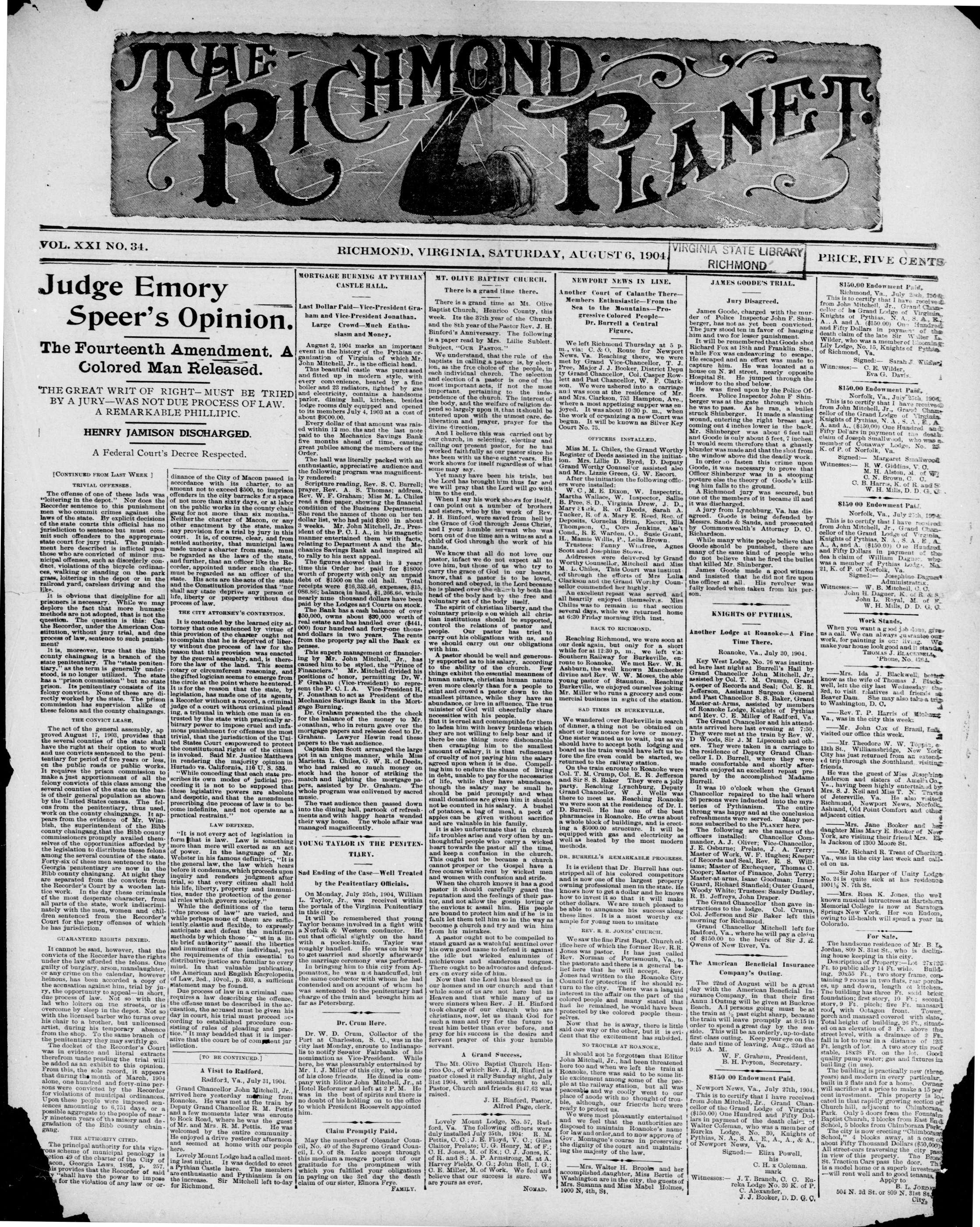
Judge Emory Speer's Opinion.
The Fourteenth Amendment. A Colored Man Released. THE GREAT WRIT OF RIGHT-MUST BE TRIED BY A JURY-WAS NOT DUE PROCESS OF LAW. A REMARKABLE PHILLIPIC.
HENRY JAMISON DISCHARGED.
A Federal Court's Decree Respected.
[CONTINUED FROM LAST WEEK]
TRIVIAL OFFENSES.
The offense of one of these lads was "joitering in the depot." Nor does the Recorder sentence to this punishment men who commit crimes against the laws of the state. By explicit decisions of the state courts this official has no jurisdiction to sentence but must commit such offenders to the appropriate state court for jury trial. The punishment here described is inflicted upon those who are convicted of minor municipal offenses, such as disorderly conduct, violations of the bicycle ordinance, walking or standing on the park grass, loitering in the depot or in the railroad yard, careless driving and the like.
dinance of the City of M. accordance with its amount not to exceed $50 offenders in the city barr of not more than sixty d. on the public works in the gang for not more than Neither the charter of the other enactment by the any provision for a trial court. It is, of course, settled authority, that it made under a charter fr. be regarded as the laws and further, that an office corder, appointed under must be regarded as an state. His acts are the and the Constitution pro shall any state demine-
It is obvious that discipline for all prisoners is necessary. While we may deplore the fact that more humane methods are not adopted, that is not the question. The question is this: Can the Recorder, under the American Constitution, without jury trial, and due punishment of law, sentence to such punishment?
It is, moreover, true that the Bibb county chaingang is a branch of the state penitentiary. The "state penitentiary," as the term is generally understood, is no longer utilized. The state has a "prison commission" but no state prison. Its penitentiary consists of its felony convicts. None of these are directly worked by the state. The prison commission has supervision alike of these felons and the county chaingangs.
THE CONVICT LEASE
The act of the general assembly, approved August 17, 1903, provides that the several counties of the state shall have the right at their option to work and use convicts sentenced to the penitentiary for period of five years or less, on the public roads or public works. It requires the prison commission to make a just apportionment of all the felony convicts of this class among the several counties of the state on the basis of their general population as shown by the United States census. The felons from the penitentiary, thus used, work on the county changings. It appears from the evidence of Mr. Wimbish, the superintendent of the Bibb county changing, that the Bibb county commissioners promptly availed themselves of the opportunities afforded by the legislation to distribute these felons among the several counties of the state. Forty-six of these men sentenced to the penitentiary are now in the Bibb county changing. At night they are separated from the convicts from the Recorder's Court by a wooden lattice work. In the day these criminals of the most desperate character, from all parts of the state, work indiscriminately with the men, women and children sentenced from the Recorder's Court for the petty offenses of which he has jurisdiction.
GUARANTEED RIGHTS DENIED
It cannot be said, however, that the convicts of the Recorder have the rights under the law afforded the telons. One guilty of burglary, arson, manslaughter, or any crime on the calendar, however heinous, has been accorded a copy of the accusation against him, trial by jury, the opportunity to appeal—in short, due process of law. Not so with the lad who loiters on the streets, or is overcome by sleep in the depot. Not so with the licensed barber who turns over his chair to a brother, but unlicensed artist, during his temporary absence from the shop. To the same branch of the penitentiary, they may swiftly
The docket of the Recorder's Court was in evidence and literal extracts therefrom made pending the trial will be added as an exhibit to this opinion. From this, the sole record, it appears that during the month of March, 1904 alone, one hundred and forty-nine persons were convicted by the Recorder violations of municipal ordinances. Upon these people were imposed sentences amounting to 6,751 days, or a possible aggregate to the number of nearly nineteen years of this misery and degradation of the Bibb county chain-gang.
THE AUTHORITY CITED
The principal authority for this vigorous scheme of municipal penology is section 49 of the charter of the City ofacon, Georgia Laws, 1893, p. 357. This provides that the Recorder of said city "shall have the power to impose laws for the violation of any law or or-
dinance of the City of Macon passed in accordance with its charter, to an amount not to exceed $500, to imprison offenders in the city barracks for a space of not more than sixty days, or at labor on the public works in the county chain gang for not more than six months." Neither the charter of Macon, or any other enactment by the state, makes any provision for a trial by jury in this court. It is, of course, clear, and free settled authority, that municipal laws made under a charter from state, must be regarded as the laws of the state, and further, that an officer like the Recorder, appointed under such charter, must be regarded as an officer of the state. His acts are the acts of the state and the Constitution provides that "not shall any state deprive any person of life, liberty or property without due process of law.
THE CITY ATTORNEY'S CONTENTION.
It is contended by the learned city attorney that one sentenced by virtue of this provision of the charter ought not to complain that he is deprived of liberty without due process of law for the reason that this provision was enacted by the general assembly, and, is therefore the law of the land. This seems rotary or circumferent reasoning, and the gifted logician seems to emerge from the circle at the point where he entered. It is for the reason that the state, by reason, has made one of its agents, a Recorder, without a record, a criminal judge of a court, in which a criminal plead, a tribunal in which a man is entrusted by the state with his bitterness power to impose cruel and infamous punishment for offenses the most trivial, that the jurisdiction of the United States Court empowered to protect the constitutional rights of the citizen is invoked. Said Mr. Justice Matthews in rendering the majority opinion in Hurtado vs. California, 110 U. S. 535.
"While conceding that each state prescribes its own modes of judicial proceeding it is not to be supposed that these legislative powers are absolute and despotic, and that the amendment prescribing due process of law is to become indefinite, and not operate as a practical restraint."
LAW DEFINED.
"It is not every act of legislation in form that is law. Law is something more than mere will exerted as an act of power. In the language of Mr. Webster in his famous definition, "It is the general law, the law which hears before it condemns, which proceeds upon inquiry and renders judgment after trial, so that every citizen shall hold his life, liberty, property and immunities, under the protection of the general rules which govern society."
While the definitions of the term "due process of law" are varied, and while perhaps none of them are sufficiently elastic and flexible, to expressly anticipate and defeat the multiform methods by which those'-just in a little brief authority" assail the liberties and immunities of the individual, yet the requirements of this essential to distributive justice are familiar to every mind. In that valuable publication, the American and English Encyclopedia of Law, 2ed., 10vol., p. 803, a sufficient statement may be found.
Due process of law in a criminal case requires a law describing the offense, the offense must be described in the accusation, the accused must be given his day in court, his trial must proceed according to established procedure consisting of rules of pleading and practice." It may be beaddled that it is imperative that the court be of competent jurisdiction.
[TO BE CONTINUED.]
A Visit to Radford
Grand Chancellor John Mitchell, Jr., arrived here yesterday morning from Roanoke. He was met at the train by Deputy Grand Chancellor R. M. Pettis and a few moments later was enroute to Rock Road, where he was the guest of Mr. and Mrs. R. M. Pettis. He was welcomed by the entire community. He enjoyed a drive yesterday afternoon and seemed at home with our people here. Lovey Mount Lodge had a called meeting last night. It was decided to erect a Pythian Castle house. The members are enthusiastic and Pythianism is on the increase. Sir Mitchell left to-day for Richmond.
MORTGAGE BURNING AT PYTHIAN CASTLE HALL.
Last Dollar Paid—Vice-President Graham and Vice-President Jonathan. Large Crowd—Much Enthusiasm and Money.
August 2, 1904 marks an important event in the history of the Pythian organization of Virginia of which Mr. John Mitchell, Jr., is the official head. This beautiful castle was purchased and fitted up in modern style, with every convenience, heated by a fine boiler and 23 radiators, tighted by gas and electricity, contains a handsome parlor, dining hall, kitchen, besides lodge rooms duly equipped and opened to its members July 4, 1903 at a cost of about $300.00.
Every dollar of that amount was raised by 2 mo. this and the last note paid to the Mechanics Savings Bank five months ahead of time, causing great jubilee among the members of the Order. The hall was literally packed with an enthusiastic, appreciative audience and the following program was magnificently rendered;
Scripture reading, Rev. S. C. Burrell; prayer, Rev. A. S. Thomas; address, Rev. W. F. Graham; Miss M. L. Chiles read a fine paper, showing the financial condition of the Business Department. She read the names of those on her ten dollar list, who had paid $300 in about 3 weeks. Mr. John Mitchell, Jr., President of the P. C. I. A., in his magnetic manner entertained them with facts, relating to Department A and the Mechanics Savings Bank and inspired all to rally to his next appeal.
The figures showed that in 2 years time this Order has paid for $18000 worth of property with only an unpaid debt of $1500 on the old hall. Total receipts were $16,353.46 expenses, $15,086.86; balance in hand, $1,266.66, while nearly nine thousand dollars have been paid by the Lodges and Courts on stock. The Bank has a cash balance of over $50,000, owns about $30,000 worth of real estate and has handled over ($441,000 four hundred and forty-one thousand dollars in two years. The rents from the property pay all the Bank expenses.
This superb management or financiering by Mr. John Mitchell, Jr., has caused him to be styled, the "Prince of Financiers." Mr. Mitchell divided his positions of honor, permitting Dr. W. F Graham (Vice-president) to represent the P. C. I. A. Vice-President H. F. Jonathan to act as President of the Mechanics Savings Bank in the Mortgage Burning.
Dr. Graham presented the the check for the balance of the money to Mr. Jonathan, who in return gave over the mortgage papers and release deed to Dr. Graham. Lawyer Hewin read these papers to the vast audience.
Captain Ben Scott arranged the large pot of money manner while Miss Marietta L. Chiles, G. W. of Deeds, who had raised so much money stock had the honor of striking the match and lighting the mortgage papers, assisted by Dr. Graham. The whole program was enlivened by sacred music.
The vast audience then passed down into the dining hall, partook of refreshments and the happy hearts wended home. The whole affair was managed magnificently.
YOUNG TAYLOR IN THE PENITEN- TIARY.
Sad Ending of the Case—Well Treated
On Monday, July 35th, 1904, William L. Taylor, Jr., was received within the portals of the Virginia Penitentiary in this city.
It will be remembered that young Taylor became involved in a fight with a Norfolk & Western conductor. He cut that official slightly on the hand with a pocket-knife. Taylor was roughly handled. He was on his way to get married and shortly afterwards the marriage ceremony was performed.
In bringing him to this city from Appleton, he was n't handcuffed, but the same man with whom he contended and on account of whom he was sentenced to the penitentiary had charge of the train and brought him as far as Petersburg.
Dr. Crum Here
Dr. W. D. Crum, Collector of the Port at Charleston, S. C., was in the city last Monday, enroute to Indianapolis to notify Senator Fairbanks of his nomination as Vice-President. While here, he was pleasurable entertained by Mr. I. J. Miller of this city, who is one of his close friends. He dined in company with Editor John Mitchell, Jr., at Hotel Reformer and left at 2 P. M. He was in the best of spirits and there is no doubt of his holding on to the office to which President Roosevelt appointed him.
Claim Promptly Paid.
May the members of Oleander Council, No. 40 of the Supreme Grand Council, I. O. of St. Luke accept through this medium a meagre portion of our gratitude for the promptness with which you fulfilled your obligations in paying on the 3rd day the death claim of our sister, Elnora Frye.
FAMILY.
MT. OLIVE BAPTIST CHURCH.
There is a grand time there.
There is a grand time at Mt. Olive Baptist Church, Henrico County, this week. Its the 37th year of the Church and the 8th year of the Pastor Rev. J. H. Binford's Anniversary. The following is a paper read by Mrs. Lillie Sublett. Subject, "OUR PASTOR."
We understand, that the rule of the baptists in calling a pastor is, by election, as the free choice of the people, in each individual church. The selection and election of a pastor is one of the most important acts, if not the most important, pertaining to the independence of the church. The interest of body, and the welfare of religion depends largely upon it, that it should be entered with the utmost care, deliberation and prayer, prayer for the divine direction.
And I believe this was carried out by our church, in selecting, electing and calling our present pastor, for he has worked faithfully as our pastor since he has been with us the eight years. His work shows for itself regardless of what some may say.
Yet many have been his trials, but the Lord has brought him thus far and we will pray that the Lord will go with him to the end.
When I say his work shows for itself, I can point out a number of brothers and sisters, who by the work of Rev. J. H. Binford, were saved from hell by the Grace of God through Jesus Christ, and I your humble servant who was born out of due time am a witness and a child of God through the work of his hands.
We know that all do not love our pastor, infact we do not expect all to love him, but those of us who try to carry the grace of God in our hearts, know, that a pastor is to be loved, honored and obeyed, in the Lord because he is placed over the church by both the head of the body and by the free and voluntary act of the body, itself.
The spirit of christian liberty, and the voluntary princip e on which all christian institutions should be supported, control the relations of pastor and people. Our pastor has tried to carry out his obligations with us, and we should carry out our obligations with him. A pastor should be well and generously supported as to his salary, according to skillful work in the church. Few things exhibit the essential meanness of human nature, christian human nature even more clearly than for a people to stint and crowd a pastor down to the smallest pittance, while they have an abundance, or live in affluence. The true minister of God will cheerfully share necessities with his people.
But it is cruel and contemptible for them to him with heavy burdens which they are not willing to help bear and if there be one thing more dishonorable then cramping him to the smallest amount of salary, it is that refinement of cruelty of not paying him the salary agreed upon when it is due. Compelling him to endure the shame of living in debt, unable to pay for the necessities of life, while they have abundance, though the salary may be small he should be paid promptly and when small donations are given him it should not be counted in his salary. A bushel of potatoes, a bag of meal, a peck of bread, a handful of fruit, without sacrifice and are valuable in his family. It is also unfortunate that in church life troubles arise and very often by unthoughtful people who carry a wicked heart towards the pastor all the time, and keep a confusion in the church. This ought not be because a church cannot prosper or the Gospel have a free course while rent by wicked men and women with confusion and strife.
When the church knows it has a good pastor it should carefully guard the reputation and the feelings of their pastor, and not allow the gossip loving or the envious tc assail him. His people are bound to protect him and if he is in fault let them tell him so in the way as become a church and try and win him from his mistakes.
A pastor ought not to be compelled to stand guard as a watchful sentinel over his own good name to defend it against the idle but wicked calumnies of michievous and slanderous tongues. There ought to be advocates and defenders on every side of him.
Now that the Lord has blessed us in our homes and in our church and that while some of us are not here but in Heaven and that while many of us were sinners when Rev. J. H. Binford took charge of our church who are Christians, now, let us thank God for such a man and try for the future to treat him better than ever before, and pray for his success is the desire and fervent prayer of this your humble servant.
A Grand Success.
The Mt. Olive Baptist Church Henrico Co., of which Rev. J. H. Binford is pastor closed it rally Sunday night, July 31st 1904, with astonishment to all, Pastor, Church and friends $147.63 was raised.
J. H. Binford, Pastor,
Alfred Page, clerk.
Lovely Mount Lodge, No. 57, Radford, Va. The following officers were duly installed July 35th, 1904: R. M. Pettis, C. O.; J. E. Floyd, V. C.; Giles Claitor, Prelate; U. G. Henry, M. of F.; C. H. Jones, M. of Ex; C. J. Jones, K. of R. and S.; A. P. Armstrong, M. at A. Harvey Fields, O. G.; J. Bell, I. G.; C. E. Miller, M. of Work. We feel and believe that our success is sure. We are yours as ever.
NOMAD.
NEWPORT NEWS IN LINE.
Another Court of Calanthe There—Members Enthusiastic—From the Sea to the Mountains—Progressive Colored People—Dr. Burrell a Central Figure.
We left Richmond Thursday at 5 p.m., via: C. & O, Route for Newport News, Va. Reaching there, we were met by Grand Vice-Chancellor, T. J. Pree, Major J. J. Booker, District Deputy grand Chancellor, Col. Casper Rowlett and Past Chancellor, W. F. Clarkson. We were ushered into a carriage and was soon at the residence of Mr. and Mrs. Clarkson, 753 Hampton, Ave., where a most appetizing supper was enjoyed. It was about 10:30 p. m., when the work of organizing a new Court was begun. It will be known as Silver Key Court No. 75.
OFFICERS INSTALLED:
Miss M. L. Chiles, the Grand Worthy Register of Deeds assisted in the initiation. Mrs. Lille D. Byrd, D. Deputy Grand Worthy Counsel'or assisted also and Mrs. Lizzie Green, G. W. Escort. After the initiation the following officers were installed: W.C. M. E. Dixon, W. Inspectrix, Martha Wallace, W. Inspector, Sallie B. Pree, S. D., Virginia Drew, J. D., Mary Stirk, R. of Deeds, Sarah A. Tucker, R. of A. Mary E. Reed, Rec. of Deposits, Cornelia Brim, Escort, Ella Thompson, C., Cors Jenkins, Ass'i Cond, R. E. Warden, O., Susie Grant, H., Mamie Willis, P., Lelia Brown. Trustees: Fanny Wintree, Agnes Scott and Josephine Stowr.
Addresses were delivered by Grand Worthy Counsellor, Mitchell and Miss M. L. Chiles. This Court was instituted through the efforts of Mrs Lulia Clarkson and the Grand Worthy Counsellor commended her highly.
An excellent repast was served and all meals themselves. Mrs Chiles was to remain in section several days, while we returned home at 6:30 Friday morning 29th inst.
BACK TO RICHMOND:
Reaching Richmond, we were soon at our desk again, but only for a short while for at 12:30 p. m., we left via Southern Railway for Burkeville, enroute to Roanoke. We met Rev W. R. Ashburn, the well known Manchester boy, W. Moses, the able young pastor of Stanton. Reaching Burkeville, we enjoyed a grocery joking Mr. Miller who runs a grocery or mercial business in surge of the station
SAD TIMES IN BURKEVILLE
We wandered over Burkeville in search of dinner, a thing not be obtained on short or long notice for love or money. One sister wanted us to wait, but as we should have to accept both lodging and board as the train would have left us before the fire even could be started, we returned to the railway station.
On the train enroute to Roanoke were Col. T. M. Crump, Col. E. R. Jefferson and Sir S. S. Baker. They were a jolly party. Reaching Lynchburg, Deputy Grand Chancellor, W. J. Wells was there to meet us. Reaching Roanoke we were soon at the residence of Dr. I. D. Burrell. He has one of the best pharmacies in Roanoke. He owns about a whole block of buildings, and is erecting a $2000.00 structure. It will be equipped with gas and electricity as well as heated by the most modern methods.
DR. BURRELL'S REMARKABLE PROGRESS
It is evident that Dr. Burrell has out-stripped all of his colored competitors and is now one of the largest property owning professional men in the state. He knows how to get a dollar and he knows how to invest it so that it will make other dollars. We are much pleased to be able to announce his success along these lines. It is a most worthy example for young men to mitigate.
REV. R. R. JONES' CHURCH.
We saw the fine First Bapt. Church edifice here of which the former Rev. R.R. Jones was pastor. It has just called Rev. Norman of Portsmouth, Va., to the pastorate and there is a general belief here that he will accept. Rev. Jones had written to the Roanoke City Council for protection if he should reclaim the city. There was a languid interest in the affair on the part of the colored people and many stated that had he remained, he would have been protected by the colored people themselves.
Now that he is away, there is little said one way or the other, but it is evident that the excitement has subsided.
NO TROUBLE AT ROANOKE
It should not be forgotten that Editor John Mitchell, Jr., had been threatened here too and when we left the train at Roanoke, there was said to be some little excitement among some of the people at the railway station, but all was peaceable and we coolly went to our place of anode with no thought of trouble, although, our friends here were ready to protect us.
We were most pleasantly entertained and we feel that the authorities are disposed to maintain the Roanoke's name for law and order, and to now approve of Gov. Montague's course in preserving the dignity of the court and maintaining the majesty of the law.
Mrs. Walter H. Brooks and her accomplished daughter, Miss Bertie of Washington are in the city, the guests of Mrs. Susanna and Miss Mabel Holmes, 1000 N. 4th, St.
JAMES GOODE'S TRIAL.
Jury Disagreed.
James Goode, charged with the murder of Police Inspector John F. Shimberger, has not as yet been convicted. The jury stood ten in favor of hanging him and two for lesser punishment. It will be remembered that Goode shot Richard Fox at 18th and Franklin Sts. While Fox was endeavoring to escape. He escape and an effort was made to capture him. He was located at a house on N. 2d street, nearly opposite Hospital St. He jumped through the window to the shed below.
He was fired upon by the Police Officers. Police Inspector John F Shinberger was at the gate through which he was to pass. As he ran, a bullet struck Shinberger. It made a slanting wound, entering the right breast and coming out 4 inches lower in the back. Mr. Shinberger was about 6 feet tall and Goode is only about 5 feet, 7 inches. It would seem therefore that a ghastly blunder was made and that the shot from the window above did the deadly work. In order.o fasten this crime upon Goode, it was necessary to prove that Officer Shinberger was in a stooping posture else the theory of Goode's killing falls to the ground. A Richmond jury was secured, but one of the members of it became ill and it was discharged. A jury from Lynchburg, Va. has disagreed. Goode is being defended by Messrs. Sands & Sands, and prosecuted by Commonwealth's Attorney D. C. Richardson.
While many white people believe that Goode should be punished, there are many of the same kind of people who do not believe that he fired the bullet that killed Mr. Shinberger. James Goode made a good witness and insisted that he did not fire upon the officer at all. His revolver was fully loaded when taken from his person.
Another Lodge at Roanoke—A Fine Time There.
Roanoke, Va., July 30, 1904
Key West Lodge. No. 76 was instituted here last night at Burrell's Hall by Grand Chancellor John Mitchell, Jr., assisted by Col. T. E. Crump, Grand Keeper of Records and Seal; Col. E. R. Jefferson, Assistant Surgeon General and Past Chancellor S. S. Baker, Grand Master-at-Arms, assisted by members of Roanoke Lodge, Knights of Pythias and Kev. C. E. Miles of Radford, Va. The Grand Chancellor and his attendants arrived here last evening at 7:50. They were at the train by Rev. W. D. Woods, Sir J. M. Lipscomb and others. They were taken in carriage to the residence of Deputy Grand Chancellor I. D. Burrell, where they were made comfortable and shortly afterwards enjoyed an excellent repast prepared by the accomplished Madame Burrell.
It was 10 o'clock when the Grand Chancellor repaired to the hall where 26 persons were inducted into the mysteries of Pythianism. The entire throng was happy and at the conclusion refreshments were served. Many persons subscribed to the PLANET here
The following are the names of the officers installed: Chancellor Commander, A. J. Oliver, Vice-Chancellor, J. E. Osburne; Prelate, J. A. Terry; Master of Work, W. F. Hughes; Keeper of Records and Seal, Rev. E. S. Williams; Master of Exchequer, Thomas C. Cooper; Master of Finance, John Terry; Master-at-arms, Isaac Goodman; Inner Guard, Richard Stanfield; Outer Guard, Woody White; Trustees, Sandy Dudley, R. B. Jeffreys, John Draper.
The Grand Chancellor then gave instructions to the lodge. Col. Crump, Col. Jefferson and Sir Baker left this morning for Richmond.
Grand Chancellor Mitchell left for Radford, Va., where he will pay a chain of $150.00 to the heirs of Sir J. E. Owens of New Fuyer, Va.
---
The American Beneficial Insurance Company's Outing
The 22nd of August will be a great day with the American Beneficial Insurance Company, in that their first Annu 1 Outing will be given at Buckroe Beach. All persons going must be at the train at the past eight sharp, because the train will leave promptly at 9:15 in order to spend a great day by the seaside. This will be an orderly, up-to-date first class outing. Keep your eye on the date and time of leaving, Aug., 22nd at 9:15 A. M.
W. F. Graham, President,
B. H. Peyton, Secretary.
$150.00 Endowment Paid
Newport News, Va., July 27th, 1904.
This is to certify that I have received from John Mitchell, Jr., Grand Chancellor of the Grand Lodge of Virginia ($150.00) One Hundred and Fifty Dollars in payment of the death claim of Walter Coleman, who was a member of Eureka Lodge, No. 30, Knights of Pythias, N. A., S. A., E. A., A., & A., of Newport News, Va.
Witnesses:— J. T. Branch, C. C. Eur-
reka Lodge No. 30 K. of P.
C. Alexander,
J. J. Booker, D. G. C.
8150.00 Endowment Paid.
Richmond, Va. July 25th, 1964
This is to certify that I have received
from John Mitchell, Jr., Grand Chancellor of H. Grand Lodge of Virginia,
Knights of Pythias, N. A., S. A., K. A., A. and A. ($150.00) One Hundred and Fifty Dollars in payment of the death claim of the late Sir Walter L. Wilder, who was a member of Blooming Lily Lodge, No. 15, Knights of Pythias of Richmond, Va.
Signed: — Sarah J. Wilder
Witnesses: — C. E. Wilder,
E. C. E. Durin.
$150.00 Endowment Paid.
Norfolk, Va., July 20th, 1904.
This is to certify that I have received from John Mitchell, Jr., Grand Chancellor of the Grand Lodge of Virginia Knights of Pythias, N. A. S. A. E. A. A. and A., ($150,00) One Hundred and Fifty Delars in payment of the death claim of Joseph Smallwood, who was a member of Conaway Lodge, No. 25 K. of P. of Norfolk, Va.
Signed:— Margaret Smallwood
Witnesses:— R. W. Giddins, V. O.
M. H. Alston, M. of W.
C. N. Brown, C. C.
C. B. Harris, K. of R. and S.
W. H. Mills, D. D. G.
$150 00 Endowment Paid
Norfolk, Va., July 25th, 1994
This is to certify that I have received from John Mitchell, Jr., Grand Chancellor of the Grand Lodge of Virginia, Knights of Pythias, N. A., S. A. E., A. A., and A. A. ($150.00) Oie Hundred and Fifty Dollars in payment of the deah claim of William Dagner, who was a member of Pythias Lodge, No. 21, K. of A, of Norfolk, Va.
Signed:— Josephine Dagner
Administratrix.
Witnesses:— W. B. Mitchell, C. O.
John H. Dagner, K. of R & S.
John L. Royal, M. of F.
W. H. Mills, D. D. G.
Work Stands.
When you want a good job done, give us a call. We can always guarantee our work, for painting is our living. We make your house look good and it stands.
THOMAS J. BLACKWELL
'Phone, No. 420.2.
—Mrs. Ida J. Blackwell, better know as the wife of Thomas J. Blackwell, left the city last Wednesday the 3rd, to visit relatives and friends at Beaver Dam. She may also take a trip to Washington, D. O.
---
—Rev. T. P. Harris of Michigan Va., was in the city this week.
—Mr. John Cox of Brazil, Ia visited our office this week.
—Mr. Theodore W. W. Toppin, o 13th St., Williamsbridge, New York City has just returned from an extended trip through the Southland visiting friends.
He was the guest of Miss Josephine Anderson and sisters of Amelia Co. Va., having been highly entertained by Mrs. S. J. Neil and Miss T. N. Travis of Jetersville, Va. He also visited Richmond, Newport News, Norfolk, Ashland, Old Point Comfort and other adjacent cities.
—Mrs. Jane Booker and her daughter Miss Mary E. Booker of New York, are visiting their friend Mrs. Elia Jackson of 1300 Moore St.
—Mr. Richard R. Trent of Cheriton Va., was in the city last week and called on us.
—Sir John Harper of Unity Lodge No. 24 is quite sick at his residence $1001\frac{1}{4}$ N. 7th St.
—Mrs. Rosa K. Jones, the well known musical instructress at Hartshorn Memorial College is now at Saratoga Springs New York. Her son Endom, owing to ill-health will spend a year in Colorado.
For Sale.
The handsome residence of Mr. B. L. Jordan, 809 N. 31st St., who is declining house keeping in this city.
Description of Property: -Lot 27X125 Ft. to public alley 14 Ft. wide. Building, 20x55 Ft., two story frame, containing 9 rooms in two flats, rear porches, up and down, length of kitchen. The building has three Ft. solid brick foundation; first story, 10 Ft.; second story, 9 Ft. pitch; five Ft. mansard roof, with Octagon front. Tower. Total height covered with slate. Total height building, 20 Ft., situated on an elevation of 9 Ft. above the street level, with a drainage of 125 Ft. length of lot. A two story tin roof stable, 18x28 Ft. on the lot. Good quality pump water; gas and fixtures in building (in use).
The building is practically new (three years) and modern in every particular, built in 2 flats and for a home. Owner will sacrifice at a price to make a 15 percent investment. This property is located in that rapidly growing section of Church hill, adjacent to Chimborazo Park. Only 5 doors from the Fountain Baptist Church, 2 blocks from East End School, 5 blocks from Chimborazo Park. The city is now erecting "Chimborazo School," 4 blocks away, at a cost of about Fifty Thousand Dollars (85,000) All street-cars traversing the city pass in view of this property. The Broad St. Traction Cars pass the door. This is a model home or a superb investment—will rent well and to good treaty.
HEY PLANET
THE LEAP YEAR GIRL
He bachelor is quaking in his shiny shoes to-day.
He goes alone, in fear and haste, and trembles on his way;
He peers about suspiciously, and listens all the while.
and dreams throughout the darksome night of running many a mile;
Because he's heard it hinted and gossiped all about.
every luring, roguish glance he sees a peril near;
panic strikes his heart whene'r a girl
cries, "Dear, oh, dear!"
Right, tightly in the air of lace, or vells of
blue or black
Beam simply snarls and nets to him set
Because he's heard it whispered most every place about.
When Nineteen Four is past and gone his vigilance will cease;
No more he'll dodge, elude, evade, but go his way in peace;
Perchance, when all is said and done the happier he'd be
If he would let himself be caught by some sweet charming "she;"
If he were wise he'd turn about and welcome with a smile.
If ever ardent, fervid look and effort to beguile.
Because it's also whispered by every one about.
The Leap Year Girl might shake him
Roy O. Randall, in Chicago Record; Herald.
TWO AND A THUNDERSTORM
By ALAN CRARY
MISS EUNICE hailed the coming of the launch with joy. As soon as the concourse of smitten youths should complete their last farewells to Gladys she would sternly marshal that popular damsel to the end of the whart and get safely into the boat and so to the point and the Chicago train.
In prospect of the approaching moment of relief from the thankless office of chaperon Miss Eunice sighed with anticipative content and sat down on a pile of suit cases to wait. The launch tooted impatiently. There was a stir in the group of leave-takers as a tall man, with iron gray hair and handsome, sunburned face suddenly climbed over the side of the wharf into their midst. He exchanged a few words with Gladys and then turned to find Miss Eunice, who, for some reason, was looking uneasily away, with a deep color flooding her thin little face.
"Miss Brown," he said, in what she considered a tone of respectful but bored politeness, "may I have the pleasure of rowing you and Miss Gladys over to the train? We have plenty of time and the luggage can go on the tug."
Miss Eunice bit her lip angrily; rebellious tears were very near her eyes. "I wish I could let her go alone with you," she said, "but on account of a promise to her mother I must perse cute the poor child to the bitter end. Will it not be too much trouble to row me back again?" "It will be an added pleasure, I assure you," he answeren, perfunctorily. All the way over in the boat he and Gladys kept up a steady flow of frivolous conversation. Yes, she would mall him the kodak picture of herself that would just fit his watch and he would not forget that he was going to send her the funny little pipe he had smoked all summer—just in memory of their good times, you know! And they both laughed gaily and Miss Eunice looked out over the water and tried not to listen. Down at the bottom of her little starved heart something or other was making a very uncomfortable disturbance.
They stood on the platform and waved to the bright figure on the train until a sudden curve in the track hid it from view, then they walked silently back to the boat.
Miss Eunice ignored the strong, brown hand extended to help her, and made her way alone to her seat in the stern. She turned upon her companion a calm and expressionless face and kept her eyes upon the sparkling water beyond him. For what seemed to the man an endless period of time the dip of the oars was the only sound to be heard.
"I think I'll try to go back between the islands. It's shorter," he said.
Miss Eunice felt the sting of the last two words, out made no answer. Oh, if she could only get home. Back in her little, hot room at the hotel she would cry her heart out and once and for all and go home to the city on the next train. Her poor, little, colorless, middle-aged presence should never inflict itself upon him again. They had reached the islands now. Nothing more than a few small hillocks of sand and gravel surmounted by scraggy bushes. The water had grown very still and the air was heavy. "There's a bad weatherstorm coming."
up," he said, pointing to the west, "but I think I can make one of the small wharves up the shore, where we can get under-shelter. I'm sorry to keep you out so long."
Miss Eunice turned pale, for she had a deadly terror of lightning, but she answered indifferently: "Do just as you think best," and gave the rudder rope a sharp jerk to guide the boat into deeper water, for in watching the gathering storm neither of them had noticed that the way between the islands had become very shallow.
The boat turned obediently, but in her haste Miss Eunice had pulled the wrong rope. The keel grated loudly on the bottom and the boat stopped.
"I beg your pardon," said Miss Eunice, coldly. "I should have been steering properly."
He did not answer, but stood up and tried to push off with an oar. The boat did not move. He tried again, but the second effort was equally futile. There was an ominous rumble of thunder and great drops of rain began to splash in the water.
He laid down the oar and looked from Eunice with the drops glistening on her smooth hair, to the shore, some ten feet distant.
"It's no use," he said, "I can't budge it with both of us in the boat, and we'll have to get ashore some way. We're going to get a good drenching, I'm afraid." "All right." "said Miss Eunice, miserably, and began to gather up her skirts preparatory to wading forth into the deep; but he was taking off his coat and coming toward her with reckless strides. The boat rocked and groaned on the gravel beneath it.
She looked at him rebelliously and made a valliant effort to step over the side of the boat, but he stopped her and buttoned his coat firmly around her shoulders. His face was determined.
"I'm sorry to make myself any more obnoxious to you than I am already," he said, "but I am going to carry you ashore."
Miss Eunice shut her eyes with a look of grim endurance, but her heart was throbbing with something very much like triumphant joy.
He took the end of the painter in his hand and stepped out into the water.
Tremblingly she put her arms around his neck and he lifted her. She dared not open her eyes. Oh, why didn't he go faster, and yet—if the shore were only miles away! He was certainly standing still. There came another terrific crash of thunder and she shrank against him instinctively and opened her eyes. Perhaps she did not know that they were full of tears, or that her chin was trembling pitiful.
His face was very near hers and she saw in it a look that made her turn her own way and hide it for a moment against his collar.
"No. I am not going to." he said, grimly; "I'll have my way for once. Thank
A girl and a boy playing the violin in the rain.
SHE PUT HER ARMS AROUND HIS NECK AND HE LIFTED HER.
the Lord there's no spoiled child around for you to shove forward and hide behind, and this time I shall have my way, Eunice!"
He had lingered on her name daringly. Miss Eunice tried to lift her eyes, but could not. Then came another deafening bolt of thunder, but neither of them heard it, for at that very moment something else was happening nearer at hand.
"Put me down!" said Miss Eunice, with a happy little sob. "Oh, how dare you!"
The island was small and dreary and very wet, but such may have been the topographical and climatic conditions of Paradise. They tied Miss Eunice's sun hat to an oar and prepared to signal the launch when it should pass on its afternoon trip, for the rowboat had sprung a leak when it struck on the shalows.
The rain had settled into a steady drizzle. His shoulder was very damp, but somehow it made a rather comfortable resting place for an equally moist cheek.
"What did you suppose I was chasing around with that youngster for, anyhow?"
Something incoherent was said against his shoulder.
"Supposed I was in love with her, you say? Bless your dear little heart! I've forgotten what the child looks like already. It was you—you all the time—from the very first day, and you misunderstood me and distilled me and wouldn't treat me decently. Oh, but I've led a dog's life of it! I don't feel quite sure yet that you love me. Do you, Eunice?"
He tried to look into her eyes, but she turned her face away, and only the coat sleeve heard her say: "Oh, my dear, my dear! I hope that launch will never come!"—Farmers' Review.
When angry turn your back to the other fellow and walk straight ahead while you count half a million.
Slight Interruption
HP kissed her once, he kissed her twice
he was the happiest of all men;
No doubt he would have kissed her thrice—
But her carve came in just then.
-Chicago Dutch
THE RICHMOND PLANET, RICHMOND, VIRGINIA.
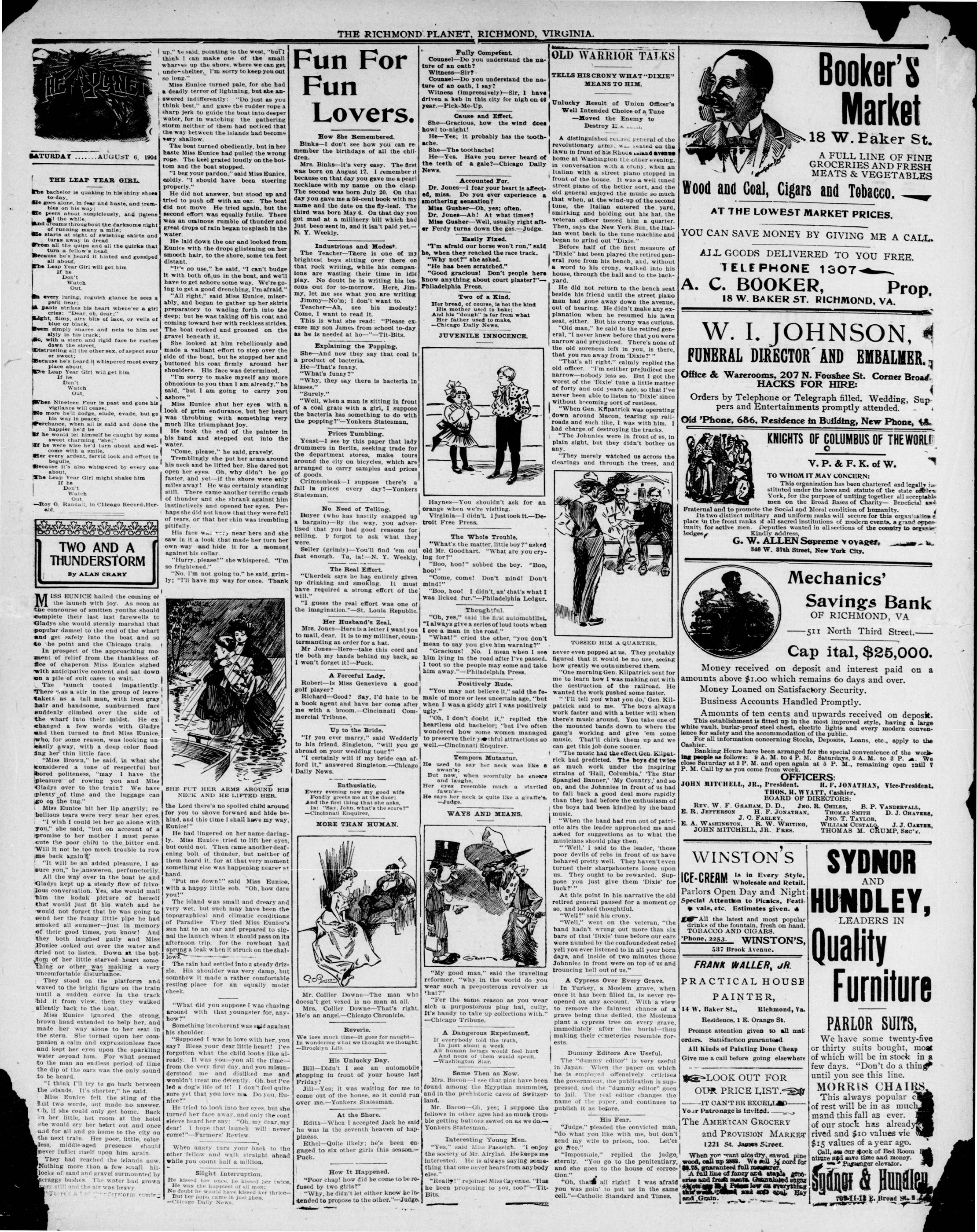
Fun For Fun Lovers.
How She Remembered.
Binks—I don't see how you can remember the birthdays of all the children.
Mrs. Binks—it's very easy. The first was born on August 17. I remember it because on that day you gave me a pearl necklace with my name on the clasp. The second was born July 20. On that day you gave me a 50-cent book with my name and the date on the fly-leaf. The third was born May 6. On that day you got mad at a millinery bill which had just been sent in, and it isn't paid yet.—N. Y. Weekly.
Industrious and Modest
The Teacher—There is one of my brightest boys sitting over there or that rock writing, while his companions are wasting their time in idle play. No doubt he is writing his lessons out for to-morrow. Here, Jimmy, let me see what you are writing Jimmy—No'm; I don't want to. Teacher-Ah, see his modesty. Come, I want to read it.
This is what she read: "Please excuse my son James from school to-day as he is needed at ho—"Tit-Bits.
Explaining the Popping
She—And now they say that coal is a product of bacteria.
He—That's funny.
"What's funny?"
"Why, they say there is bacteria in kisses."
"Surely."
"Well, when a man is sitting in front of a coal grate with a girl, I suppose the bacteria has something to do with the popping?"—Yonkers Statesman.
Prices Tumbling.
Yeast—I see by this paper that lady drummers in Berlin, seeking trade for the department stores, make tours around the city on bicycles, which are arranged to carry samples and prices of goods. Crimsonbeak—I suppose there's a fall in prices every day?—Yonkers Statesman.
No Need of Telling.
Buyer (who has hasily snapped up a bargain)—By the way, you advertised that you had good reasons for selling. I forgot to ask what they were.
Seller (grimly)—You'll find 'em out fast enough. Ta, ta!—N. Y. Weekly.
The Real Effort
"Ukerdek says he has entirely given up drinking and smoking. It must have required a strong effort of the will."
"I guess the real effort was one of the imagination."—St. Louis Republic
Her Husband's Zeal
Mrs. Jones—Here is a letter I want you to mail, dear. It is to my milliner, countermanding an order for a hat.
Mr Jones—Here—take this cord and tie both my hands behind my back, so I won't forget it!—Puck.
A Forceful Lady
Robert—Is Miss Genevieve a good golf player?
Richard—Good? Say, I'd hate to be a book agent and have her come after me with a broom.—Cincinnati Commercial Tribune.
Up to the Bride.
"If you ever marry," said Wedderly to his friend, Singleton. "will you go abroad on your wedding tour?" "I certainly will if my bride can afford it," answered Singleton—Chicago Daily News.
Enthusiatic
Every evening now my good wife
Fondly greets me at the door;
And the first thing that she asks,
"So she's the score?" —
Cinchinna Enquirer,
909
Mr. Collier Downe—The man who doesn't get vexed is no man at all.
Mrs. Collier Downe—That's right He's an angel.—Chicago Chronicle.
Reverie.
We lose much time—it goes for naught—
In wondering what we thought we thought.
—Brooklyn Life.
His Unlucky Day.
Bill—Didn't I see an automobile
stopping in front of your house last
Friday?
Jill—Yes; it was waiting for me to
come out of the house, so it could run
over me. —Yonkers Statesman.
At the Shore
Edith—When I accepted Jack he said he was in the seventh heaven of happiness.
Ethel—Quite likely; he's been engaged to six other girls this season.—Puck.
How It Happened
"Poor chap! how did he come to be refused by two girls?"
"Why, he didn't let either know he intended to propose to the other."—Judge
Counsel—Do you understand the nature of an oath?
Witness—Sir?
Counsel—Do you understand the nature of an oath, I say?
Witness (impressively)—Sir, I have driven a keb in this city for nigh on 40 year.—Pick-Me-Up.
Cause and Effect.
She—Gracious, how the wind does howl to-night!
He—Yes; it probably has the toothache.
She—The toothache!
He—Yes. Have you never heard of the teeth of a gale?—Chicago Daily News.
Accounted For.
Dr. Jones—I fear your heart is affected, miss. Do you ever experience a amothering sensation?
Miss Gusher—Oh, yes; often.
Dr. Jones—Ah! At what times?
Miss Gusher—Well, usually right after Ferdy turns down the gas. —Judge.
Easily Fixed.
"Good gracious! Don't people here know anything about court plaster?"—Philadelphia Press
Two of a Kind
Her bread, of course, is not the kind
His mother used to bake;
And her dough "dough" is far from what
Her father used to make.
—Chicago Daily News.
JUVENILE INNOCENCE.
Haynes—You shouldn't ask for an orange when we're visiting.
Virginia—I didn't. I just took it.—Detroit Free Press.
The Whole Trouble
"What's the matter, little boy?" asked old Mr. Goodhart. "What are you crying for?"
"Boo, hoo!" sobbed the boy. "Boo, hoo!"
"Come, come! Don't mind! Don't mind!"
"Boo, hoo! I didn't, an' that's what I was licked fur."—Philadelphia Ledger.
Thoughtful.
"Oh, yes," said the first automobiles,
"I always give a series of loud toots when
I see a man in the road."
"What!" cried the other, "you don't
mean to say you give him warning?"
"Gracious! No. I mean when I see
him lying in the road after I've passed.
I toot so the people may some and take
him away."—Philadelphia Press.
Positively Rude.
"You may not believe it," said the female of more or less uncertain age, "but when I was a giddy girl I was positively ugly."
"Oh, I don't doubt it," replied the heartless old bachelor; "but I've often wondered how some women managed to preserve their youthful attractions so well.—Cincinnati Enquirer.
Tempora Mutantur
He used to say her neck was like a swan's:
He loved to when scornfully he sneezes and laughs.
Her eyes resemble much a startled fawn's—
He says her neck is quite like a giraffe's.
—Judge.
WAYS AND MEANS
"My good man," said the traveling reformer, "why in the world do you wear such a preposterous revolver is that?"
"Fer the same reason as you wear
sich a purposterous plug hat, cully.
It's handy to take up collections with."
—Chicago Tribune.
A Dangerous Experiment
Same Then as Now
Mrs. Bacon—I see that pins have been found among the Egyptian mummies, and in the prehistoric caves of Switzerland.
Mr. Bacon—Oh, yes; I suppose the fellows in other ages had as much trouble getting buttons sewed on as we do. Yonkers Statesman.
Interesting Young Men.
"Yes," said Miss Passigh. "I enjoy the society of Mr. Alrylad. He keeps me interested. He is always saying something that one never hears from anybody else."
"Really!" rejoined Miss Cayenne. "Has he been proposing to you, too?"—Tit-Bits.
TELLS HIS CRONY WHAT "DIXIE"
MEANS TO HIM.
A distinguished retired general of the revolutionary army, was seated on the lawn in front of his Rhode Island avenue home at Washington the other evening, in conversation with a crony, when an Italian with a street piano stopped in front of the house. It was a well tuned street piano of the better sort, and the old general enjoyed the music so much that when, at the wind-up of the second tune, the Italian entered the yard, smirking and holding out his hat, the veteran officer tossed him a quarter. Then, says the New York Sun, the Italian went back to the tune machine and began to grind out "Dixie." Before half of the first measure of "Dixie" had been played the retired general rose from his bench, and, without a word to his crony, walked into his house, through the hall and to the back-yard.
He did not return to the bench seat beside his friend until the street piano man had gone away down the avenue, out of hearing. He didn't make any explanation when he resumed his lawn seat, either. But his crony was curious. "Old man," he said to the retired general, "I never knew before that you were narrow and prejudiced. There's none of the old soreness left in you, is there, that you ran away from 'Dixie'?" "That's all right." calmly replied the old officer. "I'm neither prejudiced nor narrow—nobody less so. But I got the worst of the 'Dixie' tune a little matter of forty and odd years ago, so that I've never been able to listen to 'Dixie' since without becoming sort of restless. "When Gen. KJpatrick was operating down around Macon, tearing up railroads and such like, I was with him. I had charge of destroying the tracks.
"They merely watched us across the clearings and through the trees, and
A man in a suit is standing and talking to two men sitting on a bench.
TOSSED HIM A QUARTER,
never even popped at us. They probably
figured that it would be no use, seeing
how greatly we outnumbered them.
"One morning Gen. Kilpatrick sent for
me to learn how I was making out with
the destruction of the railroad. He
wanted the work pushed some faster.
"I'll tell you what you do! Gen. Kil-
patrick said to me. "The boys always
work faster and with a better will when
there's music around. You take one of
the mounted bands down to where the
gang's working and give 'em some
music. That'll chick them up and we
can get this job done sooner.
"The music had the effect Gen. Kilpatrick had predicted. The boys did twice as much work under the inspiring strains of 'Hail, Columbia,' 'The Star Spangled Banner,' 'My Country,' and so on, and the Johnnies in front of us had to fall back a good deal more rapidly than they had before the enthusiasm of the boys had been kindled by the band music.
"When the hand had run out of patriotic airs the leader approached me and asked for suggestions as to what the musicians should play then.
"Well,' I said to the leader, 'those poor devils of rebs in front of us have behaved pretty well. They haven't even turned their sharpshooters loose upon us. They ought to be rewarded. Suppose you just give them 'Dixie' for luck?"
At this point in his narrative the old retired general paused for a moment or so, and looked thoughtful.
"Well?" said his crony.
"Well," went on the veteran, "the band hadn't wrung out more than six bars of that 'Dixie' tune before our ears were numbed by the confoundedest rebel yell you ever listened to in all your born days, and inside of two minutes those Johnnies in front were on top of us and trouncing hell out of us."
A Cypress Over Every Grave
In Turkey, a Moslem grave, when once it has been filled in, is never reopened on any account. With a view to remove the faintest chance of a grave being thus defiled, the Moslems plant a cypress tree on every grave, immediately after the burial—thus making their cemeteries resemble forests.
Dummy Editors Are Useful
The "dummy editor" is very useful in Japan. When the paper on which he is employed offensively criticises the government, the publication is suppressed, and the "dummy editor" goes to jail. The real editor changes the name of the paper, and continues to publish it as before.
His Fear
"Judge," pleaded the convicted man,
"do what you like with me, but don't
send my wife to prison, too. Let'er
go free."
"Impossible," replied the Judge,
sternly. "You go to the penitentiary,
and she goes to the house of correction."
"Oh, that! all right! I was afraid
you was goin' to put us in the same
cell."—Catholic Standard and Times.
M.
Wood and Coal, Cigars
AT THE LOWEST M
YOU CAN SAVE MONEY I
ALL GOODS DELIVER
TELEPHONE
A. C. BOOKER
18 W. BAKER ST.
W. I. JO
FUNERAL DIRECTOR
Office & Warerooms, 207 N.
HACKS F
Orders by Telephone or Tel-
pers and Entertainment
Old 'Phone, 686, Residence
Cigars and Tobacco. WEST MARKET PRICES. MONEY BY GIVING ME A CALL. DELIVERED TO YOU FREE. PHONE 1307 OKER, Prop. OKER ST. RICHMOND, VA. JOHNSON, DIRECTOR AND EMBALMER. Ins, 207 N. Foushee St. Corner Broad BACKS FOR HIRE: One or Telegraph filled. Wedding, Supernattainments promptly attended. Residence in Building, New Phone, 18 KNIGHTS OF COLUMBUS OF THE WORLD
AT THE LOWEST MARKET PRICES. YOU CAN SAVE MONEY BY GIVING ME A CALL.
W. I. JOHNSON, FUNERAL DIRECTOR AND EMBALMER.
Office & Warerooms, 207 N. Foushee St. Corner Broad HACKS FOR HIRE: Orders by Telephone or Telegraph filled. Wedding, Suppers and Entertainments promptly attended.
TO WHOM IT MAY CONCERN:
This organization has been chartered and legally instituted under the laws and statute of the state of New York, for the purpose of uniting together all acceptable men on the Broad Bases of Charity—Beneficial to the Social and Moral condition of humanity.
y and uniform ranks will secure for this organization all sacred institutions of modern events, a grand oppose deputies wanted in all sections of the country to organically address.
ALLEN Supreme voyager
W. 87th Street, New York City.
This organization has been chartered and legally stituted under the laws and statute of the state of New York, for the purpose of uniting together all acceptable men on the Broad Bases of Charity—Beneficial
Fraternal and to promote the Social and
Its two distinct military and uniform
place in the front ranks of all sacred ins
unity for active men. Deputies wante
lodges
Kindly address,
G. W. ALLENS
846 W. 87th Street
Its two distinct military and uniform ranks will secure for this organization a place in the front ranks of all sacred institutions of modern events, a grand opportunity for active men. Deputies wanted in all sections of the country to organize lodges Kindly address.
G. W. ALLEN Supreme voyager,
846 W. 87th Street, New York City.
Cap ital, $25,000.
paid on deposit and interest paid on a
to which remains 60 days and over.
on Satisfactory Security.
ents Handled Promptly.
cents and upwards received on deposit.
settled up in the most improved style, having a large
steel chest, electric lights and every modern conven-
commodation of the public.
occurring Stocks, Deposits, Loans, etc., apply to the
been arranged for the special convenience of the work.
M. to 4 P. M. Saturdays, 9 A. M. to 3 P. . We
and open again at 5 P. M., remaining open until 7
from work.
Money received on deposit amounts above $1.00 which rest
Money Loaned on Satisfaction
Business Accounts Handler
Amounts of ten cents and
This establishment is fitted up in the white vanit, burlar-proof steel chest, elec-
ience for safety and the accommodation
For all information concerning Stock Cashier.
Banking Hours have been arranged in people as follows: 9 A. M. to 4 P. M. close Saturday at 3 P. M. and open again P. M. Call by as you come from work.
OFFIC
JOHN MITCHELL, JR., President.
THOS. H.W.Y
BOARD OF F
REV. W. F. GRAHAM, D. D., JNG
E. R. JEFFERSON H. F. JONATHAN,
J. C. FARLEY.
Money received on deposit and interest paid on a amounts above $1.00 which remains 60 days and over.
Money Loaned on Satisfactory Security.
Business Accounts Handled Promptly.
Amounts of ten cents and upwards received on deposit.
This establishment is fitted up in the most improved style, having a large white vault, burlar-proof steel chest, electric lights and every modern convenience for safety and the accommodation of the public.
For all information concerning Stocks, Deposits, Loans, etc., apply to the Cashier.
Banking Hours have been arranged for the special convenience of the working people as follows: 9 A. M. to 4 P. M. Saturday, 9 A. M. to 3 P. . We close Saturday at 3 P. M. and open again at 5 P. M., remaining open until 7 P. M. Call by as you come from work.
OFFICERS:
President. H. F. JONATHAN, Vice-President.
THON. H. WYATT, Cashier.
BOARD OF DIRECTORS:
D. D., JNO. R. CHILES, B. P. VANDERVALL,
F. JONATHAN, THOMAS SMITH D. J. OHAVERS,
BLEX. JNO. T. TAYLOR
JOHN MITCHELL, JR., President. H. F. JONATHAN, Vice-President. THOS, H. WYATT, Cashier. HOS, H. WYATT, Cashier.
E. A. WASHINGTON, R. W. WHITING,
JOHN MITCHELL, JR. FRES.
Parlors Open Day and Night
Special Attention to Picnics, Festi-
vals, etc. Estimates given.
All the latest and most popular
drinks of the fountain, fresh on hand.
TOBACCO AND CIGARS.
'Phone, 2253. WINSTON'S,
537 Brook Avenue.
PRACTICAL HOUSE
14 W. Baker St., Richmond, Va.
All Kinds of Painting Done Cheap
Give me a call before going elsewhere
OUR PRICE LIST.
IT CAN'T BE EXCELLENT
Your Patronage is Invited.
The AMERICAN GROCERY
When you want nice dry, sawn pine
wood, call up 2888. We sell $4 cord for
$8.75, guaranteed full measure.
A full line of fancy and staple
groocies and fresh meats. Granulated sugars
stick to the bottom. Prime low on everything
this week. Cured and art food. Hay
and Grain.
```markdown
```
M. H. H.
WINSTON'S
FRANK WALLER, JR.
PAINTER.
LOOK OUT FOR
Booker's Market
18 W. Paker St. A FULL LINE OF FINE GROCERIES AND FRESH MEATS & VEGETABLES
V. P. & F. K. of W.
Mechanics'
Savings Bank OF RICHMOND, VA 511 North Third Street.
WILLIAM CUSTALO. J. J. CARTER.
THOMAS M. CRUMP. SECK.
SYDNOR AND HUNDLEY, LEADERS IN Quality Furniture
PARLOR SUITS.
We have some twenty-five or thirty suits bought, most of which will be in stock in a few days. "Don't do a thing until you see this line.
MORRIS CHAIRS
This always popular chair of rest will be in as much mand this fall as ever. That of our stock has already rived and $10 values vie with $15 values of a year ago.
Call, see our stock of Bed Room furniture and save time and money.
Passenger elevator.
Sydney & Hundley
709-11-12 E. Broad St.
THE
SIGN OF THE
FOUR.
BY CONAN DOYLE.
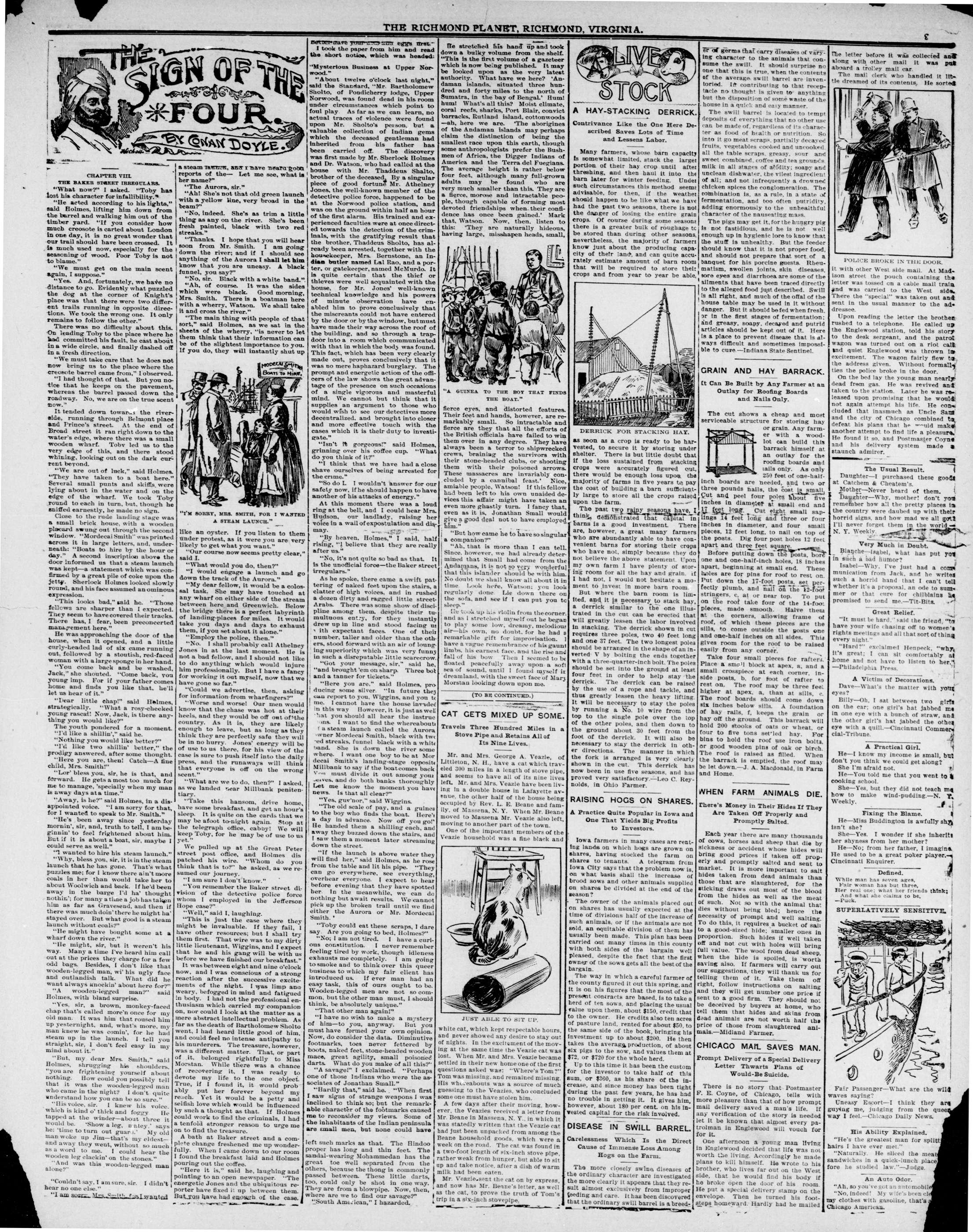
CHAPTER VIII
THE BAKER STREET IREGULARS.
"What now?" I asked. "Toby has lost his character for infailibility." "He acted according to his lights," said Holmes, lifting him down from the barrel and walking him out of the timber yard. "If you consider how much creeosote is carted about London in one day, it is no great wonder that our trail should have been crossed. It is much used now, especially for the seasoning of wood. Poor Toby is not to blame." "We must get on the main scent again, I suppose." "Yes. And, fortunately, we have no distance to go. Evidently what puzzled the dog at the corner of Knight's place was that there were two different trails running in opposite directions. We took the wrong one. It only remains to follow the other." There was no difficulty about this. On leading Toby to the place where he had committed his fault, he cast about in a wide circle, and finally dashed off in a fresh direction.
"We must take care that he does not now bring us to the place where the creosote barrel came from." I observed. "I had thought of that. But you notice that he keeps on the pavement, whereas the barrel passed down the roadway. No, we are on the true scent now."
It tended down towards the riverside, running through Belmont place and Prince's street. At the end of Broad street it ran right down to the water's edge, where there was a small wooden wharf. Toby led us to the very edge of this, and there stood whining, looking out on the dark current beyond.
"We are out of luck," said Holmes. "They have taken to a boat here." Several small punts and skiffs were lying about in the water and on the edge of the wharf. We took Toby round to each in turn, but, though he sniffed earnestly, he made no sign.
Close to the rude landing stage was a small brick house, with a wooden plaque swung out through the second window. "Mordecai Smith" was printed across it in large letters, and, underneath: "Boats to hire by the hour or day." A second inscription above the door informed us that a steam launch was kept—a statement which was confirmed by a great pile of coke upon the jetty. Sherlock Holmes looked slowly round, and his face assumed an ominous expression.
"This looks bad," said he. "Those fellows are sharper than I expected. They seem to have covered their tracks. There has, I fear, been preconcerted management here."
He was approaching the door of the house, when it opened, and a little curly-headed lad of six came running out, followed by a stoutish, red-faced woman with a large sponge in her hand.
"You come back and be washed, Jack," she shouted. "Come back, you young imp. For if your father comes home and finds you like that, he'll let us hear of it."
"Dear little chap!" said Holmes, strategically. "What a rosy-cheeked young racae! Now, Jack, is there anything you would like?"
The youth pondered for a moment. "I'd like a shillin'," said he. "Nothing you would like better?"
"I'd like two shillin' better," the prodigy answered, after some thought.
"Here you are, then! Catch—A fine child, Mrs. Smith!"
"Lor' bless you, sir, he is that, and forward. He gets a most too much for me to manage, 'specially when my man is away days at a time."
"Away, is he?" said Holmes, in a disappointed voice. "I am sorry for that, for I wanted to speak to Mr. Smith." "He's been away since yesterday mornin', sir, and, truth to tell, I am beginnin' to feel frightened about him. But if it is about a boat, sir, maybe I could serve as well." "I wanted to hire his steam launch." "Why, bless you, sir, it is in the steam launch that he has gone. That's what puzzles me; for I know there isn't more coals in her than would take her to about Woolwich and back. If he'd been away in the barge I'd ha' thought nothin'; for many a time a job has taken him as far as Gravesend, and then if there was much doin' there he might ha' stayed over. But what good is a steam launch without coals?" "He might have bought some at a wharf down the river."
"He might, sir, but it weren't his way. Many a time I've heard him call out at the prices they charge for a few odd bags. Besides, I don't like that wooden-legged man, wi' his ugly face and outlandish talk. What did he want always knockin' about here for?" "A wooden-legged man" said Holmes, with bland surprise.
"Yes, sir, a brown, monkey-faced chap that's called more'n once for my old man. It was him that roused him up yesternight, and, what's more, my man knew he was comin', for he had steam up in the launch. I tell you straight, sir, I don't feel easy in my mind about it."
"But, my dear Mrs. Smith," said Holmes, shrugging his shoulders, "you are frightening yourself about nothing. How could you possibly tell that it was the wooden-legged man who came in the night? I don't quite understand how you can be so sure."
"His voice, sir. I knew his voice, which is kind o' thick and foggy. He tapped at the winder--about three it would be. 'Show a leg, natey.' says he: 'time to turn out guard.' My old man woke up Jim--that's my eldest-- and away they went, without so much as a word to me. I could hear the wooden leg clackin' on the stones."
"And was this wooden-legged man alone?"
"Couldn't say, I am sure, sir. I didn't hear no one else."
"I am sorry Mrs. Smith for I wanted
a steam launcher, and I have near good reports of the— Let me see, what is her name?"
"The Aurora, sir."
"Ah! She's not that old green launch with a yellow line, very broad in the beam?"
"No, indeed. She's as trim a little thing as any on the river. She's been fresh painted, black with two red streaks."
"Thanks. I hope that you will hear soon from Mr. Smith. I am going down the river; and if I should see anything of the Aurora I shall let him know that you are uneasy. A black funnel, you say?"
"No, sir. Black with a white band."
"Ah, of course. It was the sides which were black. Good morning, Mrs. Smith. There is a boatman here with a wherry, Watson. We shall take it and cross the river."
"The main thing with people of that sort," said Holmes, as we sat in the sheets of the wherry, "is never to let them think that their information can be of the slightest importance to you. If you do, they will instantly shut up
MODERN SMITH BOATS TO HIRE
"I'M SORRY, MRS. SMITH, FOR I WANTED A STEAM LAUNCH."
like an oyster. If you listen to them under protest, as it were you are very likely to get what you want." "Our course now seems pretty clear," said I. "What would you do, then?" "I would engage a launch and go down the track of the Aurora."
"My dear fellow, it would be a colossal task. She may have touched at any wharf on either side of the stream between here and Greenwich. Below the bridge there is a perfect labyrinth of landing-places for miles. It would take you days and days to exhaust them, if you set about it alone."
"Employ the police, then."
"No. I shall probably call Athelney Jones in at the last moment. He is not a bad fellow, and I should not like to do anything which would injure him professionally. But I have a fancy for working it out myself, now that we have gone so far."
"Could we advertise, then, asking for information from wharfingers?"
"Worse and worse! Our men would know that the chase was hot at their heels, and they would be off out of the country. As it is, they are likely enough to leave, but as long as they think they are perfectly safe they will be in no hurry. Jones' energy will be of use to us there, for his view of the case is sure to push itself into the daily press, and the runaways will think that everyone is off on the wrong scent."
"What are we to do, then?" I asked, as we landed near Millbank penitentiary.
"Take this hansom, drive home, have some breakfast, and get an hour's sleep. It is quite on the cards that we may be afoot to-night again. Stop at the telegraph office, cabby! We will keep Toby, for he may be of use to us yet."
We pulled up at the Great Peter street post office, and Holmes dis patched his wire. "Whom do you think that is to?" he asked, as we resumed our journey.
"I am sure I don't know." "You remember the Baker street division of the detective police force whom I employed in the Jefferson Hope case?" "Well," said I, laughing.
"This is just the case where they might be invaluable. If they fail, I have other resources; but I shall try them first. That wire was to my dirty little lieutenant, Wiggins, and I expect that he and his gang will be with us before we have finished our breakfast."
It was between eight and nine o'clock now, and I was conscious of a strong reaction after the successive excitements of the night. I was limp and weary, befogged in mind and fatigued in body. I had not the professional enthusiasm which carried my companion on, nor could I look at the matter as a mere abstract intellectual problem. As far as the death of Bartholomew Sholto went, I had heard little good of him, and could feel no intense antipathy to his murderers. The treasure, however, was a different matter. That, or part of it, belonged rightfully to Miss Morstan. While there was a chance of recovering it, I was ready to devote my life to the one object. True, if I found it, it would probably put her forever beyond my reach. Yet it would be a petty and selfish love which would be influenced by such a thought as that. If Holmes could work to find the criminals, I had a tenfold stronger reason to urge me on to find the treasure.
A bath at Baker street and a complete change freshened me up wonderfully. When I came down to our room I found the breakfast laid and Holmes pouring out the coffee. "Here it is," said he, laughing and pointing to an open newspaper. "The energetic Jones and the ubiquitous reporter have fixed it up between them. But you have had enough of the case.
THE RICHMOND PLANET, RICHMOND, VIRGINIA.
better have your eyes and eggs met.
I took the paper from him and read
the short notice, which was headed:
"Mysterious Business at Upper Nor-
wood."
"About twelve o'clock last night," said the Standard, "Mr. Bartholomew Sholto, of Pondichickodge, Upper Norwood, was found dead in his room under circumstances which point to foul play. As far as we can learn, no actual traces of violence were found upon Mr. Sholto's person, but a valuable collection of Indian gems which the deceased gentleman had inherited from his father has been carried off. The discovery was first made by Mr. Sherlock Holmes and Dr. Watson, who had called at the house with Mr. Thaddeus Shalto, brother of the deceased. By a singular piece of good fortune Mr. Athelney Jones, the well-known member of the detective police force, happened to be at the Norwood police station, and was on the ground within half an hour of the first alarm. His trained and experienced faculties were at once directed towards the detection of the criminals, with the gratifying result that the brother, Thaddeus Sholto, has already been arrested, together with the housekeeper, Mrs. Bristone, an Indian butler named Lal Rao, and a porter, at gatekeeper, named McMeed. It is quite certain that the thief or thieves were well acquainted with the house, for Mr. Jones' well-known technical knowledge and his powers of minute observation have enabled him to prove conclusively that the miscreants could not have entered by the door or by the window, but must have made their way across the roof of the building, and so through a trapdoor into a room which communicated with that in which the body was found. This fact, which has been very clearly made out, proves conclusively that it was no mere hapachar burglar. The prompt and energetic action of the officers of the law shows the great advantage of the presence on such occasions of a single vigorous and masterful mind. We cannot but think that it supplies an argument to those who would wish to see our detectives more decentralized, and brought into closer and more effective touch with the cases which it is their duty to investigate."
"Isn't it gorgeous!" said Holmes, grinning over his coffee cup. "What do you think of it?" "I think that we have had a close shave ourselves of being arrested for the crime." "So do L. I wouldn't answer for our safety now, if he should happen to have another of his attacks of energy." At this moment there was a loud ring at the bell, and I could hear Mrs. Hudson, our landlady, raising her voice in a wail of expostulation and dismay. "By heaven. Holmes," I said, half rising, "I believe that they are really after us." "No, it's not so bad as that. It is the unofficial force—the Baker street irregulars."
As he spoke, there came a swift patterning of naked feet upon the stairs, a clatter of high voices, and in rushed a dozen dirty and ragged little street-Arabs. There was some show of discipline among them, despite their tumultuous entry, for they instantly drew up in line and stood facing us with expectant faces. One of their number, taller and older than the others, stood forward with an air of lounging superiority which was very funny in such a disreputable little scarcrow. "Got your message, sir," said he, "and brought em on sharp. Three bot and a tanner for tickets."
"Here you are," said Holmes, producing some silver. "In future they can report to you, Wiggins, and you invade. I cannot have the house invaded in this way. However, it is just as well that you should all hear the instructions. I want to find the whereabouts of a steam launch called the Aurora owner Mordecai Smith, black with two red streaks, funnel black with a white band. She is down the river some where. I want one boy to be at Mordecai Smith's landing-stage opposite Millbank to say if the boat comes back You must divide it out among your serves, and do both banks thoroughly Let me know the moment you have news. Is that all clear?" "Yes, guv'nor," said Wiggins.
yes, gav her, said Wiggins.
"The old scale of pay, and a guinea to the boy who finds the boat. Here's a day in advance. Now off you go!" He handed them a shilling each, and away they buzzed down the stairs, and I saw them a moment later streaming down the street.
"If the launch is above water they will find her," said Holmes, as he rose from the table and lit his pipe. "They can go everywhere, see everything, overhear everyone. I expect to hear before evening that they have spotted her. In the meanwhile, we can do nothing but await results. We cannot pick up the broken trail until we find either the Aurora or Mr. Mordecal Smith."
"Toby could eat these scraps, I dare say. Are you going to bed, Holmes?"
you could eat these scraps, I dare say. Are you going to bed, Holmes? "No, I am not tired. I have a curious constitution. I never remember feeling tired by work, though idleness exhausts me completely. I am going to smoke and to think over this queer business to which my fair client has introduced us. If ever man had an easy task, this of ours ought to be. Wooden-legged men are not so common, but the other man must, I should think, be absolutely unique."
"That other man again!"
"I have no wish to make a mystery of him—to you, anyway. But you must have formed your own opinion. Now, do consider the data. Diminutive footmarks, toes never fettered by boots, naked feet, stone-headed wooden mace, great agility, small poisoned darts. What do you make of all this?"
"A savage!" I exclaimed. "Perhaps one of those Indians who were the associates of Jonathan Small."
"Hardly that," said he. "When first I saw signs of strange weapons I was inclined to think so; but the remarkable character of the footmarks caused me to reconsider my views. Some of the inhabitants of the Indian peninsula are small men, but none could have
left such marks as that. The Hindoo proper has long and thin feet. The sandal-wearing Mohammedan has the great toe well separated from the others, because the thong is commonly passed between. These little darts, too, could only be shot in one way. They are from a blowpipe. Now, then, where are we to find our savage?" "South American." I hazarded.
He stretched his hand up and took down a bulky volume from the shelf. "This is the first volume of a gazeteer which is now being published. It may be looked upon as the very latest authority. What have we here? 'Andaman islands, situated three hundred and forty miles to the north of Sumatra, in the bay of Bengal.' Huml huml What's all this? Moist climate, coral reefs, sharks, Port Blair, convict barracks, Rutland island, cottonwood—ah, we are. 'The aborigines of the Andaman islands may perhaps claim the distinction of being the smallest race upon this earth, though some anthropologists prefer the Bushmen of Africa, the Digger Indians of America and the Terra del Fuegians. The average height is rather below four feet, although many full-grown adults may be found who are very much smaller than this. They are a fierce, morose and intractable people, though capable of forming most devoted friendships when their confidence has once been gained.' Mark that, Watson. Now, then, listen to this: 'They are naturally hideous, having large, misshapen heads, small,
"A GUINEA TO THE BOY THAT FINDS THE BOAT."
sierce eyes, and distorted features.
Their feet and hands, however, are remarkably small. So intractable and fierce are they that all the efforts of the British officials have failed to win them over in any degree. They have always been a terror to shipwrecked crews, braining the survivors with their stone-headed clubs, or shooting them with their poisoned arrows.
These massacres are invariably concluded by a cannibal feast. Nice, amiable people, Watson! If this fellow had been left to his own unaided devices this affair might have taken an even more ghastly turn. I fancy that, even as it is, Jonathan Small would give a good deal not to have employed him."
"But how came he to have so singular a companion?"
"Ah, that is more than I can tell. Since, however, we had already determined that Small had come from the Andamans, it is not so very wonderful that this islander should be with him. No doubt we shall know all about it in time. Look here, Watson; you look regularly done. Lie down there on the sofa, and see if I can put you to sleep."
He took up his violin from the corner, and as I stretched myself out he began to play some low, dreamy, melodious air—his own, no doubt, for he had a remarkable gift for improvisation. I have a vague remembrance of his gaunt limbs, his earnest face, and the rise and fall of his bow. Then I seemed to be floated peacefully away upon a soft sea of sound, until I found myself in dreamland, with the sweet face of Mary Morstan looking down upon me.
Travels Three Hundred Miles in a Stove Pipe and Retains All of Its Nine Lives.
Mr. and Mrs. George A. Veazie, of Littleton, N. H., have a cat which traveled 300 miles in a length of stove pipe, and seems to have all of its nine lives left. Mr. and Mrs. Veazie have been living in a double house in Lafayette avenue, the other half of the house being occupied by Rev. L. E. Beane and family, of Massena, N. Y. When Mr. Beane moved to Massena Mr. Veazie also left, moving to another part of the town. One of the important members of the Veazie household was a fine black and
A cat sits on a chair, looking at a ball.
JUST ABLE TO SIT UP.
white cat, which kept respectable hours,
and never showed any desire to stay out
of nights. In the excitement of the moving
at the same time the Veazie cat was lost. When Mr. and Mrs. Veazie became settled in their new home one of the first questions asked was: "Where's Tom?" Tom was missing, and remained missing. His wife, eabouts was a source of much guessing to the Veazies, who concluded some one must have stolen him.
A few days after their moving, however, the Veazies received a letter from Mr. Beane in Massena, N. Y., in which it was statedly written that the Veazie cat had just been unpacked from among the Beane household goods, which were a week on the road. The cat was found in a two-foot length of six-inch stove pipe, rather weak from hunger, but able to sit up and take notice, after a dish of warm milk had been eaten.
Mr. Vezlez, the cat on by express, and now has Mr. Beene's letter, as well as the cat, to prove the truth of Tom's trip in a six-inch stovepipe.
LIVE
STOCK
Contrivance Like the One Here Described Saves Lots of Time and Lessens Labor.
Many farmers, whose barn capacity is somewhat limited, stack the larger portion of their hay crop until after threshing, and then haul it into the barn later for winter feeding. Under such circumstances this method seems advisable, for then, if the weather should happen to be like what we have had the past two seasons, there is not the danger of losing the entire grain crops. Of course during some seasons there is a greater bulk of roughage to be stored than during other seasons, nevertheless, the majority of farmers know just about the producing capacity of their land, and can quite accurately estimate amount of barn room that will be required to store their crops and from year to year be able.
DERRICK FOR STACKING HAY
as soon as a crop is ready to be harvested, to secure it by storing under shelter. There is but little doubt that if the loss sustained from stacking crops were accurately figured out, there would be enough loss upon the majority of farms in five years to pay the cost of building a barn sufficiently large to store all the crops raised upon the farm.
The past two rainy seasons have, I think, demonstrated that capital in barns is a good investment. There are, however, a great many farmers who are abundantly able to have convenient barns for storing their crops who have not, simply because they do not believe the above statement. Upon my own farm I have plenty of storing room for all the hay and grain. if I had not, I would not hesitate a moment to invest in more barn room.
But where the barn room is limited, and it is necessary to stack hay, a derrick similar to the one illustrated in the cut can be erected that will greatly lessen the labor involved in stacking. The derrick shown in cut requires three poles, two 40 feet long and one 37 feet. The two longest poles should be arranged in the shape of an inverted V by bolting the ends together with a three-quarter-inch bolt. The poles should be set into the ground at least four feet in order to help stay the derrick. The derrick can be raised by the use of a rope and tackle, and thus greatly lessen the heavy lifting. It will be necessary to stay the poles by running a No. 10 wire from the top to the single pole over the top of the other poles, and then down to the ground about 30 feet from the foot of the derrick. It will also be necessary to stay the derrick in other directions. The manner in which the fork is arranged is very clearly shown in the cut. This derrick has now been in use five seasons, and has proved very satisfactory—Leo C. Reynolds, in Ohio Farmer.
RAISING HOGS ON SHARES.
A Practice Quite Popular in Iowa and One That Yields Big Profits to Investors.
Iowa farmers in many cases are renting lands on which hogs are grown on shares, having stocked the farm on shares to tenants. A telegram from Iowa City says that the problem now is, on what basis shall the increase of brood sows and other animals supplied on shares be divided at the end of the season?
The owner of the animals placed on shares has usually expected at the time of divisions half of the increase of such animals, or if the animals are not sold, an equitable division of them has usually been made. This plan has been carried out many times in this county with both sides of the bargain well pleased, despite the fact that the first owner of the sows gets all the best of the bargain.
The way in which a careful farmer of the county figured it out this spring, and it is on his figures that the most of the present contracts are based, is to take a herd of ten sows, and placing the usual value upon them, about $150, credit that to the owner. He credits also ten acres of pasture land, rented for about $50, to the same side of the book, bringing his investment up to about $200. He then takes the average production, of about six pigs to the sow, and values them at $72, or $720 for the whole herd.
Up to this time it has been the custom for the investor to take half of this sum, or $50, as his share of the increase, and since money has been tight during the past few years, he has had no trouble in getting it. It gives him, however, about 180 per cent. on his invested capital for the risk involved.
DISEASE IN SWILL BARREL
The more closely swine diseases of the ordinary character are investigated the more clearly it appears that they result almost exclusively from improper feeding and care. It has been discovered that the ordinary swill barrel is a breed-
er of germs that carry diseases of varying character to the animals that consume the swill. It should surprise no one that this is true, when the contents of the average swill barrel are inventoried. In contributing to that receptacle no thought is given to anything but the disposition of some waste of the house in a quick and easy manner.
The swill barrel is located to tempt deposits of everything that no other use can be made of, regardless of its character as food of health or nutrition. So into it go meat scraps, partially decayed fruits, vegetables cooked and uncooked, all the table scraps, greasy, sour and sweet combined, coffee and tea grounds milk in all stages of acidity; soapy and unclean dishwater, the vilest ingredient of all; and not infrequently a drowned chicken spices the conglomeration. The combination is, as a rule, in a state of fermentation, and too often putridity, adding enormously to the unhealthful character of the nauseating mass.
The pigs may get it, for the hungry pig is not fastidious, and he is not well enough up in hygienic lore to know that the stuff is unhealthy. But the feeder should know that it is not proper food, and should not prepare that sort of a banquet for his porcine guests. Rheumatism, swollen joints, skin diseases, sore eyes and diarrhoea are some of the ailments that have been traced directly to the alleged food just described. Swill is all right, and much of the offal of the house table may be used in it without danger. But it should be fed when fresh, or in the first stages of fermentation; and greasy, soapy, decaged and purid articles should be kept out of it. Here is a place to prevent disease that is always difficult and sometimes impossible to cure.—Indiana State Sentinel.
GRAIN AND HAY BARRACK
It Can Be Built by Any Farmer at an Outlay for Roofing Boards and Nails Only.
The cut shows a cheap and most serviceable structure for storing hay or grain. Any farmer with a wood-lot can build this barrack himself at an outlay for the roofing boards and tails only. As only 250 feet of one-balt
or grain. Any farmer with a wood-lot can build this barrack himself at an outlay for the roofing boards and tails only. As only 250 feet of one-half-inch boards are needed, and two or three pounds nails, the cost is small. Cut and peel four poles about five inches in diameter at small end and 17 feet long. Cut eight small saplings 14 feet long and three or four inches in diameter, and four small pieces, 12 feet long, to nail on top of the posts. Dig four post holes 12 feet apart and three feet square.
Before putting down the posts, bore one and one-half-inch holes, 18 inches apart, beginning at small end. These holes are for pins for roof to rest on. Put down the 17-foot posts, set perfectly plumb, and nail on the 12-foot stringers, c. at or near top. To put on the roof take four of the 14-foot pieces, made smooth. Halve them at the corners, allowing frame of roof, of which these pieces are the sills, to come outside the posts one and one-half inches on all sides. This gives room for the roof to be raised easily from any corner.
Take four small pieces for rafters.
Place a small block at apex, a, and a small crosspiece at each corner, inside posts, b, for foot of rafter to rest on. The roof may be three feet higher at apex, a, than at sills, c. The roof boards should come down six inches below sills. A foundation of hay rails, f, keeps the grain or hay off the ground. This barrack will hold 200 stocks of oats or wheat, or four to five tons setled hay. For bins to hold the roof use iron bolts, or good wooden plus of oak or birch. The roof is raised as filled. When the barrack is emptied, the roof may be let down.—J. A. Macdonald, in Farm and Home.
WHEN FARM ANIMALS DIE
There's Money in Their Hides If They Are Taken Off Properly and Promptly Salted.
Each year there are many thousands of cows, horses and sheep that die by sickness or accident whose hides will bring good prices if taken off properly and promptly salted and sent to market. It is more important to salt hides taken from dead animals than those that are slaughtered, for the sticking draws out most of the blood from the hides as well as the meat of such. Not so with the animal that dies without being bled; hence the necessity of prompt and well salting. To do this, it requires a bucket of salt to a good-sized hide; smaller ones in proportion. Such hides if well taken off and not cut with holes will bring full value. The wool from dead sheep, when the hide is spoiled, is worth saving also. If farmers will carry out our suggestions, they will thank us for telling them of it. Take them off right, follow instructions on salting and they will get number one price if sent to a good firm. They should not be deceived by buyers at home, who tell them that hides and skins from dead animals are not worth half the price of those from slaughtered animals.—Midland Farmer.
CHICAGO MAIL SAVES MAN
Prompt Delivery of a Special Delivery Letter Thwarts Plans of Would-Be Suicide.
There is no story that Postmaster F. E. Coyne, of Chicago, tells with more pleasure than that of how prompt mail delivery saved a man's life. If any verification of the story is needed let it be known that almost every patrolman in Englewood will vouch for it.
One afternoon a young man living in Englewood decided that life was not worth the living. Accordingly he made plans to kill himself. He wrote to his brother, who lives far out on the West side, that he would find his body if he broke open the door of his room. He put a special delivery stamp on the envelope. Then he turned his footsteps homeward. Hardly had he mailed
The letter before it was collected and along with other mail it was put aboard a trolley mail car. The mail clerk who handled it lit the dreamed of its contents. He sorted
A
it with other West side mail. At Madison street the pouch containing the letter was tossed on a cable mail train and was carried to the West side. There the "special" was taken out and sent in the usual manner to the addresssee.
Upon reading the letter the brothel rushed to a telephone. He called up the Englewood station, told his story to the desk sergeant, and the patrol wagon was turned out on a riot call and quiet Englewood was thrown in excitement. The wagon fairly flew to the address given. Without formally ties the police broke in the door. On the bed lay the young man nearly dead from gas. He was revived and taken to the station. Later he was released upon promising that he would not again attempt his life. He concluded that inasmuch as Uncle Sam and the city of Chicago combined to defeat his plans that he would make another attempt to find life a pleasure. He found it so, and Postmaster Coyne and his delivery system made staunch admirer.
The Usual Result
Daughter—I purchased these goods at Catechm & Cheatm's.
Mother—Never heard of them.
Daughter—Why, mother! don't you remember how all the pretty places in the country were daubed up with their horrid signs, and how mad we all got! I'll never forget them in the world—N. Y. Weekly.
I'll never forget them in the world
N. Y. Weekly.
Very Much in Doubt.
Blanche—isabel, what has put you
in such a bad humor?
Isabel-Why, I've just had a com-
munication from Jack, and he writes
such a horrid hand that I can't tell
whether it's a proposal, an ode to
summer or that cure for chiblaina he
promised to send me - Tit-Bits.
Great Relief
"It must be hard," said the friend, "to have your wife chasing off to women's rights meetings and all that sort of thing every night."
"Hard?" exclaimed Henpeck, "wha' it's great; I can sit comfortably at home and not have to listen to her."
—Philadelphia Press.
Dave—What's the matter with your eyes?
Billy—Oh, I sat between two girls on the car; one girl's hat jabbed me in one eye with a bunch of straw, and the other girl's hat jabbed the other eye with a quill. Cincinnati Commercial-Tribune.
A Practical Girl
He-I know my income is small, but
don't you think we could get along?
She I'm afraid not.
He-You told me that you went to
cooking school.
She-Yes, but they did not teach me
how to make wind-pudding.-N. Y.
Weekly.
Fixing the Blame.
He-Miss Buddington is awfully shy
isn't she?
She—Yes. I wonder if she inherits
her shyness from her mother?
He—No; from her father, I imagine.
He used to be a great poker player.
Cincinnati Enquirer.
nam and our ages.
Fair woman has but three.
Her real one; what her friends think;
And what she claims to be.
-Puck.
SUPERLATIVELY SENSITIVE
A
Fair Passenger—What are the wild waves saying?
Uneasy Escort—I think they are guying me, judging from the queen way I feel.—Chicago Daily News.
His Ability Explained.
"He's the greatest man for splitti hairs I have ever met."
"Naturally. He sliced the meat sandwiches in a quick-lunch place fore he studied law."—Judge.
An Auto Odor.
"Ah, so you've got an automobile. No, indeed. My wife's been clean my clothes with gasoline, that's a Chicago American.
HE PLANET
Saturday by JOHN A. COLE
at 10th 4th Street Richmond, VA
THE PLANET is issued weekly. The subsong
the price is $1.90 a year, in advance.
WE ARE FOR WAYS by which money can be by mail at our risk—in a Post Office Mort. or an Ex Money order, and when money there is the burden, in a Registered Letter.
EXPRESS MONEY ORDERS can be obtained any office of the American Express so, the customer may send the order to the American Express Company. We will be responsible for money sent by any of these companies. The Express Money Order is a secure way to send money for an forwarding phone. REGISTERED LETTER. Order. Order. First Office or an Express Office is not with your reach, your Postmaster will Register the order you wish to send to on payment of the money. You can be trusted. You can send money in the manner at our risk. We cannot be responsible for money sent in another way than one of the four ways. In any other way, you must do it at your own risk. HEREWARDS STC—If you do not want TUIS subscription you run out, you then notify us by Postal Card to discontinue it. The courts have decided that subscribers to newspapers who subscribe to time for which it has been paid should make for the payment of the subscription to date when they order the paper described.
COMMUNICA—When writing to you, your subscription or to discount your money you should give your name and a mailing address we use.
CHANGE OF ADDRESS--In order to cease
was address of a subscriber, we must be
former as well as the present address.
Entered in the Post Office
record second matter.
SATURDAY . . . AUGUST 6. 1904
THE action of Mayor HARRY L. WOODING, Judge A. M. Aiken, Commer- wealth's Attorney THOMAS HAM- L, and the other officers of the law, inclining the members of the speci- gand jury, who indicted the lynchers in the case of ROY SEALS at Danville, Va., is deserving of all commendation. It is now definitely known that SEALS did not kill Flagman JAMES L. ARMES. A white man was the murderer and he was anxious to have the colored man convicted and hanged for the crime. Well, the good white folks are not all dead yet, and we see now that there are quite number of them residing in the neighborhood of Danville, Va.
Colored men, continue to be polite and obliging and cultivate the friendship of southern white men. Then they will be as much for your safety as they were in favor of your injury. Lynch-law must go!
MORE TROUBLE FOR THE STREET CAR FOLKS.
JUDGE J. M. MULLEN of the Corporation Court of Petersburg, Va., has rendered a decision in the application for the appointment of a receiver and the sale of the street-car properties in the case of Mr. GEORGE E. FISHER et al versus the VIRGINIA PASSENGER and POWER COMPANY and announced his intention to grant the request of the petitioner.
This action is a severe blow to the street car company's interests. He will also order a sale of the road after a reasonable time, provided the revenue derived from the operation of the line does not relieve the company from its financial embarrassment. He has announced too, that he will not grant a suspending order for ninety days as requested by the defendants if there is any authority for his not doing so. This will necessitate immediate action on the part of the Supreme Court of Virginia or one of its judges, else there will be a conflict between the receiver appointed by Judge MULLEN and those appointed by Judge WADDILL of the United States District Court.
His Honor, Judge MULLEN asserts that the financial condition of the street-car company and its branches has grown steadily worse. This emphasizes the fact that the "Jim Crow" feature has tended to aggravate the situation and reduce the revenues of the company.
The arrangement is impracticable and should be done away with. The white and colored people of this city are having no trouble on the street-lines. The signs should come down, the street-car company should have money now denied them by the red and white people who know that living is good now and are staying the street-cars.
LYNCHED IN TEXAS.
Formaking an alleged offensive remark, Mr. JOHN W. LARRIMORE, a colored teacher and a Republican politician of state prominence, was taken from his home at Lockhart, Texas; Thursday, July 28th, 1904, by a mob of eight white men, shot and killed.
That he was a man of influence and respectability, admits of no question. The commendable feature of the affair was the brave action of his wife, who, securing a revolver opened fire on the mob and wounded one of them. This is the only way out.
Influential colored men should see that their residences are protected, and they should be ready for all emergencies. The worthless, dissolute, high strung, passionate colored people should not have fire-arms, but the conservative daw-abiding colored citizens should see to it that he can measure arms with any white thugs and would-be-murderers, who have the audacity to endeavor to do him an injury.
When this lynching becomes a dangerous pastime, there will be a decrease in the number of victims.
Mrs. LARRIMORE is a heroine. We sympathize with her in her bereavement and hope that her action may cause others to follow her glorious example. Lynch-law must go!
A WEEK'S NEWS CONDENSED
Thursday, July 28.
Charles Hartzell, secretary of Porto Rico, has announced his resignation, to take place in October.
Judge Parker, the Democratic presidential candidate, will not attend the Democratic demonstration at Chicago August 20.
The Pennsylvania freight station and ticket office at Steelton, Pa., was entered by burglaries, who carried away several express packages.
Five valuable horses belonging to Col. Henry A. Dupont, which were standing in a field at Winterthur, Del., were struck by lightning and killed.
M. Marshall Langhorne, of Lynchburg, Va., has been appointed consul at Chungking, China, and Frank S. Hannah, of Evanston, Ind., consul at Magdeburg, Germany.
Friday, July 29.
Bellamy Storer, ambassador to Austria, and Charlemagne Tower, ambassador to Germany, have arrived in New York.
Lieutenant James W. Clement, of the United States battleship Kearsarge, died at Trieste, Austria, of typhoid fever.
The house of John Harper, at New Haven, O., was destroyed by fire, and Mr. and Mrs. Harper, both over 80 years old, were burned to death.
Jerome Warner, a railway postal clerk, was sentenced to a year's imprisonment at Trenton, N. J., for abstracting money from a letter.
Saturday, July 30.
Frederick Goodall, the famous artist and member of the British Royal Academy, died in London. The U. S. torpedo boat destroyer MacDonough arrived at Boston, to remain for the G. A. R. encampment. George Hildebrandt and Frederick Shea were run down and killed by a B. & O. locomotive at Locust Point, Md. Secretary of War Taft and a number of generals will attend the World's Fair at St. Louis on Philippine day, August 13. Edward H. Garner, a Pennsylvania railroad brakeman, was found dead on top of a box car at Downingtown, Pa. There are no marks on the body, and it is supposed that he died from heat prostration or apoplexy. Monday, August 1. The grand total of admissions to the World's Fair since its opening is 5, 657.577.
By an explosion of natural gas in the Russell Park hotel, Chicago, seven persons were severely injured.
Fire destroyed the establishment of the Shilhest Mercantile company at San Francisco. Loss, $125,000.
The dry goods store of Slight & Allen, Columbia, S. C., was destroyed by fire. Loss, $64,000; partially insured.
The drought has almost destroyed the maize crop of Roumania, and the government has prohibited its exportation.
Rev. J. D. Stoop, a Congregational minister, of East Hampton, Mass., will occupy the chair of philosophy at Grinnell College, Iowa.
Tuesday, August 2.
The Shenango timpile plant, at New Castle, Pa., will resume, giving employment to 2500 men.
The balance in the general fund of the Pennsylvania state treasury, July 30, was $13,296,878.55.
Ex-United States Senator Vest, of Missouri, is steadily losing strength, although he takes nourishment.
Warrants have been drawn for the pay of the Pennsylvania national guardsmen for camp duty at Gettysburg.
The Paddock Hodge Co. grain elevator at Toledo, O., was totally destroyed by fire. Loss, $200,000; insurance, $189,000.
Wednesday, August 3.
The International Conciave, African Knights Templar, opened their annual session in St. Louis, Mo.
John M. Beall, assistant, will succeed C. M. Shepard as general passenger agent of the Mobile and Ohio railroad.
Dr. Brown Ayers was elected president of the University of Tennessee, to succeed Dr. Charles W. Dabney. Dr. Ayers was professor of physics at the University of New Orleans.
Baron Speck Von Sternburg, German ambassador at Washington, accepted the presidency of the national advisory board of the American Institute of Germanics of Northwestern University.
Nihilists Met In Switzerland
Geneva, Switzerland, Aug. 3.—The newspapers here report that a conference of Russian nihilists and terrorists was held from July 25 to July 29 at the residence of a Russian near the French frontier. Fifty to 60 persons are said to have attended, mostly from abroad.
THE RICHMOND PLANET, RICHMOND, VIRGINIA
KUROKI DRIVING RUSSIANS BACK
Kuropatkin Badly Defeated at Liao Yang.
BIS FORCES RETREATING NORTH
Tokio, Aug. 3.—General Kuroki has administered a severe defeat to the Russian forces which defended the Russian east flank at Liao Yang, winning separate actions at Yushulikzu and Yangse Pass. These two places are 26 miles apart, but the two actions were fought at the same time. The Russians held strong positions. The thermometer registered over 10 degrees Fahrenheit, and the soldiers suffered cruelly from heat exhaustion.
At Yushulikzu the Russians had two divisions of infantry and some artillery, and they resisted the Japanese assaults vigorously.
Both attacks were begun at dawn on Sunday, July 31. At Yushulikzu the Japanese carried the Russian right and left wings, but on account of the strength of the main Russian position they were unable to press the attack. The two armies rested Sunday night, facing each other. At dawn on Monday the Japanese resumed the attack, and by noon they had dislodged the enemy and driven him four miles to Laoholing.
Their artillery opened on the enemy and the infantry moved from Makumeza. The attack on this place was made at 1 o'clock on Sunday, and by nightfall the Japanese were in possession of a majority of Russian positions, although the enemy had resisted with determination. The Japanese forces passed the night in battle formation and another assault was made on Monday at dawn. By 8 o'clock Monday morning Yangse Pass and the surrounding heights had been captured. General Kuroki explains the slowness of these actions by saying that the difficult topography of the battle fields made it impossible to secure good artillery positions, and that the great heat fatigued his troops. The Russian force at Yangse Pass was estimated at two and one-half divisions and four batteries of artillery. The enemy retreated toward Tang-hoven.
General Kuwoki reports the capture of some field guns, but the number is not given. The Japanese casualties are being investigated.
Russians Evacuate Yangtzuling.
Liao Yang, Aug. 3.—After a fierce battle the eastern Russian force has evacuated Yangtzuling, six miles west of Motten Pass.
KUROPATKIN REPORTS
His Troops Retired, After Stubborn
Fight, With Heavy Losses.
St. Petersburg, Aug. 3.—The emperor has received the following dispatch from General Kuropathin, dated August 1:
"According to the reports of the officer commanding the eastern portion of our army, his troops, after abandoning advanced positions in the Yangse Pass, retired in the direction of Llandianusian towards Saimatsze and Liao Yang.
"Yesterday our troops, after a stubborn fight, retired from their advanced posts to their principal position, but although our troops held their advanced positions, they sustained heavy losses. I hope that in their main positions they will maintain a successful struggle even against the numerically superior enemy.
"According to reports received during the last few days General Kuroki has effected a concentration of his forces in order to strike in the direction of Salmatsze and Liao Yang. "All the Japanese troops which were posted in the direction of Bensikhon and near Sassyr seemed to be intended to operate on the right bank of the Taitse river. "Today the enemy is acting undecidedly on the southern front, but a reconnaissance has ascertained the beginning of a turning movement of the left wing of our troops posted at Halcheng by at least three Japanese divisions. "Our eastern detachment was engaged until noon today in the direction of Samalitsze and Liao Yang. It was seen that the enemy was advancing, apparently in small bodies, against the right flank of our rear guard."
General Sakharoff, under date of August 1, reports obstinate fighting in the direction of the Saimatsza-Liao Yang road July 30 and 31, the Russian vanguard retaining its positions until August 1, when it retired to Yangze Pass.
In the meantime a serious enveloping movement of three Japanese divisions was maturing around the Russian left at Hailcheng, where there already was heavy fighting on July 31.
No news has been received from Port Arthur.
VLADIVOSTOK FLEET BACK
Admiral Skrydloff Reports Incidents Of Its Raid.
St. Petersburg, Aug. 3.—In a lengthy telegram to the emperor, Vice Admiral Skrydloff relates the doings of the Vladivostok squadron under Rear Admiral Jessen.
With the cruisers Rossia, Gromobol, and Rurik, Admiral Jessen left Vladivostok July 20. After sinking a small Japanese vessel, the cruisers held up the British steamer Camara, but as she had no cargo and "was not caught in the act of carrying contraband of war, we were compelled to let her go," says the dispatch. A Japanese coasting steamer was next met, but "as most of her 50 passengers were women, we determined to release her."
Two Japanese schooners were sunk. Then Admiral Jessen fell in in quick succession with the British steamers Arabia and Knight Commander. Of the Arabia he says nothing new. The Knight Commander only stopped after the fourth shot, the admiral reports. Her cargo being railroad material, "undoubtedly contraband for the belliger-
ent party, and not being able to bring her to the nearest Russian port (owing to her not having enough coal) without manifest danger to the squadron, we sunk the Knight Commander after taking off all her crew and removing her papers."
July 24 the Thea (German vessel of 334 tons register), "with a full cargo of fish from America to Yokohama, was stopped. She was regarded as a legal prize, and her crew was taken off and the vessel sunk, owing to the impossibility of bringing her to a Russian port."
Lieutenant General Keller Killed.
St. Petersburg, Aug. 2. — General Kuropatkin telegraphs to the emperor as follows:
"During the battle at Simoucheng our eastern force held a position at Yangse Pass. General Keller, commanding, had chosen this as the point from which to watch the fight. A battery near him was exposed to heavier fire than any other, and he was mortally wounded, dying in 20 minutes." General Keller was the first high Russian military commander to lose
[Illustration of a man in military uniform with a turban and a long beard.]
LIEUTENANT GENERAL KELLER. his life in this war. He resigned the high and lucrative post of governor of Ekaternloslask to go to the front, and exchanged with General Zassalitch, who may now resume the command of the first Siberian army corps. The loss of General Keller is deeply felt in court circles. He was a personal favorite of the emperor. His sister, Countess Kleimmichel, is one of the leaders of St. Petersburg society.
Lieutenant General Count Keller at the opening of the war was in command of the second Siberian army division. He was 54 years old. General Keller took part in the three campaigns of the Russo-Turkish war. In 1887 he commanded the imperial rife regiment, and later was director of the corps of imperial pages, by which Keller came in contact with the members of the imperial family, with whom he was in great favor. General Keller was considered to be the possessor of cool judgment and to be a fine strategist. Though a strict disciplinarian, Keller was a kind and careful officer and popular with his men. He wore a short, gray beard, had keen, blue eyes, and dressed in khaki. His only decoration was the cross of the military order of St. George, which he wore on the breast of his tunic. He sustained two reverses at the hands of the Japanese recently, July 4 and July 17, being repulsed in attacks on the Motten Pass.
Admiral Bezobrazoff at Port Arthur. Paris, Aug. 2.—The St. Petersburg correspondent of the Echo de Paris says that Vice Admiral Bezobrazoff entered Port Arthur two weeks ago on the torpedo boat destroyer Lieutenant Burukoff, which has since been sunk with all on board except three persons. Admiral Bezobrazoff is now commanding the Russian Port Arthur squadron.
MINISTER KILLED BY BOMB
M. Von Plehve, Czar's Adviser, Murdered in St. Petersburg.
St. Petersburg, July 29. — M. Von Plehve, minister of the interior, was assassinated by a bomb thrown at his carriage while he was driving to the Baltic station to take a train for the palace at Peterhof, where he was to make his weekly report to the emperor.
The assassination is believed to be the outcome of a widespread plot, the existence of which has been suspected for some days. Numerous arrests have already been made, including that of the assassin, a young man who is believed to be a Finn named Leglo. His accomplice, apparently a Finn, but whose name is unknown, has been arrested. He had in his possession a bomb, which he tried to throw, but he was overpowered by the police just in time to prevent a great loss of life.
The dead minister was buried with imposing ceremonies in the cemetery adjoining the Novodevichy monastery. His successor has not yet been chosen. Prince Sviatopolk - Mirsky, governor general of Vilna, Grodno and Kovno, is now prominently mentioned, together with M. Muravieff, minister of justice; Lieutenant General Kleigel, governor general of Kleif, Podolia and Volhynia, and Prince John Obolensky, governor general of Finland.
Drivers Go Out In Sympathy.
St. Louis, Mo., Aug. 3.—Members of the Meat Drivers' Union of East St. Louis stopped work in sympathy with the butchers and meat cutters who struck some time ago. Managers of the packing houses say that the strike of the teamsters will inconvenience them but not affect the outcome of the strike. They say that the butchers of East St. Louis have consented to go to the packing houses for their supplies of meat.
Packing Company Wants Injunction.
Sloux City, Ia., Aug. 3.—The Cudahy Packing company has applied for an injunction in the federal court to restrain each individual striker in Sloux City from interfering with the work of the company and from threatening employees. One thousand strikers are made defendants. The company charges the strikers with resorting to coercion and 655 with violence.
WESTERN EXPRESS IS HELD UP
Pullman Passengers Relieved of All Their Valuables.
REWARD OF $4000 IS OFFERED
Chicago, Aug. 3.—Four highwaymen, all heavily armed, and two of them wearing masks, held up the Illinois Central's Chicago and St. Louis express train, known as the "Diamond Special," on the outskirts of Chicago as it neared Matteson, Ill.
The robbers secured all the money and valuables carried by the 30 passengers in the two Pullman sleeping cars, stopped the train and escaped in the darkness.
The forward sleeper was entered first, the occupants were aroused, and, with nothing on but their night clothes were marched back to the Pullman car behind. Two of the passengers who were slow in responding to the commands of the robbers were hit on the head with a hatchet.
When the passengers in the two cars had been lined up in the rear Pullman, two of the robbers stood guard, one at each end of the car, with drawn revolvers. The third, who is supposed to have been the leader, ordered the passengers who had been compelled to bring along their clothes from the first car, to throw the garments on the floor. The passengers in the rear car were then commanded to return to their berths and deposit their clothes in the same heap. Then the leader, with the utmost coolness, began to search the clothing for valuables. When he had finished this search he made a close examination of the passengers for any money they might have secreted.
So systematic was the work of the robbers and with so little confusion that the train crew was unaware of what was going on. It was not until the engineer, in response to the signal, brought his train to a stop that he learned of the robbery.
No attempt was made to rob the mail or express cars.
The robbers secured more than $1000 in money and valuables.
G. H. Groce, superintendent of telegraphs for the Illinois Central, who was one of the men robbed, left the train at Kankakee and notified the Illinois Central railroad detectives in Chicago. The latter notified the Central police, and detectives were sent out on a train to begin the search for the robbers.
The officials of the railroad have offered $4000 reward for the capture of the robbers, $1000 being placed on the head of each of them. A circular offering this amount of money for the capture of the robbers has been prepared and will be sent broadcast over the country in the hope that it will facilitate the capture of the bandits.
BOLD HOLD-UP AND MURDER
Paymaster of Coal Company and His Driver Attacked.
Portage, Pa.. Aug. 1.—Charles Hayes, a driver employed by the Puritan Coal company, is dead and Patrick Campbell, the company's paymaster, lies fatally wounded at the Altoona hospital as the result of a hold-up which occurred on the township road leading from this place to Puritan. The two men in a buggy were taking a satchel, containing about $3000 with which to pay the coal company's employees at Puritan, from the Adams Express company office here to the coal mines. At a point about three-quarters of a mile out of Portage they were suddenly fired upon by a party of three men armed with shotguns. Hays fell to the bottom of the buggy, pierced by 37 buckshot wounds in his neck and breast and died about half an hour later. Campbell was hit in the shoulder and fell from the buggy.
Hayes, mortally wounded, fell from the buggy at the first shot. A charge of buckshot almost tore Campbell's face off and rendered him unconscious. They were discovered in this condition by a passing team five minutes later. As soon as Campbell regained consciousness he asked about the money, but the precious valise had disappeared. Messengers were at once dispatched to telegraph offices and telephones, and the entire mountain district was quickly aroused. Pursued by 800 determined men, the three murderers are hiding in Cedar Swamp, about seven miles from Portage, on the Bedford county line. One of the fugitives is injured, but not enough to affect his flight.
Paymaster Campbell's condition is Improved, but still precarious. The hospital physicians believe he will recover. His trip Saturday was to have been his last. A bank has been organized at Portage, and miners are to be paid there.
Noted Author Found Dead.
New York, Aug. 3.—Jacob H. Studer, an author and authority on ornithology, was found dead in his office in Fifth avenue. Death was evidently due to heart failure. Mr. Studer was president of the Natural Science Association of America and a member of the American Ornithologists' Union. He was born in Columbus, O., was educated in the public schools there, and in 1872 founded the board of trade of Columbus. He was 64 years old.
Hamburg, Aug. 3.—A fire, which has been extinguished, started in the coal bunkers of the Hamburg-American line steamer Bluechur, just back from a North Cape chur. The extent of the damage has not yet been ascertained.
Pennsy Track Walker Found Dead. West Chester, Pa., Aug. 2.—John Cogan, a track walker, residing at Malvern, was found dead beside the tracks on the Trenton cut-off of the Pennsylvania Railroad, east of Glenloch. The coroner of Chester county is investigating the death, there being basis for usplicon as to the cause of death. Cogan's lantern had not been lighted, and there were no marks indicating that he had been killed by a train. His
purse and watch were both missing and he had not been drinking.
Another Allentown Tragedy.
Allentown, Pa., Aug. 2.—Not since the Bechtel tragedy was Allentown so excited as when Edward Ritter, a butcher, shot his wife Lillie.
On account of many misdeeds on his part, she was about to leave him, and started away from Allentown on a Lehigh Valley express.
At Lehighton he shot her twice with a revolver, wounding her mortally. Then he turned the revolver on himself, sent a bullet through his brain and died a minute later.
LOOKING UP MEAT TRUST
Commerce Department Investigating the Stock Yards.
CONGRESS TO RECEIVE REPORT
Chicago, Aug. 3.—Inspector Carroll, the special representative of the United States department of commerce and labor, who obtained the evidence for the government on which an injunction was issued about two years ago by Judge Peter S. Grosscup, of the federal district court, enjoining the larger packing companies from combining in making the prices either as buyers of live stock or sellers of meat, was in the stock yards here investigating conditions. The inspector's presence is by direct orders of President Roosevelt, who is anxious to obtain exact information.
In a statement given out by the packers, it is asserted that out of the 25,526 union men who went on strike 3056 have returned to work. These desertions from the unions, added to the new employees secured since the strike began, it is declared, makes the
Hot! Hot
"Do You Know
Place in Town I
Reformer
Hot! Hot! Hot!
"Do You Know Where the Coolest Place in Town Is?" "Yes," at the Reformers' Store.
And You will be Served with a Glass of ICED TEA FREE."
PICNIC S
Large cans cooked Chicken
Lunch Tongue, 1 pound can
Large box Mustard Sardines
American Sardines, 6 boxes
Baked Beans, 6 cans
Potted Ham and Tongue, 6 cans
Large Cans Salmon, 3 cans
St. Bernard Salmon, 2 cans
Large Jars Pickle, 3 jars
Assorted Preserved, 3 jars
Large cans Dried Beef, 2 cans
Fine Jelly, 6 glasses
Large cans best Lobsters, 1 can
French Peas, can
Large bottle Heinz Pickled Onions
Large cans Apricots, can
Best Lard, pound
Fine Meal, pk
Ching Bee Flour best in the World
Fine Mixed Tea, pound
Gloss Lump Starch, pound
Large Mackerel, 7 for
Good Luck Powders 1 pound can
Good Luck Powders $ \frac{1}{2} $ pound can
Jumbo Vinegar, bottle
Dunlop Flour, sack
Obelisk Flour, sack
Reformers' Store,
Large cans cooked Chicken.....300
Lunch Tongue, 1 pound can.....350
Large box Mustard Sardines.....100
American Sardines, 6 boxes.....350
Raked Beans, 6 cans.....350
Potted Ham and Tongue, 6 cans.....350
Large Cans Salmon, 3 cans.....30
St. Bernard Salmon, 2 cans.....350
Large Jars Pickle, 3 jars.....250
Assorted Preserved, 3 jars.....350
Large cans Dried Beef, 2 cans.....350
Fine Jelly, 6 glasses.....350
Large cans best Lobsters, 1 can.....350
French Peas, can.....350
Large bottle Heinz Pickled Onions.....350
Large cans Apricots, can.....150
Best Lard, pound.....100
Fine Meal, pk.....180
Ching Bee Flour best in the World.....33cts per bag
Fine Mixed Tea, pound.....250
Gloss Lamp Starch, pound.....40
Large Mackerel, 7 for.....350
Good Luck Powders 1 pound can.....80
Good Luck Powders 1/2 pound can.....40
Jumbo Vinegar, bottle.....100
Dualop Flour, sack.....350
Obelisk Flour, sack.....350
PHONE 1299. RICHMOND, VA.
Chas. Briggs,
McGIRT
MAGA
$5. Per Da
JAMES E. I. McGIRT, Ph. B.
"THE NEW POET."
Editor-in-Chief and Owner of
"McGirt's Magazine."
AGREAT periodical publ
that we may have a pa
races, the white as we
race may know the many great
race and what they are saying
Thousands of white, as well as the
Some of them declare that they have le
colored race through this Magazine that
a doubt this periodical is far in advance
each month it contains articles from the
we just as sure of making $5.00 per day
swering this advertisement.
Write at once that you may be the 1
terms, outfit, and a large number of Ma
at once. Subscription Price to ever
JAMES E. McGIRT,
AGREAT periodical published every month in order that we may have a paper that will be read by both races, the white as well as the colored, that the white race may know the many great men and women of the colored race and what they are saying and doing.
Thousands of white, as well as the colored, read this Magazine every month. Some of them declare that they have learned more about the great men of the colored race through this Magazine than they ever knew before and that without doubt this periodical is far in advance of anything yet attempted by the Negro. Each month it contains articles from the greatest writers of the race. Agents are just as sure of making $5.00 per day selling this Magazine as they are in answering this advertisement.
Write at once that you may be the first in the field. Send 50c. for agents' terms, outfit, and a large number of Magazines, with which you may begin work at once.
Subscription Price to every one is One Dollar Per Year. Write—
JAMES E. McGIRT, 420 S. 11th St., Phila Pa.
GOOD FOR SHOES
The purchaser of each Pair of Shoes
from $1.00 upwards entitles you to a
Coupon.
25 Coupons will get you a Pair of our
BEST $1.50 SHOES.
ALBERT STEIN
total number of men now at work
15,848.
Will Report to Congress.
Washington, Aug. 3.—A description of conditions in the stock yards as Chicago during the strike now in progress there is expected to form an interesting part of the report of the beef industry which will be made by the president to congress in response to the Martin resolution passed at the last session. Fifteen or 20 inspectors are in the field under the direction of the department of commerce and labor, collecting information required by the terms of the resolution. Their labors have taken them over a great portion of the country, and their inquiries have covered every branch of the beef industry. This embraces the herding and ranching of the cattle on the plains, their slaughter, and the shipment of the dressed products. Such portions of the reports as bear on the strike now in progress at Chicago, it is said, are incidental to the general line of inquiry.
THE FIRST EVICTION
Strikers Wreck Cottage Before Police Drive Them Off.
Chicago, Aug. 3.—The first eviction resulting from the stock yards strike has occurred. A crowd of strike sympathizers stoned two constables who put Mrs. Mary Anderson out of her home in 44th street for non-payment of rent.
Mrs. Anderson's husband, a striker, had left Chicago in search of work. The wife was ill in bed when she and her household goods were carried out by constables. Mrs. Anderson was cared for by neighbors. A patrol wagon of police stopped the stone throwers.
Before the arrival of the police, however, the crowd had wrecked the cottage from which the woman had been evicted. Nothing was left for any other tenant except bare walls. Windows, doors, shelves, plumbing, etc., were smashed beyond all repa
Hot! Hot! Now Where the Coolest n Is?" "Yes," at the ers' Store,
McGIRT'S
MAGAZINE.
$5. Per Day Sure.
Agents are making $5.00 per Day Selling "McGIRT'S MAGAZINE."
published every month in order to a paper that will be read by both as well as the colored, that the white great men and women of the colored paying and doing.
As the colored, read this Magazine every month. have learned more about the great man of the one than they ever knew before and that without advance of anything yet attempted by the Negro. from the greatest writers of the race. Agents day selling this Magazine as they are in an- the first in the field. Send 50c. for agents' of Magazines, with which you may begin work so every one is One Dollar Per Year. Write—
RT, 420 S. 11th St., Phila Pa.
BOARDING & LODGING.
Rates Reasonable. All the Comfort
of Home
Orders received by letter or telegraph.
MRS. BOOKER LEFTWICH,
PROPRIETRESS.
816 N. 2d St. Richmond, Va.
M'gr.
THE PLANET
SATURDAY ..... AUGUST 6. 1904
RELIGIOUS MATTERS
A FRIEND.
What to me are pain and sorrow?
What but brightness hath to-morrow?
Be the day however drear
I am happy. He is near,
Jesus is my friend.
If friends do change or pass away,
Beloved ones leave me some sad day
(Some have left me, dear ones, too),
I'll not complain, but seek anew,
Jesus as my friend.
Poor in purse art thou, dear heart?
Rich in faith? Then joy impart.
None too poor to give, I know,
None too weak to lighten woe.
Jesus is thy friend.
Be the night however black,
Be it what it may, alack,
He will give thee what is good,
All thy fears are understood!
Jesus is thy friend.
And, when thy course in life is run,
He'll be near with setting sun!
Try thy best to ready be,
For a sweet Eternity.
He'll not thy friend?
Lawrence F. Deutzman, in N. Y. Observer.
THE SUNSHINE PARTY.
Reasons Why Everyone Should Belong to It and How They Can Do So.
The young people of Burma have a pastime which affords great pleasure to crowds of people at certain seasons of the year. A number of young men, who call themselves the "Storm party," take hold of a long rope, the other end of which is seized by a similar team of athletes who are termed the "Sunshine party." Each of the opposing parties tries lustily to draw the other over a line, in the manner of a "tug-of-war." The struggle for victory is fierce and prolonged. If the one party triumphs it is considered certain that the prevailing weather during the next month or two will be stormy, if the other wins fair weather is thought assured for some time to come.
There is always a sunshine party in the world, writes C. A. S. Dwight, in Young People, without formal organization indeed, but made up of all those who believe in God and so in the worth of human life, who have a religious faith and so a human sympathy, who do not shut their eyes to the sin and sorrow that is in the world while yet rejoicing in the belief that Christianity can banish the sin and heal the sorrow, who are not simply "cheerful pessimists," patently resigned, but also convinced optimists, positively hopeful, who believe that sunshine is but God shining down upon the world, and who do all they can to transmit and scatter those gladdening rays to darkened hearts and murky corners of the earth.
It is good to be a shinshiner in this sense—to do one's best to make men more godly and more glad, to wipe away here and there a tear, and to coax on this or that face a happy smile, to lighten oftimes another's burden and to share now and then another's bliss, weeping with them that weep and rejoicing with them that do rejoice. Happiness, after all is largely contagious. Others rejoice in our joy or are depressed by our weak faith or despondent moods Every soul is a kind of human thermometer, registering the social temperature—whether warm and genial or cold and congealing—that prevails about it. We cannot help this sensitiveness, but we can by our kind words or kinder actions do much toward making it easier for the now depressed spiritual temperatures of other spirits to rise to a warmer slow.
Everyone can take a pull at the sunshine rope. There is nobody so weak but that his laying hand upon it will increase the strain in the direction of the bright weather goal. The croakers, the storm producers, the bad weather makers, are abroad in the land in great numbers, but a determined and continued effort on the part of all sunshiners will draw them over the line into a sainer state of mind and a brighter way of looking at things. God means life to be full of happiness, or at any rate of that deep joy, that spiritual peace, which is better than any happiness. Believe in God, believe in humanity, believe in yourself, take counsel of the divine promises and not of your fears, be much in communion with the Master, and your life will be like a glowing beacon in whose light men will be more than willing to rejoice, and your mission as a sunshine scatterer will be blessed to multitudes of hearts.
How God Is Working.
A new stone church is being erected at Tembo, Sierra Leone, West Africa, in the mission of the Church Missionary society. Memorial stones were laid in the foundation, says the Christian Work, and the missionary writes: "At the service preceding the ceremony, I noticed a man, rather smartly clad in native dress, and on inquiring I was told he was a Mohammedan owning a mosque of his own, but a worshiper in the church every Lord's day. To my surprise I found him among those coming to lay memorial stones. The words he was asked to repeat after me were something of the nature of a prayer for his conversion to the faith, which there was a loud 'amen.'"
And by the presence of God, I felt the moment without ani-
ety, according to the strength which. He shall give me, the work that His providence assigns me. I will leave the rest; it is not my affair—Fenelon.
THE GREAT LOVE LETTER.
Written by God for the Instruction and the Guidance of Man.
It is charming to see the sweet and tender interest there is in a love letter from a dear one far away. The letter from father, mother, wife or sister to the absent one. "The greatest thing in the world is love," and these letters are as full of it as the summer day is of warmth and sunlight. It is love that lends the charm to the precious pages. The tenderness that breathes from them, cheers in trouble and despondency. It soothes heart-aches as if by magic.
These love letters are read over and over again and carefully saved as the most precious treasures, especially if the one who wrote them has gone up the shining way. Often, too, a mother's letter is a mighty weapon against temptation.
This suggests the source of all love. For the name of our All Father is "Love." We read, writes George May Powell, in the great Love Letter He has handed down to us from above the stars, "God is Love."
But do we treat this Love Letter as we will wish we had done, when "the Angel with one foot on the sea and the other on the land swears that time shall be no longer?" It has well been said, "Nothing is either great or small, except by comparison." If on that day of joy to some, and sorrow to others, it shall be seen that the time I spent in reading this heavenly love letter was insignificantly small beside that in which I was reading novels, or the daily newspaper. Especially the Sunday newspaper that is the deadly serpent stinging the spiritual life out of millions of individual souls, ruining that life in the family and the church, and so a peril to a Christian nation; need I wonder if my spiritual life is small and weak? So small that I am not fit to "enter through the gates, into the city celestial?" Matt. 7:21.
Then, too, how my mistake will be enlarged and intensified if my failure to read the precious word has been In the face of solemn Christian Endeavor vows that I will read it "every day." Or of my vows when I nominally joined the Church of Jesus Christ. How many too, outside these organizations, and who have never made that greatest of all decisions, "To leave service of my great enemy, and go into service of by Best Friend," would find the daily habit of reading this Love Letter, would help to make that decision. Can I do better than form this habit? Napoleon said of the Bible, "With this Book for its guide, the soul can never go astray."
There are many cases where the calming influence of Bible reading before going to rest at night has saved from the mad house, or the grave. Such a chapter for example as John 14. Try taking a single verse as a morning portion of this medicine from the Great Physician every day. Take a line of it in memory, as you go to the duty of the day. See if it is not so rich in help to you as to prove that the book it came from is indeed the Great Love Letter. The fifth, sixth and seventh chapters of Matthew are full of such gem-like lines.
FOR THE QUIET HOUR.
The one thing that love hates is hate.—Ram's Horn.
God is the refuge of His saints, but not of their sins.—Ram's Horn.
One of the best habits that a young man can acquire is the habit of doing his best.—United Presbyterian.
Good fortune rarely sits down beside a man who whines. Honey is not made from vinegar nor steel! from the rind of a squash.—United Presbyterian.
"They are able because they seem to be able," runs the old Latin proverb. If we look confidently for success, we are half-way toward it. Conviction, confidence, faith, here is the Christian secret of moving mountains, the victory that overcomes the world.—Young People.
Hopefulness of final victory is ours, if we only remember that we are fighting God's battles. And can He know defeat? He who is the God of the great world around us is the God of the little world within. It is He who is contending in thee; thou art but His soldier, guided by His wisdom, strengthened by His might, shielded by His love. Keep thy will united to the Will of God, and final defeat is impossible; for He is invincible.—Christian Work.
A Living Sacrifice.
Dr. Mason, of Burmah, once wanted a teacher to visit and labor among a warlike trtbe. He asked his converted boatman, Shapon, if he would go, and told him that he would have only four rupees a month as a teacher, whereas he was then earning 15 as a boatman. After praying over the matter he returned to the doctor, and the following conversation ensued: "Well, Shapon," said the doctor, "what have you decided; will you go for four rupees a month?" "No, teacher," replied Shapon. "I will not go for four rupees a month; but I will go for Christ." And for Christ's sake he did go.
The Ungodly Man
The ungodly man may be a seemingly moral man, who does not grossly offend against either the laws of the land or the canons of good taste, but he is all the while a man without God, and so without hope in the world. Ungodliness is lack of relation with God—aloofness from Him, says the New York Observer. Of many an amiable man it is true that God is not in all his thoughts—or not at all in his thoughts. Formal morality is not enough where this spiritual sympathy is lacking.
Just for Show.
"She behaves in such a silly way over her fiance, the count. She always calls him 'dear' in public." "Oh, it's just a bluff. As a matter of fact, he was comparatively cheap; only cost her father a patry million."—Phil adelbaina Press.
---
EX-GOVERNOR PATTISON DEAD
Succumbs to Attack of Pneumonia at
His Overbrook Home.
Philadelphia, Pa., Aug. 2.—Robert
E. Pattison, twice Democratic control-
ler of Philadelphia and twice governor
of Pennsylvania, and a distinguished
leader in the Democratic party, died
Ex-Governor Robert E. Pattison.
at his home, Drexel road, Overbrook
a suburb of this city. He suffered an
attack of pneumonia less than a week
ago upon his return from the national
convention at St. Louis, and this, coupled
with a weak heart, brought about
the end.
The funeral will take place Thursday
morning at 11 o'clock from the
Pattison home, in Overbrook. Interment
will be made in Laurel Hill cemetery.
The Rev. Dr. G. Izer, pastor of the
Methodist Episcopal Church of the
Covenant, will officiate. He will be
assisted by Bishop Neely.
Mr. Pattison was a past master of
Union lodge, No. 121, A. F. and A. M.
He was also a member of Signet Chapter
and Mary Commandery, No. 36,
Knights Templar.
Mr. Pattison was born in Quantico, Somerset county, Md., December 8, 1850, and is therefore over 53 years of age. He was the son of a Methodist clergyman, and at 6 years of age was brought to this city, where he has lived ever since. He studied law, and became a practicing lawyer, but soon took an active interest in politics, and in 1877 was elected city controller of Philadelphia on the Democratic ticket, and at the end of his first term was re-elected to the controllership.
In 1882 Mr. Pattison was elected governor of Pennsylvania on the Democrat ticket by over 40,000 plurality. At the end of his term as governor he resumed his law practice in Philadelphia, and four years later was again elected governor by the Democrats, having the distinction of being the first man re-elected governor under the new constitution of Pennsylvania.
EXECUTIVE COMMITTEE
Cortelyou Appoints Men Who Will Conduct National Campaign.
Chicago, Aug. 3.—Chairman George B. Cortelyou, of the Republican national committee, has selected the men who are to serve on the executive committee during the coming campaign. The committee is divided equally between Chicago and New York, four members being allotted to each headquarters. The following are the members of the executive committee as announced by Mr. Cortelyou:
Eastern headquarters, New York—Charles F. Brocker, of Connecticut; N. S. Scott, of West Virginia; Franklin Murphy, of New Jersey; William L. Ward, of New York.
Western headquarters, Chicago—Harry S. New, of Indiana; Frank O. Lowden, of Illinois; R. B. Schneider, of Nebraska; David W. Mulvane, of Kansas.
Director of Speakers' Bureau, western headquarters—James A. Tawney, of Minnesota.
The chairman, secretary, treasurer and sergeant-at-arms of the national committee are also the officers of the executive committee.
MRS. NELSON A. MILES DEAD
Wife of General Passes Away at West Point, N. Y.
West Point, N. Y., Aug. 3.—Mrs. Nelson A. Miles died here of heart disease. She and General Miles had been visiting their son, Sherman, who is a student at the military academy.
General Miles was not present at the time of his wife's death, having gone out of town.
Mrs. Miles was 62 years old. At her bedside when death came were her son-in-law, Colonel Samuel Reber, U. S. A.; her son, Sherman, and her nieces, Miss Fitch and Miss Hoyt, of Washington.
Mrs. Miles was the daughter of Judge Charles Sherman and a niece of the late Senator John Sherman, of Ohio, and General William T. Sherman.
The funeral services will be held at the chapel of the military academy, West Point, at 11.30 a. m. on Friday, after which the body will be taken to Arlington.
1904 AUGUST 1904
Su. Mo. Tu. We. Th. Fr. Sa.
1 2 3 4 5 6
7 8 9 10 11 12 13
14 15 16 17 18 19 20
21 22 23 24 25 26 27
28 29 30 31
Reserve Force.
Billyuns—Young man, you seem to lack energy.
Mopely—You are mistaken, sir. I am a veritable reservoir of energy awaiting a crisis—N. Y. Times.
May—Congratulate me, dear—
George and I are engaged.
Mabel—How nice! I had almost
forgotten this was lean year.—illust-
rated Bits.
Mrs. Dr. Cornelia White
AROUND THE CAMP FIRE
A DARING LANDING PARTY.
Expedition from United States Ship
Oneida Which Secured Much
Useful Information.
—all four being from the Seventh Alabama cavalry. By the time this was accomplished the men were pretty well tired out, with their heavy arms, wet clothes and about five pounds of Alabama sandcock; and every man would have given a month's pay for a drink of water. After the prisoners were see
1870
MOUNTED PATROL LEFT FORT.
cured one of the men asked them if they had any water. Not being in very good humor, they answered, no. The master at arms discovered two muskmelons and one watermelon in their tent, and they were quickly consumed by the thirsty men. The prisoners relented
THE WONDER OF THE WORLD THE WONDER OF THE WORLD This Wonderful Woman Will Read Your Life
As no one in the world ever read it. She will tell you of things that will amaze and startle you. She will read your full life from infancy to old age. She will tell you how to draw and control your husband, wife or sweetheart, and make them truly love and serve you. It matters not what your desire may be, or how unlucky you have been, this mighty woman will tell you how to gain luck, change your life, cure you of all affliction, re-unite the separated, in fact make your life one of perfect happiness. She will tell you how to locate buried treasures. There will be nothing in your life's story left untold. Remember that Mrs. Dr. White is not to be compared with the many so-called mediums. The life readings that she will send you are carefully prepared documents, consisting of from one to two thousand words of the greatest truths ever revealed. Many others have tried to give you a poor imitation of her work, but no living being has ever been able to approach it. Today she is teaching thousands of Mediums, even the best call upon her for power. Mrs. Dr. White is acknowledged by press and public as being the greatest, most truthful and most marvelous life reader and White and Black Art Worker on earth. She has appeared before all the Crown Heads of Europe and read their lives. Her readings are worth thousands of dollars to any one, and not withstanding the fact that her uniform price for a full life reading of this character has been five dollars, she makes this Special Offer to all readers of this paper. Please mention name of this paper when you write. Send date of birth and the month you were born, lock of hair and twenty-five cents. Address all letters to
Mrs. Dr. WHITE, 1917 E. Pratt Street, Ballimore, Md., U. S. A.
and pointed out a cool spring not ten feet from the tent. The party started up the beach on their return. The confederates did not like to take to the salt water to reach the boat, but they did it all the same. The party reached the ship, tired, sleepy and worn out, for sailors do not have much of that kind of work to do. At the time the party were taking to their boat the fort had become alarmed; but they were too late. The prisoners were turned over to Admiral Farragut the next morning, and I presume that he obtained all the information that he desired from them. The expedition was as daring as was done by any party of sailors during the civil war, with the one exception of Lieut. Cushing and the ram Albemarle. If there had been a newspaper correspondent in the fleet that enterprise would have made as much noise as Cushing's exploit—yet not one man of that party has ever received the least consideration, except Lieut. Cotton, who has reached the height of his ambition—a rear admiral in command of the European squadron—and his promotion was won by other services.
The navy captured cavalry, and Admiral Farragut got his information and on August 5 the battle of Mobile bay was fought—Eugene Orr. U. S. S. Oneta, in National Tribune.
HAD ENOUGH OF ARTILLERY
Civil War Veteran's Pointed Remark
When the Band Imitated
the Guns.
An amusing incident occurred at a concert by Thomas Preston Brooke and his famous band during a recent tour of the New England states, says the Chicago Chronicle.
Among the early arrivals at the opera house were an elderly gentleman and his wife from the country, and they were shown to seats well toward the front of the house.
When the curtain arose, revealing the 50 musicians attractively grouped on the stage, their natty uniforms and resplendent instruments completing a picture of dazzling effect, the old gentleman from the rural district was all enthusiasm. "Gee whilliken, Manda, be all ain' goin' to play at onct?" he ejaculated, to the amusement of everyone seated near him.
A storm of applause greeted the renowned bandmaster when he appeared on the stage, which seemed to mystify
WAVED HANDS IN THE AIR
our old friend. "That's a fine-looking' feller, but he ain't played nuthin' yet," said he. "What's all this hullabaloo about, anyway? Is he goin' to play a tune on that muskin' peg?" Just at this moment Brooke's baton was raised, there was an instant of eager expectancy, and then the band struck up a stirring march. When the music ceased the old gentleman was in ecstasies. He applauded and stamped his feet vigorously, then jumped up out of his chair, waving his hands in the air and whistling like a gallery god. When his wife pulled him back into his seat he shouted: "By cricky, Manda, I never heard such music as that before. Seth Tibbitts and his old fiddle don't amount to shuches!" And so it continued throughout the concert. uncle Reuben growing more enthusiastic with each number.
Near the end of the programme was the anvil chorus from "Il Trovatore," rendered with spectacular appurtenances. During this selection six red-shirted blacksmiths occupied the front of the stage, and played the anvil accompaniment to the music, while a sensational effect was produced by the firing of 16 electric cannon at regular intervals.
When the first gun was fired, the rustic dodged excitedly, and began to get nervous. The next discharge added to his discomfort, and when the third cannon went off he grabbed his hat and started hastily for the door, followed by his faithful spouse.
As they disappeared through the entrance the old man shouted back at the doorkeeper: "B'gosh, I got enough o' that kind o' music at Shiloh!"
Reciprocal Affection
Since she had much goods of this earth,
That the way he loved her,
=Indiana Friar.
COAL!COAL!
PLACE YOUR ORDER WITH US NOW AND GET IT AT THE LOWEST SUMMER PRICE.
All orders promptly filled at short notice by telegraph or telephone. Halls relied for meetings and nice entertainments. Plenty of room with all necessary sentences. Large picnic or band wagons for intre at reasonable rates and nooking but first-class carriage s., buggies, etc. Keeps constantly on hand fine Foosball Supplies.
Hall Memorial Industrial School.
Massillon Ohio.
HALL MEMORIAL DOMES
TRAINING SCHOOL
SUMMER COURSE
Fall Term Opens
One of the Finest Equipped
North for Young Wome
Themselves for Dom
Competent faculty, new building, co
course, ONE YEAR, TUITION
BOARD and ROOM in building
HALL MEMORIAL CONSERV
advantages to those de
Vocal
PHYSICAL CULTURE CL
For further information, address all con
Frances A. Riley, Pres.
HALL MEMORIAL DOMESTIC SCIENCE NORMAL TRAINING SCHOOL FOR TEACHERS.
One of the Finest Equipped Boarding Seminaries in the North for Young Women Desirous of Preparing Themselves for Domestic Science Teachers.
Competent faculty, new building, complete courses, TWO YEARS. Special course, ONE YEAR, TUITION, per annum. $0.00, in advance. BOARD and ROOM in building, $11.00 to $15.00 per month. HALL MEMORIAL CONSERVATORY OF MUSIC, offers special advantages to those desiring Instrumental and Vocal Training,
PHYSICAL CULTURE CLASSES SPECIAL FOR TEACHERS.
For further information, address all communications to
Frances A. Riley, Pres.
Out of Town Orders Solicited and will Willceive Prompt and Careful Attention.
Isaac Straus and Co. Family Wine, Liquor and Cigar Store, 422 East Broad, St. Richmond, Va.
WE MAKE A SPECIALITY OF Mt. Vernon, Knoxville, Las Vegas, Nokawake, Rye, Wilson, Old Horn, Old North Carolina Corn Whiskey and Mountain Apple Brandy
IMPORTED AND DOMESTIC WINES, BRAN- DIES, GINS, AND RUM.
Best and most popular brands of CIGARS Goods Delivered Free to 'Phone 2234 all parts of the City
BUFFET IN REAR.
FIRST CLASS Restaurant.
Barber Shop, Pool Room, Boarding House and Employment Office. CHARLES H. BAILEY, Proprietor and Manager. Center Ave., opposite R. R. Station. Lock, 13. mos Atlantic Highland, N. J.
GONZALES
The Greatest Clairvoyant and Fortune Teller the World Has Ever Known.
Unites Separated. Brings back the one you Love, Helps Quickly all in Trouble.
Removes Evil Influences, Cures Mysterious Diseases, Gives Luck and Success.
Send Lock of Hair, Date of Birth and 12 cents. Ask three questions and receive Horoscope and Lucky Birthstones by mail. GONZALES, 236 Bergen St., Brooklyn, New York.
tl-8-13-6m
---
A $5.00
READING FOR
25c.
COAL!
ORDER WITH US
GET IT AT THE
SUMMER
PRICE.
ST COAL CO.,
8TH & CARY STS.
RICHMOND. VA.
PRICE, •
EMBALMER AND LIVERYMAN
notice by telegraph or telephone. Hail
ents Plenty of room with all necesse
ragons for hire at reasonable rates and not
. Keeps constantly on hand fine Fusee.
EIGH STREET.
Next Door.]
HT--Man on Duty All Nigh
Industrial School,
ESTIC SCIENCE NORMAL
ALL FOR TEACHERS.
NOW IN SESSION
Sept. 12th, 1904.
Boarding Seminaries in the
Desirous of Preparing
Estic Science Teachers.
Complete courses, TWO YEARS. Special
per annum, $50.00, in advance.
$11.00 to $15.00 per month.
History of Music, offers special
Siring Instrumental and
Training,
CASSES SPECIAL FOR TEACHERS,
communications to
Mrs. Leonora Wilson Polk, Cor. Secv.
A wonderful preparation for straightening kinky hair. Compounded from a physician's prescription, it is absolutely harmless. Will positively render the coarsest hair soft and wavy. Once tried always called for. Large size bottles 50 cents, or sent prepaid by mail for 60 cents in stamps or money-order. Send 10 cents in stamps for generous sample to
Please mention this paper when ordering
RELIABLE AGENTS WANTED
DENTISTRY
PAINLESS EXTRACTION For beautiful Teeth, Comfort, Pleasure and Health.
OFFICE HOURS:—From 8 A. M. to 6 P.
M. Old Phone, 816.
DR. P. B. RAMSEY,
102 W. Leigh St., Richmond, Va.
THE
FRISCO
SYSTEM.
Opportunities for All.
No section of the United States provides the wonderful opportunities for success to the capitalist, professional man, farmer, miner, laborer, or trades that exists in the Great Southwest.
Missouri, Arkansas, Kansas, Oklahoma, Indian Territory, Texas, New Mexico and Arizona await men with money, brain and muscle.
Science has declared the climatic conditions of this section the grandest in the world.
Special round trip tickets to permit you to investigate and full information furnished upon application to W.T. SAUNDERS, D.P.A., FRISCO SYSTEM, 1108 E. Main St., Richmond, Va.
Cut out this Coupon
and mail to us and
receive a Five Dollar
Reading for 25
Cents.
SEND 2 CENT STAMP
FOR IMMEDIATE REPLY
Kin-Killa
HE YELANET
starting-point, the old back stoop, was gray with weather-wear.
attribute of the freshest bloom a rose-bush offered there,
white and scarlet hollyhocks shooked droops, silver-cool
morn, upon the straggling path that led away to school.
ountered lesurely between the aisles of vineyard bloom,
dipped, with arrow straightness, through the orchard-woven gloom,
milling out where, mottled pink, the bergamot grew dense,
struck the weedy angle of a stake-and-ridge fence.
wonder that it loitered there, where berry bushweed grew—
brier-roses there so pink, the spiderwort so blue!
misty opals of the dawn—beguiling youthful feet—
stored away amidst the grass and clover blossoms sweet.
once beyond the fence's line, the path ran, straight and prim,
where locusts interlocked their boughs and made the morning dim
with musky shade; then suddenly it took a beating turn
scramble down a hollow through a snarl of brake and fern.
led us to a lazy stream, and tempted us toug
gather pungent peppermint and root of fragrant flag;
mandrake lured with golden fruit; the witch-elm wove a spell
shattered at the echo of a loudly pealing bell.
when straight from idle dallying the pathway firmly sped,
up the heights, at duty's call, unswervingly it led;
as with moist and scarlet cheeks our daily seats we took,
wilted from a closed a page of Nature's fairest book
Harriet Whitney Durbin, in Youth's Companion.
CHRISANTHE
By LAURA L. HINKLEY
SAW her first at the flower show. Chrysanthemums were everywhere, sweaked and pied and spattered, yellow and bronze and purple and white and red, prim and stately, and flaunt-ting, tousled, alluring monstrosities. I watched her from behind a towering array of blossoms, white but for a red break down every petal. She was style incarnate in every curve, with a great fluffy chrysanthemum at her breast. In spite of her lim, sprite-like girlishness I was aware of something in her passionate, luxurious, unbounded, a sort of intense sympathy with the bouncing riot of the chrysanthemums. Presently she came toward me with light in her eyes and hands out-tretched.
"We should know each other, mon-
leur! I am Mademoiselle Chrysanthe,
Won't you come to see me?" She gave
me her address, not repeating or try-
ing to impress it on my memory, but
was if assured that I would remember.
"My day is Thursday." And she left
me with a light nod, passing quickly
from the room.
I stood astounded. I was tolerably
familiar with the methods of adven-
tureses, but this person betrayed ob-
vious wealth and breeding. Was she
some one I ought to remember. . .
I knew she was not, yet her face had for
me some dim, haunting reminder. Had
he mistaken me for an acquaintance?
Why then her absurd nickname and
strange speech? "A clever adventur-
ress," reason told me. Yet I went on
the appointed day to her house.
It was on one of the quieter, but intensely respectable and decidedly smart streets. An imposing butler admitted me. I looked to see him change countenance when I asked for Made-nouelle Chrysanthe, but he bowed impassively and ushered me into a splendid and lavish drawing-room. Jardinières of chrysanthemums stood about and a long mirror at one side repeated their bizarre luxuries of form and tint.
My hostess glided in. Her yellow house dress, adroit garnished with ruffles and fluttering ribbon ends, simulated a prim, demurely wild chrysanthemum.
"I knew you would come," she said, giving me her hand. "You will want to see the conservatory. Not at home, James! Come, monsieur!"
The conservatory was immense and almost entirely devoted to chrysan-themums. She flitted about among them, bending her dainty head, with its black Japanese coils stuck through with long, twisted, amber pins.
Her fascination took violent hold on me, her weird, exotic mingling of extravagant and exquisite. But she would tell me nothing of her identity, nor would she let me reveal my own.
As I neared the door at last to take leave, half-suffocated with her witcheries—"I love you!" I said, abruptly. She listened, silent, smiling, unmoved. I caught her roughly about the waist.
"Stop! Stop! I will call James!"
"I will come to-morrow," I said, and left her.
On the morrow I found her in the lavish drawing-room. She had given the place an accent of royal, gracious welcome by massing everywhere chrysanthemums of every tone and hue of purple. She herself was gowned in sumptuous purple velvet, acorned with calls of priceless lace, a more mature, sample and majestic presence than I had dreamed she could be. I was permitted to stay long and talk on every
topic, but the forbidden ones of her identity and mine. I kissed her hard at parting.
The third time I went resolved to discover who she was and whether she reciprocated my passion. I no longer recognized myself. I was wild about her.
I found her robed in the very garb of passion—glistening red silk, barbarically splendid, with wonderful gariture of rubies and diamonds. About the room, here and there, a single crimson chrysanthemum echoed the note of her poignant personality. Awhile she eluded me, ithe and slender as flame; but at last my pleading touched her.
"I believe you do love me!" she cried. Her superb bosom swelled against its jewelled barrier.
"I love you more than life! Who ever and whatever you are, I love you!"
She gave herself to my arms and my lips had their will.
"But you don't know who I am!" she laughed, escaping.
"You are my wife to be! I have told you that the name of my family is honorably known to every man in the street. And our wealth is equal to our honor. Will you hear my name and tell me yours to-night..."
"Not to-night," she said, and her eyes grew suddenly dark and terrible.
"Not to-night! To-morrow! But do not come till night!"
On the morrow night she was not in the drawing room when I entered. White chrysanthemums clustered in every available place, large, loose, crinkly-petalled abandon or delicate, stained reserve. I was vexed to see among them her favorite pied variety, white petals splashed and streaked with red.
Then she came, a seductive bridal vision in floating, glimmering white. I sprang forward.
"Wait!" She threw up her hand for biddling.
Her voice was clear and dulcet and self-possessed.
"I am Christine Tyrone."
"I impossible!" I gasped.
You remember the famous Tyrone murder case—every one does!—the California millionaire who was killed in his bed. The man's wife, 30 years younger, and her lover were implicated. Evidence showed the guilt of the woman at least, conclusively. But she was a woman and strangely beau-
C.
"I LOVE YOU!" I SAID, ABRUPTLY. tiful. The jury acquitted her and condemned the man. All this went through my sickening brain. And—horror of horrors! That dim, haunting likeness in the face of Chrysanthe was for the newspaper pictures of the murderer! "Yes, I killed him, my husband," she said slowly. "I hated him and he hated Roland. I struck the blow myself to spare Roland. But the jury—" Her face went suddenly white and wild. She beat her clenched hands against her breast. "Roland died today," she whispered, "in that western slaughter house!" In an instant she mastered the wave of anguish, and became the woman I knew.
"You must forgive me for making you love me," she smiled. "I wanted to be loved once more. I thought it might help me to forget. And I chose fastidiously! But it has hardly worked, has it?" She laughed in my face. I shrank.
"Ah, you are shocked, monsieur. Wait! I will show you one of my pied chrysanthemums!"
She moved across the room toward a great bunch of the splotted beauties. I wheeled away stricken and stunned. Raising my eyes to the mirror I just caught reflected the gleam and plunge of her lifted arm.
I whirled about. Too late! I was only in time to catch her as she fell. She herself pulled out the dagger, and the blood gushing forth streaked and stained her white gown.
Youngest British Admiral.
The youngest British admiral is only eight months old. The infant marquis of Donegal is the hereditary lord high admiral of Lough Neagh, but the office carries with it neither emoluments nor duties. It is an obsolete naval command, which dates from the time of Queen Elizabeth, when it was necessary to maintain a naval force on Lough Neagh to overawae the natives of Tyone, Derry, Armagh and Antrim, with whom several actions were fought.
Priests Must Be Studious
In an apostolic letter to the cardinal vicar general of Rome Pius X. has ordered that all candidates for the priesthood must before ordination have made a full course of theology for four years.
Another Record Broken.
The Chicago Record-Herald says that an American duchess has secured a divorce and resumed her maiden name. Doesn't this break a record?
Just an Average Boy.
Guest (at summer resort)—Yes, Johnny is a vigorous boy. He seems to be able to eat anything.
Proprietor—I've noticed that he seems to be able to eat everything.—Chicago Tribune
THE RICHMOND PLANET RICHMOND, VIRGINIA.
JOB DEPARTMENT
EXCURSION
We print Handbills, Quarter-Sheet Sheet posters, Tags, Tickets, Placards, Notes, Visiting Cards, Mourning Stations
WE HAVE
Our St
OF THE LATES
WE CAN PRINT A BILL AS SMALL
A Three-Sheet
AS LARGE AS A FRO
OUR IS W
Our street-entrance is retired and fastidious lady being able to enter w
EXCURSION WORK OF ALL DESCRIPTIONS
We print Handbills, Quarter-Sheets, Half and Whole Sheet posters, Tags, Tickets, Placards, Society Cards, Minutes, Visiting Cards, Mourning Stationery. OUR AIM is to please our patrons and to give them the best service at the lowest prices, consistent with satisfactory work. We furnish "cuts" when desired and we will arrange to complete special work in our line. When in need of any work in our line, call and see us and estimates will be furnished.
WE HAVE AN ELEGANT LINE OF SAMPLES
Our Stock Room Embraces a Full Line
WE CAN PRINT A BILL AS SMALL AS A DODGER. A Three-Sheet Poster AS LARGE AS A FRONT DOOR. WE HAVE ONE OF THE LARGEST OF WOOD- Of Any Job Printing Establishment
Our street-entrance is retired and has no objectionable features, the most fastidious lady being able to enter without embarrassment or annoyance.
LONG DISTANCE TELEPHONE, 2213.
"I understand it was very good food, too."
"Yes. The food was all right. But the advertising pictures weren't funny enough."—Washington Star.
A Reminder.
"You may not remember me, Miss Summers," he said, "but I was engaged to you once."
"Indeed?" she replied coldly, "you have quite a memory for faces."
Worse and More of It.
A customer going to the grocer said:
"You seem angry, Mr. Peck."
"I am. The inspector of weights and measures has just been in."
"Ha, ha! He caught you giving 15 ounces to the pound, did he?"
"Worse than that. He said I'd been giving 17."—Tit-Bits.
Comparisons of Time.
The warship truly is a grand
But perishable trinket.
It takes five years to build it and
A half an hour to sink it.
-Washington Star.
It is thoroughly equipped to do all kinds of printing on short notice. We make a specialty of Society printing and work for Insurance Companies, such as Financial
The Deficiency.
"So Biffins' new patent food wouldn't sell"
"so much."
"No." he replied, glancing at her fair hand, "but Iave for the rings I buy." —Philadelphia Press.
Lost Voice.
Their voices often, in duets,
Were heard some time ago;
But now to join no chance he gets,
For things have changed, you know.
Now they are wed, and she prefers
A girl to man;
And he, poor man, no longer has
A voice in anything.
-Philadelphia Bulletin.
IT GENERALLY DOES.
Poor Mrs. Japes—Yes, mum, and after that we gets behind in the rent. District Visitor—And what was that owing to? Poor Mrs. Japes—The landlord, mum,—Ally Sloper.
A Country Idyl.
We may beat our swords to phowshares
And our spears to pruning hooks,
And betake ourselves to farming
In the peaceful country nooks;
But we want them back as weapons
With our swords.
That our neighbor's scraggy chickens
Have been scratching up our lawn.
-Tit-Bits.
Cards, Policies, both straight life and benevolent, Physician's Certificates, Sick Cards, Application blanks, Agents Report Sheets, Rate Cards, etc.
SION WORK
arter-Sheets, Half and Whole
Placards, Society Cards, Min-
ing Stationery.
WE AN EL
WHICH WE WILL
Stock Roo
LATEST STYLE BOND, FI
AS SMALL AS A DODGER.
sheet Poster
A FRONT DOOR.
OUR PRESENT CORP OF EMPLOYE
IS WITHIN EASY REACH OF
ired and has no objectionable in
enter without embarrassment o
2213.
WHICH WE WILL SHOW ANY ONE DESIRING TO SEE THEM.
OUR PRESENT CORP OF EMPLOYEES ARE COMPETENT AND QUICK-WORKING. OUR OFFICE IS WITHIN EASY REACH OF THE PUBLIC, BEING WITHIN FIFTY YARDS OF BROAD ST.
Just Out!
If you have read the Pilgrims Progress by John Bunyan, you ought to be sure and read the
SEVEN SEALS
by Mrs. Lucinda Young. This Book sells for $1.00 and is meeting with great success all over the country. Truly a great book. Address all communications to
MRS. LUCINDA YOUNG,
Lambertville, N. J.,
AGENTS WANTED.
ap16-6m
M. LAWSON & CO.,
DEALERS IN
FISH, OYSTERS AND GAME,
FRESH MEATS & GROCERIES
All orders receive prompt atten
tion.
619 Brook Ave. 'Phone 1580.
MRS. P. C. EASLEY
ICE CREAM, CONFECTIONARIES
' CAKES, ETC. |
Lawn and Pic-nio Parties, Festivals, Weddings etc., furnished with the best high-grade Ice Cream on the Shortest Notice.
Satisfaction Guaranteed.
6-7-3mos.
BEFORE MAKING
Your purchase you would do well to call at the most reliable furniture house in the city and see the fine line of
Refrigerators,
Mattings, Oil-Cloths.
And in fact everything that is need-
ed in house furnishings.
RUGS AND CARPETS.
Of every description; also the la-
test designs in ROCKERS and speci-
al CHAIRS. Our goods are the
best for the price and the price is
very low.
C. G. Jurgen's Son
EAST BROAD ST.
London, 54th and 56th Street
Subscribe to THE PLANET.
£1.50 per year.
WORK OF ALL
OUR AIM
is to please our patrons and to
give them the best service at
the lowest prices, consistent
with satisfactory work.
LEGANT I
SHOW ANY ONE DESIRING
from Embrace
NINE WRITING—FLAT AND
ELEVENES ARE COMPETENT AND QUIET
THE PUBLIC, BEING WITHIN F
features, the most
or annoyance.
FOR FURTHER
Jol
PETER
MRS. MARTH, the world renowned and highly celebrated Business and Test Medium, will be consulted upon all affairs of life, business, love and marriage a specialty. Every mystery救援 friends. Removes all trouble and estrangements, challenges any Mediums who can exert themselves. In the past, present, future events of one's life. Reason she will not for any price flatter you; you may rest assured you will gain facts without non-compliance. Life, Love, Courtship, Marriage Friends, ETC, with full description of your future company, friends, enemies etc., business, law suits journeys, contested wills, divorce and speculation, friends, enemies etc., business, law suits your destiny-good or bad; she withholds nothing.
MRS. MARTH tells your entire life past and present and future in a DEAD TRANCE, has a beautiful smile and is kind. In tests she tells your mother's full name before marriage, the names of all your family, their ages and description, the name and business of your parents, the name of your next if you are to have one, the name of the young man who now calls on you, the name of your future husband, and the day, month and year of your marriage, how many children you have, how many children you love, how sweetheart will be true to you and 'if he will marry you: if you have no sweetheart she will tell you when you will have one and his name, how many children you love, how sweetheart will be told in an honest clear and plain manner and in a dead trance. Mothers should know the success of their husbands and children, and about their sweethearts or intended brides.
Do not keep company, marry or go into business until you know all, do not let silly religious people be more smoking than smoking. If madam the only one in the world who can tell you the full name of your future husband with age and date of marriage, and tells whethers the one you love is a serious error false.
If there is no name of a person, he's more than there is no truth to be gaine a from consulting a Medium, but such beliefs are contrary to the truth. It is only a fact of discrimination that he has to conclave on the way of over-
is not every one who places a himself or her self as a medium that can stand the test of what he or she claims.
If the fact of an inquiring mind may ask the reason why... It is simply that these advertisers do not take the trouble to study human nature. They do not spend their thoughts for a different way of thinking about the problem and kindred branches that will have a tendency to make the pathway to the road of the business clear and devoid of all obstacles.
I am not a person who knows who comes will come for advice in full knowledge of what they want to know, and yet as soon as they confront a medium they try their utmost endeavor to help them to find the way to do what is clear if it will be rehearsed by the Medium.
To get the secret out of a person by unfair and dishonest means is the art used by many unknowing things that are known by the hand and gain control of the mind there is a matter of impossibility to most of them.
And yet this can be done and by consulting Mr. Brown with the seemingly mystery becomes a
This subject has received no little attention by eminent men and scholars, and is universally that all others are infringers in our midst with oily tastes, perhaps the gates of wisdom have not been closed. It takes a great deal of study to become an accomplished medium and by a continuous and uninterrupted study of the unendurable mysteries has been secured by MRS. MARTH for the benefit of humanity.
ADVICE BY LETTER, $1.00.
Homes from 10 A. M. to 9 P. M.
MRS. M. B. MARTH.
246 W. 31st St. (Near 8th Avenue.)
NEW YORK CITY.
Enchée Stamp for reply.
Please mention the BRANET.
We print Wedding Invitations, and High Class Stationery for Balls, Parties, Picnics and all entertainments of a social nature. We print Church Envel-
ALL DESCRIBE
us and to
service at
consistent
ink.
We furnish "cuts" when des-
complete special work in our l
in our line, call and see us and
T LINE OF S
DESIRING TO SEE THEM.
braces a full
AT AND LINEN PAPER, ENVELOP
WE HAVE ONE OF THE
OF WOOD
Of Any Job Printing E
T AND QUICK-WORKING. OUR OFFICE
WITHIN FIFTY YARDS OF BROAD ST.
FOR FURTHER INFORMATION, AP
John Mitch
311 N. 4th St.
W. S. SELDEN,
FUNERAL DIRECTOR
AND EMBALMER.
Warerooms:
1508 E. Broad Street,
OLD 'PHONE, 1484
FOR FURTHER INFORMATION, APPLY TO
John Mitchell, Jr.,
John Mitchell, Jr.,
and may ask
these adver-
tisory human
thoughts for
phraseology
we a tendency
to the busi-
les.
persons will
of what they
they confront
they endeavor
to know so as
the Medium.
New Phone, 473.
ROBT. S. FORRESTER
FLORIST
215 E. Leigh Street,
Reliable Prescription Drug Store
724 North Second Street.
WE HAVE ONE OF THE LARGEST ASSORTMENTS OF WOOD-TYPE Of Any Job Printing Establishment in the city.
311 N. 4th St., Richmond, Va.
RESIDENCE,
1308 E. Leigh St.
Richmond, Virginia.
506 E. BROAD STREET,
Richmond, Va.
DEALER IN
Fine Boots, Shoes,
and Ladies Gaiters,
All Kinds of Fine Footwear.
H. F. JONATHAN Fish Oysters & Produce
120 N. 17th St., RICHMOND, VA.
ALL ORDERS WILL RECEIVE
PROMPT ATTENTION.
Long Distance Phone, 752.
RICHMOND, VIRGINIA
Plant Decorations, Choice Rosebuds
Cut Flowers, Funeral Designs, House
Decorations for Wedding, Parties, &c.
a specialty. Give me a call.
When You Are Sick
Pure and Fresh Medicines only we
sure you then purchase your
Drugs and Medicine from:
ENT
opes, Note and Letter Paper, Bill-heads, Monthly Statements, Business Cards, Financial and Order Books, Circulars, Check-books, Pamphlets.
SCRIPTIONS
sired and we will arrange to
line. When in need of any work
estimates will be furnished.
SAMPLES
Line
PES, ETC.
LARGEST ASSORTMENTS
OD-TYPE
establishment in the city.
PLY TO
nell, Jr.,
., Richmond, Va.
'Phone, 1539. Residence No. 911 and Street.
FUNERAL DIRECTOR &
EMBALMER.
NO. 3019 P. STREET, BETWEEN
30TH AND 315T STREETS.
RICHMOND, - - - VA.
Special attention given to all business
entrusted to me. Carriages for funerals,
receptions and marriages at all
hours. Satisfaction guaranteed to all.
t116-30-04
A. Hayes
RESIDENCE, 725 N. 2nd St.
First-class Hacks and Caskets of all descriptions. I have a spare room for bodies when the family have not a suitable place. All country orders are given special attention. Your special attention is called to the new style Oak Caskets. Call and see me and you shall be waited on kindly.
'Phone, 2778.
The Custalo House.
Having remodeled my bar, and he
ing an up-to-date place, I am prepared
to serve my friends and the public of
the same old stand.
Choice Wines, Liquors and
Cigars.
FIRST CLASS RESTAURANT.
Meals At All Hours,
S. W. ROBINSON.
NO. 23 NORTH 18TH ST.
FINE WINES, LIQUORS,
CIGARS, &c.
All Stock Sold as Guaranteed.
PROMPT ATTENTION.
Your patronage is respectfully solicited.
JOHN M. HIGGINS,
DEALER IN
CHOICE GROCERIES,
WINES LIQUORS,
AND CIGARS.
PURE GOODS, FULL VALUE
THE MONTH.
1610 East Franklin
[Near Old Market.]
RIGHTORD.
THE PLANET
SATURDAY ..... AUGUST 6, 1904
TEMPERANCE
Two Little Girls and the Bargain They Tried to Drive with the Saloonkeeper.
An idle group of men sat drinking it Bill Henry's barroom, when the door was pushed open and two little figuretugging at a big basket made their way into the room, writes Julia F Deane in Union Signal.
“Are you the salesman?” Barbara caught her breath with a quick gasp as she asked the question. “I'm Barbara Dabney. James Beecher Dabney, he's my father, and this is Joan, my little sister. We've come over to see you about buying back our father, you know. We haven't so very much money in all in our banks. Get 'em, Joan.” Joan dived into the bottom of the basket and produced two iron banks that rattled with their wealth of copper coin. “Here they are. This is mime and this one's Joan's—she saves more'n I do. And if that's not enough, there's lot of other things in here.” Barbara added quite out of breath.
A queer look passed over the man's face. The men in the room had stopped their talking and laughing to listen.
FINE
OLD RYE
"TAIN'T TRASH," SAID BARBARA.
asked gruffly. "What is it you want
for all this trash?"
"Tain't trash," said Barbara with
spirit. Then more mildly: "It's this
way. We want our papa back as he
used to be. Folks they say that he
owed you something, and then to pay
he jes' sold hissef to you, and now
you get all his money and everything
and his brains, too. That's what
they said, ain't it?" And she turned
to Joan. Joan nodded a solemn "Yes."
"Tain't far from wrong, either." It was a man's voice from the other side of the room that spoke.
The saloon keeper scowled. "You've got it mixed some way," he said. "I don't own your pa, and if he comes in here for drink now and then, 'tain't my fault, and I can't help it. That's just business."
"Here he is now." The voice from the other side of the room exclaimed. And there stood James Dahney looking with amazement at the two small girls. The voice broke the silence that followed his appearance:
"They're your'n all right, Jim. It's no vision you're seeing. They're come to make a bargain with Billy here for you, and to give up all they're got to buy you back—what there is left of you—but Billy here, he says he don't own you. Now's your time to speak up like a man. Say, is Billy right? Don't he own you?"
Jim Dabney's face flushed. Then it grew pale and stern, as the whole situation flashed upon him.
"No," he almost thundered, "he don't own me nor does any other man," and glaring about him defiantly, he hurried the two little girls out of the door, grasping in a strong hand the big basket.
That very night Jim Dabney stood on his feet in a gospel temperance meeting, and repeated the words in a manly voice.
"No, sir, that saloon keeper doesn't own me any more, nor does any other man. I learned something this afternoon from my two blessed lassies. I ain't my own to sell for beer or whisky. I've been bought with a price, and I ain't no business to sell myself or give myself away for nothing. After this, if the Father up there"—he raised his hand toward Heaven—"will help me, I'm goin' to count on being owned first by Him, and then by those two blessed youngsters and their mother."
A Dying Message
"Oh, I wish I could throw open the windows and call in all the boys who are smoking cigarettes and warn them against it. I would love to live long enough to walk through the streets and see that no men or boys were using cigarettes or intoxicating drinks."
These were the dying words of Fred Pier, a young man only 22 years old, died out as he was slowly breathing ast. Young Speer had led almost all life, the cigarette habit being
his one fault. He never touched liquor in any form, but constantly puffed on cigarettes, smoking a large number each day. He died December 23, at Martinsville, of consumption, caused by the excessive use of cigarettes.
HENRY GRADY ON RUM.
Arraignment of the Deadly Stuff by the Late Eloquent Southern Editor.
To-night it enters a humble home to strike the roses from a woman's cheek, and to-morrow it challenges this republic in the halls of congress.
To-day it strikes a crust from the lips of a starving child, and to-morrow levies tribute from the government itself.
There is no cottage humble enough to escape it, no palace strong enough to shut it out.
It defies the lawn whe it cannot coerce suffrage.
It is flexible to cajole, but merciless in victory.
It is the mortal enemy of peace and order, the despoiler of men and terror of women, the cloud that shadows the face of children, the demon that has dug more graves and sent more souls unshrived to judgment than all the pestilence that have wasted life since God sent the plagues to Egypt, and all the wars since Joshua stood beyond Jericho.
It comes to ruin, and it shall profit mainly by the ruin of your sons and mine.
It comes to mislead human souls and to crush human hearts under its rumbling wheels.
It comes to bring gray-haired mothers down in shame and sorrow to their graves.
It comes to change the wife's love into despair and her pride into shame.
It comes to still the laughter on the lips of little children.
It comes to stifle all the music of the home and fill it with silence and desolation.
It comes to ruin your body and mind, to wreck your home, and it knows it must measure its prosperity by the swiftness and certainty with which it wrecks this world.
CLERICAL INVESTORS
Many Clergymen of Great Britain Are Shareholders in Breweries and Distilleries.
The churches of Great Britain are generally supposed to be in sympathy with the temperance movement, hence it is surprising to learn that in the registers of England, Scotland and Ireland, 1,154 clergymen are shareholders in the liquor trade. Of these, 940 are clergymen of the Church of England; Church of Scotland, 16; Non Conformists, 9; Roman Catholic, 104; and others, denominations not given, 85. In addition to these personal holdings, there are 516 who hold as trustees, making 1,670 reverend gentlemen who have an interest in the trade amounting to more than $8,000,000. it is said, however, that no bishop of the church has anything to do with these liquor shares, and it is unfortunate that their example is not followed by all the clergy.
The list of titled personages, men and women, who are financially interested in the liquor trade, is an appalling one.—Union Signal.
NOTES AFIELD
A glass of Prevention is better than a barrel of Cure.—National Advocate. The number of teetotal mayors in England and Wales is ascertained to be over 50. Internal revenue figures show that during the past year Minnesota bought beer stamps representing almost a million barrels of beer. The Total Abstinence society of Denmark has decided to open up a temperance hotel in Copenhagen, and a piece of property has been bought for that purpose at a cost of $40,000. Twelve hundred working permits have been issued for children between the ages of 14 and 16 years by parents in Milwaukee, in almost every instance on account of the father's being addicted to the use of intoxicants.
Abstinence is a well-known characteristic of the Jewish immigrant, and it formed one of the complaints against him, lodged with the Allen commission appointed in England by the members of parliament, namely, that in the quarters in which they had settled in large numbers, many pothouses long established, closed for want of custom.
The 16,000 saloons of New York city claim to give away each year $12,000,000 worth of lunches. "If that is so," says the Brooklyn Eagle, "the saloons cut a larger figure in the relief of poverty than do most of the charity societies. Still that is not why they exist." "Hardly," remarks the New York Times. The Times is correct. Free lunches are not furnished to relieve poverty, but to increase business. The saloons would not provide free food if it did not increase the profits on expensive drinks.—Chicago advance.
Hospitals for Inebriates
The Iowa legislature has passed a law appropriating $120,000 for the establishment of a state hospital for the care and control of inebriates. The work will begin immediately. One section of the law makes it a misdemeanor, to be punished by fine of $500 and not less than six months' imprisonment, to furnish any patient spirits or drugs except by order of the physician. Also the same fine and imprisonment to anyone who sells or gives any discharged patient spirits or drugs. Patients are to be let out on parole and be returned at any time should they relapse.
The Preachers and Temperance.
If preachers had fought the devil as hard over whisky as they have one another over water the world would be a good deal nearer Heaven.—Ram's Horn.
In the Hour of Danger
He is known as a battle-scarred hero,
Who rejoiced in the cannon's sound;
This warlike soul sinks down to zero
When he appears to be around.
Cincinnati Enquirer
THE RICHMOND PLANET. RICHMOND VIRGINIA.
It Is Because His Early Life Has Made Him Responsive to Every Moral Suggestion.
No boy need ever regret that he was born in the country and reared on a farm. He may lack the keenness and polish of the city cousin. He may be embarrassed by his own awkwardness, and feel that he is at a hopeless disadvantage in the race, but the country boy has a wider range of practical ideas. From the very first his little services are in demand. He becomes at once a part of the force that is making for home comfort and prosperity, and feels the independence of one who is helping to support himself and add to the general store. The farm boy is likely to regard his life as one of drudgery, and such it may be, if he loses interest in his surroundings or is pressed with a continual round of duty. There is something heroic in the country boy's struggle with the elements. Rain, snow and sleet only brace his courage. The gathering of the crops the housing and feeding of the domestic animals, the gathering and preparation of the winter fuel give a purpose and seal to his toil. Then there is the long tramp, sometimes of miles, to the district school, lessons learned before and after long hours of labor. Is it any wonder that are keen wits developing all outside of graded systems and in defiance of pedagogical order? It is the intensity of purpose with which the mind acts under the influence of vigorous health and the conscious value of time that accounts for these results. So from the farm is being supplied a stream of active world-workers, men not afraid to do their duty, and bubbling over with energy and ambition. Touch the country-bed boy, now the merchant prince or the successful professional man, and how responsive he becomes to every suggestion of moral life! The same cannot be said of boys reared in the midst of other surroundings. It is the contact with nature that makes the indelible impression upon life. No greater gain can come to the country at larger than that which comes from the promotion of the love and appreciation of rural life. Health, happiness, purity and peace are the natural inheritance of those who dwell surrounded by fresh air, beautiful scenes, bright skies and pure social influences.—Agricultural Epitomist.
HANDY CARRIER FOR WOOD.
A Little Farm Convenience Which Saves Lots of Work and Is Appreciated by Boys.
It will be much easier to get the daily supply of wood for the kitchen fire if the children are provided with wood carriers. Make the foundation as wide as the
fire if the children are provided with wood carriers. Make the foundation as wide as the firewood is long, and long enough so it will hold a large armful. This foundation can be solid or not, as desired, but is much lighter if made of siats. At each end is fitted a solid upright piece which is as wide, and almost as high, as the width of the foundation. This serves to keep the wood in place, the sides being left open and the wood placed crosswise in the carrier. An iron rod is bent for a handle, or a piece of band iron can be used, either one being fastened firmly to the foundation at the bottom of the outside of the upright ends.
A more simple one that any boy can make has a foundation like the first, and a bent green branch for a handle. For the upright ends, use the branches, bending them so the ends are fastened to the corners of the foundation and the rounded part comes about a foot above it. The corners must be strongly fastened with screws, and the handle be placed outside the end pieces to hold them firm. These carriers do away with the old woodbox, which is so often an eyesore in an otherwise attractive kitchen.—Orange Judd Farmer.
Quail Should Be Protected.
It is conceded by expert authorities that one of the most valuable and useful birds on the farm is the common quail, yet there are many farmers who encourage the destruction of these valuable birds. In many places they have been practically exterminated, and it would require years of the most careful protection and cooperation on the part of farmers and others to restore their numbers to anything like the proportion that they should be on the farms throughout this country. The city sport is the man who should be restrained. Quail should be protected absolutely, as in Illinois, where their slaughter for five years has been forbidden.—Orange Judd Farmer.
Men of experience say that mammoth clover will produce twice as much pasture for stock as the medium red, if it is kept well grazed. When heavily stocked, the amount of feed produced by an acre of land is enormous. If the clover is not kept short, the growth is too coarse and is not relished as well as the medium-red. It is the common experience of stockmen that the bloat-in of cattle on clover may be prevented by having some timothy mixed with the clover. There may be exceptions to this rule, but I have heard many cattlemen say they have never known of any.—St. Louis Republic.
Growth Influenced by Pasture
The character of pastures influences the size of animals, the relative development of certain parts of the body, the quality of flesh and fleece, and the health of the animals, where the pasturage is made the principal means of the subsistence of the animal.
Jersey Lover to His Girl.
Come walking in the greenwood, love,
Beneath the pine's umbrella.
Come breathe the balmy zephyr while
I smoke my panatella.
And lest tobacco fall to fend
The skeeters, darling Ella.
Perhaps you'd better take along
A pair of umbrella.
- Newark News
Disgracing Herself
Mrs. Smartset—For mercy's sake, don't let me hear you talk about books
In society again.
Cultured Daughter—Dear me! Why not?
Mrs. Smartset—Strangers will think you have been a cash girl in a bookstore—N. Y. Weekly.
*Twas a Bargain Dinner.*
Mrs. Stubbs—John, I see the queen of England enjoyed a nine-cent dinner the other day.
Mr. Stubbs—Just like a bargain hunting woman. If it had cost her ten cents she'd never have enjoyed it.—N. Y. News.
Then He Got Busy.
Tom—For the last hour I have been watching for an opportunity to steal a kiss.
Bess—Indeed? Don't you think it would be a good idea for you to consult an oculist?—Cincinnati Enquirer.
Poetry and Fact
A line in one of Moore's songs runs thus: "Our couch shall be roses be-spangled with dew." To which a sensible girl is said to have replied: "Twould give me rheumatics and so it would you!"—Tit-Bits.
Pasture Repartes
First Lamb—Well, how do ewe like the wether, my buck?
Second Lamb—Bah! You're trying to pull the wool over my eyes, but I'm too young to fleece.—Baltimore American.
Uncomfortable Comfort
Mrs. Wayupp—I sympathize with you deeply. It must be very painful to lose a fortune.
Mrs. Illuck—It's terrible! When we were rich we used nothing but the most exquisite antique furniture, but it's all gone, every piece.
"The new furniture which you have here looks very comfortable."
"That's the trouble. It is so comfortable that I am continually reminded of the awful fact that it is not antique."
—N. Y. Weely.
June 19, 1904
C & O
ROUTE
2 Hours and 25 Minutes to Norfolk.
LEAVE RICHMOND-EASTBOUND.
7:35 a.m. - daily - Local to Newport News
Old Point and way stations.
9:00 a.m. - daily - Limited-Arrives Williamsburg
a.m. - Newport News 10:30 a.m.
a.m., Old Point 11:30 a.m. - Norfolk 11:30
a.m.
4:50 p. m. — Daily — Special — Arrives Will
hamsburg 4:56 p. m. Newport News 5:38
p. m. Old Point 6:00 p. m. Norfolk 6:28
p. m. Old Point and Norfolk
5:00 p. m. — Daily — Locals to Old Point and
Norfolk.
MAIN LINE — WESTBOUND.
8:50 a. m.-Daily to Charlotteville and Except Sunday to Clifton Forges.
2:50 a. m.-Daily to Cincinnati, Louisville
8:15 p. m.-Week days- Loca to Cincinnati.
10:43 p. m.-Daily - Limited to Cincinnati.
Louisville - Mississippi.
JAMES RIVER LINE.
10:28 a. m.-Daily - Express to Lynchburg, Lexington, Louisville, Clifton Forges and principal stations.
6:15 p. m.-Week days- Local to Emtown.
10:28 a. m.-Daily ARRIVE RICHMOND FROM Norfolk.
m. daily, m. daily, 11:45 a. m.daily, 7:30 p. m. daily, 10:25 p. m.daily.
Cincinnati and West 7:30 a. m.daily and 8:30 p. m. daily. Min Line local from Clifton Forges 8:16 p. m. Ex. Sun.
Orange Accommodation: 8:30 a.m. Ex. Sun.
James River Lane Local from Clifton Forge
6:35 p.m. daily. Esmont Accom. 8:40 a.m. Ex. Sun.
C. DOYLE. W. O. WARTHEN.
Gen'l Manager. Dist. Pass. Art
SOUTHERN RAILWAY
TRAINS LEAVE RICHMOND.
7:00 a. m.-Daily. Local for Charlotte.
12:30 p. m.-Daily. Limited. Buffet Pullman
to atlanta and Fu mingham, New Orleans
Memphis, Chattah oya and all the South.
6:00 p. m.-Ex. Bus. jy. Keysville.
1:00 p. m. --Daily. 4:10m. 1:11m. ready
9:30 p. m. --Daily. 10:10m. ready
YORK INNER LINE
The favorite to route Baltimore and eastern
pacific is Richmond 420 p.m. *Daily*
except Sunday. 4:30 p.m. *Except Sunday*. Locamized for
420 p.m. *Daily except Sunday*. Local for
420 p.m. *Daily except Sunday*.
2:35 p. m. --Daily except Sunday. Local for West Point.
4:20 p. m.—Except Sunday. For West Point,
and with steamers for Baltimore and
earl landings
Steamers call at Clay Bank and Yorktown,
Mondays, Wednesdays and Fridays, and at
Gloucester Point and Allmond, Tuesday,
Thursday and Saturday.
TRAINS ABRIVE RICOMEND.
6:38 a. m. and 6:24 p. m. - From all the South.
6:38 p. m. From Charlotte and Durham.
S.H.HARDWICK, Pass Traf. M.g'r. B. C. W. BURKLEY, D. M. G. C. W. WESTBURK, D. P. A. Richmond, Yb.
ATLANTIC COAST-LINE
TRAINS LEAVE JICHMON DAILY
BYRD STREET STATION.
8:30 a. m. To all points South.
8:30 p. p. Petersburg and Norfolk.
12:30 a. m. p. p. W. Wes.
12:30 p. p. Petersburg and Norfolk.
1:30 p. p. Petersburg and Norfolk.
14:10 p. p. Goldsboro local.
16:50 p. p. To points South.
6:50 p. p. To points South.
9:35 p. p. Petersburg and N. & W. Wes.
11:30 p. p. Petersburg local.
**TRAINS ARRIVE RICHMOND.**
4:30 a. m. p. m. 8:35 a. m. except Sunday
11:10 a. m. 11:45 a. m. 2:00 p. m. 6:50 p. m.
7:45 p. m. 8:45 p. m.
\Except Sunday
\CAMBELL, Div. Pass. Agt.
W. J. CRAIG, Gen. Pass. Agt.
Norfolk and Western R. R.
LEAVE RICHMOND (DAILY), BYRD
STREET STATION.
6:00 a. m. NORFOLK LIMITED. Arrives at
6:00 a. m. Sugolds only at Peerburb.
a. m. Sugolds
8200 A.m. CHICAGO EXPRESS Buffet Parlor
Car Petersburg to Lynchburg and Roakie,
Car Petersburg to Lynchburg and Roakie,
and Blushfield to Cincinnati; also Roakie
to Knoxville, and Knoxville to Chattanooga, and
Memphas.
12:30 p. Roakie Express for Farmville,
Lynchburg, and Roakie.
3:00 P.m. Ocean Shore, limited Arrives Norfolk
folk 3:00 P.m. M. Store only 1. Petersburg Wav-
wav 3:00 P.m. M. Store only 1. Petersburg Wav-
boston, Providence, n. York, Baltimore and
Washington.
for Norfolk and all stations east of
Petersburg.
for Norfolk and all stations east of
Petersburg.
6:55 P.M. M. NEW ORLEANS SHORE LINE, Pull-
ington, Providence, n. York, Baltimore and
burg to Roanoke; Lynnoburg to Chattanooga,
Memphis and New Orleans. Cafe Dining Car,
m., from Norfolk 11:00 a.m., 2
m., from 3:50 p.m., from Norfolk 11:00 a.m., 11:33 a.m. m., and 11:33 a.m.
3:55 East Main Street.
W. B. BEVY
Gen. Pass, Agt
Civ. Pass Agent.
The Greatest Offer Yet! JUST WHAT THE LADIES WANT. Send A Good Photograph.
WE WILL SEND YOU A HANDSOME GOLD-PLATED BREAST-PIN WITH YOUR PICTURE HANDSOMELY COLORED AND REPRODUCED THEREON FREE OF CHARGE.
They can be worn by either male or female, being called either Button or Medallions. We have made special arrangements with one of the largest concerns in the country, to furnish all new subscribers, who pay $1.50 cash in advance for the PLANET one of these handsome Medallion free of charge. Fill out the Coupon and send it with $1.50 together with a good Photograph of the person whose features you desire reproduced in colors and we will send the button or medallion. All photographs will be returned. Enclose 5 cents extra to pay postage on the same. If you are not satisfied, your money will be refunded. Send us one yearly subscriber and we will send one Medallion. Two yearly subscribers, two Medallions.
Now is the time to take advantage of the offer. The Medallion alone is worth the price of the subscription.
COUPON.
JOHN MITCHELL, JR.
Publisher, THE PLANET:
Please find enclosed $1.50 for the Plan one year, which you will send to the following address:
NAME,
STREET,
CITY OR TOWN,
COUNTY, STATE,
closed photograph which I desire inserted in medallion or button.
Nit it Line for Norfolk.
Leave Richmond daily at 7 p. m., stopping at Newport News in both directions.
Daily except Sunday by C. & O. Railway, 9:00 a. m., 4 p. m. 9 a. m. and 8 p. m. by N. & W. Railway; all lines connect at Norfolk with direct steamers for New York, sailing daily except Sunday, 7 p. m.
Steamers sail from company's wharf (foot of Ash Street) Rockets.
K. F. CHALKLER, City Ticket Agt.
JOHN F. MAYER, Agt. Wharf Foot of Ash St. Richmond, Va.
H. R. WALKER, Agt.
NOTE.....Pulman Sleeping or Parlor Care on all above trains except train arriving Richmond, IL 6164. m. week days and local accommodations.
Time of arrivals and departures and connections not guaranteed.
W. P. DUKE, T. W. CULP, W. P. TAYLOR, Gen'l Man r. Ass't Gen'l Man. Traf. Man.
ALPHEUS SCOTT,
OHUROH HILL
FUNERAL DIRECTOR
... AND ENBALMER,
Open Day and Night. Office and Ware rooms 2006 P St., Church Hill Orders By Telegraph and Telephone promptly attended to. All business conidential. Old Phone No. 3183.
WONDERFUL
DISCOVERY
Curly Hair Made Straight By
* **TI's wonderful hair pomade is the only safe preparation in the world that makes kis or any other of them scalp, prevents the hair from falling out or breaking off, causes hair loss over forty years and used by thousands. Warranted for straightening kinky hair. Bare of wear. Sold for straightening kinky hair. Bare of wear. Ox Marrow as the gowning never fails to give it that healthy, life-like appearance to much desired. A solleness necessity for ladies. Owing to its superior and lasting qualities it is possible for anybody to produce a prepare a bottle. Only 50 ml. full directions with every bottle and dealers or send us 50 ml. for one bottle and express charges. Send postal or express money when ordering. Write your name and address plainly to
OZONIZED OX MARROW CO.
76 Wabash Ave., Chicago, Illinois.
The
JUST
Actual Size.
Send A
WE WILL SEND YOU
YOUR PICTURE
THEREON FREE OF CHA
They can be worn by eith
lions. We have made special
to furnish all new subscribers
these handsome Medallion fre
This offer is, without the least doubt, the greatest value for the least money ever offered by any newspaper in the whole history of journalism.
★ FULL SIZE ★
3½ cts.
★ LARGE TYPE ★
SHEET MUSIC
a Copy
★ UNABRIDGED
WE have made arrangements with one of the largest music houses of Boston to furnish louders with ten pieces, full size, complete and unabridged Sheet Music for this 3½ cts. The quality of this music is the very best. The compassers' names are honoured and printed on regular sheet-music paper, from new plates made from large, clear paper, colored titles - and is in every way first-class, and worthy of your home. 3,000. 90 cents.
DON'T FORGET that the price you have to pay for this sheet music is only thirty-cents; that for this you get ten pieces, not one; that it is sent to address, postpaid; that all the little details are up to the standard, including colored titles; the vocal pieces have full piano accompaniments; that the instrumental pieces give the best musical appeal to any published. Also don't forget to select a selection at once, to send us the order, and to send your friends about this Sheet Music. Satisfaction guaranteed. Order by Numbers, not Names.
This offer holds good to any of our subscribers much as 50 cents for a subscription to the PLANET
PRICE OF ABOVE PIECES.
Any 10 for 35 cents.
Any 21 for 65 cents.
Any 43 for $1.25.
Any 100 for $3.00.
Write your name, full address, and to
pieces wanted by the numbers; also,
this, with stamps or silver, and mail to
to address given below, and the minu-
be sent direct from Boston, postage prepaid.
THE PLANET
SATURDAY.....AUGUST 6, 1904
TEMPERANCE NOTES
They Entered Protest Against Growing Apples for Cider and Ruth Helped Them.
Ruth Barrett was only six years old when her mother took her one afternoon to a meeting of the Loyal Temperance legion. On the way Mrs. Barrett could hardly keep up with her little girl she tripped along so fast. Her large straw hat fell back over her shoulders, showing a bonnie smiling face, bright eyes and dark, smooth hair.
"Oh, mother," she said, excitedly, "do you think I can say it all? Won't it be a surprisement to Freddie! I know he never heard you teach me, for he was always in the shed chopping wood."
The leader welcomed Ruth and placed her in the front row, relates Anna A. Gordon, in Union Signal. Brother Fred, 14 years old, who sat with great dignity in the president's chair, was surprised indeed to see his little sister. After the devotional exercises, he said in a loud, clear voice:
"The Lillian Stevens L. T. L. may stand, repeat the pledge, motto and rallying cry and give the salute."
Ruth was up first from her seat and, to her brother's amazement, she could be distinctly heard as she repeated, without missing a word, all that they had been asked to recite. The leader murmured to herself, "God bless the child," when the dear tiny right hand reverently gave the salute and the sweet little piping voice made itself clearly heard above the others, and as Ruth earnestly said: "My head, my heart and this right hand for God and home and native land" her mother
A girl lies under a tree in a meadow, wearing a hat.
THE LOOKED LOVINGLY UP AT THE
BLOSSOMS.
Silently prayed that God would help
her little sister to always keep the sacred
promise she was making.
The closing song:
Apples, ripe apples, we'll pick from the
trees:
trees;
But cider, no cider, for us if you please," was a new one and the children sang it over and over until Ruth knew the first lines and the tune by heart, and she hummed the song all the way home. Reaching the gate, she left her mother and ran to the orchard, "just to look at the apple blossoms, mother," she said. "They do shine so with the sun on them."
There were hundreds of trees in full bloom. It was like fairyland to Ruth, and flinging herself down on the grass she looked lovingly up at the blossoms and then at the blue sky beyond. For some minutes everything was very quiet and then—could it be possible?—yes, she surely heard the apple blossoms talking. Their voices were sweet and musical, but very sad.
One big pink and white blossom said to a beauty on the next tree: "Isn't it terrible that Farmer Barrett is going to make cider of us this fall? I would stop growing if I could and not turn into an apple at all. I heard a boy say once when he came whistling into the orchard, 'I was made to be eaten and not to be drank.' Perhaps he was not talking about us, but that's just what I think about apples. Send us to the cider mill? Why, it's dreadful. Ruth Barrett's cider mill, those pretty white teeth of hers, are the only kind of a mill I'm willing to be ground up in." "How do you know that Farmer Barrett means to put us into a heirloom cider mill and turn us into a drink that makes people cross and often gruel and wicked?" said a cunning little bud just above Ruth's head.
"I'll tell you," said the first blossom. "He was out here yesterday with his Brother John, and I heard him say that there would be more apples than usual this year and that he would send a lot of us to Foley's edil mill. I wish we could only drop off the trees now while we are only blossoms."
Poor Ruth was in great distress. She tried to speak and explain to her apple blossom friends that it must all be a mistake, but she could not utter a word. The dear little maid was asleep and dreaming of all this commotion in the flower-laden trees, and when Mrs. Barrett found her there were tears on her face.
"Come, Ruth, supper is ready and father is waiting. We began to think our little girlie was lost."
"Father," said the child, as Farmer Barrett asked her why she did not eat her bread and milk. "I can't ever be
happy any more if what the apple blossoms said is true. I was dreaming. I know, but I am so afraid about the cider." "Bless the child," said Mr. Barrett, pushing back his chair and lifting Ruth tenderly into his strong arms. "See here, child, that dream was all wrong. Our apples, and yours and mother's sand mine, are never going to be made into cider, and I hope our little girl will be a temperance worker some day and help to drive every cider mill out of this country. I did say to your uncle yesterday that it was a pity to have so many apples go to waste every summer and that people were making money out of the cider business. But since then, your mother and I have talked it over and have decided to send a lot of apples to Boston this year for the little folks at the Frances E. Willard Settlement.
"Smiling again, Ruth? I thought so. We'll take a walk out to the orchard after supper and tell the blossoms all about it before they go to sleep."
THE MODERATE DRINKER.
Vigorous Reply to His Argument by the Staunch Old Scotchman, Dr. Arnot.
That staunch old Scotchman, Dr. Arnot, gives a good illustration of the total abstinence question. You will find the world full of men who will tell you that "they are not obliged to sign away their liberty in order to keep on the safe side." "They know when they have had enough; no danger of their becoming drunkards," and the like.
Dr. Arnot says: "True, you are not obliged; but here is a river we have to cross. It is broad and deep and rapid; whoever falls into it is sure to be drowned. Here is a narrow foot bridge, a single timber extending across. He who is lithe of limb and steady of brain and nerve may step over it in safety. Yonder is a broad, strong bridge. Its foundations are solid rock. Its passages are wide; its ballustrade is high and firm. All may cross it in perfect safety—the aged and feeble, the young and gay, the toting wee ones. There is no danger there. Now, my friends, you say: I am not obliged to go yonder. Let them go there who cannot walk this timber! True, true, you are not obliged, but as for you, we know that if we cross timber, though we may go safely, many others will attempt to follow us will surely perish. And we feel better to go by the bridge!"
Walking a foot bridge over a raging torrent is risky business, but it is safety itself compared with tampering with strong drink.
NOTES AND COMMENT
A drunken man is like a drowned man, a fool and a mad man—Shakespeare.
The Minneapolis conference of W. C. T. Unions is petitioning the street railway company to stop advertising liquors in its cars.
The breweries in Kristiania, Norway, are no gold mines nowadays. Five of the six breweries located in or near the city gave their stockholders no dividends for the past year.
For the encouragement of the weak, it may be well to remember that already a pledge-signing campaign in Massachusetts has won 105,000 names; and that now 36 per cent. of the population of the United States is enrolled in the membership of churches—this against seven per cent. in 1800.
The Austrian government insurance department has lately issued a pamphlet containing this statement: "In Munich every sixteenth man dies of beer heart. An eminent physician of Munich declares that one man in every seven in the city dies from the excessive use of beer. The habit causes disease of the liver and destruction of the walls of the blood vessels."
Saved Money on Sober Workmen
Saved Money on Sober Workmen.
A contractor who was opposed to the liquor traffic, but who had been in the habit of employing total abstainer and drunkard indiscriminately, decided to turn no more of his money directly into the till of the saloonist by employing those who use alcoholic liquors. Needling a foreman on a large piece of work, he offered the position to a man whom he had formerly employed, a heavy drinker, on condition that the foreman should become a total abstainer. To this the man agreed, admitting that liquor injured him in many ways. With the money earned on this contract the foreman paid debts to the amount of over $100, which he had contracted in the days when he paid out his money for liquor and ran in debt for the necessaries of life for his family. This same contractor hired a drunken workman on condition that his wages, $15 per week, should be paid to his wife and be expended solely by her. This offer was after some hesitation, accepted. It is needless to say that the money was spent for the man's own family instead of for that of the saloonist.—Temperance Cause.
Saved His Whisky Dimes
In one of the dry goods stores of Green county, Ky., a gentleman recently paid a small amount, all in dimes, and afterward purchased about three dollars' worth of goods and also paid for them in dimes. As dimes are very scarce, the merchant asked his customer where he got so many. His reply was that he had sold a load of hay to W. R. Noe and had received the full amount ($10) in dimes. Mr. Noe says he was in the habit of taking two drinks of whiskey every day, but now he gives his wifey two dimes a day and abstains from drink. Since he commenced the practice he has purchased a horse for $30 and paid for it in ten installments all in dimes, and after paying for his hay in dimes still has dimes left.—National Advocate
Working for Norwegians
The Norwegian total abstinence societies have state organizations in Minnesota, Wisconsin, South Dakota and North Dakota, and an association of the same kind is being organized on the Pacific coast.
Only Saw Him There.
"At the breakfast table, yes," replied Gayman's widow.—Philadelphia Press.
THE RICHMOND PLANET, RICHMOND, VIRGINIA
The pavilion erected by the Frisco-Rock Island Systems at Main Entrance of the World's Fair is surely a place of no little interest, in fact, it is one of the many attractions. Visitors to the World's Fair are cordially invited to inspect the Frisco-Rock Island System building. Here will be found a place of rest, courteous attention, besides, there will be distributed, free of cost, souvenirs and descriptive literature of the Great Southwest. The reader will, undoubtedly, overlook a very important attraction in case of failure to visit the Frisco-Rock Island System pavilion. Remember, Main Entrance World's Fair.
New Healing Powers in the Waters at Eureka Springs, Ark.
It would seem that new properties have been discovered in the waters at Eureka Springs, Ark., peculiarly adapted to assisting in the curing of the drug and liquor habits. These new properties have led to the establishment of a large and splendidly appointed Sanitarium, where these diseases (if they may be called such) are treated. A large and commodious hotel has been fitted up comfortably and every attention is given to patients. The Sanitarium is in charge of a skilled corps of specialists in some special cures are being made at the Sanitarium is in charge of Dr. C. A. Reed, and this gentleman invites correspondence on all troubles of this nature. Excursion tickets are sold from all points on the FRISCO SYSTEM at very low rates.
Fertile Valley of the Mississippi.
While it is true Oklahoma, Indian Territory and Texas invite the Home-seekers and others in search of a profitable investment and business competency, there is another field along the Frisco System quite recently opened to those interested in a personal betterment of financial resources. On June 1st, the line of railroad herefore known as the St. Louis, Memphis and Southeastern (now Frisco System), was extended to St. Louis, thus making a territory in Missouri and Arkansas, along the west bank of the Mississippi River, accessible by way of St. Louis. The present service consists of passenger train: leaving Union Station 7:10 a.m. daily for Cape Girardeau, Luxora, Carruthersville and intermediate points to Memphis, also the Cape Girardeau accommodation (daily), leaving Union Station 4:20 p.m.
Some years since, perhaps a quarter of a century, this section was avoided by reason of want of development or progressiveness; now, however, it is considered equal, as the homeseeker and investor may measure, to Oklahoma, Indian Territory or Texas. The change in condition throughout was accomplished by large governmental expenditure, a progressive people and extended railroad facilities promoted and maintained by the Frisco System, operating, as it does, nearly 700 miles of railway in the immediate Mississippi Valley, less than 300 miles distant from St. Louis. The soil is exceedingly fertile, crops invariably abundant, timber interests extensive and resourceful. Those desiring additional particulars will receive immediate response. Address, Passenger Traffic Department, FRISCO SYSTEM, SAINT LOUIS.
$1,000 in' Free Scholarships Given
Away this Year.
Twenty free scholarships to be given away during the month of August. An opportunity for Twenty young women to receive a practical education in Domestic Science or music. Applications for the same must be made at our office on or before Sept. 1st 1904. Catalogues mailed on request. A scholarship includes free tuition only, for one year, cash value $50. Board and room obtained in or near the Institute for $11.00 per month. These free scholarships given to young women only who desire to prepare themselves for Domestic Science teachers. For further information address: MISS FRANCES A. RILEY, Pres. or MRS. LEONORA WILSON POLK, Corresponding Secretary. MASSILLON, OHIO.
The Most Attractive Route to the World's Fair, St. Louis, Mo., is via the Southern Railway, through "The Land of the Sky"—From Richmond to St. Louis without Change of Train.
The Southern Railway has on sale at Richmond and all stations on its lines very low rate excursion tickets to St. Louis, Mo., account the World's Fair. These tickets embrace stop over privileges between Salisbury and Morristown, which includes the famous mountain section of Western North Carolina, Asheville, Hot Springs and "The Land of the Sky." Elegant day coaches, through Pullmans and Dining Car Service, of the highest standard of excellence. For detailed information, apply to your nearest Southern Railway Ticket Agent.
Too Much for Him
Pesterd—Glad to get back from the shore, am I? Well, I guess yes! Too infernal much music at the cottage for me—two "talking machines" going constantly.
Bachelorton—Umph! I didn't know you had two photographs.
Pesterd—Neither had I. My wife had two neighbors.—Judge.
Therapeutics.
"There will be a serum for every disease."
"Just what do you mean by that, doctor?"
"I mean that the time will come when every ill which flesh is heir to may, by simple inoculation, be exchanged for some other ill."--Puck.
Hopeful.
"It's too bad," said her friend after she had returned from South Dakota, "that your romance was so brief." "Oh, I don't know. There are other romances left."—Chicago Record-Herald
Familiar Example.
The honest old horticulturist carefully placed the largest apples in the top row before heading the barrow up "There is always more room at the top." he said—Chicago Tribune
THE PLANET FOR 1904.
FOLLOWING LIBERAL OFFERS:
To any person sending us a yearly subscription of $1.50 and the name of a friend or relative as a subscriber on the basis stated, we will send them, postage prepaid, a handsome gold-plated breast pin, with their photograph colored and placed therein. A handsome chromo, size 22x28 inches of the Battle of Shiloh, the Battle of Fort Wagner, Fort Pillow Massacre, Fall of Petersburg, Battle of El Caney, Battle of Manila, Land Battle of Quasimas, showing charge of 9th and 10th Cavalry, charge of the 24th and 25t Infantry in rescue of the Rough Riders at San Juan Hill.
We will furnish pictures of the following: Abraham Lincoln, Frederick Douglass, Prof. Booker T. Washington, President Theodore Roosevelt, Gen. U. S. Grant, Family Record for colored people, containing space for photographs of parents and ten children, Autograph copy of the Declaration of Independence, with portraits of all the signers thereof, President McKinley and his Cabinet, Explosion of the U. S. Battleship Maine, Admiral Dewey's Great Naval Battle off Cavite, Spanish and American Peace Commissioners.
Anyone sending two yearly subscribers will be entitled to two of any one of these offers.
We will send the St. Louis. GLOBE-DEMOCRAT, semi-weekly edition, one of the leading Republican papers in the United States to any one sending two yearly subscribers. We will send this great Republican journal to any subscriber who will pay the advance rate of $2.00. This will give the PLANET for one year and the St. Louis GLOBE-DEMOCRAT for one year.
To any one sending 25 yearly subscribers we will send a Sewing.Machine. To any one sending Seventy-five [Subscribers, we will give a free trip to the World's Fair at St. Louis.
These Offers are made in good faith and will be carried out to the letter. The Cosmopolitan will be sent one year and the PLANET one year for $2.00 for both
Good, Live, Active Agents Wanted
IN EVERY PART OF THE COUNTRY. WRITE TO US FOR TERMS. ADDRESS:
```markdown
```
FOLLOW
To any person sending on the basis stated, we will send and placed therein. A handson Pillow Massacre, Fall of Petit charge of 9th and 10th Cavalry Hill.
We will furnish pictures President Theodore Roosevelt, parents and ten children, Auto President McKinley and his Cavite, Spanish and American Anyone sending two years We will send the St. Louis United States to any one sending who will pay the advance rate one year.
To any one sending 25,000 scribbers, we will give a free trip These Offers are made in and the PLANET one year for $
Good, Live
IN EVERY PART
JOHN
VIRGINIA:—In the Law and Equity
Court of the City of Richmond, July
7th, 1904.
Hattie Johnson,.....Plaintiff
Against
William Johnson, Defendant
IN CHANCERY
The object of this suit is to obtain a divorce avinculo matrimonii by the plaintiff from the defendant. An affidavit having been made and filed that the defendant is a non-resident of the State of Virginia, it is ordered that he appear here within 15 days after due publication of this order and do whatever is necessary to protect his interest herein.
A Copy Test:
P. P. WINSTON, Clerk.
To Willie Johnson:
To Willie Johnson:
You are hereby notified that I shall on August 12th, 1904, at the law office of Phil. B. Shield, Chamber Commerce Building in Richmond, Va., between the hours of 9 A. M. and 9 P. M. proceed to take the depositions of John Thompson and others to be read as evidence in my behalf in the above styled suit.
[HATTIE JOHNSON.
By Counsel.
R. W. Ivey, p. q.
Mr. John Scheer, expert jeweler, and optician, has moved from East Main street to his handsome new store, 6 North Ninth, opposite News Leader, where he will be glad to meet his many friends and patrons. Everything in jewelry, etc. Expert repairing.
Sweetest Garment Ever Worn.
The lady was making some remarks about the kind of clothing some other ladies at church had on.
"The finest garment a woman can wear," said her husband, "is the mantle of charity."
"Yes," she snapped, "and it is about the only dress, judging by the fuss they make over the bills, that some husbands want their wives to wear."
-Tit-Bits.
In order to promote circulation and to create additional interest, we have decided to make the
Knights of Pythias,
It pays an endowment and burial benefit of $200.00 for all ages. It pays $4.00 per week sick dues. The badge, costing 75 cents each is the only absolutely necessary regalia. For information concerning the organization of lodges, apply at the main office.
a feature and persons cannot do better than to enter the little ones in this mystic circle. The expense is nominal and the benefits all should be expected. It pays from $1.00 to $1.50 sick dues and death benefits or from $0.00 to $40.00. If you have no Pytha Lodge or Court or Band in your neighborhood, or cani ge one.
KNIGHTS OF PYTHIAS.
F.C.B.
A hand holding a plant with leaves and flowers.
311 North Fourth St., Richmond, Va.
N. A., S. A., E., A., A. AND A. This organization is one of the most powerful in the country and in progress has been phenomenal. The Grand Lodge of Virginia has jurisdiction over all of the cities and counties in this state. Thirty males are required to organize a new lodge. The benefits paid constitute one of its strongest features, but the principles are greater than anything else. Founded on Friendship, based on Charity and established on Benevolence, the respectable, upright people of the state will find it an order worthy of their heartiest support.
The Courts of Calanthe
Is the Female Department of the Order. It requires a membership of thirty persons to organize a court. Its members are pledged to exhibit Fidelity, exercise Harmony and prove Love one for the other. It pays an endowment and burial benefit of $150.00. It pays $3.00 per week siues. The only expense for regalia is the cost of the badge, 50 cents and a rosette, costing 25 cents for funeral occasions.
MRS. ANNA TAYLOR, W. M.,
120 W. Hill St., Richmond,
JOHN MITCHELL, JR.
311 N. 4th St., Richmond.