Richmond Planet
Saturday, October 8, 1904
Richmond, Virginia
Page text (machine-generated)
THE RICHMOND PLANET
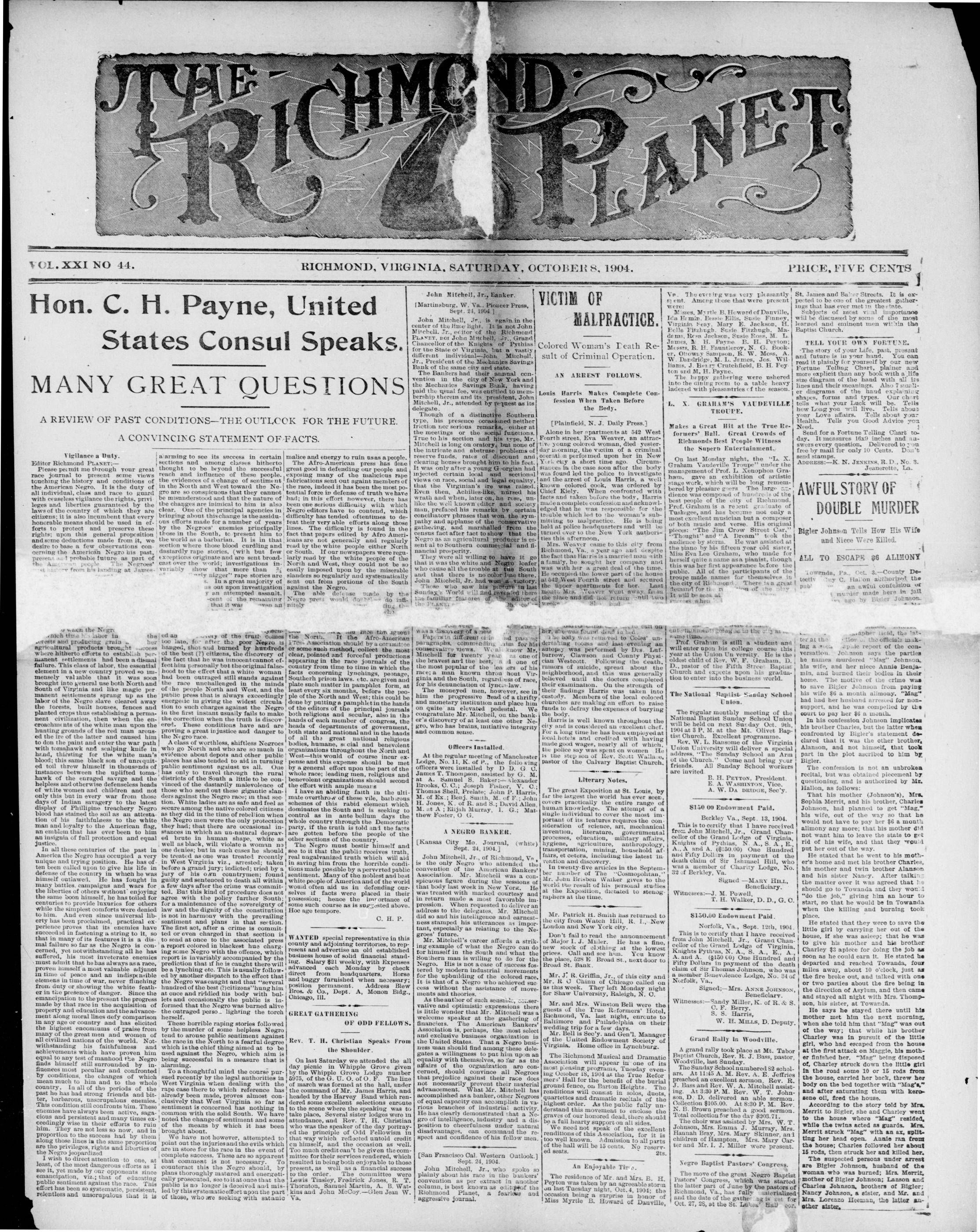
Hon. C. H. Payne, United States Consul Speaks. MANY GREAT QUESTIONS
A REVIEW OF PAST CONDITIONS—THE OUTLCOK FOR THE FUTURE. A CONVINCING STATEMENT OF FACTS.
VOL. XXI NO 44.
Hon. C. H.
State
MANY GE
A REVIEW OF PAST CO
A CONV
Vigilance a Duty.
Editor Richmond PLANET:—
Please permit me through your great race journal to present some views touching the history and conditions of the American Negro. It is the duty of all individual, class and race to guard with ceaseless vigilance the rights, privileges and liberties guaranteed by the laws of the country of which they are citizens; it is also incumbent that every honorable means should be used in efforts to protect and preserve these rights; upon this general proposition and some deductions made from it, we desire to base a few observations concerning the American Negro his past, present and probable future as part of the American people. The Negroes' most history from his landing at James-
in the forests and producing grain. her agricultural products brought success where hitherto efforts to establish perennial pastureland had been a dismal failure. This class of labor, the element in a new country proved so imensely valuable that it was soon brought into general use both North and South of Virginia and like magic permanent settlements sprang up as the labor of the Negro slave cleared away the forests, built houses, fences and planted crops thus establishing a permanent civilization, then when the encroachments of the white man upon the hunting grounds of the red man aroused the ice of the latter and caused him to don the paint and enter the war path with tomahawk and scalping knife in head, thirsting for the white man's blood; this same black son of unrequited toil threw himself in thousands of instances between the uplifted tomahawk of the enraged savrage and the helpless and otherwise defenseless heads of children and children, and not only this but in children and not those days of Indian savagery to the latest display of Philipine treachery Negro blood has stained the soil as an attestation of his faithfulness to the white man and loyalty to the American flag, an emblem that has ever been to him an insignia of full protection and equal justice.
In all these centuries of the past in America the Negro has occupied a very unique and trying position. He has often been called upon to give his life in defense of the country in when he was himself outlawed. He has fought in many battles, campaigns and wars for the liberties of others without enjoying the same boon himself, he has toiled for centuries to provide luxuries for others while the simplest comforts were denied to him. And even since universal liberty has been proclaimed, practical experience proves that its enemies have succeeded in fastening a string to it, so that in many of its features it is a dismal failure so far as the Negro is concerned. The notwithstanding all he has suffered, the most inveterate enemies must admit that he has always a race, proven himself a master of adjunct in time of peace and an indispensable element in time of war, never flinching from duty or showing the white feather in the presence of danger. Since the emancipation to the present the progress made by that race in the acquisition of property and education and the advancement along moral lines defy comparison in any age or country and has elicited the highest encomiums of praise from many of the great men and women of all civilized nations of the world. Notwithstanding his faithfulness and achievements which have proven him equal to any test of manhood the Negro finds himself still surrounded by influences most peculiar and confronted by conditions, the changes of which mean much to him and to the whole country. In all of the periods of the past he has adorned friends and bitter, barbarous miserable enemies. This condition still confronts him. These enemies have always been active, sagacious and persistent and many times exceedingly wise in their efforts to him. They are not less so now, and in proportion to the success had by them along those lines in the same proportion are the privileges, rights and liberties of the Negro jeopardized
I wish to direct attention to one, at least, of the most dangerous efforts as I see it, yet made by our opponents since emancipation, viz.; that of educating the poor and the underclass race. This effort has been so systematic that it relentless and unserprunals, that it is
aarming to see its success in certain sections and among classes hitherto thought to be beyond the successful reach and influence of these people, the evidences of a change of sentiment in the North and West toward the Negro are so conspicuous that they cannot be misunderstood and that the nature of the changes are inimical to him is also clear. One of the principal agencies in bringing about this change is the assiduous efforts made for a number of years by the Negroes' enemies principally those in the South, to present him to the world as a barbarian. It is in that section where those blood curdling and dusty rape stories, (with but few exceptions originate and are sent broadcast over the world; investigations invariably show that more than $ \frac{3}{4} $
y migger rape stories are s. In a great majority of us out upon investigation y an attempted assault. -cent of the remaining that it was. even an
an injury of the truth comes too late, for after the poor Negro hanged, shot and burned by hundreds of the best (?) citizens, the discovery of the fact that he was innocent cannot affect him personally but the original falsehood to the effect that a white woman had been outraged still stands against the race unchallenged in the minds of the people North and West, and the public press that is always exceedingly energetic in giving the widest circulation to such charges against the Negro in the first instant usually fails to make the correction when the truth is discovered. These conditions have and are proving a great injustice and danger to the Negro race.
A class of worthless, shiftless Negroes who go North and who are so much in evidence about depots and other public places has also tended to aid in turning public sentiment against us all. One has only to travel through the rural districts of the South a little to be convinced of the dastardly malevolence of those who send out these gigantic slanders against the Negro race; in that section. White ladies are as safe and feel as secure among the native colored citizens as they did in the time of rebellion when the Negro men were the only protection they had; that there are occasional instances in which an un-natural deprived brute in human shape, white as well as black, will violate a woman no one denies; but in such cases he should be treated as one was treated recently in West Virginia viz.; arrested; taken before a grand jury; indicted; tried by a jury of his own countrymen; found guilty and sentenced to death within a few days after the crime was committed. But this kind of procedure does not agree with the policy further South; for a maintenance of the sovereignty of law and the dignity of the constitution is not in harmony with the prevailing sentiment and plans in that section. The first after a crime is committed or even chained, that section is to send at once to the associated press a report colored in blackest hue charging some Negro with the offence, which report is invariably accompanied by the prediction that if he is caught there will be a lynching etc. This is usually followed by another dispatch to the effect that the Negro was caught and that "several hundred of the best (?)citizens" hung him at once and riddled his body with bullets and occasionally the public is informed that the Negro was burned alive the outraged person, lighting the torch herself.
These horrible raping stories followed by the murder of some helpless Negro tend to arouse public sentiment against the race in the North to a fearful degree which is the chief thing aimed at to be used against the Negro, which aim is being successful in a measure that is alarming.
To a thoughtful mind the course pursued recently by the legal authorities in West Virginia when dealing with the rape case there to which reference has been made, proves almost conclusively that West Virginia so far as sentiment is concerned has nothing in common with the solid South. We have noted the change of sentiment and some of the means by which it has been brought about.
We have not however, attempted to point out the injuries and the evils which are in store for the race in the event of complete success. These are so apparent that comment is not necessary. To counteract this the Negro should, by plus thoroughly matured and energetic people, be a public is no longer is deceived and misled by this systematic effort upon the part of those, who are seeking with satanic
RICHMOND, VIRGINIA, SATURDAY, OCTOBER 8, 1904.
malice and energy to ruin usas a people. The Afro-American press has done great good in defending our people and exposing many of the malicious rape fabrications sent out against members of the race, indeed it has been the most potential force in defense of truth we have had; in this effort however, there has been one serious difficulty with which Negro editors have to contend, which difficulty has tended oftentimes to deteat their very able efforts along those lines. The difficulty is found in the fact that papers edited by Afro Americans are not generally and regularly read by the people of the North or South. If our newspapers were nearly read by the white people of the North and West, they could not be so easily imposed upon by the miserable slanders so regularly and systematically sent out from portions of the South against the Negro.
The able defense made by the Negro press would doubtless do infinitely
race the about the North. It the Afro-American 1975. Association should by a committee or some such method, collect the most clear, pointed and forceful productions appearing in the race journals of the country from time to time in which the facts concerning lynchings, peonage, Southern prison laws, etc. are given and plate such matter in pamphlet form, at least every six months, before the people of the North and West; this could be done by putting a pamphlet in the hands of the authorities of the principal journals both religious and secular, also in the hands of each member of congress, the heads of departments of government, both state and national in the hands of all the great national religious bodies, humane, social and benevolent organizations throughout the North and West—this would of course incur expense and this expense should be met by a general effort upon the part of the whole race; leading men, religious and benevolent organizations should second the effort with ample means.
I have an abiding faith in the ultimate overthrow of these vile, burdous schemes of this raid element which dominates the South and is seeking to control as in ante bellum days the northern part of the democratic party, if the truth is told and the facts are gotten before the people of the other sections of the country.
The Negro must bestir himself and see to it that the public receives truth, real ungalvanized trust which will aid in saving him from the horrible conditions made possible by a perverted public sentiment. Many of the noblest and best white people of America and of the world would often aid us in defending ourselves if facts were placed in their possession; hence the importance of some such course as is suggested above. Hoc age tempore.
C. H. P.
WANTED special representative in this county and adjoining territories, to represent and advertise an old established business house of solid financial standing. Salary $21 weekly, with Expenses advanced each Monday by check direct from headquarters. Horse and buggy furnished when necessary; position permanent. Address Blew Bros. & Co., Dept. A, Monon Bidg., Chicago, Ill.
OF ODD FELLOWS.
Rev. T. H. Christian Speaks From the Shoulder
On last Saturday we attended the all day picnic in Whipple Grove given by the Whipple Grove Lodge number 5975, of the G. U. O. of O. F. The line of march was formed at the hall, under the command of Mr. James Harris, and headed by the Harvey Band which rendered some excellent selections enroute to the scene where the speaking was to take place. Several sister lodges were in attendance, and Rev. T. H. Christian who was the speaker of the day portrayed the principle of Odd Fellowism in that way which refracted untold credit on himself, and the occasion as well. Too much credit can't be given the committee for their services rendered, which resulted in being both enjoyable to those present, as well as a financial success to the order. The committee were Lewis Tinsley, Fredrick Jones, R. T. Thornton, Samuel Martin, A. B. Watkins and John McUoy.—Glen Jean W. Va.
Though of a distinctive Southern type, his presence occasioned neither friction nor serious remarks, either at the meetings or the social functions. True to his section and his type, Mr. Mitchell is long on oratory, but none of the intricate and abstruse problems of reserve funds, rates of discount and clearing houses brought him to his feet. It was only after a young G.organ had injected certain local and sectional views on race, social and legal equality, that the Virginian's tre was raised. Even then, Achilles-like, nursed his wrath and when, later on, he rose, unlike the well known editor and society man, prefaced his remarks by certain conciliatory phrases that won the sympathy and applause of the conservative gathering, and marshalled from the census fact after tact to show that the Negro as an agricultural producer is essential to Southern commercial and financial prosperity.
They were all willing to have it go that it was the white and Negro loafer who cause all the trouble at the South and that there is no color line there. John Mitchell, Jr. had won a victory. Those who saw his picture in last season's final will and revealed there the familiar face of the PLANET.
was a discovery of a new paper in different fields and passing paragraphs, commenting him for his conservative views. We don't know Mr. Mitchell for twenty years as one of the bravest and the best, a kind of one of the most popular of the leaders of his race; a man known thronen host Virginia and the South, regardless of race, for his denunciation of lynch law. The moneyed men, however, see in him the progressive head of a thrifty and monetary institution and place him on quite an elevated pedestal. We congratulate Mr. Mitchell, on the banker's discovery of at least one other Negro, who has brains, initiative integrity and common sense.
Officers Installed
At the regular meeting of Manchester
Lodge, No. 11, K of P., the folio wing
officers were installed by D. D. G. C.
James T. Thompson, assisted by G. M.
at A. Samuel S. Baker; Alexander
Brooks, C. C.; Joseph Fisher, V. C.
Thomas Shell, Prelate; John P. Harris,
M. E. Smith, M. of F.; John
H. Jones, K. of R. and S.; David Allan,
M. at A; Elijah Mirach, I. G.; Mathew
Foster, O. G.
A NEGRO BANKER.
[Kansas City Mo. Journal, (white) Sept. 24, 1904.]
John Mitchell, Jr., of Richmond, Va., is the only Negro who attended the convention of the American Bankers' Association. Mr. Mitchell was a conspicuous figure during the sessions of that body last week in New York. He was treated with marked courtesy and in return made a most favorable im- plement. When requested to deliver an address to the delegates, Mr. Mitchell did so and his intelligence and earnestness stamped his utterances as important, especially as relating to the Negroes' future.
Mr. Mitchell's career affords a striking example of what the Negro can do for himself in the South and what the Southern man is willing to do for the Negro. His is not a case of success fostered by modern industrial movements for the upbuilding of the colored race. It is that of a Negro who achieved success without the assistance of movements and theories.
As the author of such sensible, conservative and optimistic expressions there is little wonder that Mr. Mitchell was a welcome speaker at the gathering of financiers. The American Bankers' Association is, perhaps, the most select and exclusive business organization in the United States. That a Negro business man should find among these delegates a willingness to put him upon an equality with themselves, so far as the affairs of the organization are concerned, should convince all Negroes that prejudice against their race does not necessarily prevent their material advancement. What Mr. Mitchell has accomplished as a banker, other Negroes of equal capacity can accomplish in various branches of industrial activity. He has clearly demonstrated that a Negro of intelligence, industry and a disposition to cheerfulness under natural disadvantages, can command the respect and confidence of his fellow men.
[San Francisco Cal. Western Outlook.] Sept. 24, 1904.
John Mitchell, Jr., who spoke so plainly about his race in the bankers' convention as per extract in another column, is best known as editor of the Richmond Planet, a fearless and aggressive journal.
Colored Woman's Death Result of Criminal Operation.
Louis Harris Makes Complete Confession When Taken Before the Body.
[Plainfield N. J. Daily Press]
Alone in her apartments at 542 West Fourth street, Eva Weaver, an attractive young colored woman, died yesterday morning, the victim of a criminal operation performed upon her in New York city a short time ago. Circumstances in the case soon after the body was found led the police to investigate and the arrest of Louis Harris, a well known colored cook, was ordered by Chief Kiely. When confronted with facts and taken before the body, Harris made a complete confession and acknowledged that he was responsible for the murder. He was sent to maltipractice. He is being held at police headquarters and will be turned over to the New York authorities this afternoon.
Mrs. Weaver came to this city from Richmond, Va., a year ago and despite the fact that Harris is a married man with a family, he sought her company and was with her a great deal of the time. He occupied the lower part of the house at 542 West Fourth street and secured the upper apartments for her. Last month, Mrs. Weaver went away from the place and did not return until two
ner, she was found dead in bed.
The body was removed to Coles' undertaking teams and last evening an autopsy was performed by Drs. Lufburrow, Clawson and County Physician Westcott. Following the death, rumors of suicide, spread about the neighborhood, and this was generally held until the doctors completed their examination. On the strength of their findings Harris was taken into custody. Members of the local colored churches are making an effort to raise funds to defray the expenses of burying the body.
Harris is well known throughout the city and is considered an excellent chef. For a long time he has been employed at local hotels and credited with having made good wages, nearly all of which, the police say was spent on women. He is the step son of Rev. Scott Wallace, pastor of the Calvary Baptist Church.
Literary Notes.
The great Exposition at St. Louis, by far the largest the world has ever seen, covers practically the entire range of human knowledge. The attempt of a single individual to cover the most important of its features requires the consideration of science, art, mechanical invention, literature, governmental processes, education, military affairs, hygiene, agriculture, anthropology, transportation, mining, household affairs, et cetera, including the latest invention and discovery.
In twenty-five articles in the September number of The "Cosmopolitan," Mr. John Brisbin Waker gives to the world the result of his personal studies at the Exposition, dictated to stenographers at the time.
Mr. Patrick H. Smith has returned to the city from Watch Hill, R. I., New London and New York city.
Don't fail to read the announcement of Major I. J. Miller. He has a fine, new stock of clothing at the lowest prices. Call and see him. You know the place, 528 E. Broad St., next door to Broad St. Bank.
Mr. J. R. Griffin, Jr., of this city and Mr. R. C Chinn of Chicago called on us this week. They left Monday night for Shaw University, Raleigh, N. O.
Mr. and Mrs. Winston Bell were the guests of the True Reformers' Hotel, Richmond, N. Just night, enroute to Baltimore and Baltimore on their wedding trip for a few days.
Mr. Bell is See 's, and Gen.' Manager of the United Endowment Society of Virginia. Home office in Lynchburg.
The Richmond Musical and Dramatic Association will appear in one of its most pleasing programs, Tuesday evening October 18, 1904 at the True Reformers' Hall for the benefit of the burial ground fence, on Barton Heights. The conditions will consist in solos, duets, quartettes and dramatic recitals of the highest order. As the public fully understand this movement to enclose the graveyard honored dead, there should be a full day's support on all sides. We need not be excellent renditions of this Association, for it is too well known. Admission to all parts of the hall will be 15 cents. No reserved 23s
An Enjoyable Time.
The residence of Mr. and Mrs. B. H. Peyton was taken by an agreeable storm on the night. Oct. 4, 1904; the occasion being the death of the person Miss Myrtle B. Howard of Danville.
Ve. The everything was very pleasantly sent. Among those that were present were:
Misses, Myrtle B. Howard of Danville, Ida Hamm, Bessie Ellis, Susie Finney, Virginia Seay, Mary E. Jackson, H. Ella Fitzhugh, Susie Fitzhugh, Madams, Resa Jackson, Susie Moss, L. James, M. H Payne, E. H Perton, B. H Familarcy, N. E. Booker, Ottowry Sampson, R. W. Moss, A. W. Dardridge, M. L. James, Jos. Williams, J. Berry Crutchfield, B. H. Peyton and M. H. Payne.
The happy gathering were ushered into the dining room to a table heavy ladened with pleasanties of the season.
L. X. GRAHAM'S VAUDEVILLE TROUFE.
Makes a Great Hit at the True Reformers' Hall. Great Crowds of Richmonds Best People Witness the Supern Entertainment.
On last Monday night, the "L. X. Graham Vaudeville Troupe" under the management of Prof. L. Xenophon Graham, gave an exhibition of artistic stage work, which will be long remembered by pleasure goers. The large audience was composed of hundreds of the best people of the city of Richmond. Prof. Graham is a recent graduate of Tuskegee, and has become not only a most excellent musician but a composer of both music and verse. His original pieces: "The Jim Crow Street Car," "Thongtut" and "A Dream" took the audience by storm. He was assisted at the piano by his fifteen year old sister, Miss Eva Lee Graham, who made for herself quite a name as a pianist, though this was her first appearance before the public. All of the participants of the troupe named names for themselves in the end of Richmond. There a great band for the "union of the play." It will be seen at
Prof. Graham is still a student and will enter upon his college course this year at the Union Un versity. He is the oldest child of Rev. W. F. Graham, D. D., pastor of the Fifth Street Baptist Church and expects upon his graduation to enter into the business world.
The National Baptist Sunday School
Eton
The regular monthly meeting of the National Baptist Sunday School Union will be held on next Sunday Oct. 9th, 1904 at 3 P. M. at the Mt. Olivet Baptist Church. Excellent programme. Rev. W. L. Ransome of the Virginia Union University will deliver a special address, "The Sunday School an Arm of the Church." Come and bring your friends. All Sunday School workers are invited
B. H. PEYTON, President.
E. A. WASHINGTON, Vice.
A. W. D BRIDGE, Sec.Y.
8150 00 Endowment Paid.
This is to certify that I have received from John Mitchell, Jr., Grand Chancellor of the Grand Lodge of Virginia, Knights of Pythias, N. A., S. A. E., A., A. and A. ($150.00) One Hundred and Fifty Dollars in payment of the death claim of Sir Ishmael Hill, who was a member of Charity Lodge, No. 32 of Berkley, Va.
Signed—MARY HILL,
Beneficiary.
Witnesses:--J. M. Powell,
T. H. Walker, D. D., G. C.
8150.00 Endowment Paid
Nortok, Va., Sept. 12th, 1904.
This is to certify that I have received from John Mitchell, Jr., Grand Chancellor of the Grand Lodge of Virginia, Knights Pythas, N. A., S. A., E., A., A. and A. ($150 00) One Hundred and Fifty Dollars in payment of the death claim of Sir Thomas Johnson, who was a member Benevolence Lodge, No. 34 of Norfolk, Va.
Signed;—Mrs. ANNE JOHNSON, Beneficiary.
Witnesses:—Sandy Miller, K. of R. & S.
C. F. Berry,
S. S. Harris,
W. H. MILLS, D. Deputy.
Grand Rally in Woodyville.
A grand rally took place at Mt. Tabor
Baptist Church, Rev. R. J. Bass, pastor,
Woodville, last Sunday.
The Sunday School numbered $2 scholars.
At 11:45 A. M. Rev. A. E. Jeffries
preached an excellent sermon, Rev. R.
J. Bass and Rev. W. A. Mitchell assisting.
At 3:30 P. M. Rev. W. T. Johnson
D. Bass offered an able sermon.
Collection $105 covered 8:30 P. M. Rev.
N. B. Brown preached an sermon.
Total collection for the day $302.75.
The choir was assisted by Mrs. W. T.
Johnson, Mrs. Emma J. Murray, Mrs.
Hannah Bray, Mrs. Mary Skinner, and
children of Hampton, Mrs. Mary
Carter and Mr. I. J. Miller were present.
Negro Baptist Pastors' Congress
The move of the great Negro Baptist Pastors' Congress, which was started the latter part of June by the pastors of Richmond, Va., has fully materialized and the date of the gather ag is set for Oct. 27, at the St. Lukes Hall car.
St. James and Bakers Streets. It is expected to be one of the greatest gatherings that has ever met in the state. Subjects of most vital importance were buryed by some of the most learned and enlighten men within the Baptist Church.
The story of your Life, past, present and future is in your hand. You can read it plainly for yourself by our new Fortune Telling Chart, plainer and more explicit than any book with a life size diagram of the hand with all its lines and their meanings. Also 7 similar diagrams of the hand explaining shapes, forms and types. Our chart shows how long you will live. Tells about your Love affairs. Tells about your Health. Tells you Good Advice you Need.
Send for a Fortune Telling Chart today. It measures 16x9 inches and answers every question. Delivered to you free by mail for only 10 Cents. Don't send stamps.
ADDRESS: - K. N. JENKINS, R. D., No. 3
Jeanetteer, La.
AWFUL STORY OF DOUBLE MURDER
Bigler Johnson Tells How His Wife and Niece Were Killed.
ALL TO ESCAPE $6 ALIMONY
Towanda, Pa., Oct. 3—County Detective Guy C. Halton authorized the pub an awful confession of murder made here in jail ago by Bigler Johnson.
ter at the station, the officials making a sign, apale report of the conversation. Johnson says the parties he names murdered "Mag" Johnson, his wife, and her niece Annie Benjamin, and burned their bodies in their home. The motive of the crime was to save Bigler Johnson from paying his wife $6 a month alimony. "Mag" had had her husband arrested for non-support, and he was compelled by the court to pay her $6 a month. In his confession Johnson implicates his brother Charles, but the latter when confronted by Bigler's statement declared that it was the other brother, Alanson, and not himself, that took part in the plot ascribed to him by Bigler. The confession is not an unbroken recital, but was obtained piecemeal by questioning, and is authorized by Mr. Hallon, as follows:
That his mother (Johnson's), Mrs. Sophia Merritt, and his brother, Charles Johnson, had planned to get "Mag." his wife, out of the way so that he would not have to pay her $6 a month alimony any more; that his mother did not want him to leave the state to get rid of his wife, and that they would put her out of the way.
He stated that he went to his mother's home and met his brother Charles, his mother and twin brother Alanson and his sister Nancy. After talking the matter over it was agreed that he should go to Towanda and they would "do the job," giving him an hour to start, so that he would be in Towanda when the killing and burning took place.
He stated that they were to save the little girl by carrying her out of the house, if she was asleep; that he was to give his mother and his brother Charley $3 aplece for doing the job as soon as he could earn it. He stated he departed and reached Towanda, four miles away, about 10 o'clock, just as the fire broke out, and talked with one or two parties about the fire being in the direction of Asylum, and then came and stayed all night with Mrs. Thompson, his sister, at Towanda.
He says he stayed there until his mother met him the next morning, when she told him that "Mag" was out of the way; that while his brother Charley was in pursuit of the little girl, who had escaped from the house at the first attack on Maggie, his mother finished her. "Mag" being disposed of, Charley struck down the little girl in the road some 10 or 15 rods from the house, carried her back, threw her body on the bed together with "Mag", and after saturating them with kerosene oil, fired the house.
According to the story told by Mrs. Merrit to Bigler, she and Charley went to the house where "Mag" resided, while the twins acted as guards. Mrs. Merrit struck "Mag" with an ax, splitting her head open. Annie ran from the house; Charles followed her about 15 rods, then struck her and killed her. The suspected persons under arrest are Bigler Johnson, husband of the woman who was burned; Mrs. Merrit, mother of Bigler Johnson; Lanson and Charles Johnson, brothers of Bigler; Nancy Johnson, a sister, and Mr. and Mrs. Lorenzo Heeman, the latter another sister.
HEY PLANET
SATURDAY.....OCTOBER 8,1904
TEMPERANCE NOTES
THE PANTHER
ALCOHOL
A
PANTHER is loose in the house of men.
Or by what paths he will come and go.
In the shaded tree boughs he may lie concealed. In wayside brambles, in flowery dell;
The panther is loose! He has put to flight
A zest for pleasure, or gain, or strife,
Someone's child may be killed outright,
Some one be managed or maimed for life,
Every man to the battle rescue springs,
Armed and vigilant. Heart and brain
Burning the claims of lesser things,
Till the hidden menace be caged or stain.
But what of the enemy, fiercer far,
Who roams at will through the city
street,
Who jurks where the seekers of pleasure
are,
Who matters the home with noiseless feet?
She husband is shamed by his precious
wife,
The mother moans or her bright boy's
fall,
And orphans weep, while crime and strife
And murder and suicide end it all.
Birth, beauty and talent before him fall,
He conquers the mighty again and again.
Will you guard by law King Alcohol?
Will you set a price on the souls of me?
You must be a child from the par
berk's feet,
will you leave me now to a worse?
The strength of God for a right
US Crisis
A JUST LAW.
How the Laws of Illinois Protect the Interests of the Relatives of the Drinker.
Now that attention has been turned in many quarters to the saloonkeeper's liability for injuries to persons to whom the drink has been sold, we give here one section of the law of Illinois on this subject. Section nine of the Illinois dram-shop law, passed July 4, 1874:
"Every, husband, wife, child, parent, guardian, employer or other person who shall be injured in person or property or means of support by an intoxicated person, or in consequence of intoxication, habitual or otherwise, of any person, shall have a right of action, severally or jointly, against any person or persons who shall, by selling or giving intoxicating liquors, have caused the intoxication in whole or in part of such person or persons; and any person owning, renting, leasing or permitting the occupation of any building or premises, and having knowledge that intoxicating liquors are sold therein, or who, having leased the same for other purposes, shall knowingly permit therein the sale of any intoxicating liquors that have caused in whole or in part the intoxication of any person, shall be liable, severally or jointly, with the persons aforesaid for all damages sustained, and for exemplary damages."
It will be seen that the statute is very broad in its scope, and leaves no loopholes for clever lawyers. It should be borne in mind also that under the Illinois dram-shop act it is "not necessary to state the kind of liquor sold or to describe the place where it is sold." Neither is it necessary to show that the intoxicated person, whose death or injury has left a wife or children without support, was not a habitual drunkard in order to recover damages from the saloonkeeper who sold the liquor or from the owner of the building in which the liquor was sold.
TEMPERANCE ITEMS
Mortality from cancer is very high in beer-drinking districts of Germany, such as Bavaria and Salzburg.
Andrew Carnegie gives a bonus of ten per cent. upon their yearly wages to all employees upon the Skibo estates who are total abstainers from intoxicating drink. He believes that, such are well worth their bonus, both from an economic and a social point of view.
Dr. Jacques Bertillon, the famous chief of the statistical bureau of Paris, has written a volume entitled "Alcoholism and the Way to Fight It." Drink, he declares, is likely to prove the ruin of the French race unless something is done to overcome the habit.
The marine insurance companies doing business in New York have started a temperance movement in a novel and practical way. For ships on which no intoxicating liquors are drunk they announce a reduction of five per cent from the regular premium rate.—Boston Globe.
If you cannot save the thousands
Yearly ruined by strong drink.
You can reach by friendly warning
One one standing on the brink.
You can give your own example
To the safe, abstaining side.
Shielding thus from fierce temptation
Precious souls for whom Christ died.
BURDETTE ON THE SALOON
The Distinguished Humorist Expresses His Opinion of the Liquor Traffic.
Now what another man says somebody told him he heard I gaid, I stand ready to dispute on general principles. That isn't evidence in any court in the world. But let me say it myself, and I'll stand by it to the last comma and hyphen. Now hear me say it myself.
About the power of prohibitory laws to prohibit—the laws of the state against murder do not entirely prevent murder. But, nevertheless, I am opposed to licensing one murderer to every so many thousand persons, even on petition of a majority of the property owners in the block, that we may have all the murder that is desirable in the community under wise regulations, with a little income for the municipality. I believe in the absolute prohibition of murder.
The laws of the country prohibiting stealing do not entirely prevent stealing. Nevertheless, I am opposed to a high license system of stealing, provided that all theft shall be restricted to certain authorized thieves, who shall italel only between the hours of say six t. m. and 11:30 p. m., except Sunday, when no stealing shall be done except by stealth, entrance to be made in all cases on that day by the back door, and at the thief's risk. I believe in laws that absolutely forbid theft at any hour, on any day of the week.
And, on the same ground, and just as positively, do I believe in the prohibition of the liquor traffic. And I never said that I didn't. And I did say that I did. And I DO.
I do say that the best way to make a man a temperate man is to teach him not to drink. But a saloon is not a kindergarten of sobriety. Your town is under no obligation to any saloon. All that it is, in respectability and permanent prosperity, it has grown to be without the assistance of the liquor traffic. You don't owe a dollar or a merchant or a resident, you don't owe one item of the attractiveness and popularity of your town to the refining and educating influence of a corner ginnill, with a group of sidewalk loafers.
It is deliberately claimed by some people who appear to be sane on other subjects, that to properly instruct a sober person in the ways of sobriety and to teach total abstainers the beauty and virtues of temperance, you must license the selling of liquor in the town. The man who originated that Idea ought to have it stuffed and exhibit it at the St. Louis exposition, and he should be leased up beside it as a part of the exhibit. There was once a man who owned a parrot. It swore like a pirate. A neighbor owned a parrot that
will keep them in the same room and mime who teach yours not to swear". The birds were caged side by side. And everybody who knows enough to know anything knows which parrot had his vocabulary enriched with new and startling words.
Keep your town clean from this evil. If men will violate the law in order to gratify evil habit and taste, don't try to cure the sin of law-breaking by enacting a law which it would be easy and wicked to obey.
As to prohibition in Pasadena, if any liquor man thin's there is big money and a safe thing in running a "blind pig" in Pasadena, let him come here and try it. If he has any love for his liberty and pocketbook, however, he will do well to consult the fellows who have tried it, if he can find them; we can't. They are in hiding somewhere out in the desert. "Running" a "joint" in Pasadena is like running a powder mill in a smelting furnace. It's mighty exciting while it lasts, but it doesn't last long enough to be profitable.
If the saloon men insist on quoting me on this topic, let them commit this to memory that they may repeat it as they need it: I do not know one good thing about the saloon. It is an evil thing that has not one redeeming thing in all its history to commend it to good men. It breaks the laws of God and man. It describes the Sabbath; it profanes the name of religion; it defies public order; it tramples under foot the tenderest feelings of humanity; it is a moral pestilence that blights the very atmosphere of town and country; it is a stain upon honesty; a blur upon purity; a clog upon progress; a check upon the nobler impulses; it is an incentive to falsehood, deceit and crime. From such a hateful fountain head can flow a clear stream? Can you name one good thing the saloon has ever done for humanity—one good thing—one instance in which it has brought forth fruits unto righteousness—one influence, sweet and healthful, and pure, gracious and beautiful which will linger lovingly in the memory of men, when you have buried the rum power, to make them say, "God bless the saloon for the good it did?" Search through the history of this hateful thing, and read one page over which some mother can bow her grateful head and thank God for all the saloon did for her boy. There is no such record. All Ms history is written in tears and blood, with smears of shame and stains of crime, and dark blots of disgrace. Men, are you going to stand for this thing? Are you going to vote for it? Are you going to put into office, in city or county, men who will be the tools of the saloon power? As you love the fair name of your city get together and make your lives and your united strength tell for all that is best and cleanest in good government.
The ravages of drink in Edinburgh have, it appears, reached the worst proportion ever known in the experience of the Edinburgh lunatic asylum.
The Contrary View.
"Sull," said the wife of the ossified man, "there is such a thing as having a husband with too much backbone."—Chica go Tribune.
THE RICHMOND PLANET
Fun for All Fun Lovers.
College Girl
Ernie—Papa may be very bright in business, but I don't think he knows much about love affairs. He asked if my George was a good provider. Eva—And is he, dear? Ernie—Certainly. Why, he's been providing me with novels, chocolates and matinee tickets for the last two years. Pa didn't seem pleased, though. Columbus Dispatch.
Not Up-to-Date
"Mamma," said the pretty fuzzy-haired girl, "I think I ought to go to go to cooking school, don't you?" "It isn't necessary, my dear," replied the mother, "I can teach you to cook." "But that would never do, mamma," protested the fair daughter, "you only know how to cook the ordinary things that people really eat."—Cincinnati Enquirer.
An Object of Consideration.
"Why is everybody so obsequious to that young man?" "He is an amateur photographer," answered Miss Cayenne.
"And they're afraid he won't take their pictures?" "No. They're afraid he will."—Washington Star.
A. Cutting Reply
Mr. D'Avnue—My Stars! More money? What on earth did you do with all I gave you last week?
Mrs. D'Avnue—Well, I used a little of it in buying a new album for the photographs of the dukes and princes I refused before I married you.—N. Y. Weekly.
Very Slow Poison
"Do you drink coffee?" asked the doctor of an aged patient.
"Yes," was the reply.
"Coffee," continued the M. D., "is a slow poison."
"Yes, very slow." replied the old man.
"I have taken it daily for nearly 80 years."—Tit-Bits.
Juvenile Happiness
"Did you boys have a good time at your bonfire, Johnny?" "You bet we did! We burnt a back yard fence, half a dozen piano boxes, an' the most of old Squilligan's smoket house, an' had a be-yootful run when the police got after us."—Chicago Tribune.
Pleasant Anticipations
"Why can't you marry me? It's true I'm not enormously rich, still I have an income plenty big enough to support us nicely."
"Yes, but think how ridiculously small the allimony allowed out of it will be"—Town Topics
sick, ma'am.
Mrs. McCall—But—er—don't you think she could see me?
Bridget—Ol'm sure she could an' did ma'am. Ol'm thinkin' that's what made her sick—Philadelphia Press.
The Usual Catch
"So Bragley was out fishing yesterday. How many did he bring back with him?"
"Oh, about a dozen."
"A dozen what? Bass?"
"No, fish stories."—Philadelphia Press.
Mr. Hardup—Look here! you've made a mistake with my washing. You sent home four or five old handkerchiefs that don't belong to me, and nothing else.
Washerwoman—They ain't handkerchiefs; that's your last shirt, sor.—Tit-Bits.
Considering the Lillies.
Full many a man who does not toll
To meet his early need
Rare that he willily when He's just a jimson weed.
—Washington Star.
NATURALLY.
Cora—What is your favorite pet in the animal world?
Dora—Man—Chicago Chronicle
He worked with one eye on the clock
The whole long work day through.
Now he can watch it with both eyes;
He's nothing else to do.
Do it.
Commercial Rivalry
"Pa, What is commercial rivalry? Well, commercial rivalry is the way your mother tries to spend what I make faster than Mrs. Dash next door spends what her husband makes."—Chicago Journal.
Winks—That so? He's got now what he always wanted.
Binks—What's that?
Winks—The earth.—Town Topics.
As an Investment.
"Yes, he sent her four dollars' worth of violets."
"But can he afford it?"
"Oh, I guess so. She's worth half a million."—Cleveland Plain Dealer.
Easing H.
Dauber—Is this
portrait a reality?
Splasher—No the
Newmillions.
Dauber—I suppose
this charcoal picture
Splasher—I had
my conscience.
Illions as she read
Life.
Love
"You are losing
complains."
He argues that t, but she pouts and reacts n. Finally he wants to she says such a thing.
"Because," she tied my shoe this afternoon not that would not come itself."—Judge.
His Occa sh.
"Why don't you at to go to a wedding?" saidrs. Enpeck. "I don't believe you been to a wedding since you attended your own."
"No," mildly responded Mr. Enpeck, "I haven't. And, he added, softly, to himself, "I sometimes wish I hadn't attended that one"—Philadelphia Bulletin.
"Scribiet has earned but a great quantity of stuff with his pen, but has he ever written anything that will endure?
"I think he has. I have several of his promissory notes in my possession which I expect to hand down to posterity just as he gave them to me."—Chicago Tribune.
Accustomed to Carriages.
Old Lady—Why do you call your carriage when you are going such a short distance?
Miss Upperten—It is unnecessary, perhaps, but I never think of walking. We have always had a carriage, you know.
Old Lady—Yes, I remember. Your grandfather kept his carriage, too. He peddled milk from it—N. Y. Weekly.
Esmeralda—She used to say that if she ever married a man it would be because she wanted to make him miserable, yet she married that young Fizzetop after she had known him only a week.
Gwendolen—Yes; it seems to have been a case of hate at first sight.—Chicago Tribune.
Rising.
"They have come up in the world, have they not?" asks the friend of other days.
"Indeed, yes," says the friend who has kept track of them. "Why, they have reached that stage where they correct your pronunciation of their name."—Judge.
Prudence.
"Do you encourage your daughter's literary ambitions?"
"Decidedly answered the matter-of-fact woman. "If she has the gossiping instinct it is bound to come out, and she'd better be making up stories about immanent people."
"Um! She said that two years ago.
"Oh, yes; I'll say that for her. She doesn't say one to-morrow to-day and another to-morrow"—Chicago Journal.
The Victim.
The trusts and strikers day by day
The air with fierce contentions fill.
The public merely waits to pay
Each month some extra on the bill.
—Washington Star.
ANOTHER SUMMER CAMPAIGN.
CORRECTED EDITION
Bobby—Do you know what daddy calls you, Mr. Tovey?
Mr. Tovey—No, Bobby. What is it?
Bobby—He calls you Port Arthur, 'cause you take so long to surrender.—St. Louis Republic.
Natural History.
The airship is a curious bird;
The fact no one denies.
He stays securely on the roost,
And very sedum files.
—Washington Star.
Her Idea.
Mother—You say you didn't let him hug you? Why, Ethel, I was sure I saw you hugging him.
Ethel—Well—er—I thought if I only squeezed him real hard I might, make him let go.—Philadelphia Press.
Bella—He is usually in the same room where my husband shaves himself—N. Y. Herald.
"The bill for the picture, said the tattooist, "will be $50."
"All right," replied his customer; "just draw on me"—Houston Post.
A Practical Man.
"Oh, John, John, what do you think has happened? When I got home from my shopping trip to day I found a note from Bedella saying she had eloped with Charlie Robinson! Well, why do you stand there, looking like that? You don't seem to be worried a bit!"
"I ain't, ma. I was just thinkin' how much meat we'll be able to buy with the money we've saved on her weddin' clothes."—Chicago Record Herald.
HMOND, VIRGINIA.
Something Much Holier.
"Do I love George?" mused Clara, softly, "or is it simply a sister's affection that I feel for—"
Just then Bobby burst noisily into the room and interrupted her meditations.
"Get out of here, you little wretch!" she shouted, and seizing him by the arm she shot him through the door.
"Ah, no," she sighed, as she resumed her interrupted train of thought, "my love for George is not a sister's love. It is something sweeter, purer, higher and holier."—Tit Bite.
Paradisiacal.
Mother—So you have been at the jam again, Adolphas!
Son—The cupboard door came open itself, mother, and I thought—
Mother—Why didn't you say: "Get thee behind me, Satan?"
Son—So I did, mother; and he went and pushed me right in—Brooklyn Life.
His Position.
"What do you do in ofse men dat is stalkin' fur less wokin' hours," asked Meandering Mike.
"I can't understand 'em at all," answered Ploidding Pete. "If it was me I wouldn't descend to mention anything bigger dan minutes."—Washington Star.
He—There are two periods in a man's life when he doesn't understand a woman.
He—Before he's married and after he's married.—Ally. Slipper.
There was a man in our town.
And he was wordless wise;
He hled him to a doctor, who
Examined both his eyes:
"You need some glasses, sir," he said.
The man held on a car.
And bought just 20 glasses at
The very nearest bar.
And when he'd taken every glass
He made another call
Upon the doctor by then
He couldn't
d Le
ON THE ROAD.
M.
Spokes—Heath looked furious when I passed him this afternoon.
Stokes—What was the matter with him?
Spokes—Well, I had the faster horse.
—N. Y. Times.
The Early Drama.
He—I thought the play would interest you.
She—Why, the plot is full of flaws.
He—Yes. I thought you'd be interested in picking them.—Town and Country.
Incentive.
Old Gentleman—Do you think you could love me better if I told you I was worth a million?
Mr. Steele—Why is it that with such
a name you are so awfully wicked?
Mr. Goode—Why is it with such a
name you are so awfully soft?—Cincinnati Enquirer.
Patrice—Well, neither have I; and I don't believe her!—Yonkers Statesman.
One or the Other.
Blimmer—Just see that covered carriage down there meandering along all over the street.
Glimmer—I'm! The driver must be either a drunken man or a sober woman.—N. Y. Weekly.
Experienced.
Rounder—Do you believe in the control of one mind over another?
Married Man—I certainly do; I was hypnotized when I proposed to the girl that is now my wife. — Detroit Free Press
science.
beautiful woman's
inspiration?
a portrait of Mrs.
drump in
your laundress,
awt that to ease
is Ms. Newmil-
lens.—Brooklyn
tied my
not that
itself."—
Good as Her Word
Rising.
Prudence
The Victim.
Her Idea.
Explained.
A Sight Draft
A Practical Man.
Paradisiacal
His Position.
He never told his love, for when
the fatal words he would have sald,
Her father from above yelled down—
And the young man quickly fled,
-Chicago Daily News.
THE LIFEFLOW LUZZLE.
A Sad, Sad Case
The Early Drama.
Incentive.
Unanswerable
One or the Other
His Limitations
"No," said the dear fellow, "I only believe what I can understand." "Really?" said the girl. "What a skeptic you must be!"—Chicago Journal.
Mechanics'
Savings Bank
OF RICHMOND, VA
511 North Third Street.
Capital, $25,000
a deposit and interest paid on a
which remains 60 days and over.
Satisfactory Security.
Handled Promptly.
its and upwards received on deposit.
up in the most improved style, having a large
best, electric lights and every modern conven-
odation of the public.
Stocks, Deposits, Loans, etc., apply to the
ranged for the special convenience of the work-
4 P. M. Saturday, 9 A. M. to 3 P. . We
can again at 5 P. M., remaining open until
work.
Money received on deposit and interest paid on a amounts above $1.00 which remains 60 days and over.
Money Loaned on Satisfactory Security.
Business Accounts Handled Promptly.
Amounts of ten cents and upwards received on deposit.
This establishment is fitted up in the most improved style, having a large white vault, burlar-proof steel chest, electric lights and every modern convenience for safety and the accommodation of the public.
For all information concerning Stocks, Deposits, Loans, etc., apply to the Cashier.
$ Banking Hours have been arranged for the special convenience of the working people as follows: 9 A. M. to 4 P. M. Saturdays, 9 A. M. to 3 P. M. We close Saturday at 3 P. M. and open again at 5 P. M., remaining open until $ P. M. Call by as you come from work.
OFFICERS
I. H. F. JONATHAN, Vice-President,
H. WYATT, a Nashier,
D. OF DIRECTORS:
JNO. R. CHILES, B. P. VANDERVALL,
NATHAN, THOMAS SMITH D. J. CHAVERS,
JNO. T. TAYLOR,
JOHN MITCHELL, JR., President, H. F. JONATHAN, Vice-President$,
THOS. H. WYATT, Cashier,
BOARD OF ASSOCIATES
WILLIAM CUSTALO, J. J. CARTER,
THOMAS M. CRUMP, SEC.
OHNSON,
VECTOR AND EMBALMER.
207 N. Foushee St. Corner Broad
KS FOR HIRE:
For Telegraph filled. Wedding, Sup-
tainments promptly attended.
Vence in Building, New Phone,
RIGHTS OF COLUMBUS OF THE WORLD
V. P. & F. K. of W.
W. I. JOHNSON FUNERAL DIRECTOR AND EMBALMER.
Office & Warerooms, 207 N. Foushee St. Corner Broad HACKS FOR HIRE: Orders by Telephone or Telegraph filled. Wedding, Suppers and Entertainments promptly attended. Old 'Phone, 686, Residence in Building, New Phone, 18
KNIGHTS OF COLUMBUS OF THE WORLD
TO WHOM IT MAY CONCERN:
This organization has been chartered and legally instituted under the laws and statute of the state of York, for the purpose of uniting together all acceptable men on the Broad Bases of Charity - Beneficial and the Social and Moral condition of humanity.ry and uniform ranks will secure for this organization all sacred institutions of modern events, a great number of deputies wanted in all sections of the country to greatly address.
This organization has been chartered and legally situated under the laws and statute of the state of New York, for the purpose of uniting together all acceptable men on the Broad Bases of Charity—Beneficial and Praternal and to promote the Social and Moral condition of humanity. Its two distinct military and uniform ranks will secure for this organization place in the front ranks of all sacred institutions of modern events, a grand opportunity for active men. Deputies wanted in all sections of the country to greet lodges. Kindly address.
G. W. ALLEN Supreme voyages.
846 W. 87°
Out Orders Sol
Isaac Straus and Co.
Family Wine, Liquor and Cigar Store, 422 East Broad, St. Richmond, Va.
WE MAKE A SPECIALTY OFFICE Mt. Vernon, Gibson, Old Jasper, Pennbrook
positively render the coarsest and hardest. Once tried alwaft, called for. Large size bottles 50 cents, or sent prepaid by mail for 60 cents in stamps or money-order.
Send 10 cents in stamps for generous sample to
Please mention this paper when ordering. RELIABLE AGENTS WANTED 4t
DENTISTRY
OFFICE HOURS:—From 8 A. M. to 6 P.
M. Old Phone, 816.
DR. P. B. RAMSEY,
102 W. Leigh St., Richmond, Va.
SYDNOR AND HUNDLEY, LEADERS IN Quality Furniture
PARLOR SUITS.
We have some twenty-five or thirty suits bought, most of which will be in stock in a few days. "Don't do a thing" until you see this line.
MORRIS CHAIRS.
This always popular chair of rest will be in as much demand this fall as ever. Part of our stock has already arrived and $10 values vie with $15 values of a year ago.
Call, see our stock of Bed Room furniture and save time and money.
Passenger elevator.
Sydnor & Hunsley,
RIETOR 709-11-13 E. Broad St.
1789
E. A. WASHINGTON, B. W. WHITING,
JOHN MITOHELL, JR. FRES.
```markdown
```
Out 1 2 Orders Sol
Isaac Straus and Co.
Family Wine, Liquor and Cigar
*Store, 422 East Broad, St.
Pichaund, Va.*
Richmond, Va,
WE MAKE A SPECIALTY OFF
Mt.
Vernon, Gibson, Old Jasper, Pembrok
Berkshire, Henry, Old North
Carolina Corn Whiskey and Mountain
Apple Brandy
IMPORTED AND DOMESTIC WINES, BRAN
DIES, GINS AND RUMS.
Best and most popular brands of CIGARS
Goods Desired Free to 'Phone 2234
all parts of the CIGAR Store
BUFFER IN REAR
FIRST CLASS Restaurant.
Barber Shop, Pool Room, Boarding House and Employment Office. CHARLES H. BAILEY, Proprietor and Manager. Center Ave., opposite R. R. Station. Lock, 13. mos Atlantic Highland, N. J.
ICE-CREAM Is in Every Style,
Wholesale and Retail,
Parlors Open Day and Night
Special Attention to Picnics, Festi-
vals, etc. Estimates given.
All the latest and most popular
drinks of the fountain, fresh on hand,
TOBACCO AND OIGARS.
'Phone, 2253. WINSTON'S,
537 Brook Avenue.
FRANK WALLER, JR.
PRACTICAL HOUSE PAINTER,
14 W. Baker St., Richmond, Va.
Residence, 1 E. Orange St.
"THE ECONOMY,"
803 N. 3rd St.,
Fine Tailoring,
CLEANING,
DYEING,
AND REPARING,
W. O. TURNER, PROPRIETOR
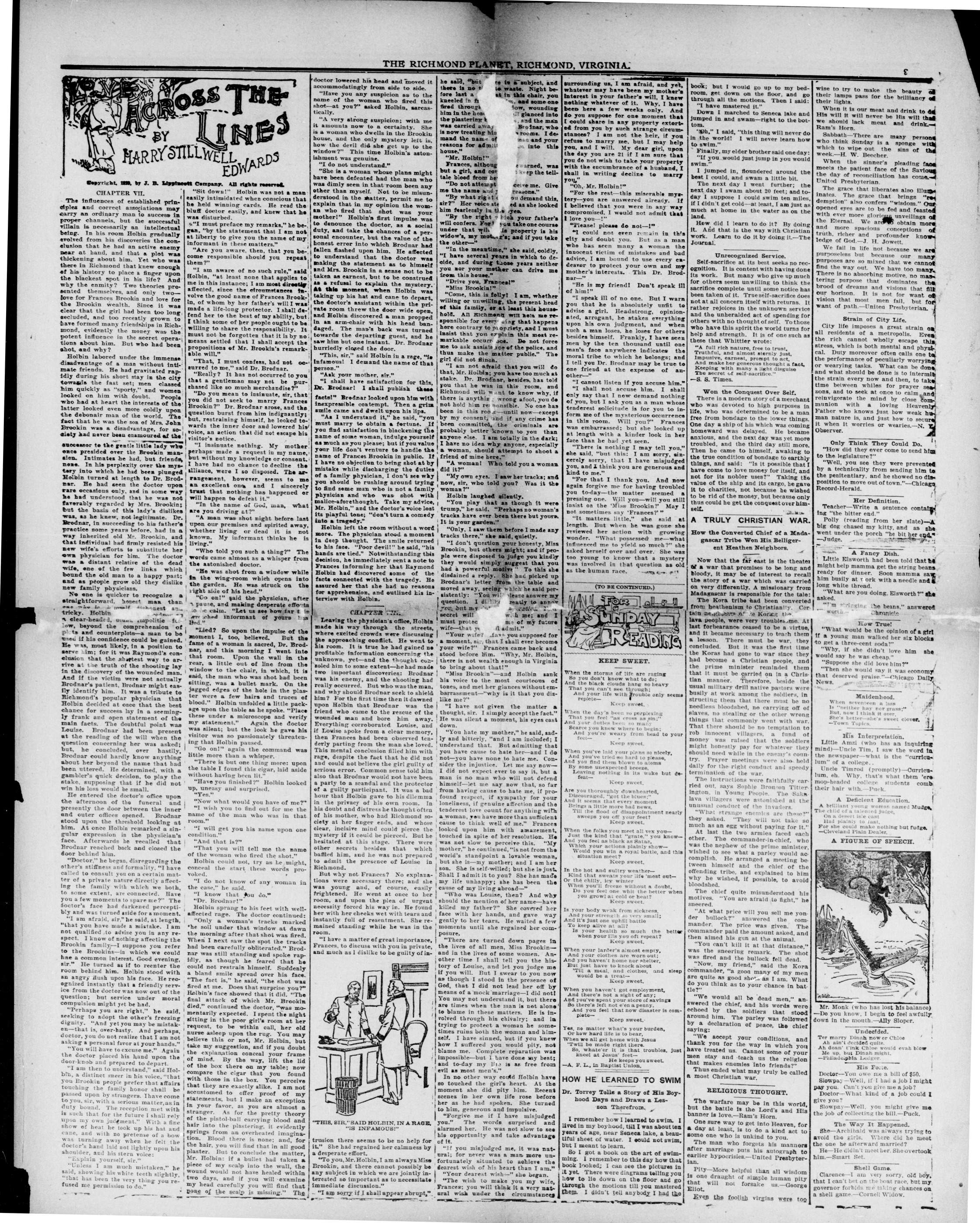
LOVE ACROSS THE LINES BY HARRY STILLWELL EDWARDS
The influences of established principles and correct associations may carry an ordinary man to success in proper channels, but the successful villain is necessarily an intellectual being. In his room Holbin gradually evolved from his discoveries the conclusion that he had an active enemy near at hand, and that a plot was thickening about him. Yet who was there in Richmond that knew enough of his history to place a finger upon the blackest spot in his life? And why the enmity? Two theories presented themselves, and only two—love for Frances Brookin and love for the Brookin wealth. Since it was clear that the girl had been too long excluded, and too recently grown to have formed many friendships in Richmond, evidently the money was the potent influence in the secret operations about him. But who had been ahot, and why?
Holbin labored under the immense disadvantage of a man without intimate friends. He had gravitated rapidly during his short stay in the city towards the fast set; men classed him quickly as "sporty," and women looked on him with doubt. People who had at heart the interests of the latter looked even more coldly upon the debonair man of the world. The fact that he was the son of Mrs. John Brookin was a disadvantage, for society had never been enamoured of the
successor to the gentle little lady who once presided over the Brookin mansion. Intimates he had, but friends, none. In his perplexity over the mystery into which he had been plunged Holbin turned at length to Dr. Brodnar. He had seen the doctor upon rare occasions only, and in some way he had understood that he was not favorably regarded by Mrs. Brookin; but the basis of this lady's dislikes was, as he knew, not legitimate. Dr. Brodnar, in succeeding to his father's practice some years before, had in a way inherited old Mr. Brookin, and that individual had firmly resisted his new wife's efforts to substitute her own physician for him. The doctor was a distant relative of the dead wife, one of the few links which bound the old man to a happy past; and as people grow old they dislike new family physicians.
No one is quicker to recognize a straightforward, honest man than one who is more selfish honest and tricky. Holbin a clear-headed, impolite fool, beyond the comprehension of plots and counterplots—a man to be used if his confidence could be gained. He was, most likely, in a position to serve him; for it was Raymond's conclusion that the shortest way to arrive at the truth of the shooting lay in the discovery of the wounded man. And if the victim were not actually Brodnar's patient, Brodnar might easily identify him. It was a tribute to Richmond's popular physician that Holbin decided at once that the best chance for success lay in a seemingly frank and open statement of the main facts. The doubtful point was Louise. Brodnar had been present at the reading of the will when the question concerning her was asked; but, he concluded, over hastily, Brodnar could hardly know anything about her beyond the name that had been uttered. He determined, with a gambler's quick decision, to play the stake, supposing that if he did not win his loss would be small.
He entered the doctor's office upon the afternoon of the funeral and presently the door between the inner and outer offices opened. Brodner stood upon the threshold looking at him. At once Holbin remarked a singular expression in the physician's face. Afterwards he recalled that Brodner reached back and closed the door behind him.
"Doctor," he began, disregarding the other's stiffness and formality. "I have called to consult you on a certain matter of a private nature directly affecting the family with which we both, to some extent, are connected. Have you a few moments to spare me?" The doctor's face had darkened perceptibly and was turned aside for a moment.
"I am afraid, sir," he said, at length, "that you have made a mistake. I am not qualified to advise you in any respect. I know of nothing affecting the Brookin family—I suppose you refer to the Brookins—in which we could hae a common interest. Good evening, sir." He turned as if to reenter the room behind him. Holbin stood with an angry flush upon his face. He recognized instantly that a friendly service from the doctor was now out of the question; but service under moral compulsion might yet be had.
"Perhaps you are right," he said, seeking to adopt the other's freezing dignity. "And yet you may be mistaken—that is, over-hasty. And perhaps, doctor, you do not realize that I am not asking a personal favor at your hands." "You will have to excuse me." Again the doctor placed his hand upon the door-knob and prepared to depart.
"I am then to understand," said Holbin, a distinct sneer in his voice, "that you Brookin people prefer that affairs touching the family honor shall be passed upon by strangers. Thave come to you, sir, with a serious matter, as in duty bound. The reception met with is such that for the future I shall rely upon my own judgment." With a fine show of heat he took up his hat and cane, and with no pretense of a bow was turning away when he felt the doctor's hand laid not lightly upon his shoulder, and his stern voice:
"Explain yourself, sir."
"Unless I am much mistaken," he said, showing his white teeth slightly,
"that has been the very thing you refused me permission to do."
"Sit down!" Holbin was not a man easily intimidated when conscious that he held winning cards. He read the bluff doctor easily, and knew that he was disturbed.
"I must preface my remarks," he began, "by the statement that I am not at liberty to give you the name of my informant in these matters."
"Are you aware, then, that you become responsible should you repeat them?"
"I am aware of no such rule," said Holbin, "at least none that applies to me in this instance; I am most directly affected, since the circumstances involve the good name of James Brookin, of whom by her father's will I was made a life-long protector. I shall defend her to the best of my ability, but I think some of her people ought to be willing to share the responsibility. It must not be forgotten that it is by no means settled that I shall accept the propositions of Mr. Brookin's remarkable will."
"That, I must confess, had not ocurred to me," said Dr. Bradnar.
"Really? It has not occurred to you that a gentleman may not be purchased like so much merchandise?" "Do you mean to insinuate, sir, that you did not seek to marry Frances Brookin?" Dr. Brodnar arose, and the question burst from him indignantly; but, restraining himself, he looked towards the inner door and lowered his voice, an action that did not escape his visitor's notice.
"I insinuate nothing. My mother perhaps made a request in my name, but without my knowledge or consent. I have had no chance to decline the alliance, were I so disposed. The arrangement, however, seems to me an excellent one, and I sincerely trust that nothing has happened or will happen to defeat it."
"In the name of God, man, what are you driving at?"
"A man was shot night before last upon our premises and spirited away, whether living or dead it is not known. My informant thinks he is living."
"Who told you such a thing?" The words came almost as a whisper from the astonished doctor.
"He was shot from a window while in the wing-room which opens into the garden. He was struck on the right side of his head."
"Go on!" said the physician, after pause, and making desperate efforts to calm. "Let us see how far it is weighed informant of yours has Red."
"Lied? So upon the impulse of the moment I, too, believed. But the fame of a woman is sacred, Dr. Brodnar, and this morning I went into that room. Upon the wall in the rear, a little out of line from the window to the chair, in which, it is said, the man who was shot had been sitting, was a bullet mark. On the jagged edges of the hole in the plaster were a few hairs and traces of blood." Holbin unfolded a little package upon the table as he spoke. "Place these under a microscope and verify my statement." Again the doctor was silent; but the look he gave his visitor was so passionately threatening that Holbin paused. "Go on!" again the command was little more than a whisper. "There is but one thing more: upon the table I found this cigar, laid aside without having been lit." "Have you finished?" Holbin looked up, uneasy and surprised.
"Now what would you have of me?"
"I wish you to find out for me the name of the man who was in that room."
"I will get you his name upon one condition."
"And that is?"
"That you will tell me the name of the woman who fired the shot."
Holbin could not, try as he might, conceal the start these words provoked.
"I do not know of any woman in the case," he said.
"I know that you do."
Holbin sprang to his feet with well-affected rage. The doctor continued: "Only a woman's tracks marked the soil under that window at dawn the morning after that shot was fired. When I next saw the spot the tracks had been carefully obliterated." Brodnar was still standing and spoke rapidly, as though he feared that he could not restrain himself. Suddenly a bland smile spread over his face. "The fact is," he said, "the shot was fired at me. Does that surprise you?" Holbin's face showed that it did. "The final attack of which Mr. Brookin died," continued the doctor, "was momentarily expected. I spent the night sitting in the poor girl's room at her request, to be within call, her old nurse asleep upon the rug. You may believe this or not, Mr. Holbin, but take my suggestion, and if you doubt the explanation conceal your frame of mind. By the way, lift the lid of the box there on my table; now compare the cigar that you found with those in the box. You perceive that they are exactly alike. I am not accustomed to offer proof of my statements, but I make an exception in your favor, as you are almost a stranger. As for the pretty theory of the pistol-ball carrying blood and hair into the plastering, it evidently springs from an overheated imagination. Blood there is none; and, for the hair, you will find that in all good plaster. But to conclude the matter, Mr. Holbin: if a bullet had taken a piece of my scalp into the wall, the wound would not have healed within two days, and if you will examine my head carefully you will find that none of the scalp is missing." The
THE RICHMOND PLANET, RICHMOND, VIRGINIA.
doctor lowered his head and moved it accommodatingly from side to side.
"Have you any suspicion as to the name of the woman who fired this shot—at you?" asked Holbin, sarcastically.
"A very strong suspicion; with me it amounts now to a certainty. She is a woman who dwells in the Brookin house, and the only mystery left is, how the devil did she get up to the window?" This time Holbin's astonishment was genuine.
"She is a woman whose plans might have been defeated had the man who was dimly seen in that room been any other than myself. Not to be misunderstood in the matter, permit me to explain that in my opinion the woman who fired that shot was your mother!" Holbin's first impulse was to denounce the doctor, as a social duty, and take the chances of a personal encounter, but the value of the honest error into which Brodnar had fallen flashed upon him. He affected to understand that the doctor was making the statement as to himself and Mrs. Brookin in a sense not to be taken as earnest, but to be construed as a refusal to explain the mystery. At this moment, when Holbin was taking up his hat and cane to depart, the doctor's assistant within the private room threw the door wide open, and Holbin discovered a man propped in an arm-chair with his head bandaged. The man's back was turned towards the departing guest, and he saw him but one instant. Dr. Brodnar hurriedly closed the door.
"This, sir," said Holbin in a rage, "is Infamous! I demand the name of that person."
"Ask your mother, sir."
"I shall have satisfaction for this, Dr. Brodnar! I shall publish these facts!" Brodnar looked upon him with inexpressible contempt. Then a grim smile came and dwelt upon his lips. "As I understand it," he said, "you must marry to obtain a fortune. If you find satisfaction in blackening the name of some woman, indulge yourself as much as you please; but if you value your life don't venture to handle the name of Frances Brookin in public. If I have no objection to being shot at by mistake while discharging the duties of a family physician, I don't see why you should be rushing around trying to find some man who is not a family physician and who was shot with malice-aforethought. Take my advice, Mr. Holbin," and the doctor's voice lost its playful tone; "dont turn a comedy into a tragedy."
Holbin left the room without a word more. The physician stood a moment in deep thought. The smile returned to his face. "Poor devil!" he said, "his hands are tied." Notwithstanding this decision, he immediately sent a note to Frances informing her that Raymond Holbin had discovered some of the facts connected with the tragedy. He assured her that she had no reasons for apprehension, and outlined his interview with Holbin.
CHAPTER 116
Leaving the physician's office, Holbin made his way through the streets, where excited crowds were discussing the approaching conflict. He went to his room. It is true he had gained no profitable information concerning the unknown, yet—and the thought consoled him to some extent—he had made two important discoveries: Brodnar was his enemy, and the shooting had really occurred. But who was the man, and why should Brodnar seek to shield him? For the first time then it dawned upon Holbin that Brodnar was the friend who came to the rescue of the wounded man and bore him away. Everything corroborated Louise, and if Louise spoke from a clear memory, then Frances had been observed tenderly parting from the man she loved. This mental conclusion filled him with rage, despite the fact that he did not and could not believe the girl guilty of serious error. Common sense told him also that Brodnar would not have been a party to a scandal and the protector of a guilty participant. It was a bad hour that Holbin gave to his dilemma in the privacy of his own room. In his doubt and distress he thought often of his mother, who had Richmond society at her finger ends, and whose clear, inclusive mind could pierce the mystery if it could be pierced. But he hesitated at this stage. There were other secrets besides that which baffled him, and he was not prepared to admit the presence of Louise in Richmond.
But why not Frances? No explanations were necessary there; and she was young and, of course, easily frightened. He went at once to her room, and upon the plea of urgent necessity forced his way in. He found her with her cheeks wet with tears and instantly full of resentment. She remained standing while he was in the room.
"I have a matter of great importance, Frances, to discuss with you in private, and much as I dislike to be guilty of in-
"THIS, SIR," SAID HOLBIN, IN A RAGE,
"IS INFAMOUS!"
trusion there seems to be no help for it." She had regained her calmness by a desperate effort. "To you, Mr. Holbin, I am always Mise Brookin, and there cannot possibly be any subject in which we are jointly interested so important as to necessitate immediate discussion." "I am sorry if I shall appear abrupt."
he said, "but he there is no fire fore last a kneeled in fire fired through him in the heat the plastering he was carried away is now treating him mand the name of reasons for admit house."
to be a subject, and
to waste. Night be-
cast in this chair, you
can, and some one
low, wounding
glanced into
and the man
Bro Inar, who
rooms. I de-
man and your
into this
"Mr. Holbin!"
Frances, although but a girl, and cov tale blood from her
"Do not attempt me the name and y
"By what rigst a sir?"
Her voiceate fearlessly in th
Frances, although we warned, was but a girl, and coworker kept the tell-tale blood from her.
"Do not attempt to receive me. Give me the name and y'r reasons."
"By what right do you demand this, sir?" Her voice stared as she looked him fiercely in the eye.
"By the right which your father's will confers. For' you take one course under that will is property is his widow's, my mother's; and if you take the other—"
"In the meantime," she said, coldly, "I have several years in which to decide, and during those years neither you nor your mother can drive me from this house."
"Drive you, Frances!"
"Miss Brooklin!"
"Come, this is folly! I am, whether willing or unwilling, the present head of this family, or at least this household. All Richmond will hold me responsible for every thing that happens here contrary to propriety, and I must insist that you explain this most remarkable occurrence soe. Do not force me to ask assistance of the police, and thus make the matter public." The girl did not finch.
"I am not afraid that you will do that, Mr. Holbain; you have too much at stake. Dr. Brodnar, besides, has told you that he was in this room, and Richmond will want to know why, if there is anything wrong afoot, you do not hold him responsible. No one has been in this room—until now—except by my consent, and if any crime has been committed, the criminals are probably better known to you than anyone else. I am totally in the dark; I have no idea why anyone, especially a woman, should attempt to shoot a friend of mine here."
"A woman! Who told you a woman did it?"
"My own eyes. I saw her tracks; and now, sir, who told you? Was it the woman?"
Hobin laughed silently.
"You play that as though it were trump," he said. "Perhaps no woman's tracks have ever been there but yours. It is your garden."
"Only, I saw them before I made any tracks there," she said, quietly.
"I don't question your honesty, Miss Brookin, but others might; and if people were disposed to judge you kindly they would simply suggest that you had a powerful motive." To this she disdained a reply. She had picked up Brodnar's letter from the table and moved away, seeing which he said persistently: "You will please answer my question. I dillly try to annoy you, but my secret will with me; and I must protect me of my future wife—that we admit."
"Your wife? Have you supposed for a moment, sir, that I shall ever become your wife?" Frances came back and stood before him. "Why, Mr. Holbin, there is not wealth enough in Virginia to bring about that!" "Miss Brookin"—and Holbin sank his voice to the most courteous of tones, and met her glances without embarrassment—"why is it that you dislike me?" "I have not given the matter a thought, sir. I simply accept the fact." He was silent a moment, his eyes cast down.
"You hate my mother," he said, sadly and bitterly, "and I am included; I understand that. But admitting that you have cause to hate her—and I do not—you have none to hate me. Consider the injustice. Let me say now—I did not expect ever to say it, but a man is no man who will not defend himself—let me say now that, so far from having cause to hate me, if profound respect, if sympathy for your loneliness, if genuine affection and the tenderest love count for anything with a woman, you have more than sufficient cause to think well of me." Frances looked upon him with amazement, touched in spite of her resolution. He was not slow to perceive this. "My mother," he continued, "is not from the world's standpoint a lovable woman, but she is—my mother; and I am her son. She is self-willed; but she is just. Shall I admit it to you? She has made my life unhappy; she has been the cause of my living abroad."
"Who was Louise, then? And why should the mention of her name—have killed my father?" She covered her face with her hands, and gave way gently to her tears. He waited a few moments until she regained her composure.
"There are turned down pages in the lives of all men, Miss Brookin—and in the lives of some women. Another time I shall tell you the history of Louise, and let you judge me if you will. But I swear to you now as though I stood in the presence of God, that I did not lead her off by means of a mock marriage—I did not! You may not understand it, but there are times when the man is not alone to blame in these matters. He is involved through his chivalry; and in trying to protect a woman he sometimes ruins both the woman and himself. I have sinned, but if you knew how I suffered you would pity, not blame me. Complete reparation was impossible—but I have done my best; and to-day my life is as free from evil as most men's." In no other way could Holbin have so touched the girl's heart. At the moment she did pity him. Recent scenes in her own life rose before her as he had spoken. She turned to him, generous and impulsive.
"Forgive me if I have misjudged you." The words surprised and alarmed her. He was not slow to see his opportunity and take advantage of it.
"If you misjudged me, it was natural; for never was a man more unfortunately situated to achieve the nearest wish of his heart than I am."
"Your dearest wish—she began.
"The wish to make you my wife, Frances; you will think it a very natural wish under the circumstances
surrounding us, I am afraid, and yet, whatever may have been my mother's interest in your father's will, I knew nothing whatever of it. Why, I have been here a few weeks only. And do you suppose for one moment that I could share in any property extorted from you by such strange circumstances? I am not the heir, if you refuse to marry me, but I may help you, and I will. My dear girl, upon the day you are 21 if I am sure that you do not wish to take your property with the encumbrance of a husband, I shall in writing decline to marry you."
"Ob. Mr. Holbin!"
"For the rest—this miserable mystery—you are answered already. If I believed that you were in any way compromised, I would not admit that I love you—!"
"Please! please do not—!"
"I could not even remain in this city and doubt you. But as a man who has seen many a woman the innocent victim of mistakes and bad advice, I am bound to use every endeavor to protect your own and my mother's interests. This Dr. Brodnar—"
"He is my friend! Don't speak ill of him!"
"I speak ill of no one. But I warn you that he is absolutely unfit to advise a girl. Headstrong, opinionated, arrogant, he stakes everything upon his own judgment, and when such a man loses, he loses for others besides himself. Frankly, I have seen men by the ten thousand until one man's face anywhere indicates the moral tribe to which he belongs; and I tell you Dr. Brodnar may be true to one friend at the expense of another—"
"I cannot listen if you accuse him." "I shall not accuse him. I shall only say that I now demand nothing of you, but I ask you as a man whose tenderest solicitude is for you to inform me of the mysterious occurrence in this room. Will you?" Frances was embarrassed; but she looked up at length with a kinder look in her face than he had yet seen.
"There is nothing I may tell you," she said, "but this: I am sorry, sincerely sorry, that I have misjudged you, and I think you are generous and kind to me."
"For that I thank you. And now again forgive me for having troubled you to-day—the matter seemed a pressing one. Will you—will you still insist on the 'Miss Brookin'? May I not sometimes say 'Frances?'"
"It matters little," she said at length. But when he was gone she reviewed her action with growing wonder. "What possessed me—what influenced me to yield so much?" she asked herself over and over. She was too young to know that a mystery was involved in that question as old as the human race.
(TO BE CONTINUED.) FOR SUNDAY READING
KEEP SWEET.
When the storms of life are raging
So you don't know what to do;
And the black clouds hang so heavy
That you can't see through;
But you can see through.
When the day's been so perplexing
That you feel "as cross as sin";
And your duties been so many
So you are where to begin;
And you're being to you
Keep sweet
When you've laid your plans so nicely,
And you've tried so hard to please,
And you find them blown to atoms
By some unexpected breeze.
Are you thoroughly downhearted,
Discouraged, "get the blues;"
And it seems that every moment
Brings a life to you.
When the folks you meet all vex you—
Just the kind that "grate," you know—
And you feel as black as Satan,
Which your actions plainly show—
Would you win a royal battle, and this
situation meet?
Keep sweet.
In the hot and sultry weather—
Kind that sweats your life 'mest out—
Or the chilly night,
When you'll freeze without a doubt,
Do you feel one whit the better when
you growl at cold or heat?
Keep sweet.
Is your body weak from sickness,
And your strength so very small;
And it's just one uphill battle
To keep alive at all?
Is your health so much the better
when your ills you oft repeat?
Keep sweet.
When your larder's almost empty,
And your clothes are worn out;
And you haven't home nor shelter,
But just have to knock about
'Till a meal, and clothes, and sleep
would be a treat—
Keep sweet.
When you haven't got employment,
And there's not a sight of a;
And you've spent your store of savings
So there is left not e'en a penny.
And you feel that now disaster is com-
plete
Keep sweet.
Yes, no matter what's your burden,
Or how hard life is to bear.
When we all get home with Jesus
Twill be made right there.
So, whate'r it is that troubles, just
knel at your feet.
He keeps you sweet.
-A. F. L., in Baptist Union.
HOW HE LEARNED TO SWIM
Dr. Torrey Tolls a Story of His Boyhood Days and Draws a Lesson Therefrom.
I remember how I learned to swim. I lived in my boyhood, till I was about ten years of age, near Seneca lake, a beautiful sheet of water. I could not swim, but I meant to learn.
So I got a book on the art of swimming. I remember to this day how that book looked; I can see the pictures in it yet. There were diagrams telling you how to lie down on the floor and go through the motions till you mastered them. I didn't tell anybody I had the
book; but I would go up to my bedroom, get down on the floor, and go through all the motions. Then I said: "I have mastered it." Down I marched to Seneca lake and jumped in and swam—right to the bottom. "Oh," I said, "this thing will never do in the world! I will never learn how to swim." Finally, my elder brother said one day: "If you would just jump in you would swim." I jumped in, floundered around the best I could, and swam a little bit. The next day I went further; the next day I swam about 20 feet; and today I suppose I could swim ten miles, if I didn't get cold—at least, I am just as much at home in the water as on the land. How did I learn to do it? By doing it. And that is the way with Christian work. Learn to do it by doing it.—The Journal.
Unrecognized Service
Self-sacrifice at its best seeks no recognition. It is content with having done its work. But many who give up much for others seem unwilling to think the sacrifice complete until some notice has been taken of it. True self-sacrifice does not at all concern itself with returns. It rather rejoices in the unknown service and the unheralded act of spending for others with no thought of self. To those who have this spirit the world turns for help and strength. It is of one such as these that Whittier wrote:
"A full rich nature, free to trust, Truthful, and almost sternly just, Impusive, earnest, prompt to act, And make her generous thought a fact, Knowledge of many a light disguise The secret of self-sacrifice."
— S. S. Times
Won the Conquest Over Self.
There is a modern story of a merchant who was devoted to high purposes in life, who was determined to be a man free from bondage to the lower things. One day a ship of his which was coming homeward was delayed. He became anxious, and the next day was yet more troubled, and the third day still more. Then he came to himself, awakening to the true condition of bondage to earthly things, and said: "Is it possible that I have come to love money for itself, and not for its nobler uses?" Taking the value of the ship and its cargo, he gave it to charities, not because he wished to be rid of the money, but because only thus could he get the conquest over himself.
A TRULY CHRISTIAN WAR.
Now that the far east is the theater of a war that promises to be long and bloody, it may be of interest to recall the story of a war which was carried on very differently. A missionary from Madagascar is responsible for the tale: The Kora tribe had been converted from heathenism to Christianity. Certain neighbours of Kora the
lava people, were very troublesome. At last forbearance ceased to be a virtue, and it became necessary to teach them a lesson. There must be war, they concluded. But it was the first time the Koras had gone to war since they had become a Christian people, and the prime minister reminded them that it must be carried on in a Christian manner. Therefore, beside the usual military drill native pastors were busily at work among the soldiers, instructing them that there must be no needless bloodshed, no carrying off of slaves, no stealing or the other wrong things that commonly went with war. That there should be no temptation to rob innocent villagers, a fund of money was raised that the soldiers might honestly pay for whatever they should need while in the enemy's country. Prayer meetings were also held daily for the right conduct and speedy termination of the war.
The instructions were faithfully carried out, says Sophie Bromon Titterington, in Young People. The Sakulava villagers were astonished at the unusual conduct of the invaders.
"What strange enemies are these?" they asked. "They will not take so much as an egg without paying for it." At last the two armies faced each other. The commander-in-chief, who was the nephew of the prime minister, wished to see what a parley would accomplish. He arranged a meeting between himself and the chief of the offending tribe, and explained to him why he wished, if possible, to avoid bloodshed.
The chief quite misunderstood his motives. "You are afraid to fight," he sneered.
"At what price will you sell me younger bullock?" answered the commander. The price was given. The commander paid the amount asked, and then aimed his gun at the animal.
"You can't kill it at that distance," was the sneering remark. The shot was fired and the bullock fell dead.
"Now, my friend," said the Kora commander, "a good many of my men are quite as good she... as I am. What do you think as to your chance in battle?"
"We would all be dead men," answered the chief, and his words were echoed by the soldiers that stood around him. The parley was followed by a declaration of peace, the chief saying:
"We accept your conditions, and thank you for the way in which you have treated us. Cannot some of your men stay and teach us the religion that makes enemies into friends?"
Thus ended what may truly be called a most Christian war.
RELIGIOUS THOUGHT
The warfare may be in this world, but the battle is the Lord's and His banner is love.—Ram's Horn.
One sure way to get into Heaven, for a day at least, is to do a kind act to some one who is unkind to you.
The man who forgets his manners after marriage puts his autograph to earlier hypocrisies.—United Presbyterian.
Pity—More helpful than all wisdom is one draught of simple human pity that will not forsake us.—George Eliot.
Even the foolish virgins were too
wise to try to make the beauty of their lamps pass for the brilliancy of their lights.
When it is our meat and drink to do His will it will never be His will that we should lack meat and drink. Ram's Horn.
Sabbath—There are many person who think Sunday is a sponge with which to wipe out the sins of the week—H. W. Beecher.
When the sinner's pleading face meets the patient face of the Saviour the day of reconciliation has come. United Presbyterian.
The grace that liberates also illuminates. The grace that brings "red demption" also confers "wisdom." Our opened eyes are to be fed and feasted with ever more glorious unveilings of the Eternal. We are to obtain more and more spacious conceptions of truth, richer and profounder knowledge of God.—J. H. Jowett.
We fall in life not because we are purposeless but because our many purposes are so mixed that we cannot find the way out. We have too many. There is no absorbing motive, no mastering purpose that dominates the brood of dreams and visions that fill our horizon. It is not for want of vision that most men fail, but for want of path—United Presbyterian.
Strain of City Life
City life imposes a great strain on all residents of a metropolis. Even the rich cannot wholly escape this stress, which is both mental and physical. Duty moreover often calls one to the performance of peculiarly worrying or wearying tasks. What can be done and what should be done is to intermil the strain every now and then, to take time between whiles for prayer seasons, and to seek at once to calm and reinvigorate the mind by close communion with a loving Heavenly Father who knows just how weak human nature is, and just how to secure it when it worries or wearies.—N. ObsERVER.
Only Think They Could Do.
"How did they ever come to send him to the legislature?"
"Well, you see they were prevented by a technicality from sending him to the penitentiary, and he showed no disposition to move out of town."—Chicago Record-Herald.
Her Definition
Teacher—Write a sentence containing "the bitter end."
Polly (reading from her slate)—A big dog chased my kitty, and as she went under the porch "he bit her end."—Judge.
A Fancy Dish.
Little Elsworth had been told that he might help mamma get the string beans ready for dinner. Soon mamma saw him busily at work with a needle and a long white thread.
"What are you doing. Elsworth?" she asked.
"I'm singing the beans" answered
"worth..." Chronicle.
How True!
"What would be the opinion of a girl if a young man walked her six blocks to get a three-cent soda?" "Why, if she didn't love him she would say he was cheap." "Suppose she did love him?" "Then she would say it was economy that deserved praise."—Chicago Daily News.
Maddenhood.
When seven been a hass Is "neither hat nor gras" But, now I think it over. She's better—she's sweet clever.—Town Topics.
His Interpretation.
Little Amzi (who has an inquiring mind)—Uncle Tim, I saw the word in the newspaper—what is the "curriculum" of a college.
Uncle Timrod (promptly)—Curriculum, eh. Why, that's what them 're mop-head college students comb their hair with.—Puck.
A Deficient Education.
A brilliant young woman named Mudge
The child of a talented judge,
On a desert island cast
Had plainly to fast.
For she could make nothing but fudge
—Cleveland Plain Dealer.
A FIGURE OF SPEECH.
A. W. H.
Mr. Monk (who has lost his balance)
—Do you know, I begin to feel awfully
down in the mouth. —Ally Sloper.
Undeclded.
Ter marry Dinah now or Chloe
Ah ain't decided quite
Ah don'n' Link Chloe would evah blow
Me up, but Dinah might.
—Philadelphia Leader.
Doctor—What kind of a job could I give you?
Slowpay—Well, you might give me the job of collecting the bill—Puck.
The Way It Happened.
She—Archibald was always trying to avoid the girls. Where did he meet the one he afterward married?
He—He didn't meet her. She overtook him—Smart. Set.
Shell Game
Clarence - I am very sorry, old boy,
that I can't bet on the boat race, but my
governor forbids me taking chances on
a shell game - Cornell Widow.
HE PLANET
Published every Saturday by JOHN M. MITCHELL,
JR. at 20 North 40th Street, Richmond Va.
JOHN MITCHELL, JR., • EDITOR
All communications intended for publication
should be sent so as to reach us by Wednesday
TERMS IN ADVANCE
Copy one year, . . . $1.50
Copy eight months, . . . 1.00
Copy four months, . . . 8.0
Copy four months, . . . 5.0
Copy three months, . . . 4.0
Single Copy. . . . 6.0
ADVERTISING RATES
one inch, one insertion, . . . $ 8
one inch, each subsequent insertion, . . . 2
two inches, three months, . . . 6.0
two inches, six months, . . . 10.0
two inches, nine months, . . . 14.0
two inches, twelve months, . . . 20.0
urgent and Funeral Notices, . . . 15
including and Transient Notices per line
POSTAGE STAMPS OF A HIGHER DE-
POSITION THAN TWO CENTS NOT
RECEIVED ON SUBSCRIPTIONS
THE PANET is issued weekly. The subscriber price is $1.50 a year, in advance.
Every four WARS by which money can be received is a $1.50 fee by Bank Check or Draft, or an ESS Money Order and when none of the three Warrs have been paid, the Money ORDERs - You can buy a Money Orders at your Post Office, payable at the Richmond Post Office, and we will be responsible for it.
The Express Money Orders can be obtained at one of the American Express Co., the United States Express Co. and the War Department. The Express Money Orders will be responsible for money sent by any of these companies.
The Express Money Order is a secure forwarding money order. The LETTER ORDER is not with the receipt or an Express Office is not with your postmaster will Register the you wish to send to on payment of the money to be traced. You car send money in the manner at your request be responsible for money sent to you in any other way than one of the four ways a written above. If you send your money in the other way, you must do it at your
REWARDS. TO—If you do not want TO continue for another year after you reside, have run out, you then notify the county and discontinue it. The courts have issued not subscribers to newspapers which offer an open paper discontinued at the expiration time, which it has been paid to hold for the payment of the subscription to when they oust it to paper discontinue.
MUNICIPAL—When writing to us to renew your subscription or to discontinue your subscription you should give your name and address to the other we cannot find you.
CHANGE ADDRESS—In order to change the name of a subscriber, we must be asked for us well in the present address.
Enter at the Post Office.
SATURDAY... OCTOBER 8, 1904
IDLENESS hatches complaints. Let us work hard and we won't think so much about them.
OPPORTUNITIES to better our condition are all about us. Let us make use of them.
No matter what some people say, remember colored people that honesty is the best policy. It pays in the long run.
IDLENESS is a disease that every colored person should strive to get rid of. Work, if you only wash clothes and clean dishes at home.
We cannot reach the summit of our ambition in forty years or in fifty either. It may be that our children or our children's children will enjoy all of the privileges, which we are now denied
WE should continue tc teach our children good manners and to set them examples worthy of imitation. White children are bad too, but they can be better afford to be than our children can.
THERE is hardly a community in the Southland that responsible, honest, industrious colored people are not wanted. There are plenty of young colored people, but they are too often of the lazy, thriftless, worthless kind.
COLORED men, there is no need to be discouraged. The outlook is bright and brightening. Save your money and buy land, engage in business and your future will take care of itself.
It will be gratifying news to all to know that Company F, Third Regiment, Alabama National Guard has been mustered out of service by Adjutant-General W. W. BANDON for its failure to protect Henry MAPLES from a lynching party, while he was confined in the jail at Huntsville, Alabama.
A report from Hamilton, Georgia, states that ASHFORD JENKINS and ZAN MANN, both colored, were four miles from that town when they were pursued by LEONIDAS GAY, white, who was riding rapidly after them. They cut across a cotton-field in order to avoid him, but he continued to pursue them, whereupon they shot him, killing him almost instantly. They left his dead body in the field.
JENKINS escaped, but MANN was arrested. It is evident that only half-truth in this affair has been told. We think if JENKINS has a running start, he had better keep on until he reaches Canada or lands in Mexico. He may come out all right before the law, but before the mob, his doom is a foregone conclusion.
JUST as we predicted, the lynching of colored men has led to the lynching of white ones.
JOHN MORRISON, white, shot and killed WILL T. FLOYD, white, on the 1st inst., at Kershaw, South Carolina. Only one policeman guarded the jail. He was overpowered. The keys were secured and MORRISON was hanged to a tree with a pair of buggy lanes.
Sheriff HUNTER arrived with deputies on a special train a few minutes after the lynching, and troops from Camden came later. The body was found at midnight. We are as much opposed to the lynching of white men as we are to the lynching of colored ones. The lynchers should be puni-hied and the speedy arrest, trial and conviction of these murderers will do much to better the condition of affairs in South Carolina.
EVERY colored person in the southland should now have a smile of satisfaction on his countenance, for Rev. NATHAN WOOD, a white preacher is now locked up in the La Crosse, Wisconsin jail upon the charge of stealing chickens in La Crosse and Winona. Methodist ministers held services in the jail last Sunday and prayers were offered for his forgiveness.
There is not a crime that a Negro preacher was ever alleged to have committed, but what some white man didn't go him one better.
The white preacher had a wagon to assist him in his chicken-stealing oprations. A bag is usually the "weapon of offense" in the south. When a white man stops robbing banks and drops to the level of robbing ben-coops, he deserves to be caught and punished. Prayers are powerful mediums, but we hardly think that they will do him any good.
TO HAVE A NEW TRIAL.
We have repeatedly stated that as between the alleged Republican Supreme Court of the United States at Washington and the Democratic Supreme Court of Appeals of Virginia at Richmond, we would take our chances before the latter tribunal. Barring arant political questions, the case of a colored man is considered upon its merits and he has a most favorable opportunity to secure justice even where the other party concerned belongs to the white race.
This is emphasized in the case of ROBERT BOWLES, colored, who shot and killed JOHN RUFF, a white fireman in the yards of the Chesapeake and Ohio Railroad at Clifton Forge, Va. He was captured and carefully shielded and protected from a mob of white men anxious to take his life.
The shooting of RUFF occurred March 1st, 1917.
wa tried at Covington, Va., by a white jury, convicted and sentenced to be hanged. The judge over-ruled the motion for a new trial and an appeal was taken to the Supreme Court with the result that a new trial has been granted.
According to the evidence, RUFF was in fault and it seems to have been a clear case of self-defense. The lower court erred in its instructions to the jury. It is a long way to liberty and life now, however, and only the continued effort of counsel and people can secure for this colored man the full measure of justice to which he is entitled.
The judges of our state Supreme Court are able jurists and belong to that upper class of white Virginians; who have the moral courage to express their opinions even when they are antagonized by people, who are either not acquainted with the facts or desire to exercise race prejudice in the administration of justice.
JAPS DEFEATED IN SKIRMISHES
Series of Outpost Fights on Southern Front of Russian Army.
GENERAL ADVANCE EXPECTED
St. Petersburg, Oct. 5.—Official advises received from the Far East describe a series of skirmishes on the southern front of General Kuropatkin's army, the only importance of which lies in the fact that the Japanese are showing a disposition to press forward and feel out the Russian positions. General Mistchenko's cossacks in every case drove back the opposing forces.
The activity of the Japanese outposts is doubtless intended to screen movements of their armies, and therefore may be regarded as precursory symptoms of final preparations for an advance, which probably will begin within a week.
A special messenger has brought to the emperor General Kuropatkin's full report of the battle of Liao Yang. The messenger, who submitted to an interview, declares that the main army is concentrated at Tie Pass, and that it is not likely General Kuropatkin will make a determined stand at Mukden. There were recurrent rumors of the fall of Port Arthur, but they have not the slightest foundation. The war office has received the following dispatch from General Sakharoff dated Octobr 3: "At dawn on October 1 a squadron of Japanese cavalry twice attempted to break through the line of advance posts of cossacks of the Guard in the district between Khunkhuandia and Fengtianpa. Both attempts were unsuccessful. Two setias of our cavalry reinforced the advance posts and the Japanese retreated." Towards noon of the same day one
THE RICHMOND PLANET, RICHMOND, VIRGINIA
battalion of the Japanese advance guard with two or three squadrons of cavalry renewed the offensive movement against a regiment of cossacks. The firing lasted until nightfall. General Mistchenko sent reinforcements to the aid of the cossacks, and towards evening the enemy was repulsed at all points the whole line retreating towards Siailokhety pursued by our cavalry.
"Captain Tolstoukine, commander of a sotnia, ambushed one of the enemy's patrols at Konschutzy. One Japanese officer was killed.
"In the positions abandoned by the Japanese our cossacks found a number of cartridges and medical stores, and also a few dead horses. We had two officers and two cossacks wounded.
"The same day a Japanese force of one battalion and a half and a squadron of cavalry attacked in three divisions our outposts between the Hun river and the railway. Towards evening this movement was checked with the help of another company, which reinforced the outpost. One cossack was killed and one wounded.
"One Russian patrol dispersed two Japanese patrols in the vicinity of Tchantian, on the right bank of the Hun river, taking three Japanese prisoners.
"Another Russian patrol sent in an easterly direction discovered Tawanghu Pass occupied by 200 Chinese bandits commanded by Japanese officers. During the reconnoissance one cossack was killed."
FIGHTING AT PORT ARTHUR
Russians Make Desperate Attempts to Recapture Lost Positions.
Recapture Lost Positions.
Chefo, Oct. 3.—Severe fighting, the Russians being the aggressors, occurred on September 28 and 29 on the west shore of Liao Ti promontory, near Pigeon bay, according to a report brought by Chinese who left Port Arthur on September 30.
The Russians already apparently are attempting to capture the heavy guns which the Japanese have mounted in that vicinity. The Russians were in considerable force, and they made several sorties, dragging field artillery with them. They were unsuccessful, however.
Three junks with 160 coolies arrived at Chefoo. They left Port Arthur because they were forced to carry the wounded and bury the dead. They also were afraid that eventually they would have no food, although rice is plentiful now, according to their stories. They further say that the Russians lost heavily during the attacks of September 19 and September 23, but the Japanese loss was much heavier.
One of the coolies, who had been a water carrier, showed a wounded hand that he sustained on September 22. He and four companions went to a well in the center of the town. A shell burst and killed three of his companions and wounded a fourth.
The Russian ships were silent during the battle, and the hitherto unused merchant ships were as a result of the fight turned into hospitals.
New Consul General St Canton.
Washington, Oct. 5. — President Roosevelt appointed Julius G. Lay as consul general at Canton in succession to Robert M. MeWade, removed.
Mr. Lay formerly was American consul general at Barcelona. Benjamin H. Ridgely, American consul at Nantes, France, was appointed consul general at Barcelona to succeed Mr. Lay.
SENATOR HOAR'S FUNERAL
Services Held at Worcester and Body Taken to Concord For Interment.
Worcester, Mass., Oct. 4. — Fournerval services for United States Senator George F. Hoar were held here. In the presence of many persons representing societies and associations, the city of Worcester, the commonwealth of Massachusetts and the congress of the United States, the favorite hymns of the dead statesman were sung, the 90th Psalm was read, and two clergymen spoke words in eulogy of the man who had been their friend for many years.
Public and private business in the city was suspended. Buildings were draped and pictures of Senator Hoar were generally displayed with symbols of mourning in the windows. The services, which were held in the little Church of the Unity, which Senator Hoar attended, in accordance with the wishes of the senator, were of a most unceremonious nature. Three hymns were sung. Rev. Dr. Rush R. Shippen, of Brockton, formerly pastor of the Church of the Unity, spoke briefly of his personal acquaintance with Senator Hoar, and Dr. Edward Everett Hale, the venerable chaplain of the United States senate, selfoillmate and lifelong friend of the senator, spoke at greater length, after having read a psalm and offered a brief prayer.
Less than an hour was taken up with the simple exercises at the church, and after those present had taken a final look at the face of the senator, the body was removed to city hall, to lie in state where the thousands whom the church could not accommodate might have opportunity to take final leave. Today the body was taken to Concord, where interment was made.
Patients Who Resort to Such Treatment Can't Severe Disease
MENT Cannot Recover Damages.
Concord, N. H., Oct. 5.—The legality of the practice of Christian Science in New Hampshire was upheld by the supreme court of the state in a decision handed down in the suit of Mrs. Jennie Spead, of this city, to recover damages for alleged injuries as the result of treatment by Irving W. Tomlinson, a Christian Science practitioner, also of Concord. Mrs. Spead claimed that Tomlinson had failed to cure her of the illness for which he treated her, and that her cure was greatly delayed by the time spent in taking his treatment. The case was decided in favor of the defendant in the lower court, but the plaintiff appealed. The supreme court now affirms the decision and dismisses the bill. In substance the court holds that the practice of Christian Science is legal and that patients who have resorted to such treatment cannot recover damages in case the practitioner uses the accepted Christian Science methods of treatment.
The plaintiff claimed damages on three grounds, negligence, deceit and
000 Sale is Still Going On With
J. H. Busby, 00 Broad St.
CENTRAL, NO.
N. A. STREAKER & CO.
breach of guaranty
X-RAYS CAUSED CANCER
Continuous Exposure Caused Growth
On Hands and Finally Death.
On Flames and Finally Death.
Orange, N. J., Oct. 4. *Clarence N. Dally* is dead at his home in East Orange, N. J., from the effects of a cancerous growth resulting from long continued persistence in experimenting with X-ray apparatus in the experimenting department of the Edison laboratory at West Orange. For 16 years Mr. Dally was employed in the Edison works, where for a number of years continuous exposure to the mysterious power of the rays induced the cancerous growth on his hands which finally caused his death, after intense suffering, and the successive amputation of both arms. He continued his work until four years ago, when he accepted a position with a lamp concern in Chicago. There the growth became so painful that he was compelled to return home for treatment. Efforts were made to check the cancerous growth, but it spread over his entire body and finally caused his death.
MOODY TO SUCCEED HOAR
Attorney General to Be Appointed
Unite States Senator.
Worcester. Oct. 5. Governor
John L. date
in probability
at the next
the governor's
council, anne.
appointment of
Attorney General
Blam H. Moody,
of Haverhill, to succeed United States
Senator George F. Hoar. Shortly
before his death Senator Hoar communi-
cated to Governor Bates his wishes
that the present attorney general
might succeed him as senator from
Massachusetts, and it is understood
here that Mr. Moody will accept.
Found Eight Skeletons.
Grand Iepids, Mich., Oct. 4.—Much excitement has been created in the village of Sparta, 16 miles west of here, by the discovery of eight skeletons near the town. The discovery was made by three young men, who were hunting. They found one skeleton, and upon investigation found three more buried in the ground, and an army of men began digging over the premises. Four more were found. A bullet was found in each skull. The region in which the bodies were found was formerly a wild one, and it is thought that the bodies may be those of early settlers, killed by highwaymen.
Conciliation Board to Meet Friday.
Scranton, Pa., Oct. 5.—A meeting of the anthracite conciliation board has been called for next Friday at Pottsville. The grievance of the employees of the Lehigh Coal company regarding payment of sliding scale on net earnings will be taken up.
Postal Cases to Come Up October 18.
Washington, Oct. 5. The court of appeals fixed October 18 as the date for the hearing of arguments on the appeal of the postal cases of Machen, Lorenz and Groff, convicted some months ago of conspiracy to defraud the government.
THIRD ATTEMPT TO WRECK SHIP
Hole Bored in Bottom of Battiship Connecticut and Compartment Flooded.
New York, Oct. 3. The New York Herald says, "Three times within a half year has the hand of treachery been folled in attempts to wreck the United States, battleship Connecticut, launched at the New York navy yard on Thursday. Only Saturday was the last drop of water turned from a compartment which was filled from a hole bored through the half-inch steel keel plates on the stairs bottom.
"The three thousand workman at the New York yard have been informed of these agencies in seriously injure and perish perilously damage the power, fighting craft. It is expected that their loyalty will assist the care of the authorities in frustrating further attempts, and that their indignation may possibly lead to the detection of the perpetrators of the previous outrages.
"The guard on the Connecticut has been strengthened, and the sentinels understand that if they kill a man in the act of trying to injure the ship they will receive the thanks of the navy department."
The story says that six months ago it was found that holes had been bored through the centre of rivets in the hull, allowing a leakage. This act was discovered and new rivets inserted.
There is no clew to the identity of the perpetrators of these outrages. That they may be discovered is considered almost hopeless if they do not again renew their attacks on the ship.
Great Success.
We are fitting the men with garments that popularize this store. Perhaps a hint at the price range will induce you to grace this store with your presence. Men's Suits, correct style for fall and winter, $ 8.00
Men's Suits, snappy effects . $10.00
Men's Suits, handsomely tailored. $15.00 to $25.00
Men's Trousers, new and novel striped effects $ 3.00
Men's Trousers, exclusive get-up . $ 5.00
Men's Overcoats.
Coats of every desripti
long lengths; hundreds of
$7.50 to $30 00.
Full line Shirts, Under
Busby,
Knigh
of every description, in short, n
us; hundreds of sorts on exhil
$30 00.
ne Shirts, Underwear, Suspende
by, 00 1
nights o
Coats of every description, in short, medium and long lengths; hundreds of sorts on exhibition, from $7.50 to $30 00. Full line Shirts, Underwear, Suspenders and Ties.
knights of Pythias,
This organization is one progress has been phenomenal induction over all of the cities are required to organize a range of its strongest features, but else. Founded on Friends' nevolence, the respectable, worthy of their heartiest suitor. It pays an endowment and pays $4,000 per week sick day by necessary regalia. For informational office.
The Court Is the Female Department of thirty persons to organize an Fidelity, exercise Harmony, an endowment and burial benefits. The only expense for a rosette, costing 25 cents for THE BANDS OF CALANTY persons cannot do better than to nominal and the benefits all women and death benefits or treat the Band in your neighborhood concerning the Child
This organization is one of the most powerful in the country and in progress has been phenomenal. The Grand Lodge of Virginia has jurisdiction over all of the cities and counties in this state. Thirty males are required to organize a new lodge. The benefits paid constitute one of its strongest features, but the principles are greater than anything else. Founded on Friendship, based on Charity and established on Benevolence, the respectable, upright people of the state will find it an order worthy of their heartiest support.
It pays an endowment and burial benefit of $200.00 for all ages. It pays $4.00 per week sick dues. The badge, costing 75 cents each is the only absolutely necessary regalia. For information concerning the organization of lodges, apply at the main office.
The Courts of Calanthe
Is the Female Department of the Order. It requires a membership of thirty persons to organize a court. Its members are pledged to exhibit Fidelity, exercise Harmony and prove Love one for the other. It pays an endowment and burial benefit of $150,000. It per week sick times. The only expense for regalia is the cost of the pauge, 50 cents and a rosette, costing 25 cents for funeral occasions.
a feature and persons cannot
The expense is nominal and t
to $1.50 sick time and death b
Lodge or Court or Road in wa
For all information cone
a feature and persons cannot do better than to enter the little ones in this mystic circle. The expense is nominal and the benefits all would be expected. It pays from $1.00 to $1.50 rich than and death benefits or from 0.00 to $40.00. If you have no Pythian Lodge or Court Road in your neighborhood, or organize one. For all information concerning the Children's Department, address.
For an information concerning special rates of
1892-12TH YEAB OFFER-1904
if you produce a more harmless or better hair tonic than
Closline East Indian Hair Tonic
Stops dandruff, stops falling hair, turns gray hair dark, grows hair on bald spots
literally redefines, causes hair to grow long, soft and dense. email box 25 large box 50c, 3 for $1. We pay for mailing it to you.
Bruno's Hair Restorative
The wonder of the age. Restores gray hair to its natural color; also stops hair falling out and makes it grow. Large box 2 for $1.75. Each bottle guaranteed to do the work for your money back. We pay for expressing it to you.
Dr. Williamson's National Herbs
1 qt. 50c, 3 qt. $4. We pay for rescuing.
In capsule and tablet form 25c, 50c and
$1 box. The greatest and cheapest
known blood purifier, kidney, liver,
bladder, stomach and skin regulator.
Infallible as cure for rheumatism, kid-
pan, colitis, dyspepsia, constipation,
nervousness, dyspepsia, catarrh,
currahr, pimples, eruptions, blood poison
and what is termed lost man or
womanhood. A dose taken each night
is all that is required. It works while
you sleep. If it fails to cure or benefit even the worst cause.
No doctor needed when this is in the
house.
Bruno Manufacturing Co.
235 Washington St., Boston, Mass.
F. H. Jackson. Chas. T. Williams. JACKSON & WILLIAMS THE STAR BEER & PROVISION COMPANY DEALERS IN CHOICE Beef, Pork, Veal and Lamb, 101 W. Jackson St., Richmond, Va. Fresh Country Eggs and Butter. Fine Butter a Specialty. Subscribe to the PLANET. Only $1.50 per year.
KNICHES OF PYTHIAAS
F.C.B.
```markdown
```
ion, in short, medium and sorts on exhibition, from
erwear, Suspenders and Ties.
00 Broa
ts of P
N. A., S. A., E., A., A. AND A.
organization is one of the most powerful has been phenomenal. The Gram
over all of the cities and counties is
led to organize a new lodge. The
largest features, but the principles
standed on Friendship, based on Ch
the respectable, upright people of
their heartiest support.
An endowment and burial benefit
per week sick dues. The badge
regalia. For information concerning
the Courts of
Sale Department of the Order. It is
to organize a court. Its mem
exercise Harmony and prove Love
and burial benefit of $150.00
only expense for regalia is the
costing 25 cents for funeral occasion
S OF CALANTHE or Children
do better him to enter the little
one benefits all one could be exp
benefits or treat 0.00 to $40.00.
our neighborhood, organize one.
MRS. AN
Mining special rates of
JO
31
GONZALES
The Greatest Clairvoyant &
Fortune Teller the World
Has Ever Known.
Unites Separated, Brings back the
one you Love, Helps Quickly all in
Trouble.
Removes Evil Influences, Cures Mysterious Diseases, Gives Luck and Success.
Send Lock of Hair, Date of Birth
and 12 cents.
Ask three questions and
receive Horoscope and Lucky Birth
stone by mail. GONZALES, 236 Bergen St., Brooklyn, New York.
JAMES E. McGIRT, Ph. B.
"THE NEW POET."
Editor-in-Chief and Owner of
"McGirt's Magazine."
GREAT periodical public that we may have a paper races, the white as well race may know the many great race and what they are saying
Thousands of white, as well as the co. Some of them declare that they have learned colored race through this Magazine than a doubt this periodical is far in advance of Each month it contains articles from the are just as sure of making $5.00 per day as swerving this advertisement.
Write at once that you may be the first terms, outfit, and a large number of Mag at once. Subscription Price to every
GREAT periodical published every month in order that we may have a paper that will be read by both races, the white as well as the colored, that the white race may know the many great men and women of the colored race and what they are saying and doing.
Thousands of white, as well as the colored, read this Magazine every month. Some of them declare that they have learned more about the great men of the colored race through this Magazine than they ever knew before and that without a doubt this periodical is far in advance of anything yet attempted by the Negro. Each month it contains articles from the greatest writers of the race. Agents are just as sure of making $5.00 per day selling this Magazine as they are in answering this advertisement.
Write at once that you may be the first in the field. Send 50c. for agents' terms, cutoff, and a large number of Magazines, with which you may begin work at once. Subscription Price to every one is One Dollar Per Year. Write—
JAMES E. McGIRT, 420 S. 11th St., Phila Pa.
g On With
most powerful in the country and in The Grand Lodge of Virginia has counties in this state. Thirty males age. The benefits paid constitute one principles are greater than anything based on Charity and established on Best people of the state will find it an orderal benefit of $200.00 for all ages. It The badge, costing 75 cents each is the concerning the organization of lodges, of Calanthe Order. It requires a membership of Its members are pledged to exhibit love one for the other. It pays $150.00. It per week sickia is the cost of the badge, 50 cents and oral occasions. Children's Department also constitutes the little ones in this mystic circle, be expected. It pays from $1.00 to $40.00. If you have no Pythian size one. department, address.
MRS. ANNA TAYLOR. W. M.
ical published every month in order to have a paper that will be read by both men as well as the colored, that the white many great men and women of the colored are saying and doing.
well as the colored, read this Magazine every month, they have learned more about the great men of the magazine than they ever knew before and that without in advance of anything yet attempted by the Negro, sales from the greatest writers of the race. Agenta 1.00 per day selling this Magazine as they are in an may be the first in the field. Send 50c. for agent's number of Magazines, with which you may begin work price to every one is One Dollar Per Year. Write—
cGIRT, 420 S. 11th St., Phila Pa.
tl-8-13-6m
CASH OR CREDIT
BROOKLYN, N.Y.
A. B. KENNEDY & CO.
120 W. Hill St., Richmond, Va.
JOHN MITCHELL, JR.,
311 N. 4th St., Richmond, Va.
FRISCO SYSTEM
Opportunities for All.
No section of the United States provides the wonderful opportunities for success to the capitalist, professional man, farmer, miner, laborer, or trades that exists in the Great Southwest.
Missouri, Arkansas, Kansas, Oklahoma, Indian Territory, Texas, New Mexico and Arizona await men with money, brain and muscle.
Science has declared the climatic conditions of this section the grandest in the world.
Special round trip tickets to permit you to investigate and full information furnished upon application to
W.T. SAUUNDERS, D. P. A.,
FRISCO SYSTEM,
1108 E. Main St., Richmond, Va.
McGIRT'S
MAGAZINE.
$5. Per Day Sure.
Agents are making $5.00 per Day Selling "McGIRT'S MAGAZINE."
THE PLANET
SATURDAY.....OCTOBER 8, 1904
TEMPERANCE
STAND UP AND SAY YOUR SAY
Have you cherished an opinion, hider deep from human view.
What would help a fallen brother, if a fallen brother know?
Are you a civilized world may not see things your way?
Be brave and manly, brother—stand up and say your say!
Do you think that men have stolen the rights of other men—
That wrong is now triumphant? Beard the evil in its deed
Don't let the carpets stop you—stand up for right to-day;
You may not see to-morrow—stand up and say your say!
Do you think the liquor traffic is a curse upon the earth?
That nations and trampies things of worth?
Some day you mean to say it, but you dally and delay;
Come to the front, my brother—stand up and say your say!
Do you love the pure and holy thought that Christ has taught the world?
Do you stand a friend to truth and right whenever it is told?
Do you intend to do your part? Don't wait anyway!
There never was a needier time—stand up and say your say!
*National Advocate.*
DISTILLER AND HIS SON.
Incident Which Proved That Destiny of Latter Rested with Father More Than Anyone Else.
In the first year of my ministry there occurred an incident within the bounds of my congregation which a half century had failed to efface from my memory. At an early day the cause of temperance was gradually spreading its influence through our country, and we thought it well to organize a temperance society in our community. In my congregation there was a gentleman 31 years of age of more than ordinary intelligence and business activity. It was desirable that he should join our new society, and I did my best to bring him to that point, but without success. On one occasion, when trying to persuade him to connect himself with the temperance move
A man in a suit stands in the doorway of a bedroom, holding a book and pointing at a man lying in bed. The man in bed is reaching out with his hand.
"OH, I KNOW WHAT YOU ARE GOING TO SAY!" ment, he said to me: "I never expect to be a member of a temperance society, and yet I rejoice at their existence—not on my own account, but for the sake of that boy," pointing to his son of four years. "When he has grown to manhood he will be under better influences than those which have surrounded his father. He will have temperance men for his companions—drinking usages will then have ceased." I repiled in most serious tones: "Mr. 8—whatever effect temperance societies may have on the community at large, one thing is certain, which is that the destiny of your little son is in your hands more than all the others; that such is your influence on that boy that it may well be expected that his future will be shaped by you more than by the whole outside world."
I regret that my words were too prophetic! In about two years after the above interview I was called to bury that dear boy. He was burned to death. His father had a small distillery on his farm. One evening, while engaged in removing some apple-brandy from the "receiver" into a cask, the boy standing by with lighted candle, the liquor was ignited, an explosion followed, and both father and son were covered with flames! The father was taken to his bed and slowly recovered after weeks of suffering. But where was the son who was to live and grow up under the happy influence of a temperance community? Where was he? On the day of the funeral, as I entered the chamber of the suffering father, he turned his face to the wall, and raising his wounded hand as if to shun my sad look, exclaimed in agony: "Oh, I know what you are going to say:"—C. B., in Presbyterian.
Total Abstinence in a Will
On the 15th of June there was filed for probate the will of Mr. Robert Hall, New York city. This will directed that for five years after his death his children should abstain from use of all liquors and should not frequent saloons or places where liquors were sold, under penalty of being disinherited. He leaves an estate worth $40,000, which was divided among his widow and five children, the shares of the children being based on the above condition.
BOYS AND CIGARETTES.
The Startling Declaration of a Magistrate in a New York Court.
The effects of cigarette using by young boys would be a startling revelation to many of their mothers if they understood the alarming proportions to which it has grown in this country.
A magistrate in Harlem county, New York, made the following significant declaration the other day:
"Yesterday I had before me 35 boy prisoners. Thirty-three of them were confirmed cigarette smokers. To-day from a reliable source, I have made the grewsome discovery that two of the largest cigarette manufacturers in this country soak their product in a weak solution of opium."
The fact that out of the 35 prisoners 35 smoked cigarettes might seem to indicate some direct connection between cigarettes and crime.
And when it is announced on authority that most cigarettes are doped with opium, this connection is not hard to understand.
The cigarette is to young boys very much like what whiskey is to grown men. If it does not directly cause crime it at least accompanies it in nine cases out ten.
It must be universally admitted that the majority of young boys addicted to cigarettes are generally regarded as bad boys. It is an addiction that does not ally itself with the high virtues of manly youth. It leads to bad associations and bad environments. He must be a strange boy indeed who can derive moral and physical good from cigarettes.
Oplum is like whiskey—it creates an increasing appetite that grows with what it feeds upon. Even pure tobacco has the same effect.
The growing boy who lets tobacco and opium get a hold upon his senses is never long in coming under the domination of whiskey, too.
Tobacco is the boy's easiest and most direct road to whisky. When opium is added, the young man's chances of resisting the combined forces and escaping physical, mental and moral harm is slim indeed.
It is a deadly combination in most cases. There are few, if any, cases in which it is not more or less harmful. Stomach and nerves and will power weakened for life is the common result, even though the habits finally be mastered.—Cleveland Press.
DRUNKARDS' SONS.
Bad Showing for the Offspring of Those Who Are Addicted to Strong Drink.
Of the 420 boys committed to the industrial school at Lancaster, O., during the past year, 120, or nearly one-third of the whole, had intemperate fathers; five had intemperate mothers. Of the boys without either father or mother, there were 31, and of those with father dead there were 93, while 82 had lost a mother, an new nothing of either parent. It is food for abundant reflection in these cases cited. There is no single cause, it appears, which sends a boy to the bad quicker than an intemperate father. This sort of parent is worse than none at all, according to the statistics.
The record of the hospitals, asylums, prisons, reformatories, all show that the man who indulges in liquor is unfit to be a father. The drinker's children are cursed with parental taints, which crop out in insanity, imbecility, vice and crime. Even though a line of good ancestry and the opposing power of purity in the mother shield the children of a drinking father from the worst of his traits, the evil influence of the drunkard in the home yet mars the masterpiece. The boys and girls of drunken father or mother go to the bad in appallingly large proportions. The worst of the drinking habit is its cumulative effect. The father may, because his father and mother were temperate, be able to drink with impunity, apparently, but his son has a greater craving and less vitality. The evil that the drinking man does to his energies impairs the powers of his offspring, and they fall easy victims to the liquor habit. —American Issue.
TEMPERANCE FACTS
Inebriety has been called a toxic degeneration, the treatment of which will depend on ascertaining the causes and removing them. These may vary and comprise widely different conditions.—Journal of Inebriety.
An anti-treating movement is making considerable headway in Montreal, Quebec. Members of the league pledge themselves not to accept from nor to offer to others intoxicating liquors in any public bar, hotel or club.—National Advocate.
A New York magistrate says that in 30 years there will be no statesmen left in the United States if the use of cigarettes continues. This may be putting it pretty strong, and yet a police magistrate would appear to be in a position to form an accurate opinion.—Cleveland Papers.
Qede beer was the favorite beverage in Egypt 6,000 years ago. The location of the town is lost, but the inscriptions on the tombs describe the kinds and qualities used and the process of making. Qede was the Milwaukee of that old civilization which has vanished. —Journal of Inebriety.
Dr. S. S. Thorn of says the alcohol in beer: "It is a narcotic, and cumulative in its effects. For instance, mercurials are cumulative. A dose of one sixteenth or one thirty-second of a grain would have no appreciable effect on the system; but a number of these administered consecutively would soon produce salivation and other destructive results. So beer accumulates its effects in the system."
Pasadena, Cal., a no-license city of 16,000 population, had only 38 arrests last year. Stockton, a city of 17,000, with plenty of saloons, had 1,074 arrests.
Set Him Thinking
"So long as mother is willing that
should marry you," said the sweet
thing "papa can easily be wen over."
"Er-ah-do the womenfolk a'way
rule in your family?" asked the young
man, timidly—Tit-Bits.
Convict Hangs Himself. Baltimore, Md., Oct. 4. — James Thompson, a colored convict in the Maryland penitentiary, serving an 18 year sentence for murder in the second degree, committed suicide in his cell by hanging, making a noose out of his suspenders. Thompson was convicted of killing a man at Chestertown, Md.
LIFE PRESERVERS WEIGHTED
Officers of a Camden, N. J., Cork Compan y Under Arrest.
Washington, Oct. 3. — A conspiracy which has been developed by officials of the department of commerce and Labor and of the department of justice resulted in the arrest at Camden, N. J., of J. H. Stone, H. C. Quintard, Charles W. Russ and James Russ, officers of the Nonpareil Cork Works. They were apprehended by the United States marshal for the district of New Jersey, under an Indictment found on September 29 by the United States grand jury at Trenton, charging them with conspiring to defraud the government and prejudice the administration of the steamboat inspection laws by putting upon the market compressed cork blocks for use in making life preservers, each of which blocks contained in the centre a piece of bar iron about six inches long and weighing eight ounces. The iron bar was inserted and concealed in the block for the purpose of increasing the weight to the legal requirement of six pounds of good cork for each life preserver. The men arrested will be arraigned before the United States district court of New Jersey, to plead to the indictment.
DUPONT MILL BLOWS UP
Two Workmen Killed In Explosion Near Peckville, Pa.
Scranton, Pa., Oct. 4.-By an explosion in the corning mill of the Dupont-DeNamours Powder company's plant, near Peckville, Richard Hasney, of Jessup, and Walter Allsworth, of Olyphant, met instant death.
The explosion was plainly heard in Olyphant and Peckville. The roof and sides of the building were blown away, and what remained of the mill took fire. The employees of the other mills nearby were soon on hand with fire apparatus and had the flames under control in a short time. The bodies of the unfortunate men were found among the ruins in a horribly mangled and burned condition.
Undertaker Kinbach took charge of the bodies. This is the fifth time these mills have blown up in a period of 20 years, and four times within the last four years, always with fatal results.
Norfolk, Va., Oct. 5.—On the petition of Charles Chaucey, of Montgomery county, Pa., Federal Judge Waddill granted a temporary injunction for bidding the merging of the Seaboard Air line and the Seaboard and Roanoke railroads. Mr. Chaucey holds $11,000 in 6 per cent certificates of indebtedness issued by the Seaboard and Roanoke amount of $90,000, and no says that $285,000 of this issuance are still outstanding. The injunction was served on President J. M. Barr and General Counsel Leigh R. Watts, of the Seaboard Air line.
Pennsay Orders 600 Coal Cars.
Philadelphia, Oct. 4.—The Pennsylvania Railroad Company has awarded contracts for 600 steel hopper coal cars to the Pressed Steel Car Company and the Cambria Steel Company, each concern to build 300. Eighty passenger coaches will be built in its various car shops in this city, Wilmington, Del. and Altoona, and at the Meadow shops in New Jersey. Orders have also been issued for the building at the Altoona shops of 25 powerful freight engines to be used on the lines west of Pittsburg. The company is considering a bld for 200 coke cars. The officials of the railroad say they are in urgent need of cars.
Lady Curzon Continues to Improve.
Walmer Castle, Kent, Oct. 4.—Lady Curzon continues to make good progress. Her mother, Mrs. L. Z. Leiter, of Chicago, who arrived Sunday, has been permitted to see her. Sir Thomas Barlow and Dr. Watson Cheyne, who were summoned from London to attend her ladyship, have returned home.
Army Officer Shoots Himself.
Scranton, Pa., Oct. 5.—Edward Millett, of Worcester, Mass., attached to the United States recruiting station, here, ended a week's debauch by shooting himself through the heart. He was 42 years old, served in the Philippines and was formerly with the 95th regiment, coast guards.
Walker--Were you at the races yesterday?
Once a young fellow named T3
Asked KS he'd she'd his ms.
"I'm sorry to get it"
"I'm married," said KS.
And such was the young fellow's f8.
-N. O. Times-Democrat.
THE PHILOSOPHIC MAIDEN.
Few men are as happy as their neighbors think them or as miserable as they believe themselves to be.—Town Topics.
Mary
MRS. DR. CORNELIA WHITE.
FREE
A Powerful Woman
SENDS HAPPINESS TO
FREE TO ALL
A Powerful Woman with a Powerful Force
SENDS HAPPINESS TO THOSE WHO ACCEPT IT.
She will raise you from Diseases, Disappointments, Weekness, Poverty and Drudgery, Health, Wealth, Power and Success. This wonderful woman, having thousands of others, and will be your number one crushed in life by diseases, worries, sadness and grief, now becoming prosperous, best lay, successful and happy, by the aid of this mighty woman, and her wonderful discovery.
an in my gift ever held out by a generous hand. There is no cost no other, however, simply write for it, and it will be sent by me, and I don't send any money, just send your name and address to Mrs. Dr. White, Baltimore, Md., and the name of you REE a most valuable book of information consisting of 12 pages, handsomely, stated, which will tell you how to do it. Wealth, Luck, Power and Happiness, tells you how to develop the power of Clair-Pyrophyme. Personal Magnetism, Mental Healing, Magnetic, Mental Telepsychology, (thought transference), Psychoam�er and Wonderful Power of all Powers, White Art. Also how to remove Evil influences or yourself and friends. This is a grand book to place in the life of the who desire to rise and better their conditions in life. People you know you are more of them. It is a good one and cure all habits of drink. It is a godson to suffering humanity, and you may be eternal life. This is the exact of twenty-two countless labor and an outlay of ten thousand dollars ($1,000). We do not ask you to send any money, all we ask is that you send us five cents in stamps to help cover the cost of packing, postage, etc. Write for this valuable free book to Dr. Cornelia White.
Dr. White's College of Science,
"Negro Business Robbed
What in the world should street corner and people who represent of the race are caught steal fact to those who have spent yesty is the best plien."
Of the thousand and 2,999 of them are only robbing and surest way to succeed.
OUR Up-to-date of catchy and intelligent AD success in business. Write for quit taking money out of you you how our white neighbor We will guarantee to make be Gardner
315 Bro
Business Men
Robbed of Thou
the world should we expect of
it corner and pillow supporting
who represent the leaders and
we caught stealing from them
who have spent years trying to
it plow."
thousand (3,000) engaged
areaily robbing themselves of
try to succeed.
Up-to-date SYST
intelligent AD writing is the
business. Write for our system T
oney out of your own drawer.
white neighbor earns his mi-
untee to make business PICK U
dner Bros
315 Bridge
Brooklyn,
alists.
"Negro Business Men Robbed of Thousands."
What in the world should we expect of the worthless, street corner and pillow supporting Negro, when those who represent the leaders and more thrifty of the race are caught stealing from themselves? A sad fact to those who have spent years trying to teach—"honesty is the best plier."
Of the 1,000 and (3,000) engaged in business, 2,999 of them are fully robbing themselves of the quickest and surest way to succeed.
OUR Up-to-date SYSTEM
of catchy and intelligent AD writing is the only guide to success in business. Write for our system TO-DAY. And quit taking money out of your own drawer. We will show you how our white neighbor earns his millions quickly. We will guarantee to make business PICK UP.
Gardner Bros.
315 Bridge St.,
Brooklyn, N. Y.
SEABOARD
AIR LINE RAILWAY
Short Line to Principal Cities of the
South and Southwest, Florida,
Cuba, Texas and Mexico
Schedule in Effect April 17th, 1904.
TRAINS LEAVE RICHMOND-MAIN ST.
TATION-DAILY
2:30 m. m.—"SEABOARD MAIL," composed
of the names of the Sleeper, Pulliar Pallian Car and an
Car, Pulliar Henderson Car and Southern
Car, Pulliar Henderson Car and Southern
Car, Columbia, Savannah Jacksonville,
Columbia, Savannah Jacksonville,
10:35 p. m. "SEABOARD EXPRESS," composed of day coaches, Fullman cars to Cars South of Hamlet, Cars South of Hamlet. - To Henderson Raleigh, Southern Fines, Hamlet, Pinehurst, Atlanta, Camden, Columbia South, Camden, Augustine, Tampa, and New Orleans.
9:10 a. m.-Local for Norlina, Hamlet and
Charlotte.
TRAINS ARRIVE RICHMOND-DAILY.
6:35 a. m.-No. 34, from Florida, Atlanta, and
the Southwest.
4:55 p. m.-No. 66, from Florida, Atlanta and
the Southwest.
5:30 p. m.-No. 36, from Norlina and Local
Points.
W. M TAYLOR,
Cocktail Agent.
H. S LEAND, 108 Press, Axt.
800 E Main St., Richmond, Va.
Phone 405.
RICHMOND-DAILY.
Florida, Atlanta, and
Southwest.
Florida, Atlanta and
from Northland and Local
W. M. TAYLOR,
City Ticket Agent.
BAND, Dava, Arg.
Main St, Richmond, Va.
BUY THE
NEW HOME
LIGHT RUNNING
SEWING MACHINE
Many Sewing Machines are made to sell regardless of quality, but the "New Home" is made to wear. Our guaranty never runs out. We make Sewing Machines to suit all conditions of the trade. The "New Home" stands at the head of all High-grade family sewing machines Sold by authorized dealers only.
FOR SALE BY
J. M. P. COOKE.
AD WRITERS.
Advertising Specialists
TO ALL with a Powerful Force THOSE WHO ACCEPT IT.
Men
of Thousands."
And we expect of the worthless,
allow supporting Negro, when
the leaders and more thrifty
giving from themselves? A sad
ears trying to teach—"hon-
(3,000) engaged in business,
giving themselves of the quickest
the SYSTEM
writing is the only guide to
our system TO-DAY. And
our own drawer. We will show
he earns his millions quickly.
business PICK UP.
Bros.
Bridge St.,
Brooklyn, N. Y.
The
John A. Dix Industrial
School, Dinwiddie Va.
FOR BOTH SEXES OF THE
COLORED RACE.
Elementary and Advanced
Courses of Study. Industrial courses in, Agriculture, Carpentry, Blacksmithing and Wheelrighting Painting, Shoemaking, Basketry, and Domestic Science.
Sixteen Instructors. Terms:
$40 per session of 8 mos.
For catalogue, address,
J. M. COLSON, Superintendent.
June 19, 1904.
C & O
ROUTE.
CHESAPEAKE & OHIO
RAILWAY.
2 Hours and 25 Minutes to Norfolk.
LEAVE RICHMOND-EASTBOUND.
7:35 a.m.—Daily—Local to Newport News
Old Point and way stations.
9:00 a.m.—Daily—Limited—Arrives Williams-
burg 9:36 a.m., Newport News 10:30 a.m.
Old Point 11:00 a.m., Norfolk 11:25
a.m.
4; 10 p. m. — Daily — Special — Arrives Wilmington
4; 38 p. 38 m. Newport News 5; 30 p.
4; 30 p. Daily Point 5; 40 p. m. Norfolk 6; 25
p. m.
4; 30 p. Daily — Locals to Old Point and
Norfolk.
MAIN LINE — WESTBOUND.
8; 20 p. m. — Arrives Rottlesville and Except
Sunday to Clifton. 9; 20 p. m. — Daily — Special to Cincinnati, Louisville,
St. Louis and Chicago.
5; 15 p. m. — Locals to Orange.
10; 15 p. m. — Daily — Limited to Cincinnati,
Louisville, St. Louis and Chicago.
10; 20 p. m. — Daily — Express to Lynchburg, Lexington, New Castle, Clifton Forges and
prisons.
6; 15 p. m. — Week — Local to Emont.
TRAINS ARRIVE RICHMOND FROM
Norfolk and Old Point 8; 45 m. a. m. daily. 11; 45
a. m. daily. 7; 300 m. m. daily and 10; 25 p. m.
From Cincinnati and West 7:30 a. m. daily
and 3:30 p. m. daily. Main Line Local from
Clifton Forge 8:10 p. m. Ex. Sun. Ex. Sun.
James River Line Local from Clifton Forge
6:35 p. m. daily. Emont Accom. 8:40 a. m. Ex.
Sun.
C. E. DOYLE, W. O. WARTHEN,
Gen'l Manager. Dist. Pass. Agt
COAL!COAL!
PLACE YOUR ORDER WITH NOW AND GET IT AT THE LOWEST SUMMER PRICE.
CRUMP & WEST COAL CO.
PHONE 83. 18TH & CARY ST
6-11-04 to 10 11-04.
PHONE. 577. RICHMOND. VA
• A. D. PRICE, •
THE FUNERAL DIRECTOR, EMBALMER AND LIVERYM
All orders promptly filled at short notice by telegraph or telephone. Req. treated for meetings and nice entertainments. Plenty of room with all neces conveniences. Large picnic or band wagons for hire at reasonable rates and ming but first-class carriages, buggies, etc. Keeps constantly on hand fine Fuel Supplies.
212 EAST LEIGH STREET.
[Residence Next Door.]
OPEN ALL DAY & NIGHT--Man on Duty All Nig
Hall Memorial Industrial School,
All orders promptly filled at short notice by telegraph or telephone. Have treated for meetings and nice entertainments Plenty of room with all necessary conveniences. Large picnic or band wagons for nire at reasonable rates and first-class carriage, buggies, etc. Keeps constant on hand fine Financial Supplies.
OPEN ALL DAY & NIGHT--Man on Duty All Night
Hall Memorial Industrial School
Massillon Ohio
HALL MEMORIAL DOMESTIC SCIENCE NORMAL TRAINING SCHOOL FOR TEACHERS.
SUMMER COURSE NOW IN SESSION.
Fall Term Opens Sept. 12th, 1904
One of the Finest Equipped Boarding Seminaries in the North for Young Women Desirous of Preparing Themselves for Domestic Science Teachers.
Competent faculty, new building, complete courses, TWO YEARS. Special course, ONE YEAR. TUITION, per annum, $50.00, in advance. BOARD and ROOM in building, $11.00 to $15.00 per month. HALL MEMORIAL CONSERVATORY OF MUSIC, offers special advantages to those desiring Instrumental and Vocal Training.
PHYSICAL CULTURE CLASSES SPECIAL FOR TEACHERS.
For further information, address all communications to Frances A. Riley, Pres.
Mrs. Leonora Wilson Polk, Cor. Se
Made the Dumb Beast Obey
HALL MEMORIAL DOMESTIC SCIENCE NORMAL TRAINING SCHOOL FOR TEACHERS.
One of the Finest Equipped Boarding Seminaries in the North for Young Women Desirous of Preparing Themselfs for Domestic Science Teachers.
Competent faculty, new building, complete courses, TWO YEARS. Special course, ONE YEAR. TUITION, per annum. $80.00, in advance. BOARD and ROOM in building, $11.00 to $15.00 per month. HALL MEMORIAL CONSERVATORY OF MUSIC, offers special advantages to those desiring Instrumental and Vocal Training.
PHYSICAL CULTURE CLASSES SPECIAL FOR TEACHERS.
For further information, address all communications to
Frances A. Riley, Pres.
Made the Dumb Beast Obey.
THE WORLD'S MOST FOLKLORED WOMAN
MADAME S. MONZOOLO.
Ma'am S. Monzolo
THE ONLY LIVING SLEEPING SLA
WRITING MEDIUM AND CLARITY
ANT. who can read from the sky, d
the great show of the RINGLING BROTHERER in Vidilla. Laone of the largest
oldest elephants in the world name Sampson became unruly and killed in
men during the day. Madam Monzolo was sent for help, she infl
the elephant name Sampson by holding charming bone seal in her right hand
speaking nine Holy words to the beast and he observed
Madam Monzolo was born in Paris, France and had eight years of Eng
schooling. She was born a fortune teller. No female on earth can do what
can do. She gives advices on law suits, divorces, in irrigates, love, notes, de
property, sickness female trouble, bounties, pensions, trickery, evil spirits, or
ple and blind affairs, hidden treasures, and lost and stolen articles. This gift
woman is a friend to the poor. She is the seventh daughter of her parents
mighty Healer from birth. She blesses your home and makes bright your
forever keeps your enemies behind you. The charming son bone
with which works has been blessed and tested at the dark hours of mid-night, and was
mighty. She works at a dead and reads from the sky. Thousands of
tended Mediums. Fortune Tellers, etc., have tried to imitate this wonder
medium but her equal has never been found. She causes speedy marriage
She has cured thousands who were blind, crippled and otherwise afflicted.
years. Yes, lawyers, doctors, ministers, bankers and other professional men
the earth seek this gifted medium for advice. She should live forever. She
sulted over thirty thousand people in seven months.
Friends it would pay you to look around yourself for a while as you
sleep. Some one is crossing your path for bad lack, and working conjur
against you not because you have harmed them only because your living is
out of their sight they are jealous of you.
Madam Monzolo gives you a charming bone seal that will cause you
enemies to love you, make you successful in business, cause your family to
be happy never, arrive all evil from your path, cause you to save money and
into possession of property, cause you to gain back that which was stolen
you, cause the one whom you love to love you until death and cause what
you want to come to pass. In fact makes the damb beast to love you. Her
excites the wonders. She is known overall the world as the queen of spirit
workers. Don't waste your time and money with frauds and still be left in
for some worse condition than before, but consult this christian wonder and you
troubles will end. No matter how much money you have lost in sickness
business etc. Don't lose any more but write to Madam Monzolo to day
take her advice and you will be wealthy and happy forever. Price for cons
tation is one dollar ($1.00). Inclose $1.00, a two cent stamp, your name
address and your life will be sent to you at once. Write for other particulars
Ma'am S. Monzolo THE ONLY LIVING SLEEPING SLATE WRITING MEDIUM AND CLAIRVOK ANT, who can read from the sky, during the great show of the RINGLING BROTHERS in Vidilia Laone of the largest and oldest elephants in the world name Sampson became unruly and killed nine men during the day. Madam Monzolo was sent for help, she influenced the elephant name Sampson by holding a charming bone seal in her right hand and speaking nine Holy words to the beast and he obeyed.
Ma'am Monzolo was born in Paris, France and had eight years of English schooling. She was a famous teller. No female on earth can do what she can do. She gives advice on living in marriages, love, notes, deaths, property, sickness female troubles, bounties, paintings, plea and blind affairs, hidden treasures, and lost and stolen articles. This gifted woman is a friend to the poor. She is the seventh daughter of her parents and a mighty Healer from birth. She blesses your home and makes bright your path forever; keeps your enemies behind you. The charming sea bone nut when she works has been blessed and tested at the dark hours of mid-night and was found mighty. She works from the dead and reads from the sky. Thousands of pretended Mediums, Fortune Tellers, etc., have tried to imitate this wonderful medium but her equal has never been found. She causes speedy marriages. She cured thousands who were blind, crippled and otherwise afflicted, for years. You have doctors, ministers, bankers and other professional men of the earth seek this good medium for advice, she should live forever. She consulted over thirty thousand people and pay you to look around yourself for a while as you are sleep. Some one is crossing your path for bad luck, and working conjuration against you not because you have harmed them only because your living is kept out of their sight they are jealous of you.
Madam Monzoolo gives you a charming bone seal that will cause your enemies to love you, make you successful in business, cause your family to live happily forever, drive all evil from your path, cause you to save money and come into possession of property, cause you to gain back that which was stolen from you, cause the one whom you love to love you until death and cause whatever you want to come to pass. In fact make the dumb beast to love you. Her power excites the wonders. She is known over all the world as the queen of spiritual workers. Don't waste your time and money with frauds and still be left in a for same worse condition than before, but consult this Christian wonder and your troubles will end. No matter how much money you have lost in sickness and business etc. Don't lose any more but write to Madam Monzoolo to-day and take her advice and you will be wealthy and happy forever. Price for consultation is one dollar ($1.00). Inclose $1.00, a two cent stamp, your name and address and your life will be sent to you at once. Write for other particulars.
For other particulars write
MADAM S. MONZOOLO,
840 Elm St. Dallas, Tex
GOOD FOR SHOES
The purchaser of each Pair of Shoes from $1.00 upwards entitles you to a Coupon.
25 Coupons will get you a Pair of our BEST $1.50 SHOES. ALBERT STEIN, Cor. 5th & Broad St. 428 E. Broad St.
BOARDING & LODGING
Rates Reasonable. All the Comfort of Home
Orders received by letter or telegraph. MRS. BOOKER LEFTWICH, PROPRIETRESS, 816 N. 2d St., Richmond,
AG PLANET
WHAT'S IN A NAME?
In the morning he's a pirate, with a cut-lass and a gun.
And we tremble at the flashing of his eye;
His name, as he informs us, is an awe-inspiring one:
"Lord Perdinando Roderigo Guy!"
By ten o'clock our pirate has renounced his gory trade;
In arm now, he has a lance and shield;
He gallantly advances to defend a help-mask.
And we know that hold "Sir Launcelot" has the field.
And next, a skulking savage, he is lurking in the hall,
Moments in his feather war array;
But he gradually assures us he will answer if we call:
"Hiawatha Mudjeekewls Ojibway!"
As "Hornato Nelson Dewey" he's an admiral of perks;
And last in all his catalogue of names
Comes the very simple title under which he rules our hearts;
For when he's sound asleep he's merely "James!"
A Principe De Gailles - Maduro
BY J. C. PLUMMER
THE Himalaya, crack ship of the Monarch line, steamed up the bay and Mr. Corliss, purser, having everything in readiness for the boarding officers breathed a sigh of relief. Some one touched him on the arm. "Mr. Corlies, I suppose you will eat your dinner with your family to-night?" Max Naditsch was speaking, a jewelry buyer, and a frequent traveler on the Monarch boats. "Yes, than. Heaven," replied Corliss, "I'll eat my mutton en famille to-night." "Allow me to give a zest to your after-dinner ruminations," said Naditsch, "smoke this Principe de Gaulle, a cigar sans pareil. Oblige me by not smoking it until you have alined." "Thanks," replied Corliss, putting the cigar in his vest pocket, "I'll smoke it to your health." "And you dine at six o'clock, is it est.
As six to the minute.
Then the larding officers from quarantine and also the custom inspectors came aboard and Corliss' hands were full until the Himalaya lay along side her pier wheeled out of her pipes as if slightly breathed by the run across, she was getting her wind.
Mr. Max Naditsch was apparently an object of interest to the custom inspector. His baggage was overhauld carefully and he was even favored with a personal examination. Among the pleasant peculiarities of Mr. Naditsch was
A
"ALLOW ME TO GIVE ZEST TO YOUR AFTER - DINNER RUMINATIONS," SAID NADITSCH.
so rumor said, a penchant for bringing in gems without the formality of notifying the custom house.
Mr. Naditsch passed inspection this time, but there was a dissatisfied gleam in the inspector's eye as if he suspected that he was outwitted somewhere.
Mr. Corliss, in the bosom of his family, was just beginning his dessert when a cab rattled up to his door and the polite and elegant Mr. Naditsch was announced.
"My dear friend," cried Mr. Naditsch, grasping Corliss' hand, "I am desolated to interrupt your dinner, but I have made, ach, such a mistake. I gave you a common cigar instead of a Principe de Galles as I intended, and besides I gave you a maduro when you smoke oscuro. Arch, bungler that I am. Permit me to hand you a true Principe and to ask you to return me the vile wee I gave you in mistake. Hammel, it would disgrace me forever if you smoked it!" "You have given yourself unnecessary trouble, Mr. Naditsch," said Corliss, repressing a desire to laugh, "I should certainly acquit you of using bad cigars and would know, if this is a bad one, that is was given by mistake." "But you will oblige me," persisted Naditsch, "in returning me that cigar. It is a weight here," and he pressed his hand on his heart. Corliss put his fingers in his vest pocket and produced a cigar.
"That's not it," exclaimed Naditsch, unsteely, "it is an escuro and that vile weed I gave you was a maduro."
"That's the only cigar I have," said Corliss, rummaring in his pockets. "By George. I remember I gave a man a cigar this evening and I must have been carolless enough to be given him your Pardon me Mr. Naditsch."
"Gott in Himmel," gasped Naditsch.
There were drops of moisture on Mr Naditsch's brow and his face was deadly white.
"You have ruined me, Mr. Corlees," he said, "ruined me, verdammt me Ach, unforunate that I am. Mr. Corlees imbedded in that cigar were two diamonds worth several thousand dollars. He wrung his hands.
"Mein Gott, they watch me so close," he continued, "here and abroad. Spiesspies on Naditsch everywhere. I was afraid to adopt any other means to bring in my diamonds and I feared they would hear of my ruse and break open my cigars. Everything is reported now." Corliss' face darkened.
"I am very sorry Mr. Naditsch, that any action of mine is likely to cause you trouble—"
"Trouble," groaned Naditsch, "the inspector will find the diamonds and trace the cigar back to me. I will have a prison term besides my loss."
"As I was saying," continued Corliss. "I am sorry, but I don't just appreciate being made a vehicle for landing smuggled goods. Still, I am a purser and don't strain my tea too closely, so if I can help you say it."
"There's one chance and that's a small one," muttered Naditsch. "you know where the inspector lives?"
"Yes, I know him intimately."
"Then listen—"
The inspector of customs at home and on the wharf were two dissimilar persons. The ferret like man, hawkish as to eye, and distrustful of every one became at home a genial host striving to entertain.
Corliss and Naditsch were received with evident pleasure and ushered into the inspector's library.
The observant Mr. Naditsch noted a tray on the table partly filled with cigars ashes.
"Herr inspector is a careful man," he muttered.
After a short conversation the inspector arose and took from a secretary a box of cigars, offering them to his guests.
"By the way," said Corliss, "have you smoked that cigar I gave you on the pier?"
"Not yet, I've got it in my pocket. I'll smoke it now," replied the inspector.
"It's a good one. I'd like your opinion of it," said Corliss, carelessly.
The inspector produced the cigar and lighted it. Corliss glanced at Naditsch.
The man was a couchman leopard, eyeing the cigar with covetous eyes. He was evidently meditating selzing it.
But he repressed himself and suddenly changed from the depressed Naditsch to a most brilliant conversationalist. While the inspector smoked he told stories of the Parisian boulevards, of odd characters in Amsterdam and other European cities with whom his business had town him in contact. It was vividly his desire to occupy the inspector's attention and he succeeded, both the inspector and Corliss laughing heartily over his relations. As the ashes accumulated on the inspector's cigar he carelessly knocked them into the receptacle on the table. Naditsch also did this almost obtrusively as if he was anxious that the inspector should be kept in mind of the receptacle. All the time, during his most laughable incidents and his excited gesticulations, his eyes never wandered from the inspector's cigar.
"A queer school of fishes you have met in your time Mr. Naditsch." said the inspector, "but tell me, have you given up trying to hoodwink Uncle Sam?"
"In confidence, yes," replied Naditsch. "while he has so watchful an officer as you, at any rate."
The inspector smiled and knocked off the ashes from his clear onto the receptacle. Instantly Naditsch did likewise and with inconceivable awkwardness knocked the receptacle with its contents on the floor.
"Pig that I am," he exclaimed, and dropping on his knees began to sweep up the ashes with his handkerchief.
"Mr. Naditsch," cried the inspector. "it amounts to nothing let it alone."
"I cannot express my feelings," said Naditsch, restoring his handkerchief to his pocket, "I am desolated at my awkwardness."
"Well?" asked Corliss, as he and Naditsch walked down the street.
"They are in my pocket," said Naditsch. "I knew where they were in the cigar and saw them drop amid the ashes."
"I haven't a word to say about your smuggling a cargo of diamonds if you want, but don't mix me up with it again."
"I owe you five boxes of Principe de Galles, maduro," said Naditsch.
MANY BISHOPS CLIMB HIGH
Clergy Certainly Excel in This Recreation — One Becomes Distinguished as a Mountaineer.
The bishop of Bristol, who has just been elected president of the Alpine club, is the first ascent of Gross Glockner, in Tyrol, in means the first bishop to be distinguished as a mountaineer, says the London Graphic. It was the bishop of Gurk who made the first ascent of Gross Glockner in Tyrol, in 1800, and it was the bishop of Aire, in Gascony, who made the first attempt to climb the Ple du Midi, in the Pyrenees, in the sixteenth century. This is a good record, when one considers how few bishops there are, and how many other things they have to do, and it may well be because of the example so set that so many of the junior clergy have written their names in lasting letters on the Alpine scroll of fame—Mr. Green, for instance, who was the pioneer in both the Selkirks and the New Zealand Alps, and Mr. Girdlestone, who first made a practice of climbing without girdles; and Charles Hudson, who made a new route up Mont Blanc; and the Rev. J. Liewellyn Davies and many others.
Mixed Farming is Reliable. The man that follows mixed farming can grow crops and feed them on his own farm, thus sending off the farm only the things that take least of the fertility.
THE RICHMOND PLANET, RICHMOND, VIRGINIA.
JOB DEPARTMENT
EXCURSION WORK OF ALL DESCRIPTIONS
We print Handbills, Quarter-Sheets, Half and Whole Sheet posters, Tags, Tickets, Placards, Society Cards, Minutes, Visiting Cards, Mourning Stationery. OUR AIM is to please our patrons and to give them the best service at the lowest prices, consistent with satisfactory work. We furnish "cuts" when desired and we will arrange to complete special work in our line. When in need of any work in our line, call and see us and estimates will be furnished.
WE CAN PRINT A BILL AS SMALL AS A DODGER. A Three-Sheet Poster AS LARGE AS A FRONT DOOR. WE HAVE ONE OF THE LARGEST OF WOOD- Of Any Job Printing Establishme
Our street-entrance is retired and has no objectionable features, the most fastidious lady being able to enter without embarrassment or annoyance.
It is thoroughly equipped to do all kinds of printing on short notice. We make a specialty of Society printing and work for Insurance Companies, such as Financial
EXCURS
We print Handbills, Quail
Sheet posters, Tags, Tickets, L
utes, Visiting Cards, Mourning
WE HAVE
Our
OF THE
WE CAN PRINT A BILL
A Three-S
AS LARGE AS
Our street-entrance is ret
fastidious lady being able to
LONG DISTANCE TELEPHONE.
"Death is a said thing," said the stranger to the man who stood weeping beside a grave.
"It is indeed," sobbed the other.
"I suppose," remarked the stranger, "you are sorrowing over the grave of a very dear friend."
"I am sorrowing over the grave of a man I never knew," replied the mourner, "yet I deeply regret his demise. He was my wife's first husband."—Cincinnati Enquirer.
Excused with a Frown.
A juror having applied to the judge to be excused from serving on account of deafness, the judge said:
"Could you hear my charge, to the jury, sir?"
"Yes, I heard your honor's charge," said the juror, "but I couldn't make any sense out of it."
Growells (in cheap restaurant)— Here, waiter, are these mutton or pork chops.
Walter—Den wot do youse care
which dey is, huh?—Cincinnati Enquirer.
What She Was.
Said she: "I really think my wings
have started in to grow."
Supposing that an angel he would
Say she was. You know.
But now they do not spit at all,
For this is what she heard.
As with a knowing smile he said:
"Well, you're a bird!"
Philadelphia Bulletin.
NOT EXACTLY.
Palmist—This very remarkable line here denotes that you will make a great fortune by your caution and—Patron—No. it doesn't. That line's where I took hold of a live wire.—Chicago Daily News.
What different ways men's paths pursue!
Though all were born to work.
Some men are proud of what they do
And some of what they shirk.
—Washington Star.
Useless Languages.
Church—I understand your brother
speaks six languages?
Gotham—That is correct.
"Which language does he use when
with his wife?"
"Oh, he doesn't have a chance to use
any of them then!"—Yonkers States-
man.
Cards, Policies, both straight life and benevolent, Physician's Certificates, Sick Cards, Application blanks, Agents Report Sheets, Rate Cards, etc.
ION WORK
arter-Sheets, Half and Whole
Placards, Society Cards, Min-
ing Stationery.
WE AN EL
V. HICH WE WILL
Stock Roof
LATEST STYLE BOND, FI
AS SMALL AS A DODGER
sheet Poster
A FRONT DOOR.
OUR PRESENT CORP OF EMPLOYE
IS WITHIN EASY REACH OF
ired and has no objectionable
enter without embarrassment o
2213.
OUR PRESENT CORP OF EMPLOYEES ARE COMPETENT AND QUICK-WORKING. OUR OFFICE IS WITHIN EASY REACH OF THE PUBLIC, BEING WITHIN FIFTY YARDS OF BROAD ST.
Just Out!
If you have read the Pilgrims Progress by John Bunyan, you ought to be sure and read the
SEVEN SEALS
by Mrs. Lucinda Young. This Book sells for $1.00 and is meeting with great success all over the country. Truly a great book. Address all communications to
MRS. LUCINDA YOUNG,
Lambertville, N. J.,
AGENTS WANTED.
ap16.6m
M. LAWSON & CO.,
DEALERS IN
FISH, OYSTERS AND GAME,
FRESH MEATS & GROCERIES
All orders receive prompt atten
tion.
619 Brook Ave, 'Phone 1580
MRS. P. C. EASLEY
MRS. P. C. EASLEY
ICE CREAM, CONFECTIONARIEN
' CAKES, ETC. |
Lawn and Pio-nio Parties, Fest
vals, Weddings etc., furnished with
the best high-grade Ice Cream or
the Shortest Notice.
Satisfaction Guaranteed.
6-7-8mos.
BEFORE
MAKING
Your purchase you would do well
to call at the most reliable furniture
house in the city and see the fine
line of
Refrigerators,
Blattings, Oil-Cloths,
And in fact everything that is need-
ed in house furnishings.
RUGS AND CARPETS.
Of every description; also the la-
test designs in ROCKERS and spea-
cial CHAIRS. Our goods are the
best for the price and the price is
very low.
C. G. Jurgen's Son
421 EAST BROAD ST.,
between 4th and 5th Street
Subscribe to THE PLANET.
$1.50 per year.
RK OF AL
OUR AIM
is to please our patrons and to
give them the best service at
the lowest prices, consistent
with satisfactory work.
LEGANT I
SHOW ANY ONE DESIRING
from Embrace
INE WRITING—FLAT AND
ELOYEES ARE COMPETENT AND Q
THE PUBLIC, BEING WITHIN F
features, the most
or annoyance.
FOR FURT
Jol
MARY
MRS. MARTH, the world renowned and highly celebrated Business and Test Medium, reveals everything. No imposition. Can be consulted upon all affairs of life, business, love and marriage a specialty. Every mystery repeated, also of absent, deceased and living friends.
Removes all trouble and estrangements, challenges any Mediums who can exceed her in startling revelations of the past, present, future events of one's life. Remember she will not for any price flatter you; you may rest assured you will gain facts without nonsense; She can be consulted upon all affairs of life, Love, Courtship, Marriage Friends, Etc., with full description of your future companion. She is very accurate in describing missing friends, enemies etc., business, law suits journeys, contested wills, divorce and speculation is valuable and reliable. She reads your destiny—good or bad; she withholds nothing.
MRS. MARTH tells your entire life past and present, the power of any two Mediums you ever met. In tests she tells your mother's full name before marriages, the names of all your family, the names of your description, the names of your business of your description, the names of next if you are to have one, the name of the young man who now calls on you, the name of your future husband, and the day, month and year of your marriage, the names of have or will have; whether your present sweetheart will be true to you and 'f he will marry you; if you have no sweetheart she will marry you; if you have no business and date of acquaintance. All your future will be told in an honest, clear and plain manner in a dead trance. Mothers and children should know everything about their sweethearts or intended husband. Do not keep company, marry or go into business with them. You will not religious seruples prevent your consulting.
Madame is the only one in the world who can tell you the full name of your future husband and the full name of your wife tells which er the one you love is true or false. There are some persons who believe that there is no truth to be gained from consulting Madame, but there is no truth to truth. It is only from the ack of discrimination that such a conclusion can be reached. It is self as a medium that can stand the test of what he or she claims. What of an inquiring mind may ask the reason why. It is simply that these advertisers do not take the trouble to study human behavior with acquiring the art of photography for a moment with acquiring the art of photography and kindred branches that will have a tendency to make the pathway to the road of the business world. It is undeniable fact that persons will come for advice in full knowledge of what they want to know and as soon as they confront their needs they try to dispel from their minds what they know so as to hear if it will be rehearsed by the Medium, and dishonest means is the art used by many unprincipled Mediums, but to take hold of the truth, the Medium is a master of impossibility to most of them. And yet this can be done and by consulting Mrs. Marth the seemingly mystery becomes a
This subject has received no little attention in the field of other cultures, more so in proves conclusively that there are infringers in our midst with oily tongues, not been closed to the entire profession. It takes a great deal of study to become an accomplished medium and by a continuous and uninterrupted study of the unfathomable mysteries has been secured by MRS. MARTH for the benefit of humanity.
ADVICE BY LETTER, $1.00.
HOURS FROM 10 A. M. TO 9 P. M.
MRS. M. B. MARTH,
CHICHASHA,
INDIAN TERRITORY.
(BOX, No. 958.)
Enclose Stamp for reply.
Please mention the PLANET.
We print Wedding Invitations, and High Class Stationery for Balls, Parties, Picnics and all entertainments of a social nature. We print Church Envol
ALL DESCR
us and to
service at
consistent
k.
We furnish "cuts" when de-
complete special work in our l
in our line, call and see us and
T LINE OF S
DESIRING TO SEE THEM.
braces a full
AT AND LINEN PAPER, ENVELOP
WE HAVE ONE OF THE
OF WOOD
Of Any Job Printing E
T AND QUICK-WORKING. OUR OFFICE
WITHIN FIFTY YARDS OF BROAD ST.
FOR FURTHER INFORMATION, AP
John Mitch
311 N. 4th St
W. S. SELDEN,
FUNERAL DIRECTOR
AND EMBALMER.
Warerooms:
1508 E. Broad Street,
OLD 'PHONE, 1484
FOR FURTHER INFORMATION, APPLY TO
John Mitchell, Jr.,
S. J. GILPIN,
506 E. BROAD STREET,
Richmond, Va.
DEALER IN
Fine Boots, Shoes,
and Ladies Gaiters,
All Kinds of Fine Footwear.
and may ask
these adversary
human
thoughts for
phraseology
re a tendency
to the busi-
ness.
powerful
of what they confront
endeavor to
know so as
the Medium.
on by unfair
on by unfair
New Phone, 478.
ROBT. S. FORRESTER
FLORIST
215 E. Leigh Street,
When You Are Sick
e professors.
haven't here
only tongues,
we not been
become an
autonomous and
apparent-
Reliable Prescription Drug Store 724 North Second Street.
WE HAVE ONE OF THE LARGEST ASSORTMENTS OF WOOD-TYPE Of Any Job Printing Establishment in the city.
311 N. 4th St., Richmond, Va.
RESIDENCE,
1308 E. Leigh St.
Richmond, Virginia.
H. F. JONATHAN Fish Oysters & Produce
```markdown
```
ALL ORDERS WILL RECEIVE PROMPT ATTENTION. Long Distance Phone, 752.
RICHMOND, VIRGINIA
Plant Decorations, Choice Rosebuds,
Our Flowers, Funeral Designs, House
Decorations for Wedding, Parties, &o.
a specialty. Give me a call.
Fure and Fresh Mediences only will
sure you then purchase your
Drugs and Medicine from;
opes, Note and Letter Paper
Bill-heads, Monthly Statements,
Business Cards, Financial and Order Books,
Circulars, Check-books, Pamphlets.
SCRIPTIONS
sired and we will arrange to
line. When in need of any work
estimates will be furnished.
SAMPLES
Line
PES, ETC.
LARGEST ASSORTMENTS
OD-TYPE
Establishment in the city.
PLY TO
nell, Jr.,
., Richmond, Va.
'Phone, 1589. Residence No. 911 32d
Street.
ROBT. W. WILLIAMS,
FUNERAL DIRECTOR & EMBALMER.
Special attention given to all business entrusted to me. Carringes for funerals, receptions and marriages at all hours. Satisfaction guaranteed to all. t116-20-'04
A. Hayes
OFFICE AND WARE-ROOMS,
727 North Second Street
RESIDENCE, 725 N. 2nd St.
First-class Hacks and Caskets of all descriptions. I have a spare room for bodies when the family have not a suitable place. All country, others are given special attention. Your special attention is called to the new style Oak Caskets Call and see me and you shall be waited on kindly.
Phone, 2778.
The Custalo Honse
Having remodeled my bar, and having an up-to-date place, I am prepared to serve my friends and the public the same old stand.
FIRST CLASS RESTAURANT
Menls At All Hours.
S. W. ROBINSON,
NO. 23 NORTH 18TH ST.
FINE WINES, LIQUORS,
CIGARS, &c.
All Stock Sold as Guaranteed.
PROMPT ATTENTION.
Your patronage is respectfully solicited.
JOHN M. HIGGINS,
DEALER IN
CHOICE GROCERIES,
WINES LIQUORS,
AND CIGARS.
PURE GOODS, FULL VALUE FOR
THE MONEY.
1610 East Franklin Street
[Near Old Market.]
RICHMOND.
VIRGINIA
THE PLANET
SATURDAY ..... OCTOBER 8, 1904
FARM AND GARDEN
AN ADJUSTABLE YARD GATE
Very Simple in Construction, But of Inestimable Value Wherever Stock Is Kept.
I have always had a yard convenient to stale or barn for my stock to run in. Having had much trouble with the battle going outside when we wanted them in the yard, and in the yard when we wanted them to go outside, I devised a gate such as shown in the cut. It differs from an ordinary gate only in the matter of hinges, which are arranged so that the gate will swing either way.
The length of the gate depends on whether or not it is to be used as a drive-
AN ADJUSTABLE GATE.
way. If not, seven or eight feet is long enough. I set a good, strong post eight feet from center of stable door, as shown at a. I then set a second and third post, as shown at b and c on the other side of stable door. These posts should be so set that the gate will just swing past them in swinging in its circle.
Take two pieces of hard wood about 14 inches long and $3 \times 3 \frac{1}{2}$ inches in size.
Saw a notch in the center of each large enough for the gate latch to drop into, tapering off at both ends, so that latch will slide up into notch on either side.
Nail one to post b and another to post c, so that gate can be latched to either post or carried past and opened wide enough for a wagon to drive through.
While stock is in yard, fasten gate to post c, as shown by dotted line. This will exclude stock from stable. Put the feed in and swing the gate over to post b, as shown in the cut, fastening it there, and the stock can go in and cut.
The fastener be latch can go.
SUGAR BEET EXPERIMENTS
The field upon which my prize crop of sugar beets was grown was low, level land, with just enough slope to the east for easy irrigation. Being a sandy loam, it worked with comparative ease. The land is worth about $60 per acre. The year previous to growing beets the land was seeded to peas, but was so full of alkali that the crop did not grow well. However, it was given good cultivation and the weeds were kept down.
Previous to planting the seed, the ground was plowed, partly in March and partly the previous August. About March 25 it was thoroughly harrowed and also compacted. The seedbed was in good condition. No fertilizers were used. The seed was planted April 3, on comparatively dry ground, 20 pounds seed being used to the acre. The beet seed cost ten cents per pound and was put in with a two-horse press drill and covered $1\frac{1}{2}$ inches deep. The rows were 18 inches apart. Cultivation was comparatively easy, the land being harrowed crosswise to break the crust before the seed came up.
The early part of the season was quite dry, consequently there were few weeds to contend with. The beet plants were thinned May 18 to 21 and the crop was cultivated May 25, June 8 and 23, and irrigated June 23. Cultivation was repeated July 10. July 24 a heavy rain fell and from then on the crop required no further cultivation or irrigation.
I began harvesting about November 1. The beets were plowed out with a three-horse beet plow. The crop averaged about 15 tons to the acre. The beets were large and fairly smooth. The operation of harvesting was quite simple. After the beets were plowed out, they were pulled, topped and placed in piles. As soon as they were topped, they were covered with weeds, to prevent wilting. Part of them were siloed and all were hauled to the factory as soon as possible.
The financial statement of growing this acre of beets is as follows: Interest, $6; plowing, $1.50; harrowing, $1; seed, $2; cultivation, $2.50; other work, $6; harvesting, $8. Total expense, $27. Receipts: Received for the beets at factory, $60; tops and refuse for feeding, $8; total, $68; leaving a net profit of $41—John A. Fleming, in American Agriculturist.
When the Horses Are Tired
People easily take cold when a cold draft of air is allowed to blow over a sweaty surface, that is, a surface that is both warm and moist. The overheated horse must receive attention as soon as his hard exercise is at an end. It may seem a hardship to blanket him when he is already hot, but this will be a kindness and will prevent other suffering, as it will permit him to cool off gradually.
SELLING THE GRAIN CROP.
Lines Along Which Farmers Should Work Together Seriously to Their Mutual Advantage.
We have from time to time urged our readers to put their products in good condition before putting them on the market, and then to use the precautions necessary to secure returns according to the merit of the article. The hum of the thresher is now heard in the land, a d there will be mch grain hauled diecce from the machine to the elevator at whatever price the elevator man may choose to offer. This is not saying that the elevator man can afford to pay more under present conditions. The fault we have to and is with the conditions of marketing grain as they exist over a large part of the country. As these are the outgrowth of the practices of farmers the latter must look to themselves for the remedy.
The particular evil we refer to is the very common practice of grain dealers of paying one price for the different grades of one kind of grain. This is a great injustice to those who, by reason of better methods of farming and better care of crops, supply an article that is more free from weed seeds and is in other ways of a quality superior to that of their more shiftless neighbors. Such a practice is poor encouragement for a man to try to improve the quality of his output. This is a point, however, says the Prairie Farmer, on which the enterprising farmers in a community can work together to their mutual advantage. They can put their product in first-class condition and if the home buyer will not pay a satisfactory increase in price over the poorer grades they can ship to a central market with the assurance that they will get the top price there.
It is much less trouble for the buyer to pay an average price for all grades, as he is in no danger of a loss through an error of judgment as to quality. Also it relieves him of the disagreeable task of demonstrating to the man with the poor grain why a neighbor is entitled to a higher price than he is. The grain dealer naturally slipped into his present practice as the easiest way out of a difficulty and, as we said above, we see no remedy except for the progressive farmers to take the reins into their own hands. Until they do this they will continue to suffer at the expense of the man who lets his farm grow up to weeds and his grain spoil in the shock and bin. So long as the present practice continues will they be robbed to replenish the pockets of the unthrifty and unworthy.
Perhaps the worst outcome of all this is the tendency such a practice has of getting farmers, in general, into careless habits. We say "in general" because there are always a few farmers in any community who will be careful and painstaking whether there is a prospect of immediate remuneration or not. But the average man requires a little stimulus in some form to keep him up to his best in this regard.
BARREL:CARRYING DEVICE.
A Simple Little Arrangement, But It Saves Lots of Time When Time Is Precious.
If there is one thing more than another that is awkward and cumbersome for the market gardener and farmer to handle it is a barrel, where it is not possible to roll it. Having many barrels to handle, I have rigged up the frame shown in the illustration. The holder frame is made of iron rods with handles attached. Any blacksmith can
HANDY BARREL CARRIER
bend the rods and attach handles for you. The rods are hinged where they come together at the top at the point where handles are fastened on. This is to prevent slipping the frame over the barrel at the top, and in handling different sized barrels. Strips of heavy leather are attached as shown.
To prevent the rods from slipping on the bottom of the barrel they may be brought to a sharp edge. In handling extra heavy barrels of stuff, we slip a pole through the handles as shown by the dotted lines, when we are able to carry the barrel and walk easily. These handles give an opportunity for either two or four men to handle the barrel. Reed McWaters, in New England Homestead.
GENERAL FARM NOTES
Wasn't that garden worth while?
Told you so!
Push those spring pigs along lively, for fall sale.
Fron now on "keep an eye" on the pasture fences.
Putting off farm drainage is a rather expensive luxury.
Oil the harness occasionally, so as to keep it soft and flexible.
One of the essential things is to quarter the poultry in a dry place.
Pig exports for past year exceeded those of the year before by over 500 head.
It's always a good idea, when practicable, to save one's own vegetable and flower seeds.
Set your foot down, and see that none of your "women folks" work 12 to 14 hours a day.
Take an old soyte and clean out all the brush and sprouts from the fence-corners. Attend to this without fall—Midland Farmer.
The Very Thing
President of Girls' Club—Well, girls, we have $40 dollars in the treasury—how shall we spend it?
Chorus—Oh, let's get up a charity ball!—Puck.
Let It Pass,
She—Did you say her husband passes the plate in church?
He—No; I said he let it pass him—Yonkers Statesman
THE RICHMOND PLANET. RICHMOND VIRGINIA.
LIFE WAS TOO TAME.
HUSBAND DESERTED BECAUSE
HE WOULDN'T QUARREL.
Wife Finds Life Intolerable with Man Who Gives Her Everything She Asks For and Accepts Her Views Without Question.
From Kansas City, Mo., a correspondent writes to the Chicago Tribune that because her husband acquiesced in everything she suggested and would never argue with her, Mrs. Jessie Bryning, of Kansas City, Mo., left her home and refused to return. She told a neighbor that there was not enough excitement, and that she could not endure the tame life which she had to lead with her husband.
These facts came out in the trial of the divorce suit which Howard Bryning, her husband, brought in Judge Silver's court on the grounds of desertion. Mr. Bryning won his case, and Mrs. Bryning will now be spared the unpleasantness of a tame and uneventful married life. She is in Denver, where she proposes to make her home. Mrs. Florence Hosford, a neighbor of the Brynings, testified at the trial that Mrs. Bryning had often remarked to her that Mr. Bryning had no "backbone," and that he never seemed to have any ideas of his own. "Whenever I ask him for anything he always gets it without a question," she said, "and there is no satisfaction in that kind of an existence for me. It makes no difference what kind of a request I make, it is always granted. He will never express an opinion contrary to mine, and if, for any reason, I happen to take issue with him on any question he will at once take my side of it and the argument will have to end.
"This may seem to you to be a poor excuse for my not wanting to stay with my husband," said Mrs. Bryning to Mrs. Hosford, "but the fact is that it is intolerable to me, and I shall have to have a change. I like argument. There is no enjoyment in getting everything without a struggle." Mr. Bryning says that he had not thought that his wife objected to hay.
TWO WOMEN CONTACTING
ing her own way. "I always considered her requests reasonable," said he, "and I never thought that she would ask or even suggest anything which she should not have. Accordingly I took it for granted that whatever she said or did was all right, and I never demonstrated her. I do not believe that she爱e. asked anything of me that was not perfectly reasonable.
"As for myself, I do not enjoy arguments. During our courtship and throughout our married life I have had the greatest confidence in her and have allowed her really to run things. She seemed to enjoy it and I never felt that there was any call for interference on my part. It is possible that in my confidence in her I shirked some of the responsibilities that I should have taken, but everything seemed to be going so well that I did not give the matter a second thought.
"Now that Jessie has left me I really regret that I did not assert myself more, but I see my mistake too late to remedy it. I know that I could not assume a dictatorial air with her, and it seems that without such an attitude on my part she could not be happy. Taking everything into consideration, I think that the best thing for us is to be divorced and have no more to do with each other. I hesitated long about bringing the suit, but she refused to return to our home, and I could not promise to be more stern, although I knew then that my laxity was the cause of her leaving me."
Mr. Bryning is traveling passenger agent for the Northern Pacific railroad, with headquarters in Kansas City. His home is in one of the best resident districts in Troost avenue, and is well appointed. Mr. Bryning is about 35 years of age, and his former wife is 28 years old. They had been married five years.
Acquaintances of the Brynings often remarked that the match was an ideal one. Mrs. Bryning always seemed to be happy when with her husband, and he was devoted to her. His attentiveness was especially noticeable. Judge Silver has been on the bench for 15 years and he says that the Bryning divorce suit was the most remarkable case that he ever had to deal with.
Alcohol in Tablet Form
It is sometimes found 'inconvenient to carry a flask. This will hereafter be unnecessary, thanks to a Parisian chemist, who has discovered a process for solidifying liquors such as brandy, whisky, etc., and converting them into tablets. You can thus eat your stimulants—or dissolve them at pleasure.
A Correction.
"Ethelinda's suitor represents one of the best families in Europe," said Mra. Cumrox.
"No, he doesn't," answered her husband. "I've heard about that family an' it's a purity good one. He misrepresents it."—Washington Star.
His Belief.
"Do you believe that marriage is a lottery?" she asked.
"Yes," he replied,
lieve that every wom
take one or more ch
Daily News.
d I also be-
anxious to
a" - Chicago
A Natna
"I'm afraid that
has turned his he
but叫 baby talk
rins' new baby
e does nothing
lay."
"That's all right. Aiggins is composicn popular song." Wasb
Sure Test
Miles Standish was fi he stood with Priscilla. "I guess I am ace high "because I notice that she me around and introduce er girls."—Cleveland Le
Practical Defn
To the Manner Poin
"Why, yes; considering that this is only her first marriage she certainly acquitted herself with credit."—Chicago Tribune.
What a Question
Mistress—Did the fisherman who stopped here this morning have frogs' legs?
Nora—Sure, mum, Iinnaw. He wore pants—Cornell Wiew.
An Advertising Mystery.
Whipper—I advertised for a job and didn't get a reply. He was it you received so many answer rs?
Snapper—I advertised for a wife—Town Topics.
Two Questi
He—If I propose, will I say "Yes?"
She—If you knew I would say "Yes"
would you propose?—Judy.
Exchanging Compliments.
She—You kiss like an expert.
He—You compliment like a connoisseur—Town Topics.
It Wasn't the Bread.
"Sick at your stomach. eh?" said the boy's mother. "What made you that way?"
"I guess," said the boy reproachfully, "it was that bread you made me eat at lunch time."
"Indeed? Where have you been all afternoon?"
"Over in Old Man Peter's apple orchard."—Philadelphia Press.
A Little Too Regular.
St. Peter—I hardly know whether to let you in or not.
Mrs. Veragood—You don't? I never missed a church service, no matter what the weather.
St. Peter—Yes; and your husband worked himself to death paying doctor's bills. Wait, and I'll see if he wants you.—N. Y. Weekly.
No Outward Indicators.
"You told me he was a millionaire."
"That's what I've always under
"Well, he isn't. I've him eat. He has the stomach of an ostrich, and he gives dollar tips."—Chicago Tribune.
The Ear of Faith
During a severe thunder shower, little Frederick was very much frightened, and began to cry. His three-year-old sister Edith, woman-like, attempted to console him.
"Don't cry, brother," she said.
"That's only God nailing up the rainbow."—Little Chronicle.
SOUTHERN RAILW Y
Effective May 29th, 1904.
TRAINS LEAVE RICHMOND.
7:00 a.m. - Daily. Local for Charlotte.
12:30 p.m. - Daily. Limited. Bret Pullman
12:30 p.m. - Daily. Limited. Bret Pullman
Memphis, Chattanooga and all the South.
6:00 p.m. - Ex. Burry. Keysville.
1:00 p.m. - Tallahassee. Pullman ready
9:30 p.m. - for all the South.
YORK & IVER LINE
The favorite to route. Baltimore and eastern
pennsylvania. Leave Richmond 4:20 p.m. Daily
except Sunday.
4:55 a.m. - Except Sunday. Local mixed for
mint.
2:15 p.m. - Daily except Sunday. Local for
West Point.
4:20 p.m. - Except Sunday. For West Point,
with steamers for Baltimore and ever landings.
Steamers call at Clay Bank and Yorktown,
Washington, Wednesdays and Fridays, and at
Glencoe Point. Call at Clay Bank, Monday, Tuesday,
Thursday and Saturdays.
**ARBIVE RICHMOND**
6:38 a.m. and 5:38 a.m. South.
3:36 p.m. From Charlotte and Durham.
6:34 a.m. - Bran. Kevilley.
6:34 a.m. - From West Point.
0:45 a.m. - From West Point.
11:10 p.m. - From West Point.
M. F. Mfg. H. C. ACKERT, G.M. W. TAYLOR,G.P.A.
C. W. WESTBURY, D. P. A., Richmond, Vn.
ATLANTIC COAST-LINE
TRAINS LEAVE JICHMOND DAILY
BYRD STREET STATION.
9:00 a. m. Petersburg and Norfolk.
9:05 a. m. A. C. L. Express to all points south.
9:10 a. m. Petersburg and N. & W. West.
9:15 a. m. Petersburg and Norfolk.
14:10 p. m. Goldsboro local.
6:45 p. m. Petersburg local.
7:25 p. m. West Indian Limited
To points South.
9:30 p. m. Petersburg and N. & W. West.
11:30 p. m. Petersburg local.
**TRAINS ARRIVE RICHMOND.**
4.97 a. m. 7.35 a. m. 8.23 a. m. except Sunday
11.30 a. m. 7.35 a. m. 8.23 a. m. except Sunday
2.05 p. m. 8.50 p. m. 7.45 p. m., 9.55 p. m.
Except Sunday.
C. S. CAMBELL, Div. Pass. Agt
W. J. CRAIG, Gen. Pass. Agt.
OLD DOMINION STEAM
SHIP COMPANY.
Leave Richmond daily at 7 p.m., stopping at Newport
News in both directions.
Fare, $3 50 one way, $4 50 round trip,
includes stateroom, berth; meals, 50cts
Street cars to Steamer's Wharf.
For New York by C, & O. Railway,
9:00 a. m., 4 p. m. 9 a. m. and 8 p. m.
by N. & W. Railway; also by Old
D. N. night line steamer. All lines
connect at Norfolk with direct steamers
for New York, sailing daily except
Sunday, 7 p. m.
K. F. OHALKLER, City Tickets Agt.,
808 E. Main St.
JOHN F. MAYER, Agt. Wharf Foot
of Ash St., Richmond, Va.
H. B. WALKER, V. P. & T. M., New
York
The Greatest Offer Yet JUST WHAT THE LADIES WANT Send A Good Photograph.
WE WILL SEND YOU A HANDSOME GOLD-PLATED BREAST-PIN WITH YOUR PICTURE HANDSOMELY COLORED AND REPRODUCED THEREON FREE OF CHARGE.
They can be worn by either male or female, being called either Button or Medallions. We have made special arrangements with one of the largest concerns in the country to furnish all new subscribers, who pay $1.50 cash in advance for the PLANET one of these handsome Medallion free of charge. Fill out the Coupon and send it with $1.50 together with a good Photograph of the person whose features you desire reproduced in colors and we will send the button or medallion. All photographs will be returned. Enclose 5 cents extra to pay postage on the same. If you are not satisfied, your money will be refunded. Send us one yearly subscriber and we will send one Medallion. Two yearly subscribers, two Medallions.
Now is the time to take advantage of the offer. The Medallion alone is worth the price of the subscription.
Please find enclosed $1.50 for the Planz for one year, which you will the following address:
closed photograph which I desire inserted in medallion or button.
Norfolk and Western R. R.
LEAVE RICHMOND (DAILY), BYRD
STREET STATION
9:00 a.m. NORFOLK LIMITED Arrives at
Norfolk 11:30 a.m. M. Store only at Peersburg,
Werely and Suffolk.
NORFOLK EXPRESS PARK Pier
Car Petersburg to Lynchburg and Yorke
Pullman Scooter Rowes to Celtabus and
Chatham also Rooke to Knoxville, and Knoxville to Chattanooga and Memphas.
12:20 p. m. Roanoke Express for Farmville
Lynchburg, and Roanoke
Lynchburg, and Roanoke
Forks 8:30 p.m. M NEW Orleans, short line
Norfolk 8:30 p.m. M Norfolk, Wewer-
ly and Suffolk, Canaan with Suffolk,
Boston, Providence, K. Baltimore and
Washington
10 a.m. for Norfolk and all stations east
of Petersburg
9 35 p.M NEW ORLEANS SHORT LINE PULL
man Sheper Richmond to Lynchburg, Poters-
town, Lynchburg to Chattanooga,
Memphis and New York
Trains arrive from the west 7:35 a.m.
2 p.m and 8:35 p.m. from Norfolk 11:10 a.m.
11:32 a.m. 8:35 p.m.
Office No. 888. East Main Street
W. B. REVILL
Gen. Pass Act
C. H. BOGLEY
Div. Pass Agent
R. F & P Richmond, Fredericksburg, and Potio-
# **THROUGH road.**
*Trains Leave* leichmond—Northward.
4:15 a.m. daily, Byrd t. Through.
6:45 a.m. daily, Main t. Through.
6:55 a.m. weekdays, Elba. Ashland accommodation.
8:40 a.m. m., daily Byrd st. Through
London.
12:06 n.m. weekdays, Byrd st. Through.
4:00 p.m. weekdays, Byrd st. Fredericksburg accommodation.
5:45 a.m. weekdays, Byrd st. Through.
6:30 p.m. weekdays, Elba. Ashland accommodation.
6:30 p.m. weekdays, Elba. Ashland accommodation.
daily, Byrd st. Through.
Trans Arrive Richmond—Southward.
6:40 a.m. weekdays, Elba Ashland accommodation.
daily, Byrd St. Fredericksburg accommodation.
8:30 p.m. daily, by rdyr Through. 1. local stops. 8:30 p.m. daily, MatsT through. 1. local stops. m. daily, MatsT through. NOTE - Pullman Sleeping or Parian Cars on all above transs expre train arriving Richmond, m. week days and local accommodations. Time of arrival and departures and conventions. W. L. DUKE, G. W. CULP, W. P. TAYLOR, Gen'L man. R. Ass' Gen'L man. Traf. Man.
ALPHEUS SCOTT,
OHUROH HILL
FUNERAL DIRECTOR
... AND ENBALMER,
Open Day and Night. Office and
Ware rooms 3006 P St., Church Hill
Orders By Telegraph and Telephone
promptly attended to. All business con-
fidential. Old Phone No. 3183.
WONDERFUL
DISCOVERY
Curly Hair Made Straight By
TAKEN FROM LIFE:
OZONIZED OX MARROW
T.A wonderful hair pen is the city safe preparation in the world that makes curly hair straights as shown above. It noirishes the scalp, prevents the hair from falling out or breaking off, cures dandruff and mists, and has a great long and silky. Sold over forty years and has been used for years. Wrote a hardnessless, it was the first preparation, over sold for straightening, king hair. Beware of imitations. Get the Original Ozonized O.X. Marrows as the genuine never fails to keep the light weight soft and beautiful, glory. I am not the one that has been used for so much desired, life-like appearance, no gentlemen and children. Elegantly performed. Owing to its superior and lasting qualities it is as good as any of the other possible for anybody to produce a preparation equal to it. Full directions with every bottle. Only 50 cents. Sold by drugists and dealers for send us 50 cents for one bottle. $1.0 for the top of the pen at express charges. Send postal or money order. Please mention name of this paper when ordering. Write your name and address plainly to
OZONIZED OX MARROW CO.
76 Wabash Ave., Chicago, Illinois.
The
JUST
Actual Size.
WE WILL SEND YOUR PICTURE THEREON FREE OF CHARGES. They can be worn by eitlions. We have made special to furnish all new subscriber these handsome Medallion fro together with a good Photogr colors and we will send the Enclose 5 cents extra to pay will be refunded. Send us on yearly subscribers, two Medallions.
Now is the time to take price of the subscription.
JOEN MITCHELL, JR.
Publisher, THE PL
Please find enclosing the following address:
NAME.....
STREET.....
CITY OR TOWN.....
COUNTY, STA
closed photograph
This offer is, without the least doubt, the greatest value for the money ever offered by any newspaper in the whole history of jou
WE have made arrangements with one of the largest music houses of Boston so
that all ten pieces, full size, complete and unabridged. Sheet Music for the
The quality of the ten pieces is the best we can guarantee. We contient. None but high-priced copyright pieces or the most popular r-
printed music in the large, large, large, colored titles - and is in every way first-class and worthy of your attention. $2,000.
301 Yacht Walters
Diamond 1822 Yelma Lee. Chorus.
DON'T FORGET that the price you have to pay for this sheet music is only three-fifths of the address, postpaid; that all the little details are up to the standard, including colored titles; that the vocal pieces have full piano accompaniments; that the instrumental pieces give the best well-selected one, equal to any published. Also don't forget to ask selection once, to send us the order, or to send your friends about this Sheet Music 3 Satisfaction Order. Order by Numbers, not Names.
This offer holds good to any of our subscribers at many much as 50 cents for a subscription to the PLANET.
Address, JOHN MITCHELL, JR.,
311 N.4th St., Richmond, Va.
PRICE OF /ABOVE PIECES.
Any 10 for 35 cents.
Any 21 for 65 cents.
Any 43 for $1.25.
Any 100 for $3.00.
Write your name, full address, and two
pieces wanted by the numbers;
this, with stamps or silver, and mail o
to address given below, and the mma
besent direct from Boston, postage prepaid
THE PLANET
BULL CATCHES MILK THIEF
Stratagam Devised by New Jersey
Farmer's Widow Leads to a
Countryside Sensation.
Dominic Musanno is in a hospital at
Trenton, N. J., suffering from two
fractured ribs, three broken fingers, a
apralined ankle and 21 bruises because
he tried to milk Mrs. Mary Cooley's
prize cow too often. Mrs. Cooley conducts
a country boarding place at
Trenton Junction. That she may have
a novel country place, Mrs. Cooley has
ought to supply her boarders with
real fresh milk. To this end Mrs.
Cooley kept several Jersey cows. For
several weeks this summer boarders
have been shy on milk, the fresh prize
now in the first stall of the stable hay.
DAGO AND PAIL MIXED UP.
failed to produce as formerly, "I'll soon find out if a milk thief is around," said Mrs. Cooley. She then changed the stall of the Jersey cow and put a vicious Jersey bull in the stall next the door. Early next morning there was a great commotion in the cow shed. The bull was bellowing loudly and kicking viciously. The air was made blue by a string of oaths. A sound as of a tin milk pail being banged against the side of a building, and an occasional thumping as if a human being was being slammed about was heard. The summer boarders rushed to the cow shed. There they saw Doni
no, with the milk pail cu
in both hands. Musano and
the pail were mixing it up with the
hind feet of the Jersey bull. The bull
was angry. Musano and his milk
pail were rescued and he confessed he
had been milking the Jersey cow in
the first stall. That night he thought
he would milk the cow. When he at-
tempted to do so he soon learned the cow was a bull. Musano says he will never forget his blunder.
WANTED TO BE A MERMAID
Her Lover. However, Persueded Her to Become Mistress of His Little Home Instead.
A Rochester (N. Y.) girl had to choose between being a wife or a mermald, and, being a sensible girl, she decided she would be happier in a home than in swimming around in a glass tank full of water, wearing a papier mache tail instead of a walking skirt. It came about in this way:
A photographer who makes a specialty of quaint pictures advertised for a pretty girl to pose as a mermald—one who would not be afraid of water. This particular Rochester girl could swim like a mermaid, and she was willing to pose as one for $12 a week.
Just as the bargain was about to be sealed a big, broad-shouldered young
A
"NO CURIOS IN MINE."
man, grimy from honest toil, entered the office.
"Oh, John, I'm going to be a mermaid and get $12 a week," she cried.
"Not on yer life," he growled, promptly.
Then he added: "I heard what you was up to, so I came here. Say, think I'm going to marry an aquarium? Which would you prefer—to be an old maid mermaid or my wife? Think I'm going to agree to your clinging to the sides of a tank all day and dodge peanuts thrown at you by people?"
"We're engaged to be married, you know," she explained, with a painful blush, to the photographer.
"I see," he remarked, shortly.
they are remarked, shortly.
"We were engaged to be married," corrected John, humorously, "but you must choose now between me and the briny deep. No curios in mine, you know."
"I guess I won't take the job," she
said, smiling tearfully, but withal bravely, "Hurry, John. I'll go home with you. La, I did want the money so."
The Size of Him.
"Yes, my boy! He's a millionaire today, and that man began life with half a dollar."
"H'm! Who did he pinch that from?" —Chicago Journal
HENRY C. PAYNE
PASSES AWAY
Postmaster General Dies in Washington of Heart Trouble.
UNCONSCIOUS WHEN END CAME
Washington, Oct. 5.—Henry C. Payne, postmaster general of the United States, a member of the national Republican committee, a stalwart of his party, with the history of which, both in his home state and nationally, he has been identified for many years, died at his apart-
POSTMASTER GENERAL PAYNE
ments at the Arlington Hotel last evening, aged 60 years. The death and its cause was announced in the following official bulletin issued by the attending physicians:
"The postmaster general died at 6.10 p. m. He died peacefully, without a struggle. Cause of death, disease of mitral valve and dilatation of the heart."
The death of the postmaster general came as the result really of a succession of sinking spells due to a weak heart that enebled the sick man, until finally the heart literally gave out.
Mr. Payne had been in poor health for at least two years, but his last illness covered only seven days, an attack of heart trouble last week precipitating the end at a time when after a rest he seemed to have recovered a small measure of his vitality, impaired by years of arduous labor. Dear came after nearly six hours of restingness.
The last day was a condition in which resident Roosevelt, and he had gone only about 10 minutes when the stricken member of his cabin arrived. Secretary Hay had called at the Payne apartments a few minutes before the president made his visit. Neither entered the sloe room. As Mr. Roosevelt was leaving, about 6 o'clock, he spoke feelingly of Mr. Payne to the newspaper men gathered in front of the hotel, as the "sweetest, most lovable and most trustful man I ever knew." Mrs. Roosevelt, accompanied by Captain Cowles, also was a caller at the family apartments of the Paynes during the late afternoon. When the postmaster general had breathed his last, Dr. Magruder led Mrs. Payne out of the room. It was stated that she had stood up bravely under the heavy strain.
The last day had been one during which practically all hope had been abandoned for some hours. The approach of dissolution began during the noon hour, when the slick man lost consciousness and no longer recognized those whom he had attempted to cheer during his illness by saying to them that he was all right. When Mrs. Payne saw that the end was near she summoned the Rev. Dr. Dunlap, of St. John's Episcopal Church, and at her request he read at the bedside of the dying man Psalm 130, "Out of the deep," and then repeated the prayers the Episcopal church provides shall be read at the bedside of those about to pass away.
Funeral services will be held at St. John's Episcopal Church in this city Friday morning, and at 3.15 that afternoon the body will be taken to the Pennsylvania Railway station and placed aboard the private car of President A. J. Earling, of the Chicago, Milwaukee and St. Paul Railway, who tendered the use of the car by telegraph. The remains should arrive at Milwaukee Saturday evening, and services will be held next Sunday at the All Saints' Episcopal Church there. A message has been sent to the Right Rev. Isaac L. Nicholson, the bishop of Milwaukee, who is now at a convention in Boston, asking him if he can officiate. Interment will be at the Forest Home cemetery, Milwaukee. Mrs. Payne has expressed a desire that the services be as simple as possible.
Cortelyou to Succeed Payne
Washington, Oct. 5.—In succession to Mr. Payne, George B. Cortelyou, former secretary of the department of commerce and labor, and now chairman of the Republican national committee, will become postmaster general.
Mr. Cortelyou's appointment as head of the postoffice department was determined upon several months ago by President Roosevelt, when Mr. Payne indicated to the president his desire to retire from the department on account of the precarious state of his health. Mr. Payne would have resigned the portfolio long ago had it not been for the then pending investigation of the affairs of the department. He felt, however, and said many times to his friends that he could not relinquish the duties of the office while the investigation was pending, and expressed his determination to carry the investigation to a conclusion.
THE RICHMOND PLANET, RICHMOND, VIRGINIA
WEEK'S NEWS CONDENSED.
Thursday, September 29.
Secretary of the Navy Morton made his first visit to League Island, Philadelphia, and made a thorough inspection of the naval station.
Charles Green, of Salem, N. J., who was the mate of the oyster sloop Edison, was knocked overboard in the Delaware river and drowned.
Twenty French workingmen, who are in this country to study labor and industrial conditions, were received by President Roosevelt in the White House.
Driven insane through grief at the death of Edward Hartman, whom he had accidentally shot, George Brown was picked up a raving maniac on the streets of Peoria, ill.
Friday. September 30.
The triennial convention of the Daughters of the King was held at New Haven, Conn.
Thomas W. Williams, a prominent mining contractor of Wilkesbarre, Pa., was killed in a colliery accident.
Former Vice President Stevenson opened the Democratic campaign in Illinois with a speech at Bloomington. Harvard University, at Cambridge, Mass., began the 269th year of its existence with the largest attendance in its history.
Three men were fatally injured by the collapse of an apartment building in Chicago, caused by the breaking of a steel support.
Saturday, October 1.
S. W. Townley, an employee of the Marina Ways, Mobile, Ala., is dead from sunstroke, the first recorded in the history of the city.
Convicted on six indictments for burglary, John Lynch, colored, was sentenced to 17 years' imprisonment by a Camden, N. J. judge.
Arthur J. Wyman, assistant in the chemical laboratory at Harvard University, was killed at Cambridge, Mass., by an automobile operated by a student. Howard Newkirk, one of South Jersey's most popular glass workers, is dying at Baltimore, Md., from blood poisoning, due to picking a pimple on his arm.
Monday, October 3
Because his father was a Chinaman, 3-year-old Jesus Rivera was debarred from landing at San Francisco and ordered deported.
Sir William Harcourt, Liberal leader in the British parliament, was found dead in bed from heart disease at Nunchan, Eng.
John苏ko, a miner, fell down a 125-foot shaft at Lattimer, Pa., broke nearly every bone in his body and died 24 hours later.
An explosion of a boiler at the Franklin Iron Works, Port Carbon, Pa., totally wrecked the plant and killed Engineer William Kane.
Miss Anna May Yelser, of Paducah, Ky., has been chosen to christen the gunboat Paducah, to be launched at Morris Heights, N. Y., October 11.
Tuesday, October 4.
The rug factory of Fries-Breslin company, at Camden, N. J., was destroyed by fire,夺alling a loss of $400,000.
The Lincoln Republican League, composed of colored men, will hold its convention at Charlestown, W. Va., October 17.
New York Day was observed at the St. Louis World's Fair by exercises in the New York building, attended by Governor Odell and many state officials.
The Republican convention for the third congressional district of Worcester, Mass., nominated Rockwood Hoar, son of the late Senator Hoar, for congress.
Wednesday, October 5.
James McManus, wanted at Harrisburg, Pa., for embezzlement, was arrested at St. Louis.
John Barrett, United States minister to Panama, has arrived in New York on a leave of absence.
The battleship Ohio was placed in commission at San Francisco, with Captain L. C. Logan in command. Major General James F. Wade, retiring commander of the Philippine division, will sail for home October 15. Robert Treat Paine, of Boston, was elected president of the International Peace Congress at the Boston convention. Frederick Auguste Bartholdi, the sculptor who designed the Statue of Liberty in New York harbor, died in Paris.
GENERAL MARKETS
Philadelphia—Floor firm; winter superfine, $3.55@.375; Penna, roller clear, $4.80@.495; city mills, fancy, $6.40@.6.65; Rye floor firm; $4.25 per barrel. Wheat steady; No. 2 Penna, red, new, $1.13%@.1.14; Corn steady; No. 2 yelow, white, $1.13%@.1.14; Corn steady; No. 2 yelow, white, clipped, $6.12%; lower grades, 38c. Hay steady; No. 1 timothy, $15@15.50, large hales. Pork firm; family, $17. Beef steady; beef hams, $23@.24Live poultry steady; hens, 11@.12c; old roosters, 9c. Dressed poultry firm; choice fowls, 13%c; old roosters, 9c Butter steady; creamy; 23c. per lb, 13%c; New potatoes, 10c; corn, 22c. per dozen. Potatoes steady; new, $35@.38c. per basket.
Baltimore—Wheat strong and higher;
spot, contract, $1.17@11/14%; spot, No.
2 red western, $1.19@11/14%; steamer
No. 2 red, $1.12@11/14%; southern, by
sample, 80c@$1.10; southern, on grade,
$1.02@11/2; Corn firm; year, $1.12@
$11/2%; southern white corn, $5.58@$12;
southern yellow corn, $6.04; Oats
milk, $3.4c; Nuts, $3.0c; Milk, $2.9c;
Rye strong and higher; uptown,
No. 2 western, $8.88@c; Butter steady;
fancy imitation, $17@18%; fancy creamery,
$21@22c; fancy ladle, $14@15c; store
packed, $12@13c; Eggs steady;
$12@22c per dozen.
Live Stock Markets.
Union Stock Yards, Pittsburgh—Cattle
steady; choice, $5.40@5.60; prime, $5.10
@5.30; fair, $3.25@3.75. Hogs slow;
prime, heavy and medium, and heavy
Yorkers, $6.50@6.35; light Yorkers,
$6.50@6.8; pligs, $5.40@5.50; roughs, $4
@5.60. Sheep lower; prime weathers, $4.10
@4.25; common sheep, $1.6@2; spring
lambs, $3.50@5.75; veal calves, $7@7.50.
Feminine Suspicion.
Husband—You don't treat me like
Smith's wife treats him.
Wife—How does she treat him?
Wife—How does she treat him?
Husband—Why, she puts her arms around his neck and almost loves him to death.
Wife—Yes; and she'll probably succeed in the course of time. He recently had his life insured for $10,000 in her favor.—Chicago Daily News.
1.000 Worth of GOODS MUST GO! REGARDLESS OF COST.
500 S for men made up in the latest style and fabrics, undressed worsteds, granites, hard finished worsteds, both in box cut, round cut, guaranteed to fit, ranging in price from $3.50 to $18.00. Our $12.00 to $18.00 Suits take in the very best quality that can be had for the price.
400 Suits for Boys Youths and Children made up-to-date from $1.00 to $5.50.
Our $2.50, $3.00 and $3.50 school boy suits can't be beat in the city for the price.
1,000 Pairs of Pants, for men, from $1.00 to $6.50 per pair. Our $2.50, $3.00 and $3.50 pants will total any $4.00 or $5.00 pants in real quality sold by other merchants.
300 Pairs of Pants for children, Boys and Youths from 25 cts to $3.50 per pair. We defy competition on our 50 ct. and 75 cs. Knee Pants for school boys.
The
528 E. BROAD
The NEW ENTERPRISE
528 E. BROAD St. Near Cor. 6th Next door to Broad, St. Bank.
I. J. MILLER, Proprietor.
THE
PLANET
FOR 1904.
In order to promote circulation and to create additional interest, we have decided to make the
FOLLOW
To any person sending
FOLLOWING LIBERAL OFFERS:
To any person sending us a yearly subscription of $1.50 and the name of a friend or relative as a subscriber on the basis stated, we will send them, postage prepaid, a handsome gold-plated breast pin, with their photograph colored and placed therein. A handsome chromo, size 22x28 inches of the Battle of Shifch, the Battle of Fort Wagner, Fort Pillow Massacre, Fall of Petersburg, Battle of El Caney, Battle of Manila, Land Battle of Quasimas, showing charge of 9th and 10th Cavalry, charge of the 24th and 25th Infantry in rescue of the Rough Riders at San Juan Hill.
We will furnish pictures of the following: Abraham Lincoln, Frederick Douglass, Prof. Booker T. Washington, President Theodore Roosevelt, Gen. U. S. Grant, Family Record for colored people, containing space for photographs of parents and ten children, Autograph copy of the Declaration of Independence, with portraits of all the signers thereof, President McKinley and his Cabinet, Explosion of the U. S. Battleship Maine, Admiral Dewey's Great Naval Battle off Cavite, Spanish and American Peace Commissioners.
Anyone sending two yearly subscribers will be entitled to two of any one of these offers.
We will send the St. Louis, GLOBE-DEMOCRAT, semi-weekly edition, one of the leading Republican papers in the United States to any one sending two yearly subscribers. We will send this great Republican journal to any subscriber who will pay the advance rate of $2.00. This will give the PLANET for one year and the St. Louis GLOBE-DEMOCRAT for one year.
To any one sending 25 yearly subscribers we will send a Sewing.Machine. To any one sending Seventy-five subscribers, we will give a free trip to the World's Fair at St. Louis.
These Offers are made in good faith and will be carried out to the letter. The Cosmopolitan will be sent one year and the PLANET one year for $2.00 for both.
Good, Live, Active Agents Wanted
IN EVERY PART OF THE COUNTRY. WRITE TO US FOR TERMS. ADDRESS:
311 North Fourth St., Richmond, Va.