Richmond Planet
Saturday, October 22, 1904
Richmond, Virginia
Page text (machine-generated)
THE RICHMOND PLANET
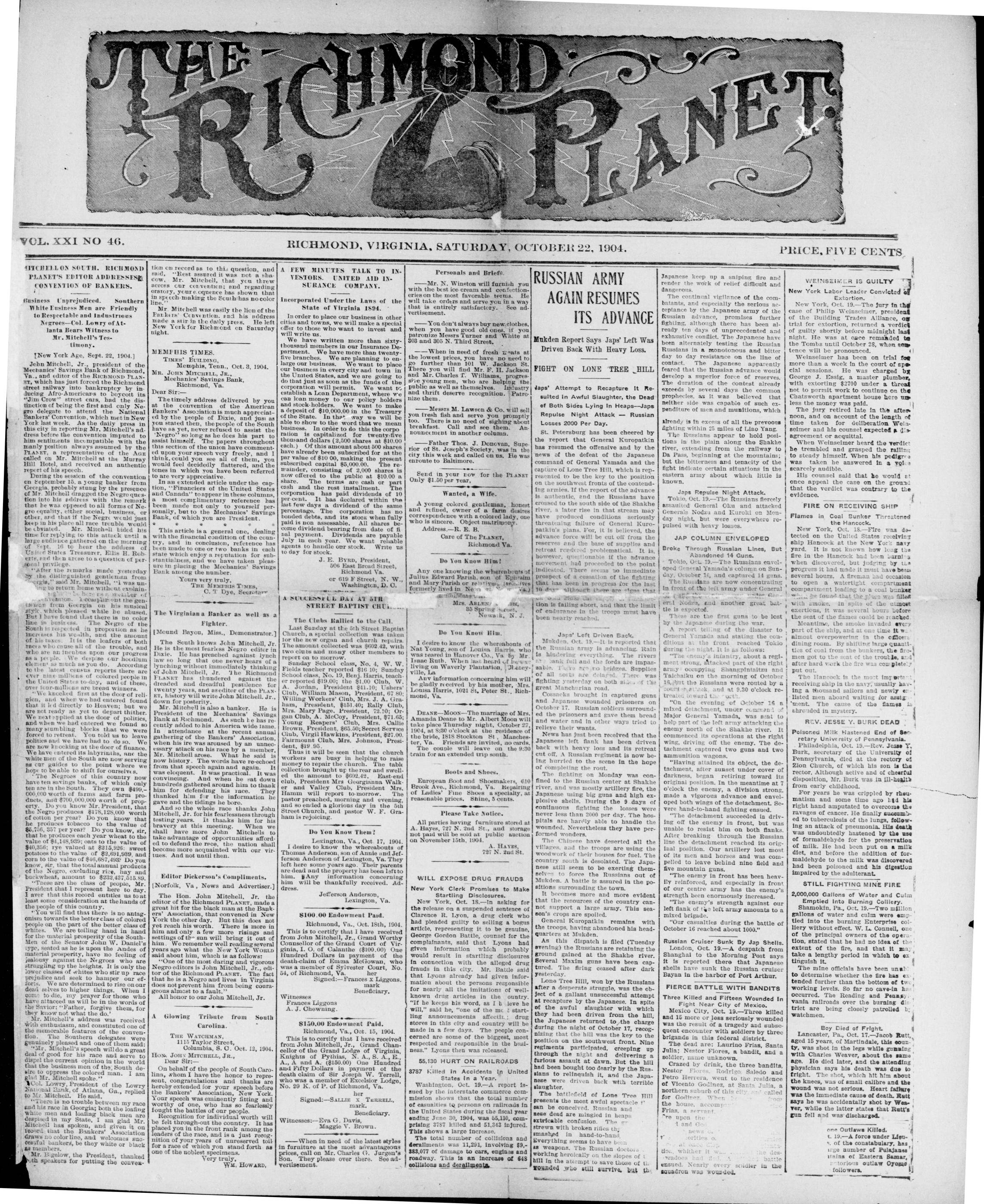
MITCHELL ON SOUTH, RICHMOND
PLANET'S EDITOR ADDRESSES
CONVENTION OF BANKERS.
Business Unprejudiced. Southern
White Business Men are Friendly
to Respectable and Industrious
Negroes—Col. Lowry of At-
lanta Bears Witness to
Mr. Mitchell's Testimony.
[New York Age, Sept. 22, 1904.]
John Mitchell, Jr., president of the Mechanics' Savings Bank of Richmond, Va., and editor of the Richmond PLANET, which has just forced the Richmond street railway into bankruptcy by inducing Afro-Americans to boycott its "Jim Crow" street cars, had the distinction of being the first and only Negro delegate to attend the National Bankers' Convention, which met in New York last week. As the daily press in this city in reporting Mr. Mitchell's address before the convention imputed to him sentiments incompatible with the PLANET, a representative assumed by the PLANET, a representative ACE called on Mr. Mitchell at the Murray Hill Hotel, and received an authentic report of his speech.
During the session of the convention on September 15, a young banker from Georgia, probably stung by the presence of Mr. Mitchell dragged the Negro question into his address with the remark that he was opposed to all forms of Negro equality, either social, business, or other, and that if the Negro would just keep in his place all race trouble would be civated. Mr. Mitchell bided his time for replying to this attack until a large audience gathered on the morning of Sept. 16 to hear the address of United States Treasurer, Ellis H. Roberts, and then arise to a question of personal privilege.
"After the remarks made yesterday by the distinguished gentleman from Georgia," said Mr. Mitchell, "I was uning to return home without explain-
convention. I compliment the gentlemen from Georgia on his musical style, which pleased and abused. But I have found that there is no color line in business. The Negro of the South is respected in proportion as he increases his wealth, and the amount of his taxes. It is the leafers of both races who cause all of the trouble, and who are an incumbent upon our progress as a people. We despise our hoodlum element as much as you do. According to the latest census reports there are over nine millions of colored people in the United States to day, and of these, over four millions are bread winners.
"We knocked first at the door of religion, and when we had entered found that it led directly to Heaven; but we are not ready as yet to depart thither. We next applied at the door of politics, and when we had entered we found so many stumbling blocks that we were forced to retreat. You told us to leave politics and we have had to do so. We are now knocking at the door of finance. We have entered its labyrinths, and the white men of the South are now serving as cur guides to the point where we hope to be able to shift for ourselves.
"The Negroes of this country now have ten savings banks, of which only ten are in the South. They own $499,000,000 worth of farms and farm products, and $700,000,000 worth of property. Do you know Mr. President, that the Negro produces $178,128,000 worth of cotton per year? Do you know that he produces tobacco to the value of $5,756,357 per year? Do you know, sir, that he produces each year wheat to the value of $4,148,639; oats to the value of $5,826; sweet potatoes to the value of $23,499; and corn to the value of $46,687,493. Do you know, sir, that the total annual products of the Negro, excluding rice, hay and buckwheat, amount to $323,437,515.89. "These are the class of people, Mr. President that I represent here to day. I aver that this record entitles us to at least some consideration at the hands of the people of this country.
"You will find that there is no antagonism towards the better class of colored people on the part of the better class of whites. We are toiling hand in hand for the material prosperity of the South-Men of the Senator John W. Daniel's type, seated as he is upon the Andes of material prosperity, have no feeling of jealousy against the Negroes who are struggling up the heights. It is only the lower classes of whites who stir up race prejudice and seek to hamper our efforts. We are determined to rise on our dead selves to higher things. When I come to die, my prayer for those who have attacued me will be in the words of the Savior: "Father, forgive them, for they know not what the do.'
Mr. Mitchell's address was received with enthusiasm, and constituted one of the memorable features of the convention. The Southern delegates were genuinely pleased and one of them said: "Mr. Mitchell's speech will do a great deal of good for his race and serve to dispel the current opinion in the world that the business men of the, South desire to oppress the colored man. I am glad Mr. Mitchell spoke."
Cool. Lowry, President of the Lowry National Bank, of Atlanta, Ga., replied to Mr. Mitchell. He said, "There is no trouble between my race and his race in Georgia; both the loafing white men and loafing black men are despised in my State, I am glad Mr. Mitchell has spoken, and given it on record that the Bankers' Association draws no colorline, and welcomes successful bankers, be they white or black as members. Mr. Bigelow, the President, thanked both speakers for putting the conven-
tion on record as to this question, and said, "Rest assured it was not a shadow, Mr. Mitchell, that you throw across our convention; and regarding oratory, yourequence has shown that in speech-making the South has no color line."
Mr Mitchell was easily the lion of the Parkers' Convention, and his address made a stir in the daily press. He left New York for Richmond on Saturday night.
MEMPHIS TIMES.
Memphis, Tenn., Oct. 3, 1904.
MR. JOHN MITCHELL, JR.,
Mechanics' Savings Bank,
Richmond, Va.
Dear Sir:—
The timely address delivered by you
at the convention of the American
Bankers' association is much appreciated
by the people of Dane, and just as
you stated then, the people to assist the
South have as yet, never refused to assist the
"Negro" so long as he does his part to
assist himself. The papers throughout
this section of the union have commented
upon your speech very freely, and I think, could you see all of them, you would feel decidedly flattered, and the tones in which you have been referred
to are very appreciative.
In an extended article under the caption, "Financiers of the United States and Canada" to appear in these columns, a most complimentary reference has been made not only to yourself personally, but to the Mechanics' Savings Bank, of which you are President.
This article is a general one, dealing with the financial condition of the country, and in conclusion, reference has been made to one or two banks in each state which enjoy a reputation for substantialness, and we have taken pleasure in placing the Mechanics' Savings Bank among the number.
Yours very truly,
THE MEMPHIS TIMES,
C. T. Dye, Secretary
[Mound Bayon, Miss., Demonstrator.]
The South knows John Mitchell, Jr.
He is the most fearless Negro editor in Dixie. He has preached against lynch law so long that one never hears of a man accused of immediately thinking of John Mitchell, Jr. The Richmond PLANET has thundered against the dreaded and dreadful pestilence for twenty years, and aseditor of the PLANET, history will write John Mitchell, Jr., down for posterity.
Mr. Mitchell is also a banker. He is President of the Mechanics' Savings Bank at Richmond. As such he has recently added to his America wide name. In attendance at the recent annual gathering of the Bankers' Association, when his ire was aroused by an unnecessary attack on his race by a member, Mr. Mitchell arose. What he said is now history. The words have re-echoed from that speech again and again. It was eloquent. It was practical. It was convincing. And when he sat down hundreds gathered around him to thank him for defending his race. They thanked him for the information he gave and the tidings he bore. And so the whole race thanks John Mitchell, Jr. for his fearlessness through testing years. It thanks him for his bravery at this meeting. When we shall have more John Mitchells to take advantage of opportunities afforded to defend the race, the nation shall become more acquainted with our virtues. And not until then.
The Hon. John Mitchell, Jr., the editor of the Richmond PLANET, made a great hit for the black man at the Bankers' Association, that convened in New York the other day. But this does not yet reach his worth. There is more in him and only a few more risings and settings of th- sun will bring it out of him. We remember well reading several years ago what the New York World Society negro editors has follows: "One of the most daring and vigorous Negro editors is John Mitchell, Jr., editor of the Richmond PLANET. The fact that he is a Negro and lives in Virginia does not prevent him from being courageous almost to a fault."
All honor to our John Mitchell, Jr.
A Glowing Tribute from South Carolina.
THE WATCHMAN,
1115 Taylor Street,
Columbia, S. C. Oct. 12, 1904.
HON. JOHN MITCHELL, JR.,
Dear Sir:—
On behalf of the people of South Carolina, whom I have the honor to represent, congratulations and thanks are hereby extended for your speech before the Bankers' Association. New York. Your speech was eminently fitting and worthy of one, who has so fearlessly fought the battles of our people.
Recognition for individual worth will be felt through-out the country. It has placed you in the front rank among the leaders of the race, and is a just recognition of your years of unreserved toil for a race of which you stand forth as one of the noblest specimens.
WM. HOWARD.
RICHMOND, VIRGINIA, SATURDAY, OCTOBER 22, 1904.
A FEW MINUTES TALK TO IN VESTORS. UNITED AID INSURANCE COMPANY.
Incorporated Under the Laws of the State of Virginia 1894.
In order to place our business in other cities and towns, we will make a special offer to those who want to invest and will write us.
We have written more than sixty-thousand members in our Insurance Department. We have more than twenty-five branches. We are planning to enlarge our business. We want to place our business in every city and town in the United States, and we are going to do that just as soon as the funds of the corporation will permit. We want to establish a Loan Department, where we can loan money to our policy holders and stock-holders. We want to make a deposit of $10,000.00 in the Treasury of the State. In that way we will be able to show to the word that we mean business. In order to do this the corporation is capitalized for twenty-five thousand dollars (2,500 shares at $10.00 each). Of this amount about 500 shares have already been subscribed for at the rate of $10.00, making the present subscribed capital $5,000.00. The remainder, consisting of 2,000 shares is now offered to the public at $10.00 a share. The amounts are cash or part cash and the rest installment. The corporation has paid dividends of 10 percent. It has declared within the last few days a dividend of the same percentage. The corporation has no bonded debts, and its stock when fully paid is non assessable. All shares become dividend bearing from date of final payment. Dividends are payable July in each year. We want reliable agents to handle our stock. Write us to day for stock.
J. E. BYRD, President,
506 East Broad Street,
Richmond Va.
or 619 F Street, N. W.
Washington, D.C.
A SUCCESSFUL DAY AT 5TH
STREET BAPTIST CHU
Last Sunday at the 5th Street Baptist Church, a special collection was taken for the new organ and church repairs. The amount collected was $602.42, with two cluts and many other members to report on to mowr.
Sunday School class, No. 4, W. W. Fields teacher reported $16.10; Sunday School class, No. 19, Benj. Harris, teacher reported $19.00; the $1.00 Club, W. A. Jordan, President $41.10; Usher's Club, William Mason, President, 67.80; Willing Workers' Club, Mrs. J. A. Graham, President, $151.40; Rally Club, Mrs. Mary Page, President, 72.10; Organ Club, A. McCoy, President, $71.65; Swingers Club, Mrs. Caille Brother, President, $65.50; Secret Service Club, Virgil Hawkins, President, $27.00; Fairmount Club, Mrs. Johnson, President, $19.95
Thus it will be seen that the church workers are busy in helping to raise money to repair the church. The table collection brought up the rear and swelled the amount to $602.42. East-end club, President Mrs Georgianna Walker and Valley Club, President Mrs. Hamm will report to morrow. The pastor preached, morning and evening, and so ended a glorious day in the 5th Street Church, and pastor W. F. Graham is rejoicing.
Do You Know Them?
Lexington, Va., Oct 17, 1904. I desire to know the whereabouts of Thomas Anderson, son of Annie and Jefferson Anderson of Lexington, Va. They left here some years ago. Their parents are dead and the property has been left to him. Any information concerning him will be thankfully received. Address. Jefferson Anderson, Lexington, Va.
$100.00 Endowment Paid.
Richmond, Va., Oct. 18th, 1904.
This is to certify that I have received from John Mitchell, Jr., Grand Worthy Counsellor of the Grand Court of Virginia, I. O. of Calanthe ($100.00) One Hundred Dollars in payment of the death-claim of Emma McTowan, who was a member of Sylvester Court, No. 54, of Richmond, Va. her
Signed:—Frances Liggons. mark
Beneficiary.
Witnesses
Frances Liggons
A. J. Chewning.
This is to certify that I have received from John Mitchell, Jr., Grand Chancellor of the Grand Lodge of Virginia, Knights of Pythias, N. A., S. A., E., A., A and A. $150.00) One Hundred and Fifty Dollars in payment of the death claim of Sir Joseph W. Terrell, who was a member of Excelsior Lodge, No. 29 K. of P. of Richmond, Va.
Witnesses:—Eva G. Davis,
Maggie V. Brown.
When in need of the latest styles
in furniture at the most advantagous
prices, call on Mr. Charles G. Jurgon's
Son. They please over there. See
advertisement.
Personals and Briefs.
Mr. N. Winston will furnish you with the best ice cream and confectioneries on the most favorable terms. He will take orders and serve you in a way that is entirely satisfactory. See advertisement.
You don't always buy new clothes, when you have good old ones, if you patronize Messrs Turner and White at 303 and 305 N. Third Street.
When in need of fresh meats at the lowest prices, you have no need to go further than 101 W. Jackson St. There you will find Mr. F. H. Jackson and Mr. Charles T. Williams, progressive young men, who are helping the public as well as themselves. Industry and thrift deserve recognition. Patronize them.
Messrs M. Lawson & Co. will sell you fresh fish and serve you promptly too. There is no need of sighing about breakfast. Call and see them. An announcement in another column.
Father Thos. J. Duncovan, Superior of St. Joseph's Society, was in the city this week and called on us. He was enroute to Baltimore.
Send in your now for the PLANET Only $1.50 per year.
Wanted, a Wife.
A young colored gentleman, honest and refined, owner of a farm desires correspondence with a colored lady, one who is sincere. Object matrimony.
Address.—R. E. B.
Care of The PLANET,
Richmond Va.
Do You Know Him?
Any one knowing the whereabouts of Julius Edward Parish, son of Ephraim and Mary Parish or relatives (recives formerly lived in Newark, N. Va.)
Mrs. ARLEN/ SH,
35 Spring street,
Newark, N. J.
Do You Know Him.
I desire to know the whereabouts of Nat Young, son of Louisa Harris, who was reared in Hanover Co., Va. by Mr. Isane Ruth. When last heard of beaver living on Waverly Plantation, Cheencyville, La.
Anv information concerning him will be gladly received by his mother, Mrs. Louisa Harris, 1021 St. Peter St., Richmond, Va.
DEANE—MOON—The marriage of Mrs. Amanda Deane to Mr. Albert Moon will take place Thursday night, October 27, 1904, at 8:30 o'clock at the residence of the bride, 1818 Stockton St., Manchester, Va. Friends are invited, no cards, the couple will leave on the 9:30 train for an extended trip south.
Boots and Shoes.
European Foot and Shoemakers, 610 Brook Ave, Richmond, Va. Repairing of Ladies' Fine Shoes a specialty, at reasonable prices. Shine, 5 cents.
Please Take Notice.
All parties having furniture stored at A. Hayes, 727 N. 2nd St., and storage not paid will be sold at public auction on November 15th. 1904.
WILL EXPOSE DRUG FRAUDS
New York Clerk Promises to Make Startling Disclosures
New York, Oct. 18.—In asking for the release on a suspended sentence of Clarence R. Lyon, a drug clerk who had pleaded guilty to selling a bogus article, representing it to be genuine, George Gordon Battle, counsel for the complainants, said that Lyons had given information which probably would result in startling disclosures in connection with the alleged drug frauds in this city. Mr. Battle said that Lyons already had given information about the persons responsible for nearly all the imitations of well-known drug articles in the country. "If he keeps his word, as I have he will," said he, "one of the most startling announcements affectit.; drug stores in this city and country will be made in a few days. The people concerned are some of the biggest, most respected and responsible in the business." Lyons then was released.
55,130 HURT ON RAILROADS
3787 Killed in Accidents in United States in a Year.
Washington, Oct. 19.—A report issued by the interstate commerce commission shows that the total number of casualties to persons on railroads in the United States during the fiscal year ending June 30, 1904, was 55,130, comprising 3787 killed and 51,343 injured. This shows a large increase.
The total number of collisions and derailments was 11,291, involving 93,833,077 of damage to cars, engines and roadway. This is an increase of 648 collisions and derailments.
RUSSIAN ARMY AGAIN RESUMES ITS ADVANCE
Mukden Report Says Japs' Left Was Driven Back With Heavy Loss.
Japs' Attempt to Recapture It Resulted In Awful Slaughter, the Dead of Both Sides Lying In Heaps—Japs Repulse Night Attack — Russian Losses 2000 Per Day.
St. Petersburg has been cheered by the report that General Kuropatkin has resumed the offensive and by the news of the defeat of the Japanese command of General Yamada and the capture of Lone Tree Hill, which is represented to be the key to the position on the southwest fronts of the contending armies. If the report of the advance is authentic, and the Russians have crossed to the south side of the Shakhe river, a later rise in that stream may have produced conditions seriously threatening failure of General Kuropatkin's plans. For, it is believed, the advance force will be cut off from the reserves and the base of supplies and retreat rendered problematical. It is, however, questionable if the advance movement had proceeded to the point indicated. There seems no immediate prospect of a cessation of the fighting that has been in progress for the last 10 day, although there are signs that
tion is falling short, and that the limit of endurance in the troops must have been nearly reached.
Jans' Left Driven Back
Mukden, Oct. 19.—It is reported that the Russian army is advancing. Rain is hindering everything. The rivers are bank full and the fords are impassable. There are no bridges. Supplies of all sorts are delayed. There was fighting yesterday on both sides of the great Manchurian road. Cossacks brought in captured guns and Japanese wounded prisoners on October 17. Russian soldiers surrounded the prisoners and gave them bread and water and in other ways tried to relieve their wants. News has just been received that the Japanese left flank has been driven back with heavy loss and its retreat cut off. A Russian regiment is now being hurried to the scene in the hope of completing the rout.
The fighting on Monday was confined to the Russian center at Shakhe river, and was mostly artillery fire, the Japanese using big guns and high explosive shells. During the 9 days of continuous fighting the losses were never less than 2000 per day. The hospitals are hardly able to handle the wounded. Nevertheless they have performed wonders.
The Chinese have deserted all the villages, and the troops are using the woodwork of their houses for fuel. The country south is desolated. The Japanese still seem to be exerting themselves to force the Russians out of Mukden. A battle is assured in the positions surrounding the town.
It becomes more and more evident that the resources of the country cannot support a large army. This season's crops are spoiled.
General Kuropatkin remains with the troops, having abandoned his headquarters at Mukden.
As this dispatch is filed (Tuesday evening) the Russians are retaining the ground gained at the Shakhe river. Several Maxim guns have been captured. The firing ceased after dark yesterday.
Lone Tree Hill, won by the Russians after a desperate struggle, was the object of a gallant unsuccessful attempt at recapture by the Japanese. In spite of the awful slaughter with which they had been driven from the hill, the Japanese returned to the charge during the night of October 17, recognizing that the hill was the key to the position on the southwest front. Nine regiments participated, creeping up through the night and delivering a furious assault at dawn. But the hill had been bought too dearly by the Russians to relinquish it, and the Japanese were driven back with terrible slaughter.
The battlefield of Lone Tree Hill presents the most awful spectacle it can be conceived. Russian and nese dead are mingled in heaps extricate confusion. The gren strewn with broken rifles the smashed in hand-to-hand. Everything seems to have been as weapons. The Russian doctors working heroically on the slopes of the hill in the attempt to save those of the wounded who still survive, but the
Japanese keep up a sniping fire and render the work of relief difficult and dangerous.
The continual vigilance of the combatants, and especially the serious acceptance by the Japanese army of the Russian advance, promises further fighting, although there has been already ten days of unprecedented and exhaustive conflict. The Japanese have been alternately testing the Russian Russians in a monotonous and bitter day to day resistance on the line of contact. The Japanese apparently feared that the Russian advance would develop a superior force of reserves. The duration of the contest already exceeds by several days the common prophecies, as it was believed that neither side was capable of such expenditure of men and munitions, which already is in excess of all the previous fighting within 25 miles of Liao Yang.
The Russians appear to hold positions in the plain along the Shakhe river, extending from the railway to Da Pass, beginning at the mountains; but the bitterness and tenacity of the fight indicate certain situations in the eastern army about which little is known.
Japs Repulse Night Attack.
Tokio, Oct. 13.—The Russians fiercely assaulted General Oku and attacked Generals Nodzu and Kuroki on Monday night, but were everywhere repulsed with heavy losses.
JAP COLUMN ENVELOPED
Broke Through Russian Lines, But
Abandoned 14 Guns.
AUTHOR: Tokio, Oct. 19.—The Russians enveloped General Yamada's column on Sunday, October 16, and captured 14 guns. The Russians are now concentrating in front of the left army under General Stalin, and under General Nodru, and another great battle is expected. Those are the first guns to be lost by the Japanese during the war. A report telling of the disaster to General Yamada and stating the conditions at the front reached Tokio during the night. It is as follows: "The enemy's infantry, about a regiment strong, attacked part of the right army occupying Shangpintalzu and Talchaku on the morning of October 16, but the Russians were routed by a court attack, and at 9.30 o'clock retreated toward the north.
"On the evening of October 16 a mixed detachment, under command of Major General Yamada, was sent to help part of the left army attacking the enemy north of the Shakhe river. It commenced its operations at the right wing, driving off the enemy. The detachment captured two guns and two ammunition wagons.
"Having attained its object, the detachment, after sunset under cover of darkness, began retiring toward its original position. In the meantime at 7 o'clock the enemy, a division strong, made a vigorous advance and enveloped both wings of the detachment. Severe hand-to-hand fighting ensued.
"The detachment succeeded in driving off the enemy in front, but was unable to resist him on both flanks. After breaking through the Russian line the detachment reached its original position. Our artillery lost most of its men and horses and was compelled to leave behind nine field and five mountain guns.
"The enemy in front has been heavily reinforced, and especially in front of our centre army has the enemy's strength been enormously increased.
"The enemy's strength against our left flank of the left army amounts to a mixed brigade.
"Our casualties during the battle of October 16 reached about 1000."
Russian Cruiser Sunk By Jap Shells. London, Oct. 19.—A despatch from Shanghai to the Morning Post says it is reported there that Japanese shells have sunk the Russian cruiser Bayan in the harbor of Port Arthur.
Fight Near City of Mexico.
Mexico City, Oct. 13.—Three killed
and 15 more or less seriously wounded
was the result of a tragedy and subsequent encounter with goldiers by three brigands in this federal district.
The dead are: Laurino Frias, Santa Julia, Nestor Flores, a bandit, and a soldier, name unknown.
Crazed by drink, the three bandits, Nestor Flores, Rodrigo Saledo and Petro Herrera, went to the residence of Vicente Godinez, at Santa Julia, a northern suburb of this city and called for Godinez. When he came from the house, accompanied Frias, a servant.
He upon the land and God news ofilities o. at once died in battle, whither it was the desirados had fled the battle ensued. Nearly every soldier in the squadron was wounded.
PRICE, FIVE CENTS
WEINSEIMER IS GUILTY
New York Labor Leader Convicted of Extortion.
New York, Oct. 19.—The jury in the case of Philip Weinseimer, president of the Building Trades Alliance, or trial for extortion, returned a verdict of guilty shortly before midnight last night. He was at once remanded to the Tombs until October 28, when sentence will be pronounced.
Weinseimer has been on trial for more than a week in the court of special sessions. He was charged by George J. Essig, a master plumber, with extorting $2700 under a threat not to permit work to continue on the Chatsworth apartment house here unless the money was paid.
The jury retired late in the afternoon, and on account of the length of time taken for deliberation Weinseimer and his counsel expected a disagreement or acquittal.
When Weinseimer heard the verdict he trembled and grasped the railing to steady himself. When his pedigree was taken he answered in a voice scarcely audible.
His counsel said that he would at once appeal the case on the ground that the verdict was contrary to the evidence.
FIRE ON RECEIVING SHIP
Flames in Coal Bunker Threatened the Hancock.
New York, Oct. 18.—Fire was detected on the United States receiving ship Hancock at the New York navy yard. It is not known how long the fire in the Hancock had been burning when discovered, but judging by the progress it had made it must have been several hours. A fireman had occasion to open a watertight compartment compartment leading to a coal bunker when he found that the place was filled with smoke. In spite of the almost exertions, it was several hours before the seat of the flames could be reached.
Meantime, the smoke invaded every part of the ship, and at one time it was almost overpowering in the officers dining room. By shifting large quantities of coal from the bunkers, the firemen got to the seat of the trouble, and after hard work the fire was completely put out.
The Hancock is the most important receiving ship in the navy, usually having a thousand sailors and newly enlisted men aboard waiting for assignment. The cause of the flames is shrouded in mystery.
REV. JESSE Y. BURK DEAD
cissured milk hastened end of retary University of Pennsylvania.
Philadelphia, Oct. 19.—Rew. Jesse Y. Burk, secretary of the University of Pennsylvania, died at the rectory of Zion Church, of which his son is the rector. Although active and of cheerful disposition, Mr. Burk was in ill-health from early childhood.
For years he was crippled by rheumatism and some time ago had his right hand amputated to overcome the ravages of cancer. He finally succumbed to tuberculosis of the lungs, following an attack of pneumonia. His death was undoubtedly hastened by the use of formaldehyde for the preservation of milk. He had been put on a milk diet, and before the addition of formaldehyde to the milk was discovered had been poisoned and his digestion impaired by the adulterant.
STILL FIGHTING MINE FIRE
2,000,000 Gallons of Water and Culm
Emptied into Burning Colliery. Shamokin, Pa., Oct. 19.—Two million gallons of water and culm were emptied into the burning Enterprise colliery without effect. W. L. Connell, one of the principal owners of the operation, stated that he had no idea of the extent of the fire, and that it may take a lengthy period in which to extinguish it. The mine officials have been unable to determine whether the fire has extended further than the bottom of two working levels. So far no cave-in has occurred. The Reading and Pennsylvania railroads over the burning district are being closely patrolled by watchmen.
Boy Died of Fright.
Lancaster, Pa., Oct. 17.—Jacob Rutt, aged 15 years, of Martindale, this county, was shot in the legs while gumming with Charles Weaver, about the same age. He died later, and the attending physician says his death was due to fright. The shot, which hit him about the knees, was of small calibre and the wound was not serious. Heart failure was the immediate cause of death. Rutt says he was accidentally shot by Weser, while the latter states that Rutt's gun fell and was discharged.
one Outlaws Killed.
t. 19.—A force under Lieu-
s of the constabulary, has
large number of Pulajanes
trains of Eastern Samar,
notorious outlaw Oyome
followers.
v 2
e—eoOCC"_"=—".
Sees eS y a
Be A a
ite 5 ZN
oi PZ Sa g
‘MDL
SATURDAY .. OCTOBER 22, 1904
‘POULTRY:
AND: BEES -
FSS
FLAT “CEILING THE THING.
Bow to Build a Chicken House That
‘There has been a good deal said about
how chicken houses ought to be built.
Just allow me to give our readers a few
useful points regarding natural heat
during cold winter months. A chicken
house ought to have a flat ceiling, eith-
er tar papered or plastered, the walls,
too. My reason for having a fat ceil-
Conde tt Settee
* Pio A |
HOUSE WITH FLAT CEILING.
tng fs, so that the natural warmth will
de evenly distributed, Put up all the
Toosts that you have room for close to
‘the ceiling—as chickens like to be weil
‘up—ziving plenty of head room. Win-
‘ows should only be half-way up the
‘side of the building, as the giass is hard
to heat. Don’t give too much ventila-
tion; two small holes up throueh Hie
eeiling will be enough in the cold
aights.—Henry Matthew, in Epitomist.
THE MOLTING OF POULTRY
Process Was Hastened Successfully
by the Experts at Rhode Island
‘ Experiment Station.
An interesting discussion is now go-
Ang on among poultry raisers as to
the possibility of hastening the molt-
ing of fowls. It has not been believed
that any method except a steady feed
‘of well-balanced rations would do
this. There is an impression, how-
ever, that even this does not always
= aten the slesite!, period. as the 27
Wing period of the sunumer 1s some-
times extended by the high feeding,
thus pushing the period of molt-
ing. Some one conceived the, idea
of starving the fowls long enough to
stop the production of eggs and after-
Ward so feeding that the formation
of néw feathers would be begun, It
was reported that great results were
obtained with this method. . It does
“Hot appeal to feason very much, but
the lite experimenting that has been
“Aone ic discover” what there is in it
has given results favorable to the
method, At the Rhode Island experi-
“ment station last year fowls that
were laying were deprived of foed
on the Sth of August and were made
to fast for 12 days. The hens finally
stopped laying eggs on the seventh day
of the fast. After the thirteenth day
of the deprivation of food the fowls
were again given food a litle ata time,
but of highly nitrogenous nature. In
® short time the result was seen in
the formatton of new feathers, and with-
in 30 days from that time the molting
[Bas_concladed and the hens began to
“lay. This experiment was made with
Rhode Island Reds. Whether the re-
sults can be obtained always is yet
to be proved. It is amatter, well worth
fookine into.
PRACTICAL BEE NOTES.
‘The color of honey varies greatly,
ranging from water-white toa very dark
brown.
Fifty ponnds of surplus honey per
hive in a season Is a fair average in most
localities.
In grading comb honey for the mar-
ket, face the case with a fair sample of
Its contents.
Light honey fs not always the best
in flavor, though it always brings the
Righest price.
Bees do not need daily attention, but
can be given sufficient food at one time
to last all winter.
Honey separated from the comb has
@ tendency to granvlate very quickly,
especially in autumn,
Bottled honey should be of a fine
flavor and light in color. Dark honey
looks bad in glass, and ts a drag on the
market.
Bleaching honey impairs its flavor
and makes it impracticable. It would
be better to have dark, good honey, thar
light, poor honey.
Bottled honey fs, asa rule, purchased
‘by a class of customers who demani
&@ fancy article, and are able an
willing to pay a fancy price for ft.
‘aight colored honey is gathered fron
Buch flowers as clover. basswood ani
mountain sage, while the dark Is gath
ered from buckwheat, autumn flower
and whitewood.
When Feeding Aquatic Fowls,
In feeding aquatic fowls we should
ear in mind that in a natural state
their food Is always mixed with water
to some extent. They can searcely
swallow dry food, and the corn is not
&s good for them in the grain as it is
ground coarsely, and mixed with wheat
bran in asoft mash. A duck or goose
48 never so happy as when floating in
the shallows of a creek or pond, where
the tender, =tmy crowth at the bot-
tom may be reashet with the bill, by
Dp-ending, ang p-*ting with the feat
for a balance. Marshes and reedy
Piaces, where there are tender spronts,
water bugs and creatures of the dark
and dank—that's the natural foraging
ground of the web-footed feathered
tribe—Farm ‘and Ranch.
THE SEASON FOR CULLING.
Wow Is the Time for Sending Every
Old and Superfluous Bird
to the Markets
‘The season is at hand when oe
in the poultry yard should be cuitec
out and sold, Old hens, unlikely pul
lets and supertiuous roosters, young
and oid, should be placed in fattening
quarters and fed for the market. Ik
Pays either the fancy poultry breede
‘Or common market poultrymen to wit:
ter prime birds oniy. There is nc
Toom to spare for non-paying fowls
and quite an amount is lost by keep:
ing the culls that are found in the bes!
‘as well as the poorest flocks.
Full-biooded pouitry is always in de
mand, and those who would sell at fancy
prices must be very careful te
closely cull down to the best specimen:
Of varieties according to standard re
quirements. The breeder makes
mistake in keeping any fowls tha
are undersized or lacking in good nat
ural vitality though they come fron
& high-priced strain. ‘The best is non
too good for breeding purposes'in th
produetion of market poultry just th
same as in the direction of the show
room. Cititing severely now and keep:
ing only the best is the way to ze
business chicks next spring, strons
enough to get out of the shell an¢
grow and thrive in spite of the vieis
situdes they may encounter during
growth. It fs a good plan to dispose o
hens that are late in molting — unies
‘they are of extra value. Such hen:
won't lay eggs enough in winter
pay their board.
Spring chickens are a fair price ot
the market the latter part of Septem
ber, and the whole flock will be in bet
ter condition if they are sold closely
with the other surplus fowls at thi:
season. Then in November-before th
first cold snap comes to cause them t
lose flesh, we fatten and dispose of th
rest of the culls to give the layins
hens plenty of room. Crowding the
Poultry house causes disease and dis
comfort, and it is the healthy, happy
hens that lay the high-priced” winter
_eggs.—Fanny M. Wood, in Ohio Farmer
KITTENS ADOPTED BY HEN
Biddy Made Her Own Chicks Shift
for Themselves to Care for
Feline Stepehilaren,
This white leghorn hen has adopted
ss her charges four frisky kittens
which wore abandoned by their ows
mother. The kittens have become the
objecta of all the Hen'a maternal af
13, at
anil ites . off?
X «il \ \ Hy lilt,
‘iI
a: \ ih 1
ir. on ORE
ap peeer: vas
eS. % i
ee OM
ofS
ee SZ is i]
SSAA!’
AG xy pe
\w fv
x Ww
PTFE Err per erry
fection. says the New York Tribune, ’
while her own chicks have been driven
off by her to wander in the barnyard
and shift for themselves as best they
can.
‘The kittens follow the hen about by
day, and at rivht they nestle under her
soft, warm wings and enjoy the com-
fort and protection which should go to
her disearded chicks,
‘The hen will allow no person to bande
the kittens when she is near. All who
Attempt to do 80 are attacked by her.
She is owned by Joseph Hockberger,
of York, Pa
ee
PROTECTION FOR CHICKS.
An Arrangement Which Prevents the
Old Bires from Trampling
Little Ones to Death.
Many times the ttle chicks are de-
prived of their feed and often trampled
to death by older
Lac «oS at feeding
RSA {lme. This trouble
SSS ean be avoided by
ee dy providing a pen or
: ~ ‘a dae eueeee ake Ho
SS ee ne rene
a
SSSA, | Kime. This trouble
is & providing a pen or
ys & cover such as is
shown In the illustration. Slats may
be substituted for wire. Under this the
little chicks may be fed without be-
ing crowded away by the larger ones.
It is so arranged that the frame may
be raised on stakes as the chicks grow.
—B. M. Briggs, in Farm and Home.
| An Incubation Experiment.
| In the incubation experiments,
8,677 eges from various sources have
Deen set in the incubators. Of these,
7,205, or 82 per cent, wore fertile
|Three thousund three hundred and
forty-eight, or 46 per cent., of the fertile
eggs were hatched. This was 28.6 per
cent. of the total number. The efficiency
of hatching under various conditions
| ranged from 0 per cent. to 84 per cent.
| These experiments were planned in th«
Wirection of testing the efficiency of the
machines and the influence of moistur¢
and room temperature upon the hatch
—Rhode Island Station.
een Wananemunt That Wine.
Industry is not the only thing re-
quired on the farm. If it were,
great many men that fail would suc-
eeed. Keeping eternally at a thing
does not always bring success, in spite
of the trite saying that it does. In-
telligent management is also requirec
and this kind of management often re
quires a good deal of information ir
several directions,
‘The Next Step.
| “Is your country place. finished yet”
“Oh, yes. Why, I have already’ be-
gun alterations on it.’—Detrolt Free
Press.
THE RICEMON D PLANES, RICHMOND. VIRGINIA.
ee
| HINTS ON COOKING FRUIT. | rns
Fun for All Po Not Destroy the Flavor of a Pleas- | around the ne
ing aad Beaithful Dish by stit goes a w
ie ond gown Is a
A paragraph Siugh bas been going] volte trimm
Fun J.overs. |e: round rath anally, nforms npels of sary
,_& Terrible Possibility.
“Well, I seecyou're borrowing trouble
again. Whats the matter now?”
“Oh, George,” she replied, “I've just
been thinking what if our dear Little
darting should when she grows up be-
come a minister's wife.”
“That wouldn't be so terrible, would
ier" :
“Mercy, yes. Think of what the wom-
en in the congregation would always be
‘saying about her."—Chicago Record-
Herald.
| A Correction.
} “Yon called me a ‘political jobber’
in your paper this morning,” began
the irate visitor.
| “Yes,” replied the editor, “that was
/@ bad break. I discharged that typo
immediately.”
| “Oh! then you didn't mean to say
that?”
| “Certainly not. I write ‘robber’ yery
plainly."—Philadelphia Press.
| ‘High-Handed.
| “They took my money by bigh-handed
methods,” complains the victim.
| “Tell us about it,” we say, realizing
that we are in fora tale of woe and that
it is best to have it over with.
| “There's not much to tell. First I
“Went up against an ace full, and the
rest of my stack went when the other
fellow sprung a royai flush on me."—
| Juése.
Backhanded Politeness.
Ethel (breathlessly)—Oh, Jack, dear,
what did papa say when you asked for
my hand?
Jack—He said that I had annoyed hith
so long by being around the house so
much that I'd grown to be a sort of nec-
essary evil, and he'd miss me tf 1
stayed away. So he invited me to join
the family circle—Detroit Free Press.
| Avoiding Suspicion.
Miss De Style—Horrorst. Why have
you adopted a grocer’s scale and a yard
Stick as our coat of arms?
| Mrs. De Style—I wish people to ksow
that our money war made in honest
trade. Otherwise they might suspect
that your father or grandfather he . been
jcaptain on the police force-—N. ¥,
Weekly.
| A Consoling Thoug\st.
Brambie—Yes, I'm ugly. | haow I'm
“ugly; but there sone great consolation,
Friend—What is that?
Bramble—If ever [ should Secome
great, and the American people si.oild
Tesolve to erect a statue to my memory,
they wont’ be able to make me out ugiies
‘than I am.—N. ¥. Weekly.
‘Too Healthy.
2 OTE, COMRTATWAG ES,” gals ee,
Aillyons .o bin). ug tances, “I nave
Just been examined for life insurance,
‘and the company’s physician says I
‘ought to be gosd for 25 years yet."
eq All Hight, I'm glad, of course; but our
engagement is off."—Houston Post.
| Love Before Art.
| “Are you going to star next sea-
son?” asked the soubrette,
“No,” replied the leading lady, “I'm
still if Jove with my husband, and 1
can't get any of the managers to give
‘me a chance without a divorce."—Chi-
cago Record-Heraid.
| Reason for Silence. -
| “I believe in saying what T think,”
sald the young man in the flappy trous-
‘ers.
*T've often wondered why you don't
talk very much,” said the girl with the
‘trick of saying what she thinks—
Cleveland Leader,
Fame’s Short Cut.
To make wel! known a humble name
Requires no devious tricks;
If you would qui-tly rise to fame
Just change our politics,
Houston Chronicle
FROM THE BOTTOM.
q ee
ee
ay sh
oe" = f
Ss
a
4 eS
.
O=
Mather =neasnoes a9 een he
great meu siwage start Sean te bob-
tom and work thelr way to the top.
Sor—Do they start that way when
they want to dig Well? Chicago
Journal.
Got the Title.
Sie mated ine nue
Sartore creviosd
He upsaited as vital
Pug cule to her land,
Fees
eS
“Never mind,” said the friend, sooth-
ingly, “you'll wake up some morning
and find yourself famous.”
“Not much!” growled the pessimistic
poet, “it would be just my luck to over-
sleep myself that morning.”—Philadel-
phia Press.
py
|| “Mrs. Higbee is worried nearly to
Geath.”
“What over?”
| “She can’t find out anything about the
family that moved In next door to her.”
=n. ¥. Mail.
Vivid Imagination.
Gerald—t claim to be a gentleman.
Geraldine—But we all haven't your
{magination—Vown Topics.
HINTS ON COOKING FRUIT.
Po Not Destroy the Flavor of a Pleas-
ing aad Beaithful Dish by
the Use SF Soda.
A raph Wideh bas been going
the rounds ra vely, informs
the housewife tle soda (sale-
ratus) added to sewed fruit when it
is being cooked Josseus the quantity
of sugar reqffiredito sweeren it.
| While this ts trig, It is ejually the
fact that Ehe Gk accomplishes this
result by desis, (ge the acidity of the
fruit, ara (440 fucees the life and
favor are, (a5 extent, injured.
breton ta suagpeeyes dan been add
is rather fiat gi) tasceless when com-
pared with ome ich is mace entirely
of fruit, sweetenad with susar.
The wise ai truly economical
housewife will uo. destroy the flavor
of a healthfal “nd pleasing dish of
stewed fruit In ofier to effect a saving
80 very Very Shi.il.
Fruit that k ayerly acid, such as
cranberries, ret “rants, sooseberries,
ete, will call fo fess sugar in sweet-
ening if they afe prepared in the fol-
lowing manner: After washing the
fruit, place it in am azate kei‘le and
cover with clear, cold water. Set the
} Kettle over the fire and bring the con-
tents quickly to the boiling point; pour
oft the water, and then set the kettle
where the fruit ‘vii cook slowly in the
usual way, adiing only enough water
|to keep the fruit trom burning. Add
Sugar suificien “to make the preserve
palatable, and/To not‘add the sugar
ani Just before the frnit is removed
from the fir since less, is required
than when tv sweetening is cooked
with the frai
‘The jnlee o water that was poured
off the fruit at/frst, can be made very
cold, sweetened with sugar and served
as a drink> ¢ may also be used in
place of waver or milk for the founda-
tion of a pudding sauce, a little sugar
being added and the whole thickened
with core stareh or arrowroot. Apples
or pevrs may be sliced and cooked in
this .t Jule Instead of using water
in (usual way, and it can also bo
used In mineemeat, in fruit cakes or
Dolled puddings.
Sruit should meyer be placed on the
| front of the range and stewed like a
vexetable. Its appearance is much
more attractive if it is kept as entire
a8 possible. Apples and pears shonld
be ent into quarters or elzhths, and
laid in the saucepan carefully, a very
little water or fruit juice added and
the cover Kept om the saucepan all tne
time they are belng cooked.—What to
‘Rat.
HERE IS SOMETHING NEW.
How to Make a Barrel Swing Which
Can Be Hung from the Porch
of Your House.
This picture will show you how to
make a barrel 8Win, They are novel
and comfortable, ani’ jook very quaint
hanging from the porch uf a country
house,
All you have to do, seys:the Detroit
FroevPree fe tb sv away a part of
AUe barsel, a the p.c.use shows, and
Free tom, we ew-eves into ‘ths
Tour, sesevt wureic Co thee w
fastened rope #, ich moet above
an fron rine, wife: comes just above the
AN INGENIOUS AFFAIR.
head of the person sitting in the swing
‘The barrethead is fitted into the
bottom half as a seat, and may be
covered with cushions or left bare.
HOW TO HAVE NICE HANDS
French Manicure Says Much Can Be
Done by Keeping Nails
in ‘Good Order.
Longing for lovely hauds is natu-
ral.
It is @ recognized fact that French-
women possess the most beautiful
hands. The hand itself is neither too
fat nor too thin, but exactly in propor-
tion with the long, slender, tapering
‘fingers, while the nails are of a beautiful
‘delicate pink, their charm enhanced by
the pretty half-moons at the base of
each,
‘With the view of learning the secret
of some of the beautiful hands in Paris,
Tonce called upon the best-known mani-
cure of the French capital and asked
her to tell ie her method of dealing
with hands which had grown thick or
fat, with the fingers short and square,
says a writer in the Philadelphia North
American.
“In the frst place,” she sald, “I get
a basin of skin food or soft sweet oil
and fill it until the hands are almost
covered. T! ; makes the fingers soft
and oily, am after a time I lift them
out and giv them a thorough wash-
ing with very hot water and very good
soap.
“The hands are then dried and a littlc
skin food rubbed in.
“If you want pink pails, a littte rouge
Is put upon (he nail, and if you want
them very bright, the polisher is used.
But if you prefer them dull, then leave
them just as they are.”
FANCIES OF FALL FASHION.
Buttons Will Be the Conspicuous Fea-
ture of All Autumn and Win-
ter Garments.
Fashion makersare working under the
impression “bat we will have a long and
pleasant #utumn season, and with this
end in view ore turning out some charm-
ing between-seacon garments. The
Eton coat and skirt here illustrated are
df light brown linen tiiimed With bands
‘of tucking and a little embroidery
‘around the neck and buttons. With this
suit goes a white straw toque with solid
brim of pale green cut leaves. The sec-
ond gown is a dainty frock of pale blue
voile trimmed with bands, cuffs and
lapels of sapphire biue silk. The white
‘straw hat is trimmed with shaded bius
plumage.
‘The New York Times gives some re-
liable hints concerning toilet accessories
for the com's” season. Buttons, it says.
Will be conspicinns the coming fail and
winteag et ee
handsome cies: SSR GRRE oe
waistcoats, cuffs and girdles, they are
artistic avd beautiful, and there is the
additional attraction to the woman who
wishes exclusive styles, that while the
masses may also use "buttons their
purses are ynadle to compass the really
handsome fancy buttons that partake
cl tha watiractt eabbnines wae meena.
E-Slp 28
a (oe 5 |
é ; LGN
( \ pile
\ i fi
1 ASS ies
| a \ \
ag the WAS
bi i Z ANS ML
quently there is no danger of their tres-
Passing on the exclusives’ territory
Buttons for the Directoire coats are a
necessity, and some very beautiful jew-
eled ones, as well as those in nouveau
art designs artistically worked in col-
ored metals, will Le used. Rhinestones,
many in flat designs, will lead these jew-
eled buttons,
Some of the new metal buttons are so
miade as to closely resemble delicate em-
broideries on silken grounds.
New yet decidedly old-fashioned but-
tons like those our mothers used to
wear are covered with colored silks,
tufted with velvets of contrasting
shades. Indeed, several of the novelties
in buttons are reminiscent of the preced-
ing generation,
Coral and turquoise cabochons set in
rims of silver, rnold or steel are shown,
but these are not new.
As Pavnin is using Dresden buttons in
the new yellowish-tinted reds and pur-
plish blues with patterns outlined in
gold, these buitons are among the latest
importations. Other colors as well as
those mentioned are also in evidence.
A new thing in pearl buttons is the
Introduction of colored centers, Cro-
chet and braid buttons to combine with
braid trimmings are quite the thing.
Another of the new buttons is a tufted-
back black ivory for uze on tailored and
mourn.ce ¥*aring apparel. The tufted
buck vermiti the button to be easity
inereeuuney by the gataneR:s
i for tise ‘pon.
In the better braids for trimming pur-
Poses the Japanese patterns and Ideas
are seen, and the Cinmond-patterned
silk braids are much in evidence,
A novelty in passementeries is the use
of suede in various shades as a baek-
ground for the embroideries and ap-
pliques of sitk and beads. Snede is also
being used for yests with collars and
cuffs to match, but there is no prospect
of its being generally fashionable. A
dark-blue broadcloth coat and skirt had
its coat showing a pale yellow suede
vest embroidered In tarnished gold ef-
fects and having buttons to mateh the
embroidery, The cnffs and flat collar
showed strips of the embroidered suede
eet tm the dark blac vatvit Decming tie
| foumeation of thees ecseseerton.
How Beauty Is Preserved.
A writer in the Chicago News says
that late hours and the excessive use
of the eyes In poor light or on trains
and cars, worry and ill health are the
prolific source of wrinkles. ‘The wom-
an who Is asleep before midnight,
who wears glasses if she needs them
to read with, who does not use her
eyes by a poor light and who follows
these common-sense directions can, if
she is still young and wrinkleless,
preserve her complexion for many
years, and she who is already showing
imperfections can prevent their _be-
coming more marked—in many in-
stances removing them—by properly
cleansing and nourishing her skin
And that at a very small cost, as
these directions are especially "for
those possessing small incomes,
| Blesching a Hair Switch,
‘This method of bleaching a hair switen
fs recomnichded: Make a strong solu-
tion of peroxide of hydrogen and add
one teaspoontul of ammonia toeach pint
of the solution, Soak the switch in this
‘over night, or until quite light. It will
require a long time to Bleach it entirely
white without ruining the hair. When
light enough, rinse well in bluing water,
Before using any recipe found in print
ask your druggist about it. Often mis.
takes of one or more letters, or the omis.
sion -or addition of one or more words
or letters may materially change, if not
entirely ruin the value of the recipe,
All in His Hands,
Eminent Surgeon—I operated on Mr.
Bullion for appendicitis to-day.
His Wife—Dear me! I wonder who
will have it next!
| Eminent Surgeon (absent-mindedly)
/—I don't know, I haven't decided yet.
Lite.
As Compared.
“A woman,” remarked the bachelor
Doarder, “always reminds me of an
exe.”
“The answer?”
| “You can never tell her age by her
Jooks,” replied the b. b.—Chicago Daily
News.
Flow He Stood.
Yer Trusband—What do yor ween,
Maria, by letting me stand here lke a
fool while you are running all over the
store after bargains?
‘His Wife—I car ‘t help how you stand,
@ear.—St. Louls Republic.
f B \. Mechanics
f net. \
{ -33e= \ Savings Bank
| aecaea | OF RICHMOND, VA
BS” aed en |}
| \ Seca yy ——stx North Third Strect——
ES RY RoW Sa ae kat et oe
Sh es Z 9 \
Capital, $25,000,
Money received on deposit and interest paid on a
‘amounts above $1.00 which remains 60 days and over.
Money Loaned on Satisfactory Security.
Business Accounts Handled Promptly,
Amounts of ten cents and upwards received on deposit.
‘This establishment is fitted up in the most improved style, having large
Y_hite vault, burlar-proof steel chest, electric lights and every’ moderns conaeee
fence for safety and the uccommodation of the public.
For all information concerning Stocks, Deposits, Loans, etc., apply to the
Oashier.
Banking Hours bave been arranged for the special convenience of the work-
tog people as follows: 9 A.M. to4P. M. Saturdays, 9AM. to 8 Pee, "Ato
close Saturday at 8 P.M. and open sgain at 5 P. ME, remaining open -ntil ¥
P.M. Call by as you come from work.
OFFICERS:
JOHN MITCHELL, JR., President. ALP. JONATH AN, Vice-President,
THOS. H. WYATT, Cashier,
BOARD OF DIRECTORS:
Rev. W. F. Granam, D. D., Jno. R. Cures, B. P. Vawvery. ALL,
E.R. Jerrersox H! F. Joxaruax, Tuomas Situ -D. J. Cavers,
J. 0. Farey, Jxo. T. Tayior,
B.A. Wasnixatox, RW. Wimixa, = Wutias Custano, 3.3. Carter,
JOHN MITCHELL, JR., Fres. THOMAS M. CRUMP, Sro'x,
W. I. JOHNSON, 4
eS 1
FUNERAL DIRECTOR AND EHBALMER. 1
Office & Warerooms, 207 N. Foushee St. Corner Broad!
HACKS FOR HIRE: {
Orders by Telephone or Telegraph filled. Wedding, Sup
pers and Entertainments promptly attended. ‘
Oid "Phone, 686, Residence in Building, New Phone, 18.
QA f Ry KNIGHTS OF COLUMBUS OF THE WORLD
Bf ONO
Sf eat) —_———
ay Fahd V.P, & F. K. of W. ‘
ie Sc | TO WHOMIT MAY CONCERN:
ve Ee This organization has been chartered and legally iu
es g Bl Sort, for the purpose of unlting tgeties aif secoeease
ie Aree tenon the Brobt Bases of Chat. benchcal tea
Sy atorsine elites wet cotton ak ots ate te he aca aaatead
gitcian Hie treat teuke s¢ all eescet tastes ‘of monlerm events. & gsand oppe>
tunity for active men. Deputies wanted in allsections of the conairy to orgeaye
lodges - Kindly address,
G. W. ALLEN Supreme yovager,
446 W. 87th Street, New York City,
ets pesto
Be ee eae.
} Ont of Town Orders Solicited
and. will Receive Prompt and
Oareial Auencion
Isaac Straus and Co.
Family Wine, Liquor and Cigar
Store, 422 East Broad, St.
Richmond. Va,
WE MAKE A SPECIALTY OFgey” Mt.
CaP Ue tie chy ° "Phone 2234
BUFFET IN REAR.
sesssnscossoncessor eee Ean
FIRST CLASS
.s
Restaurant,
Barber Shop, Pool Room, Boarding
House and Employment Office. CuaRtes
H. Bamey, Proprietor and Manager.
Center Ave., opposite R. R. Station,
Lock, 13.
mos Atlantic Highland, N. J.
’ {
] J
WINSTON S
ICE-CREAM ts, i= Evers, Sty!
f Wholesale and Retail,
Parlors Open Day and Night
Special Attention to Picnics, Festi-
# vals, etc, Estimates given. @
(HF All the latest and most y
rinks of the fountain, fresh on hand.
TOBACOO AND CIGARS.
Phone, 2253. WINSTON’S,
537 Brook Avenne.
FRANK WALLER, JR.
PRACTICAL HOUSE
PAINTER,
14 W. Baker St., Richmond, Va.
Residence, 1 E, Orange St.
Prompt attention given to all mat
‘orders. Satisfaction guaranteed
All Kinds of Painting Done Cheap
Give me a call before going elsewhere
“THE ECONOMY,”
$03 N. 3rd St.,
Fine Tailoring,
| SELEANING,
a DYEING,"2>!
2 AND REPARING,
MRR
Ww. Oo TURNER, PROPRIETOR
Kin-Killa ogre
Aw gudentul prosamtion for straight
ening kinky bair. Compernded fran
Prrsician's prescription, it in cbectat, we
Saimless. Will positively render. te
coorsest hair soft and Wavy. Onee
tried always called for. Large size bok
tles 50 cents, or sent prepaid by mail for
60 cents in stamps er moncy-crder. gS
Send 10 cents in stamps for generous
sample to ea
8.7. Worcestan, "> <3
Agent Kin-Killa Co.,}
65 Thomas St," =
Portland, Me.
Please mention this paper when ordere
ing. RELIABLE AGENTS WANTED
at
DENTISTRY
+. PAINLESS EXTRACTION ...,
For beautiful Teeth, Comfort,
Pleasure and Health,
Orrick Hovns:—From & A. M." to 6P
M. Old Phone, 816.
DR. P. B. RAMSEY,
102 W. Leigh St. Richmond, Va,
AND
HUNDLEY,
LEADERS IN
| Q .
Quality
Furniture
PARLOR SUITS,
We have some twenty-five
or thirty suits bought, most
of which will be in stock ina
few days. “Don’t do a thing”
until you see this line.
MORRIS CHA IRS.
This always popular chade
of rest will be in as much,de-
mand this fall as ever. Part
of our stock has already ar
rived and $10 values vie with
$15 values of a year ago,
all, see our mock of Bed Room Far
aiture and save time and money.
| Gi sy Hun P
| ! 09-11-18 B. Broad St. i,
KORNE ee pes
V4), <7 eoS® 2
watts, HARRYSTUY INE
Soe anaes) REWARDS
SYNOPSIS.
CHAPTER I~Story opens fn Richmon®,
(We. on day Fort Sumter surrendered.
Dr.’ Francis Brodnar makes Yemarkatie
Rechest of his iriend, "Dick Somers te
EG comers siullyagrees. BW te te
Garry, blinds. a whose
Bose 2 oneh.c? Mor eat me “queer
fons, and finally.” when’ abe. 1s ost st
Gis power of certain cnetales, ts to’ grant
her an honorabie divorce.
CHAPTER t1—According to the agreg:
tment, Somers is mysteriously marrige
eryouns woman, who te called iranoem
Gnd being tect with her, they tall tn toe}
frith each other. Upon her insintenos he
Menta'a match in the dark room that
hey may sce rach other A pistol shot
Sings out. Somers falls with = sear
found Just as Drodnar comes fo take
fhm away. He is couveyed te the doo
fers once.
CHAPTER 111—Somers, on his recet
ars, Tecelves’ tclcgram’ te report, teas
tice immediately. Tle learas Frances
Hirel tnd she the doctor to tal hee
jchard Somers passes out of het life
Re serve his country. His duty dene
Please God, ani she nels Ma arm hs
Brill fotlow ‘her to the end of the carthe™
CHAPTER IV—Woman named Loulse
fe visited by Raymsnd. Holbin the fae
Ger of her child, who has not kept Bia
mise to marry her, and who Bears
Fins Tesembiance "to Dick” Somers
e telis of having. in her. desperation,
ehot © man who ce thought wae he,
CHAPTER V_Frances’ father, John
Brookin, makes his will bequeathing her
bertain property upon condition that eke
Marry THolbin, his stepson. Just before
Re dics sho disiilusions his mind. ef nes
tion that she had been disloyal te: him,
@nd tells him a trend has wished hes
fo cay to him: “Ask Rasmond Holbia
qwhat he has done with Loulse (the @y-
fag man's niece); for he { the man whe
betrayed her by a mock marriage, and
took her abroad.”
‘CHAPTER Vi—Holbin's absence from
Me Drookin funcral is noticed He
busy in the deserted residence ef de.
seased unraveling the mystery of the oom
Bection between the shooting. told. him
Ey Louise, and the impiled charge again
Rim made by Frances. Ie finds evidence
Sf a rival's presence In Frances” room
Gad nis evit mind file with suspicton a
oper te
CHAPTER VII—Holbin decides to ast
Dr. Brodnar if he kuows te man whe
was shot In Frances’ room. ‘The docto
faseris he bad boon ahot there, and tha
‘suspected Mrs. Brookin’” (ifotmin'
ther) of being the woman who Are
Gieshot, whlch, he deciares, missed. i
mark. .
CHAPTER Viit—Bamea in attompt t
Ber snything from "De Mroduar, Tol
turns to Frances, but Is agin un
successful. However, by © skilifil move
Ge man has made & most powerful tn
Bression upon the woman he hopes. t
Barry.
“CHAPTER IX—Holbin having exhaust
ed all his resources for incormation com
ferning the victim of the shoving. a
Tast turns to Frances ‘old mamng*’ bu
Senin falls.
CATAPTER X—Upon this he goes to hi
THler's room and mekewo clead reas
ef the facta. She summons Dr. Brodnar
Sad demands to ktow the information h
ea who then denounces: her. Uber
Rine‘ton, who comes out of his conceal
meat’ in' the rooth and attacks the doe
for with a Knite. ‘The doctor escapes
fees Frances long enough to tell he
what he knows about Somers” assailant
nd drives away. Aisconstruing histean
tng, thisiing Loulse bad been jealous 0
@ccount of Somers attentions te, ber
Sho visits Louiro. full of sympathy fo
latter's troubles, but. nothing comes
pai turdw wa Givin cut of kee mind
CHAPTER XT.
© Sorrow unmixed with remorse fs the
@oul's education. The soul of the
woman who grieves in silence broadens
and decpens, sending down jato her
own Ufe far-reaching roots and un-
folding upward rare auxiliary blos
foms that fill the life about her with
divine breathings. Such was the ex-
perience of Frances Brookin. Thrown
Back upon herself, conscions of inno-
ence, and feeling always the presence
of sorrow, the sorrow of a great dis-
appointment, she saw. her girlhood
Slipping away faster than time itself;
for it is true that age is the sum of
@xperience rather than years, and all
BE ife may be lived between the stt-
Gng and the rising of the sun. Bub
With Frances this change was not the
shrinking of the soul into forgetful-
Bess; it was an enlargement of view
and perspective in which old headlands
assumed smaller proportions, New—
{imperative cuties they seemed, arose
and met her; new responsibilities pre-
gen'ed themselves; she faced them all
bravely, hopefully, lovingly. The fine
gus’ F of her soul proved itself in the
casting ont of all the bitterness which
had in the first hours of her misfor-
tune stormed its citadel and raised
somber banners there. ‘The vietory
over self won by this frail girl was eo
Marvelously complete that no eynicism
supplanted her innocent faith in the
eternal existence of truth and good:
ness and their ultimate triumph over
evil. Her touching acceptance of life
in its new aspect was not born ins
Hay. There were weeks of anguish;
there wére months of dull heartache
Gnd loneliness; there were tear-wet
Pilowsand nights of erying ont agains
fate; for the death of an ideal is the
saddest death in all the universe, sine
for this there is no resurrection, ‘Th
girlish ideal of Frances Brookin was
ead at last, and slept under the petal
Of a faded white rose. Richard Somer:
Was out of her life, ont of her heart
The man slie loved had never existed
she told herself. He wasa dream, :
Fomance, an immaculate conception 0
@ virgin mind. ‘The real man was th
Unworthy offspring of base, world!
Passions; he was nothing te her bu
& name.
Political events hastened the gir
into womanhood and towards tha
Marge tolerance with which the stren;
Soul at last invariably encysts the in
azplicable and unwelcome facts it can
Bot avoid. With one leap the tere
gouth entered the arena of war, ani
Wirginia hills echoed the mingle
Sheers of contending armies and th
thunder of mighty guns. Tichmon
Seemed to have become, as in a éa3
the center of intrigue and of action
On every side flashed the gold and si
yer of war's rich trappings. Plume
anced in the breezes and the conte
erate gray met the eye, rest where j
would. From the capitol the banne
of a new nation floated proudly, an
© beneath it echoed the tramp of mare}
I Oe
night. Men. in this hitherto staid old |
southern city, hurried, under the spur
of emotions ihat seemed born of acon-
tagion in the air, and anxious women
went about with willing hands to ald
in every department they might in-
vade. Among these, her life adjusting
itself easily and gratefully to the new
demands, was Frances Brookin, the
tenderness of her fine face softened
and @eepened into divine womantiness,
‘the love-ray eloquent in her melting
eyes.
| awtittly the holiday side of #2 ees
had faded out of view. Agonized si-
lence swallowed up laughter. For the
drift was coming in from where the
storm of battle raged, wrecks of hue
man forms once freighted with life's
rarest merchandise. Soon every hos-
pital, every available space in church
and public building and the most spa-
cious of private homes were to have
their quota of the wounded, the éying,
and thedead, The southern woman was
entering upon that field of labor in
which she achieved her noblest dignity,
her fame its immortality. Foremost
among those who first gave their en-
jergies, their whole lives to the allevia-
tion of suffering, the inspiration of the
| hopeless and the despairing, was Fran-
|ces Brookin. Free to dispose of her
time as she would and with an abun-
dant means at her disposal, she made
herseif a ministering angel wherever
a soldier suffered. Day and night she
|Jabored, sustained by boundless patri-
otism and an elation for which she
could not account, try as she would.
She failed in her seif-analysis. from
ignorance of the fact that « voice that
has once spoken to the heart is never
quite silent afterwards, and that
Youth when it buries its ¢.24 tramples
not the sod above it. Fiery hatred of
the invader possessed her, as it did
her sisters; bred in the bone and nour-
dshed with the mother's milk, it could
not be quelled except by years of gentle
| assuciation and a common cause, but
I by a strange paradox this bitterness
excluded every stained and bleody
blue uniform or haggard northern face.
| Out of the fight, these were ever out of
the sweep of a Southern woman's ver-
:geance. Upon the suffering prisoners
| Frances delighted to lavish the tender-
ness of her nature, now broadened and
€eepened by its own ministry; and
| Something touchingly human carried
her among them, although she was not
~eonseiansof ih + =
For this had come to pass: within
the heart of Frances Brookin there
lived a fiction, the Richaré Somers o!
her gitlish dreams: Richard Somers as
she had seen him face to face one night
under the burning match, his voice
Finging strong and true and tender
upon her hearing. Before him, shut
ting him into the sanctity of her room
fhe had dropped a veil of iridescent
gossamer, and within that room, seex
[only through the veil, the man Livee
jand reigned and had his kingdom
‘Through this veil, too, stirred by the
breath of the suffering and the dying
‘of his own country, he spoke gently
tenderly to her in the lonely hours ©
her vigils. The other Richard hac
been dismissed, not harshly or hastily
not in anger, but sadly—a man un
worthy; a man at war with the trutl
and nobleness of her nature and at wa
/ with her peopte. No one knows hoy
| such fictions come about, but th
- Learts of most women carry them,
And time had helped Frances, fo
Jooking back she re-established: man,
’ vital facts that lessened the sadness o
| memory; the man must once have bee
- noble—his deeds of merey and gentle
} mess proved that; innately noble h
) must have been when she met him, fo
- in the face of a great temptation h
r had kept his promise to his friend, eve
} to the extent of shutting his | eye
-' against the girl whose arms had bee
>, Avout him, whose lips breathed love fo
‘him, And somewhere, despite all th
L trickery, there was still nobility, fo
>" gilentiy he had ridden away, faithf
> to his friend. We had lain under be
2 hands wounded by the pistol shot, an
- no woman ever hated a helpless, suffe
1 ing man, As for his deceptions, hi
y plots, some fearful necessity, must har
> compelled him. The other woman
She had been too base for him—she ha
® | been at heart a murderess. She it ws
-\ who had dragged him down, And wi
Fhe not caring for the child? Franc
® would not have admitted it to herse
A had she realized it, but in the deptl
: of that heart she had forgiven Richan
* Somers. Her heart was big enough 1
t (hold him and all his weakness. We
+ | there @ loss of something from her m
® | ture? Or was there a gain?
©; No message had ever come to h
© from Somers. no good or evil repor
9\ None? Yes, just a scrap soon after tl
$ | war began. From some one, Brodna
S| probably, since his name was upon |
te | ghe had received a northern paper gi
'» ing im its war gossip information thi
* | Richard Somers had been reinstated |
t | the army and promoted to be captal
© | of artillery.
X| But one day early in the spring |
'* | 1862, when the great federal moveme
: Vagainst Richmond was beginning a
¢ | When every train was bringing in
* | bloody harvest, she leaned above
% | wounded enemy. The question so oft
| asked, “To what command do you t
ah Re alates amie perers pectrhen Agee
E RICHMOND PLANET, RICHMOND, VIRGIN
again, illumined like some strong pic-
ture under the swift magic of the light-
ning. ‘The wounded man saw in her
face the glow of its reflection, ‘Tri-
umph shone in her eloquent eyes, a
sudden agitation locked the soft white
Banas.
“Do you know him, miss?”
“12 Yes, yes! Is he well—is he safe?”
‘The man read more than she suspected,
and turned his eyes away embarrassed.
Be was singularly helpless from his
wounds, aud she had his face at her
mercy. Her woman's instinct dis-
cerned bis thought; her lips moved
without sound, but her soul was in the
appealing look riveted upon him.
“L think—not,” he said, reluctantly,
at last. “In fact, I know that he—is
wounded.”
“Dead!—you mean!” she gasped in
the struggle to conceal her anguish.
“No, miss—not exactly that; but bad=
ly wounded—very badly, I am afraid.”
“Where is he?” She made no effort
then to concea! the truth. She was on
her knees, her eyes close to his. “In
God's name, my friend, tell me—tell
me all! Can't you see? can’t yousee?”
She cored bes fewe, uuable to con-
nee,
“ET ean only tell you what I know,
'miss. He was not dead when I saw him
last. Our guns were in the live when
‘the charge came. ‘The line was broken
at both flanks, and the yelling confed-
"erates were swarming about us. Every
Bosse we hud ~as down, when word
‘came for us to look out for ourselves,
Vand back we went to eseape capture—
| what was left of ns. Well, miss, some-
Yody said then that No.3 had been
‘left loaded—double-shotted with can-
M4ster; the man at %e lanyard had fall-
en dead just as he lifted his hand to
| pull. And so the gun stood, ready to
: te turned upon us. Then Capt. Somers
‘halted and looked abont for some one
| to send back; but I think, miss, he
must have seen that the chance was
| desperate. It was only an instant, and
‘he wouldn't order any map to go; he
‘rushed forward over the 50 yards,
| reached the gun and seized the cord.
| He was my captain, and I couldn't leave
him there, you know, so.1 had followed
him, too. ‘Then up in front an army of
gray seemed to rise as from the ground,
| and they fired a volley as he pulled on
| the lanyard. I threw myself on my
face and eseaped. When I looked up
the crowd ahead was disordered and
torn, but still coming on; and the cap:
tain lay by his gun. I crawled over
j and laid my hand upon him,
| “Tom, he said, cool as I am right
| Bow, ‘I'm gone, but if you get out take
| the papers in my pocket and my watch
| tomy mother!” {took them as he tolé
me. He fainted, J think, and I "was
j afraid he was dead, but he breathed
}again. And then, miss—tI hadn't triee
« itsince I was a boy—he was lying upor
vhis face, and rolling over, Ilay upor
y him, back to back, locking my arms
, through his. Turning over suddenly 1
had him on me adead weight,and then
somehow, I got up. The whole thing
‘Was not s minute long. The confed.
erates gave me a cheer fnstend of a vol
{Tey til the voys rushed back tomeet us
I got it in both legs then and this shoul
der, and down we went. Theboys tool
‘him and left me, which was right; fo
four men had died there to save hin
and I looked like the fifth.” France!
was kneeling by the wounde? mar
, When he finished, stroking his cheel
and brow, her frame trembling,
Oh, brave! brave!" she cried. “Gos
bless you and keep you—and kee}
you!" 'she sank her faée beside him
sobbing for joy. “The watch—the pa
pers!” she cried, excitedly, remember
Ing his commission. “Oh, sir, Lam bi
| I am his nearest relative, south
.' Give them to me, give them to me!"
| “In my coat,” said the strange
| gently, a wan smile upon his pale face
, “Don't worry, miss; I guess the cap
* tain" pull through all right.” Th
| watch was there, and there too wer
"the letters sealed for his mother read;
for delivery if he were picked up dea
by friend or foe. No line for ber, th
| woman who loved. him once—loved hit
+! as she had known him, Upon the inne
ease of bis watch was his own nam
t and address; and still no line for her
"the woman who held him so dear, Bu
- in the locket dangling from the chai
=| there were two lines cut into the vir
r gin gold:
| SPrences, my wite,
,! “Richmond, April 3th, 3867"
5! How roseate then grew life for th
a girl, He remembered! He bad key
; her words with him night and day
» He loved her; he had told no fals
r hood for the value of her father
1 wealth, As she stood by the wounde
¢ soldier, his eyes resting in sympathy o
] her, her own sceing nothing but th
- face in that half-lit room where he
s shrine was raised, all that was le!
e af resentment vanished out of he
? heart, When afterward she realize
i this she was amazed and troubled.
s' One federal soldier at least in all t?
s ‘ hosts that fell into confederate hant
s had no cause to complain of his nur
f ing. A hospital streteher bore him {
s ‘the home of Frances Brookin and int
d her room. It was her whim, and th
o ‘stepmother was indulging her whin
sin those days. There Frances at
-' mammy, with William as a helper az
e ARDS
ACR
=
lars
is
our lines. He is wounded, but has re-
covered sufficiently to travel. He will
not enter the service again, sir; his in-
' juries inespacitate him.”
“And is that all?”
“ant”
| “May I ask why this extraordinary
‘interest in a private soldier?” The
' president was smiling. his sad, kind face
questioning her closer than his lips
‘alone. She described the scene of her
'friend’s heroism, the quick interest of
‘her hearer revealing the kindly heart
| within him.
| “Grand!” he said, briefly. “I should
be glad to see him—but no"—and he
"turned slightly towards the mass of
' papers—“the crowd wait>”
| “The man that this soldicr saved,”
| she said, simply, “was a—kinsman ol
‘ mine—one to whom I am greutly in
' debted.”
| “And is that all?”
| “That is ail,” she answered. But uv-
der the pleyiul, mocking gaze of the
' president sic felt her face grow ori
' son, He smiled and bowed gravely from
j his chair when he noticed the tell-tale
binsh,
|. “That is att” he said, One line upor
| A.sheet of official paper and the touch
| of a handbell, and Frances found her-
| self under the guidance of a messen:
| geron her way to the wardepartment.
| At the door of the department she me!
{ Raymond Holbin in a new and glitter
| ing uniform. He was coming out, but
seeing her, stopped in surprise.
| “You here!” he exclaimed.
| “why not?” She gave him but «
glance, a sarcastic smile playing about
, her lips.
| “Tt is no place for women; you
should be at home.”
| “It is ne place for:men; you shoule
not be at home, Capt. Holbin.” An
. angry reply arose to his lips, but he
checked it.
“You know why Iam not,” he said;
“I have been unfairly treated; but
say the word, and I will go even as
a private soldier—if , ou will prom
ise—”
| “It is immatertal to. me whethes
(Fou ROOF siay,” sue, Bd passed
in, Holbin waited am at and fol
+ lowed her, keeping out of her sight.
| N¥hat was it the young woman
swanted?” ho asked of a ¢lerk ac
quaintance, with careless indifference
|) when she was gone,
“An order for the parole of a pris
oner and a pass through the lines.
Uns Raymond watked away in deey
{ thonght, a messenger polnted him ou
toa hotel porter, mua swe latter hand
(ed him a sealed envelope, Within this
}yas a card bearing the name “Low
(TO BE CONTINUED.)
Unmoved.
“I understand,” said the indignant
citizen, “that you used large sums of
money in the election.”
| “That's all right.” answered Senator
‘Sorghum, cheerfy, “I'll get it all back
one way or another."—Washington Star.
‘The Young Papa.
“Popley’s baby is beginning to talk
now.”
| “Has he been boring you with some
.stortes about it?”
| “No; but I sat next tohimatthe lunch
rounter to-day and I heard him say ab-
tently-mindedly to the waiter: ‘Dim-
me a Jink of water, p'ease, "—Philad:l-
phia Press,
| Slightly Mixed.
‘The ctotheniine with a dozen sheets
Swayed gently to and fro; >
And the half-tanked poot muttered:
“Phe word's a sheeting ow.”
—Citcinmatl Boautter.
| HOW SHE FIGURED TIME.
sam 2
ales ed } ;
Adah 5 2
‘
\ e Bea
t ; 3 4
| (GBB e 8
mir!
“ sree
oy Ky (
Lee fre.
LED i os
du Gad ©
- <a
= howe
He (alarmed)—Gracious, the clock
has just struck one, andl promised your
grandmother I'd go at 12!
| She (comfortably)—How glad I am!
‘We've got 11 hours yet—St. Louis Re-
public.
; Semewhat Sten’:
From scraps the clever pugilist
Oft oxtracts a lot of cash:
But the scraps he doesn't relish,
‘Come in the guise of hash,
Cincinnati Enquirer,
Lost All,
“A burglar came to my roem and took
my diamonds, and I lost everything 1
possess,” said the actress.
“Why didn't you use your voice?”
asked the reporter,
“Oh, I lost that, too,”"—Youkers States.
man. ‘
Re ee el Rs Se a ae Wl Bt a uN me
an
fa:
ee pANC,
lg OR
Me, - EN a
“SOMETHING FOR NOTHING”
What Former Governor Altgeld of
Illinois Had to Say to the
San wena
In former Gov. John P. Altgeld’s
new book just published, “The Cost of
Something for Nothing,” occurs a pas-
sage concerning the liquor traffic
which might have been written by one
of our own reformers, says the Union
Signal,
“In America, the liquor traffic has
Fielded great profits both in manufac-
turing and in retailing; and men en-
gaged in this business show, for 2
time, evidence of prosperity. Some of
the most palatial homes in this coun-
try belong to brewers and distillers,
their equipaces are the best, and thelr
manner of living Is sumptuous.
“One generation of brewers and dis-
tMlers in America has passed away
and we can study their lives and pas:
judgment on their work. The most
Impressive thing that strikes the ob-
server of these men is the universalite
of their morat ruin.
“Personally, many of the men en-
gaged in this business are not only
men of ability, shrewdness and enter
prise, but they are men of kindly im-
pulses and inclined by nature to be
generous; and some of them possess
considerable ewiture.
“Why should a Ddlight hang over
them? It is the moral taint in thei
business that comes home to them
with its trail of death,
“Why say moral taint? Because the
effect of the whole business, as non
conducted, is to eater to the weak.
A NATIONAL PROBLEM.
ee
Cnhae
Gal i
farrat f
re Bi ci
hag} Seu
Ware) 7.
Whee aes
(ae eer cg cee, ae
“ig Fe ei Re ee ot
ot Nay pf
‘Soe a c
Zeer; »
OT ica,
UNCLE SAM 11\5 AN ELEPHANT ON
a SES
Messes, to ‘estroy the character and
lower the social status of ten ahd of
communities; and this demoralization
and ruin reaches back to the source
from which it sprang.
“Vibrations in (he atmosphere move
tn a circle in all directions from the
point of disturbance, and all that come
within that circle feet more or less of
‘the shock. In the traffic in Mquor,
both the hand that delivers and the
hand that receives the liquor become
palsicd.
“If liquors were made and sold as
drugs and groceries are sold, the ef-
fect would be different. If men took
them as they take drugs and food, a
small per cent. would be used, and the
demoralization following would be
comparatively: small
But the mamifacturers of liquor
want to make money, and they en-
@eavor to swell their sales. For this
purpose they exicourage the opening of
saloons,
“These saloons become lounging-
places, where characters and habits of
Industry are drstroved, where habits
of drinking ani carousing are formed
that pull down’ not only the individual
but his family; and every time the
drunkard and his family sink a noteh
lower, the moral effect tends to bight
the family of the saloonkeeper, the
brewer, and the distiller, who created
the conditions from which this ruin
proceeds. It is the reactionary effect of
human conditct, The mlerabe of mor:
‘Al degradation works backward as well
ax forward”
Showing One's Colors.
The superintendent of a seamen’s mis-
tion says that one of his yours: saliors,
who had sigued the pledge and worn the
white ribbon, had to enter a hospital
later_on. The physician preseribed
srandy; but when he saw the ribbon he
shanged the medicine, saying: “I can
sive you something that will take the
place of it; I never mean to do anything
‘Uhat will rouse a dormant appetite if T
tan help it.” Sech an emblem, like the
badges of certain organizations, is a
positive safeguard. “You'll often be
laughed at after you put on this uni-
form,” said Gen. Booth on one occasion
to a company of the Salvation Army,
“but you'll not so often be tempted. All
the devils run from a soldier that shows
his colors.”
Unchristian Conduct.
A government that will sell to 250,000
Wf its people the monopoly to make and
sell fourteen hundred millions of dollars”
worth of poison, the use of which cre-
ates an uncontrodable appetite which
when sated makes paupers, idlots, luna-
ties, fornfeators, adulterers, thieves,
liars, Sabbath desecrators, suicides and
murderers; sending annually the bloat-
e@ carcasses of 2 hundred thousand of
them to the grave, and as many souls tc
hell, may be a Christian government.
But, says the National Advocate, these
are not the mari.s by which “all men may
know that itis Christian.”
STIMULANTS.
They Are of Various Kinds and They
Work Due Mil to the Hiu-
man Race,
The use of stimulants {s becoming
‘more and more common, Some {esi
unable to begin their day’s work with-
out a stimulant of some kind, ‘They
wake in the morning without sufficient
strength or ambition to get out of bed,
find A &Y feel tie need of sometning
} whip them up. They start out to
work, but @0ut 10 or 1 o'clock a faint
or exhausts “@ feeling comes over them,
and they ins Si2€ they need something
to stimulate .'em. Some go to the
nearest drug 2% and procure a so-
called “pick-mea Ps” While others re-
sort toa bar and ) Mulge Ina drink of
spirits. ‘There is a Tether class who
depend upon the pi,® stil another
who would not do any af these wicked
things, who go to the tes, 1t- But all
of these are slaves to a eX mulant.
During the siceping heurs We store
ep energy to be used in carrA'E fur-
Ward muscular, glandular ami n/ental
activity during the day. Wher in
health we start on the duties of thé
@ay with ihe brain and nerve cells
stored full of energy, but toward even~
ing we begii to fecl a little weary,
providing we do with our might what
our hands or minds find to.co; this i
physiological fatizue. Nature says all
muscular and brain effort should ecase;
man needs rest and sleep; he needs
to store up more enersy.
Nature tries to reserve a certain
amount of energy to carry forward the |
Vital functions of the internal organs
during sleeping hours; for the heart
must be kept pumping, the lungs in-
haling and the liver and other orzans
eliminating the wastes formed during
the day.
Many, however, get to the point
where nature calls for rest long be-
fore night. This is because they have
@ depleted capital to start with, and
long before that time are living upon
the reserve. When they have that ex-
hausted, tired feeling, instead of @o-
ing the wise and sensible thing, getting
& rest, they take a so-called siimulant,
This fs supposed to impart energy and
strength, but It is a deception. When
& person takes a stimulant, he robs the
digestive organs and the heart of that
which nature tries to reserve for them.
In a Iittle while, if this course is pur-
sued, the person becomes a chronic
dyspeptic and finally a total wreck.
Stimulants are not nutrients. They do
not add, but subtract enerzy. If this
Is continued, finally the action bf the
heart, the vital pump, fs interfered with
and arrested.
Hundreds of people resort to stimu-
lants, imagining that they Import
Strength. What wonld you think of a
man who starts in business and invests
A certain sum of money and remains
in business for five years, and during
that time lives upon the orlsinal capi-
tal that he invested, yet flattering him-
self that he is doing well? The time
must come when his bankers will in-
form him that he is on the verge of
bankruptcy.
This illustrates the case of a man
who starts life with an excellent hered-
tty, good mental and physical powers,
and who, by the use of stimulants,
keeps up. He lives upon and is ex-
hausting the principal, and surely
comes to the point of physical bank-
ruptcy. He says: “Nothing hurts mo.”
His flushed face is to him an evidence
of health. Nature finally protests in
unmistakable language and notifies him
of his true stata. a=
‘Much of our {lt health and chronic
tnvalldism may be traced to the use
jet these narcot!s silmulants. The sub-
stances that we rely upon so mich are
decetvers, which whip up, but never
bulla up.
TEMPERANCE ITE2S.
Drink Is a greater destroying force
than all cther physient evils combined,
Henry Ward Beecher. DD. +
The temperance forces of Grexon car
ried thelr lcs! option measure by 3.000
majority. ‘The Jaw applies to precinets,
wards and counties
Moral suarton for the man who @ytoka;
Mental auasion for the man who thinks:
Legal suagion for the drunkans makers
Privon suasion for the mtatuie breaker.
6. W. Bungay.
| And when the victory shal! be com-
plete—when there shall be neither @
slave nora drin!iard on the eari)—how
proud the title of that land whieh may
truly claim to be the birthpiare of both
these revolutions (hat shal! have ended
in. that vietory—Abraham Lincoln,
February 22, 1812.
‘The Canadlin Pioneer gives a list of
80 munleipalities in the province of On-
tarlo in which no liquor shops are al-
lowed. In some cases Heenses are pro-
hibited by the town by-laws, and in oth-
er cases the licensing commissioners re-
frain from issuing licenses where public
opinion ts adverse to their doing so.
Rohrsville, Md., has no saloons as the
result of a court decision. When a pe-
titfon for a saloon received 16 names the
temperance people were aroused, em-
ployed a lawyer and worked hard with
the result named. The law of the state
requires 12 signatures of respectable
freeholders within a radins of two miles.
‘Sitbiwiall. inven ait hehehe:
Lord Chief Justice Coleridge stated, |
from the bench of the suprome court of
England, that “Judges were weary with
calling attention to drink as the prin-
cipal cause of crime," but he could not
refrain from saying that “if they comd
make England sober they wonld shut up
nine-tenths of the prisons.” )
‘The Moderate Drinker.
Every man who, accor@ing to his own
‘notions, is only a moderate drinker,
places himself by this indulgence on a
lower intellectual level and opposes the
fall and complete utilization of his in-
‘tellectual powers.—John J. Abel, M.D,
Johns Hopkins University.
Looking for Bargains.
‘The woman candidate faced the un-
manly man who wished to sell his vote.
“No, sir,” she said. “I will not give
you a dollar for your vote. It is not
worth it. But, say, I'll give you $1.97
{f you can manage to vote twice!"—
Dineinnat! Enquirer.
Varied Tmpressions.
“What do you think of Mr. Biggins?”
“He's cne of those human enigmas,”
answered the smart girl “You can’t
make up your mind whether he looks
stupider than he is or whether he fs
stupider than he looks."—Washington
Star.
was Buceatta Go wae
“How long have you been married?”
“Oh, about two years.”
“And do you consiler your wife an
angel yet?”
“No, not yet."—-Superior (Wis) Tel-
£
CAUCHT BY HIS TAOUSERS
Tree Lima) Holds a i ipht Prowler Ome
til Oticws of the Law Release
aud Arvest Him. i
David Brooks wa: rrested on the
limb of a tree in a yard a: Ot Second
Street, Louisville, Ky., the other night
by the police. Dayz had been prowke
ing about William Grom’s rear yard,
and when it was evident the family
was alarmed, had thought it best. te
retire,
There fs a tree in the Grom yard an@
4 powerfully high fence, David thought
to reach the one by ciimbing the otter,
and this he did just as Sergt. Davis,
Corporal Gunther aud Patrolmes
Werhle and Hori, summoned fan on
YU
Wy iH an ba
Ve aN
re
ed and * ey y
lie ers £Q a
“apes? S
| (Ge,
Soon
tral station, entered the front yar@
But drink was David's undoing. About
one-fourteenth of what had been @
quart of whisky was still in the bots
te. From his position in the tree Das
vid leaped for the fence, ut somebody
—probably faie—had driven a nail, an
old rusty nail, in the very tip of the
limb, and there David's trousera
caught, Straight through the seat of
hir newly acquired trousers the ot
resty nail plunged, and there Davi
hang. Had he drunk less freely he
might have left only his trousers to be
captured by the officers. but David
hadn't drunk less freely, and so the
charge of suspected felony was placed
against him at the county jail
“I didn't like these old pants when 2
bought ‘em,” said David, who fs col-
ored, “but that old second-hand deales
persuaded me to buy ‘em.
KITTENS IN CLERK'S COAT
Cat Gives Birth to Family in Official’s
Garment and Refuses to Be
) Dislodged.
‘When business was done and it was
time for everybody in the Tombs police
court, New York, to go home the other
afternvon “Cheriie” Aunties, ome of the
clerks, reached for his coat. He found it
had fallen to the floor and that the office
eat had taken jt for a bed. The gat
seemed indispored to surrender ft
“Charlie” investigated, aud found the
eat had two reasons for refusing. Each
wars kitten
“Well, I'l be darned!" said the clerk,
Just then the telephone bell rang, and
ae
| SSS — BA ica
<< a pil }
es ty yh | ey
aia | td
Wee)
A a
ry i. Le iy,
Eo ts ip ee
ie Ge FR i
LR Za 7p) i SS
fetes POL, | |
aI eos
wee ee
WHAT THE CLERK SAW,
“Charlie” answered it, When he got
back and tried to take possession of his
much needed garment he found the cat
had reenforced with three more reasons,
und the kittens were five.
“Keep the old coat,” sald the clerk,
and, borrowing one from a friend, he left
the cat In possession,
When he got up to the Seneca club at
‘Twenty-sixth street and Broadway he
found that the story of his experience
with the cat and kittens had preceded
him, Nearly every member of the club
had a picture of a cat or a kitten, and
handed it to “Charlie.”
Lightning Plays Queer Prank.
Lightning played a queer prank in
the home of Miss Fthel Spooner, at
‘Marrisville, R. 1. It entered her par=
Nor, strising the bird cage, and the
hook and chain by which it was sus-
[pended were thrown through the open
‘door into the next room; the spring
had disappeared, probably being nvelt-
ed by the bolt, and the cage itsel/ was
blackened and hurled to the floor. The
canary that oconried the eae is still
as lively as ever.
Courtship Lozg Drawn Out.
Bohemia is the country of long court
ships. In no other part of the world
are they so abnormelly drawn ont. It
fs not rare to boar of engagements
which have evicted from 15 to 20
yeara. An ol wa) dled recently tn
Prague at the ago of 9, who bad beem
courting a gwoetheart for 02 years
On the Wrong Trail.
Miss Phoebs-—Mr. Johnson dle gonel-
man T's settin’ mel ap foi, sp: ads two
follahs.a woow ls cxcsiagehise, Nows
don't dat show ar nes ob prow
eenvent—Aprearances. fi: docelttul,
gal. De prosperity tes fn Stable
Keeper Jackson’= pocket, He am de
man yo’ wants tr sei yo'r cap fol—
Fadi.
THE PLANET
Published every Saturday by JOHN MICCOTT
Es., at 311 North 4th Street, Richmond, Va.
ADVERTISING RATES
one inch, one insertion, $ 50
one inch, each subsequent insertion, $ 50
two inches, three months, $ 60
two inches, nine months, $ 10.00
two inches, twelve months, $ 20.00
rance and Funeral Notices, $ 20
holding and Transit* Notices per line $ 20
POSTAGE STAMPS OF A HIGHER DEFINITION THAN TWO CENTS NOT RECEIVED ON SUBSCRIPTIONS
PLANET is issued weekly. The subscription price is $1.50 a year, in advance.
There are FOUR WAYS by which money can be obtained by a Post Office Merchant by bank Check or, if necessary, by Money Order, and when none of these is procured, in a Registered Letter.
MONEY ORDERS—You can buy a Money Order from any Post Office, the Bank or the Office, and we will be responsible for its arrival.
MONEY ORDERS can be obtained at the United States Express Co., and the Web, Fur and Co. Express Company. We will be responsible for money sent by any of these companies. We express our safety in advance for forwarding mail.
REGISTERED LETTER—If a Money Order
street office or an Express Office is not within
the city where you wish to send us on payment of
taxes. Then, if the letter is not stolen or lost,
it cannot be sent money in this
account at our risk.
We cannot be responsible for money sent in
letters in any other way than one of the four
ways mentioned above. If you send your mote
in any other way, you must do it at your
RENTALS, etc. If you do not want the
letter continued for another year after your
payment, you must do it by the
Card to discontinue it. The courts have
decided that subscribers to newspapers who do
not order their paper discontinued at the exp
time for which it has been paid, are
required to date when they order the paper discontinued
at RENTUNICA. When writing to us
to renew your subscription or to discontinue
paper, you should give your name and ad
dress, in our otherwise we cannot find you.
CHANGE OF ADDRESS—In order to change
address of a subscriber, we must be sent
to our as well as the present address.
Subject in the Post Office at Dundas.
SATURDAY.....OCTOBER 22, 1904
The political out-look leads the average man to believe that Hon. THEODORE ROOSEVELT will succeed himself in the White House.
COLORED men, the Negro-haters are active, but God is raising up liberal minded white men in all sections of this country, who are speaking in our behalf.
AFTER all, colored men, we should be careful of ourselves. We can do our cause much harm by our intemperate actions.
We must merit the respect of the better class of white people in the southland. This can be done by good manners, the acquirement of money and property and the embracing of the advantages of an education. Despite the statements to the contrary, we should bear in mind that there is no color-line in business.
When the Negroes own large blocks of stock in the railroad systems that now girdle the South, a way will be found to give all the rights and privileges to the Negroes that are accorded to the white people.
Mr. Chas. H. Williams, one of the greatest advocates of equal justice to all men in this country was the innocent victim of a collision with a bicycle during the month of September at Milwaukee, Wisconsin. He is much improved, however. It would be a calamity to our people to lose him.
THOSE FIVE FACTORS.
PROF. S. C. MITCHELL of the Richmond Baptist College spoke at the True Refermers' Hall last Monday night, under the auspices of the Colored Y. M. C. A. of this city. The subject of his lecture was "Five Factors in the Negro Problem."
His address was less surprising for what he did say than it was remarkable for what he did not say. He dealt with the moral, educational and economic factors, handling each of them with the skill of a trained diplomat. He gave expression to some positive views, but surrounded them with a worldwide application in such a way that none of his fair-minded hearers could take offense.
He declared the policy he advocated would apply with equal force to white people. He was in favor of a lower education for the masses and a higher education for the leaders, giving it as his unqualified opinion that the elevation of the latter in this respect was absolutely essential to fit them for the positions that they were destined to occupy. He stated that the first three were fundamental factors, while the social and
the political factors, enhancing the last two, in his opinion had better be permitted to take a Rip Van Winkle sleep and that it would be best for the colored people to make no effort at this time to arouse them.
Prof. MITCHELL was careful to say that his views were expressive of the sentiment of the average southerner and we believe that he was correct in his conclusions. Of course, there are extremists among the white people and among the colored people, who will antagonize these latter views from their respective stand-points, still we see here a platform upon which the conservative white and colored men of the South-and can stand, in discussing the great questions.
The social factor is easily disposed of, for it has already been settled in $i_{n}$ Dixie, for social conditions regulate themselves. Colored men resent the presence of white men in their families, either as visitors or servants, white white men invite the presence of colored men in their families as menhals, and never think for an instant of a changed family relationship. The Negro servant has been trained to aspire no higher than the position he holds.
In dealing with the political factor, the conditions are different. It is true that it is a privilege, but it is a fundamental one and no race or people once free can yield up will gly the right of suffrage, without giving forth those signs of inferiority which betoken degredation and a return to bondage. Still, as a Prof. MITCHELL says, this phase of the question can be permitted to take a Rip Van Winkle sleep to all intents and purposes, for when you educate the leaders of the Negro race to the highest point, you put in motion those forces which will tend not only to awake the living, but almost vitalize the dead so far as the question of vital political rights is concerned.
We can therefore afford to accept with equanimity, Prof. MITCHELL'S recommendations in the premises. Time will afford the great solution and the higher education of our leaders will be the agency. Take it all in all, this distinguished educator is the true friend of the white people of this section. His way is God's way and it leads to the platform of equal and exact justice to all men, which, after all is the only place where true happiness is found and permanent prosperity is perpetually watered from the fountain of eternal truth.
AFTER THE LYNCHERS!
THE following telegraphic report explains itself:
"Columbia, S. C., Oct. 19th — Four months ago Kitt Bookard, a Negro, was lynched at Eutawauville, Berkley county, Gov. Heyward recognized it as a case in which a test of the law could best be made. When the local authorities failed to discover the perpetrators the governor employed two Pinkerton men, and these, under the direction of an officer, were charged with beating for three months, with the result that to-day J. H. Palmer, S. A. Eadon, Pink Martin, B. Martin and A. Bueler were arrested, and are to-night being brought to the penitentiary for safe-keeping, the Berkley jail being insecure.
Three days ago a young man implicated in the killing, but now a witness for the State, was brought here and is now in jail. Warrants were at once issued for six men, all of whom, it is alleged, participated in the lynching of Bookard. Last night the solicitor telegraphed to the governor that he could not get local deputies to undertake to serve the warrants. The governor had four men sent from Charleston, and stood ready to send a company of soldiers if there was resistance. Five of the six men were taken to-day and the other will probably be captured. Bookard was taken from the guardhouse in Eutawville, tied hand and foot, stabbed to death, his body mutilated, and then sunk in the river. The town marshal is one of those arrested."
It seems that the Governor of South Carolina means business. Some of our people may construe this activity to mean that he is determined to protect Negroes. Not at all. It is an attempt to uphold the law at all hazards, but to do this he must protect the Negroes committed to the care of the officers of the law.
It is a practical demonstration though that lynchers can be apprenended and punished, when there is a strong minded and determined Chief Executive to enforce the law. It will be astonishing to every one not acquainted with the upper class of white men's character to know that such efforts should be made to panish these murderers.
The effect will be highly beneficial even though the guilty men escape deserved punishment. When you have a southerner inst you, a bitter fight is ahead with the chances not altogether in your favor. When you have the same individual for you, the "fur will fly" in your interest and the outlook will be as encouraging as sunshine on a clear May morning, Lynch-law must go!
Woman Found Dead In Her Home.
Bridgeson, N. J. Oct. 19. — Mrs.
Frank Rasinger, wife of a farmer living near here, was found dead in her home, with a gunshot wound in her body under the heart. Frank Rasinger, the husband, says he found the body on the floor upon returning to the house from the barn. A shot gun was found near the body. The county authorities are making a rigid investigation to learn whether it is a case of accidental death or suicide.
Negro Attacks White Girl
Altoona, Pa., Oct. 13.—A negro attacked Miss Annie Love, a white girl on her way to her home at Nealmont, a Tyrone suburb. He beat her over the head and robbed her, but before he could assault her he was scared away. One suspect has been arrested.
THE RICHMOND PLANET, RICHMOND, VIRGINIA
THREE BLAMED FOR SLOGUM DISASTER
Steamboat Inspectors Charged With Negligence by Investigators.
WILL BE REMOVED FROM OFFICE
Washington, Oct. 17.—Investigation of the General Slocum disaster, in which nearly 1000 persons lost their lives, by the national commission created for the purpose has been completed, and the report of the commission was made public today. In connection with the important findings of the commission presented in the report, President Roosevelt, to whom the report was submitted, has written a letter to Secretary Victor H. Metcalf, of the department of commerce and labor, briefly summarizing the report and directing him to carry into effect the recommendations of the commission. He also directs that Robert S. Rodie, supervising inspector of the second district, steamboat inspection service, and James A. Dumont and Thomas H. Barrett, local inspectors in charge of the port of New York, be discharged from the service, the commission holding them directly responsible for the laxity of the steamboat inspection to which the Slocum disaster was directly attributable.
President Roosevelt's letter to Secretary Metcalf follows;
"My Dear Sir: I have received the report of the 'commission of the United States on the investigation of the General Slocum disaster,' and the report of the department of justice of October 12, recapitulating what has been done by the department of justice in connection with the criminal proceedings taken against various individuals because of their connection with the disaster. It appears that the department of justice has already secured indictmentss against the master and captain of the Slocum, and against the managing directors of the Knickerbocker steamboat company, to which company the Slocum belonged, for misconduct, negligence and inattention to duty by the captain, and for aiding and abetting therein by the managing directors. Furthermore, the department of justice has secured indictments against Henry Lundberg and John W. Fleming, the assistant inspectors of the steamboat-inspection service, who actually inspected the Slocum, for fraud, misconduct and inattention to duty. Lundberg had been appointed merely on probation in the service, and has been dropped. There can, of course, be no further action taken about Fleming until his trial has been finished, although it does not follow that an acquittal would prevent the department from discharging him from the service.
"In addition, the department of justice has secured the indemnity of the manager and three employees of the Nonpareil Cork Works of Camden, N.J., for putting upon the market compressed cork servers for the use in making the pay servers, each of which blocks contained in its centre a piece of bar iron weighing several ounces. This last offense was of so heinous a character that it is difficult to comment upon it with proper self-restraint. It appears that the national legislature has never enacted a law providing in set terms for the punishment of this particular species of infamy, doubtless because it never entered the head of any man that so gross an infamy could be perpetrated. I suggest that you report this whole matter to congress, transmitting these two reports, and at that time calling special attention to the need of imposing an adequate penalty for the making or selling of defective life-saving appliances.
"In order that I may be informed as to the exact condition of the service in all its parts, I direct you to order a searching investigation, in continuance of the investigation of the commission, into the conduct of the central office and of every outside subdivision of the service save that in New York. You will also lay before congress a request that the law be changed in the various particulars recommended by the commission. I wish particular emphasis laid upon the proposal of the commission that there be created by law a special body thoroughly to investigate the laws which are supposed to provide for the safety of passengers on steamboats, especially on excursion boats, where the prime causes of danger are the overcrowding and the filmsy and highly inflammable character of the superstructure."
Senator Proctor Re-elected
Montpellier, Vt., Oct. 19. — Senator Redfield Proctor was re-elected to the United States senate by the Vermont legislature in separate session. The election will be officially confirmed today, when the two branches meet in joint session. In the upper branch of the legislature every vote cast was for Senator Proctor, but in the house the Democrats supported their candidate, John H. Senter, of this city. Of the 236 votes cast, 205 were for Senator Proctor and 31 for Senter.
Small-pox On U. S. Transport.
San Francisco, Oct. 18.—The transport Logan, which has arrived from Manila, is in quarantine, owing to the appearance of a case of small-pox during the voyage. The vessel brought 160 cabin passengers, including several army officers and 950 returning troops, 25 military prisoners and six insane prisoners.
A. Football Victim
Cory, Pa., Oct. 19—Charles Schreve, aged 12, of Union City, died as the result of being kicked in the head while playing football.
A WEEK'S NEWS CONDENSED.
Thursday, October 15.
Colonel James P. Averill, Jr., vice commander of the Grand Army of the Republic, died suddenly at his home at Atlanta, Ga.
Carter Harrison, mayor of Chicago, called on Judge Parker, the Democratic presidential nominee, at the Hotel Seville, New York.
Chris Larsen was killed and Frederick Diamond and James Woods were
The Bargain Procession Increases DAILY
J. H. Busby, 00 Broad St.
KENTUCKT AM.
J. N. KIPPLEBERD & LTD.
fatally scalded by a bursting steam pipe in the Hampton apartment house in Chicago. Herman E. Haas, charged with embezzling $20,000 from a Chicago bank, and who was arrested at Colon, Panama, has arrived at New York in charge of officers.
Friday. October 14.
The archbishop of Canterbury sailed from New York for England on the steamship Cedric.
Charles H. Locher, well known in financial circles throughout Pennsylvania, died suddenly at Lancaster, Pa.
Christopher Redfern, of Philadelphia, took a dose of muriatic acid by mistake for medicine and died an hour later in great agony.
General Charles P. Ball, a prominent Confederate leader and former member of the Alabama railroad commission, is dead at Montgomery, Ala.
The registration this year at the University of Pennsylvania is 2631, the freshman class being the largest on record, numbering 816 students.
Saturday, October 15.
Andrew Leoonhardt was hanged at Baltimore for the murder of his wife in 1833.
All the public schools of Worcester, Mass., held memorial services in honor of the late Senator Hoar.
orney General Moody was thrown from his horse while riding at Washington, but escaped injury.
Walter Finney, former cashier of the Second National Bank of Belair, Md., was sentenced to jail for five years for embezzling $25,000.
While Lewis Krause, aged 17, of Philadelphia, was attempting to fix the grate in a stove, his clothing took fire and he was fatally burned.
Monday, October 17.
Isaac Acheson, mayor of Binghamton, Tenn., has been sent to jail for 30 days and fined $50 for selling liquor on Sunday.
Four United States soldiers were killed and seven injured by the premature explosion of a mortar at Fort Banks, Winthrop, Mass.
Charged with misappropriation of funds of the defunct Gallion, O., national bank, former President T. L Hayes was indicted at Cleveland.
While three burglaries were leaving his store, Henry Prinsky, of Pittston, Pa., wounded one of them with a shotgun, whereupon they dropped their plunder and fled.
Tuesday, October 18.
Rev. Arthur S. Lloyd, of New York, who was recently elected Episcopal bishop of Kentucky, has declined the office.
The anniversary of the Sunday School Union of the Methodist Episcopal Church of America will be held at New York October 27-31.
Funeral directors and livery drivers of Elgin, Ill., will take no part in Sunday funerals, and will do their best to prevent any being held on that day.
Edward O. Johnson, a lawyer of Syracuse, N. Y., committed suicide in bed by saturating the bed clothing with chloroform and wrapping them about his head.
Wednesday, October 19.
The Economy Powder Mills, near Reading, Pa., were destroyed by fire, caused by an explosion. No one was injured.
The jewelry store of Mrs. Schwartz, on the oakway at Atlantic City, was entered by thieves and $1800 worth of jewelry taken.
The Great Council of Pennsylvania Daughters of Pocahontas held their annual session at Allentown, with 400 members present.
Otis R. Barker, 93 years of age, a prominent woman in mournher, was thrown from his carriage and instantly killed at Pittsfield, Mass. Rev. Washington Gladden, of Columbus, O., has resigned the presidency of the American Missionary Association, the greatest home missionary association in the country.
Officers of M. E. Local Preachers.
Camden, N. J., Oct. 18. "The National Association of Local Preachers of the Methodist Episcopal Church, at their session here, elected the following officers: President, William Boswell, of Philadelphia; vice presidents, John R. Wright, Washington, D. C.; George Finlaw, Camden, and Benjamin Dickey, Baltimore; secretary, John Kirkbride, Camden; assistant secretary, George Flint, New York; treasurer, James North, Baltimore; corresponding secretary, W. A. Owen, New York.
These are clothing days at BUSBY'S—a genuine cut sale of fine garments. Our pay easy way makes it light on the purse. The prices are far below those of any other cash store in the city.
$20.00 Men's Suits, $17.00 $20.00 Overcoats,
$18.00 Men's Suits, $15.00 $12.50 Overcoats,
$16.00 Men's Suits, $13.50 $10.00 Overcoats,
$15.00 Men's Suits, $12.50 $6.50 Trousers
$12.00 Men's Suits, $9.50 $5.00 Trousers
$10.00 Men's Suits, $7.50 $3.50 Trousers
$25.00 Overcoats, $20.00 $2.50 Trousers
Knights of Pythias,
This organization is one of the most powerful in the country and its progress has been phenomenal. The Grand Lodge of Virginia has jurisdiction over all of the cities and counties in this state. Thirty males are required to organize a new lodge. The benefits paid constitute one of its strongest features, but the principles are greater than anything else. Founded on Friendship, based on Charity and established on Benevolence, the respectable, upright people of the state will find it an ordor worthy of their heartiest support.
It pays an endowment and burial benefit of $200.00 for all ages. It pays $4.00 per week sick dues. The badge, costing 75 cents each is the only absolutely necessary regalia. For information concerning the organization of lodges, apply at the main office.
The Courts of Calanthe
Is the Female Department of the Order. It requires a membership of thirty persons to organize a court. Its members are pledged to exhibit Fidelity, exercise Harmony and prove Love one for the other. It pays an endowment and burial benefit of $150.00. It pays $3.00 per week si deues. The only expense for regalia is the cost of the badge, 50 cents an rosette, costing 25 cents for funeral occasions. THE BANDS OF CALANTHE or Children's Department also constitutes
a feature and persons cannot do better than to enter the little ones in this mystic circle. The expense is nominal and the benefits all the could be expected. It pays from $1.00 to $1.50 sick duer and death benefits or from $0.00 to $40.00. If you have no Pythian Lodge or Court or Bond in your neighborhood or range one
For an information concerning special rates of
membership.
1892-12TH YEAR OFFER-1904
$1000
Given
To You
If you produce a more
harmless or better hair
tonic than
Clossine East Indian Hair Tonlc
Stops dandruff, stops falling hair, turns
gray hair dark, grows hair on bald spots
any spots remain, causes hair to grow
long, soft and silken. Email box 250,
large box 50c, 3 for $1. We pay for mail
it to you.
Bruno's Hair Restorative
The wonder of the age. Restores gray
hair to its natural color; also stops hair
falling out and makes it grow. Large
body lot, 2 for $1.75. Each bottle guar-
anteed to do the work or your money
back. We pay for expressing it.
Dr. Williamson's National Herbs
1 qt. 50c, 5 qts. $ we pay for mailing.
In capsule and tablet form 250, 600 and
$1 box. The greatest and cheapest
known blood purifier, kidney, liver,
bladder, stomach and skin regulator.
Infallible as cure for rheumatism, kidney
disorder, bladder troubles, constipation, nervousness, dyspepsia, eczema,
asturb, pimples, eruptions, blood po-
womanhood. A does take each night is all that is required. It works while you sleep. Your money back if it fails to cure or benefit even the worst case. No doctor needed when this is in the house.
Bruno Manufacturing Co.
235 Washington St. Beston, Mass.
F. H. Jackson. Chas. T. Williams.
JACKSON & WILLIAMS
THE STAR BEEF &
PROVISION COMPANY
DEALERS IN CHOICE
Beef, Pork, Veal and Lamb,
101 W. Jackson St., Richmond, Va.
Fresh Country Eggs and
Butter. Fine Butter a
Specialty.
Subscribe to the PLANET.
Only $1.50 per year.
KNIGHTS OF PYTHIAS
F.C.B.
only absolutely necessary reg
apply at the main office.
The
Is the Fem
thirty person
Fidelity, ex
an endowme
dues. The
a rosette, co
a feature and persons cannot do
The expense is nominal and t
to $1.50 sick duer and death b
Lodge or Court or Band in ww
For all information concern
For an information concern
member in the new office.
road St.
GONZALES
GONZALES
The Greatest Clairvoyant and Fortune Teller the World Has Ever Known.
Unites Separated. Brings back the one you Love, Helps Quickly all in Trouble.
Removes Evil Influences, Cures Mysterious Diseases, Gives Luck and Success. Send Lock of Hair, Date of Birth and 12 cents. Ask three questions and receive Horoscope and Lucky Birthstone by mail. GONZALES, 236 Bergen St., Brooklyn, New York. tl8-13-6m
GREAT periodical publ
that we may have a pa
races, the white as well
race may know the many great
race and what they are saying.
Thousands of white, as well as the co.
Some of them declare that they have lear
colored race through this Magazine than
a doubt this periodical is far in advance o
Each month it contains articles from the
are just as sure of making $5.00 per day s
swering this advertisement.
Write at once that you may be the fi
terms, outfit, and a large number of Mega
at once. Subscription Price to every
JAMES E. McGIRT,
medical published every month in order to have a paper that will be read by both men as well as the colored, that the white many great men and women of the colored are saying and doing.
well as the colored, read this Magazine every month, they have learned more about the great men of the Magazine than they ever knew before and that without in advance of anything yet attempted by the Negro,icles from the greatest writers of the race. Agents 5.00 per day selling this Magazine as they are in an may be the first in the field. Send 50c. for agents' number of Magazines, with which you may begin work price to every one is One Dollar Per Year. Write—McGIRT, 420 S. 11th St., Phila Pa.
Pythias,
S. AND A.
The most powerful in the country and in the Grand Lodge of Virginia has jurisdiction in this state. Thirty malesadge. The benefits paid constitute one principle are greater than anything based on Charity and established on Beet people of the state will find it an order of special benefit of $200.00 for all ages. It The badge, costing 75 cents each is the concerning the organization of lodges,
of Calanthe
Order. It requires a membership of 10. Its members are pledged to exhibit Love one for the other. It pays of $150.00. It pays $3.00 per week sickness is the cost of the badge, 50 cents and several occasions.
Children's Department also constitutes the little ones in this mystic circle. It be expected. It pays from $1.00 to $40.00. If you have no Pythianize one.
Department, address,
GREAT periodical published every month in order that we may have a paper that will be read by both races, the white as well as the colored, that the white race may know the many great men and women of the colored race and what they are saying and doing.
Thousands of white, as well as the colored, read this Magazine every month. Some of them declare that they have learned more about the great men of the colored race through this Magazine than they ever knew before and that without a doubt this periodical is far in advance of anything yet attempted by the Negro. Each month it contains articles from the greatest writers of the race. Agents are just as sure of making $5.00 per day selling this Magazine as they are in answering this advertisement.
Write at once that you may be the first in the field. Send 50c. for agents' terms, outfit, and a large number of Magazines, with which you may begin work at once.
Subscription Price to every one is One Dollar Per Year. Write-
JAMES E. McGIRT. 420 S. 11th St. Phila Pa.
N. A., S. A., E., A., A. AND A. organization is one of the most power has been phenomenal. The Gran over all of the cities and counties need to organize a new lodge. The largest features, but the principles handed on Friendship, based on Ch the respectable, upright people o
MRS. ANNA TAYLOR, W. M.
$ 17.00
$ 9.50
$ 7.50
$ 4.88
$ 3.75
$ 2.63
$ 1.88
JAMES E. McGIRT, Ph. B.
"THE NEW POET."
Editor-in-Chief and Owner of
"McGirt's Magazine."
FEDERAL ST. MILITARY A.C.
THE
FRISCO
SYSTEM
NO SECTION OF THE United States provides the wonderful opportunities for success to the capitalist, professional man, farmer, miner, lawyer, or trade that exists in the Great Southwest. Missouri, Arkansas, Kansas, Oklahoma, Indian Territory, Texas, New Mexico and Arizona await men with money, brain and muscle. Science has declared the climatic conditions of this section the grandest in the world. Special round trip tickets to permit you to investigate and full information furnished upon application to W. T. SAUNDERS, D. P. A., FRISCO SYSTEM, 1108 E. Main St., Richmond, Va.
McGIRT'S MAGAZINE. $5. Per Day Sure.
Agents are making $5.00 per Day Selling "McGIRT'S MAGAZINE."
120 W. Hill St., Richmond, Va
JOHN MITCHELL, JR.,
311 N. 4th St., Richmond, V
THE PLANET
RELIGIOUS MATTERS
DAYBREAK
In liquid streams the glory beams;
The first bright mays are streaming;
The golden star, the glowing star;
The golden sun is beaming;
O wake! O wake! the night is gone;
Arise, your dreams foraking;
Arise for taking the bouts of the day;
For now the day.
Lol! is it daybreak in my soul?
Then rise and sing His praises.
The glorious sun of righteousness
From gloom your spirit raises.
Forth from the night, forth from the
gloom.
While silver stars are dying—
His light, His glorious light broadcast
The gloom of death defying.
Come back—thou night! thy gloom and
pail
Shall fright my soul, no never!
Day floods the whole wide world with
light
Where clevers sweet are swaying;
Where birds have sung farwell to night,
Faith's morning prayer is praying.
Bright streaks of light first burst the sky,
And then, the night defying.
The holy flood of golden dawn
Swept down the gloom a-dying.
Then—efficient day, glad day!
O calmness of joy!
Bathe in the tide, thou gloom-cast soul,
And know thou, the story.
—B. F. M. Sours, in United Presbyterian.
THE TROUBLED WATERS.
They Overtake Every Christian, But with Jesus in the Boat All Is Well
The disciples tempest tossed on the sea of Galilee, with Jesus asleep in the hinder part of the boat, is a perfect picture of the devout saint oppressed by the world, the flesh and the devil. Another scene, a little later, graphically illustrates the same condition: Jesus is on the mountaintside in prayer and His beloved followers are "tolling in rowing;" literally distressed or tormented. The same word is used by the centurion who said that his servant was sick of the palsy, grievously tormented, and by the demons who asked of Jesus: "Art Thou come to torment us before the time?" This is a good word to express the sore trials of many of the saints to-day. They are "tolling" or distressed or tormented by the stress of circumstances, personally or in the home or in business or in their spiritual relations.
But what a comfort that "the Master of ocean and earth and skies" is with us! "With Christ in the vessel we laugh at the storm." He is never asleep in His glorified state, nor so occupied with His high priestly function that He fails to notice the distressed and tormented of His Heavenly people down here in the hostile and foreign element of earth. Thank God, He is always near at hand, ready and glad to be called to our relief. He is ours "to command." In the Fourth Watch, when our case seems hopeless, in the darkest hour He comes walking upon the water to our relief, saying: "It is I, be not afraid." Then our belief is rebuked, our hearts subside and we repose restfully in the arms of infinite and omnipotent love. "Weeping may endure for a night, but joy cometh in the morning."
Oh, soul, heartbroken by sorrow, overcome by temptation, crushed by adversity, wondering how long you can hold out in the present distress, asking what the end shall be, prophesying failure, thinking yourself forsaken of God, look up and be of good cheer. Thy God lives. Thy Saviour will never leave thee or forsake thee. The furnace will not be heated too hot for thee. Listen to the great Refiner:
"When through the fiery trials thy pathway shall be.
May she say sufficient shall be thy supply.
My gown cannot hurt thee, I only design
The flames cannot hurt thee, I only design
Thy dress to consume and thy gold to re-
fine."
Let us cultivate the habit of trusting God when He seems to be far away, urges Rev. W. J. Mosler, in Christian Work. When the healing is delayed, when the money does not come, when the position is not found, when the persecution is not abated, when the loved one is not saved or reclaimed, let us reckon on Him Who calls things that are not as though they were and Who raiseeth the dead and quickeneth whom He will and are long He will rebuke the winds and the waves of temptation and trial, and there will be a great calm, and are long He will appear on the troubled water and finally we shall reach the land whither we are going, and for which our eager, weary souls were longing. An ever present Christ with every believer is an assured fact. The apprehension of the fact means patience in trial, Joy in tribulation, thanksgiving in everything and rejoicing evermore.
Just Like Jesus
A French missionary doctor in Africa was setting out to visit a patient, when his little boy asked: "Papa, where are you going?" "I am going to see a little boy who is very sick; are you not glad that your papa can help the sick little boys?" "Yes," the child replied, "it's just Jesus." This child's remark suggests both the work and the reward of the medical missionary.
The reason why you do not trust
Him more is that you obey Him so little. If you would only ask what God would have you do, you would soon find your confidence growing. George Macdonald.
HOW TO FIND TRUTH.
It Is in Yieldiag to the Revelations Which Are Given to Us Day by Day.
One of the most puzzling questions, perhaps, that can be addressed to any preacher, and has often been addressed to me, is this: Why does God not make it so that there shall be no room for doubt concerning duty, destiny, heaven, and things to come, concerning Christ, the Holy Spirit, the Father of our spirits? Why does not God write as it were across the sky with the finger of phenomena the truth which all men can read? Why should not the vision always and everywhere be granted to men in common? "I do not know where to look for the truth," cries many a young man who stands upon the very threshold of the truth that was meant for him. I will tell you now I always answer such a question if it is addressed to me, says Rev. R. J. Campbell, of the City Temple, London. It is this: There is only one vision, so far as you are concerned, the vision which God means for you fronts you now, and obedience to that will lead you to another, and obedience again will lead you higher still. Obedience to your vision means consecration to your duty. We talk as though there were uncertainty concerning the things that matter most. God has left no uncertainty in His world concerning the things that matter most just now; and the vision to which every man should conform his life is waiting for him, and shining on him in the midst of the things of common day.
There is no man or woman in this place but that has seen a heavenly vision. The only question for you and me is: What response have we made to that vision? Oh, how few seem easily able to discern the Divine in the midst of the common things! God comes to man upon the highway of life and in the midst of the ordinary duties of life, and heavenly vision is granted—not to the man who runs hither and thither, seeking for "some great thing to do, or secret thing to know," but in the way of duty, and in the midst of the trivial, as it seems, and the humdum, and the commonplace. Seek for God there or you will find Him nowhere.
A REAL PRAYER.
How a Little Girl Received a Prompt and Full Answer to Her
A little girl whose sick mother had no bread, knelt down by the bedside, and said, slowly: "Give us this day our daily bread." Then she went into the street and began to wonder where God kept His bread. She saw a large baker's shop.
"This," thought Nettie, "is the place." So she entered confidently and said to the big baker: "I've come for it."
"Come for what?"
My daily bread,' she said, pointing to the tempting leaves. "I'll take two, if you please—one for mother and one for me."
"All right," said the baker, putting them into a bag, and giving them to his little customer, who started for the street.
"Stop," he said, roughly; "where is your money?"
"I haven't any," she said, simply.
"Haven't any!" he repeated, angrily; "you little thief, what brought you here, then?"
The hard words frightened the little girl, who, bursting into tears, said: "Mother is sick, and I am so hungry. In my prayers I said: 'Give us this day our daily bread,' and then I thought God meant me to fetch it, and so I came.' The baker was softened by the child's simple tale, and he sent her back to her mother with a well-filled basket.
GLEANINGS.
It's no use blaming nature if you refuse nurture.-Ram's Horn.
When you kill a good resolution you revive an old enemy.-Ram's Horn.
No one has lost his labor who has labored for the lost.—United Presbyterian.
When the church owes last year's coal bill it is not going to catch this year's converses.—Ram's Horn.
"Better lose count enumerating your blessings," said Maltble D. Babcock, "than lose your blessings in telling over your troubles."
It is not time you want, but fire. Who would not cry out to God, O, make my life how short I care not, so that it can have the fire in it for an hour!—Phillips Brooks.
Sun, moon and stars are God's traveling preachers; apostles on their journeys confirming those who fear the Lord; judges on circuit condemning those who worship idols.—C. H. Spurgeon.
As man looks up he sees God's stars reflecting the light of the far off sun. As God looks down He sees His shining ones in this dark earth giving off the pure white light of the Son of the Infinite.—United Presbyterian. A man must not choose his neighbor; he must take the neighbor that God sends him. In him, whoever he be, lies hidden or revealed a beautiful brother. The neighbor is just the man who is next to you at the moment. This love of our neighbor is the only door out of the dungeon of self.—George Macdonald.
Unfailing courtesy, kindness, tenderness and consideration for others are some of the greatest ornaments to the character of the child of God. The world can understand these things if it cannot understand doctrine. There is no religion in rudeness, roughness, bluntness and iniquity. The perfection of practical Christianity consists in attending to the little duties of holiness as well as to the great.-J. C. Ryle.
Sotto Voce.
The Groom (to himself)—What a brute I've been, and how I must have frightened her.
The Bride (to herself)—Well, I glued he is going to be so easily managed—Brooklyn Life.
THE RICHMOND PLANET, RICHMOND, VIRGINIA.
THE BOYAR JOHNNY UNIQUE PRODUCT OF NEW YORK CITY CIVILIZATION.
The Bowery Johnnie, like most other New York institutions, is an original product. You see his like nowhere else. He came into existence with the advent of the traveling burlesque companies which have dominated the cheap variety theaters for the last ten years, and his development has been rapid. Like his Broadway brother, says the New York Sun, the Bowery Johnnie may be of any age over 15. It all depends on the juvenility of his heart. He is just as, likely to be a blue-eyed youth with hair parted in the middle, patent leather shoes and the Bowery's latest cut suit and a pocketbook that needs replenishing as he is to be fat and bald headed.
The female members of Bowery burlesque companies are not always devoid of talent or lacking a pretty face. The well built girl who captivated the Schanners' heart. To see her he waits in front of the theater where the women members of the company usually make their exit, or sits expectant in the cafe, if the theater has a cafe asn, as it usually has. In the latter case he invariably sits vis-a-vis with the object of his adoration waiting to invite her to have a drink.
Naturally, an easy method of introduction is to send the charmer a note, not a sloppy note, but usually very much to the point. A few years ago a minor puglist whose reputation was based on the fact that he had defeated a man who was once the sparring partner of a boxer who was whipped by Terry McGovern, sent one of these notes to a chorus girl, who was mean enough to show it around. This is what it contained:
I saw de show to-night and wants to meet youse. I'm Mickey the Kid, pugilist and scraper and an any youse are levil meet me at McGuffey and show. MICKEY THE KID, athlete. But the average Bowyer Johnnie eschews the formality of note writing if
T
"HE'S A GOOD FELLER."
he can avoid it. Sometimes he sends news of his intentions to his idol by a stage hand.
"A friend of mine," says Cupid's ambassador, "would like to make a date wit' youse. He's all right. He's a good feller. Don't throw him down, 'cause he's me pal."
Of course, the girl may protest that she has a previous engagement or that she never goes out with strangers, or that she has promised to be home at a certain time. But it is current testimony that she rarely does. She appreciates an invitation to supper, and a tryst is made in the theater cafe. The popular introductory phrase is: "What will you have?" and the lady is expected to say: "Beer," after which the conversation ranges to the weather, the weather, etc.
"I'm glad I met you," Romeo will probably say after awhile, "and I hope I'll see you again after to-night."
"Of course I will be pleased to meet you once more." Juliet will reply, "I enjoyed your sociability very much, indeed I did, and that ain't no joke."
"I love the stage," says Romeo, with much earnestness, "and I wish I was an actor. Say, it must be lovely to be an actress."
"Oh, I don't know," answers Juliet.
"There are other jobs as good. You see, I hate traveling and appearing in tights. But you know Lillian Russell and Pauline Hall and Lulu Glaser and all those Broadway soubrettes have appeared in tights. I don't say that I can act as good as they can, but I guess I have a better shape, haven't I?"
Which is the chance for which Romeo has been waiting.
"You can bet your life you have," he says with much feeling. "They don't come no better than you."
And he feels then that the foundation of his love affair is well laid.
For suppers the Bowyer Johnnie prefers the Chinese restaurants as centers of town gayety. He does not regard favorably expenditure on flowers. They an up-to-date Bowyer Johnnie thinks the height of extravagance.
Wore Mustache After Death.
It is well known that human hair grows after death. This was convincingly demonstrated to a young widow in Liverpool. She attended a spiritualistic seance and in a dim light was shown the specter of her husband. She embraced the specter, found him to be rather warm and substantial for a ghost and rapturously kissed him. Then she made the discovery that although in life "her Jim" always had a closely shaven face, he now wore a luxuriant mustache.
Inquiring Friend—What on earth induced you to marry, old man?
De Bauche Loosefish—Why, dear boy—you see, I've tried everything else.—Ally Sloper.
Man's Way.
Unto his friends, both far and near,
Within one thought of price,
The average man will freely give
Both opinion and advice.
—Cassell's Journal.
MRS. DR. CORNELIA WHITE.
A Powerful Woman with a Powerful Force
SENDS HAPPINESS TO THESE WHO ACCEPT IT.
She will raise you from Diseases, Disappointment, Weakness, Weakness, Drudgery, to Health, Wealth, Power and Success. A derful woman is helping thousands of others, who are less numbered than who were crushed in life by diseases, warts, sadness and disappointments, are now becoming prosperous, are more successful and happy, by the aid of this mighty woman.
as any gift ever held out by a generous hand. There is no cost; no charge whatever, simply write for it, and it will be sent by next mail. Don't send any money, just send your name and address to the letter. Baltimore, Md., and she will send you FREE information.
In the case of 32 pages, handsomely illustrated, which will tell you how to gain Health, Wealth, Luck, Power and Happiness, you will develop the power of Clairvoyance, Hypnotism, Power, Magnum, Mental Healing, Magnetic Healing, Mental Tecking, (thought transference), Psychometry and that wonderful Power of all Powers, White and Black Art. Also how to remove Evil Influences from yourself are friends. This is a grand book to place in the hands of those who do not have better their conditions in life. It positively tells you how to remove and cure all habits of drink. It is a goddess of suffering humanity, and the most internal life. This is the extract of twenty years to complete the work as an outlay of ten thousand dollars ($10,000). We do not ask you to send any money, all we ask, is that you send us five cents in stamps to help cover the cost of packing, postage, etc. Write for this valuable free book to Dr. Cornelia White.
Dr. White's College of Science, Md., U. S. A.
SPOOK WITH A SHARP TAIL
Horrible Ghost Works Great Reform
Among the Colored Population
in Rural Maryland.
The residents of Knight's road, a negro settlement on the outskirts of Allen, Md., are in high state of excitement because of the frequent visits of their one-time friend, Alexander W. Brewington, deceased. Brewington died about three months ago and, according to the statements of his friends, he has been prowling around the village at night for more than two months. He appears to his friends only at night.
One negro who has a family and could
A man in a suit and hat walks through a forest.
SCARED NEARLY TO DEATH.
returning home in the early morning
hours solemnly vows that never again
will he attend to business matters after
dark. He declares that he met the
spirit of Brewington a few nights ago
in a little skirt of woods near their
church and the sight that met his eyes
nearly scared him to death.
To a New York World correspondent he said: "I nebah in all my bohn days seed sich a uncommon sight. I wah jes' lak i's friz fas' to de yeah wild my mowf wide op'n, my eyes set an' a-tremblin' like a dawg wid a half dozen aguels. Couldn't talk, but I promis' de Lawd an' dah in my halef e' He'd drive dat thing away I'd quit my foolishness and ten church, n' I'm agwine for to do it. Dat thing had long ho'ns jes' lak a old-time ox an' a tale 'bout six foot, as sharp as a razah. De black smoke wah a-flyin' out ob his moul lak it wah comin' out ob a steam injun. Wid a snort an' a slash ob his tail he cut down a lot of pine trees an' den leof—an' so did I. When it come good day I went to look at de damg and foun' de pine trees all a-standin'. No, boss, I'm done wid sin."
Farmers with peach orchards, melon patches and chicken roosts are highly pleased with the good work Brewington is doing.
Ernestine—Yes, indeed, Jack brought me a box of the most delicious candies I ever tasted.
Eva—You don't say! Did you smack your lips?
Ernestine—Oh, he attended to that.
—Milwaukee Sentimental.
Lady Customer—I'd like to buy a door mat.
Jap Merchant—Here is something very nice in Russian bear and they are very popular this year; the whole nation is wiping its feet on them.—Detroit Free Press.
Faulty to the End
"So ole Si Siocum has paid the debt of nature, has he?"
"Yes. Si drank a dose of carbolic acid by mistake for licker." "Gosh! I knew if Si had paid a debt it must have been by mistake." - Judge.
To receive prompt attention kindly mention the name of this paper.
Sweet Honey.
In Tokio.
WONDERFUL
DISCOVERY
Curly Hair Made Straight By
TAKEN FROM LIKE:
TLs wonderful hair pomade is the only safe preparation in the world that makes kinky or curly hair straight as shown above. It nourishes the scalp, prevents the hair from falling out or breaking off, cures a dandruff and is a milky and a milky. Warranted hairless. It was the first preparation ever sold for straightening kinky hair. Beware of imitations. Get the Original Ozonized line from the genuine never falls to keep the hair straight, soft and beautiful, giving it that healthy life like appearance so much desired. A toilet necessary for ladies, gentlemen and children. Elegantly perfumed. Ongoing to its superior and lasting qualities it is the only good one to provide a possible one to it. Full directions with every bottle. Only 50 cents. Sold by drugglasts and dealers or send us 50 cents for one bottle. For the bottling we pay all expenses charges. Sond metal for the money order. Please mention name of this paper when ordering. Write your name and address plainly to
OZONIZED OX MARROW CO.
70 Washahas Acres, Chicago, Illinois.
The John A. Dix Industrial School, Dinwiddie Va.
FOR BOTH SEXES OF THE COLORED RACE.
Elementary and Advanced Courses of Study. Industrial courses in, Agriculture, Carpentry, Blacksmithing and Wheelrighting Painting, Shoemaking, Basketry, and Domestic Science.
Sixteen Instructors. Terms: $40 per session of 8 mos.
For catalogue, address,
J. M. COLSON, Superintendent.
BUY THE
NEW HOME
LIGHT RUNNING
SEWING MACHINE
Before You Purchase Any Other Writes
THE NEW HOME SEWING MACHINE COMPANY
ORANGE, MASS.
Many Sewing Machines are made to sell regardless of quality, but the "New Home" is made to wear. Our guaranty never runs out. We make Sewing Machines to suit all conditions of the trade. We also sell the head of all High-grade family sewing machines Sold by authorized dealers only.
FOR SALE BY
J. M. P. COOKE.
WANTED special representative in this county and adjoining 'eorritories, to represent and advertise an old established business house of solid financial standing. Salary $21 weekly, with Expenses advanced each Monday by check on buggy headquarters. Horse and buggy furnishings, no necessity position permanent. Address Blow Bros. & O., Dept. A, Monon Bidg., Chicago, ill.
FREE
To receive prompt attention kindly mention the name of this paper.
Madge—Charlie said he was going to get me a nice engagement ring.
Marjorie—He probably said so because he thought you must be a good judge of them by this time.—N. Y. Herald.
"Dat's where you're wrong, boss; I went broke on 4-11-44!"—Yonkers Statesman.
"Danger of First Thoughts." Miss Verarich (nusingly)—I wonder why it is that artists are always poor? Suitor (awkwardly)—I presume that most of them marry for beauty.—N. Y. Weekly
PHONE. 577.
A. D. P
THE FUNERAL DIRECTOR, I
All orders promptly filled at short
rented for meetings and nice entertainm
conveniences. Large picnic or band wa
ing but first-class carriage, buggies, etc
supplies.
212 EAST LU
[Residence]
OPEN ALL DAY & NIGH
Hall Memorial I
E. 577. RICHMOND. VA.
A. D. PRICE, •
CERIAL DIRECTOR, EMBALMER AND LIVERYMAN.
promptly filled at short notice by telegraph or telephone. Holdsings and nice entertainments. Plenty of room with all necessary Large picnic or band wagons for hire at reasonable rates and notices carriages, buggies, etc. Keeps constantly on hand fine Fees.
12 EAST LEIGH STREET. •
[Residence Next Door.]
L DAY & NIGHT--Man on Duty All Night.
Memorial Industrial School,
All orders promptly filled at short notice by telegraph or telephone. Holds rented for meetings and nice entertainments. Plenty of room with all necessary conveniences. Large picnic or band wagons for hire at reasonable rates and noth- first-class carriage, a buggies, etc. Keeps constantly on hand fine Financial supplies.
Hall Memorial Industrial School.
Massillon Ohio.
HALL MEMORIAL DOME
TRAINING SCHOOL
SUMMER COURSE
Fall Term Opens
One of the Finest Equipped
North for Young Women
Themselves for Dom
Competent faculty, new building, co-
course, ONE YEAR, TUITION
BOARD and ROOM in building
HALL MEMORIAL CONSERV
advantages to those de-
Vocal
PHYSICAL CULTURE CL
For further information, address all con-
Frances A. Riley, Pres.
Made the Dur
MEMORIAL DOMESTIC SCIENCE NORMAL TRAINING SCHOOL FOR TEACHERS.
SUMMER COURSE NOW IN SESSION.
Term Opens Sept. 12th, 1904.
The Finest Equipped Boarding Seminaries in the for Young Women Desirous of Preparing themselves for Domestic Science Teachers.
Quality, new building, complete course, TWO YEARS. Special YEAR. TUITION, per annum $50.00, in advance. D and ROOM in building, $11.00 to $15.00 per month. ALL MEMORIAL CONSERVATORY OF MUSIC, offers special advantages to those desiring Instrumental and Vocal Training.
MICAL CULTURE CLASSES SPECIAL FOR TEACHERS.
Information, address all communications to
Hiley, Pres.
Mrs. Leonora Wilson Folk, or Sec'y
Be the Dumb Beast Obey.
HALL MEMORIAL DOMESTIC SCIENCE NORMAL TRAINING SCHOOL FOR TEACHERS
One of the Finest Equipped Boarding Seminaries in the North for Young Women Desirous of Preparing Themselves for Domestic Science Teachers.
Competent faculty, new building, complete course, TWO YEARS. Special course, ONE YEAR. TUITION, per annum, $50.00, in advance. BOARD and ROOM in building, $11.00 to $15.00 per month. HALL MEMORIAL CONSERVATORY OF MUSIC, offers special advantages to those desiring Instrumental and Vocal Training.
PHYSICAL CULTURE CLASSES SPECIAL FOR TEACHERS.
For further information, address all communications to
Frances A. Riley, Press.
Made the Dumb Beast Obey.
Made the Dumb Beast Obey.
THE
MADAME S. MONZOOLO.
Madam S. Monzolo, TW, is the great show of the RINGLING BROTHER oldest elephants in the world name Sme during the day. Madam Monzolo the elephant name Sampson by holding a speaking nine Holy words to the beast. Madam Monzolo was bora in Paris schooling. She was born a fortune teller can do. She gives advice on law satts, property, sickness forsale, trouble, bountie ple and blind affairs, hilden treasures, a woman is a friend to the poor. She is mighty Healer from birth. She blesses forever, keeps your enemies behind you, works has been blessed and tested at the mighty. She works from the dead and attended Mediums, Fortune Tellers, etc., medium but her equal has never been. She has cured thousands who were birth years. Yes, lawyers, doctors, ministers, the earth seek this gifted medium for as suited over thirty thousand people in. Friends it would pay you to look are sleep. Some one is crossing your path f against you not because you have harmed out of their sight they are jealous of you. Madam Monzolo gives you a charm enemies to love you, make you successful happily forever, drive all evil from your into possession of property, cause you to you, cause the one whom you love to love you want to come to pass. In fact make excites the wonders. She is known over workers. Don't waste your time and for same worse condition than before, but troubles will end. No matter how much business etc. Don't lose any more but take her advice and you will be wealthy tation is one dollar ($1.00). Inclose $1.0 address and your life will be sent to you.
S. Monzooilo, THE ONLY LIVING SLEEPING SLATE WRITING MEDIUM AND CLARVOVANT, who can read from the sky, during of the RINGLING BROTHERS in Vidilia Laone of the largest and is in the world name Sampson be unruly and killed nine day. Madam Monzooilo was sent for help, she influenced the Sampson by holding a charming bonassal in her right hand and Holy words to the breast and he obeyed.
Monzooilo was born in Paris, France and had eight years of English was born a fortune teller. No female on earth can do what she was advises on law suits, divorces, marriages, love, notes, deeds, female trouble, bounties, pensions, trickery, evil spirits, crippled treasures, and lost and stolen articles. This gifted and to the poor. She is the seventh daughter of her parents and a from birth. She causes your home and make bright, your enemies behind you. The charming, with which she blessed and tested at the dark hours of midnight and was found works from the dead and reads from the sky. Thousands of pres., Fortune Tellers, etc., have tried to imitate this wonderful equal has never been found. She causes speedy marriages, thousands who were blind, crippled and otherwise afflicted, for doctors, ministers, bankers and other professional men of this gifted medium for advice. She should live forever. She canyety thousand people in seven months.
would pay you to look around yourself for a while as you are is crossing your path for bad luck, and working conjuration because you have harmed them only because your living is kept at they are jealous of you.
Monzooilo gives you a charming bone seal that will cause your, you make you successful in business, cause your family to live drive all evil from your path, cause you to save money and come of property, cause you to gain back that which was stolen from one whom you love to love you until death and cause whatever to pass. In fact make the dumb beast to love you. Her powerders. She is known over all the world as the queen of spiritual it waste your time and money with franks and still be left in a condition than before, but consult this christian wonder and your. No matter how much money you have lost in sickness and don't lose any more but write to Madam Monzooilo to day and you will be wealthy and happy forever. Price for consultar ($1.00). Inclose $1.00, a two cent stamp, your name and your life will be sent to you at once. Write for other particulars.
Madam S. Monzozoolo THE ONLY LIVING SLEEPING SLATE WRITING MEDIUM AND CLARVOY- ANT, who can read from the sky, during the great show of the RINGLING BROTHERS in Vidilia Lame of the largest and oldest elephants in the world name Sampson became nurally and killed nine men during the day. Madam Monzozoolo was sent for help, she influenced the eminent name Sampson by holding a charming bonsoal in her right hand and speaking to the elephants to the beast and he obeyed. Madam Monzozoolo was in Paris, France and had eight years of English schooling. She was born a fortune lady on earth can do what she can do. She gives advice on law suits, divorces, marriages, love, notes, deeds, property, sickness female trouble, bonties, pensions, treasury, evil spirits, cripple and blind affairs, hidden treasures, and lost and stolen articles. This gifted woman is a friend to the poor. She is the seventh daughter of her parents and a mighty Healer from birth. She blesses your home and makes bright your pain forever, keeps your enemies behind you. The charming son, bone with which she works has been blessed and tested at the dark hours of mid-night and was found mighty. She works from the dead and reads from the sky. Thousands of pretended Mediums, Fortune Tellers, etc., have tried to imitate this wonderful medium but her equal has never been found. She causes speedy marriages. She has cured thousands who were blind, crippled and otherwise afflicted, for example, lawyers, doctors, ministers, bankers and other professional men of the earth who is gifted medium for advice. She should live forever. She consulted over thirty thousand people in seven months.
Friends it would be good to look around yourself for a white as you are sleep. Some one is crossing your road bad luck, and working conjuration against you not because you have harmed them only because your living is kept out of their sight they are jealous of you.
Madam Monzooolo gives you a charming bone soul that will cause your enemies to love you, make you successful in business, cause your family to live happily forever, drive all evil from your path, cause you to save money and come into possession of property, cause you to gain back that which was stolen from you, cause the one whom you love to love you until death and cause whatever you want to come to pass. In fact make the dumb bounce to love you. Her power workers is known over all the world as the queen of spiritual workers. Don't take an money and funds and still be led in a for a same worse condition than beheaded, but consult this christian wonder and your troubles will end. No matter how much money you have lost in sickness and business etc. Don't lose any more but write to Madam Monzooolo to-day and take her advice and you will be wealthy and happy forever. Price for consultation is one dollar ($1.00). Inclose $1.00, a two cent stamp, your name and address and your life will be sent to you at once. Write for other particulars.
For other particulars, write
MR SHOES
Of each Pair of Shoes
wards entitles you to a
will get you a Pair of our
MRT STEIN,
St. 428 E. Broad St.
BOARDING & LODGING.
Rates Reasonable. All the Comfort
of Home
Orders received by letter or telegraph.
MRS. BOOKER LEFTWICH,
PROPRIETRESS,
816 N. 2d St., Richmond,
GOOD FOR SHOES
The purchaser of each Pair of Shoes from $1.00 upwards entitles you to a Coupon.
25 Coupons will get you a Pair of our BEST $1.50 SHOES.
ALBERT STEIN,
Cor. 5th & Broad St. 428 E. Broad St.
Magistrate (severely)—You are charged with kissing this young lady against her will, and on the public highway.
Prisoner—She was in a bicycle costume, and I mistook her for my long lost brother.
Magistrate (briskly)—Discharged Call th next case.—N. Y. Weekly.
A Deadlock.
"The only way to swim," said the man who assumes to give instructions about everything, "is to have confidence."
"Yes," answered the novice, "and the only way to have confidence is to be perfectly sure you can swim."—Washington Star.
MADAM S. MONZO0LO,
840 Elm St. Dallas, Tex.
THE PLANET
AROUND
THE
"Gosh," said a grizzled veteran to a Chicago Inlet Ocean reporter, "I hope those Russians who put up such a fight at Port Arthur were not new to bombardment. If they were I will bet a pound of hard tack they were scared a good many times when the saps first got their range. Nothing scares a fellow worse in the beginning than a well organized bomber ment, and nothing is accepted with greater indifference by soldiers when they get used to it.
"I remember an experience we had while camped at Gaulle bridge in the summer of 1851. The art of war was new to us then, and we believed if any man pointed a gunon in our direction
A man running away from a fire.
HAD NARROW ESCAPE.
(Ball from Rebel Gun Knocked Cup of Coffee Out of Soldier's Hand.)
And let drive he was bound to kill somebody. Imagine our consternation when the confederates across the river opened on our camp from guns high up on the preceptibles hills. We couldn't understand how they got there, and their boldness in erecting batteries so near our own camp paralyzed us.
In addition they sent solid shot rolling over our parade ground and among our tents. They knocked a cup of coffee out of a man's hand and knocked a kettle of beans off a fire built just right to cook beans. We were surprised that the general did not order us to move camp at once, but he did nothing of the blind.
After we had been bombarded for five or six hours he rode down to see us, and found the boys chasing the enemy's cannon balls on the parade ground. He laughed and sald the experience would do us no harm, and it didn't.
"The confederates blazed away at us every day for seven days, and we wondered why the general didn't do something about it, but we didn't care whether he did or not. There were live-in incidents every day, but not a single man in our regiment was hurt. One day Capt. Fee, our quartermaster, decided to ride down the river road from Mount Tompkins to our camp. He was a striking figure and he rode a striking horse, and scarcely had he started on his trip when the confederates turned their guns on him.
"The road followed the river bank, river close on one side and a high, precipitous cliff close on the other. The cannon balls from the rebel batteries crashed against the cliff, bringing down showers of fragments and splinters from the rock. Capt. Fee's horse didn't like this, and the boys expected to see the captain turn back. Instead he gave his high spirited horse the rein and he came down that road at a gallop, the confederates firing at him as rapidly as they could load. As the captain came into camp the boys cheered him lustily and the confederates at the batteries across the river joined them. Our boys said that if the confederates couldn't hit a man and a horse under such favorable circumstances they couldn't hit anything, and they became contemptuous of all bombardments."
Words the Mare Understood
words the mare Understood.
"It is a queer thing the way animals learn the meaning of certain words," said Mr. W. T. Reeves, of Little Rock, to a Washington Post reporter. "I remember as a boy a certain old gray mare that belonged to our family, which one of my older brothers had ridden the whole time of his service in the confederate army. She was a magnificent saddle animal and ordinarily as gentle as a lamb, but if anyone ventured to say, when on her back: 'Look out, the Yankees are coming!' she would proceed to bolt at the very top of her speed as though terror stricken, and it was a difficult thing to quiet her down. I suppose the words had in some way been borne in upon her equine intelligence during the conflict, and they must have had some frightful meaning. Once I addressed them to her to my sorrow, for, suddenly wheeling, she left the road and plunged into a thick piece of woodland, with the result that a projecting limb knocked me senseless to the ground. After that, when astride of the old mare I suddenly avoided all reference to the Yankees."
Elis Luck.
"What kind of luck have you had
with your automobile?"
"First rate." was the answer. "It has been undergoing repairs so much of the time that there has been practically no opportunity for accident."—Washington Star.
IS WORTH PRESERVING.
Where the Men Who Fought for the Union Came From and What They Looked Like.
New York furnished the most troops for the union cause—nearly 550,000 men. Pennsylvania, Ohio, Illinois, Indiana and Massachusetts followed in that order. Georgia, South Carolina and Virginia were the only states not to contribute troops to the union cause. Only ten states exceeded their quota. The following table shows the number of troops requested by the government and the number furnished by each state:
The following incident, reported by a correspondent of the National Tribune, took place near Judge Va., during the late unpleasantness. Mayfield Kiser, now of Dickson county, Va., was a man of strong union proclivities. The confederates often took him to the army by force, but he had a particular penchant for escaping. Upon one occasion, while the company to which he belonged was stationed in
HE PLAYED THE HOG.
Lozwell county, every avenue of egress was so well guarded that escape seemed impossible. Kiser noticed that a number of large hogs often came within the lines, and went out at will. After trying every other method and failing to escape, he decided to "act the hog." So, after dark one evening, observing the swine going out toward the line of sentinels, he got down on his hands and knees and made himself look as much like a hog as possible. By this ruse he passed the picket lines without detection, and when safely beyond the lines he transformed himself into a biped of goodly proportions. Being asked afterward if he grunted, Kiser replied: "Well, yes; I outgrunted the biggest hog in the lot!"
Worth Trying.
He—I understand for some maladies physicians are recommending yawning.
She, yawning, as the clock strikes 12.—Yes; I think I'll try it for that tired feeling—Yonkers Statesman.
THE RICHMOND PLANET RICHMOND, VIRGINIA.
JOB DEPARTMENT
EXCURSION WORK OF ALL DESCRIPTIONS
We print Handbills, Quarter-Sheets, Half and Whole Sheet posters, Tags, Tickets, Placards, Society Cards, Minutes, Visiting Cards, Mourning Stationery.
OF THE LATEST STYLE BOND, FINE WRITING—FLAT AND LINEN PAPER, ENVELOPES, ETC.
WE CAN PRINT A BILL AS SMALL AS A DODGER.
A Three-Sheet Poster
AS LARGE AS A FRONT DOOR.
WE HAVE ONE OF THE LARGEST
OF WOOD-T
Our street-entrance is retired and has no objectionable features, the most fastidious lady being able to enter without embarrassment or annoyance.
It is thoroughly equipped to do all kinds of printing on short notice. We make a specialty of Society printing and work for Insurance Companies, such as Financial
EXCURS
We print Handbills, Quat
Sheet posters, Tags, Tickets, L
utes, Visiting Cards, Mourning
WE HAV
Our
OF THE
WE CAN PRINT A BILL A
A Three-S
AS LARGE AS A
Our street-entrance is reti
fastidious lady being, able to o
LONG DISTANCE TELEPHONE,
Medical Examiner—Suppose you should have a patient with some disease which you knew nothing about. What would you do?
Student—Charge him five dollars for the examination, and then send him to you—N. Y. Weekly.
Easily Explained.
"And why did you insist upon standing by Miss Sniffen all through the reception? I k. you don't like her."
"Of course I don't. Didn't you notice how my new gown made her's look cold and dead?"—Cleveland Plain Dealer.
Found an Angel
"True, but she tells me that she once lived with your mother, and stood it for three weeks."—N. Y. Weekly.
A Concrete Application.
Little five-year-old Edith was taken to a dentist, who removed an aching tooth. That evening at prayers her mother was surprised to hear her say:
"Forgive us our debts as we forgive our dentists."—Little Chronicle.
Relieved.
The Wife—I have given orders to have the duck carved in the kitchen, to-day, dear.
The Husband—Ah! then I can give thanks in good faith—Yonkers Statesman.
Defining Him.
"Explain, if you please," said Miss Prim,
"What you mean by that slangy word 'slob.'"
Said Miss Pert: "It's a man with a long mustach
Who eats green corn on the cob."
-Chicago Tribune.
THE MAN FOR THE PLACE.
BASE BALL TO DAY
WARNING
DELEGATE
"Say, but wouldn't I make a dandy
umpire. I'm so used to ter callin' fellers
out on strikes!"—N. Y. Herald.
'Twill Be Lower.
Don't fret because coal may be high
Next winter; just begin
To think—twill low and lower get
When once it's in the bin.
—Philadelphia Bulletin.
Cards, Policies, both straight life and benevolent, Physician's Certificates, Sick Cards, Application blanks, Agents Report Sheets, Rate Cards, etc.
SION WORK
Charter-Sheets, Half and Whole
Placards, Society Cards, Mi-
ng Stationery.
WE AN ELE
WHICH WE WILL
Stock Ro
LATEST STYLE BOND, I
AS SMALL AS A DODGER
Sheet Poster
A FRONT DOOR.
OUR PRESENT CORP OF EMPLOYE
IS WITHIN EASY REACH OF
tired and has no objectionable
enter without embarrassment
, 2213.
N WORK C
is Half and Whole
Society Cards, Min-
iry.
is to please
give them
the lowest
with satis
AN ELEGANT
WHICH WE WILL SHOW A
Rock Room D
STYLE BOND, FINE WRITT
AS A DODGER.
Poster
DOOR.
RESENT CORP OF EMPLOYEES ARE
IN EASY REACH OF THE PUBLIC
is no objectionable features, the
but embarrassment or annoyance
OUR PRESENT CORP OF EMPLOYEES ARE COMPETENT AND QUICK-WORKING. OUR OFFICE IS WITHIN EASY REACH OF THE PUBLIC, BEING WITHIN FIFTY YARDS OF BROAD ST.
Just Out!
If you have read the Pilgrims Progress by John Bunyan, you ought to be sure and read the
—SEVEN SEALS—
by Mrs. Lucinda Young. This Book sells for $1.00 and is meeting with great success all over the country. Truly a great book. Address all communications to
MRS. LUCINDA YOUNG,
Lambertville, N. J.,
AGENTS WANTED.
ap16-6:n
M. LAWSON & CO.,
DEALERS IN
FISH, OYSTERS AND GAME,
FRESH MEATS & GROCERIES
All orders receive prompt atten
tion.
619 Brook Ave. Phone 1580.
MRS. P. C. EASLEY
615 N. Second St.
ICE CREAM, CONFECTIONARIES
' CAKES, ETC. |
Lawn and Pic-nic Parties, Festi
vals, Weddings etc., furnished with
the best high-grade Ice Cream or
the Shortest Notice.
Satisfaction Guaranteed.
8-7-3mos.
BEFORE
MAKING
Your purchase you would do well to call at the most reliable furniture house in the city and see the fine line of
Refrigerators,
Mattings, Oil-Cloths.
And in fact everything that is need ed in house furnishings.
RUGS AND CARPETS.
Of every description; also the latest designs in ROCKERS and special CHAIRS. Our goods are the best for the price and the price is very low.
S. C. G. Jurgen's Son
421 EAST BROAD ST.,
between 4th and 5th Street
Subscribe to THE PLANET.
$1.50 per year."
RK OF ALL
OUR AIM
is to please our patrons and to
give them the best service at
the lowest prices, consistent
with satisfactory work.
LEGANT
ALL SHOW ANY ONE DESIRE
om Embra
TINE WRITING—FLAT AN
ELEVEEES ARE COMPETENT AND OFFER OF THE PUBLIC, BEING WITHIN THE
features, the most
or annoyance. FOR FUR
Jo
PETER
MRS. MARTH, the world renowned and highly celebrated Business and Test Medium, reveals everything. No imposition. Can be consulted upon all affairs of life, business, love and marriage a specialty. Every mystery revealed, also of absent, deceased and living Friends. Removes all trouble and estrangements, challenges any Mediums who can exceed her in starting revelations of the past, present, future events of one's life. Remember she will not for any price flatter you; you may rest assured you will gain facts without nonsense; She can be consulted upon all affairs of Life, Love, Courtship, Marriage Friends, Etc., with full description of your future companion. She is very accurate in deserting missing friends, enemies etc., business, law suits journeys, contested wills, divorce and speciation is valuable and reliable. She reads your destiny good or bad; she withholds nothing.
past and present and future in a DEAD TIME, the power of any two Mediums you ever met. In tests she tells your mother's full name before marriage, the names of all your family, the names of your present husband, the names of your next if you are to have one, the name of the young man who now calls on you, the name of your wife, the names of your marriage, how many children have or will have, whether your present sweetheart will be true to you and 'he will tell you when you will have one and his name, business and date of acquaintance. All your future will be told in an honest, clear and honest manner, and you should know the success of their husbands and children; young ladies should know everything about their sweethearts or intended husband, and you should go into business until you know all, do not rely 'our customs prevent your consulting.
Madame is the only one in the world who can tell you the full name of your future husband who is the son and the son of marriage, and tells whether the one you love is a son of a son.
There are some persons who believe that there is no truth to be gains a from consulting a Medium, but such beliefs are contrary to the truth. It is only from the sick of discrimination and dishonourment when reached. It is not every one who places a himself or herself as a medium that can stand the test of which he or she claims.
And a person of an inquiring mind may ask the reason why. It is simply that these adversaries do not take the right to study human nature. They do not spend their time in a moment with acquiring the art of phraseology and kindred branches that will have a tendency to make the pathway to the road of the business clear and devoid of all obstacles.
And the main goals of all the persons will come for a advice to full know the way to what we want to know, and yet as soon as they confront a medium they try their utmost endeavor to dispel from their minds what they know so as to hear it it will be rehearsed by the Medium. To gain a secret out of a person by unfair and dishonourment is the art of making the unprincipled Mediums, but to take hold of the hand and gain control of the mind thereby is a matter of impossibility to most of them.
And yet this can be done and by consulting Mrs. Martin the seemingly mystery becomes a
This subject has received no little attention by eminent men and even cottage professors, but it is not without reason that they are infringers in our midst with oily toenails, perhaps the gates of wisdom have not been closed to them. It takes a great deal of study to become an accomplished medium and by a continuous and unentiring effort, the key to the work of apperception is the study of the human body by MRS. MARTH for the benefit of humanity.
CHICKASHA,
INDIAN TERRITORY.
(BOX, No. 958.)
Enclose Stamp for reply
Please mention the PLANET.
We print Wedding Invitations, and High Class Stationery for Balls, Parties, Picnics and all entertainments of a social nature. We print Church Envel-
ALL DESCRIPTION
and to service at consistent work.
We furnish "cuts" when complete special work in our line, call and see us an
T LINE OF DESIRING TO SEE THEM.
traces a full T AND LINEN PAPER, ENVELOP
WE HAVE ONE OF THE OF WOOD
Of Any Job Printing
T AND QUICK-WORKING. OUR OFFICE WITHIN FIFTY YARDS OF BROAD ST.
FOR FURTHER INFORMATION, AND
John Mitch
311 N. 4th St
W. S. SELDEN,
FUNERAL DIRECTOR
AND EMBALMER.
Warerooms:
1508 E. Broad Street
OLD 'PHONE, 1484
FOR FURTHER INFORMATION, APPLY TO
John Mitchell, Jr.,
S. J. GILPIN,
506 E. BROAD STREET,
Richmond, Va.
DEALER IN
Fine Boots, Shoes,
and Ladies Gaiters,
All Kinds of Fine Footwear.
I name be-
er a family,
and busi-
me of your
name of the
name of
best of what
may ask
ese adver-
dency human
oughts for
phraseology
in tendency
the business
persons will
what they confront
desavor to
now so as
a Medium.
by unfair
business
New Phone, 478.
ROBT. S. FORRESTER
FLORIST
215 E. Leigh Street,
Leonard's Reliable Prescription Drug Store 724 North Second Street.
A
WE HAVE ONE OF THE LARGEST ASSORTMENTS OF WOOD-TYPE Of Any Job Printing Establishment in the city.
311 N. 4th St., Richmond, Va.
RESIDENCE,
1308 E. Leigh St.
Richmond, Virginia.
H. F. JONATHAN Fish Oysters & Produce
```markdown
```
ALL ORDERS WILL RECEIVE PROMPT ATTENTION.
Long Distance Phone, 752.
RICHMOND, VIRGINIA
Plant Decorations, Choice Rosebuds
Out Flowers, Funeral Designs, House
Decorations for Wedding, Parties, &c.
a specialty. Give me a call.
When You Are Sick
Fure and Fresh Mediames only w
sure you then purchase your
Drugs and Medicine from;
opes, Note and Letter Paper, Bill-heads, Monthly Statements, Business Cards, Financial and Order Books, Circulars, Check-books, Pamphlets.
SCRIPTIONS
sired and we will arrange to
line. When in need of any work
estimates will be furnished.
SAMPLES
Line
PES, ETC.
LARGEST ASSORTMENTS
OD-TYPE
Establishment in the city.
PLY TO
nell, Jr.,
., Richmond, Va.
Phone, 1589. Residence No. 911 324
Street.
ROBT. W. WILLIAMS,
FUNERAL DIRECTOR &
EMBALMER.
NO. 2019 P. STREET, BETWEEN
30TH AND 31ST STREETS.
RICHMOND, --- VA.
Special attention given to all business
entrusted to me. Carringages for funerals,
receptions and marriages at all
hours. Satisfaction guaranteed to all.
tlg.20-04
A. Hayes
727 North Second Street
RESIDENCE, 725 N. 2nd St.
First-class Hacks and Caskets of all descriptions,
I have a spare room for bodies
when the family have not a suitable
place. All country orders are given
special attention. Your special attention
is called to the new style Oak Caskets.
Call and see me and you shall be waited
on kindly.
'Phone, 2778.
The Custalo House.
Having remodeled my bar, and having an up-to-date place, I am prepared to serve my friends and the public of the same old stand.
Choice Wines, Liquors and Cigars.
FIRST CLASS RESTAURANT
Meals At All Hours,
New Phone. 1281. Wm. Ustale, Fax
S. W. ROBINSON,
NO. 23 NORTH 18TH ST.
DEALER IN
FINE WINES, LIQUORS,
CIGARS, &c.
All Stock Sold as Guaranteed.
PROMPT ATTENTION.
Your patronage is respectfully solicited.
JOHN M. HIGGINS,
DEALER IN
CHOICE GROCERIES,
WINES LIQUORS,
AND CIGARS.
PURE GOODS, FULL, VALUE FOR
THE MONEY.
1610 East Franklin Street,
[Near Old Market.]
RICHMOND. VIRGINIA.
THE PLANET
SATURDAY..... OCTOBER 22, 1904
A FISH STORY.
long ago,
rather than to show the way
the luring h to throw.
had the flies—a perfect book—
With every size and style of hook.
My lines were sik, both strong and light;
I thought my outfit was just right.
I had a gaff, a landing net—
Of nothing was I sky.
I always make a point to get
The best that coin will buy.
I had a basket for the fish—
All that an angler bold could wish.
The livelong day we fished that stream—
This story you may doubt—
But, howsoever you may deem,
I simply united them out.
The boy was not so lucky quite;
In fact, he hardly had a bite.
He bought four beauties from my string—
My charges were not high;
Well, my its not a common thing—
That I shall not deny.
I can't tell why it happened so,
It happened, and that's all I know.
-Chicago Daily News.
A WOMAN'S
DEFIANCE
By C. S. VALENTINE
(Copyright 1904, by Daily Story Pub. Co.)
PAULINE CARTERET looked at the face her mirror reflected with a keen and searching scrutiny. It was a face attractive not on account of its beauty only, but also for the intensity of feeling and the capacity of loving deeply, which was revealed to an observant person in the depths of her glorious dark eyes and the tender curves of her small, mutinous mouth. Pauline was not patient by nature, but she had schooled herself in that virtue for the last year as carefully as she had schooled the children under her care in their lessons in grammar, geography, and so on. Most women can be patient as long as the positive necessity exists, but when that is removed forbearance ceases to be a virtue.
Pauline was like the average woman in this respect, and it was because her mother was last seen, and that she was examining her features so carefully. No, they had not deteriorated in the least in the last year; time had but served to make her beauty more glowing, more alluring. She had other proof besides that given by her mirror; two men, both prominent in the town and able to grant her every desire, had begged for her hand in marriage. Others, too, paid her homage. But though she managed to retain their friendship she refused their offers of love. So it came to pass that the people of the town called Pauline Carteret, the school mistress, cold. But Pauline knew that they were wrong, she and one other.
Jack Hobart knew that Pauline was not cold, knew that she could love with a passion which seems to vibrate in the air of the anguorous southland from which she came. And he had reason for this knowledge. A year ago Pauline had yielded to his entreaties and married him secretly. He had not dared to marry her openly because his grandfather, upon whom he was dependent, had set his heart upon his taking unto himself a wealthy wife. But Pauline's beauty had fascinated him, just as his care-free, happy disposition, handsome looks, and charming manners had won her heart; and so, against her better judgment, against her strong tendency to avoid all forms of deceit, she had at last given in to his pleading.
They were married at an obscure little sea port and remained there for one month—a month crowded to the last hour with perfect bliss for both. Then old Mr. Hobart fell ill and Jack was called to his bedside. A month later he died and there was no obstacle in the way of an announcement of their union, but Jack unaccountably delayed making it public and Pauline, who was an orphan and had no one with whom she could advise, was too proud to demand what he seemed unwilling to offer. When she came back at the beginning of the school term he came at once to see her and in the joy of being with him again she forgot, for the time, that he had not insisted upon her resigning from the school and taking her rightful position in his home. Jack was of such a pleasure-loving disposition that he disliked giving up his bachelor freedom and the flattering attentions bestowed upon him by mothers with marriaged daughters and those of the girls of the town, with whom he was a great favorite; besides, he argued, Pauline was safe, for she was bound to him by the law of God and
He had no fear but that she would be true to him and he told himself that he would settle down after he had had his filing, which his fortune now permitted. In the meantime poor Pauline toiled away at her teaching, resolutely refusing the gifts and money which he would have showered lavishly upon her.
She read his nature aight, recognized his shallowness and selfishness, but despite it all she still loved him, although she grew very impatient. She began to go out more and received the attentions of other men and became so gay that Jack grew jealous and forbade her amusing herself in that manner.
"You do the same, I'm sure," she said, laughing lightly, "and I've never objected, have I?" "No," he answered, slowly "no, you
have not. But for you—well, it's different, you know."
"I fail to see the difference," said Pauline, quietly, and abruptly bade him good night. That was the night upon which she had consulted her mirror and had been assured that she had lost none of her charms that had won her his love, and she had turned away with the determination to make one desperate throw for happiness and if that failed to go away where she would never see the man who was her husband again. The next evening she met him on the street and he walked home with her.
"Pauline," he said, abruptly, "you are allowing Barrow to pay you too much attention."
"Really? A small matter like that can hardly concern you." She spoke coolly, but her heart beat rapidly and she could scarce control her voice. Here was the opportunity she had wished for and she waited eagerly for his next words.
"It does concern me and I positively forbid your encouraging him further," he answered, harshly. Her heart sank in her breast. He had had his chance and lost it. They had reached the door of her boarding house and she turned and confronted him.
"I am sorry you disapprove of Mr. Barrow," she said, smiling faintly, "for I have made up my mind to marry him."
"You must be mad, Pauline!" he cried.
"You are married already."
"Who knows it? You have told no one nor have I. You have no proof of the marriage—you remember I have the certificate in my possession. I can destroy it, and the past will gom naught but a dream. Mr. Barrow offers me his love and the proud position of wife to the wealthiest and most distinguished man in this town. Why should I deny myself all happiness, merely because you no longer care for me?"
"But I do! For Heaven's sake, Pauline—"
"Good-by," she said, and closed the door in his face and turned the key. Her beat upon it futilely with his fists, but she did not open to him. When she heard his receding footsteps she dragged herself up to her room and threw herself
A
"I HAVE MADE UP MY MIND TO MARRY HUM."
"I HAVE MADE UP MY MIND TO MARRY HIM."
upon her bed, where she lay sleepless through the long watches of the night. She had made her play, she had cast her all, like a desperate gambler, on one throw, and awailed the result with painful anxiety. She had not meant her threat, but she would wait until the morrow and then, if her pitiful plot failed, she would go away.
She removed all traces of a sleepless night and went down to breakfast, when the bell rang. Her entrance caused a cessation of conversation and the other boarders looked confused until one of their number approached her with an open newspaper, and held out his hand. "Allow me to be the first to offer my congratulations," he said, cordially. Her glance fell upon the paper and she saw, in large type, the announcement of her marriage a year past. Ah, her play had not failed, after all. He was not willing to give her up to another.
She drew a long breath of relief and looking up saw her husband entering the room. He went up to her and put his arms around her before all the watching eyes.
"You must come with me, Pauline," he said firmly, but tenderly, "I cannot live without you any longer."
WOMAN WARNED BY DREAM
She Obeyed the Admonition and Saved Herself from a Watery Grave.
Mrs. F. C. Johnson, living four miles northwest of Quinlan, Kan., was saved from drowning through a dream. Several nights ago she dreamed she had slipped into the well on the place while attempting to draw water. So impressed was she with the dream that the next morning she fastened a long rope to a heavy iron stake, driven deep In the ground, and threw the loose end of the rope into the well. She instructed her little boy, at the same time, to grasp the rope should he fall into the well.
During the afternoon of the same day she went to the well to draw water, and, slipping on the wet platform, slid into the open curb. The well is 24 feet deep and half full of water. The plunge took her away under, but upon coming to the surface she seized the rope and climbed out hand over hand, using the side of the wall as a brace. In relating her experience, Mrs. Johnson says that all she could think of while falling in the well was that the rope was there.
Sunshine in Disease
The sun bath is useful in almost every form of disease in which an acute febrile process is not present. It is especially valuable in neurasthenia, all forms of dyspepsia, rheumatism, diabetes, gout, skin disease and chronic maladies of every sort—Indianapolis News.
An Earnest Seeker
"Man proposes..." spake the parson,
When a spisher waved her fan,
And spisherers all giggled
As she asked:
"Who is the man?"
"Cinchpanin Enquirer."
PRACTICAL CO-OPERATION Western Grain Raisers Band Together to Get Fair Prices for Their Farm Products. A Sensitive Conscience. Carrie—Goodness, it's that horrid old bore, Wilkins. Tell him I have gone out. Belle. No, I won't tell a story.
The tendency of the times is toward cooperation, and the most interesting movement just now is seen in the cooperative associations being formed in the middle west. The growth of this movement for the consolidation of grain raisers has been upon a far different basis from the visionary plan of early days. In the first place these associations are in the hands of shrewd business men, who can handle financial affairs in a way to produce results. It is said that one of the wealthiest and most successful millers in the west, whose mills are reputed to bring a profit of $55,000 a year, is now manager of a long line of farmers' elevators, and at a meeting at Kansas City a few days ago it was reported that 75 elevators scattered through Oklahoma, Kansas and Nebraska are listed in the association. It was reported that the stockholders had received a dividend of eight per cent, after paying expenses, and were selling grain at a larger profit than could be secured from the ordinary elevators.
The plan of the cooperation is purely business-like, with politics and sentiment in the background. The stockholders are farmers, and the elevators are run on a basis of actual cost, the profit being returned to the farmer in dividends. The key item in the management is the requirement that every producer is to sell to the association elevator, or if he sells elsewhere shall pay one cent a bushel of the amount received to the association company. This makes it impossible for their rivals to run them out of business by bidding higher for grain. The towns where these association elevators have been established for four years are favorably impressed with the plan, and the management has continued to return profits, the numbers are being extended, and there are enough now to compel the railroads to give them equal privileges with the old line institutions. —Prairie Farmer.
HOME-MADE CORN CUTTER
Simple Device for Whose Construction Nothing Is Needed But a Sledge and Scythe Blade.
Where large fields of corn are grown a cheap, quick system of cutting the crop is essential. The simple device shown in the illustration, which can be readily constructed by any handy man on a farm, is made from a sledge and a scythe blade. The size need not be exactly as described, but the body must not be too wide to go easily between the rows.
The sledge part is three and one-half
A CHEAP CORN CUTTER
feet long by 25 inches. Nine. The runners are of two-by-three-inch chestnut, and the cross boards of one-inch hardwood. The blade of an ordinary scythe is fastened to the right-hand corner. The point of the scythe is braced out at an angle of 45 degrees, with a brace of three by one-inch hardwood, bolted to the scythe six inches from the point. The brace is then firmly bolted to the sledge. A large box is nailed to the sledge for a seat. A steady horse accustomed to cultivate between the rows should be used. The corn is cut close to the roots and about six or seven acres can be cut in a day. A stiff rod of wrought iron bent as shown and bolted to the front of the sledge helps to collect the cut stalks, the driver also guiding with his right hand the stalks as they fall.—I. A. Fiske, in N. E. Homestead.
DEVICE FOR CORN FIELDS.
How to Make a Corn Horse That Is Sure to Save a Lot of Very Hard Work.
When the corn is standing nice and straight take a rope about five feet long and fasten a ring on one end, and a snap off some old line on the other end. Take two stalks in adjoining rows and put the rope around them; snap the snap into the ring at one
and hasten a ring on one end, and a snap off some old line on the other end. Take two stalks in adjoining rows and put the rope around them; snap the snap into the ring at one side of the shock, then cut your corn and set it against this. When the shock is filled, pull out your rope by taking hold of the snaps. This makes it nice when you come to husk the corn, and it stands well. Put the rope around just about half way up the stalk.—H. C. Eberly, in Epitomist.
The Moisture of Good Hay.
The moisture content of hay when it is put into the mow varies greatly, this depending largely on the way in which it is cured. Some hay that is made from grass cut late and cured in dry weather has in it so little moisture that during the winter it may frequently increase in weight. As a usual thing, hay does not increase in weight during the winter. If it is cut quite green and stored in an imperfectly cured condition it will often be found with such a large percentage of moisture in it that spontaneous combustion is possible. Hay cured properly will have in it a considerable quantity of moisture and will tend to lose this moisture during the winter, and this loss will equal ten per cent. of the bulk in many instances.
Her Sweet Little Brother
Dashaway—You say your sister will be down in a minute, Willie? That's good news. I thought perhaps she wanted to be excused, as she did the other day.
Willie—Not this time. I played a trick on her.
Dashaway—What did you do?
"I said you were another fellow!"
exclaimed Willie, triumphantly.—Tit-Bits.
A Sensitive Conscience.
Carrie—Goodness, it's that horrid old bore. Wilkins. Tell him I have gone out.
Belle—No, I won't tell a story; but
I will say that you have not come back yet."—N. Y. Times.
Can't Afford to Ride.
Little Clarence—Pa, why do they call Mr. Broadhead a walking enyclopedia? Mr. Calipiers—Because, my son, like most men who are full of wisdom, he is too poor to own an automobile.—Town Topics.
Persevering.
"And if you refuse me," blissed Percy Vere. "I shall follow you to the ends of the earth."
"Gracious!" replied the be attulful girl. "Are you a book agent or insurance man?" - Chicago Daily New
In Congo Land
Traveler (grazing upora cleared space garnished with little heaps of human bones)—This is a cemetery, I suppose? Belgianized Native Guide (with a smile)—No, M'sleu, des am de—er—er—rest'raunt—Ally Sloner
CIVIL
Dr. Doem Gude—A very serious case.
Dr. Wise—I should say so. He made an assignment a week ago.—Chicago Journal.
The Appropriate Thing
The Appropriate Thing.
She called herself, forsooth, a bachelor girl,
And asked a manner quite bohemian,
And, after 11 seasons' giddy whirl,
She married an old granny of a man.
-Chicago Tribune.
SEABOARD
AIR LINE RAILWAY
Short Line to Principal Cities of the South and Southwest, Florida, Cuba, Texas and Mexico
Schedule in Effect April 17th, 1904.
TRAINS LEAVE RICHMOND-MAIN STATION-DAILY
2:20 p. m. "SEABOARD MAIL," composed of fifteen cars. Sleeper, Pullman Farrier Car and Cafe Car. to Henderson, Raleigh, Southern Pines, Hamlet, Finehurst, Atlanta, Camden, Columbus, Jacksonville, St. Augustine and Tampa.
10:35 p. m. "SEABOARD EXPRESS," composed of day coaches, "Pullman Cars to
Atlanta, Jacksonville, and Tampa.....420
Garson south of Hamlet—T. Henderson
Hurst, Atlanta, Camden, Columbia
Savannah, Jacksonville, St. Augustine,
Tampa, and New Orleans.
9:10 a.m.-local for Orlando, Hamlet and
Charlotte.
TRAINS ARRIVE RICHMOND—DAILY.
6:35 a.m.-m.-No. 44, from Florida, Manta, and
the Southwest.
4:55 p.m.-No. 66, from Florida, Atlanta and
Southwest.
5:30 p.m.-No. 33, from Norlina and Local
Points.
W. M TAYLOR,
City Ticket Agent.
H. S LEARD, DL Pass. Agt.
*No. 800 E Main St., Richmond, Va*
*Phone 405*
SOUTHERN RAILW Y
Effective May 29th, 1904.
TRAINS LEAVE RICHMOND.
7:00 a.m. - Daily. Local for Charlotte.
12:30 p.m. - Daily. Limited. Brent Pullman.
13:00 p.m. - Daily. Limited. New Orleans.
Memphis, Chattanooga and all the South.
6:00 p.m. - Ex. Suzanne. Keysville.
1:40 p.m. - Daily. Limited. Pullman ready.
4:30 p.m. - North South.
YORK EVER LINE
The favorite to route Baltimore and eastern
pass. Leave Richmond 4:20 p.m. Daily except
Sunday.
4:45 a.m. - Except Sunday. Local mixed for
east point.
2:15 p.m. - Daily except Sunday. Local for
West point.
4:20 p.m. - Except Sunday. For West Point,
connecting with steamers for Baltimore and
West Point.
Steamers call at Clay Bank and Yorktown,
Mondays, wednesdays and Fridays, and at
Gloucester Point and Almond, Tuesday,
Thursday and Saturday.
Trainings at Richmond RICHOM.
6:38 a. m. and 6:22 p. m. -From all the South.
6:35 p. m. -From Charlotte and Durham.
6:34 a. m. -From Keysville.
6:34 p. m. -From West Point.
0:45 a. m. -From West Point.
5:10 p. m. -From West Point.
S.H. HARWICK, Pass Traf. M'g'r.
H. C. ACKERT, G.M. H. W. TAYLOE, G.P.A.
C. W. WESTBURY, D. P. A., Richmond, Va.
ATLANTIC COAST-LINE
TRAINS LEAVE MICHMON DAILY
BYRD STREET STATION.
9:00 a. m. Petersburg and Norfolk.
10:00 a. m. Express to all points south
12:10 a. m. Petersburg & W. Worc.
13:00 a. m. Petersburg and W. Worc.
14:10 p. m. Goldsburg local.
14:55 p. m. Goldsburg local.
7:25 p. m. "Florida West Indian Limited"
To point South
**AMIRI AMIRI LICHOND.**
4:07 a.m. 7:35 a.m. 8:25 a.m. except Sunday
10:45 a.m. except only 11:40 a.m. 1 p.m.
2:05 p.m. 8:50 p.m. 7:45 p.m. 9:05 p.m.
**Except Sunday**
C. S. CAMELL, Div. Pass. Agt.
W. J. CRAIG, Gen. Pass. Agt.
OLD DOMINION STEAM
SHIP COMPANY.
Night Line for Norfolk.
Leave Richmond daily at 7 p.
News in both directions.
Fare, $3.50 one way, $4.50 round trip,
includes stateroom, berth; meals, 50cts.
Street cars to Steamer's Wharf-
For New York by C, & O. Railway,
9:00 a.m., 4 p.m. 9 a.m. and 3 p.m.
by N. Dutch night steamer. All lines
connect at Norfolk with direct steamers
for New York, sailing daily except
Sunday, 7 p.m.
K. F. CHALKLER, City Ticket Agt.,
808 E. Main St.
JOHN F. MAYER, Agt. Wharf Foot of
Ash St. Richmond, Va.
H. B. WALKER, V. P. & T. M., New
York.
The Greatest Offer Yet! JUST WHAT THE LADIES WANT. Send A Good Photograph.
WE WILL SEND YOU A HANDSOME GOLD-PLATED BREAST-PEN WITH YOUR PICTURE HANDSOMELY COLORED AND REPRODUCED THEREON FREE OF CHARGE.
They can be worn by either male or female, being called either Button or Medallions. We have made special arrangements with one of the largest concerns in the country to furnish all new subscribers, who pay $1.50 cash in advance for the PLANET one of these handsome Medallion free of charge. Fill out the Coupon and send it with $1.50 together with a good Photograph of the person whose features you desire reproduced in colors and we will send the button or medallion. All photographs will be returned. Enclose 5 cents extra to pay postage on the same. If you are not satisfied, your money will be refunded. Send us one yearly subscriber and we will send one Medallion. Two yearly subscribers, two Medallions.
Now is the time to take advantage of the offer. The Medallion alone is worth the price of the subscription.
COUPON.
JOHN MITCHELL, JR.,
Publisher, THE PLANET:
Please find enclosed $1.50 for the Planet one year, which you will send to the following address:
NAME.....
STREET.....
CITY OR TOWN.....
COUNTY, STATE.....
closed photograph which I desire inserted in medallion or button.
June 19, 1904.
C & O
ROUTE.
CHESAPEAKE & OHIO
RAILWAY.
ROUTE.
2 Hours and 25 Minutes to Norfolk.
LEAVE RICHMOND-EASTBOUND.
7:35 a. m.-Daily-Local to Newport News
9:00 a. m.-Limited-Arrives Williams-
burg 9:36 a. m., Newport News 10:30 a.
m., Daint Fount 11:00 a. m., Norfolk H 12:35
a. m.
4:00 p. m.-Daily-Special-Arrives Williams-
burg 4:56 p. m., Newport News 5:30
p. m., Old Orchard 6:40 p. m., Norfolk 6:25
p. m.
6; 10 p.m. - Daily - Locals to Old Point and
Norfolk
MAIN LINE - WESTBOUND.
8; 50 a.m. - South Charlestonville and Except
Sarah.
2:00 p.m. - Special to Cincinnati, Louisville, St. Louis and Chicago.
10:35 p.m. - Daily, Limited to Orange.
10:45 p.m. - Daily, Limited to Cincinnati, Louisville, St. Louis and Chicago.
10:20 a.m. - WER LINE
10:20 a.m. - Exp. Exp. Exp. Lexington, New Castle, Clifton Forges and principal stations.
6:15 p.m. - Travel to Emont.
TRAIN3 ARRIVE RICHMOND FROM Arfolk and Old Point 8:45 a.m. daily, 11:45 a.m. daily, 7:00 p.m. daily and 10:25 p.m. daily.
From Cincinnati and West 7:30 a.m. m. daily
from Cincinnati. A local from
Clifton Floor 3:30 p. m. Ex. Sx. Exp.
Orange Accommodation. 8:30 a. m. Ex. Sun
James River Line Local from Clifton Forge
6:35 p. m. daily. Esmont Accom. 8:40 a. m. Ex.
66 a. m.
C.E. DOYLE, W. O. WARTHEN,
Gen'l Manager. Dist. Fasc. Art.
Norfolk and Western R. R.
LEAVE RICHMOND (DAILY), BYRNE
STREET STATION.
$400 A.m. NORFOLK LIMITED. Arrives at
Norfolk Mall. Shops only at Peersburg
Waverly and Norfolk.
0:00 A.m. CHICAGO EXPRESS Buffet Parlo
Car Petersburg to Lynchburg and Rossk
Pullman Steeper Roanoke 50 Columbus and
Bluefield St. Clactmann: 150 Roanoke to
Knoxville, and Knoxville to Chattanooga, and
Memphas.
12:20 p.m. Roanoke Express for Farmville
Lynchburg, and Roanoke.
3:00 P.m., Ocean Shops Limited Arrives Now
folk 5:20 P.M. Stops only with Petersburg Way
early and Suffolk. Consecutive with Steamers to
Boston, Providence, N.S. for Clark, Baltimore and Washington.
6:50 P.m., for Norfolk all stations east of Petersburg.
9:55 P.M. NEW ORLEANS SHORT LINE Pullman Steeper Richmond to Lynchburg, Petersburg to Roanoke; Lynchburg to Chattanooga, Memphis and New Orleans. Cafe Dining Car, Trains arrives from the west 7:35 a.m. p.m. and 8:56 p.m., from Norfolk 11:10 a.m. 11:32 a.m. and 6:50 p.m.
Office Ng 888 East Main Street.
W. B. BEVID.
C. H. BOSLEY
Gen. Pass. Act.
Div. Pass Agent.
R. F & P Richmond, Frederickburg, and Potio-
ALPHEUS SCOTT,
CHURCH HILL
FUNERAL DIRECTOR
... AND ENBALMER,
Open Day and Night. Office and
Ware rooms 3000 P St., Church Hill
Orders By Telegraph and Telephone
promptly attended to. All business
confidential. Old Phone No. 3183.
Actual Size.
Send M
WE WILL SEND YOU
YOUR PICTURE
THEREON FREE OF CH
They can be worn by eit
ions. We have made special
to furnish all new subscriber
these handsome Medallion fro
This offer is, without the least doubt, the greatest value for the money ever offered by any newspaper in the whole history of jour
WE have made arrangements with one of the largest music houses of Boston to store all the pieces, full size, complete and unabridged. Sheet Music for this quality of this music are the same as those are hour over the continent. None but high-priced copyright pieces or the original square music paper, from new places made from large, clear to pea-colored titles.
DON'T FORGET that the pieces you have to pay for this sheet music is only thirty-five cents; that for this you can get ten pieces, not one; that it is sent to any address, postpaid; that all the little details are up to the standard, including colored titles; that the vocal pieces have full piano accompaniments; that the instrumental pieces give the birds a song; that you can buy them to any published. Also don't forget to make your selection at once, to send us the order, and to tell your friends about this Sheet Music Guide.
Satisfaction guaranteed. Order by Numbers, not Names.
This offer holds good to any of our subscribers or much as 50 cents for a subscription to the PLANET.
Address, JOHN MITCHELL, JR.,
311 N.4th St., Richmond, Va.
PRICE OF ABOVE PIECES.
Any 10 for 35 cents.
Any 21 for 63 cents.
Any 43 for $1.25.
Any 100 for $3.00.
Write your name, full address, and also
pleases want by the numbers; a like
this, with stamps or silver and mail or
to address given below, and the num. . . .
be sent direct from Boston, postage prepaid
THE LIGHT OF THE
SUN
BISHOPS FAVOR DIVORCE REFORM
Episcopal Clergy Adopt Admendment Forbidding Remarriage.
WAS REJECTED BY DEPUTIES
Boston, Oct. 18.—The house of bishops, one of the legislative bodies of the Episcopal general convention, adopted an amendment to the canon on marriage and divorce forbidding the remarriage of any divorced person. The amendment was substantially the same as that which was rejected by the house of deputies on Friday last. The action of the bishops was not unexpected, as the sentiment of that body was well known. In fact, a similar amendment was passed at the San Francisco convention three years ago, but failed, as was the case this year, to secure the support of the other house. A conference of committees representing the bishops and deputies will be held to consider the disagree-ment, but leading clergymen do not anticipate that the deputies will re-ade from their vote of last week.
In the house of deputies a proposed canon providing a court of review, to which appeals may be taken from the decisions of diocesan courts, was reported, and its essential features adopted, though several minor provisions went over.
Among these was one grouping the dioceses and missionary districts into seven provinces, each province to have a court of its own. A proposal to establish a court of appeals, a sort of supreme court, to be composed of the bishops of the church, was referred to the next convention.
The amendment to the canon on marriage and divorce is as follows:
"No minister shall solemnize a marriage between any two persons unless by inquiry he shall have satisfied himself that neither person has been, or is, the husband or the wife of any other person then living, from whom he or she has been divorced for any cause arising after the marriage."
Several additional amendments were presented in the house of bishops, one of which provides that a divorced person shall not be admitted to the sacrament. There is a proviso, however, that the sacraments shall not be refused a penitent person in imminent danger of death, nor to any person who shall solemnly aver that he or she was the innocent party in a divorce for the cause of adultery. Another amendment, which was adopted, compels all clergy to observe closely the state laws on marriages and provides for the presence of at least two witnesses. The bishops voted to nominate missionary bishops for Cuba, Hankow, China and Salt Lake.
Pugilist Accidentally Kills a Man.
Boston, Oct. 18—Neison C. Hall
colored, was killed and Joe Walcott,
the colored pugilist, was shot through
the right hand by the accidental dis-
charge of a revolver in the hands of
Walcott early this morning. The ac-
ident occurred in the ante room of
Union Park hall, where a dance was
in progress. Walcott was arrest-
ed and later removed to the city hosp.
Walcott said that he was ex-
hibiting a magazine revolver of large
calibre to Hall when from some un-
known cause it was discharged. The
bullet passed through Walcott's hand
and then pierced Hall's heart, killing
him instantly.
INFANTA MARIA DEAD AT MADRID
Bister of King Alfonso Succumbs After
the Birth of Daughter
Madrid, Oct. 18.—The Infanta Marina de Las Mercedes, princess of the Asturias, sister of King Alfonso and wife of Prince Charles of Bourbon, gave birth to a daughter and died shortly afterward.
The princess of the Asturias was queen of Spain till the birth of her brother, the present king. She was born in 1880, and was married in February, 1901, to Prince Charles of Bourbon. They hd two sons, Alfonso, born in November, 1901, and Ferdinand Maria Alfonso, born in February, 1903.
Will Buy Forepaugh Circus
Buy Poreapaug Circus.
Mobile, Ala., Oct. 17.—Al G. Fields, the well-known minstrel, corroborated the report that he is about to close a deal for the Forepaugh and Sells shows. The name of the show will remain unchanged. The contract reads that delivery is to be made at winter quarters in Columbus, O., November 23. Associated with Fields as part owners in the enterprise will be Elm. M. West and Owen M. Evans, of Columbus, O., and Charles S. Wood, of North Adams, Mass.
Jersey Democrats to Visit Parker.
Esopus, N. Y., Oct. 18.—A delegation of New Jersey Democrats is expected at Rosemount next Friday, when Judge Parker will respond to an address. No definite arrangements for the affair have been made, but it is understood that Judge Parker will speak against alleged extravagances in government departments.
Live Stock Markets.
Union Stock Yards, Pittsburgh-Cattle active, extra, $5.65@5.75; prime $5.10@5.20; fair, $3.20@4; common to heavy hogs, $5.55@5.10; lower, prime heavy hogs, $5.55@5.10; columns, $5.50; heavy Yorkers, $5.55@5.10; pigs, $5.15@5.10; rolls, $5.25@5.20; pigs, $5.15@5.10; sheep stronger; prime wethrough, $4.25; good mixed, $3.75@4; culls, $4.25; animal, $1.25; spring lambs, $4.60@6.10; veal calves, $6.00 per 100 pounds
IT WAS SILKEN BECAUSE HIS PRAYER WAS ANSWERED.
He Petitioned for Rain, for Which He Was Grateful, But Objected Seriously to the Storm That Came with It.
The New York Weekly vouches for the truth of the story here told. In a certain rural section of New York, it says, the farmers were suffering great uneasiness for their crops, on account of a terrible drought of unusual duration. The knowing ones had all prophesied; the wise ones made their guesses as to when rain would fail, but all these predictions failed to bring rain to the parched fields.
At length the pious part of the community said that nothing but prayer would bringrain so, one Sabbath morning, after Sunday school was over, one of the most pious members, a deacon rose and said: "Well, brethren, you have all tried your signs and you've killed and hung up all the snakes you could find; the rain crow has croaked, but none of these has brought us rain. And no wonder; prayer is what we need. If you want rain we must pray for it, and we do need it. If we do not get a shower by next Friday our crops will be ruined. Let us all continue to pray in private. If rain does not fall by Wednesday, let us all come together at my house and pray for it till it does come. We will beseech Heaven with our prayers, and God will hear and answer them."
Wednesday came, but no rain fell. The heavens were as blue and clear as on a fine midsummer day in Italy. That night the neighbors all repaired to the deacon's with anxious faces and heavy hearts, but the deacon's face was cheerful.
"Oh, we will get rain this evening; we have not prayed earnestly. 'As believing ye shall receive,' and you will get full measure."
The prayer meeting was opened, and first one and then another prayed, until it became the deacon's turn to lead. Before his prayer was over, clouds began
A man in a suit stands under a rain shower. He looks up at the sky with a surprised expression.
BRACED AGAINST THE DAIRY.
to gather, and the heavens were darkened.
The deacon took heart and began anew. The clouds became more dense, and soon the welcome sound of rain drops was heard on the roof. The deacon could pray no longer. They must all go out on the plaza, and watch the blessed drops as they poured down. The deacon walked about his plaza, rubbed his hands, and as the rain continued to pour down he would ever and anon exclaim:
"I told you so. Prayer was what we needed. You didn't pray with your hearts, but your lips."
Still the rain poured. After awhile the deacon began to look uneasy. Such pouring rains would wash his lands. Still it rained, and now the wind began to blow. The deacon's face was beginning to lengthen visibly. His lands were washing terribly, and the wind was tearing about in his new orchard, uprooting his fruit trees and breaking and tearing them up. In out in his back yard was the deacon's dairy, containing all his nice crockery ware. By and by it began to rock fearfully. With a look of mingled wrath and fear, out rushed the deacon and braced himself against the dairy. It tottered, but the deacon tugged and strained, and righted it again. Wiping his streaming face, he shouted:
"Oh, yes, Mr. Lord. I'll tell you know I'm some myself," and he glared around fiercely to see if anyone disputed. But the wind still shrieked and roared around the dairy. The deacon braced himself and righted it for three successive times, but at last the wind, as if tired of its play, gave one mighty roar and, rushing upon the dairy, snatched it up, whirled it half round, and dashed it violently to the ground, breaking all the old man's cherished china and delft on one fell blow. The deacon, having narrowly escaped being caught in the fall, came slowly into the house, and turning, looked over his disasters with a look of deep disgust on his face, as he growled forth:
"Waal, nabors, the Lord has overdone the thing. Take Him on an average, anyhow, I believe He always does as much harm as good, anyhow."
Chinese Use Ancient Coins
The antiquity of Chinese civilization may be inferred from the fact that at the present day there are in circulation coins which were minted 300 years before the Christian era, and bearing likenesses of emperors who reigned in those days.
Paraffin Removes Tar Stains.
To remove tar stains use paraffin and for paint stains try paraffin and turpentine.
Miss de Muir—I'm sorry, Mr. Spoona-
more, but it cannot be. . . . Pardon
me for asking the question, but have you
ever been disappointed in love before?
Young Spoonamore—Hundreds of
times, Miss de Muir; hundreds of times.
It's nothing. I always get over it. . .
Pardon my lapse of memory, but didn't
I propose to you once or twice before?—
Chicago Tribune.
THE RICHMOND PLANET, RICHMOND, VIRGINIA
To prove it, I Send a Trial Package Free By Mail.
It actually grows hair, stops hair falling out, removes dandruff and quickly restores inviariant growth to shining scalps' eyebrows and eyelashes and quickly restores gray or faded hair to its natural color. Send your name and address to the Altenheim Medical Disinary, 2650 Foso Bldg., Cincinnati, Ohio. A free trial package, enclosing a 2-cent stamp to cover postage. Write to day.
VIRGINIA:- In the Law and Equity
Court of Richmond, October 13th, 1904
Margaret Allen,
vs.
Elija J. Allen,
Defendant.
IN CHANCERY
The subject of this suit is to obtain a divorce A Vinculo Matrimonii; by the plaintiff from the defendant.
An affidavit having been made and filed that the defendant is a non resident of the State of Virginia, it is ordered that he appear here within 15 days after due publication of this order, and do whatsoever is necessary to protect his interest herein.
You are hereby notified, that I shall on Thursday, December 15th, at the law office of Wm. M. Turpin, Room No. 11, Shafer's Building, Corner of 10th and Main Streets, in the City of Richmond, Va., between the hours of 10 o'clock, A. M., and 6 o'clock P. M., on that day, proceed to take the depositions of Sarah Wilder and others, to be read in evidence in my behalf, in a certain suit in equity, depending in the Law and Equity of the City of Richmond, Va., wherein we are the defendant and I am the plaintiff.
If from any cause, the taking of the said depositions be not commenced on that day, or if commenced be not concluded on that day, the taking of the same will be adjourned and continued from day to day or from time to time, at the same place and between the same hours until the same shall be completed.
TRUSTEE AUCTION SALE—by the use of a deed of trust dated June 7, 1904, of record in the clerk's office of the Henrico County Court, in deed book 169 A, page 408, default having been made in the payment of several of the notes thereby secured, and being required so to do by the beneficiary, I will sell by auction upon the premises on Saturday, November 19, 1904, at 5 o'clock P. M. the property designated as lots Nos. 29, 30, 31, 32, 33 situated in Woodville, Henrico County, Va. Terms cash. SAMUEL WHYREW, Trustee.
The Way to Reach the North and East
Is vina, the popular York River Line,
leaving Richmond daily except Sunday,
4:20 P. M. To Baltimore one way $2.50;
round trip, limited ten days $4.00
Special low rate round trips to Philadelphia
and New York. Low rate tickets to all
Northern and Eastern points. For
information apply to ticket agents $19 or
920 East Main Street. 'Phones No. 46
and 455.'
A Woman's Privilege.
"It's all nonsense about a man's being able to make a name for himself. Only a woman can do that?"
"How do you make that out?"
"She can select for a husband a man whose name she 'fancies.'"—Town Topics.
Plain English.
"When you say that a thing is 'well enough as it is,' what do you mean, father?"
"That you think it ought to be improved at once, but that you're too lazy to fix it."—Brooklyn Life.
Contagion.
Mrs. Scrubbs—went over to see Eliza Jane yesterday, and she tells me that she's dyn'in of ennul.
Mrs. Gubbins—Lor, Martha! what's that? Nothing catchin', I hope.—Ally Sloper.
THROWN AWAY.
"Every dog, sir, has his day."
"What's the good of that if he doesn't know when he is having it?"—Ally Sloper.
Quality and Quantity.
I isn't o-pinni, an' sashin.
But dis work' would seem better, I vow.
If a reed bird was big as an astrich
An' a 'possum was big as a cow.
—Washington Star.
Proof of Death.
Insurance Agent—What are the proofs of your husband's death, madam?
The Widow—Well, he has been home for the last three nights.—Smart Set.
$10,000 Worth of Goods
500 Suits for men made up in the latest style and fabrics, undressed worsteds, granites, hard finished worsteds, both in box cut and round cut, guaranteed to fit, ranging in price from $3.50 to $18.00. Our $1200 to $18.00 Suits take in the very best quality that can be had for the price.
THE PLANET FOR 1904.
FOLLOWING LIBERAL OFFERS:
To any person sending us a yearly subscription of $1.50 and the name of a friend or relative as a subscriber on the basis stated, we will send them, postage prepaid, a handsome gold-plated breast pin, with their photograph colored and placed therein. A handsome chromo, size 22x28 inches of the Battle of Shilch, the Battle of Fort Wagner, Fort Pillow Massacre, Fall of Petersburg, Battle of El Caney, Battle of Manila, Land Battle of Quasimas, showing charge of 9th and 10th Cavalry, charge of the 24th and 25th Infantry in rescue of the Rough Riders at San Juan Hill.
We will furnish pictures of the following: Abraham Lincoln, Frederick Douglass, Prof. Booker T. Washington, President Theodore Roosevelt, Gen. U. S. Grant, Family Record for colored people, containing space for photographs of parents and ten children, Autograph copy of the Declaration of Independence, with portraits of all the signers thereof, President McKinley and his Cabinet, Explosion of the U. S. Battleship Maine, Admiral Dewey's Great Naval Battle off Cavite, Spanish and American Peace Commissioners.
Anyone sending two yearly subscribers will be entitled to two of any one of these offers.
We will send the St. Louis, Globe-DEMOCRAT, semi-weekly edition, one of the leading Republican papers in the United States to any one sending two yearly subscribers. We will send this great Republican journal to any subscriber who will pay the advance rate of $2.00. This will give the PLANET for one year and the St. Louis Globe-DEMOCRAT for one year.
To any one sending 25 yearly subscribers we will send a Sewing Machine. To any one sending Seventy-five Subscribers, we will give a free trip to the World's Fair at St. Louis.
These Offers are made in good faith and will be carried out to the letter. The Cosmopolitan will be sent one year and the PLANET one year for $2.00 for both.
Good, Live, Active Agents Wanted
IN EVERY PART OF THE COUNTRY. WRITE TO US FOR TERMS. ADDRESS:
JOHN MITCHELL, JR., Proprietor,
311 North Fourth St., Richmond, Va.
1,000 Pairs of Pants, for men, from $1.00 to $6.50 per pants. Our $25, $30, and $35 pants will equal any $4.00 or $5.00 pants in make and quality sold by other merchants.
300 Pairs of Pants for Children, Boys and Youths from $25 to $35 per pair. We defy competition on our 50 ct. and 75 ct. Knee Pants for school boys.
528 East E
I. J.
FOLLOW
rder to promote create additional led to make the G LIBERAL