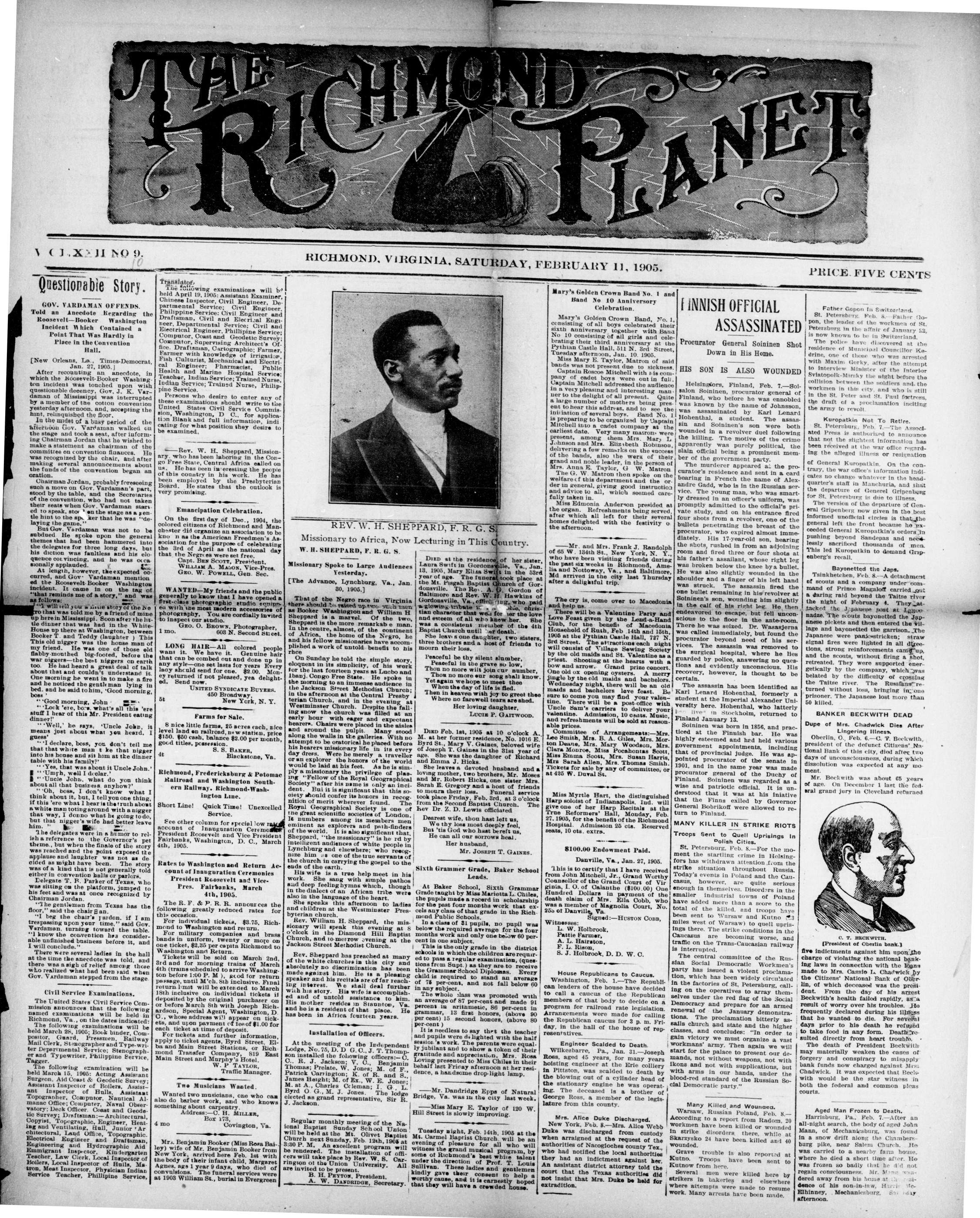
Richmond Planet
Saturday, February 11, 1905
Richmond, Virginia
Page text (machine-generated)
THE RICHMOND PLANET
Questionable Story.
GOV. VARDAMAN OFFENDS.
Told an Anecdote Regarding the
Roosevelt-Booker Washington
Incident Which Contained a
Point That Was Hardly in
Place in the Convention
Hall.
[New Orleans, La., Times-Democrat,
Jan. 27, 1905.]
After recounting an anecdote, in which the Roosevelt-Booker Washington incident was touched upon with questionable decency, Gov. J. K. Vardaman of Mississippi was interrupted by a member of the cotton convention yesterday afternoon, and, accepting the hint, relinquished the floor.
In the midst of a busy period of the afternoon Gov. Vardaman walked on the stage and took a seat, after informing Chairman Jordan that he wished to make a statement as chairman of the committee on convention finances. He was recognized by the chair, and after making several announcements about the funds of the convention began an oration.
Chairman Jordan, probably foreseeing such a move on Gov. Vardaman's part, stood by the table, and the Secretaries of the convention, who had not taken their seats when Gov. Vardaman started to speak, story on the stage as a gentle hint to the sp. ker that he was "delaying the game."
But Gov. Vardaman was not to be subdued by the stroke upon the general themes that he been hammered into the delegates for three long days, but his diction was faintless and his eloquence corvincing, and he was occasionally applauded.
At length, however, the expected occurred, and Gov. Vardaman mentioned the Roosevelt-Booker Washington incident. It came in on the tag of "that reminds me of a story," and was as follows:
"I will tell you a little story of the Neo-Proto that was told me by a friend of mine up here in Mississippi. Soon after the little dinner that was had in the White-House up there at Washington, between Booker T. and Teddy (laughter) This old nigger was the house man of my friend. He was one of those old flabby-mouthed big-footed, before the war niggers—the best niggers on earth too. He had heard a great deal of talk about that and couldn't understand it. One morning he went in to make a fire and he noticed the gentle man lying in bed. and he said to him, 'Good morning, boss'
"Good morning, John"
"Lock 'ere, bore, what's all this 'ere stuff I hear of this Mr. President eating dinner!"
"Well, he says, 'Uncle John, it means just about what you heard. I guess'
"I declare, boss, you don't tell me that that white man t ke that nigger into his house and sit him at the dinner table with his family?"
"Yes, that was about it Uncle John."
"Umph, well I declare."
"Uncle John, what do you think about all that business anyhow?"
"Oh, boss, I don't know what I think about it, but, I tell you one thing, if this 'ere what I hear is the truth about a white man toting around with a nigger that way, I donno what he going to do, but that nigger's wife had better leave him."
The delegates were in a humor to relish a reference to the Governor's pet theme, but when the finale of the story was reached and the point exposed the applause and laughter was not as decided as might have been. The story was of a kind that is not generally told either in convention halls or parlors.
Delegate T. B. Parker of Texas, who was sitting on the platform, jumped to his feet and was at once recognized by Ordeman Jordan.
"I the gentleman from Texas has the floor," said the chair in.
"I beg the chair's ladies, if I am trespassing upon your time," said Gov. Vardaman, turning toward the table.
"I know the convention has considerable unfinished business before it, and I will conclude."
There were several ladies in the hall at the time the anecdote was told, and there was a sigh of relief among those who realized what had been said when Gov. Vardaman stepped from the stage.
Civil Service Examinations.
The United States Civil Service Commission announces that the following named examinations will be held in Richmond, Va., on the dates indicated. The following examinations will be held March 28, 1905; Book binder, Composer, Guard, Pressman, Railway Mail Clerk, Stenographer and Type-writer Departmental Service; Stenographer and Typewriter, Philippine Service, Tagger.
The following examination will be held March 15, 1905: Acting Assistant Surgeon, Aid Coast & Geodetic Survey; Assistant Inspector of Boilers, Assistant Inspector of Hulls, Assistant Topographer, Computor, Nautical Almanac Office; Computer, Naval Observatory; Deck Officer; Coast and Geodetic Survey; Draftman: Architectural, Copyist, Topographic, Engineer, Heating and Ventilating, Hull, Junior 'Aritectural, Land Office, Topographic, Electrical Engineer and Draftman, Engineering and Hydrographic Aid Emigrant Inspector, Kindergarten Teacher, Law Clerk, Local Inspector of Boilers, Local Inspector of Hulls, Matron, Meat Inspector, Physician Indian Service Teacher, Philippine Service.
The following examinations will be held April 19, 1905: Assistant Examiner, Chinese Inspector, Civil Engineer, Departmental Service; Civil Engineer, Philippine Service; Civil Engineer and Draftsman, Civil and Electrical Engineer, Departmental Service; Civil and Electrical Engineer, Phillipine Service; Computor, Coast and Geodetic Survey; Computor, Supervising Architect's Office. Draftsman, Cartographic; Farmer, Farmer with knowledge of irrigation, Fish Culturist, Mechanical and Electrical Engineer; Pharmacist, Public Health and Marine Hospital Service; Teacher, Indian Service; Trained Nurse, Indian Service; Trained Nurse, Philippine Service.
Persons who desire to enter any of these examinations should write to the United States Civil Service Commission, Washington, D. C., for application Blank for information, indicating for what position they desire to be examined.
---
—Rev. W. H. Sheppard, Missionary, who has been laboring in the Congo Free State, Central Africa called on us. He has been in erasing the people of this country in his work. He has been employed by the Presbyterian Board. He states that the outlook is very promising.
Emancipation Celebration
On the first day of Dec., 1904, the colored citizens of Richmond and Manchester did organize an association to be known as the American Freedmen's Association for the purpose of celebrating the 3rd of April as the national day that the Negroes were set free.
Capt. BEN SCOTT, President,
WILLIAM A. MASON, Vice-Pres.
GEO. W. POWELL, Gen. Sec.
WANTED—My friends and the public generally to know that I have opened a first-class photographic studio equipment with the most modern accessories of photography. You are密切 invited to inspect our studio.
GEO. O. BROWN, Photographer,
1 mo.
608 N. Second Street.
LONG HAIR—All colored people want it. We have it. Genuine hair that can be combed out and done up in any style—one set lasts for years Every lady should send for one. $2.00. Money returned if not pleased, yea delighted. Send now.
UNITED SYNDICATE BUYERS.
450 Broadway.
5t
New York, N. Y.
Farms for Sale
8 nice little farms, $2 acres each, nice level land on railroad, new station, price $150. $50 cash, balance $2.00 per month, good titles, possession.
S. S. BAKER,
4t
Blackstone, Va.
Richmond, Fredericksburg & Potomac Railroad and Washington Southern Railway. Richmond-Washington Line.
Short Line! Quick Time! Unexcelled Service.
See other column for special low rate account of Inauguration Ceremonies President Roosevelt and Vice President Fairbanks, Washington, D. C., March 4th, 1905.
Rates to Washington and Return Account of Inauguration Ceremonies President Roosevelt and Vice-Pres. Fairbanks, March 4th, 1905.
The R. F. & P. R. R. announces the following greatly reduced rates for this occasion.
For individual tickets, $3.75. Richmond to Washington and return.
For military companies and brass bands in uniform, twenty or more on one ticket, $2.35 per capita Richmond to Washington and Return.
Tickets will be sold on March 2nd, 3rd and for morning trains of March 4th (trains scheduled to arrive Washington before 1:00 P. M.), good for return passage, until M'ch. 5th inclusive. Final return hmt will be extended to March 15th inclusive on individual tickets if the highest purchaser on or before March 15th has Joseph Richardson, Special Agent, Washington O., whose address will appear on tickets, and upon payment of fee of $1.00 for each ticket at time of deposit.
For tickets and further information, apply to ticket agents, Byrd Street, Elba and Main Street Stations, or Richmond Transfer Company, 819 East Main Street and Murphy's Hotel. W.P TAYLOR, Traffic Manager.
Two Musicians Wanted
Wanted two musicians, one who can also do barber work, and who knows something about carpentry.
Mrs. Benjamin Booker (Miss Rosa Bailey) wife of Mr. Benjamin Booker from New York, arrived here Feb. 1st with the body of their infant child, Margaret Agnes, age 1 year 9 days, who died of convulsions. The funeral services were at 1903 William St., burial in Evergreen
RICHMOND, VIRGINIA, SATURDAY, FEBRUARY 11, 1905.
JOHN H. HARRIS
Missionary Spoke to Large Audiences Yesterday.
[The Advance, Lynchburg, Va., Jan. 30, 1905.]
That of the Negro race in Virginia there should be raised up two such man as Booker Washington and William H Sheppard is a marvel. Of the two, Sheppard is the more remarkable man. In the centre, almost, of the continent of Africa, the home of the Negro, he and his fellow missionaries have accomplished a work of untold benefit to his riche
On Sunday he told the simple story, eloquent in its simplicity, of his work for the last fourteen years at Lucbo and ibanj. Congo Free State. He spoke in the morning to an immense audience in the Jackson Street Methodist Church; in the afternoon at the Central Presbyterian Church, and in the evening at Westminster Church. Despite the falling snow the church was filled at an early hour with eager and expectant hearers. Chairs were placed in the aisles and around the pulpit. Many stood along the walls in the galleries. With no attempt to be oratorical he placed before his hearers missionary life in its every day dress. Were he merely a traveller or an explorer the honors of the world would be laid at his feet. As he is simply a missionary the privilege of plague. Fellow of the Royal Geographical Society after his name is only an incident. Bain is significant that this society should honor its honors in recognition of merit wherever found. The Royal Geographical Society is one of the great scientific societies of London. It numbers among the members men eminent as explorers and finders of the world. It is also significant that, Sheppard, "the missionary" is he rd by intelligent audiences of white people in Lynchburg and elsewhere; who recognize him as one of the true servants of the church in carrying the gospel to the ends of the earth. His wife is a true help meet in his work. She sang with simple paths and deep feeling hymns which, though in the dialect of an African tribe were also in the language of the heart.
She speaks this afternoon to ladies and children at the Westminster Presbyterian church.
Rev. William H. Sheppard, the missionary will speak this evening at 8 o'clock in the Diamond Hill Baptist Church, and to mourn evening at the Jackson Street Methodist Church.
Rev. Sheppard has preached at many of the white churches in this city and absolutely no discrimination has been made against him. He is a pleasing speaker and his recitals are of far reaching interest. We shall deal further with his story. His wife is accomplished and of untold assistance to him. His mother resides in Staunton, Va. and he is a resident of that place. He has been in Africa fourteen years.
Installation of Officers
At the meeting of the Independent Lodge, No. 75, D. D G. C., J. T. Thompson installed the following officers;—O. C., R. J. Jackson; V. C., Benjamin Thomas; Prelate, W. Jones; M. of F. Patrick Carrington; K. of R. and S. James Height; M. of Ex., W. E. Jones; M. at A., Charles Coleman; I. G. L. Byrd O. G., M. J. Jones. The lodge elected as grand representative, Sir R. J. Jackson.
Regular monthly meeting of the National Baptist Sunday School Union will be held at the Mt. Olivet Baptist Church next Sunday, Feb. 12th, 1905 at 3:30 P. M. An excellent program will be rendered. The installation of officers will take place by Rev. W. S. Carrington of the Union University. All are invited to be present.
B. H. PEYTON, President.
A. W. DANDRIDE, Secretary.
DIED at the residence of her sister, Laura Swift in Gordonsville, Va., Jan. 13, 1905, Mary Elias Swift in the 33rd year of age. The funeral took place at the Mt. Pisgah Baptist Church of Gordonsville. The Re. A. G. Gordon of Humore and Rev. W. H. Hawkins of Gordonsville and office (ug), who paid a glover's tribute, Jesse J. Christian character that was for the love and esteem of all who knew her. She was a consistent member of the 4th Baptist Church until her death.
She leaves one daughter, two sisters, three brothers and a host of friends to mourn their loss.
Thou no more wilt join cur number,
Thou no more our song shall know.
Yet again we hope to meet thee
When the day of life is fled.
Then in heaven with joy to greet thee
Where no farewell tears are shed.
Her loving daughter,
LUCIE P. GAITWOOD.
Died Feb. 1st, 1905 at 10 o'clock A.
M. at her former residence, No. 1016 E.
Byrd St., Mary V. Gaines, beloved wife of Joseph E. Gaines in the 31st year of age. She was the daughter of Richard and Emma J. Hicks.
She leaves a devoted husband and a loving mother, two brothers, Mr. Moses and Mr. Robert Hicks, one sister Mrs. Sarah E. Gregory and a host of friends to mourn their loss. Funeral service took place Friday, Feb. 3rd, at 3 o'clock from the Second Baptist Church. The Rev Dr. Z. D. Lewis officiated.
Dearest wife, thou hast left us,
We thy loss most deeply feel,
But 'tis God who hast bereft us,
He can all our sorrows heal.
Sixth Grammer Grade, Baker School Leads.
At Baker School, Sixth Grammar Grade taught by Miss Marietta L. Chiles, the pupils made a record in scholarship for the past four months work that excels any class of that grade in the Richmond Public Schools.
In a class of 51 pupils, no pupil was below the required average for the four months work and only one below 60 percent in one subject.
This is the only grade in the district schools in which the children are required to pass a regular examination, (questions from Supt.) as they are to receive the Grammar School Diplomas. Every child is required to stand an average of 75 per-cent, and not fall below 60 in any subject.
The whole class was promoted with an average of 87 per-cent and made 91 percent in arithmetic, 86 per-cent in grammar, 13 first honors, (above 90 per-cent) 15 second honors, (above 80 per-cent)
It is needless to say that the teacher and pupils were dressed with the half session's work. The parents were equally jubilant and to show a token of their gratitude and appreciation, Mrs. Ross Loving presented to Miss Chiles in their behalf last Friday afternoon at her residence, a handsome drop-light lamp.
Mr. Dandridge Epps of Natural Bridge, Va. was in the city last week.
Miss Mary E. Taylor of 120 W. Hill Street is slowly improving.
Tuesday night, Feb. 14th, 1905 at the Mt. Carmel Baptist Church, will be an evening of pleasure for all who will witness the grand musical program, by some of Richmond's best white talent under the direction of Prof. T. Louis Sullivan. These ladies and gentlemen kindly gave their consent to help a worthy cause, and it is carnyest hoped that they will have a crowded house.
Mary's Golden Crown Band No.1 and Band No.10 Anniversary Celebration
Mary's Golden Crown Band, No.1, consisting of all boys celebrated their sixth anniversary together with Band No.10 consisting of all girls and celebrating their third anniversary at the Pythian Castle Hall, 511 N. 3rd Street, Tuesday afternoon, Jan. 10. 1905.
Miss Mary E. Taylor, Matron of said bands was not present due to sickness.
Captain Roscoe Mitchell with his company of cadet boys were out in full. Captain Mitchell addressed the audience in a very pleasing and interesting manner to the delight of all present. Quite a large number of mothers being present to hear this address, and to see the initiation of several boys. Band No.1 is preparing to be organized by Captain Mitchell into a cadet company at the earliest date. Very many matrons were present, among them Mrs. Mary L Johnson and Mrs. Elizabeth Robinson, delivering a few remarks on the success of the bands, also the works of their grand and noble leader, in the person of Mrs. Anna E. Taylor, G. W. Matron The G. W. Matron then spoke on the welfare of this department and the order in general, giving good instruction and advice to all, which seemed carefully taken in.
Miss Edmonia Anderson presided at the organ. Refreshments being served, after which all left for their several homes delighted with the festivity of the afternoon.
Mr. and Mrs. Frank J. Randolph of 65 W. 134th St., New York, N. Y., who have been visiting friends during the past six weeks in Richmond, Amelia and Nottoway, Va., and Baltimore, Md arrived in the city last Thursday after a delightful trip.
The cry is, come over to Macedonia and help pa.
There will be a Valentine Party and Love Feast given by the Lend-a-Hand Club, for the benefit of Macedonia Household of Ruth, Feb 14th and 15th, 1905 at the Pythian Castle Hall, 727 N. 3rd Street. The attractions each night will consist of Village Sewing Society by the old maids and St. Valentine as a priest. Shooting at the hearts with a bow and arrow. Grand prize concert. One old ox opening oysters. A merry jingle by the old maids and bachelors. Wednesday night, there will be an old maids and bachelors leave cast. Be sure to come you may find your valentine. There will be a post office with Uncle Sam's carriers to deliver your valentine. Admission, 10 coasts, Music, and refreshments will be sold at reasonable prices. Committee of Arrangements:—Mrs. Lee Smith, Mrs. B. A. Giles, Mrs. Clara Deane, Mrs. Mary Woodson, Mrs. Clara Monroe, Mrs. M pocahontas Scott, Miss Emma Scott, Mrs. Susan Harris, Mrs Sarah Allen, Mrs. Thomas Smith. Tickets for sale by any of committee, or at 425 W. Duval St.
---
Miss Myrtle Hart, the distinguished Harp soloist of Indianapolis. Ind. will give one of her Harp Recitals at the True Reformers' Hall, Monday, Feb. 27, 1905, for the benefit of the Richmond Hospital. Admission 25 cts. Reserved seats, 10 cts. extra.
$100.00 Endowment Paid
Danville, Va., Jan. 27, 1905.
This is to certify that I have received from John Mitchell, Jr., Grand Worthy Counselor of the Grand Court of Virginia, I. O. of Calanthe ($100.00) One Hundred Dollars in payment of the death claim of Mrs. Ella Cobb, who was a member of Magnolia Court, No. 250 of Danville. Signed:—HUSTON COBB, Witnesses:
Washington. Feb. 1.—The Republican leaders of the house have decided to call a caucus of the Republican members of that body to decide on a program for railroad rate legislation. Arrangements were made for calling the Republican caucus for 3 p. m. Friday, in the hall of the house of representatives.
Engineer Scalded to Death
Wilkesbarre, Pa., Jan. 31. Joseph Ross, aged 45 years, for many years holisting engineer at the Erie colliery in Pittston, was scalded to death by the blowing out of a cylinder head of the stationary engine he was operating. The deceased is a brother of George Ross, a member of the legislature from this county.
Mrs. Alice Duke Discharged
New York, Feb. 8.—Mrs. Alice Webb Duke was discharged from custody when arraigned at the request of the authorities of Nacogloiches county Tex., who had notified the local authorities they had an indictment against her. An assistant district attorney told the court that the Texas authorities did not insist that Mrs. Duke be held for extradition.
FINNISH OFFICIAL
ASSASSINATED
Procurator General Soininen Shot Down in His Home.
HIS SON IS ALSO WOUNDED
Helsingstors, Finland, Feb. 7.—Soilalon Soininen, procurator general of Finland, who before he was ennobled was known by the name of Johnssson, was assassinated by Karl Lenard Hohenthal, a student. The assassin and Soininen's son were both wounded in a revolver duel following the killing. The motive of the crime apparently was purely political, the slain official being a prominent member of the government party.
The murderer appeared at the procurator's residence and sent in a card bearing in French the name of Alex and Andre Gadd, who is in the Russian service. The young man, who was smartly dressed in an officer's uniform, was promptly admitted to the official's private study, and on his entrance fired four shots from a revolver, one of the bullets penetrating the breast of the procurator, who expired almost immediately. His 17-year-old son, hearing the shots, rushed in from an adjoining room and fired three or four shots at his father's assailant, whose right leg was broken below the knee by a bullet. He was also slightly wounded in the shoulder and a finger of his left hand was struck. The assassin fired the one bullet remaining in his revolver at Solninen's son, wounding him slightly in the calf of his right leg. He then endeavored to escape, but fell unconscious to the floor in the ante-room. There he was seized. Dr. Wasasjerna was called immediately, but found the procurator beyond need of his services. The assassin was removed to the surgical hospital, where he lies guarded by police, answering no questions and evidently unconscious. His recovery, however, is thought to be certain.
The assassin has been identified as Karl Lenard Hohenthal, formerly a student at the Imperial Alexander University here. Hohenthal, who latterly lives in Stockholm, returned to Finland January 13.
Soininen was born in 1856, and practiced at the Finnish bar. He was highly esteemed and had held various government appointments, including that of provincial judge. He was appointed procurator of the senate in 1901, and in the same year was made procurator general of the Duchy of Finland. Soininen was regarded as a wise and patriotic official. It is understood that it was at his initiative that the Finnns exiled by Governor General Bobrikoff were allowed to return to Finland.
MANY KILLER IN STRIKE RIOTS
Troops Sent to Quell Uprisings In Polish Cities.
St. Petersburg, Feb. 8.—For the moment the startling crime in Helsingfors has withdrawn attention from the strike situation throughout Russia. Today's events in Poland and the Caucasus, however, are quite serious enough in themselves. Disorders in the smaller industrial towns of Poland have added more than a score to the total of the killed, and troops have been sent to Warsaw and Kutno 3 miles west of Warsaw) to quell uprisings there. The strike conditions in the Caucasus are becoming worse, and traffic on the Trans-Caucasian railway is interrupted.
The central committee of the Russian Social Democratic Workmen's party has issued a violent proclamation, which has been widely circulated in the factories of St. Petersburg, calling on the operatives to array themselves under the red flag of the Social Democracy and prepare for an armed renewal of the January demonstrations. The proclamation bitterly assails church and state and the higher classes, and concludes: "In order to gain victory we must organize a vast workmans' army. Then again we will start for the palace to present our demands, not without weapons, not with ikons and not with supplications, but with arms in our hands, under the blood-red standard of the Russian Social Democratic party."
Many Killed and Wounded. Warsaw, Russian Poland, Feb. 8. According to a report from Radom, 20 workmen have been killed or wounded in strike disorders there, while at Skarzysko 24 have been killed and 40 wounded. Grave trouble is also reported at Kutno. Troops have been sent to Kutnow from here. Several men were killed here by strikers in bakeries and elsewhere where attempts were made to resume work. Many arrests have been made.
Father Gopon in Switzerland.
St. Petersburg, Feb. 8.—Father Gopon, the leader of the workmen of St. Petersburg in the affair of January 22, is now known to be in Switzerland.
The police have discovered at the residence of Municipal Councillor Kedrine, one of those who was arrested with Maxim Gorky, after the attempt to interview Minister of the Interior Sviatopolk-Mirsky the night before the collision between the soldiers and the workmen in this city, and who is still in the St. Peter and St. Paul fortress, the draft of a proclamation inciting the army to revolt.
Kuropatkin Not To Retire.
St. Petersburg, Feb. 7.—The Associated Press is authorized to announce that not the slightest information has been received at the war office regarding the alleged illness or resignation of General Kuropatkin. On the contrary, the war office's information indicates no change whatever in the headquarter's staff in Manchuria, and that the departure of General Gripenberg for St. Petersburg is due to illness.
The version of the departure of General Gripenberg now given in the best informed unofficial circles is that the general left the front because he exceeded General Kuropatkin's orders in pushing beyond Sandepas and needlessly sacrificed thousands of men. This led Kuropatkin to demand Gripenberg's recall.
Bayonetted the Jans.
Tsinkketchen, Feb. 8.—A detachment of scouts and a company under command of Prince Magaloff carried out a daring raid beyond the Taltse river the night of February 4. They attacked the Japanese post at Lggo nadze. The scouts bayoneted the Japanese pickets and then entered the village and bayoneted the garrison. The Japanese were panic-stricken; straw signal fires were lighted in all directions, strong reinforcements camp-up, and the scouts, without firing a shot, retreated. They were supported energetically by the company, which was belated by the difficulty of crossing the Taltse river. The Russians returned without loss, bringing in one prisoner. The Japanese lost more than 50 killed.
BANKER BECKWITH DEAD
Dupe of Mrs. Chadwick Dies After Lingering Illness
Oberlin, O, Feb. 6—C. T. Beckwith, president of the defunct Citizens' National Bank of this city, died after two days of unconsciousness, during which dissolution was expected at any moment.
Mr. Beckwith was about 65 years of age. On December 1 last the federal grand jury in Cleveland returned
C. T. BECKWITH.
[President of Oberlin bank]
five indictments against him upon the charge of violating the national banking laws in connection with the loans made to Mrs. Cassie L. Chadwick by the Citizens' National Bank of Oberlin, of which deceased was the president. From the day of his arrest Beckwith's health failed rapidly, as a result of worry over his troubles. He frequently declared during his illness that he wanted to die. For several days prior to his death he refused to take food in any form. Death resulted directly from heart trouble.
The death of President Beckwith may materially weaken the cases of forgery and conspiracy to misapply bank funds now charged against Mrs. Chadwick. It was expected that Beckwith would be the star witness in both the federal and common pleas courts.
Aged Man Frozen to Death.
Harrisburg, Pa., Feb. 7—After an all-night search, the body of aged John Mann, of Mechanicsburg, was found in a snow drift along the Chambersburg pike, near Salem Church. He was carried to a nearby farm house, where he died a short time after. He was frozen so badly that he did not regain consciousness. Mr. Mann wondered away from his home at the evidence of his son-in-law, Harry McElhinney, Mechanicsburg, Saturday afternoon.
THE YELLOWSTAR
SATURDAY.....FEBRUARY 11,1900
AROUND THE CAMP FIRE
NEW MEDAL OF HONOR.
Government Provides a New Design to Displace the Old One Worn by War Veterans.
Maj. Gen. George L. Gillespie, assistant chief of staff of the army, is the author and designer of the new medal of honor which has just been approved by congress and accepted by the secretary of war. Gen. Gillespie has patented the design, so that there will be no chance for anyone to duplicate it. This is the final step which has been taken to render the medal exclusive, and give to the veterans, who by their valor on the field of battle merited high distinction and were decorated by their country with the medal of honor.
The new medal, while a radical departure from the old, retains most of the distinctive features of the original decoration. It was designed by Gen. Gillespie, who, with the secretary of war and the chief of ordinance, served on the board which had charge of the alteration of the design ordered by the last session of congress. Gen. Gillespie worked out the present design himself, and then presented it for consideration and approval to the most prominent medal-of-honor veterans in the coun-
VALOR
UNITED STATES OF AMERICA
THE NEW MEDAL OF HONOR
try. The design met with instant and hearty approval.
The medal is of bronze, and is suspended from a hidden bronze bar by a ribbon of rich blue silk on which 13 stars are enbroided in white. The medal proper includes a five-pointed star, a bar containing the word "Valor," and an eagle with outspread wings. The star is the same shape and form of the star on the old medal of honor. The five points are joined by a wreath of laurel, and the whole is suspended from the talons of the eagle by the bar pin bearing the word "Valor." The ribbon is attached to the wing of the eagle by a hidden bar; it is exactly two inches wide, and is covered by the sweep of the eagle's wings from tip to tip.
Appropriation was made for the medal of honor last session of congress when the enabling bill for its recreation was passed, and the sum of $12,000 was appropriated for the purpose. All the old medals of honor are called in, and this new one will be distributed in the place. The reason assigned for the designing of the new medal of honor was that the Grand Army of the Republic had practically adopted the design when the G. A. R. membership badge was created. While this is in a measure true, people who know badges would never make a mistake; but the Grand Army of the Republic is rather glad that the change has been made. The old veterans are extremely proud of their exclusive badge, which can never be worn by anybody but those who wore the blue between 1861 and 1865. It cannot be handed down from father to son, as so many veteran badges can, and there is a severe penalty for anyone not authorized by obligation in the Grand Army of the Republic wearing the badge.
The medal of honor was first authorized by congress by a joint resolution approved July 12, 1862, after repeated recommendations from the war department, the commanding general of the army and the adjutant general of the army. The first legislation on the subject permitted the bestowal of the medal on officers and enlisted men of the army, scouts, civilian employees, etc., who displayed conspicuous gallantry on the actual field of battle during the course of the battle.
Many applications were made during that year, and in the following year congress enacted a law which prohibited the bestowal of the medal on any but officers and enlisted men of the army, under the same conditions as prescribed before. During the civil war 1,300 medals were issued, and by
Debless Porto Rico.
Porto Rico, which pays for neither
army nor navy, is the most lightly taxed
country on earth. It has no debt.
A WINTER CAMPAIGN.
Some Interesting Extracts from Diary of Soldier Who Fought in Tennessee.
"Winter campaigning," said the major, in the Chicago Inter Ocean, "had an infinite variety of ups and downs in 1863, and I wonder if the ups are any better or the downs any harder on the Snake than they were with us in Kentucky and Tennessee. I was looking over a diary the other day, covering in the space of a hundred words each day of the year 1863, a fighting year for most of our armies.
"The record began in a matter of fact way, reading in this wise: "Thursday; —Morning very cold. Aroused at three o'clock; our brigade stumbling to the front to stand two hours on outpost. Rebel lines and fires in plain view. Return to our bivouac; cook breakfast, and change position. Attack made on our center repulsed. Chase hogs between the lines kill several, and have a New Year's dinner. At night build large fires and are comfortable, but cannot sleep because of continuous firing on the skirmish line."
"Evidently something had been doing. This record is of the second day at Stone River, or the day after the bloody struggle of December 31, 1862. This is made clearer by the record of Friday, January 2: 'Aroused at five o'clock and breakfast without interruption. Believed by two other regiments and retire to the rear near the river. Build a line of breastworks while we rest. Boys don't like the looks of things. About noon reenforced by Negley's and other divisions. At three o'clock terrific attack made by the enemy in force. Our line at first crushed back, but reenforced by Davis and Wood, hurls the rebels back, and we pursue at a run. Battle continues until after dark and we return to our bivouac in the rain, wet and muddy.'
"That is a reference by a participant to one of the most picturesque engagements of the war, to the turning point in the battle of Stone River. If the man who wrote the charge knew it, he didn't care to give particulars. Coming to Saturday, he wrote: 'A rainy, disagreeable day. Lines quiet until night, when rebels make a sortle and are repulsed. Night very disagreeable. Troops moving all night from left to right and boys grumble because they can't sleep. About three o'clock the clouds break away, the moon shines and we have a rainbow at night. Boys think it is a sign the rebs are licked.'
"The important thing to these men lying on their arms was the weather, and they complained of the noise made by troops moving into position as men at home complain of a man on the street who whistles or sings. However, on Sunday the rain ceased and the sun came out on a shivering army. 'About noon discover that the rebels have asounded their advanced lines and squares are sent out to bury the dead. Rebel dead collected for burial, but union dead lying where they were shot down. Find nine of our regiment dead at one point. Find others severely wounded. Troops on the right find Murfreesboro evacuated. There ought to have been a yell or a cheer there, but there is no sign of any elation.
"Monday, we are told, was very pleasant, but 'Black was found near the rebel breastworks, dead. Pockets rified; buttons cut from his coat, and boots pulled off. Our advance moves beyond Murfreesboro, passing through the town, which is simply a hospital for the wounded of both armies." Black was one of the color guards of our regiment, who, when the color-hearer was shot, caught up the flag and waved it almost in the faces of the enemy. When Black was shot between the eyes the wounded color-bearer took the flag again and carried it through the fight. The writer says nothing of this. He does not color the picture, because, to say that Black was found was enough to recall the whole picture to him.
"The record shows that the troops on Tuesday were still burying the dead and that on Wednesday the division (Palmer's) marched across the river, through Murfreesboro, and three miles out on the McMunnville road, and then: 'Our regiment, without supper, sent on picket, and boys in a state of mind. Meet Rosecrans and staff and the general, as he sees the regimental flag, says: "Hello! These men were with me in West Virginia. I am proud of you boys, for what you did last week. I hope you are all feeling well.'" They were. They forgot all about supper, and when, as they stood supperless that night and a brilliant meteor flashed across the sky, they said 'Old Rosy' was sure to win.
"The next night. Thursday, January 8, the men slept in tents for the first time since leaving Nashville, December 26. The next day the division moved back a mile to better camping ground. Friday and Saturday were cold and the little funnel-shaped stoves didn't work well. On that day, however, the boys found the wounded of their company comfortably housed. On Monday they marched back to Murfreesboro, and six miles on the Nolansville pike across the battlefield of December 31, passing hundreds of soldiers' graves and hundreds of dead horses.
"Then came a week of severely cold weather, the brigade moving, meantime, to a new camp on Cripple creek, six miles farther out on the McMunnville road. The first night in the new camp the men stood in line of battle without fires and it was supposed we were there only for a day or two. But tents were pitched along the line of battle and the regiment remained there until the forward movement in June, going through all the experiences of a winter campaign, but returning after every skirmish raid, or scout to camp, which came to seem like home."
Pervers!*=
The snow for weeks lies on the ground,
'Tis dirty, moist and raw.
To clean it off the men come 'round,
A man comes to thaw.
—Washington Stink
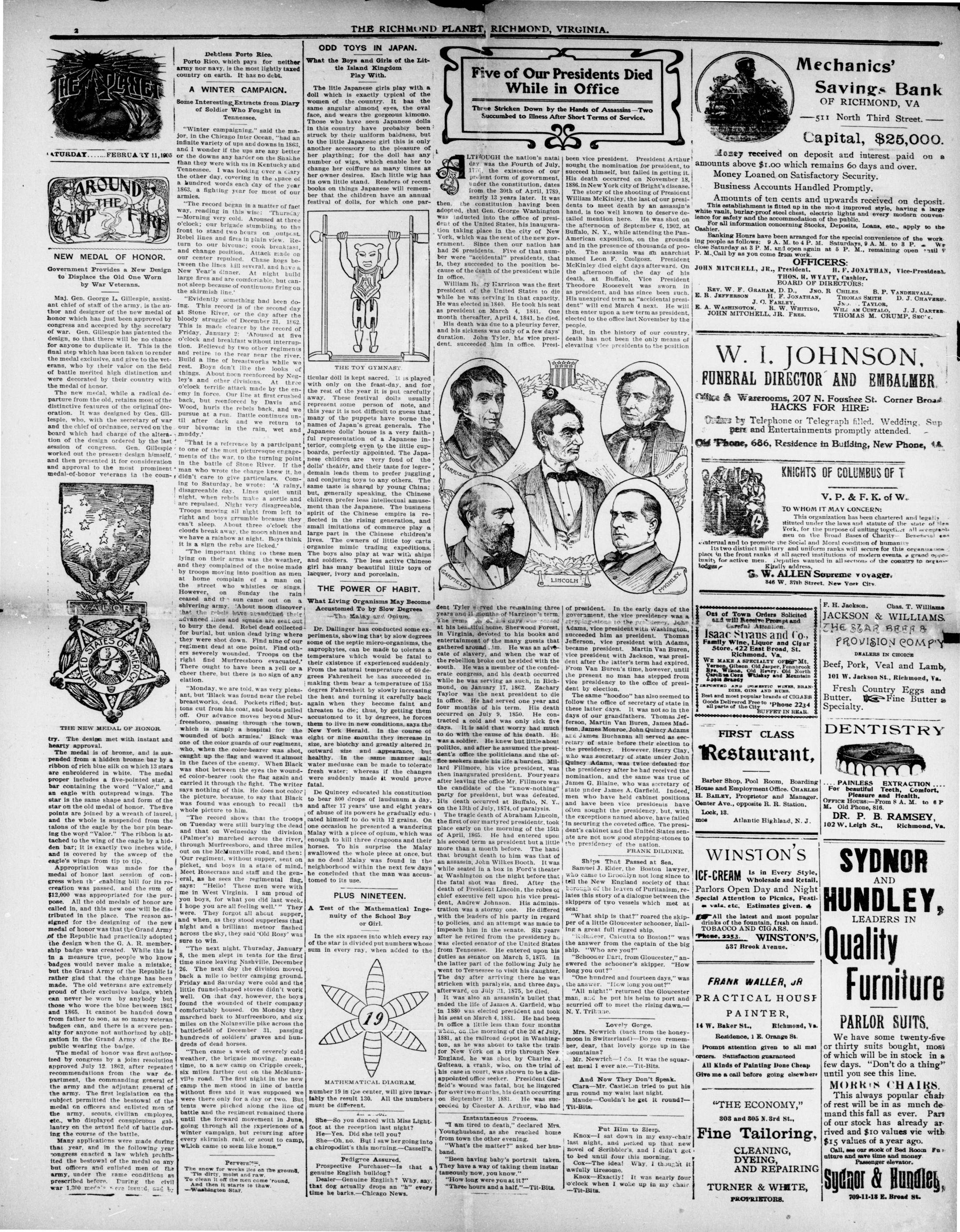
THE RICHMOND PLANET, RICHMOND, VIRGINIA.
ODD TOYS IN JAPAN.
What the Boys and Girls of the Little Island Kingdom Play With.
The little Japanese girls play with a doll which is exactly typical of the women of the country. It has the same angular almond eyes, the oval face, and wears the gorgeous kimono. Those who have seen Japanese dolls in this country have probably been struck by their uniform baldness, but to the little Japanese girl this is only another accessory to the pleasure of her plaything; for the doll has any number of wigs, which enable her to change her collure as many times as her owner desires. Each little wig has its own little stand. Readers of recent books on things Japanese will remember that the children have an annual festival of dolls, for which one par-
THE TOY GYMNAST
ticular doll is kept sacred. It is played with only on the feast-day, and for the rest of the year it is put carefully away. These festival dolls usually represent some person of note, and this year it is not difficult to guess that many of the puppets have borne the names of Japan's great generals. The Japanese dolls' house is a very faithful representation of a Japanese interior, complete even to the little cupboards, perfectly appointed. The Japanese children are very fond of the dolls' theater, and their taste for legerdemain leads them to prefer juggling and conjuring toys to any others. The same taste is shared by young China; but, generally speaking, the Chinese children prefer less intellectual amusement than the Japanese. The business spirit of the Chinese empire is reflected in the rising generation, and small imitations of commerce play a large part in the Chinese children's lives. The owners of little toy carts organize mimic trading expeditions. The boys also play at war with ships and soldiers. The less active Chinese girl has many beautiful little toys of lacquer, ivory and porcelain.
THE POWER OF HABIT.
What Living Organisms May Become Accustomed To by Slow Degrees —The Malay and Opium.
Dr. Dallinger has conducted some experiments, showing that by slow degrees some of the septic micro-organisms, the saprophytes, can be made to tolerate a temperature which would be fatal to their existence if experienced suddenly. From the natural temperature of 60 degrees Fahrenheit he has succeeded in making them bear a temperature of 158 degrees Fahrenheit by slowly increasing the heat and turning it carefully back again when they become faint and threaten to die; thus, by getting them accustomed to it by degrees, he forces them to live in new conditions, says the New York Herald. In the course of eight or nine months they increase in size, are blotchy and greatly altered in outward size and appearance, but healthy. In the same manner salt water medusae can be made to tolerate fresh water; whereas if the changes were suddenly made it would prove fatal.
De Quincey educated his constitution to bear 800 doses of laudunum a day, and after 17 years' use and eight years' abuse of its powers he gradually educated himself to do with 12 grains. On one occasion he presented a wandering Malay with a piece of opium, which was enough to kill three dragoons and their horses. To his surprise the Malay swallowed the whole piece at once, but as no dead Malay was found in the neighborhood within the next few days he concluded that the man was accustomed to its use.
PLUS NINETEEN.
or Girl.
In the six spaces into which every ray of the star is divided put numbers whose sum in every ray, when added to the
19
MATHEMATICAL DIAGRAM.
number 19 in the center, will give invariably the result 130. All the numbers must be different.
In 1.2
She—So you danced with Miss Lightfoot at the reception last night?
He—Yes. Did she tell you?
Dealer-Genuine English? Why, say, that dog actually drops an "h" every time he barks.-Chicago News.
Five of Our Presidents Died While in Office
Three Stricken Down by the Hands of Assassins—Two Succumbed to Illness After Short Terms of Service.
HARRISON
TAYLOR
GARFIELD
LINCOLN
MYKINLEY
G
LTFOUGH the nation's natal day was the Fourth of July, 1776, the existence of our present form of government, under the constitution, dates from the 30th of April, 1789, nearly 13 years later. It was then, the constitution having been adopted, that Gen. George Washington was inducted into the office of president of the United States, his inauguration taking place in the city of New York, which was the seat of the new government. Since then our nation has had 26 presidents. Five of that number were "accidental" presidents, that is, they succeeded to the position because of the death of the president while in office.
William H. Bry Harrison was the first president of the United States to die while he was serving in that capacity. He was elected in 1840. He took his seat as president on March 4, 1841. One month thereafter, April 4, 1841, he died. His death was due to a pleurisy fever, and his sickness was only of a few days' duration. John Tyler, his vice president, succeeded him in office. Presi-
HARRISON
GARFIELD
dent Tyler served the remaining three years and 11 months of Harrison's term. The remnants of his days at his beautiful home, Sherwood Forest, in Virginia, devoted to his books and entertainment of the many guests that gathered around him. He was an advocate of slavery, and when the war of the rebellion broke out he sided with the south. He was a member of the confederate congress, and his death occurred while he was serving as such, in Richmond, on January 17, 1862. Zachary Taylor was the next president to die in office. He had served one year and four months of his term. His death occurred on July 9, 1850. He contracted a cold and was only sick five days. It is said that worry had much to do with the cause of his death. He was a soldier. He knew but little about politics, and after he assumed the president's office the politicians and the office seakers made his life a burden. Millard Fillmore, his vice president, was then inaugurated president. Fouryears after leaving the office Mr. Fillmore was the candidate of the "know-nothing" party for president, but was defeated. His death occurred at Buffalo, N. Y., on the 13th of July, 1874 of paralysis.
The tragic death of Abraham Lincoln, the first of our martyred presidents, took place early on the morning of the 15th of April, 1865. He had entered upon his second term as president but a little more than a month before. The hand that brought death to him was that of an assassin, John Wilkes Booth. It was while seated in a box in Ford's theater at Washington on the night before that the fatal shot was fired. After the death of President Lincoln, the robes of chief executive fell upon his vice president, Andrew Johnson. His administration was a stormy one. He differed with the leaders of his party in regard to policies, and an attempt was made to impeach him in the senate. Six years after he retired from the presidency he was elected senator of the United States from Tennessee. He entered upon his duties as senator on March 5, 1875. In the latter part of the following July he went to Tennessee to visit his daughter. The day after arriving there he was stricken with paralysis, and three days afterward, on July 31, 1875, he died.
It was also an assassin's bullet that ended the life of James A. Garfield, who in 1880 was elected president and took his seat on March 4, 1881. He had been in office a little less than four months when, on the morning of the 2d of July, 1881, at the railroad depot in Washington, as he was about to take the train for New York on a trip through New England, he was shot by Charles J. Gulteau, a crank, who on the trial of his case in court, was shown to be a disappointed office seeker. President Garfield's wound was fatal, but he lingered for over two months, his death occurring on September 19, 1881. He was succeeded by Chester A. Arthur, who had
Instantaneous Process.
"I am tired to death," declared Mrs. Younghusband, as she reached home from town the other evening.
"What's the matter?" asked her husband.
"Been having baby's portrait taken. They have a way of taking them instantaneously now, you know."
"How long were you at it?"
"Three hours and a half."—Tit-Bits.
been vice president. President Arthur sought the nomination for president, to succeed himself, but failed in getting it. His death occurred on November 18, 1886. in New York city of Bright's disease. The story of the shooting of President William McKinley, the last of our presidents to meet death by an assassin's hand, is too well known to deserve detailed mention here. He was shot on the afternoon of September 6, 1902, at Buffalo, N. Y., while attending the Pan-American exposition, on the grounds and in the presence of thousands of people. The assassin was an anarchist named Leon F. Czolgosz. President McKinley died eight days afterward. On the afternoon of the day of his death, at Buffalo, Vice President Theodore Roosevelt was sworn in as president, and has since been such. His unexpired term as "accidental president" will end March 4 next. He will then enter upon a new term as president, elected to the office last November by the people.
But, in the history of our country, death has not been the only means of elevating vice presidents to the position
TAYLOR
PARKINLEY
of president. In the early days of the government, the vice president was a stepping-stone to the presidency. John Adams, vice president with Washington, succeeded him as president. Thomas Jefferson, vice president with Adams, became president. Martin Van Buren, vice president with Jackson, was president after the latter's term had expired. From Van Buren's time, however, until the present no man has stepped from vice presidency to the office of president by election.
The same "hoodoo" has also seemed to follow the office of secretary of state in these latter days. It was not so in the days of our grandfathers. Thomas Jefferson, Martin Van Buren, James Madison, James Monroe, John Quincy Adams and James Buchanan all served as secretary of state before their election to the presidency. However, Henry Clay, who was secretary of state under John Quincy Adams, was twice defeated for the presidency after he had received the nomination, and the same was true of James G. Blaine, who was secretary of state under James A. Garfield. Indeed, men who have held cabinet positions and have been vice presidents have often sought the presidency, but, with the exceptions named above, have failed in securing the coveted office. The president's cabinet and the United States senate are not now good stepping-stones to the presidency of the nation.
Samuel J. Elder, the Boston lawyer, who came to Brooklyn not long since to tell the New England society of that borough of the leaven of Puritanism, relates this story of a dialogue between the skippers of two vessels which met at sea:
"What ship is that?" roared the skipper of a little Gloucester schooner, hailing a great full rigged ship.
"Nohneer, Calcutta to Boston!" was the answer from the captain of the big ship.
"Who are you?"
"Schooner Dart, from Gloucester," answered the schooner's skipper. "How long you out?"
"One hundred and fourteen days," was the answer. "How long you out?"
"All night!" returned the Gloucester man, and he put his helm to port and scriffed off to meet the rising dawn.—N. Y. Tribune.
Lovely Gorge.
Mrs. Newrich (back from the honey-
moon in Switzerland)—Do you remember,
dear, that lovely gorge up in the
mountains?
Mr. Newrich—I do. It was the squar-
est meal I ever ate.—Tit-Bits.
And Now They Don't Speak.
Clara—Mr. Castleton tried to put his
arm round my waist last night.
Maude—Couldn't he get it round?—
Tit-Bits.
Put Him to Sleep.
Knox—I sat down in my easy-chair last night, and picked up that new novel of Scribblers, and I didn't get to bed until four this morning.
Cox—The idea! Why. I thought it awfully tiresome.
Knox—Exactly! It was nearly four o'clock when I woke up in my chair—Tit-Bits.
M. B. H.
Capital, $25,000.
Money received on deposit and interest paid on amounts above $1.00 which remains 60 days and over.
Money Loaned on Satisfactory Security.
Business Accounts Handled Promptly.
Amounts of ten cents and upwards received on deposit.
This establishment is fitted up in the most improved style, having a large white vault, burlar-proof steel chest, electric lights and every modern convenience for safety and the accommodation of the public.
For all information concerning Stocks, Deposits, Loans, etc., apply to the Oashier.
Banking Hours have been arranged for the special convenience of the working people as follows: 9 A. M. to 4 P. M. Saturday, 9 A. M. to 8 P. We close Saturday at 3 P. M. and open again at 5 P. M., remaining open until 9 P. M. Call by as you come from work.
OFFICERS
JOHN MITCHELL, JR., President. H. F. JONATHAN, Vice-Prestdean
THON. H. WYATT, Cashier.
BOARD OF DIRECTORS:
REV. W. F. GRAHAM, D. D., JNO. R. CHILES. B. P. VANDERVALL,
E. R. JEFFERSON H. F. JONATHAN, THOMAS SMITH D. J. CHAVERE,
J. O. FARLRY, JN. TAYLOR.
W. I. JOHNSON FUNERAL DIRECTOR AND EMBALMER
Office & Warerooms, 207 N. Foushee St. Corner Broad HACKS FOR HIRE: Ofters by Telephone or Telegraph filled. Wedding, Support and Entertainments promptly attended. Old Phone, 686. Residence in Building, New Phone.
9
KNIGHTS OF COLUMBUS OF T
TO WHOM IT MAY CONCERN:
This organization has been chartered and legally instituted under the laws and statute of the state of New York, for the purpose of uniting together all acceptable men on the Broad Bases of Charity—Beneficial to internal and to promote the Social and Moral condition of humanity.
It is two distinct military and uniform ranks will secure for this organization place in the front ranks of all sacred institutions of modern events, a grand opportunity for active men. Deputies wanted in all sections of the country to organize lodges.
G. W. ALLEN Supreme voyager.
846 W. 87th Street. New York City.
F. H. Jackson. Chas. T. Williams
JACKSON & WILLIAMS
THE STAR BEER
Out of Town Orders Solicited
and will Receive Prompt and
Careful Attention.
Isaac Straus and Co.
Family Wine, Liquor and Cigar
Store, 422 East St, St.
Richmond, Va.
WE MAKE A SPECIAL OFFICE Of Mr.
Vernon, Gibson, Old Japar, Pambrook
Rye, Wilson, Old Henry, Old North
Coronel Cora, Winsley and Mountain
Lippa Brandy
IMPORTED JEWELRY WIRES, BRAN-
DIES, GINS AND RUM
Best and most popular brands of CIGARS
Goods Delivered Free to 'Phone 2234
all parts of the City
BUFFET IN REAR.
Beef, Pork, Veal and Lamb,
101 W. Jackson St., Richmond, Va.
Fresh Country Eggs and
Butter. Fine Butter a
Specialty.
DENTISTRY
Barber Shop, Pool Room, Boarding House and Employment Office. CHARLES H. BAILEY, Proprietor and Manager. Center Ave., opposite R. R. Station. Look 18.
PAINLESS EXTRACTION
For beautiful Teeth, Comfort,
Pleasure and Health,
OFFICE HOURS: From 8 A. M. to 6 P
M. Old Phone, 816.
DR. P. B. RAMSEY,
102 W. Leigh St., Richmond, Va.
mos Atlantic Highland, N. J.
SYDNOR AND HUNDLEY, LEADERS IN Quality Furniture
ICF-CREAM Is in Every Style,
Wholesale and Retail.
Parlors Open Day and Night
Special Attention to Picnics, Festi-
vals, etc. Estimates given.
All the latest and most popular
drinks of the fountain, fresh on hand.
TOBACCO AND CIGARS.
Phone, 2253. WINSTON'S,
537 Brook Avenue.
FRANK WALLER, JR
PRACTICAL HOUSE
PARLOR SUITS
14 W. Baker St., Richmond, Va
Residence, 1 E. Orange St.
Prompt attention given to all mail
orders. Satisfaction guaranteed
All Kinds of Painting Done Cheap
Give me a call before going elsewhere
We have some twenty-five or thirty suits bought, most of which will be in stock in a few days. "Don't do a thing" until you see this line.
MORRIS CHAIRS.
This always popular chair of rest will be in as much demand this fall as ever. Part of our stock has already arrived and $10 values vie with $15 values of a year ago.
Call, see our stock of Bed Room Furniture and save time and money.
CLEANING
DYEING
AND REPAIRING
Sydnor & Hundley
TURNER & WHITE,
PROPRIETORS.
709-11-18 E. Broad St.
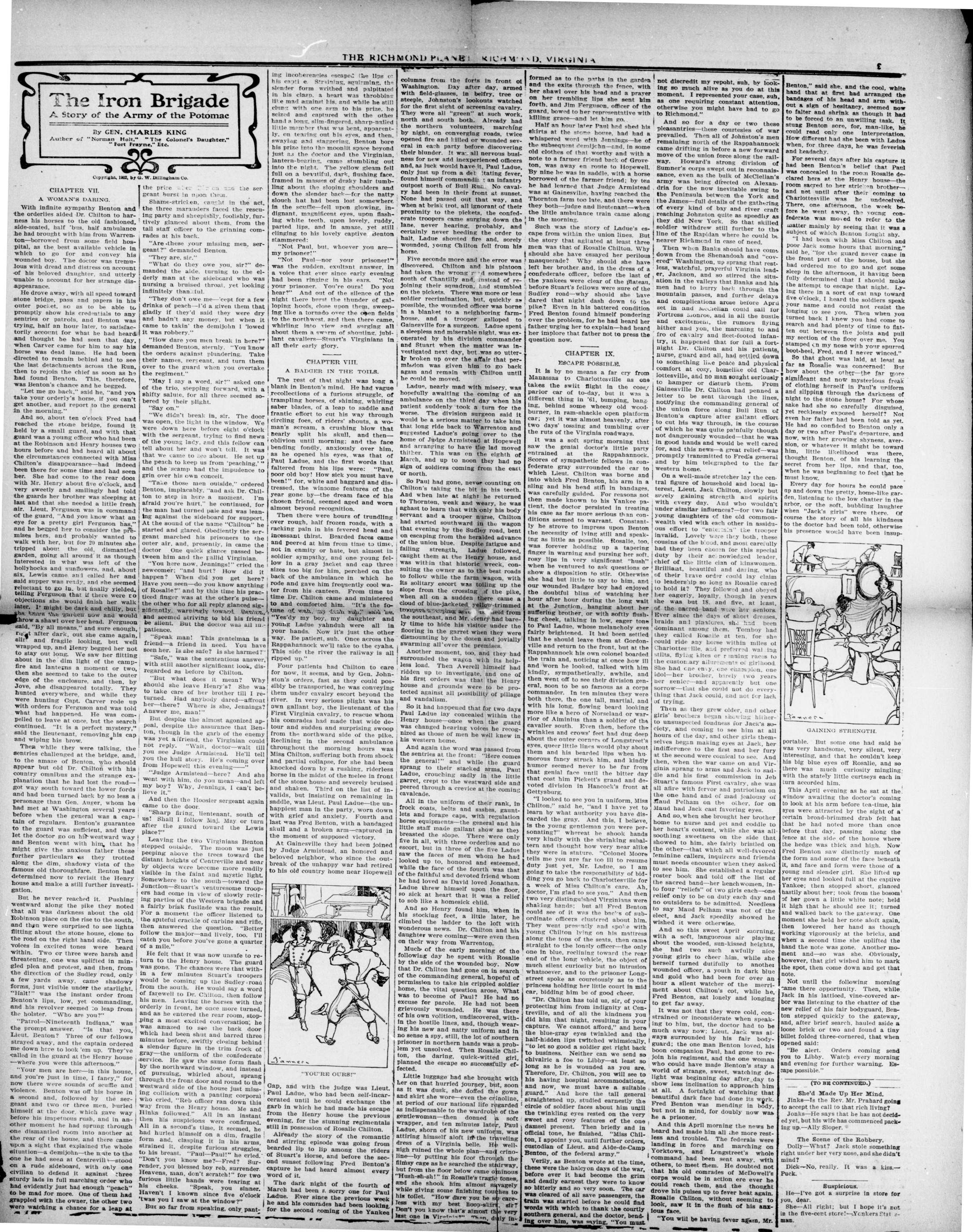
The Iron Brigade
A Story of the Army of the Potomac
By GEN. CHARLES KING
Author of "Norman Holt," "The Colonel's Daughter," "Fort Frayne," Etc.
Copyright, 1902, by G. W. Dillingham Co.
With infinite sympathy Benton and the orderlies aided Dr. Chilton to harness his horses to the old fashioned, side-seated, half 'bus, half ambulance he had brought with him from Warrenton—borrowed from some field hospital, as the best available vehicle in which to go for and convey his wounded boy. The doctor was tremulous with dread and distress on account of his beloved daughter, and utterly unable to account for her strange disappearance.
He drove away, with all speed toward stone bridge, pass and papers in his outer pocket, so as to be able to promptly show his credentials to any sentries or patrols, and Benton was trying, half an hour later, to satisfactorily account for what he had heard and thought he had seen that day, when Carver came for him to say his horse was dead lame. He had been directed to remain behind and to see the last detachments across the Run, then to rejoin the chief as soon as he had found Benton. This, therefore, was Benton's chance and he hegged.
"Let me go back." said he, "and you take your orderly's horse, if you can't get another, and report to the general in the morning."
And so, about ten o'clock Fred had reached the stone bridge, found it held by a small guard, and with that guard was a young officer who had been at the Robinson and Henry houses two hours before and had heard all about the circumstances connected with Miss Chilton's disappearance—had indeed been there for some time and had seen her. She had come to the rear door with Mr. Henry about five o'clock, and very sweetly and smilingly had told the guards her brother was sleeping at last and that she needed a little fresh air. Lieut. Ferguson was in command of the guard. "And you know what an eye for a pretty girl Ferguson has," and he begged her to consider the premises hers, and probably wanted to walk with her, but for 20 minutes she tripped, about the old, dismantled garden, going all around it as though interested in what was left of the hollyhocks and sunflowers, and about six, Lewis came and called her and said supper was ready, and she seemed reluctant to go in, but finally yielded, telling Ferguson that if there were 20 objections she would finish her walk later. It might be dark and chilly, but she knew the garden now and would
said, "By all means," and sure enough, right after dark, out she came again, slit and fragile looking, but well wrapped up, and Henry begged her not to stay out long. We saw her flitting about in the dim light of the campfire and lanterns a moment or two, then she seemed to take to the outer edge of the enclosure, and then, by Jove, she disappeared totally. They hunted everywhere, and while they were hunting Capt. Carver rode up with orders for Ferguson and was told what had happened. He was compelled to leave at once, but the search continued. "It is a perfect mystery," said the lieutenant, removing his cap and wiping his brow.
Then while they were talking, the sentries challenged at the bridge, and, to the amaze of Benton, who should appear but old Dr. Chilton with his country omnibus and the strange explanation that he had lost the road—got way south toward the lower fords and had been turned back by no less a personage than Gen. Auger, whom he had met at Washington several years before when the general was a captain of regulars. Benton's guarantee to the guard was sufficient, and they let the doctor go on his westward way and Benton went with him, that he might give the anxious father these further particulars as they trotted along the dim, shadowy vista of the famous old thoroughfare. Benton had determined now to revisit the Henry house and make a still further investigation.
But he never reached it. Pushing westward along the pike they noted that all was darkness about the old Robinson place on the rise to the south, and then were surprised to see lights flitting about the stone house, close to the road on the right hand side. Then voices in excited tones were heard within. Two or three were harsh and threatening, one was uplifted in mingled plea and protest, and then, from the direction of the Sudley road, only a few yards away, came shadowy forms, just visible under the starlight. "Halt!" the instant order from Benton's lips, low, yet commanding, and his revolver seemed to leap from the holster. "Who are you?" "Patrol—Nineteenth Indiana," was the prompt answer. "Is that you, Lieut. Benton? Three of our fellows strayed away, and the captain ordered me down here to look 'em up. They've called in the guard at the Henry house—where you were this afternoon."
"Your men are here—in this house, and you're just in time, I fancy," for now there were sounds of scuffle and violence. Benton was off his horse in a second and, followed by the sergeant and two or three men, burried himself at the door, which gave way before his impetuous rush, and in another moment he had sprung through one dismantled room into another at the rear of the house, and there came upon a sight that explained the whole situation—a demijohn—the nate to the one he had seen at Centrevill—stood on a rude sideboard, with only one civilian to defend it against three sturdy lads in full marching order who had evidently just had enough "peach" to be mad for more. One of them had grappled with the owner, the other two were watching a chance for a leap at
the price after it flies on and the sergeant burst in upon them.
Shame-stricken, caught in the act, the three marauders faced the rescuing party and sheepishly, foolishly, furtively glanced about them, from the tall staff officer to the grinning comrades at his back.
“Are these your missing men, sergeant?” demanded Benton.
“They are, sir.”
“What do they owe you, sir?” demanded the aide, turning to the elderly man at the sideboard who was nursing a bruised throat, yet looking infinitely thankful.
“They don’t owe me—cept for a few drinks of peach—I’d a given them that gladly if they’d said they were dry and hadn’t any money, but when it came to takin’ the demijohn I ‘lowed it was robbery.’
"How dare you men break in here?" demanded Benton, sternly. "You know the orders against plundering. Take their names, sergeant, and turn them over to the guard when you overtake the regiment."
"May I say a word, sir?" asked one of the trio, stepping forward, with a shifty salute, for all three seemed sobered by their plight.
"Say on."
"We didn't break in, sir. The door was open, the light in the window. We were down here before eight o'clock with the sergeant, trying to find news of the young lady, and this fellow can tell about her and won't tell. It was that we came to see about. He set up the peach to keep us from 'peaching,'" and the scamp had the impudence to grin over his own conceit.
"Take those men outside," ordered Benton, implacably, "and ask Dr. Chilton to step in here a moment. I'm afraid you're hurt," he continued, for the man had turned pale and was leaning against the sideboard for support. At the sound of the name "Chilton" he started and glared. Obediently the sergeant marched his prisoners to the outer air, and, presently, in came the doctor. One quick glance passed between him and the pallid Virginian. "You here now, Jennings!" cried the newcomer; "and hurt? How did it happen? When did you get here? Have you seen—do you know anything of Rosalie?" and by this time his practiced finger was at the other's pulse—the other who for all reply glanced significantly, warningly toward Benton, and seemed striving to bid his friend be silent. But the doctor was all impatience.
"Speak man! This gentelman is a friend—a friend in need. You have seen her. Is she safe? Is she harmed?" "Safe," was the sententious answer, with still another significant look, disregarded as before by Chilton. "But what does it mean? Why should she leave Henry's? She was to take care of her brother till I returned. Had anybody dared—affront her—there? Where is she, Jennings? Answer me, man!" But despite the almost agonized appeal, despite the assurance that Benton, though in the garb of the enemy was yet a friend, the Virginian could not reply. "Wait, doctor—wait till you see Judge Armistead. He'll tell you the hull story. He's coming over from Hopewell this evening—" "Judge Armistead—here! And she went with him, do you mean—and left my boy? Why, Jennings, I can't believe it." And then the Hoosier sergeant again came to the door.
"Sharp firing, lienttenant, south of us! Shall I follow Maj. May or turn after the guard toward the Lewis place?" Leaving the two Virginians Benton stepped outside. The moon was just peeping above the trees toward the distant heights of Centreville and near by objects were become more readily visible in the faint and mystic light. Somewhere to the south—toward the Junction—Stuart's venturesome troopers had come in view of slowly retreating parties of the Western brigade and a fairly brisk fusilade was the result. For a moment the officer listened to the spiteful crackle of carbine and rifle, then answered the question. "Better follow the major—and lively, too. I'll catch you before you've gone a quarter of a mile."
He felt that it was now unsafe to return to the Henry house. The guard was gone. The chances were that within a few minutes Stuart's troopers would be coming up the Sudley road from the south. He would say a word of farewell to Dr. Chilton, then follow his men. Leaving the horses with the orderly in front, he once more turned, and as he entered the rear room, stopping a most excited conversation, he was amazed to see the back door which had been shut and barred three minutes before, swiftly closing behind a slender figure in the trim frock of gray—the uniform of the confederate service. He saw the same form flash by the northward window, and instead of pursuing, whirled about, sprang through the front door and round to the westward side of the house just missing collision with a panting corporal who cried, "Reb officer ran down this way from the Henry house. Me and Hinks followed." All in an instant then his suspicions were confirmed. All in a second's time, it seemed, he had hurled himself on a dim, fragile form and, clasping it in his arms, strained it, despite furious struggles, to his breast. "Paul—Paul!" he cried. "Don't you know me?—Fred? Surrender, you blessed boy reb, surrender Heavens, man, don't scratch!" for two furious little hands were tearing at his cheeks. "Speak, you sinner. Haven't I known since five o'clock 'twas you I saw at the window?"
But so far from speaking, only pant-
THE RICHMOND PLANET RICHMOND, VIRGINIA
ing incoberencies escaped the lips of his capti e Straining, squirming, the slender form writed and palpitated in his clasp, a heart was throbbing like mad against his, and while he still clung with one arm to his prize, he seized and captured with the other hand a long, slim-fingered, sharp-nailed little member that was bent, apparently, on tearing out his eyes, and then, swaying and staggering. Benton bore his prize into the moonlit space beyond just as the doctor and the Virginian, lanten-bearing, came stumbling out into the night. The yellow gleam fell on a beautiful, dark, flushing face, framed in masses of dusky hair tumbling about the sloping shoulders and down the slender back—for the natty slouch hat had been lost somewhere in the scuffle—fell upon glowing, indignant, magnificent eyes, upon flashing white teeth, upon lovely, ruddy, parted lips, and in amaze, yet still clinging to his lovely captive denton stammered:
"Not Paul, but, whoever you are—my prisoner!" "Not Paul-nor your prisoner!" was the sudden, exultant answer, in a voice that ever since early evening had been ringing in his ears. "Not your prisoner. You're ours! Do you hear?" And out of the silence of the night there burst the thunder of galloping hoofs, close upon them, sweeping like a tornado over the open fields to the northwest, and then there came, whirling into view and surging all about them a swarm of shouting, jubilant cavaliers—Stuart's Virginians in all their early glory.
CHAPTER VIII
A. BADGER IN THE TOILS
The rest of that night was long a blank in Benton's mind. He had vague recollections of a furious struggle, of trampling horses, of shining, whirling saber blades, of a leap to saddle and frantic effort to cut his way through circling foes, of riders' shouts, a woman's scream, a crushing blow that nearly split his skull, and then oblivion until morning; and the face bending fondly, anxiously over him, as he opened his eyes, was that of Paul Ladue, and the first words that faltered from his lips were: "Paul, poor old boy! How sick you must have been!" for, white and haggard and distressed, the winsome features of the year gone by—the dream face of his chosen friend, seemed aged and worn almost beyond recognition.
Then there were hours of trundling over rough, half frozen roads, with a racking pain in his fevered head and incessant thirst. Bearded faces came and peered at him from time to time, not in empathy or hate, but almost in soldier sympathy, and one young fellow in a gray jacket and cap three sizes too big for him, perched on the back of the ambulance in which he rode and gave him frequently cool water from his canteen. From time to time Dr. Chilton came and ministered to and comforted him. "It's the fortune of wah, my death so," said he, "Yes'dy my boy, my daughter and young Ladue yahduh were all in your hands. Now it's just the other way. Be patient, sub. Once across the Rappahannock we'll take to the cyahs. This side the river the railway is all ripped up."
Four patients had Chilton to care for now, it seems, and by Gen. Johnston's orders, fast as they could possibly be transported, he was conveying them under cavalry escort beyond the river. In very serious plight was his own gallant boy, the lieutenant of the First Virginia cavalry, to rescue whom his comrades had made that wide detour and sudden and surprising swoop from the northward side of the plice. Reclining in the second ambulance throughout the morning hours was Miss Chilton, suffering both from shock and partial collapse, for she had been knocked down by a rushing, riderless horse in the midst of the melee in front of the stone house and severely bruised and shaken. Third on the list of invalids, but insisting on remaining in saddle, was Lieut. Paul Ladue—the unhappiest man in the party, worn down with grief and anxiety. Fourth and last was Fred Benton, with a bandaged skull and a broken arm—captured in the moment of supposed victory.
At Gainesville they had been joined by Judge Armistead, an honored and beloved neighbor, who since the outbreak of the unhappy war had retired to his old country home near Honewell
Jammer
"YOU'RE OURS!"
Gap, and with the judge was Lieut. Paul Ladue, who had been self-incarcerated until he could exchange the garb in which he had made his escape from the Henry house the previous evening, for the stunning regimentals still in possession of Rosalie Chilton.
Already the story of the romantic and stirring episode was going from bearded lip to lip among the riders of Stuart's Horse, and before the second sunset following Fred Benton's capture he had heard almost every word of it.
The dark night of the fourth of March had been a sorry one for Paul Ladue. Fever since the previous week he and his comrudes had been looking for the second coming of the Yankee
columns from the forts in front of Washington. Day after day, armed with field-glasses, in beltry, tree or steepe, Johnston's lookouts watched for the first sight of screening cavalry. They were all "green" at such work, north and south both. Already had the northern volunteers, marching by night, on converging roads, twice opened fire and killed or wounded several in each party before discovering their blunder. It was all nervous business for new and inexperienced officers, and, as luck would have it, Paul Ladue, only up from a debating fever, found himself commanding an infantry outpost north of Bull Run. No cavalry had been in their front at sunset. None had passed out that way, and when at brisk trot, all ignorant of their proximity to the pickets, the confederate troopers came surging down the lane, never hearing, probably, and certainly never heeding the order to halt. Ladue shouted fire and, sorely wounded, young Chilton fell from his horse.
Five seconds more and the error was discovered. Chilton and his platoon had taken the wrong road somewhere south of Chantilly and, instead of rejoining their squadron, had stumbled on the pickets. There was more or less soldier recrimination, but, quickly as possible, the wounded officer was borne in a blanket to a neighboring farmhouse, and a trooper galloped to Gainesville for a surgeon. Ladue spent a sleepless and miserable night, was exonerated by his division commander and Stuart when the matter was investigated next day, but was so utterly broken up over the affair that permission was given him to go back again and remain with Chilton until he could be moved.
Ladue, nearly mad with misery, was hopefully awaiting the coming of an ambulance on the third day when his patient suddenly took a turn for the worse. The division surgeon said it would be a serious matter to take him that long ride back to Warrenton and suggested Ladue's going over to the home of Judge Armistead at Hopewell and arranging to have the lad moved thither. This was on the eighth of March, and up to noon they had no sign of soldiers coming from the east or north.
So Paul had gone, never counting on Chilton's taking the bit in his teeth. And when late at night he returned to Thornton, weak and weary, he was agast to learn that with only his body servant and a trooper nurse, Chilton had started southward in the wagon that evening by the Sudley road, bent on escaping from the heralded advance of the union blue. Despite fatigue and failing strength, Ladue followed, caught them at the Henry house, and was within that historic wreck, consulting the owner as to the best roads to follow while the farm wagon, with its solitary escort was toiling up the slope from the crossing of the pike, when all on a sudden there came a cloud of blue-jacketed yellow-trimmed troopers sweeping across the field from the southeast, and Mr. Henry had barely time to hide his visitor under the flooring in the garret when they were dismounting by the dozen and joyfully swarming all over the premises.
Another moment, too, and they had surrounded the wagon with its helpless load. Then Averell himself had ridden up to investigate, and one of his first orders was that the Henry house and grounds were to be protected against all possibility of pillage and vandalism.
So it had happened that for two days Paul Ladue lay concealed within the Henry house—once when the guard was changed hearing voices he recognized as those of men he well knew in his western home.
And again the word was passed from the sentries at the front: "Here comes the general!" and while the guard sprang to their stacked arms, Paul Ladue, crouching sadly in the little garret, crept to the westward side and peered through a crevice at the coming cavalcade.
All in the uniform of their rank, in frock coats, belts and sashes, gauntlets and forage caps, with regulation horse equipments—the general and his little staff made gallant show as they breasted the slope. There were only five in all, with three orderlies and no escort, but in three of the five Ladue saw the faces of men whom he had looked up to, honored and esteemed, while the face of the fourth was that of the faithful and devoted friend whom he had loved as David loved Jonathan. Ladue threw himself upon the floor, so sick at heart that it was a relief to sob like a homesick child.
And so Henry found him, when in his stocking feet, a little later, he climbed the ladder to the loft with wonderous news. Dr. Chilton and his daughter were coming—were even then on their way from Warrenton.
Much of the early morning of the following day he spent with Rosalie by the side of the wounded boy. Now that Dr. Chilton had gone on in search of the commanding general, hopeful of permission to take his crippled soldier home, the vital question arose. What was to become of Paul? He had no excuse for parole. He had not been grievously wounded. He was there of his own volition, undiscovered, within the hostile lines, and, though wearing his new and natty uniform and in no sense a spy, still, the lot of southern prisoner in northern hands was a problem yet unsolved. Then Rosalie Chilton, the daring, quick-witted girl, planned the escape so successfully effected.
Little luggage had she brought with her on that hurried journey, but, soon as it was dusk, she doffed the gown and skirt she wore—even the crinoline, at period of our national life regarded as indispensable to the wardrobe of the gentlewoman—then donned a soft wrapper, and ten minutes later, Paul Ladue, shorn of his new uniform, was attiring himself aloft in the traveling dress of a Virginia belle. He well-hung ruined the whole plan—and crinoline—by putting his foot through the films cage as he searched the stairway, but from the floor below came ominous "Hush-sh-sh!" in Rosalie's tragic tones, and she shook his almost savagely while giving some finishing touches to his toilet. "How dare you be so careless with my best hoop-stick, sir?" Don't you know that's almost the very last one in Virginia?" Then, daily in-
formed as to the paths in the garden and the exits through the fence, with her shawl over his head and a prayer on her trembling lips she sent him forth, and Jim Ferguson, officer of the guard, bowed to her representative with killing grace—and let him go.
Half an hour later Paul had shed his skirts at the stone house, had had a whispered word with Jennings—he of the subsequent demjfchn—and, in some old clothes of that worthy and with a note to a farmer friend back of Groveton, was away en route to Hopewell. By nine he was in saddle, with a horse borrowed of the farmer friend; by tea he had learned that Judge Armistead was at Gainesville, having reached the Thornton farm too late, and there were they both—judge and lieutenant—when the little ambulance train came along in the morning.
Such was the story of Ladue's escape from within the union lines. But the story that agitated at least three men was that of Rosalie Chilton. Why should she have essayed her perilous masquerade? Why should she have left her brother and, in the dress of a confederate officer, before the last of the yankees were clear of the plateau, before Stuart's fellows were sure of the Sudley road—why should she have dared that night dash down to the pike? Even in his battered condition Fred Benton found himself pondering over the problem, for he had heard her father urging her to explain—had heard her implore that father not to press the question now.
CHAPTER IX
ESCAPE POSSIBLE
It is by no means a far cry from Manassas to Charlottesville as one takes the swift flight in the cose; parlor car of to-day, but it was a different thing in '61, bumping, banging, behind some wheezy old wood-burner, in ram-shackle open platform car; yet it was almost heavenly, after two days' tossing and tumbling over the ruts of the Virginia roadways.
It was a soft spring morning that saw the genial doctor's little party entrained at the Rappahannock. Scores of sympathetic fellows in confederate gray surrounded the car to which Lieut. Chilton was borne and into which Fred Benton, his arm in a sling and his head stuff in bandages, was carefully guided. For reasons not then made known to his Yankee patient, the doctor persisted in treating his case as far more serious than conditions seemed to warrant. Constantly he strove to impress upon Benton the necessity of living still and speaking as little as possible. Rosalie, too, was forever holding up a tapering finger in warning and pursing her soft, rosy lips in very significant "hush" when he ventured to ask questions or show a disposition to stir. Otherwise she had but little to say to him, and our wounded Badger boy had enjoyed the doubtful bliss of watching her hour after hour during the long wait at the Junction, hanging about her suffering brother, or with softly flushing cheek, talking in low, eagerness to Paul Ladue, whose melancholy eyes fairly brightened. It had been settled that he should leave them at Gordonville and return to the front, but at the Rappahannock his own colonel boarded the train and, noticing at once how ill and worn he looked, talked with him kindly, sympathetically, awhile, and then went off to see their division general, soon to be so famous as a corps commander. In ten minutes they were both there, the one tall, martial, and with his long, flowing beard looking more like a hero of Norseland or warrior of Aliminius than a soldier of the cavalier south. Even then, before the wrinkles and crows' feet had dug deep about the outer corners of Longstreet's eyes, queer little lines would play about them and his bearded lips when humorous fancy struck him, and kindly humor seemed never to be far from that genial face until the bitter day that cost him Pickett's grand and devoted division in Hancock's front at Gettysburg.
"I looked to see you in uniform, Miss Chilton," said he, "and I have yet to learn by what authority you have discarded the gray. And this, I believe, is the young gentleman you were personating?" whereat he shook hands very kindly with the shrinking subaltern and thought how very near alike they were in stature. "Colonel Moore tells me you are far too ill to resume duty just yet, Mr. Ladue, so I am going to take the responsibility of bidding you go back to Charlottesville for a week of Miss Chilton's care. Ah, doctor, I'm glad to see you." And then two very distinguished Virginians were shaking hands; but all Fred Benton could see of it was the back's of subordinate officers clustered about him. They went presently and spoke with young Chilton being on his mattress along the tops of the seats, then came straight to the lonely officer—the only one in blue, reclining toward the rear end of the long vehicle, the object of much silent curiosity but no intrusion whatsoever, and to the prisoner Long-street spoke as courteously as to the princess holding her little court in mid car, bidding him be of good cheer.
"Dr. Chilton has told us, sir, of your protecting him from indignity at Centreville, and of all the kindness you did him that night, resulting in your capture. We cannot afford," and here the blue-gray eyes twinkled and the half-hidden lips twirched whimically, "to let so good a soldier get right back to business. Neither can we send so chivalric a foe to Libby—at least so long as he is wounded as you are. Therefore, Dr. Chilton, you will see to his having hospital accommodations, and now, we must have a suitable guard." And here the tall general straightened up, studied earnestly the circle of soldier faces about him until the twinkling eyes rested on the very sweet and rosy features of the one damsel present. Then briefly and in official tone, he finished. "Miss Chilton, I appoint you, until further orders, custodian of Lleut. and Aide-de-Camp Benton, of the federal army."
Verily, as Benton wrote at the time, these were the halcyon days of the war, before ever it had become the grim and deadly earnest they were to know so bitterly and so very soon. The car was cleared of all save passengers, the train was started before he could find words with which to thank the courtly southern general, and the doctor, bending over him, was saying, "You must
not discredit my repoht, suh, by looking so much alive as you do at this moment. I represented your case, suh, as one requiring constant attention, otherwise you might have had to go to Richmond."
And so for a day or two these pleasantries—these courtesies of war prevailed. Then all of Johnston's men remaining north of the Rappahannock came drifting in before a new forward move of the union force along the railway. Howard's strong division of Summer's corps swept out in reconnaissance, even as the bulk of McClellan's army was being directed on Alexandria for the now inevitable swing to the Peninsula between the York and the James—full details of the gathering of every kind of bay and river craft reaching Johnston quite as speedily as they did New York. So that skilled soldier withdrew still further to the line of the Rapidan where he could be nearer Richmond in case of need.
Then when Banks should have come down from the Shenandoah and "covered" Washington, up sprang that restless, watchful, prayerful Virginia leader, Jackson, and so stirred the situation in the valleys that Banks and his men had to hurry back through the mountain passes, and further delays and complications arose before April set in and sociolian could sail for Fortress monroe, and in all the bustle and excitement, the rumors flying hither and you, the marcing to and fro of cavalry and fleet-footed infantry, it happened that for full a fortnight Dr. Chilton and his patients, nurse, guard and all, had settled down to something like peace and physical comfort at cozy, homelike old Charlottesville, and no man sought seriously to hamper or disturb them. From Galnville Dr. Chilton had penned a letter to be sent through the lines, notifying the commanding general of the union force along Bull Run of Benton's capture after gallant effort to cut his way through, in the course of which he was quite painfully though not dangerously wounded—that he was in good hands and would be well cared for, and this news—a great relief—was promptly transmitted to Freds general and by him telegraphed to the far western home.
On a well-made stretcher lay the central figure of household and local interest, Lieut. Jack Chilton, slowly but surely gaining strength and spirits with every day. And who wouldn't under similar influences?—for two fair young daughters of the old commonwealth vied with each other in assiduous effort to "entertain" the trooper invalid. Lovely were they both, these cousins of the blood, and most carefully had they been chosen for this special duty by their acknowledged leader, chief of the little clan of kinswomen. Brillaint, beautiful and daring, who of their brave order could lay claim to leadership so long as Rosalie cared to hold it? They followed and obeyed her eagerly, loyally, though in years she was but 18. and five, at least, of the sacred band were her seniors. Ever since the days of short dresses, braids and pinatures, she had been dominant among them. Tomboy had they called Rosalie at ten, for she could ride any horse within miles of Charlotteville, and preferred wal ing stilts, flying kites or running races to the customary allurements of girlhood. She had one envy, one emasman, one idol—her brother, barely two years her senior—and apparently but one sorrow—that she could not do everything that Jack could, and not for lack of trying.
Then as they grew older, and other girls' brothers began showing hitherto unsuspected fondness for Jack's society, and coming to see him at all hours of the day, and other girls themselves began making eyes at Jack, her indifference to the first and her fury at the second were comical to see. And then, when the war came on and Virginia sprang to arms and Jack to saddle and his first commission in Jeb Stuart's famous First cavalry, she was all afire with fervor and patriotism on the one hand and of mad jealousy of Maud Pelham on the other, for on Maud had Jack cast favoring eyes.
And so, when she brought her brother home to nurse and pet and coddle to her heart's content, while she was all soothing sweetness on the side that showed to him, she fairly bristled on the other—that which all well-favored feminine callers, inquirers and friends must needs encounter when they asked to see him. She established a regular roster book and told off the list of the sacred band—her hench women, in to four "reliefs" of two girls each—one relief only to be on duty each day and no outsiders to be admitted. Needless to say Maud Pelham was not of the elect, and Jack speedily showed he wished it were otherwise.
And so this sweet April morning, with a soft, languorous air playing about the wooded, sun-kissed heights, she had two such awfully nice young girls to cheer him, while she herself turned dutifully to another wounded officer, a young in dark blue and gold who had been for over an hour a silent watcher of the merriment about Chilton's cot, while he, Fred Benton, sat lonely and longing to get far away.
It was not that they were cold, constrained or inconsiderate when speaking to him, but, the doctor had to be much away now; Lieut. Jack was always surrounded by his fair bodyguard; the one man Benton loved, his boon companion Paul, had gone to rejoin his regiment, and the one woman who could have made Benton's stay a world of strange, sweet, watching delight was beginning day after day to show less inclination to approach him at all. A fortnight of watching that beautiful dark face had done its work. Fred Benton was mending in body, but not in mind, for doubly now was he a prisoner.
And this April morning the news he heard had made him all the more restless and troubled. The federals were landing in force and marching on Yorktown, and Longstreet's whole command had been sent away, with others, to meet them. He doubted not that his old comrades of McDowell's corps would be in action ere ever he could reach them, and the thought drove his pulses up to fever heat again. Rosalie Chilton, without seeming to look, saw it in the flush of his anxious face.
"You will be having fever again, Mr.
Benton," said she, and the cool, white hand that at first had arranged the bandages of his head and arm without a sign of hesitancy, seemed now to falter and shrink as though it had to be forced to an unwilling task. It stung Benton sore, for, man-like, he could read only one interpretation. How different had she been with Ladue when, for three days, he was feverish and headachy. For several days after his capture it had been Benton's belief that Paul was concealed in the room Rosalle declared hers at the Henry house—the room sacred to her striction brother—and not until after their coming to Charlottesville was he undecelved. There, one afternoon, the week before he went away, the young confederate was moved to refer to the matter mainly by seeing that it was a subject of which Benton fought his
"I had been with Miss Chilton and poor Jack some hours that morning," said he, "for the guard never came in the front part of the house, but she had ordered me to go and get some sleep in the afternoon, it having been fully determined that I should make the attempt to escape that night. Lying there in a sort of cat nap toward five o'clock, I heard the soldiers speak your name and could not resist the longing to see you. Then when you turned back I knew you had come to search and had plenty of time to flatten out between the joists and pull my section of the floor over me. You stamped on my nose with your spurred boot-heel, Freed, and I never winced."
So that ghost was laid, at least as far as Rosallee was concerned! But how about the other—the far more significant and now mysterious freak of clothing herself in Paul's uniform and slipping through the darkness of night to the stone house? For whose sake had she so carefully disguised, yet recklessly exposed herself? Not even her father had been told as yet. He had so confided to Benton only a day or two after Paul's departure, and now, with her growing shyness, aversion, or whatever it might be toward him, little likelihood was there, thought Benton, of his learning the secret from her lips, and that, too, when he was beginning to feel that he must know.
Every day for hours he could pace up and down the pretty, home-like garden, listening to the low chatter in the arbor, or the soft, bubbling laughter when "Jack's girls" were there. Of course the story of all his kindness to the doctor had been told, otherwise his presence would have been insu-
J. M. M. M. M.
GAINING STRENGTH.
portable. But some one had said he
was very handsome, very silent, very
interesting, and that he couldn't keep
his big blue eyes off Rosalie, and so
there was much curiosity mingling
with the stately little curtseys each in
turn accorded him.
This April evening as he sat at the window awaiting the doctor's coming to look at his arm before tea-time, his eyes were attracted by the sight of a certain broad-brimmed drab felt hat that he had noted more than once before that day, passing along the fence at the side of the house where the hedge was thick and high. Now Fred Benton saw distinctly much of the form and some of the face beneath it, and face and form were those of a young and slender girl. She lifted up her eyes and looked full at the captive Yankee; then stopped short, glanced hastily about her; took from the bosom of her gown a little white note; held it high that he should see it; turned and walked back to the gateway. One moment she held her note aloft again, then lowered her hand as though working vigorously at the bricks, and when a second time she uplifted the hand the note was gone. Another moment and—so was she. Obviously, however, that girl wished him to mark the spot, then come down and get that note.
Not until the following morning "game there opportunity. Then, while Jack in his lattioed, vine-covered arbor was listening to the chatter of the new relief of his fair bodyguard, Benton stepped quickly to the gateway, and, after brief search, hauled aside a loose brick or two and found a tiny billet folded three-cornered, that when opened said:
"Be alert. Orders coming send you to Libby. Watch every morning and evening for further warning. Escape possible."
(TO BE CONTINUED.)
She'd Made Up Her Mind.
Jinks—He the Rev. Mr. Prahard going to accept the call to that rich living?
Jonks—He says that he has not decided yet, but his wife has commenced packing up—Ally Sloper.
The Scene of the Robbery.
Dolly—What? Jack stole something right under her very nose, and she didn't mind?
Dick—No, really. It was a kiss.—Puck.
Suspicious.
He—I've got a surprise in store for you, dear.
She—All right; but I hope it's not in the five-cent store!—Yonkers Stat s- man.
THE PLANET
announced every Saturday by JOHN A. JOEKER
at all North 4th Street, Richmond, Va.
communications intended for publica
tions to reach us by Wednesday
COPY one year. $1.50
COPY eight months. 1.00
COPY four months. .80
COPY three months. .40
COPY .20
ADVERTISING RATES
one pen, one penion. $ 8
one pen, each subsequent tinsertion. 28
two inches, three months. 6.00
two inches, six months. 10.00
two inches, nineteen months. 20.00
two inches, twelve months. 30.00
storage and Funeral Notices. 50
reading and Transition Notices per line. 75
POSTAGE STAMPS OF A HIGHER DEMINATION THAN TWO CENTS NOT RECEIVED ON SUBSCRIPTIONS
A PLANET is issued weekly. The subscription price is $1.50 a year. in advance.
There are four ways by which money can be by mail at our risk—In a Post Office More Money Order, in an Envelope Money Order, and when none of these are procured, in a Registered Letter.
MONEY ORDERS—You can buy a Money Order at your Post Office, payable at the Richmond City, and we will be responsible for all arrivals.
EXPRESS MONEY ORDERS can be obtained at the office of the American Express, at the address 100 W. 10th Street, New York, N.Y. and Co. Express Company. We will be able to money sent by any of these companies to Express Office or a new convenient way for our ordering money.
ORDERED LETTER—If a Money Order office or an Express Office is not with you, your Postmaster will begin the process with to send to us an payment of the money you are sending. You can send money in the amount you like.
We are responsible for money sent in any other than one of the four offices listed above. If you send me your matter way you must do it at your office.
EXPRESS—If you do not want to be confirmed for another after you have paid the money you can cut you the notice and send to us to confirm it. The notice will be sent to the post office immediately after the payment for which you must do it at your office.
SATURDAY, ... FEBRUARY 11, 1905
COLLECTOR W. D. CRUM of Charles-
ton, South Carolina seems to be able to
draw his back salary without making
any noise about it.
It may be a difficult thing to under-
stand, and a hard thing to believe, but
in many instances the colored brother
is his own worst enemy.
SENATOR TILLMAN has temporarily
retired as clown in the public circus and
Governor Vardaman has the attention
of the audience.
It seems that the luncheon of Prof. BOOKER T. WASHINGTON did not injure his standing at the White House for he has been asked to call again.
COLORED men, there is no reason for being discouraged. The outlook for us is much brighter now than it was a year ago and we have a great many more friends now, too.
---
We have received a very handsome calendar from Mr. A. N. JOHNSON, publisher of the Mobile, Ala, Press. On it is a very handsome portrait of his handsome self, together with one of his fine, palatial private ambulances drawn by two handsome white horses. In fact it's all handsome.
If Mr. JOHNSON will only purchase a drug store, and permit some member of his family to practice medicine and buy out or subsidize one of the many debt-ridden churches in that neighborhood, he will have a cinch on the whole undertaking business from the publication of the obituary notice to the landing place in the grave-yard.
PERSECUTING A COLLEGE
The criminal prosecution now being waged against the management of Berea College of Kentucky because it has enrolled white and colored students is an outrage and it shows to what extent the politicians will go in order to pander to the Negro having element of that commonwealth. The legislature recently passed an act making it a misdemeanor punished by a fine of one thousand dollars for white and colored students to be taught together in the same institution.
The college is represented by Hon. JOHN G. CARLISLE of New York, GUY MALLON of Ohio and OURKIS F. BURNAM of Kentucky. Should an adverse decision be rendered, it is alleged that the case will be carried to the United States Supreme Court. This last mentioned threat will hardly have any effect upon the Negro haters of Kentucky. That august tribunal will in all probability do some of its usual side-stepping and then remand the case again to the state.
Race prejudice is unreasoning and unargonable, and it should be antagonized at every cross-road and on every nuiscing.
REMARKABLE ENTERPRISE.
THERE is nothing which tends to show the thrift and enterprise of the colored people of Virginia more than their attitude towards the new insurance law, requiring all insurance companies to deposit ten thousand dollars in the treasury of the state.
We remember well the time when they groaned when required to pay an annual tax of $300. Now five of them put up $10,000 each, an aggregate amount of fifty-thousand dollars. The wealthy corporations that hoped to force the smaller concerns to the wall were much disappointed and the policy-holders in the colored enterprises now have as much confidence in the company under colored management as they formerly had in the white insurance companies.
The colored brother is stronger for the experience and is satisfied with the outlook. That it has brought about a feeling of self-reliance is evident. It has had a tendency too to renew the faith of some of the officers of these colored enterprises in colored concerns. It is rather a peculiar thing to believe, but there have been colored officials, who preached one thing and practiced another in the matter of patronizing colored business firms. They insured only colored people, but when it came to giving out work, they overlooked and practically ostracised the very people who gave them life and sustenance. There are some who are not entirely converted yet, but the change is taking place gradually.
We have not as yet met a white man of liberal ideas, who was not astounded at the short-sighted policy of some of our leaders in business and we have heard some of them express surprise that these seeming and positive inconsistencies existed among colored men, who should have known better. The day is breaking, however and we anxiously await the dawn of the morning.
ADD TWO NEW STATES TO UNION
Senate Passes Bill Admitting Oklahoma and New Mexico.
ARIZONA IS ELIMINATED
Washington, Feb. 8.—After a continuous sitting of almost nine hours, the senate passed the joint statehood bill. As passed the bill provides for the admission of the states of Oklahoma, to be composed of Oklahoma and Indian Territory, and New Mexico, according to the present boundaries, with Arizona eliminated. The long session was characterized by exciting incidents and many surprises. The senate proceeded to consider the various amendments which had been suggested by the committee on territories and which had been passed over. One of the first of these taken up was the amendment prohibiting the sale of intoxicating liquors in what is now Indian Territory for the next 10 years, and this was displaced with a substitute offered by Mr. Gallinger, which extended the amendment to the entire state for a period of 21 years, and this was adopted.
The senate decided by a vote of 38 to 36 to entirely eliminate New Mexico and Arizona from the bill, and this result had hardly been announced when Mr. Bard, in slightly changed form, renewed his proposition for the admission of New Mexico as a state, and this time the amendment prevailed by a vote of 40 to 37. One of the affirmative votes was, however, cast by Mr. Beveridge, in charge of the bill, for the purpose of moving the reconsideration of the vote. He was prompt in entering this motion as soon as the result was announced, but the motion was laid on the table by a vote of 39 to 38. The effect was to eliminate Arizona from the bill and to establish a state of New Mexico and another of Oklahoma and Indian Territory. In this form the bill passed.
The bill originated in the house and will go to conference.
Beloicing In Oklahoma
Repolishing in Oklahoma
Oklahoma City, Okla., Feb. 8.—The announcement that the United States senate had passed the statehood bill providing for joint admission of Oklahoma and Indian Territory created great enthusiasm here. Public demonstrations of rejoicing took place in nearly every city and town of both territories.
A "RAFFLES" IN REAL LIFE
Committed Burglaries For the Excitement He Got Out of It.
New York, Feb. 6. — Christopher Smyth, or "Sandrock," who is locked up at police headquarters, charged with being the perpetrator of many startling robberies in private residences within the past few weeks, made a confession to Acting Inspector O'Brien, of the detective bureau, according to a statement made by the acting inspector.
Smyth declared that he had not worked for plunder, but merely for the enjoyment he got out of the excitement incident to the robberies. He confessed that he had been interested in the exploits of western bandits, and that he had tried to emulate their example. The character of "Raffles," he declared, had also given him ideas, and he had attempted to follow out this example. He vowed that it would have been the easiest thing in the world for the police to have captured him on various occasions, but that there had been no attempt made to follow him after he had left the houses he entered, except in one instance. He declared confidently that in several instances he could have secured diamonds and other jewels, had he so chosen, and was sure that he could have gone to any bank in the city and obtained whatever he demanded. Smyth denied absolutely that he has had any confederates, and declares
THE RICHMOND PLANET, RICHMOND, VIRGINIA
that he has been working alone.
Washington, Feb. 8. The navy department has received a telegram from the captain of a Boston fruit steamer, stating that he passed the gunboat Newport on February 3 about 70 miles southeast of Cape Hatteras, proceeding under sail with her propeller gone. Nothing has been heard from the Newport since, but it is supposed she is on her way back to Norfolk for repairs, and has been delayed on account of the heavy winds. She was en route to San Juan. Commander A. Mortz is in command of the Newport. A tug has been sent to the mouth of Chesapeake bay to meet her.
Men Pulled the Hearse.
Columbia, S. C., Feb. 6.—The unusual spectacle of men drawing a hearse containing a cropse was witnessed here. This was made necessary by a sleet storm which has prevailed for 24 hours, making it almost impossible for horses to keep their footing. After several futile attempts to draw the hearse with horses, 60 negroes, members of fraternal orders to which George McFee, the dead man, had belonged, procured ropes, which they fastened to the tongue of the hearse, thus carrying the body to the cemetery, a distance of over two miles.
Canal Employes Quit
Panama, Feb. 8.—Several canal employees have resigned on account of the alleged insufficiency of the salaries they were receiving. Yesterday some engineers resigned, but they were immediately engaged by the Panama government for supervising the construction of national railroads.
THREE DROWNED IN POND
Man, Wife and Sister-in-Law Went Through Ice Near Mt. Holly, N. J. Mount Holly, N. J., Feb. 8.—An entire family, consisting of Shinn O. Ballinger and wife, and the latter's sister, Miss Mary Taylor, of Medford, N. J., was wiped out as the result of a drowning accident at Oliphant's mill pond, near here. The victims were hurrying home, and to save time started to cross the pond. They had gone but a short distance when the ice, which was less than two inches thick, gave way under them, and they disappeared in deep water. Their struggles were without avail, and the party became exhausted and drowned before aid could be summoned. A boy who was on the edge of the pond was the sole witness of the tragedy. All the bodies were recovered.
LOST HIS WAY IN STORM
Prominent Newark Physician Found Bady Frozen Near Camden, N. J. Camden, N. J., Feb. 7—Dr. Elijah Catten, a prominent physician of New York, is at the home of Joseph Wood, at Blackwood, near here, with both hands and feet so badly frozen that it may be necessary to amputate them. Dr. Catten was visiting friends at Mt. Ephraim, and while going to the railroad station he lost his way in the snow. He spent the entire night in the storm, and when discovered by Mr. Wood he was suffering severely from exposure. His condition is said to be serious. Dr. Catten is a member of the Yale Club and other organizations in New York.
Fatally Shot His Cousin
Allentown, Pa., Feb. 7.—Walter H. Reed, aged 14 years, of East Allentown, was shot in the forehead and fatally wounded by his cousin, Gilbert Kemmerer, aged 15. When John Wertman, Reed's sister's sweetheart, prepared to leave for home after a visit to the young lady, he slipped his loaded 32-calibre revolver into his pocket. Kemmerer surreptitiously took it, and, saying, "Stand there, Walter, and I will show you how they do it in the Lyric Theatre," he pulled the trigger. Surgeons at the Allentown hospital say Reed will die. Kemmerer is under arrest.
STEAMER WRECKED 15 LIVES LOST
Liner Damara Ran on Rocks on Nova Scotia Coast in Blizzard.
NINETEEN SURVJVORS LANDED
Halifax, N. S., Feb. 8. — During a raging gale and blinding snow storm, which has swept the Nova Scotia coast for the past 24 hours, the ocean steamer Damara, of the Furness line, ran on the rocks at Musquodoboit, 30 miles east of Halifax, and is believed to have foundered, with the loss of 15 lives.
The first officer of the ship, with 18 of the crew, escaped in one of the lifeboats and landed at Pleasant Point, after a terrific struggle with wind and sea, Captain Gorst, master of the Dama, four passengers and the rest of the steamer's crew left the vessel in another lifeboat. They have not been heard of, since, and it is feared that they have perished. The occupants of the boat which reached shore were utterly exhausted, and many of them were badly frost-blitten. They had a harrowing experience, battling in the darkness for hours in the open boat against tempestuous seas on a treacherous coast, with the thermometer 10 degrees below zero and an Arctic blizzard raging. They landed on shore some time during the day and reached the telegraph office at Musquodoboit Harbor, whence they wired the first news of the disaster to the agents of the Furness line at Halifax, to which port the Damara was bound.
The first officer, R. J. Nuttall, with 18 of the crew, went off in the first boat, and soon after the second boat was put over the side. The captain, four passengers and the rest of the crew (10 men) entered the boat and pulled off a short distance from the Damara. When they loft the steamer there was 14 feet of water in the hollow and she was dipped heavily by the bow. Nuttall said that it was devilish when they started.
short time after a snow squall, thicker than any of the previous ones, shout out their view of the captain's boat. After that they never caught a glimpse of the liner, which was then on the verge of foundering. There were 34 person aboard, of whom four were passengers, one of the latter being a lady from St. Johns, N. F. The captain and 14 persons are missing. The survivors say that the steamer struck about 2 o'clock in the morning, when the blizzard was so thick that it was impossible to see a ship's length ahead, on what proved to be Musquodobolt Ledge, five miles from the mainland. An immense hole, through which the sea poured in torrents, was smashed in the bow of the steamer. The shock of the impact awakened every one on board, and huge breakers swept the vessel fore and aft. Lifeboats immediately were ordered over the side and all hands left the ship.
Tugs were dispatched from this harbor to search for the boat and to locate the hull of the Damara. The Damara left Liverpool on January 24 for Halifax, by way of St. Johns, N. F., and left St. Johns for this port last 5 turday.
MURDER $USPECTED
Fire Victim of Thieves
Glassboro, N. J., Feb. 7.—The hostler known as Henry Ross, whose death occurred during a small fire at the Franklin House here last Friday, was identified as Washington H. Moody, aged 63 years, of Harrisburg, Pn. Councilman William H. Moody, of Harrisburg, a son of the dead man, made the identification. Moody is supposed to have died of suffocation, but an autopsy developed the fact that the man's nose was broken in two places and his head and face were bruised and cut. At the inquest it also developed that a wallet which Moody was known to have carried about him and which contained money is missing. Prosecutor Starr, of Gloucester county, has ordered an investigation at the request of Mr. Moody's family.
ADMITS CONSTABLE MURDER
John Simpere Confesses Killing Prominent
Maryland Lawyer
Baltimore, Feb. 8—John M. Simpers, a convict in the Maryland penitentiary, serving a term for horse stealing, has confessed that he murdered Albert Constable, a prominent lawyer of Elkton, Md. Constable was waylaid and shot last August, and his murder has been a puzzling mystery to the authorities, a score of people having been arrested on suspicion. According to Simpers, the motive for his crime was robbery.
19-Year-Old Bride Tries Suicide
Rochester, N. Y., Feb. 7.—Mrs. Maurice Macrener, a 19-year-old bride, lies at the point of death in St James' Mercy hospital Hornellsville, having shot herself through the lungs with a revolver. She came to this country from France with her husband a short time ago, immeditately after their marriage. They were to work in a silk mill at Paterson, N. J., and afterwards came to Hornellsville to work in a silk mill there.
A WEEK'S NEWS CONDENSED
Four business blocks in Schenectady, N. Y., were destroyed by fire, entailing a loss of $200,000. United States Senator Nelson W. Aldrich and wife, of Rhode Island, sailed for Europe on the steamer Baltic. Baldwin Cottage, one of the buildings of Oberlin College, Oberlin, O., was damaged by fire. Loss, $40,000. The will of the late Charles Lockhart, of Pittsburg, bequeathes $360,000 for public benefits, mostly to the Presbyterian church. Two workmen were killed and three others seriously injured by a fall of iron ore at the Carnegie Steel company, Wheeling, W. Va.
Friday, February 3.
Colonel David P. Heap, corps of engineers, has been retired with the rank of brigadier general.
Harry Balke, brakeman on a freight train, while shifting cars at Bordentown, N. J., was run over and killed.
President and Mrs. Roosevelt entertained the supreme court and a number of invited guests at dinner at the White House.
A buggy containing Charles Young, a wealthy farmer, and his wife was struck by a train near Fremont, O., and both were killed.
Charles O. Ingersoll, of Elyria, O., said to be the oldest employee in the railway mail service, died of neuralgia of the heart, aged 75 years.
Saturday. February 4.
John Beachy, aged 29 years, was found frozen to death on the front porch of his store at Grantsville, Md.
found frozen to death on the front porch of his store at Grantsville, Md. Six of the largest office and store buildings in East St. Louis, Ill., were destroyed by fire, entailing a loss of $265,000. Under arrest for shooting at his school teacher, Henry Meade, a student in the Schalier, Ia., high school, committed suicide by taking laudanum. Brooding over the fate of his three brothers, who had taken their lives in a similar manner, Christian Fenster-macher committed suicide by hanging at Kissel Hill, Pa.
Monday, February 6.
Falling into the conveyor at the Coplay cement mill, Frank Dieber, of Allentown, Pa., was ground to pieces. Fire destroyed the armory rolling mill of the Tredegar company, at Richmond, Va., causing a loss of $40,000.
Five men were hurt, two fatally, by an explosion in the paint works of the Wheeling Corrugated company, at Wheeling, W. Va.
Crazed by the impending execution of her son, the mother of Eugene Bloch has been sent to the Lehigh county (Pa.) almshouse.
In a fire which destroyed Charles Otts' home, at Rome, N. Y., three of his children were burned to death, while Mrs. Otts was fatally hurt.
Tuesday, February 7.
Secretary of State Hay has resumed his duties after an absence of two
weeks on account of illness.
The pope has ratified the appointment of the Very Rev.Thomas Hickey, of Rochester, N. Y., as adjudator bishop of that diocese.
Edward Chisholm, a Pennsylvania railroad brakeman, was knocked down and killed by a draft of cars in the Harrisburg, Pa., yards.
James K. Mosser, a millionaire leather merchant, the largest owner of tanneries in Pennsylvania, died at Allentown, aged 75 years.
Prank Furlong, aged 19, convicted of killing his aunt in New York, was sentenced to be executed at Sing Sing prison the week of March 27.
Wednesday, February 8
The Pennsylvania State Educational Association held its 15th annual meeting at Harrisburg.
Columbus Watkins, an extensive grain dealer and vessel owner, died at Odessa, Del., aged 76 years.
Thomas Adams, inventor and manufacturer of chewing gum, died in Brooklyn, N. Y., of pneumonia and old age.
Joseph H. Manley, former chairman of the Republican national executive committee, died at Augusta, Me., from apoplexy.
The lodge rooms of the Niagara Tribe of Red Men and Hope Council, Jr. O. U. A. M., at Bridgeton, N. J., were broken into and paraphernalia valued at $3000 stolen.
GENERAL MARKETS
Philadelphia—Floor steady; winter
extras, $4.25@4.40; Penna. roller,
clear, $4.50@4.75; city mills, fancy,
$6.25@6.35; Rye flour steady; per bar-
lade, $4.25@4.75; Penna. roller,
new, $1.14@1.15; Corn stewery.
No. 2 yellow, local 52c. Oats firm;
No. 2 white, clipped, 37%c; lower
grades, 36c. Hair firm; No. 1 timothy,
$14@15. Pork firm; family, 17. Beef
steady; beef hams, $23@24. Live poultry,
$14@15. Dressed poultry steady; choice
18c; old roosters, 9c. Butter steady;
creamery, 34c. Eggs firm; New York
and Penna, 33c. dozen. Potatoes firm;
per busher, 50@53c.
Ballast White; Wheeler, spot, contract,
$1.15@1.15; spot, No. 2 rad
western, $1.16@1.19; steamer No. 2
red, $1.08@1.09; southern, by sample,
$1.01@1.15; southern, on grade,
$49@49; Corn firm, spot, 49%@49;
southern white and yellow corn, 49%
@49%c. Oats steader; white, 35%@6c;
mixed, 35%@53c; Rye dull; uptod,
No. 2 western, 85c. Hay quiet;
No. 1 timothy, $4.50@15; No. 1
steady; beef hams, 50%@53c. Butter firm;
fancy limitation, 22@23; fancy creamery,
30c; fancy lady, 10@29c. Eggs firm;
per dozen, 28c.
Live Stock Markets
Union Stock Yards, Pittsburgh—Cattle steady; choice, $5.30@5.40; prime, $5.10@5.25. Hogs higher; prime, heavy, mediums and heavy Yorkers, $5.30@5.35. light Yorkers, $5.10@5.15. Sheep steady; prime wethers, $5.60@6.6 common sheep, $2.50@2.25. hams, $5@9.0; veal calves, $5.10@8.
THE QUEEN OF ALL HAIR TONICS.
A Plain Recital
Talk is cheap, and actions speak louder than words. In order to prove to the mobita that Glossine is the greatest and most moritorious of all hair tonies we will give free to every reader of this paper, not a sample; but a full size box. If Glossine was not the best hair tonic in all the whole wide world this offer would bankrupt us.
Glossine, queen of all hair tonies is the most wonderful remedy for the human hair ever discovered and has astounded the whole world by its miraculous and mysterious power in staining, straining and beautifying the human hair. It is the result of long years of research and the earnest researches of Miss Hoye Marin, a beautiful and attractive woman, is aknowledged to be the most skilful and famous beauty doctor of the
She is a wonderful and most magnificent specimen of womanly grace and beauty, and although now S8 years of age she scarcely looks to be 30. When asked by what mediums she had been able to so successfully preserve the attractiveness and youth. Miss Martin said, Why it is very simple to me and every woman be she white or colored, young or old or as ugly as sin itself can become pretty, shapely and graceful she will only do as I advise. As a child I was never considered pretty, in fact I was thought to be good looking and for this reason ever since I was a girl of sixteen I have made a study of such agencies and materials which tend to beautify and adorn the human person.
In the glorious vegetable world which nature has so bonuiteously bestowed upon us there are hundreds of innocent mediums which after my long life of study and investigation I have been able to successfully blend and formulate into various preparations which enhance and preserve the life and beauty of the hair and skin. I owe my own good looks and youthful appearance to these preparations which are the results of my life long work.
As to Glossine I have never known it to fail to cause the hair to grow long, straight soft and luxurious. It matters not how harsh and kinky it may be and I care not if it be short broken, splitting at the ends or falling out Glossine will positively make it long, soft, straight and pliant. It will give to the hair lustre, length, life and beauty and no head of hair can be so harsh and refractory but that Glossine will make it so pliant and wavy that it can be dressed with ease and in any prevailing style desired. It will restore gray hair to its former color, make the hair grow out on all bald spots, and on the temples where the hair is usually thin and unsightly. Glossine is highly, sweetly and most delicately perfumed, and its color and subsistence is very attractive to all. Seeing our great success and with the desire to trade upon our reputation gained by long years of honest dealing numerous unscrupulous firms are trying to fool the people into buying spurious and harmful compounds for the hair and skin, that the hair to fail, thus causing baldness and deface the delicate textures of the human skin. In their wicked desire to gain money, these people do not hesitate to sell the people many preparations which are dangerous to life itself. In order to discounten and condemn such dishonest methods, Miss Martin has decided to give a full size package of Glossine to any reader of this paper male or female who will send their name and address. Do not delay. Write to-day. A postal card will do. We will also send our catalogue which describes in detail our hair tonics, face bleaches and other toilet requisites.
No. 9 Governor Street,
Richmond, Va.
Deserts Pretty Child Wife
Los Angeles, Cal.—Pretty Mary Miller, a wife at 16, deserted by a husband she tearfully calls a brute, has asked the police to search for the recurrent spouse and force him to provide for her. She is destitute and during the past few days would have gone hungry had it not been for the generosity of Miss Flora Stallings, who lives at the Manitou house, No. 330 East Second street. Miss Stallings has only her cary wages, yet since Samuel Miller left his girl-wife, she has been proclaiming for her and will continue to do so until aid can be secured from some other source. Mary Miller's story is pathicite. The girl is a wee little thing, scarcely larger than a child of 12. She has pretty brown hair and large expressive eyes.
Ebenezer Strick—Howdy, Si? How's all her toks?
Si Hampley—All right; only maw—she's complainin' ag'in.
Ebenezer Strick—What's thet—got ther rheumatiz ag'n?
Si Hampley—Nope; worse'n thet, she wants a new hat—only hed this one seven an' a' half years, tew.—Judge.
Winkin—What makes you think that?
Skinner—Why, he comes up to town by the early train in the morning, and he never takes more than ten minutes for his lunch now.—Ally Sloner.
Writes Dinge to Buy Tombstone.
Bangor, Me.—John C. Chase, aged 71, of Brewer, has composed what he calls his death or funeral song and hopes to get enough money from its sale to purchase a monument to be erected over his grave. Mr. Chase is in good health and in no hurry at all to die, but he believes in "being a little beforehanded," even in the matter of providing for his own tombstone. He is a woodsawyer by occupation, and never thought of being a poet until a few months ago, when, on the occasion of the death of a relative, he felt inspired to write a burial hymn for the deceased.
Bank Teller-You will have to be identified, ma'am.
Lady—My friend here will identify me.
Bank Teller—But I don't know her, you know. Lady—Oh, well, I'll introduce you. Puck.
GONZALES
GONZALES
Ever since then he says poetry has been as easy to him as sawing wood— even easier.
The Greatest Clairvoyant & Fortune Teller the World Has Ever Known
Writes Check on Clam Shell
Unites Separated, Brings back the one you Love, Helps Quickly all in Trouble.
Written on Glass Shell
Atlantic City, N. J. — A $5 check written on a claim shell was presented and honored at the bank of the Marine Trust company here the other day. The check bore the date of December 28, and was paid to Leonard D. Alger, of a department store. The bank, after honoring the check, marked it "paid" in red, instead of running it through the perforator, and Cushier McManee has had it photographed.
Removes Evil Influences, Cures Mysterious Diseases, Gives Luck and Success. Send Lock of Hair, Date of Birth and 12 cents. Ask three questions and receive Horoscope and Lucky Birthstone by mail. GONZALES. 236 Bergen St., Brooklyn, New York.
of Pythias and
Courts of Calanthe
MELS, SECRET PARAPHERNA-
MS, LODGE AND COURT COL-
Write for catalogue.
MELS AND BADGES A SPECIALTY.
CENTRAL REGALIA CO
JOS. L. JONES, Manager,
8th and Plum Sts., Cincinnati, O.
Knights of Pythia
Courts of
BADGES, JEWELS, SECRET
LIA, UNIFORMS, LODGE AND
LARS.
COURT JEWELS AND BADGES
CENTRAL R
JOS. L. JON
N. E. Cor. 8th and Plum St
Knights of Pythias and
Courts of Calanthe
BADGES, JEWELS, SECRET PARAPHERNA-
LIA, UNIFORMS, LODGE AND COURT COL-
LARS. Write for catalogue.
COURT JEWELS AND BADGES A SPECIALTY.
CENTRAL REGALIA CO
JOS. L. JONES, Manager,
N. E. Cor. 8th and Plum Sts., Cincinnati, O.
A. B.
McGirt's Magazine. $5. Per Day SURE.
AGENTS are making $5.00 per Day Selling : : "McGirt's Magazine."
JAMES E. "McGIRT, Ph.B.
"THE NEW POEI."
Editor in-Ohief Owner of
"McGirt's Magazine."
physical published month in order have a paper that will be read by both mate as well as the colored, that the white many great men and women of the colored are saying and doing.
well as the colored, read this Magazine every month. they have learned more about the great men of the magazine than they ever knew before and that without in advance of anything they attempted by the Negro. sales from the greatest writers of the race. Agents 5.00 per day selling this Magazine as they are in an may be the first in the field. Send 500. for agent's number of Magazines, with which you may begin work price to every one is One Dollar Per Year. Write—
CGIRT. 420 S. 11th St., Phila., Pa.
GREAT periodical published every that we may have a paper that we races, the white as well as the race may know the many great men and race and what they are saying and doing.
Thousands of white, as well as the colored, read. Some of them declare that they have learned more a colored race through this Magazine than they ever k a doubt this periodical is far in advance of anything. Each month it contains articles from the greatest w are just as sure of making $5.00 per day selling this swering this advertisement.
Write at once that you may be the first in the f terms, outfit, and a large number of Magazines, with at once.
Subscription Price to every one is One
JAMES E. McGIRT. 420 S. 11
AGREAT periodical published every month in order that we may have a paper that will be read by both races, the white as well as the colored, that the white race may know the many great men and women of the colored race and what they are saying and doing.
Thousands of white, as well as the colored, read this Magazine every month. Some of them declare that they have learned more about the great men of the colored race through this Magazine than they ever knew before and that without a doubt this periodical is far in advance of anything yet attempted by the Negro. Each month it contains articles from the greatest writers of the race. Agents are just as sure of making $5.00 per day selling this Magazine as they are in answering this advertisement.
Write at once that you may be the first in the field. Send 50c. for agent's terms, outfit, and a large number of Magazines, with which you may begin work at once.
Subscription Price to every one is One Dollar Per Year. Write—
JAMES E. McGIRT. 420 S. 11th St. Phila. Pa.
The J. V. Hawkin's HAIR GROWER & RESTORER
To which all state and national rights have been reserved, enjoys the reputation of an enormous home patronage in first class white and colored families. Its wonderful success has thrown it into prominence in this and other states, and whenever once used, the patron is never satisfied until her discovery of this hair grower and restorer has been made known to her nearest friend. Peter St., a prominent lady of this community who used our preparation for a short time only herein testifies to its value and wonderful results by permitting us to use her picture.
Mrs Mary Watson,
1015 St. Peter St.
Richmond, Va.
ment lady of this comm
tion for a short time.
value and wonderful re
her picture.
It will positively remove Dandruff, Cure Scalp
of all impurities, Restore Hair on Olean Temples
or Bald Heads, where the roots are not dead
PRICES:—25 cts. per box (local orders) 35 cts.
out city; eight boxes, $2.80 express prepaid.
Money can be sent by Post Office Money Order
or Express Money Order.
Address all communications to
MME. I. V. HAWKINS.
Correspondence strictly confidential.
```markdown
```
PROF. F. ARNOLD.
The greatest Claivroyant, Palmist and For ever known. Unites Separated, brings back quickly all in trouble. Removes evil influences seases. Gives luck and success. His advice in treasures and divorces is intallible. All in saertion should see this gifted gentleman.
Can be consulted in all affairs of life. calling at the right place at once. Readings by six questions and $1.00. 201 Pujo Street, Lake
Evoyant, Palmist and Fortune Teller the world has Separated, brings back the one you love, helps Removes evil influences and cures mysterious dis- succes. His advice in law suits, wills, hidden intalible. All in search of truth and satisfac- d gentleman.
in all affairs of life. Save time and money by at once. Readings by mail—enclose birthday, 201 Pujo Street, Lake Charles, La.
The greatest Clairroyant, Palmist and Fortune Teller the world has ever known. Unites Separated, brings back the one you love, hips quickly all in trouble. Removes evil influences and cures mysterious diseases. Gives luck and success. His advice in law suits, wills, hidden treasures and divorces is infallible. All in search of truth and satisfaction should see this gifted gentleman.
Can be consulted in all affairs of life. Save time and money by calling at the right place at once. Readings by mail—enclose birthday, six questions and $1.00. 201 Pujo Street, Lake Charles, La.
A. E.
tl-8-13-6m
A. B. C. D. E. F. G. H. I. J. K. L. M. N. O. P. Q. R. S. T. U. V. W. X. Y. Z.
THE PLANET
SATURDAY ... FEBRUARY 11, 1905.
HORTICULTURE SHORT TALK ON GRAFTING
Some of the Underlying Principles of the Process—Good and Poor Unions.
In the work of grafting the nature of the union stock and secion is not very generally understood. It is often a mooted question among those who make a scientific study of pomology. A true appreciation of the principles will prove valuable in the practice of horticulture. Some worthy and valuable research along this line has been prosecuted at the Massachusetts experiment station under the leadership of Prof. F. A. Waugh. Prof. Waugh speaks of grafting as the union of secion with stock. In the vast majority of cases the prime object, in fact the sole object of grafting is to secure this union. The nature of the
Fig. 1—Cleft Graft Fig. 2—Bud Graft
union is generally understood to determine the whole success or failure of the graft. These phrases, good unions and good unions, are common in horticulture, yet their significance is generally unknown. The facts are often wrongly guessed and the whole nature of the matter at times essentially misunderstood.
It is pointed out by Prof. Waugh that in herbaceous grafting (where soft growing parts are sed) there is no general commingling of the cells of scion and stock as has been popularly imagined. The original scion and the original stock remain to the end of their existence very largely separate and distinct. Disregarding for a moment the very thin cambium zone, the stock and scion are made up wholly of dead wood and bark. With perfectly negligible exceptions the cells are all dead, totally and forever. It is absolutely impossible for them to grow or to unite with anything. One might as well talk of making a lead pencil unite with a penholder or a neckyoke with a singletree. The two may be glued together, waxed together, tied together, but they can never unite.
The thin sheet of cambium, lying between the bark and the wood, is the only portion of the tree stem which is really alive, the on'y' portion which can grow and is therefore the part where we must look for the beginning of the graft union, Note Fig. 1, which is a diagram of a cleft graft three years old. The black portions represent the wood of the original scion and stock; the white portions three annual layers of wood which have grown since the graft was made
It has long been the dream of gardeners to produce new kinds of plants by the graft union of new scions and stocks. Our present observations show this to be impossible. No matter how closely the two kinds of cells may lie against one another, their contents are never mingled in the production of the cell. The cell tissues of the stock and scion may commingle or lap in together somewhat in the line of union, but this mixture is only mechanical, not physiological. The experiments were conducted with bud unions, and from our view there is no difference between a bud graft and a long scion graft.
Fig. 2 shows diagramatically the growth of a bud when set upon a stock. The black portion represents the wood of the stock, the shaded portion the bud or sclon and the white portion three annual layers of growth which have been put on since the bud was set. In this case, as with the common graft, the layers of the new growth are continuous, running from top to bottom without any break at the plane of function.
If the normal union of selon and stock is made of such complete and continuous cylinders of annual growth as above mentioned, one will naturally ask the reasons for the unsuccessful unions. The answer is not an altogether casy one. We may approach it by saying that, when the two members are unlike in nature and in some way physiologically incompatible, the wood does not heal readily, owing to some sort of irrigation which continues to be felt at this point. After a close study of a large number of defective selons, Prof. Waugh has reached the opinion that they are almost always due to this incompatibility of stock and selon.
It is a common notion among horticulturists that careless or ignorant manipulation in the grafting will lead to poor unions. There seems to be little ground for this opinion. If the stock and colon are of varieties which are congenial, and if the graft or bud grows at all, the union will nearly always be good. Poor manipulation will often cause the failure of a large percentage to grow, but it seldom affects permanently the strength of the union in those grafts.
which live at all. This interesting bulletin covering these facts in detail is now ready for distribution.
There is nitrogen in snow, but some of us would like to receive it as a gift in some other form!
MATURITY OF THE APPLE.
A Distinction Which Some Horticulturists Are Making in the Condition of the Fruit.
Some of our horticulturists are making a difference between the mature apple and the ripe apple, though the general public recognizes no such distinction. We will let our horticultural friends have their way, however. The apple is mature when it has attained its full growth. It is not ripe till it has become mellow with the operations of sunlight, heat and time. The mature apple is in the best shape for picking. If it be left on the tree till it is fully ripe it will be a short keeper, while if it is picked at the time of maturity it will keep for a long time even under usual farm conditions. As different varieties of apples mature at different times it will easily be seen that the mixed orchard is a hard one to keep track of. The old way of harvesting was to begin to pick the apples on a certain date and then take all as they came, the long keepers and the short keepers, the mature apples and the immature apples.
The mature apple is a thing we have to get acquainted with if we are to know when it is mature. If it is a Ben Davis, it is mature very late, so late indeed that in the vicinity of Wisconsin it generally has to be picked before it is mature. This is the reason the Ben Davis has lost its reputation with many people. Having been picked before it was mature it could not follow out the usual processes of ripening, and was always a hard, flavored apple. In regions where it has had time to mature before picked it develops into a fruit of good flavor and texture, ripening naturally. It takes a study of fruits to know when each one matures, and this is a subject that has up to the present time received little attention. Men have grown apples of certain varieties for a long time and have never given the question any consideration. The maturity of the apple is at last coming in for its share of discussion, and the light is beginning to shine in a dark place—Farmers' Review.
THE LEADING PEACH STATE
Georgia Has That Distinction According to a Banker of That State Who Has Been Investigating.
A Georgia banker who has been investigating the status of the peach industry of the country says:
"Some kind friend, whose name has eluded us, sent a lot of peaches to the convention of the Georgia Bankers' association. This reminds us that the Georgia peach has held the lead in the eastern market since 1902, and it is likely to be for years to come the leading peach state in the union. The supremacy has been wrested from Maryland. Twelve years ago the order of the chief peach producing states was: Maryland, 6,100,000 trees; Delaware, 4,520,000; New Jersey, 4,300,000; Georgia, 3,700,009.
"Since that time the peculiar excellence of soil and climate of parts of Georgia for peach growing has been established, with the result that Georgia has largely increased the number of its peach-bearing trees, while in the other states there has been a diminution in the number of trees. In the fall of 1901, the number of peach trees reported in these states, and expected to be in good bearing in 1902, was: Georgia, 7,600,000; Maryland, 4,015,000; New Jersey, 2,700,000; Delaware, 2,400,000. In the following year accordingly Georgia had the bumper crop. She has so far surpassed all other states in number of trees that she is likely to continue to be the peach state par excellence for an indefinite time."
DURING WINTER'S LEISURE.
Take Time to Make a Good Ladder for Use in the Apple Orchard Next Fall.
For an apple picking ladder we like one made from a young slim sorrow.
GOOD APPLE ORCHARD LADDER.
Like diagram, says/ the Rural New Yorker. Leave point about two feet long and put on iron ring to keep from splitting, and spread 24 or 30 inches, according to length of ladder.
THE ORCHARD.
Northern Arkansas is known as the "Land of the Big Red Apple." A fruit packer has found a remedy for bruising in packing his apples in barrels. He makes a pad of excelsior and puts in each end of his barrels and when the press is brought into requisition bruising is obviated.
It is understood that the department of commerce and labor is considering the making of an investigation of southern California fruit trade and all that relates thereto in order to ascertain what, if anything, will promote the industry. The Green Gage plum is the standard for excellence of flavor, but unfortunately it does not do well in America except in a few localities. The Reine Cloude is similar in color and flavor, besides being adapted to a wider range.—Farmers' Voice.
Between Girls.
Maud—Being a cloak-maker's model must be very tiresome.
May—Yes; it's very 'trying on' one.—Judge.
THE RICHMOND PLANE
THIS MARITAL MIXUP
TOO MUCH FOR JUDGE.
A Man Accuses Woman of Stealing Spoons and She Charges Him with Tricking Her Into Mock Marriage.
Chicago.—The matrimonial muddles of Leon Leon, music hall manager, and Paula Hermes, "vocalist," proved too much for Justice Caverly to solve offhand, and therefore the hearing of Paula on a charge of stealing the family spoones was continued. In the meantime it is up to Leon to prove he actually is Paula's husband.
"He my husband? Well, I should say not," said Paula. "He tricked me into thinking I was married to him, but I discovered my mistake last summer. And as for his spoonies they were his first wife's spoones, and he gave them to me."
At this point Lewis clamored for a hearing, but the magistrate silenced him.
"It was this way," continued Paula. "Two years ago I met Mr. Lewis, and he appeared to be a perfect gentleman. He told me he had got a divorce from Hazel, who owned the spoons, and would I marry him. Well, he got to be such a nuisance I said I would just to get him to stop pestering me."
"She was crazy to have me marry her," Lewis shouted. Paula ignored the interruption.
"So we got a marriage license, and then Mr. Lewis said we would step into Justice Wolff's courtroom and be married. I wasn't as wise then as I am now. When we got into the courtroom he told me to sit down near the door while he fixed it up with the justice. In a minute he came back and said it was all right; that we were married.
"What, so soon? I asked him.
"Sure," he said.
"Then we went to housekeeping out in Sheffield avenue, and Mr. Lewis gave me the spoons and said they were mine to keep. I lived with him until August, and then a friend told me I wasn't married at all and that Mr. Lewis had played a trick on me."
"Make her tell who the friend was, your honor," said Leon.
"O, I'd just as soon tell," continued Paula. "It was Mr. George Wilson, who is foreman at a livery stable and a perfect gentleman, if I say it that shouldn't, seeing that I'm married to him. Yes, I married him just as soon as I found Mr. Lewis had fooled me."
Lewis declined to narrate the details of his "marriage," while insisting the ceremony had been regular. No record of the ceremony, however, could be found at Justice Wolf's courtroom.
"I will give you just ten days to prove that you are actually married to this woman," said Justice Caverly. "I'm inclined to believe you're a trifter."
MRS. CHADWICK'S
EPISODE IN CANADA
Years Ago She Was Arrested—Had Cut Her Hair Short and Wanted to Buy a False Mustache.
Brantford, Ont.—Mrs. Cassie L. Chadwick, priestess of "Frenzied Finance," has figured in a sensation here.
On November 21, 1878, the police say she was in this city under the name of Elizabeth Bigley. She was dressed in a handsome set of furs when she entered Buchanan's barber shop on that day, and on her head was a neat fur cap. She
SEA FORM
15 CENTS
SOON HAD HER HAIR ON THE FLOOR.
carried a small valise and wore many valuable rings.
"I want you to cut my hair," she said.
"It's long and handsome, I know, but I want it cut."
Barber Buchanan soon had her hair on the floor, and the woman had the appearance of a rakish-looking youngster. Then she asked how she could get a false mustache.
The barber notified the local police and it was found that she was trying to get $20 advanced on a handsome watch and chain. Chief Griffins then arrested her. She said that she lived at Eastwood, Canada, with her father.
She said that her doctor had ordered her hair cut so as to relieve her of headache. She said she wanted money because she had left home with only a dollar and had spent that. The mustache, she said, she wanted for her brother.
The woman's father was sent for and he seemed to be much mystified by his daughter's actions. He said he owned a $4,000 farm and could not understand why his daughter should figure in such a queer episode.
The identification of Mrs. Chadwick as Elizabeth Bigley reminded people here of her hair-cutting experience.
Big Park Policeman Stops Fair Equestrienne on Chicago's Boulevard,
But She Begs Off.
Chicago.—Miss Mary Isabelle Brush, a
University of Chicago girl and former
editor of the woman's edition of the Uni-
versity of Chicago weekly, escaped be
arrested for f... sashing on park by convicting a mounted policeman that she had a dinner engagement. She was riding a large bay horse that was not shod for slippery weather. Twice the horse slipped, and once Miss Brush, who is an expert horsewoman, was compelled to jump from the saddle. "I think the horse grew restive because of his summer shoes in this wintry weather," Miss Bru said. "And about that time he discovered that he had the advantage of a snail bit. So off he started on what proved to be a race with municipal law."
Just as the policeman overtook her an automobile went crashing through another ordinance from another direction.
"You can't possibly arrest both me and the automobile owner, said Miss Brush, "and the city would profit more from the auto."
The policeman, with his hand on the horse's bridle, looked perplexedly after the receding machine.
"I had no intention of breaking the speed ordinance," the university girl again tried to explain.
"Sorry," said the policeman. But he jogged along beside her.
"I have a little money with me," she tentatively ventured. He did not hear her. Then it was in desperation that she laid bare her social plans for the day. "But I can't be arrested. I've got to go home and dress for dinner. How do you suppose I could cine out like this? You're ever so kind, but I really haven't time to ride down to the station." The tone was final and the policeman, taking her name and address, rode away.
Miss Brush, who lives with her father at 5515 Washington avenue, was quite well known as an accomplished equestrienne in Indianapolis, where she and Miss Adalela Fairbanks, the vice-president elect's daughter, were accustomed to ride through the city without even the restraint of a sloppy look.
As to Pa's Drawing
"Remember, my daughter, that marriage is but a lottery."
"Why, papa, to hear you talk like that, one would say you thought ma was a blank."—Puck.
Trying to Hedge
Wife—John, I'd like to have a short talk with you after breakfast.
Husband—It's no use. Mary, I'm short myself.—Chicago News.
Squared Rimself.
"I don't think I ever can forgive you for it," she pouted. "You pretended to be so busy with your newspaper when I entered a crowded street car this morning that you didn't see me, yet there I stood in the aisle, in plain sight."
"You in 'plain sight.' Miss Gringo?" he exclaimed. "Not on your platinum print! If you were standing there, you were a dazzlingly beautiful sight!" Did she forgive him? Well!—Chicago Tribune.
FOR
The Atlanta
The Greatest America
ONE DOLLAR
The Sun
The South's Stand
The Atlanta Constitution
The Greatest American Weekly Newspaper, ONE DOLLAR PER YEAR.
BOTH FOR
SENT TO ANY ADD
THE combination of these
for news, the other pur-
offer for every Southern hou-
THE WEEKLY CONST
contains the news of the we-
telligently presented, Its a.
BOTH FOR ONLY $1.25
SENT TO ANY ADDRESS IN AMERICA.
THE combination of these two weekly papers—the one for news, the other purely literary—makes an ideal offer for every Southern household. THE WEEKLY CONSTITUTION, 12 to 16 pages, contains the news of the week carefully prepared and intelligently presented. Its agricultural features alone are worth many times its subscription price. Its market page is always complete. Its Woman's Kingdom and Children's Department are the best read and most appreciated pages at the fireside. Its special articles and contributions are of the highest standard.
THE SUNNY SOUTH is the recognized literary leader of the South, popular throughout its wide territory, and known by its great work in the introduction of new Southern writers to the literary world. Many of its short story contests have brought to light authors whose fame and fortune have been made possible by The Sunny South. It is welcomed in over 50,000 homes today and is destined to be the leading American story and household paper.
This wonderful combination blends all that is desirable in a home reading offer, two complete papers every week, and 1905 will demonstrate to you its value and assure your enrollment as a lifetime subscriber.
The Great Agents' Offer
The Great Agents' Offer
One Hundred Dollars a Month to Active Agents. We have a most attractive agents' offer—the most liberal of any American publication—by which agents may earn from Fifty to One Hundred Dollars per Month. Agents wanted in every community. Write for agency particulars and put yourself in a way to make money on a good proposition. Send your subscription to either paper at its price, or take both at the combination rate. Remit by safe methods, addressing all orders to
FOR 1905
Atlanta Constitution
greatest American Weekly Newspaper,
ONE DOLLAR PER YEAR.
The Sunny South
South's Standard Literary Weekly,
FOR 1905
The South's Standard Literary Weekly,
FIFTY CENTS PER YEAR.
OTH FOR ONLY $1.25
ENT TO ANY ADDRESS IN AMERICA.
The combination of these two weekly papers—the one for news, the other purely literary—makes an ideal for every Southern household.
THE WEEKLY CONSTITUTION, 12 to 16 pages, ins the news of the week carefully prepared and intently presented. Its agricultural features alone by holding a chart the beast and he owl.
Mrs. Robertson schooling. She we can do. She gives property, sickness, ple and blind affair.
This gifted we parents and a migr your path forever with which she w night and was four Thousands of pret wonderful medium and has cured those years. Yes, Lawy the earth have sou
She consulted will pay you to look luck, and working cause your living She gives you
The Atlanta Constitution, ATLANTA, GA.
She Made the Dumb Beast Obey.
MRS. H. W. ROBERTSON, THE ONLY LIVING SLATE WRITER, ING MEDIUM AND CLAIRVOYANT, who can read from the sky. During the great show of the RINGLING BROTHERS in Videla, La., Samson one of the largest and oldest elephants in the world became unruly and killed nine men during the day. Mrs. Robertson was sent for. She influenced the elephants by holding a charring seal bone in her hand and speaking nine holy words to the beast and he obeyed.
Mrs. Robertson was born in Paris, France and had eight years of English schooling. She was born a fortune teller. No female on earth can do what she can do. She is a woman, worries, marries, loves, notes, deeds, property, stickiness, female troubles, bonuses, spirits, cripple and blind affairs, hidden treasures, and loss and stolen articles.
This gifted woman is a friend to the poor. She is the seventh daughter of her parents and a mighty healer from birth. She blesses your home and makes bright your path forever and keeps your enemies behind you. The charming saul bone with which she works has been blessed and tested during the dark hours of midnight and was found mighty. She works from the dead and reads from the sky. Thousands of pretended mediums, fortune tellers, etc, have tried to imitate this wonderful medium but her equal cannot be found. She causes speedy marriages and has cured thousands who were blind, crippled and otherwise afflicted, for years. Yes, Lawyers, Doctors, Ministers, Bankers and other professional men of the earth have sought this gifted medium for advice. She should live forever.
She consulted over thirty thousand people in seven months. Friends, it will pay you to look around yourselves. Some one is crossing your path for bad luck, and working evil against you, not because you have harmed you but because your living is kept out of their sight and they are jealous of you.
She gives you a spiritual charm that will cause your enemies to love you, make you successful in business, cause your family to live happily forever, drive all evil from your path, cause you to save money and come into possession of property, cause you to gain back that which was stolen from you, cause the one that you love to love you until death, and cause whatever you want to come to pass. In fact, to make the dumb beast to love you. Her power excites the wonders. She is known all over the world as the queen of spiritual workers. Don't waste your time and money with frauds and still be left in the same or worse conditions as before, but consult this christian wonder, take her advice, and you will be wealthy and happy forever. Price for consultation is one dollar. Inclose $1 00, a two cent stamp, and your name and address and your life will be sent to you by return mail. Write for other particulars. Address:—
HALL MEMORIAL DOMESTIC SCIENCE NORMAL TRAINING SCHOOL FOR TEACHERS.
One o. Finest Equipped Boarding Seminaries in the North for Young Women Desirous of Preparing Themselves for Domestic Science Teachers.
Competent faculty, new building, complete course, TWO YEARS. Special course, ONE YEAR. TUITION, per annum, $50.00, in advance, BOARD and ROOM in building, $11.00 to $15.00 per month. HALL MEMORIAL CONSERVATORY OF MUSIC, offers special advantages to those desiring Instrumental and Vocal Training.
PHYSICAL CULTURE CLASSES SPECIAL FOR TEACHERS.
For further information, address all communications to
Frances A. Riley, Press.
"Let's go. I will inviten "last
year we gave them a drum and a
lot of other musical instruments as
Christmas gifts."
"Yes."
"Well, this year let us try to give them
something on Christmas that we won't
feel like taking away from them the next
day."—Washington Star
A. Clash of Opinion
"There is no satisfying people," said Senator Sorghum, plaintively. "Public opinion is painfully inconsistent." "What is the matter now?" "Some people are saying that I used money to get into politics and others that I used politics to get into money.—Washington Star.
Ethel—I see you are trying to keep that
amp from flaring up.
Ernie—Yes; it reminds me of Jack
Stickley.
Ethel—How so?
Ernie—It is hard to turn down and it
won't go out since you want it to do so
—Chicago.
Mrs. J. H. Rove will open her restaurant for the season 1908 at the same old stand, S. E. corner Arctic and Kentucky Aves, Monday, Dec. 19, 1904 Atlantic City, N. J. 6 mos.
GOOD FOR SHOES
The purchaser of each Pair of Shoes
from $1 00 upwards entitles you to a
Coupon.
25 Coupons will get you a Pair of our
BEST $1.50 SHOES.
ALPERT STEIN
ALBERT STEIN,
Cor. 5th & Broad St. 428 E. Broad St.
BUY THE
NEW HOME
LIGHT RUNNING
SEWING MACHINE
Before You Purchase Any Other Writes
THE NEW HOME SEWING MACHINE COMPANY
ORANGE, MASS.
Many Sewing Machines are made to sell regardless of quality, but the "New Home" is made to wear. Our guaranty never runs out. We make Sewing Machines to suit air, conditions or the trade. We make machines with arms at back High-grain family sewing machines. Sold by authorized dealers only ¥
སྔ་འདོད་པ
MRS. DR. CORNELIA WHITE
FREE TO ALL
A Powerful Woman with a Powerful Force
SENDS HAPPINESS TO THOSE WHO ACCEPT IT.
She will raise you from Diseases Disappointments, Weakness, Power and Disability, Health, Wealth, Power and Success. This wonderful woman is helping thousands of others, and will help you Count the number who were crushed in life by diseases, worries, sadness and disappointments, are now becoming prosperous, healthy, successful and happy, by the aid of this mighty woman, and her family.
as any gift ever held out by a generous hand. There is no cost; no charge whatsoever, simply. Don't send any message will be sent by next mail. Don't send any message your name and address to Mrs. Dr. White, Baltimore, Md. and she will send you FREE a most valuable book of materials containing 32 pages, handsomely illustrated, which will give you great health, Wealth, Luck, Power and Happiness; also tells you how to develop the power of Clairvale, personal Magnetism, Mental Healing, Magnetic Mental clearness, (thought transference). Psyche Metrics that wonderful Power of all Powers, White and that wonderful Power of to remove Evil Influences from yourself and friend, to remove humanity, to place in the hands of those who desire and better their conditions in life. It positively improves and cure all habits of drink. It is a good way to improve humanity, and the key to Eternal Life. This is the tracts of twenty years of ceaseless labor and the key to dollars ($10,000). We do not ask you to send messages, but cover the cost of packing, postage, etc. Write for this valuable free book to Dr. White, Dr. White's College E. S.
1917 E. Pratt St, Baltimore, Md.
Made the Dumb Beast
W. Robertson, THE ONLY LIVING MEDIUM AND WHO can read from the oldest elephants in the world became unruly day. Mrs. Robertson was sent for. She inflamed seal bone in her hand and speaking to be obeyed.
Robertson was born in Paris, France and had eight lives advice on law suits, divorces, marriages, less, female troubles, bounties, pensions, trickery, affairs, hidden treasures, and lost stolen art. A woman is a friend to the poor. She is the slave, nightly healer from birth. She blesses your home and keeps your enemies behind you. The work has been blessed and tested during the last found mighty. She works from the dead and the pretended mediums, fortune tellers, etc, have theanium but her equal cannot be found. She causes thousands who were blind, crippled and other lawyers, Doctors, Ministers, Bankers and other people sought this gifted medium for advice. She stayed over thirty thousand people in seven men look around yourselves. Some one is crossing a evil against you, not because you have harring is kept out of their sight and they are jealous you a spiritual charm that will cause your successful in business, cause your family to live happily, cause you to save money and come to you to gain back that which was stolen from you love you until death, and cause whatever you to make the dumb beast to love you. Her powerown all over the world as the queen of spirit and money with franks and still be left in the house, but consult this christian wonder, take her a happy forever. Price for consultation is one dollar, and your name and address and your life to Write for other particulars. ADDRESS:—
MRS. H. W. ROBERTSON,
THE ONLY LIVING SLATE WEEK
MEDIUM AND OLAIRVOY
who can read from the the sky. D
HERS in Videla, La, Samson o
world became unruly and killed
sent for. She influenced the elec
and speaking nine holy wor
ance and had eight years of Ea
No female on earth can do what
forces, marriages, love, notes, o
s, pensions, trickery, evil spirits,
lost and stolen articles.
or. She is the seventh daughter
of the blesses your home and makes
behind you. The charming seak
tested during the dark hours of
from the dead and reads from the
tellers, etc, have tried to imitate
found. She causes speedy marri
crippled and otherwise afflicted
Bankers and other professional ma-
jor advice. She should live forever
people in seven months. Friend
one one is crossing your path for
cause you have harmed them but
and they are jealous of you.
will cause your enemies to love
or family to live happily forever,
money and come into possession
which was stolen from you, cause the
cause whatever you want to con-
love you. Her power exoites the
queen of spiritual workers. I
and still be left in the same or worse
wonder, take her advice, and your
insultation is one dollar. Inclose
address and your life will be sent to
rs. ADDRESS:—
W. ROBERTSON,
A
Memorial Industrial School,
ustrial School,
Hall Memorial Industrial School,
Massillon Ohio.
MEMORIAL DOMESTIC SCIENCE
TRAINING SCHOOL FOR TEACH
—SUMMER COURSE NOW IN SESSION.
Term Opens Sept. 12th
Finest Equipped Boarding Semi-
for Young Women Desirous of Prens-
selves for Domestic Science Teach-
city, new building, complete course, TWO
YEAR. TUITION, per annum, $50.00,
D and ROOM in building, $11.00 to $15.00 per
ALL MEMORIAL CONSERVATORY OF MUSIC, offers a
advantages to those desiring Instrumental an-
Vocal Training,
LOCAL CULTURE CLASSES SPECIAL E
ATIC SCIENCE NORMAL
FOR TEACHERS.
IN SESSION.
Sept. 12th, 1904.
Boarding Seminaries in the
Desirous of Preparing
Science Teachers.
Note course, TWO YEARS. Spee
per annum. $50.00, in advance,
11.00 to $15.00 per month.
or Music, offers special
Instrumental and
ing.
T. receive prompt a ment kindly ment on the name h sppe.
FREE
to receive prompt attention kindly mention the name of this paper.
THE PLANET
SATURDAY, ...FEBRUARY 11, 1905
TEMPERANCE
Young Lady Stood Up for Her Principles and It Saved a Young Man.
Two young ladies in attendance at the Detroit convention stopped at one of the good hotels.
In the dining-room it had been their pleasure to be waiter upon by a colored man, whose attention and consideration had been most grateful. Without conveying the humiliating sense of their own ignorance, he had again and again helped them out with the bill of fare, much of which would otherwise have been unintelligible to the uninitiated country girls. To-day they had been absorbed in the meetings that they had come to their noonday lunch almost an hour late. They found the dining-room almost deserted, but their black friend was on hand, ready to serve them with his usual savvity. As they ran over the bill of fare, he deterentially suggested one and another dish, which he recommended to be particularly good.
"And pudding? Will the ladies have pudding?" he asked, placing his finger upon that item on the bill of tree. "Yes, we will take pudding," Adelaide said. "I feel almost hungry enough to begin at the top and order everything down to the dessert," she added. "While they were in the midst of their dinner, Adelaide stopped and began to study the menu card. "Oh, Jean!" she gasped, suddenly.
"Well," returned that young person, a bit provoked, because she saw that Adelaide had attracted the attention of the young man who sat opposite them.
"Did you know that pudding is served with brandy sauce?" "Well, what of it?" Jean whispered; "I don't suppose there is enough to hurt anybody."
"I enough to hurt anybody!" Jean Claire, you don't mean to say that you a member of the Christian Endeavor society, and chairman of the temperature committee, would eat pudding with brandy sauce?
"No, of course I would not, but there is no use making a fuss about it now. We can just eat a little bit of the pudding and let the sauce alone, or we can take it and let it alone altogether. There's no use advertising our peculiar views before the public."
A little red spot burned on either of Adelaide's cheeks.
"Jean," she said, quietly. "I am not going to let even that black man who waits on us believe that we approve of such things." Besides," she added, laughingly. "I don't want to be cheated out of my dessert in that fashion. I am going to tell him to change my order to apple ple," at the same time signaling the waiter, who stood some distance away.
In a moment he was beside them.
"Please bring apple ple instead of pudding," she said in a clear tone.
The waiter bowed and asked politely: "Does you all want apple ple instead of pudding?" including the young man in the question, evidently taking him to be one of the party.
Jean had murmured an indistinct "Yes," and the young man, when appealed to, flushed slightly, but inclined his head in the affirmative. Both girls noticed this and were impressed by it. When they left the dining-room he was still at the table.
"Addie I believe that young man changed his order because of what you said," Jean confided to her friend in a whisper.
"Very likely he did," Adeliae returned, "and for that reason I am all the better satisfied that I stood up for my colors. You know it always pays to do that."
"Oh, yes, I suppose so," Jean returned, "but sometimes I think you make a good deal over very little things."
That evening when the girls came into the dining-room, the waiter handed Adeliae her note-book, saying that she had left it on the table, and that the young man who had eaten with them had that it belonged to the dark-haired young woman.
As Adeliae opened the book, she saw pencilled on the inner cover these words: "Thank you for the apple pie."
"Dear me," Jean began, seeming a romance, "how interesting!"
Adelais, however, was of the more practical turn of mind and mere said:
practical can of mind and more said:
"I am glad that the young man appreciated what I did, and I hope, if he had intended taking the bramy sauce, it will be a lesson to him to speak out when he should."
Six months passed away, and one day Adelaide met her friend on the steps of the post office.
"Off, Jean!" she exclaimed, "come back inside, I have something to tell you. Do you remember the young man who sat opposite us at the table last summer at Detroit? Jean hooded.
"Well, yeah, may I deliver a letter—"
Jean's eyes spared a opportunity.
"What did I tell you? the began, triumphantly. "You received a letter from the young man?"
"No, I did not." Adelaide returned, soberly, "it was true. Just young man's mother. It seems that when we saw him the shorter of us was traveling about in church of health. He was the only son
of his mother, and a few years before this, while he was in college, he had fallen in with a set of wild fellows and had contracted the drink habit. It came very near sweeping him away. He was the victim of heredity, too, his mother said, but all the while, even when he was in the seemingly hopeless cute of his enemy, he struggled manfully to free himself. Almost a year before we saw him, he was led to give himself to Christ, and during this time seemed to have entirely gained the mastery over the old habit. On that particular day, however, he said that a craving for stimulants came over him, and when he saw the pudding on the bill of fare, though he really knew what it meant, he had ordered it. He had said to himself that the mere flavor of the brandy could not really hurt him, and that it might revive his drooping spirits. But when he heard what I said, his conscience touched him deeply. He did not believe, though, that he would have had the courage to change his order if the waiter had not appealed to him at that time, and if he had not known that we were looking at him. He went straight home to his mother after leaving Detroit, and from that time on there was no return of the old temptation. Last week he died—died a triumphant Christian. Before he passed away he gave his mother the address he had copied from my note book, and asked her to write and tell me about it."
By this time both girls were weeping,
"You don't know, Jean," Adelaide went on, "how thankful I am for my part in the matter. What if I had kept quiet?"
"Dear," Jean returned, huskily, "you remember what I said about your being too particular about little things? Well, I have come to the conclusion that in matters of right and wrong there are no little things."—National Advocate.
NOT OVERDRAWN.
Why the Criticism of the Statements of Temperance Reformers Is Not Just.
The frequent sneer of extravagance over statements and intemperate language used concerning questions of inebriety always reflects on the failures of critics to understand the subject. Physicians, laymen and the press seem to regard all emphatic expressions of writers on these subjects as unreliable and lacking in truthfulness. This is seen in other directions, particularly in science, here every new discovery is received with doubts and denials. Even explorers of a new continent are discredited at first, and their statements considered extravagant. Why every advanced teacher or writer on this subject should be considered incapable of fairly representing the facts is a mystery. One of the largest class of persons who writes on this subject are those who have suffered personally or in their families from the evils following from the use of spirits. The language of such persons is often very intense, and their word descriptions reflect this experience which they can in no way exaggerate except in the estimation of persons who have not had such experience. Another smaller class are composed of physicians and reformers and persons who have thoughtfully watched and studied the effects of alcohol in the wrecks of individuals and communities; such persons write with an eagerness and supreme confidence of the accuracy of the facts. In both of these classes their earnest, burning words are not the product of distorted views or exaggerated imaginations, but conceptions of realities described in terms unknown to those who have never realized the meaning of these drug states. The literature of persons who describe their experience has a very deep, psychological meaning, which has never been studied. The supposed exaggerations and intemperate terms are reflections of impressions made on the brain, the accuracy of which cannot be disputed. The student who has followed the movements of the psychological laws and forces which move with unerring certainty becomes emphatic and dogmatic to others without this knowledge. In both of these classes there is a message, the truthfulness of which is prophetic, and can only be stated in the strongest possible terms. The old-time criticisms of the early abolitionists sound childish at this time, and yet they were expressions of intuition and coming events unrealized. It is unwise to sneer and condemn the language of the reformers and pioneers whose means of knowledge exceed our own, and the personal condemnation of statements of experience and study is but cheap criticism.—Journal of Inebriety.
Living in God's Time
A number of years ago Frances E. Willard made a temperance address in Boston. During her stay in the city a young man happened to call upon Wendell Phillips, who entertained him until late in the night telling of the old abolitionist days, and showing him relics of their struggle. As the young man rose to depart he said to Mr. Phillips: "Mr. Phillips, I think if I had lived in your time I would have been heroic, too." Mr. Phillips, who had gone to the door with his caller, pointed to the salons down the street and his voice was keen with indignation. "Young man," he said, "you are living in my time, and God's time. Did you hear Frances Willard last night? Be assured that no man could have been heroic then who is not heroic now. Good night."
A Crime Producer
In Massachusetts in 1895-96 Commissioner Wadlin conducted a careful investigation under direction of the legislature to answer the question: "What is the relation of the liquor traffic to crime, pauperism and insanity?" His report made to the legislature in January, 1896, showed: Of adult criminals, 96 per cent, were so because of the liquor traffic. Of adult paupers, 75 per cent, were so because of the liquor traffic. Of adult insane, 51 per cent, were so because of the liquor traffic.
Behind the Scenes
"Yes, but I guess the snowstorm in the third act will warm them up."—The Scene Shifter
THE RICHMOND PLANET RICHMOND, VIRGINIA
JOB DEPARTMENT
EXCURSION
We print Handbills, Quarter-Sheet posters, Tags, Tickets, Placards, Visiting Cards, Mourning Stations
WE HAVE
Our St.
OF THE LATE
WE CAN PRINT A BILL AS SMALL
A Three-Sheet
AS LARGE AS A FRO
OUR IS W
Our street-entrance is retired and fastidious lady being able to enter w
SION WO
Quarter-Sheets, Half and Whole
Pacards, Placards, Society Cards, Mi-
ning Stationery.
WE AN EN
WHICH WE WILL
Our Stock Ro
THE LATEST STYLE BOND, N
AS SMALL AS A DODGE
Sheet Poster
AS A FRONT DOOR.
OUR PRESENT CORP OF EMP
IS WITHIN EASY REACH O
retired and has no objectionable
to enter without embarrassment
E, 2213.
EXCURSION WORK OF ALL DESCRIPTIONS
We print Handbills, Quarter-Sheets, Half and Whole Sheet posters, Tags, Tickets, Placards, Society Cards, Minutes, Visiting Cards, Mourning Stationery.
OUR AIM is to please our patrons and to give them the best service at the lowest prices, consistent with satisfactory work.
We furnish "cuts" when desired and we will arrange to complete special work in our line. When in need of any work in our line, call and see us and estimates will be furnished.
WE HAVE AN ELEGANT LINE OF SAMPLES
WHICH WE WILL SHOW ANY ONE DESIRING TO SEE THEM.
Our Stock Room Embraces a Full Line
OF THE LATEST STYLE BOND, FINE WRITING—FLAT AND LINEN PAPER, ENVELOPES, ETC.
WE CAN PRINT A BILL AS SMALL AS A DODGER. A Three-Sheet Poster AS LARGE AS A FRONT DOOR.
Our street-entrance is retired and has no objectionable features, the most fastidious lady being able to enter without embarrassment or annoyance.
LONG DISTANCE TELEPHONE, 2213.
MRS. MARTH, the world renowned and highly celebrated Business and Test Medium, reveals everything. No imposition. Can be consulted upon all affairs of life, business, love and marriage a specialty. Every mystery revealed. also of absent, deceased and living friends. Removes all trouble and estrangements, challenges any Mediums who can exceed her in startling revelations of the past, present, future events of one's life. Remember she will not for any price flatter you, you may rest assured you will gain facts without nonsense; She can be consulted upon all affairs of Life, Love, Courthship, Marriage Friends, etc., with full description of your future companion. She is very accurate in accepting missing friends, enemies etc., business, law suits journeys, contested wills, divorce and speculation is valuable and reliable. She reads your destiny—good or bad; she withheld nothing.
MBS. MARTH tells your entire life meet and present and future in a DRAD TRANCE, has a good time with the two conditions you ever met. In tests she tells your your family, for marriage, the name of all your family, their ages and description, the name and business of your present husband, the name of your family, if you are the only one of the young man who now calls on you, the same of your future husband, and the day, month and year of your marriage, how many children you welcome you when they present marry will be true to you. If you are the only one of you have no sweetheart she will tell you when you will have one and his name, business is a date of seconitance. All your family will be true to you when you are the most, the most and the most know the success of their husbands and children; young ladies should knew everything about the new stories or intended husband. Do not keep complete or be unbusinessful. Do not know all, do not let silly religious serpices prevent your consulting.
Madame is the only one in the world who can tell you what a future husband will with age and date of marriage, and tell in which order the one you love is true to you.
There are some persons who believe that the time is the same as the time of learning a medium, but such belief is from consulting the truth. It is only from the lack of disclosing the relation that such a conclusion can be reached. It is not every one who pleases in himself or herself to do so. That can stand the test of what he or she believe.
And a person of an inquiring mind may ask the reason why. It is simply that these advantages nature. They do not spend their thoughts for a moment with acquiring the art of phrasiology to kindle promises that they have a tendency to the business clear and devoid of all obstacles. It is and undeniable fact that persons will want to know and yet as soon as they have a medium they try their utmost endeavor to dispel from their minds what they know so as to understand and dishonest means in the art used by many unprimipled Medians, but to take hold of the matter they are thereby a matter of impasse to most of them. And yet this can be done and by consulting Mrs. Marth the seemingly mystery becomes a subject has received no little attention by eminent men and even college professors. So it prevailed consecutively than although there was a great difference between perhaps the gates of wisdom have not been closed to the entire profession. It takes a great deal of study to become an eminent man, and in the untiring effort, the key to the well of apparently uninformable mysteries has been secured by MRS. MARTH for the benefit of humanity.
ADVICE BY LETTER, $1.00.
MRS. M. B. MARTH,
CHICKASHA,
INDIAN TERRITORY.
(BOX, No. 968.)
Encoures Stamp for reply.
It is thoroughly equipped to do all kinds of printing on short notice. We make a specialty of Society printing and work for Insurance Companies, such as Financial
Mrs. Gabbshy—My! I was at the dentist's this afternoon and he made me keep my mouth open a whole hour it nearly killed me.
Mrs. Stillwater—Yes, but it might have been worse. If he had made you keep your mouth shut for half that long it would have killed you for sure.—Chicago Journal.
After Service.
The Rector's Daughter—I don't suppose you noticed it, father, but Mrs. De Alterale had another new bonnet on this morning.
The Rector—I dare say, daughter.
The milliners, I sometimes fear, are more responsible for church attendance than the preachers—Puck.
Kisses.
When I my ear one kiss, 'tis all
Most fitting, sweet and natural,
As blossoms ope, or rose leaves fall.
But when she kisses me, I vow,
I always knit a puzzled brow,
And wonder-what's she up to now.
—The Myth.
A TELEPHONIC DANGER.
A man in a suit stands in front of a door, holding a telephone receiver to his ear. A young girl in a dress stands in front of him, holding a baby in her arms.
Paterfamilias (who has just run up the call-office, and has his intention diverted by his little daughter)—Hullo, dear, coming to kiss me good-night?
Voice of Female Telephone Clerk (severely)—I beg your pardon?—St. Louis Republic.
Uncertainty.
'Twas just the other day
You made that New Year vow.
Perchance 'twill last for aye—
Perchance 'tis broken now.
-Washington Star.
Wisdom of a Woman.
Mrs. Hix—What makes you look so happy, my dear?
Mrs. Dix—Oh, my husband and I have just had an awful quarrel.
Mrs. Dix—I fall to see the connection.
Mrs. Dix—Why, there's a new sealskin sack in it when he asks me to forgive him!—Chicago News.
Facilis Decensus—
Self-Made Father—Now, my boy, it's time you began to do something, and I'm going to make you commence at the bottom of the ladder, same as I did.
Tailor-Made Son—I think that's a mistake, dad. I'd ever so much rather commence at the top of the ladder; you see it's a lot easier to fall down to one's proper place than it is to climb up to it.
—Ally Sloner
Cards, Policies, both straight life and benevolent, Physician's Certificates, Sick Cards, Application blanks, Agents Report Sheets, Rate Cards, etc.
IN WORK C
s, Half and Whole
Society Cards, Min-
ry.
is to please
give them
the lowest
with satis
AN ELEGANT
WHICH WE WILL SHOW AN
Rock Room D
STYLE BOND, FINE WRITE
L AS A DODGER.
Poster
DOOR.
PRESENT CORP OF EMPLOYEES ARE
MIN EASY REACH OF THE PUBLIS
has no objectionable features, the
but embarrassment or annoyance
OUR PRESENT CORP OF EMPLOYEES ARE COMPETENT AND QUICK-WORKING. OUR OFFICE IS WITHIN EASY REACH OF THE PUBLIC, BEING WITHIN FIFTY YARDS OF BROAD ST.
M.
RK OF ALL
OUR AIM
is to please our patrons and
give them the best service
the lowest prices, consiste
with satisfactory work.
LEGANT
ALL SHOW ANY ONE DESIRE
room Embra
FINE WRITING—FLAT AN
EMPLOYEES ARE COMPETENT AND
OF THE PUBLIC, BEING WITHIN
features, the most
or annoyance. FOR FU
Jo
1. LAWSON & CO.,
DEALERS IN
FISH, OYSTERS AND GAME,
FRESH MEATS & GROCERIES.
All orders receive prompt atten
tion.
619 Brook Ave. 'Phone 1580.
S. J. GILPIN,
506 E. BROAD STREET,
Richmond, Va.
DEALER IN
Fine Boots, Shoes,
and Ladies Gaiters,
All Kinds of Fine Footwear.
H. F. JONATHAN
Fish Oysters & Produce
120 N. 17th St., RICHMOND, VA.
ALL ORDERS WILL RECEIVE
PROMPT ATTENTION.
Long Distance Phone, 752.
New Phone, 478.
ROBT. S. FORRESTER
FLORIST
215 E. Leigh Street,
RICHMOND, VIRGINIA
Plant Decorations, Choice Rosebuds,
Out Flowers, Funeral Designs, House
Decorations for wedding, Parties, &c.
a specialty. Give me a call.
3 inch, 8m.
When You Are Sick
Pure and Fresh Mediences only will
sure you then purchase your
Drugs and Medicine from:
Leonard's
Reliable
Prescription
Drug Store
724 North Second Street.
Subscribe to THE PLANET
Only $1.50 per year."
FOR FURTHER INFORMATION, APPLY TO
John Mitchell, Jr.
John Mitchell, Jr.
A man sitting in a chair and a man standing in front of him.
WE HAVE ONE OF THE LARGEST ASSORTMENTS OF WOOD-TYPE Of Any Job Printing Establishment in the city.
311 N. 4th St., Richmond, Va.
We print Wedding Invitations, and High Class Stationery for Balls, Parties, Picnics and all entertainments of a social nature. We print Church Envel-
ALL DESCRIPTION
and to
service at
consistent
We furnish "cuts" when our
complete special work in our
in our line, call and see us as
IT LINE OF
RESIRING TO SEE THEM.
traces a full
T AND LINEN PAPER, ENVELOP
WE HAVE ONE OF THE
OF WOOD
Of Any Job Printing
T AND QUICK-WORKING. OUR OFFICE
WITHIN FIFTY YARDS OF BROAD ST.
FOR FURTHER INFORMATION, A
John Mitch
311 N. 4th St
O.,
WONDERFUL
DISCOVERY
Curly Hair Made Straight By
TAKEN FROM LIFE
BEFORE AND AFTER TREATMENT.
ORIGINAL
MRS. P. C. FASLEY
615 N. Second St.
ICE CREAM, CONFECTIONARIES
'Cakes, ETC. |
Lawn and Pio-nio Parties, Fees
vals, Weddings etc., furnished with
the best high-grade Ice Cream o
the Shortest Notice.
Satisfaction Guaranteed
6 7-8mos.
BEFORE
MAKING
Your purchase you would do well, to call at the most reliable furniture house in the city and see the fine line of
Refrigerators,
Mattings, Oil-Cloths
And in fact everything that is need ed in house furnishings.
RUGS AND CARPETS.
Of every description; also the last set designs in ROCKERS and speci al CHAIRS. Our goods are the best for the price and the price I very low.
C. G. Jurgen's Son
421 EAST BROAD ST.,
between 4th and 5th Street
opes, Note and Letter Paper, Bill-heads, Monthly Statements, Business Cards, Financial and Order Books, Circulars, Check-books, Pamphlets.
SCRIPTIONS
resired and we will arrange to
line. When in need of any work
and estimates will be furnished.
SAMPLES
Line
TYPES, ETC.
LARGEST ASSORTMENTS
OD-TYPE
Establishment in the city.
PLY TO
nell, Jr.,
,, Richmond, Va.
'Phone, 1589. Residence No. 911 326
Street.
ROBT. W. WILLIAMS,
FUNERAL DIRECTOR & EMBALMER.
Special attention given to all business entrusted to me. Carriages for funerals, receptions and marriages at all hours. Satisfaction guaranteed so all till 20-04
A. Hayes
OFFICE AND WARE-ROOMS,
727 North Second Street
RESIDENCE, 725 N. 2nd St.
First-class Hacks and Caskets of all decriptions. I have a spare room for bodies when the family have not a suitable place. All country orders are given special attention. Your special attention is called to the new style Oak Caskets Call and see me and you shall be waited on kindly.
'Phone, 2778.
The Custalo House
702 E. BROAD ST.
Having remodeled my bar, and having an up-to-date place, I am prepared to serve my friends and the public if a same old stand.
Choice Wines, Liquors and Cigars.
FIRST CLASS RESTAURANT
Meals At All Hours.
New Phone. 1251. Wm. (Oustals, F.)
S. W. ROBINSON
NO. 23 NORTH 18TH S1.
FINE WINES, LIQUORS, CIGARS, &c.
All Stock Sold as Guaranteed.
PROMPT ATTENTION.
Your patronage is respectfully solicited.
JOHN M. HIGGINS,
DEALER IN
CHOICE GROCERIES,
WINES LIQUORS,
AND CIGARS.
PURE GOODS, FULL VALUE FOR
THE MONEY.
1610 East Franklin Street
[Near Old Market.]
RICHMOND, VIRGINIA.
THE PLANET
SATURDAY... FEBRUARY 11, 1905
ROAD AND FARM IMPROVEMENT
USE ROADLESS ENGINES.
Powerful Traction Machines That Are Operated in Wild Country of South Africa.
The English are far ahead of the rest of the world in traction steam engines. They have de eloped the lorry or steam dray to an exeat not approached in this country or any other, and they are making great use of the traction engine to haul trains of freight wagons. Their splendid roads would account for a great deal of this development at home, but, singularly enough, there seems to be even a greater development in the use of the steam traction engines in the wild country of
"LEVIATHAN" TRACTION ENGINE. South Africa, or the "sub-continent," as the people are beginning to call it. A great many of these engines are employed in hauling freight across the veldt, hundreds of miles, and the demand for them is greater than the supply, so that the manufacturers are putting forth extra efforts to meet the market. The picture shows the best and most serviceable engine which has yet been produced, and it has lately arrived in South Africa from the factory at Leeds.
"The engine is fitted with compound cylinders $8\frac{1}{2}$ inches and $12\frac{1}{2}$ inches diameter by 12 inches stroke. The main road wheels are six feet three inches diameter by two feet two inches wide, and the front wheels four feet diameter by 12 inches wide, the great bearing surface of the wide wheels enabling them to travel over comparatively soft ground without sinking. The engine is fitted with extra large fuel and water capacity, a marked advantage in the sub- continent, and furnished with three speeds at two, four and six miles per hour. An enlarged smoke-box and spark-catcher are employed, and the engine is steered from the footplate by McLaren's improved safety rack steerage. The fireboxes are made extra large, so as to burn wood or inferior coal, and every provision suggested by long experience and close acquaintance with South African requirements made to provide for all likely contingencies. A large number of engines of this character have been supplied to contractors and mine owners in the Johannesburg district, as well as to the war office for the transport service in the Beer war. In addition to working as traction engines, they may be used for driving any sort of machinery by means of a belt from the fly-wheel, in which capacity they are capable of giving off continuously a maximum of 100 indicated horse power. They can be used for temporary service when some of the permanent engines happen to be broken down, and for a variety of other purposes."
HUMUS IN THE SOIL
The Amount in Different Sections
Varies Greatly—Too Much
Is Detrimental.
A bulletin of the Delaware station says: The amount of humus in different soils varies greatly, far more than any other constituent. In many cases it is a fraction of one per cent., and in others more than half of the soil by weight, even as much as three-quarters. These very rich soils, the so-called black earths, are of course exceptions, due to dead vegetation accumulated through many years. It is questionable whether mere mounds of such decaying vegetation are properly to be called soils. The famous "black earths" of Russia average much less than ten per cent. of humus. The prairie soils of the west run over five per cent. Excellent agricultural soils contain less than two per cent. More than 15 per cent. is considered detrimental as affecting the water-holding power of the soil unfavorably, and probably in most cases even much less than this will be harmful rather than beneficial. Most of our common farm land in the east has less than two per cent. Only in exceptional cases, such as market gardens, truck patches and the like, is this amount exceeded.
FARM NOTES
In the making of cornstarch about 40,000,000 bushels of corn are now used annually.
The corn plant is a deep feeder, and the soil on which it is grown should be loosened deeply.
The area of corn land cannot greatly increase, but what we have can be made to produce twice as much as it does at the present time.
Our farmers must learn to utilize every resource and utilize it completely.
This is the secret that has made many a manufacturer rich.
By proper preparation of the land and judicious cultivation of the growing crop it is possible to greatly increase the yield of any crop grown on the farm.
The department of agriculture found by tests that no corn planter will drop evenly unless the grains are graded to size. This has led to the invention of corn graders. When they are used the planters do accurate work.
THE VECETABLE CELLAR.
A Suggestion to Farmers Who Have Furnaces—How One Man Managed.
In the winter is the time the farmer takes to lay his plans for the future. We think that nothing will be better worth his attention this winter than the question of a storage cellar for potatoes, cabbages, squashes and other products of the field. There was a time when the cellar under the farm house was cool enough in winter to keep most of the vegetables that it was desired to keep for some months. But little by little the big furnace has invaded the home of the farmer, and the cellar is no longer the good storage place it was, says the Farmers' Review. The night temperature now runs to 50 degrees and the day temperature to 70 degrees and higher.
All farm vegetables begin to show deterioration in a few weeks from being stored. The cabbages and beets wilt and the potatoes shrivel and send out sprouts, which have to be broken off again and again to prevent the nourishment and moisture in the potato being drawn into the sprout. It is evident that the man with a furnace will have to arrange his cellar in some other way than by leaving it one open space.
Recently a professor in one of our agricultural colleges was describing to the writer a most admirable cold storage room in his cellar. He has a furnace, and, as is common, the furnace must have a supply of cold air. He has had a brick partition built across one end of his cellar, and the cold air for the furnace is drawn through this room. It has one aperture opening to the outside, while on the inside the air goes into the cold air pipe of the furnace.
There is a window in the cold storage room, and of course a door admits from that into the other part of the cellar. On cool days, when the temperature is not so low as to freeze the vegetables, the professor opens the window wide and fills the vegetable cellar with cold air, and then closes it enough to admit of only the amount of draft necessary to keep the furnace going.
The results are found to be admirable, and all vegetables stored there, as well as the apples, are kept in a perfect state of preservation till used.
ALL-AROUND FARM GATE.
This Tells How One May Be Built Which Will Do Away with All Sagging.
When a gate is of considerable length, as farm gates must be to let a wagon pass through, there is always danger that they will sag, and mainly because the device used for the latch is faulty. Try the following plan of constructing a latch and see if it does not work well, says the Indianapolis News. Have the blacksmith bend a piece of half-inch round iron in L shape, making one arm one-quarter of an inch longer than the thickness of the post and the gate-board; the other
GATE THAT WON'T SAG.
arm should be about ten inches long. Bore a hole through the post under the board near the edge of the post, put the threaded end of the bent iron through and screw on the nut. Have the same arrangement at the lower part of the gate. When the gate is to be closed turn the bar so that it will not be in the way, and so when the gate is closed it will rest on the bar. Then turn the bar back so that the upright piece will be in position over the board. If, after a while, the bar works too readily, a nail may be placed in position against which the bar will rest when it is turned. The illustration with the drawn details shows the whole plan in such a clear manner that anyone can construct such a gate and attach the latches.
Protection for Apple Trees
Protection for Apple Trees.
The following from the report of the secretary of agriculture for the year 1892 has proved satisfactory in my case in keeping rabbits from hurting apple trees: "A piece of closely woven wire netting about 12x18 inches bent around the tree and fastened by a wire, makes a sure protection and costs about three cents. It will also stop the eating of the bark by mice and prevent the beetle of the round-headed borer from laying eggs, and will last for several years. A bunch of soft material stuck in the top will keep it in proper position and allow no chafing of the tree." In my experience the wire lasted until the trees were so large that the rabbits did not trouble them.
Plum Trees.
In setting plum trees, healthy yearlings should be selected. They should not be set too close together. Some set them 15 feet apart each way. They should be pruned to a straight stem when set; the stem being cut back two or three feet from the top.
Leading Up to It.
She (with an arm around his neck)—It makes you happy to know I am pleased, doesn't it, dear? He—Why, yes. "And you are happy when you whistle, aren't you, dear?" "Why, of course." "Well, love, I know you are going to whistle when you see this millinery bill."—Yankee Statsman
THE RICHMOND PLANET. RICHMOND VIRGINIA
SYMPATHY FOR THE CALF.
When homeward came the prodigal
Who'd wandered far away,
And answered
His substance day by day,
And said he was not worthy
To be called his father's son,
And asked for husks and servant's hire
To atone for what he'd done.
When hearts welled up with gladness
And smiles a greeting gave
This prodigal apentaled
This deep deed knave—
Will you tell me who alone bewailed
That unexpected scene.
Whose eyes filled up with briny tears,
Who knew a sorrow keen?
A GAME OF GOLF
HEY tell it yet at Onwentsia — the story of the greatest golf game ever played over those links. And always on the broad veranda the narrator can draw an interested audience.
T
It all happened nearly two years ago. The caddie who was partieps criminis, as the lawyer sharps have it, now is a trusted employee of the man whose club he carried.
"Not that the affair he helped me out in was particularly elevating, morally or otherwise," acknowledges the great man, apologetically, "but because the lad had sense. His instincts point to the paths of 'high finance,' and you'll find him there some day."
Thomas H. Smith, general manager of the T. H. & S. railroad, was the hero of the tale. Neither his name, the name of his road nor the name of the victim is real. He was a self-made man, and had little use for those artificialities that are to human society what veneer is to furniture—a mask for scars and coarse grain. Percival H. Livingston was his antithesis. He was a director of the big system that looked on President Smith with awe. Also he was from New York—he called it Noo Yawk—and represented a banking firm that swayed the street.
"This fellow makes me tired," said Smith, combatively, one day as he sat on the clubhouse veranda. "We've got to take him down. I'm gettin' sick of hearing of 'Noo Yawk' and how crude and half-baked Chicago is. I only wish there was some one here that could beat him at golf, but he's one too many for us!"
Now President Smith's game at golf was an unknown quantity. His girth was ample, and he never was known to toll in the sun behind a bounding ball. Rather he caused a drought in the steward's pantry, and when he left after his occasional visits he left behind many a weary waiter worn out in answering his call for "Scotch, with some ice and a trifle of lemon in it!" And he considered he had done his duty by the noble and ancient game.
So Ontwentsia was surprised to hear him in heated argument with Livingston one afternoon, when even the hardened players had surrendered to the midsummer sun.
"Maybe you think I can't play!" said President Smith. "Why—why, if I couldn't beat the life out of any diletante player from the effete east I'd—eat my shirt!" He was an appolite.
"Well, really I cawn't understand how you keep in form," drawled Livingston. "I wouldn't have you devour your shirt, my dear sir, but I'll wager the best dinner we can get in Chicago—if there are good dinners to be had here—that I can defeat you in 18 holes, and I'll give you a handicap at that, don't you know."
"Handicap!" snorted Smith, angrily. "Handicap! You make me laugh. I was going to offer to discount you, but well play even. And right here let me tell you that you can get a dinner right in little old Chicago that will make Delmonico look like the genius in charge of a cowboy's chuck wagon."
And thus the game was arranged. Smith spent some time with his caddle on the first green, engaged in earnest converse. Livingston was changing his clothes in the clubhouse. When the New Yorker appeared he smiled superciliously on Smith.
"Better get into your golf clothes, old man," he said, patronizing. Smith eyed him.
"These flannels are all right," he said, pleasantly. "Will you drive?"
Livingston drove. With a perfect follow through he sent the ball a good 175 yards. The little crowd that stood around the tee murmured its admiation of his style. When he had "marked down" his ball he stepped aside. Smith's caddie "teeded" the ball and Smith seized his driver awkwardly in his big hands. He swung once or twice as though for practice and then quickly brought his club down. For a full 40 seconds he and his caddie stood, their eyes shaded from the sun, watching the phenomenal flight.
"Not as good as it might be," said Smith, in a disappointed tone, handing his driver to the caddie. "Little off form to-day."
Then the rivals started down the links. When Livingston found his ball he stopped.
"Don't believe you drove this far, old man," he said, patronizing. "Think you must be out too far." "Not at all," answered Smith, cordially. His former heat seemed to have disappeared, leaving him kindly and smiling. "I think I'm a little farther up." Livingston used his midiron. The
ball cooled in a beautiful rising flight that carried it far toward the first noe. Another murmur from the crowd. Livingston again reached his ball. Smith was engaged near by with his caddie in searching industriously in the grass, his hands in his trousers pockets. "Ah, here we are!" he exclaimed, with satisfaction, as he spilled his ball. "Better drive than I expected. Wind must have carried it." Livingston gasped. It was a good 300 yards from the tee. He began to think he had underestimated Smith. He applied himself to his ball again, but he was agitated and sliced it into some bushes off the course. Smith smiled superciliously as he accepted a cheek from his caddie. Again he made a few practice swings and a sudden mighty effort. Again he and his caddie shaded their eyes and watched the flight. "Bully!" said Smith at last, lowering his hand. "Best iron shot I ever made. How was that, kid! Bully, eh?" And the caddie grinned apprehensively.
Again Livingston essayed a drive through the bushes, but they were too thick, and he lost three strokes in getting out. Smith stood sympathetically, his hands still in his pockets, waiting for the New Yorker to appear from behind the screen that concealed him.
"Tough luck," said the Chicagoan, and his tone made Livingston want to fight. "Pretty fair distance, but blamed poor direction. Better try a brassie on that next shot. Good lie for a brassie, you know."
Now, it wasn't a good lie for a brassie shot, and Livingston knew it. It made him furious—so furious, in fact, that on the next shot he "topped" his ball, and it rolled tantalizingly just 20 feet. The New Yorker's calm was gone, and his remarks were not at all what they should have been. Smith still loafed around, smiling in an aggragating fashion.
Livingston tore up the turf, something he had not done in years, and played like a duffer, and all the while Smith's smile grew broader.
Livingston got on the green in 13. Bogie was seven. Smith found his ball within three inches of the hole and
M. O'Farrell
shoved it into the cup without the tremor of an eye.
"That ties my best score," he said, in a tone of satisfaction. "Believe it's the best this hole can be made in." And he started back along the course.
"Tell you," he said, suddenly, turning on Livingston, "you're not in condition and the sun's telling on you. I'm perfectly willing to call off the bet for to-day and let 'er go until some other time."
"I'm in good shape, but I'm not in practice," murmured Livingston, weakly. He was smarting under the amused smiles of the crowd. "I can't overcome those phenomenal drives of yours, and I'll acknowledge defeat. The dinner is yours."
Later, on the veranda, when Livingston, pleading business in town, had hurried away, Smith told his story.
"Dead easy." he said. "Just cut the right-hand pocket of my trousers out. Stuck golf balls in my coat pocket, made a bluff at walloping the ball, which my caddie picked up while you all were trying to see where the dickens it went, and then dropped a new ball down my trousers leg when I got to the place I felt like going through the performance again.
"I'll bet that fellow won't boast about the prowess of the 'Noo Yawkers' again. I'll bet he's got enough. Say, wait, do you want me to strangle! Another Scotch high-ball, and put a little more lemon in it. Will you join me, gentlemen?"—Chicago Record-Herald
Capture Wild Horses
The work of capturing wild horses in the vicinity of Fox mountain and Madeline plains has begun, and several animals have been taken. The country is practically a wild, unbroken stretch of mountains in western Nevada and eastern California that is too rough for any purpose except grazing and over which several thousand head of wild horses roam. The captured animals are invariably small, but well proportioned, and prove to be hardy, serviceable and obedient after being broken.
Rather Pepperish
Ernle—Yes, he is very wild and my folks think he deserves to be punished. However, I am going to marry him to reform him. Eva—Goodness, he doesn't deserve that much punishment, does he?—Chicago News.
A Gloomy View
"So you take a gloomy view of the artistic future in this country." "I do," answered Mr. Stormington Barnes. "What is the use of being proficient in art when the public is deficient in taste?"—Washington Star.
Slow of Wit Too
"Jack said I was beautiful. I told him
he must have been short-sighted."
"What did he say?"
"Why, the horrible thing said perhaps
he was."—Tit-Bits.
CANDLE AS ENTERTAINER.
Various Stunts Which the Boy or Girl May Make the Tallow Wick Perform.
Grown people as well as children will get a great deal of pleasure out of the following tricks, says the Cincinnati Enquirer:
1. Put a nail in the end of a candle and set it in a glass jar filled with water. The nail will hold the candle steady, and it will burn until nothing remains, always rising above the surface of the water by reason of the decrease in weight.
2. Take a small picture cut from a paper or book, and wrap it light round a candle. Light a match or another candle and hold the flame near until it becomes transparent. Unwrap the picture and every one will be surprised to find it printed on the candle.
3. Put a candle unlighted into a basin full of water. Let several try to take it out with their mouths, not touching the candle with their hands. Everyone will fall. Then you put your face in the water, and when your mouth is near the end of the candle draw in a deep breath and the suction of the water will draw the candle into your mouth.
4. Allow some drops from a lighted candle turned upside down to fall into a basin of cold water. The grease will form flowers. String these on the end of a wire, and green leaves made from paper, and a very interesting plant will be the result.
5. Heat a piece of wire and stick it through the middle of a candle. Make a wick at both ends. Balance the candle on two tumblers. Light the wicks, and the dropping of the candle grease will make the candle seesaw, getting faster and faster as it grows hotter. This is a very pretty experiment, and will cause a great deal of amusement to young and old alike.
BURNING THE CANDLE.
The spendthrift youth, rejoicing in his
Of vital force, and confident of more.
In living riotous life's substance wastes,
And gleefully his own consumption hastes.
But when the flame of life is nearly spent,
He hoards the remnant insignificant,
"Husbanding out life's taper at the close,
He he keeps the flame from wasting by re-
pose."
—E. Bacon in Good Health
Peter's Philosophy.
I have sat here by the window now for half an hour, waiting for the rain to stop. But every minute it rains harder. The wind is blowing harder, too. It must be the wind that makes it rain. But what causes the wind? That's my riddle. Answer me that. It cannot be the animals for they are all indoors. It cannot be the houses, because they do not move at all. The pump does not move, so it cannot be the pump. It cannot be the fences. The stone church and the old mill and the telegraph poles stand stiff and still, as they do when everything is calm. Nothing moves but the trees. Just see how they bend themselves and bow their heads back and forth. And look! The more they bow and bend the harder it blows. I have guessed my own riddle. The trees make the wind blow.
Not Difficult for the Little Girl
Mrs. Maude Howe Elliott tells of a conversation that once took place in a friend's house in Boston in which there were discussed certain phenomena of the mind. Some one observed that it was a curious fact that no man could do one thing and think of another.
During the discussion a little girl of ten, the daughter of the host, was listening attentively.
"I can do one thing and think of another," she said.
"What is it?" asked her father. "Well," she said, "it is very easy for me to say the Lord's prayer and think of almost anything else I want to. I do it every night."—Harper's Weekly.
Johnny's Excuse.
Seven-year-old John brought home a bad report from school. He was scolded, but bore up bravely.
"After all, mother," he said, encouragingly, "the greatest thing in life is health."
Apprenticed.
Johnny—Papa, what does it mean to be apprenticed?
Papa—It means the binding one person to another by agreement. The person so bound has to teach the other all he can of his trade or profession, whilst the other has to watch and learn how things are done and to make himself useful in every way possible.
Johnny—Then I suppose you're apprenticed to ma, ain't you, dad?—Tit-Bits.
The Reason Why
Evangeline—It is so expensive living in town, if you want to look at all nice, you know. Why, my boot bill alone comes to over £30 a year.
Her Dear Friend—Does it, really? Ah, but your feet are rather large, are they not, dear?—Ally Sloner.
A Fellow Feeling:
Indignant Subcriber—I say, look here, you know, what do you mean by announcing the birth of my tenth child under the heading of 'Distressing Occurrence?' Country Editor—Dear, dear! I hadn't noticed it; that must be the foreman's doings; he's a married man himself—Tit-Bita.
Not Changed a Bit
"Halloa, Bill. old man! Well, well!
I haven't seen you since the old days,
when we used to run around together!"
"No, Jack. Ah, those old days! What
a fool I used to be then!"
"I tell you, I'm glad to see you. You
haven't changed a bit, old man."—Tit-Bits.
Wanted to Be
"Yes," said the young student, thoughtfully, "when I get interested in a subject I never stop until I have embraced it thoroughly."
"That's nice," was the hesitating reply. "Do—do you think I'm an interesting subject?"—Tit-Bits
The Real Article
"I am watching these people at the bargain counter getting their change. I never before realized what frenzied finance meant."—Washington Star.
He Tried to Get Even
Guy Fawkes had tried to blow up the houses of parliament.
"The janitor wouldn't give any heat," he said in his defense.
Yet the English sacrificed the noble martyr—N. Y. Sun.
Inappropriate
Wife—Shail i put your diamond studs in your shirt, dear?
Husband—What on earth are you thinking of? Do you want to ruin me?
I have a meeting of my creditors this morning.—Tit-Bits.
Transferred
She removed her hat at the theater,
Though she was disinclined;
But though the hat was off her head
It still was on her mind.
-Judge.
AN UNWELCOME PRESENCE.
Young Jawson, for example, who, as soon as you have found a quiet corner, comes up with his stock of funny stories. —Scrans.
Her Confession
Wife (during the spat)—I married you only to spite Tom Brown. Husband—I'm glad to know it. I was under the impression it was because you had a grudge against me.—Chicago News.
A. Definition.
"Pa," said little Johnny, "what is a snob?"
"A snob, my son, is a slob raised to the Nth power through the medium of money," pleasantly replied his eagle Dad—Puck.
Not Yet.
Mulligan—Isn't that quarrel between you an' Casey patched up yet, Sullivan?
Sullivan—No; but Casey's face is.—Cassell's.
REGISTERED
PATENT OFFICE
U.S.
BEFORE
AFTER
A WONDERFUL FACE BLEACH
...AND HAIR TONIC...
both in a box for $5.00, or three boxes for $5.00. Guaranteed to die what was in it so no harm to the world. One box in all that is required if used as directed.
A PRACH-LINK completion explained if used as clothing. Will turn the skin of a black or brown person four a sweater and a white shirt. Will turn the skin of a brown shirt, shade a hour and a lingerie will not noticeable. It does not turn the skin of a white shirt, shade the skin reminiscent of beautiful without continual use. Will turn the skin of a green shirt, a plumper or bumps or blackheads, making the skin look more beautiful without harm to the skin. When you get the color you wish, without harm to the skin. When you get the color you wish, without harm to the skin.
CRANE'S HAIR TONIC
that goes in every one-dollar box is enough to make anyone's hair grow long and bright, and keeps it from falling out. Highly perfused and makes the hair soft and easy to comb. Any person sending us one dollar in a letter or Post-Office money order, express money order or registered letter, we will send it through the mail postage prepaid, or if you want it sent to us. In any case where it fails to do what we claim, we will return the money or send a book free of charge. Packed so that no one will know the contents except received. ORANE & CO., 11 W. Jackson St., Richmond, VA.
ALPHEUS SCOTT,
OHUROH HILL
FUNERAL DIRECTOR
... AND EMBALMER,
Open Day and Night. Office and Ware rooms 3006 P St., Church Hill
Orders By Telegraph and Telephone promptly attended to. A business confidential. Old Phone No. 3182.
SEABOARD AIR LINE RAILWAY
1-9-1805.
TRAINS LEAVE RICHMOND—DAILY.
9:10 a. m.-Local for Illinois and Hartley.
9:20 d. m.-Seaboard Fast Mail-Savannah.
Jacksonville Atlanta and Southwst.
9:30 f. m.-Fullman Hall.
New York to St. Augustine.
1.9-1905.
11:50 p. m.-Beaboard Express-Savannah
Jacksonville, Atlanta and Southwest.
TRAINS ARRIVE RICHMOND.
6:28 a. m.-Solid Pullman from St. Augustine.
6:45 a. m.-From Florida, Atlanta, and Southwest.
6:55 a. m.-From Florida, Atlanta and Southwest.
6:50 p. m.-From Local Point.
C & O SCENIC ROUTE TO THE WEST ROUTE
LEAVE RICHMOND—EASTBOUND.
7:35 a. m.—Week days—Locat to Newport
News and way staions.
9:00
5:30 p.m. Daily - limited - Arrives Williams
burg 8:30 p.m. News at 10:30 a.m.
Oo Point 11 00 a.m. a.m.
4:00 p.m. Daily - Special - Arrives Williams
burg 9:30 p.m. News at 10:30 a.m.
Oo Point 4:00 p.m. Newport News 5 32 p.m.
Oo Point 4:00 p.m. Norfolk 6 25 p.m.
5:00 p.m. Week day - Westbound - Point
MAIN LINE-WESTBOUND)
8:00 a.m. Sunday to Clifton Forge
2:30 p.m. Daily - Sunday to Pullman, Forks,
Cinnamatt, Indianapolis,
without change. Paulman service for
without change. Louis.
5:15 p.m. Week days to Clifton
10 45 p. m.-Daily-Limited with Pullman Service to Cincinnati, Louisville, St. Louis and Chicago. JAMES RIVER LINE
# AMES RIVER LINE
10 20 a. m. Lake Lindenburg, Laington, Clinton Ft. Loyce and principal state park.
a. 15 p. m. - Week days - Local town.
RAIN3 ARIES RICHMOND FROM
11 45 a. m. daily and 7 05 a. m. week days.
11 45 a. m. daily and 7 05 a. m. week days.
Newport local news 8 10 p. m. daily
Vest 7.30 a. m. daily and 8.30 p. m. daily Main Local from Stanford 7.40 p. m. daily Main Local from Stanford 7.40 p. m. daily Main Local from Stanford 8.20 a. m. except Sunday. Audio Accommodation 8.20 a. m. except Sunday. River Line Local from Clifton Forge 8.40 a. m. Emount Accommod 8.40 a. m. except Sunday. C.E. DOYLE. W. O.W. ATHEN. Gen't Manager. List. Pass Agt. H.W FULLER. H.W FULLER.
SOUTHERN RAILW Y
TRAINS LEAVE RICHMOND.
7:00 a. m.-Daily. Local for Charlotte
m. Daily. Limited. Ricket Puffman
1 to Kinnam, Kinnam, Kinnam, Bless-
Memphis, Chattars, Chattars, Chattars,
m. Daily. Limited. Human ready
11:30 p.m. - Daily. Limited. Human ready
1:30 p.m. for all 10 South.
1:30 p.m. for all 10 South.
YORK RIVER LINE
Baltimore, Baltimore and eastern
points. Leave Baltimore 20 p. in. Montreal
sundays and Fridays.
4. m. - Except Sunday. Local mixed for
t Point.
3. f. n.—Daily except Sunday. Loosel for West I'oint.
4:20 p.m.—Except Sunday. For West Point,
connecting with steamers for Baltimore and
over landings Mondays Wednesday and
Fridays.
Students call at Clay Bank, Gloucester Point,
Maryland, Mondays, Wednesdays and
Fridays.
**TEAINS À BRIEVE RICHMOND.**
6:35 a.m. and 6:25 p.m. - From all the South.
6:35 a.m. - From Charlotte and Durham.
6:45 a.m. - From Charlotte and West Point.
6:45 a.m. - Haitian and West Point.
10:45 a.m.—From West Point.
5:10 p.m.—From West Point.
S.H.HARDWICK, Pass.Traf.M'g'F.
H.C.ACKERT, G.M. W.H.TAYLOK, G.P.A.
C.W.WESTBURY, D.P.A., Richmond, Va.
Norfolk and Western R. R.
LEAVE RICHMOND (DAILY), BYRD
STREET STATION.
ORFOLK LIMITED. Arrives at
Norfolk 11:30. Suffolk only at
Peersburg. Waverly and Suffolk.
9:30 a.m. CHICAGO EXPRESS Buffet Partier
Cincinnati to Lynchburg and Roanoke,
Pulaski to Lynchburg and Cincinnati and
Bluefield to Cincinnati; also Roanoke,
Knoxville, and Knoxville to Chattanooga, and
Missouri.
B. m. Amone Express for Farmville,
Lynchburg, and Roanoke.
3.00 P.m. Ocean Shore. invited Arrives Now
@ Sally's only a Peterburg Wav
arly and Suff. a means with Steamers to
Boston, Providence, N. W. fork, Baltimore
and Washington.
6:36 P. m., for Norrskåd all stations east of Petersburg.
9:38 P. M. NEW ORLEANS BRONT LINE. Full man sleeper Richmond to Lynchburg, Potter's crag to Moorcake; Lynchburg to Chastainogaoga, Trans arrive from the west 7:26 m. p. m and 8:56 p. m, from Norfolk 11:10 m. 12:39 a.m. a.m. and 6:20 p. m. W. B. BELLY EAST Main Street. W. B. BELLY EAST Main Street. GEN. Passt. Agt.
R. F & P. Richmond, Frederickburg, and Ptolemy
6:45 a. m., daily Main St. Through. All Pullman cars.
6:54 a. m., daily except Monday Byrd St. Through. All Pullman cars.
7:25 a. m., week days, Biba. Ashland accommodation.
8:40 a. m., daily Byrd St. Through. Local stops.
12:06 noon, week days. Byrd St. Through. 4:00 p.m., week days. Byrd St. Fredericksburg accommodation.
5:05 p.m., daily, Main St. Through. 6:30 p.m., week days. Biba. Ashland accommodation.
8:06 p.m., daily, Byrd St. Through. Trains Arrive Richmond—Southward.
6:40 a. m., week days. Biba. Ashland accommodation.
8:20 a. m., week days, Byrd St. Fredericksburg accommodation.
8:35 a. m., daily, Byrd St. Through.
11:30 a. m., week days, Byrd St. Through.
Local steps:
2:14 p. m., daily Main St. Through.
1:45 p. m., week days, Eiba Ashland accommodations.
7:15 p. m., daily, Byrd St. Through.
1:00 p. m., daily, Byrd St. Through. Local
stop.
9:40 p. m. dally, Main St. Through All Pullian cars
11:40 p. m. daily Main St. Through
11:40 p. m. week days, Byrd St. Through All Pullian cars
NOTE- Puhman Sleeping or P尔衬 Carons on all above trains except train arriving Richmond, a.m. week days and local accommodations.
Time of arrivals and departures and connections not guaranteed.
Emergency LLP, P. W. P. T. M., Gen'l Man. R., Gen'l Gen'l Man. T.
ATLANTIC OAST-LINE.
TRAINS LEAVE JICHMOND DALLY
BYRD STREET STATION.
9:05 a.m. m. A. C. L. Express to all points south
12:00 p. m. Petersburg and N. & W. W.-
12:00 p. m. Petersburg and Norfolk.
14:10 p. m. Goldsboro local.
14:55 p. m. Petersburg local.
7:25 p. m. Petersburg West Indian Limited
*To Point South*
9:89 p. m. Petersburg and N. & W. West
11:30 p. m. Petersburg local.
**TRAINS ARRIVE RICHMOND.**
4:07 a.m. 7:35 a.m. 8:25 a.m. m. except Sunday
10:30 a.m. Sunday only. 11:40 a.m. 1 p. m.
9:05 a.m. 7:45 a.m. 9:05 p. m.
*Except Sunday.*
O. S. CAMBELL, Div. Pass. Agt.
W. J. CRAIG, Gen. Pass. Agt.
OLD DOMINION STEAM-
SHIP COMPANY.
Night Line for Norfolk.
Leave Richmond daily at 7 p.
m., stopping at Newport
News in both directions.
Fare, $2.50 one way, $4 50 round trip,
includes stateroom, berth; meals, 500s.
Street cars to Steamer's Wharf.
For New York by O, & O. Railway,
9:00 a.m., 4 p. m. 9 a. m. and 8 p. m.
by N. & W. Railway; also by Old
Dominion night line steamer. All lines
connect at Norfolk with direct steamers
for New York, sailing daily except
Sunday, 7 p. m.
K. F. CHALKLER, City Ticket Agt., 808 R Main St.
JOHN F. MAYER, Agt. Wbarf Foot of Ash St., Richmond, Vp
H. B. WALKER, V P & T. M., New York
Facts & Fancies
for
Lads & Lassies
8
TRAINING THE FACULTIES.
Story Nikola Tesla Tells of a Joke the Professor Played on the Class.
Nikola Tesla was talking about his student days at Prague.
"I remember well at Prague," he said, "an old professor of great originality and acumen. This professor insisted on the value of the free use of the perceptive faculties, and he was always pointing out the need for this use in strange ways.
"One day, on arising to lecture, he began:
"Gentlemen, you do not use your faculties of observation as you should." He laid on the table before him a pot filled with some vile-smelling chemical compound—a thick, brown stuff.
"When I was a student," he went on, "I did not fear to use my sense of taste."
"He dipped his finger deep into the pot and then stuck the finger in his mouth."
"Taste it, gentlemen; taste it," he said, smiling grimly.
"The evil pot passed around the class and one after another we dipped our fingers in it and then sucked them clean. The taste of the thick, brown compound was horrible. We made wry faces and spluttered. The professor watched us with a grim smile.
"When the pot was finally returned to him his thin lips parted and he gave dry chuckle.
"I must repeat, gentlemen," he said.
"that you do not use your faculties of observation. If you had looked more closely at me you would have observed that the finger I put in my mouth was not the one I dipped in the pot."
A TOOTHBRUSH RACK
Bathroom Convenience Which Any Boy Handy with Tools Can Make.
Lots of boys have their own toolchests. Here is a simple contrivance, says Farm and Fireside, upon which to try your tools:
Take a piece of wood about seven and one-half inches by two and one-fourth inches, and about the thickness of a cigar-box (in fact a cigar-box is just the
Fig 1
HOLDER FOR
BRUSHES.
Fig 3
HOLDER FOR TOOTH BRUSHES
thing). Then get another little piece two and one-fourth inches square, and mark both of them out in the same way as is done in the accompanying diagrams (Figs. 1 and 2). Cut out the two pieces, then the groove marked A, the width being just the same as the thickness of the wood and the depth half of it. Now sandpaper the two pieces until they are perfectly smooth, and fit the little pieces into the grooves, driving two or three small nails in through the back to keep it tight. The rack is then complete (Fig. 3).
BABY'S GRAMMAR
I know a young grammarian,
She's only three feet high,
And yet she conjugates a verb
she the more I know her
For when I heard her: "Did you go?"
Her words by logic sent
Are heard in answer: "Yes, I good."
(She never says: "I went.")
She only four, yet with the verbs
She never has a doubt;
The ones that have a crooked twist
She promptly straightens out,
And rules the grammar sharps revere
(Crooked rules)
She never, never says: "I did."
She always says: "I doed."
With be and was and been been,
With see and saw and seen,
With go and went and going gone
With meaning meant and mean=
I often wish that at the start
Some four-year-old Hortense
Had good to making grammar rules
Had good to making the thing with sense!
-ruck-
A Smart Boy.
Johnny got his reputation for brightness on his first day in camp with the men. A heavy rainstorm came up that day and Johnny could not be found anywhere. Not a single tent was up as yet, and after the shower was over the men were all wringing wet. They were naturally surprised when Johnny came rolling in with his clothes as dry as a home.
"Why, Johnny," asked his father, "where have you been that you have kept your clothes so dry?"
"Oh, no place," answered Johnny. "I just took off my clothes and sat on them till the rain stoned."
"Sir," said the seedy man, addressing a prosperous-looking passer-by, "would you kindly favor a worthy but unfortunate fellow-man with a few pence?" "What is your occupation?" asked the older, as he put his hand in his pocket, "Sir," replied the victim of hard luck, as he held up a tattered coat sleeve and slid grimly, "I've been collecting lots for some time past." -Tit-Bits.
For evening wear, and for long purses, there is a wide variety among these long capes. We shall speak of a few models of exceptional style and unusual beauty. One cape, a little shorter than the regulation dolman length, was made of white silk and emerald green velvet. It was cut with wavy edges, and between two edges of silk a velvet band was placed. The round collar was trimmed in a similar way. Fine cloth capes are very well liked, one of burn-onion cloth was trimmed with a tippet of black fur and lined with white; a pale blue cloth had chinchilla for its effective decoration. Velvet is used, but looks elderly; and there are all sorts of airy, fairy things much bespangled and furbelowed. The preference, however, is given to very full patterns rather modestly trimmed. The three-quarter dolman looks best with trailing skirt, or one at least fairly long.
Speaking of long skirts, reminds one of that old friend of teagown favor, the watteau train, is appearing again; just another of the "revived."
Call it wrapper, teagown, negligee, klimona, what you will, the woman is the exception that does not want one such garment. Even if she have not the habit of lounging, there come moments when complete relaxation is needed in the day time, and then my lady certainly will wish she had a robe that she could with impunity take to the couch with Whether or not the athletic girl has driven to the wall for awhile the asthetic and lazy home gown, we do not feel equal to saving; but can affirm that the
A DANGEROUS HANDSHAKE.
One of the Tricks of the Jiu-Jitsu Combat Tricks—Renders Antagonist Heipless.
No boy of any worth would be a bully.
But you need not be a bully to employ the following handshake trick on other boys. The thing that you want always to make sure of that you do it in a good-natured spirit and on a boy who is you equal in strength.
The trick is done by making the other fellow's arm bend the wrong way. Some people call this trick "the
THE JIU-JITSU HANDSHAKE
THE JIU-JITSU HANDSHAKE.
devil's handshake." You can see what it is like in this picture.
The author of "Jiu-Jitsu Combat Tricks" says the way to do it is as follows:
"Approach the intended victim and take his right hand in your own, as if about to shake hands with him. Throw his arm up, swing around his side and at the same time thrust your extended, rigid left arm under his captured right. Your left arm will assist in throwing his right arm up. See to it that the inside of his wrist is uppermost. (See the picture.)
"Now bear down on his right hand while holding the victim's arm up with your own rigid left arm. There will be a quick shoot of pain through the victim's captured arm, and it is possible to apply the pressure so severely that he will rise on his toes. If you walk forward you can force him to go with you, and you have so much leverage upon him that he cannot swing around and use his left hand in defense." This trick will serve you boys well when you are grown up as a means of ridding your home or office of an annoying caller. He will be glad to make his exit, you may be sure. No danger of his paying you a second call, either.
A MOVING SPIDER.
How Cork and Toothpicks and a Little Water May Be Made to Do a Surprising Trick.
This funny spider will walk all over your table, but you could not possibly induce it to spin a web. It's a pretty queer spider, isn't it, that cannot spin a web? This one is made of cork, which explains the reason why. Your spider can be of any size, according to that of the cork used for its body, says the Cincinnati Enquirer. For its leers
THE MOVING SPIDER.
use wooden toothpicks. Stick two into each end of the cork, and then bend them in the middle until they crack, but do not break through on both sides. They will bend and form your spider's jointed legs. Place your spider on the table, get some water in a teaspoon, and shake a drop carefully on each leg at the joint. The legs will immediately begin to move, and appear quite life-like. Of course, it will not run across the table like a real spider would do, but if the toothpicks are of tough wood, and the top of the table smooth, it will wriggle a good deal and astonish every one who sees the trick for the first time.
Migration or Sharks from East.
A curious effect of the war in the far east is the migration of sharks to European waters. The submarine explosions are supposed to have frightened the creatures, which have passed through the Suez canal and have been making havoc among the fishes of the Adriatic. Invasion of the Black sea even has been feared.
Town Ordered Sold for Debt.
South Bend, Ind.—In a writ of exection Judge Funk in the circuit court gave the sheriff of Laporte county authority to sell Michigan City, Ind., to satisfy a judgment for $11,000 in favor of Agnes Phillips, who obtained that sum on a personal injury suit. An appeal from the decision will be taken. Attorneys are investigating to discover whether or not the town can be sold in this manner.
THE
Underwear Claims Attention
UISHING the bigness of sleeves up higher and higher, making the bigness more and more pronounced, has brought into use the dolman: of days gone by. And we welcome it. It is a graceful, womanish gar-
PUSHING the bigness of sleeves up higher and higher, making the bigness more and more pronounced, has brought into use the dolmar: of days gone by. And we welcome it. It is a graceful, womanish garment, and slips on delightfully easy. At present it is used almost exclusively for evening occasions, but, if one dare be so bold as to prophecy as to what will and what will not be worn, it is a thing that may are long be a common sight on the streets.
ARE your underwear now for next summer; the winter days are long, and often drear, and fruitful hours can be spent that next spring and summer will allow of loitering out in the sunshine.
MAKE your underwear now for next summer; the winter days are long, and often drear, and fruitful hours can be spent that next spring and summer will allow of loitering out in the sunshine. A petticoat introduced last year, and worn considerably during the winter, was of coarse crash or linen. This is serviceable, and admits of enough fullness to hold the foundation-lacking dress skirt out properly. It comes in white and colors, and is a material that is bound to grow in favor.
A winter petticoat that has much to recommend it may not be obtainable out of the city, but it, too, is sure to grow in popularity. It is close-fitting jersey top, with an adjustable flounce, either of silk or some stronger material. The smoothness of the upper part makes it especially desirable. Many good dress-makers prefer silk flouces to all-silk petticoats, for it is such a lottery, the getting of silk that will wear. But the shop keepers say 100 silk petticoats are bought to-day where ten were formerly. Whatever be the cloth selected, be sure to get enough to allow of great fullness around the bottom, for modes of the present demand plenty of frou-frou about the ankles.
In England they are ahead of us in the matter of petticoats, selling skirts with one or more detachable flouncees; allowing the same foundation to do duty for the street dress and also for the longer skirt to be worn afternoon or evening. These flouncees button securely, but the fastening is invisible and detracts nothing from the garment.
For white petticoats, efforts are made each year to apply beading, insertion and lace in some novel way; but when of fine material, with the flouncees voluminous and the top of the skirt smoothly fitted, one need not worry about novelty.
Returning to the silk petticoat, a foundation of stout mohair or of good sateen may be made gay with a plaid silk flounce of serviceable surah. And this petticoat is very pretty for wear with the walking-skirt of the day, which particularly needs that the garment immediately below be neat and pretty-gales and the movement of the quick walker
Cuts Son Off with Pittance.
New York.—His closing years embittered by the marriage of his son, John William Mollenhanauer to Julia Trebling, a saleswoman, and the sensational divorce proceedings that followed it, John Mollenhanauer, a sugar refiner who died New Year's eve, cut his son off with an allowance of $5,000 a year and discriminated against the son's children. The estate is estimated to be worth $3,000,000.
FT, RICHMOND, VIRGINIA
Again Revived
MAN TO-DAY.
Revived Knights N. A., S
The Courts
Is the Female Department of the Order thirty persons to organize a court. Its Fidelity, exercise Harmony and prove an endowment and burial benefit of $m dues. The only expense for regalia is a rosette, costing 25 cents for funeral or THE BANDS OF CALANTHE stitutes a feature and persons cannot do circle. The expense is nominal and the $1.00 to $1.50 sick dues and death benefit Lodge or Court or Band in your neigh.
For all information concerning the membership in the lodges and courts.
Gown is with us in not like to appear in a loose dress, down wrapper will need not waste on the teagown. These and soft and com- are attractive for season we find these trifle, having sepa- trimming as well, having pagoda les.
sweeping, loose teagown is with us in full state this winter.
For those that do not like to appear even about the house in a loose dress, the serviceable ederdown wrapper will do well enough - one need not waste on solitude the elaborate teagown. These ederdowns are warm and soft and, coming in so many shades, are attractive for bedroom use. This season we find these robes ornamented a trifle, having separate lace gimps, having trimming as well as binding of sill braid, having pagoda sleeves, fanciful girdles.
Other serviceable hanging robes are of cashmere, albats, and French fannel. If the latter, they are made decidedly plain, but care should be taken to have a graceful cut. More fancifully constructed are the thinner wools, and the shops show a batros models that are exquisitely pretty—and very generally becoming. For these as well as for the silk ones, the approved style is the accordion plaited, giving long straight lines and yet the voluminous suggestive of luxury. They are lace trimmed and beribboned, according to the taste of the wearer; good taste and, as it happens, style, requires that the lace be real. One need have only a small quantity on to give the filto to ch desired, but that small quantity should be good.
they are made decid-
should be taken to
More fancifully
whinner wools, and
ros models that are
and very generally
as well as for the
red style is the ac-
long straight
luminous suggestive
Rates Reasonable. All the Comforts
of Home
Orders received by letter or telegraph.
MRS. BOOKER LEFTWICH,
PROFRIETRESS.
816 N. 2nd St., Richmond, Va.
One sees at the stores a deal of chear magnificence in the ready-to-wear house gowns, and for that reason it is advisable to have the garments made. The cost need not be any more; and one will be able to employ fine, endurable material, and also have opportunity to give an individual air to the costume. But take care not to be individual, for thatway lies failure often. a river after the picturesque not infrequently attaining eccentricity rather than beauty, and not arriving at style at all. Be sure to select a good pattern before sacrificing cloth. And, by the way, an ideal cloth for the house gown is challis; it allows of much shirring and fussing, is very pretty, and will wash like a handkerchief. One of the prettiest teagowns shown at a certain exclusive shop was a white challis.
The Gr
JUST WHAT
Actual Size.
WE WILL SEND YOU A HAND
YOUR PICTURE HAND
THEREON FREE OF CHARGE.
They can be worn by either male
lions. We have made special arran-
to furnish all new subscribers, who p
these handsome Medallion free of cha
together with a good Photograph of the
colors and we will send the button.
Enclose 5 cents extra to pay postage
will be refunded. Send us one yearly
yearly subscribers, two Medallions.
Now is the time to take advantage
price of the subscription.
disclosing quite plainly the petticoat of the wearer.
Experience has taught that ruffling in shredded floundes wear better than pleasing; that cording cuts silk; that soft-finish taffeta lasts longest. Shot-silk vies with plaids in popularity, and the
1
Please find enclosed $1.00 to the following address:
NAME.....
STREET.....
CITY OR TOWN.....
COUNTY, STATE.....
closed photograph which
Well as Any.
Did you ever call
any, and as long as
plain colors are also favored. An endless variety.
Now that ruffles of self-material are worn on gowns, probably the fashion will spread also to underclothes. We have seen some nice underwear whose only trimming was ruffles of a little finer material than the garment, something fine enough to allow of small tucks and dainty gathers.
ELLEN OSMONDE.
It Would Do as Well as Any.
"Why in the world did you ever call your little boy Luigi?"
"Oh, we were busy, and as long as he'd have a nickname anyway we thought it wouldn't matter much."—Chicago Record-Herald.
Modest.
"I have never met," he said, casually, "more than two really lovely women."
"Ah!" she said, innocently, "who was the other?"—Cassell's.
"Money," said the wise man, "does not bring happiness."
"Oh, yes it does," said the still wiser man, "if you have just enough of it." Chicago Tribune.
DAINTY UNDERWEAR.
Knights of Pythias,
This organization is one of the most powerful in the country and its progress has been phenominal. The Grand Lodge of Virginia has jurisdiction over all of the cities and counties in this state. Thirty males are required to organize a new lodge. The benefits paid constitute one of its strongest features, but the principles are greater than anything else. Founded on Friendship, based on Charity and established on Benevolence, the respectable, upright people of the state will find it an order worthy of their heartiest support.
It pays an endowment and burial benefit of of $200.00 for all ages. It pays $4.00 per week sick dues. The badge costing 75 cents each is the only absolutely necessary regalia. For information concerning the organization of lodges, apply at the main office.
The Courts of Calanthe
The Courts of Calanthe
Is the Female Department of the Order. It requires a membership of thirty persons to organize a court. Its members are pledged to exhibit Fidelity, exercise Harmony and prove Love one for the other. It pays an endowment and burial benefit of $150.00. It pays $3.00 per week sick dues. The only expense for regalia is the cost of the badge, 50 cents and a rosette, costing 25 cents for funeral occasions.
THE BANDS OF CALANTHE or Children's Department also constitutes a feature and persons cannot do better than to enter the little ones into this mystic circle. The expense is nominal and the benefits all that could be expected. It pays from $1.00 to $1.50 sick dues and death benefits of from $30.09 to $40.00. If you have no Pythian Lodge or Court or Band in your neighborhood, orgrize one.
For all information concerning special rates of membership in the lodges and courts, address
The Greatest Offer Yet!
WE WILL SEND YOU A HANDSOME GOLD-PLATED BREAST-PIN WITH YOUR PICTURE HANDSOMELY COLORED AND REPRODUCED THEREON FREE OF CHARGE.
They can be worn by either male or female, being called either Button or Medallions. We have made special arrangements with one of the largest concerns in the country, to furnish all new subscribers, who pay $1.50 cash in advance for the PLANET one of these handsome Medallion free of charge. Fill out the Coupon and send it with $1.50 together with a good Photograph of the person whose features you desire reproduced in colors and we will send the button or medallion. All photographs will be returned. Enclose 5 cents extra to pay postage on the same. If you are not satisfied, your money will be refunded. Send us one yearly subscriber and we will send one Medallion. Two yearly subscribers, two Medallions.
Now is the time to take advantage of the offer. The Medallion alone is worth the price of the subscription.
PUBLISHER, THE PLANET:
Please find enclosed $1.50 for the Plan one year, which you will ar to the following address:
* STREET,.....
CITY OR TOWN,....
closed photograph which I desire inserted in medallion or button
KNIGHTS OF PYTHIA'S
1234
BOARDING & LODGING
The Ideal Waist, Skirt & Belt Holders
10 Cts. in stamps will bring you one by return mail. It is superior to all others. Is simple, strong, easy to adjust and holds the Waist and Skirt together. Try one and you will not be disappointed ed. EDMONDSON & CO.
Deps. B, Lewis Block.
Buffalo, N. Y.
Actual Size.
JOHN MITCHELL, JR.
"Do you think the time will ever come when the chemists will put up our foods?"
"No," answered the expert in dietetics.
"The chemists will merely continue to furnish the boracic acid, as usual."—Washington Star.
The Immortal Sarah!
Sarah Ann—Mrs. Stebbins 'as 'ad a dog
given 'er; oh, such a beauty!
Matilda Jane—What kinder dog?
Sarah Ann—They call 'im a Sarah
Bernhardt dog. One of them that carry
pocket-flasks to folks what get snowed
up.—Ally Sloper.
N. A., S. A, E., A., A. AND A.
organization is one of the most powerful has been phenominal. The Grand Master all of the cities and counties in need to organize a new lodge. The longest features, but the principles based on Friendship, based on Charity the respectable, upright people of their heartiest support. An endowment and burial benefit of $0 per week sick dues. The badge of regalia. For information concerning courts of Calantia of the Order. It requires a memorial court. Its members are pledged and prove Love one for the other. Benefit of $150.00. It pays $3 00 per regalia is the cost of the badge, 50 funeral occasions. ANTHE or Children's Department it cannot do better than to enter the final and the benefits all that could death benefits of from $30.09 to $4our neighborhood, orgnize one, using the Children's Department ad
of the most powerful in the capital. The Grand Lodge of Virginia and counties in this state. New lodge. The benefits paid at the principles are greater up, based on Charity and estate, right people of the state will report. A burial benefit of of $200.00 for fees. The badge costing 75 centsation concerning the organization requires a membership of us are pledged to exhibit for the other. It pays it pays $300 per week sick of the badge, 50 cents and men's Department also con-chan to enter the little ones in its all that could be expected. from $30.09 to $40.00. If you orgrize one, its Department address.
Mrs. ANNA TAYLOR, W. M.
120 W. H.
JOHN
erning special rates of
d courts, address
PHONE 577.
A. D. P.
THE FUNERAL DIRECTOR, EM
All orders promptly filled at short not
rented for meetings and nice entertainment
conveniences Large picnic or band wagon
ing but first-class carriage, buggies, etc.
Supplies
212 EAST LEI
120 W. Hill St., Richm
es of JOHN MITCHELI
311 N. 4th St.,
D. PRICE
DIRECTOR, EMBALMER AND
notly filled at short notice by telegraph
and nice entertainments. Plenty of room
picnic or band wagons for hire at reason
lag, buggies, etc. Keeps constantly o
EAST LEIGH STREET
All orders promptly filled at short notice by telegraph or telephone. Eas-
rented for meetings and nice entertainments. Plenty of room with all neces-
tivities. Large picnic or band wagons for jire at reasonable rates and mo-
bing but first-class carriage, buggies, etc. Keeps constantly on hand fine Furni-
Supplies
[Residence Next Door.]
Greatest C
WHAT THE LAST
Good Photo
A HANDSOME GOLD-PLATTER
THE HANDSOMELY COLORED
CHARGE.
Other male or female, being called
al arrangements with one of the la-
cers, who pay $1.50 cash in advanc-
e of charge. Fill out the Coup-
graph of the person whose feature
button or medallion. All phi-
postage on the same. If you are
one yearly subscriber and we will s
allions.
advantage of the offer. The M
COUPON.
LANET:
closed $1.50 for the Plan
ATE,
ph which I desire inserted in med
TEST Offer
THE LADIES W
Photograph
GOLD-PLATED BREAST
LY COLORED AND R
ale, being called either But
with one of the largest concerns
cash in advance for the PL
will out the Coupon and send
whose features you desire
million. All photographs will
me. If you are not satisfied
er and we will send one Medallion alone
offer. The Medallion alone
ON.
the Plan one year, which
inserted in medallion or button
OPEN ALL DAY & NIGHT--Man on Duty All Night
Mrs. McFlub—Your husband seems to be quite versatile. Has he ever invented anything?
Mrs. Sleeth—Oh, yes. One of the finest lines of midnight excuses you ever listened to.—Chicago Journal.
"A Pharisee, my son, is a shaven-upper-lipped gentleman who is opposed to everything of doubtful propriety that cannot be concealed or kept quiet."—Buck.
His Invention.
little ones into this mystic
d be expected. It pays from
40.co. If you have noPythian
address,
TAYLOR, W. M.,
Hill St., Richmond, Va.
MITCHELL, JR.,
111 N. 4th St., Richmond, Va.
RICHMOND. VA.
PRICE,
MBALMER AND LIVERYMAN
notice by telegraph or telephone. Hair
ents Plenty of room with all neces-
sions for jire at reasonable rates and
Keeps constantly on hand fine Fusee
HIGH STREET.
Offer Yet!
ADIES WANT.
Photograph.
UNTED BREAST-PIN WITHERED AND REPRODUCED
ed either Button or Medallion largest concerns in the country for the PLANET one of upon and send it with $1.50 times you desire reproduced in photographs will be returned not satisfied, your money send one Medallion. Two Medallion alone is worth the one year, which you will ar...
Charlie Dingbats (to Dolly Semlquaver, who is about to make her debut)—Tell me when you sing and I'll send you some flowers. Dolly—Please remember at the time that the only flowers I care for are on hats.—Town Topics.
Not Fit to Be Seen.
Buggins—See here, porter, this mirror is so dusty I can't see myself in it. Hotel Porter (who has not been tipped by Buggins)—Strikes me you ought to be mighty thankful 'stid o'makin' a fuss about it—Tit-Bits.
A
A Gentle Hint.