Richmond Planet
Saturday, May 27, 1905
Richmond, Virginia
Page text (machine-generated)
THE RICHMOND PLANET
ECHOES FROM ROANOKE.
More News About the Session.
OFFICERS ELECTED AND COMMITTEES APPOINTED.
WILL MEET NEXT YEAR IN STAUNTON
VOL. XXII NO 25.
ECHOES FROM
More News Above
OFFICERS ELECTED
APPO
WILL MEET NEXT
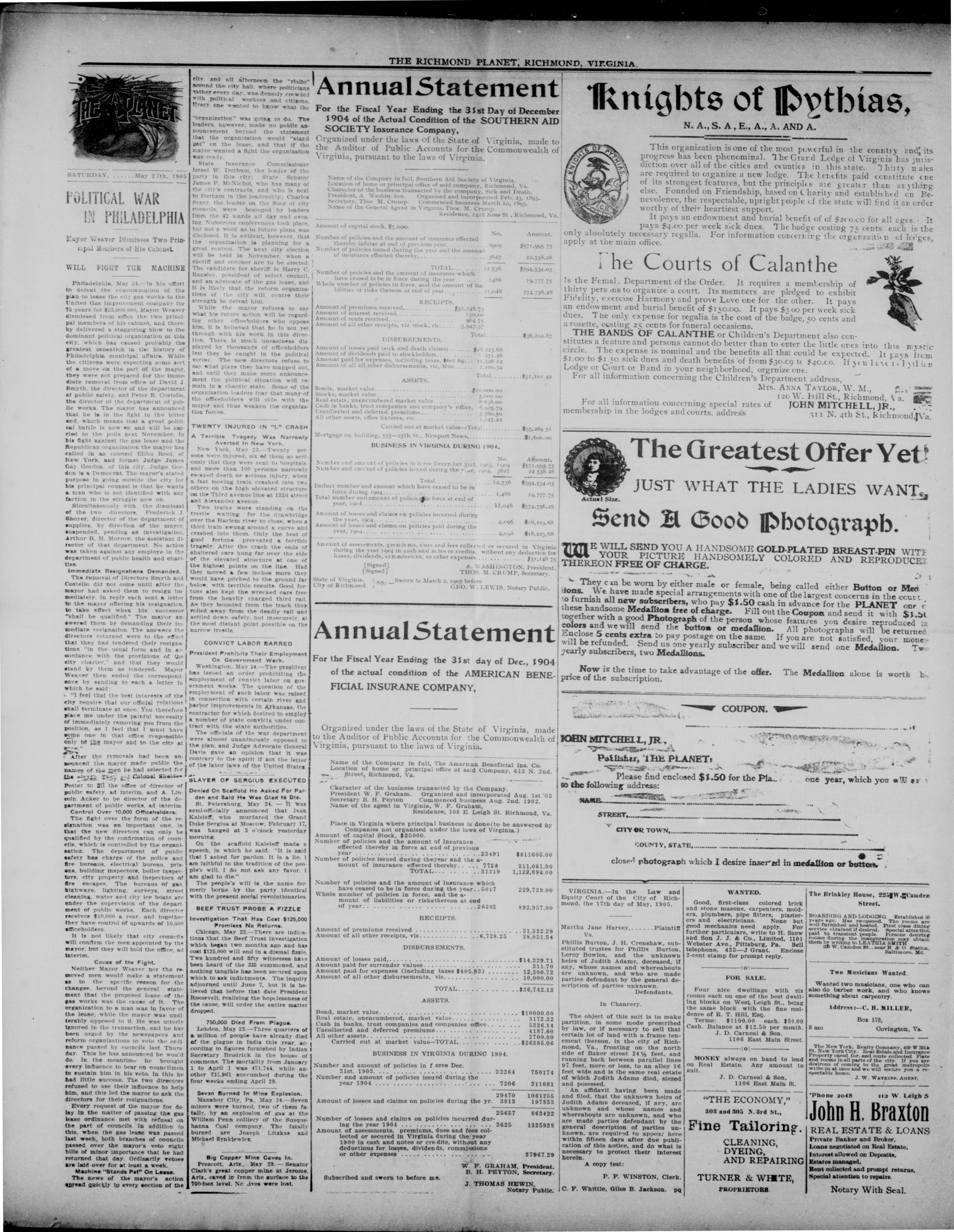
The Grand Court, I. O. of Calanthe of Virginia, (Female Department of the K. of P.) convened in its 8th annual session at High Street Baptist Church, Roanoke, Va., May 16th, 1905, at 10 A. M. and continued in session three days.
The Grand Worthy Counsellor, Mr. John Mitchell, Jr., presided. The G. W. R. of Deeds, Miss M. L. Chiles called the roll and the following responded to their names:
G. W. C., Mr. John Mitchell, Jr. Richmond, Va.; Inx., Mrs. Julia A. Watts, Lynchburg, Va.; Inr., Mrs. M. E. Washington, Newport, News, Va.; O., Mrs. M. C. Adams, Danville, Va.; G. W. R. of D., Miss M. L. Chiles, Richmond, Va.; G. W. R. of Dep., Mrs. Josie A. Graham, Richmond, Va.; Escort, Mrs. Lizzie B. Greene, Newport News, Va.; S. D., Mrs. Anna Tayor, Richmond, Va.; J. D. Mrs. N. C. Johnson, Richmond, Va.; Con, Mrs. Lucy Cross, Richmond, Va.; Herald, Mrs. Elizabeth Robinson, Richmond, Va.; Pro, L. W. Holbrook, Danville, Va.; Lectur-Mrs. Blanche Lewis, Assistant Coner, Mrs. S. J. Holbrook, Danville, Va. duetress, being the only absentee, Mrs. Camilla Riddick of Ruth Court filled her chair until election of officers.
Roll of delegates and roll of committees were called by the G. W. R. of Deeds, absentees noted and vacancies filled by the G. W. C.
Committee on Credentials appointed were Miss Sarah C. White, Mrs. A. G. Thompson, Miss Susan Merchant, who examined the credentials and reported 42 new delegates and 64 representatives out of 85 benefited courts. The Grand Court then went into regular session.
The Grand W. Counsellor read his report in the afternoon session. It was a sparkling gem in language and quotations, and showed that not a ripple of discontentment within the bounds of his jurisdiction had reached him during the past twelve months. Peace reigned from the mountains to the sea and the Courts of Calanthe were firmly bound in the ties of Fidelity, Harmony and Love. 17 new courts and 990 members had entered our fold during the past year inspite of the terrible hard winter through which we had passed. 91 Courts in 8 years and 4307 policies have been issued in Va. The receipts had also been in excess of former years, the total amount being $4724.50.
His report showed new fields entered and Sir Knights gallantly adding Courts of Calanthe—Sir A. C. Mabrey, two courts, Staunton, Va., Sir H. L. Jackson, Blackstone, Rev. Dr. Caesar Perkins, Buckingham, Va., Sir John G. Smith, Richmond, Va., were voted special honors for having thus worked in 1905, while Mrs. Lula Clarkson, Mrs. A. B. Ellis, Mrs. Emma B. Brown, Mrs. S. J. Holbrook, Mrs. M. C. Wood, Mrs. Margaret H. Burrell, Mrs. Lucy Cross, Mrs. S. P. Marshall, Mrs. Mildred Johnson, Mrs. Anna Taylor, Mrs. Laura S. Williams, Miss Marietta L. Chiles were highly complimented for their new courts and recommended for high honors and favors.
He urged the courts to greater efforts in the Business Departments and keep step with the music of the 20th century. He brought forward plans for the establishment of a self-extending endowment feature which will place the Order ahead in that respect of any colored enterprise.
The applause was deafening and the representatives were ready at once for their adoption had he allowed such.
The rules were suspended and on motion of Sir U. S. G. Patterson, G. W. C., Mr. John Mitchell, Jr., was elected by acclamation for the ensuing year.
The G. W. R. of Deeds, Miss M. L. Chiles read her report, which was very fine. Mrs. Josie A. Graham, G. W. R. of Deposits read an excellent report, also Mrs. Harriet Thompson, Chief of Regalia Department.
The reports from all over the state showed that the Order is at its noonday of progress and members are flocking in. One distinguishing feature is that only the best people in the various communities are admitted, which causes persons who have previously scorned fraternal organizations to enter ours.
The parade was the most magnificent ever witnessed in the city of Roanoke and white and colored citi-
zens thronged the streets and admired its beauty. The Cadets attracted much attention also in their handsome uniform.
The Public Meeting was held Wednesday night and the church was packed. An excellent programme was rendered: Scripture reading and prayer, Rev. R. C. Quarles, of Charlottesville, Va.; Music, Choir of the church; Prayer, Rev. Burkes. Mr. Mitchell introduced Lawyer W. H. C. Brown as "the silver-tongued orator from the city by the sea," and well he showed he deserved that introduction. He held the audience spell-bound as the beautiful thoughts fell from his lips. He highly complimented the G. W. C, and said also he considered the Pythians the greatest Order on earth, urged all to rally to the offerts of the G. W. C. and with integrity, industry and truth the Negro problem will are long be solved and if the Negro do his duty, Jim cars will be wiped out of existence and his civil rights will not be mere hopes.
Lawyer W. R. Reld of Portsmouth and Lawyer Oliver of Roanoke also entertained the audience excellently. Sir U. S. G. Patterson sang. "You're as Welcome as the Fowers in May." He was encored and then sang. "In the Valley where the Blue-birds sing." Mrs. Minnie Nowell Allen presided at the organ.
The delegation was tendered a fine banquet in the lecture room of the church, which all enjoyed. After the banquet, the night train for their respective homes.
ROLL OF COMMITTEES
Committee on Finance: Miss Eva G. Davis, Mr. Casper Rowlett, Mrs. Laura S. Williams.
Appeals and Grievances: Mrs. Gracie Lucas, Mrs. Hattie G. West, Miss Lelia B. Robinson.
Mileage: Mrs. Sallie Fox, Mrs. Mary A. Gray, Mrs. E. B. Brown.
Credentials: Miss Sarah C. White, Mrs. Bettie Cowling, Miss Susan Merchant.
Dispensation and Charter: Miss Lucy E. Christian, Mrs. Anna Lewis, Mrs. Sallie B. Pree.
Law and Supervision: Mrs. Phyllis G. Williams, Mrs. Charlotte Penn, Mrs. Sallie J. Murphy.
Printing: Miss M. L. Chiles, Miss Susan Wright, Miss Mary J. Scott.
Revision of Constitution: John Mitchell, Jr., Miss M. L. Chiles, Mrs. M. E., Washington, Mrs. Emma G. Smith, Mrs. L. G. Merriman.
Business Committee: Mrs. Adlaide G. Thompson, Mrs. Emma Cherry, Miss Susan Merchant.
State of the Order: Mrs. Marian S. Robinson, Miss Odell Pleasants, Miss Bertha Jones.
Obituary: Mrs. Mary J. Veals, Mrs. Bettie Thomas, Miss Nannie Chaney.
Regalia Committee: Mrs. Kate Thomas, Miss V. C. Proctor, Mrs. Laura Johnson, Miss Lucy E. Christian, Mrs. Irene Holmes, Mrs. Harriet Thompson, Chief; Mrs. N. C. Johnson, Assistant Chief.
RICHMOND, VIRGINIA, SATURDAY MAY 27, 1905
ENDOWMENT ADVISORY BOARD
Mrs. L. B. Merriman, Lynchburg.
Mrs. Mildred Johnson, Richmond.
Mrs. Kate Thomas, Richmond.
Mrs. Gertrude Patterson, Lynchburg.
Mrs. Georgie Bolling, Richmond.
Mrs. Mary N. Gay, Norfolk.
Mrs. L. D. Byrd, Newport News.
Mrs. Emma G. Smith, Richmond.
Mrs. R. Elnora Wesley, Richmond.
Mrs. Rosa Lovings, Richmond.
Mr. J. W. Robinson, Richmond.
Mr. John Mitchell, Jr., G. W. C.
Mrs. Josie A. Graham, G. W. R. of D.
Miss M. L. Chiles, G. W. R. of Deeds.
(Ex-officio.)
DISTRICT DEPUTY GRAND WOR
THY COUNSELLORS.
Richmond, Mrs. Anna Taylor.
Petersburg, Mrs. Martha Harris.
Lynchburg, Mrs. Laura S. Williams
Danville, Mrs. S. J. Holbrook.
Newport News, Mrs. Lille D. Byrd.
Norfolk, Mrs. Fannie Cook.
Berkley, Mrs. Della Hicks.
Suffolk, Mrs. Julia A. Powell.
Portsmouth, Mrs. Camilla Riddick.
Pocahontas, Mrs. M. C. Vivian.
Radford, Mrs. Della Lawrence.
Pulaski, Mrs. Sarah J. Murphy.
Chariottesville, Mrs. Mary M. Dav
emport.
New River, Mrs. Mary Casey.
Stanley
Blackstone, Mrs. Martha D. Taylor.
Covington, Mrs. Emma B. Brown.
Martinsville, Mrs. Charlotte Penn.
Roanoke, Mrs. Margaret H. Burrell
SPECIAL DEPUTY GRAND WOR
THY COUNSELLORS
Miss M. L. Chiles, Mrs. Josie A. Graham, Mrs. Kate L. Thomas, Mrs. Mildred Johnson, Mrs. Emma Cherry, Mrs. G. A. Patterson, Mrs. Julia A. Watts, Mrs. Fannie R. White, Mrs. Sarah P. Marshall, Mrs. Sarah A. Steward.
Roanoke, Va., May 20th, 1905.
The Grand Lodge, Knights of Pythias, N. A. S. A., E. A., A. & A adjourned last Thursday night after the most successful session in the history of the organization. The following officers were elected on Thursday for ensuing year:—Grand Chancellor, John Mitchell, Jr., Richmond; Grand Vice Chancellor, T. J. Free, Newport News; Grand Prelate, R. L. Jackson, Pocahontas; Grand Master of Exchequer, H. F. Jonathan, Richmond; Grand Keeper of Records and Seal, Thos. M. Crump, Richmond; Grand Master at Arms, Wm. E. Mitchell, Richmond; Grand Inner Guard, Thos. B. Steward, Norfolk; Grand Outer Guard, W. E. Williams, Pulaski; Grand Medical Register, Wm. E. Atkins, Hampton; Grand Lecturer, Wm. M. Reld, Portsmouth.
Appointments by Grand Chancellor: Grand Marshall, Capt. W. H. Mills; Grand 1st Attendant, O. M. Steward; Grand 2d Attendant, W. C. Venable; Grand 3rd Attendant, R. B. Clarke; Grand 4th Attendant, Capt. John G. Smith.
Committee on Finance: B. H. Peyton, Chairman; Thos. H. Wyatt, D. C. Johnson.
Committee on Obituary: Clifton G. Cabell, Sam'l Q. Swarm, Homer Mitchell.
State of the Order: Rev. W. E. Mitchell, Dr. R. A. Reynolds, Alex. Brooks.
Appeals and Grievances: Dr. W. W. Johnson, H. A. Patterson, L. F. Flood.
Supreme Representatives Elected: Thos. M. Crump, John Mitchell, Jr., N. A. Twitty.
Law and Supervision: A. W. E. Bassette, Wm. A. Merchant, D. J. Chavers.
Committee on Business: John T. Taylor, Geo. W. Rison, H. L. Jackson, W. R. Smith, E. F. Scott.
Endowment Advisory Board: Capt W. A. Millner, S. M. Wilson, M. Isbell, Jesse Scruggs, W. H. C. Brown, Jesse Willis Wyatt, Col. John R. Chiles, Anderson Branch, Capt. U. S. G. Patterson, Wm. A. Myers, Dr. I. D. Burrell.
Returns and Credentials: A. C. Mabrey, Geo. W. Dandridge, S. D. Jones.
Printing and Supplies: Thos. M. Crump, W. P. Allen, T. W. Merchant.
Dispensations and Charter: Rev. R. C. Quarles, Jas. L. Hill, A. Morton.
Shriners' Fine Parade.
The Mystic Shriners had a grand banquet last Monday night at the Pythian Castle, No. 727 N. Third St. It was preceded by a grand parade, headed by a brass band. All along the route red fire was burning and the Shriners presented a fine appearance in their full-dress suits and the fez caps of red. Just before the Castle was reached the electric lights on the front were turned on and presented a scene of dazzling brilliancy. The supper was one of the finest ever given in this city. The organizat on was highly complimented all along the route.
Colored Man's Strange Death.— Chased a Cow.
Aniston, Ala., May 21. — Neil Garrison, a respectable colored man of Hobson City, the only town in the south composed wholly of colored people, met death suddenly yesterday in a field near Leander Champion's residence, southeast of Oxford. He was after his cow, the animal crossed a ditch and in pursuit of her he attempted to do the same, when he fell into the ditch and was killed. Berry Powell and Elisha Clark were plowing near by. They saw the cow cross and Garrison start after her, and upon his not appearing went to look for him, and found his dead body. Dr. B. D. Williams, who was called to investigate the case, found that Garrison's neck was not broken and that everything indicates that he had an attack of vertigo, fell into the ditch on his face in about 6 inches of water and was smothered. There will be no inquest. Garrison was at one time mayor of Hobson City, and had many friends among both white and colored people.
The Thirty-third annual session of State Grand Lodge, No. 6, I. O. of G. S. and D. of S. will meet at Alexandria, Va., June 13th, 1905. Rates have been granted over all railroads at One Fare and a Third for the round trip. Delegates, in purchasing tickets, will ask the agent for a Delegate's Certificate. C. F. HUBBARD, G. C. J. W. THOMPSON, G. S. 3t
:0:
FOR Rent.
No. 2305 Carrington St.,... $10.00
Rear of No. 16 N. Beech St., 12.50
No. 107 St. Paul St., one floor, 6.00
Either of the first two can be subdivided and one floor rented to good
Sunday, June 18th, 1905, will be observed as Sacrifice Day at the Moore St. Baptist Church. An effort will be made to lift a mortgage of $450.00 and all friends are invited to help aid this worthy cause. Sums to any amount will be thankfully received.
Hicks' Swimming Pool and Grove for fun, amusement and a general good time on Decoration Day, May 30th. All kinds of innocent sport: Boating, Bathing, Dancing, Music Swimming, Potato Race, Sack Race, Pie Eating Contest, Climbing Greasy Pole. Admission, absolutely free. Go out and have a good time at no cost.
The J. R. Giddings and Jolliffe Union, known as the Tents, of which Mrs. A. M. Lane of Norfolk is the official head has been in session since last Tuesday at the Third St. A. M. E. Church. A large number of delegates are present and the sessions have been harmonious. Mrs. Lane is a skillful organizer and the organization is doing a grand work,
Those K. of P. brethren going and coming from Roanoke broke bread at Thompson's Dining Room, 702 E. Broad St.
Mr. Editor.
Please allow me just a little space in your wonderful paper to say a word concerning the old V. S. Baseball boys of Martinsville. They still hold their record. They have we all the games that they have played this year.
The closest contest they have ever had was the Rabbit Foot boys on Saturday, May 20. Will Quarles was in the box and he gave the Rabbit Foot boys a little rough treatment for a few minutes. Mr. Pat Chapelle seems to take care. Although our manager seems to feel sorry for Mr. Chapelle he had charged us to shut out Mr. Chapelle's Rabbit Foot boys and of course we had to go by the orders.
The score stood 6 to 3 in favor of Martinsville and we thought to keep it that way. The V. S. will be out to travel for a while and they will make it warm for all the baseball boys.
Y. M. C. A. Notes
The Y. M. C. A. Conference was well attended last Friday.
The reports from the committee work for last Sunday are very encouraging.
President Clifton Cabell addressed the boys last Sunday.
The men were very encouraged by International Secretary, Mr. J. E. Mooreland last Sunday to always take a stand for right and keep it. Our brother said many good things, which are still burning upon the hearts of the men. Prof. Thomas H. Hopkins and Mr J. H. Daly sang special solos. Every man who attended the meeting was helped.
All men for committee work for Sunday are requested to be on time. Prof. J. H. Rhorer will conduct the boys' meeting Sunday at 4 P. M. at the Y. M. C. A. rooms.
Dr. W. E. Partee, pastor of the First Presbyterian Church will address the men Sunday at 3:30 P. M. at the True Reformers' Hall. Subject, "How Men Are Made and Unmade." Special solos will be sung. All men are invited. Come and bring the other man.
Dr. D. Webster Davis will address the men Sunday, June 4th, 3:30 P. M. at the True Reformers' Hall. Subject, "The Search-light," by special request. Mr. Davis will have his quartette sing special music at this meeting. Tell every man that you see.
Baltimore, Md.—Richard H. Parson, the son of Rev. R. T. Parson of Richmond, Va., died in Baltimore, Sunday, May 21st. Age 8 years. The funeral was conducted byDr. E. W. S. Peck at St. Matthew's M. E. Church of which his father is the pastor.
Clarke—Burke
The marriage of Mr. Philip T. Clarke to Miss Elsie Burke will take place at St. Phillips Episcopal Church in New York on Thursday, June 1st, 1895. P friends present.
Harper—Judkins
The marriage of Miss Virginia Belle Harper to Rev. Robert Chapman Judkins, B. D., will take place at the residence of Mr. and Mrs. R. T. Hill, 1401 West Leigh St., Wednesday morning, June 7th, at 7 o'clock. Friends are invited.
Do You Know Them?
I desire to know the whercabouts of some of my people. I was given in charge of Classy Gaines of Farmville, Va., who came to Richmond to visit her son, whose name was Washington Gaines. I was given to her by a person called my aunt. I called her sister and she had promised me to a lady across the ocean, but Mrs. Classy Gaines persuaded her to let her have me. I was carried to Farmville. My name is Katie Holston, but in Farmville my name was Katie Gaines. In Richmond, it was Katie. I did not know my aunt's name. Her children were Junius, Mayliza and "Shugg." Washington Gaines was a well-known man there and I think he knows from where the old lady got me. Any information concerning them will be gladly received by KATIE HOLSTON, No. 521 S. 18th St., Birmingham, Ala.
Miss Edna Debress is indisposed.
Mrs. Frances Scott continues indisposed at her residence.
The Norfolk Red Stockings Base Ball Club ate their meals at Thompson's Dining Room, 702 E. Broad St. while here.
We received an invitation to the Commencement Exercises of the Normal Class of the Hartshorn Memorial College May 18th and also to the 16th anniversary of the Alumnae Association May 19th. We regretted that our absence from the city prevented our attendance.
We received an invitation to the 23d Annual Commencement of Livingstone College and East Tennessee Industrial School May 24th to 31st, 1905 at Salisbury, N. C.
We received an invitation to the 17th Annual Commencement Exercises of the St. Paul Normal and Industrial School at Lawrenceville, Va. May 24th, 1905.
Rev. D. W. Davis will lecture at the Mt. Tabor Baptist Church, Woodville, Monday night, May 29th Subject: "Paying the Fiddler."
SAMARITAN CONVENTION
Reduced Rates
C. F. HUBBARD, G. C.
J. W. THOMPSON, G. S
For Rent.
CHAPIN & HUME
No. 13 N. 11th St.
A Grand Rally
Go To
The Tents Here
Martinsville, Va., May 22, 1905
Your agent,
Charlie France
Atlantic City Notes.
The contest between the two Assemblies was promised to be announced in this issue.
While the Brighton did bring the most friends from Philadelphia for the occasion, the Traymore had the largest attendance and was the grand est success. A large number of the city's most exclusive society gathered for the occasion, and the concert and reception were exquisite. The majority of the toilettes were both dainty and elaborate, and the spacious auditorium presented a beautiful picture.
Prof. Fred. Forman's grand orchestra of Philadelphia was hidden behind a huge bank of palms, potted azalias and ferns. The concert programme was furnished by Prof. W. A. Miller's Twentieth Century Concert Company of Philadelphia, consisting of Mme. M. E. Shields, Miss Mary Shields, Mr. Horace Molton and Mr. P. S. Howard, soloist.
Dancing was continuous from 9:30 until 2 o'clock. Officers of the Assembly are Lewis Cooke, Pres.; Edward Ross, Vice-Pres.; Samuel Johnson, Secretary.
Mr. J. W. Whipps, the well known salesman, who once represented some of the largest Gent's furnishing and clothing houses; is doing great business at 1616 Atlantic Ave.
T. B. Rice, the second waiter of the Mariborough, will spend his vacation in New York.
E. P. Hammett returned to Atlantic City last Saturday from Washington, accompanied by Mr. Clopton of Hot Springs, Arkansas.
Mr. Charles Clopton from Hot Springs, Arkansas is in our city and is stopping with M. J. Satchell, 1916 Arctic Ave.
Mr. Isaac J. Nicholson has removed from 900 Baltic Ave. to 135 N. Maryland Ave. He has the largest and finest Tonsoral Parlor.colored, in our city. His little boy takes great pleasure in introducing the Planet. M. J. Satchell, the agent, has promised him a prize at the end of each month.
Anyone having any avds. or notes will please leave them at 1916 Arctic Ave. and the agent will see that it reaches the Planet in time.
Mr. W. L. Young, his little son, Luther and Mr. D. W. Thomas of File, Va., were in the city this week and called on us.
Yes, those Ministers going and coming from the General Association got lunch at Thompson's Dining Room, 702 E. Broad St.
We have received an invitation to the Commencement Exercises of Tuggle N. and I. Institute, Birmingham, Ala., May 21-24, 1905.
We return thanks for an invitation to the Tln Wedding of Prof. and Mrs. Gregory Willis Hayes of Lynchburg, Va., Friday, May 26th, 1905.
We received an invitation to attend the 22d anniversary exercises of the Virginia Normal and Industrial Institute at Petersburg, Va., May 7th and 12th, 1905.
Mr. John W. Smith and his son Mr. J. B. Smith were in the city and called on us. Mr. Smith was here to attend the exercises of the Hartshorn Memorial College where his daughter, Miss Ardelle was the recipient of the first prize for an original composition. Mr. H. L. Jackson of Blackstone, Va. accompanied him.
ALEXANDER'S MAGAZINE
Alexander's Magazine has just reached our office. It is in every respect the most excellent publication of the character we have ever seen. The table of contents reveal an unusual array of fine literary talent. Perhaps the most notable contribution to the Magazine is that of the sketch of the life of S. Coleridge-Taylor, the great African composer. This sketch is written by Dr. Booker T. Washington of the Tuskegee Institute, Alabama. There are two fascinating love stories and a sketch of Madam Estelle Pinckney Clough, the New England Nightingale, whose residence is at Worcester, Mass., and a catchy little story entitled outwitting the Devil" by a distinguished citizen of Massachusetts. The Editor contributes a sketch of the life of Mrs. Carrie W. Clifford of Cleveland, Ohio, and a tribute to the late Joseph Jefferson. There are quite a number of other very excellent contributions to the May Number of Alexander's Magazine. The subscription price of the magazine is but $1.00 a year and 10 cents a copy. Our readers desiring to see this publication may send 10 cents for a specimen copy to Charles Alexander, 714 Shawmut Avenue, Boston, Mass.
Charlie Washington, Joseph Dabney, John Smith and William Jones are known as the jolly four at Thompson's Dining Room.
PR CE FIVE CENTS
KNIGHTS OF PYTHIAS
A New Lodge at Suffolk.
Suffolk, Va., May 13th, 1905
Grand Chancellor John Mitchell,
Jr. accompanied by Col. E. R. E. Jeferson, Assistant Surgeon General;
Capt. John G. Smith, arrived here last evening.
A new lodge was instituted at the Samaritan's Hall with the following officers:—Chancellor Commander. C. W. Jordan; Master of Work. B. B. Elliott; Vice Chancellor. J. W. Brown; Prelate. C. W. Jones; Keeper of Records and Seal. Fletcher Jordan; Master of Finance. Rev. J. F. Jordan; Master of Exchequer, William Coker; Master at Arms. B. F. Johnson; Inner Guard. John Reid; Outer Guard, Paul Bridgeford. Trustees: W. T. Howard. J. E. Smith and William Myric.
Those who assisted in the initiation were Sirs N. A. Twitty, J. M. Boothe, W. W. Urquhart, Isham Powell, and the visitors. The others were Dr. W. E. Atkins, Abe Nofleet, Haywood Jenkins, S. S. Gwaltney, Oscar Hunter, Thomas Black, Charley Trotmon, K. Hall, Leroy Morris, Beverly Hunter, Charles Taylor, Henry Southall, I. Coleman, Larney Watkins.
Dr. W. E. Atkins examined the candidates assisted by Dr. Jefferson Deputy Urquhart was here from Franklin. All heartily enjoyed themselves. Refreshments were served. The Grand Chancellor and Capt. Smith were the guests of Sir C. W. Jordan where they were royally entertained. The party left this morning for Richmond.
The new body will be known as Nansenlodge Lodge. No. 91.
STREET-CAR "MEDICINE."
[Shreveport, La. News-Enterprise.]
The street car conductor who was discharged for kicking Mr. R. A. Rodgers off the car last week, and then went to give the president of the company, Mr. L. M. Levison, a reprimand for discharging him and in turn got a lick in the face from the president's fist, had his case of assault up in the City court last Monday, resulting in the dismissing of the charge against Mr. Levison and fining the conductor $10 and cost making a total of $15 for the assault on Mr. Rodgers.
Do You Know Him?
Rev. Lewis S. Price of Fort Payne, Ala. writes that a prepossessing stranger sailing under the name of C. H. Jones, alias A. Harty has landed in that neighborhood and is a candidate for matrimonial honors. He claims to be connected with the International Stock Exchange and declares that he owns a stock farm at Steverson, Alabama and one at Richmond, Va. We have made enquiries here and we can find no record of any such man. As we have lived here more than thirty five years, and we have never heard of either him or his farm, we have naturally become suspicious of his pretentions. He is about 38 or 40 years of age in appearance says our correspondent. Height 5 feet, 9 inches. Complexion, bright mulatto, Freckled face, Red hair and brown eyes, a little reddish. Some of his teeth out on left side of the upper part of his mouth. Any person knowing such a person in any part of the country would do well to furnish us with information of his origin.
$150.00 Endowment Paid
Richmond, Va., May 22d, 1905.
This is to certify that I have received from John Mitchell, Jr.
Grand Chancellor of th Grand Lodge of Virginia, Knights of Pythias, N.
A., S. A., E. A., A. and A. ($150.00)
One Hundred and Fifty Dollars in payment of the death-claim of Sir Charles H. Johnson, who was a member of North Star Lodge, No. 52 of Richmond, Va.
Signed:—Laura Johnson
Beneficiary.
Witnesses:—
W. H. Newton,
Pinkey Newton.
A Touching Scene.
Ponds. Ala
Spring-hill Baptist Church was crowded to hear Rev. M. Northman. Text:--"Jesus came to save that which was lost." Three children without mother or father came into the church and seated themselves in the front pews. The largest was about 8 years or age and the two smaller ones depended on the larger one. The latter finally fell asleep. A short while afterwards the two smaller ones fell asleep. A tall, pleasant looking lady came into the church and looking at the little ones took them in her arms.
THE YLONGT
SATURDAY, ..... May 27th, 1905
GIRLS IN BUSINESS
THE PRIZES WON AND THE BARE LIVING WAGE.
Likelihood of Sudden Leaving to Marry Discounts Value of Girls' Labor in Business Positions—Physical Disadvantages Due to Corsets, High Heels, Etc.—Home Management Incomparably Superior to Any Business Position—Peculiar Temptations of Ill-Paid Shop Girls.
BY MARGARET E. SANGSTER
(Copyright, 1966, by Joseph B. Bowles.
(Copyright, 1986, by Joseph B. Bowles).
One reason why the labor of young women is discounted in the market is that their tenure of a position is very uncertain. For example, in a well-known township of New Jersey it has recently been stated that 16 of the teachers, all presumably young and attractive girls, are engaged to be married, and the school board must therefore look about to supply the vacancies thus created.
Nobody can fail to rejoice that marriage is popular in the community, and it is a sign of wholesome public morals and of growing prosperity, when young men woo young masters, and new households are established. But the embarrassment and responsibility of school boards are doubled, when they must be always on the lookout for those who are to take the places of the marrying contingent.
Equally in other lines than the one alluded to, this liability to change on the part of young women is a factor in the bargain. A firm in New York congratulated itself on having in its employment a young woman of very marked ability, an ability that was almost genius, and of a trained technical knowledge surpassing that of most men in the niche she occupied, that of buying goods of a certain kind. In Europe or America this girl was valuable to them, and they raised her salary over and over. Bui one day she handed in her resignation. She was engaged to a man in Arizona, and he carried her off, as was perfectly right, the only shadow being that after the firm had given their late employee a beautiful wedding present they found themselves compelled to hire two men to do what one woman had done.
Business ability is not confined to one sex. But a man is very apt to remain in a good place, and when married, he is not removed from the sphere of daily labor, but has every added incentive to work hard and faithfully to support those dependent upon him.
Women complain, often bitterly, that there is unfair discrimination against them in the matter of remuneration. They work as many hours as men, and they do their work as well, they affirm, and why should they be paid less than men in the same berthes? Why, indeed? Candor obliges us to admit that this why is very squarely met by a little if. If women, taking them as they come, not judging from the exceptions, were as responsible, as steady, as certain to render smooth, equable and efficient service as men are, they would not long have so much for complaint.
Women cannot free themselves from limitations that are in a measure the hampering conditions of their physical life. They cannot have, or at least they do not often have, the immunity from nerves and headaches and backaches that men enjoy.
Their dress is against them. The corset, that need not be an unhygienic part of dress, alas! too often squeezes in a girl's waist and diminishes her breathing capacity. A silly notion that high heels and pointed toes belong to an elegant feminine shoe, leads too many of our girls to endure agonizing tortures when standing for hours on their poor deformed feet. They sacrifice health and comfort to a false ideal; and in our stormy winters, a multitude of women workers are not warm enough, nor adequately protected by useful wraps from wild wind and frigid weather.
Hence, their days off are taken into account. They cannot be treated precisely as men are. Sex and Nature are against it, and the theories go down before natural law.
And it is in the order of Nature, too, that the sweetest girls, the most winning, the most capable, shall be sought in marriage. While there are thousands and tens of thousands to be fed, the stress of the labor market will continue to force women into the ranks that toll. Strenuous commercial competition has forced young girls into factories and mills and offices and shops the wide world round. But not yet has it become general that the wages of a girl are as the wages of a man. When they are, it is because in a particular girl, a marked and peculiar faculty, facility of a high order, and a rare fidelity have been discovered.
Nevertheless, I. for one, rejoice when I hear that in one small borough six young women teachers are at the same time engaged to be married, and that in a larger one, 16 young men have courted as many girls and persuaded them to name the happy day. For home, and not business, is woman's true sphere.
Let nobody induce you, dear girl, to think that any work on earth can for an instant compare in worth with the task of managing a home, or that any honor is so great as that of presiding at one's own heart. Other issues dwindle in importance before this.
Our girls do not marry to so early an age as their mothers and their grand-mothers did. They are not too easily pleased, and are sometimes repelled by
suitors who would make them excellent husbands because of some lack of polish or of veneer in the men. A man leaves school early and is at once obliged to begin the task of self-support. He is rebuiled, snubbed, knocked about more or less among rough men. He does not receive the gentle consideration accorded to girls. And so he loses some of the surface refinement, or he never acquires the society manner that a fastidious girl prizes. But he makes up for this by earning, if he have average qualities, a good deal more than she can, and by advancing faster. If he possess solid and substantial characteristics, if he be steady, temperate and honorable, a girl can do far worse than trust herself to his love. In the association of marriage, a really refined wife will exercise over her husband an influence and power that will refine his manners and annoble his nature.
A woman, to whom fortune has been kind, and who may, so to speak, choose among her admirers, is short-sighted. If she turn away from love, and decide on a business or professional career of her own. For the day of youth is fast speeding away, and later there will be lonesome days, when she will see her old friends happy in their homes, their sons and daughters beside them, their husbands true comrades on the road, and for her, there will be only fragments left, not life's full feast of joy.
Perhaps it is all for the best that things are as they are. Girls are obliged by circumstances to compete in the eager strife of the early twentieth century. But the make-weights in the struggle are formidable and one of them is the low rate at which much very hard work is estimated, the small weekly wage, the invasion in some shops and factories of fines and reductions that make it smaller still.
No one who is fair-minded can shut her eyes to the fact that the pitifully scanty remuneration occasionally of fered in shops and factories, opens the door to peculiar temptations in some quarters. Half-educated, ill-trained and discouraged girls, away from home, and confronted by hard conditions, are the prey of destining and unscrupulous vampires, both men and women, who blight whomsoever they touch.
Here is one inevitable and sorrowful result of the salary that is not, and is not meant to be, a living wage.
When we have said everything, we can but fall back on the old truth that honest love is the world's salvation. Though employers regret, and school boards tear their hair, it is a splendid and heartening sign of good times coming, that 16 engagements should be announced in one season, in a single small town.
FINE HOME-MADE SEAT
This Piece of Furniture Can Be Made to Answer Double Purpose and Be Attractive in Appearance.
A very useful and ornamental seat for the fireplace or a cozy corner might be constructed from simple materials as follows: Obtain any plain square box of about 12-inch sides, a rough deal one would do; turn it upside down, and place castors at each corner.
The material chosen for its decoration should correspond with the chair coverings or curtains of the room in which it is destined to stand, or if that is not possible, then a material of a shade that will not look out of harmony with its surroundings should be selected. We will suppose that the
A USEFUL SEAT.
room is furnished in gray green and white tapestry. Of this take a length about 14 inches wide, fold in a hem at the edge, and stitch invisibly, then arrange in stiff box-plats, nailing firmly all round the top. Next choose a cushion about 21 inches square to project out some distance beyond the box, and cover with gray green glaze silk, edging all round with silk cord to match. The cushion should be sewn to the tapestry here and there invisibly with strong thread.
Materials require! One and one-eighth yard of glace silk 22 inches wide, one and three-fourths yard of tapestry 52 inches wide, two and one-half yards of cord.
A Few Fashion Hints
The girl with the small income has numerous opportunities this season of displaying her ingenuity. The fashionable modistes nest on the pointed bodice, broad shoulders and full sleeves, but what is a poor girl to do under these deided changes? It is not so difficult if one stops to consider. For instance, the large "puff" at the top of the sleeve can always be added, and Fashion has decreed a combination of different materials on one gown. This fact is a boon to the girl who is brave or industrious enough to remodel her own garments.
To Soothe the Eyes.
If the eyes are strained and inflamed with sleeplessness or fige work apply to the lids soft linen wrung out in boiling water. Use this as hot as can be borne and relief will be felt in half an hour.
When the Feet Perspire
For perspiring feet dissolve an ounce of sulphate of soda in a pint of hot water and rub the feet over with this every night and morning. Just a little boracic acid into the stocking.
Retort Courteous.
"A woman's bonnet would not cost much if it wasn't for the trimming," said the miserly husband. "Neither would a man's whiskers," answered his wife.—Chicago News.
THE RICHMOND PLANET, RICHMOND, VIRGINIA.
CHILD'S TABLE MANNERS.
Parents Should Carefully Train Child in All the Niceties, But Release It from Long Sittings.
As soon as a child is old enough to handle a knife and fork he is capable of doing it correctly, and should be taught that there is only one proper way of using these implements. The knife was not intended to stab at one's food with, nor should it be used to pile meat or vegetables on the back of the unoffending fork. The knife is always held in the right hand and is used to cut meat and other foods as require cutting.
When the knife is laid by it should not be placed on the table nor with the tip of the blade resting on the plate and the handle on the table. It should be laid on the plate.
Children should hold the fork in the right hand, and not in the French manner, which permits of eating with the fork held in the left hand while the knife is in use in the right hand. A child is often reprimanded for seeming greediness, and it is probably the hardest point to impress upon its
AWKWARD. BUT ALL TOO COMMON
volatile little mind the necessity of concealing is v. racious appetite and eating with dignified indifference. A child may be restrained by the presence of older people from behaving in a manner suggestive of primitive man, but as soon as its elders are out of sight it will reinpose into less mannerly and more rapid methods of consuming food.
If possible, when correcting a child for some slight breach of etiquette, explain the reason for the form or custom, in order to make a deeper impression. For instance, the original reason why a spoon should not be left in a tea or coffee cup is because it endangers the equilibrium of the cup. A child should be permitted to leave the table after dessert is finished, but never without saying: "May I be excused?" Minors grow inexpressibly weary of their olders' after-dinner talk, and to remain quiet during half an hour of it would weary the soul of a martyr, and guests are often martyrs in disguise.
In concluding, let me emphasize this: Considerations of size and age of children's varying dispositions and the restlessness and heedlessness of childhood should temper the discipline of the children's table.
THE AFTERNOON CALLER.
What to Do and What Not to Do When Acting This Part in the Social Life.
An afternoon call must be a short and yet not a hurried one.
Don't enter the house saying that you have not a minute, and don't leave it declaring that you must hurry on to another friend, or you give an idea that your visit has been paid grudgingly.
Don't monopolize the conversation. Your hostess likes to retail her own news, to air her own grievances, to discuss mutual friends from her own point of view. You may be the most amusing person present, but your very brilliance gives others the desire to shine also, and courtesy demands that you should give them their opportunity.
Above all, don't talk of yourself. "I" is a letter of the alphabet to be omitted as much as possible. Who does not know the bore who tells you of his health, his family, his plans, till you sigh a sigh of unutterable relief when he at length takes his departureure?
Don't utter in an audible aside to your companion: "Thank heaven they are out!" A whisper is fraught with danger, and may possibly be retained from one person to another until it reaches the mistress of the house.
Leather Table-Govers
The arts and crafts in this country have brought out table covers of natural leather that are most attractive. They are stained in the different art greens, three tones, or red, and also left in the natural tans and browns. They are used for library and sitting-room tables, and men particularly prefer them for dens. There is no attempt to cut the edges even or to have any appearance of finish about them. They wear forever and a day, and are no laudering. The most fanciful of them are illuminated in the dull purple and gold of the old missals. This takes a great deal of skill but the result is in doubtful taste.—Philadelphia Press.
The Shirtwaist Box.
Shirtwaist boxes, which are now found to be almost indispensable articles of furniture for bedrooms, come in all sizes, and are made of plain white pine covered with burlap or French cretonne, with long brass hinges and brass handles; or of burnt wood, either with or without coloring.
For a Sallow Skin.
The girl with the sallow complexion will do well to eat oranges. Not one orange alone at breakfast time but four or five each day. This works wonders.
To Preserve a Clothes-Line.
Before using a clothes-line boll it well. This will keep it from stretching and make it last an extra long time.
AN AFTERNOON .RECEPTION
Some Suggestions as to the Graceful Poise That Should Be Maintained in Standing.
The large afternoon functions that are fashionable at present require that a guest shall stand most of the time, and an awkward woman is never more at a loss than when standing. Practice at home to prepare yourself for this emergency. Stand with your back to the wall, touching it with your heels. Now force the knees back against the wall, bringing as much of it in contact as possible. Let the shoulders be pressed against it. This brings the chest up and gives erectness to the whole body. But this would be a stiff position if you were conversing over teacups. Keep the heels in position, hold the chest up and body erect, while you sway slightly forward from the wall, shifting the weight from the heels to the balls of the feet. You now find yourself in a graceful and comfortable standing position. The arms should swing easily at the sides. Stand for five minutes until the position becomes natural to you. When standing during a conversation it would be awkward to keep the hands dangling; let them fall, clasped, before you, or hold some article. But maintain the position which your practice teaches you. Avoid the mannish habit of folding the arms and the provincial habit of resting the hands on the hips.
In sitting avoid nervous tension. Relax. If you obey this law your position is pretty sure to be graceful. The hands may rest in the lap, on the arms of the chair, one of them may be on the back of the chair; in any case, they must not clasp anything tightly as if you were trying to hold yourself firmly in the chair.
Sit well back in the chair, thus avoiding the bad habit of sitting on the spine. You can lean back far enough for grace if you are chatting; if you are busy, you will avoid fatigue. When sewing or writing you should be upright with high chest as much as when standing, and what leaning is to be done should be done from the hips. The shoulders must not bend.
COLLAR AND CUFF SET.
Suggestion for Dress Accessories Now
So Much Worn That Can Be Made
by Home Needlewoman.
The illustration shows one of the new
designs in linen collar and cuff sets,
to be worn with spring or summer
shirt waists. The stock proper—which
has no lining—and the turnover are
THE LATE MODE
in one piece, and the edge and dots of both collar and cuffs are embroidered in mercerized cotton. Similar designs may be bought stamped, ready for working. These sets are effective in either white or colored line.
FASHION'S FRILLS
Skirts must be full.
Changeable taffetas are much in demand for spring suits. Light weight crash linen is used for smart summer frocks. Black embroidery on white leather with a touch of gold here and there is effective. Waistcoats of white kid are embroidered all over in satin stitch in self color. Separate coats of eyelet embroidery are among the season's novelties. Opalescent effects assert themselves everywhere. Most of the summer suit jackets have vests. Pompadour ribbon insertion is seen on new style white silk parasols. Crochet belts, crochet lace edgings, crochet yokes and crochet collars are expressions of the present favor for hand-work. Elaborate embroidery is a feature of the new hosiery, the familiar clocking having given way to instep and higher up decoration in front.
A coaching parasol of red taffeta shows a deep border of striped red and white ribbon.
Clever Dinner Cards
A clever set of dinner cards to be used for tally cards through an evening card party, were painted at one end, poster fashion, for the girls, with the queens, and for the men, jacks and kings. Playing cards were taken as models, and were found surprisingly easy to reproduce. And, by the way, a girl who was clever at originating just such little cards found a ready market for her wares. She "gets up" unusual cards for club luncheons and dinners, and for holiday affairs, trying as hard as possible (and succeeding wonderfully, too, as her increased orders prove) to keep away from stereotyped ideas.
Trees Without Leaves
Forests of leafless trees are to be found in some parts of Australia. They respire, so to speak, through a little stem, which apparently answers all the purposes of a leaf. The tree is known as the "leafless acacia."
Purely Accidental
"Do you have many accidents on your road?" asked the caller of the railroad agent.
"Oh, yes; some of the trains get in once or twice a week on time!"—Yonkers Statesman.
Hard Job.
Wife—It is so kind of you to put on my boots for me.
Kneeling husband (tugging away)—
It's a—a pleasure, my dear. Still, I'm
glad you're not a centipede.—Pick-Me-
lio.
ON MOTHERS-IN-LAW
THEIR DUTIES AND THOSE OF DAUGHTERS-IN-LAW.
Mothers' Pangs at Losing Their Boys at Marriage—One Mother-in-Law's Advice to Another—Hints for the Daughter-in-Law—When She Marries the Man in a Way She Marries the Family.
BY KATE UPSON CLARK.
(Copyright, 1905, by Joseph B. Bowles.)
It is probable that not one girl in a thousand—if so many—is instructed before marriage as to her duties to her mother-in-law.
Conversely, how many mothers-in-law study the duties of their position?
One of the chief stupidities among the many with which human nature is afflicted is that of not taking the long view.
A mother says: "Oh, my boy is leaving home to start out in business for himself. How dreadful this is!"
Well—what did you bring him up for? Did you look forward to having him tied always “to your apron strings?” Did you intend to support him in manhood, just as you did in childhood? And did you suppose, in case he earned his own living at all, that he would always be able to stay at home and do it? Had you not observed that a large proportion of sons have to leave their parents' home and go to some distant place in order to make the best living?
And then did you intend that he should live a bachelor—never having the dignity and joy of a home and wife and children of his own? Did you think, with all the lessons of past generations behind you—especially of your own and your husband's experience—that the love of his parents was going to be enough for him? Did you not foresee that a stronger and deeper love must—and should—come to him some day? And is it possible that you were so selfish that you were sorry that this brightest of all earthly experiences (if it occur in the natural way and between noble souls), was coming some day to your boy?
The woman who does not thus look forward and thus rejoice must be lacking both mentally and morally.
The good woman brings her boy up to aim at independence in manhood; and if in the long view that independence seems likely to come more quickly or more richly in some distant place than near his home, she speeds him on his way.
She wants him to set up a home for himself. She does not want him to live and die an old bachelor. A superfluity of bachelors is one of the greatest plagues with which a community can be cursed.
She knows that she will have to overlook faults, and that she cannot expect the new daughter-in-law to fall in love with her, just because she is the mother of that daughter's husband. She knows that every relation in life has its own peculiar trials and joys, and that some preparation of mind and spirit should be made in order that that relation may be properly maintained.
Yet how many women take this long view of life, and try to fit themselves, as the time approaches, for the high office of the mother-in-law? Judging from the "funny papers," we should answer: "Very few."
One vivacious, but faithful and affectionate mother, went one day to visit an older friend, and said, laughingly: "You have heard that my Tom is going to marry Amy V — It is a good match—and we are all pleased. We are going to miss our good boy cruelty—but I long ago determined not to grieve for any such thing as this. I have always been concerned for fear I might fail in my duties as a wife and mother. Now I have a new fear. I would not for the world fall in my duties as a mother-in-law. But they seem to be of a delicate and difficult nature. I understand that a really satisfactory mother-in-law is one of the rarest creatures in existence. You have been a mother-in-law for some years now—and you are a model in what ever you undertake. Now, give me the benefit of your experience."
"Well," returned the older lady, "there are only a few points of which I am perfectly sure. These are: 'Let the young people entirely alone, as far as giving advice or criticising is concerned. Do whatever they ask you to. Give them all the nice things you can. Say pleasant things—and leave the unpleasant things unsaid, unless there is absolute necessity. That is as far as I can instruct you."
But those of the daughter-in-law are quite as important. The girl who promises to marry a young man may boast that she is not "going to marry his whole family." But flesh and blood cannot be argued out of existence. In a way, my dear girl, you have got to marry his whole family when you marry him. And if you are at all what you ought to be, you want to make the best kind of a sister-in-law and the best kind of a daughter-in-law. You may not be able to love your new relatives—but you can be frank and friendly with them, doing all that you can to make them happy, and guarding their interests and their good name and dignity as faithfully as you guard those of your husband. In serving his loved ones you are only serving him. He will love you a hundred times more whie. he sees that you recognize your duty toward them.
A vast amount of unhappiness arises in families from a failure on the part of women—for women err oftener than men in this relation—to live up to their duties and privileges as mothers-in-law and daughters-in-law. Love may not spring up at once in any specific case—but it can usually be developed.
HANDKERCHIEF KIMCNO.
Directions for Making the Simple and Popular Article Out of Five Japanese Handkerchiefs.
The Japanese handkerchiefs, so popular now, make very pretty summer kimonos. For the above illustration five handkerchiefs are used, four for the kimono and one for border and revers at neck. Fold two of the handkerchiefs
diagonally, one for the front, the other for the back; join the other two to the sides of the back and front for the
MADE OF HANDKERCHIEFS
sleeves. Cut the handkerchief used for the front through the center, shape the neck, and sew the border on. Or, instead of cutting the front through the center, one handkerchief may be used on each side, making the necessary fullness. Six handkerchiefs are sometimes fancied, in which case two are used for the back. Where five or six are utilized the neck is not shaped but the corners are turned down.
MATERIALS OF THE SEASON
Flowered Stuffs Now to the Fore and Silks of Various Sorts Appeal to Economical Purchaser.
The new materials look surprisingly like pictures of flower gardens, for they show many blooms arranged upon a common ground. One of these new stuffs, a crispy, silky print, was in very pale lemon color, while upon it it were little garden roses numerous forget-me-nots, and many white flowers. In the background, almost covering it were white lilies. This flowered stuff was for an evening dance dress and was to be made up with bindings of lemon color.
The evening silks are admirable and one would almost advise them in preference to the thinner stuffs for evening. There is something about a silk gown which makes it more suitable for a person of moderate means than one of thinner material. It wears better and is more certain to hold its style. Chiffon broadcloth makes a handsome evening dress, and we are returning to the merino dinner gown, with its trimmings of buttons and silk ruffles.
Here are the materials in the order of their desirability. There is ponge taffeta, which is a very good material. It wears better than taftela, yet it has its shining face. This makes up beautifully for evening and can be remodeled a little and worn with an Eton for fall wear for receptions, and even for after- noons.
Next to pongee taffeta, though quite different, is pompadeur crepe de chine, which is one of the newest and prettiest of stuffs. It is, as its name suggests, a crepe de chine, but upon its face there are lovely big roses, pompadeur roses of rankest and most beautiful growth. A pompadeur crepe de chine in either white or black, with big pink roses, is beautifully girdled with pink, piped with pink and wern with a skirt of the same, or with a skirt to match the waist in color, but not in material. The flowered bobbinets come this year in a quality which shows a great deal of stability. There is a heavy bobbinet, with a medium-sized mesh, which makes up in the most approved manner. It is the very best material one can have for evening wear in the summer time, for it is very durable, not very expensive, and very easily made.
Baby Clothes-Rack.
A pretty gift for a baby is a clothes' holder. It is made of a strip of hard wood nearly a yard long and about five inches wide. It is painted white and enameled, after which forget-me-nots are used as decorations for, and the words "Baby's Clothes" painted in fancy lettering. Small hooks are inserted in the strip of wood, which has blue satin bows at each end with which to suspend it. The little frocks, caps and sacques of the baby may be conveniently hung on this rack.
Good Hair Tonic
The treatment of the scalp will depend largely on the condition of the hair. If the scalp is very oily, you will need a hair tonic especially adapted to the trouble, while the hair is shampooed very frequently with the green soap. The following tonic is used for an oily scalp: It is made from 26 grains of quinine sulphate, four drams of bay rum, one dram of tincture of cantharides, one dram of tincture of capsaicin and eight ounces of distilled water.
Same Qid Plant
The Lady—It seems to me these berries are rather small.
The Peddler—I'm sure they have got their full growth, ma'am.
The Lady—Possibly; but I'm quite sure your quart boxes haven't got theirs.
-Cincinnati Enquirer.
He Got Her.
Mr. Isaacstein—So you want my daughter? Could you lend me $10,000 for 60 days mitout security? Mr. Rosenbaum—Of course I could Mr. Isaacstein, but I wouldn't. Mr. Isaacstein, but I can't!—Puck
At Her Own Estimate
Lavinia—True, but, as you yourself have often said, she is awfully thick-skinned—Judge.
Easily Remedied
A mother was trying to impress her young son with the grief his naughtiness caused her, and said:
"George, you know it hurts me terribly when you do wrong, and if I were ever to be taken away from you, it would make you feel sorry to look back and think how you had grieved me. Boys do lose their mothers sometimes, you know, Tommy Brown's mother died last year."
"Yes, but he got another, right away," said George, and his mother wished she had chosen a different example to point her moral.—Brooklyn Life.
Not a Mare Clerk
Wealthy Parent—What? Engaged yourself to young Tapestier. Outrageous! The idea of a Van Juneberry marrying a mere store clerk! Daughter—But he isn't a store clerk now, papa. He's a gentleman of leisure. "Eh?" "Yes: he's been discharged."—N. Y Weekly.
Disappointed.
"Luck never manages things just right," said the irritable man who dislikes music. "It might just as well have been the other way around, but it wasn't."
"What is the trouble now?" "My daughter who plays the piano has a sore throat, and the one who whoshes has a sore finger."—Washington Star
Rebuked.
Owner (of the automobile)—Anything serious?
Repair Man—Oh, it might have been worse.
Owner—Much?
Repair Man—Well, if you had tampered with it half an hour longer you have needed a junkman instead of me.
—The Wavfer.
Definitions.
They challenged the sage to define courtship.
"Courtship," said he, "usually consists of a pair of ruby lips smothered with kisses."
"And marriage?"
"Oh, that is more often a beefsteak smothered with onions."—Chicago Sun.
What She Gave Up.
Husband—I have made all sorts of sacrifices for you. Now, what did you ever give up for me?
Wife—What did I ever give up for you! Well, I never! Why, I gave up half a dozen of the nicest young men in town!—N. Y. Weekly.
Had a Sinecure
Snobs—You here, Blobs! Really, my boy, you have not come down to working, have you? Beastly bad form, you know.
Blobs—No, Slobs, not working; I merely have a job—Cincinnati Commercial-Tribune.
His Active Wheels.
"My head is going 'round," he said,
"At least, that's how it feels."
"Your head," she answered, "does not move;
What moves is just your wheels!"
-Yorkers Statesman.
AT HOME.
13
Keeper—You seem to be perfectly happy here.
Stripes—Perfectly. You see, I've lived in a flat all my life.—Chicago Journal.
No Trouble.
"Although 'tis true," remarked the clock,
"That by myself I have to flock.
Yet 'tis quite easy, day by day,
For me to pass the time away."
—Judge.
WONDERFUL DISCOVERY
Curly Hair Made Straight By
TAKEN FROM LIFE
BEFORE AND AFTER NEGENT
FORD'S ORIGINAL
OZONIZED OX MARROW
This wonderful hair pomade is the only are
prepared in the world that makes kinky or
shiny hair. It is applied to the scalp, prevents the hair from falling
out or brooking out, eures dandruff and makes
hair soft and shiny. It is made for 18 years, and used by thousands. Warranted
sale for strengthening kinky hair. Because of its
suitable for all hair types, Ozonized Ox Marrow is put only in
the hair, made only in Chicago, Ohio,
Chicago. It is printed on the package, be not
just as good—but always insist upon getting
the hair straight, soft and beautiful.
Once so much desired, a toilet necessary for
gentlemen and children. Elec-
trically perfect it is the best and most economical.
Quality is the best and most economical.
Preparation equal to it. Full directions with
preparation equal to it. Full directions with
and dealers, or send us 56 cents for one bottle
postpaid, or $1.40 for three bottles, express
and send postal or express money order. Please
Send postal or express money order. Please
Write your name and address plainly to
OZONIZED OX MARROW CO.
Charles Ford Post
76 Wabash Ave., Chicago, Illinois.
Agents wanted everywhere.
The Wings of the Morning By LOUIS TRACY Copyright, 1903, by
CHAPTER V
He awoke to find the sun high in the heavens. Iris was preparing breakfast; a fine fire was crackling cheerfully, and the presiding goddess had so altered her appearance that the sailor surveyed her with astonishment. He noiselessly assumed a sitting posture, tucked his feet beneath him and blinked. The girl's face was not visible from where he sat, and for a few seconds he thought he must surely be dreaming. She was attired in a neat navy blue dress and smart blouse. Her white canvas shoes were replaced by strong leather boots. She was quite spick and span, this island Hebe.
So soundly had he slept that his senses returned but slowly. At last he guessed what had happened. She had risen with the dawn and, conquered her natural feeling of repulsion, selected from the store he accumulated yesterday some more suitable garments than those in which she escaped from the wreck.
He quietly took stock of his own tattered condition and passed a reflective hand over the stubble on his chin. In a few days his face would resemble a scrubbing brush. In that mournful moment he would have exchanged even his pipe and tobacco box, worth untold gold, for shaving tackle. Who can say why his thoughts took such trend? Twenty-four hours can effect great changes in the human mind if controlling influences are active.
Then came a sharp revulsion of feeling. His name was Robert—a menial. He reached for his boots, and Iris heard him.
"Good morning!" she cried, smiling sweetly. "I thought you would never awake. I suppose you were very, very tired. Please wash quickly. The eggs will be hard."
"Eggs!"
"Yes, I made a collection among the trees. I tasted one of a lot that looked good. It was first rate."
He had not the moral courage to begin the day with a rebuke. She was impressible, but she really must not do these things. He smothered a sigh in the improvised basin which was placed ready for him.
Miss Deane had prepared a capital meal. Of course the ham and biscuits still bulkled large in the bill of fare, but there were boiled eggs, fried bananas and an elderly coconut. These things, supplemented by clear, cold water, were not so bad for a couple of castaways hundreds of miles from everywhere.
For the life of him the man could not refrain from displaying the conversational art in which he excelled. Their talk dealt with Italy, Egypt, India. He spoke with the ease of culture and enthusiasm. Once he slipped into anecdote apropos of the helplessness of British soldiers in any matter outside the scene of the king's regulations.
"I remember," he said, "seeing a cavalry subaltern and the members of an assort sitting half starved on a number of bags piled up in the Skunkin desert. And what do you think were in the bags?"
"I don't know," said Iris, keenly alert for deductions.
"Biscuits! They thought the bags contained patent fodder until I enlightened them."
It was on the tip of her tongue to pounce on him with the comment, "Then you have been an officer in the army." But she forbore. She had guessed this earlier. Yet the mischievous light in her eyes defied control. He was warned in time and pulled himself up short.
"You read my face like a book," she哭ed.
"No printed page was ever so—legible. Now, Miss Deane, we have gossiped too long. I am a laggard this morning, but before starting work I have a few serious remarks to make."
"More digs?" she inquired saucily.
"I repudiate digs. In the first place, you must not make any more experiments in the matter of food. The eggs were a wonderful effort; but, flattered by success, you may poison yourself."
"Secondly?"
"You must never pass out of my sight without carrying a revolver, not so much for defense, but as a signal. Did you take one when you went bird's nesting?"
"No. Why?"
There was a troubled look in his eyes when he answered:
"It is best to tell you at once that before help reaches us we may be visited by cruel and bloodthirsty savages. I would not even mention this if it were a remote contingency. As matters stand, you ought to know that such a thing may happen. Let us trust in God's goodness that assistance may come soon. The island has seemingly been deserted for many months, and therein lies our best chance of escape. But I am obliged to warn you lest you should be taken unawares."
Iris was serious enough now.
"How do you know that such danger threatens us?" she demanded.
He countered readily. "Because I happen to have read a good deal about the China sea and its frequenters," he said. "I am the last man in the world to alarm you needlessly. All I mean to convey is that certain precautions should be taken against a risk that is possible, not probable. No more." She could not repress a shudder. The sailor wanted to tell her that he would defend her against a host of savages if he were endowed with many lives, but he was perforce tongued tied. He even reviled himself for having spoken, but she saw the anguish in his face, and her woman's heart acknowledged him as her protector, her shield.
Copyright, 1903, by Edward J. Clode
"Mr. Jenks," she said simply, "we are in God's hand. I put my trust in him and in you. I am hopeful—nay, more, confident. I thank you for what you have done, for all that you will do. If you cannot preserve me from threatening perils no man could, for you are as brave and gallant a gentleman as lives on the earth today."
Now, the strange feature of this extraordinary and unexpected outburst of pent up emotion was that the girl pronounced his name with the slightly emphasized accentuation of one who knew it to be a mere disguise. The man was so taken aback by her declaration of faith that the minor incident, though, it did not escape him, was smothered in a tumult of feeling.
He could not trust himself to speak. He rose hastily and seized the ax to deliver a murderous assault upon a sago palm that stood close at hand.
Iris was the first to recover a degree of self possession. For a moment she had bared her soul. With reaction came a sensitive shrinking. Her delicate nature disapproved these sentimental displays. She wanted to box her own ears.
With innate tact she took a keen interest in the felling of the tree.
"What do you want it for?" she inquired when the sturdy trunk creaked and fell.
Jenks felt better now.
"This is a change of diet," he explained. "No; we don't boll the leaves or nibble the bark. When I split this palm open you will find that the interior is full of pith. I will cut it out for you, and then it will be your task to knead it with water after well washing it, pick out all the fiber and finally permit the water to evaporate. In a couple of days the residuum will become a white powder, which, when boiled, is sage."
"Good gracious!" said Iris.
"The story sounds unconvincing, but I believe I am correct. It is worth a trial."
"I should have imagined that sage grew on a stalk like rice or wheat."
"Or Topsy."
She laughed. A difficult situation had passed without undue effort. Unhappily the man reopened it. While using a crowbar as a wedge he endeavored to put matters on a straight-forward footing.
"A little while ago," he said, "you seemed to imply that I had assumed the name of Jenks."
But Miss Deane's confidential mood had gone. "Nothing of the kind," she said coldly. "I think Jenks is an excellent name."
She regretted the words even as they fell from her lips. The sailor gave a mighty wrench with the bar, splitting the log to its clustering leaves.
"You are right," he said. "It is distinctive, brief, dogmatic. I cling to it passionately."
Soon afterward, leaving Iris to the manufacture of sage, he went to the leeward side of the island, a search for turtles being his oscensible object. When the trees bid him he quickened his pace and turned to the left in order to explore the cavity marked on the tin with a skull and crossbones. To his surprise he hit upon the remnants of a roadway—that is, a line through the wood where there were no well grown trees, where the ground bore traces of humanity in the shape of a wrinkled and mildewed pair of Chinese boots, a wooden sandal, even the decayed remains of a paiki, or litter. At last he reached the edge of the pit, and the sight that met his eyes held him spellbound.
The labor of many hands had torn a chasm, a quarry, out of the side of the hill. Roughly circular in shape, it had a diameter of perhaps a hundred feet, and at its deepest part, toward the cliff, it ran to a depth of forty feet. On the lower side, where the sailor stood, it descended rapidly for some fifteen feet. Grasses, sirubs, plants of every variety, grew in profusion down the steep slopes wherever seeds could find precarious nurture until a point was reached about ten or eleven feet from the bottom. There all vegetation ceased, as if forbidden to cross a magic circle. Below this belt the place was a charnel house. The bones of men and animals mingled in weird confusion. Most were
THE WATER IS BROKE
The place was a charnel house.
THE RICHMOND PLANET, RICHMOND, VIRGINIA.
mere skeletons. A few bodies—nine the sailor counted—yet preserved some resemblance of humanity. These latter were scattered among the older relatives. They wore the clothes of Dyaks. Characteristic hats and weapons denoted their nationality. The others, the first harvest of this modern Golgotha, might have been Chinese cookies. When the sailor's fascinated vision could register details he distinguished yokes, baskets, odd looking spades and picks strewn amid the bones. The animals were all of one type—small, lanky, with long pointed skulls. At last he spied a withered hoof. They were pigs.
Over all lay a thick coating of fine sand, deposited from the eddying winds that could never reach the silent depths. The place was grewsome, horribly depressing. Jenks broke out into a clammy perspiration. He seemed to be looking at the secrets of the grave. At last his superior intelligence asserted itself. His brain became clearer, recovered its power of analysis. He began to criticise, reflect, and this is the theory he evolved:
Some one, long ago, had discovered valuable minerals in the volcanic rock. Mining operations were in full blast when the extinct volcano took its revenge upon the human ants gnawing at its vitals and smothered them by a deadly outpouring of carbonic acid gas, the bottled up poison of the ages. A horde of pigs, running wild over the island—placed there no doubt by Chinese fishers—had met the same fate while intent on dreadful orgy.
Then there came a European who knew how the anhydrate gas, being heavier than the surrounding air, settled like water in that terrible hollow. He, too, had striven to wrest the treasure from the stone by driving a tunnel into the cliff. He had partly succeeded and had gone away, perhaps to obtain help, after crudely registering his knowledge on the lid of a tin canister. This, again, probably fell into the hands of another man, who, curious but convinced, caused himself to be set ashore on this desolate spot with a few inadequate stores. Possibly he had arranged to be taken off within a fixed time.
But a sampan laden with Dyak pirates came first, and the intrepid explorer's bones rested near the well, while his head had gone to decorate the hut of some fierce village chief. The murderers, after burrying their own dead—for the white man fought hard, witness the empty cartridges—searched the island. Some of them, ignorantly inquisitive, descended into the hollow. They remained there. The others, superstitious barbarians, fled for their lives, embarking so hastily that they took from the cave neither tools nor oil, though they would greatly prize these articles.
Such was the tragic web he spun, a compound of fact and fancy. It explained all perplexities save one. What did "32 divided by 1" mean? Was there yet another fearsome riddle awaiting solution?
And then his thoughts flew to iris. Happen what might, her bright picture was seldom absent from his brain. Suppose, egg hunting, she had stumbled across this valley of death! How could he hope to keep it hidden from her? Was not the ghastly knowledge better than the horror of a chance ramble through the wood and the shock of discovery—nay, indeed, the risk of a catstrophe? He rushed back through the trees until he caught sight of Iris industriously kneading the sago pith in one of those most useful dish covers. He called to her, led her wondering to the track and pointed out the fatal quarry, but in such wise that she could not look inside it.
"You remember that round hole we saw from the summit rock?" he said. "Well, it is full of carbonic acid gas, to breathe which means unconsciousness and death. It gives no warning to the inexperienced. It is rather pleasant than otherwise. Promise me you will never come near this place again."
Now, Iris, too, had been thinking deeply. Robert Jenks bulked large in her day dreams. Her nerves were not yet quite normal. There was a catch in her throat as she answered:
She bit her lip to suppress her tears; but, being the Eve in this garden, she continued:
"How did you find out? Is there anything—nasty—in there?"
"Yes, the remains of animals and other things. I would not have told you were it not imperative."
"Are you keeping other secrets from me?"
"Oh, quite a number."
He managed to conjure up a smile, and the ruse was effective. She applied the words to his past history.
"I hope they will not be revealed so dramatically," she said.
"You never can tell." he answered. They were in prophetic vein that morning. They returned in silence to the cave.
"I wish to go inside with a lamp. May I?" he asked.
"May I come too?" she demanded.
He assented, with an explanation of his design. When the lamp was in order he held it close to the wall and conducted a systematic survey. The geological fault which favored the construction of the tunnel seemed to diverge to the left at the farther end. The "face" of the rock exhibited the marks of persistent labor. The stone had been hewn away by main force when the dislocation of strata ceased to be helpful.
His knowledge was limited on the subject, yet Jenks believed that the material here was a hard limestone rather than the external basalt. Searching each inch with the feeble light, he paused once, with an exclamation. "What is it?" cried Iris. "I cannot be certain," he said doubtfully. "Would you mind holding the lamp while I use a crowbar?" In the stone was visible a thin vein, bluish white in color. He managed to break off a fair sized lump containing a well defined specimen of the foreign metal. They hurried into the open air and examined the fragment with curious eyes. The sailor picked it with his knife, and the substance in the vein came off in laminated layers, small.
brittle scales.
"Is it silver?" Iris was almost excited.
"I do not think so. I am no expert, but I have a vague idea—I have seen."
He wrinkled his brows and pressed away the furrows with his hand, that physical habit of his when perplexed.
"I have it," he cried. "It is anti-mony."
Miss Deane pursed her lips in disdain. Antimony! What was anti-mony?
"So much fuss for nothing," she said.
"It is used in alloys and medicines," he explained. "To us it is useless."
He threw the piece of rock contemptuously among the bushes. But, being thorough in all that he undertook, he returned to the cave and again conducted an inquisition. The silver hued vein became more strongly marked at the point where it disappeared downward into a collection of rubble and sand. That was all. Did men give their toil, their lives, for this? So it would appear. Be that as it might, he had more pressing work. If the cave still held a secret it must remain there.
Iris had gone back to her sago kneading. Shouldering the ax, he walked to the beach. Much debris from the steamer was lying high and dry. It was an easy task for an athletic man to reach the palm tree, yet the sailor hesitated with almost imperceptible qualities.
"A baited rat trap," he muttered. Then he quickened his pace. With the first active spring from rock to rock his unknowledged doubts vanished. He might find stores of priceless utility. The reflection inspired him. Jumping and climbing like a cat, in two minutes he was near the tree. He could now see the true explanation of its growth in a seemingly impossible place. Here the bed of the sea bulged upward in a small sand cay, which silted round the base of a limestone rock so different in color and formation from the coral reef. Nature, whose engineering contrivances can force springs to mountain tops, managed to deliver to this isolated refuge a sufficient supply of water to nourish the palm, and the roots, firmly lodged in deep crevices, were well protected from the waves.
Between the sailor and the tree intervened a small stretch of shallow water. Landward this submerged saddle shelved steeply into the lagoon. Although the water in the cove was twenty fathoms in depth, its crystal clearness was remarkable. The bottom, composed of marvelously white sand and broken coral, rendered other objects conspicuous. He could see plenty of fish, but not a single shark, while on the inner slope of the reef was plainly visible the destroyed fore part of the Sirdar, which had struck beyond the tree, relatively to his present standpoint. He had wondered why no boats were cast ashore. Now he saw the reason. Three of them were still fastened to the davits and carried down with the hull.
Seaward the water was not so clear. The waves created patches of foam, and long submarine plants swayed gently in the undercurrent.
To reach Palm Tree rock—anticipating its subsequent name—he must cross a space of some thirty feet and wade up to his waist.
He made the passage with ease.
Pitched against the bole of the tree was a long, narrow case, very heavy, iron clamped and marked with letters in black triangles and the broad arrow of the British government.
"Rifles, by all the gods!" shouted the sailor.
The Sirdar carried a consignment of arms and ammunition from Hongkong to Singapore. Providence had decreed that a practically inexhaustible store of cartridges should be hurled across the lagoon to the island. And here were rifles enough to equip half a company. He would not risk the precious ax in an attempt to open the case. He must go back for a crowbar.
What else was there in this storehouse thrust by Neptune from the ocean bed? A chest of tea, seemingly undamaged; three barrels of flour, utterly ruined; a saloon chair, smashed from its pivot; a battered chronometer. For the rest, fragments of timber intermingled with pulverized coral and broken crockery.
A little farther on the deep water entrance to the lagoon curved between sunken rocks. On one of them rested the Sidar's huge funnel. The northwest section of the reef was bare. Among the wreckage he found a coil of stout rope and a pulley. He instantly conceived the idea of constructing an aerial line to ferry the chest of tea across the channel he had forded.
He threaded the pulley with the rope and climbed the tree, adding a touch of artistic completeness to the rule of his trousers by the operation. He had fastened the pulley high up the trunk before he realized how much more simple it would be to break open the chest where it lay and transport its contents in small parcels.
He laughed lightly. "I am becoming adde headed," he said to himself. "Anyhow, now the job is done, I may as well make use of it."
Recoiling the rope ends, he cast them across the reef. In such small ways do men throw invisible dice with death. With those two lines he would within a few fleeting seconds drag himself back from eternity.
Picking up the ax, he carelessly stepped into the water, not knowing that Iris, having welded the incipient sago into a flat pancake, had strolled to the beach and was watching him.
The water was hardly above his knees when there came a swirling rush from the seaweed. A long tentacle shot out like a lasso and gripped his right leg. Another colled around his waist. "My God!" he gurgled as a horrid sucker closed over his mouth and nose. He was in the grin of a devilish!
A deadly sensation of nausea almost overpowered him, but the love of life came to his aid and he tore the suffocating feeler from his face. Then the ax whirled, and one of the eight arms of the octopus lost some of its length. Yet a fourth flung itself around his left ankle. A few feet away, out of range of the ax and lifting itself bodily out of the water, was the dread form of the cuttle, apparently all head, with distended gills and monstrous eyes. The sailor's feet were planted wide apart. With frenzied effort he hacked at the murderous tentacles, but the
water hindered him, and he was forced to lean back in superhuman strain to avoid losing his balance. If once this terrible assailant got him down he knew he was lost. The very need to keep his feet prevented him from attempting to deal a mortal blow. The cuttle was anchored by three of its tentacles. Its remaining arm darted
THE TERRIBLE TREASURE
Its remaining arm darted to again clutch the man's face and neck.
with sinuous activity to again clutch the man's face or neck. With the ax he smote madly at the curling feeler, diverting its aim time and again, but falling to deliver an effective stroke.
With agonized prescience the sailor knew that he was yielding. Were the davishl a giant of its tribe he could not have held out so long. As it was, the creature could afford to wait, strengthening its grasp, tightening its coils, pulling and pumping at its prey with remorseless certainty.
He was nearly spent. In a paroxysm of despair he resolved to give way and with one mad effort seek to bury the ax in the monster's brain. But ere he could execute this fatal project, for the cuttle would have instantly swept him into the trailing weeds, five revolver shots rang out in quick succession. Iris had reached the nearest rock.
The third bullet gave the octopus cause to reflect. It squirited forth a torrent of dark colored fluid. Instantly the water became black, opaque. The tentacle, flourishing in air, thrashed the surface with impotent fury. That around Jenks' waist grew taut and rigid. The ax flashed with the inspiration of hope. Another arm was severed. The huge dismembered coll slackened and fell away.
Yet was he anchored immovably. He turned to look at Iris. She never forgot the fleeting expression of his face. So might Lazarus have looked from the tomb.
"The rope!" she screamed, dropping the revolver and seizing the loose ends lying at her feet.
She drew them tight and leaned back, pulling with all her strength. The sailor flung the ax to the rocks and grasped the two ropes. He raised himself and plunged wildly. He was free. With two convulsive strides he was at the girl's side.
He stumbled to a bowler and dropped in complete collapse. After a time he felt Iris' hand placed timidly on his shoulder. He raised his head and saw her eyes shining.
"Thank you," he said. "We are quits now."
(TO BE CONTINUED.)
Gems In Verse
True Creations.
How sad that all great things are sad.
That greediness knows not to be glad.
The boundless, spacious, fearful sea.
Pursues the moon like constantly,
And Chearer, children, lives and dies.
The thirsty born sequoia tree
In so many isolation cries
Snow covered branches
Above the clouds, above his kind,
Above his hardened peak, above
All sign or sound or some of love,
How manacles, desolate and drear
His lorn, lour seven thousand year!
His commands, lovers dare to be
My friend in Caesar's be
Who knew three husbands apart
Yet never truly touched one heart,
The tearful, lorn, complaining sea
The very moon looks down upon,
Then changes—as a saber drawn;
The great sequoia lords as lone
As God upon that fabled throne,
The glory, glory, glory, fame,
Is his who claims nor name,
But loves and lives content, complete,
With baby flowers at his feet.
Ension Enoos.
Ensign Epps, at the battle of Flanders,
Sowed a seed of glory and duty
That beautiful flowers and flames in
the sky burst forth
Like a crimson lily with hearts of gold
Today, when the wars of Gheut are old,
And buried as deep as their dead com-
manders.
Ensign Epps was the color bearer—
No matter on which side, Philip or Earl-
Their cause was the shell; his deed was the pearl.
Scarce more than a lad, he had been a sharer That day In the wildest work in the field.
He was wounded and spent, and the fight was lost:
His comrades were slain or a scattered host.
But stainless and scathless out of the strife.
He carried his colors safer than life.
By the river's brink, without weapon or shield.
He faced the victors. The thick heart mist
He dashed from his eyes, and the silk he kissed
And hurted at the leader with a laugh.
Then round his breast, like the scarf of
a wolf.
He tied the colors his heart above
And clung in his armor into the tide
And there, in his dress of honor, died.
Where are the lessons your kinglings teach?
And who is the text of your proud commanders?
Out of the centuries heroes reach
With the scroll of a deed, with the word of a story, with truth and all men's slog.
Of one man's truth and all men's glory,
Like Ensign Epps at the battle of
Flanders.
—John Boyle O'Reilly
La Grinpe
You kick the dog and kick the cat,
Then swallow a dose and kick at that
And growl
And greet
And writhe
And moan
And cough
And wheeze
And gasp
And sneeze
And swear by all that's good and great
That never was man in such a state
Since Adam was stung
By a woman's tongue
And made to hate the earth and sky
And honestly with that he could die.
Your head feels like a bursting bomb.
Your back doesn't feel like a bump, hum,
Your back doesn't feel like a back at all,
Your legs are as stiff as a garden wall.
Your muscles are sore and your nerves
are string
To a pitch as high as the topmost rung
In the ladder of fame. And
Then
When
The doctor comes and says to you.
With a fendish grin, "How do you do?"
Feels of your pulse, surveys your tongue.
Tries to look wise and taps your lung
And says, "You're getting along al
right."
You feel like kicking him out of sight.
-Thomas Holmes in Trenton State Ga-
gette.
Woman's World
What I most prize in woman
Is her affections, not her intellect!
The intellect is finite, but the affections
Are infinite and cannot be exhausted
Compare me with the great men of the
earth?
What am I? Why, a pygmy among giants?
But if thou lovest—mark me, I say lovest—
The greatest of thy sex execls thee not!
The world of the affections is thy world,
Not that of man's ambition. In that still-
Which most becomes a woman, calm and
holy,
Thou sittest by the fireside of the heart,
Feeding its flame. The element of fire
Is pure. It cannot change nor hide its na-
ure.
But burns as brightly in a gypsy camp
As in palace hall.
—Longfellow.
Forebodings
The winds and the waves are wailing
And the night is full of tears.
And over my spirit forebodings
Are borne from the coming years.
I fear for the child heart in me,
With its oneness of faith and sight.
Lest the glow of its strong endeavor
Go out in the passionate night.
I fear for the swift feet running
Full speed through the morning dew
Lest they fall in the arid race course
With the goal, unwon, in view.
I fear lest the motive for striving
is perishing in the strife;
I fear lest the glory of living
is darkening in the life.
I fear and in tears I shiver
At the feet of coming years;
The weds and the waves are wailing
And the night is full of tears
—george E. Woodberry.
Tis not the food but the content,
That makes the table's merriment.
Where trouble serves the board we eat
The platters ther- as soon as meat
A skimmer with a bit
Of mutton for callum fit
Set on my table, trouble free,
More than a feast contentte me.
Late Flowers
What simple sights give comfort
On a bare, brown winter day!
A little bird by our window,
A little child over the way
A little roof and roof roof,
Where the sunshine flashes clear;
A rose that blooms serenely
Despite the time of year.
What little things give pleasure
When Sorrow hath her way
And life bereft of gladness
Is but a winter day!
A word with accent tender,
A softly dropping tear,
Love's roses blooming brightly
Despite the time of year.
-Mary Frances Butts in New York Tribune.
Certainty
The road of right has neither turn nor bend;
It stretches straight unto the highest goal.
Hat long and lonely? Yes, yet never soul
Can lose the way thereon nor miss the end.
—Priscilla Leonard in Outlook.
Appropriated It
She—They say there is only one person in fifteen who has perfect eyes.
He (with uncommon fervor)—In fifteen? There's only one in a million!
She—There you go again, Mr. Spoonamore! Always flattering somebody—Chicago Tribune.
Her Greater Trouble
Mabel—Does your husband talk much about his mother's cooking?
Martha (wearily)—Some, but not as much as he does about mine.—Brooklyn Life.
Mr. Good—Well. Bobby, how was school today? Did anything make an impression on you?
Bobby—Well, I should say so. The teacher caught me throwing paper wads, and she took a whip and made about a dozen impressions, I guess. St. Louis Post-Dispatch.
Excellent Exercise:
"Yes," said the good old professor, "the memory may be perfectly trained by proper study."
"But," asked the absentminded scholar, "what do you consider the best exercise for the memory, professor?"
"Remember the poor." — Catholic Standard and Times.
3
HE PASSED THE STAR.
An Experience of a Negro aa Steeres on a Schooner.
Wallisville, Tex., receives all its freight by boat from Galveston or Houston, and as it happened one day the captain of a two masted schooner found his helper to sick to return with him to Galveston. His search for a nautobuston was unavailing until, just before dark, he found a negro on the landing he had never before seen a boat or as large a body of water as the Trinity river. A bargain was, however, struck, and the negro agreed to go with him to Galveston. After getting through the river into Trinity bay the captain called the negro to him at the helm, and after explaining to him at great length and with much care how to steer by the rudder he pointed to a bright star directly ahead and said, "Now, Bob, you see that star directly over the nose of the boat?"
"Well, that star is right over Galveston island, and if you will keep the nose of this boat pointed at that star we will but into Galveston. Now, you remember all I told you about steering. do you?" "Yes, boss." "You can keep the nose pointed right at the star, can you?"
"Sure, boss."
"All right. I'm going to sleep for awhile, and then I'll steer and let you sleep."
"All right, boss."
When the captain woke up the first thing he did was to look for his star and, to his consternation, saw it over the stern of the schooner. "Say, you black devil, where are you steering for?" he roared.
"Don't know now, boss. You got to give me anuder star; I done passed dat un." - Lippincott's Magazine.
Saying the Price
Mrs. Stinjay—Good morning! Pardon my calling so early, but I saw your advertisement for a cook.
Mrs. Hiram Offen—But—er—surely you are not after the place!
Mrs. Stinjay—Oh, no! I need a cook myself, and I thought you might send to me all the applicants you reject.—Catholic Standard and Times.
His Obligation.
"Some day," said the village philosopher, "you may wake up and find yourself famous."
"That sounds pretty good," yawned the man on the herring barrel, "but there is one thing I don't like about it."
"What's that?"
"Waking up."—Chicago News.
All He Left
"Didn't Smugley leave anything at all?"
"Oh. yes, but it was dissipated immediately!"
"You don't say? What was it?"
You don't say: What was it?
"A good reputation, but two widows
presented themselves to claim it."—
Philadelphia Ledger.
No Reciprocity.
"Almost every father overestimates the intellectual capacity of his children."
"Yes," answered the gloomy person, "and the misfortune of it is that the children so seldom reciprocate when they get big enough to take notice"—Washington Star.
The Real Scheme
"There's always somebody hobbing up with a scheme to extract gold from sea water."
"Their real scheme is not to extract from sea water."
"What, then?"
"To extract gold from lobsters."—Houston Post.
Restricted.
"Her husband is teaching her to say yes' and 'no.'"
"That's strange. Why does he restrict her in such a fashion?"
"Because if she says any more she's sure to say it ungrammatically."—Cleveland Plain Dealer.
A Good Thing
Weary Willie—I dumbo but it'd be a good thing if a lot o' them Filipinos would emigrate over ter this country.
Dusty Rhodes—W'at fur?
Weary Willie—I was readin' in de paper dat dey kills dogs an' eats' em.—Philadelphia Press.
Enterprise
"So you prefer a horse to an automobile?"
"Yes," answered the irascible man.
"A horse doesn't treat threats and blows with the silent contempt that an automobile displays." — Washington Star.
NESS WITH His Brother.
Cincinnati, May 3. James J. Jeffries, champion heavy-weight pugilist, will retire from the prizering and from the stage and go in business with his brother, Jack, in California, according to a statement made by him to the Times Star. He will leave the stage on May 15, arrangements having been made to cancel all engagements after that date. Jeffries takes this action at the request of his wife. In addition to this, Jeffries says that pugilism does not pay.
Kidnapper Beaten By Mob.
Columbus, O, May 2—Charles Parpee, a French machinist, attempted to kidnap the 1-year-old child of Mr. and Mrs. A. Ross, and was roughly handled by a mob which pursued and recovered the child. Parpee snatched the baby from its cradle and darted away. A crowd, which constantly augmented, pursued and he was chased nearly a mile before he was brought to bay. He resisted efforts to take the child from him, and a dozen men beat his face so that he was hardly recognizable. He was rescued by the police and taken to the city prison. The motive for the attempted kidnapping is a mystery.
Morton to Resign Next Fall.
Washington, May 15.—Secretary of the Navy Morton stated that he had no present intention of resigning from the cabinet. He said, however, that it was thoroughly understood between the president and himself that he should leave the cabinet next fall.
THE PLANET
JOHN MITCHELL, JR. • EDITOR.
All communications intended for publication
should be sent so as to reach us by Wednesday.
TERMS IN ADVANCE.
ADVERTISING RATES
REGISTERED LETTER.-If a money Order Post Office or an Express Post Office is not within your address, you must send a Letter you wish to send on payment of ten cents. Then, if the letter is lost or stolen, you can send money in this manner at our risk.
We cannot be responsible for money sent in letters in any other way than one of the four ways mentioned above. If you send your monogram or other way, you must do it as your own risk.
RENewALS, ETA: If you do not want THE PLANET continued for another year after your monogram, you must not notify Postal Card to discontinue it. The courts have decided that subscribers to newspapers who do not renew their monogram you will not be provision of time for which it has been paid are held liable for the payment of the subscription up to date when they order the paper discussed.
COMMUNICATIONS.: When writing to us to renew your subscription or to discontinue your paper, you should give your name and address to us. Otherwise we cannot find your name on our books.
CHANGE OF ADDRESS.: In order to change the address of a subscriber, we must be sent the former as well as the present address.
Entered at the Post-Office at Richmond, Va., as second-class matter.
We have received "Notes on Negro Crime, particularly in Georgia." This is a social study under the direction of the Atlanta University by the Ninth Atlanta Conference.
Robt. Shaw, colored, was lynched at Waltman, Kentucky May 22d. He was insane and had killed Deputy Sheriff W. C. Brown, who had come to arrest him. He wounded seven other men. No attempt will be made to punish the lynchers, although it is evident that had due care been taken.blood-shed would have been avoided as it is evident that the colored was demented and was not responsible for his own acts.
THE PRESBYTERIAN CHURCH
The Presbyterian Church is now in the throes of a proposition to reunite the northern and southern branches of the Church. This incidently brings the color question to the front. The colored brother is to be eliminated as an equation in the settlement of the past troubles.
A separate reservation has been prepared for him by the northern branch of this great Church and he is very restless over the prospect. Some of the delegates in attendance at the sessions of the General Assembly at Winona Lake, Indiana, have been outspoken and Mr. Justice Harlan, who is an active member has been forward in giving voice to advanced opinions. The telegraphic reports say:
"The proposition to allow separate presbyteries in the boundaries of old presbyteries was adopted with but one dissenting voice. This is to allow separate presbyteries for Negroes and foreigners."
This recalls with added force the ringing utterances of Rev. Dr. F. J. Grimke, the able Afro-American Presbyterian divine of Washington, D. C., and the earnest utterances of Mr. Justice Harlan, who was also an interested observer, when the vote was taken. The Associated Press dispatches say further:
"Discussing the report on freedom, Dr. R. D. Breed, of Philadelphia, said the peril before the Negro is that he will not rise to his racial rights, but will be content to be an appendage to the white race. It is possible, he said, for the Negro to rise in attainment until the race will be the peer of the whites."
No words spoken in the meeting were truer than those utterances of
Dr. R. D. Breed of Philadelphia, and they contain a hint which will prove to be of great value, if it is followed to its logical conclusion. It means that the Negroes in the Presbyterian Church can see if the vote is a criterion of the wishes of the great masses of the Church that they are not wanted, and that the time has come for them to cease to be an appendage to the white race, so far as the Presbyterian Church is concerned.
There is no reason why they should not take the white membership at its word and organize separate presbyteries and have a separate General Assembly, with Negro officers from bottom to top and top to bottom. They have as shining examples the Great A. M. E. Church, the A. M. E. Zion Church and the National Baptist Convention. These powerful Negro organizations are doing a great work and are learning the lessons of self-government in a way that is gratifying to every devotee of the race in this country.
By this means alone can the Negro rise in attainment until the race is the peer of the white man. Is it possible that the strong men of the race now affiliated with the Presbyterian Church cannot see? When the General Assemblies, both North and South get through resoluting, let the leaders of that denomination who are of Negro origin call a meeting to formulate plans and take steps to launch a movement, which will have for its aim and purpose the organization of a Presbyterian Church in keeping with the purposes of the original founders.
The report says further:
"Rev. W. A. Alexander, colored of Brooklyn, spoke on the alleged criminal tendency of the Negro. He said when disturbances arise in the south the Negroes who have no local attachment to a community begin to move. It is largely this class which goes into the north. Much of the criminality among Negroes, he said, is due to taking them into police courts and prisons for trivial offenses. The Negro race is growing in its power to deliberate. He said the Negroes are against separate presbyteries."
Mr. Justice Harlan delivered a rebuke in the following language:
"Justice John M. Harlan said it is the gib talk about growing criminality among Negroes which comes from people who want to keep up race prejudice. In proportion to numbers, he said, there are no more Negro criminals than white. "Let us find nowhere in the reports or deliberations of the General Assembly anything of 'the criminality of the Negro.'" he said. The resolutions of the committee were adopted with no reference to Negro criminality."
We shall watch with interest the result of this agitation now going on in the Presbyterian Church. If the leading colored men are able to formulate plans and "blaze" out a way, we shall be gratified. If they are content to register their protests and submit without a struggle, it will prove that they got their deserts and have been assigned a place where weaklings are permitted to rest in "inocuous desuetude," not having anticipated such a contest and accordingly not having prepared to meet the crisis.
SOUTH'S INDUSTRIAL CONGRESS Eleven States Represented at Sessional Being Held In Washington. Washington, May 24—Eleven states—Alabama, Arkansas, Georgia, Florida, Mississippi, North Carolina, South Carolina, Tennessee, Texas, West Virginia and Virginia—are represented by delegates in the Southern Industrial Parliament, which began its sessions here and will continue through Friday. There are also present representatives from New York, Philadelphia and Baltimore, who are interested in the objects for which the parliament was called, which includes the exchange of ideas regarding matters of importance to the development of the south. The feature of the day was the address of Governor Robert B. Glenn at the morning session.
BOMB IN LADIES SHOE
Honoured Freel Contains Enough Explosive to Kill Several Persons.
Connellsville, Pa., May 24.—In the office of District Attorney Thomas H. Hudson is a ladies' shoe, the hollowed heel of which, it is said, contains enough dynamite and nitro-glycerine to kill a number of persons. Mrs. Lulu Engle, of Uniontown, Pa., found a pair of ladies' shoes in her back yard. While examining them she discovered that the heel of one had been hollowed out, four exploding caps placed on four iron pegs set in an the hols filled with waste soaked with nitro-glycerine.
The shoes were turned over to the authorities, who are making a rigid examination.
A "Black Hand" Outrage
Monessen, Pa., May 23.—The fruit store and home of Vincenzo Palumbo, an Italian, were damaged by a charge of dynamite, said to have been exploded by members of the "Black Hand" society. No one was injured. Recently Palumbo received a letter demanding $5000, and threatening death if he failed to comply. The letter was ignored. Another was received and treated in a like manner. The explosion followed. The police are making an investigation.
Degree For Governor Stokes.
Trenton, N. J., May 23.—Governor Stokes was advised that Dickinson College at the commencement exercises would confer upon him the honorary degree of LL. D. Governor Stokes is a graduate of Brown University.
THE RICHMOND PLANET, RICHMOND, VIRGINIA
PEACE IN
CINGAO STRIKE
Hope of Settlement Disappears and
Flight to Florida.
MORE MEN ARE COMING CUT
Chicago, May 24—All prospects of peace in the teamsters' strike have disappeared, and it will be open war from this time on. The last conference locating toward a peaceable adjustment of the trouble was held between James E. Barry, business agent for the Express Drivers' Union, and the local managers of the seven express companies. The conference was brief and pointed. Business Agent Barry opened the negotiations by saying:
"Our position is this: I want all the men reinstated except those who have been guilty of violence. I cannot do anything different. That is what the local union wants, and that is what the local officers have told me to demand. That is all I can do. The men told me they all want to go back in a body or they won't go back at all. This is the position of the union and the union officials."
The reply of the representatives of the express companies was brief. It was:
"Our opposition to the reinstatement of the men will be the same four years from now as it is today. We will not take them back under any circumstances."
This brought the conference to a close and all parties concerned in it left the city hall.
The strike continues to spread, and by tonight fully 4000 more drivers will be out. They are the employees of the Lumbermen's Exchange.
With the union drivers employed by the Lumbermen's Association on strike it will be only a matter of a short time until outside unions will be affected by the trouble. Unless the strike is settled within a short time the carpenters, stonemasons and other affiliations are bound to become involved in the difficulty.
The possibilities for increased rioting are, of course, greatly enlarged by the present situation.
Sherliff Barrett said: "At the first outbreak of trouble which in any way approaches the rioting we have had I shall call for troops. I will do everything in my power to maintain order, but the minute it gets beyond me I will appeal to the government, and the troops will be on the ground within less than two hours."
Every preparation has been made for a prompt response by the national guard, and a large consignment of riot cartridges has been received. These differ from the ordinary rifle ball, in that they contain three backshot each in place of the single steel bullet
ATLANTIC FLYING EASTWARD
Yacht Sighted Last Saturday 690 Miles From Sandy Hook.
New York, May 23.—The American yacht Atlantic, one of the contestants in the trans-Atlantic race for the Emperor William's cup, was sighted late Saturday night 650 miles due east of Sandy Hook. She was heading east, and with fine weather and a fresh west-southwest wind, and was making a little better than seven and a half knots an hour. The Atlantic was sighted by the steamers Cedric, Minnetonka and Noordam. To have reached the point at which she was sighted the Atlantic must have averaged more than 200 miles per day, or more than eight knots an hour.
The British steamer Gorsemore passed the schooner yacht Thistle last Saturday. The yacht was making about five and a half knots an hour.
WHALES IN DELAWARE BAY
Three of Them, Fisherman Say, and One of Them 115 Feet Long.
One of them 115 Feet Long.
Milford, Del. May 22.—Men in one of the off-shore boats of the Harris Shore fishing crew at Bowers' Beach, Delaware bay, spied what they thought looked like men on a raft far out in the bay. Casting off their end of the seine, they pulled lustily, expecting to rescue shipwrecked sailors. After a mile of hard work the raft and men loomed into three whales. They estimated that one whale was about 115 feet long and the other two whales each about 60 feet long. The levitians were spouting water 20 feet high, and when last seen were floating up the bay with flood tide.
Thousands Leave Russian Church.
Warsaw, May 24.—Since the promulgation of the emperor's ukase conceding liberty of worship and abolishing the religious disabilities of the Roman Catholic and other religious Christian communities, 26,000 persons are reported to have left the Russian church for the Roman church in the governments of Sledoel and Lublin. The censor has ordered the Polish press not to make any reference to the subject. In one village of 680 inhabitants 678 have changed their faith.
Drowned Herself and Three Children.
Sulphur Springs, Tex., May 24.—Mrs. Tip Sanders drowned herself and three children in a creek near her home, two miles south of here. The oldest child was a boy 6 years of age. The other children were girls aged 3 years and 10 months respectively. The tragedy, it is said, was the result of domestic troubles.
Zionists to Meet in Philadelphia. New York, May 23 - The eighth annual convention of the Federation of American Zionists will be held in Philadelphia from June 16 to 20. The future of the Zionist movement in this country will depend largely upon the deliberations of this convention.
3000 Templars Parade
Williamsport, Pa., May 24.—Thousands of visitors from all the interior towns of the state reviewed the $2d annual parade of the Knights Templar of Pennsylvania, and never before in the history of the city was such an imposing demonstration witnessed. Although nearly every city in the state was represented by the $3000 Knights in line, the honors were easily carried off by the visitors from Philadelphia.
SECURED FOR THIS PAPER SIR A. CONAN DOYLE'S Latest and Greatest Achievement The Return of Sherlock Holmes
Copyright by Collier's Weekly.
'SHERLOCK HOLMES EXAMINES THE GLASSES.
PRESBYTERIANS VOTE FOR UNION
Cumberland, Church Received Into the General Assembly.
Winona Lake, Ind., May 23—Amid a storm of applause, without debate or a dissenting voice, the General Assembly of the Presbyterian church voted to reunite with the Cumberland Presbyterian body, which withdrew from the original denomination of February 4, 1810, thereby, so far as the main church is concerned, bringing together the two largest branches of the Presbyterian faith. The Cumberland conference, now in session in Fresno, Cal., has not yet decided as to union.
If the opposition to the union has made any fight it has been chiefly at the secret meetings of the special canvassing committee, but there were no signs of such a contest. The special committee in its report canvassed the votes taken by presbyteries on the question of union. It showed 144 votes yes, 39 no. Two took no action, one gave conditional assent and five made no report. The special committee in its recommendations asked that the proposition be referred to the committee on co-operation and union, that the committee be increased in membership to 21, that it have power to confer with a committee from the Cumberland church, that it find what details must be worked out to consummate the union, and that report be made to the general assembly next year. This committee is to consider the corporate and legal rights of both general assemblies. The purpose is to keep the consolidation within legal limits so that all civil suits and injunctions may be avoided. The report was accepted as a whole. The committee is to make report on some other affairs, including consolidation with the Reformed church, and its business was made a special order.
An official telegram was read by Stated Clerk Roberts from the colored Cumberland assembly, in session at Huntsville, Ala., saying a committee of seven had been appointed to consider union with the Presbyterian church, and asked that a similar committee be named by the assembly here. It was referred to the committee on bills and overtures. The assembly then took a recess. The assembly voted to select a special committee to arrange for a celebration during May of next year of the 200th anniversary of the formation of the first presbytery in Philadelphia. It is understood this celebration will be held in Philadelphia. The proposition to allow separate presbyteries in the boundaries of old presbyteries was adopted with but one dissenting vote. This is to allow separate presbyteries for negroes and foreigners.
Cumberland Voted For Union.
Fresno, Cal., May 24.-By a majority of 27, the Cumberland general assembly adopted the majority report declaring for union with the northern Presbyterian church.
BIG FIRE AT WILKESBARRE
Welles Building Destroyed, Entailing
Loss of $300,000.
Wilkesbarre, Pa., May 22—One of the most disastrous fires that has occurred in this city in some years happened yesterday, and after 12 hours'
hard work the firemen were able to control the flames. The loss entailed will reach fully $300,000.
The fire originated in the millinery department on the second floor of the Isaac Long dry goods house in the Welles building, on the west side of the public square, one of the handsome and costliest structures in this city. When first discovered the flames were promptly controlled by the firemen in less than an hour. A second fire broke out in the bequest of the building about an hour after the first one had been subdued. A careful investigation was made by the experts, who declare the fire was first caused by the crossing of two electric wires. The water used to quench the first flames followed some of the wires into the basement of the building, where a short circuit was formed, causing a flash from a large dynamo which started the second fire among some inflammable dry goods stored there, which spread with great rapidity, and before the general alarm could be sounded the entire building was a mass of flames.
CONCESSIONS FORFEITED
New York and Bermudez Asphalt Company Lose In Venezuelan Court. Caramans, May 22.—The president of the federal court of cassation, sitting as a tribunal of first instance in the case of the government of Venezuela against the New York and Bermudez Asphalt company, in the matter of the Hamilton contract, dissolved the contract and ordered the company to pay damages.
NEW YORK BANK CLOSE&
The Merchants' Trust Company Suspends Operations.
New York, May 24.—The Merchants' Trust company of this city was closed by the order of the state department of banks because it had made loans amounting to about $1,250,000 upon which it had not been able to realize a sufficient sum to pay depositors and save the capital of the company from impairment. Upon the application of the state attorney general, Douglas Robinson, a brother-in-law of President Roosevelt, was appointed one of the receivers of the company. All the company's loans which had no ready market value were about $850,000 on securities of the Hudson Valley Railway company, of Glens Falls, N. Y., which is a consolidation of trolley lines in the vicinity of Albany, Troy, Saratoga and Lake George, and nearly $400,000 to the Rutland, Vt., Street Railway company and Chittenden Development company of Rutland.
The trust company owes depositors about $2,200,000, and according to the state bank examiner has available assets, other than in the Hudson Railway company and the Rutland companies, of nearly $1,200,000; that it will be necessary to realize $950,000 to pay depositors.
LIVES WITH BULLETS IN HEAD
Man Who Tried Sulicide Amazes Physi
cians By Recovering.
clans by Recovering.
Baltimore, Md., May 22.—On May 3 George Horst, 32 years old, an employee in a brewery here, attempted to commit suicide by shooting himself twice in the head. The bullets have not been removed, but to the amazement of physicians who have interested themselves in his case, he is not only still living, but according to present indications will soon be well enough to be out of the house. Of the bullets with which Horst attempted to end his life, one entered just above the right ear, while the other entered just below the right temple. Ordinarily either bullet would have been sufficient to cause death, but in Horst's case they
P.
WILLIAM GILLETTE
As Sherlock Holmes, the Great
Detective
WILLIAM GILLETTE
As Sherlock Holmes, the Great Detective
A great New York Daily paid a fabulous sum to publish these stories and it is conceded to be the Climax of Twentieth Century Fiction.
Do Not Miss the Opening Installment
apparently resulted in nothing more serious than paralysis of the left and part of the right side, which paralysis is now disappearing.
SERENADERS FIRED ON
Students at Bedford City, Va, Pepered With Shot.
Roanoke, Va., May 23.—A serenading party of 18 students from the Rendolph-Macon Academy (mcle) at Belford City, Va., were fired upon by persons in the Jeter Foleale Institute at that place, and five of the serenaders were peppered with shot from the guns. One of the boys receives a number of shot in the face. It is alleged that the serenaders had been warned to stay away. When they started their merriment they were fired upon and returned the fire, did no damage. Both institutes outside the corporate limits on the town authorities have no juri ditition. No arrests have been made. None of the students is seriously wounded. The Jeter authorities decline to say who fired on the visitors.
A WEEK'S NEWS CONDENSED.
Thursday, May 13.
The New Jeraey State Firemen's Association held their annual meeting at Trenton.
In a pistol duel at Owingsville, Ky., James Stephen and John Burns were fatally wounded.
George H. Butler, of New York, has been appointed interpreter at the American legation at Pekin.
The mixing mill of the Oliver's Powder Mill plant, near Wilkesbarre, Pa., blew up, but no one was injured.
Charles E. Magoon, who succeeds General Davis as governor of the canal zone, has sailed for Colon, accompanied by John F. Wallace, the chief engineer.
Friday, May 19.
Mrs. Jacob A. Riss, wife of the writer, died of pneumonia at her home at Richmond Hill, L. I.
Prof. C. R. Stiles, principal of Susquehanna Collegiate Institute, Towanda, Pa., died of apoplexy, aged 47 years.
The army transport Buford, which ran ashore at Malabong, Philippine Islands, has been relocated and sailed to Xanla under her own steam.
The Pennsylvania Railroad company has awarded a contract for 22,000 tons of structural steel to the American Bridge company for use at its New York terminal.
Saturday, May 20.
The next national convention of the Railway Telegraphers' Association will be held at Denver, Colo.
The First National Bank of Cornwall, N. Y., has been closed by the comptroller of currency on the ground of insolvency.
Daniel Graebay, a telephone lineman, was shocked to death at Mahanoy City, Pa., while repairing a wire at the top of a 50-foot pole.
Dr. William Osler, recently professor of medicine at Johns Hopkins University, and who goes to Oxford to accept a professorship there, sailed on the steamship Cedric for Liverpool. Jewels valued at $2000, which have mysteriously disappeared from the trunk of Mrs. Thomas H. West, Jr., of St. Louis, Mo., are being searched for by police detectives in St. Louis, Boston and New York.
Monday, May 22.
William J. Bryan has announced that he will tour the world to study municipal ownership and railroad problems. Secretary of the Treasury Shaw directed the laying of the new federal building corner-stone at Cleveland, O. P. J. McArdle, of Muncie, Ind., was elected president of the Amalgamated Association of Iron, Steel and Tin-workers.
Falling into a cellarway at Washington, Pa. Dr. S. C. McCracken, an aged physician, sustained a fractured skull and died in 15 minutes. Knights of Labor in Chicago asked an order restraining the Cigarmakers' Union from circulating literature condemning Knights of Labor cegars.
Tuesday, May 23.
President Roosevelt has appointed J. E. B. Stuart collector of customs at Norfolk, Va.
The furnaces of the Moorhead Bros.' steel mill, at Sharpsburg, Pa., resumed operations, giving employment to 500 men.
James Fatserson, son of a wealthy farmer, was murdered and robbed at Latrobe, Pa., the body being badly mutilated.
Major John W. Johnston, father of Mary Johnston, the authoress, died at his home in Richmond, Va., aged 66 years.
Forty monuments erected by the state of Ohio to its soldiers who fell in the siege of Vicksburg were dedicated in the National Military Park at Vicksburg, Miss.
Wednesday, May 24.
Brigadier General Alfred T. Smith, retired, died at Buffalo, N. Y., after a short illness.
John S. Crossy, known as one of the "two Joens," the famous fat men of the stage, died at his home in St. Louis.
W. G. Parker, teller in the Arkansas National Bank, at Hot Springs, is missing, and his accounts are short $10,000.
Admiral Dewey, who has been suffering from a severe cold, has fully recovered and is able to be at his office in the navy department.
President Roosevelt has reiterated his intention of calling congress in extra session October 16 to consider railroad rate legislation.
Byrnes Guilty of Manslaughter.
Atlantic City, N. J. May 23.—The jury in the murder trial of Charles Byrnes, tried for the killing of James McMillan, returned a verdict of manslaughter. He admitted killing McMillan, whose body was found in a rabbit pen in the South Jersey woods.
Gives Instant VigOr.
Weak Men Can Have It Free by Sending Name and Address Imparts Strength, Nerve and Vigor.
YOU WILL BE DELIGHTED THE FIRST DAY
How any man may quickly cure himself after years of suffering from sexual exhaustion, lost vitality, varicocele, prostatic troubles, bladder or kidney troubles, blood poison, stricture, gonorrhoea, and all other ailments that may have been caused by early indiscretions or excesses, which sap the vital energy of men, take away their ambition, and unite them for social and business life. Send your name and address to the Interstate Randy Co., 263 Luck Building, Detroit, Mich. and they will gladly send you, free of charge a Free Trial Treatment with full directions for use, so that a man can easily cure himself at home.
VARIETY IS THE SPICE OF LIFE.
So call and see our large variety of
Baby Carriages,
Dressers,
Suites,
Chiffoniers,
Toilet Tables
AND.....
YOU can have the advantage of our great stock and great values. We are offering NO CHEAP VALUES, but goods of such REAL VALUE as will insure you confidence in us. Do not fail to at least
INSPECT OUR GOODS
We are sole agents for the Macey Sectionsal Bookcast s.
MACEY-WEENICKE CO.
FILING CABINETS.
SYDNOR & HUNDLEY,
711-713-715-717 E. Broad St.
SPEND HONEYMOON
IN FOREST WILDS
London.—A honeymoon in Abys-
sinia is the novel axperience decided
upon by an English couple who were
married recently.
‘The Bride was Lady Ethel Keith
Falconer, daughter of the earl and
countess of Kintore, and the man @f
her choice Mr. John Baird, of the
British diplomatic service, and con-
sul general to Emperor Menelik’s do-
ain,
When the happy young couple were
talking over plans for the honeymoon,
Lady Falconer vetoed suggestions of
Paris, Switzerland or Italy. She pro-
posed that they camp out in the wilds
of Abyssinia,
As this proposition eliminated
chances of interruption and Intrusions
So frequent in the usual honeymoon,
and boring to the honeymooners, and
as it insured having his bride all to
himself amid the picturesque scenery
of East Africa, Mr. Baird consented,
Indeed, to him the idea seemed an in-
spiration.
A complete camping outfit and a few
servants were taken along, and this
romantic beginning of married life fs
now probably progressing happily un-
der the mellow skies of torrid Africa,
In order to reach the interior of
‘Menelik’s empire—those splendid high-
ands Iie some distance inland from
4 A 3) a
ASSES ENE
ay ~ 4
RY
C NA (
the Red sea—Mr. and Lady Ethel
Baird landed at Djibouti, the capital
of the French Somaliland coast. From
there the first stage of 125 miles across
the desert was made by railroad.
This railroad. as yet, extends only
a little way into Abyssinia, . Beyond
its terminus the trips must be made
on the backs of donkeys or the more
stately camels
It 4s usual for travelers to employ
native servants to look after the ari
mals of the caravan. ‘These servants,
in turn, frequently employ servants of
their own, so that a considerable ret
inne is accumulated as the outft pro-
coeds.
No one knows just what spot was
selected for the honeymoon camp, but
the experiences en route were’ no
doubt novel to the daring English
girl.
At first travelers journey across
arid, stony plains, and then for several
days over rich prairie land. Cara-
vans laden with hides, coffee and
ivory, on theit way to the coast, are
frequently met, and the patient camels
striding along, with shudting, ungain.
ly gait; the white and colored robes
Of the natives fluttering in the breeze.
At night camp is pitched beside
Some well, the camels are formed in
@ circle and given their meal of
mimosa twigs; cooks busy themselves
Preparing supper, while the foreigners
‘sit about amid their baggage and ad-
mire the radiant moon, which is no-
where more beautiful.
Next comes the longest and most
trying stage of the journey. The!
Hawash plain and the Foutelle range
have an evil reputation in Ethiopia.
‘The long stretch before the Stassan
river js reached is without water, =o
cent Such as may sometimes be found
in the crevices of certain rocks.
In most parts of Abyasinia, the lion,
elephant, rhinoceros, giraffe, wolf, hip-
Popotamus and zebra abound, and ex-
peditions of European and American
hunters frequently seek them in their
native wilds.
It may be that the excitement of a
hon or elephant hunt will add zest to
Lady Ethel’s honeymoon in Africa.
‘Upon the highlands of the interior—a
beautiful plateau amid mountain
Tanges—the bridal couple have prob-
ably pitched their camp. Here nature
smiles in her tenderest, sunniest
moods, as well as revealing her mild-
(@8t caprices.
As Mr. Baird is connected with the
‘diplomatic service, he was probably
extended the traditional nospicality
of the empire” as he proceeded on
ae means the right of “dyrgo”—~
that inhabitants must bring gifts
mapplles. ia the rich ‘esHealtical
favoréd travelers are some-
times overwivcimed’ with ihe. "hos:
tality”—as many as 40 people ar
at sundown with steers, goats,
barley and native wine.
Vastly superior to any other in Bthi-
2pia is the race occupying these high-
jands, having descended, it is said,
from the natives and those people of
ancient Palestine, who, according to
ancient tradition, followed the queen
of Sheba after her visit to King Solo-
mon.
One of the most interesting spec-
tacles to a stranger. as it will undoubt-
edly be to Lady Ethel Baird, ts the
review of Abyssinian troops constantly
taking place.
Surrounding their chiefs. the war-
rlors march in most extraordinary
confusion, sometimes performing evo-
lutions, ‘sometimes walking thelr
hordes, and sometimes galloping.
Tt is a beautiful spectacie. Scareely
any two costumes are alike Saddles
and bridles are decorated with gold
and silver frinse. Bucklers of bur-
nished gold are carried by tue soldiers,
and from their shoulders fly mantles
fof leopard and lon: skins, of silk,
satin and velvet
Only the bright rite barrels mark
the difference between the Evrloplans
and the army of thelr forefathers who
foliowed the qresn of Sheba when she
went down into Judea The spectator
ls spellbound by the moving mass of
‘olor across which floats the welrd
music of a hand of shaw: players—
playing as others of the kind played
when the walls of Jericho fell
HEIRESS DEFIES ALL;
ELOPES WITH A CLERK.
Pretty Student at Coliexe, Smugglet
from President's Office, Evades
Guard and Is Married.
Columbia, S. C.—Miss Bertha Crad-
dock, pretty aud just 17 years old, an
heiress and @ popular student at Co-
hembia college, desied President W. W.
Daniels, her rich relatives. the entire
police force, half a dozen. clergymen,
And a few notaries public, aud assist:
ed by three colles chams eloped from
the college and after much trouble sad
Inconvenience wax finally married to
Lovice Thomas. a clers in a local rail-
Foad office.
When President Daniels learned of
the intention of the pretty co-ed to
marry the railroad clerk he i:medi-
ately telegraphed her xusrdian, In
reply he was told to “provent it at
any cost” until ber relatives could
Feach Columbia and take charge of
her, President Daniels tried, as will
‘be shown by the following action he
took without delay:
Calied on Chief of Police Do's fer spectat
Botan of poticcnen to kuard conege
rounds
Notited all prevcters in sown nov to tle
[nuptial Knot under ary clreurcerancen
Summoned dilve Cracdcck urd ordered
‘her not to leave his offien
The young student was a member of
‘what has been generally known as
the “big four” In the college. The other
three members of the quartette learned
of her trouble, and decided she should
Rot be hampered if she wanted to
marry and if they could help her.
Two members of the “bix four” went
to President Daniels’ office, and while
diverting his attention with various
Pretexts the third young woman smug-
‘gled the pretty captive out of a win-
dow.
All plans had been carefully made.
Lovice Thomas wos waiting in a car-
Flage near the college grounds. A
mad drive followed, and the young
WR) S— q
Wj SSK
|) leSepeeder | |
(| ees t
vet 41]
y é A
Wiser al lh
ye epee Me \ 7h 4
baal: Madd | 1
a= os ad i;
Bia tp S
= epee | Hh
Swe ll
Laas
deer ul .
rr ta)
aT NE:
iff *y\ ML yf
\N Ms
THE PRETTY CAPTIVE ESCAPED
unoUoH The WINDOW,
couple narrowly escaped being caught
because three preachers and two no-
tarles public refused. to perform the
ceremony, The thirtl notary visited
disregarded President Daniels’ warning
and accepted the young sweethearts
rows.
Bertha’s friends of the “big four”
were immediately expelled from col-
Jege, and they joined Mr. and Mra
‘Thomas at the Hotel Jerome
Insane from Lauchine Gac
‘Traverse City, Mich--Miss Lamp
son, of lonla, 18 now an inmate of the
asylum here. She is said to have be
come insane from the administration
of laughing xas administered for the
extraction of teeth a year ago. At the
time she was taken to the-asylum and
returned home a few months ago, but
her parents were unable to control her.
Her malady takes the form of a nerv-
ous disorder. She awakens in the
night and runs out on the street in the
wild hallucination that she has never
Fecovered from the anesthetic.
Motherly Cat Adopts a Rat.
Bellefontaine, 0.—Willlam Hitch
creek, of Middleburg. has a cat which
for years has heen a famous ratter, bat
now has developed a curious trait. Re-
cently a family of kittens was taken
from the cat, and she felt the Joss so
keenly that she adopted a young rat,
which she ts taking care of in a moth:
orly way.
Bikec we Soe
“L wan boufd io mdr) @ col sma:
of nothing.” remcrwe. as Atce soar zis
fercriibg With @ core.sn haw. 22a.
ME guess you kot Faun "sad Goriather
ind Went on wakiag oul a Clied-—Tit
cana |
[—E RICHMOND PLANET, RICKMOND, VIRGIN
| Ghe Return of
Sherlock Holmes
By A. CONAN DOYLE,
Author of “The Adventures of Sherlock Holmes,” “The Hound of
the Baskervilles,” **The Sign of the Four,”* ‘A Study In Scarlet,” Ete.
E ILLUSTRATED BY F. D. STEELE
The Latest and Greatest Achievement in Fiction
The Latest anc
COMPRISING
Thirteen New
and Thrilling
Detective
Stories
All Marvelous
Masterpieces
of Mystery
The publication of this
famous series in a great
New York daily has just
created a profound sensa-
tion and stamped the work
as the greatest of twentieth
century fiction.
We have secured exclusive
rights for this field and
Will Soon Begin
publication in this paper
Subscribe Now
and get the first install-
thent.
ACTRESS MAROONED
WalLE 14 BATHTUB
Chicago.—If Miss Mesine Ford,
actress, had ot formed the habit of
beginning the day with a cold plunge
she would not have been compelled to
Appear in Justice Everett's court in
borrowed ratnent,
And If she had foregone the luxury
for a single morning her wardrobe
might have tucluded sitk dresses and
tailored gowzs, fur-lined coats and
imported hats, silk underwear and
silk stockings, instead of a single
bathrobe and a solitary pair of bath
slippers.
But Miss Ford indulged in the
Plunge as usual the other morning.
Constable Jonas visited her apart-
ments at Twentieth street and Mich-
igan avenue, and the wardrobe that
was the pride ond joy of the actress
Passed to anocner.
‘The sun arose long before Miss Ford.
She had danced and sung the night
before and sho was tired. It was al-
most noon when she awoke and
Jumped from bed. She hastily donned
the bathrobe and the slippers, She
slipped in the bathroom, just of her
Toom..and a momieat Iter the cold wa-
ter was running. The tub was full
and Miss Forl was enjoying Its Tux-
uries, when there came a knock at the
door. Of course. she did not respond.
mo) TT] I] Tn ee
| TL
Vr a 1 || | bade Re
es is
COPA | ag
Naa || me
te 4) \o ae
ig | \ fC
A
4)
Sa) | V LPR
GE 7 Ve
“I WANT YOUR CLOTHES,” CALLED
She couldn't. There came another and
another knock, and then the door was
opened.
"And Miss Ford, actress, shivered in
the water. :
She heard the heavy tread of a man.
“Who's there?” came the voice of the
Actress in the bathtun.
“A constable,” came the answer in
gruff, masculine voice.
“What do you want?” demanded the
Voice that came from the bathtub.
(Your clothes.” replied the gruff,
masculine voice,
It was a moment filled with horror
for the girl ip the bathtub | m
oh Se Wea 2 Say ie nae a Speen
a a
oe ee Nvygs Oe
eee |
ees] Loe e Se Be oe if a K
Le rae 4 Ee
SE ae ie
eae eee i. x G Peeks iTS
bet i we ee ; : Se ba a
Se, See fame Ses 4
aN So. A
Seca oe! Be ES
BS orp Pe el} ree AN
eee a ume Vf SS
ae meat hse oo Sy Bee
eink: oC ieeee ee Ss
WARS Bile Sakari)
geek Gee es ange ere A!
epee Ree ee ae Pee
ately ees
Se ar ee i
1 et bk oe a3 m mee. a} ipoe
Se ah ae pies 7!
Bare, fa es gat = oh poms
bye 7h eas: Cee
eee My S| pe ERE a
Res MA ae ae 4 Bh ie oF ieee
if See Son 8 ea eer far”
ee ee ey Se
WE LOOKED UP TO FIND A QUEER LITTLE OLD MAN IN THE
DOORWAY.
“What right have you'to take my
clothes?” she demanded, and there was
indignation in the voles.
“Miss Gertrude Hazen has replevined
your clothes,” came the answer. “She
Says you owe her $169 an! won't pay.”
The situation was critica! for the girl
in the bathiub. She started to arise,
‘Then she fell back into the water.
| The girl in the bathtub thought she
heard the sound of a closing door. She
called and there was no rerponse. She
arose and called again. She opened
the door and peeped ont. The room
was silent, She threw on the bath-
robe and donned the slippers. She ran
to the bureau and opened the top
drawer. It was empty. Ani a mo-
ment before (here had been a doren
suits of silk underwear in it She
‘opened the second drawer and it was
empty. And a momen! before It had
Deon Aled with lingerie, She ran to
the closet and threw open the door.
And it was empty. Just a moment axo
there had hung two silk gowns and
two tailored gowns. She ran to the
corner where the trunk lad stood. And
ft was gone. It had teld three hats,
‘one of which cost $46.
Then came realization. The only
garments she possoased were the bath-
Tobe and the slippers and it was noon,
Miss Ford was crushed. She sat
down and wept, but she soon realized
that would get her no clothing. She
thought of her friends. Some were too
large and some were too small, And
then she thought of Helen Wolff. She
called the girl on the Ulephone. She
borrowed enough clots to get down-
town. She visited Justice Richardson's
court and asked for a chenge of venue.
She went to Justice iverett's court
ani there another blow awaited her.
Miss Hazen had precc:!ed her and ob-
tained a continuance for a week, and
‘until that time the actross had to ac-
commodate herseif to the trying con-
ditions of an emergency wardrobe.
‘Weds to Escape School.
Marion, Ind.—Katie odkins, aged
13, escaped @ hard lesson in’arithmetic
by marrying. After an absence of
three days from schoo! the principal
sent the truant officer to the girl's
home, where the ceremony had just
been performed.
TEMPERANCE BITS
If you wish to keep out of debt, keep
Out of the saloon.—American Home.
Heaven's perspective sees no differ.
ence between running a saloon and
renting one.—Ream’s Horn.
Putting screens in the saloon doors
ts one of the devil's ways of trying to
Aide his face.—American Issue.
Upwards of 40,000 copies have been
sold of the English edition of John
Burns’s great lecture “Labor and
Drink.”
Last Christmas Prince Henry, of
Prussia, presented all in the navy with
the temperance pamphic', “The Polson
‘Tree of the German People.”
Associate Justice Charles C. Hagar-
ty, of Massachusetts, said recently: “I
could prove to you by the county and
state records that the direct cost of
the liquor traffic is about five times as
mach as the license fees received.”
It must, be remembered that every
line of temperance legislation to-day
im America, with perhaps the excop-
tion of one state, is non-partisan legis-
lation, and the same is true of its en-
forcement.
Cawker City, Kan., claims more hap-
pfly married people than any other
town of 1,200 people in «the United
States. There have been only three
divorce cages in 15 years, and these
=a
were granted on the grounds of in-
compatibility. The absence of saloons
ia given as the reason for the happl-
ness of the community.
So great has been the advance of
{ntelligent public sentiment, that the
unrestricted liquor tratiic is now seen
to be an evil in itself, and it is not
within the power of legislative enuct-
ments to make it respectable.—Hon.
Charles E. Lituetleid, M. C., of Maine.
Saved by a Grasp of the Hand.
A day or two after Gough had signed
the pledge, he was cold and miserable,
@xnd shaking trom head to foot. He
knew that a glass of whisky would brace
him up, Th the crisis, a gentieman met
him, and sail how glad he was to hear
he had signed the pledge. “You are hev-
ing a bad time, { suppose,” said nis
friend, “but i hope you will stick to it,”
He grasped Gough's hand, and the poor
trembling creature's eyes filled with
tears, as he said: “Thank you, sir; I
think 1 can bear it now.” Those few
words decided the contlict, and Gough
‘was saved.
How They Get to Be Drunkards.
Every man who becomes a drunkard
becomes so in trying to be a moderate
@rinker and failing —Johu B. Gough.
A Resemblance Note?.
“Yes,” said the man who poses as a
connoisseur. “Iam fond of music, ak
though I don't know how to play.”
“That,” replied young Mrs. Torkins,
‘ls Just the way Charley ts with the
races."—Washington Star.
Spring.
Beneath this stone, tn calm content,
Lies Jedediah Hrowr
When he'd dontes tit summer underwear
mercury
went
down,
—Houston Post
HER FAULT.
ene APR
ong eS 3
ee ee Soak
ieee
OS 2a
5 Le Ee | F
ao ao Ne
an fs ae Ss “se
leas Aes
Fe eR
é eg — sag
Z fe \ So
Ze ICY ee res
YG Wiha eat
Me a vate
LS Shae
“abe ts always jumping two conc
sions.”
“Yes, I know. She is a great reader of
povela."—Wheeling Register,
Emulation,
Canada’s wealthy men are beginning
to emulate the example of American
philanthropists tn the liberality of their
gifts for public purposes. The gift of
$4,000,000 by Sir William MacDonald of
Montreal to the cause of education in the
province of Quebec is a princely one, and
would be notable in any country,—N. Y¥.
Tribune.
@otham’sa Budect
‘The city of.New York spends more
money every year than the government
of the United States before the civil war.
‘The municipal budget is four times the
whole cosi of the state government. It
@mounts to over $28 a year for every
mas, woman and child. or an average of
$150 for each family —N. ¥. World,
Ra i A py
She Made the Dumb Beast Obey.
ce ae .
i ae wai 4
- x oe ae ] a
THE ONLY ULVEIN FSU AtS rer
urs 4, ¥ Robartson ING MBDIUW AND OUALRVOYAYE
e y 1 who cen reat ‘rom the the sky. Daring
the great show of the RINGLING BROTHE tS in Vilela. La. Sanson one of
the Inrgest and oldes: wephanta | the worl bosaue aoroly and killed nige
men daring the day. Mrs. Roberts Vassent for. the inflasicel the elephant
by holding a charming seal bone i orhant aad spaaking mine holy words te
the beast and he ob svet.
Mrs, Robertson vat bora in Pa: vance and had eight yeirs of English
schooling. Sh» «as bora a fortune | No female on earth can do what se
san do, “She givecadvissou ar sai farses. marriages love, moter, aueie,
Proverty,sickn ss, femals troabine, bo ex. prasinns, trickere, avid spina, eripe
ple and blind aT aes, nidton traagares, wad lost and stalan articles,
This gifted wo nn is + friend tothe poor. She is thy wreath ta aziterof her
Parents and n mighty healar from birth. ‘Sho ot-aae yunar horse ant a veos beige
Your path forever and keeps your auemies bohind via. Taw oh veins sent baw
with which sho works has boon blessed and testel daziag the dark hoars of mid-
Bight and was fund mighty. She works from the dead and revis from the sky.
‘Thousands of procentot mediams, fortune tellers, ate . hava trie | to imitate this
wonderfa! medina bat her equal oannot ba found. Si9 saases spandy marriages
and has cored thousanes who wers blind, crippled and otherwise aflio-ed, for
years. Yos, La eyers. Doctors, Ministers, Bankers and ovher profassional man of
‘the earth have soughe this gifted mediam for advice. She shoald live forever,
She oonsaited over turcy thoasand paople in seven mathe Frieads it
will pay you to look around yourselves. Some one is crossinz y vue path for bad
lack, 2nd working evil agsinst yoa not because you kare harmed them bat be
cause your living is konr oat of thetr sight ant thay are jealous stem,
Sho gives yo 4 mitaal chaea that will cua Four winnie to lowe Yoay
make you waece=sfal in busiess, cause your Caimi yt lee husoPtoreren dries
all evil from your path, cause ¥ a to save money and come into powession of
Property, owuse you to gain back that which was stolen fron voa, cause the O88
that you tive tole you until death, and cause whatever You want, to ova to
Bass.” To fact, b> mankn the damb beast to lave you. ther prever excites. the wom,
ders. She is Known all over the world as tha qneon of spiritaral workers, Don's
‘waste your time aud money with frauds aud sill bs loft in tha auate Or worse seme
Aitions as before, bat oouwalt this ohritian wonder, take her wivion, mat von, will
be wealthy and happy forever. Price for consultation is one dalla. Taolose $1 00,
Stwooent stamp, and your name nd adress and your life will bn anetar pow
by return mail, Wrire for other particalare. Appress:—
MES, H. W. ROBERTSON,
412 Cochran St, Dallas, Tex,
The J. V. Hawkin’s
HAIR GROWER & RESTORER,
home patronage in first class white and colored
prominence in this and other states, and whenever
Siscovergct Wats has grower sed teeter ine tae
mMwid known to her noares* friend
Mrs. Mary Watsonof 1015 St. Peter St. a promi-
nout lady of this commaaity wo ase! our prepera-
It wil positively romove Dandruff, Cars Soalp
of all imparities, Restore Hair on Glean Temples
or Bald teads, where the reots are not dead
Putces;—25 ‘cts. per box (local orders) 39 c:s,
out city; eight boxes, $2.50 express prepaid.
The Face Beautificr unkes the ase of powder en-
tirelv unnecessary, and is perfectly harmless, — ti
remove ail pimples, splorches and black heads. Sale
prives; 25, 50cts and $1.00.
Mopey can be sont by Post Office Money Order
or Habress Money Order.
‘Address all communications to
MME J. V. HAWKINS,
612, Piest Street, = Richmond, Va.
PHONE. 4601. ‘a Siti iii
J
Phone, 577 Richnoad, Va
A. D. PRICE,
—————————— ts
Funeral Director, Embalmer and Liveryman.
All orders promptly filled at short notice by telegraph or telephone.
Halls rented for meetings and nico entertainments. Plenty of room
with all necessary conveniences. Large pisnic or band wagons tor
hire at reasonable rates and nothing but first-class carriages, buggies,
ete. Keeps constantly on hand fine funeral supplies.
212 East Leigh Street.
Residence Next Door.
OPEN ALL DAY & NIGHT.—Man on Doty All Night
ES
Give the “PLANET” your Ad.
(ieee Che
HAIR
| To whi
L : maiekee
Prices; 25, 50cts and $1.00. ee
aoc
MME J. V. HAWKI
eS pone, Aa. on
eee
dhe Greatest Clairvoyant &
Fortune Teller the Worlc
Has Ever Known
Unites Separated Brings back the
one you Love, Helps Quickly all in
Trouble.
Removes Evil Intiaences, Oures Mys
terious Diseases, Gives Lack and Su
cess. Send Lock of Hair, Date of Biret
aud 12 cents. Ask three questions anc
receive Horoscope and Lucky Birth
stone by mail. GONZALKS, 236 Bes
gen St., Brooklyn, New York.
118.13-6m
a
’Phone, 577.
Mrs. J. H. Rove will open her resta-
rant for the season 19 at the same old
stand, |S, E. comer Arctic and If 1
tacky Avis, Monday, Dec. 1%, 1 4
Atlantic Oty, Ned.
8 mos.
BOARDING & LODGING
Rates Reasonable, All the Comforts
¥% ottiome a4
Orders received by letter or telegraph .
MRS. BOOKEK LEPT WICH,
PROPRIETR ESS
816 N.2nd St, Hichmond, Va.
———
Richnoad, Va
6
DEDICATE MORGUE.
WITH WILD BEVEL
Awful Spectacie Presented by Dan-
cers at Cersmo.y — Cther In-
anets Wi_< . oor Taste
Mas boca Xcown,
San Francisco.—% he ic nt “Dance of
Criminals” in Beriin. which has so
shocked all richccainking people in the
German capa cou cenit, and M0
which each uascer personated an expo.
Rent of some torm of crime, irom arson
and murder to porketpichins, fad ite
counterpart not long ago in a ball
Given by a nuA.ber o; arcists in Munich,
Bach gues: ass..sed the character of
some historic ¢raminal. and to add to
the grimness of (ae oecasion the wallé
Of the beirocm Were covered with bf
zarre figures, under which grisly stories
Feminiacent of the gatiows were. writ
ten, Lucresta Borgia waltzed with Lady
Macbeth; Nero. Pero the Cruel; and,
4m fact, almost every great criminal in
history tripped it merrily with a part-
Rer as iniamous os himself; while “to
complete the gayecs.” in the words of
& reporter, “there was nlso a mock
Judge. who promised all the imitation
lawbreakers an acquittal
In worse taste, {f possible. was a dance
given at the inaucuration of the new
town morgue at Wardner, Idaho. a year
oF two ago. The opening of this house
Of the dead was celebrated by a recep-
tlon, followed Ly a dance, given in the
morgue itself, ad attended by many of
the principal inkabliants of the town.
Coffins served equally ax tables and seats
for the guests; sandwiches were served
0b coffin-plates; coffee was drunk out
ee |
Naas
Bei et A
Bret
oe ~ fl
NI EVE
of tins similar two those used for em-
balming fluid, and the cold joints
Were imposingly ani temptingly ar-
ranged on the slabs which were later
destined to receive dead bodies, In such
& grewsome environment the fect
tripped as lightly and the laughter and
conversation were as gay as If the ball:
room were a bower of roses
These exhiitions of questionable
taste are by no means the monopoly of
any country. The humor that is grew-
some quite eclipsed itself in a ball given
afew weeks axo by the medical students
of Paris. The evening was heralded by
& procession of cars designed by the sur-
geons of the dicterent hospitals. On
one car were presentiments of several
Of the most famous surgeons in France,
each bearing emblems which suggested
with painful vividness the particular
operation for which he is noted; the car
of the hospital of the Twenty-niath
Bastion pictured a great doctor, M.
Piot, surrounded by hideous microbes,
streptococel, pneumococel, ete. The
Enfants Maiades contributed a proces-
sion of monsters of inconceivable ugti-
ness; while a humorous feature was
presented by the car of the Andral hos-
pital, on which Prof. Metchuiket was
Iadling out curdied milk to clamorous
Old men in search of youth.
But the grimmest car of all was that
of the house surgeons of Necker, which
won the first prize. and which presented
on odd mflley of spectacles. ‘There
were Petronius Arbiter opening his
veins on a bed of roses; bishops and
cardinals chanting Latin prayers for
the dead; tableaus coutrasting various
Kinds of pleasure with their horrible
penalties, and so on. After the proces-
sion came the dance, which lasted until
Jong after dawn broke, and in which
microbes danced furiously with
serums, surgical instruments with
anatomized subjects, and there were
quadrilles of all the horrors at once.”
From this exbicition of medical hu-
mor it is almost a relicf to turn to the
eccentric and, one would think, unap-
petizing dinner giver Ly a San Fran-
ciseo lady to a number of guests. each
‘of whom, like herself. had undergone an
operation for apperdicitis, The table
‘was decorated with a miniature operat-
ing-table. on which lay a wax doll, sur-
rounded by replicas. in miniature, of all
the instruments used in the operation
the guests had survived. By the side
of the table stood another doll dressed
as a hospital surgeon. and placed con-
ventently near him were bandages, hot-
water bags and the varied implements
room; while aroand tha
: tab)
‘Moral decorations “emblematical of re-
idee “When the recent victims of
appendicitis were seated.” says a
‘chronicler of this strange feast, “there
‘Was great merriment. and they heartily
Congratulate each other.”
JILTED SWEETHEART
FOLLOWS OLD LOVER.
“Gotham Policeman Unravels Mys
tery and Lands All Con-
cerned in Jail.
New York—Among the crowd that
hurried down the Fulton street pier te
board the Red Star liner Kroonland,
was a tall young man with a pretty
girl leaning on bts arm and accom
panied by an old gentleman in a high
tat Both men were laden with bag
¥ m ont the crowd a young woman
tib yellow hair and a big, red, cherry-
wea hak SGQ0GdES Guakaaed, Seaas
5 Pe
a o. “ . |
De Ae
Z. i) Wee
Sgt
ing up to the young man, she threw her
arms around him and screamed:
“albert, I love you! You will
marry only me! You will not go away!"
Another gentieman in a frock coat
objected,
“Let them alone,” he said, in German,
For repiy, the first old gentleman
soaked the second one over the head
with a hat box.
Out of the confusion which followed,
the only definite thing known is that
the Krooniand slipped her moorings
‘and headed for Antwerp. Two pas-
sengers who were booked did not sail.
‘They are Mr. and Mrs. Albert Reis, of
9 Sutton plact, New York. Tie last
the Kroonland’s crew saw of them was
@ young man on the pier being: «moth-
ered by a red hat and a pretty girl
weeping hysterically. Incidentally,
two trate old gentlemen were swatting
each other and exploding fat German
phrases. In charge of Officer Connors,
both landed at the station
“The young woman with the cherry
hat is Miss Lucille Tultloff, of Heidel-
berg. Germany. the daughter of a pro-
fessor,” salt Connors. “She was en-
gaged to this young man when he was
& pupil of the old gent’s over there. He
came to this country to make his for
tune, and promised to marry the girl
8 soon as he succeeded. While work-
ing for a firm in West Broadway he
falls In love with the typewriter. See?
She was Miss Emma Irene Berendson,
of Hoboken. They were married, and
planned a honeymoon trip on the
Kroonland.
“In the meantime Miss Tultlo gets
wise and beats It to this country on
the double quick, see? She stops with
her uncle, Mr. George Rechold, of Belle.
ville, N. J., and tozether they get onto
the trail of Reis, Then the mixup oc-
curs. When I got there young Reis ts
being hugged by Miss Tultlot, Mra.
Reis is in hysterica, and the two
old gents, Mrs. Reis’ father and Miss
Tultloff'x uncle, are lambasting each
other with bageare.”
“That's all correct.” muttered Rets,
who was listening intently.
“It's the God's truth; he deceived
me, and I love him,” murmured Mins
Tultiof, recovering from her third
faint.
Reis was discharged and started to
Jeave the courtroom. Leaping over
three seats, Miss Tultlof landed on
her recreant lover's fieck and sobbed
‘out her sorrow. Four court cops un-
locked her embrace. Reis fled down-
stairs, but the cherry hat nailed him
again in Franklin street. More em-
braces.
“Lat me get to the Kroonland,”
Jchoked Rets, struxgiing tree and dart
ing for Broadway
“I'll follow mit you to Heidelberg,”
shrieked the cherry hat, taking up the
pursuit. x
GIRL HAS VISION OF HEAVEN
After Coming Out of Long Trance
She Describes Interview with
Angels.
Alameda, Cal.—After coming out of a
trance that lasted for 17 hours, nine-
year-old Roberta Russ described to her
mother a wonderful vision that she had
of the pearly portals of heaven and an-
gels, and the child’s parent believes that
to her little one was given a view of the
abode of the blessed
Roberta was stricken with an illness
some days ago that puzzled the physi-
cian. She requested her mother to put
her to bed. as she felt weary. Shortly
thereafter the child passed into a coma-
tose state, from which she could not be
aroused, Her breathing and heart pul-
sations became imperceptible to those
attending the patient and {t was thought
that she was dead.
She remained in this condition for17
hours. and upon awakening called for
her mother, tc whom she said: “Mamma,
Lam going to get better. Jesus told me
80. I saw im and five angels at heay-
en's gate. ‘They were all in beautiful
robes and looked so happy. One angel
sald: “This is my dear little grand-
daughter,” aud Jesus said, ‘You will get
better. Go back and I will call you
when you are older.’
A doctor, who attended the patient,
‘says the chiid Is of a hysterical nature,
Bhe is now convalescing.
aiiiieiediam ites,
‘Yeast—I hear your friend has a wife
@ child and an automobile?
Crimsonbeak—Yes; but he can’
manage any of them.—Yonkers States
man
THE RIOMMUND PLANET, RICHMOND, VIRGINIA.
eT nme WE INVITE THE ATTR*"TION OF THE PUBLIC TO OUR———_______—_-
:
It is thoroughly equipped Cards, Policies, both straight We print Wedding Invita- opes, Note and Letter Paper,
to do all kinds of printing on life and benevolent, Physi- tions, and High Class Sta- Bill-heads, Monthly State:
short notice. We make a eian’s Certificates, Sick Cards, tionery for Balls, Parties, Pic. ments, Business Cards, Fi
specialty of Society printing Application blanks, Agents nics and all eutertainments of nancial and Order Books,
and work for Insurance Com Report Sheets, Rate Cards, @ social nature. Circulars, Check-books, Pam
panies, such es Finacial te We print Church Envel- phlets.
SPR SRSUpTTERDPNUDIUNSE csp eee es
We print Handbills, Quarter-Sheets, Half and Whole en DUR AM We furnish “cuts” when desired and we will arrange to
. - is to please our patrons and to} ji
Sheet posters, Tags, Tickets, Placards, Society Cards, Min-|give them the best service at] complete special work in our line. When in need of any work
" “4 " the lowest prices, consistent]. —_,. 1 5 7 t Si be Sabnigbed
utes, Visiting Cards, Mourning Stationery ith be dahnes Gas in our line, call and see us and estimates will be furnished.
i
WE HAVE AN ELEGANT LINE OF SAMPLES
W HICH WE WILL SHOW ANY ONE DESIRING TO SEE THEM. =
;
* ~ ..
— = Our Stock Room Embraces a full Wines
F THE LATEST STYLE BOND, FINE WRITING—FI AT AND LINEN PAPER, ENVELOPES, ETC.
a ee ee ee x
WE CAN IN BILL AS SMALL AS A DODGER. s WE HAVE ONE OF THE LARGEST ASS( )RTMENTS
Three-S Pos i OF WOOD-TYPE
A Three-Sheet Poster : -
AS LARGE AS A FRONT DOOR Of Any Job Printing Establishment in the city
i x
Our Present Corr or EMPLOYEES ARE COMPETENT AND QUICK-WORKING. OUR OF
| IS WIT Easy Rra 1 P BEING HIN F Yarps or Broap Sr. ae.
Lone Distance TeLEernoner, 2213.
One mornins Robinson, with a bunch
of cowboys, as rounding up some
“stock Ina remote section of the ranch,
when the dog with them started a
large animal in a thicket. They tried
to send the dox into the bushes, but
he cowered away. Suddenly an im-
mense California lion left the cover
and ran up a large oak tree near by,
There were uo weapons in the crowd,
and Robinson was afraid to send one
of the men to the wagon for a rifle
lest they lose sight entirely of the
animal.
Accordingiy they formed a cordon
around the ree aad let their riatas at
the lion. The animal stood at bay and
warded off the rawhides with his
Paws. ‘The men had almost despaired
9f accomplishing anything, wien Selby
‘Trimbie, the erack rider of the Mor-
Fow ranch, volunteered to leave the
circle and climb a near-by tree to en-
deavor to cast the rope in a different
manner. He did this at the risk of his
Ufe. After repeated failures he suc-
ceeded when the lion's head was
turned the opposite way. The other
Fiatas fell quickly one after the other
and theanimal wax hung then and there,
The skin Is in beautiful condition
and measures over seven feet {fom Up
to tip, It is at present at the Santa
Clara tannery,
The Nevada ad-
Jour ar je record, It
:
MRS. P. ¢. EASLEY,
615 N. Second St.
ICE CREAM, CONFECTIONARIES
—— '€’ 4Es, ETC. | —
(Lawn ad Pic-nio Parties, Fost
vals, Weddirgs eto., furnished wir
the best b gh-grade Ice Oream ©
the Shor est Notice.
Satistcatinn Guaranteed
6-7-8mo8.
i —————_
BEFORE
MAKING >
J Your purehase you would do wel
to call at the most reliable furnitars
a the city and see the fine
Ul Refrigerators,
Blattings, Oil-Cloths,
Ri And in fset everything that is need.
ed in house furnishings.
(| RUGS_AND CARPETS,
N Ot every dessri j.also the ias-
Bier ieee area
y|Dest for the price the price If
very low.
,
i 0. G. durgen’s Son
Bvotweon sth andeth Sieeet
BW vetwoon ith andGth Stress
DAINTY CANNIBAL DISHES.
Hands and Feet Regarded by Man-
Eaters as Great Luxuries—
Wealth of Liberia,
Londou.—That there ts epleurianism
among cannibals was shown by Sir Har-
fy Johuston, the African explorer, lee.
turing before the Koyal Geographical
society. on Liberia, the independent
‘coast land of West Africa, which Is the
fend of northern Guinea
| Within the limits of the forest, he
‘sald, there was no doubt that cannibal
ism prevatied. t was a marked feature
in the life of the Bella. “These people
are sald to relish most keenly the hands
and feet, and this very dainty dish Is
usually set before a king or chiefalone,”
Another itteresting feature men-
tioned was that in Liberia no oue had
ever observed complete nudity among
either men or women, The minimum
concession to clothing was a strip of
bast (bark cloth) from a fig tree. Li-
berians did not wear dressed skins, for
& gastronomical reason
“Tam told.” said the lecturer, “that
se greedy are they after food that when
any beast is killed the hide is roasted
and eaten.”
Sir Harry says that the great wealth
of Liberia lies in its rubber the trade
tu which is there still In its infancy,
ROPES A CALIFORNIA LION.
With Aid of a Riata Big Animal Is
Lassoed and Hanged to
the Too.
San Jose, Cal.—A fight worthy of being
Fecounted in any tale of thrilling ad-
Venture was enacted on the Morrow
Fanch, which lies on the Mount Ham-
Miton range extending from the ob-
Servatory south for many miles. Dur-
ing the last month E. F. Robinson,
foreman of the ranch, bad noticed that
thelr young colts were decreasing in
numbers with alarming rapidity. Al-
most every morning the mangled car-
cass of a colt would be found. ‘Tracks
around the slaughtered animals told
the story of the mountain Mon. A close
KN PEES «SA
WAS ——¥
XK] > en
f % T
yy) OY (As 7 ps
Sy
LINE. ae
~eN . AN ‘SY
Fi —aAee: wey
oj \
ZO OR
tae YE 7
¢ Lh) dee
py fe A
ah tT
y P Cr
WO OG Yee
THE RIATAS FELL QUICKLY OVER
Tae BEASTS HEAD
watch was kept, but the depredations
Continued as before and the lon evad
fall efforts to kill him or drive bin
gear
Good Lec’slatv..
FOR FURTHER INFORMATION, APPLY TO
John Mitchell, Jr.,
311 N. 4th St., Richmond. *».
oe
MES. MARTA. the world renowned! and
nughly celnbented Bespece aa'Re” Bes, 8d
Seralted apse eltiealts ofthe hese thes
asaimnrninges specter’ rely Caesen
Feslad che oc Seen” asta Uae fe
Randa. “Heworen a wcetiereat ea tzin
emia caniieagtr aay: Netiens syeurener
Seed ace telling sonst “Sotiee Se
Seenh, ars ewes? gente abe
Six'wil act for ty prise ates pouemee aes
Recs caearan ee eta? tan tiees SORLZeS ny
Fag ES a
Lite, Love, Courtship, Marriage Priends, Etc.
iets fall description of your futore compan:
Ea delet cosnice aot comesn:
ing tebeeds, "codelss te acento
Journeys, contested wills, divorce and. apecala-
{ion is vaianbio and ‘Tellsble® She tate oo:
deguny sped or baa Tube oasis cotta?
SERS OFARTH tells your entire lite eon’ and
recent and fatare te 2 DEAS THAR, tae
Urower 9¢ ang tws Salen FoaASnGr eae
evar ee ls Yous ogee Panter
tore marcage tesTcaperat al Tueeee te
tech agen an dertpi, te alee Ba
i
Bert it Fou abs Wokave ness es eee 7s
Foung inn obo non’ cale tu ten Sheet,
Poor tare bent ay, tba
Bare 02 will haves iwsodne 7 onmren Zon
sectbart wal ew eeu dad x ene
Sorry Fons Wes bareeseteakennctes oh
Niryedeen gor eilooecernet pane
shes cad date st nequaineses: utp
Bere ett enact tannecece: ful your
ats panmer tokte dinate, Meson
Sil ow ue ahem of ther ana
shittnen young inaies Boalt tise eee om
get thee ewethears oe itaded ecb
Tot keep company” ant erigs (ante
gues nl yeu keowe a de fal
Wade is ev saly Zor Le tar eel who eas
teil you the’ ful nase of your ce Went cad
id Speend Suto of mergers, ear tees
Tileeasyocboycn ere PRiee
‘here are sige permease beliove tha
Siitzalugy bat euch bales getcomhrereatRs
Soaee tae cca
Srath. ‘Ivis only from the. sck af diserisuise
Waasbeede cesclogen Sonic core
Sot every ons we paca. Mase a na
pel’an's msddfame Vist oases tae aa shore
“Sideyarem of an togaiving mind may on
Spares oft me
age rene ig le aft i
Sioavab ot ine tes outlet seedy ates
tet eecetate aoa tetas
po et
Sea'Cinted prance ace wi hoses
tone tas pomoay te tae nan’ tae
Socnecdtarat oreaeas
isis cod pdonlahiy “Oct SEaY tenons wil
cowie rte nfl tron rat Sa
Sant fone and yet atone eee eae
Ginped frome tte ind what they Eee "es
“Ear cas te en
oe .
aa Sethe altace
sere fads Pat to take bald ofS
my comer of the mind teers
ites a be dase’ nd ‘uy onaulting
arm: Marth the weomingly mystery, Sonos
This euoct has reoired no ttle stpenti
Re eee
roves conciatviy tat athe ter
Tour idee wit coy
Beige "eeu water ato
tangas grest ele seedy to. decome an
| ceompieed restians sua tes seoytses a8
i pactkea rete reiterate
SAUMUR tr Keteeahtinenseio™
| Sats" Sater for fie temedt of pamaniey
ee ee ee eee
Hovss From 10 A. M. 10°9 P. M
MRS. M. B. MARTH,
CHICKASHA,
INDIAN TERRITORY,
(BOX, No. 958.)
Encl.ec Stamp for reply.
} . LAWSON & CO.,
DEALERS IX
: FISH, OYSTERS AND GAME,
FRESH MEATS & GROCERIES.
(MMF All orders receive prompt atton
fen. 4
| taint 09!Brook Ave. "Phone 1580
5. J. GILPIN,
x=
306 E. BROAD STREET,
< Richmond, Va.
DEALER 1N at
Fine Boots, Shoes,
and Ladies Gatters,
All Kinds of Fine Footweas.
H. F. JONATHAN
Fish Oysters & Produce
in, oh
120N. 17th St., RICHMOND, VA
ALL ORDERS WILL REOEIVE
PROMPT ATTENTION.
Long Distance Phone, 752
Sew ae: gee
| RORT. S. FORRESTER
SFLORIST=—
| 255 B. Leigh Street,
oe ee Chaos roe
Sia ta atoms
‘s specialty. Give mea See re
When You Are Sick
Reliable
Prescription
Drug Store
94 North Second Street. _
Subscribe to the Planet.
| Phone, 1589. Residence No. o11 32
| Street.
» RILG
ROBT, ¥. wILUtAms,
|FUNERAL DIRECTOR &
EMBALMER.
| NoLipois e. STREET, BETWEEN
| | 30TH AND 3151 STREETS
RICHMOND, - - - VA
Special attention given to all business
entrusted to me. Cartingoe for faner.
als, receptions and warringes at a
hours. Sntisiaction guaranteed tO a
1816-20-"04
ee
A. Ha yes
OFFICE AND WaRE-RooMs,
727 North Second Street.
+ RESIDENCE, 725N. and St.
First-class Hacks and Caskets of all de-
scriptions, I have a spare room for bod.
es when the family have mot @ suitable
place, All country orders we gives
Special attention. Your special sttentoe.
‘a called to the new style Oak Caskets
Call and see me aud you shall be waited
on kindly. Terie ar eer
Phone, 2778.
The Cuastalo Honse,
792 B. BROAD ST.
Having remodeiec my bar. and er
lear ay ote aod ‘the ponies
me rame old stand.
Choice Wines, Liquors axé
Ctaare.
Si#8’e CLASS RESTAURANT
‘Meals At Al’ Hours,
few Phone, 1281, Wm. Casals, rex
S. W. ROBINSON, -
NO. 23 NORTH 18TH St.
| mate cy
FINE WINES, LIQUORS,
| CIGARS, &c.
ser All Stock Sold as Guaranteed.-@a
| *PROMPT ATTENTION.
oe patronage is respecttully solicited.
JOHN M,_ HIGGINS,
CHOICE GROCERIES,
WINES LIQUORS,
AND CIGARS.
PURE GOODS, FULL, VALUE FOR
‘THE MONEY.
4630 East Franklin Street,
ae (Near Old Market} 0s
Rigawom, - - = Viarama
THE PLANET
SATURDAY, ..... May 27th, 1905
TEMPERANCE NOTES
THE POTENTIAL DROP
A little drop of drink
That makes bright eyes drow dim.
A little drop of drink
Takes the manhood out of him.
A little drop of drink
Brings "the wolf" to many a door.
A little drop of drink
Makes bate the cottage floor.
A little drop of drink
Sinks the man below the brune.
A little drop of drink
Brings forth but sorry fruit.
A little drop of drink
Ponder it, neighbor, well-
A little drop of drink
Can bring a soo, to hell!
FOR SOBER REFLECTION.
Some Facts in Regard to the Evils of Intemperance which Are Worth Considering.
Who wants a drunkard for a husband,
a wife, a brother, a sister, a business
partner, an employee, a companion or a
friend? Then win, should anyone want
the drunkard factor, to be kept running?
Every asylum is an argument against
the grog shop, for more or half the
inmates are there because of the rum.
Every jail is an enactment of license, for four-ninths of the criminals are the finished products of the criminals of the rum traffic.
Three out of four of all the dollars paid in taxes by the voter, out against his depositing a vote to keep open the rum shop, because in this the institution were once abolished, those three dollars need not be paid; for three-quarters of all the taxes are simply the contribution which the people are compelled to make to defray the running expenses of the saloon. And yet we can ourselves a free people!
Why is it any less slavish to go on paying this enormous contribution to King Alcohol?
But some tell us that there will be as much liquor sold under no license as under license.
Then why is it that all rum-dom is up in arms against prohibition and pours out money by millions and fights tooth and nail to put it down?
The duke of Wellington used to say that it was good generalship to do the thing that the enemy does not want to have done. As the liquor men made it plain enough that they do not want no license it will be perfectly safe for temperance people to vote for it.
The fact is there is no more need of providing that no-license is a blessing than there is of proving that the sun shines. It is self-evident.
The liquor traffic is not only vile, but atrociously wicked. It thrives only by the destruction of the virtue, the happiness, the lives, and souls of men. Both the Old Testament and the new are against it. It is the aborgation of Christianity. It is Satan's masterpiece.
The upright citizen could scarcely enjoy a greater privilege than the opportunity of giving it a blow by casting his ballot against it. — Searchlight
POINTED PARAGRAPHS
The saloon comes to still the laughter on the lips of little children. A selfish life means sulphuric life hereafter. The devil is never far away when preachers quarrel about water and keep whisky.-American Issue. The Minnesota Total Abstinence society is growing at a very encouraging rate. It now numbers 6,500 members in 110 societies. The most dangerous saloonkeeper is the one who most successfully conceals that the devil is his business partner.-American Issue. Last year there were 27.322 United States liquor tax certificates issued in the state of New York. This was an increase of 174 over the number of the preceding year.
German newspapers report that during the fiscal year ending March 31, 1904, British East India imported 4,069,000 gallons of beer, of which 3,830,000 gallons came from England. In addition to this the 27 breweries in India produced 6,474,860 gallons. Cambridge, Md., is a dry city of 7,000 people. A leading citizen and office holder says: "Cambridge gives the lie to the claim that to banish saloons injures the town."
The principies or teetotalism appear to be making way steadily in Scotland, notwithstanding the enormous waste of expenditure which still goes on in intoxicating drinks among the working classes.
No Money to Liquor Enterprises.
Andrew Carnegie will not have anything to do with an enterprise, however tempting financially, that has anything to do with the sale of intoxicating liquors. This is the report brought to a party of Pittsburgh business men who some days ago sent one of their number down to New York to interest Mr. Carnegie in a Pittsburg hotel project which would involve the outlay of about $2,000,000 and would give Pittsburg a hotel, Mr. Ca. declined to take
the subject under advisement, though admitting that there would be much money in it, giving as his reason that he would have nothing to do with any project which would include the sale of liquor to insure success.
HOW DO YOU LIKE THE SAMPLES?
Samples of wine and samples of beer,
Samples of all kinds of liquids sold here;
Samples of whisky, samples of grain;
Samples of all kinds of bitters, sleep in.
Samples of headache, samples of gout,
Samples of coats with their hues out,
Samples of boots without their orces,
Samples of men with a broken nose,
Samples of men in the gutter lying,
Samples of men with ochium caking,
Samples of men cursing and scaring,
Samples of orsey, tired me!
Who long in vain for their freedom again;
Samples of old men, worn in the strife,
Samples of young men tired of the,
Samples of ruined hopes and lives,
Samples of desolence homes and wives,
Samples of grawned cows,
With arguish and misery united,
Samples of nobe youths in distance,
Who meet you with lavered face
Samples of hungry little ones
Starving to death in their dreary homes.
If fact there is scarcity a woe on earth
But our hearts have nurtured or given
them birth.
Oh, all ye help to sorrow and crime,
Who deal out death for a single dime,
Know ye that the Lord through He may delay.
Has in reserve for the last great day
The terrible voice of witness weighs
their heart and nearly gate
Is closed and all with one acc
Acknowledge the justice of their reward
THE REWARD OF THRIFT
Above the noise of the Halsted street car two voices in pleasant conversation could be heard. One possessed a decidedly southern quality, and as the remarks followed along it was evident that a colored policeman was talking to his friend, a Pilum porer. In these days of discussion as to all things concerning the race, says the Chicago Record-Herald, it was refreshing to hear this bit of conversation:
"Do you know," said the policeman, "I got to thinkin' one day that a lot of money was goin' for drinks, treatin' and so on. So I jes' got myself a little blank book and put down all I received and all I spent for 30 days.
"At the end of the time I ciphered it up, and found that $15 of my income was goin' for whisky every month.
"When I got home that night I says to my wife: 'Lucinda, you pay $20 a month rent for this flat, don't you?' And she says: 'Yes.'
"Then I told her about my keepin' account, and I says: 'Well, I've well my mind to put by that $15 a month that's been a-goin' for whisky, and we'll move into a cheaper flat for awhile, and we'll put by the money and buy a home of our own.'
"About that time I ran across Joe. You remember him, don't you? Well, he had a house with an $1,800 mortgage on it. I says to him: 'You know you can't never pay that Joe. What will you take for your house?'
"Well, we had some talk, and the up-shot was that I paid him $00 down, and we soon moved into one of the nicest, coost cottages you ever saw. My whisky money soon helped me to pay off the mortgage, and in a few years the place will be all our own.
"Bring your wife and come out some time. My wife and I will be glad to see you. The number is 378 — street."
REFORM NUGGETS
In America fully 1,000,000 railway men and 2,000,000 more in other employments are required to be total abstainers.
Of every 100 alcoholies attacked by pneumonia 70 die, while of every 100 non-alcoholies so attacked only 23 die.
The bartenders of Anderson, Ind., have entered complaint against being compelled to work seven days in the week, and are seeking to have saloons closed on Sunday.
The decision of Judge Bonney, of Portland, Me., in a case involving a charge of assault with intent to kill, that drunkenness could not be pleaded as a defense, is to be heartily commended.
Dr. Jacques Bertillon, the famous chief of the statistical bureau of Paris, has written a volume entitled "Alcoholism, and the Way to Fight It." Drink, he declares, is likely to prove the ruin of the French race unless something is done to overcome the hatit.
Every province of the Dominion of Capada steadily increases the restrictions of its liquor laws. Nova Scotia makes the obtaining of a license so difficult that there are only two counties in the whole province in which any legal liquor selling is permitted.
The Cigarette Abomination
The cigarette abomination has been receiving the attention of our legislative bodies of late. The Pennsylvania legislature recently passed a bill imposing a fine of $100 to $300 on any person convicted of giving cigarettes to another. It will be a triumph for decency when the air will no longer be polluted with the foul and beady odor of cigarettes and old rotten pipes. It is strange how tobacco causes men to lose their manners.—United Presbyterian.
A Moral Lesson
"A criterion" explained the teacher, "is something to go by. Now, what little boy or girl will give me a sentence in which the word 'criterion' is used?" After some moments of silence and thoughtfulness on the part of the scholars, Maggie Maggins lifted her hand. "Well, Maggie, can you give us the sentence?" "Yesm. Pat Carrally's saloon on the corner is a criterion on our street."—Judge.
Clearly Hinted.
They were seated in the drawing-room, and there was a sudden pause in the conversation. He seemed nervous, and she seemed a trifle bored. Finally he said: "What a lovely evening for a walk." "Indeed it is," she replied. "Would you hike to take a walk?"
"Then why don't you?" she queried. And he did.—Cassell's.
THE RICHMOND PLANET, KICHMOND VIRGINIA
FRANCE HAS BETTER ROADS
A Comparison of Road Building Which Is Not Highly Flattering to America.
in France over most of the roads of this country which is not often thought of is pointed out by Prof. A. P. Brigham, of Col-
in France over most of the roads of this country which is not often thought of is pointed out by Prof. A. P. Brigham, of College university. In France the famers are able, on account of the excellence of the roads, to employ stormy periods for hauling their produce to market, whereas in America it too often happens that the farmer must use for this purpose fair, dry weather, which might be better employed in his field work. When the country roads are in bad condition the railway receipts fall off. Youth's Companion.
TESTS FOR ACID SOILS.
Some Suggestions for the Use of Blue Litmus Paper—The Care That Should Be Exercised.
The best single test for determining soil acidity which is capable of being used by persons upon their own farms is that with blue litmus paper. Such paper can be bought of an apothecary at trifling cost. Strips half an inch wide and two inches long are convenient for making the test. Care should be taken not to handle the end of the paper that is to be inserted in the soil, for if the fingers are most they will redden the paper so that it will appear much as it does when redened by acid soil, says the Rural New Yorker. The soil to be tested should then be moistened sufficiently with water to make a trick paste and should then be allowed to stand for half an hour longer. it may then be parted by the use of a knife blade or other convenient instrument, and after introducing one end of the litmus paper the soil should be pressed against the sides of the paper. After from half an hour to an hour the paper may be removed from the soil, taking care not to tear it. After its removal the paper may be dipped repeatedly in water in order to wash off the adhering soil. If a distinct red color has entirely taken the place of the original blue color of the paper, it may be concluded that the soil probably needs lining.
In the case of very red soils it is often better to press the blue litmus paper against the soil than to have it surrounded by it. If in such cases the blue color of the paper disappears and gives place to a distinct red one, acidity is indicated. This blue litmus-paper test furnishes also a good means for testing for acidity in subsols, or soils very deficient in organic matter, where the acid substances may be largely of mineral origin. A good supplementary test, which is applicable only in soils containing considerable humus, is made by means of adding dilute ammonia water to soils. Ammonia, too, can be bought of an apothecary at slight expense. In making this test take two glasses, place a level tablespoonful of soil in each, then add water until the glasses are about two-thirds full. Now add a tablespoonful of diluted ammonia water to one of the glasses. Stir each with a different spoon or knife. If, after standing some hours, the liquid in the one to which the ammonia water was added has become dark brown or black, it may be concluded that acid humus was probably present and hence that liming will prove helpful.
A CLOD CRUSHER
Put a Seat on It So That Weight of Driver May Help in the Work.
A clod crusher and ground leveler, to be effective, especially on rough and heavy ground, must be of good weight. This can be most conveniently applied by attaching to the leveler a seat.
heavy ground, must be of good weight. This can be most conveniently applied by attaching to the leverer a seat, upon which a man may ride while driving, says Farm and Home. Of course on light soil, where less weight to the leverer is required, the man will not ride. The cut herewith shows the construction of such a leverer with seat, I saw a device of this kind used in Texas very profitably. It costs little to make and saves the expense of a bought implement.
Vegetables Under Cheese Cloth.
A number of experiments conducted by the Canadian experimental farm showed that lettuce grew quicker outside the inclosure. That grown outside was from two to four days earlier than that grown inside. Radishes were three days earlier inside and were perfectly free from maggots. Beans were earlier when grown inside and were very nearly as productive. The conclusion from the entire experiment seems to be that cheese cloth inclosures may be of value in cities and towns, where it is difficult to have a garden, owing to injury from cats, dogs, and even children. They may also be useful to market gardeners for growing vegetables which are affected by root maggots.
Bacteria in Milk
The number of bacteria in milk does not prove its value. The bacteria produce the souring of milk and such milk is healthful. Then why judge milk by its bacterial content! What we want to keep out of milk is not all the bacteria but the special kinds of bacteria that produce diseases.
Burn 'Em
Mark Twain does not like to write letters, and this proves that he is a very wise old owl. Letters produce more trouble than any other invention in the world.—Memphis Commercial Appeal.
Three C's for Chaugeurs
After all, the most effective regulation of the use and speed of automobiles is courtesy, caution and common sense on the part of the operator at the lever.-Hartford Times.
In the Bible Class
"Johnny," said the Sunday school teacher, "what is a centurion?"
"He's a feller what rides a hundred miles on a bike," promptly answered the boy—N. Y. Thuns.
Serious Damage.
"I'm glad to see you didn't laugh at that poor old man when he fell down," said the stranger.
"That's my gran-pop," the little boy howled. "Oh! boo! boo!"
"Don't cry, boy. There's nothing serious—"
"Oh! wow! He sat down in my mudpies, an I'll bet he busted 'em all.
Accommodating
"My dear," said the decrepit millionaire to his youthful bride. "I am only too glad to die when I think of the pleas ure you will derive from the fortune I shall leave you."
"If it makes you happy, dear," she replied, artlessly, "consider yourself dead now, if you wish."—Brooklyn Life.
An Idea
"There's a lot of talk in the papers," said Mr. Dumley, "about the 'necessity of uniform divorce laws.' I wonder what that means?"
"Probably," suggested Mrs. Dumley, "it's to compel divorced people to wear a uniform so other folks can recognize 'em.'—Philadelphia Press.
Worth While
Perhaps you've stored no wealth away,
or gained a higher place.
But when you may,
If you have bruised no heart to-day,
And shown a cheerful face.
—Chicago Record-Herald.
WASTE OF GOOD MONEY
A
Hon Braggs—Yes, Miss Violet, it
cost me $10,000 a year to live.
Miss Violet—Oh, Mr. Braggs, do you
think it's worth it?—Scraps.
Not So Bad.
A woman whose friends called her Molly
Lost her husband one day by a troll;
But he was insured.
His loss was endured,
And the baby was bought a new dolly.
—Houston
Twin Souls.
"Jack and Vera come nearer fulfilling my idea of 'two souls with but a single thought' than does any other couple I have ever known. He fairly worships her."
"And she fairly worships him?"
"No, she fairly worships herself."—Houston Post.
Cause and Effect
"Why is it that so many chess players go crazy?"
"Well, I can figure it out on only one tlfeory, which is that people who are likely to go crazy are about the only ones who can be expected to play chess."—Chicago Record-Herald
Femine Intelligence
"Do you believe men like women with intelligence?" asked the serious girl.
"Yes," answered Miss Cayenne, "provided they have enough of it to refrain from impressing the man with his ignorance."—Washington Star.
Futile.
Wife—Did you find out from your publisher how many copies of your book had been sold?
Author—No. The only one who was in was the man who writes the advertisements about the number of copies that have been sold.—Life.
A Plensant Combination.
Jenks—Hummerton's a clever chap, isn't he?
Jonks—I've never discovered it.
Jenks—He looks like a sage.
Jonks—Yes; but he smells of the onions and talks like the goose.—Ally Sloper.
His Observation
"Do you think that republics are ungrateful?" "Well," answered Senator Sorghum "they may be more or less ungrateful but they are not necessarily unremunerative."—Washington Star.
The Southern Problem
Meandering Mike—What's dat I hear about you takin' a bath?
Thoughtful Terence—Dat's what I'm going to do. I'm goin' ter try ter reduce de acreage at least 20 per cent!—N. O. Times-Democrat.
Then They Fought
Gunner—What are you talkingabout, man? Why this cigar is so expensive it comes in a celluloid case.
Guyer—H'm! Is that the celluloid case you are smoking or the cigar.—Chicago News.
Too Lingering.
"Cigarette inhalers are said to die after a year of inhaling; isn't that terrible?"
"Yes; terrible slow. I wish they'd die after ten minutes of it."—Houston Post.
A Gentleman Burglar.
Madge—How do you know it was the Gentleman Burglar who held you up?
Dolly—Because when I told him I carried my money in a garter purse he didn't attempt to take it—Town Topics.
Explained.
"I see you a good deal with that young Sparks."
"Yes."
"I thought you told me some time ago that you didn't like him."
"Why, he's bought the finest aute you ever saw."—St. Louis Post 's patch.
Money received on deposit amounts above $1.00 which reel Money Loaned on Satisfaction Business Accounts Handled Amounts of ten cents and This establishment is fitted up in the white vanit, barlar proof steel chest, elevation for safety and the accommodation. For all information concerning Stock Cashier. Banking Hours have been arranged people as follows: 9 A. M. to 4 P. M. close Saturday at 3 P. M. and open again P. M. Call by you come from work.
OFFICE
JOHN MITCHELL, JR., President.
THON, H. W.
BOARD OF
REV. W. F. GRAHAM, D. D., JN.
S. R. JEFFERSON H. F. JONATHAN
J. O. FARLEY,
E. A. WASHINGTON. R. W. WHITING
JOHN MITCHELL, JR. FRES.
W. I. JOE
FUNERAL DIRECTOR
Office & Warerooms, 207 N. HACKS R.
Offers by Telephone or Telex and Entertainment
Old Phone, 686, Residence
received on deposit and interest paid on
11.00 which remains 60 days and over.
used on Satisfactory Security.
accounts Handled Promptly.
ten cents and upwards received on deposit
it is fitted up in the most improved style, having a large
proof steel chest, electric lights and every modern conve
on concerning Stocks, Deposits, Loans, etc., apply to the
have been arranged for the special convenience of the work
9 A.M. to 4 P.M. Saturdays, 9 A.M. to 8 P., W.
M. and open again at 5 P. M., remaining open until
come from work.
Money received on deposit and interest paid on amounts above $1.00 which remains 60 days and over.
Money Loaned on Satisfactory Security.
Business Accounts Handled Promptly.
Amounts of ten cents and upwards received on deposit.
This establishment is fitted up in the most improved style, having a large white vanit, burlar-proof steel chest, electric lights and every modern convenence for safety and the accommodation of the public.
For all information concerning Stocks, Deposits, Loans, etc., apply to the Oasis Banking Hours have been arranged for the special convenience of the working people as follows: 9 A. M. to 4 P. M. Saturdays, 9 A. M. to 8 P. - We close Saturday at 3 P. M. and open again at 6 P. M., remaining open till P. M. Call by as you come from work.
OFFICERS
R., President. H. F. JONATHAN, Vice-President
THON. H. WYATT, Cashier.
BOARD OF DIRECTORS:
JAM, D. D., JNO. R. CHILES, B. F. VANDERVALL,
H. F. JONATHAN, THOMAS SMITH D. J. CHAVERS
F. FARLEY, JN. TAYLOR.
JOHN MITCHELL, JR., President. H. F. JONATHAN, Vice-President
THON, H. WYATT, Cashier.
DONALD J. MILLER,
N. JOHNSON,
DIRECTOR AND EMBALMER.
Rooms, 207 N. Foushee St. Corner Broad
HACKS FOR HIRE:
Telephone or Telegraph filled. Wedding, Sup
l Entertainments promptly attended.
6, Residence in Building, New Phone,
KNIGHTS OF COLUMBUS OF T
W. I. JOHNSON, FUNERAL DIRECTOR AND EMBALMER.
Office & Warerooms, 207 N. Foushee St. Corner Broad HACKS FOR HIRE:
Duties by Telephone or Telegraph filled. Wedding, Suppers and Entertainments promptly attended.
Old Phone, 686, Residence in Building, New Phone, 48
TO WHOM IT MAY CONCERN:
This organization has been chartered and legally
stituted under the laws and statute of the state of New
York, for the purpose of uniting together all acceptable
men on the Broad Bases of Charity—Beneficial
note the Social and Moral condition of humanity.
military and uniform ranks will secure for this organization
of all sacred institutions of modern events, a grand oppose
Deputies wanted in all sections of the country to organ-
kindly address.
V. ALLEN Supreme voyager,
This organization has been chartered and legally situated under the laws and statute of the state of New York, for the purpose of uniting together all acceptable men on the Broad Bases of Charity—Beneficial
raternal and to promote the Social and
Its two distinct military and uniform
place in the front ranks of all sacred ins
tunity for active men. Deputies wante
lodges
Kindly address
G. W. ALLEN S
Paternal and to promote the Social and Moral condition of humanity.
Its two distinct military and uniform ranks will secure for this organisation place in the front ranks of all sacred institutions of modern events, a grand opportunity for active men. Deputies wanted in all sections of the country to organize kindly address.
G. W. ALLEN Supreme voyager,
446 W. 87th Street, New York City.
Interested in Omens.
"The finding of a spider on the wedding gown of a bride is an omen of future happiness. Did you know that, Harold:"
"Glad to hear it. I found a heir."
"The finding of a spider on the wedding gown of a bride is an omen of future happiness. Did you know that, Harold:"
"Glad to hear it. I found a hair snake on my coat sleeve last evening. Wonder what that presages."—Cincinnati Commercial-Tribune.
Worse and Worse.
Miss Passay—No, I don't like him. He accused me of giving the impression that I was younger than I really am.
Miss Sharpe—O! he has more sense than that. He merely accused you of trying to give that impression—Philadelphia Press.
LODGE ROOM
PRACTICAL HOUSE PAINTER.
Long—Did you give him the high sign?
Short—Well, I did the best I could.—Chicago Journal.
But I have heard it staeen.
They're full of animation, 'cos
Their names are "Annie-May-Ted."
—Ally Sloper.
Luxury in Alaska.
Alaskan Host—Will you have straw-
berries, mum?
Fair Tourist—Dear me! strawberries
in Alaska! Yes, indeed I will. But
what is that you are pouring on them?
It doesn't look like cream.
Alaskan Host—It's blubber, mum.—
N. Y. Weekly.
Self-Defense.
Mrs. Houskeep—Yes. I simply had to
buy this plain gown on account of our
cook.
Mrs. Ascum—I don't understand.
Mrs. Houskeep—Well, she goes in for
gaudy things and I want to have just one
dress that she won't copy—Philadelphia
Press.
Bloommer—1 am told there are twoes as many men as there are women at rest in the poorhouses of the country. How do you account for it? Wisely—Very simply, my boy. The women get the money, and we get the rest—Cincinnati Commercial Tribune.
川
Interested in Omens
Worse and Worse
NOT HIS FAULT
Suitably Named
Self-Defense.
Simple as Could Be
Capital, $25,000
WILM AU CUSTALO, J. J. CARTEN
THOMAS M. CRUMP, SEC.
V. P. & F. K. of W.
Gone out of Business
FRANK WALLER, JR
Residence, 1 E. Orange St
Prompt attention given to all mail
orders Satisfaction guaranteed
All Kinds of Painting Done Cheap
Give me a call before going elsewhere
DENTISTRY
PAINLESS EXTRACTION
For beautiful Teeth, Comfort,
Pleasure and Health.
OFFICE HOURS: From 8 A. M. to 6 F.
M. Old Phone, 816.
DR. P. B. RAMSEY.
102 W. Leigh St., Richmond, Va.
SEABOARD
Short Line to the principal Cities of
West, Southwest, the
Florida, Cuba and
Mexico.
9:10 a. m.—Local for Norlina, Raleigh, Hamlet and Charlotte
2:20 p. m. - SEABOARD Mail, composed of Pullman,
sleeping cars to Atlanta,
Savannah, Jacksonville and
BOARD Cafe cars are also operated on
this train, they are maintained at
the highest standards of excellence; also
large comfortable cars, running without change to Florida.
10:00 p. m. - SEABOARD RESS, Composed of Pullman,
sleeping cars to Savannah, Jacksonville and Tampa.
BOARD Cafe cars, and day
coaches, running to Florida without
change.
6:55 a. m. -From Florida, Atlanta and the
Southwest
4:55 p. m. -From Florida, Atlanta and the
Southwest
5:30 p. m. -From local points
H. S. LEARD. W. M. TAYLOR.
District Passenger Agt City Ticket Agt
808 East Main St., Richmond, Va.
C & O ROUTE SCENIC ROUTE TO THE WEST
LEAVE RICHMOND-EASTBOUND.
7:35 a.m - Week days - Local to Newport
News and way stations.
9:00
Cincinnati and West 7:30 a. m. daily and 8:30 a. m. daily Local Local from Staunton 7:30 a. m. Ex. Staunton Gordonville accommodation 8:20 a. m. ex. James River Local from Clifton Forge a. m. daily Emmont Acom 8:40 a. m. ex. except C.E DOYL5 W. O.WARTHEN, Genl Manager Dist. Pass Agt H.W FULLER, G.F.A.
Norfolk and Western R. R.
LEAVE RICHMOND (DAILY), BYRD
STREET STATION
6:00 a.m. NORFOLK LIMITED. Arrives at
Norfolk St. stops only at Peersburg
Waverly and Suffolk.
9:00 a.m. CHICAGO EXPRESS Burlington
Cork St. lynchburg and Roanoke
Pulimar St. brittany and Bloody
Cork St. (Ginnastia) also. Roanoke
and Knoville to Chittanooga, and
Memphis.
12:30 p. M. Roanoke Express for Farmville,
Lynchburg, and Roanoke.
12:30 p. M. Roanoke Express for Arrived New
folk 5:30 p. M. Stops call 1 Petersburg Wav
Cause with Steamers to Boston
Providence. N 10 or Baltimore and
Washington.
m. for Norfolk, d all stations east of Petersburg
9:35 P.M. M NEW ORLEANS SHORT LINE. Pull in
Hepper Richmond to Lynchburg, Petersburg
burg to Lynchburg. Lunchburg to Anastoga.
Memphis and Cafe Dining Car.
Trains arrive from the west 7:35 a.m.
from Norfolk to 11:30 a.m.
11:30 a.m. m. and a.
Office Ng888 East Main Street.
W B HOSLEY
Gen. Pass Art
G
SOUTHERN RAILWAY
Effective April 5th, 1905.
TRAIN8 LEAVE RICHMOND.
p.m.—m., limited; julian ready
9:30 p.m., for south,
9:30 p.m., for north,
YORK & N.Y. LINE
LINE
The favorite to route. Baltimore and eastern
points. Leave Richmond. 4 20 p. m. Daily except
Sunday.
4 20 p. m.-Except Sunday. Local mixed for
West. 35 p. m.-Daily except Sunday. Local for
West. 35 p. m.-Daily except Sunday. Local for
West.
4:20 p.m. -- Except Sunday. For West Point,
with steamers for Railroad and river landings,
and Clay Bank Mondays, Wednesdays and
Clay Bank Sundays, Wednesdays, Point and All
monds Tuesdays, Tuesdays.
TRAINS A and B: Days and Saturdays
6:38 a.m. and 6:23 p.m. - From all the South.
6:35 a.m. - From Charlotte and Durham.
6:35 a.m. - From Cayville.
6:35 a.m. - From Satinville and West Point.
10:45 a.m. - From West Point.
5:10 a.m. - From West Point.
5:10 a.m. - From Mig'r.
H. B. SPENCER, G. M. W. H. TATWAN, G. P. A.
C. W. WESTBURY, D. P. A. Richmond, V. A.
R. F & P. Richmond, Fredericksburg, and Pote-
Trains Leave Pichmond — Northward.
6:45 a.m. d. m.ly. Byrd t. Through.
4:50 a.m. d. m.ly. Monday Byrd
7:25 a.m. w. week days, Ashlea. A屋ne
mediation
a. m. d. m.ly. Byrd t. Through.
8:40 a. m., daily Blyrd st. Through
London
12:00 noon, week days. Blyrd st. "through
12:00 p.m. week days. Blyrd st. Frederick's
bus accommodation.
12:00 p.m. Main st. Through.
12:00 p.m. week days Elba. Ashlih accommodation.
12:00 p.m. daily Blyrd st. Through.
8:20 a.m., week days, Byrd St. Frederick-
burg accommodation.
8:20 a.m., daily, Byrd St. Through
8:15 a.m., week days, Byrd St. Through
local stops.
8:20 a.m., daily Main St. Through
5:43 a.m., week days, Elba Ashland accu-
modations.
7:15 a.m., daily, Byrd St. Through
8:20 a.m., daily, Byrd St. Through
Local stops.
9:50 a.m., daily, Main St. Through
NOTE: Pullman Sleeping or Parior Cars
can all arrivers except train arriving Rich-
mond 8:15 a.m., week days and local
modifications.
# ATLANTIC COAST-LINE
TRAINS LEAVE RICHMOND DAILY
BYRD STREET STATION.
EFFECTIVE SUNDAY, APRIL 10TH.
9:05 a.m. a. M. Express to all points south
9:00 a.m. m. Petersburg and Northfolk.
12:10 a.m. m. Petersburg and N. W. West.
12:10 a.m. m. Petersburg and Norfolk.
14:10 a.m. m. Goldberg local.
14:10 a.m. m. Petersburg local.
7:22 p.m. a. Florida and West Indian Limited
To. Points south.
9:20 p.m. m. Petersburg and N. W. West
11:30 p.m. m. Petersburg local.
TRAINS ARRIVE RICHMOND—Daily
4:07 a.m. m. 7:32 a.m. m. 8:33 a.m. except Sunday
10:10 a.m. Sunday only. 11:40 a.m. l. p.
2:05 a.m. m. 7:45 p.m. w. 9:18 p.m.
C. S. CARK, Div. Pass. Agr.
W. J. CRAIG, Gen. Pass. Agr.
Out of Town Orders Solicited and will Receive Prompt and Careful Attention
WE MAKE A SPECIALTY OFFICE Mt. Vernon, Gibson Old Japier, Pembrook River, Gibson, Old Henry, Old North Carolina, Winstery and Mountain Apple Brand
IMPORTED AND DOCUMENTAL WINES, BRAN DIES, GINS AND RUMS.
Best and most popular brands of CIGARS Goods Delivered Free to 'Phone 2234 all parts of the City.
BUFFET IN REAR.
THE PLANET is a live, up-to-date weekly journal.
SUBSCRIBE NOW.
HomSeanET
ys.
See
POLITICAL WAR
| PHILADELPHIA
Wi F a MACHINE
plan to lease the city gas works to the
United Gas Improvement company for
15 years for $25,000,000, Mayor Weaver
dismissed from office the two princt
pal menibers of his cabinet, and there
by delivered 4 staggering blow to the
dominant political organization of this
eity. which bas caused probably the
Sreatest seneation in Um history of
Philadelphia muntcipa! affairs. While
the citizens were expecting some sort
of | move on the part of the mayor,
they were not prepared for the imme
diate removal trom office of David J
Bmyth, the director of the department
of public safety, and Peter E. Costello,
the director of the department of pub-
le works. The mayor has announced
that he te in the fight to the bitter
and, which means that a great politi
eal battle is now en and will be car
ried to the polls next November. In
Bis Meht against the gas lease and the
Republican organization the mayor has
€alled in as counsel Elihu Root, of
New York, and former Judge James
Gay Gordon. of this city. Judge Gor
don is a Democrat. The mayor's stated
purpore in Koing outside the city for
Bia principal counsel is thet he wants
a man who Is not identified with any
faction in the struggle now on
Simultaneously with the dismissal
ef the two directors, Frederick J.
Bhoyer, director of the department of
eupplies, by direction of the mayor,
euspended. pending an investigation
arthur RH. Morrow, the assistant di-
Fector of that department. No action
war taken against any employe in the
department of public health and char!
ther
Immediate Resignations Demanded.
‘The removal of Directors Smyth and
Costello did not come until after the
mayor had asked them to resign im
mediately. In reply each sent a letter
fo the mayor offering his resignation
to take effect when bis successor
“shall be qualified.” The mayor an
awered thom by demanding their {mn
mediate resixnation. The answers the
Girectors returned were to the effect
that they had tendered thelr resigna
tions “in the usual form and in ac
cordance with the provisions of the
eity charter,” and that they would
stand by them as tendered. Mayor
Weaver then ended the Coen
ence by sending to each a letter tn
which he said
+ "T feel that the best interests of the
eity require that our official relations|
ehall terminate at once. You therefore
place me under the painful nec ensity |
of immediately removing you from the
Position, as I feel that T must have
@ome one in that office responsible
Only té he mayor and to the city at
Ole ts gerne eee
Bounced the mayor made public the |
Bames of tha men he had selected for |
the wln2g3 Thsy grt Colonel Sheldon
Potter to Bil the office of director of
public safety, ad interim, and A. Lin
eoln Acker to be director of the de-
partment of public works, ad interim
Control Over 10,000 Oficeholders.
The fight over the form of the re
signation was an tmportant one, in
that the new directors can only be
qualified by the confirmation of coun
eile, whieh is controlled by the organi-
sation. The department of public
safety has charge of the police and
fire bureaus, electrical bureau. pris
ens, building inspectors, boiler Inspec
tors, city property and inspectors of
fire escapes. The bureaus of gas,
Bighways, lighting, surveys, street
cleaning, water and city ice boats are
under the supervision of the depart
ment of public works. Each director
recetver $10,000 a year. and together
they have control of upwards of 10,000
officeholders.
Tt fs not likely that city councils
will confirm the men appointed by the
mayor, bnt they will hoid the office, ad
Anterim.
Cause of the Fight.
Neither Mayor Weaver nor the re.
moved men would make a statement,
as to the specific reason for the
changes. beyond the general state.
ment that the propoted lease of the
gas works was the cause of ft. The
organization to a man was tn favor of
the lease, while the mayor was unal
terably opposed to it. He was utterly
ignored in the transaction, and he has
been urged by the newspapers and
reform organizations to veto the orl
Bance passed by councils last Thurs.
@ay. This he bas announced he woud
0. In the meantime he brought
every influence to bear on councilmen
to sustain him in his veto. In this he
had little success. The two directors
refused to use their influence to help
him, aud this led the mayor to ask the
Girectors for their resignations.
Every request of the mayor for de-
lay in the matter of passing the gas
lease ordinance met with refusal on
the part of councils. In addition to
this, when the gas lease was passod
last week, both branches of conncils
Passed over the mayor's veto eight
bills of minor importance that he had
returned that day. Ordinarily vetoes
are laid over for at least a week.
Machine “Stands Pat” On Lease.
‘The news of the mayor's action
apread quickly to every section of the
city. and all afternoon the “rialto”
‘Around the city hall, where politicians
‘sather every day. was densely crowded
with political workers and citizens.
Every one wanted to know what the
“organization” was going to do. The
leaders. however, made no public an-
Rouncement beyond the statement
that the organization would “stard
pat” on the lease, and that if the
mayor wanted a fight the organization
was reniy
State Insurance Commissioner
Israel W. Durham, the leader of the
Party in this city; State Senator
James P. McNichol, who has many of
the city’s contracts, and who ts next
to Durham in the leadership; Charles
Seger. the leader on the floor of city
councils, were besieged by leaders
from the 42 wards all day and oven-
ing. Numerous conferences took place,
but not a word as to future plans was
@isclosed. It is evident, however, that
the organization is planning for a
great contest. The next city election
will be held in November, when a
sheriff and coroner are to be elected
The candidate for sheriff ts Harry C.
Ransley, president of select council,
and an advocate of the gas lease, and
It In Ikely that the reform orgunlza-
tions of the city will centre their
strength to defeat him.
While the mayor refuses to say
what bis future action will be regard.
ing other officeholders whe oppose
him, it is believed that he ts not yet
through with bis work in this direc-
tion, There is much uneasiness dis
played by thousands of officeholders
lest they be caught in the political
vortex. ‘The new directors refuse to
Say what plans they bave mapped out,
and until they make some announce.
ment the political situation will re-
main fn a chaotic state. Some of the
organization leaders fear that many of
the oMceholders will side with the
mayor and thus weaken the organiza-
tice Fartiba:
TWENTY INJURED IN “L” CRASH
A Terrible Tragedy Was Narrowly
Averted In New York.
New York, May 23.—Twenty per.
sons were Injured, six @f them so sert
ously that they were sent to hospitals,
and more than 100 persons narrowly
escaped death or serious injury, when
& fast moving train crashed into two
others on the high elevated structure
on the Third avenue line at 1334 strect
and Alexander avenue.
Two trains were standing on the
trestle waiting for the crawbridge
over the Harlem river to close, when a
third train ewung around a curve and
crashed into them. Only the best of
good fortune prevented a terrible
tragedy. After the crash the ends of
shattered cars hung far over the side
of the elevated structure at one of
the highest points on the line. Had
they moved a few inches more they
would bave pitched to the ground far
below, with terrible results. Good for-
tune also kept the wrecked cars free
from the heavily charged third rail.
As they hounded from the track they
rolled away from the deadly rail and
settled down safely, but Insecurely, at
the most distant point possible on the
narrow trestle,
Annual Statement
|
For the Fiscal Year Ending the 34st day of Dec., 1904.
of the actual condition of the AMERICAN BENE.
FICIAL INSURANE COMPANY, 3
CONVICT LABOR BARRED
President Prohibits Their Employment
On Government Werk.
Washington, May i4.—The president
has fasued an order prohibiting the
employment of convict labor on goy-
ernment works. The question of the
employment of such labor was raised
in connection with certain river and
harbor Improvements In Atkansas, the
contractor for which desired to employ
a number of state convicts under con.
tract with the state authorities,
The officials of the war department
were almost unanimously opposed to
the plan, and Judge Advocate General
Davis gave an opinion that it was
contrary to the spirit If mot the letter
of the labor laws of the United States,
Virginia, pursuant to the laws of Virginia.
Name of the Company in full, The American Beneficial Ins. Co.
Location of home or principal office of said Company, 613 N. 2nd.
_ Street, Richmond, Va.
Character of the business transacted by the Company.
President W. F. Graham. Organized and incorporated Aug. 1st '02
Secretary B. H. Peyton Commenced business Aug. 2nd. 1902.
Name of the agent in Virginia, W. F. Graham,
Residence, 108 E. Leigh St. Richmond, Va. |
Place in Virginia where principal! business is done(to be answered by |
Companies not organized under the laws of Virginia.)
Amount of capital Stock, $25000. ‘oe Be
Number of policies and the amount of Insurance Fain SE
effected thereby in force at end of previous
FORE oo incest case tes scesees oo oe ueSSE02 $811605.00
Number of policies issued during theyear and the a-
mount of insurance effected thereby.. ... 7728 311,081.00
TOTAL... .. .. ..31219 1,122,686.00
Number of policies and the amount of Insurance which
have ceased to be in force during the year. 5017 229,729.00
Whole number of policies in force, and the a
mount of llabilities or risksthereon at end
OE FORTS. eee eelcees woses + «0086202 $92,957.00
RECEIPTS.
Amount of premiums received ......... - sees seee eee «31,322.29
Amount of all other receipts, vis... ..... ++ «6,728.25 38,051.54
DISBURSEMENTS.
Amount of losses paid,.....- 6.6666 e cece cee eee ee 814,229.71
Amount paid for surrender values. ...... ee sees coos coon 211.70
Amount paid for expenses (including taxes $405.93) ........ 12,300.72
Amount of all other disbursements, vis........ ... .. .. .. 10,000.00
TOTAL... ...... .. ..$36,742.13
ASSETS.
Bond, market value... 6.0.6 eee eee cece cee cee eee e $10000.00
Real estate, unencumbered, market value. BE nieve ++ 3172.32
Cash in banks, trust companies and companies office.. .. ... 5326.14
. Uncollected and deferred premiums... ...... .---.. .... 4187.60
All other ammets.. 22.055 1-0 cece cee cee wane ceeeee see 3700.00
Carried out at market value-TOTAL... .... .... ..$26285.06
| BUSINESS IN VIRGINIA DURING 1904.
Number and amount of policies in f orce Dec.
SUst. 1908. 0. eee. weve tse ce coe eee B8868 ‘T50174
Number and amount of policies issued during the
YOO? WUEE ese: ser censvsegiMern« Geer: $9 W908 , SAI08T
29470 1061256
Amount of Josses and claims on policies during the yr. 3813 197833
aur 25087 (863022
Number of losses and claims on policies incurred dur-
ing the year 1904... --.-+--. .-s ses --- 3625 1825928
Amount of amesments, Gremlins duce and ise col-
lected or secured in Virginia during
1900 in cash and notes or credits, without any
deductions for losges, dividends, commissions
or Other €xpenses se. esse cee eee oe 27967.29
* . #. GRAHAM, ‘President.
a4 PEYTON, Secretary.
Subscribed and sworn to before me. as
Lee ie Frit St he err mel 2
SLAYER OF SERGIUS EXECUTED
Denied On Scaffold He Asked For Par
don and Said He Was Glad t¢ Die.
St. Petersburg, May 24. — It Was
semfofficially announced that Ivan
Kaleieft, who murdered the Grand
Duke Sergius at Moscow, February 17,
was hanged at 3 o'clock yesterday
morning.
On the scaffold Kaleteft made a
speech, in which he said: “It is said
that I asked for parton. It Is a lie. |
‘am faithful to the tradition of the peo
ple's will. I do not ask any favor. |
am glad to dle.”
The people's will 1s the name for
merly borne by the party {dentical
‘with the present social revolutionaries
BEEF TRUST PROBE A FIZZLE
Investigation That Has Cost $125,000
cities ti: Raila
Chicago, May 22.—There are indica.
tions that the Beef ‘Trust investigation
which began two months ago and has
cost $125,000 will end in a dismal fizzle,
Two bundred and fifty witnesses have
been heard of the 325 summoned, and
nothing tangible has been secured upon
which to ask indictments. The inquiry
adjourned until June 7, but it is be-
Meved that before that date President
Roosevelt, realizing the hopclessness of
the cause, will order the entire matter
Gropped.
750,000 Died From Plague.
London, May 23.—Three quarters of
‘& million of people have already died
‘of the plague in India this year, ac
cording to figures furnished by Indian
Secretary Brodrick in the house of
commons. The mortality from January
1 to April 1 was 471,744, while an-
other 216,961 succumbed during the
four weeks ending April 29.
| Sevan Burned tn Mine Explosion.
Manahoy City, Pa, May 24.—Seven
miners were burned, two of them fa-
tally, by an explosion of gas at the
‘William Penn colliery of the Susque-
hanna Coal company. The fatally
burned are Joseph Litakas and
Michael Synktewicx
Big Copper Mine Caves In.
Prescott, Ariz, May 23. — Senator
Clark's great copper mine at Jerome,
Ariz., caved in from the surface to the
100-foot level. No .ives were lost.
~ Rnigbts of Pvthi
— Rnigbts of Pytbias,
N.A.,S.A,E., A., A. AND A.
——S=_===_
SED This organization is one of the most powerful in the country bndf its
age Progress has been phenominal. ‘Ihe Grard Ledge of Vitginia bas jusis-
= G\_ diction over all of the cities and ceunties in this state. ‘Thity aales
Cy_\\ are required to organize a new lodge. The Lenefits paid constitute one
eh EC of its strongest features, but the principles are greater than anything
CGe” ey , cise. Founded on Friendship, based on Charity and established en Pe
C2 i/.) nevolence, the respectable, upeeeese ple cf the state will §nd it ap order
oy worthy of their heartiést support.
Dae” It pays an endowment and burial benefit of of $2co.co for all cges.- It
: pays $4.00 per week sick dues. The badge costing 75 cents each is the
only absolutely necessary regalla, For information concerning the organzaitin of leeges,
apply at the miain office. . as ee ay
i he Courts of Calanthe
's the Femal- Department of the Order. It requires a membership of
thirty pers ms to organize a court. Its members are pledged to exhibit
Fidelity, exercise Harmony and prove Love one for the other. It pays
an endowment and burial benefit of $150.00. It pays $300 per week sick
dues. The only expense for regalia is the cost of the badge, so cents and A
a rosette, cesting 25 cents for funeral occasions.
THE BANDS OF CALANTHE or Children’s Department also con-
stitutes a feature and persons cannot do better than to enter the little ones into this mystic
circle. The expense is nominal and the benefits all that could be expected. It ays Irom
$1.00 to $1.50 sick dues and death benefits ‘of from $30.9 tc $40.c0. Ti yeu }irencd stl ivw
Lodge or Court or Band in your neighborhcod, orgrnize one :
For all information concerning the Children's Department address,
Mrs. Axxa Taytor, W. M., See
120 W. Hill St., Richmond, Va. ie
For all information concerning special rates of | JOHN MITCHELL, JR., "=
membership in the lodges and courts, address a1 N. 4th St, KichmondJVa.
GS, > iJ
fame, The Greatest Offer Yet!
ate aig gees
S RA e JUST WHAT THE LADIES WANT,
Actual Size. 5
< ;
Send H Good Photogr apb.
wa WILL SEND YOU A HANDSOME GOLD-PLATED BREAST-PIN WIT?
YOUR PICTURE HANDSOMELY COLORED AND REPRODUCE!
THEREON FREE OF CHARGE. bs
pabsriptrencbcedieas covaieg Dy
™ They can be worn by either male or female, being called either Button or Med
fons, We have made special arrangements with one of the largest concerns in the court ,
‘o furnish all new subseribers, who pay $4.50 cash in advance for the PLANET one ¢
these handsome Medalltoa free of charge. Fill out the Cospon andsend it with $1.5
together with a good Photograph of the person whose features you desire reproduced ox
colses cee oil send the buttom or medallion. All photographs will be returnes
Enclose 5 cents extra to pay postage on the same. If youare not satisfied, your mone
will be refunded. Send us one yearly subscriber and wewill send one Medallion. Te
yearly subscribers, two Medallions.
Now is the time to take advantage of the offer. The Medallion aloue is worth b
price of the subscription.
9 SS ar COUPON. w=
| laine ascacactn cad :
| pa nn
YOHN MITCHELL, JR, oe CTT. nel
Potlsher, ‘HE PLANET: oi Ptiee 5) i:
Se ent Ok LE a na ES iy Sb
ee Please find enclosed $1.50 for the Pia_ oné year, which you aW er
t0 the following address: ae
ee ee re ey ot
TRIN grees Ee Oe eo
SRCTEY @ee ToWNGcot ie SON eee ee
COUNTY, STATE, ....n sce iiss atom LEO Ao sea ee
@ 2
| close’ photograph which I desire inser’ed in medallion of bettors, ,
THE RICHMOND PLANET, RICHMOND, VIRGINIA
For the Fiscal Year Ending the 31st Day of December Nn
4904 of the Actual Condition of the SOUTHERN AID
SOCIETY Insurance Company,
Crganized under the laws of the State of Virginia, made to
the Auditor of Public Accounts for the Commonwealth of| 4 Dy.
Virginia, pursuant to the laws of Virgini o) es
S EA
: Sane
SKS }
ie SOS.
ee eS ns nS oc
Residence, 1418 Koss St , Richmond, Va
Amount of capital stock, $5,000.
a No. Amount.
Number of policies and the amount of insurance effected
thereby inforee at end of previous year. -.---... 9900 «$571,998 75
Number of policies issued during the year and the amount
of insurance effected thereby... sss. .--ssees 3637 22,538.28
TOTAL. 12536 $594,
ee 1538.03
Number of poiicies and the amount of insurance which
Ihave ceated tobe in force during: the year.- 5. _..1488 19.777-25
Whole number of policies in force, and the amount Of Ha-
bilities or risks thereon at end of year, -y os... 11,048 74,796.28
. RECEIPTS.
Amount of premiums received... 2... $31,148.75
‘Amount of Interest received, / 0002 210 Hgo.g0
Amount of rents received,..loo i i gaa gs :
Amount of all other receipts, vir stock, ete 36847.37
Total............836,210.87
DISBURSEMENTS. =
Amount of losses paid (sick and death claims). ..... $18 223.68
Amount of dividends paid to stockholders... . 2% a8h.36
Amount paid for expenses, sucluding tance, $601 69.5 12,526 14
Amount of all all other disbursements, viz, Mise... -. Istoo.3¢
Total... ........83t,for 42
ASSETS,
Boods, market value... ..iec201, yen sen+scsseeer-s0gt.oo0.6o
Stocks, market value... SEER S000 00
Real estate, unencumbered market wilue... 7.21.) Seg8.00
Cash in banks, trust companies ana company's office, 6008.79
‘Uncotlected and deferred premiums...) cst $ senne
All other assets, office fixtures, ete... lo till. haageaa
Carried out at market value—Total...... 2. ...0635.269 $2
Mortgage on building, $s5—25th St., Newport News,.c....0..0.00.1.+ 81,600.00
BUSINESS IN VIRGINIA DURING 1904.
No. Afhount.
Number ond amcunt of peticies in fcree December gust, 1003, Fycy SSetgNS TS
Number and sncunt of Policies inued during the rear, icoa sear 85g SBS 7S
Total os... 18836 B504.s340;
Desduer number and amount which have ceased 0 ib i = aaa
Soe Giri Wes onna. carat hed s ce. ..1- MARIS. Shag po
Total number and amount of Foliciedpin force at end of ae
FEAT, IGA. ee nee eee e ee Face weseereeeeeetes «+ HOS — 9574,796.28
Amount of losses and claims om policies incurred disrimy
Ube Fone, WGA casts De! cn+. cn caameaee 4,096 $18,225.68
Amount of losses apd claims én policies paid daring the
Hes) lone. aa fey 818,223.68
Amount of assessments, premivms, dues and fees collected or secured in Virginia
during the seat 190d im cosh and nctes or credits, without any deduction for
losses, dividends, Ccmamiesicns, or other expenses. eee sn se ByrtgS 36
Signed ‘A. WASHINGTON, President.
‘Signed THOS. M. CRUMP, Secretary.
State of Virginia, | co. _Sworn to March 2, 1905 before
City of Richmond | SS! — CHO. W" Lewis, Notary Pubic
VIRGINIA.—In the Law and
Equity Court of the City of Rich-
mond, the 17th day of May, 1905.
Martha Jane Harvey,......Plaintift
Vs.
Phillis Burton, J. H. Crenshaw, sub-
stituted trustee for Phillis Burton,
Leroy Bowles, and the unknown
heirs of Judith Adame, deceased, if
any, whose names and whereabouts
are unknown, and who are made
parties defendant by the general de-
scription of parties unknown.
Defendants,
In Chancery.
The object of this suit is to make
partition. in some mode prescribed
by law, or if necessary to sell that
certain lot of land with a frame ten-
ement thereon, in the city of Rich-
mond, Va., fronting on the north
side of Baker street 24% feet, and
running back between parallel lines
97. feet, more or less, to an alley 16
feet wide and is the same real estate
of which Judith Adams died, siezed
and posessed.
An affidavit having been made
and filed, that the unknown heirs of
Judith Adams deceased, if avy, are
unknown and whose ‘names’ and
whereabouts are unknown, and who
are made parties defendant by the
general description of parties un-
known, are required to appeas here
within fifteen days after due publi-
cation of this notice, and do what is
necessary to protect their interest
herein.
A copy test:
P. P. WINSTON, Clerk,
C. F. Whittle, Giles B. Jackson. pq
WANTED.
Good, first-class colored brick
and stone masons, carpenters, mold-
ers, plumbers, pipe fitters, _plaster-
ers and electricians. | None but
good mechanics need apply. For
further particulars, write to H. Siow
and Son J. J. & Co., Limited, 1101
Webster Ave., Pittsburg, Pa.” Bell
telephone, 433—J Grant. ‘Enclose
2-cent stamp for prompt reply.
————:0:_ —_____
FOR SALE.
ing blocks on West Leigh St., being
the same block with the. Bie rene
dence of RT ily Bog,
‘Terms: $1100.00 each. $50.00
Cash. Balance at $12.50 per month.
JD: Garneai & Bon
i108 Bast Main’ Street
MONEY always on hand to lend
on Real Estate. ‘Any “amount to
J. D. Carneal & Son,
1106 East Main St.
“THE ECONOMY,”
808 and 805 N. 3rd St.,
Fine Tailoring.
CLEANING,
DYEING,
AND REPAIRING
TURNER & WHATE,
PROPRIETORS.
The Brinkley House, 225gW.QCander
Street.
yoann gan panto brn
See thie dears. "peace
paid to transient people. Persons’ desiring
cay arcana
2h W. Camden Bt-neat B&O. Btation,
Behe
Twe Musicians Wanted.
Wanted two musicians, one who can
also do barber work, and who knows
something about carpentry.
| Address:—C. H. MILLER,
| Box 178,
‘3 mo Covington, Va.
=k hada a
ia enene ies
Sesirone of comlog to the” great, metropelic
Beene a See
Soeesbean owe ee ee
oh 2048 112 W. Leigh Ss
John H. Braxton
REAL ESTATE & LOANS
Private Banker and Broker,
Loans negotiated on Real Estate,
= alowed on Deposite,
Estates managed,
Rent colieoted and prompt retarns,
‘Special atiention to repairs
Notary With Seal.