Richmond Planet
Saturday, August 12, 1905
Richmond, Virginia
Page text (machine-generated)
THE RICHMOND PLANET
A. H.
THE PHILADELPHIA TRIBUNE
IS SUED FOR LIBEL.
John Clinton, President of the De-funct First Negro Bank North Alleges that Editorial Comment Seriously Affects His Hitherto Good Name.
[Philadelphia, Pa. Tribune, Aug. 5, 1995.]
On last Wednesday the publisher of The Tribune appeared in Judda Gorman's office, in the Hale building, in answer to a charge preferred against this paper by John Clinton, of the First Bank North fame. Some of Clinton's friends say that he is playing a big game of politics with the Committee of Seventy and he was forced to punish the course he has in order to keep them from thinking unfavorably of him.
As is the custom, only one side of the case was heard before Magistrate Gorman. Clinton was sworn and under oath said he lived at No. 1024 South 20th St. His occupation was that of publisher of the Solid Rock American and cashier of the Northwest Bank Association. He has resided in Philadelphia since 1901. He said that the Tribune has a large circulation and that copies of it were on sale at a number of news stands. He said he was a prominent Odd Fellow and Mason. That he was a member of Mt. Olive Lodge and chairman of the Auditing Committee of Shiloh Bapt. Church. He swore that he only knew Mr. Perry slightly; that he had never had a quarrel with him, but that owing to his high standing in church and society circles he felt duty bound to protect his good name. His lawyer, Mr.
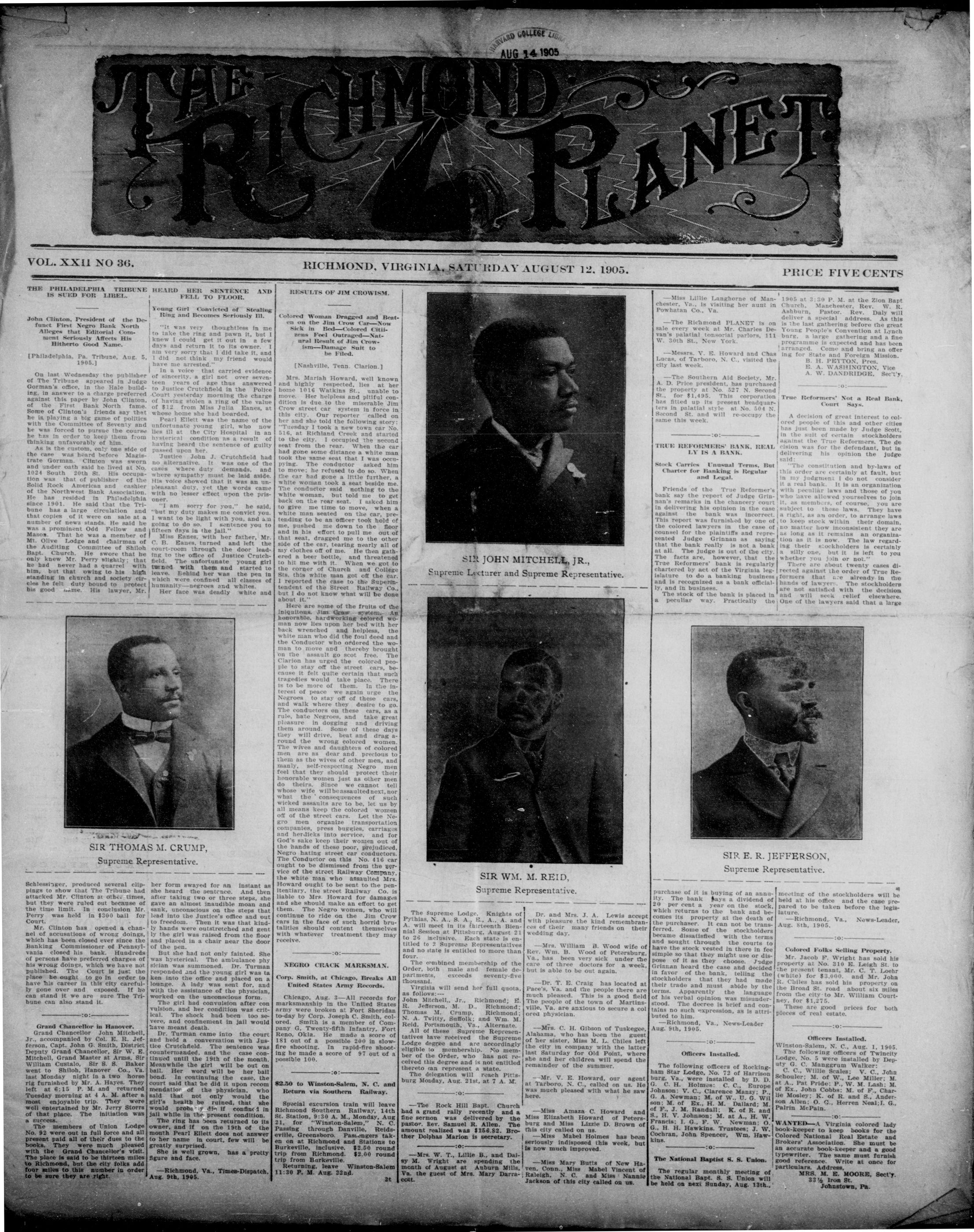
SIR THOMAS
Supreme Re
Schlessinger, produced several clippings to show that The Tribune had attacked Mr. Clinton at other times, but they were ruled out because of the time limit. In conclusion Mr. Perry was held in $300 bail for Court.
Mr. Clinton has opened a channel of accusations of wrong doings, which has been closed ever since the Banking Commissioner of Pennsylvania closed his bank. Hundreds of persons have preferred charges of his wrong doings, which we have not published. The Court is just the place he ought to go in order to have his career in this city carefully gone over and exposed. If he can stand it we are sure The Tribune can also stand it.
Grand Chancellor in Hanover.
Grand Chancellor John Mitchell, Jr., accompanied by Col. E. R. Jefferson, Capt. John G. Smith, District Deputy Grand Chancellor, Sir W. E. Mitchell, Grand Master at Arms, Sir William Custalo, Sir S. S. Baker went to Shiloh, Hanover Co., Va. last Monday night in a two horse rig furnished by Mr. A. Hayes. They left at 6:15 P. M. and returned Tuesday morning at 4 A. M. after a most enjoyable trip. They were well entertained by Mr. Jerry Storrs of that place. The initiation was a success.
The members of Union Lodge No. 92 were out in full force and all present paid all of their dues to the books. They were much pleased with the Grand Chancellor's visit. The place is said to be thirteen miles to Richmond, but the city folks add four miles to this number in order to be sure they are right.
HEARD HER SENTENCE AND
FELL TO FLOOR.
Young Girl Convicted of Stealing Ring and Becomes Seriously Ill.
"It was very thoughtless in me to take the ring and pawn it, but I knew I could get it out in a few days and return it to its owner. I am very sorry that I did take it, and I did not think my friend would have me arrested."
In a voice that carried evidence of sincerity, a girl not over seventeen years of age thus answered to Justice Crutchfield in the Police Court yesterday morning the charge of having stolen a ring of the value of $12 from Miss Julia Eanes, at whose home she had boarded. Pearl Elllett was the name of the unfortunate young girl, who now lies ill at the City Hospital in an hysterical condition as a result of having heard the sentence of gullity passed upon her.
Justice John J. Crutchfield had no alternative. It was one of the cases where duty demands, and where sympathy must be laid aside. His voice showed that it was an unpleasant duty, yet the words came with no lesser effect upon the prisoner.
"I am sorry for you," he said, "but my duty makes me convict you. I want to be light with you, and am going to do so. I sentence you to fifteen days in the jail."
Miss Eanes, with her father, Mr. C. B. Eanes, turned and left the court-room through the door leading to the office of Justice Crutchfield. The unfortunate young girl turned with them and started to leave. Behind her was the pen in which were confined all classes of humanity—negroes and whites. Her face was deadly, white and
S M. CRUMP,
representative.
her form swayed for an instant as she heard the sentence. And then after taking two or three steps, she gave an almost inaudible moan and sank, unconscious on the steps that lead into the Justice's office and out to freedom. Then it was that kindly hands were outstretched and gently the girl was raised from the floor and placed in a chair near the door of the pen. But she had not only fainted. She was hysterical. The ambulance physician was summoned. Dr. Turman responded and the young girl was ta ken into the office and placed on a lounge. A lady was sent for, and with the assistance of the physician, worked on the unconscious form. The girl had convulsion after convulsion, and her condition was critical. The shock had been too severe, and confinement in jail would have meant death. Dr. Turman came into the court and held a conversation with Justice Crutchfield. The sentence was countermanded, and the case continued until the 19th of the month. Meanwhile the girl will be out on bail. Her word will be her ball bond. In continuing the case, the court said that he did it upon recommendation of the physician, who said that not only would the girl's health be ruined, that she would probably die if confined in jail while in the present condition.
The ring has been returned to its owner, and if on the 19th of the month Pearl Elllett does not answer to her name in court, few will be greatly surprised.
She is well grown, has a pretty figure and face.
—Richmond, Va., Times-Dispatch, Aug. 9th, 1905.
RICHMOND, VIRGINIA, SATURDAY AUGUST 12, 1905.
RESULTS OF JIM CROWISM.
Colored Woman Dragged and Beaten on the Jim Crow Car—Now Sick in Bed—Colored Citizens Feel Outraged—Natural Result of Jim Crowism—Damage Suit to be Filed.
[Nashville, Tenn, Clarion.]
Mrs. Mariah Howard, well known and highly respected, lies at her home 1016 Watkins St., unable to move. Her helpless and pitiful condition is due to the miserable Jim Crow street car system in force in this city. Our reporter called on her and she told the following story: "Tuesday I took a new town car No. 516, at Richland Creek and started to the city. I occupied the second seat from the rear. When the car had gone some distance a white man took the same seat that I was occupying. The conductor asked him to move; he refused to do so. When the car had carged a little further, a white woman took a seat beside me. The conductor said nothing to the white woman, but told me to get back on the rear seat. I asked him to give me time to move, when a white man seated on the car, pretending to be an officer took hold of me, pushed me down to the floor and in his effort to pull me out of that seat, dragged me to the other side of the car, tearing nearly all of my clothes off of me. He then gathered a beer bottle, and threatened to hit me with it. When we got to the corner of Church and College Sts, this white man got off the car. I reported the case to the Superintendent of the Street Railway Co., but I do not know what will be done about it."
Here are some of the fruits of the iniquitous, Jim Crow system. An honorable, hardworking colored woman now lies upon her bed with her back wrenched and helpless, the white man who did the foul deed and the Conductor who ordered the woman to move and thereby brought on the assault go scot free. The Clarion has urged the colored people to stay off the street cars, because it felt quite certain that such tragedies would take place. There is to be more of them. In the interest of peace we again urge the Negroes to stay off of these cars, and walk where they desire to go. The conductors on these cars, as a rule, hate Negroes, and take great pleasure in dogging and driving them around. Some of these days they will drive, beat and drag around the wrong colored women. The wives and daughters of colored men are as dear and precious to them as the wives of other men, and manly, self-respecting Negro men feel that they should protect their honorable women just as other men do theirs. Since we cannot tell whose wife will be assaulted next, nor what the 'consequences of such wicked assaults are to be, let us by all means keep the colored women off of the street cars. Let the Negro men organize transportation companies, press buggies, carriages and herdlicks into service, and for God's sake keep their women out of the hands of these poor, prejudiced, Negro hating street car conductors. The Conductor on this No. 416 car ought to be dismissed from the service of the street Railway Company, the white man who assaulted Mrs. Howard ought to be sent to the penitentiary, the street Railway Co. is liable to Mrs. Howard for damages and she should make an effort to get them. The Negro women, who will continue to ride on the Jim Crow cars in the face of such horrid brutalities should content themselves with whatever treatment they may receive.
NEGRO CRACK MARKSMAN.
Corp. Smith, at Chicago, Breaks All United States Army Records.
Chicago, Aug. 3—All records for marksmanship in the United States army were broken at Fort Sheridan to-day by Corp. Joseph C. Smith, colored. Smith is a member of Company G, Twenty-fifth Infantry, Fort Reno, Okla. He made a score of 181 out of a possible 200 in slow-fire shooting. In rapid-fire shooting he made a score of 97 out of a possible 100.
$2.50 to Winston-Salem, N. C. and Return via Southern Railway.
Special excursion train will leave Richmond Southern Railway, 14th St. Station, 9:30 A. M., Monday, Aug 21, for "Winston-Salem," N. C. Passing through Danville, Reidsville, Greensboro. Passengers taken on at Richmond and Stations to Burkeville, inclusive. $2.50 round trip from Richmond. $2.00 round trip from Burkeville.
Returning, leave Winston-Salem 11:30 P. M. Aug. 22nd.
THE WORLD'S FIRST BLACK WOMAN
SIR JOHN MITCHELL, JR., Supreme Lecturer and Supreme Representative.
M. H.
The Supreme Lodge, Knights of Pythias, N. A., S. A., E., A. A. and A. will meet in its thirteenth Biennial Session at Pittsburgh, August 21 to 26 inclusive. Each state is entitled to 2 Supreme Representatives and no state is entitled to more than four.
The combined membership of the Order, both male and female departments, exceeds seventy-five thousand.
Virginia will send her full quota, as follows:----
John Mitchell, Jr., Richmond; E. R. Jefferson, M. D., Richmond; Thomas M. Crump, Richmond; N. A. Twity, Suffolk; and Wm. M. Reid, Portsmouth, Va., Alternate.
All of these Supreme Representatives have received the Supreme Lodge degree and are accordingly eligible to membership. No member of the Order, who has not received this degree and is not entitled thereto can represent a state.
The delegation will reach Pittsburg Monday, Aug. 21st, at 7 A. M.
—The Rock Hill Bapt. Church had a grand rally recently and a fine sermon was delivered by the pastor. Rev. Samuel R. Allen. The amount realized was $156.82. Brother Dolphas Marion is secretary.
:0:
—Mrs. W. T., Lillie B., and Daisy M. Wright are spending the month of August at Auburn Mills, Va. the guest of Mrs. Mary Darracoit.
Dr. and Mrs. J. A. Lewis accept with pleasure the kind remembrances of their many friends on their wedding day.
—Mrs. William B. Wood wife of Rev. Wm. B. Wood of Petersburg, Va., has been very sick under the care of three doctors for a week, but is able to be out again.
—Dr. T. E. Craig has located at Pace's, Va. and the people there are much pleased. This is a good field The people of the town of Martinsville, Va. are anxious to secure a colored physician.
—Mrs. C. H. Gibson of Tuskegee, Alabama, who has been the guest of her sister, Miss M. L. Chiles left the city in company with the latter last Saturday for Old Point, where she and her children will spend the remainder of the summer.
—Mr. V. E. Howard, our agent at Tarboro, N. C., called on us. He was much pleased with what he saw here.
—Miss Amaza C. Howard and Miss Elizabeth Howard of Petersburg and Miss Lizzie D. Brown of this city called on us.
—Miss Mabel Holmes has been seriously indisposed this week, but is now much improved.
—Miss Mary Butts of New Haven, Conn., Miss Mabel Vincent of Raleigh, N. C. and Miss Nannie Jackson of this city called on us.
—Miss Lillie Langhorne of Manchester, Va., is visiting her aunt in Powhatan Co., Va.
—The Richmond PLANET is on sale every week at Mr. Charles Devan's palatial tonsorial parlors, 111 W. 30th St., New York.
—Messrs. V. E. Howard and Chas Lucas, of Tarboro, N. C., visited the city last week.
—The Southern Aid Society, Mr. A. D. Price president, has purchased the property at No. 527 N. Second St., for $1,495. This corporation has fitted up its present headquarters in palatial style at No. 504 N. Second St. and will re-occupy the same this week.
TRUE REFORMERS' BANK, REAL LY IS A BANK.
Stock Carries Unusual Terms, But Charter for Banking is Regular and Legal.
Friends of the True Reformer's bank say the report of Judge Grinnan's remarks in the chancery court in delivering his opinion in the case against the bank was incorrect. This report was furnished by one of the colored lawyers in the case of counsel for the plaintiffs and represented Judge Grinnan as saying that the bank really is not a bank at all. The judge is out of the city. The facts are, however, that the True Reformer's bank is regularly chartered by act of the Virginia legislature to do a banking business and is recognized as a bank officially, and in business.
The stock of the bank is placed in a peculiar way. Practically the
[Picture of a man in a suit with a tie].
SIR E. R. JEFFERSON, Supreme Representative.
purchase of it is buying of an annuity. The bank pays a dividend of 20 per cent a year on the stock, which returns to the bank and becomes its property at the death of the purchaser. It can not be transferred. Some of the stockholders became dissatisfied with the terms and sought through the courts to have the stock vested in there in fee simple so that they might use or dispose of it as they choose. Judge Grinnan heard the case and decided in favor of the bank, telling the stockholders that they had made their trade and must abide by the terms. Apparently the language of his verbal opinion was misunderstood. The decree is brief and contains no such expression, as is attributed to him.
—Richmond, Va., News-Leader Aug. 9th, 1905.
The following officers of Rockingham Star Lodge, No. 72 of Harrison burg, Va., were installed by D. D. G. C. H. Holmes; C. C., Europe Johnson: V. C., Clarence Manzy; P., G. A. Newman; M. of U., U. G. Wilson; M. of Ex, H. M. Dallard; M. of F., J. M. Randall; K. of R. and S., H. V. Johnson; M. at A., H. W. Francis; I. G., F. W. Newman; O. G., H. H. Hawkins. Trustees; J. W. Cochran, John Spencer, Wm. Hawkins.
The National Baptist S. S. Union.
The regular monthly meeting of the National Bapt. S. S. Union will be held on next Sunday, Aug. 13th.
Officers Installed.
1905 at 3:30 P. M. at the Zion Bapt
Church, M. Manchester, Rev. W. R.
Ashburn, Pastor. Rev. Daly will
deliver a special address. As this
is the last gathering before the great
Young People's Convention at Lynch
burg, a large gathering and a fine
programme is expected and has been
arranged. Come and bring an offer
ing for State and Foreign Mission.
B. H. PEYTON, Pres.
E. A. WASHINGTON, Vlee
A. W. DANDRIDGE, Sec'ty.
True Reformers' Not a Real Bank, Court Says.
A decision of great interest to colored people of this and other cities has just been made by Judge Scott, in the suit of certain stockholders against the True Reformers. The decision was for the defendant, but in delivering his opinion the judge said:
"The constitution and by-laws of this order are certainly at fault, but in my judgment I do not consider it a real bank. It is an organization with peculiar laws and those of you who have allowed yourselves to join it, as members, of course, you are subject to these laws. They have a right, as an order, to arrange laws to keep stock within their domain, no matter how inconsistent they are as long as it remains an organization as it is now. The law regarding their stockholders is certainly a silly one, but it is left to you whether you join or not."
There are about twenty cases directed against the order of True Reformers that are already in the hands of lawyers. The stockholders are not satisfied with the decision and will seek relief elsewhere. One of the lawyers said that a large
meeting of the stockholders will be
held at his office and the case pre-
pared to be taken before the legisl-
ature.
—Richmond, Va., News-Leader,
Aug. 8th, 1905.
:0:
Colored Folks Selling Property.
Mr. Jaceb F. Wright has sold his
property at No. 210 E. Leigh St. to
the present tenant, Mr. C. T. Leohr
(white) for $3,000, and Mr. John
R. Chiles has sold his property on
the Broad St. road about six miles
from the city to Mr. William Court-
ney, for $1,275.
These are good prices for both
pieces of real estate.
Officers Installed.
HEAVY LANET
SATURDAY... August 12, 1905
What They Said.
At last, after a courtship extending over a period of two years ten months and seventeen days, he had proposed and she had handed him the answer.
"Darling," he gurgled, "you are worth your weight in gold."
"Then I must be very valuable," she replied, "for it has been an awful long wait."—Chicago Daily News.
More Than a Hint
"If I should attempt to kiss you," asked the young man, "would you scream for your mother?" "I guess I would," the fair young thing admitted, "but it wouldn't do me much good. Mother is visiting 15 miles out in the country."
Only One.
The Bachelor—Say what you please,
but I don't believe there was ever a
man that could size a woman up.
The Benedict—Because he is a ladies tailor—Chicago Daily News
Sure It Is
Said: "I think it is the shame, Which I wish that I could stop- When the certain takes a drop, **Mr. husband has to go and do the same**- **Cro-
LOOKED II.
Mr. Penquick—Yes, my wife was awfully near-sighted when we were married.
Alice (with conviction)—She must have been!
She Would Touch him
There was a young lady named Beauchamp
Who said to her friend, "I will taucheamp
him."
They should wear more than emiles." But she hadn't the money to reachamp. — Judge.
A Personal View.
"Graft is surprisingly common," said the apprehensive citizen.
"That is where you are wrong," answered Senator Sorghum. "A real good graft is getting to be one of the scarcest things in our once proud and luxurious civilization." — Washington Star.
Woo and Wca.
Enquirer (just returned from abroad)
—What's all this scandal about young
Bullion and Miss Sweetlips?
Goaker—Oh, the old thing, you
know; first he woo'd and then he
wouldn't, then she sued and he had
to pay up, that all.—Ally Sloper.
Wiles of Mrs. Ulysses.
Pellewel was putting off her lovers
by unraveling the shroud.
"How foolish!" cried the wise ones. "She merely gives the impression that she makes her own dresses." Thus indeed was the Levy of admirers accounted for—N. Y. Sun.
"Yes," answered the man with a good job; "but the statement attracted so little attention I concluded I could stay where I was without being noticed."—Washington Star.
High Up. Yes.
"What makes ostrich feathers so high?"
"Because the birds have such long legs, I suppose, my boy."—Yonkers Statesman.
Not a Safe Robber
Officer Brown — Say, that teller seemed pretty stuck up for a common pickpocket.
Officer Smith—It's the first time he'd been caught, and he'd done it so often that he thought he was a safe robber. —Judge.
Different Determination.
"My husband is very determined," said Mrs. Noowed, proudly. "He never gives up."
"Neither does mine," sighed Mrs. Klosefst, with a sad glance at her last year's gown.—Chicago Sun.
Strenuous Hint
Husband—Let me see, how long has it been since Uncle John was here?
Wife—Oh, it must be several years.
He was here the week after I got my last new bonnet.—Chicago Daily News.
Stung!
Teacher—And what is it that bees make, Tommie?
Tommie—Trouble, ma'am.—Yonker Statesman.
Fitted the Case
"So the congregation didn't like the preacher and asked him to resign, Uncle Jason?"
"Yas, sah; he wuz whut de white folks calls a persona non gratis to de chu'ch."
"Not persona non gratis; that means a person not free, if it means anything. You are a little off on your Latin."
"Not at all, boss. Dat wuz jest de objection to at preacher. We didn't pay our las' preacher nothin' an dis one wuz allus instistin' on bein' paid some sort ob salary!"—N. O. Times-Democrat.
Diagnosed His Case
"I suffer horribly from insomnia doctor," said the patient, "and I frequently have a gone feeling in the region of my solar plexus." "Um," said the doctor, "may I ask what is your business?" "I am a bank cashier." "Ah, I see. If you can manage to get away I think you would be greatly benefited by an extended trip to New Mexico or Central America."—Brooklyn Life.
Bound to Be Kept
City Friend—I should like to know how you manage to keep all your books. If I lend a fellow a book, I never see it back again.
Bookworm—When I lend a book I make an entry with the date in the book itself, and another entry in a small ledger that I keep on purpose and —
City Friend—Oh, I see, you keep your books by double entry—Ally Sloper.
"Are they red. Millie? Then it must be because I didn't sleep well last night."
"Are you troubled with insomnia? You ought to take something to cure it."
"But I don't want to be cured of it. I lie awake thinking of you."
It was plain sailing for Gerald after that. -Chicago Tribune.
Same Sensation.
Gunner—I thought Reefer liked the water. I hear he is going to buy a racing automobile instead of a yacht?
Guyer—Yes; he found the shaking of the automobile would make him seasick just as quick as if he were on a yacht—Chicago News.
A. Reasonable Theory
Physician—Yes, sir, my opinion is that one-half the diseases that afflict humanity are due to over-eating.
Friend (reflectively)—It may be—may be. Now, I think of it, it is months since anyone was sick at my boarding house.
—N. Y. Weekly.
Unlike the Clock
Aunt Abby—A peddler was tryin' to sell me a new clock to-day—said he'd guarantee it wouldn't lose time.
Uncle Josh—What did you say?
Aunt Abby—I told him he was losin' time tryin' to sell it to me—Puck
Compared
"Most marriages," said the bachelor,
"remind me of jug handles."
"How is that," asked the widow, with
not unnatural curiosity.
"They are one-sided affairs," was the
grim reply.—Cassell's.
Beware!
There is an old woman in Ga..
Who polls, like Lucrezia Ba.;
So I bid you beware,
You had better take care,
And run off when you see her come ta.!
—The Abbreviator.
QUITE TRUGH.
Beware!
A susceptible chappy is Hugh.
Azy gij. that makes optics gugh-gugh
can win at least part
Of his matchmaking heart.
He admits that he loves eighty-tugh.
- Philadelphia Press.
Not Sure.
"Is your daughter learning to play
the piano?"
"I can't say for sure," answered Mr. Cumrox, "whether she's learning to play or I'm getting used to it." Washington Star.
Where Matter Wins.
Lion Tamer-There's only one kind of an animal that can't be tamed by the power of mind over matter.
All the News
"Is Bigglins a well-informed man?"
"He ought to be." answered Miss Cayenne; "his wife belongs to three sewing societies and a progressive euchre club."—Washington Star.
"Do you believe in government ownership?"
"That depends," answered the trust magnate, "on whether you mean that the government ought to own us or we ought to own the government."—Washington Star.
Averaged the Same
"Yes," says the first beauteous damsel; "I had five proposals at the reception last night."
"I had but one," remarks the demure damsel, "but it counted the same as five. The man stuttered."—Judge.
A Case of Compulsion.
Willie—There's another fellow in the back parlor with sister.
Castleton—What is he doing there?
She knew I was coming, didn't she?
"Oh, yes. But she begged him to stay."—Brooklyn Life.
Pressman—That's an ugly looking fellow.
Plain-Clothes Man—Yes; he's a barman.
Pressman (in astonishment)—A barman?
Plain-Clothes Man—His bar is the one which very often opens but never shuta.
Pressman—What bar's that?
Plain-Clothes Man—The crowbar.—Ally Sloper.
The Call of the Bean
Hulda, the Swedish maid, had served her mistress faithfully for a year, when one day she announced her intention of leaving.
"Why, Hulda, what is the trouble?" asked her mistress. "Is the work too hard, or is it the wages?"
"No. De work be all right, and de wages he be, too; but de beau—he must have me."—Judge.
A Romance of the Wind Belt.
"You met your husband in Kansas, I believe?"
"Well, you could hardly call it meeting him. You see, a cyclone came along, and when I recovered consciousness I was sitting on John back of what had once been a pumping station. Isn't it strange how fate brings people together sometimes?"—Chicago Record-Herald.
That Settled It
Young Man—I have called, sir, to request the hand of your daughter in marriage.
Old Grumleigh—Has she accepted you?
Young Man—Yes, sir.
Old Grumleigh—Then what do you want to come around and bother me with your troubles, for?—Chicago Daily News.
He Got Off Easy
Her—I thought it better to hurt your feelings than risk seeing you hobble around on crutches.
Him—Why, what do you mean?
Her—Papa said if I didn't throw you down, he would, and papa's terribly strenuous, you know—Chicago Daily News.
Hard Stucc
"Russia will one day have universal education."
"Maybe so," answered the always doubtful man. "But it looks to me as if it would take the average man half a lifetime to get through the spelling book."—Washington Star.
One Advantage
"The desert of Sahara must be a terrible place," said Meandering Mike. "Well," answered Plodding Pete, "there's one good thing to be said for it. There ain't a lot of people there on the lookout for farm hands."—Washington Star.
Then He Departed
He (time 11:45 p. m.)—I hope your father doesn't object to my paying you visits.
She—No; but I think he would prefer having you pay them in installments.—Chicago Daily News.
The Answer.
The Pastor--My dear, have you noticed the gratifying increase of male attendance at our mid-week prayer meetings?
His Wife--Yes--it's house cleaning time.-Cleveland Leader.
Secret Out
Friend—I don't see how you can afford to sell automobiles like that for only $500.
Dealer—Oh, I make my profit on the repairs. That's the answer.—Chicago Daily News.
LOVE AT FIRST SIGHT.
Auntie And do you love me very much, Tommy?
Tommy—Oh yes, auntie. I but I love
mother beer. I met her first, you see.
When a Man's Down
Never pummel; a man when he's down
If you wish to have freedom from sorrow.
For by giving attention a moment you'll
see
"What's the cause of the coolness between the Pilkins and Pilkins families?"
"Young Pilkins became engaged to one of the Pilkins girls."
"Yes."
"And now each family thinks its offspring is getting all the worst of it."—Chicago Sun.
A Reason.
Patience—She has always been crazy to marry ever since she was a young girl. I really believe she would have married her father's coachman, if it hadn't been for one thing.
Patrice—What was that?
"Her father didn't have any coachman."—Yonkers Statesman.
His Apprehension.
"Doesn't that law restricting your company's privileges cause you apprehension?"
"No," answered Mr. Dustin Stax. "The law is all right. What bothers me is the fear that one of these days they'll get enthusiastic and enforce it."—Washington Star.
"You should be slow to anger," said the benevolent citizen.
"I done 'tried dat once,' answered Mr. Erastus Pinkley. "I reckon I was most too slow dat time. Do yuthuh man done had his razor gold' an' de ohgum gut clean settled befo' I recognized dat my feelin's was hurt." Washington Star.
A Safe Assertion
"Do you think we'doin' right to advertise all the comforts of home?" asked Mrs. Cornossel. "Course we are." answered Farmer Cornossel. "It's true enough. There isn't any comfort worth mentionin' anywhere when the weather gets good and hot."—Washington Star.
A Danger.
Do you have endowed a college?
"Yes," answered the multi-millionaire
"And the first thing you know you'll be educating a lot of smart young lawyers to oppose your firm in its franchise litigation"—Washington Star.
Rhetorical Questions
What volume equals Nature's book?
To one who knows to turn and look?
In all the poet's ample scope
What trope can match a helotrope?
Customer—Have you the encyclopaedia Britannica? Clerk—No. sir. It's just plain mumps. Chicago Daily News
Dandelions.
It seems to me a wealthy man
This way we chances to pass
And cast a million golden coins
Upon the greenbuck grass.
—Chicago Chronicle.
A Choice.
"Do you always tell the exact truth
about a fishing trip?"
"I used to," said the man with an
elastic conscience, "but I've quit boring
my friends. I have concluded that it is
better to be entertaining than vera-
cious."—Washington Star.
Fair Warning
Mr. Ardent—So you advise me against marrying your daughter. Do you think you know her better than I do?
Old Gotrox—I may not, young man, but I know myself a great deal better than you know me—Puck.
Knew the Man.
Molly—There's a edw! I'm so afraid of cows!
Cholly—It won't hahm you, Miss Molly, as long as I am with you.
Molly—I know that—but when it stars after me you won't be with me!
Cleveland Leader.
New Kind of Mesh
Grandfather—When I was a little boy like you I used to go down in the kitchen and watch the cook mash potatoes.
Grandson—Yes, grandpa; but I love to go down and watch her mash the policeman—Tit-Bits.
His Tackle
A CALL-DOWN.
Cholly—I would I were the glove that presses your hand.
Carrye—Aren't you enough of a kid
as it is?—Brooklyn Eagle.
The Willing Worker.
A man can make a garden
In a month or so, they say;
Bob and his buddy can unmake it
In about half a day.
—Chicago Sun.
All in the Name
"This," said the city chap, who was showing his rural relative the town, "is called the 'tenderloin' district."
"Why is it called that?" queried the rural relative.
"Because it is so tough," explained the other—Chicago News.
A Matter of Locality.
The king of the Canalebal islands laughed unproportionly.
"The idea that it costs $65 a year to dress a wife is too funny!" he said.
"Why, it doesn't cost me that much to keep all of mine in dresses!"—Chicago Tribune.
An Eye to Business.
"Doc, I want you to diagnose my case as appendicitis."
"But you haven't got appendicitis."
"I know it," but the report that I can afford it will help my financial standing a whole lot."—Louisville Courier-Journal.
---
"People make me sore," complained the billy goat. "Everybody has to have his little joke about my butting in."
"Well, don't you?" inquired the bunco steer.
"No, sir. I always go in head first." —Kansas City Drovers' Journal.
Satan's Turn.
The New Arrival (a prominent surgeon)—What punishment do I get?
His Highness—You'll have your appendix pulled out with red-hot nippers every 15 minutes.
"For how long?"
"Oh, until medical science does its work for nothing." —Life.
In Nashua.
A sprightly young fellow in Nashua, Determined to throw all his cashua, Cried loudly: "Ha, ha! Enjoy me parte de fol gras." And disdainfully motioned the hashua, —Puck.
DEAR GIRLS
M. D. D. C.
Maisie-Jack called me a peach last night.
Mae—Yes; I noticed that the peach crop is said to be very poor this season.—Chicago Daily News.
Looking Forward.
By some future railway genius
The records will all be broke.
He'll invent a noise whistle.
And discover smokeless smoke.
—Washington Star.
Civilization
"Are those Filipinos getting civilized?" asked the traveler.
"In some ways," answered the Manila citizen. "But they somehow can't learn to read and write as fast as they can learn to play cards and make fancy drinks."—Washington Star.
Doesn't Show in the Dark.
Younger Brother—I say, muver, I know why Johnny is so awful fond of going to lantenr shows.
Mother—Why, dear?
Younger Brother—Becos he doesn't have to wash his neck before he goes—Ally Sloper.
Niagara a Little Later.
Visitor—Aren't the falls running today?
Native—Not to-day, ma'am.
Visitor—But I came a long ways to see them.
Native—You better stay a few days, ma'am, until it rains—an' if it's a real hard rain it may wet 'em over.—Cleveland Plain Bear.
Safe.
"This is a blue-law town now, isn't it?" interrogated the drummer in St. Louis.
"Yes, sir." replied the barber.
"But how is it you keep open after midnight?"
"Oh, you see my razors have a pull."
—Chicago News.
The Method of the Yellows.
Tht Editor—From what source did you secure this story of a frightful scandal in the Oldstock family?
The Reporter—From their coachman.
"It would never do, of course, to quote him; so we'll say we have the news on the highest authority." —Life.
The Hero
He is a dauphine here.
And he we sure of that.
Who dares with an intruder.
Put on the first straw hat.
—Chicago Chronicle.
First Ostrich--I say, Bill, come over and have a Welsh rarebit with me?
Second Ostrich—No, thanks. Plain
hardware is good enough for me. A fellow
has to draw the line somewhere.—
N. Y. Sun.
The golden hair you deem so fair,
Oer which you oft have sighed,
It may not be real gold; you see
It is more peroxide.
-Houston Post
He Approved
"Didn't your new hat come home?"
"No! The impudent milliner said she wanted an advance on it. And I told her to keep her old hat."
"That's right, my dear. That's the proper spirit!" — Cleveland Plain Dealer.
An Eicpement Barked,
"I came near ecloping once," said the sweet young thing.
"Indeed!"
"Yes; we had quite made up our minds."
"Who?"
"Papa and me—but I couldn't find a man who would elope with me!"—Monkers Statesman.
Within Bounds.
The girl said: "I'm called a coquette; And, though I flirt some, you can buuette It is only for fun, And never a one Cause I am not of my suette." -Houston Post.
THE STREET CENTER
Stage Manager (interviewing children, with the idea of engaging them for a new play)—Has this child been on the stage?
Proud Mother—No; but he's been on an inquest, and he speaks up fine!—Purch.
The Way of the World.
The rogue a strange advantage gains.
He rogue a note with sorrow,
A stance unshaken when it rains,
While heest folk must borrow,
-Washington Star.
CUREN.
A woman who lived in Racine
Was fearful that she would get line.
She she drank lots of water,
as thin people ater.
And new she s as round as a bine.
-Houston Post.
IN THE SPRING.
Railroad Station
Circus Joe—I never minded performing on a tight rope in the old days, but I'll be hanged if I think it's safe to walk one of these suburban sidewalks in flood time.—Cleveland Plain Dealer.
Don't Croque.
A woman white while taking a toque
Swiped a piece of rare lace for a jque;
But, now I can't hit shocking.
That should not shock you.
She's free, but her husband went broque.
—Houston Post.
A Real Philanthropist.
"If you was to git to be one o' dese
multi-millionaires," said Meandering
Mike, "would you fergit your humble
past?"
"No, sir," answered Plodding Pete,
"I'd be a real philanthropist. I'd buy up
all de car factories an' have cushions put
on de trucks."—Washington Star.
A Busy Season
"Don't you find it rather lonely with no congressional business to attend to?" "No." answered Senator Sorghum. "Some of us attend to the most serious business of our congressional careers when congress is not in session."—Washington Star.
Fashions in Husbands
Ethel—So Mary is thinking of getting a divorce? I thought she had such a nice husband.
Dorothy—He is nice in his way, of course; but, you see, just that particular kind of husband has gone all out of fashion in our set. Judge.
Fossible Explanation.
Myer—I wonder why Browne added the "e" to his name after inheriting a fortune?
Gyer—He probably figured out to his own satisfaction that rich people are entitled to more ease than poor people—Chicago Dally News.
Much Needed Best
"Your daughter didn't take a wedding trip, did she?" "No, she and Albert were so worn out by the ante-nuptial functions that they went to the hospital as soon as the ceremony had been performed."—Chicago Record-Herald.
"Why are you going to the theater again to-night? You've seen the piece already."
"Yes, but not in my new dress!"- Meggendorfer Blaetter.
Terrible Threat
"And if I should break the engagement," said the Hyde Park Romeo, "to me truly, what would you do?"
"I—I should like poison!" cried the beautiful girl.
"You would really go to the nearest
"You would really go to the nearest pharmacy and get poison?" "No, no! Worse than that. I should allow a young man who smokes cigarettes to kiss me."—Chicago Daily News.
Its Disadvantages
"If we economize," said the husband,
"We will soon have a house of our own
instead of having to live in rented property."
"But, I'm not sure I should like that,"
answered the wife. "I couldn't drive
nails anywhere I please in the walls or
woodwork of our own house, you know."
- St. Louis Republic.
Motherly Precaution.
"George," said Mrs. Ferguson, hurry-
ing out. "can't you put up those window
screens without using the kind of
language you have been using for the
last ten minutes?"
"No!" snapped Mr. Ferguson.
Shaped Mr. Ferguson.
"Then quit working at them till I get the children off to school!"—Chicago Tribune.
Troubles of the Rich.
Lives of rich men still remind us—
Even he may read who runs—
The kind we leave behind us
May make issues of our sons.
-Chicago Record Herald.
THEN GUY GUYED
The Malden (introducing beloved one)—This is Guy, pa.
Pa—He looks it—Ally Sloger
Two Art Views.
'Tis an art to paint a picture,
To hear the painter tell it;
But from the creator's point of view
'Tis more of an art to sell it.
—Cincinnati Knights
Tact.
"How do you manage to get on with her so well when your general convictions diverge so wildly?" "When a delicate rift is reached I always shift the conversation to some complimentary remark about her gown or her hair."—Brooklyn Life.
According to Her Book.
"What is the future of the verb 'to love,' Miss Jennie?" asked the professor.
"To get married," answered the blushing Jennie, who had just celebrated the sixteenth anniversary of her birth.—Cincinnati Enquirer.
DR. BRUMAO'S EAST INDIAN POMADE CLOSSEY
The Wonder King of All Hair Tonics
MARY C. BURTON
Imperes
All Kinds
of Hair,
Making
it Soft,
Pliable an
Like Silk
Makes
It Grow
Long,
Soft
and
Straight
Stops Hair Falling Out. Turns Gray
Hair Dark. You Will Save Your Hair,
Time and Money by sending to us for
it if there is no agent in your locality
handling it.
Two-cent stamps taken
for sums of 25 and
50c. Sent to your address
clear of all expense.
A
Small Boxes - 25c
Large Boxes - 50c
Extra Large Boxes $1.00
WONDERFUL DISCOVERY Curly Hair Made Straight By
TAKEN FROM APE
BEFORE AND AFTER
The Return of SHERLOCK HOLMES
Author of "The Adventures of Sherlock Holmes."
"The Hound of the Baskervilles." "The Sign of the Four." "A Study In Scratel." Etc.
of sealskin—and he was an old sealer."
"But he had no pipe."
"No, sir, we could find no pipe. Indeed, he smoked very little, and yet he might have kept some tobacco for his friends."
"No doubt. I only mention it because if I had been handling the case I should have been inclined to make that the starting point of my investigation. However, my friend, Dr. Watson, knows nothing of this matter, and I should be none the worse for hearing the sequence of events once more. Just give us some short sketches of the essentials."
Stanley Hopkins drew a slip of paper from his pocket.
"I have a few dates here which will give you the career of the dead man, Captain Peter Carey. He was born in '45-fifty years of age. He was a most daring and successful seal and whale fisher. In 1883 he commanded the steam sealer Sea Unicorn of Dundee. He had then had several successful voyages in succession, and in the following year, 1884, he retired. After that he traveled for some years, and finally he bought a small place called Woodman's Lee, near Forest Row, in Sussex. There he has lived for six years, and there he died just a week ago today.
"There were some most singular points about the man. In ordinary life he was a strict Puritan a silent gloomy fellow. His household consisted of his wife, his daughter, aged twenty, and two female servants. These last were continually changling, for it was never a cheery situation, and sometimes it became past all bearing. The man was an intermittent drunkard, and when he had the fit on him he was a perfect hend. He has been known to drive his wife and daughter out of doors in the middle of the night and flog them through the park until the whole village outside the gates was aroused by their screams.
"He was summoned once for a savage assault upon the old vicar, who had called upon him to remonstrate with him upon his conduct. In short, Mr. Holmes, you would go far before you found a more dangerous man than Peter Carey, and I have heard that he bore the same character when he commanded his ship. He was known in the trade as Black Peter, and the name was given him not only on account of his swarthy features and the color of his huge beard, but for the humors which were the terror of all around him. I need not say that he was bathed and avoided by every one of his neighbors and that I have not heard one single word of sorrow about his terrible end.
"You must have read in the account of the inquest about the man's cabin, Mr. Holmes, but perhaps your friend here has not heard of it. He had built a wooden outhouse—he always called it the 'cabin'—a few hundred yards from his house, and it was here that he slept every night. It was a little single roomed hut 16 by 10. He kept the key in his pocket, made his own bed, cleaned it himself and allowed no other foot to cross the threshold. There are small windows on each side, which were covered by curtains and never opened. One of these windows was turned toward the highroad, and when the light burned in it at night the folk need to point it out to each other and wonder what Black Peter was doing in there. That's the window, Mr. Holmes, which gave us one of the few bits of positive evidence that came out at the inquest.
"You remember that a stonemason named Slater, walking from Forest Row about 1 o'clock in the morning two days before the murder, stopped as he passed the grounds and looked at the square of light still shining among the trees. He swears that the shadow of a man's head turned sideways was clearly visible on the blind and that this shadow was certainly not that of Peter Carey, whom he knew well. It was that of a boarded man, but the beard was short and bristled forward in a way very different from that of the captain. So he says, but he had been two hours in the public house, and it is some distance from the road to the window. Besides, this refers to the Monday, and the crime was done upon the Wednesday.
"On the Tuesday Peter Carey was in one of his blackest moods, fushed with drink and as savage as a dangerous wild beast. He roamed about the house, and the women ran for it when they heard him coming. Late in the evening he went down to his own hut. About 2 o'clock the following morning his daughter, who slept with her window open, heard a most fearful yell from that direction, but it was no unusual thing for him to bawl and shout when he was in drink, so no notice was taken. On rising at 7 one of the maidens noticed that the door of the hut was open, but so great was the terror which the man caused that it was midday before any one would venture down to see what had become of him. Peeping into the open door, they saw a sight which sent them flying with white faces into the village. Within an hour I was on the spot and had taken over the case.
"Well, I have fairly steady nerves, as you know, Mr. Holmes, but I give you my word that I got a shake when I put my head into that littie house. It was droning like a harmonium with the tiles and bluebottles, and the door and walls were like a slaughter house. He had called it a cabin, and a cabin it was, sure enough, for you would have thought that you were in a ship. There was a bunk at one end, a sea chest, maps and charts, a picture of the Sea Unicorn, a line of logbooks on a shelf, all exactly as one would expect to find it in a captain's room. And there, in
The Adventure of Black Peter
No. 6 of the Series
(Copyright, 1904, by A. Conan Doyle and Collier's
Western Press)
(Copyright, 1905, by McClure, Phillips & Co.)
HAVE never known my
friend to be in better
form, both mental and
physical, than in the year
'05. His increasing fame
had brought with it an
immense practice, and I
I
should be guilty of an indiscretion if I were even to hint at the identity of some of the illustrious clients who crossed our humble threshold in Baker street. Holmes, however, like all great artists, lived for his art's sake, and, save in the case of the Duke of Holdernese, I have seldom known him claim any large reward for his inestimable services. So unworldly was he—or so capricious—that he frequently refused his help to the powerful and wealthy where the problem made no appeal to his sympathies, while he would devote weeks of most intense application to the affairs of some humble client whose case presented those strange and dramatic qualities which appealed to his imagination and challenged his ingenuity.
In this memorable year '05 a curious and incongruous succession of cases had engaged his attention, ranging from his famous investigation of the sudden death of Cardinal Tosca—an inquiry which was carried out by him at the express desire of his holiness the pope—down to his arrest of Wilson, the notorious canary trainer, which removed a plague spot from the east end of London. Close on the heels of these two famous cases came the tragedy of Woodman's Lee and the very obscure circumstances which surrounded the death of Captain Peter Carey. No record of the doings of Mr. Sherlock Holmes would be complete which did not include some account of this very unusual affair.
During the first week of July my friend had been absent so often and so long from our lodgings that I knew he had something on hand. The fact that several rough looking men called during that time and inquired for Captain Basil made me understand that Holmes was working somewhere under one of the numerous disguises and names with which he concealed his own formidable identity. He had at least five small refuges in different parts of London in which he was able to change his personality. He said nothing of his business to me, and it was not my habit to force a confidence. The first positive sign which he gave me of the direction which his investigation was taking was an extraordinary one. He had gone out before breakfast, and I had sat down to mine when he strode into the room, his hat upon his head and a huge barb headed spear tucked like an umbrella under his arm.
"Good gracious, Holmes," I cried, "you don't mean to say that you have been walking about London with that thing!"
"I drove to the butcher's and back."
"The butcher's?"
"And I return with an excellent appetite. There can be no question, my dear Watson, of the value of exercise before breakfast. But I am prepared to bet that you will not guess the form that my exercise has taken."
"I will not attempt it."
He chuckled as he poured out the coffee.
"If you could have looked into Allardyce's back shop you would have seen a dead pig swamp from a book in the ceiling and a gentleman in his shirt sleeves furiously stabbing at it with this weapon. I was that energetic person, and I have satisfied myself that by no exertion of my strength can I transfix the pig with a single blow. Perhaps you would care to try?"
"Not for worlds. But why were you doing this?"
"Because it seemed to me to have an indirect bearing upon the mystery of Woodman's Lee. Ah, Hopkins, I got your wire last night, and I have been expecting you. Come and join us."
Our visitor was an exceedingly alert man, thirty years of age, dressed in a quiet tweed suit, but retaining the erect bearing of one who was accustomed to official uniform. I recognized him at once as Stanley Hopkins, a young police inspector, for whose future Holines had high hopes, while he in turn professed the admiration and respect of a pupil for the scientific methods of the famous amateur. Hopkins' brow was cloaked, and he sat down with an air of deep dejection.
"No, thank you, sir. I breakfasted before I came round. I spent the night in town, for I came up yesterday to report."
"And what had you to report?"
"Failure, sir; absolute failure."
"You have made no progress?"
"None."
"Dear me! I must have a look at the matter."
"I wish to heavens that you would,
Mr. Holmes. It's my first big chance,
and I am at my wits' end. For goodness' sake, come down and lend me a band."
"Well, well, it just happens that I have already read all the available evidence, including the report of the inquest, with some care. By the way, what do you make of that tobacco pouch found on the scene of the crime? Is there no clew there?"
Hopkins looked surprised.
"It was the man's own pouch, air. His initials were inside it. And it was
ILLUSTRATED
BY F. D. STEELE
THE RICHMOND PLANE: RICHMOND, VIRGINIA.
The middle of it was the man himself—his face twisted like a lost soul in torment, and his great blind bearded beard stuck upward in his agony. Right through his broad breast a steel harpoon had been driven, and it had sunk deep into the wood of the wall behind him. He was plumed like a beetle on a card. Of course he was quite dead and had been so from the instant that he had uttered that last rell of agony.
"I know your methods, sir, and I applied them. Before I permitted anything to be moved I examined most carefully the ground outside and also the floor of the room. There were no footmarks."
"Meaning that you saw none?"
"I assure you, sir, that there were none."
"My good Hopkins. I have investigated many crimes, but I have never yet seen one which was committed by a flying creature. As long as the criminal remains upon two legs so long must there be some indentation, some abrasion, some trifling displacement which can be detected by the scientific searcher. It is incredible that this blood bespattered room contained no trace which could have aided us. I understand, however, from the inquest that there were some objects which you failed to overlook?"
The young inspector winced at my companion's ironical comments.
"I was a fool not to call you in at the time, Mr. Holmes. However, that's past praying for now. Yes, there were several objects in the room which called for special attention. One was the harpoon with which the dew was committed. It had been snatched down from a rack on the wall. Two others remained there, and there was a vacant place for the third. On the stock was engraved 'Ss. Sea Unlorn, Dundee.' This seemed to establish that the crime had been done in a moment of fury and that the murderer had seized the first weapon which came in his way. The fact that the crime was committed at 2 in the morning, and yet Peter Carey was fully dressed, suggested that he had an appointment with the murderer, which is borne out by the fact that a bottle of rum and two dirty glasses stood upon the table.
"Yes," said Holmes. "I think that both inferences are permissible. Was there any other spirit than rum in the room?"
"Yes, there was a tantalus containing brandy and whisky on the sea chest. It is of no importance to us, however, since the decanters were full, and it had therefore not been used."
"For all that, its presence has some significance," said Holmes. "However, let us hear some more about the objects which do seem to you to bear upon the case."
"There was this tobacco pouch upon the table."
"What part of the table?"
"It lay in the middle. It was of course sealskin—the straight haled skin, with a leather thong to bind it. Inside were 'P. C.' on the flap. There was half an ounce of strong ship's tobacco in it."
"Excellent! What more?"
Stanley Hopkins drew from his pocket a drab covered notebook. The outside was rough and worn, the leaves discolored. On the first page were written the initials "J. H. N." and the date "1883." Holmes laid it on the table and examined it in his minute way, while Hopkins and I gazed over each shoulder. On the second page were the printed letters "C. P. R.," and then came several sheets of numbers. Another heading was "Argentine," another "Costa Rica" and another "San Paulo," each with pages of signs and figures after it.
"What do you make of these?" asked Holmes.
"They appear to be lists of Stock Exchange securities. I thought that 'J. H. N.' were the initials of a broker and that 'C. P. R.' may have been his client."
"Try Canadian Pacific railway," said Holmes.
Stanley Hopkins swore between his teeth and struck his thigh with his clinched hand.
"What a fool I have been!" he cried. "Of course it is as you say. Say, 'J. H. N.' are the only initials we have to solve. I have already examined the old Stock Exchange lists, and I can find no one in 1883, either in the house or among the outside brokers, whose initials correspond with these. Yet I feel that the clew is the most important one that I hold. You will admit, Mr. Holmes, that there is a possibility that these initials are those of the second person who was present—in other words, of the murderer. I would also urge that the introduction into the case of a document relating to large masses of valuable securities gives us for the first time some indication of a motive for the crime."
Sherlock Holmes' face showed that he was thoroughly taken aback by this new development.
"I must admit both your points," said he. "I confess that this notebook, which did not appear at the inquest, modifies any views which I may have formed. I had come to a theory of the crime in which I can find no place for this. Have you endeavored to trace any of the securities here mentioned?" "Inquiries are now being made at the offices, but I fear that the complete register of the stockholders of these South American concerns is in South America and that some weeks must elapse before we can trace the shares." Holmes had been examining the cover of the notebook with his magnifying lens. "Surely there is some discoloration here," said he. "Yes, sir; it is a blood stain. I told you that I picked the book off the floor." "Was the blood stain above or below?" "On the side next the boards."
"Which proves, of course, that the book was dropped after the crime was committed."
"Exactly, Mr. Holmes. I appreciated that point, and I conjectured that it was dropped by the murderer in his hurried flight. It lay near the door."
"I suppose that none of these securities have been found among the property of the dead man?"
"No, sir."
"Have you any reason to suspect robbery?"
"No, sir. Nothing seemed to have
been touched."
"Dear me, it is certainly a very interesting case. Then there was a knife, was there not?"
"A sheath knife, still in its sheath. It lay at the feet of the dead man. Carey has identified it as being her husband's property."
Holmes was lost in thought for some time.
"Well," said he at last. "I suppose I shall have to come out and have a look at it."
Stanley Hopkins gave a cry of joy. "Thank you, sir. That will, indeed, be a weight off my mind."
Holmes shook his finger at the inspector.
"It would have been an easier task a week ago," said he. "But even now my visit may not be entirely fruitless. If you will be very glad of your company. If you will call a four wheeler, Hopkins, we shall be ready to start for Forest Row in a quarter of an hour."
Alighting at the small wayside station, we drove for some miles through the remains of widespread woods which were once part of that great forest which for so long held the Saxon invaders at bay—the impenetrable weald, for sixty years the bulwark of Britain. Vast sections of it have been cleared, for this is the seat of the first iron works of the country, and the trees have been felled to smelt the ore. Now the richer fields of the north have absorbed the trade, and nothing save these ravaged groves and great scars in the earth shows the work of the past. Here, in a clearing upon the green slope of a bill, stood a long, low stone house, approached by a curving drive running through the fields. Nearer the road and surrounded on three sides by bushes was a small outhouse, one window and the door facing in our direction. It was the scene of the murder.
Stanley Hopkins led us first to the house, where he introduced us to a hag-gard, gray haired woman, the widow of the murdered man, whose gaunt and deep lined face, with the furtive look of terror in the depths of her red rimmed eyes, told of the years of hardship and ill usage which she had endured. With her was her daughter, a pale, fair haired girl, whose eyes blazed defiantly at us as she told us that she was glad that her father was dead and that she blessed the hand which had struck him down. It was a terrible household that Black Peter Carey had made for himself, and it was with a sense of relief that we found ourselves in the sunlight again, making our way along a path which had been worn across the fields by the feet of the dead man.
The outhouse was the simplest of dwellings, wooden walled, shingle roofed, one window beside the door and one on the farther side. Stanley Hopkins drew the key from his pocket and had stooped to the lock when he paused with a look of attention and surprise upon his face.
"Some one has been tampering with it," he said.
There could be no doubt of the fact. The woodwork was cut, and the scratches showed white through the paint, as if they had been that instant done. Holmes had been examining the window.
"Some one has tried to force this also. Whoever it was has failed to make his way in." He must have been a very poor burglar."
"This is a most extraordinary thing." said the inspector. "I could swear that these marks were not here yesterday evening."
"Some curious person from the village, perhaps," I suggested.
"Very unlikely. Few of them would dare to set foot in the grounds, far less try to force their way into the cabin. What do you think of it, Mr. Holmes?"
"I think that fortune is very kind to us."
"You mean that the person will come again?"
"It is very probable. He came expecting to find the door open. He tried to get in with the blade of a very small penknife. He could not manage it. What would he do?"
"Come again next night with a more useful tool."
"So I should say. It will be our fault if we are not there to receive him. Meanwhile let me see the inside of the cabin."
The traces of the tragedy had been removed, but the furniture within the little room still stood as it had been on the night of the crime. For two hours with most intense concentration Holmes examined every object in turn, but his face showed that his quest was not a successful one. Once only he paused in his patient investigation.
"Have you taken anything off this shelf, Hopkins?"
"No; I have moved nothing."
"Something has been taken. There is less dust in this corner of the shelf than elsewhere. It may have been a book lying on its side. It may have been a box. Well, well, I can do nothing more. Let us walk in these beautiful woods, Watson, and give a few hours to the birds and the flowers. We shall meet you here later, Hopkins, and see if we can come to closer quarters with the gentleman who has paid this visit in the night."
It was past 11 o'clock when we formed our little ambuscade. Hopkins was for leaving the door of the hut open, but Holmes was of the opinion that this would rouse the suspicions of the stranger. The lock was a perfectly simple one, and only a strong blade was needed to push it back. Holmes also suggested that we should wait, not insinse the hut, but outside it am the bushes which grew round the farther window. In this way we should be able to watch our man if he struck a light and see what his object was in this stealthy nocturnal visit.
It was a long and melancholy vigil, and yet brought with it something of the thrill which the hunter feels when he lies beside the water pool and waits for the coming of the thirsty beast of prey. What savage creature was it which might steal upon us out of the darkness? Was it a fierce tiger of crime, which could only be taken fighting hard with flashing fang and claw, or would it prove to be some skulking jackal, dangerous only to the weak and unguarded? In absolute silence we crouched among the bushes, waiting for what-
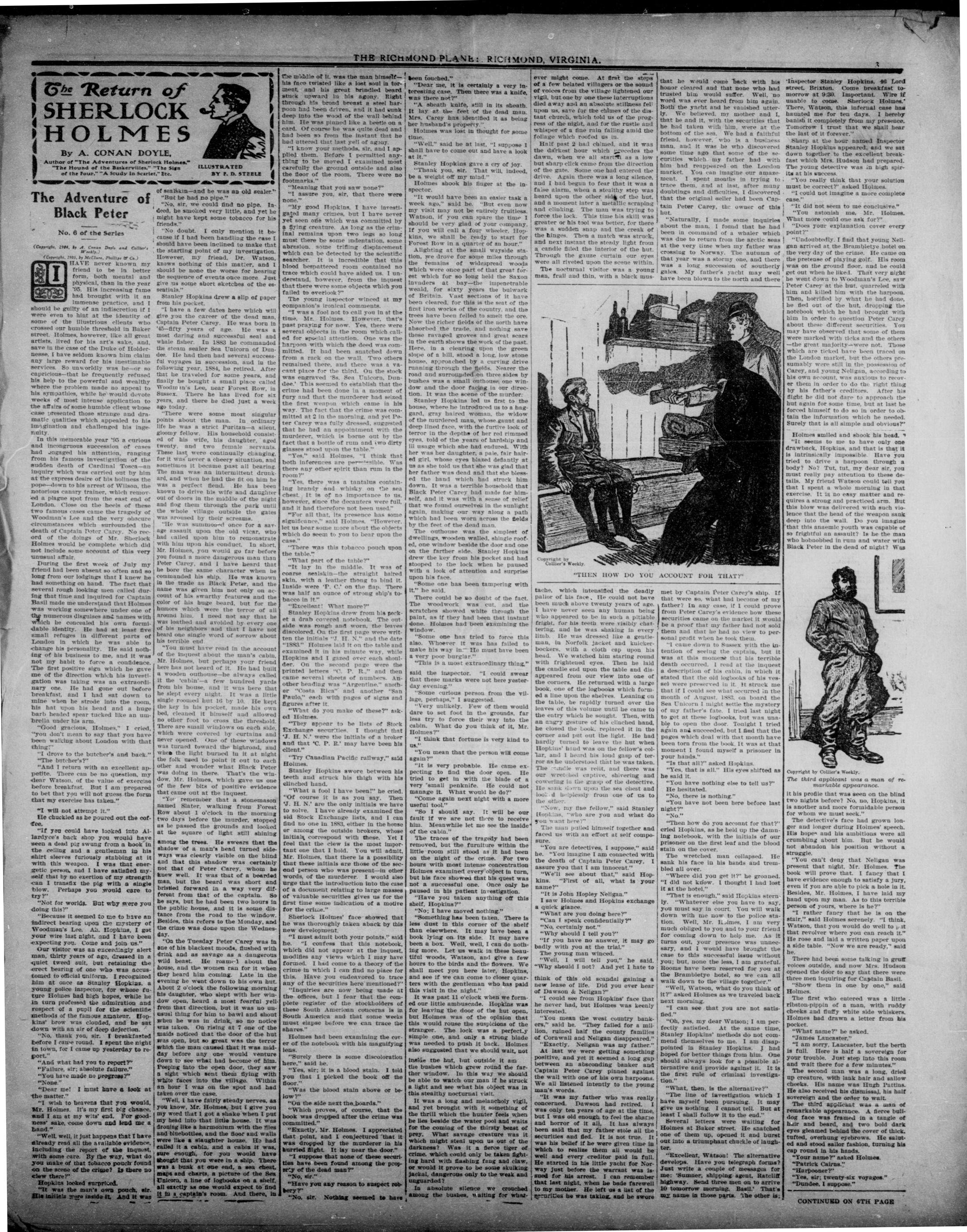
Copyright by
Collier's Weekly.
"THEN HOW DO YOU ACCOUNT FOR THAT?"
ever might come. At first the steps of a few belated villagers or the sound of voices from the village lightened our vigil, but one by one these interruptions died a way and an absolute stillness fell upon us, save for the chimes of the distant church, which told us of the progress of the night, and for the rustle and whisper of a fine rain falling amid the foliage which roofed us in.
Half past 2 had chimed, and it was the dickest hour which precedes the dawn, when we all start; as a low but sharp click came from the direction of the gate. Some one had entered the drive. Again there was a long silence, and I had begun to fear that it was a false alarm, when a stealthy step was heard upon the other side of the hut, and a moment later a metallic scraping and clinking. The man was trying to force the lock. This time his skill was greater or his tool was better, for there was a sudden snap and the creak of the hinges. Then a match was struck, and next instant the steady light from a candle filed the interior of the hut. Through the gauze curtain our eyes were all riveted upon the scene within.
The nocturnal visitor was a young man, frail and thin, with a black mus-
Copyright by
Collier's Weekly.
"THEN HOW DO YOU
tache, which intensified the deadly pallor of his face. He could not have been much above twenty years of age. I have never seen any human being who appeared to be in such a pittable fright, for his teeth were visibly chartering, and he was shaking in every limb. He was dressed like a gentleman, in Norfolk jacket and knickerbockers, with a cloth cap upon his head. We watched him staring round with frightened eyes. Then he laid the candle end upon the table and disappeared from our view into one of the corners. He returned with a large book, one of the logbooks which formed a line upon the shelves. Leaning on the table, he rapidly turned over the leaves of this volume until he came to the entry which he sought. Then, with an angry gesture of his clinched hand, he closed the book, replaced it in the corner and put out the light. He had hardly turned to leave the hut when Hopkins' hand was on the fellow's collar, and I heard his loud gasp of terror as he understood that he was taken. The candle was relit, and there was our wretched captive, shivering and cowering in the grasp of the detective. He sank down upon the sea chest and looked helplessly from one of us to the other.
"Now, my the fellow," said Stanley Hopkins, "who are you and what do you want here?"
The man pulled himself together and faced us with an effort at self composure.
"You are detectives, I suppose," said he. "You imagine I am connected with the death of Captain Peter Carey. I assure you that I am innocent."
"We'll see about that," said Hopkins. "First of all, what is your name?"
"It is John Hopley Nelligan."
I saw Holmes and Hopkins exchange a quick glance.
"What are you doing here?"
"Can I speak confidentially?"
"No, certainly not."
"Why should I tell you?"
"If you have no answer, it may go badly with you at the trial."
The young man winced.
"Well, I will tell you," he said.
"Why should I not? And yet I hate to
think of this old scandal gaining a new lease of life. Did you ever hear of Dawson & Neligan?"
"I could see from Hopkins' face that he never had, but Holmes was keenly interested."
"You mean the west country bankers," said he. "They failed for a million, ruined half the county families of Cornwall and Neligan disappeared."
"Exactly. Neligan was my father."
At last we were getting something positive, and yet it seemed a long gap between an absconding banker and Captain Peter Carey pinned against the wall with one of his harpops. We all listened intently to the young man's words.
"It was my father who was really concerned. Dawson had retired. I was only ten years of age at the time, but I was old enough to feel the sharon and horror of it all. It has always been said that my father stole all the securities and fled. It is not true. It was his belief if he were given time in which to realize them all would be well and every creditor paid in full. He started in his little yacht for Norway just before the warrant was issued for his arrest. I can remember that last night, when he bade farewell to my mother. He left us a list of the securities he was taking, and he swore
that he would come back with his honor cleared and that none who had trusted him would suffer. Well, no word was ever heard from him again. Both the yacht and he vanished utterly. We believed, my mother and I, that he and it, with the securities that he had taken with him, were at the bottom of the sea. We had a faithful friend, however, who is a business man, and it was he who discovered some time ago that some of the securities which my father had with him had reappeared on the London market. You can imagine our amazement. I spent months in trying to trace them, and at last, after many doubtings and difficulties, I discovered that the original seller had been Captain Peter Carey, the owner of this hut.
"Naturally, I made some inquiries about the man. I found that he had been in command of a whaler which was due to return from the arctic seas at the very time when my father was crossing to Norway. The autumn of that year was a stormy one, and there was a long succession of southerly gales. My father's yacht may well have been blown to the north and there
ACCOUNT FOR THAT?
met by Captain Peter Carey's ship. If that were so, what had become of my father? In any case, if I could prove from Peter Carey's evidence how these securities came on the market it would be a proof that my father had not sold them and that he had no view to personal profit when he took them.
"I came down to Sussex with the intention of seeing the captain, but it was at this moment that his terrible death occurred. I read at the inquest a description of his cabin, in which it stated that the old logbooks of his vessel were preserved in it. It struck me that if I could see what occurred in the month of August, 1883, on board the Sea Unicorn I might settle the mystery of my father's fate. I tried last night to get at these logbooks, but was unable to open the door. Tonight I tried again and succeeded, but I had that the pages which deal with that month have been torn from the book. It was at that moment I found myself a prisoner in your hands."
"Is that all?" asked Hopkins.
"Yes, that is all." His eyes shifted as he said it.
"You have nothing else to tell us?"
He hesitated.
"No, there is nothing."
"You have not been here before last night?"
"No."
"Then how do you account for that?" cried Hopkins, as he held up the damming notebook, with the initials of our prisoner on the first leaf and the blood stain on the cover.
The wretched man collapsed. He sank his face in his hands and trembled all over.
"Where did you get it?" he groaned.
"I did not know. I thought I had lost it at the hotel."
"That is enough," said Hopkins sternly. "Whatever else you have to say, you must say in court. You will walk down with me now to the police station. Well, Mr. Holmes, I am very much obliged to you and to your friend for coming down to help me. As it turns out, your presence was unnecessary, and I would have brought the case to this successful issue without you; but, none the less, I am grateful. Rooms have been reserved for you at the Brambletyte hotel, so we can all walk down to the village together."
"Well, Watson, what do you think of it?" asked Holmes as we traveled back next morning.
"I can see that you are not satisfied."
"Oh, yes, my dear Watson; I am perfectly satisfied. At the same time, Stanley Hopkins' methods do not commend themselves to me. I am disappointed in Stanley Hopkins. I had hoped for better things from him. One should always look for a possible alternative and provide against it. It is the first rule of criminal investigation."
"What, then, is the alternative?"
"The line of investigation which I have myself been pursuing. It may give us nothing. I cannot tell. But at least I shall follow it to the end."
Several letters were waiting for Holmes at Baker street. He snatched one of them, opened it and burst out into a triumphant chuckle of laughter.
"Excellent, Watson! The alternative develops. Have you telegraph forms? Just write a couple of messages for me: 'Sumner, shipping agent, Ratcliff highway. Send three men on to arrive 10 tomorrow morning. Basil.' That's my name in those parts. The other is;
"Inspector Stanley Hopkins, 46 Lord Street, Brixton. Come breakfast tomorrow at 9:30. Important. Wire if unable to come. Sherlock Holmes." There, Watson, this infernal case has haunted me for ten days. I hereby banish it completely from my presence. Tomorrow I trust that we shall hear the last of it forever."
Sharp at the hour named Inspector Stanley Hopkins appeared, and we sat down together to the excellent breakfast which Mrs. Hudson had prepared. The young detective was in high spirits at his success.
"You really think that your solution must be correct?" asked Holmes.
"I could not imagine a more complete case."
"It did not seem to me conclusive."
"You astonish me, Mr. Holmes. What more could one ask for?"
"Does your explanation cover every point?"
"Undoubtedly, I find that young Nelligan arrived at the Brambletyte hotel on the very day of the crime. He came on the pretense of playing golf. His room was on the ground floor, and he could get out when he liked. That very night he went down to Woodman's Lee, saw Peter Carey at the hut, quarreled with him and killed him with the harpoon. Then, horrified by what he had done, he fired out of the hut, dropping the notebook which he had brought with him in order to question Peter Carey about these different securities. You may have observed that some of them were marked with ticks and the others—the great majority—were not. Those which are ticked have been traced on the London market, but the others presumably were still in the possession of Carey, and young Nelligan, according to his own account, was anxious to recover them in order to do the right thing by his father's creditors. After his flight he did not dare to approach the hut again for some time, but at last he forced himself to do so in order to obtain the information which he needed. Surely that is all simple and obvious?"
Holmes smiled and shook his head. "It seems to me to have only one drawback, Hopkins, and that is that it is intrinsically impossible. Have you tried to drive a harpoon through a body? No? Tut, tut, my dear sir, you must really pay attention to these details. My friend Watson could tell you that I spent a whole morning in that exercise. It is no easy matter and requires a strong and practiced arm. But this blow was delivered with such violence that the head of the weapon sank deep into the wall. Do you imagine that this anaemic youth was capable of so frightful an assault? Is he the man who hobbled in rum and water with Black Peter in the dead of night? Was
A.
Copyright by Collier's Weekly.
The third applicant was a man of remarkable appearance. it his profile that was seen on the blind two nights before? No, no, Hopkins, it is another and more formidable person for whom we must seek."
The detective's face had grown longer and longer during Holmes' speech. His hopes and his ambitions were all crumbling about him. But he would not abandon his position without a struggle.
"You can't deny that Nelligan was present that night, Mr. Holmes. The book will prove that. I fancy that I have evidence enough to satisfy a jury, even if you are able to pick a hole in it. Besides, Mr. Holmes, I have laid my hand upon my man. As to this terrible person of yours, where is he?"
"I rather fancy that he is on the stair," said Holmes serenely. "I think, Watson, that you would do well to $\gamma$ it that revolver where you can reach it." He rose and a written paper upon a side table. "Now we are ready," said he.
There had been some talking in gruff voices outside, and now Mrs. Hudson opened the door to say that there were three men inquiring for Captain Basil. "Show them in one by one," said Holmes.
The first who entered was a little ribbon-pinipin of a man, with ruddy cheeks and fuffy white side whiskers. Holmes had drawn a letter from his pocket.
"What name?" he asked.
"James Lancaster."
"I am sorry, Lancaster, but the berth is full. Here is half a sovereign for your trouble. Just step into this room and wait there for a few minutes."
The second man was a long, dried up creature, with lank hair and sallow cheeks. His name was Hugh Pattins. He also received his dismissal, his half sovereign and the order to wait.
The third applicant was a man of remarkable appearance. A fierce bulldog face was framed in a tangle of hair and beard, and two bold dark eyes gleamed behind the cover of thick, tufted, overhung eyebrows. He saluted and stood sailor fashion, turning his cap round in his hands.
"Your name?" asked Holmes.
"Patrick Cairns."
"Harpooner?"
"Yes, sir; twenty-six voyages."
"Dundee, I suppose."
CONTINUED ON 6TH PAGE
THE PLANET
JOHN MITCHELL, JR. - EDITOR
All communications intended for publication
should be sent so as to reach us by Wednesday.
TERMS IN ADVANCE
One Copy, one year, $1.50
One Copy, eight months, 1.00
One Copy, six months, .50
One Copy, four months, .50
One Copy, three months, .50
Single Copy .05
ADVERTISING RATES
For one inch, one insertion . . . $ . 20
For one inch, each subsequent insertion . . . $ . 40
For two inches, each subsequent insertion . . . $ . 80
For two inches, six months . . . $ 10.00
For two inches, nine months . . . $ 14.00
For two inches, ten months . . . $ 18.00
Marriage and Funeral Notices, one inch . . . $ 10
Standing and Transient Notices one line . . . $ 10
# POSTAGE STAMPS OF A HIGHER DEFINITION THAN TWO GENTS NOT RECEIVED ON SUBSCRIPTIONS.
The PLANET is issued weekly. The subscription price is $1.50 per year in advance. The money can be sent by mail at our risk—In Post Office Money Order, by Bank Check or Draft, or an Ex-Order, in a Register, none of these can be procured, in a Register, Money Orders. You can buy a Money Order at your Post-Office, payable at the Post Office, and we will be responsible for its safe delivery.
Express Money Orders can be obtained at any office of the American Express Co., the Post Office, or both Go and Oce's Express Company. We will be responsible for money sent by any of these companies. The Express Money Order is a safe deposit box.
REGISTERED LETTER.—If a money Order Post-Office or an Express Office is not within your address, you may send the Letter you wish to send us on payment of ten cents. Then, if the letter is lost or stolen, you can send money in this manner at our desk.
We cannot be responsible for money sent in letters in any other way than one of the four ways mentioned above. If you send your mom a letter in our way, you must do it as your own risk.
RENewALKS, EYE.—If you do not want THE PLANET continued for another year after your subscription has run out, you should affix the Postal Card to discontinue it. The courts have decided that subscribers to newspaper, who do not order their paper discontinued at the expiration date, are hold liable for the payment of the subscription up to date when they order the paper discontinued.
COMMUNICATIONS.—When writing to us to renew your subscription or to discontinue your paper, you should give your name and address to the person otherwise we cannot find your name on our books.
ORANGE OF ADDRESS.—In order to change the address of a subscriber, we must be sent the former as well as the present address.
Entered at the Post-Office at Richmond, Va., as second-class matter.
SATURDAY,.. August 12, 1905.
THE CONVENTION AT ROANOKE.
The Republican Convention at Roanoke this week has seen fit to place a good, strong ticket in the field. If we were assured of a fair count, we would be under the impression that the Republican managers have a good show of carrying the state. The disclosures made here recently demonstrate beyond the shadow of a doubt that all of the old methods of fraud and trickery are now in vogue and that the victims are now white men instead of colored ones.
Judge L. L. Lewis, the Republican nominee for Governor is an ideal candidate, save for his office-holding proclivities and he has rid himself of this handicap by promptly resigning the office of United States District Attorney. The ticket is sufficiently respectable to enlist the support of every disgruntled Democrat in Virginia and to ensure a good, genteel business administration should the majority or plurality of the votes be counted in its favor on the night of election.
It is hardly necessary to refer to the part the colored brother will play in the campaign. He will be a factor left out of the calculations. It may be that it is better so. If both parties believe that the Republicans have a chance of success without the aid, comfort and support of the colored brother, then it is best that this view of the matter be emphasized or discredited.
When the Democratic party of Virginia has named its candidates, we shall have some more to say on this all important subject.
To Duplicate Every Naval Gun.
Washington, Aug. 7.—Every gun in the navy is to have its duplicate to guard against any emergency and accident, if the will of the naval chief of ordinance is carried out. The naval general board approves of this precaution, and the naval estimates to go before the next congress will contain a formidable item to cover the cost of producing the new guns. If this project is sanctioned by congress a vast amount of additional work will be thrown upon the Washington navy yard, where most of the naval guns are made.
Baby Scalded to Death
Bellefontaine, O., Aug. 9.—Missing her 2-year-old baby, Mrs. Wesley Gross residing in Bloomfield township, from her washing and to a bath of scalding water literally cooked.
PEACE ENVOYS OPEN CONFERENCE
Expect to Conclude Treaty of Peace In Five Weeks.
RUSSIA WON'T PAY INDEMNITY
Portsmouth, N. H., Aug. 9. — The Russian and Japanese peace missions have submitted themselves to introduction, and likewise to all of the ceremonies of welcome and reception on the part of the United States government and the state of New Hampshire, and are now facing each other for the purpose of ending the war in the Far East, and if possible consumating a permanent peace between the two great nations.
Demitri Pokotloff, Russian minister to China, arrived here late last night, and was immediately presented to the Russian plenipotentiaries. While coming through Canada one of the cars of Mr. Pokotloff's train jumped the track.
Today they met in the naval stores building of the Portsmouth navy yard. The Russian plenipotentiaries examined the credentials and powers which the emperor of Japan has delegated to Baron Komura and Minister Takahira, and in turn the Japanese plenipotentiaries scrutinized the powers which the Russian emperor had conferred upon Mr. Witte and Baron Rosen.
It is thought that at today's meeting of the peace envoy it may be possible to exchange the fundamental basis on which the representatives of the two belligerent powers may be able to come to an understanding. It is only after an accord on those fundamental bases that an armistice will
MAWITTE
KARAHURA
ROBEN
KOMURA
RUSSIAN AND JAPANESE TRACE ENVOYS,
be considered advantageous by both
parties. On one point the Russian
delegates are instructed not to yield—
that regarding a war indemnity,which,
it was stated, is against the Russian
feeling, against Russian pride and
against the whole history of the country.
The second day's session, to take
place tomorrow or Friday, is is expected,
will be devoted either to a consideration
of the Japanese peace terms,
or to a proposition for an armistice by the Russian plenipotentiaries. It has been estimated that if a basis of negotiation for peace is found, the actual negotiations will consume something like five weeks' time before a treaty can be persecuted and signed.
The landing and reception of the envoys was a function replete with ceremony. The dignity of the nations' salutes was contrasted with the heavy exclamations of good will on the part of the thousands of persons who thronged the streets of Portsmouth and surrounded the court house, where Governor McLane pronounced his cordial words of welcome.
The envoys of both Japan and Russia were much affected by the demonstrations of the American public. Mr. Witte rode through the business section of the town with his tall silk hat raised above his head in constant acknowledgment of salutes. Ambassador Rosen, in the same carriage, was also uncovered in honor of the cheering crowds. In the carriage following were the two Japanese envoys, and they, too, were not remiss in responding to the hurrahs of the crowds.
The envoys were met at the court house by Third Assistant Secretary of State Pierce, who first presented Mr. Witte to Governor McLane, and then Baron Komura. The senior Russian commissioner presented his suite to the chief executive of New Hampshire and the Japanese plenipotentiaries did likewise. Governor McLane's formal speech of welcome was responded to by a profound bow of both parties. At the conclusion of the ceremonies the Russians were arranged on the right of the governor, the Japanese on the left, with Mr. Peirce on the immediate right. The group was then surrounded by the governor's staff and council, and the entire party was photographed.
One of the interesting preliminary questions to be settled by the conference is the language in which the negotiations shall be conducted. Mr. Witte speaks only French and Russian, while Baron Rosen has also a command of English. Both of the Japanese are proficient in the English tongue, but Baron Komura speaks very little French. It is realized that if English shall be chosen as the medium of communication, translations must be made to Mr. Witte. Should French be the language decided upon, translations will have to be made, preferably into English, for the Japanese.
While there are no official statements or predictions regarding the outcome of the forthcoming negotiations, the prevalence of a general good feeling is noticeable throughout the environs of the peace missions.
Count Cassini! Reaches St. Petersburg.
St. Petersburg, Aug. 9.—Count Cassini, the former ambassador of Russia to the United States, has arrived here. He will remain in St. Petersburg during the peace negotiations, as his knowledge of the eastern situation and his familiarity with America particularly fit him to act in an advisory capacity to the government while the negotiations are progressing.
The national assembly project was finally approved at Petrohof, and will be promulgated next Saturday, the anniversary of the birth of Grand Duke Alexis Nikolaievitch, heir to the Russian throne.
CRETAN TOWN DESTROYED
Russian Gunboat Khrabry Bombards
Village of Castell
Canea, Crete, Aug. 8—The Russian gunboat Khrabry has bombarded and destroyed Castelli (on the north coast of the Island of Crete, about 18 miles east of Retimo) because insurgents there opposed the landing of a Russian force to take over the customs house. A boat party, which was sent ashore from the Khrabry, was repulsed, whereupon the Russian commander, after warning the insurgents to remove the women and children, opened fire. The insurgents returned the fire with small arms, wounding two Russians. The bombardment continued until the village hoisted the white flag.
There have been disturbances in Crete for a considerable length of time, the Cretians being in revolt to obtain a greater degree of independence than they now possess. Prince George of Greece is the high commissioner of the island, having been nominated by Great Britain, Russia, France and Italy in 1895. The Porte recently sent a circular note to its representatives in London, Rome, Paris and St. Petersburg on the subject of the revolutionary movement in Crete, expressing the hope that the powers would maintain the status quo and re-establish order in the island.
GENERAL STONE DEAD
Was a Veteran of the Civil and Spanish-American Wars.
New York, Aug. 7.—General Roy Stone, a veteran of the Civil and Spanish American Wars and a distinguished civil engineer, is dead in his 69th year, at his home in Mendham, N. J. He leaves a widow, who was Miss Marker, of Pennsylvania, and one daughter, Lady Monson, wife of Lord Monson, of England. General Stone, who was a native of Steuben county, New York, served in the Civil War in the First Pennsylvania Rifles and the 149th Pennsylvania Infantry, and was breveted brigadier general for gallantry in the peninsula campaign and at Gettysburg, where he was severely wounded. He served as brigadier general and chief of engineers on the staff of General Miles in the Porto Rican campaign.
FATHER OF 26 CHILDREN
Fifteen Boys and Eleven Girls, and All of Them Living.
Haverford, Pa., Aug. 7. —Clem Tuck, a well-known colored resident of Haverford, is certainly a candidate for a Roosevelt medal for raising a large family. Friday morning a girl baby was born at the Tuck household, which marked the 26th child in the family. All of them are alive and well. There are 15 boys and 11 girls, and Tuck has been married four times.
Fortune For Mill Girl.
Utica, N. Y., Aug. 9.—By the will of Thomas Fitzgerald, who died in Los Angeles, Cal., two weeks ago, James and Patrick Fitzgerald, his brothers, and Miss Margaret O'Loughlin, a niece, will receive $100,000 each. All live in Little Falls and are poor. James runs a small grocery, Patrick is a railroad laborer and the girl works in a mill.
When asked if she would keep her job, Miss O'Loughlin smiling announced that she could not see that the possession of a fortune was any reason why she should desert the mill.
Thomas Fitzgerald went west 30 years ago poor. When he died he was half owner of the Los Angeles race track.
Young Man Found Murder
Washington, Pa. Aug. 8—Clair Bain Hamilton, aged 18 years, son of a well-known farmer of Chartiers township, was found dead at an isolated spot near Meadow Lands with a bullet through his heart, fired by some unknown person. Young Hamilton the home of a young lady on whom he was calling, intending to take the last car from Meadow Lands to Houston, his home. While crossing a vacant lot on the way to the car he was shot and fell forward on his face, death evidently coming instantly. The motive for the murder is not known.
Professor Bell's Father Dead.
Washington, Aug. 8. — Alexander Melville Bell, father of Professor Alexander Graham Bell, died at the home of the latter, in the 86th year of his age, from pneumonia, following an operation for diabetes performed last Tuesday. He was born in Scotland, a son of Alexander Bell, and was one of the three generations notable because of their development of the art of instructing the deaf and dumb in methods of communication. The interment will take place tomorrow.
Father of Locomotive Engineers Dead.
Dickinson, Neb., Aug. 9. — Jared C. Thompson, at whose home, in Marshall, Mich., the Brotherhood of Locomotive Engineers had its birth, died here, aged 78 years. In early life he was an engineer on the Michigan Central, and it was while thus engaged that he and others formed the Brotherhood. He was postmaster here at the time of his death.
"Many Clowns in the Pulpit."
Chautauqua, N. Y., Aug. 9. — Dr. James M. Buckley, chairman of the Episcopal committee of the Methodist Episcopal Church, declared, in an address, that a clergyman has no right to make his congregation laugh, and that to do so is irreverence. "Yet there are a good many clowns in the pulpit." he concluded.
RICHMOND PLANET, RICHMOND, VIRGINIA
YELLOW FEVER STILL SPREADING
More Than Six Hundred Cases and One Hundred Deaths to Data
MAY CALL OUT STATE MILITIA
New Orleans, Aug. 9—Following is the corrected record (official) up to 6 o'clock last night: New cases, 60; total cases to date, 615; deaths, 4; total deaths, 112; new sub-foci, 17; total sub-foci, 118.
These figures vary slightly from those that have been sent out later, but are the official record which was today checked up and recorded to date. The large number of new cases and sub-foci is surprising, but no attempt is being made to account for it. Of the new sub-foci three are uptown and the balance downtown.
Two dead men were found in a shanty in the woods, and it was found that they had died of yellow fever. They were Italians, who had died from lack of attention.
Archbishop Chapelle has passed the crisis in his illness, and is now regarded as on the road to recovery.
If the present chaotic condition of quarantine matters in Louisiana is not speedily terminated, in obedience to the procalamation issued, the state board of health has announced its intention of immediately invoking the civil powers, and, that failing, of asking Governor Blanchard to call out the militia to restore and keep order.
The proclamation resulted from the letters sent by the governor to President Souchon, of the state board of health. The proclamation prohibits any town, parish or village from refusing admission to a person from a non-infested locality holding a health certificate not over 24 hours old, or to a person from an infected locality who has spent six days in a detention camp and has been discharged with a marine hospital certificate. Interference with the passage of steamboats or trains is forbidden unless they violate legal quarantine regulations. No mail, freight or express matter shall, under the proclamation, be refused from infected territory, provided it is carried in cars which have been fumigated by the marine hospital service. All persons who disregard these regulations are warned that they make themselves liable to answer in the courts. It is announced that no more illegal restrictions on travel will be tolerated
Surgeon White put in a hard half-day's work here, and in the afternoon took a train for Lafayette, La. to attend a conference of various health boards in that section of the state, called with a view to securing an amelioration of quarantine regulations. Dr. White expects that by tonight all of the additional health officers which the government has ordered to New Orleans will be here. Today is the day set for the general street cleaning movement. There is a pretty general suspension of business; all of the merchants have volunteered to lend their carts and wagons and employees to assist in the work.
The difficulties the authorities encounter in trying to get at conceded cases was illustrated when Police Officer T. E. Gregson was, perhaps, fatally injured while trying to break into a house where there was known to be a case of yellow fever. Gregson was called on to assist the authorities. So stubborn was the opposition of the people at the house in Chartres street against invasion by the inspectors that it became necessary to break in, with the result that a heavy oaken door fell on Gregson and crushed him.
The state board of health by resolution called on Governor Blanchard for troops to protect trains and traffic from local quarantines which have cut trans-continental systems in two.
Other Places Where Fever Exists
Other Places Where Fever Exists.
Washington, Aug. 9.—In a report issued by the public health and marine hospital service it is announced that in North America outside the United States, according to notifications received during the month of July, yellow fever has been reported in Tehuantepec, Vera Cruz, Coatzacoalcos and Tierra Blanca, Mexico; Puerto Cortez, San Pedro and Choloma, Honduras; Bellize, British Honduras; Livingston, Guatemala, and Panama, Colon, LaBoca, Corozal, Empire and Paraiso, Republic of Panama.
"San Pedro," the report says, "is the only one of these places in which an extensive prevalence is recorded. In South America reports received since July 1 show the continued presence of the disease in Maracalco, Venezuela; Guayaquil, Ecuador and Rio Janeiro, the latest reports indicating 85 cases, with 11 deaths, between May 27 and June 11 at Rio Janeiro. July reports from outside the Western Hemisphere do not indicate the presence of yellow fever elsewhere than in Senegal, Africa and Santa Cruz, de Tenerife."
New Bremen Line Soon
Philadelphia, Aug. 9. — The new freight and passenger steamship line between Philadelphia and Bremen, to be established by the North German Lloyd Company, will probably be running by the middle of September. It is said that four large steamships will be used, and that the service will be semi-monthly. The pier will be at 22 South Wharves.
J. N. Hill Heads Northern Pacific.
New York, Aug. 9. — It was announced at the office of the Northern Pacific Railway Company in this city that J. N. Hill, son of James J. Hill, had been elected vice president of the Northern Pacific Railway Company to succeed the late Daniel S. Lamont.
Colonel Lamont Left $3,300,000 Estate.
New York, Aug. 3—An estate valued at $3,300,000 is left by the late Colonel Daniel S. Lamont, secretary of war under President Cleveland, according to Mr. Lamont's will filed for probate. Mrs. Lamont and three daughters are the beneficiaries. The estate is valued at $3,000,000 in personal property, and $300,000 in real property.
MANY KILLED IN STORE'S COLLAPSE
Men, Women, and Children Caught In Wreckage of Albany Store.
WORKMEN CUT AWAY SUPPORTS
Albany, N. Y., Aug. 9—The middle section of the big department store of the John G. Myers Company, in North Pearl street, collapsed, carrying down with it over 100 persons. Caught in a chaos of brick, plaster and wooden beams, between 20 and 30 men, women and children met death. Twelve hours' frantic work on the part of an army of rescuers disentangled 50 people, six of them dead and many of the rest badly injured. Three bodies were in sight at late hour last night, but many hours' work will be required to get them out. Anything like a complete list of the killed and injured will be unobtainable until the workers have made their way to the very bottom of the mass of wreckage. With few exceptions, those caught in the ruin were employees, a large majority of them girls.
The catastrophe occurred shortly after the opening hour, when barely a score of shoppers were in the store. A clock found in the debris had stopped at 12 minutes before 9, showing when the crash came. The best account of the event that probably caused the ruin is given by the head of the crockery, glass and drug department, which occupies the basement.
"The workmen were sawing at a wooden floor beam," said he, "which runs underneath one of the central pillars in the middle of the store. Excavation for the cellar was going on about the base of this pillar, and I believe that jarring of the beam beneath it displaced the foundation of the pillar. The first thing I knew, two of the counters near the place where the men were working began to sag, and several pieces of glassware slid off onto the floor with a crash. I yelled to my clerks to run for the front of the store. The words were not out of my mouth when there came a creaking, and everything around us began to fall. The wreck came slowly, however, and I think every one in my department escaped, as well as the workmen."
The pillar which gave way supported the ends of two giant girders, and when it fell the main support of the central part of the building was gone. With a noise that could be heard blocks away and which shook the adjoining buildings, nearly half the great structure, from cellar to roof, and extending from one side wall to the other, came grinding down. Into this cavern slid scores of employees who were working on the four floors above, and lacked the warning which enabled those in the basement to escape. Some, however, were apprised of the danger by falling plaster, and saved themselves by rushing to the front of the store or to the fire escape in the rear.
Clouds of dust which shot out of the front entrance caused those outside to believe that the store was afire, and a fire alarm was immediately turned in. When the fire department arrived they had plenty to do in rescuing those who were plundered on the top wreckage. They were joined by scores of volunteer rescuers, and within an hour 15 or 20 persons were carried out, none of them fatally injured.
The volunteer rescuers and the firemen continued the work until exhausted, when their places were taken by a wrecking force, numbering 500 men from the New York Central and Delaware and Hudson Railroads. These delived in the ruins all night, but the work of rescue progressed slowly. When darkness came it was estimated that nearly 50 persons still remained in the ruins, and that not more than half of those could survive the weight pressing upon them. Fortunately the wreckage did not take fire. Some 100 persons are still unaccounted for, but 50 of these are cash boys, of which the firm has no record. In all, the company has 400 employees, but 50 of these are away on vacations.
The building which collapsed stands in the heart of the shopping district at Nos. 29 and 41 North Pearl street. It is owned partly by the company and partly by the estate of the late David Orr. The loss to the company is estimated at between $200,000 and $300,000. The building was a very old one, but until now considered perfectly sound. Extensive repairs were under way when the catastrophe took place. After the death of its founder, John G. Myers, two years ago, the business was conducted by a company, consisting of George P. Hilton, H. King Sturdee, Edward F. Hackett and Robert M. Chalmers. Mr. Chalmers was taken from the ruins with slight injuries. About a month ago the firm was incorporated as a stock company.
A WEEK'S NEWS CONDENSED.
The bank at Royal, Ill., was broken open, and robbed of $4000, the thieves making their escape.
Andrew Wylie, formerly a justice of the supreme court of the District of Columbia, died in Washington.
Miss Romaine, a school teacher of Newark, N. J., died suddenly of apoplexy while driving near Middletown, N. J.
Kicked and trampled by a horse he was about to buy at Womelsdorf, Pa. Charles Brown, a farmer, died of his injuries.
Mrs. William Bramm, of Harrisburg, died of heart failure caused by seeing a boy run over and injured by an automobile.
Friday, August 4.
Tuesday, August 4
Caleb C. Willard, owner of the Ebbitt House, Washington, D. C., died at an Atlantic City hotel.
The Warren paper mills at Raubstown, near Easton, Pa., were damaged by fire to the extent of $50,000.
B. F. McGehee, president of the Columbus Paper company, committed suicide at Columbus, Ga., by shooting.
James McKettrick, 80 ears old.
farmer of Somerdale, N. J., was struck by a railroad train while driving across the tracks and killed.
A dying cork from a bottle of root beer she was opening struck Bessie Bailey, a 15-year-old Atlantic City, N. J., girl, in the eye, totally destroying the sight.
Saturday, August 5.
John Laughlin, one of the best known lawyers of Buffalo, N. Y., died suddenly of heart failure.
Windfield S. Wilson, president of the Philadelphia, Germantown & Norristown railroad, died of heart disease at New Centreville, Pa.
Charged with swindling merchants of 21 cities out of thousands of dollars by raised money orders, Norman E. Roberts is under arrest in Chicago.
Captain Edward Lloyd, of the 15th Infantry, has been appointed professor of military science and tactics at the Maryland Agricultural College, at College Park, Md.
The District of Columbia grand jury investigating the statistical bureau of the agricultural department, took a recess until August 15, when the inquiry will be resumed.
Monday, August 7.
William R. Russell, the new American minister to Venezuela, sailed from New York for his post.
William Fife, designer of the two Lipton cup challenging yachts, has arrived in New York from Liverpool.
Two Chinese men were killed in a pistol fight between rival Chinese societies in a Chinese theatre in New York city.
Christopher Steinhauser, a soldier just returned from the Philippines, was drugged and robbed of $200 at Harrisburg, Pa.
Captain Evan P. Howell, formerly proprietor of the Atlanta Constitution, died in Atlanta, Ga., after a short illness, aged 65.
Tuesday, August 8.
The International Brotherhood of Teamsters began their annual convention in Odd Fellows' Temple, Philadelphia. Lightning split the foremast of the British steamer Heathburn, from Ilioio, while at anchor in the Delaware Breakwater. Jealous of his sweetheart, Maud Shaffer, Harvey Colvin shot her and then committed suicide at New Philadelphia. O. She may recover. President Schurman of Cornell, has received a diploma making him a life member of the American Academy at Rome, established for the advancemen of the fine arts. Wednesday, August 9. Postmaster General Cortelyou has gone to Long island on his annual vacation. Charged with robbing the Darlington, Ind. Bank of $5000, Harry Haas was caught at Fruitdale, Miss.
Willard Merrill, for years vice president of the Northwestern Mutual Life Insurance Company, died at Pasadena, Cal.
The Republican state convention met at Roanoke, Va., to nominate a full state ticket, with nearly 1300 delegates in attendance.
James Mitchell shot and instantly killed Mrs. Linnie Rankin at Grafton, Vt., and then sent a bullet into his own brain. He is not expected to live.
PRODUCE QUOTATIONS
The Latest Closing Prices In the Principal Markets
PHILADELPHIA — FLOUR steady;
winter extras, $3.25@3.50; Pennsylvania roller, clear, $3.75@3.90; city mills, fancy, $8.00@8.90; city bales, $10.00@10.00; No. 2 Pennsylvania vina red, new, $4.12@CORN firm; No. 2 yellow, local, $6@4c; OATS steady; No. 2 white clipped, $6c; lower grades, $4c; HAY firm; timothy, large bales, $4c; PORK firm; bales, $4c; beef hams, $23@24; Poultry: Live steady; hens, 15c; old roosters, $9.2c; Dressed firm; choice fowls, 15c; old roosters, $9.2c; BUTTER firm; creamy, 23c per pound. EGGS steady; New York and Pennsylvania, new per bushel, $9@1$
BALTIMORE—WHEAT steady; No. 2 red, 85%lc; steamer No. 2 spot; 77c; do. now 63%lc; CORN quiet; 75%lc; do. now 63%lc; 51%c; southern, 80%c; 65%c; OATS firm; white No. 2, 37%lc; No. 3, 35%lc @ 37c; No. 4, 35%lc @ 35c; mixed, No. 2, 35%lc; No. 4, 35%lc @ 34%c; No. 3, 34%lc @ 34%c; BUTTER steady; steamer extras, 21%lc @ 21%c; held, 16@18c; prints, 20@23c; Maryland and Pennsylvania dairy prints, 14c EGGS firm; fancy Maryland Pennsylvania and southern, 17%lc; 16%lc; per dozen
Live Stock Markets
PITTSBURG (Union Stock Yards)—CATTLE higher; choice, $5.50@5.65; prime, $5.25@5.50. HOGS active; prime heavy, $6.25; medium, $6.40; heavy Yorkers, $6.40@6.45; light Yorkers, $6.40@6.50; pigs, $6.15@6.25; roughs, $4.50@6.25; SHIER active; prime methers, $5.25@5.40; common, $2@3; spring lambs, $4.50@6.75; veal calves, $6.50@7.
Lancaster, Pa., Treasurer, Robbed, Lancaster, Pa., Aug. 8.—While City Treasurer E. M. Kauffman's back was turned a thief slipped into his office in city hall and stole a box containing $4775.76 from the safe, which was unlocked. William Kirchoff and John Parker, employees of the garbage department, have been arrested on auspicion.
Anatomical Congress In Session. Geneva, Switzerland, Aug. 7. America is well represented at the first international anatomical congress, which opened here. Altogether 260 delegates are present from different parts of the world. The congress will conclude on August 10 with a banquet given by the city to the delegates.
LITTLE FINGER ONLY WAS LEFT
Brick-Making Clay Machine Grinds Up Live Man.
Phoenixville, Pa., Aug. 7.—A peculiar noise from a slag-mixing machine at the Montello Brick Company's works, Perklomen, led to an investigation, which revealed the fact that the machine was grinding to powder the bones of Howard Yocum, of Raiin's Station, aged 30, the man who a short time before was operating it.
How Yocum happened to fall into the slag-mixing pit is a mystery, as he was alone at the time. His body was literally ground to pieces, kneaded and mixed with the red clay of which the bricks were being made. Nothing but one of the unfortunate man's little fingers could be found.
BERMUZEZ ASPHALT CO. LOSES
Venezuela's Federal Court Annuls So-called Hamilton Concessions.
Oyster Bay, N. Y., Aug. S.—President Roosevelt has been informed, through the department of state, that the federal court of Venezuela has rendered a decision against the Bermudez Asphalt Company in the case involving the so-called Hamilton concession, enabling the concession.
What action may be taken by this government regarding the matter cannot be announced at this time, in fact, so far as can be ascertained here, no determination of the question has been reached. It is quite probable that nothing will be done until Secretary Root, who now is on a vacation in Labrador, shall have returned to the United States, and considered the subject with the president in the light of the report which will be made by Judge W. J. Calhoun of his investigation of the entire asphalt matter.
HOLLAND'S NEW CABINET
Professor G. A. Van Hamel la Made
Premier and Minister of Justice
Premier and w. of Justice
The Hague, Aug. 8.—A new cabinet was formed under the premiership of G. A. Van Hamel, professor of philosophy at the University of Amsterdam, Jonkheer R. de Marces Van Swinden, minister at Washington, was appointed minister of foreign affairs, Premier Van Hamel also takes the portfolio of minister of justice.
Other members of the cabinet are: Minister of the interior, Deputy Rink; minister of finance, Herr Dececer; vice president of the council of the East Indies and minister of maries, Captain Cohen Stuart; minister of war, General Staal; minister of public works, trade and industry, Herr Krans; director of the technical university and minister of agriculture and labor, Herr VeVegons; minister of the colonies, Deputy Fock.
$500.000 FIRE IN HOBOKEN
Terminal of Delaware, Lackawanna and Western Destroyed
New York, Aug. 5.—A spectacular fire late last night on the pliers of the Delaware, Lackawanna and Western railroad, in Hoboken, destroyed the depot, with its 600 feet of train sheds, the ferry house, a hotel known as Duke's House, the terminal of the street railway, a new immigrant station, burned two ferryboats and for half an hour or more threatened the docks of the North German Lloyd and Hamburg-American lines.
The loss is estimated at about $500,000. No lives were lost and only one fireman was seriously injured so far as known.
The Binghamton, one of the boats destroyed, was one of the fastest ferryboats in the world.
Hardly Explicit
The bride, while on her honeymoon,
wrote home to her father, saying that
they "had a lovely row every morning
before breakfast."
Her father, who evidently had lively
recollections of his own experiences,
wrote in reply:
"How do you pronounce r-o-w?"—
Cassell's.
Wouldn't Keep It.
"Don't you know his money's tainted?"
"It is?"
"Yes, he made it by questionable methods."
"I won't keep it."
"That's right. You'll give it back."
"No, I'll spend it."—Cleveland Plain Dealer.
The Ins and Outs
"Where is Mr. Byersell?" asked the caller at the broker's office. "I think," said the bright clerk, "he's out on a little matter of corn." "Out long?" "Of course not. If he had been long he would have been in; it's because he was short that he's out."—Philadelphia Press.
Advice
"You have made me so happy," said the young man when the girl's father had given his consent, "that I feel as if I could walk on air."
"That's good. But don't go and forget now that you'll not be able to live on that sort of thing."—Chicago Record-Herald.
Proof Positive
Kerwin—I'm afraid our friend Snodgrass is losing his mind.
Parker—What reason have you for thinking such is the case?
Kerwin—I loaned him $10 and a new alk umbrella the other day and he returned them both—Cincinnati Enquirer.
Wished No Tainted Wealth
"I hope you won't spend that penny for rum," said the charitable old lady.
"Madam, I won't." responded Tiflins, "Dat is, not unless I finds de money is tainted on account of yer bein' a trust stock owner."—Chicago Sun.
Tough.
He figured on the price of meat, And signed: "My coin they lay for." This steak, also, tought to eat And also to pay for."
—Washington Star
Miss Spynster has some one at her feet at last.—Washington Star.
THE PLANET
TEMPERANCE
TRAINING FOR EFFICIENCY.
Prof. Andrew D. White on the Question of Total Abstinence Versus Moderate Drinking.
There is less drinking in our preparatory schools and colleges, we believe, than a generation ago; certainly there is less tolerance of drunkenness. But there is also a tendency to condone or approve of drinking usages as a part of the harmless freedom of youth. It may be well, therefore, to quote the deliberate opinion of one of the greatest of our university founders and presidents on the subject of total abstinence and moderate drinking. Ex-President Andrew D. White, in his autobiography, after expressing disapproval of certain methods of the recent temperance movement, adds: "My advice to all men is to drink nothing but water. That is certainly the wisest way for nine men out of ten—and probably for all ten. Indeed, one reason why the great body of our people accomplish so much more in a given time than those of any other country, and why the average American working man catches on" and "gits that more certainly and quickly than a man of the same sort in any other country (and careful comparison between various other countries and our own has shown that this" the case), is that a much larger proportion of our people do not stupefy themselves with stimulants." Our present interest in this utterance is in its bearing on home training. Parents feel acutely that they must study the future efficiency of their children, for the struggle of competition crowds harder and harder, and the penalties of inefficiency worse and worse. Those who teach by precept and—more important still—by example, the value of total abstinence as a rule of life in their own homes are doing much toward the success of their children. And this is especially true in cases, unhappily too common, where there is a hereditary talut of intemperance which may play its part in the natural strength or weakness of the young man's will and appetite.—Congregationalist.
READ AND REFLECT
A glass of Prevention is better than a barrel of Cure.
There is not a medical or chemical authority in the world that does not pronounce alcohol one of the deadliest known polenss. If you are stronger for drinking, it is excitation for the moment. Stimulant, from stimulus, "a spur or a goad," seemingly gives new strength, but it uses up the reserve forces, which God gave us for the emergencies of life.—Dr. Madison C. Peters.
The English lunacy commissioner's report shows that nebriety is stated as the cause of insanity from 8 to 50 per cent, of all persons admitted. In some sections alcohol is used more freely than in others. There the percentage of insanity from this cause is greater. There is, something very significant in these figures.—Journal of nebriety.
That drink does not help men to endure continued cold we have the testimony of, Dr. Hayes, the Aretie explorer, who did not use alcohol, and would not take any man with him who did. That it does not help riven to endure great heat we have this testimony of Livingstone, the African explorer, who said: "The most severe labors and privations may be undergone without alcoholic stimulants, because those of us who endured the most had nothing else than water, and not always enough of that."
A Mighty Temperance Weapon.
In commenting upon the reports of life assurance societies, sower the great advantages of abstainers over non-abstainers, the Christian Century says:
"This argument will be more militant than sentimental, and its appeal cannot be accused of doctrinarism, or pooch-pooched as merely moral theory. The manner in which the industrial world is recognizing that a man must be a total abstainer to be efficient is a mighty weapon in the arm of the cause. The growing drinking customs of this country arise from the great influx of foreign peoples, who know no other custom, and it is fortunate that this powerful counteractent comes so timely. It is a long step from the time when a man who did not drink was charged with an extra rate for his insurance."
Good Place for Glasses
Mr. Carnegie was the guest of honor at a dinner at Philadelphia, and before its close a few of the guests noticed that his wine glass remained untouched. At last, just as the dinner was about to end, one of the more inquisitive persons present said:
"I beg your pardon, Mr. Carnegie, but I noticed you had not touched your wine. I did not know you were a total abstainer."
"No?" Mr. Carnegie remarked with a smile. "Well, you know glasses are used both over and under the nose. I always use mine over."—Dial of Progress.
Dear Innocent Thing.
Mrs. Wise—Is your husband still keeping his promise to abstain from drinking?
Mrs. Newlwed—O! yes, faithfully.
Mrs. Wise—Are you sure? It's pretty hard for a man to resist the temptation.
Mrs. Newliwed—But he's found a substitute. His breath always smells of cloves now, and he tells me he eats them whenever he feels tempted to take a drink—Philadelphia Press.
A WARNING MESSAGE.
The Influence and Consequent Responsibility of Young Women on the Drink Habit.
In a recent article Rev. Dr. Madison C. Peters writes as follows:
To you, young women, I have this day the brief but emphatic message: There is little hope of keeping men in the path of sobriety unless you reform and give your best influence to temperance. If you hand the drink to the young man he will not refuse to take it. If your lips first touch the glass he will be sure to drain it. If you evidently think young men better company when their tongues are loosened by wine and join in the laugh when they tell you of their follies, ministers may as well stop their preaching unless they can go a step further back and begin at the right place.
Your influence and consequent responsibility is very great. That influence is often thrown on the side of intemperance simply because the woman does not think of it at all.
Every woman whose manners are at all attractive is exerting an influence it is almost impossible to estimate. Woman fixes the standard of morality, above which few men care to rise. What satisfies woman's perception of virtue is sure to meet with man's approval.
If she takes a drink, he will enter into dissipation. If she laughs at temperance, he will regard/drunkenness as a pardonable fault. Men seldom ever rise above the standard of morality which women hold before us. Woman is the lawgiver, man is the subject. The only hope for the cause of temperance is to keep woman in the advance guard. Let her point the way, lead it by her example of total abstinence, and the right progress is secured.
BEER DRINKING.
What Two of the Leading Professors in the German Universities Say About It.
"This I can affirm, that in Germany, Switzerland and Austria; yes, and in France, a large part of the intellectual power of our academic youth is actually drowned in beer, wine and absinthe. The ridiculous drink compulsion and idiotic vialgory at the drinking festivals German students have introduced are undoubtedly the most hideous deformity in our civilized country. At the same time they are a revelation of the mental deficiency than which they could hardly have invented one more silly.
"They call it jovial. Yes, a pretty joviality, with its accompaniment of palsied tongues, staggering, fighting, vomiting and the 'katzenjammer,' in which the most colossal imbecility is applauded, and the most vulgar beast-liness and misdemeanors are excused and glossed over.
"Gentlemen, I believe there is only one way to work out of our academic degradation. By organizing total abstinence societies among the students."
—Prof. August Forel.
"Although of all nations the German has the greatest capacity for culture, the general culture of the highest classes is undergoing frightful retrogression because of the beer consumption. The student youth is afforded neither time nor sobriety for what is demanded by the advanced requirements to prepare for professional life."
—Prof. Von Hartman
TO THE POINT
The way to remove the evil of degenerate children is to quit making degenerate parents through the rum traffic.—National Advocate.
Five of six little children of Gustave Nelson, of Harvey, have been cast on the public for support. Judge Mack decided their futures recently, when he divided the children among four institutions. Mrs. Martha Nelson, mother of the children, said her husband was a drunkard, and that she had to work from five o'clock in the morning till eight at night. She was allowed to keep her youngest child.
The first effect of drink is an increase in the force and rapidity of the heart's contractions. The normal condition of the heart is something like 100,000 strokes a day, but an abnormal condition by the use of drink increases the heart's activity about 25,000 strokes a day. This extra labor is wearing upon the heart, and this undue excitement of the heart is felt in the morning headache, and terrific thirst after night's "drunk." Alcohol kept the heart pumping all night, when it should have been resting.—Dr. Madison C. Peters.
An Amazing Waste
The people of England spent last year for intoxicating liquors, in round numbers, $840,000,000, a larger sum than they spent for meats of all kinds, fish, potatoes, tea, coffee and sugar. On an average the drink cost of each family of five persons was nearly $100. This stands for an amazing waste not only of money but of vital forces of the nation. The encouraging side of this dark picture is the fact that the amount expended has been decreasing steadily for the last five years and was ten per cent. less in 1904 than in 1899. A tailing off of £17,000,000 in five years is a fine sign of social betterment in a land which has been dreadfully cursed by the appetite of its people for intoxicants.
LESSONS FROM THE WAR.
The Results of Long-Continued Ex-
That chronic alcoholism among the Russians may explain, in part, at least, some of the results of the war in Manchuria, is the editorial opinion of American Medicine. Says this paper: "On the Japanese side the reports are all of one tenor, and depict an almost universal abstinence. What drinking is done is in extreme moderation. Upon the Russian side we hear of immense
THE RICHMOND PLANET, RICHMOND, VIRGINIA
stores of vodka champagne by carload lots, and orgain irrational. The Russian office is rotational, by general report of course for the large quantities of alcohol he daily consumes, and it is impossible for any brain to submit to such insults without undergoing the changes long known to take place in heavy drinkers. It is not remarkable then that the older officers, who are managing the campaign, are constantly outwitted by the healthy-minded Japanese. It is apparently not so much a question of drunkenness as it is one of the pathologic results of long-continued excessive drinking without drunkenness. The alcoholic lesson of the Japanese war will no doubt be appreciated by the American people, who are particularly sensitive to such matters. They will take it to heart and will speak in no uncertain terms when they learn how dangerous to the nation's weafire it is to trust military power to a chronic alcoholic. Particularly in isolated places are the false ideas, perverted reasoning powers and enfeebled judgment of such men sure to bring disaster when coupled with arbitrary authority. The universal condemnation showered upon the president for the promptness with which he dealt with the incompetence (in the Panama commission, though it had no possible relation to alcoholism, shows how the people think on the subject of obtaining vigorous-minded public servants, and like commendation will follow any efforts to rid the government services of the old alcoholics. Should any such incompetents be retained in any place to hamper or destroy efficiency, such as they have done in Manchuria, there is apt to be complaint from an indignant people."
A FEW FACTS
Sir Frederick Threves, surgeon to King Edward, condemned alcohol in a recent address, declared it to be distinctly a poison, and always an injury to the worker.
Terre Haute, Brazil and Columbus, Ind., have availed themselves of the new law giving town councils the privilege of restricting the saloons to the business districts. Each of the above named cities has city limits prohibiting the saloon in the residence district.
Intoxication means poisoning; the condition of drunkenness in all its stages is one of poisoning. It irritates, but does not strengthen. It makes you run in debt to nature. It strengthens as the whip strengthens the horse—Dr. Madison C. Peters.
The Watchman explains the Japanese method of breeding dwarf dogs. They take puppies when young from the mothers and feed them on an alcoholic diet instead of milk. By interbreeding two or three generations the midgds result. Cats may be dwarfed the same way, and also boys.
Scientific temperance has been taught for many years in the greater part of the United States. Since Georgia last year came into line with the other states of the union in the matter, this teaching is now universal here. It is also given in Canada and a Canadian lady stated not long since that the instruction is very thorough, and that she believed it is principally due to this teaching that Canada stands as it does at the bottom of the list of countries in the matter of the consumption of alcohol.—Ram's Horn.
Greater Sobriety Demand
It has been said that "every railway company is a temperance society." This is perhaps inaccurate, but the trend in the modern industrial world is decidedly in the direction of greater sobriety. Mr. H. N. Pringle has the following interesting article in the Christian Civic League Record:
"Last November 19 a wreck train collided with a Big Fight freight near Fremont, O., killing 28 men out of 35 on the wreck train. George Smith, one of the workmen who escaped death, testified that liquor caused the wreck. About two months before the accident at Fremont, an in engineer got drunk on circus cav at Rouse Point, and the next day while on duty went through a drawbridge with his freight train sacrificing his freeman's life with his own."
Responsibility of Druggists
The legislature of New Jersey has passed a law making it a serious penalty to give, sell or furnish cocaine in any form as a patent or proprietary remedy, except by a practicing physician or dentist. It also forbids the sale of cocaine to anyone known to be a habitual user of it. The same legislature forbids the marriage of epileptic, insane or feeble-minded persons, under severe penalties. A curious question was raised whether a druggist was not responsible for the persistent sale of cocaine to one who was known to be a habitual user. One authority held that cocaine, being a poison with a like effect to that of alcohol, would render the seller who knowingly and willfully furnished it to the customer responsible.
PRIEST A BURNT OFFERING
Mexican Fanatic Sacrifices Himself on the Altar for Sins of His Parishioners.
Houston, Tex.—An almost unparalleled instance of religious fanaticism is reported in a dispatch from Guadalajara, Mexico. In atouement for the sins of his parishioners, Apilino Osorio, the priest at Caule, offered himself as a burnt offering at the altar of his sanctuary.
After having summoned the members of his congregation to the cathedral, he stood before them, and, with hundreds watching, applied a flaming torch to his vestments, saturated with oil.
Standing in a pillar of fire, he threatened with the wrath of God any who might approach, and finally sank to the stone flagging, where his body was burned to a heap of ashes. Even the bones crumbled, and, according to the details, as given, the dust was dissipated in a sudden gush of wind that swept through the edifice.
Osorio is supposed to have become unbalanced mentally from constant theological study and unsparing work among the poor. He personally summoned the Mexicans to the cathedral, walking from house to house and giving his blessing at each house. Before dying he explained the nature of his human sacrifice.
BEER AS A SUBSTITUTE.
A Theory That Is Entirely Without Confirmation from Any Scientific or Physiological Standpoint.
For some years past a decided inclination has been apparent all over the country to give up the use of strong alcoholic drinks, using beer as a substitute. This is evidently founded on the idea that beer is not harmful and contains a large amount of nutriment; also, that bitters may have some remedial quality which will neutralize the alcohol it conceals, etc. Those theories are without confirmation in the observation of physicians and chemists. The use of beer is found to produce a species of degeneration of the entire organization, profound and deceptive. Fatty deposits, diminished circulation, perversion of functional activities, local infirmations of both the liver and the kidneys are constantly present. Intellectually, a stupor amounting almost to paralysis arrests the reason, changing all the higher faculties into mere animalism, sensual, selfish, sluggish. In appearance the beer drinker may be the picture of health, but in reality he is most incapable of resisting disease. A slight injury or a severe cold will commonly provoke acute disease. The beer drinker is generally diseased and very incurable. The constant use of beer every day gives the system no recuperation, but steadily lowers the vital forces.
It is asserted by competent authority that the evils of heredity are very positive in beer drinkers. Public sentiment and legislation should comprehend that the use of all forms of alcohol are dangerous.—Scientific American.
A GOOD EXAMPLE.
Set by Chicago & Alton Railroad Officials in Carrying Out Their Temperance Rules for Employees.
The Chicago & Alton railroad has adopted a set of rules for employees that forbids them from visiting race tracks, dance halls or any resort where liquor is sold or gambling permitted. It has done this on the theory that efficient service from its employees can come only as a result of steady and sober habits. The railroads of the country for many years have enforced strict rules against drinking and have thus taught a powerful temperance lesson. The Chicago & Alton now goes a step further and will try to enforce stability in other needed lines.
But the Chicago & Alton adds the virtue of consistency to its order for its working men. It urges upon its officials that by way of example to its employees they refrain from carrying intoxicating liquors on their private cars or entering saloons along the line of the road. Consistency in the teacher doubles the weight of his argument, and the officials are wise if they will but follow their new rule. An adherence to this rule is bound to command the respect of those lower down in the company's employ. When all the great employers of men will adopt and enforce such rules as those laid down by the Chicago & Alton road, the temperance question will no longer be a matter of worry.—American Issue.
POINTED PARAGRAPHS
There are 26,000 drinking places in Ireland, or one for every 170 of the people.
An applicant for a saloon license in Connecticut must declare in his application to the board of commissioners that his place of business is not within 200 feet of a schoolhouse, post office, library or cemetery and is not within 130 feet of a church.
The Soziale Praxis says that the working day for the carpenters of Karlsruhe has been reduced half an hour on condition that workmen abstain from alcoholic drinks during working hours. The wages are not reduced.
The life insurance companies, who have made the science of statistics a profession as the basis of computation, will not accept a man who is known to drink, and if it is discovered after his death that he has been accustomed to the excessive use of alcoholic liquors, contrary to his statement, the policy may be declared void—Dr. Madison C. Peters.
Liquor Dealer First
A licensed liquor dealer was speaking of his custom of trusting mechanics and laboring men, allowing them to settle on their weekly pay day.
"Don't you lose a great deal?" asked the gentleman with whom he was speaking.
"Very rarely," was the reply. "If they don't have money enough to pay all their bills, they always pay me, for my place in near where they work, and they come in here first, after they get their pay."
How do grocers and storekeepers in general like the idea of having the liquor dealer take the cream of the laboring man's wages?
Will Left by a Drunkard.
Copy:
1 LEAVE to the world a ruinous example.
1 LEAVE to my parents all sorrow possible to bear.
I LEAVE to my brothers and sisters shame and dishonor.
I LEAVE to my wife a broken heart and a disgraced life.
I LEAVE to my children poverty, wretchedness and the memory of a father in a drunkard's grave.—Temperance.
Looking Forward.
Husband (consulting with better hall concerning purchase of house)—The lease is for 80 years.
Wife—Oh, that's not long enough.
Husband—Not long enough?
Wife—Long enough for us, dear, of course; but think of poor, dear baby being turned out when he's 79, and probably an invalid and infirm—All sloper.
Wanted to Be Useful
Woman of the House (with shaw)
tied around her head)—What are you
bothering me now for? Can't you see
we're getting ready to move?
Ruffon Wratz—Yes'm. I thought
meebly you had some pies or scrapes
o' cake that wunz't wuvm'汁mon 'an'
you might like to git rid of 'em,
ma'm—Chicago Tribune.
CROP OF WHEAT IS SAVED BY FIVE KISSES.
Rain Was Coming and "Hands" Were Listless, So Miss Huston Offered Prizes.
Topeka, Kan.—Kisses and hugs bestowed by a pretty girl saved her father's wheat crop, valued at $3,000, from rain in Saline county recently. The kisses and hugs were given as prizes by Manuel Huston, the 18-year-old daughter of S. H. Huston, a wheat farmer, to the men whom the farmer hired to care for his wheat.
Harvest hands have been scarcer in Kansas this year than for many seasons. The farmers of central Kansas received word from the government weather office one day that a heavy rain was expected that night. All wheat which remaed unshocked when it came would be ruined.
The greater part of the Huston wheat was unshocked when Farmer Huston and the dozen men who are helping went into the field. Mr. Huston tried to impress on the men the necessity for hurrying their work. The men, many of whom had been imported for the season from other states, gave little heed to his worry. Then Miss Huston went into the with the morning drink of buttermilk for the men, and when they had gathered about her, she said:
"We must save this crop of wheat, or I can't return to school this fall. Now, to the man who shocks the most
BESTOWING THE KISSES.
wheat I will give three kisses and a hug, and to the man who is second I will give just two kisses, and the third man shall have a hug. Papa shall be the judge."
The effect on the men was electrifying. They worked harder than any harvest hands ever worked before in that country. The contest was very close throughout the day between Fred Norton, the son of a neighbor of the Hustons, and two eastern men.
When the last bundle of wheat had been shocked and was safe from the rain, which soon followed, it was found that Norton had won the prize. It was promptly bestowed, as were also the second and third prizes, in the presence of all the harvesters.
WOOED BY A MANIAG
Girl Only Discovered the Terrible Truth After She Had Been United in Wedlock.
Indianapolis, Ind.—Wooed and won by an insane man without knowing he was insane, and subsequently so cruelly treated by him that she had to leave, was the substance of a strange story related the other afternoon to Judge Leathers by Nellie Eckstein, who was suing for divorce from George Eckstein.
The latter courted her in 1838 when he was out of the Central hospital for the insane on a furlough. She says she did not even suspect he was mentally unbalanced, and no one told her. After the marriage ceremony was performed Eckstein told her a wonderful story of his wealth and a fine position at Peru. He took her there. The disillusion was speedy, for he had neither wealth nor position. She says he began to treat her cruelly, choking and beating her till she left within a short time.
Two weeks after her departure he was recommitted to the asylum, and is there yet. She has called on him, but he fails to recognize her. The Indiana laws do not recognize insanity as grounds for divorce, but the judge annulled her marriage, inasmuch as Eckstein, when the ceremony was performed, was insane.
Young Heifer Exploded.
Three Rivers, Mich.—James Shafer, living south of this city, has lost several cows lately with clover bloat. The last one distinguished itself, however, by the abrupt and somewhat noisy manner of its demise. It was a young heifer, and after eating a generous quantity of young clover, drank copiously from a cold spring. Just what chemical change took place inside the critter is not known, but the external physical change became immediately apparent. The body of the animal began to swell rapidly, and suddenly its owner was startled by a sharp report, and found that it had actually burst open, so great was the pressure from the inside.
Gentle Hints
The Dog—My mistress was feeding you crackers all the morning. Anything going on? The Parrot, yes, she is making me practice 'This is so sudden!' so I can keep repeating the words when her beau calls to night—Chicago Daily News.
Experience
Johnny—Papa. what is experience?
Papa—It is what we get in place of the advice we refuse to take.—The Tutor.
Sold It.
Customer (trying it on)—I like the shape of the bonnet well enough, but don't you think it's rather plain?
Milliner—It may be a little plain, ma'am, but see what an admirable foil it makes for your face.—Chicago Tribune.
Coal! Coal! Coal!
All Kinds of Anthracite and Bituminous Coal at the Lowest Market Rates. Will be Delivered now or at Your Pleasure. Prompt Service Our Pa
Summer Rates on Coal and the Best Kind Furniture and Chicago It is free from impurities and is the clean Artilleryman service for the right price. CALL OR 'PHONE
The J V Hawkin's HAIR GROWER & RESTORER
[TRADE MARK REGISTERED.]
Has proved to be a fortune to many of the unfortunate, who are to-day delighted with its wonderful results. The merits of this great hair preparation naturally places it in a sphere all of its own, and the glowing terms in which our patrons speak of it reassures us of its satisfactory results. We can wait boast of a large patronage throughout this and other States and also enjoys the commendation of the very best white and colored people in this immediate community. In order to convince the most skeptical readers of the merits and results of the J. V. Hawkin's Hair Grower and Restorer, we will from time to time produce in print the photographs of those giving us permission to do so, who have used our preparation and are to-day ass of its genuine qualities. We do not desire the miracle or annealing unreasonable Our prepapand, the ingredients of which we would not till just here remind the public that the United national patent rights on our hair preparation by e in turn responsible to the government for honours. Cura Scalp
among the many bearing witness of its genuine qualities. We do not desire the correspondence of those expecting a miracle or an unreasonable Our preparation is a natural and pure compound, the ingredients of which we would not hesitate to put in print. We will just here remind the public that the United States Government has placed national patent rights on our hair preparation by which it is protected and we are in turn responsible to the government for housed and square dealings. It will positively remove Dauntruff, Cura Scalp of all impurities, Restone Hair on Clean Temples or Bald Heads, where the roots are not dead. PRICES—25 cts. per box (local orders) 35 cts.
PRIICES: -25 cts. per box (local orders) 35 cts.
out city; eight boxes, $2.80 express prepaid.
out city, eight boxes, $2.50 express prepaid.
The Face Beautifier makes the use of powder entirely unnecessary, and is perfectly harmless. Sale prices: 25, 50ts and $1.00.
Money can be sent by Post Office Money Order
or Express Money Order.
Address all communications to
MME. J. V. HAWKINS,
612 N. First Street,
'PHONE, 4601.
Correspondence strictly confidential.
A. D. PRICE,
Embalmer and Liveryman.
at short notice by telegraph or telephone. and nice entertainments. Plenty of roomences. Large pisnic or band wagons for nothing but first-class carriages, buggies, and fine funeral supplies.
At Leigh Street.
Funeral Director, Embalmer and Liveryman.
All orders promptly filled at short notice by telegraph or telephone. Halls rented for meetings and nice entertainments. Plenty of room was necessary conveniences. Large pisnic or band wagons for hire at reasonable rates, band baggage, carriages, buggies, etc. Keeps constantly on hand flag funeral supplies.
212 East Leigh Street.
Residence Next Door. & NIGHT.—Man on Duty All Night IN "AD" IN THE PLANET PAYS.
OPEN ALL DAY & NIGHT.—Man on Duty All Night
REMEMBER:—AN "AD" IN THE PLANET PAYS
VARIETY IS THE SPICE OF LIFE.
So call and see our large variety of
Eaby Carriages,
Dressers,
Suites,
Chiffoniers,
Toilet Tables
Automatic Refrigerators.
YOU can have the advantage of our great stock and great values. We are offering NO CHEAP VALUES, but goods of such REAL VALUE as will insure you confidence in us. Do not fail to at least
INSPECT OUR GOODS.
We are sole agents for the Macey Seo-
tional Book-cases.
MACEY-WERNICKE CO.
FILING CABINETS.
SYDNOR & HUNDLEY,
711-713-715-717 E. Broad St.
A. B.
'Phone. 577
HOWARD UNIVERSITY MEDICAL DEPARTMENT.
Including Medical, Dental and Pharmaceutical Colleges. — Incorporated 1867.
Thirty-eighth session will begin Oct. 2nd, 1905, and continue eight months. Students matriculated for day instruction only.
Four-years' Graded Course in Medicine.
Three-years' Graded Course in Dental Surgery.
Three-years' Graded Course in Pharmacy.
Instruction is given by Didactic Lectures, Quizzes, Clinics and Practical Laboratory Demonstrations. Well equipped laboratories in all de partments. Unexcelled hospital facilities. All Students must register before Oct. 14., 1905. For further information or catalogue, apply to, F. J. SHADD, A. M., M. D., Secretary.
901 R. St. N. W. Washington, D. C.
7-7.95, 12t
WANTED—Colored girls, 100 respectable colored girls for light and easy manufacturing work, will be well paid while learning. Can soon make good wages.
Apply immediately to No. 516 N.
12th St. opposite Colored Normal School.
7-22 4t
The Greatest Clairvoyant & Fortune Teller the World Has Ever Known
Unites Separated. Brings back the one you Love. Helps Quickly all in Trouble.
Removes Evil Influences, Cures Mysterious Diseases, Gives Luck and Success.
Send Lock of Hair, Date of Birth and 12 cents. Ask three questions and receive Horoscope and Lucky Birthstones by mail. GONZALES. 236 Bergen St., Brooklyn, New York.
11-8-13-6m
WILLIAM H. HARRIS
Richmond, Va
coud st 12, 1905.
Dees +43 4455
The Adventure
BPD Of Tne GEE
Black Peter.
pentane
: “Aud ready to start with an explor-
ing ship?”
“Yes, sia.”
“What wages?”
“Eight pounds # thonth.”
“Could you start at once?
“As soon as I get my kit.”
“Have you your papers?”
“Yes, sir.” He took a sheaf of worn
and greasy forms from his pocket.
Holmes glanced over them and return-
ed thera. %
“You are just the man T want,” said
he. “iivre's the agreement on the side
table. If you sign it the whole matter
Will be settled.”
The seaman lurched across the room
and took up the pen.
“Stall I sign bere?” he asked, stoop.
ing over the table.
Holmes leaned over his shoulder and
Passed both hands over bis neck
“This will do,” said be.
I heard a click of stect and a bellow
like an enraged bull. The next instant
Holmes and the seaman were rolling on
the ground together. He was a man of
such gigantic strength that even with
the handcuffs Holmes had so deftly
fastened upon his wrists he would have
very quickly overpowered my friend
had Hopkins and 1 not rushed to bis
rescue. Only when I pressed the cold
muzzle of the revolver to bis temple
@id be at last understand that resist-
ance was rain. We lashed his ankles
with cord and rose breathless from the
struggle.
“I must really apologize. Hopkins.”
said Sherlock Holmes. “I fear that the
scrambled exes are cold. However,
You will enjoy the rest of your break |
fast all the better, will you not, for the
thought that you have brought your
case to a triumphant couctusion.”
Stanley Hopkins was speechiess with
amazement,
“I don't know what to say, Mr.
Holmes,” he blurted out at iast, with a
very red face. “It seems to me that
I bave been making « fool of myself
frow the beginning. T understand now,
what I should uever have forgotten,
that I am the pup! and you are the
master. Even now I see what you
have done, but I don't know how you
did it or what It signities
Well, well,” salt Holmes good bu-
morediy. “We all learn by experience,
aud your lesson this time is that you
should: never lose sight of the alterna.
tive. You were so absorbed in young:
Neligan that you could not spare a
thougt to Patrick Cairns, the true
murderer of Peter Carey.”
‘The hoarse voice of the seaman broke |
im on our conversation. |
"See here, mister,” said he, “I make
no complaint of being man handled in
this fashion, but I would have you call.
things by their right names. You say
1 murdered Peter Carey; I say I killed
Peter Carey, and there's all the differ-
ence, Maybe you don’t belleve what I
say. Maybe you think I am just sling-
ing you a yarn.”
“Not at all,” sald Holmes. “Let us
hear what you have to say.” a
“It's soon told, and, by the Lord, ev
ery word of it is truth. I knew Black
Peter, and when he pulled out his knife
1 whipped a barpoon through him
sharp, for I knew that it was him or
me. That's how he died. You can call
it murder. Anyhow, I'd as soon die
with a rope round my neck as with
Black Peter's knife in my heart.”
“How came you there?" asked
Holmes.
“I'll tell tt yeu from the beginning.
Just sit me up @ little so as T can speak
easy. It wae in "S3 that it happened—
August of that year. Peter Carey was
master of the Sea Unicorn, end I was
‘spare harpooner. We were coming out
of the lee pack on our way home, with
head winds and a week's southerly
gale, when we picked up a little craft
‘that had been blown north. There was
one man on her—a landsman. The crew |
had thought she would founder and
had made for the Norwegian coast in a
dingey. I guess they were all drowned.
Well, we took him on board, this man,
and he and the skipper had some long
talks in the enbin. All the baguage we |
took off with him was one tin box. So
far as I know, the man's name was
never mentioned, and a byt pore
night he disappeared as if he had never
been. It was given out that be had
either thrown himself overboard oF
fallen overboard in the heavy weather |
that we were having. Only one wan
knew what had happened to him, and
that was me, for with my own eyes I |
saw the skipper tip up his heels and
put him over the rail in the middle
watch of a dark night two days before
a ee, BS |
kept knowledge my-
self and waited to see what would
ne of It. When we got back to Scot-
aad Kae sly Based ep, snd co.
a eee ee Po
ton thao grees
ter Carey gave Gp. thn ne vd fe wae
pigs salads yang agp bemeinod |
eed for the sake of what was fn that -
6
Je ee he he he che he oh ee
CONTINUED FROM 3RD PAGE. |
Me ae ees Ge ga ia
= Be ee ee
oui ote re
Mould make me free of Ge sea for lif
wae ee ee
SSeS
the tess T ited tn Sok a Hk Pape
in ‘that i ‘the wall,
T thought I might it before I
| was throug, ‘Then at last be broke
out at ime. spitting and cursing...with
“mnrder in bis eyes and a great clasp
knife in bis hand. He had not time
to get 3t from the sheath before K had
the harpoon through him. Heavens,
, what a yell he gave! And his face gets
between me and my sleep. I stood
there, with bis blood splashing round
me, and I waited for a bit, but all
was quiet, so I took beart once more.
I looked round. and there was the tin
box on the shelf. 1 had as much right
to it as Peter Carey, anybow, so [took
it with me and left the hut. Like a
foo 4 lett ay’ beer pouch upon the
table.
“Now I'll teli you the queerest part
of the whole story. I bad hardty got
outside the hut when I heard some
one comiug, and I bid among the
bushes. Aw ame linking along,
went into the oave a cry as if be
bad seen a ghost | legged it as hant
as be could run 4 he was out of
sight. Who be was or what he wanted
is more than I can tell. For my part.
I walked ten miles, got a train at Tun-
bridge Wells, and so reached London
and no one the wiser,
“Well, when I came to exami.e the
box | found there was no money in it
and nothing but papers that 1 would
not dare to sell, I had lost my hold
on Black Peter and was stranded in
London without a shilling. There was
only my trade left. I saw these ad-
Yertisements about harpooners and
high wages, so I went to the shipping
agents, and they sent me here. That's
ail T know, and I say again that if T
killed Black Peter the law should give
me thanks, for I saved them the price
of a hempen rope.”*
“A. very clear statement.” sald
Holmes, rising ant lighting his pipe.
“T think, Hopkins, that you should
Tone no thme In ponvesing your pris-
oner to a place of safety. ‘This room
is not well adapted for a cell, and Mr.
Patrick Cairus occupies too large a
Proportion of our carpet.”
“Mr. Holmes,” satd Hopkina, “I de
aot know how to express my gratitude.
Even now I do not understand how
rou attained this result.”
“Simply by having the good fortune
to get the right clew frou the begin
hing. It is very possible if I had
known about this notebook It might |
have led away my thoughts, as it did
yours. But all I heard pointed in the
one direction. The amazing strength,
the skill in the use of the barpoon, the
rum and water, the seaiskin tobacco
Pouch with the coarse tobacco—all
these pointed to a seaman and one
who had been a whaler. I was con-
/Vineed that the initials “P.C’ upon the
pooh were a@ coincidence and not
those of Peter Carey, since he seldom
smoked and no pipe was found in his
cabin. You remember that I asked
whether whisky and brandy were in
the cabin. You said they were. How
Many landsinen are there who yodid
drink rum when they could get these
other spirits? Yes, I was certain it
was a senman.”
“And bow did you 6nd him?”
“My dear sir, the problem had be-
come a very simple one, If it were a
seaman it could only be a seaman who
had been with him on the Sea Unicorn.
So far as I could learn he had sailed
in no other ship. I spent three days in
wirlug to Dundee, and at the end of
‘that time I bad ascertained the names
of the crew of the Sea Unicorn in 1883.
When I found Patrick Cairns among:
the harpooners my research was near-
ing its end. I argued that the man
was probably in London and that he
would desire to leave the country for
a time. I therefore spent some days
in the east end, devised an arctic ex-
pedition, put forth tempting terme for
harpooners who would serve Mader
Captain Basil—and behold the result!”
“Wonderful!” cried Hopkins, “Won-
dertul” _.. —
“You must obtain the release of
young Neligan as soon as possible,"
said Holmes. “I confess that I think
you owe him some apology. The tin
box must be returned to him; but, of
course, the securities which Pever Ca-
rey has sold are lost forever. There's
the cab, Hopkins, and you can remove
your man. If you want me for the
trial, my address and that of Watson
will be somewhere In Norway, I'l
send particulars later,”
ee
By Contraries.
| Moses (awakening. with a smile)—I
dreamed I was in baukruptcy!
{Abraham (excitedly)—For heaven's
sake, dreams always go by coutraries
You are going to bave some misfortune.
| —Meggendorfer Blatter.
aoa
| “Ethel, 1 wish you wouldn't go out
and piay golf so much with that young
Phoosle.”"
“Why, mamma, if I dida't do that
hed come here ‘and talk it all the
thme.”—Chicago Tfibune.
Not What He Wanted.
' Waiter—It you'll wait a micute, air,
I'll see what ts the matter.
| Angry Customer (tired wating)—
Never mind. I don't think the expla-
nation would satisfy my appetite.—
New York Press.
| To Marry Money,
Miss Romanz—You don't appear to
eare much for music, Don’t you even
ke the popular airs?
Miss Hunter—No. The only popular
air with me ts the millionaire. —Phila-
delpbia Press,
Jumping a¢ Conclestons,
“What a debt we owe to medical acl-
“ence!” he said as he put down the pa-
per.
“Good gracious!” she exclaimed.
“Haven't you -paid that doctor's bill
THE RICHMUND PLANET RICHMOND. VTRGINTA.
>_>
& nf s8« 2
It is thoroughly equipped Cards, Policies, both straight We print Wedding Invita- opes, Note and Letter Paper,
to do all kinds of printing on life and benevolent, Physi- tions, and High Class Sta- Bill-heads, Monthly State
short notice. We make a ¢ian’s Certificates, Sick Cards, { tionery for Balls, Parties, Pic- ments, Business Cards, Fk
specialty of Society printing Application blanks, Agents nics and all entertainments of nancial and Order Books,
and work for Insurance Com- Report Sheets, Rate Cards, (a social nature. Circulars, Check-books, Pam-
panies, such as Financial etc. We print Church Envel- phlets,
We print Handbills, QuarterSheets, Half and Whole], |, ‘cee ns andto] We furnish “cuts” when desired and we will arrange to
Sheet posters, Tags, Tickets, Placards, Society Cards, Min-| give them the best service at}complete special work in our line, When in need of any work
utes, Visiting Cards, Mourning Stationery. lene peiipel teveep cc ceepea in our line, call and see us and estimates will be furnished,
—_WHICH WE WILL SHOW ANY ONE DESIRING TO SEE THEM.
—_ b . f ease:
— = Our Stock Room Embraces a Full Lines
OF THE LATEST STYLE BOND, FINE WRITING—FLAT AND LINEN PAPER, ENVELOPES, ETC
—$—— 5
WE CAN PRINT A BILL AS SMALL AS A DODGER. WE HAVE ONE OF THE LARGEST ASSORTMENTS
A Three-Sheet Poster & : OF WOOD-TYPE
AS LARGE AS A FRONT DOOR? i Of Any Job Printing Establishment in the city.
— sss SS eee ee
Our Parssest Corr or EMPLovEEs ARk COMPETENT AND QUICK-WORKING. Oux Ormice |
fo |__ 38 wrrmix Easy Reacu or rae Pustic, BEING wrraty Fiery Yarns or Broap Sr, [Oo
heise ee ate eee eliieiiaheen cd
Our street-entrance is retired and ha bjectionable features, the most
fastidious lady being able to enter without embarrassment or annoyance. FOR FURTHER INFORMATION, APPLY TO
&
John Mitchell, Jr.,
Tone Distance Terepaecn 2978: ‘en y Fe Re Se) Lee ee
_ A FAVORED INDUSTRY.
Onion Culture Hins Attracted Many
eeeen waet eee
Owing to the generally successful
snion season last year more than usual
attention 1s given the subject of 1905
Acreage. Cool weather throughout some
of the more northern sectious retarded
planting. Yet it is reasonably certain
that the general acreage this year will
prove somewhat larger than In 1904
There may be local exceptions, but
these are more than offset by the
Strong disposition in some big commer-
celal onion producing places to deal
more extensively in this important
erop, says Orange Judd Farmer.
‘The attitude of Michigan and Wis-
consin farmers toward onlons is one of
marked favor. This is particularly true
in those sections where onions form an
important commercial crop. In the
Green Bay district of Wiscousin the
¢rop recently sowed is reported fully
as large as last year. Those growers
who possess rich clay soll have gener-
ally increased the acreage, as onions
oo bothered less by mag-
gots.
In the Grand Rapids district of Mich-
lgan some report the acreage under
onions as a third larger than last sea-
son. There is believed to be a slight re
duction in Muskegon county, as the en-
largement in the peppermint acreage
is encroaching somewhat ou onions. In
‘the important trucking districts near
Chicago the area devoted to onions is
looming up about 10 per cent heavier
than last season. |
A correspondent in Wabasha county,
Minn., says the acreage is double that
of 1904. In some sections of South Da-
kota there ts a slight restriction, but
this state is not important from a eom-
mercial standpoint. Our correspondent
in Larimer county, Colo, says growers
are going more extensively into onions.
While the acreage will be larger than
last year, $t will not be much above
normal.
Ohio generally promises a bigger
acreage. New York reports vary some-
what. Prices lend encouragement, but
disastrous experiences with mnaggots:
Tngiand, particuleriy te Geomsenee
particularly the
river valley, ls experiencing quite a it-
tle boom In onion culture this season,
the acreage being greatly extended,
Jealousy to “the Limit.”
A young man was very jealous of a
girl he adored. She was a bit more
coquettish than other girls. “Your eyes
can flirt in all directions,” be said one
day, and cot them out. “You might
‘wave your hands to somebody,” and he
cut them off. “With your feet you ean
make signs to some one under the ta-
ble,” and he cut those off. “I forgot that
you can also speak,” he remarked three
Gays later, and tore her tongue out
“You sball not smile,” be said, and
knocked her teeth out. “So, I am a
bit quieter now,” he remarked the day
after he had cut ber hair off, and for
the first time he was going to trust
her to herself. “Now she ts ugly, but
still I feol sho ts quite my own,” he
said on leaving her. Tut when be te
turned the gir! had disappeared. She.
hed run away with the proprietor of &
sbow.—From “Pabias of Engen Heltal”
GOT tf twiSTED.
Wow Lord Aixy Sprang the Joke He
Menrd at the Club.
Act I (at n railway station
Lord Algy—Aw—aw—aw—bah Jove!
See that inexicated person trying to
crawl ovab that yalise!
Jack Josher—He's not drunk, poor
fellow!
Bob Roller—Ob, come, now! Not
¢runk?
Jack Josber—No, Can't you see that
he's just getting over the grip?
Bob Roller—Ha, ba, ba! Good)
Lord Algy—Rex pawdon?
(Bxeunt, explaining it)
Act IT (two weeks Inter),
Lord Algy (elone)—Bah Jove, hynh's
where we saw that drunken chap who
‘wasn't drunk at all, it seems—and Josh-
er made some inexplicable remark
about him—
(The light breaks)
Ob! Very good, bah George! Ha, ha,
ba! Capital joke that! I must Jot it
down in me notebook as. a typical
American witticism. Ha, ha! It's
Good enough for Punch. on me bonah!
Act ITT (a London club).
Lord Algs—And the chap made a
bally good joke, ye know. I neably
made meself ill lawfing when I saw
‘the point. A drunken bounder, who,
as it proved, was not drunk at all, ye
know, but quite ill, was climbing upon
a bag. “He's not Intoxicated,” said
Josher, who's a deuce of a wit.
“Cawn't you see that the poor chap's
Just recovering from the Influenza?"
Wel, you chaps don't catch It, I see.
T didn't st fest meself. One has to be
educated to American bumor. But it's
Diawsted good:
(Curtwn.)—Cleveland Plain Dealer.
BLESSINGS TO ALL
prego *eese eve neveuea
HOLD THE KEY THAT,
UNLOCKS THE pa
OF THAT WONDERFUL] ‘ored
FORCE, Tc
y i on
[ene et [ WR sexn
ra a oS you this won.
FAR Spe" dectal Book abus-
SEH Ttwinucliyou how toraise
Teeny from Sadness, Disappoint-
ments, Weakness, Dis=
MPO Steer Pecty ong Dre:
PRA esa |
Countless numbers wio were crushed to life by
Sriatprosperens ad happy by ihe ata of toy
Ronderdet'ahacovers, ‘in Uy the lateat aod
te feat of aatis Sere, tformation, gd
Sapdscoey Sesirned: fetats youn’ Seat
Yourselt ad others of ail diaeasess bow te set
Ears hintwcnccs reunite ine seperated ws
andying love; bow to sway the of pecote,
SEelelgtr and woman to Seay lve and ers
pena tues een kere tae,
Seer
5 ft wader power oa
ied ‘Any ove
cores a aar ea cakes
so lagrition Gy the oak Gowertel women
fete experience.
your! “
2 io or zevence. |
1 \
2 Na ae
MBS. MARTE, the world renowned and
suenly olsen Bosineoy and Beat Satin
Shatiied Soda silneral re ofthe bene io
Jealed. “also. of Abeant,” davoased oat Torte
Enends. “Bemoves ail trosble and etent
ments, challengeany Mediums whoese ge
ceed hor'in staftling revelations ‘Sf the pet
Seovegt falar venta of anes fe Remar
she will not for any price finttsr youryee
fest'namured you will gain fects Wwithaey may
Fogee;_ She cAa be consulted upon ail aifaiey at
Lite, Love, Courtship, Marriage Friends, Ieee
weak Fal acoso Jour favors: compas
fon. | She ie very soourate in. descritisy waise
ing friends, ‘eaemlee ete. business, iat ste
Journeys, coatested wills, divorce and apestin
Kon ts valsabie and ‘reliable. ‘She reads sea,
destiny Food or bed abo witholda nothing
AE AEE le yor ont i oat and
RegstandZarermin PBRAD PRanee, has
Boner of any wo Medinme, you ever met
fore marriage the games ot ail Sean ee
‘ele Sees ad desertption. the’ nate und baat
Rest of your present usband, the aame of por
Sopiit Jou ae tobave, cus, the nam ol th
mt who now calls on You, the name
Jour future husband, and tho Yay, ‘wont nc
fist of your marriage, how many children toe
ve of will haves whether your, present
sweetheart will be irae te you and it he wil
fell you thn Jee Wilvhave sae and' hire
Dusinees and date Of acquaintance. “All pont
Ratare willbe fold in'da bonest, che? od
plain manner and in a dead trance, Moun
Shildren: young indies choukt knee eenetasee
‘Shout thet ewesthearts or intended ‘Serna
be not reap compant) marry of go ino bow:
{ness Gatil you know all, do not lef silly’ reitg
"oreranlts reves! Yoar comralting:
‘Madame is the only Sue in the, world who ean
toll you the full tame of your future hushend
WAS age and date of marfiege, and tells whens
opis one you love true oF Ratan,
amare inno tra to Be pec a fons ee hat
a lisaium, bat wach bellets wee comteste te whe
frath. "Tels only from the ‘sok of iscrtinimge
fee that race crctanion, Rips ehed, i
sulf ance mzdiam that'ens sland ihe tars chee
“ised a perme ofan inquiring mind may aay
Sie roaea why, Ms simply that these aver
sere do not take the trouble to study’ tama
Simoment withscquiciag the art uf skeen or
: *
ives eatery
fe monks the pathway to ‘tis, toad of the buat.
Dens clear nnd. ‘Obstaclon.
eis snd undeniable tact that persons wilt
rant to know, sad Yet ay soom ae they maneeay
want F soon,
‘ tmowt endeavor to
aie cruateoray pers f
to Rear itt will be rehearsed bythe ‘Median’
"To eoret out at's. perwom by unfaly
and. te the at od Hr “any
a'mind thereby ies
Sepa’
‘con cod
Pat ——
thas received no little attention
cements te cots
ae, ay dam have’ wot Seas
te
See einers
——ADVIOE BY LEETER, $1.00.—
Houns Fuom 10 A. M. ro 9 P. Mw
Epc wim ar AmM*rsd,
mouns Fuoe WA. BM. 209 P.M
MRS M. B. MARTH,
CHICKASHA,
INDIAN TERRITORY.
Santee Gee ete
= d. GILPIN,
repens
506 E. BROAD STREET,
© Richmond, Va.
DEALER IN
Fine Boots, Shoes,
and Ladies Gaiters,
Ail Kinds of Fine Footweas.
Se
H FJonathan
FISH, OYSTERS AND
PRODUCE. :
ae |
120N. 17th St., RICHMOND, VA.
ALL ORDERS WILL REOEIVE
PROMPT ATTENTION.
Long Distance Puone, 752.
Slew Phone, 478. se
RORT. S. FORRESTER
—=FLORIST—}
255 E. Leigh Street,
RIOHMOND, - . VIRGINIA
Plant Decorations, Ohoice Rosebuds,
Desoessions tor, Weddings Parton oon
& apecialty See
When You Are Sick
age aes Be
Leonard’s
Reliable
Prescription
Drug Storz,
sispeceeceteeeeeen eet ad
BEFORE
MAKING ~>
J] Retrigerators,
ings, Oil-Gioths,
Rison angen
(| BUas AND CARPHYS,
dress RQOERRS cadet
es
0. 6: Jrge's Sn |
Sue st, 0
Hetowectercococceanseneees enthipee
"Phone, 189. Residence No. 911 32%
‘Street.
ROBERT W. WILLIAMS,
FUNERAL DIRECTOR &
EMBALMER.
NO. 3019 P. STREET, BETWEEN
30TH AND 31ST STREETS.
RICHMOND, - - - VA.
Special eee ee to all business
entrusted to me. inges for tuner.
als, receptions ‘and marriages at all
hours. Satisfaction guaranteed to a=.
1i16-20-"04
$$,
A. Hayes
OFFICE AND WARE-ROOMS,
727 North Second Street.
® RESIDENCE, 725 N. and St.
First-class Hacks and Caskets of all de-
scriptions. I have a spare room for bod
ies when the family have not @ suitable
place. All ree orders ave gives:
special atteation. Your special attention
Seti eer ae
oa Kinniye® me end yor shall be watted
*Phone, 2778,
The Custale Honse,
702 EB. BROAD ST. _
Having remodeled my bar, and tem
igeaere my itondt and ‘de polis
Shotce Wines, Liquors eas
Cigars.
FIRST CLASS RESTAURAI
Meals At All Efours,
Bow Phone. 128i. ‘Wen. Oustals, Paar
ia ee
S. W. ROBINSON, ~
NO, 23 NORTH 18TH ST.
saute
FINE WINES, LIQUORS,
CIGARS, &c.
B@P All Stock Sold as Guaranteed.-@e
| *PROMPT ATTENTION.
‘Your patronage is respecttully solicited.
Sa ea pee
JOHN M, HIGGINS,
‘DEALER I
CHICE GROCERIES,
‘wiNES LIQUORS,
AND CIGARS. .
PURE GOODS, FULL, VALUE Fox
THE MONEY. :
$610 East Franklin Steset,
9 > [Neer Old Market} 6
Rigmom, + +. + Vmenu
WOMAN FULFILLS vow TO SLAY
HUSBAND.
HUNTS FIM OVER COUNTRY
Found at Last She Puts a Bullet
Through Wis Heart and Then
Kills Herself Beside
His Body.
New York.—On june 20, in Los An-
geles, Cal, Mrs. Coleman B. Thaisz lured
her busband to an orange grove a few
miles from that citf, axid, after shoot-
Ang him dead, put a bullet through ber
own heart and fell across his body,
‘Thus a madly jealous woman carried
‘out her vow to bring vengeance upon her
‘husband to satisfy tmaginary wrongs.
Just @ year ago jast April Mrs. Thaisg, a
handsome woman, left her home on
Ridgewood Heights, Long Island, with
the avowed intention of tracking her
husband, who had deserted ber because
of her threats against his fife, te the
end of the earth, if necessary, to kill
him. *
Mrs. Thaisz was a native of Hungary
and the Magyar blood flowed hot in her
veins. Tbaisz had many friends to
whom the threat was repeated by the
woman. They got word to Pittsburg
while he was still there that his wife
‘was soon to start on bis trail. He wrote
te, % = 2 oe Se
=p ’
BULLET IN Hs BACK.
a letter to her, in which he stated be bad
left arevolver with friends in New York.
and if she was going to kill anyone, st
was cetter to get it and kill herself
‘This letter further infuriated the
woman, whose wrath knew no bounds.
Bhe got the revolver, and it is believed
to be the one with which she kilied her
husband and herself.
Neighbors who knew the family well
and to whom Mrs. Thaisz had stated her
purpose, learned that her mad pursuit
bad stretched itself from city to city,
across the continent to Los Angeles,
Cal
‘Thaiez was a prosperous druggist of
Ridgewood Helghtn and lived at bis
place of business with his wife for three
years. They bad no children. Thatez
was an expert in pharmacy, unassum-
tng, and devoted to study and research.
His wife could not understand his
studious moods, and they seemed to
arouse her to an insane ealousy. It was
Bot until more than 15 months ago that
neighbors learned that the home life of
‘the couple war unhappy. Mrs. Thaisz
complained that her husband {ll-treated
her. Neighbors never saw anything to
justify the complaint, but, on the con
trary. extended their sympathy to the
husband
Mrs. Thaisz was looked upon with con-
tiderable mystery by the wives of the
community. Her husband, toward the
latter part of his residence in the com-
“mnity, expressed to a few intimate
friends fears for his life.
* Louis Gamar, who lived in the eame
Bouse with the family, said that at times
the woman's anger knew no bounds.
She took a dislike to the Gamar chil-
@ren. On one oceasion, it is said, she
‘Gauded with biecking a pole around
‘which the children played, so as to ruin
their gowns. On several occasions she
‘threw hot water out of the window upon
their heads.
‘With childish intuition, the boys and
Birls of the neigh «hood darted aside
when the beautiful woman with the
black eyes, which seemed to pierce them
through, sppeared in the street. Thaisz
shared this fee’ ing of horror, with which
his wife impressed others, but for long
be resigned himself to what he consid-
ered his doom.
Matiers came toa climax in the spring
of 1904. Thaisz told severa: of his
friends that he felt as if he was con-
stantly in the shadow of death. His
wife's moods became more and more un-
certain. She frequently attended the
theaters and spent large sume for flow-
ers. If the actors or actresses pleased
her she would send them flowers; {f
otherwise, the blossoms would be scat-
tered in @ rage.
‘Thaisz planned an escape in April,
1904, which he believed would lead to his
deliverance. He sold his business and
assigned $1,500 to his wife. He told her
he was going to Pittsburg to establish
a business there, and when this was
Aone he would send for her. Mrs. Thaisz
‘then took an apartment by herself. Her
husband told a friend before his depar-
ture that he thought he was a dooméd
‘an. but he would do his best to escape.
He left for Pittsburg, and on arriving
there sent his wife a letter. in which he
said he would never live with her again.
‘The distance separating him from the
Deautifel woman lent him courage,
Mrs. Thalsz showed the letter to cer-
tain of the veighbors, and told them that
‘Ske had resolved to Kill ber husband.
“When I sce him, which will be sooner
| OF Inter,” she vaid, “T will Kil Bim.
| will te him to the ends of the earth,
| att wil nd bi. and thes I wil tay.”
_ Friends of the couple heard of ber ar-
‘Fival im Pittsburg Thalsz was warned
Hee, where she bad gone in
€ Nd coo! Ew
‘she would a &
Sas ce “which is now
to have been futile.
After her year’s pitiless quest Mrs.
‘Thaisz found ber husband in Los An-
geles. He had managed a store for a
company in Pasadena, but learning tha:
his wife was on his trail, be found em-
ployment on an orange ranch near Los
‘Angeles, After his wife's appearance
on last Sunday Thaisz confided to a
friend who had worked with him, that
Be feared hin wife would follow and kt
im.
After she had demanded $7,000 from
him, Thaisz promised to pay her §450 if
‘she would leave him forever. They had
arranged to meet and talk the matter
‘over. The Los Angeles authorities now
‘believe that this was only a ruse by
which the desperate woman planned to
fulfill ber vow.
She persuaded him to accompany her
to an orange grove near Verduga Can-
Yon, euposedly to talk over the terms of
kettiement. There Is evidence that
‘Thaisz was brought face to face with
his peril. He leaped to his feet, as in-
dicated by tracks on the ground. and
made a desperate effort to escape. The
"woman paused until he had gone half a
/doaen paces and then dropped him in
his steps with a bullet which entered his
tent with his, she advanced to the pros-
trate body, and. placing the pistol to her
/husband’s head, fired a shot into his
brain. Then she seated herself by the
body. placed the revolver to her heart
and pulled the trigger, dying instantly.
|The doctor who performed the autopsy
testified before the coroner that. Mra
‘Thaisz, even in death, had the face of a
| desperate woman.”
FIGHT IN MIDAIR ON SHIP
WITH A MAD SEAMAN.
Officers, After Despernte Struggle
with Maniac, Overcome Kim and
Place Him in Hospital.
London—An exciting struggle with
& mad lascar seamar tcok place in mid.
air in the rigging of the steamship Asia
of the Anchor line, which has just ar-
rived in the Royal Albert docks.
The lasear. a powerful man named
Hadji Cassim, lost his mind scon after
the vessel was berthed, azd complained
that the noise made by unloading the
cargo hurt his head.
Soon afterward he left his work. rar
into the rigsing. and took up a perilous
position at the top of the foremast, 6
feet above the level of the deck.
‘The chief lascar seaman. called the
serang. and one of the officers tried tc
persuade him to.descend, but as he took
Ro notice he was allowed to remain, for
it was belleved that he would eventually
return to the deck.
For five hours, however, the man
clung to the top rigging. Then he seized
the signal halyard, twisted a noose In it
and before anyone could Interfere
slipped the noose round his neck, took
& flying leap from the masthead, and
swung in the alr, struggling wildly,
The first. second and third officers and
‘several of the crew climbed into the rig-
| Re |
Fe vel
ee
ging and at considerable risk caught the
swaying rope and released tbe lascar.
‘Then began a flerce struggle on the mast
top, where the lascar fought the serang
and the third officer with maniacal fury.
The work of unloading stopped. Dock
laborers, officials and others, crowding
to the side of the vessel, held thelr
breath as they watched the desperate
fight in midair.
‘The crew on deck hoisted a large cargo
basket, which they tried to suspend be-
neath the wad lasear, but before they
‘could get it into position he broke away
from bis captors and fell to the deck.
‘The third officer and the serang narrow.
y escaped falling with him.
‘The madman, who sustained several
‘minor Injuries, was taken to the Sea-
men’s hospital, where he is making sat.
isfactory progress.
Millionaire Weds -Servant:
Philadelphia. — Age, religion and
caste were swept aside at the marriage
of George Banm, aged 70, reputed to be
worth half a million dollars, and bis
former servant, Elizabeth Johnson,
‘aged 28, at the Church of the Gesu, Rev
Fether Wether officiating. Baum ts 4
retired manufacturer. His bride fs
comely and began her service during the
Mfe of Mrs. Baum. She was born in Ire
land and has been in this country 1!
years. Since the death of Mra. Baum.
the management of the household bas
ee largely eo ber shoulders, ~
aceon es toe! et ieee 5.
As the complrtion of the electric
trayay draws wear the rumors
aonb eso natives grow apace,
The 1at¥st 1s that G00 Chinese heads
must de procured snd buried under
the power house before the “kreta
hanta” can start rmning. In conse-
Ghehce of this rikisha coolies refuse to
take fares into the country districts at
Right—Singapore Free Press.
Restraint.
‘That frankness fy 4 virtue taught
By sages. this you'll have to own;
If you void every:hing you thought
‘They might remove your telephone.
Washington Svar
| Easy? fe
_Bacon—Whea be was out eamping
did your brother un such?
a are! Pearly kiiles
anecoay in hb capt Be wat ts
gook!—Youkers Stetesran,
THE RICHMOND PLANET, kiCHMOND VIRGINIA.
LANE TD KICHMOND VIRGINIA.
yt
SAD END OF AN = TOWN HAUNTED BY |
ARMY ROMANCE HEADLESS CHOST:
FORMER CAPT. KIRKMAN GOES SPECTER WHICH aay STARTLED
TO PRISON. | PEOPLE OF FLAHERTY, IND.
ARRESTED AS A DESERTER | APPARITION WALKS TRACK |
ies vy ik Aucthe ONS aS ic GaSe ee wetcnaaa |) MORON
Wife—Captured, Tried and Con- | Flagging a7n\in with a Dinner | amounts aboy
victes ile Wom: 1 ail—A trem Inde to
ga mad seg j} _-Palk-Attomipt Made t Money I
Seaveawortn, Kan.—Former Capt,
George K. Kirkman, Twenty-fifth infax-
try sentenced by a court martial at
Fort Niobrara, Neb.. to serve three
years in the United States prison, ar-
‘Tived there the other morning in charge
of ap officer and two negro privates of
his old regiment. He was atured in
efvillan clothing and had two tramks
filled with wearizg apparel.
It was reported that Kirkrian wes in-
sane and would attempt suicide, so a
close watch was kept over him, Heate
breakfast in the convicts’ dining-room
shortly after his arrival, was photo-
graphed in citizens’ clothing and then
his Vandyke beard was shaved off. For
the time being Kirkman will remain in
the idle room with about 56 negto, In-
dian and white convicts. He will re
ceive employment in the Bertitlon room
of the record department with Frank @
Bigelow, former president of the Mil-
‘waukee state bank.
Kirkman {s No. 4785, He is the elxth
army officer to come to the prison with-
tm the last seven years. The first was
Former Capt. Oberlin M. Carter, of the
corps wf engineers.
Capt. Kirkman was once before con-
victed of seandalous conduct, and in the
last trial was accused of improper rela-
tons with Mrs, Louis B, Chandler, wife
Of a brother officer, the first lieutenant
of Kirkmaa’s own company. Mrs.
Chandler committed suicide at Omaha
three months ago and Kirkman bas
twice attempted to kill Limself.
Mrs. Chandler was related to the best
families of Maryland. Louis B. Chand-
ler was a handsome New York city boy
of modest but good family. He enilsted
in the Twenty-second New York regi-
ment for the Spanish war andafterward
enlisted again and went for service in
‘the Philippines. Notalile bravery and
ability war promotion end without ditt-
culty he got an assignment to the regu-
lar army and rose to a firet Ieutenancy.
Mrs. Chardler was Bessie Kinley. of
Baltimore, before her marrigye. When
her busbend took her cut to Fort Nio-
Drara, on the border of the Nebraska
sandhills, in as dreary a location as ever
& frontier post occupied. she was'brave
enough, but Inst summer her husband
‘was ordered away to Fort Riley, Kan.,
for the army maneuvers, and while he
was away his pretty. wife found the so-
clety of Capt, Kirkman agreeable. They
Degan to be seen much together, Kirk-
man seemed to fascicate the lonely
young woman. They drove and rove to-
gether. The captain presently was ob-
served to be spending much time at
Mrs, Chandler's quarters. Mrs, Chand-
ler was ordered to Jeave the post and
‘went to Omaha, Capt. Kirkman disap-
peared soon afterward.
Lieut. Chandler, returning to his post,
learned all that had happened and was
heartbroken. He followed his wife to
New York. where she was rt a hotel,
while Kirkman was in an institution
taking treatment for the drink habit.
‘The pair had registered and stayed at a
F A |
P le oe
Ty
Ese.) og
ey oh ame
eee
ey
Sue Was POCND DmaD wine ABUL
hotel as man and wife and a photograph-
er was found who had taken the wom-
an's picture under the supposition that
she was Kirkman's wife.
Chandler returned to Nebraska and
sued for divorce, naming Kirkmaw as co-
respondent. Meantime Kirkman had
disappeared and was dismissed as a de-
serter. The woman clung to him and
tried to reform him. They were to mar-
ry when she should get a divorce de-
eree. Kirkman went from bad to worse
and at last disappeared. Mrs. Chandler
went to the home of her mother in Baiti-
more, Mrs. Cecrlia Kinley, and after
some time Kirkman was captured as a
degerter jo Brooklyn, He vas taken
to Fort Niobrafa for (rial and Mrs.
Chandler was summoned as a witness,
was a dramaife segne when the
eases was confronted by her hus-
band. She fell at his feet and begged to
be forgiven and taken back. But he
turned away from her, weeping, and re-
fused even to speak to her. The woman
gave her testimony, told the whole story
im all ite dezails and then left. sae
Two days Inter a fasbionably-gowned
woman bought « revolver ty an Omaha
store, explaining that she needed It as a
means of protection. Three days after
this Mrs. Chandler was found dead in
er room in a hotel, the revolver in her
hand, a bullet inher brain,
i
Bigge—Your triend Enpeck speaks
four or five languages, doesn't he?
Diges—He id before his marriage,
but he seldom gets a chance to speak
zy now=-Chicago Daily News,
‘Two Painters,
Patlence—Does she inherit those red
sheeks. (0 you suppose?
Patriee—Yes; her father was
printer, Io belleve.—Yonkers States-
nD. $
an =—iaaeaeties eae ce
>
SPECTER WHICH HAS STARTLED
PEOPLE OF FLAHERTY, IND.
APPARITION WALKS TRACK
Appears in Attitude of Switchman
Flagging a Tx\in with a Dinner
Pail—Attempt Made to
Cavture It.
Laporte Ind.—Ranked amceng the
impossible spirit stories of tradition and
Of poetry is the one that keeps the resi
dents In the vicinity of Flaherty in con-
stant fear and trembling. They are not
afraid during the day time, but their
‘voices are lowered In a singular manner
‘when they approach the little railroad
station where the history of the ghost
of Columbus Cole is being made
Nightly, after the sun sets, Flaherty
station is avoided, because there js no
ae
LSS “ = ;
Lb aA [a
See —s
question about the possibility of the
ghost’s appearing. Headless and acting
for all the world like an animate thing,
the apparition occurs {ntermittently.
Sometimes the elements appear to con-
trol its action, but more generally it
makes its appearance, dinner pail in
, hand, on the platform and attempts to
swing its arms as if ft were flagging a
passing train, ‘Then it disappears and
its subsequent appearances are a mat-
“ter of chance.
| Hearing so much of'the alleged spirit,
‘@ company of young men, accompanied
by a newspaper correspondent, went to
| the station the other night and the pre-
| vious night for the purpose of investi.
| gating the matter,
| On the first night they sat near the
| depot. and amused themselves as best
they could unt] daylight began to break,
| when they returned home without hav.
ing thelr curiosity satistied, but the next
night they had a different experience.
Reaching the station carly in the
night, they prepared to take things easy,
but had hardly mace such a disposal of
themselves as was satisfactory, when
one of the boys raised bis hand and
cried: “Hist.”
They all looked and saw the ghost—
‘the ghost they had been told about—
headless and carrying a dinner pail, It
‘was no delusion of the eyesight. It was
the real, clear outline of Columbus Cole
as they had known him tn life and the
same eternal dinner pall. For five min-
utes or more they watghed the appan-
tion as the arms swung as if signalinga
train, and then, spurred on by one unit-
ed impulse, they rushed to the place
where they had seen the figure, Noth-
ing but vacancy greeted them when they
reached the spot where the figure had
deen seen. Cole's spirit had entirely dis-
appeared and they s:ood and looked at
each other in ‘silence. marveling at the
Supernatural incident and no. longer
skeptics, but believers,
‘Unstrung from the shock of the mant-
festation—totally unexpected, by the
way—they walked home in silence, firm
adherents of the ghost theory.
Some of the good people who live in
‘the neighborhood of Flaherty are anx-
fous to do something 10 set the spirit at
rest. They say that something is
troubling it. The generally accepted
theory fs that Cole wanted to do some-
thing before he diec—that the some-
thing remains undore and that the
spirit will continue to wander until it
comes in contact with & sympathetic
‘spirit clothed in worldly clay to which
it can communicate its desires.
Columbus Cole was a well-known and
popular resident of the vicinity of Flah-
erty, who lost bis life years ago in a
boller explosion. The top of his head
was completely blow off by the acci-
dent. Soon after he died the trouble
with the ghost began and the people
have come to iook at it in a matter-of-
fact manner, They do not deny the
story. They have got oe point
and many interesting its are re-
lated of the ghost’s history.
Flaherty people swear by their
“ghost.” It is an interesting ghost and
tt fs more powerful in keeping the old
aud. yonng within doopy Xan all the
‘curfews that ever sounded from city hall
or church steeple. There is hardly a
‘man living within three miles of Flab-
erty station who caunot entertain one
for hours with stories of the ghost's do-
ings. Meanwhile te “re anx-
siuedanes Tey cota
a to ‘the:
‘ef Columbus Cole will ab inipute
Gape Dislocates Man's Jaw.
Muscatine, Ia—William Schulpe, of
this city, dislocated his Jaw while gap-
ing after taking a short nap. It took
three doctors an hour to replace the
ones. When Schuipe woke up he
opened bis mouth to ite full extent and
kept it that way until {t was pried shut
Both Alike,
“Are you going to marry my sister, Mr.
Johnson?”
“I—I don't know, Johnnie.”
Why, that’s. just what my sister waid
‘when mother asked her."—Cassell’s,
. Willing to Apologize,
_, Skinner—I understand you told Hix
‘that | wouldn't steal a red-hot stove.
I aid; bat if {¢ isn't trae
Tm wil apologize.—Chicago
jer Wiles SRY + at
Mechanics’
Savings Bank
OF RICHMOND, VA
—511 North Third Street.
Capital, $25,000.
Moaey received on deposit aud interest paid on ®
amounts above $1.00 which remains 60 days and over.
Money Logned on Satisfactory Security.
Business Accounts Handled Promptly.
Amounts of ten cents and upwards received on deposit
This establishment is fitted up in the most improved style, having = larg:
white vault, burlar-proof steel chest, electric lights and every modern conven
fence for safety and the accommodation of the pablic,
For ail information concerning Stocks, Deposits, Loans, etc., apply to the
Cashier.
Banking Hours have been arranged for the special convenience of the work
ing people as follows: 9 A.M. to4 P.M. Saturdays,9 A.M. to 8 P. = We
P. M.Call by as you come from work.
OFFICERS:
JOHN MITCHELL, JR, President. H.P. JONATHAN, Vice-President
THOS, H. WYATT, Cashier,
BOARD OF DIRECTORS.
E.R. Jarrexeos H. F. Joxarnas, Tomas Saar D. J. Omavens
J. 0. Fariry, Js. Tayior,
E. A. Wasmxoros, RB, W. Wairrsa, Wri am Ovstao, J.J. Oantas
JOHN MITCHELL, JR. Pues. THOMAS M. CRUMP, Sec’ rc.
=
W. I. JOHNSON,
e
FUNERAL DIRECTOR° AND EMBALMER.
‘Office & Warerooms, 207 N. Foushee St. Corner Broad.
HACKS FOR HIRE:
Osfars by Telephone or Telegraph filled. Wedding, Sup
pers dnd Wettertatainents promptly attended. -
td "Phone, 686, Residence in Building, New Phone, +
————
QA etecs KNIGHTS OF COLUMBUS OF T
Pe mu) ————__ X
eed _.V-P.&F.K.of W. *
( | fa | TOWHOMIT MAY coNcERN:
t i) This organization has been chartered and legally
t stituted under the laws and statute of the state of Nes
ears A York, for th le purpose of uniting together ail acceptabl
men on the Broad Bases of Charity— Beneficia. as
Fraternal and to promote the Social and Moral condition of human!ty. i
Its two distinct military and uniform ranks will secure for this organ!setiow
place i the front ranks of all sacred institutions of modern eventa, a g-anc oppe
tunity for active men. Deputies wanted iu allsections of the coustry to ergeay-
lodges Kindly address, ’
GW. ALLEN Sopreme voyager, eee
$48 W. 87th Street. New Vort City.
Punishment.
Friend—Was that African potentate
ou met very severe upoa the criminals
in his jurisdiction?
Explorer—Oh, yes; sometimes he
would cut of @ hand, sometimes a
head, and, in particularly aggravated
cases, he world make them wear the
clothes the missionary societies send
‘them.—Life. ‘
Not in the Swim,
Mr. De Style—Why don't you invite
Mra. Firstiatt to your reception?
Mrs. De Style—I do not associate
with such vulgar people.
“Vulgar?
“I should say so. She wears com.
‘monplace home-grown teeth that never
‘cout her a cent."—N, Y, Weekly.
Didn't Use Frofanity.
“Shay,” becan the inebriated caller,
“want a good carpenter here?"
“No.” svapped the busy builder.
“Get out!”
“Well, shay, dye know any uzzher
place yer could tell me ter go to?”
“Yes, but I'm too polite.”—Philadel-
phia Press.
A Common Experience.
“Sometimes,” said the literary man
with spectacular tendencies, “one comes
toa point where it is a terrible strain
to write any more.”
“Yes.” answered Mr, Dustin Stax; “I
often experience that sensation in work:
ng on @ check book.’ —Washingtom
Star,
Female Enthusiast.
Bich crema wee tay goed wife
gente corte oe eth
=Cinciotutl aguiver
EXPLAINED.
BEE] 7
esos A
> aA
(Se ee
eS ~ A ee
ay (Sa
peep .'
Z LS .
“What have you to say to this batrt
found on your coat?
“It’s a horse hair.”
“But ive a fine hair.”
"Yes; it was @ fine hiorse.”"—Chicago
Journal.
Pessimism.
Man sti) will cing in a moursfut tune
‘About his earthly tot
Te was to0 cold, and preity toon
ies going to be too Bek.
a Washington biake
ee as
Stroudsburg, Pa—Two well-known
East Stroudsburg residents had a
‘Chrilling experience during an e¢lec-
tical storm. A bolt struck the din-
‘Ing-room where Drs. Angle and Cross
‘were eating, knocking Dr. Cross off
‘his chatr and under the table. When
he picked himself up he discovered
that the bread he had been eating was
‘nicely’ toanted.
A Thing of Beauty.
Keats had just written “A thing of
deauty is a joy forever.”
“You're off,” said Shelley. “Weren't
most fat women slight and beautiful
once?”
However, they thought the poor boy
might as well be iomortalized, so let it
stand.—Chicagn Record-Herald.
the Bretel
Mrs, Ferguson (tocaller)—t never aid
like her, and when the impudent thing
spoke to me the way she did 1 was
speechless with {siignation. Icouldn't
say a word.
Mr. Ferguson (butting {n)—That
must have happened before we were
married.—Chicago Tribune,
—<$<$<$<$<____
FRANK WALLER, uR
PRACTICAL HOUSE
PAINTER,
Residence, 1 E. Orange St.
Prompt attention given to all mat
orders, Satinfaction guaranteed
All Kinds of Painting Done Cheap
Give me acall before going elsewhere
DENTISTRY
fe
+«., PAINLESS EXTRACTION ase
For beautiful Teeth, Comfort,
Pleasure and Health,
Orrtoe Hovrs:—From § A.M. to 6 P
M. Old Phone, 816.
DR. P. B. RAMSEY,
Ils E, Leigh St, Richmond, Va.
SEABOARD
Are Line Ramway
Short Line to the ae Cities of
the South and Southwest,
Florida, Cuba and Mexteo.
the South and Southwest,
Florida, Cuba and Mexico.
TRAINS LEAVE RICHMOND, MAIN ST,
| STATION DAILY.—Schedulein (ect
Dpeil leah, is.
9:20. m—Local for Norling, Raleigh, Hamlet
westien see
2.209. REABOARD alt. compa of Pull
Savannah ‘and Jncksonvitie: Sia:
Sonera ere
fn this cain tay rv aisles
Sports oes
oe Siete eens
10:0 p.m. AHOARD Expat ope
rnd osep
Cate and
‘ramming to Fiorxie without
change.
TRAINS ARRIVE RICHMOND, DAILY.
280 mfrom Florida, Atlante and the
438g. ta Siraes Florida, atleate and uh
Spm From cl rete
ana” soanestions "apply te ant? BaNBOAED
HS LeaRD WM TAYLOR
Distriot Passenger Agt City Ticket
, 98 East Main &t, Richmond, Vat
s
2 Hours and 25 Minutes to Norfolk
| LEAVE RICHMOND—BASTBOUND.
795 =. m—-DAILY—Local to Mewpert
| 9.008 ee Dat
| 9008. Dalga revee Williams
hereg ora” jews UO ete?
can a i ie eda ae
+00 6’ Dally = Sheela ann
fers tap a. 5-20 pes.*
500 Oi Pome kdep. ae Morraintgase Be!
8:90 pm “BAUS iaeaie to Old Polo
1:20 a. ‘m= Local to Eancerste daly to
| 2:90 poe baller ete ary ee
Gisianet,”indienapelie® ate Rm 8
Pitbeat change. Palin ntrrscn Me
Eouiswilte and Gt. Lose:
bat bm Wen dare tacal to Orange
WS 9. mh Dally —“Chnited with Seles Ber.
Her ig CEocinnast, Lower ae Leet
4 RauegnvER Lie hberg, Le
0:20 a. m.-Daliy= Bronce Lent
ington, “New Castle. Clifton Purse’ bea
“san Dhmelial eee stome
#215 pm Week dnre—Local to Gladstone
STRAINS ARRIVE mide dar eases
Norfolk ant Old Point Wie ee Oe
112 to. aily. nnd 120.9. today A port
News esl sid pc. Gaby
From Gucinusit and West 7:20 a. m. daily
aye 0p me daly Mate Case Paces Sly
Clittcn Perce Tal pw Winkie from
Htations between Clitton Foren so Gheeieren
Tille. Dally frcan Charterer
Grange “Accommodation S20 am. ex
| daten Mires Line Local from Chitton Forre
038 "br. dally. Gindaton decent Sm Sook
SEL woo. wieeaan,
Gea't Manager Dist: Pass Ags
W ruuier,
a 4, 1908, ae
Norfolk and Western R. R.
LEAVE mic MOND (DAtLy), BYRD
. s “ATION,
eect Se aah Peesba
Seam CHICAGO EXPER Ragas Posie
Sey Petersbors to Loncktoee SRA
Bleed da "Tinantte ats tee “te
Prarie. and Knerville to Ghattanmen’ af
bon. Sopyoks, Brorom for Farmvine,
fox Eee Ropers Theceabary Wise
Bivton: Providtecs Wet Sr Baiierere and
ee sea for Noriite 16 all stations east
per seg ope Renton Eraclpere recess
Mgceniic cna Ney Gane tee Dining Car
‘Traine arrives from the, weet? sesso
Bi See Frome Worfouk to oa
oy SERV iin rere
opens Veen net Div peOeLRY
Effective May 28th, 1905,
TRAING LEAVE RICHMOND.
Pheer lps
ASR SIME Ha i ae
‘Mena Maids suneham, Se Orenae
qarsuphcoschtot thes the, ese conte,
mE, Chase Ci
HSE ete ae,
Se peat
Rie tarot REAVER LIE
peig Tans Wana 3, cotern
pon Sanday. Local mixed for
Sfirpenints encga eegcteat
oy are
‘ebpigaai taney raat Pony
ee ee
rae Haat aul ateas eee
BB mm. and 6: =| u th
USE Pactelamat tor pketon
=
BOs tc
PSE ESS mans
20h apron wie
BB eee Oe WE, py
cw. WESTBURY, D. P. A. Richmona Wie
ee es
Richmond, ‘reder-
R. PB. @ Ptesest. bree
Thain Lene, Michnond——Northward.
Ere Ea heer
mid Weer dave, Biba ASE e seeom-
Le ante, ™ Cally Byrd ot, Turoaen
Spartak dag 5 AES My TNT
“Sty wig ete os. an
ata me werk dnbe Bite Shins nccom.
‘$08 D. m..daily, Byrd st. ‘Through.
Trains Arrive Kicnmena—douthwart.
£40 em. week days, Elba Ashland ancom-
piste Se, wk day, Byrd On, Predarian.
SRS ae ean, PER con,
we: Lea week days, Byrd St.
EASE gay wate Targus
5G fm week days ive ecco
523 F a Ee oe
Re iat, Made Throng
ORE. Pultan coping oe Paricr Care on
Bend EHR te weal Gaye tnd Tot aces
aime of arrivals and departures and. con
Reb ee crew. TAYLOR,
oa wa Aes Cont Stax ‘Traf. Man.
ATLANTIC 30AST-LINE,
TRAINS LEAVE JICHMOND DAILY
/ BYRD SYREET STATION.
EFFECTIVE SUNDAY, APRIL TH.
Ae soh eee
LAgB m BoketebnS Sed Nostoly. Pas
it ot a
9:29 p. m. Pecerebarg und. & W. Wass.
1130 pm: Boeersbery fea
TRAINS ARRIVE RICHMOND—Daily
Pres ehh aia
RSS Se eee
w.2. ae Po
Ons of T Orders Golicit
f Town Orders. olicinea
1 oes See =
Fama ans and Co.
Store, 422’ East Broad, St.
Richmond, Va,
WE MAKE 4 SPECIALTY Org@y-Mt.
ha Jerper, Fees
pene ces ns ars sea
‘Best and most popelar brands of CIGARS:
sitpart ie ig a 2234
Cececvcconocoesovcscooscsoooooescesees
ooQQ@Q@aea=S
| TEE PLANET is a live,
up-to-date wee! journal,
‘SUBSCRIBE NOW.
8
: cE
=
:
ee
NY
ae ee ie”
an The, TwHlight. Quart will sing
‘at Zion A.M. HB. Church on Sunda,
at 11:20. All are invited to attend
‘af this will be one of the grandest
sacred concerts that has ever been in
_ Miss Tone Watts has returned
e, Hopkinsville, Ky., after a
‘brief ‘stay here.
Mra. Celius Powers gave a party
‘at her home on Ford St. Ices and
eake were served and were enjoyed
who attended.
ss h for the colored ice wagon.
It fe coming.
- Janie Smith, of Memphis,
“‘Wenn., formerly known as Mrs. Ja-
_ Rogers, is here. Her mother
: | return to Memphis with ‘her,
Where she goes to make her home
‘with her daughter in Memphis.
Mr. John Postel, of Hopkinsville,
‘Spent the day with us Saturday. Pos
tel is one of the wealthies Negroes
im Kentucky. John is alright. A
Jolly good fellow.
Mrs. Martha Graham Is here from
Oklahoma. She is looking well.
Dr. L. T. Williams has located in
the Barksdale building on Frank-
Man St. The Doctor comes weil
recommended. He asks for a
whare of your patronage. Home
“phone.
Slept and feil: Old Brother
Lynch fell in a grate on Srd_ 8t.,
who was hurt very seriously. Some
one has been negligent, who is re-
sponsible?
Watch for the Celebrated Eman-
cipated News Journal, which will
appear on Angust Sth. Every-
vody should secure a copy as tt
will give the history of the Negro
race some 200 years back.
Miss Mattie Grant has returned
home from Cadiz after a brief visit
to her brother, Mr. Cimmin.
Miss Roselle Cnnnin js visiting
‘her aunts, Mattie and Lena Grant.
Rev. Flagg is conducting a street
meeting at corner of Ist and Straw-
berry streets. He invites all to
attend-and help push the good
work along. Rev. Flagg is a Chris-
tian gentleman of great worth and
is deloved by all who know him.
We hope the preachers of the city
will help in this great effort.
Watch Boston and Sons wagon,
‘They are dealing in coal and wood.
‘They will be glad to serve you In
any part of the city. Call them
over Home ‘phone.
A grand concert: WwW. Vv. Me
Keever and his 13-year-old daugh-
ter, Rosa, gave a concert at J. B.
Stell Shop. The peculiar features
were the way in which Miss Rosa
handled the base violin. Asa
singer, she is a second Black Patti;
as a musician, she has but few e-
quals. About 200 people witness-
ed the affair. All spoke in highest
terms of Mr. McKeever and his
daughter.
Farmers’ Convention Meets.
Evington, Va., July 31, 1905.
‘The Fourth Annual Session of the
Farmers’ Convention of Campbel
Co. convened at Rustburg July 28th
29th.
This Convention was founded by
J. F. Fowlkes who is. its president
‘The intention of the founder was tc
instruct, inspire and edify the farm.
ers, To teach the colored farmer
the dignity of land owning and ‘home
possessing. Thus every movement
of the Convention is directed to that
end.
At this meeting addresses were
made by the following named per.
sons: Revs, Faulkner Byrd, Winfall,
Va.; J, L. MeDaniel, Yellow Branch,
Va.; P. F. Morris, D. D., Lynchburg,
Va.: J. W. Shelton, Lynchburg, Va.;
Dr. A. N, Lushington, veterinarian
Lynchburg, Va.; Hon. S.C. Gog-
gins, Clerk of Campbell Co. and
Lawyer Davis of W. Va.
‘There were farmers from far and
near, and eversone seemed to have
gone away filled with a desire to im-
prove his farm or home apd if he a4
‘not possess One to put forth every ef
fort to acquire one. ‘Thus ended the
Fourth Annual Session of the Farm-
‘ers’ Convention of Campbell Co.
J. J. Fowlkes, Pres.
Miss N. P. Moorman, Secty
Hon, A. Humbles, Treas.
Dr. A. N. Lushington, V Pres
Prof. Geo Stephen, Cor. Sec
¥. M. C. A. Notes,
‘The Y. M. C. A. Conference met
last Friday night and did much bus-
fness, After the tecting Mr. John
R. Augustus gave the men a very
pleasant surprise which every man
enjoyed. These hot days lemonade
goes mighty well. Watch for the
next man who is getting ready to
butt in with another pleasant hour.
Nothing beats a strong family te.
The reports from the jail, alms
house and the street committee for
last Sunday's work were good.
Pres. Clifton G. Cabell conducted
the Bible Study for boys last Sunday.
Chairman F. W. Quarles helped
every fellow who heard him last
Sunday. We «ti! nave het weather
aud the men come out just tie same.
Subject: True Worshippers.
‘Commfitees are requested to be
on time Sunday.
‘Prof. James H. Rhorer will con-
duet the bore’ meeting Sunday,
<Mr. J. ¥. Harris, Jr. will address
the men Sanday 5:30 P. M. at the
Y. M. C, 4 Rooms. Come and
bring the other man.
Do not forget the rally. ‘The, cap-
aay wants,
> 46 to hear that
; ‘94, 3:30 P.M. Special
aso 4 y ‘of Direc-
the YM. C. A. ‘School - i
Open Monday, Sept. 25th,2 P. M.
E
BS ae gt
| Officers Installed.
‘Rural Retreat, Va., July 27th, 1905,
| The following officers of Suramit
Lodge, No. 80, were installed by D.
'D. G. C. J. F. Bentley: C. C., B. J.
Richardson; V. C.. J. F. Bentley;
M. of W.. 8. S. Hall; P., John Bent-
ley: K. of R. and S., James Murphy,
dr.; M. of F., P. D. Richardson; M.
at A. Charles Coffee: 1. G., Wm.
Howard; 0. G., Chas, Russell, Jr.;
M. of B., Chas. M. Henderson.
‘The Richmond PLANET can be
found on sale fa New York City at
the National News Bureau, the whole
sale Agents and its Retail News
Stands in the following first class
places:
J. W. White, 150 W. 534 St., Bar-
ber Shop.
T. K. Robertson, 12 6th Ave, Bar-
ber Shop.
W. C. Wall, 349 B. 127th St., Bar-
ber Shop.
J. B. Howell, 62 #. 195th St., Bar-
ber Shop.
R. L. Rebenson, 240 W. 40thSt. Bar
ber Shop.
W. B. Wineglass, 323 W. 59th St.
Barber Shop.
W. W. Johnson, 250 W. 47th St. Bar
ber Shop.
Jas. Jobnson, 199 W. 21st, St, Bar
ber Shop.
Richard Brown, 266 Hudson Ave.
Barber Shop.
G. H. Washington, 453 7th Ave, Bar
ber Shop.
EB. H. Mitchell, 127 W. 27th St., Bar
ber Shop.
W. Henderson, 327 W. 59th St., Res
taurant.
R. T. Murray, 111 W. 31st., Restau-
rant. & Cafe.
F. M. Sanford, 69 W 135th St., Res-
taurant,
Wm. Vaughan, 281 Newark Ave.
Jersey City, Restaurant.
Joseph Ray, 10 Greene St., Newark,
N. J., News Stand.
G. B. Miller, 227 New Main St., Yon
kers N. Y¥., Barber Shop.
G. E. Somers, 54% N Broadway Yon
kers N. ¥., Barber Shop.
R. W. Willis, 340 W. 534 St., Gro-
cery.
M. Dotson, 342 W 37th St, Gro-
cery.
WANTED—A good, honest reliable
man. who understands thorough!
tailoring, cleaning, dyeing and press
ing of ladies’ and gents’ clothing.
Address, .
GEO. I. HUTCHINSON.
50 N. Gratict Ave,
‘Mt. Clemens. Mich.
In the Law and Equity Court o
the City of Richmond, July 24
Cornelia Foster.. ..... ..Plaintif
against
John Foster .. .... ... Defendant
IN CHANCERY.
The object of this suit is to ob
tain a divorce, a Vinenlo Matrimont
on behalf of the plaintiff from the
defendant.
And an affidavit having been made
and filed that the defendant —Johr
Foster is a non-resident of the State
of Virginia, it is ordered that he ay
pear here within fifteen days afte:
due publication of this order and dc
what is necessary to protect his in
terest in this cause,
Geo. W. Thomas pa.
A Copy: Teste: P. P. Winstor
Clerk
To John Foster
Take—Notice That I shall on th
12th day of September 1905 betweer
the hours of 9 A.M. and 6 P.M
at the the Office of Wm. 23. Turpin
Commissioner in Chancery, Shafe
Building, Richmond, Va. proceed t
take the depositions of Branch Job1
son and als to be read as evidence or
my behalf in the above styled cause
; Cornelia Foster, a
By Counsel
Geo. W. Thomas pq. 7
ote ci at
Scared Out.
He sold a Uttle block of stocks
Now sorrow fills his evp,
For fram the moment that he gia.
.P
Rignt
Wert
‘Thing aoe
oe
Gx. x. Sun.
Enduring Love
She (with emotion)—Do you really
care for me just as much as when we
were first engaged?
He (with conviction)—Yes, lovey,
every single bit as much.
And at the time this conversation
took place they bad been engaged just
fourteen hours, eight minutes and twen-
ty-five seconds.—Tit-Bits.
Holding His Own.
“What became of that young man
who used to have such a beantiful
mind?” asked the sentimental girl.
“Married.” replied her chum, “and
you ought to see the beautiful mind he
“Indeed?”
“You, twins.”"—Chicago Daily News
Great Painter Stuck.
Holbein had just paluted the fy on
the portrait.
“That's al} right,” said his customer;
“but can’t you paint some’ fly-paper to
eatch that fy?”
‘The great gaiuter admitted that he
was stack and threw up the job.—Judge.
Wean Thinc
| “Miss Pepprey is just as spiteful as
she can be. Did you hear about what
the said to May on her wedding day?”
|_ “¥ou mean May who married old Mr.
‘De Sember?”
“Yes. She said she wished them
both long life."—Philadelphia Press.
‘A Question.
Tommy—I want some chocolate cara
‘mela.
| Dealer — How much do you want,
‘sonny?
/ Tormy—t want enourh. How mush
‘will that cone to?—Philadelpbie Presa:
THE RICHMOND PLANET, RICHMOND, VIRGINIA
ee ee eet eae a eee eee
>
é fF
:
: H Poem for Today |
THESEUS USBI ISIE EIU IETS SES OC SESE:
:
:
:
:
: NIGHT
:
: 3
= By Percy Bysshe Shelley 3
:
:
= 4A WELL KNOWN Brelish critic wrote of the pootry of | 4
. Percy Bysnhe Shelley: “Many of his contemporaries and | 4
- of this Keats, Mins Zandon, Monckton Milnes, Brown. 3
+ | ing and Tennvaon. No one, indeed. who ie unacauatmed | 4
¢ | BY
:
: WIFTLY walk over the western And neon iny heavy on flower and
: sat on ett ce Nght And the wenry Day turned to her reat, 3
: Creston teeeareeeies Lingering like an unloved guest, 3
t ‘thou wovest dreams 6f for and fear, 3
¢ Which make thee territic nnd dear Thy brother Dean came, ané cried, 3
* Thy sweet child Sleep, the filmy-eyed, ¥
E wrap thy form to a mantle gray, Murinured ike a noop-tide ben’
© Bind Shh thine ete the eyesof Day, “nail I nestle near thy aide? +
E Rios her cntil'ehe be weusied cos” Wotildst thou mer” And 1 repitea, $
. land, z
$ Touching’ all with thine opiate wand Death wil come when thou att dead, $
. Cenen operapeatl oligos coat i
ilk ee ee ee ioe ee
GEEEEE CECECCECCE GHEE
WE GUARANTEE A CURE OR REFUND
© YOUR MONEY, IF YOU DRINK a
ee ee Se
a s
G @
aoereneenaetnieeiatihetee Oeil geausatoes
g THE BEST WATER IN AMERICA.
IdE BEST WATER IN AMERICA.
YU ——_———-FOR—__—_
Y Kidney and Bladder ‘Troubles, Urie Acid, Gout
. and Rheumatism, Phosphoric deposits, Inflamma-
Y tion of the Bladder, Dropsical :fiections, Brick.
@ dust deposits, all forms of Dyspepsia and all dlls
¥ arising from a disordered stomach.
WE" Delivered Fresh From Spring Daily.<9
Fourteen hulf gallon tickets for $1.00 or 5 gallons
for 50 cents. For analysis by Dr. Henny Freebling, ana:
ytica! cBenist, and fartherialorn tion, see poaiphlet
COMO LITHIA WATER CO.,
RICHMOND, PHONE, 2905. VIRGINIA,
DR. I. J. HAWKES, Prop.
333333355555350a33
‘THE PEOPLE’S REAL ESTATE AND ;
INVESTMENT COMPANY, 717 N. 2d St.
Homes Paid for by the Month. Phone 4854.
RENTS COLLECTED.
ohaeae \. HOMES FURNISHED FoR HOME.
2 { — “SEEKERS. CALL AND ome
aoe >. | tiie Us| BEFORE GOING PLSE
Se oA ees
es |, Carton. oo 071 ++ ++ <Proeiden
URS espe vig
ees BF Quinn Shetton, ........ Treasurer
— ei > W. FP. Denny,..........Seeretary
Wa PUSINESS LOOKED AFTER PROMPTLY.<3@
per es eo te
“We are auto
|, “Why do you g0 80 far. home’
; ere ee we tmanon
a through Uitnois or ee
“Oh, but our chauffeur ‘the}
are vo much less likely to be meat
about It when you rum over a persor
im those thickly populated Europeat
a where a few more or les:
really don't make any noticeable differ
enee."—Chicago Record-Heraid.
Never Touched Him,
‘The Judge—The chauffeur saya you
threw your club at bim?
The Oficer—Sare I dtd, your honor
“And you say he was exceading the
speed limit? How do you know that?”
“If he hadn't been, 1 would gave bit
him, your bongr.’—Yorkers Stauz
om a
RINGING HOGS EASILY.
Cheap Chute for Holding the Anima}
During the Operation—Is
Easily Mace.
‘The accompanying _{ilustration
shows a cheap chute for holding hogs
while they are being rung, says the
| TO THE COLORED PEOPLE OF
| AMERICA
Start in business for yourself. My
formulas tell you how to make the
following articles: Hoyts Great Ger-
man Cologne, Pomade Hair Grower,
the best Tooth Powder, G2rman
Corn Cure, Rheumatism cure for
all aches and pains and four more
of the best toilet articles. Others
are making a fortune, why not you?
Sit right down and and answer this
adv. to day. it may never appear a-
gain. Send 50cts, P. O. Money Order
to
JUNEAU AVE. NEWS, TOILET
STORE AND FORMO co.
26 Juneau Ave, Milwaukee, Wis.
‘This offer is to colored people only.
Brewers
|WANTED—A bright, educated girl
as nurse. Wages, $15 per month.
First class home, Address in own
“Pp” care of op
Orange Judd Parmer. Tie easly
”
3 3
adi)
iu |S
Ze pon]
3
& a
| s—
| gabe naitia she
can be moved from one hog lot to an-
other without nruch effort. It is Diaced
Siti Cade ot ¢ seater eee
ote ane thathors are easily nau ae
it, one at a time As the animal puts
his head throne) the opening, the
Mie ia ems oe eee
toe cane EMS rea meee ae
fens. Tha Wasirtar Soca Mina te
we tach Slag fee tae teat
_ A Suggestion.
Cholly—I wish doncherknow, that f
conid Sait Memeining Ge" ghee
Soe
Main) roktaceshice nites
ieee ee
DO YOU OR DO YOU
82870 BUY WISH TO Rent?
You Can Be Accommodates in Either Way by
a Reliable Firm, well-known throsghout the State.
Bea 4 n>
625 ee
AOS y ee Sez
ra Se Cr
23 eee, 3
if c a LHF
De ane
oz Bho
SG ms .
bs yr
= 8
/POLITE ATTENTION AND PROMPT SERVICE. IF
| YOU ARE A NON-RESIDENT, PLACE YOURS
BUSINESS IN OUR HANDS. IF YOU RE-=
SIDE HERE, YOU ARE ACQUAINTED WITH ji1F]
GF IRM’S RELIABILITY <a
Remember the
Name and Place, A. J, CHEWNING (0.,
No. 6 North Tenth St., - RICHMOND, VA.
LONG DISTANCE BELL 'PHONE, 854.
THE KLONDIKE FIDELITY BANK-
ING CO. Axtell, Va.
P. O. Address: Howardsville, Va.
Incorporated, April. 1905.
CAPITAL STOCK $15000.
Agents wanted to sell our Capital
Stock. Terms furnished upon ap-
plication.
R, H. COLES, Pres; SAMUEL
SCOTT, Vice-Pres.; L. WASHING-
TON, Cashier; T. H. COLES, Asst.
Cashier.
6-29-3mos
a
GEORGE O. BROWN,
PHOTOGRAPHER,
603 %. 2nd St. Richmond. Va.
603 N. 2a St, Richmond, Va.
ver ieee ‘True to Life. Bigh-claes
cipnt seh ioe Sees
Rnights of Pythiag
nigbts of Pythias,
N.A.,S.A,E., A., A. AND A,
eDF Ay This organization is one of the most powerful in the country andj its
Yeas progress bas been ‘phenominal. The Grand Lodge of Virginia has juris-
5 A diction over ali of the cities and ceunties in this state. ‘Thirty sales
ah ¥ are required to organize a new lodge. The benefits paid constitute one
Ny CMEC of its strongest features, but the principles are greater than anything
LNG Bx) ) “lsc: Founded on Friendship, based on Charity and established on Be-
SSA a) vevolence, the respectable, upright people of the state will find it an order
> SK worthy of their heartiest support.
a a It pays an endowment and burial benefit of of $2co.co for all ages.-- It
- pays $4.00 per week sick dues. The badge costing 75 cents each is the
only absolutely necessary regalla. For information concerning the organzaitin of loéges,
apply at the main office
: ae
- The Courts of Calanthe
Is the Femals Department of the Order. It requires a membership of
thirty pers ms to organize a court. ltsmembers are pledged to exhibit
‘Fidelity, exercise Harmony and prove Love one for the other. It pays
an endowment and burial benefit of $150.00. It pays $3 00 per week sick ‘
dues, The only expense for regalia is the cost of the badge, so cents and
arosette, cesting 25 cents for funeral occasions.
THE BANDS OF CALANTHE or Children’s Department also con-
stitutes a feature and persons cannot do better than to enter the little ones into this 2 ystie
circle. The expense is nominal and the benefits all that could be expected, It pays frcm
$1.00 to $1.50 sickdues and death benefits of from $30.09 tc $40.co. If yeu kare rc] ythica
Lodge or Court or Band in your neighborhood, orgrnize one.
For all information concerning the Children's Department address,
Mrs. ANNA Taytor, W. M.,
120 W. Hill $t., Richmond, Va.
For all information concerning special rates of | JOHN MITCHELL, )R.,
membership in the lodges and courts, address 311 N. cth $t., Richmond, Va.
ie BOs SR ye
Gee JUST WHAT THE LADIES WA NT,,
Actual Size.
ad
Send H Good Pbotograph.
wa WILL SEND YOU A HANDSOME GOLD-PLATED BREAST-PIN WITS
YOUR PICTURE HANDSOMELY COLORED AND REPRODUCE!
THEREON FREE OF CHARGE.
“ They can be worn by either male or female, being called either Betton or Mex
Hons. We have made special arrangements with one of the largest concerns in the count,
© furnish ail new subscribers, who pay $4.50 cash in advance for the PLANET one ¢
these handsome Medallion free of charge. Fill out the Coupon and send it with $1.50
together with a good Photograph of the person whose features you desire pega iz
colors and wewill send the button or medallion. All photographs will be returned
Enclose 5 cents extra to pay postage on the same. If youare not Satisfied, your money
will be refunded, Send us one yearly subscriber and we will send one Medallion. Ten
yearly subscribers, two Medallions.
Now is the time to take advantage of the offer. The Medallion alone is worth “he
price of the subscription.
Pade SS Oe ee ME re BS ARR So
. “= COUPON. B=
seemeneeveese = oeeeetanaaearenemnereneseessarenennenrenreveenvunincecemenverenenumesneat wna!
JOEN MITCHELL, JR.
Potlisher, THE PLANET: :
ns Please find enclosed $1.50 for the Plai:’ :. one year, which you wi
tothe following address: cmeata RP oye
RANI ssssceensmsenreenrsstesineontn oenntetstonnscatnmneenessuseungptnentoeeneesns ang My:
— EIR en meta =
hg BT RE neces ooenoveenosrsscetenerontprenenenneensutnneasensnennsssssnseeyserserestinsd
CE TAN cs eccrine
ERIM tac roeee
@ >.
closed photograph which I desire inser“ed in medallion or bettas, {
“THE ECONOMY,”
808 and 205 N. 2rd St.,
Fine Tailoring,
CLEANING,
DYEING,
AND REPAIRING
TURNER & WHITE,
PROPRIETORS.
"Phone 2¢48 ua W. Leigh St /
John H. Braxton
REAL ESTATE & LOANS
Private Banker and Broker,
Loans negotiated on Real Estate,
Interest allowed on Deposits,
Estates managed,
Rent collected and prompt retorns
Special attention to repairs,
Notary With Seal.
we
BOARDING & LODGING
Rates Reasonable, _ All the Comtorta
4 ae cx tome 44
A bas ek = on Y.