Richmond Planet
Saturday, October 28, 1905
Richmond, Virginia
Page text (machine-generated)
THE RICHMOND PLANET
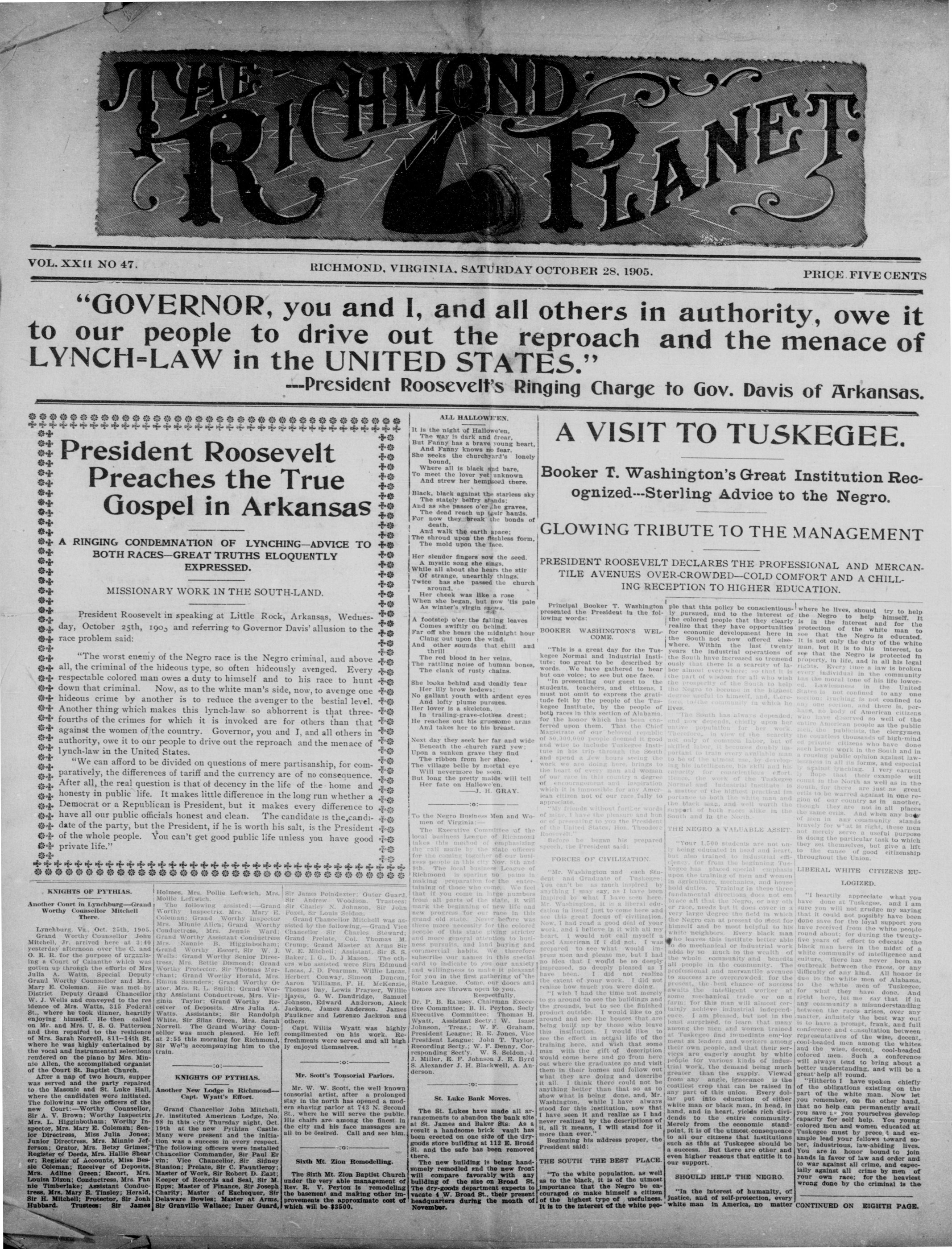
"GOVERNOR, you and I, and all others in authority, owe it to our people to drive out the reproach and the menace of LYNCH=LAW in the UNITED STATES."
```markdown
```
President Roosevelt Preaches the True Gospel in Arkansas
A RINGING CONDEMNATION OF LYNCHING—ADVICE TO BOTH RACES—GREAT TRUTHS ELOQUENTLY EXPRESSED. MISSIONARY WORK IN THE SOUTH-LAND
President Roosevelt in speaking at Little Rock, Arkansas, Wednesday, October 25th, 1905, and referring to Governor Davis' allusion to the race problem said:
"The worst enemy of the Negro race is the Negro criminal, and above all, the criminal of the hideous type, so often hideously avenged. Every respectable colored man owes a duty to himself and to his race to hunt down that criminal. Now, as to the white man's side, now, to avenge one hideous crime by another is to reduce the avenger to the bestial level. Another thing which makes this lynch-law so abhorrent is that three-fourths of the crimes for which it is invoked are for others than that against the women of the country. Governor, you and I, and all others in authority, owe it to our people to drive out the reproach and the menace of lynch-law in the United States.
"We can afford to be divided on questions of mere partisanship, for comparatively, the differences of tariff and the currency are of no consequence. After all, the real question is that of decency in the life of the home and honesty in public life. It makes little difference in the long run whether a Democrat or a Republican is President, but it makes every difference to have all our public officials honest and clean. The candidate is the candidate of the party, but the President, if he is worth his salt, is the President of the whole people. You can't get good public life unless you have good private life."
VOL. XXII NO 47.
"GOV
to our p
LYNCH=
Preside
Preat
Gos
A RINGING CON
BOTH RAC
MISSION
President Roosevelt
day, October 25th, the
race problem said:
"The worst enemy
all, the criminal of the
respectable colored man
down that criminal.
hideous crime by an
Another thing which is
fourths of the crimes
against the women of
authority, owe it to our
lynch-law in the United
"We can afford to be
paratively, the different
After all, the real que
honesty in public life.
Democrat or a Republ
have all our public off
date of the party, but
of the whole people.
private life."
KNIGHTS OF PYTHIAS.
Another Court in Lynchburg—Grand Worthy Counsellor Mitchell There.
Lynchburg, Va., Oct. 25th, 1905.
Grand Worthy Counsellor John Mitchell, Jr. arrived here at 3:40 yesterday afternoon over the C. and O. R. R. for the purpose of organizing a Court of Calanthe which was gotten up through the efforts of Mrs Julia A. Watts, Special Deputy Grand Worthy Counsellor and Mrs Mary E. Coleman. He was met by District Deputy Grand Chancellor W. J. Weils and conveyed to the residence of Mrs. Watts, 315 Federal St., where he took dinner, heartily enjoying himself. He then called on Mr. and Mrs. U. S. G. Patterson and then repaired to the residence of Mrs. Sarah Norvell, 811-14th St. where he was highly entertained by the vocal and instrumental selections rendered on the piano by Mrs. Minnie Allen, the accomplished organist of the Court St. Baptist Church.
After a map of two hours, supper was served and the party repaired to the Masonic and St. Luke Hall, where the candidates were initiated. The following are the officers of the new Court:—Worthy Counsellor, Sir A. V. Brown; Worthy Inspectrix Mrs. L. Higginbotham; Worthy Inspector, Mrs. Mary E. Coleman; Senior Directress, Miss Julia Jones; Junior Directress, Mrs. Minnie Jefferson; Orator, Mrs. Betsy Grimes; Register of Deeds, Mrs. Hallie Shearer; Register of Accounts, Miss Bessie Coleman; Receiver of Deposits, Mrs. Adline Green; Escort, Mrs. Louisa Dixon; Conductress, Mrs. Fanie Timberlake; Assistant Conductress, Mrs. Mary E. Tinsley; Herald, Sir H. Mitchell; Protector, Sir Jonh Hubbard. Trustees: Sir James
Holmes, Mrs. Pollie Leftwich, Mrs.
Moile Loftwich.
The following assisted;—Grand
Worthy Inspectrix, Mrs. Mary E.
Coleman; Grand Worthy Inspector
Mrs. Minnie Alien; Grand Worthy
Conductress, Mrs. Jennie Ward;
Grand Worthy Assistant Conductress
Mrs. Nannie B. Higginbotham;
Grand Worthy Escort, Sir W. J.
Wells; Grand Worthy Senior Directress,
Mrs. Bettie Dismond; Grand
Worthy Protector, Sir Thomas Merchant;
Grand Worthy Herald, Mrs.
Emma Saunders; Grand Worthy Orator, Mrs. R. L. Smith; Grand Worthy Assistant Conductress, Mrs. Virginia Taylor; Grand Worthy Receiver of Deposits, Mrs Julia A. Watts, Assistants; Sir Randolph White, Sir Silas Green, Mrs. Sarah Norvell. The Grand Worthy Counsellor was much pleased. He left at 2:55 this morning for Richmond, Sir Weil's accompanying him to the train.
KNIGHTS OF PYTHIAS.
Another New Lodge in Richmond— Capt. Wyatt's Effort.
Grand Chancellor John Mitchell, Jr. instituted American Lodge, No. 98 in this city Thursday night, Oct. 19th at the new Pythian Castle. Many were present and the initiation was a success in every respect. The following officers were installed Chancellor Commander, Sir Paul Evn; Vice Chancellor, Sir Sidney Stanton; Prolate, Sir C. Fauntleroy; Master of Work, Sir Robert D. East; Keeper of Records and Seal, Sir M. Epps; Master of Finance, Sir Joseph Charity; Master of Exchequer, Sir Delaware Bowles; Master at Arms, Sir Granville Wallace; Inner Guard,
RICHMOND, VIRGINIA, SATURDAY OCTOBER 28, 1905.
---President Roosevelt's Ringing Charge to Gov. Davis of Arkansas.
```markdown
```
Sir James Poindexter; Outer Guard,
Sir Andrew Woodson; Trustees;
Sir Charles N. Johnson, Sir John
Poxel, Sir Louis Seldon.
Grand Chancellor Mitchell was
assisted by the following—Grand Vice
Chancellor Sir Charles Steward;
Grand Prelate, Col. Thomas M.
Crump; Grand Master at Arms Sir W.
E. Mitchell; Assistant Sir S. B.
Baker; I. G., D. J. Mason. The
others who assisted were Sirs Edmund
Lucas, J. D. Pearman, Willie Lucas,
Herbert Conway, Simeon Duncan,
Aaron Williams, F. H. McKenzie,
Thomas Day, Lewis Frayser, Willie
Hayes, G. W. Dandridge, Samuel
Johnson, Edward Anderson, Aleck
Jackson, James Anderson. James
Faulkner and Lorenzo Jackson and
others.
Capt. Willis Wyatt was highly
complimented on his work. Refreshments were served and all highly enjoyed themselves.
Mr. Scott's Tonsorial Parlors
Mr. W. W. Scott, the well known tonsorial artist, after a prolonged stay in the north has opened a modern shaving parlor at 743 N. Second St., where he will serve the public. His chairs are among the finest in the city and his face massages are all to be desired. Call and see him.
Sixth Mt. Zion Remodelling
The Sixth Mt. Zion Baptist Church under the very able management of Rev. R. V. Peyton is remodeling the basement and making other improvements the approximate cost of which will be $2500.
ALL HALLOWEEN.
It is the night of Hallowe'en,
The way is dark and drear,
But Fanny has a brave young heart,
And Fanny knows no fear.
She seeks the churchyard's lonely bound
bounds.
Where all is black and bare,
To meet the lover yet unknown
And strew her hemised there.
Black, black against the starless sky
The stately belrym stands;
And as she passes o'er the graves,
The dead reach up their hands.
For now they break the bonds of
death.
death.
And walk the earth space;
The shroud upon the fleshless form.
The mold upon the face.
Her slender fingers sow the seed.
A mystic song she sings.
While all about she hears the stir
Of strange, unearthly things.
Twice has she passed the church
around.
Her cheek was like a rose
When she began, but now 'tis pale
As winter's virgin snows.
A footstep o'er the falling leaves
Comes swiftly on behind.
Far off she hears the midnight hour
Clang out upon the wind.
And other sounds that chill and
thrill
The red blood in her veins.
The rattling noise of human bones,
The clank of rusty chains.
She looks behind and deadly fear
Her illly brow bedes;
No gallant youth with ardent eyes
And lofty plume pursues.
Her lover is a skeleton,
In trailing-grave-clothes drest;
He reaches out his gruesome arms
And takes her to his breast.
Next day they seek her far and wide
Beneath the church yard yew;
Upon a sunken grave they find
The ribbon from her shoe.
The village belle by mortal eye
Will nevermore be seen.
But long the pretty maids will tell
Her fate on Hallowe'en.
—J. H. GRAY.
To the Negro Business Men and Women of Virginia:—
The Executive Committee of the local business League of Richmond takes this method of emphasizing the call made by the state officers for the coming together of our business people in this city Nov. 8th and 9th. The local business League of Richmond is sparing no pains in making preparation for the entertaining of those who come. We feel that if you come in large numbers from all parts of the state, it will mark the beginning of new life and new progress for our race in this grand old state. Never before was there more necessary for the colored people of this state giving stricter and more general attention to business pursuits, and land buying and commercial habits. We therefore subscribe our names in this special card to indicate to you our anxiety and willingness to make it pleasant for you in the first gathering of the State League. Come, our doors and homes are thrown open to you. Respectfully.
Dr. P. B. Ramsey, Chairman Executive Committee; B. H. Peyton, Secty Executive Committee; Thomas H. Wyatt, Assistant Secy.; W. Isaac Johnson, Treas.; W. F. Graham, President League; R. E. Jones, Vice President League; John T. Taylor, Record Secy.; W. F. Denny, Corresponding Secy.; W. S. Seldon, J. Miller, E. F. Johnson J. E. Byrd S. Alexander J. H. Blackwell, A. Anderson.
St. Lake Bank Moves.
The St. Lukes have made all arrangements to abandon the bank site at St. James and Baker Sts. As a result a handsome brick vault has been erected on one side of the drygoods store building at 112 E. Broad St. and the safe has been removed there.
The new building is being handsomely remodled and the new front will compare favorably with any building of the size on Broad St. The dry-goods department expects to vacate 4 W. Broad St. their present headquarters during the month of November.
A VISIT TO TUSKEGEE.
A VISIT TO TUSKEGEE.
Booker T. Washington's Great Institution Recognized---Sterling Advice to the Negro.
GLOWING TRIBUTE TO THE MANAGEMENT
PRESIDENT ROOSEVELT DECLARES THE PROFESSIONAL AND MERCANTILE AVENUES OVER-CROWDED—COLD COMFORT AND A CHILLING RECEPTION TO HIGHER EDUCATION.
Principal Booker T. Washington presented the President in the following words:
BOOKER WASHINGTON'S WELCOME.
"This is a great day for the Tuskegee Normal and Industrial Institute; too great to be described by words. We have gathered to hear but one voice; to see but one face.
"In presenting our guest to the students, teachers, and citizens, I must not omit to express the gratitude felt by the people of the Tuskegee Institute, by the people of both races in this section of Alabama, for the honor which has been conferred upon them. That the Chief Magistrate of our beloved republic of 80,000,000 people deemed it good and wise to include Tuskegee Institute in his trip through the South and spend a few hours seeing the work we are doing here, brings to the heart of every man and woman of our race in this country a degree of encouragement and inspiration which it is impossible for any American citizen not of our race fully to appreciate.
ple that this policy be conscientiously pursued, and to the interest of the colored people that they clearly realize that they have opportunities for economic development here in the South not now offered elsewhere. Within the last twenty years the industrial operations of the South have increased so tremendous that there is a scarcity of labor almost everywhere; so that it is the part of wisdom for all who wish the prosperity of the South to help the Negro to become in the highest degree useful to himself, and, therefore, to the community in which he lives.
"The South has always depended, and now depends, chiefly upon her native population for her work. Therefore, in view of the scarcity not only of common labor, but of skilled labor, it becomes doubly important to train every available man to be of the utmost use, by developing his intelligence, his skill and his capacity for conscientious effort. Hence, the work of the Tuskegee Normal and Industrial Institute is a matter of the highest practical importance to both the white man and the black man and well to where he lives, should try to help the Negro to help himself. It is in the interest and for the protection of the white man to see that the Negro is educated. It is not only the duty of the white man, but it is to his interest, to see that the Negro is protected in property, in life, and in all his legal rights. Every time a law is broken every individual in the community has the moral tone of his life lowered. Lawlessness in the United States is not confined to any one section; lynching is not confined to any one section, and there is, perhaps, no body of American citizens who have deserved so well of the entire American people as the public man, the publicists, the clergymen the countless thousands of high-minded private citizens who have done such heroic work in the South and in arousing public opinion against lawlessness in all its forms, and especially against lynching. I very earnest hope that their example will count in the North as well as in the South, for there are just as great evils to be warred against in one region of our country as in another.
"My friends without further words of mine, I have the pleasure and hon or of presenting to you the President of the United States, Hon. Theodore Roosevelt." Before he began his prepared speech, the President said:
FORCES OF CIVILIZATION
"Mr. Washington and each Student and Graduate of Tuskegee; You can't be as much inspired by anything I may say, as I have been inspired by what I have seen here Mr. Washington, it is a liberal education in itself just to come here and see this great focus of civilization. Now, I had read a good deal of your work, and I believe in it with all my heart. I would not call myself a good Amercian if I did not. I was prepared to see what would impress men and please me, but I had no idea that I would be so deeply impressed, so deeply pleased as I have been. I did not realize the extent of your work. I did not realize how much you were doing.
"I wish I had the time not merely to go around to see the buildings and the grounds, but to see the finished product outside. I would like to go around and see the houses that are being built up by those who leave this institution. I would like to see the effect in actual life of the training here, and wish that some man with the gift of description would come here and go from here out where the graduates go and visit them in their homes and follow out what they are doing and describe it all. I think there could not be anything better than that so as to show what is being done, and, Mr. Washington, while I have always stood for this institution, now that I have seen it and realize as I had never realized by the descriptions of it, all it means, I will stand for it more than ever."
Beginning his address proper, the President said:
THE SOUTH THE BEST PLACE.
"To the white population, as well as to the black, it is of the utmost importance that the Negro be encouraged to make himself a citizen of the highest type of usefulness. It is to the interest of the white peo-
ple that this policy be consciously pursued, and to the interest of the colored people that they clearly realize that they have opportunities for economic development here in the South not now offered elsewhere. Within the last twenty years the industrial operations of the South have increased so tremendously that there is a scarcity of labor almost everywhere; so that it is the part of wisdom for all who wish the prosperity of the South to help the Negro to become in the highest degree useful to himself, and, therefore, to the community in which he lives.
The South has always depended, and now depends, chiefly upon her native population for her work. Therefore, in view of the scarcity not only of common labor, but of skilled labor, it becomes doubly important to train every available man to be of the utmost use, by developing his intelligence, his skill and his capacity for conscientious effort. Hence, the work of the Tuskegee Normal and Industrial Institute is a matter of the highest practical importance to both the white man and the black man, and well worth the support of both races alike in the South and in the North.
THE NEGRO A VALUABLE ASSET
"Your L.500 students are not only being educated in head and heart, but also trained to industrial efficiency; for from the beginning Tuskegee has placed special emphasis upon the training of men and women in agriculture, mechanics, and house hold duties. Training in these three fundamental directions does not embrace all that the Negro, or any other race, needs but it does cover in a very large degree the field in which the Negro can at present do most for himself and be most helpful to his white neighbors. Every black man who leaves this institute better able to do mechanical or industrial work adds by so much to the wealth of the whole community and benefits all people in the community. The professional and merchant avenues to success are overcrowded; for the present, the best chance of success awaits the intelligent worker at some mechanical trade or on a farm; for this man will almost certainly achieve industrial independence. I am pleased, but not in the least surprised, to learn that many among the men and women trained at Tuskegee find immediate employment as leaders and workers among their own people, and that their services are eagerly sought by white people for various kinds of industrial work, the demand being much greater than the supply. Viewed from any angle, ignorance is the costliest crop that can be raised in any part of this union. Every dollar put into education of either white man or black man, in head, in hand, and in heart, yields rich dividends to the entire community. Merely from the economic standpoint, it is of the utmost consequence to all our citizens that institutions such as this at Tuskegee should be a success. But there are other and even higher reasons that entitle it to our support.
SHOULD HELP THE NEGRO
"In the interest of humanity, of justice, and of self-protection, every white man in America, no matter
PRICE. FIVE CENTS
y, owe it
menace of
of Arkansas.
KEGEE.
Institution Rec-
the Negro.
MANAGEMENT
PROSIONAL AND MERCAN-
MORT AND A CHILL-
UCATION.
where he lives, should try to help the Negro to help himself. It is in the interest and for the protection of the white man to see that the Negro is educated. It is not only the duty of the white man, but it is to his interest, to see that the Negro is protected in property, in life, and in all his legal rights. Every time a law is broken every individual in the community has the moral tone of his life lowered. Lawlessness in the United States is not confined to any one section; lynching is not confined to any one section, and there is perhaps, no body of American citizens who have deserved so well of the entire American people as the public man, the publicists, the clergymen the countless thousands of high-minded private citizens who have done such heroic work in the South and in a rousing public opinion against lawlessness in all its forms, and especially against lynching. I very eagerly hope that their example will count in the North as well as in the South, for there are just as great evils to be warred against in one region of our country as in another, though they are not in all places the same evils. And when any body of men in any community stands bravely for what is right, these men not merely serve a useful purpose in doing the particular task to which they set themselves, but give a lift to the cause of good citizenship throughout the Union.
LIBERAL WHITE CITIZENS EU
"I heartily appreciate what you have done at Tuskegee, and I am sure you will not grudge my saying that it could not possibly have been done save for the loyal support you have received from the white people round about; for during the twenty-five years of effort to educate the black man here in the midst of a white community of intelligence and culture, there has never been an outbreak between the races, or any difficulty of any kind. All honor is due to the white men of Alabama, to the white men of Tuskegee, for what they have done. And right here, let me say that if in any community a misunderstanding between the races arises, over any matter, infinitely the best way out is to have a prompt, frank, and full conference and consultation between representatives of the wise, decent, cool-headed men among the whites and the wise, decent, cool-headed colored men. Such a conference will always tend to bring about a better understanding, and will be a great help all round.
"Hitherto I have spoken chiefly of the obligations existing on the part of the white man. Now let you remember, on the other hand, that no help can permanently avail you save you yourselves develop capacity for self help. You young colored men and women educated at Tuskegee must by preceit t and example lead your fellows toward sober, industrious, law-abiding lives. You are in honor bound to join hands in favor of law and order and to war against all crime, and especially against all crime by men of your own race; for the heaviest wrong done by the criminal is the
CONTINUED ON EIGHTH PAGE
_ STORIES OF THEN. ,
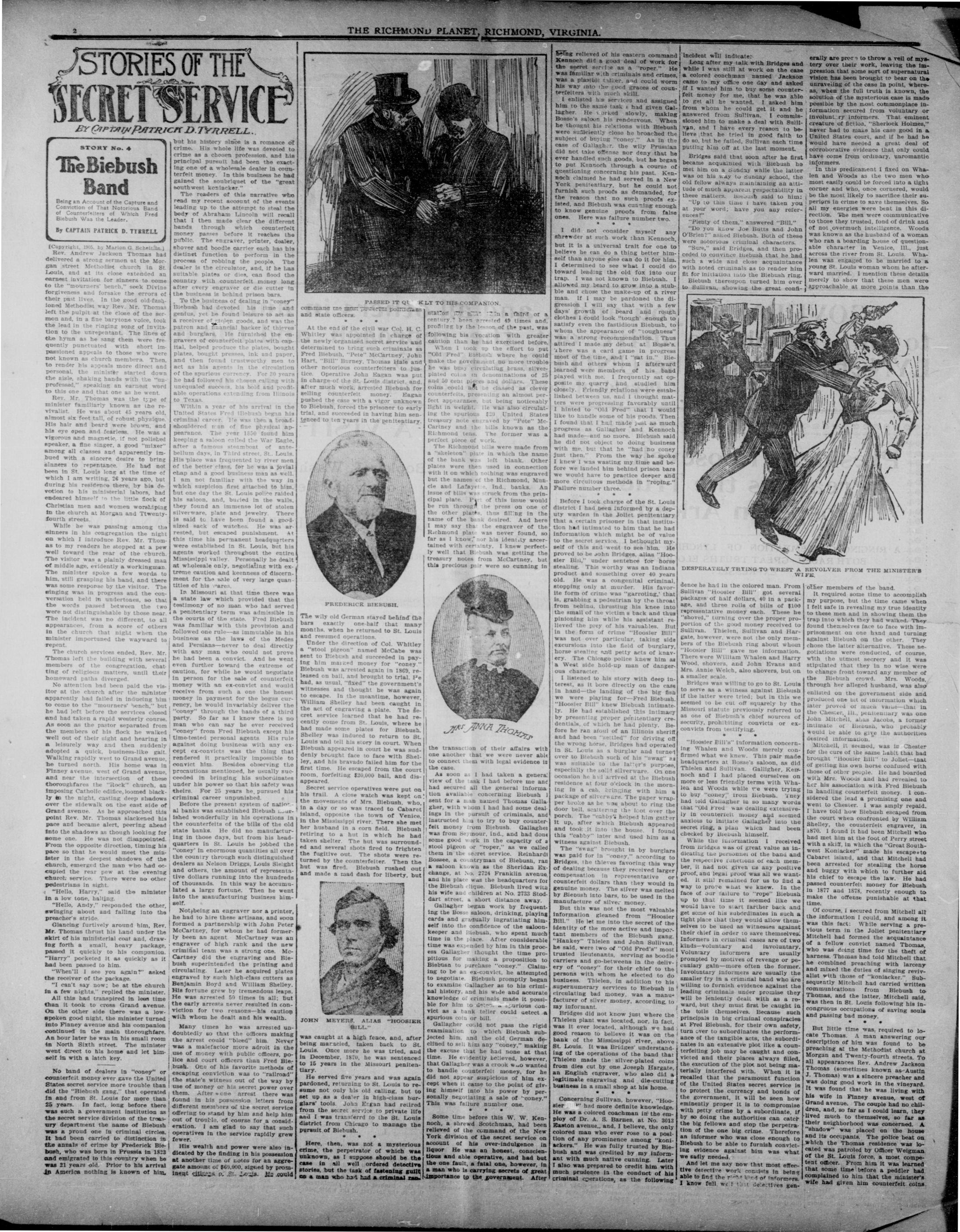
SECRET SERVICE
2
The Biebush
Being an A t of the Capture and
Sos ae
By CAPTAIN PATRICK D. TYRRELL
gan street Methodist church in St.
Louis, and at its close extended an
earnest invitation for sinners to come
to the “mourners’ bench,” seek Divine
forgiveness and forsake the errors of
their past lives. In the good old-fash-
foned Methodist way Rev. Mr. Thomas
left the pulpit at the close of the scr
mon and, im a fine barytone vole, took
the lead in the ringing song of invita.
tion to the unrepentant. The lines of
tte hymn as he sang them were fre
quently punctuated with short im
Passioned sppeals to those who were
not known as church membera. Then,
to render bis appeals more direct and
personal, the minister started down
the nisle, shaking hands with the “un
professed,” speaking an earnest word
to this one and that one as he went
Rey. Mr. Thomas was the type of
minister familiarly known as ibe re
vivalist. He was about 45 years old,
almost six feet tall, of robust physique
His hair and beard were brown, and
his eye open and fearless, He was a
vigorous and magnetic, if not polisted
Speaker, a fine singer, a good “mixer”
‘among all classes and apparently im-
Dued with a sincere desire to bring
sinners to repentance He had not
deen in St. Louis long at the time of
which Iam writing, 26 years ago, but
during bis residence there, by bis de
votion to bis ministerial labors, had
endeared himee!f ‘> the little flock of
Christian men and women worstdping
fm the church at Morgan and Ttwenty-
fourth streets
While he was passing among tho
Sinners in his congregation the night
on which I introduce Rev. Mr. Thom-
as to my readers he stopped at a pew
well toward the rear of the church.
‘The visitor was a plainly dressed maa
Of middie age, evidently a workingman.
The minister spoke a few words to
him, still grasping bis hand, and there
‘was some response by the visitor. The
@inging was in progress and the con-
versation held im undertones, #0 that
the words passed between the two
Were not distinguishable by those near.
The incident was no different, to all
appearances, from a score of others
fm the church that night when the
minister importuned the wayward to
Tepent
The church services ended, Rey. Mr.
Thomas left the building with several
members of the congregation, chat
ting of religious matters, until thelt
homeward paths diverged
No attention had been paid the vis
itor at the church after the minister
apparently had failed in inducing ‘him
to come to the “mourners’ bench,” but
he had left before the services closed
and had taken a rapid westerly course.
‘AS soon as the pastor separated from
the members of bis flock he walked
‘Well out of their sight and hearing in
@ leisurely way and then suddenly
adopted a quick, business-like galt
Walking rapidly west to Grand avenue,
Be turned north. His home was in
Finney avenue, west of Grand avenue,
and near the intersection of these
thoroughfares the “Rock” church, an
imposing Catholic edifice, loomed black-
ly @ the night, casting deep shadows
over the sidewalk on the east side of
Grand avenve. As he approached this
point Rev. Mr. Thomas slackened his
pace and became alert, peering ahead
{nto the shadows as though looking for
@ome one. He was not disappointed.
From the opposite direction, timing his
pace so that he would meet the min-
ister in the deepest shadows of the
church, emerged the man who had oc-
cupied the rear pew at the evening
ehurct: service. There were no other
Pedestrians in sight.
4 “Hello, Harry,” said the minister
in a low tone, halting.
“Hello, Andy,” responded the other,
swinging about and falling into the
preacher's stride.
Giancing furtively around bim, Rev,
‘Mr. Thomas thrust his Land under the
skirt of his minfsterial coat and, draw-
{ng forth a small, heavy package,
passed it quickly to his companion.
“Harry” pocketed it as quickly as it
had been passed to him.
“When'll I see you again?” asked
the receiver of the package.
“I can't say now; be at the church
fm @ few nights,” replied the minister.
All this hed transpired in lees time
than it took to cross Grand avenue.
On the other side there was a low-
‘spoken good night, the minister turned
into Finney avenue and his companion
continued in the main thoroughfare.
‘An hour later he was in his small room
4m North Sixth street. The minister
‘went direct to his home and let bim-
self in with a latch key.
No band of dealers in “coney” or
‘counterfeit money ever gave the United
‘States secret service more trouble than
did the “Biebush gang.” that operated
im and from St. Louis for more than
years. In fact, long before there
‘such a government institution ax
‘the secret service division of the treas-
y department the name of Biebush
. ‘one {n criminal circles.
y ene hoall to distinetion in
Use inenee? sete. ae eee ae
Dosh, who was born in Pru os
ee et ae an .
4p America nothing is known of him,
Peres tethe ey Seten Bee hen ys
ee Soe Se oe oe ROD a
crime. His whole life was devoted to
crime as a chosen profession, and his
principal pursuit had deen the exact-
ing one of a wholesale dealer in
terfeit money. In this business he
gained the soubriquet of the “great
‘southwest koniacker.””
‘The readers of this narrative who
read my recent account of the events
leading up to the attempt to steal the
body of Abraham Lincoln will recall
that T then made clear the different
hands through which counterfeit
money passes before it reaches the
Dublic. ‘The engraver, printer, dealer,
shover and boodle carrier each has his
dietinet function to perform in the
Process of robbing the people. The
@ealer is the circulator, and, if he las
suitable plates or dies, can flood the
country with counterfeit. money long
after every engraver or die cutter tn
the business is behind prison bars.
_. Te the business of dealing in “coney”
Biebush had devoted his time and
gentus, yet be found leisure to act as
& receiver of zini¢n goods, and was the
patron and Muancial backer of thieves’
and burglars, He furniched the en-
Eravers of counterfeit plates with cap-
ftal, helped produce the plates, bought
plates, tought presses, Ink and paper,
and then found trustworthy men to
act as his agents in the circulation
of the spurious currency. For 20 years
he had followed his chaxen calling with
unequaled success, bis bold and proft-
‘able operations extending from Mlinois
to Texas,
Within a year of his arrival In the
United States Fred iHebush began his
criminal carcer. He was then a broad-
@houldered ran of fine physical ap-
pearance. The year 1850 found bim|
keeping a saloon calted the War Eagle,
itera fainous sisaihoat ot aate.
bellum days, in Third street, St. Louts.
His place was frequented by river men
of the better class, for he was a jovial
chap and a good business man as well.
Tam not familiar with the way in
which suspicion first attached to him,
tut one day the St. Louis polite raided
his faloon, and, busied In the walls,
they found an immense lot of stolen
aiiverware, plate and jewelry. There!
ie said to Lave been found a good
sized sack of watches He was ar-
rested, but escaped punishment. At
this time his permanent headquarters
Were established in St. Louls, but his
agents worked throughout the entire
‘Mississippi vatley. Personally he dealt
at wholesale only, negotiating with ex-
treme caution and keenness of discern
ment for the sale of very large quan
titles of his \vares
Ip Missouri at that time there was
& state law which provided that the
testimony of no inan who bad served
;& penitentiary term was admiesible in
the courts of the state. Fred Bislush |
was familiar with this provision and
a
Dusiness as the laws of the Medes
and Persians—never to deal directly
with any man who could not preve
he had been a convict. And he went
even further toward the extrome of
caution, for while he would negotiate
in person for the sale of counterfeit
money with an ex-convict and would
receive from such a one the honest
money in payment for the bogus cur-
rency, he would invariably deliver the
“coney” through the hands of a third
party. So far as I know there is no
man who can say he ever received
“coney” from Fred Biebush except his
‘timetested personal agents His rule
against doing business with any ex-
cept ex-convicts was the thimg that
rendered {t practically impossible to
convict him. Besides observing the
precautions mentioned, he usually suc-
ceeded in bringing his subordinates
under his power so that his safety was
theirs, For 25 years he, pursued his |
eriminal career unpunished. jis
Before the present system of nation
al banks was established Miebush ure
Ashed wonderfully in his operations in
the counterfeits of the bills of the old
state banks. He did no manufactur-
ing in those days, but from his head-
quarters in St. Louis he jobbed the
“coney’ in enormous quantities all over
the country through such distinguished
dealers as Nelson Driggs, Louls Sleight
‘and others, the amount of representa-
tive dollars running into the hundreds
of thousands. In this way he accumu-
lated a large fortune. Then he went
into the manufacturing business him-
self.
Notybeing an engraver nor a printer,
the had to hire these artisans, and soon
formed a partnership with John Peter
‘McCartney, for whom he had former-
ly beon an agent McCartney was an
engraver of high rank and the new
crimifial team was x strong one, Me-
Cartney did the engraving and Ble-
bush superintended the printing and
circulating. Later he acquired plates
engraved by such high-class cutters as
Benjamin Boyd and William Shelley.
‘His fortune grew by tremendous leaps.
‘He was arrested 59 times in all; But
the early arrests never regulted in con-
vietion for two reasons—his caution
with whom he dealt and his wealth.
Many times he was arrested un-
doubtedly so that the officers making
the arrest could “biced” him. Never!
Was a malefactor more adroit in the
use of money with public officers, po-
SR eta tte A, arate eters «4
THE RICHMOND PLANET, RICHMOND, VIRGINIA.
enna
vie, AV f |
We a a mi
ij ere || ee
| |) uae ‘hoe & uy
ay a)
ay i \\ . Hi) AY i h
command the most powermt PorTmGans
and state officers.
CEs
At the end Of the civil war Col. H.C.
Whitley was appointed in charge of
‘the newly organised secret service and
determined to bring such criminals as
Fred Biebush, “Pete” McCartney, Joho
Hart, “Bill” Burney, Thomas Hale and
other notorious counterfeiters to Jus-
tice. Operative John Eagan was put
in charge-of the St. Louis district, and.
after much work, arrested Biebush for
selling counterfeit’ money. Eagan
pushed the case with a vigor unknown
to Biebush, forced the prisoner to early
trint, and succeeded in having him sen.
enced to ten years in the penitentiary.
/ 4
/ a \
f *e
i S Sy Ne
= ee a
oe
‘The wily old German stayed behind the
bars exactly one-half that many
months, when he returned to St. Louis
and resumed operations.
Under the direction of Col. Whitley
‘& “stool pigeon” named McCabe was
sent to Biebuxh and succeeded in pay-
ing him marked money for “eoney.”
Biebush was arrested again in 1869, re-
Jeased on bail, and brought to trial. Fe
had, as usual, “fixed” the government's
witnesses and thought be was again
to escape. In the meantime, however,
William Shelley had been caught in
the act of engraving a plate. The de-
eret service learned that he had re-
cently come from St. Louis, where he
had made some plates for Biebush.
Shelley was induced to return to St
Louis and tell his story in court. When
Biebush appeared in court he was sud-
denly brought face to face with Shel-
Jey, and bis bravado failed him for the
first time. He escaped from the court
room, forfeiting $20,000 bail, and dis-
appeared,
Secret service operatives were put on
his trail. A close watch was kept on
the movements of Mrs, Blebush, who,
in a day or so was traced to Cabaret
island, opposite the town of Venice,
in the Mississippl river. There she met
her husband in a corn field. Blebush
retiring to a hut in which he bad
taken shelter. The hut was surround-
ed and several shots fired to frighten
the fugitive out. The shots were re-
turned by the counterfelter. Then the
hut was fired. Blebush rushed out
‘and made a mad dash for liberty, but
Bey tA
a
Me ats
mee Yh
fy ~ ee fe a
eae |
vy Sti ad d is
MLE i
oe a Naas
EM ase a
JOHN MEYERS, ALIAS “HOOSIER
es
was caught at @ high fence, and, after
being maracied, taken buck to St.
Louis. Once more he was tried, and
in December, 1870, he was sentenced
to 16 years in the Missourt peniten-
tary.
He served five years and was again
pardoned, returning to St. Louis to re-
sume not ouly his old calling, but to
set up as a dea'er in high-class bar-
glars’ tools. Joha Ecgan had retired
from the secret service to private life
and I was trausferrd to the St. Louis
district from Chicago to manage the
pursuit of Biebush.
Here, then, was not mysterious
crime, the perpetrator of which was
unknown, as I suppose should be the
case in ll well ordered detective
Stories, but the (ask of fastening
©o @ man «ho hot sk nena
jiratcon SOP Ect “Tine MIRE of a
century.* been prrected 49 times and,
profiting by the le<-on of the past. was
pfollowing bis “Vocation With greater
caution than he had exercised before.
When 1 wook up the effort to put
“Old Fred” Bitbus: where he could
make the govekniniat a6 more trouble
he was busy eireulating brass, silver-
Plated colse mm denominations of 2
and 30 cent . and dollars. These
colns could be classed as clever
counterfelts, presenting am Almost per.
fect appearanes, but being noticeably
Meht in weight, (le was also cireulat-
ing the spuriows £20 United States
treasury note encraved by “Pete” Mec-
Cartney and. the bills, known as the
Richmond tens. The former was a
pertet plece of work.
‘The Richmond bills were made from
‘a “skeleton” plate in which the name
of the bank wa» left blank. Other
plates wore then vised in connection
with it op whieh cothing was engraved
but the names of the Richmond, Mun-
cle and Lafaye! ‘Ind, banks. An
lesue of bilis we» «truck from the prin-
cipal plate. ay of this issue would
be ran throug? the press om one of
the other plates, thes filling in the
name of the benk desired. And here
I may say ths the engraver of the
Ruchmond plat was never found, so
far as | know? nor his ident.ty ascer-
tained with certainty. I knew perfect-
ly well that Bicbush was getting the
treasury notes from McCartney, but
‘this precious poir were so cunning in
x SPT im
»
eS
Piss aN
ae Ee. te ,
; Thee ae Ga
Bl iat bad a
zig so:
i ea H
wae 3 2 hy ae
Ue
s AINA Ze,
MEA A Tan
the transaction of their affairs with
one another that we were never able
to connect them with legal evidence tz
the case.
| As soon a: 1 had taken a genera!
| view of the ‘ask I had before me ane
[had secured all the general informa
jtion availabie concerning Biebush }
sent for a nan named Thomas Galle
gher, with whom I had had some deal
ings in the pursuit of criminals, ang
[instructed hia to try to buy counter
jfeit money (rom Biebush. Gallagher
was from Seymour, Ind., and had done
some good Work tn the capacity of a
stool pigeon or “roper,” as we called
them in the sesret service. Reinhardt
Bossee, @ countryman of Biebush, ran
& saloon known as the Sheridan Ex-
change, at No, 2724 Franklin avenue
end his place was the headquarters for
the Biebush lique. Biebush lived wita
his wife auc children at No. 2733 Stod-
Gart street. « short distance away.
Gallagher began work by ftrequent-
ing the Boss« saloon, drinking, playing
cards and graqually ingratiating him-
self into the confidence of the saloon-
keeper and iiebush, who spent much
time in the piace. After considerable
time was expended by him In this proc-
ess Gallagher thought the time pro-
pitious for making a proposition to
Biebusn to purchase “coney.” Claim-
ing to be an ex-convict, he attempted
to negotiate § Biebush promptly began
to examine Gallagher as to his crimi-
nal history, and his wide and accurate
knowledge ©: criminals made it possi-
ble for him io Get~>. « <purious con-
viet as a bank teller could aetect a
spurious coin or bill
Gallaxher could not pass the rigid
examination to which Blebush sub-
Jected him. and the old German de-
clined to se!: him any “coney,” making
the excuse ‘hat he had none at that
time. He evidently believed, however,
that Gallagher was a crook wuo wanted
to handie counterfelt. money, for he
@id not appear suspicious of him ex-
cept when i: came to the point of gtv-
ing himself into his power by per-
sonally negotiating a sale of “eoney,””
This was foilure number one.
ene
Some time before this W. W. Ken-
Roch, a shrewd Scotchman, had been
Felieved of a command of the New
scoount of "his ions
over-indulgence
Neuor He was: een
Sah wet
whom the appearance of “toughness”
was a strong recommendation, ‘Thus
attired I made my debut at Bosse’s,
‘shere was a card game In progress
most of the time, and’I “sat in.” Bie.
bush and others whom 1 aftérward
learned were members of bis. band
played with me. I frequently sat op-
Dosite my quarry and studied him
closely. Friendly relations were estab-
lished between us, and | thought mat-
ters were progressizg favorably until
I hinted to “Old Fred™ Uhat T would
like to handle some of his roods. Then
I found that I had made just as much
progress as Gallagher ‘and Kennoch
had made—and no more. Biebush said
he did not object to doing business
with me, but that he “had no coney
just then.” From the way he spoke
I knew | was wasting my time and be-
fore we landed him behind prison bare
we would have to practice deeper and
more circuitous methods in “roping.”
Failure number three.
Before | took charge of the St. Louls
district I had peem informed by a dep-
uty warden in the Joliet penitentiary
that a certain prisoner in that institu-
| tion had intimated to him that he had
information which might be of value
to the secret service. I bethought my-
self of this and went to see him. He
Proved to be sohn Bridges, alias “Hoo-
sier Biii,” under sentence for horse
stealing. This worthy was an Indiana
product and something over 40 years
old. He was a congenital criminal,
stopping only at murder. His favor-
ite form of crime was “garroting,’ that
is, grabbing a pedestrian by the throat
from peliind, thrustiug his knee into
the small of the victim s back and thus
pinfoning him while his assistant re.
Meved the prey of his valuables. But
in the form of crime “Hoosier Bill"
was not over particular, taking side
excursions into the field of burglary,
horse stenling antl petty acts of knav-
ery. The Chicago police knew him as
1m West side hold-up man of danger.
ous character
| [ limtened to his story with deep in-
terest, as it bore directly on the case
{im hand—the landing of the big fish
we were playing for—Fred Biebush,
“Hoosier Bull” knew Biebush intimate.
ly. He had established this intimacy
by presenting proper penitentiary cre.
dentials, of which he had plenty. Be.
fore he ran afoul of an Ilinois sherift
and had been “se:tled” for driving off
the wrong horse, Bridges had operated
in St. Louts as a burglar and turaet
over to Biebush such of his “swag” na
was sultable to the latter's purpose,
espectally the soll silverware. On one
occasion he hut arrived at the Blebush
residence at four o'clock in the morn-
ing fo a cab, bringing with him a
package of silverware. The paper wrap.
Der broke as he wae about to ring the
door bell, scattering the loot over the
porch, The “cabby’s helped him gather
it up, after which Blebush appeared
and took it into the house. I found
this “cabby” later and used him as a
‘witness against Biebush.
The “swa” brought in by burglars
was paid for in “coney,” according to
Bridges, the thieves favoring this way
Of dealing because they received larger
compensation in representative or
counterfeit dollars than they would in
genuine money. The silver was melted
by Bieoush into bars, to be used in the
manufacture of silver money.
But this was not the most valuable
information gleaned from “Hoosier
Bill.” He let me into the secret of the
identity of the more active and impor-
tant members of the Bicbush gang.
“Hankey” Thielen and John Sullivan,
he said, were two of “Old Fred’s” most
trusted lieutenants, serving as boodle
carriers and go-betweens in the deliv-
ery of “coney” for their chief to the
persons with whom he elected to do
business. Thielen, in addition to his
Supernumerary services to Biebush in
circulating bad money, was a manue
facturer of silver money, according to
my informant.
Bridges did not know Just where the
Thielen plant was located, nor, in fact,
Was It ever located, although we had
Food reason to believe it was on the
bank of the Mississippi river, above
St. Louis. It was Bridges’ understand.
ing of the operations of the band that
Thielen made the silver-plated coins
from dies cut by one Joseph Hargate,
an English engraver, who also did «
Jogitimate engraving and. dle-cutting
business in Asmall shop ‘&t his home.
‘e
Concerning Sullivan, however, “Hoo-
sier had more definite knowledge.
He was a colored coachman in the em-
‘ 3" He was fall; ee
Rae nd res. oredited by way inform
fant with much cunning, Lat
Fano wes crepared to ceedit him.with
mach pendence 4a: the conduct of bie
Pon chemttooe ae erie
pense Brain King Zouustneteon
Bis (| phy. psd |
a -ee CS ate
2 Ng PS sD
Py te et
Lat Aas <a Ahk
of a Sea
ae >
pee We oy en |)" Wi) \\ iC
ky ey, if IL
Gi yHy/{b AAA
5 TRG Spy Ai
RATELT TALES WHEST A RRVOLVER YROM THE MINISTERS
WIFE.
pene my
ao still at work on case
Fe, ’ :
feat to af cllcs oon Gar aad taeon
fe ‘wanted him to buy some counter-
feit money for me, that he was able
to get all he wanted, 1 asked him
from whom he could get it and he
‘answered from Sullivan. I commls-
sloned him to make a deal with Sullt-
(yan, and 1 have every reason to be-
Neve thet he tried in good faith to
do so, but he fatled, Sullivan each time
putting him off at the last moment.
‘Bridges sald that soon after he first
became acquainted with Biebush he
met him on a suaday while the latter
was oc his way to Sunaay school, the
old fellow always maintaining an atti-
tude of muh appareat pespactauility tm
these matters. biesush sald to him:
“Up to this Gime ( have taken you
at your word; have you any rever-
“Plenty of them,” answered “Bill.”
“Do you know Joe Butts and John
O'Brien?” asked Biebush. Both of these
Were notorious crimiual characters
“Sure,” sald Cridges, and then pro-
ceded {6 convince Miebush that he had
mich a wide and close acquaintance
with noted criininals as to render him
fit for initiation tuto the Biebush ring.
Biebush theroupon turned him over
SissSbaltintansiahrhadiinal aiontsoun
dence he had in the colored man. From
Sullivan “Hoosier Bill" got several
packaxes of half dollars, 40 in @ pack-
age, and three rolls of bills of $100
Tepresentative money each. These he
“ahoved,” turning over the proper pro-
portion of the good money received to
Sullivan, Thielen, Sullivan and Har-
Gate, however, were not the only mem-
bers of the Biebush ring about whom
“Hoosier Bill” gave me information.
There were William Whalen and Harry
Wood, shovers, and John Evans and
Mrs. Annie Welch, also shovers, but on
a smaller scale.
Bridges was willing to go to St. Louis
to serve as a witness against Bichush
Af the latter were tried; but In this we
seemed to be cut off squarely by the
Missourl statute previously referred to
a8 one of Biebush’s chief sources of
security, prohibiting convicts or ex-
convicts from testifying.
“Hooster Bill's” information concern-
ing Whalen and Woods merely con-
firmed what we knew. ‘This pair made
headquarters at Bosse’s saloon, ax did
‘Thielen and Sullivan. Gallighér, Ken
noch and I had placed ourselves on
more or less friendly terms with Wha-
lea and Woods while re were trying
to buy “coney;” irom Biebush. ‘They
had told Gatlagter in so many words
that “Old Fred was dealing exteusive-
ly in counterieit money ad seemed
Snsious to initiate Gallaghet into the
secret ring, a plaa which had been
checked by Biebush himself.
White the iuiormation 1 received
from bridges was of great value as in-
dicating tue personne: of the band and
the respective cunctious of each mem-
ber, it nad not given us any positive
proof, and legai proof was all we want-
ed. it sti! remained for us to find a
way to prove what we knew. In the
face of our failure to “rope” Biebush
up to that Ume it seemed lke we
would have to start farther back and
get some of his subordinates in such a
tight place that they would allow them.
selves to be used as Witnesses against
their chief in order to save themselves.
Informers in criminal cases are of two
Kinds—voluntary and involuntary.
Voluntary iutormers are usually
Prompted by motives of revenge or pe-
cunlary gain—more often the former.
‘Tnyoluntary informers are usually the
smaller fry in @ criminal band who are
willing to furnish evidence against the
leading criminais under promise they
Will be lenientiy dealt with as a re-
ward, but they must first be caught ia
‘the toils themselves. Because such
Principals in big criminal conspiracies
at Fred Biebush, for their own safety,
turn over to subordinates the perform-
ance of the tangible acts, the subordi-
nates in an extensive plot Itke a coun-
terfelting job may be caught and con-
vieted and their places always filled,
the execution of the plot not being ma-
‘terially interfered with. When it is
Fecalled that the paramount function
of the United States secret service is
to protect the currency and bonds of
the government, it will be seen how
eminently proper it Is to compromise
with petty crime by @ subordinate, if
by #0 doing the authorities can catch
‘the big fellows and stop the perpetra-
tion of the one big crime. Therefore
an informer who was close enough to
Biebush to be able to furnish convict-
‘ng evidence against him was what
we sadly needed. » wan
me say now that most effer-
work consists In |
7 ‘anda val ta
erally are prer> oe
over their work, leaving the
‘some sort of supernatural
brought to bear on the
‘the case Im point, where
s, whe full truth is known, the
solution of the mysterious case is made
possible by the most commonplace in-
formation secured from voluatary or
tmvolunt-ry informers. That eminent
creature of fiction, “Sherlock Holmes,”
never had to make his case good in a
United States court, and if he had he
‘Would have needed a great deal of
corroborative evidence that only could
have come from ordipary, unromantic
informers.
In this predicament 1 fixed on Wha-
fen and Woods as the two men who
most easily could be forced into a Ught
corner and Who, once cornered, would
‘be the most likely to sacrifice their su-
periprs in crime to save themseives. So
all my energies were bent in this di-
rection. Bhe men were communicative
to those they trusted, fond of drink and
of not overmuch intelligence. Woods
was known as the husband of a woman
who ran a boarding house of question
able character in Venice, IL, just
across the river from St. Louis. Wha-
len Was engaced to be married toa
young St. Louls woman whom he after-
ward married. I mention these details
merely to show that these men were
approachable at more points than the
‘other members of the band.
It required some time to accomplish
my purpose, but the time came when
T felt safe in revealing my true identity
to these men and in showing them the
trap into which they had walked. ‘They.
found themselves face to face with Im-
prisonment on one hand and turning
against Biebush op the other. They
chose the latter alternative, These ne-
fotiations were conducted, of course,
With the utmost secrecy and it was
stipulated that they in no wise were
to change front toward any member of
the Biebush crowd. Mra. Woods,
through her alleged husband, was also!
enlisted on the government side and
produced one uit of intormation which
later proved of much Vvaiue—that in
the Chester, 111, peniientiary was one
John Mitchell, alas Jacobs, a tormer
intimate of ‘“Bicoush, who probably
Would be able to giye the authorities
desired informauion.
Mitchell, it seemed, was in Chester
for the cure of the same habit that had
brought “Hoosier Bill" to Jollet—toat
of getting his own horse coafused with
those of othor people. He had boarted
with Mre, Woous and had revealed to
her his association with Fred Biebush
in handling counterfeit money. 1 con-
sidered the jead @ promising one and
went to Chester. I was amply repaid.
I have told how Biebush escaped from
the court when confronted by William
Shelley, the couuterfeit engraver, in
4870. T'found {t had been Mitchell who
had met him at the foot of Perry street
with a skit, in which the “Great South-
west Koniacker” made his escapesto
Cabaret isiand, and that Mitchell had
been arrested for stealing the horse
and buggy with which to further aid
his chief to escape the law. He had
passed counterfeit money for Biebush
im 1877 and 1878, recently enough to
make the offense punishable at that:
time,
Of course, | secured from Mitchell alt
‘the information I could, and among it
was this fact: While serving a pre-
vious term in the Joliet penitentiary
Mitchell had formed the acquaintance
of a fellow convict named Thomas,
who was doing time for the theft of
harness. Thomas had told Mitchell that
he combined preaching with larceny
and mixed the duties of singing reviv-
alist with those of “koniacker.” Sub-
sequently Mitchell had carried written
communications from Biebush to
‘Thomas, and the Iatter, Mitchell said,
was then in St. Louis following his in-
congruous occupations of saving souls.
and passing bad money.
wile 6
But little time was, required to lo-
cate Thomas. A man answering our
description of him was found to be
Preaching at the Methodist church at
Morgan and Twenty-fourth streets. To
all appearances Rev. Andrew Jackson.
Thomas (sometines known as-Austin
J. Thomas) was a sincere preacher and
ieee. doing good work in the Vineyard.
‘Te was found that he was living with
his wife in Pinney avenue, west of
Grand avenue. ‘The couple had no chil-
dren, and, so far as I could learn, they
lived much to themselves, so far as
their neighborhood was concerned. A
“shadow” was vineat ions We ee
Sri i cortpants,. ‘The police bet =
cated was patroled by Officer Weigman
of the St. Lovis force, a most compe.
pit Sipe s io ee
somiplatin’ i hic’ Gabe cr ieee.
Se tal dee eR
THE PLANET
SECRET SERVICE.
for vegetables. This had happened often enough to convince even the thick-witted peddler it was not a coincidence, and he told his troubles to the policeman.
The "shadow" carried on his investigation in the stores in which Mrs. Thomas traded, and several instances of the passage of bogus silver pieces were found. I therefore decided some one should be selected to gain the minister's confidence, and almost as quickly decided that the one should be Woods. Before long the two were doing business together, Sullivan having been the intermediary. Woods and Sullivan planned to go to his house on one occasion for counterfeit money, but the preacher objected to the place of transfer. He also objected to the plan of meeting Woods in Bosese's saloon, because the church of which he was pastor was so close to the saloon that members of his congregation might see him entering or leaving the drinking place. It was arranged, therefore, that Woods should attend night services at the Morgan street church whenever he wished to make an engagement with the minister, and they could select a meeting place while the preacher ostensibly was exhorting the sinner Woods to repent of his evil ways and become a Christian. It was one of these occasions I described in beginning this narrative.
Woods reported to me that he was on such terms with Thomas that he could secure "coney" from him without deny at any place appointed. It was still necessary for us to place ourselves in position to corroborate the statements of Woods, and in order to do this there must be a witness to one of these transactions. Woods was instructed to make an engagement with the preacher to deliver to him a package of counterfeit money at the customary meeting place near the "Rock" church, and a few nights after the meeting I have described in Grand avenue between the preacher and "Harry" I became a witness to one of these deliveries, being stationed so that their every move might be observed.
The operations of the secret service related up to this point had covered months. I was determined to do the work so thoroughly there would be no chance of its coming to naught in the courts, as so many efforts to "settle old Fred Blebush" had done. Thielen, Sullivan, Hargate, Evans, Mrs. Welch and the others were shadowed or "piped," in the vernacular of the department, with some good results. A continued watch was kept on Bossse's place. This surveillance, for one thing, resulted in our catching Evans and the Welch woman passing counterfeit money in small amounts. I was thoroughly satisfied this money came from dies made by Hargate, and, for the purpose of proving it, caused the arrest of Evans and Mrs. Welch and tried hard to get them to tell where they got their supply of money. Although they were the smallest ducks in the Blebush puddle, they stubbornly refused to give any information whatever as to where their supplies came from. The system of "piping" also revealed the fact that Hargate was handling 25 and 50-cent pieces only.
So far as the minor members of the ring were concerned, the net was being drawn around them in a satisfactory way, but Biebush was still well outside of it. The solution of this great difficulty at last came through Whalen, who, after being enlisted on our side, one day met in Bosse's saloon a stranger from southeast Missouri. The two be-
A. B.
AUSTIN J. THOMAS.
came well acquainted, the stranger confiding his criminal history and desire to handle "coney." It is unnecessary here to relate the details of the deal which was consummated between Whalen and the stranger, whereby the latter was to "rope" Biebush. Suffice it to say that this deal was carried to a successful close, the wary Biebush at last being drawn into the net he had seducciously avoided for so long.
The facts as here related, with many circumstantial and corroborative details I believed justified the making of arrests. Fred Blebush had moved from his Stoddard street residence to a place acquired by him through foreclosure of a $2,500 mortgage $5½ miles west on the Olive street road. It was a well-known tavern called the Seven-Mile house. Deputy United States Marshals Wheeler and Soest and I left the Lindell hotel in a carriage about five o'clock one afternoon in October, 1879, and gave the driver directions to go to the Seven-Mile house, where we arrived at dusk. There was a water trough in front of the house, and as I stepped out
of the carriage to uncheck the horses so they could drink. Biebush stepped out of the house, bare-headed. In the dim light he did not recognize me, and I am doubtful if he would have known me had the light been good, as he had never seen me, except in the disguise of a river man at the Bosse saloon. Wheeler and Scoe remained in the carriage. Biebush made a pleasant casual remark about the weather, and as he did so I stepped up to him and laid a hand on his shoulder.
"You are my prisoner," I said, "and you will please make no noise."
I pushed him firmly toward the carriage and into it, where the deputies immediately handcuffed him. His wife, a woman nearly as old as he, had come out of the house, and, seeing her husband being taken away, began to cry pitiously. Her mother's sobs attracted
JOSEPH HARGATE
a grown daughter, who came running to the porch and did what she could to comfort her mother. While there was no possible doubt that the members of Blebush's family had full knowledge of the nefarious business in which he had been engaged all his life, they seemed to take his arrest as hard as though it was not to be expected. The prisoner's daughter went for her father's hat and coat. He had wanted time to get these himself, but I had refused to allow it, knowing that he undoubtedly would make his escape into the woods in the rear of his house and be lost to us—perhaps for good. The venerable malefactor took his arrest calmly, as he had done when previously arrested, and chatted with the officers on his way to the four courts, where he was locked up.
The leader of the band in custody, the work of the night was only begun. I had determined to make all the arrests that night—or as many of them as possible—before the news of the arrest of the ringleader reached the others. Twenty-six years ago the telephone was not in general use, and other means of communication were much more limited than at present, so I felt that if we worked fast the chances for any of the gang escaping us were small.
In my detective career of 40 years I do not recall another night as lively as that one. Our next move was against the Thomasases. To make these arrests we took Officer Weigman, as he was familiar with the minister and his wife, and with the premises, besides being an intelligent and trustworthy policeman, Arriving at the house in Finney avenue, I sent Weigman ahead to knock at the door. Mrs. Thomas responded. Weigman asked for her husband, and the minister's wife said he was out—she believed attending a lecture at Dr. Brooks's church, but she expected him home soon.
While Weigman was holding Mrs. Thomas in conversation Wheeler and I entered the house, telling Mrs. Thomas we intended to make a search of the premises. She was properly indignant, but cool. I ordered her under arrest, and placed her in Wheeler's custody. I then sent Weigman out to wait for Thomas, as it was evident his wife had told the truth about his absence. We intended, of course, to take Mrs. Thomas to jail, and as she was not properly attired for such a trip, I directed Wheeler to have her select such additional clothing as she wished to wear.
The preacher's wife was an Amazon in physique, and strongly masculine in disposition and action. She claimed to have been Mrs. Richard Pollard, a widow, when she married Thomas, two years before, having formed the acquaintance of the minister, through taking music lessons from him during her widowhood. There had been some sinister suggestions concerning the disappearance of Pollard, but I believe no evidence ever was presented going to show that there was anything irregular in the affair. We had learned a good deal concerning her physical bravery and determination while "shadowing" her during the previous weeks, and, while wishing to show her every possible courtesy due a woman, I dared not let her out of our sight. After she had selected the clothes she wanted I had Wheeler search them for a concealed weapon, but none was found.
While she was dressing for the street and I was making a hurried search of the house. I was started by a pistol shot outside. Telling Wheeler to watch the woman, I ran from the house, to find Weigman grappling with Rev. Mr. Thomas. It seems when Thomas arrived Weigman promptly covered him with his revolver and told him he was under arrest. The minister, a powerful man physically, did not see fit meekly to submit to arrest, and he fiercely attacked the policeman, striking him a terrific blow on the law. Weigman fired a shot to bring help. I ran up to Thomas, and, before he had a chance to offer further resistance, clapped the hand-cuffs on him.
"One seems to have done it," said "No three men in St. Louis can take me," angrily declared Thomas. Weigman.
"Not by a d—d sight," retorted the minister, significantly.
Just what he intended to do I cannot say, for at that instant there came loud shrieks from the woman in the house. Leaving the preacher handcuffed and under cover of Weigman's revolver, I rushed into the house to find Wheeler desperately trying to wrest a revolver from the determined grip of the minister's wife. The deputy marshal was a man of great physical power, but he had all he could do to secure the loaded weapon and subdue its owner. Although Wheeler had searched the clothes
THE RICHMOND PLANE1. RICHMOND. VIRGINIA.
she put on, the woman had made a sudden movement toward a bureau drawer, from which she grabbed the revolver. After this masculine outburst of physical force, Mrs. Thomas sought refuge in the feminine relief of loud and continued screaming. I tried to quiet her, but she refused to stop. Then I threatened to handcuff her unless she calmed herself
"For God's sake don't do that," she begged.
"Madam, I never did such a thing in my life," I said, "but I certainly shall be obliged to in this case if you don't stop that outlandish shrinking."
The threat had the desired effect. We bundled the minister and his now calm spouse away to the police station. In my hasty search of the house I had found plaster of paris molds used for making counterfeit dies, but I did not make a thorough search at that time, as there was other more important work to do. The next day, provided with a spade, I went to the Finney avenue house and made a careful search. In the back yard under the kitchen window I found buried 23 counterfeit silver dollars, while in a jar in the pantry I found a quantity of counterfeit 50-cent pieces, such as had been passed by the preacher's wife.
. . .
It was now 11 o'clock. The stable of Dr. Barnes, in which Sullivan lived, was the next objective point. The colored man had been shadowed to the Barnes residence that night, and we knew he was somewhere around the premises. I stationed myself at the alley entrance to the stable and sent Wheeler around to the front door of the house. He rang the bell, which was answered by Dr. Barnes. Wheeler asked for Sullivan.
"He is not here," said Dr. Barnes, curly.
Wheeler told the doctor his mission.
"Sullivan isn't here," he repeated, "and you've no business around here looking for him."
Wheeler did not know how to act in the face of this extraordinary reception from a man who, we supposed, would gladly assist officers of the United States, and came around the house for further instructions from me. I had taken my stand in the alley, believing Sullivan to be in the house, and that, at the first sign of danger, he would seek to escape by way of the alley. I told Wheeler to go to the back door of the house, seek admission in the regular way, and if it were refused him, to smash the door in. He started to carry out these instructions when Sullivan dashed past him at break-neck speed in the direction of the alley, running plump into my arms. No man was ever more surprised than he. We lost no time in getting him behind the bars, for the night's work was not finished.
. . .
From the Barnes residence, after securing Sullivan, we went to Bosses's. At no time had we ever had any evidence that Bosses was implicated in any way other than having guilty knowledge of what was going on in his saloon, and by allowing the counterfetters to rendezvous there. When we arrived he was partly undressed, counting the proceeds of the day's business. We gave him a chance to dress himself before we took him away, but no counterfeit money was found on the prem-
HANKEY THIELEN
ises. It was 3:30 in the morning when we disposed of Bosse. The night's work had been hard, and I decided that we had earned some sleep. Thielen was arrested the next day.
---
It will be recalled that Whalen and Woods, after being cornered by the authorities, had consented to ald the government in its *forces* to put a finish to the career of Biebush and his principal assistants. It was arranged that these men should be arrested and then formally turn state's evidence, thereby securing leniency in their own cases. They were picked up by Deputy United States Marshal Soest and myself the day after the arrest of Biebush, in an alley near Thirteenth and Olive streets, and were locked up. Early the same day, also, we raided the home and workshop of Hargate, the die-cutter, arresting him and securing a quantity of dies for the manufacture of counter-
felt money. He had intended to use him as a state's witness, as he told me he had made dies for Biebush within a period which would make him liable at the time of his arrest. In this statement he was undoubtedly telling the truth, but in some way he got into communication with Biebush, and when the cases came up for trial we found Hargate had suddenly suffered from a lapse of memory in telling the first story. He said he made the dies at a time so far in the past that the offense was outlawed, and by this trick, originated by Biebush, the Englishman nearly escaped. He was in ill health, and was given a light sentence on that account. He was not an engraver of the first class, and I believe never made any more trouble for the government.
"Old Fred." realizing that he had come to his last ditch, retained the ablest criminal lawyers he could find—Judge Simmons and ex-Gov. Fletcher. Writs of habeas corpus had been sued out for "Hooster Bill" and John Mitchell, and they were brought to St. Louis to testify against Biebush. The latter's attorneys immediately raised the point that these two were prohibited from testifying under the Missouri law, and a
"I PUSHED HIM TOWARD THE CARRIAGE."
three days' argument on this point followed. The judge finally decided, however, that their testimony should be admitted, and I believe this case stands out as the first in that state in which convicts' testimony was admitted.
All that money and the best legal talent could do failed to break down our case, and "Old Fred" was sentenced to ten years in the penitentiary. The government law fixes a maximum penalty of 15 years' imprisonment for counterfeiting currency and ten years for counterfeiting metal money. Sullivan was sentenced to two years. Rev. Andrew Jackson Thomas' ministerial career was brought to a sudden close by his being sent to the penitentiary for five years. "Hankey" Thielen's sentence was one year.
Mrs. Thomas was sentenced to serve four months in jail. Technically, her offense merited greater punishment, for she had passed counterfelt money at times without the knowledge of her husband. Had her offense consisted merely in aiding her husband and working at all times with him, she would not have been punished at all, for supreme court decisions protect women who commit crimes at the instance and in the company of their husbands. Harry Woods was released as a reward for the work he had done for the government, although he was kept in prison until the time of trial. Whalen had secretly married two months before his arrest, and although his position was the same as that of Woods, his imprisonment resulted in his going insane, and he was taken to an asylum. So far as I know no member of the Biebush band "settled" at that time ever appeared again in the criminal history of the country.
STORY No. 5 WILL BE "THE
BOSCOBEL KONIACKERS."
BLUEBEARD'S WIFE
DIVORCES HUSBAND
Fourth Woman Didn't Wait to Be Deserted, But Took the Drastic Action Herself.
Denver—This city has a "legal" Bluebeard. He lacks the graysome setting of the original and historic Bluebeard, but his operations are startling enough. Up to date he has only three wives that have been put away by the law, but he hopes in a short time to make this respectable number a quartette.
Denver's habitual divorce is one John G. Gyorigly, a Hungarian, 67 years of age, who has resided in the neighborhood of Fortieth and Williams street for the past five years.
His armours spread over two hemispheres, and he has departed to lands
THE "LEGAL" BLUEBEARD HAS THREE DIVORCES TO HIS CREDIT.
unknown where other women folk dwell and can be won by a man who has had sufficient experience to win four to his hearth and home.
Goryigyil was born in Buda-Posth, and this city was the scene of his first marriage. He took as wife one of the young girls of that city when he was about 55 years old. The wooing was rather warm and fervent, but his love seemed to cool after a few years of wedded life. It is said by his countrymen who know his life history that he neglected his wife, and she, after sighing in vain for her husband's affections, consolled herself with the attentions of a younger man. Goryigyil secured a divorce and came to America.
In Hungary he had followed the trade of locksmith, and was accounted among the best in that land of artisans. In America he secured employment in a Jolt shop, and was there attracted by a pretty fellow-countrywoman who was many years his junior. He married her, but their bliss lasted only a few years, when once more Gyorgyiyil found cause for a divorce, and the law conveniently removed the encumbrance.
His next venture was made in San Diego, Cal., in which he settled after many years of wandering. He was then about 45 years old and took to his bosom a wife just out of her teens. The experiment of youth and age in this case lasted longer than in the others, and the couple lived together about ten years, when another divorce was secured.
Gyorigyil again took to the "long trail" and followed it to Denver, where he arrived about five years ago. He at once secured a position at the Puliman shops. Toward the end of last year he felt yearnings for a mate, but this time he had a relative in Puda-Pesth pick out a young, obedient Hungarian girl for him, and he paid her passage to Denver. The match turned out unhappily, but this time it is the wife seeking the divorce after Gyorigyil left without warning last April 19.
Mr. and Mrs. Gyorigyi lived at No. 610 East Fortiyth avenue for the three months of their married life, for the girl did not reach this country until January of this year. She is a young girl, as were the legal Bluebeard's other wives, and neighbors say the only reason she is seeking a divorce is to marry an interesting countryman who has been seen in her company frequently in the past few months. Gyorigyi skipped out one night after he had drawn his salary from the Pullman company and none of his friends knows of his wherabouts.
Woman's Way
"What are you looking so glum about?"
"O! my fliance has changed her mind."
"Still worrying over that? It was fully a month ago since you told me she had broken off the engagement."
"O! it's been on and off again twice since then."—Philadelphia Press.
Now They Don't Speak.
"What nonsense all this is about men getting on their knees when they propose," said Mrs. Parslow to her dear friend. "My husband didn't do any such absurd thing when he asked me to marry him."
"He did when he proposed to me," said the dear friend, without thinking.
—Tit-Eits.
An Early Instance.
Jupiter had just kicked Vulcan out of Heaven.
"You can publish anything at all about me," he shouted as Vulcan fell, "but I'm hanged if I subscribe to your confounded 'Gods and Goddesses.'"
Hence the reputation of Jupiter in mythology.—N. Y. Sun.
Watering Place
"Cowes is a well-known watering place."
"There, I knew it!"
"What?"
"Why, I asked our milkman where in the world he got that milk, and he said from Cowes."
Not Hardly
"Doesn't it make you tired to see two young persons indulging in their first love affair?"
"Not nearly so much as to see two elderly persons who recognize the fact that they are embracing their last chance."—Houston Post.
Myrtilla—Yes, dear, Fred and I were drawn together the first time we met. Edythe—Yes; where was it, in a studio or hammock?—Brooklyn Eagle.
The Magnate of the Future.
The youth who burns the midnight oil
In study will be seen
Fair Girl!-My father made his fortune when he was a young man. Would you like to know how he did it?
Gallant Youth-Not particularly; but I would like to know if he has still got it-Tit-Tits.
Decuced
Gray—Does he get much for his work?
Black—All that he's worth.
"Then I don't in the least see how he manages to exist"—Cassell's.
Wary.
invested in the Podunk railroad for fear the Panama canal would reduce its earnings.—N. Y. Sun.
Racket Producer
"What kind of horn is that Cagger has just attached to his automobile?" asked the man whose nerves had been shattered by an unexpected toot.
"Why, that is a 'horn of plenty,'" responded his friend.
"'Horn of plenty?'"
"Yes, plenty of noise."—Chicago Dally News.
A Great Thing
"Gee! I wish I wuz a inventor."
exclaimed Jimmy, loafing outside the baseball park.
"Wat fur?" demanded Micky.
"I'd invent a knothole wat yer could carry 'round wid yer an' stick in a fence anywhere yer pleased."—Philadelphia Press.
A Handsome Figure
John—She is anything but hand some. Why, she hasn't even got a good figure.
James—I'll admit she isn't a beauty but she is worth half a million if her own right, and if that isn't a hand some figure, then I'm no mathematician—Tit-Bits.
An Absurd Phrase
"Mr. Bliggs has the artistic temperament."
"Don't say that." responded Miss Cayenne.
"Whenever I hear that a man has the artistic temperament I can't avoid an impression that he borrows and forgets to pay." - Washington Star.
He'll Do the Best
Zoo Visitor—What an immense snake!
Oh, he's a rattlesnake, isn't he?
Keeper—Yes, mum. He has 12 rattles
and a button.
Visitor—How can I make him rattle!
Keeper—Touch the button—Cleveland Leader.
"Do you know anything about Coun Fucash's family tree?"
"No." answered Miss Cayenne. "Judging from his jewelry and court decorations, it might have been a Christmas tree."—Washington Star.
A Poem for Today
---
1058FH ADDITON (born 1672, died 1729) won a place in English literature as a master of style. His best known works are his prose contributions to the Tatler and the Spectator and his tragedy "Cato," from which the following extract is taken. Cato was a Roman statue, general born M. B. Caen, who sided with Pompey against Caesar. Upon the death of the former in 46 B. C. Cato committed suicide.
T must be so—Plato, thou reasonest well!
Else whence this pleasing hope, this fond desire.
This longing after immortality?
Or whence this secret dread and inward horror
Of falling into naught? Why shrinks the soul
Back on herself, and startles at destruction?
'Tis the divinity that stirs within us;
'Tis heaven itself, that points out a hereafter
And intimates eternity to man.
Eternity!—thou pleasing, dreadful thought!
Through what variety of untreated being.
Through what new scenes and changes, must we pass!
The wide, the unbounded prospect lies before me.
But shadows, clouds and darkness rest upon it.
Here will I hold. If there's a power above us
(And that there is all Nature cries aloud
Through all her works). he must delight in virtue,
And that which he delights in must be happy.
But when, or where? This world was made for Caesar.
I'm weary of conjecture—this must end them.
(Laying his hand on his sword).
Thus I am doubly armed; my death and life,
My bane and antidote, are both before me.
This in a moment brings me to an end,
But this informes me I shall never die.
The soul, secured in her existence, smiles
At the drawn dagger and defies its point.
The stars shall fade away, the sun himself
Grow dim with age and Nature sink in years,
But thou shall flourish in immortal youth,
Unhurt amid the war of elements.
The wreck of matter and the crush of worlds
I suppose you consider me an old humbug?
Lady—Why, doctor, I had no idea you could read a woman's thoughts by merely feeling her pulse.—Cassell's.
Would Be Happy.
Old Mr. Bullion—And are you sure, my dear, that as my wife you will be happy?
Miss Youngthing—Oh, perfectly. I think it's simply heavenly to pay for things by check.—N. Y. Weekly.
Madge—Did Charlie propose to you out in the auto?
Dolly—I thought he was going to, but he didn't. When he got down on his knees it was only to crawl under the old machine.—Puck.
A Long Engagement.
She—And now that we are engaged, Arthur dear, how long shall the engagement be for?
He (an absent-minded lawyer who has just drawn up a lease)—Oh, 99 years, I s'pose.—Tit-Bits.
"Well, she isn't old enough to know that she isn't old enough to know a lot of things that she won't be old enough to know till she is a little older."—Cleveland Leader.
Sentiment on the Links.
She—How did Mr. Lofter ever come to hire such a clumsy clown for a caddie?
He—Purely out of sentiment. He is shaped exactly like the one his mother kept her tea in—Puck.
"You don't seem to care much for the girls at this summer resort?"
"No."
"What became of that girl you were flirting with last summer?"
"You mean the girl I thought I was flirting with. She married me."—Cleveland Leader.
Jinks' Joke.
Jinks—To-day I pleased a pretty woman by telling her that a certain red-faced, snub-nosed, bald-header mortal looked like her.
Winks—Get out!
Jinks—The red-faced, snub-nosed bald-headed mortal was her first baby—N. Y. Weekly.
Monkey—What's the matter with the kangaroo?
Abe—He's going to die. I guess
Monkey—What makes you think so
Ape—The baboon saw him about a
hour ago and told me that he appeare
to be on his last legs.—Cleveland
Leader.
"You are going to sit for another portrait in oil"
"Yes," answered Mr. Dustin Stax "I've got to go before posterity will some evidence in rebuttal of what the sketch artists and amateur photographers are offering."—Washington Star
"A man named Benjamin Bunting wishes to see you, sir," remarked the servant to Mr. Kilduff.
"Don't know him," was the reply
"Tell him I'm busy."
In a few minutes the servant returned with the message:
"Mr. Bunting's business is pressing slr."
"Tell him I have no clothes that need pressing at present."—Towr Topics.
Point of View.
Mrs. Hayrix was reading a letter from the son who was away at college.
"He wants you to send him ten dollars so he can take fencing lessons," she said.
"They ain't no sense in him wastin good money on fencin' losses," rejoined the old man. "I'll teach him hawow tew make fences when he comes home, by grass!"—Chicago Daily News.
M.
She Decided Not to Go.
Eva—Muvver, how shall you take pussie ven ve go to de seaside nex' week?
Mother—We shall not take puss with us, my dear.
Eva—How funny! I heard dada tell Mr. Fastman dat de mice would have a good ol' game ven de cat vas away at de seaside.
Internal Application
Pollte Tramp—Will you oblige me with a little vinegar and a bit of rag, madam? I've bruised my heel.
Lady of the House—I'm very sorry, but our vinegar is all out; wouldn't a little run do as well?
Tramp—I don't know, madam, but I'll try it; and—er—never mind the rag—Tit-Bits.
A Great Light Breaks
Proser—Your friend Barrett is dead.
Poet—Impossible! Why, I was at his rooms last night, reading my latest poem to him.
Proser—Come along with me to the inquest, then. The coroner is still in the dark as to what caused that sudden relapse. Cleveland Leader.
Out for the Profit
Some men build better than they know,
In such things being unskilled;
Most building operators, though,
Know better than they build.
—Philadelphia Press.
TOO LATE.
BATTLE MOOL.
Customer—Walter, this steak is like leather. Take it away.
Walter—Can't change it now, sir; you've bent it.
An Occupation Gone.
If people spoke the simple truth
In language just and wise
The gossips all would die, in sooth,
The event of exercise.
—Washington State.
Cynic and Graft
Diogenes was hunting for an honest man.
"All out of that, but we can give you something just as good," we reply.
"How would an investigated vindicated one do?"
Deaf to our offers, the philosopher trekked on his way—N. Y. Sun.
No Prevaricator
"Jack Ardupp tried to borrow a dollar from me just now. But he didn't get it. I told him I hadn't a son." "Wasn't that stretching the truth considerably?" "Not at all. I never saw one, in fact. It's a French coin, isn't it?"—Louisville Courier Journal.
Electionsearing Trials
The Candidate's Wife (as they drive home from the last meeting).—Oh, dear me! I am dreadfully tired.
Candidate—You ought not to be—you haven't made four speeches today.
Candidate's Wife.—No, dear; but I've had to listen to them.
Semper Idem
"It's remarkable how often a woman changes her mind."
"Oh, not always. There's one idea every woman gets that she never changes."
"What's that?"
"The idea that she's pretty."—Philadelphia Press.
In Reply.
Doctor (trying to be witty while feeling the pulse of a lady patient)—
```markdown
```
Would Be Happy.
Desentive.
A. Long Engagement
Harriet's Age
Sentiment on the Ticker
His Mistake
Jinks' Joke
Menagerie Talk
Of No Avail.
Point of View.
THE PLANET
published every Saturday by John Mitchell,
Jr. at North 11th Street, Richmond, Va.
JOHN MITCHELL, JR. - EDITOR
All communications intended for publication
should be sent so as to reach us by Wednesday.
TERM8IN ADVANCE
One Copy, one year.
One Copy, eleven months.
One Copy, four months.
Single month.
Single copy.
ADVERTISING RATES
REGISTERED LETTER—If a money Order Post-Office or an Express Office is not within the city, you can send it to the Letter you wish to send us on payment of the cents. Then, if the letter is lost or stolen it can be traced, you can send money in this manner at our plan.
We cannot be responsible for money sent in letters in any other way than one of the four ways mentioned above. If you send your money in another way, you must do it at your own risk.
RENEWALS, ETC. If you do not want the Money Paid for another year after your subscription has been paid, you must notify the Card Postal Card to discontinue it. The courts have decided that subscribers to newspaper, who do not order their paper discontinued at the exit, are held liable for the payment of the subscription up to date when they order the paper discontinued.
COMMUNICATIONS—When writing to us to renew your subscription or to discontinue your paper, you should give your name and address to the person we cannot find your name on our books.
CHANGE OF ADDRESS—In order to change the address of a subscriber, we must be sent the former as well as the present address.
Entered at the Post-Office at Richmond. We second-class matter.
SATURDAY.....OCT. 28TH..1905
JUDGE SPEER REVERSED.
The Supreme Court of the United States has added another to its long list of anti-Negro decisions. This time Judge Emory Speer of the Southern federal district of Georgia has been reversed in the Henry Jamison case. The prisoner was a colored man, an old family servant who was arrested March 13th, 1904 upon the charge of being drunk and disorderly. He was fined sixty dollars and in default of the payment thereof was committed to the county chain-gang for 210 days.
In this case iron manacles were rivetted upon the legs of the prisoner and he was made to wear the striped clothing of a convict. Judge Speer held that he had not been convicted by due process of law and that infamous punishment was inflicted upon the prisoner for a misdemeanor and without according to him jury trial as such punishment could not be legally inflicted save upon conviction for a felony.
The Supreme Court of the United States, contrary to its usual custom reversed Judge Speer without even giving a written opinion and thereby consigned Henry Jamison to further punishment at the hands of the chain-gang officials of Georgia. We re-iterate in view of the present composition of that Federal tribunal, that justice that we cannot get from our state Supreme Court, we shall do without. Caleb Powers may win his case on an appeal from the state courts of Kentucky, but if he were a Negro, he would have no more chance of a favorable decision than would "a bob-tailed mule in fly-time."
PRESIDENT ROOSEVELT . AND
THE NEGRO.
It seems perfectly apparent to our minds that President Theodore Roosevelt, barring the trip to Tuskegee Institute, Alabama is paying a visit to the White South. That he had a well-defined purpose in so doing hardly admits of a question. Statesmen of Mr. Roosevelt's type do not secure costly vestibule trains and use a government war-ship in connection with a call paid in the heart of the yellow-fever district without a motive.
Having a good time is all right, but this outing embraced all of the el ements of hard work and no one now knows it better than our distinguished visitor.Colored people made efforts to secure some of his precious time, but were politely informed
that all arrangements had been made and that they could not be changed. This seems to indicate that the trip as planned did not embrace the Negro in the programme, save that contained in that loop of the trip which has already been referred to at Tuskegee.
Here in Richmond, the one minute vouchsafed Mr. Glies B. Jackson and his committee, out of a total four hundred and twenty minutes was given by Mayor McCarthy, whose guest as the representative of this city, President Roosevelt was, and we venture the opinion that the Democratic management of Jacksonville, Florida was equally as magnanimous in dealing with the Third Baptist Academy.
The colored people of New Orleans, Louisiana, consisting of Hon. J. Madison Vance, Hon. Walter L. Cohen, Register of Land Office and Col. James Lewis, Surveyor of the General Land Office became so persistent in urging that the President address the colored people at a Negro University that United States Senator S. D. McEnery of that state denounced the committee almost in their presence for they sat in an adjoining room.
It seems to us that it was time the colored folks were taking the hint, to the extent of understanding that the programme was arranged with the assent and consent of the President of the United States through his private secretary, Mr. William Loeb, Jr.
It looks like Mr. Roosevelt is out "gunning for votes" for some of his pet measures. The Republican Party will hardly sustain him unanimously on many of the propositions which he is urging upon their attention in the United States Senate. For this reason, it is best not to handicap him by annoying advances on our part. It may be that when he goes out of office, he can be made to pay a special visit to the Black South and thereby get some idea as to the extent of the progress of the American citizen of color. In his speeches, he used the word "Negro" with the savvity and familiarity of a southerner of the old school.
Mr. Roosevelt's speeches have been models of their kind. His intimations at the Third Baptist Academy at Jacksonville were defined with a vengeance at Tuskegee Institute. To our mind, he made an open attack upon the higher education of the Negro. Certainly, he chilled an instructor in every Negro college in the land. He said "The professional and mercantile avenues to success are overcrowded; for the present the best chance of success awaits the intelligent worker at some mechanical trade or on a farm, for this man will almost certainly achieve industrial independence."
If these institutions have already overcrowded the professions, what further use can there be for their existence? In Jacksonville, Mr. Roosevelt modified his utterances by saying that they applied to the whites as well as to the colored and he would say the same to both. In his address at Tuskegee, all of this was omitted and he used no words of qualification in his wholesale endorsement of the ordinary training of the Negroes.
The address in all other respects was a gem and will hardly come in for a share of criticism from any quarter. The question which we would like to hear and see discussed is, Are the professional and mercantile avenues for the Negro overcrowded?
If the President of the United States has been correctly informed, then what becomes of the Negro Business League of which the distinguished Booker T. Washington, A. M. is President? If that gentleman construed the utterances to be even an unintentional attack upon the mercantile pursuits on the part of the Negroes, then his position must have been most embarrassing.
But President Roosevelt may not have intended to go as far as his utterances along these lines seem to have carried him. Selah
PRESIDENT'S STRENUOU8 DAY
Visits Three Cities in Alabama and Leaves For Little Rock, Ark.
Birmingham, Ala., Oct. 25—President Roosevelt concluded a strenuous day in Alabama by a two-hours' visit to Birmingham, where his reception, in keeping with those given him at Montgomery and Tuskegee, were hearty and soul-stirring. His day began at 7 o'clock, when the special train left Montgomery for Tuskegee. Visits to the Tuskegee Normal and Industrial Institute and to the Methodist Female College were crowded into a little less than two hours, and the noon hour had just arrived when the executive stepped from his car in Montgomery. Here he spoke to a great throng under the shadow of Confederacy's first capitol, and was on his way again sharply at 2 o'clock. A few minutes before 5 o'clock the president was the guest of Birmingham, and until his train left at 6.45 p. m. on the night run to Little Rock, the president was cheered at every turn.
The day was unmarked by any special incident save at Birmingham. Here, at the corner of Fifth avenue and 20th street, an intoxicated man in his excitement dropped a pistol from his pocket on the pavement. The president saw the incident and called the attention of officers to the man, who was immediately arrested.
RICHMOND PLANET, RICHMOND, VIRGINIA
HAS $1,030,000
IN WRECKED BANK
Pennsylvania Treasurer Thinks It is Protected by Bonds.
OFFICIALS WANT TRUTH TOLD
Harrisburg, Pa., Oct. 24.—The report of the state sinking fund commission in September 29 last, which was made public by State Treasurer Mathues, shows that the suspended Enterprise National, Bank, of Allegheny, had $39,800 belonging to this fund, or a larger portion of the fund than was carried on deposit in any bank in Pennsylvania. The Enterprise Bank had, at the time of the suspension last Thursday, in addition to the sinking fund money, $63,200 belonging to the general fund, making a total of $1,032,000 in public funds.
Treasurer Mathues said that the state was mostly protected by the bonds given by the Enterprise bank officials for the use of the money to protect it from any loss which may be caused by the failure. He also said that these bonds were signed by President Gwinner and other officials of the bank and that the total value of them was about $4,000,000. During the term of Treasurer Mathues, which began in May, 1904, he has withdrawn from the Enterprise National Bank $110,000, which has never been replaced in the bank. Mr. Mathues said he had never increased the deposit in the Enterprise National Bank, and that he had been gradually withdrawing a portion of the money belonging to the general fund from the state depositories for several months for the purpose of paying the school appropriation of $5,500,000, which fell due last June, and of which nearly $2,000,000 remains unpaid. The balance in the sinking fund, according to the statement given out, was $4,182,028.31. This money is carried on deposit in 135 banks and trust companies in the state.
PREPARING TO LIFT NOTES
Pay Every Dollar They Owe.
Pittsburg, Pa., Oct. 25. — Arrangements are being made, it is said, to at once lift from the wrecked Enterprise National Bank any paper bearing the names of the Pennsylvania Development company, the Santa Fe Central railroad or W. H. Andrews; Francis J. Torrance and Arthur Kennedy, as indorsers for these companies. Attorney Walter Lyon, counsel for the men interested, said: "We have become tired of the charge that money loaned on bad collateral to those companies caused the closing of the bank, and we propose to stop such talk in the most effective wa. We will at once pay every dollar of paper in which any one connected with these companies is interested, even if it is not due."
It is believed that when Receiver Cunningham makes known his report the bank's loss will be considerably less than $1,000,000, as was first reported. This diminution of the shortage, it is said, has been brought about by the payment of many of the notes, and the obligations in the possession of the bank when it closed may never be known.
It was learned that Bank Examiner Cunningham, while making an examination of the Bank of Pittsburg, N. A., found a discrepancy between the reports made to the Comptroller of the Currency Ridgely, by the Bank of Pittsburg, N. A., and the Enterprise National Bank, of Allegheny, which led to the closing of the latter institution. Acting Attorney General Hoyt has directed United States District Attorney John M. Dunkle to make a thorough investigation into the affairs of the Enterprise National Bank, with a view to criminal proceedings if the evidence warrants such a course.
POOR DIRECTOR McALDON DEAD
Was Under Indictment In Chester Almshouse Scandal.
Chester, Pa., Oct. 25.—Joseph G. McAldon, aged 65 years, a member of the board of poor directors, who was under indictment for misappropriating supplies for the almshouse and failing to account for supplies sold, died at his home here. At the time McAldon was indicted he was ill and could not appear for trial. His associates were tried and acquitted of the charge upon which they were indicted, but were found guilty of concealing the facts.
Boys' Body Found In River
Philadelphia, Oct. 24.—The body of Louis Dobek, an 8-year-old boy, who was believed to have been locked in a box car on the Pennsylvania railroad, was recovered from the Delaware river. There were several cuts and bruises on the face and arms. Although the boy had been missing for six days, the features were not distorted. Leo Fisher, one of Dobek's companions, told the police that the boy had been locked in a freight car, and the Pennsylvania railroad officials opened cars by the hundreds all over the country. The police are investigating the boy's death.
Girl Faints When Sentenced
New York, Oct. 25.—Mary E. Golding, of Buffalo, the cashier of the Larkin company, who confessed to larcenies of from $2000 to $8000 from her employers for the benefit of a male friend, was sentenced to the penitentiary for three months. The girl fainted when sentence was pronounced, and when she recovered there was a dramatic scene between her and her white-haired mother and a sister from Buffalo.
MISS ROOBEVELT COMING HOME
President's Daughter Arrives From Orient op the Siberia
San Francisco, Oct. 24—The Pacific Mail Inlet Siberia arrived at this port direct from Yokohama in record breaking time of 10 days, 10 hours and 28 minutes, the fastest previous trip between the two places having been made by the Korea in 11 days, 11 hours and five minutes.
There were many distinguished passengers on the Siberia, among them being Miss Roosevelt, United States Senator Newlands, of Nevada, and wife, United States Senator Warren, of Wyoming; Representative Longworth, of Ohio; E. H. Harriman, president of the Southern Pacific, and Miss Mabel Boardman and Miss Amy McMillan, of Washington, D. C., the latter being traveling companions of Miss Roosevelt.
Miss Roosevelt's party, accompanied by Mr. Harriman, left immediately on a special train for the train. An attempt will be made to beat all previous records between Yokohama and New York
"All the presents that arrived were merely inexpensive mementoes of the trip such as any one travelling in strange countries would receive," said the president's daughter. "There was really nothing so remarkable about my trip, and I cannot understand why so much tuss was made about it. I had an exceptionally fine time and enjoyed every moment that I was away. The only thing that I regret is that so many nonexhaustible stories were circulated regarding me."
MANGLED BY A TRAIN
B. Frank Clyde, Millionaire Clubman,
Met An Awful Death.
Philadelphia, Oct. 25. — Losing his balance as he was about to board a west-bound train which was approaching the 52d street station on the Pennsylvania railroad, B. Frank Clyde, vice president of the William P. Clyde Stearnship company, and millionaire clubman, was dragged under the wheels of the locomotive and instantly killed. His body was terribly mangled and his face was crushed beyond recognition, identification being made by means of a tailor's label on the clothing, bearing Mr. Clyde's name. While the unfortunate man's body was being extricated from the forward truck of the car under which it had been wedged, Mrs. Clyde, unaware of the tragic ending of her husband's life, passed the scene of the accident on a train coming to this city from Bryn Mawr, a suburb, where Mr. Clyde was bound when he met his death.
Mr. Clyde was 53 years old and was married but three months ago to Mrs. Bloomfield McIlvaine. He was well known in business, social and club circles and was a member of the Union League and University clubs and a director of the Central National Bank and the Delaware Insurance company.
WITTE IN IMPERIAL FAVOR
Bellied He Will Soon Be Premier and Head of Cabinet.
St. Petersburg, Oct. 24.—Count Witte, it now seems, has definitely come into imperial favor, and the shrewdest observers now consider it certain that he will shortly be in active direction of the government as premier and head of a responsible cabinet. Since his return from the United States, Count Witte has boldly ranged himself on the side of the Liberals and has not only advocated complete liberty of speech, of the press and of assembly as a necessary corollary of the coming douma, but has urged the extension of the powers of the douma along the lines demanded by the reformers as well as a broader franchise so as to admit of fuller representation from the ranks of labor and the cultured classes.
Hancock and Slater Held By Coroner.
Washington, Oct. 25.—The coroner's jury to investigate the death of Miss Emma Smallwood, which occurred about 10 days ago near Hyattsville, Md., returned the verdict that the woman died of malpractice performed by a person or persons unknown to them, and holding Winfield Scott Hancock, a nephew of General W. S. Hancock, and his sister, Mrs. Amanda Mackall, the former having been arrested in connection with the case, to be accessories to the act. Hancock, who is in jail at Upper Marlboro, Md., will be released on $500 ball and Mrs. Mackall will be required to give nominal ball in about $1000. Joshua Braxton, a negro, also under arrest in connection with the case, will be held as a witness in $500 ball.
Killed Himself During Son's Funeral.
New York, Oct. 24—Crazed, with grief over the death of his son, who committed suicide with illuminating gas, Herman Schultz shot himself through the head while the funeral service was being read over the body of his son and fell prostrate across the coffin, dead. Mrs. Schultz and her three daughters fainted and the funeral of the son was postponed that both father and son might be buried together.
Decided to Taboo Football
Syracuse, N. Y., Oct. 25.—The students of St. John's Military School, in the town of Manitius, have decided to taboo football matches at the close of this season, owing to "professionalism, roughness and demoralizing influences" of the game as played at present. The decision is the first move in an effort to bring about a revolution in the methods of playing the game.
Chinese Emperor Imprisoned?
London, Oct. 25.—The correspondent of the Daily Telegraph at Shanghai sends a report circulated at Pekin, according to which the dowager empress has imprisoned the emperor for alleged connection with the recent bomb outrage at a railroad station there.
Woman Found Unconscious On Porch
of Her Home at Montclair, N. J.
Montclair, N. J., Oct. 25.—Miss Ella Price, who lives with her brother and sister-in-law, Mr. and Mrs. Winfield Price, at Cedar Grove, was found unconscious on the front porch of their home, with her clothes partly torn off, her hair disarranged and brushes on her throat, made by an assailant for whom the police are looking. No one was in the house when she was attacked. A passing milkman saw Miss Price lying on the porch, and procuring assistance, carried her to a house nearby, where, after restoratives had been administered, she regained consciousness.
Upon being questioned, she said that as she was going off the porch a man, who was evidently in hiding, seized
her. She fought desperately, and then lost consciousness. Before she had completed her story she became hysterical, and it was impossible to obtain more information from her.
CUNLIFFE NOT ILL-TREATED
Denies He Was Tortured By Officers to Secure Confession
Pittsburg, Oct. 24.—A second information, charging larceny of $750 on or before October 9, the day he disappeared with $100,000, was lodged against E. G. Cunliffe by C. H. Hine, general local agent of the Adams Express company. Cunliffe waived a hearing on this second charge, which will be presented to the grand jury.
Cunliffe voluntarily handed to H. W. Beerce, of Philadelphia, general superintendent of the Pinkerton agency, a letter denying published reports of illtreatment and stating that his treatment had been kind beyond his expectations. Several members of Cunliffe's family, who were present during a long examination Thursday night, corroborated his statement, and Mr. Beerce said that a number of papers that had printed the stories of cruelty would be called upon to retract.
FATALLY SHOT ON TRAIN
Diners Forced to Dodge Bullets In Shooting Affray
Greenville, Pa. Oct. 25.—Daniel Potter, a cook, was probably fatally injured as the result of a shooting afray with H. N. Smith, of New York, on the diving car attached to train No. 8 on the Erie railroad between Sharpville and Greenville. The two men fought all over the car, and the diners were compelled to dodge the bullets. When the train reached Greenville Smith seemed to be under no restraint and leaped from the car and ran down the street, with the police and a crowd in pursuit. He was captured and says the shooting was done in self-defense.
826 KILLED ON RAILROADS
According to Interstate Commission 13.783 Were Also Injured.
13,785 were Also Injured.
Washington. Oct. 24.—During the 12 months ended June 30, 1905, 886 persons were killed and 13,783 injured as the result of accidents on railroad trains, according to a report of the interstate commerce commission. Comparison with 1904 shows an increase of 11 killed and 4123 injured among passengers and employees, the increase in killed being wholly among passengers, while the number of employees killed showed a decrease of 106. There were 1231 collisions and 1553 derailments. The damage to cars, engines and roadway by these accidents amounted to $2,410,671.
Abyssinian Envoy Here.
New York, Oct. 23. — El-Hagg-Abudallah Aly Sadik Pasha, prince of the Mohammadan church, general of the Abysinian army, minister of commerce and envoy of Emperor Menelik to President Roosevelt, arrived here on the steamer Cedric. He comes ostensibly in regard to the new treaty of commerce between this country and Abysinia, but actually his mission is to study the possibilities of closer relations with Europe and America Menelik is especially interested in the United States and has already given a home for a legation at Adis Ababa the capital, in case this country cares to establish one.
New Orleans Fever Report.
New Orleans, Oct. 25.—Yellow fever report up to last night: New cases, 4; total, 3369; deaths, 2; total, 347; new foci, 1; under treatment, 59; cases discharged. 2873.
MUTUAL LIFE HAS A PRESS AGENT
Paid $14,000 to Distribute Favorable
Reports of Investigation.
COST $1 AND $2 A LINE
New York, Oct. 25.—At the session of the legislative committee investigating the insurance companies the affairs of the Mutual Life Insurance company were under consideration, and it was brought out that this company was paying for the dissemination throughout the country of reports of this investigation that were favorable to the company. Charles J. Smith, a newspaper man, was the witness. He is employed by the Mutual Life to do a large number of things, but a month ago was placed in charge of sending out these reports. Mr. Smith had vised a number of vouchers for the payment of this work, and these aggregate! $11,000, with more bills to come in. He thought the amount to date would reach $14,000.
Mr. Smith wrote these reports and submitted them to Allan Forman, who owns the Telegraphic News Bureau, and $1 a line was paid by the Mutual Life for the service. Clippings from various papers about the country were shown to the witness and identified as the dispatches he wrote and sent to Mr. Forman. These were sent to about 100 papers, but Mr. Smith did not know whether the papers were paid for inserting them. In one dispatch Mr. Smith wrote that Mr. McCurdy's attitude on the stand made a distinctly favorable impression, and for this he had to pay $2 a line. This, he said, was worth it.
Following Mr. Smith, Walter Sullivan, who has charge of the magazine advertising department, was called. He said the Mutual advertised in 12 magazines last year at a cost of $42,000. Advertising in insurance papers cost about $30,000 more, but he could not tell where the remainder of the account of $299,797, the amount charged up to advertising last year, was spent. John R. Hegeman, president of the Metropolitan Life Insurance company, was examined, and when the adjournment was taken his testimony was unfinished.
While lacking the startling features of the testimony of some of the other life insurance presidents who have testified, Mr. Hegeman's remarks and explanations were none the less interesting, especially his statement that $876,000 was given to the industrial
A NEW SERIAL
Written
in
Red
BY
C·H·MONTAGUE
C·W·DYAR
Watch for the Opening Chapters
policyholders of his company last year without any obligation whatever. Mr. Hegeman further said that in eight years his company had voluntarily given to the policyholders $8,000,000. This was in extended insurance, mortuary dividends and liberalized policies during epidemics, floods and fires. It was brought out that, while the company carried collateral loans throughout the year, none appeared in the annual report of December 31. This was explained by the witness, who said that all collateral loans were transferred on the last day of the year to Vermilye & Co., the bankers, under an agreement, and were brought back again in January. This was done, according to the witness, to avoid the horde of applications for call loans from the Wall street district.
The large loans at such a low interest as 1½ per cent, especially the one to President John A. McCall, of the New York Life Insurance company, were taken up, and Mr. Hegeman spoke strongly of his friendship for Mr. McCall, who he said was closer than any other man to his insurance business, outside of his immediate associates. Mr. McCall had rendered him valuable service that was of benefit to the company, and personally he thought the company could afford, and would have been justified, in paying Mr. McCall the few hundreds of dollars the loans amounted to.
BREWER'S HEAD BLOW OFF
Decapitated By Flying Stave in Vat Explosion
Reading, Pa., Oct. 23.—Adam Stocker, aged 26 years, member of the Stocker Brewing company, was decapitated and instantly killed by a most peculiar accident as he was in the act of leaving the brewery for his home at the end of the day's work.
In the last process of fermentation, just prior to being racked off into kegs for the trade, the beer is clarified in large vats holding 70 barrels each. In the racking-off process an air pressure is used, being admitted to one end of the 70-barrel vat, while the beer is forced out at the other end.
Stocker himself had turned on the air pressure on a vat and neglected to open the valve to permit the beer to flow out. The vat exploded with such terrific force that a stave tore off the top of Stocker's skull as he was about passing through the door from the room.
Found Headless Body of Woman.
Yonkers, N. Y., Oct. 25.—The headless body of a woman, badly decomposed, was found in the Bronx river near the New York city line. The body was clad in coarse underwear and the ragged remains of a heavy winter jacket, and on one foot was a rubber overshoe. A wedding ring bore the initials "C. L." The police think that the body, which had evidently been in the water for several weeks, was carried down stream by recent floods.
A WREK'S NEWS CONDENSED
Thomas M. Day, father-in-law of
secretary of the Navy Bonaparte, died at
Hartford, Conn.
The price of shoes in Chicago have
been greatly advanced, owing to a
scarcity of inges.
Burglaries broke into the home of Governor Herrick at Cleveland, Ohio, and stole articles worth over $1000.
The plant of the Standard Chain company at Braddock, Pa., employing over 500 workers, resumed in full on an "open shop" basis.
The great council of the Evangelical Lutheran Church of North America at Milwaukee adjourned and will hereafter hold biennial conventions.
Friday, October 20.
Troy C. Thorne was appointed postmaster at Friendly, Md.
The biennial convention of the National Universalist Church was held at Minneapolis.
Dr. G. H. Grant, of Buffalo, fell from a train in a New York tunnel and was cut to pieces.
Saturday, October 28, 10 years after it was begun, the new building of the Chicago postoffice will be occupied
Foster Maynard, of Flushing, L. L., who attempted to work a game of blackmail, was arrested in the act of receiving for a decoy registered letter, supposed to contain hush money.
Saturday, October 21.
Mrs. Lloyd Wheaton, wife of Major General Wheaton, died at Chicago, after a month's illness.
Mrs. Joseph Renk, a farmer's wife, of near Werner-wille, Pa., fell in front of a troller car and was killed.
The new brick works of the Hummelstown (Pa.) Brownstone company was destroyed by fire. Loss, $60,000.
The question of the fırlar lands purchase was settled at Manila, when the Dominican order was paid $3,225,000.
Secretary Shaw has decided to return the $22,000 pearl necklace which customs officials confiscated, upon payment of the $13,000 duties by the mysterious owner.
Monday, October 23.
Strychnine pills, mistaken for candy, killed Eva Pailfer at Hunters Station, Pa.
Grand Army posts at Lilly and Portage, Pa., have disbanded because death has so depleted their ranks.
Burglaries took $749 from a safe in the national bank at Phillips, Mo., but overlooked $14,000 in the main vault.
The temperature in many parts of Louisiana has gone below the freezing point, which will wipe out the yellow fever.
Congressman Tawney, of Minnesota, who has been investigating statehood conditions, says Arizona and New Mexico are unfit for admission as states.
Tuesday, October 24.
Peter Conlin, formerly chief of police of New York, died at Walpole, Mass., of heart disease, aged 64 years.
While despondent over financial matters, Horace Rufe, a well-known former of Doylestown township, Pa., hanged himself.
Conductor McCleennan and Fireman Wilson, of a Lake Shore freight train, were struck by a train and instantly killed at Dunkirk, N. Y. After heart action and respiration had apparently ceased, following asphyxiation, Edward Schilling, a laborer, of Cleveland, O., was revivified by use of adrenalin. Heyburn and Rupert, two towns, will be created November 14 and 21, respectively, by the United States government in Idaho, on what is now an absolute desert.
HEY LANET
SATURDAY.....OCT. 28TH. 1905
SIX DROWNED IN RIVER ACCIDENT
Launch Collided With Barge Off
Beverly, N. J.
ONLY THREE OF PARTY SAVED
Beverly, N. J., Oct. 23.—A launch,
containing nine men, of Philadelphia,
collided with a barge in the Delaware
river off this place, resulting in the
drowning of seven of the occupants of
the little boat. The other three were
rescued by the crew of the tugboat
Bristol, which was towing the barge
when the accident happened. Those
rescued are Captain John Winch, the
owner of the launch; W. F. Russell
and J. Rutherford.
The dead are: William Winch, John
Ellis, John Stevenson, Samuel Heron,
Norman Delaney and James Yonkers.
The launch was hired by eight of the men, most of whom lived in the northeastern part of Philadelphia. The elder Winch took his son along to assist him in running the boat. The day was spent near Croyden, on the Pennsylvania side of the river. Opposite this place the launch met the tug Bristol, in command of Captain Mott, which was towing a barge to Bordentown. Whether Captain Winch saw the barge is not known; nevertheless, he attempted to cross the tug's stern. Captain Mott hailed him and tried to prevent him from doing so. Captain Winch was standing at the wheel of the launch as he went around the stern of the tug. The hawser of the tug struck him and knocked him overboard. Before the captain's son or any other member of the party could take the wheel to steer the launch clear of the barge the latter struck the frail boat amidship, capsizing it.
The launch rolled under the barge and its occupants went with it. Captain Mott put the tug about and went to the rescue. He and his crew threw ropes and life preservers to the struggling men in the water, but they were only able to save three of them. The rescued men were landed here by the tug and cared for at a hotel. Captain Mott, assisted by several residents of Beverly, went in search of the bodies, and were rewarded by finding three. The local authorities requested the Philadelphia police to send a tug to Beverly to drag for the other bodies, and a police boat was ordered to the scene. The launch was washed ashore. It is badly wrecked.
W. F. Russell and J. Rutherford, two of the men saved, said there were nine men in the launch, and that everything possible was done so save all hands, but six sank before they could be rescued. With the exception of Captain Winch and his son all of the party were in the cabin of the launch when the crash came. Russell and Rutherford got out of the cabin before the launch rolled under the barge, and to this circumstance they owe their lives. The other did not get a chance to get out of the small compartment. The families of the victims did not know of the accident until Russell and Rutherford went to their homes and broke the news.
PENNSY BREAKS RECORDS
Test Train Covers 321 Miles In 312 Minutes.
Lima, O., Oct. 25.—An engine and four coaches, making a speed test on the Pennsylvania road, passed through here, having covered the distance between Crestline and Lima in 56 minutes, a distance of 72 miles, and breaking all previous records over that portion of the Pittsburg-Chicago division.
The run from Crestline to Fort Wayne, a distance of 131 miles, was made in 100 minutes, including a loss of two minutes' at Navada, where the track was being repaired. From Pittsburg to Fort Wayne, a distance of 321 miles, the run was made in 312 minutes, including all time consumed on the stops. General Manager G. L. Peck and other officials on the train refused to disclose the purpose of the test.
STEVENS WON'T RESIGN
Chief Engineer of Panama Canal Denies Rumor.
Panama, Oct. 24—It being persistently rumored in the canal zone that Chief Engineer John F. Stevens intended resigning Mr. Stevens in an interview said:
"You can deny the report. There is absolutely no truth in it. I am satisfied with my work in every way and God willing I will remain here until the canal is finished."
Mr. Stevens went to Colon to examine the preliminary work on the system which is to furnish the water supply of Colon, which will be completed next December.
JERRY SIMPSON DEAD
The Populist Congressman Succumbs After Long Illness.
Witchita, Kan., Oct. 24.—Former Congressman Jerry Simpson died at his home here after a long illness. Sunday he had another severe hemorrhage of the lungs, and his vitality was so low that he was unable to recuperate after the attack.
Grater sent to San.
Pottsville, Pa. Get. 24. -For the illegal retaining of $8000 in fees, ex-Clerk of the Courts J. T. Shoener was sentenced to two and one-half years in jail.
DEAD MAN'S HAND ON THE THROTTLE
EXPRESS TRAIN RUNS WILD
AT Sixty Miles AN HOUR.
STOPPED IN NICK OF TIME
Engineer Is Killed While Leaning
Out of Cab Window—Flashing
Red Light, Wrong Way
Elizabeth, N. J.-Her engineer, Daniel Mahoney, dead in his cab, the "Fast Flying Virginian" ran wild at 60 miles an hour for many miles over the Pennsylvania railroad between Trenton and Philadelphia the other night. Through the darkness the train plunged uncontrolled, thundered past danger signals and rattled over switches until its reckless speed warned the fireman that Mahoney's cautious hand had lost its master-grip on the throttle.
The fireman climbed into the cab, found Mahoney dead, seized the airbrake lever and the throttle and brought the train to a safe speed before it reached the gridron of tracks and switches outside of Philadelphia.
The passengers that filled the cars of the "F. F. V." were in happy ignorance that they and the train had most narrowly escaped a disaster. Even the conductor did not know by what a close margin a catastrophe had been averted.
The "E. F. V." left Jersey City for the south, as usual, at 5:25 p. m. It halted at Trenton a few minutes before seven o'clock, and Mahoney swung down from the cab to oil the locomotive. Early as it was, it was dark, for the low-scourrying sullen clouds of the widespread thunderstorm were sweeping overhead.
The train had traversed the Trenton cut and the bridge into Morrisville when the odor of burning waste told Mahoney that they had a hot box. He told his fireman so and leaned far out his cab window to inspect the burning journal.
"She'll carry us to West Philadelphia, anyhow," said Mahoney, and he settled himself on his seat, while the
THE ENGINEER WAS DEAD.
fireman went back to the fire-box. The train whizzed on, but soon its speed increased tremendously. The locomotive rocked and tumbled; telegraph poles, trees, fences, flashed by in what seemed an unending line. Faster, faster the train roared by minor stations. The fireman, with implicit confidence in machinery and the engineer, said not a word—then the engine dashed past a red light. He glanced at Mahoney. Another red light gleamed for an instant, disappeared; then another.
The engineer was silent. The fireman knew Mahoney would have told him anyhow to mind his blanked business, for engineers want no advice from the men who shovel coal. So the silence told the fireman that something was wrong with Mahoney. He climbed up to the bench where the engineer sat.
Mahoney was dead. His head and shoulders were hanging out of the window; his head was crushed. Plainly he had leaned far out the window again to look at the hot box and a post had struck him and killed him before he could utter a cry.
Truly a hoodoo had pursued the engineer. His wife was killed in a trolley accident at Newark a year ago; his turn came.
Girl Disrobed by Lightning
Williamsport, Pa.—Lightning which struck the house of William Bowers in Ranchtown, near here, played some remarkable pranks. Not only did it upset tables and chairs, but it tripped the clothing from a woman without injuring her. Miss Campbell, of Philadelphia, who was visiting the Bowers and was sitting near the stove on the ground floor when the lightning struck the house, was the victim of this odd freak. As the bolt crashed through the roof she lost consciousness for a moment, and when she recovered she found all her clothing lying in a smoldering mass near her, but she was uninjured.
Prays: Dead Wife in Arms
Sheboygan, Wis.—As the minister of the Sheboygan Falls Methodist church was starting a prayer one Sunday recently Mrs. William Long fell dead in her pew. The minister failed to notice the woman, and her husband sat with his dead wife's head on his shoulder till the prayer ended.
WOMAN'S DESPERATE
BATTLE WITH DOGS
Vicious Pack of Brutes Almost Strij
Her of Clothes—Girl Neigh-
bor to the Rescue.
Danbury, Conn.—Attacked by
pack of savage dogs, her clothing hal
stripped from her body and her flas
lacerated in many places, Mrs. Milton
E. Van Keuren, wife of a marketk
of this city, had a desperate battle for life within a stone's throw of her home. She owes her escape from more serious injury and perhaps death to the pluck of Miss Mary E. Knapp a neighbor, who ran to her aid and helped her beat the brushes off. Mrs. Van Keuren was on her way to her husband's market. a block
FOUGHT MANIAC IN LIGHTHOUSE
THE DOGS ATTACKED HER FURI
OUSLY
from her home, when the dogs sprang upon her from the roadside. The leader of the pack, a Scotch collie leaped at her throat. She attempted to beat it off, when a big bulldog and a shepherd dog threw their weigh upon her and bore her to the ground. She tore the collie from her throat with her hands, only to have it sink its teeth in her shoulder. Maddened apparently by the woman's struggles, the dogs set upon her with teeth and claws. They ripet her dress open from collar to hem of skirt, and toore her shirt waist from her shoulders. Her position was extremely perilous when Miss Knapp, attracted by her cries, rushed upon the dogs and by sheer strength tore them from the prostrate woman. Both women were having a pitched battle with the dogs when men ran up and beat the animals off with clubs.
Miss Knapp escaped unharmed Mrs. Van Keuren was taken to her home. A doctor found her suffering from shock and a score of wounds She had saved her face from harm but at the expense of one arm. The arm was fearfully torn, and there were many lacerations made by teeth and claws upon her shoulders, neck and back. Her condition is serious but the doctor says she will probably recover.
FIERCE BATTLE IN MIDAIR
Hawk and Big White Cat Engage in Desperate Fight Ending in the Death of Both.
Montgomery, W. Va. — Summe, boarders at Barger's Springs witnesses a terrific mid-air battle between a large hawk and a medium-sized white cat, in which both combatants lost their lives. The cat killed the bird and in turn was crushed by its fall to the earth.
The cat was stretched upon a pile of boards, when out of the sky an immense hawk plunged and arose with the animal grasped in its talons. The cat fought with great fierceness, and the upward progress of the two was marked by a swirl of fur and feathers. The animal in its fury torped great lines in the hawk and denuded it of its plumage.
Highup in the air they hung. Then they began to fall, and as they neared the earth a trail of feathers followed. They struck the ground with a thud and all war over. The hawk was literally disemboweled, every feather in reach of the cat's claws being torn away. Its flesh also hung in little strings. The cat was badly disfigured and soaked in blood. It was apparent, however that the fall and not the bird had killed the plucky animal.
Smart Dog Trees Catfish
Alto Pass, Ill.—The latest thing in fish stories is that related by Bud Betts, who lives in the Big Muddy bottoms, eight miles northwest of this city, and who owns a dog. According to Bud's narrative, his dog is the first of his lineage that has ever treed a catfish. The Big Muddy has a habit of rising very rapidly after a heavy rain, and recedes with equal, if not greater, rapidity. After the recent high water, Bud approached the bank to examine a fish trap. He found his dog industriously barking at a catfish suspended by its fins from the branches of a hollow tree. The fish proved to be alive, and weighed 38 pounds.
Trying to Make It Go.
Out in California, where they sprinkle the streets with oil, one day a man said to a boy:
"Where does that street go to, my boy?"
"It don't go at all; it stays right where it is," replied the smart youngster.
"Well," replied the man, after reflection, "they're trying to make it go somewhere, I guess; they're oiling it?"—Yonkers Statesman.
Those Unnecessary Questions,
Man—Going in swimming, my boy?
Boy—Nope; I'm takin' off me clothes to do a skirt dance.—Houston Post.
OPEN-AIR DINNERS MODISH.
The Tourist—Can you tell me where there is a restaurant around here?
The Lion—I am sorry to say, no. You see, we always dine in the open.—New York Sun.
Peter Bell.
A hoop-skirt in the attic dim.
A simple hoop-skirt was to him.
He did not know that after while I should again become the style.
FOUGHT MANIAC IN LIGHTHOUSE
A FIERCE STRUGGLE BETWEEN KEEPER AND COMPANION.
FORMER'S WEEK OF TERROR
to Warn Ships.
New York.—No mariner who steered his course by the Stratford shoals light during one week recently guessed that behind the unceasing blinking of the white beam that guided him safely by the rocks and sand bars between Port Jefferson and Brdgeport was going on a life-and-death struggle between the keeper and his companion a maniac.
The tale of the seven days and nights of terror of Lighthouse Tender Merrill Hulse came to light through this bulletin of the lighthouse board at Tompkinsville:
"Julius Coster is hereby dismissed from the service."
Head Keeper Gilbert Ruland went ashore on his vacation on Monday, and the little boat that took him to the Stratford river landing carried back Coster, the companion of Hulse through many a summer and winter of calm and storm.
Hulse sat all night long watching the great lens revolve its beam over the water. It was a 24-hour trick for him, and when he thought rest was at hand with the break of the morning he was startled by cries.
He sprang to the door of Coster's room, but before he could enter Coster appeared. His eyes were wild and his face white.
To a boat-hook he had lashed his razor, and without uttering a word he advanced on his fellow-keeper. Hulse fought with desperation for his life, overpowered the maniac and drove him into the little room.
All day long he fought the insane man, trying again and again to disarm him, but falling.
At dusk, overcome by exhaustion, the maniac fell into a doze and Hulse trimmed his carbons and oiled his en
HULSE FOUGHT WITH DESPERA
TION FOR HIS LIFE.
HULSE FOUGHT WITH DESPERA TION FOR HIS LIFE.
gines, and when darkness came the great white light was blinking again.
It was a night of horror to Hulse, for the maniac again attacked him in all the fury of a fresh delirium. Day dawned to find Hulse still fighting for his life, and a second day passed in torture.
Wednesday morning Hulse awoke from a doze with a start, and heard the sound of some one pounding. He crept down the winding stairs to see what the maniac was about.
He found him with hammer, chisel and the razor cutting a hole in the wall.
It was late that night when the ex hausted man at the lamps saw the light suddenly stop revolving, and the keeper ran to find Coster with an ax driving spikes in the rocks. When he saw Hulse he raised the ax as if to smash the great lens. Hulse spared at him with all the strength left in his exhausted frame, and overpowered him. He carried him to his bunk and watched again all night by the light.
Coster's delirium of murderous frenzy left him with his sleep. When he awoke he had but one idea—to commit suicide. He hacked himself with the broken razor. He stole knives from the kitchen. He tried to wield the ax against himself. But all ways his strength failed him. Hulsa watched over him three days, nursing him. The long days and nights passed and as Sunday morning dawned Hulsa was cheered by the sight of a boat. In it was Head Keeper Ruland.
Experienced Bridegroom
When the late Rev. P. B. Wilcox was preaching in Maine, he was notified that a couple were waiting for him in the parlor. Upon entering the room he recognized the man as a two or three times wildower, and learned that the object of the visit was matrimony After ascertaining that the proper lega steps had been taken, the parson said "You will please rise and unite you right hands." The man hesitated looked at the woman, then at my father, and finally stammered: "We've usually sot."—Boston Herald.
More Trouble
Patrice—Oh, that's called "The Bat
the song." "Gracious! Is the choir going to have
another fight?"—Yonkers Statesman.
"I am troubled with insomnia, doe
tor," said the haggard-looking man. "I
can't sleep a wink at night."
"If you will follow my advice," re-
plied the physician, "I'll guarantee
a cure."
"What shall I do? Inquired he o
the haggard look.
"Got a job as night watchman," an-
swered the M. D. "Two dollars
please." -Cincinnati Examiner
P.
To get the secret out of a person by unfair and dishonest means is the art used by many unprincipile$<sup>1</sup> mediums, but to take hold of the person by dishonest means is a matter of impossibility to most$<sup>2</sup> them. And yet this can be done and by consulting MARS, the seemingly mystery becomes a realization. This subject has received no little attention by eminent men and even college professors. It is a subject that is often in infringers in our midst with oily tongues, perhaps the gales of wisdom have not been accomplished medium and by a continuous and untiring effort, this key to the well of apparent knowledge, has been acquired by MRS. MARTH for the benefit of humanity.
- ADVIOICE BY LETTER, $1.00. - HOURS FROM 10 A. M. TO 9 P. M.
MRS. M. B. MARTH.
CHICKASHA,
INDIAN TERRITORY
(BOX, No. 958.)
Enclose Stamp for reply
HONEST GREEN DUTCHMAN
Gen. Fremont Wished There Were More Like Him in This
Gottlieb Wittler, who 40 years ago found a box containing $62,000 in gold and government bonds, stolen from the United States paymaster, and which he immediately returned to Gen. Fremont, is dead, says the St. Louis Chronicle. For 43 years he conducted one of the largest contracting enterprises in Missouri. During the civil war he was engaged by the United States government in the construction of forts along the Mississippi river, and while building a fort in south St. Louis a tin box was unearthed. Mr. Wittler found it where it had been thrown aside by the workmen. A lock on the side aroused his curiosity, and he priced open the lid. Covered with brown paper was a pile of gold and government bonds. Mr. Wittler at once drove to Gen. Fremont's headquarters at Eighth and Chouteau avenue. As he walked from the office an officer remarked: "That green Dutchman could have kept this money."
To this Gen. Fremont replied: "I wish we had a few more of such green Dutch in this country. He is one honest man."
Later Knowledge.
"Perhaps Miss Butty doesn't know I'm here," said Mr. Borem, who had been waiting some time to see the lady. "I think she does," replied the maid. "She said she'd be down in a minute." "But I've been waiting half an hour." "Yes, that's why I think she knows it's you that's here. I didn't tell her." "Biladelphia Ledger."
The Lady—Whatever is the matter with that cow?
Farmer—She's annoyed at your red dress.
The Lady—Well, I know it's a bit old fashioned, but I never thought a sill; old cow would notice it!
It Worked.
"See here, sir, you told me that if I'd use one bottle of your hair restorer I wouldn't have a gray hair in my head!"
CURL-I-CURE
L
When you meet a person your first impression is governed largely by his or her appearance. The same applies to you. Nothing adds to or detracts from a lady's or gentleman's appearance. Indicates their character, their gentility, good breeding, their taste, so much as the hair.
We all know how much care is taken of the hair by all the hairdressing society in all the large cities. We know how much pride a personal man takes in his personal appearance. We can have it easily you enjoy no advantages. There in one way and only way in which you can overcome this great handicap and make your hair as beautiful, rich and attractive as the finest head of hair you have ever wished for. CURL-Core, a cure for curls, will do it. It is never so easy to get ever heard of or seen. It is now to you but oft in itself. But but another amuse for the greatest and most delightful which has ever been discovered. It has been used by the leading dermatologists for many years as a private formula for hair and scalp defects and always brings perfect results.
Remember, the more you break the hair with a stiff hair break, the cause it off the post office ship poorly to Lily.
ABBREVIATION that will make your hair CURL-I-CUR.
DIRECTIONS FOR USING. Wash the hair with water and lather and apply a generous amount of hair cream. Wash the hair with the hair cream the driest manner possible. Carefully follow above directions and straight hair is absolutely assured.
LINCOLN CHEMICAL WORDS
he J. V Hawkin's
with a stiff hair brace, the sooner you will attain the desired results.
CURL-1-CURE
It is hardens and will make the hair grow.
CURL-1-CURE is mildly application.
With hair and water and let through dry. For this only before the perforation. Then
shaves, rinses it in hot water and then braids the hair for dye or two minutes with
wooden scissors. It is strengthened again a week in
air is absolutely assured.
IMICAL WORKS, Aurora, Illinois
Hawkin's HAIR GROWER &
RESTORER
he J. V Hawkin's HAIR GROWER & RESTORER
[TRADE MARK REGISTERED.]
Has proved to be a fortune to many of the fortunate, who are to-day delighted with its wonderful results. The merits of this great hair preparation naturally places it in a sphere all of its own, and the glowing terms in which our patrons speak of it reassures us of its satisfactory results. We can well boast of a large patronage throughout this and other States and also enjoys the commendation of the very best white and colored people in this immediate community. In order to convince the most sketical readers of the merits and results of the J. V. Hawkia's Hair Grower and Restorer, we will from time to time produce in print the photographs of those giving us permission to do so, who have used our preparation and are to-day
A. B.
among the many bearing witness of its genuine correspondence of those expecting a utrue or an ration is a natural and pure compound, the inure hostile to put in print. We will just here remit States Government has placed national patent n which it is protected and we are in turn respondest methods and square dealings.
It will positively remove Dandruff, Cure S of all impurities, Restore Hair on Clean Temp or Bald Heads, where the roots are not dead PRICES;—25 cts. per box (local orders) 35 out city; eight boxes, $8.80 express propound. The Face Beautifier makes the use of powder tirely unnecessary, and is perfectly harmless. prices; 25, 50s and $1.00.
Money can be sent by Post Office Money O or Express Money Order A charge of 10 extra is imposed on all of city orders.
Address all communications to
MME J. V. HAWKINS,
612 N. First Street,
Richmond,
PHONE, 4601.
Correspondence is strictly confidential.
less of its genuine qualities. We do not desire the miracle or availing unreasonable. Our preparation, the ingredients of which we would not till just here remind the public that the United national parent rights on our hair preparation by we in turn responsible to the government for honors. druff. Oure Scalp.
among the many bearing witness of its genuine qualities. We do not desire the correspondence of those expecting a suitable or unreasonable. Our preparation is a natural and pure compound, the ingredients of which we would not hesitate to put in print. We will just here remind the public that the United States Government has placed national patent rights on our hair preparation by which it is protected and we are in turn responsible to the government for honest methods and square dealings.
It will positively remove Dandruff, Cure Scalp of all impurities, Restore Hair on Clean Temples or Bald Heads, where the roots are not dead
PRICES:—25 cts. per box (local orders) 35 cts.
out city; eight boxes, $2.80 express proudu.
The Face Beautifier makes the use of powder entirely unnecessary, and is perfectly harmless. Sale prices: 25, 50cts and $1.00.
Money can be sent by Post Office Money Order or Express Money Order. A charge of 10cts, extra is imposed on all out of city orders.
Address all communications to
MME J. V. HAWKINS,
612 N. First Street,
Richmond, Va.
PHONE, 4601.
Correspondence is right confidential.
A. D. PRICE,
Funeral Director, Embalme
All orders promptly filled at short notice
Halls rented for meetings and nice entree
with all necessary conveniences. Larg
hire at reasonable rates and nothing but
etc. Keeps constantly on hand fine funerals
212 East Leigh
at short notice by telegraph or telephone and nice entertainments. Plenty of roomences. Large plnisc or band wagons for nothing but first-class carriages, buggies, and fine funeral supplies.
Funeral Director, Embalmer and Liveryman. All orders promptly filled at short notice by telegraph or telephone. Halls rented for meetings and nice entertainments. Plenty of room with all necessary conveniences. Large plasic or band wagons for hire at reasonable rates and nothing but first-class carriages, buggies, etc. Keeps constantly on hand fine funeral supplies.
212 East Leigh Street.
Residence Next Door.
OPEN ALL DAY & NIGHT.—Ma
STRAUS' SPECIAL!
Old Yacht Club,
PURE WHISKEY
OPEN ALL DAY & NIGHT.—Man on Duty All Night
Will Satisfy the lover of the right kind of stimulant. Special prices. We have all grades of good liquors, Cigars and Tobacco. Call and see us. ISAAC STRAUS & CO., 422 E. Broad St.,
GEORGE O. BROWN,
PHOTOGRAPHER
Fine Photographs. True to Life. High-class service. Latest Improvements in Photographs in Out-door and Portrait Service. Pictures Enlarged from Old negatives or Photographs. 3 ms.
GONZALES
THE GREATEST CLAIRVOYANT
Unites Separated, Brings back the one you Love, Helps quickly in all Trouble.
Removes Evil Influences, Cures Mysterious Diseases, Gives Luck and Success through her wonderful psychic power and advice. Located permanently in Brooklyn for the past 19 years, and will be glad to see you all when in doubt or trouble.
236 Bergen St.
Brooklyn, N. Y.
---
You owe it to yourself, as well as to others who are interested in you, to make yourself as attractive as possible. Attractiveness will contribute much to your
'Phone. 577.
Curl-Cure in an ideal, safe preparation and makes
curly hair straight. We guarantee it absolutely.
It is a scalp tangle, cools and softens the many fibers of the hair, making them soft, pliable and easily managed. Positively prevents the hair from drying, hard, brittle and keeps it from breaking off.
No matter what you have tried, no matter what
you do yourself an injustice if you do
not try Curie's method.
We guarantee it positively to do the work better, quicker and with less effort (to iron, absolutely not to iron). We also guarantee regular retail price, 50 cents per pair by the Lincoln Chemical Works, Aurora, illinois. Our reputation is a guarantee that our preparation is absolutely pure and harmless and will straighten the hair without causing it to break off and become dry and brittle. We cause it to break off and become dry and brittle. We pay all express charges. Send your order to Lincoln Chemical Works. Send ship goods C. O. D. Write name and address plainly to LINCOLN CHEMICAL WORKS, Aurora, illinois.
WILLIAM H.
VARIETY IS THE SPICE OF LIFE.
So call and see our large variety of
Baby Carriages,
Dressers,
Soites,
Chiffoniers,
Toilet Tables
YOU can have the advantage of our great stock and great values. We are offering NO CHEAP VALUES, but goods of such REAL VALUE as will insure you confidence in us. Do not fail to at least
INSPECT OUR GOODS.
We are sole agents for the Macey Sectionsal Book-cases.
MACEY-WERNICKE CO.
FILING CABINETS.
SYDNOR & HUNDLEY,
711-713-715-717 R. Broad St.
success—both socially and commercially. Positively nothing detracts so much from your appearance as short, matted unattractive curly hair.
Richmond, Va
THE PLANET
FARM AND GARDEN
GRASS ROOT DIGGERS.
Two Instruments Which Will Do Good Work in Ridding Fields of Troublesome Grasses.
A bulletin from the department of agriculture at Washington details some experiments in trying to kill out. ohnson gross in the south. This grass has become a pest in some places, as it crowds into cultivated fields worse than Quack or Witch grass. It spreads underground, so that ordinary culture merely encourages its growth. The roots must be pulled up and destroyed before it can be killed. A disk or cut-
TWO GRASS ROOT DIGGERS
away harrow does good work at chopping off the roots, and a spring-tooth will uncover many of them, but in order to be effective a tool must reach down under and rip the roots out. Two grass-root diggers are mentioned in this bulletin—they are shown in the accompanying diagram. The upper one is used by George M. Clark, of Connecticut, in preparing sod land for reseeding to grass. With the best plowing and harrowing some roots of old grass will be left in the soil. To destroy them Mr. Clark uses this tool like a one-horse cultivator. It works deep in the soil, gets under the roots and snaps them off—often reaching the side of the field covered with broken and dragging roots. Mr. Clark says that he cannot fit an old meadow as it needs fitting without using a tool of this sort. It seems to be indispensable in destroying Johnson grass.
GOOD SEED BEDS PAY.
The Careful Cultivation of the Soil Has Its Reward in Fuller and Better Crops.
Some years ago the writer had a three-acre plat "ready" for oats, but when he started the drill he found the rubber pipes so worn that they would not allow the seed to run down, so he started the hired man to harrowing the land again and went away for new drill hose. The hand spent an entire afternoon with harrow and two horses on less than three acres, after it was considered fitted for the crop, and the result was that the crop on the well-fitted land was fully 50 per cent. better than on the small patch drilled before going to town for new drill hose. On our curent wheat crop we have a plain case of the value of good culture of the soil before planting. The writer was fitting the land with plank, drag and harrow, and the boys had gone to a neighbor's for a few bushels of seed wheat. Something detained them so we kept the drag and harrow going along one side of the field. The wheat at this writing is 25 per cent. better on that strip than on the rest of the field and the stand of fall-sown grass is fully 50 per cent. better—Prairie Farmer.
To Fight Weeds
Prof. L. H. Bailey gives the follow-
tles for keeping down weeds, and
thereby improving crops:
First—Practice rotation. Certain
weeds follow certain crops; when the
weeds get too strong, change crops.
Second—Change the method of cultivating. Plow deeper or shallower,
or use a different harrow or cultivator.
Third—Cultivate frequently with
light surface tools.
Fourth—Sow clean seeds.
Fifth—Don't let weeds run to seed
on the manure pile or anywhere on the farm.
Sixth—Hogs and sheep will clean
up the weeds on foul fallow land. It
is said that a weed will not germinate
after a sheep has dropped on it.
Ground Lime Rock.
The use of ground lime rock on lands inclined to be acidy is highly to be recommended. There should be more mills for the grinding of this rock than now exist. Every county that is largely underlaid with lime rock should have at least one place within it where ground lime rock can be obtained. This would greatly simplify the matter of getting the ground rock to market, as the farmers would in many instances do the hauling themselves. There are numerous counties in the southern part of Illinois where this rock is abundant, but where the soil contains so much acid that clover, peas and alfalfa cannot be grown.
Orange Hawkweed.
Orange hawkweed is one of the bad weeds now traveling westward. It
has orange-red blossoms resembling those of the garden palmat-brush. Look out for it in newly seeded fields.
Ground bone is the best form of phosphoric acid to use with lime.
HARVESTING THE POTATOES
The Best Methods to Be Adopted Under Varying Conditions—Points About Storage.
If potatoes have not been affected with late blight or rot, the best time to dig them is as soon as the tops have died, if the weather is favorable. Potatoes are usually dug just after the corn is harvested or before the frost becomes severe enough to freeze the soil to the depth of an inch or so. This time of digging is usually chosen as a matter of convenience and quite irrespective of when the stalk dies, as the latter dry up in many places about September 1, and often before, and the potatoes are frequently not dug until about a month afterwards. When the soil is well drained and not wet there is not much danger to the crop by leaving it in the ground for this length of time, but if there is no disease, the sooner they are dug the better.
Potatoes which have been killed by late blight will usually rot as soon as the conditions are favorable, and for this reason a diseased crop is better left in the ground, as the tubers which are diseased will most of them show signs of rot before they have to be taken up on account of frost, and they need not be pliced up at all. If diseased potatoes are dug and stored as soon as the tops are dead, the disease will almost certain to develop in the pit or cellar and healthy tubers will not from contact with the diseased ones. It is not good practice to dig diseased potatoes early and pile them in the field. It is better to delay digging as long as possible and then put the potatoes in a cool, well ventilated cellar where the disease may be checked. Potatoes in wet soil should be dug sooner that those in that which is drier and well drained. Every healthy potato will eventually rot in wet soil from "wet rot," even though they are not effected with the late blight.
Where there are large areas to be dug a good potato digger is essential. Not only will a potato digger raise the crop more economically than a fork or plow, but with it the grower is more likely to get his crop dug and picked up while the weather is fine, which is a great consideration. There are a number of good potato diggers now on the market which will dig up and leave on the surface of the soil practically all the tubers. Next to a good potato digger a fork like attachment to a plow does the best work. That in the illustration is one used at the Central experimental
Plow
SMALL POTATO DIGGER.
farm with very fair success, says W. T. Macoun, of the Ontario experiment farm. The fork is attached to the side of the plow and not to the point, in which it differs from some others. Being attached to the side, it prevents much clogging from the potato tops, as the rows can be plowed from side to side. There are some potatoes left in the ground even when this attachment is used, but not nearly so many as with the plow. Plowing potatoes out has become quite a common method among farmers since help began to get scarce and it was difficult to get men to dig, but in plowing them out there is always a large number of potatoes left on the ground and the additional labor required to pick up these potatoes which are scattered all over the field is considerable.
The old-fashioned, yet thorough, way of digging with the four-tined potato fork is too slow and expensive a method now that good men are difficult to get and wages are so high, but where these do not have to be taken into consideration, as good or better work is done by a man than by any implement. A man with a fork will dig little more than half an acre a day. A good potato digger will dig from three to five acres a day.
GARDEN WORK
Your work may be big without being great.
Put conscience into your work and see the original grew.
Striped buns on cucumbers can be quite successfully combated by sprinkling dry plaster on the plant.
The fall is a good time to paint farm buildings, as the rain has by that time laid the dust.
If your wife cultivates the garden and raises vegetables for you to eat, do not begrudge her a plentiful supply of flower seeds.
Turnips should always be sown previous to rain. If possible. The success of this crop in a great measure depends upon quick germination, and a rapid, free growth the first few weeks.
The farmer who says one word or who does a single thing to make his neighbor a better farmer, has not lived in vain, though he may never put a dollar in the bank, or count his acres by the thousand.
Changes in Plants.
For 20 years the scientists have been working on the problem of changing the chemical makeup of plants. Corn is being bred to give, in some strains more protein, in others more starch, and in others more oil. We have yet to learn whether the changes made will become permanent. About all of our economic plants have been zo modified by cultivation that their original characteristics have in some cases entirely disappeared.
Every Poor-House.
Every poor-house is a protest against liquor selling, for three-quarters of the paupers are the victims of the saloons.—American Issue.
THE RICHMOND PLANET, RICHMOND. VIRGINIA.
JOB DEPARTMENT
VISION WORK
Quarter-Sheets, Half and Whole
S, Placards, Society Cards, Mi-
ting Stationery.
WE AN E
WHICH WE WILL
Our Stock Ro
THE LATEST STYLE BOND, I
AS SMALL AS A DODGER
Sheet Poster
AS A FRONT DOOR.
OUR PRESENT CORP OF EMPLOYE
IS WITHIN EASY REACH O
retired and has no objectionable
to enter without embarrassment.
E, 2213.
EXCURSION
We print Handbills, Quarter-Sheet posters, Tags, Tickets, Placard dates, Visiting Cards, Mourning Stats
WE HAVE
Our S
OF THE LATE
WE CAN PRINT A BILL AS SMALL
A Three-Sheet
AS LARGE AS A FRO
Our street-entrance is retired and fastidious lady being able to enter w
We print Handbills, Quarter-Sheets, Half and Whole Sheet posters, Tags, Tickets, Placards, Society Cards, Minutes, Visiting Cards, Mourning Stationery.
WE CAN PRINT A BILL AS SMALL AS A DODGER. A Three-Sheet Poster AS LARGE AS A FRONT DOOR. WE HAVE ONE OF THE LARGEST OF WOOD-
Our street-entrance is retired and has no objectionable features, the most fastidious lady being able to enter without embarrassment or annoyance.
LONG DISTANCE TELEPHONE, 2213.
If a daughter's name appears upon the tea card. But, in case the card of some one not living in the house is inclosed, you must eave cards for ner. This is the more correct style, although at the present day, in order to save time and trouble, some persons only leave one of their cards and one of their husband's, or brother's, whichever it may be, for the entire receiving party. If you should not be able to go to the tea, you must mall one cards the same day. It is not necessary to remove your wraps, but if you wish to do so go at once to the dressing-room and take off your coat and furs, but not your hat or gloves. On entering the drawing-room, if you have not previously met your hostess, mention your name as you shake hands with her. Do not carry on a conversation of any length with the hostess, as she will wish to speak to those who follow.
The suspender craze has reached the bathing costumes, and several new suspender models are shown—all novel rather than beautiful. One suit has skirt and suspenders of white serge banded blue silk and a blouse of white, and another model in red serge has a blouse of natural ponge silk dotted in red.
One of the fashionable shades of brown is called "Maryland," and is particularly effective in cloth. A princess suit made of this and worn with a little loose jacket of linen volle in light bisque color, has a lot of lace and bright blue embroidery set in the jacket. The hat, which is of a beige colored straw, is heavily trimmed with roses.
There are novelties in dress, and among the novelties may be counted the flying sleeves, which are coming in. These consist of sleeves, fitting rather snugly in the inside, but with the outer side arranged in a marvelous manner. Upon one pair of sleeves you see great full wing effects neaf the shoulder. Another has the upper side of the sleeve all gathered. Another pair of sleeves, built for a stouter arm, is made with all the fullness high up, but with the lower part quiet plain.
A simple cleansing lotion for oily skin: One-half pint of rose water, one-half pint of orange flower water, adding one-half ounce of simple tincture of benzoin, six minims tincture of myrrh and a few drops of glycerin. Apply with a bit of oid linen.
"Don't you find it hard hustling for yourself?"
"Yes," replied the ambitious young chap, "but it's not half so hard as hustling for other people."—Detroit Free Press.
Mrs. Tattle—Oh, dear, no—only when they are about people I know. —Gassell's.
It is thoroughly equipped to do all kinds of printing on short notice. We make a specialty of Society printing and work for Insurance Companies, such as Financial
WORRY AND WRINKLES
Fretting Worse Than Late Hours to
Invite Father Time to Lay
on His Touches.
"I know a woman who never goes out
to dinners and dances, and who does
not take in the opera, says Mme.
D'Arcy, but she is tired just the same.
She spends her evening doing fancy
work and she worries about her child-
ren most of the night. I called on
her one evening last week, and found
her worrying about Willy, who was
as well as a boy could be.
"The worrying woman needs to
make up more than the woman
MASAGE ACROSS THE BROW.
who distracts. She gets lines sooner, and in addition to her making up, she must put in an hour or so messaging to get the crow's feet out of her face. It is a pity women have to worry so. Better be like Becky Sharp, who took things as they came, and did without them when they went, all with the same cheerful demeanor.
"Worry kills many a beauty. But the woman who has worried all day and part of the night before can reclaim herself a little. She can take an aromatic bath, massage away the lines, repair ravages as best she may and manage to look fairly well, but worry lines are terribly deep. The lines of indigestion and late hours are slight little things compared to the awful furrows in the face of the worrying woman. Don't worry is the best advice to the woman who wants to be very pretty in the evening."
AT AN AFTERNOON TEA.
Etiquette Obtaining on This Occasion
and Duties of Those That
Are to Receive.
If you are to receive, wear a high-necked evening gown, with gloves of the same shade, or white ones. Your duties will be simply to make it as entertaining as possible for those that you know, and to assist in serving refreshments to every one, whether you know them or not, writes Elizabeth Biddle, in the Philadelphia Press.
If you are morely a guest, wear your handsome street costume, with a pretty waist of the same color, and a white or light colored hat, if you have one, and white gloves.
Leave one of your own and two of your husband's cards upon the tray as you enter. One of your husband's cards is for the hostess, the other for the host. This will be sufficient, even
Cards, Policies, both straight life and benevolent, Physician's Certificates, Sick Cards, Application blanks, Agents Report Sheets, Rate Cards, etc.
WHICH WE WILL SHOW ANY ONE DESIRING TO SEE THEM.
OUR PRESENT CORP OF EMPLOYEES ARE COMPETENT AND QUICK-WORKING. OUR OFFICE IS WITHIN EASY REACH OF THE PUBLIC, BEING WITHIN FIFTY YARDS OF BROAD ST.
DICTATES OF FASHION
An Oily Skin.
RK OF ALL
OUR AIM
is to please our patrons and
give them the best service
the lowest prices, consiste
with satisfactory work.
LEGANT
ALL SHOW ANY ONE DESIRE
com Embra
FINE WRITING—FLAT AN
EMPLOYEES ARE COMPETENT AND
OF THE PUBLIC, BEING WITHIN
features, the most
or annoyance. FOR FU
Jo
MRS. MARTH, the world renowned and highly celebrated Business and Test Medium, will be visiting us on Monday, installed upon all affairs of life, business, love and marriage a speciality. Every mystery rearing friend, every adventure unfolding friend, Removes all trouble and extracts ments, challenges any Mediums who can exceed her in startling revelations of the past, and she will not for any price factor you; you may rest assured you will gain facts without non-compliance. In describing missing friends, enemies etc., you can journey, contested wives, divorce and speculate, missing friends, enemies etc., you can read your destination and reel withholds.
If three a great deal of study to become an
unfamiliar and
unentiring effort, the key to the well-being
of unfaithenable mysteries has been secured by
MRS. MARTH for the benefit of humanity.
CHICKASHA,
INDIAN TERRITORY.
(BOX, No. 958.)
Enclose Stamp for reply
FRANK WALLER, JR
PRACTICAL HOUSE
PAINTER,
Residence, 1 E. Orange St.
Prompts attention given to all mail orders. Satisfaction guaranteed
All Kinds of Painting Done Cheap,
ve not a call before going elsewhere
We print Wedding Invitations, and High Class Stationery for Balls, Parties, Picnics and all entertainments of a social nature. We print Church Envol
ALL DESCRIBE
us and to
service at
consistent
k.
We furnish "cuts" when d
complete special work in our
in our line, call and see us an
T LINE OF
DESIRING TO SEE THEM.
braces a full
AT AND LINEN PAPER, ENVELO
WE HAVE ONE OF THE
OF WOOD
Of Any Job Printing
T AND QUICK-WORKING. OUR OFFICE
WITHIN FIFTY YARDS OF BROAD ST.
FOR FURTHER INFORMATION, A
John Mitch
311 N. 4th St
FOR FURTHER INFORMATION, APPLY TO
John Mitchell, Jr.,
John Mitchell, Jr.,
When You Are Sick
future and Fresh Medicines only will
sure you then purchase your
Drugs and Medicine from:
Leonard's
Reliable
Prescription
Drug Store
724 North Second Street.
BEFORE
MAKING
Refrigerators,
Mattings, Oil-Cloths
And in fact everything that is need
ed in house furnishings.
RUGS AND CARPETS.
S. C. G. Jurgen's Son
431 MASI BROAD ST.
between 4th and 5th Street
A man is sitting in a chair. A man is standing next to him.
WE HAVE ONE OF THE LARGEST ASSORTMENTS OF WOOD-TYPE Of Any Job Printing Establishment in the city.
311 N. 4th St., Richmond, Va.
takes the Plant's.
The life may be growing best when it thinks least of gaining.—Chicago Tribune.
Much Easier.
It is easier to applaud than it is to win applause.—Chicago Daily News.
F Jonathan
FISH, OYSTERS AND
PRODUCE.
120 N. 17th St., RICHMOND, VA.
ALL ORDERS WILL RECEIVE
PROMPT ATTENTION.
Long Distance Phone, 752.
New Phone. 478
ROBT. S. FORRESTER
FLORIST
VIRGINIA
Plant Decorations, Choice Designs
Oat Flowers, Funeral Designs, House
Decorations for wedding Parties, &o.
a sponsory. Give me a call.
Your purchase you would do well to call at the most reliable furniture house in the city and see the fine line of
Of every description; also the latest designs in ROOKERS and special OHAIRS. Our goods are the best for the price and the price is very low.
opes, Note and Letter Paper Bill-heads, Monthly Statements, Business Cards, Financial and Order Books, Circulars, Check-books, Pamphlets.
SCRIPTIONS
resired and we will arrange to
line. When in need of any work
and estimates will be furnished.
SAMPLES
Line
PES, ETC.
LARGEST ASSORTMENTS
OD-TYPE
Establishment in the city.
APPLY TO
nell, Jr.,
., Richmond, Va.
'Phone, 1589. Residence No. 911 32- Street.
FUNERAL DIRECTOR &
EMBALMER.
NO. 3019 P. STREET, BETWEEN
30TH AND 31ST STREETS.
RICHMOND, - - - VA.
Special attention given to all business
entrusted to me. Carringes for funerals,
receptions and marriages at all
hours. Satisfaction guaranteed to all.
ti16-20-04
A. Hayes
OFFICE AND WARE-ROOMS,
727 North Second Street
RESIDENCE, 725 N. 2nd St.
First-class Hacks and Caskets of all descriptions. I have a spare room for Lodges when the family have not suitable place. All country orders we give special attention. Your special attention is called to the new style Oak Caskets. Call and see me and you shall be waited on kindly.
'Phone, 2778.
THE
Custalo House,
702 East Broad Street.
Having remodeled my BAR, and having an up to-date place, I am prepared to serve my friends and the public at the same old stand.
CHOICE WINES, LIQUORS & CIGARS.
FIRST CLASS RESTAURANT,
MEALS AT ALL HOURS.
New Phone 1261,
WM. CUSTALO, - Prop.
S. W. ROBINSON,
NO. 23 NORTH 18TH ST.
DEALER IN
FINE WINES, LIQUORS,
CIGARS, &c.
All Stock Sold as Guaranteed.
PROMPT ATTENTION.
Your patronage is respectfully solicited.
JOHN M. HIGGINS,
DEALER IN
CHOICE GROCERIES,
WINES LIQUORS,
AND CIGARS.
PURE GOODS, FULL, VALUE FOR
THE MONEY.
1610 East Franklin Street;
[Near Old Market.]
RICHMOND.
THE PLANET
SATURDAY.....OCT. 28TH. 1905
TEMPERANCE
War in Other Countries on the "Scourge That Is Destroying the Race."
Japan Drinks Tea
Japan, with practically the same poor laws as Great Britain, has only 24,000 paupers, while Great Britain has a hundred thousand. A Japanese statesman, being asked to explain this difference in results, replied: "The Japanese drink tea; the British drink alcohol." In the contest between Japan and Russia no little importance can be attached to the significant fact that the Japanese soldiers are total abstainers, while the Russians drink alcoholic stimulants even to excess.
Brace
A. B.
PRACTICAL POINTS FOR BOYS
WITH AMBITION AND
GENIUS.
The Dowel as a Joint Connection for
Table Lega, Chairs and Upholstered Furniture—Stock List for
Bookshelf—Shelves That May Be
Interchanged.
BY JAMES RITCHEY.
(Instructor in Wood Working and Pattern-
making, Armour Institute of
Technology)
(Copyright, 1985, by Joseph B. Bowles). No other joint connection is so universally used in the construction of comparatively small and light articles of all kinds as the dowel. The dowel joint derives its name from the dowel rod, the dowel being simply a wooden pin used for connecting two pieces together by inserting one end of the dowel into a hole in one of the pieces and the opposite end into a corresponding hole in the other. Dowel rods can be bought at the hardware stores in lengths of 36 inches and in diameter of one-quarter inch and up by sixteenths. The sizes used for articles of furniture are five-sixteenths, three-
FIG. 111
eighths and seven-sixteenth inch in diameter.
Dowels should always be used for connecting the legs of small tables to the rails, especially when the legs are so slender that they would be seriously weakened by having rail mortises cut into the upper end on two sides of the leg.
Dowel joints are used almost exclusively for chairs, and in the frames of upholstered furniture of every kind, as illustrated in Fig. 111. In such work the legs are comparatively small and the rails narrow, so that two opposing mortises would weaken the leg to such an extent as to render the joint insecure.
The dowel joint is further illustrated at
FIG. 112.
A in Fig. 112, and at Ba still better illustration of the advantage of dowels for light work is shown. Here two rails from directly opposite directions are to be connected to a small leg. If mortises were used the leg would be cut through and through and so weakened as to be
A
FIG. 114
liable to split open, and both tenons would necessarily be very short. By using dowels they can be so placed as not to interfere with each other, thus affording longer dowels than tenons, and sufficient wood is left between the holes on each side to retain the greater part of th original strength of he leg. When using dowels in a joint, two at
14 13' 13' 3' 11' 0
6 4
5 in. 0
3 8
14 4 14 78
FIG. 115.
FIG. 115.
least should be used when possible, and for large joints three or more are often necessary. When boring the holes for a dowel joint by hand it is necessary to have all the holes of the same depth. The simplest means for doing this is to make a wooden depth gauge by boring a hole
Didn't Like the Name.
"What became of that women's church that was started here a while ago?"
"Broke up in a row."
"What was the trouble?"
"Squabble about the distribution of offices. The deacons were elected all right, but not a single woman in the bunch would accept the office of elder."
—Cleveland Leader.
through and through a piece of wood of such a length as to allow the end of the bit to project out of the piece just far enough to bore the holes to the depth required. This arrangement is illustrated in Fig. 113.
After boring a hole the mark, or ring, made by the end of the gauge around the hole on the surface of the piece being bored will always show whether or not the hole has been bored perpendicular to the surface. If the ring made by the depth gauge end is continuous and regular around the hole the work is correct, but if the ring is only partly marked, or marked at one side only, the indication two strips which form the shelf ledges should have each two to four screws (depending on the length of the shelves) into the back of the shelf.
The stock list for the shelf shown at A in Fig. 114, if 24 inches long, is as follows:
2 pieces 21x6½x¾—for sides.
2 pieces 24x5½x¾—for shelves.
2 pieces 25x1½x¾—for shelf strips.
1 piece 25½x2½x¾—for upper strip.
All above sizes are net, and each piece must be carefully planed, scraped and sandpapered until a perfect surface is obtained, after which fasten the sides to the shelves with one and one-half
A
B
is that the hole has been bored slanting, and the position in which the bit is held must be corrected before boring another. To enable the beginner to bore correctly and at right angles to the surface considerable practice will be necessary. This practice may be acquired by placing a piece of waste board in the bench vise and boring one hole after another—changing the position of the brace and bit until the marking of the depth gauge on the surface indicates that the brace is held correctly. Then change the position of the piece and practice boring dowel holes into the end of the board until satisfactory results are obtained. To use a brace and bit correctly, especially when boring for dowels, will require the same careful and painstaking practice as for the back saw, the plane or any other tool.
Book Shelf
The small book shelf shown in Fig. 114 illustrates two of the three different ways in which the separate piece form-
FIG. 16.
ing such an article may be joined together. It can be made of any desired size, from 20 to 40 inches in length of
shelves, and is intended for books of medium size and up to 8x5½ inches. The lines of the design being simple and plain, should be carefully followed, and will prove very satisfactory. At D'in Fig. 115 one of the sides is shown with all distances and dimensions
114.
plainly marked, and should be transferred full size to a sheet of cardboard or very heavy drawing paper, then cut to the shape and used as a pattern to mark out the boards which are to form the sides. At C in Fig. 115 the upper strip for the back is shown, and is two and one-half inches wide at the middle and tapers to one and three-quarters
5½ 2 1½ 1¼ 1
D
8½ 4¼
8 1¾ 4½
C.
115.
inches at each end. This strip, together with two which form a ledge on the back edge of each shelf, projects one-quarter inch beyond the sides, as shown in Fig. 114, and should be fastened with two three-quarter inch No. 6 wood screws through each end in $ \frac{1}{2} $ the sides, and the
Gunner--You don't visit Proudpa so often as you used to.
Guyer—No; his son is big enough to talk now.
Gunner—I'm! I suppose Proudpa insists on telling you the bright things he said.
Guyer—Worse than that; he has then recorded on a phonograph.—Chicago News.
two strips which form the shelf ledges should have each two to four screws (depending on the length of the shelves) into the back of the shelf.
The stock list for the shelf shown at A in Fig. 114, if 24 inches long, is as follows:
2 pieces $21\times 6\times 4$—for sides.
2 pieces $24\times 6\times 4$—for shelves.
2 pieces $20\times 11\times 4$—for shelf strips.
1 piece $25\times 11\times 4$—for upper strip.
All above sizes are net, and each piece must be carefully planed, scraped and sandpapered until a perfect surface is obtained, after which fasten the sides to the shelves with one and one-half inch No. 10 round-head brass screws, using three screws in each shelf end instead of two, as shown in the drawing.
Another method of connecting the sides to the shelves is by means of dowels, as illustrated in Fig. 116. The dowels should be five-sixteenth inch in diameter and the holes in the ends of the dowels may be one inch deep, but in the sides, if five-eighth inch in thickness) they can be only three-eighth inch deep. Four or five dowels should be used in each shelf end, and if the dowels fit properly will make a much stronger connection than the common method of grooving out the sides and then fitting and gluing the end of the shelf into the groove.
To lay out the sides and the shelf ends correctly for the dowel holes, mark with the marking gauge a central line on each shelf end as shown at A in Fig. 117, also with the scratch awl and try square draw lines on the inside of the sides, in the middle of the spaces which will be covered by the ends of the shelves, as at B. Next take a strip of drawing paper, or a very thin strip of wood, and mark it out along one edge for the required number of dowel holes, and notch the edge to correspond with the center of each hole, as shown at C. Hold this
notched edge directly over the gauge lines, made as directed above, and with the scratch awl prick the desired centers directly in the line. Proceed with the two sides in the same way, using care to hold the end of the paper strip just even with file back edge of the shelf, and also to the back edge of the sides where the shelf will join.
9
If these directions are closely followed the shelves will not only fit, each in its own place, but will be interchangeable when necessary.
POSSESSION OF THE POLE.
Uncertainty of the Location of the Extremities of the Terrestrial Axis.
Avaricious folk are occasionally accused of a desire to acquire the earth, while some others would cheerfully give all the remainder of the globe for the possession of that intangible thing, an extremity of its imaginary axis—the northern one preferred. It is so common to speak of this as "the pole," says the Philadelphia Ledger, that we practically ignore the southern extremity, and sometimes forget that every whirling celestial body must perforce have two poles. It is similarly so with reference to the celestial poles, which are simply the points in space toward which the terrestrial poles are directed and which, of course, bear not the slightest physical relation to our globe. These sky-points are perpetually shifting at a very slow but uniform rate, because the sun and the moon disturb the balance of the earth by their attraction of the slight equatorial bulge of the latter. This perturbation corrects itself in a regular period of nearly 26,000 years.
In this, however, there is no derangement of terrestrial latitudes, which remain relatively the same; but within a score of years a somewhat grave complication has come to light. Kustner, at Berlin, proved in 1888 that latitudes vary by a very slight amount, and observations made at various other parts of the world have unquestionably confirmed the fact. Under the auspices of the International Godetic association four observing stations have been planted on the same parallel of latitude, two in the United States and one each in Sicily and Japan. For several years Prof. C. L. Doolittle, director of the flower observatory of the University of Pennsylvania, has cooperated in this interesting and dainty investigation with the zenith telescope.
This vagary of the pole must be occasioned by a shifting of the earth's axis from causes within itself, and is probably due to rearrangements of the matter composing the globe—a problem of balancing. Very great surface changes in the interior, might account for the effect. But whatever the cause, it has been definitely determined that there is a species of double movement of the pole involving an annual revolution in a variable ellipse some 30 feet in length and a circular revolution of somewhat smaller diameter with a period of approximately 428 days. The motion in each case is in a direction contrary to that of the hands of a clock. It is the glory of precisional astronomy that so small a quantity is discernible.
Treating Red Noses
In treating red noses a Paris physician uses an instrument resembling a very large tooth brush, but having 40 platinum wires instead of bristles. This instrument is as heavy as an ordinary household hammer. It is connected with an electrical machine, and is then used in hammering the troublesome nose rather sharply for several minutes, or until bleeding is produced. It is claimed that two hammerings a week for some months will tone down the reddest nose to delicate pink.
Back Numbers
Oliver Cromwell was observed to be sympathizing with Napoleon.
"What is it all about?" asked William the Conqueror.
"Why," replied Cromwell, "I was just telling our friend Bony about the number of new breezes and adventurers that are flocking the earth and what a slim chance we have of getting in the magazines again."—Chicago News.
[Image of a portrait of a man with a beard and a crown, surrounded by a decorative border with foliage and flowers.]
C & O ROUTE SCENIC ROUTE TO THE WEST
Savings Bank
OF RICHMOND, VA
-511 North Third Street.
LEAVE RICHMOND-EASTBOUND.
7:28 a.m.—DAILY—Local to Newport
News and way stations.
9:00 a.m.
Money received on deposit and interest paid on amounts above $1.00 which remains 60 days and over. Money Loaned on Satisfactory Security
7:30 m.- Local to Rochester, daily to
Chelseaville, weekdays beyond.
2:00 p.m. Chelseaville.
through Pulman to
Cincinnati, Indianapolis, and Chicago
without change
service for
Louisville and St. Louis.
5:15 p.m. - Daily - Located to Orange
10:45 p.m. - Daily - Located to Pulman
service to Cincinnati, Louisville, St. Louis
and Chicago.
Business Accounts Handled Promptly.
Amounts of ten cents and upwards received on deposit
This establishment is fitted up in the most improved style, having a large white vault, burlar-proof steel chest, electric lights and every modern convenence for safety and the accommodation of the public.
**AIMES RIVER LINE.**
10:20 a. m. Lake to Lynchburg, Lexington, New Castle on Forge and principal stations.
6:15 a. m. Local to Stonehouse TRAINS ARRIVE RICHMOND Nolk and Old Point 10:20 a. m. DAILY
11:04 a. m. Newport, Newport News local 8:50 p. m. daily.
For all information concerning Stocks, Deposits, Loans, etc., apply to the Cashier.
Banking Hours have been arranged for the special convenience of the work people as follows: 9 A. M. to 4 P. M. Saturdays, 9 A. M. to 3 P. M. We close Saturday at 3 P. M. and open again at 5 P. M., remaining open until 3 P. M. Call by as you come from work.
From Cincinnati and West 7:30 a.m. m. daily
and 8:30 p.m. m. daily. Main Line Local from
Burge 7:45 p.m. Wek-day from
stations here. Forge and Charlotte
ville, Daily from Charlotteville.
Orange Accommodation 8:20 a.m. m. ex-
cept Sunday.
JOHN MITCHELL, JR., President. H. P. JONATHAN, Vice-President
THOS. H.W.YATT, Cashier.
James River Line Local from Clifton Forge
8:00 a.m. m. daily. Gladstone Accoun. 8:00 a.m.
m. on Sunday.
C E DOVIX
Gen'l Manager
H. W. FULLER
G. P. A.
CHILES, B. P. VANDERVALL,
THOMAS SMITH D. J. CEAVERE
T. D. J. CEAVERE
June 4, 1905
E. A. WASHINGTON, R. W. WHITING,
JOHN MITCHELL, JR. FRES.
WILL AM CUSTALO, J. J. CARTER
THOMAS M. ORUMP, SKC.
Norfolk and Western R. R.
LEAVE RICHMOND (DAILY), BYRD
STREET STATION.
ORFOLK LIMITED. Arrives at
Norfolk 11:30. Shops only at
Petersburg, Waverly and
Suffolk.
W. I. JOHNSON FUNERAL DIRECTOR AND EMBALMER
M., CHICAGO EXPREl Buffet Par "Ar
Jor Carl Sperger to Lynchburg and Roanok
Pulman Sleepwear to Cincinnati, also Roanok
Buffet and Bindley to Cincinnati, also Roanok
Knoxville and Knoxville to Chattanooga and
Memphis.
12 20 P. M. Roanok Express for Farmville,
Lynchburg and Roanok
3:00 P.M. Ocean Shore Limited Arrives
Nassau B. M. M. Stops only at Petersburg
Wavley and Wavley. Connects with Steamer
to Boston, "Providence, New York, Baltimore
and Washington.
Office & Warerooms, 207 N. Foushee St. Corner Broad
HACKS FOR HIRE:
of Petersburg.
Offer by Telephone or Telegraph filled. Wedding, Suppers and Entertainments promptly attended.
9:35 P. M. NEW ORLEANS SHORT LINE. Pull man sleeper Richmond to Lynchburg, Petersburg to Roanoke; Lynchburg to Chattanooga Memphis to New Orleans, Cafe Dining Car. Trains arrived from Norfolk.待7:35 a. m. f. p. m and 5:56 p. m. from Norfolk 11:30 a. m. 11:32 a. m. a. m and 6:56 p. m.
Old Phone, 686. Residence in Building, New Phone, 4.8
8888 East Main Street
W. B. BEVILLE
B. W. BEVILLE
Gen. Pass. Ass.
Diy. Pass. Ass.
KNIGHTS OF COLUMBUS OF T
SOUTHERN RAILWAY
TO WHOM IT MAY CONCERN:
Effective Oct. 15th, 1905.
This organization has been chartered and legally
situated under the laws and statute of the state of New
York, for the purpose of uniting together all acceptable
men on the Broad Bases of Charity—Beneficial
TRAINS LEAVE RICHMOND.
7:00 a. m.—Daily. Local for Charlotte.
12:30 p. m.—Daily. Limited. Buffet Pullman
1 Memphis and Fu mingham. New Orleans
Memphis. Memphis and all the South.
6:00 p. m.—Ex. bando.
11:30 p. m.—Daily. Limited. Pullman needs
Its two distinct military and uniform ranks will secure for this organization place in the front ranks of all sacred institutions of modern events a great opportunity for active men. Deputies wanted in all sections of the country to argue lodges Kindly address.
9:20 p. m., for all its South
YORK IVER LINE
the favorite to route Baltimore and easters
palm point Richmond 4.20 p. m. Daily mox
cept Sunday.
846 W. 87th Street. New York City.
Except Sunday. Local mixed for West Point.
$25 p. m.—Daily except Sunday. Local for West Point.
4:30 p. m.—Except Sunday. For West Point,
connecting with staircases for Baltimore and river landings. Stewards. Yorktown and Clay Bank Mondays, Wednesday and Fridays and at Gloucester Point and All montebello Thursdays and Saturdays.
TRAINS AINS
DR. BRURO'S EAST INDIAN POMADE CLOSINE
The Wonder King of All Hair Topics
WONDERFUL DISCOVERY Curly Hair Made Straight By
Improves
All Kinds
of Hair,
Making
it Soft,
Pliable and
Like Silk
m. and 6. 359 p. m. - From all the South
8. 359 p. From Charlotte and Durham and
Raleigh.
Makes it Grow Long, Soft and Straight
9225 a. m.—Baltimore and West Point.
9225 a. m.—From West Point.
930 p. 10.
```markdown
```
RIDWICK, Pins Traf. 'Mg'r.
B. H. SPENCK, V. B.
C. W. WESTHRICH, D. P. A., Richmond, V. B.
R. F. & P. Richmond, Frederickburg, and Poto
Cures Dandruff and All Scalp Troubles.
AFTER FROM LIFE
BEFORE ADAPTING THE
MENTION.
FORD'S ORIGINAL
OZONIZED OX MARROW
Stops Hair Falling Out. Turns Gray Hair Dark. You Will Save Your Hair, Turns Money by sending to us for if there is no agent in your locality 'handling it.
m., week days, Eiba. Ashland accommodation.
8:40. mall, Brooklyn.
8:40 a. m., daily Byrd st. Through Local stops.
12:00 noon, week days. Byrd st. Through
12:00 noon, week days. Byrd st. Fredericks
bbrg accommodation
Two-cent stamps taken for sums of 25 and 50c. Sent to your address clear of all expense.
---
6:30 p. m., week days. Elsa. Alba accent
modulation
m. m., daily. Bredt s. Throught
8:00 b. m., daily. Byrd st. Through.
Trains Arrive Richmond — Southward.
Small Boxes - 25c
Large Boxes - 50c
Extra Large Boxes $1.00
8:20 a.m. week days, Byrd St. Fredericksburg accommodation.
d., daily, Hyrd St. Through
11:50, weekdays, Hyrd St. Through.
Local stops.
BRUNO MFG. CO.
225 Wahing St. Street, Boston, Mass.
p. m., dally Main St. Through.
5:48 p. m., week days. Elba Ashland accom-
modations.
7:15 p. m., Byrd St. Through.
5:10 p. m., daily. Byrd St. Through. Local
stops.
8:20 p. m., dally Main St. Through.
NOTE: Pullman Sleeping or Pariors Cars on
trains except train arriving Richmond
11:20 a.m. week days and local accom-
modations.
DENTISTRY
OZONIZED XO MARROW CO.
(None genuine without my signature)
arrivals and departures and con-
nections may be made to W. CULP, W. F. TAYLOR,
Gem'Mant, W. CULP.
```markdown
```
Charles Ford Past
76 Wabash Ave., Chicago, Illinois.
Agents wanted everywhere.
PAINLESS EXTRACTION
For beautiful Teeth, Comfort,
Pleasure and Health.
ATLANTIC COAST-LINE
OFFICE HOURS:—From 8 A. M. to 6 F.
M. Old Phone, 816.
TRAINS LEAVE ICHMOND DAILY
BYRD STREET STATION.
YORK STREET STATION
EFFECTIVE SUNDAY, APRIL 15TH.
9:06 a. m. Petersburg and all points south
9:00 a. m. Petersburg and North
12:10 p. m. Petersburg and N. & W. West.
12:10 p. m. Petersburg and Nortok.
14:10 p. m. Goldsboro local.
5:45 p. m. Goldsboro local.
BLESSINGS TO ALL
GREATEST SECRETS EVEN REVEALED
FREE FREE FREE
DR. P. B. RAMSEY,
115 I. Leigh St., Richmond, Va
7:25 p. m. "Florida and West Indian Limited
To all points South.
9:30 p. m. Petersburg and N. & W. West.
11:30 p. m. Petersburg local.
SEABOARD
TRAINS ARRIVE RICHMOND--Daily
10:45 p. m. 8:38 p. m. xexept Sunday
10:45 p. m. Sunday
2.05 p. m. 8:50 p. m. 7:45 p. m. 9:18 p.
m. 8:50 p. m. ANNELL, Div. Pass. Agt
W. J. CRANE
I WILL SEND
you this wonderful Book absolutely. Free.
Short Line to the principal Cities of the South and Southwest,
It will tell you how to raise from Sadness. Disappoint- cises, Poverty and Drudgery, to Health, Wealth, Power and Prosperity. I others I want to help you.
TRAINS LEAVE RICHMOND, MAIN ST.
STATION DAILY—Schedule in effect
April 18th, 1906.
Rescues Him.
"This article says that a person rescued from drowning should be turned face downward and vigorously treated with hot applications."
9:10 a. m.—Local for Nortina, Raletgh, Hamlet
and Charlotte
"That's just the way Johnny's mother treats him when he has been swimming."-Houston Post.
10:00 p. m. - SEABOARD EXPRESS, Compass
of Pulliam sleeps to Atlanta,
Savannah, Tampa and Tampa
SEABOARD Cafe, car and
coach, running to Florida without
coaches, running to Florida without
Tess-Jack stole a kiss from me last night.
Jess—Gracious! What did you do about it?
Tess—Nothing. I didn't have time; he made restitution immediately.—Philadelphia Press.
TRAINS ARRIVE RICHMOND, DAILY.
6:35 a. m.—From Florida, Atlanta and the
Southwest.
4:55 p. m.—From Florida, Atlanta and the
Southwest.
5:25 p. m.—From local points.
Speed Craze.
Pearl—Jack met her at breakfast, proposed at lunch and married her before dinner.
For all information as to rate, schedules and connections apply to any SEABOARD Agent, or to H. S. LEARD W. M. TAYLOR, District Passenger Agt City Ticket Agt 803 East Main St, Richmond, Va.
Ruby—Gracious! Even Cupid must have the speed craze these days. Chicago Daily News
THE PLANET
SATURDAY.....OCT. 28TH. 1905
Y. M. C. A. Notes.
The opening of the Y. M. C. A Lecture Course was a success in every way. Dr. D. Webster Davis delivered a lecture that was helpful the music by the new stars. Madame Mary E. Washington and Miss Ida Glover, brought them many laurels. Y. M. C. A. Conference met last Friday Evening. Subject; "President Roosevelt." Many interesting reports were made by the men relative to their personal work.
The work in the alms house and jail last Sunday produced many good results.
The address to the boys last Sunday by Soccy. J. M. Daly was enjoyed by the boys. The solo by Master Lorenzo Johnson added much to the meeting and was well rendered.
Director J. J. Carter knows how to put direct questions to men. Subject; "What am I Doing for Jesus?" The address was extremely helpful and each man was paid for attending the meeting.
All Christian workers are invited to the explanation of the Sunday School Lesson to day 5 P. M. at the Y. M. C. A. Rooms. Prof B. F. Mc Williams will be glad to meet you. Men for committee work are requested to be on time Sunday. Pres. Clifton Cabell will conduct the boys' meeting Sunday 4 P. M. at the Y. M. C. A. Rooms. Lawyer J. Henry Crutchfield will address the men Sunday 5:30 P. M. at the Y. M. C. A. Rooms. Come and bring the other fellow. Do not forget the 16th Anniversary of the Y. M. C. A., Sunday Nov. 5th 2:30 P. M. at the Ebenezer Baptist Church. Mr. H. O. Williams Rail Secty, of the International Committee of New York will deliver the annual address. Special music by the Ebenezer Baptist Church Choir Mr. W. H. Trent Director. Free for women and men. Come and bring a friend. Watch for the date of the week of prayer.
Dr. Mossell Made Director Again
The trouble arising from the deposing of Dr. N. F. Mossell from the position of medical director of the Frederick Douglass Hospital and Training School at the meeting of the Board of Directors last month was yesterday settled by the restatement of Dr. Mossell. The election of Dr. E. C. Howard as medical director at the previous meeting was declared illegal, it being shown that the newly elected members of the Board had not been notified that an election was to be held. The new Board consists of Rev. C. A. Finley Dr. William A. Sinclair, Mrs. Henrietta Capps, S. C. Mosely, Andrew J. Woodlund and James H. Williams, all of whom were at yesterday's meeting. All of the old officers were re-elected. Some of Dr. Howard's friends declare that they will take the matter to Court, insisting that Dr. Howard's election was legal.
Colored Farmers Coming the Third Time.
The third annual meeting of the Virginia State Farmers Association will be held at Jonesboro, the noted negro settlement Nov. 15th. Dr. R. E. Jones the President of the Farmers Association lives at Jonesboro and is preparing to show the farmers how to keep a nice country home The Secretary W. F. Denny is a farmer of the old type, hence he has been very instrumental in bringing the farmers together in big numbers for the last two years. The secretary expects better results this year than ever before. A nice programme is being mailed to the leading farmers of the state.
All Business Men of Richmond and Manchester are Invited.
The Richmond Business League will hold a big meeting at League Hall, 412 N. Third St. Friday night Oct. 27th. At the last meeting which was held on last Friday night in Beneficial Hall, nearly every profession and trade that is practiced by colored persons is represented. All women that are doing business or following a profession are cordially invited to be at the next meeting. President W. F. Graham held the chair with much dignity while Secy. W. F. Denny read the many communications coming from all parts of the state from persons that will attend the State League which will be held here Nov. 5 and 9.
HOW TO SAVE MONEY AND BUY A HOME. IS THE SUBJECT.
Own a Home of Your Own and Let Other People's Homes Alone.
The Peoples Real Estate and Investment Company is trying to teach the people how to get homes. This firm can build you a house and let you enter there and pay for it just as you pay rent elsewhere. Write to the Secty. Mr. W. F. Denny and he will give you all information needed on the subject. This Corporation is doing a great deal towards solving the negro problem. Then let us patronize them whenever we can.
—Mrs. R. Eleanora Wesley visiting relatives and friends Burkeville, Va.
wrong to his own race.
BUSINESS INTEGRITY EMPHA
SIZED.
"You must teach the people of your race that they must scrupulously observe any contract into which they in good faith enter, no matter whether it is hard to keep or not. If you save money, secure homes, and lead clean, decent modest lives, you will win the respect of your neighbors of both races. Let each man strive to excel his fellows only by rendering substantial service to the community in which he lives. The colored people have many difficulties to pass through, but these difficulties will be surmounted if only the policy of reason and com mon sense is pursued. You have made real and great progress. According to the census, the colored people of this country own and pay taxes upon something like $300,000 900 worth of property, and have blotted out over 50 per cent of the litteracy. What you have done in the past is an indication of what you will be able to accomplish in the future under wise leadership. Moral and industrial education is what is most needed, in order that this progress may continue. The race cannot expect to get everything at once. It must learn to wait and bide its time; to prove itself worthy by showing its possession of perseverance, of thrift, of self-control.
NEGRO FUTURE IN HIS OWN HANDS.
"The destiny of the race is chiefly in its own hands, and must be worked out patiently and persistently along these lines. Remember, also, that the white man who can be of most use to the colored man is that colored man's neighbor. It is the Southern people themselves who must and can solve the difficulties that exist in the South. Of course, what help the people of the rest of the Union can give them must and will be gladly and cheerfully given. The hope of advancement for the colored man in the South lives in his steady, common sense effort to improve his moral and material condition and to work in harmony with the white man in upholding the commonwealth. The future of the South now depends upon the people of both races living up to the spirit and letter of the laws of their several States and working out the destinies of both races, not as races, but as law-abiding American citizens."
The Richmond Planet Leads
Every Negro should read the Rich
mond PLANET. Editor Mitchell,
the fearless editor is doing much to
wards crushing Tom Dixon's sentiments
and a hero will die a martyr
for truth and facts. "Long live
John Mitchell, Jr."
W. F. DENNY.
WANTED—To sell one Full Dress Suit, chest measure 36 inches. Can be seen at J. B. McKenney 415 E. Marshall St. Also a woman to cook and wash for small family—Chestnut Hill. Apply to PLANET Office.
The efforts being made by the Nebroes of New Orleans to have President Roosevelt address them during his stay in that city will not meet with success. All the President's time has been provided for and if he is heard by the Negroes it will be at a distance and not as their guest. —Dallas Texas Express.
:0:
Candle Light Rally at Leigh Street Methodist Church, Sunday, Oct. 29th, 1905.
9:30 A. M., Sabbath School; 11 A. M., Sermon by Rev. Willis Wines of Sixth Mt. Zion Bapt. Church; 2:30 Junior Epworth League; 7 P. M., Senior Epworth League. Topic open ed by Miss Albuna Steward. 8 P. M., Sermon by Pastor, subject: "The Seven Golden Candle Sticks." After which the Angels of Life and Death will present the candles.
What's in McClures
Picture in Coller by H. Renterdahl
Frontisplece, to accompany "With
the Night Mail." Reminiscences of
a Long Life, Carl Schurz. Part one
Childhood: Illustrated with portraits
and by Reginald Biroh. An eye for
an Eye, F. H. Lancaster; Illustrated by John Sloan.
With the Night Mail, Rudyard
Kipling; Illustrated by H. Qenterdahl. Mrs. Carter as Fate, Jean
Webster; Illustrated by Charlotte
Harding, reproductions in tint. The
Railroad Rate, Ray Stainnard Baker;
A study in commercial autocracy.
The subsultate, Samuel Hopkins Adams; Illustrated by Louis Laoch. The Last Love Feast, Basil King; Illustrated by Andre Castairne. A Portrait of a Friend of Mine, Empeigh Merwin. The Fugitives, Florence Wilkinson; A poem. Pioneer Transportation in America, Charles F. Lumumi; Part Two—Illustrated by Fernand Lugren. The lottery of Death, Lieut. J. M. Stradling; Illustrated with Portraits. The Sporting Blood of Zenith, Mrs. Wilson Woodrow; Illustrated by F. Walter Taylor, Christian Citizenship, An Editorial reprinted from Collier's Weekly.
—Rev. Dr. A. E. Edwards pastor of the Fifth St. Baptist Church left last Monday for Chicago to attend the National Baptist Convention.
Still Smashing Them.
The street-cars of this city are steadily progressing in the work of destruction and male and female, white and colored are being maimed
THE RICHMOND PLANET, RICHMOND, VIRGINIA.
and killed as the result of the present management. The latest freak or blunder occurred last Tuesday night, when one of the empty cars was run from the street, across the side-walk and up into a white gentleman's store on Main St. Near First. The window was smashed and the display of goods in it destroyed. Last Saturday, a wagon containing a colored man and woman from the country was struck on Clay St. between St. James and First. Sts. The woman had an ugly gash in her head and the wagon was demolished. The horse was uninjured. It seems that white folks are not safe in their own houses and the colored ones have no show on the streets. In all these cases the motormen are immaculate and are not to blame. A person who walks on a street where these street-cars are being run regardless of crossings take their lives in their own hands.
"Help Wanted—Male and Female."
Trained and country help always wanted. Good paying positions.
Call or write Eureka Employment Exchange, 1011 New York Ave.,
(est.1897.) Washington, D.C.
J. T. C. NEWSOM, Prop.
9-23-3mos.
The Union Magazine, The Working
Peoples friend 5 cents a month, 50
cents a year and the Richmond Planet
$1.50 a year. Special offer.
Both for $1.50 a year. Send 3cts in
stamps for sample copy of each.
The Afro-American News Co
439 W. 35th St.
New York City
$150.00 Endowment Paid
Richmond, Va. Apr. 20th, 1905.
This is to certify that I have received from John Mitchell, Jr.,
Grand Chancellor of the Grand
Lodge of Virginia, Knights of Pythias,
N. A., S. A., E., A., A. and A. ($150.00) One Hundred and Fifty
Dollars in payment of the death-
claim of Nathaniel Campbell, who was a member of Virginia Lodge, No
6 of Richmond, Va.
Signed:—
her
Elizabeth X Jones.
mark
her
Susan X Winston.
mark
her
Mary X Campbell.
mark
Beneficiaries
Witnesses:—
A. D. Price.
Wm. B. Smith.
:0:
$100.00 Endowment Paid.
Berkley, Va., Oct 24th, 1905.
This is to certify that I have received from John Mitchell, Jr.,
Grand Worthy Counselor of the Grand Court of Virginia, I. O. Calan
the ($100.00) One Hundred Dollars in payment of the death-claim of
Sister Emma Briggs, who was a member of Theresa Court, No. 178
of Berkley, Va.
Signed:—Meredith Briggs.
Administrator.
Witnesses:—
J. M. Powell, W. C.
Adelia Hicks.
her
Joanna X Burrell
mark
:o:
$150.00 Endowment Paid.
Portsmouth, Va., Oct. 24th, 1905.
This is to certify that I have received from John Mitchell, Jr. Grand Chancellor of the Grand Lodge of Virginia, Knights of Pythias, N. A., S. A., E. A., and A. ($150.00) One Hundred and Fifty Dollars in payment of the death claim of Sir Geo. Elliott, who was a member of Jonathan Lodge, No. 20 of Portsmouth, Va.
Signed:—Mary M. Elliott
Beneficiary
WHY NOT
AND STRONG
Como Lith
THE BEST WATER
FO
Kidney and Bladder Trou
and Rheumatism, Phosph
tion of the Bladder, Dro
dust deposits, all forms o
arising from a disordered
Delivered Fresh F
Kidney and Bladder Troubles, Uric Acid, Gout and Rheumatism, Phosphoric deposits, Inflammation of the Bladder, Dropsical affections, Brickdust deposits, all forms of Dyspepsia and all ills arising from a disordered stomach?
COMO LITHIA WATER CO..
THE PEOPLE'S REAL
INVESTMENT COM
Homes Paid for by the Month.
BUSINESS LOOKED
David M. Ruffin.
Frank P. Ranev.
'PHONE, 2905.
Nov. 6th, 1905.
Messrs. L. X. Graham and Frank Mayo will present to the public on Nov. 6th, a great musical fantasy "Happy" in Society, Mr. Leroy Edmonds takes the leading character as "Comedian Happy." Pretty Girls, Bright Costumes, Late Songs.
Emancipation Notes.
The Afro-American Emancipation Asso'n will hold a public mass meeting at Price's Hall on Tuesday night, Oct. 31st at 8 P.M. The public is invited to attend. The association will hold Thanksgiving services in Fountain Bapt. Church on Thanksgiving day this year. All patriotic clubs and organizations are requested to take part.
J. C. RANDOLPH, Pros.
J. THOMAS HEWIN, Secct.
A Great Colored Composer at Third
St. A. M. E. Church, Oct. 30th.
L. Xenophon Graham, one of the youngest and most talented composers in America white or colored, will give a piano recital for the benefit of No. 1 club at Third St. A. M. E. Church, Oct. 30th. He will explain all of his compositions.
Admission 15cts.
FRANK MAYO, Mgr.
GROCERIES
REFORMERS STORE
This week for Bargains in
GROCERIES.
Meats, Lards, Flours, Sugars, Coffees and Teas of
the best qualities and at the lowest prices.....
Pure Lard (This wk. only) lb $.09
Dunlop Flour, sk .32
Best Coffee, lb .15
Tea (Excellent quality) lb .35
Sugar (Pure American) lb .05
Baking Powders, per box .04
Lump Starch, lb .04
Package Starch 3pkgs .10
Apple Butter (2 1/2 lb cans) per
can .07
Canned Beans (10ct) per
can .05
Gelatine per pkg .04
Flavoring Extracts per bottle .03
All goods delivered promptly. Give us your patronage.
REFORMERS' STORE,
6th and Clav Streets.
'PHONE, 1299.
Wanted
Wanted
LABORERS ON WORK
AT SETTLING BASINS,
NEAR RICHMOND, VA.
WAGES, $1.25 TO $1.50
PER DAY.
WINSTON & COMPANY
P. O. Box, 632.
Richmond, Virginia.
GET WELL
G BY DRINKING
Nthia Water
WATER IN AMERICA.
FOR
Troubles, Uric Acid, Gout
phosphoric deposits, Inflamma-
Dropsical affections, Brick-
s of Dyspepsia and all ills
red stomach?
In From Spring Daily.
DR. I. J. HAWKES, PROP.
REAL ESTATE AND
COMPANY, 717 N. 2d St.
Phone 4854.
RENTS COLLECTED.
HOMES FURNISHED FOR HOME
SEEKERS. CALL AND SEE
US BEFORE GOING ELSEWHERE.
J. J. Carter, President
R. H. Thurston, Vice Pres.
P. H. Ford, Manager
Quian Shelton, Treasurer.
W. F. Denny, Secretary.
AFTER PROMPTLY.
Knights of Pythias,
This organization is one of the most powerful in the country and its progress has been phenomenal. The Grand Lodge of Virginia has jurisdiction over all of the cities and counties in this state. Thirty males are required to organize a new lodge. The benefits paid constitute one of its strongest features, but the principles are greater than anything else. Founded on Friendship, based on Charity and established on Benevolence, the respectable, upright people of the state will find it an order worthy of their heartiest support.
It pays an endowment and burial benefit of of $200.00 for all ages. It pays $4.00 per week sick dues. The badge costing 75 cents each is the only absolutely necessary regalia. For information concerning the organization of lodges, apply at the main office.
The Courts of Calanthe
The Courts of Calanthe
Is the Female Department of the Order. It requires a membership of thirty persons to organize a court. Its members are pledged to exhibit Fidelity, exercise Harmony and prove Love one for the other. It pays an endowment and burial benefit of $150.00. It pays $300 per week sick dues. The only expense for regalia is the cost of the badge, 50 cents and a rosette, costing 25 cents for funeral occasions.
THE BANDS OF CALANTHE or Children's Department also constitutes a feature and persons cannot do better than to enter the little ones into this mystic circle. The expense is nominal and the benefits all that could be expected. It pays from $1.00 to $1.50 sick dues and death benefits of from $30.09 to $40.00. If you have no Pythian Lodge or Court or Band in your neighborhood, orgnize one.
For all information concerning special rates of JOHN MITCHELL, JR. membership in the lodges and courts, address 311 N. 4th St. Richmond Va.
WE WILL SEND YOU A HANDSOME GOLD-PLATED BREAST-PIN WITH YOUR PICTURE HANDSOMELY COLORED AND REPRODUCED THEREON FREE OF CHARGE.
They can be worn by either male or female, being called either Button or Medallions. We have made special arrangements with one of the largest concerns in the county to furnish all new subscribers, who pay $1.50 cash in advance for the PLANET one of these handsome Medallion free of charge. Fill out the Coupon and send it with $1.50 together with a good Photograph of the person whose features you desire reproduced in colors and we will send the button or medallion. All photographs will be returned. Enclose 5 cents extra to pay postage on the same. If you are not satisfied, your money will be refunded. Send us one yearly subscriber and we will send one Medallion. Two yearly subscribers, two Medallions.
Now is the time to take advantage of the offer. The Medallion alone is worth the price of the subscription.
Please find enclosed $1.50 for the Plan one year, which you will in the following address:
closed photograph which I desire inserted in medallion or button.
KNIGHTS OF PYTHIAAS.
F.C.B.
only absolutely necessary re
apply at the main office.
The Court
Is the Female Department of
thirty persons to organize a o
Fidelity, exercise Harmony a
an endowment and burial ben
dues. The only expense for
a rosette, costing 25 cents for
THE BANDS OF CALA
stitutes a feature and persons
circle. The expense is nomi
$1.00 to $1.50 sick dues and
Lodge or Court or Band in y
For all information concern
For all information con-
membership in the lodges an
Actual Size
Send Me
WE WILL SEND YOUR
YOUR PICTURE
THEREON FREE OF CHARGE.
They can be worn by eitl
tons. We have made special
to furnish all new subscriber
these handsome Medallion fro
together with a good Photog
colors and we will send the
Enclose 5 cents extra to pay
will be refunded. Send us on
yearly subscribers, two Meda
Now is the time to take
price of the subscription.
JOHN MITCHELL, JR.
Publisher, THE PL
Please find enclo
to the following address:
NAME.....
STREET.....
CITY OR TOWN.....
COUNTY, STA
closed photograph
Do You Know Them.
Wanted to know the whereabouts of one Henry Anderson, Jacob Anderson or heirs. These men are sons of Robert Anderson and Jane Anderson, deceased. They left Salem, Va., about 30 years ago. One of them was heard from in Texas a number of years ago. Any information will be gladly received by
A. B. CAMPBELL,
Administrator.
Box. 261, Salem, Va.
RICHMOND MEDICAL COLLEGE
RICHMOND, VIRGINIA.
Chartered June 14, 1905. Co-educational. The only Colored College in Virginia for a thorough course in Medicine, Dentistry and Pharmacy. Session: 1905—1906 begins Oct. 2, 1905.
For further information, write:
J. ALEX. LEWIS, M. D.,
Secretary.
:0:
Special Low Rates to Raleigh, N. C.
and Return "Via Southern Rail-
Account North Carolina Industrial Fair (cooled) Oct. 30 to Nov. 2, 1965. Rates will apply from Richmond, Lynchburg, Norfolk and intermediate points in Virginia, as well as from points in North Carolina. Tickets on sale October 29 to Nov. 2, inclusive. Return Hmit Nov. 6th "Half Rates." For detailed information apply to agents. 10-7-4t
N. A., S. A, E. A., A. AND A.
organization is one of the most powerful has been phenominal. The Grand Dame over all of the cities and counties in need to organize a new lodge. The largest features, but the principles founded on Friendship, based on Charity, the respectable, upright people of their heartiest support. An endowment and burial benefit of $20 per week sick dues. The badge of regalia. For information concerning Courts of Calanthe.
Of the Order. It requires a member court. Its members are pledged to and prove Love one for the other. Benefit of $150.00. It pays $300 per regalia is the cost of the badge, 50 funeral occasions.
ANTHE or Children's Department cannot do better than to enter the annual and the benefits all that could death benefits of from $30.09 to $40.00 your neighborhood, or organize one.
Mrs. Anna Tayler
120 W. Hill
Performing special rates of JOHN H.
and courts, address
The Greatest Offer
WHAT THE LAW
FOR Good Photo
A HANDSOME GOLD-PLATE
THE HANDSOMELY COLORED
LARGE.
Other male or female, being called in arrangements with one of the large ones, who pay $1.50 cash in advance for charge. Fill out the Coupon photograph of the person whose features are button or medallion. All photo postage on the same. If you are the yearly subscriber and we will send millions.
Advantage of the offer. The Med
COUPON.
ANET:
Closed $1.50 for the Plan one.
TE:
which I desire inserted in medallion.
THE KLONDIKE FIDELITY BANK-
ING CO., Axtell, Va.
P. O. Address: Howardsville, Va.
Incorporated, April, 1905.
CAPITAL STOCK $15000.
Agents wanted to sell our Capital
Stock. Terms furnished upon application.
R. H. COLES, Pres.; SAMUEL
SCOTT, Vice-Pres.; L. WASHING-
TON, Cashier; T. H. COLES, Asst.
Cashier.
VIRGINIA: In the Law and Equity
Court of Richmond, the 4th day of
October, 1905.
John Carr, Plaintiff
vs
Elenora Carr, Defendant.
IN CHANCERY
The object of this suit is to obtain a divorce a vinculo matrimonii by the plaintiff from the defendant. An affidavit having been made and fled that the defendant is a non-resident of the State of Virginia, it is ordered that she appear here within 15 days after due publication of this order and do whatever is necessary to protect her interest herein.
A COPY—Teste,
P. P. Winston, Clerk.
P. A. L. Smith, p. q.
And notice is hereby given said Eleanora Carr that I shall proceed to take depositions of David Harris and others at the Law office of P. A. L. Smith, 2 North 11th Street, Richmond, Va., before Jackson Guy, commissioner of the Law and Equity Court, on Nov. 23d, 1905 at 10 o'clock A. M., said depositions to be read as evidence in my behalf in the above styled cause.
JOHN CARR.
By counsel.
P. A. L. Smith p. o.
```markdown
```
Offer Yet
ADIES WANT.
photograph.
ATED BREAST-PIN WITH
LED AND REPRODUCER
called either Button or Medallion
largest concerns in the count-
ance for the PLANET one upon and send it with $1.50
res you desire reproduced in photographs will be returned
are not satisfied, your money
send one Medallion. Two
Medallion alone is worth h.
one year, which you will
Medallion or button.
"THE ECONOMY,"
303 and 305 N. 8rd St.,
Fine Tailoring,
CLEANING,
DYEING,
AND REPAIRING
TURNER & WHITE,
PROPRIETORS.
'Phone 2048 112 W. Leigh St
John H. Braxton
REAL ESTATE & LOANS
Private Banker and Broker,
Loans negotiated on Real Estate,
Interest allowed on Deposits,
Estates managed,
Rent collected and prompt returns
Special attention to repairs.
Notary With Seal.
BOARDING & LODGING
Rates Reasonable. All the Comforts
of Home
Orders received by letter or telegraph.
MRS. BOOKER LEFTWICH,
PROPRIETRESS,
816 N. 2nd St.