Richmond Planet
Saturday, November 11, 1905
Richmond, Virginia
Page text (machine-generated)
THE RICHMOND PLANET
"LILY WHITE" REPUBLICANS MEET "WATERLOO" HERE.
Democrats Apathetic Too.=Surprising Results in Ohio.=Republi=cans Win Elsewhere.=An Off=year and Party Lines Were Broken.=Great Republican Success Promised.
VOL. XXII NO 49.
"LILY W
Democrat
cans
The result of the elections in the several states last Tuesday was not altogether disappointing for the Republicans. Massachusetts, which had previously elected a Democrat, Hon. W. L. Douglas, Governor reversed itself and gave Lieut. Gov. Curtis Guild, Jr., the Republican nominee a plurality of 29,435 over Gen. Charles W. Bartlett of Boston, his Democratic competitor. The republicans carried both branches of the legislature by large majorities.
TAMMANY BADLY WOUNDED
New York city was the storm centre and Mayor George B. McClellan was the candidate of Tammany Hall for re-election. This Democratic organization was seriously handicap ped by the candidacy of Hon. William Randolph Hearst, the newspaper millionaire, who ran as the candidate of the Municipal Owlship League. The Republicans had much trouble in securing a candidate and finally Mr. William M. Ivins, who is quite wealthy consented to run on a forlorn hope. McClellan won on the face of the returns by a plurality of only 4,128. This was a reduction in his previous vote of over 100,000. Hearst claimed the election and has filed a contest. He claims that 30,000 of his supporters were prevented from voting, because repeaters had previously voted their names for Tammany Hall's candidate.
He is supported in his contest by all of the other candidates. District Attorney Jerome, who was running on his own ticket and had been endorsed by the Republicans was elected by over ten thousand plurality. The sensation of the day, Wednesday, was the issuance of an order by Justice Gaynor of the Suprema Court directing that all of the ballot boxes in Greater New York be removed to the Bureau of Elections, where a recount will be had. The fight of Mr. Hearst was truly remarkable, second only to that of Mr. Jerome and it upset all calculations.
NEW JERSEY IS REPUBLICAN
The result in New Jersey was most gratifying for the Republicans. The Republicans again control the legislature and will elect a Republican United States Senator. They make a gain of three in the state senate and there are only four Democrats in that body out of a total membership of 21. The legislature will contain 74 Republicans and 7 Democrats.
NEGRO DISFRANCHISEMENT A
MENDMENT DEFEATED.
The issue in Maryland was the further disfranchisement of colored people and foreigners. Senator A. P. Gorman, the Democratic boss had staked all on this issue. He had hoped by this means to perpetuate himself in power. He was met by decided opposition in his own ranks. Gov. Warfield (Dem.) and Senator Raynor, (Dem.) opposed him. The Poe Disfranchisement amendment was accordingly defeated by over 20,000 majority. Baltimore city has gone Republican.
RHODE ISLAND REPUBLICAN
The Democrats were confident of capturing Rhode Island, but the Republicans re-elected Gov. Utter by a plurality of over 4,342. This was 3,342 more than was expected. The legislature will be overwhelmingly Republican.
NEBRASKA GOES REPUBLICAN
TOO
Letton, the Republican candidate for State Supreme Judge swept the state and the Republicans are jubilant. This is William J. Bryan's state.
REFORM REPUBLICANS WIN.
The reform Republicans under the leadership of Mayor Weaver won a sweeping victory in Philadelphia and the regular Republican organization was routed.
OHIO LOST.
Ohio was carried by Hon. John M. Pattison, (Dem.). He defeated Gov. Herrick. There was a revolution in the Republican ranks led by
Reform Republicans. Cincinnati went Democratic and Boss George B. Cox has retired from the leadership of the party. The legislature has been carried by the Democrats and Fusionists.
ELECTION IN THE CITIES
The Republicans swept Chicago Ill., Indianapolis, Indiana, and New Haven, Conn. The elections were not particularly significant so far as national politics were concerned. The conditions were local.
THE CONTEST IN VIRGINIA.
The returns show that the Democrats polled only 3,696 out of a total Democratic strength of 7,000. Only one precinct went Republican in this city. Save for the Negro Republican annex, which was no doubt scantily supplied with funds there was no appeal to the colored vote. Judge Lewis polled only 423 votes in the entire city.
The Planet The Old State Standard
Oxford, N. C., Nov. 6th, 1905.
Mr. Editor.
It affords me the greatest pleasure in saying a few words of encouragement of your great paper.
There is no other to compare with it. It is full of valuable information, always reliable. It is the old state standard for the price. It is a welcome visitor at my home, and I feel that you are a safe leader of this great race. I enclose $1.50 to renew my subscription.
The True Reformers and the Threatened Suit.
There have been no new developments in the controversy, between Mrs. Mollie Browne-Smith and the Grand Fountain, United Order of True Reformers, Messrs. Christian and Christian, Counsel for Mrs. Smith is reported to have given the Order until Nov. 30th, 1905 to adjust matters.
Both sides seem to regard the PLANET'S statement of the controversy as being absolutely fair. The facts were published in the Richmond, Va. News-Leader, the same being culled from the PLANET'S account. The Lynchburg, Va. Advance also published the matter.
BANDS OF CALANTHE.
Grand Governess Mother, Mrs. Anna E. Taylor, organized a new Band in this city Friday Eve, Oct. 27th at the Pythian Castle. The Band was gotten up through the efforts of Mrs. Alice K. Burrell, an appointed matron of Venus Court. She deserves much credit for the noble work. An excellent programme was rendered by the children. Mrs. Nannie Cobbs, the accomplished organist of the First Baptist Church, presided at the organ. Mrs. Lucy E. Christian, Grand Sect'y. of this department, assisted by Mrs. Mary Jackson, obligated the children. The following are the officers of the new Band: Pres. M. Janie Royal; Vice Pres. Walter W. Gee; Chapain. Ottie B. Graham; O. Sentinel, Julian A. Knox; I. Sentinel, R. Beecher Taylor, Jr.; Right H. G., M. Irene McCray; Left H. G., Ethel Thompson; Messenger, Stanley F. Jonathan; Treas., Geo. R. P. Burrell, F. Sect'y. Serena B. Robinson; R. Sect'y. Julian A. Deane. Miss M. L. Chiles, G. W. R. of D. of the Grand Court of Virginia was present and spoke encouraging of the work. The following matrons were present: Miss Mary Allen, Mrs. Mary L. Johnson, Mrs. Sarah Stewart and Mrs. Elizabeth Robinson. Re freshments were served in abundance. The new Band will be known as Alice's Morning Glory Band.
—Mrs. Willie Braxton, Mrs. Sallie Coles, Mrs. Sylvia Winfree of Axtell, Va. were in the city last week the guests of Miss Lucy Reed and Mrs. Courtney Booker.
RICHMOND, VIRGINIA, SATURDAY NOVEMBER 11. 1905.
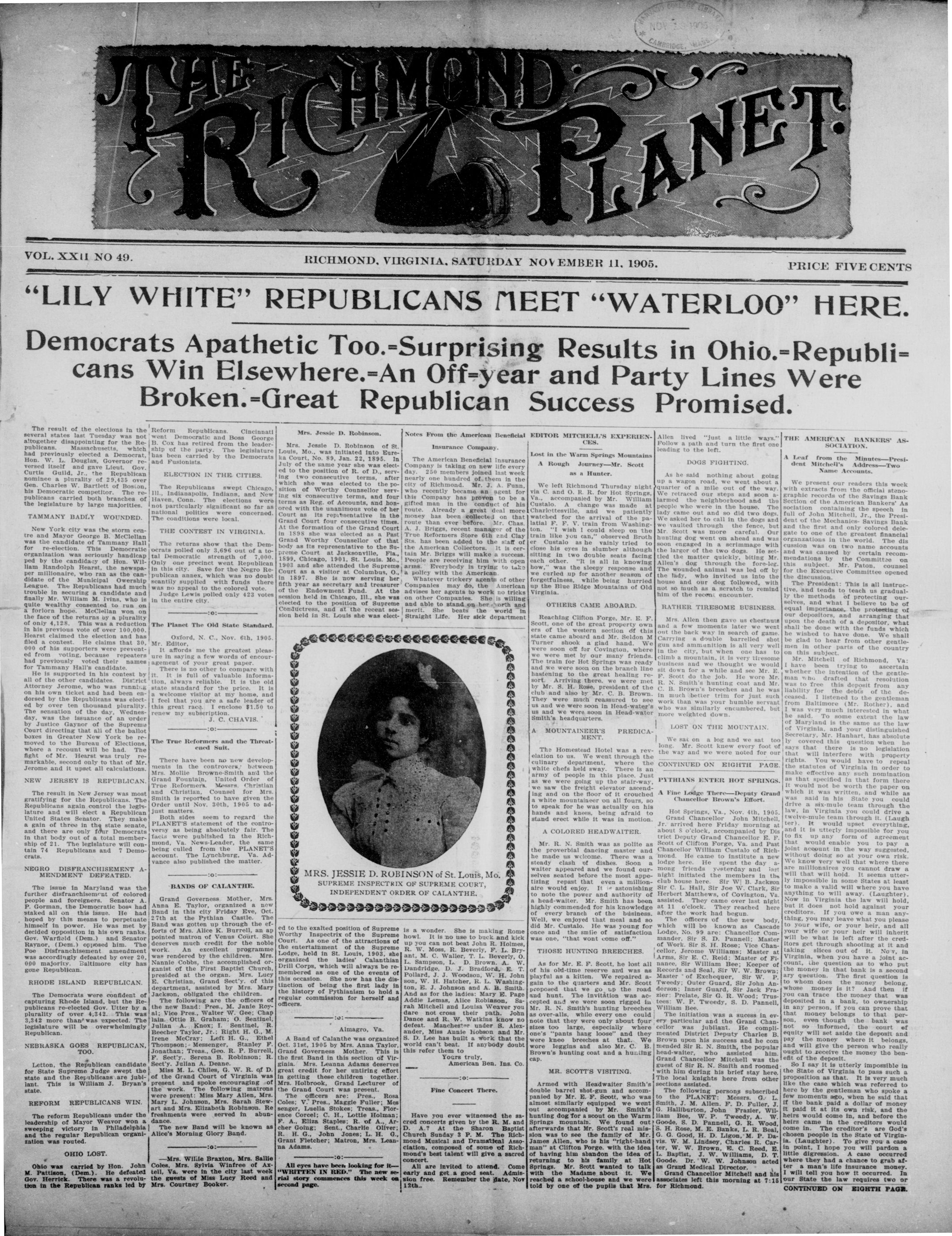
MRS. JESSIE D. ROBINSON of St. Louis, Mo. SUPREME INSPECTRIX OF SUPREME COURT, INDEPENDENT ORDER OF CALANTHE.
Mrs. Jessie D. Robinson.
Mrs. Jessie D. Robinson of St. Louis, Mo., was initiated into Eureka Court, No. 89, Jan. 22, 1895. In July of the same year she was elected to the position of R. of D., serving two consecutive terms, after which she was elected to the position of Worthy Counsellor serving six consecutive terms, and four terms as Reg. of Accounts, and honored with the unanimous vote of her Court as its representative in the Grand Court four consecutive times. At the formation of the Grand Court in 1898 she was elected as a Fast Grand Worthy Counsellor of that body as its representative to the Supreme Court at Jacksonville, Fla., 1899, Chicago, 1901, St. Louis, Mo., 1903 and she attended the Supreme Court as a visitor at Columbus, O., in 1897. She is now serving her fifth year as secretary and treasurer of the Endowment Fund. At the session held in Chicago, Ill., she was elected to the position of Supreme Conductress, and at the recent session held in St. Louis she was elect-
MRS. JESSIE D. ROB
SUPREME INSPECTRI
INDEPENDENT OR
ed to the exalted position of Supreme Worthy Inspectrix of the Supreme Court. As one of the attractions of the entertainment of the Supreme Lodge, held in St. Louis, 1903, she organized the ladies' Calanthian Drill Corps, which will always be remembered as one of the events of this occasion. She now has the distinction of being the first lady in the history of Pythianism to hold a regular commission for herself and officers.
Almagro, Va.
A Band of Calanthe was organized Oct. 31st, 1905 by Mrs. Anna Taylor, Grand Governess Mother. This is the first Band in this section of Virginia. Mrs. Leanna Adams deserves great credit for her untiring effort in getting these children together. Mrs. Holbrook, Grand Lecturer of the Grand Court was present. The officers are: Pres., Rosa Coles; V. Pres., Maggie Fuller; Messenger, Luella Stokes; Treas., Florence Corcel; C. H., Lottie Holman; F. A., Elliza Staples; R. of A., Archer Going; Sent, Charlie Oliver; R. H. G., John Jones; L. H. G., Grant Fletcher; Matron, Mrs. Leanna Adams.
:0:
All eyes have been looking for it—"WRITTEN IN RED." The new serial story commences this week on second page.
Insurance Company.
The American Beneficial Insurance Company is taking on new life every day. 250 members joined last week nearly one hundred of them in the city of Richmond. Mr. J. A. Funn, who recently became an agent for this Company has proven to be a gifted man in the conduct of his route. Already a great deal more money has been collected on that route than ever before. Mr. Chas, A. J. Briggs, recent manager of the True Reformers Store 6th and Clay Sts. has been added to the staff of the American Collectors. It is certain Mr. Briggs will make a success. People are receiving him with open arms. Everybody is trying to take a policy with the American.
Whatever trickery agents of other Companies may do, the American advises her agents to work no tricks on other Companies. She is willing and able to stand on her worth and merit. She beats the world in Straight Life. Her sick department
INSON of St. Louis, Mo.
K OF SUPREME COURT,
DER OF CALANTHE.
is a wonder. She is making Rome howl. It is no use to buck and kick up you can not beat John R. Holmes, R. W. Moss, B. Beverly, F. L. Bryant, M. C. Waller, T. L. Beverly, O. L. Sampson, L. D. Brown, A. W. Dandridge, D. J. Bradford, E. T. Pollard, J. J. Woodson, W. H. Johnson, W. H. Hatcher, R. L. Washington, E. J. Johnson and A. B. Smith. And as for the ladies: Mary E. Page Addie Lemas, Alice Robinson, Sarah Mitchell and Louisa Weaver you dare not cross their path. John Dance and R. W. Watkins know no defeat. Manchester under S. Alexander, Miss Annie Hobson and Mr. S. D. Lee has built a work that the world can't beat. If anybody doubt this refer them to
Yours truly,
American Ben. Ins. Co.
Fine Concert There.
Have you ever witnessed the sacred concerts given by the R. M. and D. A.? At the Sharon Baptist Church Sunday 3 P. M. The Richmond Musical and Dramatical Association, composed of some of Richmond's best talent will give a sacred concert.
All are invited to attend. Come early and get a good seat. Admission free. Remember the date, Nov 12th.
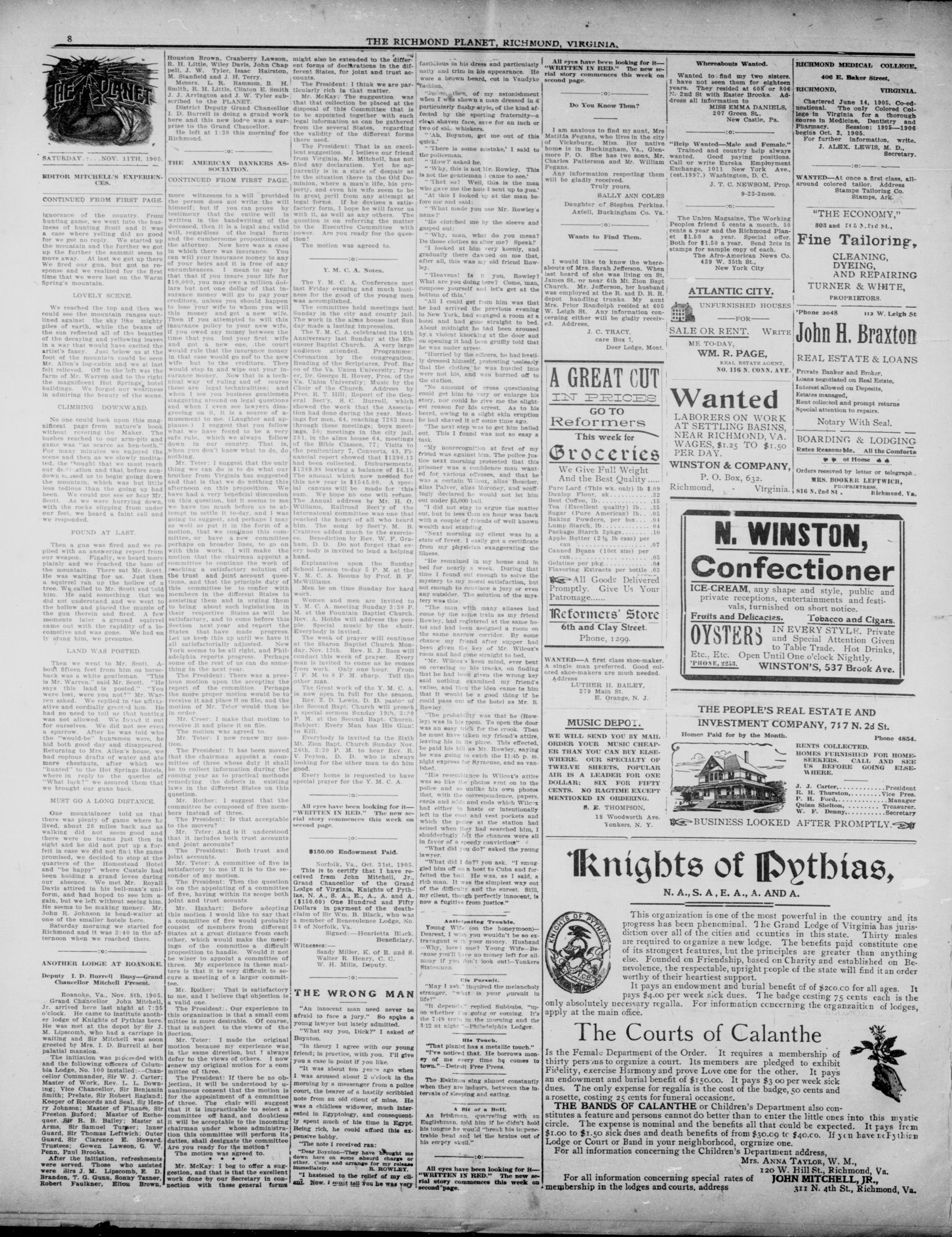
EDITOR MITCHELL'S EXPERIENCES.
Lost in the Warm Springs Mountains
A Rough Journey—Mr. Scott
as a Hunter.
We left Richmond Thursday night via C. and C. O. R. R. for Hot Springs, Va., accompanied by Mr. William Custalo. A change was made at Charlottesville, and we patiently watched for the arrival of the palatial F. F. V. train from Washington. "I wish I could sleep on the train like you can," observed Brother Custalo as he vainly tried to close his eyes in slumber although sitting in two double seats facing each other. "It is all in knowing how," was the sleepy response and we curled up for another season of forgetfulness, while being hurried up the Blue Ridge Mountains of Old Virginia.
OTHERS CAME ABOARD
Reaching Clifton Forge, Mr. E. F. Scott, one of the great property owners of the western section of this state came aboard and Mr. Seldon M. Turner shook a glad hand. We were soon off for Covington, where we were met by our many friends. The train for Hot Springs was ready and we were soon on the branch line hastening to the great healing resort. Arriving there, we were met by Mr. S. H. Rose, president of the club and also by Mr. C. B. Brown. They were much reassured to see us and we were soon in Head-water's us and we were soon in Head-water Smith's headquarters.
A MOUNTAINEER'S PREDICA MENT.
The Homestead Hotel was a revelation to us. We went through the culinary department, where the white chefs held sway. There is an army of people in this place. Just as we were going up the stairway, we saw the freight elevator ascending and on the floor of it crouched a white mountaineer on all fours, so to speak for he was actually on his hands and knees, being afraid to stand erect while it was in motion.
A COLORED HEADWAITER
Mr. R. N. Smith was as polite as the proverbial dancing master and he made us welcome. There was a steady clash of dishes. Soon a waiter appeared and we found ourselves seated before the most appetizing repast that even a millionaire would enjoy. It is astonishing to note the power and authority of a head-waiter. Mr. Smith has been highly commended for his knowledge of every branch of the business. Well, we enjoyed that meal and so did Mr. Custalo. He was young for once and the smile of satisfaction was one, "that wont come off."
THOSE HUNTING BREECHES
As for Mr. E. F. Scott, he lost all of his old-time reserve and was as playful as a kitten. We repaired again to the quarters and Mr. Scott proposed that we go up the road and hunt. The invitation was accepted and we were soon rigged in Mr. R. N. Smith's hunting breeches as over-alls, while every one could note that they were only about four sizes too large, especially where one's "pants hang loose" and they were knee breeches at that. We wore leggins and also Mr. C. B. Brown's hunting coat and a hunting cap.
MR. SCOTT'S VISITING.
Armed with Headwaiter Smith's double barrel shot-gun and accompanied by Mr. E. F. Scott, who was almost similarly equipped we went out accompanied by Mr. Smith's hunting dog for a scout on the Warm Springs mountain. We found out afterwards that Mr. Scott's real mission was to see the family of Mr. James Allen, who is his "right-hand man" at Clifton Forge, with the idea of having him abandon the idea of returning to his family at Hot Springs. Mr. Scott wanted to talk with the Madame about it. We reached a school-house and we were told by one of the punis that Mrs.
Allen lived "just a little ways." Follow a path and turn the first one leading to the left.
DOGS FIGHTING.
As he said nothing about, going up a wagon road, we went about a quarter of a mile out of the way. We retraced our steps and soon alarmed the neighborhood and the people who were in the house. The lady came out and so did two dogs. We asked her to call in the dogs and we vaulted through the fence, but Mr. Scott was more careful. Our hunting dog went on ahead and was soon engaged in a scrimmage with the larger of the two dogs. He settled the matter quickly, biting Mr. Allen's dog through the foreleg. The wounded animal was led off by the lady, who invited us into the house and our dog followed, with not so much as a scratch to remind him of the recent encounter.
RATHER TIRESOME BUSINESS.
Mrs. Allen then gave us chestnuts and a few moments later we went out the back way in search of game. Carrying a double barrelled shotgun and ammunition is all very well in the city, but when one has to climb a mountain, it is very tiresome business and we thought we would sit down for a while and see Mr. E. F. Scott do the job. He wore Mr. R. N. Smith's hunting coat and Mr. C. B. Brown's breeches and he was in much better trim for just such work than was your humble servant who was similarly encumbered, but more weighted down.
LOST ON THE MOUNTAIN
We sat on a log and we sat too long. Mr. Scott knew every foot of the way and we were noted for our
CONTINUED ON EIGHTH PAGE.
PYTHIANS ENTER HOT SPRINGS
A Fine Lodge There—Deputy Grand
Chancellor Brown's Effort.
Hot Springs, Va., Nov. 4th, 1905
Grand Chancellor John Mitchell
Jr. arrived here Friday morning at about 8 o'clock, accompanied by District Deputy Grand Chancellor E. F. Scott of Clifton Forge, Va. and Past Chancellor William Custalo of Richmond. He came to institute a new lodge here. He spent the day among friends yesterday and last night initiated the members in the club house here. Sir W! B. Jackson Sir C. L. Hall, Sir Joe W. Clark, Sir Herbert Matthews, of Covington, Va. assisted. They came over last night at 11 o'clock. They reached here after the work had begun.
The officers of the new body, which will be known as Cascade Lodge, No. 99 are: Chancellor Commander, Sir S. D. Pannell; Master of Work, Sir S. H. Rose; Vice Chancellor, Jerome Williams; Master at Arms, Sir E. C. Reid; Master of Finance, Sir William Bee; Keeper of Records and Seal, Sir W. W. Brown; Master of Exchequer, Sir W. P. Tweedy; Outer Guard, Sir John Anderson; Inner Guard, Sir Jack Frazier; Prelate, Sir G. R. Wood; Trustees: W. P. Tweedy, S. D. Pannell, William Bee.
The initiation was a success in every particular and the Grand Chancellor was jubilant. He complimented District Deputy Charles B. Brown upon his success and he commended Sir R. N. Smith, the popular head-waiter, who assisted him. Grand Chancellor Mitchell was the guest of Sir R. N. Smith and roomed with him during his brief stay here. The local knights here from other sections assisted.
The following persons subscribed to the PLANET: Messrs. G. L. Smith, J. M. Allen. F. D. Fuller, G. Halliburton, John Frazier, William Bee, W. P. Tweedy, A. W. Goode, S. D. Pannell, G. R. Wood, S. H. Rose, M. E. Banks, L. R. Beal, G. G. Good, H. D. Ligon, M. P. Davis. W. M. Lindsey, Charles R. Carter, W. W. Brown, E. C. Reed, E. L. Baptist, J. W. Williams, D. T. Goode, Dr. W. W. Johnson acted as Grand Medical Director.
Grand Chancellor Mitchell and his associates left this morning at 7:15
" HERE.
=Republi= Were
1.
THE AMERICAN BANKERS' ASSOCIATION.
A Leaf from the Minutes—President Mitchell's Address—Two Name Accounts.
We present our readers this week with extracts from the official stenographic records of the Savings Bank Section of the American Bankers' Association containing the speech in full of John Mitchell, Jr., the President of the Mechanics-Savings Bank and the first and only colored delegate to one of the greatest financial organizations in the world. The discussion was on two name accounts and was caused by certain recommendations by the Committee on this subject. Mr. Paton, counsel for the Executive Committee opened the discussion.
The President: This is all instructive, and tends to teach us gradually the methods of protecting ourselves, and what I believe to be of equal importance, the protecting of our depositors, and arranging that upon the death of a depositor, what shall be done with the funds which he wished to have done. We shall be glad to hear from other gentlemen in other parts of the country on this subject.
Mr. Mitchell of Richmond, Va: I have been trying to ascertain whether the intention of the gentleman who drafted that resolution was to free this deposit from any liability for the debts of the deceased. I listened to the gentleman from Baltimore (Mr. Rother), and I was very much interested in what he said. To some extent the law of Maryland is the same as the law of Virginia, and your distinguished Secretary, Mr. Hanhart, has absolutely covered this question when he says that there is no legislation that will interfere with property rights. You would have to repeal the statutes of Virginia in order to make effective any such nomination as that specified in that form there it would not be worth the paper on which it was written, and while as was said in his State you could drive a six-mule team through the law, in Virginia you could drive a twelve-mule team through it (Laughter). It would upset everything, and it is utterly impossible for you to fix up any form of agreement that would enable you to pay a joint account in the way suggested, without doing so at your own risk. We know very well that where there are millionaires you cannot draw a will that will hold. It seems utterly impossible in some States at least to make a valid will where you have anything to will away (Laughter). Now in Virginia the law will hold, but it does not hold against your creditors. If you owe a man anything, you may leave what you please to your wife, or your heir, and all your wife or your heir will inherit will be what is left after the creditors get through shooting at it and taking slices out of it. Nov, in Virginia, when you have a joint account, the question as to who put the money in that bank is a second ary question. The first question is to whom does the money belong, whose money is it? And then if you can trace the money that was deposited in a bank, to ownership in any person, if you can prove that that money belongs to that person, even though the bank was not so informed, the court of equity will set aside the deposit and pay the money where it belongs, and will give the person who really ought to receive the money the benefit of the deposit.
So I say it is utterly impossible in the State of Virginia to pass such a proposition as that. It is very much like the case which was referred to here by the gentleman who spoke a few moments ago, when he said that if the bank paid a dollar of money it paid it at its own risk, and the heirs would come in, and before the heirs came in the creditors would come in. The creditor's are God's chosen people in the State of Virginia. (Laughter). To give you a case in point, I hope you will pardon a little digression. A case occurred where they had a chance to grab after a man's life insurance money. I will tell you how it occurred. In our State the law requires two or
CONTINUED ON EIGHTH PAGE.
WRITTEN IN RED
By
CHAS. HOWARD MONTAGUE AND C. W. DYAR
(Copyright, by The Cassell Publishing Co.
The private office of North & Stackhouse, State street, bankers and brokers, contained on the morning of Friday, June 16, 1887, a group of anxious and excited men, whose conversation plainly indicated that their uneasiness was caused by the continued and unexplained absence of Paul North, the senior partner.
In State street circles North & Stackhouse were classed among the "plungers." For the first two years of the firm's existence, indeed, there had been but slight departure from the conservative policy followed by Mr. North, who, when in the brokerage business on his own account, had been content with a modest office in a comparatively quiet street leading eastward from Post Office square.
But, under the lead of Mr. Stackhouse—an energetic man of 40, ten years his partner's junior—banking had been added to brokerage; and the firm had become widely known as the promoter of many daring enterprises.
Nicaragua Midland was a specialty with North & Stackhouse. In season and out of season Nicaragua Midland had been "boomed" with a persistence that caused some of the older magnates of "the street" to shake their heads ominously, but which had attracted, nevertheless, the admiration and cooperation of a multitude of people. Not all who invested their earnings under the advice of North & Stackhouse had, it is true, found the venture profitable. Twelve days previous to this June morning in 1887 a curious letter, in an unknown hand, had been laid on Mr. North's desk. The writing was an odd sort of scrawl, uncertain in its lines, but legible enough. This was the missive:
"My Dear Sir: I am a desperate man, ruined by your manipulations of the property entrusted to your hands. I must have enough to begin life again. I only ask for help, not to kill you. I belong to, but that little I must have. There is only one thing for you to do: Draw a check, for one thousand dollars, payable to the post office, or call you at the post office. Boston. If you fail this, I swear to shoot you down as I would a mad dog. If you are wise, you will not refer this matter to the police. That act would be your fault." "DANIEL STICKNEY." Paul North, to whom personally this threatening letter was addressed, had consulted his partner in some little uneasiness of mind.
"It's all nonsense," Mr. Stackhouse had said, confidently. "A mere practical joke of some broker who wants to frighten you. A few of them were nipped in the last turn of the market in our favor, you know, and perhaps they hold North & Stackhouse responsible. But if the matter disturbs you at all, why turn the letter over to the police. They'll attend to it. We must look after Nicaragua Midland very sharply this week. North and have no time to bother our heads about trifles."
Nevertheless Mr. North had troubled himself about the matter sufficiently to put the letter into the hands of Inspector Applebee for such action as seemed proper.
Upon the advice of that quietly efficient personage a decoy letter had been written by Mr. North, including a check for $1,000. payable to bearer.
An officer, in citizen's clothes, had been stationed on duty constantly at the post office, but no Daniel Stickney had called for the letter addressed to his name.
As a precaution against any possible oversight payment of the check had been stopped at the bank, a precaution which thus far had proved equally useless.
"Just as I told you," Stackhouse had said to his partner after a few days. "A broker's practical joke."
The letter soon passed out of mind, for business cares weighed heavily on both partners.
So absorbed and anxious had Mr. North become that he could talk and think of little except the market and its prospects.
Was it altogether on the subject of Nicaragua Midland that he had held conference, late in the afternoon of the 15th of June, with one of the chief investors, though not a director, in the Nicaragua Midland—Mr. Richard Fetridge?
Whether or not, the interview had not been finished at the office, for the two men had been seen to walk away together, still talking earnestly.
The junior partner had left the office hours before, outwardly calm. Whatever his forebodings may have been, Thornton Stackhouse was not the man to allow his troubles to snow themselves in look or manner.
Paul North was the father-in-law of his business associate, and Thornton Stackhouse made his home in summer time at Mr. North's spacious villa at Swampscott, from whose broad windows the occupants enjoyed an exhilarating prospect of the sail-flecked ocean.
At ten o'clock in the morning of this Friday, the 16th of June, the directors of Nicaragua Midland had assembled, pursuant to call, in the office of North & Stackhouse. Half an hour later every face wore a look of anxious expectation.
"I don't understand it at all," exclaimed Stackhouse, nervously walking up and down. "North is the most punctual of men, as you all know. He must be ill."
"Ill!" echoed one of the directors. "Wasn't North all right when you left him at Swampscott this morning?"
Mr. Stackhouse waved his hand impatiently.
"I didn't go down to the shore last night, he returned, shortly. "Stayed in town with a friend. I left North here in this office about three o'clock in the afternoon and haven't laid eyes
CHAPTER 1.
on him since?"
"Why don't you telegraph to his house?" asked a little man near the door. "It's strange he hasn't sent some word himself before this time. But I suppose he's ill, and his daughters are so worried about him that they have forgotten to send. Just like women!" the tsty little bachelor added.
The suggestion was acted upon instantly. Aler an interminable delay a response came, evoking a simultaneous murmur of dismay and the interchange of apprehensive looks.
"Swampscott, June 16."
"Mr. North must have stayed in town. He has not been here since yesterday morning."
"COMFORT HARWOOD."
"Strange!" ejaculated Stackhouse, ringing the bell as he spoke. "Send Mr. Jobson in," he added, the next moment, to the waiting messenger.
The old clerk was in the room before the messenger had left it, trembling all over with senile agitation.
"At what time did Mr. North leave the office yesterday afternoon?" Stackhouse demanded abruptly.
"It was after five o'clock, sir."
"Was he alone?"
"No, sir. Mr. Fetridge was with him."
"Probably went out of town somewhere with Fetridge," suggested one of the directors.
"Delayed—missed a train. Very provoking! On this day, too, of all others! But send round to Fetridge's office and see if he has been heard from."
Unasked, the old clerk took upon himself the duty of messenger, and the party anxiously awaited his return. But one question and answer were interchanged meanwhile.
"His Nicaragua been quoted to-day, Stackhouse?" the little old bachelor queried.
"Yes. Offered at 9. No takers. Off a point already, you see."
The sound of footsteps and voices in the outer office announced to the anxious ear of Stackhouse the coming of Mr. Fetridge himself. The broker stepped forward.
"Well?"
It was evident at first sight that the newcomer was unduly agitated. He was a stalwart, handsome fellow, certainly not beyond 30 years of age.
"I cannot imagine where North is any more than you," he exclaimed, without waiting for question.
"I walked up the street with him yesterday afternoon, after a talk in his office."
"Where did you leave him?"
Fetridge flushed and seemed considering a reply. All eyes were turned on him.
"I don't know the exact point," he said, at last. "At the corner of State and Washington streets, I think it was."
Stackhouse, who was very nervous and more affected than the occasion seemed to require, stared at Fetridge blankly, as if utterly at a loss to account for his confusion.
"His town house is closed for the summer," he suggested, his eyes still on Fetridge's face. "He must have gone to some hotel."
"Send a messenger to make the rounds!" excitedly demanded the little bachelor.
Richard Fetrude seemed to find the situation unaccountably embarrassing. He had no advice to offer. Stackhouse particularly appeared to disconcert him. Murmuring something about having left a man waiting for him at his office, and that he presumed North would be found speedily, he hastened out and betook himself in the direction of his place of business. The necessity of haste in his return, however, seemed to become less obvious to him after he reached the open air. He stood stock still with his foot upon the flight of stairs leading to his office, and then, under the stress of a sudden thought, wheeled abruptly and walked energetically back up the street.
In five minutes he was in police headquarters at Pemberton square, inquiring anxiously of the official to whom the clerk referred him whether any notification of the disappearance of Paul North had been sent to him. The official professed ignorance of the matter.
"When was he last seen, sir?"
"Yesterday afternoon about five o'clock, going up State street from his office." Petridge rejoined, avoiding further detail. And hastened to add: "He has a town house at — Marlboro street, you know. Perhaps it isn't my place to suggest it, but don't the police in such cases have authority to enter a man's premises if—"
Petridge hesitated. The official observed him narrowly, wondering, no doubt, why he was so obviously agitated.
"Undoubtedly; if his friends desired it, and had any reason to believe that
there was anything the matter, the police would enter the house."
Fetridge thereupon urged the official to obtain permission from Thornton Stackhouse to make a search of the premises. He was unable to give any direct reason, and unwilling to put into words any definite suspicion, but he showed by his conduct that he had both. Eventually a messenger was dispatched in search of Stackhouse, who thereupon responded in person. He seemed a little surprised to see Fetridge, and the official noted that there was a constrainedness and a lack of cordiality between the two men. Their opinions, however, coincided upon the matter in question.
"By all means," said Stackhouse, "search the house in Marlboro street. It is my residence as well as North's, and I authorize you—if the men sent are discreet and trustworthy."
The official arose.
"Then I will send word at once by telephone to Station 4. You don't happen to have a key to the house about you?"
"Why, no," returned the partner. "My keys are in my wife's care at Swampscott, or I should have gone to the house myself."
The message was sent, and while the police of the fourth division were acting in accordance therewith, Stackhouse and Fetridge sat waiting at headquarters, the quiet broken only by the scratching of the busy pen of a clerk.
No. — Marlboro street was a broad, brown house, the counterpart of half a hundred other dwellings within a stone's throw of Paul North's town residence.
"For there's a hue and cry coming out of this thing or I'm no prophet," the sergeant said.
CHAPTER II.
A PERFUME-AS OF A WOMAN.
Sergt. Parr continued, nevertheless, a careful scrutiny of the apartment. It was beyond doubt a library, for the backs of books showed behind the sheets that covered certain articles of large bulk. The adjoining room was in all probability the sleeping chamber of the master of the house. A casual inspection satisfied the officer that the bed had not been occupied since it was last made up.
But there was something more important still in the sergeant's estimation.
lost not a detail.
But now, as his close comrade the adjoining minute.
The room had lily. Regarding it no possibility of.
Chairs had been accustomed place desk, which Mr. identified as his a heap of tumble Near by, a bus the windows had.
The adjoining Paul North's clerk soon recovering no traces of ooc was open between
As the sergeant and patrolman of the fourth division neared the place they observed the outer door at the entrance and saw that all the windows in the basement and first story were barred or shuttered. Curtains, closely drawn, lent a cheerless and deserted appearance to the windows above.
"And yet," remarked the sergeant, as he went up the steps, "somebody has been here. The outer door is open; the vestibule door unlocked."
It was indeed true, and led at once to the conclusion that Paul North was within.
The officer rang the bell. But though the summons was repeated again and again it awoke no responsive life inside the darkened, echoing house. The sergeant calmly came to the conclusion that an entrance must be forced, and after a brief inspection of the premises sent Johnson, the officer, in quest of a ladder. The ladder was obtained from the nearest depository of the fire department; and the officers were soon in the rear of Paul North's residence. It took but a minute to open the door of the yard. In another minute the ladder rested against a brick wall, and Officer Johnson, with a curious piece of flexible steel in his grasp, had pushed back the lock of a curtained window in the second story.
"A bedroom," said the sergeant, pulling up the curtain with some difficulty, when they were both inside; "bed untouched, however. Door open into that dark room in front. 'Other door open—to the corridor, no doubt.'
The sergeant led the way through a door diagonally opposite the window by which they had gained entrance. It was the corridor, as he had expected. He set out methodically to peer into the rooms as he went along, but he met with an obstacle at the very outset. At the head of the broad front staircase the door refused to yield to his
Steve Hamm
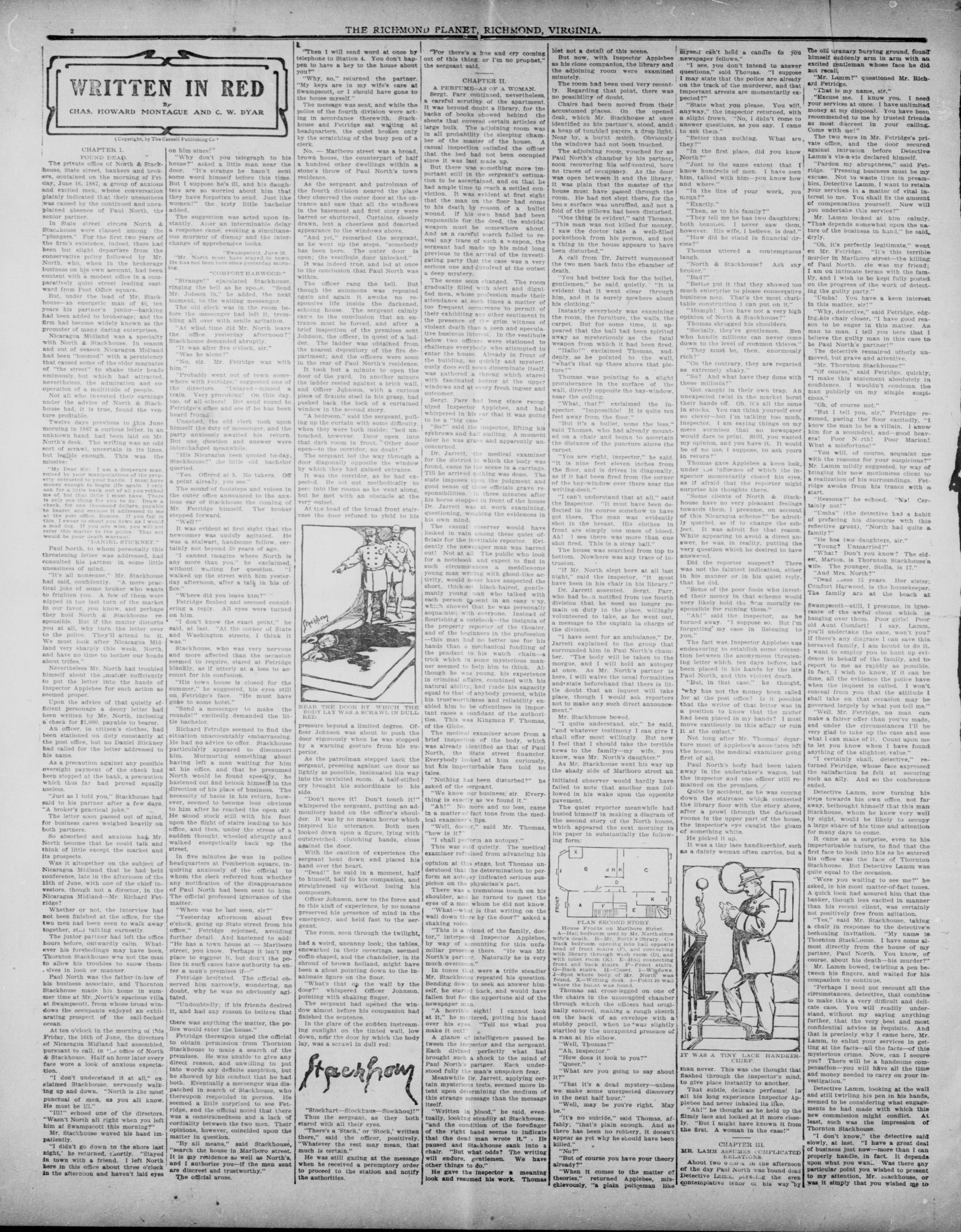
NEAR THE DOOR BY WHICH THE BODY LAY WAS A SCRAWL IN DULL RED.
pressure beyond a limited degree. Officer Johnson was about to push the door vigorously when he was stopped by a warning gesture from his superior.
As the patrolman stepped back the sergeant, pressing against the door as lightly as possible, insinuated his way into the unvisited room. A half-stiffed cry brought his subordinate to his side.
"Don't move it! Don't touch it!" whispered the sergeant, putting an admonitory hand on the officer's shoulder. It was by no means horror which inspired his utterance. Both men looked down upon a figure, lying with outstretched, clutching hands, close against the door.
With the caution of experience the sergeant bent down and placed his hand over the heart.
"Dead!" he said in a moment, half to himself, half to his companion, and straightened up without losing his composure.
Officer Johnson, new to the force and to this kind of experience, by no means preserved his presence of mind in the emergency, and held fast to the sergeant.
The room, seen through the twilight, had a weird, uncanny look; the tables, enswathed in their coverings, seemed coffin-shaped, and the chandelier, in its shroud of brown holland, might have been a ghost pointing down to the inanimate figure on the floor.
"What's that on the wall by the door?" whispered Officer Johnson, pointing with shaking finger.
The sergeant had opened the window almost before his companion had finished the sentence.
In the glare of the sudden instreaming sunlight on the tinted wall, low down, near the door by which the body lay, was a scrawl in dull red:
"Stockhart—Stockhaus—Stockhouj!"
Thus the sergeant, as they both stared with all their eyes.
"There's a 'Stack,' or 'Stock,' written there," said the officer, positively.
"Whatever the rest may mean, that much is certain."
He was still gazing at the message when he received a peremptory order to proceed to the station and notify the authorities.
"For there's a hue and cry coming out of this thing, or I'm no prophet," the sergeant said.
CHAPTER II
A PERFUME-AS OF A WOMAN.
Sergt. Parr continued, nevertheless, a careful scrutiny of the apartment. It was beyond doubt a library, for the backs of books showed behind the sheets that covered certain articles of large bulk. The adjoining room was in all probability the sleeping chamber of the master of the house. A casual inspection satisfied the officer that the bed had not been occupied since it was last made up.
But there was something more important still in the sergeant's estimation to be ascertained, and on that he had ample time to reach a settled conviction. It was evident at first sight that the man on the floor had come to his death by reason of a bullet wound. If his own hand had been responsible for the deed, the suicidal weapon must be somewhere about. And as a careful search failed to reveal any trace of such a weapon, the sergeant had made up his mind long previous to the arrival of the investigating party that the case was a very serious one and involved at the outset a deep mystery.
The scene soon changed. The room gradually filled with alert and dignified men, whose profession made their attendance at such times a matter of too frequent occurrence to permit of their exhibiting any other sentiment in the presence of the grim witness of violent death than a keen and speculative business interest. In the vestibule below two officers were stationed to challenge everybody who attempted to enter the house. Already in front of the building, so quickly and mysteriously does evil news disseminate itself, was gathered a throng which stared with fascinated horror at the upper windows and at every fresh ingoor and outcomer.
Sergt. Parr had long since recognized Inspector Applebee, and had whispered in his car that it was going to be a "big case."
"So?" said the inspector, lifting his eyebrows and half smiling. A moment later he was grave and apparently unconcerned.
Dr. Jarrett, the medical examiner for the district in which the body was found, came to the scene in a carriage. Till he arrived nothing was done. The state imposes upon the judgment and good sense of these officials grave responsibilities. In three minutes after his horse stopped in front of the house Dr. Jarrett was at work examining, questioning, weighing the evidences in his own mind.
The casual observer would have looked in vain among these quiet officials for the inevitable reporter. Evidently the newspaper man was barred out! Not at all. The public who look for a notebook and expect to find in such circumstances a meddlesome young man writing with ghoul-like activity, would never have suspected the short, thick-set, black-haired, gentlemanly young man who talked with each person present in an easy way, which showed that he was personally acquainted with everyone. Instead of flourishing a notebook—the insignia of the property reporter of the theater, and of the beginners in the profession—this man had no better use for his hands than a mechanical fondling of the pendant to his watch chain—a trick which in some mysterious manner seemed to help him to think. Although he was young, his experience in criminal affairs, combined with his natural ability, had made his sagacity equal to that of anybody present, while his trustworthiness and reliability enabled him to be oftentimes in important cases a confidant of the authorities. This was Kingman F. Thomas, of the Globe.
The medical examiner arose from a brief inspection of the body, which was already identified as that of Paul North, the State street financier. Everybody looked at him curiously, but his imperturbable face told no tales.
"Nothing has been disturbed?" he asked of the sergeant.
"We know our business, sir. Everything is exactly as we found it."
"Ah!" No more and no less, came in a matter of fact tone from the medical examiner's lips.
"Well, doctor," said Mr. Thomas, "how is it?
"I shall perform an autopsy."
This was sold quietly. The medical examiner refrained from advancing his opinion at this stage, but Thomas understood that the determination to perform an autopsy indicated serious suspicion on the physician's part. There was a tremulous touch on his shoulder, and he turned to meet the eyes of a man whom he did not know.
"What—what is that writing on the wall down there by the door?" asked a shaking voice.
"This is a friend of the family, doctor," interposed Inspector Applebee, by way of accounting for this unfamiliar presence there. "He was Mr. North's partner. Naturally he is very much overcome."
In tones that were a trifle steadier Mr. Stackhouse repeated his question. Bending down to seek an answer himself, he started back, and would have fallen but for the opportune aid of the newspaper man.
"A horrible sight! I cannot look at it," he muttered, putting his hand over his eyes. "Tell me what you make it out!"
A glance of intelligence passed between the inspector and the sergeant. Each divined perfectly what had brought such a shock to the mind of Paul North's partner. Each understood fully the man's unspoken fear.
Meanwhile Dr. Jarrett, applying certain mysterious tests, seemed more intent upon determining the medium of this strange message than the message itself.
"Written in blood," he said, eventually, looking steadily at Stackhouse; "and the condition of the forefinger of the right hand seems to indicate that the dead man wrote it." He paused and Stackhouse sank into a chair. "But what odds? The writing will endure, gentlemen. We have other things to do."
He gave the inspector a meaning look and resumed his work. Thomas
lost not a detail of this scene.
But now, with Inspector Applebee as his close companion, the library and the adjoining room were examined minutely.
The room had been used very recently. Regarding that point, there was no possibility of doubt.
Chairs had been moved from their accustomed places. On the opened desk, which Mr. Stackhouse at once identified as his partner's, stood, amid a heap of tumbled papers, a drop light. Near by, a burnt match. Obviously the windows had not been touched.
The adjoining room, vouchered for as Paul North's chamber by his partner, soon recovering his self-control, bore no traces of occupancy. As the door was open between it and the library, it was plain that the master of the house must have passed through the room. He had not slept there, for the beet's surface was unruffled, and not a fold of the pillows had been disturbed.
"One thing is evident," said Thomas. "This man was not killed for money. I saw the doctor take a well-filled pocketbook from his person, and not a thing in the house appears to have been disturbed."
A call from Dr. Jarrett summoned the two men back into the chamber of death.
"You had better look for the bullet, gentlemen," he said, quietly. "It is evident that it went clear through him, and it is surely nowhere about his clothing."
Instantly everybody was examining the room, the furniture, the walls, the carpet. But for some time, it appeared that the ball had been spirited away as mysteriously as the fatal weapon from which it had been fired.
"Hallo!" exclaimed Thomas, suddenly, as he pointed to the wall, "what's that up there above that picture?"
Thomas was pointing to a slight protuberance in the surface of the wall, directly opposite the bay-window, near the ceiling.
"What, that?" exclaimed the inspector. "Impossible! It is quite ten feet away from the floor."
"But it's a bullet, none the less," said Thomas, who had already mounted on a chair and began to ascertain the distance of the puncture above the carpet.
"You are right, inspector," he said. "It is nine feet eleven inches from the floor, and is driven in diagonally, as if it had been fired from the corner of the bay-window over there near the writing-desk."
"I can't understand that at all," said the inspector. "It must have been deflected in its course somehow to have got there. The man was evidently shot in the breast. His clothes in front are simply one mass of blood. Ah! I see there was more than one shot fired. This is a stray ball."
The house was searched from top to bottom. Nowhere was any trace of intrusion.
"IIf Mr. North slept here at all last night," said the inspector, "It must have been in his chair in his library."
Dr. Jarrett assented. Sergt. Parr, who had been notified from the fourth division that he need no longer remain on duty in the place, willingly volunteered to take, as he went out, a message to the captain in charge of the division.
"I have sent for an ambulance." Dr. Jarrett explained to the group that surrounded him in Paul North's chamber. "The body will be taken to the morgue, and I will hold an autopsy at once. As Mr. North's partner is here, I will waive the usual formalities and state beforehand that there is little doubt that an inquest will take place, though I would ask reporters not to make any such direct announcement."
Mr. Stackhouse bowed.
"I quite understand, sir," he said, "and whatever testimony I can give I shall offer most willingly. But now I feel that I should take the terrible news to the family—my wife, you know, was Mr. North's daughter." As Mr. Stackhouse went his way up the shady side of Marlboro street an
initiated observer would hardly have
failed to note that another man fol-
lowed in his wake upon the opposite
pavement.
The quiet reporter meanwhile had
busled himself in making a diagram of
the second story of the North house,
which appeared the next morning in
his paper in substantially the follow-
ing form:
PLAN SECOND STORY
House Fronts on Mariboro Street.
A-Hall bedroom used by Mr. North since wife P-Hall bedroom opened into hall, opposite back of head stairs (F), and connecting with library through wash room (D), and with toilet room (K). E-Hall connecting front and back stairs. F-Front stairs. G-Front stairs. L-Wingdows. J-Spot where body of Mr. North found. X-Writing desk. Q-Point in wall where the bullet was found.
Thomas sat cross-legged on one of the chairs in the unoccupied chamber through which the officers had originally entered, making a rough sketch on the back of an envelope with a stubby pencil, when he was slightly startled by the unexpected presence of a man at his elbow.
"Well, Thomas?"
"Ah, inspector."
"How does it look to you?"
"Queer."
"What are you going to say about it?"
"That it's a dead mystery—unless we make some unexpected discovery in the next half hour."
"Well, may be you're right. May be."
"It's no suicide," said Thomas, affably; "that's plain enough. And as there has been no robbery, it doesn't appear as yet why he should have been killed."
"No?"
"But of course you have your theory already?"
"When it comes to the matter of theories," returned Applebee, mischievously, "a plain policeman like
myself can't hold a candle to you newspaper fellows."
"I see, you don't intend to answer questions," said Thomas. "I suppose I may state that the police are already on the track of the murderer, and that important arrests are momentarily expected?"
"State what you please. You will, anyway," the inspector returned, with a slight frown. "No, I didn't come to answer questions, as you say. I came to ask them."
"Better than nothing. What are they?"
"In the first place, did you know North?"
"Just to the same extent that I know hundreds of men. I have seen him, talked with him—you know how and where."
"In the line of your work, you mean?"
"Exactly."
"Then, as to his family?"
"They tell me he has two daughters; both beauties. I never saw them, however. His wife, I believe, is dead."
"How did he stand in financial circles?"
Thomas uttered a contemptuous laugh.
"North & Stackhouse? Ask any broker."
"Bad?"
"Better put it that they showed too much enterprise to please conservative business men. That's the most charitable construction I can put on it."
"Humph! You have not a very high opinion of North & Stackhouse?"
Thomas shrugged his shoulders.
"Socially, they're gentlemen. Men who handle millions can never come down to the level of common thieves."
"They must be, then, enormously rich?"
"On the contrary, they are regarded as extremely shaky."
"So? And what have they done with these millions?" "Got caught in their own trap. An unexpected twist in the market burnt their hands off. Oh, it's all the same in stocks. You can think yourself ever so clever—but I'm talking too much, inspector. I am saying things on my mere surmises that no newspaper would dare to print. Still, you wanted my opinion, and you have it. It would be of no use, I suppose, to ask yours in return?" Thomas gave Applebee a keen look, under the influence of which the inspector momentarily closed his eyes, as if afraid that the reporter might surprise his thoughts there.
"Some clients of North & Stackhouse have no very pleasant feelings towards them, I presume, on account of this Nicaragua scheme?" he adroitly queried, as if to change the subject. It was adroit for that reason. While appearing to avoid a direct answer, he was, in reality, putting the very question which he desired to have answered.
Did the reporter suspect? There was not the faintest indication, either in his manner or in his quiet reply, that he did.
"Some of the poor fools who invested their money in that scheme would very likely hold the firm morally responsible for ruining them."
"Ah!" said the inspector, as he turned away. "I suppose so. But I'm forgetting' my case in listening to you."
The fact was, Inspector Applebee was endeavoring to establish some connection between the anonymous threatening letter which ten days before, had been placed in his hands by the late Paul North, and this violent death.
"But, in that case," he thought,
"why has not the money been called for at the post office? Is it possible that the writer of that letter was in a position to know that the matter had been placed in my hands? I must move cautiously in this affair or run it at the outset."
Not long after Mr. Thomas' departure most of Applebee's associates left the house, the medical examiner going first of all.
Paul North's body had been taken away in the undertaker's wagon, but the inspector and one officer still remained on the premises.
Quite by accident, as he was coming down the staircase which connected the library floor with the story above, after a prowl through the darkened rooms in the upper part of the house, the inspector's eye caught the gleam of something white.
He picked it up.
It was a tiny lace handkerchief, such as a dainty woman often carries, but a
0
IT WAS A TINY LACE HANDKER-CHIEF.
man never. This was the thought that flashed through the inspector's mind, to give place instantly to another.
That subtle, delicate perfume! In all his long experience Inspector Applebee had never inhaled its like.
"Ah!" he thought as he held up the filmy lace and looked at it more closely. "But I might have known it from the first. A woman in the case!"
CHAPTER III
GELATIONS.
About two hours in the afternoon of the day Paul Laman found Detective Laman, parsing the contemplative tenor of his way by
the old tarmacy Durying ground, found himself suddenly arm in arm with an excited gentleman whose face he did not recall,
"Mr. Lamm?" questioned Mr. Richard Fetridge.
"That is my name, sir."
"Excuse me. I know you. I need your services at once. I have unlimited money at my disposal. You have been recommended to me by trusted friends as most discreet in your calling. Come with me!"
The two were in Mr. Fetridge's private office, and the door secured against intrusion before Detective Lamm's vis-a-vis declared himself.
"Pardon my abruptness," said Fetridge. "Pressing business must be my excuse. Not to waste time in preambles, Detective Lamm, I want to retain your services in a matter of vital interest to me. You shall fix the amount of compensation yourself. Now will you undertake this service?"
Mr. Lamm looked at him calmly,
"That depends somewhat upon the nature of the business in hand," he said,
dryly.
"Oh, it's perfectly legitimate," went on Mr. Fetridge. "It's this terrible murder in Marlboro street—the killing of Paul North. He was my friend; I am on intimate terms with the family, and I wish to be kept fully posted on the progress of the work of detecting the guilty party."
"Umha! You have a keen interest in this matter, sir!"
"Why, detective," said Fetridge, edging his chair closer, "I have good reason to be eager in this matter. As man to man, I tell you here that I believe the guilty man in this case to be Paul North's partner!"
The detective remained utterly unmoved, but grave and attentive.
"Mr. Thornton Stockhouse."
"Mr. Thornton Stackhouse?"
"Of course," said Fetridge, quickly,
"I make this statement absolutely in
confidence. I wouldn't condemn the
man publicly on my simple suspicions."
"Oh, of course not."
"But I tell you, sir." Fetridge re-
sumed, pacing the floor excitedly.
"I know the man to be a villain. I know
him for a scoundrel, and—good heavens!
Poor North! Poor Marion!
What a fortune!"
"You will, of course, acquaint me
with the reasons for your suspicions?"
Mr. Lamm mildly suggested, by way of
bringing his now motionless client to
a realization of his surroundings. Fet-
ridge awoke from his trance with a
start.
"Reasons?" he echoed. "No! Certainly not!"
"Umha" (the detective had a habit
of prefacing his discourse with this
reflective grunt), "North had quite a
family?"
"He has two-daughters, air."
"Young? Unnarrated?"
"What? Don't you know? The eldest, Marion, is Thornton Stackhouse's wife. The younger, Stella, is 17."
"And May Marion?"
"And Mrs. North?"
"Dead these 15 years. Her sister; Comfort Harwood, is the housekeeper. The family are at the beach at Swampscott—still, I presume, in ignorance of the awful cloud which is hanging over them. Poor girls! Poor old Aunt Comfort! I say, Lamm, you'll undertake the case, won't you? If there's any disgrace I can save this bereaved family, I am bound to do it. I want to employ you to hunt up evidence in behalf of the family, and to report to me as rapidly as possible. In fact, I wish to know, if it can be done, all the evidence the police have when the inquest is called. I won't conceal from you that the attitude I shall take on that occasion may be governed largely by what you tell me."
"Well, Mr. Fetridge, no man can make a fairer offer than you've made, and under the circumstances I'll be very glad to take up the case and see what I can make of it. Count upon me to let you know when I have found anything of the slightest value."
"I certainly shall, detective," returned Fetridge, whose face expressed the satisfaction he felt at securing such an ally. And so the conference ended.
Detective Lamm, now turning his steps towards his own office, not far away, bethought himself that this man Stackhouse, whom he knew very well by sight, would be likely to occupy a large share of his time and attention for many days to come.
It came as a surprise, even to his imperturbable nature, to find that the first face to look into his face he entered his office was the face of Thornton Stackhouse. But Detective Lamm was quite equal to the occasion.
"Were you waiting to see me?" he asked, in his most matter-of-fact tones. A quick look had assured him that the banker, though less excited in manner than his recent client, was certainly not positively free from agitation.
Mr. Lamm bowed, twirling a pen between his fingers, and waited for his companion to continue.
"Perhaps I need not recount all the circumstances, detective, that combine to make this a very difficult and delicate case. You will readily understand, without my saying anything further, that the very best and most confidential advice is requisite. And that is precisely why I came here, Mr. Lamm, to enlist your services in getting at the facts—all the facts—of this mysterious crime. Now, can I secure you? There will be a handsome compensation—you will have all the time and money needed to carry on your investigation."
Detective Lamm, looking at the wall and still twirling his pen in his hands, seemed to be considering what engagements he had made with which this new commission might conflict. At least, such was the impression of Thornton Stackhouse.
"I don't know," the detective said slowly, at last. "I have a great deal of business just now—more than I can properly handle, in fact. It depends upon what you want. Was there any particular point you wished to present to my attention, Mr. snackhouse, or was it simply that you wished me to
THE PLANET
SATURDAY.....NOV. 11TH. 1905
WRITTEN IN RED.
ascertain facts and report to you?"
Mr. Stackhouse looked at the door with some vague apprehension.
"We shall not be disturbed," said the detective; "I sprang the lock as I came in."
Mr. Stackhouse brought his chair close to the detective. When he spoke it was in very low tones, hardly above a whisper.
"Mr. Lamm, you may have read in the afternoon papers that a name was written on the wall close to where my partner lay dead."
A nod and a renewed twirling of the pen.
"That name, Mr. Lamm, was meant to be mine—was mine!"
The detective raised his eyebrows and seemed about to speak.
"You are going to ask me how I know," said Stackhouse. "Why, I read it with my own eyes. Yes, the papers said the scrawl might have meant Stick or Stock or Stockholm, and so on; but I had a keeper and truer sight than the officers there.
"Now, detective, that name was written by some enemy of mine, who seeks to implicate me in this terrible affair. I am convinced of the fact. And, being so convinced, a man of your experience does not need to be told that I dismiss the idea that Paul North wrote that name on the wall as utterly out of the question."
The grave, listening face near his wore no look of surprise, as Mr. Lamm nodded his full understanding of his visitor's thought.
"North being put aside, we must look for the guilty party in another quarter. Mr. Lamm, you don't happen to recollect who it was at the meeting of Nicaragua directors, of which the papers published an account, testified that he parte, with Paul North late yesterday afternoon?" Mr. Lamm did not appear to recollect, for he pursued up his lips, shrugged his shoulders slightly and said nothing.
"Well, detective, that man was Mr. Richard Fetridge, of whom you may have heard—a young lawyer of considerable property who has had dealings with our firm."
"Richard Fetridge" repeated the detective slowly: "well?"
"Mr. Fetridge stated, after considerable hesitation, which I couldn't help noticing, that he left Mr. North about five o'clock, after a business interview with him at our office. What the nature of that conference between them was I can't say. Mr. Fetridge and I did not like each other, I'm free to say it, and latterly I fancied that he grew even more curt and unpleasant in his manner toward me than before. Not that I cared for that, you understand; I would not have given the matter a moment's thought but for this terrible affair. Nor even now, if Fetridge's strange conference, and his hesitancy about saying where he left Mr. North, were not put in a more peculiar light by certain other facts that have come to my knowledge."
"New facts?"
"Yes. Fetridge and North were seen together at a much later hour than five o'clock the afternoon of the murder."
The statement was made pointedly, and the detective gave evidence of interest.
"Are you sure?" he asked.
"Absolutely sure." Mr. Stackhouse's voice had sunk to a confidential whisper. "A business acquaintance whose word is beyond question has told me that he saw the two men walking up the Public Gardens at seven o'clock last evening, going in the direction of Marlboro street."
Lamm threw off the mask of reserve.
"And that is, to your mind, a most valuable, a most important, piece of evidence? In conjunction with Mr. Petridre's conduct and course, you would consider it certainly very significant."
"So significant," returned Stackhouse, "that but for the fact that I want to have the criminal so tangled in the mesh when he is caught that there can be no possible escape. I should before this have given the information to the police."
"Then your theory is—?" suggested the detective.
"What theory could a man have under the circumstances? Richard Fetridge gained my partner's confidence—got into the family on a friendly footing—saw it was of no use to keep up his scheme of 'working' poor Mr. North any further, enticed him to this interview and subsequent conference at his house and there murdered him."
"Murdered him?" echoed Mr. Lamm with not a shade of difference in the tone of his voice, quite as if he expected just such a revelation.
"Not only murdered him," Stackhouse went on, his voice now full and strong under the stress of excitement; "but tried to fasten the guilt of the crime upon me. Richard Fetridge wrote my name there in the blood of his victim—Richard Fetridge, and no other. I feel as certain of it as if I had been a witness of the deed. He is my enemy; I have felt it for a long time, and in the hostility, and no doubt his dread lest his scheming with North should come to light through my examination of his affairs, he has done his utmost to discredit and dishonor me. Now you see why I want Richard Fetridge watched; why I want him followed at every step; why I want his guilt established by incontrovertible proof."
By this time Stackhouse, with his fists clenched, was pacing the floor.
"First of all," said the detective.
quietly observing Stackhouse under hife eyebrows—"first of all, let us look at your own interests here. Perhaps you over-estimate the influence of that word written on the wall—your name, as you declare. No one else has asserted this openly. Mr. Stackhouse; but there have, no doubt, been whisperings to that effect, and it is the part of wisdom for you to silence, at once and effectually, any such charge, uttered, insinuated, or hinted at. You can, of course, prove your whereabouts at the time when the murder must have been committed?" Mr. Lamm said this in a tone of business-like indifference.
"You mean—an alibi?" asked Stackhouse, with something more of hesitancy than had characterized his statements hitherto.
"Well, Mr. Lamm, as we are on confidential terms, talking as man to man, I see no reason for concealing the fact that my position as regards an alibi is a little peculiar."
"Indeed?" Mr. Lamm gave his pen another twirl.
"I went to Vercelli's about half-past six o'clock for dinner with Mr. Sparhawk, one of my business friends. He was obliged to take a train out of town on the Providence road, and after the dinner I walked up and down the Public Garden, smoking a contemplative cigar."
"Alone?"
"Yes. Just how long this might have taken I really cannot say."
"About what time did you finish your dinner?"
"Somewhere about half-past seven o'clock. After this little walk, to help digest my dinner, I went towards Washington street again. Then—but why should I beat about the bush? The evening was on my hands, and I dropped in for a quiet little game with some friends at a house in Avory street."
"Yes; I've heard of the place," said the detective, dryly.
"There I stayed until it was getting nearly two o'clock, when I walked into the Adams house, and slept till breakfast."
"Umhal!" Mr. Lamm seemed to be considering a point. "About what time did you visit the Avory street house? It may be important as bearing on the question of alibi."
"Not until after nine. I can be sure of that, for I distinctly remember hearing the bells ring at that hour while I was in the street."
"At all events," said the detective, "your friends can testify, if it should be necessary, through any complication of circumstances, when you joined your party, and how long you remained there?" "Undoubtedly." Mr. Stackhouse sat a moment thinking in his turn. "I suppose no reliable opinion has yet been given as to the time when Paul North came to his end?" He looked a trifle uneasy as he put the question.
"We must await the report of the autopsy on that point," rejoined the detective. "It seems to be taken for granted that Mr. North died some time between six p. m. and nine a. m. by the papers. Only the decision of the medical examiner, however, can have weight in the matter. If I can ascertain its drift in advance," added Mr. Lamm, as if struck by a sudden thought, "I will advise you at once." "Then you really think you can undertake the case?" Stackhouse asked, eagerly.
"I have decided to," said Lamm, dryly. "I am very glad you came here, Mr. Stackhouse. I think I should have been led into serious error regarding this case if you had not come. However, it is all right. I shall make an exception to an almost unbroken business rule, and undertake the case for a few days at least. If I find I cannot continue the work, I will promptly notify you."
Evidently gratified at receiving this assurance, Stackhouse took his leave. Mr. Lamm was not in the habit of working for both sides of a case at the same time, and he was only induced to break his rule in this instance by the sudden suspicion that Fetridge, not Stackhouse, was the criminal. He had strong objections to identifying himself with the cause of the murderer when he might be employed in the interests of justice. "I'll soon find out," he said to himself, "which of you is the villain, and send in my resignation to that man at once." But it did not prove to be such an easy task as Mr. Lamm had anticipated.
The detective left his office almost upon the heels of his second client, and, shadowing him a short distance, saw him enter a branch office of the Western Union Telegraph company. It is a very strict rule with the company that dispatches are to be considered confidential, and woe to the man who betrays this confidence and gets caught at it. But it is a pretty difficult thing to restrain a man from accommodating a friend when he is sure that the friend will never allow him to suffer thereby; and so, through the courtesy of the operator, who was upon Mr. Lamm's list of "available," the dispatch written by the junior partner was, soon after that gentleman's departure, in the hands of the detective. It was addressed to Comfort Hardwood, Swampscott, and contained these words: "Am very busy with matters growing out of sad event. Will come by five o'clock train to Phillips Beach."
The reading of this telegram modified John Lamm's plans. If he wished to shadow Stackhouse, there were two courses open to him. One was to follow him through all the details of his operation till he got to Swampscott, and the other was to anticipate his arrival there. He adopted the latter as the more promising.
"With all due respect to you, Mr. Fetridge," he said to himself, "I should like to begin the case with an understanding of the motive, and if it's a family affair, as you say, why, the family will be a very good point to start at. Perhaps I shall find them less delicate than you are about it—who knows? For at such times emotional excitement loosens everybody's tongues."
He consulted a time-table and hastened to the railway station in
THE RICHMOND PLANH1, RICHMOND, VIRGINIA
Causeway street. In 15 minutes he was in the train going towards Swampscott.
Drawing from his pocket a scarcely dry copy of the paper containing the first chapter of the tragic mystery in which he was embarked, he ran his eye carefully through the meager details thus far published. He seemed pleased when he saw by whom the report was signed.
"K. F. Thomas? Indeed! I'll look him up at once. That fellow knows more people and their histories than a biographical dictionary. Perhaps he can tell me all I want to know about Richard Petridge."
At this point in his soliloquy Mr. Lamm could not repress a start of surprise. At that very instant the man whose name was on his mind's lips entered the smoking car and sat down in one of the forward seats.
"What the deuce is Petridge going to Swampscott for at this time of the day?" he asked himself.
And for reasons which he believed to be excellent the detective folded his paper and hastened out of possible range of view of his client, unsatisfied till he had put the entire length of the train between them.
To be Continued
"IT IS NOT MY BUSINESS."
Wealthy St. Louis Merchant Who Was Bereft of Wife and Daughter by Whisky.
A wealthy man in St. Louis was asked to aid in a series of temperance meetings, but he scornfully refused. Being pressed, he said:
"Gentlemen, it is not my business."
A few days later his wife and two daughters were coming home on the lightning express. In his grand carriage with liveried attendants he rode to the depot, thinking of his splendid business and planning for the morrow. Hark! Did some one say "Accident!" There are 25 railways centering in St. Louis. If there has been an accident, it is not likely to have occurred on the — and Mississippi railroad. Yet it troubles him. It is his business now. The horses are stopped on the instant, and on inquiry he finds that the accident has occurred 25 miles distant on the — and Mississippi. He telegraphs to the superintendent:
"I will give you $500 for an engine."
The answer flashes back: "No."
"I will give you $1,000 for an engine!" "A train with surgeons and nurses has already gone forward, and we have no other." With white face and anxious brow, the man paced the station to and fro. In a half hour, perhaps, which seemed to him a half century, the train arrived. He hurried toward it, and in the tender found the mangled bodies and lifeless forms of his wife and one of his daughters. In the car following lay the other daughter with her dainty ribs crushed in, and her precious life oozing slowly away. A quart of whisky, which was drunk 50 miles away by a railroad employee, was the cause of the catastrophe. Who dare say of this tremendous question: "It is not my business?"—United Presbyterian.
WATER FOR LAUNCHING
Christening of Battleship Kansas
Made Notable by Noble Action of Gov. Hoch.
An unusual feature of the launching of the battleship Kansas recently at Camden, N. J., was the fact that the vessel was sprinkled with spring water, brought from Kansas, instead of the customary bottle of champagne. This was the first time that water, instead of wine, has been used in launching a vessel in that vicinity. Gov. Hoch of Kansas made the suggestion, and he made the announcement after the launching that the bottle contained only water. Miss Anna Hoch, daughter of the governor, acted as sponsor for the ship and broke the bottle over the ship's bows as she slipped gracefully into the water.
Couldn't Return. I'm
Johnny—I'd like to buy some shoe-
strings, please.
Salesman—How long do you want
them?
Johnny—Why, I want to keep 'em.
—Cleveland Leader.
Renunciation.
Bessie - I simply refused to give him up, so papa stepped in and dragged me off to Europe.
Tessie - So you had to give him up after all?
Bessie - Mercy, yes! On the third day out I gave up everything! - Cleveland Leader.
"Yes, I was sitting up with a sick friend."
"John!"
"Mary, do you think I would deceive you?"
"John, do you think you could deceive me?"
"Well, he was sick, all right."
"What was his trouble?"
"He held four kings against my four aces—and here's enough of it for a new dress. Now let me sleep!"
And the fun of it was it was John who held the kings. Why will men lie to their wives?"—Houston Post.
Huckleberry Pie Burste
Paterson. N. J.—Mrs. Robert Jamieson, keeper of a boarding house, was scalded about the hands and face the other day by the explosion of a large huckleberry pie. The pie had been baked without any air holes in the top, and was placed upon the dinner table steaming hot after the boarders had seated themselves. When the boarding mistress sunk a knife into the crust the pie burst with a report that could be heard all over the house. The juice scattered all over the table, staining the clothes of the boarders and burning Mrs. Jamieson's hands and face.
The SPORTING WORLD
The Lending Quarterback.
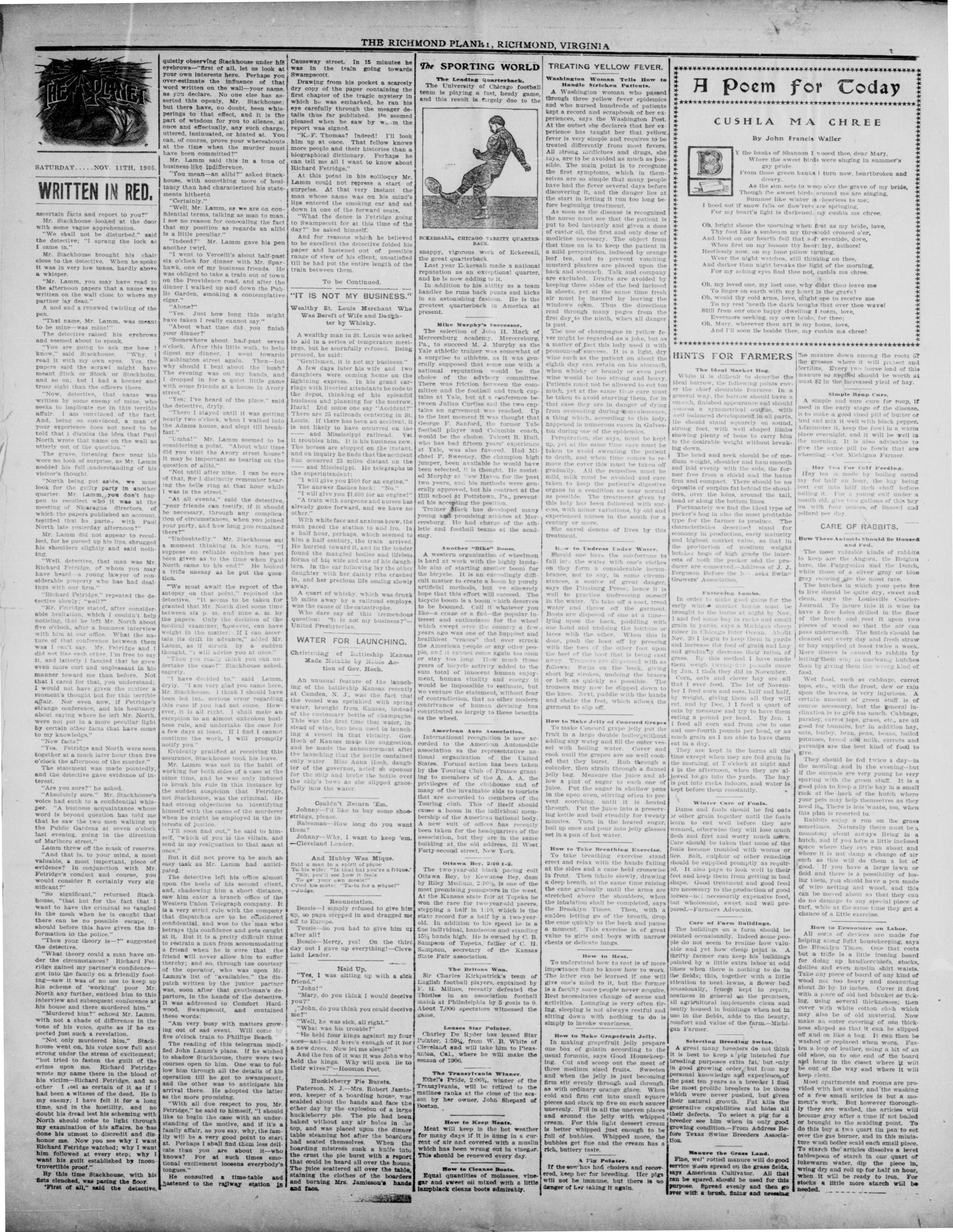
The University of Chicago football team is playing a fast, heady game, and this result is largely due to the ECKERSALL, CHICAGO VARSITY QUARTERBACK.
snappy, vigorous work of Eckersall, the great quarterback. Last year Eckersall made a national reputation as an exceptional quarter, and he is now adding to it. In addition to his ability as a team handler he runs back punts and kicks in an astonishing fashion. He is the greatest quarterback in America at present.
Mike Murphy's Successor
The selection of John H. Mack of Mercersburg academy, Mercersburg, Pa., to succeed M. J. Murphy as the Yale athletic trainer was somewhat of a surprise to athletes, as it was generally supposed that some one with a national reputation would be the choice of the advisory committee. There was friction between the committee and the football and track captains at Yale, but at a conference between Julian Curtiss and the two captains an agreement was reached. Up to the last moment it was thought that George F. Sanford, the former Yale football player and Columbia coach, would be the choice. Talcott B. Hull, who has had fifteen years' experience at Yale, was also favored, Had Michael F. Sweeney, the champion high jumper, been available he would have been selected, it is thought. He assisted Murphy at New Haven for the past two years, and his methods were generally approved, but his contract at the Hill school at Pottstown, Pa., prevented his accepting the position.
Trainer Mack has developed many young and promising athletes at Mercersburg. He had charge of the athletic and football teams at the academy.
Another "Bike" Boom
A western organization of wheelmen is hard at work with the highly landable aim of starting another boom for the bicycle. It is an exceedingly difficult matter to create a boom by purely artificial methods, but we sincerely hope that this effort will succeed. The bicycle boom is a boom which deserves to be boomed. Call it whatever you like—a craze or a bad—the popular interest and enthusiasm for the wheel which swept over the country a few years ago was one of the happiest and healthiest "crazes" that ever struck the American people or any other people, and it cannot come again too soon or stay too long. How much those years of bicycle activity added to the sum total of innocent human enjoyment, human vitality and energy it would be impossible to estimate, but we venture the statement, without fear of contradiction, that no other modern contrivance of human devising has contributed so largely to these benefits as the wheel.
American Auto Association
American Auto Association.
International recognition is now accorded to the American Automobile association as the representative national organization of the United States. Formal action has been taken by the Touring Club of France granting to members of the A. A. A. the privileges of the clubhouse and to many of the invaluable aids to tourists that are accorded to members of the Touring club. This of itself should cause a boom in the individual membership of the American national body. A new suit of offices has recently been taken for the headquarters of the association, but they are in the same building at the old address, 31 West Forty-second street, New York.
Ottawa Boy, 2:10 1-2.
The two-year-old black pacing colt Ottawa Boy, by Kewanee Boy, dam by Riley Medium, 2:10½, is one of the most promising youngsters in the west. At the Kansas state fair at Topeka he won the race for two-year-old pacers, stepping a half in 1:10, which is the state record for a half by a two-year-old. In addition to his speed he is a fine individual, handsome and standing 15½ hands high. He is owned by C. B. Sampson of Topeka, fief of C. H. Sampson, secretary of the Kansas State Fair association.
The Britons Won.
Sir Charles Kirkpatrick's team of English football players, captained by F. H. Milnes, recently defeated the Thistles in an association football match at Philadelphia by 5 goals to 0. About 7,000 spectators witnessed the game.
Leases Star Pointer
Charley De Ryder has leased Star Pointer, 1:59:49, from W. B. White of Cleveland and will take him to Pleasanton, Cal., where he will make the season of 1906.
The Transylvania Winner.
Ethel's Pride, 2:00:34, winter of the Transylvania, will be retired to the matinee ranks at the close of the season by her owner, John Shepard of Boston.
How to Keep Meets
Meat will keep in the hot weather for many days if it is hung in a current of air and covered with a muslin which has been wrung out in vinegar. This should be renewed every day.
How to Cleanse Boots
Equal quantities of molasses, vinegar and sweet oil mixed with a little lamplblack cleans boots admirably.
TREATING YELLOW FEVER.
Washington Woman Tells How to
Handle Stroke Patients
Handle stricter Patients.
A Washington woman who passed through three yellow fever epidemics and who nursed hundreds of patients kept a record and scrapbook of her experiences, says the Washington Post. At the outset she declares that her experience has taught her that yellow fever is very simple and requires to be treated differently from most fevers. All strong medicines and drugs, she says, are to be avoided as much as possible. The main point is to recognize the first symptoms, which in themselves are so simple that many people have had the fever several days before discovering it, and the danger lies at the start in letting it run too long before beginning treatment.
As soon as the disease is recognized the nurse must see that the patient is put to bed instantly and given a dose of castor oil, the first and only dose of medicine necessary. The object from that time on is to keep the patient in a mild perspiration, induced by orange leaf tea, and to prevent vomiting mustard plasters are placed upon the back and stomach. Talk and company are excluded. Drafts are avoided by keeping three sides of the bed inclosed in sheets, yet at the same time fresh air must be insured by leaving the windows open. Thus the directions read through many pages from the first day to the ninth, when all danger is past.
The use of champagne in yellow fever might be regarded as a joke, but as a matter of fact this lady used it with pronounced success. It is a light, dry wine such as the patient on about the eighth day can retain on his stomach, when whisky or brandy or even port wine would be too strong and heavy. Patients must not be allowed to eat too much, yet at the same time care must be taken to avoid starving them, for in that case they are in danger of dying from overcetting during convalescence, a thing which, according to this lady, happened in numerous cases in Galveston during one of the epidemics.
Perspiration, she says, must be kept up, yet at the same time care must be taken to avoid sweating the patient to death, and when time comes to remove the cover this must be taken off gradually. All the remedies must be mild, milk must be avoided and care taken to keep the patient's digestive organs in a condition as near normal as possible. The treatment given by this lady has been followed with success, with minor variations, by old and experienced nurses in the south for a century or more.
She saved dozens of lives by this treatment.
How to Undress Under Water.
Should one have the misfortune to fall into the water with one's clothes on they form a considerable incumbrance, not to say, in some circumstances, a source of great danger, says the Pittsburgh Press; hence it is well to practice undressing oneself in the water. To take off a coat, trend water and throw off the garment. Boots are disposed of one at a time—lying upon the back, paddling with one hand and undoing the buttons or laces with the other. When this is done, push the boot off by pressing with the toes of the other foot upon the heel of the boot that is being cast away. Trousers are disposed with as follows: Swim on the back, giving short leg strokes, undoing the braces or belt as quickly as possible. The trousers may now be slipped down to the knee. Next, paddle with the hands and shake the feet, which allows the garment to slip off.
How to Make Jello of Grape
How to Make Jelly of Concord Grape
To make Concord grape jelly put the fruit in a large double boiler without adding any water and fill the outer vessel with boiling water. Cover and cook until the grapes are so well cooked that they burst. Rub through a colander, then strain through a flannel jelly bag. Measure the juice and allow a pint of sugar to each one of juice. Put the sugar in shallow pans in the open oven, stirring often to prevent scorching, until it is heated through. Put the juice into a preserving kettle and boil steadily for twenty minutes. Turn in the heated sugar, boil up once and pour into jelly glasses set in a pan of hot water.
How to Take Breathing Exercise.
To take breathing exercise stand erect and relax with the hands falling at the sides and a cane held crosswise in front. Then inhale slowly, drawing a deep breath, at the same time raising the cane gradually until the arms are stretched above the shoulders, when the inhalation shall be completed, says the Brooklyn Times. Then, with a sudden letting go of the breath, drop the cane quickly to the back and pause a moment. This exercise is of great value to girls and boys with narrow chests or delicate lungs.
How to Rext.
To understand how to rest is of more importance than to know how to work. The latter can be learned if one will give one's mind to it, but the former is a faculty some people never acquire. Rest necessitates change of scene and activities. Lounging is very often tiring, sleeping is not always restful and sitting down with nothing to do is simply to invoke weariness.
How to Make Grapefruit Jelly
How to make Grapefruit Jelly.
In making grapefruit jelly prepare one box of gelatin according to the usual formula, says Good Housekeeping. Cut and scoop out the meat of three medium sized fruits. Sweeten and when the jelly is just becoming firm stir evenly through and through, as with ordinary orange glace. When cold and firm cut into small square pieces and stack up five on each saucer unevenly. Fill in all the uneven places and around the jelly with whipped cream. For this light dessert cream is better whipped just enough to be full of bubbles. Whipped more, the bubbles get fine and the cream has a rich, buttery taste.
A Fig. Polater.
If the sow has had cholera and recovered, keep her for breeding. Her pigs will not be immune, but there is no danger of her taking it again.
A Poem for Today
CUSHLA MA CHREE
By John Francis Waller
If the banks of Shannon I wooed thee, dear Mary,
Where the sweet birds were singing in summer's
gay pride.
From those green banks I turn now, heartbroken and dreary.
As the sun sets to weep o'er the grave of my bride,
Though the sweet birds around me are singing.
Summer like winter is cheerless to me.
Summer like w
I heed not if snow falls or fla
For my heart's light is dark
Oh, bright shone the morning,
Thy foot like a sumbeam me
And blest on our hearth fell
When first on my bosom t
Restlessly now, on my lone p
Wear the night watches, s
And darker than night breaks
For my aching eyes find th
Oh, my loved one, my lost one
To linger on earth with my
Oh, would thy cold arms, love
To my rest 'neath the dark
Still from our once happy dw
Evermore seeking, my own
Oh, Mary, wherever thou art
And I'll soon lie beside the
I heed not if snow falls or flow'rets are springing,
For my heart's light is darkened, my cushia ma chree.
Oh, bright shone the morning when first as my bride, love,
Thy foot like a sunbeam my threshold crossed o'er,
And blest on our hearth fell that soft eventide, dove,
When first on my bosom thy heart lay, asthore!
Restlessly now, on my lone pillow turning,
Wear the night watches, still thinking on thee,
And darker than night breaks the light of the morning,
For my aching eyes find thee not, cushia ma chree.
Oh, my loved one, my lost one, why didst thou leave me
To linger on earth with my heart in the grave?
Oh, would thy cold arms, love, might ope to receive me
To my rest 'neath the dark boughs that over the wave!
Still from our once happy dwelling I roam, love,
Evermore seeking, my own bride, for thee;
Oh, Mary, wherever thou art is my home, love,
And I'll soon lie beside thee, my cushia ma chree!
★★★★★★★★★★★★★★★★★★★★★★★★★★★★★★★★★★★★★★★★★★★★★★★★★★★★★★★★★★★★
HINTS FOR FARMERS
The Ideal Market Hog.
The Ideal Market Hog.
While it is difficult to describe the ideal barrow, the following points cover the chief desirable features: In a general way, the barrow should have a smooth, finished appearance and should possess a symmetrical outline, with well balanced development in all parts, lie should stand squarely on sound, strong feet, with well shaped limbs showing plenty of bone to carry him to the desirable weight without breaking down.
The head and neck should be of medium weight, shoulder and ham smooth and laid evenly with the side, the former free from a shield and the hams firm and compact. There should be no deposits of surplus fat behind the shoulders, over the loins, around the tail, head or along the bottom lines.
Fortunately we find the ideal type of packer's hog in also the most profitable type for the farmer to produce. The characteristics described stand for economy in production, early maturity and highest market value, so that in the production of medium weight butcher hogs of high grade the interests of both the packer and the producer are conserved.—Address of J. J. Ferguson Before the N.aska Swine Growers' Association.
In order to make good gains for the early winter market hamils must be brought to the barns at night by Nov. I and fed some hay in racks and small grain in yards, says a Michigan sheep raiser in Chicago Inter Ocean. About Nov. 29 I begin to keep them in yards and increase the feed of grain and hay and gradually decrease their ration of grass. By this method I have made them weigh twenty pounds more by Jan. I than they did in November. Corn, oats and clover hay are all that I ever feed. The 1st of November I feed corn and oats, half and half, by weight, giving them all they will eat, and by Dec. 1 I feed a quart of oats by measure and try to have them eating a pound per head. By Jan. 1 I feed all corn and from one to one and one-fourth pounds per head, or as much grain as I am able to have them eat in a day.
They are kept in the barns all the time except when they are fed grain in the morning, at 7 o'clock at night and 4 in the afternoon, when they are allowed to go into the yards. The hay is put into racks indoors, and water is kept before them constantly.
Winter Care of Fonls.
Dam s and foals should be fed oats or other grain together until the foals learn to eat well before they are weaned, otherwise they will lose much flesh and fret and worry much more. Care should be taken that none of the foals become troubled with worms or lice. Salt, sulphur or other remedies should be supplied promptly as required. It also pays to look well to their feet and keep them from getting in bad shape. Good treatment and good feed are necessary to the production of good horses—not necessarily expensive feed, but wholesome, sweet and well prepared.—Farmers Advocate.
Care of Farm Buildings
The buildings on a farm should be painted occasionally. Indeed some people do not seem to realize how valuable and yet how cheap paint is. A thrifty farmer can keep his buildings painted by a little extra labor at odd times when there is nothing to do in the fields; this, together with a little attention to neat lawns, a flower bed occasionally, fences kept in repair, neatness in general on the premises, all agricultural implements clean and neatly housed in buildings when not in use in the fields, adds to the beauty, comfort and value of the farm.-Michigan Farmer.
Selecting Breeding Swine.
A great many breeders do not think it is best to keep a pig intended for breeding purposes extra fat, but only in good growing order, but from my personal knowledge and experience of the past ten years as a breeder I find the most prolific breeders to be those which were never pushed, but given their natural growth. Fat kills the generative capabilities and hides all their defects. To select a pig for a breeder see him when in only good growing condition. -From Address Before Texas Swine Breeders Association.
Manure the Grass Land.
Fine, we' retted manure will do good service when spread on the grass fields, says American Cultivator. All that can be spared, should be used for this purpose. Spread evenly and then go over with a brush, firing and pressing.
B
Fettenbus Lumber
annon I wooed thee, dear Mary,
set birds were singing in summer's
banks I turn now, heartbroken and
is to weep o'er the grave of my bride,
birds around me are singing,
inter is cheerless to me;
wrets are springing,
skened, my cushla ma chree.
when first as my bride, love,
my threshold crossed o'er,
that soft eventide, dove,
my heart lay, asthore!
allow turning.
will thinking on thee,
the light of the morning,
lee not, cushla ma chree.
e, why didst thou leave me
heart in the grave?
night ope to receive me
boughs that over thee wave!
elling I roam, love,
bride, for thee;
is my home, love,
me, my cushla ma chree!
the manure down among the roots of
the grasses where it will protect and
fertilize. Every two horse lead of this
manure so applied should be worth at
least $2 in the increased yield of hay.
Simple Roup Cure.
A simple and sure cure for roup, if
used in the early stage of the disease,
is to make a good sized pill of butter or
ard and mix it well with black pepper.
Administer it, keep the fowl in a warm
place overnight, and it will be well in
the morning. It is also advisable to
give the same pill to fowls that are
wheeling. 'Cor, Michigan Farmer.
Hay Tea For Calf Feeding
Hay tea is made by boiling sound hay for half an hour, the hay being best cut into half inch chaff before boiling it. For a young calf under a month old, give two gallons of this hay leaf with four ounces, of limeseed and pollard per day.
CARE OF RABBITS.
How These Animals Should be Housed and Fed.
The most valuable kinds of rabbits to keep are the Angora, the Belgian hare, the Pataguanian and the Dutch, while those of a silver gray or blue gray coloring are the most rare.
The butches in which your pets are to live should be quite dry, sweet and clean, says the Louisville Courler-Journal. To insure this it is wise to have a few holes drilled in the floor of the butch and rest it upon two pieces of wood so that the air can pass underneath. The hutch should be cleaned out every day and fresh straw or hay supplied at least twice a week. More illness is caused to rabbits by letting them stay in unclean hutches than by giving them the wrong kind of food.
Wet food, such as cabbage, carrot tops, etc., with the frost, dew or rain upon the leaves, is very injurious. A certain amount of green stuff is of course necessary, but the general inclination is to give too much. Cabbage, parsley, carrot tops, grass, etc., are all good for bunnies, but in addition hay, eats, barley, bran, peas, beans, boiled potatoes, bread and milk, carrots and parsnips are the best kind of food to give.
They should be fed twice a day—in the morning and in the evening—but if the animals are very young be very sparing with the green stuff. It is a good plan to keep a little hay in a small rack at the back of the hutch where your pets may help themselves as they need it. There is less waste, too, when this plan is resorted to.
Rabbits enjoy a run on the grass sometimes. Naturally there must be a monotony about always living in a hutch, and if you have a little inclosed space where they can run about and where it is not damp a change of air such as this will do them a lot of good. If you have a large lawn or field and there is a possibility of losing them, you should have a pen made of wire netting and wood, and this can be moved about so that they can do no damage to any special piece of turf, while at the same time they get a chance of a little exercise.
How to Economize on Labor
How to Economize on Labor.
All sorts of devices are made for helping along light housekeeping, says the Brooklyn Times. One that costs but a trifle is a little ironing board for doing up handkerchiefs, stocks, doilies and even muslin shirt waists. Take any piece of board of any kind of wood not too heavy and measuring about 30 by 10 inches. Cover it first with a piece of old bed blanket or tickling, using several thicknesses; then cover with white cotton cloth which may also be of old material. Now make an outer covering of one thickness shaped so that it can be slipped off and on like a bag. It can then be washed or replaced when worn. Fasten a loop of leather, using a bit of an old shoe, on to one end of the board and hang in the closet where it will be out of the way and where it will keep clean.
Most apartments and rooms are provided with hot water, and 'the washing of a few small articles is but a moment's work. But however thoroughly they are washed, the articles will become gray after a time if not boiled or brought to the scalding point. To do this buy a two quart tin pan to set over the gas burner, and in this miniature wash boiler scald each small piece. To starch the articles dissolve a level tablespoon of starch in one quart of lukewarm water, dip the piece in, wring dry and roll up for half an hour, when it will be ready to iron. For stocks a little more starch will be needed.
Simple Reup Cure.
THE YERNET
# POSTAGE STAMPS OF A HIGHER DEFINITION THAN TWO CENTS NOT RECEIVED ON SUBSCRIPTIONS.
**LRE PLANET** is issued weekly. The subscription price is $1.50 per year in advance. The money can be sent by mail at our risk—In a Post Office Money Order, by Bank Check or Draft, or an Exempt Order, in a Registered Letter, of those can be procured, in a Registered Letter. **MONEY ORDERS.** You can buy a Money Order at your Post-Office, payable at the Richmond Post Office, and we will be responsible for its safe arrival.
REGISTERED LETTER—If a money Order Post-Office or an Express Order is not within your address, you must not send it. Letter you wish to send us on payment of ten cents. Then, if the letter is lost or stolen, you can send money in this manner at our risk.
We cannot be responsible for money sent in letters in any other way than one of the four ways mentioned above. If you send your monogram or other way, you must do it as your own risk.
RENEWAL, ETC. If you do not want THE PLANET continued for another year after your subscription, you must do it. Postal Card to discontinue it. The courts have decided that subscribers to newspaper, who do not renew their subscription, must discontinue of time for which it has been paid are held liable for the payment of the subscription. Please state when they order the paper discontinued.
COMMUNICATIONS—When writing to us to renew your subscription or discontinue your paper, you should give your name and address to the person we cannot find your name on our books.
CHANGE OF ADDRESS—In order to change a address of a subscriber, we must be sent to the person we cannot find your name on our books.
Entered at the Post-Office at Richmond. We
second-class matter.
SATURDAY.....NOV. 11TH. 1905.
It seems that the Republican candidates in this state have not as yet recovered sufficiently to even decide what struck them on Tuesday last.
---0---
If Mr. Hearst, the millionaire candidate for Mayor of New York cannot prevent the Democratic heelers from robbbing him in New York, what is to be expected of a Republican candidate in Virginia?
There is no use voting in Virginia. The Democratic machine had just as well announce the result beforehand Out of 150,000 votes expected only 40,000 votes were polled. This is a case of minority government with a vengeance. And it is so throughout the South-land.
One enthusiastic Democratic orator, (Mr. Braxton) called upon the voters to vote the Democratic ticket and thereby show their hearty appreciation of Mr. Roosevelt and his policies. From the election returns, those that voted at all seemed to have done so.
The Negro Business League of Virginia has been in session this week at Price's Hall under the leadership of Rev. Dr. W. F. Graham, President. The papers read have been on the highest order and have contained much valuable information to any man, who is desirous of keeping in touch with the mercantile branch of the citizen of color. It is but fair to say that the consensus of opinion among these merchants is that President Roosevelt was sadly misfounded when he presumed that the professional and mercantile pursuits were overcrowded for the Negroes.
MUSTERED OUT OF SERVICE
Gov. Jelks of Alabama has followed the course of Georgia and ordered the disbandment of Capital City Guards, Co. A. of Montgomery, Ala. He declares the company to be "an ineffective organization" and that it is mustered out for the good of the service. This may all be true, it is a well-known fact that colored troops are very effective in actual service. Mr. Roosevelt found it out at El Caney and at Santiago and every commanding officer since the foundation of this government has testified to the efficiency and the effectiveness of the colored troops. These encomiens have come before and behind these colored men's
```markdown
```
guns, for the Confederates and the Spaniards testified to the effectiveness of their gun-fire and the desperate character of the onslaughts that they made with their bayonets. A colored man was not a coward and fear was not one of the things that he carried to a field of carnage with him.
Yes, the colored soldier is being mustered out of service in the South land. He should shed no tears on account of it. Certainly, if our white citizens are to enjoy all of the rights and privileges under this gov ernment, he should be made to share all of the responsibilities and hardships in time of war. White men have never yet failed to call upon colored men, when they got in a hard place in time of war and they have been somewhat slow in getting rid of them when in a soft place in time of peace.
But Sambo is kind and generous He'll be ready to answer again when his name is called. We are of the opinion that it will not be twenty-five years before these same white folks will be just as active in getting these colored men back into the state's service as they were in getting them out of it.
THE ELECTION IN VIRGINIA.
The result of the election in this state last Tuesday will no doubt set at rest the hopes of the "Lily White" contingent of the Republican Party of the commonwealth. The cry that the Negro stood in the way of Republican success has been heard from the mountains to the sea. It is evident to a man whose skull is as thick as a gate-post that the Negro did not embarrass the Republican management either before or on election day. To use a homely expression, he went "w-a-y back and sat down." He is sitting down now. The Democratic managers have completely fooled the Republican leaders. They induced them to furnish the fox for the chase and they have had their fun at the Republican leaders expense, while the amount of money spent by the latter would astound even the conservative elements. If the Republicans polled only 4,546 votes in the entire state, as reported by the press dispatches, Judge Lewis could have made just as good run by staying in Richmond and attending to his official business. This but slightly exceeds the male inhabitants of voting age in one ward in this city.
The result should be an "eye-opener" to President Roosevelt. It would naturally be presumed that his visit to this state would have swelled the Republican vote. Hon. Leslie M. Shaw had spoken here too and the Academy of Music had been secured, a place from which colored people are excluded unless they take a flight heaven-ward and land in the neighborhood of the roof commonly known as the "peanut gallery," and by some others as the "Negro's heav en." As a matter of fact, any Negro of prominence with any kind of good record could have made just as good run as Judge Lewis and his Republican associates made, if he had presented himself to the Republican voters of this state.
It is a pity that President Roosevelt cannot be further convinced. He will yet have an opportunity to realize that as popular as he is in Virginia with all classes, he could not have won in a "show down" contest with the candidates on the Democratic ticket of Virginia.
An Early Betrothal.
In the early days of California the daughters of the Lugos were sought in marriage by the best families of the state. It was a boast that they were even courted in the cradle, as when the young officer Colonel Ignacio Vallejo, being in San Luis Obispo on the occasion of the birth of a daughter to the Lugos, asked her father for the hand of the day old baby, provided when the time came to fulfill the contract the senorita should be willing. This seemingly absurd betrothal took place. The child grew up to be an intelligent as well as attractive young woman, married her betrothed and became the mother of many children, among them Mariano Guadalupe Vallejo.
Binding a Bargain.
In the book of Ruth a shoe is mentioned as being handed over to ratify a bargain, and the custom in a sense seems to have been repeated later, for in the year 1002 certain bishops were put into possession of their sees by receiving a glove. These may have been richly jeweled gloves, for such formed part of the episcopal habil, and when some abbots thought fit to array themselves in similar hand covering peculiar only to bishops they were forbidden their use by the council.
Proof.
Prospective Purchaser--You say this is a healthy place, yet the man next door 'confined to his bed. How do you account for that? Real Estate Agent--Oh, lie's a doctor and is slowly dying of starvation.—Chicago News.
Treachery.
Deliberate treachery entails punishment upon the traitor. There is no possibility of escaping it, even in the highest rank to which the consent of society can exalt the meanest and the worst of men...Junius.
Destiny has turned many a man down while he was waiting for something to turn up...Success Magazine.
RICHMOND PLANET, RICHMOND, VIRGINIA
LANDSLIDE FOR BERRY IN PENNSYLVANIA
Democratic Candidate Elected Treasurer by Over 75,000.
REFORM FOR PHILADELPHIA
Latest Returns Show Tremendous Democratic Gains All Over the States. Reformers In Philadelphia Swept the City By Over 60,000. Plurality and Elected Their Entire Ticket.
Philadelphia, Nov. 8.—Philadelphia has been swept by the reform movement, the City Party ticket winning by a surprisingly large plurality.
While returns from only a few of the 42 wards in this city had been counted up to this morning, there is enough known of the result in the remaining wards to indicate the defeat of the local Republican ticket by from 60,000 to 75,000 plurality.
The victory of the City Party carries with it the election of William H. Berry, the Democratic and reform
A. B.
candidate for state treasurer. J. Lee Plummer, the Republican candidate for that office was badly cut throughout the city and state, and he has lost his own county, which is usually Republican.
The result has every appearance of a landslide for reform, not only in Philadelphia, but throughout the entire state.
Sent Message to the President.
City Party Chairman Edmonds sent the following telegram to President Roosevelt:
"Philadelphia has risen to its opportunity and stands reeled. The principle of honesty in government so effectively espoused by you has won an overwhelming triumph. Our majority approximates 75,000."
To Secretary Root the following was telegraphed:
"The masquerade is over. The criminal and corrupt combination has been driven from power by the right cous indignation of a great Republic can city. We have only begun. Our thanks to you for your splendid aid." State Senator James B. McNiel
State Senator James P. McNichol, the Republican leader, lost his division in the 10th ward by 69 votes.
One year ago President Roosevelt carried the city by 180.834 plurality.
None of the Republican leaders had much to say on the result. Sheriff James L. Miles, chairman of the Republican city committee, when asked for a statement, said: "I have nothing to say: what's the use?"
The City Party sympathizers celebrated their victory by parading the streets. As soon as the result was definitely known hundreds of them formed in line and marched down Chestnut street. An unusual turnout was that of the campaign committee of the City Party, which is made up of some of the wealthiest and most influential men on the city. They marched behind a band to the tune of "Onward, Christian Soldiers."
Estimates from practically every county in the state indicate the election of Berry for state treasurer by from 75,000 to 100,000 plurality. Official returns will probably increase the figures.
In only two counties of the state—Somerset and Washington—are gains shown by the Republicans over the vote for state treasurer two years ago. Large Democratic gains were made in all the other counties. Several other counties, which have heretofore been staunch Republican counties, have gone for Berry by large majorities. In Lancaster and other Republican strongholds Plummer ran away behind the vote for state treasurer in 1903. Plummer lost his home county of Blair, and Berry lost his county of Delaware.
State treasurer was the only state office for which there was a contest at the election in Pennsylvania. Judge John Stewart, an appointee of Governor Pennypacker, was re-elected associate judge of the supreme court for the full term of 21 years. President Judge Charles E. Rice and Judges George B. Orlady and James A. Beaver, of the superior court, were re-elected for a term of 10 years. John B. Head, Democrat, was also elected a superior court judge to succeed Judge Peter P. Smith, the minority member of that body, who failed of renomination.
Under the law no elector is entitled to vote for more than three candidates for judge of the superior court when four are to be elected, as was the case this year. Mr. Head was the only Democratic nominee for this office, which practically made his nomination equivalent to an election. Homer L. Castle, who was brought into prominence by his attacks on the state treasury management, following the developments in the Enterprise National Bank affair, was the Prohibition nominee for state treasurer. Public interest centered in the contest for state treasurer, for which the
principal candidates were J. Lee Plummer, nominee of the Republican and Citizens' parties, and William H. Berry, the candidate of the Democratic, Prohibition, Lincoln and Independent parties. Berry was also the choice of the City Party leaders of Philadelphia, although his nomination was never formally endorsed by that party, on the ground that it was purely a local organization.
There was practically no opposition to the re-election of Judge James S. Young in Allegheny county. Judge John W. Reed, Rep., was re-elected in Jefferson county. There was no opposition to the venerable Judge Craig Biddle in Philadelphia and to Judge David Cameron in Tioga county. Judge Alexander B. McConnell was re-elected in Westmoreland county.
Morris Daliett was re-elected a judge of the orphans' court without opposition in Philadelphia. There was a hot fight in Schuylkill county for orphans' court judge between Judge P. M. Dunn, the incumbent, Dem.; E. A. Beddall, Rep., and George W. Bacon, Socialist. Associate judges were elected in Clinton, Elk, Forest, Fulton, Mifflin, Monroe, Montour, Sullivan, Union, Warren and Wyoming counties.
BIG GAINS IN THE COUNTIES
Berks county—Gives Berry 7500 plurality. Same county gave Hill a plurality of 4222, a Democratic gain of 3278. President Judge James N. Ermentrout was re-elected for a third term by about 3500 plurality over D. Nicholas Schaeffer in one of the most bitter contests ever seen in Berks county. Judge Ermentrout was the regular Democratic nominee and was endorsed by the Lincoln Party, Schaeffer, a Democrat, was the Republican candidate and was also endorsed by the independent Democrats. Blair—Gives Berry a plurality of 1400. Same county gave Mathues a plurality of 4300, a Democratic gain of 5700.
Lackawanna—Gives Berry a plurality of 1000. Same county gave Mathues 4632, a Democratic gain of 5632.
York—Gives Berry a plurality of 1000. Same county gave Hill 299, a Democratic gain of 701. Cochran, Rep. for judge, carries the county by 500.
Monroe—Gives Berry a plurality of 1500. Same county gave Hill a plurality of 1297, a Democratic gain of 202. George H. Metzgar is elected associate judge, and the entire Democratic county ticket is successful.
Delaware—Gives Plummer a plurality of 500. The same county gave Mathues a plurality of 9096, a Democratic gain of 8856.
Indiana—Gives Plummer a majority of about 1800, a Democratic gain of 823.
Bedford—Gives Berry a plurality of 600. Same county gave Mathues a plurality of 895, a Democratic gain of 1495.
Carbon—Gives Berry a plurality of 800. Same county gave Mathues a plurality of 412, a Democratic gain of 1212.
50C ARRESTS IN PHILADELPHIA
Police Quickly Put Down Disturbances at the Polls.
Philadelphia, Nov. 8. — Contrary to general expectation, there was no great or very serious disturbance in the city. There were, however, many small scrimmages at polling places, especially in the more thickly settled words where the Republican organization is very strong and where the City Party put up a most determined fight. The police department was at all times the master of the situation, and wherever trouble was started it was quickly stopped. Some of these disturbances blossomed into small riots, but after the smoke had cleared away it was found that no one was fatally wounded.
Under orders of Mayor Weaver, who anticipated trouble, the police force was almost doubled by the swearing in of citizens who were sent into the wards where trouble was expected. Nearly all the mounted police of the city were brought in from outlying districts and distributed in the strongholds of the organization. A corps of bicycle policemen were kept in reserve at the city hall. The police captains were provided with swift automobiles, so that they could quickly go to any part of the city.
The patrolmen assigned to the polis
carried lists of names of illegal voters. These lists were handed to the election officers, who were warned not to permit any one to vote on the names. The policemen were also held responsible if an illegal vote was cast. Every ballot box had to be opened for the policeman's inspection before voting began.
The number of arrests for election frauds was upwards of about 500. Police magistrates were on duty in all parts of the city giving the prisoners hearings. The scene at the central police station at the city hall was without precedent. More than 200 prisoners were given hearings there for alleged fraud against the ballot. All day several hundred persons were gathered in the courtyard watching the prisoners arrive in wagon loads. Every batch of prisoners were hissed or hooted as they were led into the city hall. The hearing room was crowded all day with party workers, lawyers, bondmen and others. As quickly as a prisoner was brought in he would be given an immediate hearing, held in bail for a further hearing, and promptly released by a waiting bondman. The released men were then ordered back to their respective election divisions.
Among the more prominent men arrested were Senator William H. Keysey, floor leader of the state senate, who was charged with interfering with a voter, and John S. Hammond, deputy coroner, who was accused of vouching for an illegal voter. A deputy sheriff was arrested on the charge of stuffing a ballot box while the election officers were not looking. More than 90 percent of those arrested were men claiming to be workers of the Republican organization.
Pittsburg, Pa., Nov. 8.—Col. James M. Guffey, Democratic national committeeman and leader of the party in the state, makes the following statement:
"The election of William H. Berry, a Democrat, as treasurer of Pennsylvania by such a splendid majority, does honor and credit to her good citizens in every walk of life.
"The lesson means the beginning of the end of the greatest and most corrupt machine ever conceived in American politics. It means that the bankruptcy of the people's money in the state treasury the days of ballot box stuffing, the enacting of venal legislation and the election of corrupt men to places of honor and trust is over. It means that common honesty and civic decency are now to have a hearing.
"It means that Pennsylvania, the greatest of them all, will re-establish her honor and integrity and again assume her former honored place in the union of states."
THE VOTE IN MARYLAND
Disfranchise Amendment Defeated By 20,000 Majority.
Baltimore, Nov. 8.—The election in Maryland was for state comptroller, legislature and county officers, and in Baltimore for a judge of the supreme court, sheriff, city clerk and surveyor. The issue which engrossed popular attention was a proposed constitutional amendment, the avowed purpose of which was to disfranchise negro voters, but which aroused widespread opposition among many Democrats and foreign voters in both parties. Owing to the extreme length of the ballot, the count has been slow, and the votes in some of the city precincts and remote county districts have not been counted. The returns so far received, however, make certain the defeat of the proposed constitutional amendment by a decisive majority of 20,000 or more, and very probable the election of McCullough, Rep., state comptroller over Atkinson, Dem., and the election of Republicans in three out of four of the city legislative districts. The Republican candidates for sheriff, city court clerk and city surveyor in Baltimore are also elected.
Chief Judge Harlan, Dem., is reelected by 10,000 majority. The Republicans did not nominate a candidate against Judge Harlan, though there was an independent Republican candidate. The political complexion of the next legislature is uncertain, and will not be known until the official count has been completed.
Virginia Elects Democratic Governor. Richmond, Va., Nov. 8.—Claude A. Swanson, Dem., was elected governor of Virginia by 20,000 plurality over Judge I. L. Lewis, the Republican candidate. The vote everywhere was exceedingly light, but Democratic apathy was offset by unfavorable conditions on the other side. The negroes throughout the state abstained from voting almost entirely. The Republicans gain a few members of the legislature.
OHIO PROBABLY DEMOCRATIC
Leaders Claim to Have Elected Entire State Ticket.
Columbus, O., Nov. 8.—The Democratic leaders in this state claimed the election of Pattison and the entire Democratic ticket by substantial pluralities, while the Republicans simply refused to concede such a claim, insisting that the returns were insufficient at that hour to indicate anything except that the vote had been very heavy, and that the amount of scratching had made counting very slow. In the cities the Republican loss exceeded 100 to the precinct, but as the loss per precinct outside of the large city was so far as reported only about 30, there was no certainty that the loss would run high enough to wipe out the 230,000 Republican plurality with which comparisons were made. Less than 500 of the 4200 precincts have been heard from.
Cox Concedes Election.
Cincinnati, O., Nov. 8.—George B.
Cox concedes Dempsey's election as
mayor by 15,000 and that Pattisotn
carries Hamilton county by 12,000. He
says Pattisot, Dem., has carried the
state by 60,000.
Tom Johnson Re-Elected.
Cleveland, O., Nov. 8.—The Repub-
A Treat for Every Reader
IT WILL BE FOUND IN THE NEW SERIAL
THE OPENING CHAPTERS OF WHICH ARE PRINTED IN THIS ISSUE, ENTITLED.
WRITTEN IN RED
THIS IS A STRONG DETECTIVE MYSTERY STORY
the plot of which is laid in Boston. You will find it the kind of a story that will keep you guessing clear down to the last chapter, and then the whole solution of the mystery will be so easy you will be surprised you did not think of it before.
"Written in Red" is a Story in Which Every One of Our Readers Will Be Interested
for it is not alone a good detective story, but it also contains a pleasing romance, and ends happily for the lovers if not for all the other characters.
Do Not Overlook the Opening Chapters in This Issue
On Second Page.
Ican leaders conceded that the Democrats had carried the city and county by substantial pluralities. Mayor Johnson, Dem., declared that his plurality would not be less than 8000, Pattison, Dem., for governor, will have 10,000 plurality in this, Cuyahoga, county.
BOSS COX RETIRES
Republican Leader, Who Rulcd Cincinnati, Quits Politics.
cinnati, Quits Politics.
Cincinnati, Nov. 8.—George B. Cox,
the well-known Republican leader,
gave out the following statement,
withdrawing from active service in the
Republican party:
"Now that the election is over and
the people have signified their preference
to city, county and state officials,
and I sincerely trust they have selected
wisely, I wish to announce to the
public that from this day, after 25
years of active service in the ranks
of the Republican party, my personal
activity in politics shall cease. I will
continue to vote the Republican
ticket, but others must bear the burden of future campaigns. To the local
Republican organization and the many
friends that have stood with us in the
past I tender most grateful thanks for
their unswerving loyalty and support.
I hope for their future good will.
Respectfully yours, GEO. B. COX."
MASSACHUSETTS REPUBLICAN
Elected Governor and Lieutenant Gov-
eror R. Lloyd Blair
error By Large Pluralities.
Boston, Nov. 8. — Lieutenant Governor Curtis Guild, Jr., of Boston, the Republican candidate, was elected governor of Massachusetts in the state election by a plurality of 29,435 over General Charles W. Bartlett, of Boston, the Democratic candidate.
For the second place on the ticket, for which there was an unusually warm contest, Eben S. Draper, of Hopeadle, the Republican candidate, won over Henry M. Whitney, of Brookline, his Democrat opponent, and the leading advocate for recipi tity, by a plurality of 3942.
The total vote for the two leading candidates was: Governor — Guild, Rep. 203,834; Bartlett, Dem., 174,389; Lieutenant governor — Draper, Rep., 184,534; Whittney, Dem. 180,592.
PRESIDENT HEARD RETURNS
Made No Statement Regarding Result
In Various States.
Washington, Nov. 8. — President Roosevelt spent the greater part of last evening in the executive offices receiving election returns. With him were Mrs. Roosevelt, Secretary Root and Assistant Secretary Bacon, of the state department. In addition to the bulletins from the Associated Press the president received dispatches from party leaders in various states giving their estimates of the results based on returns received by them. Particular interest was manifested by the president and his associates in the reports from Pennsylvania, New York city, Massachusetts, Ohio and Maryland. None of the dispatches received at the White House were made public, and it was announced that the president would not have any statement to make regarding the results in the several states.
The Vote In Kentucky.
Louisville, Ky., Nov. 8.—One hundred and forty-two prescents out of 184 in the city of Louisville give Paul G. Barth, Democratic nominee for mayor 15.327, and O'Neal, Fuson, 12.973. Barth's plurality is 2364. On account of disorders the exact figures will not be known until late today.
Elections were held in the state for 100 seats in the legislature, but returns have thus far been received from only 33 districts, including the city of Louisville. The Democrats elected 29 legislators, the Republicans three and one race is doubtful. The complexion of the legislature will be practically unchanged, and the Democrats will have a good working majority with which to choose a successor to Senator J. C. S. Blackburn.
Labor Candidate In Frisco Wins
Labor Candidate in Frisco Wins.
San Francisco, Nov. 8—For the third consecutive time Eugene E. Schmitz, the Union Labor candidate, was reelected mayor by a majority of 15,000 over John S. Partridge, the joint nominee of the Republican and Democratic parties. Voting machines were used for the first time in all the precincts. Very little scratching was done. A proposition to increase the $1,000 license was probably defeated.
FOR THE HOUSEWIFE
Care of the Teeth:
We all know that daily brushing is necessary for the teeth, but there are various ways of brushing. Be sure to brush inside as well as outside and up and down as well as across the teeth. Salt is excellent for the gums and teeth, but should not be used too frequently. Use fine salt, as the coarse will scratch the enamel. Prepared chalk, with soap, is recommended to remove tartar, as are also the ashes of a good cigar, but neither of these should be used oftener than once a week, soap and water being sufficient for the daily cleansing.
Mold In Cellars
"Unslacked lime," says the Scientific American, "is best suited for removing mold in cellars. It is blown, in the shape of a fine powder, on the walls of the cellar and into the joints and crevices by means of the bellows or else thrown on with the hand. The walls must be damp; dry walls have to be well moistened previously. The lime shakes with the adhering water and kills all organisms. On the day following the walls are washed off, and, as experience has proved, the cellar will remain free from mold for at least two years."
The Neck BeautifulL
When a neck is extra brown, rub it well with lemon juice. This is very whitening. To fill out the muscles of the neck drink a glass of water very slowly with the head thrown well back. Puffy places under the eyes are almost invariably caused by some kidney trouble. Sip six glasses of water a day and you will find the hollow places in your throat will be filled out and the puffs will scatter. Go to bed early, and get up early too. Oversleeping is as injurious as not having sufficient rest. -Health Culture
THE PLANET
M'GLELLAN WINS IN NEW YORK
Re-elected Mayor Over W. R. Hearst by Small Plurality.
WM. T. JEROME RE-ELECTED
Result Was So Close That Heart
Claims He Was Elected and Charges
Tammany With Wholesale Frauds.
Threatens to Contest.
New York, Nov. 8—George B. McCielan., Dem., is re-elected mayor of New York by between 3000 or 4000 plurality over W. R. Hearst, Municipal
A. B.
GEORGE R. B. MCCLELLAN.
Re-Elected Mayor of New York City.
Ownership, and William T. Jerome, Independent, is re-elected district attorney by about 8000 over W. Osborne, Dem.
At midnight Mr. Hearst declined to admit his defeat and declared his intention to contest the election. At that time returns from 184 election districts had not been received. McClellan had 205,598; Hearst, 203,370, and Ivins, 130,326 votes.
The following statement was issued by W. R. Hearst: "We have won this election. All Tammany's frauds, all Tammany's corruption, all Tammany's intimidation and violence, all Tammany's false registration, illegal voting and dishonest count have not been able to overcome a great popular majority. The recount will show that we have won the election by many thousands of votes. I shall fight this battle to the end, in behalf of the people who have cast their votes for me and who shall not be disfranchised by any effort of criminal bosses.
"WILLIAM R. HEARST."
WILLIAM R. HEARST.
The extent to which the Tammany organization was shaken may be judged from the fact that there was no fusion of the opposition parties, the means by which the organization has been combatted heretofore, but that Jerome, running as a candidate of no party and with his record in office as his platform, succeeded in overcoming the former prestige of the Democratic organization, and William Randolph Hearst, standing as the nominee of the Municipal Ownership League, a new factor in New York politics, came within a few thousand votes of being elected mayor. Jerome's triumph was almost entirely a personal one, and showed that an appeal may be made successfully to voters on the strength of personal hon-
WILLIAM TRAVERS JEROME.
Re-Elected District Attorney of New York.
esty and persistent systematic denunciation of graft and political bossism. Mr. Jerome's campaign was conducted with especial opposition to Charles F. Murphy, leader of Tammany Hall, and his reputed wealth, and the result practically is a defeat for Murphy as well as for Osborne.
William M. Ivins, the Republican nominee, was third in the race for mayor, and ran far behind Hearst.
Bird S. Coler was elected borough president of Brooklyn on the Municipal Ownership ticket, and Hearst carried that borough by a plurality of 15,628.
An analysis of the vote for mayor shows that Hearst polled a little more than 200,000 votes, and that apparently these votes were drawn almost equally from the Democratic and Republican parties. McClellan's vote this year was about 110,000 smaller than his vote of two years ago, while Ivins' vote was about 125,000 smaller than Low's vote of two years ago. These figures, however, may not be entirely accurate.
owing to the fact that n number of Republicans probably voted for McClellan in order to aid in the defeat of Hearst. Less than a month ago, when Hearst accepted the nomination of the Municipal Ownership League, McClellan's re-election was regarded as a certainty, and the mayor himself declared that he intended to make only a few speeches. With the sudden outburst of enthusiastic support for Hearst, however, the situation changed so swiftly that the Democratic leaders were startled from the repose of their quiet confidence to engage in one of its hardest fights. Hearst wound up his campaign Sunday night at Madison Square Garden with the garden crowded o the doors and tens of thousands of men stood outside for hours cheering for the Municipal Ownership candidate. It was felt then that the vote would be close and that Tammany must fight.
There was little disorder, and although many arrests were made, they frequently were due to misunderstanding or clerical errors, and only a few men were held for trial. More splitting of tickets was done, probably, than ever before, yet the voting was unusually rapid. An incident of the day was the desertion of several hundred of Mr. Hearst's poll watchers, who went over to the opposition.
NEW JERSEY ASSEMBLY
The Republicans Make Gains In Both Branches.
Trenton, N. J., Nov. 8.—The election in New Jersey increased the Republican hold upon the state legislature and makes it impossible that a Democrat should succeed United States Senator John P. Dryden in 1907. Only four of the 21 state senators will be Democrats.
Colby, the Independent Republican in Essex county, whose fight against the machine of his party attracted wide interest, was swept into office by a majority which approached that which his county gave a year ago when the local ticket had the help of the national ticket to carry it along. Mr. Colby won by 19,000 and his majority may go over that. He carried his ticket through with him. The Republican wave swept into Jersey City again, and Mayor Fagan, who is an Independent Republican of the Colby stripe, was again elected, and carried his ticket through with him.
SENATE
Atlantic county—Edward S. Lee, R.
Bergen—Edmund W. Wakelee, R.
Burlington—John G. Horner, R.
Camden—William J. Bradley, R.
Cape May—Louis N. Cressey, R.
Cumberland—Bloomfield H.Minch, R.
Essex—Everett Colby, R.
Gloucester—John Boyd Avis, R.
Hudson—James F. Mturn, D.
Hunterdon—George F. Marten, Jr., D.
Mercer—Barton B. Hutchinson, R.
Middlesex—William H. C. Jackson, R.
Monmouth—Oliver H. Brown, R.
Morris—Thomas J. Hillery, R.
Ocean—George L. Shinn, R.
Pasalaic—Wood McKee, R.
Salem—William Plummer, *R.
Somerset—Jos. S. Frellinguysen, R.
Sussex—Jacob C. Price, D.
Union—Ernest R. Ackerman, *R.
Warren—Johnston Cornish, *D.
Senate—Republicans, 17; Democrats, 4. Senate, 1905—Republicans, 14; Democrats, 7.
Senators marked * were elected yesterday.
Atlantic county—T. C. Elvins, *R.
Bergen—Clarence Mahie, *R; John
Heck, *R.
Burlington—S. K. Robbins, *R; J.
B. Irick, *R.
Camden—T. R. Gibbs, *R; H. S.
Scovel, *R; S. P. Jones, *R.
Cape May—J. M. E. Hiloreth, *R.
Cumberland—L. H. Miller, *R; B.
Frank Buck, R.
Essex—P. C. Walsh, R. M. Everett,
W. P. Martin, G. R. Sommer, G. F.
Serbe, H. C. Hines, G. W. Roeber,
G. A. Kayser, Austin Colgate, W. F. Margan,
G. R. Underwood, all Colby Reps.
Gloucester—W. C. Cattell, D.
Hudson—V. Holzapfel, *R; M. C.
Ernst, *D; W. J. Boucher, *D; Mark
Sullivan, D; A. S. Alexander, *D;*
John Callery, *D; E. A. Murphy, *D;*
Charles Blohn, D; Alex. Mettlock, D;
H. J. Lange, *D; F. C. Guenther, D;
J. A. Riordan, *D.
Hunterdon—O. C. Holcomb, D.
Mercer—A. N. Barber, *R; W. F.
Burk, R; H. D. Thompson, R.
Middlesex—W. R. Drake; R.; Dr. F. A. Clessex; R.; Dr. E. E. Haines; R. Monmouth—E. I. Vandeveen; R.; G. V. Henry; R.; Dr. W. S. Reed, R. Morris—John M. Mills, *R.; R. J. Chapin, R. Ocean—J. H. Sprague, R. Passaic-G. F. Wright, *R.; Henry Marelli, *R.; A. M. Smethurst, R.; C. R. Wise, R.; J. D. Prince, R.
Union—Peter Tillman, *R.; Randolph Perkins, *R. E. K. Tucker, R. Warren—Jos. H. Firth, D. *New members. House—Republicans, 45; Democrats, 15.
Reform Wins In Camden. Camden, N. J. Nov. 8.—Nowrey, the reform candidate for sheriff, is elected by an estimated majority of 1000. The entire reform ticket is also elected.
Republicans Sweep Chicago
Republicans Sweep Chicago.
Chicago, Nov. 8.—The Republicans made a clean sweep of the election in Chicago and Cook county, electing all of their candidates with the exception of one man. The sole Democrat to reach the promised land was Webb, a candidate for trustee of the sanitary district. The Republicans elected four judges of the superior court by pluralities ranging from 20,000 to 25,000, one judge to fill a vacancy on the bench of the superior court by a plurality of about 10,000, a pudge of the circuit court by 1000, and eight out of nine members of the board of sanitary trustees by pluralities ranging from 1000 to 5000.
A Cooking Hint
When mixing flour for thickening add a pinch of salt to the flour before mixing with water, and it mixes much more smoothly, without lumps.
THE RICHMOND PLANET, RICHMOND, VIRGINIA
PEOPLE OF THE DAY
Some Life Insurance Salaries.
In the course of the legislative inquiry into life insurance methods now taking place in New York it was developed that Richard A. McCurdy, president of the Mutual Life company, draws a salary of $150,000 a year, three times the sum paid to the president of the United States. It was further shown that President McCurdy, his son, Robert H. McCurdy, and his son-in-law, Louis A. Thebaud, since their official connection with the Mutual Life
RICHARD A. M'CURDY.
Insurance company have jointly drawn from the treasury of that organization, in the form of salary and commissions, an aggregate of $4,534,120.49 as their personal emoluments. Richard A. McCurdy was born in New York city and is seventy years old. He was educated at Harvard, afterward studied law and was admitted to the New York bar in 1856. About the time Henry B. Hyde was leaving the Mutual to found the Equitable young Lawyer McCurdy became connected with the Mutual as a legal representative. In 1860 he was appointed its attorney and five years later was made vice president.
Three presidents came and passed away during Mr. McCurdy's long service as vice president until finally in 1885 he became head of the company. His presidential salary at first was relatively modest—$30,000 a year—although large enough to cause comments of an investigating committee in 1887. For twenty years now Richard A. McCurdy has been the dominating force of the Mutual Life, ruling it as Henry B. Hyde did the Equitable and John A. McCall has done the New York Life—with an autocratic power. President McCurdy is tall, deep chested, heavy limbed, with a large head scantily covered by short gray hair, a snow white mustache and black eyebrows. The forehead is high and broad, the nose straight and powerful, the chin aggressive, but fleshy cheeks hide the jaw line. He dresses neatly and in appearance suggests the well fed and prosperous business man.
The Oregon Land Frauds.
John Newton Williamson, representative in congress from the Second Oregon district, who was recently convicted in the federal court at Portland of complicity in land frauds against the government, was sentenced to serve ten months' imprisonment and pay a fine of $500. He was also reprimanded by the court. This is a more severe sentence than that imposed upon Senator Mitchell, who was condemned to serve six months in prison and pay a fine of $1,000.
In the same case Marlon R. Rigg ex-United States commissioner, was taxed by the court with similar dere-
JOHN NEWTON WILLIAMSON.
liction of duty and given an equal penalty with Congressman Williamson, Dr. Gessner, another defendant in the land frauds, was sentenced to five months in prison and to pay a fine of $1,000. Appeals were taken and a stay of execution made pending further orders of the court. Meanwhile Congressman Williamson will go free on his own recognizance, but a bond of $4,000 was required for the other two defendants.
Congressman Williamiams is a native of Oregon and is fifty years old. He studied at Williamette university, but his health broke down just as he was about to be graduated, and he was obliged to remove to the higher altitudes of the eastern part of the state, where for twenty-five years he has been engaged in the cattle business. In 1888 he was evoked sheriff of Crook county on the Republican ticket and later served three terms in the lower house of the legislature. He was elected to a seat in the state senate in 1900 and is now serving his first term in congress.
HOUSEHOLD ECONOMIES
How Housekeepers Can Profit by the Following Suggestions.
Every kitchen sink and every bathroom should be provided with a soap dish. Soap reduced to a jelly by leaving it in water is a frightful example of wastelessness. No soap dish, by the way, is worthy the name unless it is properly drained by perforations at the
bottom or by other means, says the New York Journal.
Strange as it may appear, a coal cellar needs ventilation as much as a soap dish needs a drain. Coal kept in a place almost air tight loses much of its gas and is consequently wasteful to burn.
A point not to be forgotten is that potato peelings, well dried, are as useful as orange peel treated the same way for lighting a fire and making it burn up quickly. Both save firewood.
Milk should never be left uncovered since the tiniest germ will taint it, while in making pastry a marble slab is preferable to a board for rolling out the paste. Nowadays, too, china rolling pins may be purchased, which for this purpose are better than the wooden ones, and there are glass ones hollowed out for the introduction of ice.
Boots and shoes will last much longer if when bought the new leather on the soles is stood for a few days in linseed oil before using. The oil should first be boiled, and when the boots are taken out they should be allowed to dry for a few days. This treatment also prevents the objectionable creaking.
Where there are boys it is wise to have the heels and knees of new stockings carefully darned before taking them into use. This presents a tougher substance for the wear and tear of those parts.
The first thing to do also with gloves and ready made garments of any description is to sew the buttons on more securely. Buttons are rarely well sewed on anything that is ready made.
To mend a hole in an umbrella stick firmly on the inside a piece of black court plaster. This is not so noticeable as a darn.
It is wise to purchase towels rather large. Laudries charge no more for washing large articles than small ones, and large towels do not wear out so rapidly.
How to Cure Dyspensia
To cure dyspepsia by means of exercise try punching a bag, says the Chicago News. Suspend it at a convenient height from the floor to permit of pounding it vigorously, after the manner of a prize fighter. You must wear gloves to protect your knuckles. Twisting the body around in both directions from the waist is a good exercise for you. Leaning forward and then backward as far as possible, also to the right and left, is good practice. Interlock the thumbs and, with the knees straight, bend forward until the tips of the fingers touch the floor. Rise to an upright position with the arms above the head. Besides curing your dyspepsia, these athletes should expand your chest, put roses in your cheeks and grace and vigor in every motion. Don't say that you are too weak and breathless to take exercise. This is a delusion. The weakness and the quick and short respiration arise from want of exercise. The less exercise one takes the less one is fitted for and the more one needs it. Nerves will become disordered, the blood thick and sluggish and muscles will grow flaccid without exercise.
How to Make Cucumber Lotion.
The following cucumber lotion, which can be made at home, will keep for almost any length of time if put in tightly sealed bottles, says the Detroit News-Tribune. It is an excellent cosmetic for whitening and softening the skin. It agrees with some skins better than any of the creams and can be used during the day for cleansing the skin: Expressed juice of cucumbers, one-half pint; deodorized alcohol, one and a half ounces; oil of bourne, three and a quarter ounces; shaving cream, one drum; blanched almonds, one and three-quarter drums. Put the almonds in a sieve and dip in boiling water. This makes it easy to blanch them. Beat up the almonds in a clean marble mortar. Gradually work in the juice of the cucumbers, strain through a clean muslin strainer, then return to the mortar and while stirring work in the alcohol in which the oil of bourne and the shaving cream have been dissolved.
Always Ready. Monsetran.
Over the top of an earthenware jar fasten a piece of writing paper, tightly binding it with a string or an elastic band. In the center of the paper cut a cross, as shown in the illustration. Set the jar in the closet and suspend by a string a piece of toasted cheese over the center of the jar. If there are
HOMEMADE MOUSETRAP.
any mice in the closet the bait will attract them, but just as soon as the first mouse reaches the center of the paper he will drop into the jar, and the paper will fly back in place again, ready for the next corner. A trap arranged in the same manner can be used for the capture of field and harvest mice, which make odd and amusing pets. A barrel covered with stiff brown paper can be used for common rats, but they will gnaw out unless the barrel is partly filled with water.
Uses of Charcoal
Charcoal is one of the greatest purifiers of water that we have. Water or any substance allowed to percolate through it will be freed of all animal organisms or foreign particles. It is one of the best sweeteners of the breath. After a hearty meal it is a splendid thing for the stomach if added to it is a little ginger. It is excellent with which to cleanse the teeth, for it removes fungous growth that many tooth powders fail to touch. It relieves pain caused by a burn.
FOR THE CHILDREN
The Tower of Babel.
The exact date of the building of "Nimrod's Folly," as the Chaldeans say in alluding to the Scriptural tower of Babel (the Armenians speak of it as the Tower of the Confusion of Tongues), or the height to which it penetrated the rarefied atmosphere of the oriental plains will perhaps never be known. The date of the laying of the foundation of the famous structure is usually set at 2247 years before Christ, or in the year of the flood, 101. The expression of the sacred historian that its top was to "reach unto heaven" is now generally set down as a strong Hebrew phrase denoting a very lofty tower, but not necessarily meaning one that would reach to the abiding place of the Lord and his hosts. Proof that this is probable may be found in several places in holy writ. The walls of the city of Canaan are described by Moses in similar phraseology. The spies sent out by him returned and reported that the cities of that country were great and were "walled up to heaven."
Fish as a Brain Food.
There are many men of many minds and many fish of many kinds. Therefore there must be a fish adapted to each particular mind.
For instance, for the schoolmaster we should prescribe whale and for his pupils blubber.
For the critic, carp.
For the soldier, swordfish and plike.
For the office seeker, plaque.
For a sculptor, sculpin, of course.
For a cheese manufacturer, smelt.
For the basso singer of a minstrel troupe, black bass.
For a sea captain, skipper.
For dwarfs, minnows.
Then there is the archfish for archers, the drumfish for drummers, the pilotfish for pilots, the skate for skaters and the houndfish for hunters.
Game of Hornet Chessers
Divide any number of players into two camps—the chasers and the hornets. Place a mark or target either on a fence or on top of a pole to represent a hive. Each hornet has a tennis ball with which he seeks to hit the hive, around which the chasers are grouped, armed with bats to ward off the balls.
Every ball driven back from the hive counts a point for the chasers. A ball touching the hive indirectly, even after it has been touched by a chaser, is good and counts for the hornets.
The hive is attacked and defended by the right and left hand alternately, as the umphe commands.
The side first making fifteen points wins, after which parts are changed, the hornets becoming chasers and vice versa.
This game can be played in the house by using soft balls and battledoors.
For Children's Party.
From water color paper cut and decorate Noah's arks three or four inches long and on the back of these paste an envelope to contain the invitations. Inclose the whole in a large envelope for mailing, says the Woman's Home Companion. The invitation may designate the kind of animal each guest is expected to represent or that may be left to the individual choice, merely asking them to come to the party in costume. These costumes are to be as simple as possible, only expressing some characteristic feature of the animal. To represent the elephant a loose dommo of gray muslin may be used and a close fitting cap with huge flapping ears attached. For the lion a tawny colored dommo with a fluffy rufle for the neck and shoulders made of tissue paper fringe.
Puzzle of Numerals
Example: Prefix five to frozen water and get an evil habit. Take V as the Roman numeral for five and add it to lee, which is frozen water, and you have vice. In this puzzle only Roman—that is, letter numerals—can be used.
Prefix 50 to a point of the compass and get the smallest.
Prefix 100 to rough and get in a rough state.
Prefix 500 to a relation and get to check by fear.
Prefix 1 to "to scold" and get angry.
Prefix 5 to a beverage and get a valley.
Answers: L-east, C-rude, D-aunt, L-rate, V-ale.
A. Remarkable Puzzle
Tell a friend to write the figures 1,
2, 8, 4, 5, 6, 7 and 9 on a piece of paper
and to point out the figure which he
consider the worst formed in the line.
Mentally multiply the figure to which
he points by 9 and tell him to multiply
his line of figures by the result. Thus
if he points to 5 tell him to multiply
12.345.679 by 45. The result will surprise
both of you.
The Littler
There was a little woman,
And she had a little cat
That had a little saucer
And slept on a little mat.
The little woman's little cat
Caught a tiny little mouse
And tossed the little fellow
Right through the little house.
The little woman came in
And stood on a little chair;
She gave a little scream
And said a little prayer.
Then that little, little cat
Took that little, little mouse
Right between his little teeth
And left that little house.
Down jumped the little woman
And ran to her little mouse
There she saw her little cat
But the little mouse no more!
Removing Superfruous Hair.
Superfruous hair, that most distressing of all blemishes to a woman, can be entirely removed by a piece of toilet pumice stove. It must be passed firmly but lightly over the skin, care being taken not to chafe it. It is better to do this at bedtime, afterward applying a little cream to the parts (without rubbing), which should be left on all night.
CURL-I-CURE
You owe it to yourself, as well as to others who are interested in you, to make yourself as attractive as possible. Attractiveness will contribute much to your
TAKEN FROM LIFE AFTER TWO WEEKS' USE OF CURL-L-CURVE
Where you meet a person your first impression is governed largely by their hair appearance. The same applies to you.
Nothing adds to or detracts from a lady's or gentleman's appearance so much as his hair. Nothing indicates the their gentility, good breeding, their taste, so much as the hair.
Curly-Cure is an ideal pre-pinky, curly hair straight. We gently.
It is a scalp tonic, cleans and tames of the hair, making them and easily managed. Practical brushing from becoming dry, harsh, brittle.
We all know how much care is taken of the hair by all the leading society ladies in all the large cities. We know how much pride a successful man takes in his personal appearance.
You have no individuality you only enjoy an advantage taken from you. You can only wear one hair you can overcome this great handicap and make your hair as beautiful, rich and attractive as the finest head of hair you have ever wished for. Curl-Cure, a cure for curls, will do it. It is different from anything you have ever heard of or seen. It is now to you but old in itself. Curl-Cure is but another name for one of the greatest hair care products ever discovered. It has been used by the leading world nation for many years as a private form of a scalp detect and always brings perfect results.
Remember, the more you brace the hair with a stiff hair brace, the softer the skin may be. This is the only way that promotion will be made. DIRECTIONS FOR USING. Wash the hair with water and heat the hair with a soft brush and dry it with a soft brush. The more you brace the hair the coarser the hair will be. Carefully follow above directions and straight hair is absolutely assured.
LINCOLN CHEMICAL WORKS,
The J. V. Hawkin's
with a stiff hair brace, the sooner you will obtain the desired result.
CURL-I-CURE
It harmless and will make the hair curl,
giving it a soft and silky appearance.
With warm and water and let them dry day by day.
Do this only before the first application. Then
hair, rubble it into the hair and wash.
Then allow the hair to dry, wash with
water, rubble it into the hair and wash.
After the hair is strengthened again twice a week to
hair is absolutely assured.
EMICAL WORKS, Aurora, Illinois
[TRADE MARK REGISTERED.]
Has proved to be a fortune to many of the unfortunate, who are to-day delighted with its wonderful results. The merits of this great hair preparation naturally places it in a sphere all of its own, and the glowing terms in which our patrons speak of it reassures us of its satisfactory results. We can well boast of a large patronage throughout this and other States and also enjoys the commendation of the very best white and colored peole in this immediate community. In order to convince the most skeptical readers of the merits and results of the J. V. Hawkins' Hair Grower and Restorer, we will from time to time produce in print the photographs of those giving us permission to do so, who have used our preparation and are to-day
A. B.
among the many bearing witness of its genuine qu
correspondence of those expecting a miracle or an ev
ration is a natural and pure compound, the ingredi
hestate to put in print. We will just here remind
States Government has placed national patent right
which it is protected and we are in turn responsible
est methods and square dealings.
It will positively remove Dandruff, Cure Scalp
of all impurities, Restore Hair on Clean Temples
or Bald Heads, where the roots are not dead.
Prices:—25 cts. per box (local orders) 35 cts
out city; eight boxes, $2.80 expired prepaid.
The Face Beautifier makes the use of powder en
trelly unnecessary, and is perfectly harmless. Sale
prices: 25, 50 cts and $1.00.
Money can be sent by Post Office Money Order
or Express Money Order. A charge of 10cts
extra is imposed on all out of city orders.
Address all communications to
MME J. V. HAWKINS,
612 N. First Street,
Richmond, Va
'PHONE. 4601.
less of its genuine qualities. We do not desire the miracle or anavishing unreasonable. Our prepapound, the ingredients of which we would not ill just here remind the public that the United national patent rights on car hair preparation by use in turn responsible to the government for honors. Handruff, Cure Scalp
among the many bearing witness of its genuine qualities. We do not desire the correspondence of those expecting a miracle or anything unreasonable. Our preparation is a natural and pure compound, the ingredients of which we would not hesitate to put in print. We will just here remind the public that the United States Government has placed national patent rights on our hair preparation by which it is protected and we are in turn responsible to the government for honest methods and square dealings.
It will positively remove Dandruff, Cure Scalp of all impurities, Restore Hair on Clean Temples or Bald Heads, where the roots are not dead.
PRICES:- 25 cts. per box (local orders) 35 cts.
entity: eight boxes, $2 80 express prepaid.
The Face Beautifier makes the use of powder entirely unnecessary, and is perfectly harmless. Sale prices; 25, 50outs and $1.00.
Money can be sent by Post Office Money Order or Express Money Order. A charge of 10cts, extra is imposed on all out of city orders.
Correspondence strictly confidential.
A. D. PRICE,
Funeral Director, Embalmer
All orders promptly filled at short notice by
Halls rented for meetings and nice entertain-
ment with all necessary conveniences. Large p-
hire at reasonable rates and nothing but first
etc. Keeps constantly on hand fine funeral s
212 East Leigh
at short notice by telegraph or telephone. and nice entertainments. Plenty of roomences. Large pisnic or band wagons for nothing but first-class carriages, buggies, and fine funeral supplies.
Funeral Director, Embalmer and Liveryman. All orders promptly filled at shortnotice by telegraph or telephone. Halls rented for meetings and nice entertainments. Plenty of room with all necessary conveniences. Large plisic or band wagons for hire at reasonable rates and nothing but first-class carriages, buggies, etc. Keens constantly on hand fine funeral supplies.
212 East Leigh Street.
Residence Next Door.
OPEN ALL DAY & NIGHT.—Ma
STRAUS' SPECIAL!
OPEN ALL DAY & NIGHT.—Man on Duty All Night
Old Yacht Club,
PURE WHISKEY
Will Satisfy the lover of the right kind of stimulant. Special prices. We have all grades of good liquors, Cigars and Tobacco. Call and see us.
ISAAC STRAUS & CO.,
422 E. Broad St.,
Richmond L. Virginia.
GEORGE O. BROWN.
PHOTOGRAPHER,
Fine Photographs. True to Life. High-class service. Latest Improvements in Photographs in Out-door Work expected. Reasonable Keepsake. Photographs from Old Negatives or Photographs. 3-mg.
Tortoise Shell Combs
To polish tortoise shell combs first rub with finely powdered charcoal, mixed with water, and then with prepared chalk, moistened with vinegar. Polish with the palm of the hand and dry chalk.
Washing Colored Stockings
In washing colored hose allow a gill of vinegar to each two quarts of water used for rinsing and stockings will not be streaked or look faded. Black hose particularly keep their color much better.
Minced Liver.
Cut liver into small pieces and fry with salt pork; cut both into square bits, nearly cover with water, add pepper and a little lemon juice; thicken the gravy with fine breadcrumbs and serve.
---
You owe it to yourself, as well as to others who are interested in you, to make yourself as attractive as possible. Attractiveness will contribute much to your
'Phone. 577.
Curb-Cure is ideal, late preparation and makes hair straight. We guarantee it almost totally.
HAIR GROWER & RESTORER
A. B.
VARIETY IS THE SPICE OF LIFE.
So call and see our large variety of
Baby Carriages,
Dressers,
Suites,
Chiffoniers,
Toilet Tables
AND.....
Automatic Refrigerators.
YOU can have the advantage of our great stock and great values. We are offering NO CHEAP VALUES,
but goods of such REAL VALUE as will insure you confidence in us. Do not fail to at least
INSPECT OUR GOODS.
We are sole agents for the Macey Sectionsal Book-classs.
MACEY-WERNICKE CO.
FILING CABINETS.
SYDNOR & HUNDLEY,
711-713-715-717 E. Broad St.
success—both socially and commercially. Positively nothing detracts so much from your appearance as short, matted unattractive curly hair.
Richmond, Va
A man is running out of the door of a bank.
HE CUT OPEN THE ENVELOPE WITH HIS KNIFE, BUT WITH A SINGLE BOUND THE YOUNG MAN HAD MADE FOR THE DOOR.
汪信华
"I THINK I SHALL TURN IN THIS PLUGGED @-CENT PIECE TO THE SLEEPING CAR COMPANY."
STORIES OF
THE FAKIRS
By
J. P. JOHNSTON
Author of "Twenty Years of
Husling." "What Happened
to Johnston," Etc.
How a Self-Styled Dealer in Diamonds
"Played" the Country Landlords—
A Pullman Car "Graft"—The For-
ter and the Plugged Fifty-Cent
Piece.
(Copyright, 1905, by Joseph B. Bowles.)
One day a very enterprising looking
young man registered at the hotel
where I was staying in Muskegon,
Mich. He claimed to be a diamond
dealer and handed the clerk a small
HE CUT OPEN THE ENVELOPE WITH
BOUND THE YOUNG MAN H
pocket case which, he explained, contained an assortment of diamond studs and rings. He asked that this be put in the safe.
The following afternoon he stepped up to the office and asked the landlord for a large-sized envelope. On receiving it, he took from his pocket a large roll of bills and, after counting them in the presence of the proprietor, writing his name on the envelope, and putting down the amount as $1,000, he said:
"Please get that pocket case of diamonds from the safe. I am going over to Grand Haven this evening on a diamond deal, and will be back to tomorrow or the next day."
As the landlord gave him the case of diamonds, the young man handed him
"I THINK I SHALL TURN IN THIS
SLEEPING CAR
the large envelope, which he had carefully sealed, and said:
"Just put this in the safe, landlord."
That evening he started for Grand Haven, carrying with him a small hand-bag, and leaving behind a fairly good-looking medium-sized vase.
The following day a young man alighted from the Grand Haven trawl and, going to the hotel, presented a letter from the diamond dealer, which read as follows:
"Dear Landlord: I am closing a deal for a fine pair of horses and a carriage, with which I shall leave here to-morrow morning for Muskegon. I am trading a few diamonds on the deal.
"Well," said Mrs. Happerson, "I'm glad I have at last convinced you that you were mistaken."
"You haven't convinced me," her husband wearily repined; "you have merely shown me that it is foolish to reason with a woman."
After which the argument was resumed at the same old place.—Chicago Record-Herald.
but the man has held me up for $20 boot money, which I wish you would let the bearer have for me. I also have on another diamond deal, which I expect to clinch to-day. Yours etc." Not daring to entrust the messenger with the diamond man's thousand dollar package, and not feeling justified in opening it, the landlord instantly sent the two hundred in cash out of his own pocket. First, however, he questioned the messenger and learned that he was an old resident of Grand Haven, and knew everyone there. The next day we expected to see a handsome team driven into town, and were really disappointed, when night came, and none had arrived.
The next day was still more disappointing, especially to the landlord. On the following morning, the hotel people began discussing the matter write freely. The landlord brought out the envelope, upon which was written the diamond dealer's name and the amount of cash enclosed, and although he claimed to feel perfectly secure it was plain that he was much perplexed. At last, not hearing from the young man, the clerk went to Grand Haven and, to his astonishment, found the landlord there walking the floor in his anxiety to know what had become of the man whose package, containing
ITH HIS KNIFE, BUT WITH A SINGLE
LAD MADE FOR THE DOOR.
$1,000, he held in the safe, and for whom he had borrowed $200 from a merchant friend a couple of days before. A valise, similar to the one left at Muskegon, had also been left at the Grand Haven hotel. Putting two and two together, it was plain that both landlords had been duped by this smooth grafter, and thereupon the envelopes were opened. Each was found to contain a lot of brown paper, cut in the exact size of dollar bills. On comparing notes, the hotel men found that his methods were the same in each case. In both instances he had previously, without the knowledge of the proprietors, secured a large envelope from the hotel stock, on which
PLUGGED 8-CENT PIECE TO THE
R COMPANY."
he had written the name and amount, and in which he had placed the brown paper. Later, when calling for the diamond case, he had hastily exchanged the envelope containing the money for the fake envelope, when the landlord turned to the safe. American-like, these landlords pocketed their losses, and said nothing. On my way north that summer I related this incident to all the hotel men I met, including the proprietor of a hotel at ishpeming, Mich. The next year, when on another trip in that territory, the ishpeming landlord told me that a young man, answering my description, appeared about six weeks after I left, and laid plans to bunko him with the $1,000 fake envelope. "I hadn't the least suspicion of him," said the landlord, "until he called for his case of diamonds, when it suddenly dawned upon me that this was the very man you had told me about."
As on the previous occasions, the grafter counted out the money, wrote his name on the envelope, and said: "Landlord, just place this in the safe, will you?"
THE RICHMOND PLANET, RICHMOND, VIRGINIA.
JOB DEPARTMENT
VISION WORK
arter-Sheets, Half and Whole
Placards, Society Cards, Min-
ing Stationery.
WE AN ELSE
WHICH WE WILL
Stock Roof
LATEST STYLE BOND, FIRE
AS SMALL AS A DODGER.
Sheet Poster
A FRONT DOOR.
OUR PRESENT CORP OF EMPLOYE
IS WITHIN EASY REACH OF
retired and has no objectionable fi
enter without embarrassment o
, 2213.
EXCURSION
We print Handbills, Quarter-Sheet posters, Tags, Tickets, Placards, Visiting Cards, Mourning Stations
WE HAVE
Our St
OF THE LATES
WE CAN PRINT A BILL AS SMALL
A Three-Sheet
AS LARGE AS A FRO
Our street-entrance is retired and fastidious lady being able to enter w
EXCURSION WORK OF ALL DESCRIPTIONS
We print Handbills, Quarter-Sheets, Half and Whole Sheet posters, Tags, Tickets, Placards, Society Cards, Minutes, Visiting Cards, Mourning Stationery. OUR AIM is to please our patrons and to give them the best service at the lowest prices, consistent with satisfactory work. We furnish "cuts" when desired and we will arrange to complete special work in our line. When in need of any work in our line, call and see us and estimates will be furnished.
OF THE LATEST STYLE BOND, FINE WRITING—FLAT AND LINEN PAPER, ENVELOPES, ETC.
Our street-entrance is retired and has no objectionable features, the most fastidious lady being able to enter without embarrassment or annoyance.
LONG DISTANCE TELEPHONE, 2213.
car company when I report this little episode to them."
The poor darkey became excited and turned almost white, and was so beside himself with his apologies and excuses that he forgot every other passenger on the car.
As I was leaving the car, on our arrival in Chicago, he brushed up against me, and stammered: 'Sa—sa—say mistah please don't say nofa' 'bout dier 'greement 'tween 'ou and me. fer I a lot a wife and fou' little chilluns to s'port, and I can't 'ford to lose ma job."
On returning home I told this little experience to my employees in the office. Our colored porter roiled his chalky eyes about and, with a broad grin, said:
"Mistah Johnston, you got that fellah all right, such'nuff 'nuff; I nevah heard 'bout de plugged silver piece racket befoh, but a fellah what I used to room with tol' me 'bout a mighty good hold-up scheme he used to work, almost' like dat, when he was Pullman pot'hah.
"Well, Gene," I said, "go ahead and explain it to us."
He did so, and the graft was this.
The porter had a die struck, exactly the size of a 50-cent piece, upon which he had stamped "John Miller, Denver, Col."
He always had one of these in the palm of his hand, while brushing a passenger's clothes. The tip, at the end of a night's journey, is seldom less than a 50-cent piece, and whenever one was given him he would instantly palm it in his right and, quickly stepping near the window, as if to get a better light to examine it, he would say:
The most determined evil which afflicts the clerical force and the officers of the government is the habit, of using intoxicating liquors.-Hon. L. M. Morrill, in United States senate.
It is thoroughly equipped to do all kinds of printing on short notice. We make a specialty of Society printing and work for Insurance Companies, such as Financial
Instead of doing so, the landlord said: "You claim there is a thousand dollars here, do you?"
"You saw me count, it," replied the grafter.
"So I did," answered the landlord, "but I didn't count it myself, so I'll just open it up and count it."
So saying, he cut open the envelope with his knife, but with a single bound the young man bolted through the door.
The last seen of him he was cutting down the railroad like a racehorse, minus baggage, but with his cash and diamonds intact.
On a trip from Cleveland to Chicago a few years ago the porter of the sleeping car undertook to play me for a little "graft," which was both unique and amusing in its manipulation.
When nearing Chicago in the morning he came to my section, brushed my overcoat carefully, and gave the clothes I was wearing a slight brushing. When he had finished, I handed him the only 50-cent piece I had.
The instant I did so I observed that he half turned his back to me as he stepped nearer the window and began carefully scrutinizing the silver piece, and that very instant 'it flashed through my mind that the colored gentleman was planning to graft me.
After taking a careful look at the money, and having had just about time enough to shift the coin I gave him for any old thing he might have about him, he said:
"Say, mistah! I guess you done gone and made a mistake and gin me a silver piece with a plug in it, besides, its very badly won' and battle'ed, too."
"Is that so?" I answered (knowing very well that I had given him an almost new silver piece). "Let's see," said I, and, as he handed it to me, "Can't you use it?" "No, sah;" he quickly answered, "I don't want that kind of money."
"Do you want me to keep it?" I asked.
"Yes; I'd rather you would keep it, sah."
"Very well," said I, "I can use it."
and dropped it into my pocket.
He stood there anxiously watching and waiting for me to give him another 50-cent piece, and at last discovering that I apparently had no intention of replacing it, he said:
"Is you all gwine to give me nothah half dollar miltah?"
"Certainly not," I answered. "Is there any reason why I should give you a new half dollar, just because you were foolish enough to give me an old one? Why, of course not. You said that you could not use it, and I think I can."
"Well, then—well, then"—he stammered—"I reckon I'll take it back."
"Well," I replied. "I reckon you won't take it back. There is no Indian about me; when I give a thing away, or receive a thing from anyone, I never give back, nor take back." "But," said he, "you took back the 50 cents you gave me." "Indeed, I did not!" I answered. "The one I gave you you have in your pocket, and the one you gave me is a different one entirely. At any rate" I went on. "I think I shall turn in this plugged 50 cent piece to the sleeping
Cards, Policies, both straight life and benevolent, Physician's Certificates, Sick Cards, Application blanks, Agents Report Sheets, Rate Cards, etc.
WHICH WE WILL SHOW ANY ONE DESIRING TO SEE THEM.
OUR PRESENT CORP OF EMPLOYEES ARE COMPETENT AND QUICK-WORKING. OUR OFFICE IS WITHIN EASY REACH OF THE PUBLIC, BEING WITHIN FIFTY YARDS OF BROAD ST.
"Well, Gene." I said, "go ahead and explain it to us."
"Mistah, I reckon you done gone and gin me youah pocket piece, 'spectin' it was a half dollah. See?" passing it back.
Of course the unsuspecting passenger, presuming that some one had passed a pocket piece on him, would instantly take it up and hand the darky another piece.
Garden Hint.
The best way to treat chickens that scratch up your garden is to fricasse them.—Chicago Chronicle.
A. Government Evil.
Compared.
Some clever folks who never work
Still make the greatest showing.
The rooster never lays an egg.
But he does all the crowing.
-Cassell's.
Spoiled It.
Summer Girl—For goodness' sake,
what has happened to Margie's bathing
suit? She looks like a fright!
Also a S. G.—Doesn't she? The careless thing got it all wet yesterday.—Cleveland Leader.
Beggar—Yes; but it's a thousand miles from here.
Jones—You look as miserable as if it were right around the block.—Town Topics.
RK OF ALL
OUR AIM
is to please our patrons and to
give them the best service and
the lowest prices, consistent
with satisfactory work.
LEGANT D
SHOW ANY ONE DESIRING
from Embrace
LINE WRITING—FLAT AND
ELEVENE ARE COMPETENT AND QUIET
OF THE PUBLIC, BEING WITHIN F
features, the most
or annoyance.
FOR FUR
Jol
[Name]
presents and future in a DEAD TRANCE, has the power of any two Mediums you ever met. In tests she tells your mother's full name before your first marriage, their ages and description, the name and business of your present husband, the name of your next if you are to have one, the name of the first husband, the name of your future husband, and the day, month and year of your marriage, how many children you will have, whether your present sweetheart will have a marry you; if you have no sweetheart she will tell you when you will have one and his name, business and date of acquaintance. All your friends should know the success of their husbands and plain manner and in a dead trance. Mothers should know the success of their husbands and know everything about their sweetest wife or in a dead trance. Do not keep company, marry or go into business until you know all, do not let silly religion disturb you, and know what wethis Madame is the only one in the world who can tell you the full name of your future husband with age and date of marry go, and tells which of their sweetest wife or in a dead trance. There are some persons who believe that there is no truth to be gains from consulting medium, but such lies are contrary to the truth that such a conclusion can be reached. It is not every one who places is himself or her in a medium that can stand the test of what he or she is.
And a person of an inquiring mind may ask the reason why. It is simply that these advancing nature. They do not spend their thoughts for a moment with acquiring the art of phrasology and kindred branches that will have a tendency to the business clear and devoid of all obstacles. It is and undeniable fact that persons will want to know, and yet as soon as they confront a medium they, try their utmost endeavor to dispel from their minds what they know so as to understand.
And yet this can be done and by consulting
the seemingly mystery becomes a
realization
This subject has received no little attention by eminent men, even college professors, and by many students, who are infringers in our midst with oily tongues, perhaps the gates of wisdom have not been closed. It takes a great deal of study to become an acupunctural medium and by a continuum and apparently unachievable mysteries has been achieved by MRS. MARTH for the benefit of humanity.
ADVICE BY LETTER, $1.00.
Hours from 10 A. M. to 9 P. M.
MRS. M. B. MARTH.
CHICKASHA,
INDIAN TERRITORY.
(BOX, No. 958.)
Enclose Stamp for reply.
We print Wedding Invitations, and High Class Stationery for Balls, Parties, Picnics and all entertainments of a social nature. We print Church Envel-
ALL DESCRIBE
Ions and to
service at
consistent
work.
We furnish "cuts" when de-
complete special work in our h
in our line, call and see us an
T LINE OF S
DESIRING TO SEE THEM.
braces a full
LAT AND LINEN PAPER, ENVELOP
WE HAVE ONE OF THE
OF WOOD
Of Any Job Printing E
ENT AND QUICK-WORKING. OUR OFFICE
WITHIN FIFTY YARDS OF BROAD ST.
OR FURTHER INFORMATION, AP
John Mitch
311 N. 4th St
FOR FURTHER INFORMATION, APPLY TO
is nothing.
life pest and
RURANCE, has
you ever met.
name be
your family
name and busi-
name of your
name of the
name of the
name of the
month and
shields on
your present
and if he will
RICHMOND, VIRGINIA.
New 'Phone, 473.
ROBT. S. FORRESTER,
FLORIST
212 E. Leigh Street,
of discrimina-
me reached. It
means or her-
test of what
mind may ask
these things
study human
thoughts for
of phraseology
have a tendency
of the busi-
cles.
persons will
of what they
they confront
endevor to
know so as
Reliable
Prescription
Drug Store
724 North Second Street.
BEFORE
MAKING
by consulting
ry becomes a
little attention
age professors,
there there
only to furnish,
have not been
to become an
continuous and
G
Refrigerators,
Mattings, Oil-Gloths,
And in fact everything that is need-
ed in house furnishing.
RUGS AND CARPETS.
C. G. Jurgen's Son
421 EAST BROAD ST.,
between 4th and 5th Street
WE HAVE ONE OF THE LARGEST ASSORTMENTS OF WOOD-TYPE Of Any Job Printing Establishment in the city.
311 N. 4th St., Richmond, Va.
Frank Waller, Jr
PRACTICAL HOUSE
PAINTER,
Residence, 1 E. Orange St.
Prompt attention given to all mail
orders. Satisfaction guaranteed.
All Kinds of Painting Done Cheap.
Give me a call before going else-
where.
F Jonathan
FISH, OYSTERS AND
PRODUCE.
ALL ORDERS WILL RECEIVE PROMPT ATTENTION. Long Distance Phone. 752.
Plant Decorations, Choice Rosebuds, Cut Flowers, Funeral Designs, House Decorations for Wedding Parties, &c. a specialty. Give me a call.
Fure and Fresh Mediemes only will
sure you then purchase your
Drugs and Medicine from:
Your purchase you would do well to call at the most reliable furniture house in the city and see the fine line of
Of every description; also the lastest designs in BOOKERS and spec-
tials. Our goods are the best for the price and the price is very low.
opes, Note and Letter Paper
Bill-heads, Monthly Statements,
Business Cards, Financial and Order Books,
Circulars, Check-books, Pamphlets.
ISIPTIONS
resired and we will arrange to
line. When in need of any work
estimates will be furnished.
SAMPLES
Line
DES, ETC.
LARGEST ASSORTMENTS
OD-TYPE
establishment in the city.
PLY TO
nell, Jr.,
Richmond. Va.
Phone, 1589.
Residence. No. 911-32d St.
ROBT. W. WILLIAMS,
FUNERAL DIRECTOR &
EMBALMER.
NO. 2019 P. STREET, BETWEEN
30TH AND 31ST STREETS.
RICHMOND, - - VA.
Special attention given to all busi-
ness entrusted to me. Carriages
for funerals, receptions and marri-
ages at all hours. Satisfaction
guaranteed to all.
A. Hayes
OFFICE AND WARE-ROOMS,
727 North Second Street
RESIDENCE, 725 N. 2nd St.
First-class Hacks and Caskets of all des-
criptions. I have a spare room for bodies
when the family have not a suitable
place. All country orders are given
special attention. Your special attention
is called to the new style Oak Caskets.
Call and see me and you shall be werted
on kindly.
'Phone, 2778.
THE
Custalo House,
702 East Broad Street.
Having remodeled my BAR, and having an up-to-date place, I am prepared to serve my friends and the public at the same old stand.
WM. CUSTALO, - Prop.
S. W. ROBINSON,
NO. 23. NORTH 18TH ST.
DEALER IN
FINE WINES, LIQUORS,
CIGARS, &c.
All Stock Sold as Guaranteed.
PROMPT ATTENTION.
Your patronage is respectfully solicited.
JOHN M. HIGGINS,
DEALER IN
CHOICE GROCERIES,
WINES LIQUORS,
AND CIGARS.
PURE GOODS, FULL VALUE FOR
THE MONEY.
1610 East Franklin Street
[Near Old Market.]
RICHMOND. . . . VIRGINIA.
Concerning Fall Fashions
lady pay less and less attention to coat and jacket of the same material. Which makes for economy as well as variety. The three-piece suit is attractive to so many that it will remain in vogue for some time, and very good models are being shown; the skirts, for morning wear, short enough to escape the ground, the waist of silk, the coat and length one may choose very short and of Eton style, long and plain, or a basqued affair with fancy waistcoat. Skirts for dressy wear are long but without a train. Broadcloth will continue in fashion, and this is a material, if the color is right, that can be worn at any hour of the day. Colors now, rather than stuffs, seem to determine whether or not a costume is dressy. A rose colored broadcloth answers the purpose for a gown on which many demands are to be made, although it has the drawback of being conspicuous, both wearer and observers the sooner growing weary of it.
The perfectly plain circular skirt is the thing, but it takes an artist to make it hang well, set just right; when the perfection is attained there is nothing better to be had in the way of a skirt. The upper part of the costume bears the trimmings, we shall have again this year the rich, contrasting vest, the revers, the fancy collar.
Blue keeps its popularity, probably because it is the least trying of colors. Cream color is well liked, and the use of a bit of black or a bit of white about a dress. The question as to whether black will be fashionable in itself is hard to answer; we are in-
Many Frills and Furbelows
dresses are bedecked with yards and yards of gathered lace or batiste. Over in London they are putting forth befrilled shirt-waists. As yet these waists have not appeared here, but it is safe to say they will land ere long.
A pretty turquoise-blue silk waist that was designed for a card party, had in its make-up something less than five yards of silk and something over 20 yards of lace. It was fashioned with suspenders of the tafta, and both waist and straps were edged with frills, very narrow and full. Turquoise buttons added to this blouse the metallic note which promises to be so much in evidence the coming season. A good authority makes declaration that metallic colors will be much worn, and metallic trimmings much in vogue. Mention is given of suits of gold color, of brass-colored cloth, of gowns of gun-metal gray and nickel gray, silks that come in a variety of metal colors, leather ornamented with glitter, buttons of enamel and metal, great stones inlet in stomacher-wide girdles and in narrower belts. We are to glitter as well as be be-ruffled.
It is doubtful if evening dress will depart so radically from day dress as to give up the sheath-like skirt, for one bounced to the waist; but there are some signs that threaten this wide divergence. One should be slow though to go in for eccentricity, a marked change from what has obtained in the world of fashion. Be not too quick to lay the old aside is wise advice as well is the companion piece that one cling not too jealously to ancient forms. One thing we must look upon now as ancient form is the sloping shoulder, its day is over. Nevertheless a cap-sort of trimming, which certainly gives breadth to the shoulders, is coming in, promises to be worn on waists as well is wraps.
Over in Paris hats with very high cowns have been worn, forth, but they will be a
Why Men Go Into Saloons. Acertainty is better than an uncertainty. Which is why men prefer to procure their medicine at the saloon instead of at the druggist's. At the drug store there is always a doubt as to whether you get the harmless drug your prescription calls for or a virulent poison. At the saloon it is different; you are sure to get poison every time.—Boston Transcript.
THE PLANET
SATURDAY.....NOV. 11TH. 1905.
TEMPERANCE
The inevitable result of marrying a man to reform him.
ALCOHOL MUST GO.
Growth of the Sentiment Against It as an Enemy to Progress and Civilization.
In the legislatures of 36 of the 45 states of the union there have been presented this winter from one to five prohibitive and restrictive bills to become laws relating to the use of alcohol. Never before, says the Journal of Inebriety, have the lawmakers of the country been confronted with so many different measures directed to stop or control the use of alcohol. This is evidently the beginning of public recognition of the dangers which come from its indiscriminate use in all parts of the country. A feeling of alarm is growing up among the common people and extending to church and state at the dominance of the delusional theories concerning alcohol. Silently and surely this is spreading through all circles of society, and the more alcohol is studied in the laboratory and sociologically the stronger the evidence appears against it as an evil to progress and civilization. In a recent article on this subject in the School Physiological Journal, Mrs. M. E. Hunt, the editor, makes the prediction that the child is born who will see the last legalized saloon, brewery and distillery disappear from the land. She asserts that the time came when slavery had to go. Its time was up on the calendar of the centuries, and although it was abolished in the storm of war it could not go on any farther. Another similar period is coming on. The slavery from alcohol and the bondage and losses which its delusions produce must disappear in obedience to the moral sense of public opinion, which is now beginning to assert itself. The teaching of the dangers of alcohol in the public schools is beginning to be felt, and, notwithstanding opposition, will grow more and more every year. Wherever the subject is known the evils and physical causes will indicate the means of relief, which cannot be stopped, but can only be guided and directed. Alcohol as a beverage with all the places for its manufacture and sale is doomed, and this fact is more than ever apparent. Every physician owes it to himself, to his family, and the community he lives in to take up this problem and become the teacher and director of a movement that is to occupy a very large place in the near future.
The Delusion of Drink.
The following is a very sensible editorial in Journal of the American Medical Association: "As a people we are slow to learn certain facts. The recent murder in cold blood of a helpless and innocent wife and mother by a maniacal husband whose insanity was on that type which regularly occurs in the alcoholic reminds us that these frightful tragedies recur with distressing frequency. The relatives of those who abuse alcoholic beverages ought to be taught the danger signals. Whenever a drinking man begins, without cause, to suspect the virtue of his wife and the honor of his friends it is time to confine him where he can do no harm, at least until the poison is out of his brain. Failure to do this is to invite murder in its most revolting forms. All this is well known to the members of the medical profession, but the physician is seldom asked for advice in such cases, and if he were his counsel would only rarely be followed. No man in the community is more dangerous to his family and to the public than the heavy drinker when he reaches the stage of alcoholic delusion that is marked by unfounded suspicions as to the conduct of those whom he naturally and in fact should most trust. When a man begins to harbor such delusions it is the instant duty of his friends to put him where he can do no harm and can get no more liquor."
Rum Advertising in Johannesburg. There is at least one part of the world where gambling and liquor advertisements are illegal, and the example set by the municipal authorities at Johannesburg might with decided advantage be followed elsewhere. By an ordinance made recently, the insertion of such advertisements entails the substantial penalty of $125, or two months' imprisonment, and only very recently offenders, who had thought that the authorities were content to treat the law as a dead letter, received a rude awakening in the shape of an announcement that the police would take prompt action if such advertisements were continued. Obviously the Johannesburg people are fully alive to the evil wrought by the bookmaker and his ally.-National Advocate.
THE FASHION OF THE TWENTIETH CENTURY
STREET COSTUMES
HERE will be the fall suit whose details match, there will be the separate coat to wear with gowns generally. A feature, however, it seems safe to prophesy, of the season will be that, my
CRTAIN of our gowns are very plain and tailory, others are adorned with numberless trills. House dresses are putting on ruffles, going in for alrly nothingness; not a few street
Why Men Go Into Saloong
T
G
clined to say that for street wear, no. For afternoon and evening affairs the spangled thin black waist will appear; and by the way, a waist of this kind is a valuable portion of almost any woman's wardrobe—but there are some that never, never should put on the somber black, it makes them look aged and sallow and forlorn. The many, however, can wear a fussed up sheer waist, and the plump, fair woman can do no better than invest in one with a detachable yoke; wear the blouse decoulette for formal affairs, for evening at theaters or restaurant and for afternoon reception, make use of the high neck.
A very fetching costume lately came to my notice. It was of Alice blue cloth, fine and smooth, the skirt accordion pleated and hanging full and untrimmed. The jacket was short and tight fitting, the hat a turban trimmed with a dash of scarlet. Another blue costume I liked even better; one of bluette taffeta, with a waist of the same. Worn with this was along redingote of black taffeta, lapels embroidered in blue and the turn-over collar of blue taffeta. The hat matched the costume, being of black with trimming of blue plumes. It was quietly elegant, a reposeful ensemble.
White, once banished so completely from woman's neckwear, is in highest favor, and is immensely becoming. White Vs are introduced back and front of waist at the neck, white vests are worn, much white fluffiness. Black velvet as as becoming as the white fluffiness, and it also is well to the fore. By the way, we may mention here a beautiful cloak but so luxurious as not to be had by the average woman, not meant for daily needs. It is made of strips of velvet ribbon of richest black alternating with cream insertion; of three-quarters length and the sleeves voluminous, the wrap is of generous aspect.
1
long time in winning acceptance here.
The small and medium sized shapes will be worn the coming season, and doubtless the picture hat will adorn the head of many a girl that thinks she is of the Gibson class. We are repeatedly told that the picture hat is banished, and repeatedly we see it waving its wreathed plumes. We noticed one the other day that seemed to fit well with the costume and wearer thereof; the gown was a black and white striped silk, the effect really gray; girdle, ruche, and hat were black. It was Frenchy and becoming, relieved by a square neck and sleep-puffs of creamy lace.
One pretty summery dress, the sort that will be worn yet when winter fires are burning, was made of shimmery light stuff, but the sash, which reached to the bottom of the dress, was black and black velvet ribbon adorned the big white hat. A dozen small ruffles close to the hem of the gown, made great fulness about the ankles, but the skirt fitted close about the hips. And this style we think will prevail over the flounced-to-the-top skirt. It certainly is more shapely, more generally becoming.
A Disbursement.
"That young Russian is going to make a name for himself."
"Suppose he does; nobody will be able to pronounce it."—Washington Star.
Her First Offense.
Our Mary went to cooking school
And came home all clate.
And said she'd make a biscuit; but
She made a paper weight.
—Houston Post.
THE RICHMOND PLANET, RICHMOND VIRGINIA
A HOUSE DRESS
ELLEN OSMONDE
STABLE VENTILATOR.
Simple Method by Which Fresh Air May Be Supplied to the Stock Without Draughts.
Down in New York there is a genial old shepherd and fruit-grower, J. S. Woodward, who gave me a hint as to how to arrange a ventilator on a sheep barn, or, in fact, on any sort of a stable. This ventilator is always in working order; there never is any chance for wind to blow into it, but always the air currents are out, as they should be, and when it is desired
it is readily closed up tight, says Joseph E. Wing, in the Breeders' Gazette.
By reference to the illustration it will be seen that it consists of the ordinary cupola, which may be of any form, on the sides of which are hinged light tight doors, the hinges at the top. These doors are connected by a board that holds one or both a little way ajar. Suppose the wind blows; one of them will shut and on the leeward side the other will be open. This makes it impossible for cold draughts to come down. Then supposing you wish to lessen the amount of air entering; you simply draw down on a cord that is attached to the middle of the connecting board at a place where there is a hinge, and it bends there, drawing the doors together somewhat or close up as you like. I have seen the thing work and it is good. In the illustration the dotted line S shows the ventilators closed; O shows them open.
DARK STABLES.
They Are Unhealthy Places in Which to Shelter Stock and Are Gen-
I have just been over to one of my neighbors who has completed an addition to his barn. In the addition are the stables for the cows and the horses. It is not wise for one to criticise his neighbor or, at least, to the neighbor's face, so I did not make any comment on the arrangements of the stable. But, says a writer in the Farmers' Review, I will express the opinion that the stables built are all wrong. I do not see how it will be possible to keep them clean. The great objection to them is the fact that they are on the north side of the barn and have no windows at all except the small windows that are made for the purpose of throwing out the manure, and which are kept covered with slides. Through these small apertures little light percolates. The stables will always be dark and that means that they will be always dirty and have in them bad smells. The man keeps six cows, and there is but one aperture behind the cows. Late in the winter the manure pile outside will be higher than the little window which would not, of course, be left open in the winter anyway.
I have always found that a dark stable will continue to be a dirty stable, no matter for what animals it is used. A man does not generally light a lantern to find the dirt in his stable, and that means that the stable is never perfectly cleaned out. The use of water in the stable that is dark results in dampness and mold. I have a strong sympathy for the animals shut up in a dark stable, either summer or winter.
CAUTIONS TO DAIRYMEN
Soft, white butter comes from hot cream.
Too much sourness in cream causes white specks in butter.
Keep the fresh, warm milk separate from the old. It keeps better.
Milk quietly, cleanly, quickly. Cows hate haste—Montreal Star. Keep the heifer, intended for the dairy, in thrifty, growing condition. Test your milk. It is not quantity so much as the quality that counts.
so much as the quantity that counts.
If you are buying new milk utensils,
see that all joints are smoothly soldered.
Milk set in shallow vessels is more
liable to sour than that in deeper
ones.
After a cow passes much beyond
nine years of age, she begins to deteriorate.
Set milk after milking before it becomes as cool as the atmosphere. The cream will rise better.
Have the milk for the calves sweet
and of the same temperature as when it comes from the cow.
Never let the heifer become more than three years old before breeding. Cows which have been bred young are usually good milkers.
It is never advisable to wash the butter too dry, but avoid leaving too much water in it, as it is the more liable to spoil. A good rule is to have dry butter for storage, and fairly moist for immediate use.
Change of Heart
Deacon Skinnem—I can't tell you how blessed I am in my son now. You know I always had trouble getting him to go to church, but of late he has been going willingly, not only on Sundays but on week days. He never misses a service, and I feel at last that his soul is afe, and we will all meet together in that far-off-heaven of love and peace, promised to the faithful.
Neighbor—Your son is in love with Miss De Poore, who signs in the choir Deacon Skinnem—What! Does he intend to marry that poverty-striker minx? If he goes near that church again, I'll dishinherit him.—N. Y Weekly.
Only Two Now
```markdown
```
Money received on deposit amounts above $1.00 which rent
Money Loaned on Satisfaction
Business Accounts Handler
Amounts of ten cents and
This establishment is fitted up in the white vault, burlar-proof steel chest, elec-
tence for safety and the accommodation is
For all information concerning Stock Cashier.
Banking Hours have been arranged in people as follows: 9 A. M. to 4 P. M.
close Saturday at 3 P. M. and open again.
P. M. Call by as you come from work.
OFFICE
JOHN MITCHELL, JR., President.
THOS. H. WW.
BOARD OF F
REV. W. F. GRAHAM, D. D.
E. R. JEFFERSON
H. F. JONATHAN,
J. O. FARLEY.
Money received on deposit and interest paid on amounts above $1.00 which remains 60 days and over. Money Loaned on Satisfactory Security
Money Loaned on Satisfactory Security.
Business Accounts Handled Promptly.
Amounts of ten cents and upwards received on deposit
This establishment is fitted up in the most improved style, having a large
white vault, burlar-proof steel chest, electric lights and every modern conveni-
ence for sale and the accommodation of the public.
For all information concerning Stocks, Deposits, Loans, etc., apply to the
Cashier.
Banking Hours have been arranged for the special convenience of the work
people as follows: 9 A. M. to 4 P. M. Saturdays, 9 A. M. to 3 P. M. W.
close Saturday at 3 P. M. and open again at 5 P. M., remaining open until
P. M. Call by as you come from work.
OFFICERS:
JOHN MITCHELL, JR., President.
H. F. JONATHAN, Vice-President.
THOS. H. WYATT, Cashier.
BOARD OF DIRECTORS.
E. A. WASHINGTON, R. W. WHITING,
JOHN MITCHELL, JR., FRESS.
W. I. JOHN
FUNERAL DIRECTOR
Office & Warerooms, 207 N.
HACKS FO
Orders by Telephone or Tele-
pers and Entertainmen
Old 'Phone, 686, Residence
W. I. JOHNSON, FUNERAL DIRECTOR AND EMBALMER.
Office & Warerooms, 207 N. Foushee St. Corner Broad HACKS FOR HIRE: Orders by Telephone or Telegraph filled. Wedding, Suppers and Entertainments promptly attended. Old Phone, 686. Residence in Building, New Phone. 18
KNIGHTS OF COLUMBUS OF T
KNIGHTS OF COLUMBUS OF T
TO WHOM IT MAY CONCERN:
This organization has been chartered and legally constituted under the laws and statute of the state of New York, for the purpose of uniting together all acceptable men on the Broad Bases of Charity—Beneficial
Praternal and to promote the Social and Moral condition of humanity.
Its two distinct military and uniform ranks will secure for this organization place in the front ranks of all sacred institutions of modern events, a grand opportunity for active men. Deputies wanted in all sections of the country to organize lodges. Kindly address,
G. W. ALLEN Supreme voyager,
846 W. 87th Street, New York City.
tell me how many seasons there are in the year?"
"Yes'm; there are two."
"Are you sure you're right? Are there not four seasons in a year?"
"No'm. There used to be four, but they've cut two off."
"Well, what are the two?"
"The season when you go to the seashore or mountains for two weeks and the season when you get back home and wonder how you are going to get a winter overcoat."—Chicago Sun.
Explosive Joke.
They were drilling at the safe
Said the first cracksman to his pal:
"Wots de difference, Bill, between
us an de hayseed farmer?"
"Dunno," replied his partner.
"Wy he tills de land an' we land
de till."
At this point the safe blew up.—
Judge.
THE TIME VARIES.
Passenger—Have I time to say good-by to my wife?
Conductor—Depends on how long you've been married!—Fllegende Blaetter.
A Jewel of a Juryman
Lawyer—Have you formed any opinion on this case?
Juryman—No. sir.
"Do you think, after the evidence on both sides is all in, you would be able to form any opinion?"
"No. sir."
"You'll do."—N. Y. Weekly.
Not Surprising.
Lady Katrinoodle (a bride, reading account of her wedding)—I wish they'd invent a new expression. It's always the "blushing bride."
Miss Candor—Well, when you consider what sort of husbands some American girls marry, you can't won der at them blushing.—Puck.
Its Meaning.
"Papa, what is the meaning of the expression 'animated bustle?'"
"Where did you see it used?"
"This story says: 'At the picnic there was all at once an animated bustle.'"
"Oh; some ore undoubtedly sat on an ant hill."—Houston Post.
The Fad.
"DeGilt make his fortune very suddenly."
"You don't say! Is he rich enough to go in the blue book?"
"Blue book! Why, he is rich enough to be investigated."—Chicago News.
11
"Yes'm; there are two."
Ju:vman—No. sir
Not Surprising.
Its Meaning.
The Fad.
Saving Bank OF RICHMOND, VA 511 North Third Street. Capital, $25,000
WILL AM CUSTALO, J. J. CARTER
THOMAS M. ORUMP, SEC.
WONDERFUL DISCOVERY Curly Hair Made Straight By
```markdown
```
PAINT FROM LIFE
BEFORE AND AFTER ENTERY.
FORD'S ORIGINAL
OZONIZED OX MARROW
DR. WHITE'S COLLEGE OF SCIENCE
1917 E. Pratt S. Baltimore, Md. Decl. B.
C & O ROUTE SCENIC ROUTE TO THE WEST
LEAVE RICHMOND-EASTBOUND.
7:25 n. m.—DAILY—Local to Newport
News and wav stations.
9:00
1:50 p.m. - Local to Rocheverte, daily to Charleston, days beyond. 2:00 p.m. - Daily-with through Chicago to Cinemast. Indianapolis, and Chicago without change. Pullman service for Louisville, days beyond. 5:15 p.m. - Week days-Local to Grange 10:45 p.m. - Daily-Limited with Pullman Service for Louisville, Louisville, St. Louis and Chicago. JAMES RIVER LINE. 10:50 a.m. - Express to Lynchburg, Lexington, Clifton Forge and principal stations. 6:15 p.m. - Week days-Local to Gladstone 6:15 p.m. - Richmond FROM Norfolk and Old Pine Forest. a.m. DAILY 11:45 a.m. daily and 7:00 p.m. Newport News local 8:00 p.m. daily
Norfolk and Western R. R.
LEAVE RICHMOND (DAILY), BYRD
STREET STATION.
9:00 a. m. NORFOLK LIMITED. Arrives at
Norfolk 11:30 a. M. Roopeats only at Peersburg,
Waverley and Norfolk.
CHICAGO EXPRESBUFF Par-
car for Carriage to Lynchburg and Rookie
Pullman Sleepers. Columbus and
Bluefield to Cincinnati. Also Rookie to
Knoxville and Knoxville to Chattanooga and
Memphis.
12:30 P. M. Rookie Express for Farmville,
Lynchburg and Rookie
3:00 P.M. M Ocean Shore Limited Arrives
5:30 P.M. Stops only at Petersburg
Waverly and Suffolk. Connects with Steamer
to Boston, "Providence, New York, Baltimore
and Washington
S.A.F. M., for Norfolk and all stations east of Petersburg.
8:35 P.M. M. NEW ORLEANS SHORT LINE. PULL-Back. Richmond to Lynchburg. Petersburg to Lynchburg to Chattanooga. Memphis and New Orleans. Dining Car. Trains arrive from the west. 7:35 a. m. p. m. and 5:56 p. m., from Norfolk 11:00 a. m. 11:33 a. m. a. m. and 6:36 p. m. 18:38 EAST Main Street. W. B. REVILLE 18:38 HOLLEY Gen. Pass. Agt. Diy. Pavilion.
SOUTHERN RAILWAY
Effective Oct. 15th, 1905.
TRAINS LEAVE RICHMOND.
7:00 a.m.-Daily. Local for Charlotte.
12 30 p. m.-Daily. Limited. Bus. pilman
1 to Atlanta and Ft. uxingham. New Orleans.
Memphis. Chattanooga and all the South.
p. m.-Ea. exc., Keysville.
11 30 p.
1. 11:15 p.m. in Linden, fullman ready
2. 9:20 p.m. for all, south
3. YORK IVER LINE
BASKETBALL LINE
The favorite to route Basketball and eastern
Richmond 420 p. 10. M. dally expt
sunday.
4:45 a. m.—Except Sunday. Local mixed for West Point.
Best Point
9:30
West Point
Daily except Sunday. Local for
West Point.
4:20 p. m. — Except Sunday. For West Point,
coneeting with steamers for Baltimore and
r landings. Steamers call at Yorktown
and at St. Louis. Sundays, Wednesdays and
Fridays and at Gatlinburg Point and All
monds Tuesdays. Thursdays and
dardays.
TRAINS ABRIBRICHOOM
TRAINS ABRVEI M. days and Satdays.
6:35 a. m. and 6:32 a. m. From all the South
8:35 a. m. From Charlotte and Durham and
Radiation.
4:00 a. m. From Keysville.
8:20 a. m. Baltimore and West Point.
10:45 a. m. From West Point.
8:10 p. a. m. West Point.
S. H. HARRINGTON Traf. M. g'r.
R. B. SENSPER, G. M. W. HATYRG, G. P.A.
C. W. WESTBURY, D. P. A. Richmond, Va.
R. F. & P Richmond, Frederickksburg, and Potomac Railroad.
Trains Leave Richmond. Northward.
4:15 a. m., daily. Byrd st. Through.
6:45 a. m., daily Main st. Through.
7:25 a. m., weekly days. Elba. Ashland accommodation.
8:40 a. m., daily Byrd st. Through.
12:00 noon, week days. Byrd st. Through.
12:00 p. a. days. Byrd st. Frederickksburg accommodation.
6:55 p. m., daily Main st. Through.
6:55 p. m., weekly days. Elba. Ashland accommodation.
8:55 p. m., daily Byrd st. Through.
Trains Arrive Richmond — Southward.
6:40 a. m., week days. Elba Ashland accommodation.
8:20 a. m., week days. Byrd st. Frederickksburg accommodation.
p. m., daily Main st. Through.
5:45 p., week days. Elba Ashland accom-
modations.
7:15 p., m., daily, Byrd st. Through.
9:00 p., m., daily, Byrd st. Through. Local
stay.
9:50 p., m., daily, Main st. Through
NOTE—Pullman Sleeping or Train Cars on
all above trains except arrival arriving
Richmond 11:50 a.m. week days and local accom-
modations.
Time of arrivals and departures and con-
numeration not given.
W. is, DUKE, C. W, CULP, W. P, TAYLOR,
Gen'l Man'm. As, Gen'l Man'm. Traf, Man'm.
TRAINS LEAVE JICHMOND DAILY
BYRD STREET STATION.
C. S. CAMBELL, Div. Pass. Agt
W. J. CRAIG, Gen. Pass. Agt
SEABOARD AIR LINE RAILWAY
Short Line to the principal Cities of the South and Southwest, Florida, Cuba and Mexico.
TRAINS LEAVE RICHMOND, MAIN ST. STATION DAILY.—Schedule in effect April 16th, 1905.
9:10 a. m.—Local for Norlina, Raleigh, Hamlet ard Charlotte
2:30 p. m.—SEABOARD Mail, composed of Pullman sleeping cars to Atlanta, Savannah, and Miami. BOARD Cafe cars are also operated on this train, they are maintained at the highest degree of excellence; also are comfortable day coaches running without change to Florida.
10:00 p. m.—SEABOARD EXPRESS, Composed of Pullman sleeping cars to Atlanta, Savannah, and Miami. SEABOARD Cafe cars, and day coaches, running to Florida without change
TRAINS ARRIVE RICHMOND, DAILY.
6:35 a. m.—From Florida, Atlanta and the Southwest.
4:55 p. m.—From Florida, Atlanta and the Southwest.
4:30 p. m.—From Florida, Atlanta
For all information as to rates, schedules and connections apply to any SEABOAR Agree, or to H. S. LEARD W. M. TAYLOR, District Passenger Agt City Ticket Agt 808 East Main St., Richmond, Va.
THE VENET
EDITOR MITCHELL'S EXPERIENCES.
CONTINUED FROM FIRST PAGE.
ignorance of the country. From hunting game, we went into the business of hunting Scott and it was a case where yelling did no good for we got no reply. We started up the mountain and the further we got up the further the summit seem to move away. At last we got up there. We fired our gun, but got no response and we realized for the first time that we were lost on the Warm Spring's mountain.
LOVELY SCENE
We reached the top and then we could see the mountain ranges outlined against the sky like mighty piles of earth, while the beams of the sun reflected all of the beauties of the decaying and yellowing leaves in a way that would have excited the artist's fancy. Just below us at the foot of the mountain could be seen Mr. Allen's log-cabin and we at last felt relieved. Off to the left was the farm of Mr. Warren and to the right the magnificent Hot Springs hotel buildings. We forgot our weariness in admiring the beauty of the scene
CLIMBING DOWNWARD
No one could look upon this magnificent page from nature's book without revering the Maker. The bushes reached to our arm-pits and game was "as scarce as hen-teeth." For many minutes we enjoyed the scene and then as we slowly meditated, the "hought that we must reach our destination and that before sun-down caused us to begin going down the mountain, which was but little less tedious than the upgad been. We could not see or hear Mr. Scott. As we were hurrying down with the rocks slipping from under our feet, we heard a faint call and we responded.
FOUND AT LAST.
Then a gun was fired and we replied with an answering report from our weapon. Finally, we heard more plainly and we reached the base of the mountain. There sat Mr. Scott. He was waiting for us. Just then a squirrel ran up the hollow of a tree. We called to Mr. Scott and cold him. He said something that we did not understand and we went to the hollow and placed the muzzle of the gun therein and fired. A few moments later a ground squirrel came out with the rapidity of a locomotive and was gone. We had only stung him, we presume.
LAND WAS POSTED
Then we went to Mr. Scott. About fifteen feet from him on horseback was a white gentleman. "This is Mr. Warren." said Mr. Scott. "He says this land is posted." "You were lost, were you not?" Mr. Warren asked. We repiled in the affirmative and cordially greeted him. He had no need to tell us that hunting was not allowed. We found it out for ourselves. We did not see even a sparrow. After he was told who the "would-be" huntsmen were, he hid both good day and disappeared. Returning to Mrs. Allen's house, we had copious drafts of water and ate more chestnuts, after which we "hunted" to the Hot Springs Hotels, where in reply to the querles of "What luck?" we assured them that we brought our guns back.
MUST GO A LONG DISTANCE
One mountaineer told us that there was plenty of game where he lived, about 26 miles back and as walking did not seem good and there were no teams just then in sight and he did not put up a forfeit in case we did not find the game promised, we decided to stop at the quarters of the Homestead Hotel and "be happy" where Custalo had been holding a grand levee during our absence. We met Mr. Royall Davis attired in his bell-man's uniform, and had hoped to see him again, but we left without seeing him. He seems to be making money. Mr John R. Johnson is head-waiter at one of the smaller hotels here.
Saturday morning we started for Richmond and it was 3:40 in the afternoon when we reached there.
ANOTHER LODGE AT ROANOKE
Deputy I. D. Burrell Busy—Grand Chancellor Mitchell Present.
Roanoke, Va., Nov. 8th, 1905.
Grand Chancellor John Mitchell,
Jr. arrived here last night at 7:35
o'clock. He came to institute another
lodge of Knights of Pythias here.
He was met at the depot by Sir J.
M. Lipscomb, who had a carriage in
waiting and Sir Mitchell was soon
greeted by Mrs. I. D. Burrell at her
palatial mansion.
The initiation was proceeded with and the following officers of Columbia Bodge, No. 100 installed:—Chancellor Commander, Sir W. J. Carter; Master of Work, Rev. L. L. Downing; Vice Chancellor, Sir Benjamin Smith; Prelate, Sir Robert Ragland; Keeper of Records and Seal, Sir Henry Johnson; Master of Finance, Sir Preston Buford; Master of Exchequer, Sir R. B. Bailey; Master at Arms, Sir Samuel Turner; Inner Guard, Sir Thomas Leftwich; Outer Guard, Sir Clarence E. Howard; Trustees, Gowen Lawson, G. W. Penn, Paul Brooks.
After the initiation, refreshments were served. Those who assisted were Sirs J. M. Lipscomb, E. D. Brandon, T. G. Gunn, Sonny Tanner, Robert Faulkner, Elton Brown.
Houston Brown, Cranberry Lawson, R. H. Little, Wiley Davis, John Chap pell, J. W. Tyler, Isaac Hairston, M. Stainfield and J. H. Terry, Messrs. L. R. Ramsom, B. H. Smith, R. H. Little, Clinton E. Smith J. J. Arrington and J. W. Tyler subscribed to the PLANET. District Deputy Grand Chancellor I. D. Burrell is doing a grand work here and this new lodе was a surprise to the Grand Chancellor. He left at 1:30 this morning for Richmond.
CONTINUED FROM FIRST PAGE.
more witnesses to a will provided the person does not write the will himself; but if you can prove by testimony that the entire will is written in the handwriting of the deceased, then it is a legal and valid will, regardless of the legal form and the cumbersome propositions of the attorney. Now here was a case in which there was insurance. You can will your insurance money to any of your heirs and it is free of any encumbrances. I mean to say by that if you insure your life for $10,000, you may owe a million dollars but not one dollar of that insurance money will go to pay your creditors, unless you should happen to lose your wife to whom you will this money and get a new wife. Then if you attempted to will this insurance policy to your new wife, if you owed any money between the time that you lost your first wife and got a new one, the court would rule that the insurance money in that case would go not to the new wife but to the creditors. They would step in and wipe out your insurance money. Now that is a technical way of ruling and of course these are legal technicalities; and when I see you business gentlemen staggering around on legal questions and when I even see lawyers disagreeing on it, it is a source of amusement to me. (Laughter and applause.) I suggest that you follow what we have found to be a very safe rule, which we always follow down in our country. That is, when you don't know what to do, do nothing.
Mr. Teter: I suggest that the only thing we can do is to do what our brother from Virginia has suggested and that is that we do nothing this afternoon on this proposition. We have had a very beneficial discussion on this question, but it seems to me we have too much before us to attempt to settle it to-day, and I was going to suggest, and perhaps I may as well as put it in the form of a motion, that we continue this committee, or have a new committee perhaps on broader lines, to go on with this work. I will make the motion that the chairman appoint a committee to continue the work of reaching a satisfactory solution of the trust and joint account questions, and that the principle duty of this committee be to confer with members in the different States in assisting them and in urging them to bring about such legislation in their respective States as will be satisfactory, and to come before this Section next year and report the States that have made progress. Let us keep this up until we have it all satisfactorily adjusted. New York seems to be all right, and Philadelphia reports progress. Perhaps some of the rest of us can do something in the next year.
The President: There was a previous motion upon the accepting the report of the committee. Perhaps the more proper motion would be to receive it and place it on file, and the motion of Mr. Teter would then be in order.
Mr. Creer: I make that motion to receive it and place it on file.
The motion was agreed to.
Mr. Teter: I now renew my motion.
The President: It has been moved that the chairman appoint a committee of three whose duty it shall be to collect information during the coming year as to practical methods remedying the defects in existing laws in the different States on this question.
Mr. Rother: I suggest that the committee be composed of five members instead of three.
The President: Is that acceptable to the movers?
Mr. Teter: And is it understood that it includes both trust accounts and joint accounts?
The President: Both trust and joint accounts.
Mr. Teter: A committee of five is satisfactory to me if it is to the seconder of my motion.
The President: Then the question is on the appointing of a committee of five, having within its scope both joint and trust accounts.
Mr. Hanhart: Before adopting this motion I would like to say that a committee of five would probably consist of members from different States at a great distance from each other, which would make the meetings of the committee a difficult proposition to handle. Would it not be wiser to appoint a committee of three. My experience in these matters is that it is very difficult to secure a meeting of a larger committee.
Mr. Rother: That is satisfactory to me, and I believe that objection is a valid one.
The President: Our experience in this organization is that a small committee is more desirable. Of course, that is subject to the views of the Section.
Mr. Teter: I made the original motion because my experience was in the same direction, but I always defer to the views of others. I now renew my original motion for a committee of three.
The President: If there be no objection, it will be understood by unanimous consent that the motion is for the appointment of a committee of three. The chair will suggest that it is impracticable to select a committee off hand, and doubtless it will be acceptable to the incoming chairman under whose administration this committee will perform its duties, shall designate the committee Are you ready for the motion?
The motion was agreed to.
Mr. McKay: I beg to offer a suggestion, and that is that the excellent work done by our Secretary in connection with these general forms
THE RICHMOND PLANET, RICHMOND, VIRGINIA.
might also be extended to the different forms of declarations in the different States, for joint and trust accounts.
The President: I think we are particularly rich in that matter.
Mr. McKay: The suggestion was that that collection be placed at the disposal of this Committee that is to be appointed together with such legal information as can be gathered from the several States, regarding the validity of the different forms there used.
The President: That is an excellent suggestion. I believe our friend from Virginia, Mr. Mitchell, has not filed any declaration. Yet he apparently is in a state of despair as to the situation there in the Old Dominion, where a man's life, his property, and even his wife seem to be in great peril from any attempt at legal forms. If he devises a satisfactory form, I hope he will favor us with it, as well as any others. The question is on referring the matter to the Executive Committee with power. Are you ready for the question? The motion was agreed to.
V. M. C. A. Notes
The Y. M. C. A. Conference met last Friday evening and much business for the good of the young men was accomplished.
The committee held meetings last Sunday in the city and county jail. The work in the alms house last Sunday was a lasting impression.
The Y. M. C. A. celebrated its 16th Anniversary last Sunday at the Ebenezer Baptist Church. A very large audience attended. Programme; Coronation by the congregation; Reading of the Scriptures, Prof. Bacco of the Va. Union University; Prayer, Dr. George R. Hovey, Pres of the Va. Union University; Music by the Choir of the Church. Address by Pres. R. T. Hill; Report of the General Secty, S. C. Burrell, which showed the work that the Association had done during the year. Meetings for men, 64, reaching 7283 men through these meetings; boys meetings, 50; meetings in the city jail, 281, in the alms house 64, meetings of the Bible Classes, 77; Visits to the penitentiary 7, Converts, 49, Financial report showed that $1396.13 had been collected. Disbursements, $1389.98 leaving a balance of $6.15 The amount which now needed for this new year is $1545.00. A special canvass will be made for this sum. We hope no one will refuse. The Annual address by Mr. H. O. Williams, Railroad Secty of the International committee was one that reached the heart of all who heard him. The song by Secty', M. B. Crabtree added much to the exercises. Benediction by Rev. W. F. Graham, D. D. Do not forget that every body is invited to lend a helping hand.
Explanation upon the Sunday School Lesson to-day 5 P. M. at the Y. M. C. A. Rooms by Prof. B. F. McWilliams.
Men be on time Sunday for hard work.
Women and men are invited to Y. M. C. A. meeting Sunday 3:30 P. M. at the Fountain Baptist Church.
Rev. A. Hobbs will address the people. Special music by the choir. Everybody is invited.
The week of prayer will continue at the Sharon Baptist Church Monday, Nov. 13th. Rev. R. J. Bass will conduct this week of prayer. Every man is invited to come as he comes from work. Only one hour. From 7 P. M. to 8 P. M. sharp. Tell the other man.
The Great work of the Y. M. C. A. is now open in full for the season.
Rev. Z. D. Lewis, D. D. pastor of the Second Baptist. Church will preach a special sermon Sunday 19th, 3:30 P. M. at the Second Baptist. Church. Subject: Every Man has His Giant to Kill.
Everybody is invited to the Sixth
Mt. Zion Bapt. Church Sunday Nov.
26th. 3:30 P. M. to hear Rev. R.
V. Peyton, D. D. who is always
looking for the other man to do him
good.
Every home is requested to have
special prayer for the Y. M. C. A.
All eyes have been looking for it—“WRITTEN IN RED.” The new serial story commences this week on second page.
$150.00 Endowment Paid
Norfolk, Va., Oct. 31st, 1905.
This is to certify that I have received from John Mitchell, Jr.
Grand Chancellor of the Grand Lodge of Virginia, Knights of Pythias, N. A., S. A., E., A., A. and A. ($150.00) One Hundred and Fifty Dollars in payment of the death-claim of Sir Wm. B. Black, who was a member of Benevolence Lodge, No. 34 of Norfolk, Va.
Signed:—Henrietta Black.
Beneficiary.
Witnesses:—
Sandy Miller, K. of R. and S.
Walter R. Henry, C. C.
W. H. Mills, Deputy.
THE WRONG MAN
"An innocent man need never be afraid to face a jury." So spoke a young lawyer but lately admitted.
"What say you, Dick?" I asked of Boynton.
"In theory I agree with our young friend; in practice, with you. I'll give you a case in point if you like.
"It was about ten years ago when I was aroused about 2 o'clock in the morning by a messenger from a police court, the bearer of a hastily scribbled note from an old client of mine. He was a childless widower, much interested in Egyptology, and consequently spent much of his time in Egypt. Being rich, he could afford this expensive hobby.
"The note I received ran:
"Dear Boynton—They have brought me down here on some aburd charge or other. Come and arrange for my release immediately.
R. BOWLEY."
"I hastened to the relief of my cli-
cant. Now I must tell you he was very
fastidious in his dress and particularly natty and trim in his appearance. He wore a brown beard, cut in Vandykle fashion.
"Jubilee, then, of my astonishment when I was shown a man dressed in a particularly flashy style, of the kind affected by the sporting fraternity—a clean shaven face, save for an inch or two of side whiskers.
"Ah, Boynton, get me out of this quick."
"There is some mistake,' I said to the policeman.
"How? asked he.
"Why, this is not Mr. Rowley. This is not the gentleman I came to see."
"That so? Well, this is the man who gave me the note I sent up to you."
"At this I looked up at the man before me and said:
"What made you use Mr. Rowley's name?
"He clutched me by the sleeve and gasped out:
"Why, man, what do you mean? Do those clothes so after me? Speak!" "I looked at him very keenly, and gradually there dawned on me that, after all, this was my old friend Rowley." "Heaven! Is it you, Rowley? What are you doing here? Come, man, compose yourself and let's get at the bottom of this." "All I could get from him was that he had arrived the previous evening in New York, had engaged a room at a hotel and had gone straight to bed. About midnight he had been aroused by a violent knocking at the door and on opening it had been grudely told that he was under arrest." "Hurried by the officers, he had bestily dressed himself, protesting uselessly that the clothes he was hustled into were not his, and was hurried off to the station."
"No amount of cross questioning could get him to vary or enlarge his story, nor could he give me the slightest reason for his arrest. As to his beard, owing to a slight skin eruption he had shaved it off some time ago.
"The next step was to get him balled out. This I found was not so easy a task.
"My nonrecognition at first of my friend was against him. The police justice next morning protested that this prisoner was a confidence man wanted for various offenses, and that he was a certain Wilcox, alias Boucher, alias Palver, alias Moroney, and scoffingly declared he would not let him out under $3,000 bail.
"I did not stay to argue the matter out, but in less than an hour was back with a couple of friends of well known wealth and standing.
"Next morning my client was in a state of fever. I easily got a certificate from my physician exaggerating the illness.
"He remained in my house and in bed for nearly a week. During that time I found out enough to solve the mystery to my moral satisfaction, but not enough to convince a jury or even any outsider. The solution of the mystery was this:
"The man with many aliases had come by the same train as my friend Rowley, had registered at the same hotel and had been assigned a room on the same narrow corridor. By some chance my friend after supper had been given the key of Mr. Wilcox's room and had some straight to bed.
"Mr. Wilcox's keen mind, ever bent on covering up his tracks, on finding that he had been given the wrong key said nothing, examined my friend's vallse, and then the idea came to him that it would be a good thing if he could pass out of the hotel as Mr. R. Rowley.
"The probability was that he (Rowley) was in his room. To open the door was an easy trick for the crook. Then he must have taken my friend's attire, leaving his in its place. This effected, he paid his bill as Mr. Rowley, saying he was going to catch the 11:45 p. m. night express for Syracuse, and so vanished.
"His resemblance in Wilcox's attire was so like the photos sent on to the police and so unlike his own photos that, with the correspondence, papers, cards and odds and ends which Wilcox had either in haste or intentionally left in the coat and vest pockets and which the police at the station had selzed when they had searched him. I shudderingly felt the chances were all in favor of a speedy conviction."
"What did you do?" asked the young lawyer.
"What did I do? you ask. "I smug-
gled him off on a boat to Cuba and for-
feelt the ball. He was, as I said, a
rich man. It was the simplest way out
of the difficulty and the surest. Still,
my client, though perfectly innocent, is
now a fugitive from justice."
Anticipating Trouble.
Young Wife (on the honeymoon)—
Dearest, I wish you wouldn't be so extravagant with your money. Husband
—Why, love one? Young Wife—
Because you'll have no money left for all mamy if you don't look out!—Yonkers
Statesman.
His Pursuit.
"May I ask," inquired the melancholy stranger, "what is your pursuit in life?"
"It depends," replied Subbubs, "upon whether I'm going or coming. It's the 7:48 train in the morning and the 8:12 at night." Philadelphia Ledger.
His Touch.
"That pianist has a metallic touch."
"I've noticed that. He borrows money of me every time he comes to town."—Detroit Free Press.
The Eskimos sing almost constantly when they are indoors, between the intervals of sleeping and eating.
A Bit of a BnI.
An Irishman, quarrelling with an Englishman, told him if he didn't hold his tongue he would "break his impenetrable head and let the brains out of his empty skull."
All eyes have been looking for it—"WRTTEN IN RED." The new serial story commences this week on second page.
J. T. C. NEWSOM, Prop.
9-23-3mos.
____:____
GO TO Reformers This week for Groceries
N. WINS
Confec
ICE-CREAM, any shape
private receptions, enter-
vals, furnished or
Fruits and Delicacies.
OYSTERS
IN EVEN
and Sp
to Tabl
Etc., Etc. Open Until Onc
'PHONE, 2253.
WINSTO
THE PEOPLE'S REAL
INVESTMENT COMP
BUSINESS LOOKED
Knights N.A.,
Knights of Pythias,
N. A., S. A, E. A., A. AND A.
organization is one of the most power has been phenominal. The Grand over all of the cities and counties is used to organize a new lodge. The longest features, but the principles is ended on Friendship, based on Charity, the respectable, upright people of their heartiest support. An endowment and burial benefit to per week sick dues. The badge galla. For information concerning
This organization is one of the most powerful in the country and its progress has been phenominal. The Grand Lodge of Virginia has jurisdiction over all of the cities and counties in this state. Thirty males are required to organize a new lodge. The benefits paid constitute one of its strongest features, but the principles are greater than anything else. Founded on Friendship, based on Charity and established on Benevolence, the respectable, upright people of the state will find it an order worthy of their heartiest support.
It pays an endowment and burial benefit of of $2c0.co for all ages. It pays $4.00 per week sick dues. The badge costing 75 cents, each is the
only absolutely necessary regalla. I apply at the main office.
The Courts
Is the Female Department of the Ord
thirty persons to organize a court. It
Fidelity, exercise Harmony and prove
an endowment and burial benefit of $ dues. The only expense for regalia is a rosette, costing 25 cents for funeral
THE BANDS OF CALANTHE
stitutes a feature and persons cannot a circle. The expense is nominal and $ 1,00 to $ 1,50 sick dues and death be
only absolutely necessary regalla. For information concerning the organization of lodges, apply at the main office.
The Courts of Calanthe
Is the Female Department of the Order. It requires a membership of thirty persons to organize a court. Its members are pledged to exhibit Fidelity, exercise Harmony and prove Love one for the other. It pays an endowment and burial benefit of $150.00. It pays $3.00 per week sick dues. The only expense for regalia is the cost of the badge, 50 cents and a rosette, costing 25 cents for funeral occasions.
THE BANDS OF CALANTHE or Children's Department also con-
stitutes a feature and persons cannot do better than to enter the little ones into this mystic circle. The expense is nominal and the benefits all that could be expected. It pays from $1.00 to $1.50 sick dues and death benefits of from $30.09 to $40.00. If you have no Fythian Lodge or Court or Band in your neighborhood, orgnize one. For all information concerning the Children's Home, call 1-800-222-2222.
For all information concerning special rates of membership in the lodges and courts, address
All eyes have been looking for it—"WRITTEN IN RED." The new serial story commences this week on second page.
Do You Know Them?
I am anxious to find my aunt, Mrs Matilda Fegans, who lives in the city of Vicksburg, Miss. Her native home is in Buckingham, Va., Glennore P. O. She has two sons, Mr. Charles Patterson and Mr. William Fegans.
Any information respecting them will be gladly received.
Truly yours,
SALLY ANN COLES
Daughter of Stephen Perkins.
Axtell, Buckingham Co. Va.
Wants to Find Them.
I would like to know the whereabouts of Mrs. Sarah Jefferson. When last heard of she was living on St. James St. or near 6th Mt. Zion Bapt Church. Mr. Jefferson, her husband was employed at the R. and D. R. R. depot handling trunks. My aunt Mrs. Prior Randolph resided at 605 W. Leigh St. Any information concerning either will be gladly received. Address.
Deer Lodge, Mont
A GREAT CUT
IN PRICES
Canned Beans (10ct size) per can
can.....05
Gelatine per pkg.....04
Flavoring Extracts per bottle.....03
All Goods Delivered
Promptly. Give Us Your
Patronage.....
Phone, 1299.
WANTED—A first class shoe-maker. A single man preferred. Good colored shoe-makers are much needed.
Address
LUTHER H. BAILEY,
279 Main St.
E. Orange, N. J.
MUSIC DEPOT.
WE WILL SEND YOU BY MAIL
ORDER YOUR MUSIC CHEAPER
THAN YOU CAN BUY ELSEWHERE.
OUR SPECIALTY OF
TWELVE SHEETS, POPULAR
AIR IS A LEADER FOR ONE
DOLLAR; SIX FOR FIFTY
CENTS. NO RAGTIME EXCEPT
MENTIONED IN ORDERING.
S. E. THOMPSON,
18 Woodworth Ave.
Yonkers, N. Y.
KNIGHTS OF PYTHIAST
FC.B.
N. WINSTON, Confectioner
ICE-CREAM, any shape and style, public and private receptions, entertainments and festivals, furnished on short notice.
Fruits and Delicacies. Tobacco and Cigars.
OYSTERS IN EVERY STYLE. Private and Special Attention Given to Table Trade. Hot Drinks,
Etc., Etc. Open Until One o'clock Nightly.
'PHONE, 2253.
WINSTON'S, 537 Brook Ave.
Whereabouts Wanted.
Wanted to find my two sisters
I have not seen them for eighteen
years. They resided at 608 or 806
N. 2nd St with Easter Brooks. Address all information to
MISS EMMA DANIELS,
207 Green St,
New Castle, Pa.
"Help Wanted—Male and Female." Trained and country help always wanted. Good paying positions. Call or write Eureka Employment Exchange, 1011 New York Ave., (est.1897.) Washington, D.C.
The Union Magazine, The Working
Peoples friend 5 cents a month. 50
cents a year and the Richmond Plan-
et $1.50 a year. Special offer.
Both for $1.50 a year. Send 3cts in
stamps for sample copy of each.
The Afro-American News Co.
439 W. 35th St..
New York City
ATLANTIC CITY.
UNFURNISHED HOUSES
UNFURNISHED HOUSES
FOR
SALE OR RENT. WRITE
ME TO-DAY,
WM. R. PAGE,
REAL ESTATE AGENT,
NO. 116 N. CONN. AVE.
Wanted
LABORERS ON WORK AT SETTLING BASINS, NEAR RICHMOND, VA. WAGES, $1.25 TO $1.50 PER DAY.
WINSTON & COMPANY,
P. O. Box, 632.
Richmond, Virginia.
Homes Paid for by the Month.
Chartered June 14, 1905. Co-educational. The only Colored College in Virginia for a thorough course in Medicine, Dentistry and Pharmacy. Session: 1905-1906 begins Oct. 2, 1905. For further information, write. J. ALEX. LEWIS, M. D., Secretary.
WANTED—At once a first class, all-around colored tailor. Address
Stamps Tailoring Co.
Stamps, Ark.
803 and 145 N. Eid St.,
Fine Tailoring,
CLEANING,
DYEING,
AND REPAIRING
TURNER & WHITE,
PROPRIETORS.
John H. Braxton
REAL ESTATE & LOANS
Private Banker and Broker,
Loans negotiated on Real Estate,
Interest allowed on Deposits,
Estates managed,
Rent collected and prompt returns
Special attention to repairs.
Notary With Seal.
BOARDING & LODGING
Rates Reasonable. All the Comforts
of Home
Orders received by letter or telegraph.
MRS. BOOKER LEFTWICH,
PROPRIETRESS.
816 N. 2nd St. Richmond, Va.
ISTON,
Actioner
e and style, public and
entertainments and festi-
on short notice.
Tobacco and Cigars.
EVERY STYLE. Private
Special Attention Given
Table Trade. Hot Drinks,
One o'clock Nightly.
ISTON'S, 537 Brook Ave.
REAL ESTATE AND
COMPANY, 717 N. 2d St.
Phone 4854.
RENTS COLLECTED.
HOMES FURNISHED FOR HOME-
SEEKERS. CALL AND SEE
US BEFORE GOING ELSE-
WHERE.
J. J. Carter,.....President
R. H. Thurston.....Vice Press.
P. H. Ford,.....Manager
Quinn Shelton,.....Treasurer.
W. F. Denny,.....Secretary
AFTER PROMPTLY.
ythias,
powerful in the country and its
and Lodge of Virginia has juris-
in this state. Thirty males
the benefits paid constitute one
is greater than anything
quality and established on Be-
of the state will find it an order
t of of $2co.co for all ages. It
age costing 75 cents each is the
ing the organization of lodges,
P
ment also con-
the little ones into this mystic
Id be expected. It pays from
$40.co. If you have no Fythian
address,
TAYLOR, W. M.,
Hill St., Richmond, Va.
N MITCHELL, JR.,
311 N. 4th St., Richmond, Va.