Richmond Planet
Saturday, January 20, 1906
Richmond, Virginia
Page text (machine-generated)
THE RICHMOND PLANE
INSTALLATION OF OVER SIX HUNDRED.
Remarkable Scene at the Fifth Street Baptist Church. A Sight Never Equalled Before. The Work Done in One Hour and Five Minutes. Surging Mass of People Seeks Entrance. Superb Order Throughout the Program.
VOL. XXIII NO 7.
INSTA
Remarka
Never
Five
The public installation exercises at the Fifth Street Baptist Church last Tuesday night was a grand success. No such scene has ever been witnessed in this city. The edifice was rammed, jammed and packed and the street in the vicinity was lined with anxious people desirous of securing admission. Although the church building is one of the largest in the city, it was totally inadequate to accommodate the surging mass of people who wished to enter.
INSTALLED BY THE GRAND
CHANCELLOR
Nearly seven hundred officers were installed by Grand Chancellor John Mitchell, Jr., who also acted in the capacity of Grand Worthy Counsellor. The newly elected officers from the 21 lodges in Richmond and 38 courts were assembled in the basement and all officers of the same position sat together. It was an impressive scene as they filed up to the main auditorium and were assigned to seats by the ushers. Slips had been printed and the roll call took place in the seats. One officer of each kind was assigned to that service and he proceeded without a hitch. These were sent up to the rostrum and the Grand Chancellor knew at once was absent.
PACKING CROWD THERE
The order was superb. At no time was it necessary to raise the voice to be heard, although there were at least 1,500 people in the church and it seemed that as many more were turned away. Grand Chancellor John Mitchell, Jr. wore the full-dress uniform of a Brigadier General, Uniform Rak, Knights of Pythias. Accompanying him was Rev. W. F. Graham, D. D. of Planet Lodge, No. 23, who served as Grand Prelate. Rev. A. E. Edwards, Pastor of the Fifth Street Baptist Church conducted the religious exercises. The Fifth Street Baptist Church Choir, under the leadership of Leader Alex. McCoy, presented a fine appearance in the choir gallery.
MAGNIFICENT SCENE
The fringe of incandescent lights shining upon the magnificent new organ, burnishing its gilded pipes and finishings presented a scene of indescribable beauty. Add to this the uniform of the commanding and staff officers of the Uniform Rank, with the gold trimmings and the picture is one long to be remembered.
Those sitting around the rostrum were Col. John R. Chiles, Col. D. A. Ferguson, Col. Jesse Scruggs, Col. J. Henry Stokes, Gen. W. R. Green, Col. Thomas Smith, Col. D. W. Johnson, Col. R. S. Nelson, Col. Thomas M. Crump, Major William A. Robinson, Capt. W. Henry Jones, Capt. Willis Wyatt, Capt. Thomas H. Wyatt, Capt. John G. Smith, Capt. Jesse Randall, Capt. Adolphus Jackson and Capt. R. C. Mitchell. Vice President H. F. Jonathan was also in evidence.
THE WORK AT THE ALTARS.
Grand Master at Arms William E. Mitchell was assisted by ex-Grand Master at Arms S. S. Baker. Three altars for obligating purposes were placed in the main aisle.
The Uniform Rank consisting of Eureka Co., Planet Co. and the Pythian Cadets, led by the Pythian Band marched to the church at 8:30 It engaged in maneuvers until it could secure entrance into the church. Magnificent embossed folders, handsomely finished in gold and colors with the emblems of the Order were distributed.
The Scriptures were read by Rev Dr. A. E. Edwards, after which Rev Dr. Graham offered prayer. Grand Chancellor Mitchell then proceeded to install 210 officers of the lodges and 476 officers of the courts, mak-
ing 686 officers in all and this number with few exceptions filled the spacious auditorium on the lower floor. The main aisle was cleared and the lodge officers were installed first. The Grand Chancellor did the work without the use of the Pythian Manual.
THE ROLL OF OFFICERS
The officers were installed in the following order: Masters of Work, Chancellor Commanders, Vice Chan cellors, Prelates, the Masters of Exchequer, Masters of Finance, Keepars of Records and Seals, Masters at Arms together, Inner and Outer Guards. As the officers filed up with the regularity of clock-work the scene was one long to be remembered. The military salute was given instead of the Grand Honors. The pass-words were given to the Chancellor Commanders in an envelope.
Grand Master at Arms W. E. Mitchell declared the officers of the lodges installed in "knightly and chivalric form."
The Grand Worthy Escort then arranged the altars. District Deputy Anna Taylor acted in that capacity, being assisted by other Grand Court officers.
THE LADIES IN EVIDENCE
The 476 officers were installed in the following order: Worthy Inspectors, Worthy Counsellors, Worthy Inspectrixes, Worthy Orators, then Registers of Deeds, Receivers of Deposits and Registers of Accounts together; then Senior and Junior Directresses and Conductresses es and Assistant Conductresses together; Escorts, Heralds and Protectors together.
As the officers elect filed up to their places and took the obligation while the instructions were being given by the Grand Worthy Counsellor, John Mitchell, Jr. there was a death-like silence.
THE FINAL CHAPTER
Grand Worthy Escort Anna Taylor declared the officers of the Courts of Richmond installed. The pass-word was given to the Worthy Counsellors.
Miss M. L. Chiles read a fine paper on the work of the Court Department, giving facts and figures and eliciting commendation at the close.
Miss Eva G. Davis, Assistant Secretary, read the report of the Pythian Calanthe Industrial Association showing that eighteen thousand dollars had been expended upon the two buildings. She gave a detailed list of the Lodges and Courts owning stock and gave the amount of dividend to which they were entitled for last year.
ONLY ONE NOTE.
This was listened to with rapt attention. All of the property of the Association has been paid for in full except one note on the building at No. 511 North Third Street and only $388.38 is now due on that. This note will mature May 11th, 1906. The Second Baptist Church choir under the leadership of Col. Thomas M. Crump rendered fine selections. The benediction was announced by Rev. Dr. A. E. Edwards.
by Rev. Dr. A. E. Edwards.
The Fifth Street Baptist Church choir was out in full and sang to the satisfaction of all present. It was regretted that more of its remissions were not heard on account of the limited time. The Second Baptist Church choir came well prepared and showed up admirably well in the new quarters.
THANKS TENDERED.
A vote of thanks was tendered the Choirs, the pastor and the Grand Chancellor thanked the committee of arrangements. The following ladies served in that capacity: Miss M. L. Chiles, Mrs. George
RICHMOND, VIRGINIA, SATURDAY JANUARY 20, 1906.
Weeden, Mrs. R. E. Wesley, Mrs. Josie Graham, Mrs. Elizabeth Robinson, Mrs. M. E. Brown, Mrs. Kate Thomas, Mrs. Louisa Flowery, Mrs. Anna Taylor, Mrs. Sallie Fox, Mrs. Rosa Loving, Miss Mabel Holmes, Mrs. Mattie Campbell, Mrs. A. G. Tnompson, Mrs. Mildred Johnson, Mrs. Emma G. Smith, Miss Lula Willis, Mrs. C. P. Gwathmeh. Each lodge and court was requested to send 50 cents to defray the expense and the following paid the amount:
LODGES.
MYRTLE LODGE, NO. 17.
CHRISTIAN HOPE LODGE, NO. 43
UNITY LODGE, NO. 24.
WHITE ROSE LODGE, NO. 87.
FULTON LODGE, NO. 42.
BEN HUR LODGE, NO. 96.
PLANET LODGE, NO. 23.
RICHMOND LODGE, NO. 1.
ROYAL LODGE, NO. 26.
OLD DOMINION LODGE, NO. 8.
VALLEY LODGE, NO. 73.
MACEO LODGE, NO. 35.
EXCELSIOR LODGE, NO. 29.
AMERICAN LODGE, NO. 98.
VIRGINIA LODGE, NO. 6.
INVINCIBLE LODGE, NO. 65.
CAPITAL LODGE, NO. 81.
MANCHESTER LODGE, NO. 11.
VENUS LODGE, NO. 46.
COURTS.
EXCELSIOR COURT, NO. 117.
HELIOTROPE COURT, NO. 91.
NARCISSUS COURT, NO. 229.
VERBENA COURT, NO. 61.
ROSETTA'S COURT, NO. 173.
JULIA'S COURT, NO. 235.
JOSEPHINE COURT, NO. 228.
IVY LEAF COURT, NO. 85.
CORDELIA'S COURT, NO. 194.
RISING MT. ZION COURT, NO. 55.
UNITY COURT, NO. 132.
VENUS COURT, NO. 47.
PLANET COURT, NO. 137.
AMERICA COURT, NO. 43.
SILVER STAR COURT, NO. 65.
VIOLET COURT, NO. 152.
OLIVETTE COURT, NO. 88.
MECHANIS COURT, NO. 45.
SARAH'S COURT, NO. 246.
MILDRED'S COURT, NO. 242.
WEST END COURT, NO. 89.
ANNA'S EUREKA COURT, NO. 128.
PURE GOLD COURT, NO. 59.
ROYAL COURT, NO. 148.
OLD DOMINION COURT, NO. 114.
RICHMOND COURT, NO. 169.
UNION COURT, NO. 100.
VALLEY COURT, NO. 84.
GOLDEN LINK COURT, NO. 223.
BLOOMING LILY COURT, NO. 142.
SYLVESTER COURT, NO. 54.
The following are the names of the officers:
LODGES.
MANCHESTER LODGE NO.11—James Johnson, Chancellor Commander; Robert Jones, Vice Chancellor; W. J. Langhorne, Prelate; John C. Harris, Master of Exchequer; Alfred Byrd, Master of Finance; Norwood Smith, Keeper of Records and Seal; Lemon Gillis, Master at Arms.
BLOOMING LILY LODGE, NO.15—Lee Jackson, M. of W.; Alpheus Scott, C. C; Thomas Patterson, C.; Robert Jackson, P.; Charles H. Morton, K. of R. and S.; Edward J. Evans, M. of F.; Robert J. Johnson, M. of Ex.; Hugo Haskins, M. at A. SAMPSON'S LODGE, NO.16—Henry B. Gee, C. C; Martin L. Josey, V. C.; Albert Smith, M. of W.; Giles Hayden, P.; Richard Hamilton, K. of R. and S.; William W. Patterson, M. of F.; Robert D. Brown, M. of Ex.; A. W. Pulliam, I. G.; John F. Hammie, O. G.; Daniel R. Lewis, M. at A.
MYRTLE LODGE, NO.17—Samuel Johnson, C. C; Edward Knight, V. C.; W. H. Branch, P.; Stanford Hall, M. of Ex.; Samuel M. Wilson, M. of F.; Alex W. Jackson, Jr., K. of R. and S.; A. L. Myers, M. at A.; W. E. Wilson, M. of W.
ROYAL LODGE—John R. Holmes C. C; William Croxton, V. C.; U.
CONTINUED ON EIGHTH PAGE
J. H. H.
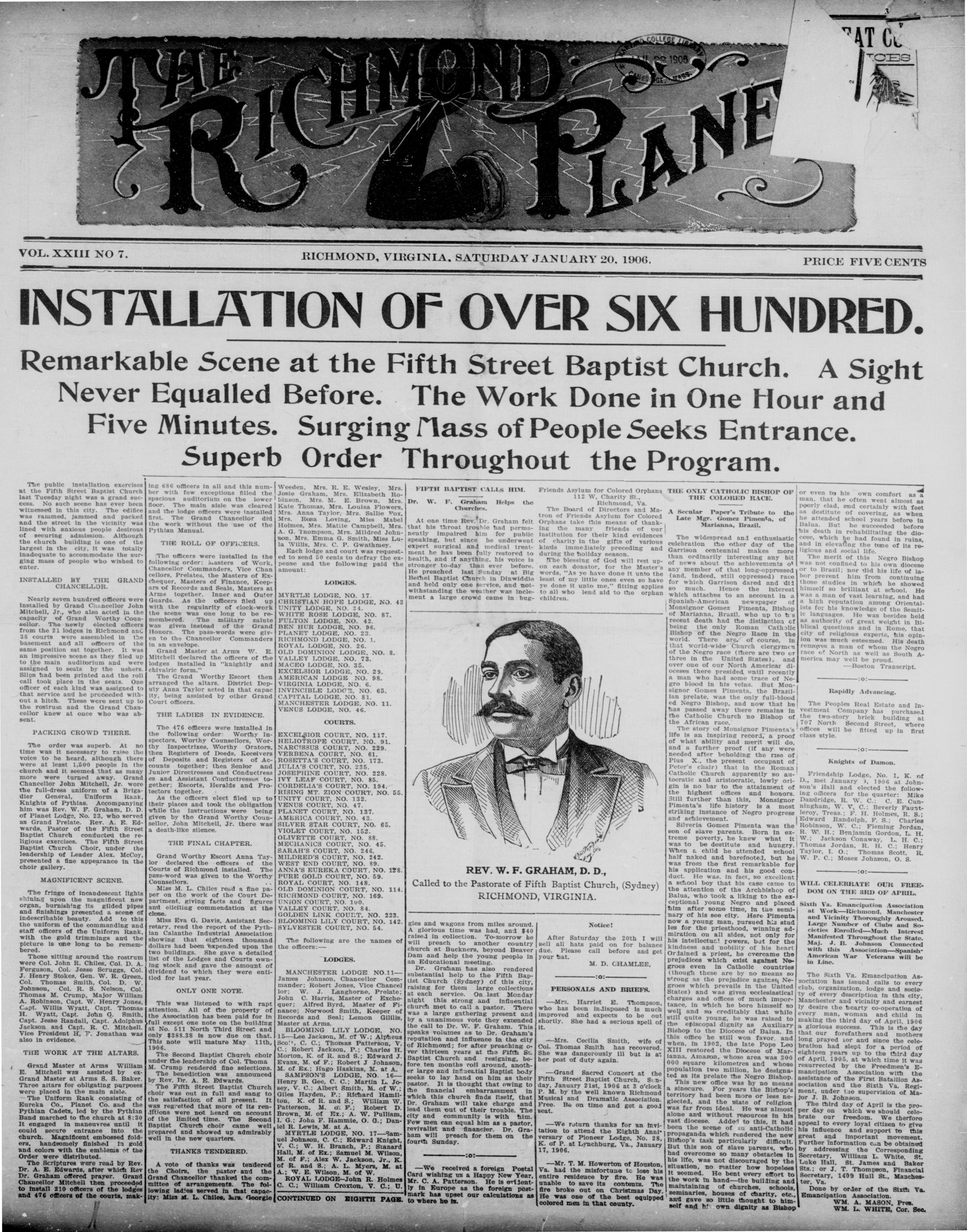
REV. W. F. GRAHAM, D. D., Called to the Pastorate of Fifth Baptist Church, (Sydney) RICHMOND, VIRGINIA.
FIFTH BAPTIST CALLS HIM.
Dr. W. F. Graham Helps the Churches.
At one time Rev. Dr. Graham felt that his throat trouble had permanently impaired him for public speaking, but since he underwent expert surgical and medical treatment he has been fully restored to health, and if anything, his voice is stronger to-day than ever before. He preached last Sunday at Big Bethel Baptist Church in Dinwidle and held only one service, and not withstanding the weather was inclement a large crowd came in bug-
REV. W. F. G.
Called to the Pastorate of Fi
RICHMOND
giles and wagons from miles around. A glorious time was had, and $40 raised in collection. To-morrow he will preach to another country church at Buckners, beyond Beaver Dam and help the young people in an Educational meeting. Dr. Graham has also rendered substantial help to the Fifth Baptist Church (Sydney) of this city, raising for them large collections at each service. On last Monday night this strong and influential church met to call a pastor. There was a large gathering present and by a unanimous vote they extended the call to Dr. W. F. Graham. This speaks volumes as to Dr. Graham's reputation and influence in the city of Richmond; for after preaching over thirteen years at the Fifth Sc. Baptist Church and resigning, before ten months roll around, another large and influential Baptist body seeks to lay hand on him as their pastor. It is thought that owing to the financial embarrassment in which this church finds itself, that Dr. Graham will take charge and lead them out of their trouble. The city and community is with him. Few men can equal him as a pastor, revivalist and financier. Dr. Graham will preach for them on the fourth Sunday.
—We received a foreign Postal Card wishing us a Happy New Year, Mr. C. A. Patterson. He is evidently in Europe as the foreign postmark has upset our calculations as to where he is.
Friends Asylum for Colored Orphans
112 W. Charity St.,
Richmond, Va.
The Board of Directors and Matron of Friends Asylum for Colored Orphans take this means of thanking the many friends of our institution for their kind evidences of charity in the gifts of various kinds immediately preceding and during the holiday season.
The blessing of God will rest upon each donator, for the Master's words, "As ye have done it unto the least of my little ones even so have ye done it unto me," fitting applies to all who lend aid to the orphan children.
RAHAM, D. D.,
fifth Baptist Church, (Sydney)
D, VIRGINIA.
Notice!
Notice!
After Saturday the 20th I will sell all hats paid on for balance due. Please call before and get your hat.
M. D. CHAMLEE.
PERSONALS AND BRIEFES
—Mrs. Harriet E. Thompson, who has been indisposed is much improved and expects to be out shortly. She had a serious spell of it.
—Mrs. Cecilia Smith, wife of Col. Thomas Smith has recovered. She was dangerously ill but is at her post of duty again.
—Grand Sacred Concert at the Fifth Street Baptist Church, Sunday, January 21st, 1906 at 3 o'clock P. M. by the well known Richmond Musical and Dramatic Association. Free. Be on time and get a good seat.
—We return thanks for an invitation to attend the Eighth Anniversary of Pioneer Lodge, No. 28, K. of P. at Lynchburg, Va., January 17, 1906.
—Mr. T. M. Howerton of Houston, Va. had the misfortune to lose his entire residence by fire. He was unable to save its contents. The fire broke out on Christmas Day. He was one of the best equipped colored men in that county.
THE ONLY CATHOLIC BISHOP OF THE COLORED RACE.
A Secular Paper's Tribute to the Late Mgr. Gomez Pimenta, of Marianna, Brazil.
The widespread and enthusiastic celebration the other day of the Garrison centennial makes more than ordinarily interesting any bit of news about the achievements of any member of that long-opressed (and, indeed, still oppressed) race for which Garrison dared and did so much. Hence the interest which attaches to an account in a Spanish-American newspaper of Monsignor Gomez Pimenta, Bishop of Marianna, Brazil, who up to his recent death had the distinction of being the only Roman Catholic Bishop of the Negro Race in the world. There are, of course, in that world-wide Church clergymen of the Negro race (there are two or three in the United States), and over one of our North American dioceses there presided until recently a man who had some trace of Negro blood in his veins. But Monsignor Gomez Pimenta, the Brazilian prelate, was the only full-blooded Negro Bishop, and now that he has passed away there remains in the Catholic Church no Bishop of the African race.
The story of Monsignor Pimenta's life is an inspiring record, a proof of what ability and merit will do, and a further proof (if any were needed after beholding the rise of Plus X., the present occupant of Peter's chair) that in the Roman Catholic Church apparently so automatic and aristocratic, lowly origin is no bar to the attainment of the highest offices and honors. Still further than this, Monsignor Pimenta's life history is a most striking instance of Negro progress and achievement.
Silveria Gomez Pimenta was the son of slave parents. Born in extreme poverty, he knew what it was to be destitute and hungry. When a child he attended school half naked and barefooted, but he was from the first remarkable for his application and his good conduct. He was, in fact, so excellent a school boy that his case came to the attention of the Archbishop of Balua, who took a liking to the exceptional young Negro and placed him after some time, in the seminary of his see city. Here Pimenta now a young man, pursued his studies for the priesthood, winning admiration on all sides, not only for his intellectual powers, but for the kindness and nobility of his heart Ordained a priest, he overcame the prejudices which exist against Negroes even in Catholic countries (though these are by no means so strong as the prejudice against Negroes which prevails in the United States) and was given ecclesiastical charges and offices of much importance, in which he bore himself so well and so creditably that while still quite young, he was raised to the episcopal dignity as Auxiliary Bishop to the Diocese of Balua. In this office he still won favor, and when, in 1902, the late Pope Leo XIII restored the Diocese of Marianna, Amazon, whose area was 300 000 square kilometres and whose population two million, he designated as its prelate the Negro Bishop.
This new office was by no means a sinecure. For years the Bishop's territory had been more or less neglected, and the state of religion was far from ideal. He was almost alone and without resources in his vast diocese. Added to this, it had been the scene of an anti-Catholic propaganda which rendered the new Bishop's task particularly difficult. But this son of slave parents, who had overcome so many obstacles in his life, was not discouraged by the situation, no matter how hopeless it seemed. He bent every effort to the work in hand—the building and maintaining of churches, schools, seminaries, houses of charity, etc. and gave so little thought to himself and his own dignity as Bishop
PRICE FIVE CENTS
DRED.
A Sight
ur and
ance.
or even to his own comfort as a man, that he often went almost as poorly clad, and certainly with feet as destitute of covering, as when he attended school years before in Balua. But he succeeded before his death in rehabilitating the diocese, which he had found in ruins, and in elevating the tone of its religious and social life.
The merit of this Negro Bishop was not confined to his own diocese or to Brazil; nor did his life of labor prevent him from continuing those studies in which he showed himself so brilliant at school. He was a man of vast learning, and had a high reputation among Orientalists for his knowledge of the Semitic languages. He was besides held as authority of great weight in Biblical questions and in Rome, that city of religious experts, his opinion was much esteemed. His death removes a man of whom the Negro race of North as well as South America may well be proud.
—Boston Transcript.
Rapidly Advancing.
The Peoples Real Estate and Investment Company has purchased the two-story brick building at 707 North Second Street, where offices will be fitted up in first class style.
Knights of Damon
Friendship Lodge, No. 1, K of D., met January 1), 1906 at Johnson's Hall and elected the following officers for the quarter: Mike Dandridge, R. W. C.; C. E. Cunningham, W. V. C.; Beverly Fauntleroy, Treas.; F. H. Holmes, R. S.; Edward Randolph, F. S.; Charles Robinson, W. C.; Fleming Jordan, R. W. H.; Benjamin Gordon, L. H. W.; Jackson Conaway, L. H. C.; Thomas Jordan, R. H. C.; Henry Taylor, I. O.; Thomas Scott, R. W. P. C.; Moses Johnson, Q. S.
WILL CELEBRATE OUR FREE
DOM ON THE 3RD OF APRIL.
Sixth Va. Emancipation Association at work—Richmond, Manchester and Vicinity Thoroughly Aroused. Large Number of Clubs and Societies Enrolled—Much Interest Manifested Throughout the State. Maj. J. B. Johnson Connected with this Association—Spanish American War Veterans will be in Line.
The Sixth Va. Emancipation Association has issued calls to every club, organization, lodge and society of every description in this city, Manchester and vicinity and earnestly desire the hearty co-operation of every man, woman and child in making the third day of April, 1906 a glorious success. This is the day that our forefathers and mothers long prayed 10r and since the celebration had slept for a period of eighteen years up to the third day of April, 1905, at which time it was resurrected by the Freedmen's Emancipation Association with the assistance of the First Battalion Association and the Sixth Va. Regiment, under the supervision of Major J. B. Johnson.
The third day of April is the proper day on which we should celebrate our freedom. We therefore appeal to every loyal citizen to give his influence and support to this great and important movement. Further information can be obtained by addressing the Corresponding Secretary, William L. White, St. Luke Hall, St. James and Baker Sts.; or J. T. Thompson, Financial Secretary, 1409 Hull St., Manchester, Va.
Done by order of the Sixth Va. Emancipation Association.
WM. A. MASON, Pres.
WM. L. WHITE, Cor. Seo.
HEY PLANET
SATURDAY. JANUARY 20. 1906
TEMPERANCE
NOTES
Oh yes, I am fair, and my sparkling wave
is quagmired by the young and the gifted and
brave.
And I gladden the hearts of the gloomy and
grave:
With my gushing and joyous tide.
Men seek me in youth in the heyday of life.
And seek me in manhood to arm for its
strife.
For each bubble with daring and strength
is rife.
But list what I give beside!
My rosy brim to your lips you bear
And quinn with a glee that will mock at
care.
And you'll dream for awhile there is
naught so fair
As the blushing and merry bowl!
But the dancing tide that your veins shall
fill
Shall leap with a hotter and wilder thrill,
And deeper, and deeper, and deeper still,
Shall burn in your very soul.
And your brain I will madden, and specters
fill
Your fancy shall borrow from depths of
Hell.
And you'll tremble and groan at their flend-
lish yell
As it rings in your throbbing ears
And red-hot serpents their folds shall
breathe
Through your tortured brain that shall kiss
and seethe.
And dread shall convulse till you scarce can
breathe
For the weight of your choking fears—
And soon I will laugh at my triumph won.
When your howling soul from its foul clay
wrung
By my ruthless grasp to the depths is
fung
That'll curdle each heart's blood and blanch each cheek.
When a voice to me from the Pit shall speak.
"Aba, thou hast served me well."
Andrew H. Smith, M. D., in National Ad
TEMPERANCE PAYS
Hard Drinking Is Held by Many Employers to Unfit a Man for a Position.
"So essential are steady hands and bright wits in our trade that under the rules of our union no drinking man can stay in the organization. The first time a member of the union goes on a job under the influence of liquor he is suspended for a month and fined. For the second offense he is summarily expelled, without hope of reinstatement. It's pretty drastic treatment, but we have found it the wisest way to deal with the matter." This plain statement, made in a Philadelphia paper by a constructor of elevators, is as good a temperance sermon as ever was preached. It is practical and goes to the point. A man doesn't need a "better nature" to be appealed to by such an argument as this. It hits all alike where the nerves are tenderest, in a vital spot.
There used to be a widespread delusion that worked incalculable injury, especially to the impressionable and unthinking young. It was to the effect that the best workmen, in all lines, drank. That delusion is rapidly dying. And it will be a happy day for mankilling when all men thoroughly recognize the fact that no man who drinks much liquor is as efficient a man in any line of labor as he would be if he did not drink at all.
The building of elevators is by no means the only business in which drinking is a disqualification. The railroads, the telegraph companies, and all the other big commercial, industrial and financial organizations are drawing the lines closer and closer every day against the man who drinks. Why, hard drinking is held to be a disqualification even in the saloon itself. The drinking bartender cannot hold his own against the sober one.
No business man on earth knows better than the saloonkeeper himself that sobriety is the first essential of successful business. And the value of the man who "never drinks behind the bar" is at a premium.
There is a lesson here that ought to be easy for every man to learn and for every boy who hopes to make the best of himself in life to store away as one of the most precious and important treasures of his education.
To the youth who is tempted to drink there is no more important lesson than this, that in these times, as never before, temperance is not only a virtue, but, like all other virtues, it pays, and is one that, in all the catalogue of virtues, pays most directly and best. Minneapolis News.
Showing One's Colors.
The superintendent of a seaman's mission says that one of his young sailors, who had signed the pledge and worn the white ribbon, had to enter a hospital later on. The physician prescribed brandy; but when he saw the ribbon he medicated the medicine, saying: "I can give you something that will take the place of it; I never mean to do anything that will rouse a dormant appetite if I can help it." Such an emblem, like the badge of certain organizations, is a positive safeguard. "You'll often be laughed at after you put on this uniform," said Ben. Booth on one occasion to a company of the Salvation Army, "but you'll not often be tempted. All the devils run from a soldier who shows his colors."
STORIES OF THE FAKIRS
Author of "Twenty Years of Husling," "What Happened to Johnston" Etc.
"SOAP" THEIR DUPES.
Shaving Soap Man Victimizes Leading Merchants — $100 Paid for Every Cake — A Philanthropist "Gives Away" Soap Wrapped in Twenty-Dollar Bills—A Wonderful Demonstration with Laundry Soap—Grafter Swindles a Circus Crowd.
(Copyright, 1906, by Joseph B. Bowlea.) When I was selling Yankee notions at auction in Michigan I encountered a grafter whose special victims were the leading merchants of small towns. His was a shaving soap graft. However, the soap was of small consideration. It was his skill in palming and manipulating dollar bills that brought him success.
He carried a single valise and a small tin box, the latter filled with very small cakes of soap, cut from bars of ordinary washing soap. Each case was wrapped in a piece of paper. Upon reaching a town he called upon the most prominent merchant and requested the loan of a barrel. This he would roll out directly in front of the merchant's store, and, turning it bottom side up in the street, he placed his tin box upon it. His plan was to begin operations about two o'clock in the afternoon, when the merchant was least likely to be busy.
As soon as an audience of two or more persons was secured, he would expatiate upon the wonderful merits of his soap. After removing the wrapper from a cake of soap, he took a large roll of money from his pocket. Then, folding a $20 bill lengthwise, and wrapping it around the piece of soap in plain view of his audience, he folded up the soap and the $20 bill in the original wrapper. Usually by this time the merchant the grafter has selected as his victim was an interested spectator. The grafter took the piece of soap in his left hand and held his pocketknife in his right, so that he could easily clip off one end of the piece.
"Who will give me ten dollars for this piece of soap?" he cried. "Is
VIII.
EATP
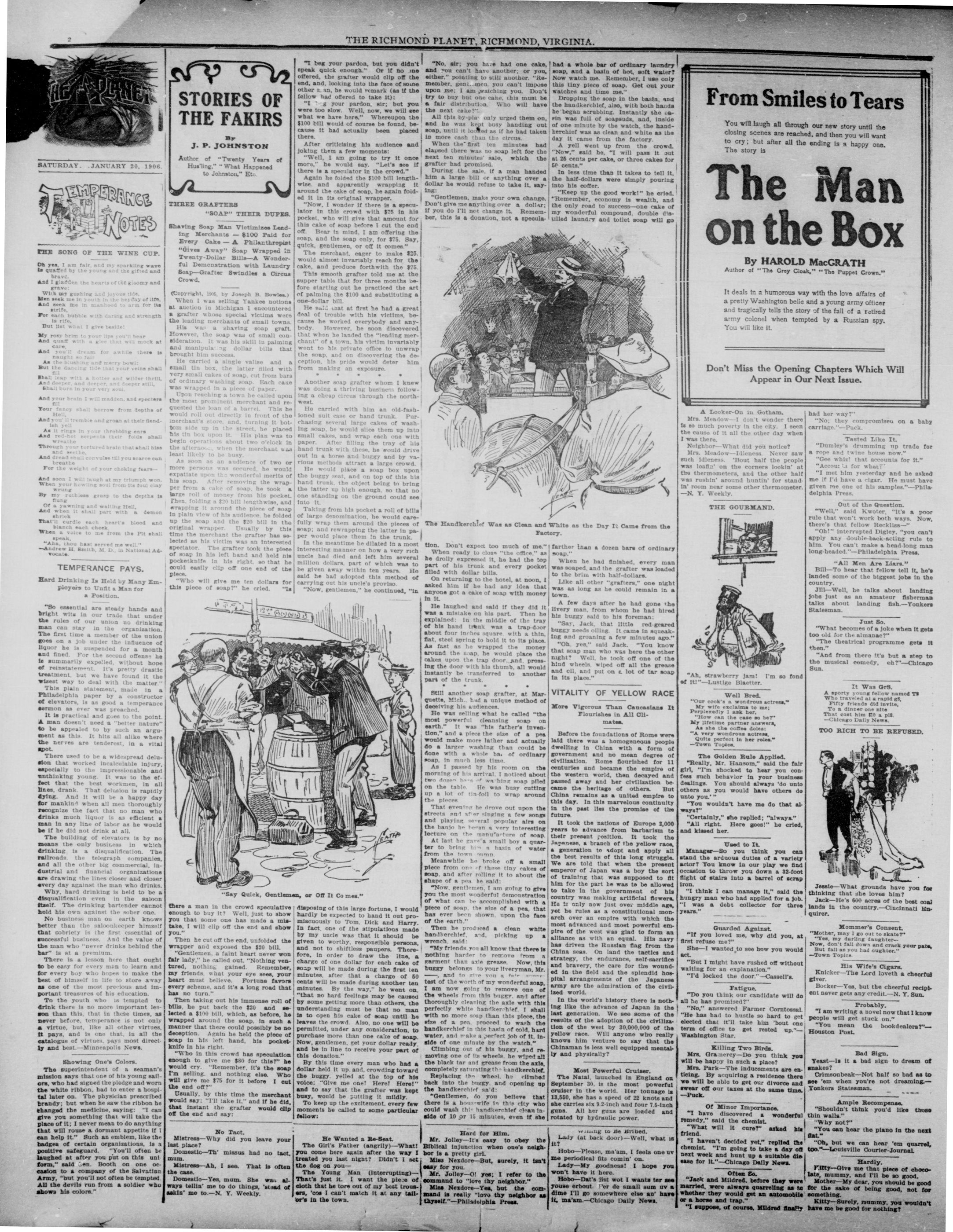
"Say Quick, Gentlemen, or Off It Comes."
there a man in the man speculative enough to buy it? Well, just to show you that some one has made a mistake, I will clip off the end and show you."
Then he cut off the end, unfolded the wrapper and exposed the $20 bill. "Gentlemen, a faint heart never won fair lady," he called out. "Nothing ventured, nothing gained. Remember, my friends, what your eye sees, your heart must believe. Fortune favors every scheme, and it's a long road that has no turn."
Then taking out his immense roll of bills, he put back the $20 and selected a $100 bill, which, as before, he wrapped around the soap, in such a manner that there could possibly be no deception. Again he held the piece of soap in his left hand, his pocket knife in his right.
disposing of this large hardly be expected to miscuously to Tom. In fact, one of the she by my uncle was the given to worthy, res and not to shiftless fore, in order to charge of one dollar soap will be made du minutes, after that cents will be made du minutes. By the war "that no hard feeling by some getting more understanding must is to open his cake leaves the crowd. Also permitted, under any purchase more than Now, gentlemen, get y and be in line to see."
"Who in this crowd has speculation enough to give me $80 for this?" he would cry. "Remember, it's the soap I'm selling, and nothing else. Who will give me $75 for it before I cut the end off?" Usually, by this time the merchant would say: "I'll take it," and if he did, that instant the grafter would clip off the end and say:
No Tact.
Mistress—Why did you leave your last place?
Domestic—Th' missus had no tact, mum.
Mistress—Ah, I see. That is often the case.
Domestic—Yes, mum. She was always tellin' me to do things, 'stead of askin' me to.—N. Y. Weekly.
THREE GRAFTERS
"I beg your pardon, but you didn't speak quick enough." Or if no one offered, the grafter would clip off the end, and, looking into the face of some other man, he would remark (as if the fellow had offered to take it):
"I beg your pardon, sir; but you were too slow. Well, now, we will see what we have here." Whereupon the $100 bill would of course be found, because it had actually been placed there.
After criticising his audience and joking them a few moments:
"Well, I am going to try it once more," he would say. "Let's see if there is a speculator in the crowd."
Again he folded the $100 bill lengthwise, and apparently wrapping it around the cake of soap, he again folded it in its original wrapper.
"Now, I wonder if there is a speculator in this crowd with $75 in his pocket, who will give that amount for this cake of soap before I cut the end off. Bear in mind, I am offering the soap, and the soap only, for $75. Say, quick, gentlemen, or off it comes."
The merchant, eager to make $25 would almost invariably reach for the cake, and produce forthwith the $75. This smooth grafter told me at the supper table that for three months before starting out he practiced the art of palming the $100 and substituting a one-dollar bill.
He said that at first he had a great deal of trouble with his victims, because he worked everybody and anybody. However, he soon discovered that when he landed the "leading merchant" of a town, his victim invariably went to his private office to unwrap the soap, and on discovering the deception, his pride would deter him from making an exposure.
Another soap grafter whom I knew was doing a thriving business following a cheap circus through the northwest.
He carried with him an old-fashioned suit case or hand trunk. Purchasing several large cakes of washing soap, he would slice them up into small cakes, and wrap each one with paper. After filling the tray of his hand trunk with these, he would drive out in a horse and buggy and by various methods attract a large crowd. He would place a soap box upon the buggy seat, and on top of this his hand trunk, the object being to bring the latter up high enough, so that no one standing on the ground could see into it.
Taking from his pocket a roll of bills of large denomination, he would carefully wrap them around the pieces of soap; and rewrapping the latter in paper would place them in the trunk.
In the meantime he dilated in a most interesting manner on how a very rich uncle had died and left him several million dollars, part of which was to be given away within ten years. He said he had adopted this method of carrying out his uncle's proviso. "Now, gentlemen," he continued. "in
EATP
disposing of this large fortune, I would hardly be expected to hand it out promiscuously to Tom, Dick and Harry. In fact, one of the stipulations made by my uncle was that it should be given to worthy, responsible persons, and not to shiftless paupers. Therefore, in order to draw the lime, a charge of one dollar for each cake of soap will be made during the first ten minutes, after that a charge of 50 cents will be made during another ten minutes. By the way," he went on, "that no hard feelings may be caused by some getting more than others, the understanding must be that no man is to open his cake of soap until he leaves the crowd. Also, no one will be permitted, under any consideration, to purchase more than one cake of soap. Now, gentleman, get your dollar ready, and be in line to receive your part of this donation."
By this time every man who had a dollar held it up, and, crowding toward the buggy, yelled at the top of his voice: "Give me one! Here! Here!" and to say that the grafter was kept busy, would be putting it mildly. To keep up the excitement, every few moments he called to some particular fellow:
He Wanted a Re-Seat.
The Girl's Father (angrily)—What! you come here again after the way I treated you last night? Didn't I set the dog on you—
The Young Man (interrupting)—That's just it. I want the piece of cloth that he tore out of my best trousers, 'cos I can't match it at any tailor's in the town.
THE RICHMOND PLANET, RICHMOND, VIRGINIA.
L.
The Handkerchief Was as Clean and White as the Day It Came from the Factory.
"No, sir; you have had one cake, and you can't have another; or you, either," pointing to still another. "Remember, gent. men, you can't impose upon me; I am watching you. Don't try to buy but one cake, this must be a fair distribution. Who will have the next cake?" All this by-play only urged them on, and he was kept busy handing out soap, until it looked as if he had taken in more cash than the circus. When the first ten minutes had elapsed there was no soap left for the next ten minutes' sale, which the grafter had promised. During the sale, if a man handed him a large bill or anything over a dollar he would refuse to take it, saying: "Gentlemen, make your own change. Don't give me anything over a dollar; if you do I'll not change it. Remember, this is a donation, not a specula-
The Handkerchief Was as Clean and Fact
tion. Don't expect too much of me."
When ready to close "the office," as he drolly expressed it, he had the top part of his trunk and every pocket filled with dollar hills.
On returning to the hotel, at noon, I asked him if he had any idea that anyone got a cake of soap with money in it.
He laughed and said if they did it was a mistake on his part. Then he explained: In the middle of the tray of his hand trunk was a trap-door about four inches square, with a thin, flat, steel spring to hold it to its place.
As fast as he wrapped the money around the soap, he would place the cakes upon the trap door, and pressing the door with his thumb, all would instantly be transferred to another part of the trunk.
Still another soap grafter, at Marquette, Mich., had a unique method of deceiving his audiences.
He was selling what he called "the most powerful cleansing soap on earth." It was "his father's invention," and a piece the size of a pea would make more lather and actually do a larger washing than could be done with a whole ba, of ordinary soap, in much less time.
As I passed by his room on the morning of his arrival, I noticed about two dozen bars of washing soap piled on the table. He was busy cutting up a lot of tin-foil to wrap around the pieces.
That evening he drove out upon the streets and after singing a few songs and playing several popular airs on the banjo he began a very interesting lecture on the manufacture of soap.
At last he gave a small boy a quarter to bring him a basin of water from the town camp.
Meanwhile he broke off a small piece from one of these tiny cakes of soap, and after rolling it to about the shape of a pea he said:
"Now, gentlemen, I am going to give you the most wonderful demonstration of what can be accomplished with a piece of soap, the size of a pea, that has ever been shown, upon the face of the earth."
Then he produced a clean white handkerchief, and, picking up a wrench, said:
"My friends, you all know that there is nothing harder to remove from a garment than axe grease. Now, this buggy belongs to your liveryman, Mr. —, and to give you a fair answer test of the worth of my wonderful soap, I am now going to remove one of the wheels from this buggy, and after thoroughly cleaning the axle with this perfectly white handkerchief, I shall with no more soap than this piece, the size of a pea, proceed to wash the handkerchief in this basin of cold, hard water, and make a perfect job of it, inside of one minute by the watch."
Climbing out of his buggy, and removing one of its wheels, he wiped all the black tar and grease from the axle, completely saturating the handkerchief. Replacing the wheel, he climbed back into the buggy, and opening up the handkerchief said:
"Gentlemen, do you believe that there is a housewife in this city who could wash this handkerchief clean inside of 10 or 15 minutes, even if she
Hard for Him.
Mr. Jolley—It's easy, to obey the Biblical injunction when one's neighbor is a pretty girl.
Miss Nexdore—But, surely, it isn't easy for you.
Mr. Jolley—O! yes; I refer to the command to "love thy neighbor."
Miss Nexdore—Yes, but the command is really "love thy neighbor as thyself."—Philadelphia Press.
had a whole bar of ordinary laundry soap, and a basin of hot, soft water? Now watch me. Remember, I use only this tiny piece of soap. Get out your watches and time me."
Dropping the soap in the basin, and the handkerchief, also, with both hands he began scrubbing. Instantly the basin was full of soapsuds, and, inside of one minute by the watch, the handkerchief was as clean and white as the day it came from the factory.
A yell went up from the crowd, "Now," said he, "I will pass it out at 25 cents per cake, or three cakes for 50 cents."
In less time than it takes to tell it, the half-dollars were simply pouring into his coffer.
"Keep up the good work!" he cried. "Remember, economy is wealth, and the only road to success—one cake of my wonderful compound, double distilled laundry and toilet soap will go
White as the Day It Came from the story.
farther than a dozen bars of ordinary soap."
When he had finished, every man was soaped, and the grafter was loaded to the brim with half-dollars.
Like all other "grafters," one night was as long as he could remain in a town.
A few days after he had gone the livery man, from whom he had hired his buggy said to his foreman:
"Say, Jack, that little red-geared buggy needs oiling. It came in squeak-ing and groaned a few minutes ago."
"Oh, yes," said Jack. "You know that soap man who was here the other night? Well, he took off one of the hind wheels, wiped off all the grease and oil, and put on a lot of tar soap in its place."
VITALITY OF YELLOW RACE
More Vigorous Than Caucasians It
Flourishes in All Cll-
Before the foundations of Rome were laid there was a homogeneous people dwelling in China with a form of government and no mean degree of civilization. Rome flourished for 11 centuries and became the empire of the western world, then decayed and passed away and her civilization became the heritage of others. But China remains as a united empire to this day. In this marvelous continuity in the past lies the promise of the future.
It took the nations of Europe 2,000 years to advance from barbarism to their present position. It took the Japanese, a branch of the yellow race, a generation to adopt and apply all the best results of this long struggle. We are told that when the present emperor of Japan was a boy the sort of training that was supposed to fit him for the part he was to be allowed to take in the government of his country was making artificial flowers. He is only now just over middle age, yet he rules as a constitutional monarch over an empire with which the most advanced and most powerful empire of the west was glad to form an alliance as with an equal. His navy has driven the Russian flag from the China seas. On land the tactics and strategy, the endurance, self-sacrifice and bravery, the care for the wounded in the field and the splendid hospital arrangements of the Japanese army are the admiration of the civilized world.
In the world's history there is nothing like the advance of Japan in the last generation. We see some of the results of the adoption of the civilization of the west by 30,000,000 of the yellow race. Will anyone who really knows him venture to say that the Chinaman is less well equipped mentally and physically?
Most Powerful Cruiser.
The Natal, launched in England on September 30, is the most powerful cruiser in the world. Her tonnage is 13,550, she has a speed of 22 knots and she carries six 9.2-inch and four 7.5-inch guns. All her guns are loaded and rotated by hydraulic power.
Willing to Be Bribed.
Lady (at back door)—Well, what is it?
Hobo—Please, ma'am, I feels one uv me periodical fits comin' on.
Lady—My goodness! I hope you won't have it here.
Hobo—Dat's list wot I wants ter see youse erbout. Per de small sum uv a dime I'll go somewhere else an' have it, ma'am—Chicago Daily News.
From Smiles to Tears
From Smiles to Tears
You will laugh all through our new story until the closing scenes are reached, and then you will want to cry; but after all the ending is a happy one. The story is
The Man on the Box
By HAROLD MacGRATH
Author of "The Grey Cloak," "The Puppet Crown."
It deals in a humorous way with the love affairs of a pretty Washington belie and a young army officer and tragically tells the story of the fall of a retired army colonel when tempted by a Russian spy. You will like it.
Don't Miss the Opening Chapters Which Will Appear in Our Next Issue.
A Looker-On in Gotham.
Mrs. Meadow—I don't wonder there is so much poverty in the city. I seen the cause of it all the other day when I was there.
Neighbor—What did you notice?
Mrs. Meadow—Idleness. Never saw such idleness. 'Bout half the people was loafin' on the corners lookin' at the thermometers, and the other half was rushin' around huntin' for standin' room near some other thermometer.
-N. Y. Weekly.
THE GOURMAND.
"Ah, strawberry jam! I'm so fond of it!"—Lustige Blaetter.
Well Bred.
"Our cook's a wondrous actress,"
My wife explains to me;
Perplexed, I ask her.
"How can the case be so?"
My lifetime partner answers,
As she the coffee doles:
"A very wondrous actress,
Quite perfect in her roles."
—Town Topics.
The Golden Rule Applied.
"Really, Mr. Hansom," said the fair girl,
"I'm shocked to hear you confess such behavior in your business dealings. You should always do unto others as you would have others do unto you."
"You wouldn't have me do that always?"
"Certainly," she replied; "always."
"All right. Here goes!" he cried, and kissed her.
Used to It.
Manager—So you think you can stand the dutious duties of a variety actor? You know in our play we find occasion to throw you down a 32-foot flight of stairs into a barrel of scrap iron.
"I think I can manage it," said the hungry man who had applied for a job.
"I was a debt collector for three years."
Guarded Against
"If you loved me, why did you, at first refuse me?"
She—I wanted to see how you would act.
"But I might have rushed off without waiting for an explanation."
"I'd looked the door." Crosellie
Fatigue
"Do you think our candidate will do all he has promised?"
"No," answered Farmer Corntossal. "He has had to hustle so hard to get elected that it'll take him "bout one term of office to get rested up."—Washington Star.
Killing Two Birds
Mrs. Gramercy--Do you think you will be happy in such a place?
Mrs. Park—The inducements are enticing. By acquiring a residence there we will be able to get our divorce and swear off our taxes at the same time. —Puck.
Of Minor Importance
"I have discovered a wonderful remedy," said the chemist.
"What will it cure?" asked his friend.
"I haven't decided yet," repiled the chemist. "I'm going to take a day off next week and hunt up a suitable disease for it."-Chicago Daly Nowa.
Often So.
"Jack and Mildred, before they were married, were always quarrelling as to whether they would get an automobile or a horse and trap."
had her way?"
"No; they compromised on a baby carriage."—Puck.
Tasted Like It.
"Dumley's drumming up trade for a rope and twine house now."
"Gee whiz! that accounts for it."
"Account is for what?"
"I met him yesterday and he asked me if I'd have a cigar. He must have given me one of his samples."—Philadelphia Press.
Out of the Question
"Well," said Kwoter, "it's a poor rule that won't work both ways. Now, there's that fellow Reckliss—" "Oh!" interrupted Digley, "you can't apply any double-back-acting rule to him. You can't make a head-long man long-headed."—Philadelphia Press.
"All Men Are Idiars."
Bill—To hear that fellow tell it, he's landed some of the biggest jobs in the country.
Jill—Well, he talks about landing jobs just as an amateur fisherman talks about landing fish.—Yonkers Statesman.
Just So.
"What becomes of a joke when it gets too old for the almanac?"
"The theatrical programme gets it then."
"And from there it's but a step to the musical comedy, eh?"—Chicago Sun.
It Was GrS.
A sporty young fellow named T3 Who traveled at a rapid g3. Betty friends did invite. To a dinner one ate. That cost him $0 a p1. —Chicago Daily News.
TOO RICH TO BE REFUSED.
Jessie—What grounds have you for thinking that she loves him?
Jack—He's 600 acres of the best coal lands in the country.—Clincinnati Enquirer.
Mommer's Consent
"Yes, my darling daughter—
Now, don't fall down and crack your pate,
But fall as you had ougher."
-Town Topics.
His Wife's Cigars.
Nickler—The Lord loveth a cheerful
giver.
Bocker—Yes, but the cheerful recipient
never gets any credit. N. Y. Sun.
"You mean the bookdealers?"— Houston Post.
Bad Sign
Yeast—Is it a bad sign to dream of snakes?
Crimsonbeak—Not half so bad as to see 'em when you're not dreaming.
Yonkers Statesman.
"Shouldn't think you'd like those thin walls."
"Why not?"
"You can hear the piano in the next flat."
"Oh, but we can hear 'em quarrel, too."—Louisville Courier-Journal
Mother—My dear, you should be good for the sake of being good, not for something.
Kitty—Surely, mummy, you wouldn't have me be good for nothing?
THE PLANET
FARM AND GARDEN
ALFALFA ROOTS GROW DEEP.
Investigations at Kansas Experiment Station That They Go Far for Water.
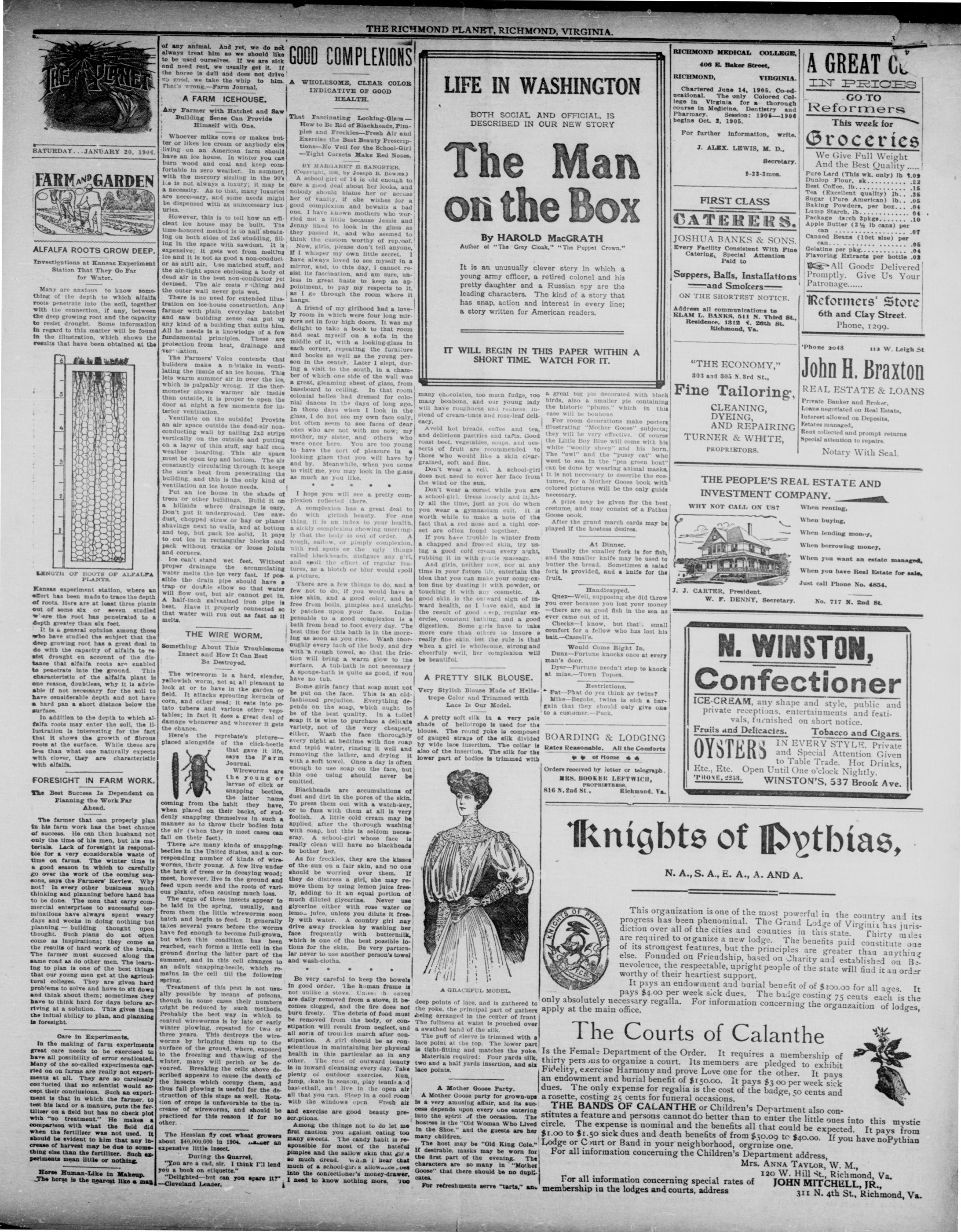
Many are anxious to know something of the depth to which alfalfa roots penetrate into the soil, together with the connection, if any, between the deep growing root and the capacity to resist drought. Some information in regard to this matter will be found in the illustration, which shows the results that have been obtained at the
6
5
4
3
2
1
LENGTH OF ROOTS OF ALFALFA PLANTS.
Kansas experiment station, where an effort has been made to trace the depth of roots. Here are at least three plants out of some six or seven studied where the root has penetrated to a depth greater than six feet.
It is a general opinion among those who have studied the subject that the deep growing root has a great deal to do with the capacity of alfalfa to resist drought on account of the distance that alfalfa roots are enabled to penetrate into the ground. This characteristic of the alfalfa plant is one reason, doubtless, why it is advisable if not necessary for the soil to have considerable depth and not have a hard pan a short distance below the surface.
In addition to the depth to which alfalfa roots may enter the soil, the illustration is interesting for the fact that it shows the growth of fibrous roots at the surface. While these are less than what one naturally expects with clover, they are characteristic with alfalfa.
FORESIGHT IN FARM WORK.
The farmer that can properly plan in his farm work has the best chance of success. He can then husband not only the time of his men, but his materials. Lack of foresight is responsible for a very considerable waste of time on farms. The winter time is a good season in which to carefully go over the work of the coming seasons, says the Farmers' Review. Why not? In every other business much thinking and planning before hand has to be done. The men that carry commercial enterprises to successful terminations have always spent weary days and weeks in doing nothing but planning — building thought upon thought. Such plans do not often come as inspirations; they come as the results of hard work of the brain. The farmer must succeed along the same road as do other men. The learning to plan is one of the best things that our young men get at the agricultural colleges. They are given hard problems to solve and have to sit down and think about them; sometimes they have to think hard for days before arriving at a solution. This gives them the initial ability to plan, and planning is foresight.
Care in Experiments
In the making of farm experiments great care needs to be exercised to have all possibility of error eradicated. Many of the so-called experiments carried on on farms are really not experiments at all. They are so carelessly conducted that no scientist would accept their conclusions. Such an experiment is that in which the farmer, to test his land or a manure, puts the fertilizer on a field but has no check plot with "no treatment." He makes a comparison with what the field did when the fertilizer was not used. It should be evident to him that any increase of harvest may be due to something else than the fertilizer. Such experiments mean little or nothing.
Horse Human-Like in Makeup. The horse is the nearest like a man
of any animal. And yet, we do not always treat him as we should like to be used ourselves. If we are sick and need rest, we usually get it. If the horse is dull and does not drive up good, we take the whip to him. That's wrong—Farm Journal.
A FARM ICEHOUSE.
Any Farmer with Hatchet and Saw
Building Sense Can Provide
Himself with One.
Whoever milks cows or makes butter or likes ice cream or anybody else living on an American farm should have an ice house. In winter you can burn wood and coal and keep comfortable in zero weather. In summer, with the mercury sizzling in the 90's ice is not always a luxury; it may be a necessity. As to that, many luxuries are necessary, and some needs might be dispensed with as unnecessary luxuries. However, this is to tell how an efficient ice house may be built. The time-honored method is to nail sheatling on both sides of 2x6 studding, filling in the space with sawdust. It is expensive; it gets wet from melting ice and it is not as good a non-conductor or as still air. Use matched stuff, and the air-tight space enclosing a body of dead air is the best non-conductor yet devised. The air costs nothing and the outer wall never gets wet.
There is no need for extended illustration on ice-house construction. Any farmer with plain everyday hatchet and saw building sense can put up any kind of a building that suits him. All he needs is a knowledge of a few fundamental principles. These are protection from heat, drainage and ventilation.
The Farmers' Voice contends that builders make a mistake in ventilating the inside of an ice house. This lets warm summer air in over the ice, which is palpably wrong. If the thermometer shows warmer air inside than outside, it is proper to open the door at night a few moments for interior ventilation.
Ventilate on the outside! Provide an air space outside the dead-air non-conducting wall by nailing 2x2 strips vertically on the outside and putting on a layer of thin stuff, say half inch weather boarding. This air space must be open top and bottom. The air constantly circulating through it keeps the sun's heat from penetrating the building, and this is the only kind of ventilation an ice house needs.
Put an ice house in the shade of trees or other buildings. Build it on a hillside where drainage is easy. Don't put it underground. Use sawdust, chopped straw or hay or planer shavings next to walls, and at bottom and top, but pack ice solid. It pays to cut ice in rectangular blocks and pack without cracks or loose joints and corners.
I can't stand wet feet. Without proper drainage the accumulating water melts the ice very fast. If possible the drain pipe should have a trap or double elbow so that water will flow out, but air cannot get in. A half-inch galvanized iron pipe is best. Have it properly connected so that water will run out as fast as it melts.
THE WIRE WORM.
Something About This Troublesome
Insect and How It Can Best
Be Destroyed.
The wireworm is a hard, slender,
yellowish worm, not at all pleasant to
look at or to have in the garden or
field. It attacks sprouting kernels of
corn, and other seed; it eats into potato tubers and various other vegetables; in fact it does a great deal of damage whenever and wherever it gets the chance.
Here's the reprobate's picture—
placed alongside of the clickbottle.
or the click-beetle
that gave it life,
says the Farm
Journal.
```markdown
```
Wireworms are the young or larvae of click or snapping beetles, the latter name coming from the habit they have, when placed on their backs, of suddenly snapping themselves in such a manner as to throw their bodies into the air (when they in most cases can fall on their feet).
There are many kinds of snapping beetles in the United States, and a corresponding number of kinds of wireworms, their young. A few live under the bark of trees or in decaying wood; most, however, live in the ground and feed upon seeds and the roots of various plants, often causing much loss.
The eggs of these insects appear to be laid in the spring, usually, and from them the little wireworms soon hatch and begin to feed. It generally takes several years before the worms have fed enough to become full-grown, but when this condition has been reached, each forms a little cell in the ground during the latter part of the summer, and in this cell changes to an adult snapping-beile, which remains in the cell till the following spring.
Treatment of this pest is not usually possible by means of pots, though in some cases their numbers might be reduced by such methods. Probably the best way in which to control wireworms is by late or early winter plowing, repeated for two or three years. This destroys the wireworms by bringing them up to the surface of the ground, where, exposed to the freezing and thawing of the winter, many will perish or be devoured. Breaking the cells above described appears to cause the death of the insects which occupy them, and thus fall plowing is useful for the destruction of this stage as well. Rotation of crops is unfavorable to the increase of wireworms, and should be practiced for this reason if for no other.
The Hessian fly cost wheat growers about $40,000,000 in 1904. manner an expensive little insect.
During the Quarrel.
"You are a cad, sir. I think I'll lend you a book on etiquette."
"Dellighted—but can you spare it?"
-Cleveland Leader
THE RICHMOND PLANET, RICHMOND, VIRGINIA
A WHOLESOME, CLEAR COLOR INDICATIVE OF GOOD HEALTH.
That Fascinating Looking-Glass — How to Be Rid of Blackheads, Pimples and Freckles—Fresh Air and Exercise the Best Beauty Prescriptions—No Veil for the School-Girl —Tight Corsets Make Red Noses.
BY MARGARET E. SANGSTER.
(Copyright, 1956, by Joseph B. Bowles.)
A school girl of 14 is old enough to
care a good deal about her looks, and
nobody should blame her or accuse
her of vanity, if she wishes for a
good complexion and bewalsa a bad
one. I have known mothers who worried
a little because Jessie and Jenny
liked to look in the glass as
they passed it, and who seemed to
think the custom worthy of rep.oof.
Now, girls, please don't tell anyone,
if I whisper my own little secret.
I have always loved to see myself in a
mirror, and, to this day, I cannot
resist its fascination, and am sure,
unless in great haste to keep an
appointment, to pay my respects to it,
as I go through the room where it
hangs.
A friend of my girlhood had a lovely room in which were four long mirrors set in four high doors. It was my delight to take a book to that room and seat myself on a sofa in the middle of it, with a looking-glass in each corner, repeating the furniture and books as well as the young person in the center. Later I slept, during a visit to the south, in a chamber of which one side of the wall was a great, gleaming sheet of glass, from baseboard to ceiling. In that room colonial belles had dressed for colonial dances in the days of long ago. In these days when I look in the glass, I do not see my own face only, but often seem to see faces of dear ones who are not with me now; my mother, my sister, and others who were once here. You are too young to have the sort of pleasure in a looking glass that you will have by and by. Meanwhile, when you come to visit me, you may look in the glass as much as you like.
I hope you will see a pretty complexion reflected there.
A complexion has a great deal to do with girlish beauty. For one thing, it is an index to your health, a sickly complexion showing unerringly that the body is out of order. A rough, sallow, or plimply complexion, with red spots or the ugly things called blackheads, disfigure any girl, and spoil the effect of regular features, as a blotch or blur would spoil a picture.
There are a few things to do, and a few not to do, if you would have a nice skin, and a good color, and be free from boils, pimples and unsightly patches upon your face. Indispensable to a good complexion is a bath from head to foot every day. The best time for this bath is in the morning as soon as you rise. Wash thoroughly every inch of the body, and dry with a rough towel, so that the friction will bring a warm glow to the surface. A tub-bath is not necessary A sponge-bath is quite as good, if you have no tub.
Some girls fancy that soap must not be put on the face. This is an old-fashioned prejudice. Everything depends on the soap, which ought to be of the best quality. In a toilet soap it is wise to purchase a delicate variety, not of the very cheapest, either. Wash the face thoroughly every night at bedtime with fine soap and tepid water, rinsing it well and removing the lather, and drying it with a soft towel. Once a day is often enough to use soap on the face, but this one using should never be omitted.
Blackheads are accumulations of dust and dirt in the pores of the skin. To press them out with a watch-key, or to fuss with them at all is very foolish. A little cold cream may be applied, after the thorough washing with soap, but this is seldom necessary. A school-girl whose face is really clean will have no blackheads to bother her.
As for freckles, they are the kisses of the sun on a fair skin, and no one should be worried over them. If they do distress a girl, she may remove them by using lemon juice freely, adding to it an equal portion of much diluted glycerine. Never use glycerine either with rose water or lemon juice, unless you dilute it freely with water. A country girl may drive away freckles by washing her face frequently with buttermilk, which is one of the best possible lotions for the skin. Be very particular never to use another person's towel and wash-cloths.
Be very careful to keep the bowels in good order. The human frame is not unlike a stove. Unless ashes are daily removed from a stove, it becomes clogged, and the fire does not burn freely. The debris of food must be removed from the body, or constipation will result from neglect, and all soris of troubles march after constipation. A girl should be as conscientious in maintaining her physical health in this particular as in any other. The root of outward beauty is in inward cleansing every day. Take plenty of outdoor exercise. Run, jump, skate in season, play tennis and basketball, and live in the open air all that you can. Sleep in a cool room with the windows open. Fresh air and exercise are good beauty prescriptions.
Among the things not to do let me first caution you against eating too many sweets. The candy habit is responsible for most of the hateful pimples and the sallow skin that girl's so much dread. When I hear that much of a school-girl's allowance goes into the confectioner's money-drawer, I need to know nothing more. Too
LIFE IN WASHINGTON
BOTH SOCIAL AND OFFICIAL, IS DESCRIBED IN OUR NEW STORY
The
on th
By HAROLD
Author of "The Grey Clock
It is an unusually clo
young army officer, a
pretty daughter and a
leading characters. T
has snap, action and
a story written for An
IT WILL BEGIN IN THE
SHORT TIME.
The Man on the Box
By HAROLD MacGRATH Author of "The Grey Cloak," "The Puppet Crown."
It is an unusually clever story in which a young army officer, a retired colonel and his pretty daughter and a Russian spy are the leading characters. The kind of a story that has snap, action and interest in every line; a story written for American readers.
IT WILL BEGIN IN THIS PAPER WITHIN A SHORT TIME. WATCH FOR IT.
many chocolates, too much fudge, too many bonbons, and our young lady will have roughness and reiness. instead of cream-tints and rose-leaf delicacy.
Avoid hot breads, coffee and tea, and delicious pastries and tarts. Good roast beef, vegetables, soups, and desserts of fruit are recommended to those who would like a skin clear-grained, soft and fine.
Don't wear a vell. A school-girl does not need to cover her face from the wind or the sun.
Don't wear a corset while you are a school-girl. Dress loosely and lightly all the time, just as you do when you wear a gymnasium suit. It is worth while to make a note of the fact that a red nose and a tight corse are often found together.
If you have trouble in winter from a chapped and frosted skin, try using a good cold cream every night, rubbing it in with gentle massage.
And girls, neither now, nor at any time in your future life, entertain the idea that you can make your complexion fine by dusting it with powder, or touching it with any cosmetic. A good skin is the onward sign of inward health, as I have said, and is the result of good sleep, regular exercise, constant bathing, and a good digestion. Some girls have to take more care than others to insure a really fine skin, but the rule is that when a girl is wholesome, strong and cheerful well, her complexion will be beautiful.
A PRETTY SILK BLOUSE.
Very Stylish Blouse Made of Heliotrope Color and Trimmed with Lace Is Our Model.
A pretty soft silk in a very pale shade of helliotrope is used for the blouse. The round yoke is composed of gauged straps of the silk divided by wide lace insertion. The collar is also of the insertion. The silk for the lower part of bodice is trimmed with
1
A GRACEFUL MODEL
deep points of lace, and is gathered to the yoke, the principal part of gathers being arranged in the center of front. The fullness at waist is pouched over a swathed band of the silk.
The puff of sleeve is trimmed with a lace point at the top. The lower part is tight-fitting and matches the yoke. Materials required: Four yards silk, two and a half yards insertion, and six lace points.
A Mother Goose Party
A Mother Goose party for grown-ups is a very amusing affair, and its success depends upon every one entering into the spirit of the occasion. The hostess is the "Old Woman Who Lived in the Shoe." and the guests are her many children. The host may be "Old King Cole." If desirable, masks may be worn for the first part of the evening. The characters are so many in "Mother Goose" that there should be no duplicates. For refreshments serve "tarts." an
Knights of Pythias,
This organization is one of the most powerful in the country and its progress has been phenomenal. The Grand Lodge of Virginia has jurisdiction over all of the cities and counties in this state. Thirty males are required to organize a new lodge. The benefits paid constitute one of its strongest features, but the principles are greater than anything else. Founded on Friendship, based on Charity and established on Benevolence, the respectable, upright people of the state will find it an order worthy of their heartiest support.
It pays an endowment and burial benefit of of $200.00 for all ages. It pays $4.00 per week sick dues. The badge costing 75 cents each is the only absolutely necessary regalla. For information concerning the organization of lodges, apply at the main office.
The Courts of Calanthe
Is the Female Department of the Order. It requires a membership of thirty persons to organize a court. Its members are pledged to exhibit Fidelity, exercise Harmony and prove Love one for the other. It pays an endowment and burial benefit of $150.00. It pays $3.00 per week sick dues. The only expense for regalia is the cost of the badge, 50 cents and a rosette, costing 25 cents for funeral occasions.
THE BANDS OF CALANTHE or Children's Department also constituent
stitutes a feature and persons cannot do better than to enter the little ones into this mystic circle. The expense is nominal and the benefits all that could be expected. It pays from $1.00 to $1.50 sick dues and death benefits of from $30.09 to $40.00. If you have noPythian Lodge or Court or Band in your neighborhood, orgnize one.
a great big pie decorated with black birds, also a smaller pie containing the historic "plums." which in this case will be bonbons.
For room decorations make posters illustrating "Mother Goose" subjects; they will be very effective. Of course the Little Boy Blue will come with his white "woolly sheep" and his horn. The "owl" and the "pussy cat" who went to sea in the "pea green boat" can be done by wearing animal masks. It is not necessary to describe the costumes, for a Mother Goose book with colored pictures will be the only guide necessary.
A prize may be given for the best costume, and may consist of a Father Goose cook.
After the grand march cards may be played if the hostess desires.
At Dinner.
Usually the smaller fork is for fish, and the smaller knife may be used to butter the bread. Sometimes a salad fork is provided, and a knife for the fruit.
Handicapped.
Quex—Well, supposing she did throw you over because you lost your money—there are as good fish in the sea as ever came out of it.
Pat--That do yez think av twins?
Mike--Begobes, twins is sich a bargain that they should only give one to a customer--Puck.
BOARDING & LODGING
Rates Reasonable. All the Comforts
of Home
Orders received by letter or telegraph.
MRS. BOOKER LEFTWICH,
PROPRIETRESS,
816 N. 2nd St. Richmond, Va.
KNIGHTS OF PYTHIAAS.
F.C.B.
THE PEOPLE'S REAL ESTATE AND INVESTMENT COMPANY.
N. WINSTON,
Confectioner
ICE-CREAM, any shape and style, public and
private receptions, entertainments and festi-
vals, furnished on short notice.
Fruits and Delicacies. Tobacco and Cigars.
OYSTERS IN EVERY STYLE. Private
and Special Attention Given
to Table Trade. Hot Drinks,
Etc., Etc. Open Until One o'clock Nightly.
'PHONE, 2258.
WINSTON'S, 537 Brook Ave.
Chartered June 14, 1905. Co-educational. The only Colored College in Virginia for a thorough course in Medicine, Dentistry and Pharmacy. Session: 1905—1906 begins Oct. 2, 1905.
J. ALEX. LEWIS, M. D.,
Secretary.
9-23-3mos.
8-23-3mos.
FIRST CLASS
JOSHUA BANKS & SONS.
Every Facility Consistent With Fine
Catering, Special Attention
Paid to
Suppers, Balls, Installations
and Smokers
ON THE SHORTEST NOTICE.
Address all communications to
ELAM L. BANKS, 511 N. Third St.,
Residence, 1312 4. 26th St.
Kilchmond, Va.
"THE ECONOMY," 803 and 805 N. 3rd St..
CLEANING,
DYEING,
AND REPAIRING
TURNER & WHITE,
PROPRIETORS.
THE PEOPLE'S REAL
INVESTMENT COMPILE
WHY NOT CALL ON US?
THE HOME OF THE MAYFIELD MUSEUM
J. I. CARTER, President.
W. F. DENNY, Secretary.
N. WIN
Confec
ICE-CREAM, any shape
private receptions, ente
vals, furnished o
Fruits and Delicacies.
OYSTERS
IN EV
and S
to Tab
Etc., Etc. Open Until On
'PHONE, 2253. WINSTO
N. A., S. A., E. A., A. AND A.
organization is one of the most power has been phenominal. The Grander all of the cities and counties ined to organize a new lodge. The longest features, but the principles ended on Friendship, based on Cha the respectable, upright people of their heartiest support. an endowment and burial benefit of per week sick dues. The badge
IN PRICES
GO TO
Reformers
This week for
Groceries
We Give Full Weight
And the Best Quality .....
Pure Lard (This wk. only) lb 1.09
Dunlop Flour, sk..... 32
Best Coffee, lb..... 15
Tea (Excellent quality) lb..... 35
Sugar (Pure American) lb..... 05
Baking Powders, per box..... 04
Lump Starch, lb..... 04
Package tarch 3pkgs..... 10
Apple Butter (2 1/2 lb cans) per
Canned Beans (10ct size) per can.....0.05
Gelatine per pkg.....0.04
Flavoring Extracts per bottle .03
All Goods Delivered Promptly. Give Us Your Patronage.....
Reformers' Store
6th and Clay Street.
Phone, 1299.
John H. Braxton
REAL ESTATE & LOANS
Private Banker and Broker,
Loans negotiated on Real Estate,
Interest allowed on Deposits,
Estates managed,
Rent collected and prompt returns
Special attention to repairs.
Notary With Seal.
REAL ESTATE AND
COMPANY.
When renting,
When buying,
When lending money,
When borrowing money,
When you want an estate managed,
When you have Real Estate for sale,
Just call Phone No. 4854.
No. 717 N. 2nd St.
HISTON,
actioner
and style, public and
entertainments and festi-
on short notice.
Tobacco and Cigars.
VERY STYLE. Private
Special Attention Given
Table Trade. Hot Drinks,
One o'clock Nightly.
TON'S, 537 Brook Ave.
ythias,
A.
powerful in the country and its
Lodge of Virginia has juris-
in this state. Thirty males
the benefits paid constitute one
are greater than anything
clarity and established on Be-
f the state will find it an order
of of $200.00 for all ages. It
the costing 75 cents each is the
ing the organization of lodges,
```markdown
```
nt also con-
e little ones into this mystic
uld be expected. It pays from
40.00. If you have noPythian
address,
TAYLOR, W. M.,
Hill St., Richmond, Va.
N MITCHELL, JR.,
311 N. 4th St., Richmond, Va.
Fee
ane: Pec
| aaGne.
ne ‘kee
as.
WS
pe
JOUN MITCHELL, IR, = EDITOR
A aces Sand Sor chiens
j saben antorecchcs pr Weimentey
> TERMS IX ADVANOR
Ge Canes mee pec, 2
, ati sx
pore :
For x
RI QTAGE STAMPS OF A HIGHER DB
ROMREAREN Aas Ges EC oe
RECKIVED OM SUBSCRIPTIONS
sone Feary moe eg, Thevsbewty
tig price tr 8.0 por pent a nivanee
Reeargnsen Fitstg rid ey on
ayaa rere
soa Se eee
th Stee ak er
ean be procured, in a Registered Letter.
moter Onin ios'ee ty © Miner Or
aod Fa eat
See ore
Seasteen
srrenes Manet Onsena an be tttend
eee rs rere eet
Bhi aiee Beano
Bis Sense onsen Grea tere
Eats eres oe
pepo naan fs bas” parece ni
Becgresse tarmac fee mney Sete
rater er Eepeas Se PET Oni
Saree eas
Seat pre seen
ean be traced. Yuu can send money in this
Ban ose
ey nae
Lng Saeko metone
aiesesactheet ts eater
SP gy oe er yoo awe NH Sa
Sate =
Tesrsta Bog_St7om,Go not wont Tax
persue ert trade St et ar
Pecraebeneem an aerate
Feniaa ogee eee hs
elas nee
Ge ee
a ey ee
Soe cates cen saan
SSeS iran aes
GonwUxtouprona;=Whe ting o wa t
See ea ater at a te
Etienees cles etre eee
Ete
Gepges oy Angeaen tn coer te shear
Sate
Sse
Entered at the Post-Ofhee at Richmond. Va.
ps eccond-claas matter.
SATURDAY. ..JANUARY 20, 1906.
THE SENATOR PROM BUCKING:
HAM.
We regret to state that the great
Negro county of Buckingham fas
had the distinguished pleasure of
being rid of one of the most remark-
able characters of this day and gen-
eration and they did it by senting
him to the legislature. Although
he will be absent from that section
of the state for only a month or so.
ft Is thought that every thing will
look up and prosper for that length
of time.
We refer of course to the Hon.
Camm Patterson, who vccupies a
seat in the state senate only a few
blocks away from this office, If the
average reader will place a capital
letter D in his first name and read
it “Damm” Patterson insteal of
Camm Patterson, he will sttiag'y
describe the feelings of the average
“cussing brother” who noted his cu-
rious action on last Tues. The Rich-
shond, Va. News-Leader deemed the
Senator a fit subject for an interview
and at once proceeded to give the
views of the apostle of Gov. James
K. Vardaman to the public. It
sald:
Senator Camm Patterson, of Buck-
ingham, will offer a bill ‘to divide
the school funds’ of the State in pro-
portion to the amount pald by the
whites and blacks. The measure
which he has prepared proposes to
have the white people pay for their
schools and to let the Negroes do
the same.
Senator Patterson was seen in
regard to the matter and readily
discussed the proposition. He has
made a study of the question and is
prepared to give the result of his
research and reading. He said:
“I have prepared a bill to divide
the school funds of the State. It
is a fair bill, and it proposes to
Keep separate the amounts paid by
the Negroes from that psid by the
whites.
“Since the Civil war we have ex-
pended $142,500,000 for the edu-
cation o1 the Negroes. That money
has been practically wasted. It was
the duty of the white people to give
for a generation the benefits of ed-
ucation to the Negro. What has
been accomplished in that time is
known to all.
“The attempt to educate the Ne-
gro has been @ dismal failure. It
has been tried before in Africa, and
the results there were duplicated
in this country. The thirty-three
years of education for the Negro
expired in 1898,-find we are still
‘pouring our money into the vain at-
tempt to educate him.
“It is our duty to educate our
own children before we undertake
to educate aliens. That is the high
est duty of man. Surely the Ne-
gro can find no fault by getting
what a, for. He gets =
‘Tights. no longer expect
Paar. a silane claim a railroad.
J of the tax reports
‘show that the Negro pay. a little
eel
just the same proportion.
Afte, reading this ebullition, we
is a chronic dyspeptic and that
Buckingham “greens” do not “set”
well on his stomach. Certainly,
no man, who had the fntelligence
and the ability to Investigate the
subject would for an instant pre-
sume that the education of a citi-
zen was prosecuted primarily for
the benefit of that citizen. It is
done for the purpose of benefiting
the state for only upon an intelli-
ect educated electorate can we
hope for the final success of this
commonwealth.
Mr, Patterson talks about what
the white people have expended up-
lon the Negro for education, while
pane at the same time Bloriously
oblivious of what the Negro has by
hts. unrequited toil expended upon
the white people. The figures have
been produced in these columns
and they were staggering. For 254
years he gave the best labor the
country at that time afforded and
he did it ungrudgingly, with no |-
dea that fifty or one hundred years
thereafter sume thin-skinned mem-
ber of the white race would seek to
deny justice to ‘his offspring.
No one who will note the pro-
gress of the Negro will argue that
his education has been a fallure.
The loafing Negro ts an incubus
upon the race, but-the intelligent
industrious one is the jewel of the
republi. and he is adding to the ma
terial wealth and actual prosperity
of the State in which he resides.
But Senator Patterson, how much
taxes Wo you pay to the State and
how do the taxes you pay com-
pare with those paid by Mr. Jo-
seph Bryan, editor and owner of
the Times-Dispatch? How do they
compare, Senator Patterson, with
those paid by Mr. John L. Williams,
Mr. James P. Branch? How do
they compare with those paid by
the heirs of the Valentine estate and
of the Cannon family and the host
of other rich people of this locality?
They claim rightfully that their
taxes are going, Senator Patterson,
for the education of your children
and those of the laboring white
men of this commonwealth, many of
whom form combinations to injure
their besincss and to impair the
value of their property. According
to your code vf reasoning, you
rene have the taxes divided so
that each man would receive just
the quantity of education that his
taxes pay for. The man who paid
only his poll tax would be furnished
schools for tax-payers of that grade
and the man who paid five dollars
In taxes would be given edneation
of that grade and so on, until it
came to the rich men's children and
they would enjoy the palatial educa-
Uonal establishments for which
their taxes paid,
These are the breakers in the
path of Senator Patterson's ship.
The educational facilities of the
country are placed upon a higher
basis and it would require fifty
years of close study of the princi-
ples of ethics for Senator Camm
Patterson to understand the — first
lesson. He speaks of the taxation
to support the indigent people of
the race. Thank God, Christian
charity is broader than this and not
since the good and lowly Nazarene
laid down the first principles of the
golden rule have the right-thinking
people faltered In their work of
love for the Indigent of all races.
‘This has led them to send contribu-
tions to far-off India and the ssive
‘of the sea, with no hope of re-
ward. I< cay be that before Sen-
ator Camm Patterson passes the
way of all the earth, he wll wish
for the soothing voice and tender
hand of some good old black man
to lighten his closing hours and to
ator him comfort to the place be-
yond the grave.
| No blaek man or woman, who
witnesses his suffering and who
‘hears his mourning cry will refuse
‘to do all in bis or her power to les-
sen his pains or to afford him re-
Nef because of his hatred of the
race with which he 1s identified.
No, no, they will trust God and
leave him to his conscience.
/ Senator Patterson concluded as
follows:
F
“I was elected to the platform on
that platform and the people of my
district are solid for the scheme.
I believe it ts right. I shall offer
the amendment to the constitution
either Monday or “ueslay of the
coming week. Tam having printed
a pamphlet giving all the Informa-
ton on the subject and will have
that ready for distribution within
ja day or two.”
} If the people of his district are
solid on that proposition so much
the worse for them. He is evi-
dently a sample package of the man
ufactured products of his district.
If the people of Buckingham, wish
to turn the poverty s:ricken portion
of its citizens out upon the county
roads and line the ditches with the
Jabbering insane, because of thetr
parsimony and narrowness, let
them try the experiment for a
brief season. They will fimd that
‘the insane are confined as a vrotec-
RICHMOND PLANET. RICHMOND, VIRGINIA
tion to the sane as well as on san-
itarian grounds.
But it is useless to argue upon
this question with people of this
stripe. They will be all right
when the undertaker fits them for
the wooden overcoats that we all
must wear. But why pursue the
subject further. Fare you well,
Brother Camm Patterson, who will
hereafter be known to the colored
folks of this state as Brother
“Damm Patterson,
PRESIDENT ROOSEVELT! DR.
- WASHINGTON! AND NEGRO
OFFICE HOLDERS!
We were of the opinion that
conclusions were of the opinion that
our conclusions were right with ref-
erence to President Reosevelt’s
plans in dealing with the office hold_
ers of the Southland. We are in
a position to emphasize them now,
if we are to regard as true the ut-|
terances of the Richmond, Va.
Times-Dispatch and the New York
Herald. The latter journal is re~
garded ns being the most reliable
publication of its kind in the world.
It is careful of its utterances amd its
correspondents are trained to speak
“by the card." The Times Diapatch
in Its Issue of the 16th inst. says:
We knew that President ee
yelt’s visit to the South would do
him good. A visit to the South by.
a Northera man is a liberal educa-
tion, It always opens the eyes of
those who are not blinded by pre-
Judice and sends them back with
a clearer vision. The President has
keen vision and acuto hearing, and
when he was town here he kept his
both eyes and bis ears well open.
As a result of hix experience we are
now informed that he will make no
more appointments of Negroes to
Federal office in the Southern States
That every Negro office-holder in
this sectiort of the land 1s to be re-
placed by a white man, and that the
only Negro Republicans who have
a chance for appointment to office
under the Roosevelt administration
are those who live in the Northern
States, where the Negro vote cuts
a figure in the elections.
‘This will be rather cooling infor-
mation to many aspiring upper class
politictans in this section of “Mas-|
ter” Roosevelt's vineyard. .
If this tx true of the class referred |
to, how long will It be before the’
“underlings” will feel the full effect |
of this policy?
‘The TimesDispatch continues: |
This information comes from the!
New York Herald, which says that)
the President's policy was made
clear oa Saturday when the told Jud-
son W. Lyons, Register of the Treas-
ury, that he is not to be reappointed
to the position he has held for two
terms. Lyons is a member of the
Republican National Committee from
Georgia, and {s recognized as a lead-
er of his race.
“By applying a two-term yard-
stick to all Negro office-holders in
the South,” the Herald adds, “the
administration expects to 1id’ itrelf
of all those who were put into high
office by President McKinley through
the influence of Senator Hanna,
“In addition to Lyons, those who
are to go at the ent of their present
terms are: Robert Smalls, Collector
of the Port at Beaufort, 8. C.; Hen-
ry A. Rucker, Collector of Internal
Revenue for the District of Georgia;
John H. Deveaux, Collector of the
Port at Savannah, Ga.; Joseph W.
Lee, Collector of Internal Revenue
for Florida; J. E. Bush, Receiver of
Public Moneys at Little Rock, Ark.;
Walter Cohen, Receiver of | Public
Moneys at New Orleans, La., and
James Lewis, Surveyor-General for
Louisiana under the Department of
the Interior.
“Al of these men were active
Meutenartts of Mr. Hanna in his cam-
paign which resulted in the nomina-
tion of Mr. McKinley at St. Louis in
1896.
“Chief among the Influences which
have brought about this new policy
on the part of President Roosevelt
is the better understanding of the
South and its people which the Pres
ident himself acquired during his re-
cent Southern trips. Another rea-
son Is the active opposition of Dr.
Booker T. Washington to appoint-
ment of Southern Negroes to office.”
Come again, Mr. President.
‘There is more for you to learn.
All that we ask is that you will take
the trouble to Inform yourself and
see all our problems from the South-
‘ern point of view.
From these statements, the col-
‘ored people of the United States can
draw their own conclusions. Suffice
it ta say that so far as the appoint-
ment of Negroes to office from the
Southland there is but lttle difter-
eace between Theodore Roosevelt
republicanism and the genuine brand
of Grover Cleveland democracy.
As between the two there are some
colored people, who will choose the
latter kind.
‘We hope that no citizen of color
will permit his feelings to become
inflamed against any member of
the white race on account of the
Introduction of the resolution by
Senator Camm Patterson in the Vir
ginia Senate to separate the taxes
of the races and to expend amounts
so collected upon the children of
the respective races. We have no
need to exercise ourselves over the
matter, There are thousands of
justice-loving white people in his
state, who are bitterly opposed to
him and his kind. They will make
Senator Patterson feel the weight
of their displeasure.
We should therfore possess our
souls in patience and await the re-
sult. These kind of people have
vainly attempted in all ages to turn
back the hands on the dial plate of
progress. Sometimes they nave
met with temporary success, bet
they have finally gone down. The
undertaker is waitiig for Senator
Patterson and he will soon get him
by natural processes and we showht
not worry about him. He could
not pass a bill through the legisla-
ture of Virginia upon such apro-
position and if he did, we do not
believe the Governor would sign it.
As it is, he will be required to
change the Constitution of this
state.
Senator Patterson wanted to get
to the state Senate and his benight-
ed constituents belleved all he said
and sent him there. He will print
his book and “draw his salary anti
the world will in a few years forget
that he ever lved
We have received “The Scriptu-
ral Catechism for Infant and Pri-
mary Pupils," by Rev. Wm. H.
Stokes, A. M. It is a highly in-
structive work and will be a source
of much usefal information to the
reader, Price, ten cents
——0:_____
Senator Ben Tillman is sti] mak-
ing an exhibitton of himself. The
Morris incident at the White House
is being magnified. The more it
is discussed, the worst it is for Mrs.
Minor Morris. President Roose-
velt will certainly gain friends by
the incident instead of losing them.
The well-spring of sympathy is
flowing in ‘his direction.
RESCUED FROM
STRANDED SHIP
Atlantic City, N. J., Jan. 16.—After
Fpending 48 hours in terrible anxiety
lest they be wrecked and swept into
the sea, the passengers and crew, 60
in all, of the Clyde line steamer Cher
okee, bound from San Domingo for
New York, which went aground on the
Brigantine Shoals Friday, were res
cued and landed at the Inlet here.
Captain Archibald, two mates and the
ship's carpenter elected to remain on
ease the stranded steamer. The res.
cue was accomplished by Captain
| Mark Casto and a picked crew in the
ne yacht Alberta, and their experi-
ence was almost as thrilling as that of
the stranded passengers, More than
1000 persons greeted the storm-tossed
party as the sloop sailed into the Inlet
|with the report that all hands were
}safe. Not in years have the inhabit-
ants of Brigantine and Absecon
Deaches been so wrought up for the
safety of a stranded ship's company,
and never were #o many attempts
made nor perilous chances taken to
ae & abip in the face of a flerce
northeast Atlantic storm as were ven-
tured in the rescue of the Cherokee's
| party.
| When the sloop Alberta arrived at
the scene a small boat was launched
and several of the crew made the
perilous trip to the steamer, They
found the passngers and most of the
crew in a terrible state of anriety.
The first to leave the steamer were
the Syrian woman and stewardess,
and the Syrian’s daughter, who were
lowered to the little boat by means
of ropes. Sixtoen different trips were
made with the little boat between the
steamer and the rescuing yacht. Only
| four or five were taken at a time, and
after nearly two boars of work all but
the captain and three of his crew were
safely lanced aboard the Alberta
Chearing the Rescuers.
From the shore of Brigantine Beach
hundreds watched the rescue, while
away off at the Atlantic City Inlet a
number of men with strong glasses
kept the anxious crowd there informed
of the progress of the rescue. A great
cheer went up when ft was announced
that the Alberta, loaded with people,
‘was leaving the steamer. It did not
take the sloop long to make the run
to the inlet, where the passengers and
¢rew were congratulated on their safe
landing. Most of them were in an ex-
hausted conditioa, not having had any
sleep in 48 hours. Agents of the com-
pany took charge of the party, sending
all the passengers and crew to hotels.
‘They were furnished with dry cloth-
ing, and physicians prescribed for
those who suffered most from the ter-
rible expertence,
Heartrending Scenes On Steamer.
All the passengers told stories of
thetr experiences. Among those land-
ed was Lieutenant H. M. L. Walker,
formerly of the United States cruiser
Yankee, who was returning to Wash-
ington from Puerta Plata, He said
the scenes aboard the steamer were
heartrending. Al! the passengers and
some of the crew, he sald, were filled
‘with fear, The women prayed and the
men paced to and fro, believing that
the great waves that were washing
over the helpless vessel would tear her
to pleces. All of Saturday night and
Sunday morning the passengers and
crew were huddled about a fire in the
galley. The terrific pounding the ves-
fel had received from the waves caus-
ed the vessel to strain and leak badly.
Early Saturday night 10 feet of water
‘was In the steamer, and all fires went
‘out with the exception of the one tn
the galley. Only the bravest of the
‘crew, the Heutenant sald, ventured on
‘the deck, for the sea was pounding
the vessel hard, and often tho waves
Passed clear over the dock. It was a
trying night, he said, and many of
those on board gave up hope and
‘The names of the other rescued pas-
fongers are Joseph Schwartz, Albert
N, Pierson, Louls A. Train, Walter W.
Handley, all of New York: Edward
Lapodde, Elias Amaris, Filtpa Amaris,
Jose Amaris and Anpa Amaris, all of
San Domingo. The Amaris family are
wealthy Syrians, who fied from a town
in Santo Domingo on account of the
revolution there.
‘The Ship Abandoned.
Captain Archibald, his two mates
and the life saving crews have
abandoned the vessel. When they.
left the steamer to the fate of
the elements waves were rolling over
the deck and pounding against the
pilot house—the lust refuge of the
captain and his little band af men.
‘The big vessel, which is valued at
about $500,000, will probably be a total
loss. Two wrecking tugs and a lighter
are hovering In the vicinity of the
Cherokee, and their crews will, at the
first opportunity, strip the steamer of
whatever is worth the salvage. Cap-
tain Archibald and bis mates are at
the Brigantine life saving station
During the day Captain Mark Casto,
who made the sensational rescue of 69
persons from the steamer, went out to
the stranded vessel In the sloop yacht
Sinbad, accompanied by Captain C. M
Kessler and a small crew, and brought
‘ashore all the baggage of the passen.
‘xers and crew. All the property was
forwarded to the owners.
| Pubitc-spirited citizens have started
to collect a fund for the captain and
his men. Several hundred doliare have
aes Gonieibated:
New Rule For Burials.
Harrisburg, Pa.. Jan. 16.—The state
department of health, has adopted #
new rule for the pfotection of the
health of people living near cemeter
fen. All bodies must be buried at least
five feet from the natural surface of
the ground, except where rock is en-
countered, when the distance shall not
be less than four feet. In case of con:
tagtous disease the box containing the
coffin shall he not less than three and
a half feet from the surface.
“COUNTESS BATTENCOURT” DEAD
BOR MASS PETER FCNNG UNvetge
. tion By Coroner.
Philadelphia, Jan. 17—Mrs, Anita
#eB. MeMurrow, also known as the
“Countess de Battencourt,” 75 years
old, once famous because of her claim
to ownership of vast estates in Spain
&nd Cuba of the value of $32,000,000,
died at her home here under cireum-
stances that warranted the coroner in
tnetituting an investigation. Her on,
John, has been detained by the police
pending the outcome of the coroner's
Inquiry, Mrs. McMurrow came into
public notice tn the early 70's, when
she claimed to be the daughter of a
rich Spanish grandee. Some years
Je“er, however, her clatms having been
scouted by some of those from whom
she had received money, she was ar
Tested on the charge of swindling, but
was not convicted.
| Late at night neighbors heard
acreams in the house and cries of mur-
der. No one interfered. Later a ser-
‘Yant summoned Dr. H. M. Hinkle, the
aged woman's family physician, who
found her dead. An examination
showed marks on her body and a
bruise on the forehead. As the woman
had been in good health when the phy-
stcian Inst anw her, he deemed ft wise
to notify the coroner. An assistant
deputy coroner started an investiga:
tion and admitted that he found evi-
fence that the son had struck his
‘mother, and that on the strength of
‘this the son had been arrested. Ac
cording to the coroner's deputy, the
son had been drinking and wanted
‘money. The mother refused, which
eataaes the son and he attacked her.
How to Cure Catloused Feet. |
| So many are annosed with trouble:
some callonsed spots on the bottoms of
the feet. This can be very easily
helped, 1 not entirely cured, by using
8 plece of rough pumice stone, sawing
@ piece off one side to make a flat sur-
face, says Health Culture. Soak the
feet In warm water to soften the spots,
@ry them and while still soft gently rub
with the flat surface of the stone, and
St will surprise you to see how much
of the hardened skin bas been removed.
Repeat this process once ot twice @
week, but not often enough to make
them’ sore. and great relief will be ob-
tained thereby
DESCENDANT OF UHce SEY
Mra. Nicholls, Lutheran Fou dc
Great-Granddaug' ter, £4 &
Reading, Pa, Jan. 1.—Mrs. GA
Nicholis, widow of a former ralireat
general superintendent, died in this
city, aged 77. She was a great-grand
daughter of Henry Meiculor Mutilen-
berg, founder of the Lutheran church
‘in America. Mrs, Nicholls was one of
tho best-known women in Reading, be
ing president of the Needlework Guild
and a former regent of the Daughters
of the Revolution, besides being promt-
nent In other charitable and social af.
fairs, She was formerly a resident of
Philadelphia.
Weienis Mica Gia ie Berea
London, Jan. 16.—The Associated
Press is advised that Ambasador White,
respresenting the United States at the
Moroccan conference at Algeciras, will
support the German contention both aa
to the “open door” in Morocco and as
to an international commission to con-
trol the policing of the country. It is
Suggesed that this may make the adop-
tion of the German view probable, par-
ticularly in the light of the fact that
Russia has shown marked Indifference
to the appeal of France for support.
‘The influence of the Vatican is also
understood to be hostile to France,
Philadelphia Machine For Reform.
Philadelphia, Jan.16.—The first move
toward reform withto the Republican
party was made by the newls organized
Republican city committee when a ree-
olution was unantmously adopted ask-
ing 25 prominent citizens, nearly all of
whom had been identified with the
recent reform movement, to confer
ith the committee as to the best
methods of bringing about the reforms
demanded.
MARSHALL FIELD
PASSES AWAY
Millionaire Merchant Dies of Pneu-
mouia in New York.
REMAINS TAKEN TO CHICAGO
New York, Jan. 17.--Marshall Field,
the millionaire Chicago merchant, djed
at the Holland House after an eight
days ‘illness of pneumonia. Death
came peacefully while members of the
hes
EG
%
by ee
o Lh
Cee
Gy
ee ‘
ee) ie. ey eee a ee |
stant attendance for several days, were]
gathered around the deathbed. Those
who were prevent when the merckant
died were Mrs. Marshall Field, Mrs.
Marshall Field, Jr, Augustus N. Eddy,
Catherine Eddy, Mrs. Henry Dibbles,
Robert T. Lincoln and Mrs. Preston
Gibson.
The ray of hope which came to the
watchers Monday evening wns not
abandoned next morning, when the
physicians announced the disease
spread in the lung and Mr. Field’s con-
dition was extremely critical. His con-|
dition continued to become more des-
perate, and death came at 4 o'clock
Tuesday afternoon,
Dr. Frank Billings, Mr, Field's phy-
sican, who came from Chicago, said
that Mr. Field was unconsciogs for
three hours before his death, an® that
his temperature was 107 when he died.
Mr. Field's body was taken to Chi-
cago by special train, No funeral ser-
vices were held here,
Marshall Fietd’s Life.
Marshall Field was without question
the greatest and most successful mer-
‘chant of his-generation, and he was
one of the world’s richest men, his
wealth being estimated at anywherd
from $100,000.00 to $20°,000,000, He
‘was a native of Conway, Mass, where
he was born in 1825, His father was a
farmer, and Mr. Field obtalned his ed-
jueation in the public schools of Con-
way. At the age of 17 he became a
clerk In ® general country store in
Pittsfield, Mass. where he remained
for tour years. He came to Chicago
‘In 1858, and began his career in this
jelty as a clerk in the wholesale dry
goods establishment of C: ley, Wads-
worth & Co. During the four yeara he
remained with this house Ye showed
marked commercial ability, and In 1860
‘he was kiven a partnership, The late
Levi Z. Leiter was also connected with
the firm, and in 1865 the two young
men withdrew. and, In company with
Potter Palmer. they organized the firm
of Field, Palmer & Leiter, which con-
Unued until 1867, when Mr. Palmer
with¢rew, and the firm became Field,
Leiter & Co. ‘This continued untit 1881,
when Mr. Leiter retired, and the firm
became known as Marshall Field & Co.,
as it Is today. The house forged to
the front rapidly, end it ts now the
largest enterprise of its kind in the
world, having numerous branches
throughout Europe and Asia. Its re-
markable success fs attributed almost
entirely to Mr, Field and his methods.
He made ft a rule never to borrow
| money, and never to issue a note. He
patd cash for everything he bought,
not only tn connection with his dry
goods enterprise, but for all of his deal-
ings in real estate and {n other Invest-
ments. The great fire of 1871 was the
only reverse ever experienced by the
house of Marshall Field & Co. Ite losses
at that time aggregated over $1,000,~
000.
Mr. Field was twice married, his
first wife having died several years
ago. Mrs. Field left two children, Ethel,
now married and residing in Le«ming-
ton, England, and Marshall Field, Jr.,
who accidentally shot himself at his
home in this city, November 22, 1908,
and died five days later. September
5, 1905, Mr. Field was married In Lon-
dong, England, to Mrs Caton, the
widow of Arthur Caton, of this clty.
‘34,677 Rural Routes.
Washington, Jan. 15—A statement
prepared by P. V. DeGraw, fourth as-
sistant postmaster, regarding the op-
erations of the rural free delivery ser-
vice since its establishment up to Jap-
uary 1, 1996, shows that the total num-
ber of petitions received and referred
wan 51,690, of which 13,125 were acted
upon adversely. The number of routes
in operatic: on the date named was
84.677. More than one billion pieces of
maf! were handled by rural carriers
during the fiscal year 1905, each plece
costing a little less than one and one-
half cents,
MOB THREATENS LYNCHING
Delaware Troops In Readiness to Pro-
tect Negro.
Milford, Del., Jan. 17.—A hurry eall
for the militia was sent out to prevent
& mob getting into the jail to take out
& negro accused of attempting to as-
sault Miss Flora Booze, a school teach-
fr, near here. Citizens reached the jail
with a colored man, whom Miss Booze
declared to be the one who had attack-
ed her on a road while she was return-
ing from school.
‘When it became known that the man
had been found, a crowd gathered at
the jafl and broke some of the win-
dows of the place. The conservative
men of the town pleaded with the
crowd, and as this did not stop the
angry ones from further showing their
determination to create a disturbance,
appeals were sent to Attorney General
Richards and Governor Lea. The MI=
ford company of the State’ Guard was
summoned by Colonel Townsend, and
if further attempts are made to get
the negro, the soldiers will be sent
from the armory to the jail.
The negro gives the name of John
Long. When he accosted Miss Booze
he knocked her down, filled her mouth
with dirt and tore her clothing. She
managed to freo herself and screamed.
The negro, becoming frightened, fled,
and hid in a swamp, where he was cap-
tured by a posse.
TWO ROBBERS ARRESTED
Men Who Bound and Gagged Farmers
family Found tn Trenton.
Trenton, N. J., Jan. 17.—William
Burke and John Williams, both cok
ored, were arrested here and are held
awaiting requisition from the Pennayl-
Yaaia authorities to answor charges
of robbery and having bound and
gagged Edward Cooper and wife and
Fred Mathias, a farm hand, who lived
with the Coopers, near Newtown, Pa.
Monday night three men entered the
Cooper residence, and while in the
house Miss Mary Cooper, aged 23
years, rade her escape from @ second-
story window and ran to a nelghboring
farm. The neighbors went to the
Cooper residence and released Mr. and
Mrs. Cooper and Mathias. Word of
the robbery and attack was sent to
‘Trenton, and Officer Barlow saw three
men on the street whom he suspected
as being the men wanted. Ho rapped
for assistance and succeeded in ar-
resting Burke and Williams. The third
man, a white man, succeeded in get-
ting away. Cooper came to Trenton
and Identified the two men who were
tn custody, Burke was formerly em-
ployed by Cooper, but was discharged
some time ago for not doing his work.
Mise Cooper {s prostrated from the
shock and exposure,
HARVARD ABOLISHES FOOTBALL
Game Discontinued Until Rules Are
Changed.
Boston, Jan. 16.—Football has been
abolished at Harvard, pending a re
form in the game that will be ac-
ceptable to the board of overseers, ao-
cording to an official announcement
from the university. The discontinu-
‘ance of the game fs a result of a vote
taken Inst week at ® secret meeting
of the board of overseers, when It was
decided that Intercollegiate football
at Harvard would not be permitted
until the rules and regulations had
been so changed and amended as to
remove what the overseers regard as
the evils of the present game. The
overseers accepted unanimously the
opinions of a special committee that
the game as at present played is ew
sentially bad in every respect, that
the method of formation encourages
trickery and foul play and that the
result 1a bad for the morals of the
players as well as for the body.
A WEEK’S NEWS CONDENSER
Murray Vandiver, Democrat, has
been re-elected state treasurer of Mary-
land for his fourth term.
‘The plant of the Virginia-Caroliaa
Chemical company, near Charlotta, N.
C., was damaged $128,000 by fire.
Beaman Apprentice John Rollfe died
at the naval training station at New-
port, R. I, of spinal meningitis,
Mrs. Virginia B, Troupe, of Chicago,
was sentenced to 14 years in the peni-
tentiary for murdering Ler husband
during @ quarrel
Charles Wood, arrested at New York
on a charge of emberziing $1400 at
Lincoln, Neb, had at the time a tray-
elers’ check book for $1400 and a tlek-
et to Stockholm, Sweden.
Friday, January 12.
Governor Penaypacker, of Pennayl-
vania, has purchased a wagon used by
the Continental army to carry pro-
visions.
Elijah ©. Parker, formerly a wealthy
stock broker of New York, was found
dead in bed from heart disease at
Arkansas City, Kan,
Two hundred dollars was voted by
the administration board of directors
of the D. A. R. for proraration of de-
signs for a memorial building at the
Jamestown (Va) Exposition
William G. Goodfellow, of Altoona,
Pa., was sued for $50,000 for breach of
promise by Miss Bertha A. Fugley, at
the moment he was leading Miss May
Louder to the altar at Mifflintown, Pa,
Saturday, January 13.
Charles Long, colored, was hanged
at Trenton, N. J,, for the murder of
Matthew Cunningham, also colored.
‘The Lithographers’ Association, West,
decided to appoint a committee to meet
union employes, to consider the de-
“mand for an 8-hour day.
_E. H. Silven, an architect of Dallas,
‘Tex, was arrested, charge with mur-
‘der and having set fire to the Knemey
building Tuesday, in which two lives
were lose,
| Edward and Robert Franz and their
mother have been arrested in Phillips-
burg, Mont, for the murder of George
Reed, whose body was found in a hol-
low grave near the Franz ranch.
Monday, January 15.
Robert P. Neil, of Lancaster, Pa,
Was elected president of the Railroad
Freight and Baggagemen of America.
While Mrs. George Bender, of Tra-
verse City, Mich, was busy in the
barn her two chitiren were burned to
death in the house,
Colonel Frederick D. Morse, one of
tho organizers of the Sons of Veterans
of New Jersey, died at his home, at
Elizabeth, aged 47 years,
‘When army officers investigated his
Accounts, Sergeant James R. Stanley
Aisappeared from Kansrg City, and a
reward has been offered for his cap-
ture.
Tuesday, January 16.
Penrose A. McClain, former collector
of internal revenue in Philadelphia,
died in that city of Bright's diseass,
James 8. Cox”was killed and six
others injured in @ collision on the
_ ~ ip & Hudson railroad at Troy,
‘The United States geological survey
will make an immediate survey of the
Salton sink, Imperial Valley, Southern
California, into which the waters of
‘the Colorado river have been diverted,
and in which a jake is rising at the rate
of an inch a day.
Se
40h NRG
HANG,
39 se
Pes
Nese
= ie
SATURDAY. . JANUARY 20, 1908,
ELECTRIFIED LAMP CHIMNEY
Fun Which Gen Be Had with a
A very simple but beautiful expert-
ment may be made by any bright boy
with a fizalght lamp-chimney, the kind
used with the Argand or the Welsbach
gas-light. First, cut a narrow strip of
‘Un-foll and paste it around che chimney,
in the middle, Then paste a strip of the
same from one end of the chimney to
within about half an inch of the band in
the middie,
Now take a bristle brush, the kind
made to clean lamp-chimneys with, and
‘over its bristles wrap 4 perfectly dry
‘silk handkerchief. Hold the chimney
tm your left hand so that your fingers do
not touch the tin-foil anywhere, and put-
ung the silk-covered brush into the
‘chimney rub it briskly back and forth.
‘This part of the experiment should be
made in the dark. and if, while rubbing
‘the chimney, you take the brush out now
and then, you will see, every time you
do 80, a big spark of electricity jump
from one piece of tin-foil to the other.
In other words, the friction made by the
rubbing has turned the lamp-chimney
into an electrical machine.
Another pretty experiment {s de.
‘ecribed by the People’s Home Journal,
rz Ln >>. cia
WEED
HF | GO
7]:
NE 7
THE EXPERIMENT IN PROGRESS
and may be made with this little device.
‘Wrap a piece of iron or brass wire
around the middle hen¢ of Lia-foll, let-
ing one end hang down five or six
inches. To this end attach several
strips of cigarette paper in a bunch.
Now put the brush {nto the chimney at
‘the opposite end to that used at first and
Tub it briskly. The electricity thus gen-
‘erated will go into the strips of paper,
and make them stand out from each
other as if they were alive and were
struggling to get as far apart as pos-
‘sible.
If the paper be cut to form two cats
the result will be very amusing,
‘These experiments are best made in
Perfectly dry weather, and it is well,
also, to warm both chimney and hand-
Kerchief at the fire.
USE FOR DEAD DOLLS.
‘They Can, with a Little Work, Be
Transforiaed Into a Very Life-
like Piaything.
Usually when your sister's dolls begin
to go to pleces their life is over, and the
chances are pretty good of thelr ending
their existence on a rubbish heap.
But here is a way by which you can not
‘only prolong their life, but also impart
@ most lifelike motion which they may
never have had—and they will be really
funny when perhaps they were only
stupid before.
Select a small doll with a china head.
Separate the head from the rest of the
Dody and then procure a spiral spring,
the top of which can be fitted around the
china neck. Now procure a little two-
wheeled cart, or make one like that
shown in the drawing, fasten the spring
Armly to the bottom of tue cart and then
cover it with cheesecloth. After this
fasten the china head to it as shown,
Now take a piece of stiff wire, loop it
around the neck and carry it out at right
its
eee |
+ i)
hy. aeey
yy Sey
angles each side of the body, so that the
ends of the wire are over ‘each cart-
wheel.
‘Twist the ends as shown and connect
seach to the cart-wheels by freely-turning
ranks of wood o- stiff wire, But, caw.
tlons Good Literature, you must’ not
have your wheel revolution any greater
than the difference between the spring's
height when compressed and extended.
Weight the wagon body with lead so
‘Wie wagon will move forward more
‘steadily, and then note the result at the
‘first revolution of the wheels aud you
will sre the transformed doll, now ful
of life. rising and squatting with each
turn of the cranks.
‘The amusement you will get will more
than make up for your time and trouble
4n bringing the dead doll to life.
‘Gaistibew Wied tae
Every day a little knowledge—one
fact m a day. How small is one fact—
only one. Ten years pass by. Three
thousand six hundred and fifty facts
are not a small thing. Every day a
ttle self-denial, The thing ‘that is
difficult to do to-day will be an easy
‘thing (o do 360 days bence. If each day
it shall have been reverted. What
power of self-mastery shall he enjoy
‘who seeks every day to practice the
race he prays for. Kvery day a littie
happiness. We live for the good of
‘others, of our living be in any sense
a true living. It is not in great deeds
‘of Kindness only that the blessing is
found. In “litte ¢- - 4 kindness,”
repeated every day, we find true hadpl-
ness. At home, at School, on the
street, at the neighhor's house, in :he
playground, we shall find ‘oppor-
tunity every day for usefuthess,
NEW GAME OF AUTHORS.
An Interesting Version of an Old
Game and au Approgriate Prize
for the Same
| This is a new version of the old
game of authors, and will delight those
who ‘gre well acquaiated with books.
All the questions’ must be answered by
the pame of an author,
| 1. A kind of Iinen.—Holland.
2A name that means such flery
things, one can't descvibe its pains aad
stings.—Burns.
3. A kind of boanet.—Hooa.
4. A high church oificial.—Pope.
5. Part of a hospital.—Ward.
6. What a host said when the meat
was tough.—Chaucer.
7, Something hard to bear.—Payne.
8. A kind of bread and a prepost-
‘tion. —Ruskin,
9. An artisan.—Either Goldsmith or
Cooper.
10. What Oliver Twist called for—
Moore.
11. A breakfast disi.—Bacon.
12. A domestic animal and a con-
tented noise.—Cowper.
13 A dress tning.—Wiggin.
14. An obstruction to navigation. —
Barr.
15. Something on a foot—Bunyan.
16. A blossom.—Hawthorne.
17. A game and a preposition —Ten-
nyson.
18. An adjective—Grand.
19. A fraction of currency and a
heavy weight.—Milton,
20. Badly wounded.—Aloott.
21. What the fox dreads. —Hunt.
22. That which is more than a sandy
shore.—Shelly.
22. The name of a river.—Poe.
24. The way we will look after this
mental strain—Haggard.
The prize to this contest should be
@ framed photograph of some author.
Candy boxes may be had to represent
books, and could be used as favors. —
Madame Merri.
A NEW HAND-MADE TOP.
Toy *uade Out of a Tin Baking Powder
Can Which Is Simply
It does not cost much to buy a top,
but why pay anything when you can
while sway an lle hour or so making
the unique one explained below out of
a beking powder can?
All you need to begin with are a
baking powder box and lid and a cou:
ple of pleces of any kind of wood. Cut
a hoie in the side of the box an inch
Sutincs, o « sirovlar one. es your taste
i 1
i i ‘ |
: AL
|e
| 4 | 2
tll! HI "
l i I
Mi. |
LUE
eiake eh dace Ge
may dictate, as I fancy you will not be
able to find much difference in round
or square “music” im this case,
| Then make the hole in the td and
another In the bottom of the box for
the spindle to Come through. The bot-
tom hole ts square and the top hole
round. Cut the spindle to fit, pushing
{t in from the bottom.
After these operations, glue the Id
firmiy to the box, vo it cannot slip off,
and stick the spindle into position
trough the proper holes, gluing it into
place by putting a little giue in each
hole.
‘The spinner (handle by which the
top 1s spun) is a plain plece of wood
with a hole at one end.
After the top is thoroughly dry, ex-
plains the Chicago Inter Ocean, pro-
cure a length of string, wind the string
around the projecting end of the spin-
dle, run it through the hole (see {llus-
tration), and “let her go.”
You will find thac your spinning
baking powder top {s in truth a “hum-
mer,” and the sound produced will rise
to just as loud a pitch as any store
purchased humming top.
BOX TRAP WITH WINDOWS.
Contrivance Which Any Boy Can
Make That Will Capture Many”
Small Animals
‘This is for the boys tomake. Theold-
fashioned box-trap for capturing small
animals has glass
. VY window panes in-
serted in sides and
Ie back, says the
Cy Farm Journal. The
As jp *timal thus sees
Me through the box.
‘ent cet ot the
Pe ee ee ee
, ay Window panes in-
B serted in sides and
Ip |e back, says the
wy Y' || Farm Journal. The
Ase aii, animal thus sees
Re through the box.
and out at the
sides, and does not fear to enter, as he
does not suspect a trap. Cut the open-
Ings the size of the glass to be used, and
insert the glass, placi.g brads on both
sldes the glass to hgld If in place.
‘Would Seem So.
‘Teacher—What is an engineer, Tom-
my? Be
Tommy—A man that works an en-
gine.
‘Teacher—That's right. Now, Johnay,
what {s a ploneer?
Jonnny—A woman that works a pi-
ano.
Brought It Up to Date.
Little five-year-old Edith wes taken
to @ dentist, who removed an aching
tooth. That evening at prayers her
mother was surprised to hear her say:
“Forgive us our debts as we forgive
our dentists.”
‘The Lucky Man.
Nocoyne—Mr. Shears, | am about to
de married to Miss Lotta Mazuma.
His Tajlor—Inieed, sir? Congratu-
late me.—Cleveland Leader.
THE RICHMOND PLANET. RICEMOND. VIRGINIA.
HIS FATHER A PATRIOT. SHIP'S DECK IS RULED How to Une Almo
Capt. E. B. Waples Who Is One of the BY ESCAPED LIONESS.| , Us° anne
wer Bast Baws of the Reve- Freed in Storm, Wild Beast Drives} Will not get dry
Yatton Living. ed in Storm, | on
Capt. Edward Bassett Wapies, of
Quangick. Va. $2 years old, is one of
the living sons of revolutionary
fathers. He is a son of Lieut. Samuel
Waples, who fought under Washing.
‘Yon in the war for independence.
Lieut. Waples was a native of the
county of Accomac and enlisted in his
twenty-first year in the Ninth Virginia
regiment, marched With his command
to Philadelphia to join the continental
army, under command of Gen. Nathan.
fel Greene. His regiment fought at
Brandywine and Germantown. At the
latter place the Ninth Virginia was
eut to pleces after fierce fighting, and
many were taken prisoners by the
British, among them Lieut. Waples.
The prisoners were carried te
Philadelphia and put ia an upper
room. Lieut. Waples made Iris escape
in a most daring manner. He had
served an apprenticeship in Philadel:
phia and while there boarded with a
Mrs. Jones, a true advocate of free:
dom’s cause. Mrs, Jones, hearing of
Lieut. Waples’ capture, went to see
him. She carried a suit of Quaker
clothes and took his battlescarred
ones home to mend. The lieutenant
was the object of much sport from
his comrades on account of his new
clothes.
One day, however, Col. Cropper, a
fellow prisoner, seized a Quaker hat
from another prisoner, gave it to
Lieut. Waples, and told him to go
down and make his escape. The liew-
tenant, taking the colonel at his word,
started downstairs, A British officer
at the foot of the steps, thinking the
Veutenant was a real Quaker, collared
him and demanded to know his bust
ness. The officer reprimanded the
sentine! for letting the man pass up
to the prisoners, took the supposed
Quaker to the door, gave him a kick
and told him never to be seen here
again,
Lieut. Waples made his way to
the Jones home, where he found sev-
eral British officers quartered. Mrs.
Jones, for fear of detection, made a
servant of the lieutenant. The next
morning she fixed up a market basket,
put it on the arm of the soldier and
escorted him out of the city on a for
aging expedition. Soon finding him-
self clear of danger of arrest by the
soldiers, Lieut. Waples made his way
to Valley Forge
Lieut. Waples had a son in the war
of 1812. He was a lifelong democrat
and in his day one of the leaders of
that party.
Capt. E. B. Waples is still active.
He travels for a nursery house, and
rides a bleycle 20 miles ina day. He
prides himself on being the only man
In the United States over 80 years of
age who can ride a wheel.
“JOHNNIES" IN UNION ARMY
Captured Artillery Kept in Charge
of the Men Who Wore
the Grav.
“Soon after we left Atlanta on the
march to the sea,” said Capt. Fowler,
“we captured two guns of a battery
that had been taken from us a few
weeks before. The whole outfit of
guns and calssons, cannoneers, driv-
ers and horses was turned over to me,
and as just at that time I could not
put my hands on artillerymen or
drivers to take charge, I kept the cap-
tured men in their places and sent
them forward under guard. For all
that day Sherman's army had on the
march a section of a battery manned
by men in gray.
“The prisoners accepted the situa
tion cheerfully and talked jocularly
about doing duty in Sherman's army.
In the evening they went into camp in
regulation order, and when I came ug
I found my own men accepting aa
gifts the cedar canteens and other
parts of the equipment of the confed
erates that struck their fancy. 3
called a halt on this and informed my
men that they could buy or trade for
the possessions of the prisoners, but
they could not levy on them. Every
confederate carriod & errious little keg
of cedar wood instelv: of a canteen
and most of them vere eager to trade
their little kegs for our tin canteens,
‘and most of my men were as eager te
trade canteens for kegs.
“For an hour or more there was
lively trading, the confederate artil
lerymen receiving many things they
‘wanted and my own company of horse
artillery coming Into possession of
many curiosities. The next morning
the prisoners took their places with
other prisoners and I lost sight of
them. We were well toward Savannab
when, as I was riding by the columa
of men captured on the march, I was
surprised by a cheer. ‘inis came from
my detachment of confederate artik
lerymen, who remembered me as as-
sociated with their first and only day's
service in Sherman's urmy."—Chicago
Inter Ocean.
Fine Shooting Record.
The Kearsarge, now at League Is
land, has a record of 20 hits with a
13-inch gun fn less than 20 minutes,
‘The target was nearly a mile away.
‘That's the kind of shooting that sank
Rojestvensky’s fleet.
Soldier Harshly Punished.
For drinking a glass of beer in a
railway refreshment room at Frank-
fort, in the presence of an officer, a
German student has been court-mar-
tialed and sentenced to 15 days’ im.
prisorment.
P Neval Militias.
‘The naval militias of the several
states comprise #43 officers and 4,740
men.
Came Often at That.
Rich Aunt—You only visit me when
you want money.
Impecunione Nephew—well, 1 could
not come more frequently, could I1?—
Tit-Bits.
‘Willing to Change.
Mrs. De Fadd- ~The latest fasbion ts
‘to have the piano built Into the wall.
Mr. De Fada (wearily)—Well, that’s
sensible, Let's wall up ours—N. ¥
‘Weekly.
SHIP'S DECK IS RULED
BY ESCAPED LIONESS.
Freed in Storm, Wild Beast Drives
Crow Below—Finally Cowed by
Spears and Captured.
New York.—A story of thrilling ad-
venture at sea, reminiscent of the epi-
sode in Victor Hugo's “Ninety-three,”
in which a cannon breaks from its
lashings on a ship and plunges madly
‘over the deck in @ storm, was brought
into port by the freighter Pallanza the
other day. The tale is one of a power-
ful lioness which, frenzied by a storm,
Kot loose from {ts cage and terrorized
the whole crew until it was cornered
and entangled in the meshes of a net.
Eight white swans for Mrs. John
Wanamaker, of Philadelphia, two ice
beara, an ostrich, which died on the
j ‘i 7) life
alle
me A)
ps in PHI7 iN
Ke Sai
SY= Ip?
trip; two antelope for the Cincinnat!
200, six black swans, a zebra and the
largest water buffalo ever brought to
this country constituted the consign:
ment, in charge of John Osterman,
who has brought hundreds of beasts to
this side. The water buffalo is for the
Bronx 200. Hagenback, the animal
owner, shipped the creatures.
When three days out the Pallanza
was overtaken by a furious storm. The
freight liner bobbed like a cork, and
the cages on the upper deck, where the
animals had been placed for fresh alr,
tugged at their lashings.
The lioness showed the greatest ter-
Tor. She roared every time a wave
combed over, and hurled herscif at the
bars. A big comber finally hurtled
against the cage and overturned it,
The beast got out and rushed down the
slippery deck, reeling and plunging at
the ebip ducked and rose. The seamen
fled, with the animal in pursuit. She
rushed at them, but, unable to keep a
straight course, failed to do any harm.
The men went felow, while the
Moness ruled the deck. Her roars rum.
bled above the shrigking wind. When
her roars showed that she was* near
the sien some seasmen, with Oster
man, dodged up the companionway and
formed in line with tong spears. ‘They
bore down on the Moness and gradu:
ally forced her into a corner. Now
and then she would attempt to spring
Past the outstretched weapons, but the
‘sting of the steel sent her back.
‘A Dig net, such as is used in India
to snare wild animals, was placed on
the spears. It was then pushed over
the crouching beast and, under Oster-
man’s guidance, so twisted that the
lioness became heipless. Che was
dragged gingerly to the cage, and once
again inside her prison was bound
with ropes.
It {s remarkable that the lioness, un.
der the handicap of a slippery deck,
was rot swept overboard. After tne
storm svisided she lay quietly in the
cage, sutdued by fright, and refused to
touch meat for two days.
Osterman, who plainly showed the
effects of his scare, sald that when ne
has charge of animals at sea again the
cages will be so protected that a
eracksman couldn't open one.
CHOKED BEAR TO DEATH.
After Lively Chase Arizona Cattle-
man Kills Bruin with
Lariat.
Prescott, Ariz—John ‘Bozarth, a
well-known cattle man from the Camp
Wood country, had a rather lively ex.
perience with a bear near Loco creek a
fw days ago. While on a ride he
sighted Bruin and gave chase.
After running him a considerable dis-
tance the bear showed fight and cut a
gash in the flank of his horse about four
inches in length. He threw his lariat,
which landed around the neck of the
bear, and had him choked to deuth in
short order. He states that a bear is
just as easily choked with a rope as a
steer, especially when the bear is fat.
It weighed 800 pounds and was of the
silver tip variety. This is the largest
bear seon in that locality for a number
of years. Mr. Bozarth was unarmed and
had to depend on his rope and horse en-
tirely in the struggle,
Slestere’ Thstiiiaw Senecio,
Reading, Pa—Two Reading hunt-
ers had 4 thrilling experience on the
Pennsylvania railroad bridge at Pop-
lar Neck which is not Mkely they will
ever forget. They were crossing on
toot when suddenly they heard the ap-
proach of an express from Philadel-
phia. They quickly abandoned their
guns, lowered themselves from the
railroad ties and hung in a very peril.
ous position for more than five min-
utes. The engineer, seeing them on
the bridge, tried to stop his train, but
‘was unable to do so until after it had
passed over the ties from which they
were suspended. But for their prompt
sation they would have been hurled
into the river. They were assisted from
their unpleasant position when the
train was stopped.
Setting Him at Ease,
‘Stranger—Shave!
Barber—Yes, sir. Close?
Stranger—No, I'm not close; you'll
get your tip if that’s what you're driv.
‘ing at—Philadelphia Press.
| Sea Mem’ Stes.
“Ir I hire you, do you think you will
know your place?”
“I guessso mum; I've known 17 of ‘em
{a six months.”—Town Topics.
How to Use Almond Men? In Washing
Use almond meal for washing the
hands im place of soap, and the skin
‘Will not get dry and wrinkled. It is
the soap that tukes ont all the natural
oll. Make a paste of this meal and
Sweet almond oil to use om the hands
at night, then sleep fm bid gloves, clean
and light colored, cutting the palma
and finger tips ¢iso for ventilation If
the hands are filled with grime, rub
them first with clean lard, then wash
with warm (not hot) water and a good
soap. Rinse several times, wash again
with the almond meal and warm water,
rinse and dry and rub with cold cream.
Mow to Revive Wited Roses,
Wilted roses seemingly fit only for
the rubbish heap may be completely re-
vived and freshened as follows, says
the Philodelphia Press: Put the stems
of the roses in 2 tumbler of water and
then piace the tumbler and roses in a
Vessel of sufficient size to allow the en-
tire bouquet to be covered: cover the
Vessel tightly and leave undisturbed
for twenty-four hours. By that time
the roses will be found all fresh and
Invigorating, as if just plucked from
the bashes, with every petal covered
with artificial dew.
inde tet Saha chee ee
_ Pitch pine. if dirty, shonld be welt
washed with soap and water, wetting
the wood ns little as possible, after
which polish well with a mixture of
equal parts of tinseed off and vinegar.
How to Rid Mahoxany of Statnn,
Stains and spots may be tuken out
of mahogany with weak aqua fortis
or oxalic acid and water, rubbing the
Part with # cork dipped In the liquid
till the color is restored: then wash the
wood with water, dry and polish as
usual.
Wednesday, January 17.
Benjamin F. Meyers, a wealthy re-
tired business man, dropped dead on
the street at Wilkes-Barre, Pa,
‘The Chicago Board of Trade, at thelr
last annual meeting, resolyed to con-
struct an Imposing new office butiding.
Rev. WN. Cleveland, brother of
former President Grover Cleveland,
died of paralysis at Columbus, 0., aged
13 years.
Three Japanese counterfeiters have
been arrested at Seattle Wash., and
hundreds of dollars worth of spurious
$5 and $10 gold pieces captured.
The body of Daniel Carney, 67 years
old, who wandered from St. Joseph's
Home for the Aged, at Beverly, N. J.,
was found in the Delaware river.
PRODUCE QUOTATIONS
The Latest Closing Prices In the
icleatakh bin teen
PHILADELPHIA—-FLOUR | steady;
Winter extras, $373.25; Pennsylvania
roller clear, $3.50@3.70; city mills,
fancy, $4 75@4.80. RYE FLOUR firm;
per barrel, $3.80. - WHEAT steady;
No. 2 Pennsylvania red, new, 85@ 85 Yc.
CORN firm; No. 2 yellow, local, 51@
Btsge. OATS steady; No. 2 white,
clipped, 37%c; lower grades,35c, HAY
Steady, No. 1 timothy, $15.50 for large
bates’” PORK steady. family. “St?
BEEF steady; beef hams, $23@ 24
POULTRY: Live firm; hens, 13@14e.;
old roosters, '8@9.) Dressed “frm:
choice fowls, 13c., old roosters 9'¢c.
EGGS firm; New York and Pennsylva-
Bla, 22@24c. per dozen’ BUTTER
Heady; Ccroamery, “Sic. per pgund
POTATOES firm; ‘per bustiel, 70% 73c
Se akOte cae ae 2
spot, 86% @8ic.; steamer No. Spot,
ERE gatige.: southern, 80% @ bie
CORN firmer; mixed spot, 49% @50c.;
‘steamer mixed, 484 @48%; southern,
4249@50%c. OATS firm, white No. 2.
S@suiscs No. 3, s7q37%C.. No. &
HG Gdte: mixel No 2 Sig asres
No. 3, 35%@36c.; No. 4, 2_%@35c.
BUTTER steady; creamery, separa-
tor, extras, 251¢@26c.; held, 20@21c.;
pelts, 20@27c.; Maryland ‘and Pena.
sylvania, dairy prints, 15@16c. EGGS
steady; fancy ereee and Pennsyl-
yania, 22@23c.; Virginia, 22@23¢.;
West Virginia, 22c.; southern, 20¢.
Live Stock Markets.
PITTSBURG (Union Stock Yarts)—
CATTLE lower; choice, $5.30@5.50;
prime, $5.10 @ $25. HOGS lower:
rime heavies and mediums, uate
tere. Yorkers, $5.55; pigs. $5.55;
voughs, $49 480. SHEEP ‘steady:
rime wothers,. $5.75 16; common
¥svgr'so; spring lambs, $897.80;
veal calves, $8.50¢9.
CARLTON HOUSE.
456 & 458 Carlton Ave.
Brooklyn, New York.
Newly furnished rooms for perma
nent or transient guests. Board if
desired. ‘The largest and best ap-
pointed house in Brooklyn.
MRS. LEVI NEAL, Proprietor.
Do You Know Her?
I desire to know the whereabouts
of Mosel.e Warner, a little girl a-
bout eight years of age. When last
heard of, she was living tn Rich-
mond. Her mother's uame ts Mrs,
Mattie Lee Warner. Address,
A. A. MARTIN,
U. 8. 3. Monongahela,
Naval Station,
Guantanamo Bay,
Cuba.
STRAUS’ SPECIAL
Old Yacht Club,
WI Satisfy the lover of the right
Kind of stinuiant. Special prices.
We have all grades of good Haquors,
Cigars and Tobacce. Call and see
ISAAC STRAUS & CO.,
422 E. Broad St.,
Richmond, Virginia.
GEORGE 0. BROWN,
Fit 152 BAOTOSRAPEER,
ee N. 2ad St., Richmoed, Va.
608 N. 2nd St., Richmond, Va.
True to Lite, Hit cine
serrion, Latere beprorommnes in Prterann
fe Sutaoor Work exacatad meni te
ieee Oak eee ry ce Remaree Ealare:
:
1 HE 20TH CENTURY! |
oo
E> Tie gbere aan oe proves that Jesus Christ
‘had Negro blood in his véins, that David and Solomon
| both married black women, that Solomon’s Temple
Was Built by a Negro, that Free Masonry was found-
_ ed by a Negro, that the first righteous priest recorded
under Heaven was a black man, and that the black
| man married as high up in society as was possible for
| man to go, and many other such wonderful things are }
_ to be found in this wondezful book. Price, prepaid, 50
cents. Cas: with order. Good agents wanted. For
terms, etc., send three t-cent stamps. Write to-day
| and be first to sell this book in your town. :
Send all orders to ‘
| W. G. OVERTON, Wilbsrton, L. T.
seasiiaiaminianimeniiiaine ed ieee Sean ie ang iret IN
' in’s HAIR GROW :
he JV. Hawkin’s HAIR GROWER &
{TRADE MARK REGISTERED,).
Has proved to be a fortune to many of the un-
fortunates, who are to-day delighted with its
wonderfal’ results. The merits of this great
hair preparation naturally places it in a spiiere
all of itgown, and the glowing terms in which
our patrons speak of it reassures us of its nats:
factory results. We can welt boast of a large
patrotinge thrsaghout this and other States and
‘also enjoys the commendation of the very best
white and colored peoole in this immadiate ovme
manity. In order to convince the moat sept.
cal readers of the merits and reaults of tha J. V.
Hawkin's Hair Grower and Restorer, wo with
from time to time produce in priat the photo-
graphs of those giving us permission to do sc,
‘ha haga mead nar eee a ee +00 Go 60,
among the many bearing witness of its genaine qualities. We do not desire the
correspondence of thossexpsctinga miracle or anvening nuceasonable. Oar prepa:
ration isa natura! and pare compoand, the ingredients of which ws woull not
hesitate to put in print. We will Jost here remind the Fablic that the Ualted
States Government has placed uational patent rights on our hair preparation by
which it is protected and we are in tara responsible to the goveramont for how.
eet methods and eauare dealiare.
Tt will positively remove Dandruff, Oure Scalp
of all impurities, Restore Hair on Clean Temples
or Bald tieads, where the roots are not dead
Prices;—25 cts. per box (local orders) 35 ts.
out city; eight boxes, $2.80 express prepaid.
‘The Face Beaurifier uinkrs the use of powder on
tirele unecessary, und is perfectly harmless. Sale
Prices; 25, 50cts and $1 00,
Money can be sont by Post Office Money Order
or Express Money Order? gO" A charge of Mets,
excra is imposed on all out uf city orders. “Wh,
Address ail commantoations to
MME J. V. HAWKINS,
GIZN. First Street, = Richmond, Va
"PHONE, 4601,
(OF Correspondence sinbvtiy confidential. "ay
’Phone. 577. Richmond, Va
A. D. PRICE,
Funeral Director, Embalmer and Liveryman.
All orders promptly Miled at shortnotice by telegraph or telephone.
Halls rented for meetings and aice entertainments. Plenty of room
with all necessary conventences. Large pisnic or band wagons for
hire at reasonable rates and nothing but first-class carriages, buggies,
etc. Keeps constantly on hand fine funeral supplies.
212 East Leigh Street.
Roxidence Next Door.
OPEN ALL DAY & NiGAI.—Mana on Daty Alf Nigh
HOW TO SLEEP.
@ Physician's Advice on Preeuring
the Hest Kepose.
During childhood and exhaustive
states too much sleep Is rarely posalble.
For those in full tide of vigor too much
sleep Is often distinctly hurtful, says
Dr. J. Madison Taylor in the Popular
Science Monthly.
‘The action of narcotics presents none
of the characteristics of normal sleep
except the temporary arrest of con-
sclousuess; hence narcosis is not true
Bleep.
‘The best position to assume in sleep
to Invite the least dist q@g ince of the
functions of the great orguns is on the
abdomen or nearly so. Many obscure
forms of digestive or circulatory dlsor-
ders may have been initiated In infancy
through lying too long upon the back.
To secure the most perfect repose the
femperature of all parts should be
equalized before retiring. Cold feet in-
duce delay in securing sleep, and it 1s
then shallow when attained.
It is most unwise to overfill the stom-
ach before retiring. This disturbs
sleep almost as much as hunger, but
moderate eating before sleeping 1s not
hurtful and is often salutary.
Body clothing at night should be
loose, not dense, permitting the ready
Passage of alr, never of wool next to
the skin. Bedelothing should not be
too close of texture, blankets beng
preferable to dense comfortables and
not tucked In too closely. Air should
be allowed to pass occasionally under
the sides, at least as one turns about
more or less freely.
Early rising is a salutary custom, es-
Peclally when the day comes early, not
otherwise. More sleep 1s required in
winter than in summer. ‘The best sleep
is had during the hours of darkness.
‘The sleeping room should be cool,
abundant air being always admitted.
‘This should not be interpreted to mean
that the room may safely remain fn-
tensely cold. Artificial air can and
should be supplied along with the fresh
air till the temperature of the room be
at or near 50 or 55 degrees F., for some
even 60 degrees F.
How to Carve a Turkey.
‘The platter should be placed on the
table with the breast of the turkey In
front of the left hand and the legs in
front of the right band of the carver.
Pinnge the carving fork deep into the
meat at the jolnt where the breastbone
is highest. Now cut off the outside sec-
ond joint with leg attached by running
the knife heid tn the left band (fork
holding turkey steady with right) from
the upper joint, where the leg Is pressed
to the body straight around, feeling for
i
Ly G ,
the socket, until the second Joint and
leg drop on the platter. ‘The wing on
the same side ts served next by making
an incision near the neck and drawing
the knife over and around to the right.
If the whole turkey Is to be eaten at
one meal, take off the leg and wing on
the opposite side. For this purpose the
turkey Is tipped away from the carver
by means of the fork. In case only a
Portion of the bird Is to be used, cut
thin sitces from the left side of the
breast. The knife Is run from a joint
below the high Lone toa point just past
It. Next tike off the wishbone. ‘The
upper half of the carcass ts then sep-
arated from the lower by passing the
knife throngh the middle, beginning at
the head of the wishbone and coming
out above the ramp. The fork 1s now
taken out for the first time, and the
lower and upper half of the body are
divided Into four pieces. Second Joint
and drumsticks are separated, and the
turkey is ready to be served.
How to Care a Cold by New Method.
Consul General Guenther of Frank-
fort, Germany, reports a new cure for
acold. It consists of a mixture of co-
caine, paranephrine and water applied
on cotton to the nose, It arrests ae
cretions and cures the cold usually by
several applications. Inasmuch as a
coid can lead to dangerous diseases, it
is wise to prevent its protraction. ‘In
the case of children Dr. Vohsen advises
mothers to cut a small rubber tube
obliquely and to insert the sharpened
end Into the nose; then, by means of @
rubber bail, blow alr into the tube.
‘Thus the secretions In one side may
be blown out thromeh the other side.
‘This eases the children and allows
them to breathe freely. One can see
at a glance how valuable such knowl
edge is. It can be used in all kinds of
cases affecting the nose and throat.
Sa een ee ae
Make a suds of warm (not hot) water
aad a good white soap when you wish
to wash articies that are crocheted.
Put in the article to be washed; squeeze
(don’t rub) till it looks perfectly clean;
rinse it thoroughly through clean warm
water until there is no soap left;
squeeze the water out, but don't wring;
‘Shake gently, put in a cheesecloth bag
‘and hang in a draft; eaectne while
Grying. Handmade articles will retain
their sbape and look like new if these
simple directions are carefully fol-
lowed.
How to Make Shoes Waterproof,
To make shoes waterproof dissolve
fm benzine as much finely bruised
White paraffin wax as it will dissolve,
Put on with a soft brash.
THE PENNET
SATURDAY...JANUARY 20, 1906.
FOR
SUNDAY
READING
Dear boss or cross, beil birth or bier,
I am a wing in fleet. Nor smile nor tear
Love with the passig x of a year
In a little while.
A little while,
A little an hour, it is joy that thou hast?
I am no future, nor to thy past;
I be in to say! it will only past
THE HUMAN HARP.
It Has Many Strings and Gives Forth
Sweet Melodies as Well as Disc
cordant Sounds.
Kieran life might appropriately be demonstrated a harp of many strings, visible and invisible, capable of giving forsweetest melodies, or, if out of tune, discordant sounds. These strings are visible and invisible. The invisible strings are those of the senses, the ear, ear, etc., upon which the divine music can plays indirectly through the problem of our natural environment. When properly attuned, there are presented to us visions of fragrant flowers, blue skies, and landscapes of beauty; are heard the music of singing birds, laughing brook, and the voices of loving friends—in a word we live in a world sparkling with beauty and teeming with happiness. If out of tune, just the opposite is true. Now we behold a world in which leaden skies, darker days, etc., are in the majority—a world in which self-centered spirits would seem to be justified in turning "prophets of despondency and complaint," and re-cechoing the words of that New York politician, who, standing at the close of a misplaced life, has recently exclaimed: "It is not worth the while." "Having eyes they see not, and ears they hear not."
The visible strings are those of memory, will, consciousness, etc., upon which the divine musician plays directly. When in tune, all about us may be seen the sunshine of lives filled with peace of mind, joy of heart, and contentment of life, who find constant delight in uttering kind words and per forming kind acts and deeds. To them the world is indeed bright, joyous and happy. Others there are (what a pity there are so many) whose experience is just the opposite of this. As they see it the world is full of selfish, grasping monsters, ready to take every advantage of their fellows. It is a case of every man's hand being against his neighbor. As a result of this experience, disappointment, unrest, inquitude of soul, are ever to the fore, indicted by expressions of disappointment, premature lines of care, and memories crowded with untoward enviru
To which of these two classes do you belong? If to the latter, your harp is sadly out of tune, and your sole contribution to the world will be that which shall make for the world's improvement. Submit your harp to the divine musician, and, instead of beholding discouraging sights and scenery and hearing discordant notes you shall behold new beauties in the world about you; your soul shall be filled with the music of harmonious sound—you will be happier and the world will be richer because you have lived in it.—Rev. A. R. Lambert, in N. W. Christian Advocate.
FLASHES OF LIGHT
Play the Good Samaritan for God.—Van Dyke.
Emergency is matched with power.—George A. Gordon.
Many who glory in their titles have no title to glory.—Ram's Horn.
They that stand high have many blasts to shake them.—Shakespeare.
A man's knowledge of doctrine counts for nothing if he neglects duty.—Ram's Horn.
The wise laborer works with a small opportunity till the Lord gives him a larger one.—Z. H.
A religion that is seen nowhere except at the altar might justly be charged with false pretence.
The heart should welcome God as a permanent resident, not as a transient guest.—United Presbyterian.
There can be no great success in soul winning without the leadership of the pastor.—J. P. Brushingham, D. D.
The best way to win the desire of your heart is to roll up your sleeves and go to work.—United Presbyterian.
Evangelism is the great business of the church. The supreme honor roll should be souls rather than dollars.—J. P. Brushingham, D. D.
Every man's task is his life-preserver. The conviction that his work is dear to God, and cannot be spared, defends him.—R. W. Emerson.
Be feeful ever to have cheerfulness; for it becometh not a servant of God to show sadness and a troubled countenance—Francis of Assisi.
To-day's labor—does it seem petty? You know more and better. You know it is duty at the post God ordained. You know it is in life which God was pleased to give. Edward Everett Hale.
The strong man is he who has met
temptation and has mastered it; who has seen the folly of the world and has grown away from it and whose ideal are rooted in the love of God and the good of men—United Presbyterian.
THE MAJOR'S BRAVERY.
Although Wounded He Did Not Give the Enemy the Satisfaction of Knowing It.
"Do you remember," said the sergeant, in telling the story in the Chicago Inter Ocean, "Capt. Luchus H. Drury, of the Old Badger, or Third Wisconsin battery? Just previous to the battle of Chickamauga he was Gen. Van Cleve's chief of artillery, and when Crittenden, commanding the Twenty-first corps, ordered Gen. Van Cleve to make a reconnaissance from Gordon's Mills toward Lafayette, to feel the enemy, but not to bring on an engagement, Drury managed the artillery part of the programme. This was September 13, 1863, and we soon 'felt the enemy.' As our regiment emerged from the woods in about the center of our line a rebel battery opened on us, and we were soon flat on the ground to escape the shot and shell.
"I was not satisfied with the situation and was looking for a hole or a depression in the ground, when Maj. Drury, chief of artillery, and Capt. John J. McCook, now of New York, rode past our line and proceeded quite a distance to the front. Drury was seeking a position for his artillery and Capt. McCook was to report the situation in front to corps headquarters. As they rode forward they were fired on by the rebel sharpshooters and one of the first shots struck Drury just above the belt plate and passed straight through his body to the spine. He said to McCook: 'The blanked rebels have pinked me, but don't let them have the satisfaction of knowing it.'
"Capt. McCook knew that with such a wound the major could not retain consciousness long. As they were in close range of the enemy, McCook grasped Drury's sword belt with one hand to keep the major from falling off his horse, and taking the bridle rein with the other hand guided both horses into the woods for cover. McCook kept himself all the time between the major and the enemy, and by zigzagging among the trees escaped the bullets fired at him. Reaching a sheltered spot, McCook dismounted and assisted the major off his horse. The latter lost consciousness almost as soon as he was placed upon the ground, and the stretcher-bearers brought him through our line. The wound was then pronounced mortal, but the bullet was removed and the major was in the saddle again in four weeks and was in active service to the close of the war."
NEVER DISCHARGED.
Peculiar Circumstances Which Still Holds an Octogonarian Subject to Country's Call.
Thomas Vernon, of Honey Creek township, near Kokomo, Ind., is probably the only enlisted soldier of the civil war who has never been discharged. Mr. Vernon was one of the first to enlist in his country's service, responding to the first call for 75,000 men. He was regularly mustered in with his regiment as a private and went into Camp Morton with his comrades.
When the commanding officer learned that Vernon was supporting the families of seven soldiers, nearly all in destitute circumstances, he instructed the provost to send him home Vernon returned with instructions to be ready to return to the field on call. Through some error Vernon's name was dropped from the muster roll and all record of him was lost. Vernon cannot be discharged for the reason that there is no record of his enlistment. During the entire period of the war he held himself in readiness for the call to the front, but none came and he was no farther than Indianapolis. Forty-four years have passed, says the American Tribune, and Vernon is still a soldier in Uncle Sam's service, having been regularly sworn in and never mustered out.
Vernon, now past 80 years old and feeble, had hoped that at some period or other the government would order his release, but is now of the opinion that he will die in the harness.
SHE WILL KEEP THE FLAG.
Kansas Woman Who Has Confederate Colors Captured by Her Brother in '63.
Mrs. J. H. Faris, Smith Center, Kan., has a confederate flag captured by her brother, Ira B. Whitney, company B, One Hundred and Twenty-seventh Illinois, at Arkansaw Post, in January, 1863. The flag is made out of very heavy and very fine silk, and is about five feet by ten in size. It is surrounded by white silk fringe, the cord is of silk, and the tassels are composed of unbroken silk floss, or knitting silk, of many different colors. The field is of blue about three feet wide, and extending entirely across the staff end of the flag. In the center of the field is a single large white star, above which are the letter "A. J." (supposed to represent "Austin Rifles"), and below the Latin words "Semper Fidelis" (always faithful). The balance of the flag is composed of two breadths of silk, white above and pink below. The flag has several bullet holes through it, and is stained with blood in several places.
Mrs. Faris had two brothers in this company, Ira B. and John Whitney, both of whom were afterward killed or mortally wounded on the field of battle.
Lost Regiment
During the preparatory maneuvers of the Servian infantry, at Nish, a regiment was lost for 24 hours. When it was finally sighted the men were at the bottom of a ravine dancing to music furnished by a gypsy camp.
An Impression.
In all this great and bustling wee
Two kinds of citizens we see;
The men who in office and
The men who think they ought to be.
-Washington Star.
THE RICHMOND PLANET, RICHMOND, VIRGINIA
JOB DEPARTMENT
EXCURSION
We print Handbills, Quarter-Sheet
Sheet posters, Tags, Tickets, Placards,
utes, Visiting Cards, Mourning Stations
WE HAVE
Our Ste
OF THE LATEST
WE CAN PRINT A BILL AS SMALL
A Three-Sheet
AS LARGE AS A FRONT
Our street-entrance is retired and
fastidious lady being able to enter with
VISION WORK
Charter-Sheets, Half and Whole
Placards, Society Cards, Min-
ing Stationery.
WE AN EL
WHICH WE WILL
Stock Roof
LATEST STYLE BOND, FI
AS SMALL AS A DODGER.
Sheet Poster
A FRONT DOOR.
OUR PRESENT CORP OF EMPLOYE
IS WITHIN EASY REACH OF
tired and has no objectionable f
enter without embarrassment o
, 2213.
EXCURSION WORK OF ALL DESCRIPTIONS
We print Handbills, Quarter-Sheets, Half and Whole Sheet posters, Tags, Tickets, Placards, Society Cards, Minutes, Visiting Cards, Mourning Stationery.
WE CAN PRINT A BILL AS SMALL AS A DODGER. A Three-Sheet Poster AS LARGE AS A FRONT DOOR. WE HAVE ONE OF THE LARGEST OF WOOD-
Our present Corp of Employees are Competent and Quick-working. Our Office is within Easy Reach of the Public, Being within Fifty Yards of Broad St.
Our street-entrance is retired and has no objectionable features, the most fastidious lady being able to enter without embarrassment or annoyance. FOR FURTHER INFORMATION A
LONG DISTANCE TELEPHONE, 2213.
and sisters.
The home that Mrs. Moore lives in was bought for her and the children with money obtained by public subscriptions after the murder of her husband, and the children hold that it was given to her as long as she remained single. Now that she is married they assert the home is theirs and threaten not to allow their mother to return to it. Mrs. Moore contemplates remaining in Mason county awhile, and thinks that after her honeymoon the children will be glad to see her.
BRAVE YOUNG SWISS LAD.
Holds Father, Dangling Over Precipice on End of Rope for Two Hours, When Help Arrives.
Paris.—President Loubet has conferred the Cross of the Legion of Honor upon a young Swiss boy, Adolph Schultz, who rescued his father from a terrible death in the Alps a few weeks ago.
At break of day the father and son were stalking a chamois and arrived at a spot where they were obliged to cross a steep and slippery ice slope Schultz roped himself to his son and began to cross the slope on all fours as the noise made if steps were cut in the ice would have frightened the animal.
Suddenly the father slipped and disappeared over the side of a precipice nearly 1,000 feet in depth.
The boy withstood the shock and, with the aid of his ice ax, held on like grim death, although the rope was cutting his flesh. For nearly two hours the brave lad supported his father, who was dangling helpless over the precipice.
In the end some shepherds heard their cries for help and rescued both from their perilous position.
San Francisco, Cal.—Among the passengers who arrived here from Australia on the liner Sonoma were Capt Watts and Chief Officer Felix Stinson of the American ship Susquehanna. The ship foundered shortly after she left Nehone, in New Caledonia, on August 23 last. The crew left the ship in three boats, which were headed for the Solomon islands. Only one boat landed there, the other two having been picked up at sea by a trading schooner. There the men were treated kindly for a time, but finally had to fly for their lives from a set of cannibals who threatened their existence. They were subsequently picked up by a trading vessel and joined the rest of the crew at Sydney.
Ella—Does Fred always kiss you when he leaves?
Stella—Yes, and sometimes it seems as if he would never go—Town Topics.
Spoke for Itself.
Whipper-Snapper (meeting Miss Strongitharm in a crowd in the neighborhood of a fire)—Don't be alarmed, my dear Miss Strongitharm, there's not the slightest danger, I can assure you.
Miss Strongitharm (sweetly)—Oh, I'm quite sure of that, Mr. Whipper-Snapper, or else—you wouldn't be here.
It is thoroughly equipped to do all kinds of printing on short notice. We make a specialty of Society printing and work for Insurance Companies, such as Financial
MOTHER SECRETLY WEDS
HER DAUGHTER'S SUITOR
Widow with Ten Children Marries Young Man on Anniversary of Her Husband's Murder.
Lexington, Ky.—On the anniversary of the death of William Moore, who was assassinated in this city a year ago, his widow, 42 years old, and the mother of ten children, married William Kroll, 27 years old. The marriage took place at the courthouse in Maysville, the home of the bride's sister Mrs. Mary Bramble, whom she was visiting.
The marriage of Mrs. Moore to Kroll, according to a statement made by Miss Mary J. Moore, 21 years old, the oldest c..., is the culmination of a courtship and romance which began
TRANSFERRED HIS AFFECTION FROM THE DAUGHTER TO HER MOTHER.
between the two almost immediately after the murder of her father.
Mr. Kroll was at the home of Mrs. Moore the night Mr. Moore was murdered, but he was there that night to see Miss Mary, to whom he was paying attention at that time.
The young woman said that as soon as she stopped going with Kroll he began paying attention to her mother, and had been doing so ever since.
Mrs. Kroll's other children are Richard, 19; Florence, 18; William, 16; John, 14; Lizzie, 12; Sallie, ten; Luclen, eight; Emmett, six, and Ola, four.
The household is in a state of revolt, and the indications are that when the bride of 42 and the bridegroom of 27 reach home they will receive a frosty reception.
Since the burial of Mr. Moore the bridegroom had lived almost continuously at the Moore home as a boarder.
When bidding her daughter goodby, Mrs. Moore told her that she and Mr. Kroll would 'probably return to Lexington as man and wife. This message was communicated by Miss Moore to the other children.
Miss Mary says her oldest brother had said that if his mother married Mr. Kroll he would not live in the home with her another day. She declared that she has the same determination, and is backed by her brothers
Cards, Policies, both straight life and benevolent, Physician's Certificates, Sick Cards, Application blanks, Agents Report Sheets, Rate Cards, etc.
AN WORK C
is, Half and Whole Society Cards, Ministry.
is to please give them the lowest with satisfaction.
AN ELEGANT WHICH WE WILL SHOW AN
Rock Room D
STYLE BOND, FINE WRITTEN
AL AS A DODGER.
Poster
DOOR.
PRESENT CORP OF EMPLOYEES ARE
MIN EASY REACH OF THE PUBLISHERS
has no objectionable features, the but embarrassment or annoyance
WHICH WE WILL SHOW ANY ONE DESIRING TO SEE THEM.
Try to Eat Stranded Crew.
Spoke for Itself.
WORK OF ALL
OUR AIM
is to please our patrons and to
give them the best service at
the lowest prices, consistent
with satisfactory work.
LEGANT I
SHOW ANY ONE DESIRING
from Embrace
ONE WRITING—FLAT AND
ELEVEEES ARE COMPETENT AND QUI
THE PUBLIC, BEING WITHIN F
features, the most
or annoyance.
FOR FUR
Jol
Yeast—I see a free bed for cats is maintained in an animal hospital in Philadelphia.
Crimsonbeak—Well, that's certainly news to me! I never knew cats went to bed!—Yonkers Statesman.
A Distinction.
"I understand he is earning an enormous salary."
"No. He's an official in a life insurance company. He isn't earning it. He's just getting it." — Washington Star.
Frank Waller, Jr
PRACTICAL HOUSE
PAINTER,
Residence, 1 E. Orange St.
Prompt attention given to all mailers. Satisfaction guaranteed.
Kinds of Painting Done Cheap.
Give me a call before going elsewhere.
New Phone, 478.
ROBT. S. FORRESTER,
FLORIST
212 E. Leigh Street,
RICHMOND, VIRGINIA.
Plant Decorations, Choice Rose-
buds, Cut Flowers, Funeral Designs,
House Decorations for Wedding Part-
ties, &c. a specialty. Give me a call.
Pure and Fresh Mediames only will
sure you then purchase your
Drugs and Medicine from.
Leonard's
Reliable
Prescription
Drug Store
724 North Second Street.
BEFORE
MAKING
Your purchase you would do well
to call at the most reliable furniture
house in the city and see the fine
line of
Refrigerators,
Mattings, Oil-Cloths,
And in fact everything that is need-
ed in house furnishings.
BUGS AND CARPETS.
Of every description; also the la-
stest designs in BOOKERS and speci-
cal CHAIRS. Our goods are the
best for the price and the price it
very low.
S. C. G. Jurgen's Son
431 EASI BROAD ST.,
between 4th and 5th Street
We print Wedding Invitations, and High Class Stationery for Balls, Parties, Picnics and all entertainments of a social nature.
ALL DESCRIBE
us and to
service at
consistent
work.
We furnish "cuts" when de-
complete special work in our
in our line, call and see us an
T LINE OF S
DESIRING TO SEE THEM.
braces a full
AT AND LINEN PAPER, ENVELOP
WE HAVE ONE OF THE
OF WOOD
Of Any Job Printing H
T AND QUICK-WORKING. OUR OFFICE
within Fifty YARDS OF BROAD ST.
OUR FURTHER INFORMATION, ARE
John Mitch
311 N. 4th St
FOR FURTHER INFORMATION, APPLY TO
John Mitchell, Jr.,
WE HAVE ONE OF THE LARGEST ASSORTMENTS OF WOOD-TYPE Of Any Job Printing Establishment in the city.
311 N. 4th St., Richmond, Va.
MRS. MARTH, the world renowned and highly celebrated business and Test Minimum, ever celebrated everything. No imposition. Jan be ensured upon the affairs of life, business love and marriage a speciality. Every mystery, revealed, also, of absent, deceased and living friends. Removes all trouble and estrangement, challenges all misfortune and ensured her in startling revelations of the past, present, future events of one's life. Remember she for any price price faster you, you may rest assured you will be satisfied without nonce; She can be consulted upon all affairs of Life, Love, Counselship, Marriage Friends, Etc. with full description of your future com panion. She is very accustomed in customer ing friends, enemies etc., business, law's journeys, contested wills, divorce and speclation is valuable and reliable. She reads your designation or bad she should not make MRS. MARTH tells your entire life past, and
the power of any two Mediums you ever meet. In best she tells your mother's full name be given to her, and names her ages and description, the names and business of your present husband, the name of your wife, the name of one, the name of the young man who has cared for you, the future husband, and the day, month and year of your marriage, how many children you will have, how many sweetheart will be true to you and, if he will marry you, if you have no sweetheart she will have one and his name, business and date of your future will be told in an honest, clear and plain manner and in a dead trance. Mothers and children; young ladies should know everything about their sweetheart or intended husband, their company, or go into business until you do, not in reliq 'o scruples prevent your consulting.
Madame is the only one in the world who can tell you the full name of you; future husband with age and date of marries ge, and tells which wife you are. There are some persons who believe that there is no truth to be gain from consulting a Medium, but such beliefs are contrary to the truth. It is only from the ack of discrimination that you can be convinced that it is not every one who places himself or herself as a medium that can stand the test of what he or she claims. They are from an inquiring mind may ask the reason why. It is simply that they tisers do not take the trouble to study human nature. They do not spend their thoughts for a moment with acquiring the art of phrasology to make sense of it, and to be a tendency to make the pathway to the road to the business clear and dovoid of all obstacles.
It is and undeniable fact that persons will want or advice in knowledge of what they want to see, yet they do not have a medium they try their utmost endeavor to a medium they know what they know so as to hear it will be heard. To get the secret out of a person by unfair and disheasant means is the art used by many to obtain the secret from the hand and gain control of the mind thereby in a matter of impossibility to most of them. It can be done and by consulting Martha the seemingly mystery becomes a realization.
we have received no little attention by eminent men and by eminent women. It so proves conclusively that although there are infringements in our midst with oily tongues, the same conditions have now been closed to the entire profession. It takes a great deal of study to become an accomplished surgeon and by a continuous and uninterrupted effort has become unforgettable mysteries has been secured by MRS. MARTH for the benefit of humanity.
MRS. M. B. MARTH.
CHICKASHA,
INDIAN TERRITORY,
(BOX, No. 958.)
Enchase Stamp for reply.
opes, Note and Letter Paper, Bill-heads, Monthly Statements, Business Cards, Financial and Order Books, Circulars, Check-books, Pamphlets.
SCRIPTIONS
resired and we will arrange to
line. When in need of any work
and estimates will be furnished.
SAMPLES
Line
PES, ETC.
LARGEST ASSORTMENTS
OD-TYPE
Establishment in the city.
PLY TO
nell, Jr.,
., Richmond, Va.
Phone, 1589.
Residence. No. 911-823 St.
ROBT. W. WILLIAMS,
FUNERAL DIRECTOR &
EMBALMER.
NO. 3019 P. STREET. BETWEEN
30TH AND 31ST STREETS.
RICHMOND, VA
Special attention given to all business entrusted to me. Carriages for funerals, reception and marriages at all hours. Satisfaction guaranteed to all.
A. Hayes
First-class Hacks and Caskets of all descriptions. I have a spare room for bodies when the family have not suitable place. All country orders are given special attention. Your special attention is called to the new style Oak Caskets Call and see me and you shall be waited on kindly.
'Phone, 2778.
THE
Custalo House,
702 East Broad Street.
Having remodeled my BAR, and having an up-to-date place, I am prepared to serve my friends and the public at the same old stand.
CHOICE WINES, LIQUORS & CIGARS.
FIRST CLASS RESTAURANT,
MEALS AT ALL HOURS
new 'Phone 1261,
WM. CUSTALO, - Prop.
S. W. ROBINSON,
NO. 23 NORTH 18TH ST
DEALER IN
FINE WINES, LIQUORS
CIGARS, &c.
All Stock Sold as Guaranteed.
PROMPT ATTENTION
Your patronage is respectfully solicited.
JOHN M. HIGGINS,
DEALER IN
CHOICE GROCERIES,
WINES LIQUORS,
AND CIGARS.
PURE GOODS, FULL VALUE FOR
THE MONEY.
1610 East Franklin Street
[Near Old Market.]
RICHMOND,
VIRGINIA
A Poem for Today
SONG
By Barry Cornwall
SUMMER river!
Why dost thou prolong
Through cold nights forever
Thy sad forest song?
Thou hast warm rich hours,
Wherein thou mayst pine
Underneath the flowers,
Which shall ne'er be thine.
Through them sing and run,
Where green branches quiver;
But when day is done,
Sleep, sweet summer river.
THE PLANET
SATURDAY...JANUARY 20. 1906
How to Avoid This Most Painful Alliement and Relieve It.
Physicians have given a name to a comparatively new alliment in "flat foot" or breaking down of the arch of the instep. This trouble is supposed to be caused by so much going up and down stairs to elevated trains and jumping off cars. The small bones which unite to form the arch of the foot sink downward slowly or suddenly, as the case may be.
The bones of the instep are many, and when from excessive mounting of stairs, stepping down from moving cars or other strains these bones lose their cohesive power and sink down they bring the arch under instead of on the top of the foot. The muscles of the foot have no power to lift these small bones into their place and sink with them. The pain is excruciating even for some time before the breakdown and is nearly always mistaken for rheumatism.
About the best remedy for this too common trouble is to avoid it by stepping squarely on the foot and above all by having the shoes made with a decided curve under the instep and having this part of the shoe made very strong and solid. This supports the under part of the arch and sustains it. There are various contrivances for this purpose, some made of hardened rubber to place in the shoe and so formed as to support that portion of the foot, but they slip about so that they fall of their purpose. Tin instep supporters are also prescribed, and, while better than the rubber ones, they still fall far short of perfection and are apt to hurt. The rubber supporters cause the foot to perspire, the celluloid ones are hard and have no spring, while the metal ones give many causes for complaint.
The very best and surest of all the plans for the alleviation of this modern complaint is to wrap a narrow bandage with surgical precision around that part of the foot as soon as it begins to feel weak or grinds along the place and aches. This cloth bandage is the best possible support and if persisted in, supplemented by high instep shoes, will cure even after the evil is done. For persons who have much climbing to do or much standing it is a wise precaution to keep the instep wrapped firmly, but not too tight. The comfort of this is great, and there is nothing to slip or fall of its mission.
How to Reach a Publisher
The road to publication lies all the way uphill to every new author who has not a powerful friend at court in the publisher himself or in an influential professional "reader," says the Omaha World-Herald. The statistics dealing with the number of new manuscripts, cast anually like so much grist into the hopper of every publishing house, is startling to the general reader. The percentage of accepted manuscripts is so small that the two in authorship unless exceptionally stout hearted is discouraged to doom.
Descending to details, if you have something really worth writing, something that puts the strong necessity of utterance upon you, set it down in nervous pure English, revise and rewrite until you can make it no better, have the manuscript typewritten, lay it between two stiff pasteboards (rolled manuscripts are never read) and send by express to a publisher who has the reputation of bringing out good novels. In the note accompanying it inclose stamp for reply and let the note be businesslike and brief; never personal. Then be patient.
How to Make Indelible Ink
Indelible ink for marking linen may be easily prepared at home by putting two inches of lunar caustic in an ounce bottle and filling the bottle up with good vinegar. Be careful that the bottle is perfectly clean or the result will not be satisfactory. Cork tightly and leave in a sunny place for two days before using. In using indelible ink it will be found more satisfactory to write on the goods if the following preparation is first used: Put in a clean bottle a scant dessertspoonful of salts of tartar and a lump of gum arabie the size of a hickory nut. Fill the bottle with rain water and stand in a sunny place for a couple of days before using. To use, dip a camet's hair brush in the gum liquid and paint over a space on the linen large enough to contain the initials or name desired, then allow it to dry for at least twenty-four hours and iron before using the indelible ink. Always use a new pen and dry in the sun, if possible.
CARE OF CLOTHES.
How Men May Profit by Some Useful Hints.
Any sensible man can take care of his clothes and save money. The point is it takes time and any amount of thought and care, which a busy man cannot spare. There is no question, though, that clothes properly attended to will wear as long again as they would otherwise and always seem fresh and new, says the Brooklyn Zagle.
The first thing to remember is to brush each suit immediately upon taking it off and look thoroughly for spots. If there are any they should be cleaned off immediately, fluid being kept on hand for this purpose. A small piece of white flannel will answer well for the cleaning, and naphtha, benzine or gasoline will accomplish the desired results. Spots left for a day or so are hard to remove.
Coat and waistcoat should be hung in the clothes closet on a hanger, the waistcoat under the coat. There is a divergence of opinion as to trousers. The most commonly accepted plan is to fold them and put them in a long drawer, with a piece of paper between each pair. Others say, however, that this is all wrong; that they should be carefully hung in the closet and never folded. A necessity is that suits and odd trousers be sent to a tailor's for pressing frequently, as soon as they show the faintest signs of wrinkling.
There is much detail as to keeping hats looking well. Each hat should have its box and should invariably be kept in it when it is not being worn. The ordinary pasteboard hat be do quite well. Brush every hat with a soft brush before putting it on. A soft hat should be put away resting on its brim, with all the creases taken out of the crown. The stiff hat, on the other hand, when put away should not rest on the brim, but on the top of the crown. A silk hat should also stand on its crown when not in actual use, and it should never be forgotten that this type of hat before being put away should have especial care. Clean it with a soft cloth or a soft brush.
Wing collars will wear much longer if they are laundered flat and bent to the proper shape by the wearer when he puts one on. Shoes only keep their shape properly when trees are kept in them. Gloves should be kept in tissue paper and when taken off must be pulled out carefully. Cravats are best kept flat in a drawer, though some experts speak in favor of hangers.
How to Water Plants.
Watering plants is really an art that few understand, says a writer in the New York Telegram. Many women give them little drinks every day and because the earth on top is moist think that the roots are being well provided for. But daily sprinkling is not beneficial as a rule. The watering times had better be less often and thorough than once in twenty-four hours, when only the upper soil is wet and the roots are left thirsty. I believe in the old fashioned way of immersing the plants in a bucket or big tub full of water at a temperature that will not chill and let them stay for several hours until there can be no doubt that the water has penetrated to the very bottom, where most of the roots gather. The best time to do this is in the morning, so that most of the moisture will have had time to be absorbed or drained off before the cold of the night can chill the plants. One way of washing off the leaves and at the same time watering the roots is to place the plants under a faucet and turn on a small spray. This is decidedly beneficial, for it falls on them just as rain does. Whenever it is possible put the potted plants outdoors, so they can be rained on, for a person can almost see them grow after such a wetting from nature.
How to Clean Brushes C
To clean brussels carpet.
To clean and brighten brussels carpets take a fresh beef gall and break it into a clean pan, says a writer in Ladies' World. Pour one-half into a very clean bucket and add about three or four quarts of lukewarm water. Take a coarse cloth and, having brushed the carpet well, rub it hard with the cloth thoroughly wet with gall water. Only do a small piece at a time and have ready a dry, coarse cloth, with which rub the carpet dry. Thus proceed until the whole carpet is cleaned. A few drops of carbonate of ammonia in a little warm rain water will change discolored spots upon carpets and indeed any spots, whether produced by acids or alkalis. If one has the misfortune to have a carpet injured by whitewash this will immediately restore it.
How to Make a Shoe Bag:
A handy shoe bag for traveling may be made, says the Pittsburg Press, from linen or any stout material. Make two oblong bags exactly alike. To make the bags cut the linen in four pieces eighteen inches long by seven wide. Place two together and bind firmly with braid. Turn over a bem at the top three inches deep and draw up with braid. One drawingst holds the bags together. The word "Shoe" may be embroidered on each bag in double outline stitch.
of cuttings made late in the autumn after the leaves are off of the plants, but preferably before cold weather comes on. Only well ripened, mature wood that has grown during the pre-ceeding summer should be selected for the purpose, all soft or immature parts being discarded. The cuttings themselves should be made six to ten inches long, and hardened.
FORCING RHUBARB.
A cheaply constructed cellar, tuck in favor with growers for the wholesale market, is 12x50 feet, holding between 500 and 600 plants set in beds five feet wide, on either side of a two-foot passageway, running the entire length of the building, as cut shows. In constructing the cellar the ground is excavated 2 feet four inches deep, and posts set 2 feet deep and 6 feet apart are rough boarded for the walls. The plates, 2x6 inches are spiked on top of posts; the rafters, same size, being set at a pitch sufficient to shed water, and give height to the cellar, which is 7 feet in the center and 3 feet at the sides. The roof is of boards either lapped or laid double and covered (during the forcing season) with manure to a depth of 8 inches. The entrance is at one end of the cellar through a door
INTERIOR OF A RHUBARB CELLAR
INTERIOR OF A RHUBARB CELLAR. leading into an entryway 6x12 feet, for the storage of fuel, etc. An inner door entirely excluding light and frost leads into the forcing room. Heat is furnished by a small box stove set about 15 feet from the entrance. The pipe is carried to a flue at the rear end of the building. Many growers having roomy house cellars utilize them for the work. The roots should be dug late in the fall and allowed to freeze through before being put in the cellar, says the Farm and Home. Each clump will occupy about one square foot of space. They are set as closely together as possible, and as they are set in position, loose earth should be at hand for filling underneath and between the clumps.
In large cellars two stoves placed at given distances from either end will give best results. In a house cellar 36 x54 feet in size, no other heat than two large kerosene lamps was used. In my own house cellar 20 x 28 feet, I have been entirely successful with a two burner gasoline stove. Over one burner was placed an adjustable oven, to somewhat assist in radiation; and over the other burner a kettle of water. This arrangement answered to conserve both heat and moisture so that in a period of nearly three months the plants were watered but once. If, in preparing the cellar, due caution is observed to provide absolutely against frost, the cost of heating will amount to almost nothing.
Daylight, even in small amounts, must be excluded. Admitting it while going out and in for attention to the crop will do no harm. The growing stalks will turn eagerly toward even a small ray of light, and if its steadily admitted, will cause the stalks to discolor and grow crooked, and wherever the light rests steadily the leaves will begin to grow. Artificial light unless too bright and long continued is not injurious.
From three to eight weeks will be required to mature the first picking, depending on the variety, and the season will continue from three to four weeks longer. Usually 12 to 14 inches high is good height for picking; but even less height is often admissible owing to size and development. Where the product is sold by the pound regardless of height or size there is no objection to letting it remain until fully grown.
APPLE TREES AND RABBITS
Necessity of Protecting the Young Trees from the Gnawing of the Animals.
When rabbits run in t.e. orchard, it is not safe to let young apple trees go through the winter without protection, declares the Farmers' Review. As other food becomes scarce the rabbits are almost sure to bark the young trees, especially when there is snow on the ground. I have seen various preventives recommended, and, among them, rubbing the trees with soap. I tried this last winter and lost some of my best trees—not by rabbits, but by the preventive, soap. It killed the bark and the trees gradually died during the summer. The best thing I have tried as a protection is wrapping the tree with common newspapers, folded to three or four thicknesses and tied on with twine or the ravellings of a tow sack. Expert hands can make the application very rapidly and it seems to be perfectly successful. If you could be sure of killing all the rabbits that would be another good plan.
Fertilize Apple Trees
It pays to fertilize apple trees. It is a great mistake to set them. in old, worn-out fields and never manure nor mulch them. Orchards that are kept highly manured bear every year, while those not fertilized bear only one crop in two years.
MAKING CUTTINGS.
Every Farmer Should Select and Prepare His Own Nursery Stock—How It Is Done.
Few people realize how simple a matter it is to propagate one's own grape vines, currants, gooseberries and most ornamental shrubs. If the work is properly done these plants may be readily prepared by means
of cuttings made last: # the autumn after the leaves are off of the plants, but preferably before cold weather comes on. Only well ripened, mature wood that has grown during the preceing summer should be selected for the purpose, all soft or immature parts being discarded. The cuttings themselves should be made six to ten inches long and the base of each should be cut squarely just below a bud, so the bud is retained at the lower end. They should be tied up in bundles of convenient size, say, 100 in a bundle, their butts, or basil ends, all one way, well shaken down, so as to stand level on a flat table. They may then, be packed in fresh, moist sawdust and be kept through the winter in a cellar or callus pit.
Upon the approach of spring, as early as the soil can be worked and before the buds have begun to grow on them, says Prof. J. C. Whitten, of Missouri agricultural college, they should be planted out in good garden soil. The rows should be about four feet apart, to admit of easy cultivation, and the cuttings should be set very firmly in the soil, so as to leave no air spaces about them, and set deep enough so only the uppermost bulb is above the ground. They should then be given clean cultivation and hoed to keep down all weeds during the summer, when usually an excellent growth of plants will be secured. Currants, gooseberries, the Marianna and Golden Beauty plums, some varieties of quinces, the barberry, splera, mockorange, privet, most varieties of shrubs, willows, poplars and some other varieties of forest trees, root readily from cuttings handled in this manner.
APPLE WAGON PLATFORM.
Convenient Arrangement for the Wagon Which Will Facilitate Handling.
The style of wagon platform that is most generally used in western New York for hauling apples is made of three planks forming a platform just wide enough for two barrels standing on end, side by side, and long enough for a load of 18 to 20 barrels (see illustration). Stakes are provided on the side for a rail about half way up on the barrels, or better, an iron about one-half by two inches, bent in the form 2, same cut. A board one by four inches rests on the bend, and is provided with a clip, 3, that will slide
Fig.1.
Fig.2.
RIGGING FOR APPLE WAGON.
over the stake iron, so the rail can be easily lifted off, and the barrels unloaded from the side of the wagon, which is often very convenient. The plank should be stiff, and bolted together with three bed pieces two by four inches. This is a very convenient platform, as it can be used for drawing crates, and for many other purposes. Another very good rack for a hilly or rough country, and one that is in quite common use in many sections, is made by taking three poles or timbers and running them lengthwise of the wagon, equal distances apart, and secured together by cross pieces. The middle pole should be raised four to six inches above the other two. The barrels are laid on the side end to end, lengthwise of the wagon, two abreast on the bottom, and another row on the top of these two, lapping one-half on each barrel. This is a very simple construction, and the spring of the poles makes it very nice for carrying the fruit. Wagon springs should always be used with either of the above forms.
POINTS FOR ORCHARDISTS
High, well-drained land is suitable for cherries.
Do you still believe in fumigating nursery stock before planting?
It does not pay a farmer to raise varieties of apples that have not been demonstrated by long usage to be good.
Do not leave rubbish about the roots of trees whose bark is still smooth and tender. The rubbish is a harbor for mice.
Young trees are standing in or near grass should be protected from mice by wrappers, otherwise the loss may be very heavy.
Do not pile manure close around tree trunks. It makes a fine harbor for mice; later they will gnaw the bark and kill the tree.
Do not set out an orchard of any kind on virgin soil. It should be tilled for some years before being given over to the use of fruit trees.
We recently saw a traction engine in a peach orchard pulling out old trees. They were cut off at the crotch—a chain fastened to the top, and the engine walked off with them as a man would pull up a tomato vine!
Pruning Grapevines
Grape vines can be pruned any time after the leaves have fallen. Frequently no further protection is needed than to lay the vines on the ground. They should be pruned first.
At the Evening Musicale
At the Evening Musicale,
Gladys—Don't you detest rag-time
Ferdy?
Ferdy—Oh, twemendously! The mere
thought of wags makes me shudder.
y know.—Puck.
And there he composed "The Bombardment."
A sour editor read,
And explosively said,
"Can't think what the dence the bum bard meant."
—Jude.
The Pattern Egg
"See what I got!" cried Bobby, a city-bred boy, as he came running in from a chicken coop, holding in his hand a china egg. "Oh, go put it back!" exclaimed Mabel, his six-year-old sister. That's the egg the hen measures by." - Judge.
Mechanics' Savings Bank
OF RICHMOND, VA.
511 NORTH THIRD STREET.
received on deposit and interest paid on a
11.00 which remains 60 days and over.
used on Satisfactory Security.
accounts Handled Promptly.
stored cents and upwards received on deposit
is fitted up in the most improved style, having a large
hot steel chest, electric lights and every modern conven
the accommodation of the public.
in concerning Stocks, Deposits, Loans, etc., apply to the
have been arranged for the special convenience of the work
9 A. M. to 4 P. M. Saturday, 9 A. M. to 8 P. W.
M. and open again at 5 P. M., remaining open until
some from work.
Money received on deposit amounts above $1.00 which rent Money Loaned on Satisfaction Business Accounts Handler Amounts of ten cents and this establishment is fitted up in the white waut. burlar-proof steel chest, elec. licence for safety and the accommodation of For all information concerning Stockes Oshler. Banking Honors have been arranged for ing people as follows: 9 A. M. to 4 P. M. close Saturday at 8 P. M. and open again P. M., Call by as you come from work.
OFFICE
JOHN MITCHELL, JR., President.
THON, H. WY.
BOARD OF I
REV. W. F. GRAHAM, D. D.
E. R. JEFFERSON
H. F. JONATHAN,
J. O. FARLEY.
E. A. WASHINGTON, R. W. WHITING,
JOHN MITCHELL, JR., Pres.
W. I. JOHN
FUNERAL DIRECTOR
Office & Warerooms, 207 N.
KACKS FO
Officers by Telephone or Telepere and Entertainment
Old Phone, 686, Residence f
Money received on deposit and interest paid on amounts above $1.00 which remains 60 days and over.
Money Loaned on Satisfactory Security.
Business Accounts Handled Promptly.
Amounts of ten cents and upwards received on deposit
This establishment is fitted up in the most improved style, having a large white vault, burlar-proof steel chest, electric lights and every modern convenience for safety and the accommodation of the public.
For all information concerning Stocks, Deposits, Loans, etc., apply to the Cashier.
Banking Hours have been arranged for the special convenience of the work people as follows: 9 A. M. to 4 P. M. Saturdays, 9 A. M. to 8 P. W. close Saturday at 8 P. M. and open again at 5 P. M., remaining open until 9 P. M., Call by as you come from work.
OFFICERS
R., President. H. F. JONATHAN, Vice-President
THON. H. WYATT, Cashier.
BOARD OF DIRECTORS:
IAM, D. D., JNO. R. CHILES, B. P. VANDERVALL,
H. F. JONATHAN, THOMAS SMITH D. J. CHAVERS
J. FARLEY, JNO. C. TAYLOR.
JOHN MITCHELL, JR., President. H. F. JONATHAN, Vice-President
THON. H. WYATT, Cashier.
BOARD OF DIRECTORS:
REV. W. F. GRAHAM, D. D., JNO. R. CHILES, B. P. VANDERVALL,
E. R. JEFFERSON H. F. JONATHAN, THOMAS SMITH D. J. CHAVERS
J. C. FARLEY, JNO. TAYLOR.
M. JOHNSON,
DIRECTOR AND EMBALMER
Rooms, 207 N. Foushee St. Corner Broad
HACKS FOR HIRE:
Telephone or Telegraph filled. Wedding, Sup
Entertainments promptly attended.
6, Residence in Building, New Phone, 14
W. I. JOHNSON FUNERAL DIRECTOR AND EMBALMER
Office & Warerooms, 207 N. Foushee St. Corner Broad KACKS FOR HIRE:
Odure by Telephone or Telegraph filled. Wedding, Suppere and Entertainments promptly attended.
Old Phone, 686, Residence in Building, New Phone.
KNIGHTS OF COLUMBUS OF T
TO WHOM IT MAY CONCERN:
This organization has been chartered and legally
attributed under the laws and statute of the state of New
York, for the purpose of uniting together all acceptable
men on the Broad Bases of Charity—Beneficia
note the Social and Moral condition of humanity
litary and uniform ranks will secure for this organization
of all sacred institutions of modern events a grand oppo-
tions wanted in all sections of the country to orgain
Kirkly address,
V. ALLEN Supreme voyager,
This organization has been chartered and legally situated under the laws and statute of the state of New York, for the purpose of uniting together all acceptable men on the broad Bases of Charity - Bene6cila
external and to promote the Social and M
Its two distinct military and uniform
place in the front ranks of all sacred insti
tuity for active men. Deputies wanted
lodges
Kindly address,
G. W. ALLEN So
Its two distinct military and uniform ranks will secure for this organization place in the front ranks of all sacred institutions of modern events a grand opportunity for active men. Deputies wanted in all sections of the company to organize lodges Kindly address, G. W. ALLEN Supreme voyager. 846 W. 87th Street, New York City.
Sis—Why did you throw up your sit-
tuation, Ernest?
Brother—Because I am going to get
married.
Sis—But what will you live on—
love?
Brother—Oh, no; we are going to
live on my love's father.
Meggs—Evidently she thinks there is not another man in the world like you.
"On the contrary; she's afraid there may be, and that she'd got him.—Cassell's.
He Was Her First Curio.
"Ah!" remarked Mr. De Robinson, "my wife is a great collector of curiosities."
"Indeed!" replied his friend. "Has she been at that long?"
"Oh, bless you, yes; for years."
"Before she married you?"
"Oh, yes."
HER ARTISTIC TEMPERAMENT
A
I HOLD THE KEY THAT
UNLOCKS THE SECRETS
OF THAT WONDERFUL
FORCE.
SECRETS OF
THAT WONDERFUL
FORCE FREE
ir Quarrels.
Friend—How is it you send all your poems to the Howler?
Lady Poet—Well, you see, all their waste paper baskets are decorated with pretty blue ribbons.
When the Choir Quarrels.
Mrs. Benham—Our church is to have a quintette, instead of a quartette choir.
Benham—That's very good; the extra one can act as referee when the others have their differences and are evenly divided—Town Topics.
James—My lord, the carriage waits without. My Lord—Without what, James? James—Without any 'osses, my lord. It is the motor carriage.—Half Holiday
[Image of a man in a military uniform, likely a general or officer, with a helmet and rifle.]
```markdown
```
His Future Assured
Capital, $25,000.
WILL AIM CUSTALO, J. J. CARTER
THOMAS M. CRUMP, SEC.
V. P. & F. K. of W.
FORD'S
HAIR POMADE
Formerly known as
"OZONIZED OX MARROW"
SO
STRAIGHTENS
KINKY or CURLY HAIR that it can be put
up to any style desired consistent with its
length.
The Ozonized Ox Marrow Co.
(None genuine without my signature)
Charles Ford Past
78 Wabash Ave., Chicago, Ill.
Agents wanted everywhere.
BLESSINGS TO ALL
GREATEST SECRETS EVER REVEALED
FREE FREE FREE
WILL SEND you this wonderful book abso-
turably Free. It will tell you how to raise from Ses-
sion Disappointments, Weakness, Liscases, Poverty and Druggery, to Health, Wealth, Power and Prosperity. I am helping thousands of you.
Countless numbers who were crushed in life by all manner of sorrows are now becoming powerful, prosperous and happy by the aid of my people. I am a woman of great power, most powerful book of its kind ever published. It is fall of valuable Secret Information, and dramatically enlightened. It tells you how to heal evil influences, move evil influences, reanimate the separated, win saddling love, how to swai the minds of people, cause man and woman to deeply love and serve each other, hypnosis, Hypnosis, Willis, Personal Magnetism, Selfish, Mental and Magnetic Healing; how to read the life and character of persons; how to locate buried treasures. In the world, with years of practical experience, it should be in the hands of every person, especially women. It is the key of everlasting like a good book to suffering humanity. Remember, this book is the key to finding love to-day. Send your name and address to
DR. WHITE'S COLLEGE OF SCIENCE,
10057 E. Prest St., Baltimore, MD. Dept. B.
SCENIC ROUTE TO THE WEST
LEAVE RICHMOND-EASTBOUND
7:35 a. m.—Week days—Local to Newport
News and
9:00 a. m.—Daily—Arrives Will
burge 9:55 a. m., Newport News 10:30
Old Point 11:00 a. m., Norfolk 11:25 a.
Special—Arrives Will
burge 4:50 p. m., Newport 11:25 a.
Old Point 6:00 p. m., Norfolk 11:25 a.
5:00 p. m.—Week days—Local to Old
MAIN LINE—WESTBOUND.
2:30 p.m.—Daily with through Clifton Pier
Cincinnati, Indianapolis, and
without Clifton Pier and Pullman
service for
8:15 p.m.—Week days—Local to Gondown
11:15 p.m.—Week days—Limited with Pullman
service to Cincinnati Louisville, St. Louis
and Chicago.
AMES RIVER LINE
10:20 a. m. Dafford Road to Lynchburg
Lington, New Castle, Clifton Forge and
principal stations.
6:10 a. m. Dafford Road to Emmont
TRAINS ARIRE RIVER LINE
Norfolk and Old Point 10:00 a. m. week day
11:00 a. m. and 7:00 p. m. daily. Newport
News local station. 7:00 a. m. daily.
From Cincinnati and West 7:30 a. m. daily.
p. m. daily. Main Line Local from
Clifton. Week days
8:20 a. m. except Sunday from Clifton
b. m. daily. Emmont Acco. 8:40
except Schoenfeld.
C.E.DOYLE. W. O.W.AHTHEN.
Genl Managor. List Pass A.
H. W.FULLER.
G. P.A.
Norfolk and Western R. R.
LEAVE RICHMOND (DAILY), BAY
STREET STATION
LIMITED. Arriv
Norfolk 11:30 A. M. Ships only at Peet
Waverley and Suffolk.
9.00 A.M., CHICAGO EXPRE Buffet For Farm
Lynchburg to Lynchburg and Roanoke
Pulman State University to Columbus and
Bluffside to Cincinnati, also Roanoke to Koville
and Knoxville to Chattanooga and
Philadelphia
12.29 P.M. Roanoke Express for Farm
Lynchburg and Roanoke
M Ocean Shore Limited Attn
Norwalk 5 Ship Stop only at Peter's
Waverley and Shipwright, Connects with Stamford to Boston, providence, New York, Baltimore and Washington.
Effective Dec. 23rd, 1905.
TRAINS LEAVE RICHMOND.
7 00 a. m.-Daily. Local for Charlotte.
12 30 p. m.-Daily. Limited. Betfam Pu-
lson.
13 Atlanta and Fb wingham, New Orleans
Memphis and安坦苏和 all the North
8 00 p. m.-Ex. sunday. Keysville.
11 30 p. m.-Daily.
Pulman town
9:20 p. m. for all the South.
YORK IRLINE
to ronte Baltimore and en-
point points. Leave Baltimore 4:20 p. m. Daily
except Sunday, commute to Baltimore for
more Mondays, weddings and Fridays.
4:20 a. m. - Except Sunday. Local mix.
2:15 p. m. Mondays. Wednesdays and Fridays
Local for West Point.
4:20 p. m. - Except Sunday. For West Point
steamers for Baltimore river
landings and Wednesdays and
Fridays. Steamers are at Gloucester
point. Almonds and Clay Bank.
CHAINS ARRIVE RICHMOND.
6:35 a.m. and 6:25 p.m. - From all the b
6:25 p.m. - From Charlotte and Durham and
Raleigh.
8 a. a. m. — From Keysville.
communications From West Point with Baltimore
connections Sundays, Wednesday and Fridays
1 a.m. — From West Point Wednesdays and
Friday.
5 20 p.m. — From West Point.
S.H.HARDWICK, Pass, Traf. Mgr.'r.
H. R. SPENCER, G. M W. H.TAFTOE, G.A.
C. W. WESTBURY, D. P. A., Richmond Vt.
R. F. & P. Richmond, Frederick,
kicksburg, and Potec
m Railroad
Trains Leave Richmond — Northward
4:23 a.m. daily Main. Through.
6:45 a.m. daily Main. Through.
7:25 a.m. weekdays, Euba. Ankhand acco-
mation.
8:40 a.m. daily Byrd St. Through!
Local stops.
12:05 noon, week days. Byrd st. Through
4:00 p. m. week days. Byrd st. Fredrieks
burg accommodation.
5:00 p. m. daily. Main st. Through.
5:00 p. m. week days. Elba. Ashland ac-
motion.
5:00 p. m. daily. Byrd st.
8:20 p. m., daily, Byrd St. Through.
Trains Arrive Richmond — Southward:
8:40 a. m., week days. Elba Ashland accom-
modation.
8:20 a. m., week days, Byrd St. Frederick's
burg accommodation.
8:20 a. m., week days, Byrd St. Through.
11:50 a. m., week days, Byrd St. Through
local stops.
8:20 p. m., daily Main St. Through.
8:48 p. m., week days, Elba Ashland accom-
modations.
7:15 p. m., daily, Byrd St. Through.
8:48 p. m., daily, Byrd St. Through. Local
stops.
9:20 p. m., daily, Main St. Through.
NOTE—Pullman Sleeping or Parior Cars or
all above trains except train arriving Rich-
land. p. m., week days and local accom-
modations.
Time of arrivals and departures and con-
nections not guaranteed.
V. p. DUKE. C. W. CULP. W. P. TAVI.
Gent Man r. Asst. Gent Man. Trait Man
ATLANTIC STATLINE
TRAINS LEAVE PICHMOND DAILY
BYRD STREET STATION
SEABOARD AIR LINE RAILWAY
Short Line to the principal Cities of the South and Southwest, Florida, Cuba and Mexico.
TRAINS LEAVE RICHMOND, MAIN ST.
STATION DAILY. - Schedule in effect
April 16th, 1906.
9:10 a.m. - Local for Norlina, Raleigh, Hamlet and Charlotte
2:30 p.m. - SEABOARD Mail, composed of Full-bleeding cars to Atlanta, Savannah and Jacksonville.
BOARD Cafe cars are also operated on this train, they are maintained at the high speed of a coaster; so large comfortable day coaches, running without change to Florida.
10:00 p.m. - SEABOARD EXPRESS8, composed of full-bleeding cars to Atlanta, Savannah, Jacksonville and SEABOARD Cafe cars, and day coaches, running to Florida without change.
TRAINS ARRIVE RICHMOND, DAILY.
6:25 a.m. - From Florida, Atlanta and the Southwest.
4:55 p.m. - From Florida, Atlanta and the Southwest.
5:30 p.m. - From local points.
For all information as to rates, supplies
and connections apply to any SEA1111
Agent, or H. S. LEARD
W. M. TAYLOR
District Passenger Agt City Ticket Agent
808 East Main St. Richmond, Va
HEY PLANET
SATURDAY...JANUARY 20, 1906
Emancipation Celebration.
There will be a public mass-meeting of all the clubs societies, and other organizations of Richmond and Manchester, Va., taking part in the Emancipation parade this year under the auspices of the Afro-American Emancipation Association at Price's Hall on January 30, at 8 o'clock P. M. All organizations in the city are requested to send representatives to this meeting in order that your position in line may be assigned you. The Association has engaged the Base Ball Park on West Broad St. where the public exercises will be held.
The officers of the Association this year are as follows: J. C. Randolph, President, Rev R. V. Peyton, D. D., Chaplain; Rev W. T. Johnson, D. D., Master of Ceremonies; Rev Thomas A. Green, D. D.; Orator; Rev Joseph N. Meyers, Treasurer. This Association was formed and organized March 1st, 1904 for the purpose of celebrating the freedom of the African race on April 3rd, of each year, and to help the poor and needy of the aged and infirm members of the race. It has been endorsed by all the clubs and organizations of the city and state.
The following ministers have given the Association their approval: Rev. R. O. Johnson pastor Moore St. Bapt. Church; Rev. W. E. Partee, First Presbyterian Church; Rev. Charles L. Somers, St. Phillips P. E. Church; Rev. L. R. Rrayser, St. John's Baptist Church; Rev. N. B. Brown, Mt. Olive Baptist Church; Rev. G. D. Pinkney, First Union Baptist Church; Rev. N. C. Booker, Henrico County, Rev. W. F. Graham, Pres. American Ben, Ins Co.; Rev. D. Webster Davis, Second Bapt. Church; Manchester; Rev. W. H. White, Mt. Carmel Bapt. Church; Rev. C. H. Phillips, Union Church; Beaver Dam, Va.; Rev. H. R. Williams, Fountain Baptist Church; Rev J. Andrew Bowler, Mt. Olivet Bapt. Church, Richmond; Rev J. H. Binford, Mt. Olivet Bapt. Church, Henrico Co.; Rev. A. H. Jackson, Spring field and Pilgrim Bapt.; Rev. A. Ferguson, Mt. Calvary Bapt. Church; Rev. George E. Johnson, Richmond, Va., and Mrs. Maggie L. Walker, I. O. St. Luke.
Address all communications to the Secretary, J. Thomas Hewin, No. 603 N. 2nd. Street.
Notice!
—All goods at a sacrifice. All must go to make room for enlargement of store. A special sale Saturday. Come, don't stay away.
TARIFF BILL PASSED
Measure Affecting Philippine Trade Goes Through House.
Washington, Jan. 17.—The Philippine tariff bill was passed by the house substantially as it came from the ways and means committee. The vote was 268 to 71. Rice was made subject to the same tariff as sugar and tobacco—25 per cent. of the Dingley rates—and one or two changes were made as to language.
The bill admits the growth or product of the Philippine Islands into the United States free of duty except sugar, tobacco and rice, on which tariff of 25 per cent. of the Dlingler rates is levied. It provides that after April 11, 1909, there shall be absolute free trade each way between the United States and the Philippines. It also exempts Philippine goods coming to the United States from the export tax of those islands. Merchandise from either country is subjected to the internal revenue tax of the country in which merchandise is withdrawn for consumption.
MERIWETHER DESIGNS
Will Probably Not Be Allowed to Rest Under Sentence.
Annapolis Md., Jan. 17.—Midshipman Minor. Gwether, Jr., has handed in his resignation from the naval academy. It is said that it is not likely that it will be accepted, as there are now charges pending against him, and for the further reason that he is under sentence of confinement to the academy grounds for one year on account of his connection with the fight in which Midshipman James R. Branch received fatal injuries.
Time to Destroy Caterpillar Peat. Philadelphia, Jan. 16—City Forester John Lewis issued a statement calling the attention of owners of trees to the fact that this was the proper season for exterminating the caterpillar. The trees beleafless, it will be comparatively easy to destroy the nest eggs and cocoons attached to the trunks and branches of trees and on buildings and fences. The easiest method is to knock down the nests or cocoons, collect them in a vessel and destroy them by burning.
Abandons Search For Copper
Vershire, Vt., Jan. 17—After expending more than $1,600,000 during the past six years in purchasing and working the copper field mines, for many years the third largest in the United States, George Westinghouse, of Pittburg, has abandoned his search for copper in the Vershire mountains, and as a result the village is now practically deserted. Westinghouse's representatives declare that the copper vein is worthless.
SUBSCRIBE TO THE PLANET
INSTALLATION OF
OVER SIX HUNDRED
CONTINUED FROM FIRST PAGE
S. Briggs, M. of W; J. H. Terrell, M. of Ex; A. L. Woolfolk, M. of F; D. J. Bradford, I. K. of R. and S.; S. T. Thornton, P; N. W. Bouldin, M. at A.
MACEO LODGE, NO. 35—Samuel S. Baker, M. of W; E. W. R. Glenn, C. C.; Peter Anthony, V. C.; Nathaniel Banks, P; John S. Bell, K. of R. and S.; William H. Stokes, M. of F.; James Woodson, M. of Ex.; William Robinson, M. at A.
FULTON LODGE, NO. 42—A. Booker, M. of W; Walter Hackel, C. C.; P. E. Lightner, V. C.; Charles Davis, P.; W. H. Banks, M. of F; T. A. Jones, M. of Ex; R. W Whiting, K. of R. and S.; Nathaniel Goode, M. at A; James Jackson, I. G.; Edward James, O. G.
NORTH STAR LODGE, NO. 52—A. W. Dandridge, C. C.; William Ray, V. C.; James Burton, P.; James Wilder, M. of Ex.; John Allen, M. of F.; Samuel H. Walker, K. of R. and S.; John Yuman, M. at A.
BEN HUR LODGE, NO. 96—George Dandridge, C. C.; William Woolfolk, V. C.; Linius Carrington, P.; Samuel J. Leftridge, M. of W.; Floyd Spencer, M. of Ex.; George Jackson, M. of F.; Walter Chiles, K. of R. and S.; Walter Lucas, I. G.; Alfred Meade, O. G.; James Fields, M. at A.
AMERICAN LODGE, NO. 98—Paul Ervin, C. C.; Sidney Stanton, V. C.; C. Fauntleroy, P.; D. East, M. of W.; George M. Epps, K. of R and S.; Joseph Charity, M. of F.; D. Bowles, M. of Ex.; Granville Wallace, M. at A.; James Poindexter, I. G.; Andrew Woodson, O. G.
CAPITAL LODGE, NO. 81—J. C. Baker, C. C.; A. Beverly, V. C; I. E. Jackson, M. of W.; William J. Woodson, P.; J. V. Griffin, K. of R. and S.; W. F. Denny, M. of F.; C. H. Wells, M. of Ex; Edward Smith, M. at A.; James H. Taylor, I. G; John Dabney, O. G.
CHRISTIAN HOPE LODGE, NO. 43—J. T. Moore, M. of W.; W. B. Harris, C. C.; A. T. Banks, V. C.; A. V. James, M. of Ex.; H. G. Lewis, K. of R. and S.; B. T. Johnson, P.; Edward Harrison, M. at A.; Joseph Wilson, I. G.; W Bullock, O. G.
UNITY LODGE, NO. 24—Robert H. Robinson, C. C.; F. H. McKenzie, V. C.; John W. Robinson, M. of F; Moses Whitlock, K. of R. and S.; Thomas Smith, M. of E.; B. C Stokes, P.; Charles Howard, I. G.; D. F. Walker, O. G.; John Sipplo, M. at A.
VIRGINIA LODGE, NO. 6—John H. Anderson, C. C; M. C; Jones, V. C; E. R. Jefferson, M. of W; Henry Johnson, P.; L. M. Smith, M. of E.; R. F. Anderson, K of R and S; R. S. Nelson, M. of F; John Caster, m. at A.; W. H. Jones, I. G; Henry Moho, O. G.
EXCELSIOR LODGE, NO. 29—Joseph Adams, C. C; Richard Thompson, V. C; Joseph Taylor, P; W. J. Duke, K of R and S; P. B. Ramsey, M. of F; Isaac Crump, M. of W; Landon Baskerville, M. of Ex; John T. Mann, m at A; Watt Jefferson, I. G; Edward Taylor, O. G.
WHITE ROSE LODGE, NO. 87—E. P. Lee, M. of W; J. D. Pearman, C. C; Walter Brown, V. C; Lee R. Fields, P; Emmett Freeman, K. of R. and S; Edward Smith, M. of F; William H. Harrison, M. of E; Benjamin Johnson, M. at A; Oscar Gibbs, I. G; William Mason, O. G.
VENUS LODGE, NO. 46—J. H. Stokes, C. C.; Benjamin Jackson, V. C.; Jesse Scruggs, P.; A. W. Parham, M. of F.; A. V. Norrell, M. of E.; Thomas H. Wyatt, K. of R and S.; Arthur Gregg, M. at A.; J. W. Prvor, M. of W.
OLD DOMINION LODGE, NO 8—Eppius C. Smith, C. C.; Watson Briggs, V. C.; Joseph Lovings, P.; Joseph Edwards, M. of E.; Philip Pollard, M. of F.; Walter S. Cowans K. of R. and S.; Albert Lee, M. at A. PLANET LODGE, NO 23—Wille Hayes, C. C.; N. W. Gordon, V. C.; E. R. Giles, P.; James Anthony, M. of W.; B. H. Peyton, M. of E.; T. M. Crump, M. of F.; James Vaughan, M. at A; Edward Turner, K. of R. and S.; J. H. Taylor, I. G.; Fred, Frye, O. G.
VALLEY LODGE, NO. 73—John G. Smith, C. C.; Robert L. Dandridge, V. C.; George E. Hunter, M. of W.; William T. Kelley, P.; John T. Cooper, K. of R. and S.; William R. Robinson, M. of F.; David C. Cottrell, M. of E.; Connie White, M. at A.; George Thomas, I. G.; Samuel Grey, O. G.
RICHMOND LODGE, NO. 1—Robert Grey, C. C.; Lewis Bland, V. C; John Judah, P.; W. R. Green, M. of F.; John T. Allen, M. of E.; Joseph Eggleston, K. of R. and S.; Elli Miller, M. of W. Albert Thornton, O. G.; Norman Wesley, I. G.
COURTS.
PURE GOLD, NO. 59—Mrs. Mary E. Tomilin, Worthy Counselor; Mrs. Ellen N. Jones, Worthy Inspector; Mrs. Francis Harris, Worthy Inspectrix; Mrs. Louise Jackson, Worthy Senior Directress; Miss Hettie B. Jones, Worthy Junior Directress; Mrs. Williana Page, Worthy Orator; Mrs. Ellen Brown, Worthy Register of Accounts; Mrs. Anna Taylor, Worthy Receiver of Deposits; Mrs. Alice L. Lewis, Worthy Register of Deeds; Mrs. Hattle Giles, Worthy Escort; Mrs. Mary Baker, Worthy Conductress; Mrs. Cora Anderson, Worthy Assistant Conductress; Mrs. Mary Jane Green Worthy Herald; Mr. Preston Taylor, Worthy Protector.
SYLVIA COURT— Antoinette Brown, W. C; M. Hodge, W. Inx; Eliza Johnson, S. D; Leana Williams, J. D; Harriet E. Thompson, W. O; Cora L. Mayo, R of D; Ada W. Dixon, R. of A; Maria Johnson, R. of D; Sallie Cephas, W. E; Mary E. Henderson, W. Con; Fannie P. Smith, Asst. Con; Rebecca V. Anthony, H.
OLD DOMINION COURT—John Mitchell, Jr., W. C; Louisa Payne, W. Inx; Addie L. Stanton, W. O; George Bolling, W. Ins; Moselle C. Robinson, R. of D; Virginia C. Procator, R. of A; Nannie C. Johnson, R. of Dep; Amanda Hall, W. E; Sarah Lewis, Sr. D; Sarah Wilson, Jr. D; Rosa Wood, H.
EXCELSIOR COURT—Lucinda
THE RICHMOND PLANET, RICHMOND, VIRGINIA
Smith, W. C. Bertha Thompson, W. Ins. Lucy Webb, W. Inx. Maggie Valenline, O. Sarah Taylor, S. D. Lillie Ballad, J. D. Lillian L. Moore, R. of A. Maria L. Smith, R. of D. Marietta L. Chilos, R. of Dep. Florence Watkins, W. E. Lucy Deane, W. Con. Mary L. Jones, W. Asst. Con. Rosa Lightfoot, W. H. Minnie Jones, W. Protector.
UNITY COURT—John W. Robin-
W. Inx. E. M. Robinson, W. Ins.
son, W. C. Thomas J. Blackwell,
Harriet M. Burton, S. D.; Sarah
Giles, J. D. Susan Williams, O. M.
E. Brown, R. of D. Carrie Jennings
R. of A. Matilda Hall, R. of Dep.
Sarah Thompson, E. Maria Evans.
Con. Mary L. Freeman, Asst. Cor.
Rebecca J. Fisher, H.; Mary Wilson,
P.
PLANET COURT—J. W. Thompson, W. C.; Lucy Reed, W. Ins.; Emma Thompkins, W. Inx.; Sallie Fox, O.; Eliza Moore, S. D.; Lucy Smith, J. D.; Bettle M. Dobson, R. of A.; Cora B. Epps, R. of D.; Georgia Weeden, R. of Dep.; Minerva Cheatham, E.; Ella Briggs, Con.; Cherry North, Asst. Con.; Ida A-Jams, H.; Lucy Cross, P.
BLOOMING LILY COURT—Florence Page, W. C.; Mollie Mitchell, W. Inx.; Margaret Patterson, W. Ins.; Viny Jackson, S. D.; Ada Carr J.; D. Sallie White, O.; Lucy T. Scott. R. of D.; Cordelia Fleming, R. of A.; Charlotte Gwathney, R. of Dep.; Rosa Barr, E.; Sarah Smith, Con.; Martha Miles, Asst. Con.; Mary Jackson, H.; Louisa Franklin, P.
VIOLET COURT—Alice Christian, W. C.; Mary Lemas, W. Inx.; Mary Scott, W. Ins.; Mamie Briggs, S. D.; Lena Munford, J. D.; Fannie Williams, O.; Lillian H. Payne, R of D.; Ada Foster, R of A.; Mabel Holmes, R. of Dep.; Mamie Brown, E.; Kate Watkins, Con.; Sarab Brown, Asst. Con.; Lucy Peters, H. VIRGINIA COURT—Miss Maggie Smith, W. C.; Mrs. Nettie Hilton, W. Inx.; Mrs. Christina Roane, W. Ins.; Mrs. Alice Jones, S. D.; Mrs. Charlotte Williams, J. D.; Mrs. Malinda Holmes, O.; Mrs. Ida B. Staves, R. of D.; Mrs. Laura Williams, R. of A.; Mrs. Patsy Anderson, R. of Dep.; Mrs. Annie Bradshaw, E.; Mrs. Lucy Emmerson, Con.; Mrs. Laura Taylor, Asst. Con.; Mrs. Hattie Smith, H.; Mrs. Lucy Jones, P.
RICHMOND COURT—Mrs. Idy Durgin, W. C.; Mrs. Sarah Johnson, W. Inx.; Mrs. Tiller Greene, W. Ins.; Mrs. Mary Brown, S. D.; Mrs. Mahalia Washington, J. D.; Mrs. Mary Talafero, O.; Mrs. Nennie E. Brown, R. of D.; Mrs. Mary L. Kyles, R. of A.; Mrs. Letitia Boling, R. of Dep.; Mrs. Margarette Washington, E.; Miss Mary Jackson, Con.; Mrs. Jennie Plummer, A. Con.; Mrs. Nellie Garnett, H.; Mrs. Susan Kyle, P.
ROSETTA'S COURT—Mrs. Rosa Loving, W. C.; Mrs. Lucy Terrell, W. Inx.; Mrs. Lottie Wines, W. Ins.; Mrs. Annie Johnson, S. D.; Mrs. Bettle Watkins, J. D.; Mrs. Patsie Young, O.; Miss Kate Doyle, R. of D.; Mrs. Artenia Miller, R. of A.; Mrs. Mildred Johnson, R. of Dep.; Mrs. Mattie Hewin, E.; Mrs. Ellen Bullock, Con.; Mrs. Phyllis Hyde, Asst. Con.; Mrs. Fanny Croxton, H.; Mrs. Elizabeth Jones, P.
CORDELIA'S COURT—Pernella Watkins, W. C.; Bertha Smithers, W. Inx.; Lucy Eps, S. D.; Mattie G. B. Johnson, R. of A.; Martha E. Willis, R. of Dep.; Mary Roane, Con.; Mary Johnson, H.; Sarah A. Steward, W. Ins.; Mary E. Allen, O.; Minnie Nash, J. D.; Catherine Carter, R. of D.; Emma J. B. Lucas, E; Lula A Willis, Asst. Con.; Emma G. Smith, P.
ELIZABETH COURT—Mary E. Hooper, W. C.; Ellen Williams, W. Ins.; Mary Boshua, W. Inx.; Mary Cox, S. D.; Lucy S. Goode, O; Mary J. Augustas, R. of A.; Mary Hicks, H.; Maggle Brown, Con.; Jana Richardson, P.; George Johnson, E.; Mary Vash.
JOSEPHINE COURT— Fannie James, W. I.; Crene Holmes, W. Inx; Jamima Moss, W. Ins.; Amelia Howell, S. D.; Amanda C. Lee, J. D.; Sarah Powell, O.; Martha E. Forrester, R. of D.; Josie Graham, R. of A.; Cora Shephard, R. of Dep; Lucinda Ware, E.; Maggie Goode; Con.; Ann Givins, Asst. Con.; Ann Jones, H.; Etta Funn, P.
NARCISSUS COURT—Rev. A. S. Thomas, W. C.; Nellie C. Scott, W. Inx; Elvira Eubank, S. D.; Katie S. Thomas, R. of A.; Martha S. Morgan, R. of Dep.; Eliza Ready, Con.; Lavinia Lewis, H.; Willis Watt, W. Ins.; Harriet Giles, O.; Pinkey Dillard, J. D.; Lella Scott, E.; Lille Ford, Asst. Con.; Matilda Thompson, P.
MILDRED'S COURT—Mrs. Lizzie Kenney, W. C.; Mrs. Martha Boyd, W. Inx.; Mrs. Nannie Gibbs, W. Ins.; Mrs. Beatrice Cousins, S. D.; Mrs Virgie V. Williams, J. D.; Mrs Belle Baker, O.; Mrs Victoria J. Hall, R. of D.; Miss Victoria R. of A.; Mrs Mollie Lettwich, R. of Dep.; Mrs. Edmonia Robinson, E.; Mrs. Sallie Davis, Con.; Mrs. Fanny Loving, Asst. Con.; Mrs. Alberta Dandridge, H.; Mrs. Florence Stokes, P;
AMERICA COURT—Rosa Young W. C.; Harriet Blunt, W. Inx.; Mary Jones, W. Ins.; Fanny Prosser, S. D.; Lucy Smith, J. D.; Mary Mayo, R. of D]; Henrietta Jackson, R. of A.; Adelaide Thompson, R. of Dep; Helen Grey, Con.; Francis Mickins, Asst. Con.; Mildred Randolph, H.; Jessie Burton, P.; Sarah Allman, E.
MECHANICS COURT-Julia Pleasants, W. C.; Addie Lemas, W. Inx; Roberta Scott, S. D.; Canves Fisher, J. D.; G. D. Lawrence, R. c. D.; Lula B. Thomas, R. of A.; Sallie B. Jonathan, R. of Dep.; Maria A. Wilson, O.; Mary Scott, E.; Lillie Hardy, Con.; Emma Braxton, Asst. Con; Barbara Lewis, H.; Sallie Harris, P; Marian S. Robinson, W. Ins.
VENUS COURT—Mrs. Lula Dan, dridge, W. C.; Miss Josephine Williams, W. Inx; Mrs. Rosa Bowser, S. D.; Mrs. Kate White, J. D.; Mrs Lucy Fields, M.; Mrs. Florida Cobb, R. of D.; Mrs. Alice Burrell, R. of A.; Mrs. Nancy Custaid, R. of Dep.; Mrs. Henrietta Woodson, Con.; Mrs. Sallie McCray, Asst. Con.; Mrs. Hattie Shackelford, E.; Mrs. Margaret Scott, H.; Mrs. Charlotte Smith, P.; Mrs. Alice Cralle, W. Ins.
VERBENA COURT—Alice Samuel, W. C.; Ellen Scott, W. Inx.; Annie M. Robinson, W. Ins.; Mary J. Allen, S. D.; Eile Coleman, J. D.; Sallio Harris, O.; Rebecca Trent.
R. of D.; Aleas Frayser, R. of A.; Sarah Robinson, E.; Lucy A. Mickens, Con.; Annie Johnson, Asst. Con.; Emma Allen, H.; Louisa Burke, P;
SILVER STAR COURT—Eveline Jones, W. C.; Bessie Johnson, W. Inx.; Dora Dixon, W. Inas; Annie Banks, J. D.; Clarkle Neal, O.; Mary Pittman, R. of D.; Mollie Talafero, R. of A.; Dorah Daniel, S. D; Marla Deane, R. of Dep.; Jennie Smith, E.; George Winston, Con.; Mary Johnson, Asst. Con.; Emma Breedlove, H.; Frances Jackson, P.
IVY LEAF COURT—Brother W. I. Johnson, W. C.; Sisters Lucy Toney, W. Inx.; Mamie Price, W. Ins.; Barbara Chorea, S. D.; Annie Chamberlin, J. D.; Laura Washington, O.; Mamie Mason, R. of D.; Anna Page, R. of A.; Mary Adams, R. of Dep.; Kate Pool, E.; Fannie Page, Con.; Fannie Graman, Asst. Con.; Ella Payne, H.; Charlotte Cooley, P.
OLIYETTE COURT—Bro. Daniel Washington, W. C.; Sisters Mary Watson, W. Inx.; Martha Thompson, W. Ins.; Martha A. Wood, S. D.; Enola V. Hurley, J. D.; Martha F. Taylor, O.; H. Belle Fitzhugh, R. of D.; Bessie Ballard, R. of A.; Alice Burrell, E.; Maria Kenney, C.; Julia Robinson, H.; Carrie Dugginfield, Con.; Ethel Carter, Asst. Con. RISING MT. ZIION—Julia Lee, W. C.; Nasa B. Williams, W. Inx.; Florence Poindexter, S. D.; Pinkle A. Jones, R. of A.; Marry Jefferson, R. of D.; Ella Buckel, Con.; Maggie Fells, H.; Fannie Bolling, W. Ins.; Susan Burrell, O.; Louisa Clalborne, J. D.; Carry B. Jones, E.; Alice Gillam, Asst. Con.; Mary Mc Bride, P.; Robert D. Brown, R. of Deeds
SARAH'S COURT—Albuna M. Steward, W. C.; Josephine Jackson, W. Inx.; Isaleen L. Spurlock, S. D.; Lucy Lewis Stokes, R. of A.; Lucy Epps, R. of Dep.; Lizzie Brinkley, Con.; Mary E. Allen, Ins.; M. Alice Johnson, O.; Martha Lewis, J. D.; Marlon W. Steward, R. of D.; Emily Wray, E.; Lou Dabney, Asst. Con.; Mary Banks Ellis, P.; Lavinia Norman, H.
WEST END COURT—Ola Carter, W. C.; Lillie Woolderidge, W. Inx.; Kate Crittenden, W. Ins.; Lucy Conway, S. D.; Mary Conway, J. D.; Mary Crawford, O.; Pearl Seldon, R. of D; Charity Coleman, R. of A; Caroline Jones, R. of Dep.; Lucy Ann Dabney, E.; Sallie Anderson, Con.; Betsey Jasper, Asst. Con; Francis Cosby, H.; Laura Lewis, P.
ANNA'S EUREKA COURT—Mrs. Catherine Wole, W. C.; Mrs. Kate Jeter, W. Inx.; Mrs. Mille Johnson, W. Inxs.; Mrs. Sarah Jackson, S. D.; Mrs. Susan Jackson, J. D.; Mrs. Lucy S. Randall, O.; Miss L. E. Christian, R. of D.; Mrs. R. E. Wesley, R. of A.; Mrs. Mary Moore, R. of Dep.; Mrs. Queen Stowell, E; Mary Harris, Con.; Mary Tucker, Asst. Con.; Clara Robinson, H.; Clara Thomas, P.
JULIA'S COURT—Laura E. Parham, W. C.; Hannah Timberlake, W. Inxs.; Pinkey Taylor, S. D.; Mildred Cross, R. of A.; Eliza Green, R. of Dep.; Elizabeth Robinson, Con Elizabeth Howell, H.; Catherine Strother, W. Inxs.; Julia Fauntleroy, O.; Winnie Harris, J. D.; Clara G. Pervall, R. of D.; Polly Landum, E; Josephine Robinson, Asst. Con.; Annette Brown P.
SYLVESTER COURT—Rosa B. Green, W. C.; Bettle Young, W. Inx; Adlene Wells, W. Ins.; Carrie Gilliam, S. D.; Rosa White, J. D.; Josephine Cooper, O.; Mary L. John son, R. of D.; Rebecca Griffin, R. of A.; Mary S. Robinson, R. of Dep.; Josephine Smith, E.; Ruth Stokes, Con.; Bettle Watkins, Asst. Con.; Abram Booker, H.; William A. Robinson, P.
VALLEY COURT—John G. Smith W. C.; Louisa R. Allen W. Ins.; Mamie Christian, S. D.; Lena Smith J. D.; Hannah Brockenborough, O.; Rebecca Cristman, W. Inx; Lucinda Timberlake, R. of D.; Madeline Harris, R. of A.; Virginia Smith, R. of Dep.; Millie Crittenden, E.; Susie Thomas, Con.; Annie M. Binford, Asst. Con.; Eliza Brisby, H.; Fannie Daniel, P.
HELIOTROPE COURT—Patsie Price, W. C.; Ada Lewis, W. Inx.; Mary Fauntleroy, W. Ins.; Pearl Jones, S. D.; Mary Brown; J. D.; Viola Grey, O.; Lillian Morton, R. of D.; Annie Smith, R. of A.; Kate Wyatt, R. of Dep.; Elsie Robinson, E.; Mattie Lawson, Con.; Olivia Forrester, Asst. Con.; Mary Fields, H.; Mattie Curry, P.
GOLDEN LINK COURT, NO. 223 Sarah Edwards, W. C.; Alberta James, W. Inx.; Octavia Allen, W. Ins.; Mattie Freeman, O.; Cornelia Taylor, R. of D.; Pollie Wilson, R. of Dep.; Fannie W. Nash, E.; Cecilia Smith, Con.; Catherine Davis, S. D.; Lucy Hawkins, J. D.; Bettie Allen, P.
UNION COURT, NO. 100—W.
Henry Jones, W. C.; Mrs. Maria Robinson, W. Inx.; Mrs. Elizabeth Henderson, W. Ins.; Mrs. Emeline Johnson, S. D.; Miss Mary Smith, J. D.; Mrs. Gracie Crawford, O.; Mrs. Pinkie Taylor, R. of D.; Mrs. Phyllia Brown, R. of Dep.; Mrs. Elia Norris, E.; Mrs. Rosa Henderson, Con.; Mrs. Henrietta Mankins, Asst. Con.; Mrs. Mary S. Powell, H.; Mrs Maria Turner, P.
NORTH STAR COURT—Mrs. Eliza Lee, W. C.; Mrs. Mary Harvey, W. Inx.; Mrs. Ida Brown, S. D.; Mrs. Dugger, J. D.; Mrs. Mary Cheatham, O.; Miss Irma Brown, R. of D.; Miss Lizzie Robinson, R. of A.; Mrs. Pinkie Newton, R. of Dep.; Mrs. Fannie Carpenter, E.; Mr. O. M. Steward, Asst. Con.; Mrs. Christina Coy, H. and P.
MACEO COURT, NO. 222—S. S. Baker, W. C.; Birdie Clayton, W. Inx.; H. L. Jones, W. Ins.; Hannah Foster, S. D.; Sarah Washington, J. D.; Clara Blunt, O.; Jennie Lewis, R. of D.; H. L. Richardson, R. of A.; Gertrude Toliver, R. of Dep.; Francis Washington, E.; Evelina Scott, Con.; Susie A. Brown, Asst. Con.; Mollie Johnson, H.; Ella Clarke, P.
ROYAL COURT—Mrs. M. J. Foster, W. C.; Mrs. Octavia Fauntleroy, W. Inx.; Miss M. J. Boyd, W. Ins.; Mrs. Dora Y. Hughes, S. D.; Mrs. Mary J. Reid, J. D.; Miss Emily D. Boyd, R. of D.; Miss Mattie C. West, R. of A.; Mrs. Anna Mosby, R. of Dep.; Mrs. Julia Coleman, O.; Mrs. Mary Lucas, Con.; Mrs. Fannie Broadaus, Asst. Con.; Mrs. Emma Christian, E.; Mrs. Mollie Williams, H.; Mrs. Pollie Graves, P.
WANTED—Position in drug store as clerk; graduate in Pharmacy. For particulare address, J. E. GKEEN, 604 N. Market St., Staunton, Va.
Do You Know Them?
I desire to know the whereabouts of some of my people. My mother's mother was named Jane Shackelford and her father, William Ross. She had three brothers named Andrew, Sam and Phil. They were sold by Shackelford, but I don't know to whom. My sisters' names were Millie and Nellie. Millie was younger than I and Nellie was older. Any information will be gladly received by address-ing
Mrs. FANNIE J. KENNEDY
care M. M. KENNEDY,
Elkton, Ky.
D. M. EXANDER A. GEINES
Nature's Greatest Herbist.
The World's Wonder and Greatest. Acknowledged by Hundreds and Thousands of Cures; and for the Benefit of Suffering Humanity Treats all Cases with Natures Remedies. I use nothing but Natures Remedies; Roots, Herbs, Gums, Barks, Vines and Flowers. Thirty years experience.
Dr. Games Wonderful Powders.
This is one of the best and safest purgatives known. It is speedy in its operation and always free from any danger or deleterious effects. It may be given in all cases where a purgative is needed and to persons of all ages. Changes the entire system. Acts on the Liver and Kidneys. Regulates the bowels.
PENNSYLVANIA LEGISLATURE
Several Reform Bills Introduced at Extra Session.
UNIFORM PRIMARIES PUT IN
Harrisburg, Pa., Jan. 16.—The first day's session of the Pennsylvania legislature, called for the consideration of the reform legislation advocated by Governor Pennypacker, were confined to the usual preliminaries. The governor's message was read in both houses.
Speaker Henry F. Walton stated at the close of the session of the house that he would be ready to announce his committees when that body reassembles for the consideration of general business. The speaker, under a resolution adopted, will appoint 10 committees, as follows:
Appropriations, senatorial apportionment, representative apportionment, municipal corporations, judiciary general, banks, elections, accounts, compare bills and counties and townships. There will be 30 members on the appropriations committee and 25 on each of the other committees. No important changes will be made in the senate committees. Bills for the repeal of the Philadelphia "ripper," limiting the authority of the mayor over the departments of public works and public safety, were introduced in the senate by Mr. Scott, of Philadelphia, and in the house by Mr. Crout, of Philadelphia, both of which gentlemen introduced the original bills at the regular session last winter.
Mr. White, of Beaver, in the senate, introduced a uniform primary election bill to carry out the governor's idea in his call. The White bill provides for the holding of uniform primaries by the Republican and Democratic parties on the second Tuesdays of January and June of each year. The primaries are to be held at the usual polling places, between the hours of 7 a. m. and 7 p. m., under the direction of the officers in charge of the general election.
Bills fixing the salaries of the secretary of the commonwealth at $10,000 and the insurance commissioners at $8000, and abolishing the fees of the office, which are now retained by these officials for their own personal use, were introduced by Mr. Pusey, of Delaware, in the house.
Both parties show a disposition to make an effort to push through the special legislative program within 50 days. If there is any conflict at all it will most likely be over senatorial and legislative apportionment. Governor Pennypacker has prepared a senatorial apportionment bill which Mr. Roberts, of Montgomery, will introduce in the senate. A caucus of Democratic senators and represensatives was held last evening, at which it was decided to present bills to cover certain legislation proposed by the governor in his proclamation.
Indicted For Blackmailing.
Richmond, Va., Jan. 17.—The grand jury at Charlottesville returned true bills against F. C. Duncan, Henry C. Michele and John S. Hawkings, charged with blackmailing and extorting money from the late Robert D. Ballantine, of Edge Hill, Va., and New Jersey. Fourteen indictments were found against the trio jointly, and seven against each one of the individually. The total amount involved in the case against the accused is $14,000.
Slocum's Captain On Trial
Captain On Trial.
New York, Jan. 17.—Captain William H. VanSchaick, who was in command of the steamer General Slooum when that vessel was burned in the East river in June, 1904, causing the loss of more than 1000 lives, was put on trial before Judge Thomas in the United States court. He is charged with criminal negligence.
Madame Allen's Famous 20th Century Hair Grower.
HUNDREDS have used it, and if you should ask them that have used it, why they have those beautiful locks when they were once bald, they would say MADAME ALLEN'S
Did it. Many years on the market, it is the guardian of youth, the key of beauty. It cures all kinds of Scalp Trouble, Dandruff, Falling Out of Hair, Dry, Ashy-look. Makes it grow Long, Soft, Glossy and Wavy. One Jar will tell the difference.
Manufactured By Madame Allen Post Office Box, 458, Lexington, Va.
PUT ON YOUR THINKING CAP.
SYDNOR & HUNDLEY, 709-11-13 E. Broad Street Richmond, Va., have the largest and choicest selection of FURNITURE in the South. Prices are moderate.
For HOLIDAY and NEW YEARS GIFTS many very attractive FURNITURE specialties have been provided for you to select from.
SHORT ABOUT $78,000
Examination of Kansas Treasury
Shows Big Shortage
Shows Big Shortage.
Topeka, Kan., Jan. 17.—A total shortage in the Kansas state treasury of about $78,000 is shown by the report of Accountant Morris in the treasury examination just closed, according to a summary of the report prepared by Governor E. W. Hoch. The report covers all the transactions made by the state treasurers from January 1, 1898, to June 30, 1905, including two full terms of former State Treasurer Frank Grimes and one term and six months of the administration of Thos. T. Kelly, the present state treasurer. The larger part of the shortage appears in the accounts of the office during the Grimes administration. Of the total of $78,000, $60,000 is due to missing coupons from bonds owned by the state school fund and $18,000 is due to loss of interest on warrants issued by the territory of Oklahoma to the state of Kansas.
Former State Treasurer Frank E. Grimes issued a statement. He absolutely denies any responsibility for the shortage in Oklahoma warrant interest, and says he is able to account卖 factorily for all the bond coupon shortages except $7125. Mr. Grimes states that he is willing to make good any shortages he is responsible for.
GENERAL CHAFFEE RETIRE$
General Bates Becomes Ranking Officer of the Army.
Washington, Jan. 16. — Lieutenant General Chaffee tendered his resignation as chief of staff, U. S. A., to take effect at once, and it was accepted by the president. General Chaffee does not go on the retired list until February 1, but he desired to relinquish the duties of chief of staff that he might have a 15-day leave of absence before retiring from active service. General Bates, now assistant chief of staff, will succeed him as chief of staff and chief officer of the army after the president, as commander-in-chief.
FUNERAL OF DR. W. R. HARFER
President Roosevelt and Emperor William Sent Floral Tributes.
Iam Sent Floral Tributes.
Chicago, Jan. 15.—The body of William Rainey Harper, late president of the University of Chicago, was laid to rest in a vault in Oakwood cemetery. The final resting place of the body of the distinguished educator will, however, be on the university campus, where it is planned to build a memorial chapel and crypt.
Burned to Death After Saving Two.
New York, Jan. 15—As the firemen were about to rescue him, John A. Hart, an insurance agent living on the top floor of the four-story tenement house at 69 West 95th street, which was destroyed by fire, was overcome by the flames and burned to death.
Before he was overcome Hart had saved his wife and 4-year-old son whom he handed out the front windows to the firemen on that slide. Instead of following them he seemed to lose his head and ran back into the flames, from which the firemen made a vain attempt to rescue him.
Midshipman Coffin Dismissed
Midshipman Coffin Dismissed.
Washington, Jan. 16.—Secretary Bonaparte approved the sentence of dismissal imposed by court-martial at Annapolis in the case of Midshipman Trenmore Coffin on conviction of hazing and ordered his dismissal from the academy.
DOLLAR PACKAGE FREE
Man Medicine Free.
You can now obtain a large dollar size free package of Man Medicine—free on request. Man Medicine cures man-weakness.
Man Medicine gives you once more the gusto, the joyful satisfaction, the pulse and throb of physical pleasure, the keen sense of man-sensation, the luxury of life, body power and body comfort—free. Man Medicine does it.
Man Medicine cures man-weakness, nervous debility, early decay, discouraged manhood, functional failure, vital weakness, brain Fag, backache, prostatitis, kidney trouble and nervousness.
You can cure yourself at home by Man Medicine, and the full size dollar package will be delivered to you free, plain wrapper, sealed, with full directions how to use it. The full size dollar package free, no payments of any kind, no receipts, no promises, no papers to sign. It is free.
All we want to know is that you are not sending for it out of idle curiosity, but that you want to be well and become your strong natural self once more. Man Medicine will do what you want it to do; make you a real man man-like.
many powerful.
Your name and address will
bring it; all you have to do is
to send and get it. We send it free
to every discouraged one of the man
sex. Interstate Remedy Company,
268 Luck Building, Detroit, Mich.
ETHiopia SHALL STRETCH
FORTH HER UNTO GOD
$100 worth of information for 25c.
By the Rev. C. F. Checkizal, B. Se A. M. a graduate of Oxford, London, England. Send 2e stamps. The only true and authentic historical facts of the Negro race yet published told by the native born African, and reads like a romance. TO READ THIS BOOK is to acquaint yourself with the nobles of bygone ages—to clothe yourself in intellectual garb, surmount the charlot of antiquarian fame; drawn by fiery Anteediluvian steed—held in check by philosophical reins—scared with Homer, Hannibal and Copernicus—View the world of antiquity in its once splendour and extensive Geographical domain—taking an astronomical vision of the Planetary system of inhabited beings—return again to the banqueting house of Ethnological research and scientific lore and learn once for all the true authentic history of the highly dignified ETHIOPIAN RACE.
Agents Wanted.
W. R. PAYNE, Publisher,
5638 Penn. Ave., E. E.,
Pittsburg, Pa.
H F Jonathan
FISH, OYSTERS AND
PRODUCE.
ALL ORDERS WILL RECEIVE
PROMPT ATTENTION.
Long Distance Phone. 758