Richmond Planet
Saturday, February 3, 1906
Richmond, Virginia
Page text (machine-generated)
THE RICHMOND PLANET
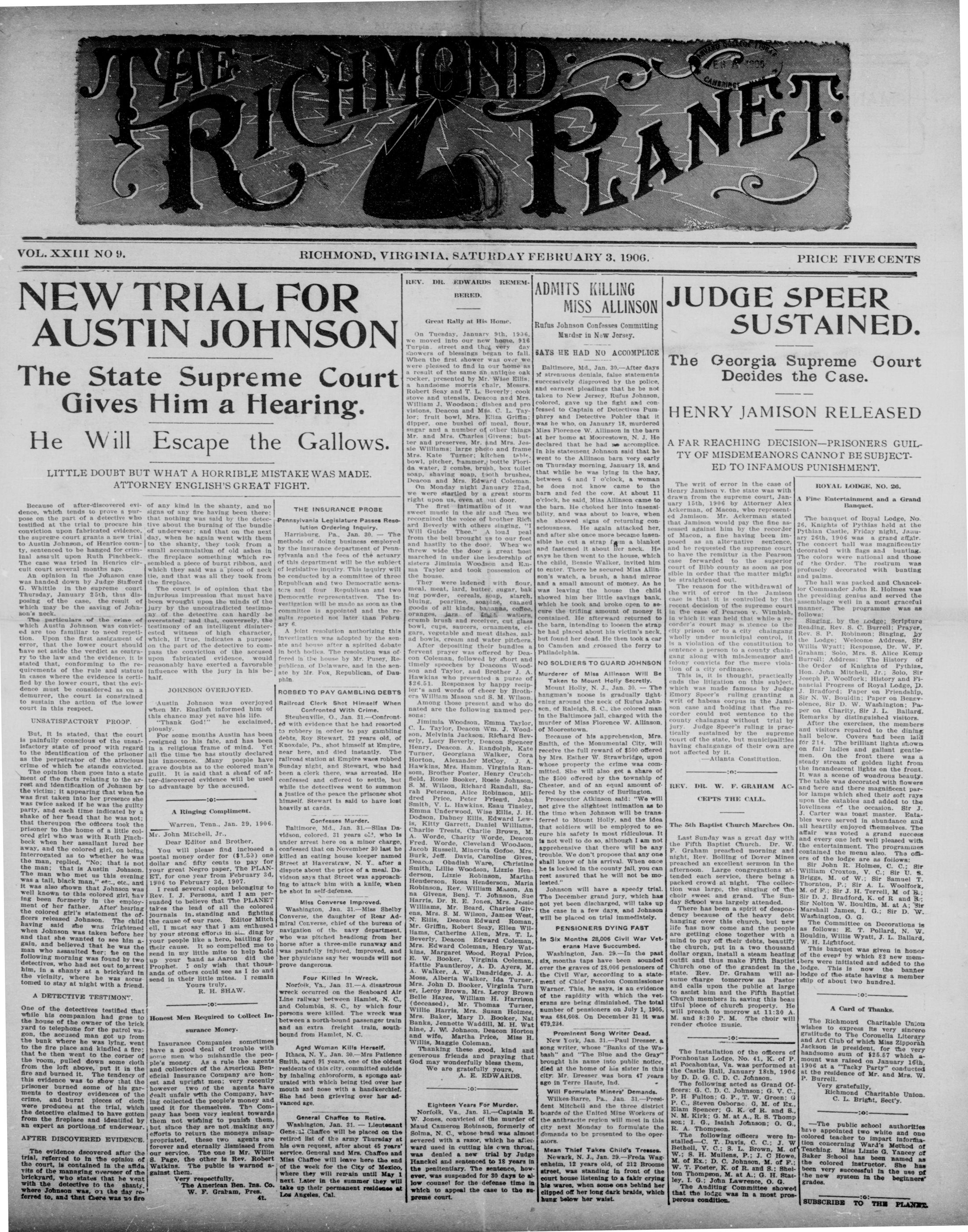
NEW TRIAL FOR AUSTIN JOHNSON The State Supreme Court Gives Him a Hearing. He Will Escape the Gallows.
LITTLE DOUBT BUT WHAT A HORRIBLE MISTAKE WAS MADE. ATTORNEY ENGLISH'S GREAT FIGHT.
VOL. XXIII NO 9.
NEW T
AUST
The State
Gives
He Will
LITTLE DOUBT BUT
ATTOR
Because of after-discovered evidence, which tends to prove a purpose on the part of a detective who testified at the trial to procure his conviction upon fabricated evidence, the supreme court grants a new trial to Austin Johnson, of Henrico county, sentenced to be hanged for criminal assault upon Ruth Pinchbeck. The case was tried in Henrico circuit court several months ago. An opinion in the Johnson case was handed down by Judge Stafford G. Whittle in the supreme court Thursday, January 25th, thus disposing of the case, the result of which may be the saving of Johnson's neck.
The particulars of the crime of which Austin Johnson was convicted are too familiar to need repetition. Upon the first assignment of error, that the lower court should have set aside the verdict as contrary to the law and the evidence, it is stated that, conforming to the requirements of the rule and statute in cases where the evidence is certified by the lower court, that the evidence must be considered as on a demurrier, the court is constrained to sustain the action of the lower court in this respect.
UNSATISFACTORY PROOF
But, it is stated, that the court is painfully conscious of the unsatisfactory state of proof with regard to the identification of the prisoner as the perpetrator of the atrocious crime of which he stands convicted.
The opinion then goes into a state ment of the facts relating to the arrest and identification of Johnson by the victim; it appearing that when he was first taken into her presence she was twice asked if he was the guilty party, and each time indicated by a shake of her head that he was not; that thereupon the officers took the prisoner to the home of a little colored girl who was with Ruth Pinchbeck when her assailant lured her away, and the colored girl, on being interrogated as to whether he was the man, replied, "No; that is not the man; that is Austin Johnson. The man who met us this evening was a tall, black man," etc., etc., and it was also shown that Johnson was well known to this colored girl, having been formerly in the employment of her father. After hearing the colored girl's statement the officers released Johnson. The child having said she was frightened when Johnson was taken before her and that she wanted to see him again, and believed that he was the man who assaulted her; he on the following morning was found by two detectives, who had set out to arrest him, in a shanty at a brickyard in the vicinity, where he was accustomed to stay at night with a friend.
A DETECTIVE TESTIMONY
One of the detectives testified that while his companion had gone to the house of the owner of the brick yard to telephone for the patrol wagon, the accused man got up from the bunk where he was lying, went to the fire place and kindled a fire; that he then went to the corner of the room, pulled down some cloth from the loft above, put it in the fire and burned it. The tendency of this evidence was to show that the prisoner burned some of his garments to destroy evidences of the crime, and burnt pieces of cloth were produced at the trial, which the detective claimed to have gotten from the fireplace and identified by an expert as portions of underwear.
AFTER DISCOVERED EVIDENCE
The evidence discovered after the trial, referred to in the opinion of the court, is contained in the affidavits of the managing overseer of the brickyard, who states that he went with the detective to the shanty, where Johnson was, 01 the day referred to, and that there was no fire
of any kind in the shanty, and no signs of any fire having been there; that nothing was said by the detective about the burning of the bundle of underwear; and that on the next day, when he again went with them to the shanty, they took from a small accumulation of old ashes in the fireplace something which resembled a piece of burnt ribbon, and which they said was a piece of neck tie, and that was all they took from the fireplace.
The court is of opinion that the injurious impression that must have been wrought upon the minds of the jury by the unconradicted testimony of the detective can hardly be overstated; and that, conversely, the testimony of an intelligent disinterested witness of high character, which, if true, indicates a purpose on the part of the detective to compass the conviction of the accused upon fabricated evidence, would reasonably have exerted a favorable influence with the jury in his behalf.
JOHNSON OVERJOYED
Austin Johnson was overjoyed when Mr. English informed him of this chance may yet save his life. "Thank God!" he exclaimed, piously. For some months Austin has been resigned to his fate, and has been in a religious frame of mind. Yet all the time he has stoutly declared his innocence. Many people have grave doubts as to the colored man's guilt. It is said that a sheaf of after-discovered evidence will be used to advantage by the accused.
A Ringing Compliment.
Warren, Tenn., Jan. 29, 1906.
Mr. John Mitchell, Jr.,
Dear Editor and Brother,
You will please find inclosed a postal money order for ($1.50) one dollar and fifty cents to pay for your great Negro paper, The PLANET, for one year from February 3d, 1906 to February 3d, 1907.
I read several copies belonging to Rev. I. J. Persons, and I am persuaded to believe that The PLANET takes the lead of all the colored journals in standing and fighting the cause of our race. Editor Mitch ell, I must say that I am enthused by your strong efforts in gluing by your people like a hero, battling for their cause. It so compelled me to send in my little mite to help hold up your hand as Aaron did the Prophet. I only wish that thousands of others could see as I do and send in their little mites. I remain
Honest Men Required to Collect In-
Insurance Companies sometimes have a good deal of trouble with some men who mishandle the people's money. As a rule the agents and collectors of the American Beneficial Insurance Company are honest and upright men; very recently however two of the agents have dealt unfair with the Company, having collected the people's money and used it for themselves. The Company has been very lenient towards them not wishing to punish them, but since they are not making any efforts to return the moneys misappropriated, these two agents are forever and eternally dismissed from our service. The one is Mr. Willie S. Page, the other is Rev. Robert Watkins. The public is warned against them.
Very respectfully,
The American Ben. Ins. Co.
W. F. Graham, Pres.
RICHMOND, VIRGINIA, SATURDAY FEBRUARY 3. 1906.
THE INSURANCE PROBE
Pennsylvania Legislature Passes Resolution Ordering Inquiry.
Harrisburg, Pa., Jan. 30. — The methods of doing business employed by the insurance department of Pennsylvania and the fees of the actuary of this department will be the subject of legislative inquiry. This inquiry will be conducted by a committee of three Republican and two Democratic senators and four Republican and two Democratic representatives. The investigation will be made as soon as the committee is appointed and the results reported not later than February 6.
A joint resolution authorizing this investigation was adopted by the senate and house after a spirited debate in both bodies. The resolution was offered in the house by Mr. Pusey, Republican, of Delaware, and in the senate by Mr. Fox, Republican, of Dauphin.
ROBBED TO PAY GAMBLING DEBTS
Railroad Clerk Shot Himself When Confronted With Crime.
Steubenville, O., Jan. 31.—Confronted with evidence that he had resorted to robbery in order to pay gambling debts, Roy Stewart, 22 years old, of Knoxville, Pa., shot himself at Empire, near here, and died instantly. The railroad station at Empire waved robbed Sunday night, and Stewart, who had been a clerk there, was arrested. He confessed and offered to settle, but while the detectives went to summon a justice of the peace the prisoner shot himself. Stewart is sald to have lost heavily at cards.
Confesses Murder
Baltimore, Md., Jan. 31.—Sillas Davidson, colored, 31 years old, who is under arrest here on a minor charge, confessed that on November 30 last he killed an eating house keeper named Street at Haverstraw, N. Y., after a dispute about the price of a meal. Davidson says that Street was approaching to attack him with a knife, when he shot in self-defense.
Miss Converse Improved
Washington, Jan. 31.—Miss Shelby Converse, the daughter of Rear Admiral Converse, chief of the bureau of navigation of the navy department, who was pitched headlong from her horse after a three-mile runaway and was painfully injured, improved, and her physicians say her wounds will not prove dangerous.
Four Killed In Wreck.
Norfolk, Va., Jan 31.—A disastrous wreck occurred on the Seaboard Air Line railway between Hamlet, N. C., and Columbia, S. C., by which four persons were killed. The wreck was between a north-bound passenger train and an extra freight train, south-bound from Hamlet, N. C.
Aged Woman Kills Herself.
Aged Woman Kills Herself.
Ithaca, N. Y., Jan. 30.—Mrs Pattiele Smith, aged 91 years, one of the oldest residents of this city, committed suicide by inhaling chloroform, a sponge saturated with which being tied over her mouth and nose with a handkerchief. She had been grieving over her advanced age.
General Chaffee to Retire
Washington, Jan. 31. — Lieutenant Geneal. Chaffee will be placed on the retired list of the army Thursday at his own request, after about 45 years' service. General and Mrs. Chaffee and Miss Chaffee will leave here the end of the week for the City of Mexico, where they will remain until May 1 next. Later in the summer they will take up their permanent residence at Los Angeles, Cal.
Great Rally at His Home.
On Tuesday, January 9th, 1936, we moved into our new home, 916 Turpin. street and that very day showers of blessings began to fall. When the first shower was over we were pleased to find in our home as a result of the same an antique oak rocker, presented by Mr. Wise Ellis, a handsome morris chair, Messrs. Robert Seay and T. L. Beverly; cook stove and utensils, Deacon and Mrs. William J. Woodson; dishes and provisions, Deacon and Mrs. C. L. Taylor; fruit bowl, Mrs. Eliza Griffin; dipper, one bushel of meal, flour, sugar and a number of other things Mr. and Mrs. Charles Givens; butter and preserves, Mr. and Mrs. Jessie Williams; large photo and frame Mrs. Kate Turner; kitchen table-bowl, pitcher, hammer, bottle Florida water, 2 combs, brush, box toilet soap, shaving soap, tooth brushes, Deacon and Mrs. Edward Coleman. On Monday night January 22nd, we were startled by a great storm
On Monday night January 22nd, we were startled by a great storm right upon us, even at out door. The first intimation of it was sweet music in the air and then we recognized the voice of brother Rich ard Beverly with others singing, "I Will Guide Thee." A loud peal from the bell brought us to our feet and hastily to the door. When we threw wide the door a great host marched in under the leadership of sisters Jimlimia Woodson and Anna Taylor and took possession of the house. They were ladened with flour, meal, meat, lard, butter, sugar, baking powder, cereals, soap, starch, bluing, pearline, soapine, canned goods of all kinds, bananas, coffee, oranges, jars of fruit, waiters, crumb brush and receiver, cut glass bowl, cups, saucers, ornaments, cligars, vegetable and meat dishes, salad bowls, cream and water pitchers. After depositing their bundles a fervent prayer was offered by Deacon Coleman, followed by short and timely speeches by Deacons Woodson and Taylor, and Brother J. A. Hawkins who presented a purse of $26.51. Responses by happy recipient's and words of cheer by Brothers William Mason and S. M. Wilson. Among those present and who dated are the following named persons:
Jimimia Woodson, Emma Taylor, C. L. Taylor, Deacon Wm. J. Woodson, Melvinia Jackson, Richard Beverly, Lucy Beverly, Deacon Spencer Henry, Deacon A. Randolph, Kate Turner, Georgiana Walker, Cora Horton, Alexander McCoy, J. A. Hawkins, Mrs. Hamm, Virginia Ransom, Brother Foster, Henry Crutchfield, Rosie Booker, Rosie Johnson, S. M. Wilson, Richard Randall, Sarah Peterson, Alice Robinson, Mildred Price, Peter Friend, John Smith, V. L. Hawkins, Esau Tinsley, Emma Underwood, Wise Ellis, J. H. Dodson, Dabney Ellis, Edward Lewis, Kitty Garrett, Daniel Williams, Charlie Treats, Charlie Brown, M. A. Worde, Charity Worde, Deacon Fred, Worde, Cleveland Woodson, Jacob Russell, Minervia Gofoe, Mrs. Burk, Jeff. Davis, Caroline Gives, Deacon Obadiah Ware, Christine Smith, Lille Woodson, Lizzie Henderson, Lizzie Robinson, Martha Henderson, Rosa Henderson, Maria Robinson, Rev. William Mason, Ana Givens, Benj. T. Johnson, Sue Harris, Dr. R. E. Jones, Mrs. Jessie Williams, Mr. Beard, Charles Givens, Mrs. S. M. Wilson, James West, N. Ellis, Deacon Edward Roman, Mr. Griffin, Robert Seay, Ellen Williams, Catherine Allen, Mrs. T. L. Leverity, Deacon Edward Coleman, Mrs. Edward Coleman, Henry Watkins, Margaret Wood, Royal Price, E. W. Booker, Virginia Coleman, Hattle Fauntleroy, A. D. Ayers, M. A. Walker, A. W. Dandridge, J. A. Moss, Alberta Walker, Ida Turner, Mrs. John D. Booker, Virginia Turn, Leroy Brown, Mrs. Leroy Brown Belle Hayes, William H. Harrison (deceased), Mr. Thomas Turner, Willie Harris, Mrs. Susan Holmes, Mrs. Baker, Mary D. Booker, Nat Banks, Jennette Waddell, M. H. Hatine, J. W. Johnson, Deacon Horton and wife, Martha Price, Miss H. Willis, Maggie Coleman.
Thanking these good, kind and generous friends and praying that God may wonderfully bless them.
Eighteen Years For Murder.
Norfolk, Va., Jan. 31.—Captain E. W. Jones, convicted of the murder of Maud Cameron Robinson, formerly of Solma, N. C., whose head was almost severed with a razor, which he affecward used in cutting his own throat, was denied a new trial by Judge Hanckel and sentenced to 18 years in the penitentiary. The sentence, however, was suspended for 30 days to allow counsel for the defense time in which to appeal the case to the supreme court.
ADMITS KILLING MISS ALLINSON
Rufus Johnson Confesses Committing Murder in New Jersey.
SAYS HE HAD NO ACCOMPLICE
Baltimore, Md., Jan. 30.—After days of strenuous denials, false statements successively disproved by the police, and earnest pleadings that he be not taken to New Jersey, Rufus Johnson, colored, gave up the fight and confessed to Captain of Detectives Pumphrey and Detective Pohler that it was he who, on January 18, murdered Miss Florence W. Allinson in the barn at her home at Moorestown, N. J. he declared that he had accomplice. In his statement Johnson said that he went to the Allinson barn very early on Thursday morning, January 18, and that while he was lying in the hay, between 6 and 7 o'clock, a woman he does not know came to the barn and fed the cow. At about 11 o'clock, he said, Miss Allinson came to the barn. He choked her into insensibility, and was about to leave, when she showed signs of returning consciousness. He again attacked her, and after she once more became insensible he cut a crap from a blanket and fastened it about her neck. He says he then went to the house, which the child, Bessie Walker, invited him to enter. There he secured Miss Allinson's watch, a brush, a hand mirror and a small amount of money. As he was leaving the house the child showed him her little savings bank which he took and broke open to secure the trifling amount of money it contained. He afterward returned to the barn, intending to loosen the strap he had placed about his victim's neck but found her dead. He then took a car to Camden and crossed the ferry to Philadelphia.
Taken to Mount Holly Secretly.
Mount Holly, N. J., Jan. 30. — The hangman's noose is gradually tightening around the neck of Rufus Johnson, of Raleigh, S. C., the colored man in the Baltimore jail, charged with the murder of Miss Florence W. Allinson, of Moorestown.
Because of his apprehension, Mrs. Smith, of the Monumental City, will receive the full reward of $500 offered by Mrs. Eather W. Strawbridge, upon whose property the crime was committed. She will also get a share of the $500 offered by the township of Chester, and of an equal amount offered by the county of Burlington.
Prosecutor Atkinson said: "We will not give the slightest intimation as to the time when Johnson will be transferred to Mount Holly, and the idea that soldiers will be employed to secure his safety is most ridiculous. It is not well to do so, although I am not apprehensive that there will be any trouble. We don't propose that any one shall know of his arrival. When once he is locked in the county jail, you can rest assured that he will not be molested."
Johnson will have a speedy trial. The December grand jury, which has not yet been discharged, will take up the case in a few days, and Johnson will be placed on trial immediately.
PENSIONERS DYING FAST
In Six Months 28,006 Civil War Veterans Have Survived
Washington, Jan. 29.—In the past six months taps have been sounded over the graves of 28,006 pensioners of the Civil War, according to a statement of Chief Pension Commissioner Warner. This, he says, is an evidence of the rapidity with which the veterans are being diminished. The total number of pensioners on July 1, 1905, was 684,608. On December 31 it was 679,234.
Prominent Song Writer Dead.
New York, Jan. 31.—Paul Dresser, a song writer, whose "Banks of the Wabash" and "The Blue and the Gray" brought his name into public notice, died at the home of his sister in this city. Mr. Dresser was born 47 years ago in Terre Haute, Ind.
Will Formulate Miners' Demands. Wilkes-Barre, Pa., Jan. 31.—President Mitchell and the three district boards of the United Mine Workers of the anthracite region will meet in this city next Monday to formulate the demands to be presented to the operators.
Mean Thief Takes Child's Tresses. Newark, N. J., Jan. 29.—Freda Wagenheim, 12 years old, of 212 Broome street, was standing in front of the court house listening to a fakir crying his wares, when some ones behind her clipped off her long dark bralids, which hung below her waist.
JUDGE SPEER SUSTAINED.
The Georgia Supreme Court Decides the Case.
HENRY JAMISON RELEASED
A FAR REACHING DECISION—PRISONERS GUILTY OF MISDEMEANORS CANNOT BE SUBJECTED TO INFAMOUS PUNISHMENT.
The writ of error in the case of Henry Jamison v. the state was with drawn from the supreme court, January 15th, 1906 by Attorney Alex Ackerman, of Macon, who represented Jamison. Mr. Ackerman stated that Jamison would pay the fine assessed against him by the recorder of Macon, a fine having been imposed as an alternative sentence, and he requested the supreme court to have the remittur in the Pearson case forwarded to the superior court of Bibb county as soon as possible in order that the matter might be straightened out.
The reason for the withdrawal of the writ of error in the Jamison case is that it is controlled by the recent decision of the supreme court in the case of Pearson v. Wimbish, in which it was held that while a recorder's court may sentence to the city prison or to a city chaining wholly under municipal control, it is a violation of the constitution to sentence a person to a county chaining along with misdemeanor and felony convicts for the mere violation of a city ordinance.
ROYAL LODGE, NO. 26.
A Fine Entertainment and a Grand Banquet.
The banquet of Royal Lodge, No. 26, Knights of Pythias held at the Pythian Castle, Friday night, January 26th, 1906 was a grand affair. The concert hall was magnificently decorated with flags and bunting. The colors were national and those of the Order. The rostrum was profusely decorated with bunting and palms.
The hall was packed and Chancellor Commander John R. Holmes was the presiding genius and served the assemblage well in a most graceful manner. The programme was as follows:
Singing, by the Lodge; Scripture Reading, Rev. S. C. Burrell; Prayer, Rev. S. P. Robinson; Singing, by the Lodge; Welcome Address, Str Willis Wyatt; Response, Dr. W. F. Graham; Solo, Mrs. S. Alice Kemp Burrell; Address: The History of the Order of Knights of Pythias,
This is, it is thought, practically ends the litigation on this subject, which was made famous by Judge Emory Speer's ruling granting a writ of habeas corpus in the Jamison case and holding that the recorder could not sentence to the county changing without trial by jury. Judge Speer's ruling is practically sustained by the supreme court of the state, but municipalities having changings of their own are not affected by it. —Atlanta Constitution.
REV. DR. W. F. GRAHAM AC CEPTS THE CALL.
The 5th Baptist Church Marches On.
Last Sunday was a great day with the Fifth Baptist Church. Dr. W. F. Graham preached morning and night, Rev. Bolling of Dover Mines preached an excellent sermon in the afternoon. Large congregations attended each service, there being a packed crowd at night. The collection was large, the singing of the choir sweet and grand. The Sunday School was largely attended. There has been a spirit of despondency because of the heavy debt hanging over this church, but new life has now come and the people are getting close together with a mind to pay off their debts, beautify the church, put in a two thousand dollar organ, install a steam heating outfit and thus make Fifth Baptist Church one of the grandest in the state. Rev. Dr. Graham will assume charge tomorrow as Pastor and calls upon the public at large to assist him and the Fifth Baptist Church members in saving this beautiful piece of church property. He will preach to morrow at 11:30 A. M. and 8:30 P. M. The choir will render choice music.
The Installation of the officers of Pocahontas Lodge, No. 41, K. of K. at Pocahontas, Va. was performed at the Castle Hall, January 18th, 1906 by D. D. G. C. D. C. Johnson.
The following acted as Grand Officers: G. C. D. C. Johnson; G. V. C. P. H Fulton; G. P., T. W. Green; G. P. C. Steven Osborne; G. M. of Ex. Elam Spencer; G. K. of R. and S. N. M. Kirk; G. M at A., R. S. Thompson; I. G., Isaiah Johnson; O. G., R. A. Thompson.
The following officers were installed—C. T. Davis, C. C.; J. W Bethell, V. C.; S. L. Brown, M. of W.; S. H. Mullens, P.; J. C Howe, M. of Ex.; D. C. Johnson, M. of F.; W. T. Foster, K. of R. and S.; Shelton Thompson, M. at A.; G. H. Statley, I. G.; John Lawrence, O. G.
The Auditing Committee showed that the lodge was in a most prosperous condition.
PRICE FIVE CENTS
SPEER
TAINED.
Supreme Court
the Case.
ON RELEASED
SION—PRISONERS GUIL-
S CANNOT BE SUBJECT-
US PUNISHMENT.
ROYAL LODGE. NO. 26.
A Fine Entertainment and a Grand Banquet.
The banquet of Royal Lodge, No. 26, Knights of Pythias held at the Pythian Castle, Friday night, January 26th, 1906 was a grand affair. The concert hall was magnificently decorated with flags and bunting. The colors were national and those of the Order. The rostrum was profusely decorated with bunting and palms. The hall was packed and Chancellor Commander John R. Holmes was the presiding genius and served the assemblage well in a most graceful manner. The programme was as follows: Singing, by the Lodge; Scripture Reading, Rev. S. C. Burrell; Prayer, Rev. S. P. Robinson; Singing, by the Lodge; Welcome Address, Sir Willis Wyatt; Response, Dr. W. F. Graham; Solo, Mrs. S. Alice Kemp Burrell; Address: The History of the Order of Knights of Pythias, Hon. John Mitchell, Jr.; Solo, Sir Joseph P. Woolfork; History and Financial Progress of Royal Lodge, D. J. Bradford; Paper on Friendship, Sir N. W. Bouldin; Paper on Benevolence, Sir D. W. Washington; Paper on Charity, Sir J. L. Ballard. Remarks by distinguished visitors.
After the exercises, the members and visitors repaired to the dining hall below. Covers had been laid for 214. The brilliant lights shown on fair ladies and gallant gentlemen. On the front there was a steady stream of golden light from the incandescent lights on the front. It was a scene of wondrous beauty. The table was decorated with flowers and here and there magnificent parlor lamps which shed their soft rays upon the eatables and added to the loveliness of the occasion. Sir J. J. Carter was toast master. Eatables were served in abundance and all heartily enjoyed themselves. The affair was voted a grand success and every one left well pleased with the entertainment. The programmes contained the menu also. The offers of the lodge are as follows: Sir John R. Holmes, C. C.; Sir William Croxton, V. C.; Sir U. S. Briggs, M. of W.; Sir Samuel T. Thornton, P.; Sir A. L. Woolfork, M. of F.; Sir J. H. Terrell, M. of E.; Sir D. J. Bradford, K. of R and S.; Sir Nolton W. Bouldin, M at A.; Sir Marshall James, I. G.; Sir D. W. Washington, O. G. The Committee on Decorations is as follows: E. T. Pollard, N. W. Bouldin, Willis Wyatt, J. L. Ballard, W. H. Lightfoot. This banquet was given in honor of the event by which 22 new members were initiated and added to the lodge. This is now the banner lodge of the state having a member ship of about two hundred.
A Card of Thanks
The Richmond Charitable Union wishes to express its very sincere gratitude to The Coronella Literary and Art Club of which Miss Zipporah Jackson is president, for the very handsome sum of $25.57 which amount was raised on January 16th, 1906 at a "Tacky Party" conducted at the residence of Mr. and Mrs. W. P. Burrell.
Very gratefully,
Richmond Charitable Union.
C. L. Bright, Secty.
The public school authorities have appointed two white and one colored teacher to impart information concerning Ward's Method of Teaching. Miss Lizzie G. Yancey of Baker School has been named as the colored instructor. She has been very successful in the use of the new system in the beginners' grades.
:0:
SUBSCRIBE TO THE PLANET
THE
MAN ON THE BOX
By HAROLD MacGRATH
Author of "The Grey Cloak," "The Puppet Crown."
Copyright, 1904, The Bobbs-Merrill Company.
CHAPTER I—Introduces the hero, Robert Warburton, a well to do West Point graduate on duty in Arizona. At point wounded by an Indian resigns his commission to the army and leaves for European tour.
CHAPTER II—Introduces the heroine, Miss Betty Annesley, daughter of a retired army officer living near Washing-ton, gifted with representative young American gift. She is smitten, and follows to New York. Seeks introduction on board steamer but fails.
CHAPTER III—Upon reaching New York Warburton leaves in which the Annesleyes are guests and dines there in order to see Miss Annesley once more. Chagrited to see young Russian count Annesley in to dinner. Next morning the Count and the Annesleyes had disappeared.
CHAPTER IV—Warburton goes to Washington to visit his relatives—a married old schoolmate and a government position and a sister. An old school chum of his. Invited to accompany family to ball at British embassy, but declines. Concocts a scheme to play a joke on his sister and sister-in-
CHAPTER V. - Warburton meets his sister's flame whom he had not seen for eight years. Sees the folks off for the embassy ball and then proceeds to put his joke into execution, which is to disguise himself as a coachman and his sister and sister-in-law, who must return alone, from the embassy to their home.
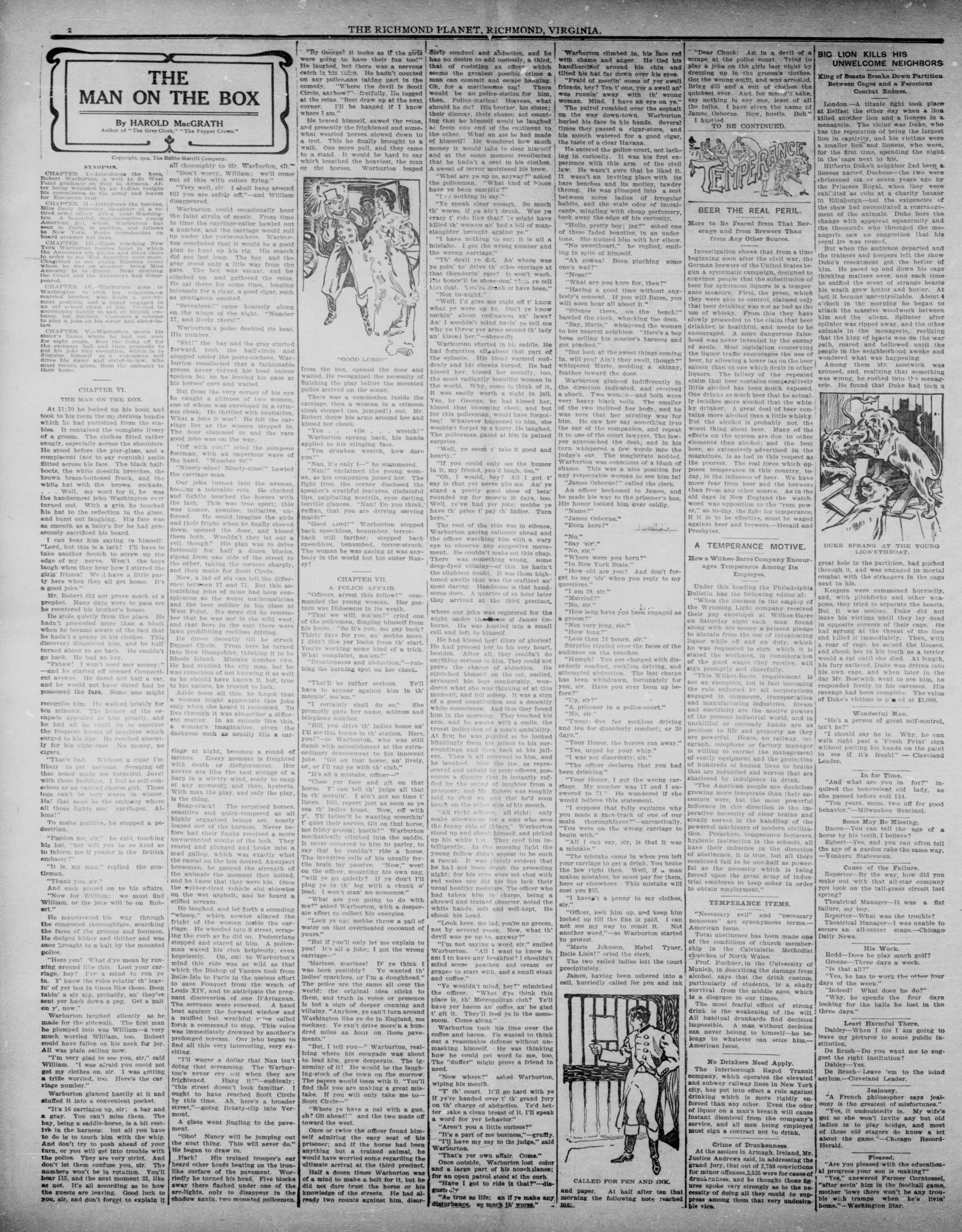
THE MAN ON THE BOX
At 11:30 he locked up his book and took to his room the mysterious bundle which he had purified from the stables. It contained the complete livery of a groom. The clothes fitted rather snugly, especially across the shoulders. He stood before the pier-glass, and a complacent (not to say roguish) smile flitted across his face. The black half-boots, the white doeskin breeches, the brown brass-buttoned frock, and the white hat with the brown cockade. . . Well, my word for it, he was the handsomest jehu Washington ever turned out. With a grin he touched his hat to the reflection in the glass, and burst out laughing. His face was as smooth as a baby's for he had generously sacrificed his beard.
I can hear him saying to himself: "Lord, but this is a lark! I'll have to take another Scotch to screw up the edge of my nerve. Won't the boys laugh when they hear how I stirred the girls' frizzies? We'll have a little party here when they all get home. It's a good joke."
Mr. Robert did not get much of a prophet. Many days were to pass ere he reentered his brother's house. He stole quietly from the place. He hadn't proceeded more than a block when he became aware of the fact that he hadn't a penny in his clothes. This discovery disquieted him, and he half turned about to go back. He couldn't go back. He had no key.
"Pshaw! I won't need any money;" —and he started off toward Connecticut avenue. He dared not hall a car, and he would not have dared had he possessed the faro. Some one might
recognize him. He walked briskly for ten minutes. The humor of the escapade appealed to him greatly, and he had all he could do to smother the frequent bursts of laughter which surged to his lips. He reached absently for his cigar-case. No money, no cigars.
"That's bad. Without a cigar I'm likely to get nervous. Scraping off that beard made me forgetful. Jove! with these flashings, I feel as self-conscious as an untried chorus girl. These togs can't be very warm in winter. Ha! that must be the embassy where all those lights are; carriage. Allons!"
To make positive, he stopped a pedestrian.
"Pardon me, sir," he said, touching his hat, "but will you be so kind as to inform me if youonder is the British embassy?"
"It is, my man," replied the gentleman.
"Thank you, sir."
And each passed on to his affairs.
"Now for William; we must find William, or the joke will be on Robert."
He maneuvered his way through the congested thoroughfare, searching the faces of the grooms and footmen. He dodged hither and thither and was once brought to a halt by the mounted police.
"Here you! What dye mean by running around like this. Lost your carriage, hey? I've a mind to run ye in. Yn know the rules relatin' th' leavin' of yer box in times like these. Been takin' a sly nip, probably, an' they've sent yer hack down a peg. Get a gait on y', now."
Warburton laughed silently as he made for the sidewalk. The first man he plumped into was William—a very much worried William, too. Robert could have fallen on his neck for joy. All was plain sailing now.
"I'm very glad to see you, sir," said William. "I was afraid you could not get my clothes on, sir. I was getting a trifle worried, too. Here's the carriage number."
Warburton glanced hastily at it and stuffed it into a convenient pocket.
"It's 16 carriages up, sir; a bay and a gray. You can't miss them. The bay, being a saddle-horse, is a bit restive in the harness: but all you have to do is to touch him with the whip. And don't try to push ahead of your turn, or you will get into trouble with the police. They are very strict. And don't let them confuse you, sir. The numbers won't be in rotation. You'll hear 115, and the next moment 35, like as not. It's all according as to how the guests are leaving. Good luck to you, sir, and don't forget to explain it
SYNOPSIS.
CHAPTER VI.
"Thank you, sir."
all thoroughly to Mr. Warburton, sr." "Don't worry, William; we'll come out of this with colors flying." "Very well, sr. I shall hang around till you are safely off." and William disappeared. Warburton could occasionally hear the faint strain of music. From time to time the carriage-caller bawled out a number, and the carriage would roll up under the porte-cochere. Warburton concluded that it would be a good plan to hunt up his rig. His search did not last long. The bay and the gray stood only a little way from the gate. The box was vacant, and he climbed up and gathered the reins. He sat there for some time, longing intensely for a cigar, a good cigar, such as gentlemen smoked. "Seventeen!" came hoarsely along on the wings of the night. "Number 17, and lively there!"
Warburton's pulse doubled its beat. His number.
"Ski!" the bay and the gray started forward, took the half-circle and stopped under the porte-cochere. Warburton recollected that a fashionable groom never turned his head unless spoken to; so he leveled his gaze at his horses' ears and waited.
But from the very corner of his eye he caught a glimpse of two women, one of whom was enveloped in a crimson cloak. He thrilled with exultation. What a joke it was! He felt the carriage list as the women stepped in. The door slammed to and the rare good joke was on the way.
"Off with you!" cried the pompous footman, with an imperious wave of the hand. "Number 99!"
"Ninety-nine! Ninety-nine!" bawled the carriage man.
Our jehu turned into the avenue, hounding a tolerable rein. He clucked and lightly touched the horses with the lash. This was true sport; this was humor, genuine, initiative, unforced. He could imagine the girls and their fright when he finally slowed down, opened the door, and kissed them both. Wouldn't they let out a yell, though? His plan was to drive furiously for half a dozen blocks, rigzag from one side of the street to the other, taking the corners sharply, and then make for Scott Circle. Now, a lad of six can tell the difference between 17 and 71. But this astonishing jehu of mine had been conspicuous as the worst mathematician and the best soldier in his class at West Point. No more did he remember that he was not in the wild west, and that here in the east there were laws prohibiting reckless driving.
He drove decently till he struck Dupont Circle. From here he turned into New Hampshire, thinking it to be Rhode Island. Mistake number two. He had studied the city map, but he was conscious of not knowing it as well as he should have known it, but, true to his nature, he trusted to luck.
Aside from all this, he forgot that a woman might appreciate this joke only when she heard it recounted. To live through it was altogether a different matter. In an episode like this, a woman's imagination, given the darkness such as usually fills a carriage at night, becomes a round of terrors. Every moment is freighted with death or disfigurement. Her nerves are like the taut strings of a harp in a wintry wind, ready to snap at any moment; and then, hysteria. With man the play, and only the play, is the thing.
Snap-crack! The surprised horses, sensitive and quick-tempered as all highly organized beings are, nearly leaped out of the harness. Never before had their flanks received a more unwarranted stroke of the lash. They reared and plunged and broke into a mad gallop, which was exactly what the rascal on the box desired. Anexpert horseman, he gauged the strength of the animals the moment they bolted, and he knew that they were his. Once the rubber-tired vehicle slid sidewise on the wet asphalt, and he heard a stifled scream.
He laughed, and let forth a sounding "whoop," which nowise allayed the fright of the women inside the carriage. He wheeled into S street, scraping the curb as he did so. Pedestrians stopped and stared at him. A policeman waved his club helplessly, even hopelessly. On, on: to Warburton's mind this ride was as wild as that which the Bishop of Vannes took from Beile-Isle to Paris in the useless effort to save Fouquet from the wrath of Louis XIV, and to anticipate the pregnant discoveries of one D'Artagnan. The screams were renewed. A hand beat against the forward window and a muffled but wrathful voice called forth a command to stop. This voice was immediately drowned by another's prolonged scream. Our jehu began to find all this very interesting, very exciting.
"I'll wager a dollar that Nan isn't doing that screaming. The Warburton's never cry out when they are frightened. Hang it!"—suddenly; "this street doesn't look familiar. I ought to have reached Scott Circle by this time. Ah, here's a broader street,"—going Hickety-clip into Vermont.
A glass went jingling to the pavement.
"Oho! Nancy will be jumping out the next thing. This will never do." He began to draw in.
Hark! His trained trooper's ear heard other hoofs beating on the iron-like surface of the pavement. Worriedly he turned his head. Five blocks away there flashed under one of the arc-lights, only to disappear in the shadow again, two mounted policemen.
By George! it looks as if the girls were going to have their fun too!" He laughed, but there was a nervous catch in his voice. He hadn't counted on any policeman taking part in the comedy. "Where the devil is Scott Circle, anyhow?" frightfully. He tugged at the reins. "Best draw up at the next corner. I'll be hanged if I know where I am."
He braced himself, sawed the reins, and presently the frightened and somewhat wearied horses slowed down to a trot. This he finally brought to a walk. One more pull, and they came to a stand. It would be hard to say which breathed the heaviest, the man or the horses. Warburton leaped
Derly conduct and abduction, and he had no desire to add uselessly, a third, that of resisting an officer which seems the greatest possible crime a man can commit and escape hissing. Oh, for a mettlesome nag! There would be no police-station for him, then. Police-station! Heavens, what should he do? His brother, his sister; their dismay, their shame; not counting that he himself would be laughed at from one end of the continent to the other. What an ass he had made of himself! He wondered how much money it would take to clear himself and at the same moment recollected that he hadn't a cent in his clothes. A sweat of terror moistened his brow.
Warburton with shame handkerchief tilted his hat. "Fraid of r friends, hey? was runnin' woman. Min. The patrol on the way buried his fa-faces they pah his mouth w the taste of a. He entered in curios perience with law. He was
"GOOD LORD!"
from the box, opened the door and waited. He recognized the necessity of finishing the play before the mounted police arrived on the scene.
There was a commotion inside the carriage, then a woman in a crimson cloak stepped (no, jumped!) out. Mr. Robert threw his arms around her and kissed her cheek.
"You . . . vile . . . wretch!" Warburton sprang back, his hands applied to his stinging face.
"You drunken wretch, how dare you!"
"Nan, it's only I—" he stammered.
"Nan!" exclaimed the young woman, as her companion joined her. The light from the corner disclosed the speaker's wrathful features, disdainful lips, palpitating nostrils, eyes darting terrible glances. "Nan! Do you think, ruffian, that you are driving serving maids?"
"Good Lord!" Warburton stepped back speechless, benumber, terrorback still farther; stepped back speechless, benumbed, terror-struck. The woman he was gazing at was anybody in the world but his sister Nancy!
CHAPTER VII
A POLICE AFFAIR
"Officers, arrest this fellow!" commanded the young woman. Her gesture was Didoesque in its wrath.
"Drunkenness and abduction."—rubbing the burning spot on her cheek.
"That'll be rather serious. You'll have to appear against him in th' mornin', ma'am."
"I certainly shall do so." She promptly gave her name, address and telephone number.
"Bill, you drive th' ladies home an' I see this bucko to th' station. Here, you!"—to Warbarton, who was still dumb with astonishment at the extraordinary denouement to his innocent joke. "Git on that horse, an' lively, or, or I'll rage ye with th' club."
"Close yer face and git on that horse. Y' can tell t' judge all that in th' mornth. I ain't got no time t' listen. Bill, report just as soon as ye see th' ladies home. Now, off with y'. Th' ladies' will be wanting somethin' t' quiet their nerves. Git on that horse, me frisky groom; hustle!" Warburton mechanically climbed into the saddle. It never occurred to him to parley, to say that he couldn't ride a horse. The inventive cells of his usually fertile brain lay passive. "Now," went on the officer, mounting his own nag, "will ye go quietly? If ye don't I'll plug ye in th' leg with a chunk o' lead, I won't stan' no nonsense."
"What are you going to do with me?" asked Warburton, with a desperate effort to collect his energies. "Lock ye up; mebble throw a pail of water on that overheated cocoanut of yours."
"But if you'll only let me explain to you! It all a joke; I got the wrong carriage—"
"Marines, marines! D' ye think I was born yestildy? Ye wanted th' ladies sparklers, or I'm a doughhead." The police are the same all over the world; the original idea sticks to them, and truth in voice or presence is but a sign of deeper cunning and villainy. "Anyhow, ye can't turn around Washington like ye do in England, me cockney. Ye can't drive more n a hundred miles an hour on these pavements."
"But, I tell you—" Warburton, realizing where his escapade was about to lead him, grew desperate. The igninomy of it! He would be the laughing-stock of the town on the morrow. The papers would teem with it. "You'll find that you are making a great mistake. If you will only take me to—Scott Circle—"
"Where ye have a pal with a gun, eh? Glt ahead!" and the two made off toward the west.
Once or twice the officer found himself admiring the easy seat of his prisoner; and if the horse had been anything but a trained animal, he would have worried some regarding the ultimate arrival at the third precinct.
Half a dozen times Warburton was of a mind to make a bolt for it, but he did not dare trust the horse or his knowledge of the streets. He had already two counts against him, disor-
derly conduct and abduction, and he has no desire to add uselessly, a third, that of resisting an officer, which seems the greatest possible crime a man can commit and escape hauling. Oh, for a mettlesome nag! There would be no police-station for him, then. Police-station! Heavens, what should he do? His brother, his sister; their dismay, their shame; not counting that he himself would be laughed at from one end of the coattent to the other. What an ass he had made of himself! He wondered how much money it would take to clear himself and at the same moment recollected that he hadn't a cent in his clothes. A sweat of terror molested his brow. "What are ye up to, anyway?" asked the policeman. "What kind of booze have ye been samplin'?"
"Ye speak clear enough. So much th' worse, if ye ain' drunk. Was ye crazy t' ride like that? Ye might have killed th' women an' had of man-slaughter brought against ye."
"I have nothing to say; it is all a mistake. I got the wrong number and the wrong carriage."
"Th' devil ye did. An' where was ye goin' to drive th' other carriage at that thunderin' rate? It won't wash. His honor' is stone-deaf when ye tell Mir that. You're drank or have been."
"Not to-night."
"Well, I'd give me night off t' know what ye were up to. Don't ye know nothin' about ordinances an' laws? An' I wouldn't mind havin' ye tell me why ye throw yer arms around th' lady an' kissed her."—shrewdly.
Warburton started in his saddle. He had forgotten all about that part of the episode. His blood warmed suddenly and his cheeks burned. He had kissed her, kissed her soundly, too, the most radiantly beautiful woman in the world. Why, come to think of it, it was easily worth a night in jail. Yes, by George, he had kissed her, kissed that blooming cheek, and but for this policeman, would have forgotten! Whatever happened to him, she wouldn't forget in a hurry. He laughed. The policeman gazed at him in palmed surprise. "Well, ye seem't take it good and hearty."
"Oh, I would, hey? All I got t' say is that yer nerve gits me. An' ye stand a pretty good show of bein' rounded up for more'n 30 days, too. Well, ye've had yer joke; mebe ye have th' price t' pay th' fiddler. Turn here."
The rest of the ride was in silence, Warburton gazing callously ahead and the officer watching him with a wary eye to observe any suggestive movement. He couldn't make out this chap. There was something wrong, some deep-dyed villainy—of this he hadn't the slightest doubt. It was them high-toned swells that was the craftiest an' most daring. Handsome is that handsome does. A quarter of an hour later they arrived at the third precinct, where our jehu was registered for the night under the dome of James Osborne. He was hustled into a small cell and left to himself.
He had kissed her! Glory of glories!
He had pressed her to his very heart,
besides. After all, they couldn't do anything serious to him. They could not prove the charge of abduction. He stretched himself on the cot, smiled, arranged his legs comfortably, wondered what she was thinking of at this moment, and fell asleep. It was a sigh of a good constitution and a decently white conscience. And thus they found him in the morning. They touched his arm, and he awoke with a smile, the truest indication of a man's amiability. At first he was puzzled as he looked blinkingly from his jailers to his surroundings and then back at his jailers. Then it all returned to him, and he laughed. Now the law, as represented and unheld by petty officers, possesses a dignity that is instantly ruffled by the sound of laughter from a prisoner; and Mr. Robert was roughly told to shut up, and that he'd soon laugh on the other side of his mouth.
"All right officers, all right; only make allowances for a man who sees the funny side of things." Warburton stood up and shook himself, and picked up his white hat. They eyed him intelligently. In the morning light the young fellow didn't appear to be such a rascak. It was plainly evident that he had not been drunk the preceding night; for his eyes were not shot with red veins nor did his lips lack their usual healthy moisture. The officer who had taken him in charge, being a shrewd and trained observer, noted the white hands, soft and well-kept. He shook his head.
"Look here, me lad, you're no groom, not by several years. Now, what th' devil was ye up to, anyway?"
"I'm not saying a word, sir," smiled Warburton. "All I want to know is, am I to have any breakfast? I shouldn't mind some peaches and cream or grapes to start with, and a small steak and coffee."
"Ye wouldn't mind, hey?" mimicked the officer, "What 'dye think this place is, th' Metropolitan club? Ye'll have yer bacon an' coffee, an' be glad t' git it. They'll feed ye in the messroom. Come along."
Warburton took his time over the coffee and bacon. He wanted to think out a reasonable defense without unmasking himself. He was thinking how he could get word to me, too, The "duffer" might prove a friend in need.
"Now where?" asked Warburton, wiping his mouth.
"T th' court. It go hard with ye if ye're handed over t' th' grand jury on th' charge of abduction. Ye'd better make a clean breast of it. I'll speak a word for yer behavior."
"Aren't you a little curious?"
"It's a part of me business,"—grulfy.
"I'll have my say to the judge," said Warburton.
"That's yer own affair. Come." Once outside, Warburton lost color and a large part of his nonchance; for an open patrol stood at the curb. "Have I got to ride in that?"—disgustedly
"As true as life; an if ye make any disturbance, so much th' worse."
Warburtion climbed in, his face red with shame and anger. He tied his handkerchief, around his chin and tilted his hat far down over his ever
The patrol rumbled over the asphalt on the way down-town. Warburton burled his face in his hands. Several times he passed a cigar-store, and his mouth watered for a good cigar, the taste of a clear Havana.
He entered the police-court, not lacking in curiosity. It was his first experience with this arm of the civil law. He wasn't sure that he liked it. It wasn't an inviting place with its bare benches and its motley, tawdry throng. He was plumped into a seat between some ladies of irregular habits, and the stale odor of intoxicants, mingling with cheap perfumery, took away the edge of his curiosity.
"Hello, pretty boy; jag?" asked one of these faded beauties, in an undertone. She nudged him with her elbow. "No sweetheart," he replied, smiling in spite of himself.
"Ah gowan! Been pinching some one's wad!"
"Nope!"
"What are you here for, then?"
"Having a good time without anybody's consent. If you will listen, you will soon hear all about it."
"Silence there, on the bench!"
bawled the clerk, whacking the desk.
"Say, Marie," whispered the woman to her nearest neighbor. "Here's a boy been selling his master's harness and got pinched."
"But look at the sweet things coming in, will you! Ain't they swell, though?" whispered Marie, nodding a skinny, feather toward the door.
Warburton glanced indifferently in the direction indicated, and received a shock. Two women—and both wore very heavy black veils. The smaller of the two inclined her body, and he was sure that her scrutiny was for him. He saw her say something into the ear of the companion, and repeat it to one of the court lawyers. The lawyer approached the desk, and in his turn whispered a few words into the judge's ear. The magistrate nodded. Warburton was conscious of a blush of shame. This was a nice position for any respectable woman to see him in! "James Osborne!" called the clerk. An officer beckoned to James, and he made his way to the prisoner's box. His honor looked him over coldly. "Name?" "James Osborne."
"No, sir."
"Where were you born?"
"In New York State."
"How old are you? And don't forget to say 'sir' when you reply to my questions."
"I am 28, sir."
"Married?"
"No, sir."
"How long have you been engaged as a groom?"
"Not very long, sir."
"How long?"
"Less than 24 hours, sir."
Surprise rippled over the faces of the audience on the benches.
"Humph! You are charged with disorderly conduct, rockless driving, and attempted abduction. The last charge has been withdrawn, fortunately for you, sir. Have you ever been up before?"
"Up, sir?"
"A prisoner in a police-court."
"No, sir."
"Twenty-five for reckless driving and ten for disorderly conduct; or 30 days."
"Your Honor, the horses ran away."
"Yes, urged by your whip."
"I was not disorderly, sir."
"The officer declares that you had been drinking."
"Your Honor, I got the wrong carriage. My number was 17 and I answered to 71." He wondered if she would believe this statement.
"I suppose that fully explains why you made a race-track of one of our main thoroughfares?"—sarcastically.
"You were on the wrong carriage to begin with."
"All I can say, sir, is that it was a mistake."
"The mistake came in when you left your carriage to get a drink. You broke the law right then. Well, if a man makes mistakes, he must pay for them, here or elsewhere. This mistake will cost you $25.
"I have't a penny in my clothes, sir."
"Officer, lock him up, and keep him locked up till the fine is paid. I can not see my way to remit it. Not another word,"—as Warburton started to protest.
"Marie Johnson, Mabel Tyner, Belle Lisi!" crled the clerk.
The two veiled ladies left the court precipitately.
James, having been ushered into a cell, hurriedly called for pen and ink
```markdown
```
and paper. At half after ten that morning the following note reached me:
"Dear Chuck: Am in a devil of a scrape at the police court. Tried to play a joke on the girls last night by dressing up in the groom's clothes. Got the wrong outfit, and was arrested. Bring $35 and a suit of clothes the quickest ever. And, for mercy's sake, say nothing to any one, least of all the folks. I have given the name of James, Osborne, Now, hustle. Bob." I hustled TO BE CONTINUED.
BEER THE REAL PERIL
More to Be Feared from That Beverage and from Brewers Than from Any Other Source.
Investigation shows that from a time beginning soon after the civil war, the German brewers of the United States begin a systematic campaign, designed to convince people that the substitution of beer for spirituous liquors is a temperature measure. First, the press, which they were able to control, claimed only that beer drinking was not as bad as the use of whiskey. From this they have slowly proceeded to the claim that beer drinking is healthful, and needs to be encouraged. A more dangerous falsehood was never invented by the enemy of souls. Most legislation concerning the liquor traffic encourages the use of beer, by allowing a lower tax on the beer saloon than on one which deals in other liquors. The fallacy of the repeated claim that beer contains comparatively little alcohol has been much exposed. One drinks so much beer that he actually imbibes more alcohol that the whisky drinker. A great deal of beer contains more alcohol than a little whisky. But the alcohol is probably not the worst thing about beer. Many of the effects on the system are due to other elements than alcohol; and the best beer, so extensively advertised in the magazines, is as bad in this respect as the poorest. The real force which opposes temperance in this country, today, is the influence of beer. We have more fear from beer and the brewers than from any other source. As in the old days in New England the watchword was opposition to the "rum power," so to-day, the fight for temperance. If it is to be effective, must be waged against beer and brewers—Herald and Presbyter.
A TEMPERANCE MOTIVE.
How a Wilkes-Barre Company Encourages Temperance Among Its Employees.
Under this heading the Philadelphia Bulletin has the following editor al: "When the menem in the employ of the Wyoming Light company received their pay envelopes at Wilkes-Barre on Saturday night each man found along with his money a printed pledge to abstain from the use of intoxicating liquor while off and on duty, which he was requested to sign, which it is stated the workmen, in consideration of the good wages they receive, will sign promptly and cheerfully.
"This Wilkes-Barre requirement is not an exception, but is fast becoming the rule enforced by all corporations engaged in commerce, transportation and manufacturing industries. Steam and electricity are the motive powers of the present industrial world, and in unskillful or unsteady hands are as perilous to life and property as they are powerful. Hence, no railway, telegraph, telephone or factory manager is willing to entrust the management of costly equipment and the protection of hundreds of human lives to brains that are befuddled and nerves that are shattered by indulgence in drink.
"The American people are doubtless growing more temperate than their ancestors were, but the most powerful influence in this direction is the imperative necessity of clear brains and steady nerves in the handling of the powerful machinery of modern civilization. Preachers, temperance lecturers, hygienic instruction in the schools, all have their influence in the direction of abstinence, it is true, but all there combined fall to be one-half as powerful as the necessity which is being forced upon the great army of industrial employees to keep sober in order to obtain employment."
TEMPERANCE ITEMS
"Necessary evil" and "necessary nonsense" are synonymous terms.—American Issue.
Total abstinence has been made one of the conditions of church membership in the Calvinistic Methodist churches of North Wales.
Prof. Buchner, in the University of Munich, in describing the damage from alcohol, says that the drink custom, particularly of students, is a shady survival from the middle ages, which is a disgrace to our times.
The most fearful effect of strong drink is the weakening of the will.
All habitual drunkards find decision impossible. A man without decision can never belong to himself—he belongs to whatever can seize him.—American Issue.
No Drinkers Need Apply.
The Interborough Rapid Transit company, which operates the elevated and subway railway lines in New York city, has put into effect a rule against drinking which is more rigidly enforced than any other. Even the odor of liquor on a man's breath will cause instant dismissal from the company's service, and all men being employed must sign a contract not to drink.
Crime of Drunkenness.
At the assizes in Armagh, Ireland, Mr. Justice Andrews said, in addressing the grand jury, that out of 2,788 convictions for minor offences, 2,525 were for cases of drunkenness, and he thought those figures spoke very strongly as to the necessity of doing all they could to suppress among them that very undesirable vice.
King of Beasts Breaks Down Partition Between Cages and a Ferocious Combat Ensues.
London.—A titanic fight took place at Belfast the other day when a lion killed another lion and a lioness in a menagerie. The victor was Duke, who has the reputation of being the largest lion in captivity, and his victims were a smaller lion and lioness, who were, for the first time, spending the night in the cage next to his.
Hitherto Duke's neighbor had been a lioness named, Duchess—the two were christened six or seven years ago by the Princess Royal, when they were exhibited as cubs at a charity bazaar in Edinburgh—but the exigencies of the show had necessitated a rearrangement of the animals. Duke bore the change with apparent equanimity and the thousands who thronged the menagerie saw no suggestion that his regal reil was roused.
But when the audience departed and the trainers and keepers left the show Duke's resentment got the better of him. He paced up and down his cage thinking matters over, and each time he sniffed the scent of strange beasts his wrath grew hotter and hotter. At last it became uncontrollable. About 4 o'clock in the morning he began to attack the massive woodwork between him and the aliens. Splinter after splinter was ripped away, and the other animals in the menagerie, realizing that the king of beasts was on the war path, roared and bellowed until the people in the neighborhood awoke and wondered what was happening.
Among them Mr. Bostwick was aroused, and, realizing that something was wrong, he rushed into the menagerie. He found that Duke had torn a
DUKE SPRANG AT THE YOUNG
LION'STHROAT.
great hole in the partition, had pushed through it, and was engaged in mortal combat with the strangers in the cage next to his. Keepers were summoned hurriedly, and, with pitchforks and other weapons, they tried to separate the beasts. But it was useless. Duke did not leave his victims until they lay dead in opposite corners of their cage. He had sprung at the throat of the lion and killed it immediately. Then, with a roar of rage, he seized the lizoes, and shook her in his teeth as a terrier would a rat until she died. At length, his fury satiled. Duke was driven into his own cage, and when later in the day Mr. Bostwick went to see him, he responded freely to his caresses. His revenge had been complete. The value of Duke's victims is p'ed at $2,000.
Wonderful Man
"He's a person of great self-control, isn't he?" "I should say he is. Why, he can walk right past a 'Fresh Point' sign without putting his hands on the paint to see if it's fresh!" — Cleveland Leader.
In for Time
"And what are you in for?" inquired the benevolent old lady, as she passed before cell 124.
"Ten years, mum, two off for good behavior."—Milwaukee Sentinel.
Some May Be Missing.
Bacon—You can tell the age of a horse by his teeth. I believe?
Egbert—Yes, and you can often tell the age of a garden rake the same way.
—Yonkers Stateman.
Cause of the Failure.
Reporter—By the way, how did you make out with that all-star company you took on the tall-grass circuit last spring?
Theatrical Manager—It was a flat failure, my boy.
Reporter—What was the trouble?
Theatrical Manager—I was unable to secure an all-center stage.—Chicago Daily News.
His Work
Redd—Does he play much golf?
Greene—Three days a week.
"Is that all?"
"Yes, he has to work the other four days of the week."
"Indeed! What does he do?"
Indeed, what does he do?
"Why, he spends the four days looking for the balls he lost in the three days."
Least Harmful There.
Dabley—When I die I am going to leave my pictures to some public institution.
De Brush—Do you want me to suggest the right institution?
Dabley—Yes.
De Brush—Leave 'em to the blind
asylum.—Cleveland Leader.
Jealousy.
"A French philosopher says jealousy is the greatest of misfortunes." "Yes, it undoubtedly is. My wife's got so she won't invite any but old ladies in to play bridge, and most of these old stagers do know a lot about the game."—Chicago Record-Herald.
Pleased.
"Are you pleased with the educational progress your son is making?"
"Yes," answered Farmer Corntossel, "after seinn" him in the football game, mother 'lows there won't be any trouble with tramps when he's livin' home."—Washington Star.
THE PLANET
SATURDAY.....FEB. 3RD. 1906.
LIVE STOCK
A GOOD HORSE STALL.
Arrangement of Hay Rack and Manger Which Is Improvement Over Old Style.
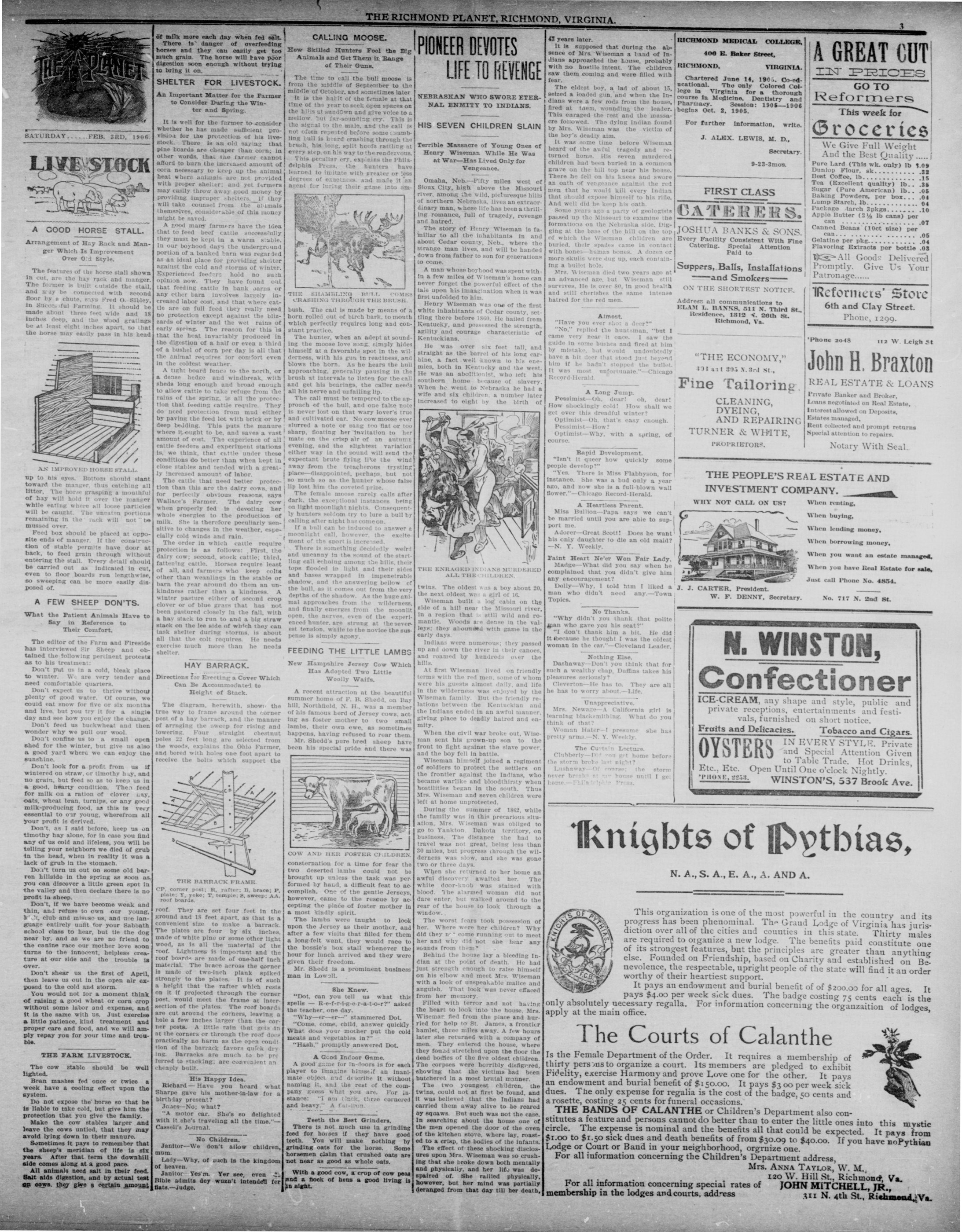
The features of the horse stall shown in cut, are the hay rack and manger. The former is built outside the stall, and may be connected with second floor by a chute, says Fred O. Sibley, in Successful Farming. It should be made about three feet wide and 18 inches deep, and the wood gratings be at least eight inches apart, so that the horse may easily pass in his head
AN IMPROVED HORSE STALL.
up to his eyes. Bottom should slant toward the manger, thus catching all litter. The horse grasping a mouthful of hay will hold it over the manger while eating where all loose particles will be caught. The uneaten portions remaining in the rack will not be mussed over. Feed box should be placed at opposite ends of manger. If the construction of stable permits have door at back, to feed grain through without entering the stall. Every detail should be carried out as indicated in cut, even to floor boards run lengthwise, so sweeping can be more easily disposed of.
A FEW SHEEP DON'TS.
What the Patient Animals Have to Say in Reference to Their Comfort.
The editor of the Farm and Fireside has interviewed Sir Sheep and obtained the following pertinent protests as to his treatment:
Don't put us in a cold, bleak place to winter. We are very tender and need comfortable quarters.
Don't expect us to thrive without plenty of good water. Of course, we could eat snow for five or six months and live, but you try it for a single day and see how you enjoy the change.
Don't feed us buckwheat and then wonder why we pull our wool.
Don't confine us to a small open shed for the winter, but give us also a good yard where we can enjoy the sunshine.
Don't look for a profit from us if wintered on straw, or timothy hay, and no grain, but feed so as to keep us in a good, hearty condition. Then feed for milk on a ration of clover hay, oats, wheat bran, turnips, or any good milk-producing food, as this is very essential to our young, wherefrom all your profit is derived. Don't, as I said before, keep us on timothy hay alone, for in case you find any of us cold and lifeless, you will be telling your neighbors we died of grub in the head, when in reality it was a lack of grub in the stomach. Don't turn us out on some old barren hillside in the spring as soon as you can discover a little green spot in the valley and then declare there is no profit in sheep.
Don't, if we have become weak and thin, and refuse to own our young, k't, club and misuse us, and use language entirely unit for your Sabbath school class to hear, but tie the dog near by, and as we are no friend to the canine race our mother love soon turns to the innocent, helpless creature at our side and the trouble is over.
Don't shear us the first of April, then leave us out in the open air exposed to the cold and storm.
You would not for a moment think of raising a good wheat or corn crop without some labor and expense, and it is the same with us. Just exercise a little patience, kind treatment and proper care and food, and we will amply repay you for your time and trouble.
THE FARM LIVESTOCK.
The cow stable should be well lighted.
Bran mashes fed once or twice a week have a cooling effect upon the system.
Do not expose the horse so that he is liable to take cold, but give him the protection that you give the family.
Make the cow stables larger and leave the cows untied, that they may avoid lying down in their manure.
Sometimes it pays to remember that the sheep's meridian of life is six years. After that term the downhill side comes along at a good pace.
All animals need salt in their feed.
Salt alds digestion, and by actual test on cows, they give a certain amount
of milk more each day when fed salt. There is danger of overfeeding horses and they can easily get too much grain. The horse will have poor digestion soon enough without trying to bring it on.
SHELTER FOR LIVESTOCK.
An Important Matter for the Farmer to Consider During the Winter and Spring.
It is well for the farmer to consider whether he has made sufficient provision for the protection of his livestock. There is an old saying that pine boards are cheaper than corn; in other words, that the farmer cannot afford to burn the increased amount of corn necessary to keep up the animal heat where animals are not provided with proper shelter; and yet farmers may casly throw away good money by providing improper shelters. If they will take counsel from the animals themselves, considerable of this money might be saved.
A good many farmers have the idea that to feed beef cattle successfully they must be kept in a warm stable. In our boyhood days the underground portion of a banked barn was regarded as an ideal place for providing shelter against the cold and storms of winter. Experienced feeders hold no such opinion now. They have found out that feeding cattle in bank oars or any other barn involves largely increased labor cost, and that where cattle are on full feed they really need no protection except against the blizzards of winter and the wet rains of early spring. The reason for this is that the heat invariably produced in the digestion of a half or even a third of a bushel of corn per day is all that the animal requires for comfort even in the coldest weather.
A tight board fence to the north, or a dense hedge and windbreak, with sheds long enough and broad enough to allow cattle to take refuge from the rains of the spring, is all the protection that feeding cattle require. They do need protection from mud either by paving the feed lot with brick or by deep beldling. This puts the manure where it ought to be, and saves a vast amount of cost. The experience of all cattle feeders and experiment stations is, we think, that cattle under these conditions do better than when kept in close stables and tended with a greatly increased amount of labor. The cattle that need better protection than this are the dairy cows, and for perfectly obvious reasons, says Wallace's Farmer. The dairy cow when properly fed is devoting her whole energies to the production of milk. She is therefore peculiarly sensitive to changes in the weather, especially cold winds and rain.
The order in which cattle require protection is as follows: First, the dairy cow; second, stock cattle; third, fattening cattle. Horses require least of all, and farmers who keep colts other than weanlings in the stable or barn the year around do them an unkindness rather than a kindness. A winter pasture either of second crop clover or of blue grass that has not been pastured closely in the fall, with a hay stack to run to and a big straw stack on the lee side of which they can tack shelter during storms, is about all that the colt requires. He needs exercise much more than he needs shelter.
HAY BARRACK.
Directions for Erecting a Cover Which
Can Be Accommodated to
Height of Stack.
The diagram, herewith, shows the true way to frame around the corner post of a hay barrack, and the manner of arranging the sweep for rising and lowering. Four straight chestnut poles 22 feet long are selected from the woods, explains the Ohio Farmer, and bored with holes one foot apart to receive the bolts which support the
THE BARRACK FRAME.
CP, corner post; R, ratter; B, brace; P,
plate; Y, yoke; T, temple; S, sweep; AA,
roof boards.
roof. They are set four feet in the ground and 18 feet apart, as that is a convenient size to make a barrack. The plates are four by six inches, made of white pine or some other light wood, as is all the material of the roof. Lightness is important and the roof boards are made of one-half inch material. The brace across the corner is made of two-inch plank spiked strongly to the plates. It is of such a height that the rafter which rests on it if projected through the corner post, would meet the frame at intersection of the plates. The roof boards are cut around the corners, leaving a hole a few inches larger than the corner posts. A little rain that gets in at the corners or through the roof does practically no harm as the open condition of the barrack favors quick drying. Barracks are much to be preferred to stacking; are convenient an cheaply built.
His Hapoy Idea
Richard — Have you heard what Sharpe gave his mother-in-law for a birthday present?
Joanes—No; what?
"A motor car. She's so delighted with it she's traveling all the time."—Cassell's Journal.
Janitor—We don't allow children,
mum.
Lady—Why, of such is the kingdom
of heaven.
Janitor—Yes'm. Yer see, even do
Bible admits dey wuzn't intendel fer
fats.—judge.
THE RICHMOND PLANET, RICHMOND, VIRGINIA
CALLING MOOSE.
How Skilled Hunters Fool the Big Animals and Get Them in Range of Their Guns.
The time to call the bull moose is from the middle of September to the middle of October, and sometimes later. It is the habit of the female at that time of the year to seek open spaces on the hills at sun5own and give voice to a mellow, but far-sounding cry. This is the signal to the male, and the call is not often repeated before some chambling bull is heard crashing through the brush, his long, split hoofs rattling at every step, on his way to the rendezvous. This peculiar cry, explains the Philadelphia Press, the hunters have learned to imitate with greater or less degrees of exactness, and made it an agent for luring their game into am.
THE SHAMBLING BULL COMES CRASHING THROUGH THE BRUSH. bush. The call is made by means of a horn rolled out of birch bark, to mouth which perfectly requires long and constant practice.
The hunter, when an adept at sounding the moose love song, simply hides himself at a favorable spot in the wilderness, with his gun in readiness, and blows the horn. As he hears the bull approaching, generally pausing in the brush at intervals to listen for the call and get his bearings, the caller needs all his nerve and unfailing lip. The call must be tempered to the approach of the bull, and one false note is never lost on that wary lover's true and cultivated ear. No cow moose ever slurred a note or sang too flat or too sharp, floating her invitation to her mate on the crisp air of an autumn evening, and the slightest variation either way in the sound will send the expectant brute flying like the wind away from the treacherous trying place—disappointed, perhaps, but not so much so as the hunter whose false lip lost him the coveted prize.
The female moose rarely calls after dark, the exceptional instances being on light moonlight nights. Consequently hunters seldom try to lure a bull by calling after night has come on. If a bull can be induced to answer a moonlight call, however, the excitement of the sport is increased. There is something decidedly weird and uncanny in the sound of the startling call echoing among the hills, their tops flooded in light and their sides and bases wrapped in impenetrable shadow, and the answering bellow of the bull, as it comes out from the very depths of the shadow. As the huge animal approaches from the wilderness, and finally emerges from the moonlit open, the nerves, even of the experienced hunter, are strung at the severest tension, while to the novice the suspense is simply agony.
FEEDING THE LITTLE LAMBS
New Hampshire Jersey Cow Which
Has Adopted Two Little
Woolly Waifs.
A recent attraction at the beautiful
summer home of F. B. Shedd, on Bay
hill, Northfield, N. H., was a member
of his famous herd of Jersey cows, act
ing as foster mother to two small
lambs, their own ewe, as sometimes
happens, having refused to rear them.
Mr. Shedd's pure bred sheep have
been his special pride and there was
COW AND HER FOSTER CHILDREN, consternation for a time for fear the two deserted lambs could not be brought up unless the task was performed by hand, a difficult feat to accomplish. One of the gentle Jersey, however, came to the rescue by accepting the place of foster mother in a most kindly spirit.
The lambs were taught to look upon the Jersey as their mother, and after a few visits that filled for them a long-felt want, they would race to the bossie's box stall whenever the hour for lunch arrived and they were given their freedom. Mr. Shedd is a prominent business man in Lowell.
She Knew.
"Dot, can you tell us what this spells — R-e-f i-r-g-r-a-t-o-r?" asked the teacher, one day.
"Why-er-er-er-" stammered Dot.
"Come, come, child, answer quickly. What does your mother put the cold meats and vegetables in?"
"Hash," promptly answered Dot.
A Good Indoor Game
A good game for in-foors is for each player to imagine himself an inanimate object and describe it without naming it, and the rest of the company guess what you are. For instance: "I am thick, three cornered and heavy." A fast-iron.
Teeth the Best Grinders
There is not much use in grinding feed for horses if they have good teeth. You will make nothing by grinding oats for the horse. Some horsemen claim that crushed oats are not near as good as whole oats.
With a good cow, a crop of cow peas and a nock of hens a good living is in sight.
PIONEER DEVOTES LIFE TO REVENGE
NEBRASKAN WHO SWORE ETERNAL ENMITY TO INDIANS.
HIS SEVEN CHILDREN SLAIN
Terrible Massacre of Young Ones of Henry Wiseman While He Was at War. His Lived Outside
Omaha, Neb.-Fifty miles west of Sioux City, high above the Missouri river, among the wild, picturesque hills of northern Nebraska, lives an extraordinary man, whose life has been a thrilling romance, full of tragedy, revenge and hatred.
The story of Henry Wiseman is familiar to all the inhabitants in and about Cedar county, Neb., where the strange man lives, and will be handed down from father to son for generations to come.
A man whose boyhood was spent within a few miles of Wiseman's home can never forget the powerful effect of the tale upon his imagination when it was first unfolded to him.
Henry Wiseman was one of the first white inhabitants of Cedar county, setting there before 1860. He hailed from Kentucky, and possessed the strength, agility and courage characteristic of Kentuckians.
He was over six feet tall, and straight as the barrel of his long carbine, a fact well known to his enemies, both in Kentucky and the west. He was an abolitionist, who left his southern home because of slavery. When he went to Nebraska he had a wife and six children, a number later increased to eight by the birth of
THE ENRAGED INDIANS MURDERED
ALL THE CHILDREN.
twins. The oldest was a boy about 20, the next oldest was a girl of 16.
Wiseman built a log cabin on the side of a hill near the Missouri river, in a region that is still wild and romantic. Woods are dense in the valleys; they abounded with game in the early days.
Indians were numerous; they passed up and down the river in their canoes, and roamed by hundreds over the hills.
At first Wiseman lived on friendly terms with the red men, some of whom were his guests almost daily, and life in the wilderness was enjoyed by the Wiseman family. But the friendly relations between the Kentuckian and the Indians ended in an awful manner, giving place to deadly hatred and enmity.
When the civil war broke out, Wiseman sent his grown-up son to the front to fight against the slave power, and the boy fell in battle.
Wiseman himself joined a regiment of soldiers to protect the settlers on the frontier against the Indians, who became warlike and bloodfirstly when hostilities began in the south. Thus Mrs. Wiseman and seven children were left at home unprotected.
During the summer of 1862, while the family was in this precarious situation, Mrs. Wiseman was obliged to go to Yankton. Dakota territory, on business. The distance she had to travel was not great, being less than 30 miles, but progress through the wilderness was slow, and she was gone two or three days.
When she returned to her home an awful discovery awaited her. The white door-knob was stained with blood. The alarmed woman did not dare enter, but walked around to the rear of the house to look through a window.
The worst fears took possession of her. Where were her children? Why did they not come running out to meet her and why did not she hear any sounds from them?
Behind the house lay a bleeding Indian at the point of death. He had just strength enough to raise himself on his elbow and meet Mrs. Wiseman with a look of unspeakable malice and anguish. That look was never effaced from her memory.
Filled with terror and not having the heart to look into the house, Mrs. Wiseman fled from the place and hurried for help to St. James, a frontier hamlet, three miles away. A few hours later she returned with a company of men. They entered the house, where they found stretched upon the floor the dead bodies of the five oldest children. The corpses were horribly disfigured, showing that the victims had been butchered in a most brutal manner.
The two youngest children, the twins, could not at first be found, and it was believed that the Indians had carried them away alive to be reared by squaws. But such was not the case. In searching about the house one of the men opened the door of the oven of the kitchen stove, where lay, roasted to a crisp, the bodies of the infants. The effect of these shocking disclosures upon Mrs. Wiseman was so crushing that she broke down both mentally and physically, and her life was despaired of. She rallied physically, however, but her mind was partially deranged from that day till her death.
Knights of Pythias,
This organization is one of the most powerful in the country and its progress has been phenominal. The Grand Lodge of Virginia has jurisdiction over all of the cities and counties in this state. Thirty males are required to organize a new lodge. The benefits paid constitute one of its strongest features, but the principles are greater than anything else. Founded on Friendship, based on Charity and established on Benevolence, the respectable, upright people of the state will find it an order worthy of their heartiest support.
It pays an endowment and burial benefit of of $200.00 for all ages. It pays $4.00 per week sick dues. The badge costing 75 cents each is the only absolutely necessary regalla. For information concerning the organization of lodges, apply at the main office.
The Courts of Calanthe
Is the Female Department of the Order. It requires a membership of thirty persons to organize a court. Its members are pledged to exhibit Fidelity, exercise Harmony and prove Love one for the other. It pays an endowment and burial benefit of $150.00. It pays $3.00 per week sick dues. The only expense for regalia is the cost of the badge, 50 cents and a rosette, costing 25 cents for funeral occasions.
THE BANDS OF CALANTHE or Children's Department also con-
stitutes a feature and persons cannot do better than to enter the little ones into this mystic circle. The expense is nominal and the benefits all that could be expected. It pays from $1.00 to $1.50 sick dues and death benefits of from $30.09 to $40.00. If you have noPythian Lodge or Court or Band in your neighborhood, orgnize one.
For all information concerning special rates of JOHN MITCHELL, JR. membership in the lodges and courts, address 311 N. 4th St. Richmond Va.
43 years later
It is supposed that during the absence of Mrs. Wiseman a band of Indians approached the house, probably with no hostile intent. The children saw them coming and were filled with fear.
The eldest boy, a lad of about 15, seized a loaded gun, and when the Indians were a few rods from the house, fired at them, wounding the leader. This enraged the rest and the massacre followed. The dying Indian found by Mrs. Wiseman was the victim of the boy's deadly aim.
It was some time before Wiseman heard of the awful tragedy and returned home. His seven murdered children had been buried in a common grave on the hill top near his house. There he fell on his knees and swore an oath of vengeance against the red men that he would kill every Indian that should expose himself to his rifle. And well did he keep his oath.
Some years ago a party of geologists passed up the Missouri to examine the formations on the Nebraska slide. Digging at the base of the hill on the top of which the Wiseman children are buried, their spades came in contact with bones—human bones. A dozen or more skulls were dug up, each containing a bullet hole.
Mrs. Wiseman died two years ago at an advanced age, but Wiseman still survives. He is over 80, in good health and still cherishes the same intense hatred for the red men.
Almost.
"No," replied the huntsman, "but I came very near it once. I saw the guide in some bushes and fired at him by mistake, but would undoubtedly have a hit deer that stood just beyond him if he hadn't stopped the bullet. It was most unfortunate."—Chicago Record-Herald.
A Long Jump.
Pessimist—Oh, dear! oh, dear!
How shockingly cold! How shall we get over this dreadful winter?
Optimist—Oh, that's easy enough.
Pessimist—How?
Optimist—Why, with a spring, of course.
Rapid Development.
"Isn't it queer how quickly some people develop?"
"Yes. There is Miss Flabbyson, for instance. She was a bud only a year ago, and now she is a full-blown wall flower."—Chicago Record-Herald.
A Heartless Parent
Miss Bullon—Papa says we can't be married until you are able to support me.
Adorer—Great Scott! Does he want his only daughter to die an old maid?
-N. Y. Weekly.
Faint Heart Ne'er Won Fair Lady.
Madge—What did you say when he complained that you didn't give him any encouragement?
Dolly—Why, I told him I liked a man who didn't need any—Town Topics.
No Thanks.
"Why didn't you thank that polite man who gave you his seat?"
"I don't thank him a bit. He did it because he thought I was the oldest woman in the car."—Cleveland Leader.
Nothing Else
Dashaway—Don't you think that for such a wealthy chap, Duffins takes his pleasures seriously?
Cleverton—He has to. They are all he has to worry about. Life
Unappreciative
Mrs. Newage—A California girl is learning blacksmithing. What do you think of that?
Woman Hater—I presume she has pretty arms—N. Y. Weekly.
The Curtain Lecture.
Clubberly—Bid you get home before the storm broke last night?
Lushaway—Of course; the storm never breaks at my house until I get home—Philadelphia Press.
Knight
KNIGHTS OF PYTHIAST
F.C.B.
only absolutely necessary rega apply at the main office. The Court Is the Female Department of the thirty persons to organize a co Fidelity, exercise Harmony and an endowment and burial bene dues. The only expense for re a rosette, costing 25 cents for f THE BANDS OF CALA stitutes a feature and persons o circle. The expense is nomine $100 to $1 so sick dues and
THE PEOPLE'S REAL ESTATE AND INVESTMENT COMPANY.
ICE-CREAM, any shape and style, public and private receptions, entertainments and festivals, furnished on short notice.
Fruits and Delicacies. Tobacco and Cigars.
OYSTERS IN EVERY STYLE. Private and Special Attention Given to Table Trade. Hot Drinks, Etc., Etc. Open Until One o'clock Nightly.
'PHONE, 2253. WINSTON'S 537 Brook Ave.
Chartered June 14, 1905. Co-educational. The only Colored College in Virginia for a thorough course in Medicine, Dentistry and Pharmacy. Session: 1905—1906 begins Oct. 2, 1905.
J. ALEX. LEWIS, M. D.,
Secretary.
9-23-3mos.
9-23-3mos.
FIRST CLASS
JOSHUA BANKS & SONS.
Every Facility Consistent With Fine
Catering. Special Attention
Paid to
Suppers, Balls, Installations
and Smokers
Address all communications to
ELAM L. BANKS, 511 N. Third St.,
Residence, 1312 N. 26th St.
Richmond, Va.
"THE ECONOMY," 301 a1 305 N. 3rd St.
Fine Tailoring
CLEANING,
DYEING,
AND REPAIRING
TURNER & WHITE,
PROPRIETORS.
THE PEOPLE'S REAL
INVESTMENT COMP
J. J. CARTER, President.
W. F. DENNY, Secretary.
N. WIN
Confec
ICE-CREAM, any shape e
private receptions, ente
vals, furnished o
Fruits and Delicacies.
OYSTERS IN EV
and S
to Tab
Etc., Etc. Open Until On
'PHONE, 2253.
WINSTO
N. A., S. A., E. A., A. AND A. organization is one of the most power has been phenominal. The Grand for all of the cities and counties in need to organize a new lodge. The largest features, but the principles ended on Friendship, based on Char the respectable, upright people of their heartiest support. an endowment and burial benefit of per week sick dues. The badge
IN PRICES
GO TO
Reformers
This week for
Groceries
We Give Full Weight
And the Best Quality .....
Pure Lard (This wk. only) lb 1.09
Dunlop Flour, sk.....32
Best Coffee, lb.....15
Tea (Excellent quality) lb.....35
Sugar (Pure American) lb.....05
Baking Powders, per box.....04
Lump Starch, lb.....04
Package tarch 3pkgs.....10
Apple Butter (2 1/2 lb cans) per
Caused Beans (10ct size) per can. .05
Gelatine per pkg. .04
Flavoring Extracts per bottle .03
All Goods Delivered Promptly. Give Us Your Patronage.....
Reformers' Store
6th and Clay Street.
Phone, 1299.
John H. Braxton
REAL ESTATE & LOANS
Private Banker and Broker,
Loans negotiated on Real Estate,
Interest allowed on Deposits,
Estates managed,
Rent collected and prompt returns
Special attention to repairs.
Notary With Seal.
REAL ESTATE AND
COMPANY.
When renting,
When buying,
When lending money,
When borrowing money,
When you want an estate managed,
When you have Real Estate for sale,
Just call Phone No. 4854.
No. 717 N. 2nd St.
ISTON,
actioner
e and style, public and
entertainments and festi-
on short notice.
Tobacco and Cigars.
EVERY STYLE. Private
Special Attention Given
Table Trade. Hot Drinks,
One o'clock Nightly.
TON'S, 537 Brook Ave.
ythias,
powerful in the country and its
Lodge of Virginia has juris-
in this state. Thirty males
benefits paid constitute one
are greater than anything
clarity and established on Be-
f the state will find it an order
of of $200.00 for all ages. It
the costing 75 cents each is the
ing the organization of lodges,
P
nt also con-
e the little ones into this mystic
d be expected. It pays from
440.00. If you have noPythian
address,
TAYLOR, W. M.,
Hill St., Richmond, Va.
N MITCHELL, JR.,
RII N. 4th St., Richmond, Va.
REC PLANET
Published every Saturday by JOHN MITCHELL.
J.S., at 811 North 4th Street, Richmond Va.
All communications intended for publication should be sent so as to reach us by Wednesday.
TERMS IN ADVANCE
One Copy, one year, $1.50
One Copy, eight months. 1.00
One Copy, six months. .80
One Copy, four months .50
One Copy, three months .40
Single Copy .05
ADVERTISING RATES
For one inch, one insertion. $50
For one inch, each subsequent insertion. $40
For two inches, three months. $0.00
For two inches, six months. $10.00
For two inches, nine months. $40.00
For two inches, twelve months. $20.00
Marriage and Funeral Notices, one inch, staffing and Transient Notices per line. $50
POSTAGE STAMPS OF A HIGHER DEMONINATION THAN TWO CENTS NOT RECEIVED ON SUBSCRIPTIONS.
THE PLANET is issued weekly. The subscription price is $1.50 per year in advance.
There are four ways by which money can be sent to the Post Office Money Order, by Bank Check or Draft, or an Express Money Order, and when none of those can be procured, in a Registered Letter.
MONEY ORDERS.—You can buy a Money Order at your Post Office, payable at the Richmond No. 1000 Post Office and we will be responsible for the safe arrival.
EXHIBITS OF MONEY ORDERS can be obtained at any office of the American Express Co., the United States Express Co., and the Well's Fargo and Co's Express Company. We will be responsible for money sent by any of these companies. The Express Money Order is a safe and efficient way for forwarding money.
REGISTERED LETTER—If a money Order Post-Office or an Express Office is not within the same city, you must send the Letter you wish to send us on payment of ten cents. Then, if the letter is lost or stolen, it can be traced. You can send money in this manner on our page.
We cannot be responsible for money sent in letters in any other way than one of the four ways mentioned above. If you send your money in another way, you must do it at your risk.
RENEWALS, ERO. If you do not want THE PLANET continued for another year after your money is returned, you must Purchase Fidelity Card to discontinue it. The courts have decided that subscribers to newspaper, who do order their paper discontinued by the expiration date, are are held liable for the payment of the subscription up to date when they order the paper discontinued.
COMMUNICATIONS—When writing to us to renew your subscription or to discontinue your paper, you should give your name and address in full, otherwise we cannot find your name on the CHANGE OF ADDRESS. In order to change the address of a subscriber, we must be sent the former as well as the present address.
Entered at the Post-Office at Riskmond. Vax second-class matter.
Engaged at the Post-Office at Richmond. Vs
as second-class matter.
SUPREME COURT—STATE OR-
NATIONAL—WHICH?
We have repeatedly insisted that the colored people of this country need not expect anything from the Supreme Court of the United States and that they would do well to rest their cases in the hands of the Supreme Courts of the several states. The justice that they cannot obtain there is not to be had anywhere else in this broad land of ours.
This position has been recently emphasized by the decision of the Supreme Court of Florida in the Jacksonville "Jim Crow" street-car case and in the decision of the Supreme Court of Georgia in the famous Henry Jamison case. Judge Spcer was sustained on every point and Henry Jamison has been formally released from custody.
It may be well to review the case at some length. Henry Jamison, a colored man, who was an old family servant of some of the best white people of Georgia took on too much liquor and became violent. He was tried before the Recorder of Macon, Georgia and fined twenty-five dollars, in default of which he was sentenced to serve in the Bibb county chaingang for ninety days. Jamison was committed to the barrack and upon being charged with disorderly conduct there was again carried before the Recorder and fined thirty-five dollars and be unable to pay the same was committed to the chaingang for an additional 120 days. This occurred March 14th, 1904.
Jamison's white friends became indignant and protested against the outrage finally employing counsel to defend him. They went into the United States District Court, Judge Emory Speer presiding and applied for a writ of habeas corpus. The question involved is best stated in the language of the Court.
"I immediately, it involves the question whether the Recorder of Macon can, without any sort of criminal pleading, and without the intervention of a jury, convict a citizen twice for one violation of a minor municipal ordinance and sentence him to seven months at hard labor on the public chaining, the punishment to be suffered in a branch of the state penitentiary. Here also is the question, can it be maintained in the light of the Constitution, that one man, under any form of procedure, devised or to be devised by local legislation consign men, women and children to a chaining for such trivial offenses as are within the jurisdiction of a police magistrate?"
Judge Speer granted the writ of habeas corpus and Jamison was released from custody. However, the city authorities acting under the ad
vice and instructions of Minter Wimberly, City Attorney of Macon appealed the case to the Supreme Court of the United States and with out making any comments upon the merits of the case, the Supreme Court reversed Judge Speer and re manded Jamison back to the custody of the Superintendent of the Bttb county chalangang. It was understood that the reason for its action was based on the fact that the plaintiff should have exhausted his remedies in the state court before the case was appealed to the United States District Court.
The supreme tribunal did not even specify the mode of procedure, neither did it give any encouragement to the bone plaintiff as to the merits of the contention of his counsel. With no means at hand to pay his fine, it was evident that this August tribunal, by its action remanded Henry Jamison to a punishment which is fittingly described in the opinion of Judge Speer as follows:
The most cursory view of the evidence in the record will convince the impartial that practically every ignominious mark of infamous punishment is stamped upon the miserable throng in Bibb county chaining. This is clear from the testimony of the superintendent, E. A. Wimbish, and from the uncontricted evidence of witnesses who have expalated their disregard of sundry provisions of the City Code. The sufferers wear the typical striped clothing of the penitentiary convict. Iron manacles are riveted upon their legs. These can be removed only by the use of the cold chisel. The irons on each leg are connected by chains. The coarse stripes, thick with the dust and grime of long torrid days of a semi-tropical summer, or encrusted with the icy mud of winter, are their sleeping clothes when they throw themselves on their pallets or straw in the common stockades at night. They wake, toll, rest, eat and sleep, to the never-ceasing clanking of the manacles and chains of this involuntary slavery. Their progres to and from their work is public, and from dawn to dark, with brief intermission, they toll on the public roads and before the public eye.
About them as they sleep, journey and labor watch the convict guards armed with rifle and shot gun. This is to at once make escape impossible, and to make sure the swift thudding of the picks and the rapid flight of the shovels shall never erase. If the guards would hesitate to promptly kill one sentenced for petty violations of city law should he attempt to escape, the evidence does not disclose the fact. And the fact more baleef and more ignominious than all, with each gang stands the whipping boss, with the badge of his authority. This the evidence discloses to be a heavy leathern strap about two and a half or three feet long, with solid hand grasp, and with bread, heavy and flexible lash. From the evidence we may judge that the agony inflicted by this implement of torture is not surpassed by the Russian knout, the synonym the world around for merciless corporal punishment. If we may also accept the uncontradicted evidence of the witnesses it is true that on the Bibb county chaianging for no day is the strap wholly idle and not infrequent ly it is fiercely active. One witness, who served many months, testified that if the gang does not work like "fighting fire," to use his simile, the whipping boss runs down the line, striking with apparent indiscrimination the convicts as they bend to their tasks. Often the whipping is more prolonged and deliberate. At times, according to another witness, also uncontradicted, the convicts when at the stockade are called into the "dog lot." All present, the whipping boss selects the victims, in his judgment worthy of punishment.
They are called to the stale door made to lie face downward across the sill, a strong convict holds down the head and shoulders and the boss lays on the lash on the naked body until he thinks the sufferer has been whipped enough.
It was at this period of the struggle for Jamison's liberty that Minter Wimberly and the officials of Macon, proceeded to re-arrest Jamison before the mandate of the Supreme Court of the United States had been made a matter of record in the United States District Court. This was reported to Judge Speer, who at once issued a rule citing the offending officials to appear before his court and to show cause why they should not be punished for contempt of court.
In the meantime, counsel for Jamison had applied to one of the Judges of the Superior Court for a writ of habeas corpus. This was denied and application was again made to Judge Emory Speer for a writ of habeas corpus. Judge Speer proceeded at once to issue an order placing Jamison in the custody of the United States Marshal and a day was set to hear a motion for the case on its merits. Counsel for the city authorities applied to the Supreme Court of Georgia and it looked at one time as though there would be a clash between the state and federal authorities. Jamison's counsel applied to the Supreme Court for a writ of habeas corpus and this court finally decided not to entertain the application for the reason that Jamison was not in the custody of the superintendent of the Bibb county chalang.
But the white people, who were backing Jamison were not to be beaten in this way and so another case was made up, which case was on "all fours" with the Jamison case, only a colored man, named Pearson was the petitioner. He was in the custody of
RICHMOND PLANET. RICHMOND. VIRGINIA
the superintendent of the Bibb county chalangang and undergoing infamous punishment. It was agreed that the decision in the Pearson case would settle the Jamison case. In the meantime, the Supreme Court set January 15th, 1906 as the day to hand down a decision in the case. To the surprise of many people, this state tribunal decided the case, sustaining Judge Speer's ruling and nullifying the action of the Macon authorities in placing Jamison and Pearson in the Bibb county chalangang.
Counsel for Jamison, Mr. Alex. Ackerman announced that the fine would be paid and the Jamison case dismissed. The point settled will affect many other prisoners. Jamison could have been confined in jail, but he could not lawfully be forced to work in the chaiang with prisoners charged with felonies.
Judge Emory Speer is, we believe a Georgian. He possesses all of those fearless qualities for which men of that state are noted. He risked being reversed by the Supreme Court and he has won a blood less victory that will send his name sounding throughout the ages. Men of this calibre are growing painfully less and it is to be regretted that their ranks are not being rapidly reforced. It was the principle for which he was contending that won out and it is all the more remarkable that he was upheld in Georgia and "turned down" in a sense at Washington. It should teach the average colored man a lesson. We must make friends with the better elements of the white Southland. They have the stamina and the nerve to stand up and be counted.
We should condemn the Negrohating kind. We have no favors to ask at their hands. We believe that ultimately colored men will be accorded all of their rights and privileges through the medium we have just cited. When a Southern white man is for you, he is for you all the way through. There is no half-way business about it. When he is against you he emphasizes his convictions in the same way.
It is surprising and it is to be regretted that the opinion of Judge Emory Speer of Georgia in this Jamison case was not the opinion of the Supreme tribunal at Washington.
Reverberating from one section of Georgia to the other, echoed and re-echoed from the Atlantic to the Pacific and from Canada to the Gulf sending its intonations and emphasing its truth in every ray of sunshine in the day and every starry sentinel in the night sounds forth the language of this distinguished jurist:
One witness, formerly a road commissioner, who was familiar with the operations on the chaining, testified that in his opinion, while a sentence there would forever ruin a white man previously respectable it had no such effect on a respectable Negro. Such considerations do not appeal to a court charged with the equal enforcement of the law. Nor do I believe that they meet the approbation of the reflecting people of the Southern states. Nor are such sentiments conducive to our welfare or hopeful for our future. Twenty-one years ago, when at the bar, in an argument to a jury, in the great case of Exparte Yarborough, I declared the conviction that:
"Never in the history of the world has any considerable class of people been debased and degraded by force and lawlessness, but that the entire people suffered because of that degradation. The white people of this country control the government, state and federal. They enjoy every conceivable advantage. They have superiority in wealth, education, social influence, everything. A magnanimous people, a just people, they owe it to themselves to be magnanimous and just to the colored people."
It was true then. It is true now. I further declared:
"For my part, I love my country I am proud of its traditions. I glory in the herolism and manhood of its people. I know that they despise cruelty and barbarity to the helpless and oppressed." This was true then. It is true now. Though the color line expert may so paint it, this is no color line case. It is a Negro today. It may be a white man, aye, a white child or a white woman tomorrow. In this court the law is equal for all.
Judgment absolute will be ordered in favor of the petitioner and he will be discharged from custody and be permitted to go hence.
attended to go hence.
PRODUCE QUOTATIONS
The Latest Closing Prices In the Principal Markets
PHILADELPHIA --FLOUR steady;
winter extras. $3@2.35; Pennsylvania
roller, clear, $3.40@3.60; city mills,
fancy, $4.75@4.23; RYE FLOUR firm;
per barrel, $3.80. WHEAT steady;
No. 2 Pennsylvania red, new, $84 @
84%c. CORN steady; No. 2 yellow, lo-
cator, $4.75 ATS firm; No. 2 white,
clipped, $3.40 lower grade, $35%c.
HAY steady, $3.40 for large bales, PORK steady; family,
$17. BEEF steady; beef hams,
$23@24. POULTRY Live! firm; heens,
13@13%c. old roosters, 8@9c. Dressed
steady; choice fowls, 14c.; old roosters,
9%c. BUTTER steady; creamy;
choice pound, EGGS steady;
New York and Pennsylvania, 22@4c
per dozen. POTATOES steady; per
bushel, 70@73c.
BALTIMORE—WHEAT steady; No. 2 spot, 84½%; steamer No. 2 spot, 79½%; southern, on grade, 78½%; CORN easier; mixed spot, 48½%; mixed steamer, 46½%; southern, 43½; OATS quiet; white, No. 2, 36½@37c; No. 3, 35½@36c; No. 4, 34½@35c; mixed, No. 2, 35½@35c; No. 3, 34@34½c; No. 4, 33@33½c. BUTTER steady; creamy separator, extras, 25½@26%; creamy separator, extras, 26½@26%; creamy Maryland and, Pennsylvania; fancy Maryland, Pennsylvania, Virginia and West Virginia, 16@17c. EGGS firmer; fancy Maryland, Pennsylvania, Virginia and West Virginia, 19c; southern, 19c
KING CHRISTIAN,
OF DENMARK, DEAD
Oldest Monarch in Europe Suddenly Passes Away.
MANY COURTS IN MOURNING
Copenhagen, Denmark, an. 30. — Christian the Ninth, the aged king of Denmark, dean of the crowned heads of Europe, father of King George, of Greece; of Queen Alexandra, of Great Britain and Ireland, and of the Dowager Empress Maria Feodorova, of
CHRIS JAN IX OF DENMARK.
Russia; grandfather of King Hankon the Seventh, of Norway, and related by blood or by marriage to most of the European rulers, died with startling sadness in the Amalienborg palace. The accession of his successor, Prince Frederick, his eldest son, who will be known as Frederick the Eighth, was proclaimed today.
The death of King Christian, who was 88 years old, has plunged half the courts of Europe into the deepest of mourning and brought a sense of great loss as well as sincere grief to every one throughout the kingdom of Denmark, reaching even to the humblest cottage, evidence of which is shown everywhere. It has cast a palp over the palaces of the monarchs of Great Britain Russia, Norway and Greece.
King Christian appeared to be in his usual health in the morning. After taking breakfast he held a public audience, which it has been his custom to do every Monday morning. The reception was largely attended and his majesty conversed freely and affably with a number of officials and other persons. When the function was over, the king, though appearing to be slightly fatigued, attended luncheon with the members of his family. During the meal his majesty complained of indisposition and was assisted to his bedroom by the dowager empress and Prince Hans. A court physician was summoned, but by the time he arrived the king had collapsed. The physician used prompt restoratives, but his efforts were useless, and King Christian expired, almost, without uttering a word, in the arms of the dowager empress and in the presence of the court physician and Prince Hans. The cause of death was heart failure.
Premier Christensen tendered the resignation of the cabinet to the new king, who expressed a wish that the present ministry should continue to carry on the affairs of the government.
Christian IX, king of Denmark, was born April 8, 1818, and was the fourth son of the late Duke William of Schleswig-Holstein,Sonderburg-Glücksburg and of Princess Louise of Hesse-Cassel. He was appointed to the succession of the crown of Denmark by the treaty of London of May 8, 1852, and by the Danish law of succession of July 31, 1853. He succeeded to the throne on the death of King Frederick VII, November 15, 1863, and married May 26, 1842, Queen Louise, the daughter of the Landgrave William of Hesse-Cassel. She was born in 1817, and died in 1838.
Prince Frederick, the eldest son of the late King Christian, who succeeds to the throne, was born June 3, 1843, and was married July 28, 1869, to Princess Louisa, daughter of King Charles XV, of Sweden and Norway. Their second son, who married Princess Maud of England, is now king of Norway.
The eldest daughter is Queen Alexandra of England, and his second son, Prince William, was elected king of Greece, under the title of George I, in 1863.
Another daughter of the late King Christian, Marie Dagmar, is the dowager empress of Russia, Mavia Feodorovna, who married Alexander III of Russia. He died November 1, 1894, and his son Nicholas is now emperor of Russia.
Princess Thyra, third daughter of King Christian, is Duchess of Cumberland. Her husband claims the throne of Hanover.
Prince Waldemar, the youngest of the children of King Christian, married the Princess Marie of Orleans, eldest daughter of the Duc de Chartres
DENMARK'S NEW KING
Frederick VIII Aiscends Throne With
Appropriate Ceremony
Appreciate Cerminal.
Copenhagen, Denmark, Jan. 31.—The new king, Frederick the Eighth, now reigns over Denmark. His accession has been hailed with all appropriate enthusiasm and ceremony, but sorrow for the death of Christian the Ninth is the predominant sentiment. The overwhelming grief of the immediate members of this remarkable united family is reflected in only a slightly lesser degree in every home in Copenhagen, from the richest to the poorest, and only words of kindness are heard when the dead monarch is spoken of.
Following the wishes of King Christian, the funeral will be attended with little ceremonial. The body will not actually lie in state, but prior to the entombment, which is expected to take place in about a fortnight. It will be
visited by the chiefs of state.
The burial will take place in the cathedral of Roskilde, beside Queen Louise, in the chapel of Frederick the Fifth.
King Frederick the Eighth, who is a great admirer of the United States, expressed himself as being especially affected by the condolences of President Roosevelt in behalf of the American nation.
ALL AUTO RECORDS SMASHED
Big French Car Covers Two Miles In 58.4-5 Seconds.
Ormond-Daytona Beach, Fla., Jan. 30. -Victor Demoget, of France, was crowned speed king of the world on the Daytona sands after driving his gasoline car two miles in the marvelous time of 58 4-5 seconds. Demoget maintained a speed of 123 miles an hour to make this record.
On the first trial Marriott went first, but the best he could do was one minute and three seconds. Demogoeot brought the crowd to its feet by reducing the time to 1 minute 1 2-5 seconds. Referee Morrill decided to give each car a trial to see if the time could be brought within the minute. Marriott came first again, and this time faster. He made the two miles in 59 3-5 seconds. It seemed impossible that the clumsy-looking French car should reduce this, but the Florida Times-Union $1000 trophy was lost to America a few minutes later, when Demogoeot thundered over the two-mile course in 58 4-5 seconds, the fastest speed ever attained by an automobile. Demogoeot was crowned with a laurel wreath by Miss Mary Simrall, of Ormond, Fla., while several thousand persons cheered.
ELUDED JUSTICE TEN YEARS
John Williams, Accused of Murder and Criminal Assault, Arrested.
Mount Holly, N. J., Jan. 31.—After being a fugitive from justice for 10 years, John Williams, who was recently arrested at Atlantic City for assault on a young woman, has been identified as one of the negroes who murdered John Henke in Burlington, N. J., in 1896. Thomas Cromwell was Williams' partner in this crime, and both made their escape. Cromwell was afterwards tried and convicted at Lebanon, Pa., for the murder of a man named Schmidt, in June, 1904. Before his execution he confessed to the Henke murder and declared that Williams was his accomplice. Williams escaped on a vessel to South America, but returned five years later, when the search for him had been abandoned. In June, 1901, he assaulted a white girl in Merchantville and again escaped. There was a reward of $700 offered for his capture, but he was not caught.
POSSE AFTER NEGRO
Assaulted White Woman, Cut Her Throat and Left Her in Dying State. Atlanta, Ga., Jan. 31.—Mrs. Nina May Dupree, 20 years old, who lives at the home of W. H. Grogan, a prosperous farmer, about six miles from Atlanta, was assaulted by a negro, who cut her throat and left her in a dying condition from loss of blood and nervous excitement. The negro escaped. A posse of more than a hundred citizens with track hounds is after the negro, and if he is caught he will in all probability be summarily lynched. Mr. Grogan and his wife, returning home from Atlanta at a late hour, found her lying in the dining room in a pool of her own blood. Physicians, who were immediately summoned, despaired of her life. She described her assailant as a tall, black negro.
Shot By His Daughter
Long Branch, N. J., Jan. 30. — Dr. Harry H. Pemberton, one of the best known physicians along the Jersey coast, was shot by his daughter, Charlena. The bullet passed through the back of his head. The injury is said not to be serious, but the doctor is suffering greatly from shock. Dr. Pemberton and his wife are divorced. They live here within about two blocks of each other. The couple had two children, a boy and a girl. The son has been ill at his father's home for some days. He and his sister have been in the habit of visiting their father regularly. The daughter called to see her brother, and the shooting took place in the hall. There is no clear account of the occurrence, but it is said that the shooting was accidental.
Fire at Newport Naval Station
Newport, R. I., Jan. 29.—Seven buildings connected with the United States naval training station at Coastop Harbor Island, in this city, were destroyed by fire, causing an estimated loss of $100,000. The buildings destroyed were the detention building, machine shop, paint shop, paymaster's storehouse, carpenter's shop and small storehouses.
War Cost Japan $585,000,000
Toklo, Jan. 29—An official report submitted to the diet shows that the actual outlay for the war from the beginning of hostilities to their end in September last was for the army $495,000,000 and for the navy $90,000,000.
Powder Company Insures Employees.
Paulsboro, N. J., Jan. 29—The DuPont company is placing insurance on the lives of its employees. Formerly it paid $500 to the family of any one killed at the plant.
TRYING TO HIDE BEHIND GARFIELD
Meat Packers Claim They Were Promised Immunity.
PRODUCED SECRET BOOKS
Chicago, Jan. 31.—Edward Morris, vice president of the Fairbank Canning company, and of Nelson Morris & Co., testified in the meat packers' immunity plea case that he had been required by Commissioner of Corporations Garfield to produce for the inspection of the commissioner the secret profit and loss books of his company, after the commissioner had pre-
pared a report on the beef industry. Morris declared that Commissioner Garfield had taken these books and had inspected them.
Morris told of receiving assurance from Commissioner Garfield that no knowledge furnished by the packers to the department of commerce and labor would be used against them. Mr. Morris told him he gave the information to Commissioner Garfield and his representatives, and then declared that Commissioner Garfield returned to Chicago with the greater part of his reportin proofs, which he submitted to Mr. Morris. The witness said that he read the proofs and told Mr. Garfield that the report was correct. The commissioner then, the witness asserted, demanded that the profit and loss books of the company be brought to the down town office of Morris & Co. for his inspection. They were brought, and the commissioner looked them over. The statement that the commissioner had called for the secret books after completing his report caused a stir in court, but the witness insisted that he was "required" by Commissioner Garfield to submit the books to him.
The other witnesses of the day were L. C. Krauthoff, Samuel McRoberts, treasurer of Armour & Co., and Charles G. Dawes, formerly comptroller of the treasury, and now president of the Central Trust company, of Chicago. Both Mr. Dawes and Mr. McRoberts insisted that they had heard Commissioner Garfield declare that any information he might procure from the packers would not be used against them in court.
GENERAL WHEELEE BURIED
Full Military Honors Paid Dead Hero
In Washington.
Washington, Jan. 30.—With full military honors the body of General Joseph Wheeler, the veteran of two wars, was laid at rest in the National Came-
GENERAL JOSEPH WHEELER
tery at Arlington. The spot selected for his final repose lies on the grassy slope in front of and to the right of the historic Lee mansion, and is regarded as one of the most beautiful sites in the home of the soldier dead, as it overlooks the nation's capital across the Potomac.
Impressive military services and the final services of the church marked the ceremonies at the cemetery. The cavalry dismounted at the gates and proceeded within the silent city of the dead on foot. The troops formed in line at the grave and stood at "present arms." The veteran associations took positions around the grave. With the casket resting just above the grave the committal services of the Episcopal church were conducted by Rev. Dr. Stires.
WANTS NO SHRIVELED UP SOUL
Chicago Banker Cites Several Millionaire Demons He Knows
Chicago, Jan. 31.—Representatives of 73 Presbyterian churches in Chicago listened to a remarkable arraignment of wealth by David R. Forgan, vice president of the First National Bank, who spoke at the McKinley memorial banquet of the Young Men's Presbyterian Union at the City Club of Chicago.
"Perhaps you think it impossible that a man's soul should entirely shrivel up in the pursuit of wealth," said Mr. Forgan. "If you knew some millionaires as well as I know them, you would agree with me that they had lost the last vestige of the souls they may be presumed to have possessed before the mania for money-getting possessed them. I would like to acquire millions, but if the process is going to make me like some of the old devils I know who are millionaires, I don't want the money.
"Recently I saw a letter from a millonaire referring to the death of a clerk who faithfully had served him 30 years. The man who wrote the letter is rated at $20,000,000. In this letter, after disposing of several matters, he referred to the death of his old employee incidentally, and directed that the exact date of the severance of his connection with the office because of his last illness be ascertained, the exact amount due him for the fraction of the month he had worked be figured up and a check for the amount be mailed to his widow. Do you imagine that old curmudgeon has a soul?"
TO PROBE RAILWAY COMBINE
House Asks Information of Pennsylvania Railroad Alliance.
Washington, Jan. 30.—What is considered a strike at the railroads was taken by the house in the adoption of a resolution calling on the president to furnish information as to the existence of an alleged agreement in violation of the interstate commerce law between the Pennsylvania, Baltimore & Ohio, Norfolk & Western, Chesapeake & Ohio, Northern Central and the Philadelphia, Baltimore & Washington Railroad companies. Opposition to the resolution did not develop until after it had been declared adopted by the speaker. At this point Mr. Dailzell, of Pennsylvania, moved against it with a motion to reconsider. This motion was laid on the table with the aid of 37 Republican votes united with the Democrats, which makes it impossible to reconsider the resolution without a
two-thirds vote of the house.
Killed On Steps of Car.
Philadelphia, Jcu. 30.—Ralph Heetner, aged 23 years, whose home is in Englewood, a suburb of Chicago, was killed on the steps of a parlor car attached to a New York express train here, while his wife sat in the car. Mr. and Mrs. Heetner had been in this city about three weeks and started for New York. The train made a brief stop at the West Philadelphia station, and Heetner stepped to the station platform to greet a friend. As the train started he attempted to board the vestibule car, but the doors were closed. As he stood on the lower step, grasping the hand rail, his head came in contact with an abutting bridge support and his skull was crushed.
A WEEK'S NEWS CONDENSED.
Charles Snisman, while driving in Camden, N. J., was thrown from the seat of the team and run over and killed.
The Chinese imperial commission, sent to the United States to study conditions, was received by President Roosevelt.
Simon Shupp, a well-known Democratic politician of Stroudsburg, Pa., committed suicide by shooting while despondent from ill health.
The Coal Dealers' Association of the Virginia and Carolinas was formed at Lynchburg, Va., by representative dealers from the four states.
Friday, January 26.
Luella Charlesworth, 6 years old. of Millyville, N. J., became blind after a severe coughing spell.
Cardinal Peter Lambert Gossens, archishop of Mechlin, died at Brussels, Belgium, aged 79 years.
While stealing a ride on the Reading railway at Hatfield, Pa., Roy Bailey, 15 years old, was run over and killed. A. J Howard, of Philadelphia, committed suicide in a hotel at Colorado Springs, Col., by shooting himself in the head.
The justices of the supreme court and their wives were guests of honor at a dinner given by President and Mrs. Roosevelt at the White House Thursday night.
Saturday, January 27.
The grain mill and elevator of Close Brothers at Schenectady, N. Y., was burned, entailing a loss of $90,000.
Andrew Carnegie has given Mount Union College, Alliana, Ohio, $50,000, conditioned upon $150,000 additional being raised.
Grady Miller, 16 years old, of Florida, Ala., and a colored porter in the Lakeview Hotel, had a pistol duel in which both were killed.
President Roosevelt has refused to pardon Charles H. Cole, formerly a bank president of Boston, convicted of violating the banking laws.
Monday, January 29.
Radomon Domini's foot was caught in a switch near Lancaster, Pa., and he was run down by a freight train and killed.
The release of Elijah Lynch, serving one and a half years for forgery, has been ordered at Toledo by President Roosevelt.
George Wharton Peppar, receiver of the Bay State Gas company, began proceedings at Wilmington to foreclose a mortgage for $33,298 which he holds against the farm of J. Edward Addicks in Brandywine hundred. Del.
Captain William H. Van Schalck, of the steamboat General Slocum, which was burned in the East river, New York, in June, 1904, with the loss of 1000 lives, was found guilty of criminal negligence and sentenced to 10 years' imprisonment.
Tuesday, January 30.
Fritz Reuter, a hotel and restaurant keeper of Washington, D. C., committed suicide by shooting.
Secretary Taft sent to congress drafts of several important bills designed to increase the efficiency of the army.
Mrs. Jane Perryman, one of the earliest missionaries among the Indians, died at Tulisa, I. T., aged 70 years.
The safe in the postoffice at New Richmond, O., was blown open by robbers and $700 in stamps and money was taken.
Gustav A. Conzman, former cashier of the Vigo County National Bank at Terre Haute, Ind., was sentenced to eight years in prison for embezzlement. Wednesday, January 23.
WEDNESDAY, JANUARY 31.
Fire destroyed the plant of the Belle-
fontaine (O.) Bridge and Iron company,
entailing a loss of $60,000.
Three houses at Port Griffith, near
Wilkes-Barre, Pa., were destroyed by
fire, and John Slavok was burned to
death.
Kansas will hold a semi-centennial
exposition in Topeka in 1911 to celebrate
the 50th anniversary of the state's
admission to the union.
Col. A. K. McClure, of Philadelphia,
accepted an invitation to deliver the
memorial address at the Gettysburg
battlefield next Memorial Day.
Charles Abbey, a well-known base
ball player, was run over by a Wash-
ington street car, and his left arm was
so badly injured it had to be ampu-
tated.
How to Make Concrete
A good concrete may be made as follows: Take five parts of gravel and sand to one part of freshly burned stone lime, ground to powder without slacking and measured dry. Turn and mix well together with sufficient water to slack the lime into thick mortar. You may add stone in small pieces with advantage.
How to Prepare Sweetbreads.
To prepare sweetbreads carefully pull off all the tough and fibrous skin. Place them in a dish of cold water for ten minutes or more. They are then ready to be boiled. They must always be boiled twenty minutes, no matter what the mode of cooking is to be.
Live Stock Markets
PITTSBURG (Union Stock Yards)—
CATTLE higher; choice, $5.25@5.50;
prime, $5@5.20. HOGS higher; prime
heavies and mediums, $5.90; Yorkers
and pligs, $5.95; roughs, $4.50@5.10
SHEEP steady; prime teachers, $5.75
@6; common, $2.50@4.50; spring
lambs, $5@7.80; veal calves, $8.50@9
MEET PLANET
SATURDAY.....FEB. 3RD. 1906.
AROUND
CAMP THE FIRE
MEXICAN WAR HEROINE
Mrs. Clementina Millet, 90 Years Old, Took Active Part in Stirring Texas Events.
Mrs. Clementina Millet, of Fort Worth, Tex., is as truly a survivor of the Mexican war as the old heroes who fought in the ranks, declares the St. Louis Republic. She is 90 years of age and retains a clear memory of the stirring times when Texas was achieving her independence.
Mrs. Millet, who is probably the oldest living white woman in Texas, is also one of the oldest residents of the state, having come here in one of the original colonies brought to the southwest by Stephen Austin.
She was born in Knoxville, Tenn., but early moved to Illinois with her parents. With her father and mother, Mrs. Millet and a party of 40 pioneers made the trip overland from Illinois to Texas, arriving here in 1832.
Her father, Jesse Bartlett, had already achieved fame for military exploits in the Seminole Indian war, being given the rank of major by Gen. Jackson for bravery in action. In 1833 she was married to Samuel Millet, who came to Texas from Maine upon his graduation from Bowdow college. With her husband sae moved to Grimes county, where she lived during the Mexican war, excepting for a brief time, in which the families were sent ahead by the troops, while the fate of Texas lay in the balance before Santa Anna's troops.
Just prior to this temporary flight, Maj. Bartlett, while out scouting with a number of men, came across the survivors of Golliad, wandering without clothing and half-famished in the brush. Dividing their clothing with the men who had been left stripped for dying, they brought them to the Bartlett home, where Mrs. Millet, together with other members of the family, spent the succeeding day tearing up sheets and all sorts of materials to provide clothing for the men.
With the retreat of the family an effort was made to keep the weakened survivors with the women and children concealed by friendly Indians a short distance from San Jacinto, where Houston elected to cast the final die. The men, however, declared a firm determination to have a fling at their captors who had left them for death, and the women and children were left together with a few wounded men.
"We took a position on a pine log extending over the bank of the river," said Mrs. Millet in describing the event, "fully determined that if the Mexicans were victorious and appeared we would end it all by plunging in the stream. Soon, however, we heard the glorious news of victory."
Concerning the battle of San Jacinto, Mrs. Millet gives some interesting information. The survivors of Gollad, she declares, burning under the recent outrage suffered by their comrades, shot and left stripped on the plains, were first to discover the personality of Santa Anna, and were with difficulty restrained from wreaking their vengeance upon the leader, whose safety was later so instrumental in effecting the final independence of Texas.
Her husband died in 1863, at Seguin, Mrs. Millet subsequently went to Austin and located near the present site of the capital. She later moved to San Antonio and finally to Forth Worth, where she has resided many years.
Three sons—Alonzo Millet, of Denver, Col.; Hiram Millet, of New Mexico, and B. Millet, of Pomona, Kan., are living at the present time.
Mrs. Millet tells some interesting anecdotes of the fight at San Jacinto, her father at that time being quartermaster of Houston's army.
Mrs. Millet is qualified to membership in the Daughters of the Revolution—her great-grandfather, Joshua Bartlett, being a signer of the Declaration of Independence.
Realistic Drill
The late Dr. H. L. Thomas, of Washington, was always a foe to warfare. He liked to get hold of stories, says a writer in the Christian Endeavor World, that reflected upon militarism. Such stories, he declared, were hopeful signs of the times. They pointed toward the final abolition of armies.
He often told the story of a recruit named Simpson Andrews. Simpson joined the army. One day he took part in a sham battle. He heard the general say, before the battle started: "Everything is to be done the same as in actual warfare."
No sooner was the first blank cartridge fired than Simpson dropped his gun and took to his heels.
"Hey, Andrews, where are you running to there?" shouted the general, as the recruit dashed by him.
"Why, sir," said Simpson, "I'm doing the same as I would do in actual warfare."
Four War Governors Living
There are four governors that served during the civil war still living. William Sprague, whose home is near Narragansett Pier, R. I.; Frederick Holbrook, of Brattleboro, Vt.; Samuel J. Crawford, of Kansas, and John J. Pettus, of Missouri.
A THRILLING ENGAGEMENT
We, writes Burdette for the Brooklyn Eagle, have been at great pains to secure the following account of one of the most hotly contested battles of the participants, Lieut. Du Sitton De Kampstuhl, a young nobleman who served during the war on the staff of Gen. De Resparald in the quartermaster's department. In these days, when there is such a dearth of war stories, a true and thrilling narrative from the lips of a soldier at once so eminent and so modest as Lieut. Kampstuhl, will fall upon the land with the cheering stimulus of a "recitation" at an evening party. Lieut. Kampstuhl says:
"I heard the firing in My front at 5:10 a.m., by My watch, and immediately ordered My servant to saddle My horse, which I at once mounted, and then I rode rapidly back to My supply train. I ordered My train into corral, and then, as the firing became heavier, I ordered it out into the road again. I led it back three miles farther to the rear, where I ordered it again into corral. I crawled cautiously under one of My cracker wagons to listen. My mules had not been fed and I could hear nothing but their noise.
"I ordered My wagonmaster to have My mules fed. An orderly came dashing
A
"I WILL HOLD MY POSITION AT ALL HAZARDS."
"I WILL HOLD MY POSITION AT ALL 'HAZARDS."
from the court, looking for Me. The general de, led to know where I was. I said to the orderly: 'Tell him,' said I, 'that I will hold My position here at all hazards. He may depend on Me.' The firing in My front grew heavier, and I ordered My teamsters to lead My mules around to the hostile side of My wagons. My sufferings, and those of My command, became intense. My mules began chewing My wagon covers, and I thought I would see if I could not divert My mules' minds by laying down some rails for them to gnaw on.
"I had no fear for Myself, but My command was hardly pressed, as so many stragglers came to My corral I had scarcely enough wagons for all of My own men. Seven men crawled under My wagon where I was, and I feared if the enemy should charge Me then that the carnage would be fearful, as I was determined to sell My life dearly. Just at this critical point in My battle, as I thought I would have to rally My men and lead another advance to the rear, I heard loud cheering in My front; the muskety firing, which I thought I heard coming nearer Me, I now knew was farther away from Me.
"I heard the cheering coming nearer, My men took it up, I crawled out from under My wagon, I took off My hat, and as I bowed to My cheering men, I felt a cloud of blackness surround Me; I tottered, a soldier sprang to catch me, and I knew no more. The battle of Seven Oaks was fought and won, the reaction after the intense strain of 14 hours' fighting overcame Me, and as I dropped My sword from My nerveless grasp, I fainted."
Enitled to His Opinion
"It was toward the end of the civil war," said the veteran, nodding reminiscently, "and I was home on furlough. One day I happened to be in Cincinnati and was standing in front of a hotel talking with a crowd, when the conversation turned to the likelihood of the war ending soon. The general opinion was that it would be some time before the country was at peace, but finally an old man spoke up and said: 'My son thinks it will be all over in a few weeks.' We all smiled, for I suppose that the rest thought as I did, that 'my son' was in the greatest probability a high private in the rear ranks and knew as much about when an armistice or final peace might come as we did, but finally I asked the old man who his son might be, and you can imagine the astonishment of the crowd when this reply came: 'Why, Gen. Grant.'"—Columbus (O.) Dispatch.
Discarded Military Sabers.
It appears that the discarded military sabers of Europe and their way to Germany. Thence they are distributed all over the world—to the savage tribes of Africa, to Arabian rebels in Yemen, even to Russian revolutionists. The other day a German firm bought in one lot 20,000 condemned French sabers.
Use Human Figure Targets
The new musketry regulations of the German army prescribe firing at human figure targets only, and these are to be colored gray. For kneeling and prone firing portable rests are used.
Don't Give Stimulanta.
Never mix cayenne pepper, ginger, or any other powerful stimulant in the mash. These stimulants will sooner or later impair the vitality of the fowls, making them susceptible to disease.
Expensive Peace
It is understand that altogether the peace negotiations cost the Japanese government $100,000.
THE RICHMOND PLANET, RICKMOND, VIRGINIA
Obeying Orders
Mistress—I told you that I did not want you to have so many male callers in the kitchen.
Pretty Domestic—Yes'm.
Mistress—Last night you were entertaining three policemen.
Domestic—Yes'm. I had them there so as to keep the others out.—N. Y. Weekly.
Or Plugged.
"My tooth is creating a disturbance."
"Why don't you swear out a warrant for it?
"What for?"
"Why, the tooth that creates a disturbance ought to be pulled."—Houston Post.
Brainy.
The Indians at old Carlisle
Get such good educations
That afterwards they have to live
On mental reservations.
—Cleveland Leader.
Mother—You say there was a fight, but that you were not in it, and yet you come home all battered up.
Enough for Him
"What, wed my daughter, sir?" he cried,
"Why, she's my only child!"
The youngster would not be denied,
However—he just smiled:
"What that's all right," he said, undaunted
"You're so smart, as all I wanted!"
—Cleveland Leader
Unavoidable.
Gentleman (to chauffeur)—Have you a recommendation from your last employer?
Chauffeur—No, slr; but I can get one in a month or so.
"Why the delay?"
"He's in hospital."—Cassell's Journal.
Double
Aunt Mary—Why, Ethel, you surprise me! Not satisfied with your birthday, and you got such a lovely doll baby—
Ethel I don't care; Mabel Jones next door got twins on her birthday.
—Philadelphia Press
A. Bunch of Arms
"Oh," sighed Miss Yurner, "I would so like to meet a man who was four-warned."—Philadelphia Press.
Alas!
"They say she married him for his money."
"Yes. And now they are so poor that she has to press his trousers."
"Alas! A real case of the irony of fate."—Chicago Record-Herald.
Breakers Ahead
"It will probably be many years before I find my local girl."
"And what will you do in the meantime?"
"Oh, get married, no doubt."—Cleveland Leader.
Fooled!
Beresford—Courtship begins with the man taking off his hat. It ends with the woman taking off—Chumleigh (eagerly)—Well? Beresford—Oh, herself.—Town Topics.
Usually the Case
"Did you name the baby after his father?"
"No, we named him after a prolonged scrap in which the whole family engaged."—Cleveland Leader.
Matter of Prayer
"I shall miss you while you are on your hunting trip, dear," murmured the young wife, affectionately. "And I shall pray that the men you are going with will do the same!"
Merely a Job.
"Did you say Brown acts for a living?"
"I said nothing of the kind. I merely said he had a position on the stage."
—Milwaukee Sentinel.
A. Final Agreement
The Herr—It is of no use. We must get a separation.
The Frau—That is what I say. Isn't it beautiful how we agree?—Tit-Bits.
The Kid's Status
Mrs. de Kota—Neither; it is confrabrant of war—N. Y. Sun.
A. Picture Hat
Mrs. Bacon—Gertrude calls her new hat a picture hat.
Mr. Bacon—Well, it looks like a chromo!—Yonkers Statesman.
The Way of It.
Nickler—Slugger is wedded to football.
Bocker—Yes; married it to reform its style.—N. Y. Sun.
Possibly.
"Why do they call them flats?"
"Because they are so narrow, I presume."—Houston Post.
Dear.
"That Mrs. Sawbones always allows to her husband as 'the dear doctor.'"
"Well, that's the kind of a doctor he is."—Chicago Sun.
4. Hunelegs Case
"That was my car that just passed." "Well, why didn't you run after it! You could have caught it." "No, I couldn't, the motorman was looking at me."
OUR BOYS AND GIRLS
LEARNING
Ply away, dearie, ply away;
The little black notes some day,
Will answer what you please
To your fingers on the keys.
When you ask them what they've got to
say.
Dear little clumsy fingers now;
Dear puzzled eyes, so slow!
But fingers learn to race,
Never missing one its place,
And eyes to up eat notes by the row.
Ply away, dearie, ply away.
A little bit better each day.
That's how people train
Paint trains and train
A trained will's need to obey.
—E. S. Martin, in St. Nicholas.
BENT IRON ARTICLES.
Artistic Work Which Any Boy Can
Do—How to Make the Pattern Shown.
Did it ever occur to you that a number of pretty and useful things
and useful things could be made from some strips of thin iron or brass, and a few blits of wire, pieces of stick and some black paint? Perhaps it may seem difficult to make the objects shown in the illustrations, but in reality they are very simple, and quite within the ability of any boy or girl. The materials needed are some narrow strips of metal, a few yards of thin copper wire, a flat
```markdown
```
and a round-nosed pair of pilers and some thin square sticks about the size that screens run on when fastened inside the casing of windows. Many of the scrolls can be bent with the fingers, but the short turns will require the aid of the round-nosed pilers. There are places in every city where the narrow strip iron can be had in two or three widths, but if it cannot be had at a hardware store the strips can be cut any width from a sheet of iron or tin with a pair of tin shears. Where the scrolls touch each other the union is to be made with copper wire bound round and the ends twisted together, as shown in Fig. 1. Where a stick is used, as in the back brace for the candle bracket, each part of the metal that touches it has to be fastened also with the wire.
When all work is completed the parts should be coated with two thin applications of black paint made by adding dry lamblack to thin shellac so it is about the consistency of cream. It may then be applied with a soft-hair brush, and if it becomes too thick it can be thinned with alcohol. Only make a little of the black at one time, unless it is kept well-corked in a bottle.
A simple and pretty pattern for a candle bracket, suggested by the Pitts-
burg Gazette, is shown in the illustration. The plan can be laid out to measure 12 inches high and four inches wide near the top, and the scroll-work should be attached to a stick a quarter of an inch square that in turn may be fastened to a door or window casing. The best instruction is to study the drawing and make the plan
7134
7135
7136
lines as near it as possible.
The candle socket can be made from Fig. 2, and for the sconce under it an eight-eared star may be cut to measure two inches in diameter as shown in Fig. 3.
One of these brackets with candles will be useful at either side of a mirror or bureau. When making any object such as this light bent iron work it is always best to mark out the design on a piece of smooth, heavy paper with a black lead pencil. Over the lines it will be much easier to bend and fit the scrolls than to guess at the proper shape and size, for the drawn line is a perfect guide to the completed work.
And No Results!
"The Daily Whooper is a great advertising medium."
"G'wan. It's no good at all. I put a want ad. in the other day, and didn't get a single reply."
"What was your ad?"
"Poor young man wishes to meet a beautiful girl of some means who is willing to do her own housework."—Cleveland Leader.
Didn't Look Like Play
"What's happened, my boy? Your face is all scratched," said the father. "Oh, I just been playing with that little boy next door," replied the son, with his hand to his face. "Well, the little boy next door evidently wasn't playing with you!"—Yonkers Statesman
Like a Woman.
"Did you notice that hat that Mrs Scrumptious had on at the theater, tonight, Mollie?" "I should say that I did. It was perfectly horrid, and they say that she brought it from Paris with her." "Well, I'm just sure that she bought it on one of those little back streets there."—Cincinnati Commercial-Tribune.
RUNAWAY RALPH.
One Day Was as Much as He Could Stand and Then He Was Glad to Get Back.
"I won't stay here another minute, so there!" pouted little Ralph Perkins. "There's always something horrid to do next. In the morning, I must get up if I'm ever so sleepy, comb my hair, and bother with shoes-ings and neckties that are 'most sure to get into knots. It's just the same all day; if grandfather doesn't ask me to do an errand, mother is sure to want the chickens fed, or a basket of apples, or some wood, or something! I'll go where a boy can have a little fun, and I guess every one will miss me."
So, filling his pockets with ginger cookies and some doughnuts that grandmother was frying, he said: "Good-by, grandmother; I'm going away to find a real jolly place. I'm tired of living on a stupid old farm."
"Good-by, dearle," smiled grandmother. "Come back to Thanksgiving dinner and eat some of my pumpkin pie and turkey."
"Why-ee!" thought Ralph; "grandmother doesn't care at all; but I guess my mother will be sorry that she made me work so hard."
Mother looked surprised when the eager little boy told his story. "Very well, Ralph," she said, as she kept on sewing; "only look out for snakes and spiders and cross dogs;
"OH, GOODY! NOW I CAN HAVE ALL THE CUP CUSTARDS."
when it gets dark be sure you find a dry place to sleep. Good-by."
"She never even kissed me!" thought Ralph, dolefully.
"Better take along some of these apples, my boy," called grandfather from the orchard. "You'll get hungry by and by."
"Ralph's going to run away!" cried his sister Amy. "Oh, goody! Now I can have all the cup custards."
"Amy is really glad I'm going," thought Ralph, slamming the gate, "and nobody seems to care much." Running away did not seem such a grand frolic after all.
Just at dusk, a tired little fellow crept softly through the hedge of illacs, around the grapevine to the plazza, and made a wild rush for mother's arms.
"I couldn't find a good place to sleep, mother," he sobbed. "There wasn't any fun; folks were cross that lived where there were lawn swings and croquet balls, and nobody wanted me at all. 'N there's cross dogs and plicemen and everything! I'll bring tu wood and run errands all day tomorrow, mother. Amy can have the cup custards if she wants 'em, but please, grandmother, I'd like another doughnut." The Sunbeam.
TRAY AND PELLETS
A Game Which Will Test Your Nerves and Your Patience—Make One and Try It.
The accompanying picture almost explains itself. It is a round, wooden tray, with a rim about half an inch in height, and four pairs of raised par-
ARRANGEMENT OF TRAY
titions arranged around the inner edge.
In the tray are four pellets, or very small marbles, and the puzzle is to work one marble into each compartment.
It looks simple and easy, but try it and see what skillful handling is necessary to do it, says Good Literature.
You could amuse a roomful of people an entire evening with it.
An ingenious boy can make the apparatus. A wooden tray may be had at a house-furnishing store, and the partitions easily glued in place.
Egotism
After asking a blessing on various members of the household the small boy concluded his prayer as follows: "And Lord, don't forget to bless Brother Charlie and make him as good a boy as I am."
Reciprocity
"Not exsulted, I should the" would
poet. "The writer should my name
on the title of the book with the un-
derstanding of the meaning of the title of the
any other title and the author
Daily. No business I am
shoulded to have now evaH"
"would not tolerate
THE WONDER OF THE 20TH CENTURY!
The above named book proves that Jesus Christ had Negro blood in his veins, that David and Solomon both married black women, that Solomon's Temple Was Built by a Negro, that Free Masonry was founded by a Negro, that the first righteous priest recorded under Heaven was a black man, and that the black man married as high up in society as was possible for man to go, and many other such wonderful things are to be found in this wonderful book. Price, prepaid, 50 cents. Cash with order. Good agents wanted. For terms, etc., send three 1-cent stamps. Write to-day and be first to sell this book in your town.
Send all orders to
W. G. OVERTON, Wilburton, I. T.
The J. V. Hawkin's HAIR GROWER RESTORER
Hawkin's HAIR GROWER & RESTORER
The J V. Hawkin's HAIR GROWER & RESTORER
-[TRADE MARK REGISTERED.]____
Has proved to be a fortune to many of the unfortunate, who are to-day delighted with its wonderful resuits. The merits of this great hair preparation naturally places it in a sphere all of its own, and the glowing terms in which our patrons speak of it reassures us of its satisfactory resuits. We can well boast of a large patronage throughout this and other States and also enjoys the commendation of the very best white and colored people in this immediate community. In order to convince the most skeptical readers of the merits and results of the J. V. Hawkins Hair Grower and Restorer, we will from time to time produce in print the photographs of those giving us permission to do so, who have used our preparation.
among the many bearing witness of its genuine quis
correspondence of those expecting a miracle or anyu-
ration is a natural and pure compound, the ingredi-
tate hostile to put in print. We will just here remind
States Government has placed national patent right
which it is protected and we are in turn responsible
est methods and square dealings.
It will positively remove Dandruff, Cure Scalp
of all impurities, Restore Hair on Clean Temples
or Bald Heads, where the roots are not dead.
Prices;—25 cts. per box (local orders) 35 cts.
out city; eight boxes, $2.80 express prepaid.
The Face Beautifier makes the use of powder en-
tirely unnecessary, and is perfectly harmless. Sale
prices; 25, 50cts and $1.00.
Money can be sent by Post Office Money Order
or Express Money Order
A charge of 10cts.
extra is imposed on all out of city orders.
Address all communications to
witness of its genuine qualities. We do not desire the spectating a miracle or anyunning unreasonable. Our prepara- compound, the ingredients of which we would not. We will just here remind the public that the Unfa- faced national patent rights on our hair preparation by we are in turn responsible to the government for hon- calings. We dandruff, Cure Scalp
among the many bearing witness of its genuine qualities. We do not desire the correspondence of those expecting a miracle or aurvining unreasonable. Our preparation is a natural and pure compound, the ingredients of which we would not hesitate to put in print. We will just here remind the public that the United States Government has placed national patent rights on our hair preparation by which it is protected and we are in turn responsible to the government for honest methods and square dealings.
It will positively remove Dandruff, Cure Scalp of all imparities, Restore Hair on Clean Temples or Bald heads, where the roots are not dead.
Prices:—25 cts. per box (local orders) 35 cts.
Money can be sent by Post Office Money Order or Express Money Order A charge of 10cts. extra is imposed on all out of city orders. Address all communications to MME. J. V. HAWKINS, 612 N. First Street, Richmond, Va. PHONE, 4601. Correspondence strictly confidential.
A. D. PR
Funeral Director, Embalmer
All orders promptly filled at short notice by
Halls rented for meetings and nice entertainm
with all necessary conveniences. Large p
hire at reasonable rates and nothing but first
etc. Keeps constantly on hand fine funeral su
212 East Leigh
D. PRICE,
Victor, Embalmer and Liveryman.
filled at short notice by telegraph or telephone
ings and nice entertainments. Plenty of room
unveniences. Large plasic or band wagons for
s and nothing but first-class carriages, buggies,
on hand fine funeral supplies.
ast Leigh Street.
A. D. PRICE,
Funeral Director, Embalmer and Liveryman.
All orders promptly filled at short notice by telegraph or telephone. Halls rented for meetings and nice entertainments. Plenty of room with all necessary conveniences. Large plasic or band wagons for hire at reasonable rates and nothing but first-class carriages, buggies, etc. Keeps constantly on hand fine funeral supplies.
212 East Leigh Street.
Residence Next Door.
OPEN ALL DAY & NIGHT.—M
Evidence. CAI
OPEN ALL DAY & NIGHT.—Man on Duty All Night
Briggs—Do you mean to say that you sleep outdoors all winter? Aren't you cold?
Briggs—Cold! Why, when the doctors took out my appendix the other day, it was chapped—Life.
Get a Move On.
"All things come round to him who waits." Oh, nonsense! Rubbish! Stuff!
All things come round to some one else. If we wait long enough. Proof.
"You see that pretty blonde with Buron Prello there? He allows her to support him!"
"What! Has the fellow sunk so low as that?"
"Excuse me—the blonde is rich, and is his wife!"
"Indeed? Then I take it all back! He is unquestionably a gentleman!"—Lustige Blaetier.
"Why are people so eager for fame?" "Because," answered Senator Sorghum, "in the majority of instances, fame is one of the most profitable forms of advertising."—Washington Star.
Old Dr. Stork—Pretty darn slow. In fact, I've about decided to give trading stamps.—Puck.
"Pardon the apparent rudeness; I was but gazing into vacancy."—Town Topics.
Send all orders to
WILLIAM H. HARRIS
'Phone. 577.
Evidence.
Always Mercenary
The Next Step.
WILLIAM H.
Richmond. Va
CARLTON HOUSE
Brooklyn, New York.
Newly furnished rooms for perma-
nent or transient guests. Board if
desired. The largest and best ap-
pointed house in Brooklyn.
MRS. LEVI NEAL, Provisor.
Do You Know Her?
I desire to know the whereabouts of Moselle Warner, a little girl about eight years of age. When last heard of, she was living in Richmond. Her mother's name is Mrs. Mattle Lee Warner. Address,
A. A. MARTIN,
U. S. 3. Monongahela,
Naval Station,
Guantanamo Bay,
Cuba.
STRAUS'SPECIAL
PURE WHISKEY
Will Satisfy the lover of the right kind of stimulant. Special prices. We have all grades of good liquors, Cigars and Tobacco. Call and see us. ISAAC STRAUS & CO..
Richmond, Virginia
GEORGE O. BROWN.
PHOTOGRAPHER,
603 N. 2nd St., Richmond, Va.
Fine Photographs. True to Life. High-class services. Latest Improvements in Photographer Outdoor Photography. Exciting a table Magnitudes and Prompt pictures. Photographs 8-nms.
Dr. C. S. Harle and two other Americans Richardson and Mason—under sentence of death in Chihuahua, Mexico, for murdering two Americans, will not be shot, but will be sent to the convict stockade on an island off the coast to serve 20 years.
Chinese Empress Sends Wedding Gifts Pekin, Jan. 29. The dowager empress has sent to the American legation a number of wedding presents for Miss Alice Roosevelt. The presents consist mostly of costly jewels, silk and ermine robes.
এখন আমরা নয়.
THE PLANET
SATURDAY....FEB. 3RD. 1906
POULTRY AND BEES
DEADLY CHICKEN MITE.
What It Is and How This Enemy of
Poulter Can Be
Dealt with.
Herewith we illustrate the deadly
chicken mite (magnified 25 diameters).
The mite at its natural size can be
readily known and recognized by
means of the naked eye, but a magnify-
ing glass will make him still more ap-
parent. These mites are very destruc-
THE CHICKEN MITE GREATLY EN-
LARGED
THE CHICKEN MITE GREATLY ENLARGED.
tive to poultry and kill more young chicks than any other pest. Their smallness makes them hard to fight. They multiply with great rapidity, and it is not unusual to find all the crevices in a poultry house harboring these mites. Sometimes a single crevice will hold 10,000 mites. They swarm on fowls when they are at rest, and more than one sitting hen has had her life blood sucked out to such an extent that she has died hovering her eggs. To fight these minute creatures, says the Farmers' Review, it is necessary to have all parts of the poultry house constructed of matched lumber and the cracks filled up with some adhesive liquid, such as whitewash. The roosts and all nests should be movable. Nest material must be frequently changed if the mites are about. The roots can be washed with kerosene or sprayed with kerosene emulsion.
ADULTERATED BEESWAX.
Materials Which Are Used by Unscrupulous Dealers to Give Increased Profit.
As a general thing, wax shipped to us in large or small lots is pure; but occasionally we get hold of a shipment that contains either tallow or paraffine. All such we reject, of course. One whole barrel came from a bee keeper recently who had evidently bought it believing it to be pure. When it reached us, examination showed that it was but little better than ordinary sealing wax. As nearly as we could determine, it contained pitch, crude oil, rosin, paraffine and, in fact, a little of everything of a waxy nature. Now, we know positively that the man who sent this barrel is absolutely honest, for he would not knowingly send us adulterated wax, in buying up wax, continues the editor of Gleanings in Bee Culture, bee-keepers ought always to be careful of whom they buy, and then examine every cake. Wax containing tallow will smell like old grease, and it will feel greasy on the outside. That which contains paraffine is quite liable to escape detection. It is usually of a very bright and partly transparent color; looks very nice—nice enough, in fact, to pass for first grade; but if it be chewed, instead of crumbling up in a few minutes it will act like chewing gum.
WINTER FEED FOR HENS.
What One Successful Keeper of Hens Does to Get Eggs During Cold Weather.
The morning feed of my flock consists of equal parts of bran, corn and oats made into a mash with warm water, explains a Monroe county (Wis.) poulter. To this is added occasionally a little poultry food mixture. I give just enough of this to create a good appetite. About twice a week I mix in the mash some boiled potatoes, carrots and mangel wurzels and a little onion to flavor. Immediately after this mash they are given a mixture of grain, such as wheat, oats barley and the like, thrown among straw or coarse litter, in which they are made to work for it. Their evening meal consists of corn and occasionally buckwheat. As these have heating qualities, I consider this the best time to feed them.
Plenty of fresh water, grit and oyster shells always. In the opinion of the Orange Judd Farmer, one of the best grains for the laying hens is oats. They should be scalded the night before and feed damp but not wet. Plenty of grit must be given with this food. Cabbage hung up for them to pick at will furnish green food, or if this is not to be had, scalded clover hay will answer the same purpose. I have no trouble in getting plenty of eggs when they bring best prices.
Don't Shut Out the Sunlight
It is easier to put an old board over a broken window than it is to replace the window passes. But the boards shut out the sunlight. Without the good influence of the sunshine the fowls are not apt to be happy and thrifty. Hens will leave a dark house and seek the south side of a building, where they can bask in the sun's rays.
A BEE TALK.
Some Important Things for Apiarist to Remember at This Time of the Year.
Nearly all the winter losses can be traced to starvation. See that each colony has an abundance of well-sealed stores.
If the beehives are in an exposed place, try edging-up some boards at their backs; or get up a few bundles of fodder before winter rightly sets in. Lots of things are not attended to at all, simply because they cannot be done in a shipshape manner.
Do not try to winter your bees too warm. They need access of air from the bottom.
Liquid honey or sirup should not be given to bees in winter for food. At this time they are not able to evaporate the excessive water from it. They should have been supplied with food in the autumn. But, as a last resort, take a cupful of liquid honey and work into it the powdered sugar it will readily absorb; make the dough into the form of a pancake, and lay it on the brood frames directly over the cluster of bees; cover up warm and leave until spring. Then feed, for stimulative brood-rearing liquid honey or sugar syrup. Bees will winter better in a double-walled hive, north of latitude 40. A single-walled hive will do very well, provided a hood, say six to eight inches deep, is used instead of a flat cover.
Deep hives are very much better for the hives to winter in than are shallow ones; but if the hives are made too deep, very little surplus honey will be secured, says the Farm Journal. Many beemen, including myself, now use two bodies at certain times of the season, removing one just at the beginning of the main honey flow, and putting on the section boxes. The idea is to keep the whole working force of the colony together, and crowd them into section boxes.
Many of us remember the old method of keeping bees in box hives for breeders, allowing them to swarm, then putting the swarms into other hives and depending on them for our surplus honey. In the fall of the year the swarms were bristoned and the hives robbed of their honey; after which they were stored away to be used again the next year.
I began my beekeeping career with box hives, but soon discarded them for the movable frame hive. Those who wish to try the box hive plan will do well to begin on a small scale. If large returns from them are assured it will be an easy matter to develop the plan.
EMBDEN-TOULOUSE CROSS
Characteristics of Goose Produced from
Two Desirable Breeds
of Birds.
Herewith we illustrate the kind of
birds obtained by crossing an Emb-
bred gander on a Toulouse goose, says
the Farmer's Review. The birds are
plump and have the ability to make
THE EMBDEN-TOULOUSE CROSS
rapid growth. For market purposes the cross is a good one. Nothing, however, would be gained by attempting to develop a breed from this cross. The vigor obtained by the one cross would not continue to manifest itself in future generations, and the mixing up of the characteristics of the two breeds would give almost endless variations. For market purposes it is believed the result is to give greater power of digestion and therefore of growth.
THE POULTRY YARD.
Save the best turkey hens.
There is lots of room for more and better poultry.
Sort over the apples and feed the specked ones to the hens.
One of the cheapest and best winter foods is sunflower seeds.
The busiest hen is the one that generally brings in the most money.
About four dozen eggs are given as an average for the annual output of the turkey.
Ducks, as a rule, are not subject to disease, but have alliments which are easily prevented.
Hens are perhaps she only creatures that do well by going to sleep on full stomachs.
If a hen slings about her work, you may be sure that she is making money for her master.
Fowls fed on corn during the summer and fall will not produce eggs in early winter.
Always feed the coarse corn meal, or cracked corn, all the chicks can eat, just before roosting time.
Don't crowd the hens into a small space. If the house is only large enough for a dozen hens, keep but a dozen hens.
Confine the market poultry in a small darkened pen and feed all they will eat for three weeks. They will make big and profitable gains.
Sell the cockerels and keep some of the old cocks and hens for breeding stock. They give stronger and better chicks than matings of young birds.
Blox—Does De Auber paint for a living?
Knox—Judging by his pictures, he evidently doesn't. —Chicago Daily News.
When He Gets It.
Yeast—What happens when your wife loses her temper?
Crimsonbeak—Oh, I get it!—Yonkers Statesman.
THE RICHMOND PLANET. RICHMOND. VIRGINIA
JOB DEPARTMENT
It is thoroughly equipped to do all kinds of printing on short notice. We make a specialty of Society printing and work for Insurance Companies, such as Financial
SION WORK
Quarter-Sheets, Half and Whole
Placards, Society Cards, Min
ing Stationery.
WE AN EL
WHICH WE WILL
Stock Ro
THE LATEST STYLE BOND, F
AS SMALL AS A DODGER
Sheet Poster
EXCURSION
We print Handbills, Quarter-Sh
Sheet posters, Tags, Tickets, Placard
utes, Visiting Cards, Mourning Stadi
WE HAVE
Our St
OF THE LATE
WE CAN PRINT A BILL AS SM
A Three-Shee
EXCURSION WORK OF ALL DESCRIPTIONS
We print Handbills, Quarter-Sheets, Half and Whole Sheet posters, Tags, Tickets, Placards, Society Cards, Minutes, Visiting Cards, Mourning Stationery.
OUR AIM is to please our patrons and to give them the best service at the lowest prices, consistent with satisfactory work.
We furnish "cuts" when desired and we will arrange to complete special work in our line. When in need of any work in our line, call and see us and estimates will be furnished.
WE HAVE AN ELEGANT LINE OF SAMPLES
OF THE LATEST STYLE BOND, FINE WRITING—FLAT AND LINEN PAPER, ENVELOPES, ETC. WE CAN PRINT A BILL AS SMALL AS A DODGER. WE HAVE ONE OF THE LARGEST
OUR PRESENT CO
IS WITHIN EASY
Our street-entrance is retired and has no obj
fastidious lady being able to enter without embay
OUR PRESENT CORP OF EMPLOYE
IS WITHIN EASY REACH OF
, 2213.
Our street-entrance is retired and has no objectionable features, the most fastidious lady being able to enter without embarrassment or annoyance.
But He Wouldn't Tell.
Gaybol—I had the baddest chance to kiss another fellow's girl in the dark the other night. What would you have done under the circumstances?
Rounder—I would have kissed her, sure. What did you do?
Gaybol—Well, I won't say what I did, but I'm glad you approve my course of action—Judge.
Wes. Quick.
Senior Partner—I think I'll have to discharge that young fellow whom I engaged last month. He's frightfully lazy.
"Yes, than an hour.
"Indeed about?"
"He did."
"He sees as soon mobile."
"Yes, the property steering Dealer."
Mrs. Y next door
Junior Partner—Slow in everything,
eh?
Senior Partner—Well, no, not in
everything. He gets tired quick enough.
—Tit-Bits.
Publicity.
Publicity is highly prized
When you are kindly advertised.
But it produces consternation
When brought to you by investigation.
—Washington Star
POP WOULDN'T PAY.
A
Mrs. Wabash—Indeed! Does he stutter as badly as that?—Yonkers Statesman.
She (eloping on the train)—I think we're safe, Jack, dear.
He—Why?
She—Papa won't pursue us until he lands a pass.—Brooklyn Eagle.
Edith.
I'm very attentive to Edith.
We seek restaurants where one feedeth;
I've made quite a mash.
But I've spent all my cash;
I prither to take warning who readeth!
—Town Topics.
Els Snarl.
"Always choose the one you haven't indulged in before."—Puck.
"If women ran the government," asserted the lady with a mission, "they would speedily abolish all red tape."
Of Course She Did.
"I shouldn't know what to say if a man were to kneel at my feet."
"Why not? I had a man kneel at mine yesterday."
"What did you say?"
"I said 'I can wear a size smaller than that.'" - Houston Post.
No Information.
"Have you seen Prof. Gaubleton, the scientist. lately?"
Wca. Quick.
Els Snari.
Cards, Policies, both straight life and benevolent, Physician's Certificates, Sick Cards, Application blanks, Agents Report Sheets, Rate Cards, etc.
N WORK C
is Half and Whole Society Cards, Ministry.
is to please give them the lowest with satisfaction
AN ELEGANT WHICH WE WILL SHOW AN
Rock Room
STYLE BOND, FINE WRITING
ALL AS A DODGER.
Poster
DOOR.
PRESENT CORP OF EMPLOYEES ARE
IN EASY REACH OF THE PUBLISHER
as no objectionable features, the most embarrassment or annoyance
WHICH WE WILL SHOW ANY ONE DESIRING TO SEE THEM.
OUR PRESENT CORP OF EMPLOYEES ARE COMPETENT AND QUICK-WORKING. OUR OFFICE IS WITHIN EASY REACH OF THE PUBLIC, BEING WITHIN FIFTY YARDS OF BROAD ST.
"Yes. I listened to him for more than an hour at the club last night." "Indeed! What was he talking about?"
"He didn't say."—Puck.
Look Out for Him.
"He seems to lose control of himself as soon as he steps into his automobile."
"Yes, and he loses control of his property as soon as he grasps the steering gear."—Cleveland Plain Dealer.
Slander.
Mrs. Vixon—That horrid woman next door told Mrs. Neighbors that I was a regular old cat.
Vixon—Huh! She evidently never saw you in the same room with a mouse.—Chicago Daily News.
Was in Hurry to Eat
Dashaway (at the ball)—I saw her in the conservatory with you. How is it, old chap? Did she accept you? Stuffer—I don't know. Just as I asked her supper was announced.—Tit-Bits.
Good Reason
Mrs. Dearborn—She says her husband never spoke hastily to her in his life.
Two Evils.
Knicker—It must be awful to be caught with the goods on you.
Subbubs—It's worse to be caught with the goods off you; I forgot three of my wife's errands yesterday.—Puck.
His Present Status
"Old Gaychap is in his second childhood, isn't he?"
"No; that wouldn't be so bad. He's in the second widowerhood and looking for No. 3."—Chicago Tribune.
All Scratched Up
Patience—I thought Polly used to have such a good complexion?
Patrice—So she did before she became engaged to that man with a beard!—Yonkers Statesman.
Completing the Quotation.
"Let us see? How does that old saying go: "Of two evils always choose—"?"
Wright—You say he wrote jokes to keep the wolf from the door?
Penman—Yes, but I guess the wolf didn't recognize them as jokes.—Yonkers Statesman.
"But your husband died only last week."
"But it's a masked ball, and I'll come away before they unmask."—Houston Post.
He Does.
Mrs. Hoyle—I attempted to ask my husband last night for a new hat, but he shuit me off as soon as I opened my mouth.
Mrs. Doyle — Objects to millinery openings, does he?—Judge.
Slander.
WORK OF ALL
OUR AIM
is to please our patrons and to
give them the best service at
the lowest prices, consistent
with satisfactory work.
LEGANT I
SHOW ANY ONE DESIRING
om Embrace
NE WRITING—FLAT AND
ELOYEES ARE COMPETENT AND QUIET
THE PUBLIC, BEING WITHIN F
features, the most
or annoyance. FOR FUR
Jol
Mr. Stoplate—It was a good night to sleep, last night, Miss Boarde.
Miss Boarde—It was a what to sleep?
Mr. Stoplate—A good night.
Miss Boarde—Oh, must you be going? So sorry—good night!—Cleveland Leader.
The Sprats, to Date.
Jack Sprat liked wet goods,
His wife went in for dry,
And so, betwixt them both, you see,
They laid but little by.
—Puck.
Frank Waller, Jr
PRACTICAL HOUSE
PAINTER,
Residence, 1 E. Orange St.
Prompt attention given to all mail
lers. Satisfaction guaranteed.
Kinds of Painting Done Cheap.
Give me a call before going else-
where.
New 'Phone, 473.
ROBT. S. FORRESTER,
FLORIST
212 E. Leigh Street,
RICHMOND, VIRGINIA.
Plant Decorations, Choice Rosebuds, Cut Flowers, Funeral Designs,
House Decorations for Wedding Parties, &c. a specialty. Give me a call.
When You Are Sick
Pure and Fresh Medicines only will cure you then purchase your Drugs and Medicine from;
Leonard's
Reliable
Prescription
Drug Store
724 North Second Street.
BEFORE
MAKING
Your purchase you would do well
to sell at the most reliable furniture
house in the city and see the fine
line of
Refrigerators,
Mattings, Oil-Cloths,
And in fact everything that is need-
ed in house furnishings.
RUGS AND CARPETS.
Of every description; also the latest designs in ROCKERS and special OHAIRS. Our goods are the best for the price and the price is very low.
C. G. Jurgen's Son
421 EAST BROAD ST., between 4th and 5th Street
We print Wedding Invitations, and High Class Stationery for Balls, Parties, Picnics and all entertainments of a social nature. We print Church Envol
ALL DESCRIBE
us and to
service at
consistent
k.
We furnish "cuts" when de-
complete special work in our
in our line, call and see us an
T LINE OF S
DESIRING TO SEE THEM.
races a full
AT AND LINEN PAPER, ENVELOP
WE HAVE ONE OF THE
OF WOOD
Of Any Job Printing E
T AND QUICK-WORKING. OUR OFFICE
WITHIN FIFTY YARDS OF BROAD ST.
FOR FURTHER INFORMATION, AR
John Mitch
311 N. 4th St
FOR FURTHER INFORMATION, APPLY TO
John Mitchell, Jr.,
A
Ceizing a Chance.
WE HAVE ONE OF THE LARGEST ASSORTMENTS OF WOOD-TYPE Of Any Job Printing Establishment in the city.
811 N. 4th St., Richmond, Va.
[Portrait of a man in a military uniform].
MRS. MARTH, the world renowned and highly celebrated business and Test Ms item, reveals everything. No imposition. Can be ensulted upon all affairs of life, business, love and marriage a specialty. Every mystery revealed. also of absent, deceased and living friends.
Removes all trouble and estrangements, challenges any Mediums who can exceed her in startling revelations of the past, present, future events of one's life. Remember she will not for any price flatter you; you may rest assured you will gain facts without nonsense; she can be consulted upon all affairs of life, Love, Courtship, Marriage Friends, etc., with full description of your future company. She is very accurate in describing us in the life of our friends, enemies etc., business, law scits journeys, contested wills, divorce and speciation is valuable and reliable. She reads your destiny—good or bad; she withholds nothing.
And a person of an inquiring mind may ask the reason why. It is simply that these advantages nature. They do not spend their thoughts for a moment with acquiring the art of phrasiology and kindred branches that will have a tendency to be more useful to the business clear and devoid of all obstacles. It is and undeniable fact that persons will want to know, and yet as soon as they confront a medium they, try their minds endenvor to dispel from their minds what they know so as to understand.
And yet this can be done and by consulting a teacher, the seemingly mystery becomes a realization. This subject has received no little attention by criminal men and even college professors. The students in our midst with only tongues, are infringers in our midst with only tongues, the gates of wisdom have not been opened. It takes a great deal of study to become an accomplished medium and by a continuous and nurturing offer of the body to the wolf of apparent illusion, the teacher becomes by MRS. MARTH for the benefit of humanity.
MRS. M. B. MARTH.
CHICKASHA,
INDIAN TERRITORY,
(BOX, No. 958.)
Beehive Stamp for reply.
opes, Note and Letter Paper, Bill-heads, Monthly Statements, Business Cards, Financial and Order Books, Circulars, Check-books, Pamphlets.
SCRIPTIONS
insired and we will arrange to
line. When in need of any work
estimates will be furnished.
SAMPLES
Line
PES, ETC.
LARGEST ASSORTMENTS
OD-TYPE
Establishment in the city.
PLY TO
nell, Jr.,
Richmond, Va.
'Phone, 1589.
Residence. No. 911-324 St.
ROBT. W. WILLIAMS,
FUNERAL DIRECTOR & EMBALMER.
Special attention given to all business entrusted to me. Carriages for funerals, receptions and marriages at all hours. Satisfaction guaranteed to all.
A. Hayes
First-class Hacks and Caskets of all descriptions. I have a spare room for bodies when the family have not a suitable place. All country orders give special attention. Your special attention is called to the new style Oak Caskets Call and see me and you shall be watted on kindly.
'Phone, 2778.
Custalo House,
Having remodeled my BAR, and having an up-to-date place, I am prepared to serve my friends and the public at the same old stand.
CHOICE WINES, LIQUORS & CIGARS.
FIRST CLASS RESTAURANT,
MEALS AT ALL HOURS.
New 'Phone 1261,
WM. CUSTALO, - Prop.
NO. 23 NORTH 18TH S1
FINE WINES, LIQUORS
CIGARS, &c.
All Stock Sold as Guaranteed.
PROMPT ATTENTION.
Your patronage is respectfully solicited.
JOHN M. HIGGINS,
DEALER IN
CHOICE GROCERIES,
WINES LIQUORS,
AND CIGARS.
PURE GOODS, FULL VALUE FOR
THE MONEY.
1610 East Franklin Street
[Near Old Market.]
RICHMOND, VIRGINIA
A Poem for Today
By Bret Harte
BRET HARTE was born at Albany, N. Y., Aug. 25, 1839, and died in London, May 5, 1902. He went to California in 1854 and founded the Overland Monthly (San Francisco) in 1888. In 1870 he was made professor of recent literature in the University of California, but resigned and removed to New York in 1871. He was United States consul at Crefeld, Germany, 1878-80, and at Glasgow, 1880-85. The poem printed below is regarded as one of the author's most characteristic productions.
Table Mountain, and my name is Truthful James.
to small deceit or any sinful games,
in simple language what I know about the row
up our society upon the Stanislow.
I remark that it is not a proper plan
gent to whale his fellow man,
don't agree with his peculiar whim
same member for to "put a head" on him.
I did be finer or more beautiful to see
six months' proceedings of that same society,
alvaveras brought a lot of fossil bones
within a tunnel near the tenement of Jones.
I read a paper, and he reconstructed there
bones an animal that was extremely rare.
asked the chair for a suspension of the rules
that those same bones was one of his lost mules.
I smiled a bitter smile and said he was at fault.
been trespassing on Jones' family vault.
arcastic man, this quiet Mr. Brown.
occasions he had cleaned out the town.
I not decent for a scientific gent
is an ass—at least, to all intent.
individual who happens to be meant
rocks at him to any great extent.
I of Angel's raised a point of order, when
sandstone took him in the abdomen,
kind of sickly smile and curled up on the floor,
proceedings interested him no more.
I than I write it every member did engage
with the remnants of a paleozoic age.
my heaved those fossils in their anger was a sin,
an old mammoth caved the head of Thompson in.
I have to say of these improper games,
Table Mountain, and my name is Truthful James;
simple language what I know about the row
our society upon the Stanislow.
RESIDE at Table Mountain, New
I am not up to small deceit,
And I'll tell in simple language
That broke up our society we
But first I would remark that it is
For any scientific gent to whale
And if a member don't agree with
To lay for that same member for
Now, nothing could be finer or more
Than the first six months' process
Till Brown of Calaveras brought
That he found within a tunnel near
Then Brown he read a paper, and
From those same bones an animal
And Jones then asked the chair
Till he could prove that those same
Then Brown he smiled a bit more
It seemed he had been trespassing
He was a most sarcastic man, the
And on several occasions he had
Now, I hold it is not decent for me
To say another is an ass—at least
Nor should the individual who
Reply by heaving rocks at him to
Then Abner Dean of Angel's raid
A chunk of old red sandstone to
And he smiled a kind of sickly s
And the subsequent proceedings
For in less time than I write it e
In a warfare with the remnants
And the way they heaved those
Till the skull of an old mammoth
And this is all I have to say of the
For I live at Table Mountain, an
And I've told in simple language
That broke up our society upon
RESIDE at Table Mountain, and my name is Truthful James.
I am not up to small deceit or any sinful games,
And I'll tell in simple language what I know about the row
That broke up our society upon the Stanislow.
But first I would remark that it is not a proper plan
For any scientific gent to whale his fellow man.
And if a member don't agree with his peculiar whim
To lay for that same member for to "put a head" on him.
Now, nothing could be finer or more beautiful to see
Than the first six months' proceedings of that same society.
Till Brown of Calaveras brought a lot of fossil bones
That he found within a tunnel near the tenement of Jones.
Then Brown he read a paper, and he reconstructed there
From those same bones an animal that was extremely rare.
And Jones then asked the chair for a suspension of the rules
Till he could prove that those same bones was one of his lost mules.
Then Brown he smiled a bitter smile and said he was at fault.
It seemed he had been trespassing on Jones' family vault.
He was a most sarcastic man, this quiet Mr. Brown.
And on several occasions he had cleaned out the town.
Now, I hold it is not decent for a scientific gent
To say another is an ass—at least, to all intent.
Nor should the individual who happens to be meant
Reply by heaving rocks at him to any great extent.
Then Abner Dean of Angel's raised a point of order, when
A chunk of old red sandstone took him in the abdomen.
And he smiled a kind of sickly smile and curled up on the floor,
And the subsequent proceedings interested him no more.
For in less time than I write it every member did engage
In a warfare with the remnants of a paleozoic age.
And the way they heaved those fossils in their anger was a sin,
Till the skull of an old mammoth caved the head of Thompson in.
And this is all I have to say of these improper games.
For I live at Table Mountain, and my name is Truthful James;
And I've told in simple language what I know about the row
That broke up our society upon the Stanislow.
There was a chicken who wanted to
be a policeman. Now, what do you
do this?
"Very well," they said—and they turned him over to the doctors to see if he was strong and healthy, and they said he was.
"Now," they declared, "we will have
a little talk "with you to see if you are brave enough, to be a policeman."
"Oh," exclaimed the chicken, "I'm very brave."
"Are you afraid of nothing?"
"I am afraid of nothing," said the chicken bodily.
"What would you do if you saw two big, bad robbers in the dark, with pistols in their hands, and they tried to shoot a poor man and take his money from him?"
"Is that likely to happen?" asked the chicken.
"Yes."
"Then I would seize the robbers and take their pistols from them and send them to jail for twenty years," answered the chicken.
"That's very good," replied the men.
"But what would you do if you saw an old negro woman creeping up behind you, with a hatchet in her hand, about an hour before dinner?"
"Is that likely to happen?" asked the chicken.
"Then I guess I don't want to be a policeman. Good day, gentlemen." And the chicken was so frightened he hid behind the piggy for two days before he ventured out to get something to eat and drink—Pittsburg Dispatch.
"I don't believe in your superstitions," said Mr. Dorking, looking very wise and scratching his head with his left claw.
"Well, I do," replied Mr. Shanghai, shaking himself as he rose from the sand. "I know they come true."
"What do?" queried Dorking.
"Oh, signs and omens," said Shanghai, looking wise as he shifted his position from one foot to the other. "Why, there was Mrs. Cochin, who sat on thir-
```markdown
```
JOHN H. BURKE
"IS THAT LIKELY TO HAPPEN?"
"Are you afraid of nothing?"
An Animal Story For Little Folks
THE FULL MOON WAS SHINING. teen eggs and hatched them all. Of course nothing but bad luck could follow that number, and they all died but one, and he became a suicide."
"You don't say so? How was that?"
"Oh, he jumped into a hay cutter by mistake and got fed to the cows."
"And then there was Bill, the Plymouth Rock rooster, who had his head cut off and was boiled for soup on Friday, and you know that's bad luck—to have a thing like that occur on Friday."
"Yes," Shanghai went on, "and omens help me out too. Now, for instance, no darky will ever steal a chicken in the full of the moon."
"Won't they, though?"
"No, they won't. They only come in the dark of the moon, same as when they go after the left hind foot of the graveyard rabbit. So you see I know when to sleep peacefully and am not afraid in full moonlight."
"Would you yourself with that idea?" asked Dorking in doubtful tones.
"Most certainly," replied Shanghai, with assurance.
"I wouldn't," said Dorking, "and don't you pin your safety on such nonsense."
He was right, for when he woke at midnight the full moon was shining, and in its light he saw poor Shanghai, with his head sticking out of a big bag, carried by Sam Slick, of amber hue, who was making tracks for the woods.
Superstitious, and omens sometimes.
An Animal Story For Little Folks
The Dog Who Had His Day
Mr. Hoss and Beedle Dog were great cronies. One never saw them separated. They both belonged to an old farmer named Screw, who was very appropriately named, so they both thought, as he got all he could out of every one and spared none.
He was especially hard on Mr. Hoss, whom he forced to work all day in the hot sun and heat and kicked him sadly when he lagged.
"It's a shame," whined Beedle Dog as he crept into Mr. Hoss' stall for the night. "He makes you work too hard. He's a cruel old tike."
"Well, you see," said the horse, "he doesn't understand. He never has to pull a heavy cart, and he doesn't know how we suffer."
"Better teach him, then," said Bedele curtly. "I always believe in giving folks all the information they need."
"How are you going to do it?" queried the horse, munching a mouthful.
"I'll tell you. Tomorrow when he lets you out you make tracks down the HOW TO INSPECT HORSES.
BATHER WARM.
road when he isn't looking. Hide in
the grove a mile down the road and
leave the rest to me."
When Mr. Screw came to look for Mr. Horse next day he was gone.
"Wonder where in the name o' sense he went to now?" he growled.
"I know," spoke up Beedle. "He's sick down the road yonder-awful sick; worked too hard. Guess he'll die."
"How do you know, you brute?" "Saw him," said Beedle. "Better get your wagon and go down and get him, or you'll have a funeral."
"How I'm to it git it down thar?" "Pull it, I guess, Walking's good." So off set, set Beedle heading at a rapid pace and poor Mr. Screw pulling hard between the shafts.
"Rather weighty," laughed Beedle. Soon they came to Mr. Hoss. Mr. Screw was played out. "Feel better?" said Beedle. "Yes. I'll pull home," the horse replied. As they went down the road Beedle said: "Guess he knows now."—Atlanta Constitution.
An Animal Story For
Little Folks
NOT SO BADLY MADE
AFTER ALL
One day the giraffe and the elephant met on a plain by the side of the river Nile.
"I agree with you," said the giraffe hotly. "We were made to be perfect sights. Why, in the name of goodness, were we not made better looking? I can't for the life of me see. Look at my 'rubber' neck. It's so long and ugly that I feel uneasy whenever I go out in society. Why, I can't find a place in all Egypt where I can get a collar to fit me, and even if I could I could not get money enough together to pay for having it washed."
"True, true," said the elephant sadly.
"And just look what a sight I am. It's bad enough to be covered with a hilt."
"I GUESS WE WERE NOT MADE SO BADLY," like leather, all wrinkled and ugly, without having to have a tall put on my front end as well as my rear.
"I don't see," cried the elephant, switching his proboscis angrily. "why they ever made us such frights."
But just then it was dinner time, and both were hungry.
Mr. Giraffe reached gracefully up with his long neck and took a mouthful of sweet palm fards.
"Couldn't have done that without your neck," said Mr. Elephant.
Then he reached down and got a good wisp of rich grass and put it into his little mouth.
"Couldn't have done that without your trunk," said the giraffe.
"True," said the elephant. "I guess we weren't made so badly after all."—Detroit Journal.
How to Set the Color.
It is impossible to tell whether a color is fast before washing, says the Boston Traveler, but by far the safest plan is to "set" the color before it goes to the tub for the first time. One of the best methods of setting delicate colors consists in simply making a strong brine of cold water and salt and soaking the garment from twelve to twenty-four hours. Of course this should be done just before going to the laundry, and the salt should not be allowed to dry in it. This is especially good for all shades of pink and green, and colors once set this way will be bright as long as it would be possible to expect it. A strong solution of alum and water is good, particularly with blues and the more delicate shades of brown, but its effect is not so lasting as that of salt, and it is sometimes necessary to renew the bath after the first three or four washings.
How to Dust Furniture Properly.
The proper method of dusting furniture has to be learned. It does not come naturally. Girls rarely begin with a duster in each hand, which is absolutely necessary to success. That in the left hand is needed to prevent leaving finger marks when lifting and steadying the furniture, says the Philadelphia Press. Each piece should be wiped lightly from the top downward to remove dust, and then after the duster has been shaken out of the window, not over the carpet, it should be rubbed vigorously to raise the polish. The legs and spindles should be rubbed between the two dusters with both hands. This is a saving of time and insures all sides being equally bright.
HOW TO INSPECT HORSES.
Details to be Looked Into Before Purchasing.
A writer in the Outing Magazine gives the following advice on how to inspect a horse before purchasing:
Never have a horse brought out or up or down to you, but go to his stall and investigate for yourself certain details which, once you know them, require no special acumen to decide upon or to be aware of.
For instance, is there grain in the manger and the hour of feeding some time past? He may be a bad feeder, nervous, delicate—well to call the veterarian's attention to this point. Is the straw under his fore feet unusually trampled or broken? May be one of these irritable, nervous "weavers" (horses which constantly sway from side to side), which are generally also bad feeders and poor property. Are the stall posts or sides battered or kicked? He may be a kicker (by day or night, spoiling his own rest and that of other horses). Does he tear or eat his blanket? Is he tiled in any special way or simply and as other horses are? Is he gentle to approach and to handle—no nipping, klicking or pulling back on the halter? Does he stand square on both fore feet or rest one or both alternately? Does he back quietly from the stall, picking up each hind leg without sudden spasmic jerking? And when he turns in the gangway does he do so smoothly, or does he flinch (in front) as if the boards were not even or his feet hurt him more or less? Are his eyes staring and expressionless, his cars always forward? These are indications of defective vision.
Once out of the stall, notice that he submits quietly to being wiped over and betrays no resentment while harnessing, at accepting the bit, bridle, crupper, etc., and decorously permitting all necessary alterations and attentions. Accept no departure from absolute docility of deportment, for be sure that if the animal betrays either excitability, nervousness or vice in the dealer's hands he will be far worse with you, for you know you don't know, and he will know you don't know, and those combinations spell trouble. In the same way see him led out and put to the vehicle to which he is to be driven, noting each stage of the process, viewing him always with the leelly critical eye of the individual who does not (yet) own him. Excuse nothing and make no allowances for less. If he makes a move you don't fancy, say so frankly and look further. There are plenty of horses.
How to Prepare Toast
Bread for toasting should not be new, says the London Mall. If it is two or three days old it is best for the purpose. Cut it about a third of an inch thick, and see that the fire is clear or the toast will be smoked and dried. Move it backward and forward until the bread is nicely colored, then turn it and toast the other side. Serve it as soon as possible after it is done or it will become tough. Never let it lie flat or the steam from it will prevent it from being crisp. Dry toast should be more gradually made than buttered toast, as its great beauty consists in its crispness, and this cannot be attained unless the process is slow and the bread is allowed gradually to color. For buttered toast cut as many nice even slices as are required, rather more than a quarter of an inch in thickness, and toast them before a very bright fire without allowing the bread to thicken, which spoils the appearance and flavor of the toast. Do not scrape the butter on, but spread it lightly over. Trim off the crust and ragged edges and send the toast quickly to the table.
How to Do Several Useful Things.
The resistance of glass jars that refuse to open can be overcome by setting them top downward in an inch of water, says the Christian Worker. Salt on the fingers when cleaning meat, fowls and fish will prevent the hands from slipping. If new tinware is rubbed over with fresh hard and thoroughly heated in the oven before using it will never rust. A poultice of rotten apples is a remedy for frosted feet. Put the poultice on in the evening and let it remain overnight. The same remedy is excellent for bunions. Soiled furs can be easily cleaned with hot cornmeal. The meal should be used very hot and rubbed thoroughly into the fur with the hands. It will collect all accumulations of dust and grease. If much soiled allow the meal to remain in the fur overnight. It can be whipped out with a light switch, leaving the fur light and fluffy.
How to Stretch Lace Curtains
How to Stretch Lace Curtains.
In stretching lace curtains on a stretcher or on the floor always pin on the wide border and then draw the curtains down and fasten on the outside edge. In stretching this way you allow that part of the curtains—namely, the narrow border, where the least sun and dirt strikes them, which is the rule of all curtains—to bear the strain of stretching. Curtains done up in this way can be used much longer. When curtains begin to show small holes, get a very fine net, moisten the curtain slightly after it has been stretched, place the net over the holes and press with a medium hot iron. If done neatly it will look far better than if sewed together. Of course it is always advisable to get the net as much like the body of the curtain as possible.
How to Keep Your Hands Pretty.
You can't have nice looking hands by caring for them by spasms. First, last and every time keep them clean. Have a box of oatmeal and after scrubbing the hands dip them into the oatmeal. Rub them till the meal is dry and falls off, leaving them soft and white. At night wash your hands thoroughly, dry them carefully and rub some vase line well into the backs of the hands.
How to Make Eyebrows Beautiful.
While irregular growth of eyebrows cannot be wholly controlled, it can be greatly lessened and the whole form of the eyebrows much improved with systematic care. Brush the eyebrows daily with a soft brush kept for the purpose, training them in a graceful arch. To stimulate the growth, apply pure vaseline, rubbing it in thoroughly just before retiring and being careful to brush the brows into shape afterward.
Money received on deposit amounts above $1.00 which reel Money Loaned on Satisfaction Business Accounts Handled Amounts of ten cents and This establishment is fitted up in the white wavit. burlar-proof steel chest, elelence for safety and the accommodation. For all information concerning Stock Cashier. Banking Hours have been arranged ing people as follows: 9 A. M. to 4 P. M. close Saturday at 8 P. M. and open again P. M., Call by as you come from work.
OFFICE
JOHN MITCHELL, JR., President.
THOS. H. W.
BOARD OF
REV. W. F. GRAHAM, D. D., JN.
E. R. JEFFERSON H. F. JONATHAN
J. O. FARLEY,
E. A. WASHINGTON, R. W. WHITING.
JOHN MITCHELL, JR., Pres.
W. I. JOE
FUNERAL DIRECTOR
Office & Warerooms, 207 N. KACKS R.
Odals by Telephone or Telepers and Entertainment
Old Phone, 636, Residence
received on deposit and interest paid on a
$1.00 which remains 60 days and over.
used on Satisfactory Security.
Accounts Handled Promptly.
ten cents and upwards received on deposit
it is fitted up in the most improved style, having a large
proof steel chest, electric lights and every modern conveni-
ence the accommodation of the public.
in concerning Stocks, Deposits, Loans, etc., apply to the
have been arranged for the special convenience of the work
9 A.M. to 4 P.M. Saturday, 9 A.M. to 8 P.
M. and open again at 5 P.M., remaining open until
home from work.
OFFICERS:
MR., President. H. F. JONATHAN, Vice-President
THOS. H. WYATT, Cashier.
BOARD OF DIRECTORS:
HAM, D. D., JNO. R. CHILES, B. P. VANDERVALL,
H. F. JONATHAN, THOMAS SMITH, D. J. OHAVERS
J. FARLEY, JN. TAYLOR.
Money received on deposit and interest paid on a amounts above $1.00 which remains 60 days and over.
Money Loaned on Satisfactory Security.
Business Accounts Handled Promptly.
Amounts of ten cents and upwards received on deposit
This establishment is fitted up in the most improved style, having a large white vault, burlar-proof chest, electric lights and every modern convenience for safety and the accommodation of the public.
For all information concerning Stocks, Deposits, Loans, etc., apply to the Cashier.
Banking Hours have been arranged for the special convenience of the work people as follows: 9 A.M. to 4 P.M. Saturdays, 9 A.M. to 8 P., W. close Saturday at 8 P.M. and open again at 5 P.M., remaining open until P.M. Call by as you come from work.
OFFICERS:
JOHN MITCHELL, JR., President. H. F. JONATHAN, Vice-President
THOS. H. WYATT, Cashier.
BOARD OF DIRECTORS:
REV. W. F. GRAHAM, D. D., JNO. R. CHILES. B. P. VANDERVALL,
S. R. JEFFERSON H. F. JONATHAN, THOMAS SMITH D. J. CHAVERS
J. O. FARLEY, JN. TAYLOR
M. JOHNSON, DIRECTOR AND EMBALMER. Rooms, 207 N. Foushee St. Corner Broad HACKS FOR HIRE: Telephone or Telegraph filled. Wedding, Sup Entertainments promptly attended. 6. Residence in Building, New Phone, 18
W. I. JOHNSON, FUNERAL DIRECTOR AND EMBALMER
Office & Warerooms, 207 N. Foushee St. Corner Broad HACKS FOR HIRE:
Dollars by Telephone or Telegraph filled. Wedding, Suppers and Entertainments promptly attended.
Old Phone, 636, Residence in Building, New Phone, 44
KNIGHTS OF COLUMBUS OF T
TO WHOM IT MAY CONCERN:
This organization has been chartered and legally
stituted under the laws and statute of the state of New
York, for the purpose of uniting together all acceptabl
men on the broad Bases of Charity - Beneficial
note the Social and Moral condition of humanity
military and uniform ranks will secure for this organization
of all sacred institutions of modern events - a grand opeon
Deputies wanted in all sections of the country to grease
kindly address.
V. ALLEN Supreme voyager
This organization has been chartered and legally
stated under the laws and statute of the state of New
York, for the purpose of uniting together all acceptable
men on the broad Bases of Charity - Beneficial
Paternal and to promote the Social and
its two distinct military and uniform
place in the front ranks of all sacred ins
mility for active men. Deputies wante
lodge. Kindly address,
G. W. ALLENS
It is two distinct military and uniform ranks will secure for this organization
place in the front ranks of all sacred institutions of modern events a grand oppo-
nity for active men. Deputies wanted in all sections of the country to orga-
nize
Kindly address.
G. W. ALLEN Supreme voyager.
346 W. 37th Street, New York City.
Home Seeker—Seems to me this house isn't very well built. The floor shakes when we walk.
Agent—Umy-e-s; that's the new kind of spring floor, for dancing, you know.
"And these stairs creak terribly."
"Y-e-s; we furnish this new patent burglar alarm stairway without extra charge."—N. Y. Weekly.
Are You an Angel?
"She lets her mother do all the house work while she sits in a hammock or plays the piano, and yet you call her an angel."
"Yes, I believe I did call her an angel."
"But why?"
"Because she's of no use on earth."
—Houston Post.
A Wise One.
There was a man in our town,
And he was wondrous wise;
He opened up a small hotel
Because he knew that if he did
He'd make the business hum,
And never could accommodate
The people who would come.
-Judge
A
Charles Ford Past
76 Wabash Ave., Chicago, Ill.
Agents wanted everywhere.
Burgomaster—Can't you describe the tramp that you met this morning?
Constable—H'm! He looked a good deal like you, sir! (Noticing a look of anger in the burgomaster's face)—He was quite a fine looking man, sir!—Flegende Blaetter.
le Hint.
mantle of white
body can doubt it;
with the beautiful
m about it.
I HOLD THE KEY THAT
UNLOCKS THE SECRETS
OF THAT WONDERFUL
FORCE.
SECRETS
OF
THAT
WONDERFUL
FORCE THAT
I WILL SEND
you this won-
derful Book abso-
gable.
m, virtuously, "I
When nature is clad in a mantle of white
She is charming, nobody can doubt it;
But rest you content with the beautiful
sight.
"No," said Miss Prim, virtuously, "I never dance. When a man asks: 'May I have this dance with you?' it's just the same as if he were to say: 'May I hug you?'"
"Ah, I see," replied Miss Port, "and so the men never ask you to dance."—Philadelphia Press.
play, question
Elsie—Oh, let me play, too. I'll be the boss.
Tommy—Oh, no, I will. The manager always has to be a man.
Else—Of course. I mean I'll be the leading lady.—Philadelphia Press.
Head and Foot.
"Miss Gidday is a splendid dancer; so light on her feet." remarked Mr. Waltz.
"Think so?" replied Miss Chellus.
"Oh! yes, light in the extreme."
"You mean light in the extremes, don't you?"—Philadelphia Press.
A
9
A. Talented Agent
Are You an Angel?
INSULTED-PLACATED
A Seasonable Hint
And don't write a poem about it.
- Puck.
Not Huggable.
The Real Boss
Head and Foot
Mechanics' Savings Bank
OF RICHMOND, VA.
511 NORTH THIRD STREET
Capital, $25,000
WIL. AIM CUSTALO. J. J. CARTER
THOMAS M. CRUMP. SEC.
FORD'S
HAIR POMADE
Formerly known as
"OZONIZED OX MARROW"
so
STRAIGHTENS
KINKY or CURLY HAIR that it can be put
up in any style desired consistent with its
beauty.
length.
"Hair Pomade was formerly known as "OZONIZED OX MARROW" and is the only one preparation known to us that makes it likely that only two of the shown above has been made the most stubborn. "Hair pomade" is a very hair soft, p 合形, and is a very white form, and may be obtained from one treatment: 2 to 4 uses of Ford's Hair Pomade ("OZONIZED OX MARROW") removes and prevents dan-stopped hair from falling out of breaking off, makes it grow and, by nourishing the roots, gives it no need for the bites. "Hair pomade" is a children's and hardness, it is a toilet-perfamed and soft-cloth-like "OZONIZED OX MARROW") has been made and sold continued to be sold by the "OZONIZED OX MARROW" was registered in the United States. Fatest Office, in 1871, in all that long-lived and now-old, has been a bottle returned from the hundreds of the most have sold. FORD'S HAIR POMADE remains to keep it. The buoyage of Ford's "Hair Pomade" makes it now long you make the hair STRAIGHT, SOFT, and the "Hair Pomade" is not only a long-lived but also a long-lived "Hair Pomade" is put up only in 50 ets. and is the only one preparation known to us that makes it likely that only one preparation is to be made. Full-distributions of the�'s are not only as well as the drug-related products it from his job. If your drug-procures it from his job, you can be a good one to buy the job as a good one to buy the job, or express paid. We pay postage for a six bottles, charges to all points in U.S. A. When ordering the express money order, and the payment this paper. Write your name and address plainly to
The Ozonized Ox Marrow Co.
(Note containing a watermark)
BLESSINGS TO ALL
GREATEST SECRETS EVER REVEALED 6
FREE FREE FREE
I WILL SEND
this wi-
onderd be-
boutably Free.
It will tell you wi-
nderd to raise
dements, Weakness, Dis-
gery, to Health, Wealth,
Power and Prosperity, i
others, i want to help you
Countless numbers who were crushed in life by all manner of sorrows are now becoming powerful, prosperous and happy by the aid of my wonderful discovery. This is the latest and most powerful book of its kind ever published. It is full of valuable Secret Information, and handsomely illustrated. It tells you how to heal yourடை of others of all diseases; how to remove evil influences, reunite the்க்கொண்ட, win nading love; how to be the same of the couple, cause man and woman to dearly love and serve you. Tells how to develop the power of Clairveyance, Hypotism, William, Personal Magnetism, Selfism, Mental and Magnetic Healing; how to read the life and character of persons; how to locate buried treasures. Tells you of that wonderful power of all powers. White and Black Art. Any one can learn. Matters not what your troubles are, this wonderful book will tell you how you can gain your heart's desire. It's writing by the most powerful woman in the world, with practical experience. It should be in the hands of every person, especially women. It is the key of everlasting life, a good send to suffering humanity. Remember this Book is absolutely Free. Write for it to-day. Send your name and address to
DR. WHITE'S COLLEGE OF SCIENCE.
1017 E. Presti St., Baltimore, D.C.
C & O ROUTE SCENIC ROUTE TO THE WEST
LASTBOUND.
7:35 a. m. — Week days to Newport
News and way land-lions
5:00 p. m. Daily - Limited-Arrives Williams
burg 8:30 p. m. newport News 10:30 a.m.
0.00 p. m. Old Point 11:00 a.m.
4:00 p. m. Daily - Special-Arrives Williams
burg 8:30 p. m. Newport News 5:30 p.m.
0.00 p. m. Norfolk 6:25 p.m.
5:00 p. m. Week-day Point
MAIN LINE - WESTBOUND.
5:00 p. m. Week-day Local to Clifton Forge
2:00 p. m. through Pullman to
Cincinnati. Indiana and Chicago
witton change Pullman service for
Louisville and St. Louis.
9:16 p. m. — Week days—Local to Gondonsville
11:30 p. m. — Daily—Limited with Pullman
Service to Cincinnati, Louisville, St. Louis
and Chicago.
JAMES RIVER LINE.
10:20 a. m. Masspress to Lynchburg, Lexington, Newport, Clifton Forge and principal stations.
6:15 a. m. Week days - Local to Emmont TRAINS RIVER RICHMOND FROM Norfolk and Old Point 10:20 a. m. week days.
11:45 a. m., daily, and 7:00 p. m., Newport News local 8:00 p. m., week days.
11:45 a. m., daily, and 7:00 p. m., daily and 8:30 p. m., daily MASSPRESS Local from Clifton Forge 7:45 p. m., week days.
11:45 a. m., accept Sunday from Gordonville. James River Local from Clifton Forge 6:35 p. m., daily, Jamestown Accom. 8:40 p. m., except Sunday.
C. E. DOYLE W. O. WARTREN.
Gennel Manager H. W. FULLER.
G. P. A.
Nov 26, 1904.
Norfolk and Western R. R.
LEAVE RICHMOND (DAILY), BYRD
STREET STATION
CHICAGO EXPRE Buffet Par
lor Car Fetcher, also on Lynchburg and Roanoke
Pulman Lumber, also on Cincinnati, also Roanoke
Buffield to Cincinnati, also Roanoke
and Knoxville to Chattanooga and Mem
phone
12:29 P. M. Roanoke Express for Farmville,
lyncburg and Roanoke
Ocean Shore Limited Arrives Norfolk 5.20 P. Flocks only at Petersburg Waverly and Puffin. Connexes with Steamer to Boston, providence, New York, Baltimore and Washington.
6.38 P. M., for Norfolk and all stations east of Petersburg.
8:35 P. M. NEW ORLEANS SHORT LINE. Pull man and sleeper Richmond to Lynchburg, Lynchburg to Chattanooga Memphis and New Orleans. Sate Dining Car Trains arrive from the west. a, m, 7 p. m and 8.56 p. m. from Norfolk 11:32 a.m. a.m. and 6.56 p. m. 12:38 a.m. 8:38 East Main Street. W. B. BEVILL 7:04 Pen. Ass. Agt. Div. Pace Ass.
SOUTHERN RAILWAY
Effective Dec. 23rd, 1905.
12 30 p. m.—Daily. Limited, Betfut Pullman
12 30 p. m. to Atlanta and Ft. ingham, New Orleans
12 30 p. m. Chattanooga and all the South.
11 30 p. m. to dayton, Keyville.
11 30 p. m.—Daily. Pullman ready
11 30 p. m. for all 3 s. South.
FORE RIVER LINE
The favorite routes Baltimore and eastern
points. Leave Baltimore, D. daily excep
t Sunday, connecting with 3 s. more
Mondays, weddings and Fridays.
4 15 p. m.—Except Sunday. Local mixed for
2:15 p. m. Mondays, Wednesdays and Fridays
for Local West Point.
4:30 p. m. —Except Sunday. For West Point, connect with steamers for Baltimore and Fridays. Steamers for Wednesdays and Fridays. Steamers for Gloucester Point, Almonds and Clay Bank.
9:25 a. m. From West Point with Baltimore connections Sundays, Wednesday and Fridays.
10 a. m. From West Point Wednesdays and Fridays.
5:10 p. m. From West Point.
H. HARBWICK, Pass, M.F. M'g'r.
H. B. SPENCHER, H. TAYLOR, P.A.
C. W. WESTBURY, D. P. A, Richmond, Va.
R. F. & P. Richmond, Fredericksburg, and Potomac Railroad.
Trains Leave Richmond—Northward.
634 a m, except Monday, Byrd St. through.
All Pullin an Cars.
7 25 a.m., week days, Elba. Ashland accommodation
8:40 a. m., daily Byrd st. Through.
Local stops.
12:35 noon, week days. Byrd s. Through.
p.m., m. week, dayy. Byrd s. T. ediericks-
burg s. p. m. daily. Main s. Through.
p.m, m. daily. Main s. Through.
p.m, week days. Elba. Ashland accom-
modation.
8:25 p. m., daily, Byrd St. Through.
Trans Arrich Richmond—southward.
6:40 a.m., week days. Elba Ashland accom-
modation.
8:25 a.m., week days, Byrd St. Fredericks-
burg accomodation.
8:25 a.m., daily, Byrd St. Through.
11:50 a.m., week days, Byrd St. Through.
Local stops.
2:34 p. m., daily Main St. Through.
8:25 p. m., week days, Elba Ashland accom-
modation.
7:55 p. m., daily, Byrd St. Through.
9:00 p. m., daily, Byrd St. Through. Local
stops.
p. m'Daily, Main St. through. All Pul-
man cars.
10:50 p. m., daily, Main St. Through.
11:40 p. m Week days, Byrd St. through. All
Pulman cars.
N.O. Main St. Through.
NOTE.—Pullman Sleeping or Parlor Cars on all above trains except train arriving Richmond 11:30 a.m. weekdays and local accommodations
Time of arrivals and departures and connections not guaranteed.
N. 10. DUKE, C. W. CULP, W. P. TAYLOR, Gen'l Man'r. Ass't Gen'l Man.
Traf. Man.
ATLANTIC JOAST-LINE. TRAINS LEAVE RICHMOND DAILY BYRD STREET STATION.
EFFECTIVE SUNDAY, APRIL 16TH.
9:05 a.m. A. C. L. Express to all points 01930 a.m. Petersburg and Nortons 0210 p.m. Petersburg and N. & W.W. 8:00 p.m. Petersburg and Norfolk 4:00 p.m. Goldsboro local.
4:40 p.m. Petersburg local.
5:45 p.m. "Florida and West Indian Limited"
To all points South.
9:50 p.m. Petersburg and N. & W. West. 11:30 p.m. Petersburg local.
TRAINS ARRIVE RICHMOND—Daily
4:07 a.m. 7:12 a.m. 8:33 a.m. except Sunday 10:45 a.m. Sunday only, 11:40 a.m. 1 p.m. 2:00 p.m. 8:30 p.m. 7:45 p.m. 9:18 p.m.
C. S. CAMBELL, Div. Pass.
SEABOARD
Short Line to the principal Cities of the South and Southwest, Florida, Cuba and Mexico.
TRAINS LEAVE RICHMOND, MAIN ST. STATION DAILY—Schedule in effect
April 18th, 1905.
9:10 a. m.—Local for Nortina, Raleigh, Hamlet and Charlotte
2:20 p. m.—SEABOARD Mail, composed of Fulfillment, Savannah, Atlanta, Savannah and Jacksonville, Atlanta.
BOARD Cafe care are also operated on this train, they are maintained at the highest degree of excellence; also large comfortable day trips running without change to Florida.
10:00 p. m.—SEABOARD EXPRESS, Composed of Fulfillment, Savannah, Atlanta, Savannah, Jacksonville and Atlanta.
SEABOARD Cafe care, and day coaches, running to Florida without
TRAINS ARRIVE RICEMOND, DAILY.
6 238 a. m. --From Florida, Atlanta and the
Southwest
4 254 p. m. --From Florida, Atlanta and the
Southwest.
5 300 p. m. --From local points.
For all information as to races, schedules
and applications apply to any SS4025
Agent, or H. S. LEARD
W. M. TAYLOR,
District Passenger Agt City Ticket Ags
803 East Main St, Richmond, Va.
HEY PLANET
SATURDAY.....FEB. 3RD. 1906.
HORTICULTURE
Method of Treatment of Peach Trees to Secure Deep Tap Roots to Water Level.
Our illustration shows two of our peach trees to show how the roots
2.2
start, writes a correspondent of the Rural New Yorker. These trees were planted in crownburrow holes. June-bud trees were cut back so that about one foot of stem was left above ground. The roots were pruned so that not even a stub of a side root was left. We punched a hole with a crowbairn right in the brush-grown field, where no plowing had been done for at least 30 years. The little trees were put down into the holes and
water and sand poured in, then packed down hard around the root. The white mark shows how far into the ground they were set. These trees did not receive the care they should have had, and they grew slowly at first. I have dug up quite a number of them to see what they were doing, and in every case thus far they have started like those in the picture. Their first effort seems to be a series of tap-roots, which dig straight down into the ground. The bottom of the root under favorable conditions forms a callus and then sends out roots just about like a currant cutting. As will be seen in the picture these roots go down. I have traced them until I feel sure they reached nearly or quite to the water level. I take it that the chief object of this deep-rooted system is to supply water to the tree. That seems to explain why such trees are better able to stand drought or lack of cultivation than trees with most of the roots close to the surface. I am led by the appearance of these trees to argue that if a man expects to succeed with sod or mulch culture, he should start with root-pruned trees, and, if possible, get this tap-rooted system.
I have dug up a good many trees and have spent much time in orchards where dead trees are being pulled out. These trees were all planted in large holes, with long roots left on them, and some pains taken to spread these roots out without cramping them. In such orchards I have never yet found a tree rooted as mine. With the large hole and long roots I rarely find a tree with any useful roots much below two feet from the surface. On my root-pruned trees the tap-roots are often six feet or more under ground. Of course we all understand that the best feeding roots of the tree are in the upper foot or 18 inches. The fact that under this system these upper feeding roots are slow to start seems to account for the slow growth of these trees for the first year or two. Later, after the tap or what I call "water roots," are well fixed, the small feeding roots come out from below the crown of the tree, and growth comes rapidly.
This is the result of planting in a crowbar hole. I do not practice it now, but make a large hole, and leave on more side root.
Why? If this is a good thing why give it up?
I do not give up the principle, but modify it. The crowbar hole is so small that you can never be sure that the air is kept away from the lower end of the root. It is absolutely necessary to have this part of the hole packed tight—otherwise the root will not form a callus and will rot or dry out. Again, where no side roots are left, the tree as it forms a head and stops the wind will whirl about in the hole, form a large opening at the top, and often fall over. It is possible to stake the little tree and hold it firmly, but I think it better to leave short stubs at the side of the roots, pruning them from the under side. We then dig a hole just large enough to hold the roots without cramping, and pound and pack the earth solidly around the roots. In this way we do not get just the root growth shown in the picture, but we do get, thus far at least, a much deeper start than where the tree is planted in a large hole with long roots left on it. Thus far I am unable to see any advantage in making a great hole and leaving on the roots, and every orchard I see dig out stiffers my faith in the root-pruning method. I think any man who knows much about trees will say that such roots as I have pictured are more likely to bring water in time of drought than the surface roots which are found on most trees. This will explain why I compare a root-pruned tree to clover, and a long-rooted tree of timothy. Observe the way these eat in a "dry time."
FRUIT EXPORTS.
Some Figures Which Show to What Enormous Proportions They Are Growing.
Every once in awhile we catch a glimpse of the fruit trade which shows us that it is of great importance. There has always been a tendency in certain quarters to regard fruit growing as an ornamental side issue in farming—something not worth considering in comparison with real business. Yet in the year ending June 30, 1904, the exports of fruit from the United States amounted to more than two-thirds as much as the exports of corn—King Corn, whose propaganda has been systematically preached in Europe for years; in fact, the exports of fruit were worth almost two-thirds as much as the exports of wheat, long considered one of our staple export farm products.
A still more striking feature of the statistics is that the exports of fruit are steadily increasing. The account for three years stands as follows:
Year ending Jan. 20, 1902.....$2,415,103
Year ending Jan. 20, 1903.....17,755,119
Year ending Jan. 20, 1904.....20,548,299
This does not include nuts and certain other items frequently considered as belonging in the fruit trade.
In comparison with these figures, the statistics of wheat exports are very suggestive, for they show an even more striking and steady decrease. For the same periods, they are:
Year ending Jan. 30, 1902.....$112,875,222
Year ending Jan. 30, 1903.....87,795,104
Year ending Jan. 30, 1904.....35,850,318
Horticulturists generally will take greatest interest in the figures showing the exports of apples. Our foreign apple trade has been a pet with the fruit growers, and great things have been hoped from it. As a matter of fact, this trade shows a substantial though very irregular growth. For the years ending June 30, 1902, 1903 and 1904, the quantities and values were as follows:
Year. Barrels. Value.
1902. 459,719 $1,628,986
1903. 1,658,129 4,381,901
1904. 2,018,262 5,446,473
It will be seen by a very simple reckoning that the figures for 1904 represent the crop of 1903, and so on through the list, explains the Country Gentleman. Last year's crop has not yet been heard from in the government reports, but it is known that exports were very much below what they were the year previous.
The United Kingdom is still our best customer by far, taking more than four-fifths of the great shipments of 1903-04. Germany is a very poor second, taking 333,556 barrels. France is a poor third, with Belgium fourth and Canada fifth. It is rather surprising to find that the United States snipped 15,629 barrels of apples to Canada in 1903-04, while Canada was sending thousands of barrels across the water. Cuba and Mexico are comparatively good customers, but they do not take nearly so many apples as they ought to have. Probably a great trade to the tropical and sub-tropical countries can never be built up, owing to the abundance of fruits native in that region; yet one cannot help feeling that oranges and bananas can never take the place of apples. A friend who lives in the West Indies, in a very low latitude, writes home that he gets so hungry for good Baldwins or Greenings, that he would trade all his clothes for a good barrelful.
THREE-WIRE GRAPE TRELLIS
An Arrangement Which Greatly Reduces the Tendency to Mildew on the Vines.
A very useful trellis for certain localities where grapes are liable to mildew is that designed and used by 1. V. Munson, of Texas, says the Farm and Home. A picture or it is shown in the cut. The posts are four feet high and to the top of these are
USEFUL FORM OF GRAPE TRELLIS.
nailed crosspieces two feet long. On the posts below the crosspieces is strung a wire, and other wires on top of the crosspieces at each end. This makes three wires one foot apart. The vine is trained straight up until it reaches the middle wire and no shoots are allowed to form between it and the ground. The vine is tied to this wire and two arms or canes are formed, one being trained along the central wire in each direction. These canes are for the first crop.
The next year the canes are cut back to about three buds each, and as the new shoots put out they naturally grow and drop over the side wires to which they fasten themselves by tendrils. No summer pruning or tying is necessary with this system. The fruit is well shaded, and yet the foliage and new growth are so distributed that there is always a free circulation of air around the fruit.
At pruning time the canes which bore this year's crop are all cut back, except the two nearest the main stalk, which form the bearing wood for the next year. As the vines become older four canes may be left.
Do not forget that pruning is best done while the trees are dormant. Look after the matter now and take advantage of the warm days in winter.
Worse Than an Ordinary Break.
"Can you lend me five, old man?"
"Broke again?"
"Yes, I guess it is a compound fracture this time."—Town Topics.
THE RICHMOND PLANET, RICHMOND, VIRGINIA
LOST FOR NINE
DAYS IN A MINE
WORKER IS FINALLY RESCUED AFTER LONG ENTOMBMENT.
WANDERS IN INKY DARKNESS
Almost Insane from Hunger, Thirst and Fear, He Collapses When Help Arrives—Lives on Scraps and Tainted Water.
Wilkesbarre, Pa.—After wandering for nine days in the depths of the earth, suffering the torments of hunger, thirst and fear, and traversing miles of corridors through impenetrable darkness, Joseph Davis, a Pole, managed to reach a part of the Pittston mine where his comrades were working and was brought unconscious to the surface.
Davis started to work in the mine on the fateful morning as usual. In some manner he became separated from the other workers and wandered into an abandoned part of the great underground world, where he soon became lost in the tangle of corridors which ran in every direction.
At first he was not alarmed. It did not seem possible that a miner, used to finding his way in such places, could be lost for more than a short time. His light was burning brightly, and he traversed corridor after corridor, only to find all end in blank walls or in pits sunk further into the earth.
Finally the realization came over the man that he was hopelessly lost, and that he must husband every resource at his command if he hoped to get out alive. His dinner pall was well filled and he carried a flask of tea. His first care was to make these last as long as possible.
He ate sparingly his first meal, and again started out on his wanderings. He cried at the top of his voice, every now and then, but only the echoes answered him. Wandering until he could walk no further, he sat down and dozed off, only to be awakened by the great rats which ran over his body. On the second day the oil in his lamp gave out, and he was left in darkness. His progress necessarily became more slow. Any false step
HE CRIED AT THE TOP OF HIS VOICE,
BUT ONLY THE ECHOES ANSWERED.
might dash him to death in some shaft sunk below the level of the corridors. He felt his way about, still shouting for help, and eating sparingly of the contents of his dinner pall, and moistening his parched lips with the tea. Though he had no means of telling the passage of time, he estimates that it must have been about the fourth day that the food and tea gave cut. After that his sufferings became terrible. The darkness was wearing on his nerves, and he was becoming weak from hunger. The only means of relieving his thirst was the water, impregnated with sulphur and minerals, which flowed in little ditches by the sides of the corridors. Once he stumbled over an abandoned dinner pall containing a few crusts of bread as hard as boards. This gave him new hope.
Finally the man's presence of mind left him. He forgot his caution and ran blindly about, risking his life at every step. His voice gave out, and he could shout no more. Once he saw in the distance the lights of the men who were searching for him, but his throat would utter no sound, and before he could reach them he sank down from exhaustion. When he revived no one was in sight and the mine rats were nibbling at his hands and feet.
Almost insane from fear, hunger and loss of sleep, he arose and staggered on. Hour after hour he wandered, until, passing a cross corridor, he felt a strong draught of fresh air on his face. He followed this, knowing it would lead to the ventilator and to a used part of the mine.
After what seemed miles of walking he saw lights glimmering in the distance. Again he tried in vain to shout. His knees gave way, and he was forced to crawl toward the spot where he knew safety lay. He managed to get within 100 yards of the workers, and then he fainted.
Later he was found unconscious by a boy, and men were called to the rescue. Davis quickly was taken to the top of the shaft, where the fresh air revived him. Food was given to him in quantities, and he ate ravenously. Then he was seized with cramps, and but for the prompt appearance of a physician would have died.
He was carried to his boarding house where, after careful treatment and a long sleep, he was able to tell the story of his injuries.
A. Profitable Failure
Simple—Scribbles was telling me that he made £50 out of his last volume of poems. Is it true, do you thuk?
The Cynic—Yes; his publishers' warehouse was burned down with all the poems, and as he was well insured, Scribbles' share came to 50 quid. Lucky chap, isn't he?
A Mother-in-Law Not Desired.
Mr. Hardhead—I have called sir, to ask for the hand of your daughter.
Old Gentleman (with emotion)—She is the only child I have, and her mother is gone.
Mr. Hardhead (hastily)—Oh, that's no objection, I assure you.—N. Y. Weekly.
Pertinent Inquiry.
"I—aw—have an idea, doncher know," began young Sapleigh, "and—"
"Exuse me," interrupted Miss Caustique, "but are you quite certain of your ability to distinguish between ideas and wheels?"—Chicago Dally News.
His Surprise.
Miss Mugley—Did Mr. Knox seem surprised to hear that I was engaged?
Miss Cutting—O, a little bit.
Miss Mugley—Did he ask when it happened?
Miss Cutting—No, not "when," but "how on earth."—Philadelphia Press.
The Way of It.
The Missus—Mary Ann, please explain to me how it is that I saw you kissing a young man in the kitchen last night?
The Mald—Sure. I dunno how it is ma'am, onless yez were lookin' through the keyhole—Cleveland Leader.
RICHMOND PRO
FLOUR—Receipts not so heavy quiet with but little doing. WHEAT Off grades very dull. CORN—Grad excess of demand. OATS—Steady ed. Dull. HAY—Stocks and receipt mand and market is dull. Low cessions. Damaged, unsalable.
APPLES—Receipts continue light ORANGES—Receipts heavy and arriving is in bad order and has to POTATOES—Receipts continue EGGS—Fairly active at prices BUTTER—Unchanged. Good ac POULTKY—Receipts continue VIRGINIA BACON—Old, well wanted, and when received sells very GAME—Season out January 31st. RECEIPTS FOR THE WEEK—372 bushels; oats, 19,938 bushels, millfeed, 142 tons.
STOCK IN ELEVATOR—Corn,
POULTR
Turkeys, gobblers, per lb.
Turkeys, hens, per lb.
Chickens, large, per lb.
Chickens, medium, per lb.
Chickens, small, per lb.
Hens, per lb.
Ducks, large, per lb.
Ducks, small, per lb.
Roosters, per piece, live.
Guineas, per piece, live.
Geese, per piece, live.
COND PRODUCE M
Scripts not so heavy this week, but the little doing. WHEAT—Graded wheat at dull. CORN—Graded corn steady. OATS—Steady it prices quoted. Stocks and receipts continue large; market is dull. Low grades difficult to feed, unsalable.
Scripts continue light and demand good receipts heavy and demand limited; and order and has to be sold at very low receipts continue light; in fair demand active at prices quoted. Receipts changed. Good active demand. Receipts continue light and market. ACON—Old, well cured in good dull, received sells very low.
out January 31st. Quotations nominate OR THE WEEK—Wheat, 30,100 bales, 19,938 bushels, flour, 2,510 barrels. ELEVATOR—Corn, 806 bushels; oats.
RICHMOND PRODUCE MARKET
FLOUR—Receipts not so heavy this week, but the market is very quiet with but little doing. WHEAT—Graded wheat in good demand. Off grades very dull. CORN—Graded corn steady. Off grade corn in excess of demand. OATS—Steady at prices quoted. RYE—Unchanged. Dull. HAY—Stocks and receipts continue largely in excess of demand and market is dull. Low grades difficult to sell at large concessions. Damaged, unsalable.
APPLES—Receipts continue light and demand good for fancy work.
ORANGES—Receipts heavy and demand limited; much of the stock arriving in bad order and has to be sold at very low prices.
POTATOES—Receipts continue light; in fair demand only.
EGGS—Fairly active at prices quoted. Receipts
EGGS—Fairly active at prices quoted. Receipts moderate. BUTTER—Unchanged. Good active demand. POULTRY—Receipts continue light and market in better shape. VIRGINIA BACON—Old, well cured in good demand. New, not wanted, and when received sells very low.
GAME—Season out January 31st. Quotations nominal.
RECEIPTS FOR THE WEEK—Wheat, 30,100 bushels; corn, 28
372 bushels; oats, 19,938 bushels, flour, 2,510 barrels; hay 930 tons;
millfeed, 142 tons.
STOCK IN ELEVATOR—Corn, 806 bushels; oats, 31,384 bushels
POULTRY—LIVE
b, per lb.....
r lb .....
per lb.....
a, per lb.....
per lb.....
lb.....
r lb.....
ce, live.....
e, live.....
live.....
Turkeys, gobblers, per lb ..... $
Turkeys, hens, per lb ..... $
Chickens, large, per lb ..... $
Chickens, medium, per lb ..... $
Chickens, small, per lb ..... $
Hens, per lb ..... $
Ducks, large, per lb ..... $
Ducks, small, per lb ..... $
Roosters, per piece, live ..... $
Guineas, per piece, live ..... $
Geese, per piece, live ..... $
DRESSED POULTRY—UNDRAWN
Turkeys, hens, choice.....
Turkeys, gobbler, fair to good.....
Ducks, choice.....
Ducks, fair to good.....
Chickens, large.....
Chickens, small.....
Chickens, mixed sizes.....
Hens.....
Geese.....
Drawn poultry sells from 1½ @ 2c
undrawn. Undrawn preferred.
Wild turkeys, per lb.....
Partridges, large, each.....
Partridges, damaged.....
Pheasants, each.....
Rabbits, large, fresh, each.....
Rabbits, damaged.....
Squirrels, each.....
BUTT
Choice family packed.....
Choice dairy packed.....
Choice store packed.....
Medium.....
Common.....
Choice yellow rolls, per lb.....
Mixed rolls, per lb.
EGT
Crates, nearby, fresh.....
Crates, other sections.....
Barrels and boxes....
choice..... fair to good .....
od.....
sizes.....
sells from 1½ @ 2c per lb more than preferred.
GAME
r lb.....
each.....
ged.....
esh, each.....
BUTTER
sked.....
sked.....
ed.....
ls, per lb.....
lb.....
EGGS.....
resh.....
tions.....
s.....
Turkeys, hens, choice.....
Turkeys, gobblers, fair to good.....
Ducks, choice .....
Ducks, fair to good.....
Chickens, large .....
Chickens, small .....
Chickens, mixed sizes.....
Hens .....
Geese .....
Drawn poultry sells from 1½ @ 2c per lb more than undrawn. Undrawn preferred.
Wild turkeys, per lb .....
Partridges, large, each .....
Partridges, damaged .....
Pheasants, each .....
Rabbits, large, fresh, each .....
Rabbits, damaged .....
Squirrels, each .....
Choice family packed.....
Choice dairy packed.....
Choice store packed.....
Medium .....
Common .....
Choice yellow rolls, per lb.....
Mixed rolls, per lb.....
Crates, nearby, fresh.....Crates, other sections.....Barrels and boxes.....
FINDS WILDCAT ON HIS BED
Frightened, Californian Calls for Help and the Animal Is Captured.
Santa Monica, Cal.—Awakening at an early hour the other morning, A. H. Lynn was terrified to see lying snugly on the bed beside him a wild-cat, which during the night had effected its escape from a box in which it had been temporarily confined for a few days.
Lynn had captured the cat in a trap set in one of the near-by canyons. He took the animal home and placed it in a box, across the front of which he nailed several laths. Some time during the night the cat succeeded in breaking one of the boards of the box and, gaining its liberty, roamed about the house. Lynn slept soundly and was not disturbed when the animal came into his room and leaped upon the bed beside him. Toward the early hours of the morning some movement on the part of the wild feline aroused the sleeper and he turned to discover the animal.
Jumping from the bed Lynn turned on the electric lights and called for help to Charles Holmes. "Then he endeavored to capture the animal, which by this time was thoroughly aroused and snarling. Around the cat's neck was still a piece of the rope which had held it captive. Lynn and Holmes, after a desperate battle with the animal, succeeded in again placing it in the box.
Woke on Roof of House
Wilkesbarre, Pa.—Perched high on the roof of the three-story residence of Sol Hirsch, on South Franklin
Rev. J. H. A. Cyrus Wins His Suit.
The suit of Rev. J. H. A. Cyrus against the Boston Chemical Company, Mr. R. H. Stoltz, defendant for $5,000 was concluded in the Law and Equity Court last Tuesday. The jury awarded him $25 damages. The Boston Chemical Company ad- vertised its hair preparations extensively guaranteeing it to straighten the most kinky hair. In doing so it published a "cut" of the Rev. Dr. J. H. A. Cyrus showing before and after using the preparation.
This gave the Rev. Dr. Cyrus no end of trouble as his many friends believed that he was trying to improve his hair by the straightening process. About four years ago, he brought suit against the concern and the case has been hanging fire ever since. He has visited the city about six times in connection with the case. He resides at Port Royal, Virginia. Among the witnesses summed were Rev. W. F. Graham, D. D., Rev. W. L. Taylor, D. D. Rev. W. H. Stokes, B. D. Rev. Z. D. Lewis, D. D., Rev. J. E. Jones, D. D. and Editor John Mitchell, Jr. Rev. Cyrus was represented by Attorney P. A. L. Smith and Attorney Giles B. Jackson. The Boston Chemical Company was represented by Attorney I. Garland Powell. It would be well to state that Rev. Cyrus has never used any of the hair straiteners now on the market.
this week, but the market is very
—Graded wheat in good demand.
and corn steady. Off grade corn in
it prices quoted. RYE—Unchange-
pts continue largely in excess of de-
grades difficult to sell at large con-
demand good for fancy work.
demand limited; much of the stock
be sold at very low prices.
light; in fair demand only.
quoted. Receipts moderate.
live demand.
light and market in better shape.
cured in good demand. New, not
low.
Quotations nominal.
Wheat, 30,100 bushels; corn, 28,
flour, 2,510 barrels; hay 930 tons;
806 bushels; oats, 31,384 bushels.
Y—LIVE
$ 13 @ $ 14
15 @ 16
13 @ 14
14 @ 15
15 @ 16
12
13
12
30 @ 35
20 @ 25
50 @ 75
TER
18
18
16 @ 17
15 @ 16
13 @ 14
18 @ 19
15 @ 17
GS.
18
17 @ 18
17
street, this city, Miss Katie Smith, a maid employed by Mr. Hirsch, awoke early the other morning and screamed for help. Katie walks in her sleep, and during the night had dressed and in some way got on the roof. How she managed it she has no idea, for there is no way except by a dangerous climb of which she does not seem capable. She was so frightened when she awoke that she could do nothing but hang on and shout. Folks going to work heard but could not aid her. The police, who arrived, were also powerless, and finally the hook and ladder truck and crew of the fire department had to be sent* for. Three firemen carried her down. She was unhurt but badly frightened.
Perish the Thought
Ferdy—Troubles, you mean.
Edwin—Not at three dollars, deah boy.—Louisville Courier-Journal.
Far Away.
He may be in love, or but dreaming,
But the company thinks it wise.
To examine his books when those "far away looks"
Appear in the cashier's eyes.
—Cleveland Leader.
Natural Deduction.
Mifkins—My oldest boy has acquired the sleep-walking habit.
Bifkins—Training himself for a position on the police force, eh?—Chicago Dally News.
Two at Keyhole.
"Bobble, were you looking through the keyhole last night at me and your sister?"
"Honest, no. Mother was in the way."
—Life.
GAME
BUTTER
17 @ 18
15 @ 16
15 @ 16
13 @ 14
13 @ 14
13 @ 14
15 @ 16
15 @ 14
12 @ 13
11 @ 12
14 @ 15
18 @ 20
8 @ 10
60 @ 75
15 @ 18
8 @ 10
5
Madame Allen's Famous 20th Century Hair Grower.
HUNDREDS have used it, and if you should ask them that have used it, why they have those beautiful locks when they were once bald, they would say MADAME ALLEN'S
HAIR GROWER
Did it. Many years on the market, it is the guardian of youth, the key of beauty. It cures all kinds of Scalp Trouble, Dandruff, Falling Out of Hair, Dry, Ashy-look. Makes it grow Long, Soft, Glossy and Wavy. One Jar will tell the difference.
RECOMMENDED BY WHITE AND COLORED THAT HAVE USED IT. Guaranteed
PURE & HARMLESS.
This is not a hair straightner, but a Scalp Cleaner and a Hair Grower. Try it once and you will never use any other. PRICE: 50 Cents a JAR.
Manufactured By Madame Allen Post Office Box, 458, Lexington, Va.
PUT ON YOUR THINKING CAP.
SYDNOR & HUNDLEY. 709-11-13 E. Broad Street Richmond, Va., have the largest and choicest selection of FURNITURE in the South. Prices are moderate. Druggets, Curtains, &c., in Abundant Variety. BRIDAL OUTFITS A SPECIALTY.
For HOLIDAY and NEW YEARS GIFTS many very attractive FURNITURE specialties have been provided for you to select from.
English as She Is Spoke.
Wossatoogot?
Afnoonnoos. Lassdition.
Enthinkinnut?
Naw. Nuthinnnut 'cept lasspeech rosefelt's. Lottarot.
Donsayso? Wosswetherpredick shun?
Sesrain. Donbleevtho. Funthing.
Thasright!—Life.
When a plum seedling begins to bear it is unsafe to judge the value of the fruit by the first crop. If two crops are of no value, showing the quality to be poor, then it is time to graft or destroy the tree.
Open to Conviction
"Do you believe in the reincarnation?" asked the mystical woman.
"I don't know," answered the man who weighs his opinions; "I have never seen it trilled."—Washington Star.
Hac To.
Jimson—Well, well! That's the first time I ever saw you give a woman your seat in a crowded car.
Jayson—Not so loud, please. That's our cook—Cleveland Leader.
Do You Know Them?
I desire to know the whereabouts of some of my people. My mother's mother was named Jane Shackelford and her father, William Ross. She had three brothers named Andrew, Sam and Phil. They were sold by Shackelford, but I don't know to whom. My sisters' names were Millie and Nellie. Millie was younger than I and Nellie was older. Any information will be gladly received by addressing Mrs. FANNIE J. KENNEDY care M. M. KENNEDY, Elkton, Ky.
WANTED—Position in drug store as clerk; graduate in Pharmacy. For particulars address, J. E. GREEN,
604 N. Market St.
Staunton, Va.
BOARDING & LODGING
Rates Reasonable. All the Comforts
of Home
Orders received by letter or telegraph.
MRS. BOOKER LEFTWICH,
PROPRIETRESS,
816 N. 2nd St., Richmond, Va.
60 YEARS'
EXPERIENCE
PATENTS
TRADE MARKS
DESIGNS
COPYRIGHTS & C.
Anyone sending a sketched and description may quickly ascertain our opinion free whether an invitation to use our patent is sufficient, confidential, HANDBOOK on Patents semi free. Oldest agency for securing patents. Includes token through Mann & Co. receive special recess, without charge, in the
Scientific American.
A handsomely illustrated weekly. Largest collection of any patent journal. Currents 84 year; four months. $1. Sold by all newdealers.
MUNN & Co. 361 Broadway, New York
Branch Office, 63 F St., Washington, D. C.
DOLLAR PACKAGE FREE
Man Medicine Free.
You can now obtain a large dollar size free package of Man Medicine—free on request.
Man Medicine cures man-weakness.
Man Medicine gives you once more the gusto, the joyful satisfaction, the pulse and throb of physical pleasure, the keen sense of man-sensation, the luxury of life, body power and body comfort—free. Man Medicine does it.
Man Medicine cures man-weakness, nervous debility, early decay, discouraged manhood, functional failure, vital weakness, brain fag, backache, prostatitis, kidney trouble and nervousness.
You can cure yourself at home by Man Medicine, and the full size dollar package will be delivered to you free, plain wrapper, sealed, with full directions how to use it. The full size dollar package free, no payments of any kind, no receipts, no promises, no papers to sign. It is free.
All we want to know is that you are not sending for it out of idle curiosity, but that you want to be well and become your strong natural self once more. Man Medicine will do what you want it to do; make you a real man, man-like, man-powerful. Your name and address will bring it; all you have to do is to send and get it. We send it free to every discouraged one of the man sex. Interstate Remedy Company, 262 Luck Building, Detroit, Mich.
Dr. Alex. El. Gaines
Nature's Greatest Herbist.
The World's Wonder and Greatest, Acknowledged by Hundreds and Thousands of Cures; and for the Benefit of Suffering Humanity Treats all Cases with Natures Remedies. I use nothing but Natures Remedies; Roots, Herbs, Gums, Barks, Vines and Flowers. Thirty years experience.
Dr. Gaines Wonderful Powders.
This is one of the best and safest purgatives known. It is speedy in its operation and always free from any danger or deleterious effects. It may be given in all cases where a purgative is needed and to persons of all ages. Changes the entire system. Acts on the Liver and Kidneys. Regulates the bowels.
25cts each or 4 for $1.
1725 Lombard St.
Philadelphia, Pa.
Branch Office,
Sweethall, King William Co., Va.
H F Jonathan
FISH, OYSTERS AND
PRODUCE.
ALL ORDERS WILL RECEIVE
PROMPT ATTENTION.
Long Distance Phone. 758.