Richmond Planet
Saturday, August 18, 1906
Richmond, Virginia
Page text (machine-generated)
THE RICHMOND PLANET.
SPASM OF VIRTUE One Lyncher Convicted.
FIFTEEN YEARS IN THE PENITENTIARY-A REVERSAL HOPED FOR THE MOB ANGRY-THE LAW TO BE UPHELD-GOVERNOR
VOL. XXIII NO 37.
SPASN
One Ly
FIFTEEN YEARS IN THE
THE MOB ANGR
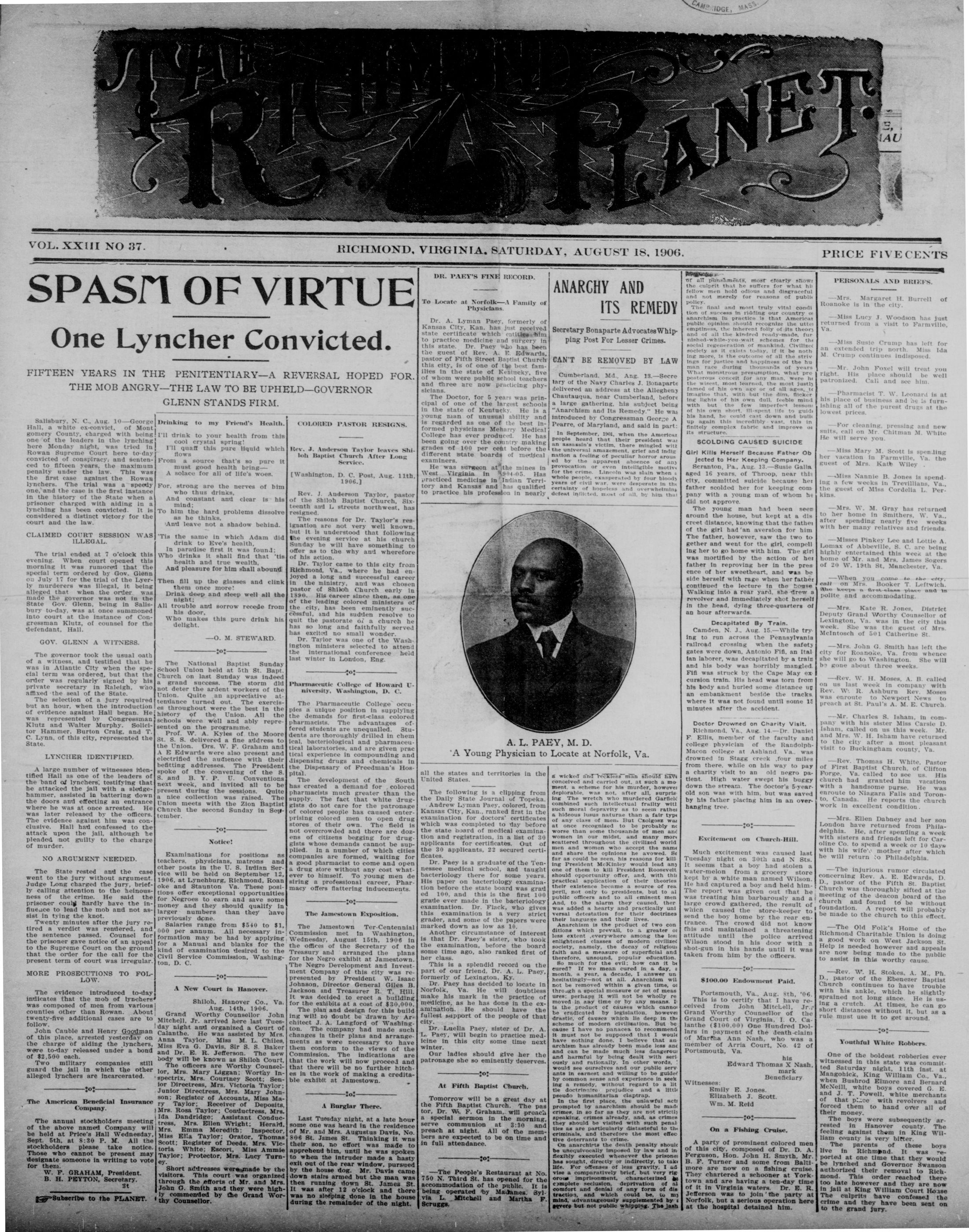
Salisbury, N. C., Aug. 10—George Hall, a white ex-convict, of Montgomery County, charged with being one of the leaders in the lynching here Monday night, was tried in Rowan Supreme Court here to-day convicted of conspiracy, and sentenced to fifteen years, the maximum penalty under the law. This was the first case against the Rowan lynchers. The trial was a speedy one, and the case is the first instance in the history of the State when a prisoner charged with aiding in a lynching has been convicted. It is considered a distinct victory for the court and the law.
CLAIMED COURT SESSION WAS
ILLEGAL
The trial ended at 7 o'clock this evening. When court opened this morning it was rumored that the special term ordered by Gov. Glenn on July 17 for the trial of the Lyerly murderers was illegal, it being alleged that when the order was made the governor was not in the State Gov. Glenn, being in Salisbury to-day, was at once summoned into court at the instance of Congressman Klutz, of counsel for the defendant. Hall.
GOV. GLENN A WITNESS.
The governor took the usual oath of a witness, and testified that he was in Atlantic City when the special term was ordered, but that the order was regularly signed by his private secretary in Raleigh, who affixed the seal of the State. The selection of a jury required but an hour, when the introduction of evidence against Hall began. He was represented by Congressman Klutz and Walter Murphy, Solicitor Hammer, Burton Craig, and T. C. Lynn, of this city, represented the State.
LYNCHER IDENTIFIED
A large number of witnesses identified Hall as one of the leaders of the band of lynchers, testifying that he attacked the jail with a sledgehammer, assisted in battering down the doors and effecting an entrance where he was at once arrested. He was later released by the officers. The evidence against him was conclusive. Hall had confessed to the attack upon the jail, although he pleaded not guilty to the charge of murder.
NO ARGUMENT NEEDED
The State rested and the case went to the jury without argument. Judge Long charged the jury, briefly calling attention to the helinousness of the crime. He said the prisoner could hardly have the influence to lead the mob and not assist in tying the knot.
Twenty minutes after the jury retired a verdict was reentered, and the sentence passed. Counsel for the prisoner gave notice of an appeal to the Supreme Court on the ground that the order for the call for the present term of court was irregular.
MORE PROSECUTIONS TO FOLLOW.
The evidence introduced to-day indicates that the mob of lynchers was composed of men from various counties other than Rowan. About twenty-five additional cases are to follow.
John Canble and Henry Goodman of this place, arrested yesterday on the charge of aiding the lynchers, were to-day released under a bond of $2,500 each.
Two military companies still guard the jail in which the other alleged lynchers are incarcerated.
The American Beneficial Insurance Company.
The annual stockholders meeting of the above named Company will be held at Price's Hall Wednesday. Sept. 5th, at 8:30 P. M. All the stockholders please take notice. Those who cannot be present may designate someone in writing to vote for them. W. F. GRAHAM, President. B. H. PEYTON, Secretary. 3t
GLENN STANDS FIRM
Drinking to my Friend's Health.
I'll drink to your health from this cool, crystal, surging!
I'll quaff this pure Liquid which flows
From a source that's so pure it must good health bring—
A solace for all of life's woes.
For, strong are the nerves of him who thus drinks.
And constant and clear is his mind;
To him the hard problems dissolve as he thinks,
And leave not a shadow behind.
Tis the same in which Adam did drink to Eve's health.
In paradise first it was found;
Who drinks it shall find that 'tis health and true wealth.
And pleasure for him shall abound!
Then fill up the glasses and clink
them once more!
Drink deep and sleep well all the
night;
All trouble and sorrow recede from his door,
Who makes this pure drink his delight.
—O. M. STEWARD.
The National Baptist Sunday School Union held at 5th St. Bapt. Church on last Sunday was indeed a grand success. The storm did not deter the ardent workers of the Union. Quite an appreciative attendance turned out. The exercises throughout were the best in the history of the Union. All the schools were well and ably represented on the programme.
Prof. W. A. Kyles of the Moore St. S. s. delivered a fine address to the Union. Drs. W. F. Graham and A E Edwards were also present and electrified the audience with their befitting addresses. The President spoke of the convening of the S. S. and B. Y. P. U. Conventions next week, and invited all to be present during the sessions. Quite a nice collection was raised. The Union meets with the Zion Baptist Church the second Sunday in September.
Notice!
Examinations for positions as teachers, physicians, matrons and other posts in the U. S. Indian Service will be held on September 12, 1906, at Lynchburg, Richmond, Roan oke and Staunton Va. These positions offer exceptional opportunities for Negroes to earn and save some money and they should qualify in larger numbers than they have previously done.
Salaries range from $540 to $1,000 per annum. All necessary information may be had by applying for a Manual and blanks for the kind of examination desired to the Civil Service Commission, Washington, D. C.
A New Court in Hanover.
Shiloh, Hanover Co., Va Aug. 14, 1806
Grand Worthy Counselor John Mitchell, Jr. arrived here last Tuesday night and organized a Court of Calanthe. He was assisted by Mrs. Anna Taylor, Miss M. L. Chiles, Miss Eva G. Davis, Sir S. S. Baker and Dr. E. R. Jefferson. The new body will be known as Shiloh Court. The officers are Worthy Counselor, Mrs. Mary Liggan; Worthy Inspectrix, Mrs. Courtney Scott; Senior Directress, Mrs. Victoria Taylor; Junior Directress, Mrs. Mary Johnson; Register of Accounts, Miss Mary Taylor; Receiver of Deposits, Mrs. Rosa Taylor; Conductress, Mrs. Ida Dandridge; Assistant Conductress, Mrs. Ellen Wright; Herald, Mrs. Emma Meredith; Inspector, Miss Ella Taylor; Orator, Thomas Scott; Register of Deeds, Mrs. Victoria White; Escort, Miss Ammie Taylor; Protector, Mrs. Lucy Turney. Short addresses were made by the visitors. This court was organized through the efforts of Mr. and Mrs. John G. Smith and they were highly commended by the Grand Worthy Counselor.
RICHMOND, VIRGINIA, SATURDAY, AUGUST 18, 1906.
COLORED PASTOR RESIGNS.
Rev. J. Anderson Taylor leaves Shiloh Baptist Church After Long Service.
[Washington, D. C. Post, Aug. 11th, 1906.]
Rev. J. Anderson Taylor, pastor of the Shiloh Baptist Church, Sixteenth and L streets northwest, has resigned.
The reasons for Dr. Taylor's resignation are not very well known, but it is understood that following the evening service at his church Sunday he will have something to offer as to the why and wherefore of his action.
Dr. Taylor came to this city from Richmond, Va., where he had enjoyed a long and successful career in the ministry, and was chosen pastor of Shiloh Church early in 1890. His career since then, as one of the leading colored ministers of the city, has been eminently successful, and his sudden resolve to quit the pastorate of a church he has so long and faithfully served has excited no small wonder.
Dr. Taylor was one of the Washington ministers selected to attend the international conference held last winter in London, Eng.
Pharmaceutical College of Howard U
niversity, Washington, D. C.
The Pharmaceutic College occupies a unique position in supplying the demands for first-class colored pharmacists. The advantages offered students are unequalled. Students are thoroughly drilled in chemical, bacteriological and pharmaceutical laboratories, and are given practical experience in compounding and dispensing drugs and chemicals in the Dispensary of Freedman's Hospital.
The development of the South has created a demand for colored pharmacists much greater than the supply. The fact that white drug-gists do not care for the patronage of colored people has caused enterprising colored men to open drug stores of their own. The field is not overcrowded and there are dozens of citizens begging for drug-gists whose demands cannot be supplied. In a number of which cities companies are formed, waiting for a good pharmacist to come and open a drug store without any cost whatever to himself. To young men deiring a professional career, Pharmacy offers flattering inducements.
The Jamestown Exposition.
The Jamestown Ter-Centennial Commission met in Washington, Wednesday, August 15th, 1906 in the offices of the Secretary of the Treasury and arranged the plans for the Negro exhibit at Jamestown. The Negro Development and Investment Company of this city was represented by President W. Isaac Johnson, Director General Giles B. Jackson and Treasurer R. T. Hill. It was decided to erect a building for the exhibits at a cost of $30,000. The plan and design for this building will no doubt be drawn by Architect J. A. Langford of Washington. The company had made such changes in their plans and arrangements as were necessary to have them conform to the views of the Commission. The indications are that the work will now proceed and that there will be no further hitches in the work of making a creditable exhibit at Jamestown.
A Burglar There.
Last Tuesday night, at a late hour some one was heard in the residence of Mr. and Mrs. Augustus Davis, No. 806 St. James St. Thinking it was their son, no effort was made to apprehend him, until he was spoken to when the intruder made a hasty exit out of the rear window, pursued by the house dog, Mr. Davis came down stairs armed but the man was then running down St. James St. It was after 12 o'clock and there was no sleeping done in the house during the remainder of the night.
A. L. PAEY, M. D.
'A Young Physician to Locate at Norfolk, Va.
DR. PAEY'S FINE RECORD.
To Locate at Norfolk—A Family of Physicians.
Dr. A. Lyman Pae, formerly of Kansas City, Kan. has just received state certificate which entitles him to practice medicine and surgery in this state. Dr. Pacy who has been the guest of Rev. A. E. Edwards, pastor of Fifth Street Baptist Church this city, is of one of the best families in the state of Kentucky, five of whom were public school teachers and three are now practicing physicians.
The Doctor, for 5 years was principal of one of the largest schools in the state of Kentucky. He is a young man of unusual ability and is regarded as one of the best informed physicians Meharry Medical College has ever produced. He has been going over the country making grades of 100 per cent before the different state boards of medical examiners.
He was surgeon at the mines in West Virginia. In 1904-05. Has practiced medicine in Indian Territory and Kansas and has qualified to practice his profession in nearly
A. L. PA
'A Young Physician to
all the states and territories in the United States.
The following is a clipping from the Daily State Journal of Topeka. Andrew Lyman Paey, colored, from Kansas City, Kan., ranked first in the examination for doctors' certificates which was completed to day before the state board of medical examination and registration, in a list of 30 applicants for certificates. Out of the 30 applicants, 22 secured certificates.
Dr. Paey is a graduate of the Tennessee medical school, and taught bacteriology there for some years. His paper on bacteriology examination before the state board was graded 100, and this is the first 100 grade ever made in the bacteriology examination. Dr. Flack, who gives this examination is a very strict grader, and some of the papers were marked down as low as 10.
Another circumstance of interest is that Dr. Paey's sister, who took the examination, before the board some time ago, also ranked first of her class.
This is a splendid record on the part of our friend, Dr. A. L. Paey, formerly of Lexington, Ky.
Dr. Paey has decided to locate in Norfolk, Va. He will doubtless make his mark in the practice of medicine, as he has done in the examination. He should have the fullest support of the people of that city.
Dr. Luella Paey, sister of Dr. A. L. Paey, will begin to practice medicine in this city some time next winter. Our ladies should give her the patronage she so eminently deserves.
At Fifth Baptist Church
Tomorrow will be a great day at the Fifth Baptist Church. The pastor, Dr. W. F. Graham, will preach a special sermon in the morning, serve communion at 3:30 and preach at night. All of the members are expected to be on time and in full attendance.
The People's Restaurant at No. 750 N. Third St. has opened for the accommodation of the public. It is being operated by Madames. Sylvia L. Mitchell and Martha F. Scruggs.
ANARCHY AND ITS REMEDY
ANARCHY AND ITS REMEDY
Secretary Bonaparte Advocates Whipping Post For Lesser Grimes.
CAN'T BE REMOVED BY LAW
Cumberland, Md., Ang. 18.—Secretary of the Navy Charles J. Bonaparte delivered an address at the Allegheny Chautauqua, near Cumberland, before a large gathering, his subject being "Anarchism and Its Remedy." He was introduced by Congressman George A. Pearre, of Maryland, and said in part: In September, 1901, when the American people heard that their president was an assassin's victim, there appeared the universal amusement, grief and indignation a feeling of peculiar horror aroused by the apparent absence of any provocation or even intelligible motive for the crime. Lincoln was slain when a few people, exasperated by four bloody years of the war, fell in the certainty of hopeless and overly humiliated defeat inflicted, most of all, by him that
EY, M. D.
Locate at Norfolk, Va.
a wicked and beckless man should have conceived and carried out, at such a moment, a scheme for his murder, however deplorable, was not, after all, surprising. The wretch who murdered Garfield combined such intellectual frailty with such moral deprivacy as to seem rather a hideous lusus naturae than a fair type of criminal. He was at once recognized to be probably no worse than some thousands of men and women in our midst, and many more scattered throughout the civilized world, men and women who accept the name and share the opinions he avowed. So far as could be seen, his reasons for killings were similar to those of one of them to kill President Roosevelt should opportunity offer, and, with this practical application of their theories their existence became a source of rea peril, not only to presidents, but to all public officers and to all eminent men And, to the alarm they caused, their existence became a universal detestation for their doctrines their language and their lives.
Anarchism is the product of two conditions which prevail, to a greater or less extent, everywhere among the less enlightened classes of modern civilized society, namely, the decay of religious faith and a measure of superficial and theological knowledge, so much for the evil; how can it be cured? If we mean cured in a day, a month, a year, a decade, I answer unhesitatingly—not at all. Anarchism will not be removed within a given time, or through a special measure or set of measures; perhaps it will not be wholly removed in any time or by any means. It is the product of causes which cannot be removed by any means. The drastic, of causes which lie deep in the scheme of modern civilization. But be cause I have no panacea to recommend it must not be supposed that I would have nothing done. I believe that anarchism has already been made less and can be made much less dangerous and harmful by being dealt with seriously and rationally. In other words, I would see ourselves and our public service by common sense and experience in seeking a remedy, without regard to a little诅谆irme, prejudice and a little pseudo humanitarian clapstap. In the first place, the unlawful acts prompted by anarchism should be made crimes, in so far as they are not strictly speaking, crimes already, and, as crimes they should be visited with such penal measures as may be necessary to the criminals, and therefore the most effective deterrents to crime.
On anarchists the death penalty should be unequivocally imposed by law and inflexibly executed whenever the prisoner has sought, directly or indirectly, to take life. For offenses of less gravity, I ad vise a comparatively brief, but very rigorous imprisonment, characterized by complete seclusion, deprivation of all comfort and denial of any form of distraction, and which could be, to my mind, advantageously supplemented by a severe but not public whipping. The lash
of all punishments, most clearly shows the culprit that he suffers for what his fellow men hold odious and disgraceful and not merely for reasons of public policy. The final and most truly vital condition of success in ridding our country of anarchism in practice is that American law should be written emptiness, the inherent folly of its theory and of all the kindred ready-made, furnished-white-you-wait schemes for the social regeneration of mankind. Clillized society as it exists today, if it be nothing more, is the outcome of all the strivings for justice and happiness of the human race during thousands of years of oppression and prejudice and posterous concept for any man, were he the wisest, most learned, the most hiried of his own age or of all ages, it imagine that, with but the dim, flickering lights of his own dull, feeble mind with but the few imperfect lessons of his own short, ill-spent life to guild his hand, he could cast down and built up on this incredibly cast, this in finely complex fabric and improve on its structure.
SCOLDING CAUSED SUICIDE
Girl Kills Herself Because Father Ob
Jected to Her Keeping Company.
Scranton, Pa., Aug. 13—Susie Gallia
aged 16 years, of Throop, near this
city, committed suicide because her
father scolded her for keeping company with a young man of whom he
did not approve.
The young man had been seen
around the house, but kept at a dis
creet distance, knowing that the father
of the girl had 'an aversion for him
The father, however, saw the two to
gether and went for the girl, compell
ing her to go home with him. The girl
was mortified by the action of her
father in reproving her in the pres
ence of her sweetheart, and was be
side herself with rage when her father
continued the lecture in the house.
Walking into a rear yard, she drew a
revolver and immediately shot herself
in the head, dying three-quarters of
an hour afterwards.
Decapitated By Train.
Camden, N. J., Aug. 15.—While trying to run across the Pennsylvania railroad crossing when the safety gates were down, Antonio Fifi, an Italian laborer, was decapitated by a train and his body was horribly mangled. Fifi was struck by the Cape May excursion train. His head was torn from his body and hurled some distance up an embankment beside the tracks, where it was not found until some 15 minutes after the accident.
Doctor Drowned on Charity Visit. Richmond, Va., Aug. 14.—Dr. Daniel F. Ellis, member of the faculty and college physician of the Randolph-Macon college at Ashland, Va. was drowned in Stagg creek, four miles from there, while on his way to pay a charity visit to an old negro patient. High water swept his buggy down the stream. The doctor's 5-year-old son was with him, but was saved by his father placing him in an overhanging tree.
Excitement on Church-Hill
Much excitement was caused last Tuesday night on 30th and N Sts. It seems that a boy had stolen a water-melon from a grocery store kept by a white man named Wilson. He had captured a boy and held him. The report was given out that he was treating him barbarously and a large crowd gathered, the result of which caused the store-keeper to send the boy home by the rear entrance. The crowd did not know this and maintained a threatening attitude until the police arrived Wilson stood in his door with a shot-gun in his hands until it was taken from him by the officers.
$100.00 Endowment Paid.
Portsmouth, Va. Aug. 8th, '06.
This is to certify that I have received from John Mitchell, Jr.
Grand Worthy Counselor of the Grand Court of Virginia, I. O. Cainthe ($100.00) One Hundred Dollars in payment of the death-claim of Martha Ann Nash, who was a member of Arria Court, No. 42 of Portsmouth, Va.
Emily E. Jones.
Elizabeth J. Scott.
Wm. M. Reid
A party of prominent colored men of this city, composed of Dr. D. A. Ferguson, Hon. John H. Smyth, Mr. B. F. Turner and some from Baltimore are now on a fishing cruise. They chartered a schooner at Yorktown and are having a ten-day time of it in Virginia waters. Dr. E. R. Jefferson was to join the party at Norfolk, but a serious operation here at the hospital detained him.
PERSONALS AND BRIEFES
—Mrs. Margaret H. Burrell of Roanoke is in the city.
—Miss Lucy J. Woodson has just returned from a visit to Farmville, Va.
—Miss Susie Crump has left for an extended trip north. Miss Ida M. Crump continues indisposed.
—Mr. John Foxel will treat you right. His place should be well patronized. Call and see him.
—Pharmacist T. W. Leonard is at his place of business and he is furnishing all of the purest drugs at the lowest prices.
—For cleaning, pressing and new suits, call on Mr. Chitman M. White He will serve you.
—Miss Mary M. Scott is spending her vacation in Farmville, Va. the guest of Mrs. Kate Wiley.
—Miss Nannie B. Jones is spending a few weeks in Trevillians, Va., the guest of Miss Cordelia L. Perkins.
—Mrs. W. M. Gray has returned to her home in Smithers, W. Va., after spending nearly five weeks with her many relatives and friends.
— Misses Pinkey Lee and Lottie A. Lomax of Abbeville, S. C. are being highly entertained this week at the home of Mr. and Mrs. James Sogers of 20 W. 19th St, Manchester, Va.
— When you come to the city, call on Mrs. Booker T. Leftwich. She keeps a first-class place and in polite and accommodating.
— Mrs. Kate R. Jones, District Deputy Grand Worthy Counsellor of Lexington, Va. was in the city this week. She was the guest of Mrs. McIntosch of 501 Catherine St.
— Mrs. John G. Smith has left the city for Roanoke, Va. from whence she will go to Washington. She will be gone about three weeks.
— Rev. W. H. Moses, A. B. called on us last week in company with Rev. W. R. Ashburn Rev. Moses was enroute to Newport News to preach at St. Paul's A. M. E. Church.
— Mr. Charles S. Isham, in company with his sister Miss Carsie D. Isham, called on us this week. Mr. and Mrs. W. H. Isham have returned to the city after a most pleasant visit to Buckingham county, Va.
—Rev. Thomas H. White, Pastor of First Baptist Church, of Clifton Forge, Va. called to see us. His church had granted him vacation with a handsome purse. He was enroute to Niagara Falls and Toronto, Canada. He reports the church work in excellent condition.
—Mrs. Ellen Dabney and her son London have returned from Philadelphia. He, after spending a week with sisters and friends left for Caroline Co. to spend a week or 10 days with his wife's mother after which he will return to Philadelphia.
—The injurious rumor circulated concerning Rev. A. E. Edwards, D. D., pastor of the Fifth St. Baptist Church was thoroughly sifted at the meeting of the deacon board of the church and found to be without foundation. A report will probably be made to the church to this effect.
—The Old Folk's Home of the Richmond Charitable Union is doing a good work on West Jackson St. Help is needed however and appeals are now being made to the public to assist in this worthy cause.
—Rev. W. H. Stokes, A. M., Ph. D., pastor of the Ebenezer Baptist Church continues to have trouble with his ankle, which he slightly sprained not long since. He is using a crutch. At times, he can go short distances without it, but as a rule must use it to get around.
Youthful White Robbers
One of the boldest robberies ever witnessed in this state was committed Saturday night, 11th inst. at Mangohick, King William Co., Va., when Bushrod Elmore and Bernard McNeill, white boys covered G. E. and J. T. Powell, white merchants of that place with revolvers and forced them to hand over all of their money.
The boys were subsequently arrested in Hanover county. The feeling against them in King William county is very bitter.
The parents of these boys live in Richmond. It was reported at one time that they would be lynched and Governor Swanson authorized their removal to Richmond. This order reached there too late however and they are now in jail at King William Court House. The culprits have confessed the crime and they have been sent on to the grand jury.
REFUGEES
CHAPTER I.
It was the sort of window which was common in Paris about the end of the seventeenth century. Inside the window was furnished with a broad bancal of brown stamped Spanish leather, where the family might recline and have an eye from behind the curtains on all that was going forward in the busy world beneath them. Two of them sat there now, a man and a woman, but their backs were turned to the spectacle and their faces to the large and richly furnished room. From time to time they stole a glance at each other, and their eyes told that they needed no other face and his bold features in section as he ran his eye over of the house. He had a soft gray bat of a shape which was to Parisian eyes, but his sombe and high boots were such as zen might have worn. Yet his appearance was so unusual group of townsfolk had alreadied round him, staring at mouth at his horse and him battered gun with an extrem
sight to make them happy
Nor was it to be wondered at, for they were a well favored pair. She was very young, twenty at the most, with a face which was pale, indeed, and yet of a brilliant pallor, which was so clear and fresh and carried with it such a suggestion of purity and innocence that one would not wish its maiden grace to be marred by an intrusion of color. In her whole expression there was something quiet and subdued, which was accentuated by her simple dress of black taffeta. Such was Adele Catinat, the only daughter of the famous Huguenot cloth merchant.
But if her dress was somber it was atoned for by the magnificence of her companion. He was a man who might have been ten years her senior, with a keen soldier face, small well marked features, a carefully trimmed black mustache and a dark hazel eye which might harden to command a man or soften to supplicate a woman and be successful at either. Any Frenchman would have recognized his uniform as being that of an officer in the famous Blue guard of Louis XIV. A trim, dashing soldier he looked, with his curling black hair and well poised head. Such he had proved himself before now in the field, too, until the name of Amory de Catinat had become conspicuous among the thousands of the valiant lesser noblesse who had flocked into the service of the king.
They were first cousins, these two, and there was just sufficient resemblance in the clear cut features to recall the relationship. Do Catinat was sprung from a noble Hughuenot family, but, having lost his parents early, he had joined the army and had worked his way without influence and against all olds to his present position. His father's younger brother, however, finding every path to fortune barred to him through the persecution to which men of his faith were already subjected, had dropped the "de" which implied his noble descent and had taken to trade in the city of Paris, with such success that he was now one of the richest and most prominent citizens of the town.
"Tell me. Adela." said he, "why do you look troubled?"
"You leave me this evening."
"But only to return tomorrow."
"And must you really, really go tonight?"
"It would be as much as my commission is worth to be absent. Why, I am on duty tomorrow morning outside the king's bedroom! After chapel time Major de Brissac will take my place, and then I am free once more. But still that line upon your brow, dearest."
"I was wishing that father would return."
"And why? Are you so lonely, then?" Her pale face lit up with a quick smile. "I shall not be lonely until tonight. But I am always uneasy when he is away. One hears so much now of the persecution of our poor brethren." "Tut, my uncle can defy them." "He has gone to the provost of the Mercer guild about this notice of the quartering of the dragoons."
"Ah, you have not told me of that."
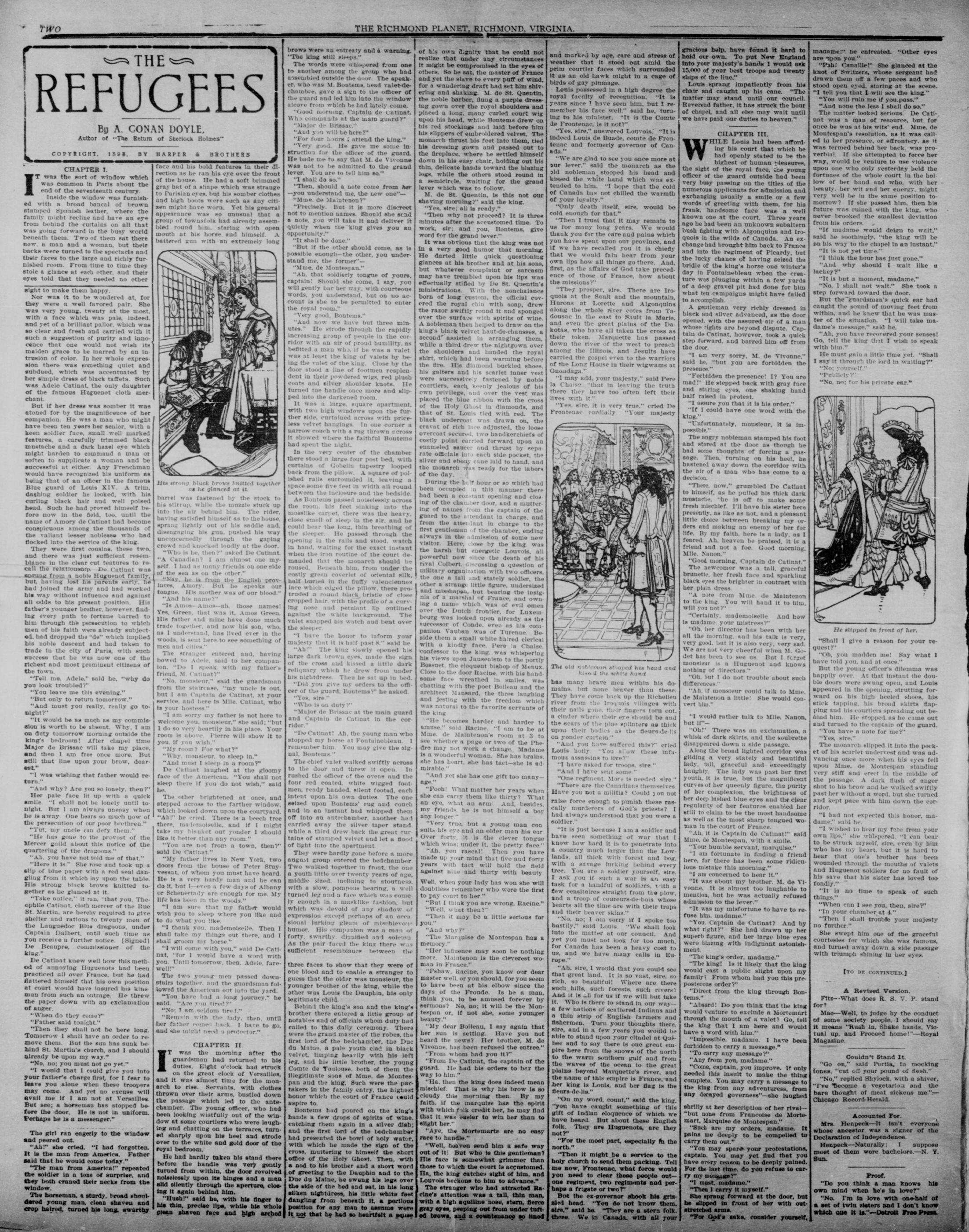
"Here it is." She rose and took up a slip of blue paper with a red seal dangling from it which lay upon the table. His strong black brows knitted together as he glanced at it.
"Take notice," it ran, "that you, Theophile Catinnat, cloth mercer of the Rue St. Martin, are hereby required to give shelter and ratios to twenty men of the Languedoc Blue dragoons, under Captain Dalbert, until such time as you receive a further notice. [Signed] De Beaupre, commissioner of the king."
De Catinat well how this method of annoying Huguenots had been practiced all over France, but he had flattered himself that his own position at court would have insured his kinsman from such an outrage. He threw the paper down with an exclamation of anger.
"Then they shall not be here long. Tomorrow I shall have an order to remove them. But the sun has sunk behind St. Martin's church, and I should already be upon my way."
"No, no; you must not go yet."
"I would that I could give you into your father's charge first, for I fear to leave you alone when these troopers may come. And yet no excuse will avail me if I am not at Versailles. But see; a horseman has stopped before the door. He is not in uniform. Perhaps he is a messenger."
The girl ran eagerly to the window and peered out.
"Ah!" she cried. "I had forgotten. It is the man from America. Father said that he would come today."
"The man from America!" repeated the soldier in a tone of surprise, and they both craned their necks from the window.
The horseman, a sturdy, broad shouldered young man, clean shaven and crop haired, turned his long, swarthy
TWO
"When do they come?"
"Father said tonight."
face and his bold features in their direction as he ran his eye over the front of the house. He had a soft brimmed gray hat of a shape which was strange to Parisian eyes, but his somber clothes and high boots were such as any citizen might have worn. Yet his general appearance was so unusual that a group of townsfolk had already assembled round him, staring with open mouth at his horse and himself. A battered gun with an extremely long
A man and a woman in a room with a window. The man is sitting on a bench, reading a book, while the woman stands beside him, holding a book.
His strong black brows litted together as he glanced at it.
barrel was fastened by the stock to his stirrup, while the muzzle stuck up into the air behind him. The rider, having satisfied himself as to the house, sprang lightly out of his saddle and, disengaging his gun, pushed his way unconcernedly through the gaping crowd and knocked loudly at the door.
"Who is he, then?" asked De Catnut.
"A Canadian? I am almost one myself. I had as many friends on one side of the sea as on the other."
"Nay, he is from the English provinces, Amory. But he speaks our tongue. His mother was of our blood."
"And his name?"
"Is Amos—Amos—ah, those names! Yes, Green, that was it, Amos Green. His father and mine have done much trade together, and now his son, who, as I understand, has lived ever in the woods, is sent here to see something of men and cities."
The stranger entered and, having bowed to Adele, said to her companion, "Do I speak with my father's friend, M. Catinat?" "No, monsieur," said the guardsman from the staircase, "my uncle is out, but I am Captain de Catinat, at your service, and here is Mile. Catinat, who is your hostess."
"I am sorry my father is not here to welcome you, monsieur," she said; "but I do so very heartily in your place. Your room is above. Pierre will show it to you, if you wish."
"My room? For what?"
"Why, monsieur, to sleep in."
"And must I sleep in a room?"
De Catinat laughed at the gloomy face of the American. "You shall not sleep there if you do not wish," said he.
The other brightened at once, and stepped across to the farther window, which looked down upon the courtyard. "Ah!" he cried. There is a beech tree there, mademoiselle, and if I might take my blanket youonder I should like it better than any room." "You are not from a town, then?" said D Catnat.
"My father lives in New York, two doors from the house of Peter Stuyvesant, of whom you must have heard. He is a very hardy man and he can do it, but I—even a few days of Albany or Schenectady are enough for me. My life has been in the woods." "I am sure that my father would wish you to sleep where you like and to do what you like." "I thank you, mademoiselle. Then I shall take my things out there, and I shall groom my horse."
"I will come with you," said De Cattin, "for I would have a word with you. Until tomorrow, then, Adele, farewell."
The two young men passed downstairs together, and the guardsman followed the American out into the yard.
"You have had a long journey," he said.
"Are you tired?"
"No: I am, seldom tired."
"Remain with the lady, then, until her father comes back. I have to go, and she might need a protector."
CHAPTER II
IT was the morning after the guardsman had returned to his duties. Eight o'clock had struck on the great clock of Versailles, and it was almost time for the monarch to rise. Servants, with clothes thrown over their arms, bustled down the passage which led to the ante-chamber. The young officer, who had been looking wistfully out of the window at some courtiers who were laughing and chatting on the terraces, turned sharply upon his heel and strode over to the white and gold door of the royal bedroom.
He had hardly taken his stand there before the handle was very gently turned from within, the door revolved noiselessly upon its hinges and a man slid silently through the aperture, closing it again behind him.
"Hush!" said he, with his finger to his thin, precise lips, while his whole clean shaven face and high arched
THE RICHMOND PLANET, RICHMOND, VIRGINIA
brows were an entreaty and a warning.
"The king still sleeps."
The words were whispered from one to another among the group who had assembled outside the door. The speaker, who was M. Boutems, head valet-de-chambre, gave a sign to the officer of the guard and led him into the window alceve from which he had lately come.
"Good morning, Captain de Catinnat. Who commands at the main guard?"
"Major de Brissac."
"And you will be here?"
"For four hours I attend the king."
"Very good. He gave me some instruction for the officer of the guard. He bade me to say that M. de Vivonne was not to be admitted to the grand lever. You are to tell him so."
"I shall do so."
"Then, should a note come from her—you understand me, the new one!"—"Mine, de Maintenon."
"Precisely. But it is more discreet not to mention names. Should she send a note, you will take it and deliver it quietly when the king gives you an opportunity."
"It shall be done."
"But if the other should come, as is possible enough—the other, you understand me, the former"—
"Mme. de Montespan."
"Ah, that soldierly tongue of yours, captain! Should she come, I say, you will gently bar her way, with courteous words, you understand, but on no account is she to be permitted to enter the royal room."
"Very good. Boutems."
"And now we have but three minutes." He strode through the rapidly increasing group of people in the corridor with an air of proud humility, as befitted a man who, if he was a valet, was at least the king of valets by being the valet of the king. Close by the door stood a line of footmen resplendent in their powdered wigs, red plush coats and silver shoulder knots. He turned the handle once more and slipped into the darkened room. It was a large, square apartment, with two high windows upon the further side, curtained across with价less velvet hangings. In one corner a narrow couch with a rug thrown across it showed where the faithful Boutems had spent the night.
In the very center of the chamber there stood a large four post bed, with curtains of Gobelin tapestry looped back from the pillow. A square of polished rails surrounded it, leaving a space some five feet in width all round between the inclosure and the bedside. As Bontemis passed noiselessly across the room, his feet sinking into the mosslike carpet, there was the heavy, close smell of sleep in the air, and he could hear the long, thin breathing of the sleeper. He passed through the opening in the rails and stood, watch in hand, waiting for the exact instant when the iron routine of the court demanded that the monarch should be roused. Beneath him, from under the costly green coverlet of oriental silk, half buried in the fluffy valenciennes lace which edged the pillow, there protruded a round black bristle of close cropped hair, with the profile of a curving nose and petulant lip outlined against the white background. The valet snapped his watch and bent over the sleeper.
"I have the honor to inform your majesty that it is half past 8," said he. "Ah!" The king slowly opened his large dark brown eyes, made the sign of the cross and kissed a little dark reliquary which he drew from under his nightdress. Then he sat up in bed. "Did you give my orders to the officer of the guard, Bontemps?" he asked. "Yes, sire." "Who is on duty?" "Major de Brissac at the main guard and Captain de Catinat in the corridor." "De Catinat! Ah, the young man who stopped my horse at Fontainebleau. I remember him. You may give the signal, Bontemps."
The chief valet walked swiftly across to the door and threw it open. In rushed the officer of the ovens and the four red coated, white wigged footmen, ready handed, silent footed, each intent upon his own duties. The one seized upon Bontems' rug and couch and in an instant bad wipped them off into an antechamber, another bad carried away the silver taper stand, while a third drew back the great curtains of stamped velvet and let a flood of light into the apartment.
They were hardly gone before a more august group entered the bedchamber. Two walked together in front, the one a youth little over twenty years of age, middle sized, inclining to stoutness, with a slow, pompous bearing, a well turned leg and a face which was comely enough in a masklike fashion, but which was devoid of any shadow of expression except perhaps of an occasional lurking gleam of mischievous humor. His companion was a man of forty, swarthy, disqualified and solemn. As the pair faced the king there was sufficient resemblance between the three faces to show that they were of one blood and to enable a stranger to guess that the older was mousieur, the younger brother of the king, while the other was Louis the Dauphin, his only legitimate child.
Behind I the king's son and the king's brother there entered a little group of notables and of officials whom duty had called to this daily ceremony. There were the grand master of the robes, the first lord of the bedchamber, the Duc du Maine, a pale youth clad in black velvet, limping heavily with his left leg, and his little brother, the young Comte de Toulouse, both of them the illegitimate sons of Mme. de Montespan and the king. Such were the partakers in the family entry, the highest honor which the court of France could aspire to.
Bontens had poured on the king's hands a few drops of spirits of wine, catching them again in a silver dish; and the first lord of the bedchamber had presented the bowl of holy water, with which he made the sign of the cross, muttering to himself the short office of the Holy Ghost. Then, with a nod to his brother and a short word of greeting to the Dauphin and to the Duc du Maine, he swung his legs over the side of the bed and set, in his long silken nightdress, his little white feet dangling from beneath it, a pervious position for any man to assume were it not that he had so heartfelt a sause
of his own dignity that he could not realize that under any circumstances it might be compromised in the eyes of others. So he sat, the master of France and yet the slave to every puff of wind, for a wandering draft had set him shivering and shaking. M. de St. Quentin, the noble barber, flung a purple dressing gown over the royal shoulders and placed a long, many curled court wig upon his head, while Bontems drew on his red stockings and laid before him his slippers of embroidered velvet. The monarch thrust his feet into them, tied his dressing gown and passed out to the fireplace, where he settled himself down in his easy chair, holding out his thin, delicate hands toward the blazing logs, while the others stood round in a semicircle, waiting for the grand lever which was to follow. M. de St. Quentin, is this not our shaving morning?" said the king. "Yes, sir; all to ready."
"Then why not proceed? It is three minutes after the accustomed time. To work, sir; and you, Bontenis, give word for the grand lever."
It was obvious that the king was not in a very good humor that morning. He darted little quick questioning glances at his brother and at his sons, but whatever complaint or sarcasm may have trembled upon his lips was effectually stifled by De St. Quentin's administrations. With the nonchalance born of long custom, the official covered the royal chin with soap, drew the razor swiftly round it and sponged over the surface with spirits of wine. A nobleman then helped to draw on the king's black velvet haut-de-chausses, a second assisted in arranging them, while a third drew the nightgown over the shoulders and handed the royal shirt, which had been warming before the fire. His diamond buckled shoes, his gaiters and his scarlet inner vest were successively fastened by noble courtiers, each keenly jealous of his own privilege, and over the vest was placed the blue ribbon with the cross of the Holy Ghost in diamonds, and that of St. Louis tied with red. The black undercoat was drawn on, the cavat of rich lace adjusted, the loose overcoat secured, two handkerchiefs of costly point carried forward upon an enameled saucer and thrust by separate officials into each side pocket, the silver and ebony cane laid to hand, and the monarch was ready for the labors of the day.
During the half hour or so which had been occupied in this manner there had been a constant opening and closing of the chamber door, and a muttering of names from the captain of the guard to the attendant in charge, and from the attendant in charge to the first gentleman of the chamber, ending always in the admission of some new visitor. Here, close by the king was the harsh but energetic Louvois, all powerful now since the death of his rival Colbert, discussing a question of military organization with two officers, the one a tall and stately soldier, the other a strange little figure, undersized and misshapen, but bearing the insignia of a marshal of France, and owning a name which was of evil omen over the Dutch frontier, for Luxembourg was looked upon already as the successor of Conde, even as his companion Vauban was of Turenne. Beside them a small white haired clerical with a kindly face, Pere a Chinese, confessor to the king, was whispering his views upon Jansenism to the portly Bosquet, the eloquent bishop of Meaux. Close to the door Racine, with his handsome face wreathed in smiles, was chatting with the poet Booleau and the architect Mansard, the three laughing and jesting with the freedom which was natural to the favorite servants of the king
"He becomes harder and harder to amuse," said Racine. "I am to be at Mme. de Maintenon's room at 3 to see whether a page or two of the Phedre may not work a change. Madame is a wonderful woman. She has brains, she has heart, she has tact—she is admirable."
"And yet she has one gift too many—age."
"Pooh! What matter her years when she can carry them like thirty? What an eye, what an arm! And, besides, my friends, he is not himself a boy any longer."
"Very true, but a young man consults his eye and an older man his ear. Over forty, it is the clever tongue which wins; under it, the pretty face."
"Ah, you rascal! Then you have made up your mind that five and forty years with tact will hold the field against nine and thirty with beauty
Well, when your lady has won she will doubtless remember who were the first to pay court to her."
"But I think you are wrong, Racine."
"Well, what then?"
"Then it may be a little serious for you."
"And why?"
"The Marquise de Montespan has a memory."
"Her influence may soon be nothing more. Malintenon is the cleverest woman in France."
"Fishaw, Racine, you know our dear master well, or you should, for you seem to have been at his elbow since the days of the Fronde. Is he a man, think you, to be amused forever by sermons? No, no; it will be the Montespan or, if not she, some younger beauty."
"My dear Boileau, I say again that her sun is setting. Have you not heard the news? Her brother, M. de Vivonne, has been refused the eutree."
"From whom had you it?"
"From De Catnat, the captain of the guard. He had his orders to ber the way to him."
"Ha, then the king does indeed mean mischief. That is why his brow is so cloudy this morning then. By my faith, if the marquise has the spirit with which folk credit her, he may find that it was easier to win her than to slight her."
"Aye, the Mortemarts are no easy race to handle."
"Well, heaven send him a safe way out of it! But who is this gentleman? His face is somewhat grimmer than those to which the court is accustomed. Ha, the king catches sight of him, and Louvois beckons to him to advance."
The stranger who had attracted Racine's attention was a tall, thin man, with a high aquiline nose, stern, fierce gray eyes, peeping out from under turtled brown, and a countenance so lined
and marked by age, care and stress of weather that it stood out amid the prim courtier faces which surrounded it as an old hawk might in a cage of birds of gay plumage.
Louis possessed in a high degree the royal faculty of recognition. "It is years since I have seen him, but I remember his face well," said he, turning to his minister. "It is the Comte de Frontenac, is it not?"
"Yes, sire," answered Louvis. "It is indeed Louis de Buade, comte de Frontenac and formerly governor of Canada."
"We are glad to see you once more at our lever," said the monarch as the old nobleman stooped his head and kissed the white hand which was extended to him. "I hope that the cold of Canada has not chilled the warmth of your loyalty."
"Only death itself, sire, would be cold enough for that."
"Then I trust that it may remain to us for many long years. We would thank you for the care and pains which you have spent upon our province, and if we have recalled you it is chiefly that we would fail hear from your own lips how all things go there. And, first, as the affairs of God take precedence of those of France, how about the missions?"
"They prosper, sir. There are Iroquois at the Sault and the mountain, Hurons at Lorette and Algonquils along the whole river cotes from Tadoussac in the east to Sault in Marle, and even the great plains of the Dakotas, who have all taken the cross as their token. Marquette has passed down the river of the west to preach among the Illinois, and Jesuits have carried the gospel even to the warriors of the Long House in their wigwams at Onondaga."
"I may add, your majesty," said Pere la Chise, "that in leaving the truth there they have too often left their lives with it."
"Yes, sire, it is very true," cried De Frontenac cordially. "Your majesty
A
The old nobleman stooped his head and kissed the white hand
has many brave men within his domains, but none braver than these. They have come back up the Richelieu river from the Iroquois villages with their nails gone, their fingers torn out, a cinder where their eye should be and the scars of the plue splinters as thick upon their bodies as the fleurs-de-lis on yonder curtain.
"And you have suffered this?" cried Louis hotly. "You allow these infamous assassins to live?"
"I have asked for troops, sire."
"And I have sent some."
"One regiment. More is needed sire."
"There are the Canadians themselves. Have you not a militia? Could you not raise force enough to punish these rassally murderers of God's priests? I had always understood that you were a soldier."
"It is just because I am a soldier and have seen something of war that I know how hard it is to penetrate into a country much larger than the Lowlands, all the thief with forest and bog, with a savage hirking behind every tree. You are a soldier yourself, sire. I ask you if such a war is an easy task for a handful of soldiers, with a few censalites straight from the plow, and a troop of coureurs-de-bois whose hearts all the time are with their traps and their beaver skins."
"No, no; I am sorry if I spoke too hastily," said Louis. "We shall look into the matter at our council. And yet you must not look for too much, for Canada has been a heavy cost to us, and we have many calls in Europe."
"Ab, sir, I would that you could see that great land. It is so vast, sire, so rich, so beautiful! Where are there such hills, such forests, such rivers? And it is all for us if we will but take it. Who is there to stand in our way—a few nations of scattered Indians and a thin strip of English farmers and fishermen. Turn your thoughts there, sire, and in a few years you would be able to stand upon your citadel at Quebec and to say there is one great empire here from the snows of the north to the warm southern gulf and from the waves of the ocean to the great plains beyond Marquette's river, and the name of this empire is France, and her king is Louis, and her flag is the fleurs-de-lis."
"On my word, count," said the king, "you have caught something of this gift of Indian eloquence of which we have heard. But about these English folk. They are Huguenots, are they not?"
"For the most part, especially fn the north."
"Then it might be a service to the holy church to send them packing. Tell me now, Frontenac, what force would you need to clear these people out—one regiment, two regiments and perhaps a frigate or two?"
But the ex-governor shook his grizzled head. "You do not know them, sir," said he. "They are a stern folk, these. We in Canada, with all your
gracious help, have found it hard to hold our own. To put New England into your majesty's hands I would ask 15,000 of your best troops and twenty ships of the line." Louis sprang impatiently from his chair and caught up his cane. "The matter may stand until our council. Reverend father, it has struck the hour of chapel, and all else may wait until we have paid our duties to heaven."
CHAPTER IIII
WHILE Louis had been affording his court that which he had openly stated to be the highest of human pleasures, the sight of the royal face, the young officer of the guard outside had been very busy passing on the titles of the numerous applicants for admission and exchanging usually a smile or a few words of greeting with them, for his frank, handsome face was a well known one at the court. Three years ago he had been an unknown subaltern bush fighting with Algonquins and Iroquois in the wilds of Canada. An exchange had brought him back to France and into the regiment of Plecardy, but the lucky chance of having seized the bridle of the king's horse one winter's day in Fontaleleau when the creature was plunging within a few yards of a deep gravel pit had done for him what ten campaigns might have failed to accomplish.
A gentleman very richly dressed in black and silver advanced, as the door opened, with the assured air of a man whose rights are beyond dispute. Captain de Catinat, however, took a quick step forward, and barred him off from the door.
"I am very sorry, M. de Vivonne," said he, "but you are forbidden the presence."
"Forbidden the presence! I? You are mad!" He stepped back with gray face and staring eyes, one shaking hand half raised in protest.
"I assure you that it is his order."
"I If I could have one word with the king."
"Unfortunately, mousieur, it is impossible."
The angry nobleman stamped his foot and stared at the door as though he had some thoughts of forcing a passage. Then, turning on his heel, he hastened away down the corridor with the air of a man who has come to a decision.
"There, now," grumbled De Catinat to himself, as he pulled his thick dark mustache. "he is off to make some fresh mischief. I'll have his sister here presently, as like as not, and a pleasant little choice between breaking my orders and making an enemy of her for life. By my faith, here is a lady, as I feared. Ah, heaven be praised, it is a friend and not a foe. Good morning, Mile, Nanon."
"Good morning, Captain de Catinat."
The newcomer was a tall, graceful brunette, her fresh face and sparkling black eyes the brighter in contrast with her plain dress.
"A note from Mme. de Maintenon to the king. You will hand it to him, will you not?"
"Certainly, mademoiselle. And how is madame, your mistress?"
"Oh. her director has been with her all the morning, and his talk is very, very good, but it is also very, very sad. We are not very cheerful when M. Godet has been to see us. But I forget monsieur is a Huguenot and knows nothing of directors."
"Oh, but I do not trouble about such differences."
"Ah, if monsieur could talk to Mme. de Maintenon a little! She would convert him."
"I would rather talk to Mille. Nanon, but if!"
"Oh!" There was an exclamation, a whisk of dark skirts, and the soubrette disappeared down a side passage.
Along the broad lighted corridor was gliding a very stately and beautiful lady, tall, graceful and exceedingly haughty. The lady was past her first youth, it is true, but the magnificent curves of her queenly figure, the purity of her complexion, the brightness of her deep lashed blue eyes and the clear regularity of her features enabled her still to claim to be the most handsome as well as the most sharp tongued woman in the court of France.
"Ah, it is Captain de Catinat!" said Mme. de Montespan, with a smile.
"Your humble servant, marquise."
"I am fortunate in finding a friend here, for there has been some ridiculous mistake this morning."
"I am concerned to hear it."
"It was about my brother, M. de Vivonne. It is almost too laughable to mention, but he was actually refused admission to the lever."
"It was my misfortune to have to refuse him, madame."
"You, Captain de Catinat? And by what right? She had drawn up her superb figure, and her large blue eyes were blazing with indignant astonishment.
"The king's order, madame."
"The king! Is it likely that the king would cast a public slight upon my family? From whom had you this preposterous order?"
"Direct from the king through Bontems."
"Absurd! Do you think that the king would venture to exclude a Mortemart through the mouth of a valet? Go, tell the king that I am here and would have a word with him."
"Iimpossible, madame. I have been forbidden to carry a message."
"To carry any message?"
"Any from you, madame."
"Come, captain, you improve. It only needed this insult to make the thing complete. You may carry a message to the king from any adventures, from any decayed governess"—she laughed shrilly at her description of her rival—"but none from Francois de Mortemart, Marquise de Montespan."
"Such are my orders, madame. It pains me deeply to be compelled to carry them out."
"You may spare your protestations, captain. You may yet find that you have every reason to be deeply pained. For the last time, do you refuse to carry my message?"
"I must, madame."
"There is nothing."
"Then I carry it myself."
She sprang forward at the door, but he slipped in front of her with outstretched arms.
"For God's sake, consider yourself,
madame!" he entreated. "Other eyes are upon you."
"Pah! Canalille!" She glanced at the knot of Switzers, whose sergeant had drawn them off a few paces and who stood open eyed, staring at the scene.
"I tell you that I will see the king."
"You will ruin me if you pass."
"And you will be the king."
But note the less I want to do.
The matter looked serious. De Catnat was a man of resource, but for once he was at his wits' end. Mme. de Montespan's resolution, as it was called in her presence, or effrontery, as it was termed behind her back, was provicial. If she attempted to force her way, would be venture to use violence upon one who only yesterday held the fortunes of the whole court in the hollow of her band and who, with her beauty, her wit and her energy, might very well be in the same position tomorrow? If she passed him, then his future was ruined with the king, who never brooked the smallest deviation from his orders.
"If madame would deign to wait," said he soothingly, "the king will be on his way to the chapel in an instant."
"It is not yet time."
"I think the hour has just gone."
"And why should I wait like a lackey?"
"It is but a moment, madame."
"No, I shall not wait." She took a step forward toward the door.
But the guardsman's quick ear had caught the sound of moving feet from within, and he knew that he was master of the situation. "I will take madame's message," said he.
"Ah, you have recovered your senses! Go, tell the king that I wish to speak with him."
He must gain a little time yet. "Shall I say it through the lord in waiting?"
"No; yourself."
"Publicly?"
"No; for his private ear."
A
He slipped in front of her.
"Shall I give a reason for your request?"
"Oh, you madden me! Say what I have told you, and at once."
But the young officer's dilemma was happily at. At that instant the double doors were swung open, and Louis appeared in the opening, strutting forward on his high heeled shoes, his stick tapping, his broad skirts flapping and his courtiers spreading out behind him. He stopped, as he came out and turned to the captain of the guard.
"You have a note for me?"
"Yes, sire."
The monarch slipped it into the pocket of his scarlet undervest and was advancing once more when his eyes fell upon Mine. de Montespan standing very stiff and erect in the middle of the passage. A dark flush of anger shot to his brow and he walked swiftly past her without a word, but she turned and kept pace with him down the corridor.
"I had not expected this honor, madame," said he.
"I wished to hear my fate from your own lips," she whispered. "I can bear to be struck myself, sire, even by him who has my heart, but it is hard to hear that one's brother has been wounded through the mouths of valets and Huguenot soldiers for no fault of his save that his sister has loved too fondly."
"It is no time to speak of such things."
"When can I see you, then, sire?" "In your chamber at 4."
"Then I shall trouble your majesty no further."
She swept him one of the graceful courtesies for which she was famous, and turned away down a side passage with triumph shining in her eyes.
【TO BE CONTINUED.】
A Revised Version.
Fitz--What does R. S. V. P. stand for?
Mac—Well, to judge by the conduct of some society people, I should say it means "Rush in, Shake hands, Victual up, and Proceed home!"—Royal Magazine.
Couldn't Stand It
"No," replied Shylock, with a shiver,
"I've Become a vegetarian and the bare thought of meat sickens me."—Chicago Record-Herald.
Accounted For
Mrs. Henpeck—It isn't everyone whose ancestor was a signer of the Declaration of Independence.
Henpeck—Naturally: I suppose most of them were bachelors.—N. Y. Sun.
Proof.
"Do you think a man knows his own mind when he's in love?"
"No. I'm in love with one-half of a set of twin sisters and I don't know which one it is"—Detroit Free Press.
THE PLANET
SATURDAY...AUGUST 18TH. '06.
TRYING TO CHOOSE THE
LEAST OF TWO EVILS
The beautiful girl sighed deeply and was almost affected to tears.
"Harold Spuffens," she said, "declares that if I don't marry him he will end his life, and that then I will be sorry. And I am afraid he will."
She stifled a sob of apprehension, then continued:
"And Randolph Rantem declares that if I don't marry him he will go into politics and become great and famous, and then he says I will see what I have missed. And I am afraid he will keep his word, too."
Torn by conflicting emotions, she buried her face in her hands, not knowing whether to save a life or to spare the country another statesman. —Judge
Of Course.
"I notice," said the critic, "that in this ode to liberty you say:
"The message came to the listening land.
The winds of heaven carried each word; And hill and valley and plain and strand Were glad for the marvel of what they heard."
"Yes, sir," replied the hopeful poet.
"But how in the world can a land hear?"
"I—er—I suppose a land has frontiers, hasn't it?"—Cassells.
Truthful Tommy.
"Tommy," said a father to his son. "have you been at those six peaches I put in the cupboard?"
"Then how is it your mother found five peach stones in your bedroom, and there is only one peach left on the plate?"
"That," said Tommy, as he dashed wildly for the door, "is the one I didn't touch"—Tit-Bits.
A Concrete Example
"Thomas," said the teacher of the class in physiology, "can you give a familiar instance of the power of the human system to adapt itself to changed conditions?" "Yes'm," responded Tommy Tucker. "My aunt gained a hundred pounds in flesh in less'n a year, an' her skin didn't crack a bit."—Royal Magazine.
Highly Considerate
"Why doesn't Bliggins try to make a reputation for himself?" asked the painter.
"He says he's too philanthropic," answered the musician. "He thinks it would be an injury to the world's artistic sense to have the public constantly repeating the name of 'Bliggins'."—Washington Star.
No Turning
"And only a narrow grave at lai!" sighed the dramatist.
For a little his lip quivered, and then these dawned a new hope.
"If the amateurs will only let my works alone, a narrow grave will answer," he exclaimed, intensely.—Puck.
Equally Elated.
"I'm the buckiest man in town!" declared the real estate man. "I bought a $10,000 piece of property this morning for just half price." "I know just how you feel!" said the pretty girl. "I bought two yards of 60-cent ribbon this morning for 30 cents!"—Detroit Free Press.
Knows His Place.
"Does your wife keep any dumb brutes, Mr. Henpeck?"
"None besides me."—Houston Post.
T
"So you no longer call your pretty little home 'The Nutshell?' Why did you change it?"
"I got so tired of having funny men ring my bell to ask if the kernel was in."—Illustrated Bits.
**Definition of a Philosopher.**
A fisherman—a hollow mask.
Of funny fiction and a flask!
-N. Y. Sun.
The Women Knew.
She—It is said that half the world don't know how the other half lives. He—Well, you can bet there are no women in the half that don't!—Yonkers Stateman.
In a law case, one of the witnesses for the defense irritated the plaintiff's counsel by apparently attempting to evade giving direct answers.
"Sir," said the lawyer, sternly, "you need not state your impressions. We want the facts. We are competent to form our own impressions. Now, sir, answer me categorically."
From that time on he could get little more than "yes" and "no" out of the witness. Presently the lawyer said:
"You say you live next door to the defendant?"
"Yes."
"To the north of him?"
"No."
"To the south?"
"No."
"Well, to the west, then?"
"No."
"Ah," said the lawyer, sarcastically, "we are likely at last to get down to the one real fact. You live to the east of him, do you?"
"How is that, sir?" the astonished counsel asked. "You say you live next door to him. Yet he lives neither to the north, south, east nor west of you. What do you mean by that, sir?" "I thought perhaps you were competent to form the impression that we live in a flat," said the witness, calmly; "but I see I must inform you that he lives next door above me."
THE TRYING TRADESMAN
"Haven't you something—aw—more suited to my head?"
"Do you mean a soft hat, sir?"—London Tatler.
Still Prayng for a Man
She's got a brand-new auto cap,
She's got some auto clothes;
She's got a pair of goggles, and
A smell-guard for her nose.
She's got a veil quite big enough
For a mosquito bar;
A knew she's praying for a man
Who's got a car.
—Yonkers Statesman.
Diplomaev.
"Sir," said the angry female, "I understand you said I had a face that would stop a street car in the middle of the block."
"Yes, that's what I said," calmly answered the mere man. "It takes an unusually handsome face to induce a motorman to make a stop like that."
—Chicago Daily News.
Had No Kick Coming.
"What," asked the sweet girl graduate, "was the happiest moment of your life?" "The happiest moment of my life," answered the old bachelor, "was when the jeweler took back the engagement ring and gave me collar buttons in exchange."—Chicago Daily News.
Almost Pitiful
"Oh, dear," she half whispered, "I'm so hoarse I can hardly make a sound."
"That's too bad," he replied.
"Yes. If you were to want to kiss me and I should try to scream I don't suppose I'd be able to make anybody hear me."—Chicago Record-Herald.
Anything But Friendly
"You astonish me. Your engagement with Miss Welloph is broken, is it? Are the relations between you still friendly?"
"I should say not! The relations between us are her relations, and they're my bitter enemies."—Chicago Tribune.
Not on View
"So these are your diamond curiosities?" asked the lady in the jewelry store. "I don't see anything startling about this one."
"No," replied the clerk, picking up the jewel, "that's so; the pricemark hta dropped off."—Detroit Free Press.
A Seashore Expert
Winters—Have you ever been thrown down?
Summers—Have I? Why, I always am. How do you think I could keep on proposing if I weren't?—Detroit Free Press.
Chesty.
Yeast—How does the colonel find room on his breast for all his medals? Crimsonbeak—Why, the more medals he gets, the more his chest expands.—Yonkers Statesman.
On One Point
"Do you and your wife agree on anything?"
"Yes. Each of us believes that one of us is very poorly mated."—Judge.
Discrimination.
"Politics," said the ambitious young man, "puts many temptations in a person's way."
"Yes," answered Senator Sorghum; "and the worst of it is that it is often difficult to discriminate between a temptation and an opportunity."—Washington Star.
Henpeck's Table Manners
"You say my table manners are bad?"
"Abominable! At the supper at Jinxes last night I hemmed and hawked and coughed and did everything I could to attract your attention so I could wink at you, and you never looked up."—Houston Post.
Knights of Pythias,
This organization is one of the most powerful in the country and its progress has been phenominal. The Grand Lodge of Virginia has jurisdiction over all of the cities and counties in this state. Thirty male are required to organize a new lodge. The benefits paid constitute one of its strongest features, but the principles are greater than anything else. Founded on Friendship, based on Charity and established on Benevolence, the respectable, upright people of the state will find it an order worthy of their heartiest support.
The Courts of Calanthe
Is the Female Department of the Order. It requires a membership of thirty persons to organize a court. Its members are pledged to exhibit Fidelity, exercise Harmony and prove Love one for the other. It pays an endowment and burial benefit of $150.00. It pays $3.00 per week sick dues. The only expense for regalia is the cost of the badge, 50 cents and a rosette, costing 25 cents for funeral occasions.
THE BANDS OF CALANTHE or Children's Department also constitutes a feature and persons cannot do better than to enter the little ones into this mystic circle. The expense is nominal and the benefits all that could be expected. It pays from $1.00 to $1.50 sick dues and death benefits of from $30.09 to $40.00. If you have no Pythian Lodge or Court or Band in your neighborhood, orgrnize one.
For all information concerning the Children's Department address.
For all information concerning special rates of membership in the lodges and courts, address
Jingle of the Jungle
Jingle of the Jungle.
Said the elephant to the giraffe:
"Your neck is too long by haffe."
Said the giraffe: "Your nose
Reaches your nose, your toes,
So at me you're no cause to laffe."
-Chicago Daily News.
The Old. Old Story
Adam had just succeeded after an exciting little struggle in getting Eve to stand still and be kissed. Looking up at him with earnest, pleading eyes, she asked:
Overlooks No Opportunity
"One thing I like about Miss Witcherleigh is that she has the sense of humor. A man never has to tell a joke twice to get her to laugh at it." "No. She can exhibit one of the prettiest dimples in the world when she smiles."—Chicago Record-Herald
There Is a Difference
"What is the difference between a white horse and a milk-white horse?" "Why, the white horse is pure white, and the milk-white ones is a little on the blue shade, I suppose."—Yonkers Statesman.
Knew His Place
"What did you think of your daughter's graduation essay?"
"I didn't permit myself to think about it," answered Mr. Cumrox. "I simply did my duty and admired it."—Washington Star.
Just the Thing.
Guest (to proprietor of summer hotel)—That's great music you have with the meals.
Proprietor—Like it, do you?
"Splendid! Makes me forget that
I'm not getting enough to eat."—Like
Throbled Some
"The heart of a man who has lived to the 70 has beaten 28,000,000 times."
"Then I lived to be 70 the evening I opposed to Miss Pouchie."—Nurs of est.
KNIGHTS OF PYTHIAKS
F.C.B.
only absolutely necessary rega
apply at the main office.
The Court
Is the Female Department of the
thirty persons to organize a court
Fidelity, exercise Harmony and
an endowment and burial bene
dues. The only expense for rea
rosette, costing 25 cents for fu
THE BANDS OF CALA
stitutes a feature and persons co
circle. The expense is nomina
$1.00 to $1.50 sick dues and de
Lodge or Court or Band in you
For all information concern
membership in the lodges and
STRAUS' SPECIAL
Old Yacht Club,
PURE WHISKEY
Will Satisfy the lover of the right kind of stimulant. Special prices. We have all grades of good liquors, Cigars and Tobacco. Call and see us.
ISAAC STRAUS & CO., 422 E. Broad St.,
Richmond, Virginia.
60 YEARS' EXPERIENCE
TRADE MARKS DESIGNS
COPYWRITERS & C.
Anyone sending a sketch and description may quickly ascertain our opinion free whether an invitation is probably possible. Communities thus surely consent. HANDBOOK. Patents sent free. Outset agency for securing patents. Parents taken through Jim & Co. receive special notice, without charge, in the
Scientific American.
A handsomely illustrated weekly. Largest cit-
culation and of any scientific journal. Tern-
mal for four months. Sold by mail noreseller.
MUNN & Co. 361 Broadway, New York
Branch Office, Ct. F St., Washington, D. C.
GEORGE O. BROWN,
PHOTOGRAPHER,
608 N. 2nd St., Richmond, Va.
Fine Photographs. True to Life. High-class
service. Latest Improvements in Photographs
Out-door work executed. Photographs Bargain
ed from Old newspapers or Photographs. 2-m
THE RICHMOND PLANET, RICHMOND, VIRGINIA
United Aid Insurance Company.
United Aid Insurance Company.
HOME OFFICE, 312 East Broad St., Richmond, Va.
Incorporated 1894 under the lawsof Virginia. Capital Stock, $25,000.
Has written over Three Million ($3,000,000-00) Dollars worth of business since organization.
Mission of Sorrow.
"Let sorrows and sadness come; they bear in their hearts the golden flower of higher enlightment. Let friends censure or forsake us; we cannot lose anything that is really ours. As externals of all sorts fall or disappoint us, the Great Heart draws us closer to itself. We are attuned to the music of the spheres; we join in the Song of Life with glad voice, our tones enriched by the experiences through which we have fought our way to this Chamber of Tranquility. Nothing can disturb the soul that is anchored in the Eternal."
Great Scott!
Poeticus—Everything I see is poetry to me.
Witticus—Yes, even the editors.
Poeticus—Eh?
Witticus—Well, they all seem to be at least a verse to you.—Cleveland Leader.
Chip Off the Old Block
DeLong-I met your son this morning.
Shortleigh-Don't you think he resembles a good deal?
DeLong-That's what. He tried to borrow a dollar from me.-Chicago Daily News.
Glad of It.
Glad of It.
Subbubs—Somebody's stolen our dog again. That's a d—
Mrs. Subbubs (hastily)—William!
William! don't swear about it.
Subbus—Who's swearing? I was just going to say it's a dog-gone big relief—Philadelphia Press.
She Knew
"Katherine," said Bob, as he brought his club chums down to the depot platform, "these are all my friends."
"Glad to meet you, gentlemen," replied the bride, sweetly, "and I am so sorry that you are going to be sick."
"Sick?" echoed the crowd, in astonishment. "Why should you think we are going to be sick?"
"Oh, because soon after the honey-moon a married man always finds a great many sick friends to sit up with."—Chicago Daily News.
N. A., S. A., E. A., A. AND A.
organization is one of the most powerful has been phenomenal. The Grand Court all of the cities and counties is needed to organize a new lodge. The strongest features, but the principles founded on Friendship, based on Charity, the respectable, upright people of their heartiest support. An endowment and burial benefit of up to per week sick dues. The badge of regalia. For information concerning Courts of Calantia.
Of the Order. It requires a member court. Its members are pledged and prove Love one for the other. The benefit of $150.00. It pays $3.00 per regalia is the cost of the badge, 500 funeral occasions.
ANTHE or Children's Department cannot do better than to enter the final and the benefits all that could death benefits of from $30.09 to $40 your neighborhood, orgrize one.
Using the Children's Department as Mrs. ANNA TAY
120 W. H.
Performing special rates of JOHN and courts, address
United Aid Insurance
HOME OFFICE, 312 East
Incorporated 1804 under the laws.
Has written over Three Million business since organization.
Over sixty-five thousand.
Over twenty-five Branches.
All claims paid to date.
Ten Thousand Dollars on Deposit in OFFICE
J. E. Byrd,
W. W. Lee,
D. S. Alston,
W. J. Spratley,
R. L. Clay,
R. H. Stokes,
R. C. Malloy.
BOARD OF
J. E. Eyrtd, W. J. Spratley W. W. Bailley, W. C. Carter, P. S. Stokes, F. Reliable men can find employment at Address,
THE PEOPLE'S REAL INVESTMENT COMMISSION
WHY NOT CALL ON US?
J. J. CARTER, President.
W. F. DENNY, Secretary.
```markdown
```
ALL ORDERS WILL RECEIVE
PROMPT ATTENTION.
Long Distance Phone. 752.
RICHMOND MEDICAL COLLEGE.
406 E. Baker Street,
RICHMOND, VIRGINIA
Chartured June 14, 1905. Co-educational. The only Colored College in Virginia for a thorough course in Medicine, Dentistry and Pharmacy. Session: 1905—1906 begins Oct. 2, 1905.
For further information, write.
J. ALEX. LEWIS, M. D.
Secretary
9-23-3 mos.
804 and 305 N. 3rd St..
Fine Tailoring
CLEANING,
DYEING,
AND REPAIRING
TURNER & WHITE,
PROPRIETORS.
BOARDING & LODGING
Rates Reasonable. All the Comforts
of Home
Orders received by letter or telegraph
MRS. BOOKER LEFTWICH,
PROPRIETRESS,
816 N. 2nd St. Richmond, K.
ythias,
A.
powerful in the country and its
and Lodge of Virginia has juris-
in this state. Thirty male:
the benefits paid constitute one
is greater than anything
marity and established on Be-
of the state will find it an order
of of $200.00 for all ages. It
are costing 75 cents each is the
ing the organization of lodges
the
membership of
it to exhibit
er. It pays
over week sick
50 cents and
ment also con-
the little ones into this mystic
ld be expected. It pays from
$40.00. If you have noPythian
address,
TAYLOR, W. M.,
Hill St., Richmond, Va.
N MITCHELL, JR.,
311 N. 4th St., Richmond, Va.
Insurance Company,
East Broad St., Richmond, Va.
Watson Virginia. Capital Stock, $25,000.
On ($3,000,000-00) Dollars worth of
and policy holders.
Riches.
Ease.
It with the Treasurer or Virginia.
FICERS.
1. President.
2. 1st Vice President.
3. 2nd Vice President.
4. Tuttle, Sect'y. and Gen'l. Manager.
5. Asst. Secretary.
6. Cashier and Treasurer.
7. General Inspector.
OF DIRECTORS.
7. Lee, D. S. Alston, R. L. Clay, V.
8. Brown, C. H. Jones, R. H.
9. E. Puryear.
As solicitors and agents.
UNITED AID INSURANCE CO.,
312 E. Broad St., Fitchmond, Va
REAL ESTATE AND
COMPANY.
When renting,
When buying,
When lending money,
When borrowing money,
When you want an estate managed
When you have Real Estate for sale
Just call Phone No. 4854.
John H. Braxton
John H. Braxton
REAL ESTATE & LOANS
Private Banker and Broker,
Loans negotiated on Real Estate,
Interest allowed on Deposits,
Estates managed,
Rent collected and prompt returns
Special attention to repairs.
Notary With Seal
Frank Waller, Jr
PRACTICAL HOUSE
PAINTER,
Residence, 1 E. Orange St.
Prompt attention given to all mail
ers. Satisfaction guaranteed.
1 Kinds of Painting Done Cheap.
Give me a call before going else-
where.
New 'Phone, 478.
ROBT. S. FORRESTER,
FLORIST
212 E. Leigh Street,
RICHMOND, VIRGINIA.
Plant Decorations, Choice Rose-
buds, Cut Flowers, Funeral Designs,
House Decorators for Wedding
Parties, &c. a specialty. Give me a call.
When You Are Sick
Vure and Fresh Medicines only will
sure you then purchase your
Drugs and Medicine from:
Leonard's
Reliable
Prescription
Drug Store.
724 North Second Street.
BEFORE
MAKING
Your purchase you would do well
to call at the most reliable furniture
house in the city and see the fine
line of
Refrigerators,
Slattings, Oil-Cloths,
And in fact everything that is need-
ed in house furnishings.
RUGS AND CARPETS.
Of every description; also the latest designs in ROOKERS and special CHAIRS. Our goods are the best for the price and the price is very low.
C. G. Jurgen's Son
421 EAST BROAD ST.,
between 4th and 5th Street
PLANET DEPOTS.
NEW YORK CITY.
P. Ritzheimer, 7 N. 134th St.
M. B. Wineglass, 334 N. 53d St.
Green and Bailey, 249 E. 127th St.
J. W. Watkins, 1931 Broadway.
Mrs. M. Glbs 130 W. 30th St.
J. H. Parker, 144 W. 26th St.
Charles Devan, 1.1 W. 30th St.
C. H. Lanear, 56 W. 99th St.
W. J. Buckner, 150 W. 53rd St.
R. Plummer, 124 W. 134th St.
M. W. Slaughter, 312 W. 40th St.
W. W. Johnson, 247 W. 47th St.
E. H. Mitchell, 152 W. 27th St.
Standard News Co., 323 W. 37th 90
Turner R. Robinson, 12-6th Ave.
E. A. Williams, 200 W. 63rd St.
M. B. Walker, 309 W. 37th St.
J. H. Jarrett, 453-7th Ave.
Smith & Miles, 232 W. 41st St.
M. B. Wineglass, 322 W. 59th St.
P. Bell, 239 W. 124th St.
PHILADELPHIA, PA.
M. Clay, 1801 Fitzwater St.
M. H. Gray, 1233 Pine St.
Bishop Robinson, 1234 Melon St.
E. P. Mackens, 1116 Pine St.
James E. Warwick, 254 S. 11th St.
Mrs. B. Homsher, 1040 Pine St.
S. Fingerot, 1218 Pine St.
William Parker, 631 Pine St.
Mrs. Lavinia Aldridge, 521 S. 12th.
Chas. A. George, 4063 Market St.
F. A. Stewart, 1730 Federal St.
PITTSBURG, PA
Jos. Evans, care Jones & Laughlin
E. K. Thumm., 1402 Wylie Ave.
A. Johnson, 1230 Wylie Ave.
BOSTON. MASS
C. Branum, 657 Shawmut Ave.
J. W. White, 832 Tremont St.
NORFOLK, VA.
John Debona, 610 Church St.
T. E. W. Perry, 2 Jonee Place.
CLEVELAND, OHIO.
J. H. Jackson, 3315 Central Ave.
CHICAGO, ILL.
E. H. Faulkner, 3104 State St.
BROOKLYN, N. Y.
J. A. Hursey, 1486 Bergen St.
Lee Ricks, 782 Fulton St.
William A. Dabney, 3 Quincy St.
William Pope, 174 Myrtle Ave.
CHARLESTON, W. VA.
L. C. Farrar, 501 Brooks St.
ASTORIA, L. I.
Frank R. Wood, 144 Broadway.
ATLANTIC CITY, N. J.
Hursey Bros., 1217 Commerce Ave.
P. E. Baptist, 21 N. Kentucky Ave.
J. E. Carroll, 21 N. Kentucky Ave.
Frank A. Hursey, 945 Baltic Ave.
W. J. Stanford, 1 N. Michigan Ave.
BRONX BOROUGH, N. Y.
J. H. Barrett, 608-162d St.
THREE
ROBT. W. WILLIAMS,
FUNERAL DIRECTOR &
EMBALMER.
NO. 6019 P. STREET, BETWEEN
30TH AND 31ST STREETS.
RICHMOND, - - - VA.
Special attention given to all business entrusted to me. Carriages for funerals, receptions and marriages at all hours. Satisfaction guaranteed to all.
A. Hayes
First-class Hacks and Caskets of all descriptions. I have a spare room for bodies when the family have not a suitable place. All country orders are given special attention. Your special attention is called to the new style Oak Caskets Call and see me and you shall be wetted on kindly.
'Phone, 2778.
Custalo House.
Custalo House.
702 East Broad Street.
Having remodeled my BAR, and having an up-to-date place, I am prepared to serve my friends and the public at the same old stand.
MEALS AT ALL HOURS
phone 1261
WM MST ST. DAVID
S. W. ROBINSON.
NO. 23 NORTH 18TH ST.
DEALER IN
FINE WINES, LIQUORS
CIGARS, &c.
All Stock Sold as Guaranteed.
• PROMPT ATTENTION.
Your patronage is respectfully solicited.
JOHN M. HIGGINS,
DEALER IN
DEALER IN
CHOICE GROCERIES,
WINES LIQUORS,
AND CIGARS.
PURE GOODS, FULL VALUE FOR
THE MONEY.
1610 East Franklin Street
[Near Old Market.]
RICHMOND, VIRGINIA
PLAINFIELD, N. J.
Thos. H. Bridges, 614 W. 4th St.
BRADDOCK, PA.
G. A. Nevels, 421-6th St.
WASHINGTON, D. C.
W. L. Smith, 2201-7th St., N. W.
F. O. Robinson, 634 O. St., N. W.
Miss E. Morris, 2000-11th St.
L. H. Singleton, 20th and E Sts.
R. S. Douglass, 1405 F. St.
Southwestern Drug Co.
732-23 Street, S. W.
LAWRENCE, MASS.
A. E. Evans, 382 Essex St.
SPRINGFIELD, MASS.
W. H. Brown, 13 Stockbridge St.
COVINGTON, VA.
Daniel Braxton, Box 91.
NEWPORT NEWS, VA.
E. J. Jefferson, 1211-30th St.
George T. Hall, 1332-30th St.
TARBORO, N. C.
V. E. Howard.
WILMINGTON, N. C.
William H. Moere.
STAUNTON, VA.
Wm. C. Johnston, 111 E. Main St.,
LYNCHBURG, VA.
Charlee Morgan, 702 Taylor St.
HAMPTON, VA.
John M. Phillips.
DANVILLE, VA.
O. P. Clark, 233 N. Union St.,
PORTSMOUTH, VA.
H. S. Cooper, 1332 County St.,
JACKSONVILLE, FLA.
John H. Johnson, 210 Bridge St.,
PROVIDENCE, R. I.
Douglass A. A. P. Agency,
YOUNGSTOWN OHIO.
Howard Thompson,
827 W. Myrtle Ave.
DEMOPOLIS, ALA.
John W. Anderson.
MILWAUKEE, WIS.
J. D. Cook, 26 Jenneau Ave.,
ANACOSTIA, D. C.
Dr. Wm. E. Gales, Douglass Hall.
WATERTOWN, N. Y.
Fred. A. Johnson, 59 Factory St.
MERIDIAN, MISS.
T. Murray, 5 St.-2511.
OKLAHOMA CITY, O. T.
E. P. Feagan.
SARATOGA SPRINGS, N. Y.
W. W. Wright, 8 Cowen St.
BALTIMORE, MD.
Henry Albert, 269 Richmead St.,
Geo. W. Crump, 514 Drudd Hill Ave.
W. H. Johnson, 942 Drudd Hill Ave.
H. H. Young, 1100 Drudd Hill Ave.
FOUR
HEAVENET
Published every Saturday by JOHN MITCHELL,
Jr., at 311 North 8th Street, Richmond Va.
ADVERTISING RATES
MONEY ORDERS.—You can buy a Money Order at your Post-Office, payable at the Richmond Post Office, and we will be responsible for the EXPRESS MONEY ORDERS can be obtained at any office of the American Express Co., the United States Express Co., and the Well Fargo and Co. Express Company. We will be responsible for your Postmaster with the companies. The Express Money Order is a safe and convenient way for forwarding money.
REGISTERED LETTER.—If a money Order or a check you are not within your reach for your Postmaster will letter you wish to send on payment of ten cents. Then, if the letter is lost or stolen, it can be traced. You can send money in this manner. We cannot be responsible for money sent in letters in any other way than one of the four ways mentioned above. If you send your money in any other way, you must do it at your RENEWALS, ETC.—If you do not want THE PLANET continued for another year after your subscription has run out, you then notify us by Post Card or discontinue it. The counts have not yet been made, nor do not order their paper discontinued at the expiration of time for which it has been paid are held liable for the payment of the subscription date when they order the paper discontinued.
COMMUNICATIONS...-When writing to us to renew your subscription or to discontinue your paper, you should give your name and address full otherwise we cannot find your name on our books.
CHANGE OF ADDRESS...-In order to change the address of a subscriber, we must be sent the former as well as the present address.
Entered at the Post Office at Richmond, Va. second-class matter.
SATURDAY...AUGUST 18TH, '06
Heaven is promised to us, if we but work for it and we are working.
Secretary Bonaparte is being criticised by some of our race journals and praised by some others for his remarks to the colored folks at Washington.
A committee of one hundred is busily engaged for a meeting of the National Afro-American Council October 9th, 10th and 11th, 1996.
We are progressing in a way that is gratifying to every true lover of the race. Our enemies are shouting and we have left some of our folks on guard to shout back at them, but we are progressing just the same.
Me must be respectful to everybody. Bad manners injure and the people who are guilty of it should be made to take back seats. Every white man in the south who is anxious for notoriety and has hopes of a political future thinks the best way to get his heart's desire is to get a whack at the Negro.
The colored people of Silex, Missouri are being fogged by bands of white men and as a result are leaving that section of the state in great numbers. The authorities are taking no steps to protect these unfortunate people and their condition is deplorable.
The street-cars of this city are crippling both white and colored people. In this respect it draws no color line. Some colored folks continue to get on there to be insulted and crippled. Others are making their trips few and far between. The line has not as yet been able to get out of the hands of the receivers.
White folks continue to set bad examples for colored ones. Wife-beating has been very popular in some portions of the southland, but it seems to remain for the white citizen at Lynchburg to set a new pace in that direction. Here it is:
Lynchburg, Va., Aug. 15.—Benjamin Brinkley, a member of the firm of Brinkley Brothers, cut-rate drugglists, was before the police Court to-day on the charge of beating his wife and throwing her out of the house in her night clothes a-
bout 3 o'clock in the morning at their home in Rivermont. Mrs. Brinkley testified that she went to a nearby neighbor's and spent the rest of the night. Brinkley denies the story.
Three domestic servants that were called testified that Mrs. Brinkley was little short of a demon in her treatment of her husband. Mayor Smith said he did not know how to decide the case, but for the present both parties were placed under bond in the sum of $500 for their good behavior for a year. On account of Brinkley being charged some time ago with throwing his wife out a second story window, which his wife acquitted of later, the case has attracted widespread interest in the city.
It seems that the Mayor might have been of the opinion that he was something of a married man himself. He was certainly cornered and that he had sympathy for that ben-pecked husband is apparent.
The second annual meeting of the Niagara movement is being held this week at Storer College, Harper's Ferry, West Virginia. This remarkable movement is being held tenaciously together and the work of organizing is being strenuously pushed. It may be that it is better that all who are not favorable or friendly to the policies of Prof. Booker T. Washington and his friends and allies should combine themselves in an organization of this kind where, it is hoped harmony will be the watch-word and the interest of the race paramount.
The discord existing in Negro movements and organizations is the most discouraging feature of the present outlook. We are top-heavy in the matter of leadership and each person of prominence seems to be unwilling to follow some one else as the head of any great reform or influential movement. We want harmony even if we have it in two camps.
If the Young People's Christian and Educational Congress had done naught else, it would deserve well of the colored people of this country for the admirable address made and adopted. It was the work of master minds and despite the unfavorable reports of some portions of its deliberations and the manifest blunders in other directions, the address in question was all to be desired and we have read it again and again with increasing interest. The following extract furnishes the platform upon which all persons devoted to the interest of the race may stand. Certainly, it states plainly the case and makes good the arguments of both elements of our racial leaders now contending for supremacy and recognition among the citizens of color in this country. It says:
"We depreciate the controversy, now happily waning between the advocates of higher and of industrial education. The negro requires every kind and degree of education to meet the wide circle of his needs. The question of industrial, higher, or professional training is merely one of ratio and proportion, and must be left to individual aptitude, inclination, and opportunity.
"We believe that the individual should be developed as a man, as well as a workman; that his training should lead to a broader conception of truth and duty, as well as to the performance of specific modes of service."
No comment is necessary and the citizen who is willing to accept this view of the situation can hardly expect the aid, support and comfort of the right-thinking people of the race with which he is identified.
CONVICTING A LYNCHER
George Hall, white and an exconvict was tried and convicted at Salisbury, North Carolina upon the charge of conspiracy in connection with the case of the lynching of the three colored men, charged with murder. Judge B. F. Long presided and the indications are that he was deadly in earnest in his effort to punish the guilty men, who had been guilty of such a heinous offense which combined murder in its execution.
Hall's counsel noted an appeal, basing the same upon the fact that the Governor of North Carolina authorized the convening of the Court during his absence from the state and such action was not in accordance with the laws of North Carolina. Hall has been removed to the penitentiary for safe keeping. This was not done in order to keep any one from lynching him, but to prevent a mob from releasing him. In the meantime, the other three thousand lynchers are in no wise uneasy. They are expecting the reversal of the decision in the case of Hall. He has been in the penitentiary before and he is used to its surroundings, but not one of those who lay claim to respectability, although guilty of murder have been convicted and we do not believe that any of them will be. It seems to us that this conviction is one of design and Hall is taken as being a fair sample of the kind of men who engage in these nefarious and murderous practices.
The country seems to have been deceived and many of our own peo-
THE RICHMOND PLANET, RICHMOND, VIRGINIA
ple seem to have over-looked the deep-seated purpose in this conviction. Other lynchers were virtually released a few weeks ago upon similar technicalities. The sheriff has not been removed from office and no steps have been taken against him. The time to punish the lynchers is when they are making the attack upon the jails. No identification, trial and conviction will be necessary. That they were there will be proven by the bullets. The way to stop lynching is to shoot the life out of it. Then there will be no mawkish sentimentality about it. They will be responsible for their own fate and every mound in the grave yard will be a warning and a lesson to those who are disposed to be addicted to similar habits.
NEARLY A LYNCHING
West Chester, Pa., Crowd Wanted to
Hang Twp Neuros.
West Chester, Pa., Aug. 14.—This place was the scene of the wildest excitement over the murderous assault made on John Entrekin, a member of the borough police force, by William and Theodore Halliday, two notorious negroes of this place. Entrekin found the negroes quarreling in Tincup alley and ordered them to leave. The negroes, who are powerful men, knocked the policemen down and cut his throat and slashed him in a shocking manner.
When the negroes thought they had killed their victim they fled, with a crowd at their heels crying "Murder!" When they reached the Hoopes Brothers' & Darring spoke mills dozens of men stopped their work and joined in the pursuit.
The men were mad with excitement, and they tore the clothes from the negroes, and would soon have beaten them to death had it not been for the timely arrival of an officer. Bleeding and half naked, the negroes were roped and thrown into a wagon and brought to town.
One of the negroes is very badly hurt, his arm is broken, his thumb torn off, and his face beaten in a terrible manner. It is said he will dis from his injuries. The other, too, is badly used up and was covered with blood. It is said that Officer Entrekin is dying at the West Chester county hospital.
SHOT ON TROLLEY CAR
Italian Fired on Motorman During a Fight.
Harrisburg, Aug. 14—Charles Lehman, a motorman on the Steelton line of the Central Pennsylvania Traction company, was shot and fatally wounded by one of a group of Italians who started a fight on his car. In attempting to separate the men one drew a revolver, and fired a shot at a close range. The bullet penetrated his right side. A panic ensued and in the excitement the Italians separated and ran away. The passengers chased the Italians and caught three, two of whom had revolvers. The crowd mobbed one of the foreigners and badly battered him before it was learned that he had not done the shooting.
The Italians arrested are: Frank, Lewis and George Pase, all employed in the steel works at Steelton. Frank did the shooting and does not deny it. He says he did it because he was drunk and mad.
Lehman died in the Harrisburg hospital.
NEGRO'S DOUBLE CRIME
Attacks and Robs Farmer and Assaults His Wife.
Camden, N. J. Aug. 13.—A murderous negro robber beat Gracont Magia, a farmer, into unconsciousness with a blackjack near Westville, Gloucester county, and after stealing $107 assaulted the wife of his victim.
Awakened by a noise in his bedroom, Magia saw a colored man climbing through a window. Jumping from the bed, the farmer grappled with the burglar, who pulled a blackjack from his pocket and struck Magia a glancing blow on the side of the head.
Evidently believing that he had killed the farmer, the negro started toward Mrs. Magia. He had walked only a few steps, however, before the farmer, who had only been stunned by the blow, again attacked the burglar, only to be beaten into unconsciousness.
Satisfied that Magia was unable to again attack him, the negro grabbed Mrs. Magie by the throat, threw her on the floor, choked her into insensitivity and took from her bosom the $107. He then assaulted the woman and escaped.
TWO DROWNED WHILE FISHING
PINDING OVERturned BOAT
Harrisburg, Pa. Aug. 15.—Word was received from Millersburg corroborating the report of the drowning of Frank Leffler, son of Dr. E. H. Leffler, a Millersburg physician, and his friend, Mr. Bishop, of Lewistown, in the Susquehanna river, near Montgomery's Ferry. Frank Leffler and Mr. Bishop left Millersburg in a rowboat for Montgomery's Ferry on a fishing trip. When the two young men failed to put in an appearance, Dr. Leffler started in search of them. With him went several friends, but after several hours' search no traces of the missing men could be found.
Later the overturned boat in which the boys had left home was found, bottom upward, drifting near the shore at the ferry. The river at this point is being dragged.
Woman's Exciting Trip In Airship.
Franklin, Pa., Aug. 13—Miss Mary Prentiss Miller, wife of Major Charles J. Miller, had an exciting trip in an airship in company with Leo Stevens, the inventor. The start was made after dark, and when the ship was 600 feet in midair the engien gave out. The craft descended on a hill overlooking the town, only 300 feet from the edge of a high precipice. In descending the end of the bag struck a house, but no damage resulted.
FOUR BOYS KILLED BY TRAIN
Were Struck While Crossing Bridge at Elizabeth, N. J.
TWO BODIES FELL INTO STREET
Elizabeth, N. J., Aug. 14—Four boys, all under 9 years of age, were struck and killed by a Pennsylvania railroad train while walking across the railroad bridge over Broad street in this city. The bodies of two of them fell into the crowded street amidst a number of women shoppers, several of whom fainted.
The boys killed were: Lloyd Griffin and his brother, Walter, of this city; their cousin, Willie Griffin, a son of Michael Griffin, of Wilkes-Barre, Pa, and Raymond Daubner, of this city. Willie Griffin was visiting his cousins. The little party had been watching a base ball game, and were returning home by way of the tracks. They apparently neither saw nor heard the train, which was an express. The parents of Willie Griffin arrived here from Wilkes-Barre. They had decided to make their home here, and had sent on the lad to his uncle, Mr. Griffin collapsed on hearing of his son's death and is in a critical condition.
Died With Skull Crushed.
Lancaster, Pa., Aug. 14.—A man, who was able to give his name as William Hay before he died, was found along the Pennsylvania railroad, near Atglen, with his skull crushed and body badly cut and bruised. He was brought to the general hospital in this city where he died. It was impossible to ascertain where he was from.
Child Fell From East Train
Child Fell From Fast Train.
Springfield, Ill., Aug. 14.—While a Baltimore & Ohio Southwestern passenger train was running 50 miles an hour near Philadelphia station, Tony Bardinger, 4 years old, fell from the train. The child was found to be unhurt except for a slight injury to the back and a small cut on the upper lip. His father was restrained with difficulty from leaping off the moving train after the child.
DROWNED SAVING FIANCEE
John Myers Sank as Soon as Ladies
Were Safe in Boat.
Harrisburg, Pa., Aug. 13.—John Irvin Myers, an engineer in the Pennsylvania railroad yards at Enola, was drowned in the Conodoguinet creek, near West Fairview, where he was camping with a party of young people. While Myers and his fiancee, Miss Mabel Updegre, and Miss Bertha Filling, both of this city, were bathing the young women found them selves beyond their depth. In his efforts to save them, Myers, who was a strong swimmer, was hampered by their struggles. Mrs. Jacob Baum, of Harrisburg, saw the struggle in the water and quickly rowed a skiff to their assistance. The women in the water fainted, and Myers had barely strength enough left to assist Mrs. Baum in taking them into the boat. As soon as they were safe he sank for the last time and his body was recovered 20 minutes later.
Myers and Miss Updegrove were to have been married in October. He was building a house Enola for their future home.
CLINGS TO SHAFT FOR LIFE
Rare Presence of Mind Saved Lad From Being Ground to Pieces. Shenandoah, Pa., 15.—Thomas Kelly, aged 17 years, by rare presence of mind saved himself from being ground to pieces at the West Shenandoah colliery. He was in the act of oiling the machinery when his clothing caught. He was gradually being dragged to death into a scraper line, and to save himself he grabbed and then embraced the main screen-shafting, which tore him from the scraper line, but whirled him about the shafting at terrific speed.
Fellow-workmen fortunately heard his cries, and after some minute had the machinery stopped; but every stitch of his clothing was torn from his person with the exception of his stockings and shoes.
When released it was found that his head, face, body, arms and legs were injured, but no bones were broken.
How he ever held on to the revolving shafting so long puzzles the officials. His physician says he will be about in a day or two.
KILLED BY SEWER GAS
One Man Dead and Two Overcome at Cape May.
Cape May, N. J., Aug. 14.—Arthur Chester, aged 20 years, was killed by inhaling sewer gas and former Senator Joseph H. Haines and S. Walter Bennett were both overcome by the deadly fumes in a new sewer on Beach avenue. The three men were inspecting the sewer when all were overcome by the gas, and before they could be brought to the surface Chester was dead and Haines and Bennett were unconscious.
Will Sue Milk Dealers.
Harrisburg, Pa., Aug. 15—State Dairy and Food Commissioner. Warren directed his agent in Adams county to bring suit at Gettysburg against the dealers who sold adulterated milk to the National Guard of Pennsylvania troops during the division encampment in July. The commissioner also directed suits to be brought against merchants in various sections of the stae for the sale of adulterated candles.
Poisoned Himself By Accident.
New York, Aug. 14. — John McMackin, formerly labor commissioner, poisoned himself by accident at his home in Livingston Manor, N. Y., and died two hours later in great agony.
Mr. McMackin went to a medicine chest, from which he took a bottle supposed to contain medicine, but which was filled with oxalic acid crystals.
A WEEK'S NEWS CONDENSED
John Mitchell, a negro, was hanged
at Dresden's Teen, for murder.
John Mitchell, a negro, was hanged at Dyersburg, Tenn., for murder.
Harry Baker defeated Frankie Nell in a 20-round prize fight at Los Angeles, Cal.
Mistaking his brother-in-law for a burklar, J. E. Elliott shot and mortally wounded Robert Powell at Milton, Fla.
A dispatch from Rome says that the health of Cardinal Rampella, who was papal secretary of state, has broken down and that there is little hope of his recovery.
Thomas Wren, a brakeman, was killed and five workmen were seriously injured in the collision of two work trains on the Vandalia railroad near Indianapolis.
Friday, August 10.
Professor Richard Darlington, Ph.D., died suddenly at West Chester, Pa., aged 72 years.
Abraham Goldsmith, a wealthy manufacturer of Cleveland, was killed by a train at Erie, Pa.
Rev. James Brady, a Baptist clergyman, died in the county jail at Morrisstown, Tenn., of hydrophobia.
James Boyd was struck by a Pennsylvania railroad express train at Philadelphia and instantly killed.
Mrs. Nellie Nadau, of Pittsburg, attempted to commit suicide on the street in New York by swallowing carbolic acid, but will probably recover.
Saturday, August 11.
In a wreck on the Fort Worth and Denver City railroad near Fruitland, Tex., 55 persons were injured, several fatally.
While under arrest for smuggling liquor at Fort Oglethorpe, Chattanooga, Tenn., J. Coerner, 12th cavalry, committed suicide.
Isabella Jones was arrested for vagrancy at Allegheny, Pa., and committed to jail, and when searched had $7000 in bills hid in her clothing.
Charles Breckenridge, a lineman, came in contact with a heavily charged live wire while working on a pole at Atlantic City, N. J., and was instantly killed.
Monday, August 13.
Four children were drowned by the capsizing of a gasoline launch on the river at Winnipeg, Man.
Precipitated 25 feet from a falling scaffold at Altoona, Ernest Garrett, Edward O'Donnell and Ralph Clapper, bricklayers, were injured, Garrett probably fatal.
Struck by a Reading railway passenger train at Tamaqua, John Roberts Garinger, aged 32, suffered a fracture of the skull and was injured so badly that he died several hours later.
J. D. Montague, brother of former Governor Montague, of Virginia, died at Tuscombia, Ala., of poisoning, and a coroner's jury was unable to decide whether he was a suicide or victim of accident.
Tuesday, August 14.
The seventh annual reunion of the Army of the Philippines was held at Des Moines, Ia.
Dr. James B. McCaw, one of the oldest physicians in Virginia, died at Richmond, aged 84 years.
Ten mills of the South Sharon (Pa.)
Tin company resumed operations after a long idleness, giving employment to 600 men.
E. E. Drake, treasurer of Elkhart county, Ind., committed suicide following the loss of $5000 county funds in a bank failure, which he had to replace.
A jewel case containing $4000 worth of jewels belonging to Mrs. M. E. Ely, of Buffalo, was stolen from a suitcase in a hotel at Battle Creek, Mich., and there is no clue to the thief.
Wednesday, August 15.
Wednesday, August 15.
The 41st annual convention of the Brotherhood of America was held at Lebanon, Pa.
William J. Bryan announces that he will visit Australia immediately after the November elections.
Walter Franks, 8 years old, was drowned in a lake in Fairmount Park, Philadelphia, while swimming.
While returning home in an intoxicated condition, George Whitney, a brick yard worker at Brandt, Pa., was struck by a train and killed.
Admiral George Dewey has been elected governor of the Founders and Patriots of America to fill the vacancy caused by the death of Robert B. Roosevelt.
PENNSY FIREMEN STRIKE
Won't Go to Work Unless Given an Assistant.
Lancaster, Pa., Aug. 15.—The Pennsylvania Railroad company is having trouble with its firemen on the new low grade railway. The firemen employed on it living in Columbia held a meeting on Monday evening and decided not to fire on the road unless given a helper.
Later orders were received for 30 firemen to proceed to Enola, but not one responded. It is stated a meeting of the firemen at Enola and Harrisburg will be held to reach the same determination. The 15 miles of continuous up grade from Washington borough is claimed to be too much for one fireman. It is also claimed that a round trip means the shoveling of at least 65,000 pounds of coal, and the men say they cannot stand it. The company has offered the brakeman an extra four cents an hour to assist the firemen, but they positively refuse to shovel coal at that figure.
Sumbled Under O. S. Flag.
Washington. Aug. 14.—Orders for the formation of the Atlantic fleet to be reviewed by President Roosevelt at Oyster Bay September 8 were issued at the navy department. The president will be aboard the Mayflower, and the fleet which he will review will be the strongest, if not the largest, in numbers ever assembled under the United States flag. It will consist of 45 vessels carrying 1178 guns, commanded by $12 officers with 15,235 men. Of the guns 20 are 13:48, 38.12-inch; 73.8-inch; 12.7-inch; 158.6-inch; 66.8-inch; 32.4-inch, and 779 under 4-inch. The auxiliary and supply ships will carry in addition to what is aboard the warships 7400 tons of coal, 2500 tons of provisions and $50,000 gallons of water
Coal! Coal! Coal!
OF THE VERY BEST ANTHRACITE COAL IN STOVE, EGG and NUT SIZES. SPLINT COAL: LUMP and HAIL SIZES. All of our product whether purchased by the Bushel or by the Ton carefully screened before leaving our yards.
Good Season
SOLD AT THE LOWEST
SATISFACTION
'Phone Us Your Orders, if you
them. A call on Long
ceive prompt attention.
Now is the time to place
CRUMP & W
YARDS, 18th and Cary
and 16th and C
A Poem f
Good Seasoned Wood.
Good Seasoned Wood.
SOLD AT THE LOWEST PREVAILING PRICES. SATISFACTION GUARANTEED.
'Phone Us Your Orders, if you haven't the time to send them. A call on Long Distance 'Phone 83 will receive prompt attention.
Now is the time to place your WINTER ORDERS.
YARDS, 18th and Cary Streets, and 16th and Clay Sts., Richmond, Va.
CORRYMEELA
By Moira O'Neill
THE motive of the following poem arises from the fact
harvest some Irish go to England to help in the fields.
Irishmen expresses his longing for his own little Irish vt
meola. "Claddagh burn" means "Claddagh streamlet."
is Irish and means "pretty maid." "Saugh" means "cha
By Moira O'Neill
of the following poem arises from the fact that Irish go to England to help in the fields. Presses his longing for his own little Irish villa burn burn' means "Cladhagh streamlet." means "pretty maid." "Saugh" means "cha"
VER here in England I'm helpin' wi' the An' I wist I was in Ireland the livelow. Weary on the English bay, an' sorra ta' Och! Corrymeela an' the blue sky over it.
There's a deep, dumb river flowin' by the trees.
This livin' air is mothered wi' the humbler bear the Cladhagh burn go runnin' through meela wi' the blue sky over it.
That's in England is richer nor the Jews the smallest young gossoon but thravels, pipe between me teeth to see a barefut meela an' the low south wind.
Is so full o' money an' hearts so full o' c' o' love! I'd still go light for all I did go, colleen das," I said; the girl she thou meela, an' the low south wind.
Now, the song at night is mortal hard, the heavy go' here, the boys are ill to play It out this working live, 'tis I'll be bare meela, in the same soft rain.
Smoke from one ould roof before an England wid Andy Feelan here I'd give a silver hair like Mollie's ye'll ask the like in van meela, an' the same soft rain.
HOMEMADE CIRCLE
THE motive of the following poem arises from the fact that in time of harvest some Irish go to England to help in the fields. One of these Irishmen expresses his longing for his own little Irish village of Corryne and he says, "I am Irish and I am Corryne. I see beeshan" is Irish and means "pretty maid." "Saugh" means "that."
ER here in England I'm helpin' wi' the hay,
An' I wilsht I was in Ireland the liveong day;
Weary on the English hay, an' sorra take the wheat!
Och! Corrymeela an' the blue sky over it.
There's a deep, dumb river flowin' by beyant the heavy
trees,
This livin' air is me
I wish I'd hear the Claddagh bus
Past Corrymeela w' the blue sk
The people that's in England is
There's not the smallest young girl
I'd give the pipe between me tee
Och! Corrymeela an' the low sound
Here's hands so full o' money an'
By the luck o' love! I'd still go o'
"God save ye, colleen das," I sigh
Far Corrymeela, an' the low sound
D'ye mind me now, the song at
The girls are heavy goin' here, t
When oncest I'm out this working
Aye, Corrymeela, in the same sound
The puff o' smoke from one ould
For a saugh wid Andy Feelan h
For a curl o' hair like Mollie's ye
Sweet Corrymeela, an' the same
A HOMEMA
This livin' air is mothered wi' the hummin' o' the bees;
I wisht I'd hear the Claddagh burn go runnin' through the heat
Past Corrymeela wi' the blue sky over it.
The people that's in England is richer nor the Jews,
There's not the smallest young gossoon but thravels in his shoes!
I'd give the pipe between me teeth to see a barefut child,
Och! Corrymeela an' the low south wind.
Here's hands so full o' money an' hearts so full o' care,
By the luck o' love! I'd still go light for all I did go bare.
"God save ye, colleen dhas," I said; the girl she thought me wild!
Far Corrymeela, an' the low south wind.
D'ye mind me now, the song at night is mortal hard to raise.
The girls are heavy gain' here, the boys are ill to plase;
When oncest I'm out this working live, 'tis I'll be back again—
Aye, Corrymeela, in the same soft rain.
The puff o' smoke from one ould roof before an English town!
For a saugh wid Andy Feelan here I'd give a silver crown;
For a curl o' hair like Molle's ye'll ask the like in vain,
Sweet Corrymeela, an' the same soft rain.
A HOMEMADE CIRCUS
The Gatherers Shop on Eater
BIG RAILROAD PROJECTED
Line From New York to Chicago to Be Constructed.
Pittsburg, Pa., Aug. 15—Papers of consolidation of three railroads in different parts of Pennsylvania will be filed at Harrishprg this week, which will constitute the formal announcement of a project of prominent foreign bankers, associated with Joseph Ramsey, Jr., former president of the Wabash railroad, to build a low-grade double track railroad from New York to Chicago by way of Pittstarg, which will cost about $150,000,000.
It will be known as the New York, Pittsburgh & Chicago Afr line, and will be 65 miles shorter to New York than the Pennsylvania and 108 miles shorter than the shortest line between New York and Chicago.
The new Keystone Air line will traverse the important bituminous fields of Central Pennsylvania, now controlled by the Pennsylvania railroad, and will also pierce the anthracite region throughout its length. It will not only be the shortest line through Pennsylvania, but it will cross the summit of the Allegheny mountains 400 feet lower than the Pennsylvania and will have easy curves and remarkably low grades for a mountain line.
Mr. Ramsey confirms this in a telegram from New York. The cost of the line between Pittsburg and New York, Mr. Ramsey says, is estimated to be between $75,000,000 and $100,000,000, all of which has been pledged, the bulk of it by foreign capitalists.
BANK TELLER SHORT
Robbed First National Bank of Birmingham, Ala., of $70,000.
Birmingham, Ala., Aug. 14. Officials of the First National Bank of
ALL KINDS
O
narrises from the fact that in time of
to help in the fields. One of these
this own little Irish village of Corry-
haddagh streamlet." "Colleen dhas"
"Saugh" means "chat."
I'd I'm helpin' wi' the hay,
in Ireland the livelong day;
lish hay, an' sorra take the wheat!
n't the blue sky over it.
mb river flowin' by beyant the heavy
eithered wi' the hummin' o' the bees;
rn go runnin' through the heat
y over it.
richer nor the Jews,
cossoon but thravels in his shoes!
teth to see a barefut child,
uth wind.
'hearts so full o' care,
right for all I did go bare.
d; the girl she thought me wild!
uth wind.
night is mortal hard to raise.
the boys are ill to plase;
g hive, 'tis I'll be back again—
ft rain.
roof before an English town!
ere I'd give a silver crown;
'll ask the like in vain,
soft rain.
DE CIRCUS
nounced that Alexander R. Chisolm, paying teller of that bank, is $97,000 short in his accounts. As Chisolm was bonded for $30,000 the loss to the bank will be reduced to $64,000. The discovery of the shortage was made while Chisolm was off on his vacation. When he returned from Atlantic City and was taken before the directors of the bank he broke down and confessed his shortage, naming as his accomplices certain brokers in whose places he lost the money, it was alleged, speculating in cotton. Chisolm, when arrested, had $3000 in cash, which he delivered to the bank authorities. Chisolm is under 30 years of age. He is a son of Colonel Robert Chisolm, special attorney for the United States government. His family is one of the most prominent in the south.
The defalcation will not affect the bank, which has a capital of $1,000,000, a surplus of $400,000 and undivided profits of $75,000. The entire loss has already been charged off to profit and loss. W. L. Sims and C. M. Hays, well-known brokers, were arrested on warrants sworn out by W. P. G. Harding, president of the bank, charging them with aiding and abetting the embezzlement of national bank funds. It is stated a third broker will also be arrested. A warrant has also been sworn out for Chisolm charging him with embezzlement.
Girl Accused of Passing Forged Checks
Harrisburg, Aug. 14.—Bessie Phil
Hipsom, of Reading, was arrested here
on a charge of passing forged checks
at Pottstown on August 1, and taken
to Pottstown for a hearing. The girl
insisted that she was not the person
wanted, and that she had never forged
a check.
```markdown
```
-Youth's Companion
THE PLANET
SATURDAY...AUGUST 18TH, '06.
THE CHRISTIAN WORLD
A Y. M. C. A. PALACE.
Movement on Foot to Erect Magnificent Memorial to Sir George Williams.
The recent decease of Sir George Williams has suggested to many of his admirers the desirability of perpetuating his honored memory in some outward and tangible way. It has, therefore, been decided to erect at a cost of £100,000 a suitable building as the central home of the Young Men's Christian association in the metropolis. According to the London correspondent of the Record of Christian Work the locality will be in the neighborhood of the Strand, not far from where the historic Exeter hall, the present home of the Y. M. C. A., has stood for nearly 80 years. More and more it has been felt that Exeter hall is not adequate to the demands made upon it by the modern conditions under which the work among young men is carried on. It is hoped that, if responses to the appeal for funds to erect the new building are as quick and as generous as they ought to be, it may be begun and completed within two years. What the future of Exeter hall will be when the Y. M. C. A. has left it, is difficult to say. But there is some sort of an obligation that the venerable place shall not be put to uses inconsistent with the object for which it was originally erected—"to be a public building in which the anniversary meetings of religious and charitable societies may be held." There is no place in all London whose walls, had they but tongues and voices, could tell of such great speeches, made by such great men, on behalf of the many-sided progress of the kingdom of God. I think it is Macaulay (or is it Caryle?) who somewhere speaks scornfully of "the bray of Exeter hall." But from the Christian point of view Exeter hall has represented not the asinine, but the angelic.
GENEROUS OFFERINGS.
What the Church of England Has Given for Missions During Last Year.
Although the Church of England is established by law, and supposedly maintained by rates, it contributes to its own support and to benevolence somewhat more than the sum it receives from the state. The tables for the last year show that its members have given about $40,000,000 to home support and foreign missions. The year book tells us that the rates and endowments supply from $35,000,000 to $38,000,000 annually. As their membership of the Established church is reported by Mr. Evans, the expert in such matters, at 7,211,183, it is manifest that it costs about $11 per capita to carry on the church and its benevolences, of which sum the members voluntarily contribute one-half or a little more. It costs American Presbyterians something over $18 per capita to carry on their work, of which sum they contribute all, beside supporting most of the undenominational charities in the union. The Anglicans give about $3,860,000 to foreign and $3,270,000 to home missions, or one dollar per member for both, which is not quite one-half the per capita contributed by the Presbyterians in America. The Anglican Sunday schools cost $900,000 a year. The Establishment expended $7,000,000 in new churches, a remarkable record when we consider that England has been called "over-churched."
"NOT-YET-BELIEVERS."
Term Which the Bishop of Kyoto
Uses Instead of the Word
Rev. S. C. Partridge, bishop of Kyoto, in the Spirit of Missions writes thus:
"Having given the morning to the Christians, we gave the evening to the Mishnea—the 'not-yet-believers'—our courteous term, always used for the 'heathen!' It is much superior, even to the term 'unbelievers,' or 'non-believers,' because it does not accuse them of any opposition to the faith, but rather implies an interest in it which a further study will surely deepen."
And in a note he explains:
"A good deal of criticism has been passed at home, and some of it justly, on those who speak of the Japanese as 'heathen!' We, in the church missions, are very careful to a-oid this, by alluding to those outside the fold in some such term as the above. St. Paul's 'Gentlemen of Athens' states a principle always to be remembered."
Increases Its Missionary Offering.
Not many of our churches are able to register a more substantial development at every point than the Protestant Episcopal. Within eight years the gifts for missions have increased from $402,541 to $766,965 (of the women's auxiliaries from $82,000 to over $151,000); the missionaries from 101 to 180; the confirmations in the field from 436 to 1,083; and the total communicants from 3,896 to 3,528.
Pledge 1,000 Missionaries Yearly.
The Volunteer Students' convention
at Nashville declared by resolution that 1,000 new missionaries should be sent out every year until the waste places are occupied. The church is dreaming great dreams, and only those who thus dream, accomplish great deeds.
TWO ARRESTS IN BLACK HAND CASE
Italians Demanded Money on Threat of Death.
ARE HELD UNDER $10,000 BAIL
Baltimore, Md., Aug. 15.—An alleged Black Hand case, which had its inception about two months ago, culminated in the arrest of three men charged with complicity in the affair and the holding of two of them in $10,000 bail each for the action of the criminal court.
A number of letters, one signed by "The Mafa Association" and the others by "The Head of the Black Hand and Company," have recently been received by members of the family of Michael Lanaas, all of them demanding $5000. Some of these letters have been delivered by Rosarto Romeo, it is charged, and some have passed through the mails. One of the latter threatened the Lanaas family with death if the money demanded was not forthcoming. By Romeo, Mrs. Lanaas sent a reply and this brought forth a call upon her by Ignazio Castalano, aged 23 years, who demanded the money. Mrs. Lanaas called a policeman, who captured Castalano after a chase. He said that he arrived here from New York, and that he had been induced to come here and call upon Mrs. Lanaas by four New Yorkers, whose names he gave as Cologario, Tony, Stefano and Joseph, declaring that their other names and addresses were unknown to him. Romeo, who is 21 years old, claims to have been merely employed to deliver some of the threatening letters, without knowledge of their contents, by men unknown to him. Frank Porcelli, aged 30, a bootblack, suspected of giving information to principals in the affair, was arrested, but afterwards released. Castalano at the hearing claimed to have no knowledge of the English language, though he is said to have used it freely when placed under arrest. In his possession were found a number of letters of a threatening character. He was unarmed. He and Romeo are held in $10,000 bail each.
"JOHN OLIVER HOBBES" DEAD
Noted Authoress Dies Suddenly of Heart Disease.
London, Aug. 14—Mrs. Pearl Mary Teresa Craigie (John Oliver Hobbes), the authoress and dramatist, died in her sleep some time during the night of heart failure. Her death was totally unexpected, she having been apparently perfectly well when she retired.
Mrs. Craigie had been spending a forty-night at her home, Steep Hill castle, Ventnore, Isle of Wight, which she left Sunday afternoon to keep an engagement in London. She was 39 years of age.
Mrs. Craigle was a native of Boston, Mass., her father being John Morgan Richards. She was married when 15 years of age to Reginald Walpole Craigle, by whom she had one son, now 16 years old. Her interest in the land of her birth continued throughout her life, and she made several visits to the United States after her marriage, the last time being in November of last year, when she lectured on literary subjects.
PRODUCE QUOTATIONS
The Latest Closing Prices In the Principal Markets.
PHILADELPHIA - FLOUR steady;
winter extrax, $3@3.15; Pennsylvania
roller, clear, $3.25@3.40; city mills,
fancy, $4.0@4.60; RYE FLOUR firm;
per barrel, $3.55@7.75; WHEAT firm;
No. 2 Pennsylvania red, 75 @ 75½c
CORN steady; No. 2 yellow, local, 58c
OATS steady; No. 2 white, clipped,
43c; lower grades, 41c; HAY was
steady; No. 1 timothy, $18.50@19
RYE firm; family, $19.50; BEEF
steady; beef hams, $13.013c; old boo-
ters, 9@9c; pressed boo-
fowlls, 14c; old roosters, $9c;
EGGS firm; selected, 26c; nearby, 20c; west-
ern, 20c; southern, 17@19c; per dozen
POTATOES steady, new, per barrel,
$1.50@1.75.
BALTIMORE—WHEAT steady: No. 2 spot, 75%@75%c.; steamer No. 2 spot, 68%@68%c.; southern, 69%@74%CORN quiet; mixed spot, 55%@55%c.; steamer mixed, 52%@52%c.; southern, 55%@57%c. OATS firm: white, No. 2, 41%@42c.; No. 3, 40%@41c; No. 4, 39@39%c.; mixed, No. 2, 29@39%c. No. 3, 39@88%c.; No. 4, 37@37%c. BUTTER firm: creamy separator extras, 22%@23c; held, 18%@20c; prints, 22%@23c; Maryland and Pennsylvania dairy prints, 15@16c. EGGS firm: fancy Maryland and Pennsylvania, 20c.; Virginia, 20c.; West Virginia, 19c.
Live Stock Markets
PITTSBURG (Union Stock Yards)—
CATTLE steady; choice, $7.55 @ 6;
prime, $5.30 @ 5.65. HOGS higher;
prime, heavie, $6.25 @ 6.30; mediums
prime, heavie, $6.25 @ 6.30; mediums
Yorkers and pig, $5.50; light
Yorkers and pig, $4.50; weighs,
$5.40. SHEEP firm; prime weighs,
$5.55 @ 6.80; culls and common, $2.50
$5.60; lambs, $4.75; veal calves, $7.25
WILL INSPECT THE "FACES"
Commissioners to Examine Bronze Doors of Pennsylvania Capitol.
Harrisburg, Pa., Aug. 15.—The capitol building commission will meet at Harrisburg to arrange for the transfer of the new state house to the board of public grounds and buildings, of which Governor Pennypacker is president, preparatory to the dedicatory ceremonies on October 4 next.
Ex-Governor Stone, president of the commission, said that he expected his commission would be able to return an unexpended balance out of the $4,000,000 appropriated by the legislature of 1901 for the building to the state treasury, while reserving sufficient to pay the balances due Edwin A. Abbey and other artists when their decorative works are completed.
Colonel Stone said also that an inspection would be made of the faces of the members of the commission and other Pennsylvanians on the bronze doors at the entrance to the building.
THE RICHMOND PLANET, RICHMOND, VIRGINIA
JOB DEPARTMENT
EXCURSION WORK OF ALL DESCRIPTIONS
EXCURSION WORK OF ALL DESCRIPTIONS
We print Handbills, Quarter-Sheets, Half and Whole Sheet posters, Tags, Tickets, Placards, Society Cards, Minutes, Visiting Cards, Mourning Stationery. OUR AIM is to please our patrons and to give them the best service at the lowest prices, consistent with satisfactory work. We furnish "cuts" when desired and we will arrange to complete special work in our line. When in need of any work in our line, call and see us and estimates will be furnished.
WE CAN PRINT A BILL AS SMALL AS A DODGER. A Three-Sheet Poster AS LARGE AS A FRONT DOOR. WE HAVE ONE OF THE LARGEST OF WOOD- Of Any Job Printing Establishment
OUR PRESENT CORP OF EMPLOYEES ARE COMPETENT AND QUICK-WORKING. OUR OFFICE IS WITHIN EASY REACH OF THE PUBLIC, BEING WITHIN FIFTY YARDS OF BROAD ST.
Our street-entrance is retired and has no objectionable features, the most fastidious lady being able to enter without embarrassment or annoyance. FOR FURTHER INFORMATION A
A Poem for Today
She is queen, and I her slave—one who loves her and obeys;
For she rules her world of home with imperious baby ways.
In she dances, calls me "Dear," turns the pages of my books;
Throws herself upon my knee, takes my pen with laughing looks;
Makes disorder reign supreme, turns my papers upside down;
Draws me caballistic signs, safe from fear of any frown;
Crumbles all my verses up, pleased to hear the crackling sound;
Makes them into bails and then-flings them all upon the ground.
Suddenly she flits away, leaving me alone again
With a warmth about my heart and a brighter, clearer brain.
And although the thoughts return that her coming drove away,
The remembrance of her laugh lingers with me through the day.
And, as chances, as I write, I may take a crumpled sheet;
On which—God knoweth why—I read my fancies twice as sweet.
It is thoroughly equipped to do all kinds of printing on short notice. We make a specialty of Society printing and work for Insurance Companies, such as Financial
EXCURSION
We print Handbills, Quarter-Sheets, H
Sheet posters, Tags, Tickets, Placards, Socie
utes, Visiting Cards, Mourning Stationery.
WE HAVE ALL
WHICH
Our Stock
OF THE LATEST STY
WE CAN PRINT A BILL AS SMALL AS
A Three-Sheet B
AS LARGE AS A FRONT DO
OUR PRESENT
IS WITHIN
Our street-entrance is retired and has no
fastidious lady being able to enter without e
LONG DISTANCE TELEPHONE, 2213.
"The commissioners cannot afford," he added, "to have their own faces on the doors, as it would be bad taste, and we ought not to mar our success in the construction of the building by a foolish exhibition of such weakness."
DOWN TO DEATH IN GRAIN CHUTE
Little Boy Buried in Mass of Wheat in an Elevator.
Lancaster, Pa., Aug. 13—Rutter Lehman, 9 years old, was smothered to death in a grain bin in Herman's warehouse, at Gordonville, of which his father is manager Young Lehman and a companion were watching the shipping of grain, and the boy either jumped or fell into the moving mass and was quickly buried from sight.
A. B. B.
His companion gave the alarm, but in his excitement the warehouse men could not understand what was wrong. It required an hour's work to reach the boy with shovels, and he was then dead
Stole Brazilian Crown.
Paris, Aug. 13.—Telegraphing from Lisbon, the correspondent of the Journal says that a Brazilian named Guerreiro has been arrested there charged with the theft of the crown of the Brazilian emperors, which is formed of precious stones and valued at $500,000.
L
WHICH WE WILL SHOW ANY ONE DESIRING TO SEE THEM.
Cards, Policies, both straight life and benevolent, Physician's Certificates, Sick Cards, Application blanks, Agents Report Sheets, Rate Cards, etc.
IS, Half and Whole
Society Cards, Min-
ury.
is to please
give them
the lowest
with satis
AN ELEGANT
WHICH WE WILL SHOW A
Rock Room
STYLE BOND, FINE WRITT
AL AS A DODGER.
Poster
DOOR.
PRESENT CORP OF EMPLOYEES ARE
IN EASY REACH OF THE PUBLIC
as no objectionable features, the
but embarrassment or annoyance
Poem for
RECIPE FOR
By Sydney Smith
THE name of the Rev. Sydney Smith has come down to us as that of the wits, and stories of his quickness on ten and told. He was educated at Ford and held various living in the Smith was one of the founders of its first editor and one of its chief years. Edward Everett says of been known as the wittiest man and have been accounted one of the wits.
To make this condiment your poet be the pounded yellow of two hard two boiled potatoes, passed through smoothness and softness to the set onions lurk within the bowl, half suspected, animate the whole; of mordant mustard add a single spoon,坚rust the condiment that bites too soon. But deem it not, thou man of herbs, a fault to add a double quantity of salt; four times the spoon with oil from Lucca and twice with vinegar, procured from to and lastly, o'er the flavored compound to a magic soupcon of anchovy sauce. Oh, green and glorious! Oh, herbaceous! I would tempt the dying anchorite to eat back to the world he'd turn his feeting so and plunge his fingers in the salad bowl. serenely full, the epicure would say, Fate cannot harm me—I have dined today.
Poem for
THE BABY
THE name of the Rev. Sydney Smith (born 1771, died 1866) has come down to us as that of the greatest of English wits, and stories of his quickness of mind are still written and told. He was educated at Winchester and Oxford and held various livings in the Church of England. Smith was one of the founders of the Edinburgh Review, its first editor and one of its chief contributors for twenty years. Edward Event says of him, "If he had not been known as the wittiest man of his day, he would have been accounted one of the wisest."
To make this condiment your poet begs
The pounded yellow of two hard boiled eggs;
Two boiled potatoes, passed through kitchen sieve,
Smoothness and softness to the salad give;
By Victor Hugo
IKE a tiny glint of light piercing the
Comes her little laughing face the
my room.
And my pen forgets its way as
tread.
While her prattling treble tones o
out my head.
queen, and I her slave—one who loves h
e rules her world of home with imperio
dances, calls me "Dear," turns the pages
s herself upon my knee, takes my pen w
disorder reign supreme, turns my papers
me cabalistic signs, safe from fear of a
KE a tiny glint of light piercing through the dusky gloom
Comes her little laughing face through the shadows of
my room.
And my pen forgets its way as it hears her patt'ring
tread.
While her prattiling treble tones chase the thoughts from
out my head.
ALL DESCRIBE
We furnish "cuts" when desirous and to service at consistent work.
T LINE OF S
DESIRING TO SEE THEM.
Abraces a full LAT AND LINEN PAPER, ENVELOP.
WE HAVE ONE OF THE LINE OF WOOD
Of Any Job Printing Escape and Quick-working. Our Office within Fifty Yards of Broad St.
FOR FURTHER INFORMATION, APPLIED
John Mitch
311 N. 4th St.
A Hymn for
W A
By Lord T
LORY of warrior, glory
Paid with a voice of sea—
Glory of Virtue, the wrong—
Nay, but she almed
Give her the glory
The wages of sin is death: If the wail
Would she have heart to endure for
She desires no isles of the blest, no
To rest in a golden grove or to be
Give her the wages of going on a
A Poem for
THE NOBLE
By Bishop
SCRIPT
when desired and w
look in our line. When i
see us and estimates w
OF SAM
all Line
ENVELOPES, ETC.
OF THE LARGEST
WOOD-T
Printing Establishment
OFFICE
D St.
TION, APPLY TO
tchell,
with St., Rich
nn for T
WAGES
Of Any Job Printing Establishment in the city.
FOR FURTHER INFORMATION, APPLY TO
John Mitchell, Jr.,
311 N. 4th St., Richmond, Va.
A Hymn for Today
By Lord Tennyson
of warrior, glory of orator, glory
with a voice flying by to his
sea—
of Virtue, to fight, to stu-
wrong—
but she aimed not at glory,
she her the glory of going on, and
death: if the wages of Virtue be
hard to endure for the life of the
blest, no quiet seats of the
grove or to bask in a summer
of going on and not to die.
Tem for The
NOBLE A
By Bishop Heber
LORY of warrior, glory of orator, glory of song.
Paid with a voice flying by to be lost on an endless sea—
Glory of Virtue, to fight, to struggle, to right the wrong—
Nay, but she aimed not at glory, no lover of glory she;
Give her the glory of going on, and still to be.
The wages of sin is death: if the wages of Virtue be dust,
Would she have heart to endure for the life of the worm and the fly?
She desires no isles of the blest, no quiet seats of the just,
To rest in a golden grove or to bask in a summer sky:
Give her the wages of going on and not to die.
A Poem for Today
THE Son of God goes forth to war
A kingly crown to gain;
His blood red banner streams afar.
Who follows in his train?
Who best can drink his cup of woe,
Triumphant over pain.
Who patient bears his cross below,
He follows in his train.
The martyr first, whose eagle eye
Could pierce beyond the grave,
Who saw his Master in the sky
And called on him to save,
Like him, with pardon on his tongue
In midst of mortal pain.
He prayed for them that did the
wroter
Who follows in his train?
A Poem
H U D
By Arthur
em for
HUDSON
By Arthur Guiterman
ROLL to the sea,
Bright river of the mountains!
Poured through the hills
From Adirondack crags,
Buoying the waits
Of tributary mountains,
Rocking the seets
That fly a hundred flags!
Forests are thine
And fair embowered islands,
Citizen are thine
Whose tower touch the skies.
Curve grandly down
Thy goblin haunted highlands;
Lave, silver waved,
The vale where Irving lies.
We print Wedding Invitations, and High Class Stationery for Balls, Parties, Picnics and all entertainments of a social nature.
G
opes, Note and Letter Paper Bill-heads, Monthly Statements, Business Cards, Financial and Order Books, Circulars, Check-books, Pamphlets.
SCRIPTIONS
sired and we will arrange to
line. When in need of any work
estimates will be furnished.
SAMPLES
Line
PES, ETC.
LARGEST ASSORTMENTS
OD-TYPE
establishment in the city.
PLY TO
Shell, Jr.,
Richmond, Va.
For Today
GES
Tennyson
story of orator, glory of song,
are flying by to be lost on an endless
to fight, to struggle, to right the
need not at glory, no lover of glory she;
of going on, and still to be.
pages of Virtue be dust,
for the life of the worm and the fly?
quiet seats of the just,
bask in a summer sky:
and not to die.
For Today
LE ARMY
Top Heber
A glorious band, the chosen few
On whom the Spirit came,
Twelve valiant saints, their hope they knew
And knocked the cross and flame.
They met the tyrant's brandished steel,
The lion's gory mane;
They bowed their necks the death to feel!
Who follows in their train?
A noble army, men and boys,
The matron and the maid,
Around the Saviour's throne rejoice,
In robes of light arrayed.
They cried the steep ascent of heaven
Through peril, toll and pain.
O God, to us may grace be given
To follow in their train!
For Today
Deep breasted stream,
What tales thy hills have told me!
Playmate and friend
In days of youthful glow.
Now, as of old,
In crystal arms enfold me;
Take me again
Within thy cooling flow!
Plunging, I watch
Thy deeper waters changing,
Gold lighted green
Threatened by shade;
Strong armed and free,
Thy boundless boom raging.
My heart in thine
Beats warm and unafraid.
FIVE
IT WILL PAY YOU To interest yourself in promot ing the CIRCULATION of the RICHMOND PLANET.
The Magic Red Feather
A
THERE WAS A WHOLE STRING OF BOYS IN THE AIR
SIX
THE children of the town of Gunwa were out in the street playing hockey when a bright red feather came a floating just above them. Now, this feather was not really a feather at all, but a wicked magician who lived in a neighboring mountain and had a grudge against the village people because they used to go hunting on the mountain slope without his permission.
So on this day, when he thought that all the people of Gunwa were in the village, he changed himself into a red feather with the intention of capturing the whole lot of them and taking them away into the mountain as his slaves.
The boys, of course, did not know this, and all of them reached up and grabbed the red feather, crying, "See what a nice red feather I have." But his glee soon was changed to terror, for the feather began to lift him from the earth, and when he tried to let go of it he could not do so.
"Oh, catch bold of me, somebody!" he shouted. "The red feather is carrying me away."
One of the other boys rushed to his assistance and was just able to seize his leg as he moved upward. But the
THERE WAS A WHOLE ST
second boy found that he, too, was being drawn upward. Then a third boy grabbed the second boy's leg and suffered a similar fate, and so on until there was a whole string of boys in the air, all calling for help.
The men and women and girls of the town rushed out in great excitement, and each in turn tried to pull down the string of boys, and each in turn was lifted up from the ground until the whole population was hanging there in a long waving line, unable to let go and unable to pull the string back to earth.
Then the red feather flew away with them to his mountain home and made them his slaves.
Now, the daughter of the chief of the Gunwa people had recently married a young man and gone to live at his home near the ocean. The morning after Red Feather had carried off the villagers the chief's daughter and her daughter arrived at the town, intending to make a visit to her father.
They were surprised to find the village deserted, but thought that perhaps the people had all gone fishing or were on a picnic somewhere in the woods. So they made themselves at home in the chief's house and waited for their return.
"They will be home at night," said the chief's daughter. But when night settled down over the lonely arctic shores no people came back with talk and laughter to the deserted village. Day after day they waited, wondering what had become of the inhabitants of the town, the chief's daughter mourning for her father and her relatives.
There were good houses and stores of food in the village, and so the couple settled down there, and the years passed until they had ten children—nine boys and one girl.
One day a little wrinkled old beggar man came to the village and asked for food. When the woman had given it to him he said: "You are a chief's daughter and have magic. I am a sea otter, changed into what you see by the arts of Red Feather, the black magician. It was Red Feather who carried away your people and still holds them in the mountain." And then he told her all that had taken place.
"Now," continued he, "wave your hands three times over me and say 'Haskwa.' Then I shall be changed back into my proper shape; also if Red Feather comes after your children let them say 'Haskwa' and they will be changed into anything they wish and so escape him."
The chief's daughter did as the old
Surprised and Surpise.
Jack Huggard—Miss Roxley's father made a surprising statement to me last night.
Tom Aseum—What was that?
Jack Huggard—He sneaked into the parlor and said: "Ha! I caught you kissing my daughter."—Philadelphia Press.
IF YOU WILL TALK WITH YOUR NEIGH BORS AND INTEREST THEM IN THE PLANET. WE WILL HELP YOU TO OBTAIN A PREMIUM.
COLORED INFANTRY IN RESCUE OF ROUGH RIDERS AT SAN JUAN HILL, JULY 2, 1898, SIZE 20X28 AND 20X24 INCHES, ADMIRAL DEWEY'S GREAT NAVAL BATTLE OFF CAVITE IN MANILA BAY, MAY 1ST, 1898, NAVAL BATTLE, DESTRUCTION OF ADMIRAL CERVERA'S SPANISH FLEET OFF SANTIAGO DE CUBA, JULY 3RD, 1898, SIZE 22X28 INCHES; LAND BATTLE, CAPTURE OF EL CANEY, EL PASO AND FORTIFICATIONS OF SANTIAGO, JULY FIRST AND SECOND, 1898, SIZE 22X28 AND 22X27 INCHES. WE WILL SEND YOU ONE OF ANY OF THE FOLLOWING BATTLES OF THE CIVIL WAR ON THE SAME TERMS. THE PICTURES LIKE THE OTHER BATTLES ARE FINISHED IN COLORS. THEY ARE 22X28 INCHES AND RETAIL AT ONE DOLLAR EACH. WE WILL FURNISH FRAMES FOR ANY OF THESE FINE CHROMOS FOR 2 DOLLARS & 50CTS. EACH ADDITIONAL. BATTLE OF GETTYSBURG, BAIT OF SHILOH, BATTLE OF FIVE FORKS, VA., BATTLE OF ATLANTA, GA., BATTLE OF SPOTTSYLVANIA, VA., BATTLE OF VICKSBURG, MISS., BATTLE OF LOOKOUT MOUNTAIN, TENN., BATTLE BETWEEN THE MONITOR AND THE MERRIMAC, BATTLE OF BULL RUN, VA., BATTLE OF CHANCELLORSVILLE, BATTLE OF THE BIG HORN, (CUSTER'S LAST CHARGE) STORMING OF FORT WAGNER, S. C., (COLORED TROOPS IN THIS FIGHT), BATTLE OF NEW ORLEANS, LA., CAPTURE AND DEATH OF SITTING BULL, THE GREAT INDIAN CHIEFTAIN; FORT PILLOW MASSACRE, FALL OF PETERSBURG, VA., BATTLE OF WINCHESTER, VA., BATTLE OF OLUSTEE, FLA. WE WILL SEND FAMILY RECORD, SIZE 22 BY 28, WHICH CONTAINS SPACE FOR PHOTOGRAPHS OF PARENTS AND TEN CHILDREN. WE WILL SEND SOLDIERS WAR RECORD (CERTIFICATE OF SERVICE IN UNITED STATES ARMY.)
FOR ONE YEAR EACH, OR THEIR EQUIVALENT, WE WILL SEND YOU A COPY OF UNCLE TOM'S CABIN, THE MOST INTENSELY INTERESTING BOOK IN THE COUNTRY. WE WILL SEND YOU A GOLD-PLATED BROOCH WITH YOUR PICTURE THEREIN. YOU TO
bogger man told her, and in a twinkling he was changed into a black, smooth sea otter and went sliding and running back to the ocean.
That night the mother told her children all that the sea otter had told her and warned them not to touch any red feather which they might see floating about. But they soon forgot the warning, and one day when they were playing bockey the eldest boy, seeing a red feather floating in the air, reached up and grabbed it.
At once the feather began to draw him up, and be remembered and cried out "Haskaw" wishing at the same time that he might be transformed into a shaving, for in that form he thought he might settle back to earth again without burting himself. So a shaving he became and fell to the ground.
Then the other boys became excited and each in turn grabbed the feather, thinking that he would be able to hold it.
Each in turn was drawn up and each in turn wished to be changed, one lute a piece of bark, and so on, so that they might fall back to the ground without being hurt. Finally the youngest boy grabbed the feather crying out, "Hask."
STRING OF BOYS IN THE AIR.
WE WILL
IN OR
COLORED
RIDERS A
20X28 AND
GREAT N
NILA BAY
```markdown
```
we! I wish I were a crab apple tree."
And a crab apple tree, with deep roots,
be became at once.
This was a pretty tough proposition
for Red Feather. He pulled and he
pulled and he pulled. Finally the tree
held by one root only. Then the little
sister, who had been watching, got a
hatchet and climbed up into the
branches.
As soon as Red Feather grabbed a
limb and began to pull the girl chopped
the limb off. This tired Red Feather
all out, and when she saw he was
becoming weak the girl got a piece of
rawhide and, throwing it over the
feather, bound it to the tree.
Red Feather begged to be released
and promised that he would grant anything
the girl asked if she would untle
him. She made him promise to release
all the Gunna people whom he held in
capitivity in the mountain and change
her brothers back into their original
form, after which she let him go.
Red Feather did he agreed—the people came back to the village, the boys became alive again in their original shape, and there was great rejoicing in the village. The boy who had been smart enough to change himself into a crab apple tree was made a chief, and the girl when she grew up was married to a powerful chief of the neighboring town. As for the magician, a small red feather can sometimes be seen floating in the air over some Alaskan village, but if it comes near a crab apple tree it whirls about in evident fear and is blown rapidly away toward the distant mountain.
A Goose Party.
A clever idea for entertaining a number of children is to have a goose party. Make a goose head, with a long neck of white flannel, eyes of black beads and a bill lined with red flannel. It should be large enough to slip easily over a person's arm and padded so that the bill can be manipulated with two fingers.
After the children are assembled interest should be led up to the goose question by having some one tell the story of the goose that laid the golden egg. Then the story teller disappears and little bags of popcorn are given to the children. A sheet should be stretched across the doorway, and through it the goose head appears. The children are sent in turn to feed the goose with the popcorn, which it takes in its bill disappears and comes back with a small package containing a little favor for the child who has been feeding it.
Kind Lady—What a nice little girl you are! Is your father in business in this city?
Little Girl—Business! My papa doesn't have to bother about business.
"Ah! Gentleman of leisure, then?"
"Yes'm; he's a detective."—N. Y. Weekly.
IN ORDER TO FURTHER INCREASE OUR STEADILY GROWING CIRCULATION WE WILL OFFER PRIZES.
WE WILL SEND YOU THE PLANET AND THE ST LOUIS, MISSOURI, SEMI-WEEKLY GLOBE DEMOCRAT, ONE OF THE LEADING REPUBLICAN JOURNALS IN THE UNITED STATES FOR $2.25 PER YEAR FOR BOTH.
WE WILL SEND YOU THE PLANET AND THE COSMOPOLITAN MAGAZINE FOR $2.25 PER YEAR FOR BOTH.
WE WILL SEND YOU THE PLANET AND McCLURE'S MAGAZINE FOR $2.25 PER YEAR FOR BOTH.
FURNISH THE PHOTOGRAPH, ONE FOR TAIN PEN, GOLD POINT; ONE LADIES PEN, ONE BREAST-PIN, GOLD FILLED; HALF ONE LINEN HANDKERCHIEFS, ONE ALL CLOCK, ONE DOZEN NAPKINS, ONE DOZEN TOWELS, ONE CHOCOLATE POT, PAIR VASES, ONE PAIR KID GLOVES, HAM, ONE TURKEY.
FOR TEN NEW SUBSCRIBERS
OR THEIR EQUIVALENT, WE WILL SEND PICTURES, ONE ONLY, OF PRESIDENT THEODORE ROOSEVELT, DR. BOOKER T. WASHINGTON, BATTLE OF SANTIAGO, LAND BATTLE OF QUASIMAS NEAR SANTIAGO, JUNE 24, 1898, SHOWING THE NINTH AND TENTH COLORED CAVALRY IN SUPPORT OF ROUGH RIDERS, SIZE 20X28 AND 20X24 INCHES, LAND BATTLE AND CHARGE OF THE 24TH & 25TH
THE RICHMOND PLANET, RICHMOND, VIRGINIA.
FOR TWO YEARLY SUBSCRIBERS
FOR FIVE NEW SUBSCRIBERS.
REQUISITE NUMBER IS OBTAINED, WE WILL FORWARD THE PRESENT INDICATED. A PERSON WHO TRIES TO GET FORTY SUBSCRIBERS AND GETS TIRED MAY INDICATE HIS WISH AND WE WILL SEND THE PRESENT FOR THE NUMBER HE HAS SECURED OVER FIVE. THE NUMBER WILL BE FOR NOT LESS THAN FIVE NOR MORE THAN TEN AND NOT LESS THAN TEN NOR MORE THAN TWENTY AND NOT LESS THAN TWENTY NOR MORE THAN FORTY, TO DETERMINE THE PRIZE TO WHICH THE WORKER IS ENTITLED.
IF ANYTHING IS DESIRED NOT SPECIFIED IN THIS LIST, WRITE US ABOUT IT AND WE WILL TELL YOU IN WHAT CLASS IT BELONGS.
A
DILY GROW
LANET
WEEKLY
READING
UNITED
H.
T AND
R $2.25
T AND
YEAR
ND PIC
THEO-
WASH-
D BAT-
JUNE 24,
H COL-
GH RI-
LAND
& 25TH
```markdown
```
REQUIIS
FORWAR
READ THE GREAT INDUCEMENTS OFFERED BY THE PLANET
SHOULD YOU DESIRE ANY COLORED JOURNAL IN THE UNITED STATES, WE WILL SEND IT TO YOU IN CONJUNCTION WITH THE PLANET AT A GREATLY REDUCED RATE FOR BOTH.
FURNISH THE PHOTOGRAPH, ONE FOUNTAIN PEN, GOLD POINT; ONE LADIES RING, ONE BREAST-PIN, GOLD FILLED; HALF DOZEN LINEN HANDKERCHIEFS, ONE ALARM CLOCK, ONE DOZEN NAPKINS, ONE HALF DOZEN TOWELS, ONE CHOCOLATE POT, ONE PAIR VASES, ONE PAIR KID GLOVES, ONE HAM, ONE TURKEY.
FOR TEN NEW SUBSCRIBERS
WE WILL SEND ONE CHINA SET, THIRTY-ONE PIECES; ONE NECKLACE; DICKENS, SHAKESPEARE, BYRON WORKS; ONE UMBRELLA, ONE PLAIN GOLD RING, ONE PAIR LACE CURTAINS 1,000 ENVELOPES, 1,000 SHEETS OF PAPER PRINTED AND DELIVERED; ONE TOILET SET, ONE HALF CORD OF SAWED WOOD
FOR TWENTY NEW SUBSCRIBERS
WE WILL GIVE ONE HANDSOME GOLD RING WITH OPALS, RUBIES OR PEARLS; ONE JEWELRY BOX FINISHED IN GOLD OR SILVER; ONE SILK SHIRT WAIST; ONE READY MADE DRESS, ONE GOLD WATCH, FILLED, WARRANTED FOR TEN YEARS, ONE ROCKING CHAIR, ONE LOAD OF COAL, ONE GROSS OF SOAP, EITHER WASHING OR TOILET; ONE BARREL OF BEST FLOUR, ONE PAIR BLANKETS, ONE MANICURE SET, ONE SEAMSTRESS' WORK BOX, ONE PAIR SHOES, GENTS OR LADIES.
FOR FORTY YEARLY SUBSCRIBERS
OR EQUIVALENT, WE WILL GIVE ONE SEWING MACHINE, ONE DIAMOND RING, ONE GOLD WATCH, ONE PAIR FINE GOLD EARRINGS, ONE MUSIC BOX, ONE PHONOGRAPH, ONE READY MADE DRESS, ONE SUIT OF GENTLEMEN'S CLOTHES, ONE GOLD-HEADED CANE, ONE GOLD-HEADED UMBRELLA, ONE CHINA SET, ONE DOZEN SILVER-PLATED KNIVES AND FORKS, ONE HAT-RACK, ONE SILK DRESS, ONE WEEK'S TRIP TO THE SEASHORE, RAILROAD FARE AND HOTEL BILL PAID, FOR ANY RICHMOND WORKER. THESE OFFERS MAY BE TAKEN ADVANTAGE OF BY SENDING ONE OR TWO SUBSCRIBER'S NAMES AT A TIME. WE WILL KEEP A RECORD OF THEM; AS SOON AS THE
```markdown
```
THE PLANET
SATURDAY...AUGUST 18TH, '06
POULTRY AND BEES
TO CLOSE HIVE ENTRANCES
Simple But Effective Method of Using Sections of Wire Screening.
A unique way of closing hive entrances with screen wire cloth is that of E. R. Jones, of Beeville, Tex. It is the cheapest and quickest that I have ever seen or heard of, declares the editor of Gleanings in Bee Culture. I have tried the scheme myself, while moving colonies, and was highly pleased with it.
The wire cloth is cut into strips (Fig. 1) twice the width of the entrance to be closed, and exactly the inside length of the same. For the standard three-eighth-inch depth entrance the strips would be three-quarters of an inch
2
3
4
HOW THE HIVE ENTRANCE IS CLOSED.
wide; for the three-quarter inch entrance one and one-half inches. The strips are next bent into shallow troughs (Fig. 2) by placing them lengthwise between two straight-edged boards and letting half their width extend out to be bent down by the use of another board.
On closing the entrances, simply lay one of these strips down on the bottom-board with its curved "back" in the entrance, and by means of a piece of section box (Fig. 4) push it into place about half way under the end of the hive so it will be in position as in Fig. 3. This finishes the job. The strips are easily pushed in but not out. The sharp projections of the cross-wires of these strips will "stick" into the wood above and below, and form a "truss" in such a way that, the more pressure is put behind it, the finer the grip will be in the wood. It takes "quite a pull" to remove them when releasing the bees. The point of a pocket-knife is inserted at one end, then pryed out, and the screen is caught by the thumb and pulled out with a hard, quick jerk. There is no danger of these entrance-closers being pushed in or torn off en route, as they are completely hidden out of the way. Mr. Jones has shipped bees closed in this way in a car several hundred miles without any trouble. When shipping out small lots of nuclei he fixed them in this way also. Care should be taken not to get the strips too wide or the "teeth' will not stick into the wood. They are simply inexpensive, requiring but little wire cloth, and no strips of lath or nails; besides the time required in the preparation of many of the entrance-closers now in use.
UNBALANCED RATIONS.
Effect Easily Noted on the Eggs and the Hen—Need of Thought Here.
If we examine the body of a hen we find fat, lean meat and bone, says James A. Rice, of Cornell. If we examine the food that she eats we discover, in wheat, for example, that it contains starch and oil (the carbohydrates or fat-forming material), which is the fat of the grain and which, when eaten by the animal, goes to make heat, energy and fat. We see also, littl grains of gluten, which might be called the lean of the grain and which, when utilized by the animal, make the lean meat. We further find the mineral matter (the ash) which might be called the bone of the wheat and which when assimilated by the animal, makes bone and egg-shell.
Therefore it is easy to understand why it is that when food is deficient in lime and other mineral matter the eggs are soft-shelled; why a ration deficient in protein produces weak, spindling chickens or a ration containing an excess of easily digestible carbohydrate matter causes the fowl to become excessively fat.
Thus we see the necessity of having properly balanced rations which simply means that there must be a properly balanced relationship between the food nutrients in the ration in order to produce a perfect animal or a perfect egg. Is it any wonder, then, that a hen whose body contains 21 per cent of protein, and whose egg contains more than 14 per cent. of the same nutrient, will fall to grow well or to lay same-
factorily when her food is deficient in this particular material, or any other that her body requires?
CONVENIENT WATCH STAND
One of the Little Electric Lamps Forms
Part of the Outfit—A Cigar
Box the Stand.
This useful contrivance is easily made with the aid of a small wooden box and one of those little electric lamps that can now be obtained in many shops for a small sum. It is intended for use at night, and should be placed at some convenient spot within reach of the bedside, or hung on the wall by the side of the bed. Plenty of material for its construction will be found in an ordinary cigar-box, which should be cut down to the required size. The lid should then be nailed down, and a hole made in it to receive the lamp. Fig. A
A B EASILY MADE
shows a side view, and B is the box tilted forward and showing the space into which the lamp is slipped. At the back a piece of wood is firmly glued on, and in this two little holes are made for nails to go through when it is required for hanging on the wall. In the center is a small brass hook, on which the watch hangs, and all that is necessary to see the time in the night is to press the button of the lamp. If this useful article is kept in place where we are able to lay our hands on it in the dark, it saves all the trouble of striking matches when we wish to know the time in the night, to say nothing of any risk it may save us from fire. It can be ornamented in many ways, but perhaps one of the most simple is to well sandpaper the wood and stain it a nice dark green, and the front part of the upper portion, against which the watch hangs, may be covered with a small square of velvet.
HOUSEWORK AND HEALTH.
Washing Windows, for Instance, Good for Muscles, Steadies the Nerves and Highly Recommended.
"Do your own housework. If you want out of door air, get out and wash the windows. Window washing is to my mind a fine piece of arm work. The windows are never muddy, so there is no excuse that it is dirty work. A chamois, a cloth, and a pail of fresh water are about all that is needed. And then just think of the beneficial effects.
"Window washing gives you just the amount of outdoor air you need. The window is open and you get the benefit of the hot house air rushing to the outside. The air is far from biting, even on the coldest days; in summer time it is positively bewitching. Meanwhile you are exercising your arms and breathing deeply from the exercise.
"Window washing is good for the nerves; it teaches them to be steady. As you stand in the ledge—which you can do after a little practice—or as you sit leaning far out, you learn to control your nerves and muscles. You grow steadier in your head and more accustomed to keeping yourself in check.
"Again, I consider window washing good for the mind. I once had an insane patient who was absolutely cured by the simple occupation of cleaning the windows of the house in which she was kept. A society woman, with nothing in the world to do, she lost her mind upon a sudden shock. Nothing would interest or divert her. Once in a wild moment a nurse gave her a cloth and told her to wash the windows. She did as she was told and worked industriously an hour. The next day she took it up again. Within three or four days she began to grow quieter, then more rational; and within a month we sent her home cured. The work steadied her nerves and occupied her mind. I could say more in favor of this helpful branch of fresh air work, but this suffices."
A CASE FOR WAISTS
To keep the delicate waistls of dainty summer frocks or of evening gowns unmussed and in good condition the summer girl is making cases in which to pack them. There should be one for each gown.
They are made like the pillow slip for the baby's crib or carriage, having the opening midway across the back to be buttoned or tied together when once the waist is slipped in.
Of pretty flowered muslin, any of which can be bought for 10 or 15 cents a yard, lined with soft china silk or muslin in a solid color and bound with soft satin ribbon of a harmonizing shade, they are among the most practical and acceptable offerings one girl may make another.
Some sweet sachet powder, the odor best liked by the girl who is to make use of the case, is sprinkled between the outside and the lining.
The Distinction
The Editor—We don't buy poetry.
The Author—I know it. I've read
the stuff you publish under that head.
But this is magazine verse I'm offering
you—Cleveland Leader.
THE RICHMOND PLANET, RICHMOND, VIRGINIA
ECHOLS FROM
RELIGIOUS
FIELDS
How the Four Years' Struggle Has at Last Ended the Existing Schism.
After a four-years' struggle the reunion of the Cumberland Presbyterian church with the Presbyterian church in the United States of America has become an accomplished fact. By the almost simultaneous adoption of the final basis of union by the general assembly at Des Moines, Ia., and by the Cumberland assembly at Decatur, Ill., a breach of nearly 90 years' duration is closed, if not healed. The general assembly records only two votes against the union, and nearly 700 in favor of it. In the Cumberland, however, the majority vote was not so overwhelming. The anti-union minority in the Cumberland church, or, rather, an irreconcilable portion of that minority, has even threatened secession from the reunited church. A writer in The Cumberland Presbyterian (Nashville, Tenn.) pleads with this minority not to stifly the new union by a fresh schism. He says in part:
"After all, are not the points of difference so slight that they sink into significance beside the points of agreement? So far as the doctrinal contention is concerned, do you not see that it is merely a quibble about words, and that both churches are thoroughly and forever committed to a free Gospel and an unrestricted salvation? The declartory and brief statements of Presbyterian doctrine would be accepted as authoritative in any court in Christendom. Why should we hesitate to do it? Have you forgotten that the letter killeth, but the spirit giveth life?"
The consummation of the union, according to newspaper accounts, was hailed with a tremendous outburst of enthusiasm. Dr. William Laurie of Bellefonte, Pa., and Rev. Roger F. Cressay, of Jacksonville, Ill., the only anti-unionists in the assembly, registered their votes "for conscience sake." Dr. Laurie recorded no specific reason for his opposition, merely asserting: "It is purely a question between me and God." Mr. Cressay said: "This is a matter of conscience with me." The committee on union, having accomplished its first great object, asked to be continued, feeling that there was still work for it to do.
SIGNIFICANT MOVEMENT
International Prayer Circle of Ameri ca to Encourage Prayer Habit.
A religious movement of interest has just been started at Evansville, Ind. under the title of the International Prayer Circle of America. The Christian Work says its object is to induce a more general habit of prayer among Christians, which shall not only deepen their own spirituality, but which shall be the means of awakening a greater religious feeling among others and spreading this ardor the world over. Rev. Henry B. Roller, who has been conducting evangelistic work for some months past in Evansville, is the founder of the new organization. He says, in explaining its aims and purposes, that "it is a union of Christian people of all denominations and creeds in America who will agree to pray for a more general revival in the United States of America and for the entire western hemisphere." No subscription is required and no constitution or bylaws to bind, as the Prayer Circle is by no means to come in conflict with any church or benevolent organization, but is to be an auxiliary to existing organizations in the church. Anyone can become a member by sending his name to the Prayer Circle committee, and a card, containing the seven conditions to which he agrees, is sent for signature to the person and a record made of the same. Mr. Roller's doctrine is that genuine revivals are not worldmade or artificial, but that they come inspirationally from God as the reward of earnest and fervent prayer. "Any church, community or city can have a revival," says Mr. Roller, "if the devoted Christians, many, or few, will come together and keep on praying until victory comes. The Prayer Circle booklet, which gives an outline of the purposes and methods of the organization, will be furnished local prayer circles for single churches or in communities or cities, giving full instructions how to organize prayer circles and operate them.
Presbyterianism in the Philippines.
A visitor to these islands says: "One evangelist is as much of a pacifying force as a whole company of constabulary." The Assembly Herald reports a rapid increase in converts of the Presbyterian mission, which in five years has received over 2,000 communicants; 1,200 being the fruit of the past year's work. The church in Manila is to have a large building very soon, $1,000 having been donated by Mr. Emerson, of Titusville, Pa.
Too Late
A young woman living in Gloucester
Once married a fellow who bounces her
So she got a divorce
Very shortly, of corce,
And now he regrets that he leucester.
—Houston Post.
There's a Reason
Jill—Keeps within the law, now, does he?
"Oh, yes; keeps within the jail too." —Ynckens Statesman.
Diplomacy
Coddington—Yes. lvy boy, he's a millionaire to day; but I can remember the time when he hadn't a coat to his back.
Mashingham—I shouldn't, if I were you.
SHE WAS A WISE GIRL, ALL RIGHT
Now, there was a certain girl, and she had three wooers. The first wooer said she was the whole world to him, but she frowned upon his suit. The second wooer said she was the sun, moon and stars to him, but she bade him be on his way.
"To me," said the third, "you are a young woman of agreeable manners, with eyes that might be a little bluer, with a nose that is a wee bit puggy, and with a few freckles, and an annoying habit of blurting out your thoughts."
She married the third wooer. Being pressed for an explanation of her conduct, she said:
"My goodness! I think I was sensible. I married the only one that had courage enough to tell me of my faults before marriage, instead of waiting to throw them up to me afterward."—Life
Division of Labor.
Matters are apportioned out.
Fair division thus it leaves;
Mother uses elbow grease.
Daughter uses elbow sleeves.
-N. Y. Sun.
THE MADNESS OF IT.
Gerard Delaunay
To spend a week at a summer resort
And catch a breeze on the wing.
The dapper eight per week young man
Will resort to anything.
Sorrow of It.
Many, a good man has forgotten
Thaf there's no place like home.
When the crook is in his elbow
He's been with foam.
-Chicago Daily News.
Would Spoil It All
"Maybe your husband is a wee bit jealous," suggests the friend. "Maybe he objects to your going to that summer resort because he thinks, you might dirt with some of the men there. Why don't you tell him there are no people there but women and girls?" "If I do that he will insist on going, too, at once."—Life
Wanted it Over
"Say," exclaimed the man in the chair, suddenly. "hurry and get through shaving me, will you?" "Eh?" said the barber. "When you got into the chair you said you had plenty of time." "That was before you began shaving me with that razor."—Philadelphia Press.
Thought It Had Come to Stay. Church—Don't you think the automobile has come to stay? Gotham—Well, there was one out in front of my store to-day which I thought had; but they got a horse after awhile, and got it away after it had been there about four hours.—Yonkers Statesman.
One on Her Husband
Mrs. Small—My husband says he never yet had a lady thank him for a seat in a horse car.
Mrs. Sharpe—Of course not. I don't suppose he ever gave a woman an opportunity to thank him for a seat. Yonkers Statesman.
Second Tramp-I was—been six months in Chicago.
"I most starved there."
"I didn't. I can beg in 93 languages."—N. Y. Weekly.
An Impractical Idea.
"I have a great idea this time," said the cheery inventor. "A noiseless lawn-mower."
"And what fun is there is a noiseless lawn-mower?" asked the capitalist. "It wouldn't wake anybody up in the morning."—Washington Star
Invisible to Some
"Henry," said Mrs. Meeker, as she laid aside the paper, "I don't see the point to these everlasting jokes about being henpecked."
"No, I suppose not, my dear," replied Mr. Meeker; "nother does the man."—Chicago Daily News.
An Original Idea
Author—My new novel may not prove a great success, but it possesses the merit of originality, at least. Criticus—indeed!
Author—Yes; the hero is a baseball umpire.—Chicago Daily News.
A Ray of Hora
"Your wife," said the physician,
"will not be able to speak above a whisper for a week or more."
"Say, doctor," queried the eager husband, "is there any hope of her disease becoming chronic?"—Tit-Bliss.
Too Much
Young Tutter—Miss Claire, a
that to-morrow evening I should
again, and, having nerved myself
to it, suddenly, while we were co
versing, I should without a we
throw my arms around your ne
and deliberately kiss you, whi
would you do?
Miss Pinkerly—Oh, Mr. Tutt
don't ask me to look so far ahea.
Royal Magazine.
THE BEST.
Refrigerators!
Baby Carriages!
Summer Furniture!
Bridal Suits!
SYDNOR & HUNDLEY, LEADERS.
709-711-713 E. Broad St.
Mechanics' Savings Bank
OF RICHMOND, VA.
511 NORTH THIRD STREET.
received on deposit and interest paid on a $1.00 which remains 60 days and over.
dened on Satisfactory Security.
accounts Handled Promptly.
of ten cents and upwards received on deposit that is fitted up in the most improved style, having a large proof chest steel, electric lights and every modern convenience the accommodation of the public.
on concerning Stocks, Deposits, Loans, etc., apply to the have been arranged for the special convenience of the work 9 A. M. to 4 P. M. Saturdays, 9 A. M. to 8 P. W. M. and open again at 5 P. M., remaining open until come from work.
OFFICERS:
JR., President. H. F. JONATHAN, Vice-President
THOS. H. WYATT, Cashier.
BOARD OF DIRECTORS:
Money received on deposit and amounts above $1.00 which remains in Money Loaned on Satisfactory Service Business Accounts Handled Proceeds of ten cents and upward. This establishment is fitted up in the most in white vault, burlar-proof steel chest, electric light for safety and the accommodation of the puir. For all information concerning Stocks, Deposit Cashier. Banking Hours have been arranged for the spring people as follows: 9 A.M. to 4 P.M. Satur close Saturday at 8 P.M. and open again at 5 P.M. Call by as you come from work.
OFFICERS:
JOHN MITCHELL, JR., President. H. F. THOS. H. WYATT, C BOARD OF DIRECTOR.
REV. W. F. GRAHAM, D.D., JNO. R. CHI.
E. R. JEFFERSON H. F. JONATHAN, TH.
J. C. FARLEY, JNO.
E. A. WASHINGTON R. W. WHITING, WIL.
JOHN MITCHELL, JR., Pres. THO
W. I. JOHN
FUNERAL DIRECTOR AND
Office & Warerooms, 207 N. Fouls
KACKS FOR H
Offers by Telephone or Telegraph
pers and Entertainmentments pro
Old Phone, 686, Residence in Buff
Money received on deposit and interest paid on amounts above $1.00 which remains 60 days and over.
Money Loaned on Satisfactory Security.
Business Accounts Handled Promptly.
Amounts of ten cents and upwards received on deposit. This establishment is fitted up in the most improved style, having a large white vault, burlar-proof steel chest, electric lights and every modern convenience for safety and the accommodation of the public.
For all information concerning Stocks, Deposits, Loans, etc., apply to the Cashier.
Banking Hours have been arranged for the special convenience of the work ing people as follows: 9 A.M. to 4 P.M. Saturdays, 9 A.M. to 8 P. We close Saturday at 3 P.M. and open again at 5 P.M., remaining open until 9 P.M. Call by as you come from work.
OFFICERS:
JOHN MITCHELL, JR., President.
H. F. JONATHAN, Vice-President.
THON. H. WYATT, Cashier.
BOARD OF DIRECTORS.
I. JOHNSON,
DIRECTOR AND EMBALMER.
Rooms, 207 N. Foushee St. Corner Broad
KACKS FOR HIRE:
Telephone or Telegraph filled. Wedding, Sup
l Entertainment promptly attended.
6, Residence in Building, New Phone, 48
KNIGHTS OF COLUMBUS OF T
W. I. JOHNSON, FUNERAL DIRECTOR AND EMBALMER.
Office & Warerooms, 207 N. Foushee St. Corner Broad HACKS FOR HIRE: Officers by Telephone or Telegraph filled. Wedding, Suppers and Entertainments promptly attended. Old Phone, 686, Residence in Building, New Phone, 48
TO WHOM IT MAY CONCERN:
This organization has been chartered and legally
stituted under the laws and statute of the state of New
York, for the purpose of uniting together all acceptable
men on the Broad Bases of Charity - Beneficial
note the Social and Moral condition of humanity.
military and uniform ranks will secure for this organization
of all sacred institutions of modern events, a grand oppo-
sition wanted in all sections of the country to organ-
Kindly address.
V. ALLEN Supreme voyager.
This organization has been chartered and legally situated under the laws and statute of the state of New York, for the purpose of uniting together all acceptable men, on the Broad Base of Charity, Benefice, and
Fraternal aid to promote the Social and Moral co. Its two distinct military and uniform ranks w place in the front ranks of all sacred institutions unity for active men. Deputies wanted in all se lodges. Kindly address, G. W. ALLEN Supreme
Pacifica and to promote the social and moral condition of humanity.
Its two distinct military and uniform ranks will secure for this organization a place in the front ranks of all sacred institutions of modern events, a grand opportunity for active men. Oeputies wanted in all sections of the country to organi
lodge.
G. W. ALLEN Supreme voyager,
346 W. 37th Street, New York City.
The J. V. Hawkin's HAIR GROWER & RESTORER
[TRADE MARK REGISTERED.]
Has proved to be a fortune to many of the unfortunate, who are to-day delighted with its wonderful results. The merits of this great hair preparation naturally places it in a sphere all of its own, and the glowing terms in which our patrons speak of it reassures us of its satisfactory results. We can well boast of a large patronage throughout this and other States and also enjoys the commendation of the very best white and colored people in this immediate community. In order to convince the most skeptical readers of the merits and results of the J. V. Hawkin's Hair Grower and Restorer, we will from time to time produce in print the photographs of those giving us permission to do so, who have used our preparation and care.
among the many bearing witness of its genuine or correspondence of those expecting a miracle or any irration is a natural and pure compound, the ingress hesitate to put in print. We will just here remain States Government has placed national patent right which it is protected and we are in turn responsible methods and square dealings.
It will positively remove Dandruff, Cure Sooth of all impurities, Restore Hair on Clean Templar or Eald Heads, where the roots are not dead.
PRICES:—25 cts. per box (local orders) 35 out city; eight boxes, $2.80 express prepaid.
The Face Beautifier makes the use of powder of tirely unnecessary, and is perfectly harmless. Ss prices; 25, 50cts and $1.00.
Money can be sent by Post Office Money Order or Express Money Order. A charge of 10ct extra is imposed on all out of city orders.
Address all communications to
MME. J. V. HAWKINS,
612 N. First Street,
'PHONE, 4601.
Correspondence strictly confidential.
ing witness of its genuine qualities. We do not desire the se expecting a miracle or anything unreasonable. Our prepure compound, the ingredients of which we would not t. We will just here remind the public that the United as placed national patent rights on our hair preparation by and we are in turn responsible to the government for hon re dealings. move Dandruff, Cure Scalp
among the many bearing witness of its genuine qualities. We do not desire the correspondence of those expecting a miracle or anything unreasonable. Our preparation is a natural and pure compound, the ingredients of which we would not hesitate to put in print. We will just here remind the public that the United States Government has placed national patent rights on our hair preparation by which it is protected and we are in turn responsible to the government for honest methods and square dealings.
It will positively remove Dandruff, Cure Scalp of all impurities, Restore Hair on Clean Temples or Bald Heads, where the roots are not dead.
PRIICES; -25 cts. per box (local orders); 35 cts.
out city; eight boxes. $2.80 express prepaid.
The Face Beautifier makes the use of powder on tirely unnecessary, and is perfectly harmless. Sale prices; 25, 50cts and $1.00. Money can be sent by Post Office Money Order or Express Money Order A charge of 10cts, exura is imposed on all out of city orders.
A. D. PR
Funeral Director, Embalmer
All orders promptly filled at short notice by
Halls rented for meetings and nice entertain-
ment with all necessary conveniences. Large
hire at reasonable rates and nothing but ars
etc. Keeps constantly on hand fine funeral s
No. 212 East Leigh
Residence Next Door
OPEN ALL DAY & NIGHT.—M
D. PRICE,
Director, Embalmer and Liveryman.
Only filled at short notice by telegraph or telephone.
settings and nice entertainments. Plenty of room
conveniences. Large plank or band wagons for
sites and nothing but first-class carriages, buggles,
only on hand fine funeral supplies.
No. 212 East Leigh Street.
Residence Next Door.
DAY & NIGHT.—Man on Duty All Night
A. D. PRICE,
All orders promptly filled at short notice by telegraph or telephone. Halls rented for meetings and nice entertainments. Plenty of room with all necessary conveniences. Large pincic or band wagons for hire at reasonable rates and nothing but first-class carriages, buggies, etc. Keeps constantly on hand fine funeral supplies.
OPEN ALL DAY & NIGHT.—Man on Duty All Night
1830
```markdown
```
A
'Phone, 577.
Capital, $25,000.
CHILES, B. P. VANDERYALL,
THOMAS SMITH D. J. CHAVERY
TWO, J. SINLOR
WILM C. MOORE J. J. GARTER
THOMAS M. ORUMP, SCOX
V. P. & F. K. of W.
JINHUAN
Richmond, Va
SEVEN
SOUTHERN RAILWAY
TRAINS LEAVE RICHMOND
N. B.-Following schedule figures published
only as information, and are not guaranteed.
m.-Daily. Local for Charlotte also
connection to Buffalo for Chase City, Charka
ville and Buffalo's Lithian School.
12:30 p. m.-Daily. Limited, Budget Pullman
Plants and Birmingham, New Orleans
Memphis, Memphis and all the South.
Through coach for Chase City, Oxford, Durham
and Raleigh.
0:00 p. m.-R. cnd. sunday, Keysville Local.
11:30 p. m.-L. limited, "pullman ready
at 9:30 p. m. for all"
YORK RIVER LINE
4 45 a. m. Except Sunday, No. 74, Local to West Point.
a. From Keysville and local stations
b. 9:35 a.m. No L. From Baltimore and West
Point.
10. 35 a. m., No. 9, 5. 15 p. m. No. 73. From
Westland, N.C. for local stations.
No. 15 and No. 14. In App Quinton, Tunstalla
White House and Lester House.
C. W. WESTERDRY, D. P. A. 100 E. Main St.
Richmond, Va.
S. H. HARDY, Pass. Tass 'M. g.' r.
H. B. SPENCER, General Manager.
W. H. TAYLOE, G. r. A.
Washington, D. C.
C & C SCENIC ROUTE TO THE WEST
CINCINNATI, INDIANAPOLI3, ST.
LOUIS CHICAGO, LOUISVILLE,
NASHVILLE, MEMPHIS, 2:15 p.
m. and 11:00 p. m. daily.
WESTBOUND LOCAL TRAINS.
7:30 a. m. daily and 5:15 p. m. week
days.
NEWPORT NEWS, NORFOLK AND
OLD POINT.
9 a. m. and 4 p. m. daily.
Local For Newport News and
OLD POINT.
7:38 a. m. and 5 p. m. week days
JAMES NATER LINE:
10:20 a. m. daily; 5:15 p. m. daily.
Arrive Main Line from West; 7:39 A. M.
8:30 a. m. daily; 4:55 P. M. 7:39 A. M. From
East; 8:30 a. m. daily; 4:55 P. M. 7:39 O. P. M.
8:30 P. M. James Riv. r.; 8:30 A. M. 8:35
P. M. (Daily; "Ex Sunday.)
NIGHT LINE FOR NORFOLK
Leave Richmond every evening (food
Ash Street) at 7 P. M., stopping at Newport
Ash Street, $2.50 on a meal, $4.50
round trip, in inbound watercom berth, meals
$6.ee each. Street Cars to New York Wharf
FOR NEW YORK
YORK
Via Night Line Steamers at Saturday
making connection in Norfolk with Main Line
following day at 7 P. M., also Norfolk and
Western Railway at 7 P. M., and then shea
peake & Ohio Ry. at 9 A. M., and M.
making connection daily (except Sunday) at
Norfolk with Main Railway at 7 P.
M. Tickets, 8 O. E. Main Railway
VIRGINIA NAVIGATION
COMPANY
SCHOOL LINCOLN
Steamer Pocosontah landed Wednesday
wednesday and Friday at 7 a.m. for Norton
Portsmouth, Old Point, Newport News, la-
mont and James River landings, and connex-
ion to Washington, Baltimore or
and the North State. Reserved for t
e night at moderate prices. Reserved direc-
tory to the wharf. Fare only $15 and
Freight received for above named places an
orthern Virginia and North Cali-
nica. INVIT WEEKEND, Gen. Mgr
E. A. Barber, Jr. Secretary
SEABOARD
AIR LINE RAILWAY
Schedule Effective, May 27, 1906.
Short Line to the principal Cities of
the South and Southwest,
Florida, Cuba and Mexico.
SOUTHBOUND TRAINS LEAVE RICHMOND DAILY
9 30 a. m. Local for Norlina, Durham, Raleigh
Hamlet, Wilmington and Charlotte.
2:20 p. m. Fast train with through sleeper and coaches to Raleigh, Columbia, Jacksonville and coach to Raleigh, Columbia, through sleeper to 2:50 lasta, Birmingham, through sleeper to these points and the entire south-west.
10:00 p. m. Through Pullman and coaches Columbia, Columbia, through sleeper to Jacksonville and Florida points, also to Jacksonville and Ham and Memphis, in connection with the Fresno, New York, making immediate connection for all trains.
Northbound Trains Arrive Richmond Daily.
6:10 A. M. 4:55 P. M. 5:30 P.M.
H S LEAUNDRY, Richmond, Va.
W M. TAYLOR, C T.A.
880 East Main street, Richmond, Va.
R. Richmond, Frederick,icksburg, and Poto mac Railroad.
Trains leave Richmond.
Traine Leave Fleichmond — Northward.
5.20 a.m. daily, Byrd St. Through.
6:30 noon, week days. Byrd st. Through
6:30 noon, week days. Byrd st. Fredericks
burg accommodation.
6:30 p. m. daily, Main st. Through.
6:30 p. m. weekdays. Elba. Ashland accommodation.
8:25 p. m., daily, Byrd st. Through
8:20 a.m. m., week days, Byrd St. Frederick-
burg accommodation.
8:20 a.m. daily, Byrd St. Through.
11:50 a.m. m., week days, Byrd St. Through
Local stops.
8:20 a.m. daily Main St. Through
8:30 a.m. m., week days, Elba Ashland accom-
modation.
7:15 a.m. m., daily, Byrd St. Through
8:30 a.m. m., daily, Byrd St. Through. Local
stops.
8:20 a.m. daily, Main St. Through
NOTE·Pullup Sleeping or Pairing Cars on
all trains except train arriving Rich-
mond 11:50 a.m. m., week days and local accom-
modations.
Time of arrivals and departures and con-
nections not guaranteed. Welcome.
W.D'UKE, C.W.CULP, W.P.TAYLOR,
a.t. Tores, G.1en'Sup T.Traf, Mgr
Norfolk and Western R. R.
LEAVE RICHMOND (DAILY), BYRD
STREET STATION.
ORFOLK LIMITED Arrives at
Gorkol ll 30) only at Petersburg
Waveley and Suffolk.
A. M. M., CHICAGO EXPRESS Buffet Parker Caterer Lynchburg and Roanoke Muller Sleeper Roanoke and Bluedief to Cineinnatti, also Roanoke to Ville and Knoxville to Chattanooga and Memphis 12:10 P M Roanoke Express for Farmville, Lynchburg and Roanoke
3:00 P. M. Ocean Shore Limited Arrives Norfolk 5:20 P. M. Stops only at Petersburg Severly and Suffolk. Connects with Steamer to Providence, New York, Baltimore and Washington. 6:20 P. M. for Norfolk and all stations east of Petersburg.
9:00 P.M. M. NEW ORLEANS SHORT LINE. Pull
Parking. New Orleans, New Orleans, New
Petersburg to Boonville: Lunchbridge in
Memphis and New Orleans. Cafe Dining Car
and 8:00 p.m. from, from Norfolk 11:40 a.m.
and 8:50 p.m. from, from Norfolk 11:40 a.m.
Office NgSg East Main Streets
Office NgSg West Main Streets
Ten. Fen. Art. Agt
O. Pue. Art. Agt
ATLANTIC COAST LINE
EFFECTIVE MAY 27.
For Florida and outh. 9:00 A. M. 7, 25 and
For Norfolk. 9:00 A. M. 3:00 P. M. and
6:20 P. M.
For N. & W. Ry. West. 12:10 and 9:30
P. M.
For Petersburg 9:00 A. M. 12:10 9:30, 8:30
9:30, 8:30.
For Goldboro and Fayetteville. 8:30 P. M.
Trains arrive Richmond daily. 5:10. 8:38
*10:45 and 11:40 A. M. *1:00, 2:00, 8:30 and
8:50.
*Except Sunday. *Sunday only.
C. S.CAMPBELL, D. P. A