Richmond Planet
Saturday, August 25, 1906
Richmond, Virginia

Page text (machine-generated)
THE RICHMOND PLANET
Heard Governor First; Lynched Prisoner Next North Carolina Defied Judge. South Carolina Mocked Governor.
A REMARKABLE VIOLATION OF THE LAW—NO TROOPS PRESENT—CARRIED BARE-HANDS INSTEAD OF LOADED RIFLES—THE USUAL RESULT.
VOL. XXII NO 38
Heard
Ly
North Ca
Caro
A REMARKABLE VIOL
COLUMBIA, S. C., Aug. 18th. Within the shadow of the home of his victim, Miss Jennie Brooks, after having been identified by her, and after Governor D. C. Heyward, who to-day went to the scene of the trouble, had addressed the mob in vain, "Bob" Davis, the colored man who on Monday murderously attacked Miss Brooks with intent to commit assault, and who afterwars outraged a colored girl fourteen years old, was lynched at Greenwood, S. C., about 7:30 o'clock this evening.
Governor: Heyward reached the scene shortly after the colored man was captured. A platform was erected in a fence corner on the premises of the victim's father, from which platform Governor Heyward addressed the mob in an effort to prevent the lynching. The Governor beseached the mob not to lynch Davis, but in vain. At the conclusion of his speech the Governor was vociferously cheered. The mob then removed the prisoner from the view of the Governor and riddled him with bullets. It is impossible to estimate the crowd, as citizens from several counties had gathered at the scene, and for two days had been in pursuit of the man, but it is certain that hundreds of bullets were sent through his body.
The militia in that section of the State is now encamped at Chickamauga, and there were no nearby troops to be called upon. The Governor's Guards and the Richland Volunteers, of this city, had been ordered to hold themselves in readiness in the event their services were needed, but the mob was determined.
APPEAL OF GOVERNOR.
The colored man was captured in a creek, tied hand and foot and brought to the home of his victim for identification. When they arrived at the gate of the Brooks home, a great crowd gathered there. "Let's wash" his face, boys, before we take him to the house," said some one, but the crowd was too impatient. Four men were delegated to escort him to the house. The young lady, lying on her bed with a deep gash in her throat, turned her eyes toward the colored man as he stood there between his captors, his hands tightly bound with a rope. "That's the scoundrel," she said. "I know him by his eyes." The colored man was removed outside the house.
"Hear the Governor," said some one, and he began in his clear voice a most impassioned appeal.
"I know, he said," that nothing could take place that could keep you from hearing the Governor of South Carolina."
The crowd applauded.
"I come here alone," he continued "not bringing any troops, only two newspaper men came with me, and they as well as I are South Carolinans, just as you are, with like feelings. You are my friends. Here I am, not alone as your Governor, but as your friend.
DUTY TO STATE.
"But it is my duty to enforce the laws of South Carolina. Don't cheer men; this is a solemn occasion, and I am very much in earnest, and besides it excites the ladies, and this is a consideration that appeals to all South Carolinians. The residence was only forty feet away). I come to appeal to your manhood. The question is shall the people be allowed to be ruled by their passions and prejudices, or shall the supremacy and the majesty of the law be upheld? I promise you on my hon or that a speedy trial as the law allows shall be held. I would not object to cutting the rope to hang that scoundrel, provided the law says so."
"I am here alone," went on the Governor, "but I represent the majesty of the law: I represent the State of South Carolina, your State and mine, and I say to you, I beg you, I implore you, in God's name, don't put another stain upon our fair State.
"I plead with you to let the law
take its course. You have an opportunity here—a splendid opportunity—to let it be said that South Carolina leads in this matter. Let us reason together, I feel just as you do, I have lived in the country and realize the dangers to which our women are constantly exposed, but there is something higher than the wreaking of vengeance on that black devil and fiend of hell. You won't enjoy it to-morrow when you look back up on it all."
WON'T DO IT.
Just here the men came up to the stand and said: "We appreciate what you say, but we are not going to do it. We have stood this thing long enough."
Many shouted for the Governor to go on, and he concluded his fruitless appeal to prevent the lynching.
COLUMBIA, S. C., August 17. Governor Heyward returned this afternoon from the scene of the lynching of the colored man, Bob Davis, near Greenwood, last evening. When asked for a statement concerning the lynching, the Governor said he had nothing to say, further than that after a conference with Sollicitor Cooper, of the Greenwood Circuit, he had instructed that officer to take immediate steps to prosecute the known members of the mob. The sentiment among the best citizens of the county, as well as a number of colored people, is in sympathy with the action of the mob.
A colored school teacher of the neighborhood has written a card to the newspapers endorsing the lynching of Davis.
The colored citizens of Greenwood county to day issued the following address in regard to the lynching of Bob Davis:
"We, the Negroes of this county, wish to say that we are with you and in anything so serious as this you gave assistance in what you think best. We cannot afford as a race, to uphold anything that tends to lower our Christian or moral standing, and the quicker we show that we are ready to help trace the rascal to his den the quicker we will have the sympathy of the white man when we are in trudged upon. Some weak minded colored persons may say that Negroes should not have assisted the white men in their search, but we say to them: 'You are simply needing common sense.' If there is anything lacking on the part of the Negro race, it is that of self respect, and we say that if he cannot respect himself, teach him and do not be partial how and what manner the lesson be given. Now, until the leaders of the race established the fact that we should join in and overtake any rascal, we are not in full discharge of our duty. Then let us, as a race, learn to respect ourselves and thereby expect it of others.
"We think we voice the sentiment of every respectable Negro in the country when we say that the country is rid of one of the meanest, most disrespectable char actors imaginable, and your thoughts are ours. It is unreasonable to expect the white men to respect and protect as when we do not respect ourselves. The only thing wanted was the right man, and that is what we had, and we are satisfied. (Signed)
"COLORED CITIZENS OF GREEN WOOD COUNTY."
—We direct attention to the announcement of Mr. George C. Jefferson the state agent of the Hartford Fire Insurance Company. It emphasizes the fact that this concern pays its losses promptly and should make every person or firm who have patronized Mr. Jefferson feel secure and induce others to give their business to him. He is polite and obliging and will render service promptly to any one in this state. Call and see him.
RICHMOND, VIRGINIA, SATURDAY, AUGUST 25, 1906.
TROUBLE AT SHARON.
Peaceful Church Meeting—Rev. Thomas' Large Majority—Five Deacons Resign—Will Bide Their Time.
The Deacon Board of the Sharon Baptist Church at a meeting adopted resolutions calling upon Rev. A. S. Thomas, the pastor to resign, in-as much as the church debt of over twelve thousand dollars was not being reduced and money was not being realized in sufficient quantities in order to justify the continuation of his services as pastor.
WANTED HIM TO RESIGN
The resolutions expressed their sympathy with him and made no reflections upon his character, but recognizing him as a Christian. These were sent to the church for its action. On Sunday morning, 12th inst., after services, the male members were asked to remain to consider the financial affairs of the church with reference to one of the debts of the church. Deacon Thaddeus Robinson presided.
REV. THOMAS' PROPOSITION
A committee was appointed to take the matter of the pastor's resignation under advisement and to report the same to the church-meeting. Rev. Thomas stated that he would resign if the church requested him so to do, but not other wise. The result was that the matter came up last Monday night, at the Sharon Baptist Church in the lecture room of the edifice.
THE REPORT REJECTED
The report of the Deacon Board was received and rejected in the matter of the pastor. Some one then moved that the deacons who opposed the pastor be asked to resign and this was carried and as a result Deacon J. P. Johnson, Deacon Christopher Smith, Deacon Eil Wilson, Deacon Thomas Skipwith, and Deacon J. F. Ford promptly tendered their resignations.
WILL WAIT ON THE CHURCH
DEBT.
Deacon Watt Jefferson had favored the pastor. The vote on the Deacon Board's proposition is said to have been 172 for Rev. Thomas and 12 against him. It seems that there will be no further opposition on the part of those opposing Rev. Thomas. They are disposed to let matters drift with the expectation that his failure to raise enough money to pay the church debt will result in his own undoing.
Roanoke in Line—A Company There
Roanoke, Va., Aug. 18th, 1906.
Brigadier General John Mitchell Jr. arrived here last night, accompanied by Capt. W. J. Welis of Lynchburg. He came to organize a company of the Uniform Rank, K. of P. He was pleasantly located at the residence of Dr. I. D. Burrell. The new body will be known as Magic City Company. The officers are as follows: Captain I. D. Burrell: First Lieutenant, L. L. Downing Second Lieutenant, Parke Wade; Recorder, T. C. Cooper; Treasurer, J. M. Lipscomb; Guard, John Chapel; Sentinel, J. T. Thompson. The company is 43 strong.
Gen. Mitchell was taken suddenly ill with an attack of acute indigestion. He was treated by Dr. Burrell and had to be carried bodily to his stopping place. He was so much improved this morning that he was able to leave at 2 P. M. for Lynchburg, where he will spend a day or two. He complimented Dr. Burrell highly for his medical attention and also him and his assistants upon the work of organizing this company.
—Mr. James A. Porter of Washington, called on us.
WHITE MAN WEDS COLORED WOMAN IN WASHINGTON.
Preacher Named Cleverly, From Savannah, Gains Negro Wife.
[Washington, D. C. Times, Aug. 19] Selecting as his bride a colored woman, Lewis M. Cleverly, of Savannah, Ga., was married by the pastor of an African Methodist Church in this city Friday afternoon. The Rev. E. W. S. Pack joined the white man and colored woman in the holy bonds of matrimony, but he did not know until yesterday that they were not of the same race. Cleverly is thirty nine years old. His bride who was Kate Bowles, is said to be twentyeight cars of age. Both lived in Savannah. Cleverly is prominently identified with a photo enlarging company in Savannah, and is said to have been of a religious turn of mind. Information comes from his home town that for some months past he has been preaching in a colored church all though he is not an ordained minister of the gospel.
Reports from Georgia are that Cleverly figured in a divorce case as the result of a former matrimonial adventure. He has a son about six years old living in Savannah with his former wife. It is said Cleverly met the Bowles woman at the colored church, where he preached.
Friday about noon Cleverly appeared at the City Hall and procured the necessary license. He was neatly dressed and seemed to have what the clerk in the office called "quite a cluster of greenbacks," which were displayed when he drew forth his pigskin card case to pay $1 for the marriage certificate. The license was addressed to the Rev. E. W. S. Peck, pastor of Ebenezer Methodist Episcopal Colored Church.
PASTOR DIDN'T NOTICE
Cleverly and his intended, who was dressed in a blue dress, black hat and wore blue mitts, boarded a car at Four and a half street and Maryland avenue and rode to the residence of the pastor. The Rev. Mr. Peck says the license was all right and properly addressed. He noticed that the groom looked a trifle fairer than his bride, who was a ginger cake color, but did not suspect that the man was white. He asked no such delicate question and no information was volunteered by the groom, who when asked if he had any token for his bride responded in the affirmative and produced a heavy gold band ring which was slipped on the blushing bride's finger. After paying $5 to the minister for tying the nuptial knot, Cleverly left the pastorate with the woman, saying they would take the evening train for Savannah.
The St. Lukes Here
The Right Worthy Grand Council Independent Order of St. Luke began its sessions here last Tuesday morning at the St. Luke Hall, St. James and Baker Sts. Mr. W. W. Fields has been presiding. Mrs. Maggie L. Walker, the guiding hand in the affair, is secretary. The reports show the Order to be in a prosperous condition. There are evidences of radical dissatisfaction in some quarters, but the present administration is supported by the large majority of those present. The feature of the meeting was the public exercises held last Thursday night at the Second Baptist Church. Rev. W. H. Brooks, pastor of the 19th St. Baptist Church of Washington delivered the principal address. The Grand Council levied a compulsory tax of seventy-five cents on each benefited member.
—Rev. Thomas H. White of Clifton Forge, Va., Mr. James H Smith of Newport News, Va. and Rev. A. A. Galvin of Danville, Va. are attending the National Baptist B. Y. P. U. and S. S. Convention.
COLORED TROOPS AND TEXAS.
President Roosevelt Grants Request of the Citizens.
THE WAR DEPARTMENT OBEYS ORDERS—THE PRESIDENT DIRECTS FORT BROWN BE DISMANTLED—WHITE CITIZENS DO NOT LIKE THE IDEA—SENATOR CULBERSON PROTESTS.
Under instructions from the President, Gen. Ainsworth, acting Sec. of War yesterday wired orders to the commanding general of the Dept of Tex. as directing the withdrawal of the 3 companies of colored soldiers whose presence last week precipitated a race war resulting in the killing f one white civilian and the wounding of the chief of police of Brownsville.
The colored companies are to be sent to Fort Ringgold, Tex., and their place at Fort Brown is to be taken by one company of the Twenty sixth Infantry, now at Fort Ringgold. The orders are to make the change with all possible dispatch.
Since the outbreak of the trouble a citizens' guard has been stationed just outside the fort, and threats have been made to shoot any Negro soldier who appeared outside the military reservation. Senator Bailey and Senator Culberson and other members of the Texas delegation made several appeals to the War Department, asking for the withdrawal of the Negro troops. After a careful investigation of the situation, the department has decided that it would be wise to pursue such a course.
no marks which indicated that they had been fired.
Cartridges and shells made at government arsenals were found near where the shooting took place and Mal. Penrose expresses the opinion that eight or nine soldiers, who had keys to the gun racks, got their weapons, skipped out of the post, and engaged in the battle with citizens, and managed to clean their guns, repace them in the racks, and regain their places in the barracks during the excitement which prevailed in the post.
FORT TO BE ABANDONED.
WASHINGTON, D. C., Aug. 21—The colored Federal troops have been ordered out of Texas. Instead of going to Fort Ringgold, which is about 100 miles up the Rio Grande from Fort Brown, the battalion of the Twenty-fifth Infantry has been ordered to Fort Reno, Oklahoma. This action is in accordance with the direction of the President, and also is recommended by General McCaskey, commanding the Department of Texas. By direction of the President also, General Franklin Bell, chief of staff will make
—Sir George W. Rison of Danville, Va. was in the city this week.
—Miss Carsie D. Isham is visiting friends in Buckingham County Va.
—Mrs. Mary P. Smith of 234 Harding St. Petersburg, Va. called on us.
—Mr. Edward S. Mitchell and Mr. Robert L. Cox of Lynchburg, Va. called on us.
—Sir A. C. Mabrey of Staunton, Va., Special Deputy G. C. was in the city this week.
—Mr. Paul Greenhill and Mr. Eddie Greenhill of Blackstone, Va., visited our office this week.
—Mrs. Marteal G. Walker and Mr. Silas Green of Lynchburg, Va. in company with Mrs. Cecella Smith visited our office.
—Miss Julla E. and Miss Bertie G. Brooks is in the city, the guests of Miss Mabel Holmes, 1000 N. 4th St.
—Mr. Charles G. Harris of Wash
Gen. Ainsworth yesterday received a mail report from Maj. Penrose, commanding at Fort Brown, giving in detail an account of the trouble. He states that shortly after midnight on the night of August 14, the garrison was aroused by a furious fusillade of shots, apparently not more than 100 feet from the barracks. It lasted for eight or ten minutes, and more than 100 shots were fired. Maj. Penrose thought the garrison was being attacked, and ordered everybody under arms. The roll was called, and only two privates were found to be missing. A search for the missing men was made but they could not be found.
Later the mayor reported that a civilian had been killed by soldiers in uniform, and the chief of police wounded. Convincing proof was furnished to him that this was the case. Maj. Penrose says. Less than ten soldiers were implicated in the trouble.
Maj. Penrose expresses the opinion that some of the soldiers must have had keys to the gun racks, stole the rifles, slipped out of quarters, and returned while the companies were being formed, and cleaned their guns early in the morning so as to avoid detection.
Maj. Penrose says there is no doubt the soldiers have been subjected to some indignities by the people of Brownsville.
STORY OF THE TROUBLE
Privates Newton and Lipscomb were passing along a walk on August 5th where some women were standing, engaged in conversation with a man named Tate, who is employed in the customs office. The colored private walks single file between the women and a fence. Tate knocked Newton down with the butt of a revolver, and is reported to have said, "Til learn you to get off the sidewalk when there is a party of ladies on the walk." When Newton rose Tate is said to have covered him with the revolver commanding: "Leave, or I will blow your brains out." This account of the affair is corroborated by Lipscomb.
On August 13, Maj. Penrose says a Mr. Evans and Dr. Combe, mayor of Brownsville, called an him. Mr. Evans said his wife was seized while entering her home by a colored man supposed to be a soldier, as he wore a khaki uniform. Mrs. Evans was unable to identify the man. That evening Maj. Penrose made an attempt to get all the soldiers into the reservation early. All but two men, who were out on passes, were gathered into the post, but shortly after midnight the engagement which resulted so disastrously took place, and the whole garrison was awakened by a fusillade. As soon as the shooting ceased, all but two soldiers answered roll call, and the rifles were all in place and showed
no marks which indicated that they had been fired.
Cartridges and shells made at government arsenals were found near where the shooting took place and Maj. Penrose expresses the opinion that eight or nine soldiers, who had keys to the gun racks, got their weapons, skipped out of the post, and engaged in the battle with citizens, and managed to clean their guns, rep.ace them in the racks, and regain their places in the barracks during the excitement which prevailed in the post.
FORT TO BE ABANDONED
WASHINGTON, D. C., Aug. 21—The colored Federal troops have been ordered out of Texas. Instead of going to Fort Ringgold, which is about 100 miles up the Rio Grande from Fort Brown, the battalion of the Twenty-fifth Infantry has been ordered to Fort Reno, Oklahoma. This action is in accordance with the direction of the President, and also is recommended by General McCaskey, commanding the Department of Texas. By direction of the President also, General Franklin Bell, chief of staff, will make a thorough investigation of the whole Brownsville affair and report to the President. Fort Brown is to be abandoned. The company of the Twenty-sixth Infantry which was sent there today will not stay very long. Its duty is to pack up all the movable government accountments, which will be shipped to other posts when the troops will be ordered away.
Richmond, Va., Aug. 21, 1906,
Editor of the Richmond PLANET
City,
Dear Sir:
From all appearances the National
Baptist Convention, the greatest religious Negro Organization on earth will have the largest gathering this year at Memphis, Tenn. that it has had in all its history. It is possible that there will be at least five ibues and delegates on hand. One of the most important questions coming up before the Convention will be the establishment of a National Theological Seminary on the order of the White Southern Theological Seminary, located at Louisville, Ky.
The Virginia delegation is expected to go to Memphis via the Southern Railroad, joining in with the Christian Banner train coming from Philadelphia. The brethren will meet this train at Washington, Alexandra, Charlottesville, Lynchburg and Danville. It is hoped that Virginia will carry a large delegation. The convention opens on the 12th of September. All the brethren who are actually going will do well to write me at once, so that I may drop them a card. The fare this year will be, round trip, one fare plus twenty-five cents.
Sunday School Convention Here.
The National Baptist Sunday School Convention convened at the Fifth St. Bapt. Church last Wednesday morning. Prof. U. S. G. Patterson, the president was unable to be present and First Vice President Benj. H. Peyton called the body to order. A. L. Winslow, M. D. is secretary. The attendance is highly creditable. The meeting last Wednesday night was interesting. Rev. R. W. Goff of Lynchburg delivered the annual sermon after prayer by Rev. W. R. Brown of Roanoke. Prof. G. W. Hayes, president of the Virginia Theological Seminary and College, Rev. James M. Burks and Rev. Thomas H. White are among the delegates. The reports showed the body to be in a prosperous condition.
PRICE FIVE CENTS
ROOPS
AS.
Lelt Grants
Citizens.
THE PRESIDENT DIRECTS
CITIZENS DO NOT LIKE
PROTESTS.
—Sir George W. Rison of Dan-
ville, Va. was in the city this week.
—Miss Carsie D. Isham is visit ing friends in Buckingham County Va.
—Mrs. Mary P. Smith of 234 Harding St., Petersburg, Va. called on us.
—Mr. Edward S. Mitchell and Mr. Robert L. Cox of Lynchburg, Va. called on us.
—Sir A. C. Mabrey of Staunton, Va., Special Deputy G. C. was in the city this week.
—Mr. Paul Greenhill and Mr. Eddie Greenhill of Blackstone, Va., visited our office this week.
—Mrs. Marteal G. Walker and Mr. Silas Green of Lynchburg, Va. in company with Mrs. Cecelia Smith visited our office.
—Miss Julia E. and Miss Bertie G. Brooks is in the city, the guests of Miss Mabel Holmes, 1000 N. 4th St.
—Mr. Charles G. Harris of Washington, D. C. in company with Mr. J. E. Scott of Richmond called on us.
—Sirs J. E. Byrd of Newport News, Va., W. A. Millner and C. M. Smith of Danville, Va. are delegates to the National Baptist S. S. Convention.
Mr. and Mrs. John H. Jones and family of 200 W 21 St., Manchester were given a beautiful serenade last Wed. night by Messrs. Jno Brooks, Jno. Thomas, Jas. Young, Chas. Hayes, Wm. E. Lewis and Chas. Ceburne.
—Mr. and Mrs. Shirley Scott and children, Miss Emma F. Johnson and Mrs. Clarence Ford of Baltimore, Md. are the guests of Mr. Scott's parents, 609 N. 13th St.
—Mrs. J. C. Fisher of Philadelphia, who has been visiting her mother, Mrs. Agnes Johnson of this city, has returned to her home after a delightful stay of ten days.
—Rev. James H. Burks, pastor of the High St. Baptist Church of Roanoke is doing a great work. The new edifice will cost $28,750. The lecture room has a pitch of 15 feet and the front is built of cream colored brick. The edifice will be one of the finest in the state when completed.
$1C0.00 Endowment Paid
Danville, Va., Aug. 9th, 1906.
This is to certify that I have received from John Mitchell, Jr,
Grand Worthy Counselor of the Grand Court of Virginia, I. O. C.兰脂 of Virginia ($100.00). One Hundred Dollars in payment of the death-claim of Martha McGiboney, who was a member of Industrial Court, No. 74 of Danville, Va.
Signed—Joe X McGiboney, Beneficiary.
Witnesses:
L. W. Holbrook.
A. Morton.
S. J. Holbrook, D. D G W C
$100.00 Endowment Paid.
Danville, Va., Aug. 17th, 1906.
This is to certify that I have received from John Mitchell, Jr.,
Grand Worthy Counsellor of the
Grand Court of Virginia. I. O. C.
兰脂 of Virginia ($1,000). One
Hundred Dollars in payment of the
death-call of Lavinia Mills, who
was a member of Magnolia Court,
No. 253 of Danville, Va.
Ada E. Buford.
Amanda H. Lee.
L. W. Holbrook.
S. J. Holbrook. D. D G W C
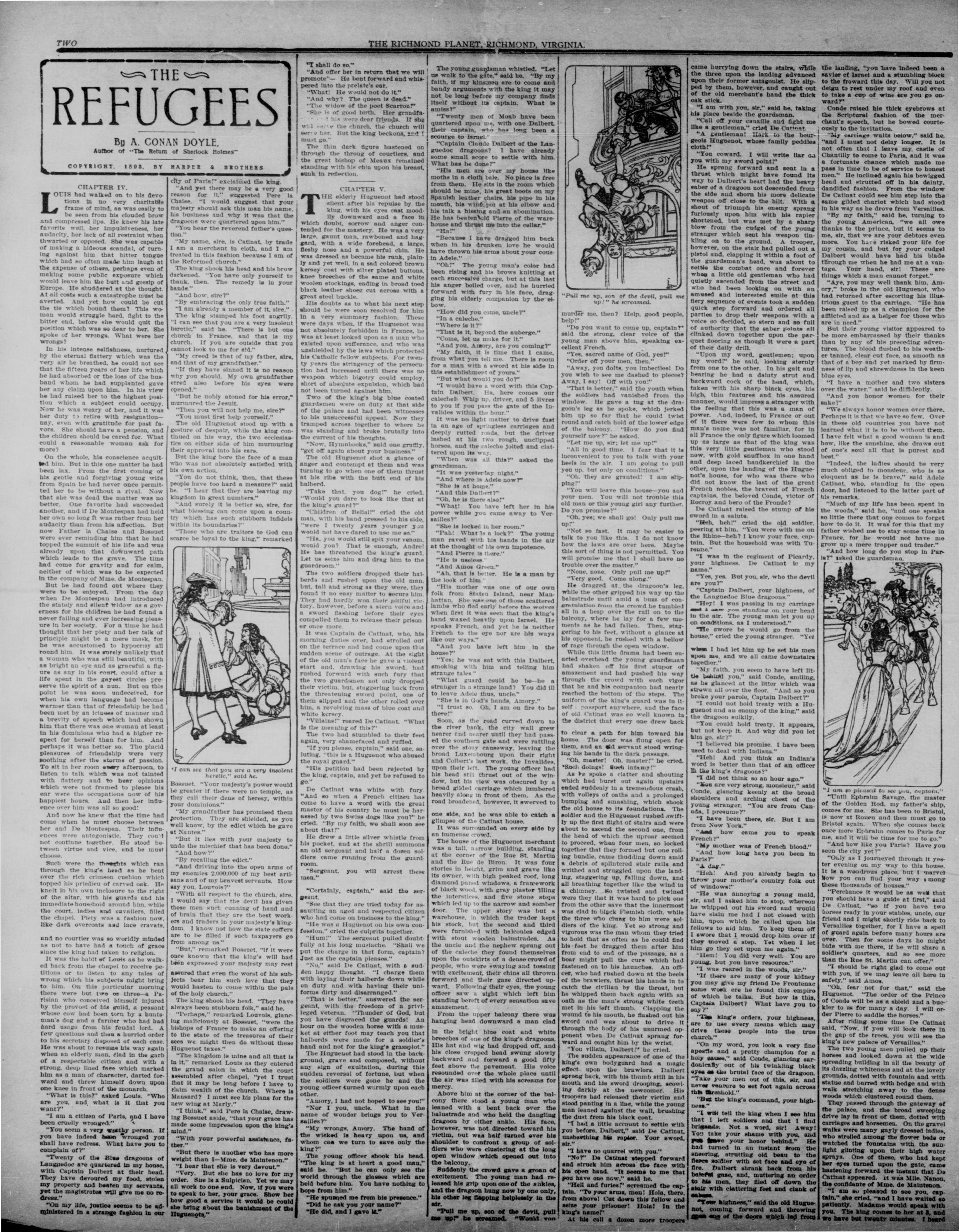
REFUGEES
By A. CONAN DOYLE.
Author of "The Return of Sherlock Holmes"
COPYRIGHT, 1893, BY HARPER & BROTHERS
LOUIS had walked on to his devotions in no very charitable frame of mind, as was easily to be seen from his clouded brow and compressed lips. He knew his late favorite well, her impulsiveness, her audacity, her lack of all restraint when thwarted or opposed. She was capable of making a blideous scandal, of turning against him that bitter tongue which had so often made him laugh at the expense of others, perhaps even of making some public exposure which would leave him the butt and gossip of Europe. He shuddered at the thought. At all costs such a catastrophe must be averted. And yet how could he cut the tie which bound them? This woman would struggle hard, fight to the bitter end, before she would quit the position which was so dear to her. She spoke of her wrongs. What were her wrongs?
In his intense selfishness, nurtured by the eternal flattery which was the very air he breathed, he could not see that the fifteen years of her life which he had absorbed or the loss of the husband whom he had supplanted gave her any claim upon him. In his view he had raised her to the highest position which a subject could occupy. Now he was weary of her, and it was her duty to retire with resignation—nay, even with gratitude for past favors. She should have a pension, and the children should be cared for. What could a reasonable woman ask for more?
On the whole, his conscience acquitted him. But in this one matter he had been lax. From the first coming of his gentle and forgiving young wife from Spain he had never once permitted her to be without a rival. Now that she was dead the matter was no better. One favorite had succeeded another, and if De Montespan had held her own so long it was rather from her audacity than from his affection. But now Father la Chaine and Bossuet were ever reminding him that he had topped the summit of his life and was already upon that downward path which leads to the grave. The time had come for gravity and for calm, neither of which was to be expected in the company of Mme. de Montespan.
But he had found out where they were to be enjoyed. From the day when De Montespan had introduced the stately and silent widow as a governess for his children he had found a never failing and ever increasing pleasure in her society. For a time he had thought that her plety and her talk of principle might be a mere mask, for he was accustomed to hypocrisy all round him. It was surely unlikely that a woman who was still beautiful, with as bright an eye and as graceful a figure as any in his court, could after a life spent in the gayest circles preserve the spirit of a nun. But on this point he was soon undeceived, for when his own language had become warmer than that of friendship he had been met by an laziness of manner and a brevity of speech which had shown him that there was one woman at least in his dominions who had a higher respect for herself than for him. And perhaps it was better so. The placid pleasures of friendship were very soothing after the storms of passion. To sit in her room every afternoon, to listen to talk which was not tainted with flattery and to hear opinions which were not framed to please his ear were the occupations now of his happiest hours. And then her influence over him was all so good!
And now he knew that the time had come when he must choose between her and De Montespan. Their influences were antagonistic. They couldn't continue together. He stood between virtue and vice, and he must choose.
Such were the thoughts which ran through the king's head as he bent over the rich crimson cushion which topped his prédilection of carved oak. He knelt in his own inclusion to the right of the altar, with his guards and his immediate household around him, while the court, ladies and cavaliers, filled the chapel. Piety was a fashion now, like dark overcoats and lace cravats, and no courtier was so worldly minded as not to have had a touch of grace since the king had taken to religion.
It was the habit of Louis as he walked back from the chapel to receive petitions or to listen to any tales of wrong which his subjects might bring to him. On this particular morning there were but two or three—a Parisian who conceived himself injured by the provost of his guild, a peasant whose cow had been torn by a bunsman's dog and a farmer who had bad hard usage from his feudal lord. A few questions and then a hurried order to his secretary disposed of each case. He was about to resume his way again when an elderly man, clad in the garb of a respectable citizen and with a strong, deep lined face which marked him as a man of character, darted forward and threw himself down upon one knee in front of the monarch.
"What is this?" asked Louis. "Who are you, and, what is it that you want?"
"I am a citizen of Paris, and I have been cruelly wronged."
"You seem a very worthy person. If you have indeed been wronged you shall have redress. What have you to complain of?" "Twenty of the Blue dragoons of Langnedoc are quartered in my house, with Captain Dalbert at their bead. They have devoured my food, stolen my property and beaten my servants, yet the magistrates will give me no redress." "On my life, justice seems to be administered in a strange fashion in our
CHAPTER IV
city of Paris” exclised the king.
“And yet there may be a very good reason for it.” suggested Pere la Chaine. “I would suggest that your majesty should ask this man his name, his business and why it was that the dragoons were quartered upon htm.”
"You hear the reverend father's question."
"My name, sire, is Catinat, by trade. I am a merchant in cloth, and I am treated in this fashion because I am of the Reformed church."
The king shook his head and his brow darkened. "You have only yourself to thank, then. The remedy is in your hands."
"And how, sire?"
"By embracing the only true faith."
"I am already a member of it, sire."
The king stamped his foot angrily.
"I can see that you are a very insolent heretic," said he. "There is but one church in France, and that is my church. If you are outside that you cannot look to me for aid."
"My creed is that of my father, sire, and that of my grandfather."
"If they have sinned it is no reason why you should. My own grandfather erred also before his eyes were opened."
"But he nobly atoned for his error," murmured the Jesuit.
"Then you will not help me, sire?"
"You must first help yourself."
The old Huguenot stood up with a gesture of despair, while the king continued on his way, the two ecclesiastics on either side of him murmuring their approval into his ears.
But the king bore the face of a man who was not absolutely satisfied with his own action.
"You do not think, then, that these people have too hard a measure?" said he.
"I hear that they are leaving my kingdom in great numbers."
"And surely it is better so, sire, for what blessing can come upon a country which has such stubborn infidels within its boundaries?"
"Those who are traitors to God can scarcce be loyal to the king." remarked
L.
"I can see that you are a very insolent heretic," said he.
Bossuet. "Your majesty's power would be greater if there were no temple, as they call their dens of heresy, within your dominions."
"My grandfather has promised them protection. They are shielded, as you well know, by the edict which he gave at Nantes."
"But it lies with your majesty to undo the mischief that has been done."
"And how?"
"By recalling the edict."
"And driving into the open arms of my enemies 2,000,000 of my best artisans and of my bravest servants. How say you, Louvois?"
"With all respect to the church, sir,
I would say that the devil has given
these men such cunning of hand and
of brain that they are the best workers
and traders in your majesty's kingdom.
I know not how the state coffers
are to be filled if such taxpayers go
from among us."
"But," remarked Bossuet, "if it were once known that the king's will had been expressed your majesty may rest assured that even the worst of his subjects bear him such love that they would hasten to come within the pale of the holy church."
The king shook his head. "They have always been stubborn folk," said he.
"Perhaps," remarked Louvois, glancing maliciously at Bossuet, "were the bishops of France to make an offering to the state of the treasures of their sees we might then do without these Huguenot taxes."
"The kingdom is mine and all that is in it," remarked Louis as they entered the grand salon in which the court assembled after chapel, "yet I trust that it may be long before I have to claim wealth of the church. Where is Mansard? I must see his plans for the new wing at Marly." "I think," said Pere la Chalse, drawing Bossuet aside, "that your grace has made some impression upon the king's mind." "With your powerful assistance, father." "But there is another who has more weight than I-Mme. de Maintenon." "I hear that she is very devout." "Very. But she has no love for my order. She is a Sulpician. Yet we may all work to one end. Now, if you were to speak to her, your grace. Show her how good a service it would be could she bring about the banishment of the Huguenots."
THE RICHMOND PLANET, RICHMOND, VIRGINIA.
"I shall do so."
"And offer her in return that we will promote"— He bent forward and whispered into the prelate's ear.
"What! He would not do it."
"And why? The queen is dead."
"The widow of the poet Scarron"
"She is of good birth. Her grandfather, his wife were dear friends. If she will serve the church, the church will serve her. But the king beckons, and I must go." The thin dark figure hastened on through the throng of courtiers, and the great bishop of Meaux remained standing with his chin upon his breast, sunk in reflection.
CHAPTER V
THE elderly Huguenot had stood silent after his repulse by the king, with his eyes cast moodily downward and a face in which doubt, sorrow and anger contended for the mastery. He was a very large, gaunt man, rawboned and hagward, with a wide forehead, a large, fleshy nose and a powerful chin. He was dressed as became his rank, plainly and yet well, in a sad colored brown kersey coat with silver plated buttons, knee breeches of the same and white woolen stockings, ending in broad toed black leather shoes cut across with a great steel buckle.
His doubts as to what his next step should be were soon resolved for him in a very summary fashion. These were days when, if the Huguenot was not absolutely forbidden in France, he was at least looked upon as a man who existed upon sufferance, and who was unableled by the laws which protected his Catholic fellow subjects. For twenty years the stringency of the persecution had increased until there was no weapon which bigotry could employ, short of absolute expulsion, which had not been turned against him.
Two of the king's big blue coated guardmen were on duty at that side of the palace and had been witnesses to his unsuccessful appeal. Now they tramped together to where he was standing and broke brutally into the current of his thoughts.
"Now, Hymnbooks," said one grulffy, "get off again about your business."
The old Huguenot shot a glance of anger and contempt at them and was turning to go when one of them thrust at his ribs with the butt end of his halberd.
"Take that, you dog!" he cried.
"Would you dare to look like that at the king's guard?"
"Children of Bellail!" cried the old man, with his hand pressed to his side, "were I twenty years younger you would not have dared to use me so."
"Ha, you would still spit your venom, would you? That is enough, Andrel He has threatened the king's guard. Let us seize him and drag him to the guardroom."
The two soldiers dropped their halberds and rushed upon the old man, but, tall and strong as they were, they found it no easy matter to secure him. They had hardly won their pitiful victory, however, before a stern voice and a sword flashing before their eyes compelled them to release their prison er once more.
It was Captain de Catnat, who, his morning duties over, had strolled out on the terrence and had come upon this sudden scene of outrage. At the sight of the old man's face he gave a violent start and, drawing his sword, had rushed forward with such fury that the two guardmen not only dropped their victim, but, staggering back from the threatening sword point, one of them slipped and the other rolled over him, a revolving mass of blue coat and white kerscy. "Villains!" roared De Catnat. "What is the meaning of this?"
The two had stumbled to their feet again, very shameless and ruffled.
"If you please, captain," said one, saluting, "this is a Huguenot who abused the royal guard."
"His petition had been rejected by the king, captain, and yet he refused to go."
De Catnat was white with fury.
"And so when a French citizen has come to have a word with the great master of his country he must be harassed by two Swiss dogs like you?" he cried. "By my faith, we shall soon see about that."
He drew a little silver whistle from his pocket, and at the shrill summons an old sergeant and half a dozen soldiers came running from the guardroom.
"Sergeant, you will arrest these men."
"Certainly, captain," said the sergeant.
"See that they are tried today for assaulting an aged and respected citizen who had come on business to the king."
"He was a Huguenot on his own confession," cried the culprits together.
"Hum!" The sergeant pulled doubtfully at his long mustache. "Shall we put the charge in that form, captain? Just as the captain pleases."
"No," said De Catinat, with a sudden happy thought. "I charge them with laying their halberds down while on duty and with having their uniforms dirty and disarranged."
"That is better," answered the sergeant, with the freedom of a privileged veteran. "Thunder of God, but you have disgraced the guards! An hour on the wooden horse with a musket at either foot may teach you that halberds were made for a soldier's hand and not for the king's grassspot."
The Huguenot had stood in the background, grave and composed, without any sign of exultation, during this sudden reversal of fortune, but when the soldiers were gone he and the young officer turned warmly upon each other.
"Amory, I had not hoped to see you!" "Nor I you, uncle. What in the name of wonder brings you to Versailles?" "My wrongs, Amory. The hand of the wicked is heavy upon us, and whom can we turn to save only the king?" "The young officer shook his head." "The king is at heart a good man," said he. "But he can only see the world through the glasses which are held before him. You have nothing to hope from him."
"He spumed me from his presence." "Did he ask you your name?" "He did, and I gave it."
The young guardian whistled. "Let us walk to the gate," said he. "By my faith, if my kinsmen are to come and bandy arguments with the king it may not be long before my company finds itself without its captain. What is amiss?"
"Twenty men of Monab have been quartered upon me, with one Dalbert, their captain, who has long been a scourge to Israel."
"Captain Claude Dalbert of the Languedoc dragoons? I have already some small score to settle with him. What has he done?"
"His men are over my room like moths in a cloth bale. No place is free from them. He sits in the room which should be mine, his great boots on my Spanish leather chairs, his pipe in his mouth, his wind, pot at his elbow and his talk a hissing and an abomination. He has beaten old Pierre of the warehouse and thrust me into the cellar."
"Because I have dragged him back when in his drunken love he would have thrown his arms about your cousin Adele."
"Oh!" The young man's color had been rising and his brows knitting at each successive charge, but at this last his anger boiled over, and he hurried forward with fury in his face, dragging his elderly companion by the elbow.
"How did you come, uncle?"
"In a caleche."
"Where is it?"
"That is it, beyond the auberge."
"Come, let us make for it."
"And you, Amory, are you coming?"
"My faith, it is time that I came, from what you tell me. There is room for a man with a sword at his side in this establishment of yours."
"But what would you do?"
"I would have a word with this Captain Dalbert. Ha, here comes our calechee. Whip up, driver, and 5 livres to you if you pass the gate of the Invalides within the hour."
It was no light matter to drive fast in an age of springless carriages and deeply rutted roads, but the driver inshed at his two rough, unclipped horses, and the calechee jointed and clattered upon its way.
"When was all this?" asked the guardsman.
"It was yesterday night."
"And where is Adele now?"
"She is at home."
"And this Dalbert?"
"Oh, he is there also!"
"What! You have left her in his power while you came away to Versallies?"
"She is locked in her room."
"Pah! What is a lock?"
The young man raved with his hands in the air at the thought of his own impotence.
"And Amos Green."
"Ah, that is better. He is a man by the look of him."
"His mother was one of our own folk from Staten Island, near Manhattan. She was one of those scattered lambs who lived early before the wolves when first it was seen that the king's hand waxed heavily upon Israel. He speaks French, and yet he is neither French to the eye nor are his ways like our ways."
"And you have left him in the house?"
"Yes; he was sat with this Dalbert, smoking with him and telling him strange tales."
"What guard could he be—he a stranger in a strange land? You did ill to leave Adole thus, uncle."
"She is in God's hands, Amory."
"I trust so. Oh, I am on fire to be there."
Soon, as the road curved down to the river bank, the city wall grew nearer and nearer until they had passed over the southern gate and were rattling over the stony causeway, leaving the broad Luxembourg upon their right and Colbert's last work, the Invalides, upon their left. The young officer had his head still thrust out of the window, but his view was obscured by a broad gilded carriage which lumbered heavily along in front of them. As the road broadened, however, it swerved to one side, and he was able to catch a glimpse of the Catnat house. It was surrounded on every side by an immense crowd.
The house of the Huguenot merchant was a tall, narrow building, standing at the corner of the Rue St. Martin and the Rue de Biron. It was four stories in height, grim and grave like its owner, with high peaked roof, long diamond paned windows, a framework of black wood, with gray plaster illing the interiors, and five stone steps which led up to the narrow and somber door. The upper story was but a warehouse, in which the trader kept his stock, but the second and third were furnished with balconies edged with stout wooden balustrades. As the uncle and the nephew sprang out of the caleche they found themselves upon the outskirts of a dense crowd of people, who were swaying and tossing with excitement, their chins all thrown forward and their gaze directed upward. Following their eyes, the young officer saw a sight which left him standing bereft of every sensation save amazement.
From the upper balcony there was hanging head downward a man clad in the bright blue coat and white breeches of one of the king's dragonosa. His hat and wig had dropped off, and his close cropped head swung slowly backward and forward a good fifty feet above the pavement. His voice resounded over the whois place until the air was filled with his screams for mercy.
Above him at the corner of the balcony there stood a young man who leaned with a bent back over the baustrade and who held the dangling dragoon by either ankle. His face, however, was not directed toward his victim, but was half turned over his shoulder to confront a group of soldiers who were clustering at the long open window which opened out into the balcony.
Suddenly the crowd gave a groan of excitement. The young man had released his grip upon one of the ankles, and the dragoon hung now by one only, his other leg flapping helplessly in the air.
"Pull me up, son of the devil, pull me up!" he screamed. "Would you
came hurrying down the stairs, while the three upon the landing advanced upon their former antagonist. He slipped by them, however, and caught out of the old merchant's hand the thick cak stick. "I am with you, sir," said he, taking his place beside the guardsman.
"Call off your cannelle and fight me like a gentleman," cried De Cattat.
"A gentleman! Hark to the bourgeois Huguenot, whose family peddles cloth!" "You coward. I will write liar on you with my sword point!"
He sprang forward and sent in a thrust which might have found its way to Dalbert's heart had the heavy saber of a dracoon not descended from the side and shorn his more delicate weapon off close to the hilt. With a shout of triumph his enemy sprang furiously upon him with his rapier shortened, but was met by a sharp blow from the cudgel of the young stranger which sent his weapon tinkling on to the ground. A trooper, however, on the stair had pulled out a pistol and clapping it within a foot of the guardsman's head, was about to settle the combat once and forever when a little old gentleman who had quietly ascended from the street and who had been looking on with an amused and interested smile at this fiery sequence of events took a sudden quick step forward and ordered all parties to drop their weapons with a voice so decided, so stern and so full of authority that the saber points all clinked down together upon the parquet flooring as though it were a part of their daily drill.
"Upon my word, gentlemen; upon my word!" he said, looking sternly from one to the other. In his gait and bearing he had a dainty strut and backward cock of the head, which, taken with his sharp black eyes, his high, thin features and his assured manner, would impress a stranger with the feeling that this was a man of power. And, indeed, in France or out of it there were few to whom this man's name was not familiar, for in all France the only figure which loomed up as large as that of the king was this very little gentleman who stood now, with gold snuffbox in one hand and deep laced handkerchief in the other, upon the landing of the Huguenot's house, for who was there who did not know the last of the great French nobles, the bravest of French captains, the beloved Conde, victor of Rocroi and hero of the Fronde?
De Catinat raised the stump of his sword in a salute.
"Heh, heh!" cried the old soldier, peering at him. "You were with me on the Rhine—heh? I know your face, captain. But the household was with Turenne."
"I was in the regiment of Picardy, your highness. De Catinat is my name."
"Yes, yes. But you, sir, who the devil are you?"
"Captain Dalbert, your highness, of the Languedoc Blue dragoons."
"Hey! I was passing in my carriage and I saw you standing on your head in the air. The young man let you up on conditions, as I understood."
"The swore he would go from the house," cried the young stranger. "Yef when I had let him up he set his men upon me, and we all came downstairs together."
"My faith, you seem to have left little behind you," said Conde, stunned as he glanced at the litter which was strewn all over the floor. "And so you broke your parole, Captain Dalbert?" "I could not hold treaty with a Huguenot and an enemy of the king," said the dragoon sulkily. "You could hold treaty, it appears, but not keep it. And why did you let him go, sir?" "I believed his promise. I have been used to deal with Indians." "Heh! And you think an Indian's word is better than that of an officer in the king's dragons?" "I did not think so an hour ago." "You are very strong, monsleur," said Conde, glancing keenly at the broad shoulders and arching chest of the young stranger. "You are from Canada, I presume?" "I have been there, sir. But I am from New York." "And how came you to speak French?"
"My mother was of French blood."
"And how long have you been in Paris?"
"A day."
"Heh! And you already begin to throw your mother's country folk out of windows!"
"He was annoying a young mald, sir, and I asked him to stop, whereon he whipped out his sword and would have slain me had I not closed with him, upon which he called upon his fellows to aid him. To keep them off I swore that I would drop him over if they moved a step. Yet when I let him go they set upon me again."
"Hem! You did very well. You are young, but you have resource."
"I was reared in the woods, sir."
"If there are many of your kidney you may give my friend D Frontenac some work he found this empire of which he talks. But how is this, Captain Dalbert? What have you to say?"
"The king's orders, your highness, are to use every means which may drive these people into the true church."
"On my word, you look a very fine apostle and a pretty champion for a holy cause," said Conde, glancing sardonically out of his twinkling black eyes on the brutal face of the dragon.
"Take your men out of this, sir, and never venture to set foot again across this threshold."
"But the king's command, your highness."
"I wili tell the king when I see him that I left soldiers and that I find brigands. Not a word, sir! Away! You take my shame with you, and you leave your honor behind." He had turned in an instant from the sneering, strutting old bead to the fierce soldier with set face and eye of fire. Dalbert shrank back from his bateleur gaze, and, muttering an order to his men, they flied off down the stair with clattering feet and clank of cahoon.
"Your highness," said the old Huguenot, coming forward and throwing one of the doors which led from
L
"Pull me up, son of the devil, pull me up!" he screamed.
"Pull me up, son of the devil, pull me up!" he screamed.
murder me, then? Help, good people, help!
"Do you want to come up, captain?" said the strong, clear voice of the young man above him, speaking excellent French.
"Yes, sacred name of God, yes!"
"Order off your men, then."
"Away, you dolts, you imbeciles! Do you wish to see me dashed to pieces? Away, I say! Off with you."
"That is better," said the youth when the soldiers had vanished from the window. He gave a tug at the dragon's leg as he spoke, which jerked him up so far that he could twist round and catch hold of the lower edge of the balcony. "How do you find yourself now?" he asked.
"Let me up, sir; let me up!"
"All in good time. I fear that it is inconvenient to you to talk with your heels in the air. I am going to pull you up, but only on conditions."
"Oh, they are granted! I am slipping!"
"You will leave this house—you and your men. You will not trouble this old man or this young girl any further. Do you promise?"
"Oh, yes; we shall go! Only pull me up!"
"Not so fast. It may be easier to talk to you like this. I do not know how the laws are over here. Maybe this sort of thing is not permitted. You will promise me that I shall have no trouble over the matter."
"None, none. Only pull me up!"
"Very good. Come along."
He dragged at the dragoon's leg, while the other gripped his way up the balustrade until amid a buzz of congratulation from the crowd he tumbled all in a heap over the roll on to the balcony, where he lay for a few moments as he had fallen. Then, staggering to his feet, without a glance at his opponent, he rushed with a bellow of rage through the open window. While this little drama had been enacted overhead the young guardman had shaken off his first stupor of amazement and had pushed his way through the crowd with such vigor that he and his companion had nearly reached the bottom of the steps. The uniform of the king's guard was in itself, passport anywhere, and the face of old Catatin was so well known in the district that every one drew back to clear a path for him toward his house. The door was fung open for them, and an old servant wrought wringing his hands in the dark passage.
"Oh, master! Oh, master!" he cried.
"Such doings! Such infamy!"
As he spoke a clatter and shouting which had burst out again upstairs ended suddenly in a tremendous crash, with volleys of oaths and a prolonged bumping and smashing, which shook the old house to its foundations. The soldier and the Huguenot rushed swiftly up the first flight of stairs and were about to ascend the second one, from the head of which the uproar seemed to proceed, when four men, so locked together that they formed but one rolling bundle, came thudding down amid a debris of splintered stair rails and writened and struggled upon the landing, staggering up, falling down, and all breathing together like the wind in a chimney. So twisted and twined were they that it was hard to plek one from the other save that the innermost was clad in black Flemish cloth, while the three who clung to him were soldiers of the king. Yet so strong and vigorous was the man whom they tried to hold that as often as he could find his feet he dragged them after him from end to end of the passage, as a boar might pull the curs which had fastened on to his haunches. An officer, who had rushed down at the heels of the brawlers, thrust his hands in to catch the civilian by the throat, but he whipped them back again with an oath as the man's strong white teeth met in his left thumb. Clapping the wound to his mouth, he flashed out his sword and was about to drive it through the body of his unarmed opponent when De Catnat sprang forward and caught him by the wrist. "You callled. Delhout's help."
The sudden appearance of one of the king's own bodyguard had a magic effect upon the brawlers. Dalbert spreng back, with his thumb still in his mouth and his sword drooping, scowling darkly at the newcomer. His troopers had released their victim and stood panting in a line, while the young man leaned against the wall, brushing the dust from his black coat.
"I had a little account to settle with you before, Dalbert," said De Catatin, unshearing his rapler. Your sword, sr."
"I have no quarrel with you."
"No?" De Catinat stepped forward and struck him across the face with his open hand. "It seems to me that you have one now," said he.
"Hell and furies!" screamed the captain. "To your arms, mon! Hola, there, from above! Cut down this fellow and seize your prisoner! Hola! In the king's name!"
At his call a dozen more troopers
"I did not think so an hour ago."
"A day."
the landing, "you have indeed been a savior of Israel and a stumbling block to the froward this day. Will you not deign to rest under my roof and even to take a cup of wine are you go onward?"
Conde raised his thick eyebrows at the Scriptural fashion of the merchant's speech, but he bowed courteously to the invitation.
"My carriage waits below," said he, "and I must not delay longer. It is not often that I leave my castle of Chantilly to come to Paris, and it was a fortunate chance which made me pass in time to be of service to honest men." He inclined again his bewigged head and strutted in his dainty, dandified fashion. From the window De Catnath could see him step into the same glided charlot which had stood in his way as he drove from Versailles.
"By my faith," said he, turning to the young American, "we all owe thanks to the prince, but it seems to me, sir, that we are your debtors even more. You have risked your life for my cousin, and but for your cudgel Dalbert would have had his blade through me when he had me at a vantage. Your hand, sir! These are things which a man cannot forget."
"Aye, you may well thank him, Amory," broke in the old Huguenot, who had returned after escorting his illustrious guest to the carriage. "He has been raised up as a champion for the afflicted and as a helper for those who are in need."
But their young visitor appeared to be more embarrassed by their thanks than by any of his preceding adventures. The blood flushed to his weather tanned, clear cut face, as smooth as that of a boy and yet marked by firmness of lip and shrewdness in the keen blue eyes.
"I have a mother and two sisters over the water," said he diffidently.
"And you honor women for their sake."
"We always honor women over there. Perhaps it is that we have so few. Over in these old countries you have not learned what it is to be without them. I have felt what a good woman is and how, like the sunshine, she draws out of one's soul all that is purest and best."
"Indeed, the ladies should be very much obliged to monsieur, who is as eloquent as he is brave," said Adele Catnat, who, standing in the open door, had listened to the latter part of his remarks.
"Much of my life has been spent in the woods," said he, "and one speaks so little there that one comes to forget how to do it. It was for this that my father wished me to stay some time in France, for he would not have me grow up a mere trapper and trader."
"And how long do you stop in Paris?" asked the guardmao.
takes the gourdish
"Until Ephraim Savage, the master of the Golden Rod, my father's ship, comes for me. She has been to Bristol, is now at Rouen and then must go to Bristol again. When she comes back once more Ephraim comes to Paris for me, and it will be time for me to go."
"And how like you Paris? Have you seen the city yet?" "Only as I journeyed through it yester evening on my way to this house. It is a wondrous place, but I marvel how you can find your way among these thousands of houses." "Perchance it would be as well that you should have a guide at first," said De Catnat. "so if you have two horses ready in your stables, uncle, our friend and I might shortly ride back to Versailles together, for I have a spell of guard again before many hours are over. Then for some days he might bide with me there, if he will share a soldier's quarters, and so see more than the Rue St. Martin can offer." "I should be right glad to come out with you, if we may leave all here in safety," said Amos. "Oh, fear not for that," said the Huguenot. "The order of the Prince of Conde will be as a shield and a buckler to us for many a day. I will order Pierre to saddle the horses."
After riding some time De Catnat said, "Now, if you will look there in the gap of the trees, you will see the king's new palace of Versailles." The two young men pulled up their horses and looked down at the wide spreading building in all the beauty of its dazzling whiteness and at the lovely grounds, dotted with fountain and with statue and barred with hedge and with walk stretching away to the dense woods which clustered round them. They passed through the gateway of the palace, and the broad sweeping drive lay in front of them, dotted with carriages and horsemen. On the gravel walks were many gayly dressed ladies, who strolled among the flower beds or watched the fountains with the sunlight glinting upon their high water sprays. One of these, who had kept her eyes turned upon the gate, came hastening forward the instant that De Catnat appeared. it was Mile, Nanon, the confidante of Mime, de Mautenon.
"I am so pleased to see you, captain," she cried. "and I have waited so patiently. Madame would speak with you. The king comes to her at 2, and we have but twenty minutes. I heard
e - “
=
—
SATURDAY. ....AVG. 2571, 1906.
that you bad gone to Paris, aud 80 1
stationed myself here. Madame bas
something which she would ask you.”
“Then I will come at once. Ab, De
Brissac, it is well met!"
A tall, burly officer was passing In
the same uniform which De Catinat
wore. He turned at ence and eame
wulling toward his comrade.
“Ab, Amory, you bave covered a
league or two from the dust on your
coat!”
“We are fresh from Paris. But 1
am called on business, This is my
friend, M. Amos Green. I leave bim
im your hands, for he is a stranger
from America and would fain see all
that you can show. He stays with me
at my quarters. And my horse, too,
De Brissac. You can give it to the
room.”
Throwing the bridle to his brother
ofticer and pressing the band of Amos
Green, De Catinat sprang from his
horse and followed at the top of his
‘speed In the direction which the young
lady had already taken.
{ro ae contisvep.} 1
Hi os eee fe
pee ta des Pop gt
EEE eet
SSR OSeNe
a Ra
Caer es
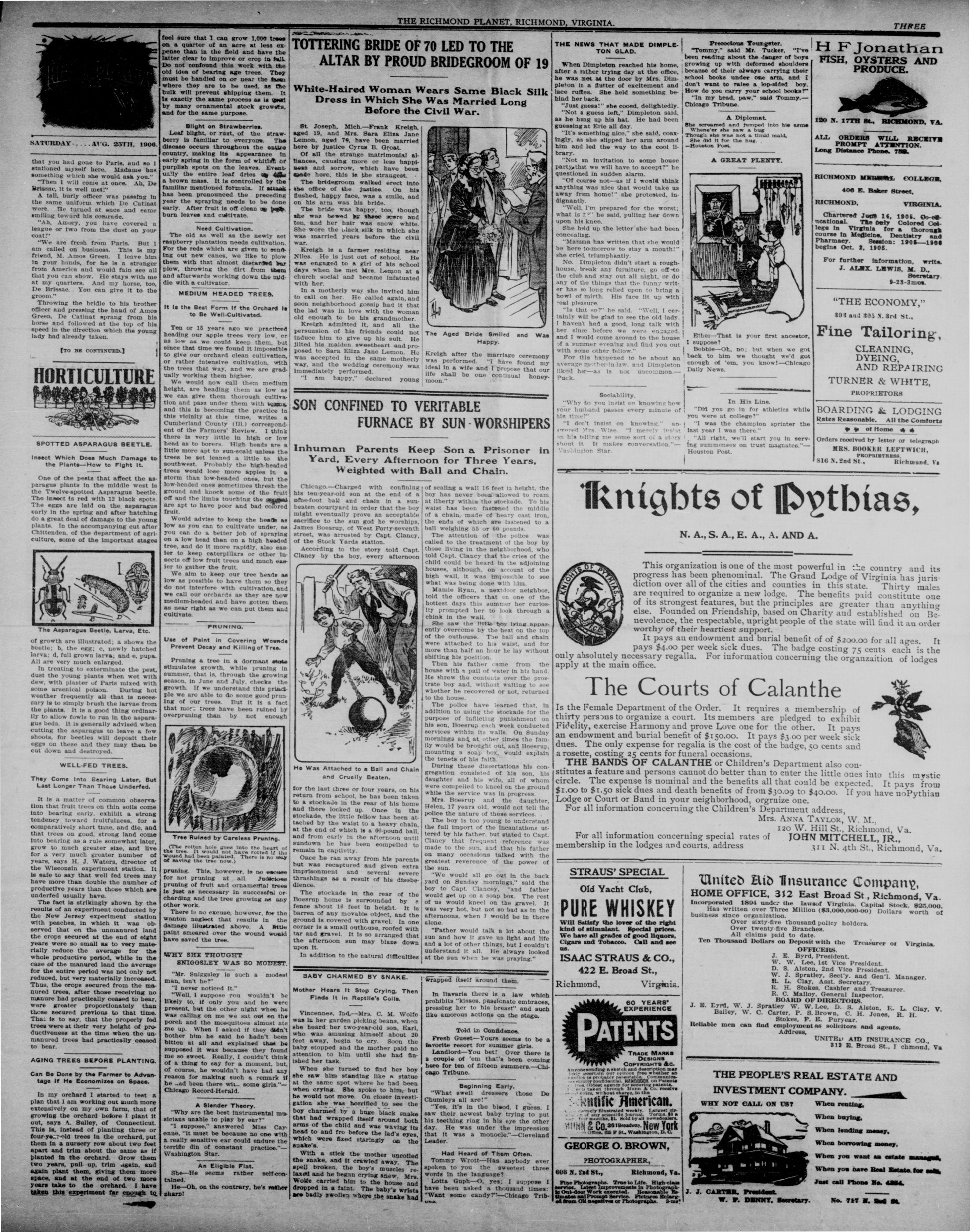
SPOTTED ASPARAGUS BEETLE.
Insect Which Does Much Damage to
the Plants—How to Fight It.
One of the pests that affect the as-
paragus plants in the middle west ts
the Twelve-spotted Asparagus beetle.
‘The insect ts red with 12 black spots.
‘The eggs are laid on the asparagus
early in the spring and after hatching
do a great deal of damage to the young
plants. In the accompanying cut after
Chittenden, of the department of agri-
culture, some of the important stages
R < NG
oi A ma~
‘The Asparagus Geetie, Larva, Etc.
of growth are illustrated; a shows the
beetle; b, the egg; c, newly hatched
larva; d, full grown larva; and e, pupa.
All are very much enlarged.
In treating to exterminate the pest,
dust the young plants when wet with
dew, with plaster of Paris mixed with
some arsenical poison. During hot
weather frequently all that is neces-
sary Is to simply brush the larvae from
the plants. It is a good thing ordinar-
ily to allow fowls to run in the aspara-
Bus beds. It is generally advised when
cutting the asparagus to leave a few
shoots, for beetles will deposit their
ges on these and they may then be
cut down and destroyed.
WELL-FED TREES.
They Come Into Bearing Later, But
Last Longer Than Those Underfed.
It is a matter of common observa-
tion that fruit trees on thin soils come
into bearing early, exhibit a strong
tendency toward fruitfulness, for @
comparatively short thne, and die, and
that trees on good, strong land come
into bearing as a rule somewhat later,
grow to much greater size, and live
for a very much greater number of
years, says H. J. Waters, director of
the Wisconsin experiment station. It
is safe to say that well fed trees may
have more than double the number of
productive years than those which are
underfed usually have.
‘The fact is strikingly shown by the
results of an experiment conducted by
the New Jersey experiment station
with peaches, in which it was ob-
served that en the unmanured land
the crops secured at the end of eight
years were so small as to very mate-
Fially reduce the average for the
whole productive period, while in the
case of the manured land the average
for the entire period was not only not
Feduoed, but very materially increased.
‘Thus, the crops secured from the ma-
nured trees, after those receiving no
manure had practically ceased to bear,
were greater proportionately than
those secured previous to that time.
‘That fe to say, that the properly fed
trees were at their very height of pro
ductiveness at the time when the un-
manured trees had practicslly ceased
to bear.
AGING TREES BEFORE PLANTING.
Can Be Done by the Farmer to Advan-
tage If He Economizes on Space.
In my orchard I started to test a
plan that |] am working out much more
extensively on my own farm, that of
growing the orchard before I plant it
out, says A. Sulley, of Connecticut.
This is, instead of planting three or
four-ye->old trees in the orchard, put
them fn a nursery row about two feet
‘apart and trim about the same as If
planted in the orcherd. Grow them
two years, pull up, trim «gain, and
again plant them, giving them more
space, and at the end of two more
years take to the orchard. I have
take this experiment far enough tq
feel sure that I can grow 1,000 trees
on a quarter of an acre at less ex-
pases than in the flold and have the
clear to improve or erop in falk
Do not confound this work with the
old iden of bearing age trees. They
must be handled on or uear the farn
where ther are to be used, as the
bulk will prevent shipping them. It
ts exactly the same process as is qretl
by many ornamental stock growers,
and for the same purpose.
Blight on Strawberries.
Leaf blight, or rust, of the straw.
berry is familiar to everyome. The
dizease occurs throughout the entire
country, making its appearance tn
early spring in the form of whitis§ of
purplish spots on the leaves. Event
ucily the entire leaf dries w@ Ma
a brown mass. It is controlled by the
familiar mentioned formula. If attaak
has been pronounced the preceding
year the spraying needs to be done
early. After fruit ts off clean wp peg,
burn leaves and cultivate.
Need Cultivation.
The old as well as the newly sot
raspberry plantation needs cultivation.
For the reds which are given to sen®
ing out new canes, we Itke to plow
them with that almost discardeé bur
plow, throwing the dirt from them
and afterwards working down the md-
die with a cultivator.
MEDIUM HEADED TREES.
It le the Best Form If the Orchard le
to Be Well-Cultivated.
Ten or 15 years ago we practiced
heading our apple trees very low, or
a8 low as we could keep them, but
since that time we found It impossible
to give our orchard clean cultivation,
or rather tntensive cultivation, with
the trees that way, and we are grad-
ually working them higher.
We would now call them medium
height, are heading them as low as
we can give them thorough culttva-
tion and pass under them with tqampg
‘and this Is becoming the practice in
‘this vicinity at this time, writes a
Cumberland County (I11.) correspond.
ent of the Farmers’ Review. I think
there is very little in high or low
head as to borers. High heads are a
Uttle more apt to sun-scald unless the
trees be set leaned a little to the
southwest. Probably the high-headed
‘trees would lose more apples in a
storm than low-headed ones, but the
low-headed ones sometimes thresh the
Kround and knock some of the fruit
off and the limbs touching the ae
are apt to have poor and bad colored
fruit.
Would advise to keep the heads as
Tow as you can to cultivate under, aa
you can do a better job of spraying
on a low head than on a high headed
tree, and do it more rapidly, also eas-
fer to keep caterpillars or other in-
‘sects off low fruit trees and much eae
fer to gather the frutt.
We aim to keep our tree hende as
Jow as possible to have them so they
do not interfere with cultivation, and
we call our orchards as they are now
medium-headed and have gotten them
4s near right as we can put them and
cultivate.
sa PRUNING. —
Use of Paint in Covering Wounds
Prevent Decay and Killing of Tree.
Pruning @ tree in a dormant etate
stimulates growth, while pruning in
summer, that is, through the growing
season, in June and July. checks the
growth. If we understand this primc-
ple we are able to do some good prun
ing of our trees. But it Is a fact
that mor: trees have been ruined by
overpruning than by not enough
aa
ETF ;
A ts} ib ,
ape Aud /]
Ag = Hh
ELA a)
ay Ay Ap
ZA Ges ag)
EBA y uy
BA Yi
CA = 2S
NE = LF
4A eth
AeA
‘Tree Ruined by Careless Pruning.
(The rotten hole goes Into the heart of
Sruathed eae reese
BE Saving the tree now.) faces
Druning. This, however, ts no escuse
for not pruning at all. Judtetons
pruning of fruit and ornamemtal trees
ig just as necessary in successtel or-
charding and the tree growing a¢ any
other work.
There {s no excuse, however, for the
wanton neglect that resuite in the
damage iijustrated above. A mite
paint smeared over the wound woukl
have saved the tree.
WHY SHE THOUGHT
SNIGGSLEY WAS SO MODEST.
“Mr. Suiggsley is such a modest
man, isn't he?"
“I never noticed tt.”
“Well, I suppose you wouldn't be
Mkely to, if only you and he were
Present, but the other night whea he
‘Was calling on me we sat out en the
Poreb and the mosquitoes almost ate
ame up. When I asked if they didn’t
bother bim he said he hadn't been
Ditten at all and explained thet be
Supposed it was because they found
Me so sweet. Really, 1 couldn't think
of a thing to say for a moment, but,
‘of course, he wouldn't have had any
reason for making such a remark if
the ad been there wit. some girls.”"—
‘Chicago Record-Herald.
LD Ct Cities
“Why are the best Instrumental mo
sicians unable to play by ear?"
“1 suppose,” answered Miss Cay.
enne, “it must be because no one with
& really sensitive ear could endure the
terrific din of constant practice.”—
Washington Star.
An Eligible Fiat.
She—He seems rather self-con-
tained.
‘He—Oh, on the contrary, he’s rather
sharp!
THE RICHMOND PLANET, RICHMOND, VIRGINIA.
SS ee an : . ev
TOTTERING BRIDE OF 70 LED TO THE oc sone
ALTAR BY PROUD BRIDEGROOM OF 19) wee vinoieion
eee ee be vas eee oe
White-Haired Woman Wears Same Black Siti (22 sae
Dress in Which She Was Married Long Moteet cases” she
Before the Civil War. “Not a guess left
SON CONFINED TO VERITABLE
FURNACE BY SUN-WORSHIPERS
Inhuman Parents Keep Sona Prisoner in
Yard, Every Afternoon for Three Years,
Weighted with Ball and Chain.
St. Joseph, Mich—Frank Kreigh,
aged 19, and Mrs. Sara Eliza Jane
Lemon, aged 79, have been married
here by justice Cyrus B. Groat.
Of all the strange matrimontal al-
Mances, causing more or less happt
mess and sorrow, which have been
@ate here, this is the strangest. -
The bridegroom walked erect into
the office of the justice, On his
flushed, happy face, was a smile, and
on his arm was his bride.
The bride was happy, toa, though
she was bewed ps Sheen scere and
ten, and her hair was snow white.
She wore the viack silk in which she
was married years before the civil
war.
Kreigh te a farmer residing near
Niles. He 1s just out of school. He
was engaged to a girl of his school
days when he met Mrs. Lemon at a
church social and became infatuated
with her.
In a motherly way she Invited bim
to call on her. He called again, and
soon neighborhood gossip had it that
the lad was in love with the woman
old enough to be his grandmother.
Kretgh admitted it, and all the
persuasion of bis friends could not
induce him to give up his sult. He
Silted his maiden sweetheart and pro-
posed to Sara Eliza Jane Lemon. Ho
was accepted in the same motherly
way, and the wedding ceremony was
immediately performed.
“I am happy.” declared young
Chicago.—Charged with confining
his ten-yearold son at the end of a
efhefoot ball and chain in a sun-
beaten courtyard in order that the boy
might eventually prove an acceptable
sacrifice to the sun god he worships,
James Boesrup, of West Forty-seventh
street, was arrested by Capt. Clancy,
of the Stock Yards station.
According to the story told Capt.
Clancy by the boy. every afternoon
1 Wa a7
SARIS i
ed i
Eds ke) )) eis
St <a Mg pe]
PHN. XE
a SOL
EY : SN y
wh, HS ASS
5 17 2 US SY
@ Z
~ ie
“FY
He Was Attached to = Ball and Chain
a Gecahh eactca
for the last three or four years, on his
return from school, he has been taken
t & stockaJe In the rear of his home
and there locked up. Once in the
Stockade, the ttle fellow has been at-
tached by the waist to a heavy chain,
at the end of which {s a 60-pound ball,
and from early in the afternoon until
sundown he hes been eompelled to
remain tn captivity
Once he ran away from his parents
but was recaptured and given extra
imprisonment and several severe
thrashings as a result of his disebe-
dience.
The stockade in the rear of the
Boesrup home {s surrounded by a
fence about 16 feet tn height. It ts
barren of any movable object, and the
Sround {s covered with gravel. In one
corner fs @ small outhouse, roofed with
tar and gravel. It ts so arranged that
the afternoon sun may blaze down
upon it.
Tn addition to the natural diMeulties
=o
BABY CHARMED BY SNAKE.
Mother Hears It Stop Crying, Then
Finds !t in Reptiie’s Coils.
Vincennes, Ind—Mrs, C. M. Wolfe
was in her garden picking beans, when
she heard her two-year-old son, Earl,
who was amusing himself about 20
feet away, begin to cry. Soon the
baby stopped and the mother paid no
attention to him until she had fin-
ished her task.
When she turned to find her boy
she saw him standing like a statue
at the same spot where he had been
when crying. Sbe spoke to him; but
he would not move. On closer invest!-
gation she was horrified to see the
boy charmed ty a huge black snake
that had wrapped iteelf around both
arms of the child and was waving its
head to and fro before the lad's eyes,
which were fixed staringly on
saake’s. ie
With a stick the mother uncotled
the snake, and tt crawled away. The
spe broken, the boy's muscles re.
Jaxett and he began crying anew. Mrs.
‘Wolfe carried him to the house and
Groped tn @ faint. The baby's wrists
aco badly swollen where the snake had
BI ge |
ee x iS
sa ye ej a 7.
hy Vik i me
Vi GSES [Se
“ay | WO 5D ES
Sul ie ae
reas
[ae | Wire 4
pode
i Rveaiabetey! || | bk
Ae hie
et | i i long
i Sy Y
The Aged Bride Smiled and Was
Happy.
Kreigh after the marriaze ceremony
was performed. “I have found. my
ideal in a wife and T'propose that our
fe shall be one continual honey
of scaling a wall 16 feet in height, the
boy has never beouatlowed to roam
at berty within'the stockade. To his
waist has been fastened the middle
of a chain, made of heavy cast tron,
the ends of which are fastened to a
ball weighing 55 or 60 pounds.
The attention of the police was
called to the treatment of the boy by
those living in the nelzhborhood, who
told Capt. Clancy that the cries of the
child could be heard in the adjoining
houses, although, on account of the
high wall, it was impossible to see
what was being done with him,
Mamie Ryan, a nextdoor netghbor,
told the officers that on one of the
hottest days this summer her curios-
ty prompted her to look through a
‘chink in the wail,
_ She saw the Ittte hoy tying appar.
ently overcome by the heat on the top
of the outhouse. The ball and chain
Were attached to his waist, and for
more than half an hour he lay without
shifting his position.
Then his father came from the
house with » pail of water In bis hand.
He threw the contents over the pros-
trate boy and, without walting to see
whether he recovered or not, returned
to the house.
The police have learned that, In
addition to using the stockade for the
purpose of {nflicting punishment on
his son, Boesrup each week conducted
services within its walls. On Sunday
mornings and at other times the fam-
ily would be brought out, and Boesrup,
mounting a soap box, would explain
the tenets of his faith.
During these dissertations his con-
gregation consisted of his son, his
daughter and his wife, all of whom
Were compelied to kneel on the ground
while the service was in progress.
Mra. Boesrup and the daughter,
Helen, 17 years old, would not tell the
police the nature of these services.
The boy ts too young to understand
the full import of the tneantations ut-
tered by his father, but stated to Capt.
Clancy that frequent reference was
made to the sun, and that his father
om many occasions talked with the
Kreatest reverence of the power of
the sun.
“We would all go out in the back
yard on Sunday mornings,” said the
boy to Capt Clancey, “and father
would get up on 2 soap box. The rest
of us would knee! on the gravel. It
was very hot, but uot so bad as in the
afternoons, when J would be In there
alone.
“Father would talk a lot about the
sun and how it gave us light and Ife
and a lot of other things, but I couldn't
understand it all. He always looked
at the sun when he was praying.”
Wrapped itself around them. ee
In Bavaria there is a law which
prohibits “kisses, passionate embraces,
pressing her to his breast” and such
Uke amorous actions on the stage.
Told in Confidence.
Fresh Guest—Yours seems to be a
favorite resort for summer girls.
Landiord—You bet! Over there is
8 couple of ‘em tha‘'s been coming
here for ten of fifteen summers.—Chi-
cago Tribune.
Beginning Early.
“What swell dressers those De
Chumleys all are!” 3
“Yes, it’s In the bleod, I guess. I
saw their newest baby trying to put
his teething ring in his eye the other
day. He was under the impression
that it was a mouocle."—Cleveland
‘Leader.
Had Heard of Them Often.
Tommy Wrott—Has anybody ever
spoken to you the sweetest three
words in the language?
_ Lotta Guph—O, yes: I suppose I
have been asked a thousand times:
“Want some candy?”—Chicago Trib-
ote £
Knights of Pythi
G yipias,
N.A.,S. A., E. A., A. AND A.
Slay This organization is one of the most powerful in ‘te country and its
iy xe progress has been phenominal. The Grand Lodge of Virginia hes sacs
f= WA diction over all of the cities and counties in this state. Thirty males
Ps <Y ¥ are required to organize a new lodge. The benefits paid constitute one
* (<A SS of its strongest features, but the principles are greater than anything
ores og f else. Founded on Friendship, based on Charity aud established on Be
Res nevolence, the respectable, upright people of the state will find it au order
Bosc ‘> worthy of their heartiest support.
ae It pays an endowment and burial benefit of of $200.00 for all ages. It
pays $4.00 per week sick dues. The badge costing 75 cents each is the
only absolutely necessary regalla, For information concerning the organzaition of lodges
apply at the main office.
The Courts of Calanthe .¥
Is the Female Department of the Order. It reqnires a membership of
thirty persons to organize a court. Itsmempers are pledged to exhibit
Fidelity, exercise Harmony and prove Love one for the other. It pays
an endowment and burial benefit of $150.00. It pays $3.00 per week sick
dues. The only expense for regalia is the cost of the badge, so cents and
arosette, costing 25 cents for funeral occasions.
THE BANDS OF CALANTHE or Children’s Department also con-
stitutes a feature and persons cannot do better than to enter the little ones into this mystic
circle. The expense is nominal and the benefits all that could be expected. It pays from
$1.00 to $1.50 sick dues and death benefits of from $30.09 to $40.00. If you have noPythian
Lodge or Court or Band in your neighborhood, orgrnize one.
For all information concerning the Children’s Department address,
Mrs. ANNA Taytor, W. M.,
120 W. Hill St., Richmond, Va.
For all information concerning special rates of | JOHN MITCHELL, JR.,
membership in the lodges and courts, address 311 N. 4th St., Richmond, Va.
THE NEWS THAT MADE DIMPLE-
TON GLAD.
‘When Dimpleton reached his home,
after a mther trying day at the office,
he was met at the door by Mrs. Dim.
pleton in a flutter of excitement and
lace ruffes. She held something be-
Bind her back.
“Just ues!” she cooed, delightedly.
“Not a guess left,” Dimpleton said,
as he hing up his hat. He had been
guessing at Erie all day.
“It's something nice,” she said, coax.
fngly, as she slipped her arm around
him and led the way to the cool li-
brary.
“Not an invitation to some house
Partysthat we will have to accept?” he
questioned in sudden alarm.
“Of course not—as if I would think
anything was nice that would take us
Away from home!” she protested, in-
dignantls.
“Well, I'm prepared for the worst;
what is |" he said, pulling her down
upon his knee.
She held up the letter she had been
concealing.
“Mamma has written that she would
be here to-morrow to stay a mouth!”
‘she cried, triumphantly.
No. Dimpleton didn’t start a rough-
house, break any furniture, go off-to
the club and stay out all night, or do
any of the things that the funny writ.
er has s long relied upon to bring a
how! of mirth. His face lit up with
seal pleasure.
“Is thit so?" he said. “Well, I cer
tainly will be glad to see the old lady.
{ havent had a good, long talk with
her since before we were enzazod
and I would come aronnd to the house
of a summer evening and find you out
with some other fellow.”
For this happened to be about an
average mother-in law. and Dimpleton
liked her—as 1s not unco:amon
Puck.
Sociability.
“Why do you insist on knowing how
your husband passes every minute of
his time?”
“L don't insist on knowing.” ap:
grered Mes Wise, “I merely ins'st
on Bis telling me some sort of a story
shout it Tt_makes conversation.”"—
Yasbington Star.
STRAUS’ SPECIAL
Old Yacht Cisb,
PURE WHISKEY
au Sie oer ce
See wae
ISAAC STRAUS & CO.,
422 E. Broad St.,
Richmond, Virginia.
2 60 YEARS’
EXPERIENCE
Trace Manns
Ocsians
CoprmiaHTs &c.
To eae oer einicn fresebelbar es
“lentific American,
Les ess
sit Broadway,
_ sist Gosiome New far
GEORGE O. BROWN,
PHOTOGRAPHER, _
608 N, Sad St.. Richmond, Va.
608 N, fad St, Richmond, Va.
wearer poe
pooper pace
Snate oni Prompt Secriog. Pita iniare,
United Hid Mnsurance Company,
HOME OFFICE, 312 East Broad St, Richmond, Va.
Incorporated 1804 undc> the lawsof Virginia. Capital Stock, $25,000,
Has written over Three Million ($3,000,000-00) Dollars worth of
business since organization.
Over sixty-five thousand policy holders.
Over twenty-five Branches.
All claims paid to date. 2
Ten Thousand Dollars on Deposit with the Treasurer ox Virginia.
OFFICERS.
J. E. Byrd, President.
W. W. Lee, ist Vice President.
D. 8. Alston, 2nd Vice President.
W. J. Spratley, Sect’y. and Gen’l. Manager.
R. L. Clay, Asst. Secretary.
R. H. Stokes, Cashier and Treasurer.
R. C. Malloy, General Inspector.
BOARD OF DIRECTORS.
J. B. Eyrt, W. J. Spratley W. W.Lee, D. 3. Alston, K. L. Clay, Vv.
Bailey, W. C. Carter, P. S.Brown, C. H. Jones, R. H.
Stokes, F. E. Puryear.
Reliable men can find ccmployment as solicitors and agente.
‘aadvoss,
UNITE) AID INSURANCE coO.,
312 B. Broad St., I chmond. Va
THE PEOPLE’S REAL ESTATE AND
INVESTMENT COMPANY. ean
WHY NOT CALL ON US? When renting,
CG When buying,
2 et BS ane ike oan
4 ae ca When borrowing money,
ea Ss When you want am estate managed,
Chadd aeL When you have Real Retate. for als,
a FAME” = Just call Phone He. 4054.
Aw? a ommend. No. 77H, ed ®t
Precocious Youngster.
“Tommy.” sali Mr. Tucker, “T've
been reading about the danger of bors
growing up with deformed shoulders
decausé of their always carrying their
School books under one arm, and f
don't want to raise a lopsided boy.
How do you carry your school books?
“In my bead, paw,” said Tommy.—
Chicago Tribune.
A Diplomat.
he screamed and jumped into hie ame
Wheneer she saw a bog
Though she was not a timid mald,
She did It for the hug
Houston Pom.
A GREAT PLENTY.
ce sy
A ci ptin ;
oe
NO F
— eee
S
In His Line
“Did you go in for athletics while
you were at college?”
“I was the champton sprinter the
Inst year I was there.”
, “All right, we'll start you In serv-
ing summonses on trust magnates."—
Houston Post.
THREE
LS
H F Jonathan
FISH, OYSTERS AND
PRODUCE.
120 N. 17TH 8t, RICHMOND, va.
ALL ORDERS WILL RECEIVE
PROMPT ATTENTION.
Long Distance Phone. 758.
RICHMOND MERWORE, COLLEGE,
400 E. Baker Street,
RICHMOND, VIRGINIA.
Chartere Zee 16, 1908, ose
neational. Only Colored
lege in Virginia for a thorough
course in Mofficine, Dentistry and
Pharmacy. Session: 1905—1908
begins Oct. 2, 1906.
For further information, write
J. ALEX. LEWIS, M. D.,
Beeretary
9-23-3mos.
“THE ECONOMY,”
308 and 305 N. 8rd St.,
Fine Tailoring,
CLEANING,
DYEING,
AND REPAIRING
TURNER & WHITE,
PROPRIETORS
ieee cee eee
BOARDING & LODGING
Rates Reasonable, All the Comforts
_ -#& otHome 6 @
‘Orders reostved by letter or telegraph
MRS. BOOKER LEFT WICH,
PROPaiernnes,
$16 N. 2nd St, Richmond, Ve
FOUR
THE PLANET
Published every Saturday by JOHN MITCHELL
JR. at 311 North 4th Street, Richmond Va.
All communications intended for publication
be sent so as to reach us by Wednesday.
TERMS IN ADVANCE
One Copy, one year, $1.50
One Copy, eight months 1.00
One Copy, six months .80
One Copy, four months .50
One Copy, three months .40
Single Copy .05
ADVERTISING RATER
For one inch, one insertion, $0.50
For one inch, each subsequent insertion, $0.40
For two inches, three months, $0.60
For two inches, six months, $10.00
For two inches, nine months, $14.00
For two inches, twelve months, $20.00
Marriage and Funeral Notices, one inch, $0.50
Standing and Transient Notices per line, $1.10
POSTAGE STAMPS OF A HIGHER DE-
NOMINATION THAN TWO CENTS NOT
RECEIVED ON SUBSCRIPTIONS.
THE PLANET is issued weekly. The subscription price is $1.50 per year in advance.
There are FOUR ways by which money can be sent by mail at our risk—Insp Post Office Money Order, by Bank Check or Draft, or an Exempt Money Order, which are not of those can be procured, in a Registered Letter.
MONEY ORDERS—You can buy a Money Order at your Post-Office, payable at the Richmond Post-Office, and we will be responsible for the EXPRESS MONEY ORDERs can be obtained at any office of the American Express Co. the United States Express Co., and the Well Fargo and Cork Express Company. We will be responsible for the companies. The Express Money Order is a safe and convenient way for forwarding money.
REGISTERED LETTER—If a money Order Post-Office or an Express Company is not within the United States Express Company will send the Letter you wish to send on us payment of ten cents. Then, if the letter is lost or stolen, you can send money in this manner at our risk.
We cannot be responsible for money sent in letters in any other way than one of the four ways mentioned above. If you send your money in another way, you must do it at your risk.
RENEWALS, ETC.—If you do not want THE PLANSET continued for another year after your subscription has run out, you then notify us by Fetal Card to discontinue it. The courts have decided that subscribers to newspaper who do not order their paper discontinued at the expiration of time for which it has been paid are held liable for the payment of the subscription up to date when they order the paper discontinued.
COMMUNICATIONS: When writing to us to renew your subscription or to discontinue your paper, you should give your name and address in full, otherwise we cannot find your name on our books.
CHANGE OF ADDRESS.—In order to change the address of a subscriber, we must be sent to the former as well as the present address.
Entered at the Post-Office at Richmond, Va., we second-class matter.
SATURDAY....AUG. 25TH, 1906
It is announced that a branch pre paratory school of the Tuskegee Institute is to be established at Taft Indian Territory by Mr. Warren E Glenn, a graduate of the parent in sittation.
The meeting of the Negro Business League at Atlanta, Georgia, August 29th, 30th and 31st promises to be a grand affair. The special Pullman and Dining Car service is an innovation in Negro travel. The money comes from somewhere and the colored brother seems to have gotten hold of his end of it.
The I. B. P. O. Elks as represented by the colored citizens are preparing to split again. The northern contingent is in open rebellion against B. F. Howard of Covington, Kentucky and two sessions of that body will be held. Colored people are given to splits and it is difficult to place the responsibility therefor. It is sometimes caused by one side and then by the other and oft-times both sides will be found to be in a measure responsible.
The able opinion of the Supreme Court of Appeals of Virginia in the case of Joseph Button versus the State Corporation Commission of Virginia is well worth a perusal. It is based upon commonsense as well as upon the law. We are of the opinion that this able tribunal reached a correct conclusion even though it did not take much time in doing so.
We have been steadily complaining because the white folks always put us behind. Now comes the Boston, Mass. Defender and files a grievance because the white folks are now putting us in front, next to the engine, alleging that we are now being made a buffer in the case of a collision and cites the frightful railroad accident at Hamlet, North Carolina to prove it. We cannot join our contemporary on this issue. We are in favor of being placed in front even at the risk of hugging a red-hot engine in case of a "smash-up."
We are going to take our chances for heaven in the front part of these engines of destruction for we will be sure to get there first and enjoy the blessings of the hereafter first although we have been suffering the terrors of the damned during all of these years with Tillman, Vardaman and a host of political
hypocrites whom the Devil has commissioned to do his service in this low ground of sorrow and briny tears.
TROUBLE ON A STREET-CAR.
It has been urged that the "Jim Crow" street-car arrangement would tend to produce peace among the races. We insisted that it would tend to produce strife. It has been a long time since we have seen such a publication in our daily papers of this city as the lines here cited:
"A gentleman who was coming down town yesterday afternoon a bout 5 o'clock on a Broad and Main car, witnessed a young white man who weighed less than 115 pounds give a sound beating to a Negro of nearly twice the avoidduplocs. The young white man, who was a plumber, was seated on the rear smoking seat, when the Negro entered. The black fellow immediately ordered a gentleman who was smoking to go to the front and was told to shut up. The Negro then cast an insolent look at the young plumber.
"What are you looking this way
"What are you looking this way for?" inquired the plumber.
"That's my business," blurted the Negro.
"Then I'll make it mine," came quick, and without further parley the youngster hit the Negro three times in the face before his blackness knew what had happened.
"In the general mix-up the white man left the car at Sixth and Broad and the Negro left at Seventh. It was reported that both were arrested, but no record of it could be found at the station houses.
The conductor had the power to arrest the white man. Did he do it? Had the aggressor have been a colored man, would he have been permitted to leave the car? Not much. It is this action on the part of these kind of white people that increase the aggravation and cause the trouble. The colored man evidently thought that discretion was the better part of valor and for that reason did not administer the punishment which was to be expected from a person of his size.
The plumber evidently knew his man. There are some colored folks around here who would have made a "grease-spot" of him if they went to the penitentiary for doing it. But then this feeling will not do.
Big-footed colored people should save themselves trouble and expense by staying off the street-cars. A white man can ride anywhere and a colored man can ride somewhere, so the best way to keep your temper and save your feelings is by staying off the street-cars.
"THE RACE QUESTION ON RAIL ROADS."
Thank God, the white folks of this city and this state and those of other cities and other states are having a most disagreeable experience with that foolish "Jim Crow" car regulation and they are having a practical demonstration of the old adage of "biting off your nose to spite your face."
The Richmond, Va. Times Dispatch under the caption of "The Race Question on the Railroads" says:
"No one, perhaps has ever regarded the Jim Crow system on the Southern railways as a perfect and impeccable device. It has appealed to those who have adopted it only as the best way known to them of coping with certain very obvious nuisances. That it should bring some difficulties in its train was foreseen and inevitable.
One of the disagreeable possibilities of the system has recently been demonstrated in the case of a Mr. Thurman against the Southern Railway in Kentucky, Mr. Thurman, it seems, is of dark complexion though as free of African blood as any other Caucasian. A railway conductor, however, misled by his dark skin, insisted on his leaving the white car and taking his seat in that reserved for colored passengers. Mr. Thurman brought salt against the road, and the court ruled against him on the ground that the railroad company was 'not liable merely because in the exercise of ordinary care it mistook the race to which a passenger belonged.'
"That an injustice was done to Mr. Thurman in consigning him to the Jim Crow department is apparent, but the ruling of the court appears perfectly sound. It is impossible for all conductors and brakemen to be qualified ethnic experts. They can do no more in each case than use sound common sense and their best judgment. If the result bears hardly on brunettes they seem to have no means of protecting themselves other than to stop using the cars."
We agree with the Times-Dispatch. This colored white man is evidently largely responsible for the separation and if he is not, his sisters, brothers cousins and his aunts are and he should "take his medicine" without squirming.
We have not brought any suits for a long time on account of our being forced into a car of white people, and when we did bring it against the Richmond and Petersburg Company in Virginia, we lost just as this white passenger did in Kentucky. Race prejudice has always proved a boomerang and it always will.
OUR WORST ENEMIES
It is apparent to our mind that the worst enemies of our race
at the present time are the mean whites and bad Negroes. The one class charges us with all of the crimes in the decalogue and the other class is steadily in the business of proving these charges to be true, while the great mass of our people are striving to improve their condition educationally, religiously, morally industrially and financially.
For this reason, it is absolutely essential that we be more polite and more obliging to the better class of white people. Strive to win their friendship and merit their approval. They will then do much to defend us against the unjust imputations of their own people. The aggravating misrepresentations of us will increase just as we advance along all lines and amass wealth and acquire property.
If we get the substance, we can afford to pay no attention to the shadow. Early settlers in this country had to risk the hardships of Indian warfare and we should be content to brave the dangers of race prejudice.
The United States is the garden spot of the world for financial progress at this time. Foreigners are reaping a harvest and the Afro-American will be blind indeed should he fail to make the most of his opportunities. A man who runs around for "a soft snap" is liable to keep on running. A rolling stone gathers no moss and a wandering mind no strength. Let us outwit the Negro-hating white man and secure the support of the justice loving white folks at all hazards.
COLORED TROOPS REMOVED.
The trouble at Fort Brown, Texas between the white citizens and the three companies of the Twenty-fifth Infantry (colored) has resulted in the request for their removal by Senator Culberson of Texas upon the request of the white citizens of Brownsville and the prompt compliance with this request by the War Department upon the order of President Roosevelt.
The white citizens labored under the impression that the colored troops would be succeeded by white troops, but this is not to be as it is now announced that the fort will be abandoned and the colored troops will be quartered in Oklahoma. The business interests will feel this keenly as much money is expended by the soldiers of Uncle Sam's army. The white troops that have been ordered from Fort Reno are busily engaged in dismantling the fort. The white officers of the colored troops make no secret of the fact that the colored privates have been badly treated by the citizens and that the collision was to be expected. In the melee which is said to have occurred one citizen was killed and the chief of police wounded. The latter's arm was amputated. A report was sent over the country that the citizens of Brownsville had formed a cordon around Fort Brown and would kill the colored troops if they attempted to move.
Had the colored men been citizens only, we would have regarded the report seriously, but as fighting happens to be these colored troops business, it seems to us that the greatest danger was to the obstreperous Negro-hating citizens, rather than to the colored troops in question. Suffice it to say that they have moved and none of them were killed by the moving. We are satisfied that there were other white citizens at Brownsville, who are friendly to the colored people and that the agitation was made by the Negro-hating kind.
This did not justify the Washington Post in its attitude and its language in proposing that colored troops be eliminated from the United States Army. As a fighting machine it is admitted that there is nothing in the service to surpass the 24th and 25th Infantry and the 9th and 10th Cavalry. If the War Department is looking for sheep in soldier clothes, it had better recruit its ranks from some other of the many races of American citizens in this country. Colored men are fighters in uniform and all of the white folks in Texas know it by this time. Let us have peace.
BLIND NEGROES
We publish in this issue an account of the action of certain colored citizens of Greenwood county, South Carolina, virtually endorsing the lynching of the Negro fiend, by a white mob in the face of the protests of Gov. Heyward and almost in his presence. The sentiment expressed therein will be approved by every law-abiding citizen with the exception of the mob the power of the law. There is not a man in South Carolina, in our judgment who does not believe that Bob Davis was just as sure of the gallows if tried before a white judge and by a Negro jury as he was when placed in the hands of an irresponsible mob.
The lawless elements did two things. It executed Davis and it assailed the majesty of the law. The latter offense was equally as serious as the first crime. The lynchers, white and black should be
THE RICHMOND PLANET, RICHMOND, VIRGINIA
Lynching does not check crime, it tends to increase it and the lawlessness now prevailing among both black and white citizens where lynching is practiced and its decrees observed abundantly justifies this contention and emphasizes these assertions.
A WORD ABOUT THE UNIVERSITY.
We have received a circular from Rev. Dr. M. W. Gilbert, chairman of the Educational Board of the National Baptist Convention in which it is stated that the great Baptist organization is to establish a university at Nashville, Tennessee and that the American Baptist Home Mission Society has agreed to give $20,000 to the enterprise on the condition that the National Baptist Convention raise $10,000.
We were astounded to know that this proposition has met with the approval of some of the ablest Afro-American Baptists in the organization. We confess that we cannot fully understand some of our race leaders. If such an institution is to be established, it should be on an independent basis, with no such proviso in its organizing features. The American Baptist Home Mission Society is doing a grand work for the race and it should be encouraged in so doing, but it should not be importuned to aid us in doing a work that we should do for ourselves. If a great national body composed of more than one thousand bona-fide delegates cannot raise ten thousand dollars for the asking, it should go out of business and confine its efforts to meeting in annual session and continue its efforts along previous religious and missionary lines.
To our mind, it is the height of folly to begin a great national university with $30,000, when half a million dollars will be a modest sum to accomplish the purpose. Here we have the Virginia Union University in this city, with its granite buildings, fitted up and able to accommodate all of the students that the National Baptist Convention can send to it, and admirably managed for the storeaid purpose.
Why not be equally as charitable and offer to give the American Baptist Home Mission Society ten thous and dollars for its maintenance and expect therefor certain rights and privileges, instead of beginning an institution that is destined to be a dwarf from the beginning and a Baptist "What is it," before its end? There are certainly enough educational institutions of this kind and the multiplication of them upon half rations will tend to do more to injure the National Baptist Convention than anything else.
If the convention is not able to run its own school, without the aid of the American Baptist Home Mission Society, it should abandon the project, and support the institutions of that Society in various sections of the country. If it is able, it should put up a fund of one hundred thousand dollars without the aid of anyone and found a school in accordance with modern ideas and demonstrate for once and all the capability, tact and business management of the Negroes. Still the plan has been consummated and while we are of the opinion that a blunder has been made, and that it will be emphasized by the events of coming years, we feel that the able divines have done what they thought best and that their judgment will be found to be another one of those monumental mistakes for which the race seems to be noted.
To accept this money is to virtually admit our inability to support, and officer this school. In the face of this acknowledgement, it is best to support the best school of the American Baptist Home Mission Society. This is the one at Richmond and the ten thousand dollars and the students sent here will do more good than the thirty thousand dollars spent elsewhere. The Virginia Union University needs students and money and the loyal support of every Negro Baptist in the United States.
THE NIAGARA MOVEMENT
We have read with care and interest the address to the country of the Niagara Movement, which sessions have recently been concluded at Harper's Ferry, West Virginia. We confess that we are surprised at the earnestness and sincerity of these racial devotees. Their language is radical and conservative all in the same breath, so to speak. There is hardly a colored person in all this land who has a spark of racial manhood, but what will be affected by the boldness of this appeal. It rings true and we would be false to every trust and a traitor to every racial instinct were we to deny that the utterances and deliverances had touched us deeply. Still these members of this movement, the leaders in this cause have taken a step which will be supported by the boldest members of the race
ALONG with his pure fancy Longi facility in selecting uncommon as these themes he embellished by his and beautiful sayings that in every come household favorites, permeate He who has written verses that s for the gladdeating of their lives my poetry.—Professor Eric Robertson.
The end came on a motion made by ex-Congressman Kern, of Belleville, that the request for the resignation of Sullivan be laid on the table.
The following ticket was nominated: For state treasurer, N. L. Plotrowski, of Chicago; for superintendent of public instruction, Miss Caroline Groute, of Pike county; for trustees of the University of Illinois, Daniel R. Cameron of Chicago; John S. Cuneo, of Chicago; Miss Clara Bourland, of Peoria.
Endorse Cannon For President. Springfield, Ill., Aug. 22.—The presidential boom of Speaker Joseph G. Cannon for 1908, which was launched last week by his own congressional dis
everywhere. But in the Southland such an address would be taboosed by the conservative Negroes from one part of that section to the other.
The men who drafted it will be considered to be a set of dissatisfied cranks who are seeking for ideals impossible of realization. Still every great revolution and every powerful reform movement have been championed by "cranks" of this kind and the conservative elements have afterwards come in and enjoyed the benefits while the agitator had to depend for his salary upon the promises of the Father and the payments realized after passing through the door, of a casket and emerging on the other side as a spirit in the land beyond.
Still there is satisfaction in it all, provided one reads history and studies philosophy, as well as ponders over the wise sayings of other champions of great principles who have gone on before. The leaders of the Niagara Movement have "burned the bridges behind them" so to speak. They seem to have money and possess courage and with these two pre-requisites, we do not see why they should not have plenty of excitement and enthusiasm in the struggle.
The address is pre-eminently a northern American citizen of color's document and will prove a valuable rallying cry in every state north of the Mason and Dixon Line. Thousands of us down here will endorse its deliverances and pray for the success of its principles, but this will be done in our prayers. The reason for this is that we can render better service down here to the movement than we could over yonder before the members of the organization get there.
As hot as times are getting here, we feel that there is indeed but "a step, between me and death" and that address might cause some of us to take that step, well say, tomorrow morning. But then, a "faint heart never won a fair lady" and cringing servility never secured the triumph of a cause. The boldness has won our admiration and we shall dare say in Virginia all that you have uttered at Harper's Ferry, for John Brown's soul is marching on.
PRODUCE QUOTATIONS
The Latest Closing Prices In the Principal Markets
PHILADELPHIA — FLOUR weak; winter exerts. $36.115; Pennsylvania roller, clear, $3.23 @ 3:40; city mills fancy, $4.50@ 1.60; RYE FLOUR firm, per barrel, $3.50@ 3.55; WHEAT firm. No. 2 Pennsylvania red, 74 @ 74%CORN steady; No. 2 yellow, local 57%CORN; OATS steady; No. 2 white clipped, 43c; lower grades, 41c; HAY steady; No. 1 timothy, $18.50 @ 19RK steady; family, $18.50; BEEF firm; bena hana $19, POULTRY: Live firm; bena hana $19, roosters 9@9%CORN. Dressed firm, cie. gwills 14c; old roosters, 9c. BUTTER creamery, extra, 26c, EGGS firm; selected, 22@24c; nearby, 20c; western 20c; southern, 17@19c. POTATOES steady; per barrel, $1.50@1.75
BALTIMORE-WHEAT easier; No 2 spot, 74% @74%c; steamer No. 2 spot, 66% @66%c; southern, 67% @71c; CORN nominal; mixed, 54% @54%c; steamer mixed, 53% @53%c; southern 56% @58%c; OATS quiet; white, new No. 2, 35%c; No. 3, 34%c; No. 4, 23%c; mixed, No. 2, 34%c; No. 3, 33%c; BUTTER firm; creamy marmalade; MM prints, $3.49 each; hold, 15%c; Mary Jane, Pennsylvania dairy prints, 15%c; EGGS firm; fancy Maryland, Pennsylvania and Virginia, 20c; West Virginia, 19%c; southern, 19c.
Live Stock Markets
PITTSBURG (Union Stock Yards)—
CATTLE steady; choice; $5.75@6%
prime; $5.30@5.65. HOGS active and
higher; prime heavies; $6.70@7.5%;
medium; $6.95@7; heavy Yorkers, light
Yorkers, roughs; $6.75@7. SHEEP steady prime;
$5.60@7.5; culls and common; $2.50@
3.50; lambs; $5@8; veal calves; $8@2.5
DROWNED AS BRIDGE FELL
Woman and Baby Swept to Death In Swollen Juniata.
Altoona, Pa., Aug. 21.—A wire suspension foot bridge across the Junata river near Williamsburg gave way as Chester Robinson, his wife and two small children were crossing it, and the wife and the youngest child were drowned. Robinson and his family were on their way home, and as they reached the middle of the bridge it sagged into the Junata, which was greatly swollen. One end of the bridge was fastened to a tree, and because of the strong current the tree was unable to stand the strain, and it was unrooted, causing the loosened end of the bridge to sweep down stream. Robinson had his 4-year-old son, Ralph, in his arms at the time, and succeeded in reaching shore with him. He returned to rescue his wife and 18-months-old child, but they were washed down stream by the swift current before he could reach them. Their bodies have not yet been recovered.
PENNSYLVANIA INDUSTRIES
Show Healthy Increase During Past Five Years.
Washington, Aug. 22.—The census bureau issued a statement concerning the manufacturing industries of Pennsylvania for the past five years. The manufacturing industries increased from 23,462 to 23,495, with an aggregate capitalization of $1,995,838,988, an increase of 37.7 per cent. The number of salaried officials and clerks employed by these establishments is given at 66,081, and the number of wage earners at 763,282, the former receiving $73,269,007, and the latter $367,690,890 in wages. The total product of the industries for 1905 was $1,955,551,332, an increase over 1900 of 18.5 per cent. The principal industries of the state are coke, flour and grist mills, foundry and machine shops, glass, iron and steel, leather, petroleum refining, and silk and silk goods.
Coal! Coal! Coal!
OF THE VERY BEST ANTHRACITE COAL IN STOVE, EGG and NUT SIZES. SPLINT COAL; LUMP and HAIL, SIZES. All of our product whether purchased by the Bushel or by the Ton carefully screened before leaving our yards.
Good Seasoned Wood.
SOLD AT THE LOWEST PREVAILING PRICES. SATISFACTION GUARANTEED.
'Phone Us Your Orders, if you haven't the time to send them. A call on Long Distance, 'Phone 83 will receive prompt attention.
Now is the time to place your WINTER ORDERS.
YARDS, 18th and Cary Streets, and 16th and Clay Sts., Richmond, Va.
THE VILLAGE BLACKSMITH By Henry Wadsworth Longfellow
ALONG with his pure fancy Longfellow possessed a peculiarly happy facility in selecting uncommon aspects of common themes. Most of these themes he embellished by his fancy with such a wealth of tender and beautiful sayings that in every civilized land his verses have become household favorites, permeating the lives of rising generations. He who has written verses that are committed to heart by millions for the gladening of their lives must have written much that is true poetry.—Professor Eric Robertson.
UNDER a spreading chestnut tree
The village smithy stands;
The smithy a mighty man is he,
With large and sinewy hands.
And the munition of his brawny arms
Are strong as iron bands.
His hair is crisp and black and long;
His face is like the tan;
His brow is wet with honest sweat;
He has a deterent on his face.
And looks the whole world in the face,
For he ewes not any man.
Week in, week out, from morn till night,
You can hear his belows blow;
You can hear him swing his heavy sledge.
He goes on Sunday to the church
And sits among his boys;
He hears the parson pray and prea
He hears his daughter's voice
Singing in the village choir,
And it makes his heart rejoice.
It sounds to him like her mother's voice
Singing in paradise.
He needs must think of her once me
How in the grave she lies—
And with his hard, rough hand he wipes
A tear out of his eyes.
Tolling, rejoicing, sorrowing.
Onward through life he goes.
Each morning sees some task beckon
Each day a new verse.
With measured beat and slow.
Like a sexton ringing the village bell
When the evening sun is low.
And children coming home from school
Look in at the open door;
They love to see the flaming forge
And all the shows roar.
And catch the burning gasses that fly
Like chaff from a threshing floor.
ILLINOIS ENDORSES WM. J. BRYAN
But Refused Request to Oust Sullivan
From National Committee.
HELD TURBULENT CONVENTION
Peoria, Ill., Aug. 22.—By a vote of 1038 to 570, the Democratic convention placed upon the table the request of William J. Bryan for the resignation of Roger Sullivan from the national committee. Despite the fact that Mr. Bryan had declared that he did not wish to be endorsed unless Sullivan was repudiated, the convention declared him to be the one and only man capable of leading the Democratic party to victory in 1908. The endorsement of Bryan and the tabling of the motion calling for the resignation of Mr. Sullivan came at the close of a most exciting session of the convention, in which there were several fights, and throughout which confusion reigned supreme.
The committee on resolutions declined to report a plank calling for the resignation of Sullivan, and the debate followed upon a motion made in the convention by Judge Owen Thompson, of Jacksonville, calling for Sullivan's resignation. It had been agreed that each side should have 45 minutes in which to present its side of the case, and Judge Thompson was the first advocate of the cause of Mr. Bryan. He aroused the hostility of Sullivan's friends by the unsparing manner in which he dwelt upon the last Democratic convention at Springfield. He strode up and down the platform, his face white with wrath and his form shaking with the intensity of his feelings. His caustic criticisms finally lost him the ear of the convention and he might never have been able to conclude his speech if Sullivan had not personally requested quiet.
Sullivan, who followed Thompson and who was the first speaker in his own behalf, declared that the ear of Mr. Bryan had been poisoned against him and that the demand for his resignation sprang from his personal enemies.
U
Yellow possessed a peculiarly happy aspects of common themes. Most of fancy with such a wealth of tender civilized land his verses have being the lives of rising generations. are committed to heart by millions must have written much that is true
He goes on Sunday to the church And sits among his boys:
He hears the parson pray and preach
He hears his daughter's voice
Singing in the village choir,
And it makes his heart rejoice.
It sounds to him like her mother's
voice
A tear out of his eyes.
Tolling, rejoicing, sorrowing.
Onward through life he goes.
Each morning sees some task begin;
Each evening sees its close;
Something attempted, something done
Has earned a night's repose.
Thanks, thanks to thee, my worthy
friend.
friend.
For the lesson they hast taught.
Thus at the flaming forge of life.
Our fortunes must be wrought;
Thus on its sounding anvil shaped
Each burning deed and thought.
trict, was given an enthusiastic endorsement by the Republican state convention. The mention of Cannon's name brought the convention to its feet and there was enthusiastic cheering.
The convention carried out the will of the people of the state, expressed at the primaries a few weeks ago, by an endorsement of Senator Shelby M. Culliom for re-election. Outside of the endorsement of Speaker Cannon for president and Senator Cullom for re-election there was little interest in the proceedings.
ARRESTED ON SERIOUS CHARGE
Johnstown, Pa., Aug. 21. — Harry Moore, a lad of 16 years, was placed in all at Somerset, 28 miles from this city, on a serious charge. It is alleged that on Thursday last he attempted to assault Twila W. Zelgler, the 10-year-old daughter of Daniel Zelgler. The father of the girl made information against the alleged offender and he was arrested and in default of bail committed to fall until his case is heard in court. The recovery of the little girl is not regarded as probable. Both parties reside in Somerset.
KILLED PLAYING BURGLAR
Eight-Year-Old Shoots Three-Year-Old Brother and Himself.
Philadelphia, Aug. 20.—Playing burglar with a loaded revolver, Claude Lanciano, 8 years old, shot and killed his baby brother, Edmund, aged 2 years. Claude also shot himself through the hand. he child procured the pistol from a bureau drawer, and, running into the room occupied by his brothers Edmund and Victor, aimed the weapon at them, crying that he was a burglar. The revolver was discharged, the bullet entering Edmund's side. Claude dropped the pistol and it was again discharged, the ball striking him in the hand.
Hydrophobia Prevalent
Pittsburg. Aug. 22.—Professor A. Leteve, in charge of the Magee Pathological Institute, reports a great prevalence of hydrophobia in western Pennsylvania, Ohio, West Virginia and Maryland. At present there are 15 cases under treatment at the institute for the prevention of the disease, and as many as 30 have been under Professor Leteve's care at one time during the last two months.
Cotton Mills Short of Help
Providence, R. L. Aug. 20. -Cotton-mill agents in this city say there is a shortage of experienced help, probably amounting to as high as 10 per cent., in this section.
Town Destroyed By Fire.
Reno, Nev., Aug. 22—The mining town of Johnsville, Plumas county, Cal., was practically wiped out of existence by fire. Two miners were killed and 25 buildings were destroyed.
```markdown
```
THE PLANET
SATURDAY.....AUG. 25TH, 1900
ASKS CONGRESS BE SUPPORTED
President Says Change in House Would Bring Confusion.
GIVES HIS VIEW ON TARIFF
New York, Aug. 21.—A letter written by President Roosevelt to Congressman James E. Watson, of Rushville, Ind., was made public through the Republican congressional campaign committee. In it the president reviews and approves the work of the present congress and declares:
"To change the leadership and organization of the house at this time means to bring confusion upon those who have successfully engaged in the steady working out of a great and comprehensive scheme for the betterment of our social and civic conditions."
The president also declared that such a change would result in a hurtful oscillation between the extreme radical and the extreme reactionary. The president said also he hopes the present congress will enact laws prohibiting political contributions by corporations, lowering the duties on imports from the Phillipines and limiting the number of hours for railway employees.
Of the tariff Mr. Roosevelt says: "We stand unequivocally for a protective tariff, and we feel that the phenomenal industrial prosperity which we are now enjoying is not lightly to be jeopardized; for it would be to the last degree foolish to secure here and there a small benefit at the cost of general business depression. But whenever a given rate or schedule becomes evidently disadvantageous to the nation, because of the changes which go on from year to year in our conditions, and where it is feasible to change this rate or schedule without too much dislocation of the system, it will be done; while a general revision of the rates and schedules will be undertaken whenever it shall appear to the sober business sense of our people that on the whole the benefits to be derived from making such changes will outweigh the disadvantages; that is, when the revision will do more good than harm. Let me add one word of caution, however. The question of revising the tariff stands wholly apart from the question of dealing with the so-called "trusts"—that is with the control of monopolies and with the supervision of great wealth in business, especially in corporate form. The only way in which it is possible to deal with those trusts and monopolies and this great corporate wealth is by action along the line of the laws enacted by the present congress and its immediate predecessors. The cry that the problem can be met by any changes in the tariff represents an effort to divert the public attention from the only method of taking effective action."
Mr. Roosevelt then enters on a review of the work of the congress and the important measures passed by it, measures which he declares are important not in a partisan sense, but are important because they subserve the welfare of the people as a whole. The interests banded together to oppose the Panama canal, says the letter, are numerous and bitter, and most of them with a peculiarly sinister basis for their opposition. Had congress been either timid or corrupt and had not the leaders of congress shown the most far-sighted resolution in the matter, the work of building the canal would never have been begun or if begun would not have halted.
President Roosevelt reviews and approves the measures taken to secure certain rights to wage workers, including the employers' liability law and the eight-hour law. He announces that if additional legislation is needed to make the eight-hour law effective he will ask for it and also that next year he will ask congress to put in permanent form his regulations for securing Saturday half holidays for wage earners under the government during the summer months. "We will do everything," he says, "that can be done to further the interests of the farmer and the wage worker and this declaration is subject to only one reservation, which is that for no man and no body of men will we do anything that is wrong."
Disappointment Caused Suicide.
Philadelphia, Aug. 20.—Because his parents refused to take him to the seashore with other members of the family, Henry Sacks, 16 years old, committed suicide by inhaling illuminating gas. The youth a week ago pawned a camera in order to secure money to pay his railroad fare and went to Atlantic City to jiln his parents. He was reprimanded for the manner in which he secured the money, and he came back to this city. After brooding all week he ended his life.
William H. Berry, of Sunbury, Ousted
For Embezzling $16,000.
Sunbury, Pa., Aug. 21.—Experts who examined the books of Tax Collector William H. Berry, of this city, made a report to the court which showed the collector to have embezzled $16,000. Judge Savidge ousted the collector and appointed in his place S. P. Savidge. Berry was bonded to the amount of $15,000, and his bondsmen expect to realize nearly that sum from his property, which was selzed by the
JEROME IS A CANDIDATE
Will Run For Governor of New York
If Nominated Without Promises.
New York, Aug. 20.—District Attorney William Travers Jerome issued the following statement:
"In the present shameful condition of our political life in this state, I am willing to run for the office of governor of the state if the Democrat convention shall nominate me without any understanding, expressed or implied, other than that, if elected, I shall obey my oath of office as I understand it, in letter and spirit.
Thursday, August 18.
William Lucas, a wholesale butter dealer, of Camden, N. J., was fined $12.30 and costs for selling short-weight butter. Owing to domestic troubles, E. Frederick Ford, a Pennsylvania railroad brakeman, committed suicide by shooting at Enola, near Harrisburg, Pa. Louis Nye, a night watchman at a bridge at Logontville, near Pittsburgh was hot through the abdomen by three men who were being chased by detectives. In a fit of insanity, Emil Berner, of Batavia, Ills., murdered his brother-in-law by cutting his throat with a razor slashed Mrs. Berner so severely that she will die, and then out his own throat.
Friday, August 17.
Four persons were injured, two fatally, in a collision on the Seaboard Air line at Portsmouth, Va.
Attorney General Moody conferred with President Roosevelt at Oyster Bay on filling several vacancies on the federal bench.
Rev. Dr. Richard Eddy, one of the most prominent Universalist clergymen in New England, dropped dead of heart disease at Gloucester, Mass.
In a personal altercation, M. E James, superintendent of the Birmingham Ham, Ala., gas works, was shot and fatally wounded by W. H. Rogers, a wealthy manufacturer.
Saturday, August 18.
The G. A. R. will hold their next national encampment in Saratoga, N. Y. in 1807.
The armored cruiser North Carolina will be launched at the Newport News Va. shipyards on October 6.
Rebecca S. Clark, better known as "Sphia May," writer of many books for children, died at Norridgewock, Me. One man was killed and three injured by a premature explosion of dynamite at the Deering Harvester plant in Chicago.
State Senator F. O. Butt, of Perryville, Ark., was sentenced to two years in the penitentiary for offering a bribe to another state senator.
Monday, August 20.
Scott Howlington was stabbed to death by Muney Taffiny during a quarrel at Bristol, Va.
Ooe D. Barnard, convicted of perjury in the land fraud trials at Portland Ore., was sentenced to prison for two years and fined $2000.
Isaac S. Case, prominent in business and political circles and Monroe county's (Pa.) wealthiest citizen, died at Stroudsburg, aged 75 years.
The widow of James O'Donnell a Norristown, Pa., railroader who was killed three weeks ago, gave birth to twins, and now had 12 children to support.
While returning from Atlantic City Mrs. Mary Denny, of Smyrna, Del., died of heart disease in the Broad street station of the Pennsylvania railroad in Philadelphia.
Tuesday, December 21
With a temperature of 94 and high humidity, Louisville, Ky. reports three deaths from heat.
Thomas Ellis, of Philadelphia, was killed by falling down stairs in his home, his neck beaten broken.
James Downey is dying in a Philadelphia hospital with a broken back caused by a barrel of paint falling or him.
Edward Kollereb, of Chicago, who deposited $250 in the wrecked Milwaukee Avenue Bank, committed suicide by hanging.
Following a quarrel, Mrs. J. Thomas wife of a miner in Pontiac, Ill., was killed by her husband, who cut her throat and escaped.
Wednesday, August 22.
The Bank of Mentor, Milnn, was robbed of $1200 by men who blew open the safe and then escaped.
The 20th annual convention of the County Commissioners of Pennsylvania was held at Lancaster.
The large kitchen at the Soldiers Home at Hampton, Va., was destroyed by fire, entailing a loss of $80,000.
The annual convention of the National Association of Newspreaders Booksellers and Stationers was held at Chicago.
The strike of the coal miners in Alabama, affecting 6000 men and costing the union over $1,000,000 in two years has been declared off.
Killed by Jump From Carriage.
Reading, Pa., Aug. 21.--While Susan Garrett, aged 17, was out driving with two friends near Kisinforsitville, they collided with another buggy. Miss Garrett jumped and was killed. The others escaped injury.
Two Sisters Drowned.
Grand Haven, Mich. Aug. 20.—Two daughters of Carl F. Karlsen, aged 11 and 14 years, were drowned before their parents' eyes while bathing in the Grand river here. The bodies were recovered in 20 minutes, but members of the life-saving crow were unable to resuscitate them.
Drowned While Canoeing.
Asbury Park, N. J., Aug. 30.—Howard B. Bell, 30 years old, said to be a wealthy Californian, was drowned while canoeing in the ocean off the Loch Arbour. The canoe capsized, and Bell and two companions, a young man and woman, clung to it. Bell became exhausted, lost his grip on the boat and went down. He was quickly rescued and brought ashore, where doctors worked over him for some time, but were unable to resuscitate him.
图证:
THE RICHMOND PLANET, RICHMOND, VIRGINIA
JOB DEPARTMENT
EXCURSION
We print Handbills, Quarter-Sheet Sheet posters, Tags, Tickets, Placards, Notes, Visiting Cards, Mourning Stations
WE HAVE
Our St
OF THE LATES
WE CAN PRINT A BILL AS SMALL
A Three-Sheet
AS LARGE AS A FRO
OUR P
IS W
Our street-entrance is retired and fastidious lady being able to enter wi
VISION WORK
Charter-Sheets, Half and Whole
Placards, Society Cards, Min-
ing Stationery.
WE AN ELSE
WHICH WE WILL
Stock Roo
LATEST STYLE BOND, FIL
AS SMALL AS A DODGER.
Sheet Poster
A FRONT DOOR.
OUR PRESENT CORP OF EMPLOYE
IS WITHIN EASY REACH OF
required and has no objectionable for
enter without embarrassment or
2213.
EXCURSION WORK OF ALL DESCRIPTIONS
We print Handbills, Quarter-Sheets, Half and Whole Sheet posters, Tags, Tickets, Placards, Society Cards, Minutes, Visiting Cards, Mourning Stationery.
WE HAVE AN ELEGANT LINE OF SAMPLES WHICH WE WILL SHOW ANY ONE DESIRING TO SEE THEM.
WE CAN PRINT A BILL AS SMALL AS A DODGER. A Three-Sheet Poster AS LARGE AS A FRONT DOOR. WE HAVE ONE OF THE LARGEST OF WOOD-
Our street-entrance is retired and has no objectionable features, the most fastidious lady being able to enter without embarrassment or annoyance.
LONG DISTANCE TELEPHONE, 2213.
P. Ritzhelmer, 7 N. 134th St.
M. B. Wineglass, 334 N. 53d St.
Green and Bailey, 249 E. 127th St.
J. W. Watkins, 1921 Broadway.
Mrs. M. Gibbs 130 W. 30th St.
J. H. Parker, 144 W. 26th St.
Charles Devan, 111 W. 30th St.
C. H. Lane, 56 W. 99th St.
W. J. Buckner, 150 W. 53rd St.
R. Plummer, 124 W. 134th St.
M. W. Slaughter, 312 W. 40th St.
W. W. Johnson, 247 W. 47th St.
E. H. Mitchell, 152 W. 27th St.
Standard News Co., 323 W. 37th St.
Turner R. Robinson, 12-6th Ave.
E. A. Williams, 200 W. 63rd St.
M. B. Walker, 309 W. 37th St.
J. H. Jarrett, 453-7th Ave.
Smith & Miles, 232 W. 41st St.
M. B. Wineglass, 322 W. 59th St.
P. Bell, 239 W. 124th St.
FORD'S
HAIR POMADE
Formerly known as
"OZONIZER OX MARROW!"
Jos. Evans, care Jones & Laughlin.
E. K. Thumm., 1402 Wylie Ave.
A. Johnson, 1230 Wylie Ave.
BOSTON. MASS.
CHARLESTON, W. VA.
L. C. Farrar, 501 Brooks St.
ASTORIA, L. I.
The Ozonized Ox Marrow Co.
(None genuine without my signature)
Charles D. Ford
70 Wabash Ave., Chicago, IL.
Agents wanted everywhere.
BRONX BOROUGH, N. Y.
J. H. Barrett, 603-162d St.
It is thoroughly equipped to do all kinds of printing on short notice. We make a specialty of Society printing and work for Insurance Companies, such as Financial
A
Pipple—I tell you, something ought to be done to end those Turkish atrocities.
Poppe—Sure, but which ones, rugs or cigarettes?—Philadelphia Press.
Mrs. Knicker—Why are you going home?
Mrs. Bocker—Henry writes me that the peach crop is excellent—New York Sun.
OZORIZED OX MARROW
80
length.
*1* Hair Pomade was formerly known as "OZONIZED OX MARROW" and is highly safe preparation known to us that is not a good one to use. It has been shown above, its use makes the most stubborn, harsh, king of a curly hair soft, bluish-red color to be combined. It may be obtained from one treatment: it is the best of Ford's Hair Pomade ("OZONIZED OX MARROW") removes and prevents dan�-stopped hair from falling out of breaking off. It makes it grow and, by nourishing the roots, is a good one to use. It is a lot of perfumed and harmless, it is a lot of necessity for ladies, gentlemen and children.
*2* MARROW has been made and sold continually since 1888, and label ("OZONIZED OX MARROW") has been added to the PROOFED States Patent Office, in 1874. In all this long period of time there has never been a bottle of the best of Ford's hair. The new one has been a sweet and effective, no matter how long you make the hair STRAIGHT. SOFT, and PIPKLE, beware of imitations.
*3* MARROW is a put up only in 50 c.z., and the only one in 40 c.z. and the one on each package. Refuse all others. Fully old, old by druggists and dealers.
*4* Dr. B. J. S. J. and the druggists or dealer can not apply you, be can or send us 50 c.z., for one bottle of postpartum #1.6 for three bottles or $2.50 for six bottles, and the charges to all points in U.S. A. When ordering and post-post or express money order, and address plainly to other. Write your name and
Cards, Policies, both straight life and benevolent, Physician's Certificates, Sick Cards, Application blanks, Agents Report Sheets, Rate Cards, etc.
IS WORK O
is Half and Whole Society Cards, Ministry.
is to please give them the lowest with satisfaction
AN ELEGANT WHICH WE WILL SHOW AN
Rock Room D
STYLE BOND, FINE WRITING
AS A DODGER.
Poster DOOR.
PRESENT CORP OF EMPLOYEES ARE
IN EASY REACH OF THE PUBLIC
as no objectionable features, the but embarrassment or annoyance
OUR PRESENT CORP OF EMPLOYEES ARE COMPETENT AND QUICK-WORKING. OUR OFFICE IS WITHIN EASY REACH OF THE PUBLIC, BEING WITHIN FIFTY YARDS OF BROAD ST.
PLANET DEPOTS.
NEW YORK CITY.
M. Clay, 1801 Fitzwater St.
J. H. Gray, 1233 Pine St.
Bishop Robinson, 1234 Melon St.
E. P. Mackens, 1116 Pine St.
James E. Warwick, 254 S. 11th St.
Mrs. B. Homsher, 1040 Pine St.
S. Fingerot, 1218 Pine St.
William Parker, 631 Pine St.
Mrs. Lavinia Aldridge, 521 S. 12th
Chas. A. George, 4063 Market St.
F. A. Stewart, 1730 Federal St.
PITTSBURG, PA.
Jos. Evans, care Jones & Laughlin.
E. K. Thumm., 1402 Wylie Ave.
A. Johnson, 1230 Wylie Ave.
BOSTON, MASS.
C. Branum, 657 Shawmut Ave.
J. W. White, 832 Tremont St.
NORFOLK, VA.
John Debona, 610 Church St.
T. E. W. Perry, 2 Jones Place.
CLEVELAND, OHIO.
J. H. Jackson, 3315 Central Ave.
CHICAGO, ILL.
LYN
Charles Mon
HA
John M. Ph
DA
O. P. Clark
POR
H. S. Cooper
JACK
John H. Job
PRO
Douglass A.
YOUN
Howard Th
E. H. Faulkner, 3104 State St.
BROOKLYN, N. Y.,
J. A. Hursey, 1486 Bergen St.
Lee Ricks, 782 Fulton St.
William A. Dabney, 3 Quincy St.
William Pope, 174 Myrtle Ave.
Frank R. Wood, 144 Broadway.
ATLANTIC CITY, N. J.
Hursey Bros., 1217 Commerce Ave.
P. B. Baptist, 21 N. Kentucky Ave.
J. E. Carroll, 21 N. Kentucky Ave.
Frank A. Hursey, 945 Baltic Ave.
W. J. Stanford, 1 N. Michigan Ave.
OUR AIM
is to please our patrons and to
give them the best service at
the lowest prices, consistent
with satisfactory work.
LEGANT I
SHOW ANY ONE DESIRING
from Embrace
ONE WRITING—FLAT AND
ELEVENES ARE COMPETENT AND QUIET
THE PUBLIC, BEING WITHIN FIRE
features, the most
r annoyance. FOR FURT
Joh
PLAINFIELD, N. J.
Thos. H. Bridges, 614 W. 4th St.,
BRADDOCK, PA.
G. A. Nevels, 421-6th St.,
WASHINGTON, D. C.
W. L. Smith, 2201-7th St., N. W.
F. O. Robinson, 634 O St., N. W.
Miss E. Morris, 2000-11th St.
L. H. Singleton, 20th and E Sts.
R. S. Douglass, 1405 F. St.
Southwestern Drug Co.,
732-2d Street, S. W.
LAWRENCE, MASS.
A. E. Evans, 382 Essex St.
SPRINGFIELD, MASS.
W. H. Brown, 13 Stockbridge St.
COVINGTON, VA.
Daniel Braxton, Box 91.
E. J. Jefferson, 1211-30th St.,
George T. Hall, 1332-30th St.
TARBORO, N. C.
V. E. Howard.
WILMINGTON, N. C.
William H. Moere.
STAUNTON, VA.
Wm. C. Johnston, 111 E. Main St.,
LYNCHBURG, VA.
Charles Morgan, 702 Taylor St.
HAMPTON, VA.
John M. Phillips.
DANVILLE, VA.
O. P. Clark, 233 N. Union St.,
PORTSMOUTH, VA.
H. S. Cooper, 1332 County St.,
JACKSONVILLE, FLA.
John H. Johnson, 210 Bridge St.,
PROVIDENCE, R. I.
Douglass A. A. P. Agency,
YOUNGSTOWN OHIO.
Howard Thompson,
327 W. Myrtle Ave.
DEMOPOLIS, ALA.
John W. Anderson.
J. D. Cook, 26 Juneau Ave.,
ANACOSTIA, D. C.
Dr. Wm. E. Gales, Douglass Hall.
WATERTOWN, N. Y.
Fred. A. Johnson, 59 Factory St.
MERIDIAN, MISS.
T. Murray, 5 St.-2511.
OKLAHOMA CITY, O. T.
E. P. Feagan.
SARATOGA SPRINGS, N. Y.
W. W. Wright, 8 Cowen St.
BALTIMORE, MD.
Henry Albert, 202 Richmond St.,
Geo. W. Crump, 514 Drudid Hill Ave.
W. H. Johnson, 942 Drudid Hill Ave.
H. E. Young, 1100 Drudid Hill Ave.
We print Wedding Invitations, and High Class Stationery for Balls, Parties, Picnics and all entertainments of a social nature.
ALL DESCRIBE
ons and to
service at
consistent
work.
We furnish "cuts" when desi-
complete special work in our li-
in our line, call and see us and
T LINE OF S
DESIRING TO SEE THEM.
oraces a full
AT AND LINEN PAPER, ENVELOP
WE HAVE ONE OF THE L
OF WOOD
Of Any Job Printing Es
NT AND QUICK-WORKING. OUR OFFICE
WITHIN FIFTY YARDS OF BROAD ST.
FOR FURTHER INFORMATION, APP
John Mitch
311 N. 4th St.
FOR FURTHER INFORMATION, APPLY TO
John Mitchell, Jr.,
John Mitchell, Jr.,
A. Hayes
OFFICE AND WARE-ROOMS,
727 North Second Street.
Having remodeled my BAR, and having an up-to-date place, I am prepared to serve my friends and the public at the same old stand.
CHOICE WINES, LIQUORS & CIGARS.
FIRST CLASS RESTAURANT,
MEALS AT ALL HOURS.
New Phone 1261,
WM. CUSTALO, - Prop.
NO. 23 NORTH 18TH ST.
DEALER IN
JOHN M. HIGGINS,
DEALER IN
CHOICE GROCERIES,
WINES LIQUORS,
AND CIGARS.
PURE GOODS, FULL, VALUE, FOR
THE MONEY.
1610 East Franklin Street
[Near Old Market.]
Richmond, Virginia.
WE HAVE ONE OF THE LARGEST ASSORTMENTS OF WOOD-TYPE Of Any Job Printing Establishment in the city.
311 N. 4th St., Richmond, Va.
We print Church Envel-
Phone, 1589.
Residence. No. 911-830 B4.
ROBT. W. WILLIAMS,
FUNERAL DIRECTOR &
EMBALMER.
Special attention given to all business entrusted to me. Carriages for funerals, receptions and marriages at all hours. Satisfaction guaranteed to all.
RESIDENCE, 725 N. 2nd St.
First-class Hacks and Caskets of all descriptions. I have a spare room for bodies when the family have not a suitable place. All country orders are given special attention. Your special attention is called to the new style Oak Caskets Call and see me and you shall be waited on kindly.
Custalo House,
702 East Broad Street.
S. W. ROBINSON.
FINE WINES, LIQUORS
CIGARS, &c.
All Stock Sold as Guaranteed.
• PROMPT ATTENTION.
Your patronage is respectfully solicited.
opes, Note and Letter Paper
Bill-heads, Monthly Statements,
Business Cards, Financial and Order Books,
Circulars, Check-books, Pamphlets.
SCRIPTIONS
insired and we will arrange to
line. When in need of any work
estimates will be furnished.
SAMPLES
Line
PES, ETC.
LARGEST ASSORTMENTS
OD-TYPE
establishment in the city.
PLY TO
nell, Jr.,
Richmond, Va.
'Phone 2048 112 W. Leigh'S
John H. Braxton
REAL ESTATE & LOANS
REAL ESTATE & LOANS
Private Banker and Broker,
Loans negotiated on Real Estate,
Interest allowed on Deposits,
Estates managed,
Rent collected and prompt returns
Special attention to repairs.
Notary With Seal.
Frank Waller, Jr
PRACTICAL HOUSE
PAINTER,
Residence, 1 E. Orange St.
Prompt attention given to all mail
ers. Satisfaction guaranteed.
Kinds of Painting Done Cheap.
Give me a call before going else-
where.
ROBT. S. FORRESTER
FLORIST
RICHMOND,
VIRGINIA
Plant Decorations, Choice Rosebuds, Cut Flowers, Funeral Designs,
House Decorations for Wedding Parties,
&c. a speciality. Give me a call.
Pure and Fresh Mediimes only will
sure you then purchase your
Drugs and Medicine from:
Leonard's
Reliable
Prescription
Drug Store.
724 North Second Street.
BEFORE
MAKING
Your purchase you would do well
to call at the most reliable furniture
house in the city and see the fine
line of
Refrigerators,
Mattings, Oil-Cloths,
And in fact everything that is need-
ed in house furnishings.
RUGS AND CARPETS.
Of every description; also the la-
est designs in RACKERS and speci-
ial OHAIRS. The goods are the
best for the house, and the price is
very low.
C. G. Jurgen's Son
421 EAST BROAD ST., S.
between 4th and 5th Street
THE SECRET
SATURDAY...AUG. 25TH, 1906
THE DARY
BUILDING AN ICE HOUSE.
Not So Expensive or Difficult Than Every Farmer May Not Have One.
If a farmer live in a section where there is ice every winter, there should be no reason why he should not have an ice house, and have it filled each winter. Where ice has been used in summer the housewife soon regards it as a necessity.
The accompanying illustration was made from a photograph taken by a representative of the Prairie Farmer and shows an ice house that has been in use for some 20 years. It has been filled regularly every year, and the owner feels that it is as much a part of his farm work as planting corn in the spring. It furnishes a supply for the refrigerator in the kitchen and
The Farm Ice House.
insures comfort and economy of food during summer.
This house is 12 feet wide, 16 feet long and seven feet to the eaves. it is built of good lumber, and sided with only one thickness. The door in front is seldom used, since the ice is put in and removed from the door shown on the side.
Formerly the ice was packed in sawdust, but as the supply became scarce marsh hay has been substituted in part with success. Such a house is cheaply made and if painted is attractive. Put up with reasonable care it will last for a generation with very little repair. If such a luxury is to be enjoyed next summer, now is the time when plans should be made for building, so as to have everything ready when the ice harvest comes next winter.
MANAGEMENT OF MILK
The Rules Which Should Govern in the Dairy to Insure a Pure Product.
Hoard's Dairyman says that the essential matters in the management of milk are comprehended in the two words—cleanliness and cooling.
Milk should be diwn from clean cows in a clean place, into clean pails and stored in clean cans.
Milk pails and cans should be cleaned every time they are used, and scaled at least once every day. To do this successfully, first rinse in cold or moderately warm water, then wash in hot water, using a brush and not a cloth, and then scald with boiling water and let them dry without wiping. Store these, when not in use, in a clean place away from dust, and preferably where air and sunlight can reach them.
Do not stir up manure or litter or hay just before milking.
Brush udder and flanks of cows before milking and if necessary slightly dampen these parts to prevent dirt and hairs falling into the pail.
Strain the milk into cans, and if cloth straainers are used, have them washed first in warm water and then boiled again before used a second time.
Do not leave cans of milk in stable, but remove-to a clean, cool place; leave cover partly off or cover with thin muslin so that heat may pass off. Set cans in cold water when possible, and stir two or three times so that cooling may be uniform.
Do not mix warm milk with the cooled milk.
It is also desirable, and in the long run economical, regard being had to the life and appearance of the cans, to cover them with a blanket or canvas while in transit from farm to factory.
BLIND FOR JUMPING CATTLE.
Piece of Heavy Leather Hung Before
Eyes Will Prove Effectual.
A good preventive for the jumpers
is a piece of heavy leather hung in
front of the eyes
by a string or wire
around the horns.
They can see to
eat anything upon
the ground, says
Farm and Home,
but cannot see
front of the eyes by a string or wire around the horns. They can see to eat anything upon the ground, says Farm and Home, but cannot see high enough to jump a fence. It is also a good thing to put on animals that are cross and liable to attack anyone.
A Suggestion.
Some of the butternakers who enjoy using the "big stick" with their patrons in attempting to get good
milk and cream, could well profit by accepting the plan of the preacher, says the Northwestern Agriculturalist, who said that he had made up his mind to "thunder less and lighten more in the pulpit." "Lightening" pays better than thundering any time.
WATER TANK IN SUMMER
What It Should Be to Provide Pure Water to Stock.
To furnish pure, wholesome milk the dairy herd must have pure water. Few farmers in the prairie districts are favored with spring water or clear running streams. On many farms there are sloughs in the pasture where surface water settles, but the cows ought not to be compelled to drink it. Sometimes if it is a long way to the tank they prefer to drink from the slough rather than take the long walk to the barnyard, but in general my cows will come up to the tank once or twice during the day to drink the cool, pure water they always find there.
My tank, says this correspondent of the Orange Judd Farner, is a round one. 20 inches deep and eight feet in diameter, holding about 45 barrels. This holds an ample supply for my 12 head of stock, even when the wind is capricious, and I am never compelled to pump by hand if I am watchful of weather conditions. My water supply is from a well near the house, 140 feet in the rock with a windmill to do the pumping. The water runs through underground pipes to the water tank. The water is at 47 degrees when it comes from the well and it never gets much above 62 degrees in the tank. I keep a board cover on it with only a 2x2-foot opening for the use of the stock. In winter I bank with manure and cover with chaff and straw. I aim to keep the tank full at all times if wind is favorable.
I am not troubled with slime or green growth in the tank, for I keep about 12 small fish in it constantly. The present occupants are bass, bullheads and chub, and they have been in the tank over two years. Before keeping fish, my tank would get foul and it was difficult to empty it, but now I have no trouble and the water is as clear as a spring. There were two low places in my pasture where water could stand, but I ditched to them and now no water accumulates in the pasture, so I have no pond holes with accompanying mud and fifth.
Recently on a drive through the country I saw a dairy herd just plastered with mud from standing in a dirty slough fighting files. I did not envy the dairyman who would go to his chores after a hard day's work in the field to find that he must wash every cow before milking. Every farmer should provide an ample supply of cool, pure water for his herd and so drain his pasture that no other could be obtained.
Constructed of a Large Box, a Barrel and Plenty of Sawdust.
It is not an easy task for those who have but a small quantity of milk to care for to do it with economy. The large cooling tanks or refrigerators which dairymen on a large scale can afford are not for the man with the single can, hence he musk resort to
Milk Cooler Parts.
some plan on the home-made idea. Take a box, says the Indianapolis Sentinel, which may be bought at any store for a low price, high enough to contain a barrel of good dimensions. Fill in the bottom of the box several inches deep with sawdust, and on this set a barrel cut down so that when a milk can is set into it it will come just below the level of the top of the barrel. Around this barrel, eight inches deep, pack sawdust. Set the can of milk in the barrel and pour in cold water and, if possible, add several large pieces of ice. Arrange a faucet which shall run through the barrel and the box so that the water may be drawn off when it gets warm. The illustration shows the idea plainly. In the small drawings at the bottom "M" represents the box, "L" the barrel and "A" the can of milk, and in the drawing to the left, "G" shows how the faucet is placed near the bottom of the box. Anyone can readily make this milk cooler at small expense.
DAIRY NOTES.
Cows are often confused by the number of sounds the milker makes. Little talking should be done during the milking time.
The cows who are taught to come and go at a word save time, strength and annoyance and sometimes avert a disaster.
Many a well-bred heifer has been ruined by lack of care and handling on the part of the owner and feeder during the first year.
The calves of to-day are the milkers of to-morrow. If these milkers are going to be up to par, special attention must be given to their breeding and care.
It is possible to develop good milk cows from beef breeds because it has been done, but it takes a long time. It takes a much shorter time to breed them from a dairy type.
The introduction of the blood of breeds that naturally yield rich milk will raise the test of native or scrub herds as soon as the influence of those breeds has a chance to operate.
THE RICHMOND PLANET, RICHMOND, VIRGINIA
---
.
IF YOU WILL TA
BORS AND INTEREST
WE WILL HELP YOU
IN ORDER TO FU
YOU WILL TALK WITH YOUR SONS AND INTEREST THEM IN THE LAND. WILL HELP YOU TO OBTAIN A PRIVATE ORDER TO FURTHER INCREASE THE WE WILL SEND YOU AND THE ST LOUIS, MISSOURI GLOBE DEMOCRAT, ONE OF REPUBLICAN JOURNALS OF STATES FOR $2.25 PER YEAR. WE WILL SEND YOU TO THE COSMOPOLITAN MAGAZINE PER YEAR FOR BOTH. WE WILL SEND YOU TO McCLURE'S MAGAZINE FOR BOTH.
FOR TWO YEARLY SUMMER OR THEIR EQUIVALENT, WIDE TURES, ONE ONLY, OF HIDORE ROOSEVELT, DR. BINGTON, BATTLE OF SANTLE OF QUASIMAS NEAR SAN 1898, SHOWING THE NINTH ORED CAVALRY IN SUPPORTERS, SIZE 20X28 AND 20X28 BATTLE AND CHARGE OF INFANTRY IN RESCUE OF AT SAN JUAN HILL, JULY 2, 1898, SIZE 22X28 INCHES; LAND CAPTURE OF EL CANEY, EL PALCATIONS OF SANTIAGO, JULY 2, 1898, SIZE 22X28 AND 20X28 BATTLE OF GETTYSBURG, SHILOH, BATTLE OF FIVE FORCES OF ATLANTA, GA., BATTLE OF SYLVANIA, VA., BATTLE OF MISS., BATTLE OF LOOKOUT, TENN., BATTLE BETWEEN THE AND THE MERRIMAC, BATTLE OF AMA., BATTLE OF CHANCELLORE OF THE BIG HORN, (CUSTER) STORMING OF FORT WAGON, FLOORED TROOPS IN THIS FIGHT AT NEW ORLEANS, LA., CAPTURE OF SITTING BULL, THE GRANTHIEFTAIN; FORT PILLOW MAN OF PETERSBURG, VA., BATTLE, MER, VA., BATTLE OF OLUSTER, ALL SEND FAMILY RECORD, SIZE WHICH CONTAINS SPACE FOR 15 OF PARENTS AND TEN CHILDREN SEND SOLDIERS WAR RECORD OF SERVICE IN UNITED STATES.
IF YOU WILL TALK WITH YOUR NEIGH-
BORS AND INTEREST THEM IN THE PLANET.
WE WILL HELP YOU TO OBTAIN A PREMIUM.
SHOULD YOU DESIRE ANY COLLECT-
JOURNAL IN THE UNITED STATES, WE W
SEND IT TO YOU IN CONJUNCTION WITH
PLANET AT A GREATLY REDUCED R
FOR BOTH.
IN ORDER TO FURTHER INCREASE OUR STEADILY GROWING CIRCULATION WE WILL OFFER PRIZES.
WE WILL SEND YOU THE PLANET
AND THE ST LOUIS, MISSOURI, SEMI-WEEKLY
GLOBE DEMOCRAT, ONE OF THE LEADING
REPUBLICAN JOURNALS IN THE UNITED
STATES FOR $2.25 PER YEAR FOR BOTH.
WE WILL SEND YOU THE PLANET AND
THE COSMOPOLITAN MAGAZINE FOR $2.25
PER YEAR FOR BOTH.
FURNISH THE PHOTOGRAPH, ONE F
TAIN PEN, GOLD POINT; ONE LADIES P
ONE BREAST-PIN, GOLD FILLED; HALF
EN LINEN HANDKERCHIEFS, ONE AL
CLOCK, ONE DOZEN NAPKINS, ONE H
DOZEN TOWELS, ONE CHOCOLATE POT,
PAIR VASES, ONE PAIR KID GLOVES,
HAM ONE TURKEY.
WE WILL SEND YOU THE PLANET AND McCLURE'S MAGAZINE FOR $2.25 PER YEAR FOR BOTH.
FOR TWO YEARLY SUBSCRIBERS
OR THEIR EQUIVALENT, WE WILL SEND PICTURES, ONE ONLY, OF PRESIDENT THEODORE ROOSEVELT, DR. BOOKER T. WASHINGTON, BATTLE OF SANTIAGO, LAND BATTLE OF QUASIMAS NEAR SANTIAGO, JUNE 24, 1898, SHOWING THE NINTH AND TENTH COLORED CAVALRY IN SUPPORT OF ROUGH RIDERS, SIZE 20X28 AND 20X24 INCHES, LAND BATTLE AND CHARGE OF THE 24TH & 25TH
COLORED INFANTRY RIDERS AT SAN JUAN 20X28 AND 20X24 INC. GREAT NAVAL BATTLE NILA BAY, MAY 1ST. DESTRUCTION OF SPANISH FLEET OFF LY 3RD, 1898, SIZE 22 TLE, CAPTURE OF E FORTIFICATIONS OFF AND SECOND, 1898, INCHES. WE WILL S OF THE FOLLOWING WAR ON THE SAME LIKE THE OTHER BAY COLORS. THEY ARE TAIL AT ONE DOF FURNISH FRAMES FOR CHROMOS FOR 2 DOLDITIONAL. BATTLE TLE OF SHILOH, BATTLE TLE OF ATLAS SPOTTSYLVANIA, V BURG, MISS., BATT TAIN, TENN., BATT TOR AND THE MERI RUN, VA., BATTLE BATTLE OF THE BIG CHARGE) STORMING C., (COLORED TROO TLE OF NEW ORLEA DEATH OF SITTING DIAN CHEFTAIN; FO FALL OF PETERSBUR CHESTER, VA., BAT WE WILL SEND FAM 28, WHICH CONTA GRAPHS OF PAREN WE WILL SEND SOLD TIFICATE OF SERVIC MY.)
COLORED INFANTRY IN RESCUE OF ROUGH RIDERS AT SAN JUAN HILL, JULY 2, 1898, SIZE 20X28 AND 20X24 INCHES, ADMIRAL DEWEY'S GREAT NAVAL BATTLE OFF CAVITE IN MANILA BAY, MAY 1ST, 1898, NAVAL BATTLE, DESTRUCTION OF ADMIRAL CERVERA'S SPANISH FLEET OFF SANTIAGO DE CUBA, JULY 3RD, 1898, SIZE 22X28 INCHES; LAND BATTLE, CAPTURE OF EL CANEY, EL PASO AND FORTIFICATIONS OF SANTIAGO, JULY FIRST AND SECOND, 1898, SIZE 22X28 AND 22X27 INCHES. WE WILL SEND YOU ONE OF ANY OF THE FOLLOWING BATTLES OF THE CIVIL WAR ON THE SAME TERMS. THE PICTURES LIKE THE OTHER BATTLES ARE FINISHED IN COLORS. THEY ARE 22X28 INCHES AND RETAIL AT ONE DOLLAR EACH. WE WILL FURNISH FRAMES FOR ANY OF THESE FINE CHROMOS FOR 2 DOLLARS & 50CTS. EACH ADDITIONAL. BATTLE OF GETTYSBURG, BATTLE OF SHILOH, BATTLE OF FIVE FORKS, VA., BATTLE OF ATLANTA, GA., BATTLE OF SPOTTSYLVANIA, VA., BATTLE OF VICKSBURG, MISS., BATTLE OF LOOKOUT MOUNTAIN, TENN., BATTLE BETWEEN THE MONITOR AND THE MERRIMAC, BATTLE OF BULL RUN, VA., BATTLE OF CHANCELLORSVILLE, BATTLE OF THE BIG HORN, (CUSTER'S LAST CHARGE) STORMING OF FORT WAGNER, S. C., (COLORED TROOPS IN THIS FIGHT), BATTLE OF NEW ORLEANS, LA., CAPTURE AND DEATH OF SITTING BULL, THE GREAT INDIAN CHIEFTAIN; FORT PILLOW MASSACRE, FALL OF PETERSBURG, VA., BATTLE OF WINCHESTER, VA., BATTLE OF OLUSTEE, FLA. WE WILL SEND FAMILY RECORD, SIZE 22 BY 28. WHICH CONTAINS SPACE FOR PHOTOGRAPHS OF PARENTS AND TEN CHILDREN. WE WILL SEND SOLDIERS WAR RECORD (CERTIFICATE OF SERVICE IN UNITED STATES ARMY.)
FOR FIVE NEW SUBSCRIBERS.
FOR ONE YEAR EA
LENT. WE WILL SEN
CLE TOM'S CABIN, T
TERESTING BOOK
WILL SEND YOU A
WITH YOUR PICTU
ONE YEAR EACH, OR THEIR
WE WILL SEND YOU A COPY
OM'S CABIN, THE MOST INTEN-
TING BOOK IN THE COUNTRY
SEND YOU A GOLD-PLATED
YOUR PICTURE THEREIN.
FOR ONE YEAR EACH, OR THEIR EQUIVALENT, WE WILL SEND YOU A COPY OF UNCLE TOM'S CABIN, THE MOST INTENSELY INTERESTING BOOK IN THE COUNTRY. WE WILL SEND YOU A GOLD-PLATED BROOCH WITH YOUR PICTURE THEREIN, YOU TO
---
...
```markdown
```
To interest yourself in promoting the CIRCULATION of the
REQUISITE NUMBER IS OBTAINED, WE WILL FORWARD THE PRESENT INDICATED. A PERSON WHO TRIES TO GET FORTY SUBSCRIBERS AND GETS TIRED MAY INDICATE HIS WISH AND WE WILL SEND THE PRESENT FOR THE NUMBER HE HAS SECURED OVER FIVE. THE NUMBER WILL BE FOR NOT LESS THAN FIVE NOR MORE THAN TEN AND NOT LESS THAN TEN NOR MORE THAN TWENTY AND NOT LESS THAN TWENTY NOR MORE THAN FORTY, TO DETERMINE THE PRIZE TO WHICH THE WORKER IS ENTITLED.
IF ANYTHING IS DESIRED NOT SPECIFIED IN THIS LIST, WRITE US ABOUT IT AND WE WILL TELL YOU IN WHAT CLASS IT BELONGS.
A
LANET WEEKLY READING UNITED H. T AND R $2.25 T AND YEAR ND PIC- THEO- WASH- D BAT- JUNE 24. H COL- GH RI- LAND & 25TH
```markdown
```
REQUISIT
FORWAR
READ THE GREAT INDOCUMENTS OFFERED BY THE PLANET
SHOULD YOU DESIRE ANY COLORED JOURNAL IN THE UNITED STATES, WE WILL SEND IT TO YOU IN CONJUNCTION WITH THE PLANET AT A GREATLY REDUCED RATE FOR BOTH.
FURNISH THE PHOTOGRAPH, ONE FOUNTAIN PEN, GOLD POINT; ONE LADIES RING, ONE BREAST-PIN, GOLD FILLED; HALF DOZEN LINEN HANDKERCHIEFS, ONE ALARM CLOCK, ONE DOZEN NAPKINS, ONE HALF DOZEN TOWELS, ONE CHOCOLATE POT, ONE PAIR VASES, ONE PAIR KID GLOVES, ONE HAM, ONE TURKEY.
WE WILL SEND ONE CHINA SET, THIRTY-ONE PIECES; ONE NECKLACE; DICKENS, SHAKESPEARE, BYRON WORKS; ONE UMBRELLA, ONE PLAIN GOLD RING, ONE PAIR LACE CURTAINS 1,000 ENVELOPES, 1,000 SHEETS OF PAPER PRINTED AND DELIVERED; ONE TOILET SET, ONE HALF CORD OF SAWED WOOD
FOR TWENTY NEW SUBSCRIBERS
WE WILL GIVE ONE HANDSOME GOLD RING WITH OPALS, RUBIES OR PEARLS; ONE JEWELRY BOX FINISHED IN GOLD OR SILVER; ONE SILK SHIRT WAIST; ONE READY MADE DRESS, ONE GOLD WATCH, FILLED, WARRANTED FOR TEN YEARS, ONE ROCKING CHAIR, ONE LOAD OF COAL, ONE GROSS OF SOAP, EITHER WASHING OR TOILET; ONE BARREL OF BEST FLOUR, ONE PAIR BLANKETS, ONE MANICURE SET, ONE SEAMSTRESS' WORK BOX, ONE PAIR SHOES, GENTS OR LADIES.
FOR FORTY YEARLY SUBSCRIBERS
OR EQUIVALENT, WE WILL GIVE ONE SEWING MACHINE, ONE DIAMOND RING, ONE GOLD WATCH, ONE PAIR FINE GOLD EARRINGS, ONE MUSIC BOX, ONE PHONOGRAPH, ONE READY MADE DRESS, ONE SUIT OF GENTLEMEN'S CLOTHES, ONE GOLD-HEADED CANE, ONE GOLD-HEADED UMBRELLA, ONE CHINA SET, ONE DOZEN SILVER-PLATED KNIVES AND FORKS, ONE HAT-RACK, ONE SILK DRESS, ONE WEEK'S TRIP TO THE SEASHORE, RAILROAD FARE AND HOTEL BILL PAID, FOR ANY RICHMOND WORKER. THESE OFFERS MAY BE TAKEN ADVANTAGE OF BY SENDING ONE OR TWO SUBSCRIBER'S NAMES AT A TIME. WE WILL KEEP A RECORD OF THEM; AS SOON AS THE
FOR TEN NEW SUBSCRIBERS
```markdown
```
870
THE AYLURE
SATURDAY...AUG. 25TH. 1906
AROUND
CAMP THE FIRE
Division Mail Carrier Picks Up Thoroughbred Horse That Carried Him to Safety.
This is the narrative of Private J—. He had heard a great deal said about escapes; and as soon as he could get a chance, he related this, in the American Future, which certainly has a smack of the real thing: All through that campaign I had acted as mail carrier for a division of the Sixth corps. Everybody in the division knew me, and I never had any difficulty in getting all the help that I needed from time to time. I could tell a great deal about what happened, both at the front and the rear, between that July and November. It was my business to get the mail for my division separated from that of the rest of the corps, when it could be done, as quick as possible, and to make regular trips back with the outgoing mail. Many adventures happened to me in this business; none quite so stirring as that of the early morning of October 19, 1864.
For two days previous I had been at Winchester. A mall was expected, and, as usual, I was on hand to get what belonged to my division. I got it on the evening of the 15th, after dark. I knew that Gen. Sheridan had arrived from Martinburg that day on his way back to his army, and that he was passing the night at Winchester. Everything was quiet at the front, according to reports that had come in that morning. The natural and ordinary thing would have been for me to wait in peace and comfort at Winchester that night, sleeping in a good bed, eating something better than rations that night and the next morning, and then falling in with the general's escort after breakfast, and riding up to the front with them.
As it happened, I should have made about the same progress that I did, had I adopted this course, and, with somewhat different adventures, should have got my mail up to the division about the same time.
I don't know what it was moved me to make a night journey of it, unless it was that I was not sleepy, and felt a great deal more like riding than sleeping. In that restless kind of condition, it occurred to me that I might just as well get the mall up to the front at daybreak as six hours later, and I acted promptly on the idea. My horse was a poor condemned animal that the quartermaster had furnished me some weeks before, claiming that it was the best he could do for me. I have no doubt he lied; but time has softened his offense, if it has not entirely wiped it out of my recollection of those days. That animal was knee-sprung, and could not be depended upon for more than two miles and a half per hour. I had tried my best to make an even exchange with some of the cavalry and orderlies (when they were not looking), but either they were too sharp, or I was too dull, and the swap was never effected. My Roshnante was well known all through the command, and I became the subject of much good humored banter on his account.
I calculated that by starting from Winchester at ten o'clock that evening I could pass over the 15 miles between that place and the camp of the army by sunrise. There was some risk of guerrillas, but I had learned something of their ways, and was not fearful of their lurking along the Valley pike that night.
So I started, reckoning without my host. It seemed to me that my poor old mount never went so slow. With difficulty I was able to get him off a walk for three minutes at a time. The night was cold and clear until about four o'clock, when a fog began to rise. I passed through Milltown, Kernstown, Newton and Middletown, all places that the veterans of the Shenandoah campaigns will recognize by their names.
Just beyond Middletown I heard a noise of musketry away over to the left. I stopped a moment and then rode on, thinking it was only some casual picket firing. A half mile further I heard a volley from the same direction, then a faint sound of what we used to call the "confederate yell." I was riding nearly in the direction of the sound, and I now turned sharp off to the right. A short distance over the meadows in that-direction I saw a small shed, and, obeying an impulse, I rode into it. I merely wanted to stop and think what to do, as it was pretty plain to me that an attack had been made by the enemy, and that a battle would follow. In the shed there was a horse, with no equipments but headstall and bridle, and fastened by the latter. It was just light enough for me to see, and my eyes devoured the animal. It was a Virginia thoroughbred; as handsome a piece of horse flesh as I had ever seen.
How did he come there? You must ask some other person; I don't know. I can only suppose that, as Mosby was operating on our rear that morning.
this animal must have been left there for a few moments by one of his men. Whoever left him, I made no scruple of appropriating him. I transferred my saddle blanket, saddle and mall pouch to his back, turned my Rosinante loose, mounted the thoroughbred, got a good grip of the bridle, and was out of the shed and away up the pike like a shot. I had not gone half a mile further before I heard a great noise of musketry and yells, and I plainly saw dozens of men dressed in gray rushing across the pike ahead of me. I knew that I was running right into the enemy's advance and I wheeled and rode back. I rode pretty fast, too; it seemed as if things were getting rather hot about there.
As my thoroughbred went galloping down the pike at a rate that I certainly never rode before, I saw three or four soldiers by the roadside with leveled rifles, and heard the cry "Halt!!" I could not have pulled up had I wished to, as certainly I did not. I heard the whistling of bullets about my ears as I went on, but none of them touched me or the horse, and we kept straight on to Middletown.
Just before I reached that village half a dozen horsemen struck the pike from the east, not more than five rods behind me, and gave me their most pressing attention. I heard them clattering after me on the hard road, their carbine balls on the air around me, and cries of "Halt! Surrender! you — Yankee!" followed me.
I just laid forward on the saddle, shouted to my horse, put on the spur, loosed the bridle—and he did the rest. It was not a race; it was a clean runaway. They had nothing to match that horse. I outran, distanced them easily, and reached Winchester before any of the stragglers. I rejoined the division with the mall after dark of that night, when the battle was all over, and we were victorious. Somebody will inquire, of course, what became of that horse. It makes my heart sick to think that I had to lose him.
I was merely a private infantry soldier on detached service. Any horses that I rode was supposed to belong to the government. There were a good many hungry eyes in our division fastened on this one after the 19th. I was called upon to account for him, and did so with a strong plea for my individual property in him. It was of no use. I had to turn him in to the quartermaster, and don't know what became of him; but who ever rode him after that rode one of the best horses in Virginia.
WHEN LEE SURRENDERED
A Touching Incident of the Last Days of the Strife as the Curtain Was Being Drawn.
A correspondent of the National Tribune sends an interesting account of the celebration of the surrender by Gen. R. E. Lee by the comrades of Waldron Post, G. A. R., at Nyack, N. Y., at which Comrade Charles M. Montgomery related the following incident:
"This anniversary of Lee's surrender recalls to my mind one of the saddest duties I ever performed as a soldier. I will try and tell of it. It occurred several days after the surrender of Lee. From the camp where my regiment lay I was detailed and sent about a mile out in charge of a strong guard to watch the main road.
"We were a jolly lot of boys—we soldiers in those days. For was the war not over, and had not our beloved president—for the soldiers loved Lincoln—only a few days before promised us that we should all be home by the 4th of July?
"During the afternoon of the day a squad of mounted Ratternuts, bushwhackers, cavalrymen or guerrillas came into view, and on sighting our
THAT WAS A SAD DAY.
outpost one of their rode forward and said they wanted to surrender. I had them leave their arms at the outpost and sent them into camp under guard. Probably an hour afterward a lieutenant came out to the post and handed me a folded paper. I took it with some misgivings. A thousand thoughts flashed through my brain, for I felt that I had probably somehow committed a grievous error. The lieutenant said: 'Read it.' As I read my face blanched and involuntarily a groan escaped me. 'That was read on dress parade this afternoon,' said the lieutenant; 'read it to the men.' With trembling voice and tear-stained eyes I essayed to read it aloud. When I was through all hope of the morrow was gone from my little band, and they stood with bowed heads in silence, in tears, in sorrow. The dreadful news contained on that sheet of paper had been read to the entire union army, and was from the war department at Washington, acquaint ing the army with the dastardly assassination of Abraham Lincoln—our president and our friend. That was a sad day, my comrade, a sad day."
A Daily Thought
Knowledge without common sense is folly; without method, is waste; without wisdom it is fanaticism; without religion it is death.
Exercise for the Iceman.
No wonder he feels sad and sore; He has to rush, though hot the day. To get the lump before your door Before it melts and runs away.
THE RICHMOND PLANET, RICHMOND, VIRGINIA
YOUNG PEOPLE DINE AT BOTTOM OF COAL MINE
Vincent Gourley, of Springfield, Ill. Entertains His Guests in Novel Manner.
Springfield, Ill.-The novelty of a brand-new sensation was provided for his guests the other evening when Vincent C. Gourley, of this city, entertained a party of young society people in the bottom of a coal mine, where a supper of several courses was served.
Supper at the bottom of a coal mine in Illinois is not a new thing for many, but it was about the newest thing ever for the party of society buds and their escorts, all of whom were dressed in the garb of the professional coal miner.
Mr. Gourley entertained for his cousin, Miss Alice Heydecker, of Waukegan, and the particular mine selected was Solomon's, 20 miles south of Springfield. The party departed from Springfield at seven o'clock in the evening, and spent several hours in the bottom of the black pft. They returned about 11 o'clock
Baldwin's mine is one of the best occupied in the state. It is lighted by electricity, and, in addition to the miners' cars, there is an electric observatory car. The party used this car in traveling about under the Illinois corn fields. On their return the members of the party expressed themselves as having had the most delightful and unique experience in their social
A
They Dined at the Bottom of a Coal Mine.
They Dined at the Bottom of a Coal Mine.
lives, and Mr. Gourley is being made more over than ever in recognition of his originality.
MÁKES HIS WIFE HIS SISTER.
Pastor Renounces Wedlock After Hearing Sermon at Revival.
Colorado Springs, Col.-Dr. I. D. Christie, pastor of New Mission church, and his wife have announced their intention to live together hereafter as brother and sister until death parts them.
The couple have been married five years, and their decision, given out under dramatic circumstances, at a big revival meeting caused a sensation. Before their marriage Dr. Christie and his wife had each been divorced. At a revival meeting in the New Mission church Rev. Charles W. Savidge, of Omaha, Neb., in a sermon denouncing divorce, declared that divorced persons who married again were lost beyond hope of redemption. Christie and his wife were intent listeners to the sermon. At its conclusion they held a whispered conference. Then they approached the altar and thanked Rev. Mr. Savidge for enlightening them. Each confessed to having been divorced before their marriage, and said they now wished to make amends "in the eyes of God."
In a voice broken with emotion, Dr. Christie then addressed the people in the church, and announced that henceforth he and his wife would live as brother and sister. They would continue to occupy the same house, he said, eat at the same table and have other things in common, but here their relations would cease.
The Christies, who have lived in Colorado Springs for the last five years, always have been highly esteemed by their friends and neighbors. Mrs. Christie is still a young woman and considered handsome.
Regains Voice in Song.
St. Joseph, Mich.—After being unable to speak above a faint whisper for over three years Mrs. H. S. Robble, wife of the pastor of the First Congregational church of this city, sudely recovered her voice. Her ten-year-old son asked her to sing. To honor the boy she played on the piano the music of a favorite song and tried to sing the first words of the verse and was overjoyed to find that her vocal powers had returned in full vigor.
Wine Widow After Fifty Years.
Muskegon, Mich.—Fifty years ago Robert Pattestern was a guest at the wedding of his friend, John Elmore. Pattestern went west to hunt gold, and 30 years ago, when a rancher at Dob, Wash., he learned of Elmore's death. He corresponded with the widow, and a courtship by mall began, which culminated in a wedding. Mrs. Elmore, who is now 65 years old, wore her original wedding dress.
Almost a Creation
Jinks—That bathing-suit is quite a creation, isn't it?
Winks—Well, let's see. A creation is made out of nothing, isn't it? Yes, that's almost a creation. Judge.
"What makes you think she did not care for dress?"
"I saw her in her bathing costume."
TEMPERANCE NOTES
The Drunkard Disturbed the Meeting But Helped Another to Reform.
As he entered the little study at the church just before evening service, the minister found one of his men awaiting him.
"Pastor," broke out the man, in an agitated voice, "pastor, my brother-in-law is in there, full of liquor. He's ugly. I am afraid he's going to make trouble. Hadn't we better get a policeman to come and clear him out?" "Why, no. George," said the minister. "I shouldn't quite like to do that. You know he might hear something that would do him good. Don't worry. It won't kill us if he does interrupt us. We've been interrupted before now."
It was a good congregation that the preacher looked down upon that night—a company of honest, self-respecting, well-dressed working people, a large portion of them young folk. But there in the forefront of the audience sat the objectionable brother-in-law. Bolt upright he sat, with a flushed face, and glared at the minister. "He certainly is about the toughest, ugliest-looking customer I ever undertook to preach to," said the young man to himself.
The first part of the service went very well.
But when it came to the preaching, the minister had no sooner begun than the man rose to his feet and commenced speaking. What he said, or tried to say, no one knew, himself least of all. It was some mumbled, incoherent talk. But the young people, after their fashion, straightway began to giggle.
"Don't laugh, good friends," said the minister, earnestly. "Don't laugh! This is a sight fit to make us weep." A great solemn hush hull upon the audience. The drunkard ceased to speak and remained standing, the picture of a fool. Now there was in the audience that evening another man who for many years had been the victim of the drink habit, one whom the minister had shortly before found drunk on the street and had helped home to his house. This man, going out with the crowd after the service, had no sooner reached the sidewalk than he turned back, saying to a companion, "I'm going to see the parson."
It was a sorry-looking figure that came to the study door—decently dressed, but shaky and infirm, with hair prematurely white, and a sallow face marred and scarred by his vices. "Good evening, Mr. Black Come in, come in! I'm glad to see you. Have a chair," said the parson, cordially.
"Pastor," said he, in a voice that shook like a leaf, "I'm all broke up. I've come to sign the pledge."
"Stephen, I haven't any faith in that pledge. What's a pledge? It is nothing but a promise, and a promise too hard for you to keep. You've signed it over and over again, and every time you break it within a week."
"I know, I know, parson! But this time I'm a going to do what I never did before. I'm going to give my heart to God before I sign that pledge."
They prayed together. The parson, with his arm round him, prayed for him; and the man prayed for himself with a new note in his trembling voice. Then he signed the pledge.
"What's got Stephen Black?" asked the minister, a few weeks later. "I haven't seen him for some time."
"No, pastor," said one of the men, "and you will never see him round here again."
"Never see him again? What do you mean? He hasn't gone to the bad, has he?"
"No, but he's dead and buried."
"What!"
"Yes, pastor. Monday he was taken sick. They carried him off to the hospital. He died within 24 hours, and they buried him right away. But." said the man, "he never drank another drop, and he died a Christian man." —Youth's Companion.
THE TRUE CONTENTS OF A WHISKY BOTTLE.
THE TRUE CONTENTS OF A
WHISKY BOTTLE.
NATIONAL
PRIORITY
Not Matter of Right
You say this law ought not to be enforced because it is an infringement of the natural rights of the citizens of the state. No one has a right to keep a dramshop open on Sunday, or any other day of the week. They exist at all not as a matter of right but by tolerance. It is a privilege that the state can give or take away as she pleases. In this state dramshops are permitted six days in the week, but on Sunday they are outlawed.—Gov. Folk.
I Sing Him Down One.
There was once a professor who never lost an opportunity to rebuke any bumptiousness on the part of his students. On one occasion he was taken leave of a certain girl he is reported to have said:
"Sir, your fellow-students the highly of you; I think highly of you, but, sir, no one thinks more highly than you do yourself!" Tit-Dit.
THE BEST.
[Picture of a man in a military uniform with a sword and a hat.]
Mechanics' Savings Bank
Capital, $25,000. Money received on deposit and interest paid on amounts above $1.00 which remains 60 days and over. Money Loaned on Satisfactory Security.
Money received on deposit and interest paid on amounts above $1.00 which remains 60 days and over.
Money Loaned on Satisfactory Security.
Business Accounts Handled Promptly.
Amounts of ten cents and upwards received on deposit
This establishment is fitted up in the most improved style, having a large white vault, burial-proof steel chest, electric lights and every modern convenience for safety and the accommodation of the public.
For all information concerning Stocks, Deposits, Loans, etc., apply to the Cashier.
Banking Hours have been arranged for the special convenience of the work people as follows: 9 A.M. to 4 P.M. Saturdays, 9 A.M. to 8 P. We close Saturday at 3 P.M. and open again at 5 P.M., remaining open until P.M. Call by as you come from work.
OFFICERS:
JOHN MITCHELL, JR., President. H. F. JONATHAN, Vice-President
THOS. H. WYATT, Cashier.
BOARD OF DIRECTORS:
REV. W. F. GRAHAM, D. D., JNO. R. CHILES, B. P. VANDERVALL,
E. R. JEFFERSON H. F. JONATHAN, THOMAS SMITH D. J. CHAVERS
J. O. FARLEY, JNO. J. TAYLOR
Amounts of ten cents and upwards received on deposit.
This establishment is fitted up in the most improved style, having a large white vault, burlar-proof steel chest, electric lights and every modern convenience for safety and the accommodation of the public.
For all information concerning Stocks, Deposits, Loans, etc., apply to the Gaichier.
Banking Hours have been arranged for the special convenience of the working people as follows: 9 A. M. to 4 P. M. Saturdays, 9 A. M. to 8 P. M. We close Saturday at 3 P. M. and open again at 5 P. M., remaining open until 9 P. M.; Call by as you come from work.
OFFICERS
JOHN MITCHELL, JR., President. H. F. JONATHAN, Vice-President
THOS. H. WYATT, Cashier.
WILL-AM CUSALO, J. J. CARTER
THOMAS M. ORUMP, SRC.x.
E. A. WASHINGTON, R. W. WHITING, WILL. AM CUSSALO, J. J. CARTER JOHN MITCHELL, JR.. PRES. THOMAS M. CRUMP, SEC'Y.
W. I. JOHNSON, FUNERAL DIRECTOR AND EMBALMER.
Office & Warerooms, 207 N. Foushee St. Corner Broad HACKS FOR HIRE:
Officers by Telephone or Telegraph filled. Wedding, Suppers and Entertainments promptly attended.
Old Phone, 686, Residence in Building, New Phone, 48
W. I. JOHNSON, FUNERAL DIRECTOR AND EMBALMER.
Office & Warerooms, 207 N. Foushee St. Corner Broad HACKS FOR HIRE:
Officers by Telephone or Telegraph filled. Wedding, Support and Entertainments promptly attended.
Old Phone, 686, Residence in Building, New Phone, 48
KNIGHTS OF COLUMBUS OF T
```markdown
```
TO WHOH IT MAY CONCERN:
This organization has been chartered and legally instituted under the laws and statute of the state of New York, for the purpose of uniting together all acceptable men on the Broad Bases of Charity—Beneficial and Praternal and to promote the Social and Moral condition of humanity.
Its two distinct military and uniform ranks will secure for this organization a place in the front ranks of all sacred institutions of modern events, a grand opportunity for active men. Deputies wanted in all sections of the country to organize lodges.
G. W. ALLEN Supreme voyager.
This organization has been chartered and legally instituted under the laws and statute of the state of New York, for the purpose of uniting together all acceptable men on the Broad Bases of Charity—Beneficial and Praternal and to promote the Social and Moral condition of humanity. Its two distinct military and uniform ranks will secure for this organization a place in the front ranks of all sacred institutions of modern events, a grand opportunity for active men. Deputies wanted in all sections of the country to organize lodges. Kindly address.
G. W. ALLEN Supreme voyager
346 W. 87th Street, New York City.
The J. V. Hawkin's HAIR GROWER & RESTORER
-[TRADE MARK REGISTERED.]——
Has proved to be a fortune to many of the unfortunate, who are to-day delighted with its wonderful results. The merits of this great hair preparation naturally places it in a sphere all of its own, and the glowing terms in which our patrons speak of it reassures us of its satisfactory results. We can well boast of a large patronage throughout this and other States and also enjoys the commendation of the very best white and colored people in this immediate community. In order to convince the most skeptical readers of the merits and results of the J. V. Hawkins' Hair Grower and Restorer, we will from time to time produce in print the photographs of those giving us permission to do so, who have used our preparations.
among the many bearing witness of its genuine qualities. We do not desire the correspondence of those expecting a miracle or anything unreasonable. Our preparation is a natural and pure compound, the ingredients of which we would not hesitate to put in print. We will just here remind the public that the United States Government has placed national patent rights on our hair preparation by which it is protected and we are in turn responsible to the government for hon est methods and square dealings.
among the many bearing witness of its genuine qualities. We do not desire the correspondence of those expecting a miracle or anything unreasonable. Our preparation is a natural and pure compound, the ingredients of which we would not hesitate to put in print. We will just here remind the public that the United States Government has placed national patent rights on our hair preparation by which it is protected and we are in turn responsible to the government for honoring seeds and square dealings.
It will positively remove Bandruff, Care Scalp of all impurities, Restore Hair in Clean Temples or Bald Heads, where the roots are not dead.
PRICES: -25 cts. per box (Local order: 35 cts.
```markdown
```
PRICES:--25 cts. per box (local orders) 35 cts.
out city; eight boxes. $2.80 express prepaid.
The Face Beautifier makes the use of powder entirely unnecessary, and is perfectly harmless. Sale prices; 25, 50cts and $1.00. Money can be sent by Post Office Money Order or Express Money Order A charge of 10cts, extra is imposed on all out of city orders.
Phone, 577. Richmond, Va.
A. D. PRICE,
Funeral Director, Embalmer and Liveryman.
All orders promptly filled at short notice by telegraph or telephone. Halls rented for meetings and nice entertainments. Plenty of room with all necessary conveniences. Large pismic or band wagons for hire at reasonable rates and nothing but first-class carriages, buggies etc. Keeps constantly on hand fine funeral supplies.
No. 212 East Leigh Street.
Richmond, Va
A. D. PRICE,
All orders promptly filled at short notice by telegraph or telephone Halls rented for meetings and nice entertainments. Plenty of room with necessary conveniences. Large pasic or band wagons for him at reception. Large baggage carriages, buggies, etc. Keep constantly on hand if funeral supplies
OPEN ALL DAY & NIGHT.—Man on Duty All Night
SEVEN
SOUTHERN RAILWAY
TRAINS LEAVE RICHMOND
N. B. Train schedule figures published only as informing schedule information.
20.9 a. m.—Daily. Local for Charleston, Charleston, Va. and Buffalo Lithia Springs, Charskiaville and Buffalo Lithia Springs, Charskiaville.
12.90 D-Early, Limited, Budget Pullman
Birmingham, Birmingham, New Orleans
Memphis, Chastain, and the Sonsh.
Through coach for Chase City, Oxford, Durham and Raleigh.
4:00 p. m.—Ex. Sunday, Keysville Local.
11:30 p. m.—Ex. Sunday, Pullman read
at 9:30 p. m. for all the South.
YORK RIVER LINE
4:30 p. m. Except Sunday, No. 16, Baltimore
limited.
2:15 p. m. Except Sunday, No. 19, Local to
West Point.
4:35 p. m. Except Sunday, No. 74, Local to
West Point.
TRAINS ARRIVE RICHMOND,
6:58 a. m. and 7:50 p. m.—From all the South
3:35 a. m. From Newburgh, Chase
City, Raleigh and local stations.
8:40 a. m.—From Keysville and local stations.
a. m. No. 15, From Baltimore and West
Point.
10:45 a. m. No. 9, 5:15 p. m. No. 73, From
West Point and local stations.
10:45 a. m. From Junction, Tunnelts
White House and Lester Manor.
C. W. WESTBURY, D. P. A., 820 E. Main St.
Richmond, VA.
S.H. HARWICH, Dr. M'g'r.
H. B. SPENCER, General Manager.
W. H. TAYLOR, G. F. A
Washington, D. C.
SCENIC ROUTE
TO THE WEST
CINCINNATI, INDIANAPOLIS, ST.
LOUIS CHICAGO, LOUISVILLE,
NASHVILLE, MEMPHIS, 2:15 p.
m. and 11:00 p. m. dally.
WESTBOUND LOCAL TRAINS.
7:30 a. m. dally and 6:15 p. m. week
days.
NEWPORT NEWS, NORFOLK AND
OLD POINT.
9 a. m. and 4 p. m. dally.
Local For Newport News and
Arrive Main Line from West. *7.9* A.M. *3:45 P.M.* *7:45 P.M.* *M.* From East; *8:35 P.M.* *7:45 P.M.* *7:0 P.M.* *8:00 P.M.* *Jance River;* *8:40 A.M.* *6:55 P.M.* (*Daily;* *Ex. Sunday*)
LD DOMINION
STEAMSHIP CO.
NIGHT LINE FOR NORFOLK
Leave Richmond every evening (foot Ash Street) at 7 P.M. stopping at Newport leaves en route. Fare, $2.00 one way. $4.50 round trip, in-luding stateroom borth, meals 50c. each, street the Wharf for NEW YORK
VIA Night Line Steamers (courtesy) Saturday making connection in Norfolk with Main Line ship, following day at 7 P. M., also Norfolk and Westport with M. M., and Cheapeake at Ohio Ri. at A. M. and Idaho making connection daily (except Sunday) at Norfolk with Main Line ships sailing at 7 P. M. Tickets, 88 E. Main Street.
VIRGINIA NAVIGATION COMPANY.
James River Bay Linn.
Steamer Pembrokeshire leaves Monday We nnesday and Friday at Norfolk Portsmouth, Old Point, Newport News, la mont and James River landings, and connem and James River for Baltimore, Baltimore and the North State room prices. Electric cars direct nights at moderate prices. Electric cars direct to the Westport, Norfolk Freight received for above prices and all points in Eastern Virginia and North Cali cation IN WEISENIG, Gou Mgr E. A. Barrett.
SEABOARD
Schedule Effective, May 27, 1906
Short Line to the principal Cities of the South and Southwest, Florida, Cuba and Mexico.
SOUTHBOUND TRAINS LEAVE RICHMOND DAILY
9 30 a.m. Local for Nortla. Durham, Raleigh
10 2 p.m. Wilmington and Charlotte.
12 2 p.m. Fayetteville, Jacksonville and coaches to Raleigh, Columbia, Jacksonville at points, through sleeper to 2/3 lanta, Birmingham to these points, to these points and the entire south-west.
10 Through Pullman and coaches
Columbia, Savannah, Jacksonville and
Florida points, also to Atlanta, Birm
ham and Memphis, in connection with the
Fresco System, making immediate connec
tion to the freco points.
Northbound Trains Arrive Richmond Daily.
6:10 A.M. 4:5 P.M. 5:30 P.M
H S LERDY, L BERTH, C T A.
W M TAYLOR, C T A.
880 East Main Street, Richmond, Va
R. F & P Richmond, Fredericksburg, and Poto
mac Railroad.
Trains Leave Richmond — Northward.
5:20 a.m. daily. Byrd St. Through.
6:20 a.m Daily. St. Through.
5:40 week days. Eiba. Ashland accommodation.
L. etops.
m., daily Byrd st. Through.
12 noon week, week days. Byrd St. Through.
4:00 p.m. week days. Byrd st. Fredericksburg
accommodation.
5:25 p.m. st. Through.
6:20 p.m. week days. Eiba. Ashland accommodation.
8:20 b. m., daily, Byrd st. Through.
8:20 a.m. week days, Byrd St. Frederick-
burg accommodation.
8:20 a.m. daily, Byrd St. Through.
11:30 a.m. week days, Byrd St. Through.
Local stops.
8:20 a.m. daily Main St. Through.
8:20 a.m. week days Riba Ashland accom-
modation.
7:15 a.m. daily, Byrd St. Through.
8:20 a.m., daily, Byrd St. Through. Local
stops.
9:20 a.m. daily, Main St. Through
NOTE—Pullman Sleeping or Porter Cars on
almost trains except train arriving Rich-
mond 11:30 a.m. week days and local accom-
modations.
Time of arrivals and departures and con nections not guaranteed.
Norfolk and Western R. R.
LEAVE RICHMOND (DAILY), BYRD
STREET STATION.
NORFOLK LIMITED. Arrives at Norfolk International only at Petersburg Waverley and Suffolk. CHICAGO EXPRESS Buffet Parlor Car Petitioner and Ronokoe Fullman Sleeper Roanoke to Cincinnati, unified to Cincinnati, also Ronokoe to Knoxville and Knoxville to Chattanooga and Memphis.
12:19 P. M. Roanoke Express for Farmville, Lynchburg and Roanoke. Shore Limited Arrives Norfolk s 20 P. M. Roanoke at Petersburg Waverley and Suffolk. Connects with Steamer to Boston, providence, New York, Baltimore and Washington.
6:20 P.M., for Norfolk and all stations east of Petersburg.
8:20 P.M. M. NEW ORLEANS SHORT LINE. Pull
out from the parking lot. Lunch in
bursa to Roanoke: Lunch in bursa to
Memphis and New Orleans. Cafe Dining Car
p. m. and 8:50 p. m., from Norfolk 14:40 p.
m. and 8:50 p. m., from Norfolk 14:40 p.
ATLANTIC COAST LINE
EFFECTIVE MAX. 7TH.
For Florida and *outh*; 9:00 A. M.; 7:25 and
For Norfolk; 9:00 A. M.; 3:00 P. M. and
M. 6:20 P. M.
For N. & W. Ry. West; 12:10 and 9:20
P. M.
For Fultonburg 9:00 A. M.; 12:10; 3:00; 6:20
9:00 and 11:30 P. M.
For Goldsboro and Fayetteville; *'8:38 P. M.
Mans arrive Richmond daily; 8:10; *'8:38
11:40 A. M.; *'10:00, 6:00, 8:00
& 8:50 P. M.
except Sunday. **Sunday only.**
C. S. CAMPBELLE, D. P. A
EIGHT
EIGHT
THE PLANET
SATURDAY...AUG. 25TH. 1906
ROAD AND
FARM
IMPROVEMENT
EARTH ROAD CONSTRUCTION.
Necessity of Grading When Using the
King Drag or Any Other Drag.
The first essential of proper earth road construction is the grading of the game; a flat road, or as you mostly see them, with shoulders higher than the center of the road, if not improved by the use of the King drag or any other drag. Produce a condition that will drain water from your roadbed in the shortest time possible, and you have solved a perplexing road problem. Two years ago, says a correspondent of the Rural New Yorker, I graded a section of road about one and one-half miles; when it looked complete it looked about like diagram, Fig. 1.
I made a drag, using two oak sticks six by six inches, eight feet long, set them on edge about 16 inches apart
Diagram of Road and the Drag.
a strip of wagon-tire spiked to cutting edge; drag was bolted together somewhat like the following diagram, shown in Fig 2.
I can hitch team to any link of chain, thus producing an angle of the drag most suitable. The best time to drag is after a rain, and in winter when thawing in daytime and freezing at night. No, this road is not the equal of a macadamized road, but there is as much difference between it now and as it was formerly as there is between day and night. The freezing and thawing affect it like any other earth road; it, however, dries off so much quicker that the bad condition does not last so long, and I believe in time if the work is kept up I shall have it in condition that the nightmare of going through mud hub deep six months of the year will be reduced very much. My north fence is the town line; I have often heard the remark made that now a man blind-folded could tell within a rod when he struck Liberty line. Many have named and are calling this section of road Bollinger avenue.
OUR SOIL FERTILITY.
How It May Be Conserved—Clover
Plowed Under the Best Means
of Supplying Humus.
There is great decrease in the fertility of the soil where crops are continually grown and removed from the ground with nothing returned, says a writer in Farmers' Review. There never was a time when crops grew more abundantly than now. It is not due to the fertility of the soil at present, but because of better cultivation with a view of conserving moisture for a time when it is most needed by the growing crops, and by better and more careful selection of seed. I think humus is the one element most lacking in most of our corn land. This can be replaced quicker and in greater quantity by growing clover than by any other process. Clover not only furnishes humus, but puts our ground in better physical condition, which is absolutely essential. It also aids in preparing a good seed bed, when the ground is not in condition physically, and the plant, food which it contains is not available for the plant. It also furnishes nitrogen, another element much lacking in most of our corn lands. Another reason why we should rotate with clover is because it loosens up the subsol, depositing it close to the surface, where it can be more readily taken up by the corn plant. Farmers are beginning to study the condition of their ground but are not restoring the fertility as fast as they should. They are beginning to grow clover quite extensively, but clover alone as a fertilizer will only last for a short time. Sooner or later they will have to use phosphorus in connection with clover.
Raising stock and feeding more grain than you are growing is most apt to keep the land from losing its fertility, but I doubt if it is most profitable on our high-priced land. I think under present conditions grain farming is more profitable than live stock raising, provided we rotate with clover and add a little phosphorus in the shape of ground rock phosphate to our land occasionally. I do not mean by this that we should exclude live stock altogether, but with our land selling for from $150 to $175 per acre, we cannot see any money in raising cattle.
tent disseminated by ants, which collect the eggs and store them over winter, hatching them carefully in the spring. A study of the communistic relations of ants and other insects shows some extraordinary displays of reason and intellect.
ENEMY TO GRASS AND CORN.
The So-Called Grass Web Worm, and How It May Ee Combated.
Grass web worms, it will be remembered, were somewhat destructive last year in portions of Rensselaer, Columbia and Albany counties, New York, says the Country Gentleman. The injuries were in most cases confined to grass lands, particularly the drier knolls, and the damage was emphasized by the prevailing dry weather. The large amount of rain the present season has prevented depredations of this character from being noticeable, though grass web worms appear to be abundant in some fields, since a report has just come to us of rather secondhand Columbia county to corn planted on recently plowed sod land.
Grass web worms, sometimes known as corn web worms, come from mildew white eggs deposited by the light-brown, white-marked moths so frequently observed flying in large numbers in late afternoon and early evening in grass fields and invariably alighting with the wings wrapped closely about the body, the latter parallel with the grass stem upon which the insect rests. The web worms themselves are dull-colored, sparsely-haired, brown-headed caterpillars about half an inch long. They live in web-lined retreats at or just beneath the surface of the soil, and a little investigation in invested grass lands or about hills of corn troubled by this insect should result in uncovering the depredators. They work on corn in various ways, sometimes tunneling the stalks, occasionally eating holes in the sides of the stems or feeding to some extent on the leaves.
There were some injuries of this kind last year, and as a rule trouble of this nature may be prevented by early fall plowing, since this deprives the web worms of their accustomed provender before they have an opportunity to go into hibernation, and we should expect a considerable number of them to perish before any green food such as young corn is available in the spring. Another preventive measure would be to delay planting as late as possible, in the hope that a considerable number of the web worms would succumb before the corn came up. Another precaution which might be taken in planting sod lands would be to put in about twice the usual amount of seed, in the hope that a fair stand would be secured, in spite of web-worm injuries. This would necessitate some thinning on areas where web worms were not abundant, but in any event this would be preferable to replanting. There is no practical method of checking outbreaks of this character in cultivated fields, owing to the expense involved. About the only thing that can be done following severe injury is to replant.
GRINDSTONE WITH PEDAL.
Bicycle Is Used to Transmit the Power from the Foot to the Stone.
A reader of one of our exchanges has devised a simple means of turning the grindstone by foot power. As shown in the illustration, the gearing
Geared Grindstone.
of a bicycle is used to transmit the power from the foot to the stone. This device, says Prairie Farmer, is said to work satisfactorily when properly adjusted. A more steady power is secured for the stone than when ordinarily one-way foot lever is used.
KILLING THE MILK WEED.
How One Farmer Successfully Eradicated It from His Fields
With reference to a method of exterminating milk weed and morning glory, will say that if it is the milk weed that grows from the root as well as from seed, and which has the seed attached to down that scatters when the wind blows, I can give the experience we had several years ago. My father had a field badly infested with such milk weeds and pea vines, says a writer in Prairie Farmer, and he sowed it to oats, cutting the oats before the milk weed was ripe enough for the seed to scatter. He plowed the ground in August, when the ground was dry, going just deep enough to turn the runners and roots on the surface. These the sun soon dried so that they could not sprout again.
He then sowed the field with wheat and repeated the operation next August. The pea vines were exterminated and what milk weed was left we pulled up by hand. There was only an occasional one or two and these we believe came from seed blown from other fields.
Insect Species.
According to Folsom's Entomology, the number of insect species already known is about 300,000, and it is safe to estimate the total number of existing species as at least 1,000,000. Conservative observers hold, remarks Rural New Yorker, that a majority of these species can be found in attendance at any Sunday school picnic.
- Bring or send us your JOB
Would; we do it nicely. We do it
would
THE RICHMOND PLANET, RICHMOND, VIRGINIA.
WOMAN'S WILD RUN ON A TROLLEY CAR
MOTORMAN TOO SLOW SO SHE
TAKES CHARGE.
TRIES TO MAKE A TRAIN.
Male at the Controller Fails to Realize Her Hurry, So She Pushed Him from Platform and Turns on
Chicago—Because motown No. 516 on the Halsted street line of the Chicago City Railway company refused to put a little speed on his car the other day Mrs. S. H. Chidester, who was anxious to catch a train for her home in Evergreen Park, seized the controller lever and turned the current on to the last notch. By way of emphasizing her determination to reach the train, she pushed No. 516 off the front platform when he objected to her summary action and for six blocks the big car ran at full speed through the crowded street. Stops were made neither for crossings nor for passengers to get on or off and three members of the teamsters' union were shown that other citizens have a little right to part of the street. Three coal wagons, on which they were riding when the car struck them, are laid up for repairs.
Mrs. Chidester was finally overpowered by the conductor and some of the passengers on the car and taken to the Stockyards police station. She was released later after convincing the officers that she was not insane.
Mrs. Chidester got on the car at Thirty-ninth and Halsted streets and at once informed the motorman that she was in a hurry to reach the Grand Trunk station at Forty-ninth street. At Forty-first street the car stopped to allow a teamster to make up his mind whether he was going to get off the tracks or not, and Mrs. Chidester got nervous. At Forty-third street it took two old men a little longer to get on than was necessary and Mrs. Chidester went out on the front platform further to impress upon the motorman the importance of caching her train.
No. 516 resented her interference and told her that he considered himself capable of adjusting his own affairs and to further humiliate the woman the car was run along Halsted street at half speed for a block. The woman became furious at the slow gait and told the other passengers in the car that she was going to
120
She Ran the Car at Full Speed.
get No. 516's job if it took her a month. For this the street car man gave her a derisive laugh.
Dropping her bundles, the woman ran to the front platform of the car and before the motorman realized what had happened his controller lever was in a pair of determined feminine hands and he was running along in the rear trying to overtake the car of which he had recently been in charge.
At first the passengers enjoyed the joke, but when the time-honored tradition of allowing teamsters to leave the tracks only when they got good and ready was ignored, the passengers became frightened and after a strenuous effort by the conductor and passengers Mrs. Chidester was dethroned and the usual Halsted street speed was resumed.
Hair Turned White by Wreck
Cincinnati—Peculiar injuries received in a recent wreck are causing the once jet black hair of Dan McCarthy, a young traveling man of this city, to turn white and his eyesight is failing steadily. Physicians are unable to give him any relief. Attorneys have gone to Chicago to begin suit for large damages in his behalf against the railroad company.
Hunt for a Wild Man
Red Wing, Minn.—A wild man is roaming through the woods in the vicinity of Kenyon, this county, and a large number of men are scouring the country for him. It is believed he is Albert Wing, who disappeared some time ago, evidently having become demented. When last seen he was only half clad, his head and face were badly cut and he carried a big knife.
Snicker—What do you do when a sucker won't take your bait.
Knocker—Why, rebate.—Indianapolis News.
"Have they a family skeleton?" "I should say so! You ought to see their daughter's elbows."—M! waukee Sentuel.
OFFICE OF GEORGE C. JEFFERSON,
State Agent of the Hartford Fire Insurance Co.,
HARTFORD, CONN.
TO MY FRIENDS AND PATRONS:
Herewith I beg to submit forth in the Semi-Annual States shown therein, deem it fit Francisco conflagration. I the FIRST—The net losses sustained SECOND—Up to this date, August which amount approximately £1,000,000 compulshed without LITIGATION or DE losses.
THIRD—The policy-holders' surp or elsewhere.
FOURTH, AND MOST IMPORTANT the "Hartford" is now in a position to lo and efforts to the future. The underwrit respects as heretofore.
Herewith I beg to submit a statement of the condition of this Company on the first day of July, as set forth in the Semi-Annual Statement filed with the Governor of the State of Georgia, and supplementing the figures shown therein, deem it fitting at this time to add a few words relative to the situation resulting from the San Francisco conflagration. I therefore ask your careful attention to the following:
FIRST—The net losses sustained by this Company as per sworn statement to the New York Department amount to $6,186,701,000.
SECOND—Up to this date, August 15th, the Company has already settled and paid net losses under policies amounting to $4,705,345,000 of which amount approximately $1,000,000 had been settled prior to the date of closing the books for the Semi-Annual Statement. This has been accomplished without LITIGATION or DISPUTE, and by following the equitable and careful methods always employed by this Company in settling losses.
THIRD—The policy-holders' surplus of the "HARTFORD" is $4,301,931,08, after making provisions for all losses incurred at San Francisco or elsewhere.
FOURTH, AND MOST IMPORTANT—In view of the foregoing, and except so far as details in connection with settling the balance of losses the "Hartford" is now in a position to look upon the San Francisco catastrophe as a past event, and expects from this time on to devote its energies and efforts to the future. The underwriting policy of the "Hartford" will not be changed. Patrons may expect the same liberal treatment in all respects as heretofore.
---
---
'Phone, 2574.
EARTHQUAKE SHAKES CHILE
Thousands Are Dead and Property
Loss Over $100,000,000.
VALPARAISO SUFFERED MOST
Many Streets In City Are a Mass of Ruins, and People Who Fled to Hills Are Suffering From Cold and Hunger—Many Villages Reported Destroyed.
Valparaiso, Aug. 22.—The greatest damage from the earthquake occurred in the provinces of Valparaiso and Aconcagua. The town of Abarca suffered severely. Llia Llia is reported to have entirely disappeared, and Limache and Hierroviejo have been almost totally wrecked. At Vina del Mar three-quarters of the houses are in ruins.
The loss of life by the earthquake of Thursday, August 16, probably will not be short of 3000, while the property destroyed is estimated at $100,000,000 and possibly far in excess of that sum.
The authorities of Valparaiso have taken over the feeding of the people, and provisions are being brought in from places that were not destroyed. Slight earth shocks are continuing. The people have not yet returned to their homes, but are sleeping on the surrounding hills and in the streets and squares. The fires have all been extinguished. More than 100 men taken in the act of committing robberies have been shot.
Relief is being organized with system, and the government has taken complete control of the situation. The foreign legations are active in relief measures, as are private persons, and the greatest energy is being devoted to getting in supplies, for the deattitude. The government has authorized the provincial governors to spend all money necessary for the relief of the needy in their districts. The funds subscribed in Iquique to celebrate the election of Pedro Montt to the presidency will be expended to relieve the sufferers. Public relief subscriptions have been opened in Buenos Ayres, and the Argentine government will pass an appropriation to the same end. Chile will ask its congress for money for the reconstruction of Valparaiso.
The statement is made that every building in Valparaiso has been damaged, and the city has been described as "uninhabitable." The Almendral quarter and the principal streets are mere heaps of ruins. The people still throng the surrounding hills and the seashore, and many are leaving the locality as best they may. It is reported that at several points the coast has lifted above its former level. The troops are maintaining perfect order and the military ambulances are carrying the wounded to the hospital. Hospital and medical supplies are being sent down to Valparaiso from Santiago. A commercial crisis is feared and very little business is being done.
The streets of the city are constantly patrolled by military and other forces. The authorities are taking energetic measures to maintain order. Many robbers have been shot and killed on the spot. Martial law prevails. It is firmly believed here that the Valparaiso earthquake was more severe than the one which visited San Francisco. Losses in life and property are enormous, but all estimates are as yet premature.
Twenty Dead at Santiago.
Santiago suffered much less than Valparaiso. The number of dead in Santiago is reported at 20. The property loss is estimated at $1,500,000. A local relief committee has been organized, the street cars have resumed running, and the normal aspect of the city is rapidly returning. Refugees from Valparaiso are coming in in greater number every hour. The railroads are not yet in operation. Vina del Mar (three miles from Valparaiso and having a population of over 10,000); Quilhue (225 miles to the southward, with a population of 2500), Salto Limache (15 miles to the northwest, with a population of 6500, Quilloto (25 miles to the northwest, with a population of 10,000), and villages all around were destroyed. The night of August 16 was ren
The night of August 16 was ren
Thanking you for your generous support. I am
dered dreadful by flashing lightning and pouring rain, the electric cables and wires snapping as a result of the constant, strong earth shocks which occurred all that night, causing the greatest consternation, which was heightened by the pealing of the fire bells announcing the breaking out of fires in various quarters of the city. Each earth shock was followed by walls and prayers from the people, who were kneeling in the rain and mud.
The principal shock was from Valparaiso to Santiago and Meriplilla, with its centre at Limache. The last two mentioned towns were destroyed as also were Quillota and Llalial.
The statement that the approach of the earthquake was announced by the naval observatory at Valparaiso two days previous to its occurrence is confirmed. The news was published in the Chilean press on Wednesday, August 15, the day before the earthquake occurred.
Santiago Warned of Peril.
Santiago, Chile, Aug. 22.—Only now can the seriousness of the catastrophe begin to be appreciated. The greater part of the modern houses here are unsafe for habitation, and the authorities have organized a special corps to pull down the tottering buildings. In most of the streets it is not safe to walk on the pavement, owing to falling debris.
Santiago resembles a camp. The public squares and the principal avenues are crowded with people sleeping in the open. All kinds of carriages and carts have been requisitioned to sleep in, people even sleeping under them.
People who have arrived here from Valparaiso, however, confirm the alarming reports of the extent of the catastrophe. All persons caught committing robberies are shot on the spot. The people arriving here estimate that 82 per cent. of the buildings in the Terremote district have been destroyed by fire. All reports agree in saying that the Almendral and the southern districts of Valparaiso suffered the most severely. According to some of the reports Valparaiso may be said to have been totally destroyed. One of the travelers who arrived here says that more than 300 persons were killed in that part of Valparaiso known as the port, and that 800 persons were injured there, but it is impossible to verify his statement. One of the latest reports received here from the scene of the earthquake, the town of Quillota, situated about 26 miles from Valparaiso and having a population of some 10,000 souls, has been completely destroyed.
SEVEN KILLED ON RAILROAD
Fast Freight On Penny Collides With
Work, Task, None, Adventure
Work Train Near Johnstown.
Johnstown, Pa., Aug. 20.—The Conemaugh work train going east was run into at Sang Hollow, near this city, by a Pennsylvania railroad freight going 45 miles an hour, and seven men belonging to the work train were killed and seven of the same crew were seriously injured, some of them perhaps fatally.
The dead are: George W. Meade, Johnstown; Edward Stevens, Mike Todish, Mike Tepsic, Miliny Mokure, Tanko Sreimoc and Tanko Simunlio, all of Conemaugh.
The Conemaugh work train was called out to clear away a small wreck which had occurred west of Sang Hollow. When this work had been completed the train started for home, but stopped at a water plug near Sang Hollow to take water. The Fort Wayne freight, No. 2, loaded with perishable goods, was stopped by signal at "NR" tower east of Seaward and given orders to deliver to another freight crew. When Engineer Woods approached the water pans he increased the speed of his train so that he could scoop water into the tender, despite the fact that he had been ordered to run under a green block until the work train was out of his way.
With frightful force the engine crashed into the work train. All of the laborers and others on the train were asleep, and the majority of those killed never knew that they had been struck. The heavy engine crashed through the work cars as if they had been made of paper.
FATAL EXPLOSION IN MINE
Two Killed and Many Injured, Several
Fatality, at Mahangoy City.
Fatality, At Mahanoy City.
Mahanoy City, Pa., Aug. 22.—By an explosion of gas in the West' Buck Mountain gangway in the fifth level of the Vutton colliery of the Mill
RICHMOND, VA., AUGUST 17TH, 1906.
HOWARD UNIVERSITY
(Including Medical, Dental
WASHING
Thirty-ninth Annual Session
1906 and continue eight more
tricated for day Instruction
HOWARD UNIVERSITY MEDICAL DEP'T
(Including Medical, Dental and Pharmaceutical Colleges,) WASHINGTON, D.C. Thirty-ninth Annual Session will begin October 1st, 1906 and continue eight months. Students Matriculated for day Instruction only.
Instruction is given by didactic laboratory demonstrations. Well-equipped unexcelled hospital facilities. All st 12th, 1906. For catalogue or further
Instruction is given by didactic lectures, quizzes, clinics, and practical laboratory demonstrations. Well-equipped laboratories in all departments. Unexcelled hospital facilities. All students must register before October 12th, 1906. For catalogue or further information, apply to
Creek Coal company, Charles Stankus, aged 25 years, and John Maruka, aged 30 years, were instantly killed, five persons were probably fatally injured and about a dozen were overcome by after-damp. The injured are: Fire Bossees Michael Curtis and William Jones. John Maley, John Broker and Frank Brennan, who it is believed can not recover. There were two explosions at intervals of 10 minutes. Both did much damage to the mine, brattices being ripped away and timbers blown out along the gangway for a distance of several hundred yards. The fourth lift of the mine was completely wrecked.
General Superintendent Jones says that daily examinations showed that the workings were free of gas. Experts in mine ventilation advance the theory that a body of gas was released and driven through the air course until it reached the chute in which Stankus and Brennan were timbering when it exploded. Maruka was killed by the second explosion as he was preparing to carry the body of Stankus to the gangway.
$50,000,000 Telephone Deal
$50,000,000 Telephone Deal.
Buffalo, N. Y., Aug. 22. B. G. Hubbell, president of the Consolidated Telephone company, confirmed the report that the Consolidated has bought from the Great Eastern Telephone company the latter's franchise to maintain and construct telephones, telegraph lines and electric lights in New York city. The purchase price is said to be $50,000,000, but Mr. Hubbell would not confirm this.
FEAR ATTACK OF REBELS
Cuban Insurgents Concentrating In Pinar del Rio Region. Havana, Aug. 22. The indications are that the revolution in Western Cuba already has practically reached its maximum. The government and people generally believe the movement has received about all the accessions it will be likely to gain. The promptness of the government in arresting suspected leaders and plotters in Havana and elsewhere and in sending reinforcements to the disturbed districts has had an excellent effect in strengthening public confidence and overawing symphizers with the movement.
On the other hand, notwithstanding the quietude in the Pinar del Rio region, peaceable inhabitants of the cities of Pinar del Rio, Consolacion del Sur, San Juan del Martinez and other western towns, are in hourly apprehension of the attack and occupation of those places. The fact that probably 1000 insurgents are tending to concentrate in the province of Pinar del Rio upon towns inadequately guarded by small defachments of the rural guards, mostly inexperienced in warfare, makes the situation grave; but as the insurgents have not assumed any strongly offensive attitude or interfered with trains carrying troops, horses and supplies, it is inferred that they are not prepared or lack the nerve to try for control of the territory.
$100.00 Endowment Paid.
Richmond, Va., Aug. 18th, '66.
This is to certify that I have received from John Mitchell, Jr.,
Grand Worthy Counselor of the Grand Court of Virginia, I. O. Calanthe, ($109.66) One Hundred Dollars in payment of the deathclaim of Bettie Dobson Graves, who was a member of Planet Court, No. 137.
Signed—Walter A. Graves,
Executor.
Witness:
Frances J. Granderson.
No. 6 N. 10th St..—Times' B'l'd'g
Four Years graded course in Medicine.
Three Years' graded course in Dental Surgery.
Three Years' graded course in Pharmacy.
F. J. SHADD, N. D., Secretary, 901 R Street.
SORE FEET
Itching, burning and offensive
perspiration are instantly reliev-
ed and speedily cured by warm
baths and afterwards by using
BURKE'S FOOT POWDER
Sent by mail on receipt of price,
10c. and 25c.
Address,
BURKE L. GRINDLE,
725 Tremont St., Boston, Mass.
Dealer in General Line of FANCY AND STAPLE GROCERIES, NOTIONS, FRESH MEATS, CI-GARS, TOBACCO, ICE, WOOD, COAL, &c. 11 S. 4TH ST., RICHMOND, VA
VIRGINIA: In the Law and Equity Court for the City of Richmond this 28th day of July, 1906.
Mary Wilson, Plaintiff.
The object of this suit is to obtain a Divorce, a Vinculo Matrimonil from the defendant on behalf of the plain tiff. And an avidavit having been made and filed that the plaintiff has used due diligence to ascertain in what county or corporation the defendant James Wilson is, without effect and that the plaintiff Mary Wilson does not know his whereabouts; it is ordered that the said defendant appear here within fifteen days after the due publication of this order and do what is necessary to protect his interests herein.
A Copy—Teste;
P. P. Winston, Clerk.
J. Henry Crutchfield, no.
To James Wilson:
You'll take notice that I shall on the 20th day of Sept., '06 at the office of Phil B. Shields, room No. 60, Chamber of Commerce B'ld'd, situated S. W. corner Main and 9 Sts. in the city of Richmond, Virginia, between the hours of 9 o'clock A. M. and 6 o'clock P. M. of that day, proceed to take the depositions of witnesses to be read as evidence in my bachelor in a certain suit in Chancery depending in the Law and Equity Court for the city of Richmond, Virginia, wherein you are defendant and I am plaintiff: and if from any cause the taking of the said depositions be not commenced on that day, or, if commenced, be not concluded on that day the taking of the same will be adjourned and continued from day to day, or from time to time at the same place and between the same hours until the same shall be completed.
The American Beneficial Insurance Company.
The annual stockholders meeting of the above named Company will be held at Price's Hall Wednesday. Sept. 5th, at 8:30 P. M. All the stockholders please take notice. Those who cannot be present may designate someone in writing to vote for them.
W. F. GRAHAM, President.
B. H. PEYTON, Secretary.