Richmond Planet
Saturday, September 8, 1906
Richmond, Virginia
Page text (machine-generated)
THE RICHMOND PLANET
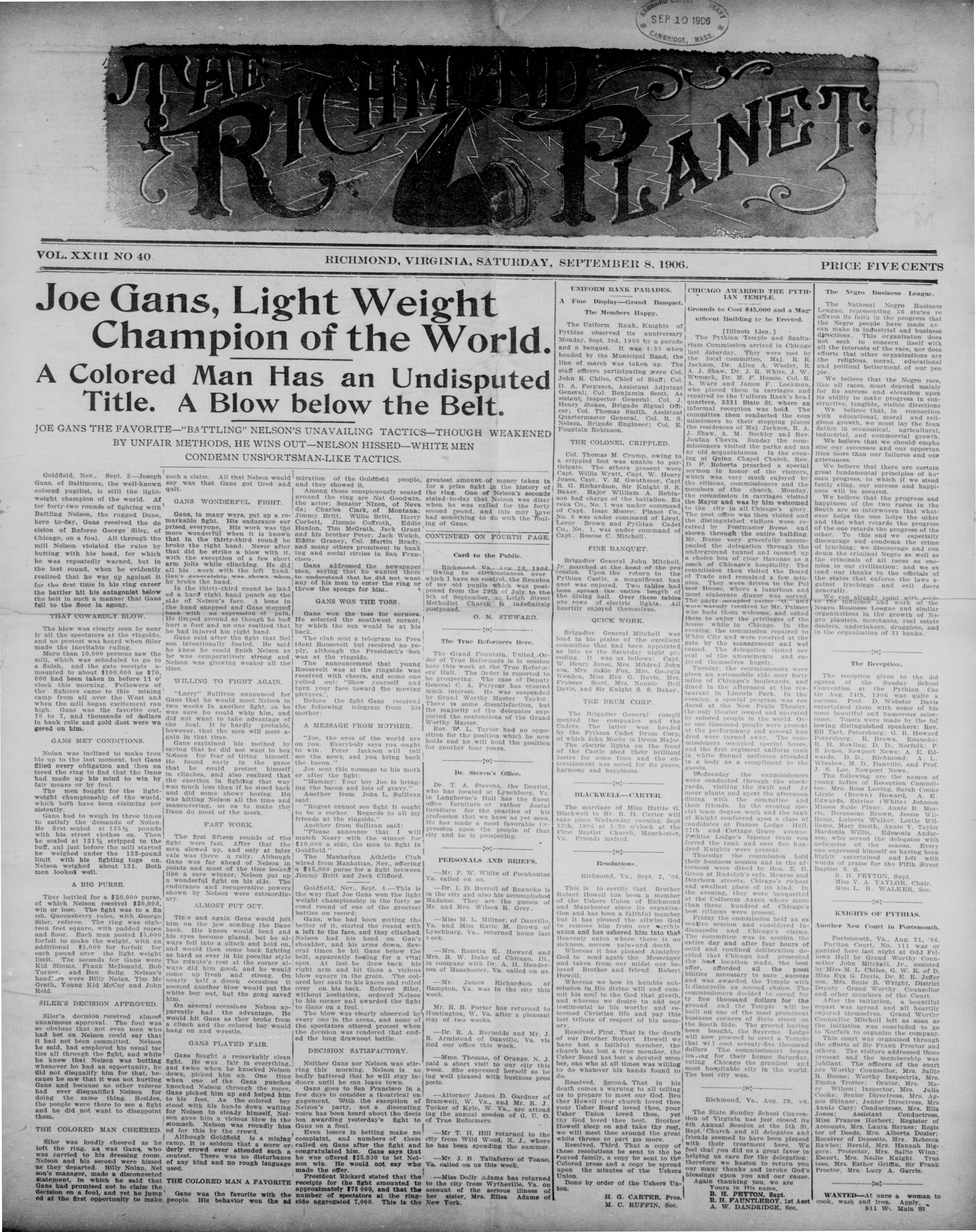
Joe Gans, Light Weight Champion of the World. A Colored Man Has an Undisputed Title. A Blow below the Belt.
JOE GANS THE FAVORITE—"BATTLING" NELSON'S UNAVAILING TACTICS—THOUGH WEAKENED BY UNFAIR METHODS, HE WINS OUT—NELSON HISSED—WHITE MEN
VOL. XXIII NO 40.
Joe Gans
Cha
A Colored
Title.
JOE GANS THE FAVORITE
BY UNFAI
Goldfield, Nev., Sept. 3—Joseph Gans, of Baltimore, the well-known colored pugilist, is still the light-weight champion of the world. After forty-two rounds of fighting with Battling Nelson, the rugged Dane, here to-day, Gans received the decision of Referee George Siler, of Chicago, on a foul. All through the mill Nelson violated the rules by butting with his head, for which he was repeatedly warned, but in the last round, when he evidently realized that he was up against it for the first time in his ring career the battler hit his antagonist below the belt in such a manner that Gans fell to the floor in agony.
THAT COWARDLY BLOW.
The blow was clearly seen by near all the spectators at the ringside, and no protest was heard when Siler made the inevitable ruling. More than 10,000 persons saw the mill, which was scheduled to go to a finish, and the gate receipts amounted to about $100,000 as $70,000 had been taken in before 11 o'clock this morning. Followers of the fighters came to this mining camp from all over the West and when the mill began excitement ran high. Gans was the favorite out, 10 to 7, and thousands of dollars in bank rolls and gold dust were waered on him.
GANS MET CONDITIONS
Nolan was inclined to make trou ble up to the last moment, but Gans filled every obligation and then en tered the ring to find that the Dane had made up his mind to win by fair means or by foul.
The men fought for the light- weight championship of the world, which both have been claiming per siltently.
Gans had to weigh in three times to satisfy the demands of Nolan. He first scaled at 135½ pounds with his street clothes on. Then he scaled at 131½ stripped to the buff, and just before the mill started he weighed under the 133-pound limit with his fighting togs on. Nelson weighed about 131. Both men looked well.
A BIG PURSE.
They battled for a $30,000 purse, of which Nelson received $20,000, win or lose. The fight was to a fish, Queenberry rules, with George Siller, referee. The ring was eighteen feet square, with padded ropes and floor. Each man posted $5,000 forfeit to make the weight, with an additional $5,000 for forfeit for each pound over the light weight limit. The seconds for Gans were Kid Smims, Frank McDonald, Bob Turner, and Ben Selig. Nelson's handlers were Billy Nolan, Tim McGrath, Young Kid McCoy and John Reld.
SILER'S DECISION APPROVED
Siler's decision received almost unanimous approval. The foul was so obvious that not even men who had bet on Nelson could say that it had not been committed. Nelson he said, had employed his usual tac tics all through the fight, and while he knew that Nelson was butting whenever he had an opportunity, he did not disqualify him for that, because he saw that it was not hurting Gans and because no other referee had ever disqualified Nelson for doing the same thing. Besides, the people were there to see a fight and he did not want to disappoint them.
THE COLORED MAN CHEERED
Silver was loudly cheered as he left the ring, as was Gans, who was carried to his dressing room. Nelson and his second were hissed as they departed. Billy Nolan, Nel son's manager, made a disconnected statement, in which he said that Gans had promised not to claim the decision on a foul, and yet he jumped at the first opportunity to make
such a claim. All that Nelson would say was that Gans got tired and quit. imitation of the Goldfield and they showed it. Among those consciously
GANS WONDERFUL FIGHT.
Gans, in many ways, put up a remarkable fight. His endurance surprised everyone. His work was the more wonderful when it is known that in the thirty-third round he broke the right hand. Never after that did he strike a blow with it, with the exception of a few short arm jolts while clinching. He did all his work with the left hand. Gan's generalship was shown when he broke the hand.
In the thirty-third round he landed a hard right hand punch on the side of Nelson's face. A bone in the hand snapped and Gans stepped back with an expression of psm. He filmed around as though he had hurt a foot and no one realized that he had injured his right hand.
Gans said after the fight that Nelson intentionally fouled. He said he knew he could finish Nelson as he was comparatively strong and Nelson was growing weaker all the time.
WILLING TO FIGHT AGAIN
"Larry" Sullivan announced for Gans that he would meet Nelson in two weeks in another fight, as he was sure he could whip him, and did not want to take advantage of the foul. It is hardly probable, however, that the men will meet again in that time.
Gans explained his method by saying that he did not want to box Nelson for fear of tiring himself. He found early in the game that he could protect himself in clinches, and also realized that the exertion in fighting that way was much less than if he stood back and did some showy boxing. He was hitting Nelson all the time and maneuvering, so as to make the Dane do most of the work.
FAST WORK
The first fifteen rounds of the fight were fast. After that the men slowed up, and only at inter vals was there a rally. Although Gans was far ahead of Nelson in points and most of the time looked like a sure winner, Nelson put up a wonderful fight on his side. The endurance and recuperative powers shown by Nelson were extraordin-
ALMOST PUT OUT.
Time and again Gans would jolt him on the jaw sending the Dane back. His knees would bend and his eyes become glazed, but he always fell into a clinch and held on, and would then come back fighting as hard as ever in his peculiar style. The minute's rest at the corner always did him good, and he would come up fresh and strong. On nearly half a dozen occasions it seemed another blow would put the white boy out, but the gong saved him.
On several occasions Nelson apparently had the advantage. He would hit Gans as they broke from a clinch and the colored boy would hang on and wrestle.
GANS PLAYED FAIR
Gans fought a remarkably clean fight. He was fair in everything, and twice when he knocked Nelson down, picked him up. One time when one of the Gans punches knocked Nelson through the ropes, Gans picked him up and helped him to his feet. As the colored boy stood with his hands down waiting for Nelson to steady himself, Nelson gave him a vicious blow in the stomach. Nelson was roundly hissed for this by the crowd.
Although Goldfield is a mining camp, it is seldom that a more or derly crowd ever attended such a contest. There was no disturbance of any kind and no rough language used.
THE COLORED MAN A FAVORITE
Gans was the favorite with the people. His behavior won the ad
RICHMOND, VIRGINIA, SATURDAY, SEPTEMBER 8, 1906
miration of the Goldfield people and they showed it. Among those conspicuously seated around the ring are Nat Goodwin, the actor; Senator Nixon, of Newda; Charles Clark, of Montana; Jimmy Britt, Willie Britt, Harry Corbett, Jimmie Crothoff, Eddie Hanlon, Tim McGrath, Jack Grant and his brother Peter; Jack Welch, Eddie Graney, Col. Martin Brady, and many others prominent in banking and social circles in San Francisco. Gans addressed the newspaper men, saying that he wanted them to understand that he did not want any of his men to enter the ring or throw the sponge for him.
GANS WON THE TOSS
Gans won the toss for corners.
He selected the southwest corner,
by which the sun would be at his
back.
The club sent a telegram to Pres
ident Roosevelt but received no re
ply, although the President's son
was at the ringside.
The announcement that young
Roosevelt was at the ringside was
received with cheers, and some one
yelled out: "Show yourself and
turn your face toward the moving
pictures."
Before the fight Gans received
the following telegram from his
mother:
A MESSAGE FROM MOTHER.
"Joe, the eyes of the world are on you. Everybody says you ought to win. Peter Jackson will tell me the news, and you bring back the bacon."
Joe sent this message to his moth er after the fight:
"Mammy: Your boy Joe is bringing the bacon and lots of gravy."
Another from John L. Sullivan said: "Regret cannot see fight It ought to be a corker. Regards to all my friends at the ringside." Another from Sullivan said: "Please announce that I will match Neary with the winner for $10,000 a side, the men to fight in Goldfield." The Manhattan Athletic Club wired from Manhattan, Nev., offering a $15,000 purse for a fight between Jimmy Britt and Jack Clifford.
Goldfield, Nev., Sept. 4.—This is the way that Joe Gans won the light weight championship in the forty se cond round of one of the greatest battles on record:
Gans, who had been getting the better of it, started the round with a left to the face, and they clinched. Nelson had his head on Gan's shoulder, and his arms down. Several times he hit Gans below the belt, apparently feeling for a vital spot. At last he drew back his right arm and hit Gans a vicious blow square in the groin. The colored boy sank to his knees and rolled over on his back. Referee Siler, without hesitation, ordered Nelson to his corner and awarded the fight to Gans on a foul.
The blow was clearly observed by every one in the arena, and none of the spectators uttered protest when the decision was rendered that ended the long drawout battle.
DECISION SATISFACTORY.
Neither Gans nor Nelson was stirring this morning. Nelson is so badly battered that he will stay indoors until he can leave town.
Gans goes to San Francisco in a few days to consider a theatrical engagement. With the exception of Nelson's party, not a dissenting voice has been heard about the decios ion awarding yesterday's fight to Gans on a foul.
Even losers in betting make no complaint, and numbers of them called on Gans after the fight and congratulated him. Gans says that he was offered $25,000 to let Nelson win. He would not say who made the offer.
President Rickard stated that the receipts for the fight amounted to approximately $78,000, and that the number of spectators at the ringside aggregated 7,000. This is the
greatest amount of money taken in for a prize fight in the history of the ring. One of Nelson's seconds stated-to-day that Nelson was dizzy when he was called for the forty second round, and this may have had something to do with the fouling of Gans.
CONTINUED ON FOURTH PAGE
Card to the Public
Richmond, Va. Aug. 28, 1908.
Owing to circumstances over
which I have no control, the Reunlon
of my old pupils which was post-
poned from the 29th of July to the
9th of September, at Leigh Street
Methodist Church is indefinitely
postponed.
O. M. STEWARD
The True Reformers Here.
The Grand Fountain, United. Order of True Reformers is in session here this week at the True Reformers' Hall. The Order is reported to be propering. The case of Deputy General C. A. Puryear has created much interest. He was suspended by Grand Worthy Master Taylor. There is some dissatisfaction, but the majority of the delegates supported the contentions of the Grand Worthy Master. Rev. W. L. Taylor had no opposition for the position which he now holds and he will hold the position for another four years.
Dr. Steven's Office.
Dr. T. A. Stevens, the Dentist, who has located at Lynchburg, Va. in Langhorne's Hall has the finest office furniture or rather dental furniture for the practice of his profession that we have as yet seen. He has made a most favorable impression upon the people of that city and he is prospering.
PERSONALS AND BRIEFS
—Mr. P. W. White of Pocahontas
Va. called on us.
—Dr. I. D. Burrell of Roanoke is
in the city and also his accomplished
Madame. They are the guests of
Mr. and Mrs. Wilson R. Grey.
—Miss M. L. Millner, of Danville,
Va. and Miss Katie M. Brown of
Lynchburg, Va., returned home last
week.
—Mrs. Rozetta E. Howard and
Mrs. B. W. Duke of Chicago, Ill.
in company with Dr. A. H. Henderson
of Manchester, Va. called on us.
—Mr. James Richardson of
Hampton, Va. was in the city this
week.
Mr. R. B. Porter has returned to
Huntington, W. Va. after a pleasant
stay of two weeks.
—Dr. R. A. Reynolds and Mr. J.
R. Armistead of Danville, Va. visi
ited our office this week.
—Mme. Thomas, of Orange, N. J.
paid a short visit to our city this
week. She expressed herself as be
ing well pleased with business prospe
s.
—Attorney James D. Gardner of
Bramwell, W. Va., and Mr. R. J.
Tucker of Kyle, W. Va., are att
ing the annual session of G. U. O.
of True Reformers.
—Mr T. H. Hill returned to the city from Wild Wood, N. J., where he has been spending the summer
—Mr. J. B. Tallaferro of Toano
Va. called on us this week.
—Miss Dolly Adams has returned to the city from Wytheville, Va. on account of the serious illness of her sister, Mrs. Eliza Adams of Wye.
UNIFORM RANK PARADES.
The Members Happy.
The Uniform Rank, Knights of Pythias observed its anniversary Monday, Sept. 3rd, 1906 by a parade and a banquet. It was 4:30 when headed by the Municipal Band, the line of march was taken up. The staff officers participating were Col. John R. Chiles, Chief of Staff; Col. D. A. Ferguson, Assistant Adjutant General; Col. Benjamin Scott, Assistant Inspector General; Col. J. Henry Stokes, Brigade Signal Officer; Col. Thomas Smith, Assistant Quartermaster General; Col. R. S. Nelson, Brigade Engineer; Col. E. Fountain Robinson.
THE COLONEL CRIPPLED
Col. Thomas M. Crump, owing to a crippled foot was unable to participate. The ethers present were Capt. Willis Wyatt, Capt. W. Henry Jones, Capt. V. M. Gwathmey, Capt R. G. Richardson, Sir Knight S. S. Baker, Major William A. Robinson had charge of the battalion, Eureka Co., No. 1 was under command of Capt. Isaac Moore; Planet Co., No. 8 was under command of Lleut, Leroy Brown and Pythian Cadder Co., No. 1, was under command of Capt. Roscoe C. Mitchell.
FINE BANQUET.
Brigadier General John Mitchell, Jr. marched at the head of the procession. Upon the return to the Pythian Castle, a magnificent banquet was enjoyed. Two tables had been spread the entire length of the room, and those table cases are rows of electric lights. All heartily enjoyed themselves.
QUICK WORK
Brigadier General Mitchell was loud in his praise of the excellent committee that had been appointed as late as the Saturday night preceding. It was as follows: Capt W. Henry Jones, Mrs. Mildred Johnson, Mrs. Sakle Fox, Mrs. Georgia Weeden, Miss Eva G. Davis, Mrs. Frances Scott, Mrs. Nannie Bell Davis, and Sir Knight S. S. Baker.
THE DRUM CORP
The Brigadier General complimented the companies and the Cadets. The latter was headed by the Python Cadet Drum Corp. of which the Mosby is Drum Major. The electric lights on the front of the Castle shed their brilliant lustre for some time and the entertainment was noted for its peace, harmony and happiness.
BLACKWELL—CARTER
The marriage of Miss Hattie G. Blackwell to Mr. R. H. Carter will take place Wednesday evening, Sept 12th, 1906 at 5:30 o'clock at the First Baptist Church, Manchester Va. Friends invited.
Resolutions
Richmond, Va., Sept. 2, '06.
This is to certify that Brother Robert Howell has been a member of the Ushers Union of Richmond and Manchester since its organization and has been a faithful member but it has pleased the allwise God to remove him from our earthly union and has ushered him into that Heavenly union where there is no sickness, sorrow pain and death.
Whereas it has pleased Almighty God to send again the Messenger and taken from our midst our beloved Brother and friend Robert Howell.
Whereas we bow in humble submission to His divine will and commit his soul to the God that giveth, and whereas we desire to add our testimonial to his worthy and esteemed Christian life and pay this last tribute of respect of his memory.
Resolved, First. That in the death of our Brother Robert Howell we have lost a faithful member, the church has lost a true member, the Ushers Board has lost a devoted member, one who at all times was willing to do whatever his hands found to do.
Resolved, Second. That in his death comes a warning to all telling us to prepare to meet our God. Brother Howell your church loved thee your Usher Board loved thee, your Usher Union loved thee, yet thy God loved thee best. Brother Howell sleep on and take thy rest, we will meet thee around the great white throne to part no more.
Resolved, Third. That a copy of these resolutions be sent to the be reaved family, a copy be sent to the Colored press and a copy be spread upon the minutes of the Ushers Union.
Done by order of the Ushers Union.
H. G. CARTER, Pres.
M. C. RUFFIN, Sec.
CHICAGO AWARDED THE PYTHI-
IAN TEMPLE...
Grounds to Cost $45,000 and a Mag
nificent Building to be Erected.
[Illinois Idea.]
[Illinois Idea.]
The Pythian Temple and Sanitarium Commission arrived in Chicago last Saturday. They were met by the local committee, Maj. R. R. Jackson, Dr. Allen A. Wesley, R. A. J. Shaw, Dr. J. R. White, J. W. Womack, Dr. M. F. Hussle, Col. R. A. Ware and James F. Lockman who placed them in carriages and repaired to the Uniform Rank's head quarters, 3331 State St. where an informal reception was held. The committee then conducted the commissioners to their stopping places the residences of Maj. Jackson, R. A. J. Shaw, A. M. Beckley and Rev. Jordan Chevis. Sunday the commissioners visited the parks and many old acquaintances. In the evening at Quinn Chapel Church, Rev. D. P. Roberts preached a special sermon in honor of the visitors, which was very much enjoyed by the citizens, commissioners and the members of the church. Monday, the commission in carriages visited the Mayor and was by him welcomed to the city in all Chicago's glory. The post office was then visited and the distinguished visitors were received by Postmaster Busse and shown through the entire building. Mr. Busse very gracefully accompanied the delegation through the underground tunnel and opened up a choice box of clear Havanas as a mark of Chicago's hospitality. The commission then visited the Board of Trade and remained a few minutes. They were driven to the mourner House, where a luxurious and most elaborate dinner was served. The party occupied partner "O." and were warmly received by Mr. Palmer who bade them welcome, and asked them to enjoy the privileges of the house while in Chicago. In the evening, the commission repaired to White City and were received at the gate by the management and welcomed. The delegation visited several of the amusements and enjoyed themselves hugely.
Tuesday, the commissioners were given an automobile ride over forty miles of Chicago's boulevards, and dined in the afternoon at the restaurant in Lincoln Park. In the evening, a special program was rendered at the New Pekin Theater, the only theater owned and operated by colored people in the world. Over one thousand people were present at the performance and several hundred were turned away. The commissioners occupied special boxes, and the first regiment uniform rank in white flannel uniforms attended in a body as a compliment to the guests.
Wednesday the commissioners were conducted through the stockyards, visiting the Swift and Armour plants and spent the afternoon dining with the committee and their friends. In the evening special team degree work and the rank of Knight conferred upon a class of candidates at Damon Lodge Hall, 377th and Cottage Grove avenue. Pythias Lodge's famous team conferred the rank and over five hundred Knights were present.
Thursday the commission held their business session and in the afternoon were dined by Hon. E. D. Green at Rudolph's cafe. Monroe and Dearborn streets, Chicago's richest and swellest place of its kind. In the evening, they were banqueted at the Colleumse Annex where more than three hundred of Chicago's best citizens were present.
Friday the commission held an executive session and considered Indianapolis and Chicago's claims. The committee was in session the entire day and after four hours of solid and confined deliberation decided that Chicago had presented the best location made, the best offer, afforded all the possi bilities necessary to sure success and was awarded the Temple with Indianapolis as second choice. The commissioners decided to spend for ty five thousand dollars for the ground and the Temple will be built on one of the most prominent business corners of State street on the South Side. The ground having been bought, the Supreme Lodge will now proceed to erect a Temple that will cost seventy-five thousand dollars. The commissioners began leaving for their homes Saturday, voting Chicago the grandest and most hospitable city in the world. The best city won.
Richmond, Va., Aug. 29, u6
The State Sunday School Convention of Virginia has just closed its 6th Annual Session at the 5th St. Bapt. Church and all delegates and friends seemed to have been pleased with their treatment here. We feel that you did us a great favor in helping us care for the delegation; therefore we hasten to return you our many thanks and invoke God's blessings upon you and our cause. Answer:
PRICE FIVE CENTS
The Negro Business League.
The National Negro Business League, representing 36 states re affirms its faith in the progress that the Negro people have made an can make in industrial and business directions. This organization does not seek to concern itself with all the interests of the race, nor does efforts that other organizations are the religious, moral, educational and political betterment of our people.
We believe that the Negro race, like all races, must depend mainly for its success and elevation upon its ability to make progress in constructive, tangible, visible directions
We believe that, in connection with educational, moral and religious growth, we must lay the foundation in economical, agricultural, industrial, and commercial growth.
We believe that we should empha size our successes and our opportunities more than our failures and our grievances.
We believe that there are certain great fundamental principles of human progress, to which if we steadfastly cling, our success and happiness will be assured.
We believe that the progress and happiness of the two races in the South are so interwoven that whatever helps the one helps the other and that what retards the progress of the one retards the progress of the other. To this end we especially discourage and condemn the crime of lynching; we discourage and condemn the criminal Negro as well as the criminals of all races as enemies to our civilization; and we extend our thanks to the officials of the states that enforce the laws against lynchings and evil doors generally.
We can already point with pride to the influence and work of the Negro Business League and similar organizations in the growth of Negro planters, merchants, real estate dealers, undertakers, druggists, and in the organization of 31 banks.
The Reception.
The reception given to the delegates of the Sunday School Convention at the Pythian Castle Aug. 24th, 1906 was quite a success. Prof. D. Webster Davis entertained them with some of his most beautiful and humorous selections. Toasts were made by the following distinguished speakers: Rev. Eli Tart, Petersburg; G. B. Howard Petersburg; R. Brown, Roanoke; R. H. Bowling, D. D., Norfolk; P. E Jones, Newport News; A. E. Edwards, D. D., Richmond; A. L. Winslow, M. D. Danyville, and Prof. J. S. Lee, Newport News.
The following are the names of young ladies of Reception Committee: Mrs. Rosa Loving, Sarah Cookie Lizzie (Brown) Howard, A. E. Edwards, Estrine (White) Johnson Misses Susie Fliny, Annie B. Morris, Beransene Brown, Jessie Williams, Luberta Walker, Lottle Williams, Mary Smith, Annie V. Taylor Hardenia Willis, Edmonia Anderson, who served the delegates with delicacies of the season. Every one expressed himself as having been highly entertained and left with words of praise for the Fifth Street Baptist S. S.
B. H. PEYTON, Supt.
Miss V. A. TAYLOR, Chair,
Miss L. B. WALKER, Sec.
KNIGHTS OF PYTHIAS
Another New Court in Portsmouth
Portsmouth, Va., Aug. 31, '06, Puritan Court, No. 111 was organized here last night at Odd Fellows Hall by Grand Worthy Counselor John Mitchell, Jr., assisted by Miss M. L. Chiles, G. W. R. of D. Miss Eya G. Davis, Dr. E. R. Jeferson, Mrs. Susie B. Wright, District Deputy Grand Worthy Counselor and other members of the Court.
After the initiation, a bountiful repast was spread and all heartily enjoyed themselves. Grand Worthy Counselor Mitchell left as soon as the initiation was concluded to go to Norfolk to organize the company. This court was organized through the efforts of Sir Frank Proctor and others. The visitors addressed those present and the membership was jubilant. The officers of the court are Worthy Counselor, Mrs. Sallia B. Boone; Worthy Inspectrix, Mrs. Emma Trotter; Orator, Mrs. Mary Wilson; Inspector, Mrs. Julia Coster; Senior Directress, Mrs. Agnes Skinner; Junior Directress, Mrs. Annie Cary; Conductress, Mrs. Ella Jones; Assistant Conductress, Miss Frances Herbert; Register of Accounts, Mrs. Laura Barnes; Register of Deeds, Mrs. Alberta Dozier; Receiver of Deposits, Mrs. Rebecca Rawles; Herald, Mrs. Hannah Biggers; Protector, Mrs. Sallie Winn; Escort, Mrs. Neille Knight; Trustees, Mrs. Esther Griffin, Sir Frank Proctor, Mrs. Lucy A. Garris.
WANTED-At once a woman to cook, wash and iron. Apply. 911 W. Main St.
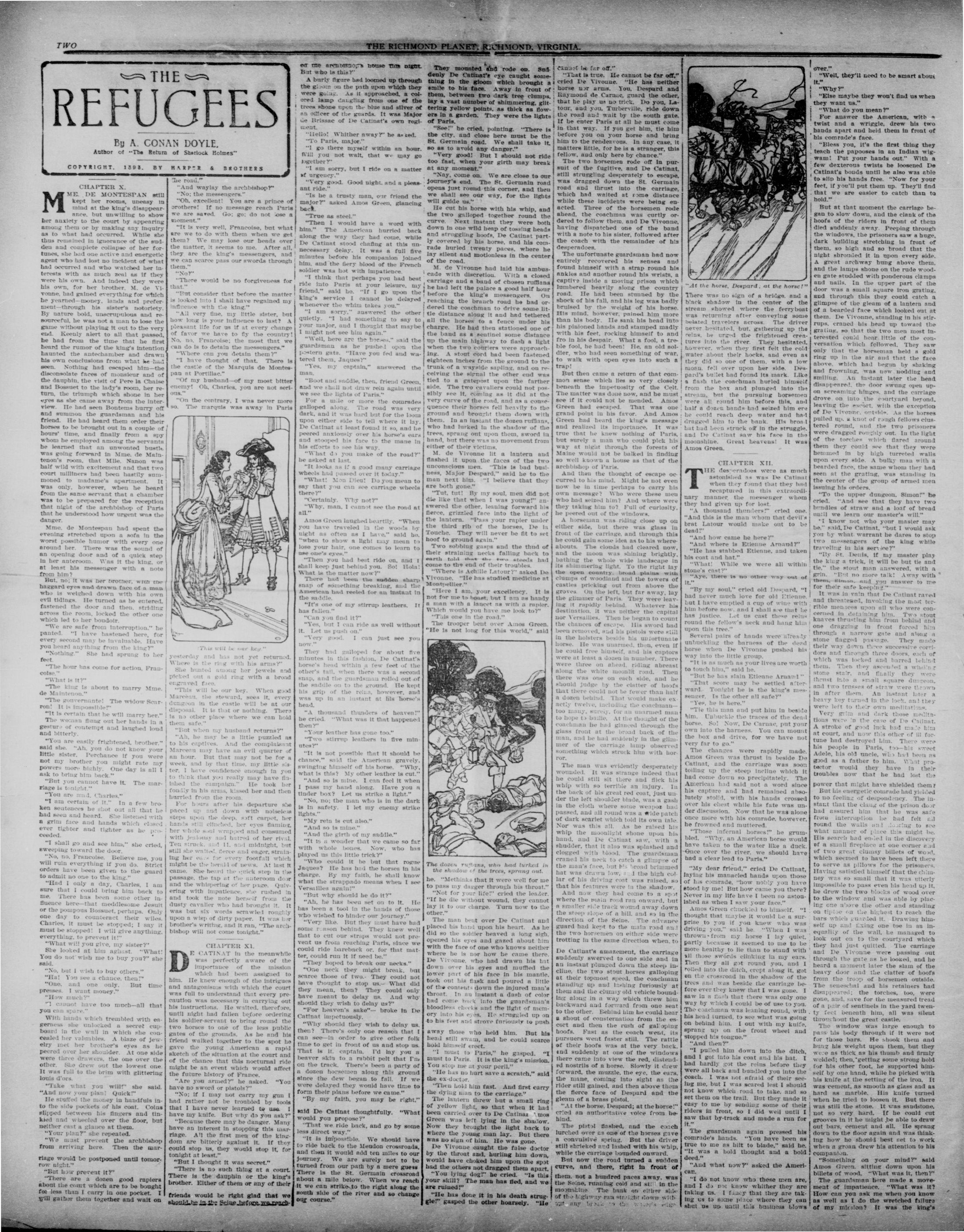
REFUGEES
By A. CONAN DOYLE.
Author of "The Return of Sherlock Holmes"
COPYRIGHT. 1898. BY HARPER & BROTHERS
ME. DE MONTESPAN still kept her rooms, uneasy in mind at the king's disappearance, but unwilling to show her anxiety to the court by appearing among them or by making any inquiry as to what had occurred. While she thus remained in ignorance of the sudden and complete collapse of her fortunes, she had one active and energetic agent who had lost no incident of what had occurred and who watched her interests with as much zeal as if they were his own. And indeed they were his own, for her brother, M. de Vivonne, had gained everything for which he yearned—money, lands and preferment—through his sister's notoriety. By nature bold, unscrupulous and resourceful, he was not a man to lose the game without playing it out to the very end. Keenly alert to all that passed, he had from the time that he first heard the rumor of the king's intention haunted the antechamber and drawn his own conclusions from what he had seen. Nothing had escaped him—the disconscolate faces of monsieur and of the dauphin, the visit of Pere la Chise and Bossuet to the lady's room, her return, the triumph which shone in her eyes as she came away from the interview. He had seen Bontems hurry off and summon the guardman and his friend. He had heard them order their horses to be brought out in a couple of hours' time, and finally from a spy whom he employed among the servants he learned that an unwonted bustle was going forward in Mme. de Maintenon's room, that Mille. Nanon was half wild with excitement and that two court milliners had been hastily summoned to madame's apartment. It was only, however, when he heard from the same servant that a chamber was to be prepared for the reception that night of the archbishop of Paris that he understood how urgent was the danger.
Mme. de Montespan had spent the evening stretched upon a sofa in the worst possible humor with every one around her. There was the sound of an opening door and of a quick step in her anteroom. Was it the king, or at least his messenger with a note from him?
But, no; it was her brother, with the haggard eyes and drawn face of a man who is weighed down with his own evil tidings. He turned as he entered, fastened the door and then, stridling across the room, locked the other one which led to her boudoir.
"We are safe from interruption," he panted. "I have hastened here, for every second may be invaluable. Have you heard anything from the king?" "Nothing." She had sprung to her feet.
"The hour has come for action, Francoise."
"What is it?" "The king is about to marry Mme. de Maintenon."
"The governante! The widow Scarron! It is impossible!"
"It is certain that he will marry her."
The woman flung out her hands in a gesture of contempt and laughed loud and bitterly.
"You are easily frightened, brother." said she. "Ah, you do not know your little sister. Perchance if you were not my brother you might rate my powers more highly. One day is all I ask to bring him back."
"But you cannot have it. The marriage is tonight."
"You are mad, Charles."
"I am certain of it." In a few broken sentences he shot out all that he had seen and heard. She listened with a grim face and hands which closed ever tighter and tighter as he proceeded.
"I shall go and see him," she cried, sweeping toward the door.
"No, no, Francisele. Believe me, you will ruin everything if you do. Strict orders have been given to the guard to admit no one to the king."
"Had I only a day, Charles, I am sure that I could bring him back to me. There has been some other influence here—that meddlesome Jesuit or the pompous Bossuet, perhaps. Only one day to counteract their wiles. Charles, it must be stopped; I say it must be stopped! I will give anything, everything, to prevent it."
"What will you give, my sister?"
She looked at him aghast. "What! You do not wish me to buy you?" she said.
"No, but I wish to buy others."
"Ha! You see a chance, then!"
"One, and one only. But time presses. I want money."
"How much?"
"I cannot have too much—all that you can spare."
With hands which trembled with eagerness she unlocked a secret cupboard in the wall in which she concealed her valuables. A blaze of jewelry met her brother's eyes as he peered over her shoulder. At one side were three drawers, the one over the other. She drew out the lowest one. It was full to the brim with glittering louis d'ors.
"Take what you will!" she said.
"And now your plan! Quick!"
He stuffed the money in handfuls into the side pocketes of his coat. Coins slipped between his fingers and tinkled and wheeled over the floor, but neither cast a glance at them.
Your pencil, she repeated.
"We must prevent the archbishop from arriving here. Then the marriage would be postponed until tomorrow night."
"But how prevent it?"
"There are a dozen good raplers about the court which are to be bought for less than I carry in one pocket. I will gather them together and wait on
TWO
"What is it?"
"You are mind, Charles."
"But how present it?"
The road."
"And waylay the archbishop?"
"No; the messengers."
"Oh, excellent! You are a prince of brothers! If no message reach Paris we are saved. Go; go; do not lose a moment."
"It is very well, Francoise, but what are we to do with them when we get them? We may lose our heads over the matter, it seems to me. After all, they are the king's messengers, and we can scarce pass our swords through them."
"No?"
"There would be no forgiveness for that."
"But consider that before the matter is looked into I shall have regained my influence with the king."
"All very fine, my little sister, but how long is your influence to last? A pleasant life for us if at every change of favor we have to fly the country! No, no. Françoise; the most that we can do is to detain the messengers." "Where can you detain them?" "I have thought of that. There is the castle of the Marquis de Montespan at Portillac." "Of my husband—of my most bitter enemy! Oh, Charles, you are not serious." "On the contrary, I was never more so. The marquis was away in Paris
A
"This will be our key"
yesterday and has not yet returned. Where is the ring with his arms?
She hunted among her jewels and picked out a gold ring with a broad engraved face.
"This will be our key. When good Marceau, the steward, sees it, every dungeon in the castle will be at our disposal. It is that or nothing. There is no other place where we can hold them safe."
"But when my husband returns?"
"But when my husband returns?" "Ah, he may be a little puzzled as to his captives. And the complainsant Marceen may have an evil quarter of an hour. But that may not be for a week, and by that time, my little sister. I have confidence enough in you to think that you really may have finished the campaign." He took her family in his arms, kissed her and then hurried from the room.
For hours after his departure she paced up and down with noiseless steps upon the deep, soft carpet, her hands still climbed, her eyes flaming, her whole soul wrapped and consumed with jealousy and hatred of her rival. Ten struck, and 11, and midnight, but still she waited, fierce and eager, straining her cares for every footfall which might be the herald of news. At last it came. She heard the quick step in the passage, the tap at the anteroom door and the whispering of her page. Quivering with impatience, she rushed in and took the note herself from the dusty cavailor who had brought it. It was but six words scrawled roughly upon a wisp of dirty paper. It was her brother's writing, and it run. "The arch-bishop will not come tonight."
CHAPTER XI.
DE CATINAT in the meanwhile was perfectly aware of the importance of the mission which had been assigned to him. He knew enough of the intrigues and antagonisms with which the court was full to understand that every precaution was necessary in carrying out his instructions. He waited, therefore, until night had fallen before ordering his soldier-servant to bring round the two horses to one of the less public gates of the grounds. As he and his friend walked together to the spot he gave the young American a rapid sketch of the situation at the court and of the chance that this nocturnal ride might be an event which would affect the future history of France.
"Are you armed?" he asked. "You have no sword or pistols?"
"No; if I may not carry my gun I had rather not be troubled by tools that I have never learned to use. I have my knife. But why do you ask?"
"Because there may be danger. Many have an interest in stopping this marriage. All the first men of the kingdom are bitterly against it. If they could stop us, they would stop it, for tonight at least."
"But I thought it was secret."
"There is no such thing at a court. There is the dauphin or the king's brother. Either of them or any of their friends would be right glad that we should be in the Seine before we reach-
THE RICHMOND PLANET, RICHMOND, VIRGINIA
of the archbishop's house this night.
But who is this?
A burly figure had loomed up through the gloom on the path upon which they were going. As it approached, a colored lamp dangling from one of the trees shone upon the blue and silver of an officer of the guards. It was Major de Brissac of De Catinat's own regiment.
"Hello! Whither away?" he asked.
"To Paris, major."
"I go there myself within an hour. Will you not wait, that we may go together?"
"I am sorry, but I ride on a matter of urgency."
"Very good. Good night, and a pleasant ride."
"Is he a trusty man, our friend the major?" asked Amos Green, glancing back.
"True as steel."
"Then I would have a word with him." The American hurried back along the way they had come, while De Catimat stood chafing at this unnecessary delay. It was a full five minutes before his companion joined him, and the fiery blood of the French soldier was hot with impatience.
"I think that perhaps you had best ride into Paris at your leisure, my friend," said he. "If I go upon the king's service I cannot be delayed whenever the whim takes you."
"I am sorry," answered the other quietly. "I had something to say to your major, and I thought that maybe I might not see him again."
"Well, here are the horses," said the guardsmans as he pushed open the postern gate. "Have you fed and watered them, Jaques?"
"Yes, my captain," answered the man.
"Boot and saddle, then, friend Green, and we shall not draw rein again until we see the lights of Paris."
For a mile or more the comrades galloped along. The road was very dark, and it was hard but for the loom upon either side to tell where it lay. De Cattnat at least found it so, and he peered anxiously over his horse's ears and stooped his face to the mane in his efforts to see his way.
"What do you make of the road?" he asked at last.
"It looks like it a good many carriage wheels had passed over it today."
"What! Mon Dieu! Do you mean to say that you can see carriage wheels there?"
"Certainly. Why not?"
"Why, man, I cannot see the road at all."
Amos Green lunged heartily. "When you have traveled in the woods by night as often as I have," said he, "when to show a light may mean to lose your hair, one comes to learn to use one's eyes."
"Then you had best ride on, and I shall keep just behind you. So! Hoh! What is the matter now?"
There had been the sudden sharp snap of something breaking, and the American had reeled for an instant in the saddle.
"It's one of my stirrup leathers. It has fallen."
"Can you find it?"
"Yes, but I can ride as well without it. Let us push on."
"Very good. I can just see you now."
They had galloped for about five minutes in this fashion. De Catmati's horse's head within a few feet of the other's tail, when there was a second snap, and the guardman rolled out of the saddle on to the ground. He kept his grip of the reins, however, and was up in an instant at his horse's head.
"A thousand thunders of heaven!" he cried. "What was it that happened then?"
"Your leather has gone too."
"Two stirrup leather in five minutes?"
"It is not possible that it should be chance," said the American gravely, swinging himself off his horse. "Why, what is this? My other leather is cut."
"And so is mine. I can feel it when I pass my hand along. Have you a tinder box? Let us strike a light."
"No, no; the man who is in the dark is in safety. I let my enemy strike lights."
"My rein is cut also."
"And so is mine."
"And the girth of my saddle."
"It is a wonder that we came so far with whole bones. Now, who has played us this little trick?"
"Who could it be but that rogue Jaques? He has had the horses in his charge. By my faith, he shall know what the straddado means when I see Versailles again!"
"But why should he do it?"
"Ah, he has been set on to it. He has been a tool in the hands of those who wished to hinder our journey."
"Very like. But they must have had some reason behind. They knew well that to cut our straps would not prevent us from reaching Paris, since we could ride bareback or, for that matter, could run it if need be."
They hoper to break our necks.
"One neck they might break, but scarce those of two. They could not have thought to stop us. What did they mean, then? They could only have meant to delay us. And why should they wish to delay us?"
"For heaven's sake"—broke in De Cafnat impetuously.
"Why should they wish to delay us, then? There's only one reason that I can see—in order to give other folk time to get in front of us and stop us. That is it, captain. I'd lay you a beaver skin to a rabbit pelt that I'm on the track. There's been a party of a dozen horsemen along this ground since the dew began to fall. If we were delayed they would have time to form their plans before we came."
"By my faith, you may be right," said De Catinat thoughtfully. "What would you propose?" "That we ride back, and go by some less direct way." "It is impossible. We should have to ride back to the Mendon crossroads, and then it would add ten miles to our journey. We are surely not to be turned from our path by a mere guess There is the St. Germain crossroad about a mile below. When we reach it we can strike to the right along the south side of the river and so change our course."
They mounted and rode on. Suddenly De Catlain's eye caught something in the gloom which brought a smile to his face. Away in front of them, between two dark tree clumps, lay a vast number of shimmering, glittering yellow points, as thick as flowers in a garden. They were the lights of Paris.
"See?" he cried, pointing. "There is the city, and close here must be the St. Germain road. We shall take it, so as to avoid any danger."
"Very good! But I should not ride too fast, when your girth may break at any moment."
"Nay, come on. We are close to our journey's end. The St. Germain road opens just round this corner, and then we shall see our way, for the lights will guide us."
He cut his horse with his whip, and the two galloped together round the curve. Next instant they were both down in one wild heap of tossing heads and struggling hoofs, Doe Catinat partly covered by his horse, and his comrade hurled twenty paces, where he lay silent and motionless in the center of the road.
M. de Vivonne had laid his ambuscade with discretion. With a closed carriage and a band of chosen ruffians he had left the palace a good half hour before the king's messengers. On reaching the branch road he had ordered the coachman to drive some little distance along it and had tethered all the horses to a fence under his charge. He had then stationed one of the band as a sentinel some distance up the main highway to flash a light when the two couriers were approaching. A stout cord had been fastened eighteen inches from the ground to the trunk of a wayside sapling, and on receiving the signal the other end was tied to a gatepost upon the farther side. The two cavaliers could not possibly see it, coming as it did at the very curve of the road, and as a consequence their horses fell heavily to the ground and brought them down with them. In an instant the dozen ruffians, who had lurked in the shadow of the trees, sprang out upon them, sword in hand, but there was no movement from either of their victims.
M. de Vivonne lit a lantern and flashed it upon the faces of the two unconscious men. "This is bad business, Major Despard," said he to the man next him. "I believe that they are both gone."
"Tut, tut! By my soul, men did not die like that when I was young!" answered the other, leaning forward his fierce, grizzled face into the light of the lantern. "Pass your rapler under the third rib of the horses, De la Touche. They will never be fit to set hoof to ground again."
"Two sobbing gasps and the thud of their straining necks falling back to earth told that the two steeds had come to the end of their troubles.
"Where is Achille Latour? asked De Vivonne. "He has studied medicine at Montpellier."
"Here I am, your excellency. It is not for me to boast, but I am as handy a man with a lanacet as with a rapler. Which would you have me look to?"
"This one in the road."
The trooper bent over Amos Green. "He is not long for this world," said
A
The dozen ruthens, who had lurked in the shadow of the trees, spring out. he. "Methinks that it were well for me to pass my dagger through his throat." "Not for your life!" cried the leader. "If he die without wound, they cannot lay it to our charge. Turn now to the other."
The man beat over De Cattinat and placed his hand upon his heart. As he did so the soldier heaved a long sigh, opened his eyes and gazed about him with the face of one who knows neither where he is nor how he came there. De Vivonne, who had drawn his hat down over his eyes and muffled the lower part of his face in his mantle, took out his flask and poured a little of the contents down the injured man's throat. In an instant a dash of color had come back into the guardsman's bloodless checks and the light of memory into his eyes. He struggled up on to his feet and strove furiously to push
away those who held him. But his head still swam, and he could scare hold himself erect.
"I must to Paris," he gasped. "I must to Paris. It is the king's mission. You stop me at your peril."
"He has no hurt save a scratch," said the ex-doctor.
"Then hold him fast. And first carry the dying man to the carriage."
The lantern threw but a small ring of yellow light, so that when it had been carried over to De Catarina, Amos Green was left lying in the shadow. Now they brought the light back to where the young man lay. But there was no sign of him. He was gone.
De Vivonne caught the false doctor by the threat and, hurling him down, would have choked him upon the spot had the others not dragged them apart.
"You lying dog!" he cried. "Is this your skill? The man has fied, and we are ruined!" "He has done it in his death struggle!" gasped the other hoursely. "He
cannot be far off."
"That is true. He cannot be far off," cried De Vivonne. "He has neither horse nor arms. You, Despard and Raymond de Carnac, guard the other, that he play us no trick. Do you, Latour, and you, Timberville, ride down the road and wait by the south gate. If he enter Paris at all he must come in that way. If you get him, tie him before you on your horse and bring him to the rendezvous. In any case, it matters little, for he is a stranger, this fellow, and only here by chance."
The two horsemen rode off in pursuit of the fugitive, and De Catinat, still struggling desperately to escape, was dragged down the St. Germain road and thrust into the carriage, which had waited at Rome distance while these incidents were being enacted. Three of the horsemen rode ahead, the coachman was curly ordered to follow them, and De Vivonne, having dispatched one of the band with a note to his sister, followed after the coach with the remainder of his deserpoedes.
The unfortunate guardman had now entirely recovered his senses and found himself with a strap round his ankles and another round his wrists, a captive inside a moving prison which lumbered heavily along the country road. He had been stunned by the shock of his fall, and his leg was badly bruised by the weight of his horse. His mind, however, pained him more than his body. He sank his head into his pinioned hands and stamped madly with his feet, rocking himself to and fro in his despair. What a fool, a treble fool, he had been! He, an old soldier, who had seen something of war, to walk with open eyes into such a trap!
But then came a return of that common sense which lies so very closely beneath the impetuosity of the Celt. The matter was done now, and he must see if it could not be mended. Amos Green had escaped. That was one grand point in his favor. And Amos Green had heard the king's message and realized its importance. It was true that he knew nothing of Paris, but surely a man who could pick his way at night through the forests of Maine would not be balked in finding so well known a house as that of the archbishop of Paris.
And then the thought of escape occurred to his mind. Might he not even now be in time perhaps to carry his own message? Who were these men who had seized him? And where were they taking him to? Full of curiosity, he peered out of the windows.
A horseman was riding close up on either side, but there was glass in front of the carriage, and through this he could gain some idea as to his whereabouts. The clouds had cleared now, and the moon was shining brightly, bathing the whole wide landscape in its shimmering light. To the right lay the open country, broad plains with clumps of woodland and the towers of castles pricking out from above the groves. On the left, but far away, lay the glimmer of Paris. They were leaving it rapidly behind. Whatever his destination, it was neither the capital nor Versailles. Then he began to count the chances of escape. His sword had been removed, and his pistols were still in the holsters beside his unfortunate horse. He was unarmed, then, even if he could free himself, and his captors were at least a dozen in number. There were three on ahead, riding abreast along the white moonlit road. Then there was one on each side, and he should judge by the clatter of hoops that there could not be fewer than half a dozen behind. That would make exactly twelve, including the coachman—too many, surely, for an unarmed man to hope to battle. At the thought of the coachman he had glanced through the glass front at the broad back of the man, and he had suddenly in the glimmer of the carriage lamp observed something which struck him with horror.
The man was evidently desperately wounded. It was strange indeed that he could still sit there and flick his whip with so terrible an injury. In the back of his great red coat, just under the left shoulder blade, was a gash in the cloth where some weapon had passed, and all round was a wide patch of dark scarlet which told its own tale. Nor was this all. He raised his whip the moonlight shone upon his hand, and De Catatin saw, with a shudder, that it also was splashed and clogged with blood. The guardman craned his neck to catch a glimpse of the man's face, but his broad brimmed hat was drawn low, and the high collar of his driving coat was raised, so that his features were in the shadow.
And now they had come to a spot where the main road run onward, but a smaller track wound away down the steep slope of a hill, and so in the direction of the Seine. The advance guard had kept to the main road and the two horsemen on either side were trotting in the same direction when, to
De Cattinat's amazement, the carriage suddenly swerved to one side and in an instant plunged down the steep inclue, the two stout horses galloping at their topmost speed, the coachman standing up and lashing furiously at them and the clumsy old vehicle bounding along in a way which threw him backward and forward from one seat to the other. Behind him he could hear a shout of consternation from the escort and then the rush of galloping hoofs. Fast as the coach went, its pursuers went faster still. The rattle of their hoofs was at the very back, and suddenly at one of the windows there came into view the red, distended nostrils of a horse. Slowly it drew forward, the muzzle, the eye, the ears, the mane, coming into sight as the rider still gained, and then above them the fierce face of Despard and the gleam of a brass pistol.
"At the horse, Despard; at the horse" eried an authoritative voice from behind.
The pistol flashed, and the coach lurched over as one of the horses gave a convulsive spring. But the driver still shrieked and lashed with his whip, while the carriage bounded onward. But now the road turned a sudden curve, and there, right in front of them, not a hundred paces away, was the Seine, running cold and still in the moorhine. The bank on either side of the highway ran straight down with any brake to the water's edge.
THE WARS
"At the horse, Despard, at the horse!"
There was no sign of a bridge, and a black shadow in the center of the stream showed where the ferryboy was returning after conveying some belated travelers across. The driver never hesitated, but, gathering up the reins, he urged the frightened creatures into the river. They hesitated, however, when they first felt the cold water about their hocks, and even as they did so one of them, with a low moan, fell over upon her side. Despard's bullet had found its mark. Like a flash the coachman hurled himself from the box and plunged into the stream, but the pursuing horsemen were all round him before this, and half a dozen hands had seized him ere he could reach deep water and had dragged him to the bank. His broad hat had been struck off in the struggle, and De Catnart saw his face in the moonshine. Great heavens! It was Amos Green.
CHAPTER XII
THE desserades were as much astonished as was De Catimat when they found that they had recaptured in this extraordinary manner, the messenger whom they had given up for lost.
"A thousand thunders!" cried one.
"And this is the man whom that devil's brat Latour would make out to be dead."
"And how came he here?"
"And where is Etienne Arnaud?"
"He has stabbed Etienne, and taken his coat and hat."
"What! While we were all within stone's cast?"
"There is no other way out of it."
"By my soul," cried old Despard, "I had never much love for old Etienne, but I have emptied a cup of wine with him before now, and I shall see that he has justice. Let us cast these reels round the fellow's neck and hang him upon this tree."
Several pairs of hands were already unbuckling the harness of the dead horse when De Vivonne pushed his way into the little group.
"It is as much as your lives are worth to touch him," said he.
"But he has slain Etienne Arnaud."
"That score may be settled afterward. Tonight he is the king's messenger. Is the other all safe?"
"Yes, he is here."
"Tie this man and put him in beside him. Unbuckle the traces of the dead horse. So! Now, De Carnae, put your own into the harness. You can mount the box and drive, for we have not very far to go."
The changes were rapidly made, Amos Green was thrust in beside De Cattat, and the carriage was soon toiling up the steep incline which it had come down so precipitately. The American had said not a word since his capture and had remained absolutely stolid, with his hands crossed over his chest while his fate was under discussion. Now that he was alone once more with his comrade, however, he frowned and muttered.
"Those infernal horses!" he grumbled. "Why, an American horse would have taken to the water like a duck. Once over the river, we should have had a clear lead to Paris."
"My dear friend," cried De Cattat, laying his manicured hands upon those of his comrade, "how nobly you have stood by me! But how came you there? Never in my life have I been so astonished as when I saw your face."
Amos Green chuckled to himself. "I thought that maybe it would be a surprise to you if you knew who was driving you," said he. "When I was thrown from my horse I lay quiet, partly because it seemed to me to be more healthy to lie to than stand with all those swords clinking in my ears. Then they all got round you, and I rolled into the ditch, crept along it, got on the crossroad in the shadow of the trees and was beside the carriage before ever knew that I was gone. I saw in a flash that there was only one way by which I could be of use to you. The coachman was leaning round, with his head turned, to see what was going on behind him. I out with my knife, sprang up on the front wheel and stopped his tongue."
"I pulled him down into the ditch, and I got into his coat and his hat. I had hardly got the reins before they were all back and bundled you into the coach. I was not afraid of their seeing me, but I was scared lest I should not know which road to take, and so set them on the trail. But they made it easy to me by sending some of their riders in front, so I did weil until I saw that by-track and made a run for it."
The guardsman again pressed his comrade's hands. "You have been as true to me as hilt to blade," said he. "It was a bold thought and a bold deed."
"And what now?" asked the American.
"I do not know who these men are, and I do not know whether they are taking us. I fancy that they are taking us to some place where they can shut us up until this business blows
"Weil, they'll need to be smart about it."
"Why?"
"Else maybe they won't find us when they want us."
"What do you mean?"
For answer the American, with a twist and a wriggle, drew his two hands apart and held them in front of his comrade's face.
"Bless you, it's the first thing they teach the papooses in an Indian wigwam! Put your hands out." With a few dexterous twists he loosened De Catnat's bonds until he also was able to slip his hands free. "Now for your feet, if you'll put them up. They'll find that we are easier to catch than to hold."
But at that moment the carriage began to slow down, and the clank of the hoofs of the riders in front of them died suddenly away. Peeping through the windows, the prisoners saw a huge, dark building stretching in front of them, so high and so broad that the night shrouded it in upon every side. A great archway hung above them, and the lamps shone on the rude wooden gate studded with ponderous clamps and nails. In the upper part of the door was a small square iron grating, and through this they could catch a glimpse of the gleam of a lanten and of a bearded face which looked out at them. De Vivonne, standing in his stirrups, craned his head up toward the grating, so that the two men most interested could hear little of the conversation which followed. They saw only that the horseman held a gold ring up in the air and that the face above, which had begun by shaking and frowning, was new nodding and smiling. An instant later the head disappeared, the door swung open upon screaming hinges, and the carriage drove on into the courtyard beyond, leaving the escort, with the exception of De Vivonne, outside. As the horses pulled up, a knot of rough fellows clustered round, and the two prisoners were dragged roughly out. In the light of the torches which flared around them they could see that they were hemmed in by high turreted walls upon every side. A bulky man with a bearded face, the same whom they had seen at the grating, was standing in the center of the group of armed men issuing his orders.
"To the upper dungeon, Simon!" he cried. "And see that they have two bundles of straw and a loaf of bread until we learn our master's will."
"I know not who my master may be," said De Catinat, "but I would ask you by what warrant he dares to stop two messengers of the king while traveling in his service?"
"By St. Denis, if my master play the king a trick, it will be but tie and tie," the stout man answered, with a grin. "But no more talk! Away with them, Simon, and you answer to me for their safe keeping."
It was in vain that De Catintu ravel and threatened, invoking the most terrible menaces upon all who were concerned in detaining him. Two stout knaves thrusting him from behind and one dragging in front forced him through a narrow gate and along a stone fagged passage. They made their way down three successive corridors and through three doors, each of which was locked and barred behind them. Then they ascended a whaling stone stair, and finally they were thrust into a small square dungeon, and two trusses of straw were thrown in after them. An instant later a heavy key turned in the lock, and they were left to their own meditations.
Very grim and dark those meditations were in the case of De Catnat. A stroke of good luck had made him at court, and now this other of ill fortune had destroyed him. There were his people in Parks, too—his sweet Adele, his old uncle, who had been as good as a father to him. What protector would they have in their troubles now that he had lost the
power that might have shielded them. But his energetic comrade had yielded to no feeling of despondency. The instant that the clang of the prison door had assured him that he was safe from interruption he had felt all round the walls and flooring to see what manner of place this might be. His search had ended in the discovery of a small fireplace at one corner and of two great clammy billets of wood, which seemed to have been left there to serve as pillows for the prisoners. Having satisfied himself that the chimney was so small that it was utterly impossible to pass even his up head it, he drew the two blocks of wood over to the window and was able by placing one above the other and standing on tippee on the highest to reach the bars which guarded it. Drawing himself up and fixing one toe in an inequality of the wall, he managed to look out on to the courtyard which they had just quitted. The carriage and De Vivonne were passing out through the gate as he looked, and he heard a moment later the slam of the heavy door and the clatter of hoops from the troop of horsemen outside. The senescheal and his retainers had disappeared; the torches, too, were gone, and, save for the measured tread of a pair of sentinels in the yard twenty feet beneath him, all was silent throughout the great castle.
The window was large enough to pass his body through if it were not for those bars. He shook them and hung his weight upon them, but they were as thick as his thumb and firmly welded; then, 'getting some strong hold for his other foot, he supported himself by one hand, while he picked with his knife at the setting of the iron. It was cement, as smooth as glass and as hard as marble. His knife turned when he tried to loosen it. But there was still the stone. It was sandstone, not so very hard. If he could cut grooves in it he might be able to draw out bars, cement and all. He sprang down to the floor again and was thinking how he should best set to work when a groan drew his attention to his companion.
"Something on your mind?" said Amos Green. sitting down upon his billets of wood. "What was it, then?" The guardsmans here made a movement of impatience. "What was it? How can you ask me when you know as well as I do the wretched failure of my mission? It was the king's
FOUR
THE PLANET
Published every Saturday by JOHN MITCHELL
JR., at 311 North 4th Street, Richmond Va.
IOHN MITCHELL, JR., EDITOR.
All communications intended for publication
will be sent so as to reach us by Wednesday.
TERM8 IN ADVANCE
One Copy, one year, $1.50
One Copy, eight months $1.00
One Copy, six months $0.90
One Copy, four months $0.50
One Copy, three months $0.40
Single Copy $0.00
ADVERTISING RATER
For one inch, one insertion. $0.50
For one inch, one subsequent insertion. $0.40
For two inches, three months $0.00
For two inches, six months $0.00
For two inches, nine months $0.00
For two inches, twelve months $0.00
Marriage and Fancial Notices, one inch Standing and Transient Notices per line. $0.10
REPORTAGE STAMPS OF A HIGHER DEMONINATION THAN TWO CENTS NOT RECEIVED ON SUBSCRIPTIONS.
THE PLANET IS Issued weekly. The subscription price is $1.00 per year in advance.
There are four WAYS by which money can be sent by mail at our risk.—In a Post Office Monsteron, the Post Check or Draft, or an Express Money Order, and when none of these can be procured, in a Registered Letter.
MONEY ORDERS.—You can buy a Money Order at your Post Office, payable at the Richer and Pardons and we will be responsible for its sale arrival.
EXPRESSE MONEY ORDERS can be obtained at any office of the American Express Co. the Bank of America Co. and Co.'s Express Company. We will be responsible for money sent by any of these companies. The Express Money Order is a safe and secure way to send money to your company. REGISTERED LETTER—If a money Order Post-Office or an Express Office is not within your reach, your Postmaster will Register the Letter you wish to send us on payment of ten dollars. You can be traced. You can send money in this manner at our pick. You are responsible for money sent in letters in any other way than one of the four ways mentioned above. If you send your money in any other way, you must do it at your pick. REWARDS, ETC.—If you do not want THE PLANET continued for another year after your subscription has run out, you then notify us by Post Card to discontinue the course we have taken. You can then newline to not order their paper discontinued at the expiration time for which it has been paid are held liable for the payment of the unspecified date when they order the paper discontinued. COMMUNICATIONS.—When writing to us to renew your subscription or to discontinue your subscription, we will send you a copy of our book. CHANGE OF ADDRESS.—In order to change your name or our book, we cannot find your name on our books. CHANGE OF ADDRESS.—In order to change your name or our book, we cannot find your name on our books.
Entered at the Post Office at Richmond, Va.
second-class matter.
SATURDAY.....SEPT. 8TH, 1906
JOE GANS' VICTORY.
We understand that prize flights are brutalizing, but still for the citizen of color and for the country at large, there was furnished a striking illustration of the heavy handicap under which the colored people of this country are laboring.
Joe Gans has demonstrated his ability to fight both as a welter weight and a lightweight boxer. He has stood alone in his class for many years. Yet at Goldfield, Nevada last Monday, he was forced to fight with the white man getting twenty thousand out of thirty thous and dollars of the guarantee money and then was sweated down to a point where it was hoped that eough of his weight and strength had been forced from him to make him an easy mark for the Dane who met him in the ring. It had been facetiously said that his name taken backwards spelled snag and "Batling" Nelson found this to be true to his sorrow. The white man put up a fight that was remarkable for its violation of the rules of the prize fight ring.
He had lost the fight long before he delivered the cowardly blow he low the belt that has been out lawd ever since this form of war fare was inaugurated. They say that Nelson looks as though he has been through a threshing machine. He hoped to win on race prejudice, but he lost the deal on that score. Even the Negro haters down here have no sympathy for him. While they would like to have seen him win, they say he ought to have been killed for crossing arms with a Negro.
As for the fair minded white men they have nothing but contempt for the Nelson tactics. Joe Gans comes high now and he has first place in the hearts of those colored folks who like sport and he is receiving much commendation from the other kind, who shut one eye on it and see it with the other. We are glad Gans won and it adds another laureal to the achievements of the race. They are able to win on one track as well as on another. A citizen of color is now lightweight champion of the world. This thing sounds good to us and on this occasion we find ourselves human and cheering Gans with with the rest of the crowd.
WHITE LABOR NOT PRACTICA BLE.
Race prejudice figured to such an extent in North Carolina recently that the Yarborough Hotel at Ra
leigh, North Carolina discharged all of its colored waiters and substituted white females in the dining room. This was heralded as the beginning of the movement to sup plant Negro labor with white labor. The following telegraphic dispatch announces the failure of the innovation. "Sambo" has come unto his own again.
Raleigh, N. C., Sept. 2.—Something like two months ago. Proprietor Howell Cobb, of the Yarborough Hotel here, dismissed all his colored waiters in the dining room and substituted white girls. To-day he makes the announcement that he finds that the experiment is a complete failure and that beginning to day he will return to the employment of the colored waiters. He says he is convinced that it is not at all practicable to use white girls in positions of this kind.
If the press of the country will be equally as prompt to disseminate the opinion of Proprietor Howell Cobb, an impression will be corrected which was wrong in the start and "bow legged" in the finish. Colored labor of the right kind is all right. The loafing Negro has been used to offset the laboring one and the whole race has suffered as a consequence.
REVIEWED BIG FLEET
President Inspected Most Powerful
Force Ever Assembled Here.
Oyster Bay, Sept. 4.—on the waters of Long Island Sound, within view of Sagamore Hill, the president of the United States reviewed the greatest fleet of American war ships ever assembled.
There was a ship of war for every state, 45 in all, ranging in size from the magnificent 16,000-cannon cruiser just completed to the fleet little torpedo boat and the submarines, and including one troop ship and collers. In three columns there stretched along the sound 12 battleships, four armored cruisers, four protected cruisers, four monitors, six destroyers, six torpedo boats, submarines, a troop ship and five auxiliaries.
In peace paint of spotless white, wreathed in rainbows of flags, ship rails manned "close aboard," the splendid fleet underwent the ceremony of inspection by the president of the United States.
When the Mayflower reached the head of the column to begin the review, the fleet was completely surrounded by fully 500 boats large enough to weather the blow and loaded with sightseers to their full capacity. A large number of three-deck steamers, each carrying thousands of passengers, ran down from New York and others came from Connecticut ports and towns on the Long Island shore. They all maintained perfect order, not a boat breaking through the cordon of naval launches thrown around the fleet.
PRODUCE QUOTATIONS
The Latest Closing Prices In the Principal Markets
PHILADELPHIA — FLOUR quiet;
winter extras. $3 @ 13.15; Pennsylvania
roller, clear, $3.25@3.40; city mills,
fancy, $4.00@4.60; RYE FLOUR firm;
fancy, $4.00@4.60; RYE FLOUR firm;
No. 2 Pennsylvania red, $7@27.90;
CORN steady; No. 2 yellow, local,
59½c; OATS steady; 2 white,
clipped, 30c; lower grades, 35c. HAY
steady; No. 1 timothy, $1@7.50
BEER firm; beef hams, $19. PLOUTRY
firm; heus, 13½@14c; roosters,
9@9.16; Dressed firm; choice fowls,
14c; old roosters, 9c. BUTTER firm;
creamery, extra, 27c. EGGS firm; se-
western, 22c; southern, 19@21c. POTATOES
steady; per barrel, $1.50@1.75
BALTIMORE—WHEAT easier; No 2 spot, 75% c.; steamer No. 2 spot, 68% c.; southern, 66% c. CORN non-mixed, 55% c.; mixed spot, 55% steamer mixed, 55% c.; white No. 2, 35% c.; white No. 2, 35% c.; No. 3, 34% @ 34% c.; No. 4, 32%; mixed No. 2, 34%; No. 3, 32% @ 32%. BUTTER steady; creamy separator extras, 23@24 c.; prints, 23@24 c.; and Pennsylvania dairy prints @ 16% EGGS firm; fancy Maryland and Pennsylvania, 21c; Virginia, 21c; West Virginia, 20% c.; southern, 20c.
Live Stock Markets
PITTSBURG (Union Stock Yards)—
CATTLE steady; choice, $7.55 @ 6;
mild; prime heavies, $6.45 @ 6;
diums and heavy Yorkers, $6.60 @ 6;
light Yorkers, $6.70 @ 7.55, roughs, $6.50;
pike, $6.50 @ 7.55, SHEEP steady;
common, $6.50 @ 7.55, culls and
common, $2.50 @ 3.50, lambs, $8;
veal calves, $8 @ 8.50.
Palma Will Fight It Out
Havana, Sept. 3. — The hopes of those who tentatively suggested a project of mutual concessions as a means of ending the rebellion were shattered when President Palma called General Cebreco, one of the proposed peace commissioners, to the palace to inform him that the government had no concessions to offer or accept and no intention other than fighting the matter through and suppressing the insurrection.
STENSLAND CAUGHT IN TANGIER
Chicago Bank Wrecker Tracked to Moorish City.
Chicago, Sept. 4.—A cablegram to the Chicago Tribune from Tangier, Morocco, announces the capture in that city of Paul O. Stenslund, the president and manager of the Milwaukee avenue State Bank, which closed its doors on August 6. The arrest was made by a representative of the Tribune and Assistant State's Attorney Olsen, of this city, who have been on the trail of Stenslund since August 13.
The closing of the doors of the Milwaukee Avenue State Bank, which occurred August 6, probably caused more anguish, suffering and trouble than any similar event in the west in many years. It was followed by several suicides. Several people were driven to insanity. Stenslund lived a fast life, spent money recklessly, speculated wildly, and in one way and another made away with about $1,000,000 of the money of the bank before the crash came. More than 22,000 families had money deposited in the bank, and the failure came as a crushing blow to the majority of them.
THE RICHMOND PLANET, RICHMOND, VIRGINIA
BRYAN DISCUSSES POLITICAL ISSUES
20,000 Persons Cheer Nebraskan at New York Reception.
TRUSTS THE PARAMOUNT ISSUE
New York, Aug. 31. — The homecoming of William J. Bryan was made complete when he was greeted in Madison Square Garden by a throng of welcomers numbering more than 20,000. It was such a welcome seldom, if ever before, was accorded a private citizen. Mr. Bryan's eyes filled with tears as he stood and acknowledged the thundering welcome from 20,000 throats. For eight minutes, while the Garden seemed to sway and shake from the shouts and applause, he strode nervously from side to side of the narrow platform. When Mr. Bryan rose to speak he was greeted with tumultuous applause. He said in part:
Mr. Bryan's Speech:
Like all travelers who have visited other lands, I return with delight to this land of my birth, more proud of its people, with more confidence in its government and grateful to the Providence no other my lot in the United States. No other would show us a record of benevolence and distinction of friendship. My love for our form of government has been quickened as I have visited castles and towers and peered into dark dungeons, and I am glad that our mission, profiting by the experience of the world, would have conditions and unfettered by castle has been permitted to form a new centre of civilization on new soil and erect here "a government of the people, by the people and for the people." The message that I bring from the old world is a message of peace. The cause of arbitration is making real progress in spite of the fact that the nations most prominent in the establishment of the Hague tribunal have themselves been engaged in wars since that court is nowhere there is a perceptible growth in the sentiment in favor of the settlement of international disputes by peaceful means.
Lost Prestige Through Philippines.
Before leaving international peace, let me add that our nation has lost prestige, rather than gained it, by our exertion, the colonialism. We have given the monarch the power to declare of Independence, and the soffer has twisted us with inconsistency. A tour through the Philippine Islands has despened the conviction that our nation lose no time in announcing our purpose, and that the Philippines as we deal with the Cubans. Every sideation, commercial and political, leads to this conclusion. Such ground as we may need for coaling stations or for a boat, be gladly conceded by the Filipinos, which is the opportunity to work out their own destiny, inspired by our example and sided by our advice. In so far as our efforts have been directed toward the education of the Filipinos, we have rendered them a distinct service. We must recognize that we are making colonialism impossible. If we intend to hold them as subjects, we would not dare to educate them; self-government must be assumed if we contemplate universal education in the Philippines.
Elect Senators By Popular Vote.
I return more convinced than before of the importance of a change in the method of electing United States senators. There is noticeable everywhere a distinct movement toward Democracy in its broadest sense. In all the countries which I have visited, the government be brought nearer to the people. In the United States this trend toward Democracy has taken the form of a growing demand for the election of United States senators by a direct vote. I am within the mind of the truth when I say that the senate has not for some years the bulwark of predatory voting it even now contains so many members who owe their election to favor-seeking corporations and are so subservient to their masters as to prevent needed legislation. The popular branch of congress has declared in favor of this re-election-thirds vote and more than two-thirds of have demanded it, and yet the senate arrogantly and impudently blocks the way.
Favors Income Tax.
The income tax which some in our country have denounced as a socialistic attack upon wealth ha. I am pleased to report, the indorsement $^c$ the most conservative countries in the old world. It is the moment件 of the fiscal system of most of our countries in many places it is a graded tax, the rate being higher upon the largest incomes. I have been absent too long to speak with any authority on the public sentiment in this country at this time, and I am aware that much of the income tax that I feel sure that our people will sooner or later demand an amendment to the constitution which will authorize an income tax, and thus make it possible for the burdens of the government apportioned among the people a proportion to their ability to bear them.
Capital and Labor.
I have referred to the investigation of international controversies under a system which does not bind the parties to accept the findings of the court of inquiry. This plan can be used in disputes between labor and capital. In advocating arbitration of differences between large corporate employers and their employees, we are defending the highest interests of the parties in disputes, viz. the employers, the employees and the public. The employees cannot be turned over to the employer to be dealt with as the employer may please. The question sometimes arises: "Can I not conduct my business to suit myself?" This question is a plausible one, but when a man in conducting his business attaches himself to the employer under which hundreds of employees will have to live and to determine the conditions under which hundreds of others shall have to exist. I contend that he has no right to deprive his employees of the right of life, liberty and the pursuit of happiness. To support this position I need only refer to the laws regulating safety of the mines, the factory laws fixing the working hours, and the drums can be employed, and usury laws establishing the rate of interest.
But if it is unwise to make the employer the sole custodian of the rights and interests of the employees, it is equally unwise to give to the employees uncontrolled authority over the rights and interests of the employer. The employees are no more to be trusted to act in their own behalf than the employers. In their zeal to secure an advantage they may not only do injustice, but even forfeit a larger future gain.
No reference to the labor question is complete that does not include some mention of what is known as government by injunction. As the main purpose of the writ is to evade trial by jury, it is really an attack upon the judicial system, and ought to arouse a unanimous protest. So long as the mesmest thief is guaranteed a trial by jury, a jury ought not to be denied to were earners. However, as the writ is usually invoked in case of a strike, the importance of the subject would be very high, which required by the added system of arbitration, because arbitration would much reduce, even if it did not entirely remove the probability of a strike.
Just another word in regard to the
Eboring man. The struggle to secure an eight-hour day is an international struggle, and it is sure to be settled in favor of the workingman's contention. The man who is not distributed with equity. The producer has enormously multiplied his capacity, but so far the owner of the man has not received too much of the increase and the labor.
Bimetallism Not an Issue.
Bimetallism Not an Issue.
Thus for I have dwell upon subjects which may not be regarded as strictly partisan, but I am sure that you will be partisan, but I am sure that you will not my interest in those policies for which the Democratic party stands. Our opponents have derived not only partisan pleasure, but also partisan advantage from the division caused in our party because of the partisan nature of the party, therefore, begrudge us the satisfaction that we find in the fact that unexpected conditions have removed the cause of our differences and permitted us to present a unified front on present issues. The party has not been able to present in the production of gold had brought a victory to both the advocates of gold and the advocates of bimetallism—the former keeping the gold standard which they wanted and the latter securing the interest of money for which they contended.
Trusts the Paramount Issue.
While men may differ as to the relative importance of issues, and while the next congress will largely shape the lines upon which the coming presidential candidates will be elected, it is important to say that at present the paramount issue in the minds of a large majority of the people is the trust issue. I congratulate President Roosevelt upon the steps taken to enforce the anti-trust law and to promote the sensed by the fact that he has followed the Democratic rather than the Republican platform in every advance he has
Imprison the Guilty.
We need not quarrel over remedies. We must show ourselves willing to support any remedy which promises substantial advantage to the people in their warfare against monopoly. Something is to be expected from the enforcement of the criminal clause of the Sherman antitrust law, but it must be enforced, not against a few trusts, but against all trusts, and the aim must be to imprison the guilty, not merely to recover a fine. What is a fine of $1000, or even $10,000 to a trust which makes $100,000 while the trial is in progress? If the criminal clause is not going to be enforced, ought it be repealed.
**New Anti Trust laws needed.**
But it is not sufficient for existing laws. If ten corporations compiling together in restraint of trade are threatened with punishment all they have to do now is to dissolve their separate corporations and turn their property over to a new corporation. We need, therefore, new legislation and the Republican party, which fails to enact such legislation, but fails to impose such legislation. The Democratic party must be prepared to propose new and efficient legislation.
For Tariff Reform
The tariff question is very closely allied to the trust question and the reduction of the tariff furnishes an easy means of limiting the extortion which the trusts can practice. While absolute free trade would not necessarily make a trust impossible, the tariff is probable that very few manufacturers will be able to enter into a trust if the president were empowered to put on the free list articles competing with those controlled by a trust. The principle embodied in the protective tariff has been the fruitful source of a great deal of political corruption as well as the support of many of our manufacturers. The condemn the manufacturers for uniting to take advantage of a high tariff schedule when the schedule is framed on the theory that the industries need all the protection given and it is not likely that the beneficiaries of these schedules will be reduced so long as the public waits for the tariff to be reformed by its friends.
There never was a time when tariff reform could be more easily entered upon, for the manufacturers by selling abroad cheaper than at home, as many of them do have not only shown their ingratitude for the manufacturers, but they have demonstrated their ability to sell in competition with the world. The high tariff has long been a burden to the consumer in the United States and it is growing more and more a mence to our foreign commerce because of the resentment and provokes retaliation.
Favors Public Ownership.
I have already reached the conclusion that railways partake so much of the nature of a monopoly that they must ultimately become public property and be managed by public officials in the interest of the whole community, in accordance with the well-defined theory that public ownership is necessary where the country is small, and that the country is ready for this change. I do not know that a majority of my own party favor it, but I believe that an increasing number of the members of all parties see in public ownership the sure remedy for discriminations between races, and for the extortionate rates for the carrying of freight and passengers.
Believing, however, that the operation of all the railways by the federal government would result in a centralization which would all but obliterate state lines, the president could not by the federal government and the local lines by the several state governments. If any of you question my propriety of my mentioning this subject, I beg to remind you that the president could not have appealed to the president had he not appealed to the fear of the more radical ideology of government ownership, and nothing will so restrain the railroad magnates from attempting to capture the interstate commerce commissioner in which they have violated law and ignored authority, together with the corruption discovered in high places, has done more to create sentiment in favor of public ownership than all the speeches of the opponents of private ownership.
Opposes Socialism.
Socialism presents a consistent theory, but a theory which, in my judgment, does not take human nature into account. Its strength is in its attack upon evils the existence of which is confessed. Its weakness is that it would substitute a new disease from which worse one-for the disease is honest in the belief that he has found a remedy for human ills, and he must be answered with argument, not with abuse. The best way to oppose socialism is to remedy the abuses which have grown up in society, and to make the necessary part of individualism, and the sooner the remedy is applied the better.
Murdered On Lonely Road
Johnstown, Pa., Sept. 4. — District Attorney Leech and County Detective Knee were informed of a double murder which occurred on a lonely trail between Garmantown and Greenwich Mills. The body of a foreigner was literally cut to pieces. A trail of blood led off into the brush, and a large number of men are looking for the body of the second man. Another Black Hand mystery is looked for.
Two Men Run Down By Train
Lancaster, Pa., Sept. 5.—The Keystone express struck a team driven by John Reinhold at a grade crossing in this city and fatally injured him. At Parkesburg the same train struck Elias O. Reitzel, of Columbia, Pa., a freight conductor, and killed him instantly. Retzell was 55 years old and leaves a wife and two children.
BLOODY BATTLE WITH FOREIGNERS
Two Pennsylvania State Police Killed and Four Wounded.
MURDERERS' HOUSE BLOWN UP
Punxsutawney, Pa., Sept. 3.—Two members of the state constabulary lead, one dying and two others wounded is the result of a riot with Italians at Florence, seven miles from here. One of the Italians is dead, another is slightly wounded and two are under arrest, while the house in which the rioters barricaded themselves is a wreck from dynamite used by the troopers to dislodge the rioters. The dead are: Private John Henry of Philadelphia; Private Francis Zehruger, of Consohoocken; unidentified Italian. Fatally injured: Private Homer C. Chambers, of Rochester, Pa. The others wounded are: Private William A. Mullen, of Harrisburg, shot through the foot; First Searegant Joseph Logan, of Dubois, shot through the leg; George Felitzsky, aged 12 years, son of Steve Felitzsky, a miner, shot in the leg.
The trouble began when Sergent Logan went to Florence to search for Leopold Scarlat, who is charged with shooting his brother-in-law, Bruno Trazzone, on Friday night. Logan was in Dr. Bodenhorn's office, when Salvatore Waltzcho, who is said to be one of the most desperate members of the Black Hand, started to fight with a countryman in front of the house where Waltzcho boards. When Logan placed Waltzcho under arrest the latter invited him into the boarding house to prove his good character. Logan had scarcely passed the door when one of the Italians in the house made a lunge at him with a stiletto, the weapon passing between his arm and body. Logan retreated, but before he got 15 feet from the building an Italian opened fire on him with a magazine shotgun. Logan returned the fire, and the two men emplied their weapons at each other. Logan got one buckshot wound in the foot, and the desperado was seen to fall back into the house, perhaps fatally wounded. Logan, by inquiring of the residents, learned that he had a Black Hand man to deal with. He then telephoned to the barracks at this place, and a detachment of five privates was detailed by Lieutenant Egle to go to his assistance. When the detachment arrived Private John Henry immediately started for the house, but when about 20 feet from it was shot down. Chambers and Mullen, in attempting the rescue of their companion, were both shot down before they reached him. A telephone call was then sent for in tor the entire force and 15 additional troopers were hurried to the scene. When the second detachment arrived, and while 12 of the constabulary kept firing into the windows and front doors, six policemen made a rush for the side door, which they battered in. Three of the officers, Zehringer, Gross and Cummings, dashed up the stairs, but were confronted by three of the desperados, who opened fire. Zehringer fell at the first volley, but the two other escaped.
The house was then dynamited and set afire by the troopers, who arrested two Italians in the house before the flames gained headway. In the house was also found a dead Italian, with a bullet through his head. The house was destroyed, and with it a smaller one standing close by. While but two arrests have been made, a search is being made for others known to have escaped when dynamiting of the house was begun.
CRUISER BOSTON R/N ASHORE
Is Now Lying at Bellingham, Wash,
Leaking Badly.
Bellingham, Wash., Sept. 5. — The United States cruiser Boston, which struck Peabody rock, in Rosario straits, during a fog, while on the way to target practice, is now lying in deep water in this harbor in order to give divers an opportunity to examine the hull. The vessel has taken considerable water and has listed five degrees to port. Seven compartments are filled. All the lifeboats are provisioned and swung out ready for instant use.
The ship's diver, who is still working, has found a seam which is admitting water, but has not discovered any holes in the hull. The vessel is believed to be badly wrenched. Commander Coffman is awaiting tugs to tow the Boston to Bremerton.
The men are beginning to show the effects of the strain to which they have been subjected for 24 hours.
Fatal Eight Over Two Cents
Johnstown, Pa., Sept. 4.—In a fight among Italians at Boswell, a mining town in Somerset county, four men were seriously injured, two fatally. The trouble started as the result of a dispute over two cents that one man claimed to have won in a poker game. All four men are under arrest.
Will Leave Oyster Bay October 1.
Oyster Bay, N. Y., Sept. 5.—President Roosevelt will leave Sagamore Hill for Washington October 1. Three days later he will make a flying trip to Harrisburg and York, Pa., where he will deliver speeches.
1906 SEPTEMBER 1906
Su. Mo. Tu. We. Th. Fr. Sa.
1
2 3 4 5 6 7 8
9 10 11 12 13 14 15
16 17 18 19 20 21 22
23 24 25 26 27 28 29
30
Coal! Coal! Coal!
OF THE VERY BEST ANTHRACITE COAL IN STOVE, EGG and NUT SIZES. SPLINT COAL: LUMP and HAIL SIZES. All of our product whether purchased by the Bushel or by the Ton carefully screened before leaving our yards.
Good Seasoned Wood.
SOLD AT THE LOWEST PREVAILING PRICES. SATISFACTION GUARANTEED.
'Phone Us Your Orders, if you haven't the time to send them. A call on Long Distance 'Phone 83 will receive prompt attention.
Now is the time to place your WINTER ORDERS.
JOE GANS LIGHT WEIGHT CHAMPION OF THE WORLD
CONTINUED FROM FIRST PAGE.
GOLDFIELD, NEY, Sept. 4- Joe Gans, the Baltimore colored lightweight, won in a foul from Battling Nelson; the Dodgeville (IL) Dane, after forty-two rounds of fighting, were yanked out and round both men were weak. Nelson had been butting the black man, who had the best of the scrap. Finally the Dane struck Gans a vicious blow in the groin, knocking the latter to the floor, writhing in agony. The Dane was on the cusion on the foul. Nelson got $20,000 and the winner, Gans, received $10,000.
Siler's decision was opposed by all except Billy Nolan, who declares he did not instruct Nelson to foul and lose the decision to prevent being knocked out. In answer to the report that he had insulted Nelson said: "No there is absolutely nothing in the report. Why, Nelson was as strong in the forty-second round as he was in the fifth. Gans was contenting himself throughout with loafing and reeting and Nelson finally decided to do the same thing. Gans was all in at the second round. I think there was another five rounds. I think I have been jobsb. You remember my statement to the press last night in which I told why I believed there was a job on foot to give the fight to Gans. I told you about the clique of San Francisco men who came here with as much Gans m-ney as they could sibly get; of course, I ever said that they had Nolan and Nelson just where they wanted them; of a certain Goldfield man who had in his custody thousands of dollars to be placed on the colored man at any old price. The significance of these things are not explained. don't make me believe that Siler, I don't believe that Nelson did not foul Gans. I don't care who says that he did."
One of Nelson's seconds stated that Nelson was dizzy when he was called for the forty-second round, and this may have had something to do with the fouling of Gans.
**FIGURE MACHIN BROKE**
GOLDFIELD, NEV, Sept. 4—It was announced last night that the films of the moving pictures became exhausted after the thirty-eighth round of the Gans-Nelson fight, as a result the final rounds will not be shown in the moving pictures.
President Rickard stated that the recount of the fight was approximately $78,000 and that the number of spectators at the ringside aggregated seven thousand. This is the greatest amount of money taken in for a prize fight in the history of the ring.
**THE FIGHT BY ROUNDS.**
Round 1—Gans led off with two light rounds. Nelson received a right on the body, and Gans quickly shot a right and left to the face. He followed it with a right to the face, and Nelson sent three left swings with the jaw. Gans peppered Nelson's face with trip-hammer rights and left to the face and jaw and kept this up until the gong rang. Gans went to his corner with a big lead. Blood flowed from Nelson's
Round 2-Both were up quickly, Nelson the aggressor. Gans uppercut twice right, and then jarred Nelson with two terrific punches to the jaw. They went to close quarters, and Gans uppercut Nelson twice to the jaw. At close quarters he chopped Nelson on the jaw again with a stiff right. Nelson fought him to a tie. Nelson fought right and faced. As the gong rang Gans worked a hard left to the jaw.
GANS DRAWS BLOOD
GANS DRAWS BLOOD.
Round 4 Nelson missed left for body.
Nelson charged Gans, but his blows invariably fell into a clinch. Gans worked right and left to face. Nelson went after Gans's body and bored in with his head, but at the same time peppering his man with right and left to the face. Nelson caught Gans a terrific swing to the jaw, and then drove Gans against the ropes, landing both hands to head. Nelson, bleeding from a nose, fell to the floor, a straight right to the face, which he depulicated a moment later. Gans then put a right to the stomach and the bell rang. Nelson brought the great crowd to its feet as he went to his corner with a faint smile on his face. Nelson had a shade the best
NELSON BADLY PUNISHED.
NELSON BADLY PUNISHED.
Round 5 - Gans shot a left to the nose as he came up to close quarters. In a mix-up, Gans upper-cut with right to jaw. Not for a moment did Nelson break ground. He swung heavily to Gans's face with left, but was rebuked by a stiff right to face. The ball was sent into the air, splitting blood. Nelson was badly punished in this round. Betting was now 2 to 1 in favor of Gans.
Round 5 - Nelson rushed Gans, but the black man smashed him on the face three times. Nelson was sent to jail attempts to land. Nelson bored in, forcing Gans to the ropes. The crowd objected to Nelson's boring tactics, and especially with his head against Gans's chest. Nelson was in bad shape when he took his chair. His face was cut into
Round 7-As usual, Nelson forced Gans about the ring. Gans contenting himself to watch for an opening. Gans pecked away at the acorn with the left and right at Nelson's neck with two right and Gans met Nelson with a fusilade of right and left punches to the face that staggered Nelson. Bell rang, and Nelson went to his corner with blood streaming from his nose. In spite of all the punishment, Nelson did not break ground at any time.
Round 8—Gams had no trouble in avoid-
ing Nelson's outstands, and met Nelson with right swing over kidneys, which closed in, mixing it roughly. Gans a swung his right and leet with need of touch, and Nelson was in a jiffy, and Gans went at him like a demon, and landed atm at will. Gorg was a great relief to Nelson, as he appeared grump when he fell into his seat.
Round 9- Tey good shoulder to shoulder in the center of the rings. Gass walloped the Dane with right and left to the face. Nelson tried desperately to work in a hard swing to the body, and for his pain received wallops of the face. Nelson quarters Nelson swing his left trunk to Gans's jaw, and a moment later saw right to same place. They mixed it furiously. Round 10- Gans met Nelson with straight left to face. They went in close and Gans smothered Nelson with right and a succession of leaves to the face. Nelson bored in and whipped his right and left to the negro's jaw. Men bleid from mouth and ears. Nelson had a shade of meat on his face. Round 11- They closed with Gans fighting hard, and at the request of Referee Siler that Nelson stop butting with his head. Nelson finally swung a light left to the mouth as the bell rang. If any longer Nelson had 'silent lead in this round.'
FIGHT LIKE BULLS
Round 12-Nelson rushed on and they fought shoulder to shoulder for an advantage. Gans, getting Nelson away from him, whipped a stiff right to the knee, and ripped ropes and slipped to the floor. Gans held out hand and assisted him to his feet, and they immediately renewed hostilities. They bent very low, head to head, and they seemed to seek to fight according to the gait best suited to their peculiar different styles. The bell rang. Gans had slight lead of a tame round. The Stiler said he thought Gans wans back with two left and two right swings to the face. They went to close quarters, and Nelson worked in two left uppercents to the jaw that made the negro laugh. He never, had a shade the better of the round.
FEW BLOWS LANDED
Round 14-Both men fought to close quarters, but very few blows were landed in a shoulder-to-shoulder contest. At the close of the round Nelson kicked at Gans, and the latter promptly retaliated in kind. The belligerents had to be separated by their handlers. He was wounded with a clutch, and Nelson butted his elbowed Gans constantly. He was warned to desist Siler, and the seconds yelled foul in unison. No attention was paid to the claim, and the men roughed it at close quarters, Nelson forcing Gans to the ropes. The men fought at such close quarters, or rather wrestled, that little execution could be accomplished. Nelson, in a tighty, was sent to the floor with a straight rattle to the face. Nelson looked a bit shaky, and he got to his feet and immediately went to floor to protect himself from further long-distance swats. The crowd cheered Gans lustily as he went to his seat.
Round 18-Nelson missed left and right swing. Gans danced away. Gans missed Nelson clear through the ropes, and, in Nelson swing the negro after him. They were pulled back by the ring, and immediately resumed their wrestling tactics. In a mix, Nelson drove his right twice to the face and a right to the mouth at close quarters, sending Nelson to honor with blood streaming from his mouth.
SILER CAUTIONS DANE
Round 17-Nelson landed right on mouth and they went to a clinch. Siler cautioned Nelson against hitting low. Both men threw their oars for some time, and the round ended with honors a bit in Nelson's favor.
Round 18-Gans rushed with straight to face, and Nelson swung two left to the negro's face. Siler warned Nelson about his head. Wrestling continue., and Gans swung two right against the ropes with two right hands on the face. Nelson nearly went to the end of the round Gans got in a good right punch to Dane's face. The men did not hear the ring ring and were pulled to their seats by their seconds. It was a name round.
Round 19—Siller warned Nelson once more for butting, and laid his hand on Nelson's head twice as a reminder the Dane should cut out this kind of work. Nelson continued to butt, and Siller continued to and pulled Nelson from his reclining position. There was more wrestling than fighting in this round, and derogatory comments were passed around the ringside.
Round 20—the men rushed together and Siller grabbed Nelson by the indicating that the Dane should cease boring in with his head. In a clinch Nelson landed a severe left uppercut on the jaw, and they mixed, Gus putting right arm to the jaw. He followed his advantage, and sent a volley of right and left swings to the jaw as the round closed.
FIGHT TO A CLINCH
Round 2—Nelson came up as if nothing happened. His left eye was badly swollen and his right discolored. They fought to get the ball back and then right and left to the face. Guns then sent in a stuff uppercut over the eye.
Round 2—Gans sent straight left to the stomach and then animated with a left hook to the stomach and a Nelson away and smashed him twice with his right to Jaw. He followed this with a left hook to head, simultaneously with gong. This only time during the round that the men had fought, and Gans had the advantage.
REFEREED AGAIN WARNS.
* Round the Nelson umpire clutch, and Siter warned Nelson on the ground, ling in with his head. Gans then crossed with his right to the jaw. At close quarters Nelson put two good rights over the CONTINUED ON EIGHTH PAGE.
THE PLANET
AFRAID OF HOODOO
YOUNG MAN STARTED AFTER FOURTEENTH "BRACER."
Doorkeeper's Testimony as to Unlucky Number He Had Taken Startled Him—Incidentally the "Dragon" Was in Luck.
The keeper of the stage door to a New York roof garden where some of the prettiest summer girls are playing has come to the conclusion that there is not much in proverbs and that 13 is a pretty lucky number.
The other night as he was sitting drowsily guarding the sacred precincts over which he plays the "dragon," a young man with nothing but money and a thirst, and who seemed to be waiting for somebody, invited him to come out and have "something wet."
For a moment the doorkeeper eyed the young man suspiciously—when he is invited to quit his post there is usually cause for suspicion. Then he coldly explained that he couldn't get away.
"Oh, well," remarked the other nonchalantly, "I'll go, anyway, you can take one when you feel like it." With that he flung a half dollar in the doorkeeper's lap.
The doorkeeper slipped the silver piece into his pocket and smacked his lips in anticipation.
When the young man returned wiping his mouth, he sat down on a barrel near the entrance and began a friendly confab. Pretty soon, however, he grew restless again.
"Have a drink?" he asked the doorkeeper, absentmindedly.
This time the dragon explained the situation more graciously.
"Oh, all right. Get one when you feel like it. I'll take mine now," and again a silver half dollar landed in the doorkeeper's lap. By the time the young man returned he was beginning to feel cheerful, but in ten minutes he began to fidget.
"Have a drink?" he asked. The doorkeeper started to explain, and the young fellow said: "Very well," and was off again leaving the same silver remembrance behind him.
That was early in the evening. It was quite evident in the doorkeeper, who understands every species of Johnny by heart, that the particular Johnny in question was feeling pretty nervous about the girl inside. Regu-
"Say, Sport," said the doorkeeper, "have you taken a hooker every time you've flung me a half dollar?"
larly every few minutes he would go through the same programme and the silver half dollars were beginning to make him lopsided. They were so heavy, in fact, that his conscience smote him. He did not mind taking the money, but he hated to see one man drink up all the liquor in town when he, the doorkeeper, was chained to a chair. When the Johnny returned for the 'steenth time, it was almost time for the chorus girls to emerge.
"Well, I guess zat's 'sabout all, old man," he said, "unless you'll come out with me—jus' once!"
"Say, Sport!" said the doorkeeper, "have you taken a hooker every time you've flung me a half dollar? Do you know how many you've had in the two hours!"
"Why, no, can't shay's I do," the Johnny replied, swaity.
"Well," and the doorkeeper pulled the silver coins from his pocket and counted them over. "I've got $6.50 here."
The Johnny's eyes opened with a wide, troubled look. In an instant he had grown almost sober. He sat up straight on his barrel and gazed at the doorkeeper with a horrified expression.
"Oh, shay, old man, s'zat true? Great Scott! Thirteen! S'awful bad luck! Here," flinging the doorkeeper another half dollar and starting on the run for the bar. "F'God's sake, lemme get 14!"
During the remarkable thunder storms in the state of Queensland, Australia, an extraordinary phenomenon was witnessed at a place called Cooper's Plains, near Brisbane. In the midst of the rain there suddenly fell from the skies a large number of young fish. The fish fell at first in twos and threes, but subsequently came in dozens, until a large area of ground, was strewn with live fish measuring from one and a half inches to three inches. Experts in the district described the fish as of a fresh water variety never before seen near Brisbane. The theory accounting for the phenomenon
most generally accepted is that the storm generated a waterspout in one of the rivers and that the fish were sucked up by it and carried by the wind some long distance before being dropped.
HE GOT THE WHOLESALE RATE
Size of Drink Taken by Customer Entitled Him to It.
When the late Charles Pease was landlord at the Pease hotel at Hartford, Vt., an old gentleman dropped in, one morning, and asked for a drink of brandy, saying that he was not feeling very well. Mr. Pease produced the brandy with water and sugar and told the old gentleman to help himself, handing him an ordinary drinking glass. The old gentleman poured out an ordinary drink and.
LA
fixing it to his taste, drank it. Smacking his lips, he said: "That is pretty good; I guess I will have some more." Filling the glass well up this time, he drank the contents and handed Mr. Pease a quarter. The latter gave him back 17 cents. The old gentleman counted the change and said: "You have made a mistake, Mr. Pease; you have given me back too much change. I usually pay ten cents, and you have only taken eight." "Well," said Mr. Pease, "it is cheaper at wholesale."
INVENTION OF THE TYPEWRITER
C. Latham Sholes First to Make a Practicable Machine.
"C. Latham Sholes is the man to whom we owe the typewriter of today," said an inventor. "He has been dead over 15 years. The history of the typewriter is interesting. The first patented machine was Henry Mill's. It was as big as a bureau and made no popular appeal. This was in England in 1714. The first type-bar machine was made in America. Its inventor was A. H. Beach. The patent was taken out in 1856. The Beach typewriter was not practical. The first practical typewriter was invented by Latham Sholes in 1867. Sholes had for partners S. W. Soule and Carlos Gildden, but these two men became discouraged and dropped out.
"It wasn't until some years later that Sholes got his machine ready for the market. Then he took it to a big firm of gunmakers, the Remington, and it at once began to sell on a large scale. The Remington name was a famous one for guns, but it is more famous now for writing machines, and thus we have another proof of the truth of the old proverb about the typewriter (which is the modern pen) being mightier than the gun (our modern sword). Sholes remained in the employ of the Remington up to the time of his death."
CURIOSITY AT NISHIMA, JAPAN.
Gold Evidently Plentiful at Time Well Was Lined with it.
At Nishima, Japan, there is a wonderful castle possessing a gold-lined well, which affords the garrison an abundant water supply. Not only does gold line the well, but it is also fashioned into two great golden dolphins which glitter on the castle roof. These dolphins are centuries old, and one of them was once taken down and sent for exhibition to Vienna as a rare example of antique Japanese craftsmanship. The fate of Cleopatra's needle befell the dolphin, as the ship on which it was sank, and the ornament remained for many years at the bottom of the sea. Numerous attempts were made to raise it, and at last one was successful, and the golden dolphin was reinstated in its original place, never (it is to be presumed) to leave it again.
Pillows of Alabaster.
These pillows, used by the ancient Egyptians, are more valuable than comfortable, being made of alabaster.
Blacksnake as Farm Pet
Harry Hickman, of East Bradford, Chester county, Pa., has a five foot blacksnake on his farm which has become such a pet that he can pick it up at any time.
He frequently fondles it when he meets it in the fields and considers the reptile of as much value in destroying rats and mice as a cat.
Suspicious.
Though he burst into boisterous laughter,
When asked if he was a graugrauter,
And told the man with the rake
He had made some mistake.
He shuddered immediately aughter.
—Puck.
THE RICHMOND PLANET, RICHMOND, VIRGINIA
JOB DEPARTMENT
EXCURSION
We print Handbills, Quarter-Sheet posters, Tags, Tickets, Placard dates, Visiting Cards, Mourning Stations
WE HAVE
Our St
OF THE LATE
WE CAN PRINT A BILL AS SMALL
A Three-Sheet
AS LARGE AS A FRO
OUR IS W
Our street-entrance is retired and fastidious lady being able to enter w
EXCURSION WORK OF ALL DESCRIPTIONS
EXCURSION WORK OF ALL DESCRIPTIONS
We print Handbills, Quarter-Sheets, Half and Whole Sheet posters, Tags, Tickets, Placards, Society Cards, Minutes, Visiting Cards, Mourning Stationery. OUR AIM is to please our patrons and to give them the best service at the lowest prices, consistent with satisfactory work. We furnish "cuts" when desired and we will arrange to complete special work in our line. When in need of any work in our line, call and see us and estimates will be furnished.
WE CAN PRINT A BILL AS SMALL AS A DODGER. A Three-Sheet Poster AS LARGE AS A FRONT DOOR. WE HAVE ONE OF THE LARGEST OF WOOD-T Of Any Job Printing Establishment
Our street-entrance is retired and has no objectionable features, the most fastidious lady being able to enter without embarrassment or annoyance.
LONG DISTANCE TELEPHONE, 2213.
FORD'S
HAIR POMADE
Formerly known as
HAZONIZER OX MARROW
The Ozonized Ox Marrow Co.
(None genuine without my signature)
Charlie Ford Peak
78 Wabash Ave., Chicago, Ill.
Agents wanted everywhere.
It is thoroughly equipped to do all kinds of printing on short notice. We make a specialty of Society printing and work for Insurance Companies, such as Financial
MOTTOES FOR THE AUTOISTS.
Opportunity makes the scorcher.
An auto by another name would
smell as sweet.
It's easier for a rich man to enter
the Kingdom of Heaven than for a fat
man to mend his own bubble.
Automobiling should begin at home,
but it shouldn't end there.
Motors should be seen and not smelt.
A little nail is a dangerous thing.
Spare the machine and spoil the child.
Never look a gift auto in the chassis.—Life.
He said that a burglar broke into his house, and found the manuscript of a novel, which he took, leaving the following note:
"Sir-I began to read your novel, and I was so deeply interested in it that I was obliged to carry it away, but it will be faithfully returned when finished."
"And returned it was," added the narrator, "with a really clever critique on it."—Calle's Journal.
OZUMIZED OX MARROW
so
Cards, Policies, both straight life and benevolent, Physician's Certificates, Sick Cards, Application blanks, Agents Report Sheets, Rate Cards, etc.
VISION WORK
arter-Sheets, Half and Whole
Placards, Society Cards, Min-
ing Stationery.
WE AN EL
WHICH WE WILL
Stock Roo
LATEST STYLE BOND, FI
AS SMALL AS A DODGER.
Sheet Poster
A FRONT DOOR.
OUR PRESENT CORP OF EMPLOY
IS WITHIN EASY REACH OF
ired and has no objectionable f
enter without embarrassment o
2213.
IS, Half and Whole Society Cards, Ministry.
is to please give them the lowest with satis
AN ELEGANT WHICH WE WILL SHOW A Rock Room STYLE BOND, FINE WRITING AS A DODGER.
Poster DOOR.
PRESENT CORP OF EMPLOYEES ARE IN EASY REACH OF THE PUBLIC.
has no objectionable features, the out embarrassment or annoyance.
WHICH WE WILL SHOW ANY ONE DESIRING TO SEE THEM.
OUR PRESENT CORP OF EMPLOYEES ARE COMPETENT AND QUICK-WORKING. OUR OFFICE IS WITHIN EASY REACH OF THE PUBLIC, BEING WITHIN FIFTY YARDS OF BROAD ST.
PLANET DEPOTS.
NEW YORK CITY.
P. Ritzheimer, 7 N. 134th St.
M. B. Wineyglass, 334 N. 53d St.
Green and Bailey, 249 E. 127th St.
J. W. Watkins, 1931 Broadway.
Mrs. M. Gibbs 130 W. 30th St.
J. H. Parker, 144 W. 26th St.
Charles Devan, 111 W. 30th St.
C. H. Lanear, 56 W. 99th St.
W. J. Buckner, 150 W. 53rd St.
R. Plummer, 124 W. 134th St.
M. W. Slaughter, 312 W. 40th St.
W. W. Johnson, 247 W. 47th St.
E. H. Mitchell, 152 W. 27th St.
Standard News Co., 323 W. 37th St.
Turner R. Robinson, 12-6th Ave.
E. A. Williams, 200 W. 63rd St.
M. B. Walker, 309 W. 37th St.
J. H. Jarrett, 453-7th Ave.
Smith & Miles, 232 W. 41st St.
M. B. Wineyglass, 332 W. 59th St.
P. Bell, 239 W. 124th St.
PHILADELPHIA, PA.
M. Clay, 1801 Fitzwater St.
J. H. Gray, 1233 Pine St.
Bishop Robinson, 1234 Melon St.
E. P. Mackens, 1116 Pine St.
James E. Warwick, 254 S. 11th St.
Mrs. B. Homsher, 1040 Pine St.
S. Fingerot, 1218 Pine St.
William Parker, 631 Pine St.
Mrs. Lavinia Aldridge, 521 S. 12th
Chas. A. George, 4083 Market St.
F. A. Stewart, 1730 Federal St.
PITTSBURG, PA.
Jos. Evans, care Jones & Laughlin.
E. K. Thumm., 1402 Wylie Ave.
A. Johnson, 1230 Wylie Ave.
BOSTON MASS.
C. Branum, 657 Shawmut Ave.
J. W. White, 832 Tremont St.
NORFOLK, VA.
John Debona, 610 Church St.
T. E. W. Perry, 2 Jones Place.
CLEVELAND, OHIO.
J. H. Jackson, 3315 Central Ave.
CHICAGO, ILL.
E. H. Faulkner, 3104 State St.
BROOKLYN, N. Y.,
Care Jones & Laughlin.
Em., 1402 Wylie Ave.
1230 Wylie Ave.
BOSTON MASS.
657 Shawmut Ave.
832 Tremont St.
ORFOLK, VA.
Ma, 610 Church St.
Berry, 2 Jones Place.
VELAND, OHIO.
Em, 3315 Central Ave.
LYN
Charles Morr
HA
John M. Phi
DA
O. P. Clark,
POR
H. S. Cooper
JACKIE
John H. John
PROV
Douglass A.
YOUNG
J. A. Hursey, 1486 Bergen St.
Lee Ricks, 782 Fulton St.
William A. Dabney, 3 Quincy St.
William Pope, 174 Myrtle Ave.
CHARLESTON, W. VA.
L. C. Farrar, 501 Brooks St.
ASTORIA, L. I.
Frank R. Wood, 144 Broadway.
ATLANTIC CITY, N. J.
Hursey Bros., 1217 Commerce Ave.
P. B. Baptist, 21 N. Kentucky Ave.
J. E. Carroll, 21 N. Kentucky Ave.
Frank A. Hursey, 945 Baltic Ave.
W. J. Stanford, 1 N. Michigan Ave.
BRONX BOROUGH, N. Y.
J. H. Barrett', 602-162d St.
---
WORK OF ALL
OUR AIM
is to please our patrons and to
give them the best service at
the lowest prices, consistent
with satisfactory work.
LEGANT I
SHOW ANY ONE DESIRING
from Embrace
NINE WRITING—FLAT AND
ELEVENE ARE COMPETENT AND QUI
THE PUBLIC, BEING WITHIN F
features, the most
or annoyance. FOR FURT
Jol
PLAINFIELD, N. J.
Thos. H. Bridges, 614 W. 4th St.,
BRADDOCK, PA.
G. A. Newels, 421-6th St.,
WASHINGTON, D. C.
W. L. Smith, 2201-7th St., N. W.
F. O. Robinson, 634 O St., N. W.
Miss E. Morris, 2000-11th St.
L. H. Singleton, 20th and E Sts.
R. S. Douglass, 1405 F. St.
Southwestern Drug Co.,
732-2d Street, S. W.
LAWRENCE, MASS.
A. E. Evans, 382 Essex St.
SPRINGFIELD, MASS.
W. H. Brown, 13 Stockbridge St.
COVINGTON, VA.
Daniel Braxton, Box 91.
NEWPORT NEWS, VA.
E. J. Jefferson, 1211-30th St.,
George T. Hall, 1332-30th St.
TARBORO, N. C.
V. E. Howard.
WILMINGTON, N. C.
William H. Moore.
STAUNTON, VA.
Wm. C. Johnston, 111 E. Main St.,
LYNCHBURG, VA.
Charles Morgan, 702 Taylor St.
HAMPTON, VA.
John M. Phillips.
DANVILLE, VA.
O. P. Clark, 233 N. Union St.,
PORTSMOUTH, VA.
H. S. Cooper, 1332 County St.,
JACKSONVILLE, FLA.
John H. Johnson, 210 Bridge St.,
PROVIDENCE, R. I.
Douglass A. A. P. Agency,
YOUNGSTOWN OHIO.
Howard Thompson,
327 W. Myrtle Ave.
DEMOPOLIS, ALA.
John W. Anderson.
J. D. Cook, 26 Juneau Ave.,
ANACOSTIA, D. C.
Dr. Wm. B. Gales, Douglass Hall.
WATERTOWN, N. Y.
Fred. A. Johnson, 59 Factory St.
MERIDIAN, MISS.
T. Murray, 5 St.-2511.
OKLAHOMA CITY, O. T.
E. P. Feagan.
SARATOGA SPRINGS, N. Y.
W. W. Wright, 8 Cowen St.
BALTIMORE, MD.
Henry Albert, 203 Richmond St.,
Geo. W. Crump, 514 Drudl Hill Ave.
W. H. Johnson, 942 Drudl Hill Ave.
H. E. Young, 1100 Drudl Hill Ave.
---
We print Wedding Invitations, and High Class Stationery for Balls, Parties, Picnics and all entertainments of a social nature. We print Church Envol
ALL DESCRIBE
ons and to service at consistent work.
We furnish "cuts" when desiring complete special work in our line in our line, call and see us and
T LINE OF S
DESIRING TO SEE THEM.
braces a full
LAT AND LINEN PAPER, ENVELOP
WE HAVE ONE OF THE OF WOOD
Of Any Job Printing E
ENT AND QUICK-WORKING. OUR OFFICE WITHIN FIFTY YARDS OF BROAD ST.
OR FURTHER INFORMATION, APPLY
John Mitch
311 N. 4th St.
'Phone, 1589.
Residence. No. 911-32d 88.
ROBT. W. WILLIAMS,
FUNERAL DIRECTOR & EMBALMER.
No. 6019 P. STREET, BETWEEN 30TH AND 318T STREETS.
RICHMOND, - - - VA
Special attention given to all business entrusted to me. Carriages for funerals, receptions and marriages at all hours. Satisfaction guaranteed to all.
FOR FURTHER INFORMATION, APPLY TO
John Mitchell, Jr.
Phone, 2778.
THE
Custalo House,
702 East Broad Street.
CHOICE WINES, LIQUORS & CIGARS. FIRST CLASS RESTAURANT. MEALS AT ALL HOURS. New Phone 1261, WM. CUSTALO, - Prop.
AND CIGARS.
PURE GOODS, FULL, VALUE FOR
THE MONEY.
1610 East Franklin Street
[Near Old Market.]
RICHMOND, VIRGINIA
WE HAVE ONE OF THE LARGEST ASSORTMENTS OF WOOD-TYPE Of Any Job Printing Establishment in the city.
311 N. 4th St., Richmond, Va.
A. Hayes
727 North Second Street
RESIDENCE, 725 N. 2nd St.
First-class Hacks and Caskets of all descriptions. I have a spare room for bodies when the family have not a suitable place in the country or need a special attention. Your special attention is called to the new style Oak Caskets. Call and see me and you shall be waited on kindly.
Having remodeled my BAR, and having an up-to-date place, I am prepared to serve my friends and the public at the same old stand.
S. W. ROBINSON.
NO. 23 NORTH 18TH ST.
FINE WINES, LIQUORS,
CIGARS, &c.
All Stock Sold as Guaranteed.
PROMPT ATTENTION.
Your patronage is respectfully solicited.
JOHN M. HIGGINS,
DEALER IN
CHOICE GROCERIES,
WINES LIQUORS,
AND CIGARS
opes, Note and Letter Paper, Bill-heads, Monthly Statements, Business Cards, Financial and Order Books, Circulars, Check-books, Pamphlets.
SCRIPTIONS
sired and we will arrange to
line. When in need of any work
estimates will be furnished.
SAMPLES
Line
PES, ETC.
LARGEST ASSORTMENTS
OD-TYPE
Establishment in the city.
PLY TO
nell, Jr.,
Richmond, Va.
'Phone 2048 112 W. Lsigh 5
John H. Braxton
REAL ESTATE & LOANS
Private Banker and Broker,
Loans negotiated on Real Estate,
Interest allowed on Deposits,
Estates managed,
Rent collected and prompt returns
Special attention to repairs.
Notary With Seal.
Frank Waller, Jr
PRACTICAL HOUSE PAINTER,
Residence, 1 E. Orange St.
Prompt attention given to all mail
lers. Satisfaction guaranteed.
| Kinds of Painting Done Cheap.
Give me a call before going else-
where.
ROBT. S. FORRESTER,
FLORIST
RICHMOND, VIRGINIA.
Plant Decorations, Choice Rose-buds, Cut Flowers, Funeral Designs,
House Decorations for Wedding Parties, &c. a specialty. Give me a call.
When You Are Sick
Pure and Fresh Medicines only we
sure you then purchase yours
Drugs and Medicine from!
Leonard's
Reliable
Prescription
Drug Store
724 North Second Street.
BEFORE
MAKING
Your purchase you would do well to call at the most reliable furniture house in the city and see the fine line of
Refrigerators,
Mattings, Oil-Cloths,
And in fact everything that is needed in house furnishings.
RUGS AND CARPETS.
Of every description; also the latest designs in ROCKERS and special OHAIRS. Our goods are the best for the price and the price is very low.
S. C. G. Jurgen's Son
421 EAST BROAD ST., &
between 4th and 5th Street
IT WILL PAY YOU To interest yourself in promot ing the CIRCULATION of the RICHMOND PLANET.
---
THE PLANET
SATURDAY....SEPT. 8TH. 1906
FLY DID THE WORK
FLY DID THE WORK
APPARENTLY ONLY THING THAT COULD AROUSE SLEEPER.
Ordinary Noises of Household and Terrific Thunderstorm Brown Sleep Through, But Insect Would Not Be Denied.
Brown had forgotten to tell the family that he intended to sleep late in the morning. He had come in tired and weary during the wee sma' hours and was determined to get his full night's rest if he stayed in bed all day.
About half past 5 o'clock the maid got up and through some perversity of face, started to scour her pots and pans. But hard and barsh as the sound was it merely entered Brown's dreams as from a great distance. He sighed and turned over and, while the goddess of the kitchen was still banging away at her pans, he sank once more back into deep, peaceful slumber. At 6 o'clock the Brown baby awoke with a sputtering wall. Mrs. Brown got up and attempted to quiet him, but he only yelled the louder. The baby had the colic! Somebody shook Brown, but he merely muttered, half opened his eyes, and then closed them again. Mrs. Brown began to sob, and the oldest boy was sent flying for the doctor. The whole house was in an uproar. Meanwhile the baby screamed—and Brown slept peacefully on.
At half past 6, when the family had calmed down somewhat and the baby had gone to sleep again, the alarm clock, which Brown had forgotten to fly, went off. It was one of those startling and persistent affairs that rings and rings and rings for five minutes—and then rings on some more. As the thing began to buzz Brown peeped out of one eye at it. Then he rolled over, pulled a blanket over his ears and—went back to sleep.
At 7 o'clock there arose a terrific thunderstorm. The wind blew and the lightning flashed. The baby awoke again and began to yell. The thunder rolled and roared. Mrs. Brown rushed about banging the windows down and calling to the servants. Brown moaned fitfully for a minute or two, stretched his feet out until they touched the cool metal end of the bed—pushed the
```markdown
```
Brown Sat Up in Bed and Watched it Approach. blanket down off his head and shoulders—andsweetly proceeded to snore
At 7:30 a tiny little fly fluttered in at Brown's window and alighted on Brown's nose. He stirred uneasily and stopped snoring. The fly fluttered away, flew around in a circle and alighted again. Brown shook his head and put his hand to his face. The little fly flirted about for a moment, lit on Brown's fingers and crawled through them to the attractive nose. Brown opened his eyes and brushed it off petulantly. It returned again. Brown kept his eye open, shooed it away and watched it rise toward the ceiling. Back it came. Brown reached out and grasped for it. It eluded him. He grasped again. It flew tauntingly back to the ceiling. He sat up in bed and watched it approach—nearer—nearer. At last it alighted on the counterpane. Brown lifted his palm and brought it down with tremendous force. The fly was dead!
But Brown was wide awake now. With a sigh he got up and began to dress.
Means Painted Deer.
Because the reindeer is a domesticated animal in countries where it is most common and most important to the inhabitants, many an American reader has doubtless jumped to the conclusion that the name refers to the fact that the reindeer is driven like a horse and is really a deer used with reins. The explanation of the name is not so simple. Some authorities have derived the word from the German "reenn" and "thier," the former from the word "rennen," to run; the latter being a general term applied to any
BORS AND INTEREST THEM IN THE PLANET WE WILL HELP YOU TO OBTAIN A PREMIUM.
IN ORDER TO FURTHER INCREASE OUR STEADILY GROWING CIRCULATION WE WILL OFF
COLORED INFANTRY IN RESCUE OF ROUGH RIDERS AT SAN JUAN HILL, JULY 2, 1898, SIZE 20X28 AND 20X24 INCHES, ADMIRAL DEWEY'S GREAT NAVAL BATTLE OFF CAVITE IN MANILA BAY, MAY 1ST, 1898, NAVAL BATTLE, DESTRUCTION OF ADMIRAL CERVERA'S SPANISH FLEET OFF SANTIAGO DE CUBA, JULY 3RD, 1898, SIZE 22X28 INCHES; LAND BATTLE, CAPTURE OF EL CANEY, EL PASO AND FORTIFICATIONS OF SANTIAGO, JULY FIRST AND SECOND, 1898, SIZE 22X28 AND 22X27 INCHES. WE WILL SEND YOU ONE OF ANY OF THE FOLLOWING BATTLES OF THE CIVIL WAR ON THE SAME TERMS. THE PICTURES LIKE THE OTHER BATTLES ARE FINISHED IN COLORS. THEY ARE 22X28 INCHES AND RETAIL AT ONE DOLLAR EACH. WE WILL FURNISH FRAMES FOR ANY OF THESE FINE CHROMOS FOR 2 DOLLARS & 50CTS. EACH ADDITIONAL. BATTLE OF GETTYSBURG, BATTLE OF SHILOH, BATTLE OF FIVE FORKS, VA., BATTLE OF ATLANTA, GA., BATTLE OF SPOTTSYLVANIA, VA., BATTLE OF VICKSBURG, MISS., BATTLE OF LOOKOUT MOUNTAIN, TENN., BATTLE BETWEEN THE MONITOR AND THE MERRIMAC, BATTLE OF BULL RUN, VA., BATTLE OF CHANCELLORSVILLE, BATTLE OF THE BIG HORN, (CUSTER'S LAST CHARGE) STORMING OF FORT WAGNER, S. C., (COLORED TROOPS IN THIS FIGHT), BATTLE OF NEW ORLEANS, LA., CAPTURE AND DEATH OF SITTING BULL, THE GREAT INDIAN CHIEFTAIN; FORT PILLOW MASSACRE, FALL OF PETERSBURG, VA., BATTLE OF WINCHESTER, VA., BATTLE OF OLUSTEE, FLA. WE WILL SEND FAMILY RECORD, SIZE 22 BY 28. WHICH CONTAINS SPACE FOR PHOTOGRAPHS OF PARENTS AND TEN CHILDREN. WE WILL SEND SOLDIERS WAR RECORD (CERTIFICATE OF SERVICE IN UNITED STATES ARMY.)
FOR ONE YEAR EACH, OR THEIR EQUIVALENT, WE WILL SEND YOU A COPY OF UNCLE TOM'S CABIN, THE MOST INTENSELY INTERESTING BOOK IN THE COUNTRY. WE WILL SEND YOU A GOLD-PLATED BROOCH WITH YOUR PICTURE THEREIN, YOU TO
wild animal. It seems most probable, however, that the real source of "reindeer" is found in the Lapp word rein, meaning pasture, and a Scandinavian word meaning deer. The term, therefore, is equivalent to "pastured," or domesticated deer.
```markdown
```
THE GIRL THAT CHARMS.
She has so much to do that she has no time for morbid thoughts.
She never thinks for a moment that she is not attractive, nor forgets to look as charming as possible.
She is considerate of the happiness of others, and it is reflected back to her as from a looking glass.
She is her own sweet, unaffected womanly self; therein lies the secret of her popularity—of her success.
She awakens cheerfully in the morning and closes her eyes thankfully at night.
She never permits herself to grow old, for by cultivating all the graces of heart, brain, and body, age does not come to her.
She is always willing to give suggestions that will help some less fortunate one over the bad places in life's journey.
She believes that life has some serious work to do, that the serious work lies very close to the homely, every day duties, and that kind words cost nothing—N. Y. American.
CARMEN SYLVA'S EPIGRAMS
A lover's jealousy is homage; a husband's an insult.
Truth must have always existed, for men would never have invented it.
A man establishes his honor on the field of politics, a woman in the nursery.
Religion has always inspired art, but its devotees have not always been saints.
There exists no ingratitude to him who always forgets the kind deeds he has done.—Carmen Sylva (Queen Elizabeth of Roumania).
GOOD HOME REMEDIES
For bee and wasp stings, carbolic acid, soda or ammonia.
For sunburns, cloths wet in saturated soda and soft powders, like flour, laundry starch and cornstarch, dusted on.
For the little accidents that seem more prevalent during warm weather, it is well to have simple remedies at hand.
For a bruise the best treatment is an immediate application of hot formulations. After that, witch hazel, vinegar and hot water, put on with a bandage and often moistened.
For burns, a dressing of saturated soda or equal parts of lineded oil and lime water, vaseline, sweet oil, butter—any bland oil—but on no account glycerine, which is irritating.
For potion ivy, a solution of baking soda or a weak solution of sugar of lead. Mackerel brine from the kit in the farm cellar, or a tomato from the vines, will also be found effectual.
For silvers, a fine needle. If too deep in the flesh to be reached by ordinary means, fill a rather wide-mouthed bottle two-thirds full of boiling water and hold the injured spot close over the opening. The suction draws the flesh down, and a little additional pressure will take out the splinter—Home Magazine.
TWENTIETH CENTURY PROV.
ERBS.
A man gets ready for a wedding in the frame of mind a woman gets ready for a funeral.
You have probably observed that there is only a few dollars' difference between "ennuil" and "laziness."
Charity may begin at home, but did you ever note in a time of great stress how far and rapidly it travels?
The woman who never wonders what her husband does with so much pocket change is a pearl of great price.
It is always difficult for a young man to understand what there is about his sister that attracts other young men.
When there is plenty of champagne at the wedding reception, all the guests never saw such a pretty bride before.
It sometimes comes to pass that after a man has eaten everything that has been set before him he wonders what alls him.—The Bohemian.
The man who turns out in the rain to go to church feels that he is entitled to a double measure of blessedness.
BROTHER DICKEY'S SENTIMENTS.
I don't know nothin' bout runnin' de world. De fact is de toughest job I ever undertook is tryin' ter run myself.
Lots er us kin git over trouble;
but de hardest task in de world is ter meet prosperity en keep our balance.
If dar wuz a elevator ter heaven,
some er us would hold back, fer fear
de ropes would break half way on de journey.
Though de world is full er trouble,
we fergit all about it w'en joy comes
long en gives us a half-holiday.
WE WILL SEND YOU THE PLANET AND THE ST LOUIS, MISSOURI, SEMI-WEEKLY GLOBE DEMOCRAT, ONE OF THE LEADING REPUBLICAN JOURNALS IN THE UNITED STATES FOR $2.25 PER YEAR FOR BOTH. WE WILL SEND YOU THE PLANET AND THE COSMOPOLITAN MAGAZINE FOR $2.25 PER YEAR FOR BOTH. WE WILL SEND YOU THE PLANET AND McCLURE'S MAGAZINE FOR $2.25 PER YEAR FOR BOTH.
OR THEIR EQUIVALENT, WE WILL SEND PICTURES. ONE ONLY, OF PRESIDENT THEODORE ROOSEVELT, DR. BOOKER T. WASHINGTON, BATTLE OF SANTIAGO, LAND BATTLE OF QUASIMAS NEAR SANTIAGO, JUNE 24, 1898, SHOWING THE NINTH AND TENTH COLORED CAVALRY IN SUPPORT OF ROUGH RIDERS, SIZE 20X28 AND 20X24 INCHES, LAND BATTLE AND CHARGE OF THE 24TH & 25TH
READ THE GREAT INDUCEMENTS OFFERED BY THE PLANET
THE RICHMOND PLANET, RICHMOND, VIRGINIA
IF YOU WILL TALK WITH YOUR NEIGH-
```markdown
```
FOR TWO YEARLY SUBSCRIBERS
FOR FIVE NEW SUBSCRIBERS.
REQUISITE NUMBER IS OBTAINED, WE WILL FORWARD THE PRESENT INDICATED.
A PERSON WHO TRIES TO GET FORTY SUBSCRIBERS AND GETS TIRED MAY INDICATE HIS WISH AND WE WILL SEND THE PRESENT FOR THE NUMBER HE HAS SECURED OVER FIVE.
THE NUMBER WILL BE FOR NOT LESS THAN FIVE NOR MORE THAN TEN AND NOT LESS THAN TEN NOR MORE THAN TWENTY AND NOT LESS THAN TWENTY NOR MORE THAN FORTY, TO DETERMINE THE PRIZE TO WHICH THE WORKER IS ENTITLED.
IF ANYTHING IS DESIRED NOT SPECIFIED IN THIS LIST, WRITE US ABOUT IT AND WE WILL TELL YOU IN WHAT CLASS IT BE LONGS.
ADDRESS ALL ORDERS TO
JOHN MITCHELL, JR.,
311 North Fourth Street,
RICHMOND, VIRGINIA.
A man in a suit is sitting in a chair. A man in a suit is standing in front of him.
DILY GROWN
LANET
WEEKLY
READING
UNITED
H.
T AND
R $2.25
T AND
YEAR
ND PIC
THEO-
WASH-
D BAT-
JUNE 24,
H COL-
GH RI-
LAND
& 25TH
```markdown
```
REQUISE FOR WA
SHOULD YOU DESIRE ANY COLORED JOURNAL IN THE UNITED STATES, WE WILL SEND IT TO YOU IN CONJUNCTION WITH THE PLANET AT A GREATLY REDUCED RATE FOR BOTH.
FURNISH THE·PHOTOGRAPH, ONE FOUNTAIN PEN, GOLD POINT; ONE LADIES RING, ONE BREAST-PIN, GOLD FILLED; HALF DOZEN LINEN HANDKERCHIEFS, ONE ALARM CLOCK, ONE DOZEN NAPKINS, ONE HALF DOZEN TOWELS, ONE CHOCOLATE POT, ONE PAIR VASES, ONE PAIR KID GLOVES, ONE HAM, ONE TURKEY.
WE WILL SEND ONE CHINA SET, THIRTY-ONE PIECES; ONE NECKLACE; DICKENS, SHAKESPEARE, BYRON WORKS; ONE UMBRELLA, ONE PLAIN GOLD RING, ONE PAIR LACE CURTAINS 1,000 ENVELOPES, 1,000 SHEETS OF PAPER PRINTED AND DELIVERED; ONE TOILET SET, ONE HALF CORD OF SAWED WOOD
FOR TWENTY NEW SUBSCRIBERS
WE WILL GIVE ONE HANDSOME GOLD RING WITH OPALS, RUBIES OR PEARLS; ONE JEWELRY BOX FINISHED IN GOLD OR SILVER; ONE SILK SHIRT WAIST; ONE READY MADE DRESS, ONE GOLD WATCH, FILLED, WARRANTED FOR TEN YEARS, ONE ROCKING CHAIR, ONE LOAD OF COAL, ONE GROSS OF SOAP, EITHER WASHING OR TOILET; ONE BARREL OF BEST FLOUR, ONE PAIR BLANKETS, ONE MANICURE SET, ONE SEAMSTRESS' WORK BOX, ONE PAIR SHOES, GENTS OR LADIES.
FOR FORTY YEARLY SUBSCRIBERS
OR EQUIVALENT, WE WILL GIVE ONE SEWING MACHINE, ONE DIAMOND RING, ONE GOLD WATCH, ONE PAIR FINE GOLD EARRINGS, ONE MUSIC BOX, ONE PHONOGRAPH, ONE READY MADE DRESS, ONE SUIT OF GENTLEMEN'S CLOTHES, ONE GOLD-HEADED CANE, ONE GOLD-HEADED UMBRELLA, ONE CHINA SET, ONE DOZEN SILVER-PLATED KNIVES AND FORKS, ONE HAT-RACK, ONE SILK DRESS, ONE WEEK'S TRIP TO THE SEASHORE, RAILROAD FARE AND HOTEL BILL PAID, FOR ANY RICHMOND WORKER. THESE OFFERS MAY BE TAKEN ADVANTAGE OF BY SENDING ONE OR TWO SUBSCRIBER'S NAMES AT A TIME. WE WILL KEEP A RECORD OF THEM; AS SOON AS THE
FOR TEN NEW SUBSCRIBERS
J
THE SPIRIT
SATURDAY...SEPT. 5TH. 1906
CAMPFIRE STORIES
Shaft Erected at Portsmouth, Va. Bears the Stars and Stripes and the Confederate Flag.
Portsmouth, Va., has only one military artillery company. It was organized in 1809, when John Tyler, the father of President Tyler, was governor of the state, by Capt. Arthur Emmerson. The company was named the Portsmouth Light Artillery company, and under Capt. Emmerson fought valliantly at Craney Island on June 22, 1813. The roll of the men who fought in that battle under the Stars and Stripes, when the flag contained only 18 stars, has been preserved by the descendants of Capt. Emmerson. Arthur, the fourth of the generation, is now a resident of Portsmouth.
The company organization was kept up, and when the war between the states began enrolled over 100 men, who mustered into active service on April 20, 1861, under Capt. Carey F. Grimes. Its career was marked in the confederate service. It was hotly engaged at Malvern Hill, second Manass and Sharpburg, where its
THE OWNER OF THE MEMORIAL
A UNIQUE MONUMENT.
(Bears Both the Confederate Flag and the Stars and Stripes.) captain was shot from his horse while directing the fire of its guns. After this engagement its ranks were so depleted that it was disorganized and its men divided between two other artillery companies. After the war it was reorganized for the Virginia volunteer corps, under Capt. G. W. R. McDonel, and when he retired Capt. Carey R. Warren was elected its captain, and now it is commanded by Capt. Charles A. Cutherill, a son of one of its war veterans.
On June 8 a monument was erected to the company's members who fell under each flag. The shaft of the monument is 18 feet high, of rough Virginia granite, with four polished sides. On one side are inscribed the names of Capt. Arthur Emmerson's men who fought with him at Craney Island, surmounted by two United States flags, crossed, and on this front base "Craney Island" in raised letters. The other three faces contain the roll of the confederate soldiers who served under Capt. Grimes, and these names are surmounted by confederate flags, crossed, and on the base "Malvern Hill." "Second Manassas" and "Sharpsburg." This is said to be the first monument in the United States containing both the Stars and Stripes and the confederate flag. It will be called the Peace Monument of Portsmouth.
John Boyle's Battle Run
John A. Boyle, of Newton, took part in the civil war, and liked to tell about his experiences. At a meeting one evening he told about the experience he had at the battle of Bull Run, as follows: "I saw the men drop their guns and run, so I dropped mine and ran, too, but I was chased by one of the enemy, who had his gun in his hand. I ran the fellow a good race for two miles, and then I stumbled and fell, and was expecting him to come up and shoot me. He didn't come, so I looked around to see where he was, and to my surprise saw him sprawled out on the ground about two yards from me. I got up and looked at him, and saw that he had died from apoplexy." Boyle's hearers asked what he did next, and he replied: "I wept for the man that I had run to death."—Boston Herald.
Champion Naval Gunner
D. M. Dean, of the United States steamer Ohio, is the world's champion naval gunner. He has established a new world's record for rapid and correct firing of a six-inch gun. His wonderful score was 13 hits out of 13 shots in one minute. The score
was made while the Ohio was steaming ten knots an hour in Subig bay. Manila, at a target 1,600 yards distant. The best previous record for six-inch guns was held by the British navy, 11 hits out of 14 shots in a minute.
PROMOTED ON BATTLEFIELD.
Modest Story of Bravery in the Face of Death Rewarded With a Commission.
I was ordered to carry some ammunition to the boys at the very front. The regiment lay against the hillside under a galling fire. One hardly dared lift his head above the ground, fearing to be killed. I got my bundles of cartridges to the men and sat down in a depression in the hillside. I was safe as long as I did not move. Once more I had a chance to think, there, with the bullets whizzing within three feet of me. We could go neither forward nor back. We were just sitting around and being killed. Still, the attack had not been given up. Sitting in that protected spot, a dozen soldiers, with beads bowed low, crept past me. Each carried a musket and a little ladder. They were to make the desperate attempt to try and place these ladders across the ditch, when the regiment would climb over them and cross into the works. These laddermen passed so close I could look into their eyes. For once, at least, I felt death to be hovering very near. These men had surely volunteered to die. Few, or none of them, ever were seen again. Our assault failed. Our whole brigade crept down the gullies and ravines as best we could and got away.
Again we tried it at another point, and there our leader, Col. Boomer, calling to the Iowa men to follow him, was shot dead. It was sundown and the storming of the city was abandoned. The sledge began. Like beavers we dug and dug till all the hills in front of the forts were honeycombed with rifle pits. Every soldier at the front fired his hundred rounds a day, whether an enemy was seen or not. The men inside the forts did the same with us, and at intervals a hundred cannon poured exploding shells into the city.
"One morning when I was out at the front riff riffs I saw Gen. Matthias creeping along the galleries to the pit where I was firing. He had a package in his hand wrapped in brown paper. To my astonishment he unfolded the paper and gave me an officer's sash. No wonder it hangs above my table as I write, "You are to be the adjunct of the regiment." he said. I do not know if the roar of the muskety then going on drowned my voice as I tried to thank him, or if in the circumstance of war he witnessed my delight.
AN INCIDENT OF THE NINTH.
How the Kickers Were Glad Enough to Use Pick and Shovel In Face of Enemy.
Possibly a description of some of the experiences of my regiment may interest some of your readers, especially the boys of the Ninth corps, and particularly those of the One Hundred and Eighty-Sixth New York, writes a correspondent of the National Tribune. We were a lot of green young fellows, liable to do most anything. Upon our arrival in Virginia we were put to work throwing up a line of earthworks, which did not meet with the approval of many of the boys, who put up a big kick, saying they had not enlisted to work in a ditch with pick and shovel, but to fight the Johnnies. The demonstration was so general that we were transferred to the Ninth corps, and immediately sent to the front. We joined the corps at Peebles farm about the 23d or 24th of October, 1864, pitching our camp in Poplar grove, though I could never see why it was called this, for there was not a poplar tree within a mile. About three days after our arrival we were sent to take part in that little fracas called the second Matcher's run, and I was very much amused to see that the boys who had been the biggest blockers while working in the trenches at City Point made the most strenuous efforts to fortify the position against the enemy, taking the pick and shovel without a speed and working with the greatest speed until the works were completed. But the incident I wish to relate took place upon our return to camp after this fight. As the head of the column struck the camp some one shouted "Fire!" Of all the exhibitions of rife practice you ever saw that was the greatest. Our regiment numbered about 800, and you can imagine what a terrible racket 800 Springfield rifles would make in an evergreen wood. Branches of trees came tumbling about us, and it was understood that the military telegraph along the road was put out of business, being cut in several places by the rifle balls. Several animals and a negro belonging to the brigade of colored troops were killed. A number of the boys were punished, and I assure you the act was never committed again by our regiment, though I have heard of it being done by other regiments. So many strange and unusual occurrences took place in the various camps during the war that I wish the comrades would tell us about them. Many things were done by the boys out of pure fun or because they did not know any better, as was the case of our regiment in the act before related on their return from their first fight.
Lincoln's Statue.
I stood near the statue of Abraham Lincoln in a park, when two black men stopped to read the inscription. One said to the other: "Daniel, that's a mighty fine statue and I suppose that it cost a heap of money to put it there, but you and I are better memorials of old Abe Lincoln than all the marble in the world."
Appropriate.
"They used to have coach dogs. Now they have automobile dogs. In
THE RICHMOND PLANET, RICHMOND VIRGINIA
time they will have airship dogs." "H'm! I wonder what kind of a dog an airship dog would be?"
Not Wanted
"Give me your opinion of that last poem of mine, will you?" "My honest opinion?" "Your—oh, well, if you're going to knock keep it to yourself."—Houston Post.
SHE WAS ONLY PARTIALLY RATTLED.
She stood irresolutely in the waiting room of the great passenger station and looked timidly about as if waiting for some one. She was a tall, neatly dressed young woman, with a pretty face and a peachy complexion, and evidently unused to traveling.
Seeing her embarrassment, a station policeman stepped forward.
"Why, yes," she answered, producing a baggage check. "I want to know what to do with this thingamajig. The guy on the train handed it to me and said that if I'd present it somewhere in this shebang I could get my grip. Can you show me the place, mister?"—Chicago Tribune.
But She's There, All Right.
"Where are you going this summer?"
"Atlantic City."
"Know anybody there?"
"My fiancee is spending the summer there."
"What's her name?"
"Gee, I don't know. I haven't met any of the girl yet."—Cleveland Leader.
Nothing Doing.
Sherlock Holmes was rolling another pill.
"What did you get out of that last case?" asked the general doctor.
"Not much," replied the great sleuth, scornfully. "Somebody swiped all the bottles before I got there."—Milwaukee Sentnel.
He Fixed It.
When young Nocash was married to Miss Munny
Henry had an alteration in his vow—
But the preacher didn't notice, when he mournured
"With all thy earthly goods I me endure"
Lewland Leaver
HIS HOPE.
"Your wife," said the physician, "will not be able to speak above a whisper for a week or more."
"Say, doctor," queried the eager husband, "is there any hope of her disease becoming chronic?"—Chicago Journal.
Helpful Nature
Well, for example," explained the tailor, "just as the medical colleges get busy training out graduates the little green apple and its work in"—Chicago Daily News.
Both Satisfied
"I'd like to break my engagement with Charlie, but I can't bear to give up this diamond ring," said the girl.
"Then why don't you tell him so" suggested Charlie's chum. "He told me he'd be dead willing to lose the ring if he could get out of the engagement."—Detroit Free Press.
Not Yet Too Late
Mrs. Maybeleigh—Johnny, is the new baby at your house a boy or a girl?
Johnny—Ma says it's a girl, but it ain't a-goin' to be baptized till next Sunday, an' if I have my way about it, she'll change her mind before then—Cleveland Leader.
Means It.
Greene—I don't believe in forcing children to study music.
White—But you gave your daughter a thorough musical education.
Greens—That's just it. She has the education all right, but she can neither play nor sing—Detroit Free Press.
How They Felt.
First Savage Diner—I don't know anything worse than to be called upon unexpectedly to make a speech.
Second Still More Savage Diner—I do. It's when you've prepared a speech and are not called upon to make it.
Pleasant for Him
"Oh, George, I'm so glad you've come!" exclaimed the girl. "Father is so excited and disturbed. Do go in and calm him."
"Very well," replied George; "what's the matter with him?"
"Why—er—I just told him you wanted to marry me."—Cassell's Journal.
Tough Test.
Poet—Why is it Quips has stopped writing jokes on the boarding house beetsteak or late? Does he think it is a chestnut?
Bard—No, but you see Quips has started boarding of late, and he finds the tough beetsteak is no joke.—Chicago Delry News.
MRS. JENKINS AND HER TWINS.
A Tragic Tale of the Work In One House of the Demon Rum.
"Your daughter needs a tonic, Mrs. Wells," said the physician when called to prescribe for Alice, the only daughter of the beautiful home. She was not sick, only "run down" since the excitement consequent to her final examinations and her subsequent graduation. "Port wine," he continued, "is perfectly harmless and will tone up her system and in a month work a great charge." So the port wine was purchased and given as directed, and with seemingly excellent results. "Such pleasant medicine," Alice pronounced it, and a second supply was bought, and after that was gone, Alice bought some more without her mother's knowledge, and every time she was without it she had such an "all gone" feeling that she thought she must have some more. So all the following winter, when the flush on her cheek was such a rich crimson, and the sparkle in her eyes bright, none dreamed that much of it was brought there by the tonic so often taken, and so skillfully hidden from the mother who trusted her so completely. And when Howard Jenkins, a most worthy young man with a paying business, asked her hand in marriage, having already won her heart, her parents' consent was freely given, and none dreamed that down in a corner of her trunk, when she went on her wedding journey, was safely packed a bottle or port wine. At last she herself began to see that she was becoming a slave to the habit, and she resolutely fought it, and none but at least, knew how sore was the battle, but she conquered, for a time at least, till one day her husband came home and found her suffering from a chill, so he said, "I'll fix you some medicine," and prepared a dose of Jamaica ginger which she took, and lo, the old demon was aroused within her, and she took dose after dose till it was all gone, and then bought more port wine. After a while two beautiful babies were born them—twins, a boy and a girl, and as she was frail and weak, the physician sanctioned her taking port wine to "build her up." She took it more and more often until at last the fact could no longer be disguised from the loving eyes of the husband or the sneering ones of the servant that she was very often far under the influence of the awful stimulant. Sometimes it made her gay and hilarious, and at others stupid and foolish. She tried once more to fight the appetite; but it had taken deeper root than before, till at last one awful day, the husband and father was summoned from his place of business to find his house on fire, his wife terribly burned, the charred body of his baby girl taken from the fire, and only the baby boy unharmed. When Alice recovered from her awful burns, she told how she had taken more wine than usual and had fallen asleep with the babies at her side, and awakened to find the fire raging and the one baby past help. A saddened, remorseful woman, she again took her place in her home, and never did an other drop of anything containing alcohol pass her lips. When her husband sought to comfort her, she would say in hearttending tones, "Oh, if I could only unde the past, and bring my baby back!" And then she would add, "If only you had not given me that Jamaica ginger, I believe I never would have cared for the port wine again." Her husband would tell her that they had their boy left, and they would plan as to how carefully they would bring him up, and never let him taste any of the awful stuff, and dared to hope he would grow up to be a comfort to them in after years. The boy, Kalph by name, was very bright, and a fine scholar, but of a very nervous temperament. When he was 17 he had pneumonia, and at the crisis of the physician said he could not live unless he gave him alcoholic stimulants to tide him over. So against the wishes of the parents, the nurse acted according to the physician's orders; and gave the stimulant he recovered; but the very demand of hell seemed aroused within him in a thirst for liquor, a thirst that would not be denied, and night after night he was brought home to his agonized parents drunk! They sent him to "cures" and inebriate asylums, with but temporary recover, and the verdict of each physician was, "He seems to be a very part of his bone and tissue." And the mother said, "Yes, he inherited the appetite from me." At last he seemed to have lost all power, and unless stupefied from the effects of liquor, would become first moody and salty, and afterward threatening and dangerous, until at last after having more than one attack of delirium tremens, his reason seemed wholly gone, it was found necessary to send him to an asylum for the incurably insane, and there he is now, a wretched, hopeless maniac at 28, while his father, and mother, more wretched than he, sit by their desolate hearth, surrounded by every luxury that money can buy, yet old before their time, and more sorrowful than tongue can tell. So they say to me, "Tell our story to the world, write it that others may be warned, that never by physician's prescription or by home treatment shall others suffer as we and ours have done."—Mrs. Joel O. Turney, in National Advocate.
Why Not?
McLubberty (sourly)—That'll do! Oh am goin' out, and that sitties ut! B'gorra, it's too dull for me at home in the avenin'
Mrs. McLubberty—Dull, is us? How d'yes know ut's dull? Whoy don't yez stay at home wan avenin, list to see how we pass she totime when ye're away?—Puck.
A Sign of Improvement
"So you think the world is growing better?"
"Yes. I sat in an open street can yesterday and the man just in front of me was always careful to wait for it to stop before he proceeded to rid himself of the juice from the tobacco which he was chewing"—Chicago Record-Herald.
---
THE BEST.
THE MASTER
Mechanics' Savings Bank
OF RICHMOND, VA.
511 NORTH THIRD STREET.
Capital, $25,000.
received on deposit and interest paid on
$1.00 which remains 60 days and over.
dened on Satisfactory Security.
accounts Handled Promptly.
Ten cents and upwards received on deposit
that is fitted up in the most improved style, having a large
proof steel chest, electric lights and every modern conveni-
ence the accommodation of the public.
on concerning Stocks, Deposits, Loans, etc., apply to the
have been arranged for the special convenience of the work
9 A.M. to 4 P.M. Saturday, 9 A.M. to 8 P.
M. and open again at 5 P. M., remaining open until
come from work.
Money received on deposit and amounts above $1.00 which remains
Money Loaned on Satisfactory S
Business Accounts Handled Pro
Amounts of ten cents and upward
This establishment is fitted up in the most in white vanit, burlar-proof steel chest, electric lighten for safety and the accommodation of the pu
For all information concerning Stocks, Depos
Cashier.
Banking Hours have been arranged for the sping people as follows: 9 A. M. to 4 P. M. Saturn close Saturday at 3 P. M. and open again at 5 P. P. M., Call by as you come from work.
Money received on deposit and interest paid on amounts above $1.00 which remains 60 days and over.
Money Loaned on Satisfactory Security.
Business Accounts Handled Promptly.
Amounts of ten cents and upwards received on deposit
This establishment is fitted up in the most improved style, having a large white vault, burlar-proof steel chest, electric lights and every modern convenience for safety and the accommodation of the public.
For all information concerning Stocks, Deposits, Loans, etc., apply to the Cashier.
Banking Hours have been arranged for the special convenience of the work people as follows: 9 A. M. to 4 P. M. Saturdays, 9 A. M. to 8 P. A. We close Saturday at 3 P. M. and open again at 5 P. M., remaining open until 9 P. M. Call by as you come from work.
OFFICERS
JOHN MITCHELL, JR., President. H. F.
THOS, H. WYATT, C
BOARD OF DIRECTOR
REV. W. F. GRAHAM, D D., JNO. R CHU
E. R. JEFFERSON H. F. JONATHAN, TH
J. O. FARLEY, JA.
E. A. WASHINGTON, R. W. WHITING, WIL
JOHN MITCHELL, JR. PRES. THO
W. I. JOHN
FUNERAL DIRECTOR AND
Office & Warerooms, 207 N. Fouss
HACKS FOR H
Officers by Telephone or Telegraph
pers and Entertainments pro
Old Phone, 686, Residence in Buff
H. R., President.
H. F. JONATHAN, Vice-President
THON, H. WYATT, Cashier.
BOARD OF DIRECTORS:
HAM, D. D., JNO. R. CHILLS.
H. P. VANDERVALL,
H. F. JONATHAN, THOMAS SMITH
D. J. CHAVER
D. FARLEY, JNO. TAYLOR.
JOHN MITCHELL, JR., President. H. F. JONATHAN, Vice-President
THOS. H. WYATT, Cashier.
BOARD OF DIRECTORS:
REV. W. F. GRAHAM, D. D., JNO. R CHILES B. P. VANDERVALL,
E. R. JEFFERSON H. F. JONATHAN, THOMAS SMITH D. J. CHAVER,
J. O. FARLEY, JN. TAYLOR,
E. A. WASHINGTON, R. W. WHITING, WILM AM CUSTALO, J. J. CARTER
JOHN MITCHELL, JR. PRES. THOMAS M. CRUMP, SEC.
N. JOHNSON, DIRECTOR AND EMBALMER. Rooms, 207 N. Foushee St. Corner Broad HACKS FOR HIRE: Telephone or Telegraph filled. Wedding, Superl Entertainments promptly attended. 6, Residence in Building, New Phone, 48
W. I. JOHNSON FUNERAL DIRECTOR AND EMBALMER.
Office & Warerooms, 207 N. Foushee St. Corner Broad HACKS FOR HIRE:
Officer by Telephone or Telegraph filled. Wedding, Suppers and Entertainments promptly attended.
Old Phone, 686, Residence in Building, New Phone, 48
KNIGHTS OF COLUMBUS OF T
P
V. P. & F. K. of W.
TO WHOM IT MAY CONCERN:
This organization has been chartered and legally instituted under the laws and statute of the state of New York, for the purpose of uniting together all acceptable men on the Broad Bases of Charity—Beneficial to note the Social and Moral condition of humanity, military and uniform ranks will secure for this organization as of all sacred institutions of modern events, a grand oppose. Deputies wanted in all sections of the country to organize Kindly address,
V. ALLEN Supreme voyager.
This organization has been chartered and legally
stated under the laws and statute of the state of New
Mexico, for the purpose of uniting together all acceptable
markets on the Broad Bases of Charity—Beneficial
to the Social.
External and to promote the Social and Moral con-
tents. Its two distinct military and uniform ranks wi-
place in the front ranks of all sacred institutions a
tuity for active men. Deputies wanted in all se-
lled lodges.
G. W. ALLEN Supreme
Its two distinct military and uniform ranks will secure for this organization a place in the front ranks of all sacred institutions of modern events, a grand opportunity for active men. Deputies wanted in all sections of the country to organize lodges. G. W. ALLEN Supreme voyager,
848 W. 87th Street, New York City.
The J. V. Hawkin's HAIR GROWER & RESTORER
The J. V. Hawkin's HAIR GROWER & RESTORER
[TRADE MARK REGISTERED.]
Has proved to be a fortune to many of the unfortunate, who are to-day delighted with its wonderful results. The merits of this great hair preparation naturally places it in a sphere all of its own, and the glowing terms in which our patrons speak of it reassures us of its satisfactory results. We can well bear of a large patronage throughout this and other States and also enjoys the commendation of the very best white and colored people in this immediate community. In order to convince the most skeptical readers of the merits and results of the J. V. Hawkin's Hair Grower and Restorer, we will from time to time produce in print the photographs of those giving us permission to do so, who have used our preparations.
WILLIAMS
among the many bearing witness of its genuine quality, correspondence of those expecting a miracle or anyiation is a natural and pure compound, the ingredient hesitate to put in print. We will just here remind States Government has placed national patient rig which it is protected and we are in turn responsible best methods and square dealings.
It will positively remove Dandruff, Cure Scar of all impurities, Restore Hair on Clean Templar or Bald Heads, where the roots are not dead.
PRICES:-25 cts. per box (local orders) 35 or put city; eight boxes, $2.80 express prepaid.
The Face Beautifier makes the use of powder or irrelly unnecessary, and is perfectly harmless. Sa prices; 25, 50cts and $1.00.
Money can be sent by Post Office Money Order
ing witness of its genuine qualities. We do not desire the expecting a miracle or anything unreasonable. Our preparation compound, the ingredients of which we would not it. We will just here remind the public that the United States placed national patent rights on our hair preparation by and we are fn turn responsible to the government for honour dealings.
move Dandruff, Oure Scalp
among the many bearing witness of its genuine qualities. We do not desire the correspondence of those expecting a miracle or anything unreasonable. Our preparation is a natural and pure compound, the ingredients of which we would not hesitate to put in print. We will just here remind the public that the United States Government has placed national patent rights on our hair preparation by which it is protected and we are in turn responsible to the government for honest methods and positive dealings.
It will positively remove Dandruff, Oure Scalp of all impurities, Restore Hair on Clean Temples or Bald Hair, where the roots are not dead.
PRICES:—25.00, 25.00, 25.00
A
The Face Beautifier makes the use of powder entirely unnecessary, and is perfectly harmless. Sale prices; 25, 50cts and $1.00.
Money can be sent by Post Office Money Order or Express Money Order A charge of 10cts, extra is imposed on all out of city orders.
D. PRICE,
Director, Embalmer and Liveryman.
Only filled at short notice by telegraph or telephone
settings and nice entertainments. Plenty of room
conveniences. Large pissic or band wagons for
ties and nothing but first-class carriages, buggies
only on hand fine funeral supplies.
No. 212 East Leigh Street.
Residence Next Door.
AY & NIGHT.—Man on Duty All Night
A. D. PRICE.
All orders promptly filled at short notice by telegraph or telephone Halls rented for meetings and nice entertainments. Plenty on room hire for large plasic or band wagons for hire at reasonable rates and nothing but carriages, buggies etc. Keeps constantly on hand fine funeral supplies
SEVEN
SOUTHERN RAILWAY
TRAINS LEAVE RICHMOND
N. B.-Following schedule figures published
only as information, and are not guaranteed.
7:30 a. m.-Daily. Local for Charlotte.
7:30 a. m.-Daily. Limited. Budget Pullman
10 Atlanta Birmingham. New Orleans
Memphis. Chattanooga and South.
Through coach for Chase City, Oxford, Durham
and Raleigh.
11:30 p. m.-Daily, Keysville Local.
11:30 p. m.-Daily, allman ready
at 9:30 p. m. for all the South.
4:30 p. m. Except Sunday, No. 16, Baltimore
Limited.
4:30 p. m. Except Sunday, No. 16, Baltimore
FROM Keysville and local stations.
9:15 a. m. No. 15, From Baltimore and West
Point.
10 45 a. m., No. 9, 5:15 m. No. 73. From
West Point and Lester Manor.
No. 15 and No. 16 stop quinton, Tunsta's
White House and Lester Manor.
C. W. WESTBURY, D. P. A., 920 E. Main St.
Richmond, VA.
S H. HARDWICK,
Pass. Traf. Mgr.
H B. SPENGER,
General Manager,
W. H. TAYLOR, G. P. A.
Washington, D. C.
SCENIC ROUTE
TO THE WEST
CINCINNATI, INDIANAPOLIS, ST.
LOUIS CHICAGO, LOUISVILLE,
NASHVILLE, MEMPHIS, 2:15 p.
m. and 11:00 p. m. daily.
WESTBOUND LOCAL TRAINS.
7:30 a. m. daily and 5:15 p. m. week
days.
NEWPORT NEWS, NORFOLK AND
OLD POINT.
m. daily; 5:15 p.m. m. daily.
Arrive Maturely from West. 7:30 A.M.
*8:30 A.M. *8:34 A.M. *7:44 A.M.
East. 10:05 A.M. *11:45 A.M. *7:00 P.M.
P. P. P. James Kivr. *4:40 A.M. *6:55
P. P. (*Daily; "*Ex. Sunday.)
OLD DOMINION
STEAMSHIP CO.
NIGHT LINE FOR NORFOLK
Leave Richmond. 2:00 evening (foot
Ash Street) at 7 P. M. stopping at Newport
en route. Fare, 2:50 one way, 4:50
round trip, in luding stateroom berth, meals
50 each. Wharf
FOR NEW YORK
Via Night Line Steamers (except Saturday night and connection in Norfolk with Main Line ship following day at 7 M., also Norfolk and Western ship following day at 7 M. and Green and Pease & Ohio R. by 9 A. M., and 4 P. making connection daily (except Sunday) at Norfolk with Main Line ships sailing at 7 P. Tickets, $8 E. Main Street.
VIRGINIA NAVIGATION COMPANY.
James River Bay Line.
Steamer Pocosnoths Wednesday at 7 a. M. for Norfolk Portsmouth, Old Point, Newport News, La. Portsmouth, Old Point, Windsand, and connecting at Old Point or Windsand and the North State rooms reserved for our night at moderate prices. Electric cars direct to the Wharf at above place. Freight received for above named place on boats in Eastern Virginia and North Carolina. HAVINY INDUSTRIAL, Gen'l Mgr E. A. Barber, Jr. Secretary.
SEABOARD
Schedule Effective, May 27, 1906.
Short Line to the principal Cities of the South and Southwest, Florida, Cuba and Mexico.
SOUTHBOUND TRAINS LEAVE RICHMOND DAILY
9:30 a.m.; m. Local for Norlina, Durham, Raleigh
1:00 p.m.; b. Birmingham and Charlotte.
2:30 p.m.; f. Must reach Raleigh, Columbia, Jacksonville coaches to Raleigh, Columbia, Jacksonville through sleeper to 2:50 hrs. Birmingham, and the entire time to those points and the entire route.
Through Palmhams and coaches
Columbia, Savannah, Jacksonville and
Florida all are aide to Atlanta, Berm
ham and Memphis, in connection with the
Fresco System, making immediate connec
tion to western pots.
Northbound Trains and Daily,
6-10 A.M., 4-5 P.M., 5-30 P.M.
H S LEARAY, C. T. A.
W M TAYLOR, C T. A.
800 East Main street, Richmond, Va.
R. P. & F. Richmond, Frederickburg, and Potomac Railroad.
Trains Leave Stlehmond—Northward.
5:20 a.m. daily, Byrd St. Through.
12:30 noon, week days. Byrd st. Through
m, week days. Byrd st. Fredericks
burg accession. Byrd st. Through
m, m daily. Main st. Through
m, week days. Elba. Ashland ac-
modation.
8:20 p. m., daily, Byrd St. Through.
Trains Arius Richmond — Southward.
8:40 a. m., week days, Elba Ashla accom-
mation.
8:40 a. m., week days, Byrd St. Fredericks-
burg accommodation.
8:40 a. m., daily, Byrd St. Through.
11:30 a. m., week days, Byrd St. Through.
Local stops.
8:40 a. m., daily Main St. Through.
8:40 a. m., week days, Elba Ashla accom-
3:20 p.m. week days Eiba Ashland accom-
munity
7:35 p.m. daily, byrd St. Through.
9:30 p.m. daily, byrd St. Through. Local
tops.
p. m. daily, Main St. Through
NOTE: Main Sleeping or Piarors Cars on
all above trains except train arriving Richmond 11:50 a.m. week days and local accommodations.
Time of arrivals and departures and con-
cessions not guaranteed.
W. A. SMITH, R. C. WENNELLP, W. P. TAYLOR,
W. Ass't to Pres. Gen'l Sup't Traf. Mgr.
Norfolk and Western R. R.
LEAVE RICHMOND (DAILY), BYRD
STREET STATION.
ORFOLK LIMITED. Arrives
Sterkla 11 300 or Suffolk only at
Petersburg.
lavery and Suffolk.
M, CHICAGO EXPRESS Buffet Parker Carl Sleeper to Lynchburg and Roanoke Fullman Sleeper Roanoke, bumb and Bunfield to Cincinnati, also Roanoke ville and Knoxville to Chattanooga and Mem 12:10 P M Roanoke Express for Farmville Lynchburg and Roanoke
6300 P. M. Ocean Shore Limited Arrives
Waverly and Suffolk. Nope only at Petersburg
Waverly and Suffolk. Connects with Steamer
to Boston, providence, New York, Baltimore
and Washington.
6 20' F. M. for Norfolk and all stations east of baltimore
for New Orleans SHORT LINE. Paulina Sleeper Richmond to Lynchburg, Pawtucket to Roanoke; Lynchburg to Chastainville, Ennapolis and New Orleans. Cafe Dining Car. $10.00 and $50.00. from Norfolk to Baltimore.
ATLANTIC COAST LINE
For Florida and south, 9:05 A.M., 7:25 and 6:20 P.M.
For Norfolk, 9:00 A.M., 3:00 F.M. and 6:20 P.M.
For N. & W. Ry. West, 12:10 and 9:30 P.M.
For Petersburg 9:00 A.M., 12:10, 3:00, 6:20, 9:00 and 11:30 P.M.
For Goldsboro and Fayetteville, 3:58 P.M.
Trains arrive Richmond daily. 5:10, 8:38
10:45 and 11:40 A.M., 1:00, 2:05, 3:30, 5:00 and 8:30 P.M.
Except Sunday, **Sunday only**
C. S. CAMPBELL, D. P. A.
EIGHT
SATURDAY...SEPT. 8TH. 1906
JOE GANS, LIGHT WEIGHT CHAMPION OF THE WORLD.
CONTINUED FROM FOURTH PAGE
negro's heart and then followed the usual course of wrestling. They broke away, and Nelson staggered Gans with a session of hard left swings to the jaw and shot a hard right to same place. Gans did not respond, and Nelson sent crowd into a frenzy by driving Gans to his corner with a right hook to the body that was a peach. The crowd rose to the foot at the end of the round and yelled, Nelson, Nelson! It was the Dane's round.
Round 24—Nelson went right after Gans, having received instructions from his corner to go in. They roughed and at close quarters Nelson swung his left and right to the face. Nelson smiled determined and gave Gans no chance to rest.
GANS RALLIES AT CLOSE.
Round 2—Nelson rushed and swung his right to the ear. They fought and wrested at close quarters. Gans was a bit worsted earlier in the round, but had the better of the closing rally.
but 8 - Nelson forced Gans to the ropes and 7 - penetrate Gans's marvelous defense while in dangerous positions. The wrestled again after the men appeared fired at his stage of the game and seemed hard to predict the DRIVEN TO ROVER. Round 7 - Gans sprinted while Nelson switted his vitality with business swings. It was a thrilling moment.
Nelson wasted his vitality with his knee. Nelson was an old round, with both men tired. Bound X-Gans jabbed Nelson on the knee and Nelson buttled the colored man with his knee. The colored man with his knee to wrestle Gana to the ropes and Gans, to rejuvenated man, drove Nelson back with his knee to the jaw, the first of which sent Nelson to the centre of the ring half way across. Gans man, who was groggy, and the bell clocked, welcomed, as Nelson went to his corner.
Round 3—Nelson rushed to close quarter apparently as strong as ever. He followed Gans about the ring, but failed to land. Gans was against the ropes as the bell sounded. Gans
NEGRO UPPERCUTS
Round 30—They fell against each other, and Siler again warned Nelson to cease fighting with his head. They then fought the work, but not landing. Nelson doing all the work, but not landing. Gans put in a right uppercut to Nelson's mouth. Dane missed several vicious left and right swings for the jaw. Am the bell rang, and he hit Gans, and the crowd went to its feet. The protest. Some one started three cheers for the negro, which drew forth a roaring response.
Round 31—Gans cleverly blocked Nelson's attempt to land wild swings, and again rested on the ground to do all the work. The men were locked in to clash as the bell rang. The fight apparently had been down to a question of the survival of the fighter.
Round 32—Gans danced away from the Dane's leads, and, as usual, closed in mostly on Nelson's initiative. Siler again and again hit the negro's clinch. Again came the alarm on interminable clinch and wrestling. Again the gong brought relief to Nelson and saved him from the attack. DANES' EYE CLOSED.
Round 33—They lay in, Nelson butting with her head. Gans peppered Nelson's face in Jelly with terrific right swings. Nelson's face was very weak as the song sounded, Nelson for the first time showing great wariness.
Round 34—The men wrestled and stalled in the center of the ring, both seeming content to rest. Nelson appeared very tired. Nelson was very weak as the song sounded, Nelson for the first time showing great wariness.
Round 35—It is the same old story—wrestle, stall, and rest, without a blow. Nelson appeared two as the round ended the wrestling match.
Round 36—It is the same old story—wrestle, stall, and rest, without a blow. Nelson appeared two as the round ended the wrestling match.
Round 37—It is the same old story—wrestle, stall, and rest, without a blow. Nelson appeared two as the round ended the wrestling match.
FORCES FIGHTING
Round 32—Both sparred, and then Gans started fighting with a straight right to the same place. Again the wrestling is on. Nelson pushed Gans against its ropes, and Gans just did step out of the way of a right uppercut.
Fourth, 37—Nelson was again told to stop fighting with his head. Gans vigorously oh-the-like. "Sillow and Gans were all the wrong thing." The men again went to the wrestling stunts. Gans woke up the crowd by catching Nelson within long distance and putting in several straight lefts to the face. Then came the rest.
Fourth, 32 Nelson rushed in and Gans backed up quickly, trying to keep the Dane at a distance and force him to spar at long range. (Both men were leg-weary, and that was not clinched as much as they could. It was a very possible way to get to fight at long range. Gans likewise seemed perfectly content to ease up and rest.
NEILSON'S EYE CLOSED.
Round 33—Gans bounced the twice to the face before Nelson could get to closer quarters. Then followed stalling and wrestling, which was broken up by Gans punching the line and quickly over the heart right away. Gans followed this with two straight right stiffs, and again it looked as if he did look would be broken. It was only a flash in the pan, however, and they resumed the way of the side. Nelson was so soடுing to the offender. Nelson, by way of variety, sent in a hard left to jaw, and Gans came back with two lefts to the jaw. Nelson's eye closed entirely, and he appeared right in the right side. The round of the round
Round 40—They started in at a lively face. Gans landing his left to the ear. Then he landed his right to the jaw. Nelson coming back with left uppercut to chin. The men did very little uppercut to the jaw. Nelson took advantage of this concession by sending his left twice to the Dane's face. Gans complained again about Nelson's head, and took advantage of this concession out to the jaw. Round 41—Gans asked appropriately and clinically, Gans asked Billy Nolan facetiously "What time is it?" Then they resumed the clinching contest. Gans shot a straight shot to mouth and Nelson relied on him with the face. Nelson whipped his left to the face and the men ceased fighting entirely. Suddenly Nelson fell back and fought him away, landing two leftofs to the face and right on body. Both men wrestled till tell which was the more tired of the two as the men went to their corners. Round 42—Gans started the round with a strenuous fight on the they clinched. The men broke from a clinch Nelson deliberately Gans low, and the colored face was clearly observed by everybody in the arena, and there was not a murmur of laughter. The long-drawn-out battle was terminated.
AL HERFORD SURPRISED
BRIAN MOREM, MD, September
Herford, the defending Gans from a fish-cleaner in Center market to a champion pugilist, was in a fever of interest over the battle. No man knows Gans as well as Herford, and yet no man was more surprised than Herford at the result.
Herford's tip that Gans to win must do in ten or fifteen rounds, and when the battle lengthened, Herford thought Nelson would have the advantage. Gans's marvelous stamina, in connection with his other excellencies as a fighter, stamp him as the greatest fighting machine of all time. Herford said that he had none but a friendly interest in Gans. He denied that Larry Sullivan, who has been looked after Gans, represented him, or that he had any betting commission.
Nothing but age will beat Gans now," said Herford. "Nolan will never be able to force Gans to make conditions so favorable to Nelson, and if they fight with conditions favorable to Gans and Gans trains, it will be a one-horse race. It was a handicap fight fixed up by Nolan to give the title to Nelson. Gans won in what Gans's plans are." I do not know what Gans's plans are."
Herford sent Joe a telegram of congratulations.
KNIGHTS OF PYTHIAS.
Another Court at South Boston.
South Boston, Va., Sept. 5, '06.
A court of Calanthe was organized here last night at Ragland's Hall by Grand Worthy Counsellor John Mitchell, Jr. He arrived here from Richmond in company with Dr. E. R. Jefferson, Grand Medical Register yesterday and was met by Mr. and Mrs. H. C. White and Mrs. Fanny Coleman, District Deputy Grand Worthy Counsellor.
The visitors were conducted to Mr. White's residence and enjoyed a pleasant drive in the country behind Mr. White's thoroughbred mare Thirty persons were initiated in the body which will be known as Boston Bell Court. No. 112.
The officers are Worthy Counselor, Mrs. A. Ragland; Worthy Inspectrix, Mrs. Mailnda Walters; Worthy Inspector, Miss Ellen Walker; Senior Directress, Mrs. Janie Skinner; Junior Directress, Mrs. Emily Strange; Orator, Mrs. Emma Jones; Register of Deeds, Miss Annie G. Ragland; Register of Accounts, Miss Arry Walker; Receiver of Deposits, Mrs. Mary McPhail; Escort, Mrs. Mary Mills; Conductress, Mrs. Narcissia Puller; Asst. Conductress, Mrs. Nannale Chism; Herald, Mrs. Mattle Pollard; Protector, P. B. Ragland; Trustees: Mrs Maria Combs, Mrs Luclinda Mills and Mrs Mary Morton.
The candidates were well pleased After the initiation, a repast was served and all heartily enjoyed them solves.
The members of the Court who assisted were Mrs. Fannie L. Coleman, Mrs. Lucretia Crawley, Mrs. Alease Cause Mrs. Anna L. Ragland, Mrs. Mary W. Canada, Mrs. Lillie Barnett, Mrs. Lucile Williams, Mrs. Williamle Plenty, Mrs A. D. Ragland, G. C. Sir H. M. Mozz. Doc
Lula Lewis, Bainbridge Rosa Moon, Sir C. White, Special D. G. C. Sir C. cpld Pate, Mrs. Kate Chappell, Miss Lelia Plenty.
The Grand Worthy Counsellor compilated District Deputy Grand Worthy Counselor Fannie L. Cole man highly and also Miss Annie G. Ragland who assisted her.
The visitors were to leave for Richmond at 3:23 this morning, but owing to a wreck south of Danville the train was delayed and they did not leave until $ o'clock. They spent the time at the depot, much to their discomfort. A movement is on foot to organize a company of the Uniform Rank. The club for a court at Houston is nearly ready.
KNIGHTS OF PYTHIAS.
A New Company at Norfolk
Norfolk, Va., Aug. 31st, 1906.
Benevolent Company. No. 27, Uniform Rank. Knights of Pythias was organized here last night at Samaritan's Hall by Brigadier General John Mitchell, Jr., and Major Wm. H. Tylier and his staff and members of the Uniform Rank. It was a brilliant scene. After the organization a fine repast was spread and refreshments served. Owing to the fact that Gen. Mitchell was detained in Portsmouth in the organization of a court of Calanthe, the officers did not get down to work until 12 o'clock. Col. E. R. Jefferson, Assistant Surgeon General was present.
Addresses were made and general good feeling prevailed. The following are the officers of the new company: Captain, R. H. Wilkerson; 1st Lleutenant, George Foreman; 2nd Lleutenant, George R. Duke; Recorder, Thomas W. Smith; Treasurer, Richard Gibson; Guard, William Noel; Sentinel, George H. Steed Standard Bearer, Edward Trusty. Gen. Mitchell and Col. Jefferson returned to Portsmouth, Va.
$^{+} \mathrm{O}^{+}$
VIRGINIA—In the Clerk's Office of the Law and Equity Court of the City of Richmond, the 31st day of August, 1906.
John Richardson, Plaintiff
IN CHANCERY.
The object of this suit is to obtain a divorce, a vinculo matrimonii by the plaintiff from the defendants. And an addifavit having been made and filed that the defendant Alberta Richardson is a non resident of the State of Virginia: it is ordered that she do appear here within fifteen days after the due publication of this order and do what is necessary to protect her interest in this suit.
A Corp—Teste:
P. P. WINSTON, Clerk.
R. W. Ivey, pg.
Battle Ship.
Since the very incipiency of the John Robinson Show it has always been the aim of the management to present for the patrons of the enterprise the best that money could buy, or hire, and its parade has been favored with as much attention as the performance, for each year some new and costly feature has been secured, and this season its magnificent array of gilded dens, gold be decked, charlots, and costly trappings has been added to by the introduction of two splendid reproductions of two of our modern battleships. They have been carefully built under the direction of an ex-member of the navy and will form one of the most interesting features of the big daily street parade. To be seen here Monday, Sept. 19th, 1906.
Left Home
Norman Jones, age 10 years left home Tuesday, Aug. 21st, 1906. He is a heavy set boy, brown skin. When he left he wore dark linen pants, white cap, black and white blouse. He is called "Tumler" as a nick-name. Any information concerning him will be thankfully received by his parents. A reward will be paid for his return.
JOHN JONES,
MRS. EllEN N. JONES,
1023 West Leigh St.
Richmond, Va.
Subscribe to the PLANET.
THE RICHMOND PLANET, RICHMOND, VIRGINIA
HONEST. PROGRESSIVE. INCORPORATE The Southern M HOME OFFICE: 504 N. S HEADQUARTERS EASTERN DIVISION B. A. CEF BRANCH OFFICES IN THE
CORPORATED, FEBRUARY 25TH
Bern Aid Society
CE: 504 N. SECOND STREET, RI
ERN DIVISION: 555—25TH STREET
INCORPORATED, FEBRUARY 25TH, 1893.
The Southern Aid Society of Virginia
HOME OFFICE: 504 N. SECOND STREET, RICHMOND, VA. HEADQUARTERS EASTERN DIVISION: 555-25th STREET, NEWPORT NEWS, VA
B. A. CEPHAS, Superintendent.
BRANCH OFFICES IN THE PRINCIPAL CITIES IN THE STATE ISSUES ATTRACTIVE CONSERVATIVE and MODERN FEATURE POLICIES: INDUSTRIAL ANCE IN ALL BRANCHES. High-class Policie
COMPANY MOTOR SUPPLIER
Insuring against SICKNESS. ACCIDENTS AND DEATH. Paid out in Sick, Accident and Death Claims during the year, 1905.
$36,000.00
COMPANY'S BUILD
It has the strength of Gibraltar, because its corporation is stronger than its motives—hence
During the past fourteen years, the Company emits the sum of $140,000.00; in death claims, $6000.00 and an enviable reputation.
ITS RESOURCES
Through scrupulously honest and the most the following resources:
Real Estate, $20,000.00; Cash, $10,000.00; Bonds, 000.00, and an enviable reputation.
The SOUTHERN AID SOCIETY is the people policy-holder the most for his money.
Act today—don't delay. Take out a good protection of your family. No man ever became man has not his thousands to invest in large family in the SOUTHERN AID SOCIETY. This those declining, gloomy hours of death. The I hold out to the laboring man or woman the greed-to-day a part of the throw-away-money for the life appear? Sick and Accident Benefits from $1,000.00
OFFICERS AND BOARD OF DIRECTORS:
ART; 2nd Vice Pres., JAS. T. CARTER; 3rd Vice Treas., W. E. BAKER; Gen'l. Inspector and A. WASHINGTON, CHAS. N. JACKSON.
COMPANY'S BUILDING, NEWPORT NEWS, VA.
It has the strength of Gibraltar, because it is founded upon the basis of conservatism and honesty. No corporation is stronger than its motives—hence our chain is endless strength—for every link is honesty.
During the past fourteen years, the Company has paid out to its policy holders, in sick and accident benefits the sum of $140,000.00; in death claims, $64,000.00.
ITS RESOURCES ARE THE LARGEST.
Through scrupulously honest and the most conservative management, the Company has accumulated the following resources:
Real Estate, $20,000.00; Cash, $10,000.00; Bonds, $10,000.00; Personal, $5,000.00; All Other Securities, $10,000.00, and an enviable reputation in the homes of its thousands of policy-holders.
The SOUTHERN AID SOCIETY is the people's Company because it is run in their interest and pays the policy-holder the most for his money.
Act today—don't delay. Take out a good policy on your life in the SOUTHERN AID SOCIETY for the protection of your family. No man ever became rich from salary, but by successful speculation. The laboring man has not his thousands to invest in large affairs, but he can buy a good policy on every member of his family in the SOUTHERN AID SOCIETY. This will bring the largest returns, sunshine and happiness in those declining, gloomy hours of death. The Insurance policies issued by the SOUTHERN AID SOCIETY hold out to the laboring man or woman the greatest amount of protection at the least cost. Why not invest to-day a part of the throw-away-money for the future comfort of your family when the evening's shadows of life appear? Sick and Accident Benefits from $1.25 to $15.00 per week. Death Benefits from $15.00 to $100.00
OFFICERS AND BOARD OF DIRECTORS:—President, A. D. PRICE; 1st Vice Pres., EDWARD STEWART; 2nd Vice Pres., JAS. T. CARTER; 3rd Vice Pres., B. A. CEPHAS; Sec. and Mgr.'r. THOMAS M. CRUMP; Treas., W. E. BAKER; Gen'l. Inspector and Auditor, B. L. JORDAN; E. C. BROWN, W. A. JORDAN, A. WASHINGTON, CHAS. N. JACKSON.
Through scrupulously honest and the most conservative management, the Company has accumulated the following resources:
Real Estate, $20,000.00; Cash, $10,000.00; Bonds, $10,000.00; Personal, $5,000.00. All Other Securities, $10,000.00. and an enviable reputation in the homes of its thousands of policy-holders.
The SOUTHERN AID SOCIETY is the people's Company because it is run in their interest and pays the policy-holder the most for his money.
Act today—don't delay. Take out a good policy on your life in the SOUTHERN AID SOCIETY for the protection of your family. No man ever became rich from salary, but by successful speculation. The laboring man has not his thousands to invest in large affairs, but he can buy a good policy on every member of his family in the SOUTHERN AID SOCIETY. This will bring the largest returns, sunshine and happiness in those declining, glamour hours of death. The Insurance policies issued by the SOUTHERN AID SOCIETY hold out the laboring man or woman the greatest amount of protection at the least cost. Why not invest to-day a part of the throw-away-money for the future comfort of your family when the evening's shadows of life appear? Sick and Accident Benefits from $1.25 to $15.00 per week. Death Benefits from $15.00 to $1000.00
OFFICERS AND BOARD OF DIRECTORS:—President, A. D. PRICE; 1st Vice Pres., EDWARD STEWART; 2nd Vice Pres., JAS. T. CARTER; 3rd Vice Pres., B. A. CEPHAS; Sec. and M'g'r, THOMAS M. CRUMP; Treas., W. E. BAKER; Gen'l. Inspector and Auditor, B. L. JORDAN, E. C. BROWN, W. A. JORDAN, A. WASHINGTON, CHAS. N. JACKSON
RESIDENT BOARD, Danville, Va.-
S. D. MILLS, Chairman.
PROF. THOS. A. LONG, Sec.
LEVI W. HOLBROOK.
DR. A. L. WINSLOW.
REV. ROBT. G. ADAMS.
DANIEL P. LUCK.
CHARLES W. WEST.
C. E. X. BOISSEAU, Supt.
Hustling Agents Wanted. Write To-day.
penter, and his two sons, John and Baseon, were killed.
—Miss M. B. Cook, of Alex andria, Va. in company with Mrs. Nancy Custalo visited our of face.
Tuesday. September 4.
The fourth annual convention of the Interstate Amateur Press Association was held at Boston. Twelve men were injured, two seriously, by an exploding bomb during the labor parade at St. Louis.
Uncle Sam Loans His Soldiers to John Robinson.
Fifteen car loads of strike breakers have reached San Francisco to operate the street car lines with non-union men
The John Robinson Shows are billed for two performances on Monday, Sept. 10th, 1806 and the advance couriers tell of an augmentation to their usual excellent program in the shape of two companies of U. S. Cavalry from the world's greatest military riding school at Fort Riley, Kansas. These dare devil riders have astounded the world with their remarkable exhibition of horsemanship, and their addition to the usual excellent offering of this father of shows was only accomplished after much red tape and a strong pull with the military heads of Uncle Sam's army. With in the past few years the riding of the soldiers of the regular army in this country has been brought to such a perfection that the oldest of the successful circus riders have been apprehensive of their laurels, and the coming of the show will afford an opportunity to witness the daily contests between the favorites of the sawdust arena and the daring soldier boys in blue
While despondent over financial matters, W. F. Hansberger, a city councilman of Sedalia, Mo., committed suicide by shooting.
Henry Dunter shot and killed Grace Reed and severely wounded Sam Moore, a successful rival, and then killed himself at Davenport, Ia.
Wednesday, September 5.
Lawson Addison, colored, murdered two negro women at Lowryville, S. C., and escaped.
The monthly statement of the national debt shows that on September 1 it amounted to $707,368,383.
Estel N. Kirk, a Pennsylvania railroad car inspector, was crushed to death between cars at Camden, N. J.
A man supposed to be W. J. Jones, of Richmond, Va., committed suicide by shooting in a hotel at Halifax, N. S.
Robert Cotton, colored, who murdered his wife by literally cutting her body into pieces, was hanged at Vinita, I. T.
These hardy fighters scorn the use of tights and riding shoes, and clad in their regulation uniform, with heavy army boots, they perform with daring ease and consummate skill every remarkable feat of horse manship known to modern and ancient riding.
CHARGED WITH LOOTING BANK
Warrants Issued For Two Officers of
Wrecked Philadelphia Trust Co.
I Gan Sell
$EGAL ALSO TO BE ARRESTED
Philadelphia, Sept. 5.—District Attorney Bell is authority for the statement that warrants were prepared for the arrest of William F. North, treasurer of the Real Estate Trust company; M. S. Collingwood, assistant treasurer, and Adolph Segal, on charges of conspiring with Frank K. Hipple, the suicide president of the institution, to loot its treasury. Segal is the promoter who borrowed more than $5,000,000 from the bank on filmsy collateral to finance his enterprises. Horace Hill, the aged auditor, will not be arrested. He is 75 years old, and broken in health. The district attorney says he was a figure head and a tool used by the looters.
No Matter Where Located.
Properties and Business of all kinds sold quickly for cash in all parts of the United States. Don't wait. Write to day describing what you have to sell and give cash price on same.
If you want to buy any kind of Business or Real Estate anywhere, at any price, write me your require ments. I can save you time and money.
DAVID P. TAFF, The Land Man.
415 Kansas Avenue.
Topeka, Kansas.
When the district attorney was asked how the Hipple-Segal conspiracy was consummated he said:
James C. Abernathy, managing editor of the Charlotte, N. C., Observer, died at Asheville, where he had gone for his health.
"Blank notes with Segal's name attached have been 'discovered', and I think we are on the track of an explanation of the $2,300,000 difference
Struck by lightning while at work
at Troy, Ala, Newton Graves, a car
HONEST.
Wednesday. September 5.
ENERGETIC
FRIUARY 25TH,
Society
D STREET, RI
5-25th STREET
NEWPORT NEWS, V
upon the basis of
is endless strength
AID.
d out to its policy
rative management,
$0.00; Personal, $5.60
miles of its thousand
many because it is r
your life in the SC
on salary, but by su
but he can buy a good
g the largest, retu
policies issued by
a count of protection
af comfort of your famil
$0.00 per week. I
nt, A. D. PRICE;
A. CEPHAS; Sec.
L. JORDAN. E.
If interested, fill out
HOME OFFICE,
Name _____
St. _____
City. _____
State _____
Amount _____
Age _____
Pa
If interested, fill out and mail this to
HOME OFFICE, 504 N. 2nd St., Richmond, Va.
Name _____
St._____ No._____
City,_____ County,_____
State _____
Amount of Ins. wanted, $_____
Age_____, Employment_____
Paper saw Add_____
CLAIMS PAID.
H, 1893.
City of Virginia
RICHMOND, VA.
EET, NEWPORT NEWS, VA.
nt.
ES IN THE STATE.
INDUSTRIAL INSUR-
ANCE IN ALL ITS
BRANCHES.
High-class Policies a
Specialty.
Issues the Most Liberal Policy; the Promptest in Adjusting all Claims; the Safest Company for the People—your neighbor will tell you so.
Join To-day.
is of conservatism and honesty. No
length—for every link is Honesty.
policy holders, in sick and accident ben-
sit.
ment, the Company has accumulated
$5,000.00, All Other Securities, $10,
thousands of policy-holders.
is run in their interest and pays the
SOUTHERN AID SOCIETY for the
very successful speculation. The labor-
good policy on every member of his
returns, sunshine and happiness in
by the SOUTHERN AID SOCIETY
in at the least cost. Why not invest
family when the evening's shadows of
Death Benefits from $15.00 to
E; 1st Vice Pres., EDWARD STEW-
lee, and M'g'r, THOMAS M. CRUMP;
E. C. BROWN, W. A. JORDAN, A.
out and mail this to
PTE, 504 N. 2nd St., Richmond, Va.
___ No.___
___ County.___
Amount of Ins. wanted, $___
Age___, Employment___
Paper saw Add___
in the amounts of loans as given by the books of the bank and the statement of Mr. Segal.
"Evidently Hipple and Segal were partners in all of the latter's wildcat schemes. Hipple, while he was not directly implicated as a stockholder or director in the various companies organized with the funds of the company, was represented in each of them through his son, who was treasurer of four of the companies.
"Segal's method of doing business was to buy up or organize a company at an expense of, say $50,000. He would then mortgage it for eight or ten times this amount, issue bonds and pledge these as collateral for more money.
"Mr. North appears to have been the executor of the Hipple-Segal plans, and Collingwood knew what North knew."
It is declared in certain quarters that Hipple's sulcide resulted from Segal's failure to realize money on the plant of the sugar refining company. When the company was organized by Hipple and Segal, the stocks and bonds were purchased by New York and Philadelphia capitalists. Hipple and Segal are said to have believed they had control of the plant, and when at a critical moment in their financial affairs Segal applied to Mr. Havemeyer for money, offering the refinery as security, Mr. Havemeyer informed the promoter that he controlled 51 per cent of the sugar refinery stock, which prevented Segal from dictating terms.
Girl Drowned While Bathing.
Asbury Park, N. J., Sept. 5.—While bathing at Bradley Beach, Miss Florence Wadsworth, of this place, and Miss Grace Hollingsworth, of Brooklyn, were carried beyond their depth by a strong undercurrent. Their cries were heard by Arthur Hendrickson and Roy Stempleton, of Newark, who were bathing nearby and who went to their assistance. They succeeded in bringing Miss Hollingsworth ashore but Miss Wadsworth was drowned. Her body was recovered soon after ward.
Night Bank For Baltimore
Baltimore, Md., Sept. 5. — The Third National Bank of this city has inaugurated 24-hour banking facilities. It is the first national bank in the country to make the change. Up to a late hour Tuesday night four clerks were kept busy opening accounts and receiving deposits. There will be three shifts of clerks, from 6 a. m. to 3 p. m.; 3 p. m. to midnight, and from midnight to 6 a. m. The Third National was organized in 1865.
Bring or send us your JOB WORK; we do it nicely. We do it quickly.
JOHN ROBINSON'S
TO BUSS COMBINED 4 CIRCUSES 3 MENAGERIES, RONAN HIPPODROME SPACECARRIER NINE SOLOMON FOR QUEEN STREET
RICHMOND MONDAY, SEPT. 10th
Presenting under 10 Acres of Water-proof Tents. 1500 Rare and Costly Wild Animals. Double Herd of Elephants. Ponderous, performing Pachyderms, presenting a program comique of perfection. Stupenduous realistic production.
BATTLE OF WOUNDED KNEE.
The Leavensworth Zouaves, direct from a successful European trip. America's greatest military company, presenting Butt's Mauual of Arms to Music. Two companies of cavalry, late of the U. S. Army, in expert feats of horsemanship. Ellworth female Zouaves. See Capt. Winston's wonderful educated Seals. The Lucuzon Sisters, wonderful Aerial Iron jaw act. Flying Banvards, sensational European Aerialists.
The latest foreign novelty, Mr. James Dutton and Mile. Winnie Van, grand spectacular double riding act. McNutt Troupe—Aerial cycle whirl riders. Prof. Nygard's School of wonderfully trained Menage horses, 12 in number. 20 male and female riders.
GRAND 300,000.00 STREET PARADE
3 Miles of Gold Bedecked Wagons and Chariots, Prancing Horses, Dens of Rare and Costly Wild Animals, and including the season's newest novelty, a quarter of a million dollar reproduction of the Battleships of our Navy. The Grand Musical Ballet. 500 Men, Women and Children in the cast. Chief White Thunder's Band of Indians. 50 Bucks, Squaws and Papooses. The Celebrated Banda Rosa, of 50 Soloists, under direction of Antonia Oliveto, give one hours musical program before each performance.
TWO SHOWS DAILY, RAIN OR SHINE.
EXCURSION RATES ON ALL RAILROADS.
SPECIAL NOTICE—People attending night exhibition, in order to see menagerie, opening spectacle, and the big acts, must be present not later than 7:30 p.m. The horses, ponies and wagons loaded at dusk are used only in parade and are hurried to the next town as "The Flying Squadron."
HOWARD UNIVERSITY MEDICAL DEP'T
(Including Medical, Dental and Pharmaceutic Colleges.) WASHINGTON, D. C. Thirty-ninth Annual Session will begin October 1st, 1906 and continue eight months. Students Matriculated for day instruction only.
Instruction is given by didactic lectures, quizzes, clinics, and practical laboratory demonstrations. Well-equipped laboratories in all departments. Unexcelled hospital facilities. All students must register before October 12th, 1906. For catalogue or further information, e-mail: F. J. SHADD. D.
VIRGINIA3—In the Law and Equity Court for the City of Richmond this 28th day of July, 1906.
Mary Wilson, Plaintiff.
vs.
James Wilson. Defendant.
IN CHANCERY
The object of this suit is to obtain a Divorce, a Vinculo Matrimonii from the defendant on behalf of the plain tiff. And an affidavit having been made and filed that the plaintiff has used due diligence to ascertain in what county or corporation the defendant James Wilson is, without effect and that the plaintiff Mary Wilson does not know his whereabouts: it is ordered that the said defendant appear here within fifteen days after the due publication of this order and do what is necessary to protect his interests herein.
A. Copy—Teste;
A. Cox
P. P. Winston, Clerk
J. Henry Crutchfield, pg.
To James Wilson:
You'll take notice that I shall on the 20th day of Sept., '16 at the office of Phil B. Shields, room No. 60, Chamber of Commerce B'ld'd, situated S. W. corner Main and 9th Sts. in the city of Richmond, Virginia, between the hours of 9 o'clock A. M. and 6 o'clock M. M. of that day, proceed to take the depositions of witnesses to be read as evidence in my behalf in a certain suit in Chancery depending in the Law and Equity Court for the city of Richmond, Virginia, wherein you are defendant and I am plaintiff; and if from any cause the taking of the sald depositions be not commenced on that day, or, if commenced, be not concluded on that day the taking of the same will be commenced and continued from day to day, or from time to time at the same place and between the same hours until the same shall be completed.
Respectfully,
Mary Wilson,
By Counsel.
J. Henry Crutchfield, pq.
1211½ E. Broad St.
Richmond, Va.
SORE FEET
Itching, burning and offensive peripiration are instantly relieved and speedily cured by warm baths and afterwards by using
Sent by mail on receipt of price,
10c. and 25c.
Address,
BURKE L. GRINDLE,
725 Tremont St., Boston, Mass.
SMITH'S BUSINESS COLLEGE
LYNCHBURG, VA.
COURSES:
Phonographic, Commercial, Penning
English, Electric wiring, Civil
Engineering.
No Vacation.
Instruction Thorough...Positions Secured.
Correspondence Sollicited.
Send 2c for particulars. Address:
T. P. SMITH, A. B ,
President
Established 1899. 'Phone 4160.
JOHN FOXEL,
Dealer in General Line of
FANCY AND STAPLE GROCERIES,
NOTIONS. FRESH MEATS, CIG-
GARS, TOBACCO, ICE,
WOOD, COAL, &c.
11 S. 4TH ST., RICHMOND, VA.
Do You Know Them?
I desire to know the whereabouts of my mother and father Minerva and Henry Williams. When last heard from they were living in Rich mond. Address,
MISS LENA WILLIAMS,
311 W. 37th St.,
New York, N. Y.