Richmond Planet
Saturday, October 13, 1906
Richmond, Virginia
Page text (machine-generated)
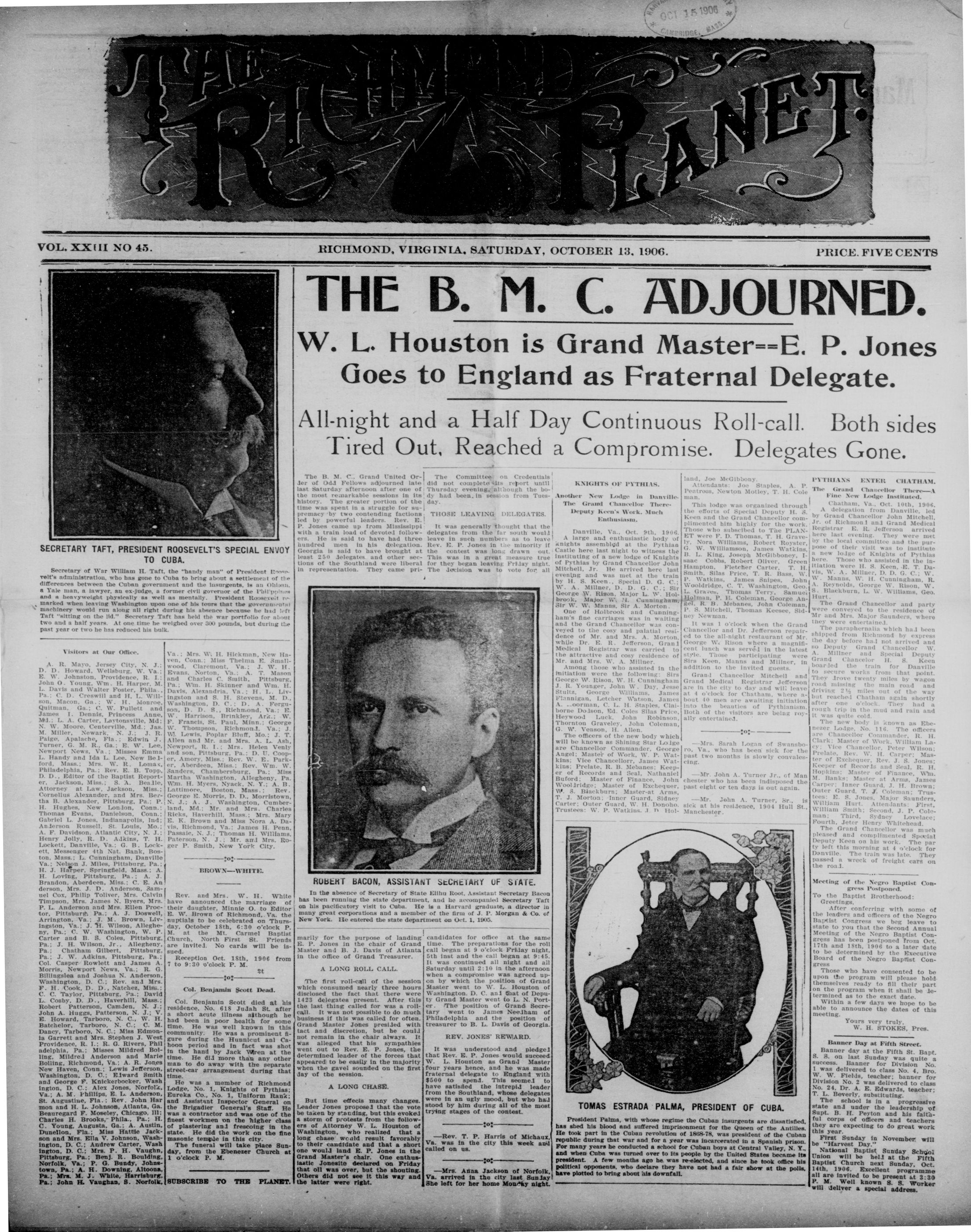
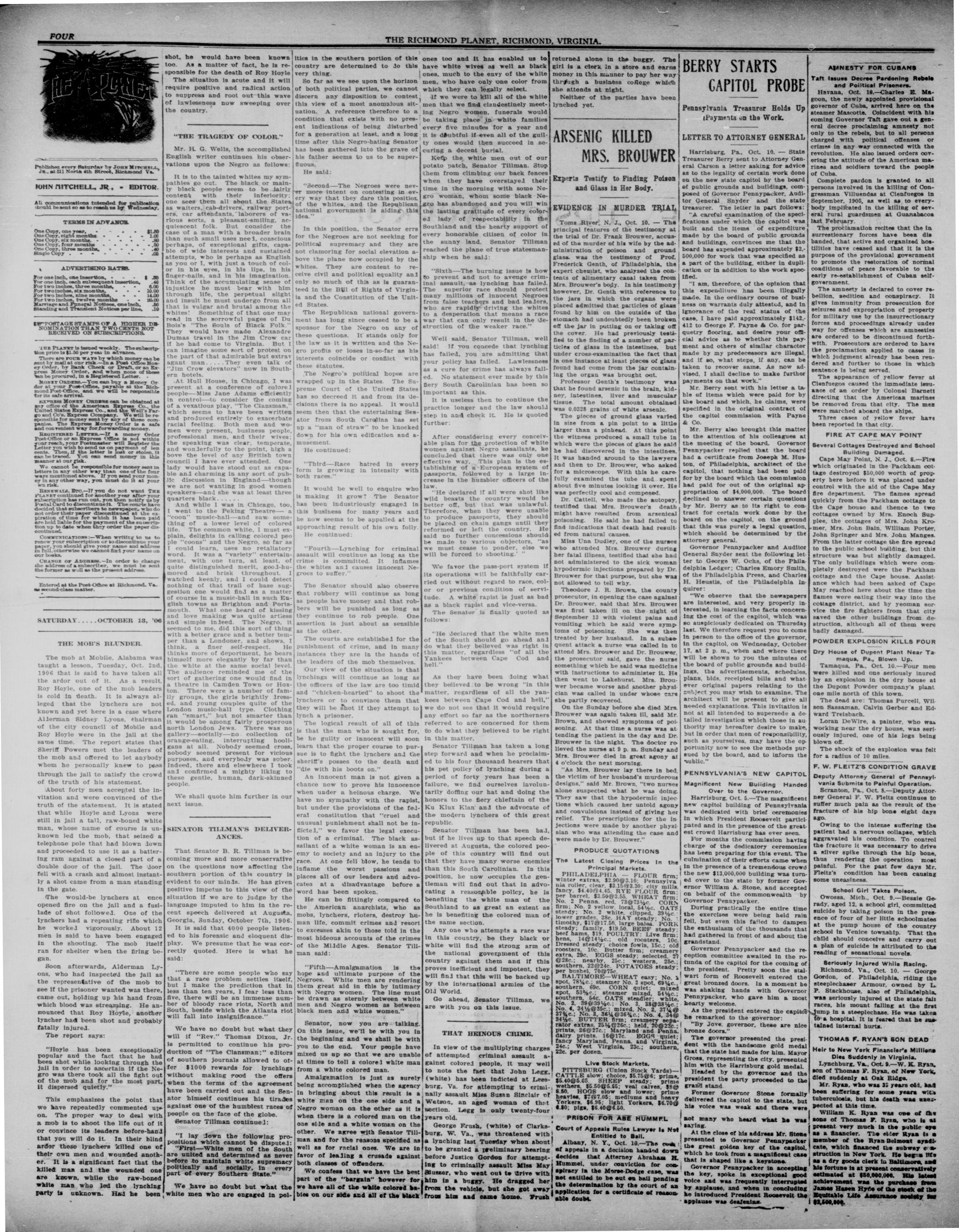
THE RICHMOND PLANET
M.
SECRETARY TAFT, PRESIDENT ROOSEVELT'S SPECIAL ENVOY TO CUBA.
Secretary of War William H. Taft, the "handy man" of President Roosevelt's administration, who has gone to Cuba to bring about a settlement of the differences between the Cuban government and the insurgents, is an Ohioan, a Yale man, a lawyer, an ex-judge, a former civil governor of the Philippines and a heavyweight physically as well as mentally. President Roosevelt remarked when leaving Washington upon one of his tours that the governmental machinery would run along all right during his absence because he had left Taft "sitting on the lld." Secretary Taft has held the war portfolio for about two and a half years. At one time he weighed over 300 pounds, but during the past year or two he has reduced his bulk.
Visitors at Our Office.
A. R. Mayo, Jersey City, N. J.; D. D. Howard, Wellsburg, W. Va.; E. W. Johnston, Providence, R. I.; John O. Young, Wm. H. Harper, M. L. Davis and Walter Foster, Phila. Ma.; C. D. Creswill and H. L. Wilson, Macon, Ga.; W. H. Monroe, Quitman, Ga.; C. W. Pullett, and James I. Dennis, Princess, Anne; M. L. A. Carter, Lavtonsville, Md.; N. W. Moore, Centerville, Md.; J. M. Miller, Newark, N. J.; J. R. Palge, Apalache, Fla.; Edwin J. Turner, M. G. R. G. E. W. Lee, Newport, News, Va.; Misses Emma L. Handy and Ida L. Lee New Belford, Mass.; Mrs. W. R. Lonax, Philadelphin, Pa.; Rev. E. B. Topp D. D., Editor of the Baptist Reporter, Jackson, Miss.; S. A. Beall, Attorney at Law, Jackson, Miss.; Cornellus Alexander, and Mrs. Berta B. Alexander, Pittsburg, Pa.; P. H. Hughes, New London, Conn. Thomas Evans, Danielson, Conn. Gabriel L. Jones, Indianapolis, Ind.; Anderson Russell, St. Louis, A. F. Davidson, Atlantic City, N. J.; Henry Jolly, R. D. Adkins, T. H. Lockett, Danville, Va.; G. B. Lockett, Messenger 4th Nat. Bank, Boston, Mass.; L Cunningham, Danville, Mass.; Nelson J. Miles, Pittsburg, Pa. H. J. Harper, Springfield, Ind.; A. H. Loving, Pittsburg, Pa.; A. J. Brandon, Aberdeen, Miss.; C. E. Anderson, Mrs. Philip Toliver, Mrs. Calvin P. I. Anderson, Mrs. Ellen Proctor, Pittsburg, Pa.; A. J. Doswell, Arrington, Va.; J. M. Washington, Livington, Va.; J. H. Wilson, Allegheny, Pa.; C. W. Washington, W. P. Carter and B. S. Coles, Pittsburg, Pa.; J. H. Wakinson, Jr., Allegheny, Chatham Gilbert, Pittsburg, Pa.; J. W. Adkins, Pittsburg, Pa. Col. Casper Rowlett and James A. Morris, Newport News, Va.; R. G. Billinglesa and Joshua N. Anderson, Washington, D. C.; Rev. and Mrs. F. H. Cook, D. D., Natchez, M. C. C. Taylor, Pittsburg, Pa.; David L. Cossey, D. D., Haverhill, Mass. Robert Patterson, Camden, N. J.; John A. Huggs, Patterson, N. J.; V. E. Howard, Tarboro, N. C.; W. H. Batchelor, Tarboro, N. C.; C. M. Dancy, Tarboro, N. C.; Miss Edmona Garrett and Mrs. Stephen J. West Providence, R. I.; R. G. Rivers, Philadelphia, Pa.; Misses Mildred Bolling, Mildred Anderson and Marie Bolling, Richmond, Va.; A. R. Jones New Haven, Conn.; Lewis Jefferson, Washington, D. C.; Elward Smith and George F. Knellerbocker, Washington, D. C.; Alex Jones, Norfolk, Va.; A. M. Phillips, E. L. Anderson, St. Augustine, Fla.; Rev. John Han mon and H. L. Johnson, Atlanta, Ga. Beauregard F. Moseley, Chicago, Ill.; Charles H. Brooks, Phila, Pa.; H. C. Young, Augusta, Ga.; A. Austin, Dunellon, Fla.; Miss Hattie Jackson and Mrs. C. Ella V. Johnson, Washington, D. C.; Mrs. P. H. Vaughn, Pittsburg, Benj. B. Houlding, Norfolk, Va.; P. G. Bundy, Johnston, Pa.; A. H. Downing, Altoona, Pa.; Mrs. M. J. White, Harrisburg, John H. Vaughan, S. Norfolk
Va.; Mrs. W. H. Hickman, New Haven, Conn.; Miss Thelma E. Smallwood, Claremont, Va.; J. W. H. Evans, Norton, Va.; A. T. Mason and Charles C. Smith, Pittsburgh, Pa.; Wan. H. Skinner and Wm. H. Davls, Alexandria, Va.; H. L. Livingston and S. H. Stevens, M. D., Washington, D. C.; D. A. Ferguson, D. D. S., Richmond, Va.; E. W. Harrison, Brinkley, Ark.; W. F. Francis, St. Paul, Minn.; George W. Thompson, Richmond, Va.; J. W. Lewis, Poplar Bluff, Mo.; J. T. Allen and Mr. and Mrs. A. L. Ash, Newport, R. I.; Mrs. Helen Venly and son, Pittsburgh, Pa.; D. U. Cooper, Amory, Miss.; Rev. V. E. Parker, Aberdeen, Miss.; Rev. Wm. W. Sanders, Chambersburg, Pa.; Miss Martha Washington, Allegheny, Pa. Wm. H. Myers, Nyack, N. Y.; A. B. Lattimore, Boston, Mass.; Rev. George E. Morris, D. D., Morristown, N. J.; A. J. Washington, Cumberland, Md.; Mr. and Mrs. Charles Ricks, Haverhill, Mass.; Mrs. Mary E. K. Brown and Miss Nora A. Davis, Richmond, Va.; James H. Penn, Passaic, N. J.; Thomas H. Williams, Paterson, N. J.; Mr. and Mrs. Roger P. Smith, New York City.
BROWN—WHITE.
Rev. and Mrs. W. H. White have announced the marriage of their daughter, Minnie O. to Editor E. W. Brown of Richmond, Va. the nuptials to be celebrated on Thursday, October 18th, 6:30 o'clock P. M. at the Mt. Carmel Baptist Church, North First St. Friends are invited. No cards will be issued. Reception Oct. 18th, 1906 from 7 to 9:30 o'clock P. M.
Col. Benjamin Scott Dead.
Col. Benjamin Scott died at his residence, No. 618 Judah St. after a short acute illness although he had been in poor health for some time. He was well known in this community. He was a prominent figure during the Hunnicut and Cahoon period and in fact was shot in the hand by Jack Wren at the time. He did more than any other man to do away with the separate street-car arrangement during that time.
He was a member of Richmond Lodge, No. 1, Knights of Pythias; Eureka Co., No. 1, Uniform Rank; and Assistant Inspector General on the Brigadier General's Staff. He was a contractor and was one of the finest workmen on the higher class of plastering and frescoing in the state. He did the work on the fine masonic temple in this city.
The funeral will take place Sunday, from the Ebenezer Church at 1 o'clock P. M.
SUBSCRIBE TO THE PLANET.
RICHMOND, VIRGINIA, SATURDAY, OCTOBER 13, 1906.
THE B. M. C. ADJOURNED.
W. L. Houston is Grand Master==E. P. Jones Goes to England as Fraternal Delegate.
All-night and a Half Day Continuous Roll-call. Both sides Tired Out, Reached a Compromise. Delegates Gone.
ROBERT BACON, ASSISTANT SECRETARY OF STATE.
In the absence of Secretary of State Ellhu Root, Assistant Secretary Bacon has been running the state department, and he accompanied Secretary Taft on his pacificatory visit to Cuba. He is a Harvard graduate, a director in many great corporations and a member of the firm of J. P. Morgan & Co. of New York. He entered the state department on Oct. 1, 1905.
The B. M. C., Grand United Order of Odd Fellows adjourned late last Saturday afternoon after one of the most remarkable sessions in its history. The greater portion of the time was spent in a struggle for supremacy by two contending factions led by powerful leaders. Rev. E. P. Jones came up from Mississippi with a train load of devoted followers. He is said to have had three hundred men in his delegation. Georgia is said to have brought at least 250 Delegates and other sections of the Southland were liberal in representation. They came pri-
ROBERT BACON, ASSISTANT
In the absence of Secretary of State has been running the state department on his pacificatory visit to Cuba. He many great corporations and a member New York. He entered the state depart
marily for the purpose of landing E. P. Jones in the chair of Grand Master and B. J. Davis of Atlanta in the office of Grand Treasurer.
A LONG ROLL CALL
The first roll-call of the session which consumed nearly three hours disclosed the fact that there were 1423 delegates present. After this the last thing called for was a roll-call. It was not possible to do much business if this was called for often. Grand Master Jones presided with tact and discretion, but he could not remain in the chair always. It was alleged that his sympathies went out to Rev. E. P. Jones, the determined leader of the forces that appeared to be easily in the majority when the gavel sounded on the first day of the session.
A LONG CHASE.
But time effects many changes. Leader Jones proposed that the vote be taken by standing, but this evoked a storm of protests from the followers of Attorney W. L. Houston of Washington, who realized that a long chase would result favorably to their candidate and that a short one would land E. P. Jones in the Grand Master's chair. One enthusiastic Jonesite declared on Friday that oil was over, but the shouting. Others did not see it this way and the latter were right.
The Committee on Credentials did not complete its report until Thursday evening, although the body had been, in session from Tuesday.
THOSE LEAVING DELEGATES.
It was generally thought that the delegates from the far south would leave in such numbers as to leave Rev. E. P. Jones in the minority if the contest was long drawn out. This was in a great measure true for they began leaving Friday night. The decision was to vote for all
SECRETARY OF STATE.
The Ellhu Root, Assistant Secretary Bacon
tat, and he accompanied Secretary Taft
he is a Harvard graduate, a director in
er of the firm of J. P. Morgan & Co. of
ment on Oct. 1, 1905.
candidates for office at the same time. The preparations for the roll call began at 9 o'clock Friday night, 5th inst and the call began at 9:45. It was continued all night and all Saturday until 2:10 in the afternoon when a compromise was agreed upon by which the position of Grand Master went to W. L. Houston of Washington. D. C. and that of Deputy Grand Master went to L. N. Porter. The position of Grand Secretary went to James Neelham of Philadelphia and the position of treasurer to B. L. Davis of Georgia.
REV. JONES' REWARD.
It was understood and pledged that Rev. E. P. Jones would succeed W. L. Houston as Grand Master four years hence, and he was made fraternal delegate to England with $500 to spend. This seemed I have satisfied the intrepid leader from the Southland, whose delegates were in an ugly mood, but who had stood by him during all of the most trying stages of the contest.
—Rev. T. P. Harris of Michaux, Va. was in the city this week and called on us.
—Mrs. Anna Jackson of Norfolk, Va. arrived in the city last Sunday She left for her home Monday night.
[Image of a man in a dark suit, sitting in an ornate chair with a decorative frame around it. The background is a light color with floral patterns.]]
TOMAS ESTRADA PALMA, PRESIDENT OF CUBA.
President Palma, with whose regime the Cuban insurgents are dissatisfied, has shed his blood and suffered imprisonment for the Queen of the Antilles. He took part in the Cuban revolution of 1868-78, was president of the Cuban republic during that war and for a year was incarcerated in a Spanish prison. For many years he conducted a school for Cuban boys at Central Valley, N. Y., and when Cuba was turned over to its people by the United States became its president. A few months ago he was re-elected, and since he took office his political opponents, who declare they have not had a fair show at the polls, have plotted to bring about his downfall.
KNIGHTS OF PYTHIAS.
Another New Lodge in Dansville The Grand Chancellor There Deputy Keen's Work, Much Enthusiasm.
Danville, Va., Oct. 9th, 1906.
A large and enthusiastic body of knights assembled at the Pythian Castle here last night to witness the instituting of a new lodge of Knights of Pythias by Grand Chancellor John Mitchell, Jr. He arrived here last evening and was met at the train by H. S. Keen., Special D. G. C.; W. A. Millner, D. D. G. C.; Sir George W. Rison, Major L. W. Holbrook, Major W. H. Cunningham, Sir W. W. Manns, Sir A. Morton.
One of Holbrook and Cunningham's fine carriages was in waiting and the Grand Chancellor was conveyed to the cosy and palatial residence of Mr. and Mrs. A. Morton, while Dr. E. R. Jefferson, Grand Medical Registrar was carried to the attractive and cosy residence of Mr. and Mrs. W. A. Millner.
Among those who assisted in the initiation were the following: Sirs George W. Rison, W. H. Cunningham J. R. Younger, John W. Day, Jesse Stultz, George Williams, James Flannigan, Letcher Watson, James A. .oorman, C. L. H. Staples, Claiborne Dolson, Ed. Coles Silas Price, Heywood Luck, John Robinson, Thornton Graveyle, John Coleman, G. W. Venson, H. Allen
The officers of the new body which will be known as Shining Star Lolie are Chancellor Commander, George Angel; Master of Work, W. P. Watkins; Vice Chancellor, James Watkins; Prelate, R. B. Mebanes; Keeper of Records and Seal, Nathaniel Buford; Master of Finance, John Wooldridge; Master of Exchequer, W. S. Blackburn; Master-at Arms, T. J. Morton; Inner Guard, Sidney Carter; Outer Guard, W. H. Donoho, Trustees, W. P. Watkins, D. H. Hol
land. Joe McGibbony
Attendants: Joe Staples, A. P. Peatross, Newton Motley, T. H. Coleman.
This lodge was organized through the efforts of Special Deputy H. S. Keen and the Grand Chancellor complimented him highly for the work. Those who subscribed to The PLANET were F. D. Thomas, T. H. Gravely, Nora Williams, Robert Royster, G. W. Williams, James Watkins, B. L. King, Joseph McGibboney, Isaac Cobbs, Robert Oliver, Green Hampton, Fletcher Carter, T. H. Smith, Silas Price, T. R. Bass, W. P. Watkins, James Sniipes, John Wooldridge, C. T. Washington, Geo. L. Graves, Thomas Terry, Samuel Holman, P. H. Coleman, George Angel, R. B. Mebanes, John Coleman, P. S. Mitchell, Thomas Keesee, Sidney Newman.
It was 1 o'clock when the Grand Chancellor and Dr. Jefferson repaired to the all-night restaurant of Mr. George W. Rison where a magnificent lunch was served in the latest style. Those participating were Sirs Keen, Manns and Millner, in addition to the invited guests.
Grand Chancellor Mitchell and Grand Medical Registrar Jefferson are in the city to day and will leave at 4 o'clock for Chatham, where about 40 men are awaiting initiation into the beauties of Pythianism. Both of the visitors are being royally entertained.
--- 0---
—Mrs. Sarah Logan of Swansboro, Va., who has been sick for the past two months is slowly convalescing.
—Mr. John A. Turner Jr., of Manchester who has been indisposed the past eight or ten days is out again.
—Mr. John A. Turner, Sr., is sick at his residence, 1904 Hull St., Manchester.
PRICE. FIVE CENTS
RNED.
P. Jones
legate.
Both sides
tes Gone.
PYTHIANS ENTER CHATHAM.
The Grand Chancellor There—A
Fine New Lodge Instituted.
Chatham, Va., Oct. 10th, 1906.
A delegation from Danville, led by Grand Chancellor John Mitchell, Jr. of Richmond and Grand Medical Registrar E. R. Jefferson arrived here last evening. They were met by the local committee and the purpose of their visit was to institute a new lodge of Knights of Pythias here. Those who assisted in the initiation were H. S. Keen, E. T. Davis, W. A. Millner, D. D. G. C.; W. W. Manns, W. H. Cunningham, R. A. Reynolds, George W. Rison, W. S. Blackburn, L. W. Williams, Geo. Hurt.
The Grand Chancellor and party were conveyed to the residence of Mr and Mrs. Major Saunders, where they were entertained.
The paraphernalia which had been shipped from Richmond by express the day before had not arrived and so Deputy Grand Chancellor W. A. Millner and Special Deputy Grand Chancellor H. S. Keen boarded the train for Danville to secure works from that point. They drove twenty miles by wagon road missing the main road and driving $2\frac{1}{2}$ miles out of the way but reached Chatham again shortly after one o'clock. They had a rough trip in the mud and rain and it was quite cold.
The new body is known as Ebehezer Lodge, No. 116. The officers are Chancellor Commander, R. H. Clark; Master of Work, William Lacy; Vice Chancellor, Peter Wilson; Prelate, Rev. W. H. Carper; Master of Exchequer, Rev. J. S. Jones; Keeper of Records and Seal, R. H. Hopkins; Master of Finance, Wh. M. Banks; Master at arms, James Carper; Inner Guard, J. H. Brown; Outer Guard, T. J. Coleman; Trustees, E. S. Jones, Major Saunders, William Hurt. Attendants: First, William Smith; Second, J. P. Coleman; Third, Sydney Lovelace; Fourth, Jeter Henry Whitehead.
The Grand Chancellor was much pleased and complimented Special Deputy Keen on his work. The party left this morning at 4 o'clock for Danville. The train was late. They passed a wreck of freight cars on the road.
Meeting of the Negro Baptist Congress Postponed
To the Baptist Brotherhood:
Greetings,
After conferring with some of the leaders and officers of the Negro Baptist Congress we beg leave to state to you that the Second Annual Meeting of the Negro Baptist Congress has been postponed from Oct. 17th and 18th, 1906 to a later date to be determined by the Executive Board of the Negro Baptist Congress
Those who have consented to be upon the program will please hold themselves ready to fill their part on the program when it shall be determined as to the exact date. Within a few days we hope to be able to announce the dates of this meeting.
Banner Day at Fifth Street
Banner day at the Fifth St. Bapt. S. S. on last Sunday was quite a success. Banner for Division No. 1 was delivered to class No. 4, Brow. W. W. Fields, teacher; banner for Division No. 2 was delivered to class No. 24, Dr. A. E. Edwards, teacher; T. L. Beverly, substituting.
The school is in a progressive state and under the leadership of Supt. B. H. Peyton and his faithful corps of officers and teachers they are expecting to do great work this year.
First Sunday in November will be "Harvest Day."
National Baptist Sunday School Union will be held at the Fifth Baptist Church next Sunday, Oct. 14th. 1906. Excellent programme all are invited to be present at 3:30 P. M. Well known S. S. Worker will deliver a special address.
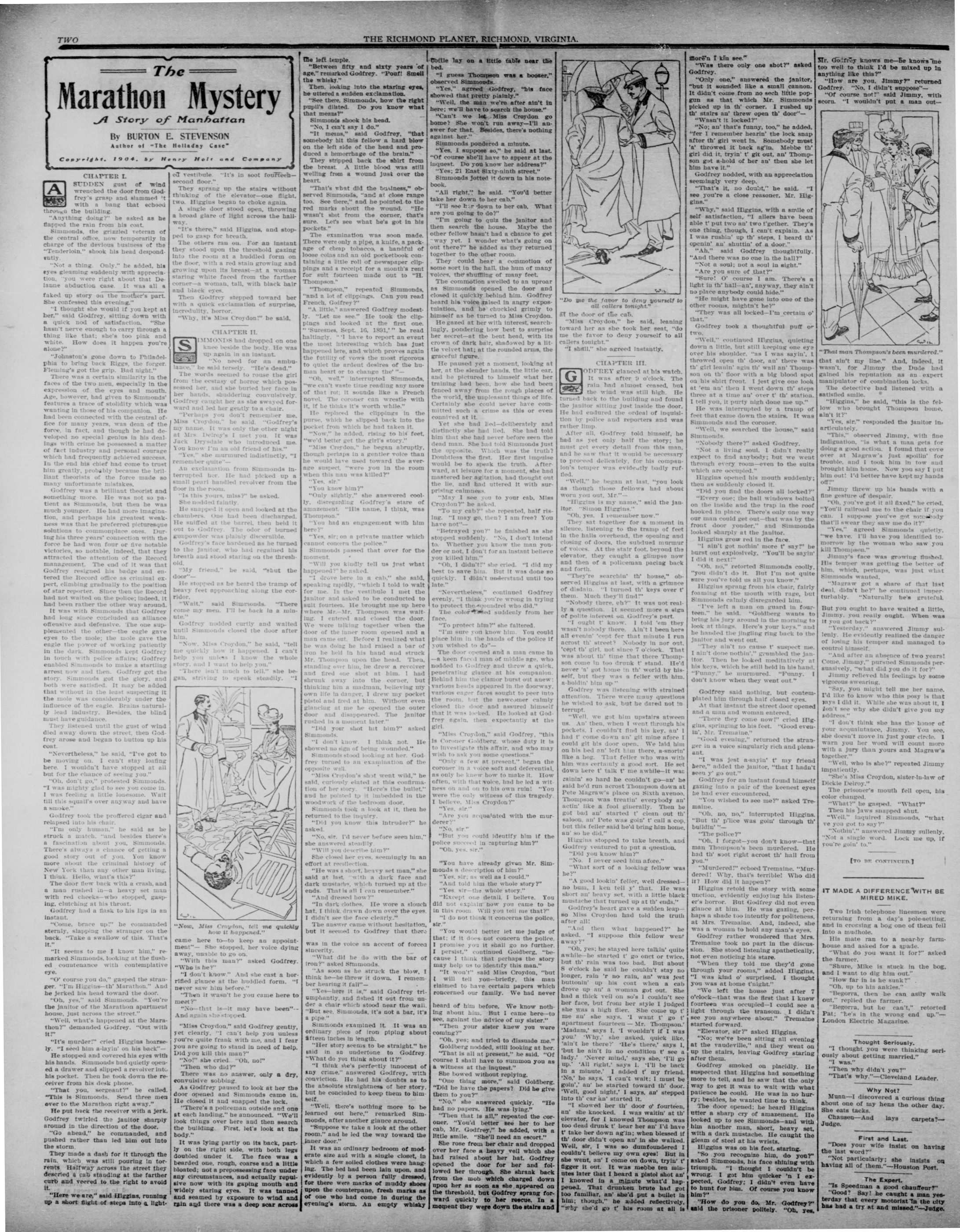
The Marathon Mystery A Story of Manhattan
By BURTON E. STEVENSON Author of "The Holladay Case"
Copyright. 1904. by Henry Holt and Company
SUDDEN gust of wind wrenched the door from Godfrey's grasp and slammed it with a bang that echoed through the building.
"Anything doing?" he asked as he flapped the rain from his coat.
Simmonds, the grizzled veteran of the central office, now temporarily in charge of the devious business of the "Tenderloin," shook his head despondently.
"Not a thing. Only." he added, his eyes gleaming suddenly with appreciation, "you were right about that Deanne abduction case. It was all a faked up story on the mother's part. She confessed this evening."
"I thought she would if you kept at her," said Godfrey, slitting down with a quick nod of satisfaction. "She hasn't nerve enough to carry through a thing like that; she's too pink and white. How does it happen you're alone?"
"Johnston's gone down to Philadelphia to bring back Riggs, the forger, Fleming's got the grip. Bad night."
There was a certain similarity in the faces of the two men, especially in the expression of the eyes and mouth, Age, however, had given to Simmons' features a trace of stolidity which was wanting in those of his companion. He had been connected with the central office for many years, was dean of the force, in fact, and though he had developed no special genius in his dealings with crime he possessed a matter of fact industry and personal courage which had frequently achieved success. In the end his chief had come to trust him greatly, probably because the brilliant theorists of the force made so many unfortunate mistakes.
Godfrey was a brilliant theorist and something more. He was not so patient as Simmonds, but then he was much younger. He had more imagination, and perhaps his greatest weakness was that he preferred picturesque solutions to commonplace ones. During his three years' connection with the force he had won four or five notable victories, so notable, indeed, that they attracted the attention of the Record management. The end of it was that Godfrey resigned his badge and entered the Record office as criminal expert, climbing gradually to the position of star reporter. Since then the Record had not waited on the police; indeed, it had been rather the other way around.
It was with Simmonds that Godfrey had long since concluded an alliance offensive and defensive. The one supplemented the other—the eagle gave eyes to the mole; the mole gave the eagle the power of working patiently in the dark. Simmonds kept Godfrey in touch with police affairs; Godfrey enabled Simmonds to make a startling arrest now and then. Godfrey got the story. Simmonds got the glory, and both were satisfied. It may be added that without in the least suspecting it the mole was considerably under the influence of the eagle. Brains naturally lead industry. Besides, the blind must have guidance.
They listened until the gust of wind died away down the street, then Godfrey arose and began to button up his coat.
"Nevertheless," he said, "I've got to be moving on. I can't stay loafing here. I wouldn't have stopped at all but for the chance of seeing you."
"Oh, don't go," protested Simmonds. "I was mighty glad to see you come in. I was feeling a little lonesome. Wait till this squall's over anyway and have a smoke."
Godfrey took the proffered cigar and relapsed into his chair.
"I'm only human," he said as he struck a match, "and besides there's a fascination about you, Simmonds. There's always a chance of getting a good story out of you. You know more about the criminal history of New York than any other man living, I think. Hello, what's this?" The door flew back with a crash, and a man rushed in—a heavy set man with red cheeks—who stopped, gasping, clutching at his throat.
Godfrey had a flask to his lips in an instant.
"Come, brace up!" he commanded sternly, slapping the stranger on the back. "Take a swallow of this. That's it."
"It seems to me I know him," remarked Sinnombs, looking at the flushed countenance with contemplative eye.
"Oh, yes," said Simmonds. "You're the janitor of the Marathon apartment house, just across the street."
"Well, what's happened at the Marathon?" demanded Godfrey. "Out with it."
"It's murder!" cried Higgins hoarsely. "I see him a-layin' on his back"—He stopped and covered his eyes with his hands. Simmonds had quietly opened a drawer and slipped a revolver into his pocket. Then he took down the receiver from his desk phone.
"That you, sergeant?" he called. "This is Simmonds. Send three men over to the Marathon right away."
He put back the receiver with a jerk. Godfrey twirled the janitor sharply around in the direction of the door. "Go ahead," he commanded, and pushed rather than led him out into the storm.
They made a dash for it through the rain, which was still pouring in torrents. Halfway across the street they described a cab standing at the farther curb and veered to the right to avoid it.
"Here we are," Higgins, running up a short flight of steps into a light-
CHAPTER L
A
ed vestibule. "It's in soot fourteen-second floor." They sprang up the stairs without thinking of the elevator—one flight, two. Higgins began to choke again. A single door stood open, throwing a broad glare of light across the hallway. "It's there," said Higgins, and stopped to gasp for breath. The others ran on. For an instant they stood upon the threshold gazing into the room at a huddled form on the floor, with a red stain growing and growing upon its breast—at a woman staring white faced from the farther corner—a woman, tall, with black hair and black eyes. Then Godfrey stepped toward her with a quick exclamation of surprise, incredulity, horror. "Why, it's Miss Croydon!" he said.
CHAPTER II
S
IMMONDS had dropped on one knee beside the body. He was up again in an instant.
"No need for an ambulance," he said tersely. "He's dead."
The words seemed to rouse the girl from the ecstasy of horror which possessed her, and she buried her face in her hands, shuddering convulsively. Godfrey caught her as she swayed forward and led her gently to a chair.
"Perhaps you don't remember me, Miss Croydon," he said. "Godfrey's my name. It was only the other night at Mrs. Delroy's I met you. It was Drydale who introduced me. You know I'm an old friend of his."
"Yes," she murmured indistinctly, "I remember quite"—
An exclamation from Simmonds interrupted her. He had picked up a small pearl handled revolver from the floor in the room.
"Is this yours, miss?" he asked.
She nodded taintly.
He snapped it open and looked at the chambers. One had been discharged. He sniffed at the barrel, then held it out to Godfrey. The odor of burned gunpowder was plainly discernible. Godfrey's face hardened as he turned to the jailor, who had regained his breath and stood staring on the threshold.
"My friend," he said, "shut the door"—
"Walt," said Simmonds. "There come my men. I'll be back in a minute."
Godfrey nodded curtly and waited until Simmonds closed the door after him.
"Now, Miss Croydon," he said, "tell me quickly how it happened. I can't help you unless I know the whole story, and I want to help you."
"There isn't much to tell," she began, striving to speak steadily. "I
C. W.
"Now, Miss Croydon, tell me quickly how it happened."
"Now, Miss Croydon, tell me quickly how it happened."
came here to—to keep an appointment"— She stopped, her voice dying away, unable to go on.
"With this man?" asked Godfrey.
"Who is he?"
"I don't know." And she cast a horrified glance at the huddled form. "I never saw him before."
"Then it wasn't he you came here to meet?"
"No—that is—it may have been"—And again she stopped.
"Miss Croydon," said Godfrey gently, get clearly, "I can't help you unless you're quite frank with me, and I fear you are going to stand in need of help. Did you kill this man?"
"No!" she cried. "Oh, no!"
"Then you did?"
There was no answer, only a dry, convulsive sobbing.
As Godfrey paused to look at her the door opened and Simmonds came in. He closed it and snapped the lock. "There's a policeman outside and one at each landing," he announced. "We'll look things over here and then search the building. First, let's look at the body."
It was lying partly on its back, partly on the right side, with both legs doubled under it. The face was a bearded one, rough, coarse and a little bloated; not a prepossessing face under any circumstances, and actually repulsive now with its gaping mouth and widely staring eyes. It was tanned and seamed by exposure to wind and rain and there was a deep scar across
THE RICHMOND PLANET, RICHMOND, VIRGINIA
The left temple.
"Between fifty and sixty years of age," remarked Godfrey. "Pouf! Smell the whisky."
Then, looking into the staring eyes, he uttered a sudden exclamation.
"See there, Simmonds, how the right pupil's dilated. Do you know what that means?
Simmonds shook his head.
"No, I can't say I do."
"It means," said Godfrey, "that somebody hit this fellow a hard blow on the left side of the head and produced a hemorrhage of the brain."
They stripped back the shirt from the breast. A little blood was still swelling from a wound just over the heart.
"That's what did the business," observed Simmonds, "and at close range too. See there," and pointed to the red marks about the wound. "He wasn't shot from the corner, that's sure. Let's see what he's got in his pockets."
The examination was soon made. There were only a pipe, a knife, a package of cheap tobacco, a handful of loose coins and an old pocketbook containing a little roll of newspaper clippings and a receipt for a month's rent for suit fourteen made out to "H. Thompson."
"Thompson," repeated Simmonds, "and a lot of clippings. Can you read French, Godfrey?"
"A little," answered Godfrey modestly. "Let me see." He took the clippings and looked at the first one. "Suresnes, Sept. 16, 1891," he read haltingly. "I have to report an event the most interesting which has just happened here, and which proves again the futility of vows the most rigorous to quiet the ardent desires of the human heart or to change the"—
"Oh, well." interrupted Simmonds,
"We can't waste time reading any more
of that rot; it sounds like a French
novel. The coroner can wrestle with
it, if he thinks it's worth while."
He replaced the clippings in the
purse, which he slipped back into the
pocket from which he had taken it.
"Now," he added, rising to his feet,
"We'd better get the girl's story."
"Miss Croydon," he began abruptly,
though perhaps in a gentler voice than
he would have used toward the average
suspect, "were you in the room
when this man was killed?"
"Yes, sir."
"You know him?"
"Only slightly," she answered coolly,
disregarding Godfrey's stare of
amazement. "His name, I think, was
Thompson."
"You had an engagement with him
here?"
"Yes, sir; on a private matter which
cannot concern the police."
Simmonds passed that over for the moment.
"Will you kindly tell us just what happened?" he asked.
"I drove here in a cab," she said, speaking rapidly, "which I told to wait for me. In the vestibule I met the janitor and asked to be conducted to suit fourteen. He brought me up here where Mr.-Mr. Thompson was waiting. I entered and closed the door. We were talking together when the door of the inner room opened and a man came out. Before I realized what he was doing he had raised a bar of iron he held in his hand and struck Mr. Thompson upon the head. Then, standing over him, he drew a revolver and fired one shot at him. I had shrunk away into the corner, but thinking him a madman, believing my own life in danger, I drew my pocket pistol and fired at him. Without even glancing at me he opened the outer door and disappeared. The janitor rushed in a moment later."
"Did your shot hit him?" asked Simmonds.
"I don't know. I think not. He showed no sign of being wounded." Simmonds stood looking at her. Godfrey turned to an examination of the opposite wall.
"Miss Croydon's shot went wild," he said, curiously elated at this confirmation of her story. "Here's the bullet," he pointed to it imbedded in the woodwork of the bedroom door.
Simmonds took a look at it, then he returned to the inquiry.
"Did you know this intruder?" he asked.
"No, sir. I'd never before seen him," she answered steadily.
"Will you describe him?"
"He was a short, heavy set man," she said at last, "with a dark face and dark mustache, which turned up at the ends. That is all I can remember."
"And dressed how?"
"In dark clothes. He wore a slouch hat. I think drawn down over the eyes. I didn't see the face clearly."
The answer came without hesitation, but it seemed to Godfrey that there was in the voice an accent of forced sincerity.
"What did he do with the bar of iron?" asked Simmonds.
"As soon as he struck the blow. I think he—he threw it down. I remember hearing it fall"
"Yes—here it is," said Godfrey triumphantly, and fished it out from under a chair which stood near the wall.
"But see, Simmonds, it's not a bar, it's a pipe."
Simmonds examined it. It was an ordinary piece of iron piping about fifteen inches in length.
"Her story seems to be straight." he said in an undertone to Godfrey.
"What do you think about it?"
"I think she's perfectly innocent of any crime," answered Godfrey, with conviction. He had his doubts as to the absolute straightness of her story, but he concluded to keep them to himself.
"Well, there's nothing more to be learned out here," remarked Simmonds, after another glance around.
"Suppose we take a look at the other room," and he led the way toward the junior door."
It was an ordinary bedroom of moderate size and with a single closet, in which a few soiled clothes were hanging. The bed had been lain upon, and evidently by a person fully dressed, for there were marks of muddy shoes upon the counterpane, fresh marks as of one who had come in during the evening's storm. An empty whisky
Bottle lay on a little fable near the bed.
"I guess Thompson was a boozer," observed Simmonds.
"Yes," agreed Godfrey, "his face showed that pretty plainly."
"Well, the man we're after ain't in here; we'll have to search the house."
"Can't we let Miss Croydon go home? She won't run away—I'll answer for that. Besides, there's nothing against her."
Simmonds pondered a minute.
"Yes, I suppose so," he said at last. "Of course she'll have to appear at the inquest. Do you know her address?" "Yes; 21 East Sixty-ninth street." Simmonds jotted it down in his notebook.
"I'm going to quiz the janitor and then search the house. Maybe the other fellow hasn't had a chance to get away yet. I wonder what's going on out there?" he added as they returned together to the other room.
They could hear a commotion of some sort in the hall, the hum of many voices, the shuffling of many feet.
The commotion swelled to an uproar as Simmonds opened the door and closed it quickly behind him. Godfrey heard his voice raised in angry exposition, and he chuckled grimly to himself as he turned to Miss Croydon.
He gazed at her with interest, searching, pondering how best to surprise her secret—at the bent head, with its crown of dark hair, shadowed by a little velvet hat; at the rounded arms, the graceful figure.
He paused yet a moment, looking at her, at the slender hands, the little ear, and he pictured to himself what her training had been, how she had been fenced away from the rough places of the world, the unpleasant things of life. Certainly she could never have committed such a crime as this or even connived at it.
Yet she had lied—deliberately and distinctly she had lied. She had told him that she had never before seen the dead man. She had told Simmonds just the opposite. Which was the truth? Doubtless the first. Her first impulse would be to speak the truth. Afterward, at leisure for a moment, she had mastered her agitation, had thought out the lie, and had uttered it with surprising calmness.
"May I see you to your cab, Miss Croydon?" he asked.
"To my cab?" she repeated, half rising.
"I may go, then? I am free? You have not"—
"Betrayed you?" he finished as she stopped suddenly. "No, I don't intend to. Whether you know the man you onder or not, I don't for an instant believe you killed him." "Oh, I didn't!" she cried. "I did my best to save him. But it was done so quickly. I didn't understand until too late." "Nevertheless," continued Godfrey evenly, "I think you're wrong in trying to protect the scoundrel who did." The color used suddenly from her face.
"To protect him?" she faltered.
"I'm sure you know him. You could place him in the hands of the police if you wished to do"—
The door opened and a man came in—a keen faced man of middle age, who nodded to Godfrey and threw a quick, penetrating glance at his companion. Behind him the clamor burst out anew; various heads appeared in the doorway, various eager faces sought to peer into the room, but the newcomer calmly closed the door and assured himself that it was locked. He looked at Godfrey again, then expectantly at the girl.
"Miss Croydon," said Godfrey, "this Is Coroner Goldberg, whose duty it is to investigate this affair, and who may wish to ask you some questions."
"Only a few at present," began the coroner in a voice soft and deferential, as only he knew how to make it. How often, with that voice, had he led a witness on and on to his own ruin? "You were the only witness of this tragedy. I believe, Miss Croydon?"
"Yes, sir."
"Are you acquainted with the mur
derer?"
"No, sir."
"But you could identify him if the police succeed in capturing him?"
"Oh, yes, sir."
"You have already given Mr. Simmonds a description of him?"
"Yes, sir; as well as I could."
"And told him the whole story?"
"Yes, sir—the whole story."
"Except one detail. I believe. You did not explain how you came to be in this room. Will you tell me that?"
"I do not think it concerns the police, sir."
"You would better let me judge of that; if it does not concern the police, I promise you it shall go no further. I persist," continued Goldberg, "because I think that perhaps the story may help us to identify this man."
"It won't," said Miss Croydon, "but { will tell you—briefly, this man claimed to have certain papers which concerned our family. We had never
"Oh, yes; and tried to dissuade me." Goldberg nodded, still looking at her. "That is all at present," he said. "Of course I shall have to summon you as a witness at the inquest."
She bowed without replying. "One thing more," said Goldberg. "Did he have the papers? Did he give them to you?"
"No," she answered quickly. "He had no papers. He was lying." "Then that is all," repeated the coroner. "You'd better see her to her cab, Mr. Godfrey," he added, with a little smile. "She'll need an escort." She rose from her chair and dropped over her face a heavy veil which she had raised about her hat. Godfrey opened the door for her and followed her through. She shrank back from the mob which charged down upon her as soon as she appeared on the threshold, but Godfrey sprang forward quickly to her rescue. In a moment they were down the stairs and
5716
"Do me the favor to deny yourself to all callers tonight."
at the door of the cab.
"Miss Croydon," he said, leaning toward her as she took her seat, "do me the favor to deny yourself to all callers tonight." "I shill," she agreed instantly.
CHAPTER III
DFREY glanced at his watch.
It was after 9 o'clock. The rain had almost ceased, but the wind was still chilly. Ha
G
After all, Godfrey told himself, he had as yet only half the story; he must get every detail from this man, and he saw that it would be necessary to proceed delicately, for his companion's temper was evidently badly ruffled.
"Well," he began at last, "you look as though those fellows had about worn you out, Mr."—
"Higgins is my name," said the janitor. "Simon Higgins."
"Oh, yes. I remember now."
They sat together for a moment in silence, listening to the tramp of feet in the halls overhead, the opening and closing of doors, the subdued murmur of voices. At the stair foot, beyond the elevator, they caught a glimpse now and then of a policeman pauling back and forth.
"They're searchin' th' house," observed Higgins at last, with a grimace of disdain. "I turned th' keys over t' them. Much they'll find."
"Nobody there, eh?" It was not really a question. It seemed more a sign of polite interest on Godfrey's part.
"I ought t' know. I told 'em they wasn't nobody there. Alm't I been here all evenin' 'cept fer that minute I run acrost th' street? Nobody in nor out, 'cept th' girl, not since 7 o'clock. That was about th' time that there Thompson come in too drunk t' stand. He'd never 'a got home in th' world by himself, but they was a feller with him, a-holdin' him up"
Godfrey was listening with strained attention. There were many questions he wished to ask, but he dared not intrerrant.
"Well, we got him upstairs atween us. An' then, when I went through his pockets, I couldn't find his key, an' I had t' come down an' git mine afore I could git his door open. We 'aid him on his bed an' left him there, n-snorin' like a hog. That feller who was with him was certainly a good sort. He set down here t' talk t' me awhile—it was rainlin' so hard he couldn't go-an' he said he'd run acrost Thompson down at Pete Magraw's place on Sixth avenon, Thompson was treatin' everybody an' actin' like a fool generally. Then he got bad an' started t' clean out 'shalon, an' Pete was gain' t' call a cop, but this feller said he'd bring him home, an' so he did."
Higgins stopped to take breath, and Goffrey ventured to put a question.
"Did you know him?"
"No. I never seed him afore."
"What sort of a looking fellow was he?"
"A good lookin' feller, well dressed—no bum, I ken tell y' that. He was short an' heavy set, with a little black mustache that turned up at th' ends."
Golfrey's heart gave a sudden leap—so Miss Croydon had told the truth after all!
"And then what happened?" he asked. "I suppose this fellow went away?"
"Oh, yes; he stayed talkin' quite awhile—he started t' go onct or twice, but th' rain was too bad. But about 8 o'clock he said he couldn't stay no longer, rain r' no rain, an' was jest buttonin' up his coat when a cab drove up an' a woman got out. She had a thick veil on so's I couldn't see her face, but from her style I judged she was a high flier. She come up t' me an' she says. 'I want t' go t' apartment fourteen — Mr. Thompson.' "Madam,' says I. 'I wouldn't if I was you.' 'Why,' she asked, quick like, 'ain't he there?' 'He's there,' says I, 'but he ain't in no condition t' see a lady.' 'Never mind,' says she, 'I'll go up.' 'All right,' says I. 'I'll be in a minute.' I added t' my friend. No, he says. 'I can't wait; I must be goin,' an' he started toward th' door. 'Well, good night,' I says, an' stepped into th' car an' started it.
"I showed her th' door o' fourteen, an' she knocked. I was wailin at th' elevator, for I knew Thompson was too dead drunk t' hear her an' I'd have t' take her down ag'in; when blessed if th' door didn't open an' in she walked. Well, sir, I was so dumfounded I couldn't believe my own eyes! But in she went, an' I come on down, tryin' t'igger it out. It was mebbe ten minutes later that I heard a pistol shot an' I knew in a minute what'd happened. That drunken brute had got too familiar, an' she'd put a bullet in him; though, he added reflectively, "why she'd go t' his room at all is
mor'en I kn see."
"Was there only one shot?" asked Godfrey.
"Only one," answered the janitor,
"but it sounded like a small cannon.
It didn't come from no sech little popgun as that which Mr. Simmonds picked up in th' corner. I rushed up th' stairs an' threw open th' door"—
"Wasn't it locked?"
"No; an' that's funny, too," he added,
"fer I remember hearin' the lock snap after th' girl went in. Somebody must 'a thrown it back ag'in. Mebbe th' girl did it, tryin' t' git out, an' Thompson got a hold of her an' then she let him have it."
Godfrey nodded, with an appreciation seemingly very deep.
"That it's, no doubt," he said. "I see you're a close reasoner, Mr. Higgins."
"Why," said Higgins, with a smile of self satisfaction, "I allers have been able t' put two an' two t' gether. They's one thing, though, I can't explain. As I was rushin' up th' steps, I beard th' openin' an' shuttin' of a door."
"Sure! O' course I am. There's a light in th' hall—an, anyway, they ain't no place anybody could hide."
"He might have gone into one of the other rooms, mightn't he?"
"They was all locked—I'm certain o' that."
Godfrey took a thoughtful puff or two.
"Well," continued Higgins, quieting down a little, but still keeping one eye over his shoulder, "as I was sayin', I throwed open th' door, an' there was th' girl leaunin' agin th' wall an' Thompson on th' floor with a big blood spot on his shirt front. I jest give one look at 'em an' then I went down th' steps three at a time an' over t' th' station. I tell you, it purty nigh done me up."
He was interrupted by a trump of feet that came down the stairs. It was Simmonds and the coroner.
"Well, we searched the house," said Simmonds.
"Nobody there?" asked Godfrey.
"Not a living body. I didn't really expect to find anybody; but we went through every room—even to the suits which are occupied."
Higgins opened his mouth suddenly; then as suddenly closed it.
"Did you find the mouth all locked?"
"Every one; the hall windows bolted on the inside and the trap in the roof hooked in place. There's only one way our man could get out—that was by the front door yonder," and Simmonds looked sharply at the janitor.
Higgins grow red in the face.
"I ain't got nothin' more t' say!" he burst out explosively. "You'll be sayin' I did it next!"
"Oh, no," retorted Simmonds coolly, "you didn't do it. But I'm not quite sure you've told us all you know."
Higgins sprang from his chair, fairly foaming at the mouth with rage, but Simmonds calmly disregarded him.
"I've left a man on guard in fourteen," he said. "Goldberg wants to bring his jury around in the morning to look at things. Here's your keys," and he handed the jingling ring back to the janitor and went out.
"They ain't no cause 't suspect me, I ain't done nothin'," grumbled the janitor. Then he looked meditatively at his keys, which he still held in his hand. "Funny," he murmured. "Funny. I don't know when they went out."
At that instant the street door opened and a man and woman entered.
"There they come now!" cried Higgins, springing to his feet. "Good evenin', Mr. Tremaine."
"Good evening," returned the stranger in a voice singularly rich and pleasant.
"I was jest a-sayin' t' my friend here," added the janitor, "that I hadn't seen y' go out."
Godfrey for an instant found himself gazing into a pair of the keenest eyes he had ever encountered.
"You wished to see me?" asked Tremaine.
"Oh, no, no," interrupted Higgins.
"But th' p'lice was goin' through th' buildin'"—
"The police?"
"Oh, I forgot--you don't know--that man Thompson's been murdered. He had th' soot right acrost th' hall from you."
"Murdered!" echoed Tremaine. "Murdered! Why, that’s terrible! Who did it? How did it happen?"
Higgins retold the story with some unction, evidently enjoying his listener’s horror. But Godfrey did not even glance at him. He was gazing, perhaps a shade too intently for politeness, at Mrs. Tremaine. And, indeed, she was a woman to hold any man’s eyes.
Godfrey rather wondered that Mrs. Tremaine took no part in the discussion. She stood listening apathetically, not even noticing his stare.
"When they told me they’d gone through your rooms," added Higgins, "I was kind o’ surprised. I thought you was at home ‘night.’
"We left the house just after 7 o’clock—that was the first that I knew fourteen was occupied—I could see a light through the transom. I didn’t see you anywhere about." Tremaine started forward.
"Elevator, sir?" asked Higgins.
"No; we've been sitting all evening at the vaudeville," and they went on up the stairs, leaving Godfrey staring after them.
Godfrey smoked on placidly. He suspected that Higgins had something more to tell, and he saw that the only way to get it was to wait with what patience he could. He was in no hurry; besides, he wanted time to think.
The door opened; he heard Higgins utter a sharp cry of amazement. He looked up to see Simmonds—and with him another man, short, heavy set, with a dark mustache. He caught the gleam of steel at his wrists.
Higgins was on his feet, staring.
"So you recognize him, do you?" asked Simmonds, his face shining with triumph.
"I thought I couldn't be wrong. I got him quicker 'n I expected, Godfrey; I didn't even have to hunt for him. Of course you know him?"
"How do you do, Mr. Godfrey?" said the prisoner politely. "Oh, yes."
Mr. Godfrey knows me—he knows me too well to think I'd be mixed up in anything like this?" "How are you, Jimmy?" returned Godfrey. "No, I didn't suppose"— "Of course not!" said Jimmy, with scorn. "I wouldn't put a man out—
S. W.
that ain't my line." And, indeed, it wasn't, for Jimmy the Dude had gained his reputation as an expert manipulator of combination locks. The detective had listened with a satisfied smile.
"Higgins," he said, "this is the fellow who brought Thompson home, aln't it?"
"Yes, sir," responded the janitor inarticulately.
"This," observed Jimmy, with fine indignation, "is what a man gets for doing a good action. I found that cove over at Magraw's just spollin' for trouble, and I took him in tow and brought him home. Now you say I put him out! I'd better have kept my hands off."
Jimmy threw up his hands with a fine gesture of despair.
"Oh, you've got it all fixed," he cried.
"You'll railroad me to the chair if you can. I suppose you've got somebody that'll swear they saw me do it?"
"Yes," agreed Simmonds quietly, "we have. I'll have you identified tomorrow by the woman who saw you kill Thompson."
Jimmy's face was growing flushed. His temper was getting the better of him, which, perhaps, was just what Simmonds wanted.
"Margraw got a share of that last deal, didn't he?" he continued imperturbably. "Naturally he's grateful.
But you ought to have waited a little, Jimmy, you really ought. When was it you got back?"
"Yesterday," answered Jimmy sulenly. He evidently realized the danger of losing his temper and managed to control himself.
"And after an absence of two years! Come, Jimmy," pursued Simmonds persuasively, "what did you do it for?"
Jimmy relieved his feelings by some vigorous swearing.
"Say, you might tell me her name, I'd like to know who this posy is that says I did it. While she was about it, I don't see why she didn't give you my address."
"I don't think she has the honor of your acquaintance, Jimmy. You see, she doesn't move in just your circle. I warn you her word will count more with a jury than yours and Magraw's together."
"Well, who is she?" repeated Jimmy impatiently.
"She's Miss Croydon, sister-in-law of Dickle Delroy."
The prisoner's mouth fell open, his color changed.
"What?" he gasped. "What?"
Then his jaws snapped shut.
"Well," inquired Simmonds, "what ve you got to say?"
"Nothin," answered Jimmy sullenly.
"Not a single word. Lock me up, if you're goin' to."
[TO BE CONTINUED.]
IT MADE A DIFFERENCE WITH BE MIRED MIKE.
Two Irish telephone linesmen were returning from a day's pole-setting, and in crossing a bog one of them fell into a mudhole.
His mate ran to a near-by farmhouse and asked for a spade.
"What do you want it for?" asked the farmer.
"Shure, Mike is stuck in the bog, and I want to dig him out."
"Begorra, then he can asily walk out," replied the farmer.
"Begorra, but he can't," retorted Pat; "he's in the wrong end up."—London Electric Magazine.
Thought Seriously
"I thought you were thinking seriously about getting married."
"I was."
"Then why didn't you?"
"That's why."—Cleveland Leader.
Why Not?
Munn—I discovered a curious thing about one of my hens the other day. She eats tacks. Chausen—And lays carpets?—Judge.
"Does your wife insist on having the last word?"
"Not particularly; she insists on having all of them."—Houston Post.
The Expert.
"Is Speedman a good chauffeur?"
"Good? Say! he caught a man yesterday that every motorist in the city has had a try at and missed."—Judge
THE PLANET
SATURDAY....OCTOBER 13, '06
STORIES OF
CAMP
AND
WAR
A True Story of a Very Dark Night in Eastern Virginia.
Though I served three years and four months in the northern army during the great war of '61 to '65, and though I participated in 17 heavy battles and many skirmishes and was very often on scouting or picket duty, I have never before written a story of any one of my adventures, thinking sometime to publish a book of biographical sketches and anecdotes of my war experience. But I will relate one of the most thrilling adventures of my life, reserving the right to use it in the book above mentioned, providing I ever get time to write the book, says Lyman E. Stowe, in the National Tribune.
I have read many exciting stories of the great war; blood-curdling stories, halr-raising stories; stories that were intended to arouse a feeling of wonder, patriotism and pride in our soldiery; but I never read an adventure that bore the earmarks of truth which quite equaled this startling and strange experience of my own, which I vouch for as truth.
It was just after Burnside took command of the Army of the Potomac and started the army moving toward Richmond.
My regiment, the Second Michigan, had done some mighty hard fighting under that old hero of Chapultepec, the gallant Kearny. But now we were transferred to the First division, Ninth corps.
This corps was noted as one which had done much traveling and hard fighting. It had established the first foothold in South Carolina, made a dash in North Carolina, had taken an active part in Pope's campaign, with headquarters in the saddle, and won many laurels at the battle of Antietam.
We Soon Had Every One of the Thirty.
Now its gallant commander was placed in command of the mighty Army of the Potomac.
Is it any wonder that the boys of my regiment should feel like a cat in a strange garret or like a child that had lost its parents and been sent to live among strangers? Our old general, whom we had nearly worshiped, was killed at the battle of Chantilly, and his command broken up, and we were separated from our dear old comrades and placed among strangers. To add to our discomfiture, we were reminded by our new comrades that we were now under a general that would lead us to Richmond and success, and told that the Ninth corps would show us how to fight, as though we knew nothing about fighting., after a year and a half of hard campaigning.
The comrades of my regiment talked the matter over, and concluded that we were considered interlopers, as it were, and would probably be placed in every hole where it was considered necessary to sacrifice men. This idea seemed borne out by the fact that on the very first day after we joined the Ninth corps we were placed on the extreme right, and to lead the advance of the army in its march toward Richmond. There was nothing ahead of us but a company of cavalry, and that was considered worse than nothing, for at this time a dead cavalryman had never been seen by a member of my regiment, unless it was in the hospital, where he had died for the want of exercise. However, we would not have cared for this had we not been compelled to march long after dark, silently picking our way through fields and woodlands, cautioned every minute to look out and prevent the rattle of cups or click of accouterments. At length we were halted in a field called White Plains, a place I have never to this day been able to locate, except that it is somewhere in east Virginia.
We filed into the field and stacked arms, a picket guard was detailed, and we were told to make ourselves com
We soon found the balance of the brigade to which we were assigned had come up behind us and gone into camp so silently that we hardly knew they were there. Not a fire had been built, and hardly a man in their camp could be seen stirring. Not so with the Second Michigan. They were seeking wood and water and such things as would tend to make them comfortable. It must needs be extreme measures indeed that would keep a Second Michigan man from his cup of coffee before retiring for the night.
I left my bunk-mate to build a fire, put up our dog tent, and prepared such things as were necessary for our comfort, while I took my musket and our caneets and plunged off into the darkness in search of water. On, on, I went, stumbling through fields and climbing over fences, until I began to think I was a full mile from camp, and, quite likely, away outside of our picket lines.
I had apparently far outstripped all my comrades who were on the same errand, and who had probably become discouraged by their failure to find water and had turned back, for it was deathly still. I could not hear a sound anywhere, but I determined I would not give up until I found water. Ah, what is that dark line ahead? A few steps more and close scrutiny proves to me it is a piece of woods. There, surely, I must find water. In my mind I was already filling my canteen with fresh, cool water, and thinking of my bunk-mate's delight when I should return triumphant when so many had failed.
Let the reader imagine himself in an enemy's country, a mile from any comrade, stumbling through the fields, over fences and ditches, the night as dark as a stack of black cats, doubting whether or not he could find his way back to camp, nerves entirely unstrung by passing events, and expecting every moment to be fired upon by an ambushed foe. If he can imagine himself in that predicament, he will be able to understand something of my feelings as I approached that piece of timber, only to find a large growth of cedars planted for a fence, which separated two fields or meadows.
I picked my way along the fence very carefully until I found a passageway through. As I passed through the sky beyond the dark line made it appear much lighter. But, ye, gods! what I did? As I stepped over the ridge of ground that is always found along these growing fences, stepped squarely on a man who, with four others, were lying flat upon their stomachs and looking over the field. The man I trod on turned over, and it brought me to my knees, as he exclaimed, "Who the devil are you?" I answered, "A Yankee soldier, and the first man that moves does, for I am not alone, so surrender at once." "The devil; so are we," was his reply. He continued in a whisper, "We belong to the Second Michigan and we will have hot work in a minute, for they are just ahead of us over in the field. I am glad you have come with help." I then explained that I was alone, but that I would stand by them.
I asked why they did not send a man out to reconnoiter. The reply was, "We have, and as soon as he returns we will go back to camp."
While we were talking in whispers he came in, and said in a hoarse whisper, "Boys, there are about 30 of them out there, and if we are careful we can capture them all."
"What," said I, we certainly do not expect seven of us can capture 30, do you?
"Of course, we can," said he, continuing. "My plan is to creep up on them, each one of us grab one without frightening the rest, bring him back, cut his throat, then go for another. In this way we can capture every one without firing a shot."
"But," I replied, "that is against the rules of war to cut a prisoner's throat."
The answer was, "Oh, stuff! There is no time for nonsense, and if we try any other way, some of them will get away."
We followed the directions of our guide, and, sure enough, we soon had every one of the 30 at the gap in the fence, with his throat cut from ear to ear.
"What," I think I hear the reader say; "you don't want us to believe seven men captured 30 Confederates without firing a shot, do you?"
Who in thunder is talking about Confederates. But I forgot; it is perfectly natural that the reader should fall into the same error that I did. The 30 were good, fat sheep, and the Second Michigan had excellent fresh mutton for breakfast, while the rest of the Ninth corps had to put up with hardtack and sowbosom.
But I never heard the last of the joke of trying to capture five men alone, and then being afraid to be one of seven to capture 30 sheep.
When we got to camp the boys had already cooked fresh beef, and there was plenty of nice, fresh water within a stone's throw of the camp.
In conclusion, I will say that as far as fighting qualities are concerned, the Ninth corps, including the Second Michigan, found, whether it was in the Army of the Tennessee, the Army of the Potomac or the Army of the Cumberland, for we fought in each army, that one regiment of American soldiers war about as good as another, if the conditions under which they fought were the same.
In the east one may be a bachelor and in virtue thereof enjoy the hospitality of a bachelor's married friends indefinitely, but the moment after the bachelor commits the indiscretion of marriage the Nemesis of tennis and bridge parties overtakes him with the same ruthlessness with which he preyed for entertainment on those who had married before him. The moral of the east for young men with economical views is—don't marry.
How True!
Teacher—How many kinds of poetry are there?
Pupil—Three.
Teacher—What are they?
Pupil—Lyric, dramatic and epidemic—Cleveland Leader.
THE RICHMOND PLANET, RICHMOND, VIRGINIA
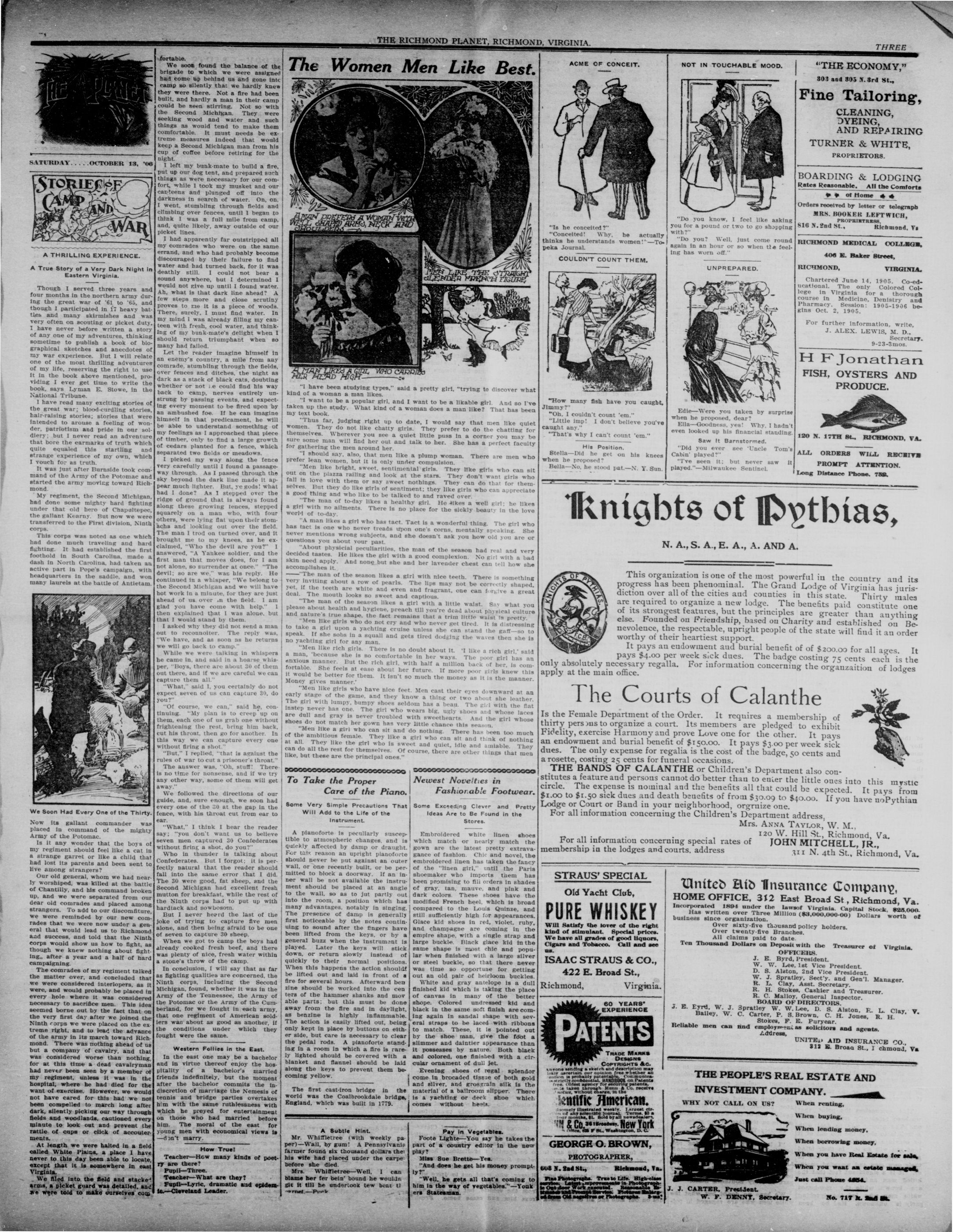
The Women Men Like Best.
A MAN PREFERS A WOMAN WITH WELL SHAPED ARMS, NECK AND SHOULDERS
MEN LIKE THE STRAIGHT CLENDEA FRENCH FIGURE
A MAN LIKES A GIRL WHO CARRIES
"I have been studying types," said a pretty girl, "trying to discover what kind of a woman a man likes.
"I want to be a popular girl, and I want to be a likable girl. And so I've taken up the study. What kind of a woman does a man like? That has been my text book.
"Thus far, judging right up to date, I would say that men like quiet women. They do not like chatty girls. They prefer to do the chatting for themselves. Wherever you see a quiet little puss in a corner you may be sure some man will find her out and talk to her. She has a perfect faculty for gathering the men around her.
"I should say, also, that men like a plump woman. There are men who prefer lean women, but it is only under compulsion.
"Men like bright, sweet, sentimental girls. They like girls who can sit out on the plaza railing and look at the stars. They don't want girls who fall in love with them or say sweet nothings. They can do that for themselves. But they do like girls of sentiment; they like girls who can appreciate a good thing and who like to be talked to and raved over.
"The man of to-day likes a healthy girl. He likes a well girl; he likes a girl with no ailments. There is no place for the sickly beauty in the love world of to-day.
"A man likes a girl who has tact. Tact is a wonderful thing. The girl who has tact is one who never treads upon one's corns, mentally speaking. She never mentions wrong subjects, and she doesn't ask you how old you are or questions you about your past.
"About physical peculiarities, the man of the season had real and very decided tastes. He likes the girl with a good complexion. No girl with a bad skin need apply. And nong but she and her lavender chest can tell how she accomplishes it.
"The man of the season likes a girl with nice teeth. There is something very inviting about a row of pearls. The lips may not be correctly shaped, yet, if the teeth are white and even and fragrant, one can forgive a great deal. The mouth looks so sweet and captious.
"The man of the season likes a girl with a little waist. Say what you please about health and hygiene, preach till you're dead about physical culture and nature's true shape, the fact remains that a trim little waist is pretty."
"Men like girls who do not cry and who never get tired. It is distressing to take a girl upon a yachting cruise unless she can stand the gaff—so to speak. If she sobs in a squall and gets tired dodging the waves then she is no yachting girl for any man.
"Men like rich girls. There is no doubt about it. 'I like a rich girl,' said a man, because she is so comfortable in her ways. The poor girl has an anxious manner. But the rich girl, with half a million back of her, is comfortable. She feels at ease about her future. If more poor girls knew this it would be better for them. It isn't so much the money as it is the manner. Money gives manner."
"Men like girls who have nice feet. Men cast their eyes downward at an early stage of the game, and they know a thing or two about she leather. The girl with lumpy, bumpy shoes seldom has a bean. The girl with the flat instep never has one. The girl who wears big, ugly shoes and whose laces are dull and gray is never troubled with sweethearts. And the girl whose shoes do not match her gown has very little chance this season.
"Men like a girl who can sit and do nothing. There has been too much of the ambitious female. They like a girl who can sit and think of nothing at all. They like the girl who is sweet and quiet, idle and amiable. They can do all the rest for themselves. Of course, there are other things that men like, but these are the principal ones."
A MAN Likes A GIRL WHO CARRIES
HER HEAD HIGH
"I have been studying types," said a pretty kind of a woman a man likes.
"I want to be a popular girl, and I want taken up the study. What kind of a woman my text book.
"Thus far, judging right up to date, I women. They do not like chatty girls. They themselves. Wherever you see a quiet life sure some man will find her out and talk for gathering the men around her.
"I should say, also, that men like a pleaser lean women, but it is only under coo.
"Men like bright, sweet, sentimental girl out on the plaza railing and look at the fall in love with them or say sweet nothings. But they do like girls of sentiment; a good thing and who like to be talked to.
"The man of to-day likes a healthy girl a girl with no ailments. There is no place world of to-day.
"A man likes a girl who has tact. Tact it has tact is one who never treads upon one never mentions wrong subjects, and she does questions you about your past.
"About physical peculiarities, the man decided tastes. He likes the girl with a good skin need apply. And none but she and he accomplishes it.
——The man of the season likes a girl who very inviting about a row of pearls. The yet, if the teeth are white and even and the deal. The mouth looks so sweet and captive.
"The man of the season likes a girl who please about health and hygiene, preach till and nature's true shape, the fact remains to
"Men like girls who do not cry and who to take a girl upon a yachting cruise unlucky speak. If she sobs in a squall and gets tired no yachting girl for any man.
"Men like rich girls. There is no double a man, because she is so comfortable in an anxious manner. But the rich girl, with his fortable. She feels at ease about her future it would be better for them. It isn't so much Money gives manner."
"Men like girls who have nice feet. Me early stage of the game, and they know a the girl with lumpy, bumpy shoes seldom in instep never has one. The girl who wears are dull and gray is never troubled with a shoes do not match her gown has very little.
"Men like a girl who can sit and do not of the ambitious female. They like a girl at all. They like the girl who is sweet and can do all the rest for themselves. Of courses, like, but these are the principal ones."
To Take the Proper Care of the Piano.
Some Very Simple Precautions That Will Add to the Life of the Instrument.
A planoforte is peculiarly susceptible to atmospheric changes, and is quickly affected by damp or draught. For this reason an upright planoforte should never be put against an outer wall, or one recently built, or be permitted to block a doorway. If an inner wall be not available the instrument should be placed at an angle to the wall, so as to jut partly out into the room, a position which has many advantages, notably in singing. The presence of damp is generally first noticeable by the notes continuing to sound after the fingers have been lifted from the keys, or by a general buzz when the instrument is played. Later the keys will stick down, or return slowly instead of quickly to their normal positions. When this happens the action should be lifted out and laid in front of a fire for several hours. Afterward benzine should be worked into the centers of the hammer shanks and movable parts; but this must be done away from the fire and in daylight, as benzine is highly inflammable. The action is easily lifted out, being only kept in place by buttons on either side, but care is necessary to clear the pedal rods. A planoforte standing in a room in which a fire is rarely lighted should be covered with a blanket and flannel should be laid along the keys to prevent them becoming yellow.
The first cast-iron bridge in the world was the Coalbrookdale bridge, England, which was built in 1779.
Mr. Whifltree (with weekly paper)—Wall, by gum! A Pennsylvania farmer found six thousand dollars the his wife had placed under the carpe before she died.
Mrs. Whifltree—Well, I can blame her fer bein' bound he wouldn't git it till he undertook tew bent ti
armet—Punk
Some Exceeding Clever and Pretty Ideas Are to Be Found in the Stores.
Embroidered white linen shoes which match or nearly match the gown are the latest pretty extravagance of fashion. Chic and novel, the embroidered linen has taken the fancy of the "linen girl," until the Paris shoemaker who imports them has been promising to fill orders in shades of gray, tan, mauve, and pink and dark colors. These shoes have the modified French heel, which is broad compared to the Louis Quinze, and still sufficiently high for appearances. Glace kid shoes in red, violet, ruby, and champagne are coming in the empire shape, with a single strap and large buckle. Black glace kid in the same shape is most chic and popular when finished with a large silver or steel buckle, so that there never was time so opportune for getting out an old pair of heirloom buckles.
White and gray antelope is a dull finished kid which is taking the place of canvas in many of the better shope. Colored undressed kid and black in the same soft finish are coming again in sandal shape with several straps to be laced with ribbons to match. These, it is pointed out by the shoe man, give the foot a slimmer and daintier appearance than it possesses by nature. Both black and colored, one finished with a circular ornament of dull jet. Evening shoes of regal splendor come in brocaded tissue of both gold and silver, and grosgrain silk is the material of a ballroom slipper. There is a yachting or deck shoe which comes without heels.
Knights of Pythias,
This organization is one of the most powerful in the country and its progress has been phenominal. The Grand Lodge of Virginia has jurisdiction over all of the cities and counties in this state. Thirty males are required to organize a new lodge. The benefits paid constitute one of its strongest features, but the principles are greater than anything else. Founded on Friendship, based on Charity and established on Benevolence, the respectable, upright people of the state will find it an order worthy of their heartiest support.
It pays an endowment and burial benefit of of $200.00 for all ages. It pays $4.00 per week sick dues. The badge costing 75 cents each is the only absolutely necessary regalia. For information concerning the organization of lodges apply at the main office.
The Courts of Calanthe
Is the Female Department of the Order. It requires a membership of thirty persons to organize a court. Its members are pledged to exhibit Fidelity, exercise Harmony and prove Love one for the other. It pays an endowment and burial benefit of $150.00. It pays $3.00 per week sick dues. The only expense for regalia is the cost of the badge, 50 cents and a rosette, costing 25 cents for funeral occasions. THE BANDS OF CALANTHE or Children's Department also con-
stitutes a feature and persons cannot do better than to enter the little ones into this mystic circle. The expense is nominal and the benefits all that could be expected. It pays from $1.00 to $1.50 sick dues and death benefits of from $30.09 to $40.00. If you have no Pythian Lodge or Court or Band in your neighborhood, orgnize one.
For all information concerning the Children's Department address
For all information concerning special rates of membership in the lodges and courts, address
ACME OF CONCEIT.
"Is he conceited?"
"Conceited! Why, he actually thinks he understands women!"—Topeka Journal.
"Conceited! Why, he actually thinks he understands women!"—Topeka Journal.
"How many fish have you caught, Jimmy?"
"Oh, I couldn't count 'em."
"Little imp! I don't believe you've caught any."
"That's why I can't count 'em."
His Position.
Stella—Did he get on his knees when he proposed?
Bella—No, he stood not.
KNIGHTS OF PYTHIA'S
ECB
This orga
progress ha
diction over
are required
of its strong
else. Foun
nevolence, t
worthy of th
It pays a
only absolutely necessary rega
apply at the main office.
The Court
Is the Female Department of the
thirty persons to organize a cow
Fidelity, exercise Harmony and
an endowment and burial bene
dues. The only expense for rea
a rosette, costing 25 cents for f
THE BANDS OF CALA
stitutes a feature and persons o
circle. The expense is nomina
$1.00 to $1.50 sick dues and de
Lodge or Court or Band in you
For all information concerni
For all information concern
membership in the lodges and
STRAUS' SPECIAL
Old Yacht Club,
PURE WHISKEY
Will Satisfy the lover of the right kind of stimulant. Special prices.
We have all grades of good liquors,
Cigars and Tobacco. Call and see us.
ISAAC STRAUS & CO.,
422 E. Broad St.,
Richmond, Virginia.
60 YEARS'
EXPERIENCE
PATENTS
TRADE MARKS
DESIGNS
COPYRIGHTS & C.
Anyone sending a sketch and description may only ascertain our opinion free whether an artist is properly paid. Comprehensive information is strictly confidential. HANDBOOK on Patents is entirely confidential. HANDBOOK on Patents is taken through Munn & Co. receives proofs, without charge, in the
Scientific American.
Scientifically illustrated weekly. Largest citation of any scientific journal. Terms, $ 8 a four months. $ 1. Bold by all newadvertiser.
MN & Co. 301 Broadway, New York
Office, 65 F. St., Washington, D. C.
GEORGE O. BROWN,
PHOTOGRAPHER.
608 N. 2nd St., Richmond, Va.
Pine Photographs. True to Life. High-class service. Leading improvements in Photographics. Out-door Work accounted. Reasonable Inhibition. Job opportunities. Jackson Marsh forms Old negatives or Photographs. 3am!
United Aid Insurance Company.
HOME OFFICE, 312 East Broad St., Richmond, Va.
Incorporated 1894 under the lawsof Virginia. Capital Stock, $25,000.
Has written over Three Million ($3,000,000-00) Dollars worth of business since organization.
Over sixty-five thousand policy holders.
Over twenty-five Branches.
All claims paid to date.
Ten Thousand Dollars on Deposit with the Treasurer of Virginia.
OFFICERS.
J. E. Byrd, President.
W. W. Lee, 1st Vice President.
D. S. Alston, 2nd Vice President.
W. J. Spratley, Sect'y. and Gen'l. Manager.
R. L. Clay, Asst. Secretary.
R. H. Stokes, Cashler and Treasurer.
R. C. Malloy, General Inspector.
BOARD OF DIRECTORS.
J. E. Eyrd, W. J. Spratley W. W. Lee, D. S. Alston, E. L. Clay, V. Bailey, W. C. Carter, P. S. Brown, C. H. Jones, R. H.
Stokes, F. E. Puryear.
Reliable men can find employment as solicitors and agents.
Address,
UNITED AID INSURANCE CO.,
312 E. Broa St., I chmond, Va
THE PEOPLE'S REAL ESTATE AND
NOT IN TOUCHABLE MOOD.
"Do you know, I feel like asking you for a pound or two to go shopping with?"
"Do you? Well, just come round again in an hour or so when the feeling has worn off."
UNPREPARED.
Edie—Were you taken by surprise when he proposed, dear?
Ella—Goodness, yes! Why, I hadn't even looked up his financial standing.
Saw it Barnstormed.
"Did you ever see 'Uncle Tom's Cabin' played?"
"I've seen it; but never saw it played."—Milwaukee Sentinel.
Organization is one of the most powerful has been phenomenal. The Grand Daughter all of the cities and counties in need to organize a new lodge. The biggest features, but the principles founded on Friendship, based on Charity, the respectable, upright people of their heartiest support. An endowment and burial benefit of $50 per week sick dues. The badge of galla. For information concerning courts of Calantia.
In the Order. It requires a member court. Its members are pledged and prove Love one for the other. Benefit of $150.00. It pays $3.00 per regalia is the cost of the badge, 500 funeral occasions.
ANTHE or Children's Department cannot do better than to enter the final and the benefits all that could death benefits of from $30.09 to $40 your neighborhood, orgnize one.
Mrs. ANNA TAY
120 W. H.
Norning special rates of JOHN and courts, address
United Aid Insurance
HOME OFFICE, 312 East
Incorporated 1894 under the laws.
Has written over Three Million business since organization.
Over sixty-five thousand.
Over twenty-five Branches.
All claims paid to date.
Ten Thousand Dollars on Deposit with OFFICE
J. E. Byrd, B.
W. W. Lee,
D. S. Alston,
W. J. Spratley
R. L. Clay,
R. H. Stokes,
R. C. Malloy,
BOARD OF
J. E. Eyrd, W. J. Spratley W. W. L.
Bailey, W. C. Carter, F. S. H.
Stokes, F. R.
Reliable men can find employment at Address, U
THE PEOPLE'S REAL INVESTMENT COMPANY
WHY NOT CALL ON US?
J. J. CARTER, President.
W. F. DENNY, Secretary.
THREE
"THE ECONOMY,"
303 and 305 N. 3rd St..
Fine Tailoring,
CLEANING,
DYEING,
AND REPAIRING
TURNER & WHITE,
PROPRIETORS.
BOARDING & LODGING
Rates Reasonable. All the Comforts
Orders received by letter or telegraph
MRS. BOOKER LEFTWICH,
PROPRIETRESS,
S16 N. 2nd St., Richmond. Va
RICHMOND MEDICAL COLLEGE,
406 E. Baker Street,
RICHMOND, VIRGINIA.
Chartered June 14, 1905. Co-educational. The only Colored College in Virginia for a thorough course in Medicine, Denistry and Pharmacy. Session: 1905-1906 begins Oct. 2, 1905.
For further information, write,
J. ALEX. LEWIS, M. D.,
Secretary.
9-23-3mos.
H F Jonathan
FISH, OYSTERS AND
PRODUCE.
ALL ORDERS WILL RECEIVE
PROMPT ATTENTION.
Long Distance Phone. 752.
pythias,
powerful in the country and its
Lodge of Virginia has juris-
in this state. Thirty males
the benefits paid constitute one
is greater than anything
harity and established on Be-
f the state will find it an order
of of $200.00 for all ages. It
the costing 75 cents each is the
ing the organization of lodges
MINT
ment also con-
e little ones into this mystic
and be expected. It pays from
$40.00. If you have noPythian
address,
TAYLOR, W. M.,
Hill St., Richmond, Va.
MITCHELL, JR.,
N. 4th St., Richmond, Va.
Insurance Company,
First Broad St., Richmond, Va.
of Virginia. Capital Stock, $25,000.
(in $3,000,000-00) Dollars worth of
policy holders.
ches.
with the Treasurer of Virginia.
ICERS.
President.
1st Vice President.
2nd Vice President.
Ley, Sect'y. and Gen'l. Manager.
Asst. Secretary.
Cashier and Treasurer.
General Inspector.
DIRECTORS.
Lee, D. S. Alston, E. L. Clay, V.
Brown, C. H. Jones, R. H.
E. Puryear.
as solicitors and agents.
UNITED AID INSURANCE CO.,
$12 E. Broa St., I chmond, Va.
REAL ESTATE AND
COMPANY.
When renting,
When buying,
When lending money,
When borrowing money,
When you have Real Estate for sale,
When you want an estate managed,
Just call Phone 4854.
No. 717 N. 2nd St.
FOUR
HEATLAND
Published every Saturday by JOHN MITCHELL,
JR., at SIl North 4th Street, Richmond Va.
JOHN MITCHELL, JR. • EDITOR.
Ali communications intended for publication should be sent so as to reach us by Wednesday.
TERMS IN ADVANCE
One Copy, one year.
One Copy, eight months.
One Copy, six months.
One Copy, four months.
One Copy, three months.
Single Copy.
REGISTERED LETTER.—If a money Order Post-Office or an Express Office is not within the city, you may send it to the Letter you wish to send us on payment of ten cents. Then, if the letter is lost or stolen, it can be treasured. You can send money in ten cents at our request.
We cannot be responsible for money sent in letters in any other way than one of the four ways mentioned above. If you send your money in another way, you must do it at your win risk.
RENewALS, ETC.—If you do not want the PLANET continued for another year after your payment, you may send it to the Postal Card to discontinue it. The counts have decided that subscribers to newspaper, who do not order their paper discontinued at the expiration date, are held liable for the payment of the subscription up to date when they order the paper discontinued.
CORRECTIONS.—When writing to us to renew your subscription or to discontinue your paper, you should give your name and address in full, otherwise we cannot find your name on the order.
CHANGE OF ADDRESS.—In order to change the address of a subscriber, we must be sent the former as well as the present address.
Entered at the Post-Office at Richmond, Va.
at second-class matter.
SATURDAY.....OCTOBER 13, '06
THE MOR'S BLUNDER
The mob at Mobile, Alabama was taught a lesson, Tuesday, Oct. 2nd, 1906 that is said to have taken all the ardor out of it. As a result, Roy Hoyle, one of the mob leaders is cold in death. It is always alleged that the lynchers are not known and yet here is a case where Alderman Sidney Lyons, chairman of the city council of Mobile and Roy Hoyle were in the jail at the same time. The report states that Sheriff Powers met the leaders of the mob and offered to let anybody whom he personally knew to pass through the jail to satisfy the crowd of the truth of his statement.
About forty men accepted the invitation and were convinced of the truth of the statement. It is stated that while Hoyle and Lyons were still in jail a tall, raw-boned white man, whose name of course is unknown led the mob, that seized a telephone pole that had blown down and proceeded to use it as a battering ram against a closed part of a double door of the jail. The door fell with a crash and almost instantly a shot came from a man standing in the gate.
The would-be lynchers at once opened fire on the jail and a fusilade of shot followed. One of the lynchers had a repeating rifle which he worked vigorously. About 12 men is said to have been engaged in the shooting. The mob itself ran for shelter when the firing began.
Soon afterwards, Alderman Lyons, who had inspected the jail as the representative of the mob to see if the prisoner wanted was there, came out, holding up his hand from which blood was streaming. He announced that Roy Hoyle, another lyncher had been shot and probably fatally injured.
The report says:
"Hoyle has been exceptionally popular and the fact that he had been shot while looking through the jail in order to ascertain if the Negro was there took all the fight out of the mob and for the most part, it dispersed quietly."
This emphasizes the point that we have repeatedly commented upon. The proper way to deal with a mob is to shoot the life out of it or convince its leaders before-hand that you will do it. In their blind ardor these lynchers killed one of their own men and wounded another. It is a significant fact that the killed man and the wounded one are known, while the raw-boned white man who led the lynching party is unknown. Had he been
shot, he would have been known too. As a matter of fact, he is responsible for the death of Roy Hoyle. The situation is acute and it will require positive and radical action to suppress and root out this wave of lawlessness now sweeping over the country.
"THE TRAGEDY OF COLOR."
Mr. H. G. Wells, the accomplished English writer continues his observations upon the Negro as follows:
It is to the tainted whites my sympathies go out. The black or mainly black people seem to be fairly content with their inferiority; one sees them all about the States as waiters, cab-drivers, railway porters, car attendants, laborers of various sorts, a pleasant-smiling, acquiescent folk. But consider the case of a man with a broader brain than such small uses nee1, conscious perhaps, of exceptional gifts, capable of wide interests and sustained attempts, who is perhaps as English as you or I, with just a touch of color in his eyes, in his lips, in his finger-nails, and in his imagination. Think of the accumulating sense of injustice he must bear with him through life, the perpetual slight and insult he must undergo from all that is vulgar and brutal among the whites! Something of that one may read in the sorrowful pages of Du Bois's "The Soul of Black Folk." They would have made Alexandre Dumas travel in the Jim Crow car if he had come to Virginia. But I can imagine some sort of protest on the part of that admirable but extravagant man... They even talk of "Jim Crow elevators" now in Southern hotels.
At Hull House, in Chicago, I was present at a conference of colorel people—Miss Jane Adams efficiently in control—to consider the coming of a vexatious play, "The Clansman," which seems to have been written and produced entirely to exacerbate racial feeling. Both men and women were present, business people, professional men, and their wives; the speaking was clear, temperate, and wonderfully to the point, high a bove the level of any British town council I have ever attended. One lady would have stood out as capable and charming in any sort of public discussion in England—though we are not wanting in good women speakers—and she was at least three quarters black.
And while I was in Chicago, too, I went to the Peking Theatre—a "coon" music-hall—and saw something of a lower level of colored life. The common white, I must explain, delights in calling colored people "coons" and the Negro, so far as I could learn, uses no retaliatory word. It was a "variety" entertainment, with one turn, at least, of quite distinguished merit, good-humored and brisk throughout. I watched keenly, and I could detect nothing of that trail of base suggestion one would find as a matter of course in a music-hall in such English towns as Brighton and Portsmouth. What one heard of kissing and love making was quite artiess and simple indeed. The Negro, it seemed to me, did this sort of thing with a better grace and a better temper than a Londoner, and shows, I think, a finer self-respect. He thinks more of deportment, he bears himself more elegantly by far than the white at the same social level. The audience reminded me of the sort of gathering one would find in a theatre in Camden Town or Hoxton. There were a number of family groups, the girls brightly tressed, and young couples quite of the London music-hall type. Clothing ran "smart," but not smarter than it would be among fairly prosperous north London Jews. There was no gallery—socially—no collection of orange-eating, interrupting hoolgans at all. Nobody seemed cross, nobody seemed present for vicious purposes, and everybody was soer. Indeed, there and elsewhere I took and confirmed a mighty liking to these gentle, human, dark-skinned people.
We shall quote him further in our next issue.
SENATOR TILLMAN'S DELIVER- ANCES.
That Senator B. R. Tillman is becoming more and more conservative on the questions now affecting the southern portion of this country is evident to our minds. He has given positive impetus to this view of the situation if we are to judge by the language imputed to him in the recent speech delivered at Augusta, Georgia, Sunday, October 7th, 1906. It is said that 4000 people listened to his forensic and eloquent display. We presume that he was correctly quoted. Here is what he said:
"There are some people who say that a race problem settles itself, but I make the prediction that in less than ten years, I fear less than five, there will be an immense number of bloody race riots, North and South, beside which the Atlanta riot will fall into insignificance."
We have no doubt but what they will if "Rev." Thomas Dixon, Jr. is permitted to continue his production of "The Clansman;" editors of southern journals allowed to offer $1000 rewards for lynchings without making good the offers when the terms of the agreement have been carried out and the Senator himself continues his tirades against one of the humblest races of people on the face of the globe.
Senator Tillman continue:
"I lay down the following propositions which cannot be disputed: "First—White men of the South are united and determined as never before to maintain white supremacy politically and socially, in every part of every Southern State."
We have no doubt but what the white men who are engaged in pol-
THE RICHMOND PLANET, RICHMOND, VIRGINIA.
ities in the southern portion of this country are determined to do this very thing.
So far as we see upon the horizon of both political parties, we cannot discern any disposition to contest this view of a most anomalous situation. A reference therefore to a condition that exists with no present indications of being disturbed for a generation at least, and a long time after this Negro-hating Senator has been gathered into the grave of his father seems to us to be superfluous.
He said:
"Second—The Negroes were never more intent on contesting in every way that they dare this position of the whites, and the Republican national government is aiding this idea."
In this position, the Senator errs for the Negroes are not seeking for political supremacy and they are not clamoring for social elevation above the plane now occupied by the whites. They are content to receive civil and political equality and only so much of this as is guaranteed in the Bill of Rights of Virginia and the Constitution of the United States.
The Republican national government has long since ceased to be a sponsor for the Negro on any of these questions. It stands only for the law as it is written and the Negro profits or loses in-so-far as his interests coincide or conflict with these statutes.
The Negro's political hopes are wrapped up in the States. The Supreme Court of the United States has so decreed it and from its decisions there is no appeal. It would seem then that the entertaining Senator from South Carolina has set up a "man of straw" to be knocked down for his own edification and amusement.
He continued:
"Third—Race hatred in every form is growing in intensity with both races."
It would be well to enquire who is making it grow? The Senator has been industriously engaged in this business for many years and he now seems to be appalled at the approaching result of his own folly.
He continued:
"Fourth—Lynching for criminal assault will continue as long as the crime is committed. It inflames the whites and causes innocent Negroes to suffer."
The Senator should also observe that robbery will continue as long as people have money and that robbers will be punished as long as they continue to rob people. One assertion is just about as sensible as the other.
The courts are established for the punishment of crime, and in many instances they are in the hands of the leaders of the mob themselves.
Our view of the situation is that lynchings will continue as long as the officers of the law are too timid and "chicken-hearted" to shoot the lynchers or to convince them that they will be shot if they attempt to lynch a prisoner.
The logical result of all of this is that the man who is sought for, be he guilty or innocent will soon learn that the proper course to pursue is to fight the lynchers and the sheriff's posses to the death and "die with his boots on."
An innocent man is not given a chance now to prove his innocence when under a heinous charge. We have no sympathy with the rapist, but under the provisions of the federal constitution that "cruel and unusual punishment shall not be inflicted," we favor the legal execution of a criminal. The black assailant of a white woman is an enemy to society and an injury to the race. At one fell blow, he tends to inflame the worst passions and places all of our leaders and advocates at a disadvantage before a word has been spoken.
He can be fittingly compared to the American anarchists, who as mobs, lynchers, rioters, destroy human life, commit crimes and resort to excesses akin to those told in the most hideous accounts of the crimes of the Middle Ages. Senator Tillman said:
"Fifth—Amalgamation is the hope and ultimate purpose of the Negroes. White men are rendering them great aid in this by intimacy with Negro women. The line must be drawn as sternly between white men and Negro women as between black men and white women."
Senator, now you are talking. On this issue, we'll be with you in the beginning and we shall be with you to the end. Your people have mixed us up so that we are unable at times to tell a colored white man from a white colored man. Amalgamation is just as surely being accomplished when the agency in bringing about this result is a white man on the one side and a Negro woman on the other as it is when there is a colored man on the one side and a white woman on the other. We agree with Senator Tillman and for the reasons specified as well as for racial ones. We are in favor of lealing a crusade against both classes of offenders.
We confess that we have the best part of the "bargain" however for we have all of the white colored babies on our side and all of the black
ones too and it has enabled us to have white wives as well as black ones, much to the envy of the white men, who have only one color from which they can legally select. If we were to kill all of the white men that we find clandestinely meeting Negro women, funerals would be taking place in white families every five minutes for a year and it is doubtful if even all of the guilty ones would then succeed in securing a decent burial.
Keep the white men out of our potato patch, Senator Tillman. Stop them from climbing our back fences when they have overstayed their time in the morning with some Negro woman, whom some black Negro has abandoned and you will win the lasting gratitude of every colored lady of respectability in the Southland and the hearty support of every honorable citizen of color in the sunny land. Senator Tillman reached the plane of true statesmanship when he said:
"Sixth—The burning issue is how to prevent and not to avenge criminal assault, as lynching has failed. The superior race should protect many millions of innocent Negroes from false teachers and bad leaders, who are rapidly driving the whites to a desperation that means a race war that can only result in the destruction of the weaker race."
Well said, Senator Tillman, well said! If you concede that lynching has failed, you are admitting that your policy has failed. Lawlessness as a cure for crime has always failed. No statement ever made by this fiery South Carolinian has been so important as this.
It is useless then to continue the practice longer and the law should step in and check it. He is quoted further:
After considering every conceivable plan for the protection of white women against Negro assaultants, he concluded that there was only one effective way. This plan is the establishing of a European system of passports, followed by a large increase in the humbler officers of the law.
"He declared if all were shot like wild beasts the country would be better off, but that was unlawful. Therefore, when they were unable to produce passports, they should be placed on chain gangs until they reformed or left the country. He said no further concessions should be made to various objectors, "as we must cease to ponder, else we will be forced to shooting.""
We favor the pass-port system if its operations will be faithfully carried out without regard to race, color or previous condition of servitude. A white rapist is just as bad as a black rapist and vice-versa. The Senator is finally quoted as follows:
"He declared that the white men of the South should go ahead and do what they believed was right in this matter, regardless "of all the Yankees between Cape Cod and hell."
As they have been doing what they believed to be wrong "in this matter, regardless of all the yankees between Cape Cod and hell," we do not see that it would require any effort so far as the northerners referred to are concerned for them to do what they believed to be right in this matter.
Senator Tillman has taken a long step forward and when he proclaimed to his four thousand hearers that his pet policy of lynching during a period of forty years has been a failure, we find ourselves involuntarily doffing our hat and doing the honors to the fiery chieftain of the Ku Klux Klan and the advocate of the modern lynchers of this great republic.
Senator Tillman has been bal, but if he lives up to that speech delivered at Augusta, the colored people of this country will find out that they have many worse enemies than this South Carolinian. In this position, he now occupies the gentleman will find out that in advocating a reasonable policy, he is benefiting the white man of the Southland to as great an extent as he is benefiting the colored man of the same section.
Any one who attempts a race war in this country, be they black or white will find the strong arm of the national government of this country against them and if this proves inefficient and impotent, they will find that this will be backed up by the international armies of the Old World.
Go ahead, Senator Tillman, we are with you on this issue.
THAT HEINOUS CRIME
In view of the multiplying charges of attempted criminal assault against colored people, it may well to note the fact that John Legg, (white) has been indicted at Leesburg, Va. for attempting to criminally assault Miss Susan Sinclair of Wetson, an aged woman of that section. Legg is only twenty-four years old. George Frush, (white) of Clarksburg, W. Va., was threatened with a lynching last Tuesday when about to be granted a preliminary hearing before Justice Gordon for attempting to criminally assault Miss May Glusser, who went out to drive with him in a buggy. He dragged her from the vehicle, but she got away from him and came home. Frush
returned alone in the buggy. The girl is a clerk in a store and earns money in this manner to pay her way through a business college which she attends at night. Neither of the parties have been lynched yet.
ARSENIG KILLED MRS. BROUWER
Experts Testify to Finding Poison and Glass in Her Body.
EVIDENCE IN MURDER TRIAL
Toms River, N. J., Oct. 10. — The principal features of the testimony at the trial of Dr. Frank Brouwer, accused of the murder of his wife by the administration of poison and ground glass was the testimony of Prof. Frederick Genth, of Philadelphia, the expert chemist, who analyzed the contents of alimentary canal taken from Mrs. Brouwer's body. In his testimony however, Dr. Genth with reference to the jars in which the organs were placed admitted that particles of glass found by him on the outside of the stomach had undoubtedly been broken off the jar in putting on or taking off the cover. He had previously testified to the finding of a number of particles of glass in the intestines, but under cross-examination the fact that in one instance at least pieces of glass found had come from the jar containing the organ was brought out.
Professor Genth's testimony was that he found arsenic in the brain, kidney, intestines, liver and muscular tissue. The total amount obtained was 0.0328 grains of white arsenic. The pieces of ground glass varied in size from a pin point to a little larger than a pinhead. At this point the witness produced a small tube in which were the pieces of glass he said he had discovered in the intestines. It was handed around to the lawyers and then to Dr. Brouwer, who asked for a microscope. With this he carefully examined the tube and spent about five minutes looking it over. He was perfectly cool and composed. Dr. Cattell, who made the autopsy, testified that Mrs. Brouwer's death might have resulted from arsenical poisoning. He said he had failed to find indications that death had resulted from natural causes.
Miss Una Dudley, one of the nurses who attended Mrs. Brouwer during her fatal illness, testified that she had not administered to the sick woman hypodermic injections prepared by Dr. Brouwer for that purpose, but she was not allowed to tell why.
Theodore J. R. Brown, the county prosecutor, in opening the case against Dr. Brouwer, said that Mrs. Brouwer was first taken ill on the night of September 13 with violent pains and vomiting which he said were symptoms of poisoning. She was then treated by her husband. In a subsequent attack a nurse was called in to attend Mrs. Brouwer and Dr. Brouwer, the prosecutor said, gave the nurse something which he said was medicine with instructions to administer it. He then went to Lakehurst. Mrs. Brouwer became worse and another physician was called in under whose care she partly recovered.
On the Sunday before she died Mrs. Brouwer was again taken ill, said Mr. Brown, and showed symptoms of poisoning. At that time a nurse was attending the patient in the day and Dr. Brouwer in the night. The doctor relieved the nurse at 9 p. m. Sunday and Mrs. Brouwer died in great agony at 4 o'clock the next morning.
"As Mrs. Brouwer lay there in bed, the victim of her husband's murderous designs," said Mr. Brown, "two nurses alone suspected what he was doing. They saw that the hypodermic injections which caused her untold agony and convulsions instead of giving her relief. The prescriptions for the injections were made by another physician who was attending the case and were made by Dr. Brouwer."
PRODUCE QUOTATIONS
The Latest Closing Prices In the Principal Markets
PHILADELPHIA FLOUR firm;
winter extras. $2.90@1.30; Pennsylvania
aia roller clear. $3.15@2.30; city mills;
fancy. $4.40@4.45; RYE FLOUR firm;
fancy. $4.40@4.45; RYE FLOUR firm;
No. 2 Penna, red. $73@73%; COAT firm;
No. 2 yellow, local. $54%; OATS
steady; No. 2 white, clipped. $39%;
lower grades. $38; HAY steady; No. 1
timothy. $17@17.50; large bales; PORK
steady; $17@17.50; large bales; PORK
beam hams. $19; POULTRY; LIFE firm;
hens. $14@14%; old roosters. 10c;
dressed steady; choice fowls. 15c; old
roosters. 10c; Butter firm; cremery
cremery. 29c; OGGS steady; selected. 27
@22; rear; two western. 25c; southern. 22@24; POTATOES steady; per bushel. 70@75c.
BALTIMORE—WHEAT easy; No. 2
spot, 78¼c; steamer No. 2 spot, 69¼c;
southern, 69c; CORN quiet; mixed
spot, 53¼c; steamer mixed, 54¼c;
southern, 54c; OATS steader; white,
No. 2, 39 @ 38¼c; No. 3, 38 @ 38¼c;
4, 34 @ 35c; mixed, No. 2, 37¼c
@ 34c; mixed, No. 36¼c; No. 4, 34
@ 34c; BUTTER head; separator
extras, 25½@ 28c; head 20¾
prints, 26 @ 27c; Maryland and Pena,
dairy prints, 16 @ 17c; EGGS quiet;
fancy Maryland, Pena, and Virginia,
24c; West Virginia, 23c; southern,
22c; per dozen.
Live Stock Markets.
PITTSBURG (Union Stock Yards)—
CATTLE slow; choice, $7.55@6; prime,
$5.40@5.65; SHEEP steady; prime
wethers, $5.50@5.65; veal calves, $8@
8.50. HOGS slow and lower; prime
heavies, $7@7.05; mediums and heavy
Yorkers, $6.95; light Yorkers, $6.70@
6.80; plga, $6.40@6.50.
PRISON FOR ABE HUMMEL
Court of Appeals Rules Lawyer Is Not Entitled to Ball.
Albany, N. Y., Oct. 10.—The cost of appeals in a decision handed down decides that Attorney Abraham H. Hummel, under conviction for conspiracy in the Morse-Dodge case, was not entitled to be out on bail pending the determination by the court of an application for a certificate of reasonable doubt.
BERRY STARTS CAPITOL PROBE
Pennsylvania Treasurer Holds Up Payments on the Work.
LETTER TO ATTORNEY GENERAL
Harrisburg, Pa., Oct. 10. — State Treasurer Berry sent to Attorney General Carson a letter asking for advice as to the legality of certain work done on the new state capitol by the board of public grounds and buildings, composed of Governor Pennypacker, Auditor General Snyder and the state treasurer. The letter in part follows: "A careful examination of the specifications under which the capitol was built and the items of expenditure made by the board of public grounds and buildings, convinces me that the board has expended approximately $2,500,000 for work that was specified as a part of the building, either in duplication or in addition to the work specified.
"I am, therefore, of the opinion that this expenditure has been illegally made. In the ordinary course of business on warrants duly attested, and in ignorance of the real status of the case, I have paid approximately $142. 412 to George F. Payne & Co. for parquetry flooring, and desire your official advice as to whether this payment and others of similar character made by my predecessors are illegal, and if so, what steps, if any, can be taken to recover same. As now advised, I shall decline to make further payments on that work." Mr. Berry sent with his letter a table of items which were paid for by the board and which, he claims, were specified in the original contract of the capitol commission with Payne & Co.
Mr. Berry also brought this matter to the attention of his colleagues at the meeting of the board. Governor Pennypacker replied that the board had a certificate from Joseph M. Huston, of Philadelphia, architect of the capitol, that nothing had been paid for by the board which the commission had paid for out of the original appropriation of $4,000,000. The board declined to answer certain questions by Mr. Berry as to its right to contract for certain work done by the board on the capitol, on the ground that this was purely a legal question, which should be determined by the attorney general.
Governor Pennypacker and Auditor General Snyder sent the following letter to George W. Ochs, of the Philadelphia Ledger; Charles Emory Smith, of the Philadelphia Press, and Charles H. Heustis, of the Philadelphia Inquirer:
"We observe that the newspapers are interested, and very properly interested, in learning the facts concerning the cost of the capitol, which was so auspiciously dedicated on Thursday last. We therefore request you to come in person to the office of the governor, in the capitol, on Wednesday, October 17, at 2 p. m., when and where there will be shown to you the minutes of the board of public grounds and buildings, the advertisements, schedules, plans, bids, receipted bills and whatever original papers relating to the subject you may wish to examine. The architect will be present to give all needed explanations. This invitation is not at all intended to supersede a detailed investigation which those in authority may hereafter desire to make, but in order that men of responsibility, such as yourselves, may have the opportunity now to see the methods pursued by the board, and to inform the public."
PENNSYLVANIA'S NEW CAPITOL
Magnificent New Building Handed Over to the Governor.
Harrisburg, Oct. 5.—The magnificent new capitol building of Pennsylvania was dedicated with brief ceremonies in which President Roosevelt participated and in the presence of the greatest crowd Harrisburg has ever seen. For months the commission having charge of the dedicatory ceremonies has been preparing for this event. The culmination of their efforts came when in the presence of a tremendous crowd the new $13,000,000 building was turned over to the state by former Governor William A. Stone, and accepted on behalf of the commonwealth by Governor Pennypacker. During practically the entire time the exercises were being held rain fell, but even this failed to dampen the enthusiasm of the thousands that had gathered in front of and about the grandstand.
Governor Pennypacker and the reception committee awaited in the rotunda of the capitol for the coming of the president. Pretty soon the stalwart form of Roosevelt entered the great bronzed doors. In a moment he was shaking hands with Governor Pennypacker, who gave him a most hearty welcome.
As the president entered the capitol he remarked to the governor:
"By Jove. governor, these are nice bronze doors."
The governor presented the president with the handsome gold medal that the state had made for him. Mayor Gross, representing the city, presented him with the Harrisburg gold medal.
Headed by the governor and the president the party proceeded to the grand stand.
Former Governor Stone formally delivered the capitol to the state, but his voice was weak and there were
not many who heard what he was saying.
At the close of his address Mr. Stone presented to Governor Pennypacker the great golden key of the capitol, which he took from a magnificent case that is shaped like a keystone.
Governor Pennypacker in accepting the key, spoke in exceptional good voice and was frequently interrupted by applause, and when in concluding he introduced President Roosevelt the applause was defening.
AMNESTY FOR. CUBANS
Taft Issues Decree Pardoning Rebels and Political Prisoners
Havana, Oct. 10.—Charles E. Magoon, the newly appointed provisional governor of Cuba, arrived here on the steamer Mascotte. Coincident with his coming Governor Taft gave out a general decree proclaiming amnesty not only to the rebels, but to all persons charged with political offenses or crimes in any way connected with the revolution. He also issued orders covering the attitude of the American marines and soldiers toward the people of Cuba.
Complete pardon is granted to all persons involved in the killing of Congressman Villuendas at Clenfuegos in September, 1905, as well as to everybody implicated in the killing of several rural guardsmen at Guannabacos last February.
The proclamation recites that the in surrectionary forces have been disbanded, that active and organized hostilities have ceased and that it is the purpose of the provisional government to promote the restoration of normal conditions of peace favorable to the early re-establishment of Cuban self-government. The amnesty is declared to cover rebellion, sedition and conspiracy. It gives immunity from prosecution for seizures and expropriation of property for military use by the insurrectionary forces and proceedings already under way for offenses which are amnesties are ordered to be discontinued forthwith. Prosecutors are ordered to have the proclamation applied to cases in which judgment already has been rendered and further to those in which sentence is being served.
The appearance of yellow fever at Clenfuegos caused the immediate issuance of an order by Colonel Barnett directing that the American marines be removed from that city. The men were marched aboard the ships. Three cases of yellow fever have been reported in that city.
FIRE AT CAPE MAY POINT
Several Cottages Destroyed and School Building Damaged.
Cape May Point, N. J., Oct. 8.—Fire which originated in the Packham cottage destroyed $50,000 worth of property here before it was placed under control with the aid of the Cape May fire department. The flames spread quickly from the Packham cottage to the Cape house and thence to two cottages owned by Mrs. Enoch Supplee, the cottages of Mrs. John Kromer, Mrs. John Bain, William Porter, John Springer and Mrs. John Manges. From the latter cottage the fire spread to the public school building, but this structure was but slightly damaged. The only buildings which were completely destroyed were the Packham cottage and the Cape house. Assistance which had been asked of Cape May reached here about the time the flames were eating their way into the cottage district, and by yeoman service the fire fighters from that city saved the other buildings from destruction, although all of them were badly damaged.
POWDER EXPLOSION KILLS FOUR
Dry House of Dupont Plant Near Tamaqua, Pa., Blown Up.
Tamaqua, Pa., Oct. 10.—Four men were killed and one seriously injured by an explosion in the dry house at the Dupont Powder company's plant one mile north of this town.
The dead are: Thomas Purcell, Wilson Sassaman, Calvin Gerber and Edward Treisbach.
Loran DWire, a painter, who was working near the dry house, was seriously injured, one of his legs being blown off.
The shock of the explosion was felt for a radius of 10 miles.
F. W. FLEITZ'S CONDITION GRAVE
Deputy Attorney General of Pennsylvania submits to Painful Operation.
Scranton, Pa., Oct. 8.—Deputy Attorney General F. W. Fletz continues to suffer much pain as the result of the fracture of his hip bone eight days ago.
Owing to the intense suffering the patient had a nervous collapse, which aggravated his condition. To control the fracture it was necessary to drive a silver spike through the hip bone, thus rendering the operation most painful. For the past few days Mr. Fleitz's condition has been causing some uneasiness.
School Girl Takes Poison.
Owossa, Mich., Oct. 9.—Bessie Gerady, aged 12, a school girl, committed suicide by taking poison in the presence of four of her little schoolmates at the pump house of the country school in Venice township. That the child should conceive and carry out a plan of suicide is attributed to the reading of sensational novels.
Seriously Injured While Racing.
Richmond, Va., Oct. 10. — George Gordon, of Philadelphia, riding the steepelechaser Armour, owned by L. P. Stackhouse, also of Philadelphia, was seriously injured at the state fall races, his mount falling at the first jump in a steepelechase. He was taken to a hospital. It is feared that he sustained internal hurts.
THOMAS F. RYAN'S SON DEAD
Heir to New York Financial's Millions Dies Suddenly in Virginia.
Lynchburg, Va., Oct. 9.—W. K. Ryan, son of Thomas F. Ryan, of New York, dled suddenly at Oak Ridge. Mr. Ryan, who was 35 years old, had been suffering for some years with tuberculosis, but his death was unexpected at this time.
William K. Ryan was one of the sons of Thomas F. Ryan, who is at present very much in the public eye as a financier. The elder Ryan is a member of the Ryan Belmont syndicate, which financed the subway construction in New York. He began life as a dry goods clerk in Baltimore, and his fortune is at present conservatively estimated at $50,000,000. His latest achievement was the purchase from James Hasen Hyde of the stock of the Equitable Life Insurance society for $2,600,000.
THE PLANET
LUNATIC SLEEPS IN LOFTY TREES
JOHN KING TERRIFIES RESI
DENTS OF DETROIT.
Imagines Burying Ground Contains Big Lake—Knows Officers Are After Him and Fears Return to Asylum.
Detroit, Mich.—A afraid of their lives, fearful of leaving their homes, the children in the vicinity of Mt. Elliott and Monroe avenues have not played in the streets for several nights. Older persons, too, remain on front porches and do not wander far from the open doorway, through which they may flee at a moment's notice.
John King, a man with a wrecked mind, is the cause of the commotion that exists in that vicinity, and although hunted by officers, he has eluded them and a complete reign of terror exists around that corner of Mt. Elliott cemetery.
John King is a powerful young fellow of about 25 years. After his mind gave way he was taken to the Dearborn retreat, but about a month ago returned to his home in this city.
For several weeks there was no indication of anything wrong with the young man. But, suddenly, he began to develop a fondness for the solitude of the cemetery, especially at night, and forsaking his bed at home, he climbed the big trees among the headstones and slept on the limbs after the primitive fashion.
King had the idea that the cemetery contained a great lake and that on its shores was the ideal camping place. And at night, to avoid the heat, he would steal away to his tree bed.
Neighbors who knew of the occurrence notified the police at the Elmwood station. Several men were detailed to effect the capture of the young man, and nightly they have patroled the vicinity, three or four of them frequently being seen in that portion where the demented man was supposed to be.
Often King would leave the exclusion of his haunts in the cemetery and walk with quick, jerky stride along the walks adjacent to the cemetery. One night, when an officer accosted him, King, it is said, wheeled and struck the officer a violent blow, felling him to the ground, and, turning, ran north.
The demented man is also alleged to have grabbed a young man by the throat and was trying to throttle him when others approached and frightened him so he desisted. Another small boy, who was of too inquisitive a disposition for King, was assaulted and knocked down.
King realizes that he is being sought by the officers and will be placed in confinement again if caught. He is shrewd enough to avoid anyone who looks like an officer or one of
A man is falling from a tree. Another man is holding a bat.
King Eludes Capture by Camping in Tree-Tops.
his friends. He shuns his former friends as though afraid they would do him violence, and if they approach him will take to his heels.
The officers are maintaining a still hunt for King.
In the meantime, while King nightly seeks his leaf couch and the officers patrol the vicinity and stand guard over the place where they suppose he is, the residents do not venture away from home, the children do not demand the freedom of the streets and at night the doors and windows are securely locked against a possible attack.
Mt. Elliott avenue is enjoying a real reign of terror and prayers at night include the wish that the officers will succeed in capturing the man who is making life unbearable in that vicinity.
"Did he remember you in his will?"
"Yas, dod gast him! He remembered to insert the statement of what I owed the estate." -Cleveland Leader.
VISITS PLANET OF MARS;
FINDS ONE-EYED GIANTS
VISITS PLANET OF MARS;
FINDS ONE-EYED GIANTS
Syracuse (N. Y.) Man Brings Back Queer Account of Our Nearest Terrestrial Neighbor.
Syracuse, N. Y.—Sackville G. Leyson, president of the Society for Psychical Research, says he recently paid a visit to Mars. Although the distance is 141,000,000 miles his spirit went there and back in 40 minutes while his body lay in his residence. In describing his visit he said:
"When I approached Mars it looked like a big globe of fire, and it seemed as if I were about to plunge into a molten mass. It was surrounded by blood red clouds mixed with others of greenish hue.
"There are two tribes of people on Mars—one so large I only came up to their knees and the other so small that they only came up to my knees. None wore clothing. All were covered with hair.
"The largest species had huge ears
a nose like a lion, and only one eye. In
GEE! HOW FUNNY
THEY ARE
LOOK AT THE
LOOKS OF THAT
WILL YOU
Leyson Interviewing the Martians.
the middle of the forehead. Their lungs do not move up and down in breathing, but expand crosswise.
"The little men lived in holes in the ground or rocks. The larger ones had houses made of rocks. The little ones had web feet and slipped over a moss-like substance as though skating. They could walk up perpendicular walls like flies.
"The small ones have two eyes, one in each temple. They had no noses, but there was a hole in each cheek.
"The trees looked as if made of rubber. I saw none decayed. There was a substance which looked like snow, but which was not cold and was easy and soft to walk on.
"Down in a deep chasm I saw men working with some sort of machines which was gulding lights across transparent parent rocks. The rays seemed to be reflected clear to the atmosphere on earth."
Mr. Leyson says he will go to Mars again, when he has an audience of scientists and psychologists to testify to the truth of his statement.
HAVE TERRIBLE EXPERIENCE.
Three Persons Rescued After Clinging to Ship's Bottom for Two Days.
Norfolk, Va.—Raving, stark mad, after having clung to the bottom of a fishing schooner for two days after being shipwrecked, two men and a boy were rescued from Pamlico sound. Two women who were on the vessel are missing.
Those saved are I. A. Ballance, Charles Foster and Bennie Jennett, the last named being a mere lad. The women missing are Mrs. S. A. Johnson and Miss Jennie Burrus, of Middleton, N. C. The crew of the schooner Annie Farrow were the rescuers, and the wrecked vessel was the Luther B. May.
The rescuers saw the schooner floating bottom upwards, a lifeboat was sent out and the men and boy were taken off. They had been without food or water since Monday afternoon, when the vessel was overturned in a gale. The two women were in the cabin when the vessel was wrecked and had no chance of escape.
Wed In An Animal Cage.
Des Moines, Ia.—Pearl Morton, of St. Louis, Mo., and Clyde Hogan, of Orange City, Kan., were married in a den of wild animals at a carnival. At the time the vows were pronounced by Justice Fritz Hinzie there were in the cage a wild cat, a lion, and a black bear. The woman keeper had considerable trouble controlling the tiger when the strangers entered the den.
The justice, a young man, was noticeably frightened, and his words could be heard but a short distance from the bars. After he pronounced the two husband and wife he hurriedly yook hands and started for the door. After going half way he turned around and kissed the bride just as the big tiger leaped past them for its cage door. The groom is 21 years of age and the bride 18.
Calf Born in a Sewer.
Pottsville, Pa.—A strange disturbance in an abandoned sewer at St. Clair resulted in an investigation and, after making an opening, workingmen succeeded in taking out a cow and newly born calf. The cow had been in the sewer for nearly two weeks without anything to eat or drink, but was still alive.
When Fortune Frowses
The man, relying on the adage, nat urally supposed he had nothing more to fear, so you can imagine his consternation when Opportunity knocked at his door a second time.
"Farewell, a long farewell, to all my goodness!" he exclaimed, and then, without another word, for he was a brave soul, he went out, and became rich, and lived happily ever after.—Puck.
THE RICHMOND PLANET, RICHMOND, VIRGINIA
JOB DEPARTMENT
EXCURSION
We print Handbills, Quarter-Sheet Sheet posters, Tags, Tickets, Placards, Notes, Visiting Cards, Mourning Stations
WE HAVE
Our St
OF THE LATES
WE CAN PRINT A BILL AS SMALL AS LARGE AS A FRO
A Three-Sheet
AS LARGE AS A FRO
OUR H
IS W
Our street-entrance is retired and fastidious lady being able to enter w
EXCURSION WORK OF ALL DESCRIPTIONS
We print Handbills, Quarter-Sheets, Half and Whole Sheet posters, Tags, Tickets, Placards, Society Cards, Minutes, Visiting Cards, Mourning Stationery.
OUR AIM is to please our patrons and to give them the best service at the lowest prices, consistent with satisfactory work.
We furnish "cuts" when desired and we will arrange to complete special work in our line. When in need of any work in our line, call and see us and estimates will be furnished.
WE HAVE AN ELEGANT LINE OF SAMPLES
WHICH WE WILL SHOW ANY ONE DESIRING TO SEE THEM.
Our Stock Room Embraces a Full Line
OF THE LATEST STYLE BOND, FINE WRITING—FLAT AND LINEN PAPER, ENVELOPES, ETC.
WE CAN PRINT A BILL AS SMALL AS A DODGER. A Three-Sheet Poster AS LARGE AS A FRONT DOOR.
Our street-entrance is retired and has no objectionable features, the most fastidious lady being able to enter without embarrassment or annoyance.
LONG DISTANCE TELEPHONE, 2213.
---
It is thoroughly equipped to do all kinds of printing on short notice. We make a specialty of Society printing and work for Insurance Companies, such as Financial
WHY SHE DIDN'T WIN.
They were at Monte Carlo, and, like other visitors to that insidious paradise, they considered the Casino a place which ought to be visited.
They stood hesitatingly before one of the tables, and at last the temptation to join the players proved too strong for the lady.
"I must just risk one £10 note," she said to her husband. "Give me one, darling, and I will put it on the number of my age. That will be lucky."
Hubby was inclined to be skeptical; but he might have spared himself the trouble of grumbling, and the £10 note was duly deposited on No. 24.
Alas! No. 36 proved to be the winning numeral, and the lady gave a gasp of despair.
"Serve you right," said her husband. "If you'd told the truth you'd have won."
Always a Mystery.
"And that's a fact," remarked the man who sometimes lets out an audible thought.
"What's a fact?" queried the party who wanted to know.
"That a woman can't understand why her husband doesn't pity old bachelors more than he does," explained the noisy thinker.—Chicago Daily News.
Cards, Policies, both straight life and benevolent, Physician's Certificates, Sick Cards, Application blanks, Agents Report Sheets, Rate Cards, etc.
ION WORK
arter-Sheets, Half and Whole
Placards, Society Cards, Min-
ing Stationery.
WE AN EL
WHICH WE WILL
Stock Ro
LATEST STYLB BOND, F
AS SMALL AS A DODGER
Sheet Poster
A FRONT DOOR.
OUR PRESENT CORP OF EMPLOYE
IS WITHIN EASY REACH OF
ired and has no objectionable in
enter without embarrassment o
2213.
AN WORK C
is, Half and Whole
Society Cards, Min-
istry.
is to please
give them
the lowest
with satis
AN ELEG
WHICH WE WILL SHOW A
Rock Room
STYLE BOND, FINE WRIT
AL AS A DODGER.
Poster
DOOR.
PRESENT CORP OF EMPLOYEES ARE
IN EASY REACH OF THE PUBL
has no objectionable features, the
but embarrassment or annoyance
OUR PRESENT CORP OF EMPLOYEES ARE COMPETENT AND QUICK-WORKING. OUR OFFICE IS WITHIN EASY REACH OF THE PUBLIC, BEING WITHIN FIFTY YARDS OF BROAD ST.
PLANET DEPOTS
NEW YORK CITY.
P. Ritzhelmer, 7 N. 134th St.
M. B. Wineyglass, 334 N. 53d St.
Green and Bailey, 249 E. 127th St.
J. W. Watkins, 1931 Broadway.
Mrs. M. Gibbs 120 W. 30th St.
J. H. Parker, 144 W. 26th St.
Charles Devan, 1.1 W. 30th St.
C. H. Lanear, 56 W. 99th St.
W. J. Buckner, 150 W. 53rd St.
R. Plummer, 124 W. 134th St.
M. W. Slaughter, 312 W. 40th St.
W. W. Johnson, 247 W. 47th St.
E. H. Mitchell, 152 W. 27th St.
Standard News Co., 323 W. 37th St.
Turner R. Robinson, 12-6th Ave.
E. A. Williams, 200 W. 63rd St.
M. B. Walker, 309 W. 37th St.
J. H. Jarrett, 453-7th Ave.
Smith & Miles, 222 W. 41st St.
M. B. Wineyglass, 322 W. 59th St.
P. Bell, 239 W. 124th St.
PHILADELPHIA, PA.
M. Clay, 1801 Fitzwater St.
J. H. Gray, 1233 Pine St.
Bishop Robinson, 1234 Melon St.
E. P. Mackens, 1116 Pine St.
James E. Warwick, 254 S. 11th St.
Mrs. B. Homesher, 1040 Pine St.
S. Fingerot, 1218 Pine St.
William Parker, 631 Pine St.
Mrs. Lavinia Aldridge, 521 S. 12th
Chas. A. George, 4063 Market St.
F. A. Stewart, 1730 Federal St.
PITTSBURG, PA.
Jos. Evans, care Jones & Laughlin.
E. K. Thumm., 1402 Wylie Ave.
A. Johnson, 1220 Wylie Ave.
BOSTON. MASS.
2. Branum, 657 Shawmut Ave.
4. W. White, 832 Tremont St.
NORFOLK, VA.
John Debona, 610 Church St.
T. E. W. Perry, 2 Jones Place.
CLEVELAND, OHIO.
J. H. Jackson, 3215 Central Ave.
CHICAGO, ILL.
E. H. Faulkner, 2104 State St.
BROOKLYN, N. Y.,
Care Jones & Laughlin.
Imm., 1402 Wylie Ave.
1220 Wylie Ave.
BOSTON. MASS.
657 Shawmut Ave.
832 Tremont St.
ORFOLK, VA.
a, 610 Church St.
Berry, 2 Jones Place.
VELAND, OHIO.
on, 3215 Central Ave.
CHICAGO, ILL.
Inner, 3104 State St.
OOKLYN, N. Y.,
LYN
Charles Monk
HA
John M. Phi
DA
O. P. Clark,
POH
H. S. Cooper
JACK
John H. Job
PRO
Douglass A.
YOUN
Howard The
327 W. M.
DEL
John W. An
J. A. Hursey, 1486 Bergen St.
Lee Ricks, 782 Fulton St.
William A. Dabney, 3 Quincy St.
William Pope, 174 Myrtle Ave.
CHARLESTON, W. VA.
L. C. Farrar, 501 Brooks St.
ASTORIA, L. I.
Frank R. Wood, 144 Broadway.
ATLANTIC CITY, N. J.
Hursey Bros., 1217 Commerce Ave.
P. E. Baptist, 21 N. Kentucky Ave.
J. E. Carroll, 21 N. Kentecky Ave.
Frank A. Hursey, 945 Baltic Ave.
W. J. Stanford, 1 N. Michigan Ave.
BRONX BOROUGH, N. Y.
J. H. Barrett, 008-1638 St.
ALESTON, W. VA.
r, 501 Brooks St.
STORIA, L. I.
Wood, 144 Broadway.
NATIC CITY, N. J.
L., 1217 Commerce Ave.
St. 21 N. Kentucky Ave.
Il. 21 N. Kentucky Ave.
Cursey, 945 Baitic Ave.
Dr. Wm. S.
WAT
Fred. A. Jo
ME
T. Murray,
OKLAH
E. P. Feaga
SARATON
W. W. Writ
BAI
---
WORK OF AL
OUR AIM
is to please our patrons and to
give them the best service at
the lowest prices, consistent
with satisfactory work.
ELEGANT I
SHOW ANY ONE DESIRING
from Embrace
ONE WRITING—FLAT AND
ELEVEN EYES ARE COMPETENT AND QUIET
THE PUBLIC, BEING WITHIN F
features, the most
or annoyance. FOR FURT
Jol
PLAINFIELD, N. J.
Thos. H. Bridges, 614 W. 4th St.,
BRADDOCK, PA.
G. A. Nevels, 421-6th St.,
WASHINGTON, D. C.
W. L. Smith, 2201-7th St., N. W.
F. O. Robinson, 634 O St., N. W.
Miss E. Morris, 2000-11th St.
L. H. Singleton, 20th and E Sts.
R. S. Douglass, 1405 F. St.
Southwestern Drug Co.,
732-231 Street, S. W.
LAWRENCE, MASS.
A. E. Evans, 282 Essex St.
SPRINGFIELD, MASS.
W. H. Brown, 13 Stockbridge St.
COVINGTON, VA.
Daniel Braxton, Box 91.
NEWPORT NEWS, VA.
E. J. Jefferson, 1211-30th St.,
George T. Hall, 1332-30th St.
TARP'RO, N. C.
V. E. Howard.
WILMINGTON, N. C.
William H. Moere.
STAUNTON, VA.
Wm. C. Johnston, 111 E. Main St.,
LYNCHBURG, VA.
Charles Morgan, 702 Taylor St.
HAMPTON, VA.
John M. Phillips.
DANVILLE, VA.
O. P. Clark, 233 N. Union St.,
PORTSMOUTH, VA.
H. S. Cooper, 1332 County St.,
JACKSONVILLE, FLA.
John H. Johnson, 210 Bridge St.,
PROVIDENCE, R. I.
Douglass A. A. P. Agency.
YOUNGSTOWN OHIO.
Howard Thompson,
327 W. Myrtle Ave.
DEMOPOLIS, ALA.
John W. Anderson.
MILWAUKEE, WIS.
J. D. Cook, 26 Juneau Av.,
ANACCSTIA, D. C.
Dr. Wm. E. Gales, Douglass Hall.
WATERTOWN, N. Y.
Fred. A. Johnson, 59 Factory St.
MERIDIAN, MISS.
T. Murray, 5 St.-2511.
OKLAHOMA CITY, O. T.
E. P. Feagan.
SARATOGA SPRINGS, N. Y.
W. W. Wright, 8 Cowen St.
BALTIMORE, MD.
Henry Albert, 208 Richmond St.
Gee. W. Crump, 514 Druld Hill Ave.
W. H. Johnson, 942 Druld Hill Ave.
H. H. Young, 1100 Druld Hill Ave.
We print Wedding Invitations, and High Class Stationery for Balls, Parties, Picnics and all entertainments of a social nature. We print Church Envel-
ALL DESCR
ons and to
service at
consistent
work.
We furnish "cuts" when des-
complete special work in our l
in our line, call and see us and
T LINE OF S
DESIRING TO SEE THEM.
braces a full 2
LAT AND LINEN PAPER, ENVELOP
WE HAVE ONE OF THE I
OF WOOD
Of Any Job Printing E
ENT AND QUICK-WORKING. OUR OFFICE
WITHIN FIFTY YARDS OF BROAD ST.
FOR FURTHER INFORMATION, AP
John Mitch
311 N. 4th St.
'Phone, 1589.
Residence. No. 911-823 St.
ROBT. W. WILLIAMS,
FUNERAL DIRECTOR &
EMBALMER.
NO. 8019 P. STREET, BETWEEN
30TH AND 31ST STREETS.
RICHMOND, . . . VA
FOR FURTHER INFORMATION, APPLY TO
John Mitchell, Jr.,
John Mitchell, Jr.,
A. Hayes
OFFICE AND WARE-ROOMS,
727 North Second Street.
RESIDENCE, 725 N. 2nd St.
'Phone, 2778.
A.
b. Main St., THE
CHOICE WINES, LIQUORS & CIGARS
FIRST CLASS RESTAURANT,
MEALS AT ALL HOURS
new Phone 1261,
WM. CUSTALO, - Prop.
C. C.
Buglass Hall.
N. Y.
Factory St.
Sb.
All Stock Sold as Guaranteed.
PROMPT ATTENTION
Your patronage is respectfully solicited
JOHN M. HIGGINS,
DEALER IN
Old Hill Ave. Richmond, Virginia
WE HAVE ONE OF THE LARGEST ASSORTMENTS OF WOOD-TYPE Of Any Job Printing Establishment in the city.
311 N. 4th St., Richmond, Va.
Special attention given to all business entrusted to me. Carriages for funerals, receptions and marriages at all hours. Satisfacties guaranteed to all.
First-class Hacks and Caskets of all descriptions. I have a spare room for bodies when the family have not a suitable place. All country orders are given special attention. Your special attention is called to the new style Oak Caskets. Call and see me and you shall be waited on kindly.
Custalo House,
Having remodeled my BAR, and having an up to-date place, I am prepared to serve my friends and the public at the same old stand.
S. W. ROBINSON.
NO. 23 NORTH 18TH ST
FINE WINES, LIQUORS CIGARS, &c.
CHOICE GROCERIES,
WINES LIQUORS,
AND CIGARS.
PURE GOODS, FULL VALUE FOR
THE MONEY.
1610 East Franklin Street.
[Near Old Market.]
opes, Note and Letter Paper, Bill-heads, Monthly Statements, Business Cards, Financial and Order Books, Circulars, Check-books, Pamphlets.
SCRIPTIONS
sired and we will arrange to
line. When in need of any work
estimates will be furnished.
SAMPLES
Line
PES, ETC.
LARGEST ASSORTMENTS
OD-TYPE
Establishment in the city.
PLY TO
nell, Jr.,
Richmond, Va.
'Phone 2048 112 W. Lolgh S
John H. Braxton
REAL ESTATE & LOANS
Private Banker and Broker,
Loans negotiated on Real Estate,
Interest allowed on Deposits,
Estates managed,
Rent collected and prompt returns
Special attention to repairs.
Notary With Seal.
Established 1892.
LYNCHBURG, VA.
COURSES:
Phonographic, Commercial, Penning
English, Electric wiring, Civil
Engineering.
No Vacation.
Instruction Thorough...Positions Se
cured. Correspondence Solicited.
Send 2c for particulars. Address:
T. P. SMITH, A. B.
President
New 'Phone, 478.
ROBT. S. FORRESTER,
FLORIST
212 E. Leigh Street,
RICHMOND,
VIRGINIA.
Plant Decorations, Choice Rose-
bugs, Cut Flowers, Funeral Designs,
House Decorators for Wedding Part-
ties, &c. a speciality. Give me a call.
Pure and Fresh Mediames only we
sure you then purchase your
Drugs and Medicine from;
Leonard's
Reliable
Prescription
Drug Store,
724 North Second Street.
BEFORE
MAKING
Your purchase you would do well
to call at the most reliable furniture
house in the city and see the fine
line of
Refrigerators,
Mattings, Oil-Cloths,
And in fast everything that is need-
ed in house furnishings.
RUGS AND CARPETS.
Of every description; also the la-
stest designs in ROOKERS and spe-
cial CHAIRS. Our goods are the
best for the price and the price is
very low.
C. G. Jurgen's Son
431 EAST BROAD ST.,
between 4th and 5th Street.
THE PLANET
MAKES LIVING BY FEIGNING ILLNESS
UNUSUAL DODGE OF NEW YORK
YOUNG WOMAN.
Makes Believe She Is Taken Suddenly
III. Then Hurried to Hospital—
—Old Game of Falling from
Street Cars Worn Out.
Troy, N. Y.—Nellie Cummings, one of the names given to a young woman who goes about the country beating the world out of a living, used to be in the business of getting hurt. She would fall off a street car, lie in an apparently semi-conscious condition in a hospital, and finally when at last she recovered sufficiently to talk would tell of the loss of a fat purse. Traction companies settled to avoid suits. But it came about that she became too well known to work that game any longer, and after making a mess of it in several places, she apparently tried somewhere else. She arrived in Bingham recently and gave a sample of her new game there, although she is known in that city and vicinity. This, according to a newspaper of that city, is how it happened:
Shortly before eight o'clock last night the ticket agent at the Lackawanna station telephoned the hospital and stated to the superintendent that he had received a message from a point east of here, stating that a young lady had been taken seriously ill on train No. 5 and asking that an ambulance be provided to take her to the hospital as soon as the train arrived at the local station. The ambulance was on hand when the train arrived at the depot.
The sick girl proved to be Miss Cummings. She was very, very sick from all appearance and the trip from the station to the hospital was made in quick time, the driver fearing that his charge might die in the wagon before he got her to the hospital.
Nellie lived to be taken upstairs and placed in a nice, soft bed, however, and she was also alive when Mrs. Bryden questioned her as to the nature of her illness.
"Oh, I am so sck," said Nellie "I have had a terrible hemorrhage from my stomach. I ought not to have attempted the journey. I have just been discharged from the Roosevelt hospital in New York, and I thought that I was strong enough to make the trip. All of this was spoken in whispers and punctuated with groans and sobs. Mrs. Bryden was beginning to feel real sorry for this poor unfortunate and homeless girl. But when she examined the patient she failed to find anything the matter with her. "It may be a bad case of imagination," thought Mrs. Bryden, and mak-
AMBULANCE
The "Hospital Bum" Simulating Illness.
ing the girl comfortable for the night,
she left her.
Among Nellie's effects she found a large quantity of fruit and she thought that the girl hight have been sick and imagined that she had had a hemorrhage or something equally interesting.
It is a rule at the city hospitals,
the same as at all well-regulated institutions, for those in charge to make an inspection of the effects of all strangers who are brought in during the night. This is done so that no claim can be made by patients that they have lost money or other valuables while left in the care of the matron.
It was evident that Nellie had not figured on this, for Mrs. Bryden found among other things a number of certificates and cards from which she learned that Nellie had been an inmate of nearly every hospital' and dispensary in New York. The first of these cards dates back for months, and it soon became clear to Mrs. Bryden that Nellie was a "hospital bum" and that she has made a business of fooling the hospital superintendents in the city.
It's a nice, easy way to make a living. All you have to do is to throw
a fit fall from an elevated train or get injured in the crush at the Brooklyn bridge or in the subway. Then you lose consciousness and are immediately hustled to the nearest hospital. While you are recovering you take life easy.
INVENTOR OF THE STEAMBOAT.
A Peep Into the Life and Achievements of Robert Fulton.
Many people claim for Robert Fulton the glory of steamboat invention, but the fact is Fulton only "gathered up the wasted efforts made by inventive men for the past half hundred years," and, adding his own inventive genius, made valuable use of them. But all inventions, says the Cleveland Leader, have come to us through long process of improvements, and the last inventor who crowns the feeble first efforts with success wins the glory of the achievement for himself. In 1765 Robert Fulton was born in Pennsylvania. His father was an Irishman—a tailor by trade—who emigrated from the Emerald isle while still in his teens to America, the new world so full of promise. In course of time he married a young American woman of English descent.
When Robert was only three years of age his father died. As soon as the child was old enough he was sent to the district school, where, it is said, he was not considered a very apt pupil, for instead of devoting his time to his books, he busied himself in constructing ingenious little apparatus, much to the annoyance of his teachers and the amusement of his comrades at books. As the boy grew his
Robert Fulton. talent for art became pronounced, and he developed considerable ability with his pencil, achieving quite a good deal of success as an artist later in life.
He was undoubtedly a most energetic and industrious boy, for at the age of 21 he had succeeded in saving from his earnings enough money to buy a little farm for his widowed mother, which would insure her a modest living.
Then did the young art enthusiast satisfy his great desire. He went abroad to study under the direction of Benjamin West, who, like Fulton, was a Pennsylvanian, and who at that time was enjoying a well-deserved celebrity in Europe.
But Robert Fulton soon gave up the study of art for that of civil engineer. It was at about this time that the young man conceived the idea that steam could be used as a motor for the propelling of vessels.
To the Earl of Stanhope he wrote in 1593, laying forth his plan. The earl's answer is given below valuable for the fact that it proves the date when Robert Fulton gave his attention to steam:
"Sir: I have received yours of the 30th of September, in which you propose to communicate to me the principles of an invention which you say you have discovered respecting the moving of ships by steam. I shall be glad to receive the communication, which you intend, as I have made the principles of mechanics my particular study." In 1801 Fulton had brought his submarine boat to a state of perfection, according to a report made by the French government, which has not since been equaled.
Where Paper Came From.
Long years ago a little, thin Japanese gentleman walked through his pretty garden to his home; his hands were clasped behind his back and he was thinking, as he crossed the bridge to pluck a fresh wistaria blossom that hung just over his head. This little gentleman had a great many parcels to send out from his shop every week and he had always wrapped them in silk; but this was an expensive material and he wanted something cheaper for his purpose. All at once a wasp came lifting toward him, but he thrust it away that it might not nip his nose, and lo! there at his hand was a wasp's nest! My, but he came very near angering the whole family! Think, then, what he might have suffered from these stingers, for days to come! What a shapey nest they had made, now he came to think of it. It was so strong, too. It was made of thin wood pulp, softened into a thin paste by the jaws of the insect, then formed and left to dry.
"Why can't I do that same thing?" thought the Japanese, merchant to himself. "Get certain wood, form it into a pulp by means of water from the river near by, and make something like this wasps' nest in consistency, to wrap about my packages." So this was the way paper was first discovered: An innocent wasp flew across the path of a gentleman who walked one day in a vine-clad garden in old Japan.
The Brute.
"I early became wedded to Art," boasted the prima donna who had just done a sample warble for the hard-hearted manager.
"Yes? And how long, pray, have you been a widow?"—Judge.
But Would He?
"If you were a girl which would you rather have—beauty or brains?"
"Money."—Houston Post.
A Newcomer.
"What makes you think he hasn't lived here long."
"He says his credit is good."—Houston Post.
THE RICHMOND PLANET, RICHMOND, VIRGINIA
```markdown
```
M
IF YOU WILL T
BORS AND INTERE
WE WILL HELP YOU
IN ORDER TO F
YOU WILL TALK WITH YOUR
AND INTEREST THEM IN THE
HELP YOU TO OBTAIN A PR
ORDER TO FURTHER INCREASE
WE WILL SEND YOU
AND THE ST LOUIS, MISSO
GLOBE DEMOCRAT, ONE OF
REPUBLICAN JOURNALS
STATES FOR $2.25 PER YEAR
WE WILL SEND YOU
THE COSMOPOLITAN MAGAZINE
PER YEAR FOR BOTH.
WE WILL SEND YOU TO
McCLURE'S MAGAZINE FOR
FOR TWO YEARLY S
OR THEIR EQUIVALENT, W
TURES, ONE ONLY, OF I
DORE ROOSEVELT, DR. B
INGTON, BATTLE OF SANT
TLE OF QUASIMAS NEAR S
1898, SHOWING THE NINTH
ORED CAVALRY IN SUPP
DERS, SIZE 20X28 AND 20X
BATTLE AND CHARGE OF
ED INFANTRY IN RESCUE OF
AT SAN JUAN HILL, JULY 2, 18
AND 20X24 INCHES, ADMIRAL D
NAVAL BATTLE OFF CAVITE
MAY, MAY 1ST, 1898, NAVAL
FIGHTION OF ADMIRAL CER
H FLEET OFF SANTIAGO DE C
1898, SIZE 22X28 INCHES; LA
CAPTURE OF EL CANEY, EL PA
CAPTIONS OF SANTIAGO, JUL
SECOND, 1898, SIZE 22X28 AND
WE WILL SEND YOU ONE
OF FOLLOWING BATTLES OF THE
IN THE SAME TERMS. THE P
THE OTHER BATTLES ARE FINI
THEY ARE 22X28 INCHES AND
AT ONE DOLLAR EACH. W
WH FRAMES FOR ANY OF THE
POS FOR 2 DOLLARS & 50CTS. EL
AL. BATTLE OF GETTYSBUR
SHILOH, BATTLE OF FIVE FOR
OF ATLANTA, GA., BATT
YLVANIA, VA., BATTLE OF
AMISS., BATTLE OF LOOKOUT
ENN., BATTLE BETWEEN THE
AND THE MERRIMAC, BATTLE OF
A., BATTLE OF CHANCELLO
LE OF THE BIG HORN, (CUSTER
E) STORMING OF FORT WAG
CORED TROOPS IN THIS FIGHT
IN NEW ORLEANS, LA., CAPTU
OF SITTING BULL, THE GR
CHIEFTAIN; FORT PILLOW MA
OF PETERSBURG, VA., BATTLE
AR, VA., BATTLE OF OLUSTE
LL SEND FAMILY RECORD, SIZE
WHICH CONTAINS SPACE FOR
IS OF PARENTS AND TEN CH
L SEND SOLDIERS WAR RECORD
OF SERVICE IN UNITED STAT
RICHMOND PLANET.
IF YOU WILL TALK WITH YOUR NEIGH-
WE WILL HELP YOU TO OBTAIN A PREMIUM.
IN ORDER TO FURTHER INCREASE OUR STEADILY GROWING CIRCULATION WE WILL OFF
WE WILL SEND YOU THE PLANET AND THE ST LOUIS, MISSOURI, SEMI-WEEKLY GLOBE DEMOCRAT, ONE OF THE LEADING REPUBLICAN JOURNALS IN THE UNITED STATES FOR $2.25 PER YEAR FOR BOTH. WE WILL SEND YOU THE PLANET AND THE COSMOPOLITAN MAGAZINE FOR $2.25 PER YEAR FOR BOTH. WE WILL SEND YOU THE PLANET AND McCLURE'S MAGAZINE FOR $2.25 PER YEAR FOR BOTH.
OR THEIR EQUIVALENT, WE WILL SEND PICTURES, ONE ONLY, OF PRESIDENT THEODORE ROOSEVELT, DR. BOOKER T. WASHINGTON, BATTLE OF SANTIAGO, LAND BATTLE OF QUASIMAS NEAR SANTIAGO, JUNE 24, 1898, SHOWING THE NINTH AND TENTH COLORED CAVALRY IN SUPPORT OF ROUGH RIDERS, SIZE 20X28 AND 20X24 INCHES, LAND BATTLE AND CHARGE OF THE 24TH & 25TH
COLORED INFANT RIDERS AT SAN JUZZI 20X28 AND 20X24 IN GREAT NAVAL BAY NILA BAY, MAY 15 DESTRUCTION OF SPANISH FLEET OF LY 3RD, 1898, SIZE, TLE, CAPTURE OF FORTIFICATIONS O AND SECOND, 1898 INCHES. WE WILL OF THE FOLLOWING WAR ON THE SAM LIKE THE OTHER COLORS. THEY ATAIL AT ONE D FURNISH FRAMES CHROMOS FOR 2 D DITIONAL. BATTLE TLE OF SHILOH, BA BATTLE OF ATL SPOTTSYLVANIA, BURG, MISS., BATT TAIN, TENN., BATT TOR AND THE MEN RUN, VA., BATTLE BATTLE OF THE B CHARGE) STORMIC., (COLORED TROTLE OF NEW ORLE DEATH OF SITTIN DIAN CHIEFTAIN; FALL OF PETERSB CHESTER, VA., BA WE WILL SEND FA 28, WHICH CONT GRAPHS OF PARB WE WILL SEND SOT TIFICATE OF SERV MY.)
COLORED INFANTRY IN RESCUE OF ROUGH RIDERS AT SAN JUAN HILL, JULY 2, 1898, SIZE 20X28 AND 20X24 INCHES, ADMIRAL DEWEY'S GREAT NAVAL BATTLE OFF CAVITE IN MANILA BAY, MAY 1ST, 1898, NAVAL BATTLE, DESTRUCTION OF ADMIRAL CERVERA'S SPANISH FLEET OFF SANTIAGO DE CUBA, JULY 3RD, 1898, SIZE 22X28 INCHES; LAND BATTLE, CAPTURE OF EL CANEY, EL PASO AND FORTIFICATIONS OF SANTIAGO, JULY FIRST AND SECOND, 1898, SIZE 22X28 AND 22X27 INCHES. WE WILL SEND YOU ONE OF ANY OF THE FOLLOWING BATTLES OF THE CIVIL WAR ON THE SAME TERMS. THE PICTURES LIKE THE OTHER BATTLES ARE FINISHED IN COLORS. THEY ARE 22X28 INCHES AND RETAIL AT ONE DOLLAR EACH. WE WILL FURNISH FRAMES FOR ANY OF THESE FINE CHROMOS FOR 2 DOLLARS & 50CTS. EACH ADDITIONAL. BATTLE OF GETTYSBURG, BATTLE OF SHILOH, BATTLE OF FIVE FORKS, VA., BATTLE OF ATLANTA, GA., BATTLE OF SPOTTSYLVANIA, VA., BATTLE OF VICKSBURG, MISS., BATTLE OF LOOKOUT MOUNTAIN, TENN., BATTLE BETWEEN THE MONITOR AND THE MERRIMAC, BATTLE OF BULL RUN, VA., BATTLE OF CHANCELLORSVILLE, BATTLE OF THE BIG HORN, (CUSTER'S LAST CHARGE) STORMING OF FORT WAGNER, S. C., (COLORED TROOPS IN THIS FIGHT), BATTLE OF NEW ORLEANS, LA., CAPTURE AND DEATH OF SITTING BULL, THE GREAT INDIAN CHIEFTAIN; FORT PILLOW MASSACRE, FALL OF PETERSBURG, VA., BATTLE OF WINCHESTER, VA., BATTLE OF OLUSTEE, FLA. WE WILL SEND FAMILY RECORD, SIZE 22 BY 28. WHICH CONTAINS SPACE FOR PHOTOGRAPHS OF PARENTS AND TEN CHILDREN. WE WILL SEND SOLDIERS WAR RECORD (CER TIFICATE OF SERVICE IN UNITED STATES ARMY.)
FOR FIVE NEW SUBSCRIBERS.
FOR ONE YEAR I LENT, WE WILL S CLE TOM'S CABIN, TERESTING BOOK WILL SEND YOU WITH YOUR PICT
THE YEAR EACH, OR THEIR
WE WILL SEND YOU A COPY
HAM'S CABIN, THE MOST INTEN-
TING BOOK IN THE COUNTY
END YOU A GOLD-PLATED
YOUR PICTURE THEREIN.
FOR ONE YEAR EACH, OR THEIR EQUIVALENT, WE WILL SEND YOU A COPY OF UNCLE TOM'S CABIN, THE MOST INTENSELY INTERESTING BOOK IN THE COUNTRY. WE WILL SEND YOU A GOLD-PLATED BROOCH WITH YOUR PICTURE THEREIN, YOU TO
```markdown
```
To interest yourself in promoting the CIRCULATION of the
FOR TWO YEARLY SUBSCRIBERS
REQUISITE NUMBER IS OBTAINED, WE WILL FORWARD THE PRESENT INDICATED. A PERSON WHO TRIES TO GET FORTY SUBSCRIBERS AND GETS TIRED MAY INDICATE HIS WISH AND WE WILL SEND THE PRESENT FOR THE NUMBER HE HAS SECURED OVER FIVE. THE NUMBER WILL BE FOR NOT LESS THAN FIVE NOR MORE THAN TEN AND NOT LESS THAN TEN NOR MORE THAN TWENTY AND NOT LESS THAN TWENTY NOR MORE THAN FORTY, TO DETERMINE THE PRIZE TO WHICH THE WORKER IS ENTITLED.
IF ANYTHING IS DESIRED NOT SPECIFIED IN THIS LIST, WRITE US ABOUT IT AND WE WILL TELL YOU IN WHAT CLASS IT BE LONGS.
ADDRESS ALL ORDERS TO
JOHN MITCHELL, JR.,
311 North Fourth Street,
RICHMOND, VIRGINIA.
A
BODILY GROWN
LANET
EEEKLY
LEADING
UNITED
TH.
T AND
ER $2.25
T AND
YEAR
ND PIC-
THEO-
WASH-
D BAT-
JUNE 24,
H COL-
UGH RI-
LAND
& 25TH
```markdown
```
REQUISIT
FORWAR
SHOULD YOU DESIRE ANY COLORED JOURNAL IN THE UNITED STATES, WE WILL SEND IT TO YOU IN CONJUNCTION WITH THE PLANET AT A GREATLY REDUCED RATE FOR BOTH.
FURNISH THE PHOTOGRAPH, ONE FOUNTAIN PEN, GOLD POINT; ONE LADIES RING, ONE BREAST-PIN, GOLD FILLED; HALF DOZEN LINEN HANDKERCHIEFS, ONE ALARM CLOCK, ONE DOZEN NAPKINS, ONE HALF DOZEN TOWELS, ONE CHOCOLATE POT, ONE PAIR VASES, ONE PAIR KID GLOVES, ONE HAM, ONE TURKEY.
WE WILL SEND ONE CHINA SET, THIRTY-ONE PIECES; ONE NECKLACE; DICKENS, SHAKESPEARE, BYRON WORKS; ONE UMBRELLA, ONE PLAIN GOLD RING, ONE PAIR LACE CURTAINS 1,000 ENVELOPES, 1,000 SHEETS OF PAPER PRINTED AND DELIVERED; ONE TOILET SET, ONE HALF CORD OF SAWED WOOD
FOR TWENTY NEW SUBSCRIBERS
WE WILL GIVE ONE HANDSOME GOLD RING WITH OPALS, RUBIES OR PEARLS; ONE JEWELRY BOX FINISHED IN GOLD OR SILVER; ONE SILK SHIRT WAIST; ONE READY MADE DRESS, ONE GOLD WATCH, FILLED, WARRANTED FOR TEN YEARS, ONE ROCKING CHAIR, ONE LOAD OF COAL, ONE GROSS OF SOAP, EITHER WASHING OR TOILET; ONE BARREL OF BEST FLOUR, ONE PAIR BLANKETS, ONE MANICURE SET, ONE SEAMSTRESS' WORK BOX, ONE PAIR SHOES, GENTS OR LADIES.
FOR FORTY YEARLY SUBSCRIBERS
OR EQUIVALENT, WE WILL GIVE ONE SEWING MACHINE, ONE DIAMOND RING, ONE GOLD WATCH, ONE PAIR FINE GOLD EARRINGS, ONE MUSIC BOX, ONE PHONOGRAPH, ONE READY MADE DRESS, ONE SUIT OF GENTLEMEN'S CLOTHES, ONE GOLD-HEADED CANE, ONE GOLD-HEADED UMBRELLA, ONE CHINA SET, ONE DOZEN SILVER-PLATED KNIVES AND FORKS, ONE HAT-RACK, ONE SILK DRESS, ONE WEEK'S TRIP TO THE SEASHORE, RAILROAD FARE AND HOTEL BILL PAID, FOR ANY RICHMOND WORKER. THESE OFFERS MAY BE TAKEN ADVANTAGE OF BY SENDING ONE OR TWO SUBSCRIBER'S NAMES AT A TIME. WE WILL KEEP A RECORD OF THEM: AS SOON AS THE
FOR TEN NEW SUBSCRIBERS
```markdown
```
THE YANKEE
SATURDAY....OCTOBER 13. '00
BY THE BARDS
The Old Sheep Wagon.
I have heard men long for a palace, but want no such abode.
For wall is a source of trouble, and a jeweled door load;
I'll take my home in the men, with a mixture of sun and rain.
Just give me my old sheep wagon, on the boundless Wyoming plain.
With the calling sheep around me, and my dog with his head on my knees.
I float my cigarette smoke on the sage scented prairie breeze;
I have had my fill of mankind, and my collie's my only friend.
And I'm waiting, here in the sagebrush,
for the judgment the Lord may send;
They'll find me dead in my wagon, out
here on the hilltops brown,
But I reckon I'll die as easy as I would
in bed in town.
—Denger
The Famished.
As the flowers need it, I
Could have wrought good things had there
been but one
To smile and to bid me try.
But they kept their words—they were
buny, all.
With their own affairs—until
My blood seemed touched with a tinct ot
And my heart with an icy chill.
I died one night, and they came, next day
The ones who had seemed so cold,
And wept as they wreathed my lifeless
And by many ways extolled.
And I thought, as I lay on my silent bler,
And are fools to waste on me
The world that he dead man cannot hear
And the wreathes he man cannot
—Nixon Waterman, in Success Magazine.
When I Am Dead
When I am dead, if men can say
"He helped the world upon its way.
With all his faults of word and deed
Mankind did have some little need
Of what he gave"—then in my grave
No greater honor shall I crave.
If they can say—if they but can—
"He did his best, he played the man,
His way were straight; his soul was
cann;
His failings not unkind nor mean,
He loved his fellow-men, and tried
To help them"—I'll be satisfied.
But when I'm gone, if even one
Can weep because my life is done
And feel the world is something bare
Because I am no longer there;
Call me a knave, my life misspept—
Near me, I see you.
—E. C. W. in Westminster zette
Blue.
An azure smile the Heaven wear.
A broad grand smile, intensely blue.
The turquoise tint has dyed the air—
The breeze seems colored by its hue.
Cerulean blue, the sea below—
Lies like the mirror of the sky;
Its blue is of a richer glow.
It changes wondrous to the eye.
The maid wile hath orbs of blue,
A melting blue, faith-lit by me;
Her steadfast sapphire glancing, true—
Have guilds of cobalt harmony.
Once sailed we o'er the blue, blue seas,
Suddeng beneath far bluer skies;
And worlds of blue, on bended knees,
F-F. S. Salters, in Pittsburgh Bulletin.
Inside Information
"You know all about my neighbor," Said a husband to his wife. "And you seem to have acquired Every detail of her life. You're conversant with her cooking, And the gowns she has to wear; But I cannot understand it. As you never visit there."
"Oh, you men are very stupid In affairs like this," she said; "I don't have to meet a woman To find out the life she's led. I know all about my neighbor. As you see, her modiste and washerwoman Now are doing work for me." Thomas B. Crystal, in N. Y. Press.
Contentment.
contentment.
Some murmur when the sky is clear
And wholly pure of light
If one small speak of dark appear
In their great heaven of blue;
And some with thankful love are filled
If but one streak of light.
One ray of God's good mercy, gild
The darkness of their night.
In palaces are hearts that ask,
In discount and pride
Why life is such a drear task.
And all good things denied:
And hearts in poorest huts admire
How love has in their alld.
Love that not ever seems to tire,
Such rich provision made.
Harvest Days.
Delected, dusty, in the wheat
The mowers with their droning calls,
Half brute, half human in the heat,
Now down the drooping yellow walls.
The mowers with their droning calls,
Rise quavering on the burning air,
And hangs the sun with baleful glare
Above the glassy, helpless lake.
But now the dusk brings sweet surcease
And fickle nature brings sweet kind;
Another world of rest and peace
In the water one may find-
In drifting to the night's low croon.
Love's Flag at Half-Mast.
Heart with Love's flag half-mast high,
Love has come, but Love passed by,
Falthless Hope, his colors bore,
Fellow Hope, his space,
And he stopped a little space.
Ere he turned away his face.
Now thou shalt alike repent
That he entered, that he went.
Though noon glory be withdrawn,
Graterue was the radiant dawn,
Master of the sublief art,
Hope has gladdened soul and heart,
Folly more than truth was wise
While she dwelt in paradise.
Better far my flag half-mast
That that Love had never passed.
—F. Robbins.
8lind.
"I didn't know he was such a mean man."
"You didn't! Gee! You couldn't see a bunch of pink ribbon through a peek-a-boo waist."—Houston Post.
63
To make this very amusing puzzle, cut the big heart out of heavy pliable paper and use stiff cardboard for the smaller ones. Cut two strips and a circle into the big heart, as shown in the picture, pass a string through, as shown also, and tie the ends of the string to the smaller hearts.
Now, explains the Boston Globe,
LAWN BILLIARDS.
It's the Same as Croquet, the Players Say, But Different.
Be very careful to say "lawn billards," when speaking of the game which has taken the place of croquet. Those who play it are sensitive about the name. In the new game which is becoming popular in some places there are "slit" shots, "slice" shots, "hiding" balls, "thin slice" shots, "split" shots, getting "position," and a number of other technical terms which the old time croquet players know little about.
"Lawn billards" is really as differ ent from croquet, in many respects.
87.
87.
Rover
HOME.
Diagram of
Lower Stake
80 in.
Rover
HOME. STAKE
Diagram of the Grounds.
as the game of billiards is different from croquet. The only likeness to the time honored and antiquated game is that mallets and wickets are used. The mallets have short handles and the wickets and balls are small. Think about having to shoot a ball through a wicket with only a space of about three inches between the wires! You could not drive one of the old time croquet balls through such a wicket with a sledge hammer, because the old balls were large and the wickets were wide between the wires.
The dimensions of the grounds used, says the Kansas City Star, are 72 feet in length: 36 feet wide; corner pieces 8 feet long. These are inside measurements with a line denoting the boundary of the field 30 inches from the inside of the border. The stakes are 1 inch in diameter and 11/2 inches high, situated outside of the denoting line at the center of the width of the field. The first wicket is 7 feet from the stake; the second 7
```markdown
```
Overcoming Difficulties.
Mark Guy Pearse points out the good to be derived from overcoming difficulties, when he says: "Brave men of old believed that the strength of the vanquished became the added strength of the victor, and thus he went from conquering to conquer. It is true to the full of every conflict of the soul. By conflicts our God develops us; teaching us thus of ourselves, of our needs and our weakness; teaching us, too, of himself, of his watchfulness and might. And thus he fits us for victories, as these are the material of which heaven's songs are made."
Alarmed.
"My!" exclaimed the giraffe in the menagerie tent, "is this horeless business going to strike us next?" "What's the matter?" inquired the neighborly lion.
"That matinee girl just passed by with that bum actor, and I'm sure I heard her say she wished he'd give her his autogiraffe."—Philadelphia Press.
May sunshine's glorious beauty ever linger
Around your home through all you fu-
May not the gloomy shadow of discord- ance
Disturb your dreams with sad, regretful
tears.
Pet love predominate forever as your mas- ture
Then when the evening of your lives
draws nigh
The angels that have kept true vigil o'er
Will have a home awaiting you on high.
-Charles A. Jones.
Overcoming Difficulties.
Alarmed.
A Wedding Toast.
tell your friends that the puzzle is to release the string with the two small hearts on it from the larger one without force or undoing knots.
The solution is as follows:
Double the strip in the center of the large heart and fold it so that it will pass through the circle. This will make plenty of room to pass one of the small hearts through.
---
feet from the first, on a line extending through the middle of the field. The side wickets are 6 feet and 3 inches from the border on a line with the second wicket from each stake. There is a cage or double wicket in the center 18 inches long and 3¾ inches between the wires, set at right angles with a line drawn from stake to stake. The other eight arches are to be 3¾ inches between the wires. The wickets should be set in blocks of wood buried in the ground. The borders should be of hard wood, that will not warp, laid flat to serve as a cushion for carom shots. This timber or border should be beveled half an inch, making it measure 6 inches wide on top. 5¾ inches wide
Lower Stake
80
in.
8 ft.
on the bottom, and 4 inches high. This will prevent balls jumping off the ground when the border is used as a cushion for carom shots. The boundary lines, which are drawn 30 inches from the borders simply mark the place for the positions of the balls for beginning plays and obtaining unit form distances for the inside field.
To begin a game of lawn billiards the balls are placed in the four corners of the ground. Partners' balls should lie diagonally opposite each other, the playing ball and the next in sequence to be placed at the head of the grounds. Then the object is to get the balls through the wickets much as in the game of croquet.
At Ninth street and Tauromee avenue, West side, preparations have been made to play the game. The ground is level, underlaid with cinders, with a layer of sand, which is sprinkled and rolled with a heavy iron roller before each game. The surface is hard and smooth.
THE CHILD AND THE BUTTERFLY
"O. Butterfly, how do you, pray,
Your wings so prettily array?
Where do you find the paints from which
To mix your colors warm and rich?"
The butterfly, in answer, said:
"The roses lend me pink and red,
The violets their deepest blue,
And every flower its chosen hue.
"My palette is a rose-leaf fair,
My brush is formed of malden-hair,
And dew-drops shining in the grass
Serve nicely for my looking-glass."
—Nixon Waterman, in Rai's Horn.
No Use.
"Do you notice what a lot of women are going in for science?"
"Yes, my wife's got the fever, too."
"What's her line?"
"Mechanics. She's an inventor."
"Indeed! What has she invented?"
"Why, she's just perfected a stair step that makes me register the time
I get home in the morning as soon as
I put my foot on it."
"Can't you beat it some way?"
"It's no use. She's always awake, anyway, and waiting for me on the upper landing."—Cleveland Plain Dealer.
Apples should be picked when they are fully matured, but before they have begun to get mellow.
"Young man, why do you lead such an idle life? Don't you know that only work brings happiness?"
"Yes, sir. But I'm not so selfish as to think only of my own happiness. I'm leading a life of self-sacrifice."—Cleveland Leader.
THE RICHMOND PLANET, RICHMOND, VIRGINIA.
No Use.
Self-Denial.
THIS DOG IS A CIGAR SALESMAN
REX ACTS AS GUIDE FOR HIS
BLIND MASTER.
KNOWS "ALL THE TRADE"
Set of Signals Enables Canine and Master to Understand One Another—Animal Rides on Trains Like Passengers.
Indianapolis, Ind—Dogs have been taught to perform many kinds of labor, but so far as is known there is only one dog that acts in the capacity of a traveling salesman.
Yet this is exactly what Rex does nearly every working day of his life, and he does it well. He knows every town where there are customers and
OFFICE
Rex Guides His Master to All His Customers.
Rex really does the principal part of the traveling, and his master, Miles M. Goodwin, sells the goods. The master is blind, but with the traveling ability of Rex he is able to cover his territory as he did before he lost his sight. Rex is his master's eyes.
Goodwin lives at New Castle, near here, and the story of his affliction is a pathetic one. He was a handsome, well-built young man and popular everywhere he went. He made friends and was a successful salesman. For eleven years he sold clothing on the road for an eastern firm. Then blindness came upon him. A few years ago he was stricken with atrophy of the optic nerve and he lost his sight. He spent years and large sums of money in trying to regain his vision, but it had gone.
Then Goodwin went into business at his home town, starting a cigar jobbing house under the firm of Goodwin & Dille. Goodwin longed to be on the road again for his own house, and one day he had an inspiration as he observed the intelligence displayed by his dog Rex, then a pup. The experiment was tried and it proved successful, but Rex was quick to learn, and it was not long before he understood that it was to be his work to guide his master from place to place. Since he started he has never failed for a single day to do his duty. When he first made his trips with the dog Goodwin had to inquire his way to the places he wished to visit, but when once there he introduced Rex, and Rex never forgot.
He now knows "all the trade," in the various towns the pair "make," and the customers always have a cordial welcome for the interesting salesman.
Rex never makes any mistakes. He takes his master directly to where he wishes to go and loses no time in doing so. When they are through with a town he leads the way to the proper railway station.
Mr. Goodwin holds him by a strap that is fastened to the dog's collar, and a code of signals has come to be understood by them, so that each knows the meaning of every movement of the other. Goodwin can tell when he is at a street crossing by the manner in which Rex ducks his head, giving the strap a slight jerk.
Rex guides his master across the street safely, no matter how crowded it may be, and steers him clear of street cars, automobiles and buggies. Master and dog have never yet met with an accident.
In violation of all rules Rex rides in the coaches of all trains and interurban cars in Indiana, for he is known to all the railroad folk, and all conductors have strict orders to carry the dog.
Rex is a Gordon setter and is a handsome animal. Even though he has the intelligence of a man and devotes the most of his time to doing a man's work he is still a dog, and when the occasion offers delights in doing some of the things that it is peculiarly and particularly proper for a dog to do, such as "running" a rabbit.
One day recently Mr. Goodwin was waiting to change cars at a little country station. He took advantage of the opportunity to give Rex a short outing, and, releasing the dog from his strap, Rex was soon having the time of his life in a field some distance away. As time for the train to arrive approached Rex was still busy, and finally Goodwin had to send some men after him, and the traveling salesdog barely returned to his master in time to catch the train.
Fortifications.
"Fortifications" is a game that originated in France. The ground is marked to represent a fort, and the aim of the players is to knock the marbles entirely outside the lines. The shooters may start from any outside line, and take their first shot at the marbles in the fort to determine the order of their turns. The general rules are like those of the ring games.
WERE SURE TO QUARREL
AND BE HAPPY.
Good Minister (a married man)—Do you wish to marry this woman?
Man—I do.
Minister—Do you wish to marry this man?
Woman—I do.
Minister—Do you like the city as a place of residence?
Man—No, I prefer the suburbs.
Minister—Do you like the suburbs?
Woman—No, indeed; I prefer the city.
Minister—Are you a vegetarian in diet?
Man—No; I hate vegetables. I live on beef.
Woman—I can't bear meat. I am a vegetarian.
Minister—Do you like a sleeping-room well ventilated?
Man—Yes, I want the window down summer and winter.
Minister—Do you like much fresh air?
Minister—Do you like a light in the room?
Man—No; can't sleep with a light; want the room dark.
Minister—Are you afraid in the dark.
Woman—Indeed, I am. I have always had a bright light in my room.
Minister—Do you like many bed-clothes?
Woman—No; they suffocate me.
Minister—I hereby pronounce you
man and wife, and may every blessing
happiness in life be yours!—
TtBits.
Mechanics'
Savings Bank
OF RICHMOND, VA.
511 NORTH THIRD STREET.
on deposit and
which remains
Satisfactory S
Handled Pro
ants and upward
up in the most in-
hest, electric light
modification of the pu-
mishing Stocks, Depos
arranged for the sp
to 4 P. M. Saturn
open again at 5 P.
work.
on deposit and interest paid on a
which remains 60 days and over.
Satisfactory Security.
Handled Promptly.
nuts and upwards received on deposit
up in the most improved style, having a large
largest, electric lights and every modern conven
modification of the public.
Mining Stocks, Deposits, Loans, etc., apply to the
arranged for the special convenience of the work
to 4 P. M. Saturday, 9 A. M. to 3 P. W.
Open again at 5 P. M., remaining open until
a work.
Money received on deposit and amounts above $1.00 which remains
Money Loaned on Satisfactory S
Business Accounts Handled Pro
Amounts of ten cents and upward
This establishment is fitted up in the most i
white vault, burlar-proof steel chest, electric light
tence for safety and the accommodation of the pu
For all information concerning Stocks, Depo
Cashier.
Banking Hours have been arranged for the sp
ing people as follows: 9 A.M. to 4 P.M. Satur
close Saturday at 3 P.M. and open again at 5 P.
P M. Call by as you come from work.
Money received on deposit and interest paid on amounts above $1.00 which remains 60 days and over.
Business Accounts Handled Promptly.
Amounts of ten cents and upwards received on deposit
This establishment is fitted up in the most improved style, having a large white vault, burlar-proof steel chest, electric lights and every modern convenience for safety and the accommodation of the public.
For all information concerning Stocks, Deposits, Loans, etc., apply to the Cashier.
Banking Hours have been arranged for the special convenience of the working people as follows: 9 A.M. to 4 P.M. Saturdays, 9 A.M. to 3 P.A. We close Saturday at 3 P.M. and open again at 5 P.M., remaining open until 9 P.M. Call by as you come from work.
OFFICERS:
JOHN MITCHELL, JJt., President. H. F
THON. H. WYATT, C
BOARD OF DIRECT
REV. W. F. GRAHAM, D. D., JNO. R CH
E. R. JEFFERSON H. F. JONATHAN, T
J. C. FARLEY, JN
Ident. H. F
H. O. W. HYATT, H. W. RD OF DIRECT
J., JNO. R CHI
NONATHAN, THE
JNO. RCHI
Incident. H. F. JONATHAN, Vice-President
OS. H. WYATT, Cashier.
RAND OF DIRECTORS:
D., JNO. R. CHILES, B. P. VANDERVALL,
JONATHAN, THOMAS SMITH D. J. CHAVERS
N., JNO. C. TAYLOR,
JOHN MITCHELL, JK., President. H. F. JONATHAN, Vice-President
THOS. H. WYATT, Cashier.
E. A. WASHINGTON, R. W. WHITING, WILLIAM
JOHN MITCHELL, JR., PRES.
W. I. JOHN
FUNERAL DIRECTOR AND
Office & Warerooms, 207 N. Fouss
HACKS FOR H
Officers by Telephone or Telegraph
pers and Entertainments pro
Old Phone, 686, Residence in Buff
The J. V. Hawkin's
JOHN
VECTOR AND
207 N. FOUSS
BKS FOR H
or Telegraph
tainements pro
idence in Buil
Hawkin's
OHNSON,
DIRECTOR AND EMBALMER.
207 N. Foushee St. Corner Broad
BKS FOR HIRE:
or Telegraph filled. Wedding, Sup
tainments promptly attended.
Evidence in Building, New Phone,
awkin's HAIR GROWER &
RESTORER
W. I. JOHNSON, FUNERAL DIRECTOR AND EMBALMER.
Office & Warerooms, 207 N. Foushee St. Corner Broad HACKS FOR HIRE:
Odbrars by Telephone or Telegraph filled. Wedding, Suppers and Entertainments promptly attended.
Old Phone, 686. Residence in Building, New Phone.
The J. V. Hawkin's HAIR GROWER & RESTORER
[TRADE MARK REGISTERED.]
Has proved to be a fortune to many of the unfortunate, who are to-day delighted with its wonderful results. The merits of this great hair preparation naturally places it in a sphere all of its own, and the glowing terms in which our patrons speak of it reassures us of its satisfactory results. We can well boast of a large patronage throughout this and other States and also enjoys the commendation of the very best white and colored people in this immediate community. In order to convince the most skeptical readers of the merits and results of the J. V. Hawkins's Hair Grower and Restorer, we will from time to time produce in print the photographs of those giving us permission to do so, who have used our preparation, and are
among the many bearing witness of its genuine or correspondence of those expecting a miracle or anyiation is a natural and pure compound, the ingress hesitate to put in print. We will just here remind States Government has placed national patent rig which it is protected and we are in turn responsible methods and square dealings.
It will positively remove Dandruff, Oure Scof of all impurities, Restore Hair on Clean Templar or Bald Heads, where the roots are not dead.
PRICES:- 25 cts. per box (local orders) 35 out city; eight boxes, $2.80 express prepaid.
The Face Beautifier makes the use of powder einly unnecessary, and is perfectly harmless. So prices 25, 35, 40. WO money can be sent by Post Office Money Order or Express Money Order
A charge of 10ct extra is imposed on all out of city orders.
Address all communications to
MME. J. V. HAWKINS,
ass of its genuine quine
grips a miracle or any
impound, the ingre
ill just here remi
national patent rig
in turn responsi
druff, Oure Scan
on Clean Templ
are not dead.
local orders) 35 ct
ss prepaid.
use of powder or
tight harmless. Sa
office Money Order
A charge of 10cth
eity orders.
applications to
WKINS,
less of its genuine qualities. We do not desire the anguish of anything unreasonable. Our prepound, the ingredients of which we would not just lay here remind the public that the United national patent rights on our hair preparation by us in turn responsible to the government for honour, ruff, Cure Scalp
among the many bearing witness of its genuine qualities. We do not desire the correspondence of those expecting a miracle or anything unreasonable. Our preparation is a natural and pure compound, the ingredients of which we would not hesitate to put in print. We will just here remind the public that the United States Government has placed national patent rights on our hair preparation by which it is protected and we are in turn responsible to the government for honest methods and square dealings.
It will positively remove Dandruff, Oure Scalp of all impurities, Restore Hair on Clean Temples or Bald Heads, where the roots are not dead.
PRICES:—25 cts. per box (local orders) 35 cts. out city; sight boxes, $2.80 express prepaid.
The Face Beautifier makes the use of powder entirely unnecessary, and is perfectly harmless. Sale prices: 25, 50cts and $1.00.
Money can be sent by Post Office Money Order or Express Money Order A charge of 10cts. extra is imposed on all out of city orders.
. PRICE,
Embalmer and Liveryman.
Not shortnotice by telegraph or telephone.
and nice entertainments. Plenty of room
enches. Large plasic or band wagons for
nothing but first-class carriages, buggies,
and fine funeral supplies.
2 East Leigh Street.
Residence Next Door.
NIGHT.—Man on Duty All Night
A. D. PRICE.
All orders promptly filled at short notice by telegraph or telephone. Halls rented for meetings and nice entertainments. Plenty of room in necessary convenience. Large pisicle or band wagons for hire at room rentals. Large baggage carriages, carriages, buggies, etc. Keeps constantly on hand fine funeral supplies.
Man—All I can pile on.
Minister—Do you?
POTTERY
A. B.
Isaacs (recovering from operation)
—Yes, he has a greatt surgeon all
rightt; but it seems to me he takes
deserate chances.
Cohen—In vat way?
Isaacs—Vhy, he vent rightt to vork
on me vidout efn taking time to look
up my standing in Pradstreet's!—
Puck.
"Johnny, you have been very quiet for the last half hour," observed Mrs. Towne, who had been busy welcoming her brother just arrived on a visit. "What have you been doing, dear?" "Me?" said Johnny, "why I've been going through Uncle Charlie's dress suit case"—Detroit Free Press.
"Do you believe in hypnotism?" asked the fluffy-haired boarder who writes type between meals. "Sure I do," answered the old bachelor at the foot of the mahogany. "Otherwise I couldn't explain to my own satisfaction why men get married."—Chicago News.
"That trainer is a wonder. He can break a horse by driving him once around the track."
"That's nothing. Many a horse has broken me the same way!"—Cleveland Leader.
"Here, here!" cried the policeman, grabbing the thief, "why are you chasing that man?" "Oh," replied the burglar, facetiously, "I was just crying him a run for his money." -Detroit Free Press
Capital, $25,000
WILM A. OUSTALO, J. J. CARTER
THOMAS M. CRUMP, SEC. 6
Unbusiness-Like.
Early Exploration
He Was a Believer
At Glenville
A. Double Meaning
A. B.
Richmond, Va
SEVEN
SOUTHERN RAILWAY
Bucklet Pulliam to Atlanta and Birmingham to Georgia Memphis. Chattanooga and all the South through course for Chase City, Oxford, Durham. 6:00 p.m.—Exc. Sunday, Keysville Local. 6:00 p.m.—Dallas Limited; tulliam ready at 9:20 p.m. for M. for York River RIINE 4:20 p.m. except Sunday, No. 16, Baltimore Limited. 2:15 p.m. except Sunday, No. 10, Local to West Point. 4:45 p.m. except Sunday, No. 74, West Point.
10 45 s. m., No. 9, 5 15 p. m. No. 73, From West Point and local stations.
No. 15 and No. 16 stop Quinton, Tunstalls White House and Lester Manor.
*C. W. WESTBURY, D. P. A.
*E. H. BURCUM, E. M. Richmond, Va.
H. R. SPENCK, General Manager,
W. H. TAYLOR, G. F. A.
SCENIC ROUTE
TO THE WEST
CINCINNATI, INDIANAPOLIS, ST.
LOUIS CHICAGO, LOUISVILLE,
NASHVILLE, MEMPHIS, 2:15 p.
m. and 11:00 p. m. Jally.
NEWPORT NEWS, NORFOLK AND OLD POINT.
9 a. m. and 4 p. m. daily.
Local For. Norwegian. N.
```
daily:5.15 p m daily:
Arrive Main: M, 3:45 p M, 4:35 p M, 4:45 p M, 4:50 p M
*8:30 M, 4:35 M, 4:45 M, 4:50 M, 4:50 M
*8:30 M, 4:35 M, 4:45 M, 4:50 M, 7:0 p M, 6:35
*8:00 P, 6:00 P, 6:00 P, 6:00 P, 6:35
P. M. (Daily) *Ex. Sunday)
```
NIGHT LINE FOR NORFOLK
Leave Richmond every evening (look
Abbie Street) at 7 P. M., stopping at Newport
New York, care. $2.50 ons way, $4.50
round trip, ininding room berm beams, meals
50c. each. Street Cars to Stormbay Wharf
FOR NEW YORK
Via Night Line Steamers (except Saturday
making introduction in Norfolk with Main Line
ship, following also Norfolk and Western
Ry. at 9 A. M. and 4 P. M.
peaceful & Ohio Ry. at 9 A. M. and 4 P. M.
making introduction daily (except Sunday) at
Norfolk with Main Line ships sailing at 7 P.
M. Tickets. 80s E. Main Street
VIRGINIA NAVIGATION COMPANY.
River Bay Line
Steamer Pochoonh leaves Monday We
riday and Friday at 11 a.m. North
Portsmouth, Old Fount, Newport town
monde and James River landings, and conn
e Washington, Baltimore, or
and the North State reserved for
night at moderate prices. Eagleears dire
to the wharf. Fare only $1.50 and
receipt received for above named places an
all-night trip to regina and North Ca
olina.
IKIVIN WESTERN, Secret
E. A. Barber, Jr., Genl
SEABOARD
Schedule Effective, May 27, 1906.
Short Line to the principal Cities of the South and Southwest,
Florida, Cuba and Mexico.
SOUTHBOUND TRAINS LEAVE RICHMOND DAILY
9 30 a.m. m. Local for Norlina, Durham, Raleigh
Hamlet, Wilmington and Charlotte.
2 30 a.m. fast train with through sleeper and
coaches to Jacksonville and Florida points, through Jacksonville
and Florida points, through Jacksonville
and Florida points, making fastest time to
Tampa, Birmingham, making fastest time to
Tampa, Birmingham, making fastest time to
10 00 p.m. Through Pulaski County and south-west.
Pulaski County, in south-west.
Pulaski County, in south-west.
Savannah, Jacksonville and
Florida points, also to Atlanta, Birmingham and Memphis, in connection with the
Frasco System, making immediate conne
tion for all south-western pots.
Northbound Train to Richmond and Daly.
6 10 a.m. M. 4 55 P. M. 5 30 P. M.
H S. LEED, D. D. W. TAYLOR, C. T. A.
S08 East Main street, Richmond, V. A.
R. F & P
Frederick, Frederick, and Potomac Railroad.
Trains Leave Richmond----Northward
Week days. Ella. Ashland accommodation.
8:40 a. m. Baird. Baird.
8:40 a. m., daily Byrd st. Through
Lakewood
12:30 noon, week days. Byrd st. Frederiks
burg accommodation.
4:00 p. m., week days. Byrd st. Frederiks
burg accommodation.
4:00 p. m., daily Main st. Through.
6:30 p. m., week days. Elba. Ashland
accommodation.
8:20 p. m., daily, Byrd st. Through.
8:20 a.m. week days, Byrd St. Frederick-
burg accommodation.
8:20 a.m. week days, Byrd St. Through.
11:30 a.m. week days, Byrd St. Through.
Local stops.
1:20 a.m. daily Main St. Through.
5:40 p.m. week days, Elba Ashland accom-
modation.
7:15 p.m. daily, Byrd St. Through.
7:15 p.m. daily, Byrd St. Through. Loca
stops.
0:50 p. m. daily, Main St. Through
NOTE-Pullman Sleeping or Piarier Cars on
all trains except train arriving Richi
mond 11 a.m. w. week days and local accom-
modations.
Time of arrivals and departures and connec
nections not guaranteed.
Norfolk and Western R. R.
LEAVE RICHMOND (DAILY), BYRD
STREET STATION.
4:00 A. m. MORFOLK LIMITED. Arrives at Petersburg. Takes only at Petersburg. Waverly and Suffolk. 9:00 A. m. CHICAGO EXPRESS Buffet Par. M. Morfolkburg to Lynchburg and Roanok Pullman Marsh to Cincinnati and Roanok and Bluedief to Cincinnati, also Roanok and Villa and Knoxville to Chattanooga and Memphis. 12:10 P. M. Roanok Express for Farmville Lynchburg and Roanok. Ocean Shore Limited Arrives Norfolk 5:20 P. M. Morfolkburg Waverly and Suffolk. Connects with Steamboat to Boston, Providence, New York, Baltimore. 6:20 P. M. Morfolk and all stations used.
6:20 P. M., for Norfolk and all stations east of Petersburg.
9:30 P.M. M. NEW ORLEANS SHORT LINE. Poul-
mons, M. New Orleans. Peter's
burg to Booneau: Lunchbus to
Memphis and New Orleans. Cafe Dining Car
Trains are 9:30 a.m., m. a.2.65
a.m., 9:30 a.m., from Norfolk
a.m. Dice Ng 8:30 East Main Street.
W. B. Browne. HOLEY.
Ten. Pen. Assg. HOLEY.
For Florida and south, 9:00 A. M. 7, 25 and
For Norfolk, 9:00 A. M. 3:00 P. M. and
M. P.
For N. & W. Ry. West, 12:10 and 9:30
P. M.
For Fowlerburg, 9:00 A. M., 12:10, 3:00, 6:30,
9:00 and 11:30 P. M.
For Goldsboro and Fayetteville, "8:38 P. M.
Trains arrive Richmond daily, 5:10, "8:38
P. M., 11:40 A. M., "1:00, 6:30, 8:00 and
8:50 P. M.
Except Sunday, **Sunday only**
C. S. CAMPBEL **D. P. A**
EIGHT
THE PLANET
SATURDAY....OCTOBER 13. '06
THREE NEGROES LYNCHED BY MOB
One at Argenta, Ark., and Two at Mobile, Ala.
RACE RIOT AT FORMER PLACE
Argenta, Ark., Oct. 8.—As a sequel to the killing of John Lindsay and the wounding of his son, Policeman Milton Lindsay, here, presumably by Garrett Colum and Charles Colum, negroes, H. Blackburn, a negro, was lynched at the corner of Sixth and Main streets. The trouble originated on September 12, when a white man named R. R. McDonald killed a negro musician named Wiley Shelby. Next day at the inquest at the Colum's undertaking establishment a difficulty arose, in which Robert Colum was killed and Deputy Constable Ed Lindsay and Garrett Colum were severely wounded. Policeman Milton Lindsay, a brother of Ed Lindsay, and his father were walking past the Colum store, when they were fired on from ambush. John Lindsay was killed and his son severely wounded. When the police and citizens attempted to enter the store they were fired on. It is supposed Charles and Garrett Colum did the shooting Later in the night, thinking the Colum brothers were still locked in the rear rooms of the store, the place was dynamited, but the negroes had escaped unseen in the darkness.
Will Harding, a painter, was halted on the street by unknown parties, whether black or white, he could not tell in the darkness. He was asked if he was black or white. On replying that he was white he was told to go back, and while leaving he was shot in the back. James Mahoney, a contractor, and Al Belding, a reporter of the Little Rock Gazette, while going to see Harding, discovered a house on fire. Mahoney fired his pistol in the air to give the alarm, and immediately the two men were fired on from four different quarters with shot guns.
H. Blackburn, 37 years old, a negro who conducts a confectionery store in Argenta, was arrested on suspicion of being the man who fired on Mahoney and Belding. Four masked men entered the police station from the rear, and one covered the turnkey with a pistol, while the others got his keys and quickly unlocked Blackburn's cell and took him out the back way. Not a shot was fired, and there was no disturbance, so that Policeman Pratt and two deputies who were standing on the street a few blocks away knew nothing of what was going on until they heard several shots fired at Main and Sixths treets. Going there, they found Blackburn already dead, hanged to a telegraph pole, while the crowd were apparently merely onlookers.
TWO NEGROES HANGED
Mob Wresta Prisoners From Sheriff and Strings Them Up.
Mobile, Ala, Oct. 8. — A double lynching, conducted by a party of 60 masked men, avenged the assaults committed upon Edna May Fowler, Lillian May Savell, Ruth Sossaman and attempts on others whose names are not given by the negroes Thompson and Robinson. At the points of shot guns and revolvers the negroes were taken from the control of the sheriff on a train bringing them to this city and werest rung up at a lonely place just off the Holt road in the neighborhood of Pritchard's station, three miles north of this city.
The leaders of the lynching party ordered the men, who were all armed with revolvers, shot guns and rifles, not to fire a shot, and the orders were carried out. Thompson was strung up first. Immediately afterward Robinson, the negro youth who committed the first crimes that startled the people of Mobile and worked them up into a fury, was hanged.
A long half-inch rope was thrown over the limb of a live oak tree, and Robinson was drawn up about 15 feet and the rope was fastened. He slowly strangled to death. According to one of the leaders of the mob, Robinson confessed.
WIFE TURNED JOKE TO TRAGEDY
Hinton, W. Va., Oct. 10.—As the result of a joke on his wife, Charles Smith, mayor of the little town on Brooklyn, near here, is believed to be dying, and Mrs. Smith is also probably fatally wounded. Smith had Elbert Medley dress up as a woman and call him out to the gate. Mrs. Smith maddened by jealousy, shot her husband through the stomach and lung and then shot herself.
MACHINISTS STRIKE
Employees of Southern Railway Demand an Increase.
Washington, Oct. 9.—The machinists employed on the Southern railway system, who, according to the road, number about 800, went on a strike for an increase in wages of 2½ cents an hour, which will make a total of 25 cents per day each. The strike was ordered by P. J. Conlin, first vice president of the International Association of Machinists, and followed protracted negotiations with the officials of the company.
TOYS FROM OLD BOXES.
How Simple But Entertaining Play things Can Be Made.
No material offers better opportunities for making amusing toys than old boxes, wooden or pasteboard. Particularly happy is the combination of boxes and elastic bands, for by this means many toys of home manufacture can be made to move. The ideas
The Home-Made Auto.
reproduced here from the Delineator are easy to carry out.
The automobile is a perfect toy, and simple of construction. It is made of a pasteboaord box, the wheels being of cardboard, and the axles two knitting needles. The piece of elastic furnishes the propelling power, as shown in diagram in the upper right-hand corner of the picture.
To set the toy in motion, wind up the rear wheel until the elastic underneath becomes quite taut, then set the automobile upon the floor, when it will travel rapidly the length of the room or plaza.
The greatest fun, however, may be had by placing the auto on the floor and then giving it a sharp push so as to send it the whole length of the room. The auto then returns to the player.
The motive power of both toys shown here is an elastic band fastened by means of sealing wax to the axle.
The toy may be put in motion by winding the rear wheel, or it may be pushed across the floor, in which case, it may be seen, the revolutions of the axle cause the elastic to be.
The Pinwheel Auto.
come taut and the toy returns of its momentum.
The pinwheel auto is made of a pasteboard box, both wheels of cardboard and axles of knitting needles. The pinwheels, which most children know how to cut, are cut from stiff paper. The little car is set in motion in the manner described above.
When the auto is going the pinwheels revolve in the air, making a pretty sight.
A
"Mr. Moon, I just came up to ask if you won't sign the pledge; I hear folks say bad things about you every month."—Chicago Daily News.
As to Hissing.
Hissing a presidential candidate in a state convention does not necessarily destroy his prospects. The source and motive of the hissing are to be considered. Also the fact that in the animal kingdom hissing chiefly emanates from snakes and geese. Added distinction for the individual hissed may be the result. To be hated for fidelity to a great principle sometimes proves in the long run as advantageous as to be applauded for desertion of that principle. At all events, the hissing of an eminent public officer who has contributed to his own state as much renown as any other man living or dead cannot be said to testify to either the good manners or the good sense of the hissers.
Tattooing.
Many a man has on his wrist a dim blue spot where as a boy he tried to tattoo himself with an anchor or a star. The small boy who contemplates decorating his skin in savage manner should remember not only that he may be ashamed of his marking when he grows to years of dignity, but that the process of tattooing is dangerous, and may be followed by blood poisoning. A "tattoo artist" in New York was recently arrested by the Gerry society, which intends to stop a dangerous and foolish business.
Economical
"Mother said she thought you were extravagant, Tom, but I proved you were not."
"You darling! How did you do that?"
"Told her you were with me two hours last night, and only kissed me once."—Tit-Bits.
THE RICHMOND PLANET, RICHMOND, VIRGINIA
A WEEK'S NEWS CONDENSED
Rudolph Kelker, one of Harrisburg's (Pa.) oldest and foremost citizens, is dead, aged 85 years. Eighteen students were expelled from Lake Forest College, Chicago, for refusing to refrain from hazing. President Roosevelt has appointed Eugene F. Lewis United States marshal for the southern district of Ohio. The pope received in private audience in the Vatican at Rome Rt. Rev. James A. McFaul, bishop of Trenton, N. J. The annual meeting of the Pennsylvania State Congress for Mothers will be held in Johnstown November 1, 2 and 3.
Friday, October 5.
Two workmen were killed and three were injured by a cave-in of a sewer they were digging at Columbus, O. Mrs. Frederick Pabst, widow of the famous Milwaukee, Wis., brewer, died at her home in that city of pneumonia.
While playing football at Mount Sterling, Ky., Roger Haddon sustained concussion of the brain and internal injuries and cannot recover.
As prizes to the best boats in three weeks' racing during the Jamestown Exposition, King Edward of England, William of Germany, President Roosevelt and Sir Thomas Lipton will offer cups, and the exposition company will also offer three cups, making a total of seven.
Saturday, October 6.
Miss Annie Wilson, of Philadelphia, was drowned at Great Barrington, Mass., while canoeing.
The jewelry store of L. R. Goldstein, at Wilmington, Del., was robbed of 22 watches and $31 in cash.
Alexander S. Shimer, one of the wealthiest residents of Allentown, Pa., died suddenly of apoplexy, aged 65 years.
The president has appointed Charles H. Robb of Vermont, to be a justice of the District of Columbia court or appeals.
Three children of Mr. and Mrs. Joseph Venier, of Portland, Ore., were burned to death in a fire caused by the explosion of a kerosene lamp.
Monday, October 8.
Henry Baker, a leading citizen of Dillsburg, Pa., aged 77 years, fell from a ladder and was instantly killed.
John Phillips, a miner at the Sloan colliery, near Scranton, Pa., was struck by a flying piece of coal and killed.
After 18 hours' consideration a jury at Newark, O., found Cashier Lingafelter, of the savings bank, guilty of forgery.
Owing to confusion at a railroad crossing at Steubenville, O., Mrs. Lester Clarke and William Conley were struck by a train and killed.
Charged with appropriating 25,668 bushels of corn worth $11,037, Thomas P. Doty, former secretary of the Central Elevator & Warehouse company, has been arrested at New Orleans. Tuesday, October 9.
While playing in the street, Bessie Robinson, 3 years old, of Philadelphia, was run over by a trolley car and killed.
Charles Johnson, colored, was arrested in Wilmington, Del., for beating his wife, and dropped dead when locked in a cell.
Mrs. Roosevelt received more than 150 members of the Woman's Auxiliary of the Spanish war veterans at the White House.
Ben Jones, colored, was shot to death near Vicksburg, Ky., by John Scott for brutally assaulting the latter's young daughter.
Over 500 machinists in the Southern Railway shops at Spencer, N. C., are on strike for $2.95 for an eighth day, instead of $3 for 10 hours.
Wednesday, October 10.
Nathaniel R. Hart, a prominent lawyer of Stamford, Conn., shot himself to death in his office.
The Chamber of Commerce building at Los Angeles, Cal., was damaged to the extent of $100,000 by fire.
The 34th annual convention of the International Association of Fors Chiefs was held at Dallas, Tex.
Joseph H. Glidden, the inventor of the barbed wire fence, died at his home in DeKalb, Ill., aged 93 years.
Despondent on account of ill health, and after kissing her husband good bye, Mrs. Joseph Slegfried, aged 19, a bride of a few months, committed suicide by shooting at Akron, O.
USED BORIC ACID IN HAMS
Warrants Issued For Philadelphia
Managers of "Bef Tweet."
Managers of "BEEF TRUST."
Philadelphia, Oct. 9.—Warrants were sworn out by Dr. B. H. Warren, dairy and food commissioner, for the arrest of the Philadelphia managers of Armour & Co., one of the members of the so-called "beef trust," charging the firm with the illegal use of boric acid in hams. Samples purchased at the branch houses of Armour & Co. were analyzed by Professor Lawall, chemist of the department, and show, it is alleged, that the hams have been "doctored" with boric acid in quantities ranging from one-fourth to one-half of one per cent. It is said that subpoenaes will be issued for the heads of the firm of Armour & Co. in Chicago, for the purpose of ascertaining whether the "doctoring" of the meat is performed in Chicago or this city.
Dead Burglar Identified
Binghamton, N. Y., Oct. 10. — The dead burglar who was shot and killed by Joseph Felter in this city was positively identified by former Warden George E. Hancock, of the Northumberland county, Pa., prison, as Joseph or John F. Scanlon, alias Joseph F. Schultz, of Wilkes-Barre, Pa., who is said to have been one of the worst burglars and safe blowers in the country.
Ended Life When Servant Left.
New York, Oct. 9. — Worry over the loss of a servant who had left her after many years of service is believed to have caused Mrs. Florence Unger to end her life. Mrs. Unger killed herself by inhaling illuminating gas while her husband was searching for a servant to take the place of the one who had gone. In a letter which Mrs. Unger left she said, "Good-by; I am tired and need rest."
709 711 713 EAST BROAD STREET.
```markdown
```
CARIBBEAN
PRESIDENT PALMA'S PALACE IN HAVANA.
The palace occupied by President Palma since he has been Cuba's chief executive was formerly the residence of the Spanish governor general of the island. It is one of the most imposing structures in Havana and one of the show places of the city. When United States sailors and marines were recently landed in Havana by the commander of the Des Molnes at the request of President Palma, they went into camp in a park in front of the palace.
A
WRECK OF THE MAINE IN HAVANA HARBOR.
Despite the fact that many projects have been devised for raising the wreck of the battleship Maine, it is yet to be seen in Havana harbor, a grim reminder of what Cuba has cost the United States in blood and treasure during the past nine years. The Maine was mysteriously destroyed by an explosion on Feb. 15, 1898, shortly prior to the outbreak of the Spanish-American war. The explosion, for which Spaniards were blamed, killed 257 American sailors.
ASKS FOR BIDS TO DIG CANAL
The Bidding Is Not Limited to American Contractors.
Washington, Oct. 10.—Invitations for proposals to complete the Panama canal were issued by the canal commission, and the form of contract under which the work is to be done was made public by Chairman Shonts.
Left $250,000 to Bible Society.
New York, Oct. 10. — Bloodgood Havilland Cutter, the Long Island poet from whose personality one of Mark Twain's characters were drawn, and who died two weeks ago, left $750,000 of his $1,000,000 fortune to the American Bible society. The remainder of the
The contract provides that each bidder must undertake the entire work of construction. No bar will be offered to corporations associating in the undertaking, but they must be legally organized into a single body with which the government can deal. Bidders will not be considered who do not have available capital of $5,000,000. A certified check for $200,000 is required with each proposal, and a bond of $3,000,000 will be required from the successful bidder. The bidding is not limited to American contractors. All proposals are to be in before noon of December 12, when they will be opened.
All the government plant for actual construction work, including the railway, is to be placed at the disposal of the contractor, and is to be maintained by the government.
Sixty days after the signing of the contract actual work is to begin on the Isthmus, and the contractor is to take over all employees on the Isthmus which the commission does not wish to retain. No American employee is to work more than eight hours.
Left $250,000 to Bible Society.
New York, Oct. 10. — Bloodgood Haviland Cutter, the Long Island poet, from whose personality one of Mark Twain's characters were drawn, and who died two weeks ago, left $750,000 of his $1,000,000 fortune to the American Bible society. The remainder o. the estate, amounting to nearly $250,000, is divided in bequests for life among his heirs—nephews, nieces and cousins—numbering some 232.
Boy Escapes Lynching.
New Orleans, Oct. 10.—To escape lynching, a 12-year-old negro boy known as Jesse James was brought here from Amite, La., and placed in the parish prison. The boy was accused of attempting an assault upon a 4-year-old white girl. This was the boy's second escape from lynching.
HORRIBLY MANGLED BY ENGINE
Remains of Railroad Employee Gathered Up in Shovel.
Wilkes-Barre, Pa., Oct. 9. — Frank Villechuck, an Italian, was struck by an engine on a Lehigh Valley Railroad crossing in the heart of this city. His body was so horribly mangled that train hands at the depot were obliged to gather up the remains with a scoop shovel. The accident was witnessed by hundreds of horror-striken people. The deceased was 20 years of age, married, and employed as a section hand on the Lehigh Valley.
Ice-Cream, Wholesale and Retail. Special Attention given to Festivals, Suppers etc. Fruits and Delicacies. Tobacco and Cigars. OYSTERS IN EVERY STYLE. Prompt and polite service. 'Phone orders duly attended to.
HOWARD UNIVERSITY MEDICAL DEP'T
(Including Medical, Dental and Pharmaceutic Colleges.) WASHINGTON, D.C. Thirty-ninth Annual Session will begin October 1st, 1906 and continue eight months. Students Matriculated for day instruction only.
Instruction is given by didactic lectures, quizzes, clinics, and practical laboratory demonstrations. Well-equipped laboratories in all departments. Unexcelled hospital facilities. All students must register before October 12th, 1906. For catalogue or further information, apply to DPD. D. P.
THE JOHN A. DIX INDUSTRIAL SCHOOL
THE JOHN A. DIX INDUSTRIAL SCHOOL
DINWIDDIE, VIRGINIA.
Advanced and Elementary Academic Courses of Study.
Instruction in the Trades and Domestic Sciences
given with special reference to Agriculture
and the home. Thirteen Instructors.
Terms, $42.00 per session of eight months. Fall
Term begins October 2nd, 1906. For catalogue
or further information, address
JAS. M. COLSON, Superintendent,
DINWIDDIE, VIRGINIA.
537 Brook Ave.
HOWARD UNIVERSITY
(Including Medical, Dental
WASHING
Thirty-ninth Annual Session
1906 and continue eight more
triculated for day instruction.
Four Years graded
Three Years' graded
Three Years' graded
Instruction is given by didactic
laboratory demonstrations. Well-equ
Unexcelled hospital facilities. All s
12th, 1906. For catalogue or further
THE JOHN A. DIX IN
DINWIDDIN
Advanced and Elementary
Instruction in the Trade
given with special re
and the home. The
Terms, $42.00 per session
Term begins October 2nd
or further info
JAS. M. CO
Established 1899. Phone 4160.
JOHN FOXEL,
Dealer in General Line of
FANCY AND STAPLE GROCERIES,
NOTIONS, FRESH MEATS, CI-
GARS, TOBACCO, ICE,
WOOD, COAL, &c.
11 S. 4TH ST., RICHMOND, VA
I CAN SELL
YOUR REAL ESTATE
OR BUSINESS.....
No Matter Where Located.
Properties and Business of all kinds
sold quickly for cash in all parts of
the United States. Don't wait.
Write to day describing what you
have to sell and give cash price on
sale.
If you want to buy any kind of
Business or Real Estate anywhere,
at any price, write me your require
ments. I can save you time and
money.
DAVID P. TAFF, The Land Man.
415 Kansas Avenue,
Topeka, Kansas.
VIRGINIA-In the Circuit Court of Henrico County this 29th day of September, 1906.
IN CHANCERY
The object of this suit is to obtain a Divorce, a Vinculo Matrimonio from the defendant on behalf of the plaintiff. And an affidavit having been made and filed that due diligence has been used by and on behalf of plaintiff to ascertain in what county or corporation the defendant Thomas Rowe is without effect and that said plaintiff does not know his wherebouts; it is ordered that the said Thomas Rowe do appear here with in fifteen days after the due publication of this order and do whatever is or may be necessary to protect his interest herein.
Test: E. R. PHILLIPS.
Deputy Clerk.
Henry Crutchfield, no
To Thomas Rowe:
You'll take notice that I shall on the 22d day of November, 1906 at the office of Phil B. Shields, room numbered 60, Chamber of Commerce Building, situated S. W. Corner 9th and Main Sts. in the city of Richmond, Virginia between the hours of 9o'clock A. M. and 6 o'clock P. M. of that day proceed to take the depositions of Witnesses to be read as evidence in my behalf in a certain suit in Chancery depending in the Circuit Court for the County of Henrico, Virginia wherein you are defendant and I am plaintiff. And if from any cause the taking of the said depositions be not commenced on that day or if commenced be not concluded on that day the taking of the same will be adjourned and continued from day to day or from time to time until the same shall be concluded.
Respectfully.
Nancy Rowe,
By Counsel.
J. Henry Crutchfield, pd.
1211½ E. Broad St.,
Send us your Job Work. We
do it quickly. We do it nicely.
'Phone, 2253.
UNITY MEDICAL DEP'T
(and Pharmaceutic Colleges,)
BEGTON, D. C.
Session will begin October 1st,
months. Students Ma-
ten only.
Course in Medicine.
Course in Dental Surgery.
Course in Pharmacy.
lectures, quizzes, clinics, and practical
equipped laboratories in all departments.
Students must register before October
for information, apply to
F. J. SHADD, II. D.,
Secretary, 901 R Street.
INDUSTRIAL SCHOOL
E, VIRGINIA.
Academic Courses of Study.
Classes and Domestic Sciences
Reference to Agriculture
thirteen Instructors.
Month of eight months. Fall
ed, 1906. For catalogue
information, address
DOLSON, Superintendent,
DINWIDDIE, VIRGINIA.
MRS. R. L. PANNELL'S Training School.
In LADIES and GENTS Tailoring,
Dress-making and sewing in all its
branches. OPENS OCT. 1st 1906.
Terms Reasonable—For particulars
write MRS, R. L, PANNELL,
404.406 N. Augusta St., Staupont, Va
PROF. D. D. BRUCE, M. D.
Strange, Wonderful but True are the awe stricken tests given by The Great Austrialian Medium.
PROF. D. D. BRUCE, M. D.,
the only Living Apostle of Science of the Mysteries.
$5000 in Gold to any one in the World to compete with him. Possessing more power than any four mediums combined.
No card, trance or hand humbug.
Greatest Hindoo Medium in the World.
SO GREAT IS HIS POWER that
he can tell you while in a Clairvoyant state, all you wish to know with out a word being spoken. Come, all ye unbelievers, scoffers and jeerers; bring all your skepticism with you—he will open your eyes to the private chamber mystery. Come all ye broken hearted wives, all with low spirits and let him lift the burden from your aching and jealous heart. He challenges the World to compete with him in causing a speedy marriage with the one you love; uniting the separated and bring back the lost one. Traces lost or stolen goods. Unearths hidden treasures. Removes evil influences Crosses, Spells, Ill Luck, cures tricks and Conjurations, gives Luck and Success in all you undertake. Cures the Tobacco and Liquor Habits. Allows the Captive to be set Free.
He is the only one that will give a Written Guarantee to complete your business or refund your money Are you sick? Do you know what the trouble is with you? Come and Consult Nature's Doctor. Rheumatism, Insomnia, Hysteria and all Diseases cured. Points given on Horse Racing and all Games of Chance. No matter what ails you, come and see this wonderful man. Reader have you noticed that some people have a hard time to get along, no matter how they toll, while others have success. Many wealthy men and women owe their success to this wonderful man. He will tell you whom you will marry. Will you be happy? He will tell you who your friends and enemies are. Can you tell? Don't take a leap in the dark, but be advised by this wonderful man. Greatest Prophet in existence.
He always Succeeds when others fail. This is the chance of a life time. Don't let it pass you. Office hours: 3 A.M. to 3 O.M.
Office hours: 9 A. M. to 9:30 P. M.
Sunday: 2:30 to 7:30 P. M.
Sunday: 2:30 to 7:30 P. M.
N. B.—Our consultation Fee is
50 cents. Skitings, $1.00. All
letters containing $1.00 will be answer
ed in full.
MAIN OFFICE:
510 S. 8th St., Philadelphia, Pa.