Richmond Planet
Saturday, October 27, 1906
Richmond, Virginia
Page text (machine-generated)
THE RICHMOND PLANET
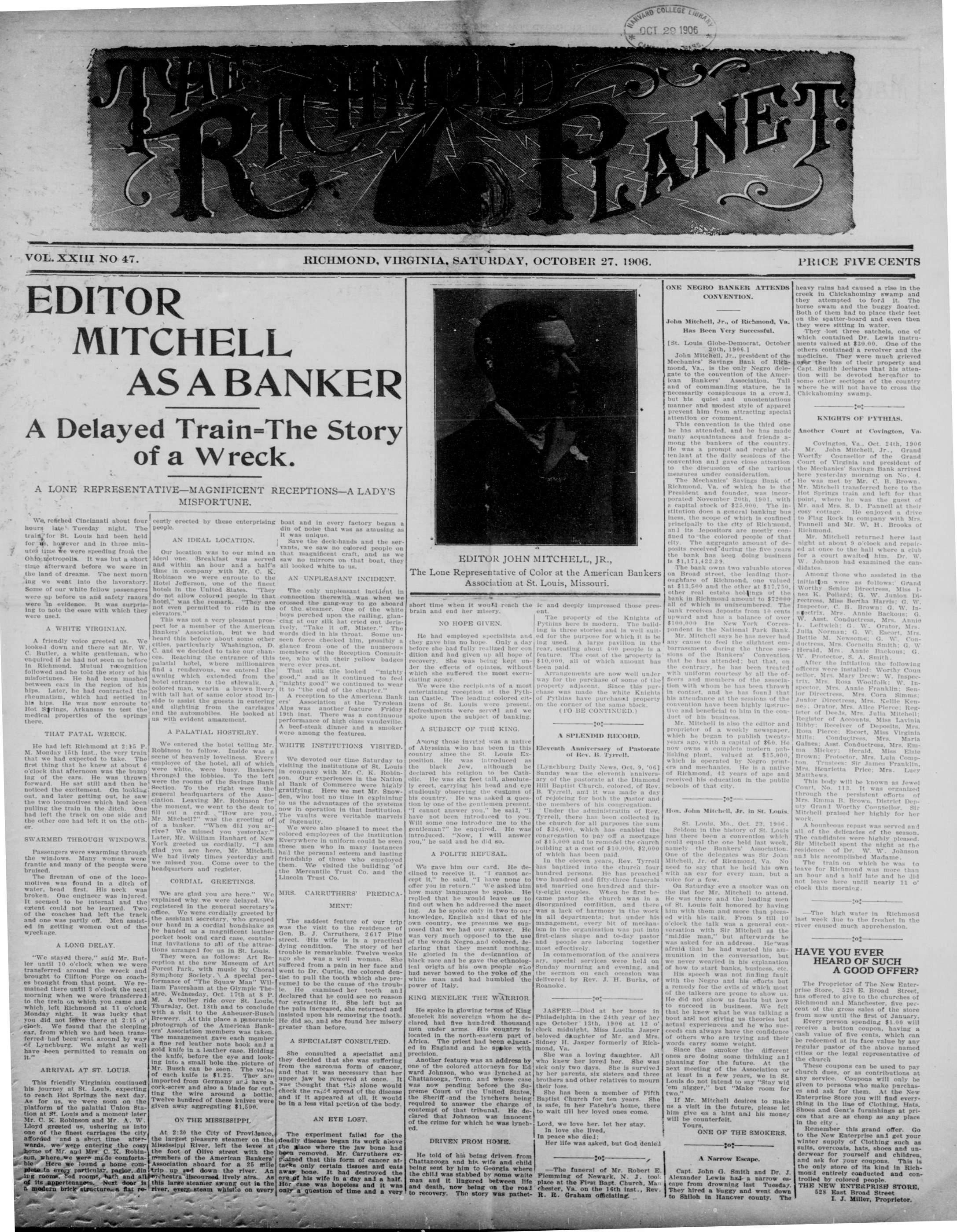
EDITOR MITCHELL AS A BANKER A Delayed Train=The Story of a Wreck.
A LONE REPRESENTATIVE—MAGNIFICENT RECEPTIONS—A LADY'S MISFORTUNE.
VOL. XXIII NO 47.
EDITOR
MITT
A
A Delaye
0
A LONE REPRESENT
We reached Cincinnati about four hours late Tuesday night. The train for St. Louis had been held for us, however and in three minutes time we were speeding from the Ohio metropolis. It was but a short time afterward before we were in the land of dreams. The next morn ing we went into the lavatory. Some of our white fellow passengers were up before us and safety razors were in evidence. It was surprising to note the case with which they were used.
A WHITE VIRGINIAN
A friendly voice greeted us. We looked down and there sat Mr. W. C. Butler, a white gentleman, who enquired if he had not seen us before in Richmond. Mutual recognition followed and he told the story of his misfortunes. He had been mashed between cars in the region of his hips. Later, he had contracted the rheumatism, which had settled in his hips. He was now enroute to Hot Springs, Arkansas to test the medical properties of the springs there.
THAT FATAL WRECK
He had left Richmond at 2:15 P.M. Monday 15th inst., the very train that we had expected to take. The first thing that he knew at about 6 o'clock that afternoon was the bumping of the cars. He was thrown forward. He sat still and then he noticed the excitement. On looking out, and later getting out, he saw the two locomotives which had been pulling the train in the ditch. One had left the track on one side and the other one had left it on the other.
SWARMED THROUGH WINDOWS
Passengers were swarming through the windows. Many women were frantic and many of the people were bruised.
The fireman of one of the locomotives was found in a ditch of water, head first. His neck was broken. One engineer was injured. It seemed to be internal and the extent could not be learned. Two of the coaches had left the track and one was partly off. Men assisted in getting women out of the wreckage.
A LONG DELAY
"We stayed there," said Mr. Butler until 10 o'clock when we were transferred around the wreck and brought to Clifton Forge on coaches brought from that point. We remained there until 3 o'clock the next morning when we were transferred to the train on which you came and which left Richmond at 11 o'clock Monday night. It was lucky that you did not leave there at 2:15 o'clock. We found that the sleeping car, from which we had been transferred had been around by way of Lynchburg. We might as well have been permitted to remain on it."
ARRIVAL AT ST. LOUIS
This friendly Virginian continued his journey at St. Louis, expecting to reach Hot Springs the next day. As for us, we were soon on the platform of the palatial Union Station at St. Louis and a moment later Mr. C. K. Robinson and Mr. A. W. Lloyd greeted us, ushering us into one of the finest carriages the city afforded and a short time afterwards, we were entering the cosy home of Mr. and Mrs. C. K. Robinson, where we were made comfortable. Here we found a home complete in every particular, parlor, dining rooms, bed rooms, bath and all of its appertenances. Next door is a modern brick structure, a flat re-
cently erected by these enterprising people.
AN IDEAL LOCATION
Our location was to our mind an ideal one. Breakfast was served and within an hour and a half's time in company with Mr. C. K. Robinson we were enroute to the Hotel Jefferson, one of the finest hotels in the United States. "They do not allow colored people in that hotel," was the remark. "They are not even permitted to ride in the elevators."
This was not a very pleasant prospect for a member of the American Bankers' Association, but we had heard this before about some other cities, particularly Washington, D.C. and we decided to take our chances. Reaching the entrance of this palatial hotel, where millionaires find a rendezvous, we entered the awning which extended from the hotel entrance to the sidewalk. A colored man, wearin a brown livery with tall hat of same color stood inside to assist the guests in entering and alighting from the carriages and the automobiles. He looked at us with evident amazement.
A PALATIAL HOSTELRY
We entered the hotel telling Mr. Robinson to follow. Inside was a scene of heavenly loveliness. Every employee of the hotel, all of which were white, were busy. Bankers thronged the lobbies. To the left were the rooms of the Savings Bank Section. To the right were the general headquarters of the Association. Leaving Mr. Robinson for the moment, we went to the desk to fill out a card. "How are you, Mr. Mitchell?" was the greeting of of a banker. "When did you arrive? We missed you yesterday." Later, Mr. William Hanhart of New York greeted us cordially. "I am glad you are here, Mr. Mitchell. We had lively times yesterday and we missed you. Come over to the headquarters and register.
CORDIAL GREETINGS
We are glad you are here." We explained why we were delayed. We registered in the general secretary's office. We were cordially greeted by the assistant secretary, who grasped our hand in a cordial houndshake as he handed us a magnificent leather pocket book and card case, containing invitations to all of the attractions arranged for us in St. Louis. They were as follows: Art Reception at the new Museum of Art Forest Park, with music by Choral Symphony Society. A special performance of "The Squaw Man" William Faversham at the Olympie Theatre, Wednesday, Oct. 17th at 8 P.M. A trolley ride over St. Louis, Thursday, Oct. 18th and to conclude with a visit to the Anheuser-Busch Brewery. At this place a panoramic photograph of the American Bankers' Association members was taken. The management gave each member a fine red leather note book and a gold knife in a leather case. Holding the knife, before the eye and looking into a small hole the picture of Mr. Busch can be seen. The value of each knife is $1.25. They are imported from Germany and have a cork-screw and also a blade for cutting the wire around a bottle. Twelve hundred of these knives were given away aggregating $1,500.
ON THE MISSISSIPPL
At 2:30 the City of Providence, the largest pleasure steamer on the Mississippi River, left the levee at the foot of Olive street with the members of the American Bankers' Association aboard for a 25 mile trip up and down the river. An orchestra discoursed lively air. As this large steamer swung out in the river, every steam whistle on every
RICHMOND, VIRGINIA, SATURDAY, OCTOBER 27, 1906.
boat and in every factory began a
din of noise that was as amusing as
it was unique.
Save the deck-hands and the serv-
vants, we saw no colored people on
that magnificent craft, and as we
saw no mirrors on that boat, they
all looked white to us.
AN UNPLEASANT INCIDENT
The only unpleasant incident in connection therewith was when we crossed the gang-way to go aboard of the steamer. One of the white boys perched upon the railing, glancing at our silk hat cried out Jersively, "Take it off, Mister." The words died in his throat. Some unseen force checked him, possibly a glance from one of the numerous members of the Reception Committee, who with their yellow badges were ever present.
That silk tile looked "mighty good," and as it continued to feel "mighty good" we continued to wear it to "the end of the chapter."
A reception to the American Bankers' Association at the Tyrolean Alps was another feature Friday 19th inst. There was a continuous performance of high class vaudeville. A beef-steak dinner and a smoker were among the features.
WHITE INSTITUTIONS VISITED
We devoted our time Saturday to visiting the institutions of St. Louis in company with Mr. C. K. Robinson. Our experiences in the Nation al Bank of Commerce were highly gratifying. Here we met Mr. Snowden, who lost no time in explaining to us the advantages of the systems now in operation in that institution. The vaults were veritable marvels of ingenuity.
We were also pleased to meet the colored employees of the institution Everywhere in uniform could be seen these men who in many instances had the personal esteem and lasting friendship of those who employed them. We visited the building of the Mercantile Trust Co. and the Lincoln Trust Co.
MRS. CARRUTHERS' PREDICA
The saddest feature of our trip was the visit to the residence of Gen. B. J. Carruthers, 2617 Pine street. His wife is in a practical dying condition. The story of her trouble is remarkable. Twelve weeks ago she was a well woman. She suffered from a pain in her face and went to Dr. Curtis, the colored dentist to pull the tooth which she presumed to be the cause of the trouble. He examined her teeth and declared that he could see no reason for extracting it. She left but as the pain increased, she returned and insisted upon his removing the tooth. He did so, and she found her misery greater than before.
A SPECIALIST CONSULTED
She consulted a specialist and they decided that she was suffering from the sarcoma form of cancer, and that it was necessary that her upper jaw be removed at once. It was thought that this alone would check the rapid spread of the disease and if it appeared at all, it would be in a less vital portion of the body.
AN EYE LOST
The experiment failed for the deadly disease began its work above the place where the jaw bone had been removed. Mr. Carruthers explained that this form of cancer attacks only certain tissues and eats away bone. It had destroyed the eye of his wife in a day and a half. Her case was hopeless and it was only a question of time and a very
M. H.
short time when it would reach the ic and deeply impressed those presbrain and end her misery. ent
NO HOPE GIVEN
He had employed specialists and they gave him no hope. Only a day before she had fully realized her condition and had given up all hope of recovery. She was being kept under the effects of opiates, without which she suffered the most excruciating agony. We were the recipients of a most entertaining reception at the Pythian Castle. The leading colored citizens of St. Louis were present. Refreshments were served and we spoke upon the subject of banking.
A SUBJECT OF THE KING.
Among those invited was a native of Abyssinia who has been in this country since the St. Louis Exposition. He was introduced as the black Jew, although he declared his religion to be Catholic. He was six feet tall, absolutely erect, carrying his head and eye studiously observing the customs of his country. He was asked a question by one of the gentlemen present, "I cannot answer you," he said, "I have not been introduced to you. Will some one introduce me to the gentleman?" he enquired. He was introduced. "Now, I will answer you," he said and he did so.
A POLITE REFUSAL.
We gave him our card. He declined to receive it. "I cannot accept it," he said. "I have none to offer you in return." We asked him how many languages he spoke. He replied that he would leave us to find out when he addressed the meeting. As he spoke only in two to our knowledge, English and that of his own country, we presume we supposed that we had our answer. He was very much opposed to the use of the words Negro_and colored, declaring that they meant nothing. He gloried in the designation of black race and he gave the ethnological origin of his own people who had never bowed to the yoke of the white man and had humbled the power of Italy.
KING MENELEK THE WARRIOR
He spoke in glowing terms of King Menolek his sovereign whom he declared had five hundred thousand men under arms. His country is located in the north-eastern part of Africa. The priest had been educated in England and he spoke with precision.
Another feature was an address by one of the colored attorneys for Edward Johnson, who was lynched at Chattanooga, Tenn, and whose case was now pending before the Supreme Court of the United States, the Sheriff and the lynchers being required to answer the charge of contempt of that tribunal. He declared that Johnson was innocent of the crime for which he was lynched.
DRIVEN FROM HOME
He told of his being driven from Chattanooga and his wife and child being sent by him to Georgia where the child was stabbed by some white man and it lingered between life and death, now being on the road to recovery. The story was pathet-
The property of the Knights of Pythias here is modern. The building is three stories and is well suited for the purpose for which it is being used. A large pavilion in the rear, seating about 400 people is a feature. The cost of the property is $10,000, all of which amount has been paid. Arrangements are now well under way for the purchase of some of the property adjacent. Since this purchase was made the white Knights of Pythias have purchased property on the corner of the same block.
(TO BE CONTINUED.)
A SPLENDID RECORD
Eleventh Anniversary of Pastorate of Rev. B. Tyrrell.
[Lynchburg Daily News, Oct. 9, '06] Sunday was the eleventh anniversary of the pastorate at the Diamond Hill Baptist Church, colored, of Rev. B. Tyrrell, and it was made a day of rejoicing for both the pastor and the members of his congregation.
Under the administration of Rev. Tyrrell, there has been collected in the church for all purposes the sum of $38,000, which has enabled the congregation to pay off a mortgage of $15,000 and to remodel the church building at a cost of $10,000, $2,000 of which has been paid.
In the eleven years, Rev. Tyrrell has baptized into the church four hundred persons. He has preached two hundred and fifty-three funerals and married one hundred and thirty-eight couples. When he first became pastor the church was in a disorganized condition, and there was a lack of harmony in the work in all departments; but under his management, every bit of mechanism in the organization was put into first-class shape and to-day pastor and people are laboring together most effectively.
In commemoration of the anniversary, special services were held on Sunday morning and evening, and the sermon on each occasion was delivered by Rev. J. H. Burks, of Roanoke.
JASPER—Died at her home in Philadelphia in the 24th year of her age October 13th, 1906 at 12 o'clock midnight, Miss Luella Jasper beloved daughter of Mr. and Mrs. Sidney H. Jasper formerly of Richmond, Va.
She was a loving daughter. All who knew her loved her. She was sick only two days. She is survive by her parents, six sisters and three brothers and other relatives to mourn their loss.
She has been a member of Fifth Baptist Church for ten years. She is safe, in her Fatehr's home, there to wait till her loved ones come.
Lord, we love her. let her stay.
In love she lived,
In peace she died:
Her life was asked, but God denied.
—The funeral of Mr. Robert E. Flemming of Newark, N. J. took place at the First Bapt. Church, Manchester, Va. on the 16th inst., Rev. R. R. Graham officiating.
ONE NEGRO BANKER ATTENDS
CONVENTION.
John Mitchell, Jr., of Richmond, Va Has Been Very Successful.
[St. Louis Globe-Democrat, October 20th, 1906.]
John Mitchell, Jr., president of the Mechanics' Savings Bank of Richmond, Va., is the only Negro delegate to the convention of the American Bankers' Association. Tall and of commanding stature, he is necessarily conspicuous in a crowd, but his quiet and unostentious manner and modest style of apparel prevent him from attracting special attention or comment.
This convention is the third one he has attended, and he has made many acquaintances and friends among the bankers of the country. He was a prompt and regular attendant at the daily sessions of the convention and gave close attention to the discussion of the various measures under consideration.
The Mechanics' Savings Bank of Richmond, Va., of which he is the President and founder, was incorporated November 20th, 1901, with a capital stock of $25,000. The institution does a general banking business, the scope of which is confined principally to the city of Richmond, and its depositors are mostly confined to the colored people of that city. The aggregate amount of deposits received during the five years the bank has been doing business is $1,171,422.29.
The bank owns two valuable stores on Broad street, the leading thoroughfare of Richmond, one valued at $13,500 and the other at $17,750, other real estate holdings of the bank in Richmond amount to $72000 all of which is uninumbered. The bank receives deposits from 10 cents upward and has a balance of over $100,000. Its New York Correspondent is the National Park Bank
Mr. Mitchell says he has never had any cause to feel the slightest embarrassment during the three sessions of the Bankers' Convention that he has attended; but that, on the contrary, he has been treated with uniform courtesy by all the officers and members of the association with whom he has been thrown in contact, and he has found that his attendance at the sessions of the convention have been highly instructive and beneficial to him in the conduct of his business.
Mr. Mitchell is also the editor and proprietor of a weekly newspaper, which he began to publish twenty-years ago, with a capital of $60. He now owns a complete modern publishing plant, valued at $15,000, which is operated by Negro printers and mechanics. He is a native of Richmond, 43 years of age and received his education in the public schools of that city.
Hon. John Mitchell, Jr. in St. Louis
St. Louis, Mo., Oct. 23, 1906. Seldom in the history of St. Louis has there been a convention which could equal the one held last week, namely the Bankers' Association. One of the delegates was Sir John Mitchell, Jr. of Rienmond, Va. No need to say that he held his own with an ear for every man, but a voice for a few.
On Saturday eve a smoker was on the list for Mr. Mitchell to attend. He was there and the leading men of St. Louis felt honored by having him with them and more than pleased with his talk. From 9 till 10 o'clock the talk was a general conversation with Sir Mitchell as the "middle man," but afterwards he was asked for an address. He was afraid that he had wasted his ammunition in the conversation, but we never weared in his explanation of how to start banks, business, etc. His speech was not finding fault with the Negro and his efforts but a remedy for the evils of which most of the talkers are prone to show us. He did not show us faults but how to succeed in business. We felt that he knew what he was talking a bout and not giving us theories but actual experiences and he who succeeds can always have the confidence of others who are trying and their words carry some weight.
Since the smoker the different ones are doing some thinking and planning for the future. At the next meeting of the Association or at least in a few years, we in St. Louis do, not intend to say "Stay wid 'em nigger," but "Make room for two."
If Mr. Mitchell desires to make us a visit in the future, please let him give us a hint and his money will be counterfeit.
Yours,
ONE OF THE SMOKERS
A Narrow Escape.
Capt. John G. Smith and Dr. J. Alexander Lewis had a narrow escape from drowning last Tuesday. They hired a buggy and went down to Shiloh in Hanover county. The
heavy rains had caused a rise in the creek in Chickahominy swamp and they attempted to ford it. The horse swam and the buggy floated. Both of them had to place their feet on the spatter-board and even then they were sitting in water. They lost three satchels, one of which contained Dr. Lewis instruments valued at $30.00. One of the others contained a revolver and the medicine. They were much grieved over the loss of their property and Capt. Smith declares that his attention will be devoted hereafter to some sections of the country where he will not have to cross the Chickahominy swamp.
Another Court at Covington, Va.
Covington, Va., Oct. 24th, 1906
Mr. John Mitchell, Jr., Grand Wortfly Counselor of the Grand Court of Virginia and president of the Mechanies' Savings Bank arrived here yesterday morning on No. 4. He was met by Mr. C. B. Brown. Mr. Mitchell transferred here to the Hot Springs train and left for that point, where he was the guest of Mr. and Mrs. S. D. Pannell at their cosy cottage. He enjoyed a drive to Flag Rock in company with Mrs. Pannell and Mr. W. H. Brooks of Richmond.
Mr. Mitchell returned here last night at about 9 o'clock and repaired at once to the hall where a club for a court awaited him. Dr. W. W. Johnson had examined the candidates.
Among those who assisted in the initiation were as follows: Grand Worthy Senior Directress, Miss Inez K. Pollard; W. W. Junion Directress, Miss Bertha Harris; G. W. Inspector, C. B. Brown; G. W. Inspectrix, Mrs. Annie Backous; G. W. Asst. Conductress, Mrs. Annie L. Leftwich; G. W. Orator, Mrs. Julia Norman; G. W. Escort, Mrs. Bettle M. Newsome; G. W. Conductress, Mrs. Cornellia Smith; G. W. Herald, Mrs. Annie Backous; G. W. Protector, S. A. Smith
After the initiation the following officers were installed: Worthy Counsellor, Mrs. Mary Drew; W. Inspectrix, Mrs. Rosa Woolfolk; W. Inspector, Mrs. Annie Franklin; Senior Directress, Mrs. Cora Simms; Junior Directress, Mrs. Kellie Kenes; Orator, Mrs. Alice Pierce; Register of Deeds, Mrs. Julia Mitchell; Register of Accounts, Miss Lavinia Bibby; Receiver of Deposits, Mrs. Rosa Pierce; Escort, Miss Virginia Mills; Conductress, Mrs. Maria Gaines; Asst. Conductress, Mrs. Emma Mickey; Herald, Miss Elsie Brown; Protector, Mrs. Lula Compton. Trustees: Sir James Franklin, Mrs. Henrietta Price; Mrs. Lucy Matthews.
This body will be known as Jewel Court, No. 113. It was organized through the persistent efforts of Mrs. Emma B. Brown, District Deputy Grand Worthy Counsellor. Sir Mitchell praised her highly for her work.
A bounteous repast was served and all of the delicacies of the season. The candidates were highly pleased. Sir Mitchell spent the night at the residence of Dr. W. W. Johnson and his accomplished Madame.
The train on which he was to leave for Richmond was more than an hour and a half late and he did not leave here until nearly 11 o'clock this morning.
The high water in Richmond last week fue to the freshet in the river caused much apprehension.
HAVE YOU EVER
HEARD OF SUCH
A GOOD OFFER?
The Proprietor of The New Enterprise Store, 528 E. Broad Street, has offered to give to the churches of Richmond and Manchester, five percent of the gross sales of the store from now until the first of January. Every person spending $1.00 will receive a button coupon, having a cash value of five cents, which can be redeemed at its face value by any regular pastor of the above named cities or the legal representative of the church.
These coupons can be used to pay church dues, or as contributions at any service. Coupons will only be given to persons who make purchases and ask for them. At the New Enterprise Store you will find everything in the line of Clothing, Hats, Shoes and Gent's furnishings at prices that are as cheap as any place in the city.
Remember this grand offer. Go to the New Enterprise and get your winter supply of Clothing such as suits, overcoats, hats, shoes and underwear for yourself and children, and ask for your coupons. This is the only store of its kind in Richmond entirely conducted and controlled by colored people.
THE NEW ENTERPRISE STORE,
528 East Broad Street
I. J. Miller, Proprietor
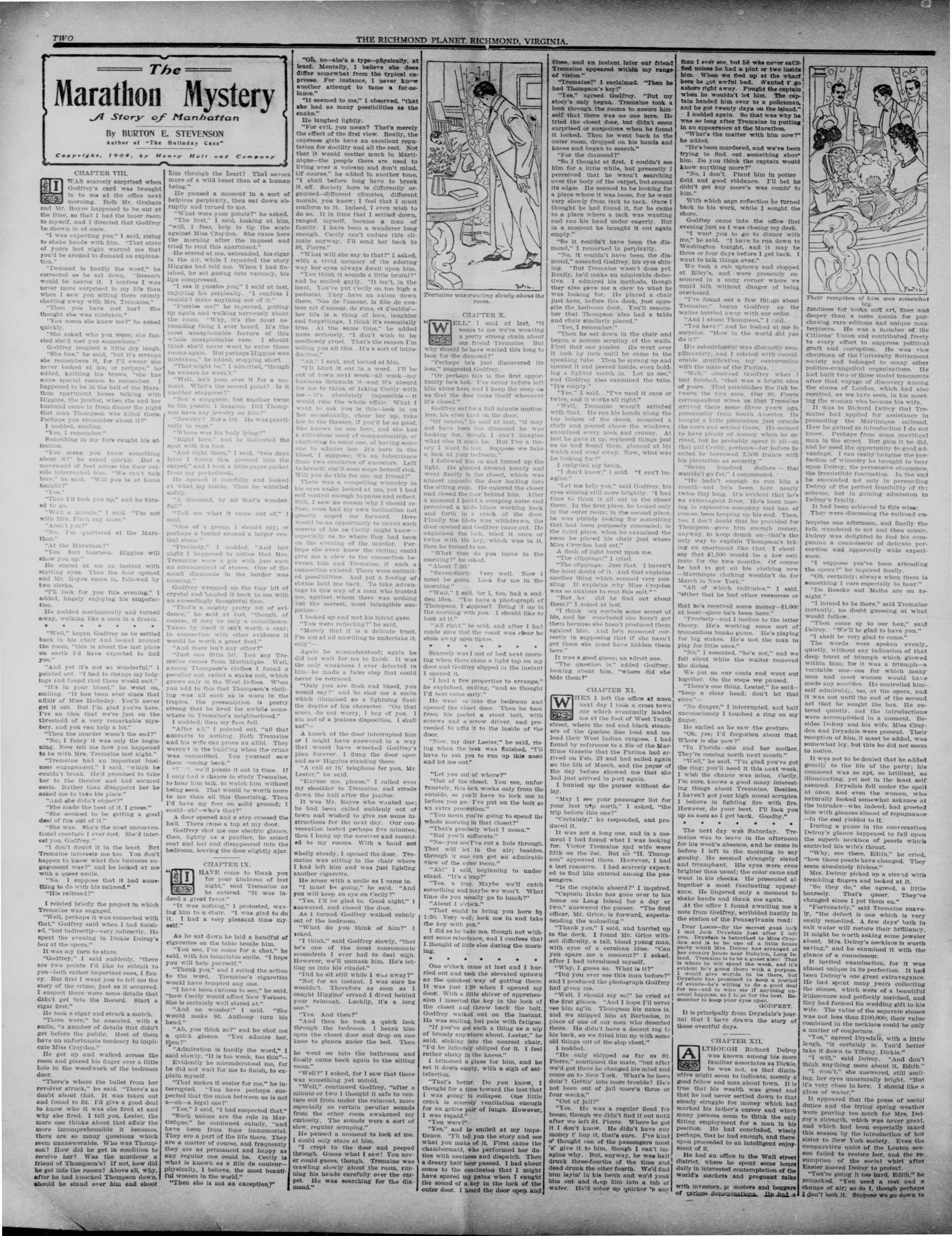
Marathon Mystery
By BURTON E. STEVENSON Author of "The Holladay Case" Copyright, 1904, by Henry Holt and Company
WAS scarcely surprised when Godfrey's card was brought in to me at the office next morning. Both Mr. Graham and Mr. Royce happened to be out at the time, so that I had the inner room to myself, and I directed that Godfrey be shown in at once.
"I was expecting you." I said, rising to shake hands with him. "That stare of yours last night warned me that you'd be around to demand an explanation."
"Demand is hardly the word," he corrected as he sat down. "Besech would be nearer it. I confess I was never more surprised in my life than when I saw you sitting there calmly chatting away with Mrs. Tremaine."
"Then you have met her? She thought she was mistaken."
"You mean she knew me?" he asked quickly.
"She asked who you were; she fancied she'd met you somewhere."
Godrey laughed a little dry laugh. "She has," he said, "but it's strange she remembers it, for I'll swear she never looked at me, or perhaps," he added, knitting his brows, "she has some special reason to remember. I happened to be in the hall of the Marathon apartment house talking with Higgins, the janitor, she and her husband came in from dinner the night that man Thompson was killed there. Perhaps you remember about it?" I nodded, smiling. "Yes, I remember." Something in my face caught his attention. "You mean you know something about it?" he asked quickly. But a movement of feet across the floor outside interrupted him. "We can't talk here," he said. "Will you be at home tonight?" "Yes." "Then I'll look you up," and he turned to go.
"Wait a minute," I said. "I'm not with Mrs. Fitch any more."
"Aren't you?"
"No. I am quartered at the Marathon."
"At the Marathon?"
"Yes. Suit fourteen. Higgins will show you up."
He stared at me an instant with starting eyes. Then the door opened and Mr. Royce came in, followed by two clerks.
"I'll look for you this evening." I added, hugely enjoying his stupefaction.
He nodded mechanically and turned away, walking like a man in a dream.
"Well," began Godfrey as he settled back in his chair and looked around the room. "this is about the last place on earth I'd have expected to find you."
"And yet it's not so wonderful." I pointed out. "I had to change my lodgings and found that these would suit."
"It's in your blood," he went on, smiling. "It has been ever since that affair of Miss Holladay. You'll never get it out. But I'm glad you're here. I've an idea that we're just on the threshold of a very remarkable mystery, and you can help a lot."
"Then the murder wasn't the end?" "No; I fancy it was only the beginning. Now tell me how you happened to be with Mrs. Tremaine last night."
"Tremaine had an important business engagement," I said, "which he couldn't break. He'd promised to take her to the theater and had secured seats. Rather than disappoint her he asked me to take his place."
"And she didn't object?" "She made the best of it, I guess." "She seemed to be getting a good deal of fun out of it."
"She was. She's the most unconventional creature I ever met. She'd interest you. Godfrey."
"I don't doubt it in the least. But Tremaine interests me too. You don't happen to know what this business engagement was?" and he looked at me with a queer smile.
"No. I suppose that it had something to do with his railroad."
"His railroad?"
I related briefly the project in which Tremaine was engaged.
"Well, perhaps it was connected with that," Godfrey said when I had finished, "but indirectly—very indirectly. He spent the evening in Dickie Delroy's box at the opera."
It was my turn to stare.
"Godfrey," I said suddenly, "there are two points I'd like to submit to you—both rather important ones, I fancy. But first I want you to tell me the story of the crime, just as it occurred. I suspect there were some details that didn't get into the Record. Start a cigar first."
He took a clear and struck a match. "There were," he assented, with a smile, "a number of details that didn't get before the public. Most of them have an unfortunate tendency to implicate Miss Croydon."
He got up and walked across the room and placed his finger over a little hole in the woodwork of the bedroom door.
"There's where the bullet from her revolver struck," he said. "There's no doubt about that. It was taken out and found to fit. I'd give a good deal to know who it was she fired at and why she fired. I tell you, Lester, the more one thinks about that affair the more incomprehensible it becomes, there are so many questions which seem unanswerable. Who was Thompson? How did he get in condition to receive her? Was the murderer a friend of Thompson's? If not, how did he get into the rooms? Above all, why, after he had knocked Thompson down, should he stand over him and shoot
CHAPTER VIII.
"Yes, I remember."
"At the Marathon?"
"And she didn't object?"
It was my turn to stare
Him through the heart? That savors more of a wild beast than of a human being."
He paused a moment in a sort of helpless perplexity, then sat down abruptly and turned to me.
"What were your points?" he asked.
"The first," I said, looking at him, "will, I fear, help to tip the scale against Miss Croydon. She came here the morning after the inquest and tried to rent this apartment."
He stared at me, astounded, his cigar in the air, while I repeated the story Higgins had told me. When I had finished, he sat gazing into vacancy, his lips compressed.
"I see it puzzles you," I said at last, enjoying his perplexity. "I confess I couldn't make anything out of it."
"Puzzles me!" he repeated, getting up again and walking nervously about the room. "Why, it's the most astounding thing I ever heard. It's the most unexplainable feature of this whole unexplainable case. I should think she'd never want to enter these rooms again. But perhaps Higgins was mistaken," he added, stopping short. "That might be." I admitted, "though he swears he wasn't." "Well, let's pass over it for a moment. What's the second point? Is it another staggerer?" "Not a staggerer, but another twist to the puzzle, I imagine. Did Thompson have any jewelry on him?" "Jewelry? Not a bit. He was practically in rags."
"Where was his body lying?"
"Right here," and he indicated the spot with his foot.
"And right there," I said, "two days later I found this, pressed into the carpet," and I took a little paper packet from my pocketbook.
He opened it carefully and looked at what lay inside. Then he whistled softly.
"A diamond, by all that's wonderful."
"Tell me what it came out of," I said.
"One of a group, I should say; or perhaps a border around a larger central stone."
"Precisely," I nodded. "And last night I happened to notice that Mrs. Tremaine wore a pin with just such an arrangement of stones. One of the small diamonds in the border was missing."
Godfrey wrapped up the tiny bit of crystal and handed it back to me with an exceedingly thoughtful face.
"That's a mighty pretty bit of evidence," he said at last, "though, of course, it may be only a coincidence. Taken by itself it isn't worth a cent; in connection with other evidence it would be worth a great deal."
"And there isn't any other?"
"Just one little bit. You say Tremaine comes from Martinique. Well, among Thompson's clothes I found a peculiar nut, called a snake nut, which grows only in the West Indies. When you add to this that Thompson's clothing was all such as is worn in the tropics, the presumption is pretty strong that he lived for awhile somewhere in Tremaine's neighborhood."
"I nodded; then my face fell."
"After all." I pointed out, "all that amounts to nothing. Both Tremaine and his wife can prove an alibl. They weren't in the building when the crime was committed. You yourself saw them coming back."
"Will we puzzle it out in time. If I only had a chance to study Tremaine, to hear him talk, to watch him without being seen. That would be worth more to me than all this theorizing. Then I'd have my feet on solid ground; I could—sh!—who's that?" A door opened and a step crossed the hall. There came a tap at my door. Godfrey shot me one electric glance, then, lightly as a panther, he seized coat and hat and disappeared into the bedroom, leaving the door slightly atar.
CHAPTER IN
"I
I HAVE come to thank you for your kindness of last night," said Tremaine as he entered. "It was indeed a great favor."
"It was nothing," I protested, waving him to a chair. "I was glad to do it. I had a very pleasant time myself."
As he sat down he laid a handful of cigarettes on the table beside him.
"You see, I've come for a chat," he said, with his inimitable smile. "I hope you will help yourself."
"Thank you," and I suited the action to the word. Tremaine's cigarettes would have tempted any one.
"I have been curious to see," he said, "how Cecily would affect New Yorkers. She is certainly well stared at."
"And no wonder." I said. "She would make St. Anthony turn his head."
"Ah, you think so?" and he shot me a quick glance. "You admire her, then?"
"Admiration is hardly the word," I said slowly. "It is too weak, too thin"—Evidently he misunderstood me, for he did not wait for me to finish, to explain myself.
"That makes it easier for me," he interrupted. "You have perhaps suspected that the union between us is not a—ah—a legal one?"
"Yes," I said, "I had suspected that."
"Such unions are the rule in Martinique," he continued calmly, "and have been from time immemorial. They are a part of the life there. They are a matter of course, and frequently they are as permanent and happy as any regular one could be. Cecily is what is known as a file de couleur—physically, I believe, the most beautiful women in the world."
"Then she is not an exception?"
"Oh, no—she's a type—physically, at least. Mentally, I believe she does differ somewhat from the typical capresse. For instance, I never knew another attempt to tame a for-eance."
"It seemed to me," I observed, "that she had as many possibilities as the snake."
He laughed lightly.
"For evil, you mean? That's merely the effect of the first view. Really, the capresse girls have an excellent reputation for docility and all the rest. Not that it would matter much in Martinique—the people there are used to living over a volcano and don't mind. Of course," he added in another tone, "I shall before long have to break it off. Society here is differently organized—different climates, different morals, you know; I feel that I must conform to it. Indeed, I even wish to do so. It is time that I settled down, ranged myself, became a man of family. I have been a wanderer long enough. Cecily can't endure this climate anyway. I'll send her back to St. Pierre."
"What will she say to that?" I asked, with a vivid memory of the adoring way her eyes always dwelt upon him. "You think it sounds a little brutal?" and he smiled gaily. "It isn't, in the least. You've put Cecily on too high a pedestal. They have an axiom down there. 'Nee de l'amour, la fille de couleur nit d'amour, de rires, et d'oubli'—her life is a thing of love, laughter and forgettings. I think it's essentially true. At the same time," he added more seriously. "I don't wish to be needlessly cruel. That's the reason I'm telling you all this. It's a sort of introduction."
All, I said, and looked at him.
"I'll blurt it out in a word. I'll be out of town next week—all week—my business demands it—and it's absurd for me to think of taking Cecely with me—it's absolutely impossible—it would ruin the whole affair. What I want to ask you is this—look in on her occasionally, cheer her up, take her to the theater, if you'll be so good. She knows no one here, and she has a ridiculous need of companionship, of chattering to some one, of having some one to admire her. It's born in the blood, I suppose; it's an inheritance from two centuries of ancestors. Left to herself, she'll soon mope herself sick. Will you do this for me, my friend?"
There was a compelling wizardry in his eyes as he looked at me, yet I had self control enough to pause and reflect. Still, I saw no reason why I should refuse, even had my own incinulation not greatly urged me forward. Here would be an opportunity to unveil such secrets of his as Cecily might know—especially as to where they had been on the evening of the murder. Perhaps she even knew the victim; could give me a clew to the connection between him and Tremaine, if such a connection existed. There were unlimited possibilities. And yet a feeling of shame held me back. To take advantage in this way of a man who trusted me, against whom there was nothing but the merest, most intangible suspicion.
I looked up and met his intent gaze. "You were reflecting?" he said. "Merely that it is a delicate trust. I'm not at all unwilling to undertake it, only."
Again he misunderstood; again he did not wait for me to finish. It was the only weakness I ever detected in him—he made a false step that could never be retraced.
"Only you are flesh and blood, you would say?" and he shot me a smile which illuminated as a lightning flash the depths of his character. "On that score, do not worry, I beg of you. I am not of a jealous disposition. I shall not"—
A knock at the door interrupted him or I might have answered in a way that would have wrecked Godfrey's plan forever. I flung the door open and saw Higgins standing there.
"A call at th' telephone fer you, Mr Lester," he said.
"Excuse me, please." I called over my shoulder to Tremaine, and strode down the hall after the janitor.
It was Mr. Royce who wanted me, he had been called suddenly out of town and wished to give me some instructions for the next day. Our conversation lasted perhaps five minutes; then I hung up the receiver and mounted to my rooms. With a hand not wholly steady, I opened the door. Tremaine was sitting in the chair where I had left him and was just lighting another cigarette.
He arose with a smile as I came in. "I must be going," he said. "And you will keep an eye on Cecily." "Yes, I'll be glad to. Good night," I answered, and closed the door.
As I turned Godfrey walked calmly out of the bedroom.
"What do you think of him?" I asked.
"I think," said Godfrey slowly, "that he's one of the most consummate scoundrels I ever had to deal with. However, we'll unmask him. He's letting us into his citadel."
"Did he sit still while I was away?"
"Not for an instrument. I was sure he wouldn't. Therefore as soon as I caught Higgins' errand I dived behind your raincoat. Luckily, it's a long one."
"Yes. And then?"
"And then he took a quick look through the bedroom. I heard him open the closet door and drop on one knee to glance under the bed. Then he went on into the bathroom and finally came back again to the sitting room."
"Well?" I asked, for I saw that there was something yet untold.
"Well," continued Godfrey, "after a minute or two I thought it safe to venture out from under the raincoat, more especially as certain peculiar sounds from the other room awakened my curiosity. The sounds were a sort of slow, regular scraping." He paused a moment to look at me. I could only stare at him. "I crept to the door and peeped through. Guess what I saw! You never could guess, though. Tremaine was crawling slowly about the room, running his hands carefully over the carpet. He was searching for the diamond."
2011.
Tremaine was crawling slowly about the room
CHAPTER X
"WELL," I said at last, "it seems to me we're weaving a pretty strong chain about our friend Tremaine. But why should he have waited this long to look for the diamond?" "Perhaps he's just discovered its loss," suggested Godfrey. "Or perhaps this is the first opportunity he's had. I've never before left him alone here, and I keep the snap on so that the door locks itself whenever it's closed." Godfrey sat for a full minute motionless, his eyes fixed on the door. "Of course," he said at last, "it may not have been the diamond he was looking for, though I can't imagine what else it could be. But I've a theory I want to best. Suppose we take a look at your bedroom."
I followed him in and turned up the light. He glanced around keenly and went finally to the closet, which was almost opposite the door leading into the sitting room. He entered the closet and closed the door behind him. After a moment I heard a scraping noise and perceived a knife blade working back and forth in a crack of the door. Finally the blade was withdrawn, the door opened and Godfrey came out. He examined the lock, tried it once or twice with the key, which was in it, then he turned to me.
"What time do you leave in the morning?" he asked.
"About 7:30."
"Seven-thirty. Very well. Now I must be going. Look for me in the morning."
"Wait," I said, for I, too, had a sudden idea. "You have a photograph of Thompson. I suppose? Bring it up in the morning with you. I should like to look at it."
"All right," he said, and after I had made sure that the coast was clear he stole away upon tiptoe.
Scarcely was I out of bed next morning when there came a light tap on my door and Godfrey slipped in the instant I opened it.
"I had a few properties to arrange," he explained, smiling, "and so thought I'd best come early."
He went on into the bedroom and opened the closet door. Then he took from his pocket a stout bolt, with screws and a screw driver, and proceeded to affix it to the inside of the door.
"Now, my dear Lester," he said, rising when the task was finished. "I'll have to ask you to run up this noon and let me out."
"Let you out of where?"
"Out of the closet. You see, unfortunately, this lock works only from the outside, so you'll have to lock me in before you go. I've put on the bolt as an extra precaution."
"You mean you're going to spend the whole moraling in that closet?"
"That's precisely what I mean."
"But you'll suffocate."
"No--you see I've cut a hole through. That will let in the air; besides, through it one can get an admirable view of the outer room."
"Ah!' I said, beginning to understand. 'It's a trap.'"
"Yes, a trap. Maybe we'll catch something and maybe we won't. What time do you usually go to lunch?"
"About I o'clock."
"That ought to bring you here by 1:30. Very well; lock me in and take the key with you."
I did as he bade me, though not without some reluctance, and I confess that I thought of little else during the morning.
One o'clock came at last and I hurried out and took the elevated uptown as the quickest way of getting there. It was just 1:20 when I opened my door. With a little shiver of apprehension I inserted the key in the lock of the closet and threw back the bolt. Godfrey walked out on the instant. He was smiling, but pale with fatigue.
"If you've got such a thing as a nip of brandy anywhere about, Lester," he said, sinking into the nearest chair,
"I'd be infinitely obliged for it. I feel rather shaky in the knees."
I brimmed a glass for him, and he set it down empty, with a sigh of satisfaction.
"That's better. Do you know, I thought for a time toward the last that I was going to collapse. One little crack is scarcely ventilation enough for an active pair of lungs. However, I was repaid."
"You were?"
"Yes," and he smiled at my impatience. "Tell you the story and see what you make of it. First came the chambermald, who performed her duties with neatness and dispatch. Then a dreary half hour passed. I had about come to the conclusion that I might have spared my pains when I caught the sound of a key in the lock of the outer door. I heard the door open and
close, and an instant later our friend Tremaine appeared within my range of vision."
"Tremaine!" I exclaimed. "Then he had Thompson's key."
"Yes," agreed Godfrey. "But my story's only begun. Tremaine took a look through the rooms to assure himself that there was no one here. He tried the closest door, but didn't seem surprised or suspicious when he found it locked. Then he went back to the outer room, dropped on his hands and knees and began to search."
"So I thought at first. I couldn't see him for a little while, but presently I perceived that he wasn't searching over the body of the carpet, but around its edges. He seemed to be looking for a place where it was loose, for he went very slowly from tack to tack. Once I thought he had found it, for he came to a place where a tack was wanting and ran his hand under eagerly. But in a moment he brought it out again empty."
"So it couldn't have been the diamond." I remarked in perplexity.
"No, it couldn't have been the diamond." assented Godfrey, his eyes shining.
"But Tremaine wasn't done yet. Really, he'd make an admirable detective. I admired his methods, though they also gave me a clew to what he was looking for. He placed a chair just here, before this desk, just opposite the bedroom door. You'll remember that Thompson also had a table and chair similarly placed."
"Yes, I remember."
"Then he sat down in the chair and began a minute scrutiny of the walls. First that one yonder. He went over it inch by inch until he came to the speaking tube. Then he sprang up and opened it and peered inside, even holding a lighted match in. Let us see, and Godfrey also examined the tube. "It's empty."
"Yes," I said. "I've used it once or twice, and it works all right."
"Well, Tremaine wasn't satisfied with that. He ran his hands along the top ledges of the doors, mounted a chair and peered above the windows, examined every nook and cranny. At last he gave it up, replaced things just as he had found them, glanced at his watch and went away. Now, what was he looking for?"
"I cudged my brain."
"I don't know," I said. "I can't imagine."
"Let me help you," said Godfrey, his eyes shining still more brightly. "I had time to think it all out in the closet there. In the first place, he looked only in the outer room; in the second place, he was plainly looking for something that had been purposely concealed; in the third place, when he examined the room he placed his chair just where Miss Croydon had sat."
"A flash of light burst upon me.
"The clippings." I cried.
"The clippings. Just that. I haven't the least doubt of it. And that explains another thing which seemed very puzzling. It explains why Miss Croydon was so anxious to rent this suit."
"But he did he find out about them?" I asked at last.
"I think he contain some secret of his, and he' concluded she hasn't got them because she hasn't produced them against him. And he's reasoned correctly in supposing that if she hasn't got them she must have hidden them here."
It was a good guess; an adroit one.
"The question is," added Godfrey, looking about him, "where did she hide them?"
CHAPTER XI
WHEN I left the office at noon next day I took a cross town car which eventually landed me at the foot of West Tenth street, where the red and black steamers of the Quebec line load and unload their West Indian cargoes. I had found by reference to a file of the Maritime Gazette that the Parima had arrived on Feb. 23 and had sailed again on the 5th of March, and the paper of the day before showed me that she had just arrived in port again.
I hunted up the purser without delay.
"May I see your passenger list for your last trip north," I asked, "the trip before this one?"
"Certainly," he responded, and produced it.
It was not a long one, and in a moment I had found what I was looking for. Victor Tremaine and wife were fifth on the list. But no "H. Thompson" appeared there. However, I had a last resource. I had scarcely expected to find him entered among the passengers.
"Is the captain aboard?" I inquired.
"Captain Hake has gone over to his home on Long Island for a day or two," answered the purser. "The first officer, Mr. Grice, is forward, superintending the unloading."
"Thank you!" I said, and hurried up to the deck. I found Mr. Grice without difficulty, a tall, blond young man, with eyes of a cerulean blue. "Can you spare me a moment?" I asked, after I had introduced myself.
"Why, I guess so. What is it?"
"Did you ever see this man before?" and I produced the photograph Godfrey had given me.
"Well, I should say so," he cried at the first glance. "And I hope I'll never see him agin. Thompson his name is, and we shipped him at Barbados, in place of one of our men who deserted there. He didn't have a decent rag to his back, so we fitted him up with some old things out of the slop chest."
"I nodded.
"He only shipped as far as St. Pierre," continued the mate, "but after we'd got there he changed his mind and come on to New York. What's he been doin'? Gettin' into more trouble? He's not been of jail more'n three or four weeks."
"Yes. He was a regular fiend for booze, though we didn't find it out until after we left St. Pierre. Where he got it I don't know. He didn't have any money t' buy it, that's sure. I've kind o' thought one of the passengers must 'a give it to him, though I can't imagine why. But, anyway, he was half drunk three-fourths of the time and dead drunk the other fourth. We'd find him layin' in his berth and we'd yank him out and drop him into a tub of water. He'd sob up quicker 'p any
than I ever see, but he was never satisfied unless he had a pint or two inside him. When we tied up at the wharf here he got awful bad. Wanted t' go ashore right away. Fought the captain when he wouldn't let him. The captain handed him over to a policeman, and he got twenty days on the island." I nodded again. So that was why he was so long after Tremaine in putting in an appearance at the Marathon. "What's the matter with him now?" he added. "He's been murdered, and we've been trying to find out something about him. Do you think the captain would know anything more?" "No, I don't. Plant him in potter field and good riddance. I'll bet he didn't get any more n' was comin' to him." With which sage reflection he turned back to his work, while I sought the shore.
Godfrey came into the office that evening just as I was closing my desk. "I want you to go to dinner with me," he said. "I have to run down to Washington tonight, and it may be three or four days before I get back. I want to talk things over."
We took a cab uptown and stopped at Riley's, and were presently en-sconced in a snug corner where we could talk without danger of being overheard.
"I've found out a few things about Tremalne," began Godfrey as the waiter hurried away with our order.
"And I about Thompson," I said.
"You have?" and he looked at me in surprise. "How in the world did you do it?"
His astonishment was distinctly complimentary, and I related with considerable gratification my conversation with the mate of the Parima.
"Well," observed Godfrey when I had finished, "that was a bright idea of yours. That establishes the link between the two men. Our St. Pierre correspondent wires us that Tremaine arrived there some three years ago, presumably from South America. He bought a little plantation just outside the town and settled there. He seemed to have plenty of money when he arrived, but he probably spent it all—on that girl Cecily, perhaps—for before he sailed he borrowed 3,500 francs with his plantation as security."
"Seven hundred dollars — that wouldn't go far," I commented.
"He hadn't enough to run him a month—and he's been here nearly twice that long. It's evident that he's an extravagant liver. He's been moving in expensive company and has, of course, been keeping up his end. Then, too, I don't doubt that he provided for Thompson—gave him enough money, anyway, to keep drunk on—that's the only way to explain Thompson's taking an apartment like that. I should say that $1,500 would be a low estimate for the two months. Of course he had to get all his clothing new—Martinique clothing wouldn't do for March in New York."
"All of which indicates," I said, "either that he had other resources or that he's received some money—$1,000 at least—since he's been here."
"Precisely—and I incline to the latter theory. He's working some sort of tremendous bunko game. He's playing for big stakes. He's not the man to play for little ones."
"No," I assented, "he's not," and we fell silent while the waiter removed the dishes.
We put on our coats and went out together. On the steps we paused.
"There's one thing, Lester," he said—"keep a clear head; don't let that siren"—"No danger," I interrupted, and half unconsciously I touched a ring on my finger.
He smiled as he saw the gesture.
"Oh, yes; I'd forgotten about that. Where is she now?" "In Florida—she and her mother. They're coming north next month." "Well," he said, "I'm glad you've got the ring; you'll need it this next week. I wish the chance was mine. Cecly, I'm sure, knows a good many interesting things about Tremaine. Besides, I haven't got your high moral scruples. I believe in fighting fire with fire. However, do your best. I'll look you up as soon as I get back. Goodby."
The next day was Saturday. Tremaine was to leave in the afternoon for his week's absence, and he came in before I left in the morning to say goodbye. He seemed strangely elated and triumphant. His eyes were even brighter than usual; the color came and went in his cheeks. He presented altogether a most fascinating appearance. He lingered only a moment to shake hands and thank me again.
At the office I found awaiting me a note from Godfrey, scribbled hastily in the station of the Pennsylvania road:
Dear Lester-By the merest good luck
Mear Jack Drysdale just after I left
Drysdale is betrothed to Miss Croydon
Drysdale is of a little house
party which Mrs. Delroy has arranged
her country house near Babylon, Long Island.
Tremaine is to be a guest also! That
is why he will spend the week, and it’s
him he’s going there with our purpose.
I would give worlds to be there.
Drysdale has promised to keep a journal
of events-he’s willing to do a good deal
of me—and to wire if anything unpleasant
is best. Remember to keep your eyes open.
GODFREY.
It is principally Drysdale’s journal
that I have drawn the story of
those eventful days.
CHAPTER XII
LTHOUGH Richard Delroy was known among his more familiar associates as Dickle, he was not, as that diminutive might seem to indicate, merely a good fellow and man about town. It is true that his wealth was great and that he had never settled down to that steady struggle for money which had marked his father's career and which many persons seem to think the only fitting employment for a man in his position. He had concluded, wisely perhaps, that he had enough, and thereupon proceeded to an intelligent enjoyment of it.
He had an office in the Wall street district, where he spent some hours daily in interested contemplation of the world's markets and pregnant talks with investors, promoters and beggars of various determinations. He had a
J.
Their reception of him was somewhat tey. fondness for books and art, finer and deeper than a mere mania for purchasing rare editions and unique masterpieces. He was a member of the Citizens' Union and contributed freely to every effort to suppress political graft and corruption. He was vice chairman of the University Settlement society and belonged to many other politico-evangelical organizations. He had built two or three model tenements after that voyage of discovery among the slums of London, which had also resulted, as we have seen, in his meeting the woman who became his wife.
It was to Richard Delroy that Tremaine had applied for assistance in promoting the Martinique railroad. How he gained an introduction I do not know. Perhaps from some uncritical man in the street. But gain it he did, and he used the opportunity to good advantage. I can easily imagine the perfection of wizardry he brought to bear upon Delroy, the persuasive eloquence, the irresistible fascination. In the end he succeeded not only in persuading Delroy of the perfect feasibility of the scheme, but in gaining admission to Delroy's family.
It had been achieved in this wise:
They were discussing the railroad enterprise one afternoon, and finally the talk wandered to art and then music. Delroy was delighted to find his companion a counsolo of delicate perception and apparently wide experience.
"I suppose you've been attending the opera?" he inquired finally.
"I intend to be there," said Tremaine instantly, no doubt guessing at what would follow.
"Then come up to our box," said Delroy. "We'll be glad to have you."
"I shall be very glad to come."
The words were spoken evenly, quietly, without any indication of that deep burst of triumph which glowed within him; for it was a triumph-a veritable one-one for which many men and most women would have made any sacrifice. He controlled himself admirably, too, at the opera, and it was not until the end of the second act that he sought the box. He entered quietly, and the introductions were accomplished in a moment. Besides Delroy and his wife, Miss Croydon and Drysdale were present. Their reception of him, it must be added, was somewhat icy, but this he did not seem to notice.
It was not to be denied that he added greatly to the life of the party; his comment was so apt, so brilliant, so illuminating, yet not in the least self assured. Drysdale fell under the spell at once, and even the women, who naturally looked somewhat askance at the intruder—who, indeed, had greeted him with glances almost of repugnance—in the end yielded to it.
During a pause in the conversation Delroy's glance happened to fall upon the superb necklace of pearls which encircled his wife's throat.
"Why, see there, Edith," he cried, "how those pearls have changed. They seem absolutely lifeless."
Mrs. Delroy picked up a strand with trembling fingers and looked at it.
"So they do," she agreed, a little hoarsely. That's queer. They've changed since I put them on."
"Fortunately," said Tremala suavely, "the defect is one which is very easily remedied. A few days' bath in salt water will restore their brilliance. It might be worth asking some jeweler about, Mrs. Delroy's necklace is worth saving," and he examined it with the glance of a connoisseur.
It invited examination, for it was almost unique in its perfection. It had been Delroy's one great extravagance. He had spent many years collecting the stones, which were of a beautiful iridescence and perfectly matched, and they had formed his wedding gift to his wife. The value of the separate stones was not less than $100,000; their value combined in the necklace could be only a matter of conjecture.
"Yes," agreed Drysdale, with a little laugh, "it certainly is. You'd better take it down to Tiffany. Dickle."
"I will," said Delroy. "And don't think anything more about it, Edith." "I won't," she answered, still smiling, her eyes unnaturally bright. "But it's very close in here. I should like a glass of water." It appeared that the press of social duties and the trying spring weather were proving too much for Mrs. Delroy's strength, which was never great, and which had been especially taxed this season by the introduction of her sister to New York society. Even the comparative quiet of the Lenten season failed to restore her, and the resumption of the social whirl after Easter moved Delroy to protest. "You're going it too hard, Edith," he remarked. "You need a rest and a change of air; so do I, though perhaps I don't look it. Suppose we go down to
THE PLANET
SATURDAY...OCT 27TH. 1900
Edgemere for a week or two."
"Would you like to go?" she asked eagerly. "Thank you, dear. I do feel the need of it."
"Then I'll wire at once to Thomas to get the house ready. Shall we say next Saturday?"
"That will do nicely."
It was not till the evening before their departure that he referred to the matter again.
"Jack's coming with us," he said, "and, by the way, Edith, I've asked Tremaine to come down tomorrow and stay the week. I want to perfect our plans for that railroad project; and, besides, he's about the most fascinating fellow I ever met."
"Yes," she agreed, with a strained little laugh, "he's very fascinating."
CHAPTER XIII.
DGEMERE was a beautiful estate overlooking Great South bay, just east of Babylon. It was essentially a summer play house, and yet John Drysdale, looking through the blurred glass of the carriage that had brought him from the station through the sudden April shower, saw in the light streaming redly from the windows a warmth of welcome that summer could not show. A pile of logs was blazing in the hall fireplace, but he paused only for a moment to get off the outdoor chill and then ran up to his room to dress for dinner. He knew the customs of the house, and he hoped for a reward if he dressed promptly.
Nor was he disappointed, for when he came down the stair some fifteen minutes later he saw standing before the fire a regal figure. He paused a moment to contemplate it—the white shoulders rising from a gown of rich, dark red, the poise of the head with its black coiffure, the grace of the arm hanging idly by her side.
She was gazing intently into the fire, deep in thought, and for an instant she did not hear him. Then she turned with that rare smile which a woman of ardent temperament gives to only one man in the world.
"I heard you drive up," she said. "I thought you might remember our old habit."
"As if I could forget it! Do you know," and he held her at arm's length to look at her. "you take my breath away. But, then, you always do. My luck seems too completely, supremely perfect to be true."
Her color deepened a little under his gaze, but her eyes did not waver.
"I don't want you to live in a state of perpetual breathlessness," she said.
"Oh, you don't know what a delightful state it is. There's nothing in my appearance to cause palpitation of the heart. Just a moment ago, when I came to the turn of the stair and looked down and saw you standing here, do you know I was appalled at the sheer wonder of the thing. 'She is mine,' I said to myself--'she is mine,' and yet I couldn't quite believe it. It seemed too stupendous, too utterly absurd. What have I done to deserve you?"
There was something very touching in the sincerity of the frank, boyish face. She answered with a pressure of the hand which said more than many words.
"I feel a good deal as that page felt," he went on after a moment, "who looked up at Kate, the queen. She never could be wrong, be poor,' he sighed, 'need him to help her.'"
"And yet in the end she did need him, didn't she? Perhaps," and her face changed and she looked away into the fire again—"perhaps I may need you—may have to ask a great sacrifice of you"—
"Ask it," he said eagerly. "Ask anything but that I give you up."
"I have already asked one thing," she said slowly, looking at him with a face very gentle. "No little thing—your trust, your confidence, your"—
"You had no need to ask it," and he caught her hands again. "It was yours already."
"And will be mine always?"
"Can you doubt it?"
"No; and I shall be glad to remember it."
"Not long ago," he said, looking at her, "a friend of mine gave me some good advice."
"Which was?"
"That I be happy in having you without conditions; that I try to live up to you and be worthy of you; that I try to do something worth while for your sake."
She had listened with raised brows.
"I didn't know I was a subject of discussion"—
"You're not—but you sent me to him"
"Oh-Mr. Godfrey!" A little cloud came upon her face; she opened her lips to say something more, but a step sounded on the stair and Tremaine came slowly down. There was a look on his face not pleasant to see, but he banished all trace of it as he came forward.
【TO BE CONTINUED.】
Stinging.
The humorous writer smiled, for he enjoyed talking about his work, especially when the lady was pretty and young.
"How on earth," she remarked, "do you write ten jokes a day?"
"With a typewriter," regained the humorist, and his smile widened. But she stared at him quizzically. "Oh," she said, "I thought you used some copying process." — Cassell's Journal.
TEMPERANCE NOTES
LONDON TIMES ON TEMPERANCE
What This Great Newspaper Has to Say About the Great Drink Evil.
Recent discussion of the progress of temperance conviction among the people prompts the famous Times, London's journalistic oracle, which has almost always heretofore treated the temperance reform with cynical disdain, to the following unusual and encouraging comment on the question of abstinence:
"According to recent developments of scientific opinion, it is now possible that a belief in the strengthening and supporting quantities of alcohol will eventually become as obsolete as a belief in witchcraft.
"The whole question really turns upon the consciousness that alcoholic drinks satisfy some kind of temporary want, or produce some temporary comfort of exhilaration, coupled with a belief, which modern physiology is doing her best to dispel, that they are at least essentially harmless when consumed in moderation. It may be stated as an opinion upon which most, if not all, physiologists are agreed, that alcohol contributes nothing to the permanent powers of the healthy organism, whether physical or intellectual. No man, it is said, is the stronger for taking it, and no man is the wiser. The experience, now very extensive, of insurance offices seems to place it beyond doubt that even the moderate regular use of alcohol, in any form, is, on the whole, contributory to the shortening of life. When these views come to be fairly balanced against temporary gratifications of the palate, or temporary stumulation of the brain, they will be likely to lead, not to a single 'wave of sobriety', but to a gradual change in the habits of the more intelligent portion of mankind."
This is an utterance that should startle the almighty brewers and liquor sellers of England, who thought the Times could always be depended upon to bolster up the "trade" with the fallacious philosophy of the moderate drinker and the titled beer-maker.
A Wise Woman.
A lady received the following reply from a neighbor, in answer to the question why she allowed her husband and children to litter up every room in the house, and the sentiment will find lodgment in the heart of every home loving person in the land: "The mark of little muddy feet upon the floor can be easier removed than the stain when those feet go down into the highways of evil. The prints of the little fingers upon the window pane cannot shut out the sunshine half so much as the shadow that darkens the mother's heart over the one who is but a name through the coming years. And if my John finds his home a refuge from care and trouble, and his greatest happiness within its four walls, he can put his boots in the rocking chair and hang his coat on the floor any day in the week. And if I can stand it, and he enjoys it, I cannot see that it is anyone else's business."—Exchange
Mr. Lincoln's Views
In the year 1842 Mr. Lincoln was making Washingtonian speeches. On one occasion he said: "Whether or not the world would be vastly benefited by the total and final banishment from it of all intoxicating drinks, seems to me not now an open question. Three-fourths of mankind confess the affirmative with their tongues; and I believe all the rest acknowledge it in their hearts. Ought any, then, to refuse their aid in doing what the good of all demand? . . . And when the victory shall be complete, when there shall be neither slave nor a drunkard on the earth, how proud the title of that land which may truly claim to be the birthplace and the cradle of both those revolutions that shall have ended in victory! How nobly distinguished that people who shall have planted and nurtured both the political and moral freedom of their species!
Results of Total Abstinence
Iceland, about half the size of Missouri, has "no jail, no penitentiary; there is no court and only one policeman. Not a drop of alcoholic liquor is made on the island, and its 78,000 people are total abstainers since they will not permit any liquor to be imported. There is not an illiterate on the island, not a child ten years old unable to read, the system of public schools being perfect. There are special seminaries and colleges, several good newspapers, and a printing establishment which every year publishes a number of excellent books on various lines." Such is the report brought by northern travelers of this incomparable and ideal land.—Ram's Horn.
Explained.
"Executive ability, son, consists largely in being able to sign your name to important documents in an illegible hand."—Milwaukee Sentiment.
Faint.
**Phrase:** "I understand you've got a call to a distant church?" "Yes, you might call it a call." "What's the salary?" "One thousand a year." "That's no call; that's just a whisper."—Houston Post.
Not Skeptical.
"Do you believe that Samson lost his strength by having his hair cut?" asked the nonbeliever.
"I have no reason to doubt it," replied the practical man. "A talkative barber always makes me tired."—Chicago Daily News.
THE RICHMOND PLANET. RICHMOND. VIRGINIA
Go to bed early.
Drink all the cold water you can swallow.
Stay out in the open air all the year round.
Don't worry—smile.
Eat just enough of good food.
Wash your face every few minutes.
Don't use water except night and morning.
Use the benzoinated face bath the orange lotion, and the cucumber wash.
Put lots of cold cream upon your face.
..Wear rose color to make the skin look clearer.
Keep the complexion nice at any cost.
Go without clothes to get the necessary money for good skin foods and complexion lotions.
THE FILM OF "THE LADY OF THE RING" BY JOHN H. HARRIS.
OUR ROUND YOURSELF WITH
THE ROSE COLORS TO DRINK OUT
THE ROSES IN YOUR CHEEKS
HER COMPLEXION CUP of
CLEAR, COLD WATER
Maxims of the Con
Go to bed early.
Drink all the cold water you can
Stay out in the open air all the year.
Don't worry—smile.
Eat just enough of good food.
Wash your face every few minutes.
Don't use water except night and day.
Use the benzoinated face bath, the
Put lots of cold cream upon your face.
Wear rose color to make the skin
Keep the complexion nice at any c
Go without clothes to get the nec
complexion lotions.
POSIES IN WINTER.
FLOWERS EASILY CULTIVATED AND CARED FOR.
Now Is the Time to Plant and Tend Them if You Would Have Their Bloom During Cold Months.
Just because winter is near it is not necessary to give up the companionship of growing things and lose the delight of seeing them gradually develop into bloom. There are other ways of growing flowers than in the ground.
In a few weeks bulbs must be planted and tended if you want flowers to bloom in your house in the Christmas season.
The hyacinths will repay the slight trouble required better than any other flower. They are beautiful when they come and they last long. Freeslas are pretty and flagrant, and the Chinese lilies planted now or next month will bloom beautifully by Christmas. There are doubting persons who say that one must be a Chinese laundryman to have success with these bulbs, but they are in reality very easy to grow. They are grown in a low glass or china bowl filled with water and pebbles to hold the bulbs in place. A long, irregular bowl holding 20 bulbs made a beautiful water garden when the flowers were in bloom. The water should cover the bulbs to within an inch of the apex. It need not be changed every day, as a bit of charcoal dropped into it will keep it fresh, but it should be renewed once a week.
Only tepid water should be poured over the bulbs, and the bowl ought to be set in a sunny place. There is no better site for this convenient garden than a sunny window sill, unless it is necessary to open the window too often.
Unlike the hyacinths, these bulbs do not have to be kept in the dark until they are started. They begin to grow just so soon as they are put into water and sunlight, and have been known to develop at the rate of an inch a day.
After starting one bowl, it is well to wait a week before getting another under way. If a third is started after that it will provide an abundance of flowers for several weeks.
Hyacinth bulbs vary much in price. The graceful Roman hyacinths are beautiful and cost rarely more than 5 cents a bulb. Some cost as much as a quarter.
The newer glasses to grow them in are prettier than the tall, funnel-shaped vases that were so long the only kind available. This year there are in the market low, broad-bottomed jugs in which the plants grow just as readily and look much more graceful. The bulbs must be allowed to touch the water only at the base. Rain water is thought by some to be best adapted for growing bulbs in glass in this way.
After the bulbs are in place the glasses should be put into a cool, dry place, where they will not be exposed to the light, say the top shelf of a closet. After two weeks they should be brought into the sunlight. They should never be put too near a steam heater.
Hyacinths planted in pots must be kept in the dark for six weeks. The soil sold at the seed stores mixed with a little sand is all that is needed.
Needed Pressing.
He—She wouldn't give me an answer the other night.
She—That's strange.
"But I'm going to see her again to night, and press her for an answer."
"Graceless! Didn't you press he he first time? No wonder she wouldn't give you an answer!"—Youers Stalesman.
WILLIAM H. HARRIS
LIVE OUT OF DOORS IT POSSIBLE
Although No Longer All-Important, the Garment is to Be Hand-somer Than Ever.
There has been a definite change since last year in the position blouses occupy, brought about by the vogue of whole costumes in place of last year's stunning suits, relieved by the sheerest and most beautiful of blouses. No longer is the blouse the inevitable accompaniment of any and every costume, except the true "dress" affairs. But the blouses that are left to us have been found plenty of use for. Most of them have yokes, introduced perhaps as the only part of the hand embroidery that is on 90 out of 100 of them. And the majority have the embroidery concentrated on the yoke, with sprays' scattered upon the rest of the blouse, sleeves as well as both front and back.
The simplest treatment of all in making is to finish off the yoke with a small scallop—the same yoke, simple kind that is in evidence upon nine out of ten pieces of Lingerie Paris sends over. The blouse itself is tucked a couple of inches below the edge, the tucks made so fine that in spite of their number the fullness is controlled. Deep cuffs may end at the upper edge in the same sort of a scallop, from which the puff of the sleeve spreads out in tucks like those just below the yoke.
Quite effective blouses are made with lace taking the place (or minimizing the work, at least) of hand embroidery. When the former is the case the lace wanders down the front in some novel fashion.
If just a touch of embroidery is desired the blouse is usually quite elaborately trimmed with lace, the insertion disposed so that there is just a small space in front, high on the yoke, with, perhaps, two even smaller spaces upon the back, or upon the shoulders extending over onto the back. Upon these spaces is embroidered a delicate spray usually, although sometimes a heavy-headed rose, with a bit of exquisite lace for the center, is used instead. Whatever the motif, it is invariably repeated upon the cuffs.
Such a sleeve seems more individual—more as though the whole scheme of the making were planned before even a stitch of the embroidery was taken. Just a small motif on a cuff savors too much of the patterns which come all ready for making—some of them rich enough, but many of them as nearly alike in their general style as if they were machine-made and cut off the same piece.
Dress Accessories.
The littie dress accompaniments are, after all, the things that make one's bank account dwindle in rapid fashion. Vellis, so much the vogue just now, must be of finest laces and of long lengths. Belts, gloves, handkerchiefs and hose are often a more serious problem than the gown itself, for in many cases it is impossible to obtain everything in perfect harmony unless they are made to order at extra cost and trouble.
The newest French vellis are extra long and are worn floating from the brim of the hat and falling in graceful cascades down the back. Fancy ornaments resembling big safety pins and set with colored stones accompany every well arranged vell.
Getting Wise
"How is it you are going to the moonlight excursion this week and last week I couldn't get you to go?" "There was too much moonlight last week."—Houston Post.
The Difference:
She—Is there any difference between a fort and a fortress?
Her Husband—Well. I should think that a fortress would be harder to silence.
Knights of Pythias,
This organization is one of the most powerful in the country and its progress has been phenomenal. The Grand Lodge of Virginia has jurisdiction over all of the cities and counties in this state. Thirty males are required to organize a new lodge. The benefits paid constitute one of its strongest features, but the principles are greater than anything else. Founded on Friendship, based on Charity and established on Benevolence, the respectable, upright people of the state will find it an order worthy of their heartiest support.
It pays an endowment and burial benefit of of $200.00 for all ages. It pays $4.00 per week sick dues. The badge costing 75 cents each is the only absolutely necessary regalia. For information concerning the organization of lodges apply at the main office.
The Courts of Calanthe
Is the Female Department of the Order. It requires a membership of thirty persons to organize a court. Its members are pledged to exhibit Fidelity, exercise Harmony and prove Love one for the other. It pays an endowment and burial benefit of $150.00. It pays $3.00 per week sick dues. The only expense for regalia is the cost of the badge, 50 cents and a rosette, costing 25 cents for funeral occasions.
THE BANDS OF CALANTHE or Children's Department also constitutes a feature and persons cannot do better than to enter the little ones into this mystic circle. The expense is nominal and the benefits all that could be expected. It pays from $1.00 to $1.50 sick dues and death benefits of from $30.09 to $40.00. If you have no Pythian Lodge or Court or Band in your neighborhood, orgrnize one.
For all information concerning special rates of membership in the lodges and courts, address
O
She—The world would get along a good deal better if people would attend to their own business and let other folks' business alone.
He—Yes, the world might get along better; but what would the people do?
Cinchnathan Enquirer.
Two of a Kind
Her Father—But, sir, you are not the sort of man I should like for a son-in-law.
Young Man—Oh that's all right. You are not the sort of man I should like for a father-in-law, but I'm not going to make your daughter miserable for life by refusing to marry her on that account.—Chicago Daily News
After a Fashion
"I presume," said his old friend, "now that you have a young man as an assistant pastor you divide the parish work with him."
"Yes," answered the elderly preacher, scratching his chin reflectively. "I suppose you could call it that. He does the marrying, and I do the burying."—Chicago Tribune.
Positively Brutal
"Did it ever occur to you," said Mrs. Naggsby, "that no man ever acquired anything worth having without a Knigh
KNIGHTS OF PYTHIAAS
FCB
only absolutely necessary regard apply at the main office.
The Court
Is the Female Department of the thirty persons to organize a court Fidelity, exercise Harmony and an endowment and burial benefits. The only expense for rea rosette, costing 25 cents for five THE BANDS OF CALAIS stitutes a feature and persons circle. The expense is nominal $1.00 to $1.50 sick dues and de Lodge or Court or Band in you. For all information concernin
For all information concern membership in the lodges and
Couldn't Be Both.
"Pa!"
"For goodness' sake, what is it now?"
"This book is called 'Shakespeare's Works.'"
"Well?"
"Well, you told me they was plays."—Cleveland Leader.
It Will So.
The little son of the crown prince of Germany has been presented with an island near the coast of Holland."
"That will make a good site on which the crown prince can build an heir castle."—Houston Post.
STRAUS' SPECIAL
Old Yacht Club,
PURE WHISKEY
Will Satisfy the lover of the right kind of stimulant. Special prices.
We have all grades of good liquors,
Oligars and Tobacco. Call and see us.
ISAAC STRAUS & CO.,
422 E. Broad St.,
GEORGE O. BROWN,
Fine Photographs. True to Life. High-class service. Latest Improvements in Photograph- titudes and Prompt images. Pictures Enlarged from Old negatives or Photographs. 3-mat
United Aid Insurance Company.
United Aid Insurance Company,
HOME OFFICE, 312 East Broad St., Richmond, Va.
Incorporated 1894 under the lawsf Virginia. Capital Stock, $25,000.
Has written over Three Million ($3,000,000-00) Dollars worth of business since organization.
Over sixty-five thousand policy holders.
Over twenty-five Branches.
All claims paid to date.
Ten Thousand Dollars on Deposit with the Treasurer of Virginia.
OFFICERS.
J. E. Byrd, President.
W. W. Lee, 1st Vice President.
D. S. Alston, 2nd Vice President.
W. J. Spratley, Sect'y. and Gen'l. Manager.
R. L. Clay, Asst. Secretary.
R. H. Stokes, Cashier and Treasurer.
R. C. Malloy, General Inspector.
BOARD OF DIRECTORS.
J. E. Eyrd, W. J. Spratley W. W. Lee, D. S. Alston, R. L. Clay, V.
Bailey, W. C. Carter, P. S. Brown, C. H. Jones, R. H.
Stokes, F. E. Puryear.
Reliable men can find employment as solicitors and agents.
Address,
UNITED AID INSURANCE CO.,
312 E. Broaq St., Richmond, Va.
THE PEOPLE'S REAL ESTATE AND
"Yes, indeed," replied Nagsbyg. "And that reminds me that I acquired you without the slightest effort on my part."—Chicago Dally News.
Drainage Affects Clay
A farmer says that he had a hard piece of clay and that he was unable to produce any crops of consequence on it. He drained the piece and for a year or so could see little difference. But over the drains the frosts pulverized the soil and in a few years made it arable.
For True.
A Philadelphia doctor warns people against drinking straight alcohol, saying it will make them crazy. He should have said that people who drink straight alcohol are already crazy. Houston Post.
A Mistaken Idea
Some people think that you can improve an iniquity by washing it. Dr. Herrick Johnson punctured this sophism. "Better saloons is better badness, improved vice, a moral contradiction."
Feminine Idea
Lola—Young Hugglins must have an awful lot of money in bank.
Grace—What reason have you for thinking he has?
Lola—He showed me a book containing nearly a hundred checks that had never been written on—Chicago Daily News.
Rather Tame
Tinkins—Smawley has been telling me some of his vacation experiences. Tinkins—And do you mean to tell me you believe his yarns? Tinkins—Certainly. They were so uninteresting I'm sure they must be founded on facts.—Chicago Daily News.
After the Rejection
"OI" said he, with affected indifference, "there are just as good fish in the sea as ever were caught." "Better," the girl who had rejected him replied, pointedly, "better from their point of view, because they may never be caught."—Philadelphia Press.
Organization is one of the most powerful has been phenomenal. The Grand Jury over all of the cities and counties is intended to organize a new lodge. The biggest features, but the principles based on Friendship, based on Charity, the respectable, upright people of their heartiest support. An endowment and burial benefit of $150.00. It pays $3.00 per megalia is the cost of the badge, 500 funeral occasions.
ANTHE or Children's Department cannot do better than to enter the final and the benefits all that could death benefits of from $30.09 to $40.00 neighborhood, orgrize one.
During the Children's Department act Mrs. ANNA TAY 120 W. H. Warning special rates of JOHN and courts, address 312
United Aid Insurance HOME OFFICE, 312 East Incorporated 1894 under the laws Has written over Three Million business since organization. Over sixty-five thousand Over twenty-five Branche All claims paid to date. Ten Thousand Dollars on Deposit
OFFICE J. E. Byrd, L W. W. Lee, D. S. Alston, W. J. Spratley R. L. Clay, R. H. Stokes R. C. Malloy.
BOARD OF J. E. Eyrd, W. J. Spratley W. W. Bailey, W. C. Carter, P. S. Stokes, F. L Reliable men can find employment at Address, U
THE PEOPLE'S REAL INVESTMENT COMPANY WHY NOT CALL ON US?
J. J. CARTER, President.
W. F. DENNY, Secretary.
THREE
"THE ECONOMY,"
303 and 305 N. 3rd St..
Fine Tailoring,
CLEANING,
DYEING,
AND REPAIRING
TURNER & WHITE,
PROPRIETORS.
BOARDING & LODGING
Rates Reasonable. All the Comforts
Orders received by letter or telegraph
MRS. BOOKER LEFTWICH,
PROPRIETRESS,
816 N. 2nd St.,
Richmond, Vs
RICHMOND MEDICAL COLLEGE
Chartered June 14, 1905. Co-educational. The only Colored College in Virginia for a thorough course in Medicine, Denistry and Pharmacy. Session: 1905-1906 begins Oct. 2, 1905.
For further information, write,
J. ALEX. LEWIS, M. D.,
Secretary.
9-23-3mos.
H F Jonathan
FISH, OYSTERS AND
PRODUCE.
120 N. 17TH St., RICHMOND, VA.
ALL ORDERS WILL RECEIVE
PROMPT ATTENTION.
Long Distance Phone. 759.
ythias,
A.
powerful in the country and its
Lodge of Virginia has juris-
in this state. Thirty males
the benefits paid constitute one
is greater than anything
clarity and established on Be-
of the state will find it an order
of of $200.00 for all ages. It
the costing 75 cents each is the
ing the organization of lodges
```markdown
```
ment also con-
e little ones into this mystic
d be expected. It pays from
$40.00. If you have noPythian
address,
TAYLOR, W. M.,
Hill St., Richmond, Va.
MITCHELL, JR.,
311 N. 4th St., Richmond, Va.
Insurance Company,
First Broad St., Richmond, Va.
Assof Virginia. Capital Stock, $25,000.
On ($3,000,000-00) Dollars worth of
and policy holders.
ches.
e.
with the Treasurer of Virginia.
MICERS.
L. President.
e. 1st Vice President.
on. 2nd Vice President.
Belley, Sect'y. and Gen'l. Manager.
, Asst. Secretary.
ones, Cashier and Treasurer.
y, General Inspector.
OF DIRECTORS.
L. Lee, D. S. Alston, R. L. Clay, V.
L. Brown, C. H. Jones, R. H.
E. Puryear.
at as solicitors and agents.
UNITED AID INSURANCE CO.,
312 E. Broa St., I chmond, Va.
REAL ESTATE AND
COMPANY.
When renting,
When buying,
When lending money,
When borrowing money,
When you have Real Estate for sale,
When you want an estate managed,
Just call Phone 4854.
No. 717 N. and St.
FOUR
THE PLANET
Published every Saturday by JOHN MITCHELL,
JR., at 311 North 4th Street, Richmond Va.
JOHN MITCHELL, JR., • EDITOR.
All communications intended for publication
should be sent so as to reach us by Wednesday.
TERMS IN ADVANCE
ADVERTISING RATES
For one inch, one insertion, . . . $ .50
For one inch, each subsequent insertion, . . . 40
For two inches, twice each month, . . . 6.00
For two inches, six times each month, . . . 10.00
For two inches, nine months, . . . 14.00
For two inches, twelve months, . . . 20.00
For two inches, four months, one inch, . . . 5.00
Standing and Transit Notices, one line, . . . 10
# POSTAGE STAMPS OF A HIGHER DENOMINATION THAN TWO CENTS NOT RECEIVED ON SUBSCRIPTIONS.
The PLANET is issued weekly. The subscription per year in advance. The pieces are routed in advance. If money can be sent by mail at our risk, in a Post Office Money Order, by Bank Check or Draft, or an Exempt Order, by Bank Check or Draft, of those which can be procured, in a Registered Letter.
MONEY ORDERS.—You can buy a Money Order at your Post-Office, payable to the Richter and we will be responsible for its safe arrival.
EXPRESS MONEY ORDERS can be obtained at any office of the American Express Co. the Richter and we will be responsible for its safe arrival and go and go's Express Company. We will be responsible for money sent by any of these companies. The Express Money Order is a safe deposit box and you can send it to the REGISTERED LETTER.—If a money Order Post-Office or an Express Office is not within your reach, your Postmaster will Register the money in your account and be responsible for money sent in letters in any other way than one of the four ways mentioned above. If you send your money in any other way, you must do it at your RENEWALS, ETC. If you do not want the PLANET continued for another year after your subscription has run out, you then notify by mail that you are no longer eligible to be subscribed to newspaper, who do not order their paper discontinued at the expense of the subscriber. You are held liable for the payment of the subscription up to date when they order the paper discontinuation.
COMMUNICATIONS.—When writing to us to renew your subscription or to discontinue your paper, you should give your name and address to the otherwise we cannot find your name on our database.
CHANGE OF ADDRESS. -In order to change the address of a subscriber, we must be sent the former as well as the present address.
Entered at the Post-Office at Richmond, Va. or second class matter.
SATURDAY...OCT. 27TH. 1906.
When grumbling becomes a habit
then you lose groun1.
A person who spends all of a small salary will spend all of a large one.
When you talk of finances to the average colored man, he begins to scratch his head.
After all criminal Negroes are no worse than criminal white men. We are against both.
Those of us who seek pleasure a lone and pay its price will sup sor row alone and pay its penalty.
We should not forget that on race is on trial and will be for a another generation at least.
There is a saving habit and a spending habit. Every one possesses the one or the other. The latter is the most popular.
Colored men can do much in the field of individual endeavor. All success attained as individual units is bound to benefit us as a collective whole.
The body of a colored man, named John Grimes was found hanging to the limb of a tree on the farm of Horace Coleman near Lexington, Ky last Saturday. The conclusion is that he committed suicide.
No matter what the disappointments may be and the troubles may disclose, don't forget that this is the best world in which you ever lived and to many of us, it will be the best one we will ever see.
Negro-haters are constantly yelling about Negro men being after white women but they are very silent about white men being after color women. We are against both practices and see no reason why the punishment meted to the one should not be visited upon the other.
A crisis is being reached in existing conditions, so far as we are concerned. It may result in dire disaster, but some of us will live through it and then the waves of race rejidence will recede.
When Hon. B. R. Tibman of South Carolina announced that lynching is a failure, the clock in the House of Destiny tollled its death knell and the Recording Angel wrote down the sentence.
Colored people should continue to instruct their children to be polite and obliging. They should urge them to live upright. Honesty is the best policy, despite the cynical manner in which this axiom is regarded these days.
Colored men should remember that their liberty and their lives, under existing laws are in the hands of every white woman regardless of their station in life. When one is seen coming in your direction and there is no one about, run away from them as fast as your legs will carry you.
Colored men must continue to cultivate a friendly feeling with the better class of white people, both north and south. As to the other kind, be respectful, but steer your craft on the other side of the street.
The loafing and criminal Negro is an abomination. He must be put out of business and the upright, industrious colored citizen should assist in doing it.
The National Afro-American Council is still ready for business and its last meeting seems to indicate that it is convalescing and will reach a healthy condition before many years have rolled around. Bishop Alexander Walters and Rev. L. G. Jordan deserve credit.
---
The dynamiting of the Negro college at Seneca, South Carolina by lawless white men is said to have led to the burning of the business section of the town by lawless colored ones. The loss is estimated to be $150,000. Both parties old wrong. The latter, of course will put in a plea of justification. If caught, they will go to heaven by the rope route.
The liberal minded white men of the Southland must be encouraged in their efforts to aid us in our march forward. The actions of the Negrohating white elements should not cause us to lose our discretion and self-control to the extent of using language and acting in a way to drive this element from us and there by causing us to lose their support. God is on our side, but these kind of white folks can do much to better our condition before He gets to work punishing these agents of the Devil who are so active in this world of sin and sorrow.
FIERGE GYCLONE SWEEPS GUBA
Twenty Dead and £2,000,000 Damage at Havana.
SHIPPING SUFFERED HEAVILY
Havana, Oct. 29.—A cyclone of unprecedented severity, accompanied by a terrific downpour of rain, swept over the provinces of Havana and Pinaral del Rio Wednesday night and resulted in 29 deaths in this city and the sturious injury of a dozen or more persons. The damage is estimated at fully $2,000,000. The dead are all Cubans of the poorer class. The United States cruiser Brooklyn dragged her anchor until her stern grounded in the mud off La Regla. She got off without injury.
The 2000 American soldiers and marines at Camp Columbia were put to great inconvenience by the storm. Nearly all the 400 tents in Camp Columbia were blown down, but there was little actual damage. Harry Fosdick, an army teamster with the 28th Infantry, from Sioux City, Ia., sustained probably fatal injuries. He was crushed by a tree which fell through the barracks in which he was sleeping. Fred Sutcliffe, of Fort Snelling, had his head seriously injured, and Thomas Shonecalt, of Reading, Pa., sustained injuries to his back.
One hundred and fifty tobacco bars in the Alquizar district have been destroyed. The recently planted tobacco crop also has been seriously damaged. Enormous damage is reported from the Gulra section, the centre of the banana and plantain growing industry. These crops are said to have been practically destroyed. Many small farmers have lost their all and are in great distress.
The total number of lighters sunk in the harbor has not yet been ascertained. Many of them were loaded with sugar and other merchandise, upon which the loss will be great. Owing to the lack of lighters steamers are now discharging alongside the wharves. The storm drove the lighters against the harbor bulkheads, where they were
THE RICHMOND PLANET, RICHMOND, VIRGINIA
broken up or sank. The harbor has been searched for dead, and it is now believed that all the bodies have been found.
In Havana city about 50 houses were more or less injured, but owing to the massive construction of roofs and walls the damages are serious only in a few instances. The buildings of the University of Havana sustained damages amounting to many thousands of dollars. A partition wall in the Ameri can legation was blown down. The office furniture was ruined and the books and records of the legation were wet through.
The destruction of trees by the cyclone was a most remarkable feature. Throughout the length of the Prado scarcely one trees remains standing; they were nearly all uprooted. Havana has thus lost one of its chief beauties, for it will be many months before they can be repainted. The parks also were destroyed. In Central Park, Colon Park, San Juan de Dios Park, and in the Plaza de Armas there are practically no trees left standing.
HUNDREDS DROWNED
Island and Steamer Engulfed By Tidal Wave.
Miami, Fla., Oct. 20 — The steamer St. Lucie, Captain Bravo commanding, has sunk off the Florida coast. One of the extension steamers arrived in port bringing 60 wounded, which were taken to the hospital, and it is said there are 28 dead bodies which will be brought up. It is believed now that a portion of the Florida Fish and Produce company's fleet were destroyed. Manager Arms sent out one of their boats to look for the men and boats, and on their return the report ed no signs of the fleet. The fishing nets were found strewn upon the shore.
Captain Bravo says that he anchored on the lee side of Elliott's Key, 25 miles south of Miami. Thursday morning, and that soon after a tidal wave enculled the island. He says there were 250 residents on the island, all of whom were lost. The St. Lucie was crushed by the same wave, and of the 100 persons on board, 25 were killed. Captain Bravo was seriously injured. A barge containing 100 people is said to have been torn from its moorings at Elliott Key, and afterwards picked up near the Bahama Islands 50 of her passengers being reported drowned.
MEXICAN REBELS EXECUTED
Those Departed From Arizona Were
Summarily Put to Death
Summarily Put to Death.
Phoenix, Ariz. Oct. 24.—A special to the Republican from Tucson says that a well-known citizen of that place, whose name is withheld, has returned from Nogales, where he was authoritatively informed that Saldele and all the other revolutionists recently deported from Arizona, were taken to Hermoillo and summarily executed, notwithstanding official statements to the contrary.
Senator Tillman's Sister-In-Law Dead, Clarkshill, S. C., Oct. 23.—Margaret J. Tillman, widow of the late Congressman George D. Tillman, brother of the senior South Carolina senator, died after a protracted illness. She was the mother of former Lieutenant Governor James H. Tillman and of Captain B. J. Tillman, of the Seventh United States Infantry. Former family slaves who had never left her plantation will be the pall-boners.
ROBBED BY MASKED MEN
Thieves Fired at Postmaster When He
Woke Up and Showed Fight.
Scratan, Oct. 22. — Two masked burglaries invaded the home of Postmaster Ward P. Parker, of Clarks Summit, and made off with $75 worth of stamps, $165 in cash, which he had collected as agent for a local telephone company, and a quantity of jewelry. They also took his revolver from the head of his bed and fired a shot at him when he woke up and showed fight.
Eighteen months ago burglaries blew open the safe in the postoffice adjoining the residence, and since that time the postmaster has kept the stamps and cash in his bedroom over night.
Saved From Being Lynched By Ruse.
Saved From Being Lynched by Ruses.
Montgomery, Ala., Oct. 23.—Disguised as a coachman for a prominent citizen, Herman Thompson, a negro, who on Friday attempted to assault Callie Beile Cain, a white 'child, escaped lynching by armed men who have been scouring Alabama for him, and he is now serving a 20-year sentence at Pratt mines penitentiary. The negro, in the guise of a coachman, was slipped into the Montgomery city court room and pleaded guilty of the crime. He then drove a private carriage to the station, where he was put on a special train for Pratt mines. Since the crime was committed Thompson had been in hiding, carefully guarded by deputies.
Carter Harrison Seriously Injured.
Montreal, Oct. 24.——Former Mayer
Carter H. Harrison, of Chicago, was
taken from Lilouat, Ont., via Taron o
to Chicago, suffering from a badly
strained back and possibly intracranial
injuries. With a party of friends,
consisting of J. W. Winter, Demille Demmee, E. B. Tolman and W. H. Haskell,
all of Chicago, he was moose hounding
back of Chapleau when he was injured
during a portage.
Burton's First Day In Jail
Burtons First Day in Jail
Ironont, Mo., Oct. 24.—A half hour of liberty and a stroll to his wife's boarding house and back to his cell varied the monotony of former United States Senator Joseph R. Burton's first day in jail. Pleading that he wished to get some books and papers from his trunk, Burton was permitted by Sheriff Marshall to take a brief recess from confinement. As Burton reached the street he saw his wife and niece returning from a walk. They are accompanied him to the home of Dr. Smith, where Mrs. Burton is boarding. Mrs. Burton prepared breakfast for her husband and brought it to the jail. Mrs. Burton asserts she will prepare all her husband's meals, so that he may not have to subsist on prison fare.
EMERY ENTERS BAIL FOR HEARING
Penna. Gubernatorial Candidate Gives
£2500 Bond in Libel Suit.
THE HEARING AFTER ELECTION
Philadelphia, Oct. 23.—Lewis Emery, Jr., the Lincoln Party-Democratic candidate for governor, entered $2500 bail for his appearance at a hearing on the charge of criminal libel brought against him by State Senator James P. McNichol. The proceedings took place in Magistrate McEary's office. Mr. Emery did not appear in person. He was represented by his counsel, former Judge James Gay Gordon. Mr. Gordon was accompanied by Rudolph Blankenburg. Mr. Blankenburg gave bond for $2500 and then Mr. Gordon took the bail piece to the Bellevue-Stratford, where Mr. Emery signed it. Mr. Gordon then addressed the following letter to Mr. McNichol's lawyers: "A. S. L. Shields, Esq.; George S. Graham, Esq.; counsel for James P. McNichol."
"Gentlemen—In conjunction with Henry C. Niles, Esq., of York, I represent Lewis Emery, Jr., who has handed me your letter dated October 20, delivered to him Saturday at Bethlehem.
"In accordance with the suggestion contained in your courteous communication Mr. Emery will at once enter bail before the magistrate for a hearing.
"As arranged in conversation with you over the telephone bail will be entered to appear for a hearing when required, the time to be fixed by agreement between yourselves and us, having regard to the convenience of counsel and all the parties hereafter.
"Respecting the civil suit which you also advise Mr. Emery you have instituted on behalf of Mr. McNichol, I beg to say that I shall be glad to accept service of the game at any time that you send on the writ, and to promptly enter my appearance for the defend ant.
After former Judge Gordon's letter had been made public, Mr. Shields, of counsel for McNechol, made the following statement:
"I notice that Judge Gordon falls to say in his letter in regard to the agreement of counsel that the hearing is to take place 10 days after election. Judge Gordon elected to have a hearing after the election, but says nothing about it in his letter. I have just called him up on the 'plane' and he says it was an overnight on his part and that he will notify the newspapers of the time for the hearing."
Later former Judge Gordon told the newspaper men that he had agreed, but upon Mr. Shields' request, that the hearing should be fixed not later than 10 days after the election.
Mr. Shields and former Judge Gordon held a consultation. This was in regard to the $250,000 slander suit filed in common pleas court on Saturday. As a result of the conference Mr. Gordon decided to treat the capas applied for as a summons and he accepted service of the writ on behalf of Mr. Emery.
"THE CLANSMAN" SUPPRESSED
suits in Withdrawal of Play.
Philadelphia, Oct. 24. — Mayor Weaver issued an order suppressing the further production here of the drama "The Clansman," which began Monday night what was to have been a week's engagement at the Walnut Street Theatre. The mayor's action was prompted by the demonstration at the theatre by several thousand colored citizens.
A delegation of representative colored men, consisting of clergymen, doctors, lawyers and business men, called upon the mayor and protested against the continuance of the play because of its alleged tendency to arouse racial prejudice and to incite to riot. The chief spessman for the delegation was former Congressman George A. White, of South Carolina, who now resides here.
After hearing both sides Mayor Weaver took counsel with the city solicitor and later decided that "The Clansman" was calculated to produce disored and endanger lives. In consequence of this he ordered the withdrawal of the piece. The management of the play will go into court and apply for an injunction restraining the mayor from interfering with the production.
HUSBAND'S BRUTAL CRIME
Set Wife's Clothing On Fire In Attempt to Burge Her Alive
Pittsburgh, Pa., Oct. 22. "Screaming with pain and terror and with her clothing ablaze," Mrs. John Doran ran from her house into the street in Wilkinsburg, near here, and after a policeman had extinguished the flames she was taken to a hospital in a critical condition, where she told a story of her husband's cruelty, charging him with deliberately attempting to burn her alive. Doran is under arrest.
According to Mrs. Doran, her husband had been drinking, and when he came home he began to abuse her. She says that Doran burled a lighted lamp at her and then knocked her down. Then, she declared, he seized a towel which had been ignited from the broken lamp and deliberately set her clothing on fire. Her statements are substantiated by a 13-year-old daughter who witnessed the father's cruelty. Mrs. Doran's hair was burned to the scalp, and her clothing above the waist was burned off, scorching the skin in a frightful manner.
A WEEK'S NEWS CONDENSED
Henry Moore, noted as the oldest Hicksite Friend in Chester county, Pa., died at Northbrook, aged 92 years. The British bark Calcium, which arrived at Philadelphia from Ivigut, Greenland, reports having sighted 200 icebergs. By the collapsing of an elevator in the grain store of D. G. Stewart & Co., Pittsburg, Pa., Adam Rhogus was killed and Jacob Thayer fatally injured. Thomas O'Regan, a baker, at Maysville, Ky., in a fit of jealousy shot and killed Mrs. Becky Bradford and then threw himself in front of a freight train and was instantly killed. Friday, October 19. Two distinct earthquake shocks were felt at Manila Thursday, but no damage was done. Former United States Senator J. D. Walker was killed by a fall down a stairway in his office at Fayetteville, Ark.
Joseph Barr, aged 59 years, a prominent resident of Wilmington, Del., dropped dead from heart disease in his home.
The 21st annual convention of the Brotherhood of St. Andrew was held in Memphis, Tenn., with over 200 delegates present.
Brigadier General Samuel Dalton, for many years adjutant general of Massachusetts, died in a sanitarium at Auburndale, aged 66 years.
Saturday, October 20.
The Knights of Pythias will hold the 1908 encampment in Boston, Mass.
Brigadier General William H. Bell, U. S. A., retired, died at Denver, Colo., of pneumonia.
Fire destroyed nine buildings at the Canadian National Exposition grounds at Toronto, Ont., entailing a loss of $130 000.
Colonel W. H. Tibbs, one of the few remaining ex-Confederate congressmen, died at his home at Dalton, Ga., aged 92 years.
It is said Herbert G. Squilers, former minister to Cuba, is being considered by President Roosevelt for appointment as minister to Panama.
Monday, October 22.
From 233 acres of land, Nathan H. Snyder, of New Tripoll, Pa., dug 4800 bushels of potatoes.
Three hours after John Schwartzenbach bought a horse at Allentown, Pa., for $185, the animal was killed by a trolley car.
For its state building at the Jamestown Exposition Georgia will reproduce the birthplace of President Roosevelt's mother.
Accused of trying to poison her father, Herron Hollingsworth, Mrs Bessie May Reecher has been arrested at Mt. Gilead, O., her husband already being in jail for assaulting Hollingsworth with inticit to kill.
William H. Livincood, a prominent member of the Berks county, Pa., bar, dropped dead in his office at Reading. While eating dinner a piece of meat lodged in the throat of Samuel Jamison, at Norristown, Pa., and he died before a physician could be summoned. While driving across railroad tracks at Lowden, Ia., a train struck a carriage containing Mrs. Charles Luett her two children and William Luett and killed three of them. The Dunbar Furnace company, the Semat Solvay Coke works and the New Haven & Dunbar Railroad company increased the wages of laborers at Connellsville, Pa., 10 per cent.
ACTRESS' GEMS STOLEN
Anna Held Robbed of $150,000 In Jewels at Cleveland.
Cleveland, Q., Oct. 24.—The police of this city and a well-known detective agency are working diligently to discover the whereabouts of $150,000 worth of jewels which Anna Held, the actress, reported were stolen from her on a Pennsylvania train while coming into Cleveland early Monday morning. The gems, said to include many valuable pieces, were stolen from Miss Held's stateroom while she and her husband, Florence Ziegfeld, Jr., were temporarily absent from it. The jewels were in a small hand satchel, which also contained over $6000 in money and papers, bank books, etc., which Miss Held said she valued at $100,000.
When the case was first reported to the local police they were incredulous, but Chief Kohler says he is now convinced that the robbery was committed. Miss Held gave a description of two men on the train she said she suspected, and the detective agency said they had got track of one of them in Baltimore. Miss Held said she believed she was followed by the two men from Baltimore to this city. The actress appears grief-striken over her loss and says the satchel contained her entire fortune.
The more valuable pieces stolen consist of a string of 63 pearls valued at $35,000, a 15-inch corsage piece of diamonds and emeralds valued at $25,000, a string of 51 pearls valued at $25,000, a dog collar with four brooches of diamonds, and eight strings of pearls valued at $25,000, a diamond brooch worth $6000, and some 30 other articles consisting of rings, chains of diamonds, necklaces, etc., valued at from $500 to $500 each.
BALTIMORE'S SEWER SYSTEM
Mayor Timanus Starts Actual Work With a Gilded Pick.
Baltimore, Md., Oct. 23. — In the presence of a distinguished company, Mayor E. Clay Timanus struck several blows with a glided pick and with the event the actual work on Baltimore's great sewerage system was begun. A bond issue of $10,000,000 has been provided to defray the expenses of the work, which, if the promises of the engineers do not fall, will, seven years hence, give the city probably, the most elaborate and perfect system of sewerage, both storm water and sanitary, ever constructed. By legislative requirement, the effluent finally discharged from the disposal plant into an arm of the Chesapeake bay must be 95 per cent. pure.
A Poem for Today
By Robert Herrick
ROBERT HERRICK, clergyman and poet, called by some critics the best writer of light lyrical verses in English literature, was born in London in 1594 and died in Devonshire in 1674. During the civil war Herrick was deprived of his post of vicar because of his royalist proclivities. He was restored in 1682. Many of Herrick's poems are unusually erotic for a clergyman, and some of them have met with severe criticism. Many of them were published anonymously.
GATHER ye rosebuds as ye may.
Old Time is still a-flying.
And this same flower that smiles today
Tomorrow will be dying.
The glorious lamp of heaven, the sun.
The higher he's a-getting.
The sooner will his race be run
And nearer he's to setting.
WILL BE GIVEN CABINET PLAGES
George Von L. Meyer and Oscar
Straus to Receive Portfolios.
WILL BE CHANGES ALL AROUND
Washington, Oct. 24.—The following statement regarding prospective changes in President Roosevelt's cabinet was made public at the White House:
"On the retirement of Secretary Shaw and Attorney General Moody from the cabinet the following changes will be made:
"Secretary of the Treasury — Hon. George B. Cortelyou.
Postmaster General — Hon. George Von L. Meyer.
GEORGE VON LENGERKE MEYER.
"Attorney General—Hon. Charles J.
Bonaparte.
"Secretary of the Navy—Hon. Victor
H. Metcalf."
"Secretary of Commerce and Labor—Hon. Oscar S. Straus."
The general understanding for some time has been that Attorney General Moody will retire on the first of the coming January and that Secretary Shaw will follow him on March 4. On the first of the year, therefore, Mr. Bonaparte, who is now secretary of the navy, will succeed Mr. Moody as attorney general and he will in turn be succeeded by Mr. Metcalf, the secretary of commerce and labor, the latter's place being filled by Mr. Straus. Mr. Cortelyou, now postmaster general, will take Secretary Shaw's place on the 4th of March, at which time Mr. Meyer is to become postmaster general.
The fact that Mr. Meyer was to have a place in the cabinet has been
A. H.
known for some time, but the name of Mr. Straus has been mentioned only incidentally if at all in connection with the circle of the president's advisers. Mr. Meyer is ambassador to Russia, to which place he was appointed on March 6, 1905, having been promoted to that office following his service as the ambassador to Italy from 1900 to 1905. He is a native of Massachusetts and has been well known as a business man.
The appointment of Mr. Straus caused considerable surprise, as it will be the first case where a citizen of the Hebrew faith has been made a member of the president's cabinet. He was born December 3, 1850, and is well known as a merchant, diplomat and author. He represented the United States as minister to Turkey on two different occasions and was appointed by President Roosevelt to fill the vacancy caused by the death of ex-President Harrison as a member of the permanent court of arbitration at The Hague.
STEAMER BLOWN UP BY MINE
and 180 Persons were Drowned.
London, Oct. 22. — A dispatch received here from Vladivostok by Lloyds Agency says the Russian wooden
```markdown
```
OSCAR S. STRAUS.
K, clergyman and poet, called by
but writer of light lyrical verses in
was born in London in 1581 and died
During the civil war Herrick was
of vicar because of his royalist pro-
restored in 1652. Many of Herrick's
erotic for a clergyman, and some
with severe criticism. Many of them
symply.
That age is best which is the first,
When youth and blood are warmer,
But, being spent, the worse and worst
Time still succeed the former.
Then be not coy, but use your time
And while we may so marry.
coasting steamer Warjagin struck a floating mine and foundered on October 20. Some of her passengers and crew were saved, but 180 persons were drowned.
Boy Shot and Killed While Carousing-
Chicago, Oct. 22.—Edward Betanski, 15 years old, was shot and instantly killed in the basement of his home by Stanley Loscrynski, 15 years of age. The boys, together with several companions, had been drinking. Loscrynski was arrested. He declared the shooting was accidental.
A Day of Thanksgiving.
Washington, Oct. 24.—The president issued a proclamation naming Thursday, November 29, as a day of thanksgiving.
HELD FOR LEWIS MURDER
Miss Kelly Remanded to Await Action of the Grand Jury.
Philadelphia, ct. 24.—The hearing in the habeas corpus proceedings to secure the release of Charlotte Kelly and Harry Somers, who were last week held by the coroner as principals in the murder of Mrs. Maurice K. Lewis, resulted in the discharge of Somers while Miss Kelly was remanded to await the action of the grand jury.
Mrs. Lewis was found murdered on September 10th in the home of Miss Kelly where she had apartments. At the inquest by the coroner's direction the jury committed Miss Kelly and Somers, who boarded with her, to prison charged with the crime. Haebes corpus proceedings were immediately instituted and after hearing arguments Judge Carr found the evidence against Somers insufficient to hold him. Miss Kelly's counsel filed a motion to admit the woman to bail. It will be argued later.
LONG SEARCH FOR DRILL BIT
Company Spent Hundreds of Dollars to Recover Valuable Tool.
Scranton, Pa., Oct. 23. — After a search of two months a diamond drill "bit." valued at $1000, has been found in the Brisbine mine of the Delaware, Lackawanna & Western Railroad company. The drill was being used in boring through a solid wall of coal into an adjoining vein. It became detached and fell through a crevice in the workings. Six men were placed at work to recover it. These men have worked for two months and have received hundreds of dollars in wages in the search which at last has been successful.
Sunday a driller named Walter Schooley was drowned by the capsizing of a raft in the Susquehanna river at Pittston. He had a $3100 diamond drill "bit" strapped to his body, which has not been recovered.
POURED KEROSENE ON FIRE
Two Little Girls Burned to Death and Baby Fatally Injured.
Washington, N. J., Oct. 24.—Frances and Della Mowery, 14 and 6 years old respectively, were burned to death, and Jennie, their 2-year-old sister, was probably fatally burned by an explosion of a can of kerosene at their home near here. Frances was using the oil to start a fire when the explosion occurred. All three children were enveloped in flames. The elder girl ran with her small sisters to a spring and jumped in with them. Neighmors arrived and pulled the children out, but Frances and Della died in a short time. The baby was burned so seriously that she is not expected to survive.
BODY OF LEPER CREMATED
People at Pickens, W. Va., Say Ras-
chid Was Poisoned.
Clarksburg, W. Va., Oct. 22.—The body of George Raschid, the Syrian leper, was cremated at Pickens. The shanty in which he had been staying was set on fire and the body was consumed with it. Many people at Pickens say the leper was given poison in his food. Pickens citizens opposed the presence of the man with the loathsome disease.
Manager and Jewels Gone
Lewistown, Pa., Oct. 24.—A warrant was issued for the arrest of John H. Sweger, manager of the Mifflin County Jewelers company's store. It is charged that Sweger left for New York two weeks ago on a business trip and has not yet returned. An investigation by the company led to the discovery that he had taken diamonds and jewelry from the stock valued at more than $2500.
Brakeman Beheaded By Engine.
Carbondale, Pa., Oct. 22. — Charles Wood, aged 26 years, who came here a few weeks ago to work as a brakeman on the Erie railroad, was beheaded by an engine in the Carbondale yards. He attempted to jump on the pilot and fell beneath the wheels.
```markdown
```
A Day of Thanksgiving
eR
{Hiern T.
~ Woe
ye
i RE oid
An untried friend is lke an un-
eracked nut,
He who fears a sparrow will never
sow millet.
When you die even your tomb shall
be comfortable.
Better to beg than steal, but better
to work than beg.
He who {8 on horseback no longer
knows his own father.
A mother's love will draw up from
the depths of the sea.
The absent-minded man looks for
the horse he rides on.
‘The nobleman ts always in the right
when the peasant sues.
Man carries his superiority tnside,
animals theirs outside.
When there are no fish even a crazy
fish calls himself a fish.
When the ars bears too light a
Acad, he wants to Me down.
if the thunder ts not loud the peas-
ant forgets to cross himself.
When the scabbards are broken we
can no longer hide our sabers.
One whip Is enough for a good
‘horse, for a bad one not a thousand.
That which fs taken in with the
milk only goes out with the soul,
When the priest visits you do not
de overjoyed; be will soon begin to
hes.
He {s a fool who avoids the place,
where he has aforetime broken his
nose.
When you go to law against the
emperor God himself should bo the
Judge.
No matter how much you feed 9
wolf he will always return to the
forest.
EPIGRAMS FOR THE POOR.
The only reat poverty 1s that which
pities Itself.
Humility may be a virtuo, but ser
vility ts not even a vice.
Falture need not tmply honesty ‘nor
will mere poverty be a password Into
heaven.
The disappointment of fatlure ts not
half so poignant as the disappointment
of success.
Poverty Is not a crime; it ts the
only luxury in which the rich cannot
afford to indulge.
Poverty and wealth are not so much
differences of condition as they are
differences of opinion.
The poor may not know who are
their vnemies; the rich eauoat know
who are thelr friends,
As a Dilnd man sees no more from
1 pinnacte, just. so a fool learas no
snore from his opulence,
Tt ts less bitter to starve In an attic
han to feast upon plates of gold, with
Suspicion as your portion.
It is more dificult to receive than
xo give; beware lest your gratitude
‘be no more than a mask for eavy.
BACHELOR'S BITTERS.
The only happy married man is a
swidower.
Single blessedness is better than
double misery
‘The road to a girl's heart is paved
with dollars—and regrets.
Happiness and marriage are more
often antonyms than synonyms,
Heaven pity the man who marries a
‘woman who marries to have some one
to keep her!
The Bibte takes special pains to tn-
form us that there will be no marrying
4u heaven. Why?
Why did the statement, “Happy
‘though married,” cause so much sur
prise and discussion?
Marrying {s too much like commit-
‘ting suicide. You don't know whether
4t will land you in heaven or hades.—
Judge.
BABY’S SYMPTOMS.
Hunger—Usually & continuous, fret:
ful ery, rarely strong and lusty.
Normal—Lond and strong, and the
mature of a scream; baby gets red in
the face with it.
Pain—Usually strong and sharp, but
mot generally continuous: it is aceom-
panied by contortions of the features,
‘drawing up of the legs and other
ssymtomn of distress,
Temper—Loud and strong and asual-
Ay violent: accompanied by ~kicking
and stiffening of the body.
Miness—Usually more of fretfulness
aad moanizz tan rea! crying, al-
though real crying ts excited by very
slight causes.
Indulgence or ‘abIt—Stops skort
when, the baby gots what he wants,
only to hecin asain when the object fs
withdrawn.—OuUne Mesoniae,
JOTTINGS.
ThE Highest jusice includes the
‘wisest mercy.
When a ma of evi! stock tries to do
right, he is fighting al: ms forbears at
once.
Should a m2n’s motesty he prateed
when there is nuchicg ia him to Justify
rride?
‘Changes for the better are often re
sented. Old boots were once new—
and hated.
‘The effort of 2 tran, little spirit afte
Individuality 1s kke a bubble tryin.
not to be round.
At first the squirrel spins his case.
then the cage ae him. Men of busi
ness may take warning.
So strong is habit that when first
a burden falls from our shoulders we
feel discomfort tn the loss.
Nothing cools so fast as undue en
thusiasm. Water that has botied
freezes sooner than any other.
As often as not it is the conscious
hess of a lack, not of a possession, that
Prompts us to preach or to brag.
To render ald to the worthless ts
sheer waste. Rain does not freshen
the Dead sea, but only enables it to
dissolve more salt.
Small differences divide good from
evil. A fruitful island, for ages af
fording a arbor safe and sheltered
slowly sinks; a few feet of subsidence
and it becomes a murderous reef.
IN THE PUBLIC EYE.
Andrew Harris the governor of Ohio.
went into office at a greater age than
any of his predecessors,
An English newspaper had this
death notice the other day: “At Strat
ford-on-Avon, aze 75, William Shak-
speare. At rest.”
The king of Italy, whose fondness
for muste fs wel! known, Is presumably
the first prince of the house of Savoy
who has taken aa interest In musical
matters,
The emperor of Germany has ap-
pointed Privy Councilor Goldberger to
be a member of the expert commission
which will make an Amerlean collee-
tion for the royal museum of ethnology.
Sir James Blyth, who heard Mr. As.
quith deliver bis frst budget speech
as chancellor of the exchequer, has
Matened to 34 budyet speeches in the
course of his life, which is sald to be
the English record.
Lady Mary Sackville, who has re.
cently become engaged to Cant. Grif-
fin of the British army, may be sald
to have Introduced the now prevalent
fashion of wearing a single blz dia-
mond suspended round the neck from
@ platinum chain as fine as a hair.
BITS FROM EVERYWHERE.
For every dollar spent tn Britain on
rink only ond-cent ts expended on
education.
Every square mile of the ocean ts
helleved to have a population of 120,-
000,000 fish.
A church of sotid coral ts to bo seen
on the Isle of Mahe, which Is one of
the Seychelles group.
Swedish schoo! children, under the
gutdance of thelr teachers, annually
plant about 600,000 trees,
Ireland's hikh-water mark tn popu-
lation was reached In 1841, She bad
then 8,175,124 people. She has now
fewer than 4,500,000,
Of all European cities, Rome Is that
which has most frequently been in the
hands of enemies. It has been entered
or sacked more than 40 times since
390 B.C.
The peopte of the United States are
the greatest readers of fiction. Thelr
Public Ubraries contain 15,000,000 yol-
umes, and $0 per cent. of all the yol-
umes lent out are fletion.
PROVERBS AND PHRASES |
When you have set yourself a task,
firiish it—Ovid,
A small clond may hide beth sun and
moon.—From the Danish.
A mother's heart is always with her
children.—From the German.
Time does not aw to you; you must
bow to time—From the Russian,
It ts only idle people that can fing
time for everything. —Peaumarchats,
‘Trust not too much fn a new friend
and aa old home—From the German
SHORT REFLECTIONS,
Oratory is merely talk with a frock
coat on.—N. Y. Times,
It tickles a man almost to death to
be taken for somebody who is rich. —
N. ¥. Press.
There is hardly any crop you can
raise that will pay loss than children.
=<N. Y. Pross,
What's the eect of a ook book
Phen it Jocan't- tri! us how to keep a
cook?—N. Y. Mos,
REWARD.
Algy—What did your father offer?
Cholly—Said if T raised Cain, he
wuold give me an equal amount—
Puck.
THE RICHMOND PLANET. RICHMOND, VIRGINIA.
nn WE INVITE THE ATTF**TION OF THE PUBLIC TO OUR-—_-_—.____—_
=
| Tt is thoroughly equipped Cards, Policies, both straight We print Wedding Invita- opes, Note and Letter Paper,
| to do all kinds of printing on life and benevolent, Physi tions, and High Class Sta- Bill-heads, Monthly State
short notice. We make a elan’s Certificates, Sick Cards, tionery for Balls, Parties, Pic- ments, Business Cards, Ff
specialty of Society printing Application blanks, Agents nics and all entertainments of nancial and Order Books,
and work for Insurance Come Report Sheets, Rate Cards, (a social nature. Circulars, Check-books, Pans
panies, such as Financial ete. We print Church Envel- philets.
We print Handbills, QuarterSheets, Half and Whole. _ OUR AIM We furnish “cuts” when desired and we will arrange to
is to please our patrons and to :
Sheet posters, Tags, Tickets, Placards, Society Cards, Min-|give them the best service at|complete special work in our line. When in need of any work
lowes ice onsiste ; ‘ ale
utes, Visiting Cards, Mourning Stationery. ie in our line, call and see us and estimates will be furnished.
ec Ee ae ens
WE HAVE AN ELEGANT LINE OF SAMPLES
—_WHICH WE WILL SHOW ANY ONE DESIRING TO SEE THEM. _
=e r i oy : e__
—=Our Stock Room Embraces a Full Liness—
OF THE LATEST STYLE BOND, FINE WRITING—FLAT AND LINEN PAPER, ENVELOPES, ETC
ee eee need for Gabe Neee ln ies eel 7.
WE CAN PRINT A BILL AS SMALL AS A DODGER. . ® WE HAVE ONE OF THE LARGEST ASSORTMENTS
‘ = ones
_ — — / - A
A Three-Sheet Poster OF WOOD-TYPE
AS LARGE AS A FRONT DOOR. i Of Any Job Printing Establishment in the city
' Our Present Corp or EMPLovEES ARR COMPETENT AND Quick WORKING. ( UR OFFICE |
ad wee Is wiTHIN Easy Reach oF THR Punic, BEING wiTHIN Firry Yarps of Broap sr. | aoe h \
Onr street-entrance is retired and has no objectionable features, the most 3
fastidious lady being able to enter without embarrassment or annoyance. FOR FURTHER {NFORMATION, APPLY TO
8 865. rti‘(<i‘édzm s ae oe
Jealous.
usd Oh Fea Te aed slid
Sean haere eae ee
wince,
Jess—Phe tdeat Why should it?
Tess—She hates to think of all the
unions being formed throughout the
Suntry and none for hor Tee
WAS SORRY FOR Him.
(=
2 ody
BAG Sees
he t “ ert a
4 ft OTE Se
ae AUER ee
‘ é a
a ;
an. ’
Eo
Janitor—Stop playing that trom-
bone; the man fa the next room says
he can't read.
Dinkheimer—Ach, vot ignorance
ness! I could read ven If vas fife
Years oldt!—Cinciasati Tribune.
FORD'S -
HAIR POMADE
“q70nizeD OX MARROW”
fe
?
Sk ne ocean ara "
KINKY of CURLY HAIR that t can bopus |
PE np ony otro doaised conaasse ROG
Ford's, ir Pomade was formeriy $
Seer USES EY Wa
Srakos Kinky bor cory hair strnigher as
Flows ere 10 oe slate areata
piistte gett sast SS coms ihecs rect:
Binz, bo obtained” trom ne ‘Speatanenns 3 to
Se grtontin Mair Pomede tating
BY SAN rimovae nat hectares ane
Stops ihe Nats hte Rautagereeteese seek:
ExtGsIG erty ned atarg hing See ae
Scctamed sh Marticas tsened
Hopita Hair Pounkde “OLN EED SY |
ES Soft9 han Saran sr geld ena
Seuseesyeeeiy ma eon
Pans Once ASS Te a aha ee
Derlod tise shots has weve? tone LS
Fotarnod\ com sher Rundtede heme cntes
Eire asit WoRie Walk POusBE ssaniss
Eestirtyciectre ne meget ine ad
Exep ik" Be sure to. got Ford’g: as its tes 4
Pols ohn erage, SBP ae
Sphere Hate Fomnde -ocEES
SEVERUB ri bat cenecle & Soe eS
snd ie made only in Chieage aod ty ee "13
Eivfugine fe pase Shara Voct ae
Srrsaehsaetaee etary sitter Tar
BAUSy Magi had teat Te ete:
eae or an not tenbly peas he oh
Procare it from his jobber or wholesale dealer
aR he odle'es EB Lra eo
ie Sr Bias hrc wea
Sera rath cee Ae
Sai Gia Wale ear Soa
The Ozonized Ox Marrow Co.
(None genuine without my signature)
ream tens on
Agents wanted oe
PLANET DEPOTS
P. Ritzhelmer, 7 N. 134th st
M. B. Wineyglass, 334 N, 534 St.
Greea and Bailey, 249 B. 127th St.
J. W. Watkins, 1931 Broadway
Mrs. M. Gibbs 120 W. 30th St
J. Hi. Parker, 144 W. 26th St
Charies Devan, 1.1 W. 30th St
C. H, Lanear, 66 W. 99th St.
W. J. Buckner, 150 W. 53rd St.
R. Plummer, 124 W. 134th St.
M. W. Slaughter, 312 W. 40th St.
W. W. Johnson, 247 W. 47th St
E. H. Mitchell, 152 W. 27th St
Standard News Co., 323 W. 37th 3t
Turner R. Robinson, 12-6th Ave.
E. A. Williams, 200'W. 68rd St.
M. B, Walker, 309 W. 37th St.
J. Hi. Jarrett, 453-7th Ave.
Smith & Miles, 232 W. dist st.
M. B. Wineyglass, 322 W. 69th St.
P. Bell, 239 W. 124th St.
PHILADELPHIA, PA.
M. Clay, 1801 Fitzwater St.
J. H. Gray, 1233 Pine St.
Bishop Robinson, 1234 Melon St.
E. P. Mackens, 1116 Pine St.
James BE. Warwick, 254 S. Lith St.
Mrs. B. Homsher, 1040 Pine St.
S. Fingerot, 1218 Pine St.
William Parker, C31 Pine St.
Mrs. Lavinia Aldridge, 521 8. 12th.
Chas. A. George, 4063 Market St.
F. A. Stewart, 173u Federal St.
PITTSBURG, PA.
Jos. Evans, care Jones & Laughlin.
E. K, Thumm,, 1402 Wylie Ave.
A. Johnson, 1230 Wyle Ave.
BOSTON MASS.
*. Branum, 657 Shawmut Ave.
W. White, $32 Tremont St
NORFOLK, VA.
John Debona, 610 Chureh St.
T. E. W. Perry, 2 Jones Place.
CLEVELAND, OHIO.
J. H. Jackson, 3315 Central Ave.
CHICAGO, ILL.
B. H. Faulkner, 3104 State St.
BROOKLYN, N. Y.,
J. A. Hursey, 1486 Bergen St.
Lee Ricks, 782 Fulton St. .
William A. Dabney, 3 Quincy st.
William Pope, i74 Myrtle Ave.
CHARLESTON, W. VA.
be C. Farrar, 501 Brooks St.
| ASTORIA, LT.
Frank R. Woot, 144 Broadway,”
| ATLANTIC CITY, N. J.
Hursey Bros., 1217 Commerce Ave.
P. B. Baptist, 21 Nv-Kentucky Ave.
J. B. Carroll, 21 N. Kentucky Ave
Frank A. Hursey, 945 Baltic Ave.
‘W. J. Stanford, 1'N. Michigan Ave.
| BRONX BOROUGH, N. ¥.
J. H. Barrett, 603-1620 St.
Thos. H, Bridges, 614 W. 4th St.,
BRADDOCK, PA.
G. A. Nevels, 421-6th st.
WASHINGTON, D. C.
W. L, Smith, 2201-7th St, N. W.
F. 0. Robinson, 624 O St., N. W.
Miss E. Morris, 2000-11th St.
L. H. Singleton, 20th and E ats.
R. S. Douglass, 1405 F. St.
Southwestern Drug Co.,
732-24 Street, 8. W
LAWRENCE, MASS.
A. E. Evans, 382 Essex St.
SPRINGFIELD, MASS.
W. H. Brown, 13 Stockbridge St.
COVINGTON, VA.
Dante! Braxton, Box 91.
NEWPORT NEWS, VA.
E. J. Jefferson, 1211-20th St.,
George T. Hall, 1332-30th St.
TARP RO, N. C.
V. B. Howard.
WILMINGTON, N. C.
William H. Moere.
STAUNTON, VA.
Wm, C. Johnston, 111 1. Main St.
LYNCHBURG, VA.
Charles Morgan, 702 Taylor st.
HAMPTON, VA.
John M. Phillips.
DANVILLE, VA.
0. P. Clark, 233 N. Union St,
PORTSMOUTH, VA.
H. 8. Cooper, 1832 County St.,
JACKSONVILLE, FLA.
John H. Johnson, 210 Bridge St.,
PROVIDENCE, R. 1.
Douglass A. A. P. Agency,
| YOUNGSTOWN OHIO.
Howard Thompson,
827 W. Myrtle Ave.
DEMOPOLIS, ALA.
John W. Anderson.
. MILWAUKEE, WIS.
J.D. Cook, 26 Juneau Ave.,
ANACCSTIA, D. C.
Dr. Wm. B. Gales, ‘Douglass Hall
. WATERTOWN, N. Y.
Fred, A. Johnson, $ Factory st.
| MERIDIAN, MISS.
T. Murray, 5 St-2511.
OKLAHOMA CITY, 0. T.
B. P. Feagan.
SARATOGA SPRINGS, N. Y.
W. W. Wright, 8 Cowen St.
BALTIMORB, MD.
on Albert, 208 Richmond 8t.,
Geo. W. Crump, 514 Druid Hil! Ave
W. H. Johnson, 942 Druid Hill Ave
‘H. B. Young, 1100 Druid Hill Ave
“Pheac, 1589.
Residence. No. 911-824 me
ROBT. W. WILLIAMS,
FUNERAL DIRECTOR &
EMBALMER.
NO. 019 P. STREET, BETWEEN
80TH AND 31ST STREETS.
RICHMOND, - - - VA
Special attention given to all bus
ness entrusted to me. Carriages
for funerals, receptions and mar
riages at all hours. Satisfaction
guaranteed to all.
A. Hayes
Sa ee
727 North Second Streei
» RESIDENCE, 725 N. and St.
First-class Hacks and Caskets of all de
scriptions. [have a spare room for bod
jes when the family have not @ suitabi«
place, All country orders wwe give:
special attention. Your cpecial attention
is called to the new style Oak Caskets
‘Call and see me and you shall be wette:
»e -indiy, Geiare rat
*Phone, 2778.
——THE—~
Custalo House,
702 East Broad Street.
toverve: tay teens ed "be gevle at
CHOICE WINES, LIQUORS & CIGARS.
First Ciass RESTAURANT,
(OM MEALS AT ALL HOURS. “BQ
New ’Phone 1261,
WM. CUSTALO, - Prop.
S. W. ROBINSON,
‘NO. 23.NORTH 18TH ST.
FINE WINES, LIQUORS,
CIGARS, &c.
97 Alt Stock Sola Ouerantedae
*PROMPT ATTENTION.
| Your patronage is respectfully solicited.
j -
JOHN M. HIGGINS,
DEALER IN
- CHOICE a,
AND CIGARS.
PURE GOODS, FULL VALUE FOR
‘THE MONEY.
$610 East Franklin Street,
e108 ee.
PIVE
"Phone 2048 ta V ign s
REAL ESTATE & LOANS
Private Banker and Broker,
Loans negotiated on Real Estate,
Interest allowed on Deposits,
Estates managed,
Rent coliected and prompt returns
Special attention to repairs,
Notary With Seal.
Established 1892.
SY atgsee pypes
SMITA'S BI514233 CILLGZ
LYNCHBURG, Va.
COURSES:
Phonographic, Commercial, Penning
English, Electrie wiring, Civil
Engineering.
No Vacation,
Instruction Thorough... Positions Se
cured. Correspondence Solicited-
Send Ze for particulars. Address:
T. P.SMITH, ALB ,
President
New ‘Phone, 473.
ROBT. S. FORRESTER,
FLORIS I ——
212E. Leigh Street,
RICHMOND, VIRGINIA.
Plant Decorations, Choice Rose-
bugs, Cut Flowers, Funeral Designs,
Heuse Decoratons for Wedding Par-
tes, &c. a specialty. Give me a call.
‘are and ree venoms only wi!
SS Diage and Medicine ros.
Leonard’s
| Reliable
Prescription
Drug Stora,
| 724 NorthSecond Street. 4
Ma
BEFORE
MAKING —~>
| 2 Your purchase yoa would do wait
vo call at the most reable furaitare
t jhoute in the city and vee the fine
U) Refrigerators,
| Blattings, Oil-Gloths,
Ri ‘And in fact everything that is need-
. ed in house furnishings.
| RUGS _AND CARPETS,
1p|_Ot every dessription ; also the las-
Bis eae Geers
Nees. = the price the prise is
Uv
g) 0. &. Jurgen's Sou
421 EaST BROLD 8T.,
(E87 between 4th and 6th Street
oa alee eee eae
Where catjle are stabled for the
convenience of milking and feeding
{t Is useful in hauling to have smail
Bates hung in alley ways to prevent
the stock from becoming unruly. Not
infrequently considerable disturbance
is brought about in handling « dairy
herd while stabling, simply on account
of a lack of docrs across exposed pas
sageways. In our barn we have small
Bales located wherever it le necessary
hi "i 7
| ‘
ie an
ie. eS
La Uy
BD af
iss q ce Fi
SAO OE Ba
PPE rid
ie BINS i Out
| DANG Eb Phié
wae A ea
a iA BINS
be ys
mn hg A SS
Sildlagl Gite 40x Bhon Altos
to prevent the cows going Into an al-
ley or feed room while stabling.
‘The diagram inclosed herewith, says
& writer in Prairie Farmer, shows one
of the handy gates we have in use,
‘They are great conventences. The
gate proper is made of pine material
five inches in width. The gate, of
course, 1s made to ft the place where
needed. The two outer pieces are
longer and serve as a part of the
hanger. The gate ts hung upon a
two-inch gas pipe, which {s in length
twice the width of the gate. Iron
straps serve tho purpose of hangers
and slide upon the gas plping as a
track.
In our barn we have in use eight of
these handy gates and would — not
think of getting along without them.
In one or two Instances when stock
fot loose they doubtless saved the
lives of the animals as our feed room
fs in easy reach of the stable.
ROAD TARRING.
It Is Carried on on a Large Scale in
France.
Road-tarring on a large scale has
been seen in France during the prep.
aration for the Grand Prix race. The
tarring 1s carried out on the Lassall-
ly system by the use of the most {m-
Proved apparatus for heating the tar
and applying it to the surface of the
road. Commenced on the 25th of May,
the operation lasted scarcely ten days
for the 500,000 square yards which
were covered, employing two gangs,
each made up of six drivers and eight
horses, together with eight men for
spreading the tar, counting the men
needed for sanding the road after the
tarring. A fine road is the result of
this operation, says the Selentific
American, and it shows that by the
use of the proper apparatus a large
extent of road can be treated within
& short time and with a small amount
of labor. At the last moment the ex-
cess of sand which covers the layer of
tar will be swept off by the four
‘Sweeper wagons employed by M. Las-
sailly, when the cars will be able to
Tun under {deal conditions. Such a
process, far from being an extra ex-
pense, Is now recognized as an actual
economy, seeing that the cost of keep.
ing up the road becomes much less,
and this pays for the tarring ex.
penses, and may even exceed the lat-
ter, as has been found during a long
series of observations made in France.
—— —séFARM NOTES.
If farm conditions are not ideal, 11
is in the power of the agricuiturists
to make them so.
For cutting bands, tn threshing
time, an old section off a mower, rivet
ed to @ plece of wood about eight
inches long, works first-rate.
The farmer who now selects and
saves seed corn, and takes good care
of it, has laid the foundation of a good
crop next year—Farm Journal.
Taking the country as whole, and
averaging the various crops, offe
thing is sure—the harvest is a very
encouraging one, with no signs of
famine ahead.
If you pour the potatoes pell-mell
into the bin, don’t be surprised if they
rot. Brulsed potatoes are very apt
to spoil. That means loss, and loss
means hard times by-and-by.
Drive # stake down good and solid
Put some flat stones around it and
stack the beans about it. Put the
roots nearest tothe poles. Press the
stalks down well and cover over with
@ Dit GT dite If the weather ts bag
THE RICHMOND PLANET, RICHMOND, VIRGINIA. ee
, I —— 3
E . e
lo interest yourself in promot-
i h I
) ing the CIRCULATION of the if
es
: I 2
T | ip
e t eae e
C= RICHM LANE <4
e @ e +
es ;
3 ae
IF_YOU_WILL TALK WITH YOUR NEIGH- SHOULD YOU DESIRE ANY COLORED #83
ee JOURNAL IN THE UNITED STATES, WE WILL 2%
; BORS AND INTEREST THEM IN THE PLANET, SEND IT TO YOU IN CONJUNCTION WITH THE h
NTE SEAN I aslo SEE Pare PLANET ATA GREATLY REDUCED RATE
} WE WILL HELP YOU TO OBTAIN A PREMIUM. FOR eats 2h
cee
IN ORDER TO FURTHER INCREASE OUR STEADILY GROWING CIRCULATION WE WILL OFF oe
: WE WILL SEND YOU ga-THE PLANET FURNISH THE PHOTOGRAPH, ONE. FOUN. iy
AND THE ST LOUIS, MISSOURI, SEMI-WEEKLY TAIN PEN, GOLD POINT; ONE LADIES RING, #28
GLOBE DEMOCRAT, ONE OF THE LEADING ONE BREAST-PIN, GOLD FILLED; HALF Doz. £24
| REPUBLICAN JOURNALS IN THE UNITED EN LINEN HANDKERCHIEFS, ONE ALARM til
. STATES FOR $2.25 PER YEAR FOR BOTH. CLOCK, ONE DOZEN NAPKINS, ONE HALF $#
, WE WILL SEND YOU THE PLANET AND DOZEN TOWELS, ONE CHOCOLATE POT, ONE SS
: THE COSMOPOLITAN MAGAZINE FOR $2.25 PAIR VASES, ONE PAIR KID GLOVES, ONE #44
| PER YEAR FOR BOTH HAM, ONE TURKEY. eee
WE WILL SEND YOU THE PLANET AND i i a tee
McCLURE’S MAGAZINE FOR $2.25 PER YEAR FOR TEN NEW SUBSCRIBERS Bea
FOR BOTH WE WILL SEND ONE CHINA SET, THIRTY-ONE
. FOR TWO YEARLY SUBSCRIBERS PIECES; ONE NECKLACE; DICKENS, SHAKES. bk
PEARE, BYRON WORKS; ONE UMBRELLA, ONE Sea
OR THEIR EQUIVALENT, WE WILL SEND PIC- PLAIN GOLD RING, ONE PAIR LACE CURTAINS
TURES, ONE ONLY, OF PRESIDENT THEO- 1.000 ENVELOPES, 1,000 SHEETS OF PAPER #34
DORE ROOSEVELT, DR. BOOKER T. WASH- PRINTED AND DELIVERED; ONE TOILET SET, #28
INGTON, BATTLE OF SANTIAGO, LAND BAT- ONE HALF CORD OF SAWED WOOD. te
TLE OF QUASIMAS NEAR SANTIAGO, JUNE 24, E Speeiets See
1898, SHOWING THE NINTH AND TENTH COL- FOR TWENTY NEW SUBSCRIBERS eau
ED CAVALRY IN SUPPORT OF ROUGH RI ne aes thi
DERS, SIZE 20X28 AND 20X24 INCHES, LAND WE WILL GIVE ONE HANDSOME GOLD RING #4
BATTLE AND CHARGE OF THE 24TH & 25TH WITH OPALS. RUBIES OR PEARLS; ONE JEW. $24
ATTLE ARGE ELRY BOX FINISHED IN GOLD OR SILVER, te
COLORED INFANTRY IN RESCUE OF ROUGH ONE SILK SHIRT WAIST; ONE READY MADE 2
RIDERS AT SAN JUAN HILL, JULY 2, 1898, SIZE DRESS, ONE GOLD WATCH, FILLED, WAR. tei
20X28 AND 20X24 INCHES, ADMIRAL DEWEY'S RANTED FOR TEN YEARS, ONE ROCKING ee
GREAT NAVAL BATTLE OFF CAVITE IN MA- CHAIR, ONE LOAD OF COAL, ONE GROSS OF *
NILA BAY, MAY IST, 1898, NAVAL BATTLE, SOAP, EITHER WASHING OR TOILET; ONE @o&
DESTRUCTION OF ADMIRAL CERVERA’S BARREL OF BEST FLOUR, ONE PAIR BLANK. Ei
SPANISH FLEET OFF SANTIAGO DE CUBA, JU- ETS, ONE MANICURE SET, ONE SEAMSTRESS' #3
LY 3RD, 1898, SIZE. 22X28 INCHES; LAND BAT- WORK BOX, ONE PAIR SHOES, GENTS OR LA. S83
TLE, CAPTURE OF EL CANEY, EL PASO AND ; DIES. tt
FORTIFICATIONS OF SANTIAGO, JULY FIRST Se
AND SECOND, 1898, SIZE 22X28 AND 22X27 FOR FORTY YEARLY SUBSCRIBERS e886
INCHES. WE WILL SEND YOU ONE OF ANY OR EQUIVALENT, WE W:
OF THE FOLLOWING BATTLES OF THE CIVIL ING MACHINE, ONE DIAMOND Ries “ONE :
WAR ON THE SAME TERMS. THE PICTURES GOLD WATCH, ONE PAIR FINE GOLD EAR.
LIKE THE OTHER BATTLES ARE FINISHED IN RINGS, ONE MUSIC BOX, ONE PHONOGREER,
COLORS. THEY ARE 22X28 INCHES AND RE- ONE READY MADE DRESS, ONE SUIT On ae
TAIL AT ONE DOLLAR EACH. WE WILL TLEMEN'S CLOTHES, ONE GOLD-HEADED
FURNISH FRAMES FOR ANY OF THESE. FINE CANE, ONE GOLD-HEADED UMBRELL@ oe
CHROMOS FOR 2 DOLLARS & 50CTS. EACH AD- CHINA SET, ONE DOZEN SILVER-PLATED
DITIONAL. BATTLE OF GETTYSBURG, BAT-| KNIVES AND Forre ane Lane EY See
ee
‘The culture of the earth Is the most
primitive, natural snd extensive em-
Ticyment of civilized life. It brings
With it cheerfulness and amiuence,
‘and fosters them under its broad
wing; never deserting nor weaning
them from its parent protection,
ALKALINE OR SALINE SOILS,
Not So by Nature But Lack of Rain
Causes the Condition.
Alkaline and saline soils are not so
by nature, but are so only because
the climates in which they exist are
largely dry and the rain water is not
Abundant enough to wash out the
alkali and the salt. In the semtarid
‘west the evaporation is very great
‘and a large part of the water in the
sofl never reaches the rivers, but Is
‘carried off into the air by the process
of evaporation. The salts and alkalies
of the soil have been set loose from
the rocks and ledges in their slow
decomposition. Were the soll water
enough abundant these salts and al
kalies would have been carried down
into the sea. As it was, they were
carried up by the slow movement up
ward of the soil water,
Even in humid climates there are
found here and there places that are
so alkaline that the ordinary farm
‘crops cannot be raised, says Farmers’
Review. The reason for this is of the
same nature as in the other case,
though the process of its application
is a little different. The writer saw
& small pond in Lake county, Illinois,
round the rim of which was a strip of
barren soll. This barrenness had
been caused by the evaporation of the
water from that pond. The secret
was that the pond had no outlet deep
enough to draw off its waters. When
the summer days became dry and the
sun hot the outlet was rendered use-
Jess by the waters of the pond having
been evaporated to such an extent
that the surface was lower than the
outlet. The sides of the pond then
acted like a lamp wick, drawing the
water from the pond and evaporating
it into the alr. In this process all the
salts In the pond and the little alkali
there was passed through this earthen
Jampwick, and in the evaporation of
the water the chemical contents of the
water were left behind. While the
amounts in the water were not great
enough to cause barrenness, when
these chemicals became concentrated
in a little area of soil, they became
predominant and caused the barren-
hess complained of. The solution of
the problem was perhaps not reached
by the farmer that owned the pond,
but it was to lower the outlet till ft
would carry off the waters. Or the
pond could have been dammed and
the alkali soaked out and the outlet
then lowered. The latter way would
have removed the alkali in a much
shorter time than would have been
the case of the outlet had simply been
jowered and the rains left to gradu:
Ally wash out the alkall, But either
way would have been successful and
the method that took the longest me
0 accomplish the end would have
poet the least money.
A WHEAT GRASS.
Related to Common Quack Grass But
May Have Economic Value.
The grass shown tn our Mustration
is known as Agropyrou caninum (I
R. and S, awned or fiherous-rooted
wheat grass, and is related to the
common quack or crouch grass. It
ip)
YW RS
(Nf
\ y
| \ yj
Agropyron Caninum.
fs not known that ars attempts have
been made to cultivate this grass, but
the genewal characters indicate that
{t may possess considerable economic
value as forage grass, says the Coun-
try Gentleman. It ts sald to be easily
propagated by seeds. Its relation to
quack grass would, however, counsel
caution as to its cultivation.
Do Dead Forest Leaves Gather Am-
i tae
A good deal of interest {s being
shown in the question of whether or
not dead forest leaves In thelr process
of decay gather atmospheric nitrogen.
Some scientists say that they do.
Some experiments made in Europe
leave the matter tn doubt. In seven
experiments in pot culture, allowing
the leaves to decay, showed no gain
of nitrogen in five of the pots but a
gain in the other two. The results
are not positive enough to warrant a
conclusion, for some unknown quanti-
ties may have entered into the trials.
Canada Thistles.
Canada Thistles are difficult to
eradicate because they spread by
means of underground root stalks,
Cutting off the thisties repeatedly just
below the surface of the ground is
the best way to get rid of them, but
this must be kept up. A boy with a
sharp hoe can cut off many hundreds
‘of them in an hour.
Dead Broke.
Mrs. Stubb—This paper says when
@ man drinks it is always hard to
break him.
‘Mr. Stubb—Nonsense! Drink will
break a man quicker than anything in
the world.—Chicaco Daily News.
ll i Oe ie
“But what does he live on?”
“He 1s living at the expense of a
lawyer who expects to be employed
to break his rich uncle's will when
the uncle dies."—Houston Post.
THE PANEER
SATURDAY...OCT 27TH, 1996
HORTICULTURE
Our starting point in picking apples is to train our trees with low heads.
This we consider a very, important matter, as our men will pick two to three times as much fruit standing on the ground as they will from ladders. When trees get so high that we cannot reach the fruit from a 16-foot ladder we shake it
This we consider a very, important matter, as our men will pick two to three times as much fruit standing on the ground as they will from ladders. When trees get so high that we cannot reach the fruit from a 16-foot ladder we shake it the soil pile.
off and it goes into the cill pile.
We hitch to a low wheeled wagon and set 22 boxes on the platform. We then go to the field with a wagon and pickers and put the team mid-way between two rows of trees. Our force consists of from eight to 12 pickers and a foreman. The foreman's business is to keep the wagon up even with the pickers, to see that the pickers do not get too far away from the wagon or do not get huddled up so as to interfere with each other, to see that they pick the apples clean and to keep the time of the men.
When the picker fills his sack which is shown in the cut, he goes to the wagon, raises the bottom of the sack a little and rests it into the box, unhooks a flap on the bottom and the apples roll out into the box. Enough ladders are taken along to pick the apples above reach from the ground. The loaded wagon is driven to the packing house and the boxes are set upon platforms alongside.
Sometimes when parts of our orchards are too far from the packing house we pack in the field. We take two planks 2x8 inches by 16 feet. One end of each of these planks is cut sloping, and they are raised for runners. We set them on edge, six feet apart and nail cross pieces every two feet and then lay common fencing boards lengthwise on this sled. On this we set our sorting table lengthwise on the front end. Hitch a team to the sled, drive to the field and do our packing the same as in the packing house.
If the trees are very full the sled can be drawn along between two rows and the pickers can empty their sacks directly onto the sorting table. Some of our neighbors use this sled and prefer it to the packing house.
Our sorting table, says the correspondent of Farm and Home, is eight feet long by three or four feet wide. The back end being eight inches higher than the front, which should be 30 inches high. The bottom is made of half-round strips with a space of one inch between to let the leaves and trash through. On the sides six-inch boards are nailed to hold the apples. In the upper end a three-inch strip is nailed. The apples are poured on the upper end and two sorters on each side do the work. The second and third grades are sorted out while spread upon the table and carried away. These are nearly always sold in bulk and so are put in piles or loaded directly into the cars which stand on the side track by the packing house.
The first grade apples are rolled on down to the lower end of the table and into the barrel or box. The first grade consists of all sound fruits above 2½ inches in diameter. If this first grade is fancy or a little disposed to be soft, we pack them in boxes, but if they are good, solid winter varieties we generally pack in barrels. Our boxes are 18¼ inches long, and 11½ inches square, inside measurement. The ends are ¾ inch thick and the sides, bottom and top, ¾ inch stuff. This box holds about one bushel
We place a layer of fair sized apples, uniform in size and color with the stem ends down. Then fill up the box, shake down well, level up the top so that the apples are from 1/4 to 1/2 inch above the top of the box, put on the top and with a press force it down and nail each end, then nail on a cleat at each end. We then turn the face side up and with a rubber stamp mark the name of the variety and our brand. The box is then ready to ship.
New Idea in Ladders.
A California man has hit on a new idea in making a ladder which he thinks is such a good thing that he
Wide Base Fruit Ladder.
has had it patented. While this ladder is intended for use in workshops, in climbing over and about machin-
ery, says the Prairie Farmer, there is no reason but what our readers can get an idea from this plan for making a similar ladder for their own use. The idea is well illustrated in the accompanying sketch.
WHEN CLEANING THE ORCHARD
How the Work of Getting Brush out May Be Simplified.
Everybody knows what a tiresome and slow task it is to clean the brush out of an orchard with any kind of a conveyance. When it has to be picked up it is about the worst work on the farm. It is even worse than churning with an old-fashioned dash churn. But one of our new men on the farm, says a correspondent of the Rural New Yorker, has made an implement with which two men and a team can get it out easily and ten times as fast as with any other contrivance I have ever seen. He went to the woods and cut a small tree with a crotch, as shown, of tough wood. The limbs he left six feet long and the body part 12 feet. It was about four inches in diameter at the crotch, and he hewed the straight part down, so it was about two and a half or three inches at the other end. He then cut the ends of the limbs a little slanting on the under side, so as to run smoothly along and not catch in the ground. Across the crotch he bolter' a piece of plank $1\frac{1}{2}$ inches thick and six inches wide firmly to each limb, and far enough from the crotch so he could put a heavy clevis on it in the middle, to which he could fasten a long chain (the chain should be at least 12 feet long). To the other ends of the chain he attached a long evener six or seven feet long, and a single whiffletree to this at each end, all of which is shown in the cut. To use it one man drives the team and the other takes hold of long end with the slant of limbs pointing up. The
Y
A Brush Drag.
team is driven slowly, and the brush is gathered by the limbs under the chain until as much as team can draw is accumulated. The load is then driven up to the fire, where it is burning, and when a little past is swung off, and the man holding the long pole lifts it up. The ends of the short posts or limbs catch into the ground, and the whole load is rolled over on top of the fire in the best possible position for burning. If properly made and handled this takes the brush absolutely clean and without touching once by the hands. If a wood lot is not accessible it can be made by bolting three pieces of scantling together as shown, being careful to use good, tough, straight-grained timber, and the operator will find it as great a labor saver as the horse rake in the hayfield.
THE ORCHARD.
If a cover crop was not sown in the orchard last month, attend to the matter at once. Don't let the ground be bare all winter.
Satisfied with the varieties in the orchard? If not, now is a good time to decide which trees had better be grafted next spring.
Watch the peach and other trees carefully for weak croftches. A few well-applied bolts, where needed, may save loss when wind storms come. Do it now.
If the pears and quinces are scabby and cracked, and if the leaves have prematurely dropped from the trees, it's a sure hint that you neglected to spray with Bordeaux mixture early in the season.
Nearly all varieties of pears are better if ripened indoors. The proper time to gather pears is shown by the care with which the stem parts from the branch, when the fruit is slightly lifted.
We find the much abused Kelffer pear very fine for canning. The canneries in these parts put up large quantities of them. Properly cooked and canned they are crisp and tender; and, too, the trees are regular and prolific fruit bearers and very hardy. Bulletin No. 222, by Prof. Pettit, is one of the best authorities yet published on spraying against codling-moth on apples. Write for a copy to the Michigan experiment station, Agricultural College post office, Michigan. Thorough spraying will now destroy the second brood of the moth. As a general thing (except in southern localities) it is usually safer to plant fruit trees in the spring, especially tender kinds like the peach, the plum, etc. If desired, apples, pears, etc., may be set in the early fall. Even if trees are not to be set this fat, it is often a good plan to buy needed nursery stock now, and then heel it in at home until spring.
Windfall apples should be destroyed or fed as soon as possible. The orchardist who thus kills all the worms which grow to the ground in windfall fruit, has taken a big step forward in the destruction of next year's codling-moth crop.-Farm Journal.
For a busy personage commend us to the young man who is not used to cigars and who attempts to smoke one and drive a balky horse at the same time.-Uncle Dick in Madison Journal.
THE RICHMOND PLANET, RICHMOND, VIRGINIA
DEADLY BOA CONSTRICTOR CAUSES PANIC IN A CAR
Giant Reptile Escapes from Case and Prisoner Passengers Fight to Escape--Snake Finally Subdued by Tamer.
GHOST THAT CREATED TERROR IN A LITTLE NEW JERSEY TOWN
"Brave" Young Men of Nutley Frightened by Shrouded Spectre--Latter Meets Its Waterloo at Hands of Church Section.
Elgin, Ill.—A huge boa constrictor loose in the express compartment of an interurban car en route from this city to Geneva created a panic among nine prisoners in the compartment under escort of Chief of Police James Younger and officers from this city and was followed by a battle with the prisoners who endeavored to escape.
Harry Thorne, one of the prisoners, narrowly escaped death by the reptile. The python was one of a collection of snakes in three cases being shipped to Joliet, where a street fair is in progress.
Shortly after the car started from Elgin Officer Higgins was disturbed by a movement of the lid of a box on which he was seated. Rising to discover the cause of the trouble he was amazed at the appearance of the head of an enormous snake gradually forcing its way from the interior of the case.
The snake was observed by some of the prisoners at the same time and a general rush was made for the car door. Here the other police officers, headed by Chief Younger, held the men at bay.
A few minutes later the snake stretched its length of 14 feet on the floor of the car. In an instant it had clasped Harry Thorne within its coils. The giant reptile tightened on the unfortunate man and was slowly crushing him when the owner of the snake appeared in the compartment
Newark, N. J.—Five miles out from this city, in the little town of Nutley, a grove of deep, overhanging elms marks the intersection of Grant and Passaic avenues. Not a house is in sight for blocks around. A gateway leads into a field across which a path takes you off into the backwoods. Few signs of civilization are visible from Grant and Passaic avenues.
Looking down through the avenue of overhanging elms in the direction of the Methodist church, one can see where the elms end and the firs begin; low, stunted fir trees with fantastic shapes and outstretched fingers which appear to reach out ready to clutch the timid passer by after dusk. It is an ideal lurking place for a ghost.
So, at least, thought Elsie Symonds, daughter of George Symonds, the civil engineer, and her brother Royal Royal is 15. There is only a year or so difference between his age and his sister's, and this, combined with the
A GHOST IN THE MIDNIGHT
They Fled from the Terrible Apparition.
necessity of living in the suburbs somewhat off the beaten path, made excellent chums of them, always eager for the excitement which rarely came to Nutley, and always ready to invent a new amusement when things got fearfully slow.
Returning to the intersection of Grant and Passaic avenues; it did not take Miss Elsie and Brother Royal very long to notice this as an ideal lurking place for a ghost and to decide that the spot was worth developing. Their home is not far away from there. It is the nearest house to the corner, in fact, so the children had every opportunity to carry out their plans without much fear of detection.
First it was only a simple little ghost story they told. Royal supplying the curdles, about a wild, flapping specter that moaned and shrieked, somewhere down near the stunted firs.
That was several weeks ago. Nobody else had seen the ghost, and the story didn't make the slightest impression, even in Nutley, at first.
A few nights later two young men belonging to that race which above all others feeds upon superstition, came
The difference between what you ask and what you get represents the fluctuating value of property.
What use would a woman have for a husband if it were not for the comfort of a quarrel now and then?
Vacations are principally useful because they license the luxury of wearing a dirty shirt once in a while.
attracted from another portion of the car by the commotion.
With the assistance of several men the snake was forced to uncoil and was finally urged back into its prison.
M.
The Giant Reptile Wrapped Itself Around Thorne's Body.
In the meantime the prisoners, frightened and realizing in the excite ment that they would have an opportunity to get away, made strenuous but futile efforts to escape.
across the path in the field leading from the backwoods, passed through the gateway and thence down through the grove of overhanging elms toward the stunted firs.
"An' so Ah says," one of them was saying, "Mist' Small," Ah says, 'Ah cain't see why yo' carries dat rabbit foot. She cain't do you no good, nohow, nor keep off no hoodoo. Ah done come to de exclusion dere aln' no such thing, no way, as a—hoo—oo—oo—Lordy!"
The two young men had fled in terror. Not three feet from where they had stopped, turned tail and vanished, stood a ghost. It was medium height, very shapely, and dressed in white. The draped arms flapped somewhat mechanically as the ghost turned from side to side to the accompaniment of most curling croaks.
Presently the ghost grew tired of flapping its arms. The two negroes were miles away, maybe, and promably still going. Silence reigned again in the vicinity of the stunted fir.
But it wasn't for very long. Whistling gayly as he strode along, came one of Nutley's most prominent young unmarried men.
Somewhere in the dark shadow of the fir something seemed to whisper to something else that it was Mr. So-and-So on his way to call on Miss Sew-and-Sew.
"Yes," the two somethings in the shade seemed to in unison, "let's see what happens to him."
The ghost arms flapped excitedly, and Mr. So-and-So stopped whistling and sank down. Then he sat up and yelled once—twice. Then he, too, vanished in the wake of the, presumably, still running colored men.
Silence was restored once more in the vicinity of the firs and overhanging elms. Half a mile away Miss Sew-and-Sew sat alone in the best parlor and expected company that failed to show up.
After two evenings of this sort of thing, Nutley knew all about the Pasacal avenue ghost. Some believed, others didn't. Among the latter was chief Knabb, of the Nutley police department.
On the third evening Thomas Brandreth, sexton of the Methodist church, was walking home from prayer meeting when the specter essayed to scare him. Sexton Brandreth is a good man. He sidesteped, let go with a right swing and banged the ghost in the eye. Down it went for the count, a tangled mass of white linen, bed-sheets overspreading one of those nice plump wire dummies on which the dessmakers fit gowns for display. Then Sexton Brandreth, after adressing a few words of advice in the direction of the stunted firs went home.
And that was the end of the Nutley ghost. Caught with the goods on them, as they made their way home that night, the two Symonds conspirators laughed at the joke they had had at the expense of some of the most prominent young people in the town. It is even safe to assert that if she-only would, Miss Elsie could give a list of young men who are mortally afraid of ghosts, no matter how brave they look in daylight. But she won't tell. Neither will the victims.
Had to Be.
"This will have to be a time exposure," said the photographer.
"I'm glad of that," cause we ain't got no money," said the husband of the sitter.—Houston Post.
Their Use.
Low Financier—Take care of the penalties.
High Financier—And you can pay them on the dollar.—Puck.
THE ETIQUETTE OF CALLS.
A society for the suppression of the call ought to be forthwith established. The call is no longer necessary, and needs to be abolished.
Under the present system one lady may know another lady intimately. She may go shopping with her daily. She may dine at the same restaurant and in the same houses. She may play cards with her five nights a week. But if she does not return her formal call within a prescribed time, she is not to be recognized henceforth.
The origin of the formal call is lost in obscurity. Its lack of fitness or sense indicates that it may have arisen in the first lunatic asylum.
When about to make a formal call, the average woman puts on the best she has and walks, rides or otherwise propels herself to the home of the callee, purposely not acquainting her with her deadly design. In order to take her at as great disadvantage as possible, the callee keeps the caller waiting for ten of 15 minutes until she has put her best clothes on, inwardly excoriating the Fates because the parlor isn't dusted, and descends upon her visitor with an angel smile and a heart of wrath. The visitor sits on the edge of a chair 15 minutes, admires the furniture and the view from the window and departs with an outward, "So glad you were home," and an inward, "That's over." The callee is then It. If she doesn't get back within a certain time her friends begin to greet her as if she had just stepped out of a refrigerator.
Friendship among women has never been a stale article of commerce
Mechanics' Savings Bank OF RICHMOND, VA. 511 NORTH THIRD STREET.
pon deposit and
which remains @
Satisfactory S
Handled Pro
puts and upw
up in the most in
hest, electric light
modation of the pul-
ting Stocks, Depos
arranged for the sp
to 4 P. M. Satu-
open again at 5 P
work.
on deposit and interest paid on a which remains 60 days and over.
Satisfactory Security.
Handled Promptly.
tats and upwards received on deposit up in the most improved style, having a large chest, electric lights and every modern conveniation of the public.
ing Stocks, Deposits, Loans, etc., apply to the arranged for the special convenience of the work to 4 P. M. Saturdays, 9 A. M. to 8 P. W. Open again at 5 P. M., remaining open until work.
Money received on deposit and amounts above $1.00 which remains 60
Money Loaned on Satisfactory Service
Business Accounts Handled Prom
Amounts of ten cents and upward
This establishment is fitted up in the most in white vault, burlar-proof steel chest, electric light for safety and the accommodation of the pub.
For all information concerning Stocks, Deposit Cashier.
Banking Hours have been arranged for the sping people as follows: 9 A. M. to 4 P. M. Saturday close Saturday at 3 P. M. and open again at 5 P. P M. [Call by as you come from work.
Money received on deposit and interest paid on a amounts above $1.00 which remains 60 days and over.
Money Loaned on Satisfactory Security.
Business Accounts Handled Promptly.
Amounts of ten cents and upwards received on deposit
This establishment is fitted up in the most improved style, having a large white vault, burlar-proof steel chest, electric lights and every modern convenience for safety and the accommodation of the public.
For all information concerning Stocks, Deposits, Loans, etc., apply to the Cashier.
Banking Hours have been arranged for the special convenience of the work ing people as follows: 9 A. M. to 4 P. M. Saturday, 9 A. M. to 3 P. We close Saturday at 3 P. M. and open again at 5 P. M., remaining open until 9 P. M. | Call by as you come from work.
OFFICERS:
JOHN MITCHELL, JR., President. H. F.
THOS. H. WYATT, C
BOARD OF DIRECTOR
REV. W. F. GRAHAM, D. D., JNO. R. CHI
E. R. JEFFERSON H. F. JONATHAN, THO
E. O. FARLEY, JNO.
E. A. WASHINGTON, R. W. WHITING, WILLI
JOHN MITCHELL, JR., Press.
W. I. JOHN
FUNERAL DIRECTOR AND
Office & Warerooms, 207 N. Fouss
HACKS FOR H
Officers by Telephone or Telegraph
pers and Entertainments pro
Old Phone, 686, Residence in Bull
The J. V. Hawkin's
Ident. H, F.
S, H, WYATT, C
ORD OF DIRECT
O, JNO, R CHI
ONATHAN, THE
O, JNA
Ident.
H. F. JONATHAN, Vice-President
S. H. WYATT, Cashier.
ORD OF DIRECTORS:
J., JNO. R CHILES, B. P. VANDERVALL,
JONATHAN, THOMAS SMITH D. J. CHAVERS
JNO. G. TAYLOR.
JOHN MITCHELL, JR., President. H. F. JONATHAN, Vice-President
THOS. H. WYATT, Cashier.
BOARD OF DIRECTORS:
REV. W. F. GRAHAM, D. D., JNO. R CHILES, B. P. VANDERVALL,
E. R. JEFFERSON H. F. JONATHAN, THOMAS SMITH D. J. CHAVERS
J. O. FARLEY, JNO. C. TAYLOR.
JOHN
VECTOR AND
207 N. Fouss
BARKS FOR H
or Telegraph
tainments pro
idence in Bull
awkin's
OHNSON,
LECTOR AND EMBALMER.
207 N. Foushee St. Corner Broad
KS FOR HIRE:
or Telegraph filled. Wedding, Sup
tainments promptly attended.
idence in Building, New Phone,
Hawkin's HAIR GROWER &
RESTORER
STERED.]
W. I. JOHNSON, FUNERAL DIRECTOR AND EMBALMER.
Office & Warerooms, 207 N. Foushee St. Corner Broad HACKS FOR HIRE:
Officers by Telephone or Telegraph filled. Wedding, Suppers and Entertainments promptly attended.
Old Phone, 686, Residence in Building, New Phone, 18
The J. V. Hawkin's HAIR GROWER & RESTORER
[TRADE MARK REGISTERED.]—
Has proved to be a fortune to many of the unfortunate, who are to-day delighted with its wonderful results. The merits of this great hair preparation naturally places it in a sphere all of its own, and the glowing terms in which our patrons speak of it reassures us of its satisfactory results. We can well boast of a large patronage throughout this and other States and also enjoys the commendation of the very best white and colored people in this immediate community. In order to convince the most skeptical readers of the merits and results of the J. V. Hawkinson's Hair Grower and Restorer, we will from time to time produce in print the photographs of those giving us permission to do so, who have used our preparation and are to do
among the many bearing witness of its genuine qu
correspondence of those expecting a miracle or any
arbitration is a natural and pure compound, the ingred
hesitate to put in print. We will just here remine
States Government has placed national patent rig
which it is protected and we are in turn responsi
est methods and square dealings.
It will positively remove Dandruff, Cure Scal
of all impurities, Restore Hair on Clean Temple
or Bald Heads, where the roots are not dead.
PRICES:—25 ots. per box (local orders); 35 ots
out city; eight boxes, $2.80 express prepaid.
The Face Beautifier makes the use of powder en
trively unnecessary, and is perfectly harmless. Sal
prices; 25, 50cts and $1.00.
Money can be sent by Post Office Money Order
or Express Money Order
A charge of 10cts
extra is imposed on all out of city orders.
Address all communications to
MME. J. V. HAWKINS,
612 N. First Street,
Richmond, Va
'PHONE, 4601.
loss of its genuine qur-
mance or any ap-
pound, the ingred
just will here remi-
nant patent rigi-
t in turn responsi-
bilities.
Druff, Cure Scal-
e on Clean Temple
are not dead.
Local orders) 35 otc
less prepaid.
use of powder en-
titly harmless. Sal-
fice Money Order.
A charge of 10cct
city orders.
ations to
WKINS,
Richmond, Va.
loss of its genuine qualities. We do not desire the magi miracle or anything unreasonable. Our preparation, the ingredients of which we would not just here remind the public that the United National patent rights on our hair preparation by us in turn responsible to the government for honour, Oure Scalp
among the many bearing witness of its genuine qualities. We do not desire the correspondence of those expecting a miracle or anything unreasonable. Our preparation is a natural and pure compound, the ingredients of which we would not hesitate to put in print. We will just here remind the public that the United States Government has placed national patent rights on our hair preparation by which it is protected and we are in turn responsible to the government for honest methods and square dealings.
It will positively remove Dandruff. Cure Scalp of all impurities, Restore Hair on Clean Temples or Bald Heads, where the roots are not dead.
PRICES:—25 cts. per box (local orders) 35 cts. out city; eight boxes, $2.80 express prepaid.
The Face Beautifier makes the use of powder entirely unnecessary, and is perfectly harmless. Sale prices; 25, 50 cts and $1.00.
Money can be sent by Post Office Money Order or Express Money Order. A charge of 10 cts. extra is imposed on all out of city orders.
Correspondence strictly confidential.
Phone, 577.
A. D. PR
Funeral Director, Embalmer
All orders promptly filled at short notice by Halls rented for meetings and nice entertainments with all necessary conveniences. Large private at reasonable rates and nothing but first etc. Keeps constantly on hand fine funeral service
No. 212 East Leigh
Residence Next Door
OPEN ALL DAY & NIGHT.—M
. PR
Embalmer
at short notice by
and nice entertain-
ances. Large y
something but first
and fine funeral s
2 East Leigh
Residence Next Dro
NIGHT.—M
PRICE,
Embalmer and Liveryman.
It shortnotice by telegraph or telephone.
and nice entertainments. Plenty of room
nices. Large picnic or band wagons for
nothing but first-class carriages, buggies,
and fine funeral supplies.
2 East Leigh Street.
Residence Next Door.
NIGHT.—Man on Duty All Night
A. D. PRICE.
Funeral Director, Embalmer and Liveryman.
All orders promptly filled at short notice by telegraph or telephone. Halls rented for meetings and nice entertainments. Plenty of room with all necessary conveniences. Large picnic or band wagons for hire at reasonable rates and nothing but first-class carriages, buggies, etc. Keeps constantly on hand fine funeral supplies.
No. 212 East Leigh Street.
Residence Next Door.
OPEN ALL DAY & NIGHT.—Man on Duty All Night
The callee is then It.
P
WILLIAM H. BROWN
Perhaps when it is the call will be a thing of the past. We can only hope for the best.-Life
Morning came and still they had sighted no ship.
"I guess it is all up," said the skipper, grimly. "We are on our last legs."
"Worse than that, captain." chuckled the buffoon sea cook. "We are on our last bootlegs.'—Chicago Daily News.
Smith—When Green was courting that young widow a couple of years ago he declared he couldn't live without her.
Jones—And did he marry her?
Smith—Yes; and now he's trying to get a divorce on the grounds that it's impossible to live with her—Chicago Daily News.
Wouldn't Do.
Farmer Foddershucks — What ye goin' ter give our city cousin fer a weddin' present?
Ma Foddershucks—Well, I was thinkin' of a gold pile knife.
Farmer Foddershucks—Don't ye do it. Why, them city folks never eats ple with a knife nowadays.—Cleveland Leader.
"I see here," said Farmer Kornkob, who was reading the Weekly Screech, "that a scientist says the end of the world isn't far off."
"Nonsense, Hiram," retorted his wife; "he ought to know the world's round and hain't got nc end."—Milwaukee Sentinel.
Capital, $25,000.
WILL AM CURSTALO, J. J. CARTER
THOMAS M. ORUMP, SSC.
Shipwrecked.
In After Years.
Wouldn't Do.
Eoqlish Scientist
1914
Richmond, Va
SEVEN
SOUTHERN RAILWAY
TRAINS LEAVE RICHMOND
N. B.-Following schedule figures published
only as information, and are not guaranteed.
local for Charlotte.
12:30 p.m.-Daily. Lifesaving for Pullman
to Atlanta and Birmingham, New York.
Memphis. Chattanooga and all the South.
Though coach for Chase City, Oxford, Durham.
6:00 p.m.-Ex. saturday. Keysville Local.
11:30 p.m.-Daily. (limited) fullman ready
at 9:30 p.m. South.
YORK RIVER LINE
4:20 p.m. Except Sunday. No. 16. Baltimore
Lakefront.
2:15 p.m. Except Sunday. No. 10. Local to
West Point.
4:54 a.m. Except Sunday. No. 74. Local to
West Point.
TRAINS ABRIVE RICHMOND.
6:58 a.m. and 7:50 p.m. from the
6:35 p.m. from Charlotte. Durham. Chase
Baldge and local stations.
9:15 a.m. From Keysville and local stations.
9:15 a.m. No. 15. From Baltimore and West
Point.
10:45 a. m., No. 9, 5:15 p. m. No. 73. From West Point and local stations.
No. 15 and No. 16 stop Quinton, Tunstall's
White House and Lester Manor.
C. W. WESTBURY, D. P. A.
C. H. BENSPEN, E. Main St. Richmond, Va.
H. B. SPENBERG, H. H. HARDWICK,
General Manager, Pass Traf. Mgr.'r.
W. H. TAYLOR, W. H. TAYLOR,
Washington, D. C.
SCENIC ROUTE
TO THE WEST
ROUTE
CINCINNATI, INDIANAPOLIS, ST.
LOUIS CHICAGO, LOUISVILLE,
NASHVILLE, MEMPHIS, 2:15 p.
m. and 11:00 p. m. daily.
WESTBOUND LOCAL TRAINS.
7:30 a. m. daily and 5:15 p. m. week
days.
NEWPORT NEWS, NORFOLK AND
OLD POINT.
9 a. m. and 4 p. m. daily.
Local For Newport News
KIMSK LINE:
10:20 n. m. daily; 5:15 p. m. daily.
Arrive Main Lirr: West; 7:20 A. M.
*8:30 A. M. *8:45 P. M. *8:50 P. M.
*10:35 A. M. *11:45 A. M. *12:00 P. M.
*P. M. James r. r. *14:00 A. M. *15:30
P. M. (*Daily. *Ex. Sunday.)
DOMINION
LICENSE LINE FOR NORFOLK
NIGHT LINE FOR NORFOLK
Leave Richmond, every evening (foot
Ash Street) at 1 P. M. Pumpkinwood
News en route. Fare, $25 one way,
solo trip, in inding stateroom berth, meals
$6 each, to Steamer's Wharf
FOR FARE
Via Night Line Steamers (except Saturday making connection in Norfolk with Main Line following day at P.M., also Norfolk and Western at Norfolk, A.M., and Chesapeake and Ohio R. at A.M., M. and G.M. making connection daily (except Sunday with Norfolk with Main Line ships sailing at 7 P.M. Tickets, 85 E. Main Street.
VIRGINIA NAVIGATION COMPANY.
James River Bay Line.
Steamer Pocahontas leaves Monday We needss and Friday in Norfolk, Newport, Portsmouth, Old Point, Newport News, a night at Point Wendings, and connere at Old Point, Wendings, and connere at North State room, Baltimore, or the North State room, Baltimore, or the modern prices. Electric cars dire to the West State room, Baltimore, or the freight received for above mentioned points in Eastern Virginia and North Cali
oine. E. A. Barber, Jr., Scripps Gen. Lmgr
SEABOARD
AIR LINE RAILWAY
Schedule Effective, May 27, 1906.
Short Line to the principal Cities of
2 20 p.m. Fast train from Indianapolis and Charlotte, coaches to Raleigh, Columbus, Jacksonville and Florida points, through sleeper to 2 1/2 points, through fastest time to these points and the entire route.
10:00 p. m. Through Pullman and coaches
Savannah, Jacksonville and
Florida point is also to Atlanta, Birm
ham and Memphis, in connection with the
Frisco system, making immediate connec
tion with western points.
Northbound Trains Daily.
6:10 A. M., 4:55 P. M., 5:30 P. M.
H S. LEWIS, W. M. TAYLOR, C T.A.
S30 East Main street, Richmond, Va.
R & P R Richmond, Frederick
burg, and Potomac railroad.
Trains Leave Richmond — Northward.
5:20 a. m., daily. Byrd St. Through.
6:20 a. m. Daily, Main St. Through.
7:20 a. m., week days, Ella. Ashland ac-
commodation.
8:20 a. m., daily Byrd st. Through
least stops.
12:00 noon, week days, Byrd st. Through
4:00 p. m., week days. Byrd st. Frederick
buses leave Richmond.
5:45 a. m., Main St. Through.
6:30 p. m., week days, Ella. Ashland ac-
commodation.
daily. Byrd st. Through.
8:20 a.m., week days, Byrd St. Fredericksburg accommodation.
1:25 p. m., daily Main st. Through.
5:30 p. m., week days. Elai Ashland acad
modation.
7:15 p. m., daily, Byrd St. Through.
9:00 p. m., daily, Byrd St. Through. Loca
acad.
9:50 p. m., daily, Main St. Through
NOTE - Pullman Sleeping or Pariors Cars on
all above trains except train arriving Richlom
11:50 a. m. week days and local acadure.
Time of arrivals and departures and cone
nections not guaranteed.
W. D. DUKE, C. W. CULP, W. P. TAYLOR,
Ass t. to Fres. G.良'sup Traf. Mgr.
Norfolk and Western R. R.
LEAVE RICHMOND (DAILY), BYRD
STREET STATION.
m. NORFOLK LIMITED. Arrives at
Norton. Shops only at Petersburg.
Waverly and York.
9.00 A.M., CHICAGO EXPRESS Buffet Par
9.00 A.M., LYNBURG and Roanok
Pallman Sleeper Mile, also Roanok
Buffet to Cincinnati, also Roanok to Knox
and Knoxville to Chattanooga and Mem
pia.
12:10 P.M. Ranoke Express for Farmville Lynchburg and Ranoke.
3:30 P. M. Ocean Shore Limited Arrives
Norfolk 5:30 P. M. Stops only at Petersburg
Washington. Connects with Steamer
to Boston. *rovidence*, New York, Baltimore
and Washington.
6:20 P. M., for Norfolk and all stations east of Petersburg.
W200 P. M. NEW ORLEANS SHORT LINE. Pellman
Borough. Loyola University, Petersburg
burg to Roanoke; Loyola borough to
Memphis and New Orleans. Cafe Dining at
Train Station. a. m. 2.05 m.
and 5 p. m., from Norfolk to 10 p.
m. Office Ngss East Main Street.
W. B. BURLEY
Gen. Passt. Apt. NOBLEY
ATLANTIC COAST LINE
For Florida and south, 9:00 A, M, 7:25
and cold, 9:00 A, M, 3:00 P, M, and
6:20 P, M.
For Goldsboro and Fayetteville, "8.58 P. M
Trains arrive Richmond daily. 8.10, "8.15
8.00 P. M and 8.50 P. M
*Knott Sunday, "Sunday only.
C. S. CAMPBREW, D. P, A.
HE PURE
SATURDAY...OCT. 27TH. 1906.
AROUND
THE
FIRE
FIRST PATRIOT OF WAR.
Monument to Memory of William Conway Unveiled at Camden, Me.
A memorial to William Conway, the "first patriot of the war of the rebellion," has just been unveiled at Camden, Me., the native town of the war hero. He was a sailor in the United States navy, and while on duty at the Pensacola navy yard, January 12, 1861, was ordered by one of the officers of the yard to haul down the American flag, this officer and others proving unfaithful. Conway refused to obey the order.
The facts became known, and Conway received the thanks of the navy department through Secretary Welles, and a gold medal was presented him by about 150 New England men living in California.
In honor of this sailor the memorial just unveiled at Camden was erected. The memorial consists of a huge bowler, to which has been affixed a bronze tablet, bearing the following inscription:
William Conway's loyalty to his country and his flag was made the subject of official reports in connection with the court-martial of Capt. James Armstrong, who was in charge of the United States navy yard at Warrington, near Pensacola, Fla., at the time of its disgraceful surrender to the confederate forces.
Capt. Armstrong, who was a veteran in the naval service, became commandant at the Warrington navy yard against his own protest that he was too old and too feeble for duty in that climate. The executive officer was Ferrand and he hailed from New Jersey. Next in rank was Lleut. Renshaw, of Pennsylvania.
They married sisters, southern women, whose every sympathy was with the cause of the southland in the great struggle then being precipitated. Farrand and Renshaw, while nominally the support of the aged commandant, were in reality conspiring to have the navy yard surrendered to the Florida rebels. The confederate states had not yet been formed.
January 3, 1861, the headquarters of the army at Washington sent an order to Lieut. Slemmer, of the army, who was commender of the three forts, to take measures to secure the
O
WILLIAM CONWAY,
Quartermaster U. S. Navy,
A Native of Camden,
On Duty at Pensacola Navy Yard,
January 12, 1881.
Was Ordered to Haul Down the
American City.
In Token of Surrender,
He Indignantly Refused.
Honoring His Sturdy Loyalty.
The Town of Camden
Directs This Bombier
To His Memory.
And the Maine Commandery of the
Military Order of the Loyal Legion
of the United States
Add This Tablet,
1906.
The Conway Memorial and Tablet.
forts in Pensacola harbor from seizure
by surprise or assault, consulting first
the commandant of the navy yard
who would probably have instructions
to cooperate with him.
This order reached Lieut. Slemmer January 9, but he knew very well that he would be unable to hold the three forts with but 46 men. He decided to abandon Forts McRea and Barrancas, which were on the main land, and occupy Fort Pickens, which was on Santa Rosa island at the mouth of Pensacola harbor.
Calling on the commandant of the navy yard, Lieut. Slemmer found that that officer was in receipt of orders from the navy department to cooperate with him in his measures of defense, and received from Capt. Armstrong the assurance of assistance in every way, including the services of the Supply and Wyandotte.
The commodore said that he did not think that he could hold the navy yard if attacked, but promised to have Slemmer and his command, together with supplies of ammunition, taken over to Fort Pickins at 1:30 on that day. January 9.
No sooner had Lieut. Slemmer left the office than Farrand slipped in and so worked upon the mind of the weak and excited old man that he failed to keep faith with Slemmer. Farrand made Armstrong believe that it would be an outrage to cooperate with this young army lieutenant and so provoke a bloody conflict with the Florida state troops.
In this strait of failure, Lieut. Slemmer again visited the commodore and remonstrated with him for his failure to keep his promise. Finally, in the presence of Farrand, Beryman and Renshaw, the commandant gave or-
ders for the Wyandotte to be at the wharf at Barran-ta at four p. m. on that day in readiness to transport the garrison to Fort Pickens.
Nevertheless the Wyandotte did not move that day. Farrand was in constant communication with the rebels at Pensacola, but nine miles away. He knew that within 48 hours the confederates would demand the surrender of the navy yard, and he hoped the way to occupy Fort Pickens would be opened also.
Farrand knew the very hour that Victor M. Randolph would present his confederate forces at the gate of the navy yard, and was there to receive and welcome him, dressed in the full uniform of a United States naval officer, while Commodore Armstrong was kept in ignorance of the whole affair, and did not know that the confederates were approaching till they were reported at the gate, and the two commissioners selected by the governor of Florida were conducted to him by Farrand.
All the details of the surrender were conducted by Farrand, even to the punishing of the faithful old quartermaster for refusing to haul down the flag in surrender when ordered to do so by Renshaw.
This faithful old seaman was William Conway, of Camden, Me. He had obeyed the order to stand by the hallyards, but when ordered to haul the flag in capitulation he said:
"I will not do it, sir!" That is the flag of my country, under which I have served many years. I love it; and will not dishonor it by hauling it down now."
Renshaw had to do the work with his own hands and then he and Farrand set about punishing the old quartermaster by putting him in irons for his fidelity to the old flag.
Conway's heroism in the affair was first recognized by the judge advocate of the court-martial, A. B. Magruder, who submitted to the secretary of the navy the propriety, justice and good policy of bestowing some mark of approbation.
The life story of Quartermaster William Conway is quickly told. He ran away from home at the age of 12 and enlisted in the United States navy, never afterward returning to make his home with his people for any length of time. His whole life was spent in the service of his country. The positions which he occupied were boatswain's mate, captain of the top, master-at-arms and quartermaster. When the Maine loyal legion began an investigation of hero Conway's career a year ago Maj. H. S. Burrage, the recorder, wrote to Rear Admiral J. B. Coghli, commandant of the navy yard and station at New York.
He replied that William Conway, quartermaster, 59 years of age, native of Maine, was admitted to the hospital at that station from the United States steamer North Carolina and died November 30, 1885.
The hospital records show that his remains were buried in the naval cemetery in New York, but the grave could not be located. There are several unknown graves in this cemetery, and the hero of the Pensacola incident probably sleeps in one of them.
The only surviving relatives of Conway are two nieces, Mrs. Louise Robbins, of Thomasaston, formerly Louise Keene, of Rockport, and Miss Julia Conway, of Camden. The gold medal above referred to is the property of Mrs. Robbins' son, William Conway Robbins, of New York.
Conway's heroism was recalled to the present generation through the efforts of Capt. John O. Johnson, United States navy, who wrote a number of articles on the subject for local newspapers a year ago and interested the Loyal Legion in preparing the memorial.
The conditions found by Capt. Johnson during his investigation in Knox county warranted him in styling his article, "A Forgotten Camden Hero," for in Conway's native town there were few who had ever heard the quartermaster's name and none who knew of his brave act at the Pensscola navy yard.
Capt. Johnson finally located the Conway medal in Thomaston, and from the two nieces above named learned the few particulars that could be gleaned concerning Conway's home life. With this as a foundation there began the planmaking for a notable celebration.
Capt. Johnson was in command of the gunboat Shokolon at the close of the civil war, having been twice promoted. He is junior vice commander of the military order of Loyal Legion.
His First Experience Under Fire.
In the Army and Navy club, Washington, Gen. Chaffee told this story of Gen. Carr, says the New York Tribune. At the outbreak of the civil war Carr left Troy as a colonel. His first engagement was at Big Bethel, and he was a pretty green officer. It happened that confederates were in ambush in the immediate neighborhood, and from a safe hiding place they opened fire on the northerners. Carr, so the story runs, instantly put spurs to his horse and dashed up to a group of officers. Excitement and bewilderment were apparent upon his young face as he approached the party. "They are firing upon my regiment!" he shouted. "My God! Now what is to be done?"
Youngest Civil War Veteran
The officials of the pension office think they have discovered in Lyston D. Howe, of Streator, ill, the youngest volunteer of the civil war. He enlisted in 1861, when only ten years and nine montes old, and served for four months, when he was discharged on account of his youth. He enlisted again in 1862, when 11 years and 5 months old, and served until the end of the war. The record was brought out in connection with an application for increased pension, which was granted.
Warm Times
Stubb—I notice old Rounder don't take any more Turkish baths since he got married.
Penn—No. His wife keeps him in hot water all the time now.—Chicago Daily News.
Reorganization of Philadelphia Real Estate Trust Co. Goes Through.
Philadelphia, Oct. 24. — Announcement was made by George H. Earle, Jr., receiver of the defunct Real Estate Trust company, that all of the assents to his plan for reorganization have been received and that he will go into court and ask to be discharged as receiver. The wrecked bank will then be reopened, and the board of directors will elect four new members, one of whom will be Mr. Earle.
The Real Estate Trust company failed on August 28, on which date Mr. Earle was appointed receiver. The collapse was brought about by excessive loans made by the institution's president, Frank K. Hipple, to Adolph Sigel, a promoter, on insufficient security. Hipple committed suicide.
Almost immediately after his appointment as receiver Mr. Earle began working upon a plan to rehabilitate the wrecked bank, and upon its completion submitted it to the stockholders and depositors for ratification. The plan provides for the payment to depositors of one-third of their claims in cash and two-thirds in preferred stock, which is to be preferred both as to principal and dividends. The directors of the institution contributed $2,500,000 to aid in the reorganization.
Official of Princeton College Dead.
Princeton, N. J., Oct. 22.—John R. Williams, assistant secretary of Princeton University, died here of hasty consumption. He was ill only three weeks. He was a member of the New Jersey rifle team.
PRODUCE QUOTATIONS
BALTIMORE—WHEAT steady; No. 2 spot, 78 @79%c; steamer No. 2 spot, 69%c @69%c; southern, 68%c @75c; CORN nominal; nominal step, 52 @52%c; mixed steamer, 50%c @50%c; southern, 53%c @55c; OATS quiet; white, No. 2. 38%c @39c; No. 3, 37%c @38c; No. 4, 34%c @34c; mixed, No. 2, 37%c @37c; No. 3, 36%c @36%c; No. 4, 34c; BUTTER firm; creamy separator extras, 77%c @27%c; No. 4, 34c; mixed, No. 2, 37%c @37c; Northland and Pennsylvania dairy prizes, No. 19c; EGGS firm; fancy Maryland, Pennsylvania and Virginia, 24c; West Virginia, 23c; southern, 21@22c.
Live Stock Markets
PITTSBURG (Union Stock Yards)—
CATTLE steady; choice, $5.75+6;
prime weathers, $5.50+HEEP steady;
prime weathers, $5.50+HEEP steady;
common, $2.50+6; lambs, $4.50+6;
veal calves, $7.50+8; HOGS slow;
prime heavies, $6.60+6; mediums
prime heavies, $6.60+6; light York-
ers, $5.00; pligs, $6.50+6;
roughs, $5.50+6
—Mrs. Sadie Walker Elam has returned to Atlantic City, N. J.
LOST—In the Chickahominy Swamp a medicine chest and satchel containing surgical instruments. Reward if returned to Dr. J. A. Lewis, $20 Buchanan St., Richmond, Va.
—Mrs. W. F. Graham is spending five weeks in Philadelphia, Pa. the guest of Mrs. T. D. Stumm.
The following distinguished officers of the First Patriarchie Regiment of the G. U. O. of O. F, were the guest of Mr. and St. Albert Bowyer of West Hill St. during the meeting of the B. M. C: Adjuntant James W. Jones of Washington, D. C.; Military Secretary, J. R. F. Browne; Inspector James O Holmes, Robert Caldwell, Wilmington, Del.: Ex-Col. James H. Price, and Mr. and Mrs. Hamilton N. Hayes of Baltimore. Mr. Hayes is the Recording Secretary for the First Patriarchie Regiment.
Information Wanted.
I would like to find my son, Johnny Brown who some times lives in Danville, Va. then again in Richmond. Age 16. I ask that the ministers will please ask the people to assist me in finding him. MRS. NANNIE DEPEW, 517 Waverly St. Brooklyn, N. Y.
Generosity
My husband is such a generous man."
"Yes?"
"Yes. I gave him a box of cigars for his birthday, and he only smoked one. He gave the rest to his friends."
—Cleveland Leader.
Centenarians All Have.
"You ought to live to be a centenarian."
"Impossible."
"Nothing impossible."
"That is, for me; I haven't used whisky and tobacco ever since I was a boy."—Houston Post.
Proper Party.
"And now," said the young man who loved and won, "I suppose it's up to me to ask your father."
"Oh, that isn't necessary," replied the only girl; just put on a bold front and seek an interview with mother."—Chicago Daily News.
Uncle Jerry.
"There's one good thing about this hot weather," observed Uncle Jerry Peebles. "You can wear a shirt a whole week, if you like, and when you say you put it on clean mornin' nobody knows whether you're lynn' or not."—Chicago Tribune.
THE RICHMOND PLANET, RICHMOND, VIRGINIA
"The Tribune of his People."
THE WORLD'S FIRST WORLD WAR
"Thoughtful, conservative, self-sacrificing, peace-loving, industrious and brave, Sutton Briggs seems fitted by nature and study and destined by fate and circumstances to be the lone of his people."—C. Y. Roman.
"He is united by a man of keen brain, determined optimism, true spirit."—Chicago Record-Herald.
The Hindered Hand.
If you are at all concerned in America's gravest problem, the Race Question you should read "The Hindered Hand" by Sutton E. Griggs, the greatest story dealing with this question published since the coming of Uncle Tom's Cabin. This book is proving to be the rallying cry of the entire Negro race, both the thinkers and the masses hailing it as a most forceful presentation of their case. Leaders of thought among the white people bear testimony to Mr. Griggs' great ability as revealed in this book.
The Boston Transcript: "Fortunately for the serious sociological observer Sutton E. Griggs is college-bred, an intelligent and conscientious man. His report has all the ear marks of restraint and verity. * * One is forced to believe on reading such a book as "The Hindered Hand" that the Negro's liberty as a citizen and a man is hanging on the ragged edge of an abyss which may perhaps engulf it out of sight and hearing for generations to come."
The Chicago Record Herald: "Mr. Griggs makes out a strong case in favor of a fairer treatment of his race. * * He is undoubtedly a man of keen brain, determined optimism, true spirit."
The London Daily News: "There is a rugged sincerity and honesty in his writings which compel attention."
The Public (Chicago): "The book is a Negro's heart-felt plea for his race."
The New York World; "He sets a lesson in balance and restraint which the Rev. Tom' Dixon, writing from the opposite point of view might study with profit." The Philadelphia Press remarks that the book will "win considerable sympathy for the colored race." The Chicago Daily News comments upon "the depth and seriousness, the
PROF. D. D. BRUCE, M. D.
Strange, Wonderful but True are the awe stricken tests given by The Great Austriallian Medium.
PROF. D. D. BRUCE, M. D.,
the only Living Apostle of Science of the Mysteries.
$5000 in Gold to any one in the World to compete with him. Possessing more power than any four mediums combined.
No card, trance or hand humbug.
SO GREAT IS HIS POWER that he can tell you while in a Clairvoyant state, all you wish to know with out a word being spoken. Come, all ye unbelievers, scotters and jeerers; bring all your skepticism with you—he will open your eyes to the private chamber mystery. Come all ye broken hearted wives, all with low spirits and let him lift the burden from your aching and jealous heart. He challenges the World to compete with him in causing a speedy marriage with the one you love; uniting the separated and bring back the lost one. Traces lost or stolen goods. Unearths hidden treasures. Removes evil influences Crosses, Spells, Ill Luck, cures tricks and Conjurations, gives Luck and Success in all you undertake. Cures the Tobacco and Liquor Habits. Allows the Captive to be set Free.
He is the only one that will give a Written Guarantee to complete your business or refund your money Are you slick? Do you know what the trouble is with you? Come and Consult Nature's Doctor. Rheumatism, Incomnia, Hysteria and all Diseases cured, Points given on Horse Racing and all Games of Chance. No matter what alls you, come
keen mental grasp of the writer" and "the power and pathos with which he invests his theme." The A. M. E. Church Review, Philadelphia, M. pa., says: "Mr. Griggs has an easy style and frequently surprises us by his unusual and unexpected powers of analysis. * * Readers will find his books readable, ringing true and full of a strong soul that feels its own dignity."
Dr. C. V. Roman: "Thoughtful, conservative, self-sacrificring, petel- loving, industrious and brave, Sutton E. Griggs seems fitted by nature and study and destined by fate and circumstances to be the tribune of his people. 'The Hindered Hand' is but an earnest of his powers. It is a conservative, temperate statement of fact that every lover of liberty and justice should read. It will open their eyes in astonishment and may be their hearts to justice." It is the purpose of the publishers of this book, who are publishers because of their interest in the race question, to give it a circulation throughout the civilized world. 'Do this end we beg the co-operation of all Negroes and of others friendly to their cause. The tide of sentiment rising against the Negro race through the efforts of those who would forever oppress and repress it must be beaten back and the circulation of strong books speaking the truth with power is the way to ac-complish that result.
"The Hindered Hand" is such a book and many are they who predict that it is destined to work a revolution in the sentiment of the American people on the race question. Two editions have been exhausted and the demand shows no signs of abating. "The Hindered Hand" is beautifully bound in cloth, has fifteen striking illustrations, contains 333 pages. Price $1.00. Add 10 cents for postage. Address,
THE ORION PUBLISHING CO., Nashville, Tenn.
and see this wonderful man. Reader have you noticed that some people have a hard time to get along, no matter how they toll, while others have success. Many wealthy men and women owe their success to this wonderful man.
He will tell you whom you will marry. Will you be happy? He will tell you who your friends and enemies are. Can you tell? Don't take a leap in the dark, but be advised by this wonderful man. Greatest Prophet in existence.
He always Succeeds when others fall. This is the chance of a life time. Don't let it pass you.
Office hours: 9 A. M. to 9:30 P. M.
Sunday: 2:30 to 7:30 P. M.
N. B.—Our consultation Fee is 50 cents. Sittings, $1.00. All letters containing $1.00 will be answered in full.
MAIN OFFICE:
510 S. 8th St., Philadelphia, Pa.
NELSON'S
HAIR
DRESSING
A delightfully perfumed Hair Pomade
A delightfully perturbed Hair Pomade
People. Nelson's Hair Dressing makes Harsh,
Stubborn, Kinky, Curly Hair Soft, Pliant and
Glossy. By applying the needed oil directly to the
hair, you can create a thick, curly fallout on,
increases its growth, prevents its itching,
and breaking oil, removes Dandruff, and cures itching,
imitating Scaly Diseases. Large boxes at Drug Stores 25C,
25D, 25E, 25F, 25G, 25H, 25I, 25J, 25K, 25L, 25M, 25N,
25O, 25P, 25Q, 25R, 25S, 25T, 25U, 25V, 25W, 25X, 25Y, 25Z,
Wanted (male or female). Write for terms.
Address NELSON MANUFACTURING CO. Richmond, Virginia.
A Hopeful View
"Do you think America will take a leading place in art as it bas in commerce?"
"I shouldn't be surprised," said Mr. Dustin Stax. "We captains of industry are just waking up to the great increases of value that are to be gotten in works of art if you only know how to buy."—Washington Star.
Wifely Encouragement
"You seem to be worried, Michael Oblialenkovitch," his wife said.
"Yes," replied the Russian terrorist,
"I blew up the wrong grand duke by mistake this morning."
"But why should you worry about that? The bomb has not been wasted."—Chicago Record-Herald
N. WINSTON.
THE JOHN A. DIX INDUSTRIAL SCHOOL
---
Everything Everything
IN FURNITURE AND
FLOOR COVERINGS
SYDNOR & HUNDLEY, INC.
LEADERS.
A SCHOOL FOR THE RACE. WHERE?
414 North Third St., Richmond, Va.
We teach Shorthand and Typewriting, Bookkeeping, Banking, Penmanship, Commercial Law, English and Business Practices.
A Well Organized and Equipped Business College for Colored Young Men and Women , Board and Lodging secured for out-of-town Students in good homes for $10 per month. Tuition Reasonable. Day, and Night Sessions. Strong Faculty
I CAN SELL
YOUR REAL ESTATE
OR BUSINESS.....
No Matter Where Located
Properties and Business of all kinds sold quickly for cash in all parts of the United States. Don't wait. Write to day describing what you have to sell and give cash price on same.
If you want to buy any kind of Business or Real Estate anywhere, at any price, write me your require ments. I can save you time and money.
DAVID P. TAFF, The Land Man.
415 Kansas Avenue,
Topeka, Kansas
MRS. R. L. PANNELL'S Training School.
MRS. R. L. PANNELL'S Training School.
In LADIES and GENTS Tailoring,
Dress-making and sewing in all it's
branches. OPENS OUT. 1st 1906.
Torres, Robert.
Terms Reasonable—For particular write MRS, R. L. PANNELL,
404-406 N. Augusta St., Staunton, Va
To Lacy P. Jasper:
Take notice that I shall, on the 3rd day of December, 1906 at the office of R. R. Florence, Merchants National Bank Building Cor. 11th and Main street in the city of Richmond, Va., between the hours of 9 A. M. and 6 P. M. on that day take the depositions of John White and others, to be read in evidence in my behalf in a certain suit depending in the Law and Equity Court of the city of Richmond, Va., wherein you are the defendant and I am the plaintiff, and if, from any cause, the taking of said depositions be not commenced on that day, or if commenced be not concluded on that day, the taking of the same will be adjourned and continued from day to day, or from time to time at the same place and between the same hours until the same shall be completed.
Unsurpassed Facilities. Positions
Secured for Graduates. Bookkeepers
and Stenographers Furnished
Business Men.
No Vacation. School Open all the
Year.
Full Course may be completed by
a good English Scholar in from ten
to twelve months.
For further information address
J. H. BLACKWELL, A. M.,
President.
Established 1899. 'Phone 4160.
JOHN FOXEL,
Dealer in General Line of
FANCY AND STAPLE GROCERIES,
NOTIONS, FRESH MEATS, CI-
GARS, TOBACCO, ICE,
WOOD, COAL, &c.
11 S. 4TH ST., RICHMOND, VA.
VIRGINIA—In the Circuit Court of Henrico County this 29th day of September, 1906.
IN VACATION.
Nancy Rowe Plaintiff
Plaintiff
Thomas Rowe
Thomas Rowe Defendant
IN CHANCERY.
The object of this suit is to obtain a Divorce, a Vinculo Matrimonii from the defendant on behalf of the plaintiff. And an affidavit having been made and filed that due diligence has been used by and on behalf of plaintiff to ascertain in what county or corporation the defendant. Thomas Rowe is without effect and that said plaintiff does not know his whereabouts; it is ordered that the said Thomas Rowe do appear here when in fifteen days after the due publication of this order and do whatever is or may be necessary to protect his interest herein.
Test: E. R. PHILLIPS
Deputy Clerk.
To Thomas Rowe:
You'll take notice that I shall on the 22d day of November, 1906 at the office of Phil B. Shields, room numbered 60, Chamber of Commerce Building, situated S. W. Corner 9th and Main Sts. in the city of Richmond, Virginia between the hours of 9 o'clock A. M. and 6 o'clock P. M. of that day proceed to take the depositions of Witnesses to be read as evidence in my behalf in a certain suit in Chancery depending in the Circuit Court for the County of Henrico, Virginia wherein you are defendant and I am plaintiff. And if from any cause the taking of the said depositions be not commenced on that day or if commenced be not concluded on that day the taking of the same will be adjourned and continued from day to day or from time to time until the same shall be concluded.
Respectfully.
Nancy Rowe,
By Counsel.
J. Henry Crutchfield.
q. 1211½
E. Broad, St.