Richmond Planet
Saturday, January 19, 1907
Richmond, Virginia
Page text (machine-generated)
THE RICHMOND PLANET
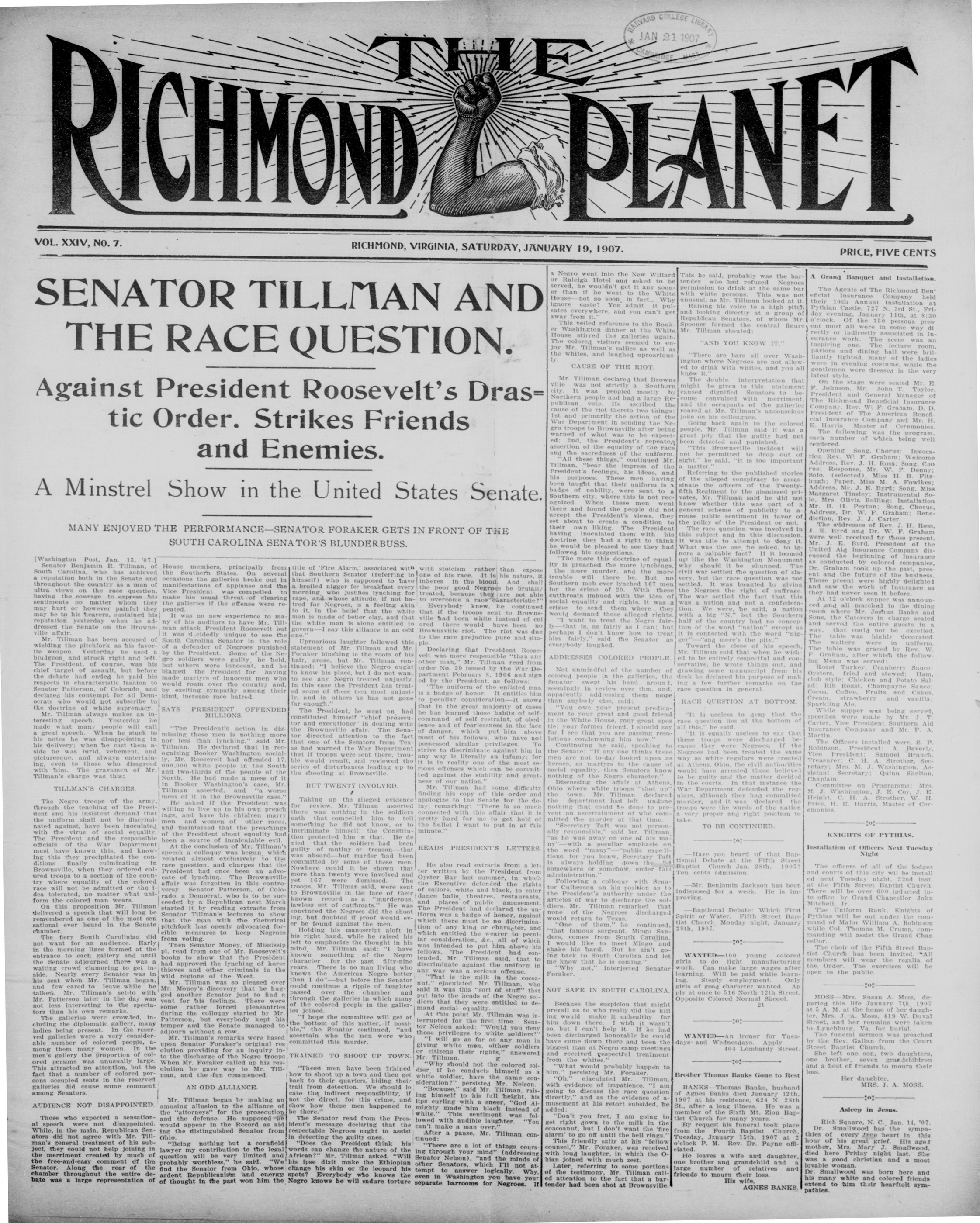
SENATOR TILLMAN AND THE RACE QUESTION.
Against President Roosevelt's Drastic Order. Strikes Friends and Enemies.
A Minstrel Show in the United States Senate.
MANY ENJOYED THE PERFORMANCE—SENATOR FORAKER GETS IN FRONT OF THE SOUTH CAROLINA SENATOR'S BLUNDERBUSS.
VOL. XXIV. NO. 7.
SENATE
THE
Against
tic
A Minstrel
MANY ENJOYED T
[Washington Post, Jan. 13, '07.] Senator Benjamin R. Tillman, of South Carolina, who has achieved a reputation both in the Senate and throughout the country as a man of ultra views on the race question, having the courage to express his sentiments no matter whom they may hurt or however painful they may be to his hearers, sustained his reputation yesterday when he addressed the Senate on the Brownville affair.
Mr. Tillman has been accused of welding the pitchfork as his favorite weapon. Yesterday he used a bludgeon and struck right and left. The President, of course, was his chief target of assault, but before the debate had ended he paid his respects in characteristic fashion to Senator Patterson, of Colorado and declared his contempt for all Democrats who would not subscribe to the doctrine of white supremacy.
Mr. Tillman always makes an interesting speech. Yesterday he made what many people will call a great speech. When he stuck to his notes he was disappointing in his delivery; when he cast them aside he was hurd, vehement, and picturesque, and always entertaining, even to those who disagreed with him. The gravamen of Mr. Tillman's charge was this:
TILLMAN'S CHARGES
The Negro troops of the army, through the teaching of the President and his insistent demand that the uniform shall not be discriminated against, have been inoculated with the virus of social equality. The President and the responsible officials of the War Department must have known this, and knowing this they precipitated the conditions finally culminating in Brownsville, when they ordered colored troops to a section of the country where equality of the colored race will not be admitted or the idea tolerated, no matter what uniform the colored man wears. On this proposition Mr. Tillman delivered a speech that will long be remembered as one of the most senational ever heard in the Senate chamber. The fiery South Carolinian did not want for an audience. Early in the morning lines formed at the entrance to each gallery and until the Senate adjourned there was a waiting crowd clamoring to get inside. Nearly every Senator was in his seat when Mr. Tillman began, and few cared to leave while he talked. Mr. Tillman's set-to with Mr. Patterson later in the day was not less interesting to the spectators than his own remarks.
The galleries were crowded, including the diplomatic gallery, many ladies being present. In the reserved galleries were a very considerable number of colored people, among them many women. In the men's gallery the proportion of colored persons was unusually large. This attracted no attention, but the fact that a number of colored persons occupied seats in the reserved galleries did cause some comment among Senators.
AUDIENCE NOT DISAPPOINTED
Those who expected a sensational speech were not disappointed. While, in the main, Republican Senators did not agree with Mr. Tillman's general treatment of his subject, they could not help joining in the merriment created by much of the free-and-easy comment of the Senator. Along the rear of the chamber throughout the entire debate was a large representation of
House members, principally from the Southern States. On several occasions the galleries broke out in manifestations of applause and the Vice President was compelled to make his usual threat of clearing the galleries if the offense were repeated.
It was no new experience to many of his auditors to have Mr. Tillman attack President Roosevelt but it was decidedly unique to see the South Carolina Senator in the role of a defender of Negroes punished by the President. Some of the Negro soldiers were guilty, he held, but others were innocent, and he blamed the President for having made martyrs of innocent men who would roam over the country and, by exciting sympathy among their kind, increase race hatred.
SAYS PRESIDENT OFFENDED MILLIONS.
"The President's action in missing those men is nothing more nor less than lynching," said Mr. Tillman. He declared that in recognizing Booker Washington socially, Mr. Roosevelt had offended 17,000,000 white people in the South and two-thirds of the people of the North. He had made a mess of it in Booker Washington's case, Mr. Tillman asserted, and "a worse mess of it in the Brownsville case."
He asked if the President was willing to live up to his own preachings, and have his children marry men and women of other races, and maintained that the preachings of the President about equality had been a source of incalculable evil.
At the conclusion of Mr. Tillman's speech a colony was begun, which related almost exclusively to the race question, and charges that the President had once been an advocate of lynching. The Brownsville affair was forgotten in this controversy. Senator Patterson, of Colorado, a Democrat, who is to be succeeded by a Republican next Marca started it by reading extracts from Senator Tillman's lectures to show that the man with the rhetorical pitchfork has openly advocated forible measures to keep Negroes from voting.
Then Senator Money, of Mississippi pl, read from one of Mr. Roosevelt's books to show that the President had approved the lynching of horse thieves and other criminals in the wild regions of the West.
Mr. Tillman was so pleased over Mr. Money's discovery that he hugged another Senator just to find avent for his feelings. There were some rather forced pleasanties during the colloquy started by Mr. Patterson, but everybody kept his temper and the Senate managed to adjourn without a row. Mr. Tillman's remarks were based upon Senator Foraker's original resolution providing for an inquiry into the discharge of the Negro troops When Mr. Foraker called up his resolution he gave way to Mr. Tillman, and the-fun commenced.
AN ODD ALLIANCE.
Mr. Tillman began by making an amusing allusion to the alliance of the "attorneys" for the prosecution and the defense. He supposed he would appear in the Record as aling the distinguished Senator from Ohio.
"Being nothing but a cornfield lawyer my contribution to the legal question will be very limited and probably worthless," he said. "We find the Senator from Ohio, whose ardent Republicanism and energy of thought in the past won him the
RICHMOND, VIRGINIA, SATURDAY, JANUARY 19, 1907.
title of 'Fire Alarm,' associated with that Southern Senator (referring to himself) who is supposed to have a broiled nigger for breakfast every morning, who justifies lynching for rape, and whose attitude, if not hatred for Negroes, is a feeling akin to it, in the belief that the white man is made of better clay, and that the white man is alone entitled to govern—I say this alliance is an odd one."
Uproarious laughter followed this statement of Mr. Tillman and Mr. Foraker blushing to the roots of his hair, arose, but Mr. Tillman continued: "I believe the Negro ought to know his place, but I do not want to see any Negro treated unjustly. In this case the President has treated some of these men most unjustly, and in others he has not gone far enough."
The President, he went on, had constituted himself "chief prosecutor and executioner" in dealing with the Brownsville affair. The Senator directed attention to the fact that one of the Senators from Texas had warned the War Department that if troops were sent there, trouble would result, and reviewed the series of disturbances leading up to the shooting at Brownsville.
BUT TWENTY INVOLVED
Taking up the alleged evidence for review, Mr. Tillman asserted there was nothing in the soldiers oath that compelled him to tell something he did not know, or to incriminate himself; the Constitution protected him in that. He denied that the soldiers had been guilty of mutiny or treason—that was absurd—but murder had been committed by some of these men. Nowhere could it be shown that more than twenty were involved and yet 167 were dismissed. The troops, Mr. Tillman said, were sent to Brownsville in the face of their known record as a "murderous, lawless set of cutthroats." He was convinced the Negroes did the shooting, but doubted if proof would ever be found against the men. Holding his manuscript aloft in his right hand, while he raised his left to emphasize the thought in his mind, Mr. Tillman said: "I have known something of the Negro character for the past fifty-nine years. There is no man living who knows the American Negro better than I do"—but before the Senator could continue a ripple of laughter passed over the chamber and through the galleries in which many of the colored people in the galleries joined.
"I hope the committee will get at the bottom of this matter, if possible," the Senator continued, "and ascertain who the men were who committed this murder.
TRAINED TO SHOOT UP TOWN
"These men have been trained how to shoot up a town and then get back to their quarters, hiding their trail from detection. We should to lcase the indirect responsibility, if not the direct, for this crime, and show how these men happened to be there."
The Senator read from the President's message declaring that the respectable Negroes ought to assist in detecting the guilty ones.
"Does the President think his words can change the nature of the African?" Mr. Tillman asked. "Will his ipse dixit make the Ethiopian change his skin or the leopard his spots? Everybody who knows the Negro knows he will endure torture
with stolcism rather than expose one of his race. It is his nature, it inheres in the blood. And shall the poor good Nerropes be brutally treated, because they are not able to overcome a race characteristic." Everybody knew, he continued that if the troops sent to Brownville had been white instead of colored there would have been no Brownville riot. The riot was due to the race prejudice pure and simple.
Declaring that President Roosevelt was more responsible "than any other man." Mr. Tillman read from order No. 29 issued by the War Department February 8, 1906 and signed by the President, as follows:
"The uniform of the enlisted man is a badge of honor. It entitles him to peculiar consideration—it snares that in the great majority of cases he has learned those habits of self-command of self restraint, of obedience and of fearlessness in the face of danger, which put him above most of his fellows, who have not possessed similar privileges. To strive to discriminate against him in any way is literally an infamy; for it is in reality one of the most serious offenses which can be committed against the stability and greatness of our nation."
Mr. Tillman had some difficulty finding his copy of this order and apologize to the Senate for the delay, remarking: "There is so much connected with this affair that it is pretty hard for me to get hold of the bullet I want to put in at this minute."
READS PRESIDENT'S LETTERS
He also read extracts from a letter written by the President from Oyster Bay last summer, in which the Executive defended the rights of sailors, white and black, to enter dance halls, theatres, restaurants, and places of public amusement. The President had declared the uniform was a badge of honor, against which there must be no discrimination of any kind or character, and which entitled the wearer to peculiar consideration, &c., all of which was intended to put him above his fellows. The President had contended, Mr. Tillman said, that to discriminate against the uniform in any way was a serious offense.
"That is the milk in the coconut," ejaculated Mr. Tillman, who said it was this "sort of stuff" that put into the heads of the Negro soldiers that they were entitled to demand social equality.
At this point Mr. Tillman was interrupted for the first time. Senator Nelson asked: "Would you请 those privileges to white soldiers?" "I will go as far as any man in giving white men, either soldiers or citizens their rights," answered Mr. Tillman.
"Why should not the colored soldier if he conducts himself as a white soldier, have the same consideration?" persisted Mr. Nelson.
"Because," said Mr. Tillman, raising himself to his full height, his lips curling with a sneer, "God Almighty made him black instead of white." This sentiment was followed with audible laughter. "You can't make a man over."
After a pause, Mr. Tillman continued:
"There are a lot of things coursing through your mind" (addressing Senator Nelson), "and the minds of other Senators, which I'll not attempt to answer logically. Why, even in Washington you have your separate barrooms for Negroes, if
a Negro went into the New Willard or Raleigh Hotel and asked to be served, he wouldn't get it any sooner than if he went to the White House—not so soon, in fact. Why ignore caste? You admit it pulsates everywhere, and you can't get away from it." This veiled reference to the Booker Washington dinner at the White House stirred the galleries again. The colored visitors seemed to enjoy Mr. Tillman's sallies as well as the whites, and laughed uproarious.
CAUSE OF THE RIOT.
Mr. Tillman declared that Brownsville was not strictly a Southern city. It was peopleled mostly by Northern people and had a large Republican vote. He ascribed the cause of the riot thereto two taings: 1st and primarily the action of the War Department in sending the Negro troops to Brownsville after being warned of what was to be expected; 2nd, the President's repeatedly assertion of the equality of the race and the sacredness of the uniform. "All these things," continued Mr. Tillman, "bear the impress of the President's feelings, his ideas, and his purposes. These men having been taught that their uniform is a badge of nobility, were sent to a Southern city, where this is not recognized. When these men went there and found the people did not accept the President's views, they set about to create a condition to their own liking. The President having inoculated them with his doctrine they had a right to think he would be pleased to see they had followed his suggestions.
"I want to treat the Negro fairly—that is, as fairly as I can; but perhaps don't know how to treat him fairly—that the Senator as everybody laughed
ADDRESSES COLORED PEOPLE
Not unmindful of the number of colored people in the galleries, the Senator swept his hand around,1 seemingly in review over thm, and apparently addressing them more than anybody else, said:
"You owe your present predicament to your great and good friend in the White House, your great apos tie: your former friend, I should say for I see that you are passing resolutions condemning him now."
Continuing he said, speaking to the Senate: "If any one thinks these men are not to-day looked upon as heroes, as martyrs to the cause of social equality, then Senators know nothing of the Negro character."
Discussing the affair at Athens, Ohio where white troops "shot up" the town. Mr. Tillman declare the department had left undone nothing that could be done to prevent an ascertained of who committed the murder at that time.
"Secretary Taft was not personally responsible," said Mr. Tillman, "as he was away on one of his many"—with a peculiar emphasis on the word "many"—"public expellions, for you know, Secretary Taft is always holding down the old somewhere or somehow, under this administration."
Following a colloquy with Senator Culberson on his position as to the President's authority under the articles of war to discharge the soldiers, Mr. Tillman remarked that none of the Negroes discharged would return to Texas.
"One of them," he continued,
"that famous sergeant. Mingo Sanders, comes from South Carolina. I would like to meet Mingo and shake his hand. But he ain't going back to South Carolina and let me know that he is coming."
"Why not," interjected Senator Foraker.
NOT SAFE IN SOUTH CAROLINA
Because the suspicion that might prevail as to who really did the killing would make it unhealthy for him down there. I wish it wasn't so, but I can't help it. If he had been discharged honorably he could have come down there and been the biggest man at Negro camp meetings and received respectful treatment from the whites."
"What would probably happen to him," persisted Mr. Foraker.
"Oh," ejaculated Mr. Tillman, with evidence of impatience, "I am going to discuss the race question directly," and as the evidence of ausement at his retort subsided, he added:
"Don't you fret, I am going to get right down to the milk in the coacouan, but I don't want the 'fire alarm' to go off until the bell rings."
This friendly sally at his "fellow counsel," Mr. Foraker, was received with loud laughter, in which the Ohiian joined with much zest.
Later referring to some portions of the testimony, Mr. Tillman called attention to the fact that a bartender had been shot at Brownsville
This he said, probably was the harb-
tender who had refused Negroes
permission to drink at the same bar
with white persons. This was not
unusual, as Mr. Tillman looked at it.
Raising his voice to a high pitch
and looking directly at a group of
Republican Senators, of whom Mr.
Spooner formed the central figure
Mr. Tillman shouted:
"AND YOU KNOW IT."
"There are bars all over Washington where Negroes are not allowed to drink with whites, and you all know it."
The double interpretation that might be given to this statement caused dignified Senators to become convulsed with merriment, and the occupants of the galleries roared at Mr. Tillman's unconscious joke on his colleagues.
Going back again to the colored people, Mr. Tillman said it was a great pity that the guilty had not been detected and punished.
"This Brownsville incident will not be permitted to drop out of sight," he said, "it is too important a matter."
Referring to the published stories of the alleged conspiracy to assassinate the officers of the Twenty-fifth Regiment by the dismissed privates, Mr. Tillman said he did not know whether this was part of a general scheme of publicity to arouse public sentiment in favor of the policy of the President or not.
The race question was involved in this subject and in this discussion. It was idle to attempt to deny it. What was the use he asked, to ignore a palpable fact? If it loomed up like the Washington Monument why should it be shunned. The civil war settled the question of slavery, but the race question was not settled. It was bungled by giving the Negroes the right of suffrage. The war settled the fact that this was a nation and not a confederation. We were, he said, a nation with a big "N," but the Southern half of the country had no conception of the word "nation" except as it is connected with the word "nigger"—"and more's the pity." Toward the close of his speech, Mr. Tillman said that when he wished to be entirely respectful and conservative, he wrote things out, and drawing some manuscript from his desk he declared his purpose of making a few further remarks on the race question in general.
RACE QUESTION AT BOTTOM.
"It is useless to deny that the race question lies at the bottom of all this," he said.
"It is equally useless to say that these troops were discharged because they were Negroes. If the Negroes had been treated the same way as white regulars were treated at Athens, Ohio, the civil authorities would have arrested those believed to be guilty and the matter decided in the courts. In that instance the War Department defended the regulars, although they had committed murder, and it was declared the troops were the wards of the nation a very proper and right position to take.
TO BE CONTINUED.
—Have you heard of that Baptismal Debate at the Fifth Street Baptist Church Jan. 28th, 1907? Ten cents admission.
—Mr. Benjamin Jackson has been indisposed for a week. He is improving.
—Baptismal Debate: Which First Spirit or Water. Fifth Street Baptist Church, Monday night, January 28th, 1907.
WANTED—100 young colored girls to do light manufacturing work. Can make large wages after learning. Will be paid while learning. Steady employment. Only girls of good character wanted. Apply at once to 516 North 12th Street. Opposite Colored Normal Shecol.
WANTED—An ironier for Tuesdays and Wednesdays. Apply
Brother Thomas Banks Gone to Rest
BANKS—Thomas Banks, husband of Agnes Banks died January 12th, 1907 at his residence, 624 N. 28th St., after a long illness. He was a member of the Sixth Mt. Zion Baptist Church for many years.
By request his funeral took place from the Fourth Baptist Church, Tuesday, January 15th, 1907 at 2 o'clock P. M. Rev. Dr. Payne officiated.
He leaves a wife and daughter, one brother and grandchild and a large number of relatives and friends to mourn their loss.
His wife.
AGNES BANKS
PRICE, FIVE CENTS
A Grand Banquet and Installation.
The Agents of The Richmond Beneficial Insurance Company held their 10th Annual Installation at Pythian Castle, 727 N. 3rd St., Friday evening, January 11th, at 8:30 o'clock. Of the 150 persons present most all were in some way directly or indirectly associated in Insurance work. The scene was an inspiring one. The lecture room, parlors and dining hall were brilliantly lighted, many of the ladies were in evening costume, while the gentlemen were dressed in the very latest style.
On the stage were seated Mr. E. F. Johnson, Mr. John T. Taylor, President and General Manager of The Richmond Beneficial Insurance Company. Rev. W. F. Graham, D. D. President of The American Beneficial Insurance Company and Mr. H. E. Harris Master of Ceremonies.
The following was the program, each number of which being well rendered.
Opening Song, Chorus; Invocation Rev. W. F. Graham; Welcome Address, Rev. J. H. Ross; Song, Caorus; Response, Mr. W. F. Denn; Solo, (selected). Miss H. B. Fitzhugh; Paper, Miss M. A. Fowlkes; Address, Mr. J. E. Byrd; Song, Miss Margaret Tinsley; Instrumental Solo, Mrs. Olivia Bolling; Installation Mr. B. H. Peyton; Song, Chorus, Address, Dr. W. F. Graham; Benediction, Rev. J. J. Carter.
The addresses of Rev. J. H. Ross, J. E. Byrd and Dr. W. F. Graham were well received by those present, Mr. J. E. Byrd, President of the United Ald Insurance Company discussed the beginning of Insurance as conducted by colored companies, Dr. Graham took up the past, present and the future of the business. Those present were highly delightful and saw the work of Insurance as they had never seen it before.
At 12 o'clock supper was announced and all marchel to the dining room where Mr. Joshua Banks and Sons, the Caterers in charge seated and served the entire guests in a way, that could not be excelled. The table was highly decorated. The waiters were in uniform. The table was graced by Rev. W. F. Graham, after which the following Menu was served:
Roast Turkey, Cranberry Sauce; Oysters, fried and stewed; Ham, club style; Chicken and Potato Salad; Rib Roast, Champayne Sauce; Cocoa, Coffee, Fruits and Cakes, Cream, strawberry and vanilla; Sparkling Ale.
While supper was being served, speeches were made by Mr. J. T. Carter, Vice President Southern Ald Insurance Company and Mr. P. A. Martin.
The Officers installed were, S. P. Robinson, President; A. Reverly, Vice President; Samuel Branch, Treasurer; C. H. A. Strother, Secretary; Mrs. M. J. Washington, Assistant Secretary; Quinn Scalton, Chaplain.
Committee on Programme: Mrs
M. J. Washington, J. E. Coy, J. E.
Cighton, H. H. A. Strother, W. H.
Pritze, H. E. Harris, Master of Cer-
emencies.
KNIGHTS OF PYTHIAS.
Installation of Officers Next Tuesday Night
The officers of all of the lodges and courts of this city will be installed next Tuesday night, 22nd instat at the Fifth Street Baptist Church. There will be over 600 inducted into office by Grand Chancellor John Mitchell, Jr. The Uniform Rank, Knights of Pythias will be out under the command of Major William A. Robinson while Col. Thomas M. Crump, commanding will assist the Grand Chancellor. The choir of the Fifth Street Baptist Church has been invited. All members will wear the regalia of the Order. The exercises will be open to the public.
MOSS—Mrs. Susan A. Moss, departed this life January 7th 1907 at 5 A. M. at the home of her daughter, Mrs. J. A. Moss, 419 W. Duval Street, and her remains were taken to Lynchburg, Va. for burial.
The funeral sermon was preached by the Rev. Gallan from the Court Street Baptist Church.
She left one son, two daughters, one brother, seven grandchildren and a host of friends to mourn their loss.
Her daughter,
MRS. J. A. MOSS.
Asleep in Jesus.
Rich Square, N. C., Jan. 14, '07.
Dr. Smallwood has the sympathies of every true heart in this hour of his great grief. His age f mother, Mrs. Mary J. Smallwood, died here Friday night last. She was a good christian and a most lovable woman.
Dr. Smallwood was born here and his many white and colored friends extend to him their hearftelt sympathies.
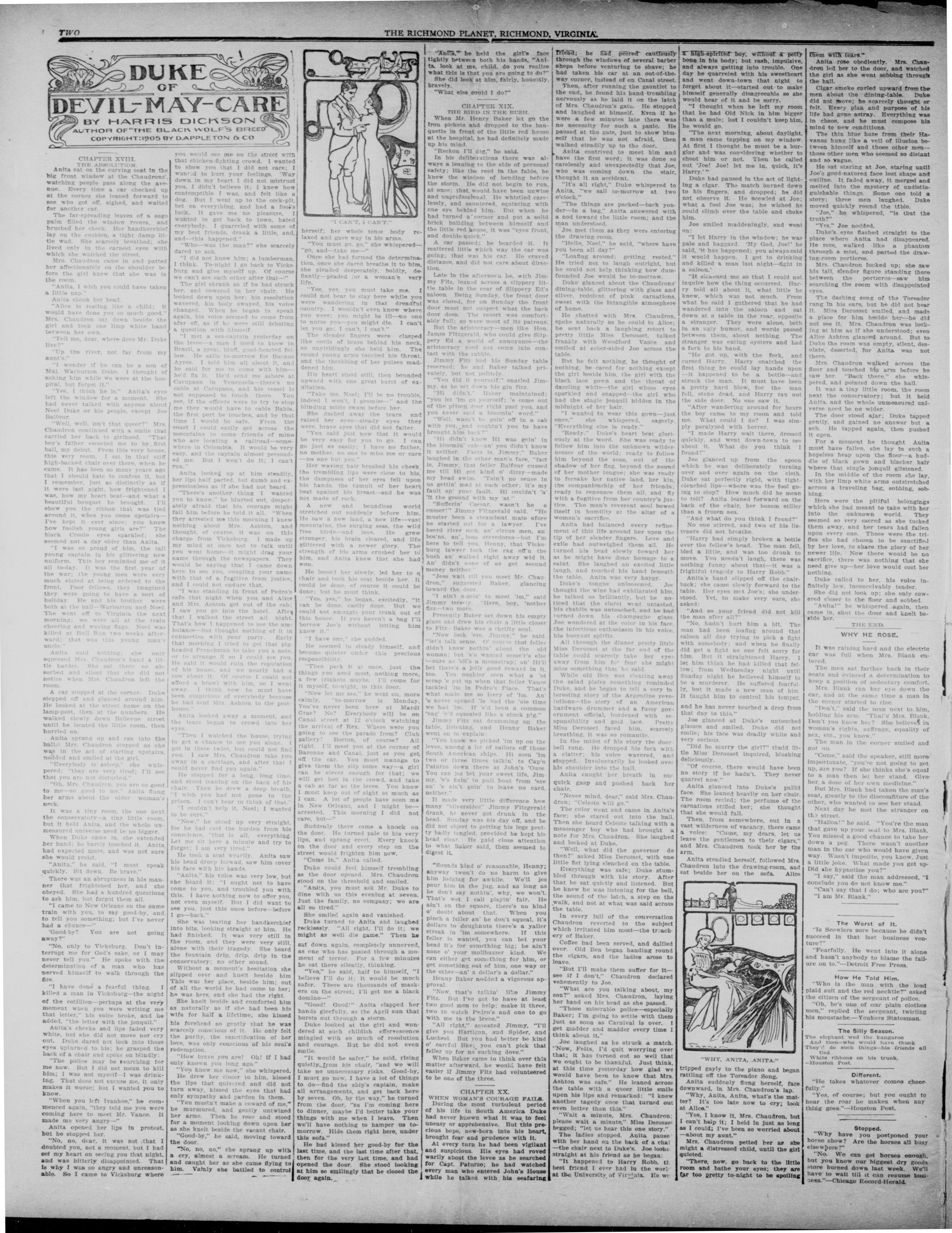
DUKE
OF
DEVIL-MAY-CARE
BY HARRIS DICKSON
AUTHOR OF "THE BLACK WOLF'S BREED"
COPYRIGHT:1905 BY D.APPLETON & CO
TWO
CHAPTER XVIII.
THE ABSOLUTION.
Anita sat on the curving seat in the big front window at the Chaudrons', watching people pass along the avenue. Every time a car checked up at the corner she leaned forward to see who got off, sighed, and waited for another car.
The far-spreading leaves of a sago palm filled the window recess, and brushed her cheek. Her handkerchief lay on the cushion, a tight damp little wad. She scarcely breathed; she lived only in the carnest eyes with which she watched the street.
Mrs. Chaudron came in and patted her affectionately on the shoulder before the girl knew that she was in the room.
"Anita, I wish you could have taken a little nap."
Anita shook her head.
"Alice is resting like a child; it would have done you so much good." Mrs. Chaudron sat down beside the girl and took one limp white hand between her own.
"Tell me, dear, where does Mr. Duke live?"
"Up the river, not far from my aunt's."
"I wonder if he can be a son of Maj. Warburton Duke. I thought of asking him while we were at the hospital, but forgot it."
"Yes, I think he is." Anita's eyes left the window for a moment. She had never talked with anyone about Noel Duke or his people, except Joe Balfour.
"Well, well, isn't that queer?" Mrs. Chaudron continued with a smile that carried her back to girlhood. "That boy's father escorted me to by first ball, my debut. From this very house, this very room. I sat in that stiff high-backed chair over there, when he came. It has been so many years ago that I should hate to confess it, but I remember, just as distinctly as if it were last night, how frightened I was, how my heart beat—and what a beautiful bouquet he brought. I'll show you the ribbon that was tied around it, when you come up stairs—I've kept it ever since; you know how foolish young girls are?" The black Creole eyes sparkled; she seemed not a day older than Anita.
"I was so proud of him, the tall young captain in his glittering new uniform. This boy reminded me of it all to-day. It was the first year of the war; the young men were very much elated at being ordered to the front. Poor fellows, they imagined they were going to have a sort of holiday. He and his brother were both at the ball--Warburton and Noel. The went off to Virginia the next morning; we were all at the train cheering and waving flags. Noel was killed at Bull Run two weeks afterward; that was this young man's uncle." Anita said nothing; she only squeezed Mrs. Chaudron's hand a little harder. She sat there so absorbed and silent that she did not notice when Mrs. Chaudron left the room.
A car stopped at the corner. Duke stepped off and glanced around him. He looked at the street name on the lamp-post, then at the numbers. He walked slowly down Bellevue street until he located the little room, then hurried on.
Anita sprang up and ran into the hall. Mrs. Chandron stopped as she was in the act of starting upstairs, nodded and smiled at the girl.
"Everybody is asleep," she whispered; "they are very tired; I'll see that you are not disturbed."
"Oh, Mrs. Chandron, you are so good to me—so good to me," Anita flung her arms about the older woman's neck.
It was a tiny room, the one next the conservatory—a tiny little room, but it held Anita, and the whole unmeasured universe need be no bigger.
When Duke came in, she extended her hand; he barely touched it. Anita had expected more, and was not sure she would resist.
"Anita," he said, "I must speak quickly. Sit down. Be brave."
There was an abruptness in his manner that frightened her, and she obeyed. She had a hundred questions to ask him, but forgot them all.
"I came to New Orleans on the same train with you, to say good-by, and to tell you something; but I've never had a chance—"
"Good-by? You are not going away?"
"No, only to Vicksburg. Don't interrupt me for God's sake, or I may never tell you." He spoke with the determination of a man who has nerved himself to walk through the fire.
"I have done a fearful thing. I killed a man in Vicksburg—the night of the cotillion—perhaps at the very moment when you were writing me that letter," his voice broke, and he added, "the letter with the ionquil."
Anita's cheeks and lips faded very white, but she did not move nor cry out. Duke dared not look into those eyes upturned to his; he grasped the back of a chair and spoke on blindly: "The police may be searching for me now. But I did not mean to kill him; I was not myself—I was drinking. That does not excuse me, it only makes it worse; but I wanted you to know. "When you left Ivanhoe," he commenced again, "they told me you were coming to meet Mr. Vance. It made me very angry—" Anita opened her lips in protest, but he stopped her. "No, no, dear, it was not / that I doubted you, not a moment, but I had set my heart on seeing you that night, and was bitterly disappointed. That is why I was so angry and unreasonable. So I came to Vicksburg where
you would see me on the street with that chicken-fighting crowd. I wanted to show you that I did not care; I wanted to hurt your feelings. 'Way down in my heart I did not mistrust you. I didn't believe it; I knew how contemptible I was, and felt like a dog. But I went up to the cock-pit, bet on everything, and had a fool's luck. It gave me no pleasure. I wanted to get back to town, hated everybody. I quarreled with some of my best friends, drank a little, and, and—this happened."
"Who—was the man?" she scarcely dared to ask.
"I did not know him; a lumberman, I think. To-night I go back to Vicksburg and give myself up. Of course we can't see each other after that—"
The girl shrank as if he had struck her, and cowered in her chair. He looked down upon her; his resolution wavered, his body swayed, his voice changed. When he began to speak again, his voice seemed to come from afar off, as if he were still debating a question with himself.
"I met a sea-captain yesterday on the levee—a man I used to know in Brazil, a great, bluff, good-hearted fellow. He sailed to-morrow for Buenos Ayres. I told him all about it, and he said for me to come with him—he'd fix it. He'd send me ashore at Carupano in Venezuela—there's no cable at Carupano, and his vessel is not supposed to touch there. You see, if the officers were to try to stop me they would have to cable Bahia, the first port he touches, and by that time I would be safe. From the coast I could easily get across the mountains to some friends of mine who are locating a railroad—somewhere in Colombia. It would be very easy, and the captain almost persuaded me. But I won't do it; I can't run."
Anita looked up at him steadily, her lips half parted, but dumb and expressionless as if she had not heard
"There's another thing I wanted you to know." he blurted out, desperately afraid that his courage might fall him before he told it all. "When they arrested me this morning I knew nothing about Mrs. Ashton, and thought, of course, it was on this charge from Vicksburg. I made up my mind at once not to talk until you went home—it might drag your name through the newspapers. They would be saying that I came down here to see you, coupling your name with that of a fugitive from justice, and I could not endure that.
"I was standing in front of Pedro's cafe that night when you and Alice and Mrs. Ashton got out of the cab; I saw you go into the hotel. After that I walked the street all night. That's how I happened to see the ambulance—but thought nothing of it in connection with your party. Early that morning I tried to get that pig-headed Frenchman to take you a note, or to arrange it so I could see you. He said it would ruin the reputation of his house, and we nearly had a row about it. Of course I could not afford a brawl with him, so I went away. I think now he must have been suspicious of everybody because he had sent Mrs. Ashton to the pest-house."
Anita looked away a moment, and the tears began to crowd into her eyes.
"Then I watched the house, trying to get a chance to see you alone. I got in there twice, but could not find you. I saw Mrs. Chaudron take you away in a carriage, and after that I could never find you again."
He stopped for a long long time, and stood leaning on the back of his chair. Then he drew a deep breath. "I wish you had not gone to the prison. I can't bear to think of that." "I couldn't help it. Noel; I wanted to be sure."
"Now," he stood up very straight, for he had cast the burden from his conscience, "that is all, everything. Let me sit here a minute and try to forget; I am very tired."
He took a seat wearily. Anita saw his head droop forward, saw him cover his face with his hands.
"Anita," his voice was very low, but she heard it; "I ought not to have come to you, and troubled you with this. I have nothing now to offer you, not even myself. But I did want to see you, just this once before—before I go—back."
She was tearing her handkerchief into bits, looking straight at him. He had finished. It was very still in the room, and they were very still, alone with their tragedy. She heard the fountain drip, drip, drip in the conservatory; no other sound.
Without a moment's hesitation she slipped over and knelt beside him. This was her place, beside him; out of all the world he had come to her; he was hers, and she had the right.
She knelt beside and comforted him as naturally as if she had been his wife for half a lifetime; she kissed his forehead so gently that he was scarcely conscious of it. He only felt the purity, the sanctification of her love, was only conscious of his soul's redemption.
"How brave you are! Oh! if I had only known you long ago."
"You know me now," she whispered. He drew her closer to him, kissed the lips that quivered and did not turn away, kissed the eyes that had only sympathy and pardon in them.
"You mustn't make a coward of me," he murmured, and gently unwined her arms. Then he rose and stood for a moment looking down upon her as she knelt beside the vacant chair.
"Good-by," he said, moving toward the door.
"No, no, no," she sprang up with a cry, almost a scream. He turned and caught her as she came flying to him. Vainly she battled to control
THE RICHMOND PLANET, RICHMOND, VIRGINIA
O
"I CAN'T, I CAN'T."
herself; her whole tense body relaxed and gave way in his arms.
"You must go, go," she whispered—"go, and—take me—"
Once she had formed the determination, once she dared breathe it to him, she pleaded desperately, boldly, defiantly—paded for a woman's very life.
"Yes, yes, you must take me. I could not bear to stay here while you were wandering in that dreadful country. I wouldn't even know where you were; you might be ill—no one to nurse you—you might die. I can't let you go; I can't, I can't."
The slender fingers were clasped like cords of brass behind his neck, so unyieldingly she held him. The round young arms touched his throat, and the throbbing of her pulses maddened him.
His heart stood still, then bounded upward with one great burst of exultation.
"Take me. Noel; I'll be no trouble, indeed I won't, I promise—" and the blinding mists swam before her. She dashed away the tears and raised her eyes—steady eyes they were, brave eyes that did not falter. "You said just now that it would be very easy for you to go. I can go just as easily; I have no father, no mother, no one to miss me or care—no one but you." Her waving hair brushed his cheek the trembling lips were close to his, the damnness of her eyes fell upon his hands, the tumult of her heart beat against his breast—and he was not made of rock.
A new and boundless world stretched out suddenly before him. He saw a new land, a new life—vast mountains, the surging seas, the wild free birds—and love. He grew stronger, his brain cleared, and life glittered with a newer glory. The strength of his arms crushed her to him, and Anita knew that she had won.
He loosed her slowly, led her to a chair and took his seat beside her. It could be done, of course it could be done; but he must think.
"Yes, yes," he began, excitedly, "It can be done, easily done. But we could not smuggle your trunk out of this house. If you haven't a bag I'll borrow Joe's without letting him know it."
"I have one," she nodded.
He seemed to steady himself, and become quieter under this precious responsibility.
"Then pack it at once, just the things you need most, nothing more, a few trinkets maybe. I'll come for it myself, to-night, to this door.
"Now let me see," he went on, more calmly, "to-morrow is Monday. You've never been here at Mardi Gras? No? Everybody will be on Canal street at 12 o'clock watching the arrival of Rex. Where were you going to see the parade from? Club gallery? Boston, of course? All right. I'll meet you at the corner of Baronne and Canal, just as you get off the car. You must manage to give them the slip some way—a girl can be clever enough for that; we will get lost in the crowd, and take a cab as far as the levee. You know I must keep out of sight as much as I can. A lot of people have seen me in New Orleans, and I might be—arrested. This morning I did not care, but—"
Suddenly there came a knock on the door. He turned pale to his very lips, and sprang erect. Every knock on the door and every step on the street would frighten him now.
"Come in," Anita called. Duke could feel himself trembling as the door opened. Mrs. Chaudron stood on the threshold and smiled. "Anita, you must ask Mr. Duke to dine with us this evening at seven. Just the family, no company; we are all so tired." She smiled again and vanished. Duke turned to Anita and laughed recklessly. "All right, I'll do it; we might as well die game." Then he sat down again, completely unnerved, as one who has passed through a moment of terror. For a few minutes he sat there silently, thinking. "Yes," he said, half to himself, "I believe I'll do it; it would be much safer. There are thousands of maskers on the street; I'll get me a black domino—" "Good! Good!" Anita clapped her hands gleefully, as the April sun that bursts out through a storm.
Duke looked at the girl and wondered at such childish effervescence mingled with so much of resolution and courage. But he did not even smile.
"It would be safer," he said, rising quietly from his chair, "and we will take no unnecessary risks. Good-by. I must go now, I have a lot of things to do—find the ship's captain, make all arrangements, and get back here by seven. Oh, by the way," he turned from the door, "as I'm coming to dinner, maybe I'd better take your things with me when I leave. Then we'll have nothing to hamper us tomorrow. Hide them right here, under this sofa."
He had kissed her good-by for the last time, and the last time after that, then for the very last time, and had opened the door. She stood looking at him so smilingly that he closed the door again.
"Anita," he held the girl's face tightly between both his hands, "Anlta, look at me, child, do you realize what this is that you are going to do?" She did look at him, fairly, honestly, bravely. "What else could I do?"
When Mr. Henry Baker let go the iron pickets and dropped to the banquette in front of the little red house at the hospital, he had definitely made up his mind.
"Reckon I'll dig," he said.
In his deliberations there was always a leaning to the side of personal safety; like the reed in the fable, he knew the wisdom of bending before the storm. He did not begin to run, at once; that would have been unwise and unprofessional. He whistled carelessly, and sauntered, squinting with one eye behind him. But when he had turned a "corner and put a solid brick building between himself and the little red house, it was "eyes front, and double-quick."
A car passed; he boarded it. It mattered little which way the car was going; that was his car. He craved distance, and did not care about direction.
Late in the afternoon he, with Jimmy Fitz, leaned across a slippery little table in the rear of Slippery Ed's saloon. Being Sunday, the front door was closed, for on Sunday the front door must not suspect what the back door does. The resort was comfortably full; so were most of its patrons. But the aristocracy—men like Hon. James Fitzgerald, who could give Slippery Ed a world of annoyance—the aristocracy need not come into contact with the rabbit.
Jimmy Fitz had his Sunday table reserved; he and Baker talked privately, but not politely.
"You did it yourself," snarled Jimmy, as he set down his gin fizz.
"Well, wasn't he goin' off in a cab with you, and oughtn't you to have brought him back?"
"Hi didn't know Hi was goin' in the bloomin' cab—an' you didn't know it neither. Facts is, Jimmy." Baker laughed in the other man's face, "fact is, Jimmy, that feller Balfour cussed me till Hi got kind o' dizzy—made my head swim. 'Tain't no sense in us gettin' mad at each other; it's my fault an' your fault. Hi couldn't 'a' 't the ground with my 'at.'
"Sufferin' Caesar, wasn't he a cusser!" Jimmy Fitzgerald said. "He must been a steamboat mate afore he started out for a lawyer. I've heed river men, an' circus men, an' bos'ns, an' boss stevedores—but I'm here to tell you, Henny, that Vicksburg lawyer took the rag off the bush an' walked right away wid it. An' didn't none of us get second money neither."
"Jess wait till you meet Mr. Chaudron," suggested Baker, glancing toward the door.
"I ain't a-goin' to meet 'im," said Jimmy tersely. "Here, boy, 'nother fizz—two more.
Presently Baker set down his empty glass and drew his chair a little closer to Fitz-Baker was a thrifty soul.
"Now look ere, Jimmy," he said; "let's talk sense. O' course that feller didn't know nothin' about the old woman; but e's wanted some're also—sure as e'll a mousetrap; an 'HILL bet there's a jolly good reward in it, too. You oughter seen what a 'ot scrap e' put up when that feller Vance tackled 'im in Pedro's Place. That's what made me so e'll of 'im. An 'e never opened 'is' cad the 'ole time we had 'im. If 'ed been a common 'vag' 'ed squealed like a stuck p'g." Jimmy Fitz sat drumming on the table, listening, and Henny Baker went on to explain:
"You know we picked 'im up on the levee, among a lot of sailors off those South American ships. Hi seen 'im two or three times talkin' to Cap'n Paturzo down there at John's 'Ouse. You can jes bet your sweet life, Jimmy, 'e's fixin' to pull hout from 'ere an' e'ain't goin' to leave no card, neither."
It made very little difference how many "silversides" Jimmy Fitzgerald drank, he never got drunk in the head. Sunday was his day off, and he did not object to getting his legs pretty badly tangled, provided he kept his head clear. He paid close attention to what Baker said, then seemed to digest it.
"Sounds kind o' reasonable, Henny; anyway twon't do o no harm to give him lodging for awhile. We'll jes pour him in the jug, and as long as he don't say nothin', why, we won't. That's wot I call playin' fair. He ain't on the square, there's no kind o' doubt about that. When you pinch a felter an' he don't squeal, its dollars to doughnuts there's a yaller streak in 'im somewhere. If this felter is wanted, you can bet your head it's for something big; he ain't none o' your mollbuzzer kind. We can either get something for him, or get something out of him, one way or the other—an' a dollar's a dollar."
Henny Baker nodded a vigorous approval.
"Now, that's talkin' like Jimmy Fitz. But I've got to have at least two good men to help; make it three, two to watch Pedro's and one to go with me to the levy."
"All right," assented Jimmy, "I'll give you Hartmann, and Spider, and Luchesi. But you had better be kind o' careful like, you can't pick that feller up for no sucking dove." When Baker came to think over this matter afterward, he would have felt easier if Jimmy Fitz had volunteered to be one of the three.
CHAPTER XX.
WHEN WOMAN'S COURAGE FAILS.
During the most turbulent period of his life in South America Duke had never known what it was to feel uneasy or apprehensive. But this precious hope, new-born into his heart, brought fear and prudence with it.
At every turn he had been vigilant and suspicious. His eyes had roved warily about the levee as he searched for Capt. Paturzo; he had watched every man who entered John's House while he talked with his seafaring
Friend; he had peered cautiously through the windows of several barber shops before venturing to shave; he had taken his car at an out-of-the-way corner, instead of on Canal street. Then, after running the gauntlet to the end, he found his hand trembling nervously as he laid it on the latch of Mrs. Chaudron's gate. He stopped and laughed at himself. Even if he were a few minutes late there was no necessity for such a panic. He paused at the gate, just to show himself that he was not afraid, then walked steadily up to the door. Anita contrived to meet him and have the first word; it was done so carelessly and unexpectedly that Joe, who was coming down the stair, thought it an accident. "It's all right," Duke whispered to Anita, "we sail to-morrow at two o'clock."
"The things are packed—back yonder—in a bag." Anita answered with a nod toward the little room; and the man understood.
Joe met them as they were entering the drawing-room.
"Hello, Noel," he said, "where have you been all day?"
"Loafing around; getting rested." He tried not to laugh outright, but he could not help thinking how dum-founded Joe would be to-morrow.
Duke glanced about the Chaudron's dining-table, glittering with glass and silver, redolent of pink carnations, sweet with the intangible atmosphere of home.
He chatted with Mrs. Chaudron, spoke naturally as he could to Alice; he sent back a laughing retort to pretty little Miss Deroset, talked frankly with Woodford Vance and smiled at sober-sided Joe across the table.
But he felt nothing, he thought of nothing, he cared for nothing except the girl beside him, the girl with the black lace gown and the throat of dazzling white—the girl whose eyes sparkled and snapped the girl who had the single quinquil hidden in the midnight of her hair.
"I wanted to wear this gown—just once," she whispered, eagerly. "Everything else is ready."
"Ready." Duke's heart beat gloriously at the word. She was ready to follow him into the unknown wildernesses of the world; ready to follow him beyond the seas, out of the shadow of her flag, beyond the sound of her mother tongue; she was ready to forsake her native land, her kin, the companionship of her friends; ready to renounce them all, and fly with a fugitive from her country's justice. The man's reverent soul bowed itself in humility at the altar of a woman's sacrifice.
Anita had balanced every refinement of this life around her upon the tip of her slender fingers. Love and exile had outweighed them all. He turned his head slowly toward her as he might have done homage to a saint. She laughed an excited little laugh, and touched his hand beneath the table. Anita was very happy. Duke's tongue unloosened. Joe thought the wine had exhilarated him, he talked so brilliantly, but he noticed that the claret went untasted, his chablais was untouched, and he had turned down his champagne glass. Joe wondered at the color in his face, the infectious enthusiasm in his voice, his buoyant spirits.
All through the dinner pretty little Miss Deroset at the far end of the table could scarcely take her eyes away from him for fear she might miss something that he said.
While old Ben was clearing away the salad plates something reminded Duke, and he began to tell a very interesting story of the Argentine revolutions—the story of an American hardware drummer and a fussy government official, burdened with responsibility and gold lace. Pretty Miss Deroset faced him, scarcely breathing, it was so romantic.
In the midst of his story the doorbell rang. He dropped his fork with a clatter; his voice wavered, and stopped. Involuntarily he looked over his shoulder into the hall.
Anita caught her breath in one quick gasp and pushed back her chair.
"Never mind, dear," said Mrs. Chaudron; "Celeste will go."
The color went and came in Anita's face; she stared into the hall. Then she heard Celeste talking with a messenger boy who had brought a note for Mrs. Chaudron. She laughed and looked at Duke.
"Well, what did the governor do then?" asked Miss Derosset, with one little fist lying clenched on the table.
Everything was safe; Duke stumbled through with his story. After that he sat quietly and listened. But he knew he was listening for the bell, the sound of the latch, a step on the walk, and not at what was said across the table.
In every lull of the conversation Chaudron reverted to the subject which irritated him most—the treachery of Baker.
Coffee had been served, and dallied over. Old Ben began handing round the cigars, and the ladies arose to leave.
"But I'll make them suffer for it—see if I don't," Chaudron declared vehemently to Joe.
"What are you talking about, my son?" asked Mrs. Chaudron, laying her hand on his head as she passed.
"Those miserable police—especially Baker; I'm going to settle with them just as soon as Carnival is over. I get madder and madder every time I think about it."
Joe laughed as he struck a match. "Now, Felix, I'd quit worrying over that; it has turned out so well that we ought to be thankful. Just think, at this time yesterday how glad we would have been to know that Mrs. Ashton was safe." He leaned across the table with a queer little smile upon his lips and remarked: "I knew another tagedy once that turned out even better than this."
"Walt a minute, Mrs. Chaudron; please wait a minute," Miss Derosse begged; "let us hear this one story." The ladies stopped. Anita pause with her hand on the back of a chai—the chair next to Duke's. Joe looked straight at his friend as he began: "It happened to Harry Robb, the best friend I ever had in the world at the University of Virginia. He was
a high-spirted boy, without a petty bone in his body; but rash, impulsive, and always getting into trouble. One day he quarreled with his sweetheart and went down-town that night to forget about it—started out to make himself generally disagreeable so she would hear of it and be sorry.
"I thought when he left my room that he had Old Nick in him bigger than a mule; but I couldn't keep him, he would go.
"The next morning, about daylight, a man came tapping on my window. At first I thought he must be a burglar and was considering whether to shoot him or not. Then he called out 'Joe! Joe! let me in, quick, it's Harry.'"
Duke had paused in the act of lightning a cigar. The match burned down to his fingers, and dropped; he did not observe it. He scowled at Joe; what a fool Joe was; he wished he could climb over the table and choke him.
Joe smiled maddeningly, and went on:
"I let Harry in the window; he was pale and haggard. 'My God, Joe!' he said, 'it has happened; you always said it would happen. I got to drinking and killed a man last night—fight in a saloon."
"It sickened me so that I could not inquire how the thing occurred. Harry told all about it, what little he knew, which was not much. From what he said I gathered that he had wandered into the saloon and sat down at a table in the rear, opposite a stranger. They were alone, both in an ugly humor, and words passed between them, about nothing. The stranger was eating oysters and had a fork in his hand.
"He got up, with the fork, and cursed Harry. Harry snatched the first thing he could lay hands upon—it happened to be a bottle—and struck the man. It must have been a pretty hard blow, for the man fell, stone dead, and Harry ran out the side door. No one saw it.
"After wandering around for hours the boy came to my room and told me. What could I do? I was simply paralyzed with horror.
"I made Harry wait there, dressed quickly, and went down-town to see about it. What do you think I found?"
Joe glanced up from the spoon which he was deliberately turning over and over again on the cloth. Duke sat perfectly rigid, with tight-clenched lips—where was the fool going to stop? How much did he mean to tell? Anita leaned forward on the back of the chair, her bosom stiller than a frozen sea.
"And what do you think I found?"
No one stirred, and two of his listeners did not breathe.
"Harry had simply broken a bottle over the fellow's head. The man fell, bled a little, and was too drunk to move. You needn't laugh, there was nothing funny about that—it was a frightful tragedy to Harry Robb."
Anita's hand slipped off the chairback; she came slowly forward to the table. Her eyes met Joe's; she understood. Yet, to make very sure, she asked:
"And so your friend did not kill the man after all?"
"No, hadn't hurt him a bit. The man had been loafing around that saloon all day trying to pick a fight with somebody; and when he finally did get a fight no one felt sorry for him. But it straightened Harry. I let him think he had killed that fellow; from Wednesday night until Sunday night he believed himself to be a murderer. He suffered fearfully, but it made a new man of him. It taught him to control his temper, and he has no panic."
and he has never touched a drop from that day to this."
Joe glanced at Duke's untouched glasses and smiled. Duke did not smile; his face was deadly white and very serious.
"Did he marry the girl?" timid little Miss Deroset inquired, blushing deliciously.
"Of course, there would have been no story if he hadn't. They never quarrel now."
Anita glanced into Duke's palid face. She leaned heavily on her chair. The room recalled; the perfume of the carnations stifled her; she thought that she would fall.
Then, from somewhere, out in a vast wilderness of vacancy, there came a voice: "Come, my dears, let us leave the gentlemen to their cigars," and Mrs. Chaudron took her by the arm.
Anita steadied herself, followed Mrs. Chaudron into the drawing-room, and sat beside her on the sofa. Alice
SARAH C.
"WHY, ANITA, ANITA."
tripped gayly to the piano and began rattling off the Toreador Song.
Anita suddenly flung herself, face downward, in Mrs. Chandron's lan.
"Why, Chaudron's lap.
"Why, Anita, Anita, what's the matter?
It's too late now to cry; look at Alice."
"Yes, I know it, Mrs. Chaudron, but I can't help it; I held in just as long as I could; I've been so worried about—about my aunt."
Mrs. Chaudron petted her as she might a distressed child, until the girl quieted.
"There, now, go back to the little room and bathe your eyes; they are far too pretty to night to be spoiling
them with tears."
Anita rose obediently. Mrs. Chandrom led her to the door, and watched the girl as she went sobbing through the hall.
Cigar smoke curled upward from the men about the dining-table. Duke did not move; he scarcely thought or felt. Every plan and purpose of his life had gone astray. Everything was in chaos, and he must compose his mind to new conditions.
The thin blue haze from their Havanas hung like a veil of illusion between himself and those other men—those other men who seemed so distant and so vague.
He sat staring at Joe, staring until Joe's good-natured face loat shape and outline. It faded away, it merged and melted into the mystery of undistinguishable things. Some one told a story; three men laughed. Duke moved quickly round the table.
"Joe," he whispered, "is that the truth?"
"Yes." Joe nodded.
Duke's eyes flashed straight to the place where Anita had disappeared.
He rose, walked like a phantom through a mist, and parted the drawing-room portieres.
Mrs. Chaudron looked up; she saw his tall, slender figure standing there between the portieres—saw him searching the room with disappointed eyes.
The dashing song of the Toreader rang in his ears, but he did not hear it. Miss Deroset smiled, and made a place for him beside her—he did not see it. Mrs. Chaudron was looking at him as if she understood; even Alice Ashton glanced around. But to Duke the room was empty, silent, desolate, deserted, for Anita was not there.
Mrs. Chaudron walked across the floor and touched his arm before he saw her. "Back there," she whispered, and pointed down the hall.
It was a tiny little room, the room next the conservatory; but it held Anita, and the whole unmeasured universe need be no wider. The door stood ajar; Duke tapped gently, and gained no answer but a sob. He tapped again, then pushed it open. For a moment he thought Anita must have fallen, she lay in such a hopeless heap upon the floor—a huddle of black gown and blacker hair where that single jonquil glistened. In the middle of the room she lay, with her limp white arms outstretched across a traveling bag, sobbing, sobbing.
Here were the pittiful belongings which she had meant to take with her into the unknown world. They seemed so very sacred as she tucked them away, and her tears had fallen upon every one. Those were the trifles she had chosen to be sanctified by her love, to share the glory of her newer life. Now there would be no sacrifice, there was nothing that she need give up—her love would cost her nothing.
Duke called to her, his voice infinitely low, inconceivably tender.
She did not look up; she only cooled closer to the floor and sobbed.
"Anita!" he whispered again, then came in, shut the door and knelt beside her.
THE END.
WHY HE ROSE.
It was raining hard and the electric car was full when Mrs. Blank entered.
The men sat farther back in their seats and evinced a determination to keep a position of sedentary comfort. Mrs. Blank ran her eye down the car, and at the same time a man in the corner started to rise.
"Don't," said the man next to him, holding his arm. "That's Mrs. Blank. Don't you know her? She believes in woman's rights, suffrage, equality of sex, etc., you know."
The man in the corner smiled and got up.
"Come," said the speaker, still more importunate, "you're not going to get up, are you? If she thinks she's equal to a man then let her stand. Give her a dose of her own medicine."
But Mrs. Blank had taken the man's seat, greatly to the discomfiture of the other, who wanted to see her stand.
Next day he met the stranger on the street.
"Hallba!" he said. "You're the man that gave up your seat to Mrs. Blank. You missed a good chance to take her down a peg. There wasn't another man in the car who would have given way. Wasn't impolite, you know, just a little joke. What made you get upDid she *hypnotize you*?" "I say," said the man addressed, "I conclude you do not know me." "Can't say that I do; who are you?" "I am Mr. Blank."
The Worst of It
"Is Scowlers sore because he didn't succeed in that last business venture?"
"Fearfully. He went into it alone and hasn't anybody to blame the failure on to."—Detroit Free Press.
How He Told Him
"Who is the man with the lond plaid suit and the red necktie?" asked the citizen of the sergeant of police. "Oh, he's one of our plain clothes men," replied the sergeant, twirling his moustache.—Yonkers Statesman.
The Silly Season.
White ribbons on his trunk.
-Houston, Post.
Different.
"He takes whatever comes cheerfully."
"Yes, of course; but you ought to hear the roar he makes when any thing goes"—Houston Post.
Stopped.
"Why have you postponed your horse show? Are the horses all busy elsewhere?" "No. We can get horses enough, but you know our biggest dry goods store burned down last week. We'll have to wait till it can resume business."—Chicago Record-Herald
BEN
= Wie
Sy
= — = ps a
TO PHANTOM MATE
JOKE TURNED ON JOKERS
Slab City, Vt—It is generally be-
Heved hereabouts that the next time
Albert Pratt indulges in practical
Jokes he will not dally with a phono-
raph as a means to his ends.
Bert, as he ts known among friends,
4s to Slab City what Byron G. Hughes
4s to New York, and many a towns-
man has smarted because of the tricks
he bas put up on him. These jokes
have been harmless in the main, but
now and then Pratt has perpetrated
one which developed serious conse-
quences. Not so many years ago he
SQ in
Fy SS ~o
Aa
K Cys, BS ¥ s
Be STD)
| ae SH
ae y, h » az a
<2 eS <
Y
df
BA ane so
—f
YZ, td
=. $
Sly Gazed at the Machine in Be
Sonica nae
dressed up as a ghost and scared old
Elder Cummings so badly that he
Jumped into a well, where he nearly
drowned before he was rescued by the
Joker and a hired man. On a later oc
easicn hic surreptitiously placed ipe
fac in pumpkin ples served at a
church social and gave all the local
Woctors a busy half hour
{ But these efforts lacked novelty and
‘when Bert made his first trip to New
York on the fall excursion he kept an
eye open for ideas. He was in a par
Mcularly receptive frame of mind one
afternoon when he stopped in front of
a Broadway shop where a tempting
array of cameras, sporting goods and
phonographs were exhibited. Within,
a salesman was explaining the work:
ngs ‘of a talking machine to a pros
pective customer. At that moment
the longed-for idea flashed Into Bert's
mind.
“I don't suppose ye've got one o’
them contrivances that'll hoot like an
wl, have ye?” he inquired of the
salesman
“Well, no, I don’t belleve we have,”
gasped the astonished clerk, “but
we've got a fine record of a bear's
howls.”
“Sho, ye don't say!” exclaimed Pert,
manifesting great delight. “Now, come
to think on't, { fisger that'll fill the bill
Detter’n an owl—that fs, if it’s a real
genewine bar hotier
“It’s genuine all right,” laughed the
salesman. “The company sent a man
up to the Bronx Zoo last spring when
the animais were patring off and he
got a fine record of a disappointed she
Dear. I'll just try tt out for you and
Maybe you'll recognize some of the
‘blood-curdling love notes.”
Bert fairly quivered from sheer de-
Vight when, a moment later, the wax
cylinder began to revolve and fierce
wailings care belching through the
funnel of the machine. It was the
‘Most realistic thing in the way of
making bear calls he had ever heard
outside the forest at home, and when
the instrument had been explained to
him he paid the price and iugged the
precious burden to his lodging house,
where he took into his confidence
“Shorty” Stebbins, a bosom friend and
companion on the trip.
It so happened “Fatty” Bates, a pal
‘of doth, was to be married shortly
after their return to Miss Becky Mann,
the village belle, and it was an open
socret that “Fatty” was In mortal fear
‘that Bert would play some unholy joke
at his wedding. It also happened that
roaming the mountain at the foot of
which young Bates was to begin house-
keeping with his bride in a modest.
cottage was an ugly old bear, known,
‘as Sly, because no one had been able
to capture him.
+ For some reason unknown to man,
‘Dut perfectly familiar to bears, Sly had
‘Deen ostracized by his kind and had
spent the summer howling dismally
for a mate.
_ “Becky's turnble afraid of that ‘ere
"* eit Bert in telling
“Shorty” of his plan, “an’ ‘Fatty’ ain’t|
‘overaaxious to meet him, for he hain't
e eany. Weil jos re're goin’ to dol
eR OE agg ht oe
pan’ hist it up by the windes
THE RICHMOND PLANET. RICHMOND vrreermra
THREE
er off an’ scare ‘em into fits. He'll
MH on't and then the joke'll be on
a : :
_ “Fatty” was highly delighted when
his wedding came off without untoward
Incident and immediately began a hal-
eyon existence in the little cottage at
the mountain's foot. He had been en-
foying life just one week when, in the
dead of a cloudy night, Bert and
“Shorty,” lugging the phonograph,
loaded with bear's walis, made their
| way to the Bates house. As they ex-
pected, no light glimmered forth, and,
‘chuckling with suppressed excitement
and glee, they raised the machine be
tween them and set it going.
‘There were ominous snaps and
cracklings, a brief pause, and then out
of the cylinder issued howls and roars
which would have chilled the heart of
even a daring hunter. The sounds
seemed highly magnified in the still-
nezs of the night, and the ears of the
conspirators were 80 close to the fun-
uel that al? other noises were maudible
to them. With straining eyes they
watched the window for signs from
within, but thelr vigil was unrewarded,
and when the record had run out they
quickly set it going again.
Had the young men been less intent
upon their work they might have heard
&@ real bear howl in the woods, for Sly,
fooled beyond belief, saw in the me
chanical song a longlooked-for mate,
and, casting all caution to the winds,
he descended the mountain to conduct
his wooing at closer range.- This time
no Lothario should get ahead of him,
not if he could get there first.
Bert and “Shorty” were still chuck-
ling and watching the window, expect-
ing action from within any moment,
when close behind them they heard a
wheezing and panting and turned to
make out the dim outlines of Sly head-
Ing straight for them. ‘The phono-
graphic voice was just starting on its
third serenade and dropping the wail-
ing machine, they made for two apple
trees, into which they climbed as rap-
{idly as their legs would propel them.
It was pretty dark and they were
badly scared, but for all that they took
note of what followed. Sly gazed at
the machine in bewilderment. Then
he howled a ditty in response. Sounds
of feminine encouragement Issued
from the box, then crackles and a
wheeze, and the machinery stopped.
It was too much for Sly. Approaching
cautiously, he smelled of the phono
graph, and then, with bellows of rage,
ripped and tore it to pleces
It was nearly daybreax when he took
his eyes from the men who had un
wittingly footed him and wade off into
the mountains. it was a half hour
later when the conspirators dared
climb down to come fare to face with
“Fatty” and his bride, who had spent
the night with a sick relative aud were
Wiominie ta bo fa. tian dn aos
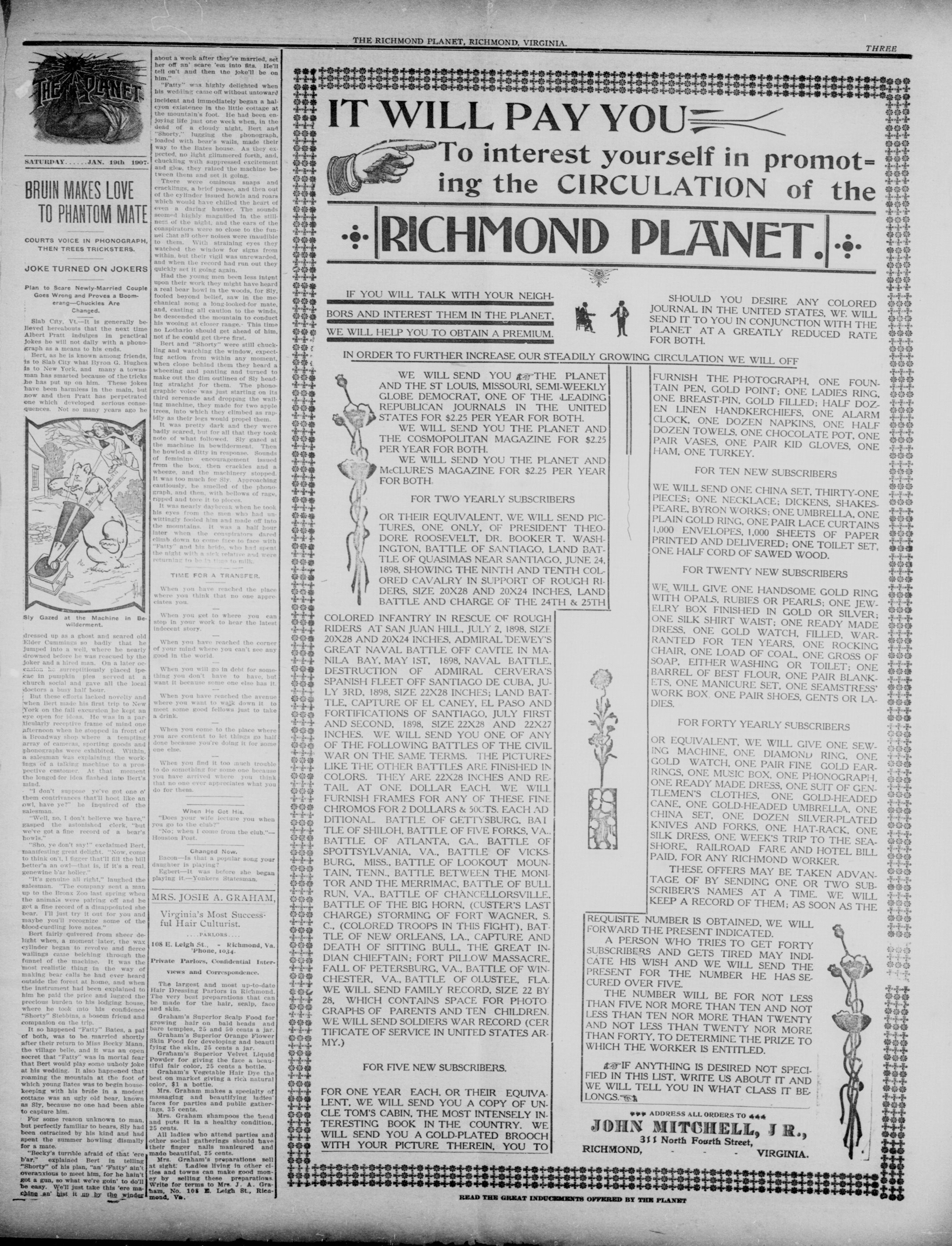
IF YOU WILL TALK WITH YOUR NEIGH-
SST NS EE
RS AND INTEREST THEM IN THE PLANET.
es haa ea a nnn eae OP a, a a | =
PLANET ATA GREATLY REDUCED RATE 5
FOR BOTH. 3
iG CIRCULATION WE WILL OFF &
EA WE WILL OFF
FURNISH THE PHOTOGRAPH, ONE FOUN. #
TAIN PEN, GOLD POINT; ONE LADIES RING, &
ONE BREAST-PIN, GOLD FILLED; HALF DOZ. 2
EN LINEN HANDKERCHIEFS, ONE ALARM +
CLOCK, ONE DOZEN NAPKINS, ONE HALF
DOZEN TOWELS, ONE CHOCOLATE POT, ONE S
PAIR VASES, ONE PAIR KID GLOVES, ONE ¥
HAM, ONE TURKEY. :
FOR TEN NEW SUBSCRIBERS ki
WE WILL SEND ONE CHINA SET, THIRTY-ONE *
PIECES; ONE NECKLACE; DICKENS, SHAKES. @
PEARE, BYRON WORKS; ONE UMBRELLA, ONE. £
PLAIN GOLD RING, ONE PAIR LACE CURTAINS f
1.000 ENVELOPES, 1,000 SHEETS OF PAPER
PRINTED AND DELIVERED; ONE TOILET SET,
ONE HALF CORD OF SAWED WOOD. z
FOR TWENTY NEW SUBSCRIBERS =
WE. WILL GIVE ONE HANDSOME GOLD RING &
WITH OPALS, RUBIES OR PEARLS; ONE JEW. 3
ELRY BOX FINISHED IN GOLD OR SILVER; +
ONE SILK SHIRT WAIST; ONE READY MADE #
DRESS, ONE GOLD WATCH, FILLED, WAR. Z
RANTED FOR TEN YEARS, ONE ROCKING *%
CHAIR, ONE LOAD OF COAL, ONE GROSS OF #
SOAP, EITHER WASHING OR TOILET: ONE +
BARREL OF BEST FLOUR, ONE PAIR BLANK. §E
ETS, ONE MANICURE SET, ONE SEAMSTRESS” 7
WORK BOX, ONE PAIR SHOES, GENTS OR LA- &
DIES. +
FOR FORTY YEARLY SUBSCRIBERS =
OR EQUIVALENT, WE WILL GIVE ONE SEW- %&
ING MACHINE, ONE DIAMOND RING, ONE 7
GOLD WATCH, ONE PAIR FINE GOLD EAR. +
RINGS, ONE MUSIC BOX, ONE PHONOGRAPH,
ONE READY MADE DRESS, ONE SUIT OF GEN. =
TLEMEN'S CLOTHES, ONE GOLD-HEADED +
CANE. ONE GOLD-HEADED UMBRELLA, ONE #
CHINA SET, ONE DOZEN SILVER-PLATED =
KNIVES AND FORKS, ONE HAT-RACK. ONE %
SILK DRESS, ONE WEEK'S TRIP TO THE SEA. #
SHORE, RAILROAD FARE AND HOTEL BILL .
PAID, FOR ANY RICHMOND WORKER. +
THESE OFFERS MAY BE TAKEN ADVAN- >
TAGE OF BY SENDING ONE OR TWO SUB. &
SCRIBER'S NAMES AT A TIME. WE WILL =
KEEP A RECORD OF THEM; AS SOON AS THE *
a
NUMBER IS OBTAINED, WE WILL *
THE PRESENT INDICATED. 2
SON WHO TRIES TO GET FORTY ce
8S AND GETS TIRED MAY INDI- =
WISH AND WE WILL SEND THE > +
FOR THE NUMBER HE. HAS SE.
ER FIVE. =
UMBER WILL BE FOR NOT LESS ;
. NOR MORE THAN TEN AND NOT 4
| TEN NOR MORE THAN TWENTY ‘
LESS THAN TWENTY NOR MORE %
rY, TO DETERMINE THE PRIZE TO
E WORKER IS ENTITLED.
NYTHING IS DESIRED NOT SPECI-
IS LIST, WRITE US ABOUT IT AND |
ELL YOU IN WHAT CLASS IT BE. {
ES i
# ADDRESS ALL ORDERS TO 444 h | i
|
| MITCHELL, J R.,
355 North Fourth Street, 7 /
, - - - VIRGINIA.
VILL HELP YOU TO OBTAIN A PREMIUM.
é , [aaiiannmesiprensenemetneeteeeiiedenmiaiainminmmememmete eee ne tee ee
Hi WE WILL SEND YOU @@-THE PLANE
AND THE ST LOUIS, MISSOURI, SEMI-WEEKI
A GLOBE DEMOCRAT, ONE OF THE LEADIN
REPUBLICAN JOURNALS IN THE UNITE
_ = p>) STATES FOR $2.25 PER YEAR FOR BOTH.
coe WE WILL SEND YOU THE PLANET AD
noe THE COSMOPOLITAN MAGAZINE FOR $2.
"Ay PER YEAR FOR BOTH.
: at WE WILL SEND YOU THE PLANET AD
3 <« "PB McCLURE’S MAGAZINE FOR $2.25 PER YEA
fe < i FOR BOTH
eee 4 FOR TWO YEARLY SUBSCRIBERS
eee |) oR THEIR EQUIVALENT, WE WILL SEND PI
ee. TURES, ONE ONLY, OF PRESIDENT THE!
rit Hi ? DORE ROOSEVELT, DR. BOOKER T. WAS!
eee ¥/ INGTON, BATTLE OF SANTIAGO, LAND BA
nae '\ TLE OF QUASIMAS NEAR SANTIAGO, JUNE
bet | \ 1898, SHOWING THE NINTH AND TENTH CO
5 ORED CAVALRY IN SUPPORT OF ROUGH F
ot | DERS, SIZE 20X28 AND 20X24 INCHES, LAN
.* BATTLE AND CHARGE OF THE 24TH & 25T
i COLORED INFANTRY IN RESCUE OF ROUGH
big RIDERS AT SAN JUAN HILL, JULY 2, 1898, SIZE
G@ 20X28 AND 20X24 INCHES, ADMIRAL DEWEY'S
a GREAT NAVAL BATTLE OFF CAVITE IN MA.
bi NILA BAY, MAY IST, 1898, NAVAL BATTLE.
ay DESTRUCTION OF ADMIRAL CERVERA’S é
hiiy SPANISH FLEET OFF SANTIAGO DE CUBA, JU- f
Fie LY 3RD, 1898, SIZE 22X28 INCHES; LAND BAT-
Rey TLE, CAPTURE OF EL CANEY, EL PASO AND |
aay FORTIFICATIONS OF SANTIAGO, JULY FIRST .
kkk AND SECOND, 1898, SIZE 22X28 AND 22X27 >
RE INCHES. WE WILL SEND YOU ONE OF ANY é
#4: OF THE FOLLOWING BATTLES OF THE CIVIL ;
eq WAR ON THE SAME TERMS. THE PICTURES \
beg LIKE THE OTHER BATTLES ARE FINISHED IN
#4 COLORS. THEY ARE 22X28 INCHES AND RE
s&% TAIL AT ONE DOLLAR EACH. WE WILL
be} FURNISH FRAMES FOR ANY OF THESE. FINI
pf =CHROMOS FOR 2 DOLLARS & 50CTS. EACH AD
si@ DITIONAL. BATTLE OF GETTYSBURG, BAI :
bi TLE OF SHILOH, BATTLE OF FIVE FORKS, VA..
ree BATTLE OF ATLANTA, GA. BATTLE OF
$4) SPOTTSYLVANIA, VA., BATTLE OF VICKS.
kk BURG, MISS. BATTLE OF LOOKOUT MOUN-
ee? TAIN, TENN., BATTLE BETWEEN THE MONI-
fei TOR AND THE MERRIMAC, BATTLE OF BULL
seq RUN. VA. BATTLE OF CHANCELLORSVILLE.
ree BATTLE OF THE BIG HORN, (CUSTER’S LAST
%% CHARGE) STORMING OF FORT WAGNER, S. Ri
Seq C» (COLORED TROOPS IN THIS FIGHT), BAT- FC
: TLE OF NEW ORLEANS, LA., CAPTURE AND
¢ DEATH OF SITTING BULL, THE GREAT IN- SL
sim DIAN CHIEFTAIN; FORT PILLOW MASSACRE, Cs
Sit FALL OF PETERSBURG, VA., BATTLE OF WIN. PF
er CHESTER, VA., BATTLE OF OLUSTEE, FLA. cl
WE WILL SEND FAMILY RECORD, SIZE. 22 BY
i 28, WHICH CONTAINS SPACE FOR PHOTO Tr
‘€ GRAPHS OF PARENTS AND TEN. CHILDREN. LE
ee WE WILL SEND SOLDIERS WAR RECORD (CER AN
"E% TIFICATE OF SERVICE IN UNITED STATES AR- Tt
ae MY.) WI
HG
: FOR FIVE NEW SUBSCRIBERS, a
"
FOR ONE YEAR EACH, OR THEIR EQUIVA. Me
: LENT, WE WILL SEND YOU A COPY OF UN. ae
CLE TOM'’S CABIN, THE MOST INTENSELY IN-
TERESTING BOOK IN THE COUNTRY. WE d
WILL SEND YOU A GOLD-PLATED BROOCH
Eee See = Oa RI
eae dee ee ae ne eek Oke eek ache bee cee
TIME FOR A TRANSFER,
When you have renched the place
where you think that no one appre-
ciates you.
When you Ket to where you can
stop In your work to hear the latest
Indecent story.
When you have reached the corner
‘of your mind where you can't seo any
good In the world.
When you will go in debt for some-
thing you don't have to have, but
want it because some one else has it,
When you have reached the avenue
where you want to walk down it to
meet some good fellows just to take
a drink.
Whon you come to the place where
you are content to let things go half
done because you're doing it for some
one else.
When you find it too much trouble
to do something for some one because
you have arrived where you think
that no one ever appreciates what you
do for them.
When He Got His.
“Does your wife lecture you when
you go to the chub?
“No; when I come from the elub."—
Houston Post.
Changed Now.
Bacon—Is that a popular song your
daughter is playing?
Egbert—It was before she began
playing it—Yonkers Statesman,
te eee
MRS. JOSIE A. GRAHAM,
Virginia’s Most Success:
ful Hair Culturist.
s+ /PARLORS....
108 E. Leigh St., = Richmond, Va,
‘Phone, 1034.
Private Parlovs, Confidential Inter-
views and Correspondence.
The largest and most up-to-date
Hair Dressing Parlors in Richmond.
The very best preparations that can
be made for the hair, sealp, face
and skin.
Graham's Superior Scalp Food for
growing hair on bald heads and
bare temples, 25 and 50 cents a jar.
Graham's Superior Orange Flower
Skin Food for developing and beauti
tying the skin, 25 cents a jar.
Graham’s Superior Velvet Liquid
Powder for giving the face a beau-
tiful fair color, 25 cents a bottle.
Graham's Vegetable Hair Dye the
best on market giving a rich natural
color, $1 a bottle.
Mrs. Graham makes a specialty of
massaging and beautifying ladies"
faces for parties and public gather-
ings, 35 cents.
Mrs. Graham shampoos the head
and puts {t in a healthy condition,
25 cents.
All ladies who attend parties and
other social gatherings should ‘ave
their finger nails manteured and
made beautiful, 25 cents.
Mrs. Graham's preparations ell
at sight: Ladies living in other cl-
ties and towns can make good mon-
ey by selling these preparations.
Write for terms to Mrs. J. A. Gra-
bem, No. 108 B. Leigh St, Riea-
os SEEEESSESSESUSSSARERig arSEREaHEEIEHEIDIDa nates iatatatatasaea
FOUR
THE PLANET
Published every Saturday by JOHN MITCHELL,
JR., at 311 North 4th Street, Richmond, Va.
communications intended for publication
will be sent so as to reach us by Wednesday.
For one inch, one insertion, .50
For one inch, each subsequent insertion, .40
For two inches, three months, .60
For two inches, six months, .10
For two inches, twelve months, .40
For two inches, twelve months, .20
Marriage and Funeral Notices, one inch, .50
Standing and Transient Notices per line, .10
POSTAGE STAMPS OF A HIGHER DE-
NOMINATION THAN TWO CENTS NOT
RECEIVED ON SUBSCRITIONS.
THE PLANET is issued weekly. The subscript-
price is $1.50 per year in advance.
There are FOUR ways by which money can be sent by mail at our task.—In a Post Office Money Order, by Bank Check or Drift, or an Excuse Card, by a Post Office Card, which can be procured, in a Registered Letter.
MONEY ORDERS—You can buy a Money Order at your Post Office, payable at the Richmond Post Office, and we will be responsible for safe arrival.
EXPRESS MONEY ORDERS can be obtained at any office of the American Express Co. the United States Express Co., and the Well Fare Company. We will be responsible for money sent to your companies. The Express Money Order is a safe and convenient way for forwarding money.
REGISTERED LETTER—If a money Order is registered, your letter will be your result, your Postmaster will Register Letter you wish to send us on payment of ten cents. Then, if the letter is lost or stolen, it can be sent money in this manner at our risk.
We cannot be responsible for money sent in letters in any other way than one of the four ways mentioned above. If you send your money in another way, you must do it at your risk.
RENEWAL, ETC.—If you do not want *TREAT
RANTER* continued for another year after your
subscription has run out, you then notify us by
e-mail and we will decontaminate the envelope.
We decided that subscribers to newspaper, who do
not order their paper discontinued at the expiration
of time for which it has been paid, should pay the payment of the subscription up to date when they order the paper still
continued.
COMMUNICATIONS—When writing to us to
renew your subscription or to discontinue your
subscription, you should give your name and address
in full pressure we cannot find your name on
our books.
CHANGE OF ADDRESS—In order to change
the address of a subscriber, we must be sent
the former as well as the present address.
Entered at the Post-Office at Richmond, Va.
as second-class matter.
PRESIDENT ROOSEVELT'S MES
SAGE.
"Farewell, a long farewell to all my greatness!
This is the state of man: to-day he puts forth
The tender leaves of hope, tomorrow blossoms.
And bears his blushing honours thick upon him:
The third day, comes a frost, a killing frost"—Shakespeare.
President Roosevelt's Message to the United States Senate last Monday was unquestionably the weakest of all his efforts to justify his remarkable conduct in connection with the Brownsville, Texas affair. It did not affect the question at is sue at all and only tended to emphasize the position taken by Senator J. B. Foraker that the men, charged with the crime had the right to a court of enquiry, a court-martial or a trial by a jury of their peers. It also riveted another fact that the dismissal and the debarring of all of these troops from re-enlistment in the army and navy of the United States was a punishment for the crime of murder and for "the crime of silence."
At the conclusion of its reading, the distinguished Ohio Senator well said:
"The President tells me it is conclusive. But it does not remove the objection I have had from the beginning of this proceeding. What I have been trying to contend for, and I hope I will be successful, is to secure a hearing for the men charged with this serious crime. This testimony has been taken as the other was, behind closed doors, without anybody representing the men.
"That is the reason I shall not desist, notwithstanding what the President has said as to the character of it from pressing for an investigation of the subject where especially the men who are charged with the crimes of murder, perjury and conspiracy can be heard to the end that if they can establish any facts in their favor they may have an opportunity to do so."
This is safe ground and upon it Senator Foraker can stand with double assurance that he can win out. President Roosevelt cannot win in an assault upon this position. If there are men in Companies B C, and D of the Twenty-fifth Infantry guilty of crime, let them be "run to earth" and punished, but when it comes to meting a penalty to 167 men for alleged offenses of ten or twenty of them, the moral sensibilities of the nation are shocked and the enthusiastic supporters of the President in his advocacy of a square deal saily turn away. President Roosevelt took the following oath, when he assumed the duties of office:
"I do solemnly swear that I will
faithfully execute the office of President of the United States, and will to the best of my ability, preserve, protect, and defend the Constitution of the United States."
The Constitution of the United States, Article II, Section 2, reads:
"The President shall be Commander-in-chief of the army and navy of the United States, and of the militia of the several states, when called into actual service of the United States***, and he shall have power to grant reprieves and pardons for offenses against the United States, except in cases of impeachment."
Nowhere in this section or in the Constitution is it set forth that he has the power to punish. He can relieve soldiers from punishment after they have been found guilty in the states and territories by court martial proceedings and in the territories by jury trials or in the states by jury trials when such offenses are tried in United States courts upon charges of a breach of the laws of the United States.
President Roosevelt made a most remarkable admission, one that acknowledges that he has wronged the members of Companies B, C, and D of the Twenty-fifth Infantry. Here is his language:
"I have gone most carefully over every issue of law and fact that has been raised. I am now satisfied that the effect of my order dismissing these men without honor was not to bar them from civil employment under the government, and therefore, that part of the order which consisted of a declaration to this effect was lacking in validity, and I have directed that such portion be revoked."
This then is a forced admission that he erred grievously in the first instance. The public at large will necessarily enquire, what has become of Mr. Roosevelt's attorney general and does he ever consult him before he acts or does he seek for information afterwards? President Roosevelt has designated every man in this battalion as being guilty of murder and assassination or as being accessory before the fact in connection therewith. He must prove this either before a jury or before a court-martial or else he has been and is guilty of libel.
Sworn affidavits are good in a way, but this same evidence is often materially changed when the witnesses are subjected to skillful examination by competent attorneys. President Roosevelt has submitted exparte affidavits or rather statements of one side only, and he has persistently refused to consider even the plausibility of the other side of this contention. He is accordingly biased and would be disqualified as a juror in this case in any court in the land.
He has green glasses and everything looks green to him. There is, in our judgment, more in this case than has been brought to the surface, and we are of the opinion that Senator Foraker holds to the same view of this all important question. What has President Roosevelt done? He tried the case upon the report of Inspector General Garlington. He punished the men upon this same report, confessedly exceeding his authority as President of the United States in so doing and flieting a grievous wrong.
He refused a re-hearing of the case. The granting of this would have enabled him to correct his blunder. He stood by a wrong position, until his friends in the United States Senate informed him that they could not support him in the position he had taken, and then he impenetually backed down, yet making an effort and as far as his powers go insisting that the innocent shall be forever debarred from reenlisting in the army and navy of the United States. We confess that why they should ever want to reenlist in any branch of the service has not been clear to us in view of the industrial activity and money-making inducements now being offered in civil life.
He branded these 167 men, all but twenty at the outside limit are admitted to be innocent as murderers, midnight assassins and perjurers. He has up to this writing refused to give them the benefit of either a court of enquiry or a court martial, as provided for in the Revised Statutes. He has refused also to recognize the fact that the punishment of a soldier can be made only through a court-martial proceeding. He has appeared to the amazement of the country in the position of prosecuting attorney instead of as the Commander-in-chief of the army and thereby has lowered the dignity of the high office which he occupies.
President Roosevelt has ignored that section of our criminal jurisprudence which declares that "every man shall be presumed innocent until he is proven guilty" and there is no tribunal to settle the question of his guilt other than a court of law in civil life or a court martial under military procedure. This is the essence of law and is the fundamental principle of civil legal procedure, recognized alike also in military procedure.
Even in his last message, President Roosevelt insists that these men shall prove themselves innocent and prescribes this as the fundamental basis for the removal of the penalty that he has imposed by sum
THE RICHMOND PLANET. RICHMOND VIRGINIA
mary processes. Article V of the Constitution of the United States reads:
"No person shall be held to answer for a capital, or otherwise infamous crime, unless on a presentment or indictment of a grand jury, except in cases arising in the land or naval forces, or in the militia, when in actual service in time of war or public danger; nor shall any person be subject for the same offense to be twice put in jeopardy of life or limb; nor shall be compelled in any criminal case to be witness against himself, nor be deprived of life, liberty or property without due process of law; nor shall private property be taken for public use without just compensation."
It is admitted that soldiers, who commit breaches of the peace against communities are subject to trial and punishment by civil tribunals. They are therefore guaran teed the rights set forth in this section of the Constitution. Where the offenses arise wholly within the confines of the land or naval forces, they are subject to the regulations of the army, and they may be punished under these regulations for any crime or offense against the laws of this country. It must however be done "by due process of law." This is Senator Foraker's contention and it will be at once seen that Pres. Roosevelt's last message to the United States Senate does not materially affect the situation. It may have been sent for the purpose of prejudicing the case of the soldiers, but in judicial minds, it will fail of its purpose.
No citizen of color has attempted to defend the soldiers guilty of crime against the laws of this country or those of any state. We have insisted that these men had their inherent rights under the law and these rights had been ignored and that innocent men have been made to suffer for the alleged crimes of the guilty. According to President Roosevelt's ipse dixit, every grand jury would be the trial body and its decision would be sufficient to warrant an execution. As a matter of fact, there are a large proportion of the people indicted by grand juries who are subsequently declared innocent.
Mr. Roosevelt seems anxious to reform the world according to his notions rather than according to the teachings of the centuries. The position he now occupies is that of every mob of the Southland; namely, that because a heinous crime has been committed somebody must be punished. When you urge that the wrong men have been made the victims, they come to you with burial details of the hideousness of the outrage. For forty years, Mr. Roosevelt has been served with cases of outrages, cruelties and barbarisms perpetrated upon the inhabitants of Negro communities, but we have no record of his ever having written works thereon or even offering to lead a crusade to betray the conditions in the Southland. Since his trip through this sunny land he has become imbued with Rooseveltian notions and so far as this punishment of innocent Negroes is concerned, he is well-nigh "out-Tillmaning" Tillman, in his anxiety to destroy 167 black men who were in the United States Army,
Mr. Roosevelt tells of his power as Commander-in-chief of the Army Here is Senator J. B. Foraker's defiant answer to his assumption of authority:
"There is no autocracy in this country, or autocratic, dictatorial, unrestrained, and unrestricted power; no, not even in the Commander-in-chief of the army. All power is derived from the Constitution."
There has been no questioning of this position by the President's supporters in this Senate. Senator Foraker asked another question which has not as yet been answered, save in the admission of the President of the United States in his special message of last Monday, when he condemded that he had transcended his powers and that he had done a grievous wrong to the soldiers, when he attempted to debar them from civil employment under the government. Senator Foraker asked:
"Is the President of the United States over and above the law? Can he ignore it?"
President Roosevelt has virtually answered these questions in the negative. Then why did he ignore this section of the law to which Senator Foraker referred in the following language?
"Each individual has a right to the benefit of the 146th regulation of the army—that he should have a board of enquiry, and should have it without asking for it. It was the duty of his superior officer to know of his rights, and advise him of them and to protect him in them. But it was not so. If the President can discharge men because of a state of facts that cause suspicion, he can say, 'I'll dismiss without facts.' He'll tell you, as in fact the Senator from Massachusetts has told you—it is none of your business."
It will be seen then that in submitting additional evidence as to the guilt of certain unknown soldiers he has emphasized his error in punishing individuals not known to be guilty of the crimes alleged. There is not a coroner's jury, sitting in legal form over the body of the victims of a mob that does not bring in
a verdict that this one or that one came to his death at the hands of persons unknown to the jury. Often, incontestable evidence is adduced to prove that the lynchers were from another adjacent county and it would be equally as sensible to haul into the court every resident of the county, referred to and make them prove their innocence. The law says that it is with the commonwealth, to prove their guilt.
This is as true in Texas as it is in Washington and it may be said in Senator Culberson's favor that he boldly announced that the reason the soldiers were not held was because the commonwealth did not desire to punish the innocent. We have always believed, however and this is merely a matter of opinion that the War Department and President Roosevelt gave these Texans assurances that the battalion would be punished and this accounted for the alacrity with which the troops were permitted to leave Texas.
President Roosevelt has adjurged these colored soldiers guilty and as far as he was able so to do has punished them. He has publicly libelled them as murderers, midnight assassins and perjurers and this too upon exparate evidence and in plain violation of Article VI of the Constitution of the United States. It is as follows:
"In all criminal prosecutions, the accused shall enjoy the right to a speedy and public trial, by an impartial jury of the State and district wherein the crime has been committed, which district shall have been previously ascertained by law, and to be informed of the nature and cause of the accusation; to be confronted with witnesses against him; to have compulsory process for obtaining witnesses in his favor, and to have the assistance of counsel for his defence."
All of these provisions have been violated. The machinery of the government that they serve so well has been persistently used against them. They would to-day be without "counsel" in the United States Senate were it not for the chivalric patriotic course of the distinguished Senator from Ohio, who has taken the part of the "under dog" in this fight. These soldiers have not been confronted by witnesses, but affidavits have been made by witnesses, whose reputations for veracity have not been placed under the merciless search light of a skillful cross-examination and the strenuous Roosevelt, whose word is law and whose opinion passes as gold coin, with the average citizen of this Republic uses his great influence and mighty power to wipe out the reputations of this whole battalion and to consign their children and their children's children to the opprobrium and scorn which go with this kind of discharge from the army.
We feel that we have been wounded deeply, but again, we feel ourselves using the words of the departed McKinley, "It's God's way. His will be done, not ours."
The time is not far distant, when the fuming, fretting occupant of the White House will be called to answer for deeds done in the body. He will then be made to realize just how he would feel were he the innocent member of that same battalion. With all of his weaknesses, with all of his bravado, with all of his blood-guiltiness, with all of his vaporings, with all of his heartless utterances, with all of his contempt for sham, Senator B. R. Tillman of South Carolina was right when he declared that there is no such provision in our criminal procedure that provides punishment for "the crime of silence."
This is a new crime of the Roosevelt creation and we express our abhorrence of the doctrine that would punish men charged with such an offense.
It is said that the people or a great many of them are tired of the reign of the present Czar of Russia The transfer of the distinguished occupant of the White House to that far-away country, with a kingly crown upon his brow would tend to awaken dormant energies and realize that despotism as it is could be made worse by the importation of one from abroad.
We are opposed to President Roosevelt's position on this "Browns ville question"—bitterly opposed to it in every sense of the word for we see in it the essence of a principle, which if carried to its logical conclusion will lead to anarchy and encourage lynch-law. It is the sum and substance of all that we have been opposing for more than twenty years and we conclude by saying, "Punish the guilty men; but, sir, let the innocent ones go free."
"O. fear not in a world like this, And thou shalt know ere long,—Know how sublime a thing it is To suffer and be strong."
—Longfellow.
President Roosevelt is against the innocent Negroes of the Twenty-fifth Infantry and against the guilty ones of that same organization, while according to his orders sending all of the Negro soldiers to the Philippines, we are led to enquire what portion or what part of the Negro soldiers is he in favor of?
— Subscribe to the Richmond, Va
PLANET. Only $1.50 per year.
GOVERNOR STUART TAKES OFFICE
Pennsylvania Ex-cursive Inaugurated With Simple Ceremonies.
EXERCISES HELD IN OPEN AIR
Harrisburg, Pa., Jan. 16—Edwin S. Stuart was inaugurated governor of Pennsylvania with simple ceremonies in the presence of a great company of people. The ceremonies took place on a stand erected in front of the new capitol. At the close the governor and the inaugural party went to the executive mansion, where they reviewed the inaugural parade. The governor sent to the senate the appointment of Archibald B. Miller, of Philadelphia, as private secretary. The appointments of Robert McAfee.
EDWIN S. STUART
of Allegheny, as secretary of the commonwealth; M. Hampton Todd, of Philadelphia, as attorney general, and Thomas J. Stewart, of Norristown, as adjutant general, were also sent to the senate.
The governor held a public reception in the reception room of the executive suite of the new capitol. He was assisted in receiving by the members of his cabinet and the presiding officers of the senate and house and their ladies. At the close of the reception the party went to the inaugural ball at the City Grays Armory.
Robert S. Murphy, of Johnstown, was also inaugurated lieutenant governor. The exercises were brief and were held in the senate chamber.
There was a crowd of people at the executive mansion, and the appearance of Mr. Stuart was the signal for cheers, which the governor smilingly acknowledged. Then the march to the capitol commenced, and the long line of carriages was driven through State street to the capitol, where the ceremonies took place.
The ceremonies began with a prayer by Rev. Dr. J. Gray Bolton, of Philadelphia, a personal friend of the incoming governor. Then, after music by the First Regiment Band, of Philadelphia, the certificate of election, which authorized the commissioning of Edwin S. Stuart as the 27th governor of Pennsylvania, was read. This was done by the chief clerk of the senate, Frank S. Judd. As he concluded, Supreme Court Justice Fell administered the oath of office. A moment later there was a shaking of hands among those about the governor, Governor Pennypacker being among the first to extend a greeting. Then the deep boom of cannon commencing the gubernatorial salute of 17 guns echoed along the hills of the Susquehanna.
Mr. Stuart delivered his inaugural address, and immediately after the greeting and before the reverberations of the cannon had died away, he had begun to speak. When he had finished he was again greeted and slowly made his way to the carriages, which were driven out State street to Front and down along the river front to Market street, where they took the head of the line in the procession for the parade. When the parade had passed the reviewing stand at the executive mansion, Governor Stuart, escorting his sister, entered the mansion, his home for the next four years.
Soon after the inauguration Governor Pennypacker took a Philadelphia & Reading train for his country home at Schwenksville. He was now an ex-governor one of the three living men who have filled the chair. As he moved from among the throng there were many to shake his hand and wish him long life and happiness. The members of the governor's staff and of the inaugural committee escorted him to the railroad station.
JUSTIFIES REMOVAL OF SOLDIERS
President Submits to Senate More Evidence of Browners Affair
gence of Brownsville Affray.
Washington, Jan. 15. — President Roosevelt sent to the senate a special message regarding the Brownsville incident, which gives the additional evidence collected by Assistant Attorney General Purdy and Major Blockson, who were sent to Texas by the president to investigate the affair. The president submitted with his message various exhibits, including maps of Brownsville and Fort Brown, a bandoleer, 33 empty shells, seven ball cartridges picked up in the streets a few hours after the shooting; three steel-jacketed bullets and some scraps of the casings of other bullets picked out of the houses into which they had been fired.
The president declares that the evidence is positive that the outrages of August 13 were committed by some of the colored troops that have been dismissed, and that some or all of the members of the three companies of the 25th infantry had knowledge of the deed and have shielded the guilty persons. The negro troops are referred to by the president in his message as "midnight assassins," and he declares that very few, if any, of the soldiers dismissed "without honor" could have been ignorant of what occurred. That part of the order which bars the soldiers from all civil employment under the government is revoked by the presi-
THE MASQUERADER
By Katherine Cecil Thurston Author of "THE CIRCLE," etc.
TO BEGIN IN OUR NEXT ISSUE
PICTURES BY PARKER
Here is the masquerader with a woman kneeling to him.
And what do you think of it?
Repress your indignation, my friend.
Don't get your gun until you have read the extraordinary story of
The Masquerader
The oldest contributor to the oldest magazine in England, Blackwood's, while The Masquerader was appearing serially in that publication, wrote the editor:
"Never since I waited feverishly sixty years ago for 'Monte Cristo' have I been so excited by a story. And Mrs. Thurston has given me what Dumas did not — a perpetually increasing wonder as to how the adventure is to end."
dent. This clause, the president says, was lacking in validity. The discharged troops, however, will be forever barred from re-enlisting in the army or navy, and as to this the president says that "there is no doubt of my constitutional and legal power." The president reiterates his former statement that the facts not only warranted his action, they demanded it, and made such an order imperative. The failure to take the dismissal action would have found him false to his duty to the nation.
OIL TRUST AGAIN INDICTED
Ohio Grand Judy Returns 939 Counts Against Standard and Others
Against Standard and Others.
Findlay, O., Jan. 15.—The January panel of the York county grand jury, which has been in session for the past week, reported to Judge Schroth, who was temporarily occupying the bench of Judge Duncan. In the report there are 929 indictments against the Standard Oil Company of New Jersey; the Standard Oil Company of Ohio, the Ohio Oil company, Buckeye Pipe Line company, the Solar Refinery company, the Manhattan Oil company, John D. Rockefeller, H. H. Rogers, Wesley Tilford, John D. Archbold, Frank Q. Barstow, William Rockefeller and F. C. T. Cutthong. They are formally charged with being members of a trust for conspiracy against trade. There are 525 words in each indictment, or a total of 452,975 words. Each case will be docked separately and the sheriff's office will be swamped for some months to come.
If Hancock county wins in each case when they are tried fines can be imposed aggregating $8,000,000. When the report of the grand jury was filed, Prosecutor David on his own motion nolled the indictments returned last September against John D. Rocke feller, M. G. Vitas, J. M. Roberts and H. P. McIntosh, the last three named being officials of the Standard Oil Company of Ohio.
WILL FOR $1,000,000 A FORGERY
Court So Declares In Rejecting Schoolley's Testament.
Scranton, Pa. Jan. 14.—George R. Schoolley's attempt to capture the Crawford estate of over $1,000,000 received a hard setback. Judge Sando, in the orphans' court, handed down an opinion in which he makes it clear that he believes the will presented by Schoolley is a forgery.
Schoolley resides in Philadelphia and was a cousin of the late James L. Crawford, president of the People's Coal company, of this city, who died in Florida on January 19, 1905, leaving an estate worth nearly $2,000,000. Soon after his death Mrs. Crawford had his will probated. It left practically all of the estate to her.
Sixteen months later Schooloy produced a will, which he alleged was made at a later date than the one probated by Mrs. Crawford. This gave Schooloy the major portion of the Crawford estate. Then he began his fight to have this will recognized. He is now under indictment in this county on a charge of forging the signature of Mr. Crawford to the will.
In the opinion Judge Sando declares that the evidence furnished to prove the will ungenuine is so overwhelming that the court has no other course than to refuse to consider the document, although two witnesses have sworn that they witnessed Crawford sign the will in favor of Schooloy. Attorney S. B. P. counsel for Mr. Schooloy, says that an appeal to the supreme court will be taken.
HIS BODY FOUND IN RIVER
Mysterious Disappearance of Philadelphia Clubman. Solved.
Philadelphia, Jan. 14—The body of Francis X. De Lone, the young clubman of this city, whose riderless horse was found in Fairmount Park on Wednesday, was recovered in the Schuylkill river. The body was found near a bridge which spans the river, and on which the young clubman was last seen riding his horse. It is believed that his mount became unmanageable, and that De Lone was thrown over the guard rail into the water. This theory is held by the police and De Lone's friends and relatives, and is borne out by the statement of a man who says he saw the young man trying to control his horse on the bridge a short time before the animal was found wandering in the park. When the police examined De Lone's body his jewelry and money were found intact.
V. J. MORRIS
She drew quite close to Loder and slid gently to her knees.
FAVORABLE REPORT ON C. & D. CANAL
Route Across Delaware and Maryland
May be Bought by U. S.
IT HAS MANY ADVANTAGES
Washington, Jan. 14. — A report favorable to the present Chesapeake & Delaware canal, or back creek route across the Maryland and Delaware peninsula, has been submitted to Secretary Taft by the Chesapeake & Delaware canal commission, consisting of General Felix Agnus, chairman; Major C. A. F. Flagler, U. S. A., and Civil Engineer Frank Taylor Chambers, U. S. N.
This commission was appointed last summer to report upon the back creek route and the Sassafras river routes and the construction of a free and open waterway with sufficient depth to accommodate the largest ships ships affloat. The present route is held to be more desirable because it has equal commercial and strategic advantages and will, in the opinion of the commission, be $2,150,000 cheaper than the other route.
It is recommended in the report that not more than $2,514,289 be paid for the present canal.
The commission further recommends that the present canal be purchased without delay and that it be gradually widened into a large waterway capable of accommodating ships of any draft.
Although there were many arguments before the commission for a shallow canal between the Delaware and Chesapeake bays which would supplement the proposed barge canal between Beaufort, N. C., and Norfolk, Va., the commission is firmly of the opinion that nothing less than a 35 foot canal should be constructed. Estimates for a canal of this depth and with a minimum width of 150 feet are submitted. The width is extended to 200 feet in marshes and in curves is increased to 350 feet. A sea level canal of the dimensions named would in the opinion of the commission cost $20,621,322. With a 30 foot channel such a canal would cost $17,312,064.
Such a canal would shorten the distance between Baltimore and Philadelphia 323 miles and would lessen the distance between Baltimore and the mouth of the Delaware by 184 miles. The report states that all hearings conducted by the commission showed congestion of freight throughout the east which the railways are unable to handle satisfactorily, and the development of waterways are urged as necessary to meet the great demand for transportation.
F. C. FAIRBANKS INDICTED
Jury In Securing Marriage License.
Steubenville, O., Jan. 16.—A sensation was created here by the grand jury returning an indictment for perjury against F. C. Fairbanks, son of Vice President Fairbanks, for perjury in swearing relating to his marriage to Miss Scott, of Pittsburg, Pa. The charge is that Mr. Fairbanks went to Steubenville and disguised himself as a working man and said that he was a workingman of Adams county and that Miss Scott was a resident of the county.
On this statement he secured a marriage license and they were married and left the town immediately afterward. The prosecutor says that the papers will be served upon Mr. Fairbanks as soon as it can be done.
AGED MAN'S CRIME
Shot Young Man, Fired His Own Barn
And Then Committed Suicide.
and Then Committed Suicide.
Coudersport, Pa., Jan. 15.—Edward Mecham, 77 years old, went to the home of M. H. Burton, a young man, three miles from here, and shot and dangerously wounded him in the presence of his mother. Mecham twice shot Burton at close range. After the second shot Burton clinched with his aged assailant, and the pair fell over a high embankment. Mecham broke away from the wounded man, and going to his home, set fire to his barn and then ended his life by sending a bullet into his own brain. The aged suicide is said to have labored under the halluciation that Burton had wronged him.
THE PLANET
WOMAN OFFERS UP LIFE AS SACRIFICE
SEEKS DEATH IN FIRE TO SAVE
SON FROM PERDITION.
ATTEMPTS TO BURN HOME
Chicago Mother Declares Child Who
Had Recently Died Was Doomed
to Fires of Hell Through Her
Oversight.
Chicago.—Dominated by the idea that only a sacrifice of herself to the flames would avail to release her dead son from eternal punishment, Mrs. Stella Bowman the other morning set fire to her home on California avenue. When firemen reached the building and burst in the door they found the old woman kneeling in an attitude of prayer near her bed with a bible clasped in her hands and the flames all about her. Mutely she struggled with her rescuers and begged to be allowed to remain in the burning house to face death. The sacrifice of her life, she believed, had been demanded of her because a fancied fault she had allowed her son to die without the consolations of religion.
The time for her attempt upon her life was carefully chosen. She waited until her husband, Peter Bowman, and her daughter Grace had left for the morning service at the Dutch Reformed church. They urged her to accompany them, but she refused.
After they had left the house she took a can of kerosene from the kitchen and emptied its contents over the bed and furniture in her own room. She saturated the bedding and set the bed on fire. Then she kneeled with the bible in her hands to await the horrible death which she felt would release her son from torture.
Neighbors saw smoke issuing from the windows of the house and a telephone call was sent in to a nearby engine house. The firemen arrived none too soon.
When they burst in the door they saw the bent figure of an old woman huddled together on the floor in the front room facing the flames, which had communicated themselves to the furniture and were drawing rapidly nearer. Startled by the noise of the crashing wood, the old woman turned upon her rescuers and threw up her hands in a mute appeal to be left to the death she had chosen. She was carried struggling from the house and taken to the station.
It is the belief of her family that her mind has become deranged through worry. A son, Peter Bowman, Jr., died last March of a hip disorder. During the ten months that he was confined to his bed Mrs. Bowman
A woman kneeling in prayer.
The Flames Were Rapidly Drawing Near Her.
took care of him. Only once, when for two weeks he was at the hospital, was he out of her charge. The strain is believed to have resulted in a mental breakdown.
One circumstance of the son's death in particular was a source of constant distress to the mother. Shortly before his death she had removed the bible, which always lay on a stand by his bed, to make room for his meals. She had forgotten to restore it, and when he died she believed he had been condemned to spiritual torment as a result of her oversight.
In the cell at the station she repeated her pitiful story to the officers, telling them she had seen in a vision that his release might be purchased only by a supreme sacrifice. God had come to her, she said, and ordered her to set fire to the house.
"My little Peter has never been saved," she moaned. "I saw Jesus send him down to the fires of hell. And it was I that took the bible away from him in his last hours, and I must suffer punishment."
Naked. With Ear in Tran.
La Crosse, Wis.—After stripping the clothes from Hans Olsen, a tailor, administering hot and cold water to the body, then climbing him to a roof
by a steel trap, which was fastened to one ear, allowing him to remain out of doors all night in that condition, Oscar Melgard, John Sharpe and Tony Vorruden, of Westby, pleaded guilty to a charge of assault and battery and were fined $50 and costs each.
GIRL IS SHUT IN CAVE WITH BATS AND MICE
Frightened by Bear She Jumps Into Dugout, Closes Door, and Almost Goes Insane.
Galeston, Pa.—Fifteen-year-old Sadie McMicken of the Kettle Creek section became frightened at the sight of a black bear in the woods and sought refuge in a dugout or cave, the door of which became fastened by the heavy wooden latch on the outside and made her a prisoner.
Her presence in the cave stirred up a colony of bats, which repeatedly struck the girl's face and hands with their ugly bodies. She also feared the presence of copperheads or rattlesnakes in the cave. At the end of four
M. H.
The Bats Attacked Her Furiously,
hours, when a party of searchers were
attracted to the cave by the girl's
screams, they found her in a condition
bordering on hysteria.
She had gone out at five o'clock to
the maple grove, a mile from the
house, to bring in the cows. In the
drove were two undersized heifers.
At the edge of a deep wood that runs
for miles back into the Kettle Creek
region the girl heard the wether cow's
bell and started across the woods to
intercept her.
She had got into the deep timber
when she saw what she thought was
one of the little black heifers browsing
in a laurel thicket.
She had got within a few yards of it when the animal, hearing her for the first time, suddenly turned and faced her. She found it was not a heifer, but a black bear. She ran for refuge to the dugout, used for the storage of camp kettles and other sugar-making accoutrements, which was close at hand.
The door of the cave has a latch only on the outside. She raised it, slipped into the cave, and jerked the door shut, the heavy wooden latch dropping into the catch again and making her a prisoner.
Peering through a knot hole in the door, she saw the bear scampering away through the woods. When she found that she was a prisoner she shouted, but her voice hardly penetrated the cave itself. She was compelled to be a companion of the bats and mice for four hours.
BEARS UP TO MANY TRICKS
Strip Orchard, Toboggan on Lumber Chute and Steal.
Laquin ,Pa.—The black bears of Wheelerville continue to hold the palm for being the smartest of their kind in this state.
They have stripped the apples off the orchard of a small farmer living near Cold Spring. the thievery being accomplished in two nights. Last summer, in the neighborhood of Wells-grove Junction, two cubs got to nosing around a hand truck on a lumber road and started the thing down grade, one of the bears on top of it. That bear had a sad fall and a roll among the rocks, while the truck went off the track at a curve.
Between Wheelerville and Grover, one midday recently, a bear frightened a huckster's horse until in its plunging about it scooted a crate of eggs and two firkins of honey into the roadway from the wagon and then started on a canter up the road. The bears fell to and greedily devoured the eggs and honey before the huckster got his frightened horse stopped and returned with a gun.
One morning less than a month ago an engineer on an early freight on the Susquehanna & New York railroad, pulling his train up the Ellenton grade through the Pleasant Stream timbers, saw what he first thought was a man lying on the track a few rods ahead. But the object proved to be a bear, and as the engine approached Bruin sat up on his haunches and grinned defiance at the locomotive.
But a shrill whistle from the iron horse was too much for the bear, and he shambled off into the thicket. Some of the trailmen of the Susquehanna & New York carry rifles for chance shots at inquisitive bears along the run between Monroetown and Ralston.
"Dear me! Why, I thought he hadn't written anything for years!" "He hasn't; that's why he's so popular!"
Yes. Indeed.
"Is her new book a novel with a purpose?"
"Yes, indeed! She expects to get a year's gowns out or it."—N. Y. Times.
THE RICHMOND PLANET, RICHMOND, VIRGINIA
JOB DEPARTMENT
EXCURSION WORK OF ALL DESCRIPTIONS
We print Handbills, Quarter-Sheets, Half and Whole Sheet posters, Tags, Tickets, Placards, Society Cards, Minutes, Visiting Cards, Mourning Stationery. OUR AIM is to please our patrons and to give them the best service at the lowest prices, consistent with satisfactory work. We furnish "cuts"when desired and we will arrange to complete special work in our line. When in need of any work in our line, call and see us and estimates will be furnished.
WE CAN PRINT A BILL AS SMALL AS A DODGER. A Three-Sheet Poster AS LARGE AS A FRONT DOOR. WE HAVE ONE OF THE LARGEST OF WOOD-
Our street-entrance is retired and has no objectionable features, the most fastidious lady being able to enter without embarrassment or annoyance.
It is thoroughly equipped to do all kinds of printing on short notice. We make a specialty of Society printing and work for Insurance Companies, such as Financial
EXCURS
We print Handbills, Quail
Sheet posters, Tags, Tickets, L
utes, Visiting Cards, Mourning
WE HAV
Our
OF THE
WE CAN PRINT A BILL A
A Three-S
AS LARGE AS A
Our street-entrance is reti
fastidious lady being able to e
LONG DISTANCE TELEPHONE,
PREFERRED THE JAIL
A thief broke into a millionaire's mansion early the other morning and found himself in the music room. Hearing footsteps approaching, he took refuge behind a screen. From eight to nine o'clock the eldest daughter had a singing lesson. From nine to ten o'clock the second daughter took a piano lesson.
From ten to 11 o'clock the eldest son had a violin lesson.
From 11 to 12 o'clock the other son had a lesson on the flute.
At 12:15 all the brothers and sisters assembled and studied an ear-splitting piece for voice, piano, violin and flute.
The thief staggered out from behind the screen at 12:45 and falling at their feet, cried:
"For heaven's sake, have me arrested!"
Definitions.
Mrs. Henpeck (to Mr. H., who is reading)—Your little son just asked you a question, and you didn't even notice him. You ought to be ashamed of yourself, and I shall—
Mr. Henpeck—I didn't hear him.
Mrs. H.—Oh, no, you never hear when a member of your own family speaks to you. You are deaf to the very ones you should love and cherish—deaf to—
Mr. H.—What does he want to know?
Mrs. H.—He asked you what a hermit was.
Mr. H.—A hermit, my son, is a man who loves peace and quiet.—N. Y. Weekly.
Why He Ran the Mower.
"What a beautiful lawn you have!"
remarked the visitor.
"Yes," answered the hostess; "my husband keeps it that way."
"He must be very industrious, I should think."
"Yos. He never misses a day with his lawn-mower, although I could scarcely get him to touch it until the neighbors began to complain about the noise it made."
Millinery Argument
Mrs. Modus—Well, George, you promised me a new bonnet.
George—I? Promised you a new bonnet? Great Scot! When?
Mrs. Modus—Before you married me you swore that never should disgrace rest upon my head through you; and what do you call this shabby thing but a disgrace?
Method in His Madness
Method in His Madness.
Smith—It is rumored that Brown is living a double life.
Jones—Well, if it's true I don't blame him.
Smith—Don't blame him!
Jones—No. He probably lives a double life in order to correct in one of the lives the mistakes he makes in the other—Chicago Dally News.
His Danger.
Smith—That cough will get you into trouble if you don't get rid of it.
Jones—How so?
Smith—You bark so much the police will arrest you for not having a dog license.
Cards, Policies, both straight life and benevolent, Physician's Certificates, Sick Cards, Application blanks, Agents Report Sheets, Rate Cards, etc.
VISION WORK
Charter-Sheets, Half and Whole
Placards, Society Cards, Min-
ing Stationery.
WE AN ELE
WHICH WE WILL
Stock Roof
LATEST STYLE BOND, F
AS SMALL AS A DODGER
Sheet Poster
A FRONT DOOR.
OUR PRESENT CORP OF EMPLOYE
IS WITHIN EASY REACH OF
fired and has no objectionable
center without embarrassment of
2213.
WHICH WE WILL SHOW ANY ONE DESIRING TO SEE THEM.
OUR PRESENT CORP OF EMPLOYEES ARE COMPETENT AND QUICK-WORKING. OUR OFFICE IS WITHIN EASY REACH OF THE PUBLIC, BEING WITHIN FIFTY YARDS OF BROAD ST.
WIELD HUWAN BONES AS CLUBS IN MELEE
Medical Students Display Grewsome Armament on Football Field When Attacked by Dentists.
Chicago.—Human bones were used as cudgels and an ossified arm or leg swung by a lusty medical student played a star part as bludgeon in an offensive exhibition of latter-day collegiate "rooting" on the football field of Northwestern University the other day. The eleven football warriors of the Northwestern Dental School were trying their prowess against that of the team of "medics" and between halves the melee which offended many spectators began.
It had been a 0 to 0 score during the initial part of the struggle, and the "dents," overjoyed at their success in holding the "medics" in such splendid fashion, marched on masse
H. H.
They Wielded the Human Bones with Effect.
upon the field and halted in front of the bleachers containing the rooters for the doctors.
"Come down here, you bunch of sawbones, and we will pull out your eye-teeth for you," was the general shout.
With this the "dents" leaped forward and rushed toward the bleachers. Each dental student carried a grotesque papier mache cane, and these they wielded with effect as they jumped into the stand among the "medics." The latter, Napoleon-like, blided their time. Suddenly they drew forth ghastly objects, long and glistening, tied with red and purple ribbons. Stretching forward, they met the onrushing "dents" with these terrible clubs, smashing the heads of the invaders unmercifully.
"They're using human bones on us," was the next shout of the beslegers, who retreated in bad order. Another attack was attempted, but this time the "medics" flourished the leg and arm bones fiendishly and pounded the "deuts" over head and shoulder with such energy that the
WORK OF ALL
OUR AIM
is to please our patrons and to
give them the best service and
the lowest prices, consistent
with satisfactory work.
LEGANT
SHOW ANY ONE DESIRING
from Embraced
LINE WRITING—FLAT AND
ELEVEN EYES ARE COMPETENT AND QUIET
THE PUBLIC, BEING WITHIN FAMILY
features, the most
annoyance.
FOR FURTHER
Jol
latter were compelled to give up hope of displacing their opponents from their citadel. The fracas was becoming intolerable when the whistle announcing the second half of the game sounded and the riotous rooters scampered away to obtain good seats
WINS PARDON BY BRAVERY.
Life Convict Scales Wall and Wrests Shotgun From Maniac.
Paris—An extraordinary act of bravery performed by an escaped convict has resulted in his obtaining what is practically a free pardon. The man is Francois Pivet, who seven years ago was sentenced to death for murder. The sentence was afterward commuted to penal servitude for life. Pivet, however, succeeded in escaping, and nothing more was heard of him until a day or two ago, when he reappeared at Nantes under extraordinary circumstances. A lunatic barricaded himself in his house, and from an upstairs window fired shots from a gun at the people in the street. Several persons were injured and great excitement prevailed.
Suddenly a man sprang forward and, scaling the wall of the house, wrenched the gun out of the madman's hand.
The mayor of Nantes specially congratulated the stranger on his remarkable coolness and bravery, when suddenly a policeman present recognized him as the missing convict. He was arrested and taken before the tribunal.
The trial was short but sensational. The crowd cheered and applauded Pivet, and clamored for him to be set free.
Instead of being sent back to penal servitude for life he was sentenced to one month's imprisonment, after which he will be free "in consideration of his heroic deed."
It is very injurious to the eyes to expose them to sudden changes of light or long exposure to exceedingly bright light, as the glare of snow, or ocean or stretches of white sand. Glaring colors of any kind should not predominate in the every-day surroundings. Green, as experience has taught the unlearned, is most pleasing and restful to the eyes, and so is counted by most people a beautiful color and best adapted for house furnishings. All soft, neutral shades are acceptable to the eyes, though they should not be shut away in darkness.
He—How I envy that man who has just sung a solo!
She—Indeed! I thought he had a very poor voice.
"It itt his voice I envy; it's his nerve."
"I suppose," said the new reporter, "there is a lot of jealousy in the theatrical profession?"
"Not a particle," replied the leading lady. "Why, my understudy is dead anxious for an opportunity to take my part."—Chicago Daily News.
We print Wedding Invitations, and High Class Stationery for Balls, Parties, Picnics and all entertainments of a social nature.
We print Church Envel.
ALL DESCRIBE
ins and to
service at
consistent
ink.
We furnish "cuts" when de-
complete special work in our
in our line, call and see us an
T LINE OF S
DESIRING TO SEE THEM.
oraces a full
AT AND LINEN PAPER, ENVELOP.
WE HAVE ONE OF THE
OF WOOD
Of Any Job Printing H
T AND QUICK-WORKING. OUR OFFICE
WITHIN FIFTY YARDS OF BROAD ST.
FOR FURTHER INFORMATION, AP
John Mitch
311 N. 4th St.
FOR FURTHER INFORMATION, APPLY TO
John Mitchell, Jr.,
John Mitchell, Jr.,
Jos. Evans, care Jones & Laughlin.
E. K. Thumm., 1402 Wylie Ave.
BOSTON MASS.
I. Branum, 657 Shawmut Ave.
W. White, 832 Tremont St.
NORFOLK, VA.
John Debona, 610 Church St.
T. E. W. Perry, 2 Jonee Place.
CHICAGO, ILL.
E. H. Faulkner, 3104 State St.
How Eyes Are Injured.
What He Envied.
Not the Name for It
WE HAVE ONE OF THE LARGEST ASSORTMENTS OF WOOD-TYPE Of Any Job Printing Establishment in the city.
311 N. 4th St., Richmond, Va.
OMINOUS.
GRAPHIC
DIVORCE
SURDAL
Mayme—Do you think he will change his mind about gettin' married?
Edythe—I'm awfully afraid. He's readin' nothin' dese days except about dese rich people's divorce scandals.—Chicago Daily News.
Unofficial.
A certain fayr mayd named Ellswellyn.
For her mother began bourly yellown.
When a young man placed Hys arm 'round her ways?
Say, ayn't thys wereformed spellyn?
—Chicago Daily News.
Not Quite High Enough.
Ambitious Wife—I don't see why you can't get a foreign mission, or something.
Young Husband—Too soon to hope for that, my dear. I only a police-reporter yet.—N. Y. Weirly.
PLANET DEPOTS
P. Ritzhelmer, 7 N. 134th St.
Green and Bailey, 249 E. 127th St.
J. H. Parker, 144 W. 26th St.
Charles Devan, 1.1 W. 30th St.
W. J. Buckner, 150 W. 53rd St.
W. M. Slaughter, 312 W. 40th St.
W. W. Johnson, 247 W. 47th St.
E. H. Mitchell, 152 W. 47th St.
Turner R. Robinson, 12-6th Ave.
E. A. Williams, 200 W. 63rd St.
M. B. Walker, 309 W. 27th St.
J. H. Jarrett, 453-7th Ave.
Smith & Miles, 232 W. 41st St.
M. B. Wineglass, 322 W. 59th St.
PHILADELPHIA, PA.
M. Clay, 1801 Fitzwater St.
J. H. Gray, 1233 Pine St.
Bishop Robinson, 1234 Melon St.
E. P. Mackens, 1116 Pine St.
James E. Warwick, 254 S. 11th St.
Mrs. B. Homers, 1040 Pine St.
William Parker, 631 Pine St.
Mrs. Lawinia Aidridge, 521 S. 12th
Chas. A. George, 4062 Market St.
F. A. Stewart, 1730 Federal St.
PITTSBURG, PA
FIVE
opes, Note and Letter Paper
Bill-heads, Monthly Statements,
Business Cards, Financial and Order Books,
Circulars, Check-books, Pamphlets.
SCRIPTIONS
sired and we will arrange to
line. When in need of any work
estimates will be furnished.
SAMPLES
Line
PES, ETC.
LARGEST ASSORTMENTS
OD-TYPE
Establishment in the city.
PLY TO
nell, Jr.,
Richmond, Va.
BROOKLYN, N. Y..
Lee Ricks, 782 Fulton St.
William A Dabney, 3 Quincy St.
William Pope, 174 Myrtle Ave.
CHARLESTON, W. VA.
L. C. Marrar, 501 Brooks St.
ASTORIA, L. I.
Frank R. Wood, 144 Broadway,
ATLANTIC CITY, N. J.
Hursey Bros., 1217 Commerce Ave.
BRONX BOROUGH, N. Y.
J. H. Barrett, 603-162d St.
PLAINFIELD, N. J.
L. H. Singleton, 20th and E Ste.
Southwestern Drug Co.
732-231 Street, S. W.
LAWRENCE, MASS.
A. E. Evans, 382 Essex St.
SPRINGFIELD, MASS.
W. H. Brown, 13 Stockbridge St.
COVINGTON, VA.
Daniel Braxton, Box 91.
NEWPORT NEWS, VA.
E. J. Jefferson, 1211-30th St.,
George T. Hall, 1332-30th St.
TARPORO, N. C.
V. E. Howard.
WILMINGTON, N. C.
William H. Moore.
STAUNTON, VA.
Wm. C. Johnston, 111 E. Main St.,
LYNCHBURG, VA.
Charles Morgan, 702 Taylor St.
HAMPTON, VA.
John M. Phillips.
DANVILLE, VA.
O. P. Clark, 233 N. Union St.,
PORTSMOUTH, VA.
H. S. Cooper, 1332 County St.,
JACKSONVILLE, FLA.
John H. Johnson, 210 Bridge St.,
PROVIDENCE, R. L.
Douglass A. A. P. Agency,
DEMOPOLIS, ALA.
John W. Anderson.
MILWAUKEE, WIS.
J. D. Cook, 26 Juneau Ave.,
OKLAHOMA CITY, O. T.
E. P. Feagan.
BALTIMORE, MD.
Henry Albert, 203 Richmond St.
THE PLANET
OVERCOMING OBSTACLES
Acquaintance With Serrrell's Swamp Angel—Mud 20 Feet Deep.
"There are several men in Chicago," said the captain, in talking with an Inter Ocean reporter, "who had a per personal acquaintance with the Swamp Angel in front of Charleston in the summer of 1863. When General Gill more's division, 15,000 strong, effected a lodgement on Morris island, and, after an assault on Fort Wagner, began the construction of siege works, the boys believed that General Gill more and Colonel E. W. Serrell, his chief engineer, sat up nights to find something for them to do. At all events, the general and his staff seemed very busy in making plans that gave the men lots of work.
"They knew when Gillmore sent Lieutenant Peter S. Michle, of the United States engineers, to examine the marsh or swamp. They heard a good deal about what he said of placing batteries in that swamp, but they did not believe that any batteries could be placed there. They knew when Colonel Serrell and Lieutenant Nathan M. Edwards started across the swamp on a prospecting expedition, and they rejoiced greatly at the mishaps of the two busybodies, as they called them. Serrell and Edwards carried with them a 14-foot plank, and when the mud or ooze in the swamp would not bear them, they sat on the plank and pushed it forward between their legs. Then, where the ground was more solid, they picked up the muddy plank and carried it until they began to go down in the ooze again.
"They went down a good many times, but all the time they kept going forward. All their maneuvers were observable by both armies and our own men hooted and cheered and laughed over the mishaps and adventures of the two plucky men. They were as dirty a looking couple when they returned to solid ground as any of us had ever seen, but they reported that they had found what they were sent out to find, and that was a site for a battery.
"It became noised about that Colonel Serrell had found one spot in the marsh where mud was not more than 15 or 20 feet deep and that he had reported to General Gillmore that he could build a battery at that point from which shot and shell could be hurled into Charleston. His first plan involved the construction of a trestle road road and the employment of 2,300 men to carry to the point in one night sand bags enough to make an island on which could be placed a heavy siege gun which was to be dragged across a causeway after the manner of Napoleon. They took the whole question under advisement. The idea of 2,300 men carrying sand bags all night they regarded as a great joke. In fact, they looked upon the whole scheme as a joke.
"At one camp fire a requisition on Colonel Serrell was made out for 20 men, 18 feet long, to do duty in 15 feet of mud. If the gossip about the camp fires meant anything at all, it meant that the men of General Gilmore's army thought the general and his chief engineer was crazy. But when it was made clear to them that the point was chosen to throw shot and shell into Charleston itself, they were as eager to proceed with the work as the general and his staff.
"The site was chosen about the middle of July. About the first of August the plan was matured, and work was begun on the trestle road. This was two and one-half miles long, and was completed in about a week. Then 13,000 sand bags, containing over 800 tons of sand, were carried by those devoted men to the point fixed upon for the swamp battery. On the 17th of August the island, or battery, was ready for the gun, and a 200-pound Parrott gun was put into position.
"All these operations, it must be remembered, were observable by the enemy, and several of the rebel forts turned all their guns on what they supposed was the real swamp battery, but which, In fact, was a structure put up to draw their fire. Moantime, the men kept at work behind the sand bags on the real battery, and at 1:30 t. m., August 22, the big Parrott gun opened fire on Charleston, putting 16 shells, constructed under the direct personal supervision of Colonel Parrott himself, Into Charleston. The next day, August 23, 20 shells were thrown into the city, but at the thirty-sixth discharge of the Swamp Angel the breech of the gun blew out of its jacket and the gun itself was thrown forward on the paranet.
"For days and days the rebel artilliers, believing the gun was thrown forward to fire on Charleston, bombarded it, but they effected no injury and did not kill a man in the fort. A month later 10-inch howitzers were placed in the swamp fort for the bombardment of Charleston and Fort Sumter. The Swamp Angel itself was sold for old iron and sent to Trenton, N. J. There, however, it was identified, rescued from the scrap pile, given a new jacket, and set up on a granite monument, where it still remains.
"The work of the Swamp Angel was not in what it accomplished itself, but in the demonstration that a battery could be built in a swamp within range of Charleston, and that the city was practically at the mercy of General Gillmore's batteries. The men of that division, coming mainly from
New England, New York and Ohio took special pride in the Swamp Angel, and to this day they regard the building of that battery in 20 feet of mud as one of the great exploits of the war."
LUMBERMAN SHOT DOWN
- FLUME INTO THE SEA
Friction Caused by Lightning Slide of Over Half a Mile Badly Burns Victim.
Vancouver, B. C.—With a dislocated leg, a twisted ankle, numerous cuts and abrasions and large patches of skin burned off, S. J. Demaresq, a lumberman, is in a local hospital thankful that he is alive, after one of the most exciting adventures that a man ever went through and came out alive. Demaresq was at work at a lumber camp on Hotham sound when he slipped and well into a dry shingle flume. Down this, for 3,000 feet, he shot at so great a rate that the skin was burned from his body by the friction. From the end of the flume he shot a distance of 25 feet into the sea. He managed to keep afloat until he reached some rocks, 150 feet away. He was too weak to clamber upon the
A man falls from a bridge into a wave.
He Shot with Lightning Speed Into the Sea.
rocks, but managed to cling to them until he was rescued by his wife.
His wife was on the island, a quarter of a mile away, and was informed by her frightened children that a man had shot down the flume and was clinging to the rocks and shouting for help.
Unlinded, the woman launched a heavy t sat and put off to the rescue, little saming that the imperiled man was her husband. When she reached him her amazement and terror at discovering his identity made her so weak that it was with difficulty she was able to drag him into the boat. Nevertheless she succeeded in doing so and then managed to get him from the boat to the house. Then she set off to theumber camp for assistance.
Two campmates of the Injured man rigged out an improvised stretcher in the boat and rowed 25 miles through heavy seas until they reached the steamer Koenegar. The injured man was placed on board and brought to the hospital here for treatment. The physicians say that he will recover.
AN INTERESTING RECORD
The story comes to us, says the National Tribune, of a class in the Sunday school of the Associated Reformed Presbyterian church of Chillicothe, O., during the years immediately preceding the civil war, composed of nine boys and taught by one Thomas Beach. These boys were the three Ronner brothers—David, John and Henry—James Ferguson, Hugh McDewell, James Ghormley, William McCommon and George Perkins. At the outbreak of the rebellion teacher and boys went into the Union army, and this is their record. Thomas Beach became a captain in the seventy-third Ohio, and after gallant service returned home, and died several years after the war. Of the Ronner boys David also enlisted in the seventy-third, was wounded at the second Bull Run and supposed to have been buried on the field, as he was never heard of again. John Bonner served out his time in some regiment unknown, settled in the south after the war, and died there, and Henry Bonner belonged to Company A, one hundred and forty-ninth Ohio. And is now living in Oklahoma. James Ferguson became a beatenman in the seventy-third, and has been dead many years. Hugh McDewell was also a member of the seventy third Ohio. He was shot in the head, but recovered, and now lives in Columbus, O. James Ghormley enlisted in Company A, one hundred and forty-ninth Ohio, and met with a very sad fate. He was captured by Mosby's men at Berryville, Va., taken to Salfsbury, and starved to death. William Kennedy, William McCommon and George Perkins also belonged to Company A, one hundred and forty-ninth Ohio. The first served out his term, and is now living at Byer, O. The second, as well as his comrade, James Ghormley, was captured at Berryville, but he was more fortunate in being exchanged, and came home with shattered health, but is still living in Columbus, O., and the last, after serving his time, returned to Chillicothe, and of the original nine is the only member of the class now residing there. The record is a remarkable one.
Got Over the Idea
"I thought you were going back to nature?"
"I thought so, too, until after the wind blew my tent down and I had to stay out all night in the rain."—Chicago Record-Herald.
Proper Classification
Myer—Kennel is getting to be quil
• dog fancier. His judgment seems
e A 1.
Gyer—That being the case, his juc
ent ought to be K 9.—Chicago New
—Subscribe to the Richmond, V
LANET. Only $1.50 per year.
THE RICHMOND PLANET RICHMOND VIRGINIA
WHAT THE LAW DECIDES.
That a witness had never heard the matter discussed is held, in Sinclair vs. State (Miss.) 2 L. R. A. (N. S.) 553, not to render him incompetent to testify to the general reputation of accused for peace or violence in the community.
The liability of a municipal corporation for injuries occasioned by a latent defect in the street or roads is held in Campbell vs. Elkins (W. Va.), 2 L. R. A. (N. S.) 159, to be absolute and not dependent upon lack of diligence or care on the part of the corporation.
Secondary evidence to identify a record of conviction is held inadmissible, in Junior vs. State (Ark.) 2 L. R. A. (N. S.) 652, until the absence of the magistrate who rendered the judgment, or his successor in office, the proper custodian of the record, is accounted for.
Compliance with an ordinance requiring construction of the escapes is held, in Seattle vs. Hinckley (Wash.) 2 L. R. A., (N. S.) 398, to give no vessel right to the continuance of such escapes, preventing the municipality from requiring them to be replaced by others of a different pattern.
An employer maintaining a negligently constructed elevator is held liable, in Siegel C. & Co., vs. Trecka (IL), 2 L. R. A., (N. S.) 647, for injuries to an employee, which would not have occurred in the absence of such negligence, although the act of a fellow employee brought the injured person into contact with the defect.
The right to recover against a municipality for an injury from a defective street is denied in Covington vs. Lee (Ky.), L. R. A. (N. S.) 481 where the person injured was so drunk that he was unable to use the care to protect himself from harm that an ordinarily prudent person, if sober, would have experienced under the same circumstances.
THE GOLDEN RULE OF THREE
Three things to govern—temper,
tongue and conduct.
Three things to live—courage, affe-
ction and gentleness.
Three things to commend—thrift,
industry and promptness.
Three things for which to fight—
honor, home and country.
Three things to love—the wise, the
virtuous and the innocent.
Three things about which to think
—life, death and eternity.
Three things to despair—cruelty
arrogance and ingratitude.
Three things to cherish—the true
the beautiful and the good.
Three things for which to wish—
health, friends and contentment.
Three things to admire—disunity,
gracefulness and intellectual power
Three things to give—alms to the
needy, comfort to the sad and apprecia-
tion to the worthy.
Three things to attain—goodness of
heart, integrity of purpose and cheer
fulness of disposition.
Three things to desire—the blessing
of God, an approving conscience and
the fellowship of the good.
Three things for which to work—
trained mind, a skilled hand and a regu-
lated heart—Leadership.
HERE'S A TRACT.
If you have the blues read the xxvii. Psalm.
If people seem unkind read xvii. chapter of John.
If your pocketbook is empty read the xxxvii. Psalm.
If you are all out of sorts read the xii. chapter of Hebrews.
If you are discouraged about your work read the cxxvii. Psalm.
If you are losing confidence in men read the xii. chapter of 1 Corinthians.
If you find the world growing small and yourself grow at read the xix. Psalm.
If you cannot have your own way in everything keep your mouth shut and read the iii. chapter of James.
MAXIMS AND MORALIZINGS
What we like in writers is their resemblance to ourselves.—Edouard Rod.
To criticise is to tell everything that passes through one's head.—Sainte Beuve.
Any literature which has not for its object perfection, morality, the ideal, the useful is an unhealthy literature and still born.—Alexandre Dumas, fils.
Belief in progress is a doctrine of lazy people. There can be no true, that is, moral, progress except in individuals and by individuals themselves.—Charles Baudelaire.
PASTE JEWELS.
Fortune loves to turn him down who waits for something to turn it
Money talks—but only to the who have silver ear trumpets.
A truly discreet person knows what not to know anything
Knights of Pythias,
This organization is one of the most powerful in the country and its progress has been phenomenal. The Grand Lodge of Virginia has jurisdiction over all of the cities and counties in this state. Thirty males are required to organize a new lodge. The benefits paid constitute one of its strongest features, but the principles are greater than anything else. Founded on Friendship, based on Charity and established on Nevolence, the respectable, upright people of the state will find it an order worthy of their heartiest support.
It pays an endowment and burial benefit of of $200.00 for all ages. It pays $4.00 per week sick dues. The badge costing 75 cents each is the only absolutely necessary regalia. For information concerning the organization of lodges apply at the main office.
The Courts of Calanthe
Is the Female Department of the Order. It requires a membership of thirty persons to organize a course. Its members are pledged to exhibit Fidelity, exercise Harmony and prove Love one for the other. It pays an endowment and burial benefit of $150.00. It pays $3.00 per week sick dues. The only expense for regalia is the cost of the badge, 50 cents and a rosette, costing 25 cents for funeral occasions.
THE BANDS OF CALANTHE or Children's Department also con-
stitutes a feature and persons cannot do better than to enter the little ones into this mystic circle. The expense is nominal and the benefits all that could be expected. It pays from $1.00 to $1.50 sick dues and death benefits of from $30.09 to $40.00. If you have no Pythian Lodge or Court or Band in your neighborhood, orgrnize one.
For all information concerning special rates of membership in the lodges and courts, address
RUSSIAN SAYINGS.
He who is on horseback no longer knows his own father.
When the ass bears too light a load, he wants to lie down.
Man carries his superiority inside, animals theirs outside.
Where there are no fish even a crayfish calls himself a fish.
The nobleman is always in the right when the peasant sues.
If the thunder is not loud the peasant forgets to cross himself.
When the scabbards are broken we can no longer hide our sabers.
That which is taken in with the milk only goes out with the soul.
One whip is enough for a good horse, for a bad one not a thousand.
When the priest visits you do not be overjoyed; he will soon begin to beg.
No matter how much you feed a wolf he will always return to the forest.
He is a fool who avoids the place where he has aforetime broken his nose.
When you go to law against the emperor God himself should be the judge.
GEMS
No one is defeated until he gives up.
Hard times has a good many relatives. It is the twin brother of the blues.
That man has failed who has not been able to keep a good opinion of himself.
Self-control will succeed with one talent, where self-indulgence will fall with ten.
Knight
KNICHIS OF PYTHIAST
CIVIL ICB
only absolutely necessary rega
apply at the main office.
The Court
Is the Female Department of the
thirty persons to organize a co-
Fidelity, exercise Harmony and
an endowment and burial bene-
dues. The only expense for re-
a rosette, costing 25 cents for fur
THE BANDS OF CALA
stitutes a feature and persons c
circle. The expense is nomina
$1.00 to $1.50 sick dues and de-
Lodge or Court or Band in you
For all information concerni
For all information concer-
membership in the lodges and o
I CAN SELL
YOUR REAL ESTATE
OR BUSINESS.....
No Matter Where Located.
Properties and Business of all kinds
sold quickly for cash in all parts of
the United States. Don't wait.
Write to day describing what you
have to sell and give cash price on
same.
If you want to buy any kind of
Business or Real Estate anywhere,
at any price, write me your require
ments. I can save you time and
money.
STRAUS' SPECIAL
Old Yacht Club,
PURE WHISKEY
Will Satisfy the tover of the right kind of stimulant. Special prices. We have all grades of good liquors, Cigars and Tobacco. Call and see us. ISAAC STRAUS & CO..
GEORGE O. BROWN.
PHOTOGRAPHER
c3 N. 2nd St., Richmond, Va.
Fine Photographs. True to Life. High-class
service. Latest Improvements in Photograph-
out Door Work executed. Reasonable Eas-
timate and cost-effective Enlarg-
ed from Old negative or Photographs. 3-mat
WANTED—A good Alto and Scrano and Tenor Singer to travel with a company of reliable backing our money sure. Will pay salary by the week and pay all expenses. A good position to the right art. Must be ladies and gentlemen. Good voice readers prefer for particulars address
S. R. OVERSTREET,
care Duncan Litho. Co.
Hamilton, Ontario.
BEFORE MAKING
Your purchase you would do well to call at the most reliable furniture house in the city and see the fine line of
Refrigerators,
Mattings, Oil-Cloths,
And in fact everything that is need-
ed in house furnishings.
RUGS AND CARPETS.
RICHMOND MEDICAL COLLEGE
406 E. Baker Street,
also the LASTS and speci
RICHMOND, VIRGINIA
Of every description; also the latest designs in ROCKERS and special CHAIRS. Our goods are the best for the price and the price is very low.
41st EAST BROAD ST.,
between 4th and 5th Street
H F Jonathan FISH, OYSTERS AND PRODUCE.
A. Hayes
A. Hayes
First-class Hacks and Caskets of all descriptions. I have a spare room for bodies when the family have not a suitable place. All country orders are given special attention. Your special attention is called to the new style Oak Caskets Call and see me and you shall be waited or indied.
'Phone, 2778.
Pythias,
A. AND A.
The most powerful in the country and its
The Grand Lodge of Virginia has jurisdiction
counties in this state. Thirty males
lodge. The benefits paid constitute one
principles are greater than anything
based on Charity and established on Be-
right people of the state will find it an order
trial benefit of of $200.00 for all ages. It
The badge costing 75 cents each is the
in concerning the organization of lodges
N. A., S. A, E. A., A. AND A.
organization is one of the most powerful in the
has been phenominal. The Grand Lodge
over all of the cities and counties in this
to organize a new lodge. The benefits
longest features, but the principles are gree
ended on Friendship, based on Charity and
the respectable, upright people of the sta
their heartiest support.
an endowment and burial benefit of of $25
per week sick dues. The badge costing
galla. For information concerning the o
curts of Calanthe
in the Order. It requires a membership
own. Its members are pledged to exh
and prove Love one for the other. It p
effect of $150.00. It pays $3.00 per week s
regalia is the cost of the badge, 50 cents
of funeral occasions.
ANTHE or Children's Department also o
cannot do better than to enter the little o
nal and the benefits all that could be exp
death benefits of from $30.09 to $40.00.
our neighborhood, orgnize one.
using the Children's Department address,
Mrs. ANNA TAYLOR,
120 W. Hill st.
perning special rates of
JOHN MITC
d courts, address
311 N. 4
United Aid Insurance
HOME OFFICE, 312 East Broars
Incorporated 1894 under the lawsof Virginia
Has written over Three Million ($3,000,000
business since organization.
Over sixty-five thousand policy he
Over twenty-five Branches.
All claims paid to date.
Ten Thousand Dollars on Deposit with the
Department also con-
to enter the little ones into this mystic
that could be expected. It pays from
$30.09 to $40.00. If you have noPythian
ernize one.
Department address,
Ms. ANNA TAYLOR, W. M.,
120 W. Hill St., Richmond, Va.
JOHN MITCHELL, JR.,
311 N. 4th St., Richmond, Va.
Insurance Company,
312 East Broad St, Richmond, Va.
Under the lawsof Virginia. Capital Stock, $23,000
Three Million ($3,000,000-00) Dollars worth
a nation.
Five thousand policy holders.
Five-five Branches.
Paid to date.
On Deposit with the Treasurer of Virginia.
United Aid Insurance Company.
INCORPORATED 1894 under the laws of Virginia. Capital Stock, $25,000
Has written over Three Million ($3,000,000-00) Dollars worth
business since organization.
POLICERS.
J. E. Byrd, President.
W. W. Lee, 1st Vice President.
D. S. Alston, 2nd Vice President.
W. J. Spratley, Secty. and Gen'l. Manager.
R. L. Clay, Asst. Secretary.
R. L. Stokes, Cashier and Treasurer.
R. C. Malloy, General Inspector.
J. E. Eyrd, W. J. pratley W. W. Lee, D. Balley, W. C. Carter, P. S. Brown, C Stokes, F. E. Purye Reliable men can find employment as solicite Address, UNITE, 812
R'S REAL ESTATE AND
INVESTMENT COMPANY
ON US? When renting,
When buying,
When lending money,
When borrowing money,
J. J. CARTER, President.
W. F DENNY, Secretary.
'Phone, 2778.
Established 1899.
JOHN FOXEL
Dealer in General Line of FANCY AND STAPLE GROCERIES NOTIONS, FRESH MEATS, CIGARS, TOBACCO, ICE, WOOD, COAL, &c. 11 S. 4TH ST. RICHMOND, VA
BOARDING & LODGING Rates Reasonable. All the Comforts
Orders received by letter or telegraph
MRS. BOOKER LEFTWICH.
PROPRIETRESS,
816 N. 2nd St., Richmond, Va.
Chartered June 14, 1905. Co-educational. The only Colored College in Virginia for a thorough course in Medicine, Denistry and Pharmacy. Session: 1905-1906 begins Oct. 2, 1905.
For further information, write,
J. ALEX. LEWIS, M. D.
Secretar
9-23-3mos.
120 N. 17TH St., RICHMOND, VA
ALL ORDERS WILL RECEIVE
PROMPT ATTENTION.
Long Distance Phone. 752
M
UNITE, AID INSURANCE CO.
812 E. Brona St., J. chondra, W.
When you have Real Estate for sale.
When you want an estate managed.
Just call Phone 4854.
No. 717 N. 2nd St.
CLEANING, DYEING AND REPAIRING CHITMAN M. WHITE, PROPRIETOR.
S. W. ROBINSON.
DEALER IN
FINE WINES, LIQUORS
CIGARS, &c.
All Stock Sold as Guaranteed.
'PROMPT ATTENTION.
Your patronage is respectfully solicited.
'Phone 2048 112 W. Leigh S
John H. Braxton
REAL ESTATE & LOANS
Private Banker and Broker,
Loans negotiated on Real Estate,
Interest allowed on Deposits,
Estates managed,
Rent collected and prompt returns
Special attention to repairs.
Notary With Seal
Established 1892
SMITH'S BUSINESS COLEGE
LYNCHBURG, VA.
COURSES:
Phonographic, Commercial, Penning
English, Electric wiring, Civil
Engineering.
No Vacation.
Instruction Thorough...Positions Secured.
Correspondence Solicited.
Send 2c for particulars. Address:
T. P. SMITH, A. R.
President
NELSONS
HAIR
DRESSING
A delightfully perturbed Hair Pomade
Address NELSON MANUFACTURING CO.,
Richmond, Virginia.
When You Are Sick
store and Fresh Medicines only wi
sure you then purchase your
Drugs and Medicine from:
Leonard's
Reliable
Prescription
Drug Store.
724 North Second Street.
FORD'S
HAIR POMADE
Formerly known as
"OZONIZED OX MARROW"
SO
STRAIGHTENS
KINKY or CURLY HAIR that it can begin up in any style desired consistent with its own
Charles Fort Park
76 Wabash Ave., Chicago, IL.
Agents wanted everywhere.
Custalo House,
702 East Broad Street.
Having remodeled my BAR, and having an up-to-date place, I am prepared to serve my friends and the public at the same old stand.
CHOICE WINES, LIQUORS & CIGARS.
FIRST CLASS RESTAURANT,
MEALS AT ALL HOURS.
New 'Phone 1261,
WM. CUSTALO, - Prop.
—Bring or send us your JOB WORK; we do it nicely. We do it quickly.
Aa
ae)
TORIESISE
Nome
CAMP ve
5 :
“may Seo
pemeeh Rie
BBE Lyra AR)
ALAM
A SIGNAL OF PEACE.
Story of the Last Message of the
eRyaee
It was tho 13th of April, 1865, pre-
cisely four years to an hour from the
capitwiation of Fort Sumter. T had
deen a soldier of the union for four
years, lacking seven days. At that
moment I found myself riding with a
small signa! detachment in advance of
the armies, which had swept from the
valley of the Mississipp! to the sea
and were then turning from the sea
toward the mountains. On the after-
noon of that day, after a march of 21
miles, we entered Raleigh, the eap-
ftal of North Carolina, says Lieut.
George C. Round, in the Chicago In-
ter Ocean. We found that Kilpatrick's
cavalry had been there before us and
had passed through the city.
Near the center of the city was a
Square occupied by the two butldings
of the Raleigh academy, now the loca-
tlon of the governor's mansion. I saw
an old gentleman on the grounds, who
proved to be Prof, Lovejoy, the prin-
cipal. He told me he was a native of
Vermont, had come to North Carolina
as a teacher, and was concerned for
the safety of his family.
I had pitched quite a cozy encamp-
ment under the trees of the academy,
and had sent, with my compliments,
& small package of “genuine coffee" to
Mrs. Lovejoy, and that estimable lady
had just reciprocated with a few early
Vegetables for a supper then tmpend-
ing, when I received an order from
the headquarters of Gen. Schofield,
then commander of the Army of the
Ohlo, to establish a signal station at
‘once on the dome of the capitol, about
two squares distant.
Us
ff fd :
A le
ey (Ui
\A 4 ao
Y ices / i ©
Of fie /
Mal fl iin
fill
Tt stood at the junction of the four
main avenues of the city, was built
Of a light colored stone tn the massive
style usual for good public: bultdings,
well proportioned, and surmounted by
@ beautifal dome, Its shape was that
of a Greek cross, and in the center,
from the ground floor to the dome, was
the rotunda. The dome rose from the
roof first in heavy stone abutments
or steps, and from the upper tler of
these, in a graceful curve, to a small
clreular stonework on top, above and
around which ran a ght fron railing.
Lieut. Rounds then goes on to tell
how, after a thrilling escape from
death by being dashed through the
glass skylight of the dome, the station
was established on the top of the
dome, which was reached by means of
a lightning rod.
On the thirteenth night after we had
entered Raleigh I sat at my station till
@ Inte hour. The myriad bands had
Played with unwonted sweetness, clos-
ing, as if by common consent, with
“Home, Sweet Home.” The “tattoo”
had rolled around the circle of my
vision, and 100,000 men had answered
to evening roll call. “Taps” had
sounded, the campfires burned low,
and the lights in the homes of Raleigh
had gone out. Stil, though then with
nO apparent necessity, 1 watched over
the silent hosts committed to my
charge. My post had a charm
for me, and I had become at-
tached to the citizens, who seemed
in some vague manner to be my spe-
celal care. As if lifted up from earth,
in very presence of mysterious con-
stellations, I mured over life and its
problems, the unrolling present and
the oncoming future. I was gazing
westward. I knew that at some point
toward where the sun had set five
hours before the two great chieftains
were in consultation under a flag of
truce, I felt at that silent hour as-
cending to heaven the prayers of es-
tranged millfons that bloodshed might
cease.
Suddenty, far out to the front, 1
heard the sharp click of a horse's hoof,
“Some drunken cavalryman out of
camp,” I thought, Clearer and nearer
iteame. I became impressed with the
idea that it was no ordinary messen.
ger, and sent word to the provost to.
Joox gut for the intrudes, Straizht on,
Oe RE EES SG Sg
polued up at the capliel aid even te
omen es
Ieobout returned he shouted ashe few
Se boar gue ag Ea gS
pt minis at cance to Capt Rameliing,
Cehlet signal omcer, ana iia min
‘utes had received permission to ex-
Pend onehalf my stock of signal
Tockets. They were of veautiful
colors, some of them changing many
‘times as they floated in midheaven. 1
arranged them in such order as to an
nounce the glad tidings which would
be “of great joy to all people.” The
watchman would bring the rocket and
stand it in position on the edge of the
platform, while I, standing on the
dome, outside the circle of safety, and
holding on with my right hand, would
reach through the railing and touch
off the rocket with my left. I would
then walk backward along the railing
beyond the reach of danger, After
‘sputtering awhile the rocket, throwing
downward a tremendous shower of
sparks and smoke, would with a
mighty rush speed away for the stars
We had spelled out the word
“P-E-A-C-E,” when one of the most
serious events of my life occurred. It
seemed as if some demon of war had
determined to stop the proceedings
and some kind angel was at hand for
my deliverance. The next rocket was
@ “pause” signal, to denote the end
of a word. It sputtered and went out
—or so appeared. After some waitin
I struck another match, walked eare
fully around the dome, and was put
ting my left hand through the railing
when, with no premonition whatever
it exploded with terrific foree, casting
its hellish blast of hot cinders and
flame full into my upturned face,
For the Instant 1 forgot everything,
i only knew that the hot simoon was
sweeping around me. Instinetively |
loosened my hold and sprang back
into space. The next Instant 1 fel
myself recling and falling, as it
Seemed to me then, half way down
the dome. In that terrible moment 1
fully realized my situation. I thought
‘of the great stones below me and how
T would bound lifeless from them to
the ground below
Thad fortunately sprang back In the
same line that I approached the point
of danger. My course was tangent to
the circular stonework, and directly in
my line of Fetreat stood my old friend
the lightning rod, which by the light
of the ascending metoor I saw and
grasped. It was all the work of an
fnstant. ‘The watchman caught me
and helped me over the railing, and
1 threw myself breathless on the plat
forin.
After this second escapade with the
dome I again took account of stock.
My eyes were all right, but I was
minus two eyebrows, two sets of exe
lashes, a portion of my halr, and the
down I then called whiskers. [ was
plus a face that more nearly resem-
bled a boiled lobster than a human
countenance. Worse than all, for a
boy like me, 1 was not presentable to
the fair daughters of Raleigh for sev-
eral days.
When I climbed back to the plat:
form I had no more {dea of continuing
the celebration than I had of flying
to the moon. When I saw, after about
three minutes, that my Injuries were
all on the surface, 1 determined to
have it out, and so ft happened that
after a panse not provided for In the
“manual of signals” I renewed my
rocket message extraoniinary to the
armies of the west and the good peo.
ple of the old north state.
Everything now worked smoothly
Rocket after rocket sped away to the
zenith, In the silence that intervened
T could hear the opening of windows
below me, and gentle household volces
seemed to say: “Watchman, what of
the night?” and I knew that for them
my answer meant “The morning com
eth.” I thought [ beard the distant
murmur of the camps, as though the
army was awakening from Its slumber.
and each soldier was with whisperings
of Joy pointing his comrade to the
angel of peace hovering over them,
and I know that one outpost of the
Army of the Teanossee caught the fall
spirit of the vision, for, throwing the
fear of army regulations to the winds,
they sent up over field and forest a
shout such as the shepherds might
have uttered when over the palms of
Bethlehem they saw the angel con
voy of the Prince of Peace; while
those skilled in the “elpher code" ot
freedom thrilled as they read in the
flery heavens:
“Peace on earth, good will to men.”
AFTER FORTY-TWO YEARS.
Veterans Resume Checker Contest
Started in "4.
One of the Washington veterans of
the-civil war who attended the recent
national encampment of the G. A. RB
at Minneapolis relates an interesting
incident of the reunion of the old boys
in blue. He said two comrades who
Degan a game of checkers 42 years azo
at Atlanta, Ga, finished the game at
Minneapolis several days ago. During
the civil war they were playing on a
homemade board with black and white
trousers buttons for checkers when
suddenly orders were received from
Gen. Sherman to get in readiness for
his famous march to the sea. As the
baglers were sounding “boots and sad
dies” and all was confusion, the game
come to a sudden ending. The players
Decame separated on the march ani
the game was not concluded untis
their recent meeting at Minneapolis.
‘The comrades were both members
of Company A, Thirty-first Wisconsin
volunteer infantry, The loser of the
game that was begun in 1864 treated
the winner to a first-class dinner, and
on the following day the winner “set
up” a fine supper for his “bunkie” who
become lost from him while “marehing
through Georgia.”—Galveston News.
Wet) Gaustichiaa to tes:
In many girls’ public and normal
schools in France lace-mating by
hand is now taught by government in
structors, which attempt to revive the
{ndustry ts proving successfal.
Between Friends.
Mabel—I'm going to marry Mr.
Hyer next month. He's a self-made
man,
Stella—Is that why he wants a talk
or-made wife?—Chicago News,
THE RICHMOND PLANET, RICHMOND, VIRGINIA
A Big Round Dollar’s Worth!
of Man Medicine Free for | |
TEN CEN !:S.
cured aed dollar's worth of Mam Medicine absolutely free. It has
cured thousands—perfectly and permanently—and we know what it will
do for you. We want you to havea whole dollar's worth to prove its
merits on yourself. We want to prove it to you at our expenss—so
we give you the medicine—make you a present of {t. Your dime sim.
ply helps to cover the cost of packing and postage one whole dollnr
package for you.
There is no other expense—absolutely none, Simply enclose your ten
cents, silver or stamps, in your letter, at our risk, and the full dollar
package of Man Medicine, carefully packed in plain’ wrapper, will reach
you by return mail. This is a square deal men. We say “Man Medf
cine is great—it is worth more than money to weak men——it will add
pounds to your horse pewer—it will cure you.” We know this but you
flon’t——you haye *o take our word for it. Just one package will prove
It however. So» take the hundred cents risk to your ten cents risk
to prove it to rou. That’s fair. It means more than ten. cents
to you—it means life, vigor, strength, endurance.
That wears, worn condition, that debility, that lost. animation, that
Prostatis and kidney trouble due tothe exhaustion of vour strength,
the drains, losses and weakness peculiar to men will not get well “At
itself.” You must get help somewhere. and there is none so sure and
quick as Man Medicine.
That's why we offer you Man Medicine for a trifle—so you can stop
and mend—now. Enclose ton cents and send for the dollar packare
of Man Medicine today, Interstate Remedy Co., 263° Luck Bldg. De.
‘voit, Mich.
ange inte. ae, %
oa Everthing! §
Bn FURN ITURE™:
at FLOOR COVERINGS
® SYDNOR & HUNDLEY, INC.
a — é
® bLeaders. §
709 711 713 EAST BROAD STREET.
ee SSSSSSSSSsSSsS sss ae
re tee Se ens Senge c Sener ere yey pe err ee ee
|
N. WINSTON,
PSO as see Ga © Ne sere ||
| Ice-Cream, Wholesale and Retail. Special Attention $
; given to Festivals, Suppers etc Fruits and E
| Delicacies. Tobacco and Cigars. {
: OYSTERS IN EVERY STYLE. Prompt and polite ;
3 service. ‘Phone orders duly attended to. '
3 , E
WH. Winston,
, 537 Brook Ave ’Phone, 2253. |
Locka ee Meee |
SSSeeseeseecsesesereceeseaen
EES The People’s Restaurant, ay
———— 750 North 3rd St., Richmend,} Va——_ —_
MEALS at All Hours—Hot or Cole. Board by Day, Week
or Month. SOFT DRINKS.
POLITE ATTENTION. os «GIVE ME A CALL.
Mme. SYLVIA L. MITCHELL, Proprietress.
SeCeseeseseeeeereessrseeeaesa
Pes ba Sefer eat ori nies ham teste 4 ane eee
ee
A » i.
48.00 FO R $1.00}3<
THE FINEST HAIR TOMJC THAT'S MADE _
It ae FALLING HAIR, cores DANDRUFF and make {the bair gro
soft and glossy, it builds ups ‘good trade wherever it goes. “ge
$1.00 package will fill 32, 4 oz bottles. Agents if you are looking for
work try this it will sell the year round $1.00 per package, Sample ase and
money right back if not more than satisfied.
Address, J. F. CLARK,
| Conway, ARK.
A dime—ten cents—isn’t much
mouey. No man longing with all
his soul to feel again the vigor of
lite in his bones will balk at the
amount.
There is a chance, though, that
vou might miss this offer of real
help to Weak men if we don’t put in
a word or two on why it is a dime
for a dollar's worth.
You might say “only a dime’ —
they can’t afford to do anything real
for me for ten cents.” Right you are
10 cents is not the measure of value
of Man Medicine; we are not trying
to make money 01 this proposition,
but for 10 cents we are going to
Prove to you that Man Medicine is
all that you need.
This dime ts not for the medicine
We give you that. We give you a
ee mma es om
--
CECD20005
Everthing!
® raprmany
ge
es
ER,
2 BES SS
74 a 2 Sy
4
vA Ge
4 AKG aS \
Cae Ee) /
ik Ca
SSISSSSS5>
Everthing!
®
aFihiDtse ...e8
— ; >
P Mechanics
4, ‘
Fs avings J8ank
fe Ee 3 OF RICHMOND, VA.
mrs
tee — AT zr >
i es 531 NORTH THIRD STREET.
‘ Senate
ease
cyte Capital, $25,000.
Money received on deposit and interest paid on +
amounts above $1.00 which remains 60 days and over
Money Loaned on Satisfactory Security.
Business Accounts Handled Promptly.
Amounts of ten cents and upwards received on deposit
‘This establishment is fitted up in the mo. improved style, having « larg
white vault, burlar-proof steel chest, electric lights and every modern conven
tence for safety and the accommodation of the public
For all information concerning Stocks, Deposits, Loans, eto.. apply to thy
Onshier.
Banking Hours have been arranged for the specta! convenience of the work
ing people as follows: 9 A.M. toa P.M. Saturdays, 9A M to8 Pow W
close Saturday at 8 P.M. ardopen »~ain at 5 P.M, remaining apen -atil *
PM. Call by as you come from work
OFFICERS:
JOUN MITCHELL, 3R., President. H.PLIONATHAN, Vice-President
THOS. H. WYANT, Cashier,
BOARD OF DIRKOTORS:
Rev. W. F. Gaanam, D.D., Jeo. R Ones BP. Vaspenyati.,
SR. Jerrenson EL. F. Josatuan, ‘Thomas Sarre D. J. Onavew
J. 0. Faxuey, ds ‘Tavuor,
B.A, Wasniseron, RW. Wurtine, Wi. am Oustano, J.J. Osnres
JOMN MITONELL, JR. Pres. THOMAS M. CRUMP, Spe’ ¢.
V zin’s HAIR GRow!
The J. V. Hawkin’s HAIR GROWER &
a Sa A See pn
—— TRADE MARK REGISTERED.) ——
Has proved to be a fortane to many of the un-
= fortunates, who are to-day delighted with its
KS Wwonderfal’ results. ‘Tho merits of this wreae
Rete hair preparation nataraliy places tt in’ a stivens
* a all of itsown, and the glowing terms. in which
i: Pay our patrons speak of it reassures as of ite Katis
ie factory regyits. We can welt toast of a lnree
ae We .
we a 5] “patronage Bysughout this and orher States axe
Lae white and colored peoole in this immediate com:
\ ae munity In order to convince the most akeptt
E onl readers of the merits aud traults of the dV
eS cE Hawkin's Hair Grower and Restorer, we. wil
Se rom time to time produce ia print the photo
— graphs of thow giving us yermission to Hos
Who have used oar preparation and are to-day
among the many bearing witness of its genume qualities, We do not desire the
correspondence of those expecting a mitracle or anytiag aureasonable. Our propa
ration 18. natural and pure comroend, the ingredients uf which we ecalt eon
hesitate to put in print, We will just here remind the public that the Unites
States Government bas placed national patent rights on cur hair preparation by
which it is protected and we are im turn responsible to the: government for hon
est methods ana +quare dealings.
It wlll positively romove Dandruff, Cure Scalp
of all impurities, Restore Hair on Clean Temples
or Bald Meads, where the roots are not dead.
PRICES;—25 cts. per box (looal orders! 85 ats. fit s
ont city; eight boxes, $2.80 express prepaid. [lp Faw
‘The Face Beautifier makes the use of powder en- (M4 Ce
tirlv unnecessary, and is perfectly harmless. Sule (ae ilies 3A
prices; 25, 50cts and $1.00. [Es & |
Money oan be sent by Post Otice, Money, Oraer Iteidase| i
or Express Money Order gX@-A charge of Wets, ( 5s
extra is Imposed en all out of city orders. “QS RR /
Address all communications to Neen, TS y
MME. J. V. HAWKINS, NS Sh
G12 N. First Street, = Richmond, Va eae
PRONE, 4601.
OF Correspondence strictly confidential. Wy
Phone, 577 Rghamond, Va
A. BD. PRICE,
| Funeral Director, Embalmer and Liveryman.
| All orders promptly flied at shortnotice by telegraph or telephone
Halle rented for mestings and nice entertainments. Plonty 1. toon
with all necessary conveniences. Large pisnic or band wagons for
hire at reasonable rates and nothing but Arst-ciass carriages, buggies
ete. Keeps constantly on band fine funeral supplies.
@ No. 212 East Leigh Street. dma
Hentdence Next Duor.
OPEN ALL DAY & NIGHT.—Man on Duty Aff Nicht
_ W. I. JOHNSON,
a
-FUNBRaL DIRECTOR’ AND EMBALMER.
.
) A Broad
‘Offtee & eee eee Corner
one nate oe eer meee
‘ld "Phome, 686, Residence in Butlding, New Phone, t&
F ee ,
ety
LY
PROF. D. D. BRUCE, M. D-,
v to compete with him. Por-
sessing mere power than any four
meliums combined.
No card, trance or hand humbug
Greatest Hindeo Medium in the
World.
SO GREAT IS HIS POWER that
fe can tell you while in a Clatrvoy-
ant state, all you wish to know with
out a word being spoken, Come.
all ye unbelievers, scoffers and jeer-
ers; bring all your skepticism with
you—he will open your eyes to the
private chamber mystery. Come all
ye broxen hearted wives, all with
low spirits and let hin lift the bur-
den from your aching and jealous
heart. He challenges the World to
compete with him in causing a speed-
¥ marriage with the one you love:
unt the rate? and bring
sen tus eae Se oriate wt
stolen goods. Unearths btiden
treasures Removes evil Influences
‘Crosses. Spells, 11 Luck, cures tricks
and Conjurations, gives Luck and
Stecess in all you undertake. Cures
the Tobsceo and Liquor Habits. Al-
lows the Captive to be set Free.
He ts the only one that will give
a Written Guarantee to complete
xour business or refum! your money
Are you sick? Do vou know what
the tronbie Is with von? Come and
Consult Nature's Doctor.
Rheumatism, Insomnia, Hysterta
jand all Diseases cured. Points siv-
en on Horse Racing and all Games
of Chance.
No matter what ails you, come
and see this wonderful man. | Read-
Jer have you noticed that some. pen.
ple have a hard time to get along,
no matter how they toll, while oth-
ers have success. Many” wealthy
mien and women owe their success to
this Wonderful. man
He will tell) you whom you witt
marry. Will you be happy? He
will tell you who your friends aud
enemies are. “Can vou tell? Dont
take leap ine dark, but be ade
vised by this wonderful man. Grent-
est Prophet in existence. z
He always Succeals when others
fail. This ts the chance of @ life
time. Don't’ tet. it. pasa. you
Office hours: 9 A. M. to 9:30 P. M.
Sunday: 2:30 to 7:20 PM
N. 'B—Our consultation Fee ts
50 cents. Sittings, $1.00. All let-
ters containing $1.00 will be answer
en in ful
MAIN OFFICE:
3108. sth St. Philadelphia, Pa,
—Now is the time, Send your
advertisement to the PLANET and
look pleasant.
— SEVEN
UsrekN RAILWAY
N. B— Following schedule figures published
only ms informntion aud are mot pefamioeas
Foe ‘eure pae ge
Eo ial ‘weg
© Rafa de New Orisane
Rows eee os Ge, Onna,
0p men” unday, Keynville Local.
a img lied Fleas rand
eu ae
4p. m. Ro ost
on” necting for Balitmore "Mondays,
Tedverd:yoane Prk
QLD RE Biceps Sunday, No. 10, Teal to
‘nim. Racept Bunday, No. 14 Local to
wedging Bem oy Noes
TRAINS ARDIVE RICHMOND,
6.8.4 mapa 7 Op = Bro ERS Boman
20 « "= “From Chattoster Durbin, "Che
Chg: Raletghrand local stations
tis w "ele. Repeetiie sed tecaieauiiona.
payee’ ots, Brom Beitinene wat wey
ten No $35 p m. No. 73, Prom
No Ward No 16 atop ‘Geinton, Tunstalts
TONES Mais Th. ohaereog wa
B.C Renven SHPrengwre,
din VAS ti, ater Pass Thal BPE
Will Tirwoe, de
Washington, Be
Richmond, Preder=
Et @ Pa
ornare, one Pam
Bae Leave -tehmond——Northward. |
$M anne: Hera eh Termes
# ta mdaily Mele ae theeke
gia mietistatain'st Throws alt Patiman
faa Except Monday. Byrd st. Through
ah thee
{Snir Week dys, Rita, Ashlan® accom
ww dnalon :
Tea &. my antl Byrd ot. Taroagh.
TER ion, woek dave Ayrd at_ th
pap Mienkdinge "std at. "rrdene
arg arwonicinetor”
FE)p" wm: uniis" Main at Turvmgh,
Hab. to. week days ite" Aaktang aocom
mo cinton
[5B tn..dally, yr st. Throne.
Mains ateiee tennant noth ear.
$n: ta week ‘dnye: Biba anion Soecem
eT ain Byrd street, Through
33's urs wrcem anges Oya ats taderioks
birg nectninaoalansene
Tie meeweck day, Bye! St. Throneh.
Tit p. te Aatly Main a8. Through,
Sit) fc tu "week Gays. Bike Ackitnd accom
“fb yt. daily. liyrd Be, Throagn.
S20. ms daly Lord ke Teestah. Looe
sam
‘50 0. m. daily, Main 8. Through. All
10:00. ws Daily, Mainatrt. ‘Theongh,
Hap ta Wid Dag, Mpa oe eee agh
Sth Pullman Keeping oF Pastor Cars or
alvatave traing except teatn mrtiving ieee
iat {Vian m, week Gaye and tates aes
Tite of werveala and departares and. con
antisea mot gaaranteet
To OUR ew CULM, Ww. TATION
Asch to teen “Gottadan Ste TIO
SCENIC ROUTE
url TO THE WEST
CINCINNATI, INDIANAPOLIS, ST.
LOUIS CHICAGO, LOUISVILLE,
NASHVILLE, MEMPHIS, 2:15 Pp
m. and 11:00 p. m. dally.
WESTBOUND LOCAL RAINS.
7:30 a. m. daily and 6:15 p.m. week
days.
NEWPORT NEWS, NORFOLK AND
OLD POINT.
9 a. m. and 4 p. m. daily.
Local For Newport News and
OLD PUNT,
72% a, me and Spm week days,
JAMES TUVER LINE:
102g mw. atl: 8:25 p. my aig
aArcipegtialta Line Erg Wasts 2220 A.M.
aN ase Beis bee
Beate AM. is ae SM gh
SAAD SL nmes Riv rs Sn) A es
USC eDaily? "He. Bundlay :
eter)
Ov DOMINION
STEAMSHIP. (|
MIGHT LINE “FOR Aout 0.
alityr fickinona every" eenmine ntoot
News en route. ‘Pare? $2 ine ot Sew pore
Found trip, it lading stateroom be Whe insti
ie. each. “strvet Care to itenmers Whee
FOR NEW YORK
Vin Night Line Stonmers (exeent Saturday
making ccnnvetion in Norhlk wilh Man tie
Mp, following day at? Males torte kant
Western Ky at 2. M and'$ f. 3t and Chess
akin commeatios caily Yoattgatie 4h Ay
Rorfoik with Sain ime shine caine eee BY
Me Teken We eS
VIKGINIA NAVIGATION
CUMPANY,
Jamon River Bay Line
Steamer Focukontas’ lentes Monday. We
polay ard Kriday at fm tm for one
Portamouth, «kt Point, Newport News ore
tou ni Jumes River tandiege sek eae
8g ot Old Point “or Wachiegtan heltie or
Aird the North. State roome Rate tee
Wghtint adernte prices: Rlecteie cores
tothe whart "Ente only shivmee owe
Freight received for abote named pisses ay
nil pattte in Ractors, Virginie ard heen
Oth TRVIN WEIMTGRS, tical ree
E a. Barberade secretary
ee
Arr Line Ramway
Schedule bffective, May 27, 1906.
Short Line to the wees Cites @
the ‘South and Southwest,
Florida, Cuba and Mexico.
SOUTINOUND TRAINS LEAVE RICHMOND DAILY
9 99, m, Local for Norlina, Durham, Ratel
Hiatsicesminstom ned Chrphonice sea
2 20pm. Past trnin with theortsh sieeoer aie
Ser eietaaatah Gottman Jackets
Testa, Steminghian eae Monee ated ty
these poin's wnd the entire iouthewere
10 0) ptm. ‘Through Pullman ant coathew
Columbia, “Savannah, Jacksonville ead
Florida points, mlm to Atianee, Bomay
bam ‘and Memphis, in connection with the
Frimvo System, walking immediate cote
Hon for Mil surith-wentorn pols te
Northbound Trains Arrive lignmond Daily,
S10 AM, t55 Peo P .
HOS. Leann 5 PA,
Wt. Tavton, © T. A:
$80 East Main street, Richinond,
Nortolk and Western R. R.
LEAVE RICHMOND (DAILY), BYRD
STREET STiatio«w
Ve Au NORFOLK LIMITED. Arrives at
Sprehli' Ti SA Me” Mope oniy as Cate ears
Waverly and ‘etfoth™
9.40 A" CHICAGO EXPRESS Buffet Par
lor Car Petcrsturg to Lomckturg and Roane
Bullman sleeper Romoke to Come ae oa
Bietiold to Clocinnatth alse Ronmste ty iene
ville and Knoxville to Catiencoga arel Mes
Pirlo P.M Roanoke Expres for Farmville
Lynchiirg and Roan ke
eitak sa encore Limited Arete
Waveriy and Saffole. Connecia with Sie ack
to tecton." rovidence, New Yorks Batteasse
tnd Washington
#20 F Mator Norfolk apd all stations waa
420 PML SEW ORLEANS SORT LINR. Pull
mas Sleeper Richmond to Lynerbarys Pees
berg to Nonnowe: Livnctibarg to Chartaneree,
Mesupnus and New Orleans, “Cate Drain Cae
Traine serives From the west fio sat 905
9m and Spm. from Norfoiu tt ace
wis nevinie MPSS ay
‘on. Pass. Aad Div. Pass Agent
ene
ESFECTIVE MAY TH.
‘Traine leay~ Richmond daily
For Florida and ‘outh, 95 A. M.. 725 and
For Norfolk, ma. My dao, "Me Sank
efor Ne & W. Ry. West, 12:10 and 9.90
1 er Petersburg $90 A. M1230, 3.00, 6:29,
or coidaboro an Foretterie. 9:34 FM.
Trnius arrive Kiebimond. dally”
Ro ie one
suo Me
* Bxcept ond only.
SEIS CAMB. Pa
ea se
{ice
LIVES ARE SWVED
BY BELLED SKUNK
Men Lose Way While Going for Help
for Injured Guide—Party Out
for Tough Experience
and Get it.
Carver, Ont.—The tinkling of a bell
tied to the neck of a skunk vaved a
lost party a few days ago from serious
Anconvenience if not actual starvation
and brought ald to an injured trap-
ber and another man.
Louis Dubois, a man named Staring
and a friend known as “Stubby” Wil-
son, came up here from Chicago re-
cently and went into the wild lands
70 miles north to shoot and fish. They
picked up a trapper named Jerry Cain,
and carrying their tent and pro.
visions on their backs, set out to
rough it. They said they wanted a
‘tough experience under the skies and
they certainiy got it
From the moment they struck into
‘the wild lands they met with nothing
‘but trouble. Staring fell into a bog,
geaught a severe cold and almost had
Pneumonia before his companions
could nurse him back to health.
‘Dubois cut a small artery in his leg
‘while chopping wood for fuel 2nd Wil-
@on sprained a thumb in setting a
mink trap. But the courage of the
party remained unimpaired until Catt
slipped on a wet rock while angling
for trout and broke an ankle bone.
This accident quickly stopped the
Rorthward progress. Cain's ankle be-
Ban to swell immediately and it was
soon seen that the man must have
medical aid. As near as they could
figure it, they were 35 miles from
the nearest parish settlement and
must make the distance without a
Qe Ene
NIN EY a)
; BA (7
£ j }
ek a
= ~ =~ —
a>
Cae
fe >
Le 7 ‘
EG
&
ial ane Led TaaS Gok oe. the
aie
guide as Cain couldn't walk or be
carried a mile in his condition. This
was a pretty hazardous undertaking
as none of the Chicago men had ever
been in this section before and was
not used to traveling by compass,
Cain drew a rouzh map of the terri-
tory and gave it to Dubois who, with
Wilson set out for help, leaving Star-
ing to stay with the trapper, The first
day they got along all right, but the
following moraing a misty rain came
up and tn less than an hour the ad-
venturers completely ist their bear-
ings. What to do they didn't know,
Dut one thing was certain and that
was they must continue on south.
For two days they kept on the march
without seeing a sign of a human
habitation aad were almost ready to
give up, when they heard a bell tinkle
in the woods.
Following the sound with their
hearts beating in anticipation, they
came to an old barn beyond which
was a cabin. This proved to be the
home of a trapper named Peteois, who
welcomed aad fed the wanderers and
told them that they were 20 miles
east of the trail. The bell they heard
was tied to the neck of a skunk.
“The animals got pretty thick about
here,” sald Peto!s, “and I belled one,
to Keep the rest off. I think it is
lucky T did.”
‘The trapper took the men to the
nearest settlement, where they ob
tained a doctor and guide and re
turned to their camp. Here they
found Cain in a high fever, but under
treatment this went down, and after
his leg had been set in a plaster cast
he was taken out of the woods on a
Mtter.
How difficult it is to save the bark
of reputation from the rocks of ignor-
ance!—Petrarch.
A rash man provokes trouble, but
when the trouble comes is no mateh
for it—From the Chinese.
‘He that can read and meditate will
hot find his evenings long nor life
tedious.—From the French.
The Masquerader
ool
sa | || ==
Pe na e E cs a a The o ex
— Qh © masquerader
Ae ie
‘& WEEK’S NEWS CONDENSED
‘Thursday, January 10.
The statue to Pope Leo XIII, 20 feet
high, was unveiled in the Church of
Bt. John Lateran at Rome.
| In an explosion of dynamite at a
raflroad camp near Roanoke, Va, one
man was killed and three others mor
tally wounded.
Jumer W. Chew, clerk of the United
States district and circuit courts at
Baltimore, Md., died of Bright's dis-
tase, aged 74 years.
President Roosevelt has accepted an
Invitation to attend the unveiling of
the monument to General Henry W.
Lawton at Indianapolis, Ind., on Me
morial Day.
Friday, January 11.
Mrs. Mary Gillett and Peter Rizzo,
aged 4 years, were burned to death in
& fire which destroyed a boarding
house at Dubois, Pa.
Sir Thomas Lipton bas offered a cup
for a yacht race in Hampton Roads
during the Jamestown (Va) Fair, to
take place in September.
John 8. Harris, formerly a bank
cashier at Columbia, Mo., recently
found short in his accounts, committed
suicide by shooting himself.
8. M. McCormick, city clerk and a
leading member of the Clinton county
bar, dropped dead from heart disease
in the bath room at his home in Lock
Haven, Pa.
Satire: aabary tO.
| The house of representatives passed
628 private pension bills in one hour
and 35 minutes.
Residents of Carlisle, Pa, will pro-
test to congress against the proposed
abolition of the school for Indians.
Suffering from Bright's disease,
George Henderson, 73 years old, com-
mitted suicide in Philadelphia by
shooting himself.
‘Two girls were burned to death and
four others seriously burned by the
explosion of a gasoline tank in a fac-
tory at Little Valley, near Buffalo,
N.Y.
‘The Pennsylvania railroad will dis-
play a section of the tunnel under the
North river from Jersey City to New
York at the Jamestown (Va) Expo-
sition.
Monday, danuary 24.
| Milton Bunnell was murdered at
Raleigh, N. C., and his body thrown on
the railroad tracks and badly man-
gled.
John D. Rockefeller fs said to have
promised $2,000,000 to endow a uni.
versity at Louisville if friends will
raise an equal amount.
John Dailey and Michael Seamon,
miners employed at the colliery of C.
Pardeo Brothers & Co., at Milnesville,
Pa, were killed by a fall of coal.
Thirty cases of ore valued at $7,000,
000 from Goldfield, Nev., have passed
through Sacramento, Cal, on thelr
Way to Vallejo Junction for reduction.
Tuesday, January 15,
B. Frank Lehman, while out of work
and despondent, committed suicide at
Lancaster, Pa., by drinking poison.
Fenry Squires, aged $2 years, at
one time America's leading tenor, died
of a paralytic stroke at Burlington, Ia.
Meyer Rubin, his wife Rosa and
their son and daughter were asphyx
fated by gas in their home in Brook.
lyn, N. Y.
In a collision of trolley cars at Al
lentown, Pa., George Peters, a motor.
man, had a leg so badly crushed it
had to be amputated.
Four trainmen were seriously in.
Jured and a number of passengers
shaken up in a collision on the Atlan:
tie Coast Line railway at Bensch, N. C.
Wednesday, January 16.
The Lackawanna Railroad company
Will build $2,000,000 locomotive shops
at Scranton, Pa.
‘The 18th annual convention of the
United Mine Workers of America
opened at Indianapolis, Ind.
One trainman was killed and two
fatally injured in a collision of freight
trains on the Nickel Plate road near
Buffalo, N.Y.
W. J. Bryan was thrown Into a snow.
Dank, but escaped injury, when the
horse drawing his sleight ran away at
Pullman, Wash.
Fireman C. A. Carlson, driver of a
hose wagon at Des Moines, received
injuries from which he died in a col-
Usion with a street car.
PRODUCE QUOTATIONS
The Latest Cicsing Prices In the
Principal Markets.
PHILADELPHIA — FLOUR. frm;
winter extras, $2.65 @ 285; Penna.
eoller. C—- 2-0052100 cle mille,
THE RICHMOND PLANET, RICHMOND. VIRGINIA.
Taney, SAG TST RTE FLOOR frm,
at $2.70 per barrel. WHEAT steady:
No. 2 Penna. red. UG ic. CORN
Heady: No. 2 yellow, Toca “aq a8ige
QATS “steady; No. 2 white, clipped
41ge.; lower grades, 3vige. HAY
steady; No. 1 timothy, large baies,
$21. BEEF steady; family, per barrel,
fide HEED, steaity: beet hame. per
barrel, $19. “POULTRY: Live steady:
pons 1G 12i4c.; old roosters, “8c
Drone Meads; ‘choles fowin, 18%4e.
old roosters, Ste. BUTTER’ steady:
selected. 304 22C.: nearby, 27¢.: south:
GiB, Gate. POTATOES ateaay; pe
rushel. 55m b8e,
BALTIMORE—WHEAT firm; No. 2
spot, 77% @78c.; steamer No. 2 spot,
TI@TI%eC; southern, 70@ 75%. CORN
steady; mixed spot, 48@48ic-; steam.
er mixed, AG GKe; southern, 45%
48c. OATS arm; white, No. 2. 41%
(ike No. 3. uGAC! No. ¢
28%4PI9%4c.; mixed, No. 2. 394 @40c.;
No. 3, 3814 @3%e.; No. 4, 37@38e. BUT-
TER firm: creamery separator extras,
23G33%e.; held creamery, 24@ 25e.;
rints, 23%@34e.: Maryland. and
Finck cee, aevienecae
frm: fancy Maryland, “Penna and
Virginia, 2he.; “West Virginia, 2te,;
southern, 22@23c.
Live Stock Markets,
PITTSRURG (Union Stock Yards)—
CATTLE steady; choice. $5.80@610;
prime, $5.50605.75. SHEEP slow; prime
wethers. $5.504°875; culls_and com
mon. $203: lambs. “$5@7.60; ‘veal
calves. $3979.25. HOGS - active ant
higher: (prime heavies, $665; other
grades! $5.80; roughs, $548.90
Would-Be Train Weechere Arrested.
Morgantown, W. Va., Jan. 16. —
Thomas Stockton, of Out-Crop, Pa,
was arrested here by Baltimore &
Ohio railroad detectives on the charge
of removing danger signal lights from
a high trestle at Out-Crop one night
Inst August. 15 minutes before the
Pittsburg and western flyer was due.
Isanc Taylor, a brotheriniaw of
Stockton, Is under arrest on the same
charge, and three other men are also
wanted, who are said to have been in
“hiding ready to rod the train. The
signals were discovered missing by the
watchman, who flagged the flyer.
"Negro Hanged at Wilmington, Del.
Witmingtoo, Del, Jan, 12.—Wiam
ee colored, was hanged at the
New Castle county workhouse for the
murder of Ida E, Spires, colored.
Death was almost — instantaneous,
Archer's crime was the shooting of
the woman In a Jealous quarrel at her
home in this city on September 17,
| 1908.
| Matador Fatally Gored Im Bull Fight.
Mexico City, Jan. 14.—Antonto Mon-
tez, one of the foremost matadors of
Spain, was fatally gored by a bull in
& fit. Montez was about to place the
sword, when the bull caught him. The
doctors in attendance say that he can-
not survive.
Seance mies meee
Denver, Colo., Jan. 16.—Simon Gug-
renheim,’ Republican, was elected as
United States senator by the Colorado
legislature to succeed Thomas M. Pat-
terson, Democrat
RICHARDSON ELECTED SENATOR
Delaware Legistature Chose Republi-
can Caucus Nominee.
Wilmington, Del., Jan. 16.—The two
houses of the Delaware legislature
voted separately for United States
senator. Harry A. Richardson, of
Dover, the Republican caucus nomt-
nee, was elected. The vote was as
follows:
Senate—Harry A. Richardson, 11;
Willard Saulsbury, Democrat, 5.
House—Harry A. Richardson, 25;
Willard Sauisbury, 10. Total—Rich
ardson, 26; Saulsbury, 18; necessary
to a choice, 26.
Gruesome Relic of Tragedy Found.
New York, Jan, 14.—The gruesome
relic of a tragedy was found in a scow
in the East river in the form of the
headless and armless body of man.
The dismembered body had been
brought up by a dredge and carried
out to set In the mud scow, where It
was discovered and brought back. It
was taken to the morgue, and the
coroner is investigating the murder
theory. It was impossible to tell
Whether the man had been drowned or
murdered and thrown into the river.
cane gee aS
Sntrage.
An unsubstantia! city
Within the sunset les,
God builds its battlements of clouds,
An architect of skies,
‘The towers men could not finish,
‘Their dreams that came not true
Here in the sunset vision
Are raised for them anew.
Isabelle Howe Fiske, in Appleton's Mag-
‘esine,
[as : —
‘To Whom It May Concern:
Richmond, Va.. Jan. 19, °07.
‘This is to inform the public anu
the members of the Southern Aid
Society of Virginia, Inc. in partic-
ular that Mr. W. G. Carter for a
good cause has been dismissed from
any further service or connection
with the above named Corporation,
&nq all persons are hereby warned
against paying to him any funds
owing or belonging to the above
named Corporation, aml any such
payments made to him after this
publication is made at the risk of
the party making same, for which
the undersign is not responsible.
By order of Board of Directors.
Southern Aid Society of Va., Inc.
A. D. PRICE, President.
THOS. M. CRUMP, Sec. & Mer
B. L, JORDAN, Auditor
Stockholéers Mecting.
‘The 12th Annual Meeting of the
Stockholders of the Richmond Ben-
eficial Insurance Company was held
at the Company's BuiNing, 728 N.
Second Street, Thursday evening.
January 10th at 8:30 o'clock. ‘The
roll of the Stockholders was called,
after which the Annual reports of
the Presiient and General Manager
were read.
‘The reports as made were high-
ly’ gratifying to all present. ‘They
disclosed the fact that the ne
receipts of 1906 far exceeded ‘the
$100,000 mark also that there was
an increase in the business of 1966
over 1905 of more than $13,000.
The amount paid for sickness, ac-
cident and deaths alone being more
than $50,000, an amount which
woul! about equal the total receipts
of any other similar Company in the
State of Virginia. ‘The various re-
ports were referred to a committee
who submitted the following report
which was unanimously adopted.
“We your Committee appointed
to draft suitable resolutions in be-
half of the Stockholders endorsing,
commending and expressing our ve-
ry high appreciation of the most ex-
cellent work gone by the President,
Secretary and General Manager, Aut
itors and Directors, Agents and
Stockholders for 1906.
Resolve that we the Stockholfers
unanimously return them a vote of
thanks, that they may continue with
the same energy and effort to push
this Company until it becomes tae
greatest of all Industrial Insurance
Companies in this or other States!
and assuring them that the Stock-
holders ‘have implicit confifence tn)
their management.”
Respectfully submitted,
fW. F. Denny, Chair.
. BE. M. Canaday,
H. E. Harris, Secretary.
The old Board of Directora was
then re-elected for 1907. At the ad-
journment of the Stockholders Meet-
ing the newly elected Board re-elect
ed the following officers for the en-
suing term: President, E. F. John-
son; Vice President, S.J. Gilpin;
Secretary and General Manager, Jno.
T. Taytor; Cashier and Treasurer,
J. J. Carter,
Mr. Lyons "Bequests.
Mr. William B. Lyons, deceasod,
whose estate was valued at $10,006
left the following amoun's to. Mrs
Hattie BE. Tilghman, $1,599: Mrs.
Maggie Wyatt of New York, $1.000;
Barclay Lyons, $1,000. He resides
in New York. Miss Agnes Lyons,
of New York, $250; David B. Ly-
ons of New York, $250; Elizabeth
Butts of New York, $500; Edward
F. Sully, $500: “Mrs. “Elizabeth
Brown, $200; Chester C. Sully, ami
Rosa, his wife, $200 each; Pleasant
Sully 200; Mrs. Ella Coleman, $200
Mrs. Alice Randolph of New | York,
$250; Mrs. Mattie L. Bush of City
Point, $100; Virginia Home for In-
curables of Richmond, (white) $100
Friends Asylum for Colored — Or-
phans. $100; Old Folks Home, Jack-
con Street, $100: First Baptist Ch.,
$100; Third Street A. M. E. Church,
$50; Colored Y. M. C. A., $50: Geo.
W. Lewis qualified as Executor of
the estate
Mr. Miles C. Debbress amt Mr. Wil
Ham Custato were witnesses to tne
instrument.
ARRESTED FOR BRIBERY
It Is Alleged New York Aldermen
Were to Sell Votes For $500 Each.
New York, Jan. 16.—In the arrest
of Alderman William §. Clifford and
David Mann, foreman of a stone yard,
on charges of bribery, in connection
with the election of a recorder of the
general sessions court, the district at
torney’s office alleged that {t uncov-
ered a plot by which 11 aldermen
have been approached to sell their
votes for recorder for $500 each.
According to the district attorney's
oMice, $6000 in marked bills was found
on Mann, who Is accused of being the
kobetween. It Is alleged that Cliford
accepted a bribe of $8900, in return
for which he wes to deliver the votes
of himself and 10 other aldermen for
ex Judge Rufus B. Cowing for recorder.
The district attorney's office declares
that Judge Cowing knew nothing of
the attempt that would be made to In-
duce aldermen to support him.
Great Gift to Boctan Chlidees,
Boston, Jan. 16.— What is considered
to be one of the greatest gifts to chil-
dren ever made in this, country was
announced when the will of the late
Charles F. Farrington, @imerchant of
this city, was filed in the probate
court. According to the will, $200,000 is
to be used to establish a memorial for
the testator's father and mother, and
will be devoted to the benefit of chil-
dren of all classes. The fund will fur-
nish harbor trips In summer for Row
ton's poor children and free country
trips and other diversions for smail
children who are in such clreum-
stances that theso things are denied
to them.
Hawailan Voicana Active.
Honololu, Jan. 15.—From the erup-
tion of Maunaloa volcano! lava ts flow-
ing down the western side at the rate
of seven miles an hour in three
streams. On stream hgs crosied the
government road and reached the sea
20 miles from its sonree,.. Some slight
damage has been done to grazing lands,
wat neither life nor property bas been
sudangered. ‘The eruption has attract-
od many sightseers, ;
oe a EEE
A CHANCE You May Never
Have Again
To Secure Gity Lotsin the New West-End
Annex on Easy Monthly Payments
j | | | | es At These Low Prices
eco Eee Ee se, Se et, mae
i a a aR
So eal i et ieee
: (92) It ee ce eae $4 $5 $6 & $7 Per Foot
: Fel Isl ———2—$— = one ST den ae
“ 7 ; : { - = = -- Le Street cars, Schools, Churches
f (aes SU) Ee eae rae eens
= ee ee Sn ee eee
st i ee
a le Spee. we mine
ary * =e =
[ae irrentt 7
i Oe
: AM es ee
eae ij ; a a i Siecjmeael ce, See apa oer
TERMS. $10.00 Cash. Balance $5.00 Per Months No Iuterest.
Free Taxes. Free Deeds. Free Abstracts.
T
J. THOMPSON BROWN & CO,
3443 EAST MAIN STREET.
DEVASTATED BY
EARTHQUAKE
MANY erasaae WERE KILLDD
First Great Shock Was Felt Monday
Afternoon, and Flames Immediately
Sprung From Wreckage—Hospitals
Filled With Injured — Details Are
Lacking.
Kingston, the picturesque capital of
the Island of Jamaica, has been devas-
tated by a violent earthquake.
| Details of the disaster are lacking,
as direct communication with the
stricken city has been cut off. The
land lines had been reconstructed to
‘within five miles of Kingston Tuesday
‘evening, and from meagre reports re-
ceived through ¢uch channels as were
open, it has been learned that many
of the most important buildings have
been destroyed, and that there has
been serious loss of life,
So far as the reports indicate the
fatalities number less than 100, though
the hospitals are filled with Injured
and the list of victims may be ma-
terially increased.
Kingston and the other points of in-
terest of the island are at this season
of the year thronged with tourists from
both America and England, and the
greatest apprehension ts felt for the
safety of many persons who had re-
cently arrived at the Jamaican resorts.
The most distinguished of these were
members of a party of Enzlish states-
men, agricultural experts and men of
affairs, who, under the leadership of
Sir Alfred Jones, had arrived at King-
ston within the past few days to attend
an agricultural conference there,
Among those in the company were
Hall Caine, the novelist; Viscount
Montmorres, H. ©. Arnold-Forster,
M. P.; Sir Thomas Hughes, Sir
‘Thomas Shann and others of equal im-
portance, The Earl and Countess of
Dudley also were passengers on the
steamer which carried out the Jones
party.
The first great shock was felt about
3.30 o'clock Monday afternoon, and es
in the San Francisco and Valparaiso
disasters, flames immediately sprung
from the wreckage to carry on the
work of destruction. Tuesday afternoon
the fire was still burning, although it
‘was believed to be under control.
‘The Myrtle Bank hotel, the princi-
pal hotel at Kingston, which probably
sheltered the great bulk of the visitors
on the-island, is reported destroyed.
The great military hospital was burn-
ed, and 40 soldiers are reported to be
dead.
Sir James Ferguson is said to have
been instantly killed, but according to
London reports, no other Englishman,
Canadian or American is believed to
be missing.
‘The extent of the destruction which
has been wrought in Kingston, a city
which already bears scars of a number
of disastrous visitations of fire, earth-
quake and cyclone in years gone by,
ia still left largely to the tmagination,
The city is one of low lying buildings,
clustered along the shores of one of
the finest and most securely land-
locked harbors in the West Indies,
The population, which numbers 60,000,
is largely made up of native blacks.
‘Many steamers carrying tourists to
Jamaica were en route to the island
when the earthquake occurred, but it
$1450 PER MONTH
handling the world’s greatest of
SURE TO GOOD AGENTS, jitik Fontes” “absoistels tse
greatest seller in America to-day. Nothing elselike it. No long talk. My plan
tloes the work. Sells at almost every home over and over again. 87 clear profit
on thedollar. Write to-day for full particulars, with real chance of a lifetime.
Address
J. F. CLARK, Conway, Ark.
£0 happens, according to schedule,
none of the ships from New York or
Boston was in Kingston harbor on
Monday afternoon.
MANY BUILOINGS DESTROYED
First Reports of Disaster Said to Be
Exaggerated.
St. Thomas, D. W. L, Jan, 16—The
cable station at Holland bay, Jamaica,
reports that a very severe earthquake
occurred there at 3.30 Monday after-
noon. The cable office was badly dam-
ged and iall the land “ines <o King-
ston were instantly interrupted. Com-
munication by the land lines was: re-
stored Tuesday afternoon to within
five miles of Kingston. That city re-
ports a terrible earthquake on Mon-
day afternoon.
According to further, though stitl
meagre, details of the Kingston earth-
quake received here, it would appear
that the first reports that the elty had
been “destroyed” were exaggerated.
The fire which followed the shock was
still burning Tuesday morning, though
it had been confined to certain mits.
The work of fighting the flames was
still being pursued with energy, and
in this respect the situation seemed to
be Improving.
‘The statement is made that the total
loss of life has not yet been ascertain-
ed, but a first count gives the number
of dead at less than 100 and the num-
ber of injured at several hundred. The
hospitals are filled with injured. per-
sons, and everything possible is being
done for their comfort.
‘The principal hotel of Kingston
(probably the Myrtle Bank hotel) and
other Important buildings have been
destroyed, and other houses In King-
ston sustained considerable damage.
‘The flames apparently were confined
to the docks and the warehouse dis-
trict. If this {s so only a small portion
of the city has been burned over.
No mention is made of a continu-
ance of the earth shocks.
Nearly Whole City Destroyed.
Halifax, N. 8, Jan. 16.—D, Budge,
the manager of the Halifax & Bermuda
Cable company, received a cable from
William Sullivan, the manager of the
Bermuda Cable company at Kingston.
The cable {s dated Holland bay, and
reads
“Nearly whole of city destroyed by
carthquake and fire; staff all safe, with
the exception of one member, who is
seriously injured.”
MILITARY HOSPITALS BURNED
Forty Soldiers and Many Others Were
Killed.
London, Jan. 16.—The colqnlal office
Tecelved confirmation of the terrible
disaster which has overtaken King-
ston, Jamaica, in a dispatch from
Hamar Greenwood, M. P., sent from
Holland bay, at the east end of the
island.
‘The telegram says that Kingston has
been ruined by an earthquake, which
occurred without warning Monday af-
ternoon at haif-past three. A very
great number of buildings and dwell-
ings were destroyed either by the
earthquake or by (he cousequent fire.
‘The military hospital was burned
—lawyer J. E. Byrd, represent-
Ing the Negro Business Directory
Company is preparing a Directory
of the Negro business places In Vir-
xinia, Maryland and the District of
Columbia. AN persons wishing
terms for “Ads.” address J. E. Byrd,
212 EB. Broad Street, Richmond, Va
BLACKWELL & BRO.
ONE OF THE LEADING PAINTERS
Practical House and Sign Painters,
Graining and General Contrac~
tors.
sw ALL, WORK GUARANTEED......
Cards, Letters or Orders,
Give ws a trial, you will never regret it
Address, Cor. Price and Jackson Sts.
RICHMOND, VA.
and 40 soldier’ were reported to Rave
been killed, together with several
Prominent citizens and many other of
the inhabitants of the city. Sir James
Ferguson is reported to have been in-
stantly killed, but no other English-
men, Canadians or Americans are
missing,
The city is quiet, but disciplined
workers are needed.
‘The governor of the colony, Sir Alex-
ander Swettenham, assisted by Sir Al-
fred Jones, is directing affairs.
‘The steamer Port Kingston will leave
‘Thursday, with most of the members
of the party who went out with Sir
Alfred Jones to attend the agricultural
conference.
U. S. Warships Ordered to Kingston.
Washington, Jan. 16—Secretary of
the Navy Metcalf sent a cablegram to
Admiral Evans, in command of the
United States fleet off Guantanamo,
Cuba, requesting him to investigate
the extent of the earthquake disaster
in Jamaica and report to the depart-
ment. Admiral Evans is authorized
if necessary to proceed to Kingston,
which is about a 12-hours’ trip from
Guantanamo,
TWO LITTLE ONES SUFFOCATED
4-Year-Old Boy and 2-Year-Old Sister
‘Met Death Playina With Matches.
Philadelphia, Pa., Jan. 15. — James
Pakac, aged 4 years, and his sister,
Julia, aged 2, were suffocated at their
home in a fire which they are sup-
posed to have started while playing
with matches. The children were left
alone for a short time, and when the
mother returned she found the house
on fire. The children were nowhere to
be seen. Firemen found them dead in
a room in the upper part of the house.
‘Their faces were scorched by the fire.
Well-Krown Midget Killed By Gas.
Atlantic City, N. J., Jan. 14.—Rich-
ard Donan, a midget well known in
theatrical circles, was asphyxiated by
Muminating gas here. He was found
sitting in a chair beside @ heater from
which the gas escaped. Donan was 42
years cld and a trifle over three feet
tall. He was one of tho original Lilipu-
tians and had traveled all over the.
‘world.