Richmond Planet
Saturday, February 23, 1907
Richmond, Virginia
Page text (machine-generated)
THE RICHMOND PLANET
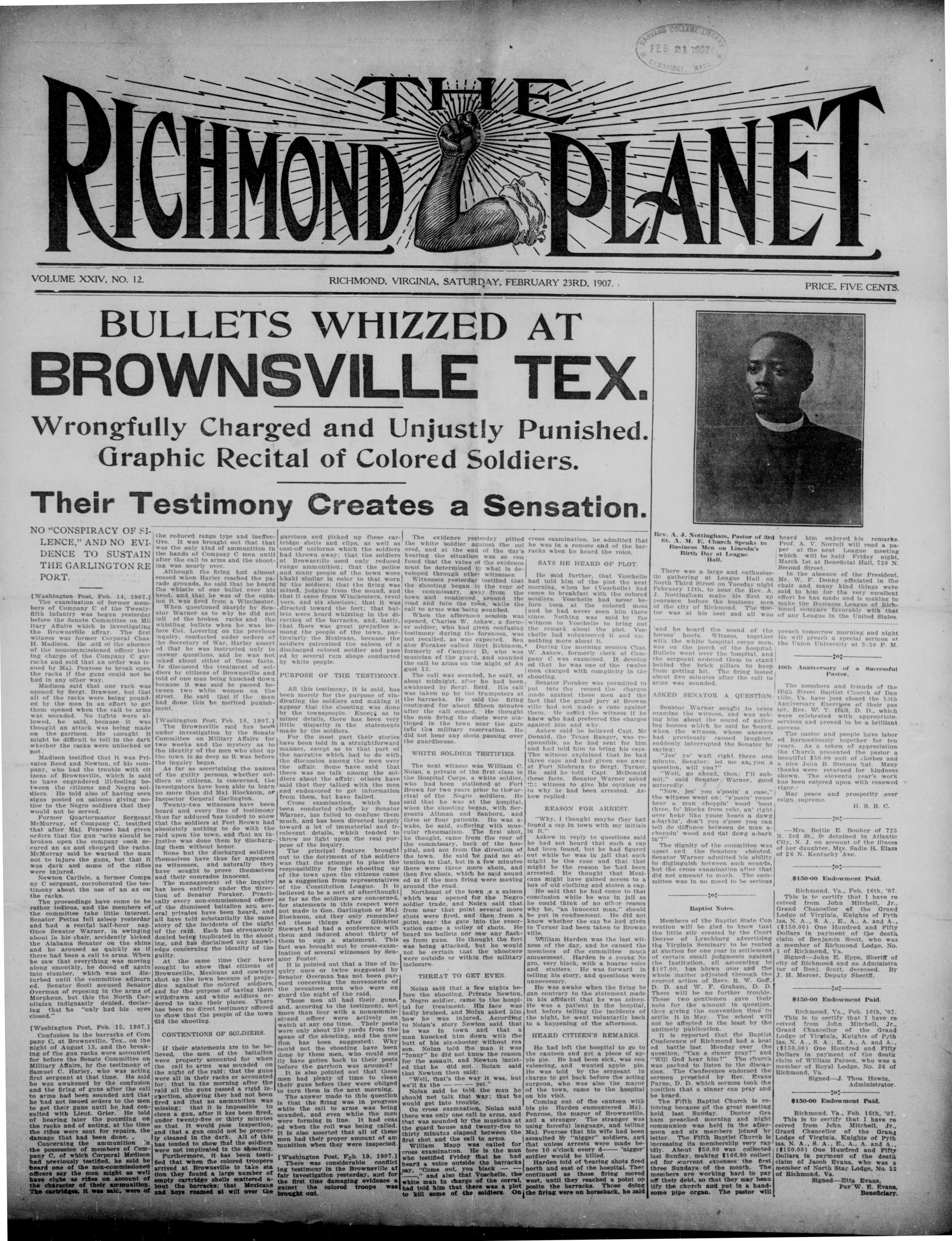
BULLETS WHIZZED AT BROWNSVILLE TEX.
Wrongfully Charged and Unjustly Punished. Graphic Recital of Colored Soldiers.
VOLUME XXIV, NO. 12.
BU
BRO
Wrongfu
Gra
Their T
NO "CONSPIRACY OF SILENCE," AND NO EVI DENCE TO SUSTAIN THE GARLINGTON RE PORT.
[Washington Post, Feb. 14, 1907.]
The examination of former members of Company C of the Twenty-fifth Infantry was begun yesterday before the Senate Committee on Military Affairs which is investigating the Brownville affray. The first witness was former Corporal Chas H. Madison. He old of the absence of the noncommissioned officer having charge of the Company C gut racks and said that an order was issued by Maj. Penrose to break open the racks if the guns could not be had in any other way.
Madison said that one rack was opened by Sergt. Brawner, but that all of the racks were being pounded by the men in an effort to get them opened when the call to arms was sounded. No lights were allowed. He said because it was bought an attack being made on the garrison. He taught it might be difficult to tell in the dark whether the racks were unlocked or not.
Madison testified that it was Private Reed and Newton, of his company, who had the trouble with citizens of Brownsville, which is said to have engendered ill-feeling between the citizens and Negro soldiers. He told also of having signs posted on saloons giving notice to the Negro soldiers that they would not be served.
Former Quartermaster Sergeant McMurray, of Company C, testified that after Maj. Penrose had given that he gun tacks should be broken open the company cook secured an ax and chopped the racks. McMurray said he warned the man not to injure the guns, but that it was dark and some of the rifles were injured.
Newton Carlisle, a former Company C sergeant, corroborated the testimony about the use of an ax on the racks.
The proceedings have come to be rather tedious, and the members of the committee take little interest. Senator Petus fell asleep yesterday and had a restful half-hour nap. Once Senator Warner, in swinging about in his chair, accidently kicked the Alabama Senator on the shins and he aroused as quickly as if there had been anything was moving along smoothly, he dozed off again into slumber, which was not disturbed until the committee adjourned. Senator Scott accused Senator Overman of reposing in the arms of Morpheus, but this the North Carolinian indignantly denied, declaring that he "only had his eyes closed."
[Washington Post, Feb. 15, 1907.]
Confusion in the barracks of Com pany C, at Brownville, Tex., on the night of August 13, and the breaking of the gun racks were accounted for before the Senate Committee on Military Affairs, by the testimony of Samuel C. Harley, who was acting first sergeant at that time. He said he was awakened by the confusion and the firing of guns after the call to arms had been sounded and that he had not issued orders to the men to get their guns until he had consulted with Lleut. Grier. He told of hearing later the pounding on the racks and of noting, at the time the rifles were sent for repairs, the damage that had been done. Concerning the ammunition in the possession of members of Company C, of which Corporal Madison had previously testified, he said he heard one of the non-commissioned officers say the men might as well have clubs as rifles on account of the character of their ammunition. The cartridges, it was said, were of
the reduced range type and ineffective. It was brought out that that was the only kind of ammunition in the hands of Company C men until after the call to arms and the shooting was nearly over.
Although the firing had almost ceased when Harley reached the parade grounds, he said that he heard the whistle of one bullet over his head, and that he was of the opinion it was fired from a Winchester.
When questioned sharply by Senator Warner as to why he did not tell of the broken racks and the whistling bullets when he was before Col. Lovering on the previous inquiry, conducted under orders of the Secretary of War, Harley asserted that he was instructed only to answer questions, and he was not asked about either of these facts. He discussed the treatment of soldiers by citizens of Brownsville and told of one man being knocked down because it was said he passed between two white women on the street. He said that if the man had done this he merited punishment.
[Washington Post, Feb. 18, 1907.]
The Brownville raid has been under investigation by the Senate Committee on Military Affairs for two weeks and the mystery as to the identity of the men who shot up the town is as deep as it was before the inquiry began.
As far as ascertaining the names of the guilty persons, whether soldiers or citizens, is concerned, the investigators have been able to learn no more than did Maj. Blocksom, or Inspector General Garlington. Twenty-two witnesses have been heard and every line of testimony thus far adduced has tended to show that the soldiers at Fort Brown had absolutely nothing to do with the raid upon the town, and that an injustice was done them by discharging them without honor. None but the discharged soldiers themselves have thus far appeared as witnesses, and naturally they have sought to prove themselves and their comrades innocent. The management of the inquiry has been entirely under the direction of Senator Forker. Practically every non-commissioned officer of the dismissed battalion are several privates have been heard, and all have told substantially the same story of the incidents of the night of the raid. Each has strenuously denied being implicated in the shooting, and has disclaimed any knowledge concerning the identity of the guilty. At the same time they have sought to show that citizens of Brownsville, Mexicans and cowboys shot up the town because of prejudice against the colored soldiers, and for the purpose of having them withdrawn and white soldiers ordered to take their places. There has been no direct testimony offered to show that the people of the town did the shooting.
CONTENTIONS OF SOLDIERS.
If their statements are to be be believed, the men of the battalion were properly accounted for when the call to arms was sounded on the night of the raid; that the guns were all in their racks or accounted for; that in the morning after theraid all the guns passed a rigidinspection, showing they had not beenfired and that no ammunition wasmissing; that it is impossible toclean a gun, after it has been fired,under twenty-five or thirty minutesso that it would pass inspection,and that a gun could not be properlycleaned in the dark; that hislis hended to show that the soldierswere impaled in the shooting,inurthermore, it has been testified that when the colored troopersarrived at Brownville to take station they found a large number ofempty cartridge shells scatteredabout the barracks; that Mexicansand boys roamed at will over the
RICHMOND, VIRGINIA, SATURDAY, FEBRUARY 23RD, 1907.
garrison and picked up these cartridge shells and clips, as well as cast-off uniforms which the soldiers had thrown away; that the soldiers at Brownsville used only reduced arm ammunition; that the police and many people of the town wore khaki similar in color to that worn by the soldiers; that the firing was mixed, judging from the sound, and that it came from Winchester, revolvers, and six shooters; that it was directed toward the fort; that bullets were whirled in the direction of the barracks, and, lastly, that there was great prejudice among the people of the town, particularly the Mexicans, because the soldiers patronized the saloon of a discharged colored soldier and passed by several rum shops conducted by white people.
PURPOSE OF THE TESTIMONY
All this testimony, it is said, has been merely for the purpose of vindicating the soldiers and making it appear that the shooting was done by the townspeople. Except as to minor details, there has been very little disparity in the statements made by the soldiers.
For the most part their stories have been told in a straightforward manner, except as to that part of the narrative which had to do with the discussion among the men over the affair. Some have said that there was no talk among the soldiers about the affair; others have said that they talked with the men and endeavored to get information from them, but have failed. Most of them, which has been conducted chiefly by Senator Warner, has failed to confuse them much, and has been directed largely toward a lot of immaterial and irrelevant details, which tended to throw no light upon the real purpose of the inquiry.
The principal feature brought out to the detriment of the soldiers was that the attempt to place the responsibility for the shooting up of the town upon the citizens came as a suggestion from representatives of the Constitution League. It is believed to be a sort of afterthought as far as the soldiers are concerned, for statements in this respect were not made to Gen. Garlington or Maj. Blocksom, and they only remember ed these things after Gilchrist Stewart had had a conference with them and induced about thirty of them to sign a statement. This fact was brought out by cross-examination of several witnesses by Senator Foster.
It is pointed out that a line of inquiry once or twice suggested by Senator Overman has not been pursued concerning the movements of the seventeen men who were on guard the night of the trial. These men all had their guns, and, according to the testimony, not more than four with a noncommissioned officer were actively on watch at any one time. Their posts were only about 250 yards from the scene of the shooting, and the quesion has been suggested: Why could not the shooting have been done by these men, who could easily have gotten back to their posts before the garrison was aroused? It is also pointed out that these men had plenty of time to clean their guns before they were obliged to turn them in the next morning.
The answer made to this question is that the firing was in progress while the call to arms was being sounded, and even while the men were forming in line. It had ceas ed when the roll was being called. It is also asserted that all of these men had their proper amount of am munication when they were inspected.
[Washington Post, Feb. 19, 1997.]
There was considerable conflict ing testimony in the Brownaville at fair investigation yesterday, and for the first time damaging evidence a against the colored troops was brought out.
The evidence yesterday pitted the white soldier against the colored, and at the end of the day's hearing the situation was so confused that the value of the evidence must be determined by what is developed through other witnesses. Witnesses yesterday testified that the shooting began in the rear of the commissary, away from the town and continued around the road and into the town, while the call to arms was being sounded. When the afternoon session was opened, Charles W. Askew, a former soldier, who had given confusing testimony during the forenoon, was not recalled, as was expected. Senator Foraker called Hoyt Robinson, formerly of Company D, who was musician of the guard, and sounded the call to arms on the night of Auget. The call was sounded, he said, at about midnight, after he had been awakened by Sergt Reid. His call was taken up by the trumpeters at the barracks. He said the firing continued for about fifteen minutes after the call ceased. He thought the men firing the shots were stationed in the town near the gate into the military reservation. He did not hear any shots passing over the guardhouse.
WHITE SOLDIER TESTIFIES
The next witness was William C. Nolan, a private of the first class in the Hospital Corps, a white soldier, who had been stationed at Fort Brown for two years prior to the arrival of the Negro soldiers. He said that he was at the hospital, when the shooting began, with Sergeants Altman and Sanborn, and three or four patients. He was awake, he said, suffering with muscular rheumatism. The first shot, he thought, came from the rear of the commissary, back of the hospital, and not from the direction of the town. He said he paid no attention to that, but in a few minutes there were three more shots, and then five shots, which he said sounded as if the men firing were moving around the road.
Northeast of the town is a saloon which was opened for the Negro soldier trade, and Nolan said that from near that point several more shots were fired, and then from a point near the gate into the reservation came a volley of shots. He heard no bullets nor saw any flashes from guns. He thought the fort was being attacked, but he would not be certain that the shooters were outside or within the military enclosure.
THREAT TO GET EVEN.
Nolan said that a few nights before the shooting, Private Newton, a Negro soldier, came to the hospital for treatment. His face was badly bruised, and Nolan asked him how he was injured. According to Nolan's story Newton said that he was in town and that a man knocked him down with the butt of his six-shooter without rea son. Nolan told the man it was "funny" he did not know the reason for the assault, and Newton insisted that he did not. Nolan said that Newton then said: "Well, that's the way it was, but we'll fix the — — yet." Nolan said he told the man he should not talk that way; that he would get into trouble. On cross examination, Nolan said there was only one call to arms, and that was sounded by the musician at the guard house and twenty-five to thirty minutes elapsed between the first shot and the call to arms. William Mapp was called for cross examination. He is the man who testified Friday that he had heard a voice outside the barracks say. "Come out, you black — — —" and also that Voschelle, the white man in charge of the corral, had told him that there was a plot to kill some of the soldiers. On
cross examination, he admitted that he was in a remission end of the bar.
SAYS HE HEARD OF PLOT
He said further, that Voschelle had told him of the plot the next morning, when he (Voschelle) had come to breakfast with the colored soldiers. Voschelle had never before been at the colored mess and he had never seen him there since. Nothing was said by the witness to Voschelle to bring out the remark about the plot. Voschelle had volunteered it and said nothing more about it.
During the morning session Chas. W. Askew, the clerk of Company C was examined. It devided that he was one of the twelve men charged with complicity in the shooting.
Senator Foraker was permitted to put into the record the charges made against these men and the fact that the grand jury at Brownsville had not made a case against them. He asked the witness if he knew who had preferred the charges against him and why.
Askew said he believed Capt. McDonald, the Texas Ranger, was responsible, as he had sent for him and had told him to bring his caps. The witness explained that he had one cap and had given one away at Foraker (4) Sergent Turner. He said he told Capt. McDonald these facts. Senator Warner asked the witness to give his opinion as to why he had been arrested. Askew replied:
REASON FOR ARREST
"Why, I thought maybe they had found a cap in town with my initials in it."
Askew in reply to questions said he had not heard that such a cap had been found, but he had figured out when he was in jail that such might be the case and that that might be the reason he had been arrested. He thought that Mexicans might have gained access to a box of old clothing and stolen a cap. He said that he had come to that conclusion while he was in jail as he could think of no other reason why he, "an innocent man," should be put in confinement. He did not know whether the cap he had given to Turner had been taken to Brownsville.
William Harden was the last witness of the day, and he caused the members of the committee much amusement. Harden is a young Negro very black, with a hoarse voice and tatters. He was forward in telling his story, and questions were unnecessary.
He was awake when the firing he gan contrary to the statement made in his idiafavit that he was asleep. He was a patient in the hospital, but before telling the incidents of the night, he went voluntarily back to a happening of the afternoon.
HEARD CITIZEN'S REMARKS.
He had left the hospital to go to the canteen and get a piece of apple pie. He had been sick, was con valescing, and wanted apple pie. He was told by the sergeant in charge to get back before the acting surgeon, who was also the mayor of the town, came to the hospital on his visit.
Coming out of the canteen with his pie Harden encountered MaJ. Penrose, the mayor of Brownville, and a stranger. The stranger was using forceful language and telling MaJ. Penrose that he was assaulted "nigger" soldiers, and unless arrests were made before 10 o'clock every d——"nigger" soldier would be killed.
Harden told of hearing shots fired north and east of the hospital. They continued as those firing moved west, until they reached a point on posite the barracks. Those doing the firing were on horseback, he said
PRIEST
Rev. A. J. Nottingham, Pastor of 3rd
St. A. M. E. Church Speaks to
Business Men on Lincoln's
Birth Day at League
School
There was a large and enthusiastic gathering at League Hall on North Third Street on Tuesday night February 12th, to near the Rev. A. J. Nottingham make his first appearance before the business men of the city of Richmond. The doctor was at his best and all who
'and he heard the sound of the horses' hoofs. Witness, together with the white hospital corps men, was on the porch of the hospital. Bullets went over the hospital, and the sergeant ordered them to stand behind the brick pillars to keep from getting hit. The firing lasted about five minutes after the call to arms was sounded.
ASKED SENATOR A QUESTION
Senator Warner sought to cross examine the witness, and was asking him about the sound of gallon horses which he said he heard, when the witness, whose answers had previously caused laughter, suddenly interrupted the Senator by saying: "Yes, jez' wait right there one minute. Senator, let me ax you a question, will you?" "Well, go ahead, then; I'll submit," said Senator Warner, good naturelly. "Now, jez' you s'posin' a case," the witness went on; "s'posin' youse hear a man choppin' wood 'bout three, fo' blocks from yehr, an' right over hear like youhears a dawg a-barkin', don't you s'pose you can tell de difference between de man a-choppin' wood and dat dawg a-bark in." The dignity of the committee was upset and the Senators shouted. Senator Warner admitted his ability to distinguish between such sounds, but the cross examination after that did not amount to much. The committee was in no mood to be serious
Baptist Notes.
Members of the Baptist State Convention will be glad to know that the little stir created by the Court Decree of Lynchburg advertising the Virginia Seminary to be rented at auction for one year in settlement of certain small judgments against the Institution, all amounting to $187.00, has blown over and the whole matter adjusted through the prompt action of Revs. R. W. Goff, D. D. and W. F. Graham, D. D. There will be no further trouble. These two gentlemen gave their note for the amount in question, thus giving the convention time to settle it in May. The school will not be affected in the least by the untimely publication.
It is reported that the Baptist Conference of Richmond had a heated battle last Monday over the question, "Can a sinner pray?" and "Will God hear him?" The church was packed to listen to the discussion. The Conference endorsed the sermon preached by Rev. Evans Payne, D. D. which sermon took the position that a sinner can pray and be heard.
The Fifth Baptist Church is rejoicing because of the great meeting held last Sunday. Doctor Graham preached morning and night communion was held in the afternoon and six members joined by letter. The Fifth Baptist Church is increasing its membership very rapidly. About $50.00 was collected last Sunday, making $166.00 collected for current expenses the first three Sundays of the month. The members are working hard to pay off their debt, so that they may beau tify the church and put in a handsome pipe organ. The pastor will
PRICE, FIVE CENTS.
heard him enjoyed his remarks. Prof. A. V. Norrell will read a paper at the next League meeting which will be held Friday night, March 1st at Beneficial Hall, 728 N. Second Street. In the absence of the President, Mr. W. F. Denny officiated in the chair and many kind things were said to him for the very excellent effort he has made and is making to make the Business League of Richmond compare favorably with that of any League in the United States.
preach tomorrow morning and night He will preach a special sermon at the Union University at 3:30 P. M.
10th Anniversary of a Successful Pastor.
The members and friends of the High Street Baptist Church of Danville, Va. have just closed the 10th Anniversary Exercises of their pastor, Rev. W. T. Hall, D. D., which were celebrated with appropriate, services and proved to be a brilliant success.
The pastor and people have labored harmoniously together for ten years. As a token of appreciation the Church presented the pastor a beautiful $50.00 suit of clothes and a nice John B. Stetson hat. Many thanks were returned for kindness shown. The eleventh year's work has been entered upon with renewed vigor.*
May peace and prosperity ever reign supreme.
—Mrs. Bettie E. Booker of 725 N. 3rd St. F.5 detained in Atlantic City, G. N. J. on account of the illness of Mrs. Bettie E. Held H. Elam of 26 N. Kentucky Ave.
$150.00 Endowment Paid
Richmond, Va., Feb. 16th, '07.
This is to certify that I have received from John Mitchell, Jr.,
Grand Chancellor of the Grand Lodge of Virginia, Knights of Pytha
is, N. A., S. A., E., A. A, and A.,
($150.00) One Hundred and Fifty
Dollars in payment of the death
claim of Benjamin Scott, who was
a member of Richmond Lodge, No.
1. Signed—John E. Epps, Sheriff of
city of Richmond and as Administrator of Benj. Scott, deceased. By
J. H. Mercer, Deputy Sheriff.
$150.00 Endowment Paid.
Richmond, Va., Feb. 16th, '07.
This is to certify that I have received from John Mitchell, Jr.,
Grand Chancellor of the Grand Lodge of Virginia, Knights of Pythias, N. A., S. A., E., A., A. and A., ($150.00) One Hundred and Fifty Dollars in the death claim of William Parson, who claim member of Royal Lodge, No. 26 of Richmond, Va.
$150.00 Endowment Paid
Richmond, Va., Feb. 16th, '07.
This is to certify that I have re
received from John Mitchell, Jr.
Grand Chancellor of the Grand
Lodge of Virginia, Knights of Pyth
ias, N. A., S. A., E., A. A. and A.,
($150.00) One Hundred and Fifty
Dollars in payment of the death
claim of Jacob Evans, who was a
member of North Star Lodge, No. 52
of Richmond, Va.
Signed—Etta Evans,
Per W. E. Evans,
Beneficiary.
THE Masquerader
By KATHERINE CECIL THURSTON,
Author of "The Circle," Etc.
Copyright. 1905. 1904. by Harper & Brothers
CHAPTER XIII
THE best moments of a man's life are the moments when, strong in himself, he feels that the world lies before him. Gratified ambition may be the summer, but anticipation is the ardent springtime of a man's career.
As Loder drove that night from Fleet street to Grosvenor square he realized this, though scarcely with any degree of consciousness, for he was no accomplished self analyst. But in a wave of feeling too vigorous to be denied he recognized his regained foothold—the step that lifted him at once from the pit to the pinnacle.
In that moment of realization he looked neither backward nor forward. The present was all sufficing. Difficulties might loom ahead, but difficulties had but one object—the testing and sharpening of a man's strength. In the first deep surge of egotistical feeling he almost rejoiced in Chilcote's weakness. The more Chilcote tangled the threads of his life the stronger must be the fingers that unraveled them. He was possessed by a great impatience. The joy of action was stirring in his blood. Leaving the cab, he walked confidently to the door of Chilcote's house and inserted the latchkey. Even in this small act there was a grain of individual satisfaction. Then very quietly he opened the door and crossed the hall. As he entered, a footman was arranging the fire that burned in the big grate. Seeing the man, he halted. "Where is your mistress?" he asked in unconscious repetition of his first question in the same house.
The man looked up. "She has just finished dinner, sir. She dined alone in her own room." He glanced at Loder in the quick, uncertain way that was noticeable in all the servants of the household when they addressed their master. Loder saw the look and wondered what depth of curiosity it betrayed, how much of insight into the domestic life that he must always be content to skim. For an instant the old resentment against Chilcote tinged his exaltation, but he swept it angrily aside. Without further remark he began to mount the stairs.
Galning the landing, he did not turn, as usual, to the door that shut off Chilcote's rooms, but moved onward down the corridor toward Eve's private sitting room. He moved slowly till the door was reached. Then he paused and lifted his hand. There was a moment's wait while his fingers rested on the handle; then a sensation he could not explain, a reticence, a reluctance to intrude upon this one precinct, caused his fingers to relax. With a slightly embarrassed gesture he drew back slowly and retraced his steps.
Once in Chilcote's bedroom, he walked to the nearest bell and pressed it. Renwick responded, and at sight of him Loder's feelings warmed with the same sense of fitness and familiarity that the great bed and somber furniture of the room had inspired.
But the man did not come forward as he had expected. He remained close to the door with a hesitation that was unusual in a trained servant. It struck Loder that possibly his stolidity had exasperated Chilcote and that possibly Chilcote had been at no pain to conceal the exasperation. The idea caused him to smile involuntarily.
"Come into the room, Renwick," he said. "It's uncomfortable to see you standing there. I want to know if Mrs. Chilcote has sent me any message about tonight."
Renwick studied himfurtively as he came forward. "Yes, sir," he said. "Mrs. Chilcote's maid said that the carriage was ordered for 10:15, and she hoped that would suit you." He spoke reluctantly, as if expecting a rebuke.
At the opening sentence Loder had turned aside, but now, as the man finished, he wheeled round again and looked at him closely with his keen, observant eyes.
"Look here." he said. "I can't have you speak to me like that. I may come down on you rather sharply when my—my nerves are bad, but when I'm myself I treat you—well, I treat you decently at any rate. You'll have to learn to discriminate. Look at me now!" A thrill of risk and of rulership passed through him as he spoke. "Look at me now! Do I look as I looked this morning—or yesterday?" The man eyed him half stupidly, half timidly.
"Well?" Loder insisted.
"Well, sir." Renwick responded, with some slowness, "you look the same and you look different—a healthier color, perhaps, sir, and the cye clearer." He grew more confident under Loder's half humorous, half insistent gaze. "Now that I look closer, sir"—Loder laughed. "That's it!" he said. "Now that you look closer. You'll have to grow observant. Observation is an excellent quality in a servant. When you come into a room in future, look first of all to me and take you cue from that. Remember that serving a man with nerves is like serving two masters. Now you can go, and tell Mrs. Chilcote's maid that I shall be quite ready at a quarter past 10."
"Nothing further. I shan't want you again tonight." He turned away as he spoke and moved toward the great fire that was always kept alight in Chilcote's room. But as the man moved toward the door he wheeled back again. "Oh, one thing more, Renwick! Bring me some sandwiches and a whisky." He remembered for the first time that he had eaten nothing since early afternoon. A few minutes after 10 Loder left Chilcote's room, resolutely descended the stairs and took up his position in the hall. Resolution is a strong word
to apply to such a proceeding, but something in his bearing, in the attitude of his shoulders and head, instinctively suggested it. Five or six minutes passed, but he waited without impatience. Then at last the sound of a carriage stopping before the house caused him to lift his head, and at the same instant Eve appeared at the head of the staircase. She stood there for a second, looking down on him, her maid a pace or two behind holding her chak. The picture she made struck upon his mind with something of a revelation.
On his first sight of her she had appealed to him as a strange blending of youth and self possession—a girl with a woman's clearer perception of life. Later he had been drawn to study her in other respects—as a possible comrade and friend. Now for the first time he saw her as a power in her own world—a woman to whom no man could deny consideration. She looked taller for the distance between them, and the distinction of her carriage added to the effect. Her black gown was exquisitely soft—as soft as her black hair. Above her forehead was a cluster of splendid diamonds shaped like a cornet, and a band of the same stones encircled her neck. Loder realized in a glance that only the most distinguished of women could wear such ornaments and not have her beauty eclipsed. With a touch of the old awkwardness that had before assailed him in her presence, he came slowly forward as she descended the stairs.
"Can I help you with your cloak?" he asked, and as he asked it something like surprise at his own timidity crossed his mind.
For a second Eve's glance rested on his face. Her expression was quite impassive, but as she lowered her lashes a faint gleam flickered across her eyes, Nevertheless, her answer, when it came, was studiously courteous.
"Thank you," she said, "but Marie will do all I want."
Loder looked at her for a moment, then turned aside. He was not hurt by his rebuff. Rather, by an interesting sequence of impressions, he was stirred by it. The pride that had refused Chilcote's help, and the self control that had refused it graciously, moved him to admiration. He understood and appreciated both by the light of personal experience.
"The carriage is waiting, sir," Crapham's voice broke in.
Loder nodded, and Eve turned to her maid. "That will do, Marie." she said. "I shall want a cup of chocolate when I get back, probably at 1 o'clock." She drew her cloak about her shoulders and moved toward the door. Then she paused and looked back. "Shall we start?" she asked quietly. Loder, still watching her, came forward at once. "Certainly," he said, with unusual gentleness. He followed her as she crossed the footpath, but made no further offer of help, and when the moment came he quietly took his place beside her in the carriage. His last impression as the horses wheeled round was of the open hall door—Crapham in his somber livery and the maid in her black dress, both silhouetted against the dark background of the hall; then as the carriage moved forward smoothly and rapidly he leaned back in his seat and closed his eyes.
During the first few moments of the drive there was silence. To Loder there was a strange, new sensation in this companionship, so close and yet so distant. He was so near to Eve that the slight fragrant scent from her clothes might almost have belonged to his own. The impression was confusing, yet vaguely delightful. It was years since he had been so close to a woman of his own class, his own caste. He acknowledged the thought with a curious sense of pleasure. Involuntarily he turned and looked at her.
She was sitting very straight, her fine profile cut clear against the carriage window, her diamonds quivering in the light that flashed by them from the street. For a space the sense of unreality that had pervaded his first entrance into Chilecito's life touched him again; then another and more potent feeling rose to quell it. Almost involuntarily as he looked at her his lips parted.
"May I say something?" he asked.
Eve remained motionless. She did not turn her head, as most women would have done. "Say anything you like," she said gravely.
"Anything?" He bent a little nearer, filled again by the inordinate wish to dominate.
"Of course."
It seemed to him that her voice sounded forced and a little tired. For a moment he locked through the window at the passing lights; then slowly his gaze returned to her face.
"You look very beautiful tonight," he said. His voice was low and his manner unemotional, but his words had the effect he desired.
She turned her head, and her eyes met his in a glance of curiosity and surprise.
Slight as the triumph was, it thrilled him. The small scene with Chilcote's valet came back to him; his own personality moved him again to a reckless determination to make his own voice heard. Leaning forward, he laid his hand lightly on her arm.
"Eve," he said quickly—"Eve, do you remember?"—Then he paused and withdrew his hand. The horses had slackened speed, then stopped altogether as the carriage fell into line outside Bramfell House.
THE PLANET.
Only $1.50 per year in advance.
THE RICHMOND PLANET, RICHMOND, VIRGINIA
CHAPTER XIV
ODER entered Lady Bramellfell's feeling far more like an actor in a drama than an ordinary man in a peculiar situation. It was the first time he had played Chilcote to a purely social audience and the first time for many years that he had rubbed shoulders with a well dressed crowd ostensibly brought together for amusement. As he followed Eve along the corridor that led to the reception rooms he questioned the reality of the position again and again; then abruptly, at the moment when the sensation of familiarity was strongest, a cheery voice hailed him, and, turning, he saw the square shoulders, light eyes and pointed mustache of Lakelye, the owner of the St. George's Gazette.
At the sight of the man and the sound of his greeting his doubts and speculations vanished. The essentials of life rose again to the position they had occupied three weeks ago, in the short but strenuous period when his dormant activities had been stirred and he had recognized his true self. He lifted his head unconsciously, the shade of misgiving that had crossed his confidence passing from him as he smiled at Lakeley with a keen, alert pleasure that altered his whole face.
Eve, looking back, saw the expression. It attracted and held her, like a sudden glimpse into a secret room. In all the years of her marriage, in the months of her courtship even, she had never surprised the look on Chicote's face. The impression came quickly and with it a strange, warm rush of interest that receded slowly, leaving an odd sense of loneliness. But, at the moment that the feeling came and passed, her attention was claimed in another direction. A slight, fair haired boy forced his way toward her through the press of people that filled the corridor.
"Mrs. Chicote!" he exclaimed. "Can I believe my luck in finding you alone?" Eve laughed. It seemed that there was relief in her laugh. "How absurd you are, Bobby?" she said kindly. "But you are wrong. My husband is here. I am waiting for him."
Blessington looked around. "Oh!" he said. "Indeed!" Then he relapsed into silence. He was the soul of good nature, but those who knew him best knew that Chilecote's summary change of secretaries had rankled. Eve, conscious of the little jar, made haste to smooth it away.
"Tell me about yourself," she said. "What have you been doing?"
Blessington looked at her, then smiled again, his buoyancy restored. "Doing?" he said. "Oh, calling every other afternoon at Grosvenor square, only to find that a certain lady is never at home."
At his tone Eve laughed again. The boy, with his frank and ingenuous nature, had beguiled many a dull hour for her in past days, and she had missed him not a little when his face had been filled by Greening.
"But I mean seriously, Bobby. Has something good turned up?"
Blessington made a wry face. "Something is on its way. That's why I'm on duty tonight. Old Bramfell and the pater are working it between them, so if Lady Bramfell or Lady Astrupp happen to drop a fan or a handkerchief this evening I've got to be here to pick it up. See?" "As you picked up my fans and handkerchiefs last year and the year before?" Eve smiled. Blessington's face suddenly looked grave. "I wish you hadn't said that." he said. Then he paused abruptly. Out of the hum of talk behind them a man's laugh sounded. It was not loud, but it was a laugh that one seldom hears in a London drawing room. It expressed interest, amusement and in an inexplicable way it seemed also to express strength. Eve and Bessington both turned involuntarily. "By Jove!" said Blessington.
Eve said nothing.
Loder was parting with Lakeley and his was the laugh that had attracted them both. The interest excited by his talk was still reflected in his face and bearing as he made his way toward them.
"By Jove!" said Blessington again. "I never realized that Chilcote was so tall."
Again Eve said nothing. But silently and with a more subtle meaning she found herself echoing the words.
Until he was quite close to her Loder did not seem to see her. Then he stopped quietly.
"I was speaking to Lakeley," he said.
"He wants me to dine with him one night at Cadogan Gardens."
But Eve was silent, waiting for him to address Blessington. She glanced at him quickly, but though their eyes met he did not catch the meaning that lay in hers. It was a difficult moment. She had known him incredibly, almost unparadonably absentminded, but it had invariably been when he was suffering from nerves, as she phrased it to herself. But tonight he was obviously in the possession of unclouded faculties. She colored slightly and glanced under her lashes at Blessington. Had the same idea struck him, she wondered? But he was studiously studying a suit of Chinese armor that stood close by in a niche of the wall. "Bobby has been keeping me amused while you talked to Mr. Lakeeley," she said pointedly. Directly addressed, Loder turned and looked at Blessington. "How d'you do?" he said, with doubtful cordiality. The name of Bobby conveyed nothing to him.
To his surprise Eve looked annoyed and Blessington's fresh colored face deepened in tone. With a slow, uncomfortable sensation he was aware of having struck a wrong note.
There was a short, unpleasant pause. Then, more by intuition than actual sight, Blessington saw Eve's eyes turn from him to Loder, and with quick tact he saved the situation.
"How dyou do, sir?" he responded, with a smile. "I congratulate you on looking so—so uncommon well. I was just telling Mrs. Chilcote that I hold a commission for Lady Astrupp tonight. I'm a sort of scout at present—reporting on the outposts." He spoke fast and without much meaning, but his boyish voice eased the strain.
Eve thanked him with a smile.
"Then we mustn't interfere with a person on active service," she said. "Besides, we have our own duties to get through." She smiled again and, touching Loder's arm, indicated the reception rooms. When they entered the larger of the two rooms Lady Bramfell was still receiving her guests. She was a tall and angular woman who, except for a certain beauty of hands and feet and a certain similarity of voice, possessed nothing in common with her sister Lillian. She was speaking to a group of people as they approached, and the first sound of her sweet and rather drawing sounds touched Loder with a curious momentary feeling—a vague suggestion of awakened memories. Then the suggestion vanished as she turned and greeted Eve.
"How sweet of you to come!" she murmured. And it seemed to Loder that a more spontaneous smile lighted up her face. Then she extended her hand to him. "And you, too!" she added. "Though I fear we shall bore you dreadfully."
Watching her with interest, he saw the change of expression as her eyes turned from Eve to him and noticed a colder tone in her voice as she addressed him directly. The observation moved him to self assertion.
"That's a poor compliment to me," he said. "To be bored is surely only a polite way of being inane."
Lady Bramfell smiled. "What!" she exclaimed. "You defending your social reputation?"
Loder laughed a little. "The smaller 't is the more defending it needs," he replied.
Another stream of arrivals swept by them as he spoke. Eve smiled at their hostess and moved across the room, and he perforce followed. As he gained her side the little court about Lady Bramfell was left well in the rear, the great throng at the farther end of the room was not yet reached, and for the moment they were practically alone.
There was a certain uneasiness in that moment of companionship. It seemed to him that Eve wished to speak, but hesitated. Once or twice she opened and closed the fan that she was carrying, then at last, as if by an effort, she turned and looked at him.
"Why were you so cold to Bobby Blessington?" she asked. "Doesn't it seem discourate to ignore him as you did?"
Her manner was subdued. It was not the annoyed manner that one uses to a man when he has behaved ill; it
R. H.
"There's no penalty for separating husband and wife?" was the explanatory tone one might adopt toward an incorrigible child. Loder felt this, but the gist of a remark always came to him first, its mode of expression later. The fact that it was Blessington whom he had encountered—Blessington to whom he had spoken with vague politeness—came to him with a sense of unpleasantness. He was not to blame in the matter, nevertheless he blamed himself. He was annoyed that he should have made the slip in Eve's presence.
They were moving forward, nearing the press of people in the second room, when Eve spoke, and the fact filled him with an added sense of annoyance. People smiled and bowed to her from every side; one woman leaned forward as they passed and whispered something in her ear. Again the sensation of futility and vexation filled him; again he realized how palpable was the place she held in the world. Then, as his feelings reached their height and speech seemed forced upon him, a small man with a round face, catching a glimpse of Eve, darted from a circle of people gathered in one of the windows and came quickly toward them. With an unjust touch of irritation he recognized Lord Bramfell.
Again the sense of Eve's aloofness stung him as their host approached. In another moment she would be lost to him among this throng of strangers—claimed by them as by right.
"Eve," he said involuntarily and under his breath. She half paused and turned toward him. "Yes?" she said, and he wondered if it was his imagination that made the word sound slightly eager.
"About that matter of Blessington," he began; then he stopped. Bramell had reached them.
The little man came up smiling and with an outstretched hand. "There's no penalty for separating husband and wife, is there, Mrs. Chilcote? How are you, Chilcote?" He turned from one to the other with the quick, noiseless manner that always characterized him. Loder turned aside to hide his vexation, but Eve greeted their host with her usual self possessed smile.
"You are exempt from all penalties tonight," she said. Then she turned to greet the members of his party who had strolled across from the window in his wake.
As she moved aside Bramfell looked at Loder. "Well, Chilcote, have you dipped into the future yet?" he asked with a laugh. Loder echoed the laugh, but said
nothing. In his uncertainty at the question he reverted to his old resource of silence.
Bramfell raised his eyebrows. "What!" he said. "Don't tell me that my sister-in-law hasn't engaged you as a victim." Then he turned in Eve's direction. "You've heard of our new departure, Mrs. Chilcote?" Eve looked round from the lively group by which she was surrounded. "Lillian's crystal gazing? Why, of course?" she said. "She should make a very beautiful seer. We are all quite curious."
Bramfell pursed up his lips. "She has a very beautiful tent at the end of the conservatory. It took five men as many days to rig it up. We could not hear ourselves talk for hammering. My wife said it made her feel quite philanthropic, it reminded her so much of a charity bazaar."
Everybody laughed, and at the same moment Blessington came quickly across the room and joined the group.
"Hello?" he said. "Anybody seen Witcheston? He's next on my list for the crystal business."
Again the whole party laughed, and Bramfell, stepping forward, touched Blessington's arm in mock seriousness. "Witcheston is playing bridge, like a sensible man," he said. "Leave him in peace, Bobby."
Blessington made a comical grimace. "But I'm working this on commercial principles," he said. "I keep the list, names and hours complete, and Lady Astrup gazes in blissful ignorance as to who her victims are. The whole thing is great, simple and statistical."
"For goodness' sake, Bobby, shut up!" Bramfell's round eyes were twinkling with amusement.
"But my system"—
"Systems! Ah, we all had them when we were as young as you are."
"And they all had flaws, Bobby."
Eve broke in. "We were always finding gaps that had to be filled up. Never mind about Lord Witcheston. Get a substitute. It won't count if Lillian doesn't know."
Blessington wavered as she spoke.
His eyes wandered round the party and again rested on Bramfell.
"Not me, Bobby! Remember, I've breathed crystals—practically lived on them for the last week. Now, there's Chilcote"—Again his eyes twinkled.
"A very good idea!" she said. "Who wants to see the future if not a politician?"
Loder glanced from her to Blessington. Then, with a very feminine impulse, she settled the matter beyond dispute.
"Please use your authority, Bobby," she said. "And when you've got him safely under canvas come back to me. It's years since we've had a talk." She nodded and smiled, then instantly turned to Bramfell with some trivial remark.
For a second Loder waited; then, with a movement of resignation, he laid his hand on Blessington's arm. "Very well" he said, "But, if my fate is black, witness it was my wife who sent me to it." His faint pause on the word wife, the mention of the word itself in the presence of these people, had a savor of recklessness. The small discomfiture of his earlier slip vanished before it. He experienced a strong reaction of confidence in his luck. With a cool head, a steady step and a friendly pressure of the fingers on Blessington's arm, he allowed himself to be drawn across the reception rooms, through the long corridors and down the broad flight of steps that led to the conservatory.
The conservatory was a feature of the Bramfell town house, and to Loder it came as something wonderful and unlooked for, with its clustering green branches, its slight, unoppressive scents, its temperately pleasant atmosphere. He felt no wish to speak as, still guided by Blessington, he passed down the shadowy paths that in the half light had the warmth and mystery of a southern garden. Here and there from the darkness came the whispering of a voice or the sound of a laugh, bringing with it the necessary touch of life. Otherwise the place was still. Absorbed by the air of solitude, contrasting so remarkably with the noise and crowded glitter left behind in the reception rooms, he had moved halfway down the long green aisle before the business in hand came back to him with a sudden sense of annoyance. It seemed so paltry to mar the quiet of the place with the absurdity of a side show. He turned to Blessington with a touch of abruptness.
"What am I expected to do?" he asked.
Blessington looked up, surprised. "Why, I thought, sir"—he began; then he instantly altered his tone. "Oh, just enter into the spirit of the thing. Lady Astrupp won't put much strain on your credulity, but she'll make a big call on your solemnity." He laughed.
He had an infectious laugh, and Loder responded to it.
"But what am I to do?" he persisted. "Oh, nothing. Being the priestess, she naturally demands acolytes, but she'll let you know that she holds the prior place. The tent is so fixed that she sees nothing beyond your hands, so there's absolutely no delusion." He laughed once more. Then suddenly he lowered his voice and slackened his steps. "Here we are," he whispered in pretended awe.
At the end of the path the space widened to the full breadth of the conservatory. The light was dimmer, giving an added impression of distance; away to the left Loder heard the sound of splashing water, and on his right hand he caught his first glimpse of the tent that was his goal.
It was an artistic little structure—a pavilion formed of silky fabric that showed bronze in the light of an oriental lamp that hung above its entrance. As they drew closer a man emerged from it. He stood for a moment in uncertainty, looking about him; then, catching sight of them, he came forward, laughing.
"By George," he exclaimed, "it's as dark as limbo in there! I didn't see you at first. But I say, Blessington, it's a beastly shame to have that thum-
dercloud barrier shutting off the soreness. If she gazes at the crystal, mayn't we have something to gaze at too?" Blessington laughed. "You want too much, Galtry," he said. "Lady Astrup understands the value of the unattainable. Come along, sir!" he added to Loder, drawing him forward with an energetic pressure of the arm.
Loder responded, and as he did so a flicker of curiosity touched his mind for the first time. He wondered for an instant who this woman was who aroused so much comment. And with the speculation came the remembrance of how she had assured Chilcote that on one point at least he was invulnerable. He had spoken then from the height of a past experience—an experience so fully passed that he wondered now if it had been as staple a guarantee as he had then believed. Man's capacity for outliving is astonishingly complete. The long ago incident in the Italian mountains had faded, like a crayon study in which the tones have merged and gradually lost character. The past had paled before the present, as golden hair might pale before black. The simile came with apparent irrelevance. Then again Blessington pressed his arm.
"Now, sir!" he said, drawing away and lifting the curtain that hung before the entrance of the tent.
Loder looked at the amused, boyish face lighted by the hanging lamp and smiled pleasantly; then, with a shrug of the shoulders, he entered the pavilion, and the curtain fell behind him.
CHAPTER XV.
N entering the pavilion Loder's first feeling was one of annoyed awkwardness at finding himself in almost total darkness. But as his eyes grew accustomed to the gloom the feeling vanished and the absurdity of the position came to his mind.
The tent was small, heavily draped with silk and smelling of musk. It was divided into two sections by an immovable curtain that hung from the roof to within a few feet of the floor. The only furniture on Loder's side was one low chair, and the only light a faint radiance that, coming from the invisible half of the pavilion, spread across the floor in a pale band. For a short space he stood uncertain, then his hesitation was brought to an end.
"Please sit down," said a low, soft voice.
For a further moment he stood undecided. The voice sounded so unexpec- tively near. In the quiet and darkness of the place it seemed to possess a disproportionate weight, almost the weight of a familiar thing. Then with a sudden, unanalyzed touch of relief, he located the impression. It was the similarity to Lady Bramfelt's sweet, slow tones that had stirred his mind. With a sense of satisfaction he drew the chair forward and sat down.
Then for the first time he saw that on the other side of the gauze partition and below it by a few inches was a small table of polished wood, on which stood an open book, a crystal ball and a gold dish filled with ink. These were arranged on the side of the table nearest to him, the farther side being out of his range of vision. An amused interest touched him as he made his position more comfortable. Whoever this woman was, she had an eye for stage management, she knew how to marshal her effects. He found himself waiting with some curiosity for the next injunction from behind the curtain.
"The art of crystal gazing," began the sweet, slow voice after a pause, "is one of the oldest known arts." Loder sat forward. The thought of Lady Bramfell mingled disconcertingly with some other thought more distant and less easy to secure.
"To obtain the best results," went on the seer, "the subject lays his uncovered hands outspread upon a smooth surface." It was evident that the invisible priestess was reading from the open book, for when the word "surface" was reached there was a slam stir that indicated the changing of position, and when the voice came again it was in a different tone.
"Please lay your hands, palms downward, upon the table."
Loder smiled to himself in the darkness. He pictured Chilcote with his nerves and his impatience going through this ordeal; then in good humored silence he leaned forward and obeyed the command. His hands rested on the smooth surface of the table in the bar of light from the unseen lamp.
There was a second in which the seer was silent; then he fancied that she raised her head.
"You must take off your rings," she said smoothly. "Any metal interferes with the sympathetic current."
At any other time Loder would have laughed, but the request so casually and graciously made sent all possibility of irony far into the background. The thought of Chilcote and of the one flaw in their otherwise flawless scheme rose to his mind. Instinctively he half withdrew his hands.
"Where is the sympathetic current?" he asked quietly. His thoughts were busy with the question of whether he would or would not be justified in beating an undignified retreat.
"Between you and me, of course," said the voice softly. It sounded languid, but very rational. The idea of retreat seemed suddenly theatrical. In this world of low voices and shaded lights people never adopted extreme measures—no occasion made a scene practicable or even allowable. He leaned back slowly, while he summed up the situation. If by any unlucky chance this woman knew Chilcote to have adopted jewelry and had seen the designs of his rings the sight of his own scarred finger would suggest question and comment. If, on the other hand, he left the pavilion without excuse or if without apparent reason he refused to remove the rings, he opened up a new difficulty, a fresh road to curiosity. It came upon him with unusual quickness—the obstacles to and the need for a speedy decision. He glanced round the tent; then unconsciously he straightened his shoul
P. M.
"You must take off your rings." ders. After all, he had stepped into a tight corner, but there was no need to cry out in squeezing his way back. Then he realized that the soft, ingratiating tones were sounding once more.
"It's the passing of my hands over yours while I look into the crystal that sets up sympathy"—a slender hand moved swiftly into the light and picked up the ball—"and makes my eyes see the pictures in your mind. Now, will you please take off your rings?" The very naturalness of the request disarmed him. It was a risk. But, as Chilcote had said, risk was the salt of life!
"I'm afraid you think me very troublesome." The voice came again, delicately low and conciliatory.
For a brief second Loder wondered uncertainly how long or how well Chilcote knew Lady Astrupp; then he dismissed the question. Chilcote had never mentioned her until tonight, and then casually as Lady Bramfell's sister. What a coward he was becoming in throwing the dice with fate! Without further delay he drew off the rings, slipped them into his pocket and replaced his hands on the smooth table top.
Then, at the moment that he replaced them, a peculiar thing occurred.
From the farther side of the dark partition came the quick, rustling stir of a skirt and the slight scrape of a chair pushed either backward or forward. Then there was silence.
Now, silence can suggest anything from profound thought to limbility, but in this case its suggestion was nil. That something had happened, that some change had taken place, was as patent to Loder as the darkness of the curtain or the band of light that crossed the floor, but what had occasioned it, or what it stood for, he made no attempt to decide. He sat bitingly conscious of his hands spread open on the table under the scrutiny of eyes that were invisible to him, vivid aware of the awkwardness of his position. He felt with instinctive certainty that a new chord had been struck; but a man seldom acts on instinctive certainties. If the exposure of his hands had struck this fresh note, then any added action would but heighten the dilemma. He sat silent and motionless.
Whether his impassivity had any bearing on the moment he had no way of knowing; but no further movement came from behind the partition. Whatever the emotions that had caused the sharp swish of skirts and the sharp scrape of the chair, they had evidently subsided or been dominated by other feelings.
The next indication of life that came to him was the laying down of the crystal ball. It was laid back upon the table with a slight jerk that indicated a decision come to; and almost simultaneously the seer's voice came to him again. Her tone was lower now than it had been before, and its extreme case seemed slightly shaken—whether by excitement, surprise or curiosity it was impossible to say.
"You will think it strange," she began. "You will think"— Then she stopped.
There was a pause, as though she waited for some help, but Loder remained mute. In difficulty a silent tongue and a cool head are usually man's best weapons.
His silence was disconcerting. He heard her stir again.
"You will think it strange," she began once more. Then quite suddenly she checked and controlled her voice. "You must forgive me for what I am going to say," she added in a completely different tone, "but crystal gazing is such an illusive thing. Directly you put your hands upon the table I felt that there would be no result, but I wouldn't admit the defeat. Women are such keen anglers that they can never acknowledge that any fish, however big, has slipped the hook." She laughed softly.
At the sound of the laugh Loder shifted his position for the first time. He could not have told why, but it struck him with a slight sense of confusion. A precipitate wish to rise and pass through the doorway into the wider spaces of the conservatory came to him, though he made no attempt to act upon it. He knew that, for some inexplicable reason, this woman behind the screen had lied to him—in the controlling of her speech, in her change of voice. There had been one moment in which an impulse or at emotion had almost found voice; then training, instinct, or it might have been diplomacy, had conquered, and the moment had passed. There was a riddle in the very atmosphere of the place—and he abominated riddles.
But Lady Astrupp was absorbed in her own concerns. Again she changed her position, and to Loder, listening attentively, it seemed that she leaned forward and examined his hands afresh. The sensation was so acute that he withdrew them involuntarily. Again there was a confused rustle. The crystal ball rolled from the table, and the seer laughed quickly. Obeying a strenuous impulse, Loder rose. CONTINUED ON SIXTH PAGE.
---
IT WILL PAY YOU To interest yourself in promot ing the CIRCULATION of the RICHMOND PLANET.
---
THE PLANET
SATURDAY...FEB. 23RD. 1907
GHOST PARTY GIVEN
BY GOTHAM COUPLE
GHOST PARTY GIVEN
BY GOTHAM COUPLE
Guests in Weird Apparel Dance in Rooms Rivaling Inferno's Horrors.
New York.—It was a ghostly company, but it was in the highest spirits. Mr. and Mrs. Arthur Alfred Brooks gave a spook party, a ghost dance, a revel of apparitions at the Hotel St. James, the other night. Graveyards yawn, but never for an instant did the Brooks' guests wary of the fun they had.
Mrs. Brooks, known to the musical world as Anita Comfort—a prominent club woman, too—exhausted her ingenuity to make the occasion one of delightful horrors, of horrible delights.
The drawing-rooms were filled with weird creatures clad in white, who might have been driven there in auto-hearses from comfortable cemeteries. The favors in the german were sweet
HINDOO
PALMIST
It Was a Grewsome Party.
little toy skeletons. Death's heads whose orbits were illuminated by green electric lights added to the beauty of the decorations.
A Hindoo palmist, under the canopy of crossbones, foretold pleasing events beyond the Styx. Naturally, "Old Nick" Biddle was there. One of the young woman ghosts told Mrs. Brooks most enthusiastically, "You certainly are giving us the divvle of a time."
The climax came at midnight. The lights were dimmed, chains clanked, tortured souls in cozy corners shrieked; the ghost dance grew furious, then—
The costumes were cast off and from their winding sheets emerged lovely women in gay gowns and gallant men in swallow tails.
GIRL ROWS TO RESCUE.
Young Daughter of Lightkeeper Rival
vals Famous Grace Darling.
Victoria, B. C.—Vancouver island's tempestuous west coast—the so-called "marine graveyard of the Pacific"—has developed a twentieth century Grace Darling. Her name is Alma Garrard, and she is the 17-year-old daughter of the dominion lighthouse keeper at Lennard island, Clayoquot sound. Through the circumstance that her heroism was unmarked by spectacular salvation of life and through her own modesty her brave deed has until now been unrecorded, although it was no whit less an exhibition of superb feminine courage than the immortal daring of Grace Darling that has been held up in poem and story to the admiration of countless millions.
By curious coincidence the same shipwreck that brought stout-hearted Mrs. Paterson, of Cape Beale, again before the public, that of the lumber laden bark Coloma was also responsible for the introduction of this new heroine of the Vancouver island coast. The water-logged bark, after her distressed company had been taken off by the D. G. S. Quadra, was abandoned and drifted northward, supposedly with but a few hours' floating life at best. The hulk miraculously held together, however, and thus drifted with distress signals displayed to within view of Lennard island light, being sighted off the reefs of Waterwitch island, one mile north of the light station at daybreak.
There was a high sea and heavy surf running, but Lightkeeper F. C. Garrard and his daughter, the sole inmates of the lonely watchtower, believing that lives were at stake, did not hesitate. While they were getting out their boat the Coloma struck on the reefs. The boat fought her way inch by inch thither only to find no sign of life and the vessel broken in two by impact with the reef, the after part only being above water. Garrard and his daughter returned to the lighthouse exhausted.
Nail Is Months In Throat.
New York.—A 2½ inch nail which had been concealed for nine months in the bronchial tube of a two-year-old boy has been discovered by means of X-rays at Beth Israel hospital and has been successfully removed. The child, Isidor Borkowitz, was seized
BORS AND INTEREST THEM IN THE PLANET. WE WILL HELP YOU TO OBTAIN A PREMIUM.
COLORED INFANTRY IN RESCUE OF ROUGH RIDERS AT SAN JUAN HILL, JULY 2, 1898, SIZE 20X28 AND 20X24 INCHES, ADMIRAL DEWEY'S GREAT NAVAL BATTLE OFF CAVITE IN MANILA BAY, MAY 1ST, 1898, NAVAL BATTLE, DESTRUCTION OF ADMIRAL CERVERA'S SPANISH FLEET OFF SANTIAGO DE CUBA, JULY 3RD, 1898, SIZE 22X28 INCHES; LAND BATTLE, CAPTURE OF EL CANEY, EL PASO AND FORTIFICATIONS OF SANTIAGO, JULY FIRST AND SECOND, 1898, SIZE 22X28 AND 22X27 INCHES. WE WILL SEND YOU ONE OF ANY OF THE FOLLOWING BATTLES OF THE CIVIL WAR ON THE SAME TERMS. THE PICTURES LIKE THE OTHER BATTLES ARE FINISHED IN COLORS. THEY ARE 22X28 INCHES AND RETAIL AT ONE DOLLAR EACH. WE WILL FURNISH FRAMES FOR ANY OF THESE FINE CHROMOS FOR 2 DOLLARS & 50CTS. EACH ADDITIONAL. BATTLE OF GETTYSBURG, BATTLE OF SHILOH, BATTLE OF FIVE FORKS, VA., BATTLE OF ATLANTA, GA., BATTLE OF SPOTTSYLVANIA, VA., BATTLE OF VICKSBURG, MISS., BATTLE OF LOOKOUT MOUNTAIN, TENN., BATTLE BETWEEN THE MONITOR AND THE MERRIMAC, BATTLE OF BULL RUN, VA., BATTLE OF CHANCELLORSVILLE, BATTLE OF THE BIG HORN, (CUSTER'S LAST CHARGE) STORMING OF FORT WAGNER, S. C., (COLORED TROOPS IN THIS FIGHT), BATTLE OF NEW ORLEANS, LA., CAPTURE AND DEATH OF SITTING BULL, THE GREAT INDIAN CHIEFTAIN; FORT PILLOW MASSACRE, FALL OF PETERSBURG, VA., BATTLE OF WINCHESTER, VA., BATTLE OF OLUSTEE, FLA. WE WILL SEND FAMILY RECORD, SIZE 22 BY 28, WHICH CONTAINS SPACE FOR PHOTOGRAPHS OF PARENTS AND TEN CHILDREN. WE WILL SEND SOLDIERS WAR RECORD (CERTIFICATE OF SERVICE IN UNITED STATES ARMY.)
FOR ONE YEAR EACH, OR THEIR EQUIVALENT, WE WILL SEND YOU A COPY OF UNCLE TOM'S CABIN, THE MOST INTENSELY INTERESTING BOOK IN THE COUNTRY. WE WILL SEND YOU A GOLD-PLATED BROOCH WITH YOUR PICTURE THEREIN, YOU TO
with a choking fit nine months ago. The child, worn almost to a shadow, was given up as lost until at Beth Israel hospital an X-ray picture disclosed the nail in the right bronchial tube. Since the removal of the nail the child's recovery is assured.
A HANDY DEVICE.
Will Hold a Milk Pail Without Danger of Spilling.
A handy device for holding a milk pail is shown herewith. Take an old
tin pail and cut off the top and bottom, leaving it about ten inches high. Around the inside of the top, directs Farm and Home, insert a hoop and bend
tin pail and cut off the top and bottom, leaving it about ten inches high. Around the inside of the top, directs Farm and Home, insert a hoop and bend
tin pan and cut off the top and bottom, leaving it about ten inches high. Around the inside of the top, directs Farm and Home, insert a hoop and bend the top into it as shown at a. Make it of a size so that the other pail will set into it nicely, as shown in the outline. It is hard to overturn a milk pail when held in this support.
DAIRY POINTS.
Haste makes waste in churning as well as in many other dairy operations.
The great problem to-day from the consumer's standpoint is how to get clean milk.
The cow that fattens readily is as a rule beef-bred rather than of the milk strain.
Milk is produced by circulation. Excessive feeding does not always increase its power.
If the heifer calf shows incipient horns, use a stick of caustic potash and water on them and kill the horns.
Milk low in butter-fat is also low in total solids. The less the butter-fat, the more water is there in the milk.
One advantage of a good creamery in the neighborhood is the improvement in the quality of the cows kept by the patrons.
Distillers grains have a marked effect upon the richness of milk when fed to dairy cows, increasing its fat content very noticeably. Dairy improvements urgently needed: Cleaner barns, more light, fresher air, cleaner animals and b**r sanitary methods of caring for the manure.
Feeds Ground Grain
The hard shell on most grains does not permit the digestive juices to penetrate them nor digestion to take place. When the food is ground the shell is removed, and the process of digestion is much easier. Have the grain ground before feeding.
Gentle Hint
Across the shimmering lake sped the merry skaters.
"Ah, the ring of steel," breathed the poetical young man. "What can compare with the beautiful ring of steel?"
The girl in the crimson cap laughed merrily.
"Lots of things," she whispered.
"For instance, I much prefer the beautiful ring of gold."
And the next day the cards were out—Chicago Daily News.
Unfathomable.
"I cannot be your wife," she repiled, and added: "This is final."
He paced swiftly to and fro several times, then halted abruptly in front of her.
"Pray be candid with me," he said, not without the note of masculine impatience. "About how final?"
This was too much. She burst into tears.
"How do I know?" she sobbed.—Puck.
Proof.
"Mrs. Newbold has a great many diamonds, hasn't she?" "I should say so! Before she goes to the opera, she sends for a window dresser."—Life.
Wanted to Know:
"Miss Millions, I have decided that I have lived too long alone; every man ought to have the love and devotion of a companion, a—"
"Are you going to purchase a dog, Mr. Softy?"—Houston Post.
MRS. JOSIE A. GRAHAM.
Virginia's Most Successful
ful Hair Culturist.
...PARLORS.....
108 E. Leigh St., - Richmond, Va.
'Phone, 1034.
Private Parlors, Confidential Inter-
views and Correspondence.
The largest and most up-to-date
Hair Dressing Parlors in Richmond.
The very best preparations that can
be made for the hair, scalp, face
and skin.
Graham's Superior Scalp Food for
growing hair on bald heads and
bare temples, 25cts. per jar. By
mail, 35cts.
Graham's Superior Orange Flower
Skin Fo 'for developing and beauti-
fying the skin, 25cts a jar. By mail
35cts.
Graham's Superior Velvet Liquid
Powder for giving the face a bea-
tiful fair color, 25 cents a bottle.
By mail 35cts.
Graham's Vegetable Hair Dye the best on market giving a rich natural color, $1.00 per bottle. By nail, $1.25.
Mrs. Graham makes a specialty of massaging and beautifying ladies' faces for parties and public gatherings, 35 cents.
Mrs. Graham shampoos the head and puts it in a healthy condition, 25 cents.
All ladies who attend parties and other social gatherings should have their finger nails manicured and made beautiful, 25 cents.
Mrs. Graham's preparations sell at sight. Ladies living in other cities and towns can make good money by selling these preparations.
Write for terms to Mrs. J. A. Graham, No. 168 B. Leigh St., Rieamend, Va.
1
IN ORDER TO FURTHER INCREASE OUR STEADILY GROWING CIRCULATION WE WILL OFF
WE WILL SEND YOU THE PLANET AND THE ST LOUIS, MISSOURI, SEMI-WEEKLY GLOBE DEMOCRAT, ONE OF THE LEADING REPUBLICAN JOURNALS IN THE UNITED STATES FOR $2.25 PER YEAR FOR BOTH. WE WILL SEND YOU THE PLANET AND THE COSMOPOLITAN MAGAZINE FOR $2.25 PER YEAR FOR BOTH. WE WILL SEND YOU THE PLANET AND McCLURE'S MAGAZINE FOR $2.25 PER YEAR FOR BOTH.
OR THEIR EQUIVALENT, WE WILL SEND PICTURES, ONE ONLY, OF PRESIDENT THEODORE ROOSEVELT, DR. BOOKER T. WASHINGTON, BATTLE OF SANTIAGO, LAND BATTLE OF QUASIMAS NEAR SANTIAGO, JUNE 24, 1898, SHOWING THE NINTH AND TENTH COLORED CAVALRY IN SUPPORT OF ROUGH RIDERS, SIZE 20X28 AND 20X24 INCHES, LAND BATTLE AND CHARGE OF THE 24TH & 25TH
READ THE GREAT INDUCEMENTS OFFERED BY THE PLANET
THE RICHMOND PLANET, RICHMOND, VIRGINIA
IF YOU WILL TALK WITH YOUR NEIGH-
```markdown
```
FOR TWO YEARLY SUBSCRIBERS
FOR FIVE NEW SUBSCRIBERS
REQUISITE NUMBER IS OBTAINED, WE WILL FORWARD THE PRESENT INDICATED.
A PERSON WHO TRIES TO GET FORTY SUBSCRIBERS AND GETS TIRED MAY INDICATE HIS WISH AND WE WILL SEND THE PRESENT FOR THE NUMBER HE HAS SECURED OVER FIVE.
THE NUMBER WILL BE FOR NOT LESS THAN FIVE NOR MORE THAN TEN AND NOT LESS THAN TEN NOR MORE THAN TWENTY AND NOT LESS THAN TWENTY NOR MORE THAN FORTY, TO DETERMINE THE PRIZE TO WHICH THE WORKER IS ENTITLED.
IF ANYTHING IS DESIRED NOT SPECIFIED IN THIS LIST, WRITE US ABOUT IT AND WE WILL TELL YOU IN WHAT CLASS IT BE LONGS.
A man in a chair
DILY GROW
LANET
EEKLY
READING
UNITED
SH.
T AND
R $2.25
T AND
YEAR
D PIC
THEO-
WASH-
D BAT
JUNE 24.
H COL-
HIGH RI-
LAND
& 25TH
```markdown
```
REQUIISIT
FORWAR
SHOULD YOU DESIRE ANY COLORED JOURNAL IN THE UNITED STATES, WE WILL SEND IT TO YOU IN CONJUNCTION WITH THE PLANET AT A GREATLY REDUCED RATE FOR BOTH.
FURNISH THE PHOTOGRAPH, ONE FOUNTAIN PEN, GOLD POINT; ONE LADIES RING, ONE BREAST-PIN, GOLD FILLED; HALF DOZEN LINEN HANDKERCHIEFS, ONE ALARM CLOCK, ONE DOZEN NAPKINS, ONE HALF DOZEN TOWELS, ONE CHOCOLATE POT, ONE PAIR VASES, ONE PAIR KID GLOVES, ONE HAM, ONE TURKEY.
WE WILL SEND ONE CHINA SET, THIRTY-ONE PIECES; ONE NECKLACE; DICKENS, SHAKESPEARE, BYRON WORKS; ONE UMBRELLA, ONE PLAIN GOLD RING, ONE PAIR LACE CURTAINS 1,000 ENVELOPES, 1,000 SHEETS OF PAPER PRINTED AND DELIVERED; ONE TOILET SET, ONE HALF CORD OF SAWED WOOD
FOR TWENTY NEW SUBSCRIBERS
WE WILL GIVE ONE HANDSOME GOLD RING WITH OPALS, RUBIES OR PEARLS; ONE JEWELRY BOX FINISHED IN GOLD OR SILVER; ONE SILK SHIRT WAIST; ONE READY MADE DRESS, ONE GOLD WATCH, FILLED, WARRANTED FOR TEN YEARS, ONE ROCKING CHAIR, ONE LOAD OF COAL, ONE CROSS OF SOAP, EITHER WASHING OR BARREL OF BEST FLOUR, ONE PAIR BLACK ETS, ONE MANICURE SET, ONE SEAMSTRESS' WORK BOX, ONE PAIR SHOES, GENTS OR LADIES.
FOR FORTY YEARLY SUBSCRIBERS
OR EQUIVALENT, WE WILL GIVE ONE SEWING MACHINE, ONE DIAMOND RING, ONE GOLD WATCH, ONE PAIR FINE GOLD EARRINGS, ONE MUSIC BOX, ONE PHONOGRAPH, ONE READY MADE DRESS, ONE SUIT OF GENTLEMEN'S CLOTHES, ONE GOLD-HEADED CANE, ONE GOLD-HEADED UMBRELLA, ONE CHINA SET, ONE DOZEN SILVER-PLATED KNIVES AND FORKS, ONE HAT-RACK, ONE SILK DRESS, ONE WEEK'S TRIP TO THE SEASHORE, RAILROAD FARE AND HOTEL BILL PAID, FOR ANY RICHMOND WORKER. THESE OFFERS MAY BE TAKEN ADVANTAGE OF BY SENDING ONE OR TWO SUBSCRIBER'S NAMES AT A TIME. WE WILL KEEP A RECORD OF THEM; AS SOON AS THE
FOR TEN NEW SUBSCRIBERS
THREE
```markdown
```
```markdown
```
THE PLANET
PUBLISHED every Saturday by JOHN MICHAELLL
Jn. at 311 North 4th Street, Richmond Va.
14 communications intended for publication
be sent so as to reach us by Wednesday
TERMS IN ADVANCE
ADVERTISING RATES.
For one inch, one insertion, . . . $ 20
For one inch, each subsequent insertion, . . . $ 40
For two inches, three months, . . . $ 60
For two inches, nine months, . . . $ 140
For two inches, twelve months, . . . $ 30.00
Mortgage and Financial Notes, one inch, . . . $ 10
Standing and Transient Notices per line, . . . $
POSTAGE STAMPS OF A HIGHER DE-NOMINATION THAN TWO CENTS NOT RECEIVED ON SUBSCRIPTIONS.
PLANET is issued weekly. The subscription price is $1.50 per year in advance. The money can be sent by mail or our risk—in a Post Office Money Order, by Bank Check or Draft, or an Exit Order, by and when none of these can be procured, in a Bank Check or Draft. Money Orders—You can buy a Money Order at your Post-Office, payable at the Richmond and we will be responsible for safe arrival.
MONEY ORDERS can be obtained at any office of the American Express Co., the Bank of America, and Go's Express Company. We will be responsible for money sent by any of these companies. The Express Order is a safe and convenient form for payment.
THE TROUBLE AT BROWNSVILLE
"Who ever knew truth put to the worse, in a free and open encounter?"—Shakespeare.
The testimony of the soldiers of Companies B C and D of the Twenty-fifth Infantry now going on before the Committee on Military Affairs if true emphasizes the fact that the "wrong of the Century" has been committed by the report of Major Blocksom and Inspector General Garlington, approved as it was by the President of the United States. It is out of question to presume that men like the non commissioned sergeants would deliberately perjure themselves in a matter of this kind.
It has been established by the evidence of the men that Fort Brown was actually fired upon by the Texans and that a call to arms was sounded in the night time. Detachments of soldiers were sent to Brownsville to reconnoiter an after this was done these soldiers returned to the fort. It is evident that the testimony of the white commissioned officers will be read closely by all concerned and that the word of one of these officers will go further than the sworn evidence of fifty-colored men.
The charges against this battalion briefly summed up are as follows. It is alleged that certain members of this command conspired to murder men, women and children of Brownsville in the night time. It is alleged that in doing this, they secured the regulation Springfield rifles and fired repeatedly in the town. It is urged that they went outside the fort to do this, that officers in command of the squads were heard giving commands while the carnage was going on.
President Roosevelt evidently be lieved this and acting as Commander in Chief og the Army and Navy of the United States dismissed the en tire battalion without giving to it its "day in court" as guaranteed by our laws. Senator Foraker has repeat edly insisted that President Roosevelt has been imposed upon and it certainly looks that way. We have never believed that these colored soldiers were guilty of any such conduct. Even the worst elements amongst us are disposed to kill their own color ten times to a white man once. They will not do it as a rule, even when they have the provocation. There was none of them who could be foolish enough to believe that Roosevelt, the white man would justify them in killing white people in Texas save in the defense of their own lives, and even then he would be slow to give the order.
We confess that we have been
grievously disappointed in the great statesman in the White House. His attitude in fighting every proposition looking to the open investigation of this affair has look suspicious to us. That he has been swayed by his southern advisers hardly admits of a question. We do not know a white citizen of prominence in this state, who under similar circumstan ces would have acted as did he.
We feel to day that Governor Swanson, the Chief Executive of this state would have been more iliberal. We have a vivid recollection of the action of the late Gov. Chas. T. O'Ferrall, in braving the sentiment of the entire state and ssnading troops to Lunenburg County, Va. to protect from a mob, a man and three women, charged with the murder of Mrs. Lucy Jane Pellard. He carried out the guarantees of the Bill of Rights of Virginia and the women, although at one time convicted were finally acquitted.
Equally as outspoken and as liberal minded was Judge Asa D. Watkins of Prince Edward county and Judge Crute. All of them were rock ribbed Democrats and we vouchsafe the opinion that before none of them would it have been as difficult a matter to get a rehearing as it has been before the Chief Executive of the nation. We repeat, President Roosevelt has leaned too far backward in this matter and he has lost his balance.
When we see Democrats in high favor at Washington and colored men walking around with bowed heads in the presence of a Republican President, while a letter from a Democratic Senator will secure an audience with the Chief Executive quicker than a nod from the Republican representatives from some other states, it leads us to ask, what does it all mean and if the new party now being formed or organized is composed of both Democrats and Republicans or has the millennium about come to hand?
We know by careful observation that favors in Virginia come from the Democratic delegation in this state rather than through the Republican organization in the same state and that an endorsation by the Democratic interests, counter-signed by the Democratic Senators will unlock the receptacles of political appointments quicker than it can be done by any other method.
So it is in Texas. Senator Culberson and Senator Bailey are all powerful at the White House and as a result President Roosevelt is floundering around in the middle of that Brownsville, Texas enquiry. We feel confident that the matter will be so sifted as to give the country an insight into the injustice done these colored soldiers. It has been established that they did not have the guns with which to do the firing. It has been established that they did not use the ammunition of the government in any of the Springfield rifles that they did have, and it has been shown that the injury to the people of Brownsville was at the hands of persons other than those inside of the Fort.
Soldiers can tell the make of a rifle fired and the evidence shows that Mausers, Remingtons and small arms were used in the onslaught upon the barracks of Uncle Sam. If President Roosevelt can justify his action in the premises he stands forth as a monument to stub bornness, the brunt of which has been borne for a century by the long-eared kind. The situation is unfortunate, while his enemies rejoice.
We have never believed he loved the Negro, but we have always thought that he loved justice. His recognition of us in our opinion has always been a garland laid upon the brow of a "square deal." Colored people who imagine that because white men vouchsafe them justice, they necessarily love our race are mistaken. There are numbers of white men, who treat us right for justice's sake. They would treat the people of any other race in the same way. There are others who like and love us and who are inherently interested in our welfare. They are few and far between, however, and within our range of vision, we cannot see one now either on this side or on the rim of the horizon.
Human nature is well-nigh the same the world over. Men are moved by motives and impulses...some are good and some are bad. The Wendell Phillips, the Charles Summers, the William Lloyd Garrisons and others of a similar mold died years ago and they left but few to take their places. Those who are here are in moderate circumstances and with little influence. As a result, we must fight our battles, practically single-handed and alone.
For our part, we believe that we must make friends with the leaders in the states, both North and South, be they Republicans or be they Democrats. It is state leadership in Ohio that is giving us the support we so sadly need in this Brownsville case. In the meantime, President Roosevelt as he sits in the White House of the Nation may well ask Pilate's great question, "What is truth?" He thought he had it in Inspector General Garlington's report. Be that as it may, after pondering over the testimony of the soilers before the Senate Committee
THE RICHMOND PLANET. RICHMOND. VIRGINIA
on Military Affairs, he may well use the language of Newton when he said:
"I do not know what I may appear to the world, but to myself I seem to have been only like a boy playing on the sea-shore, and divert myself in now and then finding a smooth pebble, or a prettier shell than ordinary, whilst the great ocean of truth lay all undiscovered before me."
STILL KICKING.
The attitude of the white residents in the neighborhood of First and Clay Streets of this city in or organizing to prevent the colored people of respectability from purchasing real estate in that section is another futile attempt by these ill guided people to check the logical progress of this section, with a shovel, so to speak. It would take more money to accomplish this purpose than these people have at their disposal. It has been attempted in many cities of the Southland. As a result colored people here today are holding deeds to property, which specify that they should never be sold to the very colored people who own them. Such specifications are only instances of empty satisfaction, which have no force or effect in law.
Colored people here are living in every part of the city from the humble dwellings to the most palatial mansions. They are eating and drinking the best, often enjoying the beverages from the Old World. They ride behind the finest blood ed horse flesh and enjoy long trips in magnificent automobiles. Of course the rich white folks own these things and the colored folks have their satisfaction out of them as servants, but, what's the differ-ence?
In the one case the man who enjoys it has paid for it and the other person, who has not paid for it is getting the satisfaction out of it at his employer's expense. The colored people are happy and they are not particular as to who know it. The better class of white people of the Southland regard a first class Negro servant as a part of the household and they are not satisfied without one. When poor white folks then talk about barring the Negro out by not permitting him to have a house on First and Clay Streets, they are behind the times for colored folks are receiving company already on Grace and Franklin Streets and along the boulevard, where these same white folks are not permitted to come. Oppose the location of a colored church in that neighborhood on the ground that it may become a nuisance whenever there is a church fight, but let the question of the color of its communicants be left out of the equation. The white folks and colored folks were together in the beginning and they will be together until the end.
We have been wondering what the Negro haters, who have been writing long essays on Negro immorality think now of the disclosures in the Thaw case in New York. They have kindly informed us that it is necessary that we be chaste and that we see to it that the immorality among our people be eradicated in order for us to be entitled to recognition by the white folks. What will they say and do now?
It seems to us that inasmuch as these disclosures are only one of many that immediate efforts be made to save this class of white folks from "the gall of bitterness and the bond of iniquity." We pause to remark that the white people herein represented were those of the in intellectual refined, educated class, that had more money than they "knew what to do with." Human nature, be it in the Negro or the white man is the same the world over.
The Richmond, Va. Times-Dis patch took a highly commendable course in its dealing with "The Clansman." It emphasizes the fact that there is no friction between the better class of white people and the better class of colored ones. All attempts to stir up race strife by either the demagogues of the white race or those of the colored race should be discouncenanted by both.
No, there will be no race war for the reason that there are numbers of influential Negroes, who would not enter into any conspiracy against the white folks and there are numbers of influential white folks, who would not enter into any conspiracy against the Negroes. When a colored man is a friend to a white one, he is a friend indeed and when a white man is a friend to a colored one he has more than one way to emphasize this friendship.
How to Utilize Edam Cheese Shell.
Grine Edam Cheese Shell.
The shell of an Edam cheese if scraped clean, leaves a unique dish from which to serve macaroni, which, if washed and dried, after each service, can be used more than once. After the macaroni has been for serving pour it into the bowl and sprinkle grat
WEEK'S NEWS CONDENSED
Thursday, February 14.
Vice Chancellor Henry C. Pitney, of the New Jersey court of chancery, has resigned.
The 33th annual convention of the National American Woman Suffrage Association convened in Chicago.
The St. Albert Hotel, one of the oldest in Charleston, W. Va., was destroyed by fire, entailing a loss of $60,000.
Charles W. Morse, of New York, purchased a controlling interest in the New York & Cuba Mail Steamship company, known as the Ward line.
The Western Union Telegraph company granted operators in the principal offices throughout the country an increase of 10 per cent. in salaries.
Friday. February 15.
The North Carolina house of representatives passed a two-cent passenger railroad rate bill.
Daniel B. Koonitz, a horse dealer of Stovestown, Pa., was killed in a railroad collision at Pearl City, Ill.
The American National Red Cross sent an additional $5000 to Shanghai for the Chinese famine sufferers.
Bradford H. Cox, an evangelist, died of ptomaine poisoning due to eating ovsters in a restaurant at Kansas City, Mo.
Harrow Hall, one of the buildings of the Lincoln Memorial University at Cincinnati, O., was destroyed by fire.
Saturday, February 16.
Guy Lyon and Polk Fletcher, white, were hanged at Russellville, Ky., for assault upon Mary Glades. The next quadrennial conference of the Methodist Episcopal church will be held at Baltimore, Md., in May. Because of physical disability, Brigadier General Theodore Wint, in command of the army in Cuba, has been granted three months leave of absence. David Mackenzie, a millionaire mine owner, of Butte, Mont., was sentenced to five months' imprisonment in Chicago for failure to pay his divorced wife almily.
Monday. February 18.
South Carolina dispensaries pa-sed out of existence officially on Saturday. Ralph Ruby, of New Cumberland, Pa., while skating on the Susquehanna river, was drowned. Gerhardt Caesar, a well-known mining engineer of Philadelphia, died suddenly in Detroit, Mich., of pneumonia.
The National Woman's Suffrage Association has voted to start a national campaign to compel congress to extend the voting privilege to women. Through an explosion at the fuse and cap magazine of the Kier Fire Brick company's works at Salina, Pa., aged Simon Nixon was blown to pieces and four men were injured.
Tuesday. February 19.
During the past few days 19 persons were frozen to death in various places in East and West Russia.
W. H. Hayden, a prominent New York manufacturer of gold and silver novelties, committed suicide by shooting himself.
Anna Howard Shaw, of Swarthmore, Pa., was re-elected president of the National Woman Suffrage Association at the Chicago convention.
In a jealous frenzy over a woman, Michael Brackney shot and killed Alexander Bacello and seriously wounded Tony Rimally at Beaver Falls, Pa.
The anti-bucket shop law passed by the South Carolina general assembly will become effective July 1 next and will close up all exchanges dealing in futures.
Wednesday. February 20.
Wednesday, February 20.
The Nebraska legislature passed a two-cent passenger rate bill.
Demanding an increase of 10 per cent. in wages, 400 bollermakers are on strike at Baltimore.
Sir William Hingston, dean of the medical profession of Canada, died at Montreal, aged 78 years.
Divorced 32 years ago, Alpheus P. Cowell and Mrs. Emeline A. Hunter were remarried at Mount Clemens, Mich.
While suffering from ill-health, Josiah Ross, a prominent manufacturer, committed suicide by shooting in his office at Buffalo.
Mrs. John Grimshaw and her 8-month-old son were burned to death in a fire which destroyed their home near Detroit, Mich.
How to Make a Bean Sandwich
HOW TO make a bean sandwich.
To make a bean sandwich press a cupful of baked beans through a colander, mix with a tablespoonful of horseradish or tomato catchup, one teaspoonful each of parsley or celery minced fine and a quarter of a teaspoonful of made mustard and spread between thin slices of graham bread. Half a teaspoonful of onion juice is an improvement.
How to Clean the Teeth:
How to Clean the Teeth.
The proper way to clean the teeth is to brush from the gums downward for the upper teeth and from the gums upward for the lower teeth. By this method the bristles go between the teeth as well as over the front and sides. Remember that the inside of the teeth requires more careful cleansing than the part which shows. The most important cleansing of the day is the one which takes place before going to bed. No vestige of food should be allowed to cling to a tooth during the night, as this induces decay. To keep the teeth in perfect condition they should be cleansed after each meal. Any acid like vinegar will dissolve the lime of the teeth and destroy their solidity. A pleasant mouth wash when the mouth is at all sore is made by shaking up a few drops of tincture of myrrh in a little warm water. It is also useful for sweetening the breath.
How to Starch Rightly
One of the secrets of perfectly laundered garments is in the starching, says the Brown Book. Always turn garments wrong side out before putting them in the starch, rub and clap the starch well through, but do not let a bit of it run upon the right side. Thin materials should not be starched at all, but should be dipped into gum water made of white gum arable. Especial care should be taken in sprinkling such garments, as they cannot stand the drenching which thicker materials are often treated to.
ELECTIONS IN PENNSYLVANIA
Municipalities Elect Officers For the Ensuing Term.
LIGHT VOTEGENERALLY POLLED
Philadelphia, Feb. 20.—Congressman John E. Reyburn, Republican, was elected mayor of Philadelphia, defeating former Minister to Italy William Potter, the Democratic and City Party candidate, by about 35,000 plurality. Hugh Black, Republican, for receiver of taxes, was victorious over Franklin S. Edmonds, Democratic and City Party candidate, by about the same vote. A light vote was polled.
Hazleton Elects Republican Mayor.
The Vote at Harrisburg.
Harrisburg, Pa., Feb. 20—Harry F. Oves, Rep., was re-elected city assessor, and Charles Tress, Rep., and George W. Kautz, Dem., were again elected supervisors. Of the 10 common councilmen chosen seven are Republicans and three Democrats.
Light Vote at Wilkes-Barre.
Wilkes-Barre, Pa., Feb. 20.—An unusually light vote was polled in this city, there being only one city contest, that of city assessor, William L. Higgs, Rep., was re-elected over John Mullery, the Democratic and United Labor candidate, by about 300 majority. The Republicans retain control of the city councils.
Tame Election at Scranton.
Scranton, Pa., Feb. 20. — Twen'y three common councilmen were elected here, in most instances without opposition. The councilmanic elections made no change in that body, which is largely Republican. It was the tastest election this city ever witnessed, not more than about one-tenth of the vote being polled.
Lancaster Fusionists Routed.
Lancaster, Pa., Feb. 20. — Common councilmen and ward officers were voted for in all the wards and select councilmen in several. The straight Republican ticket, which was opposed by fusion of the Democratic and Lincoln Parties, made a sweep of everything, except in the Eighth ward, the Democratic stronghold. The fusionists lost four members of common councils. That body will now be made up of 24 Republicans and three Democrats, and select council of eight Republicans and one Democrat, a Republican majority of 28 on joint ballot.
FOUND MAN'S BODY ON ROAD
Farmer Makes Gruesome Discovery In
Woods Near New Brunswick, N. J.
New Brunswick, N. J., Feb. 19 - Driving into town, Ira Warne, a farmer of Madison township, came upon the body of an unknown man lying by the roadside. The face of the corpse was covered with blood, and the head was terribly gashed, as though by a blow from an axe. The dead man's coat was found 20 feet from the body and his hat about 10 feet away in the opposite direction. The man is supposed to have been a brickyard worker. The murder was committed at a secluded spot, where the road passes through a thick woods. There is no clue to the perpetrator of the crime.
WAR IN CENTRAL AMERICA
Nicaragua Forces Defeat Army of Hon.
duras. In Hard Fight.
Managua, Nicaragua, Feb. 20.—The troops of General Bonilla, president of Honduras, at 3 o'clock Monday afternoon attacked the forces of General Zelaya, president of Nicaragua, which were guarding the Nicaraguan frontier. After many hours of fighting the army of Honduras was defeated.
Grief For Wife Killed Him
Grief For Wife Killed Him.
Belair, Md., Feb. 19—Rev. William Francis Brand, D. D., for many years, rector of St. Mary's P. E. church, at Emmontory, Harford county, died, aged 93 years. He failed to rally from the shock and grief caused by the death of his wife about a week ago. Dr. Brand was born in New Orleans, but came to Maryland when a young man. He was ordained to the priesthood of the Protestant Episcopal church in 1844, and was probably the most widely known clergyman of his denomination in Maryland.
Carried Wife From Burning
Carried Wife From Burning Home.
South Orange, N. J., Feb. 18—W. C.
Delancy, of the Wall street firm of
Delancy & Deiancy, and his wife were
painfully burned about the face and
hands in a fire which destroyed their
home and caused a loss of about $40.
000. They had remained in the house
too long after the fire started and a
safe exit was cut off. Mr. Delancy
carried his wife through the flames about
the rear door. Their injuries are not
considered dangerous.
Missouri Legislator Has Smallpox.
Jefferson City, Mo., Feb. 20.—Representative Barker, of Macon, was
taken from his room in the local hotel,
suffering from smallpox. It is stated
that during his illness several members
of the legislature have visited
him in his room.
Blast Oddly Roasts Him Alive
Blast Oddy Roasts Him Alive.
Allentown, Pa., Feb. 18—Felix Sandys, a cement worker at the Lehigh Portland Cement company's West Capley plant, was broiling meat at the open door of a large rotary cement kiln, a blast in a nearby quarry caused a great quantity of coal dust to fall from the rafters of the building. The coal dust, coming in contact with the open fire, caused an explosion, which roasted him alive.
A Poem for Today
By James Thomson
JAMES THOMSON, poet, was born in Scotland Sept. 11, 1700, and died near Richmond, England, Aug. 27, 1748. He was educated at Edinburgh and studied for the church, but became instead a private tutor. He later held easy government posts, which netted him an income. His principal works are the long poems, "The Seasons," from which the following is taken, "The Castle of Indolence" and several plays.
THE keener tempests rise, and
From all the livid east the
Thick clouds ascend, in w
A vapory deluge lies, to s
Heavy they roll their fleecy world
And the sky saddens with the gaze
Through the hushed air the white
At first thin, wavering, till at last
Fall broad and wide and fast, di
With a continual flow. The cheeri
Put on their winter robe of purse
Tis brightness all, save where th
Along the maze current. Low the
Bow their hoar head, and, ere the
Faint from the west emits his eve
Earth's universal face, deep hid s
Is one wide, dazzling waste that
The works of m-n. Drooping the
Stauds covered oer with snow and
The fruit of all his tail. The fow
Tamed by the cruel season, crown
The winnowing store and claim t
Which Providence assigns them.
The redbreast, sacred to the hour
Wisely regardful of the embroiling
In joyless fields and thorny thick
His shivering mates and pays to
His annual visit. Half afraid, he
Against the window beats; then, he
On the warm hearth; then, hoppi
Eyes all the smiling family askan
And pecks and starts and wonder
Till, more familiar grown, the tab
Attract his slender feet. The food
Pour forth their brown inhabitant
Though timorous of heart and ha
By death in various forms,—dark
And more unpitying man—the gai
Urged on by fearless want. The
Eye the bleak heaven and next th
With looks of dumb despair; then
Dig for the withered herb through
THE keener tempests rise, and fuming dun
From all the livid east or piercing north
Thick clouds ascend, in whose capacious womb
A vapory deluge lies, to snow congealed.
Heavy they roll their fleecy world along.
And the sky saddens with the gathered storm.
Through the hushed air the whitening shower descends,
At first thin, wavering, till at last the flakes
Fall broad and wide and fast, dimming the day
With a continual flow. The cherished fields
Put on their winter robe of purest white.
Tis brightness all, save where the new snow melts
Along the mazy current. Low the woods
Bow their hoar head, and, ere the languid sun
Faint from the west emits his evening ray,
Earth's universal face, deep hid and chill,
Is one wide, dazzling waste that buries wide
The works of man. Drooping, the laborer ox
Staunts covered o'er with snow and then demands
The fruit of all his toll. The fowls of heaven,
Tamed by the cruel season, crowd around
The winnowing store and claim the little boon
Which Providence assigns them. One alone,
The redbreast, sacred to the household gods,
Wisely regardful of the embroiling sky,
In joyless fields and thorny thicketles leaves
His shivering mates and pays to trusted man
His annual visit. Half afraid, he first
Against the window beets; then, brisk, alights
On the warm hearth; then, hopping o'er the floor,
Eyes all the smiling family askance
And pecks and starts and wonders where he is,
Till, more familiar grown, the table crumbs
Attract his slender feet. The foodless wilds
Pour forth their brown inhabitants. The hare,
Though timorous of heart and hard beset
By death in various forms—dark snakes and dogs
And more unplying man—the garden seeks,
Urged on by fearless want. The bleating kind
Eye the bleak heaven and next the glistening earth
With looks of dumb despair; then, sad dispersed,
Dig for the withered herb through heaps of snow.
PENNA. RAILROAD MEN VINDICATED
Only Fifteen Employes Received "Graft" From Shippers.
NO FAVORITISH WAS SHOWN
New York, Feb. 18.—"A mistaken public opinion, misinformed as to the facts, because of the publication of portions, and not the whole, of the testimony of the witnesses before the interstate commerce commission, and, therefore, basing its conclusions upon insufficient premises, has done grave injustice to the whole service of the Pennsylvania Railroad company. That service is of more than 60 years' growth; it is constituted in the main, of educated, trained and self-respecting men, whose honorable lives have won the esteem of those who know them best; it has its traditions of loyalty; and it has had, in its successive officers, examples of unselfish devotion to duty and steadfast adherence to the right."
This in brief is the report of the special committee appointed by the board of directors of the Pennsylvania Railroad company nearly a year ago to examine into the facts connected with the acquisition and ownership by officers and employees of the company of stock or other interest in any company the holding of which could affect the performance of their duty or the company's duty to the public. The alleged acceptance of gratuities by employees of the company also was inquired into by the company. As a result of its examination of 2505 officers and employees, including every officer of the several companies whose individual action or whose order to any subordinate could effect any discrimination, the committee reports it found that 266 had interests in coal or other corporations or firms or with individuals. With the exception of 15, all of these had acquired their interests by purchase. The 15 admitted that they had received gifts of shares or interests in various corporations, and their names have been reported to the presidents of the several railroad companies for appropriate action.
On the whole, the report vindicates the officer and employees of the Pennsylvania railroad system.
Allegation of favoritism to certain shippers of freight, mainly coal, are treated at considerable length by the committee, which sums up the result of its investigation of this subject with the statement that "there has not been and is not on the part of the railroad company any discrimination as between shippers in the facilities given for the exercise for that legal right."
On charges of discrimination to favored shippers in the bituminous coal fields, the committee quotes the report of a company of expert accountants who made an investigation of the matter. The accountants' report declares that "the officers of the railroad company have fair operating or other reasons to present in explanation of such seeming preference and discrimination."
ITALIAN SHOT AND CUT TO DEATH
Philadelphia, Feb. 18.—Thoroughly convinced that the murder of an unknown Italian under unusual circumstances late Saturday night, near Glenside, a suburb, was the result of a "Black Hand" plot, the police authorities here have been asked by the Montgomery county officials to help, run down the murderers. The Italian was inveigled to a lonely spot on the roofto Glenside, not far from Ege Hill.
```markdown
```
where there is an Italian settlement. There he was set upon and shot many times. His body was then hacked and cut in a most inhuman manner. The murdered man, whose clothing was of good texture and whose general appearance was not that of a laborer, rode out toward Glenside on a trolley car from Germantown to the scene of the murder, with seven men, who are believed to have planned his death. The eighth man left the car and apparently started toward the Italian settlement in Edge Hill, when Peter Rollo, a watchman on the hallroad, saw the seven men pitch upon the murdered man. A number of shots were fired, and the unknown struggled with his assailants until his coat was torn from his body. The murderers fled, and when the suburban police examined the murdered man they found that he had been cut on the head and body with a hatchet and slashed with a stilleto.
FIVE MEN BLOWN TO ATOMS
Were Thawing 100 Sticks of Dynamite
Around a Fire.
London, Ky., Feb. 19—Five men employed by the Louisville & Nashville railroad in laying a double-track at tunnel No. 6, north of Hazel Patch, were killed by the explosion of 100 sticks of dynamite, which they were thawing around a fire. The dead are: Hugh Sutton, foreman; Frank Boles, Carl Epps, Arthur Jones and Andrew Cleveland. The bodies were blown to atoms, fragments of flesh being found in the tops of nearby trees.
Sacrifices His Arm For Life
Shamokin, Pa. Feb. 18.—John Nicholson saved his life at the expense of an arm. While driving mules in the Henry Clay shaft he fell in front of a trip of wagons. He deliberately placed an arm against the side of a rail and succeeded in shoving his body clear of the wheels, several of which passed over his arm.
TRIED TO SHOOT ENEMY
Feud Between Prominent Philadelphians Nearly Entails Fatality.
Philadelphia. Feb. 20.—As the result of a feud of long standing, Dawson Hoopes twice shot and slightly wounded Charles Newhall, the well-known Germantown cricket player, at Amber, a suburb. The men met at the Hotel Amber, where Hoopes was staying. It is charged the latter secured a rifle and shot at Newhall, who fled toward the railroad station. One bullet struck Newhall in the neck, inflicting a slight flesh wound, and the other struck him in the leg, but did not penetrate Hoopes was arrested and held in $2000 ball for a further hearing. The alleged assailant is a son of Barton Hoopes, of the well-known firm of Hoopes & Townsend, and is prominent socially, as also Newhall.
JUDGE PAXSON'S WILL INVALID
Testament of Ex-Chief Justice of Penns-
sylvania Set Aside.
Philadelphia, Feb. 19.—The absence of necessary subscribing witnesses caused Judge Penrose in the orphan's court here to declare invalid a clause in the will of the late ex-Chief Justice Paxson, of the supreme court, be queaching $1,500,000 to charity. The will provided that $100,000 be set aside for the founding of an agricultural school for boys. After the death of the widow the residuary estate was to be applied to the same charity. Mrs. Paxson died shortly after her husband. Two nephews contested the will, which was properly drawn, but Judge Penrose held that the bequest failed because the document had not been witnessed by two persons as required under the act of 1855. Edward E. and Henry D. Paxson are the chief beneficiaries under the decision.
THE PLANET
SATURDAY...FEB. 23RD, 1907.
HORTICULTURE
A CHEAP GREENHOUSE.
Structure That Will Prove Adequate for the Small Business.
This greenhouse was built for the purpose of supplying a country town with cut flowers, but later young plants of tomatoes, cabbage and cauliflower were grown as an experiment. These proving successful, many vegetables were grown and put upon the home market, some time before the gardeners had sowed the seed. This greenhouse is perhaps larger
Interior of Greenhouse.
than most gardeners would need, being 60x30 feet, says a correspondent of Orange Judd Farmer. The main entrance is from the south, there being two walks and one-half feet wide, each extending the length of the house. At the north end of the walk is a door and window opening into the furnace room. This window furnishes all the air for the furnace room during cold weather. This furnace room is 7x18 feet and has an outside door. The pipes extend through the house from the furnace under the center bench and back again to the hoister. The center bench is six feet wide and two side benches each three and one-half feet wide. Some 840 feet of lumber was required for the benches, which cost $1.25 per hundred feet, rough oak being used for most of the work. The bill of materials for construction of this house was as follows:
690 feet siding at $1.25 $12.00
640 feet for benches 10.00
1,000 feet of sash 53.00
320 feet of glass 54.00
150 fire brick 5.00
200 common brick 6.20
Furnace door 3.50
Furniture base 2.00
Sand and lime 2.00
One glass door and 2 plain doors. 3.50
Shingles, rafters and sheeting for
furnace room 9.00
Protective coat 4.00
60 feet of ridge pole 6.00
120 feet of eve plates 12.00
Mails, screws and hardware 5.00
40 posts 4.00
posts 7.20
Carpentry 40.0
Building paper 2.00
Bricklaying 8.00
Total $250.00
Fight the scale or cut your trees down.
How many apples have you eaten today?
Scions for grafting purposes can be taken at any time during the winter, or while in a dormant condition. They can be wrapped in wet burlap, packed with moss, or boxed with old sawdust or excelsior.
We must grow low headed apple trees so that we can spray and pick the fruit at least cost, says a correspondent of Farm and Home. I advocate to start a head nine in from the ground and keep the tree low so that the fruit can be picked with a 12-foot ladder.
Send in your nursery order before the rush.
Too much land is the bane of many small fruit growers.
Be sure to have a full crop of nursery catalogues. Write for 'em.
Keep an eye on the strawberry bed.
If winds blow the mulch off in spots, replace it at once.
Be prepared to adopt the valuable practical advice which is given so freely by neighbors and practical fruit growers.—Farm Journal.
Heart of the Apple Tree
It is quite a popular impression that the heart of the apple tree is essential to its well-being. Yet it is known that the heart is but dead wood and plays little part in the life or usefulness of the tree. It helps to keep the tree upright and gives strength to it after the wood that composes the heart has ceased to perform cellular work. The strength given by the heart is valuable when great windstorms sweep over the orchard; for without the hard wood in the center of the tree, it would bend and break. It is often noticed that hearts of apple trees rot out, and the trees go on bearing as if nothing had happened.
Fruit Tree Whitewash
Last spring I made a whitewash for apple trees with water in which tobacco stems and refuse tobacco had been boiled, using the usual amount of lime required to make a good thick coat on the trees when applied. The effect was beyond my expectation. It made the bark look sleek and healthy, even on trees that had considerable
moss on them, also the insects were destroyed on mice of the trees. To spray an orchard thoroughly in early winter and again in the spring with the above whitewash will, says Farm and Home, at least hold many insects in check.
THE BUFFALO MOTH.
Something of the Habits of This Pest and How to Fight it.
The carpet beetle (often called the "Buffalo moth") has proved to be a very annoying and destructive pest throughout the northern part of the United States. It was imported into this country from Europe, about the year 1874, and has spread from the east to the west.
All the year, but more often in summer and fall, an active brown larva about a quarter of an inch in length feeds upon carpets and woolen goods. This larva is decorated with stiff brown hairs, which are longer around the sides and still longer at the ends than on the back. It works in a hidden manner from the under surface of a carpet; sometimes making irregular holes, says L. O. Howard, government entomologist; but more frequently following the line of a floor crack and thus cutting long slits in the carpet.
The adult insect is a minute, broad-oval beetle, about three-sixteents of an inch long, black in color, but is covered with exceedingly minute scales, which give it a marbled black and white appearance. It also has a red stripe down the middle of the back, widening into projections at three intervals. When disturbed it "plays" "possum," folding up its legs and antennae and feigning death.
Prof. J. B. Smith says: "The Buffalo moth lives during the winter under scales of bark, in crevices and wherever else it can find shelter. It is the beetle that lives over, of course, and in the spring it congregates sometimes in great numbers on blossoms, favoring those in gardens, and from them it finds its way into houses nearby. I do not think that I have ever found larva in houses under ordinary circumstances in winter; but I am quite ready to believe that in places kept uniformly warm at all times, breeding may go on in winter as well as in summer.
We believe that only where carpets are extensively used are the conditions favorable for the great increase of the insect. Carpets when once put down are seldom taken up for a year
Larva and Beetle of Buffalo Moth.
and in the meantime the insect develops uninterruptedly. Where polished floors and rugs are used, the pest ceases to be a serious one.
The beetles are day-fliers, and when not engaged in egg-laying are attracted to the light. They fly to the windows, and may often be found upon the sills or panes. Where they can fly out through an open window they do so, and are strongly attracted to the flowers of certain plants, particularly the spiraea.
Remedies: There is no easy way to keep the carpet beetle in check, says Farm Journal. When it has once taken possession of a house nothing but the most thorough and long-continued measures will eradicate it. The practice of annual carpet-cleaning, so often carelessly and hurriedly performed, is, as we have shown above, peculiarly favorable to the development of the insect. Two carpet-cleanings would be better than one, and if but one, it would be better to undertake it in midsummer than at any other time of the year.
Where convenience or conservatism demands an adherence to the old house-cleaning custom, however, we have simply to insist upon extreme thoroughness and a slight variation in the customary methods. The rooms should be attended to one or two at a time. The carpets should be taken up, thoroughly beaten, and sprayed out-of-doors with benzine, and allowed to air for several hours. The rooms themselves should be thoroughly swept and dusted, the floors washed down with hot water, the cracks carefully cleaned out, and kerosene or benzine poured into the cracks and sprayed under the baseboards. The extreme inflammability of benzine, and even of its vaper when confined, should be remembered and fire carefully guarded against.
Where the floors are poorly constructed and the cracks are wide, it will be a good idea to fill the cracks with plaster of Paris in a liquid state; this will afterward set and lessen the number of harboring places for the insect. Before relaying the carpet, tarred roofing paper should be laid upon the floor, at least around the edges, but preferably over the entire surface; and when the carpet is relaid it will be well to tack it down rather lightly, so that it can be occasionally lifted at the edges and examined for the presence of the insect. Later in the season, if such an examination shows the insect to have made its appearance, a good though somewhat laborious remedy consists in laying a damp cloth smoothly over the suspected spot of the carpet and ironing it with a hot iron. The steam thus generated will pass through the carpet and kill the insects immediately beneath it.
Professional.
Popkins—Speaking of frenzied financiers, our family physician's at the top of the heap.
Wilkins—He is eb?
Popkins--You bet he is. When I called him in to see my little boy who had swallowed a nickel he made me cough up $2--Chicago Daily News.
THE RICHMOND PLANET, RICHMOND, VIRGINIA
JOB DEPARTMENT
EXCURSION
We print Handbills, Quarter-Sheet posters, Tags, Tickets, Placard duties, Visiting Cards, Mourning Stations
WE HAVE
Our St
OF THE LATE
WE CAN PRINT A BILL AS SMALL
A Three-Sheet
AS LARGE AS A FRO
OUR IS W
Our street-entrance is retired and fastidious lady being able to enter w
EXCURSION WORK OF ALL DESCRIPTIONS
We print Handbills, Quarter-Sheets, Half and Whole is to please our patrons and to give them the best service at the lowest prices, consistent with satisfactory work. We furnish "cuts" when desired and we will arrange to complete special work in our line. When in need of any work in our line, call and see us and estimates will be furnished.
WE CAN PRINT A BILL AS SMALL AS A DODGER. A Three-Sheet Poster AS LARGE AS A FRONT DOOR. WE HAVE ONE OF THE LARGEST OF WOOD- Of Any Job Printing Establishment
Our street-entrance is retired and has no objectionable features, the most fastidious lady being able to enter without embarrassment or annoyance.
LONG DISTANCE TELEPHONE, 2213.
---
It is thoroughly equipped to do all kinds of printing on short notice. We make a specialty of Society printing and work for Insurance Companies, such as Financial
How to Clean Rings and Trinkets.
A sharp pointed implement should never be employed to clean rings, as it loosens the stones. Soak them in liquid ammonia and the dirt will be loosened. Afterward they should be polished with a soft cloth. It is a good plan to keep rings in sawdust, as it enables the gems to retain their brilliance. Warm water and a little prepared chalk are all that are required to clean plain or chased rings. Toilet articles, vinyl gretties and other small trinkets may be easily brightened without the use of powder by placing them in an aluminium receptacle and pouring boiling water over them. Polishing should be done by means of a piece of clean chamois leather, but in adopting this treatment it must be remembered that the silver should never be allowed to become tarnished.
How to Sit For a Photograph
How to Sit For a Photograph.
"If I had just one bit of advice to give a prospective sitter," said a favorite New York photographer in L'Art de la Mode, "I should say: 'Don't think about the picture for days before having it taken. Choose a good photographer and leave it to him. Dress naturally—that is, as you are accustomed to do in your daily life—and, above all, don't dress as you have never dressed before.' That is where so many people make a mistake. They get a new gown for the special purpose of having a photograph taken and often as a climax have their hair dressed in an unusual way. Then, having changed themselves as much as possible, they come to the photographer."
How to Predict the Weather
A cup of hot coffee is an unfailing barometer if you allow a lump of sugar to drop to the bottom of the cup and watch the air bubbles arise without disturbing the coffee. If the bubbles collect in the middle the weather will be fine, if they adhere to the cup it will either rain or snow, and if the bubbles separate without assuming any fixed position changeable weather may be expected.
Japanese Squadron at Honolulu
Honolulu, Feb. 20.—The Japanese training squadron, consisting of the cruisers Matsuchima, Hashidate and Itsukushima, arrived here. Admiral Tomika from the flagship Matsuchima communicated his approach by means of wireless telegraphy. Rear Admiral Very replied welcoming him. Hundreds of sampans went outside the harbor to greet the squadron. As the Japanese warships entered the harbor a national salute was fired. The admirals then exchanged salutes and the Japanese vessels docked at the naval wharf. Official visits were exchanged.
Child Crushed to Death By Auto.
Philadelphia, Feb. 20.--Edward Patton Hamilton. 3 years of age, was run over and crushed to death in front of his home by an automobile driven by Emlin S. Hare, society man and college athlete and former captain of the University of Pennsylvanian base bull队. Hare is an auto-truck salesman and was demonstrating the machine when the accident occurred.
Hare was arrested, but was subsequently released on his own recognition.
Cards, Policies, both straight life and benevolent, Physician's Certificates, Sick Cards, Application blanks, Agents Report Sheets, Rate Cards, etc.
ION WORK
arter-Sheets, Half and Whole
Placards, Society Cards, Min-
ing Stationery.
WE AN EL
WHICH WE WILL
Stock Roo
LATEST STYLE BOND, FI
AS SMALL AS A DODGER.
Sheet Poster
A FRONT DOOR.
OUR PRESENT CORP OF EMPLOYE
IS WITHIN EASY REACH OF
ired and has no objectionable f
center without embarrassment o
2213.
WHICH WE WILL SHOW ANY ONE DESIRING TO SEE THEM.
OUR PRESENT CORP OF EMPLOYEES ARE COMPETENT AND QUICK-WORKING. OUR OFFICE IS WITHIN EASY REACH OF THE PUBLIC, BEING WITHIN FIFTY YARDS OF BROAD ST.
TWENTY DEAD IN WRECK
147 Others Injured When New York Central Electric Train Was Derailed. New York, Feb. 18.—Twenty dead, two fatally hurt and 145 others more or less seriously injured, is the result of the wreck of an electric express train on the New York Central railroad at 205th street and Webster avenue. Of the large number of injured, 50 are, according to hospital and police reports, seriously hurt. Most of the others are suffering from lacerations or shock and will recover. The train was made up of five coaches and was drawn by two motors. At Woodlawn road the four tracks run through a rocky cut and take a sharp curve. When the train reached the curve it was running 48 miles an hour. Both motors and the smoking cars swung safely. Round the curve, but the cars following left the rails and plunged over on their sides with a terrific crash, tore up the tracks and after sliding 100 yards collapsed in one mass.
The rear car, containing more women than the others, suffered the greatest as it overturned, and before the breaking of the coupling released it from the cars ahead it was literally torn to pieces and broken bits scattered for 100 feet across Woodlawn avenue.
Confesses He Burned Glass Plant at Bridgeton, N. J.
Trenton, N. J., Feb. 20.—Counsel for the West Jersey & Seashore Railroad company filed in the supreme court an affidavit containing what is purported to be the confession of Samuel Pharo, who says he burned the plant of the Moore-Jones Glass company at Bridgeton on July 4. The glass people charged that sparks from a locomotive caused the fire, and suit was instituted against the railroad, a judgment of $44,425.15 being secured. The railroad applied for a new trial; the application being still before the supreme court. Pharo, in his affidavit, says he had a grudge against the Cumberland Glass company, also of Bridgeton, and he started out to burn that plant. The presence of other employees prevented him from carrying out his plan, and he fired the Moore-Jones plant, believing both concerns were owned by the same interests. The fire did $150,000 damage.
How to Care For Sponges
Sponges that are not properly cared for soon become disagreeable and slimy. Soap should never be put on a sponge.
After it has been used a sponge should be thoroughly rinsed in clear, cold water, squeezed very dry and hung, if possible, in the sun and air. Never allow a sponge to dry in a bag. It should not be put there till thoroughly dry. Every little while a sponge should have a thorough cleaning. The best way is to soak it in strong soda and water or borax and water for some hours, pressing and squeezing it occasionally while doing so. After being cleaned in this way a sponge may be laid for awhile in a mixture made of one glass of muratic acid and three pints of water. This, however, is only for extreme cases. As a rule the soda treatment will prove effective.
```markdown
```
WORK OF AL
OUR AIM
is to please our patrons and to
give them the best service at
the lowest prices, consistent
with satisfactory work.
LEGANT I
SHOW ANY ONE DESIRING
om Embrace
ONE WRITING—FLAT AND
EMPLOYEES ARE COMPETENT AND QUALIFIED FOR THE PUBLIC, BEING WITHIN FURTHER FEATURES, the most annoyance. FOR FURTHER JOLI
EASTER DAY. Fifth Sunday, March 31, 1907.
S
REMEMBER ME ON EASTER SUNDAY.
The
FOREIGN MISSION BOARD
of the National Baptist Convention
Is Issuing 150,000 Programs
For their 11th Annual Rally.
Any Church, Sunday School or Society may have all they wish free by writing Rev. L. G. Jordan, 726 W. Walnut Street, Louisville, Ky.
Drs. Bouey and Prowd, Brethren Cheek, Buchanan, Murff and other workers are looking to the rally for means to carry on their work in heathen and pagan lands.
"Go ye into all the world and preach the gospel" is the command of the Christ whom we profess to love. Indeed we must "GO, let GO or help GO" if we would meet God in peace.
The Latest Closing Prices In the Principal Markets.
PHILADELPHIA — FLOUR firm;
winter extras, $2.70 @ 2.90; Pennsylvania
roller, clear, $2.95 @ 3.15; city
mills, fancy, $4.60 @ 4.65; YE PEN
roller, clear, $4.60 @ 4.65; YE PEN
steady, No. 2 Pennsylvania red, $79
@ 79% c. CORN firm; No. 2 yellow, local,
51% c. OATS steady; No. 2 white,
clipped, 47c; lower grades, 46c. HAY
steady, 46c. timothy; large bales,
OORK firm; OORK firm, $19.50
$19.50 BEETFED; beef hams, per
barrel, $19. POULTRY: Live steady;
hens, 14c; old roosters, 91% c. Dressed
firm; choice fowls, 14c; old roosters,
91% c. BUTTER firm; extra creamy,
nearby 28c; southern, 25% c. POTA-
TOES firm; per bushel, $86% c.
BALTIMORE—WHEAT quiet; No. 2
spot, 80%@80%c; steamer No. 2 spot,
73%@73%c; southern, 74%@78%c;
CORN firm; mixed, 50%@50%c; steamer
mixed, 42%@48%c; southern,
40%@40%c; AT&T, 34%@34%c;
2, 46%c; No. 3, 45%@45%c; No. 4, 43%
@43%c; mixed, No. 2, 43%@44c; No. 3,
42%@43c; No. 4, 41%@42c; BUTTER
firm; creamy separator extras, 32%@32%
33c; prints, 33%@34c; held, 25%@26c;
Maryland and Pennsylvania dairy
maryland and Pennsylvania steady, fancy
Maryland and Pennsylvania and Virginia,
28c; West Virginia, 27c; southern,
26%@27c; per dozen.
Live Stock Markets.
PITTSBURG (Union Stock Yards)—
CATTLE steady; choice, $5.70@6
prime, $5.50@5.65. SHEEP steady;
prime wethers, $5.60@5.75. cullet and
common, $2.30; lambs $7.75; veal
heavies, $5.60; HOGS heavy
heavies, mediums and heavy Yorkers
$7.40; light Yorkers, $7.25; pigs, $7;
roughs, $6.75.
---
We print Wedding Invitations, and High Class Stationery for Balls, Parties, Picnics and all entertainments of a social nature.
ALL DESCRIBE
Ions and to service at consistent work.
We furnish "cuts" when desi complete special work in our line, call and see us and
T LINE OF S
DESIRING TO SEE THEM.
braces a full 2
CAT AND LINEN PAPER, ENVELOP
WE HAVE ONE OF THE OF WOOD
Of Any Job Printing E
ENT AND QUICK-WORKING. OUR OFFICE WITHIN FIFTY YARDS OF BROAD ST.
FOR FURTHER INFORMATION, APPLY
John Mitch
311 N. 4th St.
FOR FURTHER INFORMATION, APPLY TO
John Mitchell, Jr.,
John Mitchell, Jr.,
EVERY FACILITY CONSISTENT WITH FINE CATERING.
Special Attention Given to Balls, Suppers, Installations and Smokers at the Shortest Notice.
Your Patronage Solicited.
Refreshment Cars and Boat Privileges Handled in Season.
Address all communications to ELAM L. BANKS, 511 N. 3d St.
Residence: 1312 N. 26th St.
PITTSBURG, PA.
Evansia dairy
deadly; fancy
southern Virginia,
southern.
Jon. Evans, care Jones & Laughlin.
E. K. Thumm, 402 Wylie Ave.
BOSSTON MASS.
C. Brannum, 652 Shawmut Ave.
I. W. White, 832 Trenton St.
NORFOLK, VA
John Debona, 610 Church St.
---
A
PRODUCE QUOTATIONS
Live Stock Markets.
WE HAVE ONE OF THE LARGEST ASSORTMENTS OF WOOD-TYPE Of Any Job Printing Establishment in the city.
311 N. 4th St., Richmond, Va.
JOSHUA BANKS & SONS CATERERS
District Manager Wanted.—$40 per Month.
WANTED—At once, Manager, (male or female) for every district in Virginia. Steady work. Experience unnecessary. Address at once Consolidated Order of Friendship. Roanoke, Virginia.
BLACKWELL & BRO.
ONE OF THE LEADING PAINTERS
Practical House and Sign Painters,
Graining and General Contractors.
.....ALL WORK GUARANTEED.....
Cards, Letters or Orders.
...Give us a trial, you will never regret it.
Address, Cor. Price and Jackson Sts.
RICHMOND, VA.
PLANET DEPOTS
NEW YORK CITY
P. Ritzhelmer, 7 N. 134th St.
Green and Bailey, 249 E. 127th St.
J. H. Parker, 144 W. 26th St.
J. H. Parker, 144 W. 26th St.
Chas Devan, 1.1 W. 30th St.
W. J. Buckner, 150 W. 34rd St.
W. W. Slaughter, 312 W. 40th St.
W. W. Johnson, 247 W. 47th St.
W. H. Mitchell, 152 W. 27th St.
Turner R. Robinson, 12-6th Ave.
E. A. Williams, 200 W. 63rd St.
M. B. Walker, 309 W. 37th St.
J. H. Jarrett, 453-7th Ave.
Smith & Miles, 253 W. 41st St.
M. B. Wineglass, 322 W. 59th St.
PHILADELPHIA, PA.
M. Clay, 1801 Fitzwater St.
J. H. Gray, 1231 Pine St.
Bishop Robinson, 1234 Melon St.
E. P. Macken, 1116 Pine St.
James E. Warwick, 254 S. 11th St.
Mrs. B. Homsher, 1040 Pine St.
William Parker, 631 Pine St.
Mrs. Lavinia Aldridge, 521 S. 12th.
Chas. A. George, 4083 Market St.
F. A. Stewart, 1730 Federal St.
T. E. W. Perry, 2 Jones Place.
E. H. Faulkner, 3104 State St.
opes, Note and Letter Paper
Bill-heads, Monthly Statements,
Business Cards, Financial and Order Books,
Circulars, Check-books, Pamphlets.
IIPTIONS
sired and we will arrange to
line. When in need of any work
estimates will be furnished.
SAMPLES
Line
DES, ETC.
LARGEST ASSORTMENTS
OD-TYPE
establishment in the city.
PLY TO
nell, Jr.,
Richmond, Va.
BROOKLYN, N. Y.
Lee Ricks, 782 Fulton St.
William A Dabney, 3 Quincy St.
William Pope, 174 Myrtle Ave.
CHARLESTON, W. VA.
L. C. Farrar, 501 Brooks St.
ASTORIA, L. I.
Frank R. Wood, 144 Broadway.
ATLANTIC CITY, N. J.
Hursey Bros., 1217 Commerce Ave.
BRONX BOROUGH, N. Y.
J. H. Barrett, 603-162d St.
PLAINFIELD, N. J.
Thos. H. Bridges, 614 W. 4th St.
WASHINGTON, D. C.
L. H. Singleton, 20th and E Sts.
Southwestern Drug Co.,
732-2J Street, 1 W.
LAWRENCE, MASS.
A. E. Evans, 382 Essex St.
SPRINGFIELD, MASS.
W. H. Brown, 13 Stockbridge St.
COVINGTON, VA.
Daniel Braxton, Box 91.
NEWPORT NEWS, VA.
E. J. Jefferson, 1211-30th St.
George T. Hall, 1332-30th St.
TARPORO, N. C.
V. E. Howard.
WILMINGTON, N. C.
William H. Moore.
STAUNTON, VA.
Wm. C. Johnston, 111 E. Main St.
LYNCHBURG, VA.
Charles Morgan, 702 Taylor St.
HAMPTON, VA.
John M. Phillips.
DANVILLE, VA.
O. P. Clark, 233 N. Union St.
PORTSMOUTH, VA.
H. S. Cooper, 1332 County St.
JACKSONVILLE, FLA.
John H. Johnson, 210 Bridge St.
PROVIDENCE, R. I.
Douglass A. A. P. Agency,
DEMOPOLIS, ALA.
John W. Anderson.
MILWAUKEE, WIS.
J. D. Cook, 26 Juneau Ave.
OKLAHOMA CITY, O. P.
E. P. Feagan.
BALTIMORE, MD.
Henry Albert, 302 Richmond St.
```markdown
```
SIX
TiCAULENE
ioe
Wy
THE MASQUERADERS,
Fre had no definite notion of what be
expected or what be must avoid. He
was only conscious that the pavilion,
with its silk draperies, its scent of
musk and its intolerable secrecy, was
ne longer endurable. He felt cramped
and confused in mind and muscle, He
stood for a second to straighten his
limbs; then he turned and, moving di-
rectly forward, passed through the
portiere.
After the dimness of the pavilion the
conservatory seemed comparatively
bright, but without waiting to grow
accustomed to the altered light be
moved onwand with deliberate haste.|
The long green alley was speedily
traversed. In his cyes It no longer
possessed greenness, uo longer suggest: |
ed freshness or repose. It was simply
& means to the end upon which his
mind was set.
As be passed up the fight of steps he
@rew bis rings from his pocket and|
slipped them on again. ‘Then be step.
Ped into the glare of the thronged cor-
ridor.
Some one hailed him as he passed
through the crowd, but with Chilcote’s
most absorbed manner he burried on.
Through the door of the supper room
he caught sight of Blessington and
Eve, and then for the first time his
expression changed, and be turned di-
rectly toward them.
“Eve,” he sald, “will you excuse me?
T have a word to say to Blessington.”
She glanced at him in momentary
surprise; then she smiled in her quiet,
self possessed way.
“Of course,” she sald. “T've been
wanting a chat with Millicent Gower,
but Bobby has required so much enter-
taining”— She smiled again, this time
at Blessington, and moved away to-
ward a pale girl in green who was
standing alone.
Instantly sbe had turned Loder took
Blessington’s arm.
“1 kuow you're tremendously busy,”
be began in an excellent Imitation of
Chilcote’s hasty manner—“I know
you're tremendously busy, but I'm in a
Ox.” One glance at Blessington's
healthy, ingenuous face told him that
Plain speaking was the method to
adopt.
“Indeed, sir? In a moment Bless-
ington was on the alert.
“Yes. And I—I want your help.”
‘The boy reddened. That Chilcote
should appeal to him stirred him to an
uneasy feeling of pride and uncertain-
v.
Loder saw his advantage and pressed
it home, “It's come about through this
crystal gazing business, I'm afraid I
didn't play my part—rather made an
ass of myself. I wouldn't swallow the
‘thing, and—and Lady Astrupp"— He
paused, measuring Blessington with a
Glance. “Weil, my dear boy, you—you
know what women are!”
Blessington was only twenty-three.
He reddened again and assumed ap
air of profundity. “I know, air," be
said, with « shake of the head.
Loder’s sense of humor was keen,
but he kept a grave face. “I knew
you'd catch my meaning. But I want
you to do something more. If Lady
Astrupp should ask you who was ip
ber tent this past ten minutes, I want
you"— Again he stopped, looking at
is companion’s face.
“Yea, sir?”
“I want you to tell an immaterial lie
for me.”
Blessington returned his glance; then
he laughed a little uncomfortably.
“But surely, sir”—
“She recognized me, you mean?”
Loder’s eyes were as keen as steel.
“Yes.”
“Then you're wrong. She didn't."
Blessington’s eyebrows went up.
‘There was silence. Loder glanced
across the room. Eve bad parted from
the girl in green and was moving to-
ward them, exchanging smiles and
greetings as she came.
“My wife {s coming back,” he said.
“Will you do this for me, Blessington?
It-tt will smooth things.” He spoke
quickly, continuing to watch Eve. As
be had hoped, Blessington’s eyes turn-
ed in the came direction. “*Twill
Smooth matters,” he repeated—“smooth
‘them in—in a domestic way that I
ean’t explain.”
‘The shot told. Blessington looked
round.
“Right, str,” he said. “You may
leave it to me.” And before Loder
could speak again he had turned and
@isappeared into the crowd.
‘TO BE CONTINUED.
A Case for Delicate Treatment.
“What do those Jadies want?” asked
the proprietor.
“They say they want to look at some
of our ‘vawzes,” said the salesman.
“Then what are you trying to sell
them one of those 99 cent flower pots
for? Folks Mke that are away up in
G. Here, I'l wait on ‘em myselt.”—
Chicago Tribune.
‘The Hote! of 2003.
Clerk—Mike, are you about through
moving those trunks?
Porter—Yis, sor; in a few minutes.
Clerk—Well, when you've finished
stretch the Jifenet over the front
pavement. Mrs. Highup has just tele
phoned from the top floor that her
husband has fallen out of the window.
—Judge,
IN FINE LINGERIE
DAINTY GARMENTS THAT MAY BE
MADE AT HOME.
Fashioning of Appropriate Underwear
See
an Should Have at Her
things which she wears from her
cradle to her grave. Our grandmoth-
Jers made, and kept on band, under
Pos
sh
Nightdress Trimmed with Irish Braid.
least one sult of underwear, and she is
a fortunate girl who has not waited
until this happy time to learn how to
‘cut and make the different pleces. She
has saved herself some nervous strain,
and, If she has, like the Datch girl,
deen gathering a chest full of fine
linen of her own making, anticipating
the time of neod, she is all the better
off.
Since we have adopted the French
word for underclothing, an added
necessity has been laid upon us of
having this a little finer, better fit
ting and a little daintier than of old.
Lingerie {a an unimaginable word for
@ combination of coarse cloth, cheap
embroidery and careless work.
We may learn many things from
the French, the accredited inventors
of the artistic and beautiful in mod-
ern dress, in reference to these mat-
ters. The phrase “beautiful under.
neath” {s theirs, and has almost a
moral significance. To their minds It
is next to impossible to be clothed
Sound, thoroughly dressed, without
giving exact and careful attention to
every garment from the first to the
last.
To be “beautiful underneath,” one's
undergarments need not necessarily
be artistic creations, but they should
be in keeping with the outer dress.
If our outer gown or sult {s substantial,
everything that goes with it should,
In a measure, be that also; but if we
wear a lingerie waist or an elaborate
dress of muslin, mull, chiffon or em-
broidery, our smaller garments should
‘de In keeping.
Half of the charm of a lingerie
waist Is lost if it seems to house
crude undergarments. Many a wise
woman has denied herself the pleasure
‘of wearing this fascinating garment
Decause she had not the suitable ac-
‘companiments, while many a girl in
L\N
Exe
ac
OS
school or shop, having a limited ward:
robe throughout, has worn these with
any makeshift and on any occasion.
One of the ever-popular and easy
designs for embroidery, whether for
a bat, @ shirt waist, nen collar and
cuffs, table mats or for flouncings and
other decorations of underwear 1s the
daisy pattern. The flower may have
five or a dozen petals, the petals may
be in the eyelet or solid, and so with
the center, but a combination of the
two forms ts most effective, perhaps,
although very frequently both petals
and center are In eyelet. Medallions
are made with this pattern, and bands
with this figure, scalloped on both
edges, make very effective trimmings.
It is easy to draw these for one’s self
and even to add the sprays of eyelet
eaves that are often used with them.
For dainty yokes, especially for chil-
dren's garments, one of the finest
things is rows of hemstitching on
sheer lawn or linen, half an inch or
so apart, with feather-stitching in the
space ‘between. —_ Feather-stitching
without the hemstitching is very dain-
ty, and may be done in circles of an
Inch or more in diameter, such as
have been used on some of the hand-
somest of the tailored shirt waists,
But plain, solid, handsome effects
are in no way better secured than by
using the braids, especially the nar-
rowest Irish. A night-dress trimmed
with this put on with little curis every
inch or 80, is a very substantial and
good-looking garment. This braid also
lends itself to the making of the
monogram, which is so much used in
marking both men’s and women's hab-
erdashery. Both the narrow and the
wide Irish braids are used on men's
land boys’ nightshirts.
IDEAS FOR THE HOSTESS.
Pleasant Evening Assured by Follow
Ing These Suggestions.
For. Dickens’ Birthday.
The seventh of February {s Dickens
Dirthday, and some hostess may Ik
to add a touch of novelty to an ente
tatmment on that day.
Ask the guests to come in a co
tume representing a character frou.
‘THE RICHMOND PLANET, RICHMOND, VIRGINIA.
one of the great novelist's paces
to wear some article to indicate
character or title of one of his books.
For refreshments have everything as
old English as possible. Use only
candie light and place all the eatables
on the table at once. The cold “joints”
may be represented by roast beef oF
mutton, and there should be a cold
rasted fowl Individual meat ples or
chops would be suitable, and do not
forget the orange marmalade, with
seed cakes, and if you are plebelan
enough there shegld be rye bread with
tankards of ale. Of course there must
be the inevitable “tea.”
As the guests arrive, take the name
of the character, and after all have
assembled pass cards and pencils.
Give a half hour for guessing the peur-
sonages represented, then award @
framed photograph of Dickens for the
first prize and a copy of one of his
stories for the second.
‘There is a charming new book call
e4 “Stories from Dickens,” that 1s in
tended for young readers, but It would
be enjoyed by any devotee of this un-
equaled author. Decorate with the
English flag and use any old English
china or Sheffield plate that are ob-
tainable
pad iets
On the Twelfth of February the
birthday of Abraham Lincoln fa
celebrated In the public schools, and
some years ago the authorities pro-
claimed it a national holliday. The
hostess may adapt a number of pret-
ty significant symbols for a dinner or
a luncheon on this day.
The “Stars and Stripes” are always
effective used as a decorative scheme,
and a chain of silver paper could en-
elrele a Mttle log cabin centerpiece
with rail fenee made of sticks of
candy. A black china doll dressed like
a pickaninny could hold the place card
and another centerpiece appropriate
would be a toy truck loaded with bales
of cotton. After the repast try this
game for amusement, writing at the
top of the programme, “With malice
towards none, with charity for all.”
PRESIDENTIAL PUZZLES
1Which President his horse bestrode
‘And’ off to his Inaugural rode?
2-Who first hin oath of office took
In open air where all might Took?
2Who, fearing much some dark surprise,
Came to hin office In dingulve?
4Who first at Washington did swear
‘The Nation's good should be hie care?
S—What man to his inaugural hied
Just one ahort month before he died?
€—What President took the oath of state
On other than the usual ‘date?
T-Who at his New York residence
Became one of our Presidente?
S-Who was succended by the one
Whom he succeded the text runt
What President to Quakertown
/Tevhis inaugural “came down?
ANSWERS.
__1—Thomas Jefferson, March 4, 1801. Rede
‘on horseback.
‘T-George Washington took oath Api
[sor asm,"n. the balcony in front "fe
Federal State ‘House, New York.
S-President’ Madinon.
4—John Adams, inaugurated March 4,
11h, at Washington.
William H. Hartson, inaugurated
March 4, 180; died April 4 1s.
¢-President Monroe, on ‘March §, 1830,
T-President Arthur, 88.
Grover Cieveland
SGeorge Washington, second tnaugura-
tion, 173%, at’ Philgeiphia, and John
‘Adams,
MADAME MERRI.
MAKING THE HOME JOLLY.
Why Not Corner a Little of the Sun:
shine of Life?
Don't be afraid of a little fun at
home.
Don't shut your house lest the sun
should fade your carpets and your
hearts lest a hearty laugh shake
down some musty old cobwebs there
If you wish to ruin your sons let
them think that all mirth and social
enjoyment must be left on the thres
hold without when they come home at
night. Young people must have fur
and relaxation somewhere.
If they do not find It at their own
hearthstones it will be sought at other
less profitable places.
‘Therefore, make the homestead de
Nghtful with all those little arts which
parents so perfectly understand.
Don't repress the buoyant spirits of
your children; half an hour's merri
ment round the fireside at home blots
out the remembrance of many a care
and annoyance during the day, and the
best safeguard they can take with
them into the world 1 the influence
of a bright Iittle domestic sanctum.
Teo Basten am Wleiet.
Here is a means of fastening blouses
or slips which hook or button up the
back without anyone's assistance: The
blouse should be put round the should:
ers with the back to the front, the
sleeves being left free. It should then
be fastened from top to bottom tn this
way with the exception of the hooks
at the neck, which can be easily
reached. The blousershould then be
turned round and the arms slipped in
to the sleeves without unduly strain.
ing the fastenings. It must, of course
be understood that only an unlined
blouse can be fastened in this manner.
and that great care must be exerelsed
in turning round the blouse to avold
any mishan.
. Natural Conctusion,
“When did Henpeque get a divorce?”
“Why, he isn't divorced. What
made you think so?”
“Well, he was talking about the un-
alloyed sataistaction, at his time of
Ufe, of being his own boss."—Judge.
Natural Enough.
Mr. Whifle (reading)—The empress
of Austria suffers from insomnia.
‘Mrs, Whifie (meditatively)—weil,
no wonder. I'm sure if I was an em-
press I'd be 80 proud of it I couldn't
sleep & wink—N. Y. Weekly.
Different.
“But you told me she was a good
‘ressmaker?”
“She is; she goes to church regular
; but she is by no means an expert
sessmaker."—Houston Post.
Rnights of Pythi
nights of Pythias,
N. A.,S. A. E. A., A. AND A.
V—X—X—_———S———
SOS This organization is one of the most powerful in the country and its
eS _—oprogress has been phenominal. The Grand Lodge of Virginia has juris
%\ diction over all of the cities and counties in this state. Thirty male:
< FY _\"} are required to organize a new lodge. The benefits paid constitute onc
1 ff Ly of its strongest features, but the principles are greater than auything
Loe al else. Founded on Friendship, based ou Charity aud established oe Re
R24 nevolence, the respectable, upright people of the state will find it an order
NOS worthy of their heartiest support.
Qa Tt pays an endowment and burial benefit of of $200.00 for all ages. I
pays $4.00 per week sick dues. The badge costing 75 cents each is the
only absolutely necessary regalla, For information concerning the organzaition of lodges
apply at the main office.
— The Courts of Calanthe
Is the Female Department of the Order. It requires a membership of
thirty persons to organize a court. Itsmembers are pledged to exhibit
Fidelity, exercise Harmony and prove Love one for the other. It pays
an endowment and burial benefit of $150.00. It pays $3 00 per week sick
dues. The only expense for regalia is the cost of the badge, 50 cents and
arosette, costing 25 cents for funeral occasions.
THE BANDS OF CALANTHE or Children’s Department also con-
stitutes a featureand persons cannot do better than to enter the little ones into this mystte
circle. ‘Plae expense is nominal and the benefits all that could be expected. It pays from
$1.00 to $1.50 sick dues and death benefits of from $30.09 to $40.00. If you have noPythian
Lodge or Court or Band in your neighborhood, orgrnize one.
For all information concerning the Children’s Department address,
cares Mrs. Anna Taytor, W. M.,
a 120 W. Hill st, Richmond, Va.
For all information concerning special rates of JOHN MITCHELL, JR,
membership in the lodges and courts, address 3tx N. 4th St., Richmond, Va
ag AIRSHIPS ARE IN VOGUE.
ne |
oS jay
/ Wee
rene
HO; s ee
=8
=F heZ
a wr
Mn et
Mrs. Harda a seth
For lands sakes! What does this
ci on od edhe
“Your constituents must realize that
you are working for them.”
“Yes,” answered Seaator Sorghum;
“but a good many of them have gotten
the idea that Iam omitting the prepo-
sition."—Washington Star,
Misnamed.
“Is th's your boasted Flatiron
building?" asked the Philadetphian.
“It is," said the New Yorker.
“What's the matter with it?”
“Why don't you use it to smooth
the wrinkles our of your streets?”"—
Chicago Tribune.
Elucidated.
“What does this report mean by
saying that ‘the shorts were caught
{na corner and squeezed?’ *
“Why, it means that they sold what
they didn’t have to buyers whom they
had to get it back from at a higher
price in order to deliver it to them.”—
Judge.
Cause for Rejoicing.
Bystander (at a fire)—Who {s that
grinning lunatic dancing a jig in front
of that burning house?
Policeman—He is the man who
owns the furniture, and it 1s insured
for nearly its full value. He expected
to have to move tomorrow—N. Y.
‘Weekly.
‘Dice: éheun. Taian
“He is so very defenential whenever
I speak that I believe I have made an
impression.”
“Oh, he's only one of these old-fash-
foned men who were raised to show
respect to thelr elders,”"—Houston
Post.
Did Right Thing.
Bill—Did she accept you when you
proposed?
Jin—Oh. yes.
“That was luck. What did you do
then?”
“Pressed my luck.” — Yonkers
Statesman
I CAN SELL
YOUR REAL ESTATE
OR BUSINESS...
No Matter Where Located.
“roperties and Business of all kinds
old quickly for cash in all parts of
he United States. Don't wait.
Vrite to day vescribing what you
ave to sell and give eash price on
ime. :
If you want to buy any kind of
asiness or Real Eetate anywhere,
' any price, write me your require
ents. I can save you time ané@
oney.
DAVID P. TAPP, The Land Man.
415 iansas Avenus,
| Topeka, ‘Kansas.
United Aid Insurance Company,
HOME OFFICE, 312 East Broad St, Richmond, Va.
Incorporated 1894 under tho lawsof Virginia. Capital Stock, $25,000
Has written over Three Million (83,000,000-00) Dollars worth e'
business since organization.
Over sixty-five thousand policy holders.
Over twenty-five Branches.
All claims pald to date.
‘Ten Thousand Dollars on Deposit with the ‘Treasurer ef Virginia.
OFFICERS.
J. B. Byrd, President.
W. W. Lee, ist Vice President.
dD. - ron 2nd Vice President.
W. J. Spratiey, Sect’y. and Gen’l. Manager.
R. L. Clay, Asst. Secretary.
R. H. Stokes, Cashier and Treasurer.
R. C. Malloy, General Inspector.
BOARD OF DIRECTORS.
J. B. zyrt, w. 3. ~pratley W. W. Lee, D. 3. Alston, R. L. Clay, ¥
Bailey, W. C. Carter, P. 8. Brown, C. HL Jones, R. H.
Stokes, F. EB. Puryear.
Reliable men can find emplorment ¢ eoliciors and agents,
UNITE, AID INSURANCE 6O.,
812 B. Broaa St., ~ chmond, Ws
THE PEOPLE’S REAL ESTATE AND
INVESTMENT COMPANY. eee,
WHY NOT CALL ON Ust When renting,
When buying,
A> V i he When lending money,
one a ; Sa When borrowing money,
ee When you have Real Estate for sale
es Ech Bila When you want am estate managed
see alles BY Susi call Phone 4854.
J. J. CARTER, President. eee
‘W. ¥. DENNY, Secretary. Bo. TiT WN. Med OO.
Sad Cccasion.
“Yes,” said the old man reminiscent.
ly, “when Sainti'e died they wuz uny-
versal grief. Th’ whole popylation
turned cut to his funeral, th’ business
houses wnz shet, an’ every meetin’
house bell in th’ town wuz a-ringin’.
Yes, they waz 20 bells aringin’, all
tolted.”
| But the ne-t funeral tn that town
was tot go larce.—Juige.
—
BEFORE
MAKING —~>
~——
Your purchase you would do weil
Jester
house in the city and see the fice
line o
U Refrigerators,
Flattings, Oil-Gloths,
in tact eve ing that is need.
R iets in hoers fursienioge,
(| RUGS_AND CARPETS.
sew ee oe
| Of every description; alao the lat-
R jest designe in ROOKERS and. epee
ial CHAIRS, Coe gr the
best for the price and the prise I+
Wes
,
g),0. &. durgen’s Son
) 421 Ea8i BROAD Bt, -
42 between 4th and Sth Street
ao0eeeeescccsocnccencsconce 09enebeeot
A. Ha yes
OFFICE AND WARE-RooMs,
727 North Second Street
RESIDENCE, 725 N. 2nd St.
First-class Hacks and Caskets of all de,
scriptions. I have a spare room for bod"
tes when the family have not p suitable
Place, All country orders we giver
special attention, Your special attentioe
is called to the new style Onk Cuakete
Call and see me and you shall be weite:
or <indiy. or a ne r
Phone, 2778.
Established 1899. "Phone 4100.
JOHN FOXEL,
Dealer in General Line of
FANCY AND STAPLE GROCERIES,
_ NOTIONS, FRESH MEATS, CI
GARS, TOBACCO, ICE,
WOOD, COAL, &.
‘11:8. 41H ST., RICHMOND, VA.
——______-
BOARDING & LODGING
Rates Reasonable, All the Comforts
| Re ews “6 a
‘Orders received by letter or telegraph
| MES. BOORER LEFTWICH,
PROPMIETRRSS,
816 N.2nd St, Riebmond, Vs
RICHMOND MEDICAL O©OLLEGR
406 B. Baker Stiect,
RICHMOND, VIRGINIA
Chartered June 14, 1905. Co-ed-
ucational. The only Colored Col
lege in Virginia for a thorougb
course in Medicine, Denistry and
Pharmacy. Session: 1905-1906 be
gins Oct. 2, 1905.
For further {nformation, write,
J. ALEX. LEWIS, M. D.,
Secretary
9-23-3mos.
Sie
H F Jonathan
FISH, OY3T22%3 AND
PRODUCE.
120 N. 17TH 8t., RICHMOND, VA
ALL ORDERS WILL RECEIVE
PROMPT ATTENTION.
Long Distance Phone. 753.
THE ECONOMY,
303—S5 North Third St.
SEIN EY
TAILORING.
CLEANING, DYBING AND
REPAIRING
CHITMAN M. WHITE,
PROPRIETOR.
S. W. ROBINSON,
NO, 23 NORTH I8TH ST.
DEALER IN
FINE WINES, LIQUORS.
CIGARS, &c.
8@F-All Stock Sold as Guaranteed.-me
PROMPT ATTENTION.
Your patronage is respecttully solicited,
"Phone 2043 2 W. Leigh S
John H. Braxton
REAL ESTATE & LOANS
Private Banker and Broker,
Loans negotiated on Real Estate,
Interest allowed on Depesits,
Estates managed,
Rent collected and prompt returns
Special attention to Tepairs,
Notary With Seal.
___Notary With Seal
Established 1892.
SMITHS EUSIMESS CCLEGE
LYNCHBURG, VA.
COURSES:
Phonographic, Commercial, Penning
English, Electric wiring, Civil
Engineering.
Instruction Thorough... Positions Be
cured. Correspondence Solicited-
Send 2c for particulars. Address:
T. P. SMITH, A.B
President
STRAUS’ SPECIAL
Old Yacht Clb,
‘Will Satisfy the tover of the right
kind of stimulant. Special prices.
We have all grades of good Uquors,
Cigars and Tobacco. Call and ses
_
ISAAC STRAUS & CO.,
422 E. Broad St.,
Richmond, Virginia.
GEORGE 0. BROWN,
_ PHOTOGRAPHER, _
G08 N, 2nd St, Richmend, Ya.
rising co sar sepia es
a
Sree Sa Sema itassece Ps,
POPP SOOOSSOOSOSEOSSO SEES:
FORD’S
HAIR POMADE
Pormerly known 0a
“OZONIZED OX MARROW”
20
‘
y
STRAIGHTENS ‘
Ea SLs ret
_ " sat formerty |
rere aN Rat ate
fe ee eee
aan one ue ee |
ERR aaa Se enteats
Be gearta Mate Pomade cdZOizeS |
REESE ig fetes ieee
sae tale tea Wbsenitieratse
Escauney Wey Rd tisies Beioe, sleeaset
Feaiert. homens atte
Hentrase teeeas ronan pete as |
Rihana eares Goalie
Spiny cea wae act
Seaseg Patent Often, InSite Tn ait that ioee
pir hmciion Rater ease
Berechcns etary Sonate
Prarie cere momar ea
ease es ere tet
Pong sae Rina Bye a
Pelthid steer aia, bette
Seahiang Hae omens genes
SRAKRRS WHE Pema esee aes
Sit mnaetalead lead gest Rs
genaine has the siggatare, Charles Press. ¢
Se ee
Bag Fiaeeeta aad Toate
Fi of dntireaarasrtans reheat
Been wg atin RU ates
Pen maces paecatreee
Soe ee panes eras
Earn cee Seg cme
Bipton teeter Wine pec Ser Sd
The Ozonized Ox Marrow Co.
(None genuine without my sgnasert)
Chacls Ferd Leak @
‘78 Wabash A: Chieago, itt,
‘Agente wanted overywberes
——_ThHE——.
Custalo House,
702 East Broad Street.
; Having remodeled cay BAR, and hav-
to'terve my frienke od the public st
the same old stand.
CHOICE WINES, LIQUORS & CIGARS.
First Class RESTAURANT,
@@ MEALS AT ALL HOURS. “BM
New ’Phone 1261,
WM. CUSTALO, - Prop.
WORK; we Go it nicely. "We Go te
quickly.
|"
TU eSU NS:
5 at ws ‘
eS
aaruRDAN FED. Senn, i007
Shane tee Sere tare
OF MAN IN PERIL
FOLLOWS FLEEING FISHERMAN
Presence of Mind of Canine’s Owner
Comes a Moment Too Late and
Dog Is Blown to
‘Genii:
Chicago.—That one’s best friend 1s
‘at times likely to be his ruination {s
no better exemplified than in my own
ease, wherein, while hunting in Brit
ish Columbia, with no other compan:
fon than my faithful dog, I came near-
er to losing my life than ever before
‘oF since, says a writer. I was in camp
with some of my friends near the lit
tle town of Moyle, and on the shore of
the lake of the same name. One sel
dom finds so perfect a spot for all
kinds of wild game, and, at the same
time, the waters are inhabited by the
Bamest fish that ever angler trolled
for.
One bright afternoon with my dog
I went some distance in a small Indian
ance and anchored at a point where
instinct told me schools of pickere!
might gather.
I threw out two lines, and, picking
up the anchor, began to tro! up and
down the little bayou, but without any
startling results. I’ was convinced
‘there were plenty of fish in this part
‘Of the lake and could not understand
why they did not connect with my
Ines. Soon patience ceased to be a
virtue. My canine companion, always
with his eyes on the “bobber,” seemed
Ured also of watching the corks diring
the small waves, but never disappear-
ing quickly, ax the true fisherman
Uikes to have them fade out of view.
hauled in my lines and rowed the
‘canoe back to the camp.
It would be more than an hour be
fore the other members of the camp.
ing party would return, and I much
isliked to quit for the afternoon with:
‘out even a single tropby, so I hit upon
‘another and entirely different plan. |
decided to force things.
Thad often heard of exploding
sticks of dynamite in the water as a
means of catching large quantities of
fish In a short time, and no sooner had
the idea occurred to me than I was off
for the town to equip myself with
enough dynamite for the experiment.
I socured several large sticks and
hastened back to the canoe to begin
‘operations. To each stick of the ex-
Plosive was attached a long fuse, so
constructed that one eduld drop the
dynamite 20 or 30 fect into the water,
em SN,
ey af a
Salles
eS Ke —
pet NNN
ee aa
The Dog Insisted on Keeping Up
light the fuse, and the fire would creep
down through a powder filled tube
through the water to the stick of dyna-
mite at the bottom.
My first experiment I decided to con-
duct from the shore, $0 that I could
have a chance to run behind a big
dowlder, after lighting the fuse, to es.
cape injusy. So! lighted it and threw
tho stick of dynamite as far into the
water as the fuse would permit.
No sooner had I thrown It than my
dog, true to an old habit, leaped into
the water and swam to the point
where the stick of explosive sank out
of sight. I was almost stricken with
fright. There was but one course, and
that to retreat. I ran lke a rabbit,
and, gezing backward, saw my spaniel
running toward me with the fuse in
his mouth and dragging the stick of
dynamite, littie more than a man’s
Jength from where he held the fuse
in his teeth.
‘The fuse was burning with great
rapidity, the dog insisted on keeping
up with me, and a terrible explosion
‘was {mminent. Suddenly, with great
presence of mind, ! picked up the stick
‘of wood and threw it toward the lake
4m the hope that the dog would drop
the fuse and dynamite and go after
‘the wood. Sure enough, this Is just
what he han the he
dropped the and just as he was
Aeaded for tho lake the dynamite ex
ploded and blew “the poor animal to
pleces.
The churches’ are the Portuguese
polling places, and votes in Portugal
are cast nowhere else.
OWELLING WHERE MISER DIED IN
NEBRASKA DECLARED ABODE
OF SPIRITS.
STRANGE LIGHTS ARE SEEN
Wheels of Carriage and Sounds of
Horses’ Feet on Road Heard—
Club of Psychical Research
taseauiinaiie:
Lincoln, Neb.—Members of the local
Psychology club have been investigat-
ing a haunted house up in Sanders
county, 16 miles north of this city,
and have concluded that it is a genu-
ine case of a disembodied spirit re-
turning to earth.
The house Is located on a farm
about four miles from Valparaiso. It
4s owned and until recently was occu-
pled by a family named Van Sant.
Mrs. Van Sant was a school teacher
for years and says she isn't superstl-
lous.
‘The farm belonged years ago to a
man reputed to be a miser. One night
he was murdered by robbers.
For five years after the Van Sants
moved in no signs of spooks appeared.
‘Then things happened. Stories reach-
ed Lincoln and the club interested in
psychical rosearch sent a committee
headed by Mrs. L. W. Billingsley, wife
of a lawyer, to investigate. Mean-
While the Van Sants moved out.
“We talked with Mrs, Van Sant and
her neighbors,” said Mrs. Billingsley,
“and we have no hesitancy in pro-
nouncing It a case worthy of being
reported and placed in the records of
the Society for Psychical Research.
“The first manifestation occurred
one summer evening when the two
Van Sant girls came home from
church. They had driven, each with
& male escort, to Valparaiso.
“When the younger daughter reach-
ed home she found her parents had
retired and the screen door locked.
Wheu her mother responded she ex-
Pressed surprise that the door was
locked. She distinctly remembered
leaving it unlocked.
“She requested the girl to leave {t
unlocked for the older sister. She did
80, but when the latter returned half
an hour later she found the door so-
curely fastened.
“After that as many times as the
doors were left unlocked they would
be found locked, and when left open
they would close. Efforts were made
to prop them open, but the doors
would calmly close, pushing aside the
obstacle.
“One large {nner door was found
locked so frequently that it had to be
Temoved entirely to prevent annoy:
ance. Finally the family ceased to try
to prevent the mystic power from be-
ing exercised upon the doors.
“Next strange lights played about
the house at night At times the
eS
SIO?
Ae @y\s
LAN a
ah 4
ot 7
“| As
ae D- } (
6 :
‘Whole house would be flooded with
ight, the source of which could not be
traced.
“Next, what seemed to be a ghost
would come to the pice on horseback.
He could be distinctly seen to put up
the horse at the barn, walk heavily
toward the house, enter and begin
‘the work of undressing.
| “He would breathe heavily as though
‘completely tired out; he would walk
about yawning and making other
noises. Except on two or three occa-
sions the form or outline of a man
was never seen.
“When seen at all it was a dim,
white, soadowy form which would
shortly vanish upward. Visitors from
‘& distance observed similar phenom-
ena. One dark night horses’ feet and
carriage wheels distinctly sounded in
the lane, and on other occasions phan-
tom carriages filled with dim figures
were seen.
“These phenomena were so well au-
thenticated that there can be no class-
ification of them as old women's
tales.”
Leaves Stage for Priesthood.
George Trollope, an English actor
of considerable note, has forsaken the
stage and will enter the Catholic
priesthood. Strange as it may seem,
the first play In which he appeared
was “The Sign of the Crosa.”
| ‘an Chet
Mrs. Naggs—So you have moved to
Biank street. Is the neighborhood re
spectable?
‘Mrs. Jagge—Why, I live there, _
‘THE RICHMOND PLANET, RICHMOND. VIRGINIA.
S everthing! Everthing!"s
¢« FURNITURE%
6+ FLOOR Coverincse?
#SYDNOR & HUNDLEY, NC
: __Leaders. _
RRR ee AS aE aa
N. WINSTON, |
° 9 E
; CONT ECTION Bk I
8 Ice-Cream, Wholesale and Retail. Special Attention &
8 given to Festivals, Suppers etc Fruits and &
8 Delicacies. Tobacco and Cigars. e
i OYSTERS IN EVERY STYLE. Prompt and polite §
@ service. ‘Phone orders duly attended to.
i 1A. Winston,
8 j
© 537 Brook Ave. ’Phone,'2253. |
SSOP SSESES SSS OSeSeseece
me The People’s Restaurant, gy
————- 750 North 3rd St., Richmond, YVa————
MEALS at All Hours—Hot or Col@, Board by Day, Week
or Month. SOFT DRINKS.
POLITE ATTENTION......... wove GIVE ME A CALL-
Mme. SYLVIA L. MITCHELL, Proprietress.
SG¢ceseccooocesceoocosooc
‘Mrs. Naxgs—Oh, well, you needn't
answer my question if you don't waat
to—Chicago Daily News.
ts ee
‘The hives are full of honey
‘And raise ta the bin
wach sight there tee maskin®
ithe worie th oa the aries
‘The elds are stripped tor winter,
Trin secucs"s wece to Gana’
to state the hdllegotn’
“Aad weil ait beet fun,
~Hibtaton Pont
PHILANTHROPIC.
GL ze ff
W/ aR |
; fe G3)
er al
on
iy rw
Me 3 Wee
YS, EA
Doctor (who has peppered the Beat-
er in the leg)—I'm awfully sorry. You
know t'was an accident.” But aever
mind. Til tell sou what T't do, Giles,
Til take every one of those shots out
of you for nothing. Scraps
bates: ae aes ae
Mrs. Uppson—I suppose you have a
first-class chauffeur.
Mrs. Neurich—Yes, indeed, we have
one of solid mabozany, with five
drawers and a French plate glass mir
ror on top.—Chicago News.
AT THE BARGAIN RUSH.
“Here, gimme that. 1 seen it first
Here, clerk, thls woman—"
“Didn't, neither. I bad my hand
2 them before she got there. You
ain't no lady, or—"
“Neither are you. You can't come
none of them tricks on me. I want
you to understand that I saw these
Stockings first and—"
“Well, take ‘em. Thes"re big enough
for’ an elephant, anyway. I'm too
much of a lady to quarrel over such
things.”
“Do you mean to insinuate that 'm
no lady? I'll tel! my husband about
you, that’s what I'll do. Your face
Would cook cawfee.”
“Yes, and you're a hussy. You ain't
got no more manners than—"
_ “Ladies,” said the dignified floor-
walker, “the gymnasium and sparring
ring 18 on the fifth floor. A gentle
manly attendant will assist with the
gloves If you wish."—Milwaukee Sen-
‘tunel.
as ee ae aa ad cae ot
Are your cows ouly grades? Make
the most of them. Feed them well,
care for them as well as you would
thoroughbreds and Improve your herd
As fest as you can.
Explosive.
The Count—Hare you asked for ze
rich young Indy’s hand yet?
The Duke—Yes, and I think light.
ning must have struck the telephone.
The Count—Ah, maybe the wires
are crossed?
The Duke—No, I think it fs her fa-
ther who is crossed—Chicago Daily
News.
Preeumation.
{ Aeirs are cere efptistica people,”
said fe tatoos
“What makes you think 50?"
“The other evening they tried to at-
tract as much attention with their
stage dialogue as we did with our box-
party conversation.” — Washington
Star.
‘The Best Yet,
Lucilie—i hear that proposal par
tles are all the rage this year. The
girls do the proposing and the one
‘who proposes the best gets the prize.
Have you been to any?
Ethel—No; but a proposing party
came to me the other evening. How
do you Uke my ringt
Dry Riding.
“Have you an electric wagon?”
asked the motor crank
“No,” replied the stranger, “mine
ts hydraulic.”
“Hydraulic?”
“Yes, I am on the water wagon.”
—Chicago Daily News.
A Grim Prospect.
“You look worried,” said one gilded
south.
“I am,” answered the other. “My
father has conceived the idea of try-
ing to cut my allowance down low
enough to keep people from saying I
have more money than brains."—
Washington Star.
The Limit.
Mrs. Baye—She is simply mad on
the subject of germs, and steniizes or
filters everything in the hous2,
Mrs. Kaye—How does she get along
with her family?
“Oh, even her relations are
strained.”
Shakesperian Citation.
Professor of English Literature—
Can you cite any passage trom
Shakespeare which presages the com-
tng of the automobile?
Freshman—Yes, sir. “Curses not
loud but deep.”
Probably Not.
“In her application for a divoree a
Pittsburg woman makes use of 42,000
words.”
“Gee! Her husband is not going
to contest her action, is he?”—Hous-
ton Post.
The Sinews of War.
“So he was elected, after ali?” said
the ordinary citizen.
“Easily,” replied the politician.
“There was so much mud flung at
him that I was sure he would be de-
feated.”
“Yes; but, you see, he came down
ie Tots of dunt "Sule,
Pe
“The bare limbs of those trees,” he
remarked, “bring to my mind pleasant
recollections of my vacation last sum-
"In what way?” she queried.
|" "I spent my vacation at the sea
shore, you know,” he explained—Chi-
cago Daily News. :
Mutua! Eence of Humor.
“How are you getting on with your
titled son-in-law?”
| “Better.” answered Mr. Cumrox.
“We are both gettinz so we don't feel
so much Ike Inushing every time we
see cach other.”—\Wasbington Star,
’ g ’
| Mechanics
Z :
Savings Bank
OF RICHMOND, VA.
511 NORTH THIRD STREET.
a
Capital, $25,000.
Money received on deposit and interest paid on «
amounts above $1.00 which remains 60 days and over.
Money Loaned on Satisfactory Security.
Business Accounts Handled Promptly.
Amounts of ten cents and upwards received on deposit
This establishment is fitted up in the most improved style, having a larg
white vault, burlar-proof steel chest, electric lights and every modern conven
tence for safety and the socommodation of the public.
For all information concerning Stocks, Deposits, Loans, eto., apply to thr
onal
Banking Hours have been arranged for the special convenience of the work
ing people as follows: 9 A. M. to4 P. M. en, AM. to 8 Pim W
P Bi. Call by as you come fram work.
OFFICERS:
JOHN MITCHELL, ‘JR., President. HN. P. JONATHAN, Vice-President
THOS. H. WYATT, Cashier,
BOARD OF DIRECTORS:
Rey. W. F. Gaanam, D. D., iso. BR Cnmxs, B. P. Vawperva.n,
&. BR. Jarrexsos 4. FP. Jovaruas, ‘Tomas Sacre D. J. Cuavem:
J. 0. Fanuey, Janu. .. TaYLon,
|B. A, Wasureton, RW. Waite, Ws am Ovsra.o, J.J. Oanves
|” “JOHN MITCHELL, JR.’ Pues. THOMAS M. CRUMP, Sro'c,
|
Cc - eee ne WEEN Ot
Sau ee. ¥. MOAWAINDS © S
NS RESTORER_
—— [TRADE MARK REGISTERED.) ——
Has proved to be a fortune to many of the un-
== fortunates, who are to-day delighted, trek in
m Se wonderfal resalts. The merits of this grea
(i hair preparation natarally pluces it in’ matics
i ES all of itwown, and the glowing terms in ehh
me] gtr patrons speak of it reamsures aa ot ite ‘ate
£ Inctory reapite. We can well boast of ‘a larg
‘ sa Se
S| also enjoys the commendation of the very best
ae white aud colored pooole in this immediaes con
Gat AE os / munity. In order to convince the moat seer
\ +5 y gal readers of the merits and reaults of the J.¥.
ea 7 Heawkin's Hair Grower and Restorer, we wil
S ye from time to time produce in print the photo
= graphs of those giving us permission to he ne
who have used nr proparation and are to-day
among the many bearing witness of its genuine qualities. We do not desire the
correspondence of those expecting a miracle or anything aureasonable. Our prec
ration is a natural and pare compound, the ingredieats of which eo eee,
hesitate to put in print, We will jast bere remind the public that the Uning
States Government has placed national patent rights on cur hair preparation $y
which it is protected and we are in turn responsible to the government for hee
est methods ana »qnare dealings.
Tt will positively remove Dandraff, Oure Scalp
of all imparities, Restore Hair on Olean Temples
or Rel Heads, where the roots are not dead. Ye
MW PRices;—£5 ots. per box; eight boxes, $2.80 He »
expioss prepaid. A .
the Fuce beantifier makes the use of powder en- A\
tirelv unnecessary, and is perfectly harmless. Sale /f 4
prices; 25, B0cts and $1.00, f 1
Money can be sent by Post Office Money Order ff F |
or Express Money Order aA charge of Inets, {f Ri
extra is imposed on all out of elty orders, Sy \ es ]
‘Address all communications te ‘ E )
MME. J. V. HAWKINS, N Y
G12 N. First Street, =~ Richmond, Ya Sa
'PHONE, 4601.
(0 Correspondence strictly confidential. By
"Phone, 577, == Richmond, Va
A. D. PRICE,
Funeral Director, Embalmer and Liveryman.
All erders promptly fille at shortnotice by telegraph or telephone
Halls rented for meetings and nice entertainments. Plenty ot room
Lire at reasonable rates and nothing but’ bretcings “tannnges tere,
ete. Keeps constantly on band fine funeral supplies.
ws No. 252 East Leigh Street. ee
Rewtdence Next Duce.
OPEN ALL DAY & NIGHT.—Man on Doty Alt Night
Eee Eee |
W. I. JOHNSON,
«
FUNERAL DIRECTOR” AND EMBALMER.
207 N. Fi St. Corner Broaé
Office & eee: an
shi Tel filled. We So
Pog eaten eee eaten
‘Sid "Phone, 636, Residence in Butiding, New Phone, #4
ae
~ yl
oT es |
eae #4
| %
Fb i
; Z| al
— —
PROF. D. D. BRUCE, M. D., |
|
Strange, Wonderful but True are
the awe stricken tests given by The
Great Austriallan Medium,
PROF. D. D, BRUCE, M. D.
the only Living Apostle of Science’
of the Mysteries.
O5608 ts Galt tn ane ane i tha
World to compete with him. Pos-
sessing more power than any four
mediums combined.
No card, trance or hast humbug.
Greatest Hindoo Medium in the
World.
SO GREAT IS HIS POWER that
fe can tell you while In a Clairvoy-
ant state, all you wish to know with
out a word being spoken, Come,
all ye unbelievers, scoffers and jeer-
ers; bring all your skepticism with
you—he will open your eyes to the
private chamber mystery. Come all
ye broxen hearted wives, all with
low spirits and let bin lift the bur-
den from your aching and jealous
heart. He challenges the World to
compete with him in causing a speed-
y marriage with the one you love;
uniting the separate! amt bring
Dack the lost one. Traces lost or
stolen goods. Unearths hidden
treasures. Removes evil Influences
‘Crosses, Spelis, Ill Luck, cures tricks
and Conjurations, gives Luck and
Success in all you undertake. Cures
‘the Tobacco and Liquor Habits. Al-
lows the Captive to be set Free.
He ts the only one that will give
& Written Guarantee to complete
your business or refund your money
‘Are you sick? Do you know what
the trouble is with you? Come and
Consult Nature's Doctor.
| Rheumatism, Insomnia, Hysterta
and all Diseases cured. Points giv-
en on Horse Racing and all Games
of Chance.
No matter what alls you, come
‘and see this wonderful man. Read-
er have you noticed that some peo-
ple have a hard time to get along,
no matter how they toil, while oth-
ers have success. Many wealthy
men and women owe their success to
this wonderful man.
He will tell you whom you will
marry. Will ‘you be happy? He!
will tell you who your friends and
enemies are. Can you tell? Don't
take @ leap In *“e dark, but be ad-
vised by this wonderful man. Great-|
est Prophet in existence.
He always Succeels when others
fall. This is tho chance of a life
time. Don’t tet it pass you.
Office hours: 9 A. M. to 9:30 P. M.
Sunday: 2:30 to 7:30 P. M.
N. B.—Our consultation Fee ts
50 cents. Sittings, $1.00. All let-
ters containing $1.00 will be answer
ed in full,
MAIN OFFICE:
510 S. 8th St. Philadelphia, Pa.
—Now is the time. Send your
advertisement to tho PLANET and
look pleasant.
SEVEN
SS —
SOUTHERN RAIL®sY
‘TRAINS LEAVE RICHRORD
N. B.—Yollowing schedule fgnree
opi inorpta ar eeearanae
Hee, soa Lined Refet ene
* Ate ermingham New Ovtexne,
Betoun sonch for Chaos Cty Oetord. bos.
Sop! mh Sinday,Keyorte Loa,
1b a Daligs nied rae Towel
soa a era ane
Re
goign itacting oe Baltimore “MSndase,
Wodveed yuan Deidara
226 p i” 'No 10, Letal to Weet Point Me.
aay, Wednesday wad fetnas"
Web™ Bavept Bundey, No. 14 Local
TRATS® ABRIVE RICHMOND.
4.00. ate 8.13 oS FeO MON ponth
926 5 we Pron Charlotte’ Darke, Ore,
hig, Raleigh ana lone eeitione
B:Bie a “ates Royeetin Sd weal stations
9'33'a.m Nols, Brow Bailie ge mee ton
1S m Weare ant reuaye. nee
88 pmo Ge raeee area Taare No.8
Sal tation Raegt Stade
W. Wearsne ee?
23) EE Malt <t.. Riekrmond, Ve,
© H, Acusmr SH Hanoyier
AS Gen, ater Paw Teal MSE
Wilt Tiruom, foe
Washington: 8
a a
Richmond, Freder-
R icksburg, and Poto.
- . Gnee Béiienas
Boe Laere, Miehinond—Northward.
| SR e a dans Berg Sh Tae
8 a m, dally Stale ge eee
chem bully, Meinst These alt Pattman
iam. Except monday, Byrd at. Through
ab Satincaeer?
might WOOK GATR, Riba. Anhland seeom
ee tone, Gaily Byrd st. Through.
Lacel etepe.
TR oom, week dara. Raed ot Thy
pepsin reek dae. "ayes hp CTO
arg Cecoeleneaaae
Spm nit Main 9: Thrash
6:9) P. m., week days. Bite: Asktina mocoun-
midedfons
300... daly, Byrd wt. Throne
jiuihe Arrive Wicamoed enh ward.
20.8. ta, week days: Bibe Raniana Sonor
Tom » Daily. Byrd street, Through.
8 28m inns wok anya: ByTa ot edectohe-
ding acconaimortensee
Sa ma, week ange, Byrd St. Through.
"Gis be day Mate ox, Thovege,
3:40 bm "week Gaye. Rive Actin. ccoen
"“{as pm daily, Dyrd 8, Tarouge.
fy G20P ms daly pre bee TENS, Loom
eae m. daily, Main 88. Thrdugh. All
“ali samenrs
W0igi'0-ve- Daily, Main treet. Through.
| 1130p to. Wed Days, Byrd aoe igh
all valine co's
AUPE “Pulitian Sleeping of Parlor Care on
Silabove ttnine enceph: tenis wereing Be
nel 100m on. week daye and Tonal face.
sdantone.
hme of arrvnis and departures and com
govtions not yunreueesh,
WD. DEKE UW CULY, Ww. . TAYLOR.
‘Asst. torres.” “Goetbce ny” BTATLON
SCENIC ROUTE
o TO THE WEST
CINCINNATI, INDIANAPOLIS, ST.
LOUIS CHICAGO, LOUISVILLE,
NASHVILLE, MEMPHIS, 2:15 pn
m. and 11:00 p.m. dally.
WESTBOUND LOCAL RAINS,
7:30 a.m, daly ant! 6:15 p. m. week
days,
NEWPORT NEws, NORFOLK AND
OLD Pont.
9 a. m. and 4 p. m. dally.
Local For Newport News and
oe OER Pen,
Ta meet aye Godt dave,
ag hMESTAVER TRE
ag dy 8018 pp al,
Arrieeticin na hak Wed Eo a. ne,
Bests Saat ints aT ee Pa
TAO a James Riv rs ea) A.M. op,
(Dy SS. Ning A MP
pa aan
QO’ DUMINION
STEAMSHIP C
NIGHT LINE AM MUS 0.
geet) aE ase itt qt font
Sows ‘cn toute: ‘Pare: 96 2g Mt Nem Boe
Soca st ca to Sener Wiate™
FOR NEW YORK.
Vie Night Line Gheamers {OC saturday
making tennection te erg icone ety,
Bip, Halowing day at FW ale tonne lag
Wesiorn iy 0M toa’ Bore an
TGnking conneetiOn daily Yoathgat hats Be
forest wink Sein tone athe a oeae7) 8
Orr ish Main Lene siiipe n
| VIKGINIA NAVIGATION
COMPANY,
amen River Bay Line
Steamer Pocahontas leaves Manday We
powiay and Priday at Pm mie None
Portamouth, od Point, Newourt tows ofS
mond ane Jumes River inudiien hekeonl®
Det Old Point “or Wa leston Beitie oe
‘hd the North - State foome ker val ee
ight et oderate prices. Hestrie tar its
“Preah received for mtotnnetaea phere
aul pote iy Batters: Virginia and hone Ga
Olhme ALEVIN WEISIGEN, Gen lee
E, a.marbersdrs secretary
rt
Ar Line Ramway
Schedule Effective, May 27, 1906,
Short Line to the etestee) Cities @
the South and Southwest,
Florida, Cuba and Mexico.
Tai me Toocal tor Scitinas DuCRMOND BATE
Hai" Umington wand Charlotee es
+ Bacients Halak take S bie ree oa
SBE PT ae Punta: shrek nigucunonii
innta, Birminghas. taming festiee eae
thove/potn sand the sutire sogtieeree
10 09 pi Through Pullmens va cesta
Columbia. “Sevan, “Jecksoneiice ead
Florida potsts.niso 13 Atlante, Bemee
Brim Sarena ime foment with te
{ion tor all writhewentera pales Smee
Northbound Trains Arrive Wighmend Dally,
O10 AB, oS a OUP A
bales 5's
$00 Eaut Maia etrevt, Hichinood,
Se mane cc aA
Norlolk and Western R. R.
LEAVE RICHMOND (DAILY), BYRD
STREET eran
aa ROBPOLK LIMITED. “Arrives at
erin Ts BA Be Seopa vais ne PATE A
#10 ATM CHICAGO EXPRESS Buttot Pur
pr Gar Petcnturg ts tronbury ta talc
Fallmaat ‘Sicaper ‘Hoancie iat Cots ae
tuetield to Clocinnatti, also Romsoke te Kinet
Wile and Knoxeille to Gaateasonee Ssek Soe
vio. M Roavobe Expres for Fermytile
Re Bab rg op aga Arrives
ortoik 520 b Se *Baone peat a Arrives
Waverly and Saffoti “ Conmestet mith Sie ace
to anton rovideuce, New York betteess
and, Washingt
0h: Mafor Norfolk and all stasione wma
of Peterabarg
state RRS fone tem a
Sire to Mecaoue: Enenarg totbusta betes
Mesias and New Orleans, “Cote tenant
2 and4 BO pane feons Nortel ee
ri Baise Best BS Mire
Sinan nee Div. Pase Aen
es ree a
ATLANTIC COAST LINE
EYFECTIVE WAY STH.
Traine tear Richmond daity
Florida and rb A. MF a
ade Negiths bao" oe. WP Sad
ge W. Ry. Went, 2:30 ond 9.0
i 200 A. B.. 19:20, 8:00,
Tee we om,
"For Goldsboro and, Fayetteviie, °s:58 BS
TEE irae Tiel Sin
Witcammeaer og Wii Ay ae
1
RIGHT
THE PLANET
SATURDAY...FEB. 23RD. 1907
TRIES TO DISCREDIT EVELYN'S EVIDENCE
District Attorney Starts to Cross-Examine Mrs. Thaw.
WILL BE HARD LEGAL BATTLE
Witness Told of Fate of Other Girls at Hands of Stanford White and How He Boasted He Would Get Her Back—Jerome Reluctant to Begin Cross-Examination.
New York, Feb. 20—Mrs. Evelyn Nesbitt Thaw entered upon the ordeal of her cross-examination, and before District Attorney Jerome had the witness in charge for half an hour he had secured from the court a ruling which apparently opens the way for bringing into the trial of Harry K. Thaw all manner of evidence which may tend to discredit the defendant's wife Heretofore it has been held that the rules of evidence protected young Mrs. Thaw and that regardless of whether her story was true or false, the fact that she had told it to her husband was the one essential point. Mrs. Thaw had been allowed to repeat the story so that the jury might judge as to its effect in unbalancing the mind of the man on trial for the murder of Stanford White.
Mr. Jerome, by a simple question, opened the way for the introduction of testimony tending to show the truth or falsity of Mrs. Thaw's story. He asked the witness:
"Was the story you told Mr. Thaw true?"
"It was," she replied firmly.
Mr. Delmas, Thaw's leading counsel, objected strongly to the question, but Justice Fitzgerald held it to be competent, as tending to show the credibility of the witness.
Justice Fitzgerald allowed Mr. Jerome to bring from Mrs. J. J. Caine, of Boston, a friend of Mrs. Thaw, who took the witness stand, many material points as to the movements of Harry Thaw and Evelyn Nesbit, following their return from Europe in 1904, including the published incident of their being ejected from the Hotel Cumberland in this city—the proprietor insisting that they should register as man and wife or leave their suites, which adjoined. In bringing out these facts Mr. Jerome denied that he was attacking Mrs. Thaw, and said he was simply testing the credibility of Mrs. Caine.
The district attorney seemed reluctant to begin the cross-examination of Mrs. Thow, desiring to have the matter postponed until Thursday morning in order that he might determine whether or not a further examination of the witness was necessary on the issues involved in the case.
"After I have looked further into the matter I may decide to cross-examine Mrs. Thaw." Mr. Jerome stated to the court, "or I may waive my right. If when all the testimony as to the insanity of this defendant is in I shall be honestly of the opinion that he was insane at the time this act was committed, I do not propose to take up the time of this court and this jury in contending——"
Mr. Delmas here interrupted Mr. Jerome. He wanted to know if the district attorney meant that if he was honestly convinced that Thaw was insane when he shot Stanford White he would abandon the prosecution.
"I promise nothing," retorted the prosecutor.
Mrs. Thaw Was Nervous.
Mrs. Thaw moved a bit nervously in the witness chair, and awaited Mr. Jerome's opening questions. They had to do with her signatures to certain papers, some of which the prosecutor declared were receipts for money Mrs. Thaw had drawn from the Mercantile Trust company in 1902—$25 a week. Mr. Delmas protested against the district attorney making these statements and noted an exception. Mrs. Thaw said she was not sure that all of the signatures were her own—they looked very much like her writing, she added. Who provided the money for the girl at the Mercantile Trust company was not developed.
Mrs. Thaw's confidence grew as the cross-examination went on and she was always ready with answers. Mr. Jerome jumped from point to point in her story, and under the plea of testing her credibility was allowed to ask many pertinent questions. He wanted to know when she first heard that she had been named as a co-respondent in the George W. Lederer divorce case. Mr. Delmas jumped to his feet with a protest. Mrs. Thaw called him over to where she sat, whispered something in his ear, and the attorney withdrew his objection. "I read of it in the newspapers," said the witness cheerly when Mr. Jerome repeated the question.
The prosecutor sought to show that Mrs. Thaw had gone to Abraham Hummel for advice with regard to the divorce proceedings, but was halted by an objection from Mr. Delmas, which the court sustained. Justice Fitzgerald said the question had nothing to do with Mrs. Thaw's story to her husband, and did not affect her credibility.
Mr. Jerome brought out that Mrs. Thaw had written to Stanford White from Boulogne after Thaw had proposed to her in Paris. "Did you also
cable Mr. White?" he asked. The witness could not remember. Mrs. Thaw's cross-examination promises a duel between the two attorneys as well as between Mr. Jerome and the wife of the defendant. Thaw seemed in a very cheerful frame to mind, especially when Mr. Delmas was insisting that the cross-examination of his wife should proceed. The young man grew more sober faced after Mr. Jerome had begun to ply his questions in a way that indicated a relentless search into Mrs. Thaw's past life.
Fate of the "Pie Girl."
In completing her direct testimony Mrs. Thaw had told of the conversations she and her husband had concerning the fate of other young women at the hands of Stanford White. One of these girls was known as "the pie girl." She was 15 years of age and wore only a gauze dress when she sprang from a big pie at a stag dinner. She said this girl later married, and when her husband learned of the pie incident he drove her out and she died an outcast.
The witness declared that May MacKenzie had told her that Stanford White, when told she and Harry were very happy together, had remarked: "Pooh, it won't last. I will get her back."
Harry Thaw's letter to Anthony Comstock, describing three houses or studios where he declared Stanford White and "other scoundrels" lured young girls, was read. Among the places described was the house in West 24th street, where the velvet swing and the mirrored bedroom were located.
Mrs. Caine, who was the only other witness of the day, testified to over hearing Harry Thaw ask Mrs. Nesbit for her daughter's hand in 1903. She also testified as to how Harry Thaw acted when he saw Stanford White. She declared he appeared angry.
"As a man in the face of his enemy might appear?" suggested Mr. Jerome on cross-examination.
"Yes," replied the witness blithely.
Didn't Mean to Kill White.
"This man (meaning White), the dead man, this creature, the beast, the blackguard, sought to take the virtue of every pure-minded woman that came into the sphere of his observation. I tried to save them with all my power, but I could not.
"I never wanted to shoot at the creature; I never wanted to kill him; I never had a desire to do him physical harm. I knew he was a vile creature, devouring the daughters of the fathers and mothers of New York, of America, but I did not want to kill him. I wanted to bring him to legal trial. I wanted to bring him before a court so that his infamous life would be exposed to the public and he would be brought to justice.
But it was not to be so.
"Providence took charge of him. This was an act of Providence. If I had my own way he would have suffered the humiliation which comes with laying bare such a vile and infamous life before the court and public."
This is Harry K. Thaw's own story of the killing of Stanford White. It was told by him to Dr. Britton D. Evans, the alienist, last August in the Tombs. Dr. Evans repeated the prisoner's words to the jury which is trying Thaw for his life.
District Attorney Jerome fought hard last week against the introduction of this evidence, which the defense believes is conclusive proof that Thaw did not know his act was wrong. Once the testifying physicians had declared that in their opinion Thaw was insane at the time he made the statements to them, however, the rules of evidence permitted the introduction of the prisoner's words.
In further bulwarking their contention that Thaw was insane when he killed Stanford White, the defendant's counsel succeeded in placing before the jury the will executed by Thaw the night of his marriage in April, 1905, and a codicil to the will executed at the same time.
Thaw's Will Read.
The will and the codicii, as read to the jurors, was offered in evidence as cumulative testimony of Thaw's mental unsoundness prior to the killing of White. In his will Thaw provided that his executors set apart a sum of $50,000 for the purpose of investigating his death in case of a violent or suspicious end, and for the prosecution of the persons suspected of having had a hand in his taking off. In the codicii Thaw left to a lawyer in Pittsburgh the sum of $7500 to be used in securing legal redress from Stanford White and one other person, whose name was not allowed to be read, for the benefit of four young women who Thaw declared, had been the victims of "degrading assaults" in a house "furnished and used for orgles by Stanford White and other inhuman scoundrels."
The names of the four young women were mentioned by Thaw, but were not made public. Thaw also bequeathed sums of $2500 each to Rev. Dr. Charles H. Parkhurst, Anthony Comstock and a lawyer named in his codicil, to be used in discovering further alleged misdeeds by Stanford White and securing redress for the women.
39 DEAD IN MINE EXPLOSION
Casualty List In Mexican Disaster May Reach 70.
Monterey, Mex., Feb. 19.—A dispatch to the News from Las Esperanza, Coahulla, says that 39 men are known to be dead and 12 injured as a result of an explosion of gas in the coal mine at that place. The list of dead and injured may be extended to 70, as that number of men are believed to have been in the mine at the time of the accident.
Went Insane Over Thaw Trial.
Madison, Wis., Feb. 19.—Violently insane over the Thaw trial, Joseph Lerdolph, of Janesville, Wis., was taken to the Mendota asylum. Lerdolph talks only of the Thaw trial and says he has $100,000 to help out "Evelyn and he has."
—Subscribe to The PLANET
THE RICHMOND PLANET, RICHMOND, VIRGINIA
THRILLING ADVENTURE OF TWO
MEN IN A MAINE
FOREST.
ANIMALS MAKE FOR RIVER
Nimrod Gets Away With No More
Serious Damage Than That to
Their Raiment and Nervous
System.
Bangor, Me.—W. T. Ashby, of Carl-
bou, is one of the two men in Maine
who claim to have had a ride on the
back of a live carlou. He says, in
regard to it:
"Willard Corliss, a hunter, when he
lived at Ladlow many years ago, dis-
covered that when the snow was about
two feet deep and very light, the carlou
could not get through it as fast
as an active man; as they cannot trot
then, they have to gallop, and this
appears to distress them greatly. He
used to get on their backs and ride
till they were done out, and then lead
them to camp. He sold several to
showmen for $100 each, but they soon
died.
"One Sunday morning, several years ago, a man named Wallace Smith and myself went out onto a hard wood ridge to cut some wood for ax helves; the snow was about two feet deep and as light as feathers. Caribou tracks were plentiful, and we soon saw three of the animals themselves eating moss from a fallen tree. We crept toward them till they began to prick up their ears, then we threw our axes and with horrid yells rushed after them. The frightened, bewildered animals ran in a circle, and bleated like scared calves. I got after one and Smith selected another.
"We chased them over logs and under windfalls. I soon got close to mine. I threw away my mitts and clinched my fingers in his long hair, and after a while got on his back. You could then hear him bleat a mile.
"Some 40 rods away there was a logging road, hard and smooth, and straight to the river, three miles away. My caribou headed straight for this, and I couldn't stop him. I got him by the ears and tried to rein him, but he was as stubborn as a mule. A moment later I saw the road ahead and heard my caribou give a pleased little bleat.
"A little later everything was changed. I was still astirle my beast.
H
He Went Down the Icy Road at a 2:40 Clip.
but wished I was off, for we were going down the ice road at a 2:40 clip, and the caribou was snorting and bucking like a broncho. Presently he shied at a dirty spot in the road and I was thrown with some violence on the ice. While I was rubbing my bruised elbow and getting my breath I heard loud shouts up the road and saw Wallace coming at great speed on another caribou.
"Stop him! Stop him, for God's sake, stop him! He's running away with me!" he yelled.
"I felt for my hat to 'shoo' him with, but it was gone; I sleezed a fir brush that had been cut from the road and jammed it in the face of the frantic animal. As it turned to get by I seized a horn, but it soon dragged me down and stripped away my clothes with its sharp hoofs. It also cut my breast so badly that I will carry the scar to my grave."
Bear Grapples With "Iron Monster."
Logansport, Ind.—A freight train on the C., C. & L. railroad, J. A. Allen, engineer, ran down and killed a huge brown bear about three miles north of Twelve Mile, Cass county. The bear probably escaped from a party of Russians who had been at Rochester exhibiting the animal, with two other performing bears, and had made its way to the railroad track. It was wearing a muzzle and a ring in its nose, to which was attached a chain about 12 feet long. When first seen by the engineer the animal was mistaken for a calf, but when the engineer sounded his whistle the animal reared on its haunches and showed fight. The engineer was unable to stop the train in time to prevent striking the bear and the animal was killed and badly cut up. Engineer Allen picked up portions of the body and took them home as evidence.
A Way to Do It.
"He made money by that garbage contract."
"Yes; he struck pay dirt."—Baltimore American.
His Own Medicine.
"What cured Smartly of practical jokes?"
"One of them"—Detroit Free Press
14TH ANNUAL STATEMENT OF
The Southern Aid Society of Virginia Inc.,
HOME OFFICE: 504 N. 2nd ST., RICHMOND, VA.
Eastern District Office: 555-25th Street, Newport News, Va.
B. A. CEPHAS, Superintendent.
In rendering our 14th Annual Statement to the public, we take great pleasure in thanking our policy-holders and friends for their loyal support and patronage, for it is their patronage that makes it possible for us to publish this flattering statement, and having paid every claim promptly during the past year, we trust we merit and will receive a continuance of same.
During the past year the growth of our business exceeded all previous years, the largest business done in any one year in the history of the Corporation. More new fields opened, more money collected, more sick and accident claims paid, more death claims paid than in any previous year.
Business done in year 1906 compared with business done in year 1905.
Gro. Receipts Sick and accident clms. pd. Death clms. pd.
1905 . $63,011.57 . $25,000.00 . $11.000.00
1906 . $97,357.44 . $37,897.93 . $14.860.02
These are the bases that support every policy held against the SOUTHERN AID SOCIETY OF VA. INC., in addition to our system of prompt and fair dealing in the payment of all claims; aside from which you have the assurance of the most economical management of the affairs of the Corporation.
Join To=day.
AGENTS WANTED ALL'OVER THE STATE. Write for Terms and Territory.
L. A. M. C. L. C. V. E. M. D. I. N. S. E.
These are the bases that s
AID SOCIETY OF VA. INC.,
in the payment of all claims; as
economical management of the
Join To=0
AGENTS WA
Writ
Officers and Board of Directors:
A. D. PRICE, President.
EDWARD STEWART, 1st Vice Pres.
JAS. T. CARTER, 2nd Vice Pres.
B. A. CEPHAS, 3rd Vice Pres.
THOMAS M. CRUMP, Secretary.
B. L. JORDAN, Auditor.
W. E. BAKER, Treasurer.
A. WASHINGTON, W. A. JORDAN,
CHAS. N. JACKSON, E. C. BROWN.
OREGON ISLAND GOATS
HAD DUCK SHOT HABIT
Pellets Only Tickled Them and They Followed Hunters All Day to Get Peppered.
Seattle, Wash.—According to a man from Oregon, a large number of goats on Sauvie's island, in the Columbia river, lost their lives by drowning during the recent floods. Peter Harringford, the informant, says there were so many duckshot in the hides of the fortunate quadrupeds that the handlecap was too much to be overcome, and down they went like sinkers on a fishline.
For many years these goats had looked upon Sauvie's island as their home and an invasion by duck hunters gave them much annoyance. They tried to get rid of the poachers by ap-
M. H.
The Goats Had Their Own Way of Retaliating.
pearing at most inopportune moments and scaring away the ducks. To get even the wrathful hunters turned their guns on the rightful inhabitants, who gave wild blasts, jumped in the air and then hiked to cover.
After a while the goats got used to the game and liked the tickling sensation so well that they would follow a shooter around all day, hoping to be peppered. Their hair being long and their hides tough, the goats gradually got a load of lead that would have ballasted a good sized skiff.
The additional weight was a great thing for Billy when it came to butting. He could strike a blow that was worse than that of a policeman's club
Total claims paid to last statement, $204,000.00
Paid during year, 1906 . . . . . $52,757.95
Claims paid to Dec. 31, 1906 . . $256,757.95
The Corporation invests its surplus funds in carefully selected Real Estate and other good securities. It owns more Real Estate than any other corporation engaged in the same business in this state.
$15,000.00
State 22,000.00
(Deposited with State) 10,000.00
5,000.00
Bad securities 25,000.00
$150 PER
SURE TO GOOD AGEN
greatest seller in America to-day. Noth
does the work. Sells at almost every ho
on the dollar. Write to-day for full part
Address
PER MONTH
OD AGENTS, handling the world's greatest of
HOOD AGENTS, HAIR TONICS. Absolutely the
no-day. Nothing else like it. No long talk. My plan
most every home over and over again. 87 clear profit
y for full particulars, with real chance of a lifetime.
$150 PER MONTH
SURE TO GOOD AGENTS, handling the world's greatest of the HAIR TONICS. Absolutely the greatest seller in America to day. Nothing else can do it. No long talk. My plan does the work. Sells at almost every home over and over again. $1 clear profit on the dollar. Write to-day for full particulars, with real chance of a lifetime. Address J. F. CLARK, CONWAY, ARK
on the thin sole of a sleeping tramp's shoe. Sometimes a hunter would be crouching in his blind waiting for a flock of mallards to come down to the decoys; all of a sudden there would be a rush and whack, and he would go keeling over the top of the inclosure. Billy didn't know the laws of momentum, but he got action just the same, and after it was all over he would wiggle his whiskers and laugh. To avenge the insult another would add a few more ounces of lead to vort with delight. It was a great game until the water got too high, and then Billy had to go under.
Madman Removes Shoes, Climbs a Tree and Crows.
Newark, O.—A man violently insane, who gives his name as Edward Wahutka, residence Indiana and age 42 years, is in the Lleking county jail, and the authorities are in a quandary as to what to do with him. Under the law he cannot be sent to a state hospital or county infirmary, and the officials can neither keep him in jail nor turn him out. Wahutka appeared at Mack Pugh's farm, west of Hebron, and was given permission to sleep in the stable. At midnight he removed his shoes, climbed a tree, crowded like a rooster and told those attracted to the scene that he was escaping from St. Louis detectives. After his arrest Wahutka tried to commit suicide.
Lexington, Ky.-Willie Cundiff, the ten-year-old son of Frank Cundiff, residing on a farm in Muhlenbue county, had a very exciting experience with a large black snake. The boy went into the chicken house to examine some eggs in an incubator. When he removed th drawer he discovered a large blacksnake among the eggs, part of which had been devoured. The reptile sprang at him and wrapped his body about his legs. The boy fell to the floor in a faint, after calling several times for help. His father and one of the farm hands went to his rescue. The snake did not release its hold until it had been literally cut to pieces. The reptile was seven feet long.
Join Now
THINKS HE IS A ROOSTER
Finds Snake in Incubator
RESOURCES.
Resident Board, Danville, Va.
S. D. MILLS, Chairman.
PROF. THOS. A. LONG, Secretary
LEVI W. HOLBROOK.
DR. A. L. WINSLOW.
REV. ROBERT G. ADAMS.
DANIEL P. LUCK.
CHARLES W. WEST.
C. E. X. BOISSEAU, Superintendent
STATEMENT OF THE FINANCIAL CONDITION OF
Of the Nickel Savings Bank, located at Richmond in the State of Virginia at the close of business, January 26, 1996, the State Corporation, Commission
RESOURCES
Loans and discounts ..... $686.03.0
Other real estate ..... 786.00.0
Furniture and fixtures ..... 1700.00
Exchanges for clearl'g house 149.00
Due from National Banks 1650.20
Specie, nickels and cents ..... 1706.67
Paper Currency ..... 3204.00
Total ..... $23131.50
LIABILITIES
Capital stock paid in ..... $8800.00
Surplus fund ..... 2531.10
Individual deposits subject
to check ..... 8680.25
to check ..... $8680.25
Time certificates of deposit 3120.15
Total..... $23131.50
I, R. F. Tancil, do solemnly swear that the above is a true statement of the financial condition of the Ricket Saves Bank, located at Richmond in the State of Virginia at the close of business on the 26th day of January, 1907 to the best of my knowledge and belief.
R. J. Bass.
Elijah Berkley.
Benjamin Smith.
Directors.
State of Virginia, City of Richmond
Sworn to and subscribed before
me this 12th day of Feb. 1907.
Jos. R. Pollard, Notary Public.
My commission expires Feb. 21, '07.
—Miss M. L. Chiles is at her post of duty again after a two week's illness with la-grippe. Her niece Miss Lillian E. Jeter of Newport News is spending some time with her and will in all probability remain until summer.
WANTED—Graduate in Pharmac
as clerk. Good opportunity for
right person. For particulars ad
dress
PANNELL BROS.
Staunton, Va.
You can now obtain a large dollar size free package or Man Medicine—free on request.
Man Medicine has cured thousands and upon thousands of weak men. Man Medicine will cure you; restore you to full strength.
Man Medicine cures vital weak ness, nervous debility, early decay, discouraged manhood, blood poison, brain fag, backache, prostatitis, kid ney and bladder trouble and nervous ness.
You can cure yourself at home by Man Medicine, and the full size dollar package will be delivered to you free, plain wrapper, with full directions how to use it. The full size dollar package free, no payments of any kind; no receipts; no promises; no papers to sign. It is free.
All we want to know is that you are not sending for it out of idle curiosity, but that you want to be well and become your strong, natural self once more. Man Medicine will do what you want it to do—make you a real man.
Your name and address will bring it; all you have to do is to send and get it. We send it free to every discouraged man. Interstate Ron edy Company. 263 Luck Bldg., Detroit, Mich.
"You Will Miss the Colored Soldiers."
Have you seen the picture of our Colored Soldiers Storming San Juan Hill? It is a beauty! All ready for framing. With a War History of the Negro printed at the bottom. This picture is given free of charge with every copy of the greatest Negro soldier song, "You Will Miss the Colored Soldiers." No loyal colored persons will be without this magnificent tribute to their race Send 25cts. to DABNEY PUBLISHING CO.
420 McAllister Street,
Clinchnatt, O.
Farmers' Conference.
A Farmers' Conference will be held at the John A. Dix Industrial School, Dinwiddie on the 27th inst. "Economic Farming" will be discussed by Mr. A. E. Bishop, head of the Agricultural Department, Hampton Normal and Agricultural Institute and Mr. F. D. Bushee head of the Agricultural Department will speak on "Hog Raising". Institutions will be forwarded to all farmers who will kindly indicate their willingness to attend. Trains for Dinwiddie leave the Seaboard Air Line Depot at Richmond at 9:10 A. M. and Petersburg at 10:02 A. M.
VIRGINIA: In the Law and Equity Court for the city of Richmond, this 12th day of February, 1907.
Joseph B. Vandervall, Plaintiff
Daisy M. Vandervall, Defendant.
IN CHANCERY.
The object of this suit is to obtain a divorce, a Vincolo Matrimonium, and an affidavit having been made and filed that the defendant, Daisy M. Vandervall is a non resident of the State of Virginia, it is ordered that she appear here within fifteen days after the due publication of this order and do what is necessary to protect her interest herein.
A Copy—Taste:
P. P. WINSTON, Clerk.
Daisy M. Vandervall
You'll take notice that I shall on the 18th day of April, 1907 at the office of Phil B. Shield's room No. 60 Chamber of Commerce Building, situated S. W. corner of Main and 9th Streets in the city of Richmond, Va. between the hours of 9 o'clock A. M. and 6 o'clock P. M. of that day proceed to take the depositions of Wit nesses to be read as evidence in my behalf in a certain suit in chancery depending in the Law and Equity Court for the city of Richmond, Va., wherein you are defendant and I am plaintiff; and if for any cause the taking of the said depositions be not commenced on that day, or if commenced be not concluded on that day the taking of the same will be adjourned and continued from day to day or from time to time at the same place and between the same hours until the same shall have been concluded.
Respectfully,
JOSEPH B. VANDERVALL,
B. Counsel.
J. HENRY CRUTCHFIELD, pq.
Office: 1211 $ \frac{1}{2} $ E. Broad St.,
Richmond, Virginia.
Notice!
All members of Companies B, C, and D of the Twenty fifth Infantry are urgently requested to send their names and address to Senator J. B. Foraker, United States Senate, Washington, D. C.
It is hoped that every person in the country will take a personal in teerst in this matter and aid in the great contest now at hand.
Rev. W. H. Scott, Chairman and Wm. L. Reed, Secretary, No. 262 Washington St., Room 30, Boston, Mass. have charge of the Defense Fund and contributions can be sent to them.
WANTED—100 young girls of good character to do light manufac turing work. Can make large wages after learning. Will be paid while learning. Steady employ ment. Apply at once to 516 N. 12th Street, Opposite Colored Normal School.
MONEY TO LEND ON YOUR REAL ESTATE.
If you need money on your Real Estate or want to sell it, see us. We treat you right and our charges are low.
J. B. ELAM
1113 E. Main St.