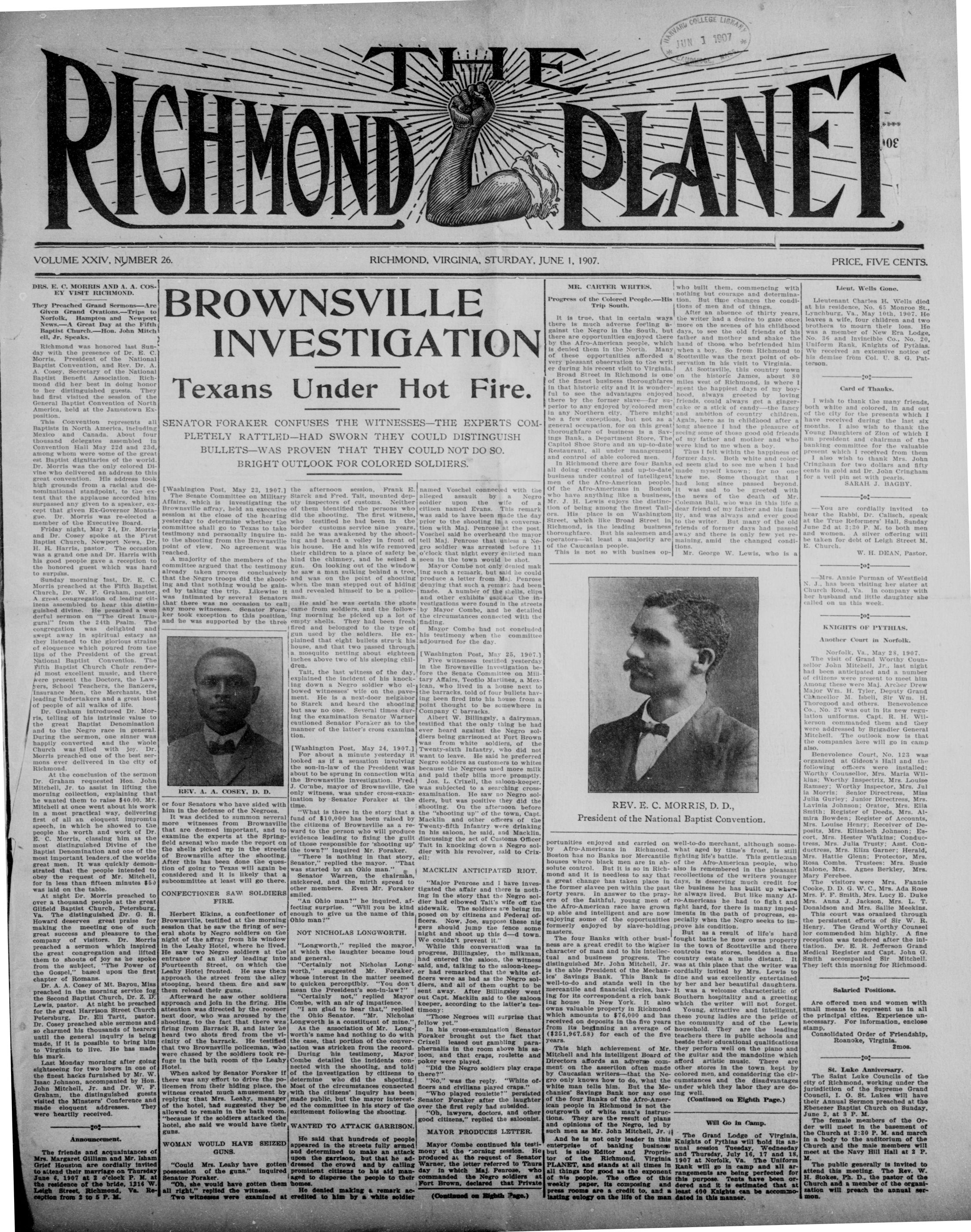
Richmond Planet
Saturday, June 1, 1907
Richmond, Virginia
Page text (machine-generated)
THE RICHMOND PLANET
VOLUME XXIV, NUMBER 26.
DRS. E. C. MORRIS AND A. A. COSEY PREVIST RICHMOND.
They Preyed Grand Sermons—Are Given Grand Ovations—Trips to Norfolk, Hampton and Newport News.—A Great Day at the Fifth Baptist Church.—Hon. John Mitch ell, Jr. Speaks.
Richmond was honored last Sunday with the presence of Dr. E. C. Morris, President of the National Baptist Convention, and Rev. Dr. A. A. Cosey, Secretary of the National Baptist Benefit Association. Richmond did her best in doing honor to her distinguished guests. They had first visited the session of the General Baptist Convention of North America, held at the Jamestown Exposition.
This Convention represents all Baptists in North America, including Mexico and Canada. About four thousand delegates assembled in Convention Hall May 22d and 23d, among whom were some of the great est Baptist dignitaries of the world. Dr. Morris was the only colored Divine who delivered an address to this great convention. His address took high grounds from a racial and denominational standpoint, to the extent that the applause accorded him surpassed any given to a speaker, except that given Ex-Governor Montague. Dr. Morris was re-elected a member of the Executive Board.
Friday night, May 24, Dr. Morris and Dr. Cosey spoke at the First Baptist Church, Newport News, Dr. H. H. Harris, pastor. The occasion was a grand one and Dr. Harris with his good people gave a reception to the honored guest which was hard to surpass.
Sunday morning Iast, Dr. E. C. Morris preached at the Fifth Baptist Church, Dr. W. F. Graham, pastor. A great congregation of leading citizens assembled to hear this distinguished divine. He preached a woonderful sermon on "The Great Inaugural" from the 24th Psalm. The congregation was delighted and swept away in spiritual estacy as they listened to the glorious strains of eloquence which poured from the lips of the President of the great National Baptist Convention. The Fifth Baptist Church Choir rendered most excellent music, and there were present the Doctors, the Lawyers, School Teachers, the Bankers, Insurance Men, the Merchants, the leading Undertakers and a great host of people of all walks of life.
Dr. Graham introduced Dr. Morris, telling of his intrinsic value to the great Baptist Denomination and to the Negro race in general. During the sermon, one sinner was happily converted and the whole Church was filled with joy. Dr. Morris preached one of the best sermons ever delivered in the city of Richmond.
At the conclusion of the sermon Dr. Graham requested Hon. John Mitchell, Jr. to assist in lifting the morning collection, explaining that he wanted them to raise $40.00. Mr. Mitchell at once went about his work in a most practical way, delivering first of all an eloquent impromptu speech, in which he showed to the people the worth and work of Dr. E. C. Morris, classing him as the most distinguished Divine of the Baptist Denomination and one of the most important leaders of the worlds great men. It was quickly demonstrated that the people intended to obey the request of Mr. Mitchell, for in less than fifteen minutes $50 was laid on the table.
At night Dr. Morris preached to over a thousand people at the great Gliffield Baptist Church, Petersburg, Va. The distinguished Dr. G. B. Howard deserves great praise for making the meeting one of such great success and pleasure to the company of visitors. Dr. Morris preached a sermon which inspired the great congregation and lifted them to shouts of joy as he spoke from the subject, "The Power of the Gospel," based upon the first chapter of Romans.
Dr. A. A. Cosey of Mt. Bayou, Miss preached in the morning service for the Second Baptist Church, Dr. Z. D. Lewis, pastor. At night he preached for the great Harrison Street Church Petersburg, Dr. Ell Tartt, pastor. Dr. Cosey preached able sermons and so charmed his thousands of hearers until the general inquiry is being made, if it is possible to bring him to Virginia to live. He has made his mark.
Last Monday morning after going sightseeing for two hours in one of the finest hacks furnished by Mr. W. Isaac Johnson, accompanied by Hon. John Mitchell, Jr. and Dr. W. F. Graham, the distinguished guests visited the Minsters' Conference and made eloquent addresses. They were heartily received.
The friends and acquaintances of Mrs. Margaret Gilliam and Mr. Isham Grief Houston are cordially invited to attend their marriage on Thursday June 6, 1907 at 2 o'clock P. M. at the residence of the bride, 1216 W. Leigh Street, Richmond, Va. Reception from 2 to 5 P. M.
BROWNSVILLE INVESTIGATION Texans Under Hot Fire.
SENATOR FORAKER CONFUSES THE WITNESSES—THE EXPERTS COMPLETELY RATTLED-HAD SWORN THEY COULD DISTINGUISH BULLETS-WAS PROVEN THAT THEY COULD NOT DO SO. BRIGHT OUTLOOK FOR COLORED SOLDIERS.
[Washington Post, May 23, 1907.] The Senate Committee on Military Affairs, which is investigating the Brownsville affray, held an executive session at the close of the hearing yesterday to determine whether the committee shall go to Texas to take testimony and personally inquire into the shooting from the Brownsville point of view. No agreement was reached.
A majority of the members of the committee argued that the testimony already taken proves conclusively that the Negro troops did the shooting and that nothing would be gained by taking the trip. Likewise it was intimated by several Senators that there was no occasion to call any more witnesses. Senator Foraker took exception to this position, and he was supported by the three
REV. A. A. COSEY, D. D.
or four Senators who have sided with him in the defense of the Negroes.
It was decided to summon several more witnesses from Brownsville that are deemed important, and to examine the experts at the Springfield arsenal who made the report on the shells picked up in the streets of Brownsville after the shooting.
After this has been done the question of going to Texas will again be considered and it is likely that a subcommittee at least will go there.
CONFECTIONER SAW SOLDIERS
FIRE.
Herbert Elkins, a confectioner of Brownsville, testified at the morning session that he saw the firing of several shots by Negro soldiers on the night of the affray from his window in the Leahy Hotel, where he lived. He saw two Negro soldiers at the entrance of an alley leading into Fourteenth Street, on which the Leahy Hotel fronted. He saw them approach the street from the alley stooping, heard them fire and saw them reload their guns.
Afterward he saw other soldiers approach and join in the firing. His attention was directed by the roomer next door, who was aroused by the shooting, to the fact that there was firing from Barrack B, and later he heard two shots fired from the vicinity of the barrack. He testified that two Brownsville policeman, who were chased by the soldiers took refuge in the bath room of the Leahy Hotel.
When asked by Senator Foraker if there was any effort to drive the policemen from their hiding place, the witness created much amusement by replying that Mrs. Leahy, manager of the hotel, had suggested they be allowed to remain in the bath room. "because if the soldiers attacked the hotel, she said we would have their guns.
WOMAN WOULD HAVE SEIZED GUNS.
"Could Mrs. Leahy have gotten possession of the guns." inquired Senator Foraker. "Oh, she would have gotten them all right" replied the witness. Two witnesses were examined at
RICHMOND, VIRGINIA, STURDAY, JUNE 1, 1907.
the afternoon session. Frank E. Starck and Fred. Tait, mounted deputy inspectors of customs. Neither of them identified the persons who did the shooting. The first witness, who testified he had been in the border customs service nine years, said he was awakened by the shooting and heard a volley in front of his house. He and his wife removed their children to a place of safety he hind the chimney, and he seized a gun. On looking out of the window he saw a man sulking behind a tree, and was on the point of shooting when the man stepped out of hiding and revealed himself to be a policeman.
He said he was certain the shots came from soldiers, and the following morning he picked up a lot of empty shells. They had been fresh fired and belonged to the type of gun used by the soldiers. He explained that eight bullets struck his house, and that two passed through a mosquito netting about eighteen inches above two of his sleeping children.
Tait, the last witness of the day, explained the incident of his knocking down a Negro soldier who elbowed witnesses' wife on the pavement. He is a next-door neighbor to Starck and heard the shooting but saw no one. Several times during the examination Senator Warner cautioned Senator Foraker as to the manner of the latter's cross examination.
[Washington Post, May 24, 1907.]
For about a minute yesterday it looked as if a sensation involving the son-in-law of the President was about to be sprung in connection with the Brownsville investigation. Fred J. Cornbe, mayor of Brownsville, the only witness, was under cross-examination by Senator Foraker at the time.
"What is there in the story that a fund of $10,000 has been raised by the citizens of Brownsville as a reward to the person who will produce evidence leading to fixing the guilt of those responsible for 'shooting up' the town?" inquired Mr. Foraker.
"There is nothing in that story, Senator," replied the mayor. "That was started by an Ohio man."
Senator Warren, the chairman, snickered, and the mirth spread to other members. Even Mr. Foraker smiled.
"An Ohio man?" he inquired, affecting surprise. "Will you be kind enough to give us the name of this Ohio man?"
NOT NICHOLAS LONGWORTH.
"Longworth," replied the mayor, at which the laughter became loud and general. "Certainly not Nicholas Longworth," suggested Mr. Foraker, whose interest in the matter seemed to quicken perceptibly. "You don't mean the President's son-in-law?" "Certainly not," replied Mayor Combe, with an air of impatience. "I am glad to hear that," replied the Ohio Senator. "Mr. Nicholas Longworth is a constituent of mine." As the association of Mr. Longworth's name had nothing to do with the case, that portion of the conversation was stricken from the record. During his testimony, Mayor Combe detailed the incidents connected with the shooting, and told of the investigation by citizens to determine who did the shooting. Most of the circumstances connected with the citizens' inquiry has been made public, but the mayor interested the committee in his story of the excitement following the shooting.
WANTED TO ATTACK GARRISON.
He said that hundreds of people appeared in the streets fully armed and determined to make an attack upon the garrison, but that he addressed the crowd and by calling prominent citizens to his aid managed to disperse the people to their homes. He denied making a remark accredited to him by a white soldier
named Voschel connected with the alleged assault by a Negro soldier upon the wife of a citizen named Evans. This remark was said to have been made the day prior to the shooting in a conversation with Maj. Penrose at the post. Voschel said he overheard the mayor tell Maj. Penrose that unless a Negro soldier was arrested before 11 o'clock that night every enlisted man seen in the town would be shot.
Mayor Combe not only denied making such a remark, but said he could produce a letter from Maj. Penrose denying that such a remark had been made. A number of the shells, clips and other exhibits needed the investigations were found in the streets by Mayor Combe, and he detailed the circumstances connected with the finding.
Mayor Combe had not concluded his testimony when the committee adjourned for the day.
[Washington Post, May 25, 1907.]
Five witnesses testified yesterday in the Brownsville investigation before the Senate Committee on Military Affairs, Teofilo Martinez, a Mexican, who lived in a house next to the barracks, told of four bullets having been fired into his house from a point thought to be somewhere in Company C barracks.
Albert W. Billingsly, a dairyman, testified that the only thing he had ever heard against the Negro soldiers being garrisoned at Fort Brown was from white soldiers, of the Twenty-sixth Infantry, who did not want to leave. He said he preferred Negro soldiers as customers to whites because the Negroes used more milk and paid their bills more promptly. Jos. L. Crixell, the saloon-keeper, was subjected to a searching cross-examination. He saw no Negro soldiers, but was positive they did the shooting. On the afternoon before the "shooting up" of the town, Capt. Macklin and other officers of the Twenty-fifth Infantry were drinking in his saloon, he said, and Macklin, discussing the act of Customs Officer Tait in knocking down a Negro soldier with his revolver, said to Crixell:
MACKLIN ANTICIPATED RIOT.
"Major Penrose and I have investigated the affair and there is nothing in the story that the Negro soldier had elbowed Tailw's wife off the sidewalk. The soldiers are being imposed on by citizens and Federal officers. Now, Joe, suppose these niggers should jump the fence some night and shoot up this d—d town. We couldn't prevent it."
While this conversation was in progress, Billingley, the milkman, had entered the saloon, the witness said, and, talking to the saloon-keeper had remarked that the white officers were as bad as the Negro soldiers, and all of them ought to be sent away. After Billingley went out Capt. Macklin said to the saloon keeper, according to the latter's testimony:
"Those Negroes will surprise that fellow yet."
In his cross-examination Senator Foraker brought out the fact that Crixell leased out gambling paraphernalia in the room above his saloon, and that craps, roulette and poker were played.
"Did the Negro soldiers play craps there?"
"No," was the reply. "White of
fisers, and stililina played crane."
ncers and civilians played craps."
"Who played roulette?" persisted
Senator Foraker after the laughter
over the first reply had subsided.
"Oh, lawyers, doctors, and other
good citizens," replied the saloonist
MAYOR PRODUCES LETTER.
Mayor Combe continued his testimony at the morning session. He produced at the request of Senator Warner, the letter referred to Thurs day in which Maj. Penrose, who commanded the Negro soldiers at Fort Brown, declared that Private
(Continued on Eighth Page.)
REV. E. C. MORRIS, D. D.,
President of the National Baptist Convention.
MR. CARTER WRITES.
Progress of the Colored People.—His Trip South.
It is true, that in certain ways there is much adverse feeling against the Negro in the South, but there are opportunities enjoyed there by the Afro-American people, which is denied them in the North. Many of these opportunities afforded a very pleasant observation to the writer during his recent visit to Virginia. Broad Street in Richmond is one of the finest business thoroughfares in that historic city and it is wonderful to see the advantages enjoyed there by the former slave—far superior to any enjoyed by colored men in any Northern city. There might be a few exceptions, but not as a general occupation, for on this great thoroughfare of business is a Savings Bank, a Department Store, the Capitol Shoe Store and an up-to-date Restaurant, all under management and control of able colored men. In Richmond there are four Banks all doing creditable and up-to-date business under control of intelligent men of the Afro-American people. Of the Afro-American in Boston who have anything like a business, Mr. J. H. Lewis enjoys the distinction of being among the finest Tailors. His place is on Washington Street, which like Broad Street in Richmond, is the leading business thoroughfare. But his salesmen and operators—at least a majority are of the Caucasian people.
This is not so with busines op-
REV. E. C. M
President of the Nation
portunities enjoyed and carried on by Afro-Americans in Richmond. Boston has no Banks nor Mercantile houses where black men are in absolute control. But it is so in Richmond and it is needless to say that a great change has taken place in the former slave pen within the past forty years. In answer to the prayers of the faithful, young men of the Afro-American race have grown up able and intelligent and are now enjoying some of the opportunities formerly enjoyed by slave-holding masters.
The four Banks with other business are a great credit to the nigger character of man and to his intellectual and business progress. The distinguished Mr. John Mitchell, Jr. is the able President of the Mechanics' Savings Bank. This Bank is well-to-do and stands well in the mercantile and financial circles, having for its correspondent a rich banking house in New York. It also owns valuable property in Richmond which amounts to $76,000 and has received on deposits in the five years from its beginning an average of ($251,967.58) for each of the five years.
This high achievement of Mr. Mitchell and his intelligent Board of Directors affords an adverse comment on the assertion often made by Caucasian writers—that the Negro only knows how to do, what the white man tells him. But the Mechanics' Savings Bank nor any one of the four Banks of the Afro-American people in Richmond is not the outgrowth of white man's instructions. They are the result of plans and opinions of the Negro, led by such men as Mr. John Mitchell, Jr. And he is not only leader in this enterprise of banking business but is also Editor and Proprietor of the Richmond, Virginia PLANET, and stands at all times in all things for good as the exponent of his people. The office of this weekly paper, its composing and press rooms are a credit to, and a lasting enrolment on the life of the man
who built them, commencing with nothing but courage and determination. But time changes the conditions of men and of things.
After an absence of thirty years, the writer had a desire to gaze once more on the scenes of his childhood days, to see the old friends of his father and mother and shake the hand of those who befriended him when a boy. So from Richmond to Scottsville was the next point of observation in his visit to Virginia.
At Scottsville, this country town on the historic James, about $80 miles west of Richmond, is where I spent the happiest days of my boyhood, always greeted by loving friends, could always get a gingercake or a stick of candy—the fancy and ambition of country children. Again, here as in childhood after a long absence I had the pleasure of seeing some of those good old friends of my father and mother and who were kind to me when a boy.
Thus I felt within the happiness of former days. Both white and colored seem glad to see me when I had made myself known; for no one knew me. Some thought that I had long since passed beyond. It was sad to be greeted with the news of the death of Mr. Coleman Ball, who was in this life a dear friend of my father and his family, and was always and ever good to the writer. But many of the old friends of former days had passed away and there is only few yet remaining, amid the changed conditions.
Mr. George W. Lewis, who is a
MORRIS, D. D.,
Annual Baptist Convention.
well-to-do merchant, although somewhat aged by time's frost, is still fighting life's battle. This gentleman of the Afro-American people, who also is remembered in the pleasant recollections of the writers younger days, is deserving much credit for the business he has built up where he always lived. But like many Afro-Americans he had to fight t and fight hard, for there is many impediments in the path of progress, especially when the Negro seeks to improve his condition.
But as a result of life's hard fought battle he now owns property in the town of Scottsville and there controls two stores, besides a fine country estate a mile distant. It was at this place that the writer was cordially invited by Mrs. Lewis to dine and was excellently entertained by her and her beautiful daughters. It was a welcome characteristic of Southern hospitality and a greeting which the writer will not forget.
Young, attractive and intelligent, these young ladies are the pride of the community and of the Lewis household. They are the leading teachers there in public schools and beside their educational qualifications they perform well on the piano and the guitar and the mandoline which afford artistic music. There are other stores in the town kept by colored men, and considering the circumstances and the disadvantages under which they labor they are doing well.
(Continued on Eighth Page.)
Will Go in Camp.
The Grand Lodge of Virginia, Knights of Pythias will hold its annual session Tuesday, Wednesday and Thursday, July 16, 17 and 18, 1907 at Norfolk, Va. The Uniform Rank will go in camp and all arrangements are being perfected for this purpose. Tents have been ordered and it is estimated that at least 400 Knights can be accommodated in this manner.
PRICE. FIVE CENTS.
Lieut. Wells Gone.
Lieutenant Charles H. Wells died at his residence. No. 65 Monroe St., Lynchburg, Va., May 10th, 1907. He leaves a wife, four children and two brothers to mourn their loss. He was a member of New Era Lodge, No. 36 and Invincible Co., No. 20, Uniform Rank, Knights of Pytalas. We received an extensive notice of his demise from Col. U. S. G. Patterson.
Card of Thanks.
I wish to thank the many friends, both white and colored, in and out of the city for the presents which I have received during the last six months. I also wish to thank the Young Daughters of Zlon of which I am president and chairman of the banking committee for the valuable present which I received from them. I also wish to thank Mrs. John Cringham for two dollars and fifty cents in gold and Dr. John Cringham for a vell pln set with pearls.
SARAH J. BAGBY.
—You are cordially invited to hear the Rabbi, Dr. Calisch, speak at the True Reformers' Hall, Sunday June 2d at 3:30 P. M. to both men and women. A silver offering will be taken for debt of Leigh Street M. E. Church. W. H. DEAN, Pastor.
—Mrs. Annie Furman of Westfield N. J., has been visiting her sister at Church Road, Va. In company with her husband and little daughter she called on us this week.
KNIGHTS OF PYTHIAS.
Another Court in Norfolk.
Norfolk, Va., May 28, 1907.
The visit of Grand Worthy Counselor John Mitchell, Jr., last night had been anticipated and a number of citizens were present to meet him Among these were Maj. Archer Drew Major Wm. H. Tyler, Deputy Grand Chancellor M. Isbell, Sir Wm. H. Thorogood and others. Benevolence Co., No. 27 was out in its new regulation uniforms. Capt. R. H. Wilkerson commanded them and they were addressed by Brigadier General Mitchell. The outlook now is that the companies here will go in camp also.
Benevolence Court, No. 123 was organized at Gideon's Hall and the following officers were installed: Worthy Counsellor, Mrs. Maria Wilkins; Worthy Inspectrix, Mrs. Louise Ramsey; Worthy Inspector, Mrs. Julia Morris; Senior Directress, Miss Julia Gurley; Junior Directress, Mrs. Lavinia Johnson; Orator, Mrs. Ella Smith; Register of Deeds, Mrs. Almira Bowden; Register of Accounts, Mrs. Louise Henry; Receiver of Deposits, Mrs. Elizabeth Johnson; Escort, Mrs. Hester Watkins; Conductress, Mrs. Julia Trusty; Asst. Conductress, Mrs. Eliza Garner; Herald, Mrs. Hattle Glenn; Protector, Mrs. Rosa Combs; Trustees; Mrs. Susie Malone, Mrs. Agnes Berkley, Mrs. Mary Ferebee.
The visitors were Mrs. Fannie Cooke, D. D. G. W. C., Mrs. Ada Rose Mrs. P. F. Smith, Mrs. Lucy E. Duke Mrs. Anna J. Jackson, Mrs. L. T. Donaldson and Mrs. Salle Meekins. This court was orienzed through the persistent efforts of Sir W. R. Henry. The Grand Worthy Counselor commended him highly. A fine reception was tendered after the initiation. Dr. E. R. Jefferson Grand Medical Register and Capt. John G. Smith accompanied Sir Mitchell. They left this morning for Richmond.
Salaried Positions.
Are offered men and women with small means to represent us in all the principal cities. Experience unnecessary. For information, enclose stamp. Consolidated Order of Friendship, Roanoke, Virginia.
The Saint Luke Councils of the city of Richmond, working under the jurisdiction of the Supreme Grand Council, O. Stokes will have their Annual Sermon preached at the Ebenene Baptist Church on Sunday, June 2, at 3 P. M.
The female members of the Order will meet in the basement of the Church at 2:30 P. M. and march in a body to the auditorium of the Church and the male members will meet at the Navy Hill Hall at 2 P. M.
The public generally is invited to attend this meeting. The Rev. W. H. Stokes, Ph. D., the pastor of the Church and a member of the organization will preach the annual sermon.
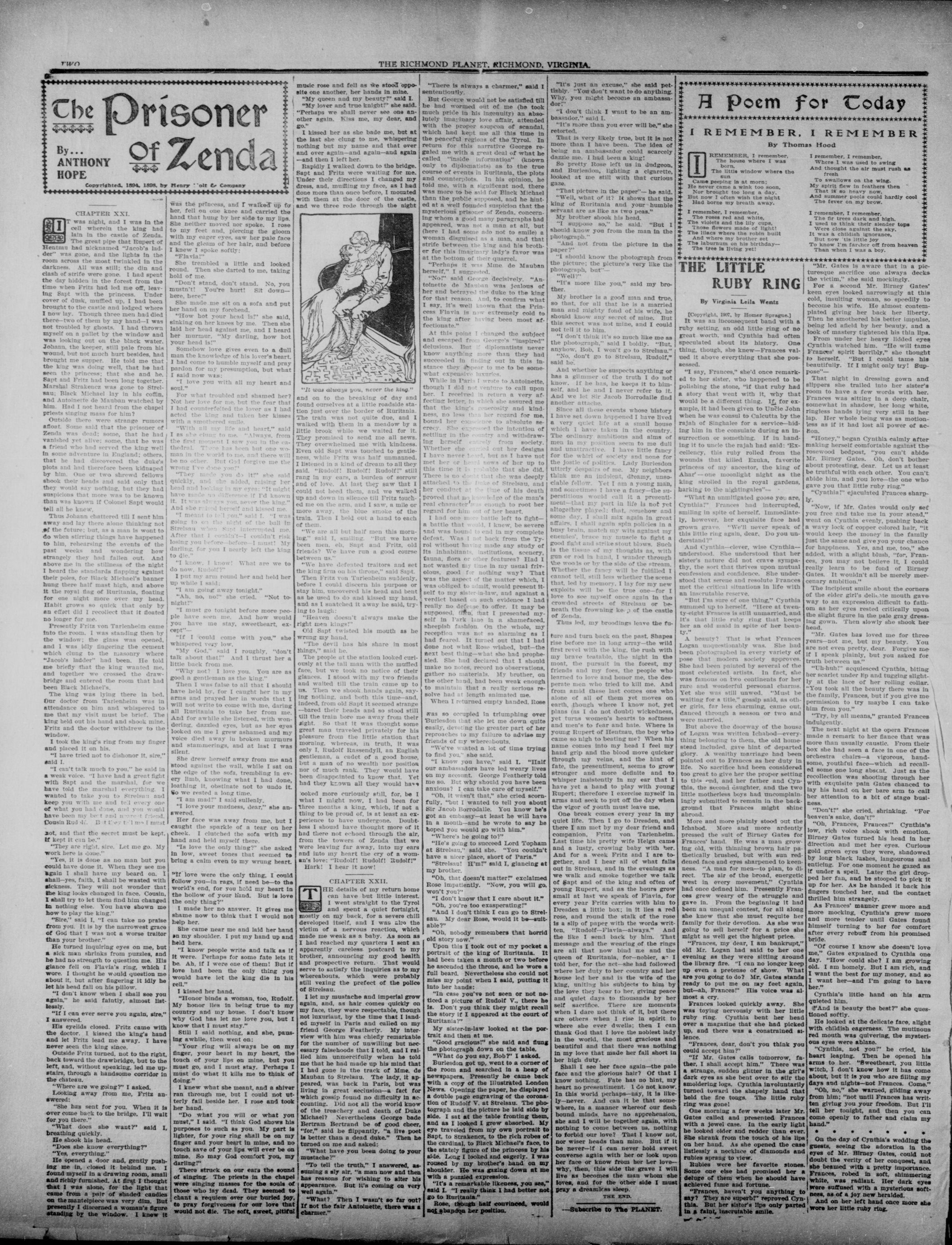
The Prisoner By... ANTHONY HOPE Of Zenda
CHAPTER XXI.
I
was night, and I was in the cell wherein the king had lain in the castle of Zenda. The great pipe that Rupert of
Henrich had nicknamed "Jacob's ladder" was gone, and the lights in the room across the mont twinkled in the darkness. All was still; the din and clash of strife were gone. I had spent the day hidden in the forest from the time when Fritz had led me off, leaving Sapt with the princess. Under cover of dusk, muffled up, I had been brought to the castle and lodged where I now lay. Though three men had died there—two of them by my hand—I was not troubled by ghosts. I had thrown myself on a pallet by the window and was looking out on the black water. Johann, the keeper, still pale from his wound, but not much hurt besides, had brought me supper. He told me that the king was doing well, that he had seen the princess; that she and he, Sapt and Fritz had been long together. Marshal Strakenca was gone to Strelau; Black Michael lay in his coffin, and Anointine de Manban watched by him. Had I not heard from the chapel priests singing mass for him?
Outside there were strange rumors afloat. Some said that the prisoner of Zenda was dead; some, that he had vanished yet alive; some, that he was a friend who had served the king well in some adventure in England; others, that he had discovered the duke's plots and had therefore been kidnapped by him. One or two shrewd fellows shook their heads and said only that they would say nothing, but they had suspicions that more was to be known than was known if Colonel Sapt would tell all he knew.
Thus Johann chattered till I sent him away and lay there alone thinking not of the future; but, as a man is wont to do when stirring things have happened to him, rehearsing the events of the past weeks and wondering how strangely they had fallen out. And above me in the stillness of the night I heard the standards flapping against their poles, for Black Michael's banner hung there half mast high, and above it the royal flag of Ruritania, floating for one night more over my head. Habit grows so quick that only by an effort did I recollect that it floated no longer for me.
Presently Fritz von Tarlenheim came into the room. I was standing then by the window; the glass was opened, and I was idly fingering the cement which clung to the masonry where "Jacob's ladder" had been. He told me briefly that the king wanted me, and together we crossed the drawbridge and entered the room that had been Black Michael's.
The king was lying there in bed. Our doctor from Tarlenheim was in attendance on him and whispered to me that my visit must be brief. The king held out his hand and shook mine. Fritz and the doctor withdrew to the window.
I took the king's ring from my finger and placed it on his.
"I have tried not to dishonor it, sire," said I.
"I can't talk much to you," he said in a weak voice. "I have had a great fight with Sapt and the marshal, for we have told the marshal everything. I wanted to take you to Strelsau and keep you with me and tell every one of what you had done, and you would have been my best and most friend, Cousin Rudolf. But they told me I must not, and that the secret must be kept, if kept it can be."
"They are right, sir. Let me go. My work here is done."
"Yes, it is done as no man but you could have done it. When they see me again I shall have my beard on. I shall-yes, faith, I shall be wasted with sickness. They will not wonder that the king looks changed in face. Cousin, I shall try to let them find him changed in nothing else. You have shown me how to play the king."
"Sire," said I, "I can take no praise from you. It is by the narrowest grace of God that I was not a worse traitor than your brother."
He turned inquiring eyes on me, but a slick man shrinks from puzzles, and he had no strength to question me. His glance fell on Flavia's ring, which I wore. I thought he would question me about it, but after fingering it idly he let his head fall on his pillow.
"I don't know when I shall see you again," he said faintly, almost listlessly.
"If I can ever serve you again, sire," I answered.
His eyelids closed. Fritz came with the doctor. I kissed the king's hand and let Fritz lead me away. I have never seen the king since.
Outside Fritz turned, not to the right, back toward the drawbridge, but to the left, and, without speaking, led me upstairs, through a handsome corridor in the chateau.
"Where are we going?" I asked.
Looking away from me, Fritz answered:
"She has sent for you. When it is over come back to the bridge. I'll wait for you there."
"What does she want?" said I, breathing quickly.
He shook his head.
"Does she know everything?"
"Yes, everything."
He opened a door and, gently pushing me in, closed it behind me. I found myself in a drawing room, small and richly furnished. At first I thought that I was alone, for the light that came from a pair of shaded candles on the mantelpiece was very dim. But presently I discerned a woman's figure standing by the window. I knew it
was the princess, and I walked up to her, fell on one knee and carried the hand that hung by her side to my lips. She neither moved nor spoke. I rose to my feet and, piercing the gloom with my eager eyes, saw her pale face and the gleam of her halr, and before I knew I spoke softly:
"Flavia!"
She trembled a little and looked round. Then she darted to me, taking hold of me.
"Don't stand, don't stand. No, you mustn't! You're hurt! Sit down—here, here!"
She made me sit on a sofa and put her hand on my forehead.
"How hot your head is!" she said, stinking on her knees by me. Then she laid her head against me, and I heard her murmur, "My darling, how hot your head is!"
Somehow love gives even to a dull man the knowledge of his lover's heart. I had come to humble myself and pray pardon for my presumption, but what I said now was:
"I love you with all my heart and soul."
For what troubled and shamed her? Not her love for me, but the fear that I had counterfelt the lover as I had acted the king and taken her kisses with a smothered smile.
"With all my life and heart," said I as she clung to me. "Always, from the first moment I saw you in the cathedral. There has been but one woman in the world to me, and there will be no other. But God forgive me the wrong I've done you."
"They made you do it!" she said quickly, and she added, raising her head and looking in my eyes: "It might have made no difference if I'd known it. It was always you, never the king."
And she raised herself and kissed me.
"I meant to tell you," said I. "I was going to on the night of the ball in Strelsan when Sept interrupted me. After that I couldn't—I couldn't risk losing you before—before I must! My darling, for you I nearly left the king to die."
"I know. I know! What are we to do now. Rudolf?"
I put my arm round her and held her up while I said:
"I am going away tonight."
"Ah, no, no!" she cried. "Not tonight."
"I must go tonight before more people have seen me. And how would you have me stay, sweetheart, except—"
"If I could come with you," she whispered very low.
"My God," said I roughly, "don't talk about that!" And I thrust her a little back from me.
"Why not? I love you. You are as good a gentleman as the king."
Then I was false to all that I should have held by, for I caught her in my arms and prayed her in words that I will not write to come with me, daring all Ruritania to take her from me. And for awhile she listened, with wondering, dazzled eyes, but as her eyes looked on me I grew ashamed and my voice died away in broken murmurs and stammerings, and at last I was silent.
She drew herself away from me and stood against the wall, while I sat on the edge of the sofa, trembling in every limb, knowing what I had done, loathing it, obstinate not to undo it. So we rested a long time.
"I am mad!" I said sullenly.
"I love your madness, dear," she answered.
Her face was away from me, but I caught the sparkle of a tear on her cheek. I clutched the sofa with my hand and held myself there.
"I love the only thing?" she asked in low, sweet tones that seemed to bring a calm even to my wrung heart.
"If love were the only thing, I could follow you—in rags, if need be—to the world's end, for you hold my heart in the hollow of your hand. But is love the only thing?"
I made her no answer. It gives me shame now to think that I would not help her.
She came near me and laid her hand on my shoulder. I put my hand up and held hers.
"I know people write and talk as if it were. Perhaps for some fate lets it be. Ah, if I were one of them! But if love had been the only thing you would have let the king die in his cell."
I kissed her hand.
"Honor blinds a woman, too, Rudolf. My honor lies in being true to my country and my house. I don't know why God has let me love you, but I know that I must stay."
Still I said nothing, and she, pausing awhile, then went on:
"Your ring will always be on my finger, your heart in my heart, the touch of your lips on mine, but you must go, and I must stay. Perhaps I must do what it kills me to think of doing."
I knew what she meant, and a shiver ran through me, but I could not utterly fall beside her. I rose and took her hand.
"Do what you will or what you must," I said. "I think God shows his purposes to such as you. My part is lighter, for your ring shall be on my finger and your heart in mine, and no touch save of your lips will ever be on mine. So may God comfort you, my darling!"
There struck on our ears the sound of singing. The priests in the chapel were singing masses for the souls of those who lay dead. They seemed to chant a requiem over our buried joy, to pray forgiveness for our love that would not die. The soft, sweet, pitiful
THE RICHMOND PLANET, RICHMOND, VIRGINIA
music rose and fell as we stood oppo
site one another, her hands in mine.
site one another, her hands in mine.
"My queen and my beauty!" said I.
"My lover and true knight!" she said.
"Perhaps we shall never see one another again. Kiss me, my dear, and go."
I kissed her as she bade me, but at the last she clung to me, whispering nothing but my name and that over and over again—and again—and again—and then I left her.
Rapidly I walked down to the bridge. Sapt and Fritz were waiting for me. Under their directions I changed my dress, and, muffling my face, as I had done more than once before, I mounted with them at the door of the castle, and we three rode through the night.
A
"It was always you, never the king." and on to the breaking of day and found ourselves at a little roadside station just over the border of Ruritania. The train was not quite due, and I walked with them in a meadow by a little brook while we waited for it. They promised to send me all news. They overwhelmed me with kindness. Even old Sapt was touched to gentleness, while Fritz was half unmanned. I listened in a kind of dream to all they said. "Rudolf! Rudolf! Rudolf!" still rang in my cars, a burden of sorrow and of love. At last they saw that I could not heed them, and we walked up and down in silence till Fritz touched me on the arm, and I saw, a mile or more away, the blue smoke of the train. Then I held out a hand to each of them.
"We are all but half men this morning," said I, smiling. "But we have been men, eh, Sapt and Fritz, old friends? We have run a good course between us."
"We have defeated traitors and set the king firm on his throne," said Sapt. Then Fritz von Tarlenheim suddenly, before I could discern his purpose or stay him, uncovered his head and bent as he used to do and kissed my hand, and as I snatched it away he said, trying to laugh:
"Heaven doesn't always make the right men kings!"
Old Sapt twisted his mouth as he wrung my hand.
"The devil has his share in most things," said he.
The people at the station looked curiously at the tall man with the muffled face, but we took no notice of their glances. I stood with my two friends and waited till the train came up to us. Then we shook heads again, saying nothing, and both this time—and, indeed, from old Sapt it seemed strange—bared their heads and so stood still till the train bore me away from their sight. So that it was thought some great man traveled privately for his pleasure from the little station that morning, whereas, in truth, it was only I, Rudolf Rassendyll, an English gentleman, a cadet of a good house, but a man of no wealth nor position nor of much rank. They would have been disappointed to know that. Yet had they known all they would have
ooked more curiously still, for be, I what I might now, I had been for three months a king, which, if not a thing to be proud of, is at least an experience to have undergone. Doubtless I should have thought more of it had there not echoed through the air, from the towers of Zenda that we were leaving far away, into my ears and into my heart the cry of a woman's love: "Rudolf! Rudolf! Rudolf!" Hark! I hear it now!
CHAPTER XXII.
THE details of my return home can have but little interest. I went straight to the Tyrol and spent a quiet fortnight, mostly on my back, for a severe chill developed itself, and I was also the victim of a nervous reaction, which made me weak as a baby. As soon as I had reached my quarters I sent an apparently careless postcard to my brother, announcing my good health and prospective return. That would serve to satisfy the inquiries as to my whereabouts, which were probably still vexing the prefect of the police of Strelau.
I let my mustache and imperial grow again, and, as hair comes quickly on my face, they were respectable, though not luxuriant, by the time that I landed myself in Paris and called on my friend George Featherly. My interview with him was chiefly remarkable for the number of unwilling but necessary falsehoods that I told, and I rallied him unmercifully when he told me that he had made up his mind that I had gone in the track of Mme. de Mauban to Strelsaun. The lady, it appeared, was back in Paris, but was living in great seclusion—a fact for which gossip found no difficulty in accounting. Did not all the world know of the treachery and death of Duke Michael? Nevertheless George bade Bertram Bertrand be of good cheer, "for," said he flippantly, "a live poet is better than a dead duke." Then he turned on me and asked: "What have you been doing to your mustache?"
"To tell the truth," I answered, assuming a sly air, "a man now and then has reasons for wishing to alter his appearance. But it's coming on very well again."
"What? Then I wasn't so far out? If not the fair Antolnette, there was a charmer."
"There is always a charmer," said I sententiously.
But George would not be satisfied till he had wormed out of me (he took much pride in his geniusity) an absolutely imaginary love affair, attended with the proper soupcon of scandal, which had kept me all this time in the peaceful regions of the Tyrol. In return for this narrative George regulated me with a great deal of what he called "inside information" (known only to diplomats) as to the true course of events in Ruritania, the plots and counterplots. In his opinion, he told me, with a significant nod, there was more to be said for Black Michael than the public supposed, and he hinted at a well founded suspicion that the mysterious prisoner of Zenda, concerning whom a good many paragraphs had appeared, was not a man at all, but (here I had some ado not to smile) a woman disguised as a man, and that strife between the king and his brother for this imaginary lady's favor was at the bottom of their quarrel.
"Perhaps it was Mume de Mauban herself," I suggested.
"No!" said George decisively. "Antoinette de Mauban was jealous of her and betrayed the duke to the king for that reason. And, to confirm what I say, it's well known that the Princess Flavia is now extremely cold to the king after having been most affectionate."
At this point I changed the subject and escaped from George's "inspired" delusions. But if diplomatists never know anything more than they had succeeded in finding out in this instance they appear to me to be some what expensive luxuries.
While in Paris I wrote to Antoinette, though I did not venture to call upon her, I received in return a very affecting letter, in which she assured me that the king's generosity and kindness, no less than her regard for me, bound her conscience to absolute secrecy. She expressed the intention of settling in the country and withdrawing herself entirely from society. Whether she carried out her designs I have never heard, but as I have not met her or heard news of her up to this time it is probable that she did. There is no doubt that she was deeply attached to the boke of Strelsaun, and her conduct at the time of his death proved that no knowledge of the man's real character was enough to root her regard for him out of her heart.
I had one more battle left to fight—a battle that would, I knew, be severe and was bound to end in my complete defeat. Was I not back from the Tyrol without having made any study of its inhabitants, institutions, scenery, fauna, flora or other features? Had I not wasted my time in my usual frivolous, good for nothing way? That was the aspect of the matter which, I was obliged to admit, would present itself to my sister-in-law, and against a verdict based on such evidence I had really no defense to offer. It may be supposed, then, that I presented myself in Park lans in a shamefaced, sheepish fashion. On the whole, my reception was not so alarming as I had feared. It turned out that I had done not what Rose wished, but—the next best thing—what she had prophesied. She had declared that I should make no notes, record no observations, gather no materials. My brother, on the other hand, had been weak enough to maintain that a really serious resolve had at length animated me.
When I returned empty handed, Rose was so occupied in triumphing over Burlesdon that she let me down quite easily, devoting the greater part of her reproaches to my failure to advise my friends of my whereabouts.
"We've wasted a lot of time trying to find you," she said.
"I know you have," said I. "Half our ambassadors have led weary lives on my account. George Featherly told me so. But why should you have been anxious? I can take care of myself."
"Oh, it wasn't that," she cried scornfully, "but I wanted to tell you about Sir Jacob Borrodalle. You know he's got an ambassador—at least he will have in a month—and he wrote to say he hoped you would go with him."
"Where's he going to?"
"He's going to succeed Lord Topham at Strelsau," said she. "You couldn't have a nicer place, short of Paris."
"Strelsau! H'm!" said I, glancing at my brother.
"Oh, that doesn't matter!" exclaimed Rose impatiently. "Now, you will go, won't you?"
"I don't know that I care about it."
"Oh, you're too exasperating?"
"And I don't think I can go to Strelsau. My dear Rose, would it be—suitable?"
"Oh, nobody remembers that horrid old story now."
Upon this I took out of my pocket a portrait of the king of Ruritania. It had been taken a month or two before he ascended the throne, and he wore a full beard. Nevertheless she could not miss my point when I said, putting it into her hands:
"In case you've not seen or not noticed a picture of Rudolf V., there he is. Don't you think they might recall the story if I appeared at the court of Ruritania?" My sister-in-law looked at the portrait and then at me. "Good gracious!" she said and flung the photograph down on the table.
What do you say, Bob? I asked.
Burlesdon got up, went to a corner of the room and searched in a heap of newspapers. Presently he came back with a copy of the illustrated London News. Opening the paper, he displayed a double page engraving of the coronation of Rudolf V. at Strelsau. The photograph and the picture he laid side by side. I sat at the table fronting them, and as I looked I grew absorbed. My eye traveled from my own portrait to Sapt, to Strakenzoc, to the rich robes of the cardinal, to Black Michael's face, to the stately figure of the princess by his side. Long I looked and eagerly. I was roused by my brother's hand on my shoulder. He was gazing down at me with a puzzled expression.
"It's a remarkable likeness, you see," said I. "I really think I had better not go to Huritania."
Rose, though half convinced, would not abandon her position.
"It's just an excuse," she said petitish. "You don't want to do anything. Why, you might become an ambassador."
"I don't think I want to be an ambassador," said I.
"It's more than you ever will be," she retorted.
That is very likely true, but it is not more than I have been. The idea of being an ambassador could scarcely dazzle me. I had been a king!
So pretty Rose left in dudgeon, and Burlesdon, lighting a cigarette, looked at me still with that curious gaze.
"That picture in the paper"—he said.
"Well, what of it? It shows that the king of Ruritania and your humble servant are as like as two peas."
My brother shook his head.
"I suppose so," he said. "But I should know you from the man in the photograph."
"And not from the picture in the paper?"
"I should know the photograph from the picture; the picture's very like the photograph, but"— "Well!" "It's more like you," said my brother. My brother is a good man and true, so that, for all that he is a married man and mighty fond of his wife, he should know any secret of mine. But this secret was not mine, and I could not tell it to him. "I don't think it's so much like me as the photograph," said I boldly. "But, anyhow, Bob, I won't go to Strelsau." "No, don't go to Strelsau, Rudolf," said he. And whether he suspects anything or has a glimmer of the truth I do not know. If he has, he keeps it to himself, and he and I never refer to it. And we let Sir Jacob Borrodale find another attache.
Since all these events whose history I have set down happened I have lived a very quiet life at a small house which I have taken in the country. The ordinary ambitions and aims of men in my position seem to me dull and unattractive. I have little fancy for the whirl of society and none for the jostle of politics. Lady Burleson utterly despairs of me. My neighbors think me an indolent, dreamy, unsociable fellow. Yet I am a young man, and sometimes I have a fancy—the suspensions would call it a presentation—that my part in life is not yet altogether played; that, somehow and some day, I shall mix again in great affairs. I shall again spin policies in a busy brain, match my wits against my enemies', brace my muscle to fight a good fight and strike stout blows. Such is the tissue of my thoughts as, with gun or rod in hand, I wander through the woods or by the side of the stream. Whether the fancy will be fulfilled I cannot tell, still less whether the scene that, led by memory, I lay for my new exploits will be the true one—for I love to see myself once again in the crowded streets of Strelsau or beneath the frowning keep of the castle of Zenda.
Thus led, my broodings leave the fu
ture and turn back on the past, Shapes rise before me in long array—the wild first revel with the king, the rush with my brave teatable, the night in the mont, the pursuit in the forest, my friends and my foes, the people who learned to love and honor me, the desperate men who tried to kill me. And from amid these last comes one who alone of all of them yet moves on earth, though where I know not, yet plans (as I do not doubt) wickedness, yet turns women's hearts to softness and men's to fear and hate. Where is young Rupert of Hentzau, the boy who came so nigh to beating me? When his name comes into my head I feel my hand grip and the blood move quicker through my veins, and the hint of fate, the presentiment, seems to grow stronger and more definite and to whisper insistently in my ear that I have yet a hand to play with young Rupert; therefore I exercise myself in arms and seek to put off the day when the vigor of youth must leave me.
One break comes every year in my quiet life. Then I go to Dresden, and there I am met by my dear friend and companion, Fritz von Tarlenheim. Last time his pretty wife Helga came and a lusty, crowing baby with her. And for a week Fritz and I are together, and I hear all of what falls out in Strelsaun, and in the evenings as we walk and smoke together we talk of Sapt and of the king and often of young Rupert, and as the hours grow small at last we speak of Flavia, for every year Fritz carries with him to Dresden a little box; in it lies a red rose, and round the stalk of the rose is a slip of paper with the words written, "Rudolf-Flavia—always." And the like I send back by him. That message and the wearing of the rings are all that now bind me and the queen of Buritania, for-nobler, as I told her, for the act—she had followed where her duty to her country and her house led her and is the wife of the king, uniting his subjects to him by the love they bear to her, giving peace and quiet days to thousands by her self sacrifice. There are moments when I dare not think of it, but there are others when I rise in spirit to where she ever dwells; then I can thank God that I love the noblest lady in the world, the most gracious and beautiful and that there was nothing in my love that made her fall short in her high duty.
Shall I see her face again—the pale face and the glorious hair? Of that I know nothing. Fate has no hint, my heart no presentiment. I do not know. In this world perhaps—nay, it is likely—never. And can it be that somewhere, in a manner whereof our flesh bound minds, have no apprehension, she and I will be together again, with nothing to come between us, nothing to forbid our love? That I know not, nor wiser heads than mine. But if it be never—if I can never hold sweet converse again with her or look upon her face or know from her her love—why, then, this side the grave I will live as becomes the man whom she loves, and for the other side I must pray a dreamless sleep.
THE END.
---Subscribe to The PLANET.
A Poem for Today
By Thomas Hood
REMEMBER, I remember,
The house where I was
born.
The little window where the
man
Came peeping in at morn;
He never came a wink too soon,
Nor brought too long a day.
But now I often wish the night
Had borne my breath away.
I remember, I remember,
The roses red and white,
The violets and the lilys cups,
Those flowers made of light!
The lilies where the robin built
And where the owl came.
The laburnum on his birthday—
The tree is living yet!
THE LITTLE
RUBY RING
[Copyright, 1907, by Homer Sprague.]
It was an inconsequent band with a ruby setting, an odd little ring of no great worth, and Cynthia had often speculated about its history. One thing, though, she knew—Frances valued it above everything that she possessed.
"I say, Frances," she'd once remarked to her sister, who happened to be polishing the stone, "if that ruby had a story that went with it, why that would be a different thing. If for example, it had been given to Uncle John when he was consul to Calcutta by the rajah of Singhalea for a service—hiding him in the consulate during an insurrection or something. If in handling it to uncle the rajah had said: 'Excellency, this ruby rolled from the wounds that killed Ezuka, favorite princess of my ancestor, the king of Ahar'—one moonlight night as the king strolled in the royal gardens, harking to the nightingales"—
"What an unmitigated goose you are, Cynthia!" Frances had interrupted, smiling in spite of herself. Immediately, however, her exquisite face had grown grave. "We'll never speak of this little ring again, dear. Do you understand?"
And Cynthia—clever, wise Cynthia—understood. She understood that her sister's nature did not crave sympathy, the sort that thrives upon mutual confession and confidence. She understood that serene and resolute Frances met the critical situations in life with an inscrutable reserve.
"But I'm sure of one thing," Cynthia summed up to herself. "Here at twenty-eight Frances is still unmarried, and it's that little ruby ring that keeps her an old maid in spite of her beauty."
A beauty? That is what Frances Logan questionably was. She had been photographed in every variety of pose that modern society approves. She had been painted by several of the most celebrated artists. In fact, she was famous on two continents for her rare and wonderful personal charms. Yet she was still unwed. "Must be waiting for a title," gossip said, as other girls, far less charming, came out, danced through a season or two and were married.
But above the doorway of the house of Logan was written Ichabod—everything belonging to them, the old homestead included, gave hint of departed glory. A wealthy marriage had been pointed out to Frances as her duty in life. No sacrifice had been considered too great to give her the proper setting to this end, and her father and Cynthia, the second daughter, and the two little motherless boys had uncomplainingly submitted to remain in the background that Frances might shine abroad.
More and more plainly stood out the Ichabod. More and more ardently pressed the suit of Birney Gates for Frances' hand. He was a man growing old, with thinning brown hair pathetically brushed, but with sun redened face and eyes sharpened to keenness. "A man for men—to plan, to direct. The air of the broad, energetic west in every movement," Cynthia had once defined him. Presently Frances grew weary of the struggle and gave in. From the beginning it had been an unequal contest, for all along she knew that she must requite her family for their devotion. As she was going to sell herself for a price she might as well get the highest price.
"Frances, my dear, I am bankrupt," old Mr. Logan had said to her one evening as they were sitting around the library fire. "I can no longer keep up even a pretense of show. What are you going to do? Mr. Gates stands ready to put me on ray feet again, but—ah, Frances!" His voice was almost a cry.
Frances looked quickly away. She was toying nervously with her little ruby ring. Cynthia bent her head over a magazine that she had picked up, and there was a constrained silence.
"Frances, dear, don't you think you could accept him?"
"If Mr. Gates calls tomorrow, father, I shall accept him." There was a strange, sudden glitter in the girl's dark eyes as she bent over to stir the smoldering logs. Cynthia involuntarily turned toward the shapely hand that held the fire tongs. The little ruby ring was gone!
One morning a few weeks later Mr. Gates called and presented Frances with a jewel case. In the early light he looked older and redder than ever. She shrank from the touch of his lips on her hand. As she opened the case listlessly a necklace of diamonds and rubles sprang to view.
Rubles were her favorite stones. Some one else had promised her a deluge of them when he should have achieved fame and fortune.
"Frances, haven't you anything to say? They are superb!" reproved Cynthia. But her sister's lips only parted in a faint, inscrutable amile.
I
By Virginia Leila Wentz
I remember, I remember,
Where I was used to swing
And thought the air must rush as
fresh
To swallows on the wing.
My spirit flew in feathers then
That was me.
And summer pools could hardly cool
The fever on my brow.
I remember, I remember,
The fir trees dark and high.
I that that that thunder tops
Were close against the sky.
It was a childish ignorance,
But now 'tis little joy
To know I'm farther off from heaven
Than when I was a boy.
"Mr. Gates is aware that in a picturesque sacrifice one always decks the victim," she said mockingly.
For a second Mr. Birnley Gates' keen eyes looked narrowly at this cold, insulting woman, so speedily to become his wife. He almost contemplated giving her back her liberty. Then he smothered his better impulse, being led afield by her beauty, and a look of mastery tightened his thin lips. From under her heavy lidded eyes Cynthia watched him. "He will tame Frances' spirit horribly," she thought to herself. "But I could tame his beautifully. If I might only try! Suppose".
That night in dressing gown and slippers she trailed into her sister's room to have a few words with her. Frances was sitting in a deep chair, somewhat in shadow, her long white, ringless hands lying very still in her lap. Her whole being was as motionless as if it had lost all power of action.
"Honey," began Cynthia calmly after making herself comfortable against the rosewood bedpost, "you can't abide Mr. Birney Gates. Oh, don't bother about protesting, dear. Let us at least be truthful with each other. You can't abide him, and you love—the one who gave you that little ruby ring." "Cynthia!" ejaculated Frances sharply.
"Now, if Mr. Gates would only set you free and take me in your stand," went on Cynthia evenly, pushing back a wavy lock of copper colored hair, "it would keep the money in the family just the same and give you your chance for happiness. Yes, and me, too," she added, with a slight blush, "for, Frances, you may not believe it, I could really learn to be fond of Birney Gates. It wouldn't all be merely mercenary ambition."
The incipient smile about the corners of the elder girl's delicate mouth gave way to an expression difficult to fathom as her eyes rested critically upon the slight figure in the pale gray dressing gown. Then slowly she shook her head.
"Mr. Gates has loved me for three years—not me, but my beauty. You are not even pretty, dear. Forgive me if I speak plainly, but you asked for truth between us."
"Uh-huh!" acquiesced Cynthia, biting her scarlet under lip and tugging slightly at the lace of her rolling collar. "You took all the beauty there was in the family, Frances, but if you give me permission to try maybe I can take him from you."
"Try, by all means," granted Frances indulently.
The next night at the opera Frances made a remark to her fiance that was more than usually caustic. From their box she had seen a face in one of the orchestra chairs—a vigorous, handsome, youthful face—which ad recalled some one long absent. Just as the recollection was shooting through her with exquisite pain Gates chanced to lay his hand on her bare arm to call her attention to a bit of stage business.
"Don't!" she cried, shrinking. "For heaven's sake, don't."
"Oh, Frances, Frances!" Cynthia's low, rich voice shook with emotion. Binney Gates turned his head in her direction and met her eyes. Curious gold green eyes they were, shadowed by long black lashes, languorous and enticing. For one moment he gazed as if under a spell. Later the girl dropped her fan, and he stooped to plek it up for her. As he handed it back his fingers touched her, and the contact thrilled him strangely.
As Frances' manner grew more and more mocking, Cynthia's grew more and more tender until Gates found himself turning to her for comfort after every rebuff from his promised bride.
"Of course I know she doesn't love me," Gates explained to Cynthia one day. "How could she? I am growing old. I am homely. But I am rich, and I want the best for my money, and so I want her—and I'm going to have her."
Cynthia's little hand on his arm quieted him.
"And is beauty the best?" she questioned softly.
He looked at the delicate face, alight with childish eagerness. The mutinous red mouth was quivering, the mysterious eyes were ablaze.
"Cynthia, not you!" he cried, his heart leaping. Then he opened his arms to her. "Sweetheart, you little witch, I don't know how it has come about, but it is you who are filling my days and nights—not Frances. Come." "Oh, no," she warned, gilding away from him; "not until Frances has written giving you your freedom. But I'll tell her tonight, and then you can come openly to father and claim my hand."
On the day of Cynthia's wedding the guests, seeing the adoration in the eyes of Mr. Blirney Gates, could not doubt the verity of her conquest, and she beamed with a pretty importance. Frances, robed in soft, shimmering white, was radiant. Her dark eyes were suffused with a mysterious softness, as of a joy new heralded.
And on her left hand once more she
wore her little ruby ring.
IT WILL PAY YOU To interest yourself in promot ing the CIRCULATION of the RICHMOND PLANET.
---
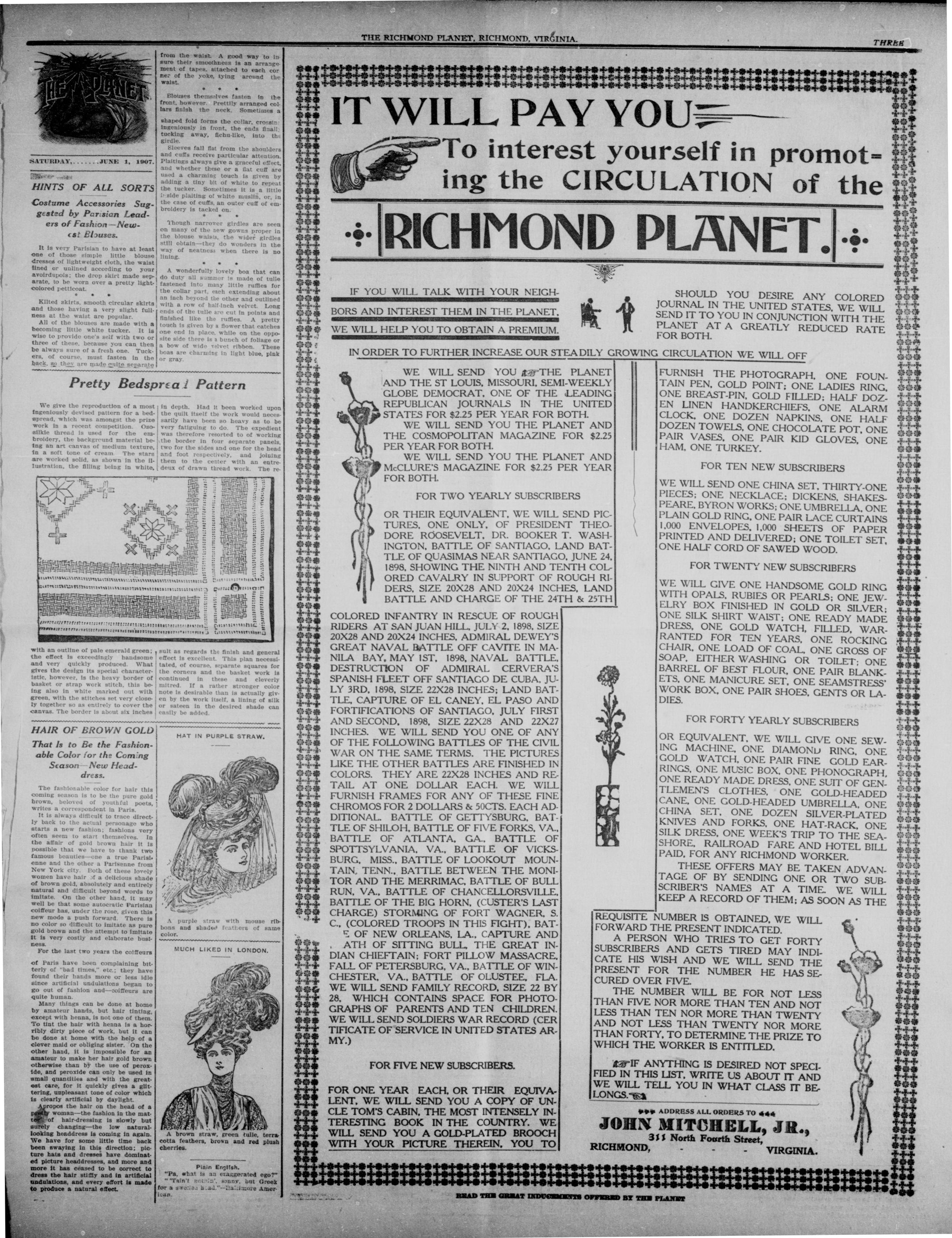
Pretty Bedspread Pattern
3
THE PLANET
HINTS OF ALL SORTS
Costume Accessories Suggested by Parisian Leaders of Fashion-Newest Elouses.
It is very Parisian to have at least one of those simple little blouse dresses of lightweight cloth, the waist lined or unlined according to your avoirdupols; the drop skirt made separate, to be worn over a pretty light-colored petticoat.
Kilted skirts, smooth circular skirts and those having a very slight fullness at the waist are popular.
All of the blouses are made with a becoming little white tucker. It is wise to provide one's self with two or three of these, because you can then be always sure of a fresh one. Tuckers, of course, must fasten in the back, so they are made quite separate
We give the reproduction of a most ingeniously devised pattern for a bedspread, which was amongst the prize work in a recent competition. Oosilkile thread is used for the embroidery, the background material being an art canvas of medium texture, in a soft tone of cream. The stars are worked solid, as shown in the illustration, the filling being in white
+
with an outline of pale emerald green; the effect is exceedingly handsome and very quickly produced. What gives the design its special characteristic, however, is the heavy border of basket or strap work stitch, this being also in white marked out with green, with the stitches set very closely together so as entirely to cover the canvas. The border is about six inches
HAIR OF BROWN GOLD That Is to Be the Fashionable Color for the Coming Season-New Head
dress.
The fashionable color for hair this coming season is to be the pure gold brown, beloved of youthful poets, writes a correspondent in Paris.
It is always difficult to trace directly back to the actual personage who starts a new fashion; fashions very often seem to start themselves. In the affair of gold brown hair it is possible that we have to thank two famous beauties—one a true Parisienne and the other a Parisienne from New York city. Both of these lovely women have hair of a delicious shade of brown gold, absolutely and entirely natural and difficult beyond words to imitate. On the other hand, it may well be that some autocratic Parisian coiffeur has, under the rose, given this new mode a push forward. There is no color so difficult to imitate as pure gold brown and the attempt to imitate it is very costly and elaborate business.
of Paris have been complaining bitterly of "bad times," etc.; they have found their hands more or less idle since artificial undulations began to go out of fashion and—coffeurs are quite human.
Many things can be done at home by amateur hands, but hair tinting, except with henna, is not one of them. To tint the hair with henna is a horribly dirty piece of work, but it can be done at home with the help of a clever maid or obliging sister. On the other hand, it is impossible for an amateur to make her hair gold brown otherwise than by the use of peroxide, and peroxide can only be used in small quantities and with the greatest care, for it quickly gives a glittering, unpleasant tone of color which is clearly artificial by daylight.
Apropos the hair on the head of a pretty woman—the fashion in the matter of hair-dressing is slowly but surely changing—the low natural-looking headdress is coming in again. We have for some little time back been swaying in this direction; picture hats and dresses have dominated picture headaddress, and more and more it has ceased to be correct to dress the hair stiffly and in artificial undulations, and every effort is made to produce a natural effect.
COLORED INFANTRY IN RESCUE OF ROUGH RIDERS AT SAN JUAN HILL, JULY 2, 1898, SIZE 20X28 AND 20X24 INCHES, ADMIRAL DEWEY'S GREAT NAVAL BATTLE OFF CAVITE IN MANILA BAY, MAY 1ST, 1898, NAVAL BATTLE, DESTRUCTION OF ADMIRAL CERVERA'S SPANISH FLEET OFF SANTIAGO DE CUBA, JULY 3RD, 1898, SIZE 22X28 INCHES; LAND BATTLE, CAPTURE OF EL CANEY, EL PASO AND FORTIFICATIONS OF SANTIAGO, JULY FIRST AND SECOND, 1898, SIZE 22X28 AND 22X27 INCHES. WE WILL SEND YOU ONE OF ANY OF THE FOLLOWING BATTLES OF THE CIVIL WAR ON THE SAME TERMS. THE PICTURES LIKE THE OTHER BATTLES ARE FINISHED IN COLORS. THEY ARE 22X28 INCHES AND RETAIL AT ONE DOLLAR EACH. WE WILL FURNISH FRAMES FOR ANY OF THESE FINE CHROMOS FOR 2 DOLLARS & 50CTS. EACH ADDITIONAL. BATTLE OF GETTYSBURG, BATTLE OF SHILOH, BATTLE OF FIVE FORKS, VA., BATTLE OF ATLANTA, GA., BATTLE OF SPOTTSYLVANIA, VA., BATTLE OF VICKSBURG, MISS., BATTLE OF LOOKOUT MOUNTAIN, TENN., BATTLE BETWEEN THE MONITOR AND THE MERRIMAC, BATTLE OF BULL RUN, VA., BATTLE OF CHANCELLORSVILLE, BATTLE OF THE BIG HORN, (CUSTER'S LAST CHARGE) STORMING OF FORT WAGNER, S. C., (COLORED TROOPS IN THIS FIGHT), BAT-
E OF NEW ORLEANS, LA., CAPTURE AND ATH OF SITTING BULL, THE GREAT INDIAN CHIEFTAIN; FORT PILLOW MASSACRE, FALL OF PETERSBURG, VA., BATTLE OF WINCHESTER, VA., BATTLE OF OLUSTEE, FLA. WE WILL SEND FAMILY RECORD, SIZE 22 BY 28, WHICH CONTAINS SPACE FOR PHOTOGRAPHS OF PARENTS AND TEN CHILDREN. WE WILL SEND SOLDIERS WAR RECORD (CERTIFICATE OF SERVICE IN UNITED STATES ARMY.)
FOR ONE YEAR EACH, OR THEIR EQUIVALENT, WE WILL SEND YOU A COPY OF UNCLE TOM'S CABIN, THE MOST INTENSELY INTERESTING BOOK IN THE COUNTRY. WE WILL SEND YOU A GOLD-PLATED BROOCH WITH YOUR PICTURE THEREIN, YOU TO
from the waist. A good way to insure their smoothness is an arrangement of tapes, attached to each corner of the yoke, tying around the waist.
```markdown
```
Blouses themselves fasten in the front, however. Prettily arranged collars finish the neck. Sometimes a shaped fold forms the collar, crossin' ingenuously in front, the ends finally, tucking away, flicku-like, into the girdle.
Sleeves fall flat from the shoulders and cuffs receive particular attention. Plaitings always give a graceful effect, and whether these or a flat cuff are used a charming touch is given by adding a tiny bit of white to repeat the tucker. Sometimes it is a little inside plaiting of white muslin, or, in the case of cuffs, an outer cuff of embroidery is tacked on.
Though narrower girdles are seen on many of the new gowns proper in the blouse waists, the wider girdles still obtain—they do wonders in the way of neatness when there is no lining.
A wonderfully lovely boa that can do duty all summer is made of tulle fastened into many little ruffles for the collar part, each extending about an inch beyond the other and outlined with a row of half-inch velvet. Long ends of the tulle are cut in points and finished like the ruffles. A pretty touch is given by a flower that catches one end in place, while on the opposite side there is a bunch of foliage or a bow of wide velvet ribbon. These boas are charming in light blue, pink or gray.
Boreal Pattern
in depth. Had it been worked upon the quilt itself the work would necessarily have been so heavy as to be very fatiguing to do. The expedient was therefore resorted to of working the border in four separate panels, two for the sides and one for the head and foot respectively, and joining them to the center with an entree of drawn thread work. The re
COLORED
RIDERS A
20X28 AND
GREAT N
suit as regards the finish and general effect is excellent. This plan necessitated, of course, separate squares for the corners and the basket work is continued in these and cleverly mitred. If a rather stronger color note is desirable than is actually given by the work itself, a lining of silk or sateen in the desired shade can easily be added.
HAT IN PURPLE STRAW.
A purple straw with mouse ribbons and shaded feathers of same color.
A purple straw with mouse ribbons and shaded feathers of same color.
```markdown
```
A brown straw, green tulle, terra cotta feathers, brown and red plush cherries.
"Pa, what is an exaggerated ego?" "Tain't not sinny, but Greek for a swollen head."—Baldimore American.
IN ORDER TO FURTHER INCREASE OUR STEADILY GROWING CIRCULATION WE WILL OFF
WE WILL SEND YOU THE PLANET AND THE ST LOUIS, MISSOURI, SEMI-WEEKLY GLOBE DEMOCRAT, ONE OF THE LEADING REPUBLICAN JOURNALS IN THE UNITED STATES FOR $2.25 PER YEAR FOR BOTH.
WE WILL SEND YOU THE PLANET AND THE COSMOPOLITAN MAGAZINE FOR $2.25 PER YEAR FOR BOTH.
WE WILL SEND YOU THE PLANET AND McCLURE'S MAGAZINE FOR $2.25 PER YEAR FOR BOTH.
OR THEIR EQUIVALENT, WE WILL SEND PICTURES, ONE ONLY, OF PRESIDENT THEODORE ROOSEVELT, DR. BOOKER T. WASHINGTON, BATTLE OF SANTIAGO, LAND BATTLE OF QUASIMAS NEAR SANTIAGO, JUNE 24, 1898, SHOWING THE NINTH AND TENTH COLORED CAVALRY IN SUPPORT OF ROUGH RIDERS, SIZE 20X28 AND 20X24 INCHES, LAND BATTLE AND CHARGE OF THE 24TH & 25TH
READ THE GREAT INDUCEMENTS OFFERED BY THE PLANET
THE RICHMOND PLANET, RICHMOND, VIRGINIA
IF YOU WILL TALK WITH YOUR NEIGH-
```markdown
```
FOR TWO YEARLY SUBSCRIBERS
FOR FIVE NEW SUBSCRIBERS
REQUISITE NUMBER IS OBTAINED, WE WILL FORWARD THE PRESENT INDICATED. A PERSON WHO TRIES TO GET FORTY SUBSCRIBERS AND GETS TIRED MAY INDICATE HIS WISH AND WE WILL SEND THE PRESENT FOR THE NUMBER HE HAS SECURED OVER FIVE. THE NUMBER WILL BE FOR NOT LESS THAN FIVE NOR MORE THAN TEN AND NOT LESS THAN TEN NOR MORE THAN TWENTY AND NOT LESS THAN TWENTY NOR MORE THAN FORTY, TO DETERMINE THE PRIZE TO WHICH THE WORKER IS ENTITLED.
IF ANYTHING IS DESIRED NOT SPECIFIED IN THIS LIST, WRITE US ABOUT IT AND WE WILL TELL YOU IN WHAT CLASS IT BE LONGS.
ADDRESS ALL ORDERS TO
JOHN MITCHELL, JR.,
311 North Fourth Street,
RICHMOND, VIRGINIA.
A
PLANET
EEEKLY
LADING
UNITED
TH.
T AND
ER $2.25
T AND
YEAR
ND PIC-
THEO-
WASH-
D BAT-
JUNE 24,
H COL-
UGH RI-
LAND
& 25TH
```markdown
```
REQUISIT
FORWAR
SHOULD YOU DESIRE ANY COLORED JOURNAL IN THE UNITED STATES, WE WILL SEND IT TO YOU IN CONJUNCTION WITH THE PLANET AT A GREATLY REDUCED RATE FOR BOTH.
FURNISH THE PHOTOGRAPH, ONE FOUNTAIN PEN, GOLD POINT; ONE LADIES RING, ONE BREAST-PIN, GOLD FILLED; HALF DOZEN LINEN HANDKERCHIEFS, ONE ALARM CLOCK, ONE DOZEN NAPKINS, ONE HALF DOZEN TOWELS, ONE CHOCOLATE POT, ONE PAIR VASES, ONE PAIR KID GLOVES, ONE HAM, ONE TURKEY.
WE WILL SEND ONE CHINA SET, THIRTY-ONE PIECES; ONE NECKLACE; DICKENS, SHAKESPEARE, BYRON WORKS; ONE UMBRELLA, ONE PLAIN GOLD RING, ONE PAIR LACE CURTAINS 1,000 ENVELOPES, 1,000 SHEETS OF PAPER PRINTED AND DELIVERED; ONE TOILET SET, ONE HALF CORD OF SAWED WOOD
FOR TWENTY NEW SUBSCRIBERS
WE WILL GIVE ONE HANDSOME GOLD RING WITH OPALS, RUBIES OR PEARLS; ONE JEWELRY BOX FINISHED IN GOLD OR SILVER; ONE SILK SHIRT WAIST; ONE READY MADE DRESS, ONE GOLD WATCH, FILLED, WARRANTED FOR TEN YEARS, ONE ROCKING CHAIR, ONE LOAD OF COAL, ONE GROSS OF SOAP, EITHER WASHING OR TOILET; ONE BARREL OF BEST FLOUR, ONE PAIR BLANKETS, ONE MANICURE SET, ONE SEAMSTRESS' WORK BOX, ONE PAIR SHOES, GENTS OR LADIES.
FOR FORTY YEARLY SUBSCRIBERS
OR EQUIVALENT, WE WILL GIVE ONE SEWING MACHINE, ONE DIAMOND RING, ONE GOLD WATCH, ONE PAIR FINE GOLD EARRINGS, ONE MUSIC BOX, ONE PHONOGRAPH, ONE READY MADE DRESS, ONE SUIT OF GENTLEMEN'S CLOTHES, ONE GOLD-HEADED CANE, ONE GOLD-HEADED UMBRELLA, ONE CHINA SET, ONE DOZEN SILVER-PLATED KNIVES AND FORKS, ONE HAT-RACK, ONE SILK DRESS, ONE WEEK'S TRIP TO THE SEASHORE, RAILROAD FARE AND HOTEL BILL PAID, FOR ANY RICHMOND WORKER. THESE OFFERS MAY BE TAKEN ADVANTAGE OF BY SENDING ONE OR TWO SUBSCRIBER'S NAMES AT A TIME. WE WILL KEEP A RECORD OF THEM; AS SOON AS THE
FOR TEN NEW SUBSCRIBERS
THREE
not= the
COLORED WE WILL WITH THE RED RATE
ONE FOUND- DIES RING, HALF DOZ- ONE ALARM ONE HALF POT, ONE MOVES, ONE
BERS
SHIRTY-ONE BES, SHAKES- SELLA, ONE CURTAINS OF PAPER BOILET SET, O.
BERS
GOLD RING ONE JEW- ER SILVER; ADY MADE-LED, WAR- ROCKING GROSS OF BOILET; ONE BIR BLANK- AMSTRESS' BITS OR LA-
BERS
ONE SEW- RING, ONE GOLD EAR- NOGRAPH, IT OF GEN- D- HEADED SELLA, ONE ER- PLATED BACK, ONE TO THE SEA- MOTEL BILL BER.
N ADVAN- TWO SUB- WE WILL ON AS THE
```markdown
```
```markdown
```
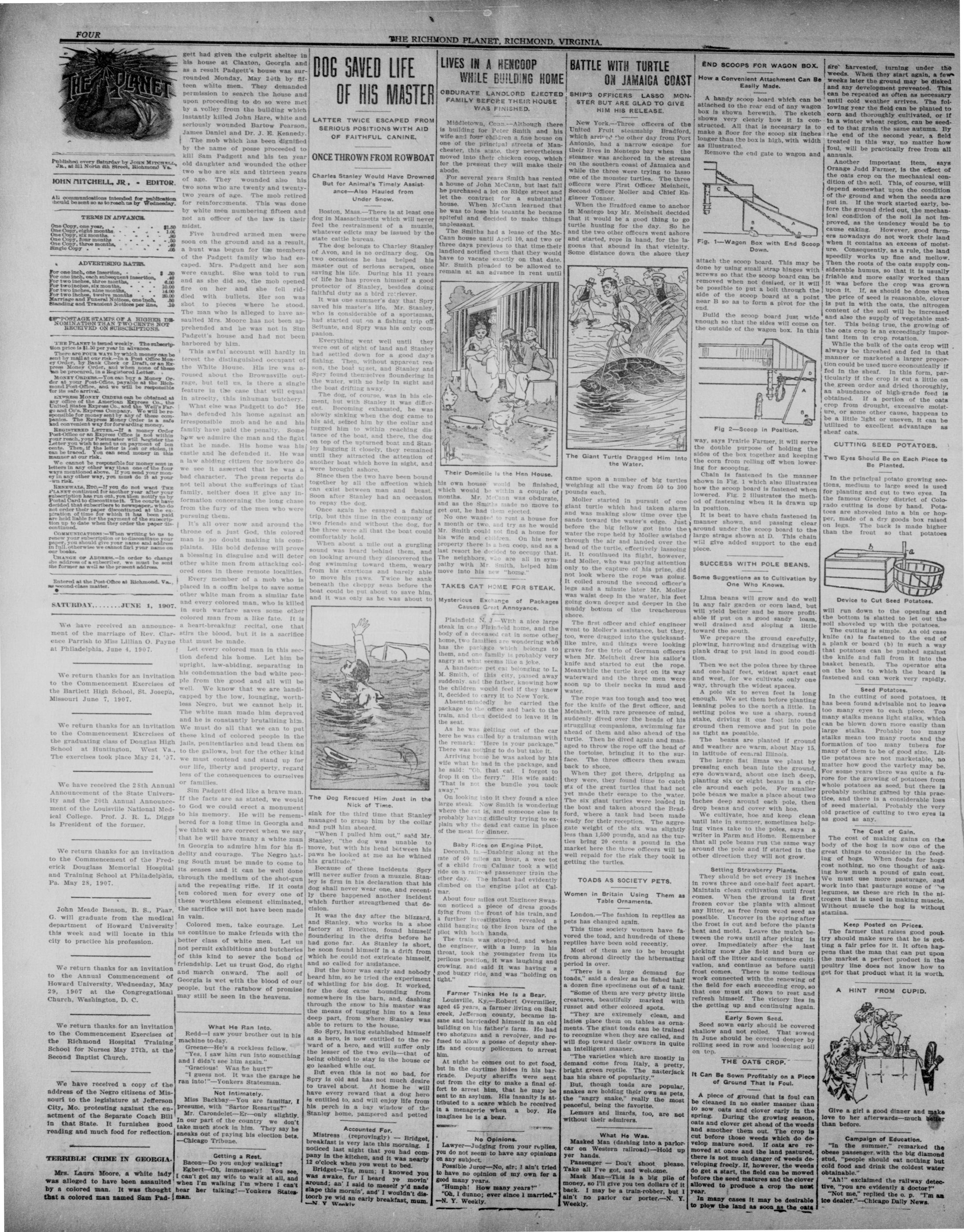
THE PLANET
Published every Saturday by JOHN MITCHELL,
JR., at 311 North 4th Street, Richmond Va.
JOHN MITCHELL, JR., - EDITOR.
All communications intended for publication
should be sent so as to reach us by Wednesday.
TERMS IN ADVANCE
One Copy, one year, $1.50
One Copy, eight months, 1.00
One Copy, six months, .80
One Copy, four months, .50
One Copy, three months, .40
Single Copy .05
ADVERTISING RATES
For one inch, one insertion, $50
For one inch, each subsequent insertion, $40
For two inches, three months, $6.00
For two inches, six months, $10.00
For two inches, nine months, $14.00
For two inches, twelve months $20.00
Marriage and Funeral Notices, one inch, $50
Standing and Transient Notices per line, $10
POSTAGE STAMPS OF A HIGHER DE-
NOMINATION THAN TWO CENTS NOT
RECEIVED ON SUBSCRIPTIONS.
THE PLANET is issued weekly. The subscription price is $1.50 per year in advance.
There are FOUR WAYS by which money can be sent by mail at your risk.—In a Post Office Monetary or Express Money Order, and when none of these can be procured, in a Registered Letter.
MONEY ORDERS.—You can buy a Money Order at your Post-Office, payable at the Richmond, and we will be responsible for your safe arrival.
EXPRESS MONEY ORDERS can be obtained at any office of the American Express Co. the United States Express Co., and the Wells Fargo Company, and you are responsible for money sent by any of these companies. The Express Money Order is a safe and convenient way for forwarding money.
REGISTERED LETTER.—If a money Order is registered within your reach, your Postmaster will register Letter you wish to send us on payment of ten cents. Then, if the letter is lost or stolen, you can send money in this manner at our risk.
We cannot be responsible for money sent in letters in any other way than one of the four ways mentioned above. If you send your monies in any other way, you must do it at your warrants.
BENEWALK, ENG.-If you do not want THE PLANET continued for another year after your subscription has run out, you then notify us by postal card. You discontinuing. The course has decided that subscribers to newspaper, who do not order their paper discontinued at the expiration of time for which it has been paid, hold liable for the payment of the subscription up to date when they order the paper discontinued.
COMMUNICATIONS—When writing to us to renew your subscription or to discontinue your address, you should give your name and address in full, otherwise we cannot find your name on our books.
ORGANIZE OF ADDRESS. In order to change the address of a subscriber, we must be sent the former as well as the present address.
Entered at the Post-Office at Richmond, Va., as second-class matter.
SATURDAY, ... JUNE 1, 1907
We have received an announcement of the marriage of Rev. Clarence Parrish to Miss Lillian O. Payne at Philadelphia, June 4, 1907.
We return thanks for an invitation to the Commencement Exercises of the Bartlett High School, St. Josepa, Missouri June 7, 1907.
We return thanks for an invitation to the Commencement Exercises of the graduating class of Douglas High School at Huntington, West Va. The exercises took place May 24, '07.
We have received the 28th Annual Announcement of the State University and the 20th Annual Announcement of the Louisville National Medical College. Prof. J. R. L. Diggs is President of the former.
We return thanks for an invitation to the Commencement of the Frederick Douglass Memorial Hospital and Training School at Philadelphia Pa. May 28, 1907.
John Meade Benson, B. S., Piar. G. will graduate from the medical department of Howard University this week and will locate in this city to practice his profession.
We return thanks for an invitation to the Annual Commencement of Howard University, Wednesday, May 29, 1967 at the Congregational Church, Washington, D. C.
We return thanks for an invitation to the Commencement Exercises of the Richmond Hospital Training School for Nurses May 27th, at the Second Baptist Church.
We have received a copy of the address of the Negro citizens of Missouri to the legislature at Jefferson City, Mo. protesting against the enactment of the Separate Coach Bill in that State. It furnishes good reading and much food for reflection.
TERRIBLE CRIME IN GEORGIA
Mrs. Laura Moore, a white lady was alleged to have been assaulted by a colored man. It was thought that a colored man named Sam Pad-
gett had given the culprit shelter in his house at Claxton, Georgia and as a result Padgett's house was surrounded Monday, May 20th by fifteen white men. They demanded permission to search the house and upon proceeding to do so were met by a volley from the building which instantly killed John Hare, white and seriously wounded Bartow Pearson, James Daniel and Dr. J. E. Kennedy. The mob which has been dignified by the name of posse proceeded to kill Sam Padgett and his ten year old daughter and wounded the other two who are six and thirteen years of age. They wounded also his two sons who are twenty and twenty-two years of age. The mob retired for reinforcements. This was done by white men numbering fifteen and not an officer of the law in their midst.
Five hundred armed men were soon on the ground and as a result, a hunt was begun for the members of the Padgett family who had escaped. Mrs. Padgett and her son were caught. She was told to run and as she did so, the mob opened fire on her and she fell riddled with bullets. Her son was shot to pieces where he stood. The man who is alleged to have assaulted Mrs. Moore has not been apprehended and he was not in Sim Padgett's house and had not been harbored by him.
This awful account will hardly interest the distinguished occupant of the White House. His ire was aroused about the Brownsville outrage, but tell us, is there a single feature in the case that will equal in atrocity, this inhuman butchery. What else was Padgett to do? He has defended his home against an irresponsible mob and he and his family have paid the penalty. Some how we admire the man and the figat that he made. His home was his castle and he defended it. He was a law abiding citizen for nowhere do we see it asserted that he was a bad character. The press reports do not tell about the sufferings of that family, neither does it give any information concerning the long chase from the fury of the men who were pursuing them.
It's all over now and around the throne of a just God, this colored man is no doubt making his complaints. His bold defense will prove a blessing in disguise and will deter other white men from attacking colored ones in these remote localities. Every member of a mob who is placed in a coffin helps to save some other white man from a similar fate and every colored man, who is killed in such warfare saves some other colored man from a like fate. It is a heart-breaking recital, one that stirs the blood, but it is a sacrifice that must be made.
Let every colored man in this section defend his home. Let him be upright, law-abiding, separating in his condemnation the bad white people from the good and all will be well. We know that we are handicapped by the low, lounging, worthless Negro, but we cannot help it. The white man made him depraved and he is constantly brutalizing him. We must do all that we can to put these kind of colored people in the jails, penitentiaries and lead them on to the gallows, but for the other kind we must contend and stand up for our life, liberty and property, regard less of the consequences to ourselves or families.
Sim Padgett died like a brave man. If the facts are as stated, we would to God we could erect a monument to his memory. He will be remembered for a long time in Georgia and we think we are correct when we say that he will have many a white man in Georgia to admire him for his fidelity and courage. The Negro hating South must be made to come to its senses and it can be well done through the medium of the shot-gun and the repeating rifle. If it costs ten colored men for every one of these worthless element eliminated, the sacrifice will not have been made in vain.
Colored men, take courage. Let us continue to make friends with the better class of white men. Let us not permit exhibitions and butcheries of this kind to sever the bond of friendship. Let us trust God, do right and march onward. The soil of Georgia is wet with the blood of our people, but the rainbow of promise may still be seen in the heavens.
What He Ban Into
Redd—I saw your brother out in his machine to-day.
"I guess not. It was the garage he ran into!" - Yonkers Statesman.
Not Intimately
Miss Backbay—You are famiHar, I presume with "Sartor ResartusZ."
Mr. Carondelet—Er—only slightly. In our part of the country we don't take much stock in him. They say he sneaks out of paying his election bets. —Chicago Tribune.
Getting a Rest.
Bacon—Do you enjoy walking?
Egbert—Oh, immensely! You see,
i can't get my wife to walk at all,
and when I'm walking I'm where I can't
hear her talking!—Yonkers Statesman.
THE RICHMOND PLANET, RICHMOND, VIRGINIA
DOG SAVED LIFE OF HIS MASTER
LATTER TWICE ESCAPED FROM SERIOUS POSITIONS WITH AID OF FAITHFUL CANINE.
ONCE THROWN FROM ROWBOAT
Charles Stanley Would Have Drowned
Boston, Mass.—There is at least one dog in Massachusetts which will never feel the restrainment of a muzzle, whatever edicts may be issued by the state cattle bureau.
The dog belongs to Charley Stanley of Avon, and is no ordinary dog. On two occasions he has helped his master out of serious scraps, once saving his life. During his 11 years of life he has proven himself a good protector of Stanley, besides doing faithful duty as a bird retriever.
It was one summer's day that Spry saved his master's life. Mr. Stanley, who is considerable of a sportsman, had started out on a fishing trip off Scluate, and Spry was his only companion.
Everything went well until they were out of sight of land and Stanley had settled down for a good day's fishing. Then, without apparent reason, the boat upset, and Stanley and Spry found themselves foundering in the water, with no help in sight and the boat drifting away.
The dog, of course, was in his element, but with Stanley it was different. Becoming exhausted, he was slowly sinking when the dog came to his aid, seized him by the collar and tugged him to within reaching distance of the boat, and there, the dog on top of the upturned boat and Stanley hugging it closely, they remained until they attracted the attention of another boat which hove in sight, and were brought ashore.
Since then the two have been bound together by all the affection which can exist between man and beast. Soon after Stanley had an occasion to repay the dog.
Once again he essayed a fishing trip, but this time in the company of two friends and without the dog, for the three were all that the boat could comfortably hold.
When about a mile out a gurgling sound was heard behind them, and on looking around they discovered the dog swimming toward them, weary from his exertions and barely able to move his paws. Twice he sank beneath the choppy seas before the boat could be put about to save him, and it was only as he was about to
A man is swimming in a river. He is reaching up with his hand. There is a boat in the background.
The Dog Rescued Him Just in the Nick of Time.
sink for the third time that Stanley managed to grasp him by the collar and pull him aboard.
"When I pulled him out," said Mr. Stanley, "the dog was unable to move, but with his head between his paws he looked at me as he whined his gratitude."
Because of these incidents Spry will never suffer from a muzzle. Stanley is firm in his declaration that his dog shall never wear one, and recently there happened another incident which further strengthened that decision.
It was the day after the blizzard, and Stanley, who works in a shoe factory at Brockton, found himself floundering in the drifts before he had far. As Stanley is short, he soon found himself in a drift from which he could not extricate himself, and so called for assistance.
But the hour was early and nobody heard him, so he tried the experiment of whistling for his dog. It worked, for the dog came bounding from somewhere in the barn, and, dashing through the snow to his master was the means of tugging him to a less deep part, from where Stanley was able to return to the house. So Spry, having established himself as a hero, is now entitled to the reward of a hero, and will suffer only the lesser of the two evils—that of being obliged to stay in the house or go leashed while out.
But even this is not so bad, for Spry is old and has not much desire to travel about. At home he will have every reward that a dog hero is entitled to, and will enjoy life from his perch in a bay window of the Stanley home, pampered and petted
Accounted For
Mistress (reprovingly) -- Bridget, breakfast is very late this morning. I noticed last night that you had company in the kitchen, and it was nearly 12 o'clock when you went to bed. Bridget-Yis, mum; I knowed you was awake, fur I heard you mov'n' around; an' I said to meself y'd nade slape this mornin', and' I wouldn't distoorb ye wad an early breakfast, mum. — N. Y Weekly
LIVES IN A HENCOOP
WHILE BUILDING HOME
OBDURATE LANDLORD EJECTED FAMILY BEFORE THEIR HOUSE WAS FINISHED.
Middletown, Conn.—Although there is building for Peter Smith and his wife and four children a fine house on one of the principal streets of Manchester, this state, they nevertheless moved into their chicken coop, which for the present they will make their abode.
For several years Smith has rented a house of John McCann, but last fall he purchased a lot on Ridge street and let the contract for a substantial house. When McCann learned that he was to lose his tenants he became spiteful and decided to make things unpleasant.
The Smiths had a lease of the McCann house until April 10, and two or three days previous to that time their landlord notified them that they would have to vacate exactly on that date. Mr. Smith pleaded to be allowed to remain at an advance in rent until
A farmer and his children sit on a bench in front of a barn, watching a group of chickens pecking at the ground.
Their Domicile is the Hen House.
his own house would be finished,
which would be within a couple of
months. Mr. McCann was obdurate,
and as the Smiths made no move to
get out, he had them ejected.
No one wanted to rent a house for
a month or two, and try as he would
Mr. Smith could not find a home for
his wife and children. On his new
property there is a hen coop, and as a
last resort he decided to occupy that.
The neighbors, who are all in sympathy with Mr. Smith, helped him move into his new "home."
TAKES CAT HOME FOR STEAK
Mysterious Exchange of Packages Causes Great Annoyance.
Plainfield. N. J.—With a nice large steak in one Plainfield home, and the body of a deceased cat in some other home, two families are wondering who has the package which belongs to them, and one family is probably very angry at what seems like a joke.
A handsome pet cat belonging to L. M. Smith, of this city, passed away suddenly, and the father, knowing how the children would feel if they knew it, decided to carry it to New York.
Absent-mindedly he carried the package to the office and back to the train, and then decided to leave it in the seat.
As he was getting out of the car here he was called by a trainman with the remark: "Here is your package."
There was nothing to do but take it.
Arriving home he was asked by his wife what he had in the package, and he said: "Oh, that cat. I forgot to drop it on the ferry." His wife said: "That is not the bundle you took away."
On looking into it they found a nice large steak. Now Smith is wondering where the cat is, and someone else is probably having difficulty trying to explain why the dead cat came in place of the meat for dinner.
Baby Rides on Engine Pilot
Decorah, Ia.—Dashing along at the rate of 40 miles an hour, a wee tot of a child from Calmar took a wild ride on a railroad passenger train the other day. The infant had evidently climbed on the engine pilot at Calmar.
About four miles out Engineer Swanson noticed a piece of dress goods flying from the front of his train, and a further investigation revealed a child hanging to the iron bars of the pilot with both hands.
The train was stopped, and when the engineer, with a lump in his throat, took the youngster from its perilous position, it was laughing and crowing, and said it was having a good buggy ride, and was "holding on tight."
Farmer Thinks He Is A D
Louisville, Ky.-Robert Overmiller, aged 45 years, a farmer living on Salt creek, Jefferson county, became insane and barricaded himself in an old building on his father's farm. He had two shotguns and a revolver, and refused to allow a posse of deputy sheriffs and county policemen to arrest him.
At night he comes out to get food, but in the daytime hides in his barricade. Deputy sheriffs were sent out from the city to make a final effort to arrest him, that he may be sent to an asylum. His insanity is attributed to a scare which he received in a menagerie when a boy. He imagines he is a bear.
No Opinions.
Lawyer—Judging from your replies, you do not seem to have any opinions on any subject.
Possible Juror—No, ait; I ain't tried to have no opinion of my own for a good many years.
"Humph! How many years?"
"Oh, I dunnn; ever since I married."
-N. Y. Weekly.
BATTLE WITH TURTLE
ON JAMAICA COAST
SHIP'S OFFICERS LASSO MON-STER BUT ARE GLAD TO GIVE HIM HIS RELEASE.
New York.—Three officers of the United Fruit steamship Bradford, which arrived the other day from Port Antonio, had a narrow escape for their lives in Montego bay when the steamer was anchored in the stream on the southern coast of Jamaica and while the three were trying to lase one of the monster turtles. The three officers were First Officer Meinheit, Second Officer Moller and Chief Engineer Tonner.
When the Bradford came to anchor in Montego bay Mr. Meinheit decided that it would be a good thing to go turtle hunting for the day. So he and the two other officers went ashore and started, rope in hand, for the lagoons that abound in that vicinity. Some distance down the shore they
A man is being pulled by a rope from a large turtle. Two men are running behind him, one holding the rope and the other holding a fishing rod.
The Giant Turtle Dragged Him Into the Water.
came upon a number of big turtles weighing all the way from 50 to 300 pounds each.
Moller started in pursuit of one giant turtle which had taken alarm and was making slow time over the sands toward the water's edge. Just before the big fellow got into the water the rope held by Moller swished through the air and landed over the head of the turtle, effectively lassosing it. It continued its flight, however, and Moller, who was paying attention only to the capture of his prize, did not book where the rope was going. It coiled around the second officer's legs and a minute later Mr. Moller was waist deep in the water, his feet going down deeper and deeper in the muddy bottom of the treacherous shore.
The first officer and chief engineer went to Moller's assistance, but they, too, were dragged into the quicksand-like mire, and things were looking grave for the trio of German officers when Mr. Meinheit drew his sailor's knife and started to cut the rope. Meanwhile the turtle kept on its way waterward and the three men were soon up to their necks in mud and water.
The rope was too tough and too wet for the knife of the first officer, and Meinheit, with rare presence of mind, suddenly dived over the heads of his struggling companions, swimming far ahead of them and also ahead of the turtle. Then he dived again and managed to throw the rope off the head of the tortoise, bringing it to the surface. The three officers then swam back to shore.
When they got there, dripping as they were, they found time to catch six of the great turtles that had not yet made their escape to the water. The six giant turtles were loaded in the boat and taken aboard the Bradford, where a tank had been made ready for their reception. The aggregate weight of the six was slightly less than 1,500 pounds, and as the turtles bring 20 cents a pound in the market here the three officers will be well repaid for the risk they took in getting the turtles.
TOADS AS SOCIETY PETS.
Women in Britain Using Them as Table Ornaments.
London.—The fashion in reptiles as pets has changed again.
This time society women have favored the toad, and hundreds of these reptiles have been sold recently.
Most of them are to be brought from abroad directly the hibernating period is over.
“There is a large demand for toads,” said a dealer as he fished half a dozen fine specimens out of a tank
"They are extremely clean, and ladies place them on tables as ornaments. The giant toads can be trained to recognize when they are called, and will flop toward their owners in quite an intelligent manner.
"The varieties which are mostly in demand come from Italy, a pretty, bright green reptile. The natterjack has his share of popularity."
But, though toads are popular, snakes are holding their own as pets, the "angry snake," really the most peaceful, being the favorite.
Lemurs and lizards, too, are not without their admirers.
What He Was.
Masked Man (dashing into a parlor car on Western railroad)—Hold up yer hands.
Passenger — Don't shoot, please. Take all I've got, and welcome.
Mask Man—This is a big pile of money, so I'll give you ten dollars of it back. I may be a train-robber, but I ain't no parlor car porter.—N. Y. Weekly.
END SCOOPS FOR WAGON BOX.
How a Convenient Attachment Can Be Easily Made.
A handy scoop board which can be attached to the rear end of any wagon box is shown herewith. The sketch shows very clearly how it is constructed. All that is necessary is to make a floor for the scoop six inches longer than the box is high, with width as illustrated.
Remove the end gate to wagon and
Fig. 1—Wagon Box with End Scoop Down.
attach the scoop board. This may be done by using small strap hinges with screws so that the scoop board can be removed when not desized, or it will be possible to put a bolt through the side of the scoop board at a point near B so as to form a pivot for the end.
Build the scoop board just wide enough so that the sides will come on the outside of the wagon box. In this
Fig 2—Scoop in Position.
way, says Prairie Farmer, it will serve the double purpose of holding the sides of the box together and keeping the corn from rolling off when lowering for scooping.
Chain is fastened in the manner shown in Fig. 1 which also illustrates how the scoop board is fastened when lowered. Fig. 2 illustrates the method of fastening when it is drawn up in position.
It is best to have chain fastened in manner shown, and passing clear around under the scoop board to the large straps shown at D. This chain will give added support to the end piece.
SUCCESS WITH POLE BEANS
Some Suggestions as to Cultivation by One Who Knows.
Lima beans will grow and do well in any fair garden or corn land, but will yield better and be more profitable if put on a good sandy loam, well drained and sloping a little toward the south.
We prepare the ground carefully, plowing, harrowing and dragging with plank drag to put land in good condition.
Then we set the poles three by three and one-half feet, widest apart east and west, for we cultivate only one way, through the widest spaces.
A pole six to seven feet is long enough. We set them before planting leaning poles to the north a little. In setting poles we use a sharp, round stake, driving it one foot into the ground then remove and put in pole as tight as possible.
The beans are planted if ground and weather are warm, about May 15, in latitude of central Illinois.
The large flat limas we plant by pressing each bean into the ground, eye downward, about one inch deep, planting six or eight beans in a circle around each pole. For smaller pole beans we make a place about two inches deep around each pole, then drop beans and cover with hoe.
We cultivate, hoe and keep clean until late in summer, sometimes helping vines take to the poles, says a writer in Farm and Home. Remember that all pole beans run the same way around the pole and if started in the other direction they will not grow.
Setting Strawberry Plants
They should be set every 18 inches in rows three and one-half feet apart. Maintain clean cultivation until frost comes. When the ground is first frozen cover the plants with almost any litter, as free from weed seed as possible. Uncover in the spring after the frost is out and before the plants heat and mold. Leave the mulch between the rows until after picking is over. Immediately after the last picking mow the field and burn or haul out the litter and commence cultivation, and continue as before until frost comes. There is some tedious work connected with the renewing of the field for each succeeding crop, so that one must sit down to rest and refresh himself. The victory lies in the getting up and continuing again.
Early Sown Seed
Seed sown early should be covered shallow and not rolled. That sowed in June should be covered deeper by rolling seed in row and loosening soil on top.
THE OATS CROP.
It Can Be Sown Profitably on a Piece of Ground That Is Foul.
A piece of ground that is foul can be cleaned in no easier manner than to sow oats and clover early in the spring. During the growing season, oats and clover get ahead of the weeds and smother them out. The crop is cut before those weeds which do develop mature seed. If oats are removed at once and the land pastured, there is not much danger of weeds developing freely. If, however, the weeds do get a start, the field can be mowed before the seed matures and the clover allowed to produce a crop the next year. In many cases it may be desirable to plow the land as soon as the oats
are harvested, turning under the weeds. When they start again, a few weeks later the ground may be disked and any development prevented. This can be repeated as often as necessary until cold weather arrives. The following year the field can be planted to corn and thoroughly cultivated, or if in a winter wheat region, can be seeded to that grain the same autumn. By the end of the second year, a field treated in this way, no matter how foul, will be practically free from all annuals.
Another important item, says Orange Judd Farmer, is the effect of the oats crop on the mechanical condition of the soil. This, of course, will depend somewhat upon the condition of the ground and when the seeds are put in. If the work started early, before the ground dried out, the mechanical condition of the soil is not improved, as the tendency would be to cause caking. However, good farmers nowadays do not work their land when it contains an excess of moisture. Consequently, as a rule, the land speedily works up fine and mellow. Then the roots of the oats supply considerable humus, so that it is usually friable and more easily worked than it was before the crop was grown upon it. If, as should be done when the price of seed is reasonable, clover is put in with the oats, the nitrogen content of the soil will be increased and also the supply of vegetable matter. This being true, the growing of the oats crop is an exceedingly important item in crop rotation.
While the bulk of the oats crop will always be threshed and fed in that manner or marketed a larger proportion could be used more economically if fed in the sheaf. In this form, particularly if the crop is cut a little on the green order and dried thoroughly, an abundance of high-grade feed is obtained. If a portion of the oats crop from drought, excessive moisture, or some other cause, happens to be a little light or uneven, it can be utilized to excellent advantage as sheaf oats.
CUTTING SEED POTATOES.
Two Eyes Should Be on Each Piece to Be Planted.
In the principal potato growing sections, medium to large seed is used for planting and cut to two eyes. In the famous Greeley district of Colorado cutting is done by hand. Potatoes are shoveled into a bln or hopper, made of a dry goods box raised on legs. The back is made higher than the front so that potatoes
Device to Cut Seed Potatoes.
will run down to the opening and the bottom is slatted to let out the soil shoveled up with the potatoes.
The cutting is simple. An old case knife (a) is fastened to the end of a plank or board (b) in such a way that potatoes can be pushed against the knife and fall from it into the basket beneath. The operator sits on the box to which the board is fastened and can work very rapidly.
Seed Potatoes
In the cutting of seed potatoes, it has been found advisable not to leave too many eyes to each piece. Too many stalks means light stalks, which can be blown down more easily than large stalks. Probably too many stalks mean too many roots and the formation of too many tubers for many of them to be of good size. Little potatoes are not marketable, no matter how good the variety may be. For some years there was quite a furore for the growing of potatoes from whole potatoes as seed, but there is probably nothing gained by this practice, and there is a considerable loss of seed material. Probably the very old practice of cutting to two eyes is as good as any.
The Cost of Gain
The cost of making gains on the body of the hog is now one of the great things to consider in the feeding of hogs. When foods for hogs cost nothing, no one thought of asking how much a pound of gain cost. We must use more pasturage, and work into that pasturage some of the legumes, as these are rich in the nitrogen that is used in making muscle. Without muscle the hog is without stamina.
Keep Posted on Prices
The farmer that raises good poultry should make sure that he is getting a fair price for it. It often happens that the man that can put upon the market a perfect product in the poultry line does not know how to get for that product what it is worth.
Give a girl a good dinner and make love to her afterwards—much better than before.
make better
Campaign of Education
"In the summer," remarked the obese passenger, with the big diamond stud, "people should eat nothing but cold food and drink the coldest water obtainable."
"Ah!" exclaimed the railway detective, "you are evidently a doctor?"
"Not me," replied the o. p. "I'm an ice dealer." -Chicago Dally News.
HE YENET
SATURDAY.....JUNE 1, 1907
HIS COWS SWIFT FOOTED AS DEER
MINNESOTAN SAYS HE HAS HERD THAT CAN OUTRUN WOLVES AND BEARS.
"SURVIVAL OF THE FITTEST"
Strange Brood Sheds Brown Fur in the Fall and Takes on Coat of White for the Winter. Months.
Minneapolis, Minn.—Torkell Swanson, pioneer farmer of St. Louis county, who 20 years ago invaded the wilderness north of Duluth and settled in the "Narrows" between Vermillon and Trout lakes, north of Tower, Minn., has brought to Minneapolis a story which, if not as picturesque as Jack London's "Call of the Wild," offers at least to students of nature the phenomena as good an example for consideration and study.
It is no fascinating romance which Mr. Swanson tells, but the homeliness of his narrative gives it the earmarks of truth, which, in this case, is stranger than fiction. The St. Louis county pioneer had not been in Minneapolis for 30 years till week before last, when he came here to attend the meeting of the Minnesota Farmers' Exchange, of which he is a member. To a group of interested farmers gathered in the lobby of the hotel one evening he told an unvarnished tale of a new breed of cattle which he claims developed in 20 years among the progeny of his brindled cow, Dellah, which he took with his family and household goods from Duluth to the "Narrows" in 1887.
It is a story of development for the "survival of the fittest," touching the "natural selection of species," in terms used by scientists and not Mr. Swanson. The latter told his story of early pioneer struggles, the losses inflicted by wolves and bears, which made depredatory raids on his log cabin home and hay thatched stables. In all Mr. Swanson declared he had lost 100 head of cattle through wolves till Dellah gave birth to her wonderful calf.
"I thought it looked a bit queer when I first saw it, two days after its birth," said Mr. Swanson. "It was a long-limbed and slender-built little critter, with keen black eyes, and when I walked up to the calf, off it leaped like a doe. I could not get within 50 feet of it, and after I had led the mother home the calf would not come within halling distance of the barn. It was not till ten days after its birth that I could pet the calf, and all the time it was growing into a more graceful and active animal. Deliah was always frisky, but never like that heifer calf of hers.
"Well, sir, that heifer grew up and became tame, but when the wolves
T.
The Cows Outrun the Swiftest Wolves.
came down on us the following winter and killed half of my little herd, there was not a scratch on that heifer. I called her Foxy, and Foxy has now raised a stock of 30 cattle on my farm, all of them just like her, dark brown, light of limb, and there is not a deer in the northern woods that can outsprint them. They take on flesh, give good milk and are easy to handle, but a trifle shy. They became very tame and are fond of being petted, but there has not been a single one of that brood that has ever fallen prey to wolves or bears.
"But that isn't all. When fall came that year, following Foxy's birth, she began shedding her hair. I thought the calf was getting a distemper of some kind, but I was mistaken. She shed her hair and I noticed she was turning colors. Well, sir, in three weeks, about the time the snow was falling that calf had fur snow white, and the next spring she shed her fur again and it turned dark brown, just the color she had when she was born. All of her calves and the whole breed I've raised from her have shed their fur twice a year with the seasons, and turned brown in summer and white in winter. They've got a touch of the wild in them, I take it, and in winter, when folder has run low, they go out
in the forest and forage for themselves." Mr. Swanson said that he had sold some of his new stock to other farmers who of late years had settled in his neighborhood, and he intends to place his new species on exhibition at future stock shows in this state.
CANINE TRIES TO OPEN
GRAVE OF HIS MASTER
DOG SHOWS EXTREME LOVE BY ATTEMPTING TO RESCUE DEAD MAN FROM EARTH.
Rapid City, S. D.—A peculiar case of a dog's love for and devotion to its master has come to light at Bridgeport, a little town a few miles southeast of here.
Homer S. Woolwebber died near there recently and his body was buried three days after his death in a little country burying ground. Mr. Woolwebber's big St. Bernard dog lay just outside the door of his bedcham almost constantly during his long illness and would steal into his master's room and go up to the bedside and lick his hand whenever he found a chance to do so.
When Mr. Woolwebber died the dog showed many unmistakable signs of
A dog is running through a grave.
He Savagely Resists Any Attempt to Remove Him.
grief and during the three days the dead body lay in a coffin in the house the animal lay beside the coffin, refusing to be driven out except at meal time, and growling and showing his teeth when any stranger approached the coffin to look upon the dead face of his master.
The dog remained in the house and near the coffin when the funeral services were held and cried and whined piteously during the singing of the hymns. He followed the hearse to the cemetery, and when the coffin was lowered into the grave he sat close by and continued to whine and cry.
The family had the utmost difficulty to get the dog away from the grave and out of the cemetery when the burial was over. The morning after the funeral the dog disappeared from the house and did not come back till night. Every morning for a week or more he went away and stayed all day.
Finally it was discovered that the dog had been going to his master's grave and that he had dug a great hole in it nearly down to the coffin. When an attempt was made to drive the animal away from the grave he showed fight. He was finally coaxed away and taken home and chained up in order that he might not continue his work of opening the grave.
SEES GHOST IN THE WOODS.
Beautiful Woman Robed in White Follows and Beckons to Him.
Coleraine, Minn.—Polish settlers in the country east of here are in a state of excitement over the alleged discovery of a "wehr wolf," which takes the shape of a beautiful woman garbed in a long white robe and whom the superstitious believe is seeking men's souls.
Milan Prevorsko, a homesteader, says that while he was walking to his claim through the woods recently a woman dressed in a long white robe appeared. She followed him about ten spaces in the rear and constantly beckoned to him. When he stopped the woman also stood motionless and when, terror-stricken, he took to his heels the wearl wolf kept close behind him. At last in desperation he stopped and hurled a huge stone at the mysterious form, which instantly vanished.
He describes the woman as about the ordinary height, with long, raven-black hair, which hung down over her shoulders, reaching below the waist line. The face, which was intensely pale, nevertheless was beautiful, and eyes that seemed like liquid fire. Some of the settlers who listened to Prevorsko's tale were inclined to disbelieve it, but he has found many others who have implicit faith in his tale. Those who have doubted the story have traversed the path at all hours of the night without encountering the weld spectacle.
More Appropriate.
Scribbles—Did you read my hog story in the current issue of Blank's Magazine?"
Dribbles—I read a hog story, but your name wasn't signed to it.
Scribbles—Of course not. I considered a pen name more appropriate.—Chicago Daily News.
Quite Different.
"That girl is a model."
"Of all the virtues?"
"Oh, no; of a cloak manufactory."—Baltimore American.
Confident.
"Do you think your husband will quit playing the races?" "Tm sure of it," answered young Mrs. Torkins. "The money can't last forever."--Washington Star.
THE RICHMOND PLANET, RICHMOND, VIRGINIA
JOB DEPARTMENT
It is thoroughly equipped to do all kinds of printing on short notice. We make a specialty of Society printing and work for Insurance Companies, such as Financial
MISSION WORK
arter-Sheets, Half and Whole
Placards, Society Cards, Min-
ing Stationery.
WE AN EL
WHICH WE WILL
Stock Roof
LATEST STYLE BOND, FI
AS SMALL AS A DODGER.
sheet Poster
A FRONT DOOR.
OUR PRESENT CORP OF EMPLOYE
IS WITHIN EASY REACH OF
ired and has no objectionable f
enter without embarrassment o
2213.
COLN
OMADE
SOFTENS
THE
HAIR
AND
KEEPS IT
FROM
BREAKING
KEEPS
SCALP
FRESH
CLEAN
AND
WHOLESOME
es or Mars Her Beauty.
Our head is full of dandruff. If
COLN HAIR POMADE will
dandruff and cure scalp diseases.
It is highly perfumed and is
in the market. All we ask is
we feel confident the result will
recommend it to your friends.
and refuse weak and inferior
drug Stores.
5 CENTS.
FURTURED BY
made Company,
EXCURSION
We print Handbills, Quarter-Sheet posters, Tags, Tickets, Placards, Notes, Visiting Cards, Mourning Stations
WE HAVE
Our St
OF THE LATES
WE CAN PRINT A BILL AS SMALL
A Three-Sheet
AS LARGE AS A FRO
OUR P
IS W
Our street-entrance is retired and fastidious lady being able to enter wi
CURSION
bills, Quarter-Sheet,
Tickets, Placards,
Mourning Stations
HAVE A
Our Story
OF THE LATEST
A BILL AS SMALL
Free-Sheet
URGE AS A FRONT
OUR PRE
IS WITH
Insurance is retired and h
ing able to enter with
EXCURSION WORK OF ALL DESCRIPTIONS
We print Handbills, Quarter-Sheets, Half and Whole Sheet posters, Tags, Tickets, Placards, Society Cards, Minutes, Visiting Cards, Mourning Stationery. OUR AIM is to please our patrons and to give them the best service at the lowest prices, consistent with satisfactory work. We furnish "cuts" when desired and we will arrange to complete special work in our line. When in need of any work in our line, call and see us and estimates will be furnished.
WE CAN PRINT A BILL AS SMALL AS A DODGER. A Three-Sheet Poster AS LARGE AS A FRONT DOOR. WE HAVE ONE OF THE LARGEST OF WOOD-T Of Any Job Printing Establishment
Our street-entrance is retired and has no objectionable features, the most fastidious lady being able to enter without embarrassment or annoyance.
LONG DISTANCE TELEPHONE, 2213.
LINCOLN
HAIR POMA
MAKES
KINKY
HAIR
SOFT
REMOVES
DANDRUFF
AND
MAKES
IT
GROW
LONG
AND
LUXURIOUS
LINCOLN
HAIR POMADE
A Woman's Hair Makes or Makes
If your hair is short. If your head is your scalp is diseased, LINCOLN Hair make it grow, remove the dandruff and LINCOLN HAIR POMADE is high the finest toilet preparation on the ma for you to give it a trial and we feel co be so satisfactory that you will recomm Be sure and get the genuine and ref substitutes. For sale at all Drug Store
PRICE, 15 CENTS
MANUFACTURED BY
The Lincoln Pomade
LINCOLN
HAIR POMADE
Hair Makes or Makes
It. If your head is
used, LINCOLN HAIR
ave the dandruff and o
POMADE is high
separation on the mark
trial and we feel con-
t that you will recommen-
gue genuine and refuse
ale at all Drug Stores
PRICE, 15 CENTS
MANUFACTURED BY
In Pomade
LINCOLN
HAIR POMADE
MAKES
KINKY
HAIR
SOFT
REMOVES
DANDRUFF
AND
MAKES
IT
GROW
LONG
AND
LUXURIOUS
LINCOLN
HAIR POMADE
SOFTENS
THE
HAIR
AND
KEEPS IT
FROM
BREAKING
KEEPS
SCALP
FRESH
CLEAN
AND
WHOLESOME
If your hair is short. If your head is full of dandruff. If your scalp is diseased, LINCOLN HAIR POMADE will make it grow, remove the dandruff and cure scalp diseases. LINCOLN HAIR POMADE is highly perfumed and is the finest toilet preparation on the market. All we ask is for you to give it a trial and we feel confident the result will be so satisfactory that you will recommend it to your friends. Be sure and get the genuine and refuse weak and inferior substitutes. For sale at all Drug Stores.
The Lincoln Pomade Company.
NORFOLK, VA., U. S. A.
If your dealer does not keep it, send his name and 20 cents in silver and we will send you a bottle by return mail. Agents wanted everywhere. Write for particulars.
The Eyes of the World are Upon Me. it utterly impossible to produce a
it utterly impossible to produce a book of such proportions at less cost. We hope that you, dear readers, if you cannot send the one dollar at once, will write to us and state wheth er or not you would like to have a copy of the book reserved for you and that you will state at what time you will send the $1.00. Hoping that we shall hear from you by return mail we are.
The colored race in the United States at the present time is having some very trying experiences and only the best sort of advice and the wisest counsel should be given and heeded if your people are to continue in this land of prosperity and enjoy life, liberty, security and the pursuit of happiness. In this book we have attempted to present to the colored people of this great country a solution of our problems.
We have called attention to the commendable steps made by our people along commercial, intellectual and moral lines, and we believe that if this book is read carefully, that it will prove a source of great inspiration and encouragement to not only the colored people themselves but the white people who are interested in our progress. All of the readers of this journal, who will send to us at once $1.00 by P. O. money order or registered letter will receive a copy of the book in cloth binding just as soon as it comes from the press.
Excursions to Jamestown Exposition
Norfolk, Va. via Southern
Railway.
Commencing April 19th and continuing daily to November 30, 1907 Southern Railway will sell season sixty day, fifteen day and ten day excursion tickets to Norfolk, Va. and return at reduced rates account the above; and on Tuesday of each week coach excursion tickets, not good in parlor or pullman cars, will be sold at greatly reduced rates, limited seven days. Inquire of Southern Railway Argents.
We offer this special inducement in order to ascertain to what extent our people are willing to support such an enterprise. We will have to charge $1.50 for the book after it comes from the press. We find
OUR PRESENT CORP OF EMPLOYEES ARE COMPETENT AND QUICK-WORKING. OUR OFFICE IS WITHIN EASY REACH OF THE PUBLIC, BEING WITHIN FIFTY YARDS OF BROAD ST.
Yours truly.
RICHARD H. BALL.
23 Franklin St. Lawrence, Mass.
Cards, Policies, both straight life and benevolent, Physician's Certificates, Sick Cards, Application blanks, Agents Report Sheets, Rate Cards, etc.
IS, Half and Whole Society Cards, Ministry.
is to please give them the lowest with satisfactory.
AN ELEGANT WHICH WE WILL SHOW AN ELEGANT STYLE BOND, FINE WRITING AS A DODGER.
Poster DOOR.
PRESENT CORP OF EMPLOYEES ARE IN EASY REACH OF THE PUBLISHERS.
has no objectionable features, the out embarrassment or annoyance.
WHICH WE WILL SHOW ANY ONE DESIRING TO SEE THEM.
AND KEEPS IT FROM BREAKING KEEPS SCALP FRESH CLEAN AND WHOLESOME
Her Beauty.
full of dandruff. If HR POMADE will cure scalp diseases. by perfumed and is set. All we ask is indent the result will aid it to your friends. weak and inferior
So STRAIGHT HAIR that it dodesest the only care Ford's HAIR known as "022 the only makes kinky shown shows, brittle, harsh pliable and may be cleaned bottles are used prevents dandruff or breaks nourishing the view. Being gentlemen, gentlemen and ladies since about 1850 United States Patent Ford's as its name Remember that put only in bottle signature. Charge every bottle, druggents and not for you from b. $1.40 for three. expresses gratitude using postal name and address
The Ozonite (None genuine)
Cha
153 E. KING Agents
WORK OF ALL
OUR AIM
is to please our patrons and to
give them the best service at
the lowest prices, consistent
with satisfactory work.
ELEGANT I
SHOW ANY ONE DESIRING
from Embrace
ONE WRITING—FLAT AND
LOYEES ARE COMPETENT AND Q
THE PUBLIC, BEING WITHIN F
features, the most
or annoyance.
FOR FUR
Jol
FORD'S
HAIR POMADE
Formerly known as
"OZONIZED OX MARROW"
JURGEN'S SON
Before making your purchase you would do well to call at the most reliable furniture house in the city and see the fine line of REFRIGERATONS, MATTINGS, OIL-CLOTHS And in fact everything that is needed in house furnishings.
Of every description; also the latest designs in ROCKERS and special CHAIRS.
Our goods are the best for the price and the price is very low.
C. G. JURGEN'S SON,
ADAMS AND BROAD STREETS.
Daily to Baltimore.
On and after April 1st, 1907, sched ule via the popular York River Line will leave Richmond at 4:30 P. M. daily except Sunday, returning leave Baltimore at 5 P. M. daily except Sunday. Very low rates one way and round trip to Baltimore, Philadelphia and New York. It's the best way to reach Northern and Eastern poles.
We print Wedding Invitations, and High Class Stationery for Balls, Parties, Picnics and all entertainments of a social nature. We print Church Envel
ALL DESCR
ons and to
service at
consistent
work.
We furnish "cuts" when de-
complete special work in our
in our line, call and see us and
T LINE OF S
DESIRING TO SEE THEM.
braces a full
LAT AND LINEN PAPER, ENVELOP
WE HAVE ONE OF THE
OF WOOD
Of Any Job Printing E
ENT AND QUICK-WORKING. OUR OFFICE
WITHIN FIFTY YARDS OF BROAD ST.
FOR FURTHER INFORMATION, AP
John Mitch
311 N. 4th St.
FOR FURTHER INFORMATION, APPLY TO
John Mitchell, Jr.,
John Mitchell, Jr.,
SON
purchase
.....ALL, WORK GUARANTEED.....
Cards, Letters or Orders.
...Give us a trial, you will never regret it....
Address, Cor. Price and Jackson Sts.
RICHMOND, VA.
4:30 P. M.
warning leave
daily except
has one way
more, Phil-
k. It's the
orn and Eas-
John Debona, 610 Church St.
T. M. W. Perry, 2 Jones Place.
Daily to Baltimore.
WE HAVE ONE OF THE LARGEST ASSORTMENTS OF WOOD-TYPE Of Any Job Printing Establishment in the city.
311 N, 4th St., Richmond, Va.
SEABOARD
SOUTHBOUND TRAIN. SCHED-
ULED TO LEAVE RICHMOND
DAILY.
9:10 A. M. —Local to Norlina, Raleigh,
Charlotte, Wilmington, 2:20
P. M. —Sleepers and coaches, Savannah,
Jacksonville and Florida points.
9:50 P. M. —Sleepers and coaches
Atlanta, Birmingham, Memphis, Savannah, Jacksonville and Southwest.
NORTHBOUND TRAINS SCHED-
ULED TO ARRIVE RICHMOND
DAILY.
6:45 A. M., 5:10 P. M., 5:45 P. M.
H. S. LEARD, D. P. A.
JOSHUA BANKS & SONS
EVERY FACILITY CONSISTENT WITH FINE CATERING.
Special Attention Given to Balls,
Suppers, Installations and Smokers at the Shortest Notice.
Your Patronage Solicited.
Refreshment Cars and Boat Privileges es Handled in Season.
Address all communications to
ELAM L. BANKS, 511 N. 3d St.
Residence: 1312 N. 26th St.
BLACKWELL & BRO.
ONE OF THE LEADING PAINTERS Practical House and Sign Painters, Graining and General Contractors.
PLANET DEPOTS
NEW YORK CITY.
P. Ritzheimer, 7 N. 134th St.
Green and Bailley, 249 E. 127th St.
J. H. Parker, 144 W. 26th St.
Charles Devan, 1.1 W. 30th St.
J. W. Buckaer, 150 W. 39rd St.
M. W. Slaughter, 312 W. 40th St.
W. W. Johnson, 247 W. 47th St.
E. H. Mitchell, 152 W. 27th St.
Turner R. Robinson, 12-6th Ave.
E. A. Williams, 200 W. 63rd St.
M. B. Walker, 209 W. 37th St.
J. H. Jarrett, 453-7th Ave.
Smith & Miles, 232 W. 41st St.
M. B. Wineyglass, 322 W. 59th ST.
PHILADELPHIA, PA.
M. Clay, 181 Fitzwater St.
J. H. Gray, 1233 Pine St.
Bishop Robinson, 1234 Melon St.
E. P. Mackens, 1116 Pine St.
James E. Warwick, 254 S. 11th St.
Mrs. B. Homsher, 1040 Pine St.
William Parker, 631 Pine St.
Mrs. Lavinia Aldridge, 521 S. 12th.
Chas. A. George, 4062 Market St.
F. A. Stewart, 1739 Federal St.
PITTSTBURG, PA.
FIVE
opes, Note and Letter Paper, Bill-heads, Monthly Statements, Business Cards, Financial and Order Books, Circulars, Check-books, Pamphlets.
SCRIPTIONS
insired and we will arrange to
line. When in need of any work
estimates will be furnished.
SAMPLES
Line
TES, ETC.
LARGEST ASSORTMENTS
OD-TYPE
establishment in the city.
PLY TO
nell, Jr.,
Richmond, Va.
CHICAGO, ILL.
E. H. Faulkner, 3104 State St.
BROOKLYN, N. Y.,
Lee Ricks, 782 Fulton St.
William A. Dabney, 3 Quimby St.
William Pope, 174 Myrtle Ave.
CHARLESTON, W. VA.
L. C. Barrar, 501 Brooks St.
Frank R. Wood, 144 Broadway.
ATLANTIC CITY, N. J.
Hursey Bros., 1217 Commerce Ave.
BRONX BOROUGH, N. Y.
J. H. Barrett, 603-162d St.
PLAINFIELD, N. J.
Thes. H. Bridges, 614 W. 4th St.
WASHINGTON, D. C.
L. H. Singleton, 20th and E Stn.
Southwestern Drug Co.,
732-2d Street, 1 W.
LAWRENCE, MASS.
A. E. Evans, 382 Essex St.
SPRINGFIELD, MASS.
W. H. Brown, 13 Stockbridge GA.
COVINGTON, VA.
E. J. Jefferson, 1211-30th St.
George T. Hall, 1332-30th St.
TARPORO, N. C.
V. E. Howard.
WILMINGTON, N. C.
William H. Moore.
STAUNTON, VA.
Wm. C. Johnston, 111 E. Main St.
LYNCHBURG, VA.
Charles Morgan, 702 Taylor St.
HAMPTON, VA.
Jehn M. Phillips.
DANVILLE, VA.
O. P. Clark, 233 N. Union St.
PORTSMOUTH, VA.
H. S. Cooper, 1332 County St.
JACKSONVILLE, FLA.
John H. Johnson, 210 Bridge St.
PROVIDENCE, R. L.
Douglass A. A. P. Agency,
DEMOPOLIS, ALA.
John W. Anderson.
MILWAUKEE, WIS.
J. D. Cook, 26 Juneau Ava.
OKLAHOMA CITY, O. T.
Newest Sunbonnets Are Made to Match Material of Gown
```markdown
```
Prettier even than lingerie hats are some of the new sunbonnets which are made in floral lawn to match the gown. One style has a large stiffened brim, narrow and with shallow crown at the back, while the fronds are sharp and pointed. This is trimmed with a large bow of the lawn laid over the top. The other, with scoop shaped brim which turns back above the ears, is finished with many bows and ends.
Pale pink holland is used for the material of one sunbonnet, which is made to go with a pink dotted batiste. The Dorothy waist, borrowed from the little girl outfits, is the design for a comfortable morning gown which is substantial enough for lounging out of doors or trampling, and yet is so loose as to be practically a negligee. Cream colored crash linen is the material, and the bands and pipings all are in smooth linen of natural brown.
Pretty Custom Once Common That Is Well Worthy of Revival Today—May Day Luncheon.
It is a custom worthy of revival that of sending gifts of flowers and fruit on the first day of May. So let us remember the hospitals and charitable homes for children for nothing is so acceptable to either old or young as a flower, the love of even very young children for fragrant blossoms is proverbial. Let us all bear this in mind and joyfully add another "day" to our calendar of special celebrations. It is one of the most hopeful signs of the times to observe how merchants, hostesses and schools are recognizing these delightful festival days. We cannot have too much of legendary romance and sentiment put into our altogether too practical hurried lives.
Children eagerly welcome any innovation from the commonplace, so let them share in the preparations for May day. It makes them happier and in consequence better. If it is too cold to have outdoor fetes, the spirit and letter of the law may be carried out indoors. Most charming May baskets can be made by braiding crepe tissue paper, then sewing it together, alternating strips of white and green work up effectively. A handle is braided and sewed on and the receptacle filled with flowers. Covers for potted plant and earthen fern dishes are made in the same manner and add much to the beauty and attractiveness of these gifts.
A May Day Luncheon
A far-sighted hostess is going to have the most charming affair on Wednesday, she being one of the fortunate mortals who do not celebrate the first of the month by moving. In old days our ancestors over the water did not change their abode with the change in season, and the May day festival was anticipated with keen delight by old and young alike.
Branches of fruit trees gathered several days beforehand and placed in luke-warm water which should be changed several times in 24 hours will burst into masses of delicious blossoms, with which to decorate the rooms, transforming them into veritable bowers of beauty. The expense is little, even if the branches have to be sent by express from the country. For the table centerpiece have a Maypole made from a broom-handle gilded and from the top place an embroidery hoop wound with ribbon from which fasten delicately tinted ribbons to radiate to each place. These streamers may be made of tiny real or artificial flowers fastened on a stout thread. At each plate have a small basket bearing the name-card and the salted nuts. This is a pretty quotation to write on the card:
Ho! the merrie first of Male
Brings the daunce and blossoms gale
To make of lye a holiday.
For the first course have strawberries in baskets lined with green leaves, tomato bouillon, broiled, fish, sweetbreads, sweet-potato croquettes, peas, tomato and lettuce salad, ice cream in flower shapes and small daintily ice cakes.
MADAME MERRI
Plaits Lead in New Skirts. Skirts are preferably plaited, although there is every possible variation of the plait shown. Good models are laid in plaits in front, back and sides with the braiding on the plain spaces between, but there will be a generous number of the genuine circular sort shown, as their plain sweep allows a better opportunity for the display of trimming on the skirt than any plaited model possibly can do.
BELTS FOR WHITE GOWNS.
Embroidered Linen Now is the Most Popular.
Embroidered linen is lovely, but take care that it is shaped well, and not bulky when drawn about the waist. If a woman has an antique metal buckle (especially if it be set in cabuchon stones of some sort) nothing could be prettier with a linen
girdle. Kid has been done to death in cheap belts and has little style unless very well modeled. White silk belting is as good, both in point of taste and modishness as anything, and many qualities wash well, so it is not extravagant.
French makers of linen gowns and suits almost always provide with the gown a crush belt of linen, boned to fit and ornamented with large, linen-covered buttons. This gives a special finish to a gown, and is wonderfully good with all white crocks. High belts of matching taffeta are chic with colored linens.
Do not slur over this point in the costume, as it is of the greatest importance.
Silver belts have come back into favor, so if you have one and have not been wearing it of late, by all means bring it out and exploit it, for filigree and open-work girdles are decidedly the thing.
The same style girdle is naturally not suitable to every figure, and it is a wise woman who chooses according to her waist line.
A Two-Colored Hat
Burnt orange and brown are the twain colors of one coquettish toque. The straw is the medium weight and is dented lengthwise and turned up at the side. Here a tan and brown braid buckle holds in place the full sweeping osprey plume. This is of white touched with the rich brown and burnt orange. The ribbon which surrounds the hat is a soft liberty in a golden brown shade.
DAINTY FROCK FOR LITTLE GIRL
THE DOLL
Child's frock of cloth or cashmere. The long-waisted blouse is encircled at the bottom with two tucks and is finished at the top with a shaped band or ruffle of the material trimmed with an applique embroidery, from beneath which escapes a lace ruffle. The yoke is of white batiste and lace insertion. The pretty sleeves are finished at the elbows with bands and knots of liberty ribbon and little frills of lace. The sash, knotted in the back, is also of liberty ribbon. The skirt, reaching barely to the knees, is encircled at the bottom with tucks.
That Might Be.
"I wonder why they call them that?" "I guess it's because their views are so alien to fact and reason."—Baltimore American.
Highly Improbable
Editor—I wish I knew what our lady readers want.
Editor—Great heavens, man, do you suppose they know?"—Puck.
On Some Vessels
"A ship's officer must be very alert these days," remarked the traveler. "Yes," answered the old salt; "a man has to be pretty quick to beat the passengers to the boats in case of accident."-Washington Star.
THE RICHMOND PLANET, RICHMOND, VIRGINIA
HIGHER WAGES TO NEGRO WORKMEN
HIGHER WAGES TO NEGRO WORKMEN
Secured by This New Union Order—Grows By Leaps and Bounds—Started Five Years Ago with Nothing But a "Principle"—Now Has Over 400 Subordinate Lodges and 36,000 Members.
Over 30,000 homes of our people have been filled with joy, because of the Protection of a great and powerful Union Order, which is using its strength and influence to secure better conditions for our people. This is the first and only great Union Order in this country, holding an International Union Charter from the Courts, which give a full Protection and Benefits to our race.
There is no color, race or sex discrimination in this Order. The negro has an equal standing with the white members, and can be elected to hold any office. Every effort is made to advance the condition of the members, by securing equal opportunities to work with other workmen, to learn the trades and to have steady work at high wages and Union hours.
The Grand Lodge donates $100.00 for the burial of each deceased member. A fine monthly Journal is published. A Membership Book of the Order is recognized by all Lodges everywhere. Distressed members are assisted. Each member and Subordinate Lodge has the privilege of buying stock in the Order, on low monthly payments, said stock paying 8 per cent interest, guaranteed. A Leading Negro Deputy is wanted in each locality, AT ONCE, to form Lodges, sell Buttons, take Journal Subscriptions, sell Stock and act as DISTRICT DEPUTY ORGANIZER. This work can be done in spare hours, but many are devoting their whole time and attention to it. Big money is made by good hustlers.
Write at once. State name of this paper, and enclose 10 cents for full information and postage. Address
THE I. L. U. GRAND LODGE,
34 to 40 Canby Building, Dayton, Ohio
A Queer Deception:
Wanted. By a lonely, childless couple, a baby to adopt; good home and kind treatment.
A mother of seven, reading the above advertisement, almost choked.
"How sad!" she said. "How touching! I am very sorry for the poor, lonely pair. I do hope they get a nice baby."
But her husband, a detective, grunted.
"That advertisement," he said, "comes ten to one, from a baby farm. Whenever you see an advertisement like that you can be reasonably sure that it is some money making dodge. Were you to answer it you'd find that you would be expected to pay $2 or $3 a week board for the adopted babe.
"Babies are very, very plentiful. There is no need to advertise for them unless you want them for money making purposes—unless, like a baby farmer, you handle them in wholesale lots commerciality."—New Orleans Times-Democrat.
Apparently Sober
Servant (trembling)—Oh, ma'am, I'm sure it's burglar's. Mistress—Perhaps it's only Mr. Tomkins just home from the club. Servant (positively)—Oh, no, ma'am, it's burglar's sure enough, for they haven't fallen over anything at all. Cardiff Times.
The Truth.
Mrs. Strong-What did you say, dear,
when he asked you your age? Miss
Sharp-I told him the truth.
Mrs. Strong-You did it? Really? Miss Sharp-
Yes; I told him it was none of his
business.-Boston Transcript
Two Little Stories.
There is a little story in the memoir of Sir Charles Bunbury which may well be remembered among the strange tales of kings. When Humboldt was at the Tulleries for the last time in 1837 and was about to take leave Louis Philippe said to him: "Tell my good brother the king of Prussia that I can very firm here. I am very popular. All France is at my feet. The knights of Europe may sleep soundly, for there will be no more revolutions." In trade more than two months Louis Philippe was a fugitive.
Another story in this volume which has its touching side concerns Sir George Napier, the fine soldier. After the battle of Toulouse a group of English officers were petting a French dog, whose owner had taught him to accept food only when it was offered with the right hand. But Sir George had to offer a crust with his left hand because he had no other. The dog looked at him steadily for a moment—and took it.
Deduction.
Bobby—Mrs. Bjones had a friend who died and went to the bad place. Mamma — Why. Bobby! What makes you say such awful things? Bobby—Well, she told me she had a warm friend who was dead.
Encouraged.
"Has my daughter encouraged you, young man?"
Up to the Times.
"What's the meaning of all this ridiculous stuff the children seem to be getting at school?" "I think, my dear, since the new regulations are enforcing purity of brands everywhere, they are giving the children for mental food pure nonsense."-Baltimore American.
His Reform Measure
"Money, my son," remarked the good old deacon, "is the root of all evil."
"I believe it, dad," rejoined the wayward youth, "and I'm doing my best to tear up evil by the roots."—Chicago Daily News.
—Subscribe to The PLANET
3 BOTTLES Whiskey FREE
Knights of Pythias,
This organization is one of the most powerful in the country and its progress has been phenomenal. The Grand Lodge of Virginia has jurisdiction over all of the cities and counties in this state. Thirty males are required to organize a new lodge. The benefits paid constitute one of its strongest features, but the principles are greater than anything else. Founded on Friendship, based on Charity and established on Nevolence, the respectable, upright people of the state will find it an order worthy of their heartiest support.
It pays an endowment and burial benefit of of $200.00 for all ages. It pays $4.00 per week sick dues. The badge costing 75 cents each is the only absolutely necessary regalia. For information concerning the organization of lodges apply at the main office.
The Courts of Calanthe
Is the Female Department of the Order. It requires a membership of thirty persons to organize a court. Its members are pledged to exhibit Fidelity, exercise Harmony and prove Love one for the other. It pays an endowment and burial benefit of $150.00. It pays $3.00 per week sick dues. The only expense for regalia is the cost of the badge, 50 cents and a rosette, costing 25 cents for funeral occasions.
THE BANDS OF CALANTHE or Children's Department also constitutes a feature and persons cannot do better than to enter the little ones into this mystic circle. The expense is nominal and the benefits all that could be expected. It pays from $1.00 to $1.50 sick dues and death benefits of from $30.09 to $40.00. If you have no Pythian Lodge or Court or Band in your neighborhood, orgrnize one.
For all information concerning the Children's Department address
For all information concerning special rates of membership in the lodges and courts, address.
Proof Positive.
Proof Positive. Crowells-That man at the bar is a perfect gentleman.
Howells—How do you know?
Crowells—When we were introduced the other day, and I began to tell him my troubles, he didn't butt in and try to tell me his.-Chicago Daily News.
The Boss.
Mrs. Flatte—I see lava is said to retain its heat longer than any other known substance. It would be great if we could induce the landlord to get some for the radiators.
Mr. Flatte—Wouldn't do any good. The janitor wouldn't use it if he had it—Yonkers Statesman.
The Major (thinking to have some fun)—Good morning, Pat.
"Good morning, yer honor."
"That's a fine horse you're driving."
"It is; yer honor."
KNICHTS OF PYTHIAST
F.C.B.
pays $4.00 only absolutely necessary rega apply at the main office.
The Court
Is the Female Department of the thirty persons to organize a court Fidelity, exercise Harmony and an endowment and burial benefiues. The only expense for rea rosette, costing 25 cents for five THE BANDS OF CALA stitutes a feature and persons circle. The expense is nominal $1.00 to $1.50 sick dues and de Lodge or Court or Band in you For all information concerni
For all information concern membership in the lodges and
Strictly Technical.
Strictly Technical.
"Isn't that patient of yours an all-around athlete?"
"Yes, and his afflictions are entirely consistent."
"What do you mean?"
"He has a running sore, a jumping toothache and a fighting chance to get rid of both."—Baltimore American.
A Success.
"Has the social season been a success?"
"To some extent," answered Mr. Cumrox. "I should judge that the money I put into it was enough to guarantee it against being a financial failure."—Washington Star.
His All.
Rambling Waggies—I was robbed last night, and I reckon that about 53 articles were stolen from me. Everything I had in the world. Policeman—Fifty-three articles? Rambling Waggies—Yes, a pack of cards and a corkscrew.
Dissatisfied Heir.
"Your aliment," remarked the physician, "is merely one of the ills that flesh is heir to."
"Yes, I suppose so," rejoined the patient. "By the way, doctor, what are your charges for breaking a will?"—Chicago Daily News.
No Health There.
Mrs. De Fashion—So you were at Health Springs during the summer. How did you like it?
Mrs. De Style—Well, the place is pretty enough, but I didn't think much of the water. It didn't taste bad at all.—N. Y. Weekly.
"Draws well, doesn't it?"
"It does, yer honor. It draws the attention of every fool that passes."
Eva--Yes, young Scrubbins was quite a social lion when he was single, but he has calmed down a great deal since his marriage.
Jack--Hm! I suppose his wife must be a lion tamer.—Chicago Daily News.
"Ob, Bobby! the minister'll be awful cross with you for goin' to sleep in church."
"I don't see why. I woke up in time for the collection."—Judge.
"How does that entertainer manage to whet his audience's desire for more?"
"I think by his dry humor."—Baltimore American.
Pythias,
A. AND A.
the most powerful in the country and its
The Grand Lodge of Virginia has juris-
counties in this state. Thirty males
ledge. The benefits paid constitute one
principles are greater than anything
based on Charity and established on Be-
tight people of the state will find it an order
torial benefit of of $200.00 for all ages. It
The badge costing 75 cents each is the
in concerning the organization of lodges
N. A., S. A., E. A., A. AND A.
organization is one of the most powerful has been phenomenal. The Grand Court over all of the cities and counties is intended to organize a new lodge. The largest features, but the principles founded on Friendship, based on Charity, the respectable, upright people of their heartiest support. An endowment and burial benefit of $150.00 per week sick dues. The badge of regalia. For information concerning the Courts of Calantia at the Order. It requires a member court. Its members are pledged and prove Love one for the other. Benefit of $150.00. It pays $3.00 per regalia is the cost of the badge, 500 funeral occasions.
ANTHE or Children's Department cannot do better than to enter the final and the benefits all that could death benefits of from $30.09 to $40.00 your neighborhood, orgnize one.
Mrs. ANNA TAY
120 W. H.
Werning special rates of JOHN HOME OFFICE, address
United Aid Insurance
HOME OFFICE, 312 East
Incorporated 1894 under the lawson Has written over Three Million business since organization.
Over sixty-five thousand over twenty-five Branches All claims paid to date.
Ten Thousand Dollars on Deposit with OFFICE
J. E. Byrd, B.
W. W. Lee,
D. S. Alston,
W. J. Spratley,
R. L. Clay,
R. H. Stokes,
R. C. Malloy,
BOARD OF
J. E. Lyrd, W. J. pratley W. W. L.
Balley, W. C. Carter, P. S. H.
Stokes, F. H.
Reliable men can find employment at Address,
$150 PER SURE TO GOOD AGENT
greatest seller in America to-day. Nothing does the work. Sells at almost every home on the dollar. Write to-day for full particular Address.
Department also con-
to enter the little ones into this mystic
al that could be expected. It pays from
$30.09 to $40.00. If you have noPythian
ornize one.
department address,
rs. ANNA TAYLOR, W. M.,
120 W. Hill St., Richmond, Va.
JOHN MITCHELL, JR.,
Insurance Company,
312 East Broad St., Richmond, Va.
Under the law of Virginia. Capital Stock, $25,000
Three Million ($3,300,000-00) Dollars worth of
ation.
Five thousand policy holders.
Five-five Branches.
Paid to date.
Pers on Deposit with the Treasurer of Virginia.
OFFICERS.
J. E. Byrd, President.
W. W. Lee, 1st Vice President.
D. S. Alston, 2nd Vice President.
W. J. Spratley, Sec'ty. and Gen'l. Manager.
R. L. Clay, Asst. Secretary.
R. H. Stokes, Cashier and Treasurer.
R. C. Malloy, General Inspector.
BOARD OF DIRECTORS.
Mattley W. W. Lee, D. S. Alston, R. L. Clay, V
Carter, P. S. Brown, C. H. Jones, R. H.
Stokes, F. E. Puryear.
employment as solicitors and agents.
Address,
United Aid Insurance Company.
J. E. Lyrd, W. J. pratley W. W. Lee, D. S. Alston, R. L. Clay, V
Balley, W. C. Carter, P. S. Brown, C. H. Jones, R. H.
Stokes, E. F. Perry
PER MONTH
FOOD AGENTS, HAIR TONICS. Absolutely the
o-day. Nothing else like it. No long talk. My plan
most every home over and over again. 87 clear profit
y for full particulars, with real chance of a lifetime.
$150 PER MONTH
FARMING PAYS When the Farmer combines Scientific Methods with his Labor. The Sun and the Soil have no Race Prejudice.
HAMPTON INSTITUTE
Offers a new Undergraduate Course of three years for training practical farmers in modern methods. Young men without money can earn their way. All who have completed the Graduate Course have good positions. Write for circular to PRINCIPAL, HAMPTON INSTITUTE, Hampton, Virginia.
ING PAYS When the Farmer combines Scientific Methods with his Sun and the Soil have no Race Prejudice, TON INSTITUTE The Course of three years for training practical farmers in men without money can earn their way. All who have course have good positions. Write for circular to AL, HAMPTON INSTITUTE, Hampton, Virginia.
FARMING PAYS When the Farmer combines Scientific Methods with his Labor. The Sun and the Soil have no Race Prejudice. HAMPTON INSTITUTE Offers a new Undergraduate Course of three years for training practical farmers in modern methods. Young men without money can earn their way. All who have completed the Graduate Course have good positions. Write for circular to PRINCIPAL, HAMPTON INSTITUTE. Hampton, Virginia.
His Ruler.
Sure Enough.
The Contrary Way
Didn't Care for Them.
Hyker—According to this paper a monkey owned by an Italian in New York polishes shoes.
Fyker—Well, that may suit some people, but as for myself I can't partial to monkey shines.—Chicago Daily News.
Not Much Alike
Phunny—Can you tell me why a pretty little woodland spot in the public park is like a strong fortress? Whitty—I suppose because it is a city deil.—Baltimore American.
JOHN FOXEL
Dealer in General Line of FANCY AND STAPLE GROCERIES NOTIONS, FRESH MEATS, CIGARS, TOBACCO, ICE, WOOD, COAL, &c.
11 S. 4TH ST., RICHMOND VA
BOARDING & LODGING
Rates Reasonable. All the Comforts
of Home
Orders received by letter or telegraph
MRS. BOOKER LEFTWICH.
PROFRIETRESS
816 N. 2nd St., Richmond, Va
H F Jonathan
FISH, OYSTERS AND
PRODUCE.
120 N. 17TH St., RICHMOND, VA
ALL ORDERS WILL RECRIVE
PROMPT ATTENTION.
Long Distance Phone. 789.
BUTTERFLY
311 N. 4th St., Richmond, Va
UNITE. AID INSURANCE CO.
312 E. Broad St., Champlon, VA.
Virginia's Most Successful Hair Culturist.
...PARLORS.....
108 E. Leigh St., - Richmond, /
'Phone, 1034.
The largest and most up-to-date Hair Dressing Parlors in Richmond. The very best preparations that can be made for the hair, scalp, face and skin.
Graham's Superior Scalp Food for growing hair on bald heads and bare temples, 25cts. per jar. By mail, 35cts.
Graham's Superior Orange Flower Skin Fo' for developing and beauti fying the skin, 25cts a jar. By mail 35cts.
Graham's Superior Velvet Liquid Powder for giving a beautiful fair color, 25 cents a bottle. By mail 35cts.
Graham's Vegetable Hair Dye the best on market giving a rich natural color, $1.00 per bottle. By mail, $1.25.
Mrs. Graham makes a specialty of massaging and beautifying ladies' faces for parties and public gather-ings, 35 cents.
Mrs. Graham shampoos the head and puts it in a healthy condition, 25 cents.
All ladies who attend parties and other social gatherings should have their finger nails manicured and made beautiful, 25 cents.
Mrs. Graham's preparations sell at sight. Ladies living in other cities and towns can make good money by selling these preparations.
Write for terms to Mrs. J. A. Graham, No. 108 E. Leigh St., Richmond, Va.
'Phone 2048 112 W. Leigh S
REAL ESTATE & LOANS
Private Banker and Broker,
Loans negotiated on Real Estate,
Interest allowed on Deposits,
Estates managed,
Rent collected and prompt returns
Special attention to repairs.
Notary With Seal
Established 1892
SMITH'S BUSINESS COLLEGE
LYNCHBURG, VA.
COURSES:
Phonographic, Commercial, Penning
English, Electric wiring, Civil
Engineering.
No Vacation.
Instruction Thorough...Positions Secured.
Correspondence Solicited.
Send 2c for particulars. Address:
T. P. SMITH, A. B.
President
STRAUS' SPECIAL
Old Yacht Club.
Will Satisfy the lover of the right kind of stimulant. Special prices. We have all grades of good liquors, Cigars and Tobacco. Call and see us. ISAAC STRAUS & CO. 422 E. Broad St. Richmond. Virginia
S. W. ROBINSON.
NO. 23 NORTH 18TH ST.
FINE WINES, LIQUORS
CIGARS, &c.
All Stock Sold as Guaranteed.
* PROMPT ATTENTION.
Your patronage is respectfully solicited.
—Subserlbe to the Richmond, Va.
PLANET. $1.50 per year.
GEORGE O. BROWN.
PHOTOGRAPHER,
603 N. 2nd St., Richmond, Va.
Fine Photographs. Trust to Life. High-class service. Latest Improvements in Photographic Out-door Work executed. Reasonable Estimates and Prompt Service. Pictures enlarged from Old negatives or Photographs. 3-ms.
THE ECONOMY,
303—5 North Third St.
CLEANING, DYEING AND REPAIRING
CHITMAN M. WHITE,
PROPRIETOR.
A. Hayes
OFFICE AND WARE-ROOMS,
727 North Second Street
RESIDENCE, 725 N. 2nd St.
First-class Hacks and Caskets of all des-
criptions. I have a spare room for bod-
ies when the family have not a suitabl-
place. All country orders are given
special attention. Your special attention
is called to the new style Oak Caskets.
Call and see me and you shall be waited
on kindly.
'Phone, 2778.
io Atta.
5 Sa.
AN.
Nea ty RK
SATURDAY,.......JUNE 1, 1907
CAROUNT=s>
eae ND a
aM >> Tig
i ee ib |
eS, to SS }
THE YOUNGEST CAPTAIN.
Michigan Boy Who Won His Soldier
Gekapa Whnse Ha Wes ons
There have teen paragraphs, col-
umns and books written about the
youngest soldier of the clvil war. Bv-
ery state has had the youngest soldier,
ae and pretty nearly
pe Jevery’ county tn
3g every state. Boys
€ as young as 12
. years were muster-
3 PNG ica into the service
las drummers. Some
Jot them a year
later dropped the
R jdrum for a musket
3 land served as fight
seagoing pe frag ef
eS
y
Fenks. Among this class is Colonel
Charles W. Mott, of Milwaukee, says
the Milwaukee Sentinel. The colonel
enlisted when he was not quite 12
years of age and served three years,
most of the time as a musket carrier.
Here is a story about the youngest
captain who served in a Wisconsin
regiment during the civil war, and the
Probabilities are that there were few
if any captains younger than Heary
©. Matrau, who for 20 years has been
the Chicago & Northwestern's man-
ager at Norfolk, Neb. Matran was a
Michigan boy. He was not quite 15
years old in 1861. He tried to enlist
in his own state, but the recruiting
oMcer laughed at him, and when the
youngster told him he didn’t know his
Dusiness the oMcer threatened to ar-
rest him. The lad then went to Chi-
cago and tried to enlist, but failed.
Hearing that a company at Beloit,
Wis., was not full he enlisted with the
Beloit men. It became Company G,
Sixth Wisconsin. He was not only
young, but very small for his age.
Yet that didn’t prevent his making a
model soldier. His kaaysack was
as large as any in the regiment, and
he never fell out in a march. He
missed none of the battles of that regi-
ment and the Iron Brigade. He was
Sergeant at Gettysburg, and the next
year was first sergeant of his com-
pany, and on several occasions had
command of the company in battle.
‘The fall of 1864 he was commissioned
@ first Heutenant and the following
February was promoted to be captain,
and as such commanded two com:
panies in the closing campaign about
Richmond and Petersburg, Va. There
were no better soldiers in his regi
ment. He has been as good a citizen.
He has been mayor of Norfolk two or
three terms, 1 member of the school
Doard, prominent in grand army cir-
cles, and last year was an officer in
‘the Nebraska Loyal Legion.
SAVED BY SILENCE.
Incident of Western Frontier Cam-
paigning Among the Indians,
‘Two soldiers who belonged to a body
of troops crossing the western plain
In 1852, started out to capture a buf:
falo. A herd had been seen about a
mile distant, their horses were in
good condition, and, says the author
ot “Five Years a Dragoon,” they had
every reason to anticipate good sport
They approached the herd at a
walk, and were within easy pistol-shot
before the buffalo saw them. Then
one of them, named Peel, went to the
west, the other to the east. Peel's
companion had dropped his first buf.
falo when the voice of Peel rang out:
“Get on your horse!”
No time was lost, for looking east,
he potnted to 50 oF more Indians in
a halfcircle half a mile away, their
left wing so far advanced that re
treat to camp was cut off.
Consultation was brief. Peel led
the way down the hill and circled
round a thicket, carefully selecting
the firm buffalo grass sod so as to
leave no trail, and drew into cover not
20 yards from where some of the
Indians were sure to come down.
‘There they sat on their horses, pis-
tols In hand. They had no future
plans; they might have to fight death
‘under that bluff; they would do what-
ever circumstances seemed to dic.
tate.
‘They had not long to walt. The In-
dians came rattling down the rock
trails leading into the bottom, send-
Ing out their blood-curdling war-
whoop st every jump. They seemed
to think that the fleeing men would
try to escape toward camp, and be
enveloped in the circle; did not think
that they would do anything but run
for thelr lives, which would be sure
death. One brawny brave drew rein
‘at the foot of the trail where the
men had come down, raised himself
in the stirrups, and looked sharply
toward them. Peel's companion, be-
Meving they were discovered, ratsed
= to shoot; but’ Peel quietly
over, and placing his hand on
‘bis comrado’s arm, gently pressed it
im & moment the ’ to
Be Bae at eet eae
ments before, turned south, and gent-
ly trotted back to camp. No fresh
meat cheered the camp that night, but
they had a new adventure to talk
over.
A TOY WATCH.
Pretty Childhood Romance That Play-
‘ed an Important part in War.
It was a hot afternoon in Adgust, so
hot that-most of the children were
‘kept Indoors; but in some way Babe
‘Sweet and James Holton managed to
be out. It is probably that they had
‘slipped out of the large hotel, unob-
served by thelr nurses. At any rate,
they were having a glorious time play-
ing in the sand on the shore.
James remarked that the sand was
lots finer in front of the hotel.
| Babe peeped out from behind the
boathouse and answered: “I rather
play here.”
“Yes, so would I,” answered the boy.
Whether {t was because the boat
house afforded shade, or because they
didn’t want the other children to Jotn
‘them, ft is hard to tell, but probably
the true reason was that the boat
house sheltered them from the hotel,
and so from their mother's and nurse's
eyes.
On the day our story opers arose
thelr first dispute. After they had
played together for several hours be-
Side the boathouse they wandered
down nearer the water. They were
busy playing, and did not notice the
rising tide, until Babe jumped up and
said: “Why, my dress is wet.” She
pat her hand into her pocket for her
handkerchief; as she pulled {t out a
string of beads fel! into the water.
They were immediately washed about
two yards from shore, where they
canght on some seaweed.
“Oh, my beads!” exclaimed Babe;
“get them for me, James.”
“What are they good for?” asked
the boy.
“Oh, they are Dolly's necklace,” an.
swered Babe,
“Well, it won't hurt her to lose
them,” he replied
“Oh, James, won't you get them?”
begged Babe. “I will give you any-
thing you want if you will only get
them.”
“The only thing | want is a watch
and chain, and you won't get that,” he
answered.
For an instant Babe's face was
clouded; then it brightened and she
o>
kv:
37 9m os
Ph ieee CNS Ma 24
CR INCND 5
By me a
ia
eas Yy by Vk iN.
OMe banca
eS dj OAs
~ SGX
a St
“The Doctor Says He Will Live.”
said: “I will give you a watch and
chain if you will only get my beads.”
“Honest?” he demanded
“Yes, honest truly,” she said.
The ‘beads were soon restored to
thelr owner, Babe's tears dried, and
she was happy again,
In a few minutes Mr. Holton came
after the children. He sald: “They
have been hunting everywhere for
you.”
James did not seem to mind the
scolding he received on account of the
wet shoes, for the thought of the
watch and chain was topmost In his
mind
“Now, don't forget, Babe,” were his
parting words.
“I will give it to you at tea,” she re-
plied.
When James went down to tea he
found a little box under his plate. He
did not want his folks to see it, so he
stuek it into his pocket. After sup-
per he hurried off by himself to have
& peep at his new treasure. When be
opened the box he found a little tin
watch and chain. His eager face
clouded, for he had expected a real
watch. He said he would take {t right
back to Babe, but something made
him change his mind. and instead he
put it in his pocket and said: “It is
just like a girl.”
The icicles bad formed their crys.
tals and the buttercups have bloomed
a score of times since then.
Two men in uniform were standing
on the porch of a hospital. The taller
and darker one asked his companion
how Captain Holton was.
“Well,” replied the companion, “the
doctor says he will live, but it was a
marrow escape. The bullet ca aght in
@ little tin watch he bad in his vest
pocket.”
Two weeks afterwards a merry
crowd of soldiers were gathered
around the bedside of Captain Holton
to hear the story of the little tn
watch, which the reader already
knows.
“Yes, at first I thought the watch
worthless, but I didn’t want to hurt
‘the girl's feelings, so I kept it, As I
grew older the watch grew dearer to
me; when I entered the army I car
ried it with me, At times I thought I
was foolish; still I wouldn't part with
it. Two weeks ago it saved my life,
so it is even dearer than before."—
‘Chicago Dally News,
4s in love. He simply
. with biseyes”
i oe
ug
THE RICHMOND PLANET, RICHMOND. VIRcINIA._
g Everthing! Everthitngl®
« FURNITURE 8
FLoor Coverincses
-SSYDNOR & HUNDLEY, INC.
Leaders.
ee eEepecensedes
sichducaceucdetccdanuan
Wee Che People’s Restaurant, gy
————— 750 North 3rd St., Richmond, Ya——_——
MEALS at All Hoare Hot or Cold. Board by Day, Week
agg SPs anche «ee GIVE ME A CALL.
SecesececosacoosnceeenCe
To reduce your flesh, increase your
troubles.
To develop your bust. get on the
‘Wrong side of the market.
To remove freckles. pry them
gently out with a nut-pick. Should
this fail, try biaesting.
Briltiancy may be imparted to the
complexion by powdering with dia-
mond dust.
Hair on the Nps may someties be
avoided by requiring the young man
to tbave before calling.
For developing the grace and bean-
ty of the fingers nothing is equal to
plano exercises provided police pro-
tection be available
When “crow’s fect” will not yield
to massage, fil] them suddenly with
ewement and smooth quickly with a
trowel.
Falling hair may be avolded by
stepping nimbly aside whenever you
see It coming your way.
The “drooping lash,” so much af-
fecte1 by some, may be encouraged
by sitting up late o° nights—Thomaa
Giacd Mbele Sa The Rekaatan
WISDOM’S WHISPERS.
The weakness of an individual is
shown by the colors used In dress.
If you dislike a person show it only
when a point is to be gained thereby.
Too much self-will warps the imag-
Imation and stunts intellectual growth.
Showing respect to those over you
does not require evidence of servility.
Prejudice can be carried to a point
where it will act in an opposite direc-
tlon.
A hasty formed opinion on a deli-
cate; subject should be held for re
vision,
It is what you remember rather than
what you read from which benefit is
derived,
Some people knew how to decline
taking no for an answer to a request
for a favor.
An appreciation of that which you
have enhances the value of whatever
else may come to you.
There is a satisfaction In knowing
you have done something worthy of
Spproval.—Philadelphia Bulletin.
A STUDY IN EYES.
Michael Angelo had hazel eyes.
Mohammed had coal black eyes.
Milton had gray-uiue eyes, clear and
round.
Beethoven had small brown eyes,
very mobile.
Dante had, according to Boccarrio,
large black eyes.
Isaac Newton had blue eyes, small,
bright and piercing.
Cowper, physically timid, bad weak
blue eyes, devoid of animation,
Harvey, the discoverer of the elreu-
lation of the blood, had small eyes,
full of spirit.
Bismarck had eyes of steely gray,
deep sunken, almost hidden under
bushy eyebrows.
Carlyle’s eyes were described as
“the very handsomest ever seen in a
man’s head—dark blue.”
Dr. Johnson's poor health so affected
his eyes that they were dull and life
less, of a watery blue.
WISE EASTERN SAYINGS,
‘Let me see thee at prayer, but pray
to get the better of them in all deals.
Ask twice the value when you
‘would séll, and offer One-half the value
‘when you would buy.
If thou losest thy purse have hopes
Saat t¢ itt be fond and returned by
‘an honest man. [? thou findest a lost
[purse remember that the loser can
aeneene hope to recover it
He who loseth his doz may lament,
but not too much. He who loseth his
wife may rejoice, but not too greatly.
Were it otherwise, one mizht come to
think a wife was of more value than
a dog, and we know that such is not
the case.
BROTHER DICKEY’S PHILOSOPHY.
oe ~
min’ de do’ en kicking de cat.
Ef a man don't even know his own
se'f, how kin he hope ter know de
worl’ he's livin’ in?
De bes" thing we kin do is ter hope
fer de best—even ef we has ter bor-
row de money ter git ter It
We ax de Lawd ter make us thank-
‘ful fer what we receive, en den ax
et fer mo’ dan We kin tote away.
Ef dar wuz a elevator gwine straight
ter heaven some folks would say it
would make dey head swim ter ride
in it—Atlanta Constitution,
He Was a Thinker.
“My good man,” said the lady mis-
sionary, “do you ever pause to think
where you are gofag?”
“Sure t'ing,” replied the unlaunder-
ed hobo. “Efi didn’t | might git on de
wrong freight an’ land back at me
startin’ place."—Chicaco Daily News.
No Room for Expansion,
Prospective Tenant—Rent this flat?
Why, no one but a narrow-minded per-
son would rent such a fiat as this,
The Janitor — Faith, mum, it
wouldn't even accommodate a mind
unless It was narrow.—Chicago Daily
News.
HE MEANT WELL.
#
aD, set SF es
a Se
< pods yale
Zi ee
‘a Bo >|
2 ae tek
2 Pi \__|
Say pes
ei] histo
A ee.
mS (cen
j
{4 Nees
cs ©
“Ye're lookin’ giim this morning,
sir, What be the matter?
“Oh! I'm a bit down on my luck,
Glies, and I'm loosing for something
to raise the wind
| “Then let me ‘ommend pepper.
mint, sir, It's a fine thing!”
Too Much interested.
“I once saw a train hold-up in a
place filled with women, and no one in
the crowd screamed or fainted the
whole time.”
“Don't believe you. Where was it?”
“At a full dress wedding.”—Baltt
Wore Atsorionn.
The Eterna! Feminine.
“Don’t you remember me? Why, we
went to school together.”
“Surely it must be my mother you
are thinking of.”
“Oh, no—it was your mother who
told you you should be ashamed to go
with girls so much younger than you.”
(Ete., ete., ete.) —Cleveland Leader.
Net Her Game.
“Low bridge!” sang out the guide
taking the party over the vessel.
‘The society matron held her head
still higher, with appreciation of her
consequence.
“Oh, but I always play high,” she
remarked, in haughty disdain of the
warning—Baltimore American.
“¢ Mechanics’
fh » i r
Se: | SS Bank
{ eno avings ban
\ : OF RICHMOND, VA.
‘is 54% NORTH THIRD STREET.
“aa es
ne Capital, $25,000.
Money received on deposit and interest paid on «
amounts above $1.00 which remains 60 days and over.
Money Loaned on Satisfactory Security.
Business Accounts Handled Promptly.
Amounts of ten cents and upwards received on deposit
This establishment is fitted up in the most improved style, baving « larg:
white vauit. burlar-proof steel chest, electric lights and every modern conven
tence for —. and the accommodation of the public.
For all information concerning Stocks, Deposits, Loans, eto., apply to the
Onshier.
Banking Hours have been arranged for the special convenience of the work
ing people as follows: 9 A.M. to4P. M. sre aa es AM. to 8 Poa We
close Saturday at 8 P.M. ard open again at 6 P. M!, remaining open :atil ¢
P M. Call by as you come fram work.
OFFICERS:
JOHN MITCHELL, JR, President. H.P. JONATHAN, Vice-President
j THOS, H. WYATT, Cashier,
BOARD OF DIREOTORS:
Rey. W. F. Granam, D. D., Jyxo. KR Omens, B. P. Vaxpervat.,
BS. B. Jerrxnson H. F. Josarmay, ‘THomas Ssara D. J. Cuavens
J. 0. Faxuey, Jno. ¢. Tayion,
B. A, Wasatxoros, R. W. Wurrixa, Wie am Ovsrao, J.J. Oanvan
JOHN MITOHELL, JR. Paes. THOMAS M. ORUMP, Sac’,
The J. V. Hawkin’s HAIR GROWER &
Has proved to be a fortune to many of the an.
fortunates, who are to-day delighted with its
wonderfal’ results. The merits of this great
hair preparation naturally places it in a spher
. all of itsown, and the glowing terms in which
our patrous speak of it reassures us of its satis
factory results. We can well boast of a large
patronage throughout this and other States anc
also enjoys the commendation of the very bes
white aud colored people in this immediate com
manity. In order to convince the most skepti
cal readers of the merits and results of the J. V.
Hawkin’s Hair Grower and Restorer, we wil
from time to time produce in print the photo
graphs of those giving us permission to ho sc
who have used Our preparation and are to-daj
among the many bearing witness of its genuine qualities. We do not desire the
correspondence of those expecting ® miracle or anything unreasonable. Our prepa
ration is natural and pure compound, the ingredients of which we would he
hesitate to put in print, We will just here remind the public that the Unite
States Government has placed national patent rights on our hair preparation by
which it is protected and we are in turn responsible to the government for how
est methods and square dealings,
It will positively remove Dandruff, Oure Scalp
of all impurities, Restore Hair on Olean Temples
or Bald Heads, whore the roots are not dead.
MMF Paices;—25 cts. per box; eight boxes, $2.80
id.
"Pine Foe BosutiGer make the use of powder on-
tirely unnecessary, and is perfectly harmloss. Sale
Prices; 25, 50cts and $1.00.
Money can be sent by Post Office Money Order
or Express Money Order ga" A charge of 10cts.
extra is impesed on all ont of city orders.“
Address all communications to
MME. J. V. HAWKINS,
GI2N. First Street, - Richmond, Va
PHONE, 4601.
(OF Correspondence strictly confidential. “?y,
| ‘Phone, 577. Richmond, Va
| D. PRICE
A. D. PRICE,
Funeral Director, Embalmer and Liveryman.
All erders promptly fille@ at shortnotice by telegraph or telephone.
Halis rented for meetings and nice entertainments. Plenty of room
with all necessary conveniences. Large pisnic or band wagons for
hire at reasonable rates and nothing but rst-class carriages, buggies,
ete. Keeps constantly on hand fine funeral supplies.
wo No. 212 East Leigh Street. em
OPEN ALL DAY & NIGHT.—Man on Dsty Ali Night
Gn EEeeeees
W. I. JOHNSON,
°
FUNERAL DIRECTOR“ AND EMBALMER.
‘Altes & Warerooms, 207 N. Foushee St: Corner Broad.
RACKS FOR HIRE:
Ostees by elses oe TNS ah filled. Wedding,.Sup
> (pers and promptly attended." —q
wae, 686, Residence tn Building, New Phone, 1&
7
‘ ee.
Peet i
3
—_ Fae ,
PROF. D. D. BRUCE, M.D,
Strange, Wonderful but True are
the awe stricken tests given by The
Great Austrialian Medium, /
PROF. D. D. BRUCE, M. D.
the only Living Apostle of Science
of the Mysteries.
$5000 in Gold to any one in the
World to compeie with him. Pos
sessing mere power than any four
mediums combined.
No card, trance or hand humbug
Greatest Hindoo Medtum in the
World. |
SO GREAT IS HIS POWER that
fo can tell you while in a Clairvoy-
ant state, all you wish to know with
out a word being spoken. Come,
all ye unbelievers, scoffers and jeer-
ers; bring all your skepticism with
you—he will open your eyes to the
private chamber mystery. Come all
ye broxen hearted wives, all with
low spirits and let hin Nft the bur-
en from your aching and jealous
heart. He challengea the World to
compete with bim in causing a speed-
¥ marriage with the one you love:
—— (TRADE MARK REGISTERED, }
Bex peor
fortunate
wonderfa
hair prepe
all of its¢
our patroi
factory re
patronage
Aalso enjoy
white aud
munity.
cal reader
Hawkin’s
from time
graphs of
Uniting the seperate! and bring
back the lost one. ‘Traces lost oF
stolen goods. Unearths hitiden
treasures. Removes evil influences
Crosses, Spells, Il Luck, cures tricks
and Conjurations, gives Luck. and
Success in all you undertake. Cures
the Tobacco and Liquor Habits, Al-
lows the Captive to be set Free.
He is the only one that will give
a Written Guarantee to complete
your business or refuml your money
Are you sick? Do you know what
the trouble ts with you? Come and
Consult Nature's Doctor.
Rheumatism, Ingomnia, Hysterta
and all Diseases cured. Points giv-
en on Horse Racing and all Games
‘of Chance.
| No matter what alls you, come
and see this wonderful man.” Read-
er have you noticed that some peo-
ple have a hard time to get along,
Ro matter how they toll, while oth.
ers have success. Many” wealthy
men and women owe thelr success to
this wonderful man.
He will tell you whom you will
marry. Will you be happy? "He
wil? tell you who your friends and
enemies are. Can you tell? Don't
take a leap in *ke dark, but be ad-
vised by this wontlerful ‘man. Great.
est Prophet in existence.
He always Succeeds when others
fail. This is tho chance of a life
time. Don't let it’ pass you.
Omice hours: 9 A.M. to 8:20 P.M.
Sunday: 2:30 to'7:30 P. M.
__N. B.—Our consultation Fee is
50 cents. Sittings, $1.00. All. let-
ters containing $1.00 will be answer
ea in full.
MAIN OFFICE:
510 8. 8th St, Philadelphia, Pa.
—Now Is the time. Send_ your
advertisement to the PLANET and
look pleasant.
SOUTHERN RAILWAY
5 Gita Re ge ee Te
XN. B.—Following schedule figures published
of nvr Sete ae
Tide. m. dally. Loeel tor Ghee
HS be da unfie© "hates Plan to
Sah. Gi daccaehar, rr gorionm
enti :
Throtce conch for Chase ‘City, Oxiord, Dur
Baoen iy fiday. Keyaitie Local
iiaty ma. duly Cine” Puna say ap
‘Sap. m. forait the Gouin
dao, RO ORT wg woe
Weihesiaytaad Fliayeore Mandage,
ae No. io. Laat to West Polnt Mon-
er ry mm ie ‘Ervopt Bundey; No. 74, Local 1
TRAN ABBIVE RICHM i
9.55 0. oan SAE Be AON ace,
0 pra Brom, Chatante Dahan, eS
hig, Haltienena (oeataet
5408 m --From Keysville anc local stations.
pase m Ne, Bow Basmati atattons,
1045 n. m.. Weetnens 7. ‘0. 9,
eRe RATS GE wera Zoe
Calstatitnn tigt Raa
Oe Weer!
CB Acusnr, = Main St, Hohmona. ve.
V.P. & Geo. Mer., Pass. Trat Mg’?
WE eT
Waahiogton Sd
ae
Richmond, Freder-
ote .1ksburg, and Poto-
‘Go a Meare Richisond—Northward.
Fge'm aly hae Rae
£9) a'mDily, a
78 'm., week days, Hive, ‘Ashland secom
we &m, daily Byrd st. Through.
TOA Wook days. iba. Ashland act
commedation,
21 Moon, wok dave. Ryrd et Throwed
dp meek days. ytd st. "Wablogeon
scsummmodiagton.
Sips Stnday oniy. Rive, Washington
rigipame Wook days, Riba. Ashiana accom:
Ep. dally a 9 Thrown.
Hinins Avie Mienbey MOEN ag
eae >. week days. Elba Ashland acoom
"Pada: mi, Daly. Byrd strvet, Through,
5238 tweak dupa ya Se Wastington
cuas.a in anday only Elva. Washington
sccommodstion,
0-4) Rm, Week days, Kiba Ashland accom:
12-30 b. m._ dally Main st. Throweh,
£8 vin Dally’ Byed street Thrsh.
4} p20. week’ days. Kile Asiana accom
£313 D. m., dally, Bynd St, Throngl.
aia Both, daly Byrd Be reeset. Locet
“
Bis p. mm. daity, Main 88. Through.
NOTE <Paliman Gieeping OF Paeioe Uses on
All above trainrwccept loos! mccom wodstioge
Time Of arrivais and “departures Sent os
nections not Funrantecd.
COW StL». Ww. &. TAYLOR
‘Geol Bap's tret wye
SCENIC ROUTE
TO THE WEST
CINCINNATI, INDIANAPOLIS, st.
LOUIS CHICAGO, LOUISVILLE,
NASHVILLE, MEMPHIS, 2:15 »
m. and 11:00 p. m. datly.
WESTBOUND LOCAL ‘TRAINS.
7:30 a. m. daily and 5:15 p.m. week
days.
NEWPORT NEWS, NORFOLK AND
OLD POINT.
9 a. m. and ¢ p. m. dally.
Local For Newport News and
OLD PCINT.
7) am. and 5pm weak days
ag, JAMES RIVER ae
Arie Sais nS EE sg ae
PEA ee a
Rast 10 0b AM. it A. Se, 25 ERE
Peak Rit, James River Segre) A Mee eas,
PSL Daly; "ix. Sanday)
_————
O STEAMSH [pc
NIGHT LINE “FOR NOR’ 0.
Qaatreet PH gC MOET,vOMINEtooy
Zot fo darian gy
Found trip, insluding staterooms berth? i,
Wo. each.” "street Gare to Bteammees Wane
vin Nighi NEW" YORK.
SRST aie,
p,follcwing day mt 7P M-nlan Reve
Peake Ohio mee. “Maa a ie
orto with Sata dine enine set, mamany) we
MOP Tickets. as Br Main Street
VIRGINIA NAVIGATION
COMPANY.
James River Bay Line.
Steamer Pocthontas leaves Monday, We
porday ang Meilng at Cam for Rone
Portsmouth, Old Point, Newport Nowe Ci
testo Folnt for wennieeta saint.
td the North State roomate
Bight at moserato prices, "Electric tere iat,
Mt Praitht received Tor tothe ee,
sliporste i Ratora, Virginia wed Nora Co
Olt ARVIN WHISEGRN, Gen lee
E A. Barber, Jr Serretary,
Se eT
Norfolic and Western R. R.
LEAVE RICHMOND (DAILY), BYRB
STREET STATION,
$20 Am: NORFOLK LIMITED. “Arctves as
Sparel si 4, ae Shope oniy ai Petorsbare,
$.00 A. M., CHICAGO EXPRESS Buffet Par
Fhalman siceper Homueetp el gr feoanols,
lucdinid to Clncininatti, ino Roamokn be Kent
ils and Kinorvle's iniatonmal tg Mn
12:10 P.M. Roanoke Express for Fermville
PNAS We bret Wee taswie Arrives
Bere arte Boater anaes
Bisicn, Providence, Now York hetttaets
RBaeE Mester Norfolk and sll stations was
Mx ise. Pall-
COE Ae Baw oataane suons tax,
Kee so Hounoxe: Lvwuag ts hentarster®
Memphis and New Orionne: “Cote tantee Cee
‘Traine arrives from the west #235 4 1208
Dm aad'd 0p am from Norfoie ite am:
Ws eevee en Mea ire ay
den. Peeags | Div POTEET,
ee COAST LINE
EFFECTIVE MAY 2TH.
‘Trains leave Richmond datiy ;
For Plorid and south, 90 A.M. 7.25 and
For Norfolk, 9:00 A.M, 307. Me and
om P.
For N. & W. Ry. West, 12:10 and 0.90
¥ got Petersburg, 9-00 A. M.,12:10, 990, 6:30
9:00 and tia F 3
For Goldshor and, Fayetteville, *¢:88 P.M.
rane arrive, Hishmoad dally, 60, aa
SiS and Tw A.M, “1.00, 208, B30, 00 Bad
ap Me
* itcapt Sinday, * sunny only
Cc. S. CAMPER DPA
as
—1"te —.
Custalo House,
702 East Broad Street.
indiaving romodeled my BAR, and hav.
to-date
teerve my fend aod the pubile "at
the same old stand,
CHOICE WINES, LIQUORS & CIGARS.
First Coss RESTAURANT,
OW MEALS AT ALL HOURS. “SQ
| New "Phone 1261,
WM. CUSTALO, - Prop.
ince oy peeeeneynnetippetencearatann
Bring er send us your JOB
WORK; we do it nicely. We do tt
quickly. se
EIGHT
THE PLANET
STEERS RUN WILD IN CITY STREETS
COWBOYS STIR STATE STREET,
CHICAGO, BY ROPING STAM-
PEDED CATTLE.
TWO START TO SEE THE TOWN
"Zack" Miller Decides Windy City Is Too Wicked for Innocent Animals to Run Loose In and Cuts Trip Short.
Chicago.—If a long-horn Texas steer and a 2,000-pound buffalo should come into your place would you run away or stand by and tend bar?
That was pretty near the situation which faced the merchants on State street when Bill and Sadie, a great long-horned Texas Steer and a demure buffalo, started in to "do" the town south of Fourteenth street the other night. The rest of the herd, some 60 long horns and a dozen buffaloes, went to the Coliseum and showed no curiosity to see the town.
"What's the town for?" asked Bill, looking at the glare of lights.
"You show me," was the coy answer, and the pair started.
Away from the herd they broke, and off down State street like the wind, going south. "Zock Miller, one of the bosses of the "161 ranch" outfit, saw bill and Sadie on their "tear." They are from the plains, and the city is a wicked place," said the guardian. In the meanwhile Bill and Sadie were arousing the populace and the question about serving the oncoming "customers" was debated seriously.
"Whirr!" went the lariat.
"Bill" bounded forward and fell to the car track, the "rope" firmly fastened over his horns.
"Bill" had never reckoned with civilization, so he did not respect the "U. S." mail which was coming.
"Bill" caused a blockade which lasted for half an hour.
"What about Sadie?" shouted a man.
"No dance halls for her," shouted the boss," and a lariat went round Sadie's horns and brought her up short.
"We will both have heads in the morning," said Bill as he and Sadie rose from the pavement to which they had been thrown.
By this time the infection had spread to the rest of the herd, and they scurried in all directions.
Horses raced and men swore. The buffaloes and cattle were racing, twisting and turning with the cow.
K. O.
There Was Pandemonium in the Street.
There Was Pandemonium in the Street.
boys on their ponies intertwined in the mass bringing it to order.
The scene at the train which brought the "101 ranch" to town was such as Chicago has seldom witnessed on the chief business thoroughfares. From the sidings at the Santa Fe tracks at Fourthenth street, where the car lay, the men and horses were formed in lines. The force of men was divided into three groups of 28, each with a captain. The cattle were unloaded fairly well, but the buffaloes were sullen.
"Black Joe," the sole negro in the outfit, went into the car with the 12 buffaloes, which were likely to be
$150.00 Endowment Paid.
Petersburg, Va., May 22, '07
This is to certify that I have received from John Mitchell, Jr.
Grand Chancellor of the Grand Lodge of Virginia, Knights of Pythias, N. A., S. A., E., A., A. and A. ($150.00) One Hundred and Fifty Dollars in payment of the deathclaim of Sir Frank F. Hill, who was a member of Zion Lodge, No. 102 of Petersburg, Va.
Signed—F. C. Johnson,
Administrator.
Witnesses:
Frank Batts, C. C.
Henry Isbell, K. of R. and S.
J. C. Hatchett, P. C. (
Edward Wood, D. D. G. C.
One peevish any minute, and produced and pushed and coaxed and swore until the last had gone down the plank to the ground.
The herd was then sorted for handling over to the Collisseum. Then the drive began. The steers are fresh from an Oklahoma ranch, and not city broke. They made things lively. Out from the yard they surged onto the pavement, over Fourteenth street to Michigan avenue they went. They crossed Michigan avenue and were brought up in the alley back of the Collisseum and into the stalls.
"I'd bet $500 that bit of cow work could not be done over again. We did not know the streets, and if the animals stampeded I told the men to follow them, rope and throw them and then telephone where they were." The necessity of herding the cattle in the street was caused by the fact that the Union stock yards found it impossible to furnish the needed cattle wagons and notified the showmen that they could not furnish them after the cattle were on the way.
Still in a Pout.
"Well," said he, anxious to make up their quarrel of yesterday, "aren't you curious to know what's in this parcel?"
"Not very," replied his wife, indifferently.
"Well, it's something for the one I love best in the world."
"Ah! I suppose it's those new collars you said you needed."
OPENS GRAVE AND TAKES DEAD DAUGHTER'S TEETH
EXTRAORDINARY ACTION OF GERMAN UNDERTAKER TO SECURE GOOD LUCK AT CARDS.
London.—An extraordinary example of superstition comes from Freiburg, Saxony, where a rural undertaker was prosecuted on the charge of desecrating his own daughter's grave. The accused man with many tears told the following story:
He had promised his daughter before her death that he would not fill her grave with earth, as she imagined that her soul could not rest if he did. Therefore he covered the grave with planks on which he placed earth. Later the daughter appeared occasionally in visions and declared that her spirit could not find peace.
The father in the presence of two superstition peasant women covered the grave to see if the coffin was safe. Then he opened the coffin and
THE CASE OF THE LOST LOVE
He Removed Two Teeth from the Corpse's Mouth.
took some teeth from the mouth. These were supposed to bring luck. He gave some of the teeth to the women and kept one which he wore as an amulet. Since then, he says, he has always had luck in business, and even won right along at cards, while one of the women who lost the tooth he gave to her had met with misfortune in everything ever since. The court recognized the man's sincerity, dismissed the charge of profanation, and let him go with a reprimand.
SIX FOOT RATTLESNAKE KILLED.
Enormous Reptile Shot by Hunter in Indian Territory.
Muskogee, I. T.—When a man hunts or fishes in Indian territory he has to bear constantly in mind that he is in danger of rattlesnakes, centipedes, and tarantulas. He is likely to find them most anywhere except in cold weather, and they are usually big ones.
All three of these deadly poisonous denizens of the rocks and hills are found wherever there is likely to be good hunting. The rattlers are especially numerous on rocky points where the sun beats full upon them, and the centipedes and tarantulas are found most anywhere.
One of the largest rattlers ever seen in this section was killed by Rees Evans, disbursing agent for the government offices at Muskogee, who shot the monster rattler with a six-shooter. The snake measured six feet two inches, and had 11 rattles and a button. The snake was coiled up on a flat rock when he was discovered, and looked big enough to fill a bushel basket.
Kokomo, Ind.—Mrs. Albert Taylor of this place is likely to die as the result of injuries sustained in a desperate battle with a chicken hawk which she and her sister, Miss Blanche Petty, waged the other day. The hen was despoiling the hen roost when the elder woman came on the scene and attacked it. Enraged at being interrupted, the bird of prey flew at the woman and sank its talons to the bone in her shoulders and arms, lacerating her badly. Her cries attracted her sister to the spot, and the bird was finally killed. It measured four feet from tip to tip of its wings.
THE RICHMOND PLANET, RI MUND, VIRGINIA
Brownsville Investigation.
(Continued From First Page.)
Voschel, a white soldier, could not have overheard the conversation between Mayor Combe and Major Penrose concerning the alleged assault by a Negro soldier upon a Mrs. Evans.
In the letter, Maj. Penrose says Voschel told a deliberate lie and should be brought to justice. The witness, who for a number of years was an army surgeon, testified that he examined the bullet marks on the body of Frank Natus, and gave it as his opinion that the man was killed by a shot from a high power rifle of the kind used by the Negro soldiers.
Amos Littlefield, formerly deputy sheriff in Cameron County, Tex, testified that he was awakened by shoot ing in Brownsville, and, running downtown saw men shoot into the rear of Tillman's saloon from the alley. He said he followed the group down the alley, and later distinctly saw the men under a street lamp, and recognized them as Negro soldiers in uniform.
the committee will meet at 10:30 this morning.
[Washington Post, May 28, 1907.]
Maj. A. P. Blocksom, of the Inspector General's Department of the army, who made the first investigation of the affray at Brownville Texas, for the Wkr Department, was on the stand practically all of yesterday at the Senate inquiry, but did not conclude. His direct examination was a recital of his inspection of the situation at Fort Brown, and a description of the bullet holes 1 Brownville houses.
On cross-examination Senator Foraker called the attention of the witness to the testimony of Sleuth H. G. Leckie, of the Twenty-sixth Infantry, who said that he had sighted along a groove made by a bullie which struck the Yurirna house, and the bullet could not have been fired from the barracks. This statement directly controverted the testimony of Maj. Blocksom, and he said that Leut. Leckie must have testified falsely. This has raised the issue of veracity between the two officers.
OTHER WITNESSES DOUBTED:
Lleut. Leckle, who was ordered recalled several days ago, arrived at the committee room yesterday just as an adjournment was taken. Other witnesses whose testimony was doubted by Maj. Blocksom are Private Howard, the sentinel on duty at the barracks on the night of the shooting, and Matias Tomayo, a Mexican, who was occupied at the barracks when the shooting began, both of whom declared that no shots were fired into the town from the barracks Maj. Blocksom, at the instance of the committee, explained how the Negroes could have done the shooting and escaped detection.
At the Penrose court-martial he testified that there is a decided difference between the bullet used in the Krag-Jorgensen cartridge and the bullet used in the Springfield cartridge. Senator Foraker took a Krag and a Springfield cartridge in his hand, hiding all except the bullets, and asked the witness to pick out the Springfield. He selected the Krag instead. It was then shown that there is no difference in the bullets.
TIME NEEDED TO CLEAN RIFLE
Another point on which Maji Blocksom contradicted all of the Negro witnesses was the time required to clean an army rifle that had been shot ten or a dozen times. He was positive that the guns could be cleaned in two or three minutes. He was sure, also, that the guns could have been cleaned while the men were moving and in the dark. He said he had had no experience in cleaning guns however.
William Foster, a Brownsville dray man, testified that he heard Vosche boss of the corral at the garrison say that he hoped the Negroes would go into the town and "shoot it up." This statement is alleged to have been made after one of the Negro soldiers had trouble with a citizen.
Foster said, also, he heard Voschel remark, in Tillman's saloon, that when pay day came the Negroes would go into the town and shoot it up, and that he would go with them. Voschel was an important witness for Senator Foraker, in that he testified that he heard bullets whistle over the military reservation, indicating that the attack was being made upon the fort.
$100.00 Endowment Paid.
Farmville, Va. May 17, '07
This is to certify that I have received from John Mitchell, Jr.
Grand Worthy Counsellor of the Grand Court of Virginia, I. O. of Calanthe, ($100.00) One Hundred Dollars in payment of the death-claim of Eliza Moyer, who was a member of Magic City Court, No. 83 of Kusuoke, Va.
Signed—Thomas A. Bolling
Beneficary.
This is to certify that I have received from John Mitchell, Jr. Grand Chancellor of the Grand Lodge of Virginia, Knights of Pythias, N. A., S. A., E., A., A. and A. ($150.00) One Hundred and Fifty Dollars in payment of the deathclaim of Sir L. W. Holbrook, who was a member of Roman Eagle Lodge, No. 1, of Danville, Va. Signed—Mrs. S. J. Holbrook Adminstratrix.
(Continued From First Page.)
The town of Scottsville has improved much in the three past decades. They have now a railroad, telegraph and telephone, a national and a savings bank. These they did not have in 1877, when the writer left. But beside these improvements others are to follow. A steel bridge is now under construction over the James River and in the near future a surface or a steam railroad may run across the county, connecting this town on the historic James with North-Garden and Charlottesville, making it the apex, west of Richmond.
Time did not permit the writer to remain long amid the scenes of those young and careless days, but it was of very great pleasure to grasp the friendly hand of those who knew me after an absence of many years.
On the way back to New York and to Boston, the writer is indebted for the splendid reception tendered by Mrs. Robert Coleman Brown and dear friends at Manassas, Va. and also for the cordial greetings and magnificent entertainment given by Mr. and Mrs. George Harris at Washington, D. C. where he had the honor of meeting some of the more refined society at the National Capitol
$150.00 Endowment Paid.
Martinsville, Va., May 20, '07.
This is to certify that I have received from John Mitchell, Jr.
Grand Chancellor of the Grand Lodge of Virginia, Knights of Pythias,
N. A., S. A., E., A. A. and A.,
($150.00) One Hundred and Fifty
Dollars in payment of the death-
claim of Sir Horace D. Penn, who
was a member of Douglass Lodge,
No. 69 of Martinsville, Va.
Signed—Pattie Penn.
Beneficiary.
Witnesses:
L. F. Flood.
J. H. Hamlin.
James L. Hill. D. D. G. C.
$150.00 Endowment Paid.
Portsmouth, Va. May 20, '07
This is to certify that I have received from John Mitchell, Jr.,
Grand Chancellor of the Grand Lodge of Virginia, Knights of Pythias, N. A., S. A., E., A. A. and A. ($150.00) One Hundred and Fifty Dollars in payment of the death-claim of William H. Bates, who was a member of Puritan Lodge, No. 101 of Portsmouth, Va.
his
Signed—Moses X Willis.
mark
Administrator.
Witnesses:
F. G. Elliott, K. of R. and S.
G. H. Young, C. C.
VIRGINIA—In the Law and Equity
Court of the City of Richmond
the 29th day of May, 1907.
Victoria Maner. Plaintiff.
Plaintiff
Frederick Mayer
Frederick Maner, Defendant.
The object of this suit is to obtain a divorce a vinculo matrimonii, by the plaintiff from the defendant.
And affidavit having been made and filed that the defendant is a non-resident of the state of Virginia, it is ordered that he appear here within fifteen days after due publication of this order and do whatever may be necessary to protect his interests herein.
A Copy—Teste:
P. P. Winston, Clerk.
N. J. Lewis, pq.
Take notice that I shall on the 8th day of July, 1967, at the offices of N. J. Lewis, No. 2118 E. Main St., Richmond, Va., between the hours of 9 A. M. and 6 P. M., on that, proceed to take the depositions of witnesses to be read in evidence in my behalf, in a certain suit depending in the Law and Equity Court for the City of Richmond wherein you are defendant and I am plaintiff, and, if from any cause, the taking of the said depositions be not commenced on that day, or if commenced, be not concluded on that day, the taking of the same will be adjourned and continued from day to day or from time to time, at the same place and between the same hours, until the same shall be completed.
VIRGINIA—In the Circuit Court of the County of Henrico, the 29th day of May, 1907.
Mary Barnes, Plaintiff
vs
Isham Barnes Defendant
The object of this suit is to obtain a divorce, a vinculo matrimonii by the plaintiff from the defendant. And affidavit having been made and filed that the defendant is a non-resident of the State of Virginia, it is ordered that he appear here within fifteen days after due publication here of and do whatever may be proper to protect his interests herein.
Teste—Samuel P. Waddill, Clerk N. J. Lewis, pg.
To Isham Barnes:
Take notice that I shall on the 8th day of July, 1907, at the offices of N. J. Lewis, No. 2118 E. Maln St. Richmond, Va., between the hours of 9 A. M. and 6 P. M., on that, proceed to take the depositions of witnesses to be read in evidence in my behalf, in a certain suit depending in the Circuit Court for the County of Henrico wherein you are defendant and I am plaintiff, and, if from any cause, the taking of the said depositions be not commenced on that day, or if commenced, be not concluded on that day, the taking of the same will be adjourned and continued from day to day or from time to time, at the same place and between the same hours, until the same shall be completed.
KINK·NE
Great Hair Straightener and Grower
Most Wonderful Discovery ever made for curly, kinky and knotty hair. Makes hair grow long, straight, soft and silky; cures dandruff and stops falling hair. Kink-ine acts like magic on the hair.
Kink-line Is No Experiment. It was discovered by R. Roberts, a famous English chemist, who has made a study of the scalp of colored people for the past 30 years, and who, after much time and experience, has prepared this great tonic for the colored people.
This chemist says that his experience and study have taught him that the scalp of the colored people requires a special treatment and after laboring and testing these many years he has discovered the greatest REMEDY the WORLD has ever known for the HAIR of colored people.
KINK-INE will make the hair GROW from one to three inches per month, if the directions and instructions are carefully followed out. We have many cases on record where the above results have been obtained, and we do not hesitate when we make these claims.
KINK-INE is the only safe preparation in the world that is guaranteed to make the hair straight and make dry hair smooth and stop it from breaking off and falling out; takes out all the kinks and knots, cures dandruff, makes the hair soft and silky, and by nourishing the roots gives it new life and vigor, restoring it to natural color.
Read what Miss Elizabeth Jones of Chicago says of KINK-INE: "My hair was not more than three inches long when I commenced to use Kink-ine, six months ago. I have used it steadily since that date and it has grown on an average of two inches each month and it is now more than fifteen inches long. Besides, my hair has become almost straight and I fully believe by the end of the year I will have the most beautiful head of hair of any colored lady in the world."
SPECIAL OFFER—To prove the quality and superiority of our goods over all others, we will sell one full-size bottle of Kink-ine, price 35 cents, one cake of Kink-ine Soap, the best Shampoo and Toilet Soap in the world, price 25 cents, both for only 50 cents, or six bottles and six cakes of soap for $3.00. Special offer good only at the following stores:
OWENS & MINOR DRUG CO., Ldt.—Distributors, 1007 E. Main St.
STATEMENT OF THE FINANCIAL CONDITION OF The Mechanics' Savings Bank, located at Richmond, in the State of Virginia, at the close of business, 20th day of May, 1907, made to the State Corporation Commission.
RESOURCES
Loans and Discounts, ..... $4887.57
Overdrafts ..... 1584.33
Stocks, bonds & mortgages ..... 4205.28
Other real estate ..... 84816.46
Furniture & Fixtures ..... 2160.62
Exchanges for clearinghouse ..... 1528.15
Due from State Banks and Private Bankers, ..... 26195.22
Specie, nickels and cents ..... 793.62
Paper Currency ..... 1236.00
All other items of resources viz: ..... 3064.70
Total ..... $130471.95
LIABILITIES.
Capital stock paid in.....24174.32
Surplus fund .....6250.00
Dividends unpaid .....213.00
Individual deposits subject
to check .....27228.11
Time certificates of deposit 72567.92
Cashier's checks outstanding 38.60
Total.....$130471.95
I. Thomas H. Wyatt, do solemnly
swear that the above is a true statement
of the financial condition of
the Mechanics' Savings Bank, located
at Richmond in the State of Virginia,
at the close of business on the
20th day of May, 1907 to the best
of my knowledge and belief.
Thomas H. Wyatt, Cashier.
Correct—Attest:
JOHN MITCHELL, JR.
D. J. CHAVERS.
W. F. GRAHAM.
State of Virginia, City of Richmond,
S sworn to and subscribed before
me this 28th day of May, 1907.
J. THOMAS HEWIN, Notary Public.
My commission expires Apr. 18th,
1910.
Grand Lodge Session Postponed.
The annual session of the Grand
Lodge of Virginia, Knights of Pythias,
N. A., S. A., E., A. and A., will
be postponed from the third Tuesday
in May to the third Tuesday in
July. A proclamation to this effect
will be issued.
Nelson's Hair Dressing can be bought at Jennings and Brown Drug Store, Pittsburg, Pa.
An Appeal From Alexandria, La.
The colored people of Alexandria, La., appeal to the public to aid them in caring for the Cyclone Sufferers. There are over 200 homeless colored people in want and distress. Any thing in the line of contributions and subscriptions will be thankfully received and distributed among the needy. Send all money to PRINCE ASKAZUMA, Treasurer of Cyclone Fund for the colored people. Alexandria, La.
Very Low Rate Excursion Tickets to Richmond, Va., and Return via Southern Railway, Account Conferral Veterans Reunion, May 30 to June 3, 1997
Very low excursion rate tickets will be on sale by the Southern Railway to the public on May 26 to June 2, 1907 for the above occasion. For particulars inquire of Agents.
Friendship Baptist Church.
Friendship Baptist Church, 412
North Third Street. Services:
Sunday School, 9 o'clock A. M.
Services, 11 o'clock A. M.
Night Services, 8:30 o'clock P. M.
Friends are invited.
Dr. R. C. Brown, formerly of Washington, D. C. has opened Dental Parlors in Nickel Savings Bank Building, 29th and Leigh Sts. Take Clay Street Cars to 29th and Leigh Streets.
—Subscribe to The PLANET.
WINSTON'S HEADQUARTERS
ICE-CREAM FURNISHED IN EVERY STYLE AND IN ANY QUANTITY. SPECIAL PRICES TO DEALERS AND THE RETAIL TRADE.
A PROBLEM SOLVING INSTITUTION.
TO OWN YOUR HOME MEANS TO SOLVE THE NEGRO PROBLEM.
WHEN BUYING,
WHEN SELLING,
HEN RENTING PROPERTY call on the
PEOPLE'S REAL ESTATE & INVESTMENT Co
REALTY IN ALL OF ITS BRANCHES.
707 North Second Street, Richmond, Virginia.
Telephone, 4854.
J. J. CARTER, President. W. F. DENNY, Secretary.
Coal! Coal! Coal!
All kinds of the very best Anthracite Coal in Stove, Egg and Nut Sizes. Splint Coal Lump and Hail Sizes. All of our product whether purchased by the Bushel or by the Ton carefully screened before leaving our yards.
SOLD AT THE LOWEST PREVAILING PRICES
SATISFACTION GUARANTEED.
'Phone us your orders, if you haven't the time to
send them. A call on Long Distance 'Phone 83
will receive prompt attention.
NOW IS THE TIME TO PLACE
Your Winter Orders
Crump & West Coal Co..
YARDS: 18th and Cary Streets
and 16th and Clay Sts., Richmond, Va.
Your Winter Orders
VIRGINIA—In the Law and Equity Court for the City of Richmond, May 8, 1907.
Dr. R. E. Jones, who sues on behalf of himself, and such other creditors of Arthur Pollard, deceased, who may come in and contribute to the costs of this suit. Plajintiff. vs.
Alpheus Scott, Administrator of Arthur Pollard, deceased, and the unknown heirs at law and distributions of said Arthur Pollard, deceased, whose names and whereabouts are unknown, and who are made parties defendant, by the general description of parties unknown. Defendants.
The object of this suit is to take an account of the outstanding debts and demands against the Estate of Arthur Pollard, deceased; also to take an account of the real and personal estate of which said Arthur Pollard, deceased, seized and possessed, and to have so much of the real estate of said decedent sold as
IN CHANCERY.
may be necessary to pay off and discharge certain debts and demands chargeable against said decedents estate, the personality being insufficient for that purpose; and to have a reasonable and proper fee ascertained and paid to the counsel for the plaintiff out of the proceeds of said estate, for instituting and prosecuting this suit.
And affidavit having been made and filed, that the heirs at law and distributes of said Arthur Pollard, deceased are unknown, and that their names and whereabouts are unknown, and they are made parties defendant in this cause by the general description of parties unknown, who are personally interested in the subject matter to be disposed of in this cause. It is ordered, that they appear here within fifteen days after due publication of this order and do whatsoever necessary to protect their interest in this suit.
C. F. WHITTLE, pq.