Richmond Planet
Saturday, May 9, 1908
Richmond, Virginia
Page text (machine-generated)
THE RICHMOND PERIET
J. Wesley Jones' Predicament. The Well-known Letter-Carrier Charged with Murder.
EFFORTS BEING MADE TO SEND HIM TO THE ELECTRIC CHAIR-EVIDENCE NOT BELIEVED TO BE STRONG ENOUGH TO CONVICT.
VOLUME XXV, NUMBER 23
J. Wesley
Predi
The Well-known
rier Charged w
EFFORTS BEING MADE TO
ELECTRIG CHAIR—EVIDE
TO BE STRONG ENOU
The grand jury of the Hustings Court of this city indicted Lettercarrier J. Wesley Jones for the alleged murder of his wife. The true bill was returned on the third inst. This will necessitate an expensive trial. When the funeral of his wife, Nannie took place, he was in the Second Police Station. By the efforts of his friends, Jones has been granted a furlough by the Postmaster, until the case against him is decided.
The following report explains itself:
Policeman F. L. Kreangle threw a dangerous aspect on the case against John Wesley Jones, the colored mail carrier suspected of wife-murder, in police court this morning, when he testified that he had heard the woman scream for help and had seen her hand prints in blood on the front porch, where she had dragged her body after the boating had been administered.
Mr. Kreangle and Mr. Walton, a second officer, each testified that Jones stated to them after his arrest that he had beaten his wife, and that he had tried to kill her, and was sorry he had not done so. Mr. Kreangle testified that he hit his wife the charge against the man was felonious in its nature and that it should have been so charged in the first instance.
Martha Tompkins, colored, in whose home the woman stayed from the time of the assault, April 16, until her death, April 22, testified that she, Nannie Jones, suffered much in consequence of the beating and that a physician had been summoned to treat her injuries. Dr. Carper, a colored physician, examined the Jones woman soon after the accident and found her nose broken. He testified that the man was drunk. Jones is represented by Attorneys Smith and Talley, and the Commonwealth Minute Folkes. Dr. Taylor will also report testimony at the police court hearing, which will conclude his afternoon. Dr. Taylor testified, in the concluding testimony to-day in the case of John Wesley Jones, that he could not state positively that his blow had caused the colored mail carrier's wife's death, and that she might have died from any sudden emotion. "A person in her condition was apt to die from a blow than otherwise," added the coroner.
Attorney Smith argued that the possibility of death having been caused by the blow did not create probable cause, and he asked that the case be dismissed. Dr. Taylor in a second statement said that if he had to pass upon the case he would not convict the prisoner, even though the woman's enfeebled condition may have tended to hasten her death. Atended Justice Crutchfield said that he unwilling to take the responsibility of dismissing the case, and Jones was sent to the grand jury to answer the charge of wife-murder.
Attorney Talley stated that to be sent to the grand jury meant that the prisoner would be at once dismissed from the postal service, but this did not alter the verdict.
Mr. Folkes stated that he would ask ball in the sum of $5,000 for the prisoner. Justice Crutchfield would not hear the application, which must be made in the hustings court.
Jones went back to jail.
—News-Leader, April 30, 1908.
J. Patrick Smith Gone to Rest
Mr. J. Patrick Smith one of the most popular and aristocratic Christian gentlemen of the race breathed his last on Sunday night at 10:50 o'clock after a few days illness. He was a man of sterling qualities, polite, courteous and a thorough friend and gentleman. The Ebenezer Church of which he was a faithful member has lost a friend, the community an excellent citizen.
The funeral took place from the Ebenezer Baptist Church, Wednesday April 29, at 3 o'clock and the Pastor Rev. Dr. W. H. Stokes preached a most excellent sermon portraying the many characteristics of the deceased. Rev. Z. D. Lewis, D. D. offered a fervent prayer, Rev. S. C. Burrell, General Secretary of the Y. M. C. A.
read the scriptures, Dr. W. F. Graham read the hymn, Rev. Dr. Thomas, Pastor of Sharon Baptist Church prayed the closing prayer. There was also on the rostrum Prof. J. E. Jones, of the Virginia Union University. Madame S. Alice Kemp Burrell sang Face to Face, Mrs Ida Glover Dean sang Some Sweet Day. The services were very impressive and the interment was in Evergreen Cemetery. The floral tributes were very elaborate and so numerous that the floral car of Funeral Director A. D. Price was pressed into service to haul them. Many of them were costly and were given by his white friends among whom he had served for years in all of their social functions.
Mr. Price was the favorite of the duke and his masterly way of handling the funeral won for him many friends. The finger of God touched J. Patrick Smith and he slept May he rest in peace.
Pall Sailers—Honorary: David Cross, James Goode, John T. Taylor, Thomas M. Crump, William H. Hayes and Henry Paul. Active: J. W. Thompson, J. H. Twine, Lucius Storrs, Sidney Stanton, Charles Campbell and Richard L. Harris.
He was a member of Good Hope Council, No. 15, I. O. of St. Luke and American Lodge, G. U. O. of F. who were out to do him honor. He was also a member of the Y. M. C. A was a member of Rev. Scott C. Burrell, Genl. Sec'y.
Negro Undertakers Off in Their Figures.
In the News Leader yesterday was an article reproduced from The PLANET, a colored newspaper of Richmond, reciting the alleged curious fact that the majority of the carriages here available for funeral purposes are owned by Negro undertakers.
A man who is thoroughly informed in such matters referred to the article to-day in conversation with a reporter for The News Leader, and scoffred scornfully.
"It is all right for our colored friends to be ambitious and pleased with what they have done," he said, "but they can't get away from the figures. I know exactly what I'm talking about, and the truth is Tom Hicks owns and runs more carriages than every Negro in Richmond combined."
Mr. Hicks was asked about this, confirmed the statement and gave the official figures to prove it.
He added: "Three of my white friends in the funeral director and livery business among them own as many carriages as I do. Altogether the white funeral directors and livery men own more than three-fourths of all the public carriages in use in the city. The colored enthusiast was simply but badly mistaken."
—Richmond, Va. News Leader, May 7, 1908.
We had no intention of inviting a controversy upon this question. The statements were made to us by a white gentleman and as a result of a conversation with another white gentleman. We sold it as we bought it and we have no means of ascertaining the relative value of the rolling stock of the white and colored undertakers who are parties to the controversy.
We are disappointed though in the failure of the reporter to give the official figures to which a reference was made. While it might not have sustained the position of our white informant we are certain that it would have afforded to the public a surprising information.
It may be well to remark further that Mr. Thomas Hicks is not an undertaker and perhaps his rolling stock was not included in the statements made and the estimates given by informant. Do the white undertakers rely upon the white livermen for their carriages in a funeral or do they own them outright? Who will answer the question?—Ed
Special Sale!
Friday and Saturday all trimmed hats go at one-half price. Come early and get the pick.
M. D. CHAMLEE.
216 E. Broad Street
MASTERLY ARRAY OF FACTS Sen. Foraker's Great Effort. Sifting the Testimony.
FULL ACCOUNT OF THAT CELEBRATED SPEECH IN THE UNITED STATES SENATE-ADMINISTRATION LEADERS DUMBFOUNDED AND BAFFLED.
DEMOCRATS GLOOMY.
JOHN C. MAYER
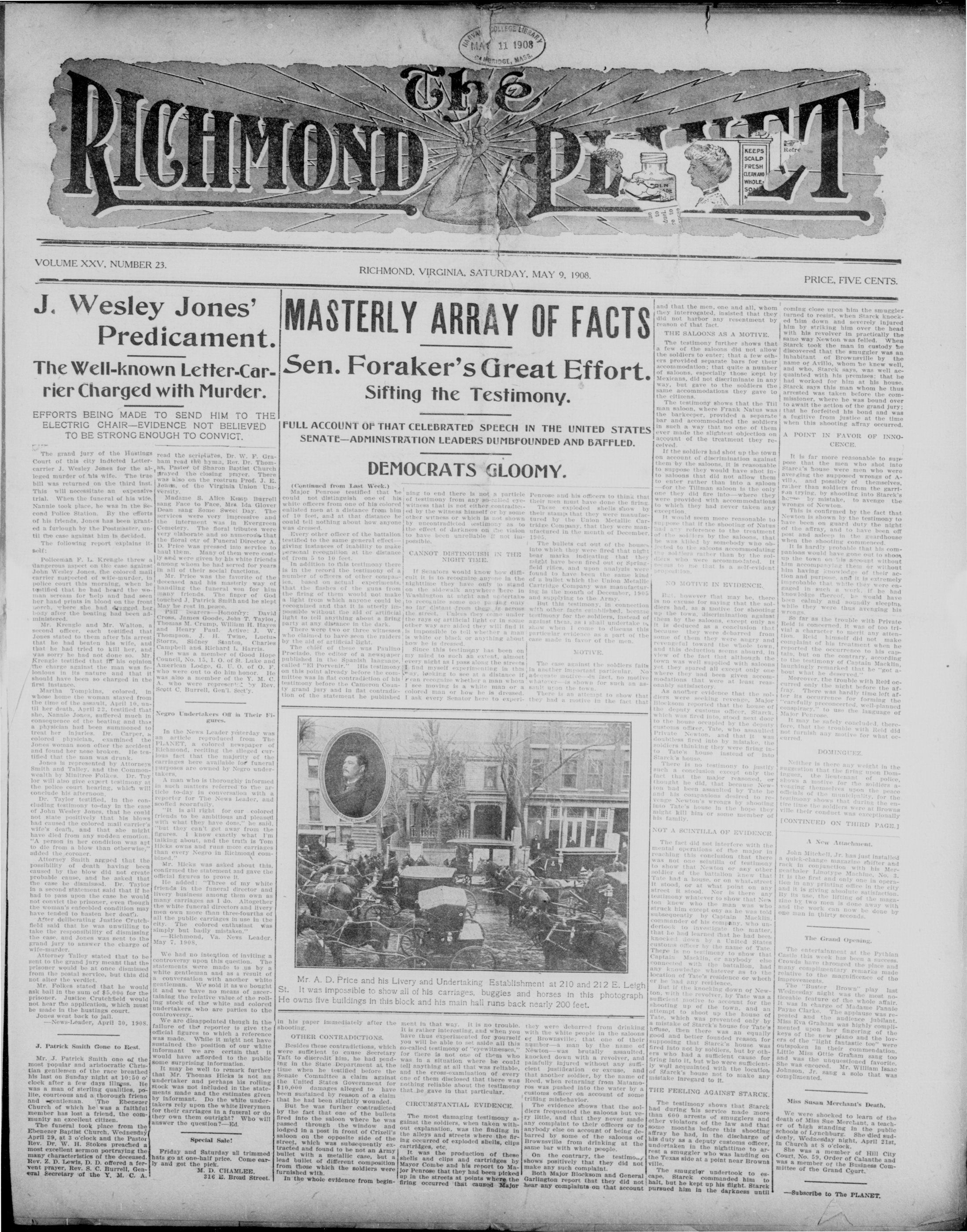
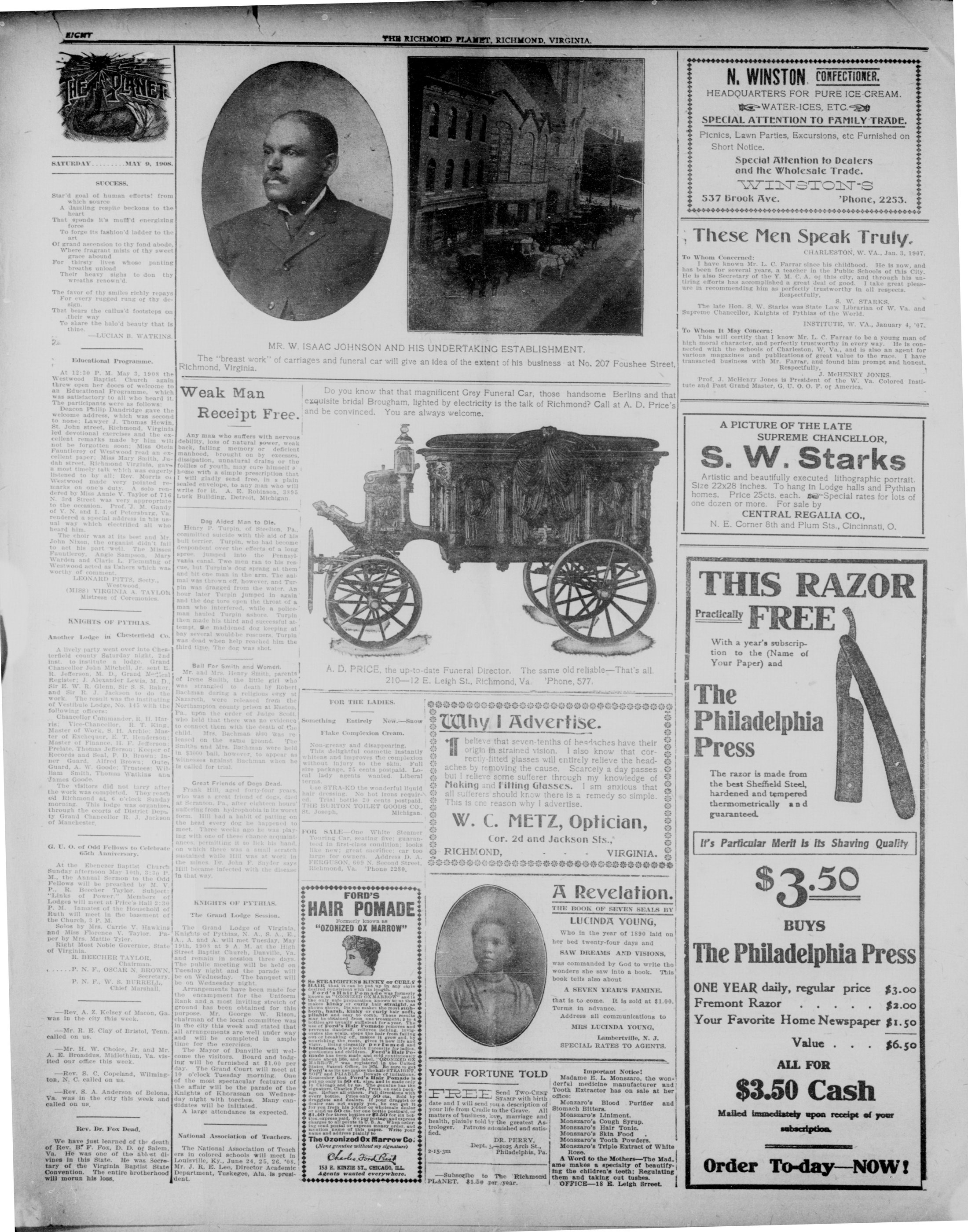
Mr. A. D. Price and his Livery and Undertaking Establishment at 210 and 212 E. Leigh St. It was impossible to show all of his carriages, buggies and horses in this photograph. He owns five buildings in this block and his main hall runs back nearly 200 feet.
(Continued from Last Week.)
(Continued from Last Week.)
Major Penrose testified that he could not distinguish one of his white officers from one of his colored enlisted men at a distance from him of 10 feet and at that distance he could tell nothing about how anyone was dressed.
Every other officer of the battalion testified to the same general effect—giving instances of inability to make personal recognition at the distance of from 5 to 10 feet.
In addition to this testimony there is in the record the testimony of a number of officers of other companies, based on actual experiments, that the flashes of the guns from the firing of them would not make a light from which anyone could be recognized and that it is utterly impossible without the aid of artificial light to tell anything about a firing party at any distance in the dark.
There were two or three witnesses who claimed to have seen the raiders by the aid of artificial light.
The facts of these was Paulino Praciado, the title of a newspaper published in the Spanish language, called "El Porvenir." His testimony on this point already before the committee was in flat contradiction of his testimony before the Cameron County grand jury and in flat contradiction of the statement he published
Mr. A. D. Price and his Lil
St. It was impossible to show
He owns five buildings in this bl
in his paper immediately after the shooting.
OTHER CONTRADICTIONS
Besides these contradictions, which were sufficient to cause Secretary Taft to discredit him, he had pending in the State Department at the time when he testified before the Senate Committee a claim against the United States Government for $10,000 damages alleged to have been sustained by reason of a claim that he had been slightly wounded. But he was further contradicted by the fact that one of the bullets fired into the saloon where he was passed through the window and lodged in a post in front of Crizzell's saloon on the opposite side of the street, which was subsequently extracted and found to be not an Army bullet with a metallic case, but a lead bullet of different composition from those which the soldiers were furnished with.
In the whole evidence from begin-
ning to end there is not a particle of testimony from any so-called eyewitness that is not either contradicted by the witness himself or by some other witness or when is not shown by uncontradicted testimony as to the object of darkness on the vision to have been unreliable if not impossible.
CANNOT DISTINGUISH IN THE NIGHT TIME.
If Senators would know how difficult it is to recognize anyone in the nighttime they have only to stand on the sidewalk anywhere there in Washington at night and undertake to recognize some one passing only so far distant from them across the street. Unless they come under the rays of artificial light or in some other way are aided they will find it is impossible to tell whether a man is white or black or anything about how he is dressed.
Since this testimony has been on my mind to such an extent, almost every night as I pass along the streets I find myself experimenting in this way, looking to see at a distance if I can recognize whether a man whom I see moving is a white man or a colored man or how he is dressed. I ask every Senator here to excerci
ivery and Undertaking Establish all of his carriages, buggies and block and his main hall runs back
ment in that way. It is no trouble. It is rather interesting, and when you have thus experimented for yourself you will be able to set aside all this so-called testimony of "eyewitnesses," for there is not one of them who was in a situation where he could tell anything at all that was reliable, and the cross-examination of every one of them disclosed that there was nothing reliable about the testimony that he gave in that particular.
CIRCUMSTANTIAL EVIDENCE
The most damaging testimony against the soldiers, when taken without explanation, was the finding in the alleys and streets where the firing occurred of exploded shells, clips cartridges, etc.
It was the production of these shells and clips and cartridges by Mayor Combe and his report to Major Penrose that they had been picked up in the streets at points where the firing occurred that caused Major
Penrose and his officers to think that their men must have done the firing. These exploded shells show by their stamps that they were manufactured by the Union Metallic Cartridge Company, that they were manufactured in the month of December 1905.
The bullets cut out of the houses into which they were fired that night bear marks indicating that they might have been fired out or Springfield rifles, and upon analysis were found to have been the same kind of a bullet which the Union Metallic Cartridge Company was manufacturing in the month of December 1905 and supplying the Army.
But this testimony in connection with other facts established, became testimony for the soldiers, instead of against them, as I shall undertake to show when I come to discuss this particular evidence as a part of the case made in favor of the men.
MOTIVE
The case against the soldiers fails in another important particular. No adequate motive—in fact, no motive whatever—is shown for such an assailant on the town. There is an attempt to show that they had a motive in the fact that
ishment at 210 and 212 E. Leigh
and horses in this photograph
k nearly 200 feet.
they were debarred from drinking with the white people in the saloons of Brownsville; that one of their number—a man by the name of Newton—was brutally assaulted, knocked down with a revolver, and painfully injured without any sufficient justification or excuse, and that another soldier, by the name of Reed, when retiring from Matamamos was pushed into the water by a customs officer on account of some trifling misbehavior.
The evidence shows that the soldiers frequented the saloons but very little, and that they never made any complaint to their officers or to anybody else on account of being debarred by some of the saloons of Brownsville from drinking at the same bar with white people.
On the contrary, the testimony shows positively that they did not make any such complaint.
Both Major Blocksom and General Garlington report that they did not hear any complaints on that account
and that the men, one and all, whom they interrogated, insisted that they did not harbor any resentment by reason of that fact.
THE SALOONS AS A MOTIVE
The testimony further shows that a few of the saloons did not allow the soldiers to enter; that a few others provided separate bars for their accommodation; that quite a number of saloons, especially those kept by Mexicans, did not discriminate in any way, but gave to the soldiers the same accommodations they gave to the citizens.
The testimony shows that the Till man saloon, where Frank Natus was the barkeeper, provided a separate bar and accommodated the soldiers in such a way that no one of them ever made the slightest objection on account of the treatment they received.
If the soldiers had shot up the town on account of discrimination against them by the saloons, it is reasonable to suppose they would have shot into saloons that did not allow them to enter rather than into a saloon for the Tillman saloon is the only one they did fire into—where they were provided with accommodations to which they had never taken any exception.
It would seem more reasonable to suppose that if the shooting of Natus had any reference to the treatment of the soldiers by the saloons, that he was killed by somebody who objected to the saloons accommodating the soldiers rather than by the soldiers who were accommodated. It seems to me that is a self-evident proposition.
NO MOTIVE IN EVIDENCE
But, however that may be, there is no excuse for saying that the soldiers had, as a motive for shooting up the town, discrimination against them by the saloons, except only as it is deduced as a conclusion that because they were debarred from some of them they were angry and revengeful toward the whole town, and this deduction seems absurd, in view of the fact that although the town was well supplied with saloons yet they spared all except only one where they had been given accommodations that were at least reasonably satisfactory.
As another evidence that the soldiers were seeking revenge, Major Blocksom reported that the house of the deputy customs officer, Starck, which was fired into, stood next door to the house occupied by the deputy customs officer, Tate, who assaulted Private Newton, and that it was doubtless fired into by mistake, the soldiers thinking they were firing into Tate's house instead of into Starck's house.
There is no testimony to justify such a conclusion except only the fact that the major reasoned, or thought he did, that because Newton had been assaulted by Tate he and his companions desired to revenge Newton's wrongs by shooting into Tate's house in the hope they might kill him or some member of his family.
NOT A SCINTILLA OF EVIDENCE
The fact did not interfere with the mental operations of the major in reaching this conclusion that there was not one scintilla of testimony to show that Newton or any other soldier of the battalion knew that Tate had a house or on what street it stood, or at what point on any street it stood. Nor is there any testimony whatever to show that Newton knew who the man was who struck him except on as he was told subsequently by Captain Macklin, commander of his company, who undertook to investigate the matter, that he had learned that he had been knocked down by a United States customs officer by the name of Tate. There is no testimony to show that Captain Macklin, or anybody else connected with the battalion, had any knowledge whatever as to the location of Tate's residence or whether he had any residence.
But if the knocking down of Newton, with the revolver, by Bate was a sufficient motive to account for the shooting up of the town, and an attempt to shoot up the house of Tate, which was prevented only by a mistake of Starck's house for Tate's house, then there was an equally good and better founded reason for supposing that Starck's house was fired into not by soldiers, but by others who had a sufficient cause for firing into it, but who were sufficiently well acquainted with the location of Starck's house not to make any mistake inregard to it.
THE FEELING AGAINST STARCK
The testimony shows that Starck had during his service made more than 600 arrests of smugglers and other violators of the law and that some months before this shooting affray he had, in the discharge of his duty as a deputy customs officer, undertaken in the nighttime to arrest a smuggler who was landing on the Texas side at a point near Brownsville.
The smuggler undertook to escape. Starck commanded him to halt, but he kept up his flight. Starck pursued him in the darkness until
PRICE, FIVE CENTS
coming close upon him the smuggler turned to resist, when Starck knocked him down and severely injured him by striking him over the head with his revolver in practically the same way Newton was felled. When Starck took the man in custody he discovered that the smuggler was an inhabitant of Brownsville by the name of Avillo, whom he knew well, and who, Starck says, was well acquainted with his premises; that he had worked for him at his house. Starck says this man whom he thus arrested was taken before the commissioner, where he was bound over to await the grand jury; that he forfeited his bond and was a fugitive from justice at the time when this shooting affray occurred.
A POINT IN FAVOR OF INNO CENCE
It is far more reasonable to suppose that the men who shot into Starc's house were men who were avenging the supposed wrongs of A.vill, and possibly of themselves, rather than soldiers from the garrison trying, by shooting into Starc's house by mistake, to avenge the wrongs of Newton.
This is confirmed by the fact that Newton is shown by the testimony to have been on guard duty the night of the affray, and to have been off post and asleep in the guardhouse when the shooting commenced.
It is hardly probable that his compulsions would have gone out to show up the town on his account without him accompanying them or without him accompanying knowledge of their action and purpose, and it is extremely improbable that, while they were engaged in such work, if he had knowledge thereof, he would have been calmly and soundly sleeping while they were thus avenging his wrongs.
So far as the trouble with Private Reid is concerned, it was of too trivial a character to merit any attention. Reid himself did not make complaint of his treatment when he complaint of his treatment to his captain, but on the contrary, according to the testimony of Captain Macklin, laughingly remarked that he "got awhat what he deserved."
Moreover, the trouble with Reid occurred only the night before the affray. There was hardly time left after its occurrence for forming the "carefully preconcerted, well-planned conspiracy" to use the language of Major Peirce. It may be safely concluded, therefore, that the trouble with Reid did not furnish any motive for what occurred.
DOMINGUEZ
Neither is there any weight in the suggestion that the firing upon Dominguez, the lieutenant of police, shows a motive for the soldiers avenging themselves upon the peace officials of the municipality, for the testimony shows that during the entire time the soldiers were at Browns ville their conduct was exceptionally
[CONTINUED ON THIRD PAGE]
A New Attachment
John Mitchell, Jr. has just installed a quick-change magazine shifter and rack in conjunction with his Mergenthaler Linotype Machine. Now it is the first and only one in operation, any printing office in the city and it is giving absolute satisfaction. By its lifting of the magazine by two machines done away with and the work can now be done by one man in thirty seconds.
The Grand Opening
The entertainment at the Pythian Castle this week has been a success. Crowds have throused the place and many complimentary remarks made relative to the magnificence of the improvements.
The "Buster Brown" play last Wednesday night was the most noticeable feature of the whole affair. It was in charge of Madame Fannie Payne Clarke. The applause was repeated and the audience jubilant. Miss Eva Graham was highly complimented upon her fingering of the keys of the new piano and the lovers of the "light fantastic toe" were outspoken in their commendation. Little Miss Ottie Graham sang too and was the unquestioned favorite. She was enced. Mr. William Isaac Johnson, Jr. sang a solo that was complimented.
Miss Susan Merchant's Death
We were shocked to learn of the death of Miss Sue Merchant, a teacher of high standing In the public schools of Lynchburg. She died suddenly, Wednesday night, April 21st, in Church at 8 o'clock. She was a member of Hill City Court, No. 59, Order of Calanthe and was a member of the Business Committee of the Grand Court.
—Subscribe to The PLANET
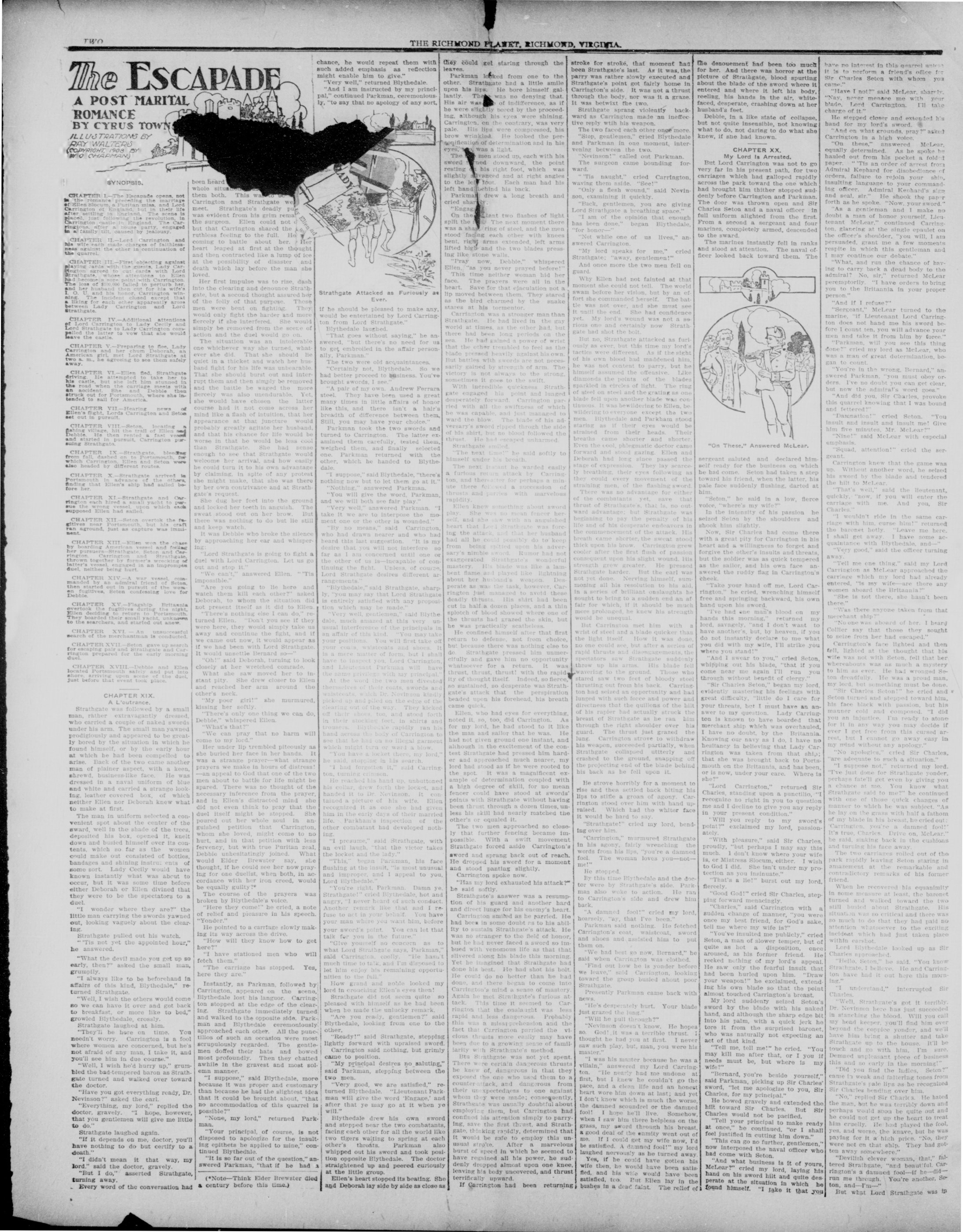
The ESCAPADE
A POST MARITAL
ROMANCE
BY CYRUS TOWN
ILLUSTRATIONS BY
RAY WALTERS
COPYRIGHT, 1908, BY
W O CHAPMAN
SYNOPSIS.
CHAPTER I.—The Escapade opens, not in the romance preceding the marriage of Lady Carrington Slocum, a Paritan miss, and Lord Carrington Slocum, a Lord after settling in England. The scene is placed, just following the revolution in England, after a house party, engaged in a family tilt, caused by jealousy.
CHAPTER II.—Lord Carrington and his wife each made charges of faithlessness against the other in continuation of the quarrel.
CHAPTER III.—First objecting against Carrington agree to cut cards with Lord Strathgate, whose attentions to Ellen and become a sore point with Carrington. Lord Strathgate failed to perturber her and her husband then cut for his wife's I.O. U. and his honor, Carrington winnings. The incident closed except that a liking for Lady Carrington and between Lady Carrington and Lord Strathgate.
CHAPTER IV.—Additional attentions Lord Carrington to Lady Cecily and Lord Carrington to Carrington compelled the latter to vow that she would leave the castle.
CHAPTER V.—Preparing to flee, Lady Carrington and her chum Deborah, an American girl, met Lord Strathgate at m., he agreeing to see them safely away.
CHAPTER VI - Ellen fled, Strathgate driving. He attempted to take her to the rattle but she left him stunned in the road when the carriage measured with an accident. She and Debbie then struck out for Portsmouth, where she intended to sail for America.
CHAPTER VII - Hearing news of Ellen's flight, Lords Carrington and Seton set out in pursuit.
CHAPTER VIII - Seton, locating a fishing village, hit the trail of Ellen and Debbie. He then rented a fast vessel and started in Carrington, Carrington pursuing Strathgate.
CHAPTER IX - Strathgate, bleeding from fall, dashed on to Portsmouth, for which Carrington, Ellen and Seton were also headed by different routes.
CHAPTER X - Strathgate arrived in Portsmouth in advance of the others, finding that Ellen's ship had sailed before her.
CHAPTER XI - Strathgate and Carrington each hired a small yacht to pursue the wrong vessel, upon which each supposed Ellen had sailed.
CHAPTER XII - Overtok the fates near Portsmouth, but his craft ran ground, just as capture was imminent.
CHAPTER XIII - Ellen won the chase by boarding American vessel and foliage per pursuer - Strathgate. Seton and Carrion carried them ashore and thrown together by former's wrecking of latter's vessel, engaged in an impromptu duel, neither being hurt.
CHAPTER XIV - A war vessel commanded by an admiral friend of Seton, then started out in pursuit of the women pursuers, Seton confessing love for Debbie.
CHAPTER XV - Flagship Britannia overtook the fugitives during the night, Ellen deciding to return to Portsmouth. They boarded their small yacht, unknown to the searchers, and started out anew.
CHAPTER XVII - An unsuccessful search of the merchantman is conducted.
CHAPTER XVII - Seton gave up search for escaping pair and Strathgate and Carrington prepared for the early morning duel.
CHAPTER XVIII - Debbie and Ellen located Portsmouth safely and put into shore after the duel, just before that event took place.
Strathgate was followed by a small man, rather extravagantly dressed, who carried a couple of naked swords under his arm. The small man yawned prodigiously and appeared to be greatly bored by the situation in which he found himself, or by the early hour at which he had been compelled to arise. Back of the two came another man of plainer aspect, with a keen, shrewd, business-like face. He was dressed in a naval uniform of blue and white and carried a strange looking, leather covered box, of which neither Ellen nor Deborah knew what to make at first.
The man in uniform selected a convenient spot about the center of the award, well in the shade of the trees, deposited his box, opened it, knelt down and busied himself over its contents, which so far as the women could make out consisted of bottles, bandages and shining instrument of some sort. Lady Cecelly would have known instantly what was about to occur, but it was some time before either Deborah or Ellen divined that they were to be the spectators to a duel.
"I wonder where they are?" the little man carrying the swords yawned out, looking vaguely about the clearing.
Strathgate pulled out his watch.
"Tis not yet the appointed hour," he answered.
"What the devil made you get up so early, then?" asked the small man, grumply.
"I always like to be beforehand in affairs of this kind, Blythedale," returned Strathgate.
"Well, I wish the others would come so we can have it over and get back to breakfast, or more like to bed," growled Blythedale, crossly.
Strathgate laughed at him.
"They'll be here on time. You needn't worry. Carrington is a fool where women are concerned, but he's not afraid of any man, I take it, and you'll see him in due course."
"Well, I wish he'd hurry up," grumbled the bad-tempered baron as Strathgate turned and walked over toward the doctor.
"Have you got everything ready, Dr. Nevinson?" asked the earl.
"Everything, my lord," replied the doctor, gravely. "I hope, however, that you gentlemen will give me little to do."
Strathgate laughed again.
"If it depends on me, doctor, you'll have nothing to do but certify to a death."
"I didn't mean it that way, my lord." said the doctor, gravely.
"But I do," asserted Strathgate, turning away.
Every word of the conversation had
them both. This was to be Carrington and Strathgate well meet. Strathgate's deadly pull was evident from his grim remake the surgeon. Ellen could not do but that Carrington shared the ruthless feeling to the full. He coming to battle about her. Her heart leaped at first at the thought and then contracted like a lump of ice at the possibility of disaster and death which lay before the man she loved.
Her first impulse was to rise, dash into the clearing and denounce Strathgate, but a second thought assured her of the folly of that purpose. Those men were bent on fighting. They would only fight the harder and more fiercely if she interfered. She would simply be removed from the scene of action and the duel would go on.
The situation was an intolerable one whichever way she turned, whatever she did. That she should he quiet in a thicket and watch her husband fight for his life was unbearable. That she should burst out and interrupt them and then simply be removed and the battle be waged the more fiercely was also unendurable. Yet, she would have chosen the latter course had it not come across her mind like a flash of intuition, that her appearance at that juncture would probably greatly agitate her husband, and that his chance for life would be worse in that he would be less cool than Strathgate. She had sense enough to see that Strathgate would welcome her arrival, and how easily he could turn it to his own advantage by claiming, in spite of any protest she might make, that she was there by her own contrivance and at Strathgate's request.
She dug her feet into the ground and locked her teeth in anguish. The sweat stood out on her brow. But there was nothing to do but he still and keep watch.
It was Debbie who broke the silence by approaching her car and whispering:
"Lord Strathgate is going to fight a duel with Lord Carrington. Let us go out and stop it."
"We can't," answered Ellen. "Tis impossible."
"Are you going to lie here and watch them kill each other?" asked Deborah, to whom the situation did not present itself as it did to Ellen.
"There's nothing else I can do," returned Ellen. "Don't you see if they were here, they would simply take us away and continue the fight, and if we came out now, it would appear as if we had been with Lord Strathgate. It would unsettle Bernard so—"
"Oh!" said Deborah, turning to look closely at her wretched comrade.
What she saw moved her to instant pity. She drew closer to Ellen and reached her arm around the other's neck.
"My poor girl!" she murmured, kissing her softly.
"There's only one thing we can do, Debbie," whispered Ellen.
"What's that?"
"We can pray that no harm will come to my lord."
Her under lip trembled piteously as she buried her face in her hands. It was a strange prayer—what strange prayers we make in hours of distress!—an appeal to God that one of the two men about to battle for life might be spared. There was no thought of the necessary inference from the prayer, and in Ellen's distracted mind she did not even think to pray that the duel itself might be stopped. She poured out her whole soul in anguished petition that Carrington, whom she loved, might come to no hurt, and in that petition with less fervency, but with true Puritan zeal, Debbie unhesitatingly joined. What would Elder Brewster say, she thought, if he could see her now praying for one duellist, when both, in accordance with her iron creed, would be equally guilty?* The course of the prayers was broken by Blythedale's voice.
"Here they come!" he cried, a note of relief and pleasure in his speech. "Yonder."
He pointed to a carriage slowly making its way across the drive.
"How will they know how to get here?"
"I have stationed men who will fetch them."
"The carriage has stopped. Yes, here they are."
Instantly, as Parkman, followed by Carrington, appeared on the scene, Blythedale lost his languor. Carrington stopped at the edge of the clearing. Strathgate immediately turned and walked to the opposite side. Parkman and Blythedale ceremoniously approached each other. All the punctillos of such an occasion were most scrupulously regarded. The gentlemen doffed their hats and bowed most profoundly. Then they chatted awhile in the gravest and most solemn manner.
"I suppose," said Blythedale, more because it was proper and customary than because he had the slightest idea that it could be brought about, "that no accommodation of this quarrel is possible?"
"None, my lord," returned Parkman.
"Your principal, of course, is not disposed to apologize for the insulting epithets he applied to mine," continued Blythedale.
"It is so far out of the question," answered Parkman, "that if he had a
(*Note—Think Elder Brewster died a century before this time.)
THE RICHMOND PLANET, RICHMOND, VIRGINIA.
chance, he would repeat them with such added emphasis as reflection might enable him to give."
"Very well," returned Blythedale.
"And I am instructed by my principal," continued Parkman, ceremoniously, "to say that no apology of any sort,
OLD DAY
Strathgate Attacked as Furiously as Ever.
Strathgate Attacked as Furiously as Ever.
If he should be pleased to make any, would be entertained by Lord Carrington from Lord Strathgate."
Blythedale laughed.
"That goes without saying." he answered, "but there's no need for us to get embroiled in the affair personally, Parkman."
The two were old acquaintances.
"Certainly not, Blythedale. So we had better proceed to business. You've brought swords, I see."
"A pair of my own. Andrew Ferrara steel. They have been used a great many times in little affairs of honor like this, and there isn't a hair's breadth of difference between them, Still, you may have your choice."
Parkman took the two swords and turned to Carrington. The latter examined them carefully, tested them, weighed them, and finally selected one. Parkman returned with the other, which he handed to Blythedale.
"I suppose," said Blythedale, "there's nothing now but to let them go at it."
"Nothing," answered Parkman.
"You will give the word, Parkman, and we will both see fair play."
"Very well," answered Parkman. "I take it we are to interpose the moment one or the other is wounded."
"By no means," said Carrington, who had drawn nearer and who had beard this last suggestion. "It is my desire that you will not interfere so far as I am concerned until one or the other of us is—incapable of continuing the fight. Unless, of course, Lord Strathgate desires different arrangements."
"Blythedale," said Strathgate, sharply, "you may say that Lord Strathgate is entirely satisfied with any proposition which may be made."
"Very well, gentlemen," said Blythedale, much amazed at this very unusual interference of the principals in an affair of this kind. "You may take your positions. You will first take off your coats, waistcoats and shoes. It is a mere matter of form, but I shall have to inspect you, Lord Carrington, and Lieutenant Parkman will have the same privileges with my principal." At the word the two men divested themselves of their coats, swords and waistcoats, which Dr. Novinson kindly picked up and piled on the edge of the clearing out of the way. They kicked off their shoes, too, and stood forth in their stocking feet, in shirts and trousers. Blythedale rapidly ran his hand across the body of Carrington to see that he had on no illegal garment which might turn or ward a blow.
"You have a locket there, my lord," he said, stopping in his search.
"I had forgotten it," said Carrington, turning crimson.
He reached his hand up, unbuttoned his collar, drew forth the locket, and handed it to Dr. Nevinson. It contained a picture of his wife. Ellen recognized it as one she had given him in the early days of their married life. Parkham's inspection of the other combatant had developed nothing.
"I presume," said Strathgate, with an evil laugh, "that the victor takes the locket and the lady."
"This," began Parkman, his face flushing at the insult, "is most unusual and improper, and I appeal to you, Lord Blythedale."
"You're right, Parkman. Damn ye, Strathgate!" cried Blythedale, hot and angry, "I never heard of such conduct. Another remark like that and I refuse to act in your behalf. You have your man where you want him, before your sword's point. You can let that talk for you in the future."
"Give yourself no concern as to what Lord Strathgate says, Parkman," said Carrington, coolly. "He hasn't much time to talk, and I'm disposed to let him enjoy his remaining opportunities to the full."
How grand and noble looked my lord in crouching Ellen's eyes then! Strathgate did not seem quite so pleased with himself as he had been when he made the unlucky remark. "Are you ready, gentlemen?" said Blythedale, looking from one to the other.
"Ready!" said Strathgate, stepping lightly forward with upraised sword. Carrington said nothing, but grimly came to position.
"My principal desires no saluting," said Parkman, stopping between the two men.
"Very good, we are satisfied," returned Blythedale. "Lleutenant Parkman will give the word 'Engage,' and after that ye may go at it when ye will."
Blythedale drew his own sword and stepped near the two combatants, facing each other for all the world like two tigers waiting to spring at each other's throats. Parkman also whipped out his sword and took position opposite Blythedale. The doctor straightened up and peered curiously at the little group. Ellen's heart stopped its beating. She and Deborah lay side by side as close as
they could get staring through the leaves.
Parkman looked from one to the other. Stratagate had a little smile upon his lips. He bore himself gallantly. They was no denying that. His air was full of indifference, as if he were slightly bored by the proceeding, although his eyes were shining. Carrington, on the contrary, was very pale. His lips were compressed, his brow wrinkled. He looked the perforation of determination and in his eyes, he was a light.
The men stood up, each with his sword turned downward, the point resting on his right foot, which was slightly advanced and at right angles to the left foot. Each man had his left hand behind his back.
Parkman drew a long breath and cried sharply.
On the instant two flashes of light split the face. The next moment there was a shawl, ring of steel, and the men stood facing each other with knees bent, right arms extended, left arms lifted high and the two blades pressing like stone walls.
"Pray now, Debbie," whispered Ellen, "as you never prayed before!"
Leth, as you never prayed before:
This time neither woman hid her face. The prayers were all in the heart. Save for that ejaculation not a lip moved between them. They stared as the bird charmed by the snake stares at his tormentor.
Carrington was a stronger man than Strathcate. He had lived in the gay world at times, as the other had, but there had been long periods on the sea. He had gained a power of wrist that the other trembled to feel as the blade pressed heavily against his own. But battles with swords are not necessarily gained by strength of arm. The victory is not always to the strong, sometimes it goes to the swift.
With incredible quickness Strathgate engaged his point and lunged desperately forward. Carrington parried with all the swiftness of which he was capable, and just managed to ward the blow. The blade of his adversary's sword ripped through the side of his shirt, but no blood followed the thrust. He had escaped unharmed. Strathgate smiled. "The next time!" he said softly to himself under his breath.
The next instant he warded easily a furious return attack by Carrington, and thereafter for perhaps a minute there followed a succession of thrusts and parries with marvelous rapidity.
Ellen knew something about sword play. She was no mean fencer herself, and she saw with an anguished heart that Lord Strathgate was forcing the attack, and that her husband had all he could possibly do to keep from being spitted upon his adversary's nimble sword. Rumor had not exaggerated Strathgate's wonderful mastery. His blade was like a lambent flame and played like lightning about her husband's weapon. Desperate as was the task, however, Carrington just managed to avoid these deadly thrusts. His shirt had been cut in half a dozen places, and a thin sploch of blood showed where one of the thrusts had grazed the skin, but he was practically scatheless.
He confined himself after that first return to defense, not from choice, but because there was nothing else to do. Strathgate pressed him unmercifully and gave him no opportunity whatsoever for a return. It was thrust, thrust, thrust! with the rapidity of thought itself. Indeed, so fierce, so sustained, so desperate was Strathgate's attack that the perspiration beaded upon his forehead, his breath came quick.
Ellen, who had eyes for everything, noted it, so, too, did Carrington. As for my lord, he had stood to it like the man and sailor that he was. He had not given ground one instant, and although in the excitement of the contest Strathgate had pressed him harder and approached much nearer, my lord had stood as if he were rooted to the spot. It was a magnificent example of determination coupled with a high degree of skill, for no mean fencer could have stood at swords' points with Strathgate without having been thrust through a dozen times, unless his skill had nearly matched the other's or equaled it.
The two men approached so closely that further fencing became impossible. With a swift movement Strathgate forced aside Carrington's sword and sprang back out of reach. He dropped his sword for a moment and stood panting slightly.
"Has my lord exhausted his attack?" he said softly.
Strathgate's answer was a resumption of his guard and another hard and direct lunge for his enemy's heart. Carrington smiled as he parried. He had been in some doubt as to his ability to sustain Strathgate's attack. He was no stranger to the field of honor, but he had never faced a sword so imbued with venomous life as that that silvered along his blade this morning. Yet he imagined that Strathgate had done his best. He had shot his bolt. He could do no better than he had done, and there began to come into Carrington's mind a sense of mastery. Again he met Strathgate's furious attack. This time it seemed to Carrington that the onslaught was less rapid and less dangerous. Probably this was a misapprehension and the fact that Carrington parried the vicious thrusts more easily may have been due to a growing sense of familiarity with Strathgate's method.
Btu Strathgate was not yet spent. There were certain dangerous thrusts he knew of, dangerous in that they exposed the one who used them to a counterattack, and dangerous from their unexpectedness to one against whom they were made; consequently, Strathgate was usually doubtful about employing them, but Carrington had confined his attention simply to parrying, save the first thrust, and Strathgate, thinking rapidly, determined that it would be safe to employ this unusual stroke. After a marvelous burst of speed in which he seemed to have regained all his power, he suddenly dropped almost upon one knee, leaving his body uncovered, and thrust terrifically upward.
If Carrington had been returning
stroke for stroke, that moment had been Strathgate's last. As it was, the parry was rather slowly executed and Strathgate's point got fairly home in Carrington's side. It was not a thrust through the body, nor was it a graze. It was betwixt the two.
Strathgate sprang violently backward as Carrington made an ineffective reply with his weapon.
The two faced each other once more. "Stop, gentlemen," cried Blythedate and Parkman in one moment, intervening between the two.
"Nevinson!" called out Parkman.
The surgeon came bounding forward.
"Tis naught," cried Carrington, waving them aside. "See!"
"Only a flesh wound," said Nevinson, examining it quickly.
"Back, gentleman, you are giving Lord Strathgate a breathing space."
"I am of the opinion that enough has been done," began Blythedale, "for honor—"
"Not while one of us lives," answered Carrington.
"My lord speaks for me," cried Strathgate; "away, gentlemen!"
And once more the two men fell on guard.
Why Ellen had not fainted at that moment she could not tell. The world swam before her vision, but by an effort she commanded herself. The battle was not over, and she must see it until the end. She had confidence yet. My lord's wound was not a serious one and certainly now Strathgate had shot the bolt.
But no, Strathgate attacked as furiously as ever, but this time my lord's tactics were different. As if the sight of his own blood had maddened him, he was not content to parry, but he himself assumed the offensive. Like diamonds the points of the blades sparkled in circles of light. The ring of steel on steel and the grating as one blade fell upon another blade was continuous. It was bewildering to Ellen, bewildering to everyone except the two men. Blythedale and Parkham stood staring as if their eyes would be strained from their heads. Their breaths came shorter and shorter. Even the cool, phlegmatic doctor came forward and stood gazing. Ellen and Deborah had long since passed the stage of expression. They lay scarcely breathing, their eyes following as they could every movement of the straining men, of the flashing sword.
There was no advantage for either of the combatants yet, save that thrust of Strathgate's, that is, no outward advantage; but Strathgate was beginning to pay the penalty of his life and of his desperate endoavors in the commencement of the attack. His breath came shorter, the sweat stood thick upon his brow. Carrington grew cooler after the first flush of passion consequent upon his slight wound. His strength grew greater. He pressed Strathgate harder. But the earl was not yet done. Nerving himself, summoning all his resolution to his aid, in a series of brilliant onslaughts he sought to bring to a sudden end an afair for which, if it should be much more prolonged, he knew his strength would be unequal.
But Carrington met him with a wrist of steel and a blade quicker than the light itself. How it was done, no one could see, but after a series of rapid thrusts and disengagements, the spectators saw Strathgate suddenly throw up his arms. His blade fell wavering to the ground. Those who stared saw two feet of bloody steel thrusting out from his back. Carrington had seized an opportunity and had lunged with such force and power and directness that the quillions of the hilt of his rapper had actually struck the breast of Strathgate as he ran him through the right shoulder over his guard. The thrust just grazed the lung. Carrington strove to withdraw his weapon, succeeded partially, when Strathgate collapsed utterly and crashed to the ground, snapping off the projecting end of the blade behind his back as he fell upon it.
He strove horribly for a moment to rise and then settled back biting his lips to stifle a groan of agony. Carrington stood over him with hand upraised. Which had the whitor face it would be hard to say.
"Strathgate!" cried my lord, bending over him.
"Carrington," murmured Strathgate in his agony, fairly wrenching the words from his lips, "you're a damned fool. The woman loves you—not—me!"
He stopped.
By this time Blythedale and the doctor were by Strathgate's side. Parkman also woke to action. He ran to Carrington's side and drew him back.
"A damned fool!" cried my lord, hoarsely, "ay, that I've been."
Parkman said nothing. He fetched Carrington's coat, waistcoat, sword and shoes and assisted him to put them on.
"We had best go now, Bernard," he said when Carrington was clothed.
"Find out how he is yonder before we leave," said Carrington, looking toward the group busied about poor Strathgate.
Presently Parkman came back with news.
"He's desperately hurt. Your blade just grazed the long."
"Will he pull through?"
"Nevinson doesn't know. He hopes so. God! it was a terrible thrust. I thought he had you at first. I never saw such play, but, man, you were his master."
"I was his master because he was a villain," answered my Lord Carrington. "He nearly bad me undone at first, but I knew he couldn't go the pace, and a clean life and an honest heart wore him down at last; and yet I don't know which is much the worse, the damned scoundrel or the damned fool! I hope he'll live. Somehow, when I saw him there helpless on the grass, my sword through his breast, a good deal of the emmity went out of me. If I could get my wife now, I'd be satisfied. A damned fool!" my lord laughed nervously as he turned away. Yes, if he could have gotten his wife then, he would have been satisfied, and his wife would have been satisfied, too. But Ellen lay in the bushes in a dead fatal. The relief of
the denouement had been too much for her. And there was horror at the picture of Strathgate, blood spurting about the blade of the sword where it entered and where it left his body, reeling, his hands in the air, white-faced, desperate, crashing down at her husband's feet. Debbie, in a like state of collapse, but not quite insensible, not knowing what to do, not daring to do what she knew, if she had known.
CHAPTER XX.
My Lord Is Arrested
But Lord Carrington was not to go very far in his present path, for two carriages which had galloped rapidly across the park toward the one which had brought him thither stopped suddenly before Carrington and Parkman. The door was thrown open and Sir Charles Seton and a naval officer in full uniform alighted from the first. From a second a sergeant and four marines, completely armed, descended to the sword.
The marines instantly fell in ranks and stood at attention. The naval officer looked back toward them. The
THE FIRST WAR
"On These," Answered Mclear.
sergeant saluted and declared himself ready for the business on which he had come. Seton had taken a step toward his friend, when the latter, his pale face suddenly flushing, darted at him.
"Seton," he said in a low, flerce voice, "where's my wife?"
In the intensity of his passion he seized Seton by the shoulders and shook him slightly.
Now, Sir Charles had come there with a great pity for Carrington in his heart and a willingness to forget and forgive the other's insults and threats, but the soldier was as quick tempered as the sailor, and his own face answered the ruddy flag in Carrington's cheek.
"Take your hand off me, Lord Carrington," he cried, wrenching himself free and springing backward, his own hand upon his sword.
"I've had one man's blood on my hands this morning," returned my lord, savagely, "and I don't want to have another's, but, by heaven, if you do not instantly declare to me what you did with my wife, I'll strike you where you stand!"
"And I swear to you," cried Seton, whipping out his blade, "that if you come near me again I'll run you through without benefit of clergy."
"Sir Charles Seton," began my lord, evidently mastering his feelings with great difficulty, "little do I care for your threats, but I must have an answer to my question. Lady Carrington is known to have boarded that merchant ship which was overhaul, I have no doubt, by the Britannia. Knowing our navy as I do, I have no hesitancy in believing that Lady Carrington was taken from that ship; that she was brought back to Portsmouth on the Britannia, and has been, or is now, under your care. Where is she?"
"Lord Carrington," returned Sir Charles, standing upon a punctilio, "I recognize no right in you to question me and I decline to give you any reply in your present condition."
"Will you reply to my sword's point?" exclaimed my lord, passionately.
"With pleasure," said Sir Charles, proudly, "but perhaps I may say this much. I don't know where your wife is, or Mistress Slocum, either. I wish to God I did. She isn't under my protection as you insinuate."
"That's a lie!" burst out my lord, fiercely.
"Good God!" cried Sir Charles, stepping forward menacingly.
"Charles," said Carrington with a sudden change of manner, "you were once my best friend, for God's sake, tell me where my wife is?"
"You've insulted me publicly," cried Seton, a man of slower temper, but of quite as hot a disposition, once aroused, as his former friend. He recked nothing of my lord's appeal. He saw only the fearful insult that had been hurled upon him. "Draw your weapon!" he exclaimed, extending his own blade so that the point almost touched Carrington's breast.
My lord suddenly seized Seton's sword by the blade with his naked hand, and although the sharp edge bit into his palm, with a quick jerk he tore it from the surprised baronet, who was naturally not expecting an act of that kind.
"Tell me, tell me!" he cried. "You may kill me after that, or I you if needs must be, but where is my wife?"
"Bernard, you're beside yourself," said Parkman, picking up Sir Charles's sword, "let me apologize to you, Sir Charles, for my principal."
He bowed gravely and extended the hilt toward Sir Charles. But Sir Charles would not be pacified.
"Tell your principal to make ready at once," he continued, "or I shall feel justified in cutting him down."
"This can go no further, gentlemen," now interposed the naval officer who had come with Seton.
"And what business is it of yours, McLear?" cried my lord, laying his hand on his sword hilt and quite desperate at the situation in which he found himself. "I take it that you
have no interest in this quarrel unless it is to perform a friend's office for Sir Charles Seton with whom you came."
"Have I not?" said McLear, sharply.
"Nay, never menace me with your blade, Lord Carrington. I'll take charge of it."
He stepped closer and extended his hand for my lord's sword.
"And on what grounds, pray?" asked Carrington in a high voice.
"On these," answered McLear, equally determined. As he spoke he hauled out from his pocket a folded paper.
"Tis an order of arrest from Admiral Kephard for disobedience of orders, failure to rejoin your ship, insulting language to your commanding officer. Admiral Kephard's slim and seal, sir." He shook the paper forth as he smoke. "Now your sword."
"As a gentleman and I make no doubt a man of honor yourself, Lieutenant McLear," continued Carrington, glancing at the single epaulet on the officer's shoulder, "you will, I am persuaded, grant me a few moments respite in which this gentleman and I may continue our debate."
"What, and run the chance of having to carry back a dead body to the admiral? No, sir," returned McLear peremptorily. "I have orders to bring you to the Britannia in your proper person."
"And if I refuse?"
"Parkman, will you see this thing done?" cried my lord as McLear, who was a man of great determination, began to count.
"You're in the wrong, Bernard," answered Parkman. "you must obey orders. I've no doubt you can get clear, but now the admiral's word goes."
"And did you, Sir Charles, provoke this quarrel knowing that I was bound and fettered?"
"Daination!" cried Seton. "You insult and insult and insult me! Give him five minutes, Mr. McLear?"
"Nine!" said McLear with especial emphasis.
"Squad, attention!" cried the sergeant.
Carrington knew that the game was up. Without another word, he seized his sword by the blade and tendered the hilt to McLear.
"That's well," said the lieutenant, quickly, "now, if you will enter the carriage with me. And you, Sir Charles."
"I wouldn't ride in the same carriage with him, curse him!" returned the baronet hotly. "Leave me here. I shall get away. I have some acquaintance with Blythedale, and—" "Very good," said the officer turning away. "Tell me one thing," said my Lord Carrington as McLear approached the carriage which my lord had already entered, "is my wife—are there any women aboard the Britannia?" "She is not there, she hasn't been there." "Was there anyone taken from that merchant ship?" "No one was aboard of her. I heard Collier say that those they sought to seize from her had escaped." Carrington's face lighted and then fell, lighted at the thought that his wife was not with Seton, fell that her whereabouts was as much a mystery to him as ever. He had wronged Seton dreadfully. He was a proud man, my lord, but something must be done.
"Sir Charles Seton!" he cried and Seton turned and stepped toward him, his face black with passion, but his manner cold and composed. "I did you an injustice. I'm ready to atone for it in any way you may decide if ever I get free from this cursed arrest, but I cannot go away easy in my mind without any apology.
"No apologies," cried Sir Charles, "are adequate to such a situation."
"I suppose not," returned my lord. "I've just done for Strathgate yonder, perhaps fate'll get even by giving you a chance at me. You know what Strathgate said to me?" he continued with one of those quick changes of manner to which he was subject. "As he lay on the grass with half a fathom of my blade in his breast, he cried out: 'Carrington, you're a damned fool!' It's true, Charles. Drive on, McLear, he said, sinking back in the cushions and turning his face away.
The two carriages rolled out of the park rapidly leaving Seton staring in amazement at the remarkable and contradictory remarks of his former friend.
When he recovered his equanimity in some measure at least, the baronet turned and walked toward the two still busied about Strathgate. His situation was so critical and there was so much to do that they had paid no attention whatsoever to the exciting incident which had just taken place within carshot.
Lord Blythedale looked up as Sir Charles approached.
"Hello, Seton," he said. "You know Strathgate, I believe. He and Carrington have it out here this morning."
"I understand," Interrupted Sir Charles.
"Well, Strathgate's got it terribly. Dr. Nevinson here has just succeeded in stanching the blood. Will you call my head keeper, you'll find him over beyond the coppice yonder, and we'll have him bring a shutter and take Strathgate up to the house. It'll be touch and go with him. I'm sure. Demned unpleasant piece of business this and so early in the morning."
"Did you find the ladies, Seton?" came in weak and faltering tones from Strathgate's pale lips as he recognized Sir Charles bending over him.
"No," replied Sir Charles. He hated the man, but he was terribly down and perhaps would soon be quite out and he could not get up the heart to treat him cruelly. He had played the fool, yes, and worse, the knave, but he was paying for it a high price. "No, they were not on that ship. They had gotten away somewhere."
"Devilish clever woman, that," faltered Strathegate, "and beautiful. Carrington's a damned fool—if he—did run me through. You're another, Seeton, and—I'm—". But what Lord Strathegate was in
THE PLANET
SATURDAY.....MAY 9, 1908
his own epinion, he did not at that moment reveal, for the effort at speech had been too much for him. With a sort of ghastly chuckle, he fainted quite away again.
"We have no time to lose," said Nevinson, abruptly. "We must get him to the house at once."
"Till call the keepers myself," said Blythedale, who should have done it at first, as he knew where he had posted them.
"Fetch me some water, if you will, Sir Charles," exclaimed the doctor, "from the brook yonder! Here's a cup."
Sir Charles did as he was bid, and although he went and came in the twinkling of an eye and extended to the surgeon the cup of water desired, he had time while he filled it to pick up something else that lay by the bank in the soft ooze of the border of the brook. He noticed the foot print of a woman's shoe and by the side of it another little knot of ribbon like that he wore, a knot of scarlet, the color Mistress Debbie affected and with which, he remembered—for he had met Lady Ellen when she came from the ship to England—the dress she wore on the ocean, which she had undoubtedly assumed for traveling, was trimmed. It matched that other knot of scarlet which he had worn next his heart since he took it from the carriage floor.
Ellen and Deborah had escaped! Why was it not possible for fortune to have brought them there? His eye swept the scene with the instinct of a trained soldier to whom the habit of seeking cover has become second nature. The coppice! They were there and he would see them; they should not escape him now. He hastily arranged his course.
In a few moments Blythedale came back with his keepers and a shutter from the nearest keeper's house over which blankets and comforts had been hastily thrown. With infinite care, they lifted the prostrate, senseless Strathgate upon it and started for the hall.
"If you'll forgive me, Blythedale," said Sir Charles in answer to an invitation to accompany them, "I have something to think about and I shall stay here alone for a few moments."
"Oh, very well, suit yourself," returned Blythedale, "but when you've had your thought out, come up to the hall and I'll give you some breakfast and something to drink to take the taste of this demeaned unpleasant business out of our mouths, and so early in the morning, too! Poor Strathgate!"
Seton stood quietly until he had satisfied himself that the party had got out of sight and sound. Then he turned to the coppice.
"Mistress Deborah," he cried softly, approaching the edge. "Lady Ellen!"
He listened. He detected a slight whimper and sound.
"Mistress Debehar, I know your voice," cried Sir Charles forcing his way through the undergrowth regardless of his clothing, and in a moment he was by the side of Mistress Debbie.
Mistress Debbie had been lying upon her face. She lifted herself up on her arms and was starling at Sir Charles as well as she could stare at anyone with the tears streaming down her face. Leaves and bits of mold clung to her person, her eyes were heavy, her face was haggard. It is evidence of the quality of Sir Charles' passion that, even in this guise, he thought her beautiful.
He stooped over her instantly, caught her in his arms and drew her to her feet. Mistress Debbie fell against him, clung to him with an astonishing access of strength and cried the more.
In his excitement and rapture at this delightful contact, Sir Charles did not notice the other darker figure lying prone near the spot whence he had plucked his love. As soon as his
A
"My Lord Is Well?"
eye fell upon her, he quickly lifted his sweetheart's head and hold her from him a little.
"Is that Lady Ellen?" he asked.
"Yes," said Debbie contritely, "I was so glad to see you, I forgot—"
"Is she dead?"
"Fainted, I think. You see we saw all that terrible battle—"
"We must get her out of here at once," said Sir Charles, releasing Deborah. He stooped down and, although Ellen was no light burden for any man, he picked her up and followed by Debbie forced his way through the coppie on to the sward which had
already been the scene of such memorable events that morning. He laid her gently on the grass, bade Debbie loosen her collar, ran to the brook, came back with a hat full of water and splashed it, manlike, unceeriously into Ellen's face. Then he drew from his pocket a small flask which he happened to have with him, and forced a few drops of liquor between Lady Ellen's pale lips. Then he and Deborah fell to chafing her hands. Presently, with a long sigh Lady Ellen opened her eyes.
She stared hard at Seton for a moment and then the color slowly came back into her cheeks. She strove weakly to rise upon her hand and Debbie slipped her arm behind her and supported her.
"Where is my lord?" she asked faintly. "I saw it all. Oh, my God, I saw it all."
"Lord Carrington was not hurt," "I know," faltered Ellen. "Strathgate! How horribly he was punished," she murmured. "We have all suffered, but I must go to my lord now. You have run me down on a lee shore, Sir Charles. Will you take me to him?"
"Dear Lady Carrington," said Sir Charles, tenderly. "I would do so—You must prepare yourself for another shock."
This time Ellen sat bolt upright, disdaining Deborah's help and in spite of her restraining arm.
"My lord is well?" she cried in anguished tones.
"Perfectly well," said Sir Charles, "but arrested."
"For what? For the duel?"
"Nay, for disobedience of orders, for refusing to rejoin his ship, for—"
"And he was following me," cried Lady Ellen with a heavenly smile, "he cared more for me than orders, or—"
"And then the thought of Lady Cecily swept into her mind and clouded her heart."
"Madam," said Seton, "belleve me he cares for you than anything under heaven."
"And am I not to go to him now?" asked Ellen. "I see how foolish I have been."
"If you will forgive me the suggestion," said Seton, "tis Carrington who has played the foot and now he's in a grave situation. Admiral Kephard is his friend, but he is helpless. My lord must stand a court-martial and 'tis likely to go hard with him."
"What is to be done?" asked Ellen, seeing her new found cup of happiness about to be dashed from her lips.
"You must go to the king, tell him the whole story."
"Who will take me there?" asked Ellen, after a long pause.
"I will," returned Sir Charles. "Think you that having at last run you down. I would allow Mistress Debbie out of my sight again? Courage, madam, we will appeal to his majesty in person. He hath a kind heart for all his strange ways. God bless him! We will all go together and appeal to him, but first I must get you shelter"—and Sir Charles looked away as he spoke"—and clothes suitable for your sex. We will go to Blythedale hall."
"Have they taken Lord Strathgate there?"
"Ay," returned Sir Charles, "In a helpless, fainting condition."
"I will never go," said Ellen, decidedly, "under any roof in which he abides, living or dead."
"Very well," said Sir Charles, "Mistress Debbie shall stay here with you. I will get a carriage somewhere and we will go to the next posting station and at the first convenient stopping place the definite arrangements may be completed."
"And you and Debbie, Sir Charles?" queried Ellen.
"If Mistress Debbie will accept me," said Sir Charles, bowing ceremoniously, "I shall be proud to be her husband."
"Oh, Sir Charles," faltered Debbie, rising to her feet and blushing like the crimson ribbon with which her dress was trimmed. "I did not want to run away a bit," she said as Sir Charles, utterly oblivious to Lady Ellen, caught her in his arms.
"You found Baxter's 'Saints' Rest a heavenly volume," says my lady, softly. "May it be peaceful and happy with you to the last page."
"Amen!" assented Sir Charles, cutting short Debbie's ejaculation in the most approved and delectable way.
(TO BE CONTINUED.)
MASTERLY ARRAY OF FACTS.
(Continued From First Page.)
good; that there was but one arrest by the police, and that was for a trivial a matter that the soldier was released without any punishment. There is no testimony whatever to show that the soldiers had been interfered with in the slightest degree by any of the police officials of the town.
On the contrary, the testimony of all the police officials is that there was no occasion for them to make any arrests or to interfere in any way with the soldiers, who appeared to have deported themselves with exceptionally good conduct.
It does appear, however, that Dominguez was an efficient officer of many years' service and very popular with the citizens of Brownsville, because of the faithful and efficient manner in which he had handled criminals in the discharge of his official duties.
A NATURAL CONCLUSION
It appears that during his long service he had made many arrests, and that in some instances he had found it necessary to resort to force in arresting and handling disorderly characters, and that in at least one instance he had found it necessary to take life.
If the suggestion is warranted that the raiders fired upon Dominguez for the purpose of avenging themselves upon him, it would seem far more
THE RICHMOND PLANET. RICHMOND, VIRGINIA
natural and reasonable to suppose that he was fired upon by those who had cause, real or imaginary, for seeking revenge rather than by those who had no such cause. There is no word of testimony to show that any soldier of the battalion had ever so much as even heard of Dominguez, let alone that they had any cause to injure or molest him in any way.
In this connection there is much also in the testimony about a story being circulated among the people of Brownsville on the day of the assault that on the preceding evening a Mrs. Evans, who resided near the prison, was assaulted by one of the soldiers, who seized her by the hair and throw her to the ground and then ran away.
THE MRS EVANS' STORY
There is no sworn testimony in all the record to show that any such assault occurred, but an abundance of evidence to show that on account of the circulation of this kind of a story there was great excitement among the people of Brownsville on Monday, August 13, and that in consequence such an ugly spirit was manifested with respect to the soldiers that Mayor Come felt it his duty to visit Major Penrose at the garrison about 5 o'clock that afternoon and warn him not to allow any of his soldiers to be in Brownsville that night, telling him in that connection if any of them should appear on the streets of Brownsville that night he would not be responsible for their lives, or words to that effect.
In consequence, Major Penrose issued an order canceling all passes and requiring all his men to return to quarters by 8 o'clock that evening and to remain in quarters during the night.
There is no testimony to show that any of the men knew why this order was issued, and no pretense of any testimony that any of the men resented it or expressed dissatisfaction on account of it in any way whatever.
The Evans incident, therefore, instead of furnishing a motive for the shooting up of the town by the soldiers, only furnishes a motive for shooting up the soldiers by the citizens.
ONLY ONE COMPANY
That there was no motive appears from the further fact that all the soldiers who had any difficulty or trouble of any kind while in Brownsville belonged to C Company. No one connected with either of the other companies had the slightest trouble of any nature. The testimony, as I shall point out later, shows conclusively that C Company could have all probability, have participated in the shooting. It is not likely that men from B and D Companies would have not up the town for the purpose of avenging the wrongs of members of the other company; certainly not without members of C Company—those who were injured, or somebody
in their behalf—joining in the raid.
It is from considerations and conclusions of the character named and suggested that it is impossible for me to sufficient testimony in the record to warrant the finding that some of the men of the battalion "did the shooting."
And this is true, Considering only that which may be called testimony against the soldiers.
TESTIMONY FOR THE SOLDIERS
Coming now to the testimony in their favor, we have in the first place a presumption of innocence. This is not merely sentiment. It is an element of every case that possesses substance, and should have effect. In the case of Coffin vs. The United States (156 U. S. p. 454). Mr. Justice White, speaking for the court, cited authorities tracing a recognition of this presumption from Deuteronomy to the latest law writer on the subject. He cited with approval the following language employed by Lord Gillies in McKinley's case, decided in 1817:
"I conceive that this presumption is to be found in every code of law which has reason and religion and humanity for a foundation. It is a maxim which ought to be inscribed in indelible characters in the heart of every juryman; * * * to overturn this there must be legal evidence of guilt carrying home a degree of conviction short only of absolute certainty."
He further quotes with approval from Wills on Circumstantial Evidence, as follows:
"In the investigation and estimate of criminary evidence there is an anticipated prima facie presumption in favor of the innocence of the party accused grounded in reason and justice not less than in humanity and recognized in the judicial practice of all civilized nations; which presumption must prevail until it be destroyed by such an overpowering amount of legal evidence of guilt as is calculated to produce the opposite belief."
Other authorities might be cited of the same general character without limit.
CHARACTER OF THE MEN
In addition to this presumption there is in favor of the soldiers their character both as men and soldiers. Not one of these three companies had a stain on its record. They were orderly, well behaved, well disciplined, and well drilled. They had never given their officers any trouble. Such is the testimony of every officer, both of that regiment and of every other, who testified on the stand and who had knowledge of their character as soldiers and as men. Major Penrose testified that they behaved themselves well before their discharge without honor and since then. General Garlington testified that although the Government had every man under surveillance up to the time he testified, from the time of their discharge not one has been found guilty of any bad conduct, although turned out of the Army in disgrace.
GEN. BURT'S RINGING COMMEN-
DATION.
Gen. Andrew S. Burt, who commanded the regiment for ten years, testified that they were all worthy
to be believed on their oaths. He
said:
"I would believe them if I were sitting on a court-martial and they were called in their own defense."
He gave them the highest character both as men and as soldiers.
Captain Macklin testified that they were peaceable, orderly, well behaved; that they drank much less than white soldiers; that there was very little trouble on pay day, and comparatively few arrests.
Caption Lyon testified in an equally complimentary way.
Victoriano Fernandez, policeman, testified that his beat was on Elizabeth street, the principal street of the town; that it led directly from the fort; that he saw the soldiers every day passing to and fro, and that in all the time they were there he never saw one of them drunk or disorderly, and that he had no occasion to make any arrests.
This good character and good conduct and good discipline should greatly strengthen the presumption of innocence in their favor, for it is not likely that men of such character would engage in such an affray as that which occurred at Brownsville; certainly not unless they had some positive and adequate motive of an unusual and exasperating character and that, the evidence clearly shows they did not have.
TESTIMONF OF THE SOLDIERS
In the next place, there is the testimony of the soldiers themselves as to their innocence. In one form or another these men have all expressed themselves under oath, and in no case is there any contradiction whatever in the testimony of any one of them upon any essential point. Every man, in giving his testimony spoke from his personal knowledge, for each one of them knew whether or not he participate in the affray, and each one of them knew where he was when the affray commenced, while it was in progress, and when it was ended, and, without exception each man has given a clear straightforward account of himself in these particulars.
The statements so made by these men are believed by their officers, who testified that, with few exceptions, they are truthful and to be believed.
These officers knew these men better than anybody else. They were in a better situation than anybody else to determine what credence should be attached to their statements. All these officers are satisfied that these statements of their men as to where they were and that their statements that they were not among the raiders are truthful.
A LOGICAL CONCLUSION
To refuse to believe them is to assert as said in the minority report:
"That as fine a body of soldiers and as truthful, according to all their officers, as can be found in the entire Army are conspirators, murderers, and perjurers, and all this upon the uncertain unreliable, and contradictory statements of witnesses who did not pretend to give personal knowledge, but only conclusions based upon what was necessarily uncertain observations."
But these soldiers are confirmed, not only by the circumstances and probabilities, but also by facts of the weightiest character.
Within a few minutes after the firing commenced the sentinel on guard gave the alarm required to be given under such circumstances by firing his piece in the air three times and calling out after each shot for the corporal of the guard.
Color Penrose, who had retired, but was yet awake, immediately ordered the sergeant of the guard to sound the call to arm; this call to arms and the firing instantly awakened the whole garrison. Execution and more or less confusion followed. The formation of the companies was ordered. The sergeant in charge of the gun racks of Company C refused to open them until he had an order from a superior officer.
This led, after some minutes of delay, to an order from Major Penrose to break open the gun racks. On account of this delay C Company was not formed until some minutes later, the firing had ceased, but the other companies were formed immediately after the call to arms was sounded.
ALL THE SOLDIERS PRESENT
The roll was called in B Company. It was still in progress, but almost concluded, when the firing ceased. Every man of the company was present or accounted for. D Company was quickly formed, and the men were verified by a personal inspection by Captain Lyon. Not a man was missing from the ranks who was not accounted for. The officers of these companies testified that while such a thing was possible as that some of the men might have participated in the shooting and then returned and joined their companies without detection, yet they do not believe that any such thing occurred, or that it could have occurred without the men being detected. Later that night, after Mayor Combe notified Major Penrose that the men were charged with doing the shooting, the men were again verified and every man was satisfactorily accounted for. The following morning, as soon as it was light enough to see and to make an inspection, the guns were carefully inspected, and the ammunition was inspected, with the result that not a cartridge was missing and not a dirty gun was found. Every one was as bright and clean as it had been found two days before at their regular weekly inspection. There is much testimony in the record as to whether or not in the nighttime, and without artificial light, the men could have cleaned their guns if they had used them on the raid so as to have them free from any indication of use.
The overwhelming weight of this testimony is that it is a difficult matter to clean these rifles; that it requires from fifteen to thirty minutes to clean them, and that it is absolutely impossible to clean them in the dark, or with the aid of artificial light, so they would pass such an inspection as they were subjected to by the officers of these companies
LINCOLN
HAIR POMADE
MAKES
KINKY
HAIR
SOFT
REMOVES
DANDRUFF
KEEPS
HAIR
FROM
BREAKING
OFF
LINCOLN
HAIR POMADE
KEEPS
SCALP
FRESH
CLEAN AND
WHOLE-
SOME
MAKES
HAIR
GROW
LONG AND
LUXURIOUS
WHICH WAY WOULD YOU RATHER HAVE YOUR HAIR-SOFT AND
LONG SO THAT YOU CAN PUT IT UP IN THE LATEST STYLE
OR SHORT AND KINKY
A WOMAN'S JUST PRIDE IS HER
HAIR. TO STRAIGHTEN OUT THAT KINKY, CURLY HAIR, PUTTING IT IN THE MOST PERFECT CONDITION TO BE COMBED INTO ANY SHAPE JUST TRY A BOTTLE OF LINCOLN HAIR POMADE.
There is no other preparation on earth to equal Lincoln Hair Pomade in producing soft, beautiful hair. Lincoln Hair Pomade is a natural hair cleanser—a natural promoter of growth and naturally reduces the hair to a straight and combable condition; but also supplies the air with a silky sheen and gloss. No matter how rough or heavy your hair is now, no matter how hard or curly your hair, the Lincoln Hair Pomade will give you hair that can well be the envy of others. Lincoln Hair Pomade is the only highly recommended preparation for this purpose on earth.
It is Lincoln Hair Pomade you want, so refuse weak and inferior substitutes. Do not take anything that is claimed to be just as good, but insist on getting the genuine
Agents Wanted Everywhere. Write for particulars. If your dealer does not keep it, send 20 cents in stamps or silver to THE LIN-COLN POMADE CO., Department B, Norfolk, Va, and we will send you a bottle by return mail.
the following morning
THE CLEANING OF RIFLES
This testimony as to the cleaning of these guns and the time required therefor was given not alone by the colored soldiers of the Twenty-fifth United States Infantry, but also by a large number of white soldiers who were called as witnesses.
It has been suggested that the men probably used surplus ammunition, but the testimony is uncontradicted that they had no surplus ammunition. All the ammunition in the possession of the men when they left Fort Niobara was taken away from them, except only twenty rounds of ball cartridges for each man, and every man in the battalion had his twenty rounds when inspected the morning after the affray, and all the surplus ammunition with which each company was charged was found to be on hand in the storerooms in charge of the quartermaster-sergeants of the respective companies without the shortage of a single cartridge.
That is not the testimony of the black soldiers, but of the white officers, men who were graduates of West Point Military Academy, and men who stand as high in point of integrity as any men who could be called as witnesses.
The testimony further shows they had no opportunity to get surplus ammunition either at Fort Niobara or at Fort Brown.
A QUESTION OF AMMUNITION.
The testimony further shows that during the stay at Fort Brown the three companies of white soldiers of the Twenty-sixth United States Infantry were engaged in target practice and that generous supplies of their ammunition in some manner found its way into the hands of citizens of Brownsville. There is testimony to the effect that whole clips of Springfield cartridges could be seen in barrooms, standing on side boards, where they were used for decorative purposes, and that when these companies of the Twenty-sixth United States Infantry left Brownsville they carelessly left ammunition behind them in the barracks, which was gathered up immediately after the departure by Mexicans and savengers who visited the barracks for the purpose of supplying them selves with whatever had been cast away.
I have here a clip [exhibiting]. It is a facility for putting five cartridges together in a bunch. It is that little fastener or holder that is called the clip. I can attention to it now because I shall have to refer to it again presently.
In other words, the testimony shows that the citizens of Brownsville had opportunity to procure, and that they did have in their possession, an abundance of the kind of ammunition with which the soldiers had been supplied, and that the colored soldiers had no ammunition whatever and no opportunity to procure any except only that which had been distributed to them, every cartridge of which they had when inspected the morning after the shooting occurred.
A STRAIGHTFORWARD STATE- MENT
The foregoing statements as to the ammunition should be modified as to C Company. Each man of this company carried with him to Brownsville from Fort Niobara twenty rounds of ball cartridges, but a few days after arrival at Brownsville Captain Macklin ordered that all the ball ammunition should be returned to the quartermaster-sergeant, and that the men should be supplied with guard cartridges, ten rounds to each man.
According to the testimony, when the shooting commenced, on the night of August 13, each man in this company had ten rounds of these cartridges, and not a man in this company had possession of a single ball cartridge. Every one had been taken from them only a few days before under this special order.
The testimony further shows that each of these companies had 650 rounds of guard cartridges—no more no less.
This ammunition was issued to them at Fort Niobara. These cartridges are, as their name indicates, intended for only guard purposes. They have only 15 grains of powder.
whereas the ball ammunition has 42 grains of powder. They have a plain lead bullet, without any steel jacket such as the ball ammunition has. The testimony further shows that, except only these 650 rounds for each of these three companies, there was no ammunition of this kind issued to the officer or procurable by the battalion at either Fort Nibrara or Fort Brown.
FURTHER APPEAL TO TESTI MONY.
The testimony further shows that each of these three companies the morning after the firing not only accounted for every round of ball ammunition, but also for every round of this guard ammunition.
Each of the companies turned over to the Government at El Reno, where the soldiers were discharged without honor, exactly 650 rounds, except only D Company, which turned in only 645 rounds.
This shortage of one clip of guard ammunition was fully accounted for by Captain Lyon, the commanding officer of Company D.
No one pretends that there is any evidence that any bullets of this character were used that night. No trace of any such bullet has been found.
It follows necessarily that, so far at least as Company C is concerned there is absolutely no evidence to show that they participated in the affray or to warrant the suspicion that they did, and yet it was this company toward which all suspicions of guilt were directed by Major clockson and all others down to the time when this fact with respect to its ammunition was established.
Suspicion was directed to this company because Newton, Reid and Adair, the three men, each or whom had some kind of trouble at Brownsville, all belonged to this company, and because there was delay in the opening of the gun racks, in consequence of which at least two of them were broken open by order of Major Penrose.
MAJOR BLOCKSOM'S PREDICA-MENT.
Major Blocksom and others engaged in the investigation seemed to think that it was an evidence that these men were engaged in this conspiracy, which because of their care in organizing and executing it seems impossible to disclose, were, while so expert on the one hand, so absolutely stupid on the other that they would commence their operations by breaking open their gun racks and committing other acts that would betray their identity.
How anybody possessed of the slightest power to reason could find evidence of guilt in such performances surpasses ordinary comprehension. Only a man so blinded with prejudice and egotism as to be incapable of weighing conduct intelligently could be guilty of reaching conclusions so utterly absurd.
TO BE CONTINUED NEXT WEEK
THAT HOARDING HABIT.
"Sam, I hear you haven't worked in two months."
"No, sah! I'se just been hoardin' up mah labor!"—Chicago Journal.
THREY
WITH FINE CATERING.
Special Attention Given to Balls,
Suppers, Installations and Smok
ers at the Shortest Notice.
Your Patronage Solicited.
Refreshment Cars and Boat Pri
es Handled in Season.
Address - all communications to
RLAM L. BANKS, 511 N. 3d 61
Residence: 1312 N. 26th St.
DON'T GET MAD
if your hair ran away
from your! Because, you
would feed it with and keep it
feed it with and keep it
Dont. Have not a falling out with your hair. It
fell. Have not a falling out with
what? That would mean
thin, dry, lifeless, coarse,
unneven, braaking and fall-
ing.
if your hair can run away from you? Because, you have the remedy NOW to have it fixed and to keep it at home. Don't just sit out with your hair. It might leave you. Then what? That would mean thin, dry, lifeless, coarse, uneven, breaking and failing hair. Give it something to live on; now it must listen to tightly to your scalp. Of course Meccano has the genuine, perfect and dependable hair tonic, food and medicine you can buy. It will make the hair grow extra long and heavy, gives new life to the hair bulbs, save what hair you have and get more to. Three applications convincing or money refunded, everywhere, 25c, $0c, $1.00 Always and everywhere, Send for free interesting booklet tight away. a Temporary Office; 335 West 53rd Street. MECCOOORO HAIR TONIC MFG. CO. M.Y.C.
RAILROADS.
C&O
ROUTE
SCENIC ROAD
TO THE WE
SCENIC ROUTE
TO THE WEST
4:00 P. M. and Norfolk.
9:00 P. M. Fast daily trains to Old Point
7:40 A. M.-Daily, Lakeside News.
5:40 P. M.-Daily, Local to Old Point
11:00 P. M. M. Daily, Louisville, Cincinnati
Chicago and St. Louis Pullman
2:00 P. M. M. sleeper.
M. M. Daily-Charlotteville, except Sunday
to Hudson, except Saturday
and Sunday. Cincinnati.
M. Week-Days-Local to Glenvilleville.
10:00 A. M. Daily-Lynchburg, Lexington, Va.
and Clifton Force.
5:15 P. M.
River Line Line -85" A.M. 3 P. M.
7:09 P. M. 8:15 P. M.
7:45 P. M. 8:45 P. M.
River Line Line -85" A.M. 3 P. M.
8:15 P. M. 7:45 P. M.
8:45 P. M. 7:45 P. M.
River Line Line -85" A.M. 6:45 P. M.
"Daily except Sundays."
Richmond, Frederickskis & Potomac R. R.
SCHEDULE EFFECTIVE AUG. 12, 1900.
TO AND FROM WASHINGTON AND BEYOND.
Leave Richmond
*6.20 A.M. Byrd St. Sta.
*5.40 A.M. Byrd St. Sta.
*9.20 A.M. Main St. Sta.
*12.01 P.M. Byrd St. Sta.
*4.00 P.M. Byrd St. Sta.
*5.00 P.M. Elba Station.
*6.15 P.M. Main St. Sta.
*8.20 P.M. Byrd St. Sta.
Arrive Richmond
*7.50 A.M. Byrd St. Sta.
*8.25 A.M. Byrd St. Sta.
*10.35 A.M. Elba Station
*12.15 P.M. Main St. Sta.
*2.45 P.M. Byrd St. Sta.
*7.15 P.M. Byrd St. Sta.
*9.00 P.M. Byrd St. Sta.
*9.25 P.M. Main St. Sta.
ASHLAND ACCOMMODATIONS—WEEKDAYS.
Leave Elba Station—7.30 A.M., 1.50 P.M., 6.35 P.M.
Arrive Elba Station—6.40 A.M., 10.40 A.M., 6.40 P.M.
Daily. Weekdays. Sundays only. All trains to or from Byrd Street Station stop at Elba. Time of arrivals and departures not guaranteed. Read the signs.
N & W NORFOLK & WESTERN.
ONLY ALL-BAIL LINE TO NORFOLK.
Leave Byrd Street Station, Richmond, In Fife district 1, 1907.
For Norfolk - 9:00 A. M, 2:00 P. M, and 7:30 P. m. daily.
For Pittsburgh, the West and Southwest - 9:00 A. M, 12:00 P. M, and 9:40 P. m. daily.
ARRIVE RICHMOND - From Norfolk - 11:30 A. M, and 6:50 P. m. daily.
From the West - 7:40 P. m. daily.
Pulman, Parlor and Sewing Cars, Cafe Dining Room.
W. H. BRILL, C. H. BOSLEY, Gen. Pam. Agent.
Gen. Pam. Agent.
Southern Ry
TRAINS LEAVE RICHMOND.
N. B—Following schedule figures published only as information, and are not guaranteed:
6:30 A. M.—Daily—Local for Charlotte.
11:15 A. M.—Daily—Limited—Buffet Pullman to Atlanta at Birmingham, New Orleans, Memphis, Charlotte, and the South, through coach for Chase City, Oxted, Durham.
6:00 A. M.—Ex. Sunday—Keyville Local.
11:30 P. M.—Daily—Limited Pullman ready 9:30 P. M. for all the South.
YORK RIVER LINE.
4:30 P. M.—Ex. Sunday—To West Point—Conecting for Baltimore Monday, Wednesday and Friday.
2:15 P. M.—Sunday, Wednesday and Friday—Local to West Point.
4:30 A. M.—Ex. Sundays—Local to West Point.
TRAINS ARRIVE RICHMOND.
7:00 A. M. 8:40 P. M. From the South.
4:10 P. M. From Charlotte, Raleigh, Durham and local stations.
8:40 A. M. From Keyville Local.
9:20 A. M. From West Point and from Baltimore Wednesday, Friday and Sunday.
10:45 A. M. 5:45 P. M. from West Point.
C. W. WESTBURY, D. A. M. 920 E. Main Street, Phone 455.
ATLANTIC COASTLINE
(Effective January 5, 1908)
TRAINS LEAVE RICHMOND DAILY.
For Florida and South-8:15 A. M. and 7:25
P. M. "11:40 P. M.
M. M. "11:40 P. M.
For Norfolk - 9:00 A. M., 3:00 P. M and 7:25
P. M.
For N. and W. By. West - 9:00 A. M., 12:10
and 9:40 P. M.
For Petersburg: 8:00 A. M., 12:10, 13:00
P. M., 6:00, 9:40 P. M, 7:25 and 11:30 P. M.
Trains arrive Richmond站 - 6:10 *, 6:50,
7:40 A. M., *8:35, *0:45 and 11:30 A. M., *12:27
, 20:55, 6:50, 8:50 P. M.
***Except** Sunday. ***Sunday only. ***Except
Monday.
***of arrivals and departures.***
Time of arrivals and departures and connections not guaranteed.
C. S. CAMPBELL, D. F. A.
SEABOARD
SOUTHBOUND TRANS SCHEDULED TO LEAVE
RICHMOND DAILY.
0:15 A. M.—Local to Norlina, Raleigh, Charlote.
Wilmington.
2:26 P. M.—State to coaches, Atlanta,
Birmingham, Savannah, Jacksonville
and Florida points.
16:45 P. M.—Florida Limited.
12:55 A. M.—Savannah.
12:55 A. M.-Silverman and coaches, Savannah,
Jacksonville and Southwest.
NORTHBOUND TRAINS SCHEDULED TO AR-
RIVE RICHMOND DAILY.
6:05 A. M., 9:05 A. M., Florida Limited, 6:05
P. M.; 6:05 P. M.
FOUR
THE SECRET
Published every Saturday by JOHN MITCHELL
JR., at 311 N. Fourth Street, Richmond, Va.
All communications intended for publication should be sent no as to reach us by Wednesday.
TERMS IN ADVANCE.
One Copy, one year, $1.50
One Copy, eight months, 1.00
One Copy, six months, $0.80
One Copy, four months, $0.50
One Copy, three months, $0.40
Single Copy $0.05
ADVERTISING DATE: $50
For one inch, one insert, $0.50
For one inch each subsequence insertion, $0.40
For two inches, three months $0.00
For two inches, six months $0.00
For two inches, nine months $0.00
For two inches, twelve months $0.00
Marriage and General Notices, one inch $0.50
Standing and Treasent Notices per line $0.10
POSTAGE STAMPS OF A HIGHER DENOMINATION THAN TWO CENTS NOT RECEIVED ON SUBSCRIPTIONS.
THE PLANET is issued weekly. The subscript is $1.00.
tion price is $1.60 per year in advance.
There are four ways in which money can be obtained: by bank Check or Draft, or an Express Money Order, by Bank Check or Draft, or an Express Money Order, and when none of these can be purchased, MONEY ORDERS can be payed a Money Order at your Post Office, payable at the Richmond Post Office and we will be responsible for its safe arrival.
EXPRESS MONEY ORDERS can be obtained at the American Express Co., the United States Express Co., and the Wells Fargo and Co.'s Express Company. We will be responsible for money sent by any of these companies, and we will be convenient way for forwarding money.
REGISTERED LETTER—If a Money Order, Post Office or an Express Office is not within your reach, your Postmaster will Register the letter for you and send it to the cents. Then, if the Letter is lost or stolen, it can be traced. You can send money in this manner, but you cannot be responsible for money sent in letters in any other way than one of the four ways mentioned above. If you send your money in any other way, you must do it at your own
RENEWALS, ITC--If you do not want THE PLANET continued for another year after your subscription has run out, you then notify us by Postal Card to discontinue it. The courts have not ordered that we discontinue it, nor not order their paper discontinued at the expiration of time for which it has been paid are held liable for the payment of the subscription and date when they order the paper discontinued.
COMMUNICATIONS.—When writing to us to renew your subscription or to discontinue your subscription, we will be in full, otherwise we cannot find your name on our books.
CHANGE OF ADDRESS. In order to change the address of a subscription, we sent the farmer as well as the present address.
SATURDAY.....MAY 9, 1908.
Several of our readers have requested us to give our views on the situation of affairs in Hayti, but as we know but little about that republic and a great deal about this one, we thought it the part of wisdom to confine ourselves to the discussion of the great questions now affecting our people in this country.
We may though at some future time give our opinion upon matters pertaining to the island and its people.
We have found out that the governments south of us are all about the same and that they are in a state of unrest and upheaval all of the time. The location and the climate may have much to do with this. Certainly the question of color does not enter into the equation.
---
MR. FORTUNE ON THE OUTLOOK
"A weapon that comes down as still As snow-flakes fall upon the sod; But executes a freeman's will As lightning does the will of God; And from its force, nor doors nor locks Can shield you;—tis the ballot-box." —J. Pierpont.
We do not see "Fortune's Freeman" any more, but we have seen a very interesting communication from the pen of that brilliant journalist in the New York American of Sunday, May 3, 1908. To our utmost surprise we note that Mr. T. Thomas Fortune has once more broken away from the mystic influence of the "Wizard of Tuskegee," if we shall be permitted to designate Dr. Booker T. Washington by that name
Mr. Fortune is a very entertaining writer and he agrees in-toto with the conclusions of Mr. O'Laughlin, whose remarks we quote in another column. Mr. Fortune says:
"Negroes in all parts of the country have risen up against the policy of President Roosevelt toward them, as outlined in the Brownsville order, in the Southern referee system, which has worked destruction of Republican organizations, such as they were, and places Democratic aliens to the Republican faith on guard where the Negro partisan used to tramp the rounds and face the Federal paymaster at the end of each month, and in the disposition of the President to lecture them on their duties as men and as citizens in public addresses and in messages to Congress.
"His lecture in the annual message to Congress in December, 1907, was especially objectionable to them. The resentment of the Negroes because of all of this has resulted in an uprising against the President and his favorites which has assumed organized and aggressive shape."
And again:
"The organization was perfected two weeks ago at Philadelphia when there were present representatives of all of the civic organizations of the Negroes. The spokesmen there did
not mince words or matters. They were out for blood, and carried the rioting into a perfected organization, to get the blood at the polls in November next if either President Roosevelt or Secretary Taft should be nominated by the Chicago convention in June. The situation is unique as well as interesting because something entirely new and novel under the sun.
The resentment against President Roosevelt and his policies towards them (the Negroes) have stretched so as to comprehend Secretary Taft upon whom, it is generally understood, the President desires his Presidential mantle to descend, and upon Booker T. Washington, who is regarded as the chief supporter and director of the Taft campaign to snatch the good thing out of the burning at the Chicago convention.
He continues;
"Early in March last there was given at the Manhattan Casino, in One Hundred and Fifty-fifth Street and Eighth Avenue, in this town, a dinner, said to be in honor of Chass W. Anderson, the Internal Revenue Collector for this district; but there was no visible reason why any such dinner should have been given to Collector Anderson at that time.
"There was a marshalling of Federal officeholders of the black and tan sort from as far away as Texas, and other Negroes prominent in many walks of life who sympathize with anything that Dr. Washington says or does. The orators talked mostly of the President and Secretary Taft; the little bit that Collector Anderson got was not sufficient to make him remain awake o' nights, but he appeared to enjoy his submergence into the larger bulk and fame of the President and Secretary Taft. Booker T. Washington was there, of course, not as the directing influence on the top of the 'feast of reason and flow of soul,' but as the inspiration of the whole thing from the bottom as Booker Washington, as a leader of men, sly, devilish sly.'"
It will be seen then that Mr. Fortune "has broken loose" and that he intends to stay in the field to the finish.
He asks a pointed but pertinent question: \*
"What is Booker Washington driving at in his support of the President and Secretary Taft? Negroes are asking each other all over the country, and the general conclusion is that Booker Washington is looking out for Booker Washington, on the biblical theory that he is worse than an infidel who does not do that."
Mr. Fortune is right in his statement relative to the queries now in the mouth of every intelligent colored person in the United States. What is the cause of his activity? What is his motive? Few believe that it is predicated upon a selfish basis to the extent that he is only looking out for Booker T. Washington. It seems to us that Booker T. Washington has been well looked after from a financial stand-point. Still, Mr. Fortune may be right and we may be wrong; but we are un willing to ascribe sordid motives to any Negro of Mr. Washington's standing and calibre, without evidence of the most positive kind to support the conclusion.
Mr. Fortune says further:
"They who know say that Booker Washington is a mighty uneasy man, over the situation which hedges him in and threatens his leadership. Even if President Roosevelt or Secretary Taft should be nominated at Chicago Mr. Washington would find himself confronted by such a revolt as he never dreamed of."
Mr. T. Thomas Fortune may not be "a prophet or the son of a prophet," but it is evident that he has seen into the future with a wisdom that is refreshing. We do not know about the revolt in all of the States, but judging by the signs of the times, the revolt among the Negro contingent is more deep-seated and revengeful than it has ever been in the history of the citizen of color in this Republic.
Mr. Fortune concludes as follows:
"A great many Negroes feel that the Republican party has no particular interest in them—and they are right: most of them feel that the Democratic party never had any particular interest in them—and in that they make no mistake. In castings about for a congenial refuge from the old parties many Negroes in all parts of the country look toward the Independence party, and if matters don't shape up to their liking at Chicago, undoubtedly a very large number of them will join that party."
Will the colored people vote with the party of Hon. William R. Hearst, or will it sulk on election day and remain away from the polls? Mr. Fortune points the way out. For our part, we do not as yet see that the Republican Party has attempted to "unload the Negro," although its President seems bent upon doing so. He has ignored the platform of the Party and he has set up for himself his own standard and enunciated his own policies.
When the great Party of human rights reverses itself and endorses the fads and fancies of the anti-Negro contingent from the Southland, then the time will be at hand for the colored people of the United States to cast longing eyes in the direction of that organization that will promise to them no special privileges, but the rights guaranteed to all men, regardless of race, color or previous condition under the Constitution of the United States.
"A man's own conscience is his sole tribunal; and he should care no more for that phantom 'opinion' than he should fear meeting a ghost if he cross the church-yard at dark."
—Lytton.
THE RICHMOND PLANET, RICHMOND, VIRGINIA
THE NEGRO AND MR. ROOSE
VELT'S CANDIDATE.
"The dawn is overcast, the morning lowers,
And heavily in clouds brings on the day,
The great, the important day, big with the fate.
Of Cato, and of Rome."—Addison.
That the far-seeing leaders of the Republican Party realize that the dis affection among the colored people is not only deep and bitter, but is intensifying against the Republican Party at an increasing ratio is now plainly evident.
Mr. John Callan O'Laughlin contributes a most interesting communication to the Washington Post of Sunday, May 3, 1908. He shows a familiarity with the existing situation so far as it affects the colored people of this country that is refreshing. We were particularly interested in some of the statements made by him some of which will be "new light" upon an old subject.
"President Roosevelt's famous Brownsville order threatens to become the political emancipation of the Negro race. Prior to the dismissal of the three Negro companies of the Twenty-fifth Infantry, the Republican party complacently regarded the colored vote as shackled to its machine. To-day it has to take into consideration the possibility of defection in such numbers as to make certain important States more doubtful in the approaching Presidential election than ordinarily would be the case even under the stress of 'hard times.'"
This is a striking contrast to the optimistic utterances of the well-known Bishop William B. Derrick, who had recently returned from Africa and who is said to have visited the White House and assured President Roosevelt that the Negroes of the country would stand solidly by his candidate and by the Republican Party.
Mr. O' Laughlin says further:
"When President Roosevelt was considering the action he should take upon the report of Inspector General Garlington whom he sent to investigate the 'shooting up' of Brownsville Texas, he realized that he was face to face with a political question of grave consequence to his own party. He sent to Booker T. Washington, the Negro educator, and submitted the evidence and report to him for his opinion. He told Washington that, as he could not locate the men guilty of the outrage, he proposed to dismiss all three companies.
"The Negro leader urged the President to do nothing of the kind, not only because of the injury which thereby would be done the innocent but because of the effect politically upon the entire race. In spite of this advice, the President ordered the dismissal of the soldiers, and with this action inaugurated an agitation which has caused the more intelligent among the colored voters to appreciate for the first time the political value of the race to which they belong."
Are the above statements correct? If they are true, then Dr. Booker T. Washington will appear in a most favorable light before some of us who have been disposed to criticize him most severely. It is a compliment to his judgment and a commendation of his sense of justice. The results which have followed should tend to increase his prestige with the distinguished occupant of the White House.
Mr. John Callan O'Laughlin has been correctly informed and he states the facts as they are when he says:
"The Negroes of the country may be divided politically into three classes:
"The first class comprises those of education, a few of fine minds and ranking high as scholars, some comparatively well instructed, others with a veneer of education. From his class have sprung the leaders, one or two of whom patriotically and the others selfishly, are seeking to make the race more of a force in politics with a view to the improvement of its condition.
"The second class is respectable, industrious, and self-respecting, without much education, wanting expression, but conservative, not casually led astray from the party which gave emancipation, but keenly affected by the dismissal of the soldiers of the Twenty-fifth Infantry because of the reflection thereby cast upon the military record of the race.
"The third class comprises the ignorant, which is swayed by passion more than the classes described, but which politically is of small consequence in November because of its location."
He says further:
"It is with the first two classes that Republican politicians have to deal; and it is fortunate for the latter that they have as their opponents in the great American game, Democratic leaders either unable or unwilling to make any effort to capture the Negro vote. Since the day of reconstruction, the Democrats have pursued a policy the effect of which politically was to eliminate the Negro. It is a policy approved by white Republican opinion in the South, and it was necessary for the Democratic party, in order to retain that section in its fold, to adopt it for the entire country. The natural result of the action of the Republican party with respect to emancipation and its friendliness to the Negro and his development, and of the lack of consideration and of contempt even displayed by the Democratic party, has been to make the Negro voter by instinct and interest Republican."
He states the situation exactly. He then proceeds to give some new light upon the position of Secretary of War, William H. Taft, when he says: "The first serious blow to the he-
lief of the Negro in the purpose of the Republican party to provide him, right or wrong, with protection, was delivered by President Roosevelt as a result of his consideration of the evidence in connection with the Brownsville affair. With one voice the race denounced the injury which it claimed had been done it. Of the 300-odd Negro newspapers, not one defended the President. Of the leaders he had recognized and aided, none came forward as his champion, not even Washington. Secretary Taft was absent in Cuba and the Western section of the United States when the Brownsville incident was under consideration and was decided and daringly suspended the order of the President for the dismissal of the President, later putting it into force in accordance with the instruction from his chief. The Secretary never has received proper cred it from the Negroes for what he did on that occasion, but has been the victim of their blind desire in some way to show the resentment they feel at the action of Mr. Roosevelt."
Perhaps Mr. O'Laughlin is right and maybe our people did not give Hon. William H. Taft the proper credit for his actions. Still, the disgust for him was intensified from the fact that his action indicated that he realized the injustice of President Roosevelt's hasty action and then afterwards stultified himself by vigorously enforcing its provisions. His message to the Congress of the United States was a reversal of an opinion that he had previously entertained. Then, too, Mr. Roosevelt's unusual action in advocating him for the presidency and unfairly using all of the machinery of the government at his disposal to encompass his nomination to the injury of other candidates led everybody in the world, who stopped a moment to think to believe that Secretary Taft was just as much against the colored people of this country as is President Roosevelt and vice versa.
Mr. Roosevelt has law, history and facts against him and yet he is as stubborn in his determination to sacrifice these Negro soldiers now as he was the first day of the unfortunate happening. Colored men, women and children, high and low, rich and poor, saints and sinners, slick and well are as much determined to oppose him and his "to the last ditch" now as they were the day he treated their soldiers so unjustly and dealt such a serious blow to a race of people that has made the Southland blossom and bloom like a rose and added to its internal prosperity, millions of dollars and to its external welfare, a prestige that has staggered and surprised the nations of the world.
The following statement is only too true;
"How to bring home to the Republican party, the blunder its chief had committed became the obsessing question with many of the Negro leaders. Three courses lay open to them: first, to support the Presidential aspirations of Senator Joseph Benson Foraker, of Ohio; second, to retrain from voting for the Republican Presidential nominee; third, to vote the Democratic ticket.
"There was never any doubt as to the popularity of the first course. Senator Foraker has become the idol of the Negro race as a result of his determined effort to vindicate the disgraced companies of the Twenty-fifth Infantry. When he delivered in the Senate a few days ago his conclusions upon the evidence taken by the committee of the Senate which had investigated the affair, he was listened to with the closest attention by galleries, half of which were crowded to their utmost capacity by Negroes. When he finished, all his colored auditors enthusiastically applauded him, and the Vice-President bombarded a hole in the top of his desk in his effort to restore order. But of far greater importance has been the political support the Negroes have given his candidacy."
Mr. O'Laughlin continues his observations:
"In nine Southern States, with a total of 198 delegates to the Republican National Convention, they have opposed the nomination of Secretary Taft, and have sent contesting delegates to Chicago, instructed to vote for Senator Foraker. In this action they were influenced largely by admiration for their white champion, and in a minor degree as a result of the policy of the Republican party in the South in excluding the Negro from its conventions. As one prominent Democrat put it: That party is oppressing the Negro more than the Democratic party has ever done. We have imposed restrictions with respect to their voting. The Republican party is saying now that the Negro shall not vote at all." As far as possible, it is the intention of the National Republican Committee to smooth down the ruffled feathers of the Negroes. The committee must decide the contests which the Negro delegations will file. There is not the slightest doubt that some of these delegations will be seated; for it is realized that if the Northern and Western Negro is to be appeased it is necessary to allay the agitation which exists among the colored voters residing in Southern States."
There is only one criticism that we pass upon the remarks of the prominent Democrat and that is relative to the position of the Republican Party. That organization, so far as its platform is concerned is all right on the Negro's relationship as a member of the Party and as a voter. Its representative in the White House however is all wrong and its leading candidate for the Presidential nomination shows a disposition to walk unsteady and to evade the issue when he is questioned relative to certain rights which have stood unquestioned so far as they relate to the colored people of this country, for forty years or more.
The attitude of the National Re-
publican Convention at Chicago will be watched with interest.
After stating that Hon. William J. Bryan's utterances relative to the disfranchisement of the colored people in the Southern States had checked the tide that seemed about to flow in his favor from the Negro districts in the North, Mr. O'Laughlin says:
"What has been said gives a fair idea of the condition of the Negro mind. The States in which their votes could exercise a decisive result are.
New York, where there are 88,000 Negroes of voting age.
Connecticut, with 5,400 Negroes of voting age.
New Jersey, with 26,000 of voting age.
Delaware, with 9,400 of voting age.
Maryland, with 84,000 of voting age.
West Virginia, with 17,500 of voting age.
Ohio, with 49,000 of voting age.
Kentucky, with 83,000 of voting age.
Indiana, with 22,000 of voting age.
Illinois, with 36,000 of voting age.
Missouri, with 54,000 of voting age.
Kansas, with 17,000 of voting age, Nebraska, with 2,600 of voting age, Colorado, with 3,900 of voting age. "If the Negroes should vote en bloc in the States named for the Democratic candidate the electoral votes of many of these States would pass from Republican control. Even if a considerable number should decide to support the Democratic ticket, the chances of Republican success would be seriously affected. In New York, for example the loss of 38,000 Negro votes or even half of them probably would result in Republican defeat, the more. especially if the Republican candidate failed to appeal strongly to the white voters of his party. In 1892 New York gave Cleveland a plurality of 45,518. In 1896 McKinley was elected by a plurality of 268,469. In 1900 McKinley was re-elected by a plurality of 143,406. In 1904 Roosevelt was elected by a plurality of 57,987, while the rest of the Republican ticket was defeated, the Democratic lieutenant governor receiving a plurality of 5,574. Ohio was Republican by 1,072 in 1892; 48,497 in 1896; 69,360 in 1900, and 255,421 in 1904, but in 1905 during the gubernatorial campaign it went Democratic by a vote of 42,647. Kentucky was Republican in 1896, and gave the Democratic candidate in 1900 a plurality of less than 8,000 and in 1904 less than 12,000. Indiana was Democratic in 1892 and has been Republican since. Illinois also was Democratic in 1892 and in the elections of 1896, 1900 and 1904 overwhelmingly supported the Republican candidates.
"Missouri drew away from the solid South in 1904, when it gave Roosevelt a plurality of 25,000. Kansas voted the fusion ticket in 1892, the Democratic ticket in 1896, the Republican ticket in 1900 and 1904. In 1906 the Republican candidate for governor was elected by a plurality of 2,123. Nebraska supported Bryan in 1896 and has been Republican ever since. Colorado has been at various times Democratic, including the election of 1892, though since it has been Republican. To go back East, Connecticut supported fusion in 1892, 1896 and 1900, but voted for Roosevelt in 1904 and for a Republican governor in 1906. New Jersey, for the just thirty-six years, has been Democratic as frequently as it has been Republican. It strongly supported McKinley during his two elections, and Roosevelt in 1904, but in the gubernatorial campaign or last year gave a Republican majority of only 8,013.
These statistics have been considered with the closest attention by the President and the Republican candidates. Strenuous efforts have been made to secure the support of the Negroes for the nomination of Taft, and like efforts have been made by Fairbanks and the other candidates."
He concludes as follows:
"To sum up, the intelligent Negro is in an awkward position. He is rejected by the Democratic party and is not wanted in the South by the Republican party. He is sought by the latter in the North because or the value of his ballot, in elections, but this interest is inspired by selfishness, and not by any desire to assist the progress of the race. The Negro recognizes that if he continue to vote the Republican ticket, he must depend for whatever he may get upon the bounty of the Republican party. If he vote the Democratic ticket he may expect nothing with that party in power. Should the time come when he can exercise an independence of vote, such as the white man does, he will be in a position to bargain with one party or the other for political concessions.
"Whatever else is said of the Negro political situation, it must be admitted that Brownsville has created a new phase in American politics."
This then is the "condition and not a theory, that confronts us." When a colored man remains at home on election day, he is just one half as emphatic against the Republican Party and its candidate as he would be if he went squarely up to the polls and voted against both of them.
The situation is anomalous and we are of the opinion that the disaffection in the colored vote will be more pronounced this year than it has ever been at any time since the late Civil War.
We see in this accurate description of the situation much information that will tend to guide the colored people of this country in the future. If it is true that Dr. Booker T. Washington really advised the President of the United States against his precipitate action in the Brownsville affair, we shall revise very materially our opinion of this truly remarkable race leader.
—Subscribe to The PLANET.
Only $1.50 per year in advance.
It is the leading Negro weekly in the State.
HOTEL BURNED
At Least Twelve Persons Perished in Blaze at Fort Wayne, Ind.
Failed to Elect a Bishop—Killed In Auto Crash—Dog Aided Man to Commit Suicide—Man's Body Preserved In Ice 21 Years.
At least twelve persons lost their lives in a fire which destroyed the New Aveline hotel at Fort Wayne, Ind. The entire interior of the building is a smouldering heap of ruins, and how many dead are concealed by the debris can only be conjectured.
The hotel register consumed by the fire and there is no accurate way of determining who is missing. The known dead are: R. S. Johnson, Pana, Ill.; M. Hirsch, New York; J. B. Miller, Sheboygan, Wis.; J. E. Ellis, Chicago; W. A. Pitcher, Fort Wayne; J. W. Deviney, salesman for Crawford & Lehman, Philadelphia; three unidentified men.
The fire was discovered in the elevator shaft by Night Clerk Ralph Hippkins. He rushed to the upper floors, alarming the guests, until the flames, which had spread with great rapidity, drove him back. His efforts, however, saved many lives. The hotel was built half a century ago, and the woodwork was dry as tinder. It burned like matchwood, and within a few minutes from the time the fire was discovered the whole interior of the hotel was a mass of flames, and the only means of escape left was by the windows. R. S. Johnson, of Pana, Ill., jumped from the fifth story. His body struck a balcony and bounded far into the street. He was badly crushed and died a short time later in St. Joseph's hospital.
As the flames increased men and women were seen in the windows of their rooms, imploring for help. Some did not wait for the assistance of the firemen and leaped to the street. Those who left their rooms before the flames cut off their retreat were able to make their way to the fire escapes and were saved with comparative case. There were many thrilling escapes.
When the fire was at its height E. M. Matthews, of Columbus, O., was seen wildly waving his arms at a third-story window. He shrieked for help in vain, and then leaped from the window and went swirling to the pavement below. He was desperately injured.
Failed to Elect Bishon.
The Episcopal clergymen and laymen of Delaware are deadlocked over the selection of a bishop to succeed the late Leighton Coleman, of Wilmington. The balloting began on Feb. 19, when twenty-seven ballots were taken, and was resumed Thursday, when thirty-one additional ballots were taken without result. There were sixteen clerical and forty-four lay delegates in attendance.
In the balloting the clericals nominated two bishops. Their first selection was Samuel Hart, of Hartford, Conn., who was chosen on the twenty-ninth ballot. This nomination was rejected by the laymen. On the thirty-first ballot George Yemens Bliss, of Burlington, Vt., was selected by the clergy, but the laymen also refused to agree on the selection.
After casting the thirty-first ballot the convention adjourned, to meet in Wilmington in June, when balloting will again be resumed.
Failures In April
There were 1152 failures in the United States reported to Bradsreet's for April, with liabilities of $22,385,765 and assets of $9,831,315. This shows an increase of 57 per cent in the number as compared with the month of April, 1907, and the liabilities are more than twice as large. It is pointed out that the number falling in the month just closed exceeds that of any previous April that there is a record of.
Minister Dropped Dead In Pulpit.
Rev. N. J. Watson, pastor of the Holsey African Methodist Episcopal church, in Germantown, a suburb of Philadelphia, dropped dead in the pulpit while preparing to deliver a sermon.
Rev. Watson was graduated from Oberlin college, and before coming here presided over the colored Methodist Episcopal church conference in Washington, D. C.
Headache Tablets Kill Child
Mildred, the three-year-old daughter of Lewis Wilson, of Upper Sandusky, O., found some headache tablets at her home and ate about half a dozen of them. Within a few minutes she was taken with convulsions and despite efforts of several doctors to save her life, died within an hour after her mother found her.
Pennsylvania Treasurer Sworn In.
John O. Sheatz took the oath of office as treasurer of Pennsylvania for the term of two years, succeeding William H. Berry. The induction of Mr. Sheatz was without any ceremony except the administration of the oath. Mr. Sheatz will personally direct the affairs of the department.
Nine Acres of Berries Go For $493.
The entire crop of strawberries of the late C. W. Jones, lying in the fields at Bridgeville, Del., as they are, were for $493.50 for about nine acres.
Japanese to Marry American Girl.
Arthur W. Tara, a Japanese, who stated that he is a merchant, residing in Norfolk, Va., applied for a license in Baltimore, Md., to marry Miss Mary Whiley, an American girl, whose residence was also given as Norfolk. After waiting an hour while the clerk was getting legal advice as to the right of a Japanese to marry an American, Tara was given the permit
DUG UP FIVE BODIES
Murders Unearthed at La Porte, Ind.
Clearing House For Murderers Discovered After Woman, Who Conducted the Place, and Her Three Children Were Burned to Death.
La Porte, Ind., May 6.—One of the most grewsome murder mysteries ever uncarthed in this section of the country came to light when the bodies of five persons, all of them murdered, were found in the yard of the home of Mrs. Bella Gunness, who, with three of her children, was burned to death on the night of April 28.
So far, only two of the bodies have been identified. These are Andrew Helgelein, who came to this city from Mansfield, S. D., for the purpose of marrying Mrs. Gunness, whose acquaintance he had made through a matrimonial bureau. The other is that of Jennie Olson Gunness, a Chicago girl, who had been adopted by Mrs. Gunness. She disappeared in September, 1906, and it was said she had gone to Los Angeles to attend school. The other bodies were those of a man and of two children apparently twelve years of age. So many bones were missing in the latter two that it is not known whether they are male or female. The body of Helgelein was dismembered, and the arms, legs, trunk and head were buried in different parts of the yard.
It is believed by the authorities that Guy Lamphere, who has been under arrest since the burning of the Gunness home, on the charge of murdering Mrs. Gunness and her family, committed the Helgelein crime. Lamphere is a carpenter, and the manner in which the body of Helgelein was dismembered leads to the belief that it was done by somebody familiar with the use of a saw.
There have been rumors that Jennie Olson Gunness had knowledge of the manner in which the first husband of Mrs. Gunness came to his death in Chicago. Little is known, however, on this subject.
It is known that Helgelein had loaned $1500 to Mrs. Gunness and that he had another $1500 in his possession just prior to his death. It is considered probable that he was killed by Mrs. Gunness or by Lamphere, or by both of them, in order to procure the cash he had and to avoid the necessity of repaying the loan he had made.
Lamphere, against whom a strong case of circumstantial evidence exists in connection with the burning of Gunness home and the death of Mrs. Gunness and her three children, denies all knowledge of the bodies found. He has sald, however, on other occasions that Mrs. Gunness was anxious to send him to an insane asylum because of his knowledge of her career. It was current gossip, however, that Lamphere was insanely jealous of Mrs. Gunness and of Helgelein, and it is well known that the woman stood greatly in fear of him, and had asked for police protection.
Lamphere, when told of the discovery, said: "My God, five bodies. What wouldn't that woman do. I always thought something was wrong out there. Several people came out to that farm who never were seen to go away. One was a man, big, with black hair and mustache. Mrs. Gunness told me he was Jennie Olson's sweet-heart. He was around there about two years ago. Then one day a man and woman drove up with a baby. They went away without it. Now, that's all I know about it, but I guess there must have been others. I ain't sure just when that big man was there."
The search by which the bodies were found was instigated by John Helgelein, the brother of Andrew, who has always believed that his brother was murdered. He noticed some recently upturned earth in the yard, and suggested to Sheriff Smutzer that an excavation be made to see if his brother's body could not be found. It was dug up after a brief search.
While questioning Joseph Maxson, a hired hand on the Gunness farm, John Helgelein learned of the mysterious diggings of holes by him, all of them being filled at a later date by Mrs. Gunness. The remains were only four feet under ground, and were enclosed in a gunnysack.
The discovery of the bodies led expressmen to tell of the delivery of five trunks to the Gunness farm during the last six months, and this fact has caused the authorities to work on the theory that the place was a clearing house for murderers. They suspect that wealthy persons, after being lured to Chicago and killed, were packed in these trunks and sent to La Porte, and disposed of.
These developments also caused the authorities to recall that the two husbands of Mrs. Guunness died under suspicious circumstances, both meeting violent deaths. The first, Max Sorenson, was insured for $5500, and the second, Guunness, for $5500. This insurance was paid over to Mrs. Guunness by the companies.
Dug Up Baby's Body With Spade
Haddonfield, N. J., May 6. A colored man, employed as a gardener for Samuel Bergen, a lawyer of this place, dug up a dress suit case with his spade, and upon opening the case the body of a female infant, dressed in fine clothing, was found. There were no marks of identification on the clothing or suit case that gave any clue. The body was turned over to an undertaker and the police are investigating.
Beware of Buttercup Fever
That the picking of buttercups is injurious to the health of children is the belief of Dr. W. W. Chalfante, of Philadelphia. Dr. Chalfante declares many so-called cases of measles are not measles at all, but are the effects of the gathering of buttercups and the inhaling of their perfume. "Buttercup fever," is the term Dr. Chalfante gives the disease.
IT WILL PAY YOU To interest yourself in promot ing the CIRCULATION of th RICHMOND PLANET.
---
HEY JEREMY
CAUGHT IN LANDSLIDE
One Man Killed and Fifteen Injured
Near West Newton, Pa.
West Newton, Pa., May 5.—While eating their noon-day luncheons, the twenty-five men employed at the Pittsburg Coal company's mine No. 2. at Scott Haven, had almost miraculous escapes from death. Edward McCracken was killed. Fifteen were hurt, and some of them are not expected to recover.
The opening of the mine is half way up a cliff 300 feet high on the west side of the Youghiogheny river. Near the opening, on a wide ledge stood the blacksmith shop and an engine-coaling shanty of the Pittsburgh & Lake Erie railroad. In and about the coaling shanty workmen had gathered to eat their luncheons. Suddenly there was an ominous grinding noise, followed by a tremendous crash and hundreds of tons of rock, loosened by recent rains rushed down upon the unwarmed men, completely demolishing the shanty and partially destroying the blacksmith shop. Those in the shanty were caught under the crushed walls, while many of those outside were struck by flying boulders. An alarm was sounded and in a few minutes 300 miners poured out of the workings, with picks and shovels and released the imprisoned men. Mine Boss David Leake was standing near the blacksmith shop, talking with two strangers when the avalanche started and neither of the strangers has been seen since. It is believed by some that their dead bodies are in the debris.
DELEGATES ARE FREE
New Jersey Republicans Vote Down
Taft Resolution.
Trenton, N. J., May 6—The Republican state convention to select delegates to attend the national convention at Chicago named a delegation that is uninstructed. The convention also voted down resolutions endorsing the candidacy of Secretary Taft for president and favoring the renomination of President Roosevelt. A resolution favoring former Governor Franklin Murphy for vice president was adopted without opposition. The delegates-at-large are as follows: Governor Fort, Frank O. Briggs, John Kean and David Baird. The platform strongly endorses the administration and policies of President Roosevelt and endorses Governor Fort. On the tariff it says:
"The Republicans of New Jersey stand for principles rather than details, and if changing conditions require an adjustment of tariff schedules, we most emphatically insist upon the full maintenance of the protective policy, that the revenues of the government may be preserved, American wages maintained at the highest standards, and American markets preserved for American industries. National prosperity has gone hand in hand with a protective tariff. The welfare of the people demands the continuance of this American policy."
Six Dead In Tenement Fire
New York, May 4.—An early morning fire in a four-story brick tenement at 17 Humboldt street, Brooklyn caused the death of six persons and the serious injury of four others. Every member of one family, consisting of a mother and four children, are among the dead. There were many thrilling escues by the police and firemen and it was due to their brave work that the death list was not larger. A half dozen or more persons who were trapped in the upper stories were saved by jumping into life nets. The financial loss caused by the fire is estimated at $10,000.
The dead are: Mrs. Dora Abrams and Sadie, Carrie, Anna and Charles Abrams, and Mrs. Jennie Cohen.
Baby Weighs Only 1 3-4 Lbs. at Birth
Pittsburgh, May 6—Dr. A. J. Colborn
of Connellsville, has furnished an affi-
davit with the story of the smallest
baby ever born alive and healthy in
Western Pennsylvania, a one-and
three-quarter pound girl, which arrived
Sunday at the home of George Hertz
zog, at Morrell, Pa. The baby is the
second born to Mr. and Mrs. Hertzog.
The first was a boy weighing two and
one-half pounds at birth. Now, at the
age of twenty-two months, it is as lusty
as the ordinary child. Its newly
arrived sister is fully developed, and,
although not at all lusty, will live.
Cleveland to Remain at Lakewood.
Lakewood, N. J., May 6—The condition of former President Grover
Cleveland continues to show daily im-
provement, according to a statement
made by Mrs. Cleveland, and in order
that his recovery may be hastened it
has been decided that Mr. Cleveland
will remain here indefinitely, as the
climate agrees with him.
Child Killed By Rooster's Spurs.
Chattanooga, Tenn., May 6.—Max Crockett, Jr., fifteen months old, died at Lewisburg of wounds inflicted by a rooster. The child fell in the yard and the rooster attacked, sinking its spurs repeatedly into the child's head.
Preacher Gets Ten Years For Eloping. Rev. B. H. Fulkerson was found guilty at Winchester, Tenn., of abduction for immoral purposes and was sentenced to ten years in the penitentiary. Rev. Fulkerson recently eloped from this county with Miss Ada Templeton, leaving his wife behind. The couple were apprehended in California and brought back.
BORS AND INTEREST THEM IN THE PLANET
WE WILL HELP YOU TO OBTAIN A PREMIUM
COLORED INFANTRY IN RESCUE OF ROUGH RIDERS AT SAN JUAN HILL, JULY 2, 1898, SIZE 20X28 AND 20X24 INCHES, ADMIRAL DEWEY'S GREAT NAVAL BATTLE OFF CAVITE IN MANILA BAY, MAY 1ST, 1898, NAVAL BATTLE, DESTRUCTION OF ADMIRAL CERVERA'S SPANISH FLEET OFF SANTIAGO DE CUBA, JULY 3RD, 1898, SIZE 22X28 INCHES; LAND BATTLE, CAPTURE OF EL CANEY, EL PASO AND FORTIFICATIONS OF SANTIAGO, JULY FIRST AND SECOND, 1898, SIZE 22X28 AND 22X27 INCHES. WE WILL SEND YOU ONE OF ANY OF THE FOLLOWING BATTLES OF THE CIVIL WAR ON THE SAME TERMS. THE PICTURES LIKE THE OTHER BATTLES ARE FINISHED IN COLORS. THEY ARE 22X28 INCHES AND RETAIL AT ONE DOLLAR EACH. WE WILL FURNISH FRAMES FOR ANY OF THESE FINE CHROMOS FOR 2 DOLLARS & 50CTS. EACH ADDITIONAL. BATTLE OF GETTYSBURG, BATTLE OF SHILOH, BATTLE OF FIVE FORKS, VA., BATTLE OF ATLANTA, GA., BATTLE OF SPOTTISYLVANIA, VA., BATTLE OF VICKSBURG, MISS., BATTLE OF LOOKOUT MOUNTAIN. TENN., BATTLE BETWEEN THE MONITOR AND THE MERRIMAC, BATTLE OF BULL RUN, VA., BATTLE OF CHANCELLORSVILLE, BATTLE OF THE BIG HORN, (CUSTER'S LAST CHARGE) STORMING OF FORT WAGNER, S. C., (COLORED TROOPS IN THIS FIGHT), BAT
OF NEW ORLEANS, LA., CAPTURE AND ATH OF SITTING BULL, THE GREAT INDIAN CHIEFTAIN; FORT PILLOW MASSACRE, FALL OF PETERSBURG, VA., BATTLE OF WINCHESTER, VA., BATTLE OF OLUSTEE, FLA. WE WILL SEND FAMILY RECORD, SIZE 22 BY 28, WHICH CONTAINS SI ACE FOR PHOTOGRAPHS OF PARENTS AND TEN CHILDREN. WE WILL SEND SOLDIERS WAR RECORD (CERTIFICATE OF SERVICE IN UNITED STATES ARMY.)
FOR ONE YEAR EACH, OR THEIR EQUIVALENT, WE WILL SEND YOU A COPY OF UNCLE TOM'S CABIN, THE MOST INTENSELY INTERESTING BOOK IN THE COUNTRY. WE WILL SEND YOU A GOLD-PLATED BROOCH WITH YOUR PICTURE THEREIN, YOU TO
THAW GOES TO JAIL
Released From Asylum Pending Effort to Obtain Freedom.
MR. JEROME FEARS SLAYER
District Attorney Has Been Told That Thaw Made Threats Against Him. Would Rather Be Dead Than Stay In Insane Asylum.
Poughkeepsie, N. Y., May 5—Temporarily at least, Harry K. Thaw is out of the Matteawan hospital for the Criminal Insane. As a result of the proceedings on the writ of habes corpus sued out in an effort to have him legally declared sane, he will remain in the Dutchess county jail until the final decision on the writ is handed down. The formal hearing in the case will come before the supreme court here next Monday.
The adjournment was taken upon the request of a representative of the district attorney of New York county to give District Attorney Jerome an opportunity to appear in person to oppose Thaw's release from the asylum. In the meantime Thaw will remain in the Dutchess county jail here instead of being returned to Matteawan. Thaw appeared to be in excellent health, having gained fully twenty pounds in weight since his transfer to the asylum from the Tombs.
One of the interesting features of the proceedings was an announcement that Evelyn Nesbit Thaw, although she has brought suit for annulment of her marriage, will appear, if necessary, as a witness in her husband's beehall.
It is said that one reason why Jerome will bitterly contest Thaw's efforts to obtain his freedom is the district attorney's fear that Thaw, if freed, will attempt to do him bodily harm.
It has been brought to the district attorney's knowledge that Thaw has made threats against him personally. Thaw is said to have declared that Jerome's unceasing prosecution has been persecution, and that as the law seemed an inadequate means through which to punish the district attorney, personal satisfaction was the only alternative.
District Attorney Jerome is said to have been kept informed of Thaw's recent actions in Matteawan by Dr. Amos T. Baker, acting superintendent of the state asylum. It is even reported that the district attorney is acquainted with a number of letters which Thaw has written recently from the asylum. All this will be used by the district attorney in his attempt to prove that Thaw is still insane.
Thaw, on his way from Matteawan to Poughkeepsie, made this remarkable statement:
"To be in the Mattewan asylum is a living death. At times I feel that I would rather have been convicted of murder in the first degree and electric tracused than stay in that place. At my trial I should either have been convicted of murder in the first degree or acquitted. There should have been no half way measures in a case like mine. "I am not insane now, and I should therefore never have been sent to that asylum. There would be no necessity of my coming to Poughkeepsie if justice had been done me. I am in good health now and feeling fine. I have gained seventeen pounds since the end of the trial."
SENSATIONAL SUICIDE
Woman, Pursued By Relative, Cut Throat and Fell Dead Running.
Philadelphia, May 6-While suffering from temporary insanity, Mrs. Elizabeth McPhillomy, of Wayne, Pa., committed suicide on an open lot near the home of her sister in the north-eastern section of this city by cutting her throat with a butcher knife under tragic circumstances.
She was visiting her sister, and while scantily clad left the house and was followed by her brother-in-law, who heard her get out of bed. As he approached her on the lot the woman drew the knife across her throat.
Then she ran on again, followed by the brother-in-law, but after going about 100 yards, Mrs. McPhillomy dropped dead.
Mrs. McPhillomy on Sunday made a will giving her sister all of her property, after which she divided her jewelry among her nieces. These acts caused a watch to be kept over her, but the family did not believe she would commit suicide.
IRWIN LEWIS SENTENCED
```markdown
```
Chester County Farmer Who Killed
Steve Daugherty Gardener Who Killed
Step-Daughter Condemned to Death.
West Chester, Pa., May 5—Irwin W. Lewis, the Franklin township farmer, who was convicted recently of the brutal murder of his step-daughter, Mary Newlin, whom he buried alive in a "garbage hole" near his barn, was in court for sentence. Judge Hemphill condemned him to death in a short but scathing speech.
Lewis was unmoved, although he has recently been in an exceedingly nervous condition in the county prison. An appeal to the supreme court is to be taken in the case, so Lewis has a lengthy lease on life left.
Ten Inches of Snow In Wyoming.
Cheyenne, Wyo., May 5—The fall of snow which began Sunday night was the heaviest since last November. About ten inches of snow has fallen. The precipitation is of great benefit to farmers and stockmen.
Man's Body In Ice Twenty-one Years. While exploring the Monterosa glacier in Switzerland, a party of guides discovered in an ice crevasse a body, which they cut out of the ice and brought to town. Later the body was identified as that of a guide named Naghil, who fell into a crevasse in the summer of 1887 while conducting a party over the glacier. The body was well preserved.
THE RICHMOND PLANET, RICHMOND, VIRGINIA
IN ORDER TO FURTHER INCREASE OUR STEADILY GROWING CIRCULATION WE WILL OFF
WE WILL SEND YOU THE PLANET AND THE ST LOUIS, MISSOURI, SEMI-WEEKLY GLOBE DEMOCRAT, ONE OF THE LEADING REPUBLICAN JOURNALS IN THE UNITED STATES FOR $2.25 PER YEAR FOR BOTH. WE WILL SEND YOU THE PLANET AND THE COSMOPOLITAN MAGAZINE FOR $2.25 PER YEAR FOR BOTH. WE WILL SEND YOU THE PLANET AND McCLURE'S MAGAZINE FOR $2.25 PER YEAR FOR BOTH.
OR THEIR EQUIVALENT, WE WILL SEND PICTURES, ONE ONLY, OF PRESIDENT THEODORE ROOSEVELT, DR. BOOKER T. WASHINGTON, BATTLE OF SANTIAGO, LAND BATTLE OF QUASIMAS NEAR SANTIAGO, JUNE 24, 1898, SHOWING THE NINTH AND TENTH COLORED CAVALRY IN SUPPORT OF ROUGH RIDERS, SIZE 20X28 AND 20X24 INCHES, LAND BATTLE AND CHARGE OF THE 24TH & 25TH
READ THE GREAT INDUGRMENTS OFFERED BY THE PLANET
IF YOU WILL TALK WITH YOUR NEIGH-
```markdown
```
FOR TWO YEARLY SUBSCRIBERS
5. OF NEW ORLEANS LA., CAPTURE AND
FOR FIVE NEW SUBSCRIBER
REQUISITE NUMBER IS OBTAINED, WE WILL FORWARD THE PRESENT INDICATED.
A PERSON WHO TRIES TO GET FORTY SUBSCRIBERS AND GETS TIRED MAY INDICATE HIS WISH AND WE WILL SEND THE PRESENT FOR THE NUMBER HE HAS SECURED OVER FIVE.
THE NUMBER WILL BE FOR NOT LESS THAN FIVE NOR MORE THAN TEN AND NOT LESS THAN TEN NOR M HAN TWENTY AND NOT LESS THAN Y NOR MORE THAN FORTY, TO DET THE PRIZE TO WHICH THE WORKER TLED.
IF ANYTHING IS DESIRED NOT SPECIFIED IN THIS LIST, WRITE US ABOUT IT AND WE WILL TELL YOU IN WHAT CLASS IT BE LONGS.
JOHN MITCHELL, JR. 311 North Fourth Street, RICHMOND. VIRGINIA
[Sunburst]
LANET
WEEKLY
READING
UNITED
H.
T AND
R $2.25
T AND
YEAR
ND PIC-
THEO-
WASH-
D BAT-
UNE 24.
H COL-
HIGH RI-
LAND
& 25TH
```markdown
```
REQUISIT FORWAR
SHOULD YOU DESIRE ANY COLORED JOURNAL IN THE UNITED STATES, WE WILL SEND IT TO YOU IN CONJUNCTION WITH THE PLANET AT A GREATLY REDUCED RATE FOR BOTH.
FURNISH THE PHOTOGRAPH, ONE FOUNTAIN PEN, GOLD POINT; ONE LADIES RING, ONE BREAST-PIN, GOLD FILLED; HALF DOZEN LINEN HANDKERCHIEFS, ONE ALARM CLOCK, ONE DOZEN NAPKINS, ONE HALF DOZEN TOWELS, ONE CHOCOLATE POT, ONE PAIR VASES, ONE PAIR KID GLOVES, ONE HAM, ONE TURKEY.
WE WILL SEND ONE CHINA SET, THIRTY-ONE PIECES; ONE NECKLACE; DICKENS, SHAKESPEARE, BYRON WORKS; ONE UMBRELLA, ONE PLAIN GOLD RING, ONE PAIR LACE CURTAINS 1,000 ENVELOPES, 1,000 SHEETS OF PAPER PRINTED AND DELIVERED; ONE TOILET SET ONE HALF CORD OF SAWED WOOD
FOR TWENTY NEW SUBSCRIBERS
WE WILL GIVE ONE HANDSOME GOLD RING WITH OPALS, RUBIES OR PEARLS; ONE JEWELRY BOX FINISHED IN GOLD OR SILVER; ONE SILK SHIRT WAIST; ONE READY MADE DRESS, ONE GOLD WATCH, FILLED, WARRANTED FOR TEN YEARS, ONE ROCKING CHAIR, ONE LOAD OF COAL, ONE GROSS OF SOAP, EITHER WASHING OR TOILET; ONE BARREL OF BEST FLOUR, ONE PAIR BLANKETS, ONE MANICURE SET, ONE SEAMSTRESS' WORK BOX, ONE PAIR SHOES, GENTS OR LADIES.
FOR FORTY YEARLY SUBSCRIBERS
OR EQUIVALENT, WE WILL GIVE ONE SEWING MACHINE, ONE DIAMOND RING, ONE GOLD WATCH, ONE PAIR FINE GOLD EARRINGS, ONE MUSIC BOX, ONE PHONOGRAPH, ONE READY MADE DRESS, ONE SUIT OF GENTLEMEN'S CLOTHES, ONE GOLD-HEADED CANE, ONE GOLD-HEADED UMBRELLA, ONE CHINA SET, ONE DOZEN SILVER-PLATED KNIVES AND FORKS, ONE HAT-RACK, ONE SILK DRESS, ONE WEEK'S TRIP TO THE SEASHORE, RAILROAD FARE AND HOTEL BILL PAID. FOR ANY RICHMOND WORKER. THESE OFFERS MAY BE TAKEN ADVANTAGE OF BY SENDING ONE OR TWO SUBSCRIBER'S NAMES AT A TIME. WE WILL KEEP A RECORD OF THEM; AS SOON AS THE
FOR TEN NEW SUBSCRIBERS
FIVE
```markdown
```
```markdown
```
THE PLANET
A. Watch for the Blind
The blind now have a watch on which the hours are indicated by movable buttons on relief upon the dial. The weaver finds the time by passing his hand over the dial and finds the button indicating the hour depressed. A strong minute hand shows the minutes.
Feel Need of Pockets
A recruiting officer in Kansas City says the most annoying thing about navy life is the absence of trousers pockets. Indeed, this is probably the cause of many desertions from the navy. What young American wants to carry a chatelaine bag when he goes shopping?
Sneezing. Prayer.
The custom goes so far back into the past it is next to impossible to say when it actually began. According to Strada, the custom originated among the Assyrians, who, through an opinion of the danger that attended it, after the act of sneezing made a short prayer to the gods. The Romans, after sneezing, cried out: "Jupiter, help me!" The custom is mentioned by Homer, the early Jewish writers, and others, and is found among many savage tribes—New York American.
Eternal Vigilance
Various are the devices for the defense and security of cities, as palisades, walls, ditches and other such kinds of fortification, all of which are the results of the labors of the hand and maintained at great expense. But there is one common bulwark which man of prudence possesses within themselves—the protection and guard of all people, especially of free states, against the attacks of tyrants. What is this? Distrust—Demosthenes (S84-322 B. C.)
Astral Color Works Cure
Learn your natural color, and wear it. It is the advice of those who know what they are talking about, and health and happiness will result. One woman declares that it will have to be becoming, or the cure for illness will be worse than the disease, and happiness can on no account result unless it is.
Showing Value of Rest
There is a strong organization at work in this country developing the use of peat as fuel. It is now utilizing many acres of swamp lands which are being reclaimed for agricultural purposes. The by-products of the industry are very promising.
Revival of the Shaw!
The shawl, so popular 40 years ago, is bound to come into fashion again if we are really as anxious about our health as we are supposed to be. Nothing is so byzantine, comfortable or so adaptable to circumstances.
Kindness W. W. Rewarded
Because he was kind to John Caywood of Lewiston, Pa., in his old age, Lewis H. Austin, a youth of Mays Landing, N. J., has been rewarded with $150,000 under the provisions of Caywood's will.
Fine Arts III
Lecturer—The conventional color of paintings of men was red of women blue and of children green, thus showing the influence of heredity on the simple minds of the Egyptians—Harvard Lippon.
American Humer Criticized
An observing London visitor, who has been studying New York pictorial humor, says he finds it to consist almost entirely in some person being injured or made ridiculous, and this, he says, is a barbaric conception.
Her One Advantage
The heiress who marries a titled foreigner has one advantage. She needn't be afraid that he will ever complain that her cooking isn't as good as his mother's used to be.
Women and Business
Men say that women have no heads for business, yet on an income that is only big enough to get a man into debt a woman will put money in the savings bank.
Magnetic "Rolling Stones."
The "rolling stones" of Australia placed on a fairly smooth surface will soon roll together in a group. They contain a magnetic ore.
A Slow Process
The constant dripping of water will wear away the hardest stone, but people who sit and wait around for it to do so don't get very far.
Deaths Among New York Firemen.
There are more firemen killed and injured in the performance of their duties in New York city than in any other city in the world.
Upholding the Unit of Society
Trade law learning, science and religion are only the scaffolding wherewith to build a man.—Wendell Phillips.
The Thinker Knows
Only the man whose hands never touch the realities of life despairs of human progress or doubts the providence of God.—Albert J. Beveridge.
Test for Water Purity
To ascertain if water is free from organic pollution place a lump of sugar in a bottle nearly full, and cork it up, and if after thus excluding the air and keeping the bottle in the light for two or three days no milky cloud is apparent, but the water remains clear, it may be considered free from the phosphates with which sewage water is impregnated.—Engineering News.
Not His Job
At Atlantic City a woman bather had got beyond her depth and was struggling helplessly in the water. A boat was soon put out and just as the man was reaching over to grasp the lady a sassy wave separated her from her wig, whereupon she instantly cried: "Oh, save my hair! Save my hair!" "Madam," responded the guard with dignity, "I may be a life saver, but I am not a hair restorer."
The Ideal.
The ideal is nothing more nor less than the culminating point of logic, even as the beautiful is nothing more nor less than the summit of the true. The artist people is thus the consistent people. To love beauty is to see light. This is why the torch of Europe, that is to say, civilization, was first borne by Greece, who passed it to Italy, who passed it to France. Divine pioneer peoples!—Victor Hugo.
Sashes Much In Evidence
A glance at the windows of the shops show that the sash has come into its own again, and that all sorts of extravagances in that direction may be expected. Not only do children wear sashes, but the young girls and older matrons have them, the simple blue and pink ribbons of sweet 16 and the velvet and heavy silk for 60 being equally popular.
Evil Within
All the forces of evil may come upon a soul from without, and fail to shake it. But the smallest evil within, that is loved and desired and continued in, will accomplish what the outside attack has failed in. The only hopeless evil is the evil we do not hate, nor endeavor to escape from, but allow to remain.—Baltimore Methodist.
Un-to-Date Merchant
A Paris shopkeeper wrote to one of his customers as follows: "I am able to offer you cloth like the inclosed sample at nine francs the meter. In case I do not hear from you I shall conclude that you wish to pay only eight francs. In order to lose no time, I accept the last-mentioned price."
Superstitious Viennese
A curious result of a recent earthquake in Vienna was a great rush of people on the following day to the establishments where lottery tickets are sold. All the applicants wanted tickets bearing numbers suggested by the earthquake.
Shows Location of Metals
One of the latest ore-prospecting devices placed before the public is an electrical Instrument which will locate free metals at almost any depth, map out the course and width of the vein and ascertain its exact position below the surface.
Not Yet a Sinner
"My boy," said a clergyman, "don't you know that it is wicked to catch fish on Sunday?" "But I hain't sinned much yet," said the boy without taking bls eye off the line. "Hain't had a bite."—Judge's Library.
Daily Thought.
Good nature is worth more than knowledge, more than money, to the persons who possess it, and certainly to everybody who dwells with them, in so far as mere happiness is concerned.—Henry Ward Beecher.
Adding to Earth's Weight
The earth is gradually growing larger from the fall of meteoric matter. An astronomer estimates that the globe is annually peated with one hundred and forty million projectiles.
Be Slow in Judgment
Climate determines every phase of human existence and makes the habits of all nations. Be charitable, then, to the "fallings" of the whole world.
Pitiful
One of the most pitiful things in the world is a man who thinks everybody with whom he has dealings is trying to cheat him.
Good to Perfume Room
Cut a chip of camphor, light it and set it on a basin of water, when it will continue to burn and float until it is consumed.
Self-Recorded
Brother, thou hast possibility in thee for much; the possibility of writing on the eternal skies the record of a heroic life—Thomas Carlyle.
In Our Own Strength
Our safety lies not in our institutions, but in ourselves.—George William Curtis.
Friendship
No man is so rich that he can afford to lose a friend.-Detroit Free Press
Time for SelfAssertion
There is a limit at which *forbear*
*ance ceases to be a virtue.--Burke.*
German Proverb
Idle bodies are generally busybodies
A Dress Marker
A small nickel standard, holding a piece of tailors' chalk, is one of the handy contrivances for evenly marking a dress around the bottom, making a perfectly even chalk line. The method is exactly like the one used in the large stores for marking skirts, though on a smaller scale, yet something just as practical and useful.
THE RICHMOND PLANET, RICHMOND, VIRGINIA
CAUTIOUS.
"Sir!" she said excitedly, approaching the teller's window in the bank. "I am informed that a check I sent out the other day has been returned, marked 'No funds.' What does that mean?"
"It simply means, madam," responds the courteous teller, "that we couldn't pay the check. There are no funds to pay it. You already have an overdraft of $60."
"And you can't pay the check?"
"No, madam. As I say, you have an overdraft of $60, and we—"
"Well, young man, I'll say this for you. At least you are honest, and it is very kind of you to tell me of the condition of the bank. I will take my overdraft and put the $60 on deposit elsewhere."—Judge.
A. Horticultural Fact
"It's dreadfully queer," said the housewife, "that the potatoes you bring should be so much bigger on the top of the basket than they are at the bottom."
"Ma'am," said the honest farmer, "it comes about this way. Painters es growin' so fast now, that by the time I git a basket dug, the last ones es ever so much bigger than the fust ones." - Royal Magazine
Voxes
Bronson—Easy seems rather vexed because Mrs. Easy bought a spring bonnet. That isn't a pretty way for a bridegroom of a few months to act. Woodson—Yes. But she insisted on having the hat trimmed with mistletoe. Bronson—What about that? Woodson—Nothing; only Easy says if he hadn't kissed her under the mistletoe last December he wouldn't be paying for that hat now.
A. Philosopher's Eats
The sage, forgotten, trudges on his way.
Though many are the things that he
might teach.
He took as long to think of what to
do.
He never found the time to make a
speech.
A. Terrible Crime
"I have a question to ask you, slr," said a solemn looking man who chewed tobacco, cuddling into our patially appointed office yesterday.
"What is it, friend?" we asked, with the genial heartiness for which we are so justly famed.
"It's this. When one leg of a yacht race is in the teeth of the wind and the wind blites, does the leg ever got hydro—"
But here's where we lammed loose with a paperweight and rang for the ambulance.—Cleveland Leader.
To Call Out Stations
"The number of people who speak the English language is now estimated at 175,000,000," remarked the boarder who had been gleaning statistics from a patent medicine almanac. "So?" rejoined the fussy old bachelor at the pedal extremity of the maughog. "It's a wonder they don't employ some of them as guards on the elevated trains."—Chicago Daily News.
Just Beginning a Career.
Jinks (at a meeting)—That man you asked about is not a delegate. He is a reporter.
Blinks—Um—he must be a new man, then. Just starting in journalism, isn't he?
"Yes. How did you know?"
"Oh, he has a sort of a solid, prosperous, moneyed alr."—N. Y. Weekly.
Hardened.
"Did you feel at all nervous when you got up before that crowd to make your speech?"
"No. I had just interviewed the father of the girl I intend to marry, and felt after having dealt with him that I could face anything."—Chicago Record-Herald.
Extended Hours.
"You used to hold me on your lap every day when we were first married," complained Mrs. Bloggs.
"Yes," asserted Mr. Bloggs. "You used to sit on my lap for an hour at a stretch. Now you sit on me most of the time." - Cleveland Leader.
Arboreal.
"So your son-in-law has a family tree."
"Yes," answered Mr. Cumrox, "but I'm kind of suspicious that some of us American citizens aren't going about the work of preserving the forests the right way."—Washington Star.
Wrong Selections.
"Why doesn't that man get on in politics? He seems capable and industrious."
"Yes," answered Senator Sorghum; "he is all that. But he showed bad judgment in selecting his opinions."—Washington Star.
A Natural Timidity
put my valuables in the safe?
St. Peter (loftily)—No necessity for that up here. What are you thinking of?
"Well, I've had so much trouble with some of those impregnable institutions down in New York that I feel kind of nervous."—Life.
Knights of Pythias,
This organization is one of the most powerful progress has been phenomenal. The Grand Motion over all of the cities and counties in required to organize a new lodge. The its strongest features, but the principles are. Founded on Friendship, based on Charolene, the respectable, upright people of arthy of their heartiest support. It pays an endowment and burial benefit of $4.00 per week sick dues. The badge ofary regalia. For information concerning ace.
Courts of Calanthe
ment of the Order. It requires a menuize a court. Its members are pledged to harmony and prove Love one for the other. Marital benefit of $150.00. It pays $3.00 per use for regalia is the cost of the badge, 50 cents for funeral occasions.
CALANTHE or Children's Department persons cannot do better than to enter the nominal and the benefits all that could is death benefits of from $30.00 to $40.00 in your neighborhood, orgniz one. concerning the Children's Department ad
Mrs. ANNA TA
120 W. H.
on concerning special rates of JOHN
edges and courts, address
INK-II
A Beautiful Hair Tonic for the
Read what Madam Robinson, the Queen of the Opera, say
This organization is one of the most powerful in the country and its progress has been phenomenal. The Grand Lodge of Virginia has jurisdiction over all of the cities and counties in this state. Thirty males are required to organize a new lodge. The benefits paid constitute one of its strongest features, but the principles are greater than anything else. Founded on Friendship, based on Charity and established on Beenevolence, the respectable, upright people of the state will find it an order worthy of their heartiest support.
It pays an endowment and burial benefit of of $200.00 for all ages. It pays $4.00 per week sick dues. The badge costing 75 cents each is the only absolutely necessary regalia. For information concerning the organization of lodges apply at the main office.
The Courts of Calanthe
Is the Female Department of the Order. It requires a membership of thirty persons to organize a court. Its members are pledged to exhibit Fidelity, exercise Harmony and prove Love one for the other. It pays an endowment and burial benefit of $150.00. It pays $3.00 per week sick dues. The only expense for regalia is the cost of the badge, 50 cents and a rosette, costing 25 cents for funeral occasions.
THE BANDS OF CALANTHE or Children's Department also con-
constitutes a feature and persons cannot do better than to enter the little ones into this mystic circle. The expense is nominal and the benefits all that could be expected. It pays from $1.00 to $1.50 sick dues and death benefits of from $30.00 to $40.00. If you have no Pythian Lodge or Court or Band in your neighborhood, orgniz one.
For all information concerning the Children's Department address.
For all information concerning special rates of membership in the lodges and courts address
KINK·INE
A Beautiful Hair Dressing and Tonic for the Hair!
Read what Madam Robinson, the Famous Black Patti, Queen of the Opera, says of Kink-ine PROF. ROBERTS, New York City, Dear Sir:
I have used your Kink-ine for the past year
find it the most delightful hair dressing and tonic I ha
the many cheap pomades and vaselines on the market
silky, and has entirely removed all dandruff and stol
off. And enables me to do it up in any of the man
does all you claim for it, and I would not be without
Kink-ine Hair Dressing is a delightful perfume
colored people; is guaranteed to be absolutely safe and
kinky, curly hair soft, silky and glossy, enables you
in any style that you may wish.
SSING by supplying the needed oils directly to the ro
owth and giving new life and vigor to the hair.
SSING is for sale at all druggists for $3c per bottle.
in get it. If not, send me 50c, and I will send same to y
prove the quality and superiority of our goods over
recents, one cake of Kink-ine Soap, the best shampoo
or six bottles and six cakes of soap for $3.00. Sp
MINOR DRUG CO., Ldt. —Distributor
Furnished Rooms, 50c. up.
Meals, 50c. up.
I have used your Kink-ine for the past year and my hair is growing very fast. I find it the most delightful hair dressing and tonic I have ever used, altogether different from the many cheap pomades and vaselines on the market. It makes my hair so beautiful, soft, silky, and has entirely removed all dandruff and stopped it from falling out and breaking off. And enables me to do it up in any of the many styles that I use on the stage. It does all you claim for it, and I would not be without it. Yours sincerely, MME, ROBINSON.
Kink-ine Hair Dressing is a delightful perfumed tonic prepared largely for the use of colored people; is guaranteed to be absolutely safe and harmless. It makes harsh, stubborn, kinky, curly hair soft, silky and glossy, enables you to comb it with ease and to dress it in any style that you may wish.
KINK-INE HAIR DRESSING by supplying the needed oils directly to the roots of the hair tones up and nourishes the scalp, increasing the growth and giving life and vigor to the hair.
KINK-INE HAIR DRESSING is for sale at all drugstores for $3c per bottle. If your druggist does not keep it have him order it for you; he can get it. If not, send me 50c. and I will send same to you, prepaid.
SPECIAL OFFER.—To prove the quality and superiority of our goods over all others, we will sell one full-size bottle of Kink-ine, price 35 cents, one cake of Kink-ine Soap, the best shampoo and Toilet Soap in the world, price 28 cents, both for only 50 cents, or six bottles and six cakes of soap for $3.00. Special offer good only at the following stores:
OWENS & MINOR DRUG CO., Llt.—Distributors, 1007 E. Main St.
AMERICAN AND EUROPEAN PLAN. Phone, 245.
that may come to Mt. Clem ens in the future for their Health and Treatment
11 8. 4TH ST., RICHMOND, VA. 8
KNIGHTS OF PYTHAS
F.C.B.
only absolutely necessary regu-
apply at the main office.
The Court
Is the Female Department of the
thirty persons to organize a co-
Fidelity, exercise Harmony and
an endowment and burial bene-
dues. The only expense for m
a rosette, costing 25 cents for r
THE BANDS OF CALA
stitutes a feature and persons a
circle. The expense is nomin-
$1.00 to $1.50 sick dues and d
Lodge or Court or Band in you
For all information concern
For all information conce-
membership in the lodges and
MADAM ROBINSON
KINK-INE HAIR DRESSING by the scalp, increasing the growth and the KINK-INE HAIR DRESSING is him order it for you; he can get it. SPECIAL OFFER.—To prove the q bottle of Kink-ine, price 35 cents, one cents, both for only 50 cents, or six b stores:
OWENS & MINO
Nelson's Hair Dressing can be bought at Jennings and Brown Drug Store, Pittsburg, Pa.
Jim Crow Cars
DON'T GO IN
PETER B. BURGESS
State of Oklahoma
The United States Circuit Court in this State decided that the Jim Crow Car Law passed by the legislature is unconstitutional and contrary to federal laws. Hence no discriminatory laws against the Negro race goes in this state. Therefore this is unquestionably the best State in the Union for Colored men. If you are interested, send 25 cents for Booklet and map of the State containing such information as you will need. Don't send stamps, but send silver or money order. S. DOUGLAS RUSSELL, Langston, Okla.
BLACKWELL & BRO
ONE OF THE LEADING PAINTERS
Practical House and Sign Painters,
Graining and General Contractors.
.....ALL WORK GUARANTEED.....
Cards, Letters or Orders.
...Give us a trial, you will never regret 15....
Address, 608 St. Peter Street,
RICHMOND, VA.
Phone 5688.
Be Silent in Trouble.
Italian proverb: He that always complains is never pitied.
After Darkness, Light.
Bonar: First the thick cloud and then the rainbow's arc.
N. A., S. A., E. A., A. AND A.
THE MT. CLEMENS HOTEL AND MINERAL BATH HOUSE
THE CAMPBELL MOTOR
Has opened its doors for the accommodation of
COLORED PEOPLE
on Rheumatism.
It is the only Hotel and Mineral Bath House owned and conducted by a colored man at any of the health resorts in the United States.
Write for Special Rates.
GEO. I. HUTCHINSON, FROP.
48 Welts St., Mt. Clemens, Mich.
JOHN FOXEL
Dealer in General Line of FANCY AND STAPLE GROCERIES, NOTIONS, FRESH MEATS, CIGARS, TOBACCO, ICE, WOOD, COAL, &c.
M
ment also con-
e little ones into this mystic
d be expected. It pays from
$40.00. If you have no Pythian
address,
TAYLOR, W. M.,
Hill St., Richmond, Va.
N MITCHELL, JR.,
311 N. 4th St., Richmond, Va.
NE
Dressing and
the Hair!
The Famous Black Patti,
days of Kink-ine
or and my hair is growing very fast. I have ever used, altogether different from set. It makes my hair so beautiful, soft, stopped it from falling out and breaking many styles that I use on the stage. If out it, Yours sincerely, MME. ROHINSON.
ined tonic prepared largely for the use of and harmless. It makes harsh, stubborn you to comb it with ease and to dress it.
roots of the hair tones up and nourishes.
e. If your druggist does not keep it have you, prepaid.
or all others, we will sell one full-size so and Toilet Soap in the world, price 22 Special offer good only at the following:
ors, 1007 E. Main St.
M. B.
FREE! An Astrological
Reading sent free to anyone
enclosing two cent stamp for
mailing charges, etc. Send
date and month of birth.
Write to day and address
PROF. J. H. HOLMES,
15 N. Kentucky Ave.,
Atlantic City, N. J.
SCHOOL SHOES.
Capitol Shoe & Supply Company,
No. 210 East Broad Street.
A complete stock of Boys,' Misses,' Men's, Ladies,' & Children's Shoes.
ALL THE LATEST STYLES.
Notice!
For old papers, call on us. We are selling them at fifteen cents per hundred.
BOARDING & LODGING
Rates Reasonable. All the Comforts
of Home
Orders received by letter or telegraph
MRS. BOOKER LEFTWICH.
PROPRIETRESS.
816 N. 2nd St., Richmond, Va
Virginia's Most Successful Hair Culturist.
...PARLORS.....
108 E. Leigh St., Richmond,
'Phone, 1034.
views and Correspondence.
The largest and most up-to-date Hair Dressing Parlors in Richmond. The very best preparations that can be made for the hair, scalp, face and skin.
Graham's Superior Scalp Food for growing hair on bald heads and bare temples, 25cts. per jar. By mail, 35cts.
Graham's Superior Orange Flower Skin Fo' for developing and beautifying the skin, 25cts a jar. By mail 35cts.
Graham's Superior Velvet Liquid Powder for giving the face a beautiful fair color, 25 cents a bottle. By mail 35cts.
Graham's Vegetable Hair Dye the best on market giving a rich natural color, $1.00 per bottle. By mail, $1.25.
Mrs. Graham makes a specialty of massaging and beautifying ladies faces for parures and public gatherings, 35 cents.
Mrs. Graham sampoos the head and puts it in a healthy condition, 25 cents.
All ladies who attend parties and other social gatherings should have that finger nails manicured and made beautiful, 25 cents.
Mrs. Graham's preparations sell at sight. Ladies living in other cities and towns can make good money by selling these preparations.
Write for terms to Mrs. J. A. Graham, No. 108 E. Leigh St., Ricamond, Va.
'Phone 2048 112 W. Leigh S
John H. Braxton
REAL ESTATE & LOANS
Private Banker and Broker,
Loans negotiated on Real Estate,
Interest allowed on Deposits,
Estates managed,
Rent collected and prompt returns
Special attention to repairs.
Notary With Seal.
H F Jonathan
FISH, OYSTERS AND
PRODUCE.
120 N. 17TH ST., RICHMOND, VA.
ALL ORDERS WILL RECEIVE
PROMPT ATTENTION.
Long Distance Phone: 752
STRAUS' SPECIAL
Old Yacht Club.
Will Satisfy the lover of the right kind of stimulant. Special prices. We have all grades of good liquors, Cigars and Tobacco. Call and see us.
Richmond, Virginia.
S. W. ROBINSON.
FINE WINES, LIQUORS CIGARS, &c.
All Stock Sold as Guaranteed.
PROMPT ATTENTION.
Your patronage is respectfully solicited.
GEORGE O. BROWN.
Fine Photographs. True to Life. Hobbesa service. Latest Improvements in Photograph Out-door Work executed. Reasonable Essex Prompt Service. Pictures Enlarged from Old New York.
THE ECONOMY.
303-5 North Third St
FINE
TAILORING
CLEANING, DYEING AND
REPAIRING
CHITMAN M. WHITE,
PROPRIETOR.
A. Hayes
OFFICE AND WARE-ROOMS,
727 North Second Street
RESIDENCE, 725 N. and St.
First-class Hacks and Caskets of all descriptions. I have a square room for bodies when the family have not a suitable place. All country orders are given special attention. Your special attention is called to the new style Oak Caskets. Call and see me and you shall be waited on individually. Phone, 2772.
THE PLANET
SATURDAY.....MAY 9, 1908.
FOR LITTLE ONES
THREE-PIECE SUITS A FASHIONABLE COSTUME.
Frock and Short Coat with Accessories, Will Be Much Worn—Fascinating Designs Are Sent Us from France.
Even the babies are to have three-piece suits for the spring and summer outfit. Of course, as it is for an infant, this fashionable costume is not actually in three pieces, but consists of a frock with short coat to match, thus filling the place of the woman's costume with jumper suit and jacket, or with waist, skirt and jacket.
A touch of the season's fashions also to be noted in the baby's attire is the use of fine soutache braid in white to trim little frocks and coats instead of embroidery. For a baby in short frocks a most fascinating French costume shown among the recent importations is trimmed with this braid. The little frock was made with a tiny skirt of alternating bands of batiste trimmed with the braid and valenciennes insertion. The tiny baby waist had vertical lines of the insertion and was also braided. The frock was finished with a quantit little turnover collar, quite narrow and shaped in fine points, and this collar was also trimmed with the braid.
On either side of the little bodies were pink rosettes, formed of five points of sath ribbon, with a satin covered mold in the center, so that they looked like five-petaled flowers. There were two more rosettes at the belt, and ends of the ribbon, which was quite narrow, hung to the bottom of the tiny skirt. There were also flat flower rosettes on the sleeves.
The little jacket which matched this frock was made of the same material—linen batiste—and lined with pale pink silk. There was a ruffle of silk, with plinked edges all around the jacket and a ruffle of batiste edged with Valenciennes over this. The jacket was emboldened with the soutache braid, exactly as was the frock, and the whole outfit was as dainty an array of baby finery as one would care to see.
The infants' bonnets are also most attractive this spring. For the small toddler of three or thereabouts there are most extravagantly beautiful bonnets of fine Tuscan braid, with fine gold cord interwoven. This sounds almost too elaborate for a child, but there is very little gold, and the braid of which the bonnet is made is as light and airy as chiffon. The crown of this bonnet is quite full and of an irregular snake, not at all stiff or heavy in outline. The only brim was a double ruffle of plaited chiffon and caught in at the sides right over the ears were pink chrysanthemums. There was also a most fascinating baby's bonnet, resembling a turban, quite high and round in the crown, this being formed of alternating rows of Valenciennes lace and silk. There was no brim to this bonnet, except a thick ruble ruche of fine lace.
FOR SCISSORS AND THIMBLE.
Neat Little Case Adapted for These Indispensable Articles.
We are all of us very fond of quoting the proverb, "A place for everything and everything in its place", when we notice how untidy other people are, but how many of us can always be sure of putting our hand on a pair of scissors when we happen to want them in a hurry? A good device for keeping three pairs of scissors and a thimble always
SCISSORS
handy may be seen in our sketch. The drawing shows exactly how this neat little case is made. It is carried out in dark green leather with a wash-leather lining, and arranged with a strap of leather down the center of the front, stitched so as to leave four separate divisions for the thimble and the three pairs of scissors.
The flaps and the wash-leather lining will help to keep the scissors bright, especially if the case is carefully tied up with its ribbon strings when the scissors are not in use.
American cloth will serve very well in place of leather for the outside, but wash-leather for the lining is advisable.
Violate Worn on Arms
No longer does the New York girl have a hugh bunch of violets plumed to her corsage. Instead she wears about her glove a band of velvet of
green or purple as a bracelet, and to this is securely plained a rather small bunch of violets, flatly grouped. Sometimes there is a gardena in the center with just a few violets encircling it, and then again there is just an orchid with sufficient violets surrounding it to form a border.
```markdown
```
Not just like grandmother's bags are the new bea receptacles which have caught the feminine fancy, yet they are novel and dainty and are liked for their solid tone, which is the modern outgrowth of those old-fashioned flowered bags. There is something satisfactory about a bag all of one color and its comparative somberness. It is carried with a sense of pleasant relief from the much decorated, bejeweled and highly ornamented receptacles which have been seen everywhere of late.
The best jewelry shops are showing bead bags in solid colors fitted with plain gold rims and handles instead of the rococo silver ones sparkling with jewels, with which many women had genuine old bead worked bags mounted rather on account of their fondness for such ornamentation than for its appropriateness. The new bead bags come in oblong and square shapes, and they are moderately deep. On the bottom is the twisted even bead fringe which is the familiar finish for them.
Turquoise blue, garnet, coral, tan, mauve and gray bead bags are lovely, and if they match the costume they give it a smart finish. The fringe is made of the same beads. Another noticeable departure from the fashion established a century ago is in the quality of the beads. Those used for the new bags are sometimes opaque and lustrous. The garnet beads have the old-time sparkle, due to the way they are cut, while the turquoise ones possess the look of the real jewel.
PLUMES STIFFENED WITH WIRE
New Method of Keeping Ostrich Feathers in Position.
Ostrich plumes are fastened in an entirely new way. The drooping effects are not dethroned, but the straight positions that add so much to the height of the hat are considered smarter, and to obtain these the plumes are stiffened with fine silk wire.
Another new trimming of charmingly decorative value for spring hats is a chon formed of four or five layers of chiffon or mousseline in different light tones. The effect of this filmy opalescent affair is absolutely delightful and nothing more graceful and dainty could be selected.
Something entirely new and just as simple as it is pretty is the new cavat bow used by French modifiers for holding in the desired erect positions ostrich plumes or brush effect algrettes, and made of velvet or silk ribbon. This charming and unusually effective trifle is generally employed for the new one-slide trimming effects that prevail at present, and it does not exclude the use of the popular bead trimming — Vogue.
WHEN TRYING ON A SHOE.
Proper Fitting That Will Avoid Discomfort and Extravagance.
Fortunately we are growing more sensible about our feet and do not try to crowd wicked sister sizes into Cinderella numbers.
None-the-less one frequently makes mistakes in buying shoes, and discomfort or extravagance results.
If you do not want to be forced into throwing away perfectly good shoes never try them on save late in the afternoon when the feet are tired and somewhat swollen from walking. If the shoe feels comfortable under such conditions be sure it is not going to give you trouble later.
It is also well to wear thicker stockings than usual when having a shoe fitted, to allow a little extra room.
Change in Styles.
Although the change will be a gradual one, eventually the extravagantly large hat, the huge pompadour, the frills and the fallows of the bodice and the full skirt will be a thing of the past. The new tendency is all toward the straight up-and-down type of figure—sloping, slender hips, pulled-back, tight skirts trailing to the ground, plain, fitted wrists and sleeves of the old-fashioned tight fitting sort, which cling to the arm from shoulder to wrist.
Besides the above changes, the new corset effect gives unusual slenderness of line; cut-in-one dresses will be fashionable and mouquetteaire sleeves which show the outline of the arm will be favored, and skirts will have lost their full effect.
Headgear for Bridesmaids
The bridesmaids of this season are evidently determined to specialize upon pretty and quite uncommon headgear. One bevy of charming girls recently seen locked most picturesque with wispes of tulle twisted turban-like upon their tresses, and fastened at one side beneath sprays of gilded wheat. Another set wore white Valkyrie wings, supported by a circle of plaited gauze. A distinguished milliner has made mob caps of silver-faked white gauze for a retinue of bridesmaids, garlanded with a ruche of frayed blue silk.
Perhaps.
Bobby—Pa, what is an apostrophe? Pa—An apostrophe is the sign of the possessive case, my son. Bobby—Is that why this man that's writing one to the ocean, talks like he owns it?—Puck.
Enjoyment for Little Chinese
Enjoyment for Little Chinese.
"The Nursery Rhymes of Mother Goose" have been translated into Chinese.
THE RICHMOND PLANET, RICHMOND, VIRGINIA
Revenge's Furious Appetite.
He who, from a natural sweetness and facility of temper, should despise injuries received, would doubtless do a very great and a very laudable thing; but he who, provoked and nettled to the quick by an offense, should fortify himself with the arms of reason against the furious appetite of revenge, and, after a great conflict, master his own passion, would doubtless do a great deal more—Montaigne.
Danger in Continuous Crops.
The growth of a number of successive crops of the same plant has been lately found not only to exhaust the soil for that plant, but to develop an active poison for it. Steam distillation of a wheat-sick soil yielded a crystalline substance that is toxic to wheat, and from a soil exhausted for cowpeas a crystalline substance was obtained that is toxic to cowpeas but not to wheat.
Flaw in Sound Advice
It has been said that we make a mistake in prescribing special hours for going to bed and getting up, and it would be a better way to follow the example of the dog and take an occasional nap when we have nothing better to do. Lovely. But how about "the eternal buttoning and unbuttoning," and the making of toilets, from which his dogship is immune, save in high-bred circles?
Long Have Been Right-Handed. According to authorities from 85 to 95 per cent. of the men in civilized lands are right-handed and have developed the low right shoulder. This, however, is no new phenomenon, for even the ancient Greek sculptors had noticed it and posed their subjects so as to make them appear more symmetrical.
The Battle of the Sexes
Women can claim another victory in London. In the splendid new kitchen which the famous St. Bartholomew's hospital now boasts the male cooks and boys have been supersed by a qualified lady cook in charge and a female staff under her direction.—Woman.
Snow Water Not Pure
It was long thought that the water from melted snow was the purest of all water. This idea has been proved incorrect, as the reverse is the case. Snow is really a purifier of the atmosphere, attracting from it, as it falls, various impurities; and these are found in the snow water.
Old Wall Brought to Light.
During the recent demolition of some old cottages at Norwich, Norfolk, England, a long section of the old city wall, comprising a score of Norman arches, was revealed. The wall was built in the fourteenth century.
Two-Handed Writers
"Don't go after wealth with both hands," advises Rudyard Kipling. Isn't this a rather severe restriction on the ambidextrous authors who are making fortunes whanging out modern novels on the typewriter?
Looking Ahead
"Madam," said the pleasant, low-voiced nurse as she laid the new-born infant in the lace-trimmed bassinetine "you have a perfect little daughter." "Oh! will she be tall?" came the weak response.
Johnny's Instructions
"Johnny," said Mrs. Lapsling, "I wish you would go over to the grocer's and get two pounds of the best evacuated apples he's got."
Half Fares for Wives in Norway.
The railway authorities in Norway have decreed that when husband and wife are traveling together the latter need only pay half price.
Coloring Brass
A color resembling pewter may be given to brass by boiling the casting in a cream of tartar solution containing a small amount of chloride of tin.
Division of World's Lands
It is estimated that the fertile lands of the globe amount to 28,000,000 square miles, the steppes to 14,000,000 and the deserts to 1,000,000.
Proper Lighting of Mines
It is argued that the compulsory adoption of the incandescent system of electric lighting in mines will greatly cut down the death roll.
Herrings Have Long Life
It has been ascertained that while some of the herrings caught in German waters are only three years old, others are up to 14 years old.
Canadian Farmer a Hard Worker.
The Canadian farmer works from 12 to 16 hours per day in the busy season.
Political Mass Meetings Forbidden.
China strictly prohibits the holding of mass meetings for political purposes in all parts of the empire.
Of Little Experience
The only girl who regards love as a serious matter is she who has been in love but once.
Leok Upward.
Browning: The blue in the heavens is larger than the cloud.
And is Ever a Factor in Life.
Latin proverb: Malice supplies the want of age.
Inevitable.
"A boy should be taught to take his own part," said the earnest citizen. "Of course," answered the pessimist. "It will save him some trouble in the school yard. But no matter what you do, he'll probably grow up into the habit of hanging on to a strap and letting anybody in a uniform tell him to step Hirely."—Washington Star.
MILLER'S HOTEL
W.M. MILLER.
PROPRIETOR
WITHIN
ONE BLOCK OF
STREET CAR LINES
THAT TAKE YOU
• TO ALL
PARTS OF THE
CITY
TERMS
REASONABLE
SECOND AND LEIGH STS.
RICHMOND, VA.
Hat Repairing.
Hat Repairing.
Silk, Stiff and Soft Felt Hats Cleaned. Blocked. 25cts; and 50cts Binding. Bands, Sweat Leathers, also Soft Hats made to order. AMERICAN HATTERS, 404 E. Marshall St.
thing Everything
FURNITURE AND
FOR COVERINGS
& HUNDLEY, INC.
readers.
3 EAST BROAD STREET.
Everything Everything IN FURNITURE AND FLOOR COVERINGS SYDNOR & HUNDLEY, INC. Leaders.
709 711 713 EAST BROAD STREET.
Trellis on Which Beans Will Find Ready Support.
Set posts at convenient distances apart and stretch a wire at the top. This may be done as soon as ground
is plowed. Plant and cultivate one row each side of line until beans begin to vine, then set pole slanting, tying them together where they cross at the wire. This braces the whole row, explains Farm and Home, and beans can be cultivated with hoe. Hills three feet apart in row with one vine to hill are better than two vines.
Emaciated Beggar—Mister, would you please give a poor fellar a quarter to keep him from dylin? Stranger—You've struck the wrong man this time. I'm an undertaker. Judge.
New Servant (to butler)—I wonder how I shall get on here?
Butler—Well, you looks the sort of gal as 'ill get on with the master all right, but not with the missus.
Miss Queensbro—Officer, where is that green goods man the police arrested yesterday?
Officer Groan—At headquarters, ma'am. Did yez want to seey him?
Miss Queensbro—Yes. I thought he might match a sample for me. I simply can't get the shade I want at any of the stores—Puck.
One of the best remedies for dark circles or hollows under the eyes is eight hours of good sound sleep every night.
There would be fewer divorces if women would quit talking when it has been conceded that they have won the debate.
EASY WAY TO POLE BEANS.
Trellis for Beans
Struck the Wrong Man
LIVELY TIMES AHEAD.
Just the Very Man.
Sleep as Aid to Beauty
When to Quit
Gone!
He drew his money from the bank.
Because he feared a crash.
The bank is where it always was;
Alas! where is his cash?
—Yonkers Statesmar
Cholly—Your right ear is red. Somebody's talking about you. Nan—Probably it's the boy who hit me on that ear with a snowball.
60 YEARS' EXPERIENCE
PATENTS
TRADE MARKS
DESIGNS
COPYRIGHTS & C.
Anyone sending a sketch and description may
quickly ascertain our opinion free whether an
paper copy is provided. Communications
sisterly confidential. HANDSOME
sent free. Oldest agency for securing patents.
Patents taken through Munn & Co. receive
special notice without charge. In the
Scientific American.
A handsomely illustrated weekly. Largest cir-
culation of any scientific journal. Cens. &
paper copies available. A bulk mail new issue.
MUNN & Co. 361 Broadway. New York
JURGEN'S SON
Before making your purchase you would do well to call at the most reliable furniture house in the city and see the fine line of REFRIGERATORS,
MATTINGS,
OIL-CLOTHS
And in fact everything that is needed in house furnishings.
Of every description; also the latest designs in ROCKERS and special CHAIRS.
Our goods are the best for the price and the price is very low. C. G. JURGEN'S SON, ADAMS AND BROAD STREETS.
REALTY IN ALL OF ITS BRANCHES 707 North Second Street, Richmond, Virginia. Telephone, 4854.
The People's Restaurant,
750 North 3rd St., Richmond, Va
MEALS at All Hours—Hot or Cold. Board by Day, Week
or Month. SOFT DRINKS.
'Phone. 577. Richmond, Va
A. D. PRICE,
Funeral Director, Embalmer and Liveryman.
All orders promptly filled at short notice by telegraph or telephone. Halls rented for meetings and nice entertainments. Plenty of room with all necessary conveniences. Large picnic or band wagons for hire at reasonable rates and nothing but first-class, carringes, buggles, etc. Keep constantly on hand fine funeral supplies.
No. 212 East Leigh Street.
(Residence Next Door.)
OPEN ALL DAY AND NIGHT.—Man on Duty All Night.
Has proved to be a fortune to many of the unfortunate, who are to-day delighted with its wonderful results. The merits of this great hair preparation naturally places it in a sphere, all of its own, and the glowing terms in which our patrons speak of it reassures us of its satisfactory results. We can well boast of a large patronage throughout this and other States and also enjoys the commendation of the very best white and colored people in
the immediate community. In order to the merits and results of the J. V. He will from time to time produce 'in print' permission to do sc. who have us among the many bearing witness of its correspondence of those expecting a mirarization is a natural and pure compound, hesitate to put in print. We will just I states Government has placed national which it is protected and we are in turn est methods and square dealings. It will positively remove Dandruff Hair on Clean Temples or Bald Heads, PRICES: - 35 cts. per box; eight Beautifier makes the use of powder ent less. Sale prices: 25, 50 cts. and $1.00. M Order or Express Money Order all out of city orders.
unity. In order to convince the mer-
chant of the J. V. Hawkin's Hair Group
produce 'u' print the photograph
who have used our preparation
witness of its genuine quality,
expecting a miracle or anything
pure compound, the ingredients of
we. We will just here remind the pro-
placed national rights on our
and we are in turn responsible to the
dealings.
remove Dandruff, Cure Scalp of
less or Bald heads, where the roots are
per box; eight boxes, $2.80 express
price of powder entirely unnecessary
bots and $1.00. Money can be sent
by Order. A charge of 10c
the immediate community. In order to convince the most skeptical readers of the merits and results of the J. V. Hawkinson's hair Grower and Restorer, we will turn time to time produce 'u print the photographs of those giving us permission to do so' who have used our preparation and are to-day among the many bearing witness to ours of its genuine qualities. We do not desire the correspondence of those expecting to or anything unreasonable. Our preparation is a natural and pure compound, the result of which we would not hesitate to put in print. We will just remind the public that the United States Government has placed national patent rights on our hair preparation by which it is protected and we are in turn responsible to the government for honest methods and square dealings.
will positively remove Dandruff, Cure Scalp of all impurities, Restore Hair on Clean Temples or Bald Heads, where the roots are not dead.
PRICES;-35 cts. per box; eight boxes, $2.80express prepaid. The Face Beautician makes the use of powder entirely unnecessary, and is perfectly harmless. Sale prices; 25, 50cts and $1.00. Money can be sent by Post Office Money Order or Express Money Order A charge of 10cts. extra is imposed on all out of city orders. Address all communications to
Mme. J. V.
612 NORTH FIRST ST.,
Telephone
Correspondence S
W. I. JO
Funeral Director
Office & Warerooms, 207
HACKS F
Orders by Telephone or T
Suppers and Entertainm
Telephone, 686.
J. V. HAW
FIRST ST., — RI
Telephone, 4601.
Respondence Strictly Confid
I. JOHNS
Director and B
verooms, 207 N. Foushee S
CKS FOR H
telephone or Telegraph filler
and Entertainments prompt
Mme. J. V. HAWKINS,
612 NORTH FIRST ST., RICHMOND, V
Telephone, 4601.
Correspondence Strictly Confidential.
W. I. JOHNSON, Funeral Director and Embalmer, Office & Warerooms, 207 N. Foushee St. Cor. Broad. HACKS FOR HIRE.
Orders by Telephone or Telegraph filled. Weddings, Suppers and Entertainments promptly attended.
PROF. D. D. BRUCE, M. D.-
Strange, Wonderful, but True are
the awe stricken tests given by The
Great Australian Medium.
PROF. D. D. BRUCE, M. D.
the only Living Apostle of Science
of the Mysteries.
$5000 in Gold to any one in the
World to compete with him. Possessing more power than any four mediums combined.
No card, trance or hand humbug.
Greatest Hindoo Medium in the
World.
SO GREAT IS HIS POWER that he can tell you while in a Clairveyant state, all you wish to know with out a word being spoken. Come, all ye unbelievers, scotters and jeerers; bring all your skepticism with you—he will open your eyes to the private chamber mystery. Come all ye broken hearted wives, all with low spirits and let him lift the burden from your aching and jealous heart. He challenges the World to compete with him in causing a speedy marriage with the one you love; uniting the separated and bring
C
S
to convince the most skeptical readers of wkin's Hair Grower and Restorer, we at the photographs of those giving us our preparations and are to-day genuine qualities. We do not desire the cle or anything unreasonable. Our prepaste the ingredients of which we would not remind the public that the United patent rights on our hair preparation by responsible to the government for honour. Cure Scalp of all impurities, Restore where the roots are not dead boxes, $8.08express prepaid. The Face rely unnecessary, and is perfectly harmoney can be sent by Post Office Money A charge of 10cts, extra is imposed on
HAWKINS,
RICHMOND, VA
e, 4601.
Strictly Confidential.
JHNSON,
r and Embalmer,
N. Foushee St. Cor. Broad.
FOR HIRE.
telegraph filled. Weddings,
ments promptly attended.
Residence in Building
back the lost one. Traces lost or stolen goods. Unearths hidden treasures. Removes evil influences Crosses, Spells, Ill Luck, cures tricka and Conjurations, gives Luck and Success in all you undertake. Cures the Tobacco and Liquor Habits. Allows the Captive to be set Free. He is the only one that will give a Written Guarantee to complete your business or refrain your money Are you sick? Do you know what the trouble is with you? Come and Consult Nature's Doctor. Rheumatism, Insomnia, Hysteria and all Diseases cured. Points given on Horse Racing and all Games of Chance. No matter what ails you, come and see this wonderful man. Reader have you noticed that some people have a hard time to get along, no matter how they toil, while others have success. Many wealthy men and women owe their success to this wonderful man.
He will tell you whom you will marry. Will you be happy? He will tell you who your friends and enemies are. Can you tell? Don't take a leap in e dark, but be advised by this wonderful man. Greatest Prophet in existence. He always Succeeds when others fail. This is the chance of a life time. Don't let it pass you.
Office hours: 9 A. M. to 9:30 P. M.
Sunday: 2:30 to 7:30 P. M.
Sunday, 2:20 to 7:30 P. M.
N. N. Consultation Fee is
50 cents. Sittings, $1.00. All
letters containing $1.00 will be answer
ed in full.
MAIN OFFICE:
510 S. 8th St.
Philadelphia, Pa.
SEVEN
A. B. C. D. E. F. G. H. I. J. K. L. M. N. O. P. Q. R. S. T. U. V. W. X. Y. Z.
EIGHT
THE PLANET
SATURDAY.....MAY 9, 1908.
SUCCESS.
Star'd goal of human efforts! from which source
A lazily respite beckons to the heart
That spends it's muilt'd energizing force
To forge its fashion'd ladder to the art
Of grand ascension to thy fond abode,
Where fragrant mists of thy sweet grace abound
For thirsty lives whose panting breaths unload
Their heavy sighs to don thy wreaths renown'd.
The favor of thy smiles richly repays
For every rugged rung of thy design.
That bears the callus'd footsteps on their way
To share the halo'd beauty that is thine.
—LUCIAN B. WATKINS.
Educational Programme.
At 12:30 P. M. May 3, 1908 the Westwood Baptist. Church again threw open her doors of welcome to an Educational Programme, which was satisfactory to all who heard it. The participants were as follows: Deacon Philip Dandridge gave the welcome address, which was second to none; Lawyer J. Thomas Hewin, St. John street, Richmond, Virginia led devotional exercises and the excellent remarks made by him will not be forgotten soon; Miss Oteia Paunterley of Westwood read an excellent paper; Miss Mary Smith, Judah street, Richmond Virginia, gave a most timely talk which was eagerly to be by all; Rev. Morris of Westwood made very pointed remarks on one's duty. A solo rendered by Miss Annie V. Taylor of 716 N. 3rd Street, Amityville, appropriate to the occasion. Prof. J. M. Gandy of V. N. and I. I. of Petersburg, Va. rendered a special address in his usual way which electrified all who heard him.
The choir was at its best and Mr. John Nixon, the organist didn't fall to act his part well. The Misses Fauntleroy, Angie Sampson, Mary Warden and Clarie L. Flemming of Westwood acted as Ushers which was worthy of comment.
LEONARD PITTS, Secly.,
Westwood.
(MISS) VIRGINIA A. TAYLOR
Mistress of Coronemes.
KNIGHTS OF PYTHIAS
Another Lodge in Chesterfield Co.
A lively party went over into Chesterfield county Saturday night, 2nd inst. to institute a lodge. Grand Chancellor John Mitchell, Jr. sent E. R. Jefferson, M. D. Grand Medical Register; J. Alexander Lewis, M. D. Sir E. W. R. Glenn, Sir S. S. Baker, and Sir R. J. Jackson to do the work. The result was the instituting of Vestibule Lodge, No. 145 with the following officers:
Chancellor Commander, R. H. Harris; Vice-Chancellor, R. T. King; Master of Work, S. H. Archie; Master of Exchequer, E. T. Henderson; Master of Finance, H. F. Jefferson; Prelate, Thomas Jefferson; Keeper of Records and Seal, P. D. Brown; Inner Guard, Alfred Brown; Outer Guard, A. W. Goode; Trustees; William Smith, Thomas Watkins and James Goode.
The visitors did not tarry after the work was completed. They reached Richmond at 6 o'clock Sunday morning. This lodge was organized with the ecorts of District Deputy Grand Cancellor R. J. Jackson of Manchester
G. U. O. of 0dD Fellows to Celebrate 65th Anniversary.
At the Ebenezer Baptist Church Sunday afternoon May 10th, 3:30 P. M., the Annual Sermon to the Odd Fellows will be preached by M. V. P., R. Beecher Taylor, Subject: "Links of Power." Members of Lodges will meet at Price's Hall 2:30 P. M. Inmates of the Household of Ruth will meet in the basement of the Church, 3 P. M.
Solos by Mrs. Carrie V. Hawkins and Miss Florence V. Taylor. Paper by Mrs. Mattie Tyler.
Right Most Noble Governor, State of Virginia.
R. BEECHER TAYLOR,
Chairman.
P. N. F., OSCAR N. BROWN.
Secretary.
P. N. F., W. S. BURRELL,
Chief Marshall.
—Rev. A. Z. Kelsey of Macon, Ga.
was in the city this week.
—Mr. R. E. Clay of Bristol, Tenn.
called on us.
—Mr. H. W. Choice, Jr. and Mr.
A. E. Broaddus, Midlothian, Va. visi-
ted our office this week.
—Rev. S. C. Copeland, Wilming-
ton, N. C. called on us.
—Rev. S. A. Anderson of Belona.
Va. was in the city this week and
called on us.
Rev. Dr. Fox Dead
We have just learned of the death of Rev. B.' F. Fox, D. D. or Salem, Va. He was one of the ablest divines in this State. He was Secretary of the Virginia Baptist State Convention. The entire brotherhood will morun his loss.
THE STREETS OF MIDDLEBURG
MR. W. ISAAC JOHNSON AND HIS UNDERTAKING ESTABLISHMENT. The "breast work" of carriages and funeral car will give an idea of the extent of his business at No. 207 Foushee Street Richmond, Virginia.
Weak Man Receipt Free.
Any man who suffers with nervous debility, loss of natural power, weak back, falling memory or deficient manhood, brought on by excesses, dissipation, unnatural drains or the foilies of youth, may care himself *a* home with a simple prescription that I will gladly send free, in a plain sealed envelope, to any man who will write for it. A. E. Robinson, 3895 Luck Building, Detroit, Michigan
Dog Aided Man to Die
Henry P. Turpin, of Steelton, Pa., committed suicide with the aid of his bull terrier. Turpin, who had become despondent over the effects of a long spree, jumped into the Pennsylvania canal. Two men ran to his rescue, but Turpin's dog sprang at them and bit one man in the arm. The animal was thrown off, however, and Turpin was dragged from the water. An hour later Turpin jumped in again and the dog tore open the throat of a man who interfered, while a policeman hauled Turpin ashore. Turpin then made his third and successful attempt, the maddened dog keeping at bay several would-be rescuers. Turpin was dead when help reached him the third time. The dog was shot.
Ball For Smith and Women.
Mr. and Mrs. Henry Smith, parents of Irene Smith, the little girl who was strangled to death by Robert Bachman during a religious ergy at Nazareth, were released from the Northampton county prison at Easton, Pa. upon the order of Judge Scott, who held that there was no evidence to connect them with the death of the child. Mrs. Bachman also was released on the same ground. The Smiths and Mrs. Bachman were held in $3000 ball, however, to appear as witnesses against Bachman when he is called for trial.
Great Friends of Dogs Dead
Frank Hill, aged forty-four years, who was a great friend of dogs, died at Serandon, Pa., after eighteen hours suffering from hydrophobia in its worst form. Hill had a habit of patting on the head every dog he happened to meet. Three weeks ago he was playing with one of these chance acquaintances, permitting it to lick his hand, on which there was a small scratch sustained while Hill was at work in the mines. Dr. John F. Snyder says Hill became infected with the disease in that way.
KNIGHTS OF PYTHIAS.
The Grand Lodge Session.
The Grand Lodge of Virginia,
Knights of Pythias, N. A., S. A., E.,
A. A. and A. will met Tuesday, May
19th, 1908 at 9 A. M. at the High
Street Baptist Church, Danville, Va.
and remain in session three days.
The public meeting will be held on
Tuesday night and the parade will
be on Wednesday. The banquet will
be on Wednesday night.
Arrangements have been made for
the encampment for the Uniform
Rank and a most inviting stretch of
ground has been obtained for this
purpose. Mr. George W. Rilson,
chairman of the local committee was
in the city this week and stated that
all arrangements are well under way
and will be completed in ample
time for the exercises.
The Mayor of Danville will well
come the visitors. Board and lodg-
ing will be furnished at $1.00 per
day. The Grand Court will meet at
10 o'clock Tuesday morning. One
of the most spectacular features of
the campus is the parade of the
Knights of Kabbalah on Wednes-
day night with torches. Many can-
didates will be initiated.
A large attendance is expected.
National Association of Teachers.
The National Association of Teachers in colored schools will meet in Louisville, Ky., June 24, 25, 26. '08. Mr. J. R. E. Lee, Director Academic Department, Tuskegee, Ala. is president.
THE RICHMOND PLANET, RICHMOND, VIRGINIA
Do you know that that magnificent Grey Funeral Car, those handsome Berlins and that exquisite bridal Brougham, lighted by electricity is the talk of Richmond? Call at A. D. Price's and be convinced. You are always welcome.
A. D. PRICE, the up-to-date Funeral Director. The same old reliable-That's all 210-12 E. Leigh St., Richmond, Va. 'Phone. 577.
A. D. PRICE, the up-to-date Funeral Director. The same old reliable-That's all 210-12 E. Leigh St., Richmond, Va. 'Phone. 577.
FOR THE LADIES.
Something Entirely New.—Snow
Flake Complexion Cream.
Non-grensy and disappearing.
This delightful cosmetic instantly
whitens and improves the complexion
without injury to the skin. Full
size package, 25 cents postpaid. Local
lady agents wanted. Liberal
terms.
Use STRA-KO the wonderful liquid
hair dressing. No hot irons requir-
ed. Trial bottle 20 cents postpaid.
THE BURTON TOILET GOODS CO.
St. Joseph, Michigan.
FOR SALE—One White Steamer
Touring Car, seating five; guaranteed in first-class condition; looks like new; great sacrifice; car too large for owners. Address D. A. FERGUSON, 609 N. Second Street, Richmond, Va. 'Phone 2280.
FORD'S
HAIR POMADE
Formerly known as
"OZONIZED OX MARROW"
So STRAIGHTENS KINKY OR CURL'S HAIR that it can be put up in any style development with its length.
For a "HIZONZ" and a formulary known as "OZONZED OX MARROW" and is now a preparation known to us that makes kinky curbs, the structure shown above. Its use makes the most stifleable and�ing-kind, curly-hairsty, soft, pliable and easy to combine their soft, may be obtained from one treatment: 3 to 4 use of Ford's Hair Pomade removes and prevents dauddrud, relleves itching, invigates the sootings, and is more effective for breaking off, makes it grow and, by nourishing the root, gives it new life and harmlessness, it is a toilet, recessively for ladies, kontemmen and children.
Ford's Hair Pomade is about 1850, and, and, "OZONZED OX MARROW" is the first of the United States' Patent Office in 1856.
Ford's as its new makes the hair STRAIGHTENING-KINKY OR CURL'S HAIR that it can be put up in any style development with its length.
For a "HIZONZ" and a formulary known as "OZONZED OX MARROW" and is now a preparation known to us that makes kinky curbs, the structure shown above. Its use makes the most stifleable and engraving and is not supply you. It can get its or send us 50 cts. for one bottle postpaid, or $1.40 for three bottles or $2.50 for six bottles to all points in U.S. A. When ordering send postal or express money order, name and address plainly to Write your
The Ozonized Ox Marrow Co.:
(None genuine without my signature)
Charles Ford Press
153 E. KINZIE ST., CHICAGO, IL.
Agents wanted everywhere.
Why I Advertise.
believe that seven-tenths of headaches have their origin in strained vision. I also know that correctly-fitted glasses will entirely relieve the headaches by removing the cause. Scarcely a day passes but I relieve some sufferer through my knowledge of Making and Fitting Glasses. I am anxious that all sufferers should know there is a remedy so simple. This is one reason why I advertise.
W. C. METZ, Optician,
Cor. 2d and Jackson Sls.,
RICHMOND, VI
[Name]
YOUR FORTUNE TOLD
FREE Send Two-CENT
STAMP with birth
date and I will send you a description of
your life from Cradle to the Grave. All
matters of business, love, marriage and
health, plainly told by the greatest Astrologer. Patrons astonished and satisfied.
DR. PERRY,
Dept. 3, 1005 Arch St.
Philadelphia, Pa.
2-15-3m
—Subscribe to The Richmond
PLANET. $1.50 per year.
VIRGINIA.
A Revelation.
Who in the year of 1890 laid on her bed twenty-four days and
SAW DREAMS AND VISIONS,
was commanded by God to write the wonders she saw into a book. This book tells also about
A SEVEN YEAR'S FAMINE.
that is to come. It is sold at $1.00. Terms in advance.
Address all communications to
MRS LUCINDA YOUNG,
Lambertville, N. J.
SPECIAL RATES TO AGENTS.
Important Notice!
Madame E. L. Monszaro, the wonderful medicine manufacturer and Tooth Extractor has on sale at her office:
Monzaro's Blood Purifier and Stomach Bitters.
Monszaro's Liniment.
Monszaro's Cough Syrup.
Monszaro's Hair Tonic.
Monszaro's Skin Food.
Monszaro's Tooth Powders.
Monszaro's Triple Extract of White Rose.
A Word to the Mothers—The Madame makes a specialty of beautifying the children's teeth; Regulating them and taking out tushes.
OFFICE—18 E. Leigh Street.
SPECIAL ATTENTION TO FAMILY TRADE.
Picnics, Lawn Parties, Excursions, etc Furnished on
Short Notice.
Special Attention to Dealers
and the Wholesale Trade.
WINSTON'S
537 Brook Ave. 'Phone, 2253.
These Men Speak Truly
se Men Speak T
These Men Speak Truly.
erved:
own Mr. L. C. Farrar since his childhood.
several years, a teacher in the Public School
tory of the Y. M. C. A. of this city, and
as accomplished a great deal of good. I tending
him as perfectly trustworthy in all
Respectfully,
S. W. STA-
ton. S. W. Starks was State Law Librarian,
cellor, Knights of Pythias of the World.
I have known Mr. L. C. Farrar since a has been for several years, a teacher in the He is also Secretary of the Y. M. C. A. of tiring efforts has accomplished a great deure in recommending him as perfectly true Respectfully,
The late Hon. S. W. Starks was State Supreme Chancellor, Knights of Pythias on INSTI
I have known Mr. L. C. Farrar since his childhood. He is now, and has been for several years, a teacher in the Public Schools of this City. He is also Secretary of the Y. M. C. A. of this city, and through his untiring efforts has accomplished a great deal of good. I take great pleasure in recommending him as perfectly trustworthy in all respects.
Respectfully,
S. W. STARKS.
The late Hon. S. W. Starks was State Law Librarian of W. Va. and Supreme Chancellor, Knights of Pythias of the World.
INSTITUTE, W. VA., January 4, '07.
To Whom It May Concern:
Day Concern:
certify that I know Mr. L. C. Farrar to be a character, and perfectly trustworthy in every way of Charleconon W. Va. and is all aware and purposeful in value to the success with Mr. Farrar, and found him pro-Respectfully.
This will certify that I know Mr. L. C. Farrar to be a young man of high moral character, and perfectly trustworthy in every way. He is connected with the schools of Charleston, W. Va., and is also an agent for various magazines and publications of great value to the race. I have transacted business with Mr. Farrar, and found him prompt and honest, Respectfully,
This will certify that I know Mr. L. O. high moral character, and perfectly trustworthy with the schools of Charleston, W. various magazines and publications of great transacted business with Mr. Farrar, and Respectfully,
Prof. J. McHenry Jones is President tute and Past Grand Master, G. U. O. O. F.
A PICTURE OF THE SUPREME CH S. W. S
Artistic and beautifully executed Size 22x28 inches. To hang in L homes. Price 25cts, each. One dozen or more. For sale by CENTRAL REGA N. E. Corner 8th and Plum S
Prof. J. McHenry Jones is President of the W. Va. Colored Institute and Past Grand Master, G. U. O. F. of America.
Henry Jones is President of the W. Va. Grand Master, G. U. O. O. F. of America,
PICTURE OF THE LATE
SUPREME CHANCELLO
W. Starl
and beautifully executed lithographs 8 inches. To hang in Lodge halls at Price 25cts. each. Special rates or more. For sale by
CENTRAL REGALIA CO.,
Corner 8th and Plum Sts., Cincinnati
HIS RAZO
FREE
A PICTURE OF THE LATE SUPREME CHANCELLOR, S. W. Starks
Artistic and beautifully executed lithographic portrait. Size 22x28 inches. To hang in Lodge halls and Pythian homes. Price 25cts. each. Special rates for lots of one dozen or more. For sale by CENTRAL REGALIA CO., N. E. Corner 8th and Plum Sts., Cincinnati, O.
With a year's subscription to the (Name of Your Paper) and
The Philadelphia Press
The razor is made from the best Sheffield Steel, hardened and tempered thermometrically and guaranteed.
It's Particular Merit is its
Particular Merit is its Shaving
It's Particular Merit is its Shaving Quality
$3.50
BUYS
The Philadelphia
ONE YEAR daily, regular pri
Fremont Razor . . .
Your Favorite Home Newsp
BUYS Philadelphia P EAR daily, regular price nt Razor . . .
The Philadelphia Press
ONE YEAR daily, regular price $3.00
Fremont Razor $2.00
Your Favorite Home Newspaper $1.50
Value $6.50
Mailed immediately upon receipt of your subscription.
Order To-day----NOW!
To Whom Concerned:
'Phone, 2253.
Speak Truly.
CHARLESTON, W. VA., Jan. 3, 1907.
since his childhood. He is now, and
er in the Public Schools of this City.
A. or this city, and through his un-
eat deal of good. I take great pleas-
tly trustworthy in all respects.
fully,
S. W. STARKS.
Is State Law Librarian of W. Va. and
thias of the World.
INSTITUTE, W. VA., January 4, '07.
Ir. L. C. Farrar to be a young man of trustworthy in every way. He is con-
tion, W. Va., and is also an agent for
s of great value to the race. I have
ar, and found him prompt and honest,
fully,
J. McHENRY JONES
THE LATE
THE CHANCELLOR,
Starks
executed lithographic portrait.
ing in Lodge halls and Pythian
Special rates for lots of
sale by
MEGALIA CO.,
Plum Sts., Cincinnati, O.
A
is its Shaving Quality
elphia Press
regular price $3.00
$2.00