Richmond Planet
Saturday, May 23, 1908
Richmond, Virginia
Page text (machine-generated)
THE RICHMOND PLANET
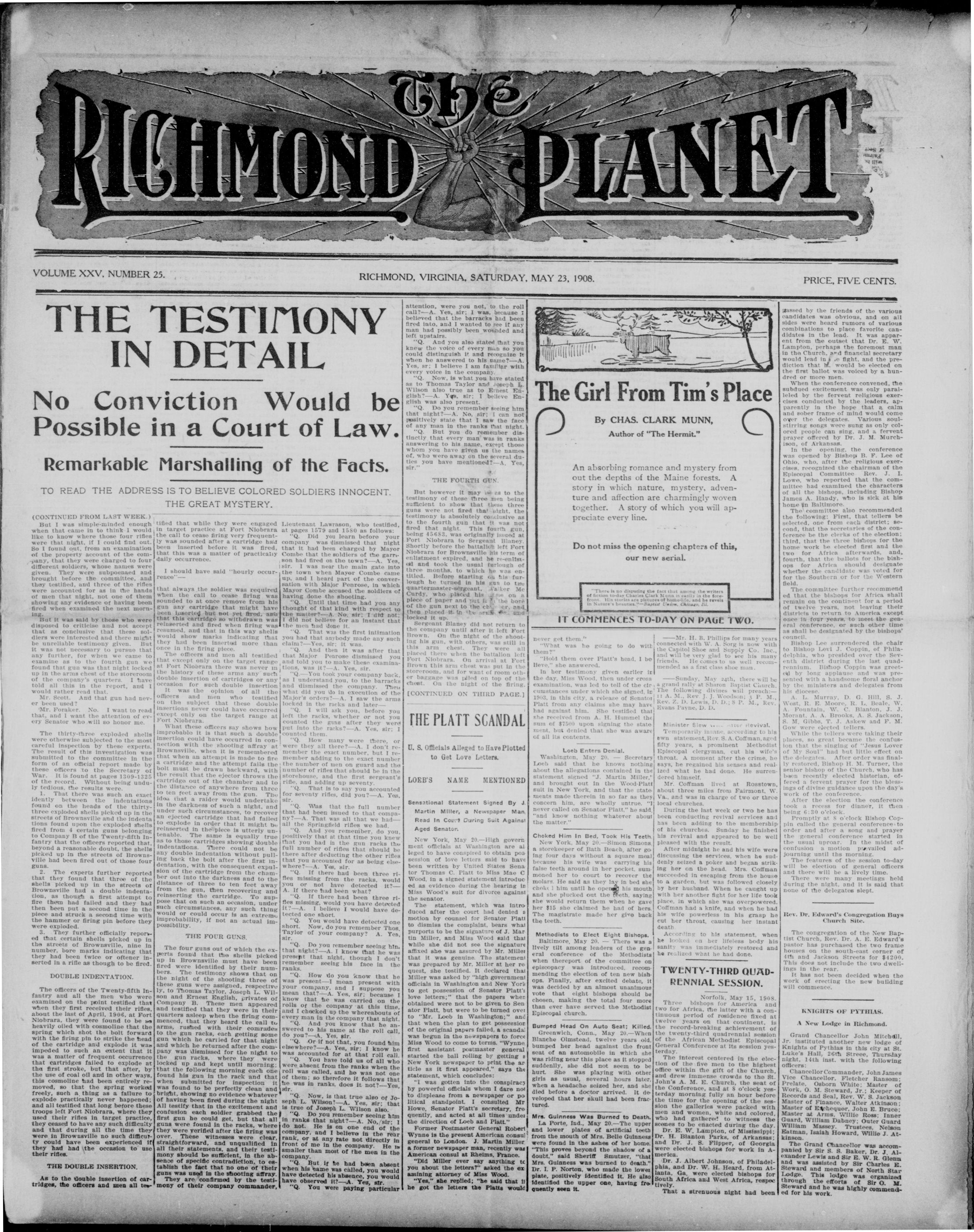
THE TESTIMONY IN DETAIL
No Conviction Would be Possible in a Court of Law.
TO READ THE ADDRESS IS TO BELIEVE COLORED SOLDIERS INNOCENT. THE GREAT MYSTERY.
VOLUME XXV, NUMBER 25
THE T
IN
No Conv
Possible in
Remarkable
TO READ THE ADDRESS
(CONTINUED FROM LAST WEEK.)
But I was simple-minded enough when that came in to think I would like to know where those four rifles were that night, if I could find out. So I found out, from an examination of the property account of the company, that they were charged to four different soldiers, whose names were given. They were subpoenaed and brought before the committee, and they testified, and three of the rifles were accounted for as in the hands of men that night, not one of them showing any evidence of having been fired when examined the next morning.
But it was sald by those who were disposed to criticise and not accept that as conclusive that these soldiers were interested and there might be unreliable testimony given. But it was not necessary to pursue that any further, for when we came to examine as to the fourth gun we found that gun was that night locked up in the arms chest of the storeroom of the company's quarters. I have told all this in the report, and I would rather read that.
Mr. Scott. And that gun had never been used.
Mr. Foraker. No. I want to read that, and I want the attention of every Senator who will so honor me.
The thirty-three exploded shells were otherwise subjected to the most careful inspection by these experts. The result of this investigation was submitted to the committee in the form of an official report made by these officers to the Secretary of War. It is found at pages 1309-1325 of the record. Without being unduly tedious, the results were.
1. That there was such an exact identity between the indentations found on the heads of the thirty-three exploded shells picked up in the streets of Brownsville and the indentations found upon the exploded shells fired from 4 certain guns belonging to Company B of the Twenty-fifth Infantry that the officers reported that, beyond a reasonable doubt, the shells picked up in the streets of Brownsville had been fired out of those four guns.
2. The experts further reported that they found that three of the shells picked up in the streets of Brownsville had a double indentation, as though the first attempt to fire them had failed and they had then been put a second time in the piece and struck a second time with the hammer or firing pin before they were exploded.
3. They further officially reported that certain shells picked up in the streets of Brownsville, nine in number, bore marks indicating that they had been twice or offender inserted in a rifle as though to be fired.
DOUBLE INDENTATION
The officers of the Twenty-fifth Infantry and all the men who were examined on the point testified that when they first received their rifles, about the last of April, 1906, at Fort Niobrara, they were found to be so heavily oiled with cosmoline that the spring which shot the bolt forward with the firing pin to strike the head of the cartridge and explode it was impeded to such an extent that it was a matter of frequent occurrence that cartridges failed to explode at the first stroke, but that after, by the use of coal oil and in other ways, this cosmoline had been entirely removed, so that the spring worked freely, such a thing as a failure to explode practically never happened; and all testified that long before these troops left Fort Niobrara, where they used their rifles in target practice, they ceased to have any such difficulty, and that during all the time they were in Brownsville no such difficulty could have been experienced if they had had the occasion to use their rifles.
THE DOUBLE INSERTION
As to the double insertion of car-tridges, the officers and men all ten-
tified that while they were engaged in target practice at Fort Niobrara the call to cease firing very frequently was sounded after a cartridge had been inserted before it was fired, that this was a matter of practically daily occurrence.
I should have said "hourly occurrence"—
that always the soldier was required when the call to cease firing was sounded to at once remove from his gun any cartridge that might have been inserted but not yet fired, and that this cartridge so withdrawn was reinserted and fired when firing was resumed, and that in this way shells would show marks indicating that they had been inserted more than once in the firing piece.
The officers and men all testified that except only on the target range at Fort Niobrara there was never in the history of these arms any such double insertion of cartridges or any occasion for such double insertion. It was the opinion of all the officers and men who testified on the subject that these double insertions never could have occurred except only on the target range at Fort Niobrara.
What these officers say shows how improbable it is that such a double insertion could have occurred in connection with the shooting affray at Brownsville, when it is remembered that when an attempt is made to fire a cartridge and the attempt fails the bolt must be drawn backward, with the result that the ejector throws the cartridge out of the chamber and to the distance of anywhere from three to ten feet away from the gun. The idea that a raider would undertake in the darkness of such a night, and under such circumstances, to recover an ejected cartridge that had failed to explode in order that it might be reinserted in the piece is utter untenable. The same is equally true as to those cartridges showing double indentations. There could not be any double indentation without pulling back the bolt after the first indentation, with the consequent expulsion of the cartridge from the chamber out into the darkness and to the distance of three to ten feet away from the gun, then recovering and reinserting the cartridge. To suppose that on such an occasion, under such circumstances, any such thing would or could occur is an extreme improbability, if not an actual impossibility.
THE FOUR GUNS
The four guns out of which the experts found that the shells picked up in Brownsville must have been fired were identified by their numbers. The testimony shows that on the night of the shooting three of these guns were assigned, respectively, to Thomas Taylor, Joseph L. Wilson and Ernest English, privates of Company B. These men appeared and testified that they were in their quarters asleep when the firing commenced, that they heard the call to arms, rushed with their comrades to the gun racks, each getting some gun which he carried for that night and which he returned after the company was dismissed for the night to gun racks, where they were locked up and kept until morning; that the Following morning each one found his gun in the rack and that when submitted for inspection it was found to be perfectly clean and bright, showing no evidence of having been fired during the night. All testify that in the excitement and confusion each soldier grabbed the first gun he could get, but that all guns were found in the racks, where they were verified after the firing was over. These witnesses were clear, straightforward, and unqualified in all their statements, and their testimony should be sufficient, in the absence of specific contradiction, to establish the fact that no one of their guns was used in the shooting affray. They are confirmed by the testi-
They are confirmed by the testimony of their company commander
RICHMOND, VIRGINIA, SATURDAY, MAY 23, 1908.
Lieutenant Lawrason, who testified,
at pages 1579 and 1580 as follows:
"Q. Did you learn before your company was dismissed that night that it had been charged by Mayor Combe that the soldiers of the garrison had fired on the town?—A. Yes, sir. I was near the main gate into the town when Mayor Combe came up, and I heard part of the conversation with Major Penrose, in which Mayor Combe accused the soldiers of having done the shooting.
"Q. Until that time had you any thought of that kind with respect to the men?—A. No, sir; I did not; I did not believe in an instant that the men had done it.
"Q. That was the first intimation you had that anybody made any such claim?—Yes, sir; it was.
"Q. And then it was after that Major Penrose dismissed you and told you to make these examinations, was it?—A. Yes, sir.
"Q. You took your company back, as I understand you, to the barracks and dismissed the company. Then what did you do in execution of the Major's orders?—A. I saw the arms locked in the racks and later—
"Q. I will ask you, before you left the racks, whether or not you counted the guns after they were put into the racks?—A. Yes, sir; I counted them.
"Q. How many were there, or were they all there?—A. I don't remember the exact number, but I remember adding to the exact number of men on guard and the number of rifles that should be in the storehouse, and the first sergeant's rifle, and adding up seventy.
"Q. That is to say you accounted for seventy rifles, did you?—A. Yes, sir.
"Q. Was that the full number that had been issued to that company?—A. That was all that we had—all the Springfield rifles we had.
"Q. And you remember, do you, positively that at that time you knew that you had in the gun racks the full number of rifles that should be there after deducting the other rifles that you accounted for as being elsewhere?—A. Yes, sir.
"Q. If there had been three rifles missing from the racks, would you or not have detected it?—A. I have had been what?
"Q. If there had been three rifles missing, would you have detected it?—A. I believe I would have detected one short.
"Q. You would have detected one short. Now, do you remember Thos, Taylor of your company? A. Yes, sir.
"Q. Do you remember seeing hm, that night?—A. I know that he was present that night, though I don't remember seeing his face in the ranks.
"Q. How do you know that he was present—I mean present with your company, and I suppose you mean that?—A. Yes, sir; because I know that he was carried on the rolls of the company at this time, and I checked up the whereabouts of every man in the company that night.
"Q. And you know that he answered to his name at the roll call, do you?—A. Yes, sir.
"Q. Or if not that, you found him elsewhere?—A. Yes, sir; I know he was accounted for at that roll call.
"Q. You have told us of all who were absent from the ranks when the roll was called, and he was not one of them; so therefore it follows that he was in ranks, does it not?—Yes, sir.
"Q. Now, is that true also of Joseph L. Wilson?—A. Yes, sir; that is true of Joseph L. Wilson also.
"Q. Do you remember seeing him in ranks that night?—A. No./sir; I do not. He is on one end of the company, and I believe in the rear rank, or at any rate not directly in front of me in the company. He is smaller than most of the men in the company.
"Q. But if he had been absent when his name was called, you would have detected his absence, you would have observed it?—A. Yes, sir.
You were paying particular
attention, were you not, to the roll call?—A. Yes, sir; I was, because I believed that the barracks had been fired into, and I wanted to see if any man had possibly been wounded and left upstairs.
“Q. And you also stated that you knew the voice of every man so you could distinguish it and recognize it when he answered to his name?—A. Yes, sir; I believe I am familiar with every voice in the company.
“Q. Now, is what you have stated as to Thomas Taylor and Joseph E. Wilson also true as to Ernest English?—A. Yes, sir; I believe English was also present.
“Q. Do you remember seeing him that night?—A. No, sir; I can not positively state that I saw the face of any man in the ranks that night.
“Q. But you do remember distinctly that every man was in ranks answering to his name, except those whom you have given us the names of, who were away on the several duties you have mentioned?—A. Yes, sir.”
THE FOURTH GUN
But however it may be as to the testimony of these three men being sufficient to show that these three guns were not fired that night, the testimony is absolutely conclusive as to the fourth gun that it was not fired that night. This fourth gun, being 45836, was originally issued at Fort Niobrara to Sergeant Blaney. Shortly before the battalion left Fort Niobrara for Brownville his term of enlistment expired, and he re-enlisted and took the usual furlough of three months, to which he was entitled. Before starting on his furlough he turned in his gun to the quartermaster-sergeant, Walker Mc Curdy, who placed his gun on a piece of paper and put it in the bore of the gun next to the chiever, and then placed it in the arm tree and locked it up.
Sergeant Blaney did not return to the company until after it left Fort Brown. On the night of the shooting his gun, with others, was still in this arm chest. They were all placed there when the battalion left Fort Niobrara. On arrival at Fort Brown this arm chest was put in the storeroom, and for want of room other baggage was pulled on top of the chest. On the night of the firing.
[CONTINUED ON THIRD PAGE.]
THE PLATT SCANDAL
U. S. Officials Alleged to Have Plotted to Get Love Letters.
Sensational Statement Signed By J. Martin Miller, a Newspaper Man. Read In Court During Suit Against Aged Senator.
New York, May 20.—High government officials at Washington are alleged to have conspired to obtain possession of love letters said to have been written by United States Senator Thomas C. Platt to Miss Mae C Wood, in a signed statement introduced as evidence during the hearing in Miss Wood's suit for divorce against the senator.
The statement, which was introduced after the court had denied a motion by counsel for Senator Platt to dismiss the complaint, bears what purports to be the signature of J. Martin Miller, and Miss Wood said that while she did not see the signature affixed she was assured by Mr. Miller that it was genuine. The statement was prepared by Mr. Miller at her request, she testified. It declared that Miller was asked by "high government officials in Washington and New York to get possession of Senator Platt's love letters;" that the papers when obtained were not to be given to Senator Platt, but were to be turned over to "Mr. Loeb in Washington;" and that when the plan to get possession of the original papers failed, a scandal was begun in the newspapers to force Miss Wood to come to terms. "Wynne first assistant postmaster general started the ball rolling by getting a New York newspaper to print the article as it first appeared," says the statement, which concludes:
"I was gotten into the conspiracy by powerful officials whom I dare not to displease from a newspaper or political standpoint. I consulted Mr Howe, Senator Platt's secretary, frequently, and acted at all times under the direction of Loeb and Platt."
Former Postmaster General Robert Wynne is the present American consul general to London. J. Martin Miller a former newspaper man, recently was american consul at Rheims, France.
"Did Miller ever say anything to you about the letters?" asked the examining attorney of Miss Wood.
"Yes," she replied; "he said that if he got the letters the Platts would
```markdown
```
The Girl From Tim's Place
By CHAS. CLARK MUNN, Author of "The Hermit."
An absorbing romance
out the depths of the
story in which natu-
ture and affection a
together. A story o
preciate every line.
Do not miss the open
our ne
An absorbing romance and mystery from out the depths of the Maine forests. A story in which nature, mystery, adventure and affection are charmingly woven together. A story of which you will appreciate every line.
Do not miss the opening chapters of this, our new serial.
"There is no disputing the fact that among the writers of fiction to-day Charles Clark Munn is easily in the forefront. His stories are pictures of homelife, and he revels in Nature's beauties," - Baptist Union, Chicago, Ill.
"What was he going to do with them?"
"Hold them over Platt's head, I be lieve," she answered.
In her testimony given earlier in the day, Miss Wood, then under cross examination, was led to tell of the circumstances under which she signed, in 1903, in this city, a release of Senator Platt from any claims she may have had against him. She testified that she received from A. H. Hummel the sum of $7500 upon signing the statement, but denied that she was aware of all its contents.
Loeb Enters Denial
Washington, May 20. — Secretary Loeh said that he knows nothing about the allegations contained in the statement signed "J. Martin Miller," and brought out in the Wood-Platt suit in New York, and that the statements made therein in so far as they concern him, are wholly untrue. "I never called on Senator Platt," he said, "and know nothing whatever about the matter."
Choked Him In Bed, Took His Teeth, New York, May 20—Simon Simons, a storekeeper of Bath Beach, after going four days without a square meal because his wife was carrying his false teeth around in her pocket, summoned her to court to recover the molars. He said as they lay in bed she choke (him until he opened his mouth and she plucked out the teeth, saying she would return them when he gave her $15 she claimed he had of hers. The magistrate made her give back the teeth.
Methodists to Flent Fight
Methodists to Elect Eight Bishops.
Baltimore, May 20. — There was a lively tilt among leaders of the general conference of the Methodists when thereport of the committee on episcopacy was introduced, recommending the election of ten new bishops. Finally, after excited debate, it was decided by an almost unanimous vote that eight bishops should be chosen, making the total four more than ever have served the Methodist Episcopal church.
Bumped Head On Auto Seat; Killed.
Greenwich, Conn., May 20.—When Blanche Olmstead, twelve years old, bumped her head against the front seat of an automobile in which she was riding near this place as it stopped suddenly, she did not seem to be hurt. She was playing with other girls as usual, several hours later, when a headache seized her, and she died before a doctor arrived. It developed that her skull had been fractured.
Mrs. Guinness Was Burned to Death.
La Porte, Ind., May 20.—The upper and lower plates of artificial teeth from the mouth of Mrs. Belle Guinness were found in the ashes of her home. "This proves beyond the shadow of a doubt," said Sheriff Smutzer, "that Mrs. Guinness was burned to death."
Dr. I. P. Norton, who made the lower plate, positively identified it. He also identified the upper one, having frequently seen it.
never get them."
and mystery from
the Maine forests. A
ure, mystery, adven-
ure charmingly woven
of which you will ap-
ning chapters of this,
new serial.
Mr. H. B. Phillips for many years connected with W. A. Sorg is now with the Capitol Shoe and Supply Co. Inc., and will be very glad to see his many friends. He comes to us well recommended as a first class shoe man.
Sunday, May 24th, there will be a grand rally at Sharon Baptist Church. The following divines will preach: 11 A. M., Rev J. J. Woodson; 3 P. M., Rev Z. D. Lewis, D. D.; 5 P. M., Rev Evans Payne, D. D.
Minister Slew will later revival. Temporarily insane, according to his own statement, Rev S. A. Coffman, aged fifty years, a prominent Methodist Episcopal clergyman, cut his wife's throat. A moment after the crime, he says, he regained his senses and realized what he had done. He surrendered himself.
Mr. Coffman lived at Rosstown, about three miles from Fairmont, W. Va., and was in charge of two or three local churches.
During the last week or two he has been conducting revival services and has been adding to the membership of his churches. Sunday he finished his revival and appeared to be well pleased with the result.
After midnight he and his wife were discussing the services, when he suddenly seized a poker and began striking her on the head. Mrs. Coffman succeeded in escaping from the house to a garden, but was followed closely by her husband. When he caught up with her another fight for her life took place, in which she was overpowered. Coffman had a knife, and when he had his wife powerless in his grasp he cut her throat, causing her instant death.
According to his statement, when he looked on her lifeless body his sanity was immediately restored and he realized what he had done.
TWENTY-THIRD QUADRENIAL SESSION.
Norfolk, May 15, 1908.
Three bishops for America and two for Africa, the latter with a continuous period of residence fixed at twelve years on that continent, is the record-breaking achievement of the twenty-third quadrennial session of the African Methodist Episcopal General Conference at its session yesterday.
The interest centered in the election of the five men to the highest office within the gift of the Church, and drew immense crowds to the St. John's A. M. E. Church, the seat of the Conference, and at 8 o'clock yesterday morning fully an hour before the for the opening of the session the galleries were packed with men and women, white and colored, who had gathered to witness the scenes to be enacted during the day.
Dr. E. W. Lampton, of Mississippi; Dr. H. Blanton Parks, of Arkansas; and Dr. J. S. Flipper, of Georgia were elected bishops for work in America.
Dr. J. Albert Johnson, of Philadelphia, and Dr. W. H. Heard, from Atlanta, Ga, were elected bishops for South Africa and West Africa, respectively.
That a strenuous night had been
Norfolk
PRICE, FIVE CENTS
passed by the friends of the various candidates was obvious, and on all sides were heard rumors of various combinations to place favorite candidates in the lead. It was apparent from the outset that Dr. E. W. Lampton, perhaps the foremost man in the Church, and financial secretary would lead in the fight, and the prediction that he would be elected on the first ballot was voiced by a hundred or more men.
When the conference convened, the subdued excitement was only paralleled by the fervent religious exercises conducted by the leaders, apparently in the hope that a calm and sober frame of mind would come over the delegates. Various soul-stirring songs were sung as only colored people can sing, and a fervent prayer offered by Dr. J. M. Murchison, of Arkansas, in singing, the conference was opened by Bishop B. F. Lee of Ohio, who, after the religious exercises, recognized the chairman of the Episcopal Committee Rev. J. I. Lowe, who reported that the committee had examined the characters of all the bishops, including Bishop James A. Handy, who is sick at his home in Baltimore.
The committee also recommended the following: First, that tellers be selected, one from each district; second, that the secretaries of the conference be the clerks of the election; third, that the three bishops for the home work be elected first and the two for Africa afterwards, and, fourth, that the ballots for the bishops for Africa should designate whether the candidate was voted for for the Southern or for the Western field.
The committee further recommend ed that the bishops for Africa shall remain on the continent for a period of twelve years, not leaving their districts to return to America except once in four years, to meet the general conference, or such other time as shall be designated by the bishops' council.
Bishop Lee lenced the chair to Bishop Levi J. Coppin, of Philadelphia, who presided over the seventh district during the last quadrennium. Bishop Coppin was greeted by one applause and was prefixed with a handsome floral anchor by the ministers and delegates from his diocese.
A. L. Murray, D. G. Hill, S. J. West, R. E. Moore, R. L. Beale, W. A. Fountain, W. C. Blanton, J. J. Morant, A. A. Brooks, A. S. Jackson, S. M. Gibbs, T. J. Askew and F. M. Gow were elected tellers.
While the tellers were taking their places, so great became the confusion that the singing of "Jesus Lover of My Soul" had but little effect on the delegates. After order was finally restored, Bishop H. M. Turner, the senior bishop of the Church, who has been recently elected historian, offered a fervent prayer for the blessings of divine guidance upon the day's work of the conference.
After the election the conference took a recess for dinner, it then being 6:30 o'clock.
Promptly at 8 o'clock Bishop Coppin called the general conference to order and after a song and prayer the general conference started in usual upon occasion. In the midst of confusion the nation wailed adjourning until this morning.
The features of the session to-day will be election of general officers and there will be a Lively time.
There were many meetings held during the night, and it is said that none of the delegates slept.
Rev. Dr. Edward's Congregation Buys Church Site.
The congregation of the New Baptist Church, Rev. Dr. A. E. Edward's pastor has purchased the two frame houses on the south-east corner of 4th and Jackson Streets for $4200. This does not include the two dwellings in the rear. It has not been decided when the work of erecting the new building will commence.
KNIGHTS OF RYTHAS
A New Lodge in Richmond
Grand Chancellor John Mitchell Jr. instituted another new lodge of Knights of Pythias in this city at St Luke's Hall, 26th Streee, Thursday night, 14th inst. with the following officers:
Chancellor Commander, John James Vice Chancellor, Fletcher Ransom; Prelate, Osborn White; Master of Work, O. M. Steward, Jr.; Keeper of Records and Seal, Rev. W. S. Jackson Master of Finance, Walter Atkinson; Master of Exchequer, John E. Bruce; Master at Arms, Willie Ross; Inner Guard, William Dabney; Outer Guard William Massey. Trustees, Nelson Eatman, Isalah Howard, Willie J. Atkinson.
The Grand Chancellor was accompanied by Sir S. S. Baker, Dr. J. Alexander Lewis and Sir S. W. R. Glem and was assisted by Sir Charles E. Steward and members of North Star Lodge. This lodge was organized through the efforts of Sir O. M. Steward and he was highly commended for his work.
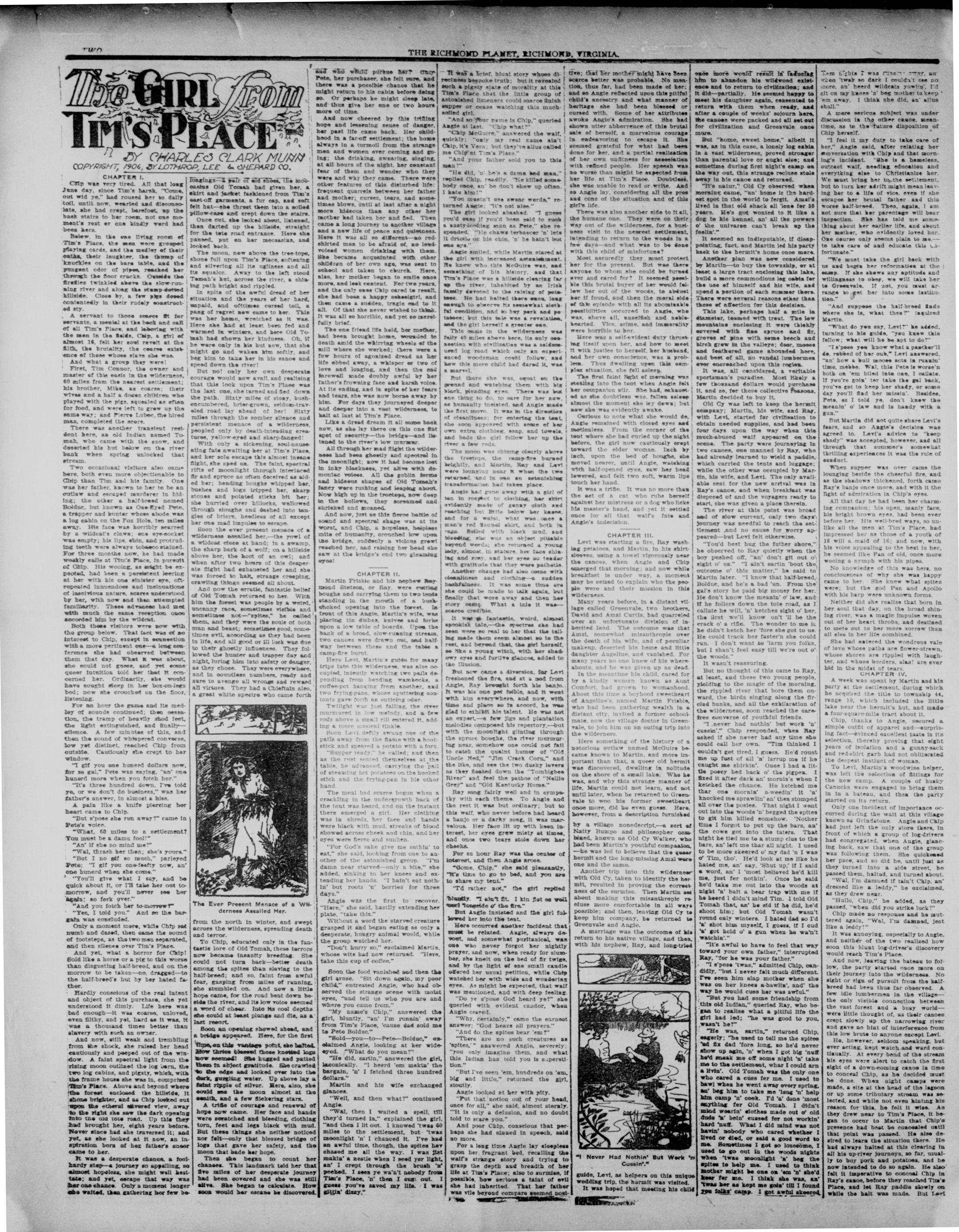
The GIRL from TM'S PLACE
Clip was very tired. All that long June day, since Tim's harsh, "Come, out wid ye," had roused her to daily toll, until now, weared and disconcerted, she had crept, barefoot, up the baek stairs to her room, not one moment's rest er one kindly word had been hers.
Beole, in the one living room of Tim's Place, the men were grouped playing cards, and the medley of their oaths, their laughter, the thump of knuckles on the bare table, and the pungent odor of pipes, reached her through the floor cracks. Outside the fireflies twinkled above the slow-running river and along the stump-dotted hillside. Close by, a few pigs dosed contentedly in their rudely constructed sty.
A servant to those scarcity fit for servants, a mental at the beck and call of all Tim's Place, and laboring with the men in the fields, Chip, a girl of almost 16, felt her soul revolt at the filth, the brutality, the coarseness existence of those whose slave she was.
And what a group they were!
First, Tim Connor, the owner and master of the easis in the wilderness, 60 miles from the nearest settlement; his brother, Mike, an coarse; their wives and a half a dozen children who played with the pigs, squealed an effent for food, and were left to grow up the same way; and Pierre Lubec, the hired man, completed the score.
There was another transient resident here, an old Indian named Tomah, who came with the snow, and deserted his hut below on the river bank when spring unlocked that stream.
Two occasional visitors also came here, both even more objectionable to Chip than Tim and his family. One was her father, known to her to be an outlaw and escaped murderer in hiding; the other a half-breed named Boldac, but known as One-Eyed Pete, a trapper and hunter whose abode was a log cabin on the Fox Hole, ten miles away. His face was horribly scarred by a wildcat's claws; one eye-socket was empty; his lips, chin, and protruding teeth were always tobacco-stained. For three months now, he had made weakly calls at Tim's Place, in pursuit of Chip. His wooing, as might be expected, had been a persistent leering at her with his one sinister eye, oft-repeated innuendoes and insinuations of lascivious nature, scarce understood by her, with now and then attempted familiarity. These advances had met with much the same reception once accorded him by the wildcat.
Both these visitors were now with the group below. That fact was of no interest to Chip, except in connection with a more pertinent one—a long conference she had observed between them that day. What it was about, she could not guess, and yet some queer intuition told her that it concerned her. Ordinarily, she would have sought sleep in her box-on-lees bed; now she crouched on the floor, listening.
For an hour the game and its medley of sounds continued; then cessation, the tramp of heavily shod feet, the light extinguished, and finally—effence. A few minutes of this, and then the sound of whispered converse, low yet distinct, reached Chip from outside. Cautiously she crept to her window.
"I gift you one humerd dollars now, for ze gal." Pete was saying, "an one humerd more" when you fetch her."
"It's three hundred down, I've told ye, or we don't do business," was her father's answer, in almost a hise.
A pain like a knife piercing her heart came to Chip.
"But 'spose she run away?" came in Pete's voice.
"What, 60 miles to a settlement?
You must be a damn fool!"
"An' if she no mind me?"
"Wal, thrash her then; she's yours."
"But I no gif so much," parleyed
Pete; "I gif you one-feetty now, an'
one hunerd when she come."
"You'll give what I say, and be
quick about it, or I'll take her out to
tomorrow, and you'll never see her
again; so fork over."
"And you fetch her to-morrow?"
"Yes, I told you." And so the bargain was concluded.
Only a moment more, while Chip sat
numb and dazed, then came the sound
of footsteps, as the two men separated,
and then silence over Tim's Place.
And yet, what a horror for Chip!
Solid like a horse or a pig to this worse
than disgusting half-breed, and on the
morrow to be taken—no, dragged—to
the half-breed's hut by her hated fa-
ther.
Hardly conscious of the real intent and object of this purchase, she yet understood it dimly. Life here was had enough—it was coarse, unloved, even filthy, and yet, hard as it was, it was a thousand times better than slavery with such an owner.
And now, still weak and trembling from the shock, she raised her head cautiously and peeped out of the window. A faint spectral light from the rising moon outlined the log born, the two log cabins, and pligest, which, with the frame house she was in, comprised Tom's Place. Above and beyond where the forest enclosed the hillside, it shone brighter, and as Chip looked out upon the etheral silvester view, away to the right she saw the dark opening into the old tote road. Up this they had brought her, eight years before. Never since had she traversed it; and yet, as she looked at it now, an inspiration born of her father's snoor came to her.
It was a desperate chance, a foolhardy step—a journey so appalling, so almost hopeless, she might well resist; and yet, escape that way was her one chance. Only a moment longer she waited, then gathering her few be-
longings—a pair of old shoes, the moccasins Old Tomah had given her, a skirt and jacket fashioned from Tim's east-off garments, a fur cap, and soft felt hat—she thrust them into a soiled pillow-case and crept down the stairs. Once out, she looked about, listened, then darted up the hillside, straight for the tete road entrance. Here she paused, put on her moccasins, and looked back. The moon, new above the tree-tops, shone full upon Tim's Place, softening and silvering all its ugliness and all its squail. Away to the left stood Tomah's hat, across the river, a shining path bright and rippled.
In spite of the awful dread of her situation and the years of her hard, suspal, and oftimes cursed toil, a peng of regret new came to her. This was her home, wretched as it was. Here she had at least been fed and warned in winters, and here Old Tomah had shown her kindness. Oh, if he were only in his hut now, that she might go and wake him softly, and beg him to take her in his ennose and speed down the river! But no! only her own desperate courage would now avail, and realising that this look upon Tim's Place was the last one, she turned and fled down the path. Sixty miles of stony, bush-encumbered, brier-grown, seldom-traveled road lay ahead of her! Sixty miles through the somber silence and persistent menace of a wilderness, peopleled by death-intending creatures, yellow-eyed and sharp-fanged!
With only a slickening, soul-nauseating fate awaits her at Tim's Place, and her sole escape this almost insane flight, she sped on. The faint, spectral rifts of moonlight through interlaced fir and spruce as often deceived as sided her; bending boughs whipped her, bushes and logs tripped her, sharp stones and pointed sticks bft her; she hurried over hillocks, wallowed through sloughs and dashed into tangles of briers, headless of all except her one mad impulses to escape.
Soon the ever present menace of a wilderness assailed her; the yowl of a wildcoat close at hand; in a swamp, the sharp bark of a wolf; on a hillside above her, the hoof of an owl; and when after two hours of this desperate flight had exhausted her and she was forced to halt, strange cropping, crawling things seemed all about.
And now the errate, fantastic belief of Old Tomah returned to her. With him the forest was people by a weird, uncanny race, sometimes visible and sometimes not—"epites," he called them, and they were the souls of both man and beast; sometimes good, sometimes evil, according as they had been in life, and all good or ill luck was due to their ghostly influences. They followed the hunter and trapper day and night, huring him into safety or danger, as they chose. They were everywhere, and in countless numbers, ready and sure to avenge all wrongs and reward all virtues. They had a Chleftain also, a great white spectre who came forth
A woman in a long dress stands in a forest, holding a basket of fruit.
The Ever Prestent Menace of a WH-derness Assailed Her.
from the north in winter, and swept across the wilderness, spreading death and terror.
To Chip, educated only in the fantastic lore of Old Tomah, these terrors now became insanity breeding. She could not turn back—better death among the spites than slaving to the half-breed; and so, faint from awful fear, gasping from miles of running, she stumbled on. And now a little hope came, for the road bent down beside the river, and its low voice seemed a word of chear. Into its cool depths she could at least plunge and die, as a last report.
Soon an opening showed ahead, and a bridge appeared. Here, for the first time, on this vantage point, she halted. How three blessed those knotted logs now seemed! She hugged and patted them in object gratitude. She crawled to the edge and looked over into the dark, gurgling water. Up above lay a faint ripple of silver. Here, also, she could see the moon almost at the sunnish, and a few flickering stars.
A trifle of courage and renewal of hope now came. Her face and hands were scratched and bleeding clothing torn, feet and legs black with mud. But these things she neither noticed nor felt—only that blessed bridge of logs that gave her safety, and the moon that bade her hope.
Then she began to count her chances. This landmark told her that five miles of her desperate journey had been covered and she was still alive. She began to calculate. How soon would her escape be discovered.
THE RICHMOND PLANET, RICHMOND, VIRGINIA
and who would pursue her? Ornie
Pote, her purchaser, she felt sure, and
there was a possible chance that he
might return to his cabin before doing
so. Or perhaps he might sleep late,
and thus give her one or two hours
more of time.
And now cheered by this trifling hope and lessening sense of danger, her past life came back. Her childhood in a far-off settlement; the home always in a turncoil from the strange men and women ever coming and goaling; the drinking, swearing, singing, at all hours of the night, her constant fear of them and wonder who they were and why they came. There were other features of this disturbed life: frequent quarrels between her father and mother; curSES, tears, and sometimes blows, until at last after a night more hideous than any other her mother had taken her and fled. Then came a long journey to another village and a new life of peace and quietness. Here it was all so different—no red shirted men to be afraid of, no lewd-voiled women drinking with them. She became acquainted with other children of her own age, was sent to school and taken to church. Here, also, her mother began to smile once more, and leek content. For two years, and the only ones Chip cared to recall, she had been a happy scheeelgirl, and then came a sudden, tragic end to it all. Of that she never wished to think it was all so horrible, and yet so merely brief.
The one friend life held, her mother, had been brought home, wounded to death amid the whirring wheels of the mill where she worked; there were a few hours of agonized dread as her life ebbed away, a whisper or two of love and longing, and then the and farewell made doubly awful by her father's frowning face and harsh voice. At its ending, and in spite of her fears and tears, she was now borne away by him. For days they journeyed deeper and deeper into a vast wilderness, to halt at last at Tim's Place. Like a dread dream it all came back now, as she lay there on this one flat spot of security—the bridge—and listened to the river's low murmur.
All through her mad flight the wilderness had been ghostly and spectral in the moonlight; now it had become lost in inky blackness, yet alive with demonic voices. All the goblin forms and hideous shapes of Old Tomahill's fancy were rushing and leaping about. Now high up in the treetops, now deep in the hollows, they screamed and shrieked and moaned.
And now, just as this fierce battle of sound and spectral shape was at its worst, and Chip, a hopeless, helpless mite of humanity, crenched low upon the bridge, suddenly a vicious growl reached her, and raising her head she saw at the bridge's end two gleaming eyes!
CHAPTER 11.
Martin Frisbie and his nephew Raymond Stetson, or Ray, were carrying boughs and carrying them to two tenden standing in the mouth of a buck-choked opening into the forest. In front of this Angle, Martin's wife, was placing tin dishes, knives and forbes upon a low table of boards. Upon the bank of a broad, slow-running stream, two canoes were drawn out, and halfway between these and the table a camp-fire burnt.
Here Levi, Martin's guide for many trips into this wilderness, was also occupied, intently watching two palls depending from bending wambecks, a coffee-pot hanging from another, and two frying-pans, whose sputtering contents gave forth an enticing oder.
Twilight was just falling, the river murmured in low melody, and a few rods above a small rill entered it, adding a more musical tinkle.
Soon Levi defyly awoke one of the palls away from the flame with a hook-stick and appeared a potato with a fork.
"Supper ready," he called; and then as the rest seated themselves at the table, he advanced, carrying the pail of steaming hot potatoes on the hooked stick and the frying pan in his other hand.
The meal had scarce begun when a crackling in the undergrowth back of the tent was heard, and on the instant there emerged a girl. Her clothing was in shreds, her face and hands were black with mud, streaks of blood showed across cheek and chin, and her eyes were fierce and sunken.
"For God's sake give me sutin' to eat," she said, looking from one to another of the astonished group. "I'm damn near starved—only a bite," she added, sinking to her knees and extending her hands. "I hain't eat nothin' but roots' n' borries for three days."
Angle was the first to recover. "Here," she said, hastily extending her plate, "take this."
Without a word the starved creature grasped it and began eating as only a desperate, hungry animal would, while the group watched her.
"Don't hurry so," exclaimed Martin, whose wife had now returned. "Here, take this cup of coffee."
Soon the food vanished and then the girl arose. "Sit down again, my poor child!" entreated Angie, who had observed the strange scene with moist eyes, "and tell us who you are and where you came from."
"My name's Chip," answered the girl, bluntly, "an' I'm runnin' away from Tim's Place, 'cause dad sold me to Pete Bolduc."
"Sold-you-to—Pete—Bolduc," exclaimed Angie, looking at her wide-eyed. "What do you mean?"
"He did, sartin," answered the girl, laconically. "I heared 'em makia' the bargain, 'n' I fetched three hundred dollars."
Martin and his wife exchanged glances.
"Well, and then what?" continued Angie.
"Wal, then I waited a spell, till they'd turned in," explained the girl, "and then I lit out. I knowed 'twas 60 miles to the settlement, but 'twas moonlight n' I chanced it. I've had an awful time, though, the spites hev chased me all the way. I was just makia a nestle when I seed yer light, an' I crept through the brush 'n' peeked. I seen ye wa'n't nobody from Tim's Place, 'n then I curn out. I guess you've saved my life. I was gittin' dizzy."
It was a brief, blunt story whose directness basked truth; but it revealed such a piggy state of morality at this Tim's Place that the little group of autolished listeners could source finish supper or cease watching this much-soiled girl.
"And so your name is Chip," queried Angie at last. "Chip what?"
"Chip McGurtee," answered the wolf, quickly; "only my real name ala't Chip, it's Vera; but they've all called me Chip at Tim's Place."
"And your father sold you to this man"
"He did, 'n' he's a damn bed man," replied Chip, readily. "He killed somebody once, an' he don't show up often. I hate him!"
"You mustn't use awear werds," returned Angie; "it's not aloe."
The girl looked abashed. "I guess you'd ask if you'd been sold to such a nasty-looking man as Pete," she responded. "The chaws terbacser 'n' lets it drizzle on his chin, 'n' he haunt but one eye."
Angie smiled, while Martin stared at the girl with increased astonishment. He knew who this McGuire was, and something of his history, and that Tim's Place was a hillside clearing far up the river, inhabited by an Irish family devoted to the raising of potatoes. He had halted there once, long enough to observe its somewhat sleek condition, and so buy perk and potatoes; but this tale was a revelation, and the girl herself a greater one.
This oasis in the wilderness was fully 40 miles above its, its only connection with civilization was a sold-emounded log road which only an experienced woodman could follow, and how this mere child had dared it, was a marvel.
But there she was, equat on the ground and watcheting them with big black, pleasing eyes. There was but one thing to do, to care for her now, as humanity insisted, and Angie made the first move. It was in the direction of cleanliness; for entering the tent, she soon appeared with some of her own extra clothing, soap, and towels, and bade the girl follow her up the river a few rods.
The moon was shining clearly above the treetops, the camp-fire burned brightly, and Martin, Ray and Levi were loungeing near it when the two returned, and in one an astonishing transformation had taken place.
Angie had gone away with a girl of ten in respect to clothing, her skirt evidently made of ganay cloth and reaching but little below her knees, and for a waist, what was once a man's red flannel shirt, and both in rags. Bottled with black mud, and bleeding, she was an object pitable beyond words; she returned a young lady, almost, in stature, her face shining and rosey, and her eyes so tender with gratitude that they were pathetic. Another change had also come with cleanliness and clothing—a sudden bashfulness. It was some time ago she could be made to talk again, but finally that wore away and then her story came. What a tale it was—scarce credible.
It was so fantastic, weird, almost spookish tale,—the spectres she had seen were so real to her that the tailing made them seem almost so to the rest, and beyond that, the girl herself, so like a young witch, with her shadowy eyes and furtive glances, added to the illusion.
But now came a diversion, for Levi freshened the fire, and at a nod from Angle, Ray brought forth his banjo. It was his one pot fiddle, and it went with him everywhere, and now, with time and place so in accord, he was glad to exhibit his talent. He was not an expert—a few jigs and plantation melodies composed his repertory,—but with the moonlight glinting through the spruce boughs, the river murmuring near, somehow one could not fall to catch the quaint humor of "Old Uncle Ned," "Jim Crack Corn," and the like, and see the two ducky lovers as they floated down the "Tombigbee River" and feel the pathos of "Nellie Grey" and "Old Kentucky Home."
Ray song fairly well and in sympathy with each theme. To Angie and the rest it was but ordinary; but to this wolf, who never before had heard a banjo or a darky song, it was marvelous. Her face lit up with keen interest, her eyes grew misty at times, and once two tears stole down her cheeks.
For an hour Ray was the center of interest, and then Angie arose.
"Gome, Chip," she said pleasantly, "It's time to go to bed, and you are to share my tent."
"Td rather not," the girl replied bluntly. "I can't fit. I kin fist as well longside of the fire."
But Angie insisted and the girl followed her into the tent.
Here occured another incident that must be related. Angie, always devout, and somewhat puritanical, was one who never forgot her nightly prayer, and now, when ready for slumber, she knelt on the bed of fir twigs, and by the light of one small candle offered her usual petition, while Chip watched her with wide and wondering eyes. As might be expected, that walt was mentioned, and with deep feeling.
"Do ye 'spose God heard ye?" she queried with evident canard, when Angie caressed.
"Why, certainly," came the earnest answer; "God hears all prayers."
"And do the spites hear 'em?"
"There are no such creatures as 'spites,'" answered Angie, severely; "you only imagine them, and what this Indian has told you is superstition."
"But I've seen 'em, hundreds on 'em, big and little," returned the girl, stoutly.
Angie looked at her with pity.
"Put that notion out of your head, once for all," she said, almost sternly. "It is only a delusion, and no doubt told to scare you."
And poor Chip, conscious that perhaps she had sinned in speech, said no more.
For a long time Angie lay sleepless upon her fragrant bed, recalling the wolf's strange story and trying to grasp the depth and breadth of her life at Tim's Place; also to surmise, if possible, how serious a taint of evil she had inherited. That her father was vile beyond compare seemed post-
five; that her mother might have been scarce better was probable. No mention, thus far, had been made of her; and so Angie reflected upon this pitiful child's ancestry and what manner of haritage she had been blessed or cursed with. Some of her attributes awoke Angie's admiration. She had shown utter aberrance of this brutal sale of herself, a marvelous courage in endeavoring to escape it. She seemed grateful for what had been done for her, and a partial realization of her own unfitness for association with refined people. Her speeches was no worse than might be expected from her life at Tim's Place. Doubtsless, she was unable to read or write. And so Angie lay, considering all the pros and cons of the situation and of this girl's life.
There was also another side to it all, the humane one. They were on their way out of the wilderness, for a business visit to the nearest settlement, intending to return to the woods in a few days—and what was to be done with this child of misfortune?
Most assuredly they must protect her for the present. But was there anyone to whom she could be turned ever and cared for? It seemed possible this brutal buyer of her would follow her out of the woods, to abduct her if found, and then the moral side of this episode with all its abominable possibilities occurred to Angie, who was, above all, unselfish and nobile-hearted. Vice, crime, and immorality were horrible to her.
Here was a self-evident duty thrusting itself upon her, and how to meet it with justice to herself, her husband, and her own conscience, was a problem. Thus dwelling upon this complex situation, she fell asleep.
The first faint light of morning was stealing into the tent when Angie felt her companion stir. She had, exhausted as she doubtless was, fallen asleep almost the moment she lay down; but now she was evidently awake.
Curious to note what she would do, Angie remained with closed eyes and motionless. From the corner of the tent where she had curled up the night before, the girl now cautiously crept toward the elder woman. Inch by inch, upon the bed of bough, she moved nearer, until Angie, watching with half-opened eyes, saw her head lowered, and felt two soft, warm lips touch her hand.
It was a trifle. It was no more than the act of a cat who rubs herself against her mistress or a dog who licks his master's hand, and yet it settled once for all that wails fate and Angie's indecision.
CHAPTER III.
Levi was starting a fire, Ray washing potatoes, and Martin, in his shirt sleeves, using a towel vigorously near the canoes, when Angle and Chip emerged that morning; and now while breakfast is under way, a moment may be seized to explain who the people were and their mission in this wilderness.
Many years before, in a distant village called Greenvale, two brothers, David and Amzi Curtis, had quarreled over an unfortunate division of inherited land. The outcome was that Amzi, somewhat misanthrope over the death of his wife, and of peculiar makeup, deserted his home and little daughter Angeline, and vanished. For many years no one knew of his whereabouts, and he was given up as dead.
In the meantime his child, cared for by a kindly women known as Aunt Comfort, had grown to womanhood. About this time a boyhood sweetheart of Angelline's, named Martin Friable, who had been gathering wealth in a distant city, invited a former schoolmate, now the village doctor in Greenvale, to join him on an outing trip into the wilderness.
Here something of the history of a notorious outlaw named McGuire became known to Martin, and more important than that, a queer old hermit was discovered, dwelling in solitude on the shore of a small lake. Who he was, and why this strange manner of life, Martin could not learn, and not until later, when he returned to Greenvale to woo his former sweetheart once more, did he even guess. Here, however, from a description furnished
by a village nondescript,—a sort of Natty Bumpo and philosopher combined, known as Old Cy Walker, who had been Martin's youthful companion,—he was led to believe that the queer hermit and the long-missing Amzi were one and the same.
Another trip into this wilderness with Old Cy, taken to identify the hermit, resulted in proving the correctness of the surmise. Then Martin set about making this misanthropic recluse more comfortable in all ways possible; and then, leaving Old Cy to keep him company, he returned to Greenvale and Angle.
A marriage was the outcome of his return to his native village, and then, with his nephew, Ray, and long-tried
A man and a woman sit in a boat on a river, surrounded by trees and rocks. The man is wearing a hat and a long shirt, while the woman is wearing a dress and a hat. They are holding a book and a paddle, and there is a small boat in the water.
"I Never Had Nothin' But Work 'n Cussin'." guide, Levi, as helpers on this unique wedding trip, the harmit was visited. It was hoped that meeting his child
once more would result in indulging him to abandon his wildwood existence and to return to civilization; and it did—partially. He seemed happy to meet his daughter again, consented to return with them when ready, and after a couple of weeks' sojourn here, the canoes were packed and all set out for civilization and Greenavale once more.
But "home, sweet home," albeit it was, as in this case, a lonely log cabin in a vast wilderness, proved stronger than parental love or aught else; and sometime during first night's camp on the way out, this strange reclue stole away in his canoe and returned.
"It's natur," Old Cy observed when morning came, "an home is the hardest spot in the world to fergit. Amaii's lived in that old shack all 'lone for 20 years. He's got wonted to it like a dog to his kennel, an' all the powers o' the universe can't break up the feelin'."
It seemed an indisputable, if dispointing, fact, and Martin led his party back to the heritah's home once more. Another plan was new considered by Martin—to buy the township, or at least a large tract enclosing this lake, build a more commodious leg cabin for the use of himself and his wife, and spend a portion of each summer there. There were several reasons other than those of affection for this decision. This lake, perhaps half a mile in diameter, teamed with trout. The low mountains enclosing it were thickly covered with fine spruce and fir, groves of pine with some beech and birch grew in the valley; deer, moose and feathered game abounded here, and best of all, no vandal lumbermen ever encroached upon this region. It was, all considered, a variable sportman's paradise. Most likely a few thousand dollars would purchase it, and so, for these collectiveasons, Martin decided to buy it.
Old Cy was left to keep the hermit company; Martin, his wife, and Ray, with Levi, started for civilisation to obtain needed supplies, and had been four days upon the way when this much-abused wolf appeared on the scene. The party were journeying in two canoes, one manned by Ray, who had already learned to wield a paddle, which carried the tents and luggage; while the other was occupied by Martin, his wife, and Levi. The only available seat for the new arrival was in Ray's canoe, and when breakfast was disposed of and the voyagers ready to start, she was given a place therain. The river at this point was broad and of slow current, only two days' journey was needful to reach the settlement and no cause for worry appeared—but Levi felt otherwise.
"You'd best hug the futher shore," he pressed to Ray quietly when the boy pushed off, "an' don't git out o' sight o' us." "I ain't sartin 'bout the outcome o' this matter," he said to Martin later, "I know that half-breed, Boldue, and he's a bad'un. From the gal's story he paid big money fer her. He don't know the meanin' o' law, and if he follers down the tote road, as I callate he will, 'n ketches sight o' her, the first we'll know ont 'll be the crack o' a rifle. The wonder to me is he didn't ketch her 'fore she got to us. He could track her faster'n she could run. I don't want to 'larm you folks, but I shan't feel easy till we're out o' the woods."
It wasn't reassuring.
But no thought of this came to Ray, at least, and these two young people, yielding to the magic of the morning, the rippled river that bore them onward, the birds singing along the fir-clad banks, and all the exhilaration of the wilderness, soon reached the carefree converse of youthful friends.
"I never had nothin' but work 'n' cushin'." Chip responded, when Ray asked if she never had any time she could call her own. "Tim thinked I couldn't get tired, I guess. He'd rost me up fust of all n' larrup me if he caught me shirkin'. Once I had a little posey bed back back the pigpen. I fixed it after dark an' morina's when I ketched the chance. He ketched me that morina' aweedin' it 'n' knocked me sprawlin' an'the stomped all over the posties. That night I went out into the woods'n' begged the spites to git him killed somehow. 'Nother time I forgot to put up the bars, an' the cows got into the taters. That night he tied me to a stump clus to the bars, an' left me thar all night. I used to be more skeered o' my dad 'n I was o' Tim, tho. He'd look at me like he hated me, an' say, 'Shut up', if I said a word, an' I 'most believed he'd kill me, just ferr nothin'. Once he said he'd take me out into the woods at night 'n' balt a bear trap with me if he heared I didn't mind Tim. I told Old Tomah that, an' he sid if he did, he'd shoot him; but Old Tomah wasn't round only winters. I hated dad so I 'a' shot him myself, I guess, if I cud 'a' got hold o' a gun when he wan't watchin'"
"It's awful to have to feel that way toward your own father," interrupted Ray, "for he was your father."
"I's pose 'twas," admitted Chip, candidly, "but I never felt much different. I've seen him slap mother when she was on her knees a bawlin', and' the way he would cuss her her was awful."
"But you had some friendship from this old Indian," queried Ray, who began to realize what a pitiful life the girl had led; "he was good to you, wasn't he?"
"He was, sartin," returned Chip, eagerly; "he used to tell me the spites 'ad fix dad 'fore long, so he'd never show up agin, 'n when I got big 'nuff he'd smock me off some night 'n take me to the settlement, whar I could arm a Nvin. Old Tomah was the only one who cared a cuss fer me. I used to haw! when he went away every spring, an' beg him to take me 'long n' help him camp n' cook. I'd 'a' done 'most anything for Old Tomah. I didn't mind wearin' clothes made out o' old duds 'n' bein' cussed for not workin' hard 'nuff. What I did mind was not havin' nobody who cared whether I lived or died, or said a good word to me. Sometimes I got so lonesome, I used to go out in the woods nights when 'twas moonlight 'n' beg the spites to help me. I used to think mother might be one on 'em n' she'd keer for me. I think she was, an' 'twas her as kept me gods' till I found you folks' camp. I got awhil skeered
Them nights I was Ghibit's way, an
when 'twab so dark I couldn't see no
more, au' heed wildcats youlin', I'd
git on my knees 'n' beg mother to keep
'em away, I think she did, an' allus
shall.
A more serious subject was under
discussion in the other canoe, meantime, as to the 'future disposition of Chip herself.
"I feel it my duty to take care of her," Angie said, after relating her conversation with Chip and that morning's incident. "She is a homeless, outcast waff, reading education and everything else to Christianize her. We must bring her to the settlement, but to turn her adrift might mean leaving her to a life of vice, even if she escapes her brutal father and this worse half-breed. Then, agala, I am not sure that her parentage will bear inspection. She has told me something about her earlier life, and about her mother, who evidently loved her. One course only seems plain to me,—to take care of and educate this fortunate."
"We must take the girl back with us and begin her reformation at the camp. If she shows any aptitude and willingness to obey, we will take her to Greenvale. If not, you must arrange to get her into some institution."
"And suppose the half-broad sads where she is, what then?" inquired Martin.
"What do you say, Levi?" he added, turning to his guide, "you know this fellow, what will he be apt to do?"
"I'spee you know what a panther'll do, robbed of her out." Levi answered, "an' how a bull moose acts in ruskin' time, mebbe. Wal, this Pete is worse' both on 'em bled into one, I callate. If you're goin' ter take the gal back, you've got to keep her shady, or some day you'll find her missin'. Besides, Pete, ez I told ye, don't know the meanin' o' law and is handy with a gun."
But Martin did not quite share Levi's fears, and so Angie's decision was agreed to. Levi's advice to "keep shady" was accepted, however, and all through that summer's somewhat thrilling experiences it was the rule of conduct.
When supper was over came the lounging beside the cheerful fire, and as the shadows thickened, forth came Ray's banjo once more, and with it the light of admiration in Chip's eyes.
All that day he had been her charming companion; his open, manly face, his bright brown eyes, had been ever before her. His well-bred ways, so unlike all the men at Tim's Place, had impressed her as those of a youth of 18 will a maid of 16; and now, with his voice appealing to the best in her, he seemed like Pan of old, once more wooing a nymph with his pipes.
No knowledge of this was hers, no consciousness of why she was happy came to her. She knew what spites were; but the god Pan and Apollo with his harp were unknown forms.
Neither did she realize that born in her soul that day, on the broad shining river, was a magic impulse woven out of her heart throbs, and destined to mete out to her more sorrow than all else in her life combined.
She had entered the wondrous vale of love whose paths are flower-strewn, whose shores are rippled with laughter, and whose borders, alas' are ever hld in the midst of tears.
CHAPTER IV.
A week was spent by Martin and his party at the settlement, during which he acquired the title to township 44, range 10, which included the little lake near the hermit's hut, and made a four-square mille tract about it.
Chip, thanks to Angie, secured a simple outfit of apparel and—surprising fact—evinced excellent taste in its selection, thereby proving that eight years of isolation and a gunny-sack and red-shirt garb had not obliterated the deepest instinct of woman.
To Levl, Martin's woodwise helper, was left the selection of fittings for the new camp. A couple of husky Canucks were engaged to bring them in in a bateau, and then the party started on its return.
Only one incident of importance occurred during the wait at this village known as Grindstone. Angle and Chip had just left the only store there, in front of which a group of log-drivers had regregated, when Angle, glancing back, saw that one of the group was following them. She quickened her pace, and so did he, until just as they turned into a side street, he passed them, halted, and turned about. "Wal, I'm damned if tain't Chip, an' dressed like a leddy," he exclaimed, as they drew near. "Hullo, Chip," he added, as they passed, "when did you strike luck?" Chip made no response and he muttered again, "Wal, I'm damned, jest like a leddy!" It was annoying, especially to Angle, and neither of the two realized how soon this blunt log-drivers' discovery would reach Tim's Place.
And now, leaving the bateau to follow, the party started once more on their journey into the wilderness. No sight or sign of pursuit from the halfbreed had been thus far observed. A few idle lumbermen in the village—the only visible connection between the vast forest and a busy world—were little thought of, as their canoes crept slowly up the narrowing river and gave no hint of interference from this low brute to anyone except Levi.
He, however, seldom speaking, but ever acting, kept watch and ward continually. At every bend of the stream his eyes were alert to catch the first sight of a down-coming canoe in time to conceal Chip, as he decided must be done. When night camps were made, a site at the head of the lagoon or up some tributary stream was selected, and while not even hinting his reason for this, he felt it wise. As they drew near to Tim's Place, it began to occur to Martin that Chip's presence had best be concealed until that point was passed. He also desired to learn the situation there. He had always halted at this clearing in all his up-river journeys, so far, usually to buy pork and potatoes, and he now intended to do so again. He also felt it imperative to conceal Chip in Ray's canoe, before they reached Tim's Place, and let Ray paddle slowly on while the halt was made. But Levi
THE PLANET
SATURDAY.....MAY 23. 1908
dissented.
"Tain't best,*" he said, "to let Tim know there's two canoes of us and one not stoppin. It'll make him 'splicious o' suthin', 'n' what he 'spects, Pete'll find out. I callate we'd best pass thar in the night, leave the winnem above, 'n' you 'n' I go back 'n' git what we want.
"But what about the Canucks following us with the batsau?' returned Martin. "They'll tell who is with us, won't they?'"
"They didn't see us start," answered Levi, "n' can't swarm winnem came. We'll say we're alone, 'n' bein' so'll make it plausible, 'n' you might say we've gotn' to build a camp 'n' 'mother season fetch our winnem in."
"But how about our men, on the return trip, after finding we have women at the camp?" rejoined Martin. "They will be sure to tell all they know on the way back."
"We've got to keep the wimmen shady, an' fool 'em," answered Levl. And so his plan was adopted.
It was in the early hours of morning when the two canoes crept noiselessly past Tim's Place. The stars barely outlined the river's course, the frame dwellings, log cabin, and stump-dotted slope back of them. All the untidiness existent about this dwellings was hid in darkness, and only the faint sounds and odors betrayed these conditions. But every eye and ear is the two canoes was alert, paddles were dipped without sound, and Chip's heart was beating so loudly that it seemed to her Tim and all his family must be awakened. Her recent escape from this spot and all the reasons forcing it, the fear that both her father and the half-breed might even now be there, added dread; and not until a bend hid even the shadowy view of this plague spot did she breathe easier.
"I was nigh skewed to death," she whispered to Ray when safety seemed assured, "an' if ever Pete funds I'm up whar the folle-is goin', I'm a goner."
"Oh, we'll take care of you," returned that boy, with the boundless confidence of youth; "my uncle can shoot as well as anyone, and then Old Cy is up at the camp, and he's a wonder with a rifle. Why. I've seen him hit a crow a half-mile off!"
Smoke was ascending from the chimney, and the rising sun was just viable when Martin and Leif returned to Tima's. Mike was out in an enclosure, milking; Tim was back of the house, preparing the pigs' breakfast. The pigs were squealing, and a group of unwashed children were watching operations, when Martin appeared. A pleasant "Good morning" from him and a griff one from Tim was the introduction, and then that stolid pioneer started for the stry. Not even the unusual event of a caller could hinder him from the one duty he most enjoyed—the care of his beloved swine. "You have some nice thrifty pigs," began Martin, when the pen was reached, desiring to placate Tim. "They are that," he returned.
"My guide and I are on our way into the woods, to build a camp," continued Martin, anxious to have his errand over with, "and we halted to buy a few potatoes of you and some pork. I have a couple of men following with a bateau," he continued, after pausing for a reply which did not come; "they will be along in a day or two with
PIG
"They Are Thot," He Returned.
most of our supplies; but I felt sure I could get some extra good pork of you and some choice potatoes."
"You kin that same," replied Tim, his demeanor obviously softening under this flattery, and so business relations were established.
Martin had intended asking some cautious question regarding Chip or her father; but Twin's surly face, his unresponsive manner, and a mistrust of its wisdom prevented. He was blunt of speech, almost to the verge of insolence, and the arrival of Merlin with all his polite words evoked not a vestige of welcome; and yet back of those keen gray eyes of his a deal of cunning might lurk thought Martin.
Two slovenly women peered out of back door and window while the interview was in progress. Mike came and looked or in silence; two of the oldest children were down by the canoe where Levi waited; the rest, openeyed and astonished, seemed likely to be trodden on by some one each moment. When the stores were secured and paid for, and Martin had pushed off with Levi, he realized something of
Chip must have left there.
He had intended not only to obtain potatoes, but some information of value. He obtained the goods, paying a thirty price, also a good bit of cold shoulder, and that was all.
But Levi, shrewd woodsman that he was, fared better.
"I larned Chip's gone off with old McGuire," he asserted with a quiet smile when they were well away, "an that Pete's swainer' murder again him."
"Aad how?" responded Martin, in astonishment. "I felt that silence was golden with that surly chap, and didn't ask a question."
"I'm glad," rejoined Levi. "I wanted to tell you not to, and I've learned all we want. Children are easy to pump, an' I did it 'thout wakis' a hint o' splcicon. Tim's folks all believe Chip's gone with her dad. Pete thinks so, an' is watchin' for him with a gun, I 'spect, an' if so, the sooner they meet, the better."
It was gratifying news to Martin, and when the other canoe was reached, the two again pushed on, with Martin, at least, feeling that the ways of Fate might prove acceptable. Three days more were consumed in reaching the lake now owned by him, for the river was low, carries had to be made around two rapids, and when at last the sequestered, forest-bordered sheet of water was being crossed, Martin wished some titanic hand might raise an impassable barrier about his possessions. Old Cy's joy at their return was almost hilarious. To a man long past the spasmodic exuberance of youth, loving mature and the wild as few do, the six months here with the misanthrope old hermit, then a month of more cheerful companionship, followed by the departure of Martin and Angle, made the forest home-coming doubly welcome.
But Chip's appearance, and the somewhat thrilling episode of her escape from Tim's Place and her rescue, astonished him. Like all old men who are childless, a young girl and her troubles touched a responsive chord in his heart, and on the instant Chip's unfortunate condition found sympathy. Her bluntly told story, with all its details, held him spellbound. He laughed over her description of spites, and when she seemed hurt at this seeming levity, he assured her that spites were a reality in the woods—he had seen hundreds of them. It was not long ere he had won her confidence and good-will, as he had Ray's, and then he took Martin aside.
"That gal's chaser's bin here 'bout a week ago," he said, "an 'the worst-lookin' cuss I ever seen. I know from his description 'twas he. He kept quizzin' me ez to how long we'd been here, if I knew McGuire, or had seen him lately, until I got sorter riled 'n began to string him. I told him finally that I'd been foolin' long; that McGuire was a friend o' mine; that he'd been here a day or two afore, borrowed some money 'n lit out for Canada, knowin' there was a bad man arter him. Then this one-eyed gazoo got mad, real mad, 'n said things, an' then he cleared out."
When Martin explained the situation, as he now did, Old Cy chuckled.
"Talin' often one shoots in the dark 'n makes a bull's-eye," he said.
"I think you and I had better keep mum about this half-breed's call." Martin added quietly, "and if Angle mealtions it, you needn't say that you know whe he was. It will only make my wife and the girl nervous."
The two tents were now pitched at the head of a cove, some rods away from the hermit's hut, and well out of sight from the landing, and to these both Angle and Chip were assured they must flee as soon as the expected bateau entered the lake, and remain secluded until it had departed. In a way, it was a ticklish situation. All knowledge that this walf was with Martin's party must be kept from Tim's Place and this half-breed, or she wouldn't be safe an hour; and until the Canucks had come and gone, she must be kept hidden. Another and quite a serious annoyance to Martin was the fact that he had counted on these two men as helpers in cutting and hauling logs for this new camp. Only man-power was available, and to move legs a foot in diameter and 20 feet long, in midsummer, was no easy task; but Levi, more experienced in camp-building, made light of it.
"We'll cut the logs we need, clus to the lake," he said, "feat 'em round, 'n roll 'em up on skids. It's easy nough, 'n we don't need them Ca-nuckers round a minit."
It was four days of keen suspense to Chip before they appeared. Neither she nor Angie left the closed tent while they remained over night, or until they had been gone many hours, and then every one felt easier.
The ringing sound of ares now began to echo over the rippled lake, logs were towed across with canoes, a collar under the new cabin site was excavated, and home-building in the wilderness went merrily on.
While the men worked, Angie and Chip were not idle. Not only did they have meals to prepare over a rude outdoor fireplace, but they gathered grass and moss for beds, wove a hammock and rustic chair seats out of sedge grass, and countless other useful aids.
Chip was especially helpful and more grateful than a dog for any and all consideration. Not a step that she could take or a bit of work that she could do was left to Angie; her interest and do-all she could desire never flagged, and from early morn until the supper dishes were washed and wiped, Chip was busy.
But Martin, and especially Lovil, had other causes for worry than those which camp-building entailed. The fact that this "Permicious Pete," as Angle had once called him, would soon learn of their presence here, and hating all law-abiding people, as such forest brigands always do, would naturally seek to injure them, was one cause. Then, there were so many ways by which he could do harm. A fire started at one corner of the hut at midnight, the same Indian-like malice applied to their two tests, the stealing of their canes or the gassing of them with a hunting-knife, and countless other methods of venting splits, presented themselves. In a way, they were helpless against such a right-prowling enemy. Oversee one hun
THE RICHMOND PLANET, RICHMOND, VIRGINIA
dred miles separated them from civilization and all assistance; an impassable wilderness lay between. The stream and their canoes were the only means of egress. These valuable craft were left out of sight and sound each night, on the lake shore, and so their vulnerability on all sides was manifest. Then, Chip's presence was an added danger. If once this brute found that she was here, there was no limit to what he would do to secure her and take revenge. They had smuggled her past Tim's Place, but concealment here was impossible; if ever this half-breed returned, she would be discovered, and then what?
An so by day, Martin and Levi were busy with hut-building, or beside the evening camp-fire when Ray picked his banjo and Chip watched him with admiring glances, these two guardians had eyes and ears ever alert for this expected enemy.
TO BE CONTINUED.
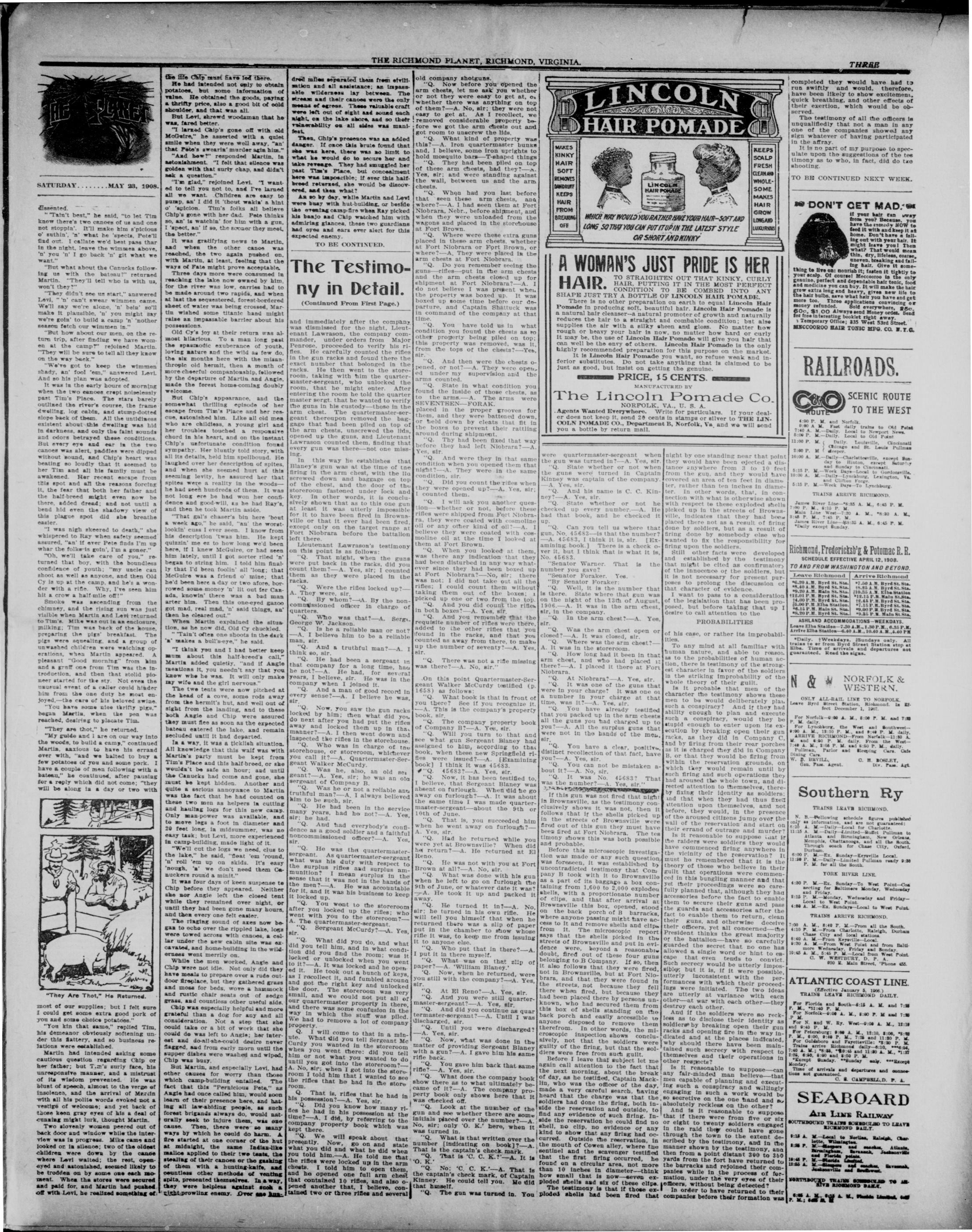
The Testimony in Detail.
and immediately after the company was dismissed for the night, Lieutenant Lawrason, the company commander, under orders from Major Penrose, proceeded to verify his rifles. He carefully counted the rifles in the gun racks and found there the exact number that belonged in the racks. He then went to the store-room, taking with him the quarter-master-sergeant, who unlocked the room, that he might enter. After entering the room he told the quarter master sergt, that he wanted to verify the guns in his custody—those in the arm chest. The quartermaster-sergeant thereupon removed the baggage that had been piled on top of the arm chests, unscrewed the lids, opened up the guns, and Lieutenant Lawrason counted them, finding that every gun was there—not one missing.
In this way he establishes that Blaney's gun was at the time of the firing in the arm chest, with the lid screwed down and baggage on top of the chest, and the door of the storeroom fastened under lock and key. In other words, it is conclusively shown that as to this one gun at least it was utterly impossible for it to have been fired in Brownsville or that it ever had been fired, except only on the target range at Fort Niobrara before the battalion left there.
Lieutenant Lawrason's testimony on this point is as follows:
"Q. That night, when the guns were put back in the racks, did you count them?—A. Yes, sir; I counted them as they were placed in the racks.
"Q. Were the rifles locked up?—A. They were, sir.
"Q. By whom?—A. By the noncommissioned officer in charge of quarters.
"Q. Who was that?—A. Sergu-George W. Jackson.
"Q. Is he a reliable man or not?
—A. I believe him to be a reliable man, sir.
"Q. And a truthful man?—A. I think so, sir.
"Q. He had been a sergeant in that company for a long time, who he not?—A. He had, for several years, I believe, sir. He was in the company when I joined it.
"Q. And a man of good record in every sense?—A. I believe he was, sir.
"Q. Now, you saw the gun racks locked by him; then what did you do next after you had put the rifles away and locked them up in that manner?—A. I then went down and inspected the rifles in the storehouse.
"Q. Who was in charge of the storehouse, or storeroom, whichever you call it?—A. Quartermaster-Sergeant Walker McCurdy.
"Q. Was he, also, an old sergeant?—A. Yes, sir; he was an old sergeant of Company B.
Was he or not a reliable anu
truthful to me? I always believed
truthful to me, sir.
"Q. He had been in the service many years, had he not?—A. Yes, sir; he had.
"Q. And had everybody's confidence as a good soldier and a faithful noncommissioned officer?—A. Yes, sir.
"Q. He was the quartermaster-sergeant. As quartermaster-sergeant what was his duty with respect to the surplus rifles and surplus ammunition? I mean surplus in the sense that it was not in the hands of the men?—A. He. He was accountable for it, and it was his business to keep it locked up.
"Q. You went to the storeroom after you locked up the rifles; who went with you to the storeroom?—A. The quartermaster-sergeant.
"Q. Sergeant McCurdy?—A. Yes, sir.
"Q. What did you do, and what did you tell him, and in what condition did you find the room; was it locked or unlocked when you went to it?—A. It was locked and he opened it. He took out a bunch of keys, as I recollect it, and fumbled around and got the right key and unlocked the door. The storeroom was very small, and we could not put all of our quartermaster property in there, and there was some confusion in the way in which the stuff was pled. We had to remove a lot of company property.
Q. I will come to that in a minute. What did you tell Sergeant Mc Curdy you wanted in the storeroom when you went there: did you tell him or not what you wanted to do until you got into the storeroom?—A. No, sir; when I got into the storeroom I told him that I wanted to see the rifles that he had in the storeroom.
Q. That is, rifles that he had in his possession?—A. Yes, sir.
"Q. Did you know how many rifles he had in his possession at the time?—A. I did, by referring to the company property book which was kept there.
"Q. We will speak about that presently. Now, go on and state what you did and what he did when you told him.—A. He told me that the rifles were locked up in the arm chests. I told him to open them, and he opened one full arm chest that contained 10 rifles, and also opened another that. I believe, contained two or three rifles and several
old company shotguns.
old company shotguns.
"Q. Now before you opened the arm chests, let me ask you whether or not they were easy to get at, or whether there was anything on top of them?—A. No, sir; they were not easy to get at. As I recollect, we removed considerable property before we got the arm chests out and got room to unscrew the lids.
"Q. What kind of property was this?—A. Iron quartermaster bunks and, I believe, some iron uprights to hold mosquito bars—T-shaped things
"Q. They had been piled on top of these arm chests, had they?—A. Yes, sir; and were standing against the wall, between us and the arm chests.
"Q. When had you last before that seen these arm chests, and where?—A. I had seen at the Fort Nilobrara, Nebr., before shipment, and when they were unloaded from the wagons and placed in the storehouse at Fort Brown
"Q. Where were these extra guns placed in these arm chests, whether at Fort Niobara or Fort Brown, or where?—A. They were placed in the arm chests at Fort Niobara.
"Q. Do you remember seeing the guns—rifles—put in the arm chests and the arm chests closed up for shipment at Fort Niobara?—A. I do not believe I was present when the property was boxed up. It was boxed up some time before our departure, and Captain Shattuck was in command of the company at that time.
"Q. You have told us in what condition you found the chests as to other property being piled on top; this property was removed, was it, from the tops of the chests?—Yes, sir.
"Q. And then were the chests opened, or not?—A. They were opened under my supervision and the arms counted.
"Q. State in what condition you found the inside of those chests, as to the arms.—A. The arms were SEVENTEEN—FORAK.
placed in the proper grooves for them, and they were battened down, or held down by cleats that fit in the boxes to prevent their rattling around during shipment.
"Q. Thy had been fixed that way before they had left Niobrara?—A. Yes, sir.
"Q. And were they in that same condition when you opened them that night?—A. They were in the same condition, sir.
"Q. Did you count the rifles when they were opened up?—A. Yes, sir; I counted them.
"Q. I will ask you another question—whether or not, before these rifles were shipped from Fort Niobrara, they were coated with cosoline oil or any other kind of oil?—A. believe they were coated with cosoline oil at the time I looked at them at Fort Brown.
"Q. When you looked at them, was there any indication that they had been disturbed in any way what ever since they had been boxed up at Fort Nlobraria?—No, slr; there was not; I did not take out all the boxes; I could count them without taking them into one of the boxes; I picked up one or two from the top." "Q. And you did count the riffles in both boxes?—A. Yes, slr
"Q. And you remember that the requisite number of rifles were there, added to the other rifles that you found in the racks, and that you counted as away from there, to make up the number of seventy?—A. Yes, sir.
"Q. There was not a rifle missing was there?—A. No, sir."
On this point Quartermaster-Sergeant Walker McCurdy testified (p. 1658) as follows:
"Q. What book is that in front of you there? See if you recognize it.—A. This is the company's property book, sir.
"Q. The company property book of Company B?—A. Yes, sir.
"Q. Will you turn to that and see what gun Sergeant Blaney had assigned to him, according to that book, when these New Springfield rifles were issued?—A. [Examining book] I think it was 15683.
"Q. 45683."
"Q. Now, it has been testified to, I believe, that Sergeant Blaney was absent on furlough. When did he go away on furlough?—A. It was about the same time I was made quarter-master-sergeant—about the 9th or 10th of June.
"Q. That is, you succeeded him when he went away on furlough?—A. Yes, sir.
"Q. Had he returned while you were yet at Brownsville? When did he return?—A. He returned at El Reno.
"Q. He was not with you at Fort Brown at all?—A. No, sir.
"Q. What was done with his gun when he left to go on furlough the 9th of June, or whatever date it was?—A. He took it up and packed it away.
"Q. He turned it in?—A. No, sir; he turned in his own rifle. He will tell you himself that when he returned there was a slip of paper put in the chamber to show whose rifle it was, to keep me from issuing it to anyone else.
"Q. Who put that in there?—A.
I put it in there myself.
"Q. What was on that slip of paper?—A. 'William Blaney.'.
"Q. Now, when he returned, were you still with the company?—A. Yes, sir.
"Q. At El Reno?—A. Yes, sir.
"Q. And you were still quartermaster-sergeant?—A. Yes, sir.
"Q. And did you continue as quartermaster-sergeant?—A. Until I was discharged, sir.
"Q. Until you were discharged?—A. Yes, sir.
"Q. Now, what was done in the matter of providing Sergeant Blaney with a gun?—A. I gave him his same rifle back.
"Q. You gave him back that same rifle?—A. Yes, sir.
"Q. What does the company book show there as to what ultimately became of it?—A. The company property book only shows here that it was checked off.
"Q. Look at the number of the gun and see whether there are some initials placed over the number?—A. No, sir; only 'O. K.' here, when it was turned in.
"Q. What is that written over the number [indicating on book]?—A. That is the captain's check mark.
"Q. That is 'C. C. K.'—A. It is 'O. K.'
"Q. No; 'C. C. K.'—A. That is the captain's check mark, of Captain Kinney. He could tell you. He did that himself.
"Q. The gun was turned in. You
LINCOLN
HAIR POMADE
MAKES
KINKY
HAIR
SOFT
REMOVES
DANDRUFF
KEEPS
HAIR
FROM
LINCOLN
HAIR POMADE
KEEPS
SCALP
FRESH
CLEAN AND
WHOLE-
SOME
MAKES
HAIR
BREAKING OFF
WHICH WAY WOULD YOU RATE
LONG SO THAT YOU CAN PUT IT
OR SHORTH
A WOMAN'S JUST
HAIR. TO STRAIGHTEN
HAIR. PUTTING
CONDITION
SHAPE JUST TRY A BOTTLE E.
There is no other preparation
Pomade in producing soft, beautiful
a natural hair cleanser—a natural
reduces the hair to a straight s
supplies the air with a silky s
rough or heavy your hair is no
it may be. the use of Lincoln Hair
can well be the envy of others.
highly recommended preparation.
It is Lincoln Hair Pomade
further substitutes. Do not take
just as good, but insist on getting
PRICE, 1.
MANUFACT
The Lincoln
NORFOLK,
Agents Wanted Everywhere. W
er does not keep it, send 26 cent
OOLN POMADE CO., Department
you a bottle by return mail.
A WOMAN'S JUST PRIDE IS HER
Agents Wanted Everywhere. Write for particulars. If your dealer does not keep it, send 28 cents in stamps or silver to THE LIN-COLN POMADE CO., Department B, Norfolk, Va, and we will send you a bottle by return mail.
were quartermaster-sergeant when the gun was turned in?—A. Yes, sir.
“Q. State whether or not when the guns were turned in Captain Kinney was captain of the company.
—A. Yes, sir.
Q. And his name is C. C. Kinney?
—A. Yes, sir.
Q. State whether or not he checked up every number.—A. He had that book, and he checked it up.
“Q. Can you tell us where that gun. No. 45683—is that the number?
—A. 45683. I think it is, sir. [Examining book.] There is a check over it, but I think that is what it is, No. 45683.
“Senator Warner. That is the number you gave?
“Senator Foraker. Yes.
"By Senator Foraker:
'Q. Well, it is the number that is there. State where that gun was on the night of the 13th of August, 1906.—A. It was in the arm chest, sir, in the company.
'Q. In the arm chest?—A. Yes, sir.
'Q. Was the arm chest open or closed?—A. It was closed, sir.
'Q. Where was the arm chest?—A. It was in the storeroom.
'Q. How long had it been in that arm chest, and who had placed it there?—A. I placed it there at Fort Niobara.
'Q. At Niobara?—A. Yes, sir.
'Q. It was one of the guns that were in your charge? It was one on a number in your charge at that time, was it?—A. Yes, sir.
'Q. You have already testified that you packed up in the arm chests all the guns you had charged up to you?—A. All the surplus guns that were not in the hands of the men, sir.
"Q. You have a clear, positive distinct recollection of that fact, have you?—A. Yes, sir.
"Q. You can not be mistaken about it?—A. No, sir.
"Q. It was No. 45683? That was the number?—A. Yes, sir."
If this gun was not fired that night in Brownsville, as the testimony conclusively shows it was not, then it follows that it the shells picked up in the streets of Brownsville were fired out of this gun must have been fired at Fort Niobrana. The testimony shows this was both possible and probable.
Before this microscopic investigation was made or any such question was foreseen, it was established by uncontricted testimony that Company B took with it to Brownsville as a part of its baggage a box containing from 1,600 to 2,000 exploded shells, with a proportionate number of clips, and that after arrival at Brownsville this box, opened, stood on the back porch of B barracks, where anyone passing might have access to it and remove shells and clips from it. The microscopic reports say that the shells picked in the streets of Brownsville and put in evidence were, beyond a reasonable doubt, fired out of these four guns belonging to B Company. If so, then it also follows that they were fired, not in Brownsville, but at Fort Nibara, and that they were found in the streets, not because they fell there when fired, but because they had been placed there by persons unknown, who had secured them from this box of shells standing on the back porch and easily accessible to anyone disposed to remove them therefrom. In other words, the microscopic inspection shows conclusively, not that the soldiers were guilty of the firing, but that the soldiers were free from such guilt.
Before I leave that subject let me again call attention to the fact that the next morning, about the break of day, as he testified, Captain Macklin, who was the officer of the day, made a very careful search, having heard that the charge was that the soldiers had done the firing, both inside the reservation and outside, to find any evidence of such firing. Inside the reservation he could find no shell, no clip, no evidence or any kind to show that any firing had occurred. Outside the reservation, in the mouth of Cowen alley, where the sentinel and the scavenger testified that the first firing occurred, he found on a circular area, not more than 10 inches in diameter—think how small that is now—seven exploded shells and six of these clips. The testimony is that if those ex-
The testimony is that if those exploded shells had been fired, that
MAKES
KINKY
HAIR
SOFT
REMOVES
DANDRUFF
KEEPS
HAIR
FROM
BREAKING
OFF
MOST PRIDE IS HER
STEN OUT THAT KINKY, CURLY
LING IT IN THE MOST PERFECT
TO BE COMBED INTO ANY
OF LINCOLN HAIR POMADE.
On earth to equal Lincoln Hair
fairful hair. Lincoln Hair Pomade is
promoter of growth and naturally
and combable condition; but also
sheen and gloss. No matter how
how, no matter how hard or curly
Hair Pomade will give you hair that
Lincoln Hair Pomade is the only
in for this purpose on the market.
You want, so refuse weak and in-
anything that is claimed to be
ing the genuine.
5 CENTS.
FIGURED BY
Pomade Co.
VA., U. S. A.
Write for particulars. If your deal-
ts in stamps or silver to THE LIN-
at B, Norfolk, Va. and we will send
night by one standing near that point they would have been ejected a distance anywhere from 3 to 10 feet from the gun, and they would have covered an area of ten feet in diameter, rather than ten inches in diameter. In other words, that, in connection with what is otherwise shown with respect to these exploded shells picked up in the streets of Brownsville, indicates that they had been placed there not as a result of firing done by soldiers, but as a result of firing done by somebody else who wanted to fix the responsibility for firing upon the soldiers. Still other facts were developed and established by the testimony that might be cited as confirmatory, the innocence of the soldiers, but it is necessary for present purposes to be the discussion of that character of evidence. I want to pass to a consideration of the legislation that has been proposed, but before taking that up I desire to call attention to the.
PROBABILITIES
of his case, or rather its improbabilities.
To any mind at all familiar with human nature, and able to reason, as to the probabilities of human action, there is testimony of the strong factors in the soldiers in the striking improbability of the whole theory of their guilt.
Is it probable that men of the character the testimony shows these men to be would deliberately plan such a conspiracy? And if they had ability enough to plan and execute such a conspiracy, would they be stupid enough to enter upon its execution by breaking open their gun racks, as they did in Company C, and by firing from their rear porches as it is charged they did in Company B, or that they would be firing from within the reservation grounds, on which they would remain until by such firing and such operations they had aroused the whole town, and directed attention to themselves, thereby fixing their identity as soldiers; and that when they had thus fixed attention upon themselves, and not before, they would, in the presence of the aroused citizens jump over the wall of the reservation and start on their errand of outrage and murder? Is it reasonable to suppose that if the ralders were soldiers they had commenced firing anywhere in the wintry of the reservation? It must be remembered that it is the theory of those who believe in their guilt that operations were commenced in this gangling manner and that yet their proceedings were so carefully planned that, although they had accessories before the fact to enable them to secure the guns and pass the guards and accessories after the fact to enable them to return, clean their guns, and otherwise deceive their officers, yet all concerned—the President thinks the great majority or the battalion—have so carefully guarded the secret that no one has allowed a single word or hint to cape that even tends to convict. Such secrecy would be utterly impossible; but it is, if it were possible, utterly inconsistent with the performances with which their proceedings were initiated. The two ideas are utterly at variance with each other—at war with each other—they destroy each other.
And if the soldiers were so reckless as to disclose their identity as soldiers by breaking open their gun racks and opening fire in the way indicated and at the places indicated, why should there have been maintained such secrecy with respect to themselves and their operations in other respects?
Is it reasonable to suppose—can any fair-minded man believe—that men capable of planning and executing such a conspiracy and willingly engaging in such a work would be so secretive on the one hand and so absolutely reckless on the other?
And is it reasonable to suppose that if there were from five or six or eight to twenty soldiers engaged in the raid they could have gone through the town to the extent described by the testimony, and In the manner shown by the testimony, and then from a point distant 300 to 350 yards from the fort have returned to the barracks and rejoined their companies while in the process of formation, under the very eyes of their officers, without being detected?
in order to have returned to their companies before their formation was
EEEPS
SCALP
FRESH
CLEAN AND
WHOLE-
SOME
MAKES
HAIR
GROW
LONG AND
LUXURIOUS
THREE
completed they would have had to run swiftly and would, therefore, have been likely to show excitement, quick breathing, and other effects of their exertion, which would be observed.
The testimony of all the officers is unqualifiedly that not a man in any one of the companies showed any sign whatever of having participated in the affray.
It is no part of my purpose to speculate upon the suggestions of the testimony as to who, in fact, did do the shooting.
TO BE CONTINUED NEXT WEEK.
DON'T GET MAD.
if your hair can run away from you? Because, you wear it. Don't feed it with and keep it at home. Don't have it a falling out with your hair. It might be what? That would mean thin, dry, lifeless, coarse, uneven, breaking and falling.
if your hair can away
from you? Because, you
have the remedy HOW to
feed it and keep it at
home. Don't break it
out with your hair. It
might leave you! Then
what? That would mean
thin, dry, lifeless, coarse,
uneven, breaking and falling
hair. Give it some-
thing to live on; nourish it when it tightly
your scalp. Of course Mecoaster can
only genuine, depend and dependable hair, too.
and medicine you can buy. It will make the hair
grow extra long and heavy, gives new life to
the hair bulb, save what hair you have and get
more applications on convincing or
money refunded. Gold everywhere, $60.
$60. $1.00 Always hold the Mecoaster.
For free interesting booklet right away.
Temporary Office; $35 West 32rd Street.
MECCOOO HAIR TONIC MFG. CO. W. G.
RAILROADS.
SCENIC ROUTE
TO THE WEST
4:00 P. M. and Norfolk.
9:00 A. M. Fast daily trains to Old Point
7:40 A. M.—Daily. Local to Newport News.
6:00 P. M.—Daily. Local to Old Point
11:00 P. M. Daily. Louville, Cincinnati
Chicago and St. Louis Pullman
2:00 P. M. sleeper.
10:00 A. M.—Daily—Lyndsburgh, Lexington, Va.
and Clifton Forge
5:15 P. M.
5:15 P. M. - Weck Days - To Lynchburg.
TRAINS ARRIVE RICHMOND.
James River Line - 8:35 A.M. M, 6:45 P. M.
7:00 P. M, 8:15 P. M.
Main Line West - 7:50 A. M, 8:20 P. M.
Main Line East - 7:50 A. M, 8:20 P. M.
James River Line - 8:35 A. M, 6:45 P. M.
*Daily except Sunday.*
Richmond, Frederick'skig B. and Potomac R. R.
SCHEDULE EFFECTIVE APRIL 12, 1988.
Leave Richmond
*6.20 A.M. Byrd St. Sta.
*8.40 A.M. Byrd St. Sta.
*8.40 A.M. Byrd St. Sta.
*8.40 A.M. Main St. Sta.
*10.35 A.M. Elba Station
*10.35 A.M. Elba Station
*14.00 P.M. Elba Station
*14.00 P.M. Elba Station
*15.00 P.M. Elba Station
*7.15 P.M. Byrd St. Sta.
*7.15 P.M. Byrd St. Sta.
*9.35 P.M. Main St. Sta.
*9.35 P.M. Main St. Sta.
ASHLAND ACCOMMODATIONS—WEEKDAYS.
Leave Elba Station—7.30 A.M. 1.30 P.M. 6.35 P.M.
Arrive Elba Station—6.40 A.M. 10.40 P.M. 4.40 P.M.
*Daily. *Weekdays. *Sundays only. All trains to et at Byrd Street Station stop at Elba. Time of arrivals and departures not guaranteed. Read the signs.
NORFOLK & WESTERN.
ONLY ALL-RAIL LINE TO NORFOLK.
Leave Brrd Street Station, Riobmond. In Effect December 1, 1907.
For Norfolk—0:00 A. M., 8:00 P. M. and 7:00 P. M. daily.
For Lynnburgh, the West and Southwest—
: 0:00 A. M. 18:10 P. M., and 8:40 P. M. daily.
ARRIVE RICHMOND—From Norwalk—11:30 A.
M. and 8:50 P. M. daily. From the West—
7:40 P. M. 2:08 P. M. and 8:50 P. M. daily.
Pulaski, Parlor and Sleeping Cars. Cafe
Dining Cars.
W. B. BHVILL. C. H. BONLEY,
Gan. Gass. Agent. Div. Parr. Art.
Southern Ry
TRAINS LEAVE RICHMOND.
N. B. -Bollowing schedule figures published only as information, not written: 6:20 A. M. -Daily-Local for Charlotte. 11:15 A. M. -Daily-Limited-Ruffet Pullman to Atlanta and Birmingham, New Orleans, Madison, Chattanooga, and all the South. Through coach for Chase City, Oxford, Durham.
6:00 P M.-Rr. Sunday -Kyville Local.
5:00 P M.-Far all the South
4:00 P M.-Far all the South
YORK RIVER LINE
4:30 P. M.—Ex. Sunday—To West Point—Coe
necting for Baltimore Monday, Wednesday
and Friday.
2:15 P. M.—Ex. Wednesday and Friday—
Local to West Point.
4:80 A. M.—Ex. Sundays—Local to West Point.
TRAINS ARRIVE RICHMOND.
7:00 A. M. 8:49 P. M.—From all the South.
4:10 P. M.—From Charlotte, Raleigh, Durham
Chase City and local stations.
9:20 A. M.—From Keysville—Local to
Baltimore Wednesday, Friday and Sunday.
10:45 A. M. 8:45 P. M.—Local from West Point
C. W. WESTBURY, D. P. A.
ATLANTIC COAST LINE
(Effective January 5, 1908)
TRAINS LEAVE RICHMOND DAILY
For N. and W. Ry. West—9:00 A.M., 12:18
and 9:40 P.M.
For Petersburg: 0:00 A.M., 12:10, 8:00, 8:32
P.M., 6:00, 9:40 P.M., 7:25 and 11:30 P.M.
For Goldsboro and Fayetteville: 8:30 P.M.
Trains arrive Richmond daily—8:10, 6:54, 7:40 A.M.; 8:25, 10:45 and 11:20 A.M., 1:27
2:05, 6:50, 8:00 and 8:50 P.M.
Except Sunday. Sunday only.
Sunday, **Sunday only**, **Ebrook**
Monday, Time of arrivals and departures and arrival
SEABOARD
AIR LINE RAILWAY
SOUTHBOUND TRAINS SCHEDULD TO LEAVE
RICHMOND DAILY.
9:18 A. M.-Local to Raleigh, Raleigh, Char-
lotte, Wilmington.
9:28 P. M.-Sanders and coach, Atlanta,
Birmingham, Bavamah, Jacksonville
Gulf Coast.
10:45 P. M.-Missouri Coach.
12:55 A. M.-Siemens and coach, Bavamah,
Jacksonville and Brownsville.
NORTHBOUND TRAINS SCHEDULD TO ASSE-
RIVE RICHMOND DAILY.
6:45 A. M., 9:18 A. M., Florida Lansdale, 6:51
P. M.; 6:51 A. M.
THE PLANET
Published every Saturday by JOHN MITCHELL
JR., at 811 N. Fourth Street, Richmond, Va.
All communications intended for publication
be sent so as to reach us by Wednesday.
TERMS IN ADVANCE
TERMS IN ADVANCE.
One Copy, eight months, $ 1.50
One Copy, six months, 1.00
One Copy, four months, .80
One Copy, three months, 40
Single Copy, .00
ADVERTISING STATES.
For one inch, one insertion, $ .50
For one inch each subsequent insertion, .40
For two inches, three months, 6.00
For two inches, six months, 10.00
For two inches, three months, 14.00
For two inches, two weeks months, 20.00
Marriage and Funeral Notices, one inch, .50
Standing and Transient Notices per line, .10
POSTAGE STAMES OF A HIGHER DENOMINATION THAN TWO CENTS NOT RECEIVED ON SUBSCRIPTIONS.
THE PLANET is issued weekly. The subscription price is $1.50 per year in advance.
There are four ways by which money can be sent by mail at our risk—In a Post Office Money Order, by Bank Check or Draft, or an Express Money Order, if these can be procured, in a Registered Letter. MONEY ORDERS—You can buy a Money Order at your Post Office, payable at the Richmond Post Office and we will be responsible for its delivery. EXPRESS MONEY ORDERS can be obtained at any office of the American Express Co. the United States Express Co., and the Well's Fargo and Co.'s Express Company. We will be responsible for any of these companies. The Express Money Order is safe and convenient way for forwarding money. REGISTERED LETTER—If a Money Order, Post Office or an Express Office is not within the United States, you must send the Letter you wish to send us on payment of ten cents. Then, if the Letter is lost or stolen, it can be traced. You can send money in this way. We cannot be responsible for money sent in letters in any other way than one of the four ways mentioned above. If you send your money in any other way, you must do it at your own risk.
RENEWALS, ETC.—If you do not want THE PLANET coined for another year after your subscription has run out, you then notify us by Postal Card to discontinue it. The course has decided that subscribers to newspapers who do not order their paper discontinued at the expiration of time for which it has been paid are held liable for the payment of the subscription date when they order the paper discontinued.
COMMUNICATIONS—When writing to us to renew your subscription or to discontinue your paper, you should give your name and address in all instances we cannot find your name on our books.
CHANGE OF ADDRESS—In order to change the address of a subscriber, we must be sent the former as well as the present address.
Entered at the Post Office at Richmond, Va. in good condition matter.
SATURDAY . . . MAY 23, 1908.
Colored folks should continue to buy land.
Some of us are hard up most of the time and some of us are well off all the time.
---
Governor James K. Vardaman is out of office and is forgotten. He abused the Negro until he got hoarse and went out of office.
O
Secretary Taft may be nominated at Chicago, but he will have a hard time running and the men will find him a heavy load to carry.
Senator B. R. Tillman has left this country and gone to Europe Praise God from whom all blessings flow.
---
The political situation in the country will not worry the Southern colored brother. He has a brigade or duty to look after anything that comes along and he is not even scratching his head over the prospect.
---
The Republican Party has gone on record in the United States Senate or rather its representatives have done so that it is too much divided to accord the Negro soldiers simple justice.
---
President Roosevelt seems to gloat over the fact that no matter how unjust and arbitrary his action may be there is no law to reach him. Other rulers in the world's history have felt the same way, but they reached the graveyard in due course of time and were buried and forgotten.
No, the colored man need expect no sympathy and no help from the Democratic Party, but they can feel a grim satisfaction when they see some Anti-Negro member of the Republican Party whipped by some member of the former organization.
---
Senator J. B. Foraker made the fight of his life in the Brownsville matter and he may succeed in getting his bill passed by Congress. Still, it may be that some way out may be found to reinstate the colored soldiers and thereby save the prestige of the distinguished occupant of the White House. Mr. Roosevelt's influence is on the wane and the election of his successor will emphasize the
fact, that in this case, "the sceptre may depart from Judea before Shiloh comes."
---
After looking at all of the facts in the case, we have reached the conclusion that Congressman Thomas J. Heilin and Louis Lundy are birds of the same feather. Louis Lundy is in jail for assaulting a colored woman and Heilin should be in the penitentiary for attempting to kill a citizen or this Republic.
---
Colored people should not be in despair over the outlook. From our position, we can see a great future in store for our people. The agitation now going on is the work of demagogues, who envy our progress. The Negroes are the only ones who have been able to withstand the white man's progress and be adapted to his way of doing business. We understand him and he understands us, even when some one of them would have the world believe otherwise.
---
Some of our people are very anxious for President Roosevelt to turn to that part of the Holy Bible that relates to Pharaoh, his hardness of heart and what befell him as a result of his obstinacy. Of course there are no Red Seas hereabouts for him to be swallowed up, but there are many other punishments just as bad. King Roosevelt, read the chapter on Pharaoh.
THAT NEW YORK DECISION
The colored soldier, who expected to get justice in the Brownsville Case by appealing to a United States District Judge in New York certainly had faith. He should have remembered that there are three co-ordinate branches of the government and that the President of the United States is one of them. By that, we mean that they are presumed to have equal powers in their respective spheres. For well nigh a century until Hon. Theodore Roosevelt reached the White House, one was careful not to encroach upon the limitations and powers of the other.
President Roosevelt has thrown courtesy to the winds, for from censuring a judge in Chicago, he has lectured the Congress of the United States. By his action he has encroached upon the privileges and prerogatives of the judicial and legislative branches of the government, all of whose powers as we have stated are equal. Judge Hugh in ruling in the case of Oscar W. Reid, who was dismissed from the army of the United States without honor side-stepped in a manner that would have done credit to the Supreme Court of the United States.
His decision though is somewhat interesting in view of the open declaration of President Roosevelt that he would not obey an act of Congress directing the reinstating of the colored soldiers to the service, for in his carefully guarded decision, he recognizes the right of the legislative branch of the government to limit, define and regulate the powers of the Commander-in-Chief of the army.
Here is what he said:
"But the 'authority' causing and directing his discharge was the President of the United States, who personally gave the order theorefer; so that the final question upon the assumptions, very favorable to the petitioner, is whether the President, as Commander-in-chief of the army, is 'proper authority' to terminate in invitum a soldier's enlistment.
"This question must be answered affirmatively, if either there be inherent constitutional authority in the President, as Commander-in-chief, so to do, or there be such authority in the absence of Congressional statutory action limiting, defining, or regulating the Commander's powers; or if in this case the President's acts of Congress regulating the army and discharge therefrom."
If President Roosevelt can extract satisfaction from this decision, then he is easy pleased and quickly made happy.
VIRGINIA IN THE LIMELIGHT.
The action of the colored voters and the "old line" white Republicans in holding a Republican Mass Convention in this city May 14, 1908 and electing delegates at large and alternates to the National Republican Convention was a timely method of registering their protest against the un-republican republican state convention held at Lynchburg recently, where colored men were not only denied voice and vote, but membership therein.
It was controlled by Negro-haters and men who had upon their persons the political accoutrements and principles of the Democratic Party from which they came. It was proper therefore for these Republicans to emphasize their protests by the election of contesting delegates to Chicago, where the great Republican Party of the nation can decide the issues between them.
The platform adopted is a wise exposition of Republican principles and states the position of the party in this state clearly. It does not
THE RICHMOND PLANET. RICHMOND. VIRGINIA
matter materially what the outcome of the protest will be. It will make the "lily white" contingent squirm in their seats, even at the prospect of having their actions reviewed by the party management at Cheago. Here is the platform as adopted:
"The Republicans of Virginia, in mass convention assembled, this 14th day of May, 1908, in the city of Richmond, Va. do reaffirm their allegiance to the National Republican Party, that has made such enduring history, achieved so many victories in the commercial and industrial fields, and has gained such peace and prosperity for this, our native land, during the last forty years.
"They believe in the principles of the National Republican Party—the party of the people—that recognizes the political equality or all Republican electors alike and does not authorize a privileged class, within the party, known as 'Lily Whites,' to rule and control the party, either in the North or South, by drawing the color line to please a few individuals.
"They do not think it is a wise policy for the Federal office-holders in Democratic States to force the nomination of a candidate on the Republican States, that are expected to elect the next President.
"They believe in a protective tariff—one that protects the American producer and manufacturer against all foreign competition, and our American labor against cheap foreign labor. The inequalities, however, in our present tariff laws should be modified, but the revision should be made by men who believe in the vital principle of protection against foreign labor.
"They believe in the government exercising a general supervision over all interstate transportation corporations, and regulating in some way trusts of every kind, that do an interstate business, in competition to individual enterprises.
"They believe in public education, the common school, that dots our land from sea to sea and the American flag that floats over every school house in our towns and cities. They believe in the honesty and patriotism of our President, Theodore Roosevelt, and they also honor the great Republican leaders—Vice President Fairbanks, Speaker Cannon, Senators Foraker, Knox, La Follette, Governor Hughes and Secretary Taft—and they do hereby pledge their support to whoever may be the nominee of the Republican National Convention to assemble in the city of Chicago, June 16, 1908.
"In the interest of fair play to all Republicans, we recommend the adoption of the primary plan in the selection of Republican party officers."
There seems to be though in the latter part of the platform the fine, Italian hand of the Taft managers and it may account for the peaceful, concluding deliberations of their convention. It pledges every participant in the contesting organization to the support of Secretary William H. Taft, if he is nominated. It leaves the way open for the delegation to return to the fold of the regular "lily white" Republican Party in this State by way of the back gate and it puts thoughtful colored men to guessing as to the other vital interests affecting our welfare. Still, it is "better than nothing" and we shall await the result of the pilgrimage with a patience that will be in keeping with the past record of the citizens of color in this country.
WANTED TO BE SURE.
"What do you think, my dear?" exclaimed Mr. Brownjones, in tones of joyous excitement. "You know the Federation of Authors is meeting in our town—well, we are to have the honor of entertaining the celebrated novelist, Godolphin Whatnot, as our guest."
"Um!" responded Mrs. Brownjones, enganitically. "Is Mr. Whatnot a realist or an idealist?" "Why do you want to know?" asked her husband.
"Well, if he is an idealist, I can just leave things as they are; but if he is a realist I must give the house a thorough cleaning from top to bottom. I may not be literary, but I've dipped into realistic novels, and I know their styles: 'The right-hand curtain hung slightly askew, suggesting that one of the drapery pins had lost its grip. A pendulous cobweb waved mournfully from the cornice just above the door leading into the hall, and there was a fine bloom of dust, like that of the purple grape, on the plano lld. In the left-hand corner of the room, almost buried in the pile of a somewhat faded carpet, was an invisible halpin, clearly indicating the recent presence of a woman in the apartment.' Just find out at once, John, what Mr. Whatnot is, and then I shall know how I am to proceed. I have no desire to let my house afford material to a modern realistic writer.
Just the Thing.
Family Physician—Now there is nothing wrong organically with your father. He needs rest, that's all. As for occupation, let him do something which will neither tax his mind nor carry with it any responsibility. Son of the Patent—I understand, doc. I'll get him on the board of directors of some trust company.—Puck.
Labor
Gunner—I see that Paderewski charges a dollar for his autograph.
Guyer—Well. It's worth a dollar to write off a long name like that.—Chicago Daily News.
Innocent.
Tramp—No, mum. I never took anything bigger than a silver teapot.—Royal Marazine.
Not So Simple
"What do you think of the simplified spelling?"
"It would be all right, if it wasn't so hard to learn."-Detroit Free Press.
THE CAPITOL TRIAL
State's Expert Shows How Com monwealth Was Defrauded.
BAD DAY FOR THE DEFENSE
It Was Shown That Ornamenta on Metallic Furniture Were Paid For As "Extras," and Then Paid For a Second Time As Part of the Cases.
Harrisburg, Pa., May 20.—The capitol trial was resumed, and the state presented testimony supporting its claim that the furniture supplied under the invoice upon which the suit is based was falsely billed, both as to dimensions and character of construction. There were two witnesses presented, both of which strongly testified in favor of the commonwealth, although one of them made mistakes in calculation under a sharp cross-examination by ex-Attorney General Hensel, counsel for Congressman Cassell.
The witnesses heard were George H. Richter, of Boston, and H. R. Datz, of Jersey City, both practical metallic furniture men. Richter testified as to the exact dimensions of cases supplied, and two from the capitol were exhibited to the jury and measured in court to show the methods. The state established that the square feet in the ends and front did not equal the figures at which they were billed, but Mr. Hensel had the expert measure the top, contending that it was a finished surface and should be counted in. In making calculations based upon these measurements, Richter became confused several times and had to do his problems twice, Mr. Hensel insisting upon mathematical accuracy down to very small fractions.
Mr. Datz testified that the cases contained 1565 cubic feet, or 1161.77 surface feet, although billed at 1560.56 square feet, and that the difference between the surface feet measured and the total in the invoice was 403.73 feet, which at $11.40 per foot, would make a total of $4604.80, which the state contends it was defrauded of. Mr. Datz also said that the upright ornaments affixed to the cases added 95.20 feet, or $1085.25 to the cost, the pilasters having extensions upon which to rest. It is also contended by the state that these pilasters and other ornaments were paid for as "extras," and then paid for a second time when measured in as part of the cases. According to the witness the cases were, worth $10,842.80, and the table, which cost $280, he put at $684, or a total of $11,526.80. The state had to pay $17,789.70.
Drug Clerk's Error Kills Rich Refugees
New York, May 20—Fleeing from a plague-stricken city, Eduardo de Frasco, a Venezuelan coffee king and multi-millionaire, came to his death in a fashionable New York hotel through taking what he believed to be a harmless medicine. His wife, who also took some of the medicine, is in a serious condition, and the remainder of the party of wealthy refugees is without a directing head. It is alleged that the drug clerk who prepared the medicine for Mr. de Eraso made an error in compounding the drugs. At the drug store where the prescription was compounded the bottles containing aspertea and atrophine are kept side by side. It is believed that the clerk got the wrong bottle and used atrophine.
Twenty-Five Years a Showman
Washington, May 20.—Colonel William F. Cody's (Buffalo Bill)'s twenty-fifth anniversary as an exhibitor of typical American wild life was celebrated in Washington. The anniversary performances of Buffalo Bill's show were attended by members of the president's family, General Eugene A. Carr, General Wesley Merritt, and twenty other general officers of the army with whom Colonel Cody served in the early days on the western plains. In addition, there were cabinet officers, senators and repre sentatives in congress and officials of all branches of the government.
Hypnotism Stops Hiccough Attack.
Bridgeport, Conn., May 20—As a last resort to save the life of Mrs. O. L. Massinger, who has hiccoughed for three weeks, hypnotism is being tried, and experiments thus far show that the hiccoughs cease as long as she is under the spell. As the influence wears off the hiccoughs return. Unless the attack is stopped within forty-eight hours it is expected she will die.
$1,500,000 For Tokio Exposition
Washington, May 20—By unanimous consent the house passed the bill appropriating $1,500,000 for participation by the United States in the International Exposition to be held in Tokyo, Japan, in 1912. The bill has passed the senate, and now lacks only the president's signature to make it a law.
Chinamen Shinned In Barrels
Chicago, May 20.—Because of a report from El Paso that to evade the immigration laws fifteen live Chinese laundrymen in barrels were shipped to New York city and ten to Chicago, government inspectors are on the lookout for suspicious barrels in both places. The Chicago consignment has not yet been traced.
California For Bryan
Fresno, Cal., May 20.—The Democratic state convention adopted a platform instructing the California delegates for W. J. Bryan for president and indorsing former Congressman Theodore A. Ball for temporary chairman of the national convention.
Headache Tablets Kill Child
Mildred, the three-year-old daughter of Lewis Wilson, of Upper Sandusky, O., found some headache tablets at her home and ate about half a dozen of them. Within a few minutes she was taken with convulsions and despite efforts of several doctors to save her life, died within an hour after her mother found her.
CONDENSED NEWS ITEMS
Thursday. May 14.
Joseph Herzog, formerly a prominent business man of Lancaster, Pa., committed suicide by hanging in a stable.
A bill was passed by the house of representatives providing for the protection of owners of United States patients appropriated by the government.
Seventy-five ovens of the Pennsylvania, Beech Creek and Eastern Coal & Coke company, at Gallilzin, Pa., which had been idle, have resumed operations.
Three foreigners, alleged members of a Black Hand organization, recently convicted in the circuit court of conspiring to take property not their own, were sentenced at Morgantown, W. Va., to ten years' imprisonment.
Friday, May 15.
The corner-stone of the new $300,000 naval Y. M. C. A. building at Norfolk. Va., given by John D. Rockefeller, was laid Thursday.
Rear Admiral Robley D. Evans, accompanied by his wife and daughter, arrived in Washington Thursday evening from San Francisco.
David Daniels, of Philadelphia, a freight conductor, was instantly killed by a draft of cars in the Harrisburg yards of the Pennsylvania railroad.
Michael Mulcahy, sixty-eight years old, the last survivor of the three aides who accompanied General Phil Sheridan on his famous ride to Winchester, died at Cleveland, O., after a two-weeks' illness from apoplexy.
Saturday. May. 16.
Walter Augustus Wyckoff, A. M., assistant professor of political economy in Princeton university, died at Princeton, N. J., aged fifty years.
Edward Boeck, who pleaded guilty in New York to the theft of more than $100,000 worth of jewelry, was sentenced to Sing Sing for not less than six years or more than seven years.
Smith W. Ketchum, a prominent Detroit business man, died at a hospital in Buffalo, N. Y., from a stroke of apoplexy, superinduced by being struck by a cab as he was boarding a street car
Monday. May 18.
Fifty masked "night riders" invaded the Hinton section of Scott county, Ky., and destroyed many tobacco beds. Conrad Pfromm, a miner, was instantly killed in the Cranberry colliery, near Hazleton, Pa., by a fall of coal. Sailing from Boston for Europe for his health, accompanied by his wife, Senator Tillman prophesied a Democratic victory should the Republicans nominate Secretary Taft. In hiring crews at Superior, Wis., for the approaching ore shipping season, the United States Steel corporation is sticking to the open-shop plan, unions being disregarded.
Tuesday, May 19.
Edward B. Deacon, a well-to-do farmer, committed suicide by shooting at his home, near Mount Holly, N. J.
John P. Palmer, a farmer, living near Dyersburg, Tenn., stabbed and fatally wounded his son during a family quarrel.
Secretary Metcalf has detailed Rear Admiral D. Evans, late commander-in-chief of the Atlantic fleet, to duty with the general board of the navy, which has to do with the preparation of plans for the naval campaigns, for use in time of war.
Jennie Blunt, who shot and wounded Charles M. Sanford, a Brooklyn lawyer, in his office, last February, after he had refused to give her money, was sentenced to serve not less than three nor more than four years in the state prison at Anburn, N. Y.
Wednesday, May 20.
United States Senator Samuel Douglas McNeyry was elected by the Louisiana legislature to succeed himself.
Frank E. Ferguson, of Hagerstown, Mo., was appointed assistant director of the bureau of engraving and printing by Secretary Cortelyou.
Five persons were hurt in a wreck of a Lehigh Valley passenger train at the junction of the Lehigh Valley and Buffalo, Rochester & Pittsburg railways, near Caledonia, N. Y.
John E. McGaughey, a former member of the board of county commissioners, at Indianapolis, Ind., shot and killed himself because of the connection of his name with the scandal which has developed in the office of the commissioners.
PRODUCE QUOTATIONS
The Latest Closing Prices in the Principal Markets.
PHILADELPHIA -- FLOUR weak; winter extras, new, $3.85@4; Pennsylvania roller, clear, $4.10@4.20; city mills, fancy, $5.70@5.90. RYE FLOUR quiet; per barrel, $4.50@4.60. WHEAT quiet; No. 2 red, western, $1.00@1.00/2 CORN firm; No. 2 yellow, local, $2.83c. OATS quiet; No. 2 white, clipped, $9.2@60c.; lower grades, $58c. HAY firm; Timothy, large bales, $17.50@18. PORK firm; family, per barrel, $18.50. BEEF steady; beef hams, per barrel, $25@26. POULTRY: Live steady; hens, 13@13.2c.; old roosters, 9/c. Dressed steady; choice fowls, 14/c.; old roosters, 10/c. BUTTER firm; extra creamery, 24/2@25c. EGGS steady; selected, 19@21c. nearby, 17/c.; western, 18c. POTATOES dull; per bushel, $83@85c.
BALTIMORE WHEAT lower; No. 2 spot, $1.01%@10.2%; steamer No. 2 spot, 66%@10.6%c; southern, 66%@99%c; steamer, mixed 66%@71%c; steamer, mixed 66%@67%c; firm, white, No. 2, 54%@69c; No. 3, 58%@59c; No. 4, 55%@55c; mixed, No. 2, 56%@57c; No. 3, 54%@55c BUTTER easy; creamy separator extras, 24c; held, 19%@20c; prints, 25%@26c; Mary, 19%@20c; prints, 25%@26c; Mary, 16%@16c; EGGS熟食; fancy Maryland, Pennsylvania, Virginia and West Virginia, 16%c; southern, 15%c.
Live Stock Markets
PITTSBURG (Union Stock Yards)—CATTLE lower, choice, $6.75@7; prime, $6@6.75. SHEEP slow and lower, prime wethers, $6@5.30; culls and common, $2.55; lamb, $4@6.50; veal calves, $6@6.75. HOGS active, prime heavies and meeds, $5.75@6.80; heavy Yorkers, $5.75; light Yorkers, $5.40@5.15; pigs, $5@5.06; roughs, $4.50@4.80.
John Mitchell For Vice President. Democratic leaders in Washington have been canvassing the situation in various state delegations with respect to the candidacy of John Mitchell, the labor leader, for a place on the Democratic presidential ticket this year. Mr. Bryan looks very kindly on the suggestion that Mitchell be nominated for vice president in the event that Bryan should head the ticket.
Only Woman Member G. A. R. Dead.
Mrs. Emily E. Woodley, who had the distinction of being the only woman ever regularly commissioned as an officer in the United States army, and the last of thirty-five young women who enlisted as nurses in the Civil War, died at her home in Philadelphia, aged seventy-tree years. Mrs. Woodley was the only woman member of the Grand Army of the Republic. She was a widow, Mrs. Wilson, twenty-six years of age, when she enlisted in 1861, having regularly taken the oath of allegiance as she passed in line with men at the enlistment headquarters in this city. She served with the army through the entire four years of her enlistment, being granted but one furlough of thirty days when her daughter was seriously ill. For her bravery and heroic service President Lincoln personally conferred upon her a commission of captain in the United States army.
Married In a Tree
Up in a tree, fifty feet high. Mrs. Mary E. Holman and Jacob McKee were married near Springfield, O. by Rev. A. W. Leonard, of the Central Methodist church. The ceremony in the tree was performed at the request of D. Orrin Steinberger, an artist, who was cured of consumption by living in his "camp loft." On the platform in the tree were only the bridal party and immediate relatives. Rev. Mr. Leonard was surprised to learn that the marriage was to be performed in the air, but finally consented.
Midshipman Drowned
Midshipman Arthur Linford Lucas, of Cleveland, O., one of the graduating class of the naval academy at Annapolis, Md., was drowned, and Midshipman Carl Hibbard, of Northfield, Mn., who was with him at the time, nearly lost his own life in an effort to save that of his friend. The two started out in a sixteen-foot canvas canoe. They had proceeded from the boathouse around the Santee dock, when the canoe was capsized by the wash of a passing schooner. Lucas lost his grip upon the
Postmaster Fined $400
Ogden H. Mattes, postmaster at Riverton, N. J., was fined $400 by Judge Lanning in the United States court at Trenton upon the technical charge of making false returns to the postoffice department. Mattes offense was that he included in his reports of his office sales of stamps quantities sold to the Dreer nurseries that were used on mail matter sent out from Philadelphia. This increased Mattes' compensation as postmaster.
---
Kills and Steals Hog In Stockyard.
One of the nerviest thefts in the police records at Lancaster, Pa., occurred at the Union stock yards. The thief entered a hog pen, butchered a good sized porch and then carried the meat away.
Time to Call a Halt
A cow got into the fire engine house. Sunday night and chewed up most of the hose and ate off the bell rope, while three hogs were found in the Baptist church Monday afternoon. If Hometown is ever to become a great city those things must be rendered impossible.—Hometown (Pa.) Banner.
Montal and Physical Qualities
It requires mind to accomplish great wealth and distribute it wisely, not physique. It requires mind to write such poetry, history, music and tragedy that it shall live in the hearts of men. Here physical bulk in the presence of mind dwindles to insignificance.
For Tarnished Brass
Pumice soap and ammonia a will cure the worst cases of tarnished brass. Just moisten a cloth with ammonia, rub it briskly over the pumice soap and then apply to the article to be cleaned. The operation is a simple and easy one, and the results are immediate and most satisfactory.
The Perfect Feminine Face
A perfect feminine face should measure exactly five times the width of an eye across the cheek bones. The eye should be exactly two-thirds the width of the mouth, and the length of the ear exactly twice that of the eye. The space between the eyes should be exactly the length of one eye.
Provision for Fertility.
All plants are so arranged that while the insects they attract are drinking their honey, the pollen powder is either being scattered over their bodies to be taken to another plant, or the pollen already scattered on the insect is being swept off by the stigmas of the seed boxes.
Seek the Auspicious Time
In northwest India the cultivator employs a pundit to select an auspicious time for the commencement of plowing. Great secrecy is observed. In some places the time selected is in the night, in others daybreak is the customary time.
Dog with Artificial Ea
A ahoemaker of Philadelphia has a dog which recently had one of its ears cut off by a tram-car. The dog is a pet, and therefore, it has been supplied with an artificial ear made of leather and covered with curly brown hair to give it a natural appearance.
Six Sons in the Ministry
An unusual family record is that of the six sons of the Rev. David Pugh, rector of Ysceiflog, Wales, who has just died. Four of his sons are clergymen in the Church of England, while two are at Oxford intending to take holy orders in due time.
Complimentary
A certain dramatic author was seen by a friend to have a manuscript almost falling from his pocket. "If you were not so well known, you would have had your pocket picked," said the friend.
Setting the Time
"Yes," said the Billville citizen, "I lowed I'd be married last fodder-pullin' time, but another feller got the gal. Then I set hog-killin' time for the ceremony, but the gal thought better of it; but now I've full made up my mind for the next cotton-ginnin' season, but I'm free to say that cotton's mighty low, an' the only change in the country is the change in the minds of the winmen folks!"—Atlanta Constitution.
Popiniay.
The popinjay was a figure of a bird shot at for practice. The jay was decked with parti-colored feathers so as to resemble a parrot, and, being suspended on a pole, served as a target. He whose ball or arrow brought down the bird by cutting the string by which it was hung received the proud title of "Capt. Popinjay" for the rest of the day, and was escorted home in triumph.—New York American
Warship's Condenser Tubes.
The greatest single consumption of brass is for condenser tubes, a battleship alone having from 30,000 to 40,000 pounds of condenser tubing in it; and owing to the corrosive effect of sea water this tubing must be continually replaced. The material used is usually either Munz tect—60 per cent, copper, 40 per cent, zinc—or else a mixture of copper, 70; zinc, 29, and tin, 1.
Wisdom of Nature
Human labor, through all its forms, from the sharpening of a stake to the building of a city or an epic, is one immense illustration of the perfect compensation of the universe. The absolute balance of give and take, the doctrine that everything has its price, is not less subline in the columns of a ledger than in the budgets of states. —Emerson
Rate Grind Of Their Teeth
A curiously marked stone has been found at Colebrooke, Devonshire, England, in the middle of a wheat rick, and geologists who have seen it express the opinion that the markings on the stone were caused by rats using it to grind their teeth, which otherwise grew to an inordinate length. Some rats have been known to starve owing to their teeth getting too long.
Fool's Paradise
The old schoolmen of the Middle Ages used to say that there were three places for persons not good enough for heaven—(1) for those good people who had died before the advent of the Redeemer; (2) for infants dying without baptism, and (3) for idiots and others who were not of sound mind.—N. Y. American.
Foundation of Great Deeds
All the great men who have soared above their fellows, whose names are carved on the adamantine rocks of time for the deeds they accomplished, were all, without exception, in love with their work, no matter what it was, and heroin lay their greatness.
Unkind.
Mrs. A.—"Mrs. Baker says she'd give a good deal to know where you get your clothes." Mrs. B. (smiling)—"She likes them, then, doesn't she?" Mrs. A.—"No. She thinks they wear wonderfully."
The Bachelor Parson.
If you hear or read of a clergyman getting a present of a service of plate, or even of a Bible or surplice, from the female members of his congregation, you may safely bet a million to one he is a bachelor.
"There's a legion that never was listed" among books as well as among men; books that have been contemplated but never written—a literary regiment of wralths and ghosts—Book Monthly.
Dog Not Popular as Food.
As a popular article of diet the dog is confined to some oriental and aboriginal bills of fare, and the gastronomic appreciation of him is not likely to spread much further.
Daily Thought:
The great question in life is the suffering we cause; and the utmost ingenuity of metaphysics cannot justify the man who has pierced the heart that loved him—Benjamin Constant.
New York's Big Export Trade
Twice as much in value of exports goes from the port of New York each day as from all of the other American ports on the Atlantic seaboard.
Important Detail
The steel business is reported to be improving. Kindly pay particular attention to the spelling—Chicago Record-Herald.
The trouble in too many homes is the incompatability of imported millinery and domestic allowances.—Galveston News.
Physical culture is excellent, but don't neglect to exercise your discretion.—Pooh Richard, Jr.
There Is Always a Right Side.
The man who is anxious to praise finds little that deserves blame.
Thy purpose firm is equal to the deed.→Young.
Find Happiness in Hope.
Those individuals are happy who look upon life as a story book; they always believe there is a pleasant surprise in the next chapter.
Peace comeeth the way
right as we see
may
call it wrong
IT WILL PAY YOU To interest yourself in promoting the CIRCULATION of th RICHMOND PLANET.
---
AC PLANET
SATURDAY.....MAY 23, 1908.
ROBBERY HIS MOTIVE
ROBBERY HIS MOTIVE
Slayer of Mr. and Mrs. Sheppard and Servant Confesses.
Minister Killed Wife After Revival.
Only Woman Member of G. A. R.
Dead—Girl's Body Found In Canal.
Postmaster Fined $400.
After more than fifteen hours of questioning by the police, Frank Zastera, the young Bohemian farm hand employed on the poultry farm of William B. Sheppard, at Wickatung, near Matawan, N. J., confessed that he killed Sheppard, his wife and Jennie Bendy, the maid.
Assistant Prosecutor Stokes made this announcement. Zastera described the shooting, and admitted he had committed the triple murder for the purpose of robbery. The farm hand has lied, however, in regard to what he did with the money he took from the house. He told the police two tales regarding its hiding place, but both proved to be false.
This was Zastera's story of the killing: "I just felt like it all of a sudden. It just came to me to do it, and after killing one I couldn't stop.
"Mr. and Mrs. Sheppard and Jennie and myself were up pretty late, playing the phonograph in the dining room. When I got to bed I couldn't sleep. About 4 o'clock I thought I heard a noise in the yard. I got up and put on my clothes. On my way to the yard I saw the repeating gun in the corner.
"I picked it up and aimed it at different things. Then I heard a stop, and I hid in the parlor, near the door. Mrs. Sheppard had to pass it as she came down stairs. She was in her nightgown, getting milk for the baby.
"I waited till she came back from the kitchen, then I spoke to her. When she screamed I fired, just as she got to the first step. She went down, but I sent two more shots into her.
"Mr. Sheppard kind of leaned over the railings and looked down. I fired at him and hit him. He slid down the stairs. Before he reached the botton I gave him another shot, and he fell across his wife.
"Then I saw Jennie, the servant, running away from me. I fired only once at her, but she fell through the door and didn't move."
Zastera is far from the typical farm laborer. He is an artist, a violinist, a worker in pyrography on leather. His home is at 347 East Seventy-second street, New York city, where, in winter, he lived with his respectable, comfortably situated family.
Airship Wrecked.
Disaster overtook the daring aeronauts. Wilbur and Orville Wright, who have for two weeks made successful flights with their aeroplane at Kill Devil hill, North Carolina, when, after the greatest flight ever made with a similar machine, the aeroplane was wrecked.
The aeroplane had flown eight miles in seven minutes and forty seconds under perfect control, and the disaster was due to an error on the part of the navigator, who directed the course of the flying machine downward too quickly. The plan of operation is to elevate the course, but instead of touching the right lever for this result the opposite lever was used, and the bird-like frame work darted downward, striking the ground with great force.
Looted Bank Closed
The Allegheny (Pa.) National bank, whose former cashier, William Montgomery, is in jail, specifically charged with the misappropriation of $594,000, ahs been closed by the comptroller and its affairs will be liquidated. This step followed a long conference Sunday of the officers of the bank, representatives of the United States government and a number of leading financiers of the city. It is said still larger discrepancies in the funds have been discovered.
Baby Kills Mother
Mrs. Albert Major, of Ellangowan, near the town of Shenandoah, Pa., was shot and killed instantly by her four-year-old son. The mother had just returned from a visit and the little fellow picked up a flobert rifle from a table and, playfully pointing it at his mother, pulled the trigger. The bullet penetrated her heart.
Girl's Body Found In Canal
The body of Miss Bertha Vanderbilt, assistant in the library of Princeton university, who disappeared last week, was found floating in the Raritan canal a short distance from Princeton. N. J. Miss Vanderbilt was last seen at the aqueduct, and it is supposed that she was drowned in an attempt to ford the stream, which flows under the canal.
Killed Making Toy Caps.
While making toy caps for his own use on the Fourth of July, Morris S. Drake, a salesman, twenty-four years old, was killed by an explosion of powder in his home in East Orange. N. J. The explosion wrecked the upper part of the house where he was working.
BORS AND INTEREST THEM IN THE PLANET WE WILL HELP YOU TO OBTAIN A PREMIUM
COLORED INFANTRY IN RESCUE OF ROUGH RIDERS AT SAN JUAN HILL, JULY 2, 1898, SIZE 20X28 AND 20X24 INCHES, ADMIRAL DEWEY'S GREAT NAVAL BATTLE OFF CAVITE IN MANILA BAY, MAY 1ST, 1898, NAVAL BATTLE, DESTRUCTION OF ADMIRAL CERVERA'S SPANISH FLEET OFF SANTIAGO DE CUBA, JULY 3RD, 1898, SIZE 22X28 INCHES; LAND BATTLE, CAPTURE OF EL CANEY, EL PASO AND FORTIFICATIONS OF SANTIAGO, JULY FIRST AND SECOND, 1898, SIZE 22X28 AND 22X27 INCHES. WE WILL SEND YOU ONE OF ANY OF THE FOLLOWING BATTLES OF THE CIVIL WAR ON THE SAME TERMS. THE PICTURES LIKE THE OTHER BATTLES ARE FINISHED IN COLORS. THEY ARE 22X28 INCHES AND RETAIL AT ONE DOLLAR EACH. WE WILL FURNISH FRAMES FOR ANY OF THESE FINE CHROMOS FOR 2 DOLLARS & 50CTS. EACH ADDITIONAL. BATTLE OF GETTYSBURG, BATTLE OF SHILOH, BATTLE OF FIVE FORKS, VA., BATTLE OF ATLANTA, GA., BATTLE OF SPOTTSYLVANIA, VA., BATTLE OF VICKSBURG, MISS., BATTLE OF LOOKOUT MOUNTAIN, TENN., BATTLE BETWEEN THE MONITOR AND THE MERRIMAC, BATTLE OF BULL RUN, VA., BATTLE OF CHANCELLORSVILLE, BATTLE OF THE BIG HORN, (CUSTER'S LAST CHARGE) STORMING OF FORT WAGNER, S. C., (COLORED TROOPS IN THIS FIGHT), BAT-
OF NEW ORLEANS, LA., CAPTURE AND ATH OF SITTING BULL, THE GREAT INDIAN CHIEFTAIN; FORT PILLOW MASSACRE, FALL OF PETERSBURG, VA., BATTLE OF WINCHESTER, VA., BATTLE OF OLUSTEE, FLA. WE WILL SEND FAMILY RECORD, SIZE 22 BY 28, WHICH CONTAINS SPACE FOR PHOTOGRAPHS OF PARENTS AND TEN CHILDREN. WE WILL SEND SOLDIERS WAR RECORD (CERTIFICATE OF SERVICE IN UNITED STATES ARMY.)
FOR ONE YEAR EACH, OR THEIR EQUIVALENT, WE WILL SEND YOU A COPY OF UNCLE TOM'S CABIN, THE MOST INTENSELY INTERESTING BOOK IN THE COUNTRY. WE WILL SEND YOU A GOLD-PLATED BROOCH WITH YOUR PICTURE THEREIN, YOU TO
DOOMED TO DIE OF RABIES
Rich Man Says He's Ready, and
Arranges His Business Affairs.
New York, May 20—William H. Marsh, an old and wealthy man, when told that he would die within a week of hydrophobia, calmly turned away with the remark that he would be ready when the summons came. Without a tremor he walked down the steps of the Pasteur institute, stepped into his carriage and started for his splendid home in Brooklyn.
"You waited too long," the surgeons at the institute told him after they had made their examination. "Our treatment cannot help you. You have hydrophobia."
There was not a falter in his voice or a change in his face as he heard them.
"How much time did you give me?" he asked.
"Not long," said the physician, "probably not more than four or five days."
"Well," he said, "If I have to go I can face it. My business is in shape, and a day or two more will see it all settled, I'd rather die some other way, but I'm not afraid."
There was nothing about the man to lead anyone to suspect he was doomed to die. His mouth twitched a little and he was slightly nervous, but beyond that he seemed in good health.
The strange thing about his case is that he was never bitten by a dog. He received the deadly poison into his system through the licking of his fingers by his daughter's pet spaniel.
The animal had been bitten six weeks ago by ama mongrel.
CLAIMS TO KNOW SEX SECRET
Woman Promises Boy Babies to Four Rich New Yorkers.
New York, May 20.—Mrs. C. E. Calhoun, the California woman who has studied out a sex control theory on a ranch, is so certain she has found the secret that she has entered into contracts with four wealthy families of New York and has undertaken that a male heir will be born to each as a result of her service.
Mrs. Calhoun says she is making no charge for this and has promised that no names will be divulged unless her experiments are successful. Mrs. Calhoun started her studies on plant life and gradually worked up in the scale of life till she reached humanity. She experimented with horses, cattle and sheep on her ranch and finally on herself, and says that whereas her first three children were girls her next four were sons, the sex of the male offspring being, she believes, the result of the application of her theory.
Her process, she says, is not based on surgery or medicine, but on a simple natural law which all the noted biologists and evolutionists of the world have hitherto overlooked.
TRIED TO RAISE THE DEAD
Christian Scientists Spent Five Days Trying to Rescure Dead
Asheville, N. C. May 20. After a week's fight against the health authorities and the doctors and nurses who had watched her husband in his last hours, Mrs. Edward Carpenter, whose husband was a millionaire, has at last had the body placed in a coffin and shipped to Savannah, her former home. The couple were Christian Scientists, and when Mr. Carpenter, who was brought here for his health, died, his wife refused to believe he was dead or to allow the body to be buried. Day and night round the pall on which his body lay, Christian Science healers tried to resurrect the dead man. His widow became indignant when it was suggested that his body be encoffined, and it was only when the agent for one of the George Vanderbilt Biltmore villas, which the Carpenters had rented, ordered her to move that Mrs. Carpenter left with her husband's body.
Night Rider Prays While Barn Burns
Laenter, Ky. May 20.—Kneeling on the ground in the moonlight with their heads bowed, while their leader, his masked face turned toward heaven, offered prayer, a band of "night riders" destroyed the big tobacco barn of H. G. Maddox, not far from this place. The spectacle was witnessed by two young people returning from a party, who were captured by the raiders and forced to accompany them to the prayer meeting and barn burning. While the barn burned the band sang "Nearer, My God, to Thee."
Sought Dog License, But Were Wed.
South Norwalk, Conn., May 20. When William Kriskick and Miss Alexandra Kirszika applied for a dog license they were given a marriage license, neither being able to speak English except as to the dog's name, "Louise," which caused the mistake. Justice Curnow married them. The bride, who is a cousin of the groom, has sued for annulment and threats to sue the officials for damages.
---
Dynamite Hidden In Stove Explodes.
Shenandoah, Pa., May 20.—Frank Lakopsky put four sticks of dynamite into a new kitchen range for safekeeping. His wife got up and lit a fire in the range. The dynamite exploded, shattered the stove and kitchen, breaking nearly every window in the house and scaring the residents of the neighborhood. Mr. and Mrs. Lakopsky left the kitchen just before the explosion.
Elected Head of Reformed Church.
York, Pa., May 20.—Rev J. Spangler Kieffer, of Hagerstown, Md., was elected president of the general synod of the Reformed church in the United States. He defeated Rev. James Good, of Philadelphia, in a close contest.
Bishop Horstmann Dead.
Bishop Ignatius Horstmann, D. D. of Cleveland, O. died at the porriage of St. John's church, at Canton, O. His death was due to exhaustion caused by overwork and heart failure. The end came suddenly and unexpectedly and while the physicians who had been in attendance during the day were absent from the house.
THE RICHMOND PLANET, RICHMOND, VIRGINIA
IN ORDER TO FURTHER INCREASE OUR STEADILY GROWING CIRCULATION WE WILL OFF
WE WILL SEND YOU THE PLANET AND THE ST LOUIS, MISSOURI, SEMI-WEEKLY GLOBE DEMOCRAT, ONE OF THE LEADING REPUBLICAN JOURNALS IN THE UNITED STATES FOR $2.25 PER YEAR FOR BOTH.
WE WILL SEND YOU THE PLANET AND THE COSMOPOLITAN MAGAZINE FOR $2.25 PER YEAR FOR BOTH.
WE WILL SEND YOU THE PLANET AND McCLURE'S MAGAZINE FOR $2.25 PER YEAR FOR BOTH.
OR THEIR EQUIVALENT, WE WILL SEND PICTURES, ONE ONLY, OF PRESIDENT THEODORE ROOSEVELT, DR. BOOKER T. WASHINGTON, BATTLE OF SANTIAGO, LAND BATTLE OF QUASIMAS NEAR SANTIAGO, JUNE 24, 1898, SHOWING THE NINTH AND TENTH COLORED CAVALRY IN SUPPORT OF ROUGH RIDERS, SIZE 20X28 AND 20X24 INCHES, LAND BATTLE AND CHARGE OF THE 24TH & 25TH
READ TEN GREAS UNCORNIMENTS OFFWARD BY THE PLANET
iF YOU WILL TALK WITH YOUR NEIGH-
```markdown
```
FOR TWO YEARLY SUBSCRIBERS
F. OF NEW ORLEANS, LA., CAPTURE, AND
FOR FIVE NEW SUBSCRIBERS
REQUISITE NUMBER IS OBTAINED, WE WILL FORWARD THE PRESENT INDICATED.
A PERSON WHO TRIES TO GET FORTY SUBSCRIBERS AND GETS TIRED MAY INDICATE HIS WISH AND WE WILL SEND THE PRESENT FOR THE NUMBER HE HAS SECURED OVER FIVE.
THE NUMBER WILL BE FOR NOT LESS THAN FIVE NOR MORE THAN TEN AND NOT LESS THAN TEN NOR M HAN TWENTY AND NOT LESS THAN TY NOR MORE THAN FORTY, TO DETI THE PRIZE TO WHICH THE WORKER TLED.
IF ANYTHING IS DESIRED NOT SPECIFIED IN THIS LIST, WRITE US ABOUT IT AND WE WILL TELL YOU IN WHAT CLASS IT BE LONGS.
A man sitting at a desk and a man standing next to him.
LANET WEEKLY READING UNITED H.
T AND
R $2.25
T AND
YEAR
ND PIC-
THEO-
WASH-
D BAT-
JUNE 24,
H COL-
GH RI-
LAND
& 25TH
```markdown
```
REQUISIT
FOR WAR
SHOULD YOU DESIRE ANY COLORED JOURNAL IN THE UNITED STATES, WE WILL SEND IT TO YOU IN CONJUNCTION WITH THE PLANET AT A GREATLY REDUCED RATE FOR BOTH.
FURNISH THE PHOTOGRAPH, ONE FOUNTAIN PEN, GOLD POINT; ONE LADIES RING, ONE BREAST-PIN, GOLD FILLED; HALF DOZEN LINEN HANDKERCHIEFS, ONE ALARM CLOCK, ONE DOZEN NAPKINS, ONE HALF DOZEN TOWELS, ONE CHOCOLATE POT, ONE PAIR VASES, ONE PAIR KID GLOVES, ONE HAM, ONE TURKEY.
FOR TEN NEW SUBSCRIBERS
WE WILL SEND ONE CH
PIECES; ONE NECKLACE
PEARE, BYRON WORKS,
PLAIN GOLD RING, ONE
1,000 ENVELOPES, 1,000
PRINTED AND DELIVERED
ONE HALF CORD OF SALE.
FOR TWENTY NET
WE WILL GIVE ONE H
WITH OPALS, RUBIES O
ELRY BOX FINISHED
ONE SILK SHIRT WAIS
DRESS, ONE GOLD W
RANTED FOR TEN YE
CHAIR, ONE LOAD OF
SOAP, EITHER WASHIN
BARREL OF BEST FLO
ETS, ONE MANICURE S
WORK BOX, ONE PAIR
DIES.
FOR FORTY YEAR
OR EQUIVALENT, WE
ING MACHINE, ONE I
GOLD WATCH, ONE P
RINGS, ONE MUSIC BOX
ONE READY MADE DR
TLEMEN'S CLOTHES,
CANE, ONE GOLD-HEA
CHINA SET, ONE DO
KNIVES AND FORKS,
SILK DRESS, ONE WEEK
SHORE, RAILROAD FA
PAID, FOR ANY RICHM
THESE OFFERS MAST
AGE OF BY SENDING
SCRIBER'S NAMES AT
KEEP A RECORD OF THE
NOTE NUMBER IS OBTAINED, W
RD THE PRESENT INDICATED
PERSON WHO TRIES TO GET
BERS AND GETS TIRED M
IS WISH AND WE WILL SE
T FOR THE NUMBER HE
OVER FIVE.
THE NUMBER WILL BE FOR N
VE NOR MORE THAN TEN A
MAN TEN NOR M HAN
T LESS THAN TY NO
DRTY, TO DETI THE I
THE WORKER ITLED.
IF ANYTHING IS DESIRED NO
THIS LIST, WRITE US ABOUT
TELL YOU IN WHAT CLAS
ALL SEND ONE CHINA SET, THIRD
ONE NECKLACE; DICKENS, S.
BABYRON WORKS; ONE UMBRELLA,
GOLD RING, ONE PAIR LACE CU
ENVELOPES, 1,000 SHEETS OF
AND DELIVERED; ONE TOIL
FALF CORD OF SAWED WOOD.
FOR TWENTY NEW SUBSCRIBER
ALL GIVE ONE HANDSOME GOLD
PEALS, RUBIES OR PEARLS; ONE
BOX FINISHED IN GOLD OR
SK SHIRT WAIST; ONE READY;
ONE GOLD WATCH, FILLED
FOR TEN YEARS, ONE R
ONE LOAD OF COAL, ONE G
EITHER WASHING OR TOILET
OF BEST FLOUR, ONE PAIR,
THE MANICURE SET, ONE SEAM
BOX, ONE PAIR SHOES, GENTS.
FOR FORTY YEARLY SUBSCRIBER
INVALENT, WE WILL GIVE ONE
MACHINE, ONE DIAMOND RING
WATCH, ONE PAIR FINE GOLD
ONE MUSIC BOX, ONE PHONO,
ADY MADE DRESS, ONE SUIT
CLOTHES, ONE GOLD-H
ONE GOLD-HEADED UMBRELL
SET, ONE DOZEN SILVER-
AND FORKS, ONE HAT-RAC
RESS, ONE WEEK'S TRIP TO T
RAILROAD FARE AND HOT
FOR ANY RICHMOND WORKER,
USE OFFERS MAY BE TAKEN
OF BY SENDING ONE OR TW
NAMES AT A TIME. WE
RECORD OF THEM; AS SOON
IS OBTAINED, WE WILL
RENT INDICATED.
I TRIES TO GET FORTY
GETS TIRED MAY INDIC
WE WILL SEND THE
NUMBER HE HAS SE-
WILL BE FOR NOT LESS
THAN TEN AND NOT
HAN TWENTY
NY NOR MORE
THE PRIZE TO
ITLED.
IS DESIRED NOT SPECI-
RITE US ABOUT IT AND
IN WHAT CLASS IT BE-
WE WILL SEND ONE CHINA SET, THIRTY-ONE PIECES; ONE NECKLACE; DICKENS, SHAKESPEARE, BYRON WORKS; ONE UMBRELLA, ONE PLAIN GOLD RING, ONE PAIR LACE CURTAINS 1,000 ENVELOPES, 1,000 SHEETS OF PAPER PRINTED AND DELIVERED; ONE TOILET SET ONE HALF CORD OF SAWED WOOD.
FOR TWENTY NEW SUBSCRIBERS
WE WILL GIVE ONE HANDSOME GOLD RING WITH OPALS, RUBIES OR PEARLS; ONE JEWELRY BOX FINISHED IN GOLD OR SILVER; ONE SILK SHIRT WAIST; ONE READY MADE DRESS, ONE GOLD WATCH, FILLED, WARRANTED FOR TEN YEARS, ONE ROCKING CHAIR, ONE LOAD OF COAL, ONE GROSS OF SOAP, EITHER WASHING OR TOILET; ONE BARREL OF BEST FLOUR, ONE PAIR BLANKETS, ONE MANICURE SET, ONE SEAMSTRESS' WORK BOX, ONE PAIR SHOES, GENTS OR LADIES.
FOR FORTY YEARLY SUBSCRIBERS
OR EQUIVALENT, WE WILL GIVE ONE SEWING MACHINE, ONE DIAMOND RING, ONE GOLD WATCH, ONE PAIR FINE GOLD EARRINGS, ONE MUSIC BOX, ONE PHONOGRAPH, ONE READY MADE DRESS, ONE SUIT OF GENTLEMEN'S CLOTHES, ONE GOLD-HEADED CANE, ONE GOLD-HEADED UMBRELLA, ONE CHINA SET, ONE DOZEN SILVER-PLATED KNIVES AND FORKS, ONE HAT-RACK, ONE SILK DRESS, ONE WEEK'S TRIP TO THE SEASHORE, RAILROAD FARE AND HOTEL BILL PAID, FOR ANY RICHMOND WORKER. THESE OFFERS MAY BE TAKEN ADVANTAGE OF BY SENDING ONE OR TWO SUBSCRIBER'S NAMES AT A TIME. WE WILL KEEP A RECORD OF THEM; AS SOON AS THE
ADDRESS ALL ORDERS TO
311 North Fourth Street,
ND, VN
SHELL, JR.,
Fourth Street,
VIRGINIA.
FIVE
```markdown
```
```markdown
```
THE PLANET
SATURDAY.....MAY 23, 1908
GARDEN FARM
SEWAGE IN THE COUNTRY.
System for the Farm Which Will Work Satisfactorily.
The question is often asked by the farmer how one could have a bath room in the country, with safe disposal of house sewage, especially where the land is quite level.
A few years ago there was no known way of doing this that was safe and practical. Recently certain experiments made in the treatment of sewage and waste from water closets have revealed some curious truths concerning bacteria and their ways. It seems that certain bacteria attack organic matter and destroy it best when they are in perfect darkness and also shut away from oxygen. These bacteria will not cause sewer gas nor will
Diagram of the System.
any develop unless air is admitted to the tank in which the sewage is being purified. So if one can run his sewage into a water-tight concrete tank nearly air-tight above, there the bacteria will revel and nearly all the solid matter in the sewage will be destroyed. The inlet and outlet to this tank should be below the surface, both to prevent the circulation of air and to prevent any floating solid matter being drawn into the next tank. The second tank is like the first one, and in it the water purification is carried yet further. From this tank the water is sometimes carried to sand and gravel filters, and after passing through them is said to be clear enough and pure enough for drinking purposes, though there would seem to be no valid reason for putting it to this test.
There should be, then, two concrete tanks, made water-tight, each provided with a manhole which should be practically air-tight, the whole being connected with the house drain with as much fall as the nature of the soil will permit, and the drain being of vitrified tile, with cemented joints. The inlets and outlets of these tanks should be below the surface of the water.
Here is a farm system proposed by Joseph E. Wing and published in the Breeders' Gazette: I see nothing better than to finish the business by leading the water away from the second tank through glazed and vitrified tiles till they join with the regular farm drainage system, at a safe distance from the well. This should make safe the farm well against pollution and the whole system should prove automatic in its action, and give no trouble.
On Woodland farm we have a very tough, impervious blue clay overlying our water-bearing stratum of gravel and use a drilled well, so there is practically no possibility of water pollution from our drainage system. We have but one tank, with a drain leading away. This has worked perfectly since 1904.
A WELL-KEPT FARMYARD
Nothing Which Pays Better for the Trouble and Cost.
Nothing is more pleasing and attractive than to see a beautiful farmyard. It would be a task to name all the flower seeds planted in our flower garden every spring or even the variety of bulbs set in the fall.
Seeds sown in the spring include several varieties of poppy, panles, asters of all colors, balsam, carnations, cannas, chrysanthemums, alysum, dahlias, datura, larkspur, marigold, morning glory, nasturtiums, petunias, sweet peas, verbena, forget-me-not and sweet william. We also plant many bulbs which are taken up in the fall and stored away until spring.
We have beds of geraniums, hardy roses and flowering shrubs that grow four to five feet high and bloom profusely. The cut shows the arrangement of the drives and walks, trees, shrubs, etc., of our place. There is a hedge bordering the yard, two evergreen trees in front and some hard maples over 100 years old.
The driveway is semi-circular, and near the road is a signboard or sale notice where I post what I want to sell. The name of the farm is painted on the board. Last but not least, Old Glory floats from the flag staff.
A Crop of Wheat.
An average crop of wheat removes from an acre of soil 113 pounds of ammonia, 45 pounds of phosphoric acid, 58 pounds of potash; oats, 107 pounds of ammonia, 35 pounds of phosphoric acid, 174 pounds of potash; red clover, 115 pounds of ammonia, 17 pounds of phosphoric acid, 57 pounds of potash; a 1,300 pound steer, 40 pounds of ammonia, 20 pounds of phosphoric acid, 1½ pounds of potash. These are organic and mineral substances, not air or water. To produce one round of grain and two pounds of
straw, 2,000 pounds of water are nec
essary to dissolve plant food and evap
orate through the leaves.
Getting Bid of Lice
before rolling it off. Ciee
Before turning it over, measure be
sure there are no lice on tha
HIGH PRICED COWPEAS.
It Will Pay the Farmer to Give Them a Fair Chance.
Cowpeas are scarce and high again this year, and it will pay every farmer to see that he gives all he sows a fair chance. It is sheer sheer to pay two to four dollars a bushel for peas and then sow them on land that has been only half prepared, or that is too poor to grow a crop. Cowpeas are commonly regarded as a "poor land crop;" that is, they will grow on land too poor to make a paying crop of anything else, and will improve the land by their growth. It must be remembered, however, that their great function is to gather nitrogen from the atmosphere, and that they cannot successfully do this without a full supply of potash and phosphoric acid. Nowhere do these elements pay better than when applied to leguminous crops, since by their use in this way the nitrogen of the air is more freely appropriated by the legumes. And nitrogen is, as is well known, our most expensive element of fertility.
Prepare the land well, fertilize liberally with the mineral elements, and cowpeas will pay even when they cost three dollars or more per bushel. A bushel to the acre is the usual amount sown for hay. Three peaks may do just as well where the land is in good shape, the peas sown evenly and one of the ranker growing varieties used. When the peas are sown for seed they may be drilled in rows 18 inches apart. This way, says Farmers' Voice, a peek will plant an acre. If they are cultivated until they begin to cover the ground too much, they will make more seed this way than when sown broadcast or with a grain drill. Some even recommend sowing rows and cultivating for hay. In either case there is of course less benefit to the soil than where more seed is used; but a peck sown on well-prepared and well-fertilized land will not only produce more seed or hay than a bushel put in in a slovenly, slipshod manner, but will also add more nitrogen and more humus to the soil.
SPRINGS FOR FARM WAGONS
Big Saving in Comfort and Money Effected by Their Use.
A big saving in money and in comfort could be made by the universal use of springs on farm wagons. Perishable products, like fruit, vegetables and eggs, are greatly injured by being carried to market over rough roads. The joiting and jarring from springless wagons result in much injury to the load. This is often so great that buyers will cut the price from one-fourth to one-third. Peaches carried ten miles on a springless wagon are often unfit to ship when they arrive at the car. The loss on this one crop alone is very heavy. Large peach growers and orchardists know full well that their fruit must be handled like eggs, so they use light wagons with flexible springs, and draw a small load. Small farmers and growers, with only an acre or two, cannot afford orchard wagons, but they would save enough on each load to pay for a good set of bolster springs.
The use of springs is also a great comfort to the driver of the load. Furthermore, says Farm and Home, they lengthen the life of the wagon, because they take up the jolts and the jars. Even for drawing grain, hay, potatoes and other farm crops they are very useful. The load rides much better, is not so likely to shake off, and the comfort to the driver, who must spend a good share of his time on the wagon, is immeasurable.
A FOLDING TRELLIS.
One Which Will Prove Exceptionally
Serviceable for Pole Beans.
The best way that I ever found to pole beans is to make a folding trellis out of plastering lath, as shown in the cuts, explains a writer in Farm and Home. I bore three small holes
Trellis Folded for Storage.
through each lath, as shown in the first cut, and fasten them together with common wire nails well clinched.
Five-foot posts are set one foot in the ground and a wire strung at top and bottom. The lath are fastened to the
Trellis in Place in Garden.
wires with string, as shown in second cut. The trellis is made in sections so as to be easily handled. When not in use it is folded up and laid away under shelter. The posts are spaced evenly so that one section of trellis will just go between two posts.
Interest Computing
To find the interest on any given sum for any number of days, at any rate of interest, multiply the principal by the number of days and divide as follows: Three per cent. by 120; four per cent. by 90; five per cent. by 60; 15 per cent. by 25, and 20 per cent. by 18.
As It Looked to Dad
"Say, ma," inquired an anxious dad, "what ever's the matter with Grace. She's out there in the sitting room doing high kicking, turning flip-flaps, and running all over the place. Is she stage struck?"
"Stage struck!" exclaimed ma, "I should say not. She's simply practicing the new barn dance." -Detroit Free Press
THE RICHMOND PLANET. RICHMOND. VIRGINIA
THE DAY THE PRETTY TEACHER
CRIED.
There is a little schoolhouse where
in fancy I can see her yet.
I will tell you what she said.
Wrote toy cheeks and hunky hair
All she wore all the time.
She used to often look my way
When foolishly I cared not why;
But I discovered all, one day—
I made the pretty teacher cry.
But her it may not matter now,
She may not ceased long, long ago
To think of me on or under how
I had the heart to treat her so;
But looking back across the years
I see her as she bowed her head.
Her long, dark lashes wet with tears,
Because of something I had said.
Perhaps she would not, if she might,
Be as she was that afternoon.
A maiden still, and young and slight,
With May-time coming overson,
But if I might be there again
With what sweet satisfaction I
Would claim the joy I incurred from when
I made the pretty teacher cry.
She had requested me to stay,
I was as tall, indeed, as she;
The others had all gone away,
And tenderly she looked at me;
I had not broken any rule,
And as others were lessons well,
We stayed alone, we two, in school
Until the evening shadows fell.
She may have little beauty now.
Gray strands may glimmer in her hair.
Perhaps her once unwrinkled brow
is seamed to-day by marks of care;
But if it might again occur,
You may be so nervous we two could fly.
This I could teach her.
The pretty teacher would not cry.
- E. K. Kiser, in Chicago Record-Herald.
The Wrong One.
Mr. Gunson took two cigars from his pocket, carefully selected one and handed the other to his guest. "Pine cigars," he remarked, striking a match. "Two for a quarter."
The guest puffed a light into his cigar and blew a cloud of smoke into the air.
"Two for a quarter?" he asked.
"Yes," replied Mr. Gunson proudly.
"Sorry I didn't get the 25-cent one," remarked the guest sadly.—Judge.
ALL THE FACTS.
CHAMPION
Burglar Bill—Except where I hid the money. I want that for myself.— Comic Cuts.
Promptly Preven-
She—Men and women can't be judged by the same standards. For instance, a man is known by the company he keeps. He—And a woman by the servants she can't keep—Judge.
In the Stable.
Coach Horse—I heard our master to today complaining that we had wills of our own.
Saddle Horse—Has this motor craze made him think we ought to be automatic?—Baltimore American
Exactly.
"A man dat puts in de mos' of his time talkin' 'bout hissel," said Uncle Eben. "generally discovers dat he's wasted a heap of advertisin' on a poor-payin' article." — Washington Star.
Mere Wife Than There Used to Be.
Mrs. Beham—I am getting stouter all the time.
Beham—Yes; when I got married I little realized that I was getting a wife on the installment plan—judge.
Missouri's Decadence
Missouri's Decadence.
Eastern Man—Live in Missouri, eh?
How is business down there?
Missouriian—Rather black. Folks
what travels nowadays don't carry
much with 'en'—N. Y. Weekly.
Her First Yarn:
Mother—Dear me, the baby has swallowed a piece of worsted.
Father—That's nothing to the yarns she'll have to swallow if she lives to grow up.
Mrs. Suburbanite-John, that's twice you've come home and forgetten to bring the lard.
Mr. Suburbanite—it's so greasy it slipped my mind—Judge.
Large Churches.
The following is the seating capacity of the eight largest churches in the world: St. Peter's, Rome, 54,000; Milan cathedral, 37,000; St. Paul, London, 25,000; St. Sophia, Constantinople, 23,000; Notre Dame, Paris, 21,000; Florence cathedral, 20,000; Pisa cathedral, 13,000; St. Mark's, Venice, 7,000; St. Patrick's cathedral, New York, 2,500, with standing room for 8,000.
Time Is Money.
Nodd—There was to be a meeting of my creditors to disy.
Todd—Well, wasn't there?
"No. They unan/mously agreed that they couldn't afford to spend the time."—Life.
Debuts.
"My daughter," said Mrs. Newcush, proudly, "comes out to night."
"How strange!" cried Mrs. Kashler.
"So does my husband. How long was your daughter in for, may I ask?"—Cleveland Leader.
knights of Pythias,
this organization is one of the most powerful
progress has been phenomenal. The Grand
dion over all of the cities and counties in
required to organize a new lodge. The
its strongest features, but the principles
Founded on Friendship, based on Char-
olene, the respectable, upright people of
thy of their heartiest support.
pays an endowment and burial benefit o
s $4.00 per week sick dues. The badge
ary regalia. For information concerning
e.
Courts of Calant
ment of the Order. It requires a mem-
size a court. Its members are pledged
money and prove Love one for the other.
Special benefit of $150.00. It pays $3.00 per
use for regalia is the cost of the badge, 50
ounts for funeral occasions.
CALANTHE or Children's Department
persons cannot do better than to enter the
is nominal and the benefits all that could
is and death benefits of from $30.00 to $4
d in your neighborhood, orgniz- one.
concerning the Children's Department at
Mrs. ANNA T.
120 W. H.
in concerning special rates of
JOHN
ages and courts, address
INK-II
A Beautiful Hair
Tonic for th
Read what Madam Robinson, the
Queen of the Opera, sa
This organization is one of the most powerful in the country and its progress has been phenomenal. The Grand Lodge of Virginia has jurisdiction over all of the cities and counties in this state. Thirty males are required to organize a new lodge. The benefits paid constitute one of its strongest features, but the principles are greater than anything else. Founded on Friendship, based on Charity and established on Benevolence, the respectable, upright people of the state will find it an order worthy of their heartiest support.
It pays an endowment and burial benefit of of $200.00 for all ages. It pays $4.00 per week sick dues. The badge costing 75 cents each is the only absolutely necessary regalla. For information concerning the organization of lodges apply at the main office.
The Courts of Calanthe
Is the Female Department of the Order. It requires a membership of thirty persons to organize a court. Its members are pledged to exhibit Fidelity, exercise Harmony and prove Love one for the other. It pays an endowment and burial benefit of $150.00. It pays $3.00 per week sick dues. The only expense for regalia is the cost of the badge, 50 cents and a rosette, costing 25 cents for funeral occasions.
THE BANDS OF CALANTHE or Children's Department also con-
stitutes a feature and persons cannot do better than to enter the little ones into this mystic circle. The expense is nominal and the benefits all that could be expected. It pays from $1.00 to $1.50 sick dues and death benefits of from $30.00 to $40.00. If you have no Pythian Lodge or Court or Band in your neighborhood, orgniz- one.
For all information concerning special rates of JOHN MITCHELL, JR. membership in the lodges and courts, address 311 N.4th St., Richmond, Va
KINK·NE
A Beautiful Hair Dressing and Tonic for the Hair!
PROF. ROBERTS, New York City, Dear Sir:
I have used your Kink-ine for the past year and my hair is growing very fast. I find it the most delightful hair dressing and tonic I have ever used, altogether different from the many cheap pomades and vassels on the market. It makes my hair so beautiful, soft, silky, and has entirely removed all dandruff and stopped it from falling out and breaking off. And enables me to do it in any of the many styles that I use on the stage. It does all you claim for it, and I would not be without it. Yours sincerely, MMR. ROHNSON.
I have used your Kink-ine for the past year, find it the most delightful hair dressing and tonic I have the many cheap pomades and vaselines on the market, silky, and has entirely removed all dandruff and stiff off. And enables me to do it up in any of the mines all you claim for it, and I would not be without Kink-ine Hair Dressing is a delightful perfume colored people; is guaranteed to be absolutely safe at kinky, curly hair soft, silky and glossy, enables you in any style that you may wish.
SSING by supplying the needed oils directly to the root and giving new life and vigor to the hair.
SSING is for sale at all drummists for 35c per bottle, get it. If not, send me 50c, and I will send same to you prove the quality and superiority of our goods over cents, one cake of Kink-ine Soap, the best shampoo, or six bottles and six cakes of soap for $3.00. $
MINOR DRUG CO., Ldt.—Distributor
Kink-ine Hair Dressing is a delightful perfumed tonic prepared largely for the use of colored people; is guaranteed to be absolutely safe and harmless. It makes harsh, stubborn, kinky, curly hair soft, silky and glossy, enables you to comb it with ease and to dress it in any style that you may wish.
KINK-INE HAIR DRESSING by supplying the needed oils directly to the roots of the hair tones up and nourishes the scalp, increasing the growth and giving new life and vigor to the hair.
KINK-INE HAIR DRESSING is for sale at all druggists for 35c per bottle. If your druggist does not keep it have him order it for you; he can get it. If not, send me soe. and I will send same to you, prepaid.
SPECIAL OFFER—To prove the quality and superiority of our goods over all others, we will sell one full-size bottle of Kink-ine, price 35 cents, one cake of Kink-ine Soap, the best shampoo and Toilet Soap in the world, price 25 cents, both for only 50 cents, or six bottles and six cakes of soap for $3.00. Special offer good only at the following stores:
OWENS & MINOR DRUG CO., Ldt.—Distributors, 1007 E. Main St.
THE MT. CLEMENS HOTEL AND MINERAL BATH HOUSE
WOOD, COAL, &c.
11 S. 4TH ST. RICHMOND, VA.
KNIGHTS OF PYTHIA'S
1683
pays $4.00 per
only absolutely necessary rega-
apply at the main office.
The Court
Is the Female Department of the
thirty persons to organize a court
Fidelity, exercise Harmony and
an endowment and burial bene-
dues. The only expense for re-
rosette, costing 25 cents for fife.
THE BANDS OF CALA
stitutes a feature and persons of
circle. The expense is nomina-
$1.00 to $1.50 sick dues and de-
Lodge or Court or Band in you.
For all information concerni
For all information concer-
membership in the lodges and
MADAM BOBINSON
KINK-INE HAIR DRESSING by
the scalp, increasing the growth and
KINK-INE HAIR DRESSING is
him order it for you; he can get it. I
SPECIAL OFFER.—To prove the qu
bottle of Kink-ine, price 35 cents, one
cents, both for only 50 cents, or six b
stores:
OWENS & MINO
Nelson's Hair Dressing can be
bought at Jennings and Brown Drug
Store, Pittsburg, Pa.
Jim Crow Cars
DON'T GO IN
MILANI
State of Oklahoma
The United Stab a Circens Court in this State decided that the Jim Crow Car Law passed by the legislature is an constitutional and contrary to federal laws. Hence we discriminatory lawsuits against the Negro race go in this state. This law is unquestionably the best Mate in the Caucasus for Colored men. If you are interested, send 25 cents for booklet and map of the State containing such information as you will need. Don't send stamps, but send silver or money order. Address:
S. DODOLAS RUSSELL,
Langton, Okla.
BLACKWELL & BRO.
Practical House and Sign Painters.
Graining and General Contractors.
.....ALL WORK GUARANTEED.....
Cards, Letters or Orders.
...Give us a trial, you will never regret it...
Address, 608 St. Peter Street,
RICHMOND, VA.
'Phone 5688.
Growing the Cerk Oak.
The National Plant Introduction Garden at Chloo, Cal., is experimenting with the raising of the Cork oak, which has not yet been grown commercially in the United States. The Cork oak thrives in Spain, where it is the basis of an important industry.
Read what Madam Robinson, the Famous Black Patti, Queen of the Opera, says of Kink-ine
N. A., S. A., E. A., A. AND A.
Furnished Rooms, 50c. up. Meals, 50c. up.
AMERICAN AND EUROPEAN PLAN. Phone, 245. Has opened its doors for the accommodation of
COLORED PEOPLE
that may come to Mt. Clemens in the future for their
It is the only Hotel and Mineral Bath House owned and conducted by a colored man at any of the health resorts in the United States.
Write for Special Rates.
GEO. I. HUTCHINSON, PROP.
48 Welts St., - Mt. Clemens, Mich.
JOHN FOXEL
Dealer in General Line of FANCY AND STAPLE GROCERIES, NOTIONS, FRESH MEATS, CI GARS, TOBACCO, ICE.
```markdown
```
but also con-
lure the little ones into this mystic
will be expected. It pays from
40.00. If you have no Pythian
address,
RAYLOR, W. M.,
Hill St., Richmond, Va.
MITCHELL, JR.,
N. 4th St., Richmond, Va.
NE
Dressing and
the Hair!
The Famous Black Patti,
days of Kink-ine
and my hair is growing very fast. I
have ever used, altogether different from
set. It makes my hair so beautiful, soft,
stopped it from falling out and breaking
many styles that I use on the stage. It
out it. Yours sincerely, MME. ROBINSON.
Used tonic prepared largely for the use of
and harmless. It makes harsh, stubborn,
you to comb it with ease and to dress it
roots of the hair tones up and nourishes
e. If your druggist does not keep it have
you, prepaid.
for all others, we will sell one full-size
so and Toilet Soap in the world, price 28
Special offer good only at the following
orders, 1007 E. Main St.
FREE! An Astrological Reading sent free to anyone enclosing two cent stamp for mailing charges, etc. Send date and month of birth. Write to day and address
PROF. J. H. HOLMES,
1015 Baltic Avenue.
Atlantic City, N. J.
SCHOOL SHOES.
Capitol Shoe & Supply Company,
A complete stock of Boys,' Misses,' Men's, Ladies,' & Children's Shoes. ALL THE LATEST STYLES.
Notice!
For old papers, call on us. We are selling them at fifteen cents per hundred.
BOARDING & LODGING
Rates Reasonable. All the Comforts
of Home
Orders received by letter or telegraph
MES. BOOKER LEFTWICH.
PROPRINTRESS.
816 N. 2nd St., Richmond, Va
Virginia's Most Successful Hair Culturist.
...PARLORS.....
108 E. Leigh St., - Richmond,
'Phone, 1034.
views and Correspondence.
The largest and most up-to-date Hair Dressing Parlors in Richmond. The very best preparations that can be made for the hair, scalp, face and skin.
Graham's Superior Scalp Food for growing hair on bald heads and bare temples, 25cts. per jar. By mail, 35cts.
Graham's Superior Orange Flower Skin Fo' for developing and beautifying the skin, 25cts a jar. By mail 35cts.
Graham's Superior Velvet Liquid Powder for giving the face a beautiful color, 25 cents a bottle. By mail 35cts.
Graham's Vegetable Hair Dye the best on market giving a rich natural color, $1.00 per bottle. By mail, $1.25.
Mrs. Graham makes a specialty of massaging and beautifying ladies' faces for parures and public gatherings, 35 cents.
Mrs. Graham Kampooos the head and puts it in a healthy condition, 25 cents.
All ladies who attend parties and other social gatherings should have their finger nails manicured and made beautiful, 25 cents.
Mrs. Graham's preparations sell at sight. Ladies living in other cities and towns can make good money by selling these preparations.
Write for terms to Mrs. J. A. Graham, No. 108 E. Leigh St., Ricamond, Va.
'Phone 2048 112 W. Leigh S
John B. Braxton
REAL ESTATE & LOANS
Private Banker and Broker,
Loans negotiated on Real Estate,
Interest allowed on Deposits,
Estates managed,
Rent collected and prompt returns
Special attention to repairs.
Notary With Seal.
H F Jonathan
FISH, OYSTERS AND
PRODUCE.
120 N. 17TH ST., RICHMOND, VA.
ALL ORDERS WILL RECEIVE
PROMPT ATTENTION.
Long Distance 'Phone', 752.
STRAUS' SPECIAL
Old Yacht Club,
PURE WHISKEY
Will Satisfy the lever of the right
kind of stimulant. Special prices.
We have all grades of good liquors,
Cigars and Tobacco. Call and see
us.
ISAAC STRAUS & CO.,
422 E. Broad St.,
Richmond, Virginia.
S. W. ROBINSON.
DEALER IN
FINE WINES, LIQUORS,
CIGARS, &c.
All Stock Sold as Guaranteed.
PROMPT ATTENTION.
Your patronage is respectfully solicited.
GEORGE O. BROWN.
Fine Photographs. True to Life. High-quality service. Latest Improvements in Photograph Out-door work executed. Reasonable Bid. Included in Offer. Enlarged from Old negatives or Photographs.
THE ECONOMY
303-5 North Third St
FINE
TAILORING
CLEANING, DYEING ANI
REPAIRING
CHITMAN M. WHITE,
PROPRIETOR.
A. Hayes
First-class Hacks and Customs of all descriptions. I have owners room for bodies when the family have not a suitable place. All country orders are given special attention. Your special attention is called to the new style Oak Caskets. Call and see me and you shall be waited on individually.
THE MUSEUM
FOR STREET WEAR
PLAIN OR ELABORATE COSTUMES IN STYLE.
Those Who Do Not Look Their Best in the Severe Tailor Mades May Properly Wear the More Fanciful Garments.
There is always a grave question as to which is the most important gown in the fashionable outfit, the one for the street or that for the house. It would be more correct to say, which are the most important, for certainly no well-dressed woman would think it possible to face life with only the one street gown, but whether the most money shall be spent on the street costumes or the gown intended
THE LADY IN A COAT
Chevlot Street Costume.
for the house is a most serious problem and one not to be decided rashly. At the moment two styles of street costumes are required, the one severely plain, the other more or less—generally more elaborate. For the strictly tailor-made servicable, practical costume to wear in the morning, the plainest of models are chosen, and when becoming the majority of women prefer an almost exaggerated effect of simplicity, of severity, not to say masculinity. There are, however, many women who do not look their best in the too severe tailor gowns, and for their benefit there are many models that are a combination of tailor-made and the more fancyful style.
The regulation tailor-made costumes do not vary materially from year to year, and the conservative tailors contend that, like men's business suits, the practical walking costume should never present any radical change from year to year. A short skirt is obligatory, but the exaggerated short skirt is not considered smart. The circular skirt and the plain gored skirt, preferably the former, will be smarter, too, this year than the plaited, although the latter is so universally becoming that it is a grave question whether it will be considered out of date. It will certainly not be given up entirely in preference to the other models. The lines of the new skirts are straighter than last season, and there is not the rather decided slanting line from the back to the front. This is rather a pity, for a skirt so hung had a much better and smarter appearance than the one with the too straight lines.
Plain and fancy mixtures are alike fashionable. The too strongly accentuated stripes of contrasting color are not considered as smart as the more indistinct lines. Checkes and plaids are also to be found in the new chevets and tweeds, while the plain and fancy serges are most attractive in their variety of coloring and design. As these are all materials intended for the hardest kind of wear the fashion of making materials waterproof seems especially practical as applied to them. The same fashion that came into popular favor last year is again to be noted—the checked or striped skirt, with jacket of solid color, in cloth or silk. There is much about this style that is worthy of note, but be it remembered that it is more or less striking and consequently possesses the disadvantage that by the next year the fashion may be entirely "out." However, clothes are not supposed to be worn two seasons, and therefore it is not necessary to choose styles with any thought of their being in fashion beyond the present moment.
New Scarf Old-Fashioned.
The wide scarf over which everybody is roaring, is nothing new, according to a woman who has been looking over old prints. She says: A fashion plate as early as 1840 shows a scarf of deep purple gauze edged with what looks like chenille fringe and striped with bands of flowered material. The scarf vellied almost the entire breast.
A plate bearing a date of 1830, shows a very much beffried and be-fluenced white frock veil with a big white scarf. Another big scarf was of pale French gray and was worn over a green gown. The scarf was patterned with bands of green vines and fringed with gray and green.
WITH THE LINGERIE DRESS.
Pretty Sashes of Ribbon Are the Popular Garniture.
As fashion has decreed that every snurly dressed woman must have one lingerie dress for evening wear, one's thoughts turn to sashes to wear with them. One pretty sash is made of Dresden ribbon at least ten or twelve inches wide and is made with a girdle effect. Cut a length of ribbon a little longer than the size of the waist. Directly in the center of this place three rows of shirring and behind this sew a piece of featherbone the depth you desire the girdle to be in front.
Put shirings in each side, with the feathery bone supports. Try on the girdle before making the back and fit it as tight as possible. Mark this line of fitting and then turn the ends under and put in the shirring. As a rule, the girdle is higher in back than in front, but that may be adjusted to suit one's taste. Put the feathery bone in each side of the back and sew on three or four hooks and eyes. Put a narrow strip of ribbon over these to serve as a facing and to hide the stitches. Cut the remaining ribbon into two equal pieces and at one end of each make a rosette and tack each firmly to the top of the girdle in the back. Put one on each side of the back.
Draw the ribbons down snugly to the bottom and tie them each one in a hard knot, and then tack at the bottom of the girdle through the bone and allow the two long ends to hang below.
WHEN THE DUST FLIES.
Pretty Coat Designed for Either Alpaca or Tusseore.
Alpaca or tusseore are the best materials for such a coat as this, as they are light in weight, and the dust can be easily shaken off. This pattern has the short-waisted effect produced
1
by the waistband that is put round a little higher than the actual waistline; it is fastened by a fancy metal clasp. The deep cuffs and turn-over collar are simply stitched at the edge, the cuffs being ornamented with buttons. Hat of fine Tuscan straw, with full lace crown surrounded by a band of velvet. Material required for the coat: five yards 46 inches wide.
New Laces for Summer
While fillet lace in its various charming designs and effects of light on close pattern is greatly in vogue, it does not hold the undisputed away that was prophesied for t, but instead formidable rivals have appeared in the embroidered laces on round mesh nets, in a perfectly lovely new lace called darnet, and in the silk rim malline laces. In the embroidered brussels net inserts heavy coin spots in silk, in size as large as a five-cent piece, are outlined by a raised line; these come in four widths, gauged by the number of dots, four in the widest and decreased to one in the narrowest. Another one done in small coin spots on fillet net is in the same number of widths, and this can be had in black and ecru besides the cream white.—Vogue.
Lillies as Trimming
A toque of plaited tulle is trimmed with large pond lilies, which twine around the brim, the stems entwined in graceful lines and the leaves half hidden in folds of tulle. It is a graceful and original idea, but as the lilies must, of necessity, be white, the hat itself must be of some color that is not too great a contrast in color. This last, by the way, is a rather important matter and one that needs consideration. Red, for instance, does not harmonize in any way with white, but used with ecu or natural straw it is good. Then, in using pond lilies, the green of the leaves must not be ignored, and it must not be placed against a shade that is too strong or too weak.
"Is your family doctor of the new or old school?"
"The newest, I believe."
"What is his distinguishing peculiarity?"
How Lucky for Them!
Statistics—I see where there are 'steen million bushels of corn to be harvested this year.
Miss Board—Won't the chiropodists make a fortune!—Judge.
Prying Eyes.
Aunt Jerusha (at a spiritualistic meeting)—Maria, come home with me. If that medium can see through a pine board, clothes ain't no protection—Judge.
THE RICHMOND PLANET, RICHMOND, VIRGINIA
IS AID TO FIGURE
IS AID TO FIGURE
DESERVED POPULARITY OF THE PRINCESS SLIP.
Garment Does Away with Separate Petticoat and Corset Cover—Used with Narrow Lace and Embroidery Decoration.
The princess slip has been growing in favor ever since it was introduced as a part of the princess gown outfit. It was found so unusually becoming that many persons have adopted it altogether for afternoon and evening wear instead of the separate petticoat and corset cover. It does away with all unnecessary fulness around
T
Narrow Laces and Embroideries Trim the Silk Slip.
Narrow Laces and Embroideries Trim the Silk Slip.
the waist and hips and also has the great advantage of always staying properly together and requiring comparatively little attention in the putting on. A perfectly fitting princess slip is a marvelous aid to the figure, and the costume also gains immensely in style and fit if the underslip fits perfectly. Almost all slips are now fastened in the back, although some persons prefer to have them fastened up the side, and for certain frocks it is even possible to have the slip fasten in front, which is convenient if one is obliged to dress without a maid. But, alas! it is very rarely practicable, for most frocks demand the slip fastened in the back.
Narrow laces and small, dainty patterns in embroidery are now considered correct for the decoration of the princess slip. The same design is used on the bodice and the flounces of the skirt, except that the bodice trimming is usually made perfectly flat, so as not to interfere with the lines of the outer bodice. The skirt flounces, on the contrary, are always more attractive when there is something quite fluffy in their decoration.
Many of the white slipps to be worn with gowns of pale colors—pink, blue, etc—are trimmed with narrow valenciennes and cluny and with delicate little embroideries in color. Vertical insertions of valenciennes are set in in a row across the lower part of the bodice, and above this are little vertical embroideries of sweet peas in delicate pink and green.
The skirt flares very much at the bottom, and the lower part has two flouces set in, one above the other; the upper one being cut out in deep points around the bottom. Both of these flouces are trimmed with vertical insertions of valenciennes, those on the lower flounce being set on at regular intervals. The insertions on the upper flounce are set on in groups of three to trim each point. Above this trimming there are the delicate sweet pea vines, as on the bodice, all put on to run up and down. This some idea would be carried out in lavender, sweet peas on a gray or white silk slip or in mignonette on a green slip. The embroidery, of course, carries out the color suggestion of the overdress. It is not supposed to show through the overdress, being merely one of those little touches of perfection which distinguish the clothes of the very dainty dressed woman.
Embroideries of the same color—white if the slip be white—are also used to supplement the lace decoration. These also are kept very slight and modest. The idea seems to be to secure perfection of workmanship rather than a mass of trimming.
Lingerie Hats.
Lingerie hats are again to the fore, each year bringing some new lovely combination of tulle or net and flowers, that would be utterly lost on a hard, unyielding background of straw, no matter how pretty the color of the latter might be. This year circular, lace-trimmed, embroidered plateaux of mull are to be mounted over a lightly-wired frame of point 'd'esprit, with brim edged of satin. The plateaux are puffed up in a high crown effect by ribbons, which are run through slits, and appear in a bow at the right. A pretty spray of flowers bedecks the other side.
To Launder Muslin Dresses
It is quite a problem to know just how to do up lawn and muslin dresses so they will not be too stiff. The following rule is an excellent one: Dissolve a tablespoonful of gum arabic in about three quarts of water and use this liquid in place of starch. After the articles are dried, sprinkle and iron as usual. The gum arabic will not stick to the iron and gives the goods the stiffness and look of new material. Once tried you will never use starch for delicate fabrics.
DEFINITIONS BY SMALL WILLIAM
Dust—Mud with the juice squeezed out.
Ice—Water that stayed out too late and went to sleep.
Fun—A thing to brush warmth off with.
Stomach—The home of the swallow.
Salt—That makes your potatoes taste bad if you don't put
MILLER'S HOTEL
W.M.MILLER.
PROPRIETOR
WITHIN
ONE BLOCK OF
STREET CAR LINES
THAT TAKE YOU
TO ALL
PARTS OF THE
CITY
TERMS
REASONABLE
SECOND AND LEIGH STS.
RICHMOND, VA.
Hat Repairing.
Hat Repairing.
Silk, Stiff and Soft Felt Hats Cleaned. Blocked, 25cts; and 50cts Binding. Bands, Sweat Leathers, also Soft Hats made to order.
Everything Everything
IN FURNITURE AND
FLOOR COVERINGS
SYDNOR & HUNDLEY, INC.
Leaders.
709 711 713 EAST BROAD STREET.
some in.
Junction—A place where two rail-
roads separate.
Wakefulness—When your eyes are
all the time coming unbuttoned.
Responsibility—What would be on
one button if the other one should
come off my trousers.
Admittance—Price, 25 cents; child-
ren under 12, 15 cents.
When a feller has low temperature,
he has cold feet; when he has high,
he's hot-headed.—Judge.
FOREWARNED.
"But I hear there's plenty of work down the road."
"Oh, thank you, m'ss, for your kindly warnin'."
"It is one of the peculiarities of human nature," remarked the moralizer, "that the more a man gets the more he wants."
"Oh, I don't know," rejoined the demoralizer. "How about the man who is given 50 days by a police magistrate?"—Chicago Daily News.
Had an Excuse.
Ella - hear Jack Dashing's going
to married. Are you going to the
wedding?
Bella—Well, I wouldn't, except for the reason that he's going to marry me.
Just a Suggestion.
"Do you believe in the saying that 'Man proposes and God disposes?'" she asked.
Shortly thereafter everything was arranged satisfactorily.
Possible Explanation
"I wonder why the seasons are always pictured as women?" queried Mrs. Naggs, who was doing an art exhibit in company with her husband.
"I suppose," replied Naggs, "it's because men are never satisfied with them, no matter what kind they get."
—Chicago Daily News.
The Secret Out.
"I can't understand," said the young man. "show congressmen manage to
get rich so quick."
"It's easy when you get next," rejoined the political boss. "All they have to do is buy their votes cheap and sell them dear."—Chicago Dally News.
Uncle Hardacre—I believe in govern-
ment ownership of all monopolies
especially the railroads.
Uncle Backache—I dunno 'bout that
Ever stop ter think what the con-
ductors 'd be like if they had the hull
army and navy backin' 'em up'—Puck
Tricked of the Time.
A Philadelphia lawyer, who spends most of his time at his country estate, employs a sturdy Irish gardener whose one desire in life is to live until the banner of freedom is unfurled over Ireland.
One evening the lawyer strolled through the grounds of his place and stopped to have a chat with the gardener.
"Michael, do you know that while we are here enjoying the beautiful twilight it is dark midnight in Ireland?" he asked.
"Faith, an 'Ol'm not surprised,' replied the gardener. "Ireland never got justice yit."—Judge.
60 YEARS' EXPERIENCE
DATENTS
TRADE MARKS
DESIGNS
COPYRIGHT & C.
Anyone sending a sketch and description may
quickly ascertain our opinion free whether an
creation of a patent is warranted, communica-
tions strictly confidential, HANDBOOK
sent tree, Oldest agency for securing patents.
Patents taken through & Co. receive
special notice, without charge, in the
Scientific American.
A handsomely illustrated weekly. Largest cir-
culation of patent information. Year, four months, $1. Sold by all newaddresses.
MUNN & Co. 351 Broadway, New York
Branch Office, 65 F. St. Washington B. C.
JURGEN'S SON
Before making your purchase you would do well to call at the most reliable furniture house in the city and see the fine line of REFRIGERATORS
And in fact everything that is needed in house, furnishings.
Of every description; also the latest designs in ROCKERS and special CHAIRS. Our goods are the best for the price and the price is very low. C. G. JURGEN'S SON, ADAMS AND BROAD STREETS.
REALTY IN ALL OF ITS BRANCHES 707 North Second Street, Richmond, Virginia. Telephone, 4854.
MEALS at All Hours—Hot or Cold. Board by Day, Week or Month. SOFT DRINKS.
Funeral Director, Embalmer and Liveryman. All orders promptly filled at short notice by telegraph or telephone. Halls rented for meetings and nice entertainments. Plenty of room with all necessary conveniences. Large picnic or band wagons for hire at reasonable rates and nothing but first-class, carriages, buggies, etc. Keep constantly on hand fine funeral supplies.
The J V Hawkin's HAIR GROWER & RESTORER
The J V Hawkin's HAIR GROWER & RESTORER
Has proved to be a fortune to many of the unfortunate, who are to-day delighted with its wonderful results. The merits of this great hair preparation naturally places it in a sphere all of its own, and the glowing terms in which our patrons speak of it reassures us of its satisfactory results. We can well boast of a large patronage throughout this and other States and also enjoys the commendation of the very best white and colored people in
the immediate community. In order to
the merits and results of the J. H. W.
will from time to time produce in print
permission to do so, who have uve
among the many bearing witness of its
correspondence of those expecting a mira-
ration is a natural and pure compound,
hesitate to put in print. We will just
State Government has placed national
protection and we are in turn
methods and square dealings.
It will positively remove Dandruff
Hair on Clean Temples or Bald heads
PRICES:—35 cts. per box; eight
Beautifier makes the use of powder en-
less. Sale prices: 35, 50cts and $1.00.
Order or Express Money Order
all out of city orders.
Mme. J. V.
612 NORTH FIRST ST.,
Telephone
Correspondence S
W. I. JO
funeral Director
Office & Warerooms, 207
HACKS F
Orders by Telephone or T
Suppers and Entertain
Telephone, 686.
the immediate community. In order to convince the most skeptical readers of the merits and results of the J. V. Hawkin's Hair Grower and Restorer, we will time to time produce in print the photographs of those giving us permission to use, who have used our preparation and are to-day among the many beautifulness of its genuine qualities. We do not desire the correspondence of those expatriates a miracle or anything unreasonable. Our preparation is a natural and pure combination of ingredients of which we would not hesitate to put in print. We will just here in the public that the United States Government has placed national patent rights to our hair preparation by which it is protected and we are in turn responsible to the government for honest methods and square dealings. I will positively remove Dandruff, Oure Scalp of all impurities, Restore Hair or Clean Temples or Bald Heads, where the roots are not dead.
38 cts. per box; eight boxes, $2.30express prepaid. The Face
Beautiful makes use of powder entirely unnecessary, and is perfectly harmless.
Sales price: $35.00 and $1.00. Money can be sent by Post Office Money
Order or Express Money Order. A charge of 10cts. extra is imposed on
all out of city orders.
Correspondence Strictly Confidential.
W. I. JOHNSON,
Funeral Director and Embalmer,
Office & Warerooms, 207 N. Foushee St. Cor. Broad.
HACKS FOR HIRE.
Orders by Telephone or Telegraph filled. Weddings,
Suppers and Entertainments promptly attended.
Telephone. 686
PROF. D. D. BRUCE, M. D.,
Strange, Wonderful, but True are
the awe strieken tests given by The
Great Australian Medium.
PROF. D. D. BRUCE, M. D.,
the only Living Apostle of Science
of the Mysteries.
$5000 in Gold to any one in the
World to compete with him. Possessing more power than any four mediums combined.
No card, trance or hand humbug
Greatest Hindoo Medium in the
World.
SO GREAT IS HIS POWER that
he can tell you while in a Clairvoyant state, all you wish to know with out a word being spoken. Come, all ye unbelievers, scoffers and jeerers; bring all your skepticism with you—he will open your eyes to the private chamber mystery. Come all ye broken hearted wives, all with low spirits and set him lift the burden from your aching and jealous heart. He challenges the World to compete with him in causing a speedy marriage with the one you love; uniting the separated and bring
MARY MAY
to convince the most skeptical readers of Hawkins's hair Grower and Restorer, we put the photographs of those giving us our preparation and are today of genuine qualities. We do not desire theacle or anything unreasonable. Our preparaing the ingredients of which we would not here remind the public that the United patent rights on our hair preparation by responsible to the government for honour, Gure Scalp of all impurities, Restore where the roots are not dead boxes, $2.50 express prepaid. The Face strictly unnecessary, and is perfectly harm-Money can be sent by Post Office Money A charge of 10cts. extra is imposed on communications to HAWKINS, RICHMOND, VA N. Foushee St. Cor. Broad. FOR HIRE. Telegraph filled. Weddings, events promptly attended. Residence in Building.
back the lost one. Traces lost or stolen goods. Unearths the hidden treasures. Removes evil influences Crosses, Spells, Ill Luck, cures tricks and Conjurations, gives Luck and Success in all you undertake. Cures the Tobacco and Liquor Habits. Allows the Capive to be set Free.
He is the only one that will give a Written Guarantee to complete your business or refund your money Are you sick? Do you know what the trouble is with you? Come and Consult Nature's Doctor.
Rheumatism, Insomnia, Hysteria and all Diseases cured. Points given on Horse Racing and all Games of Chance.
No matter what ails you, come and see this wonderful man. Reader have you noticed that some people have a hard time to get along, no matter how they tell, while others have success. Many wealthy men and women owe their success to this wonderful man.
he will tell you whom you will marry. Will you be happy? He will tell you who your friends and enemies are. Can you tell? Don't take a leap in a dark, but be advised by this wonderful man. Greatest Prophet in existence.
He always Successes when others fall. This is the chance of a life time. Don't let it pass you.
Office hours: $ A. M. to 9:30 P. M.
Sunday: 2:30 to 7:30 P. M.
N. B.—Our consultation Fee is 50 cents. Sitting. $1.00. All pictures containing $1.00 will be answer ed in fall.
MAIN OFFICE:
510 S. 6th St., Philadelphia, Pa.
SEVEN
A. B. C. D. E. F. G. H. I. J. K. L. M. N. O. P. Q. R. S. T. U. V. W. X. Y. Z.
EIGHT
HE PLANET
GIRL POSES AS A MAN FOR A YEAR
REVEALS TRUE SELF WHEN SHE LEARNS OF YOUNG WOMAN'S AFFECTION FOR HER.
MASQUERADE EASY. SHE SAYS
Finds it "Funny" at First to Foot All Bills, But Likes Freedom Accor- ded Male Sex—Views Changed by Experiences.
Chicago.—A Chicago version of the adventures of the famous Mille, de Maupin, with many remarkable re-semblances in the two stories, has come to light in the admission of Mary Phelan that for one year she posed as a man, and only revealed her secret when one of her own sex became infatuated with her.
In Gautier's romance the heroine is actuated by a desire to learn the habits of men, not as they are presented for the scrutiny of polite society, but as they are when no restraint is laid upon them. Accordingly, the young woman sets out in male attire, and meets with many adventures, among them winning the love of a woman of rank.
A little more than a year ago Mary Phelan burned her hair close to her head in an accident. She sought employment as a girl, but was unable to secure it. She was unhappy at home, full of the exuberance of 20 years, and eager to get out into the world. So she purchased a suit of boy's clothing, and one day she left her petticoats behind her, closed the door of her father's home, and stepped on a State street car. After that, Mary Phelan became Jess Fay, a handsome young chap with wavy black hair, brown eyes, full of life, and the brilliant complexion of a healthy girl.
When young Fay reached town he went into Michael's haberdashery store on Eighteenth street to buy a shirt. The owner was attracted by his bright, clear face, and offered him a place as a clerk. So, for one year, Fay successfully concealed "his" sex and became a friend of the politicians, detectives and other characters of the neighborhood. "His" story of running away from home in Cheyenne was universally accepted. "He" lived at a down-town hotel, became a sort of
BENKO
And Finally Won a Sweetheart.
Beau Brummel in "his" attire, and finally won a sweetheart.
As long as his affair with the young woman went no farther than the comradeship of going to places of amusement together, everything was well, but the deeper note was struck in the growing attachment of the girl for young Fay. The time came when "he" felt that in fairness to the girl "he" must tell her the truth. After this revelation they remained good friends until Fay left the store several days ago.
Then Fay became Mary Phelan again, content for a little while, at least, to lead the life of the average young girl in her father's home.
"I just can't help it," Miss Phelan said. "I am born a wanderer. I love life, and I want to see all sides of life. I love to be free, and it's so hard for a woman to be that.
"It isn't nearly so hard to pose as a man as one would think. The figure can be disguised, and the little tricks of masculinity easily picked up. I think I took to the life naturally, because I have always been so athletic in my habits.
"The average woman knows almost nothing of men or the world. I have found men very different from what I once thought them, both better and worse. And I have gotten an entirely different view of women from what I once had.
"At first it seemed funny to foot all the bills. I had often wondered if a man didn't grudge the car fare and incidentals that custom was always forcing him to stand, but I found after awhile that I didn't think of it any more than of lifting my hat. It was merely one of the little drawbacks about being a man.
"I don't mind being a mere girl
BEGINS TO-DAY
The Girl From Tim's Place
A Story of the Wilderness.
By CHAS. CLARK MUNN.
You will appreciate old Cy Walker.
"Mr. Munn has written a refreshingly wholesome story, which is sure to have a wide reading."—Boston Budget.
sometimes, and I will confess that I am awfully fond of pretty clothes. Will I go back to my masquerade again? Well, I don't know. It's a fascinating experience, and maybe the fever to go out in the world will come again."
400 SIMIANS ON JAG
RUN THINGS ON SHIP
ESCAPE FROM CAGE FOLLOWED BY LIVELY TIME—RELEASED BY PET BABOON.
Philadelphia.—Four hundred drunken monkeys staggering about the decks of the British steamer Braunfels, which arrived the other day from Calcutta, served to banish ennui from the lives of the officers and crew on a dull Sunday afternoon.
The condition of the simians was the result of a prank three days ago by Lizzie, a pet baboon abroad the Braunfels two years.
Evidently sympathizing with the lot of the several hundred members of her family, Lizzie, who had the freedom of the vessel, made her way between decks, where the monkeys were
THE MONKEYS RUNNING
Staggering About Deck.
confined, and liberated 400 of the 600
confined in a large cage.
For two days there was no rest
among the officers or crew. During
the day parties of the monkeys, led
chiefly by a crafty simian known as
the pig tail monkey, frequently rushed
down on the decks, picked up be-
living pins and other handy objects,
and quickly climbed back up the rigging.
As the ship was towed up the river
the captain, realizing the monkeys
must be caught before dock was
reached, decided on heroic measures.
They lost no time in making for the pans filled with the brandy and molasses, and, chattering and screeching, they started to devour the contents. Soon there were 400 monkeys staggering around the decks.
This ended the trouble, for as soon as any showed signs of stupor Capt. Weitman summoned the crew and the animals were picked up and placed back in the cage, where they sobered up in a day.
DOG CAUGHT IN FLYWHEEL.
Animal Escapes Without Injury After Being Whirled for Over an Hour.
Chicago, Ill.—Caught in a revolving flywheel making 85 revolutions a minute, and whirled there for more than an hour, Tige, a watch dog at the plant of J. H. Bell & Co., No. 62 Michigan avenue, escaped with his life, and is as alert as ever.
Tige, in pursuit of a rat, jumped into a ten-foot fly wheel, and before his barks attracted attention he had made 5,525 revolutions.
While the rat was hurled to death, Tige clung to one of the spokes of the wheel. Just a bit of him could be seen by the engineer, who, thinking his dog was dead, did not make any attempt at rescue by shutting off the power. For an hour and five minutes Tige was in the wheel.
Then the power was shut off. Tige was dragged out apparently dead and was about to be thrown into the alley when he showed signs of life.
A veterinarian was summoned, and the dog was soon restored to vigor.
Polecat in City Hall
Philadelphia.—Of all the strange visitors that have been received in the Philadelphia city hall the queerest and most unwelcome was a skunk, or polecat, which wandered into the building, and, after a chase through the corridors, took refuge in the private office of Mayor Reyburn. There the animal took a position on top of a bookcase and defied every effort to dislodge him by cleaners, guards, detectives and ferrets.
A Swedish animal expert, who has more than one suit of clothes, carried off the skunk this morning. Even with all the windows open, the skunk will be remembered for some time to come.
THE RICHMOND PLANET, RICHMOND, VIRGINIA.
Weak Man Receipt Free.
Any man who suffers with nervous debility, loss of natural power, weak back, failing memory or deficient manhood, brought on by excesses, dissipation, unnatural drains or the follies of youth, may cure himself a home with a simple prescription that I will gladly send free, in a plain sealed envelope, to any man who will write for it. A. E. Robinson, 3895 Luck Building, Detroit, Michigan.
SMART COSTUMES FOR SPRING.
Self-Trimming a Pronounced Feature of Season's Modes.
Spring costumes are essentially smart and trig—in serges chiefly, according to a writer in Vogue. Not a few are of those Scotch ani Irish weaves—in tweed and homespuns—that if locously woven are so pleasant to wear. Self-trimmed are they—with stripe or plaid, for these both continue in vogue. Either on the bias, or the stripe put contrastwise to the downward striped direction of the skirt; that is, the skirt strips run vertically. In that case the trimming cloth needs to run on horizontal lines. Braids and buttons for coat trimming complete the demands with results so simple, but very charming for foreonion wear. Then, too, the fresh spring colors are so attractive, especially those in bycinnat blue, ochres, biscuit-tones and gray-greens intermingled with white by stripes, V zigzaga, line, squares, cubes or water spots; some are woven in the solid colors.
JACKETS IN BRIGHT COLORS
Combination with Plain Skirts is a Fad of the Moment.
The daytime coats of the moment are distinctly separate garments. Striped velvet and cloth are, perhaps, the most striking. I have seen several smart jackets in very bright colors worn with plain skirts, which, at first glimpse, did not seem to be at all related to them. For example, one was of cinnamon brown and light gray alternating stripes. It was worn over a Lincoln-green cloth skirt. The coat was a 26-inch cutaway, the cut beginning just below the bust. Between the free edges of the coat could be seen a charming little waistcoat of green suede, fastened by half-inch enameled buttons. Leather trimming is much used in waistcoats, revers, collars or cuffs. It is as often a glace leather as it is suede. It is sometimes replaced by soft kid when combined with velvets.-Harper's Bazar.
```markdown
```
This pretty little book-marker should be made in quite a small size, in fact, not larger than our illustration. It consists of two pieces of white cardboard cut out in the shape shown. The heart-shaped part is firmly glued together, and it is fitted on to the page we wish to mark in the same manner as a letter clip, the page being between the two pieces of cardboard. On the other sides of the marker some pretty little floral design can be painted, or the monogram of the owner.
To Keep Roses.
Roses may be kept fresh for a week by exercising a little judgment in the care of them.
When they first come in from the florist arrange them in a good-sized, deep vase, to provide plenty of space and moisture.
Freshen the stems every day by cutting off an inch or two with a knife. Never use scissors for this purpose, as they compress the wood cells and leave them so tightly pinched together that they cannot absorb the water in the vase.
If the room becomes overheated remove the roses to a cooler place.
At night fill a wash basin with cold water and throw the flowers into it.
She Knew.
Her Husband (reading)—This paper says I have a big head. His Wife—Oh, don't let that worry you. There's nothing in it.
[Image of a young boy with a bandage on his forehead].
Learned at the Old Swimmin' Hole.
Two children stood in their kitchen watching a pot of chicken soup warming on the stove, when suddenly it began to bubble.
"Freddie," inquired the little girl, "what makes it bubble up?"
"There's a chicken in there," explained the little boy, "and it's tryin' to talk under water!"—Judge.
HANDY AND LEGGY, TOO.
A man stands in front of a mirror, holding a mirror in his hand and looking into it. A boy is sitting on his shoulders, playing with a brush. Another boy is sitting on his shoulders, playing with a brush.
There being only one mirror in the dressing room, this is how the Scragg family of acrobats manage their toilet.
All in Sight.
Jack Sprat could eat no fat.
His wife could eat no lean.
Bob with them could eat.
They gobbled all they seen.
Better.
The Bridegroom (on the return from the honeymoon)—Hello! What's this? All the bills for your trousseau! Why, I thought your father paid these. Bride—It is customary, dear. But he thought you would rather do it than give him the humiliation of borrowing the money from you—life.
A Fearful Suggestion.
"I see that enlighten naturalist attaches importance to the fact that he had heard the 'honk' of the wild goose."
"Yes," answered the skeptic. "He doesn't realize that he may have been deceived by some nature-faking automobile horn."—Washington Star.
Vocalization.
"A lecturer should always have an agreeable voice," said the public speaker. "Of course," answered Miss Cayenne. "Many people attend lectures as they attend concerts, not to be enlightened, but to have their nerves soothed."—Washington Star.
Choice of Weapons.
"Lord Lackalay has killed himself by inhaling gas."
"Good heavens! What could have been his reason, pray?"
"The report is he left a note saying he couldn't possibly wait for his man to come and help him into his shooting jacket."—Puck.
Not Half.
Mrs.—I think it strange that your friend Tobbs niger married.
Mr.—Oh, you don't know Tobbs.
He isn't half such a fool as he looks!
Natural.
Tom—Did your wife ever take les
sons in elocution?
Jerry—No; she inherited it!
The Useful Glove Handkerchief.
An extremely useful article in these days when hardly any woman owns a pocket is the glove handkerchief. The idea comes from abroad, but the glove handkerchief is already on sale in the best linen stores here. It is made of the finest linen, not more than five inches square, finished with a tiny hemispherical border, with or without a narrow finish of lace. Some of the finest have the narrow Armenian lace. As the name indicates, the handkerchief when folded is small enough to slip into the glove opening above the buttons.
Homemade Shoe Polish
Take four ounces of ivory black, same amount of treacle, sulphuric acid one ounce, best olive oil two spoonfuls, best white wine vinegar, three half pints. Mix the ivory black and sulphuric acid, stirring constantly, pour in the oil, and, lastly, add the vinegar. Mix thoroughly.
Roll for Veils.
A piece of mailing tube covered with ribbon or satin will make a suitable roll for the vell. The roll can be padded and delicately scented with sachet. Vells having floures or ruffles should be laid in boxes with crepe paper between the folds.
A Revelation.
THE BOOK OF SEVEN SEALS BY
LUCINDA YOUNG.
Who in the year of 1890 laid on her bed twenty-four days and SAW DREAMS AND VISIONS, was commanded by God to write the wonders she saw into a book. This book tells also about
that is to come. It is sold at $1.00.
Terms in advance.
Address all communications to
MRS LUCINDA YOUNG,
Lambertville, N. J.
SPECIAL RATES TO AGENTS.
National Association of Teachers.
The National Association of Teachers in colored schools will meet in Louisville, Ky., June 24, 25, 26. '08.
Mr. J. R. E. Lee, Director Academic Department, Tuskegee, Ala. is president.
WANTED—A Graduate in Pharmacy as Clerk. Good position for the right person. For particulars write PANNELL BROS., Staunton, Virginia.
JOSHUA BANKS & SONS
CATERERS
EVERY FACILITY CONSISTENT WITH FINE CATERING.
Special Attention Given to Balls, Suppers, Installations and Smokers at the Shortest Notice.
Your Patronage Sollicited.
Refreshment Cars and Boat Privileges Handled in Season.
Address all communications to
KLAM L. BANKS, 511 N. 2d St.
Residence: 1312 N. 26th St.
- Subscribe to The Richmond PLANET. $1.56 per year.
FOR THE LADIES.
Something Entirely New.—Snow
Flake Complexion Cream.
Non-greasy and dispearing.
Non-greasy and disappearing.
This delightful cosmetic instantly
whitens and improves the complexion
without injury to the skin. Full
size package, 25 cents postpaid. Loc-
cal lady agents wanted. Liberal
terms.
Use STRA-KO the wonderful liquid
hair dressing. No hot irons required.
Trial bottle 20 cents postpaid.
THE BURTON TOILET GOODS CO,
St. Joseph, Michigan.
Important Notice!
Madame E. L. Monszaro, the wonderful medicine manufacturer and Tooth Extractor has on sale at her office:
Monzaro's Blood Purifier and Stomach Bitters.
Monszaro's Liniment.
Monszaro's Cough Syrup.
Monszaro's Hair Tonic.
Monszaro's Skin Food.
Monszaro's Tooth Powders.
Monszaro's Triple Extract of White Rose.
A Word to the Mothers—The Mad, ame makes a specialty of beautifying the children's teeth; Regulating them and taking out tushes.
OFFICE—18 E. Leitch Street
YOUR FORTUNE TOLD
FREE Send Two-Cent STAMP with birth date and I will send you a description of your life from Cradle to the Grave. All matters of business, love, marriage and health, plainly told by the greatest Astrologer. Patrons astonished and satisfied.
DR. PERRY,
Dept. 3—1025 Arch St.,
2-15-3m
Philadelphia, Pa.
FORD'S
HAIR POMADE
Formerly known as
"OZONIZED OX MARROW"
N. WINSTON CONFECTIONER.
HEADQUARTERS FOR WATER-ICE SPECIAL ATTENTION TO Clinics, Lawn Parties, Excuse Short Notice.
ADQUARTERS FOR PURE ICE-GREEN WATER-ICES, ETC. SPECIAL ATTENTION TO FAMILY TREATS, Lawn Parties, Excursions, etc Furnish Port Notice.
HEADQUARTERS FOR PURE ICE-CREAM.
SPECIAL ATTENTION TO FAMILY TRADE Picnics, Lawn Parties, Excursions, etc Furnished on Short Notice. Special Attention to Dealers and the Wholesale Trade. WINSTON'S
37 Brook Ave.
Britain Defeat Awa
If you enter life's battles
RSELF. Self Knowledge
are stepping stones to Su-
ful, learn "AUTOLOGY"
undenableable truths in la-
thing rare in this age of n-
y one who reads this ad-
l means. It will repay
paid by return mail, $1.50
now.
Brook Ave. 'Phone
main Defeat Awaits You
you enter life's battles without first n
SELF. Self Knowledge, Self Esteem, S
stepping stones to Success. To be t
learn "AUTOLOGY" (Science of Self)
deniable truths in language as clear
ing rare in this age of money-madness.
one who reads this ad. to get a copy an
means. It will repay at least a hun
d by return mail, $1.50. Never a be
w.
Certain Defeat Awaits You
If you enter life's battles without first mastering YOURSELF. Self Knowledge, Self Esteem, Self Mastery, are stepping stones to Success. To be truly successful, learn "AUTOLOGY" (Science of Self). It tells new, undeniable truths in language as clear as day: something rare in this age of money-madness. I advise every one who reads this ad. to get a copy and read it by all means. It will repay at least a hundredfold. Postpaid by return mail, $1.50. Never a better time than now.
L. C. FARRAR.
GENERAL MAIL ORDER MERCHANT,
Brooks St., Charles
A PICTURE OF THE LATE
SUPREME CHANCEL
S. W. Star
artistic and beautifully executed lithograph
22x28 inches. To hang in Lodge halls.
Price 25cts. each. Special rate
dezen or more. For sale by
A PICTURE OF THE LATE
SUPREME CHANCELLOR
D. W. Stark
pic and beautifully executed lithographic
x28 inches. To hang in Lodge halls and
Price 25cts. each. Special rates
en or more. For sale by
Artistic and beautifully executed lithographic portrait. Size 22x28 inches. To hang in Lodge halls and Pythian homes. Price 25cts. each. Special rates for lots of one dozen or more. For sale by CENTRAL REGALIA CO., N. E. Corner 8th and Plum Sts., Cincinnati, O.
THIS RAZOR
Practically FREE
E. Corner 8th and Plum Sts., Cincinnati
HIS RAZO
cally FREE
N. E. Corner 8th and Plum Sts., Cincinnati, O.
With a year's subscription to the (Name of Your Paper) and
The Philadelphia Press
The Philadelphia Press
The razor is made from the best Sheffield Steel, hardened and tempered thermometrically and guaranteed.
's Particular Merit Is
Particular Merit is its Shaving
It's Particular Merit is its Shaving Quality
$3.50
BUYS
the Philadelphia
ONE YEAR daily, regular price
remont Razor . . .
our Favorite Home Newspa
BUYS
the Philadelphia P
YEAR daily, regular price
mont Razor
r Favorite Home Newspap
The Philadelphia Press
ONE YEAR daily, regular price $3.00
Fremont Razor $2.00
Your Favorite Home Newspaper $1.50
Order To-day—NOW!
ICE CREAM.
TC.
FAMILY TRADE:
, etc Furnished on
You
without first mastering
of Esteem, Self Mas-
sage. To be truly suc-
cause of Self). It tells
me as clear as day:
madness. I advise
get a copy and read it
least a hundredfold.
never a better time
Charleston, W. Va.
ATE
UNCELLOR,
arks
lithographic portrait.
large halls and Pythian
special rates for lots of
Cincinnati, O. ZOR
1
Shaving Quality
Ohia Press
r price $3.00
. . . $2.00
newspaper $1.50