Richmond Planet
Saturday, July 25, 1908
Richmond, Virginia
Page text (machine-generated)
THE RICHMOND PLANET
VOLUME XXV, NUMBER 34.
RICHMOND, VIRGINIA, SATURDAY, JULY 25, 1908
PRICE, FIVE CENTS
WOULD LYNCH GIRL'S KIDNAPER
Chas.Hemphill Narrowly Escaped Death at Glassboro, N. J.
ABDUCTED 7-YEAR-OLD CHILD
Seven Killed in Mine Explosion Near Pottsville, Pa. — Ex-Preacher Shot Dead For Revenge—False Clue In Williams Murder Mystery — New York Brokers Insuring Against Election of Bryan—Labor Leaders Cited For Contempt—Alla Died Denouncing the Priesthood.
Charles Hemphill, a young man whose home is in Clayton, near Glassboro, N. J., had a narrow escape from being lynched by excited residents of this vicinity, who had been wrought to the point of fury because Hemphill had kidnapped Cora Garton, a seven-year-old child, whose home is in Millville, N. J. Only the quick action of the police authorities in secretly removing Hemphill to the Woodbury fall, it is believed, saved his life.
Hemphill on Thursday last joined a Holiness campmeeting here and became, it is said, infagated with the child. Saturday he hired a team and, going to the home of Rev. Mr. Jarrell, where the child was visiting, offered to drive the clergyman to the campmeeting. The offer was accepted, and after leaving the minister at the camp, Hemphill returned to the Jarrell home and told Mrs. Jarrell that he had been sent for Cora. Helen Higgins, aged eight years, was a play with Cora at the time, and Mrs. Jarrell, not suspecting anything wrong, bundled the two children into the carriage. A half hour later Helen came running back almost exhausted and told the pastor's wife that after riding about a mile Hemphill slapped her face, put her out of the carriage and had driven off with Cora. Mrs. Jarrell at once notified her husband, and hundreds of persons joined in the search for the girl, as nothing was seen or heard of her until nearly midnight, when Hanley Beckett, a summer cottager at Pitman, heard screams and, leaving his home, came across Hemphill and an explanation, and Hemphill said that he had missed the train and that he and the girl were walking to camp. He then moved off, saying: "I can't do anything with her, so I will leave her with you." Beckett secured a carriage, took the girl to her home and notified the police officials. A short time later Hemphill was captured at the Pitman railroad station as he was buying a ticket for Philadelphia. Word of the capture was telephoned to Glassboro, and men armed with clubs, base ball bats and some carrying ropes soon began to gather about the Glassboro jail. When it was learned that Hemphill had not arrived the crowd determined to wait. Another crowd gathered at the hotel at which the stages between Pitman and Glassboro stop, and there were threats of violence. Word was sent to Pitman of the temper of the crowd, and it was decided to detain Hemphill there and give him an immediate hearing. He was arraigned before Magistrate Paulin and held in $1000 bail on the charge of attempting a statutory offense. During the hearing a large crowd of Pitman residents gathered and threats against Hemphill were made. A thunder storm broke about this time and the crowd sought shelter. Hemphill during the height of the storm was hustled into a covered wagon and a quick trip was made to the Woodbury jail.
The physicians say the girl is not seriously injured.
Shot Dead On Street For Revenge
Shot Dead On Street For Revenge.
F. B. D. Prickett, a retired minister of the Methodist church and a former recorder of Metuchen, N. J., was shot and killed in the street. Archie Herron, charged with the shooting stood at the head of the stairs in his home with a cocked revolver to defy arrest, but finally surrendered when the constables told him he would be taken dead or alive no matter how many he killed. Two years ago, while Mr. Prickett was recorder, Herron was frequently arraigned before him for disorderly conduct and was once sentenced to ten days in jail.
Threatened to Slay Mother
John A. Van Rensselaer, the son of Mrs. John King Van Rensselaer, and a member of one of the oldest families in the city of New York, was taken into custody on a charge of attempted extortion. The arrest was
made on advices from Chief of Police Crowley, of Newport, R. L., who received a complaint from Mrs. Van Rensselaer that her son had written a letter threatening to kill her uncle she provided him with funds. Van Rensselaer is thirty-four years old and married. His sanity will be inquired into.
Can't "Mister" Negroes In Court
Judge Cochran, in the Wilmington (Del) municipal court, has made the oddest ruling on record in the state of Delaware. He ordered that witnesses should not refer to colored folks as "Mr.", "Mrs." or "Miss." and then, to enforce his decision, he fined Christopher Brooks, a colored man, $5 and costs for contempt of court because he forgot himself after being warned and again called Sarah Archer, a colored woman, "Mrs. Archer."
False Clue In Murder Mystery
The search for the slayer of William Williams, the aged farm owner and suitor for the hand of Elizabeth Wall, aged thirteen years, whose body was found hanging to a tree near Marydal, Md., on Tuesday last, continues, but without success. A theory was advanced that Williams may have been attacked in Delaware and dragged across the state line into Maryland and while still alive hanged to the tree. It is probable that the attorney general of Delaware will be asked to help in the investigation.
Detective F. R. Dick, of Baltimore, is assisting in the investigation, but thus far no tangible clue has been found. Dick found Frank Wessel, a brother of a son-in-law of Williams. Wessel had been missing since the finding of the body, but he gave a good account of his movements showing that his absence was made necessary by business. The police are still working on the theories that Williams was either killed by some one opposed to his marriage with the little girl or that he was murdered by some one who was bent on robbery.
Seven Killed In Mine Explosion.
Seven dead and ten injured, several probably fatally, is the ghastly record of the Summit Branch Mining company's operation at Williamstown, near Pottsville, Pa., where a frightful gas explosion occurred, tearing down timbers by the force of its shock and setting parts of the workings on fire.
The dead are: John Reilly, Arthur Hawk, Charles Rickert, John Whittle, Anthony Frelas, James Bowman and Michael Stakum.
The explosion occurred in No. 1 shaft of the Williamstown colliery, and is believed to have been caused by one of the dead men lifting the gause of his safety lamp just after an explosion of a shot which brought down a large body of coal. Superintendent Aumen at once directed the work of rescue, and when volunteers were called for almost every man at the colliery offered his services, which meant a hazardous trip into the burning mine, which was filled with deadly after-damp.
Insuring Against Bryan.
Fearful of a crash in stocks should William J. Bryan be elected president. Wall street firms have taken out two days, and $1,000,000 more is awaiting acceptance in the office of Bert schmann & Maloy, the New York agents of the great English firm. The insurance is at 10 per cent.
Some days ago a member of the insurance firm said a big manufacturer who believed his business might be hurt by Bryan's election, asked if the Lloyds would insure him against that contingency. Cable messages brought the information that Lloyds would. But they wanted 20 per cent. That was too much, said the manufacturer, and 10 per cent was finally agreed on. Then the manufacturer placed $100,000. If Bryan wins he gets $90,000 back.
Tidings of the deal soon spread, and in one day Bertschmann & Maloy
Labor Men Cited For Contempt.
In the Bucks Stove and Range company's case, Justice Anderson, of the District of Columbia supreme court, summoned Samuel Gompers president of the American Federation of Labor; Secretary Frank Morrison of that organization, and John Mitch ell, of the executive council and former president of the United Mine Workers of America, to appear in court on Sept. 8 next to show cause why they should not be punished for contempt of the court's injunctive order.
The citation was based on a petition of the Bucks Stove and Range company, of St. Louis, which alleges the an order issued by Justice Gould, for bidding an alleged boycott by the American Federation of Labor, has been violated by the public utterances and addresses of the three labor leaders named.
The Prohibition Ticket
For president, Eugene W. Chafin, of Chicago; for vice president, Aaron S. Watkins, of Ada, Ohio. This ticket was nominated by the Prohibitionists national convention at Chicago, and
RICHMOND, VIRGINIA, SATURDAY, JULY 25, 1908.
both of the nominations were made unanimous. The full indorsement of the convention was not, however, given to Mr. Chafin until after three ballots had been taken.
The strongest competitor of Mr. Chafin was Rev. William B. Palmore of St. Louis, who received 274 votes on the first ballot, and a comparatively small vote after it was evident that the nomination of Mr. Chafin could not be prevented.
Negro Confessed Five Murders
Frank Johnson, a negro, was hanged at the West Virginia penitentiary at Moundsville for the murder of Mrs. Beulah Martin, at Gypsy, W. Va., on March 3 last.
A sensational feature of Johnson's last day was a confession made to the chaplain of the prison, Rev. H. B. Sanford, in which he said he had committed five murders during his career.
Beta $100 to $5 Taft Will Win
The first public wager on the result of the presidential campaign to be posted in the city of Washington was laid at the odds of 20 to 1 that Mr. Taft would be elected. Both parties to the wagers were Republicans, and the names were not made public, because both are employed in the government service. The amounts were $100 and $5.
Died Denouncing Priesthood
Calling down maledictions on the Roman Catholic priesthood and shouting in Italian "Long live Italy. Long live the Protestants." Gluseppe Alia, who murdered Father Leo Heinrichs at the altar of St. Elizabeth's church, Denver, Colo., was carried to the death trap and paid the extreme penalty of his crime by hanging.
Died Suddenly.
Mrs. Bettie Wells, aunt of Mrs. Jesse Randall visited the Third St. Baptist Church last Sunday afternoon to attend services. She became sick and had to be removed to Mrs. Randall's residence which is only a short distance away. The ambulance was sent for and the doctor administered restoratives. She was too ill to be removed to her home on West Leigh Street. She grew worse and at about 5 o'clock Monday morning she died. Previous to her illness she was apparently well and hearty.
Great Sale!
All go at your own price. Come with a little money for you don't need much. M. D. CHAMLEE
Hurrah for Jamestown, Aug. 2. '08.
We're going down the river to have a good time, so hurry up boys and get your girls on don't be behind.
The fare is only one dollar and that you know; hurry up, purchase your ticket and don't fall to go.
Dr. Lewis is our President and good work he does show, he asks all his patients to purchase a ticket and go.
We have a good committee, their character you well know. They ask all their friends to purchase a ticket and go.
Sister Dinah, she am gwine, Bro. Cephas say so too; so hurry up chil'en, skindle dat fire and make dat chicken stew.
Dem warships dey am gone, dat makes no difference to me, I'm gwine down dat ribber to see what I can see.
The scenery is very lovely on both sides of the shore; let us all hurry up and don't fail to go.
The Rose of Sharon Band is going, they make good music you know; they appeal to all their lady friends to ask their heaus to go.
John T. Mitchell, Liggon Hill.
$150.00 Endowment Paid
Danville, Va., July 11, 1908.
This is to certify that I have received from John Mitchell, Jr., Grand Chancellor of the Grand Lodge of Virginia, Knights of Pythias, N. A., S. A., E., A., A. and A. ($150.00) One Hundred and Fifty Dollars in payment of the deathclaim of Sir James E. Price, who was a member of Roman Eagle Lodge, No. 18, of Danville, Va.
Signed—Rosa A. Nunnally, Administratrix.
Witnesses:
P. L. Lee, C. C. Moravian, No. 13
E. G. Adams.
T. H. Smith, C. C. Roman Eagle.
P. G. Wilson.
W. A. Millner, D. D. G. C.
Great Sale!
All go at your own price. Come with a little money for you don't need much. M. D. CHAMLEE.
An Omission
The following names were omitted in the publication of the 25th Surprise Silver Wedding of Mr. and Mrs. J. A. Moss:
Mr. Moses Robinson, Mr. Wallace Epps, Mrs. Elvira Epps, Mrs. Eli Epps Mrs. Martha Epps, Mrs. Georgia Diggs, Mr. and Mrs. Thomas Ryland, Mrs. Sallie Hill, Mrs. Margaret Taylor, Mrs. Celia Miles, Mrs. Sarah Taylor, Mr. Arthur Dilwitt, Miss Adele Brooks, Dr. John Merriflower, Mrs. Neallie Epps, Mr. and Mrs. Thos. Smith, Mrs. Mary Page, Mrs. Lille Hard, Mrs. Mary Browne, Mrs. Poe, Mr. and Mrs. Holm, Mrs. Jackson, Mrs. Scott, Mrs. Price, Mrs. Clarke, Mrs. Annie Chaffin, Mr. Peters, Dr. ada Mrs. W. F. Graham, Mrs. Redd, Mrs. Cora Sheppard, Mr. and Mrs. Ligon, Mrs. Ham.
Great Sale!
All go at your own price. Come with a little money for you don't need much. M. D. CHAMLEE.
To Hear Annual Address.
The Annual Address to the United Order of Four and Twenty Elders will be delivered Sunday, 2:30 P. M. at Sixth Mt. Zion Baptist Church by the Pastor, Rev. R. V. Peyton. Also a short programme will be rendered by a selected party from the Order. Selection by the Choir, Straight is the Way; Scripture Reading, Entreaty, Selected; Prayer, Selected; Report of Grand Secretary; Solo Rays of Sparkling Joy, Prof. W. M. Euliel; A Race Against Time, W. M. M. Ferguson; Recitation, Stars That Shine Brightest, Miss Bertha Lockett; Rendition of Remarks by the State Grand Chief; Presenting the Divine Executive and Pastor.
—Mrs. W. A. Kyles of Richmond Court, with her children is spending the summer in Amelia.
—Gen. M. D. Meekins of Norfolk is in the city. He has been indisposed, but is improving.
—Mrs. Amanda J. Alexander is visiting her brother, L. J. Johnson, Jr, and other friends in Hampton and Newport News.
—Mrs. Susie Green of Manchester, Va. who has been sick for the past three weeks is out again.
—Marshall Sayers of the American Hat Company has purchased the three story brick building, 410 E. Marshall Street, containing large store, 20 by 100 feet and two floors above. The building is located two doors east of the present property, 404 E. Marshall Street.
The Black Movement to Africa
Bonita, Arizona, July 17, '08. Dear Editor of The PLANET:
Please allow space in your most valuable columns to inform the colored people or the United States and other countries that the black race is warned to rise up and return to Africa, our native country to civilize our own people and bring them upon a level with the leading races of the world and the sins of all the world shall be forgiven, to take effect with the movement of Israel the Second, for such is the will of God.
The colored people of Virginia must take the lead in this movement. My money is of no use to me in this work. I have tried it the second time. Therefore I ask the Churches of Richmond, Va., black and white to assist me to come before them and preach and baptize all who come to believe in the work which I shall offer to the world. I do not wish for any man or woman to subscribe any money to my aid unless they believe in God. Then all their names must be taken as aids of the commencement of Israel the Second.
POLITICS
Please advise the colored people and leaders to keep out of politics. Because we make enemies for ourselves by voting for one white man's party against the other white man's party and they are brothers and brethren. One cares nothing for the welfare of the Negro, the same as the other. Nothing shall be done to encourage the black race to remain a way from their native land.
REV. D. R. THOMAS,
Bonita, Arizona.
Mr. John H. Braxton, Agent for Price's Flats, 208 E. Leigh Street reports that the flats have been rented with the exception of the first floor. These are the handsomest and most complete flats ever built for colored tenants and speak much for the thrifty owner. Each has its wn veranda and porch electric bells bath, gas, hot
and cold water, stationary tubs, ranges etc. Halls and stairway furnished and everything for the comfort of the tenants. There is a growing demand for such property.
The Seventh Annual Session of the Grand Chapter of the Order of the Eastern Star of the State of Virginia will be held in this city Tuesday, July 28th, at 12 o'clock M. in the Masonic Temple 511 E. Clay Street. At the first session the Address of Welcome will be delivered by Mrs. A. E. V. Ramsey of this city Past Associate Grand Matron. On Tuesday evening a reception will be tendered the visiting delegates at Price's Hall by the local Chapters and the Masters and Wardens of the Masonic Lodges of the city. A short literary programme will proceed the reception.
On Wednesday evening, 29th a public meeting will be held at Sharon Baptist Church at which time addresses will be delivered and the installation of the Grand Officers will be had. All masons, their mothers, wives, daughters, sisters, widows and friends are invited to the public meeting.
An Automobile Smash-up
Dr. D. A. Ferguson, Dr. J. M. Benson, Dr. O. B. H. Bowser and Dr. Crowder were taking an automobile ride Friday evening, 17th inst in a White steamer. They returned to Miller's Hotel and were taking Dr. Crowder to the Manchester car when Dr. Ferguson failing to see it ran the automobile into the stone wall at the foot of Ninth Street smashing the machine, turning it on one side and throwing out the occupants, all of whom escaped with only scratches. The damage to the machine will be over $125.00, but Dr. Ferguson and his friends are much pleased over their having escaped injury. The mishap took place at 8:58 P. M.
Another Court Organized.
Tulip Court, No. 138 was organized last Wednesday night at Pythian Castle, Petersburg, Va. by Miss M. L. Chiles, Special District Deputy Grand Worthy Counselor, assisted by District Deputy Grand Worthy Counselor Mrs. Martha Harris, Dr. J. Alexander Lewis, Sr A. C. Mabrey and Mr. and Mrs. E. W. Wood.
The following officers were installed: Worthy Counselor, Mrs. Mary P. Butler; Worthy Inspectrix; Mrs. Mollie Johnson; Worthy Inspector, Mrs. Alice Evans; Senior Directress, Miss Florence J. Cherry; Junior Directress, Miss Lucy W. Moody; Orator, Miss Catherine Wilson; Register of Deeds, Mrs. Madeline S. Evans; Register of Accounts, Mrs. Bettie C. Johnson; Receiver of Deposits, Mrs. Mary B. Colson; Escort, Mrs. Mary V. Jones; Conductress, Mrs. Martha A. Brown; Assistant Conductress, Mrs. Maria Burrell; Herald, Mrs. Minie E. Blake; Protector, Mrs. Lillian Taylor. Trustees; Mrs. Caroline Alston, Mrs. Annie Cherry, Mrs. Ann Epps.
This Court was organized through the efforts of Mrs. Mary P. Smith. The party from Richmond returned at 1 o'clock Thursday morning.
Live Wire Kills Three at Fire.
Altoona, Pa., July 22. — The Kline building, Fourth street and Sixth avenue, occupied by a store and Italian families, was burned. While the firemen were at work in front of the building live wires dropped to the street, entangling Joseph Byers, of No. 7 fire company; Joseph Frick, lineman of the Edison Electric company, and Harry Deshong, aged twelve. Byers and Frick were killed instantly. The wires fell around the neck of young Deshong and nearly burned his head off, the terrified crowd being afraid to render assistance. The loss on the building is $25,000.
Oust Middy On Drink Charger
Annapolis, Md., July 22.—For "continued indulgence in intoxicating liquors" the navy department has dismissed from the naval academy Middshipman Richard E. Tripe, of Kittanning, Pa, son of Major R. E. Tripe, of the army, now on duty at Fort Houston, Tex. Tripe would have been graduated from the academy next June. His case has been under advisement for some time.
Terribly Mangled In Machinery
Terribly Mangled In Machinery.
Burlington, N. J., July 22. -David Smith, an employee of the Florence Iron works, met with injuries in the hydrant shop of the plant from which he cannot recover. He was operating a huge machine to cut threads on iron bars when his shirt caught in the cogs.
He made a frantic effort to free himself, but was drawn into the wheels.
Whirled at a rapid rate by the machine, every stitch of clothing was torn from his body, and before fellow employees could rescue him he was terribly mangled.
If He Declines Second Place Committee Can Fill It.
Washington, July 22.—There is a good deal of quiet talk about the possibility that James Schoolcraft Sherman may be forced on account of ill health to retire from second place on the Republican state ticket.
Thus far nothing is known publicly of any detailed consideration by political leaders of the steps that would be necessary in such event. It is known, however, that many of them have quietly discussed the situation which would arise, and that embarrassing aspects have presented themselves.
In the event of Mr. Sherman declining the nomination, the national committee would fill the vacancy. The difficulty of this task is such that it can be said Mr. Sherman will not receive the consent of party associates to withdraw unless there is extreme necessity that he do so; in short, unless his health becomes such that to remain on the ticket would seriously endanger his life.
QUEBEC CHEERS PRINCE OF WALES
Royal Visitors Formally Open the Celebration.
ARRIVED ON BATTLESHIP
England's Future King and Princess Welcomed By Hundreds of Thousands, Including Many Titled Persons—Vice President Charles W. Fairbanks Represents the United States—Salutes From the Warships of Three Nations Greet the Prince's Arrival.
Quebec, Que., July 22—The Prince and Princess of Wales arrived here today on the British battleship Indomitable to formally open the celebration of the 300th anniversary of the city of Quebec. When the Indomitable appeared in the harbor a royal salute was fired from the guns of the British flagship Exmouth and the shore battles, followed by the combined salutes of the international fleet of French, American and British warships and the answering guns of the Indomitable. The latter came to an anchor alongside the United States battleship New Hampshire, thus completing the double chain formation of war ships and bringing side by side the two largest types of British and American fighting machines.
At the King's landing was gathered a distinguished party of officials to welcome the prince, including Ernie Grey, governor general of Canada; Field Marshal Lord Roberts, representing the British army; Premier Laurier and his cabinet; Admiral Paureguerry and the official French envoy, and Vice President Fairbanks, representing the United States government, and Admiral Cowles, representing the American naval department.
The landing stage had been decorated for the occasion with truly royal splendor. To the right of the landing has been erected a pavilion, richly hung with the colors and arms and insignia of the reigning family. Here the first greetings were exchanged and welcomes extended in behalf of the imperial government of Canada and the army. These ceremonies concluded, the prince drove in an open carriage up the steep streets leading from the harbor level to the heights of the city. All along the route the buildings are ablaze with color, with garlands and flowers looped across the streets and patriotic emblems and mottoes in French and English, expressing loyalty and devotion to the prince.
Hundreds of thousands of people witnessed the passage of royalty and cheered the prince. Over 12,000 soldiers were flanked on either side of the streets as the royal carriage passed, while hundreds of official visitors and the titled nobility of England and other countries occupied points of vantage. During his stay the prince will occupy apartments in the Citadel.
—Subscribe to The PLANET.
PRICE, FIVE CENTS
THREE KILLED IN DYNAMITE BLOW-UP
Placing 50-Pound Charge With Iron Rod Caused Explosion.
Shippensburg, Pa., July 22.—Three men who were blasting rock at the Summit cut-off of the Cumberland Valley railroad, near here, were killed as the result of a premature explosion; while two others were probably fatally injured and ten seriously hurt. The dead are: Michael Meloy, aged thirty-five; Edward Butler, aged thirty-seven, and John London. Probably fatally injured: Charles Johnson, body cut and injured internally, and Conlon G. Boyne, legs broken, body cut and injured internally. The accident occurred through the carelessness of Maloy, who, contrary to the orders of William T. Shaw, field engineer of the cut-off work, who was placing a fifty-pound charge of dynamite with an iron rod without a wooden end. It is supposed a spark was created by the iron, thus setting off the dynamite. The dead and injured were hurled in all directions and some were barred beneath piles of stones.
FIRE PANIC IN SCHOOL
Burning Paper Stampedes 150 Children in Pittsburgh.
Pittsburg, July 22. — A fire which started in the Holmes public school from burning waste paper in the basement caused a panic among 150 children attending the vacation term of school. The large building rapidly filled with smoke, and the children, screaming and almost suffocated, rushed from the structure in great disorder. Many of them were thrown down and trampled. Adding much to the confusion was the action of parents of children living nearby who, although choking with smoke, congregated in the main doorway and excitedly called the names of their children.
Principal David Brown and several women teachers barely escaped being overcome.
Firemen were quickly summoned and the fire extinguished with a loss amounting to about $100.
With the exception of slight bruises and fright none of the children were seriously hurt.
DIES OF SNAKE BITE
Copperhead Bit Boy Who Was Picking
Berries:
Trenton, July 22.—After suffering excruciating agony for twenty-four hours, eight-year-old Chanuncy C. Fowe is dead of the effects of a snake bite. The boy went to a lot near his home for the purpose of picking berries. He was barefoot and trod on a copperhead snake, which sunk its fangs into his ankle. He ran home screaming with pain, and in spite of all the physicians could do he continued to grow worse until death came.
Death In Rattlesnake's Bite
Williamsport, Pa., July 22.—Edward Childs, who lived near Jersey Shore, this county, died at his home from the effects of being bitten by a rattlesnake. He was pickling berries in the woods three miles from the nearest medical aid when bitten, and when he reached a dictioner's office his body was swollen to almost twice its normal size. He died in great agony.
MURDERED AND ROBBED
Two Italians Confess Luring Victim From a Train.
Altoona, Pa., July 22.—Decoyed from a train on the Buffalo, Rochester & Pittsburg railroad while enroute to Bellwood, Robert Tozer, of Baxter, Jefferson county, was murdered at Glen Campbell, Indiana county. The body was found by berry pickers.
Joseph Deltra and Bruno Partorius are under arrest as self-confessed murderers of the man. Tozer was shot in the back and head. County Detective Neal traced the murderers to an Italian boarding house and accused Deltra of the crime, telling him that Partorius had informed on him. Deltra at once charged his companion with having done the killing. In the boarding house occupied by the accused men were found a revolver with two chambers empty, Tozer's gold watch, diamond ring and wallet containing $50. Robery was the motive for the crime.
—The Uniform Rank, Knights of Pythias is arranging to observe its anniversary with an outing.
—Mr. George W. Bragg's mother died this week.
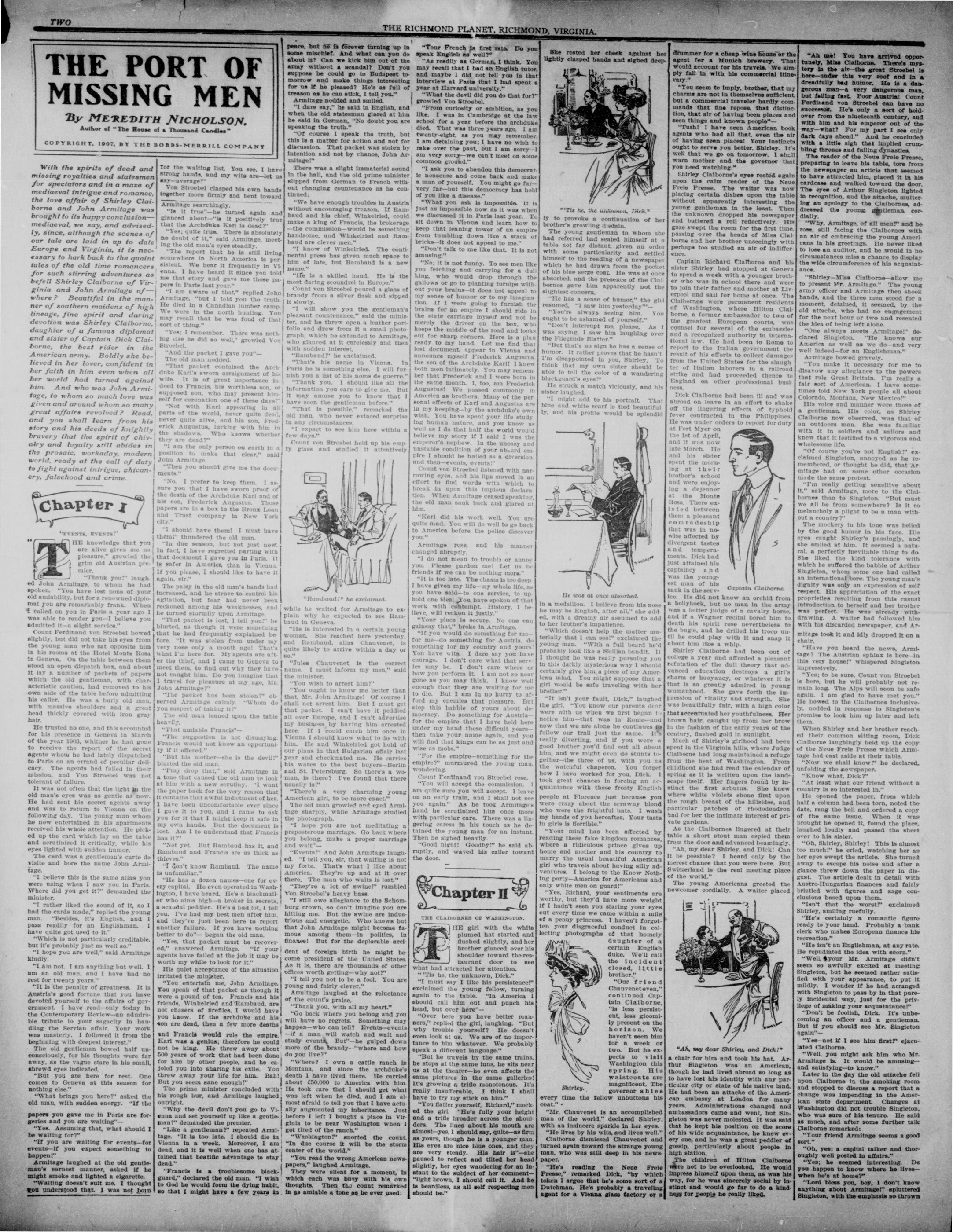
THE PORT OF
MISSING MEN
ty Soper
Two
With the spirits of dead and
missing royalties and statesmen
for spectators and in a maze of
mediaeval intrigue and romance,
the love affair of Shirley Clai-
borne and John Armitage was
brought to its happy conclusion—
mediaeval, we say, and advised-
ly, since, although the scenes of
our tale are laid in up to date
Europe and Virginia, it is nec-
essary to hark back to the quaint
tales of the old time romancers
for such stirring adventures as
befell Shirley Claiborne of Vir-
ginia and John Armitage of —
where? Beautiful in the man-
ner of southern maidens of high
lineage, fine spirit and daring
devotion was Shirley Claiborne,
daughter of a famous diplomat
and sister of Captain Dick Clai-
borne, the best rider in the
American army. Boldly she be-
lieved in her lover, confident in
her faith in him even when all
her world had turned against
him. And who was John Armi-
tage, to whom so much love was
given and around witom so many
great affairs revolved? Read,
and you shall learn from his
story and his deeds of knightly
bravery that the spirit of chiv-
airy and loyalty still abides in
the prosaic, workaday, modern
world, ready at the call of duty
to fight against intrigue, chican-
ery, falsehood and crime. 1
Chapter; |
: Gq) HE knowledge that pox
aT Dleaware,” growled the
) grim old Austrian pre
Fe |e ie
yr
i(c—__/ “Thank you!” laugh
ed John Armitage, to whom he bad
spoken. “You have lost none of your
old amiability, but for a renowned dipto
mat you are remarkably frank. When
= called on you in Paris a year ago I
was able to render you—I belleve you
admitted it—a sight service.”
Count Ferdinand yon Stroebel bowed
slightly, but did not take his eyes from
the young man who sat opposite him
in his rooms at the Hotel Monte Rosa
in Geneva. On the table between them
stood an open dispatch box, and about
it lay a number of packets of papers
which the old gentleman, with char-
acteristic caution, had removed to his
‘own side of the table before admitting
his caller. He was a burly old man,
with massive shoulders and a great
head thickly covered with iron gray
hair.
He trusted no one, and this accounted
for his presence in Geneva in March
of the year 1903, whither he had gone
to recelve the report of the secret
agents whow he had lately dispatched
to Paris on an errand of peculiar dell-
eacy. The agents had falled in their
mission, and Von Stroebel was not
tolerant of fallure.
It was not often that the light dm the
old man’s eyes was as gentle as now.
He had sent his secret agents away
and was to return to Vieuna on the
following dus. The young man whom
he now entertained in his apartments
Feceived his whole attention, He pick-
€@ up the cand which lay on the table
and scrutinized {t critically, while his
eyes lighted with sudden humor.
‘The card was a gentleman's carte de
visite and bore the name Joba Armi-
tage.
“I believe this ts the same allas you
were using when I saw you in Paris
Where did you get it?” demanded the
minister.
“I rather liked the sound of it, 0 I
had the cards made,” replied the young
man, “Besides, it's English, and I
pass readily for an Englishman. 1
have quite got used to it.”
“Which is not particularly creditable,
but it’s probably just as well so.”
“I hope you are well,” said Armitage
‘kindly.
“Lam not. 1am anything but well. 1
am an old man, and I have had no
fest for twenty years.”
“It ts the penalty of greatness. It is
‘Austria's good fortune that you have
Gevoted yourself to the affairs of goy-
ernment. I have read—only today in
the Contemporary Review—an admira-
ble tribute to your sagucity in han+
ling the Servian affair. Your work
was masterly. I followed It from the
beginning with deepest interest.”
The old gentleman bowed half un-
consciously, for bis thoughts were far
away, a3 the vague stare In his small,
shrewd eyes indicated.
“But you are here for rest. One
comes to Geneva at this season for
nothing else.”
“What brings you here?" asked the
old man, with sudden energy. “If the
papers you gave me in Paris are for-
_geries and you are waiting"—
_. “Yes. Assuming that, what should I
“be waiting for?”
| “If you are waiting for events—tor
“events—if you expect something to
laughed at the old gentle.
manner, asked if he
joke and lighted a cigarette.
doesn't suit me. I thought
I was not
| “And the packet I gave you"—
The old man nodded.
| “Phat packet contained the Arch
| duke Karl's sworn arraignment of hi
| wife. It is of great importance in
| deed to Francis, his worthless son, 01
| supposed son, who may present him
| Self for coronation one of these days!
j “Not with Karl appearing in. al
parte of the world, never quite dead
hever quite alive, and his son, Fred
erick Augustus, lurking with him tr
| the shadows. “Who knows whethes
| they are dead?”
| “iam the onty person on earth tn
| position to make that clear,” said
John Armitage.
| “Then you should give me the docu:
| ments."
| “No. I prefer to keep them. I as.
sure you that I have sworn proof of
the death of the Archduke Karl and of
bis son, Frederick Augustus. Those
papers are in a box in the Bronx Loan
and ‘Trust company in New York
city."
“I should have them! I must have
} them!” thundered the old man.
| “Im due season, but not just now.
| In fact, I have regretted parting with
that document I gave you in Paris, It
is safer in America than in Vienna
If you please, I should like to have it
again, sir.”
The palsy in the old man’s bands had
tucreased, and he strove to control his
agitation, but fear had never been
reckoned among his werknesses, and
he turned stormily upon Armitage.
“That packet 4s lost, I tell yout” he
blurted, as though it were someting
that he had frequently explained be.
fore. “It was stolen from under my
Very nose ouly a mouth ago! That's
What I'm here for. My agents are aft
er the thief, and I came to Geneva to
meet them, to find out why they have
hot caught him. Do you imagine that
I travel for pleasure at my age, Mr.
John Armitage?”
“The packet has been stolen?” ob
Served Armitage calmly. “Whom do
Fou suspect of taking It?"
The old min leaued upon the table
heavily.
“That aulable Francis'—
“The suggestion is uot dismaying
Francis would not know an opportuni
ty if it offered.”
“But his mother—she is the devil!”
blurted the old man,
“Pray drop that,” said Armitage in
& tone that caused the old man to look
at him with a new scrutiny. “I want
the paper back for the very reason that
At contains that awful indictment of ber.
I have been uncomfortable ever since
I gave it to you, and I came to ask
you for it that I might keep it safe in
my own hands. But the document is
Jost. Am I to understand that Francis
has it?
“Not yet. But Rambaud has it, and
Rambeud and Francis are as thick as
thieves.”
“I don't know Rambaud. The name
is unfamiliar.”
“He bas a dozen names—one for ev-
ery capital, He even operated in Wash-
ington, I have heard. He's a blackmail.
er who aims high—a broker in secrets,
a scaudal peddier. He's a bad lot, | tell
you. I've had my best men after kim,
and they've just been here to report
another failure. If you have nothing
better to do”— began the old man.
“Yes, that packet must be recover-
ed,” answered Armitage. “If your
agents have failed at the job it may be
worth my while to look for It”
His quiet acceptance of the situation
irritated the rar ca
“You entertain me, John Armitage.
You speak of that packet as though it
were a pound of tea. Francis and his
friends, Winkelried and\Rambaud, are
not chasers of firefiles, I would have
you kaow. If the archduke and his
‘on are dead, then a few more deaths
tnd Francis would rule the empire.
Karl was a genius; therefore he could
not be king. He threw away about
500 years of work that had been done
for him by other people, and he ca-
joled you into sharing his exlle. You
threw away your life for him. Bab!
But you seem sane enough!”
The prime minister concluded with
his rough bur, and Armitage laughed
outright,
“Why the devil don't you go to Vi-
enna and set yourself up like a gentle
man?” demanded the premier.
“Like a gentleman?” repeated Arm!-
tage. “It is too late. I should die in
‘Vienna fp a week. Moreover, I am
ead, and tt is well when one bas at-
tained that beatific advantage to stay
Dlack-
“Francis fs a ——-
{Ged be would for the dying bebe
‘to God he ees oe
‘so that I might have a few years in
THE RICHMOND PLANET, RICHMOND, VIRGINIA,
peak Englishes wel”
is make acs Lak
may recall that I hed an 8 et
interview st Parla tat had opest's
Fee 2 Marvana et set
the devil did you do that for?”
growled Von Stroebel.
“From curiosity or ambition, as you
Uke. I was in Cambridge at the law
school for a year before the archduke
died. That was three years ago. i am
twenty-eight, as you may remember.
Lam detaining you; I have no wish to
“Take over the past, but I am sorcy—I
am veey sorrg_we can’t ment on some
| common e
“Task you to abandon this democrat-
-e nonsense and come back and make
“8 man of yourself, You might go far—
‘very far—but this democracy has hold
of you like a disease.”
“What you ask is impossible It Is
“fost as impossible now as it was when
‘We discussed it in Paris last year. To
ait down in Vienna and learn how to
keep that leaning tower of an empire
from tumbling down Ike a stack of
bricks—it does not appeal to me.”
“Don't talk to me like that. It is not
amusing.” .
“No; It 1s not funny. To see men Ike
you fetching and carrying for a dull
king, who would drop through the
gallows or go to planting turnips with-
out your brains—it does not appeal to
my sense of humor or to my Imagins
tion. If I were going to furnish the
brains for an empire I should ride in
the state carriage myself and not be
merely the driver on the box, who
Keeps the middle of the road and looks
out for sharp corners. Here is a plan
ready to my hand. Let me find that
lost document, appear in Vienna and
announce myself Frederick Augustus
the son of the Archduke Kari! I knew
both men fnthmately. You may remem
ber that Frederick and I were bora in
the same month. I, too, am Frederick
Augustus! We passed commonly in
America as brothers, Many of the per
sonal effects of Karl and Augustus are
in my keeping—by the archduke's own
wish, You have spent sour life study
ing human nature, and you know as
well as I'do that half the world would
believe my story if I said I was the
emperor's nephew. In the uneasy and
unstable condition of your abel em
pire { should be halled as a diversion
and then—events, events!”
Count von Stroebel listened with nar.
rowing eyes, and his lips moved in an
effort to find words with which to
break in upon this impious declara
tion. When Armitage ceased speakins,
the old man sank back and glured at
him.
“Karl did bis work well. You are
quite mad. You will do well to go back
to America before the police discover
ue
Armitage rose, and hls) manner
changed abruptly.
“I do not mean to troubl> or annoy
you. Please pardon me! Let us be
friends if we can be nothing more.”
“It is too Inte. ‘The chasm is too deep
[have given my life—my whole life, as
you have said—to one service, to up-
hold one Hea.s¥on. bare spoken of that
work with cdhtempt. History, I be-
Weve, will reckon it fustly.”
“Your place is secure. No one cay
guiusay that,” broke in Armitage.
“If you would do something for mo—
for me—do something for Austria, do
something for my country and yours’
Yon have wits. I dare say you have
courage. I don't care what that serv
ice may be. I don't care where or
how you perform it. I am not go near
gone as you may think. I know well
enough that they are waiting for me
to die. But I am fn no hurry to af-
ford my enemies that pleasure. But
stop this babble of yours about de-
mocracy. Do something for Austria
for the empire that I have held here
under my hand these difficult years—
then take your name again, and you
will find that kings can be as Just and
wise as mobs.”
“For the emptre—something for the
empire?" murmured the young man,
wondering
Count Ferdinand von Strocbel rose.
“You will accept the commission. 1
am quite sure you will accept. I leave
on an early train, ana I shall not see
you again.” As he took Armitage’s
hand he scrutinized him once more
with particular care. There was a lin-
gering caress in his touch as he de-
tained the young man for an instant.
Then he sighed heavily.
“Good night! Goodby!” he said ab-
ruptly, and waved his caller toward
the door.
——— et
chapter I 9
weet Bad attracted Ber attention.
“'Tis he, the unknown, Dick.”
“I must say I Uke his persistence!”
exclaimed the young fellow, turning
again to the table. “In America 1
should call him out and punch his
head, but over here”—
“Over here you have better man-
ners,” replied the girl, laughing. “But
why trouble yourself? He doesn't
even look at us, We are of no impor-
tance to him whatever. We probably
speak a diferent language.”
“But he travels by the same trains,
he stops at the same inns, he sits near
us at the theater—he even affects the
same pictures in the same galleries!
It’s growing a tride monotonous. It's
really fnsufferable. I think I shall
have to try my stick on him.”
“You flatter yourself, Richard,” mock
ed the girl, “He's fully your height
and a trifle broader across the shoul-
ders. The lines about his mouth are
almost—yes, 1 should say, quite—as firm
as yours, though he is a younger man.
His eyes aro nice blue ones, and they
are very steady. His hair is”—she
paused to reflect and tilted her head
Slightly, her eyes wandering for an tn-
stant to the subject of her comment—
“tight brown, I should call tt. And he
4s beardiess, as all self respecting men
should be.”
but HF fs (rever tarnin
PD rer to
sae an we Ki 2 be
? Can we kick my ‘the
army a H you
Sener see mete acer ata
marrow qd make things
for us it Pleased? He's as full of
treason as he can stick, I tell you.”
Annitage nodded and sintied.
“I dare say,” he said in English, and
when the old statesman glared at him
he said in German, “No doubt you are
speaking the truth.”
“Of course I speak the troth, but
this {sq matter for action and not for
discussion. That packet was stolen by
intention and not by chance, John Ar-
mitage!”
| There was a slight Immaterial sound
in the hall, and the old prime minister
‘sipped from German to French with-
out changing countenance as he con-
tinued:
“We have enough troubles in Austria
without encouraging treason. If Ram-
baud and his chief, Winkelried, could
make a king of Francis, the brokerage
—the commission—would be something
handsome, and Winkelried and Ram-
baud are clever men.”
“I know of Winkelried. The conti-
nental press has given much space to
him of late, but Rambaud is © new
name."
“fe is a skilled hand. He ts the
most daring scoundrel tn Europe.”
Count von Strocbel poured a glass of
brandy from a silver flask and sipped
it slowly.
“I will show you the gentleman's
pleasant countenance,” sald the minis-
ter, and he threw open a leather port-
folio and drew from it a small photo-
graph, which he extended to Armitage,
who glanced at {t carelessly and then
with sudden interest
“Rambaud?” he exclaimed.
“That's his name In Vienna. In
Paris he Js something else. I will far-
nish you a lst of his noms de guerre.”
“Thank yon. I should lke all the
fnformation you care to give me. But
ft way amuse you to know that 1
have seen the gentleman before.”
“That ts possible," remarked the
old maa, who never evinced surprise
in any circumstances.
“I expect to see him here within a
fow days.”
Count von Stroebel held up his emp
ty glass and studied it attentively
il
I a
Ae Ay
Aut
“Rambaud!" he exclatmed.
while he walted for Armitage to ex-
[plain why he expected to see Ram
baud in Geneva,
“He is interested In a certain young
woman. She reached here yesterday,
and Rambaud, allas Chauvenet, is
quite Ukely to arrive within a day of
80."
| “Jules Chauvenet 1s the correct
name. I must inform my men,” sald
the minister,
“You wish to arrest him?”
“You ought to know me better than
that, Mr. Jobn Armitage! Of course |
' shall not arrest him. But I must get
Jthat packet. I can't have it peddled
ail over Europe, and I can't advertise
my business by having him arrested
here. If 1 Could catch him once in
Vienna I should know what to do with
‘him. He and Winkelried got hold of
bees! plans in that Bulgarian affair last
year and checkmated me. He carries
jhis wares to the best buyers—Berlin
and St. Petersburg. So there's a wo-
}man, is there? I've found that there
| usually is!”
“There's a very charming young
American girl, to be more exact.”
The old man growled nnd eyed Armt
tage sharply, while Armitage studied
the photograph.
“I hope you are not meditating a
preposterous marriage. Go back where
You belong, make a proper marriage
and wait"—
“Events! And Jobn Armitage laugh-
ed. “I tell you, sir, that waiting is not
my forte. That's what I like about
ae ‘They're up and at it over
there. The man who waits is lost."
: “They're a lot of swine!” rumbled
Yon Stroebel’s heavy bass.
“I still owe allegiance to the Schom-
burg crown, so don't imagine you are
hitting me. But the swine are indus-
‘trlous and energetic. Who knows but
that John Armitage might become fa-
mous among them—tin politics, ix
finance! But for the deplorable acch
‘dent of foreign birth he might be
come president of the United States.
As it fs, there are thousands of other
vifices worth getting—why not?”
“I tell you not to be a fool. You are
young and fairly clever.”
Amnuitage laughed at the reluctance
of the count’s praise,
“Thank you, with all my heart.”
“Go back where you belong and you
} will have no regrets. Something may
| bappen—who can tell? Bvents—erents
~if a man will watch and wait and
study eran Batt gulped down
more of the indy- “where and bow
do you live?”
| “Where? 1 own a cattle ranch tr
Montana, and since the archduke's
Geath I have lived there. He carried
| about £50,000 to America with bit
) He took care that I should get what
| was left when he died, and I am al
most afraid to tell you that I have actu
ally augmented my inheritance. Just
before I left I bought « place in Vir
ginia to be near Washington when |
got tired of the ranch.”
“Washington!” snorted the count
(“In due course it will be the storm
center of the world.”
| “You read the wrong American news
papers,” laughed Armitage.
| ‘They were silent for a moment, In
which each was bosy with his owr
thoughts. poate, count remarked
im gs amiable a tone as he ever used:
THE CLAILORNES OF WASHINGTON.
Pieris | IE girl with the white
? ;} plumed hat started and
j MT}; flushed slightly, and her
7} brother glanced over his
shoulder toward the res-
i—anae duet tm eee
ughtly clasped hands tnd sighed door
1, Siege:
he ies ‘
aka I
DSS fay
aE,
oe ees
FY
7 £1)
4
PZ, an
ly to provoke a continuation of her
brother's growling disdain.
‘The young gentleman to whom she
had referred had seated himself at s
table not far distant, given an order
with some particularity and settled
himself to the reading of a newspaper
which he had drawn from the pocket
of his blue serge coat. He was at ouce
absorbed, and the presence of the Cla!
bornes gave him apparently not the
slightest concern.
“He has a sense of humor,” the git!
resumed. “I saw him yesterday” —
“You're always seeing him. You
ought to be ashamed of yourself.”
“Dou't interrupt me, please. As 1
was saying, I saw him laughing over
the Fliecende Biatter.”
“But that’s no sign ho has a sense of
hnmor. It rather proves that he hasn't
I'm disappointed in you, Shirley. To
think that my own sister should be
able to tell the color of @ wandering
blackguant's eyes!"
He struck a match viciously, and his
sister laughed.
“I might add to his portrait. ‘That
blue and white scarf is tled beautiful
ly, and his profile would be splendid
mo.
— al] al
+ “¥
eS i
Be
}- :
io a medallion. I believe from his nose
he thay be English, after all," she add-
ed, with a dreamy alr assumed to add
to her brother's impatience,
“Which doesn’t help the matter ma-
terlally that I can see!” exclaimed the
young man. “With a full beard he'd
probably look lke a Sicilinn bandit. 11
I thought he was really pursuing you
tm this darkly mysterious way I should
certainly give hima plece of my Amer:
ican mind. You milght suppose that a
girl would be safe traveling with ber
brother.”
“It isn't your fault, Dick,” laughed
the girl. “You know our parents dear
were with us when we first began t»
notice him—that was in Rome—and
now that we are alone be continues a
follow our trail just the same. It
really diverting, and if you were a
good brother you'd find out all about
him, and we might even do stunts to-
gether—the three of us, with you as
the watchfal chaperon. You forget
how I bave worked for you, Dick. 1
took great chances in forcing an ac-
quaintance with those frosty English
People at Florence just because you
Were crazy about the scrawny blond
who wore the frightful hats. I wash
my hands of you hereafter. Your taste
fu girls is Horrible.”
“Your mind has heen affected by
reading these fake kingdom romances,
where a ridiculous prince gives up
home and mother and his country to
marry the usual beautiful American
‘girl who travels about having silly ad.
‘Ventures. I belong to the Know Noth.
ing party—America for Americans and
only white men on guard!”
“Yes, Richard, your sentiments are
worths, but they’ have more weight
if I hadn't seen you staring your eyes
out every time we came within a mile
of m penny princess. 1 haven't forgot.
ten your @isgraceful conduct In col:
lecting photographs of that homely
daughter of a
certain English
duke. We'll cali
the incident
closed, little
brother.”
“Our friend
Chauveneteven,”
continued Cap-
tain Clatborne,
“is less persist-
ent, less gloomt-
ly present on the
horizon. We
bayen’t seen him
for a week or
two. But he ex-
pects wo visit
‘Washington this
Spring. His
waistcoats are
magnificent. The
ee ee
es daughter of a
By certain English
X64. duke. We'll cali
the incident
B closed, little
brother.”
, “Our friend
7 Chauvencteven,”
pS: continued Cap-
ee tain Claiborne,
te “is less persist:
ent, less _gloom!-
wah ly present on the
eARS horizon. We
\ haven't seen him
i for a week or
\ two. But he ex-
Y pects to visit
\ Washington this
SS spring. Hts
es waistcoats are
magnificent. The
int governor shies
every time the fellow unbuttons bis
coat.” «
“Mr, Chauvenet is an accomplished
man of the world,” declared Shirley,
with an insincere sparkle tn her eyes.
“He lives by his wits, and lives well.”
Claiborne dismissed Chauvenet and
turned again toward the strange young
man, who was still deep in his news-
paper.
“He's reading the Neue Freie
Presse,” remarked Dick, “by which
token I argue that he’s some sort of a
Dutchman. He's probably a traveling
agent for a Vienna glass factory or a
a 1er for a cheap wine fiouse or the
Se ee
account for his travela. We sim.
ply fall in with his commercial itine
vary.”
“You seem to imply, brother, that my
charms are not In themselves sufficient,
but « commercial traveler hantly com:
mands that fine repose, that distinc
tion, that alr of having been places and
seen things and known people"—
“Tush! I have seen American book
agents who had all that, even the alr
‘of having seen places! Your instincts
ought to serve you better, Shirley. It's
“Well that we go oa tomorrow. I shcil
warn mother and the governor that
you need watching.”
Shirley Claiborne’s eyes restéd azain
upon the calm reader of the Neue
Frelo Presse. ‘The waitor was now
Placing certain dishes upon the table
‘without apparently interesting the
young gentleman in the least. Then
the unknown dropped bis newspaper
and buttered a roll reftectively. His
g2ze swept the room for the first time,
passing over the heads of Miss Clal
bore and her brother unseeingly with
Perhaps too studied an alr of indlffer-
ence.
Captain Richard Clatborne and bis
sister Shirley had stopped at Geneva
to spend a week with a younger broth
er who was in school there and were
to Join their father and mother at Liv-
erpool and sail for home at once. The
Claibornes were permanent residents
of Washington, where Hilton Clal
borne, a former ambassador to two of
the greatest European courts, was
counsel for several of the embassies
and a recognized authority tn interna.
tional law. He had been to Rome to
Feport to the Italian government the
result of his efforts to collect damages
from the United States for the slaugh
ter of Italian laborers in a railroad
strike and had proceeded thence to
England on other professional bust
Dick Claiborne had been fl and was
abroad on leave in an effort to shake
off the lingering effects of typhoid
fever contracted in the Philippines.
He was under orders to report for duty
at Fort Myer on
the Ist of April,
and It was now
late March. He
and his sister
spent the morn-
ing at their
brother's school
and were enjoy-
ing a dejeuner
at the Monte
Rosa, ‘There ex-
isted between
them a pleasant
comradeship
that was in no-
wise affected by
divergent tastes
and tempera-
ments. Dick had
just attained his
captaincy and
was the young-
est man of his
rank in the serv-
if y/ 7
/ 2
jice. He did not know an orchid from
& hollyhock, but no man tn the army
was a better Judge of a cavalry horse.
and if a Wagner recital bored him to
death his spirit rose nevertheless to
the bugie, aud he drilled bis troop un-
til he could play with it and snap it
about him like a whip,
Shirley Clatborne had been out of
college a year and afforded a pleasant
refutation of the dull theory that ad-
vanced education destroys a girl's
charm or buoyancy, or whatever it Is
that is so greatly admired in young
womanhood. She gave forth the im-
Dression of vitality and strength. She
was beautifully fair, with a high color
that accentuated her youthfulness. Her
brown hair, caught up from her brow
in the fashion of the early years of the
century, flashed gold In sunlight,
Much of Shiries’s girlhood had been
spent in the Virginia hills, where Judge
Claiborne had long maintained a refuge
from the heat of Washington. From
childhood she had read the calendar of
spring ae it ts written upon the land-
scape iteelf, Her fingers found by in-
stinct the first arbutus. She knew
where white violets shone first upon
the rough breast of the hillsides, and
particular patches of rhododendron
‘had for her the intimate interest of pri-
vate gardens.
As the Clalbornes lingered at thelr
table a short stout man espied them
from the door and advanced beamingly.
“Ab, my dear Shirley, and Dick! Can
it be possible? I heard only by the
merest chance that you were here. But
Switzerland is the real meeting place
of the world.”
The young Americans greeted the
Bewcomer cordially. A waiter placed
\= iy @
| S}
sw,
ae ok f
qj /
“Ah, my dear Shirley, and Dick!”
a chair for him and took his hat. Ar-
thur Singleton was an American,
though he had lived abroad so long as
to have lost his identity with any par-
ticular city or state of his native land,
He bad been an attache of the Ameri-
can embassy at London for many
years, Administrations changed and
ambassadors came and went, but Sin-
gleton was never molested. It was said
‘that he kept bis position on the score
of his wide acquaintance, he knew ev-
ery one, and he was a great peddler of
gossip, particularly about people in
high station, |
ee Sisre8 of | Hinton | Claiborne
not to be overlooked. He would
impress himself upon them, as was his
way, for he was sincerely social by in-
stinct and would go far to do a kind-
ness for people he really liked,
| Hes coy &
| over the nineteonth century, and
with him and his emperor out of the
‘way—what? For my part I see only
dark days ahead.” And he concluded
| With « little sigh that implied crum-
bitng thrones and falling dynasties,
‘The reader of the Neue Freie Presse,
Preparing to leave his table, tore from
the newspaper au article that seemed
to have attracted him, placed tt in hie
ardease and walked toward the door.
‘The yee of Arthur Singleton lighted
in recognition, and the attache, mutter-
tng an apology to the Claibornes, ad-
dressed young sjptieman cor
‘dially.
“Why, Armitage, of all men?” and be
Tose, still facing the Clalboroes with
an alr of embracing the young Ameri-
cans in his greetings. He never liked
to lose an auditor, and be would in no
circumstances miss a chance to display
the wide circumference of his acquaint-
ance.
“Shirley—Miss Clatborne—allow me
to present Mr. Armitage.” The young
army officer and Armitage then shook
hands, and the three men stood for a
moment, detained, it seemed, by the
old attache, who hnd no engagement
for the next hour or two and resented
the idea of being left alone.
“One always meets Armitage!” de-
clared Singleton. “He knows our
America as well as we do—and very
well tndeed—for an Englishman.”
Armitage bowed gravely.
“You make it necessary for me to
disavow any allegiance to the powers
that rule Great Britain. I'm really a
fair sort of American. I have some-
times told New York people all about
Colorado, Montana, New Mexico!”
His voice and manner were those of
a gentleman. His color, as Shirley
Claiborne now observed, was that of
an outdoors man. She was fasnitiar
with it in soldiers and sailors and
knew that ft testified to a vigorous and
wholesome life.
“Of course you're not English!” ex-
claimed Singleton, annoyed as he re-
membered, or thought he did, that ‘Ar-
mitage had on some other occasion
made the same protest.
“I'm really getting sensitive about
it,” sald Armitage, more to the Clai-
bornes than to Singleton. “But must
We all be from somewhere? Is it so
melancholy a plight to be a man with-
out a country?”
The mockery tn his tone was belled
by the good humor In his face. His
eyes caught Shirley's passingly, ane
she smiled at him. It scemed a natu-
ral, a perfectly inevitable thing to do
She liked the kind tolerance with
which he suffered the babble of Arthur
Singleton, whom some one had called
an International bore. The young man’s
dignity was only an expression of self
vespect. His appreciation of the exact
Proprieties resulting from this casual
Introdection to herself and her brother
was perfect. He was already with-
drawing. A waiter had followed him
with his discarded newspaper, and Ar-
mitage took it and idly dropped it on a
chal,
“Haye you heard the news, Arm
tage? The Austrian sphinx is here—in
this very house!” whispered Singleton
impressively.
“Yes; to be sure, Count von Stropbet
is here, but he will probably not re-
main long. The Alps will soon be safe
again. I am glad to have met you.”
He bowed to the Clalbornes inchisive-
ly, nodded In response to Singleton's
promise to look him up later and left
them.
When Shirley and her brother reach-
ed thelr common sitting room, Dick
Ciniborne laughingly held up the copy
of the Neue Freie Presse which Arum.
tage had cast aside at their table.
“Now we shall know! he declared,
unfolding the newspaper.
“Know what, Dick?"
“At least what our friend without a
country ts so interested in.”
He opened the paper, from which
hatf a column had been torn, noted the
date, rang the bell and ordered a copy
of the same issue. When it was
brought he opened it, found the place,
laughed loudly and passed the sheet
over to his alster.
“Oh, Shirley, Shirley! This ts almost
too much!” he cried, watching her as
her eyes swept the article She turned
away to escape his noise and after a
glance threw down the paper in dis-
gust. The article dealt in detail with
Austro-Hungarian finances and fairly
bristled with figures and sage con-
clusions based upon them.
“Isn't that the worst!” exclaimed
Shirley, smiling ruefully.
“He's certainly a romantic figure
ready to your hand. Probably a bank
clerk who makes European finance his
recreation.”
“He isn't an Englishman, at any rate,
He repudiated the idea with scorn.”
“Well, ¢your Mr. Armitage didn’t
seem so awfully excited at meeting
Singteton, tat he seemed rather satis-
fied with your appearance, to put it
mildly. I wonder if be had arranged
with Singieton to pass by in that pure-
eee oe eee ee eee eee
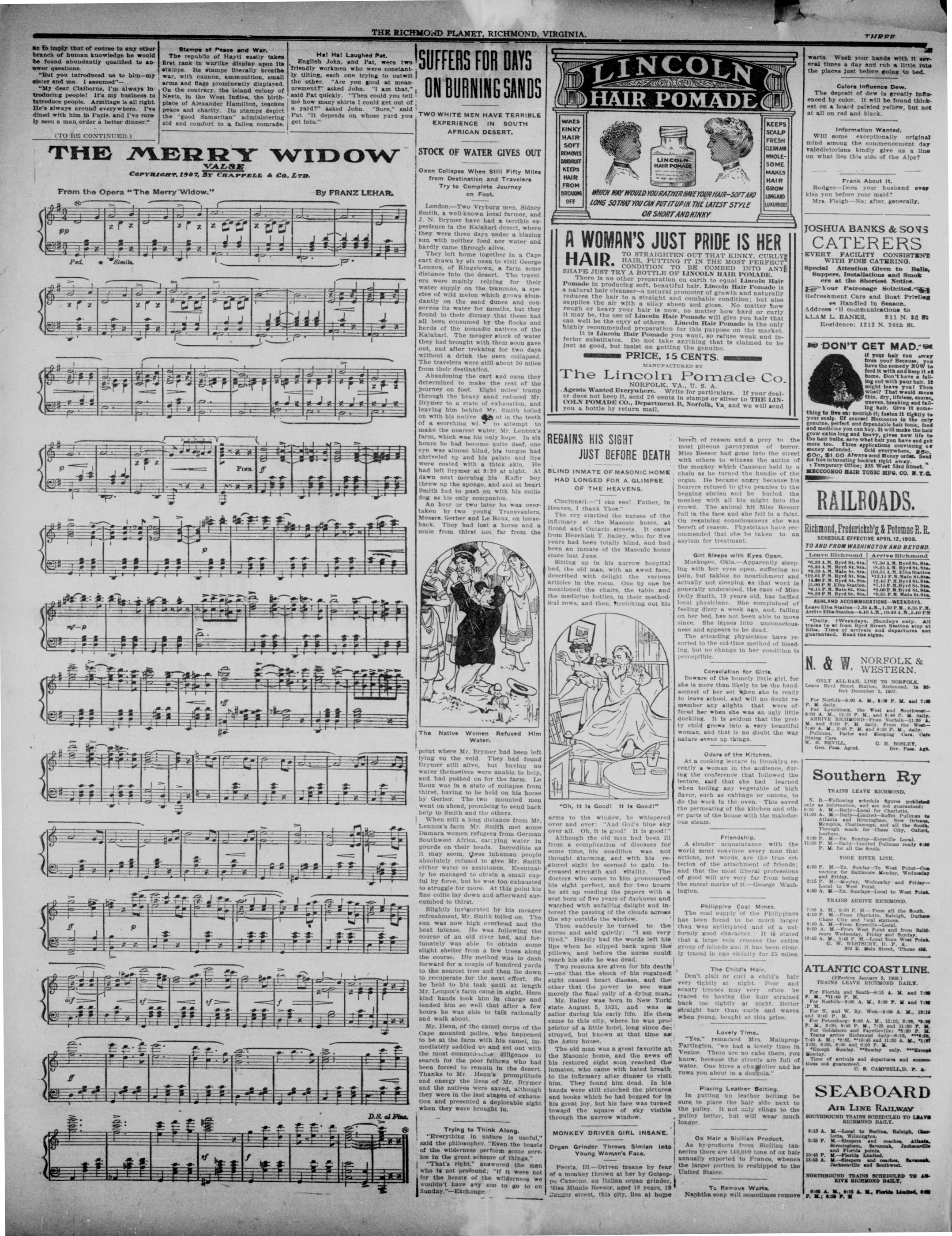
THE MERRY WIDOW
VALSE
COPYRIGHT, 1907, BY CHAPPELL & CO., LTD.
From the Opera "The Merry Widow." By FRANZ LEHAR.
Ped. Simila.
D.S. al Flute.
as to imply that of course in any other branch of human knowledge he would be found abundantly qualified to answer questions.
"But you introduced us to him—my sister and me. I assumed"—
"My dear Claiborne, I'm always introducing people! It's my business to introduce people. Armitage is all right. He's always around everywhere. I've dined with him in Paris, and I've rarely seen a man order a better dinner."
(TO BE CONTINUED.)
Stamps of Peace and War.
The republic of Hayti easily takes first rank in warlike display upon its stamps. Its stamps literally breathe war, with cannon, ammunition, small arms and flags prominently displayed. On the contrary, the island colony of Nevis, in the West Indies, the birthplace of Alexander Hamilton, teaches peace and charity. Its stamps depict the "good Samaritan" administering aid and comfort to a fallen comrade.
THE RICHMOND PLANET, RICHMOND, VIRGINIA
Ha! Ha! Laughed Pat.
English John, and Pat, were two friendly workmen who were constantly tilting, each one trying to outwit the other. "Are you good at measurement?" asked John. "I am that." said Pat quickly. "Then could you tell me how many shirts I could get out of a yard?" asked John. "Sure," said Pat. "It depends on whose yard you get into."
SUFFERS FOR DAYS ON BURNING SANDS
TWO WHITE MEN HAVE TERRIBLE
EXPERIENCE IN SOUTH
AFRICAN DESERT.
STOCK OF WATER GIVES OUT
Oxen Collapse When Still Fifty Miles from Destination and Travelers Try to Complete Journey on Foot.
London.—Two Vryburg men, Sidney Smith, a well-known local farmer, and J. N. Brymer have had a terrible experience in the Kalahari desert, where they were three days under a blazing sun with neither food nor water and hardly came through alive.
They left home together in a Cape cart drawn by six oxen to visit George Lennox, of Kingstown, a farm some distance into the desert. The travelers were mainly relying for their water supply on the trammas, a species of wild melon which grows abundantly on the sand dunes and conserves its water for months, but they found to their dismay that these had all been consumed by the flocks and herds of the nomadic natives of the Kalahari. The meager stock of water they had brought with them soon gave out, and after trekking for two days without a drink the oxen collapsed. The travelers were still about 50 miles from their destination.
Abandoning the cart and oxen they determined to make the rest of the journey on foot. Eight miles' tramp through the heavy sand reduced Mr. Brymer to a state of exhaustion, and leaving him behind Mr. Smith toled on with his native stint in the teeth of a scorching wilde. to attempt to make the nearest water, Mr. Lennox's farm, which was his only hope. In six hours he had become quite deaf, one eye was almost blind, his tongue had shriveled up and his palate and lips were coated with a thick skin. He had left Brymer at 9:30 at night. At dawn next morning his Kaffir boy threw up the sponge, and sad at heart Smith had to push on with his colli dog as his only companion.
An hour or two later he was overtaken by two young Transvaalers, Messr. Gerber and Le Roux, on horseback. They had lost a horse and a mule from thirst not far from the
M. H.
The Native Women Refused Him Water.
point where Mr. Brymer had been left lying on the veld. They had found Brymer still alive, but having no water themselves were unable to help, and had pushed on for the farm. Le Roux was in a state of collapse from thirst, having to be held on his horse by Gerber. The two mounted men went on ahead, promising to send back help to Smith and the others.
When still a long distance from Mr. Lennox's farm Mr. Smith met some Damara women refugees from German Southwest Africa, carrying water in gourds on their heads. Incredible as it may seem, these inhuman people absolutely refused to give Mr. Smith either water or assistance. Eventually he managed to obtain a small cupful by force, but he was too exhausted to struggle for more. At this point his fine colli lay down and afterward succumbed to thirst.
Slightly invigorated by his meager refreshment, Mr. Smith toiled on. The sun was now high overhead and the heat intense. He was following the course of an old river bed, and fortunately was able to obtain some slight shelter from a few trees along the course. His method was to dash forward for a couple of hundred yards to the nearest tree and then lie down to recuperate for the next effort. So he held to his task until at length Mr. Lennox's farm came in sight. Here kind hands took him in charge and tended him so well that after a few hours he was able to talk rationally and walk about.
Mr. Henn, of the camel corps of the Cape mounted police, who happened to be at the farm with his camel, immediately saddled up and set out with the most commensurable diligence to search for the poor fellows who had been forced to remain in the desert. Thanks to Mr. Henn's promptitude and energy the lives of Mr. Brymer and the natives were saved, although they were in the last stages of exhaustion and presented a deplorable sight when they were brought in.
Trying to Think Along
"Everything in nature is useful," said the philosopher. "Even the beasts of the wilderness perform the service in the great scheme of things."
"That's right," answered the man who is not profound; "if it were not for the beasts of the wilderness we wouldn't have any zoo to go to on Sunday."—Exchange.
LINCOLN
HAIR POMADE
MAKES
KINKY
HAIR
SOFT
REMOVES
DANDRUFF
KEEPS
HAIR
FROM
BREAKING
OFF
LINCOLN
HAIR POMADE
WHICH WAY WOULD YOU RATHER HAVE YOUR HAIR-SOFT AND
LONG SO THAT YOU CAN PUT IT UP IN THE LATEST STYLE
OR SHORT AND KINKY
KEEPS
SCALP
FRESH
CLEAN AND
WHOLE-
SOME
MAKES
HAIR
GROW
LONG AND
LUXURIOUS
A WOMAN'S JUST PRIDE IS HER
TO STRAIGHTEN OUT THAT KINKY, CURLY
HAIR, PUTTING IT IN THE MOST PERFECT
CONDITION TO BE COMBED INTO ANY
BOTTLE OF LINCOLN HAIR POMADE
There is no other preparation on earth to equal Lincoln Hair Pomade in producing soft, beautiful hair. Lincoln Hair Pomade is a natural hair cleanser—a natural promoter of growth and naturally reduces the hair to a straight and combable condition; but also supplies the air with a silky sheen and gloss. No matter how properly you wear your hair is now, no matter how hard or curly it may be, the use of Lincoln Hair Pomade will give you hair that can well be the envy of others. Lincoln Hair Pomade is the only highly recommended preparation for hair.
It is Lincoln Hair Pomade you want, so refuse weak and inferior substitutes. Do not take anything that is claimed to be just as good, but insist on getting the genuine.
MANUFACTURED BY
Agents Wanted Everywhere. Write for particulars. If your dealer does not keep it, send 20 cents in stamps or silver to THE LINCOLN POMADE CO., Department B, Norfolk, Va. and we will send you a bottle by return mail.
REGAINS HIS SIGHT
JUST BEFORE DEATH
REGAINS HIS SIGHT
JUST BEFORE DEATH
BLIND INMATE OF MASONIC HOME
HAD LONGED FOR A GLIMPSE
OF THE HEAVENS.
Cincinnati.—"I can see! Father, in
Heaven, I thank Thoe."
The cry startled the nurses of the
infirmary at the Masonic home, at
Broad and Ontario streets. It came
from Hezekiah T. Bailey, who for five
years had been totally blind, and had
been an inmate of the Masonic home
since last June.
Sitting up in his narrow hospital
bed, the old man, with an awed face,
described with delight the various
articles in the room. One by one he
mentioned the chairs, the table and
the medicine bottles, in their methodical
rows, and then, stretching out his
M.
"Oh, it is Good! It is Good!" arms to the window, he whispered over and over: "And God's blue sky over all. Oh, it is good! It is good!" Although the old man had been ill from a complication of diseases for some time, his condition was not thought alarming, and with his restored sight he seemed to gain increased strength and vitality. The doctors who came to him pronounced his sight perfect, and for two hours he sat up reading the papers with a best born of five years of darkness and watched with unfailing delight and interest the passing of the clouds across the sky outside the window.
Then suddenly he turned to the nurse and saluted quietly: "I am very tired." Hardly had the words left his lips when he slipped back upon the pillows, and before the nurse could reach his side he was dead.
Two reasons are given for his death—one that the shock of his regained sight caused heart disease, and the other that the power to see was merely the final rally of a dying man. Mr. Bailey was born in New York state August 5, 1831, and was a sailor during his early life. He then came to this city, where he was proprietor of a little hotel, long since destroyed, but known at that time as the Astor house.
The old man was a great favorite at the Masonic home, and the news of his restored sight soon reached the inmates, who came with bated breath to the infirmary after dinner to visit him. They found him dead. In his hands were still clutched the pictures and books which he had begged for in his great joy, but his face was turned toward the square of sky visible through the narrow window.
MONKEY DRIVES GIRL INSANE.
Organ Grinder Throws Simian Into Young Woman's Face.
Peoria, Ill.—Driven insane by fear of a monkey thrown at her by Guiseppe Cansone, an Italian organ grinder, Miss Minnie Reeser, aged 18 years, 19 Sanger street, this city, lies at home
bereft of reason and a prey to the most piteous paroxysms of terror. Miss Reesor had gone into the street with others to witness the antics of the monkey which Cansone held by a chain as he turned the handle of the organ. He became angry because his hearers refused to give pennies to the begging simian and he hurled the monkey with all his might into the crowd. The animal hit Miss Reesor full in the face and she fell in a faint. On regaining consciousness she was bereft of reason. Physicians have recommended that she be taken to an asylum for treatment.
Girl Sleeps with Eyes Open.
Muskgoose, Okla.—Apparently sleeping with her eyes open, suffering no pain, but taking no nourishment and actually not sleeping as that word is generally understood, the case of Miss Dolly Smith, 18 years old, has baffled local physicians. She complained of feeling dizzy a week ago, and, falling on her bed, has not been able to move since. She lapses into unconsciousness and appears to be dead. The attending physicians have resorted to the old-time method of bleeding, but no change in her condition is perceptible.
Beware of the homely little girl, for she is more than likely to be the handsomest of her set when she is ready to leave school, and will no doubt remember any slights that were offered her when she was an ugly little duckling. It is seldom that the pretty child grows into a very beautiful woman, and that is no doubt the way nature evens up things.
At a cooking lecture in Brooklyn recently a woman in the audience, during the conference that followed the lecture, said that she had learned when boiling any vegetable of high flavor, such as cabbage or onions, to do the work in the oven. This saved the permeating of the kitchen and other parts of the house with the malodorous steam.
A slender acquaintance with the world must convince every man that actions, not words, are the true criterion of the attachment of friends; and that the most liberal professions of good will are very far from being the surest marks of it—George Washington.
The coal supply of the Philippines has been found to be much larger than was anticipated and of a uniformly good character. It is stated that a large vein crosses the entire group of islands and it has been clearly traced in one vicinity for 25 miles.
Don't plait or curl a child's hair very tightly at night. Poor and scanty tresses may very often be traced to having the hair strained back too tightly at night. Better straight hair than curls and waves when young, bought at this price.
"Yes," remarked Mrs. Malaprop Partington, "we had a lovely time in Venice. There are no cabs there, you know, because the streets are full of water. One hires a chauffeur and he rows you about in a dongola."
In putting up leather belting be sure to place the hair side next to the pulley. It not only clings to the pulley better, but will wear much longer.
Ox Hair a Sicilian Product
As by-products from Sicilian tanneries there are 140,000 tons of ox hair annually exported to France, whence the larger portion is reshipped to the United States.
To Remove Warts.
Naphtha soap will sometimes remove
12:55 P. M.-Florida Limited.
10:45 P. M.-Florida Limited.
12:55 A. M.-Sleepers and coaches, Savannah, Jacksonville and Southwest.
NORTHBOUND TRAINS SCHEDULED TO AMRIVE RICHMOND DAILY.
6:05 A. M. 9:15 A. M., Florida Limited, 6:05 P. M. 4:05 P. M.
Consolation for Girls
Odora of the Kitchen.
Friendship
Philippine Coal Mines
The Child's Hair
Lovely Time.
Placing Leather Belting
THREE
warts. Wash your hands with it several times a day and rub a little into the places just before going to bed.
Colors Influence Dew
The deposit of dew is greatly influenced by color. It will be found thickest on a board painted yellow, but not at all on red and black.
Information Wanted
Will some exceptionally original mind among the commencement day valedictorians kindly give us a line on what lies this side of the Albs?
Frank About it.
Rodger—Does your husband ever kiss you before your maid?
Mrs. Fleigh—No; after, generally.
JOSHUA BANKS & SONS
CATERERS
EVERY FACILITY CONSISTENT WITH FINE CATERING.
Special Attention Given to Balls,
Suppers, Installations and Smokers at the Shortest Notice.
Your Patronage Sollicited.
Refreshment Cars and Boat Privileges Handled in Season.
Address all communications to
LLAM L. BANKS,
511 N. 3d 80
Residence: 1312 N. 26th 8t.
DON'T GET MAD.
if your hair can away from you? Because, you have the remedy NOW to feed it with and keep it as home. Don't have a falling out with your hair. It might leave you! Then what? That would mean useless, coarse, uneven, breakable hair. Glaxa it some-
if your hair can run away from you? Because, you have the remedy NOW to feed it with and keep it as home. You can sit out with your hair. It might leave you! Then what? That would mean thin, dry, lifeless, coarse, uneven, breaking and falling thing to live on: nourishing your scalp. Of course Mecocorona is the only genuine, perfect and dependable hair tonic, food and medicine you can buy. It will make the hair grow extra long and heavy, gives new life to the hair bulbs, save what hair you have and get more to. These applications convincing or money refunded. Gold. $60c. $1.00 Always send Money order. Send for free interesting booklet right away.
Booking courier right away
Temporary Office; $35 West 33rd Street
MECCOOROO HAIR TONIC MFG. CO. N. Y. G.
RAILROADS.
Richmond, Frederick'sk& Potomac R. R.
SCHEDULE EFFECTIVE APRIL 12, 1989.
TO AND FROM WASHINGTON AND BEYOND.
Leave Richmond
*6.20 A.M. Byrd St. Sta.
*8.40 A.M. Byrd St. Sta.
*12.01 P.M. Byrd St. Sta.
*12.01 P.M. Byrd St. Sta.
*12.01 P.M. Byrd St. Sta.
*12.45 P.M. Main St. Sta.
*14.00 P.M. Main St. Sta.
*14.00 P.M. Main St. Sta.
*6.15 P.M. Main St. Sta.
*6.15 P.M. Main St. Sta.
*8.20 P.M. Main St. Sta.
*8.20 P.M. Main St. Sta.
*9.33 P.M. Main St. Sta.
ASHLAND ACCOMMODATIONS—WEEKDAYS.
Leave Elba Station—7.30 A.M., 1.30 P.M., 6.35 P.M.
Arrive Elba Station—6.40 A.M., 10.40 A.M., 5.40 P.M
*Daily. † Weekdays. † Sundays only.
All trains to or from Byrd Street Station stop at Elba. Time of arrivals and departures not guaranteed. Read the signs.
N. & W. NORFOLK & WESTERN.
ONLY ALL-RAIL LINE TO NORFOLK.
Leave Byrd Street Station, Richmond. Is MFect December 1, 1907.
For Norfolk—9:00 A. M., 8:00 P. M. and 7:50 P. M. daily.
For Lynchburg, the West and Southwest—9:00 A. M., 12:10 P. M., and 8:40 P. M. daily.
ARRIVE RICHMOND—From Norfolk—11:30 A. M. and 8:50 P. M. daily. From the West—7:40 A. M., 2:05 P. M. and 8:50 P. M., daily.
Pullman, Parlor and Sleeping Car. Cafes Dining Cars.
C. H. BOSLEY,
Div. Pass. Agrt.
Gen. Pass. Agent.
Southern Ry
TRAINS LEAVE RICHMOND.
N. B—Following schedule figures published as information, and are not presented:
6:20 A. M—Daily-Local for Charlotte
11:00 A. M—Daily-Limited-Buffet Pullman to Atlanta and Birmingham, New Orleans, Memphis, Chattanooga, and all the South. Through coach for Chase City, Oxford, Lurham.
6:100 P. M. —Ex. Sunday —Keyville Local. 8:300 P. M. for Pilman Local. 8:300 P. M. for the South.
YORK RIVER LINE.
4:30 P. M.-Rx. Sunday-To West Point-Cos-
tumbral Baltimore Monday, Wednesday
and Friday.
2:15 P. M.-Monday, Wednesday and Friday-
4:30 A. M.-Exx, Sunday-Local to West Point
TRAINS ARRIVE RICHMOND
7:00 A. M. 9:30 P. M.—From the South.
4:10 A. M.—From Charlotte, Raleigh, Durham
Chase City and New York.
8:40 A. M.—From Keysville—Local.
9:20 A. M.—Point and from Baltimore
more Wednesday from West Point.
10:45 A. M. 5:45 P. M.—Local from West Point.
C. W. WISTBURY, D. P. A.
ATLANTIC COAST LINE
(Effective January 6, 1988)
TRAINS LEAVE RICHMOND DAILY.
For Florida and South -8:15 A. M. and 7:20
P. M. "11:40 P. M.
For Norfolk -9:00 A. M. 8:00 P. M. and 7:20
P. M.
For N. and W. Ry. Wear -9:00 A. M. 18:18
and 9:40 P. M.
For Bobcaw -9:00 A. M. 12:10, 5:20
P. M. 6:00, 9:40 P. M. 7:25 and 11:30 P. M.
For Goldbabor and Fayetteville -3:20 P. M.
Trains arrive Richmond daily -6:10, "**6:56,**
2:05, 6:50, 8:00 "**10:45 and 11:30 A. M.**" 1:27
"**Except Sunday**" 5:20 "**Except Sunday**" 5:20 "**Except
Except Sunday. *Sunday only.* *Except*
Monday.
The first example and the second example
Time of arrivals and departures and associations not guaranteed.
C. S. CAMPBELL, D. P.
SEABOARD
SOUTHBOUND TRAINS SCHEDULED TO LEAVE
RICHMOND DAILY.
9:15 A. M.-Local to Norlina, Raleigh, Charlota, Wilmington.
2:25 P. M.-Sleepers and coaches, Atlanta, Birmingham, Savannah, Jacksonville and Florida points.
10:45 P. M.-Florida Limited.
12:55 A. M.-Sleepers and coaches, Savannah, Jacksonville and Southwest.
NORTHBOUND TRAINS SCHEDULED TO AMRIVE RICHMOND DAILY.
6:05 A. M.; 9:15 A. M., Florida Limited, 6:05
P. M.; 8:35 P. M.
THE PLANET
Published every Saturday by JOHN MITCHELL
JR., at 311 N. Fourth Street, Richmond, Va.
There are four ways by which money can be sent by mail at our risk. In a Post Office Money Order, by Bank Check or Draft, or an Express Money Order, if such forms of payment can be procured, in a Registered Letter.
MONEY ORDERS—You can buy a Money Order at your Post Office, payable at the Richmond Post Office and we will be responsible for its delivery.
EXPRESS MONEY ORDERS can be obtained & any office of the American Express Co., the United States Express Co., and the Well's Farge Co.'s Express Company. We will be responsible for the delivery of the Express Money Order is a safe and convenient way for forwarding money.
REGISTERED LETTER—If a Money Order, Post Office or an Express Office is not within the United States Express Company, the Letter you wish to send us on payment of ten cents. Then, if the Letter is lost or stolen, it can be traced. You can send money in this way.
We cannot be responsible for money sent in letters in any other way than one of the four ways mentioned above. If you send your money in any other way, you must do it at your own
RENEWALS, ETC.--If you do not want THE PLANET continued for another year after your subscription has run out, you then notify us by email. The PLANET continued for another year, we decided that subscribers to newspapers who do not order their paper discontinued at the expiration of time for which it has been paid are unable for the payment of the subscription up to date when they order the paper discontinued.
COMMUNICATIONS--When writing to us to renew your subscription or to discount your payment, you should give your name and address in full, otherwise we cannot find your name on our books.
CHECK OF ADDRESS--In order to change the address of a subscriber, we must be sent the former as well as the present address.
Entered at the Post Office at Richmond, Va. and cond class matter.
SATURDAY . . . JULY 25, 1908.
"RETURNS TO HIS MUTTON."
"With all her faults I love her still."
Our good friend, Mr. George Dubbs of Providence, Rhode Island seems to have an acute attack of "Bryan or Bust" and it may be a case of "Bryan and Bust." But laying all frivolity aside, we reproduce here his remarks relative to our observations concerning Prof. W. E. B. Du Bols of Atlanta University, Atlanta, Georgia. He says:
"Providence, R. I., July 21, 1908.
"John Mitchell, Jr., Esq.",
311 N. Fourth St., Richmond, Va.
"Dear Sirt—In reference to your editorial on Dr. DuBois leaving the Party on the 4th inst., and my reply as you so kindly printed on the 11th permit me to state that I regard you as one of the most impartial Editors in the Newspaper arena of to-day. But when you accuse Prof. DuBois of being 'rather precipitate in his conclusions' after he (the Professor) waited forty years, shows conclusively that you are still charitable to the G. O. P. Eureka.
"Please allow me to give five reasons why I am going to vote for Bryan:
"1st. Because the original Republican Party has gone on a vacation and left enthroned the swelled head, 'my policies' and the big stick.
"2nd. Because all of the violation of the fundamental law of the Nation heaped upon my race from A to Z has been committed under a Republican name of government.
3rd. Because when all political parties know that we are free, intelligent and independent, we will be so regarded.
"4th. Because I do not judge the Democratic Party by its worse element, but am now appealing to those superior ones for re-examination into the merits of my cause.
5th. Because Bryan is worthy and well qualified for the best gift of the American people, since he has unbounded faith, good will and patience in this people, he should be rewarded.
We should not expect the other Parties to insert articles in their platform favorable to us until we establish beyond any question of a doubt that we are divorced from the Republican party, and will be as faithful to Liberty, intelligence and independence as we have been slaves to one Party. This thoroughly mixed with patience, saturated with Faith, Hope and Charity and we shall be rewarded.
Yours for fair play.
GEORGE DABBS."
Mr. Dabbs does not seem to believe that Prof. DuBois is rather precipitate in his action. Well, that is a matter of opinion. The public knows the opinion of the Editor of The PLANET and also that of the northern citizen of color, who proposes to make trouble for the Republican Party. Mr. Dabbs is correct though when he says that we are still charitable to the Grand Old Party. We are bitter though against many of the leaders of that Party, who are now wearing Negro-hating Democrat it uniforms in the Republican ranks.
Mr. Dabbs tells what he intends to do and it is his right and privilege. We are not calling him a renegade, a deserter, traitor or a man who has betrayed the race with which he is identified. President Roosevelt is supporting Democrats and Democratic policies and if Mr. George Dabbs and his kind choose to do the same thing, we have no words of criticism to pass upon them.
It seems to us that this is a mighty charitable view of the situation. Now on the other hand some of us with the lights before us choose to support Hon. William H. Taft and other devotees of the "big stick," we cannot see that Mr. Dabbs and his colleagues should have any right to complain.
We grant that the time is at hand for the colored people of the North to emphasize their hostility and opposition to certain features of the present Republican management. Right here in this city, white Republicans are holding alleged Republican meetings where Negroes are just as rigorously excluded as though they belonged to some other Party.
The question is, what shall we do to remedy these conditions? Mr. Dabbs says, "Vote for Mr. Bryan." Mr. Du Bois says the same thing on vice versa. Some of us believe that we should stay from the polls, while some others think that we should vote for the Socialist candidates and some others think that we should support the Prohibitionist candidates. As for us, we are analyzing the relative advantages and disadvantages of each proposition and leaving our people as individuals to think and decide for themselves in the premises. We think that we are correct though when we say that in the light of the platform itself, free from underground information, some of which we have cited in these remarks, the Republican platform declaration is far ahead of anything upon the subject as enunciated by any of the national parties now clamoring for recognition.
We are waiting for Mr. Bryan's letter of acceptance and we presume that, like the platform, it will be silent upon the race question. It would be well to understand though that two-thirds of the Democratic Party is made up of States south of the Mason and Dixon line and that two-thirds of these States have engrafted in their platform and primary declarations the alleged fact that this is a white man's government. If any of the Democratic leaders have given any assurances as to the recognition of the colored man's political rights, we shall be pleased to be enlightened upon that subject. Still, we have been badly treated and if voting for Bryan will give a "black eye" to the "illy-white" elements of the Republican Party, vote for him, and—"May the good Lord have mercy upon your soul."
____o____
POLITICAL BLUNDERERS
We have regarded with amazement the actions and attitudes of the colored men who have decided not to support the candidacy of Hon. William H. Taft and we have observed with equanimity the "back-handed licks" that have come from Falkview near Lincoln, Nebraska where Mr. Bryan resides. In our judgment, for political stupidity and downright blundering, the action of the colored men concerned is without a parallel in recent political history.
Let us see. The Republican National Convention ignored the protests of the colored leaders at Chicago and nominated the residuary lagtee and heir apparent of President Roosevelt. That the Party was fully cognizant of the withering effect of its attitude was fully apparent by its drastic declaration in the platform relative to the political rights of the Negro. Taken from the standpoint of words, no colored man in the United States could have demanded more in the way of a positive declaration upon this subject.
We have carefully analyzed the utterances from every angle and we are free to admit that from every viewpoint, it is all that the heart of any Afro-American could wish. If its declarations are to be accepted at face value, then even the famous Brownsville happening will be satisfactorily settled by a Republican Congress and a Republican President.
But no colored citizen of intelligence believes this. The Negro malcontents did not wait for Mr. Bryan to be nominated. They should have known that he was at that time in the twilight land of success for he was short of the necessary two-thirds vote to nominate him at Denver, if we are to accept the rosy declarations of those who opposed him.
The Negro committee had a most satisfactory conference with him and instead of keeping the matter to themselves, they proceeded to go to Bishop Alexander Walters and give out a full report of the result of the conference. Here is what the report as published in the New York World says:
"Bishop Alexander Walters of the Methodist Zion Church, received yesterday the report of a committee of Negro clergymen and educators who called on William J. Bryan a few days ago to ascertain his views and attitude toward their race. So satisfactory were his replies considered
THE RICHMOND PLANET, RICHMOND, VIRGINIA
that an organized bolt or Negroes from the Republican Party is being organized and open affiliation with the Democracy arranged.
"A committee is now in Denver endeavoring to have a plank favorable to the race inserted in the Democratic platform. Bishop Walters is arranging for a convention of leading colored men from various States to meet some time during July at Atlantic City to formulate definite plans for political action.
"The formal report, after describing the call upon Mr. Bryan and the preliminary talk, says:
"We stated to Mr. Bryan that there were three things about which the Negroes were intensely interested:
"First—What would be the attitude of a Democratic administration respecting the restoring of the three companies of the Twenty-fifth Infantry, discharged without honor by order of the President?
"Second—What would be the attitude of the Democratic Party toward affecting public sentiment so that the Negro might enjoy the benefit of the ballot in Southern States and we might at least, have a fair and honest administration of the laws that now disfranchise the Negro in toto?
"Third—That a Democratic administration would do nothing to make conditions worse for the Negro than they now are, so that the Negro would lose nothing in the way of employment in the service of the Federal government."
Remember this was given out before the Democratic National Convention had convened at Denver Colorado and that it handicapped and embarrassed Mr. Bryan is self-evident when it is observed that Southerners like Hon. James K. Vardaman and Hon. J. Thomas Heffin were prominent figures in this Democratic "Kilkenny cat fight" at Denver. The New York World continues:
"Mr. Bryan, answering said that as to conditions affecting the ballot he was not free to discuss."
Mr. Bryan spoke the truth there. He did well not to discuss that phase of the subject. He was necessarily silent upon the political rights of the Negro, and yet that was the very subject upon which the committee must have been most interested, for it is the disposition on the part of the Republican leaders to disregard our political rights, that is leading to the present agitation by the Negroes of the country. The disregard of political rights has led to the disregard of human rights and the treatment of Companies B, C and D of the Twenty-fifth Infantry.
"As to the appointment of Negroes they had received by way of appointments from the Republicans very little. His policy would be to give the Negro such recognition as he was fairly entitled to. Personally he believed competent and qualified Negroes should be appointed and given recognition along with other citizens of the country and where they support the Democratic ticket should be taken into account."
The question arises as to how far will Mr. Bryan's personal views govern his official actions. He is the candidate of a great party and it is evident that as President of the United States his personal views will not obtain. This is true of his opinion relative to the Referendum proposition and the government ownership of railroads. Mr. Bryan is setting his sails this year to win, either with or without the Negro's support. The report says further:
"Mr. Bryan said that he regarded the discharge of the Negro soldiers without honor as an outrage; that if the men were guilty they should be punished in the regular way by court-martial or trial by civil courts as every citizen, black or white ought to have a fair trial before he is punished in any way.
"The committee said the Negro race had further complaint to make and that was that the President had declared that if the bill pending in Congress to reinstate the battalion was passed he would veto it, and if passed over his veto he would refuse to enforce it. We asked if Mr. Bryan would give us assurance as to what his attitude would be in the event of his being elected President and such a bill was passed, and further, if the President had the authority to reinstate this black battalion, would he be disposed to act in the matter."
We have no doubt, but what Mr. Bryan was quoted correctly. But these were his personal views and the Democratic Party is in no wise committed to anything that he was kind enough to say. Mr. Bryan is quoted further:
"Mr. Bryan replied that any man elected President would have to take the oath of office to uphold the Constitution and enforce the laws, and if he was elected President and such a law was passed he would not hesitate to enforce it.
"As to reinstating the Negro soldiers, Mr. Bryan could not say, for he did not know what his power would be. But if the men were not proved guilty, then the President should do all in his power to unde the wrong that had been put upon them.
"Mr. Bryan agreed with us that he would let the Southern question alone, and turn off any question that may be asked having reference to the race question, and he would in his speeches refer in a well-meaning way to the duty of the President to enforce the laws passed by Congress, so we Negroes could show what it meant to enforce the law to reinstate our soldiers.
"He thought the campaign method of the Republican Party an insult to the Negro, and pointed out how friendly he had always been to our race."
If then Mr. Bryan agreed to let the Southern question alone, it seems
that an agreement of silence had been concurred in by both parties to the conversation and it is inconceivable to our mind how this committee should have violated the agreement by giving out the interview in question on the eve of the meeting of the Democratic National Convention at Denver.
The shock came though when the following appeared in the newspapers of the country:
"A telegram came to him this afternoon from the Baltimore Sun saying that Bishop Walters of the African Methodist Church had declared that Mr. Bryan had given him assurance that he believed the Brownville affair was 'Plant,' and that he would appoint Negroes to office. Mr. Bryan replied: 'The report is not true. I have refused to discuss Brownville case and I have not discussed the appointment of Negroes.'"
Mr. Bryan realized however that his short, crisp telegraphic response might have been misconstrued and that Bishop Walters and his conferences might be in the mood to unanlously recommend him for member ship in the Roosevelt Annanias Club so he gave out the following report the next day:
"Mr. Bryan explained to the newspaper correspondents this afternoon that when he said yesterday that he had not discussed the Brownsville affair, he meant he had not done so since the Denver Convention and since he was in a position to say what he would do if elected.
"He said he had written an editorial for the Commoner, when the first report was made, and he had talked it over with various persons. He had not, however read the evidence and he would desire to do so before he predicated any comment thereon."
This then is a virtual admission that the report as given out by the committee that reported to Bishop Walters was true. Yet, who can fail to appreciate the predicament in which Hon. William J. Bryan was placed? We imagine that James K. Vardaman of Mississippi was dancing a horn-pipe and J. Thomas Helfin of Alabama was "swinging corners," when they realized that their peerless leader had been encouraging Negroes in the North to support the Democratic ticket.
In view of this condition of affairs and these disclosures, it is no wonder that Hon. William Randolph Hearst cabled to Mr. Samuel Gompers in reply to a letter from him his opinion of Mr. Bryan and the Democratic Party. It is as follows:
"Tell Mr. Gompers that I am not authorized to speak for the membership of the Independence League, but according to my personal standards, a purer patriotism consists in laboring to establish a new party, which will be consistently devoted to the interest of the citizenship, and particularly to the advantage and ad vancement of the producing classes.
"I do not think the path of patriotism lies in supporting a discredited and decadent old party, which has neither conscientious conviction nor honest intention, or in indorsing chameleon candidates who change the color of their political opinion with every varying hue of opportunism.
"I do not think the best benefit of laboring men lies in supporting that old party, because of a sop of false promises when the performance of that party while in power, did more to injure labor than all the injunctions ever issued before or since."
"I have lost faith in the empty professions of an unregenerate Democracy.
"I have lost confidence in the ability, in the sincerity, and even in the integrity of its leaders.
"I do not consider it patriotism to pretend to support that which, as a citizen I distrust and detest, and I earnestly hope the Independence Party will give me an opportunity to vote for candidates that are both able and honest, and for a declaration of principles that is both sound and sincere.
Who will doubt but what Mr. William Randolph Hearst expresses the opinion not only of thousands of white men, but hundreds of colored men as well. His letter is both timey and useful and the position of Mr. Bryan and his attitude towards the colored voters, who have been endearing to ascertain his opinions upon vital questions affecting their welfare certainly emphasizes all that this distinguished New Yorker has been frank enough to say.
Mr. Bryan will evidently endeavor to corral a portion of the Negro vote. He has-an even chance of securing valuable support from this quarter in states where it is most needed. If the colored men, who are endeavoring to lead the revolt, will profit by past experiences, then trouble is ahead for the Republican managers and the best oratorical and organizing talent in our ranks will necessarily have to be mustered into service
No Sympathy Needed.
"Ah!" said the sweet young thing, who was being shown through the prison, "and do those men have to sleep on planks? What hard beds!" "Yes," replied the prison warden, "but then they're more comfortable than the beds usually furnished in summer cottages."—Detroit Free Press.
How Funny!
"Oh, Mr. Hunker," exclaimed Miss Dorothy, who is an enthusiastic ornithologist, "which of the song birds are you fondest of?"
"I prefer the hen, Miss Dorothy."
"But the hen isn't a song bird."
"Well, it is the only bird whose lay I care for."—Royal Magazine.
P.
THE PORT OF MISSING MEN THE BEST STORY THAT MEREDITH NICHOLSON HAS EVER WRITTEN
ILLUSTRATED BY SWOBODA This Beautiful Story appers this week on page 2.
Odd Wedding Gift
One of the newest things in the way of a wedding present is a set of push buttons for every room in the house. They were of beaten gold and jade, pale ones for the light decorated rooms and dark ones for the heavier decorations. This is a new idea, but some one has suggested gold keys as even newer.
Idaho Actor'a Wardrobe
Tommy Post, one of the many stage folk living at the house on Grove street burned recently, was the heaviest loser of the actors stopping there. He lost a nightshirt and a red bandanna handkerchief, and the leg of one pair of trousers was water soaked. He will take immediate steps to replein his wardrobe - Idaho Statesman.
Literary Note:
This paragraph from a Georgia exchange: "He made enough out of the literary business to buy a ten-acre farm and a Georgia mule, and now he has decided to settle down to genuine business. We have known lots of literary fellows, but this is the only instance where one ever got rich enough at it to invest in this way."
Children's Sleep
As a general rule the lad at school between the ages of 13 and 16 requires nine to ten hours sleep. Growing boys need a large amount of sleep, and when this is denied them, neither their bodies nor their minds can develop properly. An English authority points out this lack of hours of rest falls most heavily on the clever boys.
A Great Opportunity for Young Mex
Who Desire and are agricultural
Education
Many of the young men who have finished the courses in agriculture at the tuskegee Institute are commanding salaries ranging from $50 to $100 per month. The graduates of this Department of the school are successfully employed as instructors, or as managers of important agricultural operations. The school has an agricultural faculty of twenty instructors; men who have received their training in the best agricultural schools of the country. Young colored men and women who desire to take courses in practical and scientific agriculture are now offered the best opportunity to pursue such courses in one of the largest and best equipped schools for practi-
Opportunities are now open to 500 young men and women who may wish to take any of the above courses of instruction. The cost of board is $8.50 per month. No charge for instruction. For further information address, BOOKER T. WASHINGTON.
The Demand for an Educated Ministry.
Realizing the demand among the Negro people for an educated ministry, The Tuskegee Normal and Industrial Institute conducts in connection with its other Departments a Bible Training School. The courses of study are so arranged that, not only ministers and licentiates may be benefited, but those also who desire to do better missionary work or become intelligent Sunday School teachers. The chief aim of the Bible Training School is to afford a comprehensive knowledge of the English Bible and to implant in the hearts of those who attend an ambition to dedicate their lives to the elevation and Christianization of their people. Daily supplementary exercises designed to instill habits of sobriety, cleanliness, regularity and accuracy are provided. The teaching is wholly undenominational, the intention being not to oppose or antagonize any theological work being done elsewhere, but instead to assist all denominations.
During the past year, the enrollment in the Bible Training School has been satisfactory, but the opportunity is now provided for a considerably larger number.
The teaching is free. The cost of
board, including furnished room,
light, fuel, laundering, etc. is $8.50
per month. The entrance fee is $7
to be paid in cash by each student
when he registers. Students will be
given the opportunity to work out
much of the $8.50 in some cases all
of it. Lack of means should not
keep any one from entering the Bible
School. If the student is not afraid
or word and study he will succeed.
For further information address
BOOKER T. WASHINGTON,
Principal.
Tuskegee Institute, Alabama.
VIRGINIA—In the Law and Equity
Court of the City of Richmond,
July 1st, 1908.
Louis Collins. Plaintiff.
Plaintiff.
Nancy Collins, Defendant.
The object of this suit is to obtain a Divorce, a Vinculo Matrimonil, by the plaintiff against the defendant. And an affidavit having been made and filed that the defendant is a non-resident of the State of Virginia, it is ordered that she, said defendant appear here within fifteen days after the due publication of this order and do whatever is necessary to protect her interest herein.
A Copy—Teste:
P. P. WINSTON, Clerk.
J. HENRY CRUTCHFIELD, p. q.
To Nancy Collins:
You will take notice that I shall on the 19th day of August, 1908 at the office of Phil B. Shield, room numbered 60, Chamber of Commerce Building, situated S. W. corner of 9 and Main Streets in the city of Richmond, Virginia between the hours of 9 o'clock A. M. and 6 o'clock P. M. of that day proceed to take the depositions of witnesses to be read as evidence in my behalf in a certain suit in Chancery depending in the Law and Equity Court for the city of Richmond, Virginia; wherein you are defendant and I am plaintiff; and if for any cause the taking of the said depositions be not commenced on that day, or, if commenced be not concluded on that day, the taking of the same will be adjourned and continued from day to day, or from time to time at the same place and between the same hours until the same shall have been concluded.
RESPONSE
LOUIS COLLINS,
By Counsel.
J. HENRY CRUTCHFIELD, p. q
1211 $\frac{1}{2}$ E. Broad St., Richmond
IT WILL PAY YOU To interest yourself in promot- ing the CIRCULATION of th RICHMOND PLANET.
HEY PLANET
SATURDAY...JULY 25, 1908.
FIFTEEN MONTHS WITH CANNIBALS
REV. NEVILLE ONLY SURVIVOR OF MISSIONARY PARTY WHICH WENT TO NEW GUINEA.
SAVAGES ATTACK SETTLEMENT
Was Overlooked When His Companions Were Butchered and Devoured—Finally Rescued by Dutch Sailors.
New Albany, Ind.—As one of the Indiana delegates told the Pan-Anglican church conference at Westminster Abbey, London, New Albany will send Rev. Edmund A. Neville, rector of St. Paul's Episcopal church. Rev. Neville is a native of Melbourne, Australia, and although still a young man he has traveled in all parts of the globe, and at one time was a captive for 15 months of cannibals, on the Island of New Guinea, northwest of Australia, near the equator.
In 1892 he joined an English party, consisting of six young missionaries and a number of converted South Sea islanders, which sailed from Australia for New Guinea, and after reaching the island steamed in a launch up Fly river to an unexplored region, 600 miles from its mouth.
They constructed their thatched huts and had settled down for their work among the natives when they were attacked one night by the savage band and the settlement was wiped out, Dr. Neville being the only survivor of the party.
The others were butchered as they slept, and Dr. Neville attributes his escape from death to the fact that he was sleeping in a hut apart from the others and was not discovered until the lust for blood had been satisfied.
The bodies of his companions were roasted in great fires of wood, and they were devoured by the hundred or more savages, while he was compelled to stand by and witness the hideous orgy. After the feast, which lasted for several days, the band resumed its march from the smoking ruins of the settlement with the lone captive, who expected to be killed at any moment and meet the fate of his friends.
Far in the jungle the band finally reached a village where Dr. Neville fell ill of fever. The white man the
JOHN
They Roasted the Bodies on Great Fires of Wood.
first they had ever seen, was a source of wonder to the women and children, and they exhibited a sort of rude tenderness toward the prisoner, and satisfied his wants as well as they could be understood. He was unconscious for days, and finally he began gaining sufficient strength to walk about his but, and he discovered that the savages had carried him across the island and that their village was on the ocean's shore.
He determined to keep the good will of the band until such time as an opportunity might be afforded to escape to a passing ship. Fifteen months passed, and one day he sat on the beach in his tattered pajamas and a straw hat, the only articles of clothing he had been allowed to bring with him into captivity, when a ship appeared in the offing. A steam launch, carrying a number of armed sailors, came ashore and began distributing beads and mirrors among the savages.
Dr. Neville was informed that they were from a Dutch gunboat which had been sent out in search of the missionary party. At a favorable opportunity he was separated from the blacks, leaped into the launch, which put back to the vessel, and he was rescued.
During the months he was in captivity he noted down in a book such canibal words as he learned, using a burned stick to make the characters, and, in time, he had a list of several hundred words and phrases, which have since been published as a dictionary and have been of great use to missionaries. After he had fully recovered from his adventure, Dr. Novtile went to Oxford, where he finished his studies and later engaged in mis-
BORS AND INTEREST THEM IN THE PLANET WE WILL HELP YOU TO OBTAIN A PREMIUM.
COLORED INFANTRY IN RESCUE OF ROUGH RIDERS AT SAN JUAN HILL, JULY 2, 1898, SIZE 20X28 AND 20X24 INCHES, ADMIRAL DEWEY'S GREAT NAVAL BATTLE OFF CAVITE IN MANILA BAY, MAY 1ST, 1898, NAVAL BATTLE, DESTRUCTION OF ADMIRAL CERVERA'S SPANISH FLEET OFF SANTIAGO DE CUBA, JULY 3RD, 1898, SIZE 22X28 INCHES; LAND BATTLE, CAPTURE OF EL CANEY, EL PASO AND FORTIFICATIONS OF SANTIAGO, JULY FIRST AND SECOND, 1898, SIZE 22X28 AND 22X27 INCHES. WE WILL SEND YOU ONE OF ANY OF THE FOLLOWING BATTLES OF THE CIVIL WAR ON THE SAME TERMS. THE PICTURES LIKE THE OTHER BATTLES ARE FINISHED IN COLORS. THEY ARE 22X28 INCHES AND RETAIL AT ONE DOLLAR EACH. WE WILL FURNISH FRAMES FOR ANY OF THESE FINE CHROMOS FOR 2 DOLLARS & 50CTS. EACH ADDITIONAL. BATTLE OF GETTYSBURG, BATTLE OF SHILOH, BATTLE OF FIVE FORKS, VA., BATTLE OF ATLANTA, GA., BATTLE OF SPOTTSYLVANIA, VA., BATTLE OF VICKSBURG, MISS., BATTLE OF LOOKOUT MOUNTAIN, TENN., BATTLE BETWEEN THE MONITOR AND THE MERRIMAC, BATTLE OF BULL RUN, VA., BATTLE OF CHANCELLORSVILLE, BATTLE OF THE BIG HORN. (CUSTER'S LAST CHARGE) STORMING OF FORT WAGNER, S. C., (COLORED TROOPS IN THIS FIGHT), BAT-
OF NEW ORLEANS, LA., CAPTURE AND ATH OF SITTING BULL, THE GREAT INDIAN CHIEFTAIN; FORT PILLOW MASSACRE, FALL OF PETERSBURG, VA., BATTLE OF WINCHESTER, VA., BATTLE OF OLUSTEE, FLA. WE WILL SEND FAMILY RECORD, SIZE 22 BY 28, WHICH CONTAINS SPACE FOR PHOTOGRAPHS OF PARENTS AND TEN CHILDREN. WE WILL SEND SOLDIERS WAR RECORD (CERTIFICATE OF SERVICE IN UNITED STATES ARMY.)
FOR ONE YEAR EACH, OR THEIR EQUIVALENT, WE WILL SEND YOU A COPY OF UNCLE TOM'S CABIN, THE MOST INTENSELY INTERESTING BOOK IN THE COUNTRY. WE WILL SEND YOU A GOLD-PLATED BROOCH WITH YOUR PICTURE THEREIN, YOU TO
sionary work in China, Japan, Singapore and Central America. He came to Canada and crossed to the United States at Niagara falls, and he has held parishes in Pennsylvania, Texas, Louisiana, Mississippi, Colorado and Missouri, coming from Sedalia, Mo., to this city a year ago.
```markdown
```
PILLOWS OF ROSE PETALS
Included Nowadays in the Outfits of Young Brides.
Rose pillows are finding their way into the outfits of young brides, the cushion being always the gift of an intimate girl friend.
It is made of dried rose petals, specially prepared, if the giver is one of great sentiment. When time or money is an object the rose leaves are bought already dried.
In either case the covering is white satin, ornamented with sprays of pink roses, done either in paints or embroidery.
The cushion itself is about 12 inches long and eight broad, and when flowers are bought specially for it they are stripped at once from their stems and spread out in the sun to dry. This may be done from time to time, and if arranged during the summer, when the blossoms may come from the girl's own rose garden, it makes a pretty pastime.
When ready to use as stuffing the petals are put into a case of sheer lawn and tightly stitched, the whole being done by hand. Over this then is slipped the salin cover of white, and the gift is complete for the bride, who is supposed to have it with her on her honeymoon. As a matter of fact she is more apt to relegate it to the drawing-room.
One girl whose sister made such a pillow for her declared that she meant to use it, and asked that the cover be different. Her selection is sheer lawn, exquisitely embroidered in white roses and butterflies, all the work being that of the sister. A frill four inches wide, edged with real Valenciennes lace, is put around the cushion, and the case buttons on.
It can be removed and washed perfectly, which makes it for some persons more desirable than satin.
FOR THE AFTERNOON DRESS.
A Simple Little Bodice Made on the Blouse Order.
This is a simple little bodice of the blouse order, it is in the same material as the skirt, and is unlined except just the yoke and sleeves, for these use sateen the color of the material. The yoke is of fine lace, the material is finely tucked on either side for about three inches down, the center
1
front is arranged in a triple boxplank ornamented with velvet buttons set on in threees, the material joins the yoke under a band of velvet upon which appliques of lace are sewn. The cuffs to the elbow sleeves are trimmed to match. Materials required: One and one-half yards 48 inches wide, one-half yard lace, one yard sateen and one-half yard velvet on the cross.
Towels in Colors.
The new fad of embroidering towels in colors has several things to recommend it aside from the fact that it is a relief from the plain white work which has been the fashion so long. One advantage is that the towels can be embroidered in colors to match the furnishings of the room, a point that commends it to many women. Then it offers a variety in treatment for the same colors can be used in many ways. The stitches used are various, the Wallachian and satin stitch being favorites. Care should be taken not to choose cotton to work with, as it will fade. The best of silks only should be used.
```markdown
```
Mend Silk.
A good way of mending a woolen or silk dress in which a round hole has been torn, and where only a patch could remedy matters, is this: The frayed portions around the tear should be carefully smoothed and a piece of material moistened with thin mucilage placed under the hole. A heavy weight should be put upon it until it is dry, when it is only possible to discover the mended place by careful observation.
In the Crowd.
Old Lady (despairingly)—This is a sweet fix!
Another (sighing)—Yes, indeed; a perfect jam!—Baltimore American
His Objection.
"Doesn't taste good? Wait till you're hungry--hunger is a great sauce."
"My papa whips me for being saucy."
—Houston Post.
Naturally.
"They say your wife lectures you every time you stay out late?"
"Aw, that's all talk."
"Of course."—Houston Post
WE WILL SEND YOU THE PLANET AND THE ST LOUIS, MISSOURI, SEMI-WEEKLY GLOBE DEMOCRAT, ONE OF THE LEADING REPUBLICAN JOURNALS IN THE UNITED STATES FOR $2.25 PER YEAR FOR BOTH.
WE WILL SEND YOU THE PLANET AND THE COSMOPOLITAN MAGAZINE FOR $2.25 PER YEAR FOR BOTH.
WE WILL SEND YOU THE PLANET AND McCLURE'S MAGAZINE FOR $2.25 PER YEAR FOR BOTH.
FURNISH THE PHOTOGRAPH TAIN PEN, GOLD POINT; ONE BREAST-PIN, GOLD FILLEN LINEN HANDKERCHIEFS, CLOCK, ONE DOZEN NAPKIN DOZEN TOWELS, ONE CHOCO PAIR VASES, ONE PAIR KID HAM, ONE TURKEY.
FOR TEN NEW SUBSO
OR THEIR EQUIVALENT, WE WILL SEND PICTURES, ONE ONLY, OF PRESIDENT THEODORE ROOSEVELT, DR. BOOKER T. WASHINGTON, BATTLE OF SANTIAGO, LAND BATTLE OF QUASIMAS NEAR SANTIAGO, JUNE 24, 1898, SHOWING THE NINTH AND TENTH COLORED CAVALRY IN SUPPORT OF ROUGH RIDERS, SIZE 20X28 AND 20X24 INCHES, LAND BATTLE AND CHARGE OF THE 24TH & 25TH
THE RICHMOND PLANET, RICHMOND, VIRGINIA
IF YOU WILL TALK WITH YOUR NEIGH-
```markdown
```
FOR TWO YEARLY SUBSCRIBERS
FOR FIVE NEW SUBSCRIBERS
REQUISITE NUMBER IS OBTAINED. WE WILL FORWARD THE PRESENT INDICATED.
A PERSON WHO TRIES TO GET FORTY SUBSCRIBERS AND GETS TIRED MAY INDICATE HIS WISH AND WE WILL SEND THE PRESENT FOR THE NUMBER HE HAS SECURED OVER FIVE.
THE NUMBER WILL BE FOR NOT LESS THAN FIVE NOR MORE THAN TEN AND NOT LESS THAN TEN NOR M HAN TWENTY AND NOT LESS THAN FY NOR MORE THAN FORTY, TO DET THE PRIZE TO WHICH THE WORKER TLED.
IF ANYTHING IS DESIRED NOT SPECIFIED IN THIS LIST, WRITE US ABOUT IT AND WE WILL TELL YOU IN WHAT CLASS IT BELONGS.
A man sitting in a chair and a man standing next to him.
LANET
WEEKLY
READING
UNITED
H.
T AND
R $2.25
T AND
YEAR
ND PIC-
THEO-
WASH-
D BAT-
JUNE 24,
H COL-
UGH RI-
LAND
& 25TH
```markdown
```
REQUISE
FORWA
SHOULD YOU DESIRE ANY COLORED JOURNAL IN THE UNITED STATES, WE WILL SEND IT TO YOU IN CONJUNCTION WITH THE PLANET AT A GREATLY REDUCED RATE FOR BOTH.
FURNISH THE PHOTOGRAPH, ONE FOUNTAIN PEN, GOLD POINT; ONE LADIES RING, ONE BREAST-PIN, GOLD FILLED; HALF DOZEN LINEN HANDKERCHIEFS, ONE ALARM CLOCK, ONE DOZEN NAPKINS, ONE HALF DOZEN TOWELS, ONE CHOCOLATE POT, ONE PAIR VASES, ONE PAIR KID GLOVES, ONE HAM, ONE TURKEY.
WE WILL SEND ONE CHINA SET, THIRTY-ONE PIECES; ONE NECKLACE; DICKENS, SHAKESPEARE, BYRON WORKS; ONE UMBRELLA, ONE PLAIN GOLD RING, ONE PAIR LACE CURTAINS 1,000 ENVELOPES, 1,000 SHEETS OF PAPER PRINTED AND DELIVERED; ONE TOILET SET, ONE HALF CORD OF SAWED WOOD
FOR TWENTY NEW SUBSCRIBERS
WE WILL GIVE ONE HANDSOME GOLD RING WITH OPALS, RUBIES OR PEARLS; ONE JEWELRY BOX FINISHED IN GOLD OR SILVER; ONE SILK SHIRT WAIST; ONE READY MADE DRESS, ONE GOLD WATCH, FILLED, WARRANTED FOR TEN YEARS, ONE ROCKING CHAIR, ONE LOAD OF COAL, ONE GROSS OF SOAP, EITHER WASHING OR TOILET; ONE BARREL OF BEST FLOUR, ONE PAIR BLANKETS, ONE MANICURE SET, ONE SEAMSTRESS' WORK BOX, ONE PAIR SHOES, GENTS OR LADIES.
FOR FORTY YEARLY SUBSCRIBERS
OR EQUIVALENT, WE WILL GIVE ONE SEWING MACHINE, ONE DIAMOND RING, ONE GOLD WATCH, ONE PAIR FINE GOLD EARRINGS, ONE MUSIC BOX, ONE PHONOGRAPH, ONE READY MADE DRESS, ONE SUIT OF GENTLEMEN'S CLOTHES, ONE GOLD-HEADED CANE, ONE GOLD-HEADED UMBRELLA, ONE CHINA SET, ONE DOZEN SILVER-PLATED KNIVES AND FORKS, ONE HAT-RACK, ONE SILK DRESS, ONE WEEK'S TRIP TO THE SEASHORE, RAILROAD FARE AND HOTEL BILL PAID, FOR ANY RICHMOND WORKER. THESE OFFERS MAY BE TAKEN ADVANTAGE OF BY SENDING ONE OR TWO SUBSCRIBER'S NAMES AT A TIME. WE WILL KEEP A RECORD OF THEM: AS SOON AS THE
FOR TEN NEW SUBSCRIBERS
FIVE
COLORED WE WILL WITH THE RATE
ONE FOUNDED RING, HALF DOZZLE ALARM ONE HALF POT, ONE LIVES, ONE
BERS
HIIRTY-ONE, SHAKESPELLA, ONE CURTAINS OF PAPER DILET SET,
BERS
GOLD RING ONE JEWEL SILVER; DY MADE, WARN ROCKING GROSS OF LEET; ONE BLANK AMSTRESS'TS OR LA
BERS
ONE SEWING, ONE GOLD EARNOGRAPH, SET OF GENO-HEADED SELLA, ONE PLATED BACK, ONE IN THE SEA-OTEL BILL BER.
ON ADVANTO TWO SUBWE WILL ON AS THE
```markdown
```
```markdown
```
SIx
SS
3 2
nec tb) iM
é NN TA
HORTICULTURE
peor 20 eae
To extend a ladder for picking fruit
of trimming trees use a plece of 2x4
pine of any desired length. At one
end nail a piece three inches wide, as
Jong as the width of the ladder, and as
thick as the diameter of the rungs
Across the middle of this cleat nail a
piece of 1x3 about five inches long.
°
cel
il rit
fi
XN
Sitaiin AF ths Evian
‘This forms a hook to catch over the
third rung as sven at A. B is the same
as A except it has a button which
will turn over the first rung. The cleats
stiffen the pole sideways with the lad-
der. This can be removed in an tn-
‘stant by turning the button, and laid
aside for another year.
TOMATOES FOR CANNING.
Suggestions for the Extensive Raising
of the Vecetabie.
I planted one ounce of tomato seed
in our garden the middle of last
March in open ground and I think
every seed came up. The young
Plants were looking well, but were
killed down by a frost the first of
April. “By the last of the month they
‘had all come out again and were large
enough to set out, and 1 plinted the
2,000 plants which grew from the
Ounce of seed, writes & correspondent
of Farm and Home. The weather be
ing favorable, almost every plant
lived.
The land on which they were plant-
ed was very poor and sandy, with a
¢lay subsoil. I first broke it’ deep in
March with a onehorse turn plow,
turning under a lot of weeds and
Brass. About two weeks before set-
Ung out the plants I laid ont rows
with an elghtinch shovel and put in
commercial fertiilzer analyzing two
ber cent. nitrogen, ten por cent. phos-
phorle acid and three per cent. potash,
‘at the rate of 600 pounds per acre. I
covered this fertilizer by running over
the rows once with two fiveinch
Scooters on a double stock, which
ridged the soil level with the surface.
‘The rows were three feet apart and
the plants were set two feet in tho
row.
‘The cultivation was bezun as soon
as the plants were firmly settled in
the soll and they were siven three
Plowings and two hociags. The last
plowing was ziven abou: ihe time the
tomatoes begun to form treely on the
Plants. [I made a mistaxe by not
Biving them four plowings instead of
thyoo' and by not appifing ultrate of
soda at the rate of 200 pounds per
Acre at the last plowing. By failing to
do this the plants stopped growing,
most of the leaves dropped of and
over half the tomators were scalded
by the hot sun, rendering them unfit
for canning. We got aver 400 two-
pound cans of tomstoes icom this
patch of about one-fourth acre. :
Legumes in the Garden,
We hear a great deal about growing
legumes in the fields, so that the sod
can be plowed under and the land
enriched with altrogen. In the gar
en the growing of lecumes for this
purpose is as profitable as elsewhere.
The peas or beans may be rotated
with other crops as to location and
#0 made to do service In turn on all
parts of the garden. If beans were
‘grown on one plot last year, grow
some plant not a legume on that plot
Mis year, These legumes make good
roots and have a heavy follage, says
Farmers’ Review. They shade the
Bround and help the scl! organisms
to develop in that way, and
one of the soll organisms that
@te particularly adapted to the
‘foots of legumes are enabled to col-
fect very large quantities of nitrogen
the air. A large part of this ni-
. fs in the leaves, roots and
getems, which rot and are then washed
‘ack into the soil,
A Strawberry Record.
_ One of the most remarkable straw-
comes from the pateh
Black, Pittsturg, Pa, whose
. | ‘a litte more than ong
Quart of berries each. He writes:
“last season we sold 3,600 quarts of
derries from the 3,000 thoroughbred
plants. The highest price recetved was
15 cents a quart; the lowest eight
cents; the average was ten cents.
‘They were ail fine berries."
| KEEP ORCHARD FREE OF TRASH.
The Only Safe Way to Keep Trees
from injury by Rodents and ineects.
In regard to the protection of fruit
trees from rodents, my experience
‘has been that most people neglect to
do anything for the protection of their
trees until it Is too late and then get
discouraged and do not try to ralse
their own fruit, being more Interested
im the production of a good hog or
calf than in the comforts of their fam-
fly (until the agent comes along again
and sells them some more trees.)
Well, I have known of one instance
where a certain neighbor sowed bis
orchard to wheat. Just before the
wheat was ready to cut the rabbits
barked almost every tree. This was
in June, mind you. They must have
had queer constitutions to have need-
ed the bark at that time of the year.
‘These trees, I think, had been set out
two or three years,
My experience is that the rabbits
prefer the very small trees, al-
though they will sometimes gnaw
quite large ones. But there is no
Umit to the size uf a tree that a mouse
will try his teeth on. While examin-
ing trees for borers I have found
trees from 25 to 30 years old that had
been gnawed by mice. I would con-
sider the surest remedy against them
to be to keep your orchard so clean
of trash, grass, weeds, ete., as to leave
no hiding place for them.
I should say that most rodents pre-
fer the apple, pear and quince to
most other kinds of trees; but I find
that rabbits will Invite their friends to
@ plenic whenever they happen to find
Tose bushes unprotected. I uso chicken
wire netting to protect my trees in
the nursery. Three feet high fs. suf-
ficient provided you stake tt down
well. One of my friends, a nursery:
man, {s also a school teacher, and not
being at home very much when the
time came for protecting his nursery
by putting up his fence, he entrusted
the job to his hired man. He put up
the fence; he put ft high enough, but
failed by about six inches of getting it
jiow enough. ‘The consequences were
‘that one bunny fixed a hundred or so
of his trees before he found him.
1 prefer veneer wrappers to any-
hting else for protection, because they
can be left on the trees two or three
Fears without the least Injury being
done to the trees. They are @ great
protection against borers also. I once
examined a 30-ncre orchard that they
had been on for two years and only
found one tree with borers in it in the
entire orchard. We have tried the
veneer. Of course, we do not recom:
mend any paint that has grease or oil
in it. I know of parties living near me
here that bought trees of agents of
certain nurseries and then the agent
would sell them enough paint to kill
them, and there you are.
Finally, dear friends, concludes the
writer in Farmers’ Review, if you
have neglected to protect’ your or-
chard otherwise and Brer Rabbit is
cutting up capers try this: One part
sulphate of strychnine, onethird part
borax, one part sugar syrup, ten parts
water, mix and paint small twiga with
this and scatter in their paths, and
that will be the last of Brer Rabbit.
A GRAPE TRELLIS.
| ee
Serviceable One Which Can Be Built
will last for several years. The 2x4.
inch posts, A, are seven feet long. The
feet, B, are made of 2x4inch, four
jes a
aS Zs"
LS
i ——_
ld QF
ee
gy sift Ts .
= c i i
|
under each end. The crosspieces and |
driven into the ground, which holds
the trellis from blowing over.
GARDEN NOTES.
Worms if left to feed at will on
currant bushes will soon ruin them.
A garden properly taken care of is
& source of considerable profit and
much pleasure.
Do not permit deep hocing in the
garden, as this destroys the lateral
roots of plants.
Push the growth of the new straw-
berry plants so they may develop
large root systems for next season.
Cut back the monthly rose bushes
as soon as the first blossoms wither.
This will insure a second growth at
once. The blooms always come on the
new growth.
Cultivate the Onions.
The most important wssential in
onion growing is thorough cultivation
at the right time, which means thac
we must keep down the weeds and
grass and keep the soil loose around
the plants while they are young. This
requires careful work for the first few
times, but if well done one will feel
well repaid when the harvest comes.
The patch should be gone over as soon
as the yround is dry exough after dach
rain. For cultivaticn by hand as de-
scribed xbove | plant in drills from
U4 to 16 incher apart.
An Amestean Venies,
It 9 a surpriv.ne thing to <now that
New York city, nithouch not known
as the American Venice, coa-
THE RICHMOND PLANET, RICHMOND. VIRGINIA.
i pile ge > Beene 6
city but Venice, for within
its boundaries are 31 separate and
distinct Islands, most of which, en-
circled by deep water, will afford un-
Timited shipping accommodations and
dockage for the commerce of future
years, to reach undreamed-of propor
tons, Judging trom past and present
growth.—The “Giant City New York,”
National Magazine.
An Infrequent Traveler.
Mra. Sylvia Merriman, who ts 72
years old, took her second ride in a
railroad coach the other day—her first
ride she took 42 years ago. Her Jour
ney was to Ansonia, where she came
to visit her niece. She had her first
street car ride when, with Mfrs
Amelia Thompson, aged 67 years; Mrs.
Amanda Bishop, aged 66 years, and
Mra. Dose Andrews, aged 70 years, all
of thom relatives, she went to Che
shire, the village of her birth.-N. ¥.
Times
Long, Weary Day.
In shortening the hours of Mibor no
one tries to shorten the hours for
Re nee Seike ak ae
ink siviih har sone vig i wl
she may anchor her
PASS
“Don't follow me, pup,” sald the
good natured man to the lost dog.“
haven't any more home than you have.
1 live fn a flat.”"—Washington Herald.
Sometimes Succeeds.
One-half the world mar not know
how the other half lives, but the fem
nine half, makes a strenuous effort to
find out—San Luls Obisyo Tribune.
Our Wite Says:
Man's inferiority to woman ts ee
tablished by the fact that he can’t
work and talk at the same time,
Set with Velvet.
“Th’ fetters o° wedlock ain't so much
In ev'dence when they masquerade as
Jewelry.”
$N APOLOGY, RUT NOT HERS.
Kank yx
act Sa
HREAATC) eae
ERG SN (ee ne
ACR iar ae
ah EUSA a Sp
EA aa aes
Wed NARA ee YO:
bis as est
fr i ig
faa Ne " Ae my
it ep oD)
“i ey : ‘w a
Py [URRY
Tnoitinieve - Cities two Sua anes
Gampled ‘upou and Besrty bad savers
iabbes cull cat tee angie Gee
Perfect Lady—i diane speck
Intensive Clisan Oh, forgive a6
4 thjoant you ead = Seu Fee toa
gar nies eek
ie > caer
‘He never heard of rarchits,
He never tasted ple,
He never ate acvr pickles
‘Of sinelied of “extra dry.”
He shunned the airy mazes
And the waltz's wizay whirl;
He never wore a collar
When he went to sen hia girl,
Perhaps you think our hero
Was a dead one, 80 to speak,
But you're very much mistaken—
He was juat an ancient Greek. «
Not Quite Clear.
“Your Iitle boy,” said, the profes.
sor, “has a remarkable ear for mu-
sic. He bas a great future before
him.”
“So?” rejolued the father. “Which ts
he likely to do—learn to play the pi-
ano and become a genius, or learn to
whistle and become a nulsance?”"—Chi-
cago Dally News.
The Reason Why.
“A piece of Hterary property set up
in that house,” growled a disgruntled
printing rival, “could never be protect-
ed for the author.”
“Why not?” asked a sympathetle
friend.
“Because,” snapped the business
rival, “they never could get any copy
righte’"—Haltimore American,
Stleterteds Gicisieiaen.
“The knights of old were queer
chaps, woren't they?” said Willie,
looking up from his illustrated history
story book
“Why?” asked Tommy.
Because they seemed to be per-
foctly satisfied with a lot of retainers,
who, from thelr pictures, were noth-
ing but plkers."—Baitimore American.
Business Contracts.
“It ts odd, dear, you had euch a
heavy loss in that electric lighting en-
terprise.”
“Why odd?”
“Because one ought not to find a
heavy loss in a light investment.”—
Baltimore American,
Horrible Thought!
“Any safety device in this eleva-
tor?” asked the timid-looking spinster
to the solitary passenger.
“I think not; but I hope to goodness
you're not golug to propose to me!”
—Yonkers Statesman.
Secierecien.
“It is bard that in the humbier
walks of life you have to pay as
you go.” ‘
“That's not the worst of it, for you
also have to go as you pay.”—Baltl-
more American.
Good Neighbors.
Nod—You live next to a burying
ground, don't you? How do you like
it?
‘Todd—Very much. Good neighbors.
one and sneeeees never running
unexpectedly.—Life,
Rnigbts of Pytbias
N. A.,S. A. E. A., A. AND A.
IM This organization is one of the most powerful in the country and it:
Mh. progress has been phenominal. The Grand Lodge of Virginia has juris
f. N, diction over all of the cities and counties in ‘this state. Thirty males
| ie) ¥ are required to organize a new lodge. The benefits paid constitute one
in << G of its strongest features, but the principles are greater than anything
YS pny else. Founded on Friendship, based on Charity and established on Be
, iskie) nevolence, the respectable, upright people of the state will find it an orde:
EE SY = worthy of their heartiest support. :
say It pays an endowment and burial benefit of of $200.00 for all ages. 1
“——_ pays $4.00 per week sick dues. The badge costing 75 cents each is th
only absolutely uecessary regalla. For information concerning the organzaition of lodges
apply at the main office.
= ~
The Courts of Calanthe —*
Is the Female Department of the Order. It requires a membership of
thirty persous to organize a court. Itsmempers are pledged to exhibit
Fidelity, exercise Harmony and prove Love one for the other. It pays
an endowment and burial benefit of $150.00. It pays $3 00 per week sick
dues. The only expense for regalia is the cost of the badge, so cents and
arosette, costing 25 cents for funeral occasions.
THE BANDS OF CALANTHE or Children’s Department also con-
stitutes a feature and persons cannot do better than to enter the little ones into this mystic
circle, The expense is nominal and the benefits all that could be expected. It pays from
$1.00 to $1.50 sick dues and death benefits of from 330.09 to $49.00. If you have noPythiar
Lodge or Court or Band in your neighborhood, orgrniz. oe.
For all information concerning the Children’s Depariiuent address,
Mrs. Anna Taytor, W. M.,
120 W. Hill St., Richmond, Va.
For all information concerning special rates of JOHN MITCHELL, JR.,
membership in the lodges and courts, address 311 N. 4th St, Richmond, Va
Pons contaxnetan lez distances trom each other. Now! Giers Slouse’ Without Lining,
anne take wire and ran around the ball s0| A convenient way to make a It
Pret. B. 0. Lengyear of Colorado Agrt | formed from rivet hole to rivet hole! tlo gir!’ blouse dresu without
‘cultural College Tells How. in the tirea. This will give some} tight lining is to sew a straight iri
| A great miany experiments have
been made in the attempt to find some
fluld or solutions in which the more
perishable fruits could be kept for ex.
hibition at fairs and expositiowm.
Some of these have proved very sat-
isfactory for certain fruits, but It ts
doubtful f any process will ever be
Wlacovered by which the softer kinds,
auch as strawberries and raspberries,
can be kept for any considerable
Jength of time without much change
in color.
The specimens to be preserved
should be the most perfect obtain-
able, free from all blemishes and tm-
perfections. In most cases fruit of
A fair degree of ripenoss ts better than
partly green specimens,
Exhibition jars should be of clear
white glass and preferably with
ground glass s'onpers. The tall, eylin-
Arieal form is de-strable, espectally for
the smaller fruits
|The sorted fruit te first carefully
placed in the Jar which tx then filled
with clear water, After standing a
short time the water should be poured
‘Off s0 as to remove all particios of dirt
‘from the jar and contents. The jar
may then be alled with the presery-
Ang fuld and kept in a dark, cool place
until the time for exhibition. Fre.
quent examination should be made to
determine how well the frult is keep.
ing. If the quid becomes colored
from the frult, It should be poured
off and replaced by fresh futd.
The following formulas have been
successfully used at the Colorado ag:
ricultural college, especially with
plums, grapes, cherries, currants, and
gooseberries:
Formally, five parts; saturated solu.
tion of common table salt, ten parts;
‘water (botled and cooled) enough to
make 100 parts.
This may be made up by measures
As follows: Fornialin, one jint; salt
solution, two pints; water, 17 pints,
When made up, ‘the solution will
keep indefinitely. Another solution
Weaker in formalin has also been used
At the Colorado agricultural college
Satisfactorily. The proportions are
Formalin, three parts; salt soiu-
ton, ten parts; water enough to make
100 parts.
For raspberries the following mix:
ture is recommended: Formalin, one
part; glyceriue, ten parts; water, 89
parts,
Strawberries may be preserved fair-
ty well in a saturated solution of com-
mon salt, and better still in a flutd
compound of formalin, one ounce;
alum, one dram; glycerine, five
ounces; water, three pints.
Red currants keep best in a solution
of corrosive sublimate, one part;
Blycerine, ten parts; water, 89 parts.
The corrosive sublimate raust be dis-
Solved In hot water and the solution
and fruit preserved im it should be
labeled potson, as ft Is very deadly if
swallowed.
The glass stoppers of bottles and
Jars may be made perfectly tight by
smearing the ground surface with a;
small amount of light colored vase-
line. This will also prevent, in great
measure, the sticking of the stoppers
when it is desired to remove them.
RAMBLER ROSE TRELLIS.
Handy Contrivance for the Garden
Out of Three Wagon Tires.
Set a post In the ground so that it
will be sive feet above the ground.
Take three wagon tires, cut them
once; then bend the ends down and
@rill so as to fasten to post with
Wood screws, bolting the tires togeth-
er at the top so that they will be
( A ){ B NK d
Wagon Tire Rose Trellis.
equal distances from each other. Now
take wire and run around the ball so
formed from rivet hole to rivet hole
in the tires This will give some.
thing to tle to, explains the Rural
New Yorker. Train a cane to each
half or section of tire and one cane be-
tween each section. For quick results
T used five bushes, each equally dis-
tant from the other, and trained and
fastened to post.
RULES FOR PEACH GROWING.
J. G. Hale Gives the following Ten
Rules for success.
2. High, dry, sandy or sandy-loam
soll,
2. Careful selection of varieties
moat hardy in fruit bud.
3. Vigorous, healthy seeding stock,
budded from bearing trees of undoubt-
ed purity and health,
4. Treos given the entire possession
of the land from the start,
5. Thorough culture from the be
sinning of spring until the new growth
te well along,
6. Lideral annual manuriag, broad:
east with commercial manures rich
8 potash and phosphoric actd and
lacking in nitrogen.
7 Lew beading and close annual
pruning for the first five years,
8. Keep out most borers with some
‘suitable wash, and dig out all others.
9 Search for traces of the yellows
‘every Week of the growing season,
end at first sight pull up ard burn
every infected tree.
16, Thin the fruit so that there
shall never be what is termed @ full
crop,
Women’s Fashions.
Like the famous Alice, Fashion
would insist that we grow “tallerer and
tallerer,” and “slimmerer and slimmer-
er.” Skirts are narrower and long-
er than ever, and the object of every
well-conducted costume would seem to
Ue an expressed declaration that wom-
va should have only one leg to stand
ensaiene
Soldiers’ Head Covering.
The British soldier carrics « helmet
Which weighs nearly 1% pounds; the
helmet of the Prussian infantryman
weighs only a trifle over i4 ounce;
while the Italian is still better off with
a kep! which turns the scale at be
tween 11 ounces and 12 ounces,
A False Theory.
“The proverb may be right,” mused
Noah, as he cast one last, long, linger-
ing look before he went in the ark and
shut the door, “but this does not seem
to fit the category of events in the
tide of men’s lives, which, taken at
the flood, leads on to fortune.”
America’s Peril.
Every foreign observer believes that
the grand struggle between the
“Haves” and the “Have-nots” which is
to mark this century will be fought
out first of all upon American soil.—
London Spectator.
Easily Borrowed.
“No interest 1s so rapidly _com-
Pounded as on borrowed trouble,” says
the Charleston News and Courier.
And yet nothing is to be borrowed on
such slight cullateral—Washington
Herald.
‘aneitiemen:
“There is one case of death-bed re-
pentance recorded—the penitent thief
—that no one should despair; and
only one, that no one should pre-
sume."—St. Augustine,
+ des ay we.
Does Seem Queer,
Isn't 1t queer that the autos that the
yegxmen use when they go out to
blow open a post office safe never
seem to break down? — Somerville
Journal,
A Question,
Suppose a man happened to be upon
an airship when the world came to
an eud, what would become of him?—
WMustrated Sunday Magazine.
Girl's Stouse Without Linina.
A convenient way to make a Hit
tio girl's blouse dress without a
tight ning s to sew a straight sirl
of goods underneath, where the waist
and skirt are sewed together. By
having buttonholes in this strip tt
may be brought upand buttoned to
the underwaist. This makes a much
cooler blouse dress for summer than
with a tight lining with the added
advantage of being onstor to wash and
fron.
BOARDING & LODGING
Rates Reasonable, All the Comforts
SP ee
Orders recelved by letter or telograpt
MES. BOOKER LEFTWICH.
PROPLINTRESS,
816 N. 2nd St., tichmond, Ve
BLACKWELL & BRO.
ONE OF THE LEADING PAINTKIe
Practical House and Sige Painters.
Graining and Geaeral Contrace
tors.
smALL WORK GUARANTEED......
Canis, Letters or Orders.
Gtve as m trial, you will nevor regret it...
Address, 608 &t. Poter Street,
RICHMOND. VA.
"Phone 5688.
Store, Pittsburg, Pa
|| Furnished Rooms, 50c. up.
Meals, 50c. up.
THE MT. CLEMENS HOTEL
AND MINERAL BATH HOUSE
eee
AMERICAN AND
EUROPEAN PLAN.
Phone, 245.
Has opened its doors for
the accommodation of
COLORED PEOPLE
that may come to Mt. Clem
ens in the future for their
Health and Treatment
on Rheematism.
It is the only Hotel and
Mineral Bath House own-
ed and conducted by a
colored man at any of the
health resorts in the Un-
ited States.’
OM Write tor Special Rates. -WQ
GRO. I, HUTCHINSON, Prop.
48 Welts St., - Mt. Clemens, Mich.
Established 1809, "Phone 4160,
JOHN FOXEL,
Dealer in General Line of
PANOY AND STAPLE GROCERIES,
NOTIONS, FRESH MEATS, O1-
GARS, TOBACCO, ICE,
‘WOOD, COAL, &.
118. 4TH ST, RICHMOND, VA
”
vigas Success:
ful Hair
++: sPAREORS....
108 EB. Leigh St, < Richmond,
"Phone, 1034.
Private Parlors, Confidential Enter
views and Correspondence.
The largest and most up-to-date
Hatr Dressing Parlors in Richmond.
The very best preparations that cam
be made for the hair, scalp, face
and skin.
Graham's Superior Scalp Food for
growing hair on bald heads and
bare temples, 25cts, per jar. By
mail, 5cts,
Grabain’s Supertor Oraage Flower
Skin Fo * for developing and beauti
fying the skin, 25cts a jar. By mail
35cte.
Graham's Superior Velvet Liquid
Powder for giving the face a beau-
tiful fair color, 25 cents a bottle.
By mail 36cts
Graham's Vegetable Hair Dye the
dest on market giving a rich natural
Soler, $1.00 per bottle. By mail,
$1.95,
| Mrs. Graham makes & specialty of
massaging art beautifying indies’
faces for parues and public gather-
ings, 36 cents
Mrs. Graham s.uampoos the head
‘and puts it In a healthy condition,
25 cents.
All ladies who attend parties and
other social gatherings should have
their finger nails manteured and
made beautiful, 25 cents.
Mrs. Graham's preparations sell
at sight. Ladies lving in other cl
ties and towns can make good mon-
ey by selling these preparations.
Write for terms te Mrs. J. A. Gra-
ham, No. 108 BE. Leigh St., Rica-
mond, Va.
SCHOOL SHOES,
_ Capitol Shoe « Supply
| Company,
No. 210 East Broad Street.
A complete stock of Boys,’
Misses,’ Men's, Ladies,’ &
Children’s Shoes.
ALL THE LATEST STYLES,
ee hs
H F Jonathan
FISH, OYSTERS AND
PRODUCE,
120 N. 170H 8T., RICHMOND, VA.
ALL ORDERS WiLL RECEIVE
PROMPT ATTENTION.
Long Distance ‘Phone, 752.
STRAUS’ SPECIAL
STRAUS" SPECIAL
Old Yacht Club,
Will Satisfy the lever of the righe
Wa bise ngs of pains
‘Cigars and Tobacco. Call and -
ISAAC STRAUS & CO.,
422 E. Broad St.,
Richmond, Virginia.
fee ee 8 ee
S. W. ROBINSON,
NO. 23 NORTH 18TH ST.
peatan ne
FINE WINES, LIQUORS,
CIGARS, &c.
s@r-All Stock Sold as Guaranteed.-we
PROMPT ATTENTION.
Your patronage is respecttully eolicited.
GEORGE O. BROWN,
PHOTOGRAPHER,
60S N, 2nd St, Richmond, Va.
are Phetcerpi, Trusts ite, Miehlar
fe Out-door Work executed. Heasonatie ie.
Sai Sed Poem re, tare ng
THE ECONOMY,
303—5 North Third St
SEIN EY
TAILORING
CLEANING, DYEING ANL
REPAIRING
CHITMAN M. WHITE,
PROPRIETOR.
A. I lay, es
OFFICE AND WARE-ROOMS,
727 North Second Street.
2 iymacrarede on a
in Seow hs + oS
a ns ave
Foom for bodies when the. cAifiy
have not ® suitable place. All coun-
try orders are given special atten-
tion. Your special attention {s call-
@i to the new style Oak Caskets.
Call and see me and you shall be
raited on individually.
- "Phone, 3778.
THE PENET
SATURDAY.....JULY 25, 1908
THE DAIRY
GROWING RUTABAGAS
What One Farmer In the Northwest Has Been Able to Do.
Root growing has been successfully practiced by Thomas A. May of Larkmore, N. D. In 1905 he grew six acres of rutabagas and harvested about 8,000 bushels, reports Prof. Thomas Shaw in Orange Judd Farmer. His land is loam, but has in it a little sand. He grows millet before the root crop. This alds in the cleaning the land. Then as soon as the crop is removed he plows the land lightly. This is to bury weeds. Then he puts on 30 loads of farm manure per acre. This is plowed down in the spring as soon as the grain is sown. The ground is thoroughly pulverized on the surface. It is then made into raised drills by using a double mold-board plow and marker. The rows are made about 33 inches apart. Late in May or early in June the seed is sown in the raised drills by using a turnip drill drawn by one horse, which sows two rows every round. A little roller attached to the drill covers the seed and firms the ground. The crop is kept clean by horse and hand cultivation. When harvest time comes the tops are removed with a hoe and the turnips pulled out of the ground by running a harrow over them.
Mr. May has succeeded in getting great crops of wheat after turnings. In 1906 he grew nearly 42 bushels of bluestem wheat per acre from six acres. The average in the neighborhood was 15 bushels. Of course, this may not follow on all soils, but on his lands he gets his best wheat after roots, the ground having been thus manured before the roots are sown.
He has a fine hard of cattle and he finds what everyone else has found who raises roots, that they are a grand food for calves and, indeed, for any class of cattle in the winter season.
COW TETHER
Plan for Keeping Animal on a Narrow Space.
When desiring to tether a cow out on a narrow space of ground the device shown in the accompanying illustration will be found serviceable.
A wire 40 or 50 feet long is fastened
Tether for Cow.
to two stakes which are driven in the ground as shown. The wire is put through the ring on the end of the cow's chain, which will slip back and forth.
A comparatively narrow space can be utilized in this manner, says Prairie Farmer, and yet the cow can graze over as large an area as in the ordinary way.
CARE OF MILK.
Most Important Part of the Work of the Dairy.
A speaker at a Wisconsin Institute gald: After it is drawn from the cow, milk should be at once removed outside of the barn, to a place where contamination is least likely, and strained. It used to be thought that when warmer than the surrounding air and giving off its heat, milk would not absorb odors. This is not true, however, as when in a warm condition it will absorb them the quickest.
Aeration as a means of bettering the keeping qualities of milk has been much discussed and, like many other questions, has two sides to it. If properly done—that is to say, in a clean, sweet atmosphere—I am of the opinion that it is helpful. Care should be taken not to aerate in the barn or where the wind will blow from the barnyard or hed city, as it will then be exposed to greater contamination. I have had patrons who had more tainted milk from neglecting this simple precaution than they did before using an aerator. However, if properly done, the milk will be cooled somewhat from the air, passing through it and any objectionable odors allowed to escape.
Value of Mulching Vines
Often squash, cucumber and melon vines do not make rank, healthy growth after the hot weather sets in. Their roots are small and fibrous and naturally grow near the surface, where they are soon burned by the sun, unless the plants have grown rank enough to shade the ground well.
We find there is no trouble of this kind when the ground is mulched with hay, straw or litter before the vines have begun to run. In the case of cucumbers this is especially valuable, as the "cukes" are so clean, never coming in contact with the soil.
SOILING OPERATIONS.
Points in Favor of This System of Cattle Raising and Dairying.
What we call "soiling" is keeping animals away from pastureage and bringing their green food to them. Soiling is common in thickly-settled countries. It is almost unknown in sparsely-settled countries.
This is because in thickly-settled countries land is expensive and labor generally cheap, while in thinly-settled countries the land is cheap and labor high in price. In the thinly-settled country therefore the cheapest thing to do is to let the animals hunt their own food.
As fast as a country becomes settled it becomes more and more necessary to get all possible out of each piece of land. In the case of dairy cows, soiling does this as compared to pasturage. The chief reason is that the ground that produces the green food for cattle will produce a great deal more when it is not tramped than when it is tramped.
Every pressure of the cows' feet on the soil compactes it and reduces its power to produce food. Injury results both in dry weather and in wet weather. In dry weather the soil particles are pressed together some, while in wet weather the feet of the animals break the thin sod and compact the soil below so that nothing will grow. Sometimes a bare hard spot in a pasture will remain for years unproductive. This is avoided by soiling, and the land is made to produce its greatest possible crop of grass. But there is another reason for soiling, and that is to save the manure from the cattle. When the manure is dropped on the pastures in dry weather most of it is destroyed before it gets into the soil. When the cows are kept in one place throughout the summer the manure produced during that time is as great as it is in the winter, and it is put into the soil of the plowed fields, thus saving practically all of it.
There are other factors in favor of soiling where land is very valuable. One of these, says the Farmers' Review, is that crops other than grass can be grown on the land and a greater amount of dry matter obtained than in the case of grass. One of these plants is Indian corn, which can be grown for soiling purposes far north of the latitude where it can be grown for the maturing of seed. Many of our dairymen that have tried soiling have been able to produce 15 tons to the acre, for either green feeding or silage making.
This makes it possible to keep on the same piece of land more cows than can be kept if the cows are pastured in the summer and fed hay in winter. Soiling makes it possible for good-sized herds of cows to be kept in the edges of cities where it is possible to get milkers at a low price. In fact it is quite probable that this is to be one of the directions in which our dairying is to be greatly developed in the near future.
CORN CULTIVATION
Some Suggestions by the Missouri Board of Agriculture.
The Missouri board of agriculture offers these suggestions on corn cultivation: A light harrow or weeder used once or twice before the corn is large enough to plow will give excellent results. Corn should be plowed fairly deep the first time, where the ordinary shovel cultivator or double shovel single plow is used, but shallow (not over three or four inches) thereafter, except where weeds have gotten large, owing to wet weather, or sometimes on certain lands that have plenty of moisture below. Never cut corn roots if the weeds can be removed without it. The idea that corn should be cultivated deep at the last two cultivations has been shown by many experiments to be incorrect, except in the cases above mentioned. Cultivate often enough to keep the land clean and a layer of loose soil, two or three inches deep, on the surface. When a crust forms after a rain the crust allows the moisture to escape very rapidly, so by breaking up the crust the evaporation of the moisture is greatly lessened. Then after your corn is too large to plow with a two-horse cultivator it will be well to go through it with a one-horse small shovel or a harrow made for the purpose, and break the crust that may form after radius. When the ear is formed is the time that the corn has its hardest work to do and when it needs the most help, so a crust breaking at that time will aid it a great deal. Any machine used at that time should be run very shallow so as not to disturb the roots of the corn.
Soft Corp Poor Horse Food
There has been an uncommon fatality among cofts this spring, and horsemen have not found the cause of the trouble. In discussing this matter with a prominent farmer a few days ago, he attributed the whole trouble to feeding soft and moldy corn to the mares. It is a well-known fact that moldy grain and hay will sometimes cause abortion, says Farmers' Voice. While this immature corn was frozen it could be fed to all kinds of stock without much danger, but as soon as warmer weather came on and the corn thawed out, then the trouble began. It is rather late now to head off the trouble, but the lesson is well worth remembering when another season of soft corn comes around.
Screen the Stables.
It is expensive work this feeding files, as every horse and dairy owner learns from experience. Screened stables and night pasturing in a measure solve the difficulty. Spraying with standard remedies is also efficacious.
Sound Without Reason.
Danish proverb: The cock often crowds without a victory.
THE RICHMOND PLANET, RICHMOND, VIRGINIA.
DRESSING THE BOY
DRESSING THE BOY
FASHIONABLE AND SERVICEABLE
GARMENTS
Home-Made Clothes Always Better
Than the Articles That Can Be
Bought in the Stores—Common-Sense Suit.
Happy that mother who possesses the ability, time and patience to make summer raliment for her small sona.
Nowhere does factory workmanship prove so fickle and shortlived as in the wash clothing made for boys.
While there is a certain tailored air about ready-to-wear garments, the thrifty mother can afford to sacrifice this quality to durability. Only the best grades of factory-made clothing for children pay, for every mother knows the long, loose stitchery on cheap goods.
Another defect in ready-to-wear
A
clothing for small boys is carelessness in cutting, which often results in immediate fraying of seams.
In buying cheap ready-to-wear clothing, it is almost always necessary to sew on all the buttons and rework all buttonholes before permitting the child to don the garment, and it is just as easy to work them the first time and be done with it.
Home mothers think that embroidered insignia for shields, cuffs, sailor collars, etc., forms an important item in the finish of summer clothing for boys. If the home-sewer cannot do this sort of embroidery, she can buy anchors, shields, etc., all ready embroidered, and defyly apply them upon the fabric of the suit.
Another thing—all the up-to-date pattern firms now issue admirably constructed patterns for boys' clothing, and if the home-sewer is not quite sure about the correct methods of finishing off seams, adjusting bands, belts, pockets, etc., she can easily rip up or examine a factory made suit, to learn the trick.
With these few suggestions as to the economy of making the small boy's clothing at home, let us turn our attention to fabrics suitable for such ralment.
For the small boy just out of dresses, unquestionably white plque, repp or wash poplin makes the smartest of "best suits," and these are in one of two styles, the Russian coat and baggy trousers, or a full, deep-collared blouse with the same baggy knickerbockers.
Only a few faddish mothers this season are making the boys wear the snug-fitting knee pants with a bare space between the knee and the top of the socks. The snug-fitting pants do not wear as well as the baggy knickerbockers, so dear to the boyish heart.
For older boys, white is little used, but there is a distinct demand for black and white check suits. Small youngsters have these checked suits set off by collars and cuffs or shields of the most vivid hues, such as grass green, bright blue, scarlet, etc. Older boys wear deep white collars with bright ties, in the shades mentioned above.
These checked patterns come in galatea cloth, imported and domestic, chambrays, ginghams, madras and chevots. Galatea cloth is one of the most dependable fabrics for small boys, and it will wear an entire season if care is taken in selecting colors.
Some new designs show stripes of blue or scarlet on a tan ground, many blues that will surely wash with white or scarlet stripes or figures, and a splendid gray and white combination that will defy summer suns and summer sandpiles.
Our illustration shows a commonsense, every-day suit for a boy between six and twelve years. It can be developed in wash fabrics or non-shrinking flannels, serge or Scotch mixtures.
A final word to mothers. The day of the white shoe and stocking, except for very small boys on dress occasions, is past and gone. The brown shoe and stocking, are back, and black patent leather pumps or slippers are now worn with fine black stockings, not white.
Extra Bed Clothes
When space is limited and extra winter bed clothes are to be put away, make large size sofa pillows of bright calico or printed pillow covers and fold up comforters and put them in and then button or stitch together, making a thing of beauty of what otherwise is a care and trouble.
Prompt Assurance
Fussy Passenger—I am so tired of staying on board. When do you expect to go ashore, captain?
Apprehensive Captain—Any minute, ma'am.—Baltimore American.
A Combination of Opposites.
"What do you think is the most incongruous object in nature?"
"A grumpy old maid in a 'Merry Widow' hat."—Baltimore American.
MILLER'S HOTEL
W.M.MILLER,
PROPRIETOR
WITHIN
ONE BLOCK OF
STREET CAR LINES
THAT TAKE YOU
• TO ALL
PARTS OF THE
CITY
TERMS
REASONABLE
SECOND AND LEIGH STS
RICHMOND, VA.
Hat Repairing.
Silk, Stiff and Soft Felt Hats Cleaned. Blocked, 25cts; and 50cts Binding. Bands, Sweat Leathers, also Soft Hats made to order.
Everything Everything
IN FURNITURE AND
FLOOR COVERINGS
SYDNOR & HUNDLLY, INC.
Leaders.
709 711 713 EAST BROAD STREET.
THE LADY AND THE CHOICE.
"Just name the place, darling!"
The young husband, throwing down a package of time-tables, gazed fondly at his youthful bride. They had been married but six short months and the trousseau was still doing good work.
"Yes," he continued, "wherever you desire to go on a vacation will suit me—north, south, east or west, sea or mountain?"
"Do you really mean it?" she asked.
"Indeed I do."
"You do wish to be consulted?"
"I wish only your happiness."
"And I can go anywhere I want?"
"Anywhere."
Bursting into tears, she buried her face in her hands.
"Alas!" she murmured, "that it is in your power to thwart me. Why don't you select the place?"
"Thwart you! Me select the place?
I do not understand!" he exclaimed,
astonished. "Dearest, am I not yielding to you in every way?"
"Yes, that's just it," she moaned.
"Ah! If you only would be determined to go somewhere, so I could make you go somewhere else. What's the use of being married under these circumstances?"
"But don't you—" he asked, wonderingly—for he was yet very young—"want to go where—you want to go?"
And she replied, haughtily: "No!"
—Life.
The Retort Humorous
Irate Pedestrian—Take off them glasses, you scoundrel, and I'll punch yer face for you.
"But, my dear sir, that is quite against the custom. Who ever heard of ordering off the glasses before the punch is served?"—Life.
Dangerous.
Redd—Don't you believe that delays are dangerous?
Greene—I certainly do. I broke down in my automobile the other day, and had nothing to do to amuse the girl but propose to her.—Yonkers Statesman.
Wants the Big Ones
The Major—About 700,000 demil-
johns are made yearly in this country,
but the largest sizes are im-
ported.
The Colonel—Yes, we all seem to
hanker after imported things, don't
we?—Yonkers Statesman.
SHOULD BE CONTENT.
Wife—My dear, you have nothing
to complain of. You have everything
that I want. What more could you wish
for?—Fillegende Blaetter.
Wanhone
I've lost my grip; there's no delight
In life for me, somehow
I'll find a way to be rich
My clothes were in it, all packed tight
My collars, too! I vow
My eyes, too! I look to light
Loud Imitation.
Yeast—You know a pig can be trained to do many things that a man does.
Crimsonbeak—Yes; I heard one, the other day, imitating a man I know drinking his soup.—Yonkers Statesman.
Sarcastic.
"Please pass me the salt," said the first boarder.
"Salt shouldn't be taken with this course," said the second boarder.
"I know it. I'm not taking it with this course. I'm taking it with your last remark."
60 YEARS'
EXPERIENCE
DATENTS
TRADE MARKS
DESIGN
COPYRIGHTS & C.
Anyone sending a sketch and description may
quickly ascertain our opinion from whether an
invitation apparently legitimate. Communities
strictly confidential. HANDBOOK on Patents
sent free. Oldest agency for securing patents.
Patents Laken through MANN & CO. receive
special notice, without charge, in the
Scientific American.
A handsome illustrated weekly. Largest circulation of any scientific journal.
Year: four months. $1. Sold by all newsletters.
MUNN & Co. 361 Broadway, New York
Branch Office, 65 F. St., Washington, D.C.
JURGEN'S SON
Before making your purchase you would do well to call at the most reliable furniture house in the city and see the fine line of REFRIGERATORS, MATTINGS, OIL-CLOTHS And in fact everything that is needed in house furnishings.
Of every description; also the latest designs in ROCKERS and special CHAIRS. Our goods are the best for the price and the price is very low. C. G. JURGEN'S SON, ADAMS AND BROAD STREETS.
A PROBLEM SOLVING INSTITUTION.
TO OWN YOUR HOME MEANS TO SOLVE THE NEGRO PROBLEM.
WHEN BUYING,
WHEN SELLING,
HEN RENTING PROPERTY call on the
PEOPLE'S REAL ESTATE & INVESTMENT Co
REALTY IN ALL OF ITS BRANCHES
707 North Second Street, Richmond, Virginia.
Telephone, 4854.
J. J. CARTER, President. W. F. DENNY, Secretary.
MEALS at All Hours—Hot or Cold. Board by Day, Week or Month. SOFT DRINKS.
POLITE ATTENTION.... GIVE ME A CALL
Mme. SYLVIA L. MITCHELL, Proprietress.
Funeral Director, Embalmer and Liveryman. All orders promptly filled at short notice by telegraph or telephone. Halls rented for meetings and nice entertainments. Plenty of room with all necessary conveniences. Large plenic or band wagons for hire at reasonable rates and nothing but first-class, carriages, buggies, etc. Keep constantly on hand fine funeral supplies.
OPEN ALL DAY AND NIGHT.—Man on Duty All Night.
Has proved to be a fortune to many of the unfortunate, who are to-day delighted with its wonderful results. The merits of this great hair preparation naturally places it in a sphere all of its own, and the glowing terms in which our patrons speak of its assures us of its satisfactory results. We can well boast of a large patronage throughout this and other States and also enjoys the commendation of the very best white and colored people in
the immediate community. In order to the merits and the results of the J. V. H. will from time to time produce in print permission to do so, who have un among the many bearing witness of its correspondence of those expecting a mi ration is a natural and pure compound, hesitate to put in print. We will just States Government has placed nation which it is protected and we are in tur est methods and square dealings. It will positively remove Dandruf Hair on Clean Temples or Bald Heads Prices:—85 cts. per box; eight Beautifier makes the use of powder en less. Sale prices: 25, 50cts and $1.00. Order or Express Money Order all out of city orders.
Address all co
Mme. J. V.
612 NORTH FIRST ST.,
Telephone
Correspondence S
W. I. JO
Funeral Director
Office & Warerooms, 207
HACKS F
Orders by Telephone or T
Suppers and Entertain
Telephone, 686.
unity. In order to convince the man of the J. V. Hawkin's Hair Group to produce in print the photograph who have used our preparation, witness of its genuine qualities, or expecting a miracle or anything unpure compound, the ingredients of it. We will just remind the press placed national patent rights on our and we are in turn responsible to the dealings. Remove Dandruff, Cure Scalp ofoses or Bald Hands, where the roots are per box; eight boxes, $2.80 exspense of powder entirely unnecessary Octets and $1.00. Money can be sent by Order A charge of 10c
Address all communications to
J. V. HAWK
FIRST ST., — R
Telephone, 4601.
Respondence Strictly Confid
I. JOHNS
Director and E
Stereooms, 207 N. Foushee S
CKS FOR H
Telephone or Telegraph filled
and Entertainments prompt
186. Residence
the immediate community. In order to convince the most skeptical readers of the merits and results of the J. V. Hawkin's Hair Grower and Restorer, we will from time to time produce in print the photographs of those giving us permission to do so, who have used our preparation and are today among the many bearing witness of its genuine qualities. We do not desire the correspondence of those expecting a miracle or anything unreasonable. Our preparation is a natural and pure compound, the ingredients of which we would not hesitate to put in print. We will just here remind the public that the United States Government has placed national patent rights on our hair preparation by which it is protected and we are in turn responsible to the government for honest methods and square dealings.
It will positively remove Dandruff, Cure Scalp of all impurities, Restore Hair on Clean Temples or Bald Hands, where the roots are not dead. PRICES:—85 cts. per box; eight boxes, $2.80express prepaid. The Faee Beautifier makes the use of powder entirely unnecessary, and is perfectly harmless. Sale prices: 25, 50cts and $1.00. Money can be sent by Post Office Money Order or Express Money Order. A charge of 10cts. extra is imposed on all out of city orders.
Address all communications to
Mme. J. V. HAWKINS,
612 NORTH FIRST ST., — RICHMOND, VA
Telephone, 4601.
Correspondence Strictly Confidential.
W. I. JOHNSON,
Funeral Director and Embalmer,
Office & Warerooms, 207 N. Foushee St. Cor. Broad.
HACKS FOR HIRE.
Orders by Telephone or Telegraph filled. Weddings,
Suppers and Entertainments promptly attended.
Telephone, 686. Residence in Building.
PROF. D. D. BRUCE. M. D.
Strange, Wonderful, but True are the awe stricken tests given by The Great Australian Medium.
PROF. D. D. BRUCE, M. D.
the only Living Apostle of Science of the Mysteries.
$3000 in Gold to any one in the world to compete with him. Possessing more power than any four mediums combined.
No card, trance or hand humbug.
Greatest Hindoo Medium in the World.
SO GREAT IS HIS POWER that we can tell you while in a Clairevant state, all you wish to know with out a word being spoken. Come, all ye unbelievers, scoffers and jeerers; bring all your skepticism with you—he will open your eyes to the private chamber mystery. Come all ye broken hearted wives, all with low spirits and let him lift the burden from your aching and jeubous heart. He challenges the World to compete with him in causing a speedy marriage with the one you love; uniting the separated and bring
1900
S.
to convince the most skeptical readers of Hawkins's Hair Grower and Restorer, we sent the photographs of those giving us our preparation and are today the genuine qualities. We do not desire theacle or anything unreasonable. Our proper the ingredients of which we would not here remind the public that the United patent rights on our hair preparation by an responsible to the government for hon-
F. Cure Scalp of all impurities, Restore, where the roots are not dead boxes, $2.80express prepaid. The Faee fiercely unnecessary, and is perfectly harm-Money can be sent by Post Office Money A charge of 10cts. extra is imposed on communications to
HAWKINS,
— RICHMOND, VA
ne, 4601.
Strictly Confidential.
JOHNSON,
or and Embalmer,
N. Foushee St. Cor. Broad.
ATOR HIRE.
Telegraph filled. Weddings, moments promptly attended.
Residence in Building.
back the lost one. Traces lost or stolen goods. Unearths hidden treasures. Removes evil influences Crosses, Spellis, Ill Luck, cures tricks and Conjurations, gives Luck and Success in all you undertake. Cures the Tobacco and Liquor Habits. Allows the Captive to be set Free. He is the only one that will give a Written Guarantee to complete your business or refind your money Are you sick? Do you know what the trouble is with you? Come and Consult Nature's Doctor. Rheumatism, Insomnia, Hysteria and all Diseases cured. Points given on Horse Racing and all Games of Chance. No matter what ails you, come and see this wonderful man. Reader have you noticed that some people have a hard time to get along, no matter how they toll, while others have success. Many wealthy men and women owe their success to this wonderful man.
He will tell you whom you will marry. Will you be happy? He will tell you your friends and enemies are. Can you tell? Don't take a leap in e dark, but be advised by this wonderful man. Greatest Prophet in existence.
He always Succeeds when others fail. This is the chance of a life time. Don't let it pass you.
Office hours:
Office hours: 9 A. M. to 9:30 P. M.
Sunday: 2:30 to 7:30 P. M.
Sunday: 2:30 to 7:30 P.M.
N. B. Our consultation Fee is
$10. Sittings, $100. All letters containing $1.00 will be answered in full.
MAIN OFFICE:
510 S. 8th St. Philadelphia, Pa.
SEVEN
[Name]
RIGHT
HIGH LIGHT
SATURDAY...JULY 25, 1908
BISHOP POTTER PASSES AWAY
Death Was Due to Embolism In the Right Leg, Following a Long Attack of Liver and Stomach Trouble. Suffered Relapse On Monday, and Though Oxygen Was Given, His Decline Was Gradual—The End Was Peaceful and Quiet—Sketch of His Life.
Cooperstown, N. Y., July 22.—Henry Codman Potter, seventh Protestant Episcopal bishop of the diocese of New York, died at Fernleigh, his summer home here, after an illness of several weeks. The end was peaceful and quiet. The prelate was seventy-four years old.
Gathered at the bedside of the dying churchman were Mrs. Potter, wife of
P.
the prelate; Mrs. Mason C. Davidge who came from California, and Miss Sarah Potter, his two daughters; Alonzo Potter, his son; Mr. Edward S. Clark, Stephen C. Clark and Mr. and Mrs. F. A. Clark. Mrs. Charles Russell and Mrs. William Hyde, his two other daughters, who are abroad have been notified. Death was due primarily to embolism of the right leg, following a long attack of liver and stomach trouble and the end had been foreseen for several days by the bishop's physicians. Bishop Potter suffered a severe relapse Monday, and though oxygen was given, his decline was gradual and he sank into unconsciousness which lasted until the end.
---
Henry Codman Potter, Protestant Episcopal bishop of New York since 1887, was born in Schenectady, N. Y. on May 25, 1854. His father was Bishop Alonzo P. Potter, of Pennsylvania. He was educated chiefly at the Episcopal academy in Philadelphia and subsequently entered the Theological Seminary of Virginia, from which he graduated in 1857. He was ordained on Oct. 15, 1858. His first incumbency was Christ church, in Greensburg, Pa., where he remained about two years, leaving it to become rector of St. John's in Troy, N. Y. After seven years' ministry in Troy Dr. Potter went to Boston as assistant to the rector of Trinity church. He left there in 1868 to accept the rectorship of Grace church. New York city, which he held until 1884. Meanwhile, in 1863, he had declined the presidency of Kenyon college, Ohio, and in 1875 had been elected bishop of Iowa, but had also declined that honor. From 1866 to 1882 Dr. Potter was secretary of the house of bishops. In the latter year his uncle, Horatio Potter, then bishop of New York, found himself, by reason of age and increasing infirmity, unable to fulfill all the duties of his office, and upon his application his nephew Henry was appointed assistant bishop of his diocese. The old bishop's health became steadily worse, and he soon resigned the active charge and responsibilities of the diocese of New York to his assistant, who, in fact, discharged nearly all the duties of the episcopate until his uncle's death in January, 1857 when he was appointed bishop of New York.
In 1902 Bishop Potter married the wealthy Mrs. Albert Corning Clark, of Cooperstown and New York city.
Senator Knox's Brother Dead.
Pittsburg, July 22—Pittsburg relatives have been notified of the death at Los Angeles, Cal., of Thomas Budd Page Knox, brother of United States Senator Philander C. Knox. Thomas Knox was born in Brownsville, Pa., seventy-seven years ago, and has conducted a drug store in Los Angeles since 1871.
One-Pound Baby; Nine Inches Tall.
Coatesville, Pa., July 22—Weighing less than one pound, and but nine inches tall a Coatesville baby in an
22Antic City incubator is a rare curiosity. He is Ralph Clewell, the two-weeks-old son of Edward and Anna Bruce, of this place, formerly of Easton. When born his head was about the size of a lemon.
CONDENSED NEWS ITEMS
Thursday, July 16.
During an electric storm at Marietta, Pa., William Fraim was electrocuted by coming in contact with a live wire. Charles Hetzel and August Keller were crushed and badly injured under heavy iron pipe at the March pork packing establishment at Bridgeport, Pa.
The Pennsylvania state live stock sanitary board has detailed Dr. John Bennett, of Tyrone, to attend the National Guard encampment as inspector of animals, it being his work to prevent the spread of any diseases among the horses, mules and other animals at the camp.
Friday, July 17.
George Mattocks, a steeplechase jockey, was killed by the kick from a horse at Oakville, near Toronto 'Ont.
Miss Marguerite Armstrong, of Wayne, Pa., was killed in a railroad wreck at Greenwich, Conn., when an express train was derailed upon a bridge.
Mrs. Edith M. Teague, wife of Walter C. Teagle, of Cleveland, O., an official of the Standard Oil company, is dying at Paceadena, Cal., from a self inflicted pistol wound.
Saturday, July 18.
M. P. Johnson, one of the largest hotel owners of Harrisburg, Pa., made an assignment for the benefit of his creditors.
The comptroller of the currency is sued a call on the national banks throughout the country for a report of their condition on July 15.
One man was fatally burned and property valued at $50,000 was destroyed by a fire which started in the feed storehouse and elevator of Crew & Williams, at Ossining, N. Y.
Governor Stuart has fixed Sept. 15 as the date for the execution of Salvatore Garrito, the Berks county Italian who murdered State Policeman Timothy Kelleher near Reading Pa.
Monday, July 20
The big knitting mill owners at Newville, Pa., who shut down early in the year, resumed operations.
The body of Rev. Artemas J. Haynes, of the United Congregational church of New Haven, Conn., was found in Nantucket sound, he having drowned while fishing from a canoe.
Playing with a revolver which she thought was empty, Susle Koscavage shot Elizabeth Gettins, seventeen years old, in the left knee at Mahanoy City, Pa.
Casper H. Ritter, twenty-eight years old, a lineman in the employ of the Pennsylvania Telephone company, was electrocuted at Allentown, Pa., by coming in contact with an electric light wire while he was working on a cable.
Tuesday, July 21.
Captain Henry McCrea, fifty-seven years old, of the United States navy, died in the naval hospital, Brooklyn from Bright's disease.
The Pennsylvania state department of public instruction will issue warrants for the payment of over $4,000,000 of the state school appropriation. Rev. Dennis P. O'Sullivan, Ph.D., president of St. Joseph's college, Philadelphia, died suddenly of heart failure at Holy Cross college, at Worcester, Mass. The Ansonia Clock factory, in Brooklyn, N. Y., which employs more than 1000 hands, resumed operations with a full force after a shutdown of several weeks.
Wednesday, July 22
Samuel Edmerson and Michael Colobar, miners, were crushed to death by a fall of rock in a coal mine at Scranton, Pa.
More than 1300 men have been sent to the country districts by the free labor bureau of New York in response to the appeals of farmers for field laborers.
John Gustav Dahlstert, a Swede, unable to stand the torture of seasickness, jumped overboard from the liner Merion, which arrived in Philadelphia, while she was in mid-ocean.
Dr. E. B. McGraw, a well-known physician, was instantly killed, and Andrew S. McSwigan, manager of the Duquesne garden and the Traction company parks of Pittsburg, was severely shocked when their automobile dashed over an embankment.
MARKET QUOTATIONS
The Latest Closing Prices In the Principal Markets.
PHILADELPHIA - FLOUR steady;
winter extras, new, $34@40.35; Pennsylvania roller, clear, $3.60@3.75; city mills, fancy, $5.75@5.90. RYE FLOUR steady; per bbl, $4.40@4.50. WHEAT firm; No. 2 red, western, 94%@95c. CORN firm; No. 2 yellow, local, 83%@84c; No. 2 white, clap, 63%@63c @ 63%@63c HAY weak, timothy, $14.50 for large bales. PORK quiet; family, per barrel, $18.50. BEEF steady; beef hams, per barrel, $27@28. POULTRY: Live firm; hens, 13@13c; old roosters, 9%c. Dressed steady; choice roosters, old roosters 9%c. BUTTER steady, old roosters EGGS firm; selected, 23%@23c; nearby, 20c; western, 20c. POTATOES firm; new, per barrel, $2.50.
BALTIMORE - WHEAT firm; No. 2
spot, 99@199%c; steamer No. 2 spot,
99@193%c; southern, 93@197c; CORN
93@193%c; OATS firm; white, No. 2, 60@60%c;
No. 3, 58@59%c; No. 4, 57@58c;
mixed, No. 2, 58@58c; No. 3, 56@5c;
57c; BUTTER steady; creamy separator extras, 24c; prints, 25@26c;
held, 19@20c; Maryland and Pennsy;
firm, 19@20c; EGGS firm; fancy Maryland, Pennsylvania
Virginia and West Virginia, 17%c;
southern, 16%c; per dozen.
Live Stock Markets.
PITTSBURG (Union Stock Yards)—
CATTLE dull! choice, $6.30@6.50;
$6.30@25.50 steal, $6.30 lambs;
lower; prime wethers, $6.30
culls and common, $2@3.8; lambs, $6.30;
veal calves, $7.50@8. HOGS
lower; prime heavies, medium and
lowers, $7.50@7.10; light York
ers, $6.60@6.80; pligs, $6.25@4.50;
rangers, $5.90@
— Subscribe to The Richmond
PLANET. $1.50 per year.
THE RICHMOND PLANET, RICHMOND, VIRGINIA
SIOUX INDIANS FEAST
ON COOKED DOG MEAT
CANINE IS REGARDED AS TOOTH-
SOME DELICACY BY BAND
OF RED MEN.
Cincinnati.—City officials of Covington, Ky., and Newport, Ky., who, with a number of residents of the two cities, were guests of the management of the Lagoon the other afternoon, witnessed the spectacle of 25 Sioux Indians preparing a dog for their marriage ceremony and then feasting upon the canine after he had been thoroughly cooked in a large calron in the center of their camp.
Until seen by the Indians the dog roamed about the resort at will unmolested, but when the red men were requested to give a special exhibition of some of their tribal ceremonies their
H.
The Honor of Killing the Dog Fell to the Chief.
chief, attired in all his finery, went in quest of the dog, and soon returned to camp with the canine, yelping as though he had been pelted by some street urchin.
During the interim all of the tribesmen, as well as the women, had arrayed themselves in their holiday attire, with vari-colored blankets and large eagle feathers.
The honor of killing the brute was left to the chief who had captured him, but the duty of divesting him of his pelt fell by lot to the oldest squaw in the camp. Mrs. Good Woman. She dexterously applied herself to the task, while the other members of the tribe danced about her in high glee, chanting all the while their weird songs. The woman's task was accomplished within a very few minutes, after which the carcass was inspected by the chief and then cut into small portions. These were then placed into the caldron, amid more chanting and dancing. An hour later the chief announced that the feast was about to begin, and ordered all to be seated in a circle about the big kettle. When all had taken their places the squaws served the meat, which they devoured as though it was the most toothsome bit they had tasted in many a day.
Chief Pumpkin stated after the ceremony that the feast in which he had just participated more than compensated him for his long journey from the west, since on the government reservation all dog banquets are tabooed by the Big White Father.
HARD BATTLE WITH RODENT
Both Parents Wounded by Rat Which Had Attacked Children.
New York—Suffering from severe nervous shock and hysteria, induced by a terrifying experience in battling with a huge gray dock rat, which had attacked and severely bitten her two sleeping children early the other day, Mrs. John Pimblett of Green Point, is reported to be in a critical condition. Her husband bears the marks of the ferocious rodent's teeth.
The Pimbletts occupy the first floor of the house, which is not far from Newton creek. Their two children (John, Jr., two years old, and Jessie four) sleep in a bed adjoining that of the parents.
Early the other day Mrs. Pimblett was awakened by the cries of the little girl, and, stretching over her hand to soothe the child, came in contact with a rat.
The terrorized cries of the baby, John, were added to those of his sister. Arising, Mrs. Pimblett lit a lamp, and was horrified to see an abnormally large rat snawing the baby's wrist. Calling to her sleeping husband, she grabbed for the rat, which turned and attacked her fiercely. Her husband, seizing a stove lifter, joined in the fray, and the rodent jumped at him, blitting him in the leg. For ten minutes the Pimbletts fought the rat as it dodged about the room, jumping and snapping at them when it was cornered. It finally escaped.
Frankfort, Ind.—Mrs. Cora, Kelley, living near this city, a few mornings ago was found on a porch at the home of her aunt, Mrs. Moore, in this city, knocking for admission while sound asleep and clothed in nothing but her nightgown. She had arisen from her bed about midnight and walked three miles asleep to the home of her aunt. Soon after being awakened she was attacked by a nervous chill and a physician was called.
Of Revenge
Revenge is a kind of wild justice; which the more man's nature runs to, the more ought law to weed it out.
Part of the Experience
Redd—I dreamt I was out in my
new touring car last night.
Greene—And you woke up and
found yourself walking in your sleep. I
surpise?
THRIFT IN HIGH LIFE.
"Palgrave," said she to her butler, "a word with you, on business." Palgrave bowed, courteously, and with a fine absence of condescension or patronage.
"Kindly inform all the servants," she went on, "that I shall expect them, henceforth, to turn over to me a percentage of the tips which they receive from guests at my house-parties."
It put even the high-bred butler to his resources to conceal his astonishment.
"But, madame, what if they should decline?" he objected, as gently as he might.
"Remind them, in that case," her reply was all in the manner of firmness, "that I have the inviting of the guests, and that it is possible to find eligible people who never give tips."
And her sweet reward was to be assured by her husband that he never had a wife who put up such a front with so little expense to him.
LOCATED.
Mabel—So you didn't have him?
Flossie—No.
Mabel—Wasn't your father on his side?
Flossie (sadly)—No—behind him.
A Modest Singer.
I do not care who makes the laws
Of this great land of mine.
If I can only sing her songs.
Anywhere But in the Soup.
Husband—I wish to speak to you
about your hair.
Wife (Jumping at him)—You used
to say my hair was the most glorious
feature of my beauty.
Husband (edging away)—Yes, yes,
dear, and that is why I want to
economize it—when you are cooking.
Houston Post.
Few.
"Charles M. Schwab recently said that he did not know a single millionaire who had not made his money honestly."
"Yes, I read that. Charley may have been strictly honest about it, too. There probably are few single millionaires who have made their money themselves."—Chicago Record-Herald.
The Wrong One.
Lady—I'm looking for a governess for my children. Manager of Employment Bureau—Well, madam, according to her report, you don't need a governess. You need a Ion tamer.—Houston Post.
Falling.
Mrs. Bacon—What made your face fall when we got to Mrs. Swell's musicale, to night?
Mr. Bacon—I felt one of my suspender buttons giving way!—Yonkers Statesman.
"So your wife is an authoress, Binks.
Does she write for money?"
"I never had a letter from her yet
that she wrote for anything else."—
Baltimore American.
STATEMENT OF THE FINANCIAL CONDITION OF The Mechanics' Savings Bank, located at Richmond, in the State of Virginia, at the close of business, 15th day of July, 1908, made to the State Corporation Commission
RESOURCES
Loans and discounts... $ 8957.21
Overdrafts... 899.79
Stocks, bonds & mortgages 10640.71
Other real estate... 98265.13
Furniture and fixtures... 2160.62
Exchanges for clearing
house... 952.15
Due from National Banks. 9598.54
Specie, nickels and cents... 305.98
Paper currency... 423.00
All other items of resources
343.52
Total... $132546.65
LIABILITIES
Capital stock paid in . . . $24692.42
Surplus fund . . . 6250.00
Dividends unpaid . . . 317.91
Individual deposits subject
to check . . . 26693.98
Time certificates of deposit 74093.89
Cashier's checks outstand-
ing . . . 40.85
Due to National Banks . . . 457.60
Total . . . $132546.65
I, Thomas H. Wyatt, do solemnly
swear that the above is a true state
statement of the financial condition of the
Michanles' Savings Bank, located at
Richmond, in the State of Virginia at
the close of business on the 15th
day of July, 1906 to the best of my
knowledge and best.
Thomas H. Wyatt, Cashier.
Correct—Attest:
JOHN R. CHILES,
J. J. CARTER,
THOMAS SMITH.
State of Virginia, City of Richmond. Sworn to and subscribed before me this 22nd day of July, 1908. J. THOS HEWIN, Notary Public. My commission expires April 18, 1910.
Weak Man Receipt Free.
PROVIDENCE PARK
Get in the Band Wagon At Once Before All the Cushioned Seats Are Taken.
To meet the big demand for lots in this addition, it has been necessary to acquire additional property. The new lots front on Ladies Mile Road and Henrico Turnpike or Second St. Road.
Nothing prettier can be had anywhere. If you want to commence to secure a home for your family or want simply to have a safe place in which to put your savings or if you want to speculate, you can find no better or safer investment than right here.
The lots range in price from $75 to $120, payable $5.00 cash and $5.00 monthly.
E. A. CATLIN,
(6 N. 11th St.
Here's a MONEY MAKER.
I have originated a little business which is a sure money maker. It is good for at least $20 weekly. Some do much better. You can make a living at home with this plan, or you can travel around the world on it. No canvassing or manufacturing scheme. If you wish to make money, enclose $1.00 and a red stamp and I will start you.
J. F. CLARK.
Conway, -- Arkansas
Straighten
Your Hair
DEAR SIRS: I have used only one bottle of your pomade and now would not be without it for it makes my hair soft and straight and easy to comb and also starts a new growth.
Ford's Hair Pomade
Formerly known as Ozonized Ox Marrow.
Fifty years of success has proved its merit.
It is a beautiful, moist, and pliable, so you can comb it and arrange it in any style you wish consistent with its length.
Removes and prevents dandruff, invigorates and moistens the skin, or breaks or breaks off and gives it new life and vigor.
Absolutely harmless—used with splendid reason even on the youngest children.
It is a wonderful pleasure, as ladies of refinement everywhere declare.
Ford's Hair Pomade has imitators. Don't be anything else alleged to be "just as good." It is a wonderful pomade. Pomade-if it will pay you. Look for this name.
If your dregs will be slightly bigger with the
dregs, they will be slightly bigger with the
dregs, so you can buy regular, new,
$20 coins for regular size or $25 coins for
regular size. We will forward bottle prep to any point in
time. We will have a bottle prep to any point in
time. We will have a bottle prep to any point in
time. The Ozonized, Ox, Marrow Go.
The Ozonized Ox Marrow Co.,
133 East Keenstle St.
FOREST HAIR POMADE is made only in Chicago
by the esteemed Hairdresser
Agent Wanted Everywhere.
CLAIRVOYANT AND ASTROLOGIST
From life on credit
names in full of
those you have
names in happy
names in those you
design those you
unless those
parished (never
are in doubt as
to the outcome
taking in business
socials or
stickiness d-
give names in fullif those you have or will have causes happy that you get to those you have unites those paired (never dailed) you are in doubt as to the outcome of undertaking, in health, social or business, sickness, djurces, separations, lawsuits, lost or absent friends. If you desire to have your domestic troubles resolved, returned, consult or write to you. You will be advised to proceed. Fee $1.00. Patrons attended to in lieu of letters of inquiry answered on receipt of two dollars. One year' prediction free. Send birth date, sex.
Right Enough.
Scott—They dramatize everything nowadays. I'll bet they'll soon be dramatizing the ad. columns.
Mott—Well, why not; aren't the ad. columns the place for striking situations?—Houston Post.
Next in Line.
Mrs. Hayson (with letter)—Hiram says that the barn dance is all the rage in the city at present.
Mr. Hayson—An' I suppose them stuck-up city snobs is a-callin' it the garage hop, hey?—Puck.
Mutual Requisites.
Practical Adorer—Can you make bread, dearest?
Practical: Adored One—Can you furnish the dough, darling?—Baltimore American.
Full corps of instructors. Well equipped laboratories. The New Freedman's Hospital which adjoints the Medical College, just completed a cost at a cost of $200,000 offers unexcelled training and a full session of the POST-GRADUATE SCHOOL AND POLYCLINIC will begin May 9, 1969 and continue six weeks for Medical Course and four weeks for Dental Course.
N. WINSTON. CONFECTIONER.
HEADQUARTERS FO
WATER-
SPECIAL ATTENTION
Picnics, Lawn Parties, E
Short Notice.
ADQUARTERS FOR PURE ICE-CREAM. WATER-ICES, ETC. SPECIAL ATTENTION TO FAMILY TRADE. s, Lawn Parties, Excursions, etc Furnished on Port Notice.
Picnics, Lawn Parties, Excursions, etc Furnished on
Short Notice.
Special Attention to Dealers
and the Wholesale Trade.
WINSTON'S
537 Brook Ave. 'Phone, 2253.
WINSTON'S Brook Ave. Phone, 2253.
[Name]
A Wonder
Made by Natural Treatment
Treated and not one
EVERY ONE CURED.
ness, Indigestion, Neuralgia, Cat-
by magic. Never fails to give s-
permanent. Cheapest Treatment.
Will be a wall of defense to you.
ment will full instructions, test
return mail. This offer is limited.
L. C. F.
501 Brooks St.,
DINWIDDIE AGRICUL
SCHOOL, Dinwiddie,
Advanced and Element
Courses in Agriculture
Year begins October 1st. For C
Wonderful Record
Easy Natural Treatment. 35,000 Cases
died and not one complaint received.
EVERY ONE CURED. Headaches, Fevers, Billous-
gestion, Neuralgia, Catarrh, Rheumatism, etc. cured as if
Never falls to give speedy relief. Cures complete and
Cheapest Treatment on Earth. Painless! Pleasant!
wall of defense to you as long as you live. Trial treat-
full instructions, testimonials, etc., absolutely free by
all. This offer is limited; write to-day.
A Wonderful Record
Made by Natural Treatment. 35,000 Cases Treated and not one complaint received.
EVERY ONE CURED. Headaches, Fevers, Billiousness, Indigestion, Neuralgia, Catarrh, Rheumatism, etc. cured as if by magic. Never falls to give speedy relief. Cures complete and permanent. Cheapest Treatment on Earth. Painless! Pleasant! Will be a wall of defense to you as long as you live. Trial treatment will full instructions, testimonials, etc., absolutely free by return mail. This offer is limited; write to-day.
L. C. FARRAR.
MIDDIE AGRICULTURAL & INDUSTRIAL
COOL, Dinwiddie, Va. (15 miles from Petersburg.)
Advanced and Elementary Academic Instruction.
Courses in Agriculture and Domestic Science.
October 1st. For Catalogue, address
J. M. COLSON, Principal.
DINWIDDIE AGRICULTURAL & INDUSTRIAL SCHOOL, Dinwiddie, Va. (15 miles from Petersburg.)
Advanced and Elementary Academic Instruction.
Courses in Agriculture and Domestic Science.
Year begins October 1st. For Catalogue, address
J. M. COLSON, Principal.
HOWARD UNIVERSITY.
Located in the Capital of the Nation, Advantages unimpaired. Modern scientific and general equipment. Unusual opportunities for self support.
THE COLLEGE OF ARTS AND SCIENCES. Devoted to liberal studies, such as are given in the best approved colleges. Address Kelly Miller, A. M., Dean.
THE TEACHERS COLLEGE. Affords special opportunities for preparation of teachers. Begins with courses leading to degree of A. B. Pedagogical courses leading to Pd. B. degree. High grade courses in Normal Training, Music, Manual Arts and Domestic Science. Lewis B. Moore, A. P. Moore.
THE ACADEMY, Faculty of ten. Three courses of four years each. George J. Cummings, A. M., Dean.
THE COMMERCIAL COLLEGE. Gives business and English High School education combined. George W. Cook, A. M., L. H., Dean.
SCHOOL OF MANUAL ARTS AND APPLIED SCIENCE. Two-year course. Mechanical and Civil Engineering Six Instructions.
PROFESSIONAL SCHOOLS
THE SCHOOL OF THEOLOGY, Interdisciplinary. Five professors, Broad and thorough in theology. The School of the MEDICINE-MEDICINE, DENTAL AND PHARMACEUTIC COLLEGES. Over forty professors. Modern laboratories and equipments. Pharmaceutical College; five professors. Pharmaceutical College; twenty-three professors. Robert Reyburn, Fifth and Fifth, and Benjamin SCHOOL OF THEOLOGY, eight. Courses of three years, giving through knowledge of theory and practice of law. Large library. Address Benjamin F. Leighton, LL., B., Dean, 420 Fifth St. N. W.
alogue and special information address
DEAN OF DEPARTMENT.
Unfit for Publication.
Wright—Can you think when the weather's as hot as this?
Penman—Can I? Say, I'd hate to tell you the things I think!—Yonkers Statesman.
Quite Fast.
"You have been losing flesh lately, haven't you?"
"Yes, I've been shaving myself."— Royal Magazine.
4t.
A 1 Revelation
was commanded by God to write the
wonders she saw into a book. This
book tells also about
A SEVEN YEAR'S FAMINE.
that is to come. It is sold at $1.00.
Terms in advance.
VIRGINIA—In the Law and Equity Court of the City of Richmond, this 24th day of June, 1908. Louisa Harris. Plaintiff
The object of this suit is to obtain a Divorce, a Vinculo Matrimonii by the plaintiff against the defendant. And an affidavit having been made and filed that due diligence has been used by and on behalf of the plaintiff to ascertain in what county or corporation the defendant, Alex Harris is, without effect and that she, the said plaintiff does not know his whereabouts: it is ordered that the said defendant appear here within fifteen days after the due publication of this order and do whatever is necessary to protect his interest herein. A Copy—Teste—P. P. Winston, Ck. J. Henry Crutchfield, p. q.
To Alex. Harris:
You'll take notice that I shall on the 12th day of August, 1908 at the office of Phil B. Shield, room numbered 60, Chamber of Commerce Building situated S. W. corner of 9th and Main Streets in the city of Richmond, Virginia between the hours of 9 o'clock A. M. and 6 o'clock P. M. of that day proceed to take the depositions of witnesses to be read as evidence in my behalf in a certain suit in Chancery, depending in the Law and Equity Court for the city of Richmond, Virginia; wherein you are defendant and I am plaintiff; and if for any cause the taking of the said depositions be not commenced on that day, or, if commenced be not concluded on that day, the taking of the same will be adjourned and continued from day to day or, from time to time at the same place and between the same hours until the same shall have been concluded.