Richmond Planet
Saturday, August 8, 1908
Richmond, Virginia
Page text (machine-generated)
THE RICHMOND PLANET
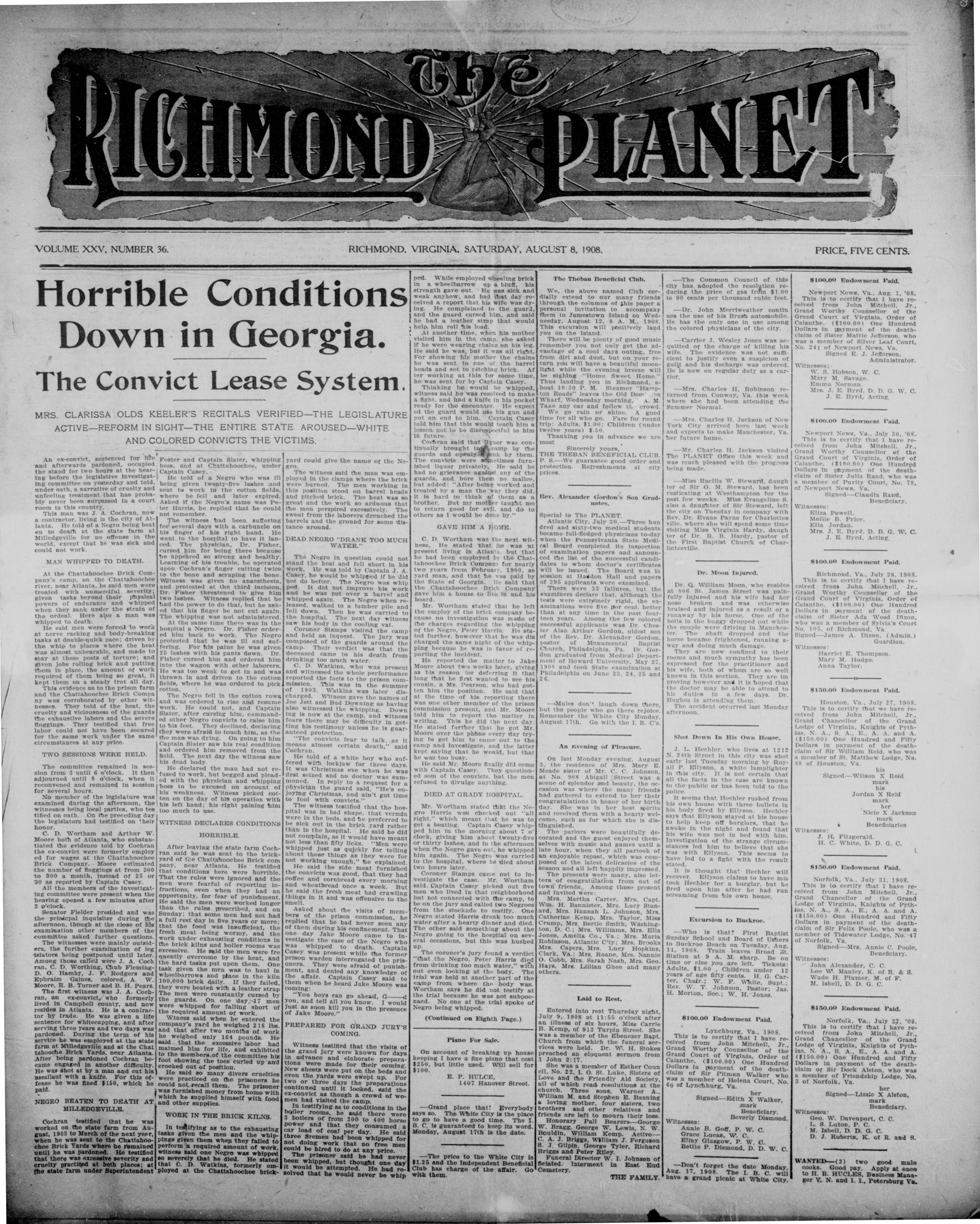
Horrible Conditions Down in Georgia. The Convict Lease System.
An ex-convict, sentenced for life and afterwards pardoned, occupied the stand for two hours at the hearing before the legislative investigating committee on yesterday and told, under oath, a narrative of cruelty and unfeeling treatment that has probably never been surpassed in a court room in this country.
This man was J. A. Cochran, now a contractor, living in the city of Atlanta. He told of a Negro being beaten to death at the state farm at Milledgeville for no offense in the world, except that he was sick and could not work.
Foster and Captain Slater, whipping boss, and at Chattahoochee, under Captain Casey.
He told of a Negro who was ill being given twenty-five lashes and sent to work in the cotton fields, where he fell and later expired. Asked if the Negro's name was Peter Harris, he replied that he could not remember.
The witness had been suffering for several days with a carbuncle on his finger of his right hand. He went to the hospital to have it lanced. The physician, Dr. Fisher, cursed him for being there because yard could give the name of the Negro.
The witness said the man was employed in the clamps where the brick were burned. The men working in this position stood on barrel heads and pitched brick. The heat was so great and the work so arduous that the men perspired excessively. The sweat from the laborers drenched the barrels and the ground for some distance around.
DEAD NEGRO "DRANK TOO MUCH WATER."
MAN WHIPPED TO DEATH.
At the Chattahooochee Brick Company's camp, on the Chattahooochee river, near Atlanta, he said men were treated with unmerciful severity; given tasks beyond their physical powers of endurance and whipped when they sank under the strain of the ordeal. Here also a man was whipped to death.
He said men were forced to work at nerve racking and body-breaking tasks at double-quick pace; driven by the whip to places where the heat was almost unbearable, and made to stay at these posts of torture; and given jobs rolling brick and putting them in place, the amount of work required of them being so great, it kept them on a steady trot all day. This evidence as to the arm and the chest of the Brick Company was corroborated by other witnesses. They told of the heat, the cruelty and viciousness of the guards the exhaustive labors and the severe floggings. They testified that free labor could not have been secured for the same work under the same circumstances at any price.
TWO SESSIONS WERE HELD.
The committee remained in session from 3 until 6 o'clock. It then adjourned until 8 o'clock, when it reconvened and remained in session for several hours.
No member of the legislature was examined during the afternoon, the witnesses being local parties, who testified on oath. On the preceding day the legislators had testified on their honor.
C. D. Wortham and Arthur W. Moore both of Atlanta, who substantiated the evidence told by Cochran the ex-convict were formerly employed for wages at the Chattahoochee Brick Company. Moore estimated the number of floggings at from 200 to 300 a month, instead of 25 or 30 as reported by Captain Casey.
All the members of the investigating committee were present when the hearing opened a few minutes after 3 o'clock.
Senator Fielder presided and was the principal inquisitor during the afternoon, though at the close of his examination other members of the committee asked further questions.
The witnesses were mainly outsiders, the further examination of legislators being postponed until later. Among those called were J. A. Cochran, C. D. Worthing, Chub Fleming-D. O. Hamby, J. F. Rodgers and Ephraim Gaines, colored. A. W. Moore, R. B. Turner and B. H. Pears.
The first witness was J. A. Cochran, an ex-convict, who formerly lived in Campbell county, and now resides in Atlanta. He is a contractor by trade. He was given a life sentence for whitecapping, and after serving three years and two days was pardoned. During the term of his service he was employed at the state farm at Milledgeville and at the Chat tahooche Brick Yards, near Atlanta. After being pardoned Cochran became engaged in another difficulty. He was shot at by a man and cut his assailant with a knife. For this offense he was wined $150, which he paid.
NEGRO BEATEN TO DEATH AT MILLEDGEVILLE.
Cochran testified that he was worked on the state farm from August, 1903 to March of the next year, when he was sent to the Chattahooche Brick Yards where he remained until he was pardoned. He testified that there was excessive severity and cruelty practiced at both places; at the state farm under Superintendent
Foster and Captain Slater, whipping boss, and at Chattahoochee, under Captain Casey.
He told of a Negro who was ill being given twenty-five lashes and sent to work in the cotton fields, where he fell and later expired. Asked if the Negro's name was Peter Harris, he replied that he could not remember.
The witness had been suffering for several days with a carbuncle on his finger of his right hand. He went to the hospital to have it lanced. The physician, Dr. Fisher, cursed him for being there because he appeared so strong and healthy. Learning of his trouble, he operated upon Cochran's finger cutting twice to the bone and scraping the bone. Witness was given no anaesthesia, and protested at the third inclusion. Dr. Fisher threatened to give him two lashes. Witness replied that he had the power to do that, but he asked that his finger be not cut again. The whipping was not administered. At the same time there was in the hospital that Dr. Fisher ordered him back to work. The Negro protested that he was ill and interfering. For his pains he was given 25 lashes with his pants down. Dr. Fisher cursed him and ordered him into the wagon with other laborers. He was too weak to get in and was thrown in and driven to the cotton fields, where he was ordered to pick cotton.
The Negro fell in the cotton rows and was ordered to rise and resume work. He could not, and Captain Slater, after cursing him, commanded other Negro convicts to raise him to his feet. They declined, declaring they were afraid to touch him, as the man was dying. On going to him Captain Slater saw his real condition and ordered him removed from the field. The next day the witness saw his dead body. He declared the man had not refused to work, but begged and pleaded with the physician and whipping boss to be excused on account of his weakness. Witness picked cotton on the day of his operation with his left hand; his right paining him too much to use.
WITNESS DECLARES CONDITIONS
HORRIBLE
After leaving the state farm Cochran said he was sent to the brick-yard of the Chattahoochee Brick company, near Atlanta. He testified that conditions here were horrible. That the rules were ignored and the men were fearful of reporting infractions, even when they had an opportunity, for fear of punishment. He said the men were worked longer than the rules prescribed, and on Sunday; that some men had not had a full rest day in five years or more; that the food was insufficient, the fresh meat being wormy, and the work under exhausting conditions in the brick kilns and boiler rooms was excessive. He said the men were frequently overcome by the heat, and the hard tasks put upon them. One task given the men was to haul in wheelbarrows and place in the kiln 100,000 brick daily. If they failed, they were beaten with a leather strap. The men were constantly cursed by the guards. On one day, 17 men were whipped for falling short of the required amount of work.
Witness said when he entered the company's yard he weighed 218 lbs. and that after two months of work he weighed only 164 pounds. He said that the excessive labor had maimed him for life, and exhibited to the members of the committee his foot showing the toes curled up and crooked out of position.
He said so many divers cruelties were practiced on the prisoners he could not recall them. The prisoner was furnished money from home with which he supplied himself with food and other supplies.
WORK IN THE BRICK KILNS
In testifying as to the exhausting tasks given the men and the whippings given them when they failed to perform a required amount of work, witness said one Negro was whipped so severely that he died. He stated that C. D. Watkins, formerly employed at the Chattahoochee brick-
RICHMOND, VIRGINIA, SATURDAY, AUGUST 8, 1908
yard could give the name of the Negro. The witness said the man was employed in the clamps where the brick were burned. The men working in this position stood on barrel heads and pitched brick. The heat was so great and the work so arduous that the men perspired excessively. The sweat from the laborers drenched the barrels and the ground for some distance around.
DEAD NEGRO "DRANK TOO MUCH
WATER."
The Negro in question could not stand the heat and fell short in his work. He was told by Captain J. A. Casey, he would be whipped if he did not do better. The Negro was whipped. It did not improve his work and he was put over a barrel and whipped again. The Negro when released, walked to a lumber pile and fell down. Then he was carried to the hospital. The next day witness saw his body in the cooling vat. Coroner Stamps visited the camp and held an inquest. The jury was composed of the guards around the camp. Their verdict was that the deceased came to his death from drinking too much water. C. D. Watkins, who was present and witnessed the whole performance reported the facts to the prison commission. This was in the summer of 1903. Watkins was later discharged. Witness gave the names of Joe Jett and Bud Downing as having also witnessed the whipping. Downing is now at the camp, and witness fears there may be difficulty in getting his testimony unless he is guaranteed protection.
"The convicts fear to talk, as it means almost certain death," said Cochran. He told of a white boy who suffered with lockjaw for three days. It was Christmas eve when he was first seized and no doctor was summoned. In reply to a request for a physician the guard said, "He's enjoying Christmas, and ain't got time to fool with convicts."
The witness testified that the hospital was in bad shape, that vermin were in the beds, and he preferred to be sick out in the brick yard rather than in the hospital. He said he did not complain, as it would have meant not less than fifty licks. "Men were whipped just as quickly for telling about these things as they were for not working enough," he explained. He said the side meat furnished the convicts was good, that they had coffee and cornbread every morning and wheatbread once a week. But he said the fresh meat had crawling things in it and was offensive to the smell. Asked about the visits of members of the prison commission, he replied that he had never seen any of them diving his confinement. That one day Jake Moore came to investigate the case of the Negro who was whipped to death. Captain Casey was present while the former prison warden interrogated the prisoners. They were afraid of punishment, and denied any knowledge of the affair. Captain Casey said to them when he heard Jake Moore was coming: "You boys can go ahead, G——d you, and tell all you know. I would just as soon kill you in the presence of Jake Moore."
PREPARED FOR GRAND JURY'S COMING.
Witness testified that the visits of the grand jury were known for days in advance and elaborate preparations were made for their coming. New sheets were put on the beds and even the yards were swept up. For two or three days the preparations continued until it looked, said the ex-convict as though a crowd of women had visited the camp. In testifying as to conditions in the boiler rooms, he said there were 3 boilers of from 300 to 400 horse power and that they consumed a car load of coal per day. He said three firemen had been whipped for not doing work that no free men could be hired to do at any price.
The prisoner said he had never been whipped, but thought one day it would be attempted. He had resolved that he would never be white.
ped. While employed wheeling brick in a wheelbarrow up a bluff, his strength gave out. He was sick and weak anyhow, and had that day received a report that his wife was dying. He complained to the guard, and the guard cursed him, and said he had a leather strap that would help him roll his load.
At another time, when his mother visited him in the camp, she asked if he were wearing chalons on his leg. He said he was. It was all right. For showing his mother the chalons he was sent to one of the barrel hems and set to pitching brick. After working at this for some time, he was sent for by Captain Casey.
Thinking he would be whipped, witness said he was resolved to make a fight, and hnd a knife in his pocket ready for the encounter. He expect ed the guard would use his gun and put an end to him. Captain Casey told him that this would teach him a lesson not to be disrespectful to him in future.
Cocran said that liquor was continually brought into camp by the guards and openly drunk by them. The convicts were sometimes furnished liquor privately. He said he had no grievance against any of the guards, and bore them no malice, but added: "After being worked and treated by a man the way they did, it is hard to think of them as a brother. But my mother taught me to return good for evil, and do to others as I would be done by."
GAVE HIM A HOME
C. D. Worthham was the next witness. He stated that he was at present living in Atlanta, but that he had been employed by the Chattahoochee Brick Company for nearly two years from February, 1900, as yard man, and that he was paid by the State of Georgia. He said that the Chattahoochee Brick Company gave him a house to live in and his board.
Mr. Worthham stated that he left the employ of the brick company because no investigation was made of the charges regarding the whipping or the Negro, Peter Harris. He stated further, however that he was discharged the same night of the whipping because he was in favor of reporting the incident.
He reported the matter to Jake Moore about two weeks later, giving as his reason for deferring it that long that he first wanted to see his son, a Mr. Pearson, who had gotten him the position. He said that at the time of his reporting there was one other member of the prison commission present, and Mr. Moore told him to report the matter in writing. This he did the next day.
He stated further that he got Mr. Moore over the phone every day trying to get him to come out to the camp and investigate, and the latter kept saying that he would, but that he was too busy.
He said Mr. Moore finally did come with Captain Casey. They questioned som of the convicts, but the men refused to divulge anything.
DIED AT GRADY HOSPITAL
Mr. Worthham stated that the Negro Harris was checked out "all right," which meant that he was to get a beating. Captain Casey whipped him in the morning about 7 o'clock, giving him about twenty-five or thirty lashes, and in the afternoon when the Negro gave out, he whipped him again. The Negro was carried to the hospital, where he died about two hours later.
Coroner Stamps came out to investigate the case, Mr. Worthham said. Captain Casey picked out five men who lived in that neighborhood but not connected with the camp, to be on the jury and called two Negroes from the stockade to testify. One Negro stated Harris drank too much water after a hearty dinner and died. The other said something about the Negro going to the hospital on several occasions, but this was hushed up.
The coroner's jury found a verdict "that the Negro, Peter Harris died from drinking too much water," with out even looking at the body. The trial was held at another part of the camp from where the body was. Worthham says he did not testify at the trial because he was not subpoenaed. No one at the trial spoke of Negro being whipped.
(Continued on Eighth Page.)
Piano For Sale.
On account of breaking up house
keeping I have a fine piano that cost
$250, but little used. Will sell for
$100.
—Grand place that! Everybody says so. The White City is the place to go to have a good time. The I. B. C. is guaranteed to keep its word. Monday, August 17th is the date.
The price to the White City is $1.25 and the Independent Beneficial Club has charge of the affair. Go with them.
The Theban Beneficial Club.
We, the above named Club cordially extend to our many friends through the columns of this paper a personal invitation to accompany them to Jamestown Island on Wednesday, August 12, 8 A. M., 1908. This excursion will positively land you on the Island.
There will be plenty of good music remember you not only get the advantage of a cool days outing, free from dirt and dust, but on your return you will have a beautiful moonlight while the evening breeze will be sighing "Home Sweet Home."
Thus landing you in Richmond, about 10:30 P. M. Steamer "Hampton Roads" leaves the Old Dom" on Wharf, Wednesday morning, A. M. Take any car and follow th. crowd.
We go rain or shine. A good time for all who go. Fare for round trip: adults, $1.00; Children (under twelve years) $.50.
Thanking you in advance we are most
Sincerely yours.
THE THEBAN BENEFICIAL CLUB.
P. S. We guarantee good order and protection. Refreshments at city prices.
Rev. Alexander Gordon's Son Graduates.
Special to the PLANET
Atlantic City, July 30.—Three hundred and sixty-two medical students became full-fledged physicians to-day when the Pennsylvania State Medical Board completed its inspection of examination papers and announced the list of the successful candidates to whom doctor's certificates will be issued. The Board was in session at Haddon Hall and papers of 295 applicants were examined.
There were 33 failures, but the examiners declare that, although the tests were extremely rigid, the examinations were five per cent. better than at any time in the past fourteen years. Among the few colored successful applicants was Dr. Chester Alan Arthur Gordon, oldest son of the Rev. Dr. Alexander Gordon, pastor of Monumental Baptist Church, Philadelphia, Pa. Dr. Gordon graduated from Medical Department of Howard University, May 27, 1908 and took State examination at Philadelphia on June 23, 24, 25 and 26.
---
- Mules don't laugh down there, but the people who go there rejoice. Remember the White City Monday, August 17th. Go with the L B, C's.
An Evening of Pleasure
On last Monday evening, August 3, the residence of Mrs. Mary E. Meade sister of Mr. C. C. Johnson, at No. 908 Abigail 'Street' was a scene of splendor and beauty, the occasion was where the many friends had gathered to extend to her their congratulations in honor of her birth day. She was in her best spirits and received them with a hearty welcome, such as for which she is distinguished.
The parlers were beautifully decorated and the guest enjoyed themselves with music and games until a late hour, when they all partook of an enjoyable repast, which was composed of the latest delicacies of the season and all left happily impressed.
The presents were many, also letters of congratulation from out of town friends. Among those present and invited were:
Mrs. Martha Carter, Mrs. Capt. Wm. H. Bannister, Mrs. Lucy Standard, Mrs. Hannah L. Johnson, Mrs. Catherine Kemp, Mrs. Taylor, Miss Crump, Mrs. Bertie Smith, Washington, D. C.; Mrs. Williams, Mrs. Ella Jones, Amelia Co., Va.; Mrs. Maria Robinson, Atlantic City; Mrs. Brooks Mrs. Capers, Mrs. Lucy Hopkins, Clark, Va.; Mrs. Roane, Mrs. Nannie O. Cobb, Mrs. Sarah Nash, Mrs. Geo, Hays, Mrs. Lillian Ghee and many others.
Laid to Rest.
Entered into rest Thursday night,
July 9, 1908 at 11:55 o'clock after
an illness of six hours, Miss Carrie
B. Kemp, of 912 Turpin Street. She
was a member of the Ebeneze Bapt.
Church from which the funeral
services were held. Dr. W. H. Stokes
preached an eloquent sermon from
1 John 2:17.
She was a member of Esther Coun
cil, No. 22, I. O. St. Luke, Sisters of
Love and the Friendly Aid Society,
all of which read resolutions at the
church. Three sons, Warner A.,
William M. and Stephen E. Banning
a loving mother, four sisters, two
brothers and other relatives and
friends are left to mourn their loss.
Honorary Pall Bearers—George
W. Bragg, George W. Lewis, N. W.
Bouldin, William Kemp. Active—
C. A. J. Briggs, William J. Ferguson
S. J. Gilpin, George Tyler, Richard
Briggs and Peter Riley.
Funeral Director W. I. Johnson of
faciated. Interment in East End
Cemetery.
—The Common Council of this city has adopted the resolution reducing the price of gas from $1.00 to 90 cents per thousand cubic feet.
—Dr. John Merriweather continues the use of his Brush automobile. He has the only one in use among the colored physicians of the city.
—Carrier J. Wesley Jones was acquitted of the charge of killing his wife. The evidence was not sufficient to justify even a suspicion of guilt and his discharge was ordered. He is now on regular duty as a carrier.
—Mrs. Charles H. Robinson returned from Conway, Va. this week where she had been attending the Summer Normal.
—Mrs. Charles H. Jackson of New York City arrived here last week and expects to make Manchester, Va. her future home.
—Mr. Charles H. Jackson visited The PLANET Office this week and was much pleased with the progress being made.
—Miss Racilia W. Steward, daughter of Sir O. M. Steward, has been rusticating at Westhampton for the past few weeks. Miss Evangeline S. also a daughter of Sir Steward, left the city on Tuesday in company with Rev. Dr. Evans Payne for Charlottesville, where she will spend some time visiting Miss Virginia Hardy, daughter of Dr. R. B. Hardy, pastor of the First Baptist Church of Charlottesville.
Dr. Moon Injured.
Dr. Q. William Moon, who resides at 806 St. James Street was painfully injured and his wife had her nose broken and was otherwise bruised and injured as a result of a runaway by his horse. One of the bolts in the buggy dropped out while the couple were driving in Manchester. The shaft dropped and the horse became frightened, running away and doing much damage. They are now confined to their rooms and much sympathy has been expressed for the practitioner and his wife, both of whom are so well known in this section. They are im proving however and it is hoped that the doctor may be able to attend to his duties in a few days. Dr. Hughes is attending them. The accident occurred last Monday afternoon.
Shot Down In His Own House
J. L. Hechler, who lives at 1212 N. 24th Street in this city was shot early last Tuesday morning by Royall P. Ellison, a white lamblighter in this city. It is not certain that all the facts in the case are known to the public or has been told to the police.
It seems that Hechler rushed from his own house with three bullets in his body fired by Ellison. Hechler says that Ellison stayed at his house to help keep off burglars, that he awoke in the night and found that his wife was not in bed with him. Investigation of the strange circumstance led him to believe that she was with Ellison. This seems to have led to a fight with the result stated.
It is thought that Hechler will recover. Ellison claims to have mis took Hechler for a burglar, but he fired upon him after he had run screaming from his own house
Excursion to Buckroe.
—Who is that? First Baptist
Sunday School and Board of Ushers
to Buckroe Beach on Tuesday, Aug.
11, 1908. Train leaves Broad St.
Station at 9 A. M. sharp. Be on
time or else you are left. Tickets:
Adults, $1.00, Children under 12
years of age fifty cents. H. G. Carter,
Chair; W. F. White, Supt;
Rev. W. T. Johnson, Pastor; Jas
H. Morton, Sec.; W. H. Jones
$100.00 Endowment Paid
Lynchburg, Va., 1908.
This is to certify that I have received from John Mitchell, Jr.,
Grand Worthy Counsellor of the Grand Court of Virginia, Order of Calanthe, ($100.00) One Hundred Dollars in payment of the deathclaim of Sir Pitman Walker who was a member of Helena Court, No. 60 of Lynchburg, Va.
her
Signed—Edith X Walker,
mark
Beneficiary.
Beverly Dismond.
Witnesses:
Annie B. Goff, P. W. C.
Grace Lucas, W. C.
Eliny Glasgow, P. W. C.
Bettie P. Dismond, D. D. W. C.
—Don't forget the date Monday,
Aug. 17, 1908. The I. B. C. will have a grand picnic at White City
PRICE, FIVE CENTS
$100.00 Endowment Paid.
Newport News, Va., Aug. 1, '08.
This is to certify that I have received from John Mitchell, Jr.,
Grand Worthy Counselor of the Grand Court of Virginia, Order of Calanthe, ($100.00). One Hundred Dollars in payment of the deathclaim of Sister Mattie Jefferson, who was a member of Silver Leaf Court,
No. 241 of Newport News, Va.
Witnesses:
W. S. Hobson, W. C.
Mary M. Savage.
Emma Norman.
Mrs. J. E. Byrd, D. D. G. W. C.
J. E. Byrd, Acting.
$100.00 Endowment Paid
Newport News, Va. July 30, '08.
This is to certify that I have received from John Mitchell, Jr.
Grand Worthy Counselor of the Grand Court of Virginia, Order of Calanthe, ($160.00) One Hundred Dollars in payment of the deathclaim of Sister Julia Rand, who was a member of Purity Court, No. 78, of Newport News, Va.
# DIRECTORS:
Eliza Powell,
Mollie B. Price.
Ella Jordan.
Mrs. J. E. Byrd, D. D. G. W. C.
J. E. Byrd, Acting.
$100.00 Endowment Paid.
Richmond, Va. July 28, 1908.
This is to certify that I have received from John Mitchell, Jr.
Grand Worthy Counsellor of the Grand Court of Virginia, Order of Calanthe. ($100.00) One Hundred Dollars in payment of the deathclaim of Sister Ada Wood Dixon, who was a member of Sylvia's Court Richmond, Va. Signed Iorien Dixon (Admin.)
Signed—James A. Dixon, (Admin.)
Guardian.
Witnesses:
Harriet E. Thompson.
Mary M. Hodge.
Anna Taylor.
$150.00 Endowment Paid.
Houston, Va., July 27, 1908.
This is to certify that we have received from John Mitchell, Jr.,
Grand Chancellor of the Grand Lodge of Virginia, Knights of Pythias, N. A., S. A., E. A. A. and A. ($150.00) One Hundred and Fifty Dollars in payment of the death-claim of Sir William Reid, who was a member of St. Matthew Lodge, No. 88 of Houston, Va.
his
Signed—Wilson X Reid
mark
his
Jordan X Reid
mark
her
Nicie X Jackson
mark
Beneficiaries.
Witnesses:
J. H. Fitzgerald.
H. C. White, D. D. G. C.
$150.00 Endowment Paid.
Norfolk, Va., July 31, 1908.
This is to certify that I have received from John Mitchell, Jr.,
Grand Chancellor of the Grand
Lodge of Virginia, Knights of Pythias, N. A., S. A., E., A. A. and A.
($150.00) One Hundred and Fifty
Dollars in payment of the death-
claim of Sir Felix Poole, who was a
member of Tidewater Lodge, No. 47
of Norfolk, Va.
Signed—Mrs. Annie C. Poole,
Beneficiary.
Witnesses:
John Alexander, C. C.
Lee W. Manley, K. of R. & S.
Wade H. Plumer, M. of F.
M. Isbell, D. D. G. C.
$150.00 Endowment Paid
Norfolk, Va., July 27, '08.
This is to certify that I have received from John Mitchell, Jr.,
Grand Chancellor of the Grand
Lodge of Virginia, Knights of Pythias, N. A., S. A., E., A. A. and A.
($150.00) One Hundred and Fifty
Dollars in payment of the death-
claim or Sir Dock Alston, who was
a member of Friendship Lodge, No.
3 of Norfolk, Va.
Witnesses:
Geo. W. Davenport, C. C.
L. S. Luton, P. C.
M. Isbell, D. D. G. C.
D. J. Roberts, K. of R. and S.
WANTED—(2) two good male cooks. Good pay. Apply at once to H. B. HUCLES, Business Manager V. N. and I. L., Petersburg Va.
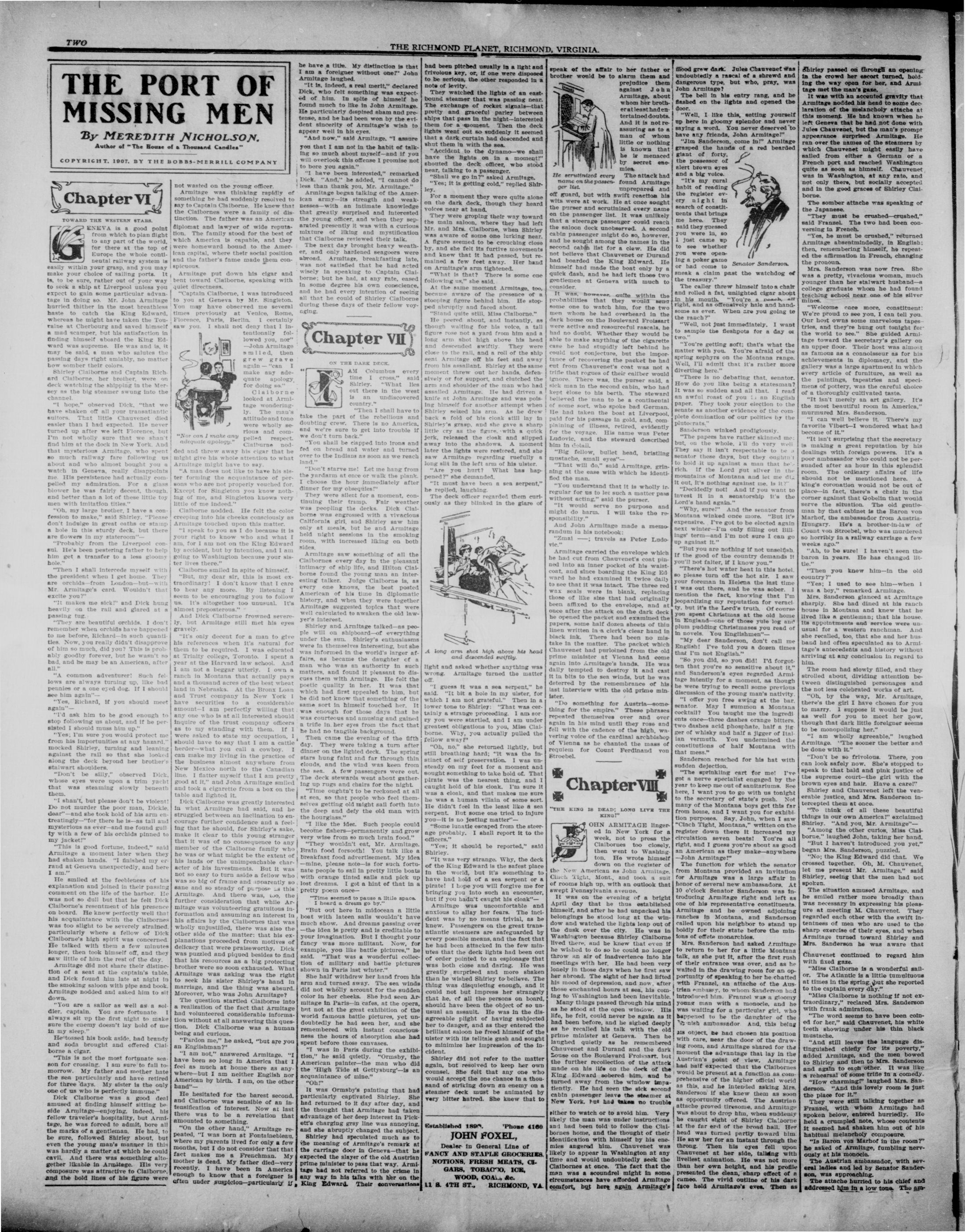
THE PORT OF MISSING MEN
By MEREDITH NICHOLSON. Author of "The House of a Thousand Candles"
COPYRIGHT, 1907. BY THE BOBBS-MERRILL COMPANY
TWO
Chapter VI
TOWARD THE WESTERN STARS.
ENEVA is a good point
from which to plan flight
to any part of the world,
for there at the top of
Europe the whole continental railway system is
ENEVA is a good point from which to plan flight to any part of the world, for there at the top of Europe the whole continental railway system is easily within your grasp, and you may make your choice of sailing ports. It is, to be sure, rather out of your way to seek a ship at Liverpool unless you expect to gain some particular advantage in doing so. Mr. John Armitage hurried thither in the most breathless haste to catch the King Edward, whereas he might have taken the Touralne at Cherbourg and saved himself a mad scamper, but his satisfaction in finding himself aboard the King Edward was supreme. He was and is, it may be said, a man who salutes the passing days right amiably, no matter how somber their colors.
Shirley Clalborne and Captain Richard Clalborne, her brother, were on deck watching the shipping in the Mersey as the big steamer swung into the channel.
"I hope," observed Dick, "that we have shaken off all your transatlantic suitors. That little Chauvenet died easier than I had expected. He never turned up after we left Florence, but I not wholly sure that we shan't find him at the dock in New York. And that mysterious Armitage, who spent so much railway fare following us about and who almost bought you a watch in Geneva, really disappoints me. His persistence had actually compelled my admiration. For a glass blower he was fairly decent, though, and better than a lot of these little toy men with imitation titles."
"Oh, my large brother, I have a confession to make," said Shirley. "Please don't indulge in great oaths or stamp a hole in this sturdy deck, but there are flowers in my stateroom"—
"Probably from the Liverpool consul. He's been pestering father to help him get a transfer to a less gloomy hole."
"Then I shall intercede myself with the president when I get home. They are orchids—from London—but—with Mr. Armitage's card. Wouldn't that excite you?" "It makes me sick!" and Dick hung heavily on the rail and glared at a passing tug. "They are beautiful orchids. I don't remember when orchids have happened to me before, Richard—in such quantities. Now, you really didn't disapprove of him so much, did you? This is probably goodbye forever, but he wasn't so bad, and he may be an American, after all." "A common adventurer! Such fellows are always turning up, like bad pennies or a one eyed dog. If I should see him again"— "Yes, Richard, if you should meet again"— "I'd ask him to be good enough to stop following us about, and if he persisted I should muss him up."
"Yes, I'm sure you would protect me from his importunities at any hazard," mocked Shirley, turning and leaning against the rail so that she looked along the deck beyond her brother's stalwart shoulders.
"Don't be silly," observed Dick, whose eyes were upon a trim yacht that was steaming slowly beneath them.
"I shan't, but please don't be violent! Do not murder the poor man, Dickle, dear!" and she took hold of his arm entreatingly—"for there he is—as tall and mysterious as ever—and me found guilty with a few of his orchids pinned to my jacket!"
"This is good fortune, indeed," said Armitage a moment later when they had shaken hands. "I finished my erand at Geneva unexpectedly, and here I am."
He smiled at the feebleness of his explanation and joined in their passing comment on the life of the harbor. He was not so dull but that he felt Dick Claiborne's resentment of his presence on board. He knew perfectly well that his acquaintance with the Claiborne was too slight to be severely strained, particularly where a fellow of Dick Claiborne's high spirit was concerned. He talked with them a few minutes longer, then took himself off, and they saw little of him the rest of the day. Armitage did not share their distinction of a seat at the captain's table, and Dick found him late at night in the smoking saloon with pipe and book. Armitage nodded and asked him to sit down.
"You are a sailor as well as a soldier, captain. You are fortunate. I always sit up the first night to make sure the enemy doesn't lay hold of me in my sleep."
He tossed his book aside, had brandy and soda brought and offered Clalborne a cigar.
"This is not the most fortunate season for crossing. I am sure to fall toorrow. My father and mother hate the sea particularly and have retired for three days. My sister is the only one of us who is perfectly immune."
Dick Clalborne was a good deal amused at finding himself sitting beside Armitage—enjoying, indeed, his fellow traveler's hospitality, but Armitage, he was forced to admit, bore all the marks of a gentleman. He had, to be sure, followed Shirley about, but even the young man's manner in this was hardly a matter at which he could cavil. And there was something altogether likable in Armitage. His very composure was attractive to Clalborne, and the bold lines of his figure were
not wasted on the young officer.
Armitage was thinking rapidly of something he had suddenly resolved to say to Captain Claiborne. He knew that the Claibornes were a family of distinction. The father was an American diplomat and lawyer of wide reputation. The family stood for the best of which America is capable, and they were homeward bound to the American capital, where their social position and the father's fame made them conspicuous.
Armitage put down his cigar and bent toward Claiborne, speaking with quiet directness.
"Captain Claiborne, I was introduced to you at Geneva by Mr. Singleton. You may have observed me several times previously at Venice, Rome, Florence, Paris, Berlin. I certainly saw you. I shall not deny that I in-
tentionally followed you nor"
A
tentionally followed you, not"
"John Armitage smiled, then grew grave again—"can I make any adequate apology for doing so."
Claiborne looked at Armitage wonderingly. The man's attitude and tone were wholly serious and compelled respect.
Claiburne nods his cigar that he attention to what to see.
"Nor can I make any adequate apology." Clalburne nodded and threw away his cigar that he might give his whole attention to what Armitage might have to say.
"A man does not like to have his sister forming the acquaintance of persons who are not properly vouched for. Except for Singleton you know nothing of me, and Singleton knows very little of me indeed."
Clalburne nodded. He felt the color creeping into his cheeks consciously as Armitage touched upon this matter.
"I speak to you as I do because it is your right to know who and what I am, for I am not on the King Edward by accident, but by intention, and I am going to Washington because your sister lives there."
Clalborne smiled in spite of himself.
"But, my dear sir, this is most extraordinary! I don't know that I care to hear any more. By listening I seem to be encouraging you to follow us. It's altogether too unusual. It's almost proposterous." And Dick Clalborne frowned severely, but Armitage still met his eyes gravely.
"It's only decent for a man to give his references when it's natural for them to be required. I was educated at Trinity college, Toronto. I spent a year at the Harvard law school. And I am not a beggar utterly. I own a ranch in Montana that actually pays and a thousand acres of the best wheat land in Nebraska. At the Bronx Loan and Trust company in New York I have securities to a considerable amount—I am perfectly willing that any one who is at all interested should inquire of the trust company officers as to my standing with them. If I were asked to state my occupation, I should have to say that I am a cattle herder—what you call a cowboy. I can make my living in the practice of the business almost anywhere from New Mexico north to the Canadian line. I flatter myself that I am pretty good at it," and John Armitage smiled and took a cigarette from a box on the table and lighted it.
Dick Claiborne was greatly interested in what Armitage had said, and he struggled between an inclination to encourage further confidence and a feeling that he should, for Shirley's sake, make it clear to this young stranger that it was of no consequence to any member of the Claiborne family who he was or what might be the extent of his lands or the unimpeachable character of his investments. But it was not so easy to turn aside a fellow who was so big of frame and apparently so sane and so steady of purpose as this Armitage. And there was, too, the further consideration that while Armitage was volunteering gratuitous information and assuming an interest in his affairs by the Claiborne that was wholly unjustified, there was also the other side of the matter: that his explanations proceeded from motives of delicacy that were praiseworthy. Dick was puzzled and plied besides to find that his resources as a big protecting brother were so soon exhausted. What Armitage was asking was the right to seek his sister Shirley's hand in marriage, and the thing was absurd. Moreover, who was John Armitage?
The question startled Claiborne into a realization of the fact that Armitage had volunteered considerable information without at all answering this question. Dick Claiborne was a human being and curious.
"Pardon me," he asked, "but are you an Englishman?"
"I am not," answered Armitage. "I have been so long in America that I feel as much at home there as anywhere—but I am neither English nor American by birth. I am, on the other hand".
He hesitated for the barest second, and Claiborne was sensible of an intensification of interest. Now at last there was to be a revelation that amounted to something.
"On the other hand," Armitage repeated, "I was born at Fontalebleau, where my parents lived for only a few months, but I do not consider that that fact makes me a Frenchman. My mother is dead. My father died—very recently. I have been in America enough to know that a foreigner is often under suspicion—particularly if
THE RICHMOND PLANET, RICHMOND, VIRGINIA
he have a title. My distinction is that I am a foreigner without one!" John Armitage laughed. "It is, indeed, a real merit," declared Dick, who felt something was expected of him. In spite of himself he found much to like in John Armitage. He particularly deepised sham and pretense, and he had been won by the evident sincerity of Armitage's wish to appear well in his eyes. "And now," said Armitage, "I assure you that I am not in the habit of talking so much about myself—and if you will overlook this offense I promise not to bore you again." "I have been interested," remarked Dick. "And," he added, "I cannot do less than thank you, Mr. Armitage."
Armitage began talking of the American army—its strength and weaknesses—with an intimate knowledge that greatly surprised and interested the young officer, and when they separated presently it was with a curious mixture of liking and mystification that Clalborne reviewed their talk. The next day brought heavy weather, and only hardened seagoors were abroad. Armitage, breakfasting late, was not satisfied that he had acted wisely in speaking to Captain Clalborne; but he had, at any rate, eased in some degree his own conscience, and he had every intention of seeing all that he could of Shirley Clalborne during these days of their fellow voyaging.
Chapter VII
ON THE DARK DECK.
AM Columbus every time I cross," said Shirley. "What lies out there in the west is an undiscovered country."
AM Columbus every time I cross," said Shirley. "What lies out there in the west is an undiscovered country."
"Then I shall have to take the part of the rebellious and doubting crew. There is no America, and we're sure to get into trouble if we don't turn back."
"You shall be clipped into irons and fed on bread and water and turned over to the Indians as soon as we reach land."
"Don't starve me! Let me hang from the yardarm at once or walk the planks. I choose the hour immediately after dinner for my obsequies!"
They were silent for a moment, continuing their tramp. Fair weather was peopling the decks. Dick Clalborne was engrossed with a vivacious California girl, and Shirley saw him only at meals, but he and Armitage held night sessions in the smoking room, with increased liking on both sides.
Armitage saw something of all the Clalborne every day in the pleasant intimacy of ship life, and Hilton Clalborne found the young man an interesting talker. Judge Clalborne is, as every one knows, the best posted American of his time in diplomatic history, and when they were together Armitage suggested topics that were well calculated to awaken the old lawyer's interest.
Shirley and Armitage talked—as people will on shipboard—of everything under the sum. Shirley's enthusiasm were in themselves interesting, but she was informed in the world's larger affairs, as became the daughter of a man who was an authority in such matters, and found it pleasant to discuss them with Armitage. He felt the poetic quality in her. It was that which had first appealed to him, but he did not know that something of the same sort in himself touched her. It was enough for those days that he was courteous and amusing and gained a trifle in her eyes from the fact that he had no tangible background. Then came the evening of the fifth day. They were taking a turn after dinner on the lighted deck. The spring stars hung faint and far through thin clouds, and the wind was keen from the sea. A few passengers were out. The deck stewards went about gathering up rugs and chairs for the night.
"Time oughtn't to be reckoned at all at sea, so that people who feel themselves getting old might sail forth into the deep and defy the old man with the hourglass."
"I like the idea. Such people could become fishers—permanently and grow very wise from so much brain food."
"They wouldn't eat, Mr. Armitage. Brain food forsooth! You talk like a breakfast food advertisement. My idea—mine, please note—is for such fortunate people to sail in pretty little boats with orange tinted sails and pick up lost dreams. I got a hint of that in a pretty poem once—
"Time seemed to pause a little space. I heard a dream go by."
"But out here in midocean a little boat with lateen sails wouldn't have much show. And dreams passing over—the idea is pretty and is creditable to your imagination. But I thought your fancy was more militant. Now, for example, you like battle pictures," he said. "That was a wonderful collection of military and battle pictures shown in Paris last winter." She half withdrew her hand from his arm and turned away. The sea winds did not wholly account for the sudden color in her cheeks. She had seen Armitage in Paris-in cafes, at the opera, but not at the great exhibition of the world famous battle pictures, yet undoubtedly he had seen her, and she remembered with instant consciousness the hours of absorption she had spent before those canvases.
"I was in Paris during the exhibition," he said quietly. "Ormsby, the American painter—the man who did the 'High Tide at Gettysburg'—is an acquaintance of mine." "Oh!"
It was Ormsby's painting that had particularly captivated Shirley. She had returned to it day after day, and the thought that Armitage had taken advantage of her deep interest in Pickett's charging gray line was annoying, and she abruptly changed the subject. Shirley had speculated much as to the meaning of Armitage's remark at the carriage door in Geneva—that he expected the slayer of the old Austrian prime minister to pass that way. Armitage had not referred to the crime in any way in his talks with her on the King Edward. Their conversations
had been pitched usually in a light and frivolous key, or, if one were disposed to be serious, the other responded in a note of levity.
They watched the lights of an east-bound steamer that was passing near. The exchange of rocket signals—that pretty and graceful parley between ships that pass in the night—interested them for a moment. Then the deck lights went out so suddenly it seemed that a dark curtain had descended and shut them in with the sea.
"Accident to the dynamo—we shall have the lights on in a moment" shouted the deck officer, who stood near, talking to a passenger.
"Shall we go in?" asked Arnultage.
"Yes; it is getting cold," replied Shhrley.
For a moment they were quite alone on the dark deck, though they heard voices near at hand.
They were groping their way toward the main saloon, where they had left Mr. and Mrs. Claiborne, when Shirley was aware of some one lurking near. A figure seemed to be crouching close by, and she felt its furtive movements and knew that it had passed, but remained a few feet away. Her hand on Armitage's arm tightened.
"What is that? There is some one following us," she said.
At the same moment Armitage, too, became aware of the presence of a stooping figure behind him. He stopped abruptly and faced about.
“Stand quite still, Miss Claiborne.” He peered about, and instantly, as though waiting for his voice, a tall figure rose not a yard from him and a long arm shot high above his head and descended swiftly. They were close to the rail, and a roll of the ship sent Armitage off his feet and away from his assailant. Shirley at the same moment threw out her hands, defensively or for support, and clutched the arm and shoulder of the man who had assailed Armitage. He had driven a knife at John Armitage and was posing himself for another attempt when Shirley seized his arm. As he drew back a fold of his cloak still lay in Shirley's grasp, and she gave a sharp little cry as the figure, with a quick jerk, released the clock and slipped away into the shadows. A moment later the lights were restored, and she saw Armitage regarding ruefully a long slit in the left arm of his ulster. “Are you hurt? What has hap-
"Are you hurt? What has happened?" she demanded.
"It must have been a sca serpent," he replied, laughing.
The deck officer regarded them curiously as they blinked in the glare of
A long arm shot high above his head and descended swiftly.
light and asked whether anything was wrong. Armitage turned the matter off.
"I guess it was a sea serpent," he said. "It bit a hole in my ulcer, for which I am not grateful." Then in a lower tone to Shirley: "That was certainly a strange proceeding. I am sorry you were startled, and I am under greatest obligations to you, Miss Clalborne. Why, you actually pulled the fellow away?"
"Oh, no," she returned lightly, but still breathing hard; "it was the instinct of self preservation. I was unsteady on my feet for a moment and sought something to take hold of. That pirate was the nearest thing, and I caught hold of his cloak. I'm sure it was a cloak, and that makes me sure he was a human villain of some sort. He didn't feel in the least like a sea serpent. But some one tried to injure you—it is no nesting matter—"
"Some lunatic escaped from the steerage probably. I shall report it to the officers."
"Yes; it should be reported," said Shirley.
"It was very strange. Why, the deck of the King Edward is the safest place in the world, but it's something to have had hold of a sea serpent or a pirate! I hope you will forgive me for bringing you into such an encounter, but if you hadn't caught his cloak"—
Armitage was uncomfortable and anxious to allay her fears. The incident was by no means trivial, as he knew. Passengers on the great transatlantic steamers are safeguarded by every possible means, and the fact that he had been attacked in the few minutes that the deck lights had been out of order pointed to an espionage that was both close and daring. He was greatly surprised and more shaken than he wished Shirley to believe. The thing was disquieting enough, and it could not but impress her strangely that he, of all the persons on board, should have been the object of so unusual an assault. He was in the disagreeable plight of having subjected her to danger, and as they entered the brilliant saloon he freed himself of the uister with its telltale gash and sought to minimize her impression of the incident.
Shirley did not refer to the matter again, but resolved to keep her own counsel. She felt that any one who would accept the one chance in a thousand of striking down an enemy on a steamer deck must be animated by very bitter hatred. She knew that to
Dealer in General Line of
FANCY AND STAPLE GROCERIES
NOTIONS, FRESH MEATS, CI-
GARS, TOBACCO, ICE,
WOOD, COAL, &c.
11.8 4TH ST. RICHMOND, VA
11 8. 4TH ST., RICHMOND, VA
speak of the affair to her father or brother would be to alarm them and prejudice them against John Armitage, about whom her brother least had entertained doubts. And it is not reassuring as to a man of whom little or nothing is known that he is menaced by secret enemies.
Lecture
The attack had found Armitage unprepared and
He scrutinized every The attack had name on the passen- found Armitage ger list. unprepared and off guard, but with swift reaction his wits were at work. He at once sought the purser and scrutinized every name on the passenger list. It was unlikely that a steerage passenger could reach the saloon deck unobserved. A second cabin passenger might do so, however, and he sought among the names in the second cabin list for a clew. He did not believe that Chauvenet or Durand had boarded the Kingen Edward. He himself had made the boat only by a quick dash, and he had left those two gentlemen at Geneva with much to consider.
It was, however, quite within the probabilities that they would send some one to watch him, for the two men whom he had overheard in the dark house on the Boulevard Frolasart were active and resourceful rascals, he had no doubt. Whether they would be able to make anything of the cigarette case he had stupidly left behind he could not conjecture, but the importance of recovering the packet he had cut from Chauvenet's coat was not a trifle that rogues of their caliber would ignore. There was, the purser said, a sick man in the second cabin, who had kept close to his berth. The steward believed the man to be a continental of some sort, who spoke bad German. He had taken the boat at Liverpool, paid for his passage in gold, and, complaining of illness, retired, evidently for the voyage. His name was Peter Ludovic, and the steward described him in detail.
"Big fellow, bullet head, bristling mustache, small eyes"—
"That will do," said Armitage, grinning at the ease with which he identified the man.
"You understand that it is wholly irregular for us to let such a matter pass without acting," said the purser.
"It would serve no purpose and might do harm. I will take the responsibility."
And John Armitage made a memorandum in his notebook:
"Zmal ---; travels as Peter Ludovie."
Armitage carried the envelope which he had cut from Chauvenet's cont pinned into an inner pocket of his waist coat, and since boarding the King Edward he had examined it twice daily to see that it was intact. The three red wax seals were in blank, replacing those of like size that had originally been affixed to the envelope, and at once after the attack on the dark deck he opened the packet and examined the papers, some half dozen sheets of thin linen written in a clerk's clear hand in black ink. There had been no mistake in the matter. The packet which Chauvenet had purloined from the old prime minister at Vienna had come again into Armitage's hands. He was daily tempted to destroy it and cast it in bits to the sea winds, but he was deterred by the remembrance of his last interview with the old prime minister.
"Do something for Austria—something for the empire." These phrases repeated themselves over and over again in his mind until they rose and fell with the cadence of the high, wavering voice of the cardinal archbishop of Vienna as he chanted the mass of requiem for Count Ferdinand von Stroebel.
ChapterVIII
"THE KING IS DEAD; LONG LIVE THE KING!"
OHN ARMITAGE lingered in New York for a week, not to press the Claibornes too closely, then went to Washington. He wrote himself down on the register of
OHN ARMITAGE lingered in New York for a week, not to press the Clalibornees too closely, then went to Washington. He wrote himself down on the register of the New American as John Armitage. Clutch Tight, Mont., and took a suit of rooms high up, with an outlook that swept Pennsylvania avenue.
It was on the evening of a bright April day that he thus established himself, and after he had unpacked his belongings he stood long at the window and watched the lights leap out of the dusk over the city. He was in Washington because Shirley Claliborne lived there, and he knew that even if he wished to do so he could no longer throw an air of inadvertence into his meetings with her. He had been very lonely in those days when he first saw her abroad. The sight of her had lifted his mood of depression, and now, after those enchanted hours at sea, his coming to Washington had been inevitable
Many things passed through his mind as he stood at the open window. His life, he felt, could never be again as it had been before, and he sighed deeply as he recalled his talk with the old prime minister at Geneva. Then he laughed quietly as he remembered Chauvenet and Durand and the dark Zouse on the Boulevard Froissart, but the further recollection of the attack made on his life on the deck of the King Edward sobered him, and he turned away from the window impatiently. He had seen the sick second cabin passenger leave the steamer at New York. But had taken no trouble
either to watch or to avoid him. Very likely the man was under instructions and had been told to follow the Claibornes home, and the thought of their identification with himself by his enemies angered him. Chauvenet was likely to appear in Washington at any time and would undoubtedly seek the Claibornes at once. The fact that the man was a sounddrel might in some circumstances have afforded Armitage comfort, but here again Armitage's
mood grew dark. Jules Chauvenet was undoubtedly a rascal of a shrewd and dangerous type, but who, pray, was John Armitage?
The bell in his entry rang, and he flashed on the lights and opened the door.
"Well, I like this, setting yourself up here in gloomy splendor and never saying a word. You never deserved to have any friends, John Armitage!"
"Jim Sanderson, come in!" Armitage grasped the hands of a red bearded
"Jim Sanderson grasped the hand giant of forty, the possessor of alert brown eyes and a big voice.
3
"I'ts my rural habit of reading the register every night in search of constituents that brings me here. They said they guessed you were in, so I just came up to see whether you were opening a poker game or had come to
sneak a claim past the watchdog of the treasury."
The caller threw himself into a chair and rolled a fat, unlighted cigar about in his mouth. "You're a peach, all right, and as offensively hale and hand-some as ever. When are you going to the ranch?
"Well, not just immediately. I want to sample the fleshpots for a day or two."
"You're getting soft; that's what the matter with you. You're afraid of the spring zephyr on the Montana range. Well, I'll admit that it's rather more diverting here."
"There is no debating that, senator. How do you like being a statesman? It was so sudden and all that. I read an awful roast of you in an English paper. They took your election to the senate as another evidence of the complete domination of our politics by the plutocrats."
Sanderson winked prodigiously.
"The papers have rather skinned me; but, on the whole, I'll do very well. They say it isn't respectable to be a senator these days, but they oughtn't to hold it up against a man that he rich. If the Lord put silver in the mountains of Montana and let me dig it out, it's nothing against me, is it?" "Decidedly not! And if you want to invest it in a senatorship it's the Lord's hand again."
"Why, sure!" And the senator from Montana winked once more. "But it's expensive. I've got to be elected again next winter—I'm only filling out Billings' term—and I'm not sure I can go up against it."
"But you are nothing if not unselfish. If the good of the country demands it you'll not falter, if I know you."
"There's hot water heat in this hotel, so please turn off the hot air. I saw your foreman in Helena the last time I was out there, and he was sober. I mention the fact, knowing that I'm jeopardizing my reputation for veracity, but it's the Lord's truth. Of course you spent Christmas at the old home in England—one of those yule log and plum pudding Christmases you read of in novels. You Englishmen"—"My dear Sanderson, don't call me English! I've told you a dozen times that I'm not English."
"So you did, so you did! I'd forgotten that you're so sensitive about it," and Sanderson's eyes regarded Armitage intently for a moment, as though he were trying to recall some previous discussion of the young man's nativity.
"I offer you free swing at the bar, senator. May I summon a Montana cocktail? You taught me the ingredients once—three dashes orange bitters, two dashes acid phosphate, half a jigger of whisky and half a jigger of Italian vermuth. You undermined the constitutions of half Montana with that mess."
Sanderson reached for his hat with sudden dejection.
"The sprinkling cart for me! I've got a nerve specialist engaged by the year to keep me out of sanitariums. See here, I want you to go with us tonight to the secretary of state's push. Not many of the Montana boys get this far from home, and I want you for exhibition purposes. Say, John, when I saw "Clnch Tight, Montana," written on the register down there it increased my circulation seven beats! You're all right, and I guess you're about as good an American as they make--anywhere—John Armitage!" The function for which the senator from Montana provided an invitation for Armitage was a large affair in honor of several new ambassadors. At 10 o'clock Senator Sanderson was introducing Armitage right and left as one of his representative constituents. Armitage and he owned adjoining ranches in Montana, and Sanderson called upon his neighbor to stand up boldly for their state before the minions of effete monarchies.
Mrs. Sanderson had asked Armitage to return to her for a little Montana talk, as she put it, after the first rush of their entrance was over, and as he waited in the drawing room for an opportunity of speaking to her he chatted with Franzel, an attache of the Austrian embassy, to whom Sanderson had introduced him. Franzel was a gloomy young man with a monocle, and he was waiting for a particular girl, who happened to be the daughter of the Irish ambassador. And, this being
his object, he had chosen his position with care, near the door of the drawing room, and Armitage shared for the moment the advantage that lay in the Austrian's point of view. Armitage had half expected that the Clalbornes would be present at a function as comprehensive of the higher official world as this, and he intended asking Mrs. Sanderson if she knew them as soon as opportunity offered. The Austrian attache proved tiresome, and Armitage was about to drop him, when suddenly he caught sight of Shirley Clathorne at the far end of the broad hall. Her head was turned partly toward him. He saw her for an instant through the throng. Then his eyes fell upon Chauvenet at her side, talking with livelest animation. He was not more than her own height, and his profile presented the clean, sharp effect of a cameo. The vivid outline of his dark face held Armitage's eyes. Then as
Shirley passed on through an opening in the crowd her escort turned, holding the way open for her, and Armitage met the man's gaze.
It was with an accented gravity that Armitage nodded his head to some declaration of the melancholy attache at this moment. He had known when he left Geneva that he had not done with Jules Chauvenet, but the man's prompt appearance surprised Armitage. He ran over the names of the steamers by which Chauvenet might easily have sailed from either a German or a French port and reached Washington quite as soon as himself. Chauvenet was in Washington, at any rate, and not only there, but socially accepted and in the good graces of Shirley Clalborne.
The somber attache was speaking of the Japanese.
"They must be crushed—crushed," said Franzel. The two had been conversing in French.
"Yes, he must be crushed," returned Armitage absentmindedly, in English; then, remembering himself, he repeated the affirmation in French, changing the pronoun.
Mrs. Sanderson was now free. She was a pretty, vivacious woman, much younger than her stalwart husband—a college graduate whom he had found teaching school near one of his silver mines.
"Welcome cace more, constituent! We're proud to see you, I can tell you. Our host owns some marvelous tapestries, and they're hung out tonight for the world to see." She guided Armitage toward the secretary's gallery on an upper floor. Their host was almost as famous as a connoisseur as for his achievements in diplomacy, and the gallery was a large apartment in which every article of furniture, as well as the paintings, tapestries and specimens of pottery, was the careful choice of a thoroughly cultivated taste.
/
"It isn't merely an art gallery. It's the most beautiful room in America," murmured Mrs. Sanderson.
"I can well believe it. There's my favorite Vibert—I wondered what had become of it."
"It isn't surprising that the secretary is making a great reputation by his dealings with foreign powers. It's a poor ambassador who could not be persuaded after an hour in this splendid room. The ordinary affairs of life should not be mentioned here. A king's coronation would not be out of place—in fact, there's a chair in the corner against that Gobelin that would serve the situation. The old gentleman by that cabinet is the Baron von Marhof, the ambassador from Austria-Hungary. He's a brother-in-law of Count Stroebel, who was murdered so horribly in a railway carriage a few weeks ago."
"Ah, to be sure! I haven't seen the baron in years. He has changed little."
"Then you knew him—in the old country?"
"Yes; I used to see him—when I was a boy," remarked Armitage.
Mrs. Sanderson glanced at Armitage sharply. She had dined at his ranch house in Montana and knew that he lived like a gentleman; that his house, its appointments and service were unusual for a western ranchman. And she recalled, too, that she and her husband had often speculated as to Armitage's antecedents and history without arriving at any conclusion in regard to him.
The room had slowly filled, and they strolled about, dividing attention between distinguished personages and the not less celebrated works of art.
"Oh, by the way, Mr. Armitage, there's the girl I have chosen for you to marry. I suppose it would be just as well for you to meet her now, though that dark little foreigner seems to be monopolizing her."
"I am wholly agreeable," laughed Armitage. "The sooner the better and be done with it."
"Don't be so frivolous. There, you can look safely now. She's stopped to speak to that haid and pink justice of the supreme court—the girl with the brown eyes and hair. Have a care!" Shirley and Chauvenet left the venerable justice, and Mrs. Sanderson intercepted them at once.
"To think of all these beautiful things in our own America!" exclaimed Shirley. "And you, Mr. Armitage." "Among the other curios, Miss Claborne," laughed John, taking her hand. "But I haven't introduced you yet," began Mrs. Sanderson, puzzled.
"No; the King Edward did that. We crossed together. Oh, M. Chauvenet, let me present Mr. Armitage," said Shirley, seeing that the men had not spoken.
The situation amused Armitage, and he smiled more broadly than was necessary in expressing his pleasure at meeting M. Chauvenet. They regarded each other with the swift intentness of men who are used to the sharp exercise of their eyes, and when Armitage turned toward Shirley and Mrs. Sanderson he was aware that Chauvenet continued to regard him with fixed gaze.
"Miss Chalborne is a wonderful sailor. The Atlantic is a little tumultuous at times in the spring, but she reported to the captain every day."
"Miss Chalborne is nothing if not extraordinary," reclaimed Mrs. Sanderson with frank admiration.
"The word seems to have been colled for her," said Chauvenet, his white teeth showing under his thin black mustache.
"And still leaves the language distinguished chiefly for its poverty," added Armitage, and the men bowed to Shirley and then to Mrs. Sanderson and again to each other. It was like a rehearsal of some trifle in a comedy. "How charming!" laughed Mrs. Sanderson. "And this lovely room is just the place for it."
They were still talking together as Franzel, with whom Armitage had spoken below, entered hurriedly. He held a crumpled note, whose contents it seemed had shaken him out of his habitual melancholy composure. "Is Baron von Marhof in the room?" he asked of Armitage, fumbling nervously at his monocle.
The Austrian ambassador, with several ladies and led by Senator Sanderson, was approaching.
The attach hurried to his chief and addressed him in a low tone. The am-
HEAVY PLANET
SATURDAY.....AUGUST 8, 1908.
Bassador stopped, grew very white and stared at the messenger for a moment in blank unbelief.
The young man now repeated in English, in a tone that could be heard in all parts of the hushed room:
"His majesty the Emperor Johann Wilhelm died suddenly tonight in Vienna," he said and gave his arm to his chief.
It was a strange place for the delivery of such a message, and the strangeness of it was intensified to Shirley by the curious glance that passed between John Armitage and Jules Chauvenet. Shirley remembered afterward that as the attach's words rang out in the room Armitage started, clinched his hands and caught his breath in a manner very uncommon in men unless they are greatly moved. The ambassador walked directly from the room with bowed head, and every one waited in silent sympathy until he had gone.
The word passed swiftly through the great house, and through the open windows the servants were heard crying loudly for Baron von Marhof's carriage in the court below.
"The king is dead. Long live the king!" murmured Shirley.
"Long live the king!" repeated Chauvenet and Mrs. Sanderson in unison. And then Armitage, as though mastering a phrase they were teaching him, raised his head and said, with an unction that surprised them: "Long live the emperor and king! God save Austria!" Then he turned to Shirley with a smile.
"Thank you; yes. My father and mother are here somewhere."
"And Captain Clalborn?"
"He's probably sitting up all night to defend Fort Myer from the crafts and assaults of the enemy. I hope you will come to see us, Mr. Armitage."
"Thank you. You are very kind," he said gravely. "I shall certainly give myself the pleasure very soon."
As Shirley passed on with Chauvenet Mrs. Sanderson launched upon the girl's praises, but she found him suddenly preoccupied.
"The girl has gone to your head. Why didn't you tell me you knew the Clalbornes?"
"I don't remember that you gave me a chance, but I'll say now that I intend to know them better."
She bade him take her to the drawing room. As they went down through the house they found that the anouncement of the Emperor Johann Wilhelm's death had cast a pall upon the company. All the members of the
A
The ambassador grew very white, diplomatic corps had withdrawn at once as a mark of respect and sympathy for Baron von Marhoff, and at midnight the ballroom held all of the company that remained. Armitage had not sought Shirley again. He found a room that had been set apart for smokers, threw himself into a chair, lighted a cigar and stared at a picture that had no interest for him whatever. He put down his cigar after a few whiffs, and his hand went to the pocket in which he had usually carried his cigarette case.
"Ah, Mr. Armitage, may I offer you a cigarette?"
He turned to find Chauvenet close at his side. He had not heard the man enter, but Chauvenet had been in his thoughts, and he started slightly at finding him so near. Chauvenet held in his white gloved hand a gold cigarette case, which he opened with a deliberate care that displayed its embellished side. The smooth golden surface gleamed in the light, the helmet in blue and the white falcon flashed in Armitage's eyes. The meeting was clearly by intention, and a slight smile played about Chauvenet's lips in his enjoyment of the situation. Armitage smiled up at him in amable acknowledgment of his courtesy and rose.
"You are very considerate, monsieur, I was just at the moment regretting our distinguished host's oversight in providing cigars alone. Allow me!"
He bent forward, took the outstretched open case into his own hands, removed a cigarette, snapped the case shut and thrust it into his trousers pocket—all, as it seemed, at a single stroke.
"My dear sir," began Chauvenet, white with rage.
"My dear M. Chauvenet," said Armitage, striking a match, "I am indebted to you for returning a trinket that I value highly."
The flame crept half the length of the stick while they regarded each other. Then Armitage raised it to the tip if his cigarette, lifted his head and blew a cloud of smoke.
"Are you able to prove your property, Mr. Armitage?" demanded Chauvenet furiously.
"My dear sir, they have a saying in this country that possession is nine
points of the law. You had it—now? have it—wherefore it must be mine!"
Chauvenet's rigid figure suddenly relaxed. He leaned against a chair with a return of his habitual nonchalant air and waved his hand carelessly.
"Between gentlemen—so small a matter"
"To be sure, the merest trifle," laughed Armitage with entire good humor.
"And where a gentleman has the predatory habits of a burglar and housebreaker"—
"Then lesser affairs, such as picking up trinkets"—
"Come naturally; quite so!" And Chauvenet twisted his mustache with an air of immense satisfaction.
"But the genial art of assassination—there's a business that requires a calculating hand, my dear M. Chauvenet."
Chauvenet's hand went again to his lip.
"To be sure!" he ejaculated, with zest.
"But alone—alone one can do little. For larger operations one requires, I should say, courageous associates. Now, in my affairs, would you believe me, I am obliged to manage quite alone."
"How melancholy!" exclaimed Chauvenet.
"It is, indeed, very sad!" and Armitage sighed, tossed his cigarette into the smoldering grate and bade Chauvenet a ceremonious good night.
"Ah, we shall meet again, I dare say!"
"The thought does credit to a generous nature," responded Armitage and passed out into the house.
(TO BE CONTINUED.)
HER INGRATITUDE.
She sketched and painted up and down the river.
I rowed the boat
Where willows dip and deepening shadows quiver.
And lilies float.
Cliff, cottage, sail, and bridge and seasands yellow.
Her studies were—
And, oh, I thought myself a lucky fellow.
She painted on,
With now and then a smile—absorbed,
elated-
Till, daylight gone.
She'd raise her eyes reluctantly and mur-
mur.
And I-I'd only plant my feet the firmer,
And start to row.
Last night we met. Of art, she prattled
sweetly
But, when I shyly dared my part to mention
As an oarman true,
She vaguely smiled and said, with inattention
"Oh, was it it you?"
—The Argonaut
A man is running through a doorway.
First Burglar—Well, did yer get anyfunk?
Second Burglar (disgusted)—Nah!
The bloke woke lives 're is a lawyer.
First Burglar—That's 'ard luck. Did yer lose anyfunk?
Mary Widough's Hat
Mary Widlow had a hat.
One piece was wide as anything.
And everywhere that Mary went.
The hat was sure to go.
Surer Grasp.
"One objection to your poem," said the editor, glancing through the manuscript, "is that Whittier once wrote a poem embodying substantially the same ideas."
"Do you mean to say, sir," thurdered the six-foot caller, "that I—"
"But you have improved on them, my dear sir," hastily interposed the editor; "you have improved on them fmmensely!"—Chicago Tribune.
Turned Down.
Dick—I didn't get much encouragement when I proposed to that haughty beauty.
Jack—Well, faint heart never won fair lady, old man. Maybe she thought you had cold feet.
Dick—H'm! She must have thought I had cold hands. She gave me the mitten.—Chicago Dally News.
THE RICHMOND PLANET, RICHMOND, VIRGINIA.
HORTICULTURE
How One Farmer Made the Garden Work an Easy Task.
I made a hand cultivator which does good work in the garden, writes a correspondent of the Farm and Home. Old plow handles, a, may be used, but they will need splicing, as shown at b, to five feet long. The hoe, or scraper, is shown at c. This
Handy Garden Tool.
should be made of a piece of tempered steel and brought to a sharp edge. I used a plow wheel, but one can be made of two-inch boards fastened together, then cut on a circle, and a piece of band iron put on for a tire.
CHERRY TREE SLUG.
How It Can Be Easily Killed by Poison Sprays.
The Colorado station gives this advice for treating the cherry and pear tree slug: "The slugs feed so freely upon the surface of the leaves that they are very easily killed by any of the arsenical poisons, such as arsenate of lead, arsenite of lime, or paris green applied in moderate strength. One pound of the arsenate of lead to each 25 gallons of water, or one pound of the paris green to 100 gallons of water, will make a preparation of sufficient strength to promptly destroy this insect. Sometimes it is necessary to make an application when cherries or plums are nearly grown when it is not advisable to cover the fruit with an arsenical poison. In this case one can use white hellebore in water in the proportion of one ounce to three gallons. If the hellebore is used, it is a little better to apply towards evening. Try to distribute the spray as evenly and thoroughly as possible to all the leaves of the tree without using enough to cause it to run off to any great extent. Where only a few trees are to be treated, one may use air-slacked lime or fine road dust, throwing the dust very freely over the surface of the leaves. This remedy is not quite so effectual as the preceding, but can often be used with entire satisfaction."
TRAINING TOMATOES
Method by Which the Fruit Can Be Kept from Rotting.
The best method I ever tried is to traina them to a stake. This is a safeguard against rot, as it keeps the fruit off the ground. I cut stakes from saplings $2\frac{1}{2}$ inches in diameter and five to six feet long, choosing those with small branches all the way up. The branches are left about four inches long.
Stake the plants as you have time after they are set out. When they are one foot tall tie them to the stakes with good, strong twine, and with some assistance later on they will find support and cling to the branches. Occasionally, continues the writer in Farm and Home, some will not take hold, and you will have to tie them higher on the stake.
This plan could not be followed in field cultivation, but in a small family garden it works like a charm. They should be given continuous cultivation all through the season if you want plenty of fruit.
IMPROVING A GARDEN HOE
It Is Made by Cutting Out Part of the Center.
The accompanying illustrates a western farmer's idea of what he regards as a very handy garden tool. As is quite true, he states that it is sometimes necessary in cultivating small plants, to
gards as a very handy garden tool. As is quite true, he states that it is sometimes necessary in cultivating small plants to loosen the ground on each side of the row. For this work, says the Homestead, the hoe above, in which is cut out a circular piece of blade, is a first-class tool.
GARDEN AND ORCHARD
The grape vine that is permitted to develop too much vine and leaf will bear little fruit.
Cabbage worms are easily controlled if taken in hand promptly. Mix one ounce fresh Persian insect powder with four gallons water and spray or sprinkle the plants.
I find it a good plan to sow cowpeas or a mixture of equal parts red and crimson clover in the garden at last cultivation of corn, potatoes, melons and such crops. They make a great growth and add much humus to the soil.
Plant Trees.
If you would make your home attractive have an orchard or fruit garden. The man who plants trees gets his pay day by day and at the same time builds a monument which will stand long after he is dead.
Why the Fruit Falls to the Ground When Half Grown.
Every season in this western country large numbers of plums are lost by the fruit falling to the ground in the half-grown state. An examination of this fruit will show that it is infested with white grubs, which eat into the kernel and cause it to drop.
The work is very similar to the plum curculio, which is such a serious pest in the eastern states.
This insect, however, is a native western form and finds its way into our plum orchards from the patches of wild plums which grow along almost every creek.
It is a very difficult insect to combat, because the work is done inside the fruit, and poisons cannot be applied for the larval forms of the insect. The adult insect can sometimes be killed by spraying the plum trees with arsenate of lead or other poisons of a similar nature in the same way that apple trees are sprayed. The adult beetles eat the young leaves or cut off the stems of the young fruit, and poisons placed in these localities are likely to prove helpful remedies. The adult beetles may be caught by jarring the trees. The insect "plays possum" when a limb is jarred and drops to the ground. If the ground is covered with sheets, the insects may be gathered in them and destroyed. This is best done early in the day and should be continued from the time the plum trees are in blossom until the first of June.
The insects are reddish brown snout beetles about a quarter of an inch in length. They are quite easily recognized, and if present, some will be found usually each morning. A few jarrings of the tree will indicate whether or not the insects are numerous and whether this remedy should be continued. Probably this remedy is the most useful one in the home orchard or garden.
It is a good plan to permit chickens to run around about the trees, since they often pick up the weevils or the larvae that have come to the ground.
During the summer all plums which fall from the trees and even those which show the marks while they are still on the trees should be taken and destroyed. By destroying we mean burning or some other method which will make sure that the insect inside the plum is killed.—S. Arthur Johnson, Associate Professor of Entomology, Colorado Agricultural College.
WOVEN WIRE GRAPE ARBOR.
Makes a Neater Job Than with Slats.
To make a neat grape arbor set four posts and brace them as shown, then
Grape Arbor of Woven Wire.
stretch woven wire over the top. This top works better than wood, declares the Prairie Farmer.
PLANT THE RIGHT TREE.
Write and Get Information from the Agricultural Department.
In every region of the United States there is at least one forest tree, and generally there are several forest trees which can be planted with a complete assurance of commercial success if the plantation is properly established and given proper care. The government has made a very careful study of most of the forest plantations in the United States. Its publications on tree planting may be had free of charge upon application to the forest service, United States department of agriculture, Washington. The studies on which they were based were made especially for the benefit of farmers and other land owners, and to prevent the waste of thousands of dollars annually lost by planting the wrong trees or by improper care of plantations.
From the manner in which our natural timber has been cut it is clear that each region will have to be made as nearly self-supporting in timber growth as possible. The lesson of the past is that the right forest trees grown in the right way will bring a big profit.
Making the Garden Pay
Speaking of how he arranges a succession of garden crops, J. W. Griffin, the Kentucky gardener says: "Plant beans (bush), dwarf peas, early beets, lettuce and radishes in a block, na they may all be cleared from the land about the same time and another crop planted. This is where I plant my celery, after manuring the ground properly. When the beets are ready to begin using I put a row of cabbage plants right by the beets, then pull the beets next to the cabbage first."
No Such Plum.
Some people are constantly looking for some variety of plum that the curculio will not touch. When that variety is discovered it will be one that a human being will not touch either.
Cultivate Frequently
Frequent cultivation is not only best for the young orchard, but also for young evergreens set out for a windbreak. Sod-bound trees of whatever kind bake and dry out in the July and August sun.
To Hold Him.
Nan—That's a beautiful solitaire Dick gave you. I wonder if you know what a fickle young man he is.
Fan—indeed I do; that's why I made him give me such an expensive one—Chicago Tribune.
Wrong Figure.
"What alls me, doctor, is that I have been burning too much midnight oil." "Not at all, my young friend. It's a candle you are using, and you have been burning it at both ends.—Chicago Tribune.
Seemed Like More
"How many boarders have you now?" asked the friend.
"I only have six," replied the sad-faced woman who kept the boarding-house; "but they eat like slaty!"—Yonkers Statesman.
LINCOLN
HAIR POMADE
MAKES
KINKY
HAIR
SOFT
REMOVES
DANDRUFF
KEEPS
HAIR
FROM
BREAKING
OFF
LINCOLN
HAIR POMADE
KEEPS
SCALP
FRESH
CLEAN AND
WHOLE-
SOME
MAKES
HAIR
GROW
LONG AND
LUXURIOUS
WHICH WAY WOULD YOU RATHER HAVE YOUR HAIR-SOFT AND
LONG SO THAT YOU CAN PUT IT UP IN THE LATEST STYLE
OR SHORT AND KINKY
A WOMAN'S JUST PRIDE IS HER
MANUFACTURED BY
NECOLN POMADE CO.
NRFOLK, VA., U. S. A.
here. Write for particulars. If your deal-
d 20 cents in stamps or silver to THE LIN-
department B, Norfolk, Va. and we will send
mail.
Agents Wanted Everywhere. Write for particulars. If your dealer does not keep it, send 20 cents in stamps or silver to THE LINCOLN POMADE CO., Department B, Norfolk, Va. and we will send you a bottle by return mail.
Only More or Less True. First Bench-Warmer—We want ter look out for dea dog perilice. Second Bench-Warmer—Nuttin' doin'. We ain't got a cent.—Judge.
MAKES
KINKY
HAIR
SOFT
REMOVES
DORNURGE
KEEPS
HAIR
FROM
BREAKING
OFF
JUST BEFORE.
Scene—At home.
Discovered—A husband and wife.
She—Dear! Do you mind helping me?
He (all ready 15 minutes before. He has just finished brushing his evening clothes and is now looking over the stock report in the evening paper and smoking a cigarette)—What do you want?
(Her mouth full of hairpins.) "Button up this waist, will you?"
(Throwing down paper.) "Where is the maid?"
"Now, dear, you know this is her afternoon off. Hurry!"
(Getting up and walking over back of her. He takes hold of waist at top and starts on top button.) "What's the matter with these buttons, anyway?"
(Sweetly.) "Now, don't lose patience. They slip right in if—"
"How do you suppose I can get the thing together when you're squirming like an eel?"
(Screwing her head from one side to the other, absorbed in getting her hair right.) "You can't do it." (Savgely.) "Look here! You keep still! Now, I've got to begin all over. (He starts in, his face knotted up in agony and working frantically gets three buttons in.) Now! Now! Don't move, I say! There! That's better. Hold on! I've got 'em going! Keep still! Don't you dare move! There!" "Finished?" "Yep." (Standing up.) "Oh, you wretch. Don't you see—" "What the devil is the matter now?" "Why, don't you see, can you see, that you've started wrong? It's all got to be done over." "Darn it! What's the use? We'll stay at home."—Life.
Shattering an Illusion.
The office was seeking the man.
"Not that I care anything about him," explained the office, "but merely as a concession to the popular idea that I ought to seek him."
Having thus satisfied the ethical requirements of the case, the office, wearying of the perfunctory search, reached out and grabbed a man who was seeking the office.—Chicago Tribune.
An Authority
"They say the mole will starve to death in a day," remarked the boarding-house lady.
"How do you know?" replied the thin boarder. "Have you had any around here?"—Yonkers Statesman.
Kitty—Poor Helen! No girl who is color blind should go to a boat race. Tommy—Why not?
Kitty—She is weaving the colors of a rival club and doesn't know it.
Sympathetic
About the sad sea waves we were told;
The pirate is surely not a joke.
It must be saddening to behold
So many people going broke.
The Star
Mechanical Motives
"Look here!" cried the angry prisoner to the "sweating" detectives, "why are you fellows trying so this hot air pressure on me?"
KEEPS
SCALP
FRESH
CLEAN AND
WHOLE-
SOME
MAKES
HAIR
GROW
LONG AND
LUXURIOUS
"Because," replied the detectives in chorus, "we want to pump you."—Baltimore American.
Geographical Facts
Inquiring Boy—Some of the towns in my geography is in big letters and some in little letters. What's that for, pop?
Pop (a theatrical manager)—The towns in small letters are only one onelight stands.—N. Y. Weekly.
Inconsistent
"Bilgins is a very inconsistent man."
"In what way?"
"The later he stays out at night the more he wants to sing 'Home, Sweet Home.'"—Washington Star.
At the Springs.
Josh Wethersby—Say, boy! dye mean ter tell me that yer kin make me young an' spry ag'in if I stop here fer more'n a week?
Hotel Clerk—Sure thing, uncle!
Front, show the gentleman to suite sixteen—Judge.
Horrible
Bacon—I see the Englishmen of Mid-Devon have organized to wage war on wood pigeons.
Egbert—I should think they would kick. Just imagine trying to eat a pigeon ple made out of wooden pigeons!—Yonkers Statesman.
Too Early.
"You'll have to pay your subscription to the paper in advance, hereafter," said the country editor to the caller.
"But I hain't got no vegetables up yit!" replied the bearded farmer.—Yonkers Statesman.
Looked Like Happiness
She—Yes, I left a piece of Swiss cheese outside on the window ledge and I guess the poor bees took it for home!—Yonkers Statesman.
The Long Climb.
It is said that a man begins to go downhill at 40, but a good many people find that the up-hill climb begins at about that age.—Chicago Record-Herald.
The Wrong Feeling.
Wife—Isn't Mrs. Pacer a charming hostess? She makes everybody feel as if they were at home.
Husband—But I don't want to feel that way—Life.
At the Seaside
The Reader—The giant Briareus had a hundred arms.
Chorus of Maidens—Those were the good old days!—Judge.
A Different Proposition
Pompous Director (hotly)—Why did you refuse to give my son a fair chance to show what he could do? Don't you believe in introducing young blood in the business? Superintendent—I do—but not young bloods.—Puck.
Slow Ball.
Pearl—Down on the porch last night Reggy was taken for a burglar.
Ruby—Why, I'm surprised. Reggy never stole anything in his life.
Different Names.
"I understand," said the old-time friend, "that you are gettin' right exclusive."
"Well," answered Mr. Cumrox, "that's what mother an' the girls call it."
"What do you call it?"
"Plain 'lonesome.'"—Washington Star.
TURDE
Probably Not
Mrs. Gushleigh (to steamer acquaintance)—I save all of my husband's old love letters. Do you save yours?
The Other Woman—My dear madam, I have had four husbands.—Chicago Tribune.
Sane Judgment.
"Do you believe in clubs for women?" they asked.
"Ugh!" replied the untutored savage; "clubs heap good for squaws. No club, take whip. All good."—Judge.
Foolish Jack.
Nan—Why are you saving all of Jack's letters?
Fan—Because he always adds as a postscript: "Burn this!"—Chicago Tribune.
OSHUA BANKS & SONS CATERERS EVERY FACILITY CONSISTENT WITH FINE CATERING.
Special Attention Given to Balls,
Suppers, Installations and Smokers at the Shortest Notice.
Your Patronage Solicited.
Refreshment Cars and Boat Privileges Handled in Season.
Address all communications to
KLAM L. BANKS, 511 N. 3d St.
Residence: 1312 N. 26th St.
DON'T GET MAD.
if your hair ran away
from you? Because, you
have the remedy NOW to
feed it with and keep it
at home. Don't have a falling
out with your hair. It
might leave you! Then
you might thin, dry, lifeless, course
unseen, breaking and falling
hair. Give it some-
if your hair tan away
from you? Because, you
have the remedy NOW to
feed it with and keep it at
home. You can cut it
out with your hair. It
might leave you! Then
what? That would mean
thin, dry, lifeless, coarse,
uneven, breaking and fall-
ing thing to live on: nourishing it
dignity to your scalp. Of course Meccooroo is
perfect, perfect and dependable hair tonic, food
and medicine you can buy. It will make the hair
grow extra long and heavy, gives new life to
the hair bulbs, save what hair you have and get
more hair. Three applications convincing or
money refunded. $0.01 Always send Money order. Send
for free interesting booklet right away.
Temporary Office; 335 West 53rd Street.
MECCOOORO HAIR TONIC MFG. B. W. Y. C.
RAILROADS.
*Daily. †Weekdays. ‡Sundays only. AH trains to er by Bydr Street Station stop at Elba. Time of arrivals and departures not guaranteed. Read the signs.
N. & W. NORFOLK & WESTERN
ONLY ALL-RAIL LINE TO NORFOLK.
Leave 18rd Street from Riverton Diamond. In
Midtown, 18rd Street, September 1, 1922.
Lyndsburgh, the West and Southwest—
9:00 A.M. and 9:40 P.M. dally.
ARRIVE RICHMOND—Parker and
180 A.M. and 6:50 P.M. dally. From the
7:40 A.M. and 8:50 P.M. dally.
Pullman, Parlor and Sleeping Cars. Cats
Dining Cars.
W. B. BEVILL C. H. BOSLEY,
Gen. Pass. Agent. Div. Pass. Arth
Southern Ry
TRAINS LEAVE RICHMOND.
N. B.-Following schedule figures published
only as information, and are not guaranteed:
6:25 a. M. D.-Daily-Local for Charlotte
11:00 a. M.-Daily-Limited-Buffet Pullman to
Abbey and Birmingham, New Orleans,
Memphis, Charleston the South,
Through coach for Chase City, Oxford,
Durham.
6:00 a. M. Sunday-Kayville Local.
11:30 p. M.-Daily-Limited Pullman ready $250
p. M. for all the South.
YORK RIVER LINE.
4:30 P. M.—Ex. Sunday—To West Point—Oc
necting for Baltimore Monday, Wednesday
and Friday.
2:15 P. M.—Ex. Wednesday and Friday—
Local to West Point.
4:30 A. M.—Ex. Sundays—Local to West Point.
TRAINS ARRIVE RICHMOND.
7:00 A. M., 9:30 P. M.—From all the South.
4:10 P. M.—From Charlotte, Raleigh, Durham
Chase City and local station.
8:00 A. M.—From Keysville—Local.
9:20 A. M.—From Point and from Balti-
more Wednesday, Friday to Sunday.
10:45 A. M., 5:45 P. M.—Local from West Point.
C. W. WESTBURY, D. P. A.
ATLANTIC COASTLINE
(Effective January 5, 1908.)
TRAINS LEAVE RICHMOND DAILY.
For Florida and South—6:15 A. M. and 7:00
P. M., "11:40 P. M.
For Norfolk—9:00 A. M., 8:00 P. M and 7:00
P. M.
For N. and W. Ry. West-9:00 A. M., 12:18
and 9:40 P. M.
For Petersburg: 8:00 A. M., 12:10, 8:00 *8:28*
P. M., 6:00, 9:40 P. M., 7:25 and 11:30 P. M.
Trains arrive Richmond daily-6:10 *8:18*
Trains arrive Richmond daily-6:10 *8:18*
7:40 A. M.; *8:38; *19:45 and 11:30 A. M.; *12:17*
2:05, 6:50, 8:00 and 8:50 P. M.
Accept Sunday. **Sunday only.** **Excep**
Monday.
Time of arrivals and departures and con-
nections not guaranteed.
SEABOARD
AIR LINE RAILWAY
SOUTHBOUND TRAINS SCHEDULED TO LEAVE
RICHMOND DAILY.
9:15 A. M.-Local to Novi-a, Raleigh, Char-
lotte, Wilmington.
2:25 P. M. Sleepers and coaches, Atlanta,
Birmingham, Savannah, Jacksonville
and Florida.
10:45 P. M. Florida Limited.
12:55 A. M.-Sleepers and coaches, Savannah,
Jacksonville and Southwest.
6:05 A. M., 9:15 A. M., Florida Limited, 6:05
P. M., 6:35 P. M.
FOUR
1
He ane
put natty
JOHN MITCHELL, JR, - EDITOR.
r . # *
oer te pe .
Stantin ro 2
THE PLANET te fevoed weekly. The subscrip-
ign price a 41.80 per year tn” advance.
‘There are four ways by which money can be
Ser’ up tank Check or raft ‘expres
z or Draft. ec an Expres
Zooey. Grier, sod when noe ot these can
‘Proved, In a Tegintered Letter.
MONEY OKDERS—You can buy & Moser Oroc
st yom, Bok, Oe, parable at the Ricnond
Seat “Gite “and we’ willbe respoanible for it
aie arrival.
EXPRES€ MONEY ORDERS can be obtained
Clan ice of the American, Expres, Go te
ited States Exprem Co., aod the Welle Pango
1i'Co'e taprem Company. We will be respon
ble for money sent by any of thewe companies
ve Expeeas Money Onier ia a ante and couver
sett ‘ay for forwarding movey.
REGISTERED LETTER.—if « Mooey Onter,
Pot Odice or an Express Ofise te not, wilh
pig wales rorgdle tli > oe
fer "you wish to ara ts om payment of ten
cents, Then, if the Letter tom or stolen, it
Sin "be trond ‘You cam end money ia. thie
Sanwer at oar isk
‘We canost. be reapoosible for rot tn
eter In any other way) Chat ene of the hut
wraye mentioned above” It You send your mowey
in tay other way, you must de it at your ows
RENEWALS, ETC.—tt you do oot want THE
PLANET continued for. apcther year gfter your
tuibecription has Tuo out, you then notify us by
Fora ‘Cart to discontinue it. The ‘courts have
Secided. that ‘nulacribere to ‘bewspapers who ov
Sct onder thelr paper discontinued ae the expt
SStion ‘of tow foe which ie haw. been ‘pall are
Beld"husbie for the Payment of the” mubecription
Sp te date ‘shes ‘they o'er the “paper dcon:
"COMMUNICATIONS Whee weiting tow to
renew your aumcription or te” diacontisue
Paver, ou should ive your narne and ede
PGi therwiae we cast tod pour mane on
CHANCE OF ADORESS-—tn order, to change
tie naires of a tulmcriber, we toume be seat
{ruler an well as the present arom.
Fatere at the Port Ofice at Richmond, Va.
= at en oe
SATURDAY. ..... AUGUST 8, 1908.
THE WEST VIRGINIA DEMOCRATS
It seems that the Democrats of
West Virginia ave more interested in
the success of the local nominees of
the Party in that state than they are
in the trlumph of the Democratic or-
ganization in the country at large.
What other construction can be
placed upon thelr actions when it Is
announced that after a protracted
struggle, the Negro disfranchisement
plank and the “Jim Crow” plank
were inserted in the platform?
The Republican leaders changed
their smile to a grin when they read
the following declaration of the be-
liet and purposes of the West Vir-
ginia Democrats, inserted in a na-
tonal contest and at a time, when
this very Negro vote will be the de-
¢iding factor in many of the Woubt-
ful states, not excepting West Vir-
ginla,
Here are the planks:
“Relieving that the extension of
the elective franchise to a race in-
ferior in intelligence and without!
preparation for the wise and pradent|
exercise of a privilege so vital to the
maintenance of good government was
a mistake, If not a crime, committed
by the Republican Party during.the
reign of passion and prejudice follow
ing the Civil War, for political ends
and purposes, we declare that the
Democratic Party is in favor of so
amending the Constitution as to pre-
serve the purity of the ballot and the
electorate of the State from the evil
results from conferring such power
and privilege upon those who are un-
fitted to appreciate its importance as
it affects the stability and preserva-
tlon of good government.
“We favor the enactment of a law
requiring common carriers engaged
in passenger traffic to furnish sepa-
rate coaches or compartments for
white and colored passengers.”
Not satisfied with that, they tele-
graphed Mr. Bryan, who, poor fellow
evidently had not been at the time
advised as to the drastic nature of
the platform in question. Published
at the same time as the announce-
ment of the decision of the conven-
ie he is made to hope for the sue-
of the effort to disfranchise the
Negro in that state and the provid-
ing of “Jim Crew” cars for the a-
foresaid Negro’s embarrassment and
inconvenience. Here is Mr. Bryan's
telegram:
“I greatly appreciate the cordial
indorsement given by your conven-
tion, and share with you in the hope
that’ the ‘hearty co-operation prom-
ised may Insure a Democratic vic-
tory In West Virgina and the Na-
tional convention.
(Signed) “w. J. BRYAN.”
It may be that the Negroes in
some other northern states may vote
for Hon, William J. Bryan and the
Democratic ticket, byt there is one
thing sure, that non@ of them, out-
side of a lunattestsylum will be guil-
‘RESIDENT ROOSEVELT'S BLUN-
DER. m
We are loth to believe that there
is a fairmiuded citizen in the United
States, who will now contend that
President Theodore Roosevelt would
have treated white men under sim-
ilar circumstances and like conditions
in the same manner as he treated the
Negro members of Companies B, C
and D of the Twenty-ffth Infontry
tn view of his attitude towards the
eight white cadets of the United
States Military Academy at West
Point. Here are the facts as stated
in ‘the Associated Press dispatches: |
“Oyster Bay, Aug. 1.—Considering|
that the dismissal from the United
States Military Academy at West
Point of the eight cauets found guil-|
ty of hazing would be too severe pun-|
lahment for the offenses they com-|
mitted, President Roosevelt and Seo-
retary of War Luke E. Wright de-
elded to-day that the eight young
men be reinstated in their ctasses,
and that other punishment be visited
upon them by the superintendent of
the academy.
These eight young men—William
T. Russell, an appointee-at-large, who.
stood sixth in the first class, and
Harry G. Weaver, of Illinois, also a
member of that class; Georke W.
Chase, Jr. of New York; William
Nalle, Jr,, of Virginia; ‘Byron Q
Jones, of New York; William W.
Prude, Jr., of Alabama; Isaac Spali-
ing of Okiahoma and James Gillespie
of Pennsylvania all members of the
fourth class—are under suspension
resulting from charges made by a
board of investigation appointed by
Col. Hugh L. Scott, superintendent of
the Military Academy.
“This board found that hazing tn
a mild form was being practised up-
on the newly entered cadets, but that
there was no brutality on the part
of the hazers. Col. Scott suspended
the eight cadets and ordered them to
their homes to wait the action of the
Secretary of War and the President.”
the sperintendent and going to their
homes the eight proceeded in a body
to Washington, to appeal to the Sec-
retary of War.” Mr. Wright had Just
returned and knew nothing about
the charges against them. | He. te-
celved them In bis office in the War
Department, and listened attentively
to what they had tosay. Cadet Rus-
sell acted as spokesman for the par-
[{y and his franknoss.tn describing all
that occurred won the admiration of
the Secretary. In the meantime the
charges had been forwarded to Pres-
iment Roosevelt with the recommon-
dation of Col. Scott that the guilty
cadets be dismissed.”
The President approved thetr dis
missal but before the order had been
Promulgated by Secretary Wright,
the President asked the Secretary to
come to Oyster Bay and talk over
the matter with him."
These cadets then were guilty of
hazing, which under the new rules
tn the Military Academy 4s akin to a
felony in civil life. They were gull-
ty also of disobedience of orders,
which is equally as serious in the
code of military discipline. But Pres
ident Roosevelt's Democratic appoln-
teo, Major General Luke E. Wright
Virtually held up the President's or-
der just as Secretary William H.
Taft held up « similar order in the
Brownsville affair.
‘The difference is that In the white
cadets’ cases, the action of the Sec-
retary of War was not only sustained
but the white cadets were restored
to service. In the case of the col
ored soldiers, the action of the Sec-
retary of War was not sustained, and
the colored soldiers were dismissed
from the army.
This is the way Secretary Wright
explains it:
“Secretary Wright said to-day that
he discussed the matter thoroughly
with the President, and that both he
and Mr. Roosevelt were of the opin-
fon that dismissal was too severe a
punishment. He sald that the cadets
acted in a very manly way in telling
him all about the offenses with which
they were charged. Cadet Ruseell
declared thimself responsible for the
hazing, the Secretary said."
‘Then follows a statement which
will hardly cause surprise. Here it
is:
“The decision of the Secretary of
War and the action of the President
is expected to cause strained rela-
tions between the Secretary of War
and Col. H. L. Scott, the superinten-
dent at the Military Academy. Not
only had Col. Scott gone on record in
suspending the eight cadets but he
had publicly exprossed his gratifica-
tion over the editortais in various
hewspapers sustaining his action. In
this connection he wrote on July 27:
“I take pleasure in informing you
that the stand you have taker a-
gainst hazing at the United States
Military Academy has had marked ef
fect in strengthening the hands of
the authorities here. In matters 80
deeply rooted 28 this one, an editor-
Jal is often more convincing than
regulation,’
“The town of Highland Falls ts
said to be in thorough sympathy with
the efforts of Col. Scott, as the real-
dents assert that hazing has been go
ing on in secluded parts of the re-
servation, and that the hazing has
not always been the forcing of men
to pick up and count 100 black ants.
Recently an under classman was
ill for several days from having been|
‘compelled to drink a bottle of tabas-
co sauce. Still more recently a par-
ty of women in Highland Falls ac-
eidently stumbled over a hazing par-|
ty. The sight they saw caused them|
to denounce the cadets.
“President Roosevelt, it was said,
had knowledge in a general way of|
the condition of affairs, and that it
was this fact that led to his approval
of Col. Scott's order. His rescind!
Nag cad ‘mich
Mt SaaS TES ace
bea ted sa pliesi
THE RICHMOND PLANET, RICHMOND, VIRGINIA.
dent more interested in lion bunting
than in polites.””
‘This then is another exhibition of
President Roosevelt's inconsistency.
He is first an ardent advocate of uis-
cipline in Negroes’ cases and then
he becomes the devoted champion of
laxity of discipline in white men’s
cases. Ho has attained such heights
of eminence in the lattitude of fame
that he seems not to be conscious
of the embarrassing attitudes he is
now daily exhibiting to the country.
—o——_
KILLING NEGROES.
“Let this be a warning to you nig-
gers to let white people alone, or you
will go the same way. Hugh Rogers
better shut up or quit.” j
‘These were the words in a note
pinned upon the body of one of the
colored men lynched at Russellville,
Kentucky, Saturday August 1, 1908
for the sinple reason that they were
alleged to have approved of the kill-
ing of James Cunningham, white by
Rufus Browder, colored. The ac-
cused men were not even given an
opportunity to pray and two of them
were hanged In thelr night shirts. |
As a matter of fact, there is no
statute In any state, under which
these men, whose lives were taken
could even have been convicted of a
misdemeanor. It Is difficult to be-
Heve that in a land of civilization
where the teachings of Jesus Christ
are presumed to be accepted that
men would be guilty of such a hein-
ous crime as this. Human life is
too cheap and the violation of fun-
damental laws too common, It is
useless to ask if the lynebers will be
punished. The opportunity was lost
when the colored men were placed
in jail
In some sections of the Southland
there is nothing left for a colored
man to do when he is charged with
crime but to die fighting. In this
connection, it may be well to note
the following telegraphic report from
Pittsburgh, Pa.
“Pittsburg, Aug. 2.—W, H. Hall,
& youthful cowboy with long flowing’
hair, was watching the Allegheny
River regetta yesterday on the wharf
Nearby was W. F. Thomas, a a
teanister of the Pittsburg Coal Com-
pany. The latter stepped up to the
Texan and asked: ‘Say, ix that your}
real hair?” ‘The youthful Texan an-
swered: ‘Down in Texas we shoot
alggers for asking fool questions.’
Soon the two clinched. They fell
overboard and continued the fight,
Policeman Tobin fished them out of
the mad and water and took them
to a patrol box.
“Before the wagon came the cow-
boy pleaded for a chance to get a
shot at the Negro. He sald: “This
{8 @ terrible disgrace to be arrested
for fussing with a nigger when T
should have piugsed him. Down in
Texas when a nigger asks @ personal
question we use a 44 and fill him
fall of holes and we don't get ar-
rested for it either. Pleaso send
some one to the show and get me
out of this quick.’
“Before Judge Brady at central
police station the cowboy again ask-
ed why he could not shoot the Ne-
To ax he would have done in Texas
and teach him his place. Judge Bra
dy fined both for fighting and made
the cowboy promise that he would
not use bis gun.”
‘This will give the average mind an
opportunity to realize and under-
stand the embarrassing conditions
now existing in the Southland. It
seoms that there Is no power to check
these manifestations of the innate
hatred of one of the xindllest races
‘of people on the face of the globe. |
Liberal minded white men in all
sections, both north and south
seem to be doing thelr best in this
Mireetion, but the results are often
sloomily disappointing.
Mitchel! Th New Position.
Secretary Ralph M. Easley, of the
National Civie Federation in New
York, announced that John Mitchel,
former president of the United Mine
Workers of America, would devote his
entire time to the Interests of the
trade agreement department of the
Federation.
Drowned While Fishing.
‘The drowning of James R. Hilton,
thirty-five years of age, of Camden,
N. J, near Debbs Thoroughfare, has
been reported to the police of At
lantlc City by Dr. Bayard Knerr, of
Philadelphia. The physician and the
drowned man went fishing on the
former's yacht, and late in the day
while hunting for clams and crabs Dr.
Knerr saw Hilton struggling in the wa-
ter some distance from where he wag
wading. Before the physician could
reach Hilton he was swept away by
the outgoing (ide.
Marriage and Baptiem All at Once.
At the home of Mr. and Mrs. Henry
Schipman, at New Brunswick, N. J,
all in one afternoon, there were
two births, a marriage and a bap-
tism. Rev. W. W. Knox, the pastor of
the First Presbyterian church, per.
formed the wedding ceremony for Mr.
Sehipman’s brother-in-law, Percy Hun-
ter, and Miss Bertha Elizabeth Maria
Misner. He was also called upon to
baptize two babies just born to Mr.
and Mrs. Schipman, which he did after
performing the wedding ceremony,
Pastor's Wife Sues Woman.
In the Chester county, Pa, common
pleas court, Mrs. Martha Sampson, wife
of Rev. Maurice Sampson, pastor of the|
German Reformed Church in Spring
City, brought suit against Mrs. Mazy|
Keeley, a prominent woman of that
borough, on the charge of alienating
the affections of the preacher. Mrs
Sempson asks for damases in $50,000,
ie papers in the case were served by|
Sheriff Taylor, and bail has been
i the sura of $8,000,
GEATH CLAIMS |
~—W. B ALLISON
Heart Faire Caries ot
lowa Statesman,
NEWS SHOCKED FRIENDS
[ee
at eee 4
a
a Le &
fs Bs) s\
TE’
result of a serious sinking spell, due to
&@ prostatic enlargement, complicated
with kidmey disease, and during a
period of unconsciousness which had
lasted since Saturday afternoon,
Two weeks ago the senator left his
home In the city to escape the heat.
He went to the home of Mrs. Fannie
Stout, a friend of the family, living on
the Asbury road a few miles from
town. For a few days his condition
seemed to Improve, but he later began
to grow worse. Medical advisers urged
that an operation be performed to re-
Ueve the prostatic enlargement which
‘was bringing his condition to a crisis.
Saturday morning the senator was
brought back bome. Soon afterwards
he relapsed into a condition of seml-
unconsciousness. Except for brief per-
fods of partial recovery he remained
fm this condition until death came.
News of the serious illness of the
Aged senator was kept from the public
as much as possible, and his death
came as a surprise to his thousands of
frends residing in this city. Only the
more intimate friends of the family
‘were aware of his critical condition.
Sketch of Senator Allison's Life.
Senator Allison was born at Perry,
©, Mareh 2, 1829, the son of John
and Mary Allison. His boyhood days
be spent on the farm which was his
birthplace. Reaching young manhood,
he secured hfs education in Allegheny
college, in Pennsylvania, and the West-
em Reserve college, of Ohio, in both of
Which schools he distinguished him-
self at winning high honors in all the
branches which he studied. |
| Senator Allison was admitted to the
bar in 1850, He was married to Miss
Auna Carter, of Wooster, 0., at Ash
Jand, O., in February, 1854, From 1850
until 1857 he practiced law in Obio. In
1887 he removed to Dubuque, where he
took up the practice of law.
Senator Allison was a delegate to
‘the national Republican convention in
Chteago in 1860. He was a member of
the governor's staft during the Civil
War, and raised troops to fight for the
integrity of the nation in 1861. In
1663 he was elected to congress and
served continuously until 1871. In
1873 he was elected United States sen-
ator from Iowa and represented his
state in this capacity until the time of
bis death,
In 1881 he was offered the position
of secretary.of the treasury of the
United States by President Garfeld,
but declined to accept the office. In
1889 he again refused this office when
offered him by President Harrison. For
the third time he refused the office
when it was offered him by President
McKinley in 1897.
His ald in the nomination of Abra-
ham Lincoln a Republican candidate
for president in 1860 was perhaps Sen-
ator Allison's first great service for
his country. As an lowa delegate to
the Republican convention in Chicago
in that year he joined the other party
Jeaders who had determined upon the
nomination of Lincoln, and-by their
united efforts their objects were at-
tained.
On the ways and means committee
of the national house he began the
career whtch made him one of the best
authorities in the country upon the
Tevenues and expenditures of the gov-
ernment. For more than forty years he
has been assigned by the judgment of
his colleagues in the house and sen-
ate to the responsible task of planning
the revenues and supervising the ex-
penditures, and no man who ever had
part tn this work bed the confidence
of both houses more completely.
‘To Senator Allison more espectally
cupled'a eat tn that body belongs the
cupled a seat in that body belongs
fide of “Fetter of ie, Geunte.” Hal
was not only one of the oldest mon in
that body, but he held the record be-
yond all others for length of
there. Senator Allison was, at the time!
of his death, and had beon for a third)
of @ century, a leader in fact as w
im name>
Gov. Cummins Announces Candidacy.
Lake Forest, Ill,"Aug. 5.—Governor
Albert B. Cummins, of Iowa, announc-
ed bimself as a candidate to succeed
‘United States Senator Allison. The
governor paid « glowing tribute to his
late political adversary’s services to
lowa and the country at large, then
frankly declared his ambition to be
electnd to the senate by the legisla-
ture of his state. He also announced
that “some one will be appointed at
onée to cecnpy Senator Allison's seat
for the remaining months of his un-
eapied'eena"
Noted Author Passes Away at
Avon-by-the-Sea, N. J.
New York, Aug. 5.—Bronson How-
ard, dramatist and author, writer of
several plays which stands land.
marks in the American dramatic field,
died of heart failure at Avomby-the-
Sea, N. J., after an tines of about a
year. Mr. Howard went to the coast
Tesort on June 25 in the hope that the
sea air might benefit him. Mrs. How-
ard and several relatives were with
him as he died. He was sixty-eight
years of age.
Bronson Howard began his journal-
istic career in 1859, when he came to
this city. He was connected at various
times with the Tribune, the Evening
Mail and the Evening Post. He practi-
cally retired from newspaper work in
1872, devoting himself largely thereaf-
ter to dramatic work. As a dramatist
Mr. Howard was best known by rea-
son of the successes of “Saratoga,”
“The Banker's Daughter," “Old Love
Letters.” “Young Mrs. Winthrop,”
“The Henrietta,” “Shenandoah” and
“aristocracy.”
BURNED HER CHILD'S HANDS
Mother's Punishment to Make Littie
One Contes Thott,
Cleveland, O. Aug. 5.—Confessing
that she had bound the hands of her
four-yearold child with oll-soaked rags
and set them afire, Mrs. Helen Nagy,
2775 East Soventy-frst street, was sen-
tenced to serve three months in the
‘work house and pay a fine of $50 and
costs. The mother, with a three-weeks-
old baby inher arms, stated in court
that she had suspected the older ebild
of stealing the last quarter they bad
for housohold expenses, and hunger
and desperation had caused her to en-
deavor to make the child confess by
this punishment, Neighbors rescued
the child before she was very badly
burned.
BEAT HER CHILD'S ASSAILANT
Mother Severely Trounces Man Who.
Attacked Her Daughter.
Harrisburg, Pa, Aug. 5. — Wilson
Jackson, a colored man, was arrested
by the police after being half killed by
the mother of a nine-year-old girl he
had tried to assault. The man boarded
at the home of Mrs. Edna Swan, and
when the mother heard. the child's
screams she broke fm a door. The man
polnted a revolver at her, but she
knocked {t from,his hand with a club
and severely beat him before sending
for policemen, The man required a
Goctor’s services.
Cleaned Out By Robbers and Lover.
Pittsburg, Aug. 5.—The house of J.
T. Thornburg, at Swissvale, was ran-
sacked by burglars, who carried off
$500 worth of booty. Then James Da-
Vidson, a young man of Butler, entered
the Thorburg home and took away
the family’s greatest possession, Her-
nie, the young daughter of the pair.
Mr. Thornburg, whon he arose, discov-
ered the house had been robbed, and
entered his daughter's room to ascer-
tain if burglars had taken any of her
Jewelry or disturbed her. On a dresser
he found a note from the girl, telling
of her flight with Davidson. A tele-
gram confirmed the news in the letter.
‘The marriage took place at Cumber.
land, Md.
Lightning Kills Man at Work In Field.
Lewisburg, Pa, Aug. 5. — William
Mowery, a farmer living west of town,
was instantly killed by lightning while
working in an open field. Not returning
to the house, his wife sent their little
daughter out to call him in. A few min-
utes later she came back shrieking:
“Pop 1s killed.” There was an ugly
gash on his forehead and a red streak
across his neck and down his lex. He
ts survived by a wife and two children.
Ce ee
wwAUGUST
[SUNT ros Tur WeolvHOT ERE TEA]
Lb ctiet tte
[2ST sler7is)
1S [10/2 S415)
(16) piavieoe lige
l2s|24 25/2627 28/29)
(SO/Sil fT fF TT
Governor Fort Rae Broken Rik.
When Governor Franklin Fort, of
New Jersey, was thrown from’ his
horse two weeks while he was at the
military encampment at Sea Girt it
‘was not known that he had sustained
any more serious injury than slight
bruises. A few days ago he felt a sore
ness under his left arm, and upon ex-
amination it was found that a rib had
been broken. W. G. Schauffler, sur-
geon of the Second troop, is attending
the governor.
Prisoner Tries Suicide In Cell.
John Clifford, a prisoner at the
county workhouse at Wilmington,
Del, awaiting trial on a charge of
breach of the peace, made a desperate
attempt to end his life. With an eight-
penny nail and a piece of glass about
an inch square he made vicious jabs
at his throat, cutting jagged wounds
‘on each side, which, however, were not
deep enough to result fatally.
ALL. AIRSHIP
RECORDS BROKEN
bout Loppale Competiog 500-
Mile Journey,
MADE REPAIRS | IN RIVER
German Navigator On Twenty-four.
Hour Flight Above the Valley of the
Rhine—Trouble With the Propeller
Caused Him to Descend to Make
Repairs, After Which the Trip Was
Recommenced — Averaged Twenty-
nine Miles An Hour—Sailed Over
Cities at Night.
Friedrichshafen, Aug. 6. — Arising
from its floating dock om the dark
green waters of Lake Constance, the
great dirigible airship of Count Zop-
polin was sent away for a twenty-four.
hour journey in the air to Mayence and
return. Late Tuesday night the apex
of the triangular flight had been turn-
ed and the monster of the air, with
‘nose pointed southward, was reported
‘speeding along toward Friedrichaha-
fen, where it is hoped the journey will
end. ‘The airship averaged twenty-
nine miles an hour. The filght to May-
ence, however, was not an uninter-
rupted one, for something was wrong
with @ propeller while speeding along
above the valley of the Rhine, and
Count Zeppelin was compelled to bring
the airship down to the surtace of the
river at Nackenhelm, eight miles from
Mayence, where repairs were effected.
‘The dirigible again was sent on high
and the trip that will prove a record
one was recommenced.
‘The ship of the air rose majestically
to @ height of 400 feet and, crossing
the lake, circled the town of Constance,
then turning, retraced the path of its
fight and, describing a perfect circle,
passed over Friedrichshafen and then
soared westward over the lake to
Basle, on the Swiss frontier. Turning
the vessel slightly toward the north-
west, Count Zeppelin steered It over
‘Mulhansen and then directed its flight
northeasterly to Strassburg, thence
following the valley of the Rhine north-
ward to Mayence, a distance altogether
of over 250 miles.
Everything was going smoothly
when the trouble to the propeller oc-
curred and somewhat impeded the pro-
gress of the airship, but when the bal-
Joon had beech bronght down Count
Zeppelin found the defect so slight
that he telephoned his secretary at his
office in Friedrichshafen:
“We will start again and complete
‘the trip.”
His expectations were realized, for
in leas than four hours everything had
been made perfect. A detachment of
military engineers kept a curtous pub-
le away from the balloon, to which
they had gone out in boats. The people
then gathered on the banks of the
stream and sang patriotic songs and
cheered for Count Zeppelin.
‘The airship rose again from the
‘rapidly flowing Rhine and soared mo-
-‘mentarily over the spot where her in-
Jury had been repaired and then tutn-
‘ed her bows toward Mayence, where
she passed over the gaslighted city
almost beyond the view of the popu-
lace, which had gathered in the streets
expecting to witness the passage of
the balloon.
Quickly the balloon left the town be-
hind, soaring onward for a short dis-
tance; then, after executing a few
manoeuvres, the alrship was turned
homeward. Whether it will follow the
itinerary laid down by Count Zeppelin,
retracing its outward path to Carls.
Tuhe and thence flying southeasterly
over Stuttgart to Lake Constance is
not known.
TREE HALTS MOTOR
IN 300-FOOT FALL
Saves Lives of Bridal Party in
Plunge Over Precipice,
Kew York, Aug. 5. — United States
Dimtict Attorney Baker, of Washing
ton, who successfully prosecuted the
government land frauds in the north:
west; his bride of two months and sev.
eral friends who were accompanying
them on thelr honeymoon, had an al
most miraculous escape from death.
While the automobile in which they
Were travelling was running down a
sharp hill on Walnut mountain, near
Liberty, N. Y., the machine got out of
contsoi and plunged over a precipice
nearly 200 feet In height.
The machine, abig covered car,
turned three complete somersaults in
the air and lodged in the boughs of a
tree thirty feet below the brink of the
precipice. There it hung suspended,
top downward, with the frightened oc.
cupants held prisoners in the enclosed
top of the machine, All were badly
bruised and frightened, but none was
seriously injured with the exception
of the chauffeur. His skull was frac-
tured, one of his ears was torn off and
he sustained other injuries, He was
taken to a hospital in Liberty for
treatment.
‘Those in the car with Mr, Baker
and his wife were Dr. G. E. Jeliffe, the
allenist, who testified in the Thaw
case, an¢ M. Mangan, of Washington.
farman Flies Like a Blea.
Rising from the ground like a giant
Bird and darting through the air at
express train speed, Henry Farman's
seroplane, the interesting heavier.
thanair flying machine he brought
over here from France to demonstrate
bis ability to fly, made its Initial fight
in this country at Brighton Beach,
L. L ‘It rose from an especially pre-
pared runway at the will of the invea-
tor, and after attaining a height of
CWenty-five feet flow straight sBtad on
@ direct line, finally Baiees with ex
quisite grace when the alr pilot
diminished the motor power.
During the brief space ef time in
which the aeropiaze was skimming
over the centrefield of the race track
the few hundred spectators, most of
whom were friends of the inventor or
rival navigators, watched the fileht
with breathless interest, The instant
the trim-looking machine landed cheers
rent the air—cheers far more enthusi-
astic and vociferous than those of a
race track crowd. Farman was sur-
rounded and literally hugged by the
jubilant aeronauts. Members of the
Aero Club of America, under whose
auspices Farman will conduct his pub-
lic flights at Brighton, wanted to carry
the successful inventor off the field on
their shoulders.
'W. K. Vanderbilt's Stepson Killed.
In one of the most terrible automo-
bile accidents in many years in
France, G. Winthrop Sands, a stepson
of W. K. Vanderbitt, Ft ees sot
outside the grounds of Mr. Vanderbilt's
beautiful country seat, the Chateau St,
Louls de Poissy, twenty miles from
Paris.
Mr. Sands was driving -bis ffty-
horse-power car along at a terrible
clip, in a desire to reach the chaieau,
where Mrs. Sands and her infant
daughter are staying. He had always
been known as a reckless driver, and
as he had been delayed at railroad
crossings, he opened the throttle wide
as he approached the chateau grounds,
Almost immediately a tire burst and
the machine crashed into a tree, turn-
ing turtle and burying Mr. Sands undor
the forward part and pinning the
chauffeur, Pickins, to the ground. An
explosion followed, and in a moment
the car was In flames. The chauffeur
was not sériously injured.
Any man who suffers with nervous
debility, loss of natural power, weak
back, failing memory or deficient
manhood, brought on by excesses,
dissipation, unnatural drains or the
foliles of youth, may cure himself 2°
home with a simple prescription that
I will gladly send free, in a plain
sealed envelope, to any man who will
write for it. AK. Robinson, 3895
Luck Building, Detrolt, Michigan.
A Great Opportunity for Young Men
Who Desire an Agricultural
iin:
SSUSSRIOR.
Many of the young men who have
finished the courses in agriculture at
the Tuskegee Institute are command
Ing salaries ranging from $60 to
$100 per month. The graduates of
this Department of the school are
successfully employed as Instructors,
or as managers of important agricul-
tural operations. ‘The school has an
agricultural faculty of twenty instruc
tors; men who have received their
training in the best agricultural
schools of the country.
perYoung’ colored mes and woken
who desire to take courses in practi-
eal and sclentific agriculture are now
offered the best opportunity te pur-
Sue such courses {n one of the largest
and best equipped schools for practi-
cal and scientific agriculture to be
found in the South. The following
courses are offered:
| Dairying, three years course; Dairy
Husbandry, two years course; Swine
Raising, two years course; Beef
Raising, three years course; Slaugh-
tering, two years course; Fruit Rais-
ing, two yedts course; Goneral Farm
ing, two years course; Truck-garden-
ing, two Years course; Care and Man-
agement of Cattle and Stock, two
years course; Poultry Raising, two
years course.
In addition there ts a special Post
Graduate Course of one or two years
provided for graduates of High
Schools and Colleges, We are espec-
ally anxious to have a large number
of agricultural students who have
finished high school or college cours-
es. Any young man who is ambi-
tious enough to ‘finish any of the
courses above mentioned can reaitily
secure immediate employment at
Kood salaries.
Opportunities are now open to 500
young men and women who may wish
to take any of the above courses of
instruction. ‘The cost of board is
$8.50 per month. No charge for in-
struction. For further information
address,
BOOKER T. WASHINGTON,
Principal.
Tuskegee Institute, Alabama.
The Demand for an Educated
Realizing the demand among the
Negro people for an educated min-
Istry, The Tuskegee Normal and In-
dustrial Institute conducts in. con-
nection with its other Departments
a Bible Training School. The courses
of study are so arranged that, not
only ministers and licentiates may
be benefited, but those also who de-
sire to do better missionary work oF
become Intelligent Sunday School
teachers, ~
The chief aim of the Bible Training
School is to afford a comprehensive
knowledge of the English Bible and
to implant in the hearts of those who
attend an ambition to dedicate their
lives to the elevation and Christian-
ization of their people. Daily sup-
plementary exercises designed to in-
still habits of sobriety, cleanliness,
regularity and accuracy are provided.
The teaching is wholly undenemina-
tional, the intention being not to
oppose or antagonize any theological
work being done elsewhere, but in-
stead to assist all denominations.
During the past Year, the enroll-
ment in the Bibie Training School
has been satisfactory, but the oppor-
tunity 1s now provided for a consld-
erably larger number.
The teaching is free. ‘The cost of
board, including furnished room,
ight, fuel, laundering, otc. is $8.50
per month. The entrance fee is $7
to be paid In cash by cach student
when he registers. Students will be
given the opportunity to work out
much of the $8.50 in some cases all
of it. Lack of means should not
keep any one from entering the Bible
School. If the student ig not afraid
of word and study he will succeed.
For turther ‘address
BOOKER T. W. iy
Tuskegee Institute, alabama.
IT WILL PAY YOU To interest yourself in promot ing the CIRCULATION of th RICHMOND PLANET.
```markdown
```
METROPOLITAN
SATURDAY.....AUGUST 8, 1908.
125 ARE DEAD IN FOREST FIRES
Property Loss in Western Canada $8,000,000.
RUSHING RELIEF TO DESTITUTE
The latest estimates of the dead in the Elk river disaster by bush fires which have been raging from Michel to Fernie, in Western Canada, is 125 persons. The property loss is $5,000,000 in Fernie, making the total loss $8,000,000, and 600 persons of that city's inhabitants are homeless. The residents have been taken in trains to places of safety and are now destitute. Thousands of dollars have been sent by western Canadian cities to the relief of the destitute. Medical supplies are greatly needed. Fernie, with its lumber mills and railway terminals, is wiped out. The fire is still raging around Hosmer and Sparwood, but Michel is safe, the wind having dropped. If a gale springs up that city will be again in danger soon. Seventy men in the camps of the Elk River company perished.
The exact number of fatalities may never be known, and there seems no way in the meantime of procuring an accurate list. Reports are conflicting. Reports received at Michel place the number of dead at Fernie at 102, with sixty-four others burned in a logging camp at Elk river. An unofficial statement said to have come from Fernie places the official list of dead at Fernie and the surrounding camps at 125, with the property loss at $8,000,000.
Saturday night was a frightful one of excitement, and many heartrending scenes were witnessed. It was spent in getting many of the women and children on the trains and starting them for Cranbrook.
Many harrowing tales were told. One woman of West Fernle had just emerged from her home, which was on fire. She dropped dead of heart disease. Neighbors buried her in her garden, and then ran for their lives. In another part of the city an old woman, an invalid, was carried a short distance, but the heat became too great and she perished.
Boy Shoots Sister Dead.
While he was playing with a shotgun at the home of his parents in Rensselaer, opposite Albany, N. Y., Cornellus Burdick, fourteen years of age, accidentally shot and killed his sister Helen, aged nineteen years. The young woman was sitting on a chair near the kitchen window, with her baby brother in her lap, at the time she was shot. The baby narrowly escaped being killed.
Two Dead In Mine Explosion
Two men were killed and three probably fatally injured at the Knickel erbocker colliery of the Philadelphia & Reading Coal & Iron company about one mile east of Shenandoah. The accident was caused by an inrush of gas in the gangway of the Buck mountain vein, which was ignited while the miners were blasting.
Fatally Shot While Beating Wife.
While he was whipping his wife during a domestic quarrel, Frank Talmer was shot through the abdomen by Mrs. Talmer at Canonsburg, Pa. He was taken to a hospital, probably fatally injured, while the woman is at her home in an unconscious condition from her injuries.
Child Ate Belladonna Tablets; Deada
A little daughter of Professor Robert C. H. Heck, of Lehigh university, who is visiting his parents at Heckton Mills, near Harrisburg, Pa., found a box of belladonna tablets and ate several of them before being discovered. The child died in a short time.
Stricken Blind Chasing a Hog
While he was chasing a cross hog on the farm of William Steel, near Port Deposit, Md., John Davis, of Northeast, was stricken blind. A coworker, George Ash, was bitten by the hog in the right knee, almost severing the kneecap.
Harrisburg Pastor a College President.
Dr. John H. Harms, pastor of Tabernacle church, of Harrisburg, Pa., was elected president of Newberry college, Newberry, S. C., to succeed President James A. B. Scherer, who resigned to accept the presidency of Throop institute, at Pasadena, Cal.
Fatally Stabbed Through Hole In Wall.
A man cut a hole through the wall of the room in which Leon Wilmz lay sleeping at Hammond, Ind., and, shoving a dagger through the aperture, fatally stabbed Wilmz in the face and ear, and afterward escaped. The cause of the attack is unknown.
Cleveland's Estate Worth $250,000.
Cleveland's Estate Worth $250,000.
It became known at Princeton, N. J.,
that the personal and real property of
the late Grover Cleveland amounts to
$250,000. Nothing in the will filed a
short time ago indicated the value of
the estate, and no public announcement
of its extent has been made.
Subscribe to The Richmond
PLANET. $1.50 per year.
BORS AND INTEREST THEM IN THE PLANET. WE WILL HELP YOU TO OBTAIN A PREMIUM.
COLORED INFANTRY IN RESCUE OF ROUGH RIDERS AT SAN JUAN HILL, JULY 2, 1898, SIZE 20X28 AND 20X24 INCHES, ADMIRAL DEWEY'S GREAT NAVAL BATTLE OFF CAVITE IN MANILA BAY, MAY 1ST, 1898, NAVAL BATTLE, DESTRUCTION OF ADMIRAL CERVERA'S SPANISH FLEET OFF SANTIAGO DE CUBA, JULY 3RD, 1898, SIZE 22X28 INCHES; LAND BATTLE, CAPTURE OF EL CANEY, EL PASO AND FORTIFICATIONS OF SANTIAGO, JULY FIRST AND SECOND, 1898, SIZE 22X28 AND 22X27 INCHES. WE WILL SEND YOU ONE OF ANY OF THE FOLLOWING BATTLES OF THE CIVIL WAR ON THE SAME TERMS. THE PICTURES LIKE THE OTHER BATTLES ARE FINISHED IN COLORS. THEY ARE 22X28 INCHES AND RETAIL AT ONE DOLLAR EACH. WE WILL FURNISH FRAMES FOR ANY OF THESE FINE CHROMOS FOR 2 DOLLARS & 50CTS. EACH ADDITIONAL. BATTLE OF GETTYSBURG, BATTLE OF SHILOH, BATTLE OF FIVE FORKS, VA., BATTLE OF ATLANTA, GA., BATTLE OF SPOTTSYLVANIA, VA., BATTLE OF VICKSBURG, MISS., BATTLE OF LOOKOUT MOUNTAIN, TENN., BATTLE BETWEEN THE MONITOR AND THE MERRIMAC, BATTLE OF BULL RUN, VA., BATTLE OF CHANCELLORSVILLE, BATTLE OF THE BIG HORN, (CUSTER'S LAST CHARGE) STORMING OF FORT WAGNER, S. C., (COLORED TROOPS IN THIS FIGHT), BAT-
E. OF NEW ORLEANS, LA., CAPTURE AND
ATH OF SITTING BULL, THE GREAT INDIAN CHIEFTAIN; FORT PILLOW MASSACRE,
FALL OF PETERSBURG, VA., BATTLE OF WINCHESTER, VA., BATTLE OF OLUSTEE, FLA.
WE WILL SEND FAMILY RECORD, SIZE 22 BY
28, WHICH CONTAINS SPACE FOR PHOTOGRAPHS OF PARENTS AND TEN CHILDREN.
WE WILL SEND SOLDIERS WAR RECORD (CERTIFICATE OF SERVICE IN UNITED STATES ARMY.)
FOR ONE YEAR EACH, OR THEIR EQUIVALENT, WE WILL SEND YOU A COPY OF UNCLE TOM'S CABIN, THE MOST INTENSELY INTERESTING BOOK IN THE COUNTRY. WE WILL SEND YOU A GOLD-PLATED BROOCH WITH YOUR PICTURE THEREIN, YOU TO
CONDENSED NEWS ITEMS
Charles H. Moyer was re-elected president of the Western Federation of Miners by the convention in Denver
Mrs. Frank Piingham, wife of a homesteader near Bonestelle, S. D., cut the throats of her two boys, aged fourteen years and six months, and then committed suicide by cutting her own throat.
Attacked with heart disease just after he had emerged from the surf at Ocean City, N. J., William H. White, a contractor, of Richmond Hill, L. I., dropped dead on the sand in view of hundreds of boardwalk promenaders.
Friday, July 31.
The body of Rev. H. F. Fisher, of Norristown, Pa., who died recently abroad, arrived in New York on the steamer Teutonic and was taken to his Pennsylvania home.
James H. Budd, former governor of California and long prominent in Democratic politics, died at Stockton, Cal., after an illness of a fortnight, of uraemia, aged fifty-eight years.
While seated with her family at dinner at Toledo; O., Mrs. Laura Stickroth, wife of Conrad Strickroth, was overcome by the heat and died before medical attendance could be summoned.
Mrs. Estella M. H. Merrill, formerly widely known as a newspaper writer under the name "Jean Kincald," and prominent also as a club woman, died at her home in North Cambridge, Mass.
Saturday, August 1.
Mrs. Thomas O'Donnell, of Woodbury, N. J., who was horribly burned by the explosion of a gasoline stove, died of her injuries.
After suffering for nineteen years from elephantiasis, Mrs. Anna E. Lynch, who weighed 510 pounds, died at her home on the State road, near McKeesport, Pa.
Leonard Hendricks, thirty-one years old, of Cranston, R. I., in the absence of his wife, killed himself and his two little daughters, Ann, aged five years, and Lillie, aged three years, by means of illuminating gas.
Monday, August 3.
Ten policemen with rapid-fire revolvers are killing stray dogs at Chicago.
A mob at Terry, S. D., a mining camp, almost whipped to death George Corey, who had beaten his wife while on the street.
President Bird S. Coler, of the borough of Brooklyn, will be a candidate for the Democratic gubernatorial nomination in New York.
Caught by a mine motor in the Laws shaft, at Moosic, Pa., John Golden, a fifteen-year-old door boy, was nearly cut in two and died soon after reaching the Taylor hospital.
At the Bethlehem (Pa.) Steel works last week the semi-monthly pay root was $175,000 or $2000 more than the last pay day, and the largest since last fall.
Tuesday. August 4.
President Roosevelt will not attend the national encampment of the Spanish-American War Veterans at Boston during the last week of this month, as has been reported.
Michael F. Kane, a hotelkeeper, of Mount Vernon, N. Y., died suddenly of heart disease while on his way on a Reading railway train from Atlantic City to Philadelphia.
During the month of July 669 babies under one year old died in Chicago, and most of these deaths, the health department believes, were the result of the ignorance of parents.
Wednesday, August 5.
Chicago reports three deaths and several prostrations due to the heat on Tuesday.
Charles W. Westerfeld, aged twenty-two, a clerk in the Produce Exchange bank, in New York, shot and killed himself in the basement of that bank.
Joseph D. Horner, formerly a member of the firm of J. D. Horner, Son & Company, straw hats, was found dead in bed with a bullet hole in his breast in his room at Baltimore, Md. Robert H. Todd, who was Porto Rican delegates to the national Republican convention at Chicago, has been nominated by acclamation for the office of resident commissioner for Porto Rico at Washington.
MARKET QUOTATIONS
The Latest Closing Prices In the Principal Markets.
PHILADELPHIA — FLOUR quiet;
winter extras, new, $3.40 @ 3.55. Penna.
roller, clear, $3.55 @ 3.75. city mills,
fancy, $7.52 @ 7.90. RYE FLOUR dull;
fancy, $7.52 @ 7.90. RYE FLOUR dull;
No. 2 red, western, $9.62 @ 9.62. CORN
firm; No. 2 yellow, local, $8.52 @ 86.
OATS firm; No. 2 white, clipped, $67 @
67%c; lower grades, 65c. HAY quiet;
timothy, large bales, $15. PORK firm;
family, per bbl, $18.50. BEF steady;
timothy, large bales, $18.50. BEF steady;
TRY: Live firm; hens, $13.12 @ 14c;
roosters, 10c. Dressed steep; choice
fowls, 14c; old roosters, 10c. BUT
TER steady; extra creamery, 26%c.
EGGS firm; selected, 24%c; nearby,
EGGS firm; selected, 24%c; TATOES firm;
new, per bbl, $2.50
```markdown
```
BALTIMORE-WHEAT strong and higher; No. 2 spot, 99% @ 99%;c steamer No. 2 spot, 94% @ 94%;c southern, 93% @ 97%;c GORN firmer; No. 2 spot, 94% @ 94%;c No. 2, 64% @ 64%;c No. 3, 63% @ 63%;c No. 4, 64% @ 62%; mixed, No. 2, 61% @ 62%; No. 3, 60% BUTTER steady; creamy separator extras, 24c; held, 18@ 20c; prints, 25@ 28c; Maryland, 18@ 20c; prints, 25@ 28c; Maryland, 10@ 27c EGGS fairly firm; fancy, 18@ land, Penna, and Virginia, 18% @ 13c West Virginia, 18%; southern, 18c.
Live Stock Markets
PITTSBURG (Union Stock Yards)—
CATTLE slow and lower; choice; $6.09
@6.50; prime; $6@6.35. SHEEP firm;
prime wethers, $4.60@4.70; culls and
wethers, $4.60@4.70; veal calves,
$7.607.50. HOGS lower; prune
heavies, mediums and heavy Yorkers,
$7.05; light Yorkers, $6.60@6.75; pigs,
$6; roughs, $5@6.
30.000 Harvest Hands Needed.
10,000 harvest workers needed. The Manitoba government has announced that 30,000 men are needed to harvest the wheat crop in western Canada, and has recommended to the governors of jails that all men now in prison for vagrancy and other minor offenses be released early next month on the condition that they work in the harvest fields.
IN ORDER TO FURTHER INCREASE OUR STEADILY GROWING CIRCULATION WE WILL OFF
WE WILL SEND YOU THE PLANET AND THE ST LOUIS, MISSOURI, SEMI-WEEKLY GLOBE DEMOCRAT, ONE OF THE LEADING REPUBLICAN JOURNALS IN THE UNITED STATES FOR $2.25 PER YEAR FOR BOTH.
WE WILL SEND YOU THE PLANET AND THE COSMOPOLITAN MAGAZINE FOR $2.25 PER YEAR FOR BOTH.
WE WILL SEND YOU THE PLANET AND McCLURE'S MAGAZINE FOR $2.25 PER YEAR FOR BOTH.
OR THEIR EQUIVALENT, WE WILL SEND PICTURES, ONE ONLY, OF PRESIDENT THEODORE ROOSEVELT, DR. BOOKER T. WASHINGTON, BATTLE OF SANTIAGO, LAND BATTLE OF QUASIMAS NEAR SANTIAGO, JUNE 24, 1898, SHOWING THE NINTH AND TENTH COLORED CAVALRY IN SUPPORT OF ROUGH RIDERS, SIZE 20X28 AND 20X24 INCHES, LAND BATTLE AND CHARGE OF THE 24TH & 25TH
THE RICHMOND PLANET, RICHMOND, VIRGINIA
if YOU WILL TALK WITH YOUR NEIGH-
```markdown
```
FOR TWO YEARLY SUBSCRIBERS
FOR FIVE NEW SUBSCRIBERS
REQUISITE NUMBER IS OBTAINED, WE WILL FORWARD THE PRESENT INDICATED.
A PERSON WHO TRIES TO GET FORTY SUBSCRIBERS AND GETS TIRED MAY INDICATE HIS WISH AND WE WILL SEND THE PRESENT FOR THE NUMBER HE HAS SECURED OVER FIVE.
THE NUMBER WILL BE FOR NOT LESS THAN FIVE NOR MORE THAN TEN AND NOT LESS THAN TEN NOR M HAN TWENTY AND NOT LESS THAN Y NOR MORE THAN FORTY, TO DET THE PRIZE TO WHICH THE WORKER TLED.
IF ANYTHING IS DESIRED NOT SPECIFIED IN THIS LIST, WRITE US ABOUT IT AND WE WILL TELL YOU IN WHAT CLASS IT BE-LONGS.
ADDRESS ALL ORDERS TO
JOHN MITCHELL, JR.,
311 North Fourth Street,
RICHMOND,
VIRGINIA.
A man is sitting in a chair. A man is standing next to him.
LANET
WEEKLY
READING
UNITED
BH.
T AND
R $2.25
T AND
YEAR
ND PIC-
THEO-
WASH-
D BAT-
JUNE 24,
TH COL-
LUGH RI-
LAND
& 25TH
REQUISITION FORWARD
SHOULD YOU DESIRE ANY COLORED JOURNAL IN THE UNITED STATES, WE WILL SEND IT TO YOU IN CONJUNCTION WITH THE PLANET AT A GREATLY REDUCED RATE FOR BOTH.
FURNISH THE PHOTOGRAPH, ONE FOUNTAIN PEN, GOLD POINT; ONE LADIES RING, ONE BREAST-PIN, GOLD FILLED; HALF DOZEN LINEN HANDKERCHIEFS, ONE ALARM CLOCK, ONE DOZEN NAPKINS, ONE HALF DOZEN TOWELS, ONE CHOCOLATE POT, ONE PAIR VASES, ONE PAIR KID GLOVES, ONE HAM, ONE TURKEY.
WE WILL SEND ONE CHINA SET, THIRTY-ONE PIECES; ONE NECKLACE; DICKENS, SHAKESPEARE, BYRON WORKS; ONE UMBRELLA, ONE PLAIN GOLD RING, ONE PAIR LACE CURTAINS 1,000 ENVELOPES, 1,000 SHEETS OF PAPER PRINTED AND DELIVERED; ONE TOILET SET, ONE HALF CORD OF SAWED WOOD
FOR TWENTY NEW SUBSCRIBERS
WE WILL GIVE ONE HANDSOME GOLD RING WITH OPALS, RUBIES OR PEARLS; ONE JEWELRY BOX FINISHED IN GOLD OR SILVER; ONE SILK SHIRT WAIST; ONE READY MADE DRESS, ONE GOLD WATCH, FILLED, WARRANTED FOR TEN YEARS, ONE ROCKING CHAIR, ONE LOAD OF COAL, ONE GROSS OF SOAP, EITHER WASHING OR TOILET; ONE BARREL OF BEST FLOUR, ONE PAIR BLANKETS, ONE MANICURE SET, ONE SEAMSTRESS' WORK BOX, ONE PAIR SHOES, GENTS OR LADIES.
FOR FORTY YEARLY SUBSCRIBERS
OR EQUIVALENT, WE WILL GIVE ONE SEWING MACHINE, ONE DIAMOND RING, ONE GOLD WATCH, ONE PAIR FINE GOLD EARRINGS, ONE MUSIC BOX, ONE PHONOGRAPH, ONE READY MADE DRESS, ONE SUIT OF GENTLEMEN'S CLOTHES, ONE GOLD-HEADED CANE, ONE GOLD-HEADED UMBRELLA, ONE CHINA SET, ONE DOZEN SILVER-PLATED KNIVES AND FORKS, ONE HAT-RACK, ONE SILK DRESS, ONE WEEK'S TRIP TO THE SEASHORE, RAILROAD FARE AND HOTEL BILL PAID, FOR ANY RICHMOND WORKER. THESE OFFERS MAY BE TAKEN ADVANTAGE OF BY SENDING ONE OR TWO SUBSCRIBER'S NAMES AT A TIME. WE WILL KEEP A RECORD OF THEM; AS SOON AS THE
FOR TEN NEW SUBSCRIBERS
FIVE
```markdown
```
```markdown
```
THE PACIFIC
SATURDAY.....AUGUST 8, 1908.
VERSE WORTH READING
Love's Threads of Gold.
In the night she told a story.
In the night and all night through,
While the moon was in her glory,
And the branches dropped with dew.
Twas my life she told, and round it
Rose the years as from a deep;
In the world's great heart she found it
Cradled like a child asleep.
In the night I saw her weaving
By the misty moonbeam cold,
All the woft her shuttle cleaving
With a sacred thread of gold.
Ah! she wept me tears of sorrow,
Lulling so mystic sweet;
Then she wove my last to-morrow,
And her web lay at my feet.
Of my life she made the story;
I must weep when she gold!
But your name did lend it glory,
And your love its thread of gold!
—Jean Igelow.
A Heart for Every One.
Ah, there's a heart for every one,
If every one could find it;
Then up and seek, ere youth is gone,
Whate'r the toll, ne'er mind it;
For if you chance to meet at last
With that one heart, intended
To be a blessing, intended
Till life itself is ended.
How would you prize the labor done,
How grieve if you resigned it;
For there's a heart for every one,
If every one could find it!
Two hearts are made, the angels say,
To suit each other dearly.
But each one takes a different, way,
A way not found so clearly!
Yet though we seek, and seek for years,
The pains are worth the taking.
For what the life of home endears
Like hearts of Angel's making?
Then to find the treasure now,
When fondly you've enchanted it.
For there's a heart for every one,
If every one could find it!
The Voice of the Forest
My voice cries out of gray antiquity
And brands you Slayers of earth's price-
line.
Ye Devastators of the Forest Kings
That held their scepters by this Western sea.
Ere ye were born-base ingrates that ye be!
Ye brazen Spoilers' lo, the future brings
God's gathered wrath, for still the woodland rings
With piteous death-throes of the slaughtered Tree.
O shameless Vandals of a mammon age
He heat ye my words: "Where fruitful
Deserts shall stretch, whose lords are Drought and Sand.
And on those wastes Famine and Death shall rage.
While starving People, blighted by that doom,
Shall curse you for the desolated Land!"
Lloyd Miflin.
A Comparison.
I planted some seeds in the garden,
They sprang up side by side;
Some were bent low by the rain and hail,
While others stood high in pride.
A wee sprout was crushed by a heavy
stone.
Another was stunted and torn:
But one there was that reached toward
the sun.
Like a king who great blessings had
borne.
So men spring up in the wide, wide
world.
A hundred and more at a time,
And some grow straight as a poplar tall,
And others are blackened with crime.
A genius, a pauper, a royal prince
In the self-same city abide;
Lo, behold, how the law of Nature
In us is exemplified.
Unto the End.
But laughter-lighted days
Through all life's winding ways,
Unto the end.
I stand beside the sea,
And salt waves cover me
With spray.
I know that I who stand
Betwix the sea and land
All day.
Shall be as yellow dust
Blown here and there—
Heaven's winds shall carry me,
I wist not where.
But this one thing I know,
Where'er my dust shall blow,
The life of love will go.
—Frederick R. Marvin
The Parting Wall
That I shall follow thee through the dark door.
But when it comes, O love gone on before,
Come back for me!
God is not cruel, stern though His decree;
Joys He took from us He has still in
store!
He can not mean that we should meet no
more.
Come back for me!
A task is set me here. When I am free,
When the last rites are said and part-
ings o'er;
Leave me not desolate by that trackless shore.
Come back for me!
—Mowry Bell, "Winds and Wild Flowers."
All In Harmony.
"That laundry trust is strictly up-to-date."
"Yes, I understand it is going to install itself in a flat-front building."—Baltimore American.
Reversed.
The leap year girl had just proposed.
"And do you think," asked the young man, "that your father is able to keep me in the style that I have been accustomed to?"-Detroit Free Press.
"Is a wife bound to obey her husband?"
"Well, I must say I haven't seen many who were down to the job."
-Baltimore American.
A girl is never sure of her religion if she has freckles in spite of it.
We are only willing to be related to people who aren't willing to be related to us.
An attractive thing about some of the clothes women wear in summer is they aren't.
The women who are most careful about their complexions are the ones who haven't any.
A college education never hurt anybody if he was willing to learn something afterward.
If a woman could have a lot of children without marriage it would be just as much happiness to her.
There is no way you can insult a man more than not to take advice from him, except to give it to him.
The reason a woman spends her money right away is her husband needn't give her any more till she does.
A man can forgive most anything in the woman he marries except singing to him to entertain him so he won't want to spend the nights out.
One of the most delightful things about a trip abroad is the way you can lie when you get home about the distinguished people you met.—New York Press.
SAID BY THE CYNIC
The proof of the bluffer is in making good.
It doesn't pay to mortgage your opportunities.
We all know a sure cure for the other fellow's fills.
To be perfectly happy a woman must also be enviled.
The black sheep of the family may really be a blonde.
Don't waste your time. You will need it before you die.
A man's remarks may be cold even when his tongue is coated.
It seems as though only the wealthy can afford to have no manners.
It isn't hard to please a woman if she only knows what she wants.
The cartoonist who goes on the vaudeville stage doesn't always draw.
Many an artist has his picture rejected because hanging is too good for it.
If the truth were known, the devil holds a mortgage on many a rich man's property.
EVE'S EPIGRAMS.
All women are alike except those who are different.
Mock not the starving man with advice—before dinner.
Each person's face is a mirror that reflects his thoughts.
If ignorance be bliss, why this brisk business in diplomas?
Everything comes to him who waits until he doesn't want it.
We who are fat and forty know that
the fun isn't worth the fines.
A "deal" represents to man all that
a new dress means to a woman.
Loads of money somehow never
sounds like much of a burden.
In the automobile language the
punctuation marks are: "Honk!
honk!"
The doorkeeper in Never-never land
is a drooling old man called Procrastination.
The only boy in a family of sisters
usually registers a vow early in life
that he'll never marry a girl.
QUAKER MEDITATIONS.
An all-round good man should be
many-sided.
Some men never arrive at a conclusion until they die.
The people who go to law don't always find it so easy to get back.
Most of us feel that we could bear each other's burdens better than our own.
The coward rejoices in the theory that discretion is the better part of valor.
It isn't necessarily the man with the red nose who believes in letting his light shine before men.
"It takes a lot of nerve to succeed," remarked the wise guy. "Yes, but it takes a lot more to explain successfully why you didn't," added the simple mug.—Philadelphia Record.
WITH THE SAGES.
Ability is a poor man's wealth.—
M. Wren.
He who foresees calamities, suffers
them twice over.—Porteus.
The profit of books is according to
the sensibility of the reader.—Emerson.
THE RICHMOND PLANET, RICHMOND, VIRGINIA.
The less we parade our misfortunes the more sympathy we command.—O. Dewey.
Labor to keep alive in your heart that little spark of celestial fire called conscience.—Washington.
Too great refinement is false delicacy, and true delicacy is solid refinement.—Rochefoucauld.
One vicious habit each year rooted out, in time might make the worst man good.—Franklin.
A man who finds no satisfaction in himself, seeks for it in vain elsewhere.—Rochefoucauld.
Content can soothe, where'er by fortune placed; ran rear a garden in the desert waste.—H. K. White.
Ignorance is a blank canvas on which we lay what colors we please, and paint objects, magnify or diminish them at our option.—Hazlitt.
That alone can be called true refinement which elevates the soul of man, purifying the manners by improving the Intellect.—Coleridge.
SMALL INCOMES
It is not wealth, but contentment,
which is the true secret of happiness.
Make the best of what you have, and
you will be surprised to find how good
the best can be.
Don't try to keep up an appearance
which is above your income. That is
where misery comes in.
You will find you enjoy small pleasures
a thousand times more than if
you always were able to procure them.
You are spared the cares and
responsibilities of wealth, and those are
heavier than you have any idea of.
You will take a double delight in
new clothes, new furniture, little additional luxuries, if you have to save
for them.
Resolve that if you cannot pay for a thing you will go without. It is a degradation to take from others what you cannot afford.
Of course, it is a trial to have small means. None of us would choose a limited income if we could have a large one. But even small means have their compensations.
Don't think that because you are not rich life is therefore entirely devoid of happiness for you. Some of the happiest people in the world are those who are not overburdened with this world's goods.—Exchange.
SOME NUISANCES.
The man or woman who gets into an empty elevator and stands right in the doorway.
The person who impresses upon you the fact that "they don't have to work."
The man who gets on a street car with two suit cases, an umbrella and a golf bag.
The woman who only makes up her mind to cross the street after you've made up your mind to drive on.
The woman who explains that if it handn't been for the other bad boys her Charlie would be an angel.
The fat man who walks stolldly in the middle of a narrow pavement when you are trying to make a train.
WOMAN'S EAR.
It has been sung by poets.
It has been called a seashell.
Yet the French women regard it
reverently.
And never go out without rouging
its "soft tip."
A very delicate pinching of the lobes
will do wonders.
It will take away the gray, wrinkled
look of the ears.
In extreme cases rouge may be
permitted on the lobes.
PRACTICAL POINTS.
Success is the ability to forget failure.
You can't play hooky with the School
of Experience.
The meek may inherit the earth, but
the mortgage is held by the other fellow.
Don't hide your light under a bushel
—use a reflector and make the most of it.
The reason that babies are so expensive is because the stork has such a long bill. Bohemian Magazine.
An All-Bound Bed.
Countryman--No; I want the kind that kin be used all the year round.—Royal Magazine.
A Recipe.
"How do you get along with the men so well, Maude?" "Well, I expect them all to be fools. But I don't let them suspect what I expect. So I'm never disappointed, and neither are they."—Cleveland Leader.
Mistake.
"I like that young man."
"For goodness' sake, why?"
"I notice he always thinks for a minute before he speaks."
Mistake
"You're wrong. He doesn't think—
he merely pauses."—Cleveland Leader
MILLER'S HOTEL
WM.MILLER
PROPRIETOR
WITHIN
ONE BLOCK OF
STREET. CAR LINES
THAT TAKE YOU
• TO ALL
PARTS OF THE
CITY
TERMS
REASONABLE
SECOND AND LEIGH STS
RICHMOND, VA.
Hat Repairing.
Silk, Stiff and Soft Felt Hats Cleaned. Blocked, 25cts; and 50cts Binding. Bands, Sweat Leathers, also Soft Hats made to order.
Everything Everything IN FURNITURE AND FLOOR COVERINGS SYDNOR & HUNDLEY, INC. Leaders.
709 711 713 EAST BROAD STREET.
ALWAYS.
Since Adam's day to this good time
It has been only human.
Whatever be man's fault or crime,
To blame it on the woman.
If man is caught committing crime
When asked what made him do it.
He points some woman out each time
And says: "She held me to it."
And even if he kills the she,
Mixed with his tears and ruins,
Twixt sobs and throes of misery,
He says: "It was her doings!"
Oh, Eve, since you that apple picked
It has been weakly human
To sob when we're by justice pricked,
And cry: "It was the woman!"
—Houston Post.
GAVE HER A BITTER TASTE.
JACKSON'S FESTIVAL
Tommy Giggs—My sister's sweet-heart kicked my dog yesterday, but I got even with him, you bet.
Johnny Briggs—How?
Tommy Giggs—I mixed quinine with her face powder. Won't she taste bitter!—Royal Magazines.
When.
This is the question I would ask,
Pray who can tell?
When does a woman cease to be
A social belle?
And if she never gets a chance
To change her name,
At just what age does she become
A stately dame?
—Detroit Free Press.
Too Modest to Wear it.
When.
"Real hero, eh?" interrogated the tourist.
"You bet Bill is a hero," drawled the old farmer. "He rescued six head of people, and received a Carnegie medal."
"Yes; but Bill was too modest to wear it, so he used it as a fishing sinker."—Chicago Dally News.
Trouble Over Red
Patience—How are the Huggins getting on?
Patrice—Oh, they've had trouble already.
"Not already?"
"Yes; you see, Huggins has a red-
haired stenographer, and the other day Mrs. Huggins overheard him say he was very partial to red."—Yonkers Statesman.
Juvenile Critics.
"My, but dat is a loud Merry Widow!" exclaimed the tail messenger boy, as he peered into the box he was about to deliver.
"Well, I should smile!" responded his short chum. "It is so loud it looks more like a merry-go-round."—Chicago Daily News.
Harmony Club. Too
Jack—It is strange how the attendance at the Girl's Harmony club keeps up these warm nights. No one member misses a meeting. Myrtilla—They are afraid to miss a meeting. The absent are always knocked unmercifully.—Chicago Daily News.
The Only Way.
White—What a strange-looking face you have on your watch! It has figures for only 11 hours.
Green—I had to have it made that way. The watch was losing an hour every half day, and the watchmaker said it was impossible to adjust it to go any faster—judge.
60 YEARS
EXPERIENCE
DATENTS
DESIGNS
COPYRIGHT & C.
Anyone sending a sketch and description may quickly ascertain our opinion free whether an invention is probably secure, a community-based precedent, a HANDBOOK, a sent free, Oldest agency for securing patients, Patients taken through Munn, our sent special notice, without charge, in the
Scientific American.
A handsomely illustrated weekly. Largest circulation of any scientific publication. Germs $2 a letter from our publisher. Sold by all major MUNN & Co. 36 1Broadway, New York
Branch Office, 55 F. St., Washington D. C.
JURGEN'S SON
Before making your purchase you would do well to call at the most reliable furniture house in the city and see the fine line of REFRIGERATORS, MATTINGS, OIL-CLOTHS And in fact everything that is needed in house furnishings. RUGS AND
Of every description; also the latest designs in ROCKERS and special CHAIRS. Our goods are the best for the price and the price is very low. C. G. JURGEN'S SON, ADAMS AND BROAD STREETS.
TO OWN YOUR HOME MEANS TO SOLVE THE NEGRO PROBLEM.
REALTY IN ALL OF ITS BRANCHES 707 North Second Street, Richmond, Virginia. Telephone, 4854.
The People's Restaurant,
750 North 3rd St., Richmond, Va
MEALS at All Hours—Hot or Month. SO
POLITE ATTENTION.....
Mme. SYLVIA L. MI
'Phone, 577.
A. D. B
Funeral Director, Embl
All orders promptly filled at ephone. Halls rented for me. Plenty of room with all necesse band wagons for hire at reason class, carriages, buggies, etc. Leral supplies.
No. 212 East
(Residence)
OPEN ALL DAY AND NIGHT
The J V Hawk
All Hours—Hot or Cold. Board by Hour or Month. SOFT DRINKS.
ENTION.....GIVEN.
E. SYLVIA L. MITCHELL, Proprietor
577. Richm
A. D. PRICE
General Director, Embalmer and Live
Borders promptly filled at short notice by telegraph. Halls rented for meetings and nice en-
trance room with all necessary conveniences. Large rooms for hire at reasonable rates and nothing barriages, buggles, etc. Keep constantly on hand.
No. 212 East Leigh Street.
(Residence Next Door.)
IN ALL DAY AND NIGHT.—Man on Duty All
V Hawkin's
HAIR GRO
RESTOR
[TRADE MARK]
MEALS at All Hours—Hot or Cold. Board by Day, Week or Month. SOFT DRINKS.
---
A. D. PRICE,
All orders promptly filled at short notice by telegraph or telephone. Halls rented for meetings and nice entertainments. Plenty of room with all necessary conveniences. Large picnic or band wagons for hire at reasonable rates and nothing but first-class, carriages, buggies, etc. Keep constantly on hand fine funeral supplies.
No. 212 East Leigh Street.
(Residence Next Door.)
OPEN ALL DAY AND NIGHT.—Man on Duty All Night.
The J V Hawkin's HAIR GROWER & RESTORER TRADE MARK REGISTERED
The J V Hawkin's HAIR GROWER & RESTORER TRADE MARK REGISTERED
Has proved to be a fortune to many of the unfortunate, who are to-day delighted with its wonderful results. The merits of this great hair preparation naturally places it in a sphere all of its own, and the glowing terms in which our patrons speak of it reassures us of its satisfactory results. We can well boast of a large patronage throughout this and other States and also enjoys the commendation of the very best white and colored people in
the immediate community. In order to the morits and results of the J. V. H. will from time to time produce in print permission to do so, who have us among the many bearing witness of its correspondence of those expecting a miracle is a natural and pure compound, hesitate to put in print. We will just let States Government has placed national which it is protected and we are in turn est methods and square dealings. It will positively remove Dandruff Hair on Clean Temples or Bald Heads, PRICES:—35 cts. per box; eight Beautifier makes the use of powder entess. Sale prices: 25, 50cts and $1.00. Order or Express Money Order all out of city orders.
Address all con
Mme. J. V.
612 NORTH FIRST ST.,
Telephone
Correspondence S
W. I. JO
Funeral Director
Office & Warerooms, 207
HACKS F
Orders by Telephone or T
Suppers and Entertainment
Telephone, 686.
community. In order to convince the most skilful results of the J. V. Hawkin's Hair Grower and to time produce in print the photographs of the do sc, who have used our preparation and any bearing witness of its genuine qualities. We do not of those expecting a miracle or anything unreasonable and pure compound, the ingredients of which in print. We will just here remind the public that has placed national patent rights on our hair, protected and we are in turn responsible to the gover and square dealings.
Actively remove Dandruff, Oure Scalp of all impure Temples or Bald Heads, where the roots are not dead; 85 cts. per box; eight boxes, $2.80express prepares the use of powder entirely unnecessary, and is used; 25, 50cts and $1.00. Money can be sent by Post Office Money Order A charge of 10cts. extra orders.
Address all communications to
Jane. J. V. HAWKIN
WITH FIRST ST., — RICHMOND
Telephone, 4601.
Correspondence Strictly Confidential.
V. I. JOHNSON
General Director and Embroiderer
& Warerooms, 207 N. Foushee St. Corner
HACKS FOR HIRING
by Telephone or Telegraph filled. Writers and Entertainments promptly attend.
One, 686. Residence in
the immediate community. In order to convince the most skeptical readers of the merits and results of the J. V. Hawkin's Hair Grower and Restorer, we will from time to time produce in print the photographs of those giving us permission to do so, who have used our preparation and are to-day among the many bearing witness of its genuine qualities. We do not desire the accompanying pose expecting a miracle or anything unreasonable. Our preparation is a natural and unbound the ingredients of which we would not hesitate to put in print. We will be the public that the United States Government has placed national patent rights on our hair preparation by which it is protected and we are in turn responsible to the government for honest methods and square dealings.
It will positively remove Dandruff, Oure Scalp of all impurities, Restore Hair on Olsen Temples or Bald Heads, where the roots are not dead
**RICKS:** -$85 cts. per box; eight boxes, $2.80express prepaid. The Face Beautifier makes the use of powder entirely unnecessary, and is perfectly harmless. Sale: $1.90 and $1.00. Money can be sent by Post Office Money Order or Express Money Order. A charge of 1dcts, extra is imposed on all out of city orders.
Correspondence Strictly Confidential.
W. I. JOHNSON, Funeral Director and Embalmer, Office & Warerooms, 207 N. Foushee St. Cor. Broad. HACKS FOR HIRE.
Orders by Telephone or Telegraph filled. Weddings, Suppers and Entertainments promptly attended.
PROF. D. D. BRUCE, M. D.,
Strange, Wonderful, but True are
the awe stricken tests given by The
Great Australian Medium.
PROF. D. D. BRUCE, M. D.
the only Living Apostle of Science
of the Mysteries.
$5000 in Gold to any one in the
World to compete with him. Possessing more power than any four mediums combined.
No card, trance or hand humbug. Greatest Hindoo Medium in the World.
SO GREAT IS HIS POWER that he can tell you while in a Clairevrant state, all you wish to know with out a word being spoken. Come, all ye unbelievers, scoffers and jeerers; bring all your skepticism with you—he will open your eyes to the private chamber mystery. Come all ye broken hearted wives, all with lew spirits and let him lift the burden from your aching and jealous heart. He challenges the World to compete with him in causing a speedy marriage with the one you love; unfitting the separated and bring
WILLIAM H. HARRIS
r Cold. Board by Day, Week
FT DRINKS.
.....GIVE ME A CALL
TCHELL, Proprietress.
PRICE,
Palmer and Liveryman.
It short notice by telegraph or tei-
tings and nice entertainments,
lary conveniences. Large picnic or
enable rates and nothing but first-
Keep constantly on hand fine fun-
At Leigh Street.
Next Door.)
HT.—Man on Duty All Night.
HAIR GROWER &
RESTORER
[TRADE MARK REGISTERED]
to convince the most skeptical readers of Hawkin's Hair Grower and Restorer, we met the photographs of those giving us our preparation and are to-day genuine qualities. We do not desire the mole or anything unreasonable. Our prepare the ingredients of which we would not here remind the public that the United patent rights on our hair preparation by responsible to the government for honour. Scalp of all impurities, Restore where the roots are not dead boxes, $2.80express prepaid. The Face freely unnecessary, and is perfectly harmoney can be sent by Post Office Money a charge of 10cts. extra is imposed on communications to HAWKINS, RICHMOND, VA 4601. Districtly Confidential.
JOHNSON, Car and Embalmer, N. Foushee St. Cor. Broad. FOR HIRE. Telegraph filled. Weddings, events promptly attended. Residence in Building.
back the lost one. Traces lost or stolen goods. Unearths hidden treasures. Removes evil influences Crosses, Spells, Ill Luck, cures tricks and Conjurations, gives Luck and Success in all you undertake. Cures the Tobacco and Liquor Habits. Allows the Captive to be set Free. He is the only one that will give a Written Guarantee to complete your business or refund your money Are you sick? Do you know what the trouble is with you? Come and Consult Nature's Doctor. Rheumatism, Insomnia, Hysteria and all Diseases cured. Points given on Horse Racing and all Games of Chance. No matter what ails you, come and see this wonderful man. Reader have you noticed that some people have a hard time to get along, no matter how they toll, while others have success. Many wealthy men and women owe their success to this wonderful man.
He will tell you whom you will marry. Will you be happy? He will tell you who your friends and enemies are. Can you tell? Don't take a leap in e dark, but be advised by this wonderful man. Greatest Prophet in existence.
He always Succeeds when others fall. This is the chance of a life time. Don't let it pass you.
Office hours: 9 A. M. to 9:30 P. M.
Sunday: 2:30 to 7:30 P. M.
N. B.—Our consultation Fee is 50 cents. Sittings, $1.00. All letters containing $1.00 will be answered in full.
MAIN OFFICE:
510 S. 9th St., Philadelphia, Pa.
SEVEN
Richmond, Va
MARY C.
THE PLANET
Horrible Conditions Down in Georgia.
(Continued From First Page.)
The witness spoke of another Negro named Lovett Byers, whom the hospital books showed died of consumption. He was worked in the brick clamp and was worked down. Witness stated he also reported this to Jake Moore.
THEN THE GUARD RESIGNED
Witness stated that Mr. Reeves, a guard, told Jake Moore to his face that he saw the Negro whipped and carried to the hospital and that Reeves resigned because there was no investigation. In answer to the question if he has seen any whiskey at camp or any of the guards or officials drunk, witness stated that there was always plenty of whiskey at the camp and that Captain Casey and the guards were drunk on several occasions, and this caused much of the hard times the guards was too severe and that the convicts were frequently whipped when they fell down exhausted. "It was as common to hear a Negro holler down there," said Mr. Wortham, "as it to hear a pig holler in the country."
He stated that he never saw any members of the prison commission in the camp, but that several committees from either the grand jury on the legislature came to camp. Capt. Casey always met them with buggy and took them around and they there by never learned anything. He stated that on one occasion when Captain Casey met the committee of the inmate he had witness take a gang of Negroes and clean up the bunks and when the committee got there the bunks and walls were still wet with the scrubbing. Captain Casey entertained the committee elsewhere while the bunks were drying.
BEDDING WASHED ONCE A YEAR
In regard to the food and bedding and clothes, the witness stated that the meals were fair, but that the clothing was not up to the standard, and that the bedding was washed but once a year. Then it was taken to the Chattahoochee river and dipped and wrung out.
As to the amount of work the men had to do, Mr. Wortham stated that it was more than any man could do, and that in the brick clamps there was not one man in one hundred who could stand it over an hour. "Jack Casey was afraid to go in there for fear the heat would discharge his revolver," said Mr. Wortham.
He said that while there were divine services conducted on Sunday, there was always a gang of men working on Sunday, and that they received $1 for the day's work, but that no money was given them. That they were allowed to trade it out in the commissary, where they only got half value.
In regard to swapping convicts, he stated that he had seen something of that kind. Men came there and tools were taken to convicts and left others in their places.
ARTHUR MOORE TESTIFIES
Arthur W. Moore of 708 Jones Street testified that he and his father had worked at the Chattahoochee Brick Company. He was employed as an engineer on the dummy. He left the company fifteen months ago voluntarily, after eight years' service. He and Captain Casey had frequently had spats. He is now a fireman on the Southern Railway. His father, S. W. Moore is loading foreman at the camp.
Witness said he has seen eight men whipped in one day, and estimated that the average was five or more a day. He said he had seen men fall fainting from overwork and heat, and that they were whipped when they failed. Those hauling-brick were forced to move in a run to handle the required number daily. The men worked from before sunrise until after sunset, and were not treated humanely.
He spoke of one man having been given thirty lashes because he had not kept the steam in the boiler up to the proper gauge. He said Captain Casey cursed the men all the time and called them the vilest of names.
AT THE NIGHT SESSION
At the night session of the committee, J. S. Cochran, a brother or J. A. Cochran, who had testified in the afternoon, was put on the stand He told of cruelties at the Durham Coal and Coke Company mines. Here, he said, convicts were worked long hours, some being forced to work in water up to their knees and sometimes up to their waist. Accidents in the mine were frequent. He was a younger man than his brother and rather prepossessing in loot. He was also forced to the stand and had every appearance of sincerity. They told their story without break or falter.
The younger Cochran had been sentenced for four years, four months and nine days for whitecapping. Relating his experiences at the coal mine, he stated that Captain Mitchell had ordered men chained up, stripped naked and flogged with strops weighing from three to five pounds. This, and most of the punishments, were violations of the labor regulations. The men were given certain specified "tasks," and if they did not perform this amount of work each day they were flogged. He recalled seeing
thirty to forty men whipped at the mine in one day. Four men took an hour to administer the punishment. A Negro named Henry was whipped every morning for a week. Dr. R. H. Tatum was the camp physician at this time.
DIED OF TUBERCULOSIS (?)
Witness stated that a Negro named Jim had been given 103 licks and said: "You could have heard that nigger holler a mile. All the facts in connection with his condition after the whipping are too dirty to tell. A week or two later he died and his death was attributed to tuberculosis." Witness said that Frank Worthy, colored, who resides at 302 Edgewood avenue, Atlanta, had also been beaten up because he did not dig a sufficient amount of coal to his day's task. He said the state's officers at the camp also received pay from the lessees. Pat Bennett a white man, was reported by witness to have been whipped until he could not yell on account of weakness.
Accidents were frequent at the mines. Joe English, a white man, was killed by falling slate. A Negro had his leg broken by falling slate, and witness said he remained in hospital until his leg rotted off. Dr. R. H. Tatum was hospital physician at the time, and witness said he came to the hospital while under the influence of liquor and attempted to perform delicate surgical operations. A convict who had been a physician and surgeon assisted at such times and often performed the whole operation. The hospital facilities, he said, were rather good. He complained that the air in the mine was frequently bad. In some of the air shafts of the mines, he said, the beef furnished the men could be detected by odor for a quarter of a mile.
TESTIMONY OF R. A. KEITH
R. A. Keith, who operates a saw mill near Baibridge, in Decatur county, and who was convicted in Atlanta of murder in November, 1901 was next put on the stand. He stated that he came from Virginia, had graduated at Dahlonega and after serving a penitentiary term of a little over five years was perdoned on January 17, 1907.
During his prison term he had been located at Richwood, in Dooley county, Millhaven, near Savannah, and Milltown. Testifying that state officers received money from lessees at these camps, witness said Jake Moore received $100 a month to secure the best convicts available to work at the Richwood Lumber Company's camp. He did not know whether the prison commission was aware of the case.
He reported overhearing a conversation between Col. W. S. West of Valdosta; J. Sid Turner of the State prison commission, and G. V. Gress, in which it was stated that these men had secured 175 Florida convicts, and sub-dued them. This was in 1903.
At the Richwood camp, he said, the warden was B. P. O'Neal of Macon. Warden T. E. Gary received $35 monthly from O'Neal. At Gress' lumber camp, witness testified, the warden was named Powell, and that from over indulgence in liquor, he was hardly ever in condition for work. He was succeeded by Warden Mitchell, who received $25 from Mr. Gress.
The Millhaven Lumber Company secured a batch of convicts from the Richwood company, the witness and Warden Gary were included in the trial. For the witness, who had clerical ability at a high order five Negroes were exchanged in this unique transaction.
After serving awhile at the Milltown Lumber company camp, he went to the Durham Coal and Coke Company's mines.
He told of the white boy being beaten to death. He stated the convicts were absolutely controlled by the lessees, and the state's officers did nothing to protect them. Their tasks were set by the company's officers. He said 60 per cent, of the men got out of the mines at sundown, after working from sunup; about 40 per cent, got out between 8 and 9 o'clock having completed their required tasks. He usually left last after finishing up his work of checking, and it was often 10 or 11 per cent. He said he saw 45 men whipped in one day for "shortage and slate," in other words, they failed to complete their tasks or permitted too much slate in their supply of coal in their effort to bring up the weight to the required amount. Many convicts fainted after being whipped.
PARDONED MAN BRINGS SUIT.
There was no way open to the men to appeal to the protection of the law. Witness knew rules were being violated, but kept silent. After being pardoned he entered suit in Walker county for cruelty and maltreatment and was awarded verdict of $2,000. Case now lies in Supreme Court, having been brought up on appeal by the company.
The witness kept the records of the camp. He admitted reporting only tenth of the whippings, and cut down the skis to one-half, as he was instructed. He said the state regulations as to clothing and diet were ignored. No sheets were furnished the men. Blankets were washed only once a year. The buns were filled with vermin. The men were furnished in the morning cornbread and bacon, which they ate raw. The men ate dinner in the mine. In the evening they ate supper in the yard.
ONE VISIT BY THE COMMISSION ER.
Witness said the only instance he recalled of a visit by a member of the prison commission was when Commissioner Tom Eason visited Milltown. It was during the excitement over Mamie Dechrist, and Mr. Eason had gone to Savannah on that case. He made no inspection at Milltown, and merely walked through the yard. He did not even stop at the mill. Witness saw Jake Moore for first time on January 17, 1907, the day he left the Durham coal mine with his pardon. He was informed that Jake Moore got something out of the lessies in every camp in the state. Keith stated Dr. Brock visited the mine three or four times a year, and made inspection as to the conditions of the mine as to the formation of gas. No attention was usually paid his recommendations.
THE RICHMOND PLANET, RICHMOND, VIRGINIA
Keith told of whipping men with the sand strap, which took the skin off.
In addition to his suit in Walker county, a suit is also pending there on the same line, filed by J. S. Cochran. Both alleged cruelty and inhuman treatment; the ignoring of the state's regulations, and the abandonment of state prisoners to private persons without protection from state infliction. Whenness has a claim to Berrien county for damages against G. V. Gress for a capture received in the latter's employ.
NEGRO TELLS OF KILLING
Ephraim George Gather, a Negro, was the next witness. He stated that he was sent to the Sugar Hills and the Chumley Hills camps, and stayed there from October 14, 1900 to September 28, 1901. He was sentenced for carrying concealed weapons and, on being questioned, said that this was his first and last offense. When asked if he knew how many times a day the men were whipped, he said on an average of two or three times. He said that the bedding was a black cloth with excelsior or something of that nature in it, and that they had a sole blanket for covering. Ephraim stated that he had not been subpoenaed, but that he came of his own accord, having seen so much in the papers, and he wanted to have his little say also.
He saw one man laid across the railroad track with a darkey on each arm and leg, he being one of the darkies, and he was whipped until his yells for mercy came in nothing but whispers, and he was then loosed and told to git, but he had to be carried.
The witness spoke of one instance of a man being killed in June 1901. He said the convict left the stockade, walking rather slowly and then start at him from the road and at him from another a tree, and that one or the shots tore away one side of his face.
The Negro ran about 50 yards to the woods, and the bloodhounds were put on his trail. They came back in a very short time and the man in charge said that the Negro had gone on over the hills. About a week later, the witness said, there was an awful stench from the direction where the Negro had disappeared, and from all he could learn it was the Ngro who had died from the shot He said that on one occasion he saw one of the bloodhounds with the right arm of the man in his mouth gnawing it. He said that the coroner's jury was held about five days later, but he did not learn what was the verdict.
LEGISLATORS ON STAND
This was the last witness that had been subpoenaed for the day and following him the committee took the testimony of the members of the sub-committees of the penitentiary committee, who visited the camps last fall.
J. R. Lumsden the first witness, testified that he visited the camps in Decatur county, at Reynoldsville, Sireen and Naylor and that he found that with the exception of dirty bed clothing the camps were in good shape.
R. E. Davidson testified that he visited Pinson and Williams' camp, in Brooks county, and found it in fairly good shape; that, with the exception of the bed clothing, which was dirty, and the fact that there was no hospital and no records kept the camp was in good shape. He also visited the Thomas county road camp and found that in good shape. Also the Colquitt county road camp, but that this was the worst on his trip, stating that there was no mattresses, very little bedding and only one blanket, and they were dirty. Food however, was fairly good, such as it was. He last visited the Southern Lumber Camp in Tift county, and stated that this was in fine shape; that everything was clean, and that there were no complaints from the contractors; that they were well fed. S. T. Ellis testified that he visited the camp of Pinson and Williams, and practically corroborated the statement of Mr. Davidson. He also visited the camp of Mills and Williams in Thomas county, which was in good shape, and the Tift county road camp which was in fine shape with the exception of the clothing.
A. E. Bond visited the camps in Ware and Baker counties, and stated that the only thing that he saw that was wrong was that the bed clothing was dirty, as there was no kick coming from the convicts as to rations, etc.
John R. Habbard, who lives thirty miles from the Sugar Hills camp stated that he heard of a killing at the camp there, and that John Buchanan, of Marven Hill, Ga. employed now by the Southern Marble Works, of that place, was the guard at the camp who shot a Negro, supposedly owe that Ephraim Gather testified on her. Habbard stated that the guard threw down his gun then and there and resigned, saying that he thought the Negro was trying to escape when he shot, but that he would have no more of the dirty work in his.
The committee is going to subpoena Mr. Buchannan. Mr. Hubbard stated also that he visited two camps in Dougherty county, and that he found bedding filth, the bed too short, and the food only fair. Dr. J. F. Johnson, the last witness, corroborated these facts as he was along with his delegation. The committee adjourned at 11 o'clock, to meet again at 3 o'clock this afternoon.
Atlanta Constitution
VIRGINIA-In the Law and Equity Court of the City of Richmond, the 31st day of July, 1908.
Lucinda S. Doggett Plaintiff.
v8.
Addie S. Long, Charles S. Long, her
husband and Cassander N. Sellers,
their Attorney in fact.
IN CHANCERY
The object of this suit is to compel defendants Add'e S. Long and Charles S. Long, to execute and deliver to the purchaser, a good and sufficient deed, conveying all of their right, title and interest, in that parcel of land with the improvements thereon, lying and being in the City of Richmond, Va., fronting on Williams Street, twenty feet and running back between parallel lines one hundred and thirty feet, the same being an undivided interest in the real es-
tate of which George W. Doggett died intestate, seized and possessed. And affidavit having been made and filed, that the defendants Addie S. Long, Chas, S. Long, her husband, and Cassander N. Sellers, their attorney in fact, are not residents of the State of Virginia, it is ordered that they appear within fifteen days after the appearance of this order, and do whatsoever is necessary to protect their interest herein.
A Copy—Teste:
P. P. WINSTON, Clerk.
C. F. WHITTLE, p. q.
THE MAN WHO KNOWS IT ALL.
We trace him through the bustling
throng,
We find him at the play;
O'er chaths the club and restaurant
Extends his awesome away
In melancholy or in mirth,
At breakfast, bath or ball;
We meet the direst bore on earth—
The man who "knows it all."
We mark him by his lofty air,
And eke his lofty voice.
That bids the venturesome baware,
The timorous reloice;
Debt to the predicttor—
But, should occasion call,
He condescend to contradict.
This man who "knows it all."
Rum, rlot, racing, Holy Writ;
Fights, fashions, free trade;
War, weather, woman's or wilt;
Mud, moon, or marmalade.
On any topic 'neath the sun,
To which one's thoughts may fall.
He's not a book, books have done,
This man who "knows it all."
I envy not yon ruler high,
His birthright or his birth;
Not his infailibility—
His kingdom is but earth.
No parliament can shape the choice,
Nor hold the words in thrall
Of him who rules by force of voice—
The man who "knows it all"
Holland
ADMONISHED
On Saturday night Pat Dougherty announced that he should call upon a sick friend. Accordingly, he gave his money to his wife and departed. Nine o'clock came—twelve, three; still he did not return. At five in the morning the bell sounded.
"Be th' shades av St. Patrick, Molke, you're a soight!" gasped Mrs. Dougherty, as she viewed the battered figure of her belated spouse, who, with head tightly bandaged, one arm in a sling, and his right eye done in court plaster, limped painfully into the room. "Phwat happened to yez."
"Me an' Chris Schultz had a little argymint down at Flannigan's."
"Argymint is it? An' th' loikes av yez be afther gittin' licked be wan av thin thiem faced shipindie-shanked Dutchmin!"
"Whisht, Maggie!" returned Mike, softly. "Niver shapke disreshpictful av th' dead!"—Modern Society.
Percy—What is the best record you ever made at golf?
Kitty—Well, I had three proposals in four games one day.
At Her Feet.
Her father heads a mighty trust
(He is a noble grafter).
And thus it is his loyorship must.
His proud soul humble to the dust-
But DUST is what he's the master.
Judge
"Good-by, old man," said Wilkins at the church festival. "I guess I can see my finish." "What's up?" queried Wilkins.
"What's up?" queried Blinkins.
"Why, I'm to judge the prettiest baby at the show."
"Oh, that's easy. You should have my job."
"And what are you going to do?"
"Why, I am at the fortune-telling booth, and have to guess girls' ages."
—Chicago Daily News.
Getting Home
"Quite naturally. They were forced to take long walks together."—Judge.
WISE AND OTHERWISE.
Mrs.—I think it strange that your friend Tobbs never married.
Mr—Oh, you don't know Tobbs.
He isn't such a fool as he looks!—
Chicago Journal.
"I see where Waggsby died very suddenly. Was his death due to the heat?"
"Well, yes, in a way. He asked too many people if it was hot enough for them."—Baltimore American.
HOWARD UNIVERSITY.
Wilbur P. Thirkield, LL. D., Pres.
Washington, D. C.
Located in the Capital of the Nation. Advantages unsurpassed. Modern scientific and general equipment. Unusual opportunities for self-support.
THE COLLEGE OF ARTS AND SCIENCES. Devoted to liberal studies, such as are given in the best approved colleges. Address Kelly Miller, A. M., Dean.
THE TEACHERS COLLEGE. Affords special opportunities for preparation of teachers. Regulates courses with degree of A. B. Applicational courses leading to Pd. B. degree. High grade courses in Normal Training, Music, Manuscript and Natural Science. Lewis B. Moore, A. M., Pd. D., Dean.
THE ACADEMY. Faculty of ten. Triple courses of four years each. George J. Cummings, A. M., Dean.
THE COMMERCIAL COLLEGE. Gives business and English High School education combined. George W. Cook, A. M., L. H., Dean.
THE MANUAL ARTS AND APPLIED SCIENCES. Offers two courses of mechanical and Civil Engineering. S Instructors.
PROFESSIONAL SCHOOLS.
THE SCHOOL OF THEOLOGY, Interdenominational. Five professors. Broad and thorough knowledge of theology. The SCHOOL OF MEDICINE-MEDICINE-DENTAL AND PHARMACEUTIC COLLEGES. Over forty professors. Modern laboratories and equipments not surpassed in America. Pharmaceutical College. Dental College. twenty three professors. Robert B. Fifth and W. Sta. W. SCHOOL OF JEWISH LITERATURE. Courses of three years, giving thorough knowledge of theory and practice of law. Large labs and laboratories appropriate the Courthouse. Address Benjamin F., Leighton, L.L. B., Dean, 430 Fifth St. N. W.
For Catalogue and special information address
DEAN OF DEPARTMENT.
Failed to See the Connection.
"What did that man say when you told him you had seen a sea serpent?"
"What did that man say when you told him you had seen a sea serpent?"
"His conversation became suddenly irrelevant. He began to talk about local option and prohibition."—Washington Star.
Another Boat Rocker.
He rocked the boat,
His wife was shocked,
It was the gravy
Boat he rocked.
—Detroit Free Press.
The Eternal Feminine.
"Clara, dear," the young man began, taking her little hand in his, "at last I am in a position to tell you how fondly I—"
Instantly she jumped to her foot and clapped her hands wildly.
"I got the moth that time!" she said, exultantly, as she resumed her seat. "Go ahead, George."—Chicago Tribune.
Here's a
MONEY
MAKER.
I have originated a little business which is a sure money maker. It is good for at least $20 weekly. Some do much better. You can make a living at home with this plan, or you can travel around the world on it. No canvassing or manufacturing scheme. If you wish to make money, enclose $1.00 and a red stamp and 1 will start you.
J. F. CLARK
Conway, -- Arkansas.
CLAIRVOYANT
from courts to prizes to clerics to names in full of those you have causes causes happy marriage to living rep unites separated (saver faith) are in doubt as to the outcome of these taking in bantu or domestic life, sickness, divorce, separations, lawsuits, lost or sheen friends, severe cases if you desire to have your domestic troubles removed, you must be returned, consult or write to Patrons will be advised that the fee has been successful. Fee $1.00. Patrons attended to in the world. Letters of inquiry answered on record two or three changes. One year's prediction free. Send birth dates, troubled names
DR. F. PERRY 1402 W. Dauphin Street Philadelphia
Straighten Your Hair
Dear SIRS, I have used only one bottle of your pomade and now I would not be without it for it makes my hair soft and straight and easy to comb and also starts a new growth.
Charles Ford Past
on every package.
If your dragonets will not supply you with the
genuine send us, express or postal money order,
$2 cents for regular size or $2 cents or small
bottles and five more dragonets in size and address.
We will forward mail prepaid to any point in U.
Any return mail on receipts of price. Address:
The Ozonized Oz Marrow Co.,
123 East Kentle St.
Chicago, Ill.
FORD'S HAIR POMADE is made only in Chicago by the above firm.
Agents Wanted Everywhere.
Picnics, Lawn Parties, Excursions, etc Furnished on Short Notice.
[Name]
A Wonderful Record
A Wonderful Record
Made by Natural Treatment. 35,000 Cases Treated and not one complaint received.
EVERY ONE CURED. Headaches, Fevers, Billiousness, Indigestion, Neuralgia, Catarrh, Rheumatism, etc. cured as if by magic. Never falls to give speedy relief. Cures complete and permanent. Cheapest Treatment on Earth. Painless! Pleasant! Will be a wall of defense to you as long as you live. Trial treatment will full instructions, testimonials, etc., absolutely free by return mail. This offer is limited: write to-day
L. C. FARRAR.
DINWIDDIE AGRICULTURAL & INDUSTRIAL SCHOOL, Dinwiddie, Va. (15 miles from Petersburg.)
Advanced and Elementary Academic Instruction.
Courses in Agriculture and Domestic Science.
Year begins October 1st. For Catalogue, address
J. M. COLSON, Principal.
"The Gordon Sea View Hotel."
THE HOME OF THE HISTORICAL SOCIETY
SEA ISLE CITY. NEW JERSEY.
Rates: $1.00 to $1.25 per day. $7.00 to $8.50 per week, according to location of the room. Large, airy third floor rooms at reduced rates to parties. Address all communications to REV. J. H. GORDON, Prop., 1550 Dean Street, Brooklyn, N. Y.
Let Us Do Your Job Work.
A 1Revelation
LUCINDA YOUNG,
Who in the year of 1890 laid on her bed twenty-four days and
SAW DREAMS AND VISIONS,
was commanded by God to write the wonders she saw into a book. This book tells also about
A SEVEN YEAR'S FAMINE,
that is to come. It is sold at $1.00. Terms in advance.
Address all communications to
MRS LUCINDA YOUNG.
Lambertville, N. J.
SPECIAL RATES TO AGENTS.