Richmond Planet
Saturday, September 5, 1908
Richmond, Virginia
Page text (machine-generated)
THE RICHMOND PLANET
Washington, D. C. Post, Sept. 1, '08. With her 7-months-old baby girl in her arms, Mary Windell, a young white woman, of Virginia parentage, last night between Sawdell declared her devotion to Aaron Winfield, colored locked up at the Second precinct station, on a serious charge. The girl was arrested early yesterday evening and faces a charge similar to that made against the Negro. She is at the First precinct station, and this morning the couple will be arraigned in police court.
Until recently the girl was employed by Mrs. Alice S. Rock, of 1446 M street northwest, as a servant. When it became known to Mrs. Rock that the girl was associating with a Negro, Mrs. Rock communicated with the police, with the result that the Negro and the young woman were arrested. The Negro, in his cell at the Second precinct station last night declined to discuss the situation. The girl, however, in the presence of the matron, declared her love for the man.
ASSERTS HER AFFECTION
"I am a Virginia girl," she said,
"My home is near Braddock, and my father now lives there. I have no regret. The scandal stirred up by mischief-making people has injured me irreparably. By that I mean it has resulted in the arrest of the man I love—love! do you understand?
"Two years ago, when I first came to Washington I obtained employment with a family by which Aaron was employed as a butler. Somehow I became interested in him. From that time I have loved and revered him. He was always thoughtful, devoted, and tender. His every thought was to please me. For his kindness I have nothing but praise.
"When my baby was born I assumed his name. Until then I went under my maiden name. I have loved Aaron from the first, and I mean to stick to him. When I am placed on the witness stand I shall tell the world that I love him. I will say or do nothing that will injure him.
WOULD NOT GIVE NEGRO UP.
"A certain woman wanted me to give Aaron up and go North, but I refused and persecution followed. But I do not care. I mean to fight for him. He is a gentleman, and that is more than I can say for many white men. I am more than 21, and am my own mistress, free to select my associates. My only fear is for my family. I would not cause them humiliation."
Mary Windell is a pretty girl. Her features are regular and delicate. Her eyes are large and clear, and her hair is dark brown. The baby shares her beauty.
Aaron Winfield, the colored man, is about medium height, weighs about 155 pounds, and assumes an air of dignity. He speaks intelligently using good language. The police say he wields a strange influence over the girl, although the latter denies it. When confronted with the girl at the station house he smiled, and the smile was returned. According to the police, Winfield is married to a colored woman and has a family.
According to the police, the case is one of the strangest they have had to contend with for some time. The Negro declined absolutely to discuss the affair, saying he would talk at the proper time.
Mr. John Allen Found Dead
Mr. John Allen, janitor at the Richmond High and Normal School, deacon of the First Baptist Church and a highstanding member of many secret organizations in this city was found dead Friday morning August 28, 1908 shortly before 6 o'clock in the hall-way of the school building. He was seen washing windows Thursday afternoon about 4 o'clock. He failed to come home, 1013 N. 8th Street and his wife became uneasy about him. She did not sleep and shortly after five o'clock Friday morning started out on the mission to ascertain the cause of his disappearance.
She entered the Richmond High and Normal School building, finding the front door slightly open. She went in and there prone on the floor with his face partly downward she found the corpse of her husband. Two or more gashes, evidently caused in falling were on the left side of his forehead. He was removed to his residence. The coroner deemed an inquest unnecessary. His funeral took place last Sunday, 2 P. M. from the First Baptist Church. The edifice was crowded.
The funeral discourse was ably delivered in a most sympathetic manner by Rev. W. T. Johnson, D. D. The scene was heart-rending. Funeral Director A. D. Price officiated. The casket was silver gray. The new silver gray funeral car was in service.
KNIGHTS OF PYTHIAS.
Uniform Rank to Have Outing at Centralia, Va.
The Uniform Rank, Knights of Pythias of this city, Col. Thomas M. Crump, commanding will observe their anniversary by a dress-parade at Centralia, Va. next Monday. The Uniform Rank, consisting of the 3 companies of this city and the Pythian Cadets will leave here at 9 o'clock and will march to Manchester, where the electric car will be taken for Centralia. Ladies and friends have been invited to accompany them. Arrangements have been made by the company at Centralia to receive them and it is understood that the company from Petersburg will also come over. A grand time is promised. The fare by the electric line is 30 cents for the round trip. The Brigade Staff, the Regimental Staff and the First Battalion Staff have been ordered out. The return to the city will be early.
PERSONALS AND BRIEFES
—Dr. A. A. Tennant is home again after a two week's vacation in Brooklyn, N. Y.
—Mrs. Otelia Harris who has been summering in Culpeper has returned much improved.
—Mrs. Martha Harris of Petersburg, is visiting friends in Patterson, N. J.
—Mr. J. A. Turner, Jr., returned to his home (Manchester) this week after a pleasant extended trip north.
—Miss Logania E. Fagans is visiting her aunt and grandmother in Albemarle Co., Va.
—Call on Mr. John H. Braxton, Agent and get information concerning lots in "Omohundro Plan." See advertisement, page 8.
—Mrs. Rosa K. Jones returned to the city last Saturday accompanied by her son Endom, who has been a resident of Denver, Colorado for a year or more.
—Miss M. L. Chiles is spending the remainder of her vacation at Hampton, Va.
—The Southern Aid Society has moved into their new building, 527 N. Second Street.
—Rev. L. L. Campbell, D. D. of Austin, Texas, President of the Baptist State Convention of Texas, Chairman of the Trustee Board of Guadelupe College, visited our office in company with Rev. W. F. Graham, D. D.
—Mr. Truly Hattchett, Baltimore, Md. and Mr. J. Royal Rutledge of New York, N. Y. were in the city this week in attendance at the Johnson-Hodges nuptials.
—Mrs. Margaret E. Lewis Thrower, Baltimore, Md. and Mrs. Mary E. Bruner, Frederick, Md. are spending a while in the city.
—Dr. P. B. Ramsey wishes to announce to his many patrons that he has returned from the National Medical Association that convened in New York, N. Y., much benefited by his trip and ready to resume his practice at 117 E. Leigh Street.
—Rev. R. C. Williams, D. D., A. M., Ph. D. was ordained to the office of Third Junior Bishop and Evangelist August 24, 1908 by Rt. Rev. R. H. Watson, D. D. LL. D. of the Ecclesiastical Episcopal Church.
—We have received a letter from Prof. James R. L. Diggs stating that the report that he will remain President of State University is not true. He will go to Lynchburg not later than October 2, 1908. He has no fault to find with Kentucky but duty seems to call him to Virginia.
FOR RENT—1302 Ross Street, next door to corner of Governor St. This is a fine building, 14 rooms, 2 baths, hot and cold water on two floors. Would make a fine boarding house or hospital. See card on house.
KNIGHTS OF PYTHIAS.
Second Regiment in Camp.
Portsmouth, Va., Aug. 29, '08.
Special to the Richmond PLANET.
The Second Regiment, U. R., K.
of P., Col. Archer Drew, Colonel
commanding, with his staff, with
Majors Colthrop and Tyler, with their
staffs, in a drenching rain proceeded
to their camp grounds at "White
City," Virginia on Sunday, August
23, 1908, where they went into camp
notwithstanding the weather.
The Sir Knights, from the Colonel
down were much enthused and beautiful
uniforms and glistening equipments
were secondary considerations
The manager at "White City" assign-
RICHMOND, VIRGINIA, SATURDAY, SEPTEMBER 5, 1908
ed them to a large, spacious and comfortable quarters where battalion drills, company drills and guard mount, could be executed to perfection even though Jupiter Pluvius was supreme on the outside.
Too much praise cannot be given the gallant Colonel Archer Drew and his command for their indefatigability and his men, especially so when the invincible Colonel oft-times appeared in white uniform before his command. A review was planned for by the Brigadier General on Sunday, 22d, but the bad weather precluded him from doing so.
On the last night of the encampment there was a grand march which was led by the Colonel and officers to the delight of all spectators, white and colored, who warmly congratulated the Colonel on the soldierly bearing of his officers and men, and upon their good behavior.
Camp broke on Wednesday night with a heart-felt prayer by Capt Baker B. Elliott, with other appropriate ceremonies.
Mrs. Drew Passes Away.
DIED—At her home in Washington, D. C. August 29, 1908, Mrs. Martha Drew, beloved wife of Mr. John Drew. She had been ill for a long time and bore her illness with Christian patience and fortitude. She had been a resident of Washington for a long number of years and was well known and respected by all who knew her.
The funeral took place Tuesday. Mrs. Drew had many relatives in Manchester, Va, all of whom mourn the loss of the departed and extend their many sympathies to the bereaved family. We can but bow our heads in humble submission to Him who doeth all things well, hoping and trusting to meet her in the blissful beyond, where parting will be no more.
Her nephew,
JOHN R. COGBILL
A Successful Pastor
Rev. D. A. Coleman is doing a commendable work in Louisa Co., Va. He has four thriving churches, and is doing much to help his people along all lines. He is dearly beloved by his people and as a Christian worker reflects great credit upon Virginia Union University, where he spent some years in training. His churches were blessed this year with very successful revivals. Rev. W. B. Carrington conducted revival meetings in three of the churches and the efforts put forth were attended with great success. The people are still talking about the plain, practical and powerful sermons preached by Rev. W. B. Carrington and the large number of souls brought to the light are still rejoicing in the Lord. DEACON JOE JACKSON, Church Clerk, Mt. Zion Bapt. Church Louisa, Co. Va.
TRUE TO DUSKY COMPANION.
Girl is Sent to Florence Crittenton Mission and Companion is committed to Jail.
Washington, D. C. Post, Sept. 2, 1908. Carrying in her arms her 7-months old baby, which she declared was the child of Aaron Winfield, colored, Mary Windell, a young white woman arrested Monday night with Winfield for alleged improper conduct, yesterday told acting Judge Mills, in police court, that she loved her dusky companion, and that she meant to stand by him until the end.
The girl, with her child, was committed to the Florence Crittenton Home until such time as the court might set for infliction of sentence. The colored man was sent to jail for sixty days in default of a $20 fine.
When arraigned before Judge Mills, the girl unhesitatingly told of her relations with the colored man, concluding her story with the declaration that she loved him better than any other person on earth. While reciting her story she patted the infant on the head and several times touched its cheek with her lips. The colored man, standing beside her, looked kindly upon the little one, and when questioned by the court admitted he was the father of the child. He, too, said he loved the mother of the infant, but refused to talk in detail.
The girl told Judge Mills she met Winfield about a year and a half ago, and that she had assumed his name when the child was born. She was employed at the same house in which the Negro served as butler, she said and they became interested in each other. The man said he has a wife and child living in New Jersey. The court probably will look more thoroughly into the case, as it is believed the man exerted an undue influence over the girl.
- For fine printing call at the PLANET Office.
AVERS TAINT IN BLOOD.
White Woman Says S... Unknowingly Weds Negro... Now Asks for a Divorce
Washington, D. C. Post, Aug. 29, '05.
Believing her husband had Negro blood, and confronted, she alleges by evidence to that effect at the time her twin children were born, Mrs. Annie M. Johnston, formerly Miss Annie Sheaty, a young white woman of this city, brought suit yesterday for an annulment of her marriage with Albert R. Johnston, whom she married in Baltimore, August 25, 1905. The grounds upon which the annulment is asked is that her husband is a Negro within the third generation, and that, according to the law of Maryland, passed in 1884, which prohibits mixed marriages between blacks and whites, there was no legal ceremony performed.
In her bill she sets out "that the defendant falsely and fraudulently held himself out in the community, and to the complainant, as being a white person, and concealed his being of mixed blood; under said false and fraudulent holding out, representation, and concealment, complainant accepted the defendant's attention and offer of marriage." The marriage ceremony was performed by the Rev. Frank Porter.
HUSBAND DENIES CHARGES
Johnston is a telephone operator in the employ of the District government, at a salary of $60 a month and denies the charges made by his wife.
Mrs. Johnston, who lives at 812 Fifth Street, northwest, told her story yesterday. She declares she never suspected her husband of being of mixed blood until a few days following the birth of twin girls. November 25, 1996, when a colored woman called at her home.
"I am Albert's grandmother," the old woman is said to have declared, "and I came to see my great-grandchildren. I know Albert will be angry with me, for he told me not to come, but I couldn't help it. I had to see the children."
Mrs. Johnston waited for her husband to come home when she confronted him with what she had heard Her husband, she says, told her he was of Italian blood, and when she persisted in her inquiries, Johnston, she alleges, became violently angry and threatened to kill her if she made any further inquiry into the matter, and she became frightened and refrained from doing so.
She was still unconvinced, and as the time went by she says she became more certain that her husband was a Negro. She alleges she "made frequent visits to the home of the defendant's father for the purpose of seeing him, but never has seen him, it always being represented to her that the father was not at home, or asleep, or out of the city."
WIFE ALLEGES CRUELTY
The bill further declares that following her accusations against her husband he became abusive and cruel having choked and maltreated her until, on one occasion, the neighbors had to interfere. Finally she says he refused to contribute to her support, and August 5th she left him. Mrs. Johnston alleges her husband called at her apartment August 25, and was violent and threatening. She ran to neighbors for protection, and avers that the man followed her, grasping and twisting her arm and using insulting language. She declares that on this occasion the neighbors interfered and caused him to release her. At the request of her attorney, R. P. Evans, Justice Stafford, of the Supreme Court, yesterday signed an order citing Johnston to show cause September 7, why he should not pay alimony while the suit is pending.
Mr. Chafin's Candidacy
The possibility that Mr. Chafin, the prohibition candidate, would get Negro votes on account of his defiance of the mob at Springfield, Ill. seems likely to materialize in a number of states. He has evidently won the support of the leading Negro paper in Virginia, the Richmond PLANET, which says: "To our mind Hon. Edward Chafin, the prohibition nominee for president of the United States, who at the risk of his own life and to his own injury protected a colored man fleeing from an Illinois mob, did more to entitle him to the support of those doubtful colored voters than anyone else could."
This is in answer to a Richmond reader of the PLANET who named Mr. Hisgen as a suitable man for the colored race to support. Mr. Chafin's personal claims seem to be far superior to those of his rivals of the small parties.
— Springfield, Mass. Republican.
—You haven't been there, then you should take the trip with the Young Men's Rose of Sharon Association to City Point. Sept. 6th.
REPUBLICANS CARRY
VERMONT BY 29,000
Plurality the Smallest in Presidential Year Since 1892.
White River Junction, Vt, Sept. 2.—The Republicans won the election in Vermont by carrying the state for Lieutenant Governor George H. Prouty, of Newport, for governor by about 29,000 votes over James E. Burke, of Burlington, his Democratic opponent. The plurality was the smallest on a presidential year since 1892, when it was only 17,956, and was followed by a Democratic national victory, but it was larger than in 1888 and only slightly less than in 1900. There was a falling off in four years of about 8 per cent in the Republican vote, while the Democratic vote fell off about 2 per cent.
The Independence League appeared for the first time and polled about 1000 votes, while the Prohibition and Socialist vote remained about the same.
Found Snakes Fighting In Cupboard.
Found Snakes Fighting In Cupboard.
Rising Sun, Md., Sept. 2. Mrs. Joseph Cutler, of Liberty Grove, heard a commotion in the lower section of a cupboard in the kitchen, and on opening the door among the pots and pans discovered a black snake and a flat-headed viper in a furious combat, the black snake appearing to be victorious. Assisted by her daughter Helen and armed with clubs they dispatched the reptiles. The blacksnake measured four and one-half feet, while the viper measured three. A mouse hole in the wall showed where they entered.
Man Sneezes to Death.
Wabash, Ind., Sept. 2.—Henry Lamb, sixty-nine years old, a Civil War veteran, while driving with his son Nelson from Wabash to North Manchester, was seized with a fit of sneezing and died before help could be reached. Supporting the body of his father, the young man drove three miles to a physician's home.
Czolgasz's Brother In Jail.
Sharon, Pa., Sept. 2.—John Czolgosz, a brother of President McKinley's assassin, was sentenced to the workhouse for three months. The police say Czolgosz is insane and his case will be investigated.
Nearly Gored to Death By Bull.
Newtown, Pa., Sept. 2.—Calvin P Janney, a farmer near Newtown, narrowly escaped being gored to death by a blooded Guernsey bull. His life was saved by the timely assistance of his foreman, who had himself only recently escaped a similar fate.
WANTED—People for Colored Musical Comedy, Leader of Band and Orchestra and other Musicians, and Ladies that can Sing and Dance. Show opens January 18, 1909. The show will travel North and stop in hotels. Address
GEORGE L. MOXLEY,
Martinsburg, W. Va.
$150.00 Endowment Paid.
Danville, Va., Aug. 19, 1908.
This is to certify that I have received from John Mitchell, Jr.,
Grand Chancellor of the Grand
Lodge of Virginia, Knights of Pythias,
N. A., S. A., E., A. A. and A.
($150.00) One Hundred and Fifty
Dollars in payment of the death-
claim of Sir Alex. Ball, who was a
member of Roman Eagle Lodge, No.
18 of Danville, Va.
Signed—Sallie Ball,
Beneficiary.
Witnesses:
Peter Williams,
Roman Eagle Lodge, No. 18.
J. M. Lawson,
Roman Eagle Lodge, No. 18.
W. A. Millner, D. D. G. C.
$150.00 Endowment Paid.
Danville, Va., Aug. 20, 1908.
This is to certify that I have received from John Mitchell, Jr.,
Grand Chancellor of the Grand Lodge of Virginia, Knights of Pythias, N. A., S. A., E., A. A. and A. ($150.00) One Hundred and Fifty Dollars in payment of the death-claim of Sir George F. Patton, who was a member of Moravian Lodge, No. 13, of Danville, Va.
Signed—(Mrs.) Fannie J. Patton,
Administratrix.
Witnesses:
J. M. Lawson,
Roman Eagle, No. 18.
W. W. Davis,
Roman Eagle, No. 18.
C. W. West.
W. A. Millner, D. D. G. C.
Dr. Graham Speaks
Richmond, Va., Aug. 31, '08.
To the Members and Friends of the Virginia Baptist State Convention:
A call has been made by our beloved President, Dr. R. H. Bowling for an extra session of our Convention to convene in Lynchburg, Friday, October 2nd, for the purpose of installing Dr. J. R. L. Diggs as President of Virginia Theological Seminary and College and at, the same time raise as much money as possible with which to begin our educational work for the ensuing year.
We have seen and heard the call. It is hoped that every Church connected with the Convention will be represented. It is hoped that every Church will send up its Pastor and no less than $10.00 upon that occasion. I have brought the matter before my Church and with a will it was decided to send the Pastor and a handsome contribution for the work. We shall not fall short of $25.00. Is it not possible for one hundred churches to be represented at an average of ten dollars each? Let us answer the call willingly, gladly and with a determination to make the work a success. We are expecting to hear from our brethren North and South, East and West, we are expecting to have a great day in the beautiful city of Lynchburg on that second day of October. Will not our brethren throughout the entire States and country, as I am trying to do, second the motion for this extra session of the convention by writing short letters of approval to the Christian Banner, the Christian Organizer, the American Trumpet and the Richmond PLAN-EFT. Come brethren let us hear from you. Mrs. Hayes writes me that she is in receipt of letters from many students desiring to enter our school this fall. Brethren, the work is ours; let us go up and possess a strong hold.
We have called to take charge of our educational work, Dr. J. R. L. Diggs of State University, Kentucky. He is one of the finest educators of this age and under his leadership our educational work will rise to its former glory under the immortal G. W. Hayes. Watch for a sketch of his life. Respectfully yours, W. F. GRAHAM.
Mr. Munford Surprised. Hat and Umbrella Given Him.
Mr. Editor:
Please allow me the privilege to express my gratefulness through the columns of your most fearless defender of the Race—the PLANET—to my many friends of the Southern Railway Shops, who on last Friday led a most acceptable and agreeable surprise upon me, presenting to me a very fine Stetson hat, the gift of the following employees:
Measrs. Major Bland, D. L. Ford, C. W. Allen, J. T. Chapman, Patterson House, S. J. Harris, Charles Irving, John Foster, William Fortune, R. H. Smith, Richard Bradshaw, Jno. Washington, James McShan, Thomas E. Munford, Edward Knight, E. W. Morton, Carter Coleman, Ferrell Morton, David Dangerfield, Lewis Baptist.
Mr. John T. Chapman also presented a beautiful umbrella. Mr. C. W. Allen acted as spokesman, and in an eloquent speech told of the respect and esteem in which they as fellow-workmen felt towards me as a friend.
I then responded, expressing my gratefulness as well as being surprised as to the secrecy in which the whole affair had been conducted.
With my face wreathed with smiles I again thank you, one and all.
C. H. MUNFORD,
Clerk, S. R. Shops.
Manchester, Va.
—Don't grumble. Be happy and go to City Point, Sunday, September 6th, with the Young Men's Rose of Sharon Association.
Notice!
Norfolk, Va., Aug. 25, 1968.
To the Baptist Brotherhood—
Every member and friend of Virginia Theological Seminary and College is requested to meet at Lynchburg, Va., Friday, October 2nd in special session of the Virginia Bapt. State Convention to install Prof. J. R. L. Diggs as President of the Virginia Seminary and College.
Let this meeting mark a new epoch in the history of our school. Don't forget the date.
R. H. BOWLING, Pres.
W. F. GRAHAM, D. D. Chair.
C. E. MILLER, Secretary.
WANTED—A good Piano Player at once. A good position for the right person. For particulars, write Mrs. R. L. Pannell, No. 404 N. Augusta Street, Staunton, Va.
Let the PLANET do your Job-work.
$100.00 Endowment Paid.
Nortfolk, Va., Aug. 22, 1908.
This is to certify that I have received from John Mitchell, Jr.,
Grand Worthy Counselor of the Grand Court of Virginia, Order of Calanthe ($100.00) One Hundred Dollars in payment of the death claim of Sister Lula Ramsey, who was a member of Benevolence Court, No. 123 of Norfolk, Va.
Signed—Bertha Pryor,
Administratrix.
Witnesses:
Marla Wilkins, W. C.
Julia Morris, W. I.
Almira E. Bowden, W. R. D.
Fannie Cooke, D. D.
$100.00 Endowment Paid.
Richmond, Va. Aug. 28, 1908.
This is to certify that I have received from John Mitchell, Jr.
Grand Worthy Counselor of the Grand Court of Virginia, Order of Calanthe ($100.00) One Hundred Dollars in payment of the death-claim of Sister Bettie Taylor, who was a member of Verbena Court, No. 61, of Richmond, Va.
Signed—Mildred Johnson,
Witnesses:
Anna Taylor.
Mary E. Taylor.
Mamie E. Johnson.
$100,00 Endowment Paid.
Danville, Va., Aug. 24, 1908.
This is to certify that we have received from John Mitchell, Jr.,
Grand Worthy Counselor of the Grand Court of Virginia, Order of Calanthe ($100.00) One Hundred Dollars in payment of the death-
claim of Sister Mary J. Keesee, who was a member of Hermione Court,
No. 127, of Danville, Va.
his
Signed—Thomas X Keesee,
mark
z z Robert P. Keesee.
Beneficiaries.
Witnesses:
J. B. Moade.
A. H. Lee.
S. J. Holbrook, Deputy.
$100,00 Endowment Paid
Danville, Va., Aug. 21, 1908.
This is to certify that I have received from John Mitchell, Jr.,
Grand Worthy Counsellor of the Grand Court of Virginia, Order of Calanthe ($100.00) One Hundred Dollars in payment of the death-claim of Sister Henrietta Coleman Wylie, who was a member of Golden Chain Court, No. 98, of Danville, Va.
Signed—Yancey C. Wylie,
Beneficiary.
Witnesses:
James D. Harrison.
Lucy Lockett.
Pattie Faulden.
S. J. Holbrook, Deputy.
$100.00 Endowment Paid
Danville, Va., Aug. 22, 1908.
This is to certify that I have received from John Mitchell, Jr.,
Grand Worthy Counsellor of the
Grand Court of Virginia, Order of
Calanthe ($100.00) One Hundred
Dollars in payment of the death-
claim of Sister Mattie Thorn, who
was a member of Golden Chaim
Court, No. 98 of Danville, Va.
his
Signed—Joseph X Thorn,
mark
Beneficiary.
Witnesses
Lucy Lockett.
Pattie Faulden.
Osa Coleman.
S. J. Holbrook, Deputy.
$150.00 Endowment Paid
Newport News, Va., Aug. 23. '08.
This is to certify that I have received from John Mitchell, Jr.
Grand Chancellor of the Grand Lodge of Virginia, Knights of Pythias, N. A., S. A., E., A. A. and A.
($150.00) One Hundred and Fifty Dollars in payment of the deathclaim of Sir Fred Brooks, who was a member of Lily of the Valley Lodge, No. 40 of Newport News, Va.
Signed—A. C. Jennings,
Administrator.
Witnesses:
T. J. Pree, C. C.
Frank L. Keeling.
J. C. Allen, D. D. G. C.
B. M. C. Convention
If you contemplate attending the B, M. C. Convention at Atlantic City, write now. Address C. C. Johnson, Care Fitzgerald's Auditorium, N. Kentucky Avenue. Accommodations arranged for in hotel or private cottage, also table board.
—Subscribe to The PLANET
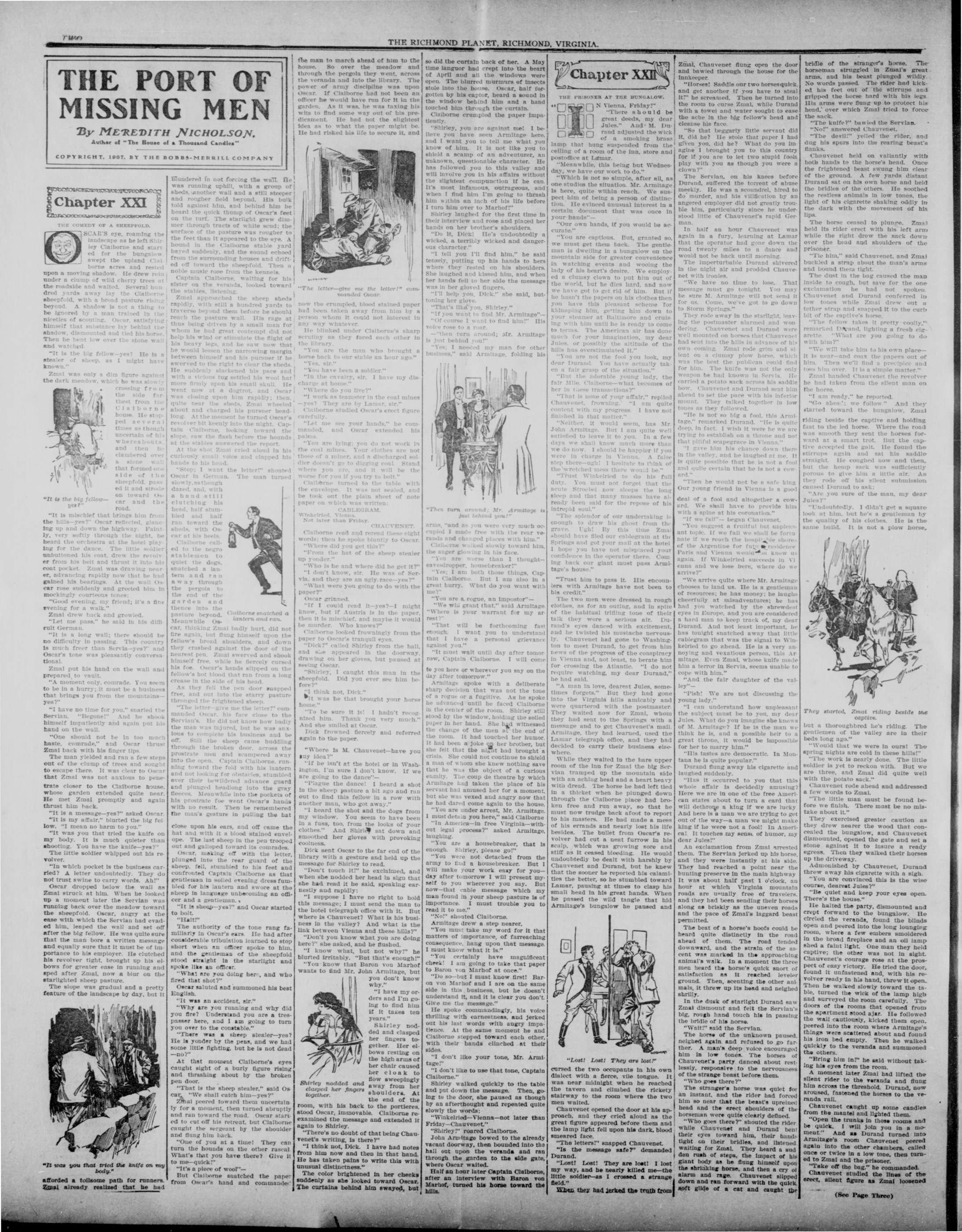
THE PORT OF MISSING MEN
By MEREDITH NICHOLSON.
Author of "The House of a Thousand Candles"
COPYRIGHT, 1907. BY THE BOBBS-MERRILL COMPANY
two
Chapter XXI
THE COMEDY OF A SHEEFOLD.
SCAR'S eye, roaming the landscape as he left Shirley Claiborne and start ed for the bungalow swept the upland Claiborne acres and rested
SCAR'S eye, roaming the landscape as he left Shirley Claiborne and started for the bungalow, swept the upland Claiborne acres and rested upon a moving shadow. He drew rein under a clump of wild cherry trees at the roadside and waited. Several hundred yards away lay the Claiborne sheepfold, with a broad pasture rising beyond. A shadow is not a thing to be ignored by a man trained in the niceties of scouting. Oscar, satisfying himself that substance lay behind the shadow, dismounted and tied his horse. Then he bent low over the stone wall and watched.
"It is the big fellow—yes? He is a stealer of sheep, as I might have known."
Zmal was only a dim figure against the dark meadow, which he was slows
crossing from the side farther from the Clairborne house. He stopped several times as though uncertain of his whereabouts, and then he clambered over a stone wall that formed one side of the sheepfold, passed it and strode on toward Oscar and the road.
"It is the big fellow—
yes?"
"It is mischief that brings him from the hills--yes?" Oscar reflected, glancing up and down the highway. Faintly, very softly through the night, he heard the orchestra at the hotel playing for the dance. The little soldier unbuttoned his coat, drew the revolver from his belt and thrust it into his coat pocket. Zmal was drawing near, advancing rapidly now that he had gained his bearings. At the wall Oscar rose suddenly and greeted him in mockingly courteous tones:
"Good evening, my friend; it's a fine evening for a walk."
Zmal drew back and growled.
"Let me pass," he said in his difficult German.
"It is a long wall; there should be no difficulty in passing. This country is much freer than Servla—yes?" and Oscar's tone was pleasantly conversational.
Zmal put his hand on the wall and prepared to vault.
"A moment only, comrade. You seem to be in a hurry; it must be a business that brings you from the mountains—yes?"
"I have no time for you," snarled the Servla. "Begone!" And he shook himself impatiently and again put his hand on the wall.
"One should not be in too much haste, comrade," and Oscar thrust Zmal back with his finger tips.
The man yielded and ran a few steps out of the clump of trees and sought to escape there. It was clear to Oscar that Zmal was not anxious to penetrate closer to the Clalborne house, whose garden extended quite near. He met Zmal promptly and again thrust him back.
"It is a message—yes?" asked Oscar.
"It is my affair," blurted the big fellow.
"I mean no harm to you."
"It was you that tried the knife on my body. It is much quieter than shooting. You have the knife—yes?"
The little soldier whipped out his revolver.
"In which pocket is the business carried? A letter undoubtedly. They do not trust swine to carry words. Ah!" Oscar dropped below the wall as Zmal struck at him. When he looked up a moment later the Servian was running back over the meadow toward the sheepfold. Oscar, angry at the ease with which the Servian had evaded him, leaped the wall and set off after the big fellow. He was quite sure that the man bore a written message and equally sure that it must be of importance to his employer. He clutched his revolver tight, brought up his elbows for greater ease in running and sped after Zmal, now a blur on the starlighted sheep pasture. The slope was gradual and a pretty feature of the landscape by day, but it
"It was you that tried the knife on my body."
afforded a tolsose path for runners.
Zimal already realized that he had
blundered in not forcing the wall. He was running uphill, with a group of sheds, another wall and a still steeper and rougher field beyond. His bulk told against him, and behind him he heard the quick thump of Oscar's feet on the turf. The starlight grew dimmer through tracts of white scud; the surface of the pasture was rougher to the feet than it appeared to the eye. A hound in the Claiborne stable yard bayed saddenly, and the sound echoed from the surrounding houses and drifted off toward the sheepfold. Then a noble music rose from the kennels.
Captain Claiborne, waiting for his sister on the veranda, looked toward the stables, listening.
Zmal approached the sheep sheds rapidly, with still a hundred yards to traverse beyond them before he should reach the pasture wall. His rage at thus being driven by a small man for whom he had great contempt did not help his wind or stimulate the flight of his heavy legs, and he saw now that he would lessen the narrowing margin between himself and his pursuer if he swerved to the right to clear the sheds. He suddenly slackened his pace and with a vicious tug settled his wool hat more firmly upon his small skull. He went now at a dogtrot, and Oscar was closing upon him rapidly; then, quite near the sheds, Zmal wheeled about and charged his pursuer headlong. At the moment he turned Oscar's revolver bit keenly into the night. Captain Claiborne, looking toward the slope, saw the flash before the hounds at the stables answered the report. At the shot Zmal cried aloud in his curiously small voice and clapped his hands to his head.
"Stop; I want the letter" shouted Oscar in German. The man turned
Stop; I want Oscar in Germa slowly, as though dazed, and, with a hand still clutching his head, half stumbled and half ran toward the sheds, with Oscar at his heels.
2
Clalborne called to the negro stablemen to quiet the dogs, snatched a lantern and ran away through the pergola to the end of the garden and thence into the pasture beyond. Meanwhile Os-
pasture beyond. *Cathorne snatched a lantern and ran.* Meanwhile Oscar, thinking Zmal badly hurt, did not fire again, but flung himself upon the fellow's broad shoulders, and down they crashed against the door of the nearest pen. Zmal swerved and shook himself free, while he fiercely cursed his foe. Oscar's hands slipped on the fellow's hot blood that ran from a long crease in the side of his head.
As they fell the pen door snapped free, and out into the starry pasture thronged the frightened sheep.
"The letter - give me the letter!" commanded Oscar, his face close to the Servian's. He did not know how badly the man was injured, but he was anxious to complete his business and be off. Still the sheep came huddling through the broken door, across the prostrate men and scampered away into the open. Captain Clalborne, running toward the fold with his lantern and not looking for obstacles, stumbled ever their bewildered advance guard and plunged headlong into the gray fleeces. Meanwhile into the pockets of his prostrate foe went Oscar's hands with no result. Then he remembered the man's gesture in pulling the hat close upon his ears, and off came the hat and with it a blood stained envelope. The last sheep in the pen trooped out and galloped toward its comrades.
Oscar, making off with the letter, plunged into the rear guard of the sheep, fell, stumbled to his feet and confronted Captain Clalborne as that gentleman in soiled evening dress fumbled for his lantern and swore at the sheep in language unbecoming an officer and a gentleman.
"It is sheep—yes?" and Oscar started to bolt.
"Halt!"
The authority of the tone rang familiar in Oscar's ears. He had after considerable tribulation learned to stop short when an officer spoke to him, and the gentleman of the sheepfold stood straight in the starlight and spoke like an officer.
"What are you doing here, and who fired that shot?"
Oscar saluted and summoned his best English.
"It was an accident, sir."
"Why are you running and why did you fire? Understand you are a trespasser here, and I am going to turn you over to the constable."
"There was a sheep stealer—yes? He is yonder by the pens, and we had some little fighting, but he is not dead—no?"
At that moment Claiborne's eyes caught sight of a burly figure rising and thrashing about by the broken pen door.
"That is the sheep stealer," said Oscar. "We shall catch him—yes?"
Zimal peered toward them uncertainly for a moment, then turned abruptly and ran toward the road. Oscar started to cut off his retreat, but Claiborne caught the sergeant by the shoulder and flung him back.
"One of you at a time! They can turn the hounds on the other rascal. What's that you have there? Give it to me—quick!"
"It's a piece of wool"—
But Claiborne snatched the paper from Oscar's hand and commanded
THE RICHMOND PLANET, RICHMOND, VIRGINIA
the man to march ahead of him to the house. So over the meadow and through the pergola they went, across the veranda and into the library. The power of army discipline was upon Oscar. If Claiborne had not been an officer he would have run for it in the garden. As it was, he was taxing his wits to find some way out of his predicament. He had not the slightest idea as to what the paper might be. He had risked his life to secure it, and
"The letter—give me the letter!" com-
manded Oscar.
now the crumpled, blood stained paper had been taken away from him by a person whom it could not interest in any way whatever.
He blinked under Claiborne's sharp scrutiny as they faced each other in the library.
"You are the man who brought a horse back to our stable an hour ago."
"Yes, sir."
"You have been a soldier."
"In the cavalry, sir. I have my discharge at home."
"Where do you live?"
"I work as teamster in the coal mines—yes? They are by Lamar, sir."
Claiborne studied Oscar's erect figure carefully.
"Let me see your hands," he commanded, and Oscar extended his palms.
"You are lying; you do not work in the coal mines. Your clothes are not those of a miner, and a discharged soldier doesn't go to digging coal. Stand where you are, and it will be the worse for you if you try to bolt."
Claiborne turned to the table with the envelope. It was not sealed, and he took out the plain sheet of note paper on which was written:
CABLELEGRAM.
Winkeled, Vienna.
Not later than Friday.
CHAUVENET.
Claiborne read and reread these eight words; then he spoke bluntly to Oscar.
"Where did you get this?"
"From the hat of the sheep stealer up yonder."
"Who is he and where did he get it?"
"I don't know, sir. He was of Servia, and they are an ugly race—yes?"
"What were you going to do with the paper?"
Oscar grinned.
"If I could read it—yes?—I might know, but if Austria is in the paper, then it is mischief, and maybe it would be murder. Who knows?"
Claiborne looked frowningly from the paper to Oscar's tranquil eyes.
"Dick!" called Shirley from the hall, and she appeared in the doorway, drawing on her gloves, but paused at seeing Oscar.
"Shirley, I caught this man in the sheepfold. Did you ever see him before?"
"I think not, Dick."
"It was he that brought your horse home."
"To be sure it is! I hadn't recognized him. Thank you very much." And she smiled at Oscar.
Dick frowned fiercely and referred again to the paper.
"Where Is M. Chauvenet—have you any idea?"
"If he isn't at the hotel or in Washington, I'm sure I don't know. If we are going to the dance"— "Plague the dance! I heard a shot in the sheep pasture a bit ago and ran out to find this fellow in a row with another man, who got away." "I heard the shot and the dogs from my window. You seem to have been in a fuss, too, from the looks of your clothes." And Shirl sat down and smoothed her gloves with provoking coolness. Dick sent Oscar to the far end of the library with a gesture and held up the message for Shirley to read. "Don't touch it!" he exclaimed, and when she nodded her head in sign that she had read it he said, speaking earnestly and rapidly:
"I suppose I have no right to hold this message; I must send the man to the hotel telegraph office with it. But where is Chauvenet? What is his business in the valley? And what is the link between Vienna and these hills?" "Don't you know what you are doing here?" she asked, and he flushed. "I know what, but not why!" he blurted irritably. "But that's enough!" "You know that Baron von Marhoff wants to find Mr. John Armitage, but
A woman sitting in a chair, holding a book and looking up at the sky.
you don't know why."
"I have my orders and I'm going to find him if it takes ten years."
Shirley nodded and clasped her fingers together. Her elbows resting on the high arms of her chair caused her cloak to flow sweepingly away from her shoulders. At the end of the
Shirley nodded and clasped her fingers together. Now sweepingly away from her shoulders. At the end of the room, with his back to the portieres, stood Oscar, immovable. Claiborne reexamined the message and extended it again to Shirley.
"There's no doubt of that being Chauvenet's writing, is there?"
"I think not, Dick. I have had notes from him now and then in that hand. He has taken pains to write this with unusual distinctness."
The color brightened in her cheeks suddenly as she looked toward Oscar. The curtains behind him swaued, but
so did the curtain back of her. A May time languor had crept into the heart of April and all the windows were open. The blurred murmurs of insects stole into the house. Oscar, half forgotten by his captor, heard a sound in the window behind him and a hand touched him through the curtain. Claiborne crumpled the paper impatiently. "Shirley, you are against me! I believe you have seen Armitage here, and I want you to tell me what you know of him. It is not like you to shield a scamp of an adventurer, an unknown, questionable character. He has followed you to this valley and will involve you in his affairs without the slightest compunction if he can. It's most infamous, outrageous, and when I find him I'm going to thrash him within an inch of his life before I turn him over to Marhof."
Shirley laughed for the first time in their interview and rose and placed her hands on her brother's shoulders.
"Do it, Dick! He's undoubtedly a wicked, a terribly wicked and dangerous character."
"I tell you I'll find him," he said tensely, putting up his hands to hers where they rested on his shoulders. She laughed and kissed him, and when her hands fell to her side the message was in her gloved fingers.
"I'll help you, Dick," she said, buttoning her glove.
"That's like you, Shirley."
"If you want to find Mr. Armitage"—
"Of course I want to find him!" His
voice rose to a roar.
—"then turn around; Mr. Armitage
is just bebed you!"
"Yes; I needed my man for other
business," said Armitage, folding his
"Then turn around; Mr. Armitage is just behind you!"
arms, "and as you were very much occupied I made free with the rear veranda and changed places with him."
Clairborne walked slowly toward him, the anger glowing in his face.
"You are worse than I thought—eavesdropper, housebreaker!"
"Yes; I am both those things, Captain Clalborne. But I am also in a great hurry. What do you want with me?"
"You are a rogue, an impostor"—
"We will grant that," said Armitage.
"Where is your warrant for my arrest?"
"That will be forthcoming fast enough. I want you to understand that I have a personal grievance against you."
"It must wait until day after tomorrow, Captain Clalborne. I will come to you here or wherever you say on the day after tomorrow."
Armitage spoke with a deliberate sharp decision that was not the tone of a rogue or a fugitive. As he spoke he advanced until he faced Clalborne in the center of the room. Shirley still stood by the window, holding the solled paper in her hand. She had witnessed the change of the men at the end of the room. It had touched her humor. It had been a joke on her brother, but she felt that the night had brought a crisis. She could not continue to shield a man of whom she knew nothing save that he was the object of a curious enmity. The coup de theatre by which Armitage had taken the place of his servant had amused her for a moment, but she was vexed and angry now that he had dared come again to the house.
“You are under arrest, Mr. Armitage. I must detain you here,” said Clalborne “In America—in free Virginia—without legal process?” asked Armitage, laughing.
“You are a housebreaker, that is enough. Shirley, please go!”
"You were not detached from the army to find a housebreaker. But I will make your work easy for you—day after tomorrow I will present myself to you wherever you say. But now—that cable message which my man found in your sheep pasture is of importance. I must trouble you to read it to me."
"No!" shouted Claiborne.
Armitage drew a step nearer.
"You must take my word for it that matters of importance, of farreaching consequence, hang upon that message. I must know what it is."
"You certainly have magnificent cheek! I am going to take that paper to Baron von Marhof at once."
"Do so—but I must know first! Baron von Marhof and I are on the same side in this business, but he doesn't understand it, and it is clear you don't. Give me the message."
He spoke commandingly, his voice thrilling with earnestness, and jerked out his last words with angry impatience. At the same moment he and Claiborne stepped toward each other, with their hands clinched at their sides.
"I don't like your tone, Mr. Armitage."
"I don't like to use that tone, Captain Claiborne."
Shirley walked quickly to the table and put down the message. Then, going to the door, she paused as though by an afterthought and repeated quite slowly the words:
"Winkled—Vienna—not later than Friday—Chauvenet."
"Shirley!" roared Claiborne.
Shinley: Toured Claiborne.
John Armitage bowed to the already vacant doorway, then bounded into the hall out upon the veranda and ran through the garden to the side gate, where Oscar waited.
Half an hour later Captain Claiborne, after an interview with Baron von Marhot, turned his horse toward the hills.
Chapter XXII
THE PRISONER AT THE BUNGALOW.
"N Vienna, Friday."
"There should be great deeds, my dear Jules." And M. Du raud adjusted the wick
"There should be great deeds, my dear Jules." And M. Duurand adjusted the wick of a smoking brass lamp that hung suspended from the ceiling of a room of the inn, store and postoffice at Ldmar.
"Meanwhile, this being but Wednesday, we have our work to do."
"Which is not so simple, after all, as one studies the situation. Mr. Armitage is here, quite within reach. We suspect him of being a person of distinction. He evinced unusual interest in a certain document that was once in your hands"—
"Our own hands, if you would be accurate."
"You are captious. But, granted so, we must get them back. The gentleman is dwelling in a bungalow on the mountain side for greater convenience in watching events and wooing the lady of his heart's desire. We employed a clumsy clown to put him out of the world, but he dies hard, and now we have got to get rid of him. But if he hasn't the papers on his clothes then you have this pleasant scheme for kidnapping him, getting him down to your steamer at Baltimore and cruising with him until he is ready to come to terms. The American air has done much for your imagination, my dear Jules, or possibly the altitude of the hills has overstimulated it."
"You are not the fool you look, my dear Durand. You have actually taken a fair grasp of the situation."
"But the adorable young lady, the fair Mile, Claiborne—what becomes of her in taise transactions?"
"That is none of your affair," replied Chauvenet, frowning. "I am quite content with my progress. I have not finished in that matter."
"Neither, it would seem, has Mr. John Armitage. But I am quite well satisfied to leave it to you. In a few days we shall know much more than we do now. I should be happier if you were in charge in Vienna. A false step there—ugh! I hesitate to think of the wretched mess there would be."
"Trust Winkelried to do his full duty. You must not forget that the acute Stroebel now sleeps the long sleep and that many masses have already been sold for the repose of his intrepid soul."
"The splendor of our undertaking is enough to draw his ghost from the grave. Ugh! By this time Zmal should have filed our cablegrain at the Springs and got your mail at the hotel. I hope you have not misplaced your confidence in the operator there. Coming back our giant must pass Armitage's house."
"Trust him to pass it. His encounters with Armitage have not been to his credit."
The two men were dressed in rough clothes, as for an outing, and in spite of the habitual trifling tone of their talk they wore a serious air. Durand's eyes danced with excitement, and he twisted his mustache nervously. Chauvenet had gone to Washington to meet Durand, to get from him news of the progress of the conspiracy in Vienna and, not least, to berate him for crossing the Atlantic. "I do not require watching, my dear Durand," he had said.
"A man in love, dearest Jules, sometimes forgets." But they had gone into the Virginia hills amicably and were quartered with the postmaster. They waited now for Zmal, whom they had sent to the Springs with a message and to get Chauvenet's mail. Armitage, they had learned, used the Lamar telegraph office, and they had decided to carry their business elsewhere.
While they waited in the bare upper room of the inn for Zmal the big Servian trumped up the mountain side with an aching head and a heart heavy with dread. The horse he had left tied in a thicket when he plunged down through the Clatborne place had broken free and run away, so that he must now trudge back afoot to report to his masters. He had made a mess of his errands and nearly lost his life besides. The bullet from Oscar's revolver had cut a neat furrow in his scalp, which was growing sore and stiff as it ceased bleeding. He would undoubtedly be dealt with harshly by Chauvenet and Durand, but he knew that the sooner he reported his calamities the better, so he stumbled toward Lamar, pausing at times to clasp his small head in his great hands. When he passed the wild tangle that hid Armitage's bungalow he paused and
"Lost! Lost! They are lost!"
cursed the two occupants in his own dialect with a fierce, vile tongue. It was near midnight when he reached the tavern and climbed the rickety stairway to the room where the two men waited. Chauvenet opened the door at his approach, and they cried aloud as the great figure appeared before them and the lamp light fell upon his dark, blood smeared face. "The letters!" snapped Chauvenet. "Is the message safe?" demanded Durand. "Lost! Lost! They are lost! I lost my way, and he nearly killed me—the little soldier—as I crossed a strange field." When they had jerked the truth from
Zmal, Chauvenet fung open the door and bowed through the house for the kninkeeper.
"Horses! Saddle our two horses quick, and get another if you have to steal it!" he screamed. Then he turned into the room to curse Zmal, while Durand with a towel and water sought to ease the ache in the big fellow's head and cleanse his face.
"So that beggarly little servant did it, did he? He stole that paper I had given you, did he? What do you imagine I brought you to this country for if you are to let two stupid fools play with you as though you were a clown?
The Servlan, on his knees before Durand, suffered the torrent of abuse meekly. He was a scoundrel, hired to do murder, and his vilification by an angered employer did not greatly trouble him, particularly since he understood little of Chauvenet's rapid German.
In half an hour Chauvenet was again in a fury, learning at Lamar that the operator had gone down the road twenty miles to a dance and would not be back until morning.
The imperturbable Durand shivered in the night air and prodded Chauvenet with ironles.
"We have no time to lose. That message must go tonight. You may be sure M. Armitage will not send it for us. Come, we've got to go down to Storm Springs."
They rode away in the starlight, leaving the postmaster alarmed and wondering. Chauvenet and Durand were well mounted on horses that Chauvenet had sent into the hills in advance of his own coming. Zmal rail grim and silent on a clumsy plow horse, which was the best the publican could find for him. The knife was not the only weapon he had known in Servia. He carried a potato sack across his saddle bow. Chauvenet and Durand sent him ahead to set the pace with his inferior mount. They talked together in low tones as they followed.
"He is not so big a fool, this Armitage," remarked Durand. "He is quite deep, in fact. I wish it were we are trying to establish on a throne and not that pliful scapegrace in Vienna."
"I gave him his chance down there in the valley, and he laughed at me. It is quite possible that he is not a fool and quite certain that he is not a coward."
"Then he would not be a safe king. Our young friend in Vienna is a good deal of a fool and altogether a coward. We shall have to provide him with a spine at his coronation."
"If we fall"—began Chauvenet.
"You suggest a fruitful but unpleasant topic. If we fall we shall be fortunate if we reach the hospitable shores of the Argentine for future residence Paris and Vienna would not know us again. If Winklerlied succeeds in Vienna and we lose here, where do we arrive?"
"We arrive quite where Mr. Armitage chooses to land us. He is a gentleman of resources; he has money; he laughs cheerfully at misadventures; he has had you watched by the shrewdest eyes in Europe, and you are considered a hard man to keep track of, my dear Durand. And not least important, he has tonight snatched away that little cablegram that was the signal to Winkelried to go ahead. He is a very annoying and vexatious person, this Armitage. Even Zemal, whose knife made him a terror in Servia, seems unable to cope with him."
"And the fair daughter of the valley"—
"Pish! We are not discussing the young lady."
"I can understand how unpleasant the subject must be to you, my dear Jules. What do you imagine she knows of M. Armitage? If he is the man we think he is, and a possible heir to a great throne, it would be impossible for her to marry him."
"His tastes are democratic. In Montana he is quite popular."
Durand flung away his cigarette and laughed suddenly.
"Has it occurred to you that this whole affair is decidedly amusing? Here we are in one of the free American states about to turn a card that will dethrone a king if we are lucky. And here is a man we are trying to get out of the way—a man we might make king if he were not a fool! In America! It touches my sense of humor, my dear Jules."
An exclamation from Zmal arrested them. The Servian jerked up his horse, and they were instantly at his side. They had reached a point near the bunting preserve in the main highway. It was about half past 1 o'clock, an hour at which Virginia mountain roads are usually free of travelers, and they had been sending their horses along as briskly as the uneven roads and the pace of Zmal's laggard beast permitted.
The beat of a horse's boots could be heard quite distinctly in the road ahead of them. The road tended downward, and the strain of the ascent was marked in the approaching animal's walk. In a moment the three men heard the horse's quick snort of satisfaction as it reached leverer ground. Then, scenting the other animals, it threw up its head and neighed shrilly.
In the dusk of starlight Durand saw Zmal dismount and felt the Servian's big, rough hand touch his in passing the bridle of his horse.
"Wait!" said the Servian.
The horse of the unknown paused, neighed again and refused to go farther. A man's deep voice encouraged him in low tones. The horses of Chauvenet's party danced about restlessly, responsive to the nervousness of the strange beast before them. "Who goes there?" The stranger's horse was quiet for an instant, and the rider had forced him so near that the beast's upreined head and the erect shoulders of the horseman were quite clearly defined. "Who goes there?" shouted the rider, while Chauvenet and Durand bent their eyes toward him, their hands tight on their bridles, and listened waiting for Zmal. They heard a sudden rush of steps, the impact of his giant body as he flung himself upon the shrinking horse, and then a cry of alarm and rage. Chauvenet slipped down and ran forward with the quick soft glide of a cat and caught the
bridle of the stranger's horse. The horseman struggled in Zmal's great arms, and his beast plunged wildly. No words passed. The rider had kicked his feet out of the stirrups and gripped the horse hard with his legs. His arms were flung up to protect his head, over which Zmal tried to force the sack.
"The knife?" bawled the Servlan. "No!" answered Chauvenet.
"The devil!" yelled the rider, and dug his spurs into the rearing beast's flanks.
Chauvenet held on vavantly with both hands to the horse's head. Once the frightened beast swung him clear of the ground. A few yards distant Durand sat on his own horse and held the bridles of the others. He soothed the restless animals in low tones, the light of his cigarette shaking oddly in the dark with the movement of his lips.
The horse ceased to plunge. Zmah held its rider erect with his left arm while the right drew the sack down over the head and shoulders of the prisoner.
"Tie him," said Chauvenet, and Zmah buckled a strap about the man's arms and bound them tight.
The dust in the bag caused the man inside to cough, but save for the one exclamation he had not spoken. Chauvenet and Durand conferred in low tones while Zmah drew out a tether strap and snapped it to the curb bit of the captive's horse.
"The fellow takes it pretty coolly," remarked Duncan, lighting a fresh cigarette. "What are you going to do with him."
"We will take him to his own place—it is near—and coax the papers out of him. Then we'll find a precipice and toss him over. It is a simple matter." Zmah handed Chauvenet the revolver he had taken from the silent man on the horse.
"I am ready," he reported.
"Go shea!; we follow." And they started toward the bungalow, Zmai riding beside the captive and holding fast to the led horse. Where the road was smooth they sent the horses forward at a smart trot. But the captive accepted the gait. He found the stirrups again and sat his saddle straight. He coughed now and then, but the hemp sack was sufficiently porous to give him a little air. As they rode off his silent submission caused Durand to ask:
"Are you sure of the man, my dear Jules?"
"Undoubtedly. I didn't get a square look at him, but he's a gentleman by the quality of his clothes. He is the same build. It is not a plow horse.
A
They started, Zmat riding beside the captive.
but a thoroughbred he's riding. The gentlemen of the valley are in their beds long ago."
"Would that we were in ours! The spring nights are cold in these bills!"
in these mills.
"The work is nearly done. The little soldier is yet to reckon with. But we are three, and Zmal did quite well with the potato sack."
Chauvenet rode ahead and addressed a few words to Zmal.
"The little man must be found before we finish. There must be no mistake about it."
They exercised greater caution as they drew nearer the wood that concealed the bungalow, and Chauvenet dismounted, opened the gate and set a stone against it to insure a ready egress. Then they walked their horses up the driveway.
Admonished by Chauvenet, Durand threw away his cigarette with a sigh.
"You are convinced this is the wise course, dearest Jules?"
"Be quiet and keep your eyes open. There's the house."
He halted the party, dismounted and crept forward to the bungalow. He circled the veranda, found the blinds open and peered into the long lounging room, where a few embers smoldered in the broad fireplace and an oil lamp shed a faint light. One man they held captive; the other was not in sight. Chauvenet's courage rose at the prospect of easy victory. He tried the door, found it unfastened and, with his revolver ready in his hand, threw it open. Then he walked slowly toward the table, turned the wick of the lamp high and surveyed the room carefully. The doors of the rooms that opened from the apartment stood ajar. He followed the wall cautiously, kicked them open, peered into the room where Armitage's things were scattered about and found his iron bed empty. Then he walked quickly to the veranda and summoned the others.
"Bring him in!" he said without taking his eyes from the room.
A moment later Zmai had lifted the silent rider to the veranda and flung him across the threshold. Durand, now aroused, fastened the horses to the veranda rail.
Chauvenet caught up some candles from the mantel and lighted them.
"Open the trunks in those rooms and be quick. I will join you in a moment." And as Durand turned into Armitage's room Chauvenet peered again into the other chambers, called once or twice in a low tone, then turned to Zmai and the prisoner.
"Take off the bag," he commanded.
Chauvenet studied the lines of the erect, silent figure as Zmai loosened
THE PLANET
SATURDAY...SEPTEMBER 5. '08
The man was not John Armitage, but Captain Claiborne.
the strap, drew off the bag and stepped back toward the table on which he had laid his revolver for easier access.
"Mr. John Armitage"—Chauvenet, his revolver half raised, had begun an ironical speech, but the words died on his lips. The man who stood blinking from the sudden burst of light was not John Armitage, but Captain Clalborne.
The perspiration on Clalborne's face had made a paste of the dirt from the potato sack, which gave him a weird appearance. He grinned broadly, adding a fantastic horror to his visage which caused Zmal to leap back toward the door. Then Chauvenet cried aloud, a cry of anger, which brought Durand into the nail at a jump. Clalborne shrugged his shoulders, shook the blood into his numbed arms, then turned his besmeared face toward Durand and laughed. He laughed long and loud as the stupefaction deepened on the faces of the two men.
The objects which Durand held caused Claiborne to stare, and then he laughed again. Durand had caught up from a hook in Amitage's room a black cloak, so long that it trailed at length from his arms, its red lining glowing brightly where it lay against the outer black. From the folds of the cloak a sword, plucked from a trunk, dropped upon the floor with a gleam of its bright scabbard. In his right hand he held a silver box of orders, and as his arm fell at the sight of Claiborne the gay ribbons and gleaming pendants flashed to the floor.
"It is not Armitage; we have made a mistake!" muttered Chauvenet tamely, his eyes falling from Claiborne's face to the cloak, the sword, the tangled heap of ribbons on the floor.
Durand stepped forward, with an oath.
"Who is the man?" he demanded.
"It is my friend Captain Claiborne. We owe the gentleman an apology"—Chauvenet began.
"You put it mildly," cried Clalborne in English, his back to the fireplace, his arms folded and the smile gone from his face. "I don't know your companions, M. Chauvenet, but you seem inclined to the gentle arts of kidnap and murder. Really, Monsleur"—"It is a mistake! It is unpardonable! I can only offer you reparation—anything you ask!" stammered Chauvenet
"You are looking for John Armitage, are you?" demanded Clalborne hotly without heeding Chauvenet's words. "Mr. Armitage is not here. He was in Storm Springs tonight at my house. He is a brave gentleman, and I warn you that you will injure him at your peril. You may kill me here or strangle me, or stick a knife into me if you will be better satisfied that way, or you may kill him and hide his body in these hills; but, by God, there will be no escape for you! The highest powers of my government know that I am here. Baron von Marhof knows that I am here. I have an engagement to breakfast with Baron von Marhof at his house at 8 o'clock in the morning, and if I am not there every agency of the government will be put to work to find you, Mr. Jules Chauvenet, and these other scoundrels who travel with you."
"You are violent, my dear sir," began Durand, whose wits were coming back to him much quicker than Chauvenet's.
"I am not as violent as I shall be if I get a troop of cavalry from Fort Myer down here and hunt you like rabbits through the hills. And I advise you to cable Winklerried at Vienna that the game is all off."
Chauvenet suddenly jumped toward the table, the revolver still swinging at arm's length.
"You know too much."
"I don't know any more than Armitage and Baron von Marhof and my father and the honorable secretary of state, to say nothing of the equally honorable secretary of war."
Claiborne stretched out his arms and rested them along the shelf of the mantel and smiled with a smile which the dirt on his face weirdly accented. His hat was gone, his short hair rumpled. He dug the bricks of the hearth with the toe of his riding boot as an emphasis of his contentment with the situation.
A sword dropped upon the floor.
A sword dropped upon "You don't un the floor. derstand the gravity of our labors. The peace of a great empire is at stake in this business. We are engaged on a patriotic
mission of great Importance." It was Durand who spoke. Outside Zidane, he was a man of great importance.
Zhint held the horses in readiness.
"You are a fine pair of patriots, I swear," said Claiborne. "What the devil do you want with John Armitage?"
"He is a menace to a great throne—an impostor—a"—Chauvenet's eyes swept with a swift glance the cloak, the sword, the scattered orders. Claiborne followed the man's gaze, but he looked quickly toward Durand and Chauvenet, not wishing them to see that the sight of these things puzzled him.
"Pretty trinkets! But such games as yours, these pretty baubles—are not for these free hills."
"Where is John Armitage?"
Chauvenet half raised his right arm as he spoke, and the steel of his revolver flashed. Claiborne did not move. He smiled upon them, recrossed his legs and settled his back more comfortably against the mantel shelf.
"I really forget where he said he would be at this hour. He and his man may have gone to Washington, or they may have started for Vienna, or they may be in conference with Baron von Marhof at my father's, or they may be waiting for you at the gate. The Lord only knows!"
"Comel. We waste time," said Duraund in French. "It is a trap. We must not be caught here!"
"Yes, you'd better go," said Clalborne, yawning and settling himself in a new pose with his back still to the fireplace. "I don't believe Arultage will care if I use his bungalow occasionally during my sojourn in the hills, and if you will be so kind as to leave my horse well tied out there somewhere I believe I'll go to bed. I'm sorry, Mr. Chauvenet, that I can't just remember who introduced you to me and my family. I owe that person a debt of gratitude for bringing so pleasant a scoundrel to my notice."
He stepped to the table, his hands in his pockets, and bowed to them. "Good night, and clear out," and he waved his arm in dismissal. "Come!" said Durand peremptorily, and as Chauvenet hesitated Durand seized him by the arm and pulled him toward the door. As they mounted and turned to go they saw Calborne standing at the table lighting a cigarette from one of the candles. He walked to the veranda and listened until he was satisfied that they had gone, then went in and
As they mounted and turned to go they saw Clalborne standing at the table lighting a cigarette from one of the candles. He walked to the veranda and listened until he was satisfied that they had gone, then went in and closed the door.
He restored the insignia to the silver box. He picked up the cloak and sword and restored the insignia to the silver box. The sword he examined with professional interest, running his hand over the embossed scabbard, then drawing the bright blade and trying its balance and weight.
As he held it thus heavy steps sounded at the rear of the house, a door was fung open, and Armitage sprang into the room, with Oscar close at his heels.
Chapter XXIII
THE VERGE OF MORNING.
HOPE you like my things, Captain Cialborne!
Armitage stood a little in advance, his
HOPE you like my things, Captain Claborne"
Armitage stood a little in advance, his hand on Oscar's arm
to check the rush of the little man.
Claiborne sheathed the sword, placed it on the table and folded his arms.
"Yes; they are very interesting."
"And those ribbons and that cloak.
I assure you they are of excellent quality. Oscar, put a blanket on this gentleman's horse. Then make some coffee and wait."
As Oscar closed the door Armitage crossed to the table, flung down his gauntlets and hat and turned to Claiborne.
"I didn't expect this of you. I really didn't expect it. Now that you have found me, what do you want?"
"I don't know—I'll be hanged if I know!" And Claiborne grinned so that the grotesque lines of his soiled countenance roused Armitage's slumbering wrath.
"You'd better find out! This is my busy night, and if you can't explain yourself I'm going to tie you hand and foot and drop you down the well till I finish my work. Speak up! What are you doing on my grounds, in my house, at this hour of the night, prying into my affairs and rummaging in my trunks?"
"I didn't come here, Armitage. I was brought—with a potato sack over my head. There's the sack on the floor, and any of its dirt that isn't on my face must be permanently settled in my lungs."
"What are you doing up here in the mountains? Why are you not at your station? The potato sack story is pretty filmsy. Do better than that and hurry up!"
"Armitage"—as he spoke Claiborne walked to the table and rested his finger tips on it—"Armitage, you and I have made some mistakes during our short acquaintance. I will tell you frankly that I have blown hot and cold about you as I never did before with another man in my life. On the ship coming over and when I met you in Washington I thought well of you. Then your cigarette case shook my confidence in you there at the Army and Navy club that night, and now"—"D—my cigarette case!" bellow Armitage, clapping his hand to his pocket to make sure of it.
"That's what I say! But it was a disagreeable situation. You must admit that."
"It was indeed!"
"It requires some nerve for a man to tell a circumstantial story like that to a tableful of gentlemen about one of the gentlemen."
THE RICHMOND PLANET, RICHMOND, VIRGINIA
"No doubt of whatever. Mr. Claiborne."
Armitage unbuttoned his coat and jerked back the lapels impatiently.
"And I knew as much about M. Chauvenet as I did about you or as I do about you."
"What you know of him, Mr. Claiborne, is of no consequence. And what you don't know about me would fill a large volume. How did you get here, and what do you propose doing now that you are here? I am in a hurry and have no time to waste. If I can't get anything satisfactory out of you within two minutes I'm going to chuck you back into the sack."
"I came up here in the hills to look for you-you-you! Do you understand?" began Claiborne angrily. "And as I was riding along the road about two miles from here I ran into three men on horseback. When I stopped to parley with them and find out what they were doing they crept up on me and grabbed my horse and put that sack over my head. They had mistaken me for you, and they brought me here, into your house, and pulled the sack off and were decidedly disagreeable at finding they had made a mistake. One of them had gone in to sack your effects, and when they pulled off the bag and disclosed the wrong hare he dropped his loot on the floor, and then I told them to go to the devil, and I hope they've done it. When you came in I was picking up your traps, and I submit that the sword is handsome enough to challenge anybody's eye. And there's all there is of the story, and I don't care whether you believe it or not."
Their eyes were fixed upon each other in a gaze of anger and resentment. Suddenly Armitage'sense figure relaxed, the fierce light in his eyes gave way to a gleam of humor, and he laughed long and loud.
"Your face—your face, Claiborne. It's funny. It's too funny for any use. When your teeth show, it's something ghastly. For God's sake, go in there and wash your face!"
He made a light in his own room and plied Claiborne with towels, while he continued to break forth occasionally in fresh bursts of laughter. When they went into the hall both men were grave.
"Claiborne"—
Armitage put out his hand, and Claiborne took it in a vigorous clas.
"You don't know who I am or what I am, and I haven't got time to tell you now. It's a long story, and I have much to do, but I swear to you, Claiborne, that my hands are clean; that the game I am playing is no affair of my own, but a big thing that I have pledged myself to carry through. I want you to ride down there in the valley and keep Marhof quiet for a few hours. Tell him I know more of what's going on in Vienna than he does and that if he will only sit in a rocking chair and tell you fairy stories till morning we can all be happy. Is it a bargain—or—must I still hang your head down the well till I get through?" "Marhof may go to the devil! He's a lot more mysterious than even you. Armitage. These fellows that brought me up here to kill me in the belief that I was you cannot be friends of Marhof's cause." "They are not. I assure you they are not. They are blackguards of the blackest dye."
"I believe you, Armitage."
"Thank you. Now your horse is at the door. Run along like a good fellow."
Armitage dived into his room, caught up a cartridge belt and reappeared buckling it on.
"Oscar," he yelled, "bring in that coffee, with cups for two."
He kicked off his boots and drew on light shoes and leggings.
"Light marching orders for the rough places. Confront that buckle."
He rose and stamped his feet to settle the shoes.
"Your horse is at the door. That rascal Oscar will take off the blanket for you. There's a bottle of fair whisky in the cupboard, if you'd like a nip before starting. Bless me. I forgot the coffee! There on the table, Oscar, and never mind the chairs," he added as Oscar came in with a tin pot and the cups on a piece of plank.
"I'm taking the rifle, Oscar, and be sure those revolvers are loaded with the real goods."
There was a great color in Armitage's face as he strode about preparing to leave. His eyes danced with excitement, and between the sentences that he jerked out half to himself he whistled a few bars from a comic opera that was making a record run on Broadway. His steps rang out vigorously from the bare pine floor.
"Watch the windows, Oscar. You may forgive a general anything but a surprise. Isn't that so, Claiborne? And those fellows must be pretty mad by this time. Excuse the coffee service. Claiborne. We always pour the sugar from the paper bag-original package, you understand. And see if you can't find Captain Claiborne a hat, Oscar."
With a tin cup of steaming coffee in his hand he sat on the table dangling his legs, his hat on the back of his head, the cartridge belt strapped about his waist over a brown corduroy hunting coat. He was in a high mood and chaffed Oscar as to the probability of their breakfasting another morning. "If we die, Oscar, it shall be in a good cause."
He threw aside his cup with a clatter, jumped down and caught the sword from the table, examined it critically, then sheathed it with a click.
Claiborne had watched Armitage with a growing impatience. He presented the idea of being thus ignored. Then he put his hand roughly on Armitage's shoulder.
Armitage, intent with his own affairs, had not looked at Claiborne for several minutes, but he glanced at him now as though just recalling a duty.
"Lord, man, I didn't mean to throw you into the road! There's a clean bed in there that you're welcome to. Go in and get some sleep."
"I'm not going into the valley," roar ed Claiborne, "and I'm not going to bed. I'm going with you."
"But bless your soul, man, you can't go with me! You are as ignorant as a babe of my affairs, and I'm terribly busy and have no time to talk to you."
Oscar, that coffee scalded me. Claiborne, if only I had time, you know, but under existing circumstances”—
“I repeat that I’m going with you. I don’t know why I’m in this row, and I don’t know what it’s all about, but I believe what you say about it, and I went you to understand that I can’t be put in a bag like a prize potato without taking a whack at the man who put me there.”
“But if you should get hurt, Claiborne, it would spoil my plans. I never could face your family again,” said Armitage earnestly. “Take your horse and go.”
“I’m going back to the valley when you do.”
“Humph! Drink your coffee! Oscar, bring out the rest of the artillery and give Captain Claiborne his choice.”
He picked up his sword again, flung the blade from the scabbard with a swish and cut the air with it, hum-
ming a few bars of a German drinking song. Then he broke out with: "I do not think a braver gentleman, More active-vallant or more vallant-young, More braver or more bold, is now alive. To grace this latter age with no needies. For my part, I may speak it to my shame. I have a truant been to chivalry—" "Lord, Clalborne, you don't know what's ahead of us. It's the greatest thing that ever happened. I never expected anything like this, not on my cheerful days. Dearest Jules is out looking for a telegraph office to pull off the Austrian end of the rumpus. Well, little good it will do him. And well catch him and Durand and that Servian devil and lock them up here till Marhof decides what to do with him. We're off!"
"All ready, sir," said Oscar briskly.
"It's half past 2. They didn't get off
their message at Lamar because the
office is closed and the operator gone,
and they will keep out of the valley
and away from the big inn because
they are rather worried by this time
and not anxious to get too near Marhof.
They've probably decided to go to
the next station below Lamar to do
their telegraphing. Meanwhile they
haven't got me!"
"They had me and didn't want me,"
said Claiborne, mounting his own
horse.
"They'll have a good many things
they don't want in the next twenty-
four hours. If I hadn't enjoyed this
business so much myself we might
have had some secret service men post-
eall along the coast to keep a look-
out for them. But it's been a great old
lark. And now to catch them!"
Outside the preserve they paused for
an instant.
"They're not going to venture far from their base, which is that inn and postoffice, where they have been rumaging my mail. I haven't studied the hills for nothing, and I know short cuts about here that are not on maps."
3VDB+DK
He flung the blade from the scabbard with a swish.
They haven't followed the railroad north, because the valley broadens too much and there are too many people. There's a trail up here that goes over the ridge and down through a wind gap to a settlement about five miles south of Lamar. If I'm guessing right, we can cut around and get ahead of them and drive them back to my land."
"To the Port of Missing Men! It was made for the business," said Clatborne.
"Oscar, patrol the road here and keep an eye on the bungalow, and if you hear us forcing them down charge from this side. I'll fire twice when I get near the Port to warn you, and if you strike them first give the same signal. Do be careful, sergeant, how you shoot. We want prisoners, you understand, not corvess."
Armitage found a faint trail and with Claiborne struck off into the forest near the main gate of his own grounds. In less than an hour they rode out upon a low wooded ridge and drew up their panting, sweating horses—two shadowy videttes against the lustral dome of stars. A keen wind whistled across the ridge, and the horses pawed the unstable ground restlessly. The men jumped down to tighten their saddle girths, and they turned up their coat collars before mounting again.
"Come! We're on the verge of morning," said Armitage, "and there's no time to lose."
(TO BE CONTINUED.)
Which?
Visitor—Can I see the editor, my lad?
Office Boy—Are you a contributor,
or a gentleman?—Half Holiday.
Clean Milking
Clean milking is of great importance in keeping up a full milk flow. And then, too, the strippings are richer in fat than the milk that is first drawn, which is another reason why a cow should be milked dry.
LINCOLN
HAIR POMADE
MAKES
KINKY
HAIR
SOFT
REMOVES
DANDRUFF
KEEPS
HAIR
FROM
BREAKING
OFF
LINCOLN
HAIR POMADE
KEEPS
SCALP
FRESH
CLEAN AND
WHOLE-
SOME
MAKES
HAIR
GROW
LONG AND
LUXURIOUS
WHICH WAY WOULD YOU RATHER HAVE YOUR HAIR-SOFT AND
LONG SO THAT YOU CAN PUT IT UP IN THE LATEST STYLE
OR SHORT AND KINKY
A WOMAN'S JUST PRIDE IS HER
HAIR. TO STRAIGHTEN OUT THAT KINKY, CURLY HAIR, PUTTING IT IN THE MOST PERFECT CONDITION TO BE COMBED INTO ANY SHAPE JUST TRY A BOTTLE OF LINCOLN HAIR POMADE.
MANUFACTURED BY
Agents Wanted Everywhere. Write for particulars. If your dealer does not keep it, send 26 cents in stamps or silver to THE LINCOLN POMADE CO., Department B, Norfolk, Va, and we will send you a bottle by return mail.
No, Cordella, kissing isn't always what it is smacked up to be.
Anyway there will probably be no merry widow hales in Heaven.
There is still hope for the bachelor who reads the marriage notices.
Women frequently jump at conclusions that are anything but alarming.
A hot-headed woman and a stick of a man ought to make a good match.
Sometimes a woman cries over her inability to find something to laugh at.
Occasionally the world loves a lover, but more often it sympathizes with him.
If a man is crazy and doesn't know it, it is because he has no wife to tell him.
The girl who marries her ideal often gets a divorce or lives unhappily ever after.
A little girl hates to be kissed by a man almost as much as a big girl doesn't.
There is nothing green about the grass widow who can rope in a rich bachelor.
A pretty girl is apt to be less interesting than the bank account of a homely maid.
It's easy to please a woman after finding out what she wants—but there's the rub—St. Louis Times.
Japanese hotel's give, with eac re- cepted bill, a souvenir fan.
The average yield per acre, the world over, is only 12.7 bushels.
Pomegranate is the heaviest wood. A cuble foot of it weighs 85 pounds.
There is a little more than 26% miles of railroad in the United States for every 10,000 inhabitants.
While the tonnage of the fleet of the great lakes is increasing the number of craft is decreasing, owing to the greater capacity of the newer boats.
Systematic investigation of the Philippine islands reveals the fact that the group consists of 2,600 islands, while before the American occupation the number was estimated at 1,200.
Sautte Ste. Marie canal traffic for the season of 1907 reached a grand total of 57,217,214 tons, which shows a net increase of 12 per cent., or 6,466. 134 tons, as compared with that of the season of 1906.
The most powerful engine ever put in an automobile is one of six cylinders and 200-horsepower in a French racing machine. In its preliminary trials it is reported to have attained an average speed of 125 miles an hour.
Truth may be stranger than fiction,
but it isn't nearly so marketable.
"Handsome is" is not always as
handsome as one is photographed.
It's curious how money melts even
at resorts cool enough for blankets.
In the garden of the years life ever-
lasting grows best watered with tears.
A dead past is one of those galvanic
curiosities that won't stay
buried.
People who live in glass houses
should have a care to keep their
thoughts crystalline.
Destiny is a queer old lady. Maybe
---
MAKES
KINKY
HAIR
SOFT
REMOVES
DNDRUFF
KEEPS
HAIR
FROM
BREAKING
OFF
BY A WOMAN HATER.
NOTES OF INDUSTRY
EVE'S EPIGRAMS
ner fancy work is knitting souls from
the tangled skein of life.
Every man can't be king, so Life,
good old lady that she is, devised
love-in-a-cottage as a compensation.
Croesus can't corner the market in
hearts so long as Cupid stands
sponsor for the good-looking young
man.
The old-fashioned mother and her
slipper qualified many a man for the
presidential chair, even if he didn't
get there.
AS HIS NEIGHBORS SEE HIM.
If he doesn't give to charity, he's a stingy boy. If he does, it's for show.
If he needs credit, he can't get it. If he is prosperous, every one wants to do him a favor.
If he shows affection, he's a soft specimen. If he seems to care for no one, he is cold-blooded.
If he is actively religious, he is a hypocrite. If he takes no interest in religion, he's a hardened sinner.
If he's in politics, it's for pie. If he is out of politics, you can't place him, and he's no good for his country.
If he dies young, there was a great future ahead of him. If he lives to an old age, he has missed his calling.—Christian Guardian.
Many a dead snag is left standing because of a live tendril that clasps it.
Divorce proceedings might, from the tennis player's point of view, be called "the finals in the doubles."
Considering that wealth is said to be a curse, there are a lot of marvelously patient people in this country.
It keeps the back-number and would be boom towns busy trying to think of some excuse for holding an exposition.
Clothes don't make the man. Thirty years ago a linen duster proclaimed the minister; now it labels the chauffeur.
"Pardon me, sir," began the portly person in the railroad train to the man who sat next to him, "but what would you say if I sat on your hat?" "Suppose you sit on it and then ask me," suggested the other. "I did!" admitted the portly person, calmly—Half Holiday.
Wife (examining the bill)—Do you remember, my dear, how many fish you caught last Sunday?
Husband—There were just twelve—all beauties. Why?
Wife—The fish dealer has made a mistake; he only charges for half a dozen—Half Holiday.
"Do you take any periodicals?" asked the new clergyman on his first round of parish visits. "Well, I don't," replied the woman; but my husband takes 'em frequent I do wish you'd try to get him to sign the pledge.—Judge
"Here's one that will puzzle you for a minute," writes a correspondent. "Please tell me, without stopping to look it up, what is the masculine of 'laundress.'"
Chinaman. Come again.—Cleveland Leader.
The Philosopher of Folly.
"I have an intense hatred of greed and money-grabbing," says the Philosopher of Folly. "It makes me sick at heart to see men making more money than I do."—Cleveland Leader.
KEEPS
SCALP
FRESH
CLEAN AND
WHOLE-
MAKES
HAIR
GROW
LONGAND
LUXURIOUS
SMALL CHANGE
Breaking It Gently.
Caught
A Slight Misunderstand
Easy.
People seldom forget the names or faces of those whom it may pay to know.
Necessity is the mother of hard work with most of us.—Atlanta Georgian.
Expensive Luxuries.
Castles in the air cost a vast deal to keep up.—Lytton.
Misplaced Kindnesses.
Kindnesses misplaced are nothing but a curse and disservice.—Ennius.
Or the Lubricating Oil.
Love makes the world go round, but money buys the axie grease
JOSHUA BANKS & SONS
CATERERS
EVERY FACILITY CONSISTENT
WITH FINE CATERING.
Special Attention Given to Balls,
Suppers, Installations and Smok
ers at the Shortest Notice.
Your Patronage Sollicited.
Refreshment Cars and Boat Privile
es Handled in Season.
Address: communications in
DON'T GET MAD.
if your hair tan away from you. *because* you wear it. *because* you feed it with it and keep it at home. *Don't have* a falling out with your hair. *If you wear it with what*? what? *That would mean* thin, dry, lifeless, coarse, uneven, breaking and fall-
if your hair ran away from you. Because, you have the remedy NOW to face these and keep it at home. Don't sit in your suit with your hair. It might leave you! Then what? That would mean thin, dry, lifeless, coarse, uneven, breaking and falling. Give it something to live on: nourish it! faster than your scalp. Of course Meccooro is the only genuine, perfect and dependable hair tonic, food and medicine you can buy. It will make the hair grow extra long and heavy, give new life to the hair bulbs, save what hair you have and get more hair. These applications convincing on money refunded. $00, $1.00 Always send Money order. Send for free interest booklet right away.
MICROCAROUSE OFFICE • 835 WEST 35th ST.
MICROCAROUSE HAIR TOWNS M.C.M.Y.
RAILROADS.
Richmond, Fredericksb'g & Potomac R. R.
SCHEDULE EFFECTIVE APRIL 12, 1908.
TO AND FROM WASHINGTON AND BEYOND.
Leave Richmond
*8.29 A.M. Byrd St. Sta.
*5.40 A.M. Byrd St. Sta.
*9.20 A.M. Ekb Station.
*12.01 P.M. Byrd St. Sta.
*12.15 P.M. Main St. Sta.
*5.00 P.M. Ekb Station.
*6.15 P.M. Main St. Sta.
*8.29 P.M. Ekb Station.
Arrive Richmond
*7.26 A.M. Byrd St. Sta.
*5.40 A.M. Byrd St. Sta.
*9.20 A.M. Ekb Station.
*10.35 A.M. Ekb Station.
*12.15 P.M. Main St. Sta.
*5.00 P.M. Ekb Station.
*7.15 P.M. Main St. Sta.
*9.00 P.M. Byrd St. Sta.
*8.29 P.M. Main St. Sta.
Leave Richmond Arrive Richmond
$6.29 A.M. Byrd St. Nfa.
$8.40 A.M. Byrd St. Nfa.
$9.20 A.M. Maln St. Nfa.
$10.35 A.M. Elba Station
$14.09 P.M. Maln St. Nfa.
$14.09 P.M. Maln St. Nfa.
$5.00 P.M. Elba Station.
$7.15 P.M. Maln St. Nfa.
$6.15 P.M. Maln St. Nfa.
$8.20 P.M. Maln St. Nfa.
ASHLAND ACCOMMODATIONS - WEEKDAYS.
Leave Elba Station - 7.30 A.M. - 1.39 P.M. - 6.35 P.M.
Arrive Elba Station - 6.40 A.M. - 10.40 A.M. - 5.40 P.M.
*Daily.* 1 Weekdays. *Sundays only.* All Arrivals to er from Byrd Street Station stop at Elba Station. Departures not guaranteed. Read the signs.
NORFOLK & WESTERN.
ONLY ALL-RAIL LINE TO NORFOLK.
Leave Byrd Street Station, Ribbion. Infect December 1, 1907.
For Norfolk - 9:00 A. M. 3. M. and 7:50 P. m. daily.
For Lynbush, the West and Southwest - 9:00 A. M. 12:10 P. m. and 9:50 P. m. daily.
ARRIVE RICHMOND—From Norfolk the I13-W. m. and 6:50 P. m. daily. From the I13-W. 7:40 A. M. 2:05 P. m. and 8:50 P. m. daily.
Parking Parlor and Sleeping Cars. Cafes Dining Cars.
W. B. BEVILL.
C. H. BOSLEY.
Gen. Pass. Agent.
Diy. Pass. Agent.
Southern Ry
TRAINS LEAVE RICHMOND.
N. B—Following schedule figures published only as information, and only granted:
6:20 A. M—Daily-Local for Charlotte
11:00 A. M—Daily-Limited-Buffet Pullman to Atlanta and Birmingham, New Orleans, Chicago, Chattanooga, and all the South. Through coach for Chase City, Oxford, Durham.
6:00 P M—Ex. Sunday—Keysville Local.
6:10 P M—Maryville—Limited Pullman ready 9:00
6:20 P M—Maryville—Limited Pullman ready
YORK RIVER LINE.
4:30 P. M.—Ex. Sunday—To West Point—Counc. for Baltimore Monday, Wednesday and Friday
2:15 P. M.—Monday, Wednesday and Friday—Local to West Point.
4:30 A. M.—Ex. Sundays—Local to West Point.
TRAINS ARRIVES RICHMOND.
7:00 A. M.; 9:20 P. M.—From all the South.
4:10 P. M.—From Charlotte, Raleigh, Durham and local stations.
8:40 A. M.—From West Point.
9:20 A. M.—From West Point and from Baltimore Wednesday, Friday and Sunday.
10:45 A. M.—From local from West Point, C. W. WESTBURG.
ATLANTIC COAST LINE
ATLANTIC COAST LINE
(Effective January 5, 1988.)
TRAINS LEAVE RICHMOND DAILY
For Peterburg: 8:00 A. M., 12:10, 10:00, *8:20*
P. M., 6:00; 9:40 P. M., 7:25 and 11:30 P. M.
Goldborder and Fayetteville: *8:20* P. M.
Train: 8:00, Daily -6:10, *8:50* P. M.
7:40 A. M.; *8:35*, *10:45* and 11:30 A. M., *11:75*
2:05, 6:50, 8:00 and 8:50 P. M.
*Except Sunday.* *Sunday only.* *Except*
Monday.
Time of arrivals and departures and connection
SEABOARD
AIR LINE RAILWAY
SOUTHBOUND TRAINS SCHEDULED TO LEAVE
RICHMOND DAILY.
12:55 A. M.—Slepers and coaches, Savannah,
Jacksonville and Southwest.
NORTHBOUND TRAINS SCHEDULED TO ABRIVE BICHMOND DAILY.
6:05 A. M. 9:15 A. M., Florida Limited, 6:30
P. M.; 6:05 P. M.
THE PLANET
Published every Saturday by JOHN MITCHELL,
JR., at 311 N. Fourth Street, Richmond, Va.
JOHN MITCHELL, JR., EDITOR.
All communications intended for publication
should be sent so as to reach us by Wednesday.
TERMS IN ADVANCE.
One Copy, one year, - - - - $ 1.50
One Copy, eight months, - - - - 1.00
One Copy, six months, - - - - .80
One Copy, five months, - - - - .50
One Copy, three months, - - - - .40
Single Copy - - - - - .05
ADVERTISING RATES
For one inch, one insertion.....50
For one inch each subsequent insertion.....40
For two inches, three months.....6.00
For two inches, six months.....10.00
For two inches, nine months.....14.00
For two inches, twelve months.....20.00
Marriage and Funeral Notices, one inch.....10
Stapling and Transient Notices one line.....10
POSTAGE STAMPS OF A HIGHER DENOMINATION THAN TWO CENTS NOT RECEIVED ON SUBSCRIPTIONS.
THE PLANET is issued weekly. The subscription price is $1.50 per year in advance. There are four ways by which money can be sent by mail at our risk—In a Post Office Money Order, by Bank Check or Draft, or an Express Money Order. The less can be procured, in a Registered Letter.
MONEY ORDERS. You can buy a Money Order at your Post Office, payable at the Richmond 'oat Office' and we will be responsible for its delivery.
EXPRESS MONEY ORDERS can be obtained at any office of the American Express Co., the United States Express Co., and the Wells Fargo Co.'s Express Company. We will be responsible for money sent by any of these companies. We will be safe and convenient way for forwarding money.
REGISTERED LETTER—If a Money Order, Post Office or an Express Office is not within your reach, your Postmaster will register the money in your account and respond for money sent. Then, if the Letter is lost or stolen, it can be traced. You can send money in this manner at our risk. You are responsible for money sent in letters in any other way than one of the four ways mentioned above. If you send your money in any other way, you must do it at your own risk.
RENEWALS, ETC. If you do not want THE PLANET continued for another year after your subscription has run out, you then notify us by Postal code to discontinue it. The courts have decided that subscribers to newspapers who send or order their paper will be paidation of time for which it has been paid are held liable for the payment of the subscription up to date when they order the paper discontinued.
COMMUNICATIONS—When writing to us to renew your subscription or to discontinue your paper, you should give your name and address of order that paper will be sent otherwise we cannot find your name on our books.
CHANGE OF ADDRESS—In order to change the address of a subscriber, we must be sent the former as well as the present address.
Entered at the Post Office at Richmond, Va.
Entered at the Post Office at Richmond, Va.
SATURDAY, SEPTEMBER 5, '0S
Be polite and obliqing even if you have no money in your pocket.
---
God is with us although some times He seems to be rather slow in making us aware of the fact.
---
You can't tell a white man's friendliness towards you now by his party affiliations. Don't forget that.
____o____
The St. Louis Globe Democrat calls
Hon. William J. Bryan a windmill
Then what is Hon. Theodore Roosevelt
or has he gone out of business?
Some folks who haven't the time to pay what they owe, find time to take money that they owe somebody else, to have a good time themselves.
---
Folks who complain so much and find fault with everybody seldom turn their outward eyes inward and observe their own defects and short comings.
---
The more the Negro Democrats kick, the more the Negro Republicans will be called into service to kick back at them. Did you ever think of that?
When a man smites you on one cheek, turn to him the other hardly applied to these Negro-hating white folks down here, who keep on "chunking" us.
---
Colored folks have had and are still having a hard time of it. Much of this is caused by their own lack of wisdom and "pig-headed" foolishness.
Colored men should continue to be polite and obliging. Make friends with the white folks around you, be they Republicans or Democrats, Prohibitionists or Socialists.
---
This is one campaign in which a colored man will not be called a traitor for voting the Democratic ticket for the reason that well-night every Republican or prominence has advised it.
Some folks ask the Lord to bury their sins in the sea of forgetfulness. The Lord is sometimes slow answer- ing on account of the lack of faith by the petitioner and then there is
a scamper for a whiskey bottle, in order to secure on earth what they are not sure of getting in heaven.
---
Yes, the defection in the colored vote, both North and South is alarming and it will be well for the Republican chairman to sit up and take notice. -Of course, if he wishes Mr. Bryan to be the next President of the United States, he needn't worry himself about it.
---
Now comes Mr. William Monroe Trotter with the information that in fighting Hon. William H. Taft, he is doing what Dr. Booker T. Washington advised the colored folks to do. He is publishing copious extracts from a speech made by Dr. Washington, when he did not have Mr. Taft in mind, to prove the truth of all that he is saying about the distinguished educator. Well, Dr. Washington is the carpet in this campaign and those New England fellows take pleasure in beating it.
---
Prayer is not needed particularly when a howling mob is at your door. It is better to use the Bible as a gun rest and after you have pulled the trigger and there is silence in the neighborhood, then it would be well to ask God's forgiveness if your alm was bad and the ring leaders got away. This rule applies to white folks as well as to colored ones and is advisable in all cases whether the mob be composed of white folks or Negroes.
---
Hon. William J. Bryan announces that he is heir to Mr. Roosevelt. This is the first time that the "kick-ing" colored folks have been forced to stop short and look around. They want to know if Mr. Bryan means that thing or is really joking. If he is heir to the good part of Mr. Roosevelt's administration, then he must also be the logical receiver of the bad and it seems to us that we see the Brownsville order in the batch of relics being handed over to his waiting successor. We have been fighting Mr. Taft because we believed that he was scheduled to receive them, but if Mr. Bryan is to be the recipient then the time for Dr. Waldron, Dr. Corrothers and Brother Trotter to change front and begin work belaboring the other fellow is surely at hand.
SENATOR FORAKER AS A STUMI
SPEAKER.
No one who reads the great speech of Senator Joseph Benson Foraker, or extracts from the same as delivered near Toledo, Ohio Tuesday, September 1, 1908 will ask the reason why Chairman Hitchcock and Secretary Taft's political supporters, the most notable one of which is President Roosevelt himself will wonder now why he has not been invited to make political speeches during this campaign.
It is not that Senator Foraker has forsaken or abandoned Republican principles, but because the latter-day Republicans under the leadership of the distinguished occupant of the White House find that the Republican doctrines of ten years ago sound strange, when an attempt is made to key them up to the instruments now in use by the present political management.
The doctrine of human rights and even a "square deal" cannot be used in the political musical orchestra now performing before the country for the reason that it produces discord.
As an example of this, Senator Foraker in his great speech gave voice to principles, which he has no doubt iterated and reiterated a decade ago and yet now, simply because he repeats these fundamental truths and they are out of harmony with some of the policies now in vogue, everybody will say that he is "hitting at Roosevelt."
"Each acquisition of territory that we have made excited serious apprehensions that found expression in the debates in Congress and elsewhere as to whether our institutions would stand the strain. It was gravely and seriously contended by some of the ablest statesmen of that time and later that we should not attempt to advance our territorial boundary beyond the crest of the Rocky Mountains; that that was the natural terminus for us on the West and that we were defying fate and inviting dismemberment and disaster to disregard what God had so plainly indicated.
"Apparently there are still among us some doubting Thomases, for there was especial apprehension when the Spanish war acquisitions were made, but it has been found in every instance that our Constitution fits our requirements as perfectly as though it had been made with special reference thereto."
Now every administration man in the country would immediately declare that this was an indirect approval of the expansion policy of President Roosevelt. It proved to be however "a sop to the whale," for almost on the next breath, Senator Foraker said:
"But greater than the expanse of our domain, greater than the multiplication of our wealth, greater than
THE RICHMOND PLANET, RICHMOND, VIRGINIA
any power that has come to us, great er than any glory we have achieved, greater than any of our physical accomplishments, has been the improvement of our people intellectually, morally and in all that makes for good citizenship.
"There never was a time when they stood less in need of statutory strait-jackets, or when they less deserved to be discredited in their own estimation and before the world by official censure and public criticism.
"A government under which a people can accomplish such wonderful success at home and exert such influences abroad, cannot be too thoroughly studied or too carefully guarded, practically all the great historian argues that the most vital feature of the general plan of our government is found in the distribution of its powers among three separate, independent and coordinate departments.
"It is fundamental that neither shall encroach upon the other. The legislative shall not, without constitutional warrant, take from or add to the powers of the judiciary, nor shall the judiciary annul or embarrass the lawfully enacted will of the legislative. Working in harmony as their official duties require, the result is as near perfection as human imperfection will allow."
Now, most anybody could spell Roosevelt in the first nine lines of those sentences for he has been the Chief Executive to do this very thing. His friends accordingly had a chance to dodge before he gave voice to further declarations along this line. He said further:
"We can only speculate as to the disappointing consequences that would ensue if they should work at cross purposes, for, to the credit of these two departments, neither has ever willfully infringed upon or denied the powers of the other.
"Through all the years that have passed they have been so true to the purposes of their creation that they have carefully, respectfully, and jealously guarded each the rights of the other. But worse than legislative and judicial discord would be an invasion of either or the other departments by the executive."
This then is practically a direct reference to the President of the United States. He goes further when he says:
"All the powers of that department are consolidated in a single individual. He is the commander-in-chief of the army and navy. He has in his own hands all the tremendous power of public patronage. He not only has under his control and subject to his will, so far as their tenure is concerned, thousands of office-holders, but he has even more immediately under his command a constantly increasing army of more, at the present time, than 3,000 special agents, inspectors, and secret service men, whose highest law is his bidding."
This then is a species of information that may well be termed a warning to the people. He doesn't say so, but it is plain that the able Senator charges his political undoing to the palad agents of the President of the United States and not to the uninfluenced will of the people.
"Under a bold, aggressive, unsurprulous and designing executive this power of appointment and these armes of appointees could be so exercised and directed as to destroy the independence and impair the usefulness and efficiency of both the other departments. Such an abuse of power would be a violation of the Constitution, which, if long acquiesced in, might eventually work its overthrow."
Is there a man in the United States of ordinary intelligence, who can consistently question the accuracy of this declaration? Senator Foraker is "biding his time." He is philosopher enough to know and statesman enough to appreciate the fact that wrong lasts for a brief season and that right eventually triumphs. It was so in the beginning and will be so to the end of the chapter. President Roosevelt has grown more head strong and more autocratic. He has reached that stage where he cannot tolerate even an honest difference of opinion on the part of his fellows. Such ailments in great men are almost invariably fatal from a political point of view.
With the passing of Theodore Roosevelt from the White House will come a reaction and we do not believe that there is a person living, who will not be able to live to see the change so plainly promised if not in words, certainly by implication in all that the distinguished Senator from Ohio has been bold enough to say. Rooseveltism must be sent to the rear or the Republican form of government in this country must perish from the earth.
---
SPRINGFIELD COLORED FOLKS AND THE MOB.
It has been admitted that the colored people of Springfield, Illinois fought "like Turks" and wounded many of the mob. Some colored folks were armed with revolvers, shot guns and well-nigh every available weapon that could inflict injury in any kind of a contest. This is the proper spirit. While many colored people lost their, property and some were killed and injured, the long list of white people, who were wounded bear mute testimony to the determination and ability of the colored folks of Springfield, Illinois to give as good as was sent.
This is the only way to convince these hoodlums that it does not pay to join a mob. It is the only way to put a stop to such lawlessness.
We are forced to the conclusion that the police force of Springfield is largely responsible for the outbreak. Had the hoodlums been Negroes, the affair would have been over in half an hour and the ring-leaders would have been in the jail, where they belonged. Every law-abiding colored man should own a good repeating rifle for hunting purposes. He should also have a shot gun for small game.
In case of a riot by either white or colored people, he will then be in a position to join with the better class of white people and put down this kind of lawlessness. The time will yet come, when it will be definitely ascertained that the criminal, vicious, inmoral white and colored elements are a positive menace to a community and all citizens regardless of color should aid in either their annihilation or transportation where they can do neither harm nor injury.
When a thief is about to steal, he is not particular as to whether the money he is after belongs to a white man or a Negro. This is as true of the Negro thief as it is of the white one. The same is true where the mob holds sway. The criminal elements use this or that as an excuse for their depredations. They have no genuine sympathy for the victim or particular antipathy to the criminal. They want to see a show and the most intercessing one available is a hanging, where the suffering of the victim is satisfaction and the screams of pain make music for the ear.
The best way to deal with a mob is to shoot the life out of it. Lynch-law must go!
DRY SUNDAY IN ATLANTIC CITY
All Saloons in the Famous Resort Were Closed.
FOURTH TIME HALE A CENTURY
Runaway Mine Car Kills Five Men. Sixty Dead and $2,500,000 Loss In Georgia Flood—Bordentown, N. J., Man Killed On the Street—General A. P. Stewart Dead—Woman Accidentally Shot and Killed — Rosenblooms Released On Bail — Thirty Miners Suffocated.
A real blue Sunday came to Atlantic City. Many persons familiar with the history of this far-famed resort have been inclined to doubt the possibility of such a thing, but Sunday every one of the 220 saloons and hotel bars were closed. They were closed alike to bonafide guests as well as to strangers just arrived within the gates. It is said that this was the fourth time in the fifty-four years of its existence that a drinkless day had been experienced in Atlantic City. A bulletin posted at police headquarters stated:
"Saloons all closed. No troops in town."
Another bulletin, officially signed by the chief of police, consisted of a card on which was printed:
"In 1861 it was (hold the fort). Today it's Fort holds you."
Governor Fort's proclamation of last week containing his threat to send troops to the seashore in the event of a further violation of the Sunday closing law had its effect. Saloonkeepers and hotel men reluctantly accepted the advice of the mayor and of the more conservative men in their organization and closed their places of business as tightly as they knew how. Screens came tumbling down Saturday midnight and remained down all day. Boardwalk cafes that on Sundays past have been thronged to their utmost capacity, serving liquors and food, were all deserted. White-aproned waiters stood idly by the vacant chairs surrounding the once cozy little tables and thought regretfully of the gala Sundays that were gone. A visit during the height of the afternoon crush on the boardwalk to one of the most widely known cafes facing the famous seaside thoroughfare disclosed the fact that not a single patron was in the place. The proprietors declared that the loss of the drink privilege had carried with it a nearly equal loss in the sale of foodstuffs.
There was a decided decrease in the size of the visiting throng, though many persons came from Philadelphia and Ney York out of sheer curiosity to see what Atlantic City looked like on a dry Sunday. The majority of the boardwalk multitude here, however, seemed not to mind the change of conditions and enjoyed themselves in other ways during the morning and afternoon. The gay night scenes in the cafes, the music and the singing were perhaps missed more than any other feature of the resort's changed Sunday life. There was indeed an air of Sabbath quietude all the way from the Inlet to Chelsea.
Woman Strangely Shot.
Mrs. Charles Chubb, the wife of an employee on the "Goldenwood" farm of George F. Good, near Lock Haven, Pa., dropped a loaded shotgun, butt downward, through a stovepipe hole to her husband, the trigger striking a projection, exploding the gun and instantly killing Mrs. Chubb.
Employees of the farm were at dinner when Chubb saw a chicken hawk fly past the dining-room window. He told his wife to get a shotgun that he kept in his room. She feared the hawk would escape, and to make time dropped the gun through the pipe
The flood water at Augusta, Ga., receded rapidly, and as the water leaves the streets it is apparent that the loss is under-estimated. In addition to the disasters already reported, the Riverside mills sustained a loss of $100,000; the Reid cotton warehouse, the finest in the south, was greatly damaged; the triangular block, where the wholesale houses are assembled, was badly damaged; the Nelson Morris & Co. warehouse has collapsed and is being razed; the Augusta Grocery company's building was damaged to the extent of $6000; the National Biscuit company's building was wrecked; the Central grammar school and the Davidson grammar school were also damaged severely. The property loss is estimated at $2,500,000.
Twenty-two bodies have been recovered and corpses are bing found every hour or so. The captain of the river steamer Swan reported that he saw on the trip up the river at least twenty-five corpses, all negroes except one, a white man. There are reports of many drownings among negro farm hands in the lower valley. The Chronicle estimates the death list at sixty.
Runaway Car Kills Five Men.
Five men were instantly killed, another is expected to die and five others were seriously injured in a collision at the Warrior Run colliery of the Lehigh Valley Coal Co., near Wilkes-Barre, Pa. Two men were being hoisted up the slope when a runaway car struck the cars, on which were twenty men, who were employed in the mine. Only six of them escaped entirely uninjured.
The car which ran away was being switched from one track to another when the head man in charge of it lost control of it. It went beyond the point intended, jumping the latches at the head of the slope and running up a steep incline. It then ran back down into the slope 1000 feet before it struck the other cars with the men on. The cars with the workmen aboard had just stopped at what was known as No. 3 lift to take on other employees from that part of the mine. A signal to start upwards had just been given the hoisting engineer when the roar of the down-coming car warned the men of the danger. The few who escaped jumped from the cars at once, but the others were caught before they could escape.
Bosephlooms Out On Bail
Rosenbloom Out On Ball.
Mrs. Bonnie Rosenbloom and her sixteen-year-old daughter, Eva, who were arrested in Baltimore for complicity in the alleged murder of their husband and father, Solomon Jacob Rosenbloom, of Windber, Pa. were admitted to bail at Somerset, Pa. by District Attorney Miller. They were held as witnesses to appear whenever the authorities want them. The murder charge against them will be dropped for the present. The district attorney thinks this is the best course to pursue, for he wants to wait until Alexander Rosenbloom, who is suspected of murdering his father, is arrested.
The fact that Mrs. Rosenbloom has said she believes Alexander Rosenbloom, her son, has left the country leads the authorities to believe that his arrest never may be made. It is almost a year since the young man disappeared, and it is believed that he has placed as much distance as possible between the scene of the alleged crime and himself.
If he has left the country, the police think there is small chance of capturing Alexander.
Bordentown Man Slain On Street.
Edward Ford, a boss carpenter for the Pennsylvania railroad, was shot and mortally wounded on the street at Bordentown, N. J., by Joseph Hoover, a friend and neighbor.
Hoover stopped Ford on his way to work, and, accusing him of being too friendly with Mrs. Hoover, demanded that he fight. Ford threatened to have Hoover arrested, whereupon the latter drew a revolver and shot Ford twice, inflicting wounds from which he died several hours later in a hospital at Trenton. Hoover made no attempt to escape after the shooting, and was taken to Mount Holly pending a hearing. Friends of the Hoover family are of the opinion that Hoover is unbalanced mentally.
A flood in the Cameron river, following a cloudburst, washed away some dwellings at Folsom, N. M. Fifteen persons are reported to have been drowned. Eleven bodies have been recovered. Ten miles of track and twelve bridges on the Colorado & Southern railway were washed out. Trains have been laid out forty-eight hours.
General A. P. Stewart Dead.
General Alexander P. Stewart, one of the last two surviving leutenant generals of the Confederate army, died at his home at Biloxi, Miss. Although he was in his eighty-seventh year and suffering from the infirmities of old age, General Stewart's death came as a distinct shock to his relatives and friends.
Thirty Miners Suffocated
More than thirty miners were suffocated in Hailey-Ola coal mine, No. 1, near Haileyville, fourteen miles east of McAllister, Oka., when fire destroyed the hoisting shaft and air shaft, and cut off air from the men below.
Death of Colonel Yi
Colonel William F. Vilas, who was postmaster general and secretary of the interior under President Cleveland, died at Madison, Wis., after five weeks' illness.
Man and Girl Missing
The finding of a half-submerged launch in Great Egg Harbor bay, near Atlantic City, N. J., is accepted as mute evidence of a double drowning in which Charles Bateman, aged twenty-two years, and Miss Kate Beam, aged twenty years, of South Atlantic City, are supposed to have been the victims. The young people went out on the bay together on Friday night last and noth-
ing has since been heard of them. The launch in which they went boating was picked up by the life savers and was identified by Amos Bateman, father of the missing man.
Eaten Alive By Red Ants
After lying helpless under a tree near the ostrich farm of Los Angeles, Cal., for two days and two nights, his life slowly ebbing away, while red ants swarmed over his body and literally him alive, Burton B. Jarvis, aged twenty-six, of Terre Haute, Ind. died at the county hospital, where he was taken when found.
Mother and Two Children Drown.
Mrs. Emill Anderson and her two children, of Chicago, were drowned in Delawan lake, Wis. The woman and her children were with three friends in a row boat, which was struck amidships by a steamer. All were hurled into the water. Three were saved, but the Andersons were drowned.
Snow In Maryland
There was a light fall of snow in the suburbs of Baltimore Wednesday night, and flurries are, reported from other points in Maryland.
CONDENSED NEWS ITEMS
Thursday, August 27
Robert J. Frownie, in jail at Ironton, O., for the murder of Henry Freeca, attempted suicide by butting out his brains against a sharp shelf projection in his cell.
The rolling mills of the National Enameling & Stamping company, at Granite City, Ill, which have been closed since June 30, will reopen, and the full force of 1600 men will be employed.
The cigarmakers' union of Elmira, N. Y., unanimously adopted a resolution endorsing the position taken by Samuel Gompers, president of the American Federation of Labor, with regard to the political situation.
Friday. August 28.
The Pennsylvania camp of the P. O. S. of A. will meet at Washington, Pa., next year. The recent census gives the total population of the canal zone as 50,003, of which 25,000 are employed by the isthmian canal commission and the Panama railroad. Charlie Scarlett, six years old, killed hfs eight-year-old sister at Benton, Ill., while attempting to pull a gun from under the bed, when the weapon was discharged, the shot striking the girl in the groin.
Saturday, August 29.
The buildings on the famous Methodist Evangelistic meeting grounds of Kentucky, "Parsons Camp Ground," near Russellville, Ky., were destroyed by fire.
Joseph G. Cannon, speaker of the national house of representatives, will open the Republican speaking campaign in Indiana in Merion county on the night of Sept. 24.
Rev. O. B. Milligan, pastor of the First Presbyterian church at Canton, O., and well known in the state, both as a minister and gclf player, killed himself by a charge from a shotgun.
Rev. D. R. Killis, a survivor of the crew of the "Monitor," the Civil war battleship, and a retired United Brethren clergyman, died of Bright's disease, at Annville, Pa., aged sixty-eight years.
Monday. August 31.
Dog Catcher Bartholomew, of Allentown, Pa., was suddenly seized with hydrophobia and is in a critical condition.
To escape trial for wife murder, Nerhert Woodbury committed suicide in jail at Dover, Me., by cutting his throat with a razor.
Enforcing the "unwritten law," Charles E. Armstrong, a wealthy cattleman, shot and killed Andrew Arnold, a wealthy merchant, near Rogersville, Tex.
Jacob E. Mumma, of Lancaster county, Pa., placed 3200 tomato plants on half an acre and he has realized thus far $350, and is still gathering to matoes daily.
Tuesday, September 1.
Albert Carr, aged fifteen years, of Bridgeville, was drowned while swimming in Laurel river at Laurel, Del.
An official order calling off the strike of coal miners in the Birmingham, Ala., district was issued to all the camps in that section.
Joseph C. Tyson, fifty-five years old, was found dead from apoplexy in the road a short distance from his residence at Royersford, Pa.
After making an investigation, Coroner King, of Montgomery county, Pa., announced that excessive use of tobacco killed William Scoffield, twenty-one years old, of Perkliomen township.
Wednesday. September 2.
General John W. Clous, retired, of the United States army, died in St. Luke's hospital in New York city, at the age of seventy-one years.
Mrs. Arch Pickett shot and killed her husband, a well-known resident of Jonesboro, Ark., because, she alleges, he was "mean to her and abused her."
President Roosevelt's son Kermit, who will accompany his father on the hunting expedition into the wilds of Africa, left Oyster Bay for a hunt of his own in the northwest.
A Carnegie silver medal was received by eleven-year-old Marjorie Coast, of Iowa City, Ia., who leaped into the Iowa river and saved the life of Margaret Hayes, daughter of Professor and Mrs. Samuel Hayes, last summer.
MARKET QUOTATIONS
The Latest Closing Prices In the Principal Markets.
PHILADEL,PHIA — FLOUR steady; winter extras, new. $3.50@3.65; Pennsylvania roller, clear. $3.70@3.85; city fancy, fancy baskets. $4.25@4.90 YOUR steady; baskets. bbl. $2.50@4.25 YOUR steady; No. 2 red, western. $9.5%@9.6CORN quiet; No. 2 yellow, local. $8%@7.7C; OATS quiet. No. 2 white, capped. $4@14%C; lower grades, 52c HAY racking; large bales, $14. PORK firm; family barrel, $18.10. BEEF firm; beef hams, per barrel, $27@28. POULTRY: Live firm; hens, $13@13%C; old oysters, 14c; old roosters, 10c. BUT TER firm; creamery, 27c. EGGS firm; selected, $26@28c; nearby, 22c; western, 22c. PATATOES firm; new, $2.50 Sweet Potatoes, Eastern Shore, Va., prime, per barrel, $2.2@25.
BALTIMORE — WHEAT dull and
easy. No 2 spot 97%@97%c: steamer
No. 2 spot, 92%@ 95c; southern, 92%@ 95c; CORN dull; mixed spot, 83%OATS dull; white, No. 2, 49%@ 55c; No. 3, 51%@ 52c; No. 4, 49%@ 50c; No. 5, 51%@ 52c; No. 5, 49%@ 50c; BUTTER steady; creamy separator extras, 22%@ 23c; held, 19@ 20c; prints, 24@ 25c; Maryland and Pennsylvania dairy prints, 16@ 16%c; Maryland, Pennsylvania, Virginia and West Virginia, 21c; southern, 20c.
Live Stock Markets.
PITTSBURG (Union Stock Yards)—
CATTLE slow; ehchoice. $2.55;@50-
prime; higher; prime heavies and mediums;
heavy Yorkers. $1.15;@72.0; light York-
ers. $6.50;@68.0; pligs. $5.50;@75.5;
roughs. $6.6;HEEP steady; prime
heavies and mediums; culls and common.
$2.2; spring lambs. $3.50;@6
veal calves. $8.5.
A FRIEND'S INFLUENCE.
Shopman—Mr. Sellem, here is a gentleman who came in to buy a watch. What shall I charge him for the one which he has chosen?
Mr. Sellem—Let me see. Well, let him have it for five pounds.
\Shopman—But he was recommended here by our friend, Mr. Amicus, who told him we would give him a liberal discount.
Mr. Sellem—Ah, that attains the case! Tell him our regular price is ten pounds, but, seeing he is a friend of Mr. Amicus, we shall let him have it for seven pounds ten. But tell him to be careful and let nobody know what he paid for it. We positively cannot afford to sell them at that figure. Only do it as an accommodation to Mr. Amicus, you know.
Gentleman pays the seven pounds ten, and goes off happy in the belief that he has made a big bargain. He esteems Mr. Amicus more dearly than ever. So does the shopkeeper.
Weak Man Receipt Free.
Any man who suffers with nervous debility, loss of natural power, weak back, falling memory or deficient manhood, brought on by excesses, dissipation, unnatural drains or the follies of youth, may cure himself *b* home with a simple prescription that I will gladly send free, in a plain sealed envelope, to any man who will write for it. A F Robinson, 389F Luck Building, Detroit, Michigan.
A Great Opportunity for Young Men Who Desire an Agricultural Education
Many of the young men who have finished the courses in agriculture at the Tuskegee Institute are commanding salaries ranging from $50 to $100 per month. The graduates of this Department of the school are successfully employed as Instructors, or as managers of important agricultural operations. The school has an agricultural faculty of twenty instructors; men who have received their training in the best agriculturals schools of the country. Young colored men and women who desire to take courses in practical and scientific agriculture are now offered the best opportunity to pursue such courses in one of the largest and best equipped schools for practical and scientific agriculture to be found in the South. The following courses are offered:
Opportunities are now open to 500 young men and women who may wish to take any of the above courses of instruction. The cost of board is $8.50 per month. No charge for instruction. For further information address. BOOKER T. WASHINGTON, Principal. Tuskegee Institute, Alabama.
The Demand for an Educated Ministry.
Realizing the demand among the Negro people for an educated ministry. The Tuskegee Normal and Industrial Institute conducts in connection with its other Departments a Bible Training School. The courses of study are so arranged that, not only ministers and licentiates may be benefited, but those also who desire to do better missionary work or become intelligent Sunday School teachers.
The chief aim of the Bible Training School is to afford a comprehensive knowledge of the English Bible and to implant in the heart of those who attend an ambition to dedicate their lives to the elevation and Christianization of their people. Dally supplementary exercises designed to instill habits of sobriety, cleanliness, regularity and accuracy are provided.
The teaching is wholly undenominational, the intention being not to oppose or antagonize any theological work being done elsewhere, but instead to assist all denominations.
During the past year, the enrollment in the Bible Training School has been satisfactory, but the opportunity is now provided for a considerably larger number.
The teaching is free. The cost of board, including furnished room, light, fuel, laundering, etc. is $8.50 per month. The entrance fee is $7 be paid in cash by each student when he registers. Students will be given the opportunity to work out much of the $8.50 in some cases all of it. Lack of means should not keep any from entering the Bible School. If the student is not afraid or word and study he will succeed.
For further information address BOOKER T. WASHINGTON, Principal.
Tuskegee Institute
IT WILL PAY YOU To interest yourself in promot ing the CIRCULATION of the RICHMOND PLANET.
THE PLANET
THINGS THAT COUNT
SMALL, PERHAPS, BUT OF MUCH IMPORTANCE.
Methods by Which a Neat Appearance in the House May Be Attained— Gown, for Summer
If you must wave your hair on curlers or kids, do it after your husband has left the house for the day, and not at night.
Just imagine what a fright you look with your hair, the crowning beauty of a woman, done in two little braids at the back and six or seven horn-like projections in the front.
And don't leave your false hair in full sight on the bureau.
Can you conceive how like a wild animal or a scarecrow you must look to him when he views you in the morning light?
Can you blame him for thinking the smart-looking woman he sees more fascinating than his wife?
Remember, he has not seen them in curl papers.
To arrange the hair for the night, divide it and tie the front part loosely on top with a big bow of ribbon, then braid back the two braids, and tie the ends with ribbon. This is so much neater and more attractive than to do it up on curlers or leave it down up as it has been all day.
A man once said that any woman who wore her hair in kids or curlers in the presence of her husband deserved to lose his love.
Some women do not think it possible for them to do their housework unless attired in an unsightly wrapper. Usually an ugly creation, bought ready-made, of brown, blue, and white-striped calicos, seems to be the favorite garment.
The chief advantage is that it does not show the dirt. The dirt is there, however.
Wives who go into a kitchen and pantry should provide themselves with shirtwaist suits of clean looking material in light shades, which, when soiled, would show it, and be sent to the tub.
For summer have them made with short sleeves and a Dutch neck, and at least three inches from the floor.
These are no more difficult to get into than a wrapper.
Classic Drapery.
One of the fashionable weddings in London for which Paris dressmakers were kept busy was entirely Greek, the bride in a draped gown of white satin embroidered in a Greek key design in seed pearls and with long points of the peplum hanging from the shoulders and weighted with pearl tassels. Her mala of honor wore white crepe gowns embroidered in silver that were very similar, save that they did not wear the shawl of fine white silk mull that draped the head in antique fashion, in place of the traditional veil. The pages, inevitable at an English wedding, wore Greek tunics in fine white cloth embroidered in pale blue Greek key design, and they wore myrtle chaplets on their heads and sandals on their feet. I thought the bride's limp veil, swathing her head and shoulders and one arm, instead of the usual crisp floating cascade of stiff tulle, a most beautiful idea and worth repeating.—Vogue.
Costume for Young Girl
A white mousselline costume had a tunic a la Greecque—that is, falling to the knee in straight lines, having a square slit high on the sides, falling over the demi-traine skirt, bordered on the bottom with a light tracery of pale mauve and in a deep shade of mauve floss. Upon the tunic was an all-bordered border of white and mauve silk embroidery, embracing three cross rows of valenciennes insertions, dyed a still paler tint. The draped open bodice had its V-openings at the neck defined by the same dyed lace, as well as a low square lace line, running above the belt both back and front. The sleeves were of mousselline, draped close to the arm transparently and banded below the elbow with the lace. A tucked mousselline chemisette lace trimmed gave the neck its finish. A parasol of white silk and white gloves completed the toilet to perfection.—Vogue.
Slipping Heels.
Is there any woman who has not suffered with half shoes and pumps that slip up and down on the heel? In summer the streets seem to be crowded with humanity with pained expressions on their faces, treading as though terra firma were a much more fragile substance than it is. A relief, however, has at last been discovered by some wise person whom necessity transformed into an inventor. Paste a piece of velvet inside the heel of the shoe, of course, with the side of the nap toward the foot, and this will effectively prevent any slipping or rubbing. It is very easy to do, costs but a very few cents, and any good liquid glue may be used, so that at last an effectual and easy preventive for slipping heels has been found.
For Moist Hands
For moist hands, bathe them three times a day and at night with a mixture of two ounces of cologne and a quarter of an ounce of tincture of belladonna. Before putting on gloves
BORS AND INTEREST THEM IN THE PLANET WE WILL HELP YOU TO OBTAIN A PREMIUM.
COLORED INFANTRY IN RESCUE OF ROUGH RIDERS AT SAN JUAN HILL, JULY 2, 1898, SIZE 20X28 AND 20X24 INCHES, ADMIRAL DEWEY'S GREAT NAVAL BATTLE OFF CAVITE IN MANILA BAY, MAY 1ST, 1898, NAVAL BATTLE, DESTRUCTION OF ADMIRAL CERVERA'S SPANISH FLEET OFF SANTIAGO DE CUBA, JULY 3RD, 1898, SIZE 22X28 INCHES; LAND BATTLE, CAPTURE OF EL CANEY, EL PASO AND FORTIFICATIONS OF SANTIAGO, JULY FIRST AND SECOND, 1898, SIZE 22X28 AND 22X27 INCHES. WE WILL SEND YOU ONE OF ANY OF THE FOLLOWING BATTLES OF THE CIVIL WAR ON THE SAME TERMS. THE PICTURES LIKE THE OTHER BATTLES ARE FINISHED IN COLORS. THEY ARE 22X28 INCHES AND RETAIL AT ONE DOLLAR EACH. WE WILL FURNISH FRAMES FOR ANY OF THESE FINE CHROMOS FOR 2 DOLLARS & 50CTS. EACH ADDITIONAL. BATTLE OF GETTYSBURG, BATTLE OF SHILOH, BATTLE OF FIVE FORKS, VA., BATTLE OF ATLANTA, GA., BATTLE OF SPOTTSYLVANIA, VA., BATTLE OF VICKSBURG, MISS., BATTLE OF LOOKOUT MOUNTAIN, TENN., BATTLE BETWEEN THE MONITOR AND THE MERRIMAC, BATTLE OF BULL RUN, VA., BATTLE OF CHANCELLORSVILLE, BATTLE OF THE BIG HORN, (CUSTER'S LAST CHARGE) STORMING OF FORT WAGNER, S. C., (COLORED TROOPS IN THIS FIGHT), BAT-
ATH OF SITTING BULL, THE GREAT INDIAN CHIEFTAIN; FORT PLOW MASSACRE, FALL OF PETERSBURG, VA., BATTLE OF WINCHESTER, VA., BATTLE OF OLUSTEE, FLA. WE WILL SEND FAMILY RECORD, SIZE 22 BY 28, WHICH CONTAINS SPACE FOR PHOTOGRAPHS OF PARENTS AND TEN CHILDREN. WE WILL SEND SOLDIERS WAR RECORD (CERTIFICATE OF SERVICE IN UNITED STATES ARMY.)
FOR ONE YEAR EACH, OR THEIR EQUIVALENT, WE WILL SEND YOU A COPY OF UNCLE TOM'S CABIN, THE MOST INTENSELY INTERESTING BOOK IN THE COUNTRY. WE WILL SEND YOU A GOLD-PLATED BROOCH WITH YOUR PICTURE THEREIN, YOU TO
and at other times when possible powder with a mixture of a dram each of oxide of zinc and boracic acid, two drams of lycopodium powder, half a ounce of starch and a quarter of an ounce of powdered orris. Sift many times to mix thoroughly.
THE SACRED TREE.
Woodman, spure that tree,
Touch not a single bough;
It has befriended me,
And I'll protect it now;
Twait it a hammock bunk;
'Aww!' it was hot
I often gladly scowling.
Try ax shall harm it not.
Beneath that spreading tree
One in a guayuna sown
Offered to me
And let her feet hang down;
Woodman, forbear to hack!
'Twas here a lovely maid
First dared to call me Jack,
As carelessly we swayed.
When I was free from care
And she was trim and slim,
We often dangled there
Beneath yon spreading limb;
Twares that first she inl
Her hand within my hand
And asked to be afraid,
Pray, woodman, let it stand.
Harm not that sturdy oak;
One night—I mind it well—
The rope, grown fragile, broke,
And in a heap we fell.
She put the blame on me,
And said she'd have me not.
So, woodman, spare the tree;
This is a sacred spot.
The Bald Truth.
"Barber, do you know of anything that would be good for that bald spot on the crown of my head?"
"Yes, sir, but it would be pretty expensive."
"How much?"
"Probably not less than $25."
"Is it a sure thing?"
"Yes, sir."
"What do you call it?"
"A wig, sir."
That was the time the barber didn't get any tip.—Chicago Tribune.
No Cause for Complaint
"Landlord," said the boarder at the summer resort hotel, "you advertised that you had 'good fishing' here. I've fished every day, and all I've caught is half a dozen carp and three or four bullheads."
"Didn't some of the fish you hooked get away?" asked the proprietor.
"Yes, of course."
"Well, those are the good fish we advertise. What are you kicking about?"—Chicago Tribune.
Losses Caused by Thoughtlessness
Losses Caused by Thoughtlessness. It is one of the greatest trials of the employer of men that his employees so rarely think of what they are doing. Ask the claim agent of a great railroad how much money mere unthoughtness costs his company in a single year and his answer will surprise you. For the railroads of the United States these unthinking workers cost their employers tens of millions of dollars every year as the expense bill for unthoughtness.—Chicago Tribune.
Ceward Sharks.
The cowardice of sharks is well known among men who have been much to sea in Southern waters. The fiercest shark will get out of the way of a swimmer if the latter sets up a noisy splashing. Among the South Sea islands the natives never go bathing alone, but always in parties of half a dozen or so, in order that they may make a great hubbub in the water—Home Notes.
Made It a Full Day
Here is one man who does not limit himself to eight hours of work a day. A farmer in the Bedsworth district, Warwickshire, England, created a local record in connection with the hay harvest by working in one field for 21 hours in a single day. He began cutting at 1:30 a.m. and ceased at ten o'clock at night, when the grass was turned.
French Optimism
We are not so blind as not to see that manners are becoming more gentle, that the number of honest people increases, that morality is spreading more and more into the social masses. If thirteenth-century people could witness our mid-Lent they would doubtless reproach us with becoming much too virtuous—From Le Siecle, Paris.
Praise-God Barebones.
Praise-Ged Barcences was a fanatical tanner of London. He became a member of parliament in 1563 and beaded a procession of the people in protesting against the restoration of Charles II. to the throne. He was a Baptist minister after 1630 and was quite popular as a preacher.
---
Surely the Limit
A friend was once talking with a crazy woman, when a stingy man passed by. "Do you see that man," said she, with cunning smile. "You could blow his soul through a hummingbird's quill, into a mosquito's eye, and the mosquito wouldn't wink." —Sunday Magazine.
We Keep on Being Selfish.
The source of nearly the evil and unhappiness of this world is selfishness. We know it, but we still keep on being selfish. We see that the world might be made ideally beautiful if only all the people would live unselfish lives; and yet we keep on being selfish.-Minot J. Savage.
The Crowd and Success
To-day there are no public entertainments save those which are intended for the world at large. Whether the entertainment provided takes the form of the drama, music or sport, the crowd is invited, and its presence is indispensable for both financial and moral success.-Hibbert Journal.
Bite of Hog Kills a Man
Georgetown, Tex.—Aaron Johnston, 50 years old, died from loss of blood, resulting from the bite of a hog which he was trying to remove from the pen. One of his legs was badly lacerated.
WE WILL SEND YOU THE PLANET AND THE ST LOUIS, MISSOURI, SEMI-WEEKLY GLOBE DEMOCRAT, ONE OF THE LEADING REPUBLICAN JOURNALS IN THE UNITED STATES FOR $2.25 PER YEAR FOR BOTH.
WE WILL SEND YOU THE PLANET AND THE COSMOPOLITAN MAGAZINE FOR $2.25 PER YEAR FOR BOTH.
WE WILL SEND YOU THE PLANET AND McCLURE'S MAGAZINE FOR $2.25 PER YEAR FOR BOTH.
FURNISH THE PHOTOGRAPHY TAIN PEN, GOLD POINT; ONE BREAST-PIN, GOLD FILL; EN LINEN HANDKERCHIEFS CLOCK, ONE DOZEN NAPKIN DOZEN TOWELS, ONE CHOCO PAIR VASES, ONE PAIR KID HAM, ONE TURKEY.
FOR TEN NEW SUBSOCI
OR THEIR EQUIVALENT, WE WILL SEND PICTURES, ONE ONLY, OF PRESIDENT THEODORE ROOSEVELT, DR. BOOKER T. WASHINGTON, BATTLE OF SANTIAGO, LAND BATTLE OF QUASIMAS NEAR SANTIAGO, JUNE 24, 1898, SHOWING THE NINTH AND TENTH COLORED CAVALRY IN SUPPORT OF ROUGH RIDERS, SIZE 20X28 AND 20X24 INCHES, LAND BATTLE AND CHARGE OF THE 24TH & 25TH
THE RICHMOND PLANET. RICHMOND. VIRGINIA
IF YOU WILL TALK WITH YOUR NEIGH-
```markdown
```
FOR TWO YEARLY SUBSCRIBERS
FOR FIVE NEW SUBSCRIBERS
REQUISITE NUMBER IS OBTAINED, WE WILL FORWARD THE PRESENT INDICATED.
A PERSON WHO TRIES TO GET FORTY SUBSCRIBERS AND GETS TIRED MAY INDICATE HIS WISH AND WE WILL SEND THE PRESENT FOR THE NUMBER HE HAS SECURED OVER FIVE.
THE NUMBER WILL BE FOR NOT LESS THAN FIVE NOR MORE THAN TEN AND NOT LESS THAN TEN NOR M HAN TWENTY AND NOT LESS THAN Y NOR MORE THAN FORTY, TO DET THE PRIZE TO WHICH THE WORKER TLED.
IF ANYTHING IS DESIRED NOT SPECIFIED IN THIS LIST, WRITE US ABOUT IT AND WE WILL TELL YOU IN WHAT CLASS IT BE LONGS.
ADDRESS ALL ORDERS TO
JOHN MITCHELL, JR.,
311 North Fourth Street,
RICHMOND.
```markdown
```
LANET
WEEKLY
READING
UNITED
TH.
T AND
R $2.25
T AND
YEAR
ND PIC-
THEO-
WASH-
BAT-
JUNE 24,
TH COL-
BLEUG RI-
LAND
& 25TH
```markdown
```
REQUIRED FOR WAI
SHOULD YOU DESIRE ANY COLORED JOURNAL IN THE UNITED STATES, WE WILL SEND IT TO YOU IN CONJUNCTION WITH THE PLANET AT A GREATLY REDUCED RATE FOR BOTH.
FURNISH THE PHOTOGRAPH, ONE FOUNTAIN PEN, GOLD POINT; ONE LADIES RING, ONE BREAST-PIN, GOLD FILLED; HALF DOZEN LINEN HANDKERCHIEFS, ONE ALARM CLOCK, ONE DOZEN NAPKINS, ONE HALF DOZEN TOWELS, ONE CHOCOLATE POT, ONE PAIR VASES, ONE PAIR KID GLOVES, ONE HAM, ONE TURKEY.
FOR TEN NEW SUBSCRIBERS
WE WILL SEND ONE CHAPTER PIECES; ONE NECKLACE, PEARE, BYRON WORKS; PLAIN GOLD RING, ONE 1,000 ENVELOPES, 1,000 PRINTED AND DELIVERY ONE HALF CORD OF SAVES.
FOR TWENTY NETS.
WE WILL GIVE ONE HALF WITH OPALS, RUBIES OF ELRY BOX FINISHED IN ONE SILK SHIRT WAIST DRESS, ONE GOLD WAISTED FOR TEN YEAR CHAIR, ONE LOAD OF SOAP, EITHER WASHING BARREL OF BEST FLOUR ETS, ONE MANICURE SET WORK BOX, ONE PAIR SHOES.
FOR FORTY YEARS OR EQUIVALENT, WE WILL MACHINE, ONE DOLL GOLD WATCH, ONE PAIR RINGS, ONE MUSIC BOX, ONE READY MADE DRESS, TLEMEN'S CLOTHES, CANE, ONE GOLD-HEAR CHINA SET, ONE DOLL KNIVES AND FORKS, ONE SILK DRESS, ONE WEEK SHORE, RAILROAD FAIR PAID, FOR ANY RICHMOND.
THESE OFFERS MAY TAGE OF BY SENDING SCRIBER'S NAMES AT A KEEP A RECORD OF THE NUMBER IS OBTAINED, WORD THE PRESENT INDICATED PERSON WHO TRIES TO GET BERS AND GETS TIRED MUST WISH AND WE WILL SEND FOR THE NUMBER HE MAY OVER FIVE.
NUMBER WILL BE FOR NONE NOR MORE THAN TEN A MAN TEN NOR M MAN TEN LESS THAN MAN TENTY, TO DETAIL THE WORKER ITLED.
IF ANYTHING IS DESIRED NO THIS LIST, WRITE US ABOUT IT TELL YOU IN WHAT CLAS
ALL SEND ONE CHINA SET, THIRD
ONE NECKLACE; DICKENS, OR
BIBYRON WORKS; ONE UMBRELLA,
GOLD RING, ONE PAIR LACE, CU
ENVELOPES, 1,000 SHEETS OF
AND DELIVERED; ONE TOI
FELF CORD OF SAWED WOOD.
FOR TWENTY NEW SUBSCRIBER
ALL GIVE ONE HANDSOME GOLD
PEALS, RUBIES OR PEARLS; ONE
BOX FINISHED IN GOLD OR
SK SHIRT WAIST; ONE READ;
ONE GOLD WATCH, FILLED
FOR TEN YEARS, ONE F
ONE LOAD OF COAL, ONE G
EITHER WASHING OR TOILET
OF BEST FLOUR, ONE PAIR,
THE MANICURE SET, ONE SEAM
BOX, ONE PAIR SHOES, GENTS.
FOR FORTY YEARLY SUBSCRIBER
UNIVALENT, WE WILL GIVE ONE
MACHINE, ONE DIAMOND RING
WATCH, ONE PAIR FINE GOLD
ONE MUSIC BOX, ONE PHONO
ADY MADE DRESS, ONE SUIT
N'S CLOTHES, ONE GOLD-
ONE GOLD-HEADED UMBRELLA
SET, ONE DOZEN SILVER-
AND FORKS, ONE HAT-RAC
RESS, ONE WEEK'S TRIP TO T
RAILROAD FARE AND HOT
FOR ANY RICHMOND WORKER
COME OFFERS MAY BE TAKEN
OF BY SENDING ONE OR TW
YEAR'S NAMES AT A TIME. WE
RECORD OF THEM; AS SOON
IS OBTAINED, WE WILL
SENT INDICATED.
TO TRIES TO GET FORTY
GETS TIRED MAY INDIC
WE WILL SEND THE
NUMBER HE HAS SE-
WILL BE FOR NOT LESS
MORE THAN TEN AND NOT
R M HAN TWENTY
N N TY NOR MORE
T T THE PRIZE TO
R R ITLED.
IS DESIRED NOT SPECI-
WRITE US ABOUT IT AND
IN WHAT CLASS IT BE-
WE WILL SEND ONE CHINA SET, THIRTY-ONE PIECES; ONE NECKLACE; DICKENS, SHAKESPEARE, BYRON WORKS; ONE UMBRELLA, ONE PLAIN GOLD RING, ONE PAIR LACE, CURTAINS 1,000 ENVELOPES, 1,000 SHEETS OF PAPER PRINTED AND DELIVERED; ONE TOILET SET, ONE HALF CORD OF SAWED WOOD
FOR TWENTY NEW SUBSCRIBERS
WE WILL GIVE ONE HANDSOME GOLD RING WITH OPALS, RUBIES OR PEARLS; ONE JEWELRY BOX FINISHED IN GOLD OR SILVER; ONE SILK SHIRT WAIST; ONE READY MADE DRESS, ONE GOLD WATCH, FILLED, WARRANTED FOR TEN YEARS, ONE ROCKING CHAIR, ONE LOAD OF COAL, ONE GROSS OF SOAP, EITHER WASHING OR TOILET; ONE BARREL OF BEST FLOUR, ONE PAIR BLANKETS, ONE MANICURE SET, ONE SEAMSTRESS' WORK BOX, ONE PAIR SHOES, GENTS OR LADIES.
FOR FORTY YEARLY SUBSCRIBERS
OR EQUIVALENT, WE WILL GIVE ONE SEWING MACHINE, ONE DIAMOND RING, ONE GOLD WATCH, ONE PAIR FINE GOLD EARRINGS, ONE MUSIC BOX, ONE PHONOGRAPH, ONE READY MADE DRESS, ONE SUIT OF GENTLEMEN'S CLOTHES, ONE GOLD-HEADED CANE, ONE GOLD-HEADED UMBRELLA, ONE CHINA SET, ONE DOZEN SILVER-PLATED KNIVES AND FORKS, ONE HAT-RACK, ONE SILK DRESS, ONE WEEK'S TRIP TO THE SEASHORE, RAILROAD FARE AND HOTEL BILL PAID, FOR ANY RICHMOND WORKER. THESE OFFERS MAY BE TAKEN ADVANTAGE OF BY SENDING ONE OR TWO SUBSCRIBER'S NAMES AT A TIME. WE WILL KEEP A RECORD OF THEM; AS SOON AS THE
ADDRESS ALL ORDERS TO
311 North Fourth Street,
ND,
CHELL, JR.,
Fourth Street,
VIRGINIA.
```markdown
```
SIX
—_—_—_—__—_—————
$ es = r
Tea in
tha yaee) a
[ue ean y.
NSS
ye
Se 2
SATURDAY. ..SEPTEMNER 5, ‘08.
MSRUMENT RECORDS
SAILORS BRAVERY
Washington. —A monument has been
erected in the Arlington National cem-
etery over the greve of Midshipman
James Thomas Cruse, the young man
who died from injurles received in
the turret of the battleship Georgia
while engaged in target practice off
the coast of Massachusetts.
Cruse fs the man who, suffering
from mortal wounds, said: “Never
mind me; I'm all right. Look after
those other fellows”
These words, together with the other
facts recited here, are carved on the
tomb. The base of the monument is
Bray granite and the monolith is red
Dees iSoaterhon!
) eee
E Ot
alpen eae
‘The Cruse’ Monument,
SEE PURE EE Fae
Ziven @ commanding site in the new
Section of Astington, east of the ram
porta of old Fort McPherson and oven
looking the clty ot Washiegiag and the
surronnding oot
FAINTED FROM SHEER JOV;
Girt Loses Consciousness When Jury
Frees Her.
Wheeling, W. Va—When Lila Zane
Cook, the T7-yearold girl on trial for
complicity in the murder of her 16-
Fearold sweetheart, Charles Bennett,
of New Kensington, Pa, heard the
Yerdict of the jury freeing her, she ut-
tered a cry: “Thank God.” and fell
{nto a swoon and was unconscious two
Hours. She was bruised in the semt-
Panic that followed the verdlet
Lawyer Handlan for the defense ex-
Plained that the alleged confession se-
Cured from the girl in jail by Agnes
Holmes, the Pittsvurg detective, was
obtained under promise that she would
be freed. The jury was out four hours.
Schuck and Handian, the opposing
lawyers, are opponents for distriet-
attorney, and when the crowd in the
courtroom heard the verdict they
ehered so lusit!y for Handiand that
15 deputy sherifs had to use force
to quell the disturbance.
Joe White, another alleged accom:
Plice, will be tried at the next term of
court,
Charles Cock, husband of the girl,
made a complete confession a few
months ago, stating that the trlo killed
young Hennett for his money, on which
the and the Zane cirl were married
and removed to Detroit. The woman
deserted Cook and the latter made the
confession to get even.
Cook is serving a life sentence for
‘the crime.
Endures Agony to Save Babe.
Marion, O.—Exhausted and almost
unconscious, Mrs. W. H. Collins of
Letouretta siree', was found by nefgh-
Bors with her body part way into a
cistern. The woman was clinging to
the skirts of her five-year-old son. The
baby was crying lustily as the mother
held him in a viselike grip above the
water.
The child fell into the open cistern,
Mrs. Collins heard Ms screams. She
ran to the cistern, and, in reaching
down into the opening to get hold of
the infant, her arm caught in such a
manner that she could not remove it
without releasing her hold on the
babe.
For an hour she held the child
above the water before nelghbors
heard her cries,
Seren Starts Avalanche.
Winnipeg, Man.—Baron von Rosen.
berg of Germany, a tourist in the
Canadian Rockies, had « narrow es
cape from death near Banff while
climbing Mount Rundell. He stepped
upon some projecting snow near the
summit. His weigh! caused the bank
to give way and he was carried down
‘with it 40 feet. There was a small
cliff under which he was carried and
there he remained in safety while
tons of snow and ice rumbied over
him on a mad rush to the base.
When the avalanche ended the
baron crept out from under the cliff
and descended ‘o the village, hun-
dreds of feet beiow.
Sues tor Bad Locks.
Lancaster, Pa.—William Stamm has
entered an action on unusual grounds
to recover $2,000 damages from his
landlord, Moritz Sentner. The latter
was notified that the door locks were
I ng re ay ee seam tp nh
detective, but they were not replaced
by others.
A fire recently occurred, and Stamm
was severely burned, because, as he
claims, he could not escape until he
had forced the locks which the keys
would not open.
Seating
RESENTMENT EXPRESSED AT FU:
| NERAL OF GIRL RECENTLY
MURDERED.
HAVE SHIELDED CRIMINALS
Wrongdoers Declared to Have Been
Saved from Consequences of
Crime Because They Wore
phataecian:
New York.—A feeling of resentment
among the people against the police
force, growing out of the recent con-
viction of a Brooklyn policeman of bur-
slary and the arrest recently of Po-
Meeman David Shellard,on a charge of
murder, was manifested at the funeral
of Barbara Rieg, the victim of the
Arving Square park murder.
An immense crowd stood in the
‘Street in front of the home of the
recelving family for two hours preced-
ing the funerai, and’ in the comment
‘on the crime there was « strong un-
dertone of condemnation for the po-
Uce system which attempts to shield
@ criminal because he wears a uni-
form.
Because of the rain, Capt. Gallagher
of the Stag street station supposed
that the crowd of curiosity seekers
which the funeral might attract would
de small. He sent four men to keep
order around fhe receiving home, in-
structing them to guard the funeral
cortege from the house to St. Nicho-
Jas’ Roman Catholic church, in Devoe
street.
The four policemen detailed to the
task soon found it beyond thelr ca-
pacity, for fully 5,000 persons, regard-
less of the downpour, thronged the
neighborhood and stormed the doors
of the house,
Capt. Gallagher sent six aditional
men to the scene. From the windows
of surrounding tenements women
huried taunts at the policemen.
“There come the dirty cops,” was an
expression frequently heard. ‘The sec-
tion of the city in which the scene
was enacted is lawabiding, and the
residents are burd-working house-
holders, with growing sons and daugh-
ters,
A distressing scene occurred at Holy
Trinity cemetery, Williamsburg, as the
coffin containing the body of Barbara
| ia aA WY
ih
sel
Sage,
SMe | EEE?
Reig was being lowered Into the
grave. As it touched the bottom and
the ropes were removed, there was a
stir in the crowd of mourners, and
pushing his way through, Otto Hack,
who was soon to have married Bar.
bara, attempted to throw himself into
the grave.
Dave Relg, Barbara's brother, and
her brother-in-law stepped quickly for-
ward and caught Hack by the arm.
He became hysterical, crying out:
“Bob! they have taken you away, and
I want to go with you. ‘They said you
were not true to me, but I never be-
lieved them." Gradually, Hack was
quieted and remained calm until the
grave diggers had finished their filling
in, when he sank down on his knees
on the newmade mound and ex-
claimed:
“I will find the man who murdered
you, Barbara, if it takes me all my
lite.”
| Lives with Spine Broken.
Williamsburg, Pa—His spine frac-
tured in two places, Herman A. Hider,
& brakeman, fs the wonder of the aur.
geons of the Eastern district hos-
pital. Persons have been known to
live with a single fracture of the
spine for long periods, but survival for
more than a few hours where the
spine is broken in two places is rare.
Hider feii from the top of a freight
car at Palmer's docks, North Fifth
street, and struck on his head. It
‘was not until his removal to the hos-
pital that the surgeons discovered the
double fracture of his spine. His body
below the neck was completely par-
alyzed. The patient now, wrapped in
@ plaster cast, appears hopeful and the
‘gurgeons are amazed. He lives at
No. 451 Gates avenue, Rrookiyn,
Criticiem’s Loud Noise.
Talleyrand: = An ugly criticism
ee more noise than a good book.
Oxygen Will Not Rust Pure iron.
| Pure fron in the presence of pure
oxygen does not rust.
. Tatent and Genius.
© Talent creates a werk: genius keene
Mt fvem: dying —Lnevecn.
THE RICHMOND PLANET, RICHMOND. VIRGINIA.
CURRENT VERSE.
Shiaceinatin den
Sweet eyes by sorrow still unwet,
K° palace “hal a¢ tplenaia. teeth
Where hopte snd oye sre sper rile
‘ure ever rife
Amid the mystery of life.”
And eeding sil to understand,
The World to You ts Wonderland.
turn to watch with unahed tare
The furrowed trark of ended. Yours:
Tisce the eager hopes that wane,
The joys that tie In deathless pain,
The crowned Faith that falschonds shake,
The souia that faint, the hearts that
break,
The truth’ by livid tine bemoaned,
The Right dedied, the Wrong enthroned
And “striving. stil to understand,
The world to me le Wonderiana.
A tttie time, then by ant by
Te pirssied tought {tect stall. dle:
When. like the throb of distant drum
The" call: Inevitable’ comes
To blurring wrain and. weary. tim,
And ‘when the aching eyes grow dim,
And fast the wathering shadows creep
To hull the drowsy. sense, asicep,
Wo two alall siureber band to hand,
To wake perhaps, in. Wonderland,
rst eaten maak.
Se GET NS oso Cys ty trae’
Farewell to the marts of commerce,
Adieu to the Aght for fame:
For I've gathered myself a fortune
And bullded myself a name.
T'm Ured of the city’s torments,
Tis clatter, and rush, and blare:
Days blurred and murky and loomy
Nights that are only a glare
Weary of gray. walle, sentinel-tke,
‘That stand like a waiting foo
To shut you In with the dust and din
And grime of the street below.
0 here's to the scenes of boyhood,
Upland and meadow and dale,
Each with its harvest of memories
‘Sweet as a nursery tale.
For I want to eee the sun rise,
And I want to ave it set
‘And to get away
From the lght of day
Has the olittime epiendor yet:
Where the green hile kiss the heavens
And the woods are full of song,
‘And the meadows croon
To the summer moon
In an ecstasy all night tong!
“June Robemian,
‘asda Gee ake
His brow ts wrinkled in a frown,
His mouth ig very firmly set
He says his foot ie planted down:
He means just what he mays, you bet
It does look lke a hopeless task
If signs liko these « woman heeds,
Rut don't despair of what you aak:
It's merely coaxing that he needs.
At first tt comes « little hara:
His whole expression is a0. grim:
But you have always got a card
‘To trump the beat that's played by him
His words are hareh and quite unkind,
But words are often far from deeds.
A claver woman doesn't mind,
Its merely coaxing that he needs,
Just plant yourself upon his knee
And put Four arma about his neck
Abd you will very quickly see
His iron purpose go to wreck.
To melting wax will marble turn
When lovely woman sweetly pleads,
It doesn't take her long to learn
It's merely coaxing that he needs.
—Chicago News.
‘Sian Petes dnerienien aaa
T've gazed upon the mav'ricks from many
& far off range,
And some of ‘em Pve sayvied, and some
Of “em looks strange:
I ain't been broke to mtotepipes, but I
know where Tam at
When I kee @ sunburned feller ‘neath a
broad white hat.
There's somethin’ that's sure soothin’
when Tee Jumt auch a chap,
And I waltz right up behind him and I
hit his arm a slap,
And "fore tong we atand a-chinnin' Ike
two old friends, vest to vest,
For the broad white hat he's packin’ ts
the badge of this here West.
So wear your purty badges, colored blue
and Kren and red—
I spot my kind of cattle by the covertn’
on the head
The West's own brand is on him, be he
abort oF tall or fat,
And I know a friend I’ comin’ when I
night’ a broad white hat
—Denver Republican,
Twitlaht.
Ave Maria! blessed be the hour,
The time, the cline, the spot, when I 0
oft
Mave felt that moment in ite fullest
‘yower
sink ver the earth ao beautiful and soft;
While swank te deep bell in the distant
tower,
Or the faint dytng day hymn stole aloft:
hd not a breath crept through the Tomy
air,
And Yet the foreat leaves seemed stirred
with prayer.
Sot hour! which makes the wish and
melts. the heart
Of thous who ail the seas, on the frst
‘ay
When they from thelr sweet friends are
torn apart:
Or filja with love the pilgrim on his way,
fs “the “far bell of ‘vesper ‘makes bigs
‘tart,
Seeming to weep the dyiag Gay's Gocay,
—Byron.
iar hee.
Long ago, long ago.
When the wind was to the barley
And the birds sang, late and early,
"All the songs that lovers know,
How we lngered in the lane,
Kiasod and parted, kissed again,
‘Parted laggard foot and slow!
What @ pretty world we knew
Dressed In moonlight dreams and dew,
‘Long ago, my first sweetheart,
Long ago!
Long ao, long amo,
When the wind was on the river,
Where the lights and shadows shiver,
‘And the streets were all aglow,
Im the gaudy, gaslit street
We two parted, sweet, my sweet,
‘And the browds went to and fro,
And your veil was wet with tears
For the inevitable years,
Long ago, my last sweetheart.
Long ago!
—Unidentined.
Testnecs.
The heart of day is stilled; its pulseless
form
Lies shrouded In earth's softly darkened
Toor;
The dirge is sung; the evening aephyrs
Haye flung thelr echoes far upon the
‘loom.
Earth, sky and sea are one, Across the
sable wpace
No murmur trembles through the st
lence vast.
Boul awed I stund, screened from all na-
ure’s face
Velled’ from the future, present and
the past.
LB Waterhouse,
Mistress and Maid.
Mrs. Siindiet (boarding-house keep-
er)—What have you in this pot
Bridget?
Hr.dret (who fs trying to clean the
old Iamyburners by boiling them)—
"ase, mum, thim’s th’ ould lamp-tops.
They waz no use at all, at all.
Mrs. Siimdte:—Well, don't forget to
nat in plenty of seasoning.—New
York Weekly. :
‘THIS RAZOR
ean FREE }
ee ae
Your Paper) and ca
cy
Philadelphia (3
Press 7
at and ey
$ 328
BUYS
The Philadelphia Press
ONE YEAR daily, regular price $3.00
Fremont Razor .. . . . $2.00
Your Favorite Home Newspaper $1.50
Values... $60
ALL FOR
$3.50 Cash
Mailed immediately epea receipt ef your !
sabscription, |
| Order To-day—NOW! |
Geod Ones.
Dr. Henry Van Dyke of Princeton,
who handies a trout rod almost as
deftiy a8 he handles a pen, was prais.
ine a baer ee sie “They are
wonderful files,” he said. “Why, if I
venture to leave acy of them lying
aroand loose the spiders come and
carry them of.”
Why He Never Spoke.
There wag a man in our town, and
he was wondrops wise; he never
spoke unto his wife of his mother's
cakes and pies, The secret of bis wis-
dom—cuess It if you ean; but if you
can't behold it — he was a bachelor
man.—Chleago News.
Feminine Hand in Literature.
The literature of all European coun-
tries reveals the feminine hand. Male
writers are devoting themeclves more
and more to spert and industry. All
modern books are effeminate in char-
acter.—Maenz, Vienna.
Use of Flowers.
There's no phoshorescence in flow.
ers to speak of, but they may lighten
up many a darkened spot fn life—
Manchester Union,
A. Hayes
727 North Second Street
RESIDENCE, 725 N. 2nd St,
First-class Hacks abd Caskew o}
all descriptions. l have a@ apare
room for bedies when the famifly
don. Your special attention ts cal)
ed to the mew style Oak Caskets
walted on individually.
“Prac, 2778
$. W. ROBINSON,
NO. 23 NORTH 18TH st
FINE WINES, LIQUORS
CIGARS, &c.
B@ All Stock Soldas Guaranteed.
PROMPT ATTENTION.
Your patronage is respecttully solicited
: Knights of Pythias
nights of Pythbias,
| N.A.,S.A,E. A., A. AND A.
a
wo. This organization isone of the most powerful in the country and its
A SA, progress has been phenominal. The Graud Lodge of Virginia has juris.
} si A, diction over all of the cities and counties in this state. Thirty ‘ales
PY ACY _¥} are required to organize a new lodge. The benefits paid constitate one
GEE Gy} of its strongest features, but the principles are greater than anything
ANGe* cy | else. Founded on Friendship, based ou Charity and established oa Be
\ see nevolence, the respectable, upright people of the state will nd it an order
ee sJ worthy of their heartiest support. a
Ve” It pays an endowment and burial benefit of of $200.00 for all ages. It
pays $4.00 per week sick dues. The badge costing 75 cents each is the
only absolutely necessary regalla, For information concerning the organzaition of lodges
apply at the main office.
The Courts of Calanth Me
i he Courts o alanthe es
(8 the Female Department of the Order. It requires a membership of
thirty pers mus to organize a court. Its members are pledged to exhibit
Fidelity, exercise Harmony and prove Love one for the other. It pays
‘an endowment and burial benefit of $150.00. It pays $3.00 per week sick
dues, The only expense for regalia is the cost of the badge’ so cents aad
‘arosette, costing 25 cents for funeral occasions.
| THE BANDS OF CALANTHE or Children’s Department also con-
stitutes a feature and persons canuot do better than to enter the little ones into this mystte
circle. The expense ts nominal and the benefits all that could be expected. It pays from
$1.00 to $1.50 sick dues aud death benefits of from $30.09 to $40.00. If you have noPythian
Lodge or Court or Band in your neighborhood, orgrniz ome.
For all information concerning the Children’s Depariuusent address,
Mrs. ANNA Taytor, W. M.,
120 W. Hill St., Richmond, Va.
For all information concerning special rates of JOHN MITCHELL, JR.,
menvbership in the lodges and courts, address arr N. 4th St, Richmond, Va,
sagiaSSEEnEEaereeamemeal Vanemeessneeeeeeeee
GEORGE O. BROWN, |THE ECONOMY, STRAUS’ SPECIAL
——_— eee STRAUS’ SPECIAL
ee 303—5 North Third Si Old Yacht Club,
605 N. 2nd st., Richmond, Va . =
Bocaots waren cee ne wee
Wine aseaew rates et | TA TT ORING | mm snttte! ever pan
We have all grades of good Liquors,
ee —-—-—___ Cigars and Tobacco. Call and see
Subscribe to The Richmond CLEANING, DYEING ANL us.
PLANET. $1.50 per year. SePaeTe ISAAC STRAUS &CO.,
PEs Sas ASS ee eeereee,
Ketablianed inom, "Pome 4160.
JOHN FOXEL,
Dealer in General Line of
FANCY AND STAPLE GROCERIES,
NOTIONS, FRESH MEATS, CI.
GARS, TOBAGO, ICK,
WOOD, COAL, de.
118 4TH BT RICHMOND. VA
eee a
BOARDING & LODGING
Rates Reasonable, All the Comforts
oo oftteme oa
Orders reootved by letter or telegrapt
MRS. ROOKER LEPTWICH,
PROPRIETRESS
S16 .N. 2nd Sty Hichmond, Vs
_ BLACKWELL & BRO.
Ow OF TW LaADiNG PaAUeTERS
[Practical House and Sign Pataters
Graining and General Contras:
tora.
swALL WORK GUARANTEED......
Cards, Letters or Orders.
~-Give ua a tris, you will never regret tt
Address, G08 Bt. Peter Street,
BICWMOND. VA.
"Phone 5688,
——<—<—______.
—Nelson.s Hair Dressing canbe
bought at Jennings and Brown Drug
‘Store, Pittsburg, Pa.
Furnished Rooms, 50c. up.
THE MT. CLEMENS HOTEL
AND MINERAL BATH HOUSE
ae r
D7
AMERICAN AND
EUROPEAN PLAN.
Phone, 245.
Has opened its doors for
the accommodation of
COLORED PEOPLE
that may come to Mt. Clem
ens in the future for their
Health and Treatment
on Rheumatism.
It is the only Hotel and
Mineral Bath House own-
ed and conducted by a
colored man at any of the
health resorts in the Un-
ited States.
(OF Write tor Special Rates. “Wy
GRO, I, HUTCHINSON, Pror.
48 Welts St., Mt. Clemens, Mich.
STRAUS’ SPECIAL
SSS SEECIAL
Old Yacht Club,
No of stimalone: "spesacr psi
Cigars and Tobacco, Senn Eggers:
ISAAC STRAUS & co.,
422 E. Broad St.,
Richmond, Virginia
H F Jonathan
FISH, OYSTERS AND
PRODUCE,
#2 oN
2 ae net
120 N. 17TH ST., RICHMOND, va.
ALL ORDERS WiLL RECEIVE
PROMPT ATTENTION.
Long Distance ‘Phone, 752.
SCHOOL SHOES,
————————
Capitol Shoe « Supply
Company,
No. 2)0 East Broad Street.
A complete stock of Boys,
Misses,’ Men's, Ladies,’ &
Children’s Shoes.
| ALL THE LATEST STYLES,
pense ee
MRS. JOSIE A. GRAHAM
_ Virginia’s Most Success-
| ful Hair Culturist.
++ sPARLORS....
108 E. Leigh st, - Richmond, .
"Phone, 1034.
Private Parlors, Confidential Inter
views and Correspondence,
‘The largest and most up-to-date
Hair Dressing Parlors in Richmend.
The very best Preparations that cam
be made for the hair, scalp, face
and skin.
Graham's Superior Scalp Food for
growing hair on bald heads ang
bare temples, 25cts. per Jar, “Be
mail, 35ets.
Graham's Superior Orange Flower
Skin Fo * for developing and beautt
fying the skin, ‘25ets a jar. By mail
35ete.
Graham's Superior Velvet Liquid
Powder for giving the face a tone
tiful fair color, 26 cents @ bottle.
By mail 35cts.
Graham's Vegetable Hair Dye the
dost on market giving a rich natural
golgr, $1.00 per bottle. By mai,
$1.25.
Mrs. Graham makes a spectalty of
massaging apt beautifying taciee
faces for pares and public gather.
ings, 86 cents.
Mrs. Graham suampoos the head
and puts it in a healthy condition,
26 cents.
All ladies who attend artis ana
other social gatherings shou! re
made beautiful, 25 ce
‘Mrs. Graham's preparations sell
at sight. Ladies lving tn other el-
tles and towns can make good moa.
ey by | milling these preparations.
Write for terms to Mrs. J. A. Gra:
fam, No. 108 H. Leigh Bt. Rice
mond, Va.
—We are selling old papers at
fifteen cents per hundred.
THE PLANET
SATURDAY...SEPTEMBER 5. '08
ROAD AND FARM IMPROVEMENT
Derrick Which the Farmer Can Make for Himself.
The derrick consists of two principal parts, a revolving boom pole or crane, which swings in a complete circle, and a frame work for supporting the crane. The crane part is made with an upright mast 25 feet long and ten inches in diameter at the base, with an iron band and iron pivot pin at the base; pivot pin should be $1 \frac{1}{4}$ by 12 inches or larger.
This mast supports a boom pole 33 feet long, five inches in diameter at small, upper end. It should be bolted to top of mast, 11 feet from the butt. The top should be about 32 feet from the ground when in position. This boom pole should be supported by a pair of long poles for the top and a pair of shorter poles at the butt as braces. The butts of these braces should be bolted to the mast at about the center, as shown in diagram. A pulley should be hung at each end of the boom pole. The base of the supporting framework should be of two poles about eight inches in diameter and 18 feet long, the underside of each end rounded up, sled-runner style. These poles should be 15 or 16 feet apart. Near each end a cross piece about six inches
Hay Stacker.
in diameter should be bolted, also a heavy cross stick across the center 10 or 11 inches in diameter. The upright mast is pivoted to the center of this stick, forming the lower bearing. The upper bearing should be about 11 feet higher, made of a platform, four feet square, of plank two or three inches thick. This is supported by posts about five inches in diameter, the base of the posts bolted or toe nailed to the sled runner, near each end of runner and about 14 feet apart. The tops of the posts support the upper platform of plank. The center of the platform is cut out to receive the revolving upright mast forming the upper bearing. It is better to protect the mast at this place by a thin steel plate about 6 to 12 inches or larger, also it is better to have two plates at bottom of mast with holes for the pivot pin in center of the plate.
To give the supporting frame-work additional strength and stiffness, explains Hoard's Dairyman, it is usual to attach two long braces from the bottom of each of the four sides to the opposite upper corners. A rope of pure manila three-fourths or seven-eighths inch size is large enough. If harpoon or other horse forks are used three pulleys and 80 feet of rope are sufficient; 115 feet and four pulleys, if slings are used.
A. Mast 20 feet long. B. Boom pole 32 feet long. C. C. Braces with cleats nailed or for convenience in climbing. D. D. Foundation poles 18 feet long. E. Lower bearing.
GLEANINGS
A too big farm is a money loser.
Sweet clover is a valuable plant for hard land, as it improves the soil.
Little attention has yet been paid to the matter of best grasses for each locality.
If it is desired to destroy cut worms, the ground should not be plowed till just before freezing.
In the growing of potatoes, a thrifty, stocky vine must be secured to get a good supply of potatoes.
If clover will not "catch" something is the matter with the soil, and that something had better be discovered.
Summer is a good time to plow land, when the supply of moisture in the soil is such that the turned furrow crumbles easily.
Ventilating Cellars
Many people are asking how to ventilate the cellar in summer. First, do not open all the windows and let the wind blow through at all times. Hot air let in on cold iron pipes, stone walls, foundations, etc., will condense and cause dainess. Then the iron will rust. During very warm weather no wind at all should be allowed to envir the ce air and of course in or-
dei to prevent this the doors and windows must be kept shut tightly. Another plan suggested is to keep one window all the time on the east side. This ventilates a clean cellar adequately and the temperature varies but slightly, no matter what the temperature may be outside.
HANDLING CF GRAIN
Hints by a Farmer Who Thinks He Can Improve on Present Methods.
Compared with former years, threshing is an easy matter. The wind-stacker and the self-feeder have greatly reduced the size of the average threshing gang. The weigher and sacker are each doing noble work. Yet, with all these advantages at hand, not more than half of us farmers make such use of them that our grain is handled in the most economical manner possible, declares a farmer in Home and Farm.
Threshing directly from the field is often a great time-saver, as it saves the time used in mowing away the sheaves. But it is in caring for the grain as it comes from the thresher where most of us lose time. Ordarily it is sacked and carried to the granary, requiring five or six men. By using an elevator on the separator, and two tight wagon boxes, one man can easily care for the same amount of grain. If no elevator is at hand, it takes but two men. Drive the wagon alongside the machine and lift the grain into the box. One man can do this while the second unloads.
In hauling to market a large box holding 60 or 70 bushels is especially valuable. More grain can be hauled and easier, without the expense or bother of sacks, which are mighty unhandy. A box with flaring sides, holding 160 bushels of oats, was made for us at a cost of $16.
ABUNDANCE OF PLANT FOOD.
Farmer Should Get It Into the Soil as a Fertilizer.
Plant food is one of the most profitable things that the farmer can put into his soil. If fertilizer of any kind put into the soil will bring back its cost in increased crop, then the application has been a success. But the chances of additional returns are so great that it should be the aim of every farmer to continually feed his land. Farm manure is good, but farm manure is not all that should be addde to land, for the reason that farm manure does not exist in enough abundance to supply the needs of the land. We know of a farmer that cultivates a large farm well and gets fair returns from it. But he makes it a rule to apply to his land only the manure made on the farm. As he keeps only enough cattle for his own use and only enough horses to do the work of the farm, the supply of manure is comparatively short. Yet he enforces his rule of not buying fertilizer from off the farm. He has been a great cultivator and has tried to make cultivation take the place of both cultivation and the supplying of an abundance of plant food. It is true that cultivation helps increase the plant food in the soil, but to some extent it also hastens the burning up of plant food in the soil by exposing the turned up soil to the conditions found in the dust mulch.
MEASURE YOUR FIELDS.
Simple Contrivance Which Will Make the Task Easy.
I have used a simple contrivance for measuring my fields. It is much better than a surveyor's chain or tape line, because it can be used by one person. It is made of a small hub and spokes a little larger than lath, says a writer in Farm and Home. Make them of such size that one revolution measures exactly a rod. This is done by having each spoke $32\frac{1}{2}$ inches long.
The hub, b, is made of two circular pieces of board one inch thick and six inches in diameter bolted face to face together, and holding the
d
c
e
b
Details of Measuring Wheel.
spokes firmly in the grooves previously cut. There should be eight spaces between the points, as there are eight spokes, and at the end they should be 24% inches apart. The points of the spokes must not be sharp, or they will sink into soft ground, and the distance will not be accurate. Paint one spoke a different color from the rest, so it may be easily counted every time it comes around. Push the wheel ahead like a wheelbarrow. Measure your field lengthwise, then crosswise, multiply length in rods by breadth and divide result by 160, which will give the number of acres.
The machine complete is shown at a. The axle, d, is made of one-half inch round iron threaded with double nuts, to give the wheel fair play. Then the side bars, c, made one by two inches and three feet long, are put on and the outer nuts screwed tight. Part of a broomstick handle, 18 inches long, is inserted between the side bars. In laying out a garden I know by the following chart how much I plant. To measure one acre it will take 208.710 feet each way; one-half acre will take 147% feet each way; one-third acre 120% feet, one-fourth acre 104% feet and one-eighth acre 73% feet.
Anatomical.
"You confess that I've won your heart?"
"Yes."
"And your hand?"
"Not yet."
What more?"
"You'll have to win father's ear."—Cleveland Leader.
THE RICHMOND PLANET, RICHMOND, VIRGINIA
SPRANG INTO RIVER
IN PITCH DARKNESS
SPRANG INTO RIVER
IN PITCH DARKNESS
REMARKABLY BRAVE DEED OF CONDUCTOR, WHICH SAVED WOMAN'S LIFE.
New York.—In an effort to end her life, Miss Louise Kreger of Palsade Park, N. J., leaped from a trolley car as it was speeding across the bridge over Hackensack river. The car was moving rapidly and the night was pitch dark, with the rain falling in torrents, when the woman suddenly arose and jumped from the side.
James Davis, conductor, saw her make the leap and the next instant his body was flying through the air as he followed. So dark was it that Davis could not see the woman in the water. He swam about for a few seconds and then made out her form
M.
She Leaped from the Bridge Into the River.
a few feet away. He selzed her and attempted to get to the shore, but she fought with all her strength, screaming: "I want to die. Let me die."
A rope was lowered and bound about her, tying her arms so she could not unfasten the knots. She was then drawn up to the bridge and held by the motorman and passengers while Davis was brought up from the river bank. The woman, still screaming and begging to be allowed to die, was hurried to Edgewater ferry, where a physician attended her. Later she was taken to her home and placed under guard.
Miss Kreger was deceived about 18 months ago by a married man of Leonia, who had represented to her he was single and who was attentive to her, and had promised to make her his wife.
When her child was born there was a scandal in Palisade Park, where the Kregers are highly respected. One night a few weeks after the birth of the child, Miss Kreger slipped from her home and placed the infant on the doorsteps of the married man's home. It was found next morning by his wife and taken to the Englewood hospital. The whole scandal then became known, and Miss Kreger's father went in search of the Leonia man, whose name was said to be Van Brunt, and who was employed by a New York mercantile house as a traveler. For two or three days the father lay in wait for him. He encountered him on the street, one night, when Van Brunt was bound home, and fired three shots at him. Van Brunt took to his heels and escaped injury. The next day the Van Brunts moved from Leonia and no one knows what became of them.
Since the birth of the child Miss Kreger, who is a woman of remarkable beauty, has been despondent. She shunned old friends and remained at home most of the time, occasionally taking a trolley ride in the night time, and it was on one of these that she leaped from the car into the river.
After Davis had saved the girl's life he borrowed a coat from another railway man and continued his duties throughout the night.
GROUNDHOG FIGHTS SNAKES.
Kills Two Reptiles and Doesn't Fear the Three Remaining.
Iwain, Pa.—The Edward McGrew farm was the scene of a fight between a groundhog and five big blacksnakes that crawled into the former's nest. The animal had made a large opening burrowing back ten feet. McGrew and a farm hand killed a snake which emerged from the hole. Then they used shovel and pick. Two live snakes were uncovered ready to spring. Beside them were two dead reptiles and crouched in the nest was the groundhog ready to defend itself. The snakes were killed and the groundhog was captured alive.
Shoots Five in Hospital.
Seattle, Wash.—Jesse Fifer, a gripman, killed his eight-year-old daughter Hazel and Mrs. Dennis Nihoul, fatally wounded his wife, Mrs. L. Fifer, and seriously wounded Mrs. Ethel Warren, his sister-in-law, in a hospital here. Then he killed himself.
Fifer and his wife had been separated. She lived at the hospital, which is conducted by Miss McLean. Although foebidden to go near the place, he made his way through the basement. Finding his wife, he started shooting. The lights went out after the first shot, and he had to light matches to see the victims to shoot at.
He drove his sister and Mrs. Nihoul into the street and shot them.
Straight Path Always Rest
Nations as well as men have gone down to the dust in disgrace when they fell away from the rectitude of morality and the code of truth. Subterfuge and dishonesty have paved the way to extinction and oblivion, while integrity and manhood have upraised the standard of commonwealths and placed it on the sun crowned heights of victory.
MILLER'S HOTEL
W.M.MILLER,
PROPRIETOR
WITHIN
ONE BLOCK OF
STREET CAR LINES
THAT TAKE YOU
• TO ALL
PARTS OF THE
CITY
TERMS
REASONABLE
SECOND AND LEIGH STS.
RICHMOND, VA.
Hat Repairing.
Hat Repairing.
Silk, Stiff and Soft Felt Hats Cleaned. Blocked, 25cts; and 50cts Binding. Bands, Sweat Leathers, also Soft Hats made to order. AMERICAN HATTERS, 404 E. Marshall St.
Everything Everything
IN FURNITURE AND
FLOOR COVERINGS
SYDNOR & HUNDLEY, INC.
Leaders.
709 711 713 EAST BROAD STREET.
Slang Terms for Money.
"Spondulx" is interesting. The word was first applied to shell money used on the west coast of Africa, and it got its name from the town whence it came. Spondula, "Sprats" is English. "Swag" seems to originate in the Norwegian svaga, to sway; from it came to mean to weigh heavily; therefore, a pack or baggage, then the booty of highway robbery.
The Expert.
If we ever come across the heaven-
sent being whom the "expert" seems
to some minds to incarnate, we shall
fall down and worship among the
first. But officials, as we know them,
are much like other people, and on
the whole do their work very much
better when liable to criticism and
subject to supervision and dismissal.
—London Nation.
Wonderful Swiss Machine.
An automatic machine capable of threading 1,000 needles per minute is a mechanical marvel of a large Swiss factory. The operation includes picking up the needle, propelling it to the suitable position, tying a knot, cutting the thread and returning the needle to its assigned resting place.
Try the Experiment
A Boston writer says that Goethe wrote the initials of his name, and, folding it over, was surprised to get a butterfly. It makes a very pretty occupation for an idle 15 minutes to see what you will get, and some of the designs are pretty enough to be used as embroidery patterns.
Riches and Arrogance.
Nothing is more hateful to a poor man than the purse-proud arrogance of the rich—but let the poor man become rich, and he runs at once into the vice against which he so feelingly declaimed. There are strange contradictions in human character.—Richard Cumberland.
Too Much Talk.
One of the dangers of the age is that of speaking too much. Judging from the frequency with which a few people give the world the benefit of their views on every possible subject, it might be thought that they were qualifying for the post of lecturer to the human race.—Child's Guardian.
To Live One's Own Life
To live one's own life is a matter of such poignant and absorbing interest that it insensibly creates an individual atmosphere which obscures the larger known phenomena of nature.—Mary Stewart Cutting, in "The Way farsers."
The Open Window.
The best part of a modern house is its windows. To keep these open day and night and to make the air inside approach as nearly as possible the air outside should be the first business of the housekeeper.—Good Health.
Manual Training.
Manual training is no small part of public education and should be given precedence over many of the latter-day frills and furbelows introduced in the free schools—Memphis Com
mercial-Appeal.
Learn for Yourself
It is a most beautiful and salutary order of things that you should first bear the burden you place on others and learn from yourself how men should be ruled—St. Bernard of Chairvaux.
Best Part of It.
A New York woman fired at a burglar who was entering her window. Of course, she missed him, but the best part of it is that she did not kill an innocent passer by.
Learn This To-Day.
The courtesy with which I receive a stranger, and the civility I show him, form the background on which he paints my portrait.—John Paul Richter.
Europe and Heaven
One difference between Europe and heaven is that people who make their money in America can't go to heaven to spend it.
Hang a hailpin on top of lamp glass and it will never crack. Put salt in kerosene and the light will be brighter.
60 YEARS' EXPERIENCE
PATENTS
TRIED MARKS DESIGNERS & C.
Anyone sending a sketch and description may quickly ascertain our opinion free whether an invention or a new invention is strictly confidential. HANDBOOK on Patents sent free. Oldest agency for securing patents. Patents taken through. Munn & Co. receive special notice, without charge, in the
Scientific American.
A handsomely illustrated weekly. Largest circulation of any advertising journal. Current, sixty a year, four months, £1. Sold by all new dealers.
MUNN & Co. 361 Broadway, New York
Branch Office, 65 F. St. Washington, D. C.
JURGEN'S SON
JURGEN'S SON
Before making your purchase you would do well to call at the most reliable furniture house in the city and see the fine line of REFRIGERATORS.
And in fact everything that is needed in house furnishings.
Of every description; also the latest designs in ROCKERS and special CHAIRS. Our goods are the best for the price and
Our goods are the best for the price and the price is very low. C. G. JURGEN'S SON, ADAMS AND BROAD STREETS.
A PROBLEM SOLVING INSTITUTION.
TO OWN YOUR HOME MEANS TO SOLVE THE NEGRO PROBLEM.
WHEN BUYING,
WHEN SELLING,
HEN RENTING PROPERTY call on the
PEOPLE'S REAL ESTATE & INVESTMENT Co
REALTY IN ALL OF ITS BRANCHES
707 North Second Street, Richmond, Virginia.
Telephone, 4854.
J. J. CARTER, President. W. F. DENNY, Se. etary
MEALS at All Hours—Hot or Cold. Board by Day, Week or Month. SOFT DRINKS.
Federal Director, Embassador and Livermann.
All orders promptly filled at short notice by telegraph or telephone. Halls rented for meetings and nice entertainments. Plenty of room for all necessary conveniences. Large plaque or band wagons for hire at reasonable rates and nothing but first-class, carriages, buggies, etc. Keep constantly on hand fine funeral supplies.
Has proved to be a fortune to many of the untortuates, who are to-day delighted with its wonderful results. The merits of this great hair preparation naturally places it in a sphere all of its own, and the glowing terns in which our patrons speak of it require us of its satisfactory results. We can well boast of a large patronage throughout this and other States and also enjoy the commendation of the very best white and colored people in
the imminent community. In order to
the merits and results of the J. V. Hair
will from time to time produce in print
permission to do sc, who have us
among the many bearing witness of its
correspondence of those expecting a mira-
ration is a natural and pure compound,
hostile to put in print. We will just h
States Government has placed national
which it is protected and we are in turn
est methods and square dealings.
It will positively remove Dandruff,
Hair on Clean Temples or Bald Heads,
Prices; 35 cts. per box; eight
Beautifier makes the use of powder enti-
less. Sale prices; 25, 50tus and $1.00. M
Order or Express Money Order
all out of city orders
unity. In order to convince the man of the J. V. Hawkins' Hair Grow produce in print the photograph who have used our preparation witness of its genuine qualities, expecting a miracle or anything unpure compound, the ingredients of it. We will just here remind the person placed national rights on me and we are in turn responsible to the dealings. Remove Dandruff, Oure Scalp of fissus or Bald Heads, where the roots are, per box, eight boxes, $2.80express of powder entirely unnecessary roots and $1.00. Money can be sent by Order. A charge of 10c
the immediate community. In order to convince the most skeptical readers of the merits and results of the J. V. Hawkin's Hair Grower and Restorer, we will from time to time produce in print the photographs of those giving us an opportunity to do so, who have used our preparation and are to-day among the many people whose success is of its genuine qualities. We do not desire the correspondence of those expectant microbes or anything unreasonable. Our preparation is a natural and pure compound, the best that we can not hostile to put in print. We will just here remind the public that the United States Government has placed national patent rights on our hair preparation by which it is protected and we are in turn responsible to the government for honest methods and square dealings.
It will positively remove Dandruff, Cure Scalp of all impurities, Restore Hair on Clean Temples or Bald Heads, where the roots are not dead.
Prices: -35 cts. per box; eight boxes, $2.80express prepaid. The Face
Beautifier makes the use of powder entirely unnecessary, and is perfectly harmless.
Sale prices: 25, 50cts and $1.00. Money can be sent by Post Office Money
Order or Express Money Order
A charge of 10cts, extra is imposed on
all out of city orders.
Address all communications to
Mme. J. V.
612 NORTH FIRST ST.,
Telephone
Correspondence S
W. I. JO
Funeral Director
Office & Warerooms, 207
HACKS F
Orders by Telephone or T
Suppers and Entertainm
Telephone, 686.
J. V. HAWK
FIRST ST., — RI
Telephone, 4601.
Respondence Strictly Confid
I. JOHNS
Director and B
Stereooms, 207 N. Foushee S
CKS FOR H
Telephone or Telegraph fille
and Entertainments prompt
186. Restden
Mme. J. V. HAWKINS,
612 NORTH FIRST ST., RICHMOND, VA
W. I. JOHNSON, Funeral Director and Embalmer, Office & Warerooms, 207 N. Foushee St. Cor. Broad. HACKS FOR HIRE. Orders by Telephone or Telegraph filled. Weddings, Suppers and Entertainments promptly attended. Telephone, 686. Residence in Building.
PROF. D. D. BRUCE, M. D.
Strange, Wonderful, but True are
the awe stricken tests given by The
Great Australian Medium.
PROF. D. D. BRUCE, M. D.
the only Living Apostle of Science
of the Mysteries.
$5000 in Gold to any one in the
World to compete with him. Possessing more power than any four mediums combined.
No card, trance or hand humbug. Greatest Hindoo Medium in the World.
SO GREAT IS HIS POWER that he can tell you while in a Chairvrayant state, all you wish to know with out a word being spoken. Come, all ye unbelieve, scotters and jeers; bring all your skepticism with you—he will open your eyes to the private chamber mystery. Come all ye broken hearted wives, all with low spirits and let him lift the burden from your aching and jeopardy heart. He challenges the World to compete with him in causing a speedy marriage with the one you love; unitting the separated and bring
A. B.
convince the most skeptical readers of wkni's Hair Grower and Restorer, we
set the photographs of those giving us our preparation and are today
reuse qualities. We do not desire the
tle or anything unreasonable. Our prepa
the ingredients of which we would not
are remind the public that the United
patent rights on our hair preparation
by responsible to the government for hon-
Oure Scalp of all impurities, Restore
where the roots are not dead
boxes, $2.80express prepaid. The Face
relly unnecessary, and is perfectly harmor-
may be sent by Post Office Money
charge of 10cts. extra is imposed on
HAWKINS,
RICHMOND, VA
e, 4601.
Strictly Confidential.
JOHNSON,
and Embalmer,
N. Foushee St. Cor. Broad.
FOR HIRE.
Telegraph filled. Weddings,
ments promptly attended.
Residence in Building.
back the lost one. Traces lost or stolen goods. Unearths hidden treasures. Removes evil influences Crosses, Spells, Ill Luck, cures tricks and Conjurations, gives Luck and Success in all you undertake. Cures the Tobacco and Liquor Habits. Allows the Captive to be net Free. He is the only one that will give a Written Guarantee to complete your business or refund your money Are you sick? Do you know what the trouble is with you? Come and Consult Nature's Doctor. Rheumatism, Insemina, Hysteria and all Diseases cured. Politis given on Horse Racing and all Games of Chance. No matter what ails you, come and see this wonderful man. Reader have you noticed that some people have a hard time to get along, no matter how they toll, while others have success. Many wealthy men and women owe their success to this wonderful man.
He will tell you whom you will marry. Will you be happy? He will tell you who your friends and enemies are. Can you tell? Don't take a leap in e dark, but be advised by this wonderful man. Greatest Prophet in existence.
He always succeeds when others fail. This is the chance of a life time. Don't let it pass you.
Office hours: 9 A. M. to 9:30 P. M.
Sunday: 2:30 to 7:30 P. M.
N. B.—Our consultation Fee is 50 cents. Sitting, $1.00. All letters containing $1.00 will be answered in full.
MAIN OFFICE:
$10 S. 8th St., Philadelphia, Pa.
SEVEN
A. B. C. D. E. F. G. H. I. J. K. L. M. N. O. P. Q. R. S. T. U. V. W. X. Y. Z.
THE PLANET
CHARGED WITH DYNAMITING
Warrants Issued For Twenty-two Chester Strikers.
ARRESTS CAUSED SENSATION
District Attorney Swore Out Warrants On Information Furnished By Detectives Who Have Been Making a Quiet Investigation—Local Leader and Organizer Among Those Arrested—Held In $2000 Bail For Hearings Are Charged With Blowing Up Cars During the Strike.
Chester, Pa., Sept. 2.—Something of a sensation was sprung by the auctions here in the arrest of a number of former employees of the Chester Traction company, charging them with dynamiting cars, destroying property and committing other overt acts in connection with the trolley strike which has been in progress here since April 13. Warrants were issued for twenty-two persons, including Patrick J. Shea, the labor organizer, who banded the trolley men together, and William V. Lockhard, head of the street car men's organization in Chester.
The warrants were placed in the hands of the regular police, and not until the officers began serving them was it known that they had been issued. About fifteen we've taken into custody and were taken before Justice of the Peace F. S. Williamson, at Media, where they were given hearings and held in $2000 ball for a further hearing on Friday. At that time it is expected all those for whom warrants have been issued will have been arrested.
The warrants in the case were issued at the instance of District Attorney McDade on information furnished by County Detective Berry and a corps of detectives who have been making a quiet investigation. The dynamiting of cars at Providence, Eddystone, Chester and other points along the lines of the Chester Traction company are charged against some of the defendants. The authorities offered a reward of $500 for the capture of those who participated in these attacks on the traction company's property and the company supplemented the offer.
BOAT UPSET;
SEVEN DROWN
Disaster Overtakes Sailing Party in Penobscot Bay.
ONLY THREE WERE SAVED
Sloop Capsized When the Captain Attempted to Tack, and All Were Thrown Into the Water—Were Returning to Shore—Six Women, One From Philadelphia, Were Drowned Before Any of the Survivors Could Reach Them—Only Two Bodies Recovered.
Deer Isle, Me., Sept. 2. — Seven summer visitors out of a party of ten were drowned by the capsizing of a thirty-five foot slope in Penobscot bay, off this island.
The drowned: Miss Alice Torro and Miss Eleanor Torro, Washington, D.C.; Miss Kellogg and Lutie Kellogg, Baltimore, Md.; Mrs. Lucy S. Crawley, Philadelphia; Miss Elizabeth G. Evans, Springfield, Mass, and Jason C. Hutchins, of Bangor.
The saved are: Captain Haskell, Deer Isle; Professor Edward Crawley University of Pennsylvania, Philadelphi, husband of Mrs. Crawley, and Henry B. Evans, Mount Holyoke, brother of Miss Elizabeth Evans. The bodies of Lutie Kellogg and Miss Evans were recovered. With Captain Samuel Haskell, the party of lighthearted summer people started out for a sail in Penobscot bay. The party had scarcely been gone an hour before the wind freshened up, heeling the sloop well over and dashing the spray upon the occupants.
All the party were perched high up on the weather side, as the sloop cut through the water with the water almost coming over the gunwales on the lee side, when Captain Haskell gave a shout of warning that he was going to tack and then threw over the tiller. Just at this moment the boat rose high upon a wave, exposing her to the full brunt of the wind. An unusually heavy gust struck her and in a twinkling the sloop went over on her beam ends and the party of ten were thrown into the water.
For one brief moment it was everyone for one's self. Captain Haskell.
—Subscribe to Tue Richmond PLANET. $1.50 per year.
however took in the situation in one quick glance. He had been clinging to the sheet and his tenacious hold had not been loosened by the sudden plunge into the ice cold waters of the Maine coast. He saw that the boat's tender was right side up and, shouting to Professor Crawley and Henry Evans, who were nearest to him, he directed them to make for the tender, doing so at the same time himself. Professor Crawley, however, still clung to the overturned sloop, looking for his wife, while Evans was trying vainly to locate his sister.
In the meantime Haskell had gained the tender and had clambered aboard. Cutting it loose from the overturned sloop he picked up the oars and, bringing the boat up near Crawley and Evans, helped them aboard, persuading them that the only way they could help the women folks was from the rowboat. But even then the women were beyond help. Weighted down by their water-soaked clothes, and chilled through by the cold water, they had been unable to keep themselves afloat. Some had grabbed the person nearest them by the neck, and in some instances they had gone down together, clasped in each other's arms. The three men in the tender found that they were almost as incapable of giving assistance in their boat as they had been in the water. The wind was too high and the seas too rough for them to handle the small boat. They were in grave danger themselves of being thrown once more into the water.
The upset, however, had been seen from Eagle Island, not far from the scene of the accident, and as soon as possible a sloop was sent out to pick up the survivors. The rescuing party reached the tender just in time and pulled the three exhausted men aboard. Of the rest of the party but two were in sight and the boat was headed for them. They were Lutie Kellogg and Miss Evans. They were unconscious and, although the rescuers worked vigorously over them, all efforts to restore life failed.
AT SEA OVER SHOOTING
Atlantic City Police Now Entertain Help-Up Theory
Atlantic City N. J. Sept. 2.—There were further indications of a complete standstill in the police investigation into the shooting of Charles B. Roberts, of Baltimore, on the boardwalk six days ago. Chief of Police Woodruff said that W. S. G. Williams, of Baltimore, husband of the woman who was with Roberts at the time of the attack, had been eliminated and it was not believed that Mr. Williams could throw any light upon the circumstances of the shooting. The chief further stated that he believed it would be two weeks or more before developments might be expected. Roberts continues to improve, it is said, at the City hospital, and there are strong chances for his recovery.
Members of the police force were willing to discuss the highway robbery theory practically for the first time since the night of the occurrence. They say there is a possibility of a robber having attempted to hold up the pair in the rolling chair and of having lost his head and fired when Roberts, who is said to be of powerful physique, jumped out of the vehicle and when the negro pushing the chair went running down the boardwalk for help. The fact that nothing was stolen has been the mainstay of the police in discarding the robbery idea. Mrs. Williams' statement as to the resistance which Roberts proposed to offer may have something to do with the willingness of the authorities to discuss, although they do not admit, the theory of an attempted hold-up. Public interest in the case here is decidedly on the wane.
DEADLY FUMES
KILL FOUR SEAMEN
Suffocated by Burning Pitch in Hold of Vessel.
Boston, Mass., Sept. 2.—Succumbing to the deadly fumes of burning pitch and oakum deep down in the forepeak of the British bark Puritan as she lay at anchor in President Roads, four seamen were suffocated and a fifth was partly overcome before he was rescued by shipmates.
Captain Chapman sent Seaman Olsen down into the forepeak to stow away a sail. When the man failed to return to the deck after some time had elapsed, three other men were sent down to investigate. Finally Captain Chapman, convinced that some accident must have occurred, ordered Mate Hatfield and Seamen Robert and McLane to investigate. As they reached the foot of the ladder they almost stumbled over the bodies of the four seamen who had come down before them. The stench from something burning was so strong that Roberts was partially overcome and his shipmates hurriedly assisted him to the deck. The fire was quickly extinguished and the bodies brought to the deck.
PROTEST AGAINST THAW
Jail Not the Proper Place For Him, As He Demoralizes Discipline.
Albany, N. Y., Sept. 2.—A protest is made in a report submitted to the state commission of prisons by Secretary George McLaughlin against the further confinement in the Dutchess county jail at Poughkeepsie of Harry K. Thaw, acquitted of the charge of murder on the ground of insanity. Mr. McLaughlin's report is on an inspection he made on Aug. 24 last. The report says among other things that there is no room for a lunatic in the jail and that Thaw consumes a large amount of the time of the jailer. The report then says:
"The jail is not the proper place for the confinement of a lunatic. His presence here demoralizes the discipline of the institution. He sleeps in the corridor and not in a cell. He has all the fixtures and paraphernalia of a bust-
THE RICHMOND PLANET. RICHMOND. VIRGINIA
ness office. He orders his food from the hotel, which has to be brought to him three times a day. Silly people send him bouquets of flowers. He is allowed the use of a whole corridor, constituting one-quarter of the entire principal jail for men, while the other prisoners are crowded two in a cell frequently. All these things are under the observation of the other prisoners and create dissatisfaction, a belief that men with money constitute a separate class even in prison."
Cuban Postal Employee Short $33,000.
Havana, Sept. 2.—Ricardo Rodriguez, chief of the bureau of supplies and vouchers in the Havana postoffice, who disappeared after the discovery of a shortage in that department amounting to $53,135, was arrested by the police. He was in hiding and disguised when the police, who have been searching for him since Friday, found him. Rodriguez is seventy years old and was employed for ten years in the Philadelphia postoffice, entering the Cuban service from that city at the time of the first American intercension.
Eight-Inch Fall Kills Child
Lightning Pan Kills Chili.
Pottsville, Pa. Sept. 2. - While on a visit to relatives at Port Carban, Hardid J., the nineteen-months-old son of Mr. and Mrs. Edward Snyder, of the place, met death by a most unusual accident. The child was standing on a step, lost his balance and fell backward from a height of but of 17 feet. He struck on his head and died from concussion of the brain.
Gets 1700 Volts, But Still Lives.
New York, Sept. 2. - John Braun while working with the channel rail of the street car tracks, received the full force of the 1700-volt current through his body. Braun was picked up for dead by his fellow workmen. The police were about to notify the coroner when an ambulance arrived. After two hours in the hospital Braun revived and was able to go back to his work.
Potato Bugs Stall Trolley Care
Bristol, Conn., Sept. 2.—Potato bugs on the rails at Lazy Lane stalled eight trolley cars laden with excursionists bound to Lake Compounce. In spite of the terrific slaughter the bugs held possession of the tracks until the car men could sand the tracks.
SEPTEMBER
SUN SUN TUE WED THU FRI SAT
6 7 8 9 10 11 12
13 14 15 16 17 18 19
20 21 22 23 24 25 26
27 28 29 30
HOWARD UNIVERSITY.
Wilbur P. Thirkield, LL. D., Pres.
Washington, D. C.
Located in the Capital of the Nation. Advantages unassigned. Modern scientific and general equipment. Unusual opportunities for self support.
THE COLLEGE OF ARTS AND SCIENCES.
Devoted to liberal studies, such as are given in the best approved colleges. Address Kelly Milton.
THE TEACHERS COLLEGE. Affords special opportunities for preparation of teachers. High college courses leading to Pd. B. degree. High grade courses in Normal Training, Music, Manual Science. Lewis B. Moore, A. M. Ph. D. Dean.
THE ACADEMY. Faculty of ten. Three courses of four years each. George J. Cunumings, A. M., Dean.
THE COMMERCIAL COLLEGE. Gives business and English High School education combined.
Garrett W. Goeb, A. M. L. H., Dean.
THE COMMERCIAL ARTS AND APPLIED SCIENCES. Offers two special courses in Mechanical and Civil Engineering.
PROFESSIONAL SCHOOLS
THE SCHOOL OF THEOLOGY. Interdenominational. Five professors. Broad and thorough. The SCHOOL OF MEDICINE—MEDICINE DENTAL AND PHARMACEUTIC COLLECTION. Over forty professors. Modern laboratories and equipment surpassed in America. Pharmacetic College; Dental College, twenty-three professors. Robert W. Fifth, Fifth and W. N. W. The SCHOOL, N. W. The Courses of three years, giving thorough knowledge of theory and practice of law. Large library, opposite the Courthouse. Address Benjamin F. Leighton, LL. B., Dean, 4E Fifth St. N. W.
alogue and special information address
DEAN OF DEPARTMENT
MONEY! FOR YOU.
$15.00 per week and up, payable to Colored Men and Women, Old and Young. We intend to establish Salesrooms and Parlors for the Sale of the Hudson Machines, in Every City and Town in the United States and possibly Foreign Countries. We need at once Employees to fill Office, Factory, Managing Salesmen, Solicitors and Other Positions. Remember Distance Cuts No Figure With Us. You Can Start to Work on Receiving Our Reply. Send two 2-cent stamps for particulars to HUDSON'S CLIMAX MFG. AND PARLOR CO., LTD. Home Office: 2960 $1 State St., Chicago, Illinois. Please mention this paper when writing to advertiser.
Higgins,
CHOICE GROCERIES,
WINES, LIQUORS
and CIGARS.
PURE GOODS, FULL VALUE FOR
THE MONEY.
—Subscribe to The PLANET.
The Cosmopolitan
With a full line of new goods and styles for the Fall and Winter Seasons. LADIES and GENTS' SUITS made to order in the latest designs.—Fit and Workmanship Guaranteed. Our prices are most reasonable.
Special Reductions
Given until September 1st, and fitters employed. We colored people, and will and look over our Samples
THE COSMOPOLITI
212 North T
A Wonder
Made by Natural Treatment
Treated and not one
EVERY ONE CURED. ness, Indigestion, Neuralgia, Catab by magic. Never fails to give s permanent. Cheapest Treatment. Will be a wall of defense to you ment will full instructions, test return mall. This offer is limited
L. C. F.
501 Brooks St.
Given until September 1st. Nothing but the best cutters and fitters employed. We solicit the patronage of the colored people, and will be pleased to have them call and look over our Samples and Styles. THE COSMOPOLITAN TAILORING CO., 212 North Third Street.
A Wonderful Record
Made by Natural Treatment. 35,000 Cases Treated and not one complaint received.
EVERY ONE CURED. Headaches, Fevers, Billiousness, Indigestion, Neuralgia, Catarrh, Rheumatism, etc. cured as if by magic. Never fails to give speedy relief. Cures complete and permanent. Cheapest Treatment on Earth. Painless! Pleasant! Will be a wall of defense to you as long as you live. Trial treatment will full instructions, testimonials, etc., absolutely free by return mail. This offer is limited: write to-day
L. C. FARRAR.
```markdown
```
Strange that when a man sits in a hammock with a girl and looks at her close, she doesn't seem the same.
Only Single Ones Like Them.
You can't make a married woman believe there is anything pleasant about the smell of a pipe.
Here's a
MONEY
MAKER.
I have originated a little business which is a sure money maker. It is good for at least $20 weekly. Some do much better. You can make a living at home with this plan, or you can travel around the world on it. No canvassing or manufacturing scheme. If you wish to make money, enclose $1.00 and a red stamp and I will start you.
J. F. CLARK.
TEACHERS WANTED.
We want $200 Colored Teachers to fill vacancies reported to us. We have never had such a demand for colored teachers.
If you wish to secure a good place don't wait until the last minute. The best places are fast being supplied. Register now so we will have time to secure you just what you want. We prefer teachers holding certificates of some grade issued by the State Board of Examiners.
Graduates of reputable schools without certificates may also register with us. Give us a trial. Terms ranging from 5 to 9 months. Salaries from $20 to $75 according to certificates. If you want further information send for our circular, enclosing two cent stamp for reply, to the VIRGINIA TEACHERS' CO-OPERATIVE ASSOCIATION, 14 E. Thirteenth St., Manchester, Va.
VIRGINIA—In the Law and Equity Court of the City of Richmond, the 31st day of July, 1908. Lucinda S. Doggett Plaintiff.
Lucinda S. Doggett Plaintiff.
vs.
Addie S. Long, Charles S. Long, her
husband, Conductor N. Sellers,
the Attorney, in fact
IN CHANCERY.
The object of this suit is to compel defendants Addie' s S. Long and Charles S. Long, to execute and deliver to the purchaser, a good and sufficient deed, conveying all of their right, title and interest, in that parcel of land with the improvements thereon, lying and being in the City of Richmond, Va., fronting on Williams Street, twenty feet and running back between parallel lines one hundred and thirty feet, the same being an undivided interest in the real estate of which George W. Doggett died intestate, seized and possessed. And affidavit having been made and filed, that the defendants Addie S. Long, Chas, S. Long, her husband, and Cassander N. Sellers, their attorney in fact, are not residents of the State of Virginia, it is ordered that they appear within fifteen days after due publication of this order, and do whatsoever is necessary to protect their interest herein.
A Copy—Teste:
P. P. WINSTON, Clerk.
C. F. WHITTLE, p. q.
Nothing but the best cutters solicit the patronage of the be pleased to have them call and Styles.
AN TAILORING CO., Third Street.
Ful Record
tment. 35,000 Cases complaint received.
Headaches, Fevers, Billious-rrh, Rheumatism, etc. cured as if needy relief. Cures complete and on Earth. Painless! Pleasant! as long as you live. Trial treat-mentials, etc., absolutely free by d: write to-day.
GARRAR,
Charleston, W. Va.
Here's a Bargain!
Lots in Omohundro Plan, just north of Ginter Park, right at St. John Church for $100. $5.00 cash balance, $5.00 per month. A single car ticket on Lakeside car takes you there. These lots will advance in price soon. Buy now before the advance at this price and on these terms.
Apply to
M. H. OMOHUNDRO,
Room 32, 1193 E. Main St.
CLAIRVOYANT
Life from crudle to grave, Gives man in it to those you have or will marry, causes happy marriage to those you desire, unless those separated (never fails). If you are in doubles to the outcome of any undertaking, social or domestic, sickness, divorces, separations, lawsuits, lost or absent friend, counsel; if you desire to have your domestic troubles removed, you not love returned, consult or write Fee $1.00. Patrons appealed to in all parallels. Letters of inquiry answered on receipt of two stamps. One year's prediction free. Send birth dates, two 2c. stamps.
DR. F. PERRY 1402 Dumpin Street Philadelphia
Straighten
Your Hair
DRAB SIRS:--I have used only one bottle of your pomade and now I would not be without it for it makes my hair soft and straight and easy to comb and also starts a new growth.
Formerly named as Ozonized Ox Marrow.
Fifty years of success has proved its merit.
It is a beautiful, easy, easy, easy, easy,
and plurable, so you can comb it and armour it,
in any style you wish consistent with its length.
Removes and prevents dandruff, invigorates
it, and helps to prevent it from irritation
or breaking off and gives it new life and vigor.
Absolutely harmless—used with splendid resale
even on the youngest children.
A pleasure, a pleasure, a pleasure,
as ladies of refinement ever where dearest.
Ford's Hair Pomade has imitators.
Don't bury anything else alleged to be "just as good."
If you want the best Pomade,
it will pay you. Look for the
in every package.
If your druggist will not supply you with the
genuine send us, express or postal money order,
a bottle of williams, a size and size
bottle and give us your druggist summe and size
We will forward bottle prepaid to any point in U.
S.A. by return mail on receipt of price. Address:
The Ozonized Ox Marrow Co.,
133 East Kenzie St.
Chicago, Ill.
FORD'S HAIR POMADE is made only in Chicago
by the above firm.
Agente Wanted Everywhere.
Subscribe to The PLANET.
From credit to grave: gives names in milion of dollars or will marry; causes a happy death; these you desire; are married (never falls); are to the outcome of undertaking inness; social or personal sickness; dickness.
Full corps of instructors. Well equipped laboratories. The New Freedman's Hospital which adjoins the Medical College, just completed at a cost of $600,000 offers unexcelled facilities, including a full-time STUDIO and POLYCLINIC will begin May 9, 1990 and continue six weeks for Medical Course and four weeks for Dental Course.
For further information or catalogue write W. G. McNILLY
N. WINSTON CONFECTIONER.
HEADQUARTERS FOR PURE ICE-CREAM.
WATER-ICES, ETC.
SPECIAL ATTENTION TO FAMILY TRADE.
Picnics, Lawn Parties, Excursions, etc Furnished on
Short Notice.
Special Attention to Dealers
and the Wholesale Trade.
WINSTON'S
537 Brook Ave. 'Phone, 2253.
VIRGINIA—In the Clerk's Office of the Law and Equity Court of the City of Richmond, Aug. 6, 1908.
IN VACATION.
Sidney J. Jones, Plaintiff.
vs. IN CHANCERY.
Ann E. Jones, Defendant.
The object of this suit is to obtain a divorce, a vinculo matrimonii by the plaintiff against the defendant. And an affidavit having been made and filed that the defendant, Ann E. Jones is a non-resident of the state of Virginia, it is ordered that she appear here within fifteen days after due publication of this order and do whatever is necessary to protect her interest herein.
Copy—Teste:
P. P. WINSTON, Clerk.
J. HENRY CRUTCHFIELD, pg.
You will take notice that I shall
DINWIDDIE AGRICULTURE SCHOOL, Dinwiddie, Advanced and Elementary Courses in Agriculture Year begins October 1st. For G
Why Pa
Some Nice Houses.
$50 to $250 Cash—Bala
Actual Photograph of Neat and Jacqulin Streets in the Growing small cash down and balance line each, nice detached lots, 25 an-ized iron cornices, cement wall attractive. You can move in a
EDDIE AGRICULTURAL & INDUSTRY
DOL, Dinwiddie, Va. (15 miles from Ithaca)
Instated and Elementary Academic Inst
courses in Agriculture and Domestic Scho
October 1st. For Catalogue, address
J. M. COLSON,
Any Pay Rent
Nice Houses. Your Rent Will
250 Cash—Balance $8 to $10
ograph of Neat and New Cottages on
seets in the Growing West End that w
own and balance like rent. They h
retached lots, 25 and 30 feet. front por
nices, cement wainscoted kitchens.
You can move in at once or draw the
DINWIDDIE AGRICULTURAL & INDUSTRIAL SCHOOL, Dinwiddie, Va. (15 miles from Petersburg.)
Advanced and Elementary Academic Instruction.
Courses in Agriculture and Domestic Science.
Year begins October 1st. For Catalogue, address
J. M. COLSON, Principal.
Why Pay Rent?
MILK
Actual Photograph of Neat and New Cottages on Carter and Jacqulin Streets in the Growing West End that we sell you on small cash down and balance like rent. They have 3 rooms each, nice detached lots, 25 and 30 feet, front porches, galvanized iron cornices, cement wainscoted kitchens, well built and attractive. You can move in at once or draw the rents.
If These Don't Suit, See
No. 2121 Moore Street, near 2 rooms, price $500-$50 cash, hatan St., Manchester, nice $800-$100 cash, $12.50 mon 2-story brick and frame, 6 room $1500 each-$150 cash, balan GUARANTEED and you will bers in all sections as well as B West End, $4.00 per foot and u
oore Street, near Hartshorn College $500-$50 cash, $10 monthly. New Manchester, nice corner dwelling, 6 cash, $12.50 monthly. 1408 and 14 and frame, 6 rooms each, city water $150 cash, balance $15.00 monthly EED and you will be treated right, actions as well as BUILDING LOTS 4.00 per foot and up,—on same easy
No. 2121 Moore Street, near Hartshorn College, 2 stories, 4 rooms, price $500—$50 cash, $10 monthly. No. 322 Powhatan St., Manchester, nice corner dwelling, 6 rooms, price $800—$100 cash, $12.50 monthly. 1408 and 1410 N. 1st St. 2-story brick and irame, 6 rooms each, city water, sewers, etc. $1500 each—$150 cash, balance $15.00 monthly. Titles all GUARANTEED and you will be treated right. We have others in all sections as well as BUILDING LOTS in East and West End, $4.00 per foot and up.—on same easy plan
If You Don't Know Us Talk to
John Mitchell, Jr., Esq., Editor
he will tell you all about us, on
citizens of your race, who have
and lots from us on this easy p
St.: Robt. E. Lee, 315 Carter S
Mayo, collector, 802 St. James
Club; Tazewell Dudley, 30th a
porter for Jas, Bryan, Esq.; Jos
Geo. R. Smith, Jackson St.; Mr
formers' Bank; Daniel W. John
Burd, John Harris, James E.
All, Jr., Esq., Editor and Owner of the you all about us, or see the following our race, who have recently bought us on this easy plan: John Bolling, Lee, 315 Carter St., waiter at Ruegdtor, 802 St. James St.; Walter Jackell Dudley, 30th and Q Sts.; Wm.思. Bryan, Esq.; Joseph Davis, 1403th, Jackson St.; Mrs. Emma R. Rowdian; Daniel W. Johnson, Osborne W.
John Mitchell, Jr., Esq., Editor and Owner of this paper and he will tell you all about us, or see the following well-known citizens of your race, who have recently bought their homes and lots from us on this easy plan: John Bolling, 810 St. Paul St.: Robt. E. Lee, 315 Carter St., waiter at Rueger's; John A. Mayo, collector, 802 St. James St.; Walter Jackson, Jefferson Club; Tazewell Dudley, 30th and Q Sts.; Wm. A. Saunders, porter for Jas. Bryan, Esq.; Joseph Davis, 1403 Beverly St.; Geo. R. Smith, Jackson St.; Mrs. Emma R. Rowe, True Reformers' Bank; Daniel W. Johnson, Osborne White, William Byrd, John Harris; James E. Taylor, Oscar Payne, Isaiah Ross, A. L. Myers, 732 N. 5th St. and scores of others.
J. Thompson Brown & Co., 1113 Main St., Richmond, Va.
on the 24th day of September, 1908
at the office of Phil B. Shields, room
numbered 60. Chamber of
Commerce Building, situated S. W. Corner
9th and Main Streets in the city of
Richmond, Virginia between the
hours of 9 o'clock A. M. and 6 o'clock P. M. of that day proceed to
take the depositions of witnesses to
be read as evidence in my behalf in a
certain suit in Chancery depending
in the Law and Equity Court for the
City of Richmond, Virginia, wherein
you are defendant and I am plaintiff,
and if from any cause the taking of
the said depositions be not commenced
on that day, or, if commenced
be not concluded on that day the
taking of the same will be adjourned
and continued from day to day or
from time to time at the same place
and between the same hours until
the same shall have been concluded.
Respectfully.
SIDNEY J. JONES.
By Counsel.
J. HENRY CRUTCHIELD, pq.
Office: 1211 1/2 E. Broad St.
Richmond, Virginia.
NATURAL & INDUSTRIAL
Va. (15 miles from Petersburg.)
Library Academic Instruction.
and Domestic Science.
catalogue, address
J. M. COLSON, Principal.
Buy Rent?
Your Rent Will Buy.
Once $8 to $15 Monthly.
New Cottages on Carter and
Big West End that we sell you on
take rent. They have 3 rooms
and 30 feet, front porches, galvan-
scoted kitchens, well built and
once or draw the rents.
Hartshorn College, 2 stories, 4 $10 monthly. No. 322 Powcorner dwelling, 6 rooms, price only. 1408 and 1410 N. 1st St., as each, city water, sewers, etc. price $15.00 monthly. Titles all are treated right. We have oth- BUILDING LOTS in East and up,—on same easy plan.
and Owner of this paper and see the following well-known recently bought their homes an: John Bolling, 810 St Paul t., walter at Rueger's; John A. St.; Walter Jackson, Jefferson d Q Sts.; Wm. A. Saunders, seph Davis, 1403 Beverly St.; s. Emma R. Rowe, True Reason, Osborne White, William Taylor, Owen White, Litch