Richmond Planet
Saturday, September 19, 1908
Richmond, Virginia
Page text (machine-generated)
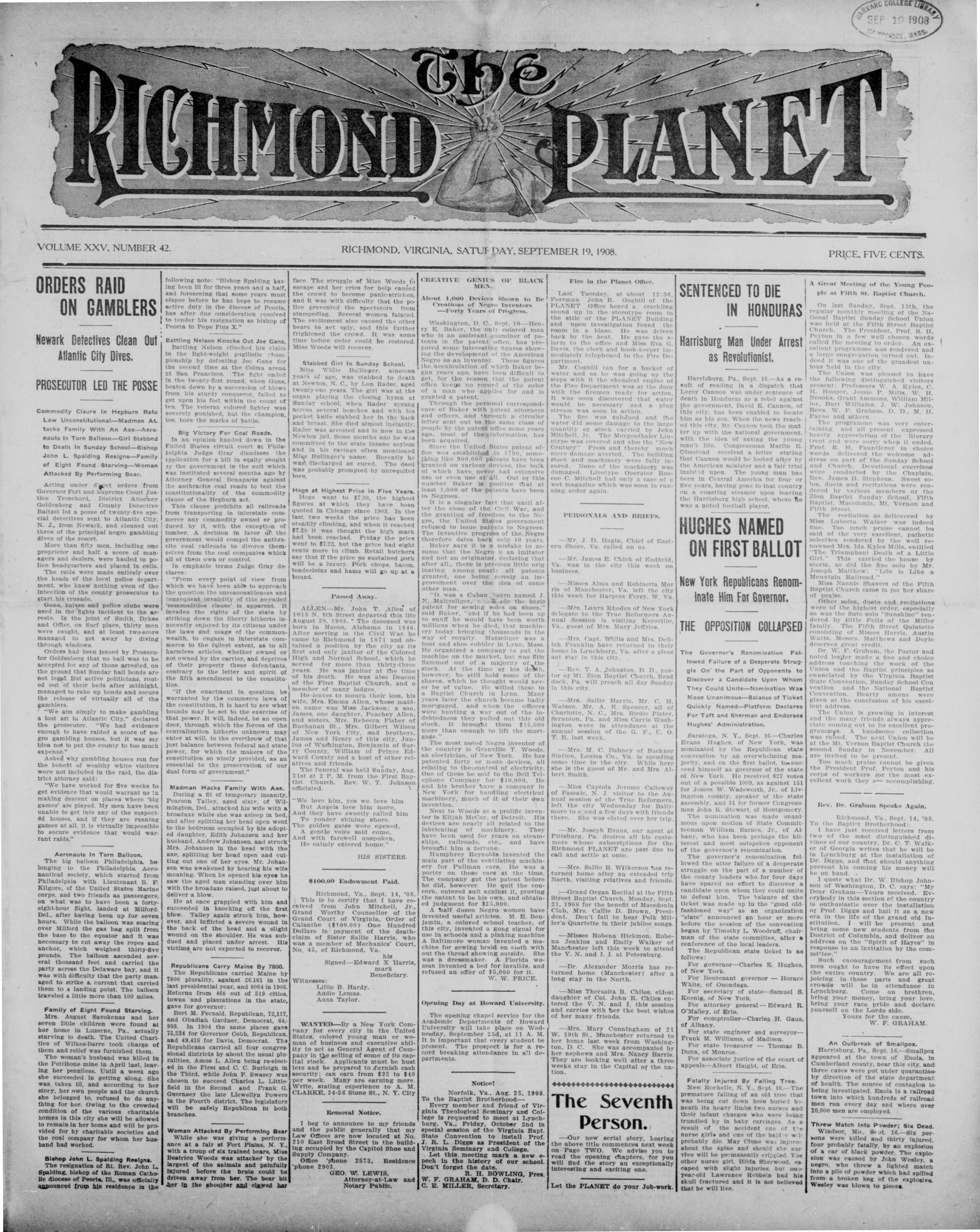
THE RICHMOND PLANET
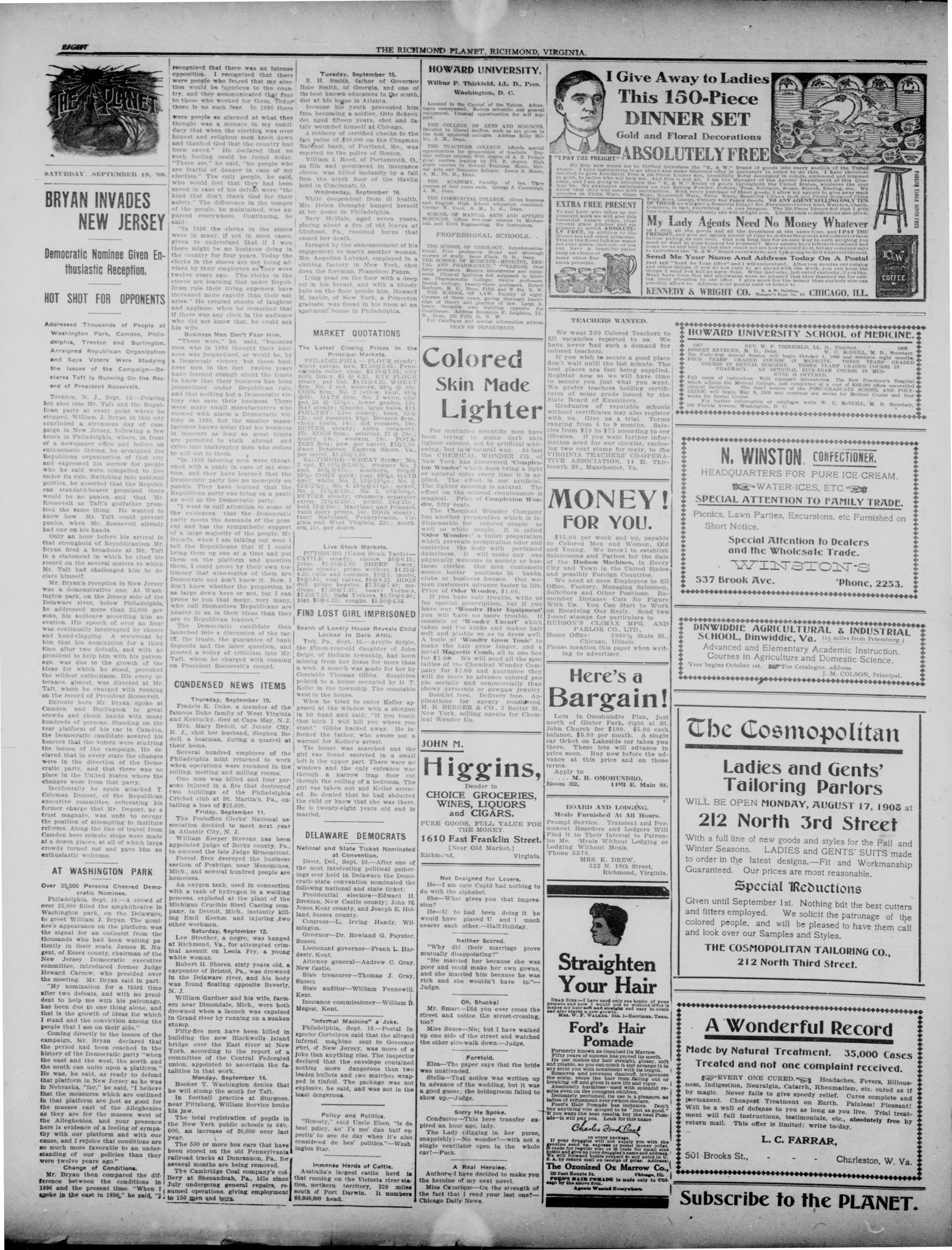
ORDERS RAID ON GAMBLERS
Newark Detectives Clean Out Atlantic City Dives.
PROSECUTOR LED THE POSSE
Commodity Claure In Hepburn Rate Law Unconstitutional—Madman Attacks Family With An Axe—Aeronauts In Torn Balloon—Girl Stabbed to Death In Sunday School—Bishop John L. Spalding Resigns—Family of Eight Found Starving—Woman Attacked By Performing Bear.
Acting under direct orders from Governor Fort and Supreme Court Justice Trenchard, District Attorney Goldenberg and County Detective Baltzel led a posse of twenty-five special detectives sent to Atlantic City, N. J., from Newark, and cleaned out three of the principal negro gambling dives of the resort.
More than fifty men, including one proprietor and half a score of managers and dealers, were hauled to police headquarters and placed in cells. The raids were made entirely over the heads of the local police department, who knew nothing even of the intention of the county prosecutor to start his crusade.
Guns, knives and police clubs were used in theights incident to the arrests. In the joint of Smith, Dykes and Offer, on Surf place, thirty men were caught, and at least two score managed to get away by diving through windows.
Orders had been issued by Prosecutor Goldenberg that no ball was to be accepted for any of those arrested, on the ground that Sunday ball bonds are not legal. But active politicians, routed out of their beds after midnight, managed to rake up bonds and secure the release of virtually all of the gamblers.
"We aim simply to make gambling a lost art in Atlantic City," declared the prosecutor. "We had evidence enough to have raided a score of negro gambling houses, but it was my idea not to put the county to too much expense."
Asked why gambling houses run for the benefit of wealthy white visitors were not included in the raid, the district attorney said:
"We have worked for five weeks to get evidence that would warrant us in making descent on places where 'big games' are played. My men have been unable to get into any of the suspected houses, and if they are running games at all, it is virtually impossible to secure evidence that would warrant raids."
Aeronauts In Torn Balloon
The big balloon Philadelphia, belonging to the Philadelphia Aeronautical society, which started from Philadelphia with Lieutenant B. F. Kilgore, of the United States Marine corps, and two friends as passengers, on what was to have been a forty-eight-hour flight, landed at Milford, Del., after having been up for seven hours. While the balloon was soaring over Milford the gas bag split from the base to the equator and it was necessary to cut away the ropes and anchor, which weighed thirty-five pounds. The balloon ascended several thousand feet and carried the party across the Delaware bay, and it was with difficulty that the party managed to strike a current that carried them to a landing point. The balloon traveled a little more than 100 miles.
Family of Eight Found Starving.
Mrs. August Savokenas and her seven little children were found at her home in Luzerne, Pa., actually starving to death. The United Charities of Wilkes-Barre took charge of them and relief was furnished them.
The woman's husband was killed in the Pettibone mine in April last, leaving her penniless. Until a week ago she succeeded in getting along. She was taken ill, and according to her story, her own people and the church she belonged to, refused to do anything for her. Owing to the crowded condition of the various charitable homes in this city she will be allowed to remain in her home and will be provided for by charitable societies and the coal company for whom her husband had worked.
Bishop John L. Spalding Resigns.
The resignation of Rt. Rev. John L. Spalding, bishop of the Roman Catholic diocese of Peoria, Ill., was officially announced from his residence in the
following note: "Bishop Spalding having been ill for three years and a half, and foreseeing that some years must elapse before he has hope to resume active duty in the diocese of Peoria, has after due consideration resolved to tender his resignation as bishop of Peoria to Pope Pius X."
Battling Nelson Knocks Out Joe Gans. Battling Nelson clinched his claim to the light-weight pugilistic championship by defeating Joe Gans for the second time at the Colma arena at San Francisco. The fight ended in the twenty-first round, when Gans, beaten down by a succession of blows from his sturdy conqueror, failed to get upon his feet within the count of ten. The veteran colored fighter was severely punished, but the champion, too, bore the marks of battle.
Big Victory For Coal Roads. In an opinion handed down in the United States circuit court at Philadelphia Judge Gray dismisses the application for a bill in equity sought by the government in the suit which was instituted several months ago by Attorney General Bonaparte against the anthracite coal roads to test the constitutionality of the commodity clause of the Heburn act.
This clause prohibits all railroads from transporting in interstate commerce any commodity owned or produced by it, with the exception of lumber. A decision in favor of the government would compel the anthracite coal railroads to divorce themselves from the coal companies which all of them own or control.
In emphatic terms Judge Gray declares:
"From every point of view from which we have been able to approach the question the unreasonableness and consequent invalidity of this so-called 'commodities clause' is apparent. It invades the rights of the state by striking down the liberty hitherto innocently enjoyed by its citizens under the laws and usage of the commonwealth, to engage in interstate commerce to the fullest extent, as to all harmless articles, whether owned or not owned by the carrier, and deprives of their property these defendants, contrary to the letter and spirit of the fifth amendment to the constitution.
"If the enactment in question be warranted by the commerce laws of the constitution, it is hard to see what bounds may be set to the exercise of that power. It will, indeed, be an open door, through which the forces of the centralization hitherto unknown may enter at will, to the overthrow of that just balance between federal and state power, for which the makers of the constitution so wisely provided, as an essential to the preservation of our dual form of government."
Madman Hacks Family With Axe.
During a fit of temporary insanity, Pearson Talley, aged sixty, of Wilmington, Del., attacked his wife with a broadaxe while she was asleep in bed, and after splitting her head open went to the bedroom occupied by his adopted daughter, Edith Johansen and her husband, Andrew Johansen, and struck Mrs. Johansen in the head with the axe, splitting her head open and cutting out one of her eyes. Mr. Johansen was awakened by hearing his wife moaning. When he opened his eyes he saw the aged man standing over him with the broadaxe raised, just about to deliver a blow.
He at once grappled with him and succeeded in knocking off the first blow. Talley again struck him, however, and inflicted a severe wound in the back of the head and a slight wound on the shoulder. He was subdued and placed under arrest. His victims are not expected to recover.
Republicans Carry Maine By 7800.
The Republicans carried Maine by 7800 plurality, against 26,181 in the last presidential year, and 8064 in 1906. Returns from 468 out of 519 cities, towns and plantations in the state, gave for governor:
Bert M. Fernald, Republican, 72,117, and Obadiah Gardner, Democrat, 64,993. In 1904 the same places gave 75,334 for Governor Cobb, Republican, and 49,416 for Davis, Democrat. The Republicans carried all four congressional districts by about the usual pluralities, Amos L. Allen being re-elected in the First and C. C. Burleigh in the Third, while John P. Swasey was chosen to succeed Charles L. Littlefield in the Second and Frank G. Guernsey the late Llewellyn Powers in the Fourth district. The legislature will be safely Republican in both branches.
Woman Attacked By Performing Bear
While she was giving a performance at a fair at Fort Plains, N. Y., with a troup of six trained bears, Miss Beatrice Woods was attacked by the largest of the animals and painfully injured before the brute could be driven away from her. The bear bit her in the shoulder and clawed her
RICHMOND, VIRGINIA, SATUF DAY, SEPTEMBER 19, 1908.
face. The struggle of Miss Woods to escape and her cries for help caused the crowd to become panic-stricken, and it was with difficulty that the police prevented the spectators from stampeding. Several women fainted. The excitement also caused the other bears to act ugly, and this further frightened the crowd. It was some time before order could be restored. Miss Woods will recover.
Stabbed Girl In Sunday School
Miss Willie Bullinger, nineteen years of age, was stabbed to death at Newton, N. C., by Lon Rader, aged twenty-one years. The girl was at the organ playing the closing hymn at Sunday school, when Rader sprang across several benches and with his pocket knife stabbed her in the back and breast. She died almost instantly, Rader was arrested and is now in the Newton jail. Some months ago he was committed to the state insane asylum and in his ravings often mentioned Miss Bullinger's name. Recently he was discharged as cured. The deed was probably prompted by unrequited love.
Hogs at Highest Price in Five Years. Hogs went to $7.30, the highest figures at which they have been quoted in Chicago since 1903. In the last two weeks the price has been steadily climbing, and when it reached $7.20 it was thought the high mark had been reached. Friday the price went to $7.22, but the price had eight cents more to climb. Retail butchers say that if the price us sustained pork will be a luxury. Pork chops, bacon, tenderloins and hams will go up at a bound.
Passed Away.
ALLEN—Mr. John T. Allen of 1013 N. 8th Street departed this life August 28, 1908. "The deceased was born in Macon, Alabama in 1846. After serving in the Civil War he came to Richmond in 1871 and obtained a position by the city as its first and only janitor of the Colored High and Normal School, which he served for more than thirty-three years. He was janitor at the time of his death. He was also Deacon of the First Baptist Church, and a member of many lodges. He leaves to mourn their loss, his wife, Mrs. Emma Allen, whose maiden name was Miss Jackson; a son, James, one daughter, Peachey Allen, and sisters, Mrs. Rebecca Fisher of Buchanan St., Mrs. Gilbert Wilson of New York City, and brothers, James and Henry of this city, Junius of Washington, Benjamin of Surry County, William of Prince Edward County and a host of other relatives and friends. The funeral was held Sunday, Aug. 31st at 2 P. M. from the First Baptist Church. Rev. W. T. Johnson officiated.
"We love him, yes we love him But Angels love him more. And they have sweetly called him To yonder shining shore. The golden gates were opened, A gentle voice said come, And with farewell unspoken, He calmly entered home."
HIS SISTERS.
$100,00 Endowment Paid.
Richmond, Va., Sept. 14, '08.
This is to certify that I have received from John Mitchell, Jr.
Grand Worthy Counsellor of the Grand Court of Virginia, Order of Calanthe ($100.00) One Hundred Dollars in payment of the deathclaim of Sister Sallie Harris, who was a member of Mechanics' Court.
No 45, of Richmond, Va.
Lillie B. Hardy.
Addie Lemas.
Anna Taylor.
WANTED—By a New York Company for every city in the United States, colored young man or woman of business and executive ability to act as General Agent of Company in the selling of some of its capital stock. Applicants must be hustlers and be prepared to furnish cash security; can earn from $25 to $40 per week. Many are earning more. Write, stating experience to A. M. CLARKE, 24-26 Stone St., N. Y. City
Removal Notice.
I beg to announce to my friends and the public generally that my Law Offices are now located at No. 210 East Broad Street in the building occupied by the Capitol Shoe and Supply Company.
Office 'phone 2573, Residence 'phone 2903.
GEO. W. LEWIS,
Attorney-at-Law and
Notary Public.
CREATIVE GENIUS OF BLACK MEN.
About 1,000 Devices Shown to Be Creations of Negro Inventors — Forty Years of Progress.
Washington, D. C., Sept. 10—Henry E. Baker, the only colored man who is an assistant examiner of patents in the patent office, has prepared some interesting figures showing the development of the American Negro as an inventor. These figures the accumulation of which Baker began years ago, have been difficult to get, for the reason that the patent office keeps no record of the color of a man who applies for and is granted a patent.
Through the personal correspondence of Baker with patent attorneys and others, and through a circular letter sent out to the same class of people by the patent office some years ago, most of the information has been acquired.
Since the United States patent office was established in 1790, something like 900,000 patents have been granted on various devices, the bulk of which have never had extensive use or even use at all. Out of this number Baker is positive that at least 1,000 of the patents have been to Negroes.
It is a singular fact that until after the close of the Civil War, and the granting of freedom to the Negro, the United States government refused to issue patents to Negroes. The inventive progress of the Negro therefore dates back only 40 years.
Baker says it is a mistake to assume that the Negro is an imitator and not an originator, declaring that after all, there is precious little originating among nearly all patents granted, one being merely an improvement over the idea of some other man.
"It was a Cuban Negro named J. N. Matzeliger, who made the basic patent for sewing shoes on shoes," said Baker, "and if he had been up to snuff he would have been worth millions when he died, that machinery today bringing thousands in the way of royalty. Matzeliger was a boot and shoe cobbler in Lynn, Mass. He organized a company to put the machine on the market, but was film flammed out of a majority of the stock. At the time of his death, however, he still held some of the shares, which he thought would never be of value. He willmed these to a Baptist Church in Lynn. Many years later the church became badly mortgaged, and when the officers were hunting a way out of the indebtedness they pulled out this old stock. It brought them $15,000 more than enough to lift the mortgage."
The most noted Negro inventor of the island is Granville T. Woods, an electrician, of New York. He has patented forty or more devices, all relating to the control of electricity. One of these he sold to the Bell Telephone Company for $10,000. He and his brother have a company in New York for handling electrical machinery, much of it of their own invention.
Next to Woods as a prolific inventor is Elijah McCoy, of Detroit. His devices are nearly all related to the lubricating of machinery. They have been used for years on steamships, railroads, etc., and have brought him a fortune.
Humphrey Reynolds invented the main part of the ventilating machinery for Pullman cars. He was a porter on these cars at the time. The company got the patent before he did, however. He quit the concern, entered suit against it, proving the patent to be his own, and obtained judgment for $25,000.
A half dozen Negro women have invented useful articles. M. E. Benjamin, a colored school teacher, of this city, invented a gong signal for use in schools and a pinking machine. A Baltimore woman invented a machine for sewing braid on cloth with out the thread showing outside. She was a dressmaker. A Florida woman invented a bed for invalids, and refused an offer of $5,000 for it.
W. W. PRICE.
Opening Day at Howard University.
The opening chapel service for the Academic Departments of Howard University will take place on Wednesday, September 23d, at 11 A. M. It is important that every student be present. The prospect is for a record breaking attendance in all departments.
Notice!
Norfolk, Va., Aug. 25, 1908
To the Baptist, Brotherhood.
Every member and friend of Virginia. Theological Seminary and College is requested to meet at Lynchburg, Va., Friday, October and in special session of the Virginia Bapt. State Convention to install Prof. J. R. L. Diggs as President of the Virginia Seminary and College. Let this meeting mark a new epoch in the history of our school. Don't forget the date. R. H. BOWLING, Pres. W. F. GRAHAM, D. D. Chair. C. E. MILLER, Secretary.
Fire in the Planet Office
Last Tuesday, at about 12:30, Foreman John R. Gobgill of the PLANET Office heard a crackling sound up in the sterotype room in the attic of the PLANET Building and upon investigation found the room in a blaze. He was driven back by the heat. He gave the alarm to the office and Miss Eva G. Davis, the clerk and book-keeper immediately telephoned to the Fire Department.
Mr. Cogbill tan for a bucket of water and as he was going up the steps with it the chemical engine of the Fire Department was at the door with the firemen ready for action. It was soon discovered that water would be necessary and a plug stream was soon in action.
The fire was subdued and the water did some damage to the large quantity of stock carried by John Mitchell, Jr. The Mergenthaler Linotype was covered and also the "New Century" Press and thereby much more damage averted. The building stock and machinery were fully insured. None of the machinery was damaged. Linotype Operator Roscoe C. Mitchell had only a case of a wet magazine which was soon in running order again.
PERSONALS AND BRIEF
—Mr. J. D. Hagin, Chief of Eastern Shore, Va. called on us.
—Mr. James E. Chick of Endfield, Va. was in the city this week on business.
—Misses Alma and Robinetta Morris of Manchester, Va. left the city this week for Harpers Ferry, W. Va.
—Mrs. Laura Rhodes of New York delegate to the True Reformers Annual Session is visiting Keysville, Va., guest of Mrs. Mary Jeffries.
—Mrs. Capt. Willis and Mrs. Dellah Franklin have returned to their home in Lynchburg, Va. after a pleas ant stay in this city.
—Rev. T. A. Johnston, D. D., pastor of Mt. Zion Baptist Church, Brad dock, Pa. will preach all day Sunday in this city.
—Mrs. Sallie Harris, Mr. C. H. Watson, Mr. A. E. Spencer, all of Charlotte, N. C., Mrs. Birdie Plater, Scranton, Pa. and Miss Carrie Washington were in attendance at the annual session of the G. F., U. O. T. R. last week.
—Mrs. M. C. Dabney of Buckner Station, Louisa Co., Va. is spending some time in the city. While here she is the guest of Mr. and Mrs. Albert Smith.
—Miss Captola Jerome Calloway of Passaic, N. J. visitor to the Annual session of the True Reformers, left the city Wednesday for Baltimore to send a few days with friends there. She was elated over her trip.
—Mr. Joseph Evans, our agent at Pittsburg, Pa. desires all his customers whose subscriptions for the Richmond PLANET are past due to call and settle at once.
—Mrs. Sallie B. Wilkerson has returned home after an extended trip North, visiting relatives and friends.
—Grand Organ Recital at the Fifth Street Baptist Church, Monday, Sept. 21, 1908 for the benefit of Macedonia Club, Mrs. Callie D. Brown, President. Don't fail to hear Polk Miller's Quartette in their jubilee songs.
—Misses Robena Hickman, Robena Jenkins and Emily Walker of Manchester left this week to attend the V. N. and I. J. at Petersburg.
—Dr. Alexander Morris has returned home (Manchester) after a long stay in the North.
—Miss Therasita B. Chiles, eldest daughter of Col. John R. Chiles entered the V. N. and I, this session and carries with her the best wishes of her many friends.
Mrs. Mary Cunningham of 21 W. 19th St., Manchester returned to her home last week from Washington, D. C. She was accompanied by her nephews and Mrs. Nancy Harris. They are looking well after a three weeks stay in the Capital or the nation.
The Seventh Person.
Our new serial story, bearing the above title commences next week on Page TWO. We advise you to read the opening chapters, for you will find the story an exceptionally interesting and exciting one.
Let the PLANET do your Job-work.
Harrisburg Man Under Arrest as Revolutionist.
Harrisburg, Pa., Sept. 16.—As a result of reading in a dispatch that Leroy Cannon was under sentence of death in Honduras as a rebel against the government, David K. Cannon, of this city, has been enabled to locate him as his son. When the news reached this city, Mr. Cannon took the matter up with the national government, with the idea of saving the young man's life. Congressman Marlin E. Olmstead received a letter stating that Cannon would be looked after by the American minister and a fair trial insisted upon. The young man has been in Central America for four or five years, having gone to that country on a coasting steamer upon leaving the Harrisburg high school, where he was a noted football player.
HUGHES NAMED ON FIRST BALLOT
New York Republicans Renominate Him For Governor.
THE OPPOSITION COLLAPSED
The Governor's Renomination Followed Failure of a Desperate Struggle On the Part of Opponents to Discover a Candidate Upon Whom They Could Unite—Nomination Was Made Unanimous—Balance of Ticket Quickly Named—Platform Declares For Taft and Sherman and Endorses Hughes' Administration.
Saratoga, N. Y., Sept. 16.—Charles Evans Hughes, of New York, was nominated by the Republican state convention by an overwhelming majority, and on the first ballot, to succeed himself as governor of the state of New York. He received 827 votes out of a possible 1009, as against 151 for James W. Wadsworth, Jr., of Livingston county, speaker of the state assembly, and 31 for former Congressman John K. Stewart, of Montgomery. The nomination was made unanimous upon motion of State Committeeman William Barnes, Jr., of Albany, who has been perhaps the bitterest and most outspoken opponent of the governor's renomination.
The governor's renomination followed the utter failure of a desperate struggle on the part of a number of the county leaders who for four days have spared no effort to discover a candidate upon whom they could unite to defeat him. The balance of the ticket was made up in the "good old-fashioned way" as an organization "slate" announced an hour or more before the session of the convention began by Timothy L. Woodruff, chairman of the state committee, after a conference of the local leaders.
The Republican state ticket is as follows:
For governor—Charles E. Hughes, of New York.
For lieutenant governor — Horace White, of Onondaga.
For secretary of state—Samuel S. Koenig, of New York.
For attorney general—Edward R. O'Malley, of Erio.
For comptroller—Charles H. Gaus, of Albany.
For state engineer and surveyor—Frank M. Williams, of Madison.
For state treasurer — Thomas B. Dunn, of Monroe.
For associate justice of the court of appeals—Albert Haight, of Erie.
Fatally Injured By Falling Tree.
New Rochelle, N. Y., Sept. 16.—The premature falling of an old tree that was being cut down here buried beneath its heavy limbs two nurses and their infant charges who were being trundled by in baby carriages. As a result of the accident one of the nurse girls and one of the babies will probably die. May Clune was injured about the spine and should she survive will be permanently crippled. The other nurse girl, Hilda Sherwood, escaped with slight injuries, but one-year-old Lawrence Rebbein had his skull fractured and it is not believed that he will live.
PRICE, FIVE CENTS
A Great Meeting of the Young People at Fifth St. Baptist Church.
On last Sunday, Sept. 13th, the regular monthly meeting of the National Baptist Sunday School Union was held at the Fifth Street Baptist Church. The President, Prof. B. H. Peyton in a few well chosen words called the meeting to order. An excellent programme was rendered and a large congregation turned out. Indeed it was one of the grandest unions field in the city.
The Union was pleased to have the following distinguished visitors present: Professors W. A. Kyles, C. H. Hooper, Jessie P. Mills, W. H. Brooks, Grant Ammons, William Miller, Burt Williams, J. W. Johnson, Revs. W. F. Graham, D. D., M. H. Payne and others.
The programme was very entertaining and all present expressed hearty appreciation of the literary treat and were sorry when it ended.
Prof. R. H. Fauntleroy in choice words delivered the welcome address on part of the Sunday School and Church. Devotional exercises were conducted by the Chaplain, Rev. James H. Stephens. Sweet solos, duets and recitations were rendered by various members of the Zion Baptist Sunday School, Fifth Baptist, Macedonia, Mt. Vernon and Fifth Street.
The recitation is delivered by Miss Luberta Walker was indeed fine. Too much praise cannot be said of the very excellent, pathetic selection rendered by the well renowned Mrs. Ida Kyles Mills, entitled "The Triumphant Death of a Little Girl." This carried the house by storm, as did the fine solo by Mr. Joseph Matthew: "Life is Like a Mountain Railroad."
Miss Nannie Shavers of the Fifth Baptist Church came in for her share of praise.
Other solos, duets and recitations were of the highest order, especially so was the flute solo "Sunshine" rendered by little Felix of the Miller family. The Fifth Street Quintette consisting of Misses Harris, Austin Watts, Messrs. Matthews and Doyle deserves great credit.
Dr. W. F. Graham, the Pastor and noted leader made a fine and choice address touching the work of the Union and the Baptist principles as enunciated by the Virginia Baptist State Convention, Sunday School Convention and the National Baptist Convention. Hearty amens were given at the conclusion of his excellent address.
The Union is growing in interest and the many friends always appreciate coming out to its excellent programmes. A handsome collection was raised. The next Union will be at the M. Vernon Baptist Church the second Sunday in November. All are invited to be present.
Too much praise cannot be given the President Prof. Peyton and his corps of workers for the most excellent work they are accomplishing
Rev. Dr. Graham Speaks Again.
Richmond, Va., Sept. 14, '08. To the Baptist Brotherhood; I have just received letters from two of the most distinguished divines of our country, Dr. C. T. Walker of Georgia writes that he will be in Lynchburg at the installation of Dr. Diggs, and that should anything prevent his coming his money will be on hand.
I quote what Dr. W. Bishop Johnson of Washington, D. C. says: "My Dear Graham—Yours received. Everybody in this section of the country is enthusiastic over the installation or Prof. Diggs and hail it as a new era in the life of the grand old Institution. I will be present and bring some new students from the District of Columbia, and deliver an address on the "Spirit of Hayes" in response to an invitation by the committee."
Such encouragement from such men ought to have its effect upon the entire country. We are all rejoicing in these parts and great crowds will be in attendance in Lynchburg. Come on brethren, bring your money, bring your love, bring your race pride and declare yourself on the Lords side.
Yours for the cause,
W. F. GRAHAM.
An Outbreak of Smallpox
Harrisburg, Pa., Sept. 16—Smallpox appeared at the town of Enola, in Cumberland county, near this city, and three cases were put under quarantine by direction of the state department of health. The source of contagion is being investigated. Enola is a railroad town into which hundreds of railroad men run every day and where over 10,000 men are employed.
Threw Match Into Powder; Six Dead. Windsor, Mo., Sept. 16—Six persons were killed and thirty injured, four probably fatally, by an explosion of a car of black powder. The explosion was caused by John Wesley, a negro, who threw a lighted match into a pile of powder which had spilled from a broken keg of the explosive. Wesley was blown to pieces.
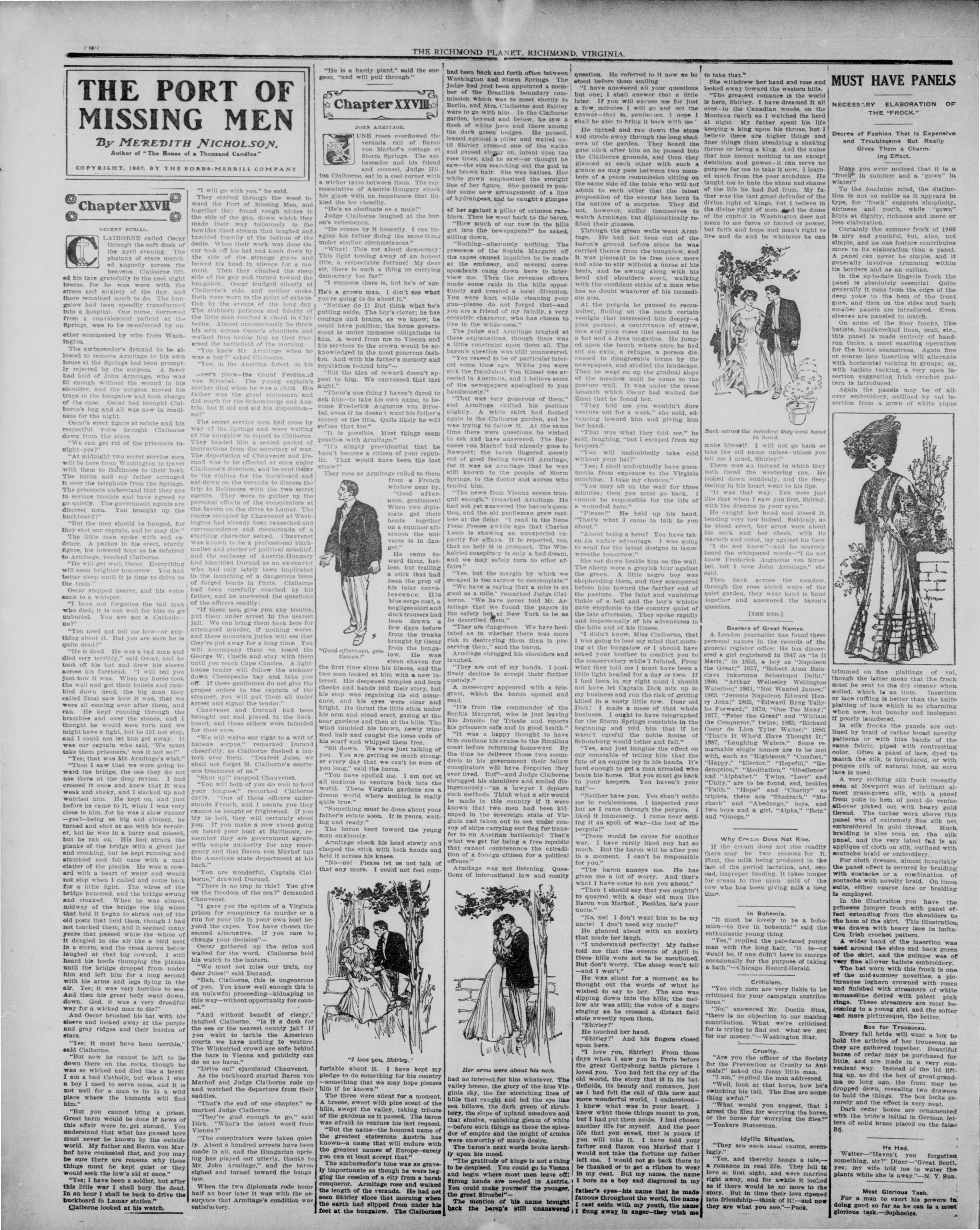
THE PORT OF MISSING MEN
By MEREDITH NICHOLSON.
Author of "The House of a Thousand Candles"
COPYRIGHT, 1907. BY THE BOBB5-MERRILL COMPANY
Chapter XXVII
DECENT BURIAL.
LAIBORNE called Oscar through the soft dusk of the April evening. The phalanx of stars marched augustly across the heavens. Claiborne lifts
LAIBORNE called Oscar through the soft dusk of the April evening. The phalanx of stars marched augustly across the heavens. Claiborne lifted his face gratefully to the cool night breeze, for he was worn with the stress and anxiety of the day, and there remained much to do. The bungalow had been speedily transformed into a hospital. One nurse, borrowed from a convalescent patient at the Springs, was to be re-enforced by another summoned by wire from Washington.
The ambassador's demand to be allowed to remove Armitage to his own house at the Springs had been promptly rejected by the surgeon. A fever had hold of John Armitage, who was ill enough without the wound in his shoulder, and the surgeon moved his traps to the bungalow and took charge of the case. Oscar had brought Clalborne's bag and all was now in readiness for the night.
Oscar's erect figure at salute and his respectful voice brought Clalborne down from the stars.
"We can get rid of the prisoners tonight—yes!" "At midnight two secret service men will be here from Washington to travel with them to Baltimore to their boat. The baron and my father arranged it over the telephone from the Springs. The prisoners understand that they are in serious trouble and have agreed to go quietly. The government agents are discreet men. You brought up the buckboard?"
"But the men should be hanged, for they shot our captain, and he may die." The little man spoke with sad cadence. A pathos in his erect, sturdy figure, his lowered tone as he referred to Armitage, touched Clatborne.
"He will get well, Oscar. Everything will seem brighter tomorrow. You had better sleep until it is time to drive to the train."
Oscar stepped nearer, and his voice sank to a whisper.
"I have not forgotten the tall man who died; it is not well for him to go buried. You are not a Catholic—no."
"You need not tell me how—or anything about it. But you are sure he is quite dead."
"He is dead. He was a bad man and died very terribly," said Oscar, and he took off his hat and drew his sleeve across his forehead. "I will tell you just how it was. When my horse took the wall and got their bullets and tumbled down dead, the big man they called Zmal saw how it was, that we were all coming over after them, and ran. He kept running through the brambles and over the stones, and I thought he would soon turn and we might have a fight, but he did not stop, and I could not let him get away. It was our captain who said, "We must take them prisoners," was it not so?"
"Yes; that was Mr. Armitage's wish." "Then I saw that we were going toward the bridge, the one they do not use there at the deep ravine. I had crossed it once and knew that it was weak and shaky, and I slacked up and watched him. He kept on, and just before he came to it, when I was very close to him, for he was a slow runner —yes?—being so big and clumsy, he turned and shot at me with his revolver, but he was in a hurry and missed, but he ran on. His feet struck the planks of the bridge with a great jar and creaking, but he kept running and stumbled and fell once with a mad clatter of the planks. He was a coward with a heart of water and would not stop when I called and come back for a little fight. The wires of the bridge hummed, and the bridge swung and creaked. When he was almost midway of the bridge the big wires that held it began to shriek out of the old posts that held them, though I had not touched them, and it seemed many years that passed while the whole of it dangled in the air like a bird nest in a storm, and the creek down below laughed at that big coward. I still heard his hoofs thumping the planks until the bridge dropped from under him and left him for a long second with his arms and legs flying in the air. Yes; it was very horrible to see. And then his great body went down, down. God, it was a very dreadful way for a wicked man to die!"
And Oscar brushed his hat with his sleeve and looked away at the purple and gray ridges and their burden of stars.
"Yes; it must have been terrible," said Clalborne.
"But now he cannot be left to lie down there on the rocks, though he was so wicked and died like a beast. I am a bad Catholic, but when I was a boy I used to serve mass, and it is not well for a man to lie in a wild place where the buzzards will find him."
"But you cannot bring a priest. Great harm would be done if news of this affair were to. get abroad. You understand that what has passed here must never be known by the outside world. My father and Baron von Martho have counselled that, and you may be sure there are reasons why these things must be kept quiet or they would seek the law's aid at once."
"Yes; I have been a soldier, but after this little war I shall bury the dead. In an hour I shall be back to drive the buckboard to Lamar station." Claiborne looked at his watch.
"I will go with you." he said.
They started through the wood toward the Port of Missing Men, and together they found rough niches in the side of the gap, down which they made their way tollowlsy to the bowler lined stream that laughed and tumbled foamily at the bottom of the defile. When their work was done Oscar took off his hat and knelt down by the side of the strange grave and bowed his head in silence for a moment. Then they climbed the steep side of the gap and turned toward the bungalow. Oscar trudged silently at Clalborne's side, and neither spoke Both were worn to the point of exhaustion by the events of the long day. The stubborn patience and fidelity of the little man touched a chord in Clalborne. Almost unconsciously he threw his arm across Oscar's shoulders and walked thus beside him as they traversed the battlefield of the morning. "You knew Mr. Armitage when he
was a boy?" asked Claiborne.
"Yes; in the Austrian forest, on his
inner's place—the Count Ferdinaud
von Stroebel. The young captain's
mother died when he was a child. His
father was the great statesman and
did much for the Schomburgs and Austria,
but it did not aid his disposition—no."
The secret service men had come by way of the Springs and were waiting at the bungalow to report to Claiborne. They handed him a sended packet of instructions from the secretary of war. The deportation of Chauvenet and Durand was to be effected at once under Claiborne's direction, and he sent Oscar to the stables for the buckboard and sat down on the veranda to discuss the trip to Baltimore with the two secret agents. They were to gather up personal effects of the conspirators at the tavern on the drive to Lamar. The rooms occupied by Chauvenet at Washington had already been ransacked and correspondence and memoranda of a startling character seized. Chauvenet was known to be a professional black-maller and plotter of political mischief, and the embassy of Austria-Hungary had identified Durand as an ex-convict who had only lately been implicated in the launching of a dangerous issue of forged bonds in Paris. Claiborne had been carefully coached by his father, and he answered the questions of the officers readily:
"If these men give you any troubles, put them under arrest in the nearest jail. We can bring them back here for attempted murder, if nothing worse, and these mountain jurts will see that they're put away for a long time. You will accompany them on board the George W. Custis and stay with them until you reach Cape Charles. A light-house tender will follow the steamer down Chesapeake bay and take you off. If these gentlemen do not give the proper orders to the captain of the steamer, you will put them all under arrest and signal the tender."
Chauvenet and Durand had been brought out and placed in the buckboard, and these orders were intended for their ears.
"We will waive our right to a writ of habens corpus," remarked Durand cheerfully, as Clalborne flashed a lantern over them. "Dearest Jules, we shall not forget M. Clalborne's courteous treatment of us."
"Shut up!" snapped Chauvenet.
"You will both of you do well to hold your tongues," remarked Clalborne dryly. "One of these officers understands French, and I assure you they cannot be bought or frightened. If you try to bolt, they will certainly shoot you. If you make a row about going on board your boat at Baltimore, remember they are government agents, with ample authority for any emergency and that Baron von Marhof has the American state department at his back."
"You are wonderful, Captain Clalborne," drawled Durnd.
"There is no trap in this? You give us the freedom of the sea?" demanded Chauvenet.
"I gave you the option of a Virginia prison for conspiracy to murder or a run for your life in your own boat beyond the capes. You have chosen the second alternative. If you care to change your decision"—
Oscar gathered up the reins and waited for the word. Claiborne held his watch to the lantem.
"We must not miss our train, my dear Jules!" said Durand.
"Bah, Claiborne, this is ungenerous of you. You know well enough this is an unlawful proceeding—kidnapping us this way—without opportunity for counsel."
"And without benefit of clergy," laughed Claiborne. "Is it a dash for the sea or the nearest county jail? If you want to tackle the American courts we have nothing to venture. The Winkleried crowd are safe behind the bars in Vienna and publicity can do us no harm."
"Drive on!" ejaculated Chauvenot.
As the buckboard started Baron von Marhof and Judge Claiborne rode up and watched the departure from their saddles.
"That's the end of one chapter," remarked Judge Claiborne.
"They're glad enough to go," said Dick. "What's the latest word from Vienna?"
"The conspirators were taken quietly. About a hundred arrests have been made in all, and the Hungarian uprising has played out utterly, thanks to Mr. John Armitage," and the baron sighed and turned toward the bungo low.
When the two diplomats rode home half an hour later it was with the assurance that Armitage's condition was satisfactory.
THE RICHMOND PLANET, RICHMOND, VIRGINIA
"He is a hardy plant," said the surgeon, "and will pull through."
Chapter XXVIII
JOHN ARMITAGE.
UNE roses overflowed the veranda rail of Baron von Marhof's cottage at Storm Springs. The ambassador and his friend and counsel. Judge Hill.
UNE roses overdowed the veranda拉红 of Baron von Marhof's cottage at Storm Springs. The ambassador and his friend and counsel, Judge Hilton Claiborne, sat in a cool corner with a wicker table between them. The representative of Austria Hungary shook his glass with an impatience that tinkled the ice cheerfully.
"He's as obstinate as a mule!"
Judge Claiborne laughed at the baron's vehemence.
"He comes by it honestly. I can imagine his father doing the same thing under similar circumstances."
"What! This rot about democracy! This light tossing away of an honest title, a respectable fortune! My dear sir, there is such a thing as carrying democracy too far."
"I suppose there is, but he's of age.
He's a grown man. I don't see what you're going to do about it."
"Neither do I. But think what he's putting aside. The boy's clever; he has courage and brains, as we know; he could have position; the home government is under immense obligations to him. A word from me to Vienna and his services to the crown would be acknowledged in the most generous fashion. And with his father's memory and reputation behind him"—
"But the idea of reward doesn't appeal to him. We canvassed that last night."
"There's one thing I haven't dared to ask him—to take his own name, to become Frederick Augustus von Streebel, even if he doesn't want his father's money or the title. Quite likely he will refuse that too."
"It is possible. Most things seem possible with Armitage."
"It's simply providential that he hasn't become a citizen of your republic. That would have been the last straw!"
They rose as Armitage called to them
3
from a French window near by.
"Good afternoon, gentlemen! When two diplomats get their heads together on a summer afternoon the universe is in danger."
He came toward them, hatless, but trailing a stick that had been the prop of his later convulscence. His blue serge coat, a neglege shirt and duck trousers had been drawn a few days before from the trunks brought by Oscar from the bungalow. He was clean shaves for
the first time since his illness, and the two men looked at him with a new interest. His deepened temples and lean cheeks and hands told their story, but his step was regaining its old assurance, and his eyes were clear and bright. He thrust the little stick under his arm and stood erect, gazing at the near gardens and then at the hills. The wind tumbled his brown, newly trimmed hair and caught the loose ends of his scarf and whipped them free.
"Sit down. We were just talking of you. You are getting so much stronger every day that we can't be sure of you long," said the baron.
"You have spolled me. I am not at all anxious to venture back into the world. These Virginia gardens are a dream world where nothing is really quite true."
"Something must be done about your father's estate soon. It is yours, waiting and ready."
The baron bent toward the young man anxiously.
Armitage shook his head slowly and clasped the stick with both hands and held it across his knees.
"No-no! Please let us not talk of that any more. I could not feel com-
A
"I love you, Shirley." fortable about it. I have kept my pledge to do something for his country—something that we may hope pleases him if he knows."
The three were silent for a moment. A breeze, sweet with pine scent of the hills, swept the valley, taking tribute of the gardens as it passed. The baron was afraid to venture his last request.
"But the name—the honored name of the greatest statesman Austria has known—a name that will endure with the greatest names of Europe—surely you can at least accept that."
The ambassador's tone was as gravely importunate as though we were begging the cession of a city from a harsh conqueror. Armitage rose and walked the length of the veranda. He had not seen Shirley since that morning when the earth had slipped from under his feet at the bungalow. The Claiborne
had been back and forth often between Washington and Storm Springs. The judge had just been appointed a member of the Brazilian boundary commission which was to meet shortly in Berlin, and Mrs. Clalborne and Shirley were to go with him. In the Claiborne garden, beyond and below, he saw a flash of white here and there among the dark green hedges. He paused, leaned against a pillar and waited until Shirley crossed one of the walks and passed slowly on, intent upon the rose trees, and he saw—or thought he saw—the sun searching out the gold in her brown hair. She was bathed. Her white gown emphasized the straight line of her figure. She paused to ponder some new arrangement of a line of hydrangeas, and he caught a glimpse of her against a pillar of crimson ramblers. Then he went back to the baron. "How much of our row in the hills got into the newspapers?" he asked, sitting down.
"Nothing—absolutely nothing. The presence of the Sophia Margaret off the capes caused inquiries to be made at the embassy, and several correspondents came down here to interview me. Then the revenue officers made some raids in the hills opportunely and created a local diversion. You were hurt while cleaning your gun—please do not forget that—and you are a friend of my family, a very eccentric character, who has chosen to live in the wilderness."
The judge and Armitage laughed at these explanations, though there was a little constraint upon them all. The baron's question was still unanswered.
"You ceased to be of particular interest some time ago. While you were sick the fraudulent Von Kissel was arrested in Australia, and I believe some of the newspapers apologized to you handsomely."
"That was very generous of them," and Armitage shifted his position slightly. A white skirt had flashed again in the Clalborne garden, and he was trying to follow it. At the same time there were questions he wished to ask and have answered. The Baroness von Marhof had already gone to Newport; the baron lingered merely out of good feeling toward Armitage, for it was as Armitage that he was still known to the people of Storm Springs, to the doctor and nurses who tended him.
"The news from Vienna seems tranquil enough," remarked Armitage. He had not yet answered the baron's question, and the old gentleman grew restless at the delay. "I read in the Neue Freie Presse awhile ago that Charles Louis is showing an unexpected capacity for affairs. It is reported, too, that an heir is in prospect. The Winkelried conspiracy is only a bad dream, and we may safely turn to other affairs."
"Yes, but the margin by which we escaped is too narrow to contemplate." "We have a saying that a miss is as good as a mile," remarked Judge Claiborne. "We have never told Mr. Armitage that we found the papers in the safety box at New York to be as he described them." "They are dangerous. We have hesitated as to whether there was more risk in destroying them than in preserving them," said the baron. Armitage shrugged his shoulders and laughed. "They are out of my hands. I positively decline to accept their further custody." A messenger appeared with a telegram, which the baron opened and read. "It's from the commander of the Sophia Margaret, who is just leaving Rio Janeiro for Trieste and reports his prisoners safe and in good health."
"It was a happy thought to have him continue his cruise to the Brazilian coast before returning homeward. By the time he delivers those twooundsrels to his government their fellow conspirators will have forgotten they ever lived. But"—and Judge Claiborne shrugged his shoulders and smiled disingenuously—"as a lawyer I deplore such methods. Think what a stir would be made in this country if it were known that two men had been kidnapped in the sovereign state of Virginia and taken out to sea under convey of ships carrying our flag for transfer to an Austrian battleship! That's what we get for being a free republic that cannot countenance the extradition of a foreign citizen for a political offense." Armitage was not listening. Questions of international law and country
C. H. H.
Her arms were about his neck. had no interest for him whatever. The valley breeze, the glory of the blue Virginia sky, the far stretching lines of hills that caught and led the eye like sea billows, the dark green of shrubbery, the slope of upland meadows and that elusive, vanishing gleam of white—before such things as these the splendor of empire and the might of armies were unworthy of man's desire. The baron's next words broke harshly upon his mood. "The gratitude of kings is not a thing to be desplied. You could go to Vienna and begin where most men leave off. Strong hands are needed in Austria. You could make yourself the younger, the great Stroebel"—The mention of his name brought back the baron's still unanswered
to take that." She withdrew her hand and rose and looked away toward the western hills. "The greatest romance in the world is here, Shirley. I have dreamed it all over—in the Canadian woods, on the Montana ranch as I watched the herd at night. My father spent his life keeping a king upon his throne, but I believe there are higher things and finer things than steadying a shaking throne or being a king. And the name that has meant nothing to me except dominion and power—it can serve no purpose for me to take it now. I learned much from the poor archduke. He taught me to hate the sham and shame of the life he had fled from. My father was the last great defender of the divine right of kings, but I believe in the divine right of men, and the dome of the capitol in Washington does not mean to me force or hatred or power, but faith and hope and man's right to live and do and be whatever he can
BARRON
Back across the meadow they went hand in hand.
make himself. I will not go back or take the old name unless—unless you tell me I must, Shirley!"
There was an instant in which they both faced the westering sun. He looked down suddenly, and the deep feeling in his heart went to his lips.
"It was that way. You were just like that when I saw you first, Shirley, with the dreams in your eyes."
He caught her hand and kissed it, bending very low indeed. Suddenly, as he stood erect, her arms were about his neck and her cheek, with its warmth and color, lay against his face.
"I do not know—" and he scarcely heard the whispered words—"I do not know Frederick Augustus von Stroebel, but I love John Armitage," she said.
Then back across the meadow, through the rose aisled ways of the quiet garden, they went hand in hand together and answered the baron's question
Bearers of Great Names.
A London journalist has found these personal names in the records of the general register office: He has discovered a girl registered in 1847 as "Is It Maria;" in 1853, a boy as "Napoleon the Great;" in 1857, "Borrist Alma Balaclava Inkerman Sebastopol Delhi;" in 1800, "Arthur Wellesley Wellington Waterloo;" in 1861, "Not Wanted James;" in 1863, "Jerome Napoleon Edward Henry John;" in 1865, "Edward Bynge Tallyho Forward;" in 1870, "One Too Many;" in 1877, "Peter the Great" and "William the Conqueror," twins; in 1883, "Richard Coeur de Lion Tyler Walter;" in 1886, "That's It Who'd Have Thought It;" in 1874, "Laughing Waters." Some remarkable single names are to be met with, such as "Righteous," "Comfort," "Happy," "Elector," "Hopeful," "Redemption," "Meditation," "Obedience" and "Alphabet." Twins, "Love" and "Unity," are to be found, and, besides "Falth," "Hope" and "Charity" as triplets, there are "Shadrach," "Mesach" and "Abednego," boys, and two boys and a girl, "Alpha," "Beta" and "Omega."
If the cream does not rise readily there may be two reasons for it. First, the milk being produced in the last of the period lactation, and, second, improper feeding. It takes longer for cream to rise upon milk of the cow who has been giving milk a long time.
"It must be lovely to be a bohemian—to live in bohemia!" said the enthusiastic young thing
"Yes," replied the pale-faced young man with the long hair, "it is—or would be, if one didn't have to emerge occasionally for the purpose of taking a bath."—Chicago Record-Herald.
"You rich men are very liable to be criticised for your campaign contributions."
"No," answered Mr. Dustin Stax,
"there is no objection to our making contribution. What we're criticised for is trying to find out what we get for our money."—Washington Star.
"Are you the officer of the Society for the Prevention or Cruelty to Animals?" asked the fussy little man. "I am," replied the man addressed. "Well, look at that horse, how he's switching his tail. The flies are something awful." "What would you suggest, that I arrest the flies for worrying the horse, or the horse for worrying the flies?" —Yonkers Statesman.
"They are such ideal chums, seemingly."
"Yes, and thereby hangs a tale,—a romance in real life. They fell in love at first sight, and were married right away, and for awhile it looked as if there would be no more to the story. But in time their love ripened into friendship—think of it!—and now they are what you see."—Puck.
question. He referred to it now as he stood before them smiling
"I have answered all your questions but one; I shall answer that a little later. If you will excuse me for just a few minutes I will go and set the answer—that is, gentlemen. I nope I shall be able to bring it back with me."
He turned and ran down the steps and strode away through the long shadows of the garden. They heard the gate click after him as he passed into the Claiborne grounds, and then they glanced at each other with such a glance as may pass between two members of a peace commission sitting on the same side of the table who will not admit to each other that the latest proposition of the enemy has been in the nature of a surprise. They did not, however, suffer themselves to watch Armitage, but diplomatically re-filled their glasses.
Through the green walls went Armitage. He had not been out of the baron's ground before since he was carried thence from the bungalow, and it was pleasant to be free once more and able to stir without a nurse at his heels, and to he swung along with his head and shoulders erect, walking with the confident stride of a man who has no doubt whatever of his immediate aim.
At the pergola he paused to reconnoiter, finding on the bench certain vestigia that interested him deeply—a pink parasol, a contrivance of straw, lace and pink roses that seemed to be a hat and a June magazine. He jumped upon the bench where once he had sat an exile, a refugee, a person discussed in disagreeable terms by the newspapers, and studied the landscape. He beent on up the gradual slope of the meadow until he came to the pasture wall. It was under the trees beneath which Oscar had waited for Zmal that he found her.
"They told me you wouldn't dare venture out for a week," she said, advancing toward him and giving him her hand.
"That was what they told me," he said, laughing, "but I escaped from my keepers."
"You will undoubtedly take cold without your hat."
"Yes; I shall undoubtedly have pneumonia from exposure to the Virginia sunshine. I take my chances."
"You may sit on the wall for three minutes; then you must go back. I cannot be responsible for the life of a wounded hero."
"Please!" He held up his hand.
"That's what I came to talk to you about."
"About being a hero? You have taken an unfair advantage. I was going to send for the latest designs in laurel wreaths tomorrow."
She sat down beside him on the wall. The sheep were a grayish blur against the green. A little negro boy was shepherding them, and they campered before him toward the farther end of the pasture. The faint and vanishing tinkle of a bell and the boy's whistle gave emphasis to the country quiet of the late afternoon. They spoke rapidly and impersonally of his adventures in the hills and of his illness.
"I didn't know, Miss Claiborne, that I was going to lose my mind that morning at the bungalow or I should have asked your brother to conduct you to the conservatory while I fainted. From what they told me I must have been a little light headed for a day or two. If I had been in my right mind I should not have let Captain Dick mix up in my business and run the risk of getting killed in a nasty little row. Dear old Dick! I made a mess of that whole business. I ought to have telegraphed for the Storm Springs constable in the beginning and told him that if he wasn't careful the noble house of Schomburg would totter and fall."
"Yes, and just imagine the effect on our constable of telling him that the fate of an empire lay in his hands. It's hard enough to get a man arrested who beats his horse. But you must go back to your keepers. You haven't your hat"—
"Nother have you. You shan't outdo me in recklessness. I inspected your hat as I came through the pergola. I liked it immensely. I came near seizing it as spoil of war—the loot of the pergola."
"There would be cause for another war. I have rarely liked any hat so much. But the baron will be after you in a moment. I can't be responsible for you."
"The baron annoys me. He has given me a lot of worry. And that's what I have to ask you about."
"Then I should say that you oughtn't to quarrel with a dear old man like Baron von Marhof, Boslides, he's your uncle."
"No, no! I don't want him to be my uncle! I don't need any uncle."
He glanced about with an anxiety that made her laugh.
"I understand perfectly! My father told me that the events of April in these hills were not to be mentioned. But don't worry. The sheep won't tell—and I won't."
He was silent for a moment as he thought out the words of what he wished to say to her. The sun was dipping down into the hills; the yellow air was still; the voice of a negro singing as he crossed a distant field stole sweetly upon them.
"Shirley!"
He touched her hand.
"Shirley!" And his fingers closed upon hers.
"I love you, Shirley! From those days when I saw you in Paris before the great Gettysburg battle picture I loved you. You had felt the cry of the old world, the story that is in its battlefields, its beauty and romance, just as I had felt the call of this new and more wonderful world. I understood—I knew what was in your heart. I knew what those things meant to you, but I had put them aside. I had chosen another life for myself. And the poor life that you saved, that is yours if you will take it. I have told your father and Baron von Marhof that I would not take the fortune my father left me. I would not go back there to be thanked or to get a ribbon to wear in my coat. But my name, the name I bore as a boy and disgraced in my father's eyes—his name that he made famous throughout the world, the name I coat adorned with my name."
father's eyes—his name that he made famous throughout the world, the name I cast aside with my youth, the name I fung away in anger—they wish me
[THE END.]
Bearers of Great Names
Why Creain Does Not Rise:
In Bohemia.
Criticism.
Cruelty.
Idyllic Situation.
MUST HAVE PANELS
NECESSARY ELABORATION OF
THE "FROCK."
Decree of Fashion That Is Expensive and Troublesome But Really Gives Them a Charming Effect.
Have you ever noticed that it is a "frock" in summer and a "gown" in winter?
To the feminine mind, the distinction is not so subtle as it appears in type, for "frock" suggests simplicity, airiness and youth, while "gown" hints at dignity, richness and more or less elaboration.
Certainly the summer frock of 1908 is airy and youthful, but, alas, not simple, and no one feature contributes more to its elaboration than a panel. A panel can never be simple, and it generally involves trimming within its borders and as an outline.
In the up-to-date lingerie frock the panel is absolutely essential. Quite generally it runs from the edge of the deep yoke to the hem of the front gore, and then on the sides and back smaller panels are introduced. Even sleeves are paneled to match.
On some of the finer frocks, like batiste, handkerchief linen, mull, etc., this panel is made entirely of hand-run tucks, a most exacting operation for the home seamstress. Again fine or coarse lace insertion will alternate with horizontal tucking in groups; or, with batiste tucking, a very open insertion suggesting Irish crochet pattern is introduced.
Again the panels may be of all-over embroidery, outlined by val insertion from a gown of white pique
THE FASHION OF THE TWENTIETH CENTURY
trimmed on fine plaitings of val,
though the latter mean that the frock
must be sent to the dry cleaner when
soiled, which is an item. Insertion
or lace ruffling is better than the knife
plaiting of lace which is so charming
when new, but bunchy and inelegant
if poorly laundered.
In silk frocks the panels are outlined by braid of rather broad novelty
patterns or with bias bands of the
same fabric, piped with contrasting
color. Often a panel of lace, dyed to
match the silk, is introduced, or with
ponge silk of natural tone, an acru
lace is used.
A very striking silk frock recently seen at Newport was of brilliant almost grass-green silk, with a panel from yoke to heem of point de venise all-over picked out with heavy gold thread. The tucker worn above this panel was of extremely fine silk net embroidered in gold thread. Much braiding is also seen on the silk panel, and the very latest fad is an appliqué of cloth on silk, outlined with soutache braid or embroidery. For cloth dresses, almost invariably the panel effect is secured by braiding with soutache or a combination of soutache with novelty braid. On linen suits, either coarse lace or braiding is employed. In the illustration you have the princess jumper frock with panel effect extending from the shoulders to the hem of the skirt. This illustration was drawn with heavy lace in imitation Irish crochet pattern.
A wider band of the insertion was used around the sides and back gores of the skirt, and the guimpe was of very fine all-over batiste embroidery. The hat worn with this frock is one of the mid-summer novelties, a picturesque leghorn crowned with roses and finished with streamers of white mousseline dotted with palest pink rings. These streamers are most becoming to a young girl, and the softer and more picturesque, the better.
Box for Trouseau
Every fall bride will want a box to hold the articles of her trousseau as they are gathered together. Beautiful boxes of cedar may be purchased for little, and are made in a very convenient way. Instead of the ld lifting up, as did the box of great-grandma so long ago, the front may be dropped down, revealing two drawers to hold the things. The box locks securely and the effect is very neat. Dark cedar boxes are ornamented with the bride's initial in German letters of solid brass placed on the false ld.
He Had
Walter—"Haven't you forgotten something, sir?" Diner—"Great Scott, yes; my wife told me to water the plants while she is away."—N. Y. Sun.
Most Glorious Task.
For a man to exert his powers in doing good so far as he can is a most glorious task—Sophocles.
THE SUNSET
SATURDAY..SEPTEMBER 19. '08
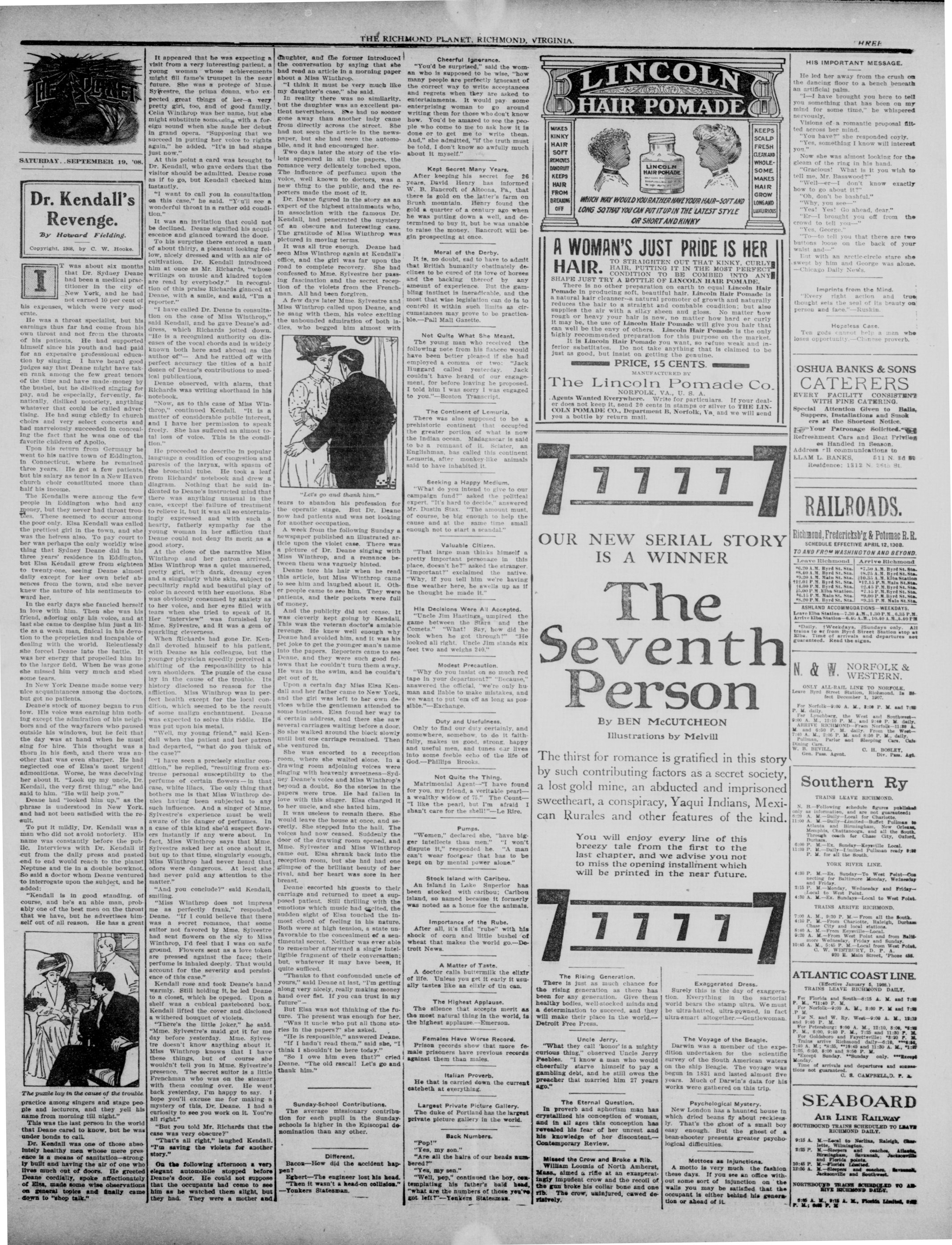
Dr. Kendall's Revenge. By Howard Fielding.
T was about six months that Dr. Sydney Deane had been a medical practitioner in the city of New York, and he had not earned 10 per cent of
I T was about six months that Dr. Sydney Deane had been a medical practitioner in the city of New York, and he had not earned 10 per cent of his expenses, which were very moderate.
He was a throat specialist, but his earnings thus far had come from his own throat and not from the throats of his patients. He had supported himself since his youth and had paid for an expensive professional education by singing. I have heard good judges say that Deane might have taken rank among the few great tenors of the time and have made-money by the bushel, but he disliked singing for pay, and he especially, fervently, famatically, disliked notoriety, anything whatever that could be called advertising. He had sung chiefly in church choirs and very select concerts and had marvelously succeeded in concealing the fact that he was one of the favorite children of Apollo.
Upon his return from Germany he went to his native town of Eddington, in Connecticut, where he remained three years. He got a few patients, but his salary as tenor in a New Haven church choir constituted more than half his income.
The Kendalls were among the few people in Eddington who had any money, but they never had throat troubles. These seemed to occur among the poor only. Elsa Kendall was called the prettiest girl in the town, and she was the heless also. To pay court to her was perhaps the only worldly wise thing that Sydney Deane did in his three years' residence in Eddington, but Elsa Kendall grew from eighteen to twenty-one, seeing Deane almost daily except for her own brief absences from the town, and she never knew the nature of his sentiments toward her.
In the early days she fancied herself in love with him. Then she was his friend, adoring only his voice, and at last she came to despise him just a little as a weak man, finical in his devotion to the proprieties and incapable of dealing with the world. Relentlessly she forced Deane into the battle. It was her energy that propelled him into the larger field. When he was gone she missed him very much and shed some tears.
In New York Deane made some very nice acquaintances among the doctors, but got no patients.
Deane's stock of money began to run low. His voice was earning him nothing except the admiration of his neighbors and of the wayfarers who paused outside his windows, but he felt that the day was at hand when he must sing for hire. This thought was a thorn in his flesh, and there was another that was even sharper. He had neglected one of Elsa's most urgent admonitions. Worse, he was deceling her about it. "Look up my uncle, Dr. Kendall, the very first thing," she had said to him. "He will help you." Deane had "looked him up," as the phrase is understood in New York, and had not been satisfied with the result.
To put it mildly, Dr. Kendall was a man who did not avoid notoriety. His name was constantly before the public. Interviews with Dr. Kendall if cut from the daily press and pasted end to end would reach to the planet Neptune and tie in a double bowknot. So said a doctor whom Deane ventured to interrogate upon the subject, and he added:
"Kendall is in good standing. of course, and he's an able man, probably one of the best men on the throat that we have, but he advertises himself out of all reason. He has a great
A man and a woman sit in a room, engaged in a conversation. The woman is wearing a large hat and a long dress, while the man is dressed in a suit and tie.
The puzzle lay in the cause of the trouble. practice among singers and stage people and lecturers, and they yell his name from morning till night." This was the last person in the world that Deane cared to know, but he was under bonds to call. Dr. Kendall was one of those absolutely healthy men whose mere presence is a means of sanitation—strongly built and having the air of one who lives much out of doors. He greeted Deane cordially, spoke affectionately of Elsa, made some wise observations on general topics and finally came down to "shop talk."
It appeared that he was expecting a visit from a very interesting patient, a young woman whose achievements might fill fame's trumpet in the near future. She was a protege of Mme. Sylvestre, the prima donna, who expected great things of her—a very pretty girl, too, and of good family. Celia Winthrop was her name, but she might substitute someone with a foreign sound when she made her debut in grand opera. "Supposing that we succeed in putting her voice to rights again," he added. "It's in bad shape just now."
At this point a card was brought to Dr. Kendall, who gave orders that the visitor should be admitted. Deane rose as if to go, but Kendall checked him instantly.
"I want to call you in consultation on this case," he said. "You'll see a wonderful throat in a rather odd condition."
It was an invitation that could not be declined. Deane signified his acquiescence and glanced toward the door. To his surprise there entered a man of about thirty, a pleasant looking fellow, nicely dressed and with an air of cultivation. Dr. Kendall introduced him at once as Mr. Richards, "whose writings on music and kindred topics are read by everybody." In recognition of this praise Richards glanced at Deane, with a smile, and said, "I'm a reporter."
"I have called Dr. Deane in consultation on the case of Miss Winthrop," said Kendall, and he gave Deane's address, which Richards jotted down. "He is a recognized authority on diseases of the vocal chords and is widely known both here and abroad as the author of"—And he rattled off with perfect accuracy the titles of a half dozen of Deane's contributions to medical publications.
Deane observed, with alarm, that Richards was writing shorthand in his notebook.
"Now, as to this case of Miss Winthrop," continued Kendall. "It is a matter of considerable public interest, and I have her permission to speak freely. She has suffered an almost total loss of voice. This is the condition."
He proceeded to describe in popular language a condition of congestion and paresis of the larynx, with spasm of the bronchial tube. He took a leaf from Richards' notebook and drew a diagram. Nothing that he said indicated to Deane's instructed mind that there was anything unusual in the case, except the failure of treatment to relieve it, but it was all so entertainingly expressed and with such a hearty, fatherly sympathy for the young woman in her affliction that Deane could not deny its merit as a good story.
At the close of the narrative Miss Winthrop and her patron arrived. Miss Winthrop was a quiet mannered, pretty girl, with dark, dreamy eyes and a singularly white skin, subject to peculiarly rapid and beautiful play of color in accord with her emotions. She was obviously consumed by anxiety as to her voice, and her eyes filled with tears when she tried to speak of it. Her "interview" was furnished by Mme. Sylvestre, and it was a gem of sparkling cleverness.
When Richards had gone Dr. Kendall devoted himself to his patient, with Deane as his colleague, but the younger physician speedily perceived a shifting of the responsibility to his own shoulders. The puzzle of the case lay in the cause of the trouble. Its history disclosed no reason for the affliction. Miss Winthrop was in perfect health except for the local condition, which seemed to be the result of some malign enchantment. Deane was expected to solve this riddle. He was put upon his metal.
"Well, my young friend," said Kendall when the patient and her patron had departed, "what do you think of the case?"
"I have seen a precisely similar condition," he replied, "resulting from extreme personal susceptibility to the perfume of certain flowers—in that case, white lilacs. The only thing that bothers me is that Miss Winthrop denies having been subjected to any such influence. And a singer of Mme. Sylvestre's experience must be well aware of the danger of perfumes. In a case of this kind she'd suspect flowers instantly if any were about. In fact, Miss Winthrop says that Mme. Sylvestre asked her at once about it, but up to that time, singularly enough, Miss Winthrop had never heard that odors were dangerous. At least she had never paid any attention to the matter."
"And you conclude?" said Kendall, smiling.
"Miss Winthrop does not impress me as perfectly frank," responded Deane. "If I could believe that there was a secret romance, that some sultor not favored by Mme. Sylvestre had sent flowers on the sly to Miss Winthrop, I'd feel that I was on safe ground. Flowers sent as a love token are pressed against the face; their perfume is inhaled deeply. That would account for the severity and persistence of this case."
Kendall rose and took Deane's hand warmly. Still holding it, he led Deane to a closet, which he opened. Upon a shelf was a cubical pasteboard box. Kendall lifted the cover and disclosed a withered bouquet of violets.
"There's the little joker," he said.
"Mme. Sylvestre's maid got it for me
me day before yesterday. Mme. Sylvestre
doesn't know anything about it.
Miss Winthrop knows that I have
these things, but of course she
wouldn't tell you in Mme. Sylvestre's
presence. The secret suitor is a little
Frenchman who was on the steamer
with them coming over. He went
back yesterday, I'm happy to say.
I hope you'll excuse me for making a
mystery of this, Dr. Deane. I had a
curiosity to see you work on it. You're
all right."
"But you told Mr. Richards that the
case was very obscure?"
"That's all right," laughed Kendall.
"I'm saving the violets for another
story."
On the following afternoon a very elegant automobile stopped before Deane's door. He could not suppose that the occupants had come to see him as he watched them alight, but they had. They were a mother and
THE RICHMOND PLANET, RICHMOND, VIRGINIA
daughter, and the former introduced the conversation by saying that she had read an article in a morning paper about a Miss Winthrop.
"I think it must be very much like my daughter's case," she said.
In reality there was no similarity, but the daughter was an excellent patient nevertheless. She had no sooner gone away than another lady came from directly across the street. She had not seen the article in the newspaper, but she had seen the automobile, and it had encouraged her.
Two days later the story of the violets appeared in all the papers, the romance very delicately touched upon. The influence of perfumes upon the voice, well known to doctors, was a new thing to the public, and the reporters made the most of it.
Dr. Deane figured in the story as an expert of the highest attainments who, in association with the famous Dr. Kendall, had penetrated the mystery of an obscure and interesting case. The gratitude of Miss Winthrop was pictured in moving terms. It was all true enough. Deane had seen Miss Winthrop again at Kendall's office, and the girl was far upon the road to complete recovery. She had confessed to Mme. Sylvestre her passing fascination and the secret reception of the violets from the Frenchman. All had been forgiven. A few days later Mme. Sylvestre and Miss Winthrop called upon Deane, and he sang with them, his voice excelling the unbounded admiration of both ladies, who begged him almost with
"Let's go and thank him."
tears to abandon his profession for the operatic stage. But Dr. Deane now had patients and was not looking for another occupation. A week from the following Sunday a newspaper published an illustrated article upon the violet case. There was a picture of Dr. Deane singing with Miss Winthrop, and a romance between them was vaguely hinted. Deane tore his hair when he read this article, but Miss Winthrop came to see him and laughed about it. Other people came to see him. They were patients, and their pockets were full of money.
And the publicity did not cease. It was cleverly kept going by Kendall. This was the veteran doctor's amiable revenge. He knew well enough why Deane had avoided him, and it was his pet joke to get the younger man's name into the papers. Reporters came to see Deane, and they were such good fellows that he couldn't turn them away. He was in the swim, and he couldn't get out of it.
Upon a certain day Miss Elsa Kendall and her father came to New York, and the girl was left to her own devices while the gentleman attended to some business. Elsa found her way to a certain address, and there she saw several carriages waiting before a door. So she walked around the block slowly until but one carriage remained. Then she ventured in.
She was escorted to a reception room, where she waited alone. In a drawing room adjoining voices were singing with heavenly sweetness -Sydney Deane's voice and Miss Winthrop's beyond a doubt. So the stories in the papers were true. He had fallen in love with this singer. Elsa charged it to her uncle, and she hated him. It was useless to remain there. She would leave the house at once, and secretly. She stepped into the hall. The voices had now ceased. Suddenly the door of the drawing room opened, and Mme. Sylvester and Miss Winthrop came out. Elsa shrank back into the reception room, but she had had one glimpse of the brilliant beauty of her rival, and her heart was sore in her breast.
Deane escorted his guests to their carriage and returned to meet a supposed patient. Still thrilling with the emotions which music had excited, the sudden sight of Elsa touched the inmost chord of feeling in his nature. Both were at high tension, a state unfavorable to the concealment of a sentimental secret. Neither was ever able to remember afterward a single intelligible fragment of their conversation; but, whatever it may have been, it quite sufficed.
"Thanks to that confounded uncle of yours," said Deane at last, "I'm getting along very nicely, really making money hand over fist. If you can trust in my future."
But Elsa was not thinking of the future. The present was enough for her. "Was it uncle who put all those stories in the papers?" she asked.
"He is responsible," answered Deane.
"If I hadn't read them," said she. "I think I shouldn't be here today."
"So I owe him even that?" cried Deane. "The old rascal! Let's go and thank him."
Sunday-School Contributions.
The average missionary contribution for each pupil in the Sunday schools is higher in the Episcopal denomination than any other.
Different
Bacon—How did the accident happen?
Egbert—The engineer lost his head.
"Then it wasn't a head-on collision."
—Yonkers Statesman.
Cheerful Tolerance.
"You'd be surprised," said the woman who is supposed to be wise, "how many people are perfectly ignorant of the correct way to write acceptances and regrets when they are asked to entertainments. It would pay some enterprising woman to go around writing them for those who don't know how. You'd be amazed to see the people who come to me to ask how it is done or to get me to write them. And," she admitted, "if the truth must be told, I don't know so awfully much about it myself."
Kept Secret Many Years
After keeping his secret for 26 years, David Henry has informed W. B. Bancroft of Altoona, Pa., that there is gold on the latter's farm on Brush mountain. Henry found the gold a quarter of a century ago when he was putting down a well, and determined to buy it, but he was unable to raise the money. Bancroft will begin prospecting at once.
Moral of the Derby.
It is, no doubt, sad to have to admit that British humanity obstructively declines to be cured of its love of horses and the backing thereof by any amount of experience. But the gambling instinct is ineradicable, and the most that wise legislation can do is to control it within such limits as circumstances may prove to be practicable.—Pall Mall Gazette.
Not Quite What She Meant
The young man who received the following note from his flancce would have been better pleased if she had employed a comma or two: "Jack Huggard called yesterday. Jack couldn't have heard of our engagement, for before leaving he proposed. I told him I was sorry I was engaged to you."—Boston Transcript.
The Continent of Lemuria
There was also supposed to be a prehistoric continent that occupied the greater portion of what is now the Indian ocean. Madagascar is said to be a remnant of it. Sclater, an Englishman, has called this continent Lemuria, after monkey-like animals said to have inhabited it.
"What do you intend to give to our campaign fund?" asked the political expert. "It's hard to decide," answered Mr. Dustin Stax. "The amount must, of course, be big enough to help the cause and at the same time small enough not to start a scandal."
Valuable Citizen.
"That large man thinks himself a pretty important person in this place, doesn't he?" asked the stranger. "Important?" exclaimed the native. "Why, if you tell him he are having fine weather here, he swells up as if he thought he made it."
His Decisions Were All Accepted.
"Uncle Jim Hastings umplied the game between the Stars and the Comets." "What! Say, how did he look when he got through?" "He looked all right. Uncle Jim stands six feet two and weighs 240."
Modest Precaution
"Why do you insist on so much red tape in your department?" "Because," answered the official, "we're only human and liable to make mistakes, and we want to put 'em off as long as possible."—Exchange.
Duty and Usefulness
Only to find our duty certainly, and somewhere, somehow, to do it faithfully, makes us good, strong, happy and useful men, and tunes our lives into some feeble echo of the life of God.—Phillips Brooks.
Not Quite the Thing.
Matrimonial Agent—"I have found for you, my friend, a veritable pearl—a wealthy widow of 75." The Count—"I like the pearl, but I'm afraid I shan't care for the shell!"—Le Rire.
Pumps.
"Women." declared she, "have bigger intellects than men." "I won't dispute it," responded he. "A man can't wear footwear that has to be kept on by mental power alone."
Stock Island with Caribou
An island in Lake Superior has been stocked with caribou; Caribou island, so named because it formerly was noted as a home for the animals.
Importance of the Rube.
After all, it's that "rube" with his shock of corn and little bushel of wheat that makes the world go.-Detroit News.
A Matter of Taste
A doctor calls buttermilk the elixir of life. Unless you get it early it usually tastes like an elixir of tin can.
The Highest Applause.
The silence that accepts merit as the most natural thing in the world, is the highest applause.—Emerson.
Females Have Worse Record. Prison records show that more female prisoners have previous records against them than males.
Italian Proverb. He that is carried down the current catcheth at everything.
Largest Private Picture Gallery. The duke of Portland has the largest private picture gallery in the world.
Back Numbers.
"Are all the hairs of our heads numbered?"
"Yes, my son."
"Well, pop," continued the boy, contemplating his father's bald head,
"what are the numbers of those you've got left?" — Yankers Statesman.
LINCOLN
HAIR POMADE
MAKES
KINKY
HAIR
SOFT
REMOVES
DANDRUFT
KEEPS
HAIR
FROM
BREAKING
OFF
LINCOLN
HAIR POMADE
KEEPS
SCALP
FRESH
CLEAN AND
WHOLE-
SOME
MAKES
HAIR
GROW
LONG AND
LUXURIOUS
WHICH WAY WOULD YOU RATHER HAVE YOUR HAIR-SOFT AND
LONG SO THAT YOU CAN PUT IT UP IN THE LATEST STYLE
OR SHORT AND KINKY
A WOMAN'S JUST PRIDE IS HER
A WOMAN'S JUST PRIDE IS HER
HAIR. TO STRAIGHTEN OUT THAT KINKY, CURLY
HAIR, PUTTING IT IN THE MOST PERFECT
CONDITION TO BE COMBED INTO ANY
SHAPE JUST TRY A BOTTLE OF LINCOLN HAIR POMADE.
MANUFACTURED BY
Lincoln Pomac
NORFOLK, VA., U. S. A.
ed Everywhere. Write for particulars.
keep it, send 20 cents in stamps or silver
DE CO., Department B, Norfolk, Va. and
by return mail.
7 7 7 7
NEW SERIAL S
IS A WINNER
The
event
person
The Lincoln Pomade Co
NORFOLK, VA. U.S.A.
Agents Wanted Everywhere. Write for particiulars. If your dealer does not keep it, send 20 cents in stamps or silver to THE LINCOLN POMADE CO., Department B, Norfolk, Va. and we will send you a bottle by return mail.
7 7 7 7
OUR NEW SERIAL STORY IS A WINNER
The Seventh Person
By BEN McCUTCHEON Illustrations by Melvill
The thirst for romance by such contributing fa
a lost gold mine, an al
sweetheart, a conspiracy
can Rurales and other
You will enjoy a breezy tale from
last chapter, and
to miss the opening
will be printed in
7 7 7
for romance is gratified in
contributing factors as a seer
mine, an abducted and
a conspiracy, Yaqui Indi
es and other features of
will enjoy every line of
easy tale from the first to
chapter, and we advise you
miss the opening installment w
be printed in the near futu
7 7 7 7
The thirst for romance is gratified in this story by such contributing factors as a secret society, a lost gold mine, an abducted and imprisoned sweetheart, a conspiracy, Yaqui Indians, Mexican Rurales and other features of the kind. You will enjoy every line of this breezy tale from the first to the last chapter, and we advise you not to miss the opening installment which will be printed in the near future.
7777
The Rising Generation.
There is just as much chance for the rising generation as there has been for any generation. Give them healthy bodies, well-stocked minds and a determination to succeed, and they will make their place in the world.—Detroit Free Press.
"What they call 'honor' is a mighty curious thing," observed Uncle Jerry Peebles. "I know a man who would cheerfully starve himself to pay a gambling debt, and he still owes the preacher that married him 27 years ago."
The Eternal Question.
In proverb and aphorism man has crystallized his conception of woman, and in all ages this conception has revealed his fear of her unrest and his knowledge of her discontent.—Contemporary Review.
Missed the Crow and Broke a Rib. William Loomis of North Amherst, Mass., aimed a rifle at an exasperatingly impudent crow and the recoil of the gun broke his collar bone and one rib. The crow, uninjured, cawed derisively.
Uncle Jerry.
is gratified in this story
actors as a secret society,
inducted and imprisoned
by, Yaqui Indians, Mexi-
r features of the kind.
every line of this
is the first to the
we advise you not
installment which
in the near future.
777
Exaggerated Dress.
Surely this is the day of exaggeration. Everything in the sartorial world bears the stamp ultra. We must be ultra-hatted, ultra-gowned, in fact ultra-smart altogether.—Gentlewoman.
The Voyage of the Beagle.
Darwin was a member of the expedition undertaken for the scientific survey of the South American waters on the ship Beagle. The voyage was begun in 1831 and lasted almost five years. Much of Darwin's data for his works were gathered on this trip.
Psychological Mystery
New London has a haunted house in which dried beans fly about recklessly. That's the ghost of a small boy easy enough. But the ghost of a bean-shooter presents greater psychological difficulties.
Mottoes as Injunctions
A motto is very much the fashion these days. If you see an office without some sort of injunction on the walls you may be satisfied that the occupant is either behind his generation or ahead of it.
THREE
HIS IMPORTANT MESSAGE
He led her away from the crush on the dancing floor to a bench beneath an artificial palm.
"I—I have brought you here to tell you something that has been on my mind for some time," he whispered nervously.
Visions of a romantic proposal filtted across her mind.
"You have?" she responded coily.
"Yes, something I know will interest you."
Now she was almost looking for the gleam of the ring in his hand.
"Gracious! What is it you wish to tell me, Mr. Basswood?"
"Well—er—I don't know exactly how to go about it?"
"Oh, don't be bashful."
"Why, you see—"
"Yes! Yes! Go ahead, dear."
"Er-I brought you off from the crowd to tell you—"
"Yes, George."
"To-to tell you that there are two buttons boose on the back of your waist and—"
"But with an arctic-circle stare she swept by him and George was alone."
-Chicago Daily News.
Imprints from the Mind.
"Every right action and true thought sets the seal of its beauty on person and face."—Ruskin.
Hopeless Case.
Ten gods cannot help a man who loses opportunity—Chinese proverb.
OSHUA BANKS & SONS
EVERY FACILITY CONSISTENT
WITH FINE CATERING.
Special Attention Given to Balls,
Suppers, Installations and Snuk
ers at the Shortest Notice.
Your Patronage Sollicited.
Refresherment Cars and Boat Privile
es Handled in Season.
Address all communications to
es Handled in Season.
Address all communications to
LLAM L. BANKS. 511 N. Ed
LAM L. BANKS, 511 N. 1d
Residence: 1312 N. 260 St.
RAILROADS.
Richmond, Fredericksklyg & Potomac R. R.
SCHLEVIE FEBEGLY 13.12.1900
ASHLAND ACCOMMODATIONS - WEEKDAYS.
Leave Elba Station - 7.30 A.M. 1.30 P.M. 6.33 P.M.
Arrive Elba Station - 6.40 A.M. 10.40 A.M. 5.40 P.M.
*Daily.* 1 weekdays. 5 Sundays only.
*To arrt or from Hyrd Street Station stop at
Elba Station.* Departures departures not
guaranteed. Read the signs.
N. & W. NORFOLK & WESTERN
ONLY ALL-RAIL LINE TO NORFOLK.
Leave Bryd Street Station, Richmond. In
fect December 1, 1907.
For Norfolk—9:00 A. M. 2:00 P. M. and 7:00
P. daily.
For Hamburg, the West and Southwest—
9:00 A. M. 12:10 P. M., and 9:40 P. m. daily.
ARRIVE RICHMOND—From West—11:00 A.
and 6:00 P. m. Daily. From the West—
7:40 P. m. 2:00 P. M. and Sleeping Care, Fulman, Parlor and Sleeping Care, Cafe
Dining Care.
V. B. BEVILL. C. H. BOSLEY,
Gen. Pass. Agent. Div. Pass. Agent.
Southern Ry
TRAINS LEAVE RICHMICH.
N. B—Following schedule figures published only as information, and not guaranteed; 6:20 A. M—Daily—Local for Charlotte.
6:00 P. M. -Kx. Sunday -Kayville Local. ready
6:00 P. M. -Fulman Fullman local. ready
6:00 P. M. for all the South
YORK RIVER LINE.
4:30 P. M—Ex. Sunday—To West Point—Cos-
titute Baltimore Monday, Wednesday
and Friday.
2:15 P. M—Monday, Wednesday and Friday—
Local to West Point.
TRAINS ARRIVE RICHMOND.
7:00 A. M., 9:30 P. M. — From all the South.
4:10 P. M. — From Charlotte, Raleigh, Durham
Chase City and local stations.
8:40 A. M. — From Keysville-Local.
8:40 A. M. — From West Point and from Baltimore
more north Friday and Sunday.
10:45 A. M. 5:45 P. M. — L-I-New York Polish.
C. W. WESTBURY, D. P. A.
920 E. Main Street, Phone 488.
(Effective January 5, 1988.)
TRAINS LEAVE RICHMOND DAILY.
For Florida and South—8-151 A. M. and 7:08
P. M.
For Norfolk—9-001 A. M., 8:00 P. M. and 7:08
P. M.
For N. N. and W. Ry. West—9-001 A. M., 18:18
and 9:40 P. M.
and 9:40 P. M.
For Petersburg: 9:00 A. M., 12:10, 8:00, **8:10**
For Goldsboro and Fayetteville: **8:20** P. M.
Trains arrive Richmond daily—6:10, **8:56** P.
Trains arrive Richmond daily—11:30 A. M., **12:20**
2:05, 6:50, 8:00 and 9:00
*Except Sunday.* **Sunday only.** ***Browse***
Monday.
Time of arrivals and departures and expenses
Time of arrivals and departures and conditions not guaranteed.
C. S. CAMPRELL, D. P.
SEABOARD
SEABOARD
AIR LINE RAILWAY
SOUTHBOUND TRAINS SCHEDULED TO LEAVE
RICHMOND DAILY.
9:15 A. M.—Local to Norlana, Raleigh, Cham-
lotte, Wilmington.
2:25 P. M.—Sleepers and coaches, Atlanta,
Birmingham, Savannah, Jacksonville
and Florida Limited.
10:45 P. M.—Florida Limited.
12:56 P. M.—Sleepers and coaches, Savannah,
Jacksonville and Southwest.
NORTHBOUND TRAINS SCHEDULED TO ABRIVE RICHMOND DAILY.
6:55 A. M. 9:15 A. M., Florida Limited, 8:25
P. M. 8:25 P. M.
FOUR
THE PLANET
All communications intended for publication should be sent as to reach us by Wednesday.
TERMS IN ADVANCE.
EXPRESS MONEY ORDERS can be obtained i t any office of the American Express Co., the offices Express Co. and, the Wells Fargo Co. or the American Express Co. and the Wells Fargo Co. for money sent by any of these companies. Express Money Order is a safe and convenient way for forwarding money.
REGISTERED LETTER. A Money Order, Paid in full, Office is not within your reach, your Postmaster will Register the Letter you wish to send on payment of ten cents. Then, if the Letter is lost or stolen, it cannot be sent you can send money in this manner at our risk.
We cannot be responsible for money sent in letters in any other way than one of the four ways in any other way, you must do it at your own risk.
RENEWALS, ETC. If you do not want the Money Order your subscription has run out, you notify us by Post Card to discontinue it. The courts have decided that subscribers to newspapers who do not order their paper discontinue their subscription but have been paid a hold liable for the payment of the subscription up to date when they order the paper discontinuation.
COMMUNICATIONS.—When writing to us to renew your subscription or to discontinue your paper, you should give your name and address in full, otherwise we cannot find your name on the letter.
CHANGE OF ADDRESS—In order to change the address of a subscriber, we must be sent the former as well as the present address.
Fettered at the Post Office at Richmond, Va. as cond class matter.
SATURDAY, SEPTEMBER 19, '08.
WHITE SOLDIERS IN TROUBLE
Possibly President Roosevelt has seen the following announcement:
"Atlanta, Ga., Sept. 2. —Governor Smith today ordered a court-martial to try members of troops A, B, C and E. Georgia cavalry, who recently shot up several small towns while returning to their home at Savannah from the encampment at Chickamauga Park.
"The troops were disorderly while returning and fired volleys from the train. At least one person was wounded and terror created at several places."
It would be well for him to note that instead of dismissing these white soldiers from the service without honor, he ordered a court-martial to try them. This is in keeping with the law and why any other treatment should have been accorded colored soldiers is the mystery of the century. It is evident though that white soldiers are adepts at the business of shooting up towns if the above telegram is to be taken as an indication.
President Roosevelt and the War Department seemed desirous or convincing the country that only colored men are liable to be guilty of such offenses, but with the reports from Denver, where thirty-two white soldiers are charged with criminally assaulting one white woman and the affair just cited, it would seem that it is about time for the distinguished occupant of the White House to reverse himself so quickly as to make it appear that the front part of his head looks like the back part.
These facts are interesting and it may be that the awakening of the country to the injustice practiced upon the Companies B, C and D of the Twenty-fifth United States Infantry may be heralded before the dawn of the new year.
---
THE NIAGARA MOVEMENT
"Anger is the most impotent passion that accompanies the mind of man; it effects nothing, it goes about, and hurts the man who is possessed by it more than any other against whom it is directed."—Clarendon.
The address of the Niagara Movement which was in session September 2, 1908 at Oberlin, Ohio is now before us and we confess that after reading the statements therein contained, we are astounded to note the absence of that discretion and sound judgment that should be in evidence in all projects of this kind. The language used is intemperate and has the tendency to arouse enthusiasm among its own followers rather than to gain recruits from among those who have not yet enlisted in its fold.
Let us see. It says:
"The Niagara movement at its fourth annual meeting congratulates ten million Negro Americans on their unparalleled opportunity to lead
the greatest moral battle of modern times—the fight for the abolition of the color line. In Europe, Asia and Africa the revolt against mere denomination of color and race has begun. The triumph of the highest civilization is the hope of all races, and that civilization is not and never was the property of any one race or color."
The above is a very good beginning and it has the proper ring to it. It continues:
"The modern attempt to make it so is the last grasp of barbarism, and has caused a moral deterioration which today threatens the peace and progress of the world. Nowhere has the fearful cost of using crime and lies as a weapon to force races into subjection been so apparent as right here in the United States."
The above is drastic language and is certainly impregnated with truth. But discretion is thrown to the winds and good judgment absolutely ignored when it says:
This nation has stolen the black man's labor, and has so learned theft; it has lied away the liberties of black litigants, and so learned lawlessness; it has prostituted the ballot and so shaken the foundation of Democracy. Fellow Americans, does it pay? Is the superiority of the white race demonstrated by burning human beings, lynching innocent workingmen, stealing black men's votes and insulting black women?"
This then is appealing to the worst passions of the Negroes of this country, without affording any compensating advantages and it may be said that it is an appeal to the worst passions of the white men as well, for it has the tendency to arouse anger rather than to awaken sympathy. It charges the nation with a crime that it has striven to unload, even if it had been guilty of the same for it must not be forgotten that the nation gave us freedom, such as it is. This same nation gave us citizenship with the right to vote, even though its agents have repeatedly declined to enforce the drastic provisions thereof. Our condition in 1908 is ninety percent, better than it was in 1858 and for this we should at least be thankful and not place ourselves in the category of ingrates.
When the address charges the nation with theft, lying and lawlessness it plays havoc with our future chances of relief and drives from its ranks the conservative elements who swing propositions and measures to either the winning or to the losing side.
The language used would hardly pass current in polite society. The charge herein contained includes Negroes as well as white men, for all of us go to make up the nation which is charged with lying, stealing and prostitution. Such intemperate use of words tends to drive more people from us than it brings to the support of our cause. It has always been a mystery to us how a man of Prof. W. E. B. DuBois' knowledge, influence and experience can fail to see that by these methods, our cause is retarded rather than advanced.
It is this radicalism that checks progress in the avenue of success. Dr. Boozer T. Washington learned this in his first lessons and for more than twenty years has possessed himself in patience, regardless of all that has been said derogatory of him and his efforts. He has evidently felt keenly the criticisms of his enemies and we have been led to believe that he had somewhere at Tuskegee, Alabama, a "cussing room," where within its confines and solitude he could at times give vent to his feelings. When he came forth, it was with that serene countenance that disguised adsolutely the storm that was raging within his bosom.
It is this self-control that has marked the successful men of all ages. So true is this that the axiom "He, who controlleth himself, is greater than he, who taketh a city," has come to be a proverb of far-reaching value and is the kernel of wisdom even in this age.
It is accordingly inconceivable to us that this address should contain language of a character, which can neither be justified nor explained away. The address reaches firm ground once more, though, when it says:
"The program laid down by the Negro haters of America is the most tremendous mistake this nation ever made. It is uncivilized, illogical and wrong; it cannot triumph unless the Christian religion is a lie. Yet the converts to race segregation and subjection are growing alarmingly. We are today fighting for free common schools in Pennsylvania, for free bail lots in Maryland, and for freedom of travel in the nation. The cause of human freedom shrieks aloud in our every step. It is not because of our poverty, it is not because of ignorance, it is not because of crime, it is not even because of race antipathy, it is simply the crude and brutal desire to oppress and abuse and murder wherever and whenever there is no fear of public opinion or courts of law or just retaliation."
These are truths admirably stated. The language used is vitriolic but nowhere does it offend the sense of good taste and proper breeding. It is as strong as Wendell Phillips would have made it and as fully impregnated with truth as any utterances that ever fell from the lips of Charles Summer.
It clinches its arraignment of the hostile forces against us, when it says:
"Once we were told: Be worthy and fit and the ways are open. Today the avenues of advancement in the army, navy and civil service and
THE RICHMOND PLANET, RICHMOND, VIRGINIA
even in business and professional life are continually closed to black applicants of proven fitness, simply on the bald excuse of race and color.
"This is the spirit and practice which the Niagara Movement is fight ing, and will never cease to fight."
This then is an open declaration of war upon caste prejudice and all of its attendant evils. It gives sound advice, when it says:
"First: We say to our own: Obey the law, defend no crime, conceal no criminal, seek no quarrel; but arm yourselves, and when the 'mob invades your home, shoot, and shoot to kill."
This has been our doctrine for more than twenty years. It is our advice, freely given today. It then delves into the political arena and lines up squarely against the Republican Party and all that it stands for. It evidently believes and virtually so announces that Hon. William H. Taft will not be true to his promise when he declared that he does and shall continue to stand squarely upon every plank of the Republican Party platform. It says:
"Secondly: We say to voters: Register and vote whenever and wherever you have a right. Vote, not in the past, but in the present. Remember that the conduct of the Republican party toward Negroes has been a disgraceful failure to keep just promises. The dominant Roosevelt faction has sinned in this respect beyond forgiveness. We therefore trust that every black voter will uphold men like Joseph Benson Foraker, and will leave no stone unturned to defeat William H. Taft. Remember Brownsville, and establish next November the principle of Negro independence in voting, not only for punishing enemies, but for rebuking false friends."
The Niagara Movement is waging a battle of revenge. It will ignore principles and disregard candidates and their utterances if it can only strike the object of its hatred. This is not a laudable or a commendable position to take and yet it will do good in some quarters, while it is doing much harm in some others. It will be an awakening to those Negro-haters within the ranks of the Republican Party, who profess to believe that the Negroes of this country are afraid to support any other Party than the one that was identified with the emancipation of the black men in this country
In this respect, this movement will do great good. On the other hand, it will endanger the political positions of thousands of colored men, who after they landed the offices forgot the colored people on the outside who were the means of placing them there. Unless Mr. Bryan is one hundred times stronger than his party, colored men, who go out of service will never return in any such numbers as they have in the past. Whether this will work for the better, the future only can tell.
President Roosevelt openly announced that he had appointed fewer colored men to office than any of his predecessors and there can be no doubt, but what his attitude in the Brownsville affair is largely responsible for the feeling that has set in so steadily against us. The Niagara Movement is justified in much that it has said and it remains for the Republican leaders to send able Republican leaders of color in to all of the States in order to hold firm the colored people who are wavering in their allegiance to a party that is now manned by a sea of Negro-haters, who even now wear the accoutrements of the Democratic Negro-hating army from which they have recently deserted.
The address is signed by Frederick L. McGhee of Minnesota, Charles E. Bentley of Illinois, Gertrude W. Morgan of Massachusetts, William E. Henderson of Indiana and W. E. B. DuBois of Georgia.
The only thing that puzzles us is how a people, who would give voice to such utterances could go to the Democratic Party for support and comfort. Opinions like these openly uttered in a Democratic convention in Texas would result in the elevation of all of the signers ten feet from earth with hemp rope collars and singing bullets as music to their deafening ears.
These are troublous times and the scenes now being enacted are as strange as the stories told in the Arabian Nights of long ago.
---
THE ONANCOCK OUTRAGE.
The Supreme Court of Appeals of Virginia in session at Staunton, Va. on last Tuesday handed down a decision in the case of Messrs. Burton and Conquest now confined in the jail at Norfolk, Va. convicted of rioting and sentenced to confinement in the penitentiary.
The opinion reverses the action of the trial court and so positive and emphatic is the decision that it is openly announced that the case will be no乳 prosequed and the prisoners will go free. So ends one of the most remarkable cases that has ever taken place in this commonwealth, in that the men concerned belonged to the better class of colored people,—men, who respected themselves and thereby caused others to respect them. The sad part about it all is that Mr. Burton was doing a large business at Onancock and was living in comparative ease, when his place of business and stock of goods were destroyed by lawless white men, who
robbed him of the means to employ competent counsel to defend him. He was therefore to an extent helpless and his friends railed to his support and saved him from further injury. The colored people of Norfolk came to the front nobly. We contended that the Virginia penitentiary was not built for men of this stripe and callbre and we are pleased to note that the Democratic Supreme Court of Appeals of Virginia seems to be of the same opinion.
We have observed carefully the calibre and the character of the men elevated to this tribunal and for wisdom, justice, square dealing and a desire to mete that poetic justice to all regardless of race or color, we do not believe that it can be excelled in any state from Massachusetts to Texas. If an error is made it is only the outcome of mature conviction, based upon the evidence before them.
We shall never forget the time when this tribunal took actual possession of the Lunenburg prisoners in order to save them from lynching and had them confined in the jail of this city, subject to the direct order of the court.
It is this peculiarity of the Southern white man of the upper type that puzzles our friends at the North. They can be just and they can exercise a friendship and show a depth of feeling that is indeed surprising to those who do not know them.
So true is this that we have more than once said and we now repeat that justice that we cannot get from the Supreme Court of Appeals of Virginia, we are willing to go without. Still, it is God's hand. In His own way and in His own time. He is raising up friends for us where we least expect to find them.
Let our traducers rage and do strange things, but the inherent sense of justice and fair-play is in evidence in the better class of white men in the Southland. It is a doubtful piece of business to applaud the decision or a court, but we cannot forego the pleasure and we beg leave to announce that our hat is off to one of the ablest bodies of jurists, who ever wore the judicial ermine or who ever rendered a decision from the rostrum of the Temple of Justice in this State.
---
MR. TAFT'S CONFESSION
"I would applaud thee to the very echo. That should 'applaud again." —Shakespeare.
In a speech last Tuesday night at Cincinnati, Ohio before the Ohio Conference of the African Methodist Episcopal Church, Hon. Willizm H Taft made some assertions which will be regarded as remarkable by every thinking, conservative citizen of color in the United States. It was asserted that the speech was non-political, just as though anything Mr. Taft may say now can be regarded as non-political.
Every word he utters, whether he so intends it to be or not is just as political as is every attitude he assumes, either in-doors or out of doors. He certainly made it plain that we were correct when we concluded from his public utterances, so far as the Negroes of this country are concerned that he "didn't have his bonnet on straight." Read what he says and draw your own conclusions.
He is quoted as follows:
In his address to-night to the Negroes, he said he was there for the purpose of expressing his sympathy with the Negro race in its struggle for better things. "A sympathy," he said, "which I have had from the time I was a small boy, for I inherited it from my father, Alphonso Taft, than whom the colored race never had a better friend." The education to be most sought for by the Negro race, he said, was primarily the rudiments of knowledge combined with industrial training. This should be supplemented by higher education for a more limited number to furnish ministers, doctors, teachers and lawyers. He said he had not always been in favor of higher education for members of the Negro race, "but after a full consideration of the needs of the race, I am convinced that I was in error."
The above is a confession that will have a wide-spread effect throughout this country. He was in error upon this proposition, just as Dr. Booker T. Washington was in error with reference to the same proposition. The distinguished Negro educator has taken the pain in recent years to modify his position upon this proposition and to embrace in his plea words for the benefit of the smaller per cent, of ambitious colored people, who are not content to remain even near the lower round in the ladder of educational endeavor, but who insist upon struggling to reach the far-away round at the top. Mr. Taft says further:
"I don't know that the race bitterness is any stronger to day than it ever was. For a length of time it seems to be altogether abated, and then there will be an outbreak, a mob will be formed, developing the most flendifish cruelty which manifests itself in the blindest and the most unreasonable assault upon perfectly innocent people, simply because of their color. It is only fair to say that such brutish exhibitions are not confined to any one section. It is impossible to read accounts of things of this sort without having one's blood boll with indignation
that there can reside in the human breast such savage and beastly impulse and motive.
"The best remedy and the necessary one is an improvement in the administration of our criminal laws and the holding to strict account the officers of the law who do not use all possible means to prevent and suppress such outbreaks."
This language rings true and it shows that this able jurist and states man is awakening, not only to his own short-comings, relative to the Negro, but to the incapacity of thousands or white officials sworn to do a duty that they are loth to perform. Mr. Taft's remedy is the proper one and his outspoken utterances along these lines cannot fail to make a deep impression upon those colored Americans, who have viewed with alarm the indifference of leading Republican statesmen to the evils that he now portrays. Mr. Taft says further:
"I cannot too strongly condemn the attitude of these public men, who, in their discussions of the Negro question, use language calculated to arouse in the ignorant a contempt for the Negro race and an altogether unfriendly attitude toward it. I believe sincerely that all through the South a very much better feeling is growing among many classes of citizens toward the Negro."
In the above language, Mr. Taft, unintentionally raps the distinguished occupant of the White House, whose attitude along this line has done more to create this feeling of antipathy towards us than ten thousand Negro-haters of the smaller stripe could have done. Mr. Taft condemns the fliendish cruelty and blindest and most unreasonable assault upon perfectly innocent people, forgetful or the fact that these words apply with equal force to the action of President Roosevelt and the War Department in discharging without honor 167 colored soldiers, many of whom had bared their breasts to the enemy in the defense of the nations honor. Notably among these is Mingo Sanders, who to-day in his far-away Southern home, with bared head and watery eyes waits in vain for that justice which the gentleman at Washington heartlessly denies to him.
It may be that Mr. Taft even now feels the force and effect of his Chief's blunder and it may be that he vainly hopes and longs for the time that permission will be given to him to express that feeling and make full atonement for the injury that he has done one of the kindiest races of people on the face of the globe.
Judge Taft, from the Atlantic to the Pacific, from Canada to the Gulf, the innocent colored people have been made to bear the odium of that celebrated but cruel order that is unquestionably without a parallel in the history of this nation. It is well that you should now make an effort by word at least to undo the fearful wrong that you have done to us by way of President Roosevelt in the White House. Mr. Taft is quoted in conclusion:
Saying he realized the heart throbs of the Negro, he added:
"While the Negro is the ward of the nation, in the sense that the nation, brought him here against his will, and must now deal with the problems that his presence presents, and solve them justly, fairly and charitably, he is not thereby relieved of the burden of responsibility that he must assume to win his way in the community by industry and thrift to a place in which he becomes too valuable a part of society for his predeciators to ignore his rights and well-earned position."
This plea should be circulated all over the country by able colored men of prominence and oratorical power. The Negroes rights were not only ignored, but butchered in the Browns ville affair, and every word used in the above extract finds a target in the breast of President Roosevelt, who in his blind anxiety and ceaseless energy in behalf of commercialism and the rights of the shipper has minimized human rights and led justice a chase throughout all of this land.
We hope that Mr. Taft will continue to make "non-political" speeches to colored folks. They will do good, and while not so intended, every blow that he strikes for human rights will find at least a partial resting place in the sinewy anatomy of Theodore Roosevelt, President of the United States and the most spectacular public official that this nation has ever produced.
"I suppose you must often smile in spite of personal cares that oppress you?" "Yes," answered Mr. Stormington Barnes, "but only on the stage. I am thankful not to be under the constant strain of a political candidate." Washington Star.
Startling Candor
"Nope," answered Farmer Corntossel. "We don't keep 'em. But there's always new ones droppin' along. An't to tell you the truth, a summer boarder ain't very good company after the first three or four days, nohow."—Washington Star.
NEW NIGHT-DRESS SACHET.
To Be Suspended by Ribbons from the Head of the Bed.
A very novel idea for a night-dress sachet is shown in our illustration, which gives a suggestion for a shape which will make a change from the more ordinary one which folds over and fastens with a flap. The sachet sketched is made in the form of a deep pocket, and it is in-
```markdown
```
tended that it should be suspended by wide satin ribbons from the head of the bed, so that it may serve a more decorative purpose than has hitherto been the case. The sachet itself is of white satin, embroidered with a wild rose and foliage design, worked in very delicate shades of pink and green, with a border of silk cord to edge the sachet throughout in a delicate shade of turquoise blue. Many other pretty floral designs might be used in place of wild roses, and on grounds of various colors. Sprays of apple-blossom would be effective, for instance, on a pale blue ground, or clusters of dark violets on white or green. They should, of course, be chosen to suit the draperies, etc., in the room.
MAKING THE HOME HAPPY
Husband Should Be as Cheerful as He
Expects His Wife to Be.
One of the hundred bits of advice doled out to women for ages is that which urges the necessity of meeting the home-coming man with a smile. No matter what domestic trials have frayed her temper, cheerfulness must be on tap. It is good advice so far as it goes, but no matter how hard business cares press upon a man he inevitably has something to distract him from it, even if it be nothing more than the journey between home and business. The wife is not always diverted from matters that trouble her; theoretically she ought to have mental strength to rise above them, but a wife and mother is apt to get physically and nervously overtired.
If the husband is a "grumpy" man and sits at his dinner in silence, eats as if his mind was far off, has to be spoken to twice before he answers, and appears unappreciative of his food then the wife is justified in being grieved and hurt. The complaining woman and the grumpy man make a home that children flee from and people do not visit for the veneer of kindness and cheerfulness, assumed for the occasion, does not deceive. The man who can smile just a little when he comes home and talk a little nonsense with the children is as much of a model as the woman who can be light-hearted in the midst of aggravations that come even in the best managed houses.
SILK AND COTTON GLOVES
New Kind of the Latter Resembles Fashionable Chamois.
This is the time of cotton gloves, and a new kind is made which really resembles the fashionable chamois. These are quite yellow and the finish is rough. In the distance, except for their supplaince, it is almost impossible to tell whether they are the real skin or the imitation.
Silk gloves, too, are very much worn, although some people find that they feel uncomfortable. There was a time when such gloves were made without buttons, but nowadays they are finished with large pearl ones or with the latest design in patent clasps. Gloves are usually sold in five lengths. The shortest, which reaches only to the wrist, is called one-button; half-way to the elbow is called eight-button; just to elbow is called 12-button, while the usual long sieve, which extends above the elbow, leaving room for becoming wrinkles in the forearm, is called 18-button. The fifth size is extremely long, made for very full dress occasions; these are called 32-button, and are generally only used for court functions.
New Drapery Material
A new drapery material that is quite inexpensive is extremely pretty and cool looking. It is not unlike a fine scrim or a cotton voile as to background, and is printed in all the prettiest colorings, floral, conventional and stripes. It is called Arabian cloth, and will be charming fashioned into window curtains and other draperies required for summer use. In this material a dull ecrime ground in a design of tulips is beautiful, and not less so, though more subdued, are the conventional effects in pastel tones.
Arabian Cloth.
The woman whose windows need new curtains this winter might do worse than choose the new material called Arabian cloth, which sells at a small price. It is a kind of cotton volle, quite thin and has taken to itself all the wonderful designs in vivid colors that are coming into favor on all kinds of materials.
Immortalized.
Him—My name will live forever.
Her—Why do you think so?
Him—Because it's Smith.—Chicago
Daily News.
Harnessing a Principle.
The taximeter cab is the first practical application of the pay-as-you-go
principle.—Detroit Free Press.
QUAKER REFLECTIONS
Many a man commands respect by simply looking wise.
The composer of music may be pardoned for putting on airs.
"A man is seldom as black as he is painted," quoted the Wise Guy. "Nor as immaculate as his tombstone would indicate," added the Simple Mug.—Philadelphia Record.
Text from Brother Dickey
"It's one thing ter talk 'bout havin' de patience er Job, an' another ter suffer de misery dat made Job howl ter a hurricane ter blow him ter nuthin'" - Atlanta Constitution.
Undisputable Truth:
"There are lots of ways to get results," says the Philosopher of Jolly, "but after all, it's the red rag that always hits the bull's eye."
Learn This Today
How often we put to the gossip the question: "What else do you know?" instead of "How do you know?"—Los Angeles Express.
"First come, first served," is true enough unless you make a practice of never tipping the waiter.
New York's Egg Consumption.
The average daily consumption of eggs in New York city is two for each inhabitant.
India's Cheap Postal Service.
The Indian empire has the cheapest postal service in the world.
Weak Man Receipt Free.
Any man who suffers with nervous debility, loss of natural power, weak back, failing memory or deficient manhood, brought on by excesses, dissipation, unnatural drains or the follies of youth, may cure himself or home with a simple prescription that I will gladly send free, in a plain sealed envelope, to any man who will write for it. A F Robinson, 389F Luck Building, Detroit, Michigan.
A Great Opportunity for Young Men Who Desire an Agricultural Education
Many of the young men who have finished the courses in agriculture at the Tuskegee Institute are commanding salaries ranging from $50 to $100 per month. The graduates of this Department of the school are successfully employed as Instructors, or as managers of important agricultural operations. The school has an agricultural faculty of twenty instructors; men who have received their training in the best agricultural schools of the country.
Young colored men and women who desire to take courses in practical and scientific agriculture are now offered the best opportunity to pursue such courses in one of the largest and best equipped schools for practical and scientific agriculture to be found in the South. The following courses are offered:
Opportunities are now open to 500 young men and women who may wish to take any of the above courses of instruction. The cost of board is $8.50 per month. No charge for instruction. For further information address. BOOKER T. WASHINGTON.
The Demand for an Educated Ministry.
Realizing the demand among the Negro people for an educated ministry, The Tuskegee Normal and Industrial Institute conducts in connection with its other Departments a Bible Training School. The courses of study are so arranged that, not only ministers and licentates may be benefited, but those also who desire to do better missionary work or become intelligent Sunday School teachers.
The chief aim of the Bible Training School is to afford a comprehensive knowledge of the English Bible and to implant in the hearts of those who attend an ambition to dedicate their lives to the elevation and Christianization of their people. Daily supplementary exercises designed to instill habits of sobriety, cleanliness, regularity and accuracy are provided.
The teaching is wholly undemotional, the intention being not to oppose or antagonize any theological work being done elsewhere, but instead to assist all denominations.
During the past year, the enrollment in the Bible Training School has been satisfactory, but the opportunity is now provided for a considerably larger number.
The teaching is free. The cost of
board, including furnished room,
light, fuel, laundering, etc. is $8.50
per month. The entrance fee is $7
to be paid in cash by each student
when he registers. Students will be
given the opportunity to work out
much of the $8.50 in some cases all
of it. Lack of means should not
keep any one from entering the Bible
School. If the student is not afraid
of word and study he will succeed.
For further information address
BOOKER T. WASHINGTON
Principal.
Tuskegee Institute
IT WILL PAY YOU To interest yourself in promot ing the CIRCULATION of the RICHMOND PLANET.
THE PLANET
THEIR ONLY QUARREL
"Did you ever quarrel with your wife, Binks?"
"Only once."
"Only once? Gee! You are a lucky man."
"Oh, it wasn't luck. I merely found out then that it wasn't worth while."
"Aha! Had to let her have her way, eh?"
"No; it wasn't that. She didn't have her way."
"Oh, I see! You won out, and felt like a brute afterward."
"Nope, I didn't win out."
"Well, how the dickens—"
"Why, it was this way. You see, she wanted to name the baby Thomas, after me, and I wanted to name it William, after her father, who was a dead game old sport if there ever was one. We had an argument lasting two whole months, and while she wept I was firm; she was adamant even in her tears, and I wasn't to be moved by Heaven or earth. And then—well, then, you see, the baby was born."
"And then, of course, you each wanted to give in to the other, and found yourselves still on opposing sides."
"No. The baby was a girl."—Judge.
NO SATISFYING SOME PEOPLE
Friend on Top—What a lucky thing that tree stump was there. Ikey.
Ikey Mosenstein—Lucky? Oh, lor! Look at mine beautiful new pants all torn to rags!
Snakes' Ears.
Snakes have no external ears, but inside the head the ear bones are very crude, says St. Nicholas. Snakes "hear," however, by feeling vibration of sound on their delicate scaly covering, and searching for sound vibrations by protruding the wonderfully sensitive tongue which is filled with thousands of microscopic nerves. Their sight is very keen in distinguishing moving objects.
Moral and Material Responsibility.
Private life should be walled in and sacred, but public life has no such right. All public existence created by great public interests creates a responsibility, and this responsibility is moral as well as material. There is no gainsaying this, and all public functionaries admit they are responsible for their personal actions.—Pierre Antoine Berryer.
The Great Pacificator
The uncle of Europe, who is also the ruler of 400,000,000 of the human race, has been the great pacificator of our age. He, more than anyone, has helped to clear the world's sky. He may even act as a bridge of true friendliness between France and Germany, the only nations that cannot yet be quite friends without reserve. Sheffield Daily Independent.
Hene Hatch Fish
Chinamen have a way of tricking hens, so that they assist in the hatching of fish. Fish eggs are carefully placed in an egg shell, which is then sealed and put under an unsuspecting hen. In a few days the spawn is warmed into life and the contents of the shell are then cast into a shallow pool, where the sunshine completes the work.
His Plaint.
"The times may grow better," he assented, as they went down in the elevator together, standing before the mirror in which she finished crimping. He gazed sorrowfully at the vacant spot that constituted the great distress of his life, "but," he added, "I'm afraid the hair will never again grow back on my head."
Compounding Aluminum
Aluminum is now compounded with magnesium to form magnallum, a new alloy, which is almost unaffected by damp air, water, gaseous ammonia, carbonic acid and most organic acids. It can be cast in the liquid conditions, like pure aluminum, and the castings can be machined, acquiring a smooth, mirror-like surface.
Trees Like the Human Family
Trees, like animals, eat, sleep, grow and die. Every one knows this, yet not every one is aware that trees tear their clothes and have to mend them, that they jostle one another like rude boys in a crowd, the strong overpowering the weak.
Of the Prince of Conde
Nothing was more inviolable to the prince than the rights of friendship
BORS AND INTEREST THEM IN THE PLANET WE WILL HELP YOU TO OBTAIN A PREMIUM
COLORED INFANTRY IN RESCUE OF ROUGH RIDERS AT SAN JUAN HILL, JULY 2, 1898, SIZE 20X28 AND 20X24 INCHES, ADMIRAL DEWEY'S GREAT NAVAL BATTLE OFF CAVITE IN MANILA BAY, MAY 1ST, 1898, NAVAL BATTLE, DESTRUCTION OF ADMIRAL CERVERA'S SPANISH FLEET OFF SANTIAGO DE CUBA, JULY 3RD, 1898, SIZE 22X28 INCHES; LAND BATTLE, CAPTURE OF EL CANEY, EL PASO AND FORTIFICATIONS OF SANTIAGO, JULY FIRST AND SECOND, 1898, SIZE 22X28 AND 22X27 INCHES. WE WILL SEND YOU ONE OF ANY OF THE FOLLOWING BATTLES OF THE CIVIL WAR ON THE SAME TERMS. THE PICTURES LIKE THE OTHER BATTLES ARE FINISHED IN COLORS. THEY ARE 22X28 INCHES AND RE TAIL AT ONE DOLLAR EACH. WE WILL FURNISH FRAMES FOR ANY OF THESE FINE CHROMOS FOR 2 DOLLARS & 50CTS. EACH ADDITIONAL. BATTLE OF GETTYSBURG, BATTLE OF SHILOH, BATTLE OF FIVE FORKS, VA., BATTLE OF ATLANTA, GA., BATTLE OF SPOTTSYLVANIA, VA., BATTLE OF VICKSBURG, MISS., BATTLE OF LOOKOUT MOUNTAIN, TENN., BATTLE BETWEEN THE MONITOR AND THE MERRIMAC, BATTLE OF BULL RUN, VA., BATTLE OF CHANCELLORSVILLE, BATTLE OF THE BIG HORN, (CUSTER'S LAST CHARGE) STORMING OF FORT WAGNER, S. C., (COLORED TROOPS IN THIS FIGHT), BAT
OF NEW ORLEANS, LA., CAPTURE AND ATH OF SITTING BULL, THE GREAT INDIAN CHIEFTAIN; FORT PELLOW MASSACRE, FALL OF PETERSBURG, VA., BATTLE OF WINCHESTER, VA., BATTLE OF OLUSTEE, FLA. WE WILL SEND FAMILY RECORD, SIZE 22 BY 28, WHICH CONTAINS SPACE FOR PHOTOGRAPHS OF PARENTS AND TEN CHILDREN. WE WILL SEND SOLDIERS WAR RECORD (CERTIFICATE OF SERVICE IN UNITED STATES ARMY.)
FOR ONE YEAR EACH, OR THEIR EQUIVALENT, WE WILL SEND YOU A COPY OF UNCLE TOM'S CABIN, THE MOST INTENSELY INTERESTING BOOK IN THE COUNTRY. WE WILL SEND YOU A GOLD-PLATED BROOCH WITH YOUR PICTURE THEREIN, YOU TO
When a faver was asked of him, it was he that appeared obliged; and never was his joy so natural or lively as when he conferred pleasure upon others.—Jacques Benigne Bossuet.
All Cater to Foreign Trade
Owners of even the smallest toy manufacturing establishments in the Nuremburg district. Germany, cater for the foreign trade. Factories employing from six to twenty people are no exception.
A. Gentle Criticism
"The difference," remarked the drug store philosopher, as a motor car barely missed him, "is that wild geese honk continually, while the educated goose is the fellow who forgets to honk."
Wearing "Em Out
"You're not as strict with that youngster of yours as you used to be." "No, for economy's sake. Every month I used to have to buy myself a new pair of slippers and him a new pair of pants."—Catholic Standard.
Weight of Water
Rain water weighs 62 5-10 pounds per cubic foot, while sea water weighs 64 25-100 pounds per cubic foot. The difference in weight is due to the salt contained in sea water.
Pretty and Artistic
An Atchison man thought and thought what colors would be pretty and artistic to use in painting his house, and then used bright yellow and bright green — Atchison Globe.
Within sight of Hampton, Va., there are about 4,500 acres of oyster beds under cultivation, and three Hampton dealers ship off more than 300,000 gallons of oysters yearly.
Learn This To-Day
When a man begins to brag about his honesty it's time for his friends to be careful—Syracuse Journal.
After Relief
"Oh, my!" exclaimed the turtle, "I wish they'd definitely settle the question as to whether I'm a fish or flesh."
Imaginary IIs is the Greatest
Imagined lilis painted by our fears are always greater than the true.—Metastasio.
Confidence.
Confidence.
Confidence is a plant of slow growth in an aged bosom—Chatham.
To Get Bid of Mice
When traps are of no avail or are objected to in catching mice a good plan is to saturate bits of sponge or cotton wool with oil of peppermint and place it in their holes, or sprinkle the oil in any place that they are likely to frequent. Another plan is to make a cement of plaster of Paris, cayenne pepper and cold water, and fill the mouse holes with this. The best remedy, however is a cat.
First Breech-Loader
A breech-loader called the Ferguson was in use in the revolutionary war. The first United States patent for a breech-loading musket was granted to Thornton & Hill of North Yarmouth, Mass., May 21, 1811. The first successful breech-loading shotgun was that of Lefaucheux, invented about 1852, following many impractical devices.
Twelve Greatest Inventions
Twelve greatest inventions.
A Paris newspaper has been asking its readers to name the 12 greatest inventions. Over 400,000 coupons were sent in and the votes were cast in the following order: The locomotive, the potato, vaccine, the cure of rabies, sugar, electric telegraph, matches, the boiler of a steam engine, the telephone, petrol, the sewing machine and soap.
Chief Cause for Thankfulness
There was a good deal of sound human nature in the unexpected reply of the dying old woman to her minister's leading question: "Here at the end of a long life, which of the Lord's mercies are you most thankful for?" Her eyes brightened as she answered: "My vultuals."
And She an Old Maid
"I sat in the front seat of the car with nine men," said the old maid, "four in the same seat, five faced me. I paid my fare with a dime and the conductor said: "Two?" I wonder which of those men he thought I was going to pay for?"
```markdown
```
Caring for One's Own Ax
Beware of men with axes to grind.
Let them grind the axes themselves;
take care of your own and keep it sharp and bright to cut your way through the world to success and honor and the respect of your fellow men.
He Knew Him.
"What is that?" asked the New York man, stopping in front of a statue at the art exhibition.
"Why, that's the celebrated statue, 'The Discus Thrower,'" replied the superintendent.
"Well, I'll tell you one thing! It don't look like Mary Sheridan a bit!" —Yonkers Statesman.
Pop's Guess.
"Yes, my son."
"What do they call that awning which goes from one of those houses to the other?"
"I guess that is what they call a house-to-house canvas, my boy!"—Yonkers Statesman.
Discarded City Buildings
Every year New York throws into the junk heap enough buildings to accommodate a small city, or a population of 50,000. In the last ten years there have been torn down enough buildings to house 500,000 persons.
IN ORDER TO FURTHER INCREASE OUR STEADILY GROWING CIRCULATION WE WILL OFF
WE WILL SEND YOU THE PLANET AND THE ST LOUIS, MISSOURI, SEMI-WEEKLY GLOBE DEMOCRAT, ONE OF THE LEADING REPUBLICAN JOURNALS IN THE UNITED STATES FOR $2.25 PER YEAR FOR BOTH. WE WILL SEND YOU THE PLANET AND THE COSMOPOLITAN MAGAZINE FOR $2.25 PER YEAR FOR BOTH. WE WILL SEND YOU THE PLANET AND McCLURE'S MAGAZINE FOR $2.25 PER YEAR FOR BOTH.
OR THEIR EQUIVALENT, WE WILL SEND PICTURES, ONE ONLY, OF PRESIDENT THEODORE ROOSEVELT, DR. BOOKER T. WASHINGTON, BATTLE OF SANTIAGO, LAND BATTLE OF QUASIMAS NEAR SANTIAGO, JUNE 24, 1898, SHOWING THE NINTH AND TENTH COLORED CAVALRY IN SUPPORT OF ROUGH RIDERS, SIZE 20X28 AND 20X24 INCHES, LAND BATTLE AND CHARGE OF THE 24TH & 25TH
THE RICHMOND PLANET, RICHMOND, VIRGINIA
iF YOU WILL TALK WITH YOUR NEIGH
```markdown
```
FOR TWO YEARLY SUBSCRIBERS
FOR FIVE NEW SUBSCRIBERS
REQUISITE NUMBER IS OBTAINED, WE WILL FORWARD THE PRESENT INDICATED.
A PERSON WHO TRIES TO GET FORTY SUBSCRIBERS AND GETS TIRED MAY INDICATE HIS WISH AND WE WILL SEND THE PRESENT FOR THE NUMBER HE HAS SECURED OVER FIVE.
THE NUMBER WILL BE FOR NOT LESS THAN FIVE NOR MORE THAN TEN AND NOT LESS THAN TEN NOR M HAN TWENTY AND NOT LESS THAN Y NOR MORE THAN FORTY, TO DET THE PRIZE TO WHICH THE WORKER TLED.
IF ANYTHING IS DESIRED NOT SPECIFIED IN THIS LIST, WRITE US ABOUT IT AND WE WILL TELL YOU IN WHAT CLASS IT BELONGS.
A man sitting in a chair and a man standing in front of him.
LANET
EEEKLY
READING
UNITED
H.
T AND
R $2.25
T AND
YEAR
ND PIC
THEO-
WASH-
D BAT-
JUNE 24.
H COL
UGH RI-
LAND
& 25TH
```markdown
```
REQUIST FOR WAR
SHOULD YOU DESIRE ANY COLORED JOURNAL IN THE UNITED STATES, WE WILL SEND IT TO YOU IN CONJUNCTION WITH THE PLANET AT A GREATLY REDUCED RATE FOR BOTH.
FURNISH THE PHOTOGRAPH, ONE FOUNTAIN PEN, GOLD POINT; ONE LADIES RING, ONE BREAST-PIN, GOLD FILLED; HALF DOZEN LINEN HANDKERCHIEFS, ONE ALARM CLOCK, ONE DOZEN NAPKINS, ONE HALF DOZEN TOWELS, ONE CHOCOLATE POT, ONE PAIR VASES, ONE PAIR KID GLOVES, ONE HAM, ONE TURKEY.
WE WILL SEND ONE CHINA SET, THIRTY-ONE PIECES; ONE NECKLACE; DICKENS, SHAKESPEARE, BYRON WORKS; ONE UMBRELLA, ONE PLAIN GOLD RING, ONE PAIR LACE CURTAINS 1,000 ENVELOPES, 1,000 SHEETS OF PAPER PRINTED AND DELIVERED; ONE TOILET SET, ONE HALF CORD OF SAWED WOOD
FOR TWENTY NEW SUBSCRIBERS
WE WILL GIVE ONE HANDSOME GOLD RING WITH OPALS, RUBIES OR PEARLS; ONE JEWELRY BOX FINISHED IN GOLD OR SILVER; ONE SILK SHIRT WAIST; ONE READY MADE DRESS, ONE GOLD WATCH, FILLED, WARRANTED FOR TEN YEARS, ONE ROCKING CHAIR, ONE LOAD OF COAL, ONE GROSS OF SOAP, EITHER WASHING OR TOILET; ONE BARREL OF BEST FLOUR, ONE PAIR BLANKETS, ONE MANICURE SET, ONE SEAMSTRESS' WORK BOX, ONE PAIR SHOES, GENTS OR LADIES.
FOR FORTY YEARLY SUBSCRIBERS
OR EQUIVALENT, WE WILL GIVE ONE SEWING MACHINE, ONE DIAMOND RING, ONE GOLD WATCH, ONE PAIR FINE GOLD EARRINGS, ONE MUSIC BOX, ONE PHONOGRAPH, ONE READY MADE DRESS, ONE SUIT OF GENTLEMEN'S CLOTHES, ONE GOLD-HEADED CANE, ONE GOLD-HEADED UMBRELLA, ONE CHINA SET, ONE DOZEN SILVER-PLATED KNIVES AND FORKS, ONE HAT-RACK, ONE SILK DRESS, ONE WEEK'S TRIP TO THE SEASHORE, RAILROAD FARE AND HOTEL BILL PAID, FOR ANY RICHMOND WORKER. THESE OFFERS MAY BE TAKEN ADVANTAGE OF BY SENDING ONE OR TWO SUBSCRIBER'S NAMES AT A TIME. WE WILL KEEP A RECORD OF THEM: AS SOON AS THE
FOR TEN NEW SUBSCRIBERS
FIVE
NOT= THE
COLORED WE WILL WITH THE RATE
ONE FOUNDIES RING, MALF DOZZE ALARM ONE HALF POT, ONE MOVES, ONE
BERS
THIRTY-ONE, SHAKESPELLA, ONE CURTAINS OF PAPER DILET SET.
BERS
GOLD RING ONE JEWEL SILVER; LADY MADE WEAR, WARM-ROCKING GROSS OF DILET; ONE BLANK-AMSTRESS'TS OR LA-
BERS
ONE SEWING, ONE GOLD EARNOGRAPH, SET OF GEN-HEADED SELLA, ONE PLATED MACK, ONE IN THE SEA-OTEL BILLER.
ON ADVANT-WO SUBWE WILL ON AS THE
```markdown
```
```markdown
```
THE PLANET
SATURDAY. SEPTEMBER 19. '08
ROAD AND FARM IMPROVEMENT IS YOUR ROAD DRAG IN USE?
If Not, Certain It Is That Your Roads Are Not in Good Condition.
Three years ago we induced the Northwestern railroad to employ Mr. D. Ward King and spend three weeks in going from county seat to county seat in the muddiest part of their muddy territory persuading farmers to make road drags and use them for the purpose of having better roads to these towns. A great deal of enthusiasm was aroused, and wherever the road drag was used as directed there was a wonderful improvement in the country roads. In some sections this improvement has been continuously maintained. In other sections the zeal of the farmer has slackened and the roads, while not as bad as before, are yet far from being what they should and could be.
Are you living in one of these sections? Did you make a road drag and use it, and tell your neighbor of the
```markdown
```
Two Miles of Road Kept in Perfect Condition by King Drag.
great improvement made in your road and other roads by its use? Are you using it now, or is your road drag lying in the fence corner? If so, why so? Are you one of those fellows who tolerate a bad road simply because they are not willing to use their efforts to make it a good one in the ways that have been so clearly pointed out? Or are you living in a township where you have a narrowminded trustee, who is not willing to pay you to use it; or in a township (of which there are a number), where the roads were made reasonably good by use of the drag, but the supervisor has ordered out the grader and spolled all your good work? How about it?
Where the road drag has been used according to directions, declares Wallace's Farmer, and where there have been intelligent road supervisors, the roads are to-day better than anybody imagined they possibly could be when this campaign was inaugurated. We can point out sections in the state of Iowa, where the roads have been so well dragged that only immediately after the very heaviest rains is there any rutting, even when passed over by heavy loads.
We demonstrated three years ago that if the poll tax—in states where a poll tax is levied—were spent in intelligent dragging of the country roads, and the ordinary taxes used for putting in permanent culverts and small bridges, the road problem would be practically solved so far as country roads are concerned, always excepting roads near the cities over which very heavy traffic is constantly passing. There some kind of hard surfacing would be required. We are satisfied that for the ordinary country road in the corn belt there is nothing as yet discovered for road maintaining purposes that is equal to the simple road drag, where the roads have been properly drained and graded by the use of the road grader.
STEMLESS LOCO WEED.
Prof. L. H. Pammel of the Iowa Agricultural College Describes the Plant.
In many parts of the west this is a very abundant plant. I recently passed through several fields of this in the foothills of the Rockies north of Denver. The meadows were purple with its blossoms. It is known to botanists as Oxytropis lambertii. Stemless loco weed grows from six inches to one foot high, and occurs in tufts, with numerous short stems from a hard and thick root stock. The plant produces numerous small leaflets. The root is covered with small scales. The leaves are silky, with silvery hair.
The flowers are borne in spikes one or two or even six inches long, generally densely flowered. The flowers are large, resembling those of the rattlebox or rattleweed, often an inch long, purple or even whitish. The plant belongs to the same family as clover and beans do.
I went over a range where a man allowed his cattle and horses to pasture, but the weed evidently did not cause him any trouble, and yet the evidence in many places is too strong to say that the plant is not injurious. Recent investigations made by the
department of agriculture seem to show beyond doubt that some of these loco weeds are poisonous only when growing on certain kinds of soil; that the poisoning is due to the presence of injurious mineral constituents found in the plant.
EARLY PLOWING.
It is a Most Effective Method of De-
stroying Weeds.
It has been demonstrated again and again that early plowing is a most effective means of destroying weeds, especially the perennials which are propagated from roots that winter in the soil rather than from seeds. The wild artichoke has taken possession of many fields during the summer where small grains were sowed last spring. This is due to the fact that water has covered these low lands for days, or even weeks, in some localities, which drowned or rather smothered, the grain and the artichokes prospered under the conditions that prevailed. The wild morning glory and binder weed are on the increase in many localities. These are serious pests on rich soils that are subject to overflow or standing water during the growing season. A cultivated crop will control these weed pests, but on account of wet weather it has been almost impossible to grow corn on low, poorly drained lands during the past few years.
The progressive farmer will make a special effort to plow his fields where weeds, such as we have mentioned, are at home, just as soon as the crop is taken from the land, says the Northwestern Agriculturalist. If necessary mow and burn the weeds, however, a chain or wire attached to the plow beam and allowed to drag in the furrow will hold the growth down until it is all covered with earth from the plow. Many of the plows are now provided with attachments for this purpose.
Don't allow the tops of the weeds to remain uncovered, because they will continue to grow and ripen their roots for winter. The special advantage gained from early plowing is that of destroying the growth of the top before the roots, or tubers, are matured sufficiently to carry them through the winter. The wild artichoke is quite effectually destroyed where the land is plowed in August or early in September. The tubers do not mature until after the blossoms fall. The stockman who is so fortunate as to have his fields fenced with wire that will confine his pigs on the land after it is plowed, will find them industrious helpers in rooting out the succulent tubers and bulbous growths for food. They will go for them like hungry pigs for corn. In the event of dry weather quack grass is seriously injured and may be killed by early fall plowing. The furrow should be thin and so turned that it will lie roughly in which position the air will soon destroy the growth of both root and branch. An occasional use of the spring tooth harbor, when the soil is very dry will aid in killing quack grass roots.
We are of the opinion that it will pay to sow a pound or two of dwarf Essex rape seed per acre on the early plowed fields for soil protection. The live roots of the growing plants will appreciate available plant food as it is liberated and the shade of the leaves will also keep the soil from washing and blowing. Plow the weedy grain fields just as early as possible this fall, and note the advantage thus gained next year. Do it now.
GATE FOR A WIRE FENCE
How It Can Be Made Without the Use of Braces.
The accompanying illustration, reproduced from the Prairie Farmer, shows a method of making a wire
Gate for Wire Fence.
fence gate without the use of braces.
No description is required save perhaps that the wire at the top of the posts is twisted tight and held to the posts with staples.
AN UNJUST DISCRIMINATION.
Secretary Good Roads League Thinks Farmers Taxed Too Much.
In the early days of the republic before the time of railways there was little travel and less shipping, says H. H. Gross, secretary of the Good Roads league. It was the days of the "home-spun"—when business was barter and exchange between neighbors. Then the public roads were purely a local matter. Now over these roads produce starts on a journey anywhere from 100 to 10,000 miles distant. They are part of a world-wide system of distribution. Their condition makes them a matter of state and national importance. Good roads mean increased profit to the farmer, better schools, higher land values, better trade for the country merchant, the wholesaler and manufacturer, a higher standard of living, increased prosperity and better citizens.
The way to build good roads is by state aid. Tax all property in the state and not as now in most states put the whole load on farm property. The roads are public property.
At the Concert.
He—That girl certainly has an admirable voice.
She—Yes—for destroying silence.—Chicago Dr. News.
THE RICHMOND PLANET, RICHMOND, VIRGINIA
IN LINGERIE HATS
IN LINGERIE HATS
CHARLOTTE CORDAY ONE OF THE BEST OF THE MODELS.
Can Be Made of Embroidered Net or Point d'Esprit—Illustration Shows a Charming Design in
One of the most fascinating lingerie hats of the season is the Charlotte Corday, which is made of embroidered net, or if economy is to be practiced it may be made with almost equally good effect of point d'esprit.
In the illustration one sees a very charming design for the use of this material. The crown, which is quite high, has a full top, and the sides are covered by two plaited ruffles of the point d'esprit or embroidered net, which is put on double. These ruffles stand up about the crown and completely hide the top. The brim is also made of ruffles of the diaphanous material. The under ruffle, which begins at the crown of the hat, is very wide and extends for some distance beyond the other ruffles. These are two shallower ruffles, laid one above the other. The hat, which is made of ivory tinted net, is trimmed with corn colored ribbon and a spray of large yellow roses. Most delicious color schemes are
Most delicious color schemes are carried out in these new Charlotte
Charlotte Corday Hat of Embroidered Net.
Cordays. Many girls follow the plan which was found practical with the lingerie hats in former seasons of having different adjustable trimming to match the different gowns with which such a hat would be suitable. Very soft Louisine ribbon is most attractive for trimming these hats, and an arrangement of boops can be made which will be easily adjustable by the use of a very few stitches or even pins. When a hat is to be worn with a number of gowns of different colors and to have different trimming it will be found that one of net or lace which is slightly off the white will be more satisfactory. A pure white hat deliciously pretty, with a costume of the same shade or with light costumes in which there is a great deal of white, is often at fault if even the shade of white in the costume variea from its own, and with other colors than white, unless white be mingled freely with them, an all white hat is apt to look either too startling or too insipid. Light ecru, delicate coffee tints and cream add usually a much richer note to the costume, as well as being more harmonious with a variety of colors. The fine net hats of this sort when trimmed with handsome ribbon and flowers are considered dressy enough for any summer function. Large hats are usually more becoming than small ones, especially to young girls, but large and small hats are equally fashionable.
Monograms In Use
The monogram embroidered on the sleeve of the linen tennis blouse is very chic. It can be inclosed in a circle or wreath, or merely the initials embroidered without any other ornamentation. It is placed above the turned-back cuff, about one-third the length of the short sleeves and at the front. This style of walst has either a sailor collar or is worn with a Dutch collar. With the former a four-in-hand tie is generally used and with the latter a soft bow tie.
Slips.
A word about slips to be worn under party frocks. Do not buy taffetas for this purpose. It has gone out entirely, and soft messaline or a fine grade of China silk is used instead under net, chiffon, etc. For wear under organdies, bastiste or fine lawn there is nothing better than a delicately tinted lawn, blue, pink, green or lavender, according to the complexion of the wearer. This may be trimmed with inexpensive German val lace and will wash and outwear the silk slip.
Wearing Five Buttons
Girls have gone in for many Chinese fashions, such as the mandarin jacket, the kimono sleeve, the chrysanthemum embroidery, but the wearing of five buttons on the coat or jacket is a new idea, unknown to the many.
The Chinese wear these five buttons to remind them of the five moral virtues which were recommended by Confucius. These are: Humanity, justice, order, rectitude and prudence.
The Black Cat Parasol.
The fashion for carved and jeweled animals has not quite died out. The novelty of the midseason is a bright green silk parasol with a stick of black wood, at the end of which is carved a jet black kitten. It has huge green eyes.
Not Indemnifiable.
The unhappy man was now seeking to recover, under the Employer's Liability Act.
"My boss," he testified, "raised my wages, and I got married. No. I swear I shouldn't have got married if he hadn't raised my wages."
But the court held, after hearing all the evidence, that the plaintiff had been guilty of contributory negligence, and the suit was dismissed."Puck.
Success is the ability to forget failure.
You can't play hooky from the school of experience.
The meek may inherit the earth, but the mortgage is held by the other fellow.
Don't hide your light under a bushel—use a reflector and make the most of it.
The reason that babies are so expensive is because the stork has such a long bill—Bohemian Magazine.
Heaven is not too high for a little child to reach it.
only absolutely necessary regu-
apply at the main office.
The Court
Is the Female Department of the thirty persons to organize a co-
Fidelity, exercise Harmony and an endowment and burial ben-
dues. The only expense for m
a rosette, costing 25 cents for f
THE BANDS OF CALA-
stitutes a feature and persons a
circle. The expense is nomin-
$1.00 to $1.50 sick dues and d
Lodge or Court or Band in you
For all information concern
For all information conce-
membership in the lodges and
Misery likes company, but you needn't feel sociable when you see her coming.
Any fool in the country may look wise, but he won't set the river on fire with his wisdom—Atlanta Constitution.
A. Hayes
OFFICE AND WARE-ROOMS,
727 North Second Street
RESIDENCE, 725 N. 2nd St.
First-class Hacks and Caskets or
all descriptions. I have a spare
room for bodies when the family
have not a suitable place. All coun-
try orders are given special attent-
ion. Your special attention is calle-
led to the new style Oak Caskets.
Call and see me and you shall be
waited on individually.
Phone 725
NO. 23 NORTH 18TH ST
FINE WINES, LIQUORS CIGARS, &c. All Stock Sold as Guaranteed. PROMPT ATTENTION Your patronage is respectfully solicited
IS RAZOR FREE
THIS RA Practically FREE
THIS RAZOR
With a year's subscription to the (Name of Your Paper) and
The Philadelphia Press
The razor is made from the best Sheffield Steel, hardened and tempered thermometrically and guaranteed.
Solar Merfi is its Shaving Quality
It's Particular Merit is its Shaving Quality
$3.50
BUYS
The Philadelphia
ONE YEAR daily, regular pri
Fremont Razor
Your Favorite Home Newspa
BUYS
Philadelphia Press
R daily, regular price $3.00
Razor $2.00
prite Home Newspaper $1.50
The Philadelphia Press
ONE YEAR daily, regular price $3.00
Fremont Razor $2.00
Your Favorite Home Newspaper $1.50
Value $6.50
Mailed immediately upon receipt of your subscription.
Order To-day—NOW!
PRACTICAL POINTS.
NUGGETS FROM GEORGIA
RESIDENCE, 725 N. 2nd St.
S. W. ROBINSON.
DEALER IN
Knights of Pythias,
This organization is one of the most powerful in the country and its progress has been phenominal. The Grand Lodge of Virginia has jurisdiction over all of the cities and counties in this state. Thirty males are required to organize a new lodge. The benefits paid constitute one of its strongest features, but the principles are greater than anything else. Founded on Friendship, based on Charity and established on Benevolence, the respectable, upright people of the state will find it an order worthy of their heartiest support.
It pays an endowment and burial benefit of of $200.00 for all ages. It pays $4.00 per week sick dues. The badge costing 75 cents each is the only absolutely necessary regalia. For information concerning the organization of lodges apply at the main office.
The Courts of Calanthe
The Courts of Calanthe
Is the Female Department of the Order. It requires a membership of thirty persons to organize a court. Its members are pledged to exhibit Fidelity, exercise Harmony and prove Love one for the other. It pays an endowment and burial benefit of $150.00. It pays $3.00 per week sick dues. The only expense for regalia is the cost of the badge, 50 cents and a rosette, costing 25 cents for funeral occasions.
THE BANDS OF CALANTHE or Children's Department also con-
constitutes a feature and persons cannot do better than to enter the little ones into this mystic circle. The expense is nominal and the benefits all that could be expected. It pays from $1.00 to $1.50 sick dues and death benefits of from $30.00 to $40.00. If you have no Pythian Lodge or Court or Band in your neighborhood, orgniz one.
For all information concerning the Children's Department address.
For all information concerning special rates of membership in the lodges and courts, address
KNIGHTS OF PYTHIAAS
CR. F.C.B.
GEORGE O. BROWN.
PHOTOGRAPHER.
Fine Photographs. True to Life. High-class
Fine. Latest Improvements in Photograp-
h. Mostly executed. Seasonal
imagines and Promotional. Photograp-
h. old from Negatives or Photographs.
3-mo
- Subscribe to The Richmond
PLANET. $1.50 per year.
N. A., S. A., E. A., A. AND A.
organization is one of the most power-
has been phenominal. The Grand
over all of the cities and counties in
ind to organize a new lodge. The
longest features, but the principles
sended on Friendship, based on Cha-
the respectable, upright people of
their heartiest support.
an endowment and burial benefit o
per week sick dues. The badge
galla. For information concerning
hurts of Calant
at the Order. It requires a memb
court. Its members are pledged
and prove Love one for the other.
reift of $150.00. It pays $3.00 per
regalia is the cost of the badge, 50
funeral occasions.
ANTHE or Children's Department
cannot do better than to enter the
nal and the benefits all that could
death benefits of from $30.00 to $4
our neighborhood, orgrniz one.
ing the Children's Department ad
Mrs. ANNA TAYLOR, W. M.,
120 W. Hill St., Richmond
Emering special rates of
courts, address
JOHN MITCHELL,
311 N. 4th St.,
THE ECONOMY,
303-5 North Third St
FINE
TAILORING
CLEANING, DYEING AND
REPAIRING
CHITMAN M. WHITE,
PROPRIETOR.
STRAUSY
Old Yacc
PURE W
Will Satisfy the
kind of stimulant
We have all graded
Cigars and Tobacco
us.
ISAAC STR
422 E. H.
Dealer in General Line of
FANCY AND STAPLE GROCERIES,
NOTIONS, FRESH MEATS, CI-
GARS, TOBACCO, ICE,
WOOD, COAL, &c.
11 S. 4TH ST., RICHMOND, VA.
BOARDING & LODGING
Rates Reasonable. All the Comforts
of Home
Orders received by letter or telegraph
MRS. BOOKER LEFTWICH.
PROPRIETRESS,
816 N. 2nd St., Richmond, Va.
BLACKWELL & BRO.
ONE OF THE LEADING PAINTERS
Practical House and Sign Painters,
Graining and General Contractors.
...ALL WORK GUARANTEED.....
Cards, Letters or Orders.
...Give us a trial, you will never regret it.
Address, 608 St. Peter Street,
RICHMOND. VA.
'Phone 5688.
—Nelson's Hair Dressing can be bought at Jennings and Brown Drug Store, Pittsburg, Pa.
Furnished Rooms, 50c. up.
Meals, 50c. up.
THE MT. CLEMENS HOTEL
AND MINERAL BATH HOUSE
AMERICAN AND EUROPEAN PLAN. Phone, 245. Has opened its doors for the accommodation of
that may come to Mt. Clemens in the future for their Health and Treatment
It is the only Hotel and Mineral Bath House owned and conducted by a colored man at any of the health resorts in the United States.
Write for Special Rates.
GEO. I. HUTCHINSON, PROP.
48 Welts St., Mt. Clemens, Mich.
ment also conne
ne little ones into this mystic
d be expected. It pays from
$40.00. If you have noPythian
address.
311 N. 4th St., Richmond, Va.
STRAUS' SPECIAL
Old Yacht Club,
PURE WHISKEY
Will Satisfy the lover of the right kind of stimulant. Special prices. We have all grades of good liquors, Cigars and Tobacco. Call and see us.
ISAAC STRAUS & CO.,
422 E. Broad St.,
Richmond, Virginia.
H F Jonathan
FISH, OYSTERS AND
PRODUCE.
120 N. 17TH ST., RICHMOND, VA.
ALL ORDERS WILL RECEIVE
PROMPT ATTENTION.
Long Distance 'Phone, 752.
SCHOOL SHOES.
Capitol Shoe & Supply Company,
No. 210 East Broad Street.
A complete stock of Boys,' Misses,' Men's, Ladies,' & Children's Shoes.
ALL THE LATEST STYLES.
MRS. JOSIE A. GRAHAM
Virginia's Most Successful Hair Culturist.
...PARLORS.....
108 E. Leigh St., - Richmond,
'Phone, 1034.
The largest and most up-to-date Hair Dressing Parlors in Richmond. The very best preparations that can be made for the hair, scalp, face and skin.
Graham's Superior Scalp Food for growing hair on bald heads and bare temples, 25cts, per jar. By mail, 35cts.
Graham's Superior Orange Flower Skin Fo' for developing and beautifying the skin, 25cts a jar. By mail 35cts.
Graham's Superior Velvet Liquid Powder for giving the face a beautiful fair color, 25 cents a bottle. By mail 35cts.
Graham's Vegetable Hair Dye the best on market giving a rich natural color, $1.00 per bottle. By mail, $1.25.
Mrs. Graham makes a speciality of massaging and beautifying hairs' faces for partees and public gatherings, 35 cents.
Mrs. Graham skampoos the head and puts it in a healthy condition, 25 cents. All ladies who attend parties and other social gatherings should have their finger nails manicured and made beautiful, 25 cents.
Mrs. Graham's preparations sell at sight. Ladies living in other cities and towns can make good money by selling these preparations. Write for terms to Mrs. J. A. Graham, No. 108 E. Leigh St., Riesemond, Va.
—We are selling old papers at fifteen cents per hundred
MINT
THE SPACE
SATURDAY..SEPTEMBER 19. '08.
SENTENCE SERMONS.
Only those who love really know.
No perfection apart from pruning.
Definitions cannot go beyond experience.
The love that springs from heaven sweeps men back there.
The keenest condemnation of impurity is the silent, pure life.
The open mind is the only one that can stay in the open way.
The best fitting for divine work is faithfulness in daily work.
The lights of the world do not invite the world to watch their smoke.
No man ever died of poison by burying the gall of malice in his own breast.
Spiritual wealth may often depend on willingness to experience material poverty.
The potato cannot understand why roses are popular, since they cannot be eaten.
People who relish mud are apt to talk about the needs of realistic studies in morals.
Painting people with depravity seems to be a poor way to produce desires for purity.
The gloomiest hearts on earth are those that have never earned any glow of gratitude.
Goodness cannot become habitual unless we will be better than we absolutely need to be.
He becomes a drag rather than a leader who makes his appeal to the prejudices of the people.—Chicago Tribune.
EVE'S EPIGRAMS
Cold cash makes quitters of us all.
She that fishes for love is liable to catch—any old thing.
Few of us believe in luck unless we happen to be unlucky.
Makes no difference whose name is on the safe; it's the man who holds the combination.
Many prohibitionists and others refuse to move up in order that the car may not get full.
Father Time frightens us away from the future by the sign: "No Admittance" on the door.
Lots of us don't cast our bread on the water until it is too stale to do anything else with.
The efforts of women to make themselves beautiful are vain attempts, even when successful.
We entreat the gods to give us the desires of our hearts, then, when they are realised, we dispose of our obligations with a hasty "much 'bilged."
The city boarder hath his suspicions, after observing the methods of the country landlord, that the original gold-brick factory was located in the suburbs.
SNAPSHOTS.
An ounce of cure is worth a pound of prescriptions.
All the world isn't a stage. Some of it is a work bench.
Do not take the consequences unless you are entitled to them.
Do not keep your mouth open when the microbes are swarming.
The kitchen is about the last place on earth a girl goes to kill time.
Some people point the finger of scorn just to show off their rings.
It is best to practice what you preach, unless you need the money.
Isn't it remarkable how little the man who lives on Easy street stays at home?
Percy Noodles says his credit is good anywhere in town except in places where he isn't known and is known.
If you haven't yet taken your political pen in hand to drop a few lines to the public you may not have another good chance this year. But this is not a bid for your product.—Dallas News.
MEXICAN PROVERBS.
There is no gain without pain.
Behind the cross is the devil.
To the hungry no bread is dry.
A cat in gloves will never catch rats.
A good laundress washes the shirt first.
A book that is shut makes no scholar.
He who never ventures will never cross the sea.
The only way to save time is to spend it well.
Perseverance on occasion develops into perversity.
The first requisite for a good husband is a good wife.
The sting of defeat outlasts the sweetness of victory.
Speak your mind if you must, but mind how you speak.
If a woman loves a man she does not hold him up to ridicule.
All the world loves a lover, because the world likes being amused.
Confidence is a good thing to have, but accurate knowledge beats it.
It is hard to keep up appearances and save up money simultaneously.
The man who is always right is,
perhaps, the most exasperating thing
on earth.
Jealousy will not listen to reason,
because it does not believe there is
such a thing.
A girl believes so much a fellow
tells her during courtship that her
capability for believing is apt to be
used up after marriage.
THE TENDER PASSION
The flirt is always practicing a game she never intends to play.
The first sometimes finds she can deceive a man more by being sincere.
Learning how to love is Nature's roundabout way of teaching us how to hate.
The man in love is foolish, but he doesn't admit it until after he gets married.
We love only once, and few of us are lucky enough to marry at that time.
Those who are disappointed in love are the ones who are disappointed the least.
Another fellow's sister always seems nicer to us than our own until after we have married.
While love at first sight may lead to marriage, second sight is just as likely to lead to divorce.
When at last you meet the ideal woman the chances are that she won't consider you the ideal man.
LARGE FAMILIES IN EUROPE.
Boyle tells of a French lawyer who had 45 children.
Lady Temple of Stow lived till she had 700 descendants.
Mrs. Agnes Melbourne, who died in 1745, at 166, left 39 children.
Mrs. Ursula Lightfoot, who was buried not so many years ago in England, left 163 descendants.
Thomas Greenhill, surgeon to the duke of Norfolk, was the thirty-ninth child by one father and mother.
The Harleian MSS. tells of a Scotch weaver who had 62 children by one wife. Fifty lived to be 21 years old.
Mrs. Honeywood of Charing, England, who died in 1620, had 16 children, 114 grandchildren, 288 great-grandchildren and nine great-great-grandchildren—total, 367.
Mrs. Mary Jonas of Chester, England, was the mother of 33; a man recently applied for relief in Oulton who had 33 children; Anthony Clark told in the Clerkenwell county court that he had 32.
WORTH KNOWING
A million tons of rock (14 cubic feet to a ton), would make a cube with sides 241 feet long.
The annual coal production of the United States, 350,821,000 tons, equals a cube 714 yards on the sides.
The Manchester canal excavations, 54,000,000 cubic yards, would make a wall one yard square and 30,683 miles long.
A cube of a million building bricks would have sides 40 feet long, allowing 16 bricks to the cubic foot laid without mortar.
With an average of three square feet for each person to stand on, the population of the United Kingdom, 48,220,000, could be accommodated on 4,62 square miles, equal to a square of 2.15 by 2.15 miles. In a line they would stretch 12,280 miles.
BY THE GENTLE CYNIC.
When the office seeks the man, the man is usually a pretty good dodger.
Just because a man is cornered doesn't necessarily prove that he is square.
The man who is as good as his wife thinks he ought to be is ripe for heaven.
The fellow who claims that he never has a show may never have the price of admission.
Some women are so slow that it takes them about 40 years to reach the age of 25.
It's strange how many people are ready to come to our assistance when we don't need them.
Diplomacy is sometimes merely the art of seeming to be interested in other people's troubles.
A man can afford to be perfectly frank if he doesn't care whether he has any friends or not.
Many a man with one foot in the grave does enough kicking with the other one to make up for it.
If our good intentions were all realized the devil would have to open bids for a new paving contract.
QUAKER MEDITATIONS.
Even the grass widow has her heydey.
An appropriate dance for an automobile ball would be a breakdown.
About the easiest thing in the world for some people to make is a break.
Even when a man prefers a dark cigar he wants it light at one end.
The man who is making history is merely encouraging the book agents.
One speech will often make a statesman, but the statesman must first make the speech.
Mrs. Muggins—"It's the strangest thing. My cat likes beer." Mrs. Buggins—"Maybe it's a malt-ese."
If it were possible for us to have everything we wish for we should probably begin to wish all over again.
Borrowell—"My right hand itches. That's a sign I am going to get money, isn't it?" Wigwag—"Not from me."
"Silence is golden," quoted the Wise Guy. "Oh. I don't know," said the Simple Mug. "Sometimes it is merely guilt."—Philadelphia Record.
PERT PARAGRAPHS.
The man who knows how to manage a woman doesn't.
Whatever else you do when you start out to criticise your friend, talk about something else.
When lawyers are minding their own business they are prying into somebody else's.
When a man's wife tells him what she thinks of him she doesn't do anything of the sort.
Some people envy the man who pays his bills promptly, and some consider him foolish.
It would save much guessing and straining if the psychological moment would always wear its label.
He is an undeserving wretch who dodges what is coming to him and keeps roaring for his dues.
PHILOSOPHER'S NOTE-BOOK.
The man who meets trouble half way has a pretty poor companion for the rest of the journey.
"Go in for all you are worth" is bad advice to give to a young man who is playing with the stock market.
Virtue may be its own reward, but it is not regarded as good collateral under the prevailing banking system.
Foresight is a very valuable trait to possess, but when winter comes it is not to be compared with anthracite.
Millions are the green trading-stamps which attract bankrupt noblemen into investments in the American matrimonial market.
It is a singular fact that the chap who is all the time blowing his own horn very seldom hears an echo from it.—Success Magazine.
CROPS AND OTHER THINGS
Deprived of food, the mole will starve to death in a day.
It is easier to get divorced than married in Switzerland.
A first-class glove cutter can earn as much as $50 a week in Paris.
Sixty-four out of every 1,000,000 of the world's inhabitants are blind.
The cotton crop of the United States equals the sum of all other cotton crops raised elsewhere.
It has been estimated that less exertion is necessary to ride 15 miles on a bicycle than to walk three miles.
POINTED PARAGRAPHS.
Some men are so slow that they step on their own heels.
Wise is the man who is able to say nothing at the right time.
It sometimes takes a man down when a woman sizes him up.
A clever woman can take any old thing and make something new out of it.
It's the easiest thing in the world to call people hard names—at a distance.
All men may be born free and equal, but no man is as independent as a hired girl.
People can depend only on themselves—and a good many people can't even do that.
Beauty is only skin deep; but a
THE RICHMOND PLANET, RICHMOND, VIRGINIA
MILLER'S HOTEL
W.M.MILLER,
PROPRIETOR
WITHIN
ONE BLOCK OF
STREET CAR LINES
THAT TAKE YOU
• TO ALL
PARTS OF THE
CITY
TERMS
REASONABLE
SECOND AND LEIGH STS.
RICHMOND, VA.
Hat Repairing.
Silk, Stiff and Soft Felt Hats Cleaned. Blocked, 25cts; and 50cts Binding. Bands, Sweat Leathers, also Soft Hats made to order.
Everything Everything
IN FURNITURE AND
FLOOR COVERINGS
SYDNOR & HUNDLEY, INC.
Leaders.
709 711 713 EAST BROAD STREET.
man's cheek is often estimated at more than its face value.
Some men marry poor girls and settle down, and some others marry rich widows and settle up.
A man would have but little time for anything else if he loved his neighbors as they love themselves.
We say just as disagreeable things about other people as they say about us—but of course that's different—Chicago Daily News.
MOBILE MOTS.
Motorizing improves the lungs. You have to shout to make the chauffeur hear.
Many a six-cylinder car is the substance of things owned, the odor of things not seen.
If odor, not speed, were the standard unit, many a small car would be rated at least 100 horsepower.
The acme of politeness, when your host's car breaks down, is to persuade him you'd rather walk anyhow.
There are degrees of hard luck, but the limit is to be run over by an auto while dodging sand ballast from an airship.
The California man, named Leggitt, who bought his first auto the other day, declares he already knows what's in a name.
No chauffeur need complain of the names he may be called in this country; in Germany he has become an "Oberhofwagentiehr."-Bohemian.
LACONICS OF LADY AURELIA.
Married life often begins with silver and cut glass and ends with broken china.
Many a girl consents to fly with a man—then has to climb out of the window, after all.
Some fellows propose to a girl they have a crush on, others get a crush when they propose.
There are some people who never learn of the hardness of the world until they slip on a banana skin.
Some men are proud of the fact that they kick when anything displeases them—donkeys do the same thing.
It would be untold misery for a woman to have a new gown if there was no other woman she could flaunt it before.
Why can't we all be happy? No matter what happens, there are still our hopes and our dreams we can believe will come true.-Leila Russell, in New York World.
How to tell where mink run when you can see no signs or tracks.
How to set traps for and catch mink where there isn't any.
404 E. Marshall St.
Everything
FINEATURE AND
COVERINGS
UNDLLY, INC.
ders.
BROAD STREET.
How to set traps for fox in cattle paths without catching a farmer's hogs or dog.
How to chop a notch in a log four or five inches under water without getting most of the water up your sleeves or in your face.
How to tell a fox track from a dog's track when there are about a thousand dogs to one fox in this part of the country.—Fur News.
How to pick an honest fur firm from among the thousands who advertise without first giving them a chance to "skin" you in order to find them out.
THOUGHTS FOR THE DAY
Aphorisms "are portable wisdom"—or else rank nonsense. All is not gold that glitters.
Argument is only good when it is impersonal; aimed at particular individuals; it petrifies them in their opinions.
The world will not listen to a very young man because he is usually ignorant, or a very old one because he is usually selfish.
60 YEARS' EXPERIENCE
DATENTS
TRADE MARKS
DESIGNS
COPYRIGHT & C.
Anyone sending a sketch and description may
quickly ascertain our opinion free whether an
authority or appraisal is necessary. Our
strictly confidential. HANDBOOK on Patents
sent free. Oldest agency for securing parents.
Patents taken through MUNN & Co. receive
special notice, without charge, in the
Scientific American.
A handsome illustrated weekly. Largest cir-
culation in appraisal and security. Four
years, four months, $1. Sold by all new dealers.
MUNN & Co. 361 Broadway, New York
Branch Office, 65 F St., Washington, D.C.
JURGEN'S SON
JURGEN'S SON
Before making your purchase you would do well to call at the most reliable furniture house in the city and see the fine line of
REFRIGERATORS,
MATTINGS,
OIL-CLOTHS
And in fact everything that is needed in house furnishings.
RUGS AND
CARPETS
Of every description; also the latest designs in ROCKERS and special CHAIRS.
Our goods are the best for the price and the price is very low.
C. G.JURGEN'S SON,
ADAMS AND BROAD STREETS.
REALTY IN ALL OF ITS BRANCHES
MEALS at All Hours—Hot or Cold. Board by Day, Week or Month. SOFT DRINKS. POLITE ATTENTION .... GIVE ME A CALL Mme. SYLVIA L. MITCHELL, Proprietress.
A. D. PRICE.
All orders promptly filled at short notice by telegraph or telephone. Halls rented for meetings and nice entertainments. Plenty of room with all necessary conveniences. Large picnic or band wagons for hire at reasonable rates and nothing but first-class, carriages, buggles, etc. Keep constantly on hand fine funeral supplies.
No. 212 East Leigh Street. (Residence Next Door.)
OPEN ALL DAY AND NIGHT.—Man on Duty All Night.
The J V Hawkin's HAIR GROWER & RESTORER TRADE MARK REGISTERE
ALL DAY AND NIGHT.—Man on Duty
V Hawkin's HAIR C
REST
[TRADE M
The J V Hawkin's HAIR GROWER & RESTORER TRADE MARK REGISTERED
The J V Hawkin's HAIR GROWER & RESTORER TRADE MARK REGISTERED
Has proved to be a fortune to many of the unfortunate, who are to-day delighted with its wonderful results. The merits of this great hair preparation naturally places it in a sphere all of its own, and the glowing terms in which our patrons speak of it reassures us of its satisfactory results. We can well boast of a large patronage throughout this and other States and also enjoys the commendation of the very best white and colored people in
the immensely community. In order to the merits and results of the J. V. H. will from time to time produce in print permission to do so, who have among the many bearing witness of its correspondence of those expecting a miracle is a natural and pure compound, hesitate to put in print. We will just let States Government has placed national which it is protected and we are in turn est methods and square dealings. It will positively remove Dandruff Hair on Clean Temples or Bald Heads. PRICES:—35 cts. per box; eight Beautifier makes the use of powder entess. Sale prices; 25, 50cts and $1.00. Order or Express Money Order all out of city orders.
Address all com
Mme. J. V.
612 NORTH FIRST ST.,
Telephone
Correspondence S
W. I. JO
Funeral Director
Office & Warerooms, 207
HACKS F
Orders by Telephone or The Suppers and Entertainment
Telephone, 686.
community. In order to convince the most results of the J. V. Hawkin's Hair Grower to time produce in print the photographs so so, who have used our preparation by bearing witness of its genuine qualities, of those expecting a miracle or anything unreal and pure compound, the ingredients of w hen print. We will just remind the public has placed national patent rights on our patent and we are in turn responsible to the square dealings.
Lewy remove Dandruff, Oure Scalp of all Temples or Bald Heads, where the roots are 85 cts. per box; eight boxes, $2.80express the use of powder entirely unnecessary, at 25, 50cts and $1.00. Money can be sent by Money Order A charge of 10cts. orders.
Address all communications to
J. E. J. V. HAWKEN
TH FIRST ST., — RICHT
Telephone, 4601.
Correspondence Strictly Confiden
I. I. JOHNS
General Director and Eng
Warerooms, 207 N. Foushee St.
BACKS FOR HI
by Telephone or Telegraph filled with letters and Entertainments promptly
June, 686. Residence
the immature community. In order to convince the most skeptical readers of the merits and results of the J. V. Hawkin's Hair Grower and Restorer, we from time to time produce in print the photographs of those giving us permission to do so, who have used our preparation and are to-day among the many being familiar of its genuine qualities. We do not desire the correspondence of those expatriates or anything unreasonable. Our preparation is a natural and pure compound, the kind which we would not hesitate to put in print. We will just remind the public that the United States Government has placed national patent rights on our hair preparation by which it is protected and we are in turn responsible to the government for honest methods and square dealings.
Hair will positively remove Dandruff, Oure Scalp of all impurities, Restore Hair or Clean Temples or Bald Heads, where the roots are not dead. Pressure
**PRIICES:**-$3 cts. per box; eight boxes, $2.80express prepaid. The Face
Beautician makes the use of powder entirely unnecessary, and is perfectly harmless.
Seller will send and $1.00. Money can be sent by Post Office Money
Order or Express Money Order
A charge of 10cts. extra is imposed on
all out of city orders.
Telephone, 4601. Correspondence Strictly Confidential.
W. I. JOHNSON, Funeral Director and Embalmer, Office & Warerooms, 207 N. Foushee St. Cor. Broad. HACKS FOR HIRE.
Orders by Telephone or Telegraph filled. Weddings, Suppers and Entertainments promptly attended.
PROF. D. D. BRUCE, M. D. Strange, Wonderful, but True are the awe stricken tests given by The Great Australian Medium. PROF. D. D. BRUCE, M. D. the only Living Apostle of Science of the Mysteries. $5000 in Gold to any one in the World to compete with him. Possessing more power than any four mediums combined.
No card, trance or hand humbug. Greatest Hindoe Medium in the World.
SO GREAT IS HIS POWER that we can tell you while in a Clairevrant state, all you wish to know with out a word being spoken. Come, all ye unbelievers, scotters and jeers; bring all your skepticism with you—he will open your eyes to the private chamber mystery. Come all ye broken hearted wives, all with low spirits and let him lift the burden from your aching and jealous heart. He challenges the World to compete with him in causing a speedy marriage with the one you love; uniting the separated and bring
[Name]
W. F. DENNY, Sec. etary
Restaurant,
St., Richmond, Va
For Cold. Board by Day, Week
OFT DRINKS.
GIVE ME A CALL
MITCHELL, Proprietress.
PRICE,
balmer and Liveryman.
at short notice by telegraph or te-
lettags and nice entertainments.
ary conveniences. Large picnic or
nable rates and nothing but first-
Keep constantly on hand fine fun-
HIT.—Man on Duty All Night.
in's HAIR GROWER & RESTORER
[TRADE MARK REGISTERED]
we convince the most skeptical readers of Hawkins' Hair Grower and Restorer, we at the photographs of those giving us used our preparation and are today genuine qualities. We do not desire the cake or anything unreasonable. Our prepare the ingredients of which we would not here remind the public that the United patent rights on our hair preparation by responsible to the government for honour. Oure Scalp of all impurities, Restore where the roots are not dead boxes, $2.80express prepaid. The Face freely unnecessary, and is perfectly harmoney can be sent by Post Office Money a charge of 10cts. extra is imposed on communications to HAWKINS, RICHMOND, VA 4601. Districtly Confidential.
JHNSON, Car and Embalmer, N. Foushee St. Cor. Broad. FOR HIRE. Telegraph filled. Weddings, events promptly attended. Residence in Building.
back the lost one. Traces lost or stolen goods. Unearths hidden treasures. Removes evil influences Crosses, Spells, Ill Luck, cures tricks and Conjurations, gives Luck and Success in all you undertake. Cures the Tobacco and Liquor Habits. Allows the Captive to be set Free. He is the only one that will give a Written Guarantee to complete your business or refund your money Are you sick? Do you know what the trouble is with you? Come aid Consult Nature's Doctor. Rheumatism, Insomnia, Hysteria and all Diseases cured. Points given on Horse Racing and all Games of Chance. No matter what all you, come and see this wonderful man. Reader have you noticed that some people have a hard time to get along, no matter how they toil, while others have success. Many wealthy men and women owe their success to this wonderful man.
He will tell you whom you will marry. Will you be happy? He will tell you who your friends and enemies are. Can you tell? Don't take a leap in e dark, but be advised by this wonderful man. Greatest Prophet in existence.
He always Succeeds when others fail. This is the chance of a life time. Don't let it pass you.
Office hours: 9 A. M. to 9:30 P. M.
Sunday: 2:30 to 7:30 P. M.
N. B.—Our consultation Fee is 50 cents. Sittings. $1.00. All letters containing $1.00 will be answered in full.
MAIN OFFICE:
510 S. 8th St., Philadelphia, Pa.
SEVEN
Richmond, Va
A. B.
BIGBET
THE PULLET
SATURDAY. SEPTEMBER 19. '08
BRYAN INVADES
NEW JERSEY
HOT SHOT FOR OPPONENTS
Addressed Thousands of People at Washington Park, Camden, Philadelphia, Trenton and Burlington. Arraigned Republican Organization and Says Voters Were Studying the Issues of the Campaign—Declares Taft Is Running On the Record of President Roosevelt.
Trenton, N. J., Sept. 16—Pouring hot shot into Mr. Taft and the Republican party at every point where he stopped, William J. Bryan in this city concluded a strenuous day of campaign in New Jersey, following a few hours in Philadelphia, where, in front of a newspaper office and before an enthusiastic throng, he arraigned the Republican organization of that city and expressed his sorrow for people who he said were compelled to live under its rule. Switching into national politics, he asserted that the Republican standard-bearer promised there would be no panics, and that Mr. Roosevelt as Taft's godfather promised the same thing. He wanted to know how Mr. Taft could prevent panics, when Mr. Roosevelt already had one on his hands.
Only an hour before his arrival in that stronghold of Republicanism Mr. Bryan fired a broadside at Mr. Taft in a statement in which he cited his record on the several matters to which Mr. Taft had challenged him to declare himself.
Mr. Bryan's reception in New Jersey was a demonstrative one. At Washington park, on the Jersey side of the Delaware river, below Philadelphia, he addressed more than 35,000 persons, his audience according him an ovation. His speech of over an hour was continually interrupted by cheers and hand-clapping. A statement by him that his nomination for a third time after two defeats, and with no president to help him with his patronage, was due to the growth of the ideas for which he stood, provoked the wildest enthusiasm. His every utterance, almost, was directed at Mr. Taft, whom he charged with running on the record of President Roosevelt.
Enroute here Mr. Bryan spoke at Camden and Burlington to great crowds and shook hands with many hundreds of persons. Standing on the rear platform of his car in Camden, the Democratic candidate assured his hearers that the voters were studying the issues of the campaign. He declared that in every state the changes were in the direction of the Democratic party, and that there was no place in the United States where the changes were from that party. Incidentally he again attacked T. Coleman Dupont, of the Republican executive committee, reiterating his former charge that Mr. Dupont, as a trust magnate, was unfit to occupy the position of attempting to institute reforms. Along the line of travel from Camden here minute stops were made at a dozen places, at all of which large crowds turned out and gave him an enthusiastic welcome.
AT WASHINGTON PARK
Over 35,000 Persons Cheered Democratic Nominee.
Philadelphia, Sept. 16.—A crowd of over 35,000 filled the amphitheatre in Washington park, on the Delaware, to greet William J. Bryan. The nominee's appearance on the platform was the signal for an outburst from the thousands who had been waiting patiently in their seats. James R. Nugent, of Essex county, chairman of the New Jersey Democratic executive committee, introduced former Judge Howard Carrow, who presided over the meeting. Mr. Bryan said in part:
"My nomination for a third time after two defeats, and with no president to help me with his patronage, has been due to one thing alone, and that is the growth of ideas for which I stand and the conviction among the people that I am on their side."
Coming directly to the issues of the campaign, Mr. Bryan declared that the period had been reached in the history of the Democratic party "when the east and the west, the north and the south can unite upon a platform." He was, he said, as ready to defend that platform in New Jersey as he was in Nebraska. "for," he said, "I believe that the measures which are outlined in that platform are just as good for the masses east of the Alleghenies as they are for the masses west of the Alleghenies, and your presence here is evidence of a feeling of sympathy with our platform and with our cause, and I rejoice that conditions are so much more favorable to an understanding of our policies than they were twelve years ago."
Change of Conditions.
Mr. Bryan then compared the difference between the conditions in 1896 and the present time. "When I apoke in the cast in 1896," he said. "I
recognized that there was an intense opposition. I recognized that there were people who feared that my election would be injurious to the country, and they communicated that fear to those who worked for them. Today there is no such fear. In 1896 there were people so alarmed at what they thought was a menace in my candidacy that when the election was over honest and religious men knelt down and thanked God that the country had been saved." He declared that no such feeling could be found today. "There are," he said, "no people who are fearful of danger in case of my election." The only people, he said, who would feel that they had been saved in case of his defeat were "the kind that don't thank God for their safety." The difference in the temper of the people, he maintained, was apparent everywhere. Continuing, he said:
"In 1896 the clerks in the stores were in many, if not in most cases, given to understand that if I won there might be no business doing in the country for four years. Today the clerks in the stores are not being advised by their employers as they were twelve years ago. The clerks in the stores are learning that under Republican rule their living expenses have increased more rapidly than their salaries." He created shouts of laughter and applause when he remarked that if there was any clerk in the audience who did not know that, he could ask his wife.
Business Men Don't Fear Him.
"There were," he said, "business men who in 1896 thought their business was jeopardized, or would be, by a Democratic victory, but these business men in the last twelve years have learned enough about the trusts to know that their business has been jeopardized under Republican rule, and that nothing but a Democratic victory can save their business. There were many small manufacturers who viewed with alarm a Democratic victory in 1896, but the smaller manufacturer knows today that his business is insecure as long as great trusts are permitted to stalk abroad and drive into bankruptcy men who refuse to sell out to them.
"In 1896 laboring men were threatened with a panic in case of my election, and they have learned that the Democratic party has no monopoly on panics. They have learned that the Republican party can bring on a panic as well as the Democratic party.
"I want to call attention to some of the evidences that the Democratic party meets the demands of the present and has the sympathetic support of a large majority of the people. My friends, when I am talking out west I tell the Republicans that if I could bring them up one at a time and put them on the platform and question them, I could prove by their own testimony that nine-tenths of them are Democrats and don't know it. Now, I don't know whether the proportion is as large down here or not, but I can prove to you that many, very many, who call themselves Republicans are nearer to us in their ideas than they are to Republican leaders."
The Democratic candidate then launched into a discussion of the tariff, the trusts, the guarantee of bank deposits and the labor question, and poured a volition of criticism into Mr. Taft, whom he charged with running on President Roosevelt's record.
CQNDENSED NEWS ITEMS
Thursday, September 10.
Francis K. Duke, a member of the famous Duke family of West Virginia and Kentucky, died at Cape May, N.J.
Mrs. Mary Bedell, of Jersey City, N.J. shot her husband, Stephen Bedell, a boatman, during a quarrel at their home.
Several hundred employees of the Philadelphia mint returned to work when operations were resumed in the rolling, melting and milling rooms.
One man was killed and four persons injured in a fire that destroyed two buildings of the Philadelphia Cricket club at St. Martin's, Pa., entailing a loss of $25,000.
Friday, September 11.
The Postoffice Clerks' National association decided to meet next year in Atlantic City, N.J.
William Kerper Stevens has been appointed judge of Berks county, Pa., to succeed the late Judge Ermentroun. Forest fires destroyed the business section of Peshtigo, near Menominee, Mich., and several hundred people are homeless.
An oxygen tank, used in connection with a tank of hydrogen in a welding process, exploded at the plant of the Michigan Crucible Steel Casting company, in Detroit, Mich., instantly killing Emil Keehm and injuring two other workmen.
Saturday, September 12.
Lee Strother, a negro, was hanged at Richmond, Va., for attempted criminal assault on Leola Fry, a young white woman.
Robert H. Shores, sixty years old, a carpenter of Bristol, Pa., was drowned in the Delaware river, and his body was found floating opposite Beverly, N. J.
William Gardner and his wife, farmers near Dimondale, Mich., were both drowned when a launch was capsized in Grand river by running on a sunken stump. Fifty-five men have been killed in building the new Blackwells Island bridge over the East river at New York, according to the report of a committee of the Central Federated union, appointed to ascertain the fatalities in that work. Monday, September 14.
Booker T. Washington denies that he will stump the south for Taft. In football practice at Sturgeon, near Pittsburg, William Service broke his jaw. The total registration of pupils in the New York public schools is 640,000, an increase of 20,000 over last year. The 500 or more box cars that have been stored on the old Pennsylvania railroad tracks at Duncannon, Pa., for several months are being removed. The Cambridge Coal company's colliery at Shenandoah, Pa., idle since July undergoing general repairs, resumed operations, giving employment to 150 men and boys.
THE RICHMOND PLANET, RICHMOND, VIRGINIA
Tuesday, September 15.
H. H. Smith, father of Governor Hoke Smith, of Georgia, and one of the best known educators in the south, died at his home in Atlanta.
Because his youth prevented him from becoming a soldier, Otto Schneider, aged fifteen years, shot and fatally wounded himself at Chicago.
A robbery of certified checks to the face value of $10,000 on the Chapman National bank, of Portland, Me., was reported to the police of Boston.
William L. Reed, of Portsmouth, O., an Elk and prominent in insurance circles, was killed instantly by a fall from the ninth floor of the Havlin hotel in Cincinnati, O.
Wednesday, September 16.
While despondent from ill health, Mrs. Helen Donaghy hanged herself at her home in Philadelphia.
Mary McHale, aged seven years, playing about a fire of old leaves at Olyphant, Pa., received burns that caused her death.
Earraged by the announcement of his engagement to marry another woman, Mrs Angelina Lubrast, employed in a clothing factory in New York, shot down the foreman, Francisco Panza. Living dead on the floor with a deep cut in his breast, and with a bloody knife on the floor beside him, Howard M. Saylor, of New York, a Princeton graduate, was found in his room at an apartment house in Philadelphia.
MARKET QUOTATIONS
The Latest Closing Prices In the Principal Cropns.
PHILADELPHIA — FLOUR steady;
winter extras, new, $3.50@3.65; Pennsylvania roller, clear, $3.70@3.85; city mills, fancy, $6 @ 6.25; RYE FLOUR firm, $6 @ 6.25; SWEET FLOUR firm, No. 2 red, western, $8.10 @ 93c; CORN firm, No. 2 yellow, local, $8.50 @ 83c; OATS firm, No. 2 white, clipped, 55 @ 55%c; lower grades, 53c; HAY steady; timothy, large bales, $14.4c; WOOD firm, 13c; old roosters, 93c; Dresser firm, choice towls, 14c; old roosters, 10c; BUTTER steady; extra creamy, 27c; EGGS firm; selected, 27 @ 29c; nearby, 24c; western, 24c; POTA-ware firm; per barrel, $2@2.50; Sweet Potatoes, Borneo Shore, Va. per barrel, $1.25@1.50
BALTIMORE—WHEAT firrer; No. 2 spot, $1.011¢@1.011¢; steamer No. 2 spot, 96¢%@97¢; southern, 96¢%@98¢; CORN quiet; year, 69¢%c; OATS 99¢%c; CORK quiet; year, 69¢%c; OATS 99¢%c; CORK quiet; year, 69¢%c; OATS 99¢%c; No. 4, 59¢%@51¢¢; mixed No. 2, 51¢%@52¢; No. 3, 50¢%@50¢; BUTTER steady; creamy separator extras, 22¢%@23¢; prints, 24¢%@25; held, 19¢@20; Maryland and Pennsylvania dairy prints, 16¢ EGGS steady; Pennsylvania, Pennsylvania, Virginia and West Virginia, 22¢; southern, 13¢, per dozen.
Live Stock Markets
PITTSBURG (Union Stock Yards)—
CATTLE, steady; choice, $6@6.15%;
time, $5.65@5.50; SHEEP lower;
time, $5.65@5.50; SHEEP lower;
4.35; culls and common, $2@3; ambs
$4@5.85; veal calves, $8@8.25; HOGS
dill prince heavies, $7.35@7.40; mec
heavies, $7.35@7.40; mec
7.59@7.35; light Yorkers, $6.70@6.90;
pligs, $6@6.25; roughs, $5.50@6.25.
FIND LOST GIRL IMPRISONED
Search of Lonely House Reveals Child Locked In Dark Attic.
York, Pa., Sept. 16.—Arville Selple, the fifteen-year-old daughter of John Selple, of Hellam township, had been missing from her home for more than a week. A search was made for her by Constable Thomas Gibbs. Suspicion pointed to a house occupied by D. T. Keller in the township. The constable went to the house.
When he tried to enter Keller appeared at the window with a shotgun in his hand and said: "If you touch that latch I will kill you where you stand." Gibbs backed away. He informed the father, who swore out a warrant for Keller's arrest.
The house was searched and the girl was found secreted in a small loft in the upper part. There were no windows and the only entrance was through a narrow trap door cut through the ceiling of a bedroom. The girl was taken out and Keller arrested. He denied that he had abducted the child or knew that she was there. He is twenty-eight years old and is married.
DELAWARE DEMOCRATS
National and State Ticket Nominated at Convention.
Dover, Del., Sept. 16.—After one of the most interesting political gatherings ever held in Delaware the Democratic state convention nominated the following national and state ticket:
Presidential electors—Edward H. Brennan, New Castle county; John H. Jones Kent county, and Joseph E. Holland, Sussex county.
Congress—L. Irving Handy, Wilmington.
Governor—Dr. Rowland G. Paynter, Sussex.
Attorney general—Andrew C. Gray New castle.
State treasurer—Thomas J. Gray, Sussex
State auditor—William Pennewill, Kent.
Insurance commissioner—William B. Megear, Kent.
"Infernal Machine" a Joke.
Philadelphia, Sept. 16.—Postal Inspector Cortelyou said that the alleged infernal machine sent to Governor Rort, of New Jersey, was more of a joke than anything else. The inspector declared that the envelope contained nothing more dangerous than two leaden bullets and two matches wrapped in tinfoil. The package was not explosive, he said, and was not in the least dangerous.
Policy and Politics
"Honesty," said Uncle Eben, "is de best policy, an' I's mo' dan half expectin' to see de day when it' s also considered de bes' politics."—Wash ington Star.
Immense Herds of Cattle
Australia's largest cattle herd is that running on the Victoria river station, northern territory, 320 miles south of Port Darwin. It numbers 60,000,000 head.
HOWARD UNIVERSITY.
Wilbur P. Thickfield, LL D., Pres.
Washington, D. C.
Located in the Capital of the Nation, Advantages unsurpassed. Molera scientific and general equipment. Unusual opportunities for self-support.
THE COLLEGE OF ARTS AND SCIENCES. Devoted to liberal studies, such as are given in the best approved colleges. Address Kelly Miller, A. M., Dean.
THE TEACHERS COLLEGE. Affords special opportunities for preparation of teachers. Required courses with degree of A. B. B. Educational courses leading to Pd. B. degree. High grade courses in Normal Training, Music, Manual Domestic Science. Lewis B. Moore, A. M., Ph. D., Dean.
THE ACADEMY. Faculty of ten. Three courses of four years each. George J. Cummings, A. M., Dean.
THE COMMERCIAL COLLEGE. Gives business and English High School education combined. Gives book, A. M., B. Dean.
SCHOOL OF MANUAL ARTS AND APPLIED SCIENCES. Offers two programs in Mechanical and Civil Engineering. Six instructors.
PROFESSIONAL SCHOOLS
THE SCHOOL OF THEOLOGY, Interdenominational. Five professors. Broad and thorough. Isaac Clark, D. D., Dean. The SCHOOL OF THEOLOGY, General TAL AND PHARMACEUTICAL COLLEGS. Over forty professors. Modern laboratories and equipment. Clinical facilities not surpassed in America. Dental College; twelve professors. Dental College; twenty-five students. Reyburn, M. D., Dean, Fifth and W Sta. N. W. The SCHOOL OF LAW, Faculty of eight. College professors, giving thorough knowledge of theory and practice. Library. Occupies own building opposite the Courthouse. Address Benjamin F. Leighton, LL. B., Dean, Fifth St. N. W. Address for CATALOGY information address DEPARTMENT OF DEPARTMENT
Colored Skin Made Lighter
For centuries scientific men have been trying to make dark skin lighter colored, not by artificial whitening, but in a natural way. At last the CHEMICAL WONDER CO. of New York has discovered 'Complexion Wonder' which does bring a light or natural color every time it is applied. The effect is not artificial. The lighter coloring is natural. The effect on the colored countenance is magical. Price of Complexion Wonder, fifty cents.
The Chemical Wonder Company has another preparation which is indispensable for colored people as well as white people. It is called 'Odor Wonder,' a toilet preparation which prevents the preparation odor and eneircles the body with perfumed daintiness. It will make any one physically welcome in society or business circles. Our men customers secure better positions in banks, clubs or business houses. Our women customers advance faster in life. Price of Odor Wonder, $1.00.
If you have hair trouble, write us for special prescription, but if you have our 'Wonder Hair Equipment' you will have no more trouble. It consists of 'Wonder Uncurl' which takes out the kinks and makes hair soft and pliable so as to dress well. A bottle of 'Wonder Grow Tonic' to make the hair grow longer, and a metal Magnetic Comb, all in one box for $1.00. We will send all the spec alities of the Chemical Wonder Company for $2.00 and guarantee they will move to advance colored peel socially and commercially than showy garnish and gewgaw jewelry. Booklet free. Doctor's applications for agency considered. M. B. BERGER & CO., 2 Rector St. New York, selling agents for Chemical Wonder Co.
JOHN M. Higgins, Dealer in
Dealer in CHOICE GROCERIES WINES, LIQUORS and CIGARS.
1610 East Franklin Street
[Near Old Market.]
Richmond, Virginia
Not Designed for Lovers.
She—What gives you that impression?
He—If he had been doing it he would have placed U and I much nearer each other.—Half-Holiday
Neither Scored
"Why did their marriage prove mutually disappointing?"
"He married her because she was poor and could make her own gowns, and she married him because he was rich and she wouldn't have to."—Judge.
Oh. Shucks!
Mr. Smart—Did you ever cross the street and notice the street-crossing, too?
Miss Sauce—No; but I have walked up one side of the street and watched the other side-walk down—Judge.
Foretold.
Elsa—The paper says that the bride was unattended.
Stella—That notice was written up in advance of the wedding, but it was a good guess; the bridegroom failed to show up.—Judge.
Sorry He Spoke.
Conductor--This here transfer expired an hour ago, lady.
The Lady (digging in her purse, snappishly)--No wonder!--with not a single ventilator in the whole car!--Puck.
A. Real Heroine
Author-I have decided to make you the heroine of my next novel.
Miss Castastique—On the strength of the fact that I read your last one?—Chicago Daly News.
I Give Away to Ladies This 150-Piece DINNER SET
Gold and Floral Decorations
"I PAY THE FREIGHT"
My firm now wants me to further in States. I have instructions to go about the decided to give Absolutely Free a 150-Piece in gold, to ladies who will help me. And the piece may be. We guarantee satisfaction on our know that they will meet with satisfaction, articles as China Ware, Glass Ware, Ean
My Lady Agents Need No Money Whatever
I ship all the goods and all the premiums at the same time, and I PAY THE
REIGHT, and give my agents plenty of time to deliver the goods and collect for them
I need or want in our home or for yourself? Many of them earn anything you
come to us and told us that they could not see how we could do it, butmy company says
Send Me Your Name, address Today On A Postal
Just say "Send Me Your Office, and I will go to your home and other things, if you do not care to go ahead with the work, you can keep those things I send you and po harm done. Write metoday, just out of curiosity, if you like,
and other afterwards were so pleased that they thanked me for calling
their attention to us, because money than anybody else can
possibly afford to. Address your postal card or letter to
KENNEDY & WRIGHT CO.
K. & W. BUILDING.
CHICAGO, IL
TEACHERS WANTED
We want 200 Colored Teachers to fill vacancies reported to us. We have never had such a demand for colored teachers. If you wish to secure a good place don't wait until the last minute. The best places are fast being supplied. Register now so we will have time to secure you just what you want. We prefer teachers holding certificates of some grade issued by the State Board of Examiners. Graduates of reputable schools without certificates may also register with give us a trial. Terms ranging from 5 to 12 months. Salaries from $20 to $75 according to certificates. If you want further information send for our circular, enclosing two cent stamp for reply, to the VIRGINIA TEACHERS' CO-OPERATIVE ASSOCIATION, 14 E. Thirteenth St., Manchester, Va.
MONEY! FOR YOU.
$15.00 per week and up, payable to Colored Men and Women, Old and Young. We intend to establish Salesrooms and Parlors for the Sale of the Hudson Machines, in Every City and Town in the United States and possibly Foreign Countries. We need at once Employees to fill Office, Factory, Managing Salesmen, Solicitors and Other Positions. Remember Distance Cuts No Figure With Us. You Can Start to Work on Receiving Our Reply. Send two 2-cent stamps for particulars to HUDSON'S CLIMAX MFG. AND PARLOR CO., LTD., Home Office: 2960% State St., Chicago, Illinois. Please mention this paper when writing to advertiser.
Here's a Bargain!
Lots in Omohundro Plan, just north of Ginter Park, right at St. John Church for $100, $5.00 cash balance, $5.00 per month. A single car ticket on Lakeside car takes you there. These lots will advance in price soon. Buy now before the advance at this price and on these terms.
Apply to
M. H. OMOHUNDRO,
Room 32,
1103 E. Main St.
BOARD AND LODGING.
Meals Furnished At All Hours.
Prompt Service. Transient and Permanent Boarders and Lodgers Will Find it to Their Interest to Patronize Me. Meals Without Lodging or Lodging Without Meals.
'Phone 5570.
MRS. K. DREW,
322 N. 18th Street,
Richmond, Virginia.
Given until September and fitters employed colored people, and look over our THE COSMO 212 N hten Hair
Straighten Your Hair
DEAR SIRS: I have used only one bottle of your pomade and now I would not without yours to comb and also start a new growth. MRS W. J. Hartman, Tenn.
Ford's Hair Pomade
Formerly known as Ogranied Ore Mason.
Hair
made
A Wor
Made by Nature
Fifty years of success has proved its merit. Its use makes the hair straight, glossy, soft and pitable, so you can comb it and arrange it in a manner that is consistent with its length. Removes and softens the scalp, stops the hair from falling out or breaking off and gives it new life and vigor. Absolutely harmless—used with splendid result in hair extensions. Delicately perfumed, its use is a pleasure, as ladies of refinement everywhere declare. Ford's Hair Pomade has imitators. Don't be too hard on it, but it's good. If you want the best results, buy the best Pomade—it will pay you. Look for this name
If your druggist will be able to apply you with the genuine send us, express or postal money order, package, or gift card. If you send a bottle and give us your druggist's name and address, we will forward bottle prepale to any point in U.S. by return mail on receipt of price. Address: The Ozonized Ox Marrow Co., The Kennet St. Chicago, IL. FORD'S MADE is made only in Chicago by the above firm.
Subscribe
---
I
EXTRA FREE PRESENT
To any Lady who takes up our pleasant work we will give this beautiful square shape, clear glasses to match ABSOLUTE-ness in addition to the dinner set and a premium. This is the finest full linen lamp set ever given—last out—or you lamp or choice of beautiful parlor lamp or choice of many other fine extra presents.
many other fine extra presents.
Agents Wanted Everywhere
Full corps of instructors. Well equipped laboratories. The New Freedman's Hospital
which adjoins the Medical College, just completed at a cost of $500,000 offers unexcelled
scholarships. INSTITUTE OF MEDICAL COLLEGE, AND POLY-
COLLEGE. CLINIC will begin May 9, 1969 and continue six weeks for Medical
work. For further information or catalogue write W. C. McNILL, M. D. Secor-
tion.
N. WINSTON CONFECTIONER.
ADQUARTERS FOR PURE ICE-CREW WATER-ICES, ETC. SPECIAL ATTENTION TO FAMILY TRE ns, Lawn Parties, Excursions, etc Furnis ort Notice.
Picnics, Lawn Parties, Excursions, etc Furnished on Short Notice. Special Attention to Dealers and the Wholesale Trade.
WINSTON'S
Brook Ave. 'Phone, 2
MIDDIE AGRICULTURAL & INDUSTRY
COOL, Dinwiddie, Va. (15 miles from Pet-
nance and Elementary Academic Instru-
cuses in Agriculture and Domestic Scien-
tics October 1st. For Catalogue, address
J. M. COLSON, P.
The Cosmopolitan
Ladies and Gents'
Tailoring Parlors
BE OPEN MONDAY, AUGUST 17,
2 North 3rd Street
Full line of new goods and styles for the
Seasons. LADIES and GENTS' SUIT
in the latest designs.—Fit and Work
need. Our prices are most reasonable.
DINWIDDIE AGRICULTURAL & INDUSTRIAL SCHOOL, Dinwiddie, Va. (15 miles from Petersburg.)
Advanced and Elementary Academic Instruction.
Courses in Agriculture and Domestic Science.
Year begins October 1st. For Catalogue, address
J. M. COLSON, Principal.
The Cosmopolitan
Ladies and Gents' Tailoring Parlors WILL BE OPEN MONDAY, AUGUST 17, 1908 at
With a full line of new goods and styles for the Fall and Winter Seasons. LADIES and GENTS' SUITS made to order in the latest designs.—Fit and Workmanship Guaranteed. Our prices are most reasonable.
Special Reductions
Until September 1st. Nothing but the best
ers employed. We solicit the patronage
people, and will be pleased to have tha
over our Samples and Styles.
THE COSMOPOLITAN TAILORING CO.
212 North Third Street.
Wonderful Recor
by Natural Treatment. 35,000
ted and not one complaint rece
EVERY ONE CURED. Headaches, Fever
gestion, Neuralgia, Catarrh, Rheumatism, etc. o
Never fails to give speedy relief. Cures con
. Cheapest Treatment on Earth. Painless!
wall of defense to you as long as you live. T
full instructions, testimonials, etc., absolute
il. This offer is limited: write to-day.
Given until September 1st. Nothing but the best cutters and fitters employed. We solicit the patronage of the colored people, and will be pleased to have them call and look over our Samples and Styles. THE COSMOPOLITAN TAILORING CO., 212 North Third Street.
A Wonderful Record
Made by Natural Treatment. 35,000 Cases Treated and not one complaint received.
EVERY ONE CURED. Headaches, Fevers, Billousness, Indigestion, Neuralgia, Catarrch, Rheumatism, etc. cured as if by magic. Never falls to give speedy relief. Cures complete and permanent. Cheapest Treatment on Earth. Painless! Pleasant! Will be a wall of defense to you as long as you live. Trial treatment will full instructions, testimonials, etc., absolutely free by return mail. This offer is limited: write to-day
scribe to the PLAN
Subscribe to the PLANET.
```markdown
```
P. THIRKIELD, LL. D., President. 1908
man. W. C. McNEILL, M. D., Secretary.
will begin October 1, 1908 and continue eight months.
COURSE IN MEDICINE. THREE YEARS' GRADED
COURSE. THREE YEARS' GRADED COURSE IN
OPTIONAL FIVE-YEAR COURSE IN MED-
ICINE IS OFFERED.
equipped laboratories. The New Freedmen's Hospital
just completed a sale of $600,000 offers unexcelled
session of the POST-GRADUATE SCHOOL AND POLY-
and continue six weeks for Medical Course and four
catalogue write W. C. McNEILL, M. D., Secretary.
D. C.
NTION TO FAMILY TRADE. lies, Excursions, etc Furnished on
AMCULTURAL & INDUSTRIAL
Middie, Va. (15 miles from Petersburg.)
Elementary Academic Instruction.
Agriculture and Domestic Science.
For Catalogue, address
J. M. COLSON, Principal.
Mismopolitan
s and Gents'
Spring Parlors
MONDAY, AUGUST 17, 1908 at
4th 3rd Street
New goods and styles for the Fall and
ADIES and GENTS' SUITS made
designs.—Fit and Workmanship
ices are most reasonable.
er 1st. Nothing but the best cutters
We solicit the patronage of the
will be pleased to have them call
samples and Styles.
MOLITAN TAILORING CO.,
North Third Street.
Uderful Record
Treatment. 35,000 Cases
not one complaint received.
CURED. Headaches, Fevers, Billious-
nia, Catarrh, Rheumatism, etc. cured as if
to give speedy relief. Cures complete and
treatment on Earth. Painless! Pleasant!
to you as long as you live. Trial treat-
ments, testimonials, etc., absolutely free by
is limited: write to-day.
L. C. FARRAR.
to the PLANET.
PARKLON TABLE GUYA FREE
K&W
ROASTED
COFFEE
KINGSTON BAR