Richmond Planet
Saturday, January 16, 1909
Richmond, Virginia
Page text (machine-generated)
THE RICHMOND PLANET
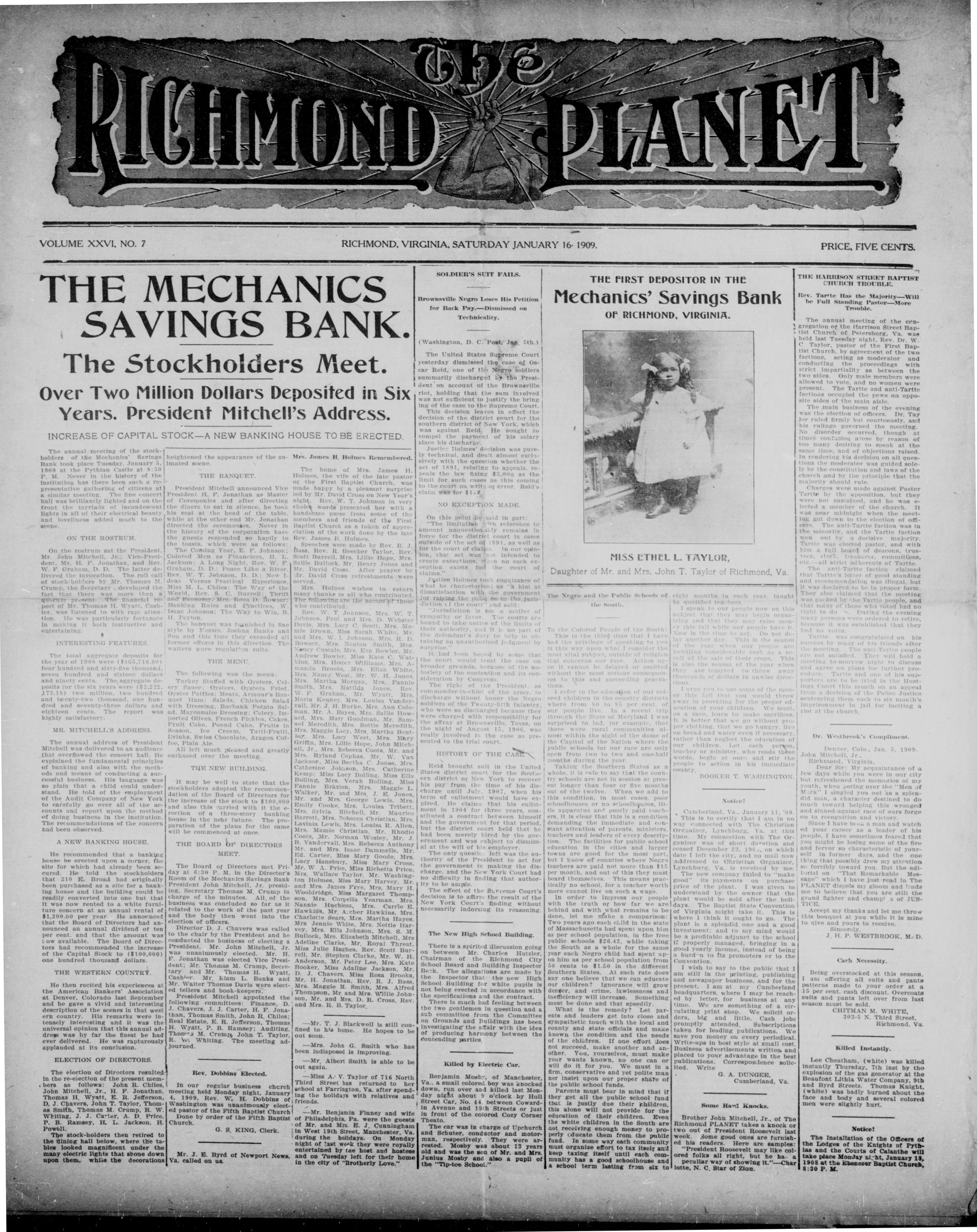
THE MECHANICS SAVINGS BANK. The Stockholders Meet. Over Two Million Dollars Deposited in Six Years. President Mitchell's Address.
INCREASE OF CAPITAL STOCK-A NEW BANKING HOUSE TO BE ERECTED
VOLUME XXVI, NO. 7
THE M
SAV
The St
Over Two Mill
Years. Pres
INCREASE OF CAPITAL S
The annual meeting of the stockholders of the Mechanies' Savings Bank took place Tuesday, January 5, 1999 at the Pythian Castle at 8:30 P.M. Never in the history of the institution has there been such a representative gathering of citizens at a similar meeting. The fine concert hall was brilliantly lighted and on the front the myriads of incandescent lights in all of their electrical beauty and loveliness added much to the scene.
ON THE ROSTRUM
On the rostrum sat the President, Mr. John Mitchell, Jr.; Vice-President, Mr. H. F. Jonathan, and Rev. W. F. Graham, D. D. The latter delivered the invocation. The roll call of stock-holders by Mr. Thomas M. Crump, the Secretary, developed the fact that there was more than a quorum present. The financial report of Mr. Thomas H. Wyatt, Cashier, was listened to with rapt attention. He was particularly fortunate in making it both instructive and entertaining.
INTERESTING FEATURES
The total aggregate deposits for the year of 1908 were ($465,716.90) four hundred and sixty-five thousand, seven hundred and sixteen dollars and ninety cents. The aggregate deposits for the six years were ($2,222,173.18) two million, two hundred and twenty-two thousand, one hundred and seventy-three dollars and eighteen cents. The report was highly satisfactory.
MR. MITCHELL'S ADDRESS
The annual address of President Mitchell was delivered to an audience that overflowed the concert hall. He explained the fundamental principles of banking and also with the methods and means of conducting a successful business. His language was so plain that a child could understand. He told of the employment of the Audit Company of New York to carefully go over all of the accounts and report upon the method of doing business in the institution. The recommendations of the concern had been observed.
A NEW BANKING HOUSE
He recommended that a banking house be erected upon a corner, the site for which had already been secured. He told the stockholders that $310 E. Broad had originally been purchased as a site for a banking house and the building could be readily converted into one but that it was now rented to a white furniture concern at an annual rental of $1,200.00 per year. He announced that the Board of Directors had announced an annual dividend of ten per cent, and that the amount was now available. The Board of Directors had recommended the increase of the Capital Stock to ($100,000) one hundred thousand dollars.
THE WESTERN COUNTRY
He then recited his experiences at the American Bankers' Association at Denver, Colorado last September and he gave a vivid and interesting description of the scenes in that west ern country. His remarks were intensely interesting and it was the universal opinion that this annual address was by far the finest he had ever delivered. He was rapturously applauded at its conclusion.
ELECTION OF DIRECTORS
The election of Directors resulted in the re-election of the present members as follows: John R. Chiles, John Mitchell, Jr., H. F. Jonathan, Thomas H. Wyatt, E. R. Jefferson, D. J. Chavers, John T. Taylor, Thomas Smith, Thomas M. Crump, R. W. Writing, J. J. Carter, A. D. Price, P. B. Ramsey, H. L. Jackson, H. Powell.
The stock-holders then retired to the dining hall below, where the tables looked magnificent under the many electric lights that shone down upon them, while the decorations
heightened the appearance of the an imated scene.
THE BANQUET
President Mitchell announced Vice President H. F. Jonathan as Master of Ceremonies and after directing the diners to eat in silence, he took his seat at the head of the table, while at the other end Mr. Jonathan directed the ceremonies. Never in the history of the corporation have the guests responded so happily to the toasts, which were as follows:
The Coming Year, E. F. Johnson;
Colored Men as Financiers, H. L. Jackson; A Long Night, Rev. W. F. Graham, D. D.; Peace Like a River, Rev. W. T. Johnson, D. D.; New Ideas Versus Practical Experience, Miss M. L. Chiles; The Way of the World, Rev. S. C. Burrell; Thrift and Economy, S. Mrs. Rosa D. Bowser; Banking Rules and Practices, W. Isaac Johnson; The Way to Win, B. H. Peyton.
The banquet was furnished in fine style by Messrs. Joshua Banks and Son and this time they exceeded all former efforts in this direction. The waiters wore regulation suits.
THE MENU
The following was the menu.
Turkey Stuffed with Oysters, Celery Sauce; Oysters, Oysters Fried; Oyster Patties; Meats, Armour's Banquet Ham; Salads, Chicken Salad with Dressing, Burbank Potato Salad, Mayonnaise Dressing; Celery, Imported Olives, French Pickles, Cakes, Fruit Cake, Pound Cake, Fruits in Season, Ice Cream, Tutti-Fruitti, Sausage Chocolate, Aragon Coffee, Plain Ale. All left much pleased and greatly enthused over the meeting.
THE NEW BUILDING
It may be well to state that the stockholders adopted the recommendation of the Board of Directors for the increase of the stock to $100,000 and also this carried with it the erection of a three-story banking house in the near future. The preparation of the plans for the same will be commenced at once.
THE BOARD OF DIRECTORS MEET
The Board of Directors met Friday at 6:30 P. M. in the Director's Room of the Mechanics Savings Bank President John Mitchell, Jr. presiding, Secretary Thomas M. Crump in charge of the minutes. All of the business was concluded so far as it related to the work of the past year and the body then went into the election of officers.
Director D. J. Chavers was called to the chair by the President and he conducted the business of electing a President. Mr. John Mitchell, Jr. was unanimously elected. Mr. H. F. Jonathan was elected Vice President; Mr. Thomas M. Crump, Secretary and Mr. Thomas H. Wyatt, Cashier. Mr. Elam L. Banks and Mr. Walter Thomas Davis were elected tellers and book-keepers.
President Mitchell appointed the following committees: Finance, D. J. Chavers, J. J. Carter, H. F. Jonathan, Thomas Smith, John R. Chiles, Real Estate, E. R. Jefferson, Thomas H. Wyatt, P. B. Ramsey; Auditing, Thomas M. Crump, John T. Taylor, R. W. Whiting. The meeting adjourned.
Rev. Dobbins Elected.
In our regular business church meeting held Monday night, January 4, 1909, Rev. W. H. Dobbins of Washington was unanimously elected pastor of the Fifth Baptist Church Done by order of the Fifth Baptist Church. G. S. KING. Clerk.
Mr. J. E. Byrd of Newport News. Va. called on us.
RICHMOND, VIRGINIA, SATURDAY JANUARY 16. 1909
Mrs. James H. Holmes Remembered.
The home of Mrs. James H. Holmes, the wife of the late pastor of the First Baptist Church, was made happy by a pleasant surprise led by Mr. David Cross on New Year's night. Rev. W. T. Johnson in very choice words presented her with a handsome purse from some of the members and friends of the First Baptist Church as a token of appreciation of the work done by the late Rev. James H. Holmes.
Speeches were made by Rev. R. J. Bass, Rev. R. Beecher Taylor, Rev. Scott Burrell, Mrs. Lillie Hope, Mrs. Sallie Bullock, Mr. Henry Jones and Mr. David Cross. After prayer by dr. David Cross refreshments were served.
Mrs. Holmes wishes to return many thanks to all who contributed. The following are the names of those who contributed:
—Mr. T. J. Blackwell is still confined to his home. He hopes to be out soon.
—Mrs. John G. Smith who has been indisposed is improving.
—Mr. Albert Smith is able to be out again.
—Miss A. V. Taylor of 716 North Third Street has returned to her school at Farrington, Va. after spending the holidays with relatives and friends.
—Mr. Benjamin Finney and wife of Philadelphia, Pa. were the guests of Mr. and Mrs. E. J. Cunningham in West 19th Street, Manchester, Va. during the holidays. On Monday night of last week they were royally entertained by tae host and hostess and on Tuesday left for their home in the city of "Brotherly Love."
SOLDIER'S SUIT FAILS.
Brownsville Negro Loses His Petition for Back Pay.—Dismissed on Technicality.
(Washington, D. C. Post, Jan. 5th.)
The United States Supreme Court yesterday dismissed the case of Oscar Reid, one of the Negro soldiers summarily discharged by the President on account of the Brownsville riot, holding that the sum involved was not sufficient to justify the bringing of the case to the Supreme Court.
This decision leaves in effect the decision of the district court for the southern district of New York, which was against Reid. He sought to compel the payment of his salary since his discharge.
Justice Holmes' decision was purely technical, and dealt almost exclusively with the question whether the act of 1891, relating to appeals, repeals the law fixing $3,000 as the limit for such cases as this coming to the court on writs of error. Reid's claim was for $1.2.
NO EXCEPTION MADE.
On this point he said in part: "The limitation with reference to amount unquestionably remains in force for the district court in cases outside of the act of 1891, as well as for the court of claims. In our opinion, that act was not intended to create exceptions, when no such exception exists for the court of claims."
Justice Holmes took cognizance of what he characterized as "a hint at dissatisfaction with the government for raising the police to the jurisdiction of the court" and said: "Jurisdiction is not a matter of sympathy or favor. The courts are bound to take notice of the limits of their authority, and it is no part of the defendant's duty to help in obtaining an unauthorized judgment by surprise."
It had been hoped by some that the court would treat the case on broader grounds, because of the notoriously the contention and its consideration by Congress.
The right of the President, as commander-in-chief of the army, to discharge without honor the Negro soldiers of the Twenty-fifth Infantry, who were so discharged because they were charged with responsibility for the affray at Brownsville, Texas, on the night of August 15, 1906, was really involved in the case as presented to the trial court.
HISTORY OF THE CASE.
Reid brought suit in the United States district court for the Southern district of New York to recover his pay from the time of his discharge until July, 1907, when his term of enlistment would have expired. He claims that his enlistment in 1904 for three years, constituted a contract between himself and the government for that period, but the district court held that he had been merely hired by the government and was subject to dismissal at the will of his employer.
The only question: left was the authority of the President to act for the government in making the discharge, and the New York Court had no difficulty in finding that authority to be ample.
The effect of the Supreme Court's decision is to affirm the result of the New York Court's finding without necessarily indorsing its reasoning.
The New High School Building.
There is a spirited discussion going on between Mr. Charles Hutzler, Chairman of the Richmond City School Board and Building Inspector Beck. The allegations are made by the Inspector that the new High School Building for white pupils is not being erected in accordance with the specifications and the contract. There is much bad feeling between the two gentlemen in question and a sub committee from the Committee on Grounds and Buildings has been investigating the affair with the idea of producing harmony between the contending parties.
Killed by Electric Car.
Benjamin Mosby, of Manchester, Va., a small colored boy was knocked down, run over and killed last Monday night about 9 o'clock by Hull Street Car, No. 44, between Coward-in Avenue and 19th Streets or just in front of the colored Cozy Corner Theato.
The car was in charge of Upchurch and Schuter, conductor and motorman, respectively. They were arrested. Mosby was about 13 years old and was the son of Mr. and Mrs. Junius Mosby and also a pupil of the "Tip-toe School."
1910
Daughter of Mr. and Mrs. John T. Taylor of Richmond, Va
The Negro and the Public Schools of The South.
To the Colored People of the South:
This is the third time that I have had the privilege of speaking to you in this way upon what I consider the most vital subject, outside of religion that concerns our race. Action upon it cannot be delayed or omitted without the most serious consequences to this and succeeding generations.
I refer to the education of our colored children in the country districts where from 89 to 85 per cent, of our people live. In a recent trip through the State of Maryland I was surprised to ind, for example, that there were rural communities almost within the sight of the dome of the Capitol of the Nation where the public schools for our race are only open from two to two and one-half months during the year.
Taking the Southern States as a whole, it is safe to say that the country schools are not in session at present longer than four or five months out of the twelve. When we add to this condition, in most cases, poor schoolhouses or no schoolhouses, little apparatus and poorly paid teachers, it is clear that this is a condition demanding the immediate and constant attention of parents, ministers, teachers and leaders of every description. The facilities for public school education in the cities and larger towns are good for the most part, but I know of counties where Negro teachers are paid not more than $15 per month, and out of this they must board themselves. This means practically no school, for a teacher worth more cannot live on such a wage. In order to impress our people with the truth or how far we are behind and with what remains to be done, let me make a comparison: Two years ago each child in the state of Massachusetts had spent upon him as per school population, in the free public schools $26.42, while taking the South as a whole for the same year each Negro child had spent upon him as per school population from 50 cents to $1.50 in the different Southern States. At such rate does any one believe that we can educate our children? Ignorance will grow denser, and crime, lawlessness and inefficiency will increase. Something must be done and that speedily.
What is the remedy? Let parents and leaders get into close and sympathetic touch with the local and county and state officials and make known the condition and the needs of the children. If one effort does not succeed, make another and another. You, yourselves, must make your wants known, no one can or will do it for you. We must in a firm, conservative and yet polite manner insist upon our proper share of the public school funds.
Parents must bear in mind that if they get all the public school fund that is justly due their children, this alone will not provide for the education of their children. Even the white children in the South are not receiving enough money to properly educate them from the public fund. In some way each community must organize effort to tax itself and keep taxing itself until each community has a good schoolhouse and a school term lasting from six to
eight months in each year, taught by qualified teachers.
I speak to our people now on this subject that they may begin organizing and that they may raise money this fall while our people have it. Now is the time to act. Do not delay another day. This is the season of the year when our people are handling considerable cash as a result of the sale of their crops. This is also the season of the year when they are tempted to throw away thousands of dollars in unwise directions.
I urge you to use some of the money this fall that you would throw away in providing for the proper education of your children. We must, as a race, learn to make sacrifices. It is better that we go without proper clothing, that we go hungry, live on bread and water if necessary, rather than neglect the education of our children. Let each person, teacher or minister, who reads these words, begin at once and stir the people to action in his immediate county.
BOOKER T. WASHINGTON.
Notice!
Cumberland, Va., January 11, '09. This is to certify that I am in no way connected with The Christian Organizer, Lynchburg, Va. at this time. My connection with The Organizer was of short duration and ceased December 23, 1965, on which date I left the city, and no mail now addressed to Christian Organizer, Lynchburg, Va. is received by me. The new company failed to "make good" its payments on purchase price of the plant. I was given to understand by the owner that the plant would be sold after the holidays. The Baptist State Convention of Virginia might take it. This is where I think it ought to go. The plant is a splendid one and a good investment; and to my mind would be a profitable adjunct to the school if properly managed, bringing in a good yearly income, instead of being a burden to its promoters or to the Convention. I wish to say to the public that I am still in the printing, publishing and newspaper business, and for the present, I am at my Cumberland headquarters, where I may be reached by letter, for business at any time. We are something of a circulating shop. We solicit orders, big and little. Cash jobs promptly attended. Subscriptions taken for leading publications. We save you money on every periodical, Write-ups in best style at small cost. Business advertisements written and placed to your advantage in the best publications. Correspondence solicited. Write
G. A. DUNGEE, Cumberland, Va.
Some Haw! Knocks
Brother John Mitchell, Jr., of the Richmond PLANET takes a knock or two out of President Roosevelt last week. Some good ones are furnished his readers. Here are samples: "President Roosevelt may like colored folks all right, but he has a peculiar way of showing it."—Char lotte, N. C. Star of Zion
PRICE. FIVE CENTS.
THE HARRISON STREET BAPTIST CHURCH TROUBLE.
Rev. Tartte Has the Majority—Will be Full Standing Pastor—More Trouble.
The annual meeting of the congregation of the Harrison Street Baptist Church of Petersburg, Va. was held last Tuesday night, Rev. Dr. W. C. Taylor, pastor of the First Baptist Church, by agreement of the two factions, acting as moderator and conducting the proceedings with strict impartiality as between the two sides. Only male members were allowed to vote, and no women were present. The Tartte and anti-Tartte factions occupied the pews on opposite sides of the main aisle.
The main business of the evening was the election of officers. Dr. Tayor ruled firmly but courteously, and his rulings governed the meeting. No disorder occurred, though at times confusion arose by reason of too many desiring to speak at the same time, and of objections raised. In rendering his decision on all questions the moderator was guided solely by the constitution and laws of the church and by the principle that the majority should rule.
Charges were made against Pastor Tartte by the opposition, but they were not sustained, and he was elected a member of the church. It was near midnight when the meeting got down to the election of officers. The anti-Tartte faction was in the minority, and the Tartte faction won out by a decisive majority. Tartte was elected pastor, and with him a full board of deacons, trustees, clerk, treasurer, committees, etc.—all strict adherents of Tartte. The anti-Tartte faction claimed that Tartte's letter of good standing and recommendation was illegal, but it was declared to be in proper form. They also claimed that the meeting was packed by the Tartte people, and that many of those who voted had no right to do it. During the evening many persons were ordered to retire, because it was established that they had no votes. Tartte was congratulated on his success by many of his friends after the meeting. The anti-Tartte people are not satisfied. They will hold a meeting to-morrow night to discuss and agree on plans for further procedure. Tartte and one of his supporters are to be tried in the Hustings Court this month on an appeal from a decision of the Police Justice sentencing them each to six month's imprisonment in jail for inciting a riot at the church
Dr. Westbrook's Compliment.
Denver, Colo., Jan. 5, 1909.
John Mitchell, Jr.
Richmond, Virginia.
Dear Sir: My acquaintance of a few days while you were in our city but refreshed the memories of my youth, when poring over the "Men of Mark" I singled you out as a splendid man, a character destined to do much toward helping this wronged and sinned-against race of ours forge on to recognition and victory.
Since I have been a man and watched ed your career as a leader of his people, I have sometimes feared that you might be losing some of the fire and fervor so characteristic of yourself in former days, and the one thing that possibly drew my attention so forcibly toward you. But the editorial on "That Remarkable Message" which I have just read in The PLANET dispels my gloom and leads me to believe that you are still the grand fighter and champion a of JUSTICE.
Accept my thanks and let me throw this bouquet at you while it is mine to give and yours to receive.
Sincerely,
J. H. P. WESTBROOK M.D.
Cash Necessity
Being overstocked at this season,
I am offering all suits and pants
patterns made to your order at a
15 per cent. cash discount. Overcoats
suits and pants left over from last
season must be sold.
CHITMAN M. WHITE,
303-5 N. Third Street,
Richmond, Va.
Killed Instantly
Lee Cheatham, (white) was killed instantly Thursday, 7th inst by the explosion of the gas generator at the Beaufort Littia Water Company, 9th and Byrd Streets. Thomas Knight, (white) was badly burned about the face and body and several colored men were slightly hurt.
Notice!
The Installation of the Officers of
the Lodges of the Knights of Pythias
and the Courts of Calanthe will
take place MonJay n-i-ht, January 18,
1908 at the Ebenezer Baptist Church,
8:30 P. M.
SATAN SANDERSON
Satan Sanderson
"Who's Who" In the Story.
"SATAN" SANDERSON, the hero, dare-devil, quixotic friend and minister of the Gospel.
HUGH STIRES, prodigal and criminal.
JESSICA HOLME, the beautiful heroine, helpless in the rush of events and the principal sufferer in a case of mixed identity.
MRS. HALLORAN, the camp oracle.
DAVID STIRES, stern, yet forgiving, and at the last made happy by another's unhappiness.
THE BISHOP, the victim of a misunderstanding.
HALLELUJAH JONES, the religious fanatic on whose shoulders rests the whole weight of the story.
EMMET PRENDERGAST, the false friend, perjurer and thief.
THE SHERIFF, who is very much divided between duty and inclination.
"BIG" DEVLIN, who turns champion instead of prosecutor after the hero's race with death.
Chapter 8
HARRY SANDERSON stared at the apparition with a strange feeling, like rising from the lead. The aristo-
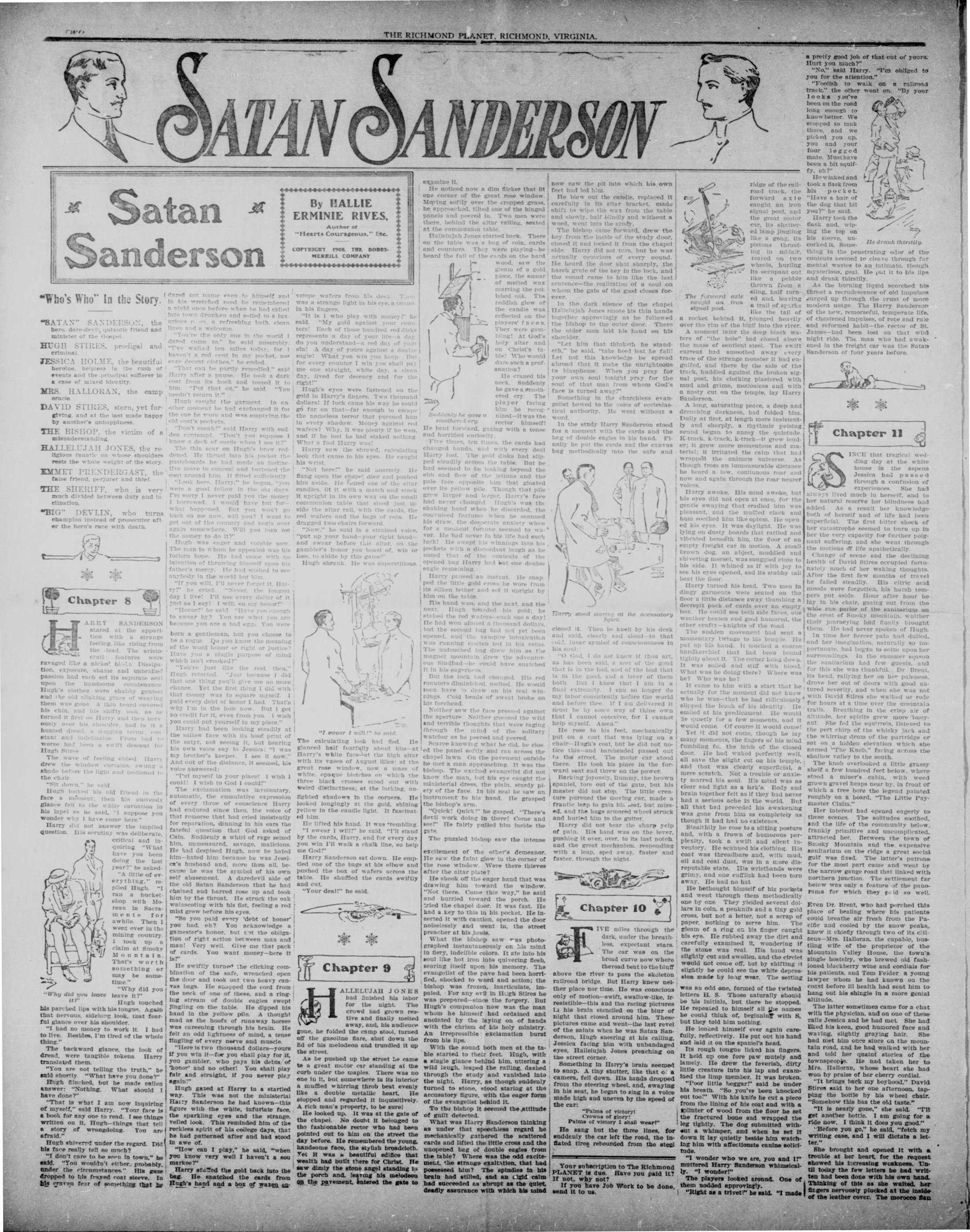
HARRY SANDERSON stared at the apparition with a strange feeling, like rising from the dead. The aristocrat, features were ravaged like a nickel, blade. Dissipation, exposure, shame and unbridled passion had each set its separate seat upon the handsome countenance. Hugh's clothes were shabby gentle and the old slinking grace of wearing them was gone. A thin beard covered his chin, and his shifty look, as he turned it first on Harry and then nervously over his shoulder, had in it a hunted dread, a dogging terror, constant and indestructible. From bad to worse had been a swift descent for Hugh Stires.
The wave of feeling ebbed. Harry drew the window curains, swung a shade before the light and motioned to the chair.
"Sit down," he said.
Hugh looked his old friend in the face a moment; then his unsteady glance fell to the white carnation in his lap as he said, "I suppose you wonder why I have come here."
Harry did not answer the implied question. His scrutiny was deliberate.
J. M.
critical and inquiring "What have you been doing the last year?" be asked "A little of everything." replied Hugh. "I can a bucket shop with Moore in Sacramento for awhile. Then I went over in the mining country I took up a claim at Smoky Mountain. That's worth something or may be sometime." "Why did you leave it?"
"Why did you leave leave it?"
it"
Hugh touched his parched lips with his tongue. Again that nervous, sidelong look, that fearful glance over his shoulder.
"I had no money to work it. I had to live. Besides, I'm tired of the whole thing."
The backward glance, the look of dread, were tangible tokens. Harry translated them.
"You are not telling the truth," he said shortly. "What have you done?"
"That is what I am now in inquiring of myself," said Harry. "Your face is a book for any one to read. I see things written on it, Hugh—things that tell a story of wrongdoing. You are afraid."
Hugh shivered under the regard. Did his face really tell so much?
"I don't care to be seen in town," he said. "You wouldn't either, probably, under the circumstances." His gaze dropped to his frayed coat sleeve. In his craven fear of something that he
dared not name even to himself and
in his wretched need he remembered
a night once before when he had skidd
into town drunken and soiled to a lux-
urious room, a refreshing bath, clean
linen and a welcome.
"You're the only one in the world I
dared come to," he said miserably.
"I've walked ten miles today, for I
haven't a red cent in my pocket, nor
ever decent clothes," he ended.
"That can be partly remedied," said
Harry after a pause. He took a dark
coat from its hook and tossed it to
him. "But that on," he said. "You
needn't return it."
Hugh caught the garment. In an
other moment he had exchanged it for
the one he wore and was emptying the
old coat's pockets.
"Don't sneak!" said Harry with sud-
den contempt. "Don't you suppose I
know a deck of cards when I see it?"
The thin scar on Hugh's brow redened. He thrust into his pocket the pasteboards he had made an instinctive move to conceal and buttoned the coat around him. It fitted sufficiently "Look here, Harry," he began, "you were a good fellow in the old days. I'm sorry I never paid you the money I borrowed. I would have but for—what happened. But you won't go back on me now, will you? I want to get out of the country and begin over again somewhere. Will you loan me the money to do it?" Hugh was eager and voluble now. The man to whom he appealed was his forlorn hope. He had come with no intention of throwing himself upon his father's mercy. He had wished to see anybody in the world but him.
"If you will, I'll never forget it. Hairy!" he cried. "Never, the longest day I live! I'll use every dollar of it just as I say! I will, on my honor!"
"Honor!" he said. "Have you enough to swear by? You are what you are because you are a bad egg. You were born a gentleman, but you choose to be a rogue. Do you know the meaning of the word honor or right or justice? Have you a single purpose of mind which isn't crooked?"
"You're just like the rest, then." Hugh retorted. "Just because I did that one thing you'll give me no more chance. Yet the first thing I did with that money was to square myself. I paid every debt of honor I had. That's why I'm in the hole now. But I get no credit for it, even from you. I wish you could put yourself in my place."
Harry had been looking steadily at the sulow face with its hoof print of the satyr, not seeing it, but hearing his own voice say to Jessica: "I was my brother's keeper. I see it now." And out of the distance, it seemed, his voice answered: "Put myself in your place! I wish I could! I wish to God I could!"
The exclamation was involuntary, automatic, the cumulative expression of every three of conscience Harry had endured since then, the voice of that remorse that had cried insistently for separation, dinning in his ears the fateful question that God asked of Calm. Suddenly a whirl of rage seized him, unmeasured, savage, malicious. He had despised Hugh, now he hated him—hated him because he was Jessica's husband and, more than all, because he was the symbol of his own self abasement. A daredevil side of the old Satan Sanderson that he had chained and barred rose up and took him by the throat. He struck the oak wainscoting with his fist, feeling a red mist grow before his eyes.
"So you paid every 'debt of honor' you had. eb? You acknowledge a gamester's honor, but not the obligation of right action between man and man! Very well. Give me that pack of cards. You want money—here it is!"
He swiftly turned the clicking combination of the safe, wrenched open the door and took out two heavy canvas bags. He snapped the cord from the neck of one of these, and a ringing stream of double eagles swept jingling on the table. He dipped his hand in the yellow pile. A thought mad as the hoofs of runaway horses was careening through his brain. He felt an odd lightness of mind, a tense tingling of every nerve and muscle.
"Here is two thousand dollars--yours if you win it--for you shall play for it, you gambler, who pays his debts of 'honor' and no other! You shall play fair and straight, if you never play again."
Hugh gazed at Harry in a startled way. This was not the ministerial Harry Sanderson he had known—this figure with the white, infuriate face, the sparkling eyes and the strange velled look. This reminded him of the reckless spirit of his college days, that he had patterned after and had stood in awe of.
"How can I play," he said, "when you know very well I haven't a sou markee?"
Harry stuffed the gold back into the bag. He snatched the cards from Hugh's hand and a box of waxen en-
THE RICHMOND PLANET, RICHMOND, VIRGINIA.
Author of
"Hearts Courageous," Etc.
COPYRIGHT 1908, THE BOBBS-
MERRILL COMPANY
vetope waters from his desk. There was a strange light in his eye, a treno in his fingers.
"It is I who play with money!" he said. "My gold against your counters! Each of those hundred red disks represents a day of your life—a day do you understand—a red day of your sn! A day of yours against a double eagle! What you win you keep. But for every counter I win you shall pay me one straight, white day, a clean day, lived for decency and for the right!"
Hugh's eyes were fastened on the gold in Harry's fingers. Two thousand dollars! If luck came his way he could go far on that—far enough to escape the nameless terror that pursued him in every shadow. Money against red wafers? Why, it was plenty if he won, and if he lost he had staked nothing. What a fool Harry was!
Harry saw the shrewd, calculating look that came to his eyes. He caught his wrist.
"Not here?" he said insecurely. He flung open the chapel* door and pushed him aside. He *eclized* one of the altar candles, lit it with a match and snuck it upright in its own wax on the small communion table that stood just inside the altar rail, with the cards, the red wafers and the bags of coin. He dragged two chairs forward.
"Now," he said in a strained voice, "put up your hand—your right hand—and swear before this altar, on the gambler's honor you boast of, win or lose, to abide by this game."
Hugh shrank. He was superstitious.
M. H.
"I swear I will!" he said.
The calculating look had fled. He glanced half fearfully about him—at Harry's white face—at the high altar with its vases of August lilies; at the great rose window, now a mass of white, opaque blotches on which the three black crosses stood out with weird distinctness; at the lurking, unlighted shadows in the corners. He looked longingly at the gold, shining yellow in the candle light. It fascinated him.
He lifted his hand. It was 'rembling. "I swear I will!" he said. "I'll stand by the cards, Harry, and for every day you win I'll walk a chalk line, so help me God!"
Harry Sanderson sat down. He emptied one of the bags at his elbow and pushed the box of wafers across the table. He shuffled the cards swiftly and cut.
"Your deal!" he said.
Chapter 9
HALLELUJAH JONES
had finished his labor
for the night. The
crowd had grown res
tive and finally melted
HALLEUJAH JONES had finished his labor for the night. The crowd had grown resitive and finally melted away, and, his audience gone, he folded the camp stool, turned off the gasoline flare, shut down the lid of his melodeon and trundled it up the street.
As he pushed up the street he came to a great motor car standing at the curb under the maples. There was no one in it, but somewhere in its interior a muffled whirring thrub beat evenly like a double metallic heart. He stopped and regarded it inquisitively. A rich man's property, to be sure!
He looked up. It was at the gate of the chapel. No doubt it belonged to the fashionable rector who had been pointed out to him on the street the day before. He remembered the young, handsome face, the stylish broadcloth. Yet it was a beautiful edifice that wealth had built there for Christ. He saw dimly the stone angel standing in the porch and, leaving his meadow on the pavement, entered the gate to
examine it.
He noticed now a dim flicker that lit one corner of the great rose window. Moving softly over the cropped grass, he approached, tilted one of the hinged panels and peeled in. Two men were there, behind the altar rolling, seated at the communion table.
Halleluja Jones started back. There on the table was a bag of coin, cards and counters. They were playing—he heard the fall of the cards on the hard
wood, saw the gleam of a gold piece, the smear of melt wax marring the polished oak. The reddish glow of the candle was reflected on the players' f a e c s. They were gambling! At God's holy altar and on Christ's table. Who would dare such a profanation?
WILLIAM JONES
He crunched his neck. Suddenly he gave a smothered cry. The player facing him he recognized—it was the rector, blissfully!
Suddenly he gave a smothered cry
simbertecrp. rector himself! He bent forward, gazing with a tense and horrified curiosity. Five times, ten times, the cards had changed hands, and with every deal Harry lost. The gold disks had slipped steadily across the table. But he had seemed to be looking beyond the ebb and flow of the jettons and the pale face opposite him that gloated over its yellow pile. Though that pile grew larger and larger, Harry's face had never changed. Hugh's was the shaking hand when he discarded, the convulsed features when he scanned his draw, the desperate anxiety when for a moment fortune seemed to waver. He had never in his life had such luck! He swept his winnings into his pockets with a discordant laugh as he noted that of the contents of the opened bag Harry had but one double engle remaining.
Harry paused an instant. He snapped the little gold cross he wore from its silken tether and set it upright by him on the table.
His hand won, and the next, and the next. Hugh boarded his gold; he staked the red wafers—each one a day! He had won almost a thousand dollars, but the second bag had not yet been opened, and the vampire intoxication was running molten hot in his veins. The untouched bag drew him as the magnet mountain drew the adventurous Sindbad—he could have snatched it in his eagerness.
But the luck had changed. His red counters diminished, melted. He would soon have to draw on his real winnings. Cold beads of sweat broke on his forehead.
Neither saw the face pressed against the aperture. Neither guessed the wild and terrible thoughts that were raging through the mind of the solitary watcher as he peered and peered.
Scarce knowing what he did, he closed the panel softly and ran across the chapel lawn. On the pavement outside he met a man approaching. It was the bishop. The excited evangelist did not know the man, but his eye caught the ministerial dress, the plain, sturdy piety of the face. In his zeal he saw an instrument to his hand. He grasped the bishop's arm.
"Quick! Quick!" he gasped. "There's devil work doing in there! Come and see!" He fairly pulled him inside the gate.
The puzzled bishop saw the intense excitement of the other's demeanor. He saw the faint glow in the corner of the rose window. Were there thieves after the sitar plate?
He shook off the eager hand that was drawing him toward the window. "Not there. Come this way," he said and hurried toward the porch. He rilled the chapel door. It was fast. He had a key to this in his pocket. He inserted it with caution, opened the door noiselessly and went in, the street preacher at his heels.
What the bishop saw was photographed instantaneously on his mind in fiery, indelible colors. It ate into his soul like hot iron into quivering flesh, searing itself upon his memory. The evangelist of the pave had been horrified, shocked to word and action; the bishop was frozen, inarticulate, impaled. For any evil in Hugh Stires he was prepared—since the forgery. But Hugh's companion now was the man whom he himself had ordained and annoted by the laying on of hands with the chrism of his holy ministry. An irrepressible exclamation burst from his lips.
With the sound both men at the table started to their feet. Hugh, with a single glance behind him, uttering a wild laugh, leaped the ralling, dashed through the study and vanished into the night. Harry, as though suddenly turned to stone, stood staring at the accusatory figure, with the eager form of the evangelist behind it.
To the bishop it seemed the attitude of guilt detected.
What was Harry Sanderson thinking as under that speechless regard he mechanically gathered the scattered cards and lifted the little cross and the unopened bag of double eagles from the table? Where was the odd excitement, the strange exaltation, that had possessed him? The spindles in his brain had stilled, and an rigid calm had succeeded as abrupt as the quiet, deadly assurance with which his taint
now saw the pit into which his own feet had led him.
He blew out the candle, replaced it carefully in its altar bracket, made shift to wipe the wax from the table and slowly, half blindly and without a word, went into the study.
The bishop came forward, drew the key from the inside of the study door, closed it and locked it from the chapel side. Harry did not turn, but he was actually conscious of every sound.
He heard the door shut sharply, the harsh grate of the key in the lock, and the sound came to him like the last sentence—the realization of a soul on whom the gate of the good closes forever.
In the dark silence of the chapel Halleujah Jones smote his thin hands together approvingly as he followed the bishop to the outer door. There the older man laid his hand on his shoulder.
"Let him that thinketh he standeth," he said, "take heed lest he fall! Let not this knowledge be spread abroad that it make the unrighteous to blaspheme. When you pray for your own soul tonight pray for the soul of that man from whom God's face is turned away"
Something in the churchless evangelist bowed to the voice of ecclesiastical authority. He went without a word.
In the study Harry Sanderson stood for a moment with the cards and the bag of double eagles in his hand. Finally he put the cards and the canvas bag methodically into the safe and
Harry stood staring at the accusatory figure.
closed it. Then he knelt by his desk and said, clearly and aloud—to that cold, inner symbol of consciousness in his soul:
"O God, I do not know if thou art, as has been said, a seer of the good that is in the bad, and of the bad that is in the good, and a lover of them both. But I know that I am in a final extremity. I can no longer do my labor consistently before the world and before thee. If I am delivered it must be by some way of thine own that I cannot conceive; for I cannot help myself. Amen."
He rose to his feet, mechanically put on a coat that was lying on a chair—Hugh's coat, but he did not notice this—and bareheaded passed out to the street. The motor car stood there. He took his place in the forward seat and threw on the power.
Barking joyously, Rummy, the brown spaniel, tore out of the gate, but his master did not stop. The little creature pursued the moving car, made a frantic leap to gain his seat, but missed, and the huge armored wheel struck and hurled him to the gutter.
Harry did not hear the sharp yelp of pain. His hand was on the lever, pushing it over, over, to its last notch, and the great mechanism, responding with a leap, sped away, faster and faster, through the night.
Chapter 10
IVE miles through the dark, under the breathless, expectant stars. The car was on the broad curve now where the throat bent to the bluff
IVE miles through the dark, under the breathless, expectant stars. The car was on the broad curve now where theroad bent to the bluff above the river to pass the skeleton railroad bridge. But Harry knew nelther place nor time. He was conscious only of motion-swift, swallow-like, irresistible—this and the racing pictures in his brain stendled on the blur of night that closed around him. These pictures came and went—the last rever of the saints when he was Satan Sanderson, Hugh sneering at his calling, Jessica facing him with unbandaged eyes, Hallelujah Jones preaching on the street corner.
Something in Harry's brain seemed to snap. A tiny shutter, like that of a camera, fell down. His hands dropped from the steering wheel, and, swaying in his seat, he began to sing in a voice made high and uneven by the speed of the car:
"Palms of victory!
Crowns of glory!
Palms of victory I shall wear!"
He sang but the three lines, for suddenly the car left the road, the inflated tires reboubled from the steel
Your subscription to The Richmond PLANET is due. Have you paid it? If not, why not? If you have Job Work to be done, send it to us.
```markdown
```
ridge of the railroad track, the forward a xile caught an iron signal post, and the great motor car, its shattered lamp jingling like a gong, its pistons thrusting in midair, reared on two wheels, hurling its occupant out like a pebble thrown from a sling, halfurned and, leaving a trail of sparks like the tail of
The forward axie caught an iron signal post.
ang, hall turned and, leaving a trail of sparks like the tail of a rocket behind it, plunged heavily over the rim of the bluff into the river
a locked bound it, plunged heavily over the rim of the bluff into the river. A moment later the deep black waters of "the hole" had closed above the mass of sentient steel. The swift current had smoothed away every trace of the strange monster it had engulfed, and there by the side of the track, huddled against the broken signal post, his clothing plastered with mud and grime, motionless and with a nasty cut on the temple, lay Harry Sanderson. A long, saturating peace, a deep and drenching darkness, had folded him. Dully at first, at length more insistently and sharply, a rhythmic polishing sound began to annoy the quietude. K-track, k-track, k-track—it grew louder; it grew more momentous and material; it irritated the calm that had wrapped the animate universe. As though from an immeasurable distance he heard a low, continuous roar and now and again through the roar nearer voices.
Harry awoke. His mind awoke, but his eyes did not open at once, for the gentle swaying that cradled him was pleasant, and the muffled cluck and hum soothed him like opium. He opened his eyes. It was daylight. He was lying on dusty boards that rattled and vibrated beneath him, the floor of an empty freight car in motion. A small brown dog, an object, muddled and shivering morsel, was snuggled close to his side. It whined as if with joy to see his eyes opened, and its stubby tail beat the floor.
Harry turned his head. Two men in dingy garments were seated on the floor a little distance away thumping a decrepit pack of cards over an empty box. He could see both side faces, one weather beaten and good humored, the other crafty-knights of the road.
The sudden movement had sent a momentary twinge to his temple. He put up his hand. It touched a coarse handkerchief that had been bound tightly about it. The corner hung down. It was soiled and stiff with blood. What was he doing there? Where was he? Who was he?
It came to him with a start that he actually for the moment did not know who he was—that he had ridiculously slipped the leash of his identity. He smiled at his predicament. He would lie quietly for a few moments, and it would come. Of course it would come. Yet it did not come, though he lay many moments, the fingers of his mind fumbling foe, the latch of the closed door. He had waked perfectly well, all save the slight cut on his temple, and that was clearly superficial, a mere scratch. Not a trouble or anxiety marred his soul. His mind was as clear and light as a lark's. Body and brain together felt as if they had never had a serious ache in the world. But all that had preceded his awakening was gone from him as completely as though it had had no existence.
Stealthily he rose to a sitting posture and, with a frown of humorous perplexity, took a swift and silent inventory. He scanned his clothing. His coat was threadbare and, with mud, oil and coal dust, was in a more disreputable state. His wrists wore were grimy, and one cufflink had been torn away. He had no hat.
He bethought himself of his pockets and went through them methodically one by one. They yielded several dollars in coin, a penknife and a tiny gold cross, but not a letter, not a scrap of paper, nothing to serve him. The gleam of a ring on his finger caught his eye. He rubbed away the dirt and carefully examined it, wondering if the stone was real. His hand was slightly cut and swollen, and the circlet would not come off, but by shifting it slightly he could see the white depression made by long wear. The setting
was an odd one, formed of the twisted letters H. S. Those naturally should be his initials, but there he stopped. He repeated to himself all the names he could think of, beginning with S, but they told him nothing. He looked himself over again carefully, reflectively. He put out his hand and laid it on the spaniel's head. Its rough tongue licked his fingers. It held up one fore paw mutely and lamely. He drew the feverish, dirty little creature into his lap and examined the limp member. It was broken. "Poor little beggar!" said he under his breath. "So you've been knocked out too!" With his knife he cut a piece from the lining of his coat and with a polliner of wood from the floor he set the fractured bone and wrapped the leg tightly. The dog submitted without a whimper, and when he set it down it lay quietly beside him watching him with affectionate canine solicitude.
"I wonder who we are, you and I!" muttered Harry Sanderson whimsically. "I wonder!" The players looked around. One of them nodded approvingly. "Right as a tristet," he said. "I made
a pretty good job of that cut or yours.
Hurt you much?"
"No," said Harry. "I'm obliged to
you for the attention."
"Foolish to walk on a railroad
track," the other went on. "By your
track" the other looks you've been on the road long enough to know better. We stopped to tink there, and we picked you up, you and your four legged mate. Must have been a bit squiffy, ch?
H
He winked and took a flask from his pocket. "Have a hair of the dog that bit you?" he said. Harry took the flask and, wiping the top on his sleeve, uncorked it. Some-
corked it. Some- thing in the penetrating odor of the contents seemed to cleave through far mental wastes to an intimate, though mysterious, goal. He put it to his lips and drank thirstily. As the burning liquid scorched his throat a recrudescence of old impulses surged up through the crust of more modern usage. The Harry Sanderson of the new, remorseful, temperate life, of chastened impulses, of rote and rule and reformed habit—the rector of St. James-had been lost on that wild night ride. The man who had awakened in the freight car was the Satan Sanderson of four years before.
Chapter 11
INCE that tragical wed-
ding day at the white
house in the aspen
Jessica had passed
through a confusion of
experiences. She had
INCE that tragical weding day at the white house in the aspens Jessica had passed through a confusion of experiences. She had always lived much in herself, and to her natural reserve her blindness had added. As a result her knowledge both of herself and of life had been superficial. The first bitter shock of her catastrophe seemed to burn up in her the very capacity for further polignant suffering, and she went through the motions of life apathetically.
Change of scene and the declining health of David Stires occupied fortunately much of her waking thoughts. After the first few months of travel he failed steadily. His citric acid moods were forgotten, his harsh tempers put aside. Hour after hour he lay in his chair, gazing out from the wide sun parlor of the sanitary on the crest of Smoky mountain, whither their journeying had finally brought them. He had never spoken of Hugh. In time her fiercer pain had dulled, and her imagination, naturally so importunate, had begun to seize upon her surroundings. In the summer season the sanitary had few guests, and for this she was thankful. Dr Brent, its head, rallying her on her paleness, drove her out of doors with good natured severity, and when she was not with David Stires she walked or rode for hours at a time over the mountain trails. Breathing in the crisp air of attitude, her spirits grew more buoyant. She fed the squirrels, listened to the pert chirp of the whisky jack and the whirring drum of the partridge or sat on a hidden elevation which she named "The Knob," facing across the shallow valley to the south.
The knob overlooked a little grassy shelf a few hundred feet below, where stood a miner's cabin, with weed grawn gravel heaps near by, in front of which a tree bore the legend painted roughly on a board, "The Little Paymaster Claim."
Her interest had opened eagerly to these scenes. The solitudes soothed, and the life of the community below, frankly primitive and uncomplicated, attracted her. Between the town of Smoky Mountain and the expensive sanitarium on the ridge a great social gulf was fixed. The latter's patrons for the most part came and went by the narrow gauge road that linked with northern junction. The settlement far below was only a feature of the panorama for which they paid so well.
Even Dr. Brent, who had perched this place of healing where his patients could breathe air fresh from the Pacific and cooled by the snow peaks, knew it chiefly through two of its citizens—Mrs. Halloran, the capable, bustling wife of the proprietor of the Mountain Valley House, the town's single hostel, who brewed old fashioned blackberry wine and cordials for his patients, and Tom Feider a young lawyer whom he had known on the coast before ill health had sent him to hang out his shingle in a more genial altitude.
The latter sometimes came for a chat with the physician, and on one of these calls Jessica and he had met. She had liked his keen, good humored face and waving, slightly graying hair. She had met him once since on the mountain road, and he had walked with her and told her quaint stories of the townspeepe. He had taken her to Mrs. Halloran, whose heart she had won by praise of her cherry cordial. "It brings back my boyhood." David Stires said to her one afternoon, tapping the bottle by his wheel chair. "Somehow this has the old taste." "It is nearly gone," she said. "T'll get another bottle. I am going for a ride now. I think it does you good." "Before you go," he said, "fetch my writing case, and I will dictate a letter."
She brought and opened it with a trouble at her heart, for the request showed his increasing weakness. Until today the few letters he had written had been done with his own hand. Thinking of this as she waited, her fingers nervously plucked at the inside of the leather cover. The morocco fan
THE ATLANTIC
SATURDAY... JANUARY 16, 1909.
cell and disclosed a slip of paper. It was a canceled bank draft. It bore Hugh's name, and across its face in David Stires' crabbed hand, written large, was the venomous word "Forgery." The room swam before her eyes. Only by a fierce effort could she compel her pen to trace the dictated words. Hugh's misdeed, evil as it was, had been to her but an abstract crime. Now it suddenly lay bare before her, a concrete expression of coarse threve, a living symbol of crafty simulation. Scarce knowing why she did it, she drew the draft covertly from its receptacle and slimmed it into her bosom.
The evidence of Hugu's sin! That paper must remain, as the sin that made it remained, the sign manual of her dishonor and loss. The man whose hand had penned its lying signature was the man she had thought she loved. By that act he had thrust himself from her forever. Yet he lived. Somewhere in the world he walked in shame and degradation beyond the pale of honorable living, and she was his wife. She was his wife! Though she called herself Jessica Holme, yet in the law his name and fame were hers. "Look at that steady hand, now, an her hair as red as glory!" said Mrs. Halloran, gazing admiringly from the doorstep where she had been chatting with Tom Felder. "Ye needn't stare yer gray eyes out, though, or she'll stop at the joylery shop to buy ye a ring—to shame ye fer jest bankerin' and savin' nothin'"
Felder laughed as he crossed the street, raising his felt hat gallantly to the approaching rider. Mrs Halloran was a privileged character. It was not Michael Halloran who kept the Mountain Valley House popular! The old woman hurried to the curb and tied the horse as Jessica dismounted.
"How did ye guess I made some more this day?" she exclaimed. "Sure. If ye drink it yerself, my dearie, them cheeks is all th' trademark I need!" She led the way into the little carpeted side room, by courtesy denominated "the parlor." "I'll go an' put it up in two shakes." she said. "Sit ye down an' I'll not be ten minutes." So saying, she busted away.
Left alone, Jessica gazed abstractly about her. Her mind was still full of the painful reflections of her
The room swam before her eyes.
ride. The door opened from the room into the office. It was ajar. She stepped close and booked in.
A group of miners lounged in the space before the front windows—familiarly referred to by its habitues as "the amen corner"—chatting and watching the passersby.
Suddenly she clapped her hand to her mouth to stifle a cry. A name had been spoken—the name that was in her thought—the name of Hugh Stires.
She leaned forward, listening breathlessly.
"I wonder where the young black-legged been," said one, peering through the windows. "He'd better have stayed away for good. I'm thinking. What does he want to come back for, to a place where there aren't three men who will take a drink with him?" Jessica looked about her an instant wildly, guiltily. She could not be mistaken in the name. Was Hugh here, whither by the verlest accident she had come—here in this very town that she had gazed down upon every day for weeks? Was he? No, no; it could not be! She had not heard aright. But she had an overwhelming desire to satisfy herself with her own eyes. From where she stood she could not see the street. She bethought herself of the upper balcony. Swiftly she crossed to the hall door, threw it open and ran hastily up the stair.
Chapter 12
F the man who had been the subject of the observations Jessica had heard had been less absorbed as he walked leisurely along on the
opposite side of the street he would have noticed the look of dislike in the eyes of those he passed. They drew away from him, and one spoke—to no one in particular and with an oath offensive and fervid. But weather heaten, tanned, indifferently clad and with a small brown dog following him, the newcomer passed along, oblivious to the sidelong scrutiny. He did not stare about him after the manner of a stranger, though so far as he knew he had never been in the place before.
But Harry Sanderson now was not the man who had ridden into oblivion in the motor car. The rector of St James' was in a strange eclipse. Mentally and externally he had reverted to the old Satan Sanderson of the brilliant flashing originality, of the curt risk and daring. The deeply human and sensitive side that had developed during his divinity years was in abeyance. It showed itself only in the affection he bestowed on the little
nameless dog that followed him like a brown, shaggy shadow.
He was like that old self of his, and yet if he had but known it he was wonderfully like some one else, too—some one who had belonged to the long ago and garbled past that still eluded him: some one who had been a part also of the life of this very town till a little over a month before, when he had left it with dread dogging his footsteps!
Curious coincidences had wrought together for this likeness. In the past weeks Harry had grown perceptibly thinner. A spare beard was now on his chin, and the fiery sun that had darkened his cheeks to sallow had lightened his brown hair a shade. The cut on his brow had healed to the semblance of a thin red birthmark.
* Fate—or God—was doing strange things for Harry Sanderson!
In the nomad weeks of wind and sun, as the tissues of the brain grew slowly back to a state of normal action, the mind seized again and again upon the bitter question of his identity. It had obtruded into clicking leagues on steel rails, into miles afoot by fruit hung lanes, on white Pacific shell roads under cedar branches, on busy highways. It had stalked into days of labor in hop fields, work with hand and foot that brought dreamless sleep and generous wage; into nights of less savory experience in city purleus, where a self forgotten man gamed and drank recklessly, audaciously, forbiddingly. Who was he? From what equation of life had he been eliminated? Had he loved anything or anybody? Had he a friend, any friend, in the world?
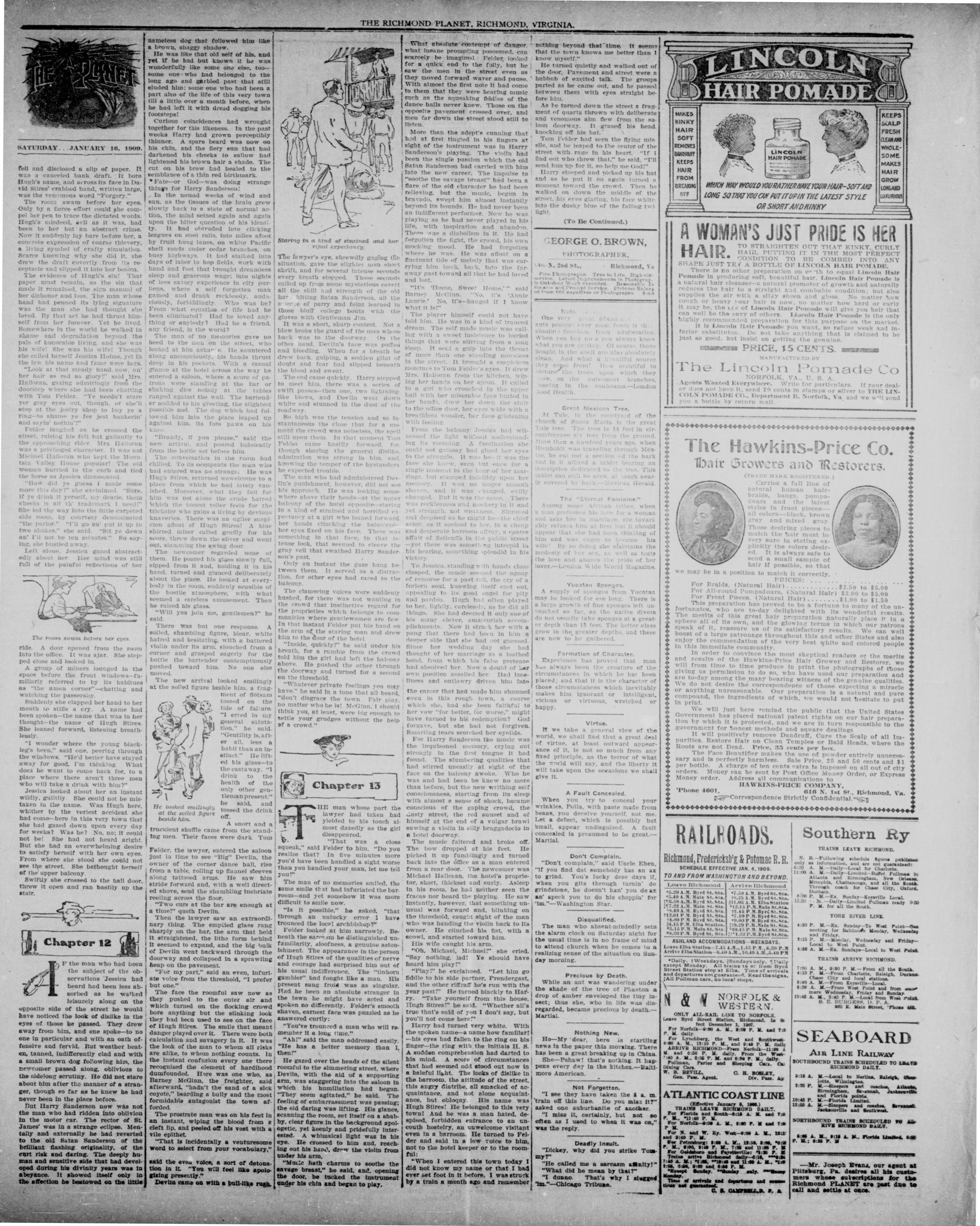
The man of no memories gave no heed to the men on the street, who looked at him askance. He sauntered along unconsciously, his hands thrust deep in his pockets. With a casual glance at the hotel across the way he entered a saloon, where a score of patrons were standing at the bar or shaking dice noisily at the tables ranged against the wall. The bartender nodded to his greeting, the slightest possible nod. The dog which had followed him into the place leaped up against him. Its fore paws on his knice.
"Brandy, if you please," said the new arrival, and poured indolently from the bottle set before him.
The conversation in the room had chilled. To its occupants the man who had entered was no strange. He was Hugh Stires, returned unwelcome to a place from which he had lately vanished. Moreover, what they felt for him was not alone the crude hatred which the honest toiler feels for the treckster who gains a living by devious knaveries. There was an uglier suspicion affair of Hugh Stires! A blue shirted miner called gruffly for his score, throw down the silver and went out, slamming the swing door.
The newcomer regarded none of them. He poured his glass slowly full, slipped from it and, holding it in his hand, turned and glanced deliberately about the place. He looked at everybody in the room, suddenly sensible of the hostile atmosphere, with what seemed a careless amusement. Then he raised his glass.
"Will you join me, gentlemen?" he said.
There was but one response. A solled, shambling figure, blear, white haired and hesitating, with a battered violin under its arm, slouched from a corner and grasped eagerly for the bottle the bartender contemptiously pushed toward him. No one else moved. The new arrival looked smilingly at the solled figure beside him a frag-
made him, a fragment of flotsam tossed on the tide of failure. "I ered in my general salutation," he said. "Gentility is, after all, less a habit than an instinct." He lifted his glass—to the casteaway. "I drink to the health of the only other gentleman present," he said, and tossed the drink off.
ment of notsam tossed on the tide of failure. "I erred in my general salutation," he said. "Gentility is, after all, less a habit than an instinct." He lifted his glass—to the castaway. "I drink to the health of the only other gentleman present." he said, and tossed the drink off. A snort and a truculent shuffle came from the stand- ing men. Their faces were dark. Tom
Felder, the lawyer, entered the saloon just in time to see "Big" Devilin, the owner of the corner dance hall, rise from a table, rolling up flannel sleeves along tattooed arms. He saw him stride forward and, with a well directed shove, send the shambling inebriate reeling across the floor.
"Two curs at the bar are enough at a time!" quoth Devilin.
Then the lawyer saw an extraordinary thing. The empiplied glass rang sharply on the bar, the arm that held it straightened, the liths form behind it seemed to expand, and the big bulk of Devilin went backward through the doorway and collapsed in a sprawling heap on the pavement.
"For my part," said an even, infuriate voice from the threshold, "I prefer but one."
The face the roomful saw now as they pushed to the outer air and which turned on the flocking crowd bore anything but the slinking look they had been used to see on the face of Hugh Stires. The smile that meant danger played over it. There were both calculation and savagery in it. It was the look of the man to whom all risks are alike, to whom nothing counts. In the instant confusion every one there recognized the element of hardihood dumfounded. Here was one who, as Barney McGinn, the freighter, said afterward, "hadn't the sand of a slick coyote," bearding a bully and the most formidable antagonist the town afforded.
The prostrate man was on his feet in an instant, wiping the blood from a cleft lip, and peeled off his vest with a vile epithet.
"That is incidentally a venturesome word to select from your vocabulary."
said the even voice, a sort of detonation in it. "You will feel like apologizing presently." Devilin on with a bull-like rush.
THE RICHMOND PLANET. RICHMOND. VIRGINIA
JOHN JONES
Staring in a kind of stained and hor rified expectancy
The lawyer's eye, shrewdly gaging the situation, gave the slighter man short shrift, and for several intense seconds every breath stopped. Those seconds called up from some mysterious covert all the skill and strength of the old har biting Satan Sanderson, all the science of parry and feint learned in those bluff college bouts with the gloves with Gentleman Jim.
It was a short, sharp contest. Not a blow broke the guard of the man whose back was to the doorway. On the other hand, Devil's face was puffed and bleeding. When for a breath he drew back gulping, a sudden glint of doubt and fear had slipped beneath the blood and sweat.
The end came quickly. Harry stepped to meet him, there was a series of swift passes—then one, two lightning-like blows, and Doelin went down white and stunned in the dust of the roadway.
So high was the tension and so instantaneous the close that for a moment the crowd was noiseless, the spell still upon them. In that moment Tom Felder came hastily forward, for though sharing the general dislike admiration was strong in him, and knowing the temper of the bystanders he expected trouble.
The man who had administered Devil's punishment, however, did not see his approach. He was looking somewhere above their heads—at the upper balcony of the hotel opposite—staring in a kind of strained and horrified expectancy at a girl who leaned forward, her hands clinching the balustrade her eyes fixed on his face. There was something in that face, in that intense look, that seemed to cleave the gray veil that swathed Harry Sanderson's past.
Only an instant the gaze hung between them. It served as a distraction, for other eyes had raced to the balcony.
The clamoring voices were suddenly hushed, for there was not wanting in the crowd that instinctive regard for the proprieties which belongs to communities where gentlewomen are few. In that instant Felder put his hand on the arm of the staring man and drew him to the door of the hotel.
"Inside, quickly!" he said under his breath, for a rumble from the crowd told him the girl had left the balcony above. He pushed the other through the doorway and turned for a second on the threshold.
"Whatever private feelings you may have," he said in a tone that all heard, "don't disgrace the town Fair play, no matter who he is! McGinn, I should think you, at least, were big enough to settle your grudges without the help of a crowd."
Chapter 13
HE man whose part the lawyer had taken had yielded to his touch almost dazedly as the girl disappeared.
"That was a close squeak," said Felder to him. "Do you realize that? In five minutes more you'd have been handled a sight worse than you handled your man, let me tell you!" The man of no memories smiled, the same smile that had infuriated the barroom—and yet somehow it was more difficult to smile now. "Is it possible," he asked, "that through an unlucky error I have trounced the local archbishop?"
Felder looked at him narrowly. Beneath the sarcoma he distinguished unfamiliarity, aloofness, a genuine astonishment. The appearance in the person of Hugh Stires of the qualities of nerve and courage had surprised him out of his usual indifference. The "tinhorn gambler" had fought like a man. His present sang froid was as singular. Had he been an absolute stranger in the town he might have acted and spoken no differently. Felder's smooth shaven, earnest face was puzzled as he answered curtly: "You've trounced a man who will remember it a long time." "Ah!" said the man addressed easily. "He has a better memory than I, then."
He gazed over the heads of the silent roomful to the simmering street, where Devlin, with the aid of a supporting arm, was staggering into the saloon in which his humiliation had begun. "They seem agitated," he said. The feeling of embarrassment was passing; the old daring was lifting. His glance, scanning the room, set itself on a shabby, clear figure in the background apologetic, yet keenly and pridefully interested. A whimsical light was in his eye. He crossed to him and, reaching out his hand, drew the violin from under his arm. "Music hath charms to soothe the savage breast," he said, and, opening the door, he tucked the instrument under his chin and began to play.
What absolute contempt of danger, what insane prompting possessed, can scarcely be imagined. Felder, looked for a quick end to the folly, but he saw the men in the street even as they moved forward waver and pause. With almost the first note it had come to them that they were hearing music such as the squeaking fiddles of the dance halls never knew. Those on the opposite pavement crossed over, and men far down the street stood still to listen.
More than the adept's cunning that had at first tingled in his fingers at sight of the instrument was in Harry Sanderson's playing. The violin had been the single passion which the old Satan Sanderson had carried with him into the new career. The impulse to "soothe the savage breast" had been a flare of the old character he had been relieving, but the music, begun in bravado, swept him almost instantly beyond its bounds. He had never been an indifferent performer. Now he was playing; as he had never played in his life, with inspiration and abandon. There was a diabolism in it. He had forgotten the fight, the crowd, his own mocking mood. He had forgotten where he was. He was afloat on a fluctuant tide of melody that was carrying him back, back, into the faraway past toward all that he had loved and lost.
"It's 'Home, Sweet Home,'" said Barney McGinn. "No. it's 'Annie Laurie.' No, it's--hanged if I know what it is!"
The player himself could not have told him. He was in a kind of tranced dream. The self made music was calling with a sweet insistence to buried things that were stirring from a long sleep. It sent a gulp into the throat of more than one standing moveless in the street. It brought a suspicious moisture to Tom Felder's eyes. It drew Mrs. Halloran from the kitchen, wiping her hands on her apron. It called to a girl who crouched in the upper hall with her miserable face buried in her hands, drew her down the stair to the office door, her eyes wide with a breathless wonder, her face glistening with feeling.
From the balcony Jessica had witnessed the fight without understanding its meaning. A fascination she could not gainay had glued her eyes to the struggle. It was he—it was the face she knew, seen but once for a single moment in the hour of her marriage, but stamped indelibly upon her memory. It was no longer smooth shaven, and it was changed, evilly changed. But it was the same. There was recklessness and mockery in it and yet strength, not weakness. Shapped and despised as he might be—the chiffor actor, and it seemed to her, in a cheap and desperate barroom affray, a coarse affair of fastcuffs in the public street—yet there was something intrepid in his bearing, something splendid in his victory.
To Jessica, standing with hands close clasped, the music seemed the agony of remorse for a past fall, the cry of a forlorn soul, knowing itself cast out, appealing to its good angel for pity and pardon. Hugh had often played to her, lightly, carelessly, as he did all things. She had deemed it only one of his many clever, amateurish accomplishments. Now it struck her with a pang that there had been in him a deeper side that she had not guessed. Since her wedding day she had thought of her marriage as a loathed bond, from which his false pretence had absolved her. Now a doubt of her own position assailed her. Had loneliness and outhawry driven him into the career that had made him shunned even in this rough town, a course which she, had she been faithful to her vow "for better, for worse," might have turned to his redemption? God forgave, but she had not forgiven. Smarting tears scorched her eyelids.
For Harry Sanderson the music was the imprisoned memory, crying out strongly in the first tongue it had found. The slumbering qualities that had stirred uneasily at sight of the face on the balcony awoke. Who he was and had been he knew no more than before, but the new writhing self consciousness, starting from its sleep with almost a sense of shock, became conscious of the gaping crowd, the Dusty street, the red sunset and of himself at the end of a vulgar brawl sawing a violin in silly braggadocio in a hotel doorway.
The music faltered and broke off.
The bow dropped at his feet. He
picked it up fumblingly and turned
back into the office as a man entered
from a rear door. The newcomer was
Michael Halloian, the hotel's proprietor, short, thickset and surly. Asleep in his room, he had neither seen the fracas nor heard the playing. He saw instantly, however, that something unusual was forward and, blinking on the threshold, caught sight of the man who was handling the violin back to its owner. He cinched his fist, with a scowl, and started toward him.
His wife caught his arm.
"Oh, Michael, Michael!" she cried.
"Say nothing, lad! Ye should have heard him play!"
"Play!" he exclaimed. "Let him go fiddle to his side partner, Perendergast, and the other riffraff he's run with the year past!" He turned blackly to Harry. "Take yourself from this house, Hugh Stires!" he said. "Whether all's true that's said of you I don't say, but you'll not come here."
Harry had turned very white. With the spoken name—a name how familiar!—his eyes had fallen to the ring on his finger—the ring with the initials H. S. A sudden comprehension had darted to his mind. A score of circumstances that had seemed odd stood out now in a baleful light. The looks of dislike in the barroom, the attitude of the street, this angry diatribe, all smacked of acquaintance, and not alone acquaintance, but obloquy. His name was Hugh Stires! He belonged to this very town! And he was a man hated, despised, forbidden entrance to an uncutth hostelry, an unwelcome visitant even in a barroom. He turned to Felder and said in a low voice to him, not to the hotel keeper or to the roomful:
"When I entered this town today I did not know my name or that I had ever set foot in it before. I was struck by a train a month ago and remember
nothing beyond that time. It seems that the town knows me better than I know myself."
He turned quietly and walked out of the door. Pavement and street were a bubbul of excited talk. The groups parted as he came out, and he passed between them with eyes straight before him.
As he turned down the street a fragment of quartz thrown with delibrate and venomous alm dawn from the saloon doorway. It grazed his head, knocking off his hat.
Tom Felder had seen the flying missile, and he leaped to the center of the street with rage in his heart. "If I find out who threw that," he said. "I'll send him up for it, so help me God!"
Harry stooped and picked up his hat and as he put it on again turned a moment toward the crowd. Then he walked on down the middle of the street, his eyes glaring, his face white, into the dusky blue of the falling twilight.
(To Be Continued.)
GEORGE O. BROWN.
PHOTOGRAPHER,
U.S. N. 2nd St. Richmond, Va
Fine Photographs. True to Life. High-clear
services. Latest Improvements in Photograp-
to Outdoor Photography. Estimates and Prompt Service. Pictures Reprinted
from Old Negatives or Photographs. E-ma
One very great advantage of nuts possesses most foods is the absolute freedom from abdication. When you buy nu you always know what you are getting. Of course, those bought in the shell are also absolutely clean. And what a beautiful source they come from! How beautiful to picture the trees upon which they grow, on the outermost branches, dancing in the sunbeams—London Good Health.
Great Mexican Tree
At Tule, in the courtyard of the church of Santa Maria is the great Tule tree. The tree is 14 feet in circumference six feet from the ground. More than a hundred years ago, when Humboldt was traveling through Mexico, he cut out a section of the bark and in it affixed a tablet bearing an inscription dedicated to the tree. This tablet can still be seen, allough nearly covered by bark—Mexican Herald.
The "Eternal Feminine"
Among some African tribes, when a man professes his love for a woman and asks her in marriage, she invariably refuses him at first last it should appear that she had been thinking of him and was eager to become his wife! By so doing she maintains the modesty of her asex, as well as tests the love and abuses the pride of her lover.—London Wide World Magazine.
Yucatan Sponges.
A supply of sponges from Yucatan may be looked for ere long. There is a large growth of fine sponges left untouched so far, as the native divers do not usually take sponges at a greater depth than 15 feet. The better class grow in the greater depths, and these are now to be gathered.
Formation of Character
Experience has proved that man has always been the creature of the circumstances in which he has been placed; and that it is the character of those circumstances which inevitably makes him ignorant or intelligent, vicious or virtuous, wretched or happy.
Virtue.
If we take a general view of the world, we shall find that a great deal of virtue, at least outward appearance of it, is not so much from any fixed principle, as the terror of what the world will say, and the liberty it will take upon the oceans we shall give it.
A Fault Concealed
When you try to conceal your wrinkles. Polla, with paste made from beans, you deceive yourself, not me. Let a defect, which is possibly but small, appear undisguised. A fault concealed is presumed to be great.— Martial.
Don't Complain
"Don't complain," said Uncle Eben,
"if you find dat somebody has an ax to grind. You's lucky dese days if,
when you gits through turnin' de grindstone, he doesn't han' you de ax an' speck you to do his choppin' for 'tim.'"—Washington Star.
Disqualified.
The man who absent-mindedly sets the alarm clock on Saturday night for the usual time is in no frame of mind to attend church when he comes to a realizing sense of the situation on Sunday morning.
Precious by Death.
While an ant was wandering under the shade of the tree of Phaeton a drop of amber enveloped the tiny insect; thus she, who in life was disregarded, became precious by death.— Martial.
Nothing New
He—My dear, here is startling news in the paper this morning. There has been a great breaking up in China. She—Pshaw! that's nothing. It happens every day in the kitchen. Ealti more American.
Not Forgotten.
"I see they have taken the 8 a.m. train off this line. Do you miss it?" asked one suburbanite of another. "I miss it, certainly, but not so often as I used to when it was on," was the reply.
Deadly Insult.
"Dickey, why did you strike Tommy?"
"He called me a sarcasm affinity!"
"What did he mean by that?"
"I dunno. That's why I slugged im."-Chicago Tribune.
LINCOLN
HAIR POMADE
MAKES
KINKY
HAIR
SOFT
REMOVES
DANDRUFF
KEEPS
HAIR
FROM
BREAKING
OFF
LINCOLN
HAIR POMADE
KEEPS
SCALP
FRESH
CLEAN AND
WHOLE-
SOME
MAKES
HAIR
GROW
LONG AND
LUXURIOUS
WHICH WAY WOULD YOU RATHER HAVE YOUR HAIR—SOFT AND
LONG SO THAT YOU CAN PUT IT UP IN THE LATEST STYLE
OR SHORT AND KINKY
A WOMAN'S JUST PRIDE IS HER
HAIR. TO STRAIGHTEN OUT THAT KINKY, CURLY HAIR, PUTTING IT IN THE MOST PERFECT CONDITION TO BE COMBED INTO ANY SHAPE JUST TRY A BOTTLE OF LINCOLN HAIR POWDER.
There is no other preparation on earth to equal Lincoln Hair Pomade in producing soft, beautiful hair. Lincoln Hair Pomade is a natural hair cleanser—a natural promoter of growth and naturally reduces the hair to a straight and combable condition; but also supplies the air with a silky sheen and gloss. No matter how rough or heavy your hair is now, no matter how hard or curly it may be, the use of Lincoln Hair Pomade will give you hair that can well be the envy of others. Lincoln Hair Pomade is the only highly recommended preparation for this purpose on the market.
The Lincoln Pomade Co.
NORFOLK, VA., U. S. A.
Agents Wanted Everywhere. Write for particulars. If your dealer does not keep it, send 29 cents in stamps or silver to THE LINCOLN POMADE CO., Department B, Norfolk, Va. and we will send you a bottle by return mail.
The Hawkins-Price Co. Hair Growers and Restorers.
(TRADE MARK REGISTERED)
Carries a full line of natural human hair-
braids, bangs, pompadours and the latest
styles in front pieces—
all colors—black, brown
gray and mixed gray
Those desiring pieces to
match the hair must be
very sure in stating ex-
plicitly the colors desir-
ed. It is always safe to
send a small sample of
hair if possible, so that
we may be in a position to match it correctly.
For Braida, (Natural Hair)
For All-round Pompadours, (Natural Hair)
For Front Pieces, (Natural Hair)
This preparation has proved to be a fortune
for the merits of this great hair preparation nature
sphere all of its own, and the glowing terms in
speak of it, reassure us of its satisfactory resu-
bost of a large patronage throughout this and other
enjoy the commendation of the very best white
in this immediate community.
In order to convince the most skeptical rea-
and results of the Hawkins-Price Hair Grower
will from time to time produce in print the pho-
giving us permission to do so, who have used our
are to-day among the many bearing witness of the
We do not desire the correspondence of those ex-
or anything unreasonable. Our preparation is a
compound, the ingredients of which, we would n't
in print.
We will just here remind the public that
Government has placed national patent rights on
tion by which it is protected, and we are in turn
government for honest methods and square deall-
It will positively remove Dandruff, Cure the
purities. Restore Hair on Clean Temples or Bald
Roots are not Dead. Price, 35 cents per box.
The Face Beautifier makes the use of powder
sary and is perfectly harmless. Sale Price, 25 ar-
per bottle. A charge of ten cents extra is imposed
orders. Money can be sent by Post Office Money
Money order. Address all communications to
be a fortune to many of the un-
nited with its wonderful results.
separation naturally place it in a
winding terms in which our patrons
satisfactory results. We can well
about this and other States and also
very best white and colored people
best skeptical readers or the merits
of the Hair Grower and Restorer, we
can print the photographs of those
who have used our preparation and
g witnessed of the genuine qualities.
ence of those expecting a miracle
preparation is a natural and pure
which, we would not hesitate to put
the public that the United States
patent rights on our hair prepara-
we are in turn responsible to the
and square dealings.
druff, Cure the Scalp of all Im-
temples or Bald Heads, where the
ents per box.
the use of powder entirely unnecess-
sale Price, 25 and 50 cents and $1
extra is impossible on all out of city
best Office Money Order, or Express
implications to.
For Braids, (Natural Hair) ..... $2.50 to $5.00
For All-round Pompadours, (Natural Hair) $3.00 to $5.00
For Front Pieces, (Natural Hair) ..... $1.00 to $1.50
This preparation has proved to be a fortune to many of the unfortunate, who are to-day delighted with its wonderful results. The merits of this great hair preparation naturally place it in a sphere all of its own, and the glowing terms in which our patrons speak of it, reassure us of its satisfactory results. We can well boast of a large patronage throughout this and other States and also enjoy the commendation of the very best white and colored people in this immediate community.
In order to convince the most skeptical readers of the merits and results of the Hawkins-Price Hair Grower and Restorer, we will from time to time produce in print the photographs of those giving us permission to do so, who have used our preparation and are to-day among the many bearing witness of the genuine qualities. We do not desire the correspondence of those expecting a miracle or anything unreasonable. Our preparation is a natural and pure compound, the ingredients of which, we would not hesitate to put in print.
We will just here remind the public that the United States Government has placed national patent rights on our hair preparation by which it is protected, and we are in turn responsible to the government for honest methods and square dealings.
It will positively remove Dandruff, Cure the Scalp of all Impurities. Restore Hair on Clean Temples or Bald Heads, where the Roots are not Dead. Price, 35 cents per box.
The Face Beautifier makes the use of powder entirely unnecessary and is perfectly harmless. Sale Price, 25 and 50 cents and $1 per bottle. A charge of ten cents extra is imposed on all out of city orders. Money can be sent by Post Office Money Order, or Express Money order. Address all communications to
HAWKINS-PRICE COMPANY
'Phone 4601.
616 N. 1st
Correspondence Strictly Confident
616 N. 1st St., Richmond, Va.
Scripps Confidential.
Phone 4601. 616 N. 1st St., Richmond, Va. Correspondence Strictly Confidential.
Southern Ry
N. B.-Following schedule figures publicize
on N. B. an information, and are not guaranteed:
11:00 A. M.-Daily-Limited-Buffer Fullman to
Atlanta and Birmingham, New Orleans,
Memphis, Chattanooga, and all the South.
Train coach for coach City, Oxford,
Durham.
8:00 P. M.—Ex. Sunday—Kayville Local. 9:30
P. M.—For the fullman Pullman. 10:30
P. M.
4:30 P. M.—Ex. Sunday—To West Point—Cus-
pany Balmond Mountain, Wednesday, and
Friday
2:15 P. M.—Monday, Wednesday and Friday—
Wednesday, West Point
4:28 A. M.—Ex. local to West Point
7:00 A. M. 8:30 P. M. -From the North.
4:10 Chase 6:30 P. M. -From Charlotte, Raleigh, Duran
8:40 A. M. -From Charlotte, Local.
9:28 A. M. -From West Point and from
more north. 10:45 A. M. -From Friday and Sunday
10:45 A. M. -From West potsh.
S. E. BURGESS, D. P. A.
SEABOARD
AIR LINE RAILWAY
SOUTHBOUND TRAINS SCHEDULED TO LEAVE
RICHMOND DAILY.
9:16 A. M.—Local to Norrina, Raleigh, Clos-
lotte, Wilmington.
1:25 P. M.—Sleeper and coaches, Atlanta,
Birmingham, Savannah, Jacksonville,
Florida Limited.
10:45 P. M.—Florida Limited.
12:56 P. M.—Sleeper and coaches, Savannah,
Jacksonville and Southwest.
NORTHBOUND TRAINS SCHEDULED TO ALI-
RIVE RICHMOND DAILY.
6:05 A. M. 9:15 A. M. Florida Limited, 6:25
P. M.; 8:25 P. M.
—Mr. Joseph Evans, our agent at Pittsburg, Pa. desires all his customers whose subscriptions for the Richmond PLANET are past due to call and settle at once.
MARY C. BROWN
RAILROADS.
ASHLAND ACCOMMODATIONS - WEEKDAYS.
Leave Elba Station - 7.45 A.M. 1.45 P.M. 6.30 P.M.
Arrive Elba Station - 6.40 A.M. 10.40 A.M. 5.40 P.M.
"Daily, Weekdays, (Sundays only, Daily
except Monday. All trains to or from Byrd
Street Station stop at Elba. Time of arrivals
and departures not guaranteed. Read the signs.
All Pullman cars, no local stops.
N & N NORFOLK &
WESTERN
For Norfolk-9:00 A. M., 8:00 P. M. and 7:00
P. daily.
For darkburg, the West and southwest-
9:00 A. M., 12:00 P. M., and 9:40 P. M. daily.
ARRIVE RICHMOND-Freen North-11:20 A.
6:50 P. M. and 9:00 am the far-
7:40 A. M., 6:06 P. M. and 9:00 am the far-
Fulman, Farler and Sleeping Cars.
C. Dining W.
BERRY, C. H. BORLEY.
Gen. Press. Agent. DIV. Kess.
ATLANTIC COASTLINE
TRAINS LEAVE RIGHTMOND DAILY.
S. M. B. AND SOUTH-8128 A. M. and 712
P. M. M. 81240
For Peterburg: 8:08 A. M., 12:18, 16:30, **6:18**
For St. Petersburg: 8:08 A. M., 12:18, 16:30, **6:18**
For Goldberg and Fayetteville: **8:18** P. M.
Trains arrive Richmond daily-5:10, **6:18**
7:40 A. M. **7:18**, **12:48** and 11:28 A. M. **7:18**
7:18 A. M. **7:18**, **12:48** and 11:28 A. M. **7:18**
*Except Sunday, **Bunday** only. **Bunday**
Monday.
Time of arrivals and departures and comm
sides and guaranteed
Q. O. CAMPBELL, D. P. A.
1
MARY C. BROWN
TRAINS LEAVE RICHMOND
YORK RIVER LINE
TRAINS ARRIVE RICHMOND
920 E. Main Street. Phone 428.
THE PLANET
Published every Saturday by JOHN MITCHELL,
JK., at 311 N. Fourth Street, Richmond, Va.
#JOHN MITCHELL, JR., - EDITOR.
All communications intended for publication
should be sent so as to reach us by Wednesday.
ADVERTISING RATES.
For one inch, one insertion . . . $ .50
For one inch, one insertion, three insertions . . . $ .50
For two inches, three months . . . $ .60
For two inches, six months . . . $ .10.00
For two inches, also six months . . . $ .10.00
For two inches, also nine months . . . $ .20.00
Marriage and Funeral Notices, one inch . . . $ .50
Stamping and Transient Notices per line . . . $ .10
*POSTAGE STAMPS OF A HIGHER DENOMINATION THAN TWO CENTS NOT RECEIVED ON SUBSCRIPTIONS.
THE PLANET is issued weekly. The subscription rate is $1.50 per week in advance.
court are four ways by which money can be sent by mail or our visit—i a Post Office Money Order, by Bank Check or Draft, or an Express Money Order, and when none of these can be sent by mail, we may pay a Money Order. MONEY ORDER—you can pay a Money Order of your Post Office, payable at the Richmond Post Office and we will be responsible for its payment. EXPRESS MONEY ORDERS can be obtained at any office of the American Express Co. the United States Express Co. and the Wells' Force of Co.'s Express Company. We will be responsible for any money that is sent to us. Express Money Order is a safe and convenient way for forwarding money.
REGISTERED LETTER—If a Money Order, Post Office or an Express Office is not within the United States, you may send a Letter you wish to send us on payment of ten cents. Then, if the Letter is lost or stolen, it can be injured. You can send money in this way. We cannot be responsible for money sent in letters in any other way than one of the four ways mentioned above. If you send your money in any other way, you must do it at your own expense.
GENERALLY, ETC.—If you do not want THE PLANET continued for another year after your subscription has run out, you must contact us. The courts have decided that subscribers to newspapers who do not order their paper discontinued at the expiration of time for which it has been paid are paid out to date. When they order the paper discontinued COMMUNICATIONS—When writing to us to order your paper, you should give your name and in full, otherwise we cannot find your name on our books. OF ADDRESS—In order to change the address of a subscriber, we must be sent the former as well as the present address.
SATURDAY...JANUARY 16,1909
THAT BRUTAL ASSAULT
It is gratifying information to the average citizen of color to know that the Richmond, Va. Times-Dispatch and the Richmond, Va. News-Leader had the good grace and kindness of heart to inform all of the white people of Richmond that the colored people of this city did not commit the brutal assault upon Miss Marie L. Stumpf, the attractive daughter of Mr. E. A. Stumpf, on last Sunday morning.
The crime was committed by one of these irresponsible thugs, with which this community is afflicted and that he is a colored person has no more to do with the race than if he were a white one. This type of criminal would strike down a colored girl of good parentage with the same ferocity that he would a white one, and it may be that his doing of this very thing without detection and punishment has led him to the perpetration of a similar crime upon one who was of another type and possibly of another nationality.
The prompt manner in which the officers of the law have acted and the discountenancing of all talk of summary vengeance will commend itself to good citizens everywhere and cause persons of both races who own real estate and who have capital invested in this community to feel secure. There is no doubt, but what the feeling among the colored people of this community against the perpetrator of this outrage is of the most positive kind.
All of us realize that such happenings as these furnish the lawless, hoodlum white elements with the excuses for summary action and tend to make difficult the actions of that class of liberal white people, who wish us well and will do all in their power to aid us in the great struggle we are now waging for financial recognition and industrial independence. The Richmond, Va. News-Leader was absolutely correct when it said that the representatives of our people did not hold any meetings for the reason that none are needed.
The colored people abhor crime, whether it is in their own people or those of the other race. We sympathize with this gentleman and his family and we would have done all in our power towards apprehending and bringing to merited legal punishment the villain, who committed the outrage. These Negro criminals are an incumbus upon our prosperity and a dangling weight to the neck of all of our fondest hopes.
A colored jury would unquestionably be more severe in its punishment than would the jury composed of the average business white men, who will sit to hear the evidence. We only insist that the law shall be
permitted to take its course and that the punishment that would be meted to any other criminal be visited upon this man. We make this statement without prejudice and with no desire to pass upon the merits of the case before they are presented to a jury. We should not forget though that there is a duty devolving upon each and every colored person in this city, to the end that some steps be taken, not only to purge the city of the Negro criminals, but to bring up this crowd of roving, dissolute boys and girls in the paths of rectitude and reclaim them from the dens of vice and crime in which they are now located.
To do this will be to our glorification and benefit. White people of charitable tendencies have done much but we can do more. If this outrage will tend to nerve colored people of means, and good intentions to a canvass of all of the colored people in this community with the idea of doing something to eliminate the Negro criminals in this municipality, then this crime that has taken place in the shadow or the churches of this city will not have been in vain.
PRESIDENT ROOSEVELT AND
CONGRESS.
When the House of Representatives, regardless of party affiliations and by a vote of 212 to 25 rebuked Hon. Theodore Roosevelt, President of the United States by tabling one of his messages and a portion of another and declaring at the same time in diplomatic language that he had not told the truth, the consummation of a long felt hope was at bond. It is the beginning of the end in the career of that brilliant meteor that for six years has been illuminating this portion of the political and governmental world.
President Roosevelt has "oer leaped himself." He has been guilty of preaching one thing and practicing another, while the world believed at the time that he was the living embodiment of the 'doctrines that he enunciated. Both the statesmen and the politicians are now turning to the rising rather than to the setting sun. Were it not for party interests and Republican discipline, Mr. Roosevelt would be a candidate for impeachment at the hands of the Congress of the United States.
At last the hunter is being hunted and the Investigations now under way by one branch of Congress and the other will have a tendency to expose many of the high handed methods resorted to by this distinguished statesmen from New York. The great speech of Senator Joseph Benson Foraker delivered on last Tuesday in the United States Senate will mark the beginning of the new era in the career of one of the most remarkable characters the world has ever seen. The castigation given, supported as it was by uncontrovertible facts will prove to be a phillipic of the highest order. It is the crowning act of the great Ohio Senator and will demonstrate to the world the possession by him of almost superhuman talents in this direction.
His argument was practically unanswerable and the friends of the President in the United States Senate were dismayed and dumbfounded by the wisdom, legal ability and oratory of one of the most learned debaters that has ever occupied the attention of the august body. It left Mr. Roosevelt in a most pitiable plight. It marked him both as a violator of his oath of office and a careless handler of the truth. That the distinguished Ohioan was terribly in earnest and that he had spent many tireless days and sleepless nights in the preparation of his argument was apparent to the most careless observer.
Every resolution that he now offers passes without question and it seems that the only hope of President Roosevelt's defenders in the matter of preventing the passage of his now famous Brownsville resolutions is to prevent a vote thereon by the usual dilatory motions which can be invoked in such cases in the United States Senate.
---
SENATOR TILLMAN AND THE PRESIDENT.
We have read with much interest and with unalloyed pleasure the speech of Senator B. R. Tillman in his answer to the allegations of President Roosevelt relative to the public lands, which the Senator desired to obtain for himself and family and as he earnestly but humorously puts it still desires to obtain.
If President Roosevelt had not motive in this case, the conclusions to be reached would be most easily obtained. But in all cases of this kind, the law looks at the motive of the person making the charges and it also provides that he who makes charges, should come into the court with clean hands. It further provides that he who demands equity should do equity.
In the face of all of this, it seems to us that the whole affair is rather one of propriety rather than one of law. It is inconceivable to the aver-
THE RICHMOND PLANET, RICHMOND, VIRGINIA
age man that Senator Tillman should have insisted upon a prosecution and an investigation that would have resulted in his own exposure. Then, too, we cannot see that a case or this kind and sort would hurt Senator Tillman either in South Carolina or in the country at large.
He has more than once proclaimed himself a red-handed murderer of citizens of color and why the effort to secure a little land in the Northwest under governmental restriction and control should have caused any comment or have been the subject for a presidential message is a wonder to us.
Mr. Roosevelt considers it no crime or offense to deny to citizens of color fundamental rights and to intrude upon and take away constitutional privileges, but considers it "high treason" for a personal enemy to endeavor as a citizen and as any other citizen had a right to do to secure some if the land in the section already named.
It may be well to state that we have no other than a perfunctory interest in the contest and we feel about the whole affair very much like the husband who had a disagreeable wife of whom he longed to be rid. When she got into the fight with the bear, he clapped his hands in glee, exclaiming, "Go it, wife! Go it, bear!" Away down in his heart he did not care which emerged victorious in the contest, although he secretly hoped that one would destroy the other, while he could be chief "mourner" at both funerals.
REGULATING THE COOK.
"Maggle," said Mrs. Hartford sharply, "this water is not properly cooked. My husband says it is not fit for a pet."
"But, Mrs. Hartford—"
"New do not answer back, Maggle. I do not eat to argue with you. I want to the bathroom myself yesterday and bought the stink. I know it is all right."
"If you—"
"Do not be impudent with me. I have warned you several times about trying to correct me. You have made a dismal failure of te-day's dinner. Hartford is thoroughly displeased with your cooking and just left for the cafe to get something to quiet his appetite."
By this time poor Maggle was in tears.
"There is no use crying about it," continued Mrs. Hartford without the least display of sympathy. "I have remonstrated with you about your neglect of duty long enough. Remember now, if this occurs again I shall certainly discharge you without a moment's notice."
But Mrs. Hartford awoke with a sudden start and shaking her husband violently said:
"George, I just had the most impossible dream."—New York Herald
Why She Couldn't Think of It
"Why," asked the manager, "don't you want this part? It is just the thing for you. It will give you a chance to make the greatest hit of your life. You will have some of the cleverest lines I ever read and there will be a fine chance to exhibit your emotional powers."
"Yes," replied the actress who for 15 years had been regarded as one of the most beautiful women on the American stage, "but the costumes I should have to wear would give me no chance to show that I have during the past six months reduced my weight more than 40 pounds."—Chicago Record-Herald.
Something Saved
"Can you help me, ma'am?" asked the litterant at the door. "I was burned out last night, and lost every thing."
"Lost everything?"
"Yes, everything, ma'am."
"Well, you don't seem to have lost your nerve. You were around here last week and told me the same story!"—Yonkers Statesman.
GETTING AHEAD.
Dolly—Is she making any advancement on the stage?
Polly—O, yes.
Dolly—Does she have any speaking parts now?
Polly—No; but she's advanced from the back row in the chorus to a position near the front and next to the end—Brooklyn Eagle.
Leap Year in Darktown.
Fond Parent—What assurance have I that you will be able to provide for my beloved George Washington 'Rastus?
Miss Amanda Jackson—I's doin' foheen famly washin's now, Mr. Johnson, and wlv de introduction ob improved machinery I kin jest double my output—Judge.
Truth Kept Busy
"Truth crushed to earth will rise again," says the Philosopher of Folly, "but it seems a pity that she has to spend her whole time in a continuous performance of resurrections."
TILLMAN REPLIES TO PRESIDENT
Declares Revenge is Motive of President's Attack.
Admits He Undertook to Buy Land, But, Discovering Fraud, Exposed the Scheme—Declares President Used All His Power to Destroy Him, But He is Still Unscathed.
Declaring the president had been actuated by motives of malice and revenge in attacking his course in connection with the Coos Bay, Ore, land grant, Senator Tillman, of South Carolina, from his seat in the senate replied to the accusations of the chief executive. His speech was read from manuscript and was a characteristic mixture of argument and invective. The senate chamber was packed with spectators to hear him.
In opening, Mr. Tillman said that for the first time a senator had been brought before the bar of public opinion on an indictment presented by the president of the United States, in this case the chief executive was animated by malice, a desire for revenge, and an endeavor to destroy him. The president, he said, was an adept at advertising, and had used the American press with more skill than any man in American politics. Realizing the importance of getting in the first blow the president hit him below the belt on Saturday. The attack on him Mr. Tillman declared, was primarily for the purpose of distracting the attention of the public from the made issue, which was between the house of representatives and President Roosevelt. In preparing the indictment the president had exhibited the utmost skill and in it the utmost cunning, considering that he had been in possession of all the facts since last July.
Mr. Tillman said he had made no secret of his desire to buy the lands in Oregon if they were as represented, and had talked to the attorney general and lawyers of the land office about it in his quest for information as to the legal status of the titles. In the peculiar circumstances, which caused him to denounce Dorr (an Oregon real estate agent), not knowing that he was connected in the land business with the attorneys with whom Senator Tillman was negotiating, the senator said that perhaps he had been disingenuous, but no honest minded man would consider that he had meant to be untruthful or to conceal anything. The senator pointed to his long service as a public servant, and asked if there was anything in his career that justified ill opinion of his character. In great detail he gave the circumstances of the transactions with Reeder & Watkins, contending that they never went beyond the stage of inquiry, and then, he said, his exposure of the land swindlers in the senate, which the president said had been done to cover up his own business had broken up the swindle."
Charges Against Tillman
President Roosevelt made public that details of an investigation by postoffice inspectors and secret service agents on Senator Tillman's connection with an alleged "land grab" in Oregon. As he presents the evidence to Senator Hale in response to the latter's request to the heads of the various executive departments for a statement of the operations of the secret service, the president undertakes to show:
That Mr. Tillman used his influence as a senator in an effort to force the government to compel a railroad corporation to relinquish its control of land grants from the United States in order that he and his family and his secretary, J. B. Knight, might prolix through the purchase of some of the land. That the senator used his government franking privilege in numerous instances for the conduct of private business.
Nervy Teacher Saved Pupils' Lives.
The pupils of the Mount Carbon,
Pa. school were, with their teacher,
Miss Laura Deisher, overcome by coal
was caused by a leaky stovepipe, and
it was only the pluck of the young
and pretty teacher which saved the
lives of her charges. Noticing several
of the children failing to sleep and
herself becoming stupeded, Miss Deisher
quickly comprehended the cause,
and, picking four of the children up
at a time, she carried them outside,
and when, in carrying out the fifth,
she was herself overcome and dropped
over unconscious. Several women living
in the neighborhood saw the four
little ones lying on the school porch,
and upon investigation found the
entire school of thirty-five children in a
comatose state. Physicians were summoned from Pottsville and succeeded in resuscitating all of them after considerable trouble.
spotted murder revealed.
Joseph Donnelly, the proprietor of a boardinghouse at Paulsboro, N. J., and James Drain, one of his boarders, were arrested and locked up in the jail at Woodbury, as the result of revelations following the opening of the grave of Edward Cole, another boarder. Cole was found dead in Donnelly's house last Wednesday, and the coroner reported that he was the victim of paralysis. The undertaker who prepared the body for burial however reported to County Prosecutor Alexander Rogers that Cole's body showed evidence of foul play.
A large sum of money had just been paid to Cole by the authorities of Paulsboro for some land according to Cole's friends and relatives, but no money was found on the body. Two other violent deaths, it is said, oc-
RECEIPT THAT CURES WEAK MEN-FREE.
Send Name and Address To-day-
You Can Have It Free and Be
Strong and Vigorous.
I have in my possession a prescription for nervous debility, lack of vigor, weakened manhood, failing memory and lame back, brought on by excesses, unnatural drains or the follies of youth, that has cured so many worn and nervous men right in their own homes—without any additional help or medicine—that I think every man who wishes to regain his many power and virility, quickly and quietly, should have a copy. So, I have determined to send a copy of the prescription, free of charge, in a plain, ordinary sealed envelope, to any man who will write me for it.
This p prescription comes from a physician who has made a special study of men, and I am convinced it is the surest-acting combination for the cure of deficient manhood and vigor-failure ever out together.
I think I owe it to my fellow man to send them a copy in confidence, so that any man, anywhere who is weak and discouraged with repeated failures may stop drugging himself with harmful patent medicines, secure what. I believe, is the quickest-acting, restorative, upbuilding, SPOTTOUCHING remedy ever devised, and so, cure himself at home quietly and quietly. Just drop me a line like this: Mr. A. E. Robinson, 3395 Luck Bldg., Detroit, Mich., and I will send you a copy of this splendid receipt, in a oain, ordinary sealed envelope, free of charge.
curred in the same house within the past three years.
Pastor-Murderer Commits Suicide.
Rev. Rv. H. Carmichael, pastor of three Methodist churches in and near Adair, Mich., confessed slayer of Gideon Brownning, a neighbor, whom he slew with a jas-che and crommate In Rattle Run church, committed suicide in the toiletroom of Miss Miranda Hughes' boardinghouse at Cartiage, Ill., by cutting his throat with a pocketknife.
The preacher left a letter to the shrift of Adair, Mich., giving details of the murder, dismembering and incineration of Brownning, and ascribing the act to self-defense and moral cowardice because of the hypnotic influence that Brownning, an illiterate carpenter, held over him. Some of the letter creates the impression he was of unsound mind.
Eight Night Riders Guilty of Murder
Eight Night Riders Guilty of Murders.
With a verdict of guilty in varying degrees, the jury in the night rider trials at Union City, Tenn., found Garrett Johnson, Tid Burton, Boy Ransom, Fred Pinion, Arthur Clear, and Sam Applewhite guilty of murder in the first degree, with mitigating circumstances, and Bud Morris and Bob Puffman, the other defendants, guilty of murder in the second degree, and fixed their punishment at twenty years in the penitentiary. The punishment of the first six named defendants was left to the court, and may be death or life imprisonment. The defense filed a motion for a new trial. Six of them were sentenced to be hanged.
Church Collapses: Many Killed
During divine services in an ancient church near Sion, Switzerland, the edifice suddenly collapsed, burying the worshippers in the ruins. Practically all the members of the congregation were killed or injured. A wild panic followed, those who escaped rushing through the fields shouting that an earthquake had overtaken the village. After an hour's exertion the fire company of the place extracted forty corpses, but it is believed that there are still a number under the timbers. Sixty persons were badly injured.
Twenty-Six Dead in Mine Disaster. A disastrous gas explosion, in which twenty-six men lost their lives, occurred in Joseph Leiter's famous-collery at Ziegler, Ill. A spark from the trolley pole of an electric motor coming in contact with a pocket of gas is assigned as the cause of the explosion.
Joseph Lefter personally conducted the first relief party that descended into the mine to recover the bodies. The lone survivor of the explosion was an Italian youth, who escaped unharmed.
Physician Says He Can Cure Leprosy.
Dr. J. T. Wayson, a member of the Honolulu, Hawaii Islands, board of health, made definite announcement that a cure for leprosy had been discovered ad that a patient afflicted with leprosy had been restored to health.
Dr. Wayson said that the course of treatment pursued would not be made public at this time, as he and his assistants were desirous of observing other cases.
Boy Hanged By His Belt
Tied to a small tree, with his own belt buckled around his throat, the body of John Veslof, fifteen years of age, was discovered in a woods at Upper Darby, near Philadelphia. The police authorities of Clifton Heights, where the boy lived, believe that he was murdered and are looking for three men who are said to have had a quarrel with him last week.
A Ten-Year-Old Bank Robber
Charged with the looting of the Noel State bank, at Joplin, Mo., Oliver P. Billings, ten years old, was arrested by Sheriff Carnell, ending a five weeks' chase. The boy entered the bank by means of a rear window while Cashier Kissler was at dinner and looted the cash drawer of its entire contents, $22. The boy confessed.
Aged Man Frozen to Death
Michael Niedemeir, eighty years of age, a Pennsylvania Railroad company pensioner, and a veteran of the Germany army, while on his way to his lodginghouse in Altoona, Pa., fell into a ditch along the sidewalk and lay there all night unnoticed by passersby. His body was found frozen stiff.
Accused of $1,000,000 Forgeries.
F. B. Signor, a real estate pro-
motor and mining broker of Oakland, Cal., was arrested on a complaint sworn to by James H. Murray, a multi-millionaire banker and mining man, charking Signor with forgeries aggregating nearly $1,000,000.
Too Cold For Jail Delivery.
Forty-five prisoners in the city fall at Oklahoma City, Okla., tunneled their way to freedom. Upon getting a breath of the ice air all but three voluntarily returned. They declared they preferred prison to freedom in zero weather.
Slayer of Grandfather Must Die
Guilty in the first degree was the verdict found by the jury in the case of Walter Zeller, charged with the murder of his grandfather, William Read, at Bridgeton, N. J. He will be sentenced on Jan. 18.
CONDENSED NEWS ITEMS.
Thursday, January 7.
The senate ratified arbitration treaties with the Argentine Republic and Salvador.
Mrs. Mary McVannen Campbell, a real daughter of the American Revolution, whose father served seven years with the Revolutionary army, died at Warren, Pa., aged ninety-two years.
Edward Wright, commissioned by General Booth to investigate the advisability of establishing a Salvation Army colony in Mexico, was received by President Diaz, who warmly commended the project.
Friday. January 8.
The Fort View hotel, at Winchester, Ky., was destroyed by fire, and one guest was burned to death and several injured.
Because the date is too near his African trip, President Roosevelt has declined an invitation to attend the dinner of the Iowa society in New York on March 10.
Mrs. Douglas Bolton was killed and Miss Eva Bolton, John Bolton, Mrs. Fred Odell and Mrs. Fred Curtis were seriously injured in a fire at Calumet, Mich., which destroyed a small apartment building.
Harry Gilmore, seventy years old, who has spent thirty-six years in prison for various robberies, received a sentence of eight years in Jersey City for boardinghouse thefts to which he confessed his guilt.
Saturday, January 9.
While their parents were at a frolic at a neighbor's home at Spartanburg S. C. three negro children porished in a fire that destroyed their house. Rev. Horace W. Bolton, D. D., temperance evangelist, of the Willimong ton M. E. conference, died at his home in Camden, Del., from an attack of diabetes. Frederick Corby Pole, thirty-four years old, wanted in Montreal on a charge of grand larceny in the sum of $25,000, has surrendered himself to the police at Cincinnati, O. John Witizar was instantly killed and John Thorma probably fatally injured in Braddock, a suburb of Pittsburg, at a crossing of the Baltimore & Ohio railroad by a shifting engine.
Monday, January 11.
A cat, apparently suffering with the rabies, attacked and seriously bit Mrs Mary Conners in a Chicago grocery store.
Despondent, Frank Naftzgar, a well-to-do mill owner of Wooster, O., killed himself by shooting on his mother's grave.
Ross Shingler, of Altoona, Pa., eight years old, found a dynamite cap, struck it with a hammer, and the explosion carried away his left hand.
Julia Zimecavage, aged three years, fell from a chair into a tub of scalding water at Shenandoah, Pa., and was so terribly burned that she will die.
Two blind inmates, an aged negress and a negro bey, perished in a fire which destroyed the parish home for the poor in Lancaster county, S. C.
Tuesday, January 12.
Joseph Wharton, the famous frommaster and philanthropist, died at his home in Philadelphia, aged eighty-two years.
All records for cold weather at Great Falls, Mont., were broken Monday, when the weather bureau thermometer went to 44 below zero.
Captain John Barr, who sailed the yacht Thistle when the Scottish challenger for the America's cup was defeated by the Volunteer in 1887, died at his home in Marblehead, Mass.
John Conness, former United States senator from California, and the last survivor of the pallbearers of President Lincoln, died at his home in Jamaica Plain, near Boston, aged eighty-eight years.
Wednesday, January 13.
W. W. Kitchin, for twelve years a Democratic congressman, was inaugurated governor of North Carolina on Tuesday.
Chris A. Buck, the trusted cashier of Wolf & Co., New York, novelty manufacturers, was arrested on a charge of systematically robbing his employers for five years.
Frank Donnelly, after killing his wife at her home in Oxford, O., walked into the office of J. D. Marshall, with his throat slashed and his wrists bleeding and with three pistol wounds in his head.
PRODUCE QUOTATIONS
The Latest Closing Prices For Produce
and Live Stock.
PHILADELPHIA — FLOUR steady;
winter extras, new, $3.75@4; winter
cash, $2.65@4.59; city mills, fancy,
$5.85@6.
RYE FLOUR steady, at $4.10@4.15
per barrel.
FAZA firm; No. 2 red, western,
$1.06@10.
CORN quiet; No. 2 yellow, local,
66%@57c.
OATS steady; No. 2 white, clipped,
56%c; lower grades, 54c.
HAY steady; timothy, large bales,
$15 per ton.
HILLY-LIVE steady; heens, 13
@14c; old roosters, 30. Dresser; run;
choice boles, 14%c; old roosters, 10.
BUTTER steady; extra creamery,
36c per lb.
EGGS firm; selected, 37 @ 39c;
animal western, 33c.
POTATOES firm; at 33@55c. per
bushel. Sweet Potatoes steady; per
basket, 50@60c.
THE LIFE AND BATTLES OF
JACK JOHNSON,
The First World's Colored
Heavyweight Champion,
HANDSOMELY ILLUSTRATED
Price, 10 Cts. Postage, 3 Cts.
RICHARD K. FOX, Publisher,
Franklin Square, N. Y. City.
GUILTY OF BRIBERY
Railroad President Paid $70,000 to Councilman For Franclise.
Pittsburg, Pa., Jan. 12. Charles S. Cameron, president of the Tube City Railroad company, who has been on trial for several days, charged with conspiracy and misdemeanor in attempting to bribe former City Councilman William A. Martin in connection with the passage of an ordinance granting a franchise to the Tube City Railroad company, was found guilty as indicted.
Former Councilman W. A. Martin, who is serving a sentence in the eastern penitentiary for accepting a bribe, was the principal witness at the trial.
A declaration by Martin that he was honest in selling his honor to Cameron, and that he considered it very cheap at $70,000, was the statement with which Martin concluded his testimony. He refused to mention any names, declaring he did not show Cameron a list of councilmen. Any hopes that the district attorney's office might have had that some information would be drawn from Martin which would be of assistance in the prosecution of the seven councilmen and two former bankers now under indictment on charges instituted by the Voters' league of, this city, of attempted bribery and corruption, whe shattered when Martin foiled all efforts to make him involve or incriminate others.
BOY OF FOURTEEN
STOLE LOCOMOTIVE
Takes Ten-Mile Spin on Main Line of Erie Railroad.
Port Jervis, N. Y., Jan. 13.—Erie locomotive No. 2500, which was standing next to the roundhouse in the company's yard at Susquehanna, Pa., was stolen. Erie employees say that Willie Swingle, fourteen years old, took it. The younster climbed into the cab and a few minutes later yard employer saw No. 2500 running out of the switch, disregarding all signals.
How the locomotive ran out on the main line without being derailed is a mystery, as the switch was set against it. Then it steamed at breakneck speed toward Great Bend, ten miles distant. Train crews ahead were not tided, and had a lively chase for safety.
For want of steam the locomotive came to a stop about a mile beyond Great Bend station where, it is said, young Swingle was seen to leave the cab. He was sent to his parents, who were notified of his escapade.
TOUCHED THIRD RAIL
City Engineer of South Atlantic City Seriously Burned. Atlantic City, N. J., Jan. 13.—Surveyor Frank Middleton, city engineer of South Atlantic City, was seriously burned by his steel tape measure, with which he was measuring land alone the electric express line, touching the live third rail. The fluid jumped along the 100 yards of tape and burned the surveyor's fingers to the bone before the heavy charge had burned out the tape and released him.
KILLS HIS FOUR CHILDREN
After Slashing Their Throats, Father
Hanged Himself By Small Wire.
Mankato, Minn., Jan. 13. — James York, a quarry worker, cut the throats of four of his children near here and then committed suicide by hanging himself by a small wire. The dead children ranged in age from fourteen to six years. The sole survivor of the family is Ida, the eldest daughter, who kept house for her father. York was despondent over the recent death of his wife.
MORE MONEY FOR CANAL
Bill In the Senate Increasing Amount of Bonds to $500,000,000.
Washington, Jan. 13—Senator Hopkins introduced a bill increasing to $500,000,000 the amount of bonds that may be issued by the government to raise money for the construction of the Panama canal. It is provided that the bonds small be redeemable after ten years, at the discretion of the president, and payable within thirty years. As in the case of other canal bonds, they will draw 2 per cent interest.
LAWYERS UNDER ARREST
Charged With Bribing Witnesses to Withhold the Truth.
New York, Jan. 13.—Carl Fischer Hansen and Alexander Michaelson law partners, were arrested in the district attorney's office and held for examination in ball of $15,000 and $10,000 respectively, which was furnished. They are charged with bribery of witness or payment of money to witnesses for the purpose of withholding the truth.
Mrs. Eddy Donates $500 to Hospital Boston, Jan. 13.—Mrs. Mary Baker Eddy, head of the Christian Science movement, approves of hospitals. The officials of the Newton hospital, near where her new home is situated, were surprised by the receipt of a $500 check from Mrs. Eddy to aid them in paying a $19,000 debt. The news of the gift created a mild sensation.
THE PLANET
SATURDAY...JANUARY 16. 1909.
FARM AND GARDEN
FARM QUESTIONS.
A Suggestion for Study of Arithmetic for Farmer's Children.
We wonder how many of the pupils in our public schools when given a question in mental arithmetic merely memorize it; and whether they could solve it if apples were substituted for potatoes. Ex-Gov. Heard told us a funny story last year about one of his own grandchildren who had failed on a simple question in mental arithmetic, says Editor Wallace, in Wallaces' Farmer. Upon his expressing great surprise the youngster replied: "If you had given me that in potatoes instead of in apples I could have done it!"
We wonder how many teachers in rural schools frame questions of their own on farm lines, so as to compel the pupil to work them out by the rules that should be applied to those in the book. We have a very vivid recollection of being caught up that way ourselves one time to our very great humiliation, and the only excuse we had to offer was: "That question was not in the book." "The answer that made our ears burn was: "What is the use of studying sums in the book if they don't teach you to do sums outside of the book?" As an example of the questions which any teacher may frame, and the solution of which would compel pupils to think along farm lines, we quote the following from an instruction bulletin given out by the Pennsylvania Agricultural college: "1. If six pecks of wheat are sown on one acre, how much reed wheat will be required for a field 40 rods long and 25 rods wide?"
"2. If 16 four-inch tile are required for a rod, how many tile will be needed for a ditch a mile and a quarter long?
"3. The wagon and wheat weigh 5,630 pounds. The wagon alone weighs 1,300 pounds. What is the wheat worth at 88 cents per bushel?
"4. A row of corn shocks takes up a space twice the width of the space between two rows of corn. The length of the space is 40 rods. How much ground is occupied by the shock row?
"5. There are 210 rows of corn on the long side of a field and 120 on the short side. What will the cutting cost at five cents for each shock ten hills square?
"6. At $28 per ton for commercial fertilizer, what will it cost to fertilize a field 40 by 60 rods if 250 pounds are used on each acre?
"7. One-half ton of lime per acre was sowed on a field 35 rods long and 24 rods wide. How many tons of lime were used?
8. It costs 1½ cents per bushel for threshing oats and 2½ cents for wheat. What will the threshing of 1,850 bushels of oats and 280 bushels of wheat cost?
9. A field is a half mile long and a quarter of a mile wide; if 2¾ acres are plowed each day, how many days will be required to slow it?
10. A man hauls at one trip 1,980 pounds of milk to a cremery. What does he receive at 15 cents per hundred?
Questions in connection with farm business come up day by day. What more profitable amusement could there be in the evening than for the father to have the boys and girls figure them out for him? His experience will be different from ours if the farmer does not say: "Tut, tut! Is that all you can do in the way of figures? What's the use in sending you to school if you cannot do better than that?"
HANDY COAL BIN.
The Slanting Floor Makes It Easy to Get the Coal Out.
The accompanying illustration taken from Prairie Farmer shows a really
Improved Coal Bin.
practical receptacle which may be made of scantling of any size. The roof should be hinged so that the coal may be put in at the top, and the floor should be made the necessary slant so it will empty itself. The doorway should be hinged and the trough wide enough to admit of the use of a shovel.
Builds Up a Soil.
Alfalfa is said by experts to be the greatest plant known for the building up of crop-worn soils. In Nebraska this crop is looked upon as one of the mainstays. Alfalfa gathers the nitrogen from the air and puts it back into the soil from which it will be drawn when that land is used for grain growing. Some men hold that this is the
best forerunner of the corn crop, some even going so far as to say that to precede corn with alfalfa is even more important than selecting seed corn.
VALUE OF PLANT FCCD.
Action of the Different Elements on the Growth of Plants.
The farmer sometimes finds it rather hard to keep in mind the exact functions of the various plant food elements, with respect to the growth of the plant. Until he has gotten the thing pretty well studied out the unfamiliar names tend to mix him up more or less. While we have given space to the explanation of the matter before, the following remarks by Prof. A. D. Hall of Rothamsted, England, on the subject will be both of value and interest to our readers:
The results of nitrogen are seen at once in the greener and more aoundant leaf; it makes the whole plant go ahead, and the farmer is apt to think more of nitrogen than of phosphorus and potash because he may have to wait till harvest and actually weigh the product to see their results. Nitrogen increases the vegetative parts of the plant and an excess of it tends to make the plant go on growing too long and defends the production of flower and seed; it puts off the ripening. Excessive nitrogen has doubled the amount of wheat straw, but reduced the per cent. of wheat grain from 62 down to 48 per cent. The more nitrogen in the soil the more water and less sugar in the beet.
An excess of nitrogen makes the plant more susceptible to disease, especially fungus disease. Mangolds, at Rothmsted, are swept every year with fungus diseases, while three feet away are perfectly sound, healthful beets. The infection is alike in both places, but it "takes" only on the plots having an excess of nitrogen. The diseased plants are seen torn, shriveled and rotten. Wheat fields get rusty and weeds are mildewed on high nitrogen land. Phosphoric acid applied to the soil hurries on the production of flowers and seed, the ripening of the grain. Right now it is making a difference of ten days in the appearance of the barley grain. Phosphorus is of enormous value in pushing the crop on to ripeness. It is also an extraordinary stimulant to the formation of roots and of side shoots. This is a certain fact.
It is the special action of potash to aid the plant in making carbohydrates, sugar and starch. This process cannot go forward unless potash is present: to increase this process increase the potash. Beet yields at Rothamsted have been more than doubled by the addition of potash. Each of the three fertilizers has a specific effect and "should be applied according to the specific needs of the crop.
A WHEELBARROW RUNNER.
Makes the Use of Barrow in Snow an Easy Task:
Secure a board as thick as the wheelbarrow—about six inches wide and three feet long. Round each end of the board in the shape of a sled
Runs Over Snow Easily.
runner. Cut an arc of a circle in the top and middle of the board with a radius the same as that of the wheelbarrow wheel, leaving one inch of the material between the periphery and the bottom edge of the board. Place the wheel in the part cut cut and nail a cleat on each side as shown in the sketch taken from Poppar Mechanics. Cover the under edge and rounded ends of the board with a piece of old tire iron.
LOW DOWN WAGON.
One Farmer Tells of His Experience with One.
I have been using a handy wagon for about two years, writes a correspondent of Orange Judd Farmer. The height of front steel wheels is 34 inches and rear wheels 40 inches, with tires five inches wide and one half inch thick. For field work, such as husking corn, hauling grain in sheaves, etc., this wagon is a great advantage. The wheels being of steel it will not break down, as the tires cannot run off, which is often the case with wooden wheels.
The draft is lighter, as it will not cut into the soil, and being low down it is easier loading. For road use, when hard and dry and free of ruts, which is most generally the case with roads in Nebraska, the draft is the same as a high-wheel, narrow-tire wagon, but right after a rain, when the top is muddy and hard underneath the draft is heavier, although when deep ruts are cut by narrow tires the wide wheels will have to smooth them down.
Vagons with wheels lower than before mentioned are not advisable for general farm use, as they cannot be used for dumping grain in an elevator, also when hauling sheaves on dry, rough stubble, and the draft is considerably heavier, and the swinging and jarring of the tongue often gives the horses a sore neck.
Promise of High Prices
High-priced corn is working just as it always does in forcing cattle out of the market. Now is a good time for every man to hold fast to every creature he can possibly winter. Next spring will see some prices that will make one's hair stand on end.
Life as We Make It
Every day that is born into the world comes like a burst of music, and rings itself all the day through; and thou shalt make it dance a dirge, or a life-march, as thou wilt—Carlyle.
THE RICHMOND PLANET, RICHMOND, VIRGINIA
1
IF YOU WILL
BOXS AND INTERNS
WE WILL HELP YOU
IN ORDER TO
ORDER TO FURTHER INCREASE
WE WILL SEND YOU AND THE ST LOUIS, MISSOUL GLOBE DEMOCRAT, ONE REPUBLICAN JOURNALS STATES FOR $2.25 PER YEAR.
WE WILL SEND YOU THE COSMOPOLITAN MAGAZINE PER YEAR FOR BOTH.
WE WILL SEND YOU McCLURE'S MAGAZINE FOR BOTH.
FOR TWO YEARLY OR THEIR EQUIVALENT, TITURES, ONE ONLY, OF DORE ROOSEVELT, DR. INGTON, BATTLE OF SAN TLE OF QUASIMAS NEAR S 1898, SHOWING THE NINTH ORED CAVALRY IN SUPPODERS. SIZE 20X28 AND 20 BATTLE AND CHARGE OF
ED INFANTRY IN RESCUE OF AT SAN JUAN HILL, JULY 2, 1898, SIZE 22X28 INCHES; LA CAPTURE OF EL CANEY, EL PACIFICATIONS OF SANTIAGO, JULY SECOND, 1898, SIZE 22X28 AND WE WILL SEND YOU ONE OF FOLLOWING BATTLES OF THE SAME TERMS. THE PIONEER OTHER BATTLES ARE FINISHED: THEY ARE 22X28 INCHES AT ONE DOLLAR EACH. WITH FRAMES FOR ANY OF THE MOS FOR 2 DOLLARS & 50CTS. EQUAL. BATTLE OF GETTYSBURG, SHILOH, BATTLE OF FIVE FORCE OF ATLANTA, GA., BATTLE OF SYLVANIA, VA., BATTLE OF MISS., BATTLE OF LOOKOUT, FENN., BATTLE BETWEEN THE MERRIMAC, BATTLE A., BATTLE OF CHANCELLOVE OF THE BIG HORN, (CUSTER, ELE) STORMING OF FORT WAY, SLORED TROOPS IN THIS FIGHT IN NEW ORLEANS, LA., CAPTURE OF SITTING BULL, THE GRANTHIEFTAIN; FORT PILLOW MAP OF PETERSBURG, VA., BATTLE, ER, VA., BATTLE OF OLUSTELL SEND FAMILY RECORD, SIX WHICH CONTAINS SPACE FOR PARENTS AND TEN CHILDREN SEND SOLDIERS WAR RECORD OF SERVICE IN UNITED STATES.
IF YOU WILL TALK WITH YOUR NEIGH
WE WILL SEND YOU THE PLANET AND THE ST LOUIS, MISSOURI, SEMI-WEEKLY GLOBE DEMOCRAT, ONE OF THE LEADING REPUBLICAN JOURNALS IN THE UNITED STATES FOR $2.25 PER YEAR FOR BOTH.
WE WILL SEND YOU THE PLANET AND THE COSMOPOLITAN MAGAZINE FOR $2.25 PER YEAR FOR BOTH.
WE WILL SEND YOU THE PLANET AND McCLURE'S MAGAZINE FOR $2.25 PER YEAR FOR BOTH.
FURNISH THE PHOTOGRAPHY TAIN PEN, GOLD POINT; ONE ONE BREAST-PIN, GOLD FILLEN LINEN HANDKERCHIEFS CLOCK, ONE DOZEN NAPKIN DOZEN TOWELS, ONE CHOCO PAIR VASES, ONE PAIR KID HAM, ONE TURKEY.
FOR TEN NEW SUBS
OR THEIR EQUIVALENT, WE WILL SEND PICTURES, ONE ONLY, OF PRESIDENT THEODORE ROOSEVELT, DR. BOOKER T. WASHINGTON, BATTLE OF SANTIAGO, LAND BATTLE OF QUASIMAS NEAR SANTIAGO, JUNE 24, 1898, SHOWING THE NINTH AND TENTH COLORED CAVALRY IN SUPPORT OF ROUGH RIDERS. SIZE 20X28 AND 20X24 INCHES, LAND BATTLE AND CHARGE OF THE 24TH & 25TH
COLORED INFANT RIDERS AT SAN JUZZI 20X28 AND 20X24 IN GREAT NAVAL BAY NILA BAY, MAY IS DESTRUCTION OF SPANISH FLEET OF LY 3RD, 1898, SIZE TLE, CAPTURE OF FORTIFICATIONS OF AND SECOND, 1898 INCHES. WE WILL OF THE FOLLOWING WAR ON THE SAM LIKE THE OTHER COLORS: THEY A TAIL AT ONE D FURNISH FRAMES CHROMOS FOR 2 D DITIONAL. BATTLE TLE OF SHILOH, BA BATTLE OF ATL SPOTTSYLVANIA, BURG, MISS., BATT TAIN, TENN., BATT TOR AND THE MES RUN, VA., BATTLE BATTLE OF THE B CHARGE) STORMIC. (COLORED TRO E OF NEW ORL ATH OF SITTIN DIAN CHIEFTAIN; FALL OF PETERSBU CHESTER, VA., BA WE WILL SEND FA 28, WHICH CONT GRAPHS OF PARE WE WILL SEND SOL TIFICATE OF SERV MY.)
COLORED INFANTRY IN RESCUE OF ROUGH RIDERS AT SAN JUAN HILL, JULY 2, 1898, SIZE 20X28 AND 20X24 INCHES, ADMIRAL DEWEY'S GREAT NAVAL BATTLE OFF CAVITE IN MANILA BAY, MAY 1ST, 1898, NAVAL BATTLE, DESTRUCTION OF ADMIRAL CERVERA'S SPANISH FLEET OFF SANTIAGO DE CUBA, JULY 3RD, 1898, SIZE 22X28 INCHES; LAND BATTLE, CAPTURE OF EL CANEY, EL PASO AND FORTIFICATIONS OF SANTIAGO, JULY FIRST AND SECOND, 1898, SIZE 22X28 AND 22X27 INCHES. WE WILL SEND YOU ONE OF ANY OF THE FOLLOWING BATTLES OF THE CIVIL WAR ON THE SAME TERMS. THE PICTURES LIKE THE OTHER BATTLES ARE FINISHED IN COLORS: THEY ARE 22X28 INCHES AND RETAIL AT ONE DOLLAR EACH. WE WILL FURNISH FRAMES FOR ANY OF THESE FINE CHROMOS FOR 2 DOLLARS & 50CTS. EACH ADDITIONAL. BATTLE OF GETTYSBURG, BATTLE OF SHILOH, BATTLE OF FIVE FORKS, VA., BATTLE OF ATLANTA, GA., BATTLE OF SPOTTSYLVANIA, VA., BATTLE OF VICKSBURG, MISS., BATTLE OF LOOKOUT MOUNTAIN. TENN., BATTLE BETWEEN THE MONITOR AND THE MERRIMAC, BATTLE OF BULL RUN, VA., BATTLE OF CHANCELLORSVILLE, BATTLE OF THE BIG HORN, (CUSTER'S LAST CHARGE) STORMING OF FORT WAGNER, S.C., (COLORED TROOPS IN THIS FIGHT), BAT
F. OF NEW ORLEANS, LA., CAPTURE AND
ATH OF SITTING BULL, THE GREAT INDIAN CHIEFTAIN; FORT PILLOW MASSACRE, FALL OF PETERSBURG, VA., BATTLE OF WINCHESTER, VA., BATTLE OF OLUSTEE, FLA. WE WILL SEND FAMILY RECORD, SIZE 22 BY 28, WHICH CONTAINS SPACE FOR PHOTOGRAPHS OF PARENTS AND TEN CHILDREN. WE WILL SEND SOLDIERS WAR RECORD (CER TIFICATE OF SERVICE IN UNITED STATES ARMY.)
FOR FIVE NEW SUBSCRIBERS
FOR ONE YEAR BE
LENT, WE WILL S
CLE TOM'S CABIN,
TERESTING BOOK
WILL SEND YOU
WITH YOUR PICT
THE YEAR EACH, OR THEIR
WE WILL SEND YOU A COPY
HAM'S CABIN, THE MOST INTEN-
TING BOOK IN THE COUNT
END YOU A GOLD-PLATED
YOUR PICTURE THEREIN.
FOR ONE YEAR EACH, OR THEIR EQUIVALENT, WE WILL SEND YOU A COPY OF UNCLE TOM'S CABIN, THE MOST INTENSELY INTERESTING BOOK IN THE COUNTRY. WE WILL SEND YOU A GOLD-PLATED BROOCH WITH YOUR PICTURE THEREIN. YOU TO
ADDRESS ALL ORDERS TO
JOHN MITCHELL, JR.,
311 North Fourth Street,
RICHMOND, VIRGINIA.
```markdown
```
```markdown
```
```markdown
```
To interest yourself in promoting the CIRCULATION of the
FOR TWO YEARLY SUBSCRIBERS
REQUISITE NUMBER IS OBTAINED, WE WILL FORWARD THE PRESENT INDICATED.
A PERSON WHO TRIES TO GET FORTY SUBSCRIBERS AND GETS TIRED MAY INDICATE HIS WISH AND WE WILL SEND THE PRESENT FOR THE NUMBER HE HAS SECURED OVER FIVE.
THE NUMBER WILL BE FOR NOT LESS THAN FIVE NOR MORE THAN TEN AND NOT LESS THAN TEN NOR M HAN TWENTY AND NOT LESS THAN TY NOR MORE THAN FORTY, TO DETI THE PRIZE TO WHICH THE WORKER TLED.
IF ANYTHING IS DESIRED NOT SPECIFIED IN THIS LIST, WRITE US ABOUT IT AND WE WILL TELL YOU IN WHAT CLASS IT BE-LONGS.
ADDRESS ALL ORDERS TO
JOHN MITCHELL, JR.,
311 North Fourth Street,
RICHMOND,
VIRGINIA.
A
LANET WEEKLY READING UNITED TH. AT AND R $2.25 AT AND YEAR ND PIC THEO- WASH- D BAT JUNE 24. H COL- HIGH RI. LAND & 25TH
```markdown
```
REQUISE FORWAR
SHOULD YOU DESIRE ANY COLORED JOURNAL IN THE UNITED STATES, WE WILL SEND IT TO YOU IN CONJUNCTION WITH THE PLANET AT A GREATLY REDUCED RATE FOR BOTH.
FURNISH THE PHOTOGRAPH, ONE FOUNTAIN PEN, GOLD POINT; ONE LADIES RING, ONE BREAST-PIN, GOLD FILLED; HALF DOZEN LINEN HANDKERCHIEFS, ONE ALARM CLOCK, ONE DOZEN NAPKINS, ONE HALF DOZEN TOWELS, ONE CHOCOLATE POT, ONE PAIR VASES, ONE PAIR KID GLOVES, ONE HAM, ONE TURKEY.
WE WILL SEND ONE CHINA SET, THIRTY-ONE PIECES; ONE NECKLACE; DICKENS, SHAKESPEARE, BYRON WORKS; ONE UMBRELLA, ONE PLAIN GOLD RING, ONE PAIR LACE CURTAINS 1,000 ENVELOPES, 1,000 SHEETS OF PAPER PRINTED AND DELIVERED; ONE TOILET SET, ONE HALF CORD OF SAWED WOOD.
FOR TWENTY NEW SUBSCRIBER
WE WILL GIVE ONE HANDSOME GOLD RING WITH OPALS, RUBIES OR PEARLS; ONE JEWELRY BOX FINISHED IN GOLD OR SILVER; ONE SILK SHIRT WAIST; ONE READY MADE DRESS, ONE GOLD WATCH, FILLED, WARRANTED FOR TEN YEARS, ONE ROCKING CHAIR, ONE LOAD OF COAL, ONE GROSS OF SOAP, EITHER WASHING OR TOILET; ONE BARREL OF BEST FLOUR, ONE PAIR BLANKETS, ONE MANICURE SET, ONE SEAMSTRESS' WORK BOX, ONE PAIR SHOES, GENTS OR LADIES.
FOR FORTY YEARLY SUBSCRIBERS
OR EQUIVALENT, WE WILL GIVE ONE SEWING MACHINE, ONE DIAMOND RING, ONE GOLD WATCH, ONE PAIR FINE, GOLD EARRINGS, ONE MUSIC BOX, ONE PHONOGRAPH, ONE READY MADE DRESS, ONE SUIT OF GENTLEMEN'S CLOTHES, ONE GOLD-HEADED CANE, ONE GOLD-HEADED UMBRELLA, ONE CHINA SET, ONE DOZEN SILVER-PLATED KNIVES AND FORKS, ONE HAT-RACK, ONE SILK DRESS, ONE WEEK'S TRIP TO THE SEASHORE, RAILROAD FARE AND HOTEL BILL PAID, FOR ANY RICHMOND WORKER. THESE OFFERS MAY BE TAKEN ADVANTAGE OF BY SENDING ONE OR TWO SUBSCRIBER'S NAMES AT A TIME. WE WILL KEEP A RECORD OF THEM; AS SOON AS THE
FOR TEN NEW SUBSCRIBER
F1Vb
COLORED WE WILL WITH THE CED RATE
ONE FOUNDED RING, HALF DOZZLE ALARM ONE HALF POT, ONE DOVES, ONE
BERS
HIRTY-ONE SHAKESPELLA, ONE CURTAINS OF PAPER DILET SET.
BERS
GOLD RING ONE JEWELER SILVER; ADY MADE FED, WAR-ROCKING GROSS OF DILET; ONE BLANKAMSTRESS'TITS OR LA-
BERS
ONE SEWING, ONE GOLD EARNOGRAPH, IT OF GEN-HEADED SELLA, ONE PLATED SHACK, ONE OF THE SEA-OTEL BILLER.
IN ADVANT-TWO SUBWE WILL ON AS THE
```markdown
```
```markdown
```
THE PLANET
LIVE STOCK
FOR BETTER COWS
Five Points in Developing a Dairy Herd from Common Stock.
There are five essential points that should be observed in the selection of cows for the development of a dairy herd from common stock. First, look for a cow with a large, long and capacious barre open and rather widely spaced in the ribs, which should spring well downward. Second, look for evidences of refinement as seen in a head inclining to long, a neck long and slim, crops somewhat sharp, and limbs inclining to fine. Third, look for the present evidences of good milk-giving capacity. Fourth, look for evidences of stamina as indicated by good width through the lower part of the chest, by an active carriage and a bright, full eye. Fifth, prefer the cow that has a nice, soft-handling blade and silky coat.
Choose sires from that dairy breed which may be preferred, suggests the Farmers' Voice. The straight dairy breeds that stand in the front in this country are the Holstein, Ayrshire, Guernsey and Jersey, named probably in order of relative size. The Dutch belted cattle, not very numerous, are much like the Holstein. The choice being made, don't change the breed from which the sire is chosen, and exercise great care in choosing.
The individual points of a good dairy sire cannot be given in detail here, but two of these will be mentioned, because they are in a sense indispensable. The first is the evidences of much standina and bodily vigor. The second is an amplitude or soft skin on the under line in front of the testicles, distinctly traceable milk veins and miniature teats of good size and wide spacing.
The performance of the ancestry of the bull should be examined. The more good performers in the upward line of his ancestry, the better. Good performance on the part of ancestral dams means the giving of large quantities of milk, rich in quality and persistence in milk giving for a long period. The successive sires should be chosen from the same breed. If chosen from another breed disturbing factors are chosen. This may not be apparent at the first, but it will be later. By adhering to the same line of breeding, the improvement should be rapid and continuous, at least for several generations, but the improvement will be less noticeable with each succeeding generation.
No matter what the line of breeding, where a high standard in dairy qualities is to be reached and maintained, there must be culling and discarding with every generation. Evidences of physical inferiority are sometimes so apparent at birth that the decision to discard such specimens may be made forthwith. As soon as it is known that the animals fall below the standard, the eye should not pity nor the hand spare.
Every man will, of course, set his own standard. If he falls to set a standard he is not likely to reach high attainment in his work. Breeds differ in their capacity to produce milk, hence high grades of these will also differ. With no breed of dairy cattle or their grades, however, should the standard be set at less than 6,000 pounds of milk a year.
MEND THE OLD HARNESSES
Handy Stitch Horse Made Out of Barrel Staves.
A very handy stitch horse for holding leather and blankets while sewing them can be made from two barrel staves. Cut them in two in the middle and fasten them securely to a four-inch block at the bottom. One can sit on a chair
them can be made from two barrel staves. Cut them in two in the middle and fasten them securely to a four-inch block at the bottom. One can sit on a chair and hold this horse between his knees, suggests the Farm and Home, but a better plan is to fasten it to a board 18 inches or two feet long and eight to ten inches wide. By sitting on the board you will hold the horse very firmly.
THE FARM STOCK
The supply of good horses is not now equal to the demand.
Breed with some definite end in view, and never cross after you start for that end. Use pure breeds.
Fatten the undesirable sheep and turn them into money. This applies to other stock also.
It is best to have small separate stalls for each calf. When two or more are together they often get in the habit of sucking one another's ears and other parts of the body which is an injurious habit.
There is a strong and growing sentiment against stored eggs. Let it grow! Fresh eggs are the only eggs fit to be used. When stored eggs go, there will be room for a million more of hens on the farms of this country. Speed the day!
FARM OUTCHEERING OUTFIT.
An Arrangement Which Will Make the Handling of Heavy Carcasses Easy.
Choose a good, strong post 12 feet long and place it three feet in the ground. Put a ring around the top to prevent it from splitting and bore a one-inch hole in the top of the post, exactly in the middle. Drive into this hole a line-inch iron pin which is about one foot in length.
About 4½ feet from the end of a stout pole 14 feet long, bore a one-inch
A. Butchering Outfit.
hole and place the pole on top of the post with the iron pin through the hole, says the Pebble Farmer. Fasten a rope to the lower end of the pole, which can be easily reached to pull down the pole, and on the other end a chain four feet in length with a hook attached.
Place two posts with a pole across at a convenient distance for hanging the hogs, with the scalding barrel and scraping table so located that the hog can be lowered into the barrel and the pole revolved so that it can then be placed upon the table and afterward elevated to the pole where it is to be hung.
CARE OF WORK HORSES.
How They Should Be Fed During the Slack Season.
With the conclusion of the general farm work in the fall, comes a season of leisure for the work horses. Of course grain, potatoes and other products must be handed to market, but there are weeks at a time when the horses are not worked. At such times some farmers keep them in the stables day after day without exercise, except the little they get when being led to the watering trough. Some even water their horses in the stables, and of course they have to pass their time in ill-ventilated quarters. Under such conditions, is it any wonder that the old animals become stiff and sore and the young ones propel like a flying machine when bitten?
There are others who in order to "take the life out of 'en' feed very little if any cats or other grain and sustain the horses on poor hay. When spring arrives, even horses in their prime cannot do an average day's work with it sweating badly and becoming greatly fatigued. As to old animals wintered under such conditions, they are about "done up" until spring pastures revive them again.
Now don't think that it is economical to feed horses poorly during winter, says the Farmers' Review. If they become run down they must be "brought up" again. It takes more feed to get run-down horses into proper flesh and working condition again than it would have required to keep them thus.
What is to be done when one has no work for the faithful animals in winter? Well, I can tell how we manage our work horses; and, of course, I consider our own just a little better than other farmers' (?).
We feed timothy hay once a day, and twice a day marsh hay of good quality and a fair allowance of oats. Some time in the foreways they are led to drink. About one o'clock in the afternoon they are given their freedom to run and exercise at will. If the ground is not covered with snow too much, they will graze till evening! Cattle refuse to eat old, dry grass, but horses appear to enjoy it. At any rate the five or six hours' exercise they get each day keeps them healthy, and I should think, happy, too.
Salt is as important for horses as it is for sheep, judging from the way curs partake of it in a salt trough provided out-of-doors. Feeding it out-of-doors, the animals take only as much as their system craves. That is as it should be.
The use of the curry comb and brush in winter is important, too. Especially so towards spring; and the legs should not be neglected. If a horse is so tender as to object to the use of a curry comb on the legs and other parts, a corn cob can be used.
The hoofs are often neglected. They should be trimmed frequently, and clean stable floors are essential for their soundness. If horses are shod the shoes should be reset every four weeks. Of course it may be necessary to do this sooner, but what I mean is that the shoes must never be left on longer than four weeks.
Demand for Milk from Healthy Cows.
As a result of the tuberculosis agitation many people in Iowa cities are beginning to demand milk from cows which have been subjected to the tuberculin test and found free from disease. Certified milk is selling at from one to three cents a quart more than milk from dairies which have not been inspected and tested.—Wallace's Farmer.
The Dairy Bull.
No dairy bull should be extensively used until he has attained a very mature age and proved that he is capable of producing profitable progeny. From the fact that a male animal is purebred or registered does not positively prove his worth. The efficiency of his offspring tells the story.
Her Suspicion.
Jones had had an unusual amount of work to do, and it was long after midnight when he started up-stairs to bed. He walked on tiptoe, but in spite of his cautiousness his wife beard him and half awakened. "Is that you, John," she asked. "Yes, dear," "Are you sure?" she demanded; and then she wondered why he seemed annoyed.—Harper's Weekly.
THE RICHMOND PLANET, RICHMOND, VIRGINIA
Too Much Theory.
An eastern exchange tells us that according to the Mardazzan theory too much gold mining, gold being the nerve substance of the earth, produces the spots on the sun. This may not be obviously lucid, but it at least suggests that instead of calling them sun spots hereafter the name be changed to Mardazzans. — Cleveland Plain Dealer.
Don't Need Help
Four-year-old Helen wished to get Into the play-room, but the gate (which had been put at the door to keep her baby brother in) was locked. She tried again and again to climb over it, when at last her mother heard her say: "Dear God, please help me to get over this gate." Just then she tumbled over, and said: "Never mind, I got over myself." - Harper's.
Doc's "Constitutional."
There is a coach dog belonging to one of the car barns up town that takes a constitutional when they let him out. He runs ahead of the Broadway car from the barn, to the Battery, returning with the car. That satisfies him. Then he returns to the barn and loafs during the rest of the day.—New York Press.
Bright Boy!
"James, my son, take this letter to the post office and pay the postage for it." After a little while the boy James returns highly elated, and says: "Father, I seed a lot of reen putting letters in a little place, and, when no one was looking, I slipped yours in for nothing!"
A Sound Sleep
"Morning! morning!" said pater, families, genially, as he entered the breakfast room. "I've had a splendid night. Slept like a top!" His wife agreed with him. "You did." she responded, grimly—"like a humming tail."
An Opinion.
The advertising theologians are still pouring forth floods of oratory on the end of the world, though they differ, at great length, as to the method of its final destruction. Our 'private opinion is that it will be talked to death—London Opinion.
Folly to Be Wise.
"I'm not going to give my son a college education," observed a fellow who won't let us print his name, "because I want him to get on rapidly. I lost the first job I ever had by underaking to correct my employer's grammar."
Dissination.
The roses of pleasure seldom last long enough to adorn the brew of him who plucks them; for they are the only roses which do not retain their sweetness after they have lost their beauty.—Hannah More.
Revenge at 2 A M
Leader Thomas Cat—"This my fellow choristers, is the home of one of those night-blooming sopranos who keep us awake the first part of the night when we are trying to secure needed rest for our real night's work."
Bad Hahite
"Where is John, my dear?" "He said he was going out to get a little ozone in his system." "I tell you, Jane, if you don't look out, he'll have himself all broke down with them drugs."
Literal
"Old Cush landed in this country in his bare feet, ten years ago. Now he's got millions." "You don't say! Why, he's got a centipede skinned to death, hasn't he?"
Too Much Rolling.
Too much wealth is being rolled in by women who are not fitted, by birth and breeding, to roll in anything of the sort—Puck.
Their Handican
Everything depends upon the point of view, but we have noticed that some people's point of view isn't very sharp.
Information Wanted
Did any man ever win a girl by threatening if she refused him to quit trying to amount to anything in the world?
Up-to-Date Version
"In the matter of drinking," mused the philosopher with the impressionistic nose, "be sure you are right and you won't get a head."
Weight of Load of Grapes
A load of grapes weighs nearly a
tou, and yields something under 200
gallons of wine.
The average yield of an orange tree during its life is about 20,000 oranges.
Linsubstantial
French Proverb Folly is never long pleased with itself.
None Better
Shakespeare: A good reputation is a fair estate.
Area of National Capitol.
The area covered by the national capitol is 153,112 square feet.
Childhood's Needs.
Children have more need of models than of critics.—Joubert.
Destiny of Our Country
The government is mild. The press is free. Knowledge reaches or may reach every home. What fairer prospect of success could be presented? What means more adequate to accomplish the sublime end? What more necessary than for the people to preserve what they themselves have created?—Joseph Story.
N. WINSTON CONFECTIONER.
HEADQUARTERS FOR PURE ICE-CREAM.
WATER-ICES, ETC.
SPECIAL ATTENTION TO FAMILY TRADE.
Oysters RECEIVED DAILY AND
SERVED TO ORDER.
Opened to 12 o'clock every night.
Special Attention to Dealers
and the Wholesale Trade.
WINSTON'S
537 Brook Ave. 'Phone, 2253.
JOSHUA BANKS & SONS
EVERY FACILITY CONSISTEN
WITH FINE CATERING
Special Attention Given to Bat
Suppliers, Installations and Snus
ers at the Shortest Notice
Your Patronage Solicited.
Refreshment Cars and Boat Pr
es Handled in Season
Address ill communications to
SLAM L. BANKS, 611 N 30
Residence: 1812 N 2610
Let the PLANET do your Job-work
JOHN M.
Higgins,
Dealer in
CHOICE GROCERIES,
WINES, LIQUORS
and CIGARS.
PURE GOODS, FULL VALUE FOR
THE MONEY.
1610 East Franklin Street.
[Near Old Market.]
Richmond, Virginia.
BOARD AND LODGING.
Meals Furnished At All Hours.
Prompt Service. Transient and Permanent Boarders and Lodgers Will Find it to Their Interest to Patronize Me. Meals Without Lodging or Lodging Without Meals.
'Phone 5570.
MRS, K. DREW,
322 N. 18th Street,
Richmond, Virginia.
N. WINSTON
HEADQUARTERS FOR
WATER-IN
SPECIAL ATTENTION
Oysters REC
Opened to 12 o'c
Special Attent
and the Whole
WIN
537 Brook Ave.
Royalty on Exhibition
In the eighteenth century the Londener could look at royalty on Sunday for a modest fee. In a guide to London, published in 1767, it was said: "At St. James' chapel royal by knocking at the side door and slipping a shilling for each person into the hand of the verger who opens it, you may have admittance and stand during divine service in presence of their majesties; and for one shilling each person more, you may sit in their royal presence, not in pews, but in turn-up seats on the side of them."
Boldness.
Mahomet made the people believe that he would call a hill to him, and from the top of it offer up his prayers for the observers of his law. The people assembled; Mahomet called the hill to come to him again and again, and when the hill stood still, he was never a whit abashed, but said: "If the hill will not come to Mahomet, Mahomet will go to the hill."—Francis Bacon.
Proner Spirit.
I ought not to allow any man, because he has broad lands, to feel rich in my presence. I ought to make him feel that I can do without his riches; that I cannot be bought—neither by comfort, neither by pride; and, though I be utterly pessimless, and receiving bread from him, that he is the poor man beside me—Emerson.
Cheer Up!
Paper devoted to home comforts begs us to have cheerful wallpaper in our bedrooms. Sure thing. And why not extend the scheme and have quilts made out of comic supplements? Some of the pillows one strikes while traveling are funny enough and can't be improved on.
Fees Fixed by Ancient Law
A German antiquarian has found documents showing that in ancient Babylon, 4,150 years ago, the sums due to doctors for treatment were exactly prescribed by law. They varied according to the social position of the patients.
Women Workers Honored
It is to the honor of Swedes that the fact of a woman working for her living in no way lowers her social position. Many professional ladies are the daughters of court officials and are received and welcomed in the court circle—The Queen.
Evening Thought
Best of all is it to preserve everything in a pure, still heart, and let there be for every pulse a thinksgiving and for every breath a song. The worship most acceptable to God comes from a thankful and a cheerful heart—Plutarch.
Overlooking None.
An earnest young preacher in a remote country village concluded a long and comprehensive supplication by saying: "And now let us pray for
Knights of Pythias,
This organization is one of the most powerful in the country and its progress has been phenomenal. The Grand Lodge of Virginia has jurisdiction over all of the cities and counties in this state. Thirty males are required to organize a new lodge. The benefits paid constitute one of its strongest features, but the principles are greater than anything else. Founded on Friendship, based on Charity and established on Benevolence, the respectable, upright people of the state will find it an order worthy of their heartiest support.
It pays an endowment and burial benefit of of $200.00 for all ages. It pays $4.00 per week sick dues. The badge costing 75 cents each is the only absolutely necessary regalia. For information concerning the organization of lodges apply at the main office.
The Courts of Calanthe
The Courts of Calanthe
Is the Female Department of the Order. It requires a membership of thirty persons to organize a court. Its members are pledged to exhibit Fidelity, exercise Harmony and prove Love one for the other. It pays an endowment and burial benefit of $150.00. It pays $300 per week sick dues. The only expense for regalia is the cost of the badge, 50 cents and aosette, costing 25 cents for funeral occasions.
THE BANDS OF CALANTHE or Children's Department also constitutes a feature and persons cannot do better than to enter the little ones into this mystic circle. The expense is nominal and the benefits all that could be expected. It pays from $1.00 to $1.50 sick dues and death benefits of from $30.00 to $40.00. If you have noPythian Lodge or Court or Baud in your neighborhood, orgniz. one.
For all information concerning the Children's Department address.
For all information concerning special rates of membership in the lodges and courts, address
KNIGHTS OF PYTHIAST
FCB
The Court
Is the Female Department of the thirty persons to organize a court. Fidelity, exercise Harmony and an endowment and burial benefits. The only expense for rent is a rosette, costing 25 cents for a circle. The expense is nominal $1.00 to $1.50 sick dues and de Lodge or Court or Band in your For all information concern
For all information concern membership in the lodges and
CONFECTIONER.
FOR PURE ICE-CREAM.
ICES, ETC.
IN TO FAMILY TRADE.
REVIVED DAILY AND SERVED TO ORDER.
Block every night.
Union to Dealers
Sale Trade.
STORTS.
'Phone, 2253.
those who are dwellings in the uninhabited portions of the earth."
How They Are Eaten
An Atlantic City man who returned from China after 12 years found that the sea had eaten up all his real estate. If he were a New York man he would have found it was the taxes.—New York Evening Post.
Largest Volcanic Crate
Largest Volcanic Crater.
The largest volcanic crater in the world is that of Asosan in southern Japan.
It measures 14 miles across one way and more than ten the other.
Question.
Why will a man on his way to work keep his seat in a street car, and on the way to the theater give up his seat to a woman he allowed to stand in the morning?—Louisville Herald.
This Lazy World.
The majority of people are half alive, for they breathe just about enough to sustain life, effortless and nearly lifeless.—American Medicine.
A scientist informs the world that monkeys fill teeth. He talks like a man that has just stepped out of a deutal chair.
Her Ailment
Whenever a woman doesn't know just what's the matter with her, she begins to tell her friends that she's a nervous wreck.
Persian proverb: One pound of learning requires ten pounds of common sense to apply it.
Praise of Literature
Our high respect for a well read man is praise enough for literature.— Emerson.
Franklin's Wise Words.
Good sense is a thing all need, few have and none think they want.—Benjamin Franklin.
Love the Reverse of Blind.
How absurd to say that love is blind when his enchanted eyes see beauty and charms that never existed.
Patience the Best Remedy.
Plautus: A patient mind is the best remedy for affliction.
Market for Tortoises.
England eats between 20,000 and 40,000 tortoises every year.
Marriage Never a Failure
When a man of 70 leads a bride to the altar it is a sign that marriage isn't a failure. -Toledo Blade.
Lambs.
Experience isn't much of a teacher when it comes to speculating on margins.
N. A., S. A., E. A., A. AND A.
organization is one of the most power-
has been phenomenal. The Grand
over all of the cities and counties in
ised to organize a new lodge. The
longest features, but the principles
sended on Friendship, based on Cha-
the respectable, upright people of
their heartiest support.
an endowment and burial benefit o
per week sick dues. The badge
galla. For information concerning
hurts of Calant
in the Order. It requires a mem-
court. Its members are pledged
and prove Love one for the other.
reift of $150.00. It pays $3 00 per
regalia is the cost of the badge, 50
funeral occasions.
ANTHE or Children's Department
cannot do better than to enter the
final and the benefits all that could
death benefits of from $30.00 to $4
our neighborhood, orgriz one.
using the Children's Department ad
THE ECONOMY,
303-5 North Third St
FINE
TAILORING
CLEANING, DYEING AND
REPAIRING
CHITMAN M. WHITE,
PROPRIETOR.
STRAUST
Old Yacht
PURE W
Will Satisfy the
kin of stimulant
We have all grade
Cigars and Tobac
us.
ISAAC STR
422 E. E.
Dealer in General Line of
FANCY AND STAPLE GROCERIES,
NOTIONS, FRESH MEATS, CL-
GARS, TOBACCO, ICE,
WOOD, COAL, &c.
11 S. 4TH ST RICHMOND. VA
BOARDING & LODGING
Rates Reasonable. All the Comforts
or Home
Orders received by letter or telegraph
MRS. BOOKER LEFTWICH,
PROPRIETRESS,
816 N. 2nd St. Richmond, Va
BLACKWELL & BRO
Practical House and Sign Palmers
Graining and General Contractors.
.....ALL WORK GUARANTEED.....
Cards, Letters or Orders.
...Give us a trial, you will never regret it....
Address, 608 St. Peter Street,
RICHMOND VA.
'Phone 5688.
Nelson's Hair Dressing can be
bought in settings and Brown Drug
Store, Pittsburgh.
DR. P. B. HAMSLY,
DENTIST,
115 East Leigh St.
'PHONE, 816.
The best-dressed child in the world is the English child. Especially are the little girls delightfully attired, and as they are also, the pictures of perfect health one is driven to the conclusion that English parents are ideal parents—Vienna Familien Zeitung.
World's Oldest University
The oldest university in the world is at Peking, China, and is called the "School for the Sons of the Empire." Its antiquity is very great and a granite register, consisting of stone columns, 220 in number, contains the names of 60,000 graduates.
There are two kinds of men in the world; the single men, who are not as good as their sweethearts think they are, and the married men, who are not as bad as their wives believe them to be.—Atchison Globe.
Pergulasites of Power
To know the pains of power, we must go to those who have it; to know its pleasures, we must go to those who are seeking it; the pains of power are real, its pleasures imaginary.—C. C. Colton.
The Age of Fairness.
Men will never be in an eminent degree virtuous and happy till each possesses that portion of distinction, and no more, to which he is entitled by his personal merits.—Godwin.
The Ideal Parents
Two Kinds of Men
ment also con-
e little ones into this mystic
d be expected. It pays from
$40.00. If you have noPythian
address,
'AYLOR, W. M.,
Hill St., Richmond, Va.
N MITCHELL, JR.,
RII N. 4th St., Richmond, Va.
STRAUS' SPECIAL
Old Yacht Club.
PURE WHISKEY
Will Satisfy the lover of the right kin of stimulant. Special prices. We have all grades of good liquor, Cigars and Tobacco. Call and see us.
ISAAC STRAUS & CO.,
422 E. Broad St.,
Richmond, Virginia.
H F Jonathan
FISH, OYSTER'S AND
PRODUCE.
120 N. 17TH ST., RICHMOND, VA.
ALL ORDERS WILL RECEIVE
PROMPT ATTENTION.
Long Distance Phone, 752.
SCHOOL SHOES.
Capitol Shoe & Supply Company,
No. 210 East Broad Street.
A complete stock of Boys,' Misses,' Men's, Ladies,' & Children's Shoes.
ALL THE LATEST STYLES.
Virginia's Most Successful Hair Culturist.
...PARLORS.....
108 E. Leigh St. - Richmond,
'Phone, 1034.
The largest and most up-to-date Hair Dressing Parlors in Richmond. The very best preparations that can be made for the hair, scalp, face and skin.
Graham's Superior Scalp Food for growing hair on bald heads and bare temples 75cts. per jar. By mail. 35cts.
Graham's Superior Grange Flower Skin Foil for developing and beautifying the skin. 75cts a jar. By mail 35cts.
Graham's Superior Velvet Liquid Powder for giving the face a beautiful fair color, 25 cents a bottle. By mail 35cts.
Graham's Vegetable Hair Dye the best on market giving a rich natural color, $1.00 per bottle. By mail, $1.25.
Mrs. Graham makes a speciality of massaging and beautifying ladies' faces for parties and public gatherings. 35 cents.
Mrs. Graham skimposes the head and puts it in a healthy condition, 25 cents.
All ladies who attend parties and other social gatherings should have their finger nails manicured and made beautiful, 25 cents.
Mr. Graham's preparations sell at eight. The ladies living in other cities and towns make good money by selling their preparations.
Write for terms to Mrs. I. A. Graham, No. 108 E. Leigh St., Riordan, Va.
----We are selling old papers at fifteen cents per hundred.
```markdown
```
THE PLANET
FOR GOOD COFFEE
BEVERAGE MUST BE PAINS
TAKINGLY PREPARED.
Coffee itself Has to Be a Good Article and the Pot Must Be Immaculately Clean—Boll it for Five Minutes.
There are several points in the making of good coffee that must be borne
that must be borne in mind. The coffee itself must be a good article and freely roasted. The pot in which it is made must be perfectly, immaculately clean. The water should be freely bolled, the "sparkle" still, in
in mind. The coffee itself must be a good article and freshly roasted. The pot in which it is made must be perfectly, immaculately clean. The water should be freshly boiled, the "sparkle" still in it. The coffee must not be boiled longer than five minutes and is still better if it is kept just below the boiling point. If allowed to stand and boil the aroma is lost, and the bitter tannic acid that spoils the taste and irritates the stomach is extracted. Lastly, the coffee must be well scented and always served—excepting for after dinner—with cream, or at least not (not boiling) milk.
In buying coffee one is largely dependent upon the dealer, as there is often no choice. Most people prefer the proportion of one third Mocha to two-thirds Java, but the Mocha does not always come from Arabia, nor the Java from the island of that name. The best coffee is fermented. The berry is surrounded by a pulp like a cherry or cranberry. When fermented a fine film is formed which no machine can take off.
Coffee may be roasted and ground at home, if preferred; but it is now usually quite as well to buy the coffee already roasted, and to grind it as needed.
There are several ways of making coffee, but the most common method is boiling.
Allow one beating tablespoonful of coffee to each cup of boiling water. Scald out the coffee pot with boiling water. Put in the amount of coffee needed, mixing it with a little cold water and the white of an egg or a square inch of isinglass. When eggs are high an eggshell crushed will answer in place of the white of egg. Shake together thoroughly, then pour on the fresh boiling water. Cover the spout with a little twist of paper, to prevent the escape of the aroma. Stir well and push the pot on the back of the stove, where it will keep hot, but not boil. Add a few spoonfuls of cold water, pour out a little of the coffee in a cup and back into the pot again, to clear the spout of the grounds, and let it stand undisturbed for five minutes to settle. Then serve as quickly as possible, as it deteriorates if left standing.
Drip or filtered coffee is made in any double coffee pot fitted with one or more strainers. Allow one cupful coffee, ground very fine, to a quart of water. Measure out the coffee and beat it in a saucepan until it steams, stirring continually. This brings out the flavor. Then place the coffee in the strainer, pour the boiling water in and allow it to drip slowly through the coffee. Repeat this process a second time. Then bring the coffee to the boiling point and serve. Some claim that cold water filtered two or three times through the coffee and then brought to the boiling point gives the strongest and best flavor, but this of necessity takes much time and attention.
Italian Macaroni
Boll enough macaroni for the family, for about an hour, and when cooked, drain it off into another saucepan and pour over it half a cup of melted butter. In another saucepan stew a can of tomatoes until done, strain through a fine sieve, and thickend with a tablepoon of browned butter and flour. Season with salt and red pepper to taste. Put the macaroni in a deep dish and pour the thickened tomatoes over it, then cover the top of the dish with grated cheese. Serve at once.
Fruit Cake
Cream two teacupfuls of sugar and one of butter, and the beaten yolks of five eggs, a cupful of milk and four teacupfuls of flour sifted and mixed while dry with three teaspoonfuls of baking powder. Have ready mixed one pound of raisins, half a pound of currants, one-quarter of a pound of citron, a cupful of almonds chopped fine, one wineglass of brandy and the same of wine. Mix all well together and add the whites of the eggs whipped to a froth. Bake in a moderate oven for two hours.
Cooked Brains
Put the calf's or sheep's brains in strong salt water for an hour, skin them, put them in a saucepan with a piece of salt and enough cold water to cover them, a tablespoonful of vinegar, three or four black and white peppercorns, sprig of thyme, parsley and hayleaf, and one sliced onion, and let them come to the boll.
The brains cooked thus will keep well, and can be used in many ways, either for breakfast, luncheon or dinner, served with some nice sauce.
Mammy's Pie.
Chop one cup cranberries, one cup seeded raisins and one cup of mixed nuts and sugars together. Then stir in one cup of granulated sugar, a table-
spoon of flour, a saltspoon of salt, three-quarters cup of water and one teaspoon of vanilla. Scatter chopped nuts over the top and bake in upper and lower crust.
KING OF LUNCHEON DISHES.
Chicken Saute a Real Delicacy Prepared in Following Manner.
Remember in preparing this dish that it is only one course of your luncheon menu, so when you have drawn and wiped your chicken dry, cut it into small sections, discarding the back and neck for future use in making stock. Cut the breast into at least three pieces, and do not use the giblets at all. Melt two tablespoons of clear bacon drippings and lay the chicken in this, turning it often so that it mellows in the bacon grease, but does not fry brown. Cover, set on the back of the stove, and let it steam half an hour. It should not be permitted to burn down. Roll each piece separately in fine breadcrumbs already seasoned with salt and pepper. Pour off any liquid or broth that may be left in the skillet to use in the gravy, and add fresh bacon grease or a little butter or both. Brown the chicken in this grease, remove, drain and arrange on a hot platter. To the drippings left in the pan add one tablespoonful of flour, rub smooth and then add whatever liquor you may have poured from the chicken and half a cup of rich, sweet milk or thin cream. When this comes to a boll add one cup of canned asparagus tips which have been drained, a pinch of ground mace, a few drops of lemon juice and the yolk of one egg. Just as it comes to a boil, and before the yolk of the egg curdles, pour over the chicken and serve piping hot.
MAKES A RICH DESSERT
Recipe for Cream Nut Pie That WILL Eight Persons.
One baked pastry shell, one pint milk, three whole eggs and two whites, one tablespoonful cornstarch, one cupful sugar, one teaspoonful almond extract, one pint of whipping cream, and one cupful English walnuts, ground fine.
Way of Preparing—Beat the whole eggs and the whites until thick, then add the sugar and cornstarch sifted together. Then add the milk. Place this mixture in a double broiler and cook, stirring all the time. When thick remove from the fire and allow it to cool. When cold add the flavoring and nuts and fold in one half of the cream whipped until stiff. Then place this in the shell. Flavor and sweeten remaining half of the cream and whip very stiff. Place this on top of the cream nut mixtures, sprinkle with chopped nuts and serve.
This is very rich and will serve eight persons.
Surprise Potatoes.
Boll until mealy white potatoes, then mash and beat until free from lumps; season with salt and white pepper and add a little butter. Make them into balls about the size of a large egg; with a teaspoon make a cavity in each ball into which drop three creamed oysters, cover the cavity and, after making the ball as round as possible, roll it first in a well-beaten egg, then into cracker crumbs, drop into boiling fat, which should be deep enough to cover the balls without letting them touch the bottom of the kettle. Fry to a delicate brown, garnish each ball with a sprig of holly and serve hot with oyster sauce. The same can be stuffed with chicken or turkey.
Keep Broiler Clean
Almost every one who broil's steaks in a gas oven has experienced no small amount of trouble in keeping the broiler clean and shiny. An easy way out of this is to place the steak on the broiler and instead of leaving the pan underneath dry, place about two inches of cold water in the pan. The fat drops into the water and is purified, and may then be skimmed off and used. In this way the pan is never allowed to dry and burn, and the oven is kept free from grease.
Sour Cream: Soup.
A fine winter soup, containing enough nourishment to constitute a full meal is made by the following Dutch recipe: Four medium sized potatoes, one-half pint of sour cream, one egg and one lump of butter the size of an egg. Pare and slice the potatoes and boll in three pints of water. When done add butter and salt to taste, and then the egg and cream well beaten together. Do not boil after cream is added or it will curdle. Pour over squares of stale bread and serve hot.
Salmon Patties.
These make a good dish for lunch
con or dinner, whether served hot or
cold. Mince freshly boiled or canned
salmon fine and season well with salt,
pepper, cayenne, and a grating of nut
meg. Rub in a small quantity of but
ter and bind with the beaten yolk of
an egg. Line tart tins with puff paste,
fill with the salmon mixture, cover
each with a cover of paste, trim
around the edges, molsten, and press
together. Bake in a hot oven.
Mock Whitebait
This is a London dish recently introduced here. To prepare it parbullan egg plant in salted water, then cut in little strips the size and shape of the whitebait. Shake in a plate of flour until dusted all over, then put in a frying basket and fry in deep fat to a crisp, golden brown. Drain, dust with cayenne, and serve with lemon and slices of buttered brown bread.
Mozha Filling.
For a nice thick frosting, cream 1½ cups powdered sugar with small tablespoon of butter. Add five teaspoons cocoa and about three tablespoon cold coffee or enough to make it spread nicely on cake. Flavor with vanilla. It doesn't harden.
Alcoholic Progression
A man takes a drink, then the drink
takes a drink, and then the drink
takes the man.—Japanese Proverb.
THE RICHMOND PLANET, RICHMOND, VIRGINIA
Beginnings of Christian Church
Sunday School Lesson for Jan. 17, 1909
Specially Arranged for This Paper
LESSON TEXT—Acts 2:23-47. Memory verses, 22, 23.
GOLDEN TEXT—"They continued steadfastly in the apostles' doctrine and fellowship, and in breaking of bread and in prayers."—Acts 2:42.
TIME—Probably on Sunday, May 28, A.D. 80. The same day as our last lesson, and the next lesson.
PLACE IN HISTORY—The birth of the Christian church.
Comment and Suggestive Thought.
"With this sermon we must compare St. Peter's other sermons—to the Jewish people (Acts 3:12:26) and to the Gentiles (Acts 10:34:43)."—Rackam.
Peter's object was to prove that Jesus of Nazareth was their promised Messiah, whom they were expecting. The reasoning of Peter was conclusive and unanswerable. Stated in brief modern form it was as follows:
1. What has taken place in your presence is exactly what your prophets foretold would characterize the Messianic time for which you are hoping. Turn to the prophet Joel, and you will see that both what has been done to the disciples and the things you are suffering under the Roman yoke are the fulfillment of Joel's picture of the times.
2. Jesus of Nazareth fulfilled the prophecies concerning the expected Messiah deliverer, as many of you have seen and experienced. God indorsed and approved him "by miracles and wonders and signs."
3. Moreover, God reversed you; wicked work by raising him from the dead, according to your Scriptures. He is not dead, but living.
4. We are witnesses of the fact of his resurrection.
5. Another proof that he is living is the gift of the Holy Spirit. "He hath shed forth this which ye now see and hear."
Peter's hearers were convicted of sin and its danger. V. 37. "They were pricked in their hearts." The Greek for pricked means "pricked with a sharp point intensely, deeply." "For the word of God is living, and active, and sharper than any two-edged sword, and piercing even to the dividing of soul and spirit. . . . and quick to discern the thoughts and intents of the heart," for "all things are naked and laid open before the eyes of him with whom we have to do."-Heb. 4:12-13.
"The sense of sin is the plowshare that opens the soil of the heart for the reception of every true grace of character."
The Second Duty.-Belleving In Jesus as Master, Messiah, King, Saviour, and Guide—a faith which trusts the whole life to his guidance and control. This is implied in the requirement to be baptized.
The third duty was to confess Christ publicly, openly, by baptism; that they henceforth are his disciples for life and death. It was like taking an oath of allegiance when one becomes a citizen of a country.
This picture of the early church is so attractive, so beautiful, so ideal, that some commentators have felt that it was idealized by late writers, and was not literally true. But as a matter of fact, it has been repeated over and over again for short spaces of time. Our own eyes have seen it. V. 44. "All that believed . . . had all things common." They were members of one family and held things in common, just as members of a family do. Everything was for the good of all. No one, "said that anything was his own," but all was for the use of friends and of whatever Christian had need.
Oriental Light.-R. Talbot Kelly, speaking of the Bedouin of the desert, says: "Conducting me to my tent, he added: 'This house is yours, and all it contains; do what you will with it, and with us, your servants.'"—Century, February, 1897, p. 556. All true Christian hospitality is filled with the same spirit.
This was necessary because so many were strangers and visitors. It was an emergency.
It was not an instance of what is now called communion. It was not a new business enterprise, nor a new sociological organization.
Individuals did not give up all their property to the church.
It was one expression of an eternal principle, "that all possessing goods and industries are to be consecrated to God in the service of humanity is a fundamental Christian principle (Matt. 25:14:30; Luke 13:6-9), but neither experience nor Scripture indicates that selling all and dividing to the poor is the best method calculated to serve humanity, or even the poor." "The sacrament of holy communion has always been recognized as the central means and test of fellowship with the church."—Rackam.
"Prayer makes a person a magazine of power."
There is nothing magical in the communion service, but it is a real power, for which there is no substitute.
The greatest of all miracles was the conversion of 3,000 in a day, and the change made in these men.
God is still working his marvels through his faithful disciples. The influence of Christ's religion is healing more sick, helping more poor, saving more life, than he himself had time to do on earth; according to his own promise in John 14:12.
Woman Her Own Bank.
The extraordinary manner in which large sums of money are carried about or hoarded by the French people is illustrated by the case of a woman at Clermont (Oise), of whose effects an inventory was taken on her removal to an asylum. In the pocket of her petticoat were found bank notes to the value of £4,400 and a check on the Bank of France for £1,080.
Once there was a woman who had a married brother whom she took to task for his failure to contribute liberally to the support of their mother.
"It seems to me, John," she said.
"that you might give a good deal more than you do to ma. She needs a new set of furs, and there's a hat that she has set her mind on, but I can't afford to buy it for her."
"I'd like to give her more than I do," John replied, "but my wife would object."
"Why let your wife know anything about it? What she doesn't know won't hurt her."
"That's so. I might do it in that way. I suppose you would feel that your husband was doing the right thing if he contributed to his mother's support without jeetting you know about it. Every man owes more to his mother than he can ever—"
"Why do you suggest such a thing? If Henry did that how could I ever trust him again?"
Moral: Fix it to suit yourself.—Chi
cago Record-Herald.
Mortifying.
She began, dutifully enough, with hating man very bitterly indeed. But man, with characteristic obstinacy, omitted to reciprocate, and this made her position difficult. Indeed, it was no long time until the best she could do for her cherished principles was to hate the Providence which had made man so wretchedly indispensable.
After that she hated herself for a while.
Then, greatly to her chagrin, she discovered that she hated nobody, which left her no alternative but to live happily ever after—Puck.
His Mother Explains.
"Don't call me ma. Say mother. What is it?"
"What's a green old age?"
"When a man who is bald and wrinkled and tottering marries a young woman who wouldn't look at him a second time if he didn't have lots of money," the lady replied, casting a stealthy glance at her husband, who was busy reading the stock quotations, "it may be said that he has lived to a green old age."—Chicago Record-Herald.
SACRED GROUND
Bertie—I notice only pretty girls joke about becoming old maids. Bella—Naturally; the homely ones treat the subject with more respect.
Terrible Risky.
A fire insurance company recently received a call from an old man who desired to arrange for insurance on his house and furniture.
"Been carrying any insurance elsewhere?" casually asked the agent.
"No," said the old man, "just been trusting to Providence; but, as I says to my old woman only yesterday, that's terrible risky, I say terrible risky!"—New York Herald.
Not Rugged.
The Doctor—Your son is too delicate to attend college.
The Father—Don't you think his studies might be regulated so that he wouldn't have to work too hard?
The Doctor—Oh, his studies won't hurt him. But he couldn't live through a fraternity initiation—Cleveland Leader.
There Was
The disheveled bard entered the weary-eyed editor's apartment. "Is there an opening here for a poet?" he inquired. "Yes, indeed," replied the editor, touching a button underneath his desk; and the next instant the poet disappeared through a trap door in the floor.—Judge.
A Certain Fraud
Bobbie—Mamma, this shilling you gave me this morning must be counterfeit.
Mamma—Why do you think so, dear?
Bobbie—Well, I hear papa say that money talks, and I've had this money a whole day and it hasn't said a word.
Gent—if I did give you money you'd only drink it.
Tramp—Not me. I never touch it—at least, not so early in the day. Besides, I've 'ad four already.
Just the Thing.
"And my euthasiasm, sir, is just. My wife never talks to me about the fine men she might have married."
Up-to-Date
"His wife is very up-to-date, isn't she?"
"Yes. She has him beaten to a frazzle, all right."—Detroit Free Press.
No Advantages.
"Has he had many educational advantages?"
"Not any. He never made his college football team."—Detroit Free
A Faithful Messenger.
Priscila—That woman always reminds me of a little drab pigeon.
Drusilla—Yes, a carrier pigeon—Bobbie
If Congenial
Latin Proverb: One's work is the best company.
Always Galling.
Greek Proverb: No man loveth his fetters, he may made of gold.
Amendatory.
Berus—Yes, I always rewrite my poems before I send them to a publisher.
Naugus—You mean, I presume, before you send them to the next publisher—Chicago to Tribune.
A Scientist's Opinion
Mr. Ellins (looking up from the paper)—The eminent physician, Dr. Greathead, says there is no exercise so conducive to health in woman as ordinary homework.
Mrs. Ellins—Buh! I'll bet he's married—New York Weekly.
Mrs. Gewjum-John, do you know what you said in your sleep last night?
Mr. Gewjum—O, yes; I suppose I said: "Maria, for heavens's sake let me get in a word edgewise!"—Chicago Tribune.
Scours.
Scours are caused by overfeding, irregular feeding, cold milk, and unclean pails. When a case of scours occurs, at once reduce the amount of feed and mix with the warm milk a fresh egg. Keep the sick animal quiet, dry and warm.
not Quite the Same
"The feat of the rider in the old tournament who unhorsed his opponent in the lists was like our great modern holiday."
"In what way?"
"Wasn't it taking a knight off?"—Baltimore American.
A Pointed Question.
A Pointed Question.
He—Really, now, what would you
do if you wee a man?
Uncle Jerry.
"Too often," said Uncle Jerry Peebles, "when that there thing they call opportunity comes along, by jocks, it's only an opportunity to steal someh- tin!"
Nor Count Your Chickens.
Danish Proverb: Never praise a
ford until you are over.
And Most of Us Do It.
Demosthenes: Nothing is more
easy than to deceive ourselves.
A. Hayes
First-class Hacks and Caskets or all descriptions. I have a signe room for bodies when the family have not a suitable place. All country orders are given special attention. Your special attention is called to the new style Oak Caskets Call and see me and you shall be waited on individually.
S. W. ROBINSON.
NO. 23 NORTH 18TH ST
DEALER IN
FINE WINES, LIQUORS
CIGARS, &c.
All Stock Sold as Guaranteed.
PROMPT ATTENTION.
Your patronage is respectfully solicited
60 YEARS' EXPERIENCE
PATENTS
TRADE MARKS
DESIGNS
COPYRIGHT &c.
Anyone sending a sketch and description may
quickly ascertain our opinion free whether an
invention is probable, potential, Communic-
tions strictly confidential, HANDBOOK & PATENT
sent tree, Oldest agency for securing patents.
Patents taken through Nune & receive
special notice, without charge, in the
A handsomely illustrated weekly. Largest circulation of any scientific Journal. Torns $3.45. MUNN & Co. 351 Broadway. New York. Brush Orchid. 6 W. St. Washington.
JURGEN'S SON
Before making your purchase you would do well to call at the most reliable furniture house in the city and see the fine line of REFRIGERATORS, MATTINGS, OIL-CLOTHS And in fact everything that is needed in house furnishings.
Of every description; also the latest designs in ROCKERS and special CHAIRS. Our goods are the best for the price and the price is very low. C. G. JURGEN'S SON, ADAMS AND BROAD STREETS.
REALTY IN ALL OF ITS BRANCHES
707 North Second Street, Richmond, Virginia.
Telephone, 4854.
J. J. CARTER, President. W. F. DENNY, Secretary
Everything Everything
IN FURNITURE AND
FURNITURE SPECIALTIES
FLOOR COVERINGS
CHRISTMAS GIFTS AND PRESENTS.
SYDNOR & HUNDLEY, INC.
Leaders.
709 711 713 EAST BROAD STREET.
Funeral Director, Embalmer and Liveryman.
All orders promptly filled at short notice by telegraph or telephone. Halls rented for meetings and nice entertainments. Plenty of room with all necessary conveniences. Large plenic or band wagons for hire at reasonable rates and nothing but first-class, carriages, buggies, etc. Keep constantly on hand fine funeral supplies.
No. 212 East Leigh Street.
(Residence Next Door.)
OPEN ALL DAY AND NIGHT.—Man on Duty All Night.
MEALS at All Hours—Hot or Cold. Board by Day, Week or Month. SOFT DRINKS.
POLITE ATTENTION.... GIVE ME A CALL
Mme. SYLVIA L. MITCHELL., Proprietress.
W. I. JOHNSON,
Funeral Director and Embalmer,
Office & Warerooms, 207 N. Foushee St. Cor. Broad.
HACKS FOR HIRE.
Orders by Telephone or Telegraph filled. Weddings,
Suppers and Entertainments promptly attended.
Telephone, 686. Residence in Building.
PROF. D. D. BRUCE, M. D.
Strange, Wonderful, but True are
the awe stricken tests given by The
Great Australian Medium.
PROF. D. D. BRUCE, M. D.
the only Living Apostle of Science
of the Mysteries.
$5000 in Gold to any one in the
Need to compete with him. Possessing more power than any four mediums combined.
No card, trance or hand humbug
Greatest Hindoo Medium in the
World.
SO GREAT IS HIS POWER that
he can tell you while in a Clairvray-
ant state, all you wish to know with
out a word being spoken. Come,
all ye unbelieves, scotters and jeer-
ers; bring all your skepticism with
you—he will open your eyes to the
private chamber mystery. Come all
ye broken hearted wives, all with
lew spirits and let him lift the bur-
den from your aching and jealous
heart. He challenges the World to
compete with him in causing a speedy
marriage with the one you love;
uniting the separated and bring
SEVEN
back the lost one. Traces lost
stolen goods. Unearths hidden
treasures. Removes evil influence
Crosses, Spells, ill Luck, cures tracks
and Conjurations, gives Luck and
Success in all you undertake. Cures
the Tobacco and Liquor Habits.
Allows the Captive to be set Free.
He is the only one that will give
a Written Guarantee to complete
your business or refund your money
Are you sick? Do you know what
the trouble is with you? Come and
Consult Nature's Doctor.
Rheumatism, Insomnia, Hysteria
and all Diseases cured. Points given
on Horse Racing and all Games
of Chance.
No matter what alls you, coma
and see this wonderful man. Reader
have you noticed that some people
have a hard time to get along,
no matter how they toil, while others have success. Many wealthy men and women owe their success to this wonderful man.
He will tell you whom you will marry. Will you be happy? He will tell you who your friends and enemies are. Can you tell? Don't take a leap in e dark, but be advised by this wonderful man. Greatest Prophet in existence.
He always succeeds when others fall. This is the chance of a life time. Don't let it pass you.
Office hours: 9 A. M. to 9:30 P. M.
Sunday: 2:30 to 7:30 P. M.
N. B.—Our consultation Fee is 50 cents. Sittings, $1.00. All letters containing $1.00 will be answe. ed in full.
MAIN OFFICE:
520 S. 8th St. Philadelphia, Pa
THE PLANET
SECOND HORROR IN MODEL MINE
100 Dead in Another Explosion in Lick Branch Colliery.
HAD JUST BEEN INSPECTED
Force of the Explosion Rocked the Mountain and Hurled Debris From the Mouth of the Mine—Terrorized Women and Children Rushed to the Mine Mouth and Implored Permission to Aid Rescuers.
Bluefield, W. Va., Jan. 13.—Again the earth trembled and that unknown substance in which there is more deadly energy and destruction to the atom than in tons of dynamite, let its awful engines of disaster in the mines of the Lick Branch colliery and snuffed out at least 100 lives. It was in these same mines where two weeks ago fifty miners were killed by a similar explosion. Up to that time this colliery was regarded as a model mine.
There came like the sound of thunder a mighty rumbling in the bowels of the earth, which reverberated along the miles of corridors and air passages crowded with those who work there. Above the tons of earth and stone that lay between the workings and the mountain's crown giant trees quivered from the force of the conclusion, and from the mine mouth the forces of the earth, set free, belched forth a cloud of flame, soot, dust and debris, heavy timbers, broken mine cars and even a massive motor used to haul the heavily laden cars from the depths.
Scarcely had the detonation died away before a throng of terrorized women and children, their feet, sped by anxiety and dread, rushed to the mine mouth and implored those there to allow them to aid in the effort to save some of their loved ones who might still be alive within. Mine Foreman Bowers, who was near the entrance, was blown from his foot, but managed to crawl out safely, as did also Robert Smith, a miner. With the foreman was a miner named Holliday, and he, too, was blown over. A rescue party, organized on the moment, rushed into the jaws of the smoking mines and tried to rescue him. They were driven back by the deadly fumes of the after-gases and were compelled to leave him to his fate.
The explosion was in a different part of the mine from that of two weeks ago. Since that catastrophe the mine had been inspected by government officials and by the most experienced mine men in the region, and all, it is said, expressed the opinion that the mine was safe.
MOTHER SHIELDS CHILD
Gets Rum-Crazed Father's Bullet, Fired at Girl, In Breast.
Tamaqua, Pa. Jan. 12—James Hadesty, crazed with rum, attempted to shoot his eight-year-old daughter. His wife grappled with him and got a bullet in the left breast near the shoulder. Threatening to kill himself when his wife fell to the floor, Hadesty fled to the woods, where the state constabulary, together with a big posse of citizens, are searching for him.
KNOX WANTS MORE HELP
Offers Bill Providing Under Secretary of State and Fourth Assistant. Washington, Jan. 13. — An amendment to the legislative, executive and judicial appropriation bill was offered by Senator Knox, providing for the creation of an under secretary of state at a salary of $10,000, and a fourth secretary of state at $4500 a year, in addition to the three assistant secretaryships now existing.
70 MRS. CLEVELAND
The House Committee Favors Franking Privilege.
Washington, Jan. 13—Senator Penrose, chairman of the committee on postoffices and post roads, introduced a bill extending the franking privilege of the mails to Mrs. Frances Folsom Cleveland, widow of Grover Cleveland. This is a customary act of courtesy to the widows of former presidents.
Think They Have "Diamond Queen," Baltimore, Jan. 13—The Baltimore police authorities believe they have in custody Mamie Decris, known as the "Diamond Queen," who heavily swindled jewellers in Savannah in 1902. The woman was arrested at the Hotel Belvedere, where she was employed as housekeeper under the name of Mamie Degracia, for the theft of a diamond horse shoe pinned at $650, belonging to Mrs. Charles Gibbs Carter, of Pittsburg.
Discovered Brown Tail Moth
Rochester, N. Y. Jan. 13.—J. J. Barden, state department of agriculture inspector, has discovered brown tail moth infection at Dansville, N. Y. Nursery seedlings have been recently imported to Dansville from France.
President Spends Today In Country.
Washington, Jan. 13. — President
Roosevelt is spending today in the country, horseback riding in the vicinity of the country home of Rear Admiral Rixey across the Potomas river from Washington.
PROBING GIRL'S MURDER STORY
Says She Saw Harry Keener Kill a Man Near York, Pa.
NO TRACE CF BODY FOUND
Girl Thought She Was Dying, Told of Alleged Crime, and Said She Was Sworn to Secrecy—Friends of Acused, Who Married Another Woman, Say Jealousy Prompted the Story.
York, Pa., Jan. 13.—Directing a force of fifty diggers, District Attorney Ammon and Detective White began a search of the farm of Harry Keener, near Seven Valleys, York county, for the body of an unknown man who, according to a statement made by Miss Irene Tawser was murdered and buried there on the night of July 21, 1968, by the farmer. No trace of the remains has been found, although excavations were made at the point designated by the young woman as where the body had been buried.
Failure to obtain any material corroboration has not shaken the belief of the authorities in her story, which was dictated when she was seriously ill and under the belief that she was about to die. She declares Keener killed the man in her presence and swore her to secrecy and that he painted the house to cover the bloody spots and freshly sodded the yard.
In the section about the Keener farm the impression prevails that jealousy prompted Miss Tawser to implicate Keener, for whom she had served as housekeeper for a period last summer. It is related that the young woman was greatly infatuated with Mr Keener and that a spirit of vengeance was aroused by his marrying another woman. Another theory is that the girl's mind was affected by her illness and that the story was a product of her imagination.
Further search of the Keener farm will be made. The orchard will be plowed. Meanwhile Keener is being held at the city prison.
PROHIBITION IN TENNESSEE NEAR
Love Feast Followed Passage of Bill in the Senate.
Nashville, Teen, Jan. 13. — Senate bill No. 1, providing for the prohibition of the sale of liquor within four miles of any schoolhouse in Tennessee, passed third and final reading in the senate. The vote was 20 to 13. It is almost certain the house will pass the bill.
Immediately after the vote in the senate was announced the wildest disorder prevailed. As soon as a motion to adjourn could be put and carried a frantic crowd surrounded the prohibition senators' and the celebration took on the form of a love feast.
SHOT STATE TROOPER
Accused Captured After a Search of Two Counties.
Lebanon, Pa., Jan. 13. — After a search of two counties, Jacob Shell was arrested at Grantville, Dauphin county, charged with shooting Trooper Earle Hollingsworth, of Troop C. of the state police, at Annville, this county. Hollingsworth is improving and will recover. Shell was wanted on the charge of stealing grain from farmers, and the shooting followed the attempt of the state policeman to arrest him.
$50.000 FOR HUSBAND'S LOVE
Mrs. Alfred R. Goslin Gets Big Verdict Against Stenographer.
New York, Jan. 13.—A verdict for the full amount of $50,000 sued by Mrs. Una Goslin against Miss Annie Irene Magher, for alienation of the affections of her husband, Alfred R. Goslin, of so-called "get rich quick" fame, was brought in by a jury here Goslin and the defendant, who was his stenographer, now live in Paris.
Buried 16 Days In Quake Ruins; Alive, Reggio, Jan. 13.—An extraordinary disinterment from the earthquake ruins took place Tuesday, a three-year-old girl being taken from the ruins alive and uninjured after sixteen days' burial. The possibility of the girl having had nourishment is excluded and it is believed that part of the time she was in a catalectic state.
State to Get Unclaimed Million.
Boston, Jan. 13.—About $1,000,000
unclaimed in Massachusetts savings
banks for more than thirty years, will
be paid to the state treasurer, under a
decision of the supreme judicial court
handed down upholding the act of 1907,
ordering such disposal.
Military Academy Burned
Peekskill N. Y., Jan. 13. —Fire practically destroyed the Peekskill Military academy here, causing a loss of $75,000. The 150 students in the place escaped in safety and had time to save their books.
—Subscribe to The Richmond PLANET. $1.50 per year.
$15,000 FOR SLEUTHS.
Senate Gets Light on the Brownville
Inquiry...Tactical Confidential
(Washington Post, Jan. 6, 1999.) From information laid before the Senate yesterday in response to the resolution of Senator Foraker passed before the holiday recess, it appears that $15,000 has been expended by the War Department in the employment of detectives to investigate the Brownsville riot; that the contract upon which this money was paid is still in force, and that the original action was taken on the recommendation of President-elect William H. Taft, then Secretary of War; that the Attorney General held that this money could be taken out of the fund provided under the emergency clause of the deficiency appropriation act, and that the dismissed enlisted men of the Twenty-fifth Infantry are still being pursued by detectives. Since coming into office, Secretary Wright has approved the employment of these detectives, and has twice renewed the contracts with them.
LETTER FROM TAFT.
The documents sent to the Senate contained the following letter from Mr. Taft, as Secretary of War, to President and marked "confidential."
"War Department
"Washington, D. C., April 16, '08.
"My Dear Mr. President: The Brownsville investigation before the Senate, while it establishes beyond any reasonable doubt the correctness of the conclusion reached by you on the report of the inspectors and the other evidence, has done nothing to identify the particular members of the battalion who did the shooting, or who were accessories before or after the fact.
"If the bill now pending, introduced by Mr. Warren, passes, it will throw upon you the duty of a further examination into the evidence to determine whether certain of those now discharged ought not to be restored, on the ground that they were not parties to the shooting and did not know the persons who did it, and were unable to give any clews to the perpetrators.
"It becomes your duty, therefore, and that of the department, to make every effort possible to identify the men who did the shooting, and to establish the innocence or as many as are innocent among those discharged.
"In pursuit of that purpose, I have had a conference with Herbert J. Browne, who, under circumstances not necessary to repeat, made an investigation into the circumstances of the affray, and who is a journalist of considerable experience; and with W. G. Baldwin, the head of a large detective agency at Roanoke, Va., serving the three great railways that pass through that town. I have written to the presidents of the three railways which Mr. Baldwin serves to know whether he is considered by them to be trustworthy, reliable and skilful, and until I have an affirmative answer from them on this subject I shall not sign the contract. The contract has been prepared by the judge advocate general.
"I have talked with Mr. Baldwin and with Mr. Browne, and they think that unless within 30 days the prospects of success are bright, it would be useless to continue the investigation further. If, however, their clews are found, as they expect to find them through the use of the large force of detectives in the employ of Mr. Baldwin, then 30 days' further may be needed in order to render the proof satisfactory.
"There is, as you will see in the contract, the right to cancel the contract at the end of 30 days, and thus save half the expense proposed should it turn out that the effort is wholly useless. You will find written upon the back of the contract a formal endorsement and authorization for you to sign, in order that the money to satisfy the contract may be withdrawn and paid from the appropriation there mentioned. Very sincerely yours,
WILLIAM H. TAFT"
WRIGHT FAVORS METHODS
Secretary Wright in an accompanying letter reviews the investigations made by the department and by the Senate, and expresses the opinion that it was wise to employ Browne and Baldwin and "place the conduct of the investigation in their hands." Secretary Wright justifies that course as follows:
"To that end an expression of view from the judge advocate general as to the legality of the undertaking was called for, and it was his opinion, in view of the existing executive and legislative conditions referred to, that a contingency existed sufficiently urgent in character to bring it within the operation of the emergency clause of the deficiency agreement."
Considerable difficulty was encountered in locating the former members of the Negro battalion, according to Secretary Wright's letter, but before the expiration of the first contract sufficient information had been obtained, he says, to warrant the department in continuing the investigation by the same person. On September 1, 1908, a supplemental agreement was entered into, calling for the payment of $5,000, and on December 5th a third contract was made, calling for a further payment of $5,000, making $15,000 in all under the three contracts.
The full amount involved in the three contracts was paid between April 24 and January 2, last, in ten installments, varying in. amounts from $1,000 to $2,500. Secretary Wright says, in justification of the third contract, that it seems not only desirable, but highly important to the public interest that the part taken in the disturbance by certain members of Company B, who have finally been located, should be determined
MOORE SCHOOL—HONOR ROLL
7A GRADE—Chauneyce Kirkpatrick, Clarence Parsons, Madge Funn, Mary Johnson, Quincie Reed.
6B GRADE—Raphael Bryant, Ven able Lewis, Hugh Fountain, Daisy Henley.
6A GRADE—Henry Reid, Maggie Coleman, Cornelius Brown, Rosa Hamlett, Harvey Miles.
5B GRADE—Ira Brown, Junius
Steward, Cornelia Horsley, Lillian
OND PLANET, RICHMOND, VIRGINIA
AGENTS—AGENTS—AGENTS
CANVASSERS—
CANVASSERS.
SOLICITORS
wanted to take subscriptions for
THE POLICE GAZETTE,
together with handsomely illustrated book of the Life and Battles of
JACK JOHNSO.
JACK JOHNSON,
the first colored heavyweight
champion of the world; also
many other premiums; every
colored barber, saloon keeper
and manager; you can
YOU MAKE $1.00 FOR EVERY
subscriber you secure. Address
RICHARD K. FOX PUBLISH-
ING HOUSE,
Franklin Square, New York City
Scott, Alberta Henley, Estelle Pinkney.
5A GRADE, NO. 1—Joseph Jackson, Annie Epps, Marian Pierce.
5A GRADE, NO. 2—Robt. Lewis.
4B GRADE—Elizabeth Johnson, Gertrude Wilson, Gracie Scott.
4A GRADE, NO. 1—Andrew Walker, Rosetta Mines.
4A GRADE, NO. 2—Reginald Jackson, McKinley Mosheb, Estelle Thorn ton.
3B GRADE, NO. 1—Viola Brown, Mary Burton, Elmo Jackson, Clara West, Leonard Carter.
3B GRADE, NO. 2—Douglass Wool fork, Annie Cox.
3A GRADE, NO. 1—Louise Jackson (3), Mildred Johnson (3).
3A GRADE, NO. 2—Carrie Jones, Laura Johnson.
2B GRADE—Viola Collins, Hallie Fields, Pauline Freeman, Ruth Harris, Regena Wilson, Florence Wagner, Joseph Coppedge, Robert Price, Willie Harris, Reginald Whitley.
1B GRADE—Theresa Howard, Myrtle Iridne, Irene Moshy, Phoebe Reid, Arthur Randolph, Augus Wood
1A GRADE—Joseph Winston, Oliver Taylor, Leonard Brown, James Booker, Louise Thimas, Lillian Allen, Rerer Bland, Bennetta Hatcher, Esther Johnson, Annie Roberts.
Philosopher Overreached.
"Once," says the Philosopher of Folly, "I undertook to have a diffident young man to have more confidence in himself. As a result of my careful training, he got so conceived that he wouldn't spaget to me when he met me on the street."
The Proper Thing
Fred—"I've only just heard of your marriage, old chap." Joe—"Yes, I was married nearly six months ago." Fred—"Well, it isn't too late to offer congratulations, of course?" Joe—"A little late for congratulations, my boy, but not for sympathy."
An Explanation Needed
A late novel speaks of the heroine as "bounding with joy," and a mystified crief wants to know "what that means." Give it up, though we have an idea what it means to be "hopping mad."
Advice from an Expert
"What maxim best exemplifies the secret of financial success?" asked the youthful seeder after knowledge. "Two and two make five," replied the great financier, who had accumulated his.
Eternal Providence
What in me is dark, filumine; what is low, raisie and sunport; that to the height of this great argument I may assert eternal Providence, and justify the ways of God to men—John Milton.
Stars Seen by Naked Eye
The total number of stars exceeding the seventh magnitude is 5,900. Therefore the naked eye can never see from any one spot of the earth's surface more than 2,600 stars.
It Surely Do.
"Speakin' of de law of compensation," said Uncle Eben, "an automobile goes faster dan a mule, but at de same time it hits harder and balks longer."
Critivate Decision
It is a sign of weakness not to know your own mind. Pull yourself up and determine to decide quickly in what ever you have to do. It is all a matter of habit.
Daily Thought
Efforts to be permanently useful must be uniformly joyous—a spirit all sunshine—graceful from every gladness, because bright—Carlyle.
No Soul Diet There
That French scientist who says that souls after a bath live on sunshine makes us so, for the souls of those poor, fog-enshrouded Londoners.
Thanks!
"The meteorological conditions," ventured the Chicago girl, "are very inclement." "Yes," responded the Boston girl, "this is sloppy weather."
Ben Franklin's Wisdom.
Plow deep while sluggards sleep, and you'll have corn to sell and keep.
—Ben Franklin.
All Is Vanity
The disappointment of manhood succeeds the delusions of youth.—Disraeli.
Keep Hoping.
Benjamin: If fortune play thee false to-day, to-morrow she'll be true.
Best Lightning Rods
Hollow copper rods have been found to be the best lightning rods
Of Different Blood
Arms and laws do not flourish together.—Caesar.
ANOTHER HORROR IN MINE REGION.
More Than One Hundred Lives are
Snuffed Out in Frightful Explosion.—No Hope Left
for Entoubled Work-
much
Bluefield, W. W. Va., January 12.—An explosion to-day in the mines of the Lick Branch colliery snuffed out more than 100 lives. In these same mines two weeks ago to a day fifty miners were killed by a similar explosion.
In the quiet of the early morning there came like the sound of thunder, a mighty rumbling in the bowels of the earth which reverberated along the miles of corridors and air passages crowded with those who worked there. Above the tons of earth and stone that lay between the workings and the mountain's crown giant trees quivered from the force of the concussion, and from the mine's mouth the forces of the earth set free, belched forth a cloud of flame, soot, dust and debris, heavy timbers, broken mine cars and even a massive motor used to haul the heavily laden cars from the depths.
Scarcely had the detonation died away before a throng of terrorized women and children, their feet sped by anxiety and dread, rushed to the mine mouth and implored those there to allow them to aid in the effort to save some of their loved ones who might still be alive within.
Mine Foreman Bowers, who was near the entrance, was blown from his feet, but managed to crawl out safely, as did also Robert Smith, a moaer.
RESCUERS DRIVEN BACK
With the foreman was a miner named Holliday, and he, too, was blown over. A rescue party, organized on the moment, rushed into the jaws of the smoking mine, and tried to rescue him. They were driven back by the deadly fumes of the after-gases, and were compelled to leave him to his fate.
A train was rushed from this city to the scene of the disaster, twenty miles away, carrying bratticings and other material to be used in the work of exploration and rescue.
There were supposed to be sixty to eighty men in the section of the mine affected. The debris from the explosion of two weeks ago had not been cleared away, and twenty men were engaged in this work. Nineteen contract miners, with their crews, were at work in a new entry, and it is feared that all of these men were lost.
The explosion was in a different part of the mine from that of two weeks ago. Since the catastrophe the mine has been inspected by government officials and by the most experienced mine men in the region, and all it is said, expressed the opinion that it was safe. None of the bodies have been recovered. It is expected that a part of the mine in which eight men were at work will be reached before morning.
NO DOUBT OF THEIR DEATH
One rescue party came in sight of six bodies, but was forced back. The latest estimate of the number of men entombed is more than one hundred. That all of them are dead there can be no doubt. The fire in the mine and the deadly gases, to say nothing of the awful force of the explosion, precludes any chance of rescuing any of the men alive.
The main entry of the mine is four miles long, running from one side of the mountain to the other. Debris was blown from both entries, which gives some idea of the tremendous force of the explosion.
It is reasonably certain that all of the bodies will never be recovered. Some of them were blown to pieces and others incinerated, no doubt. The fans which furnish the fresh air for the workings, as in the former explosion, were not disabled, and are forcing fresh air into the mines.
Two brothers named Surratt, of Speedwell, Va., who went to the mine at the time of the other explosion through curiosity, accepted positions, and both are in the mine. State Mine Inspectors Phillips and Nicholson are at the mine and are directing the work of rescue. Crews have been formed and are venturing in as far as the air is pure enough to breathe in their efforts to reach those entombed. Bystanders say that at the time of the explosion immense clouds of soot and smoke gushed from the mine almost simultaneously with the detonation, and immediately were sucked back in enormous volumes into the mine. On the Tug River side, four miles from the main entrance, the smoke and flames gushed from the entry, burning the twigs and small limbs from trees that grew near. The damage to the mine cannot be estimated.
Region's Worst Horror.
The explosion was the most terrific that has ever occurred in this region. In 1884 at the Southwest Virginia Improvement Company's mine, 360 were killed in an explosion. To-day's horror is the most disastrous that has occurred since. The mine is owned by the Pocahontas Consolidated Collieries Company. At 10 o'clock ten bodies have been taken from Lick Branch Mine. None of them has been identified. An old carpenter shop has been turned into a morgue, and the bodies have been placed there with the expectation that identification can be accomplished.
Mouse Stopped Golf Match
On Killermont golf course, near Glagwag, Scotland, a field mouse settled a match which had been carried to the nineteenth green by getting in the way of the putt. The player at first thought his ball had struck a dead leaf, but the mouse, which had been partially stunned, was captured, exhibited as evidence of the veracity of the players and dismissed.
In the Only School.
Latin Proverb: Experience pur-
chased by suffering teaches wisdom.
$565.00 DEATH CLAIM PAID.
PORTSMOUTH, VIRGINIA, January 6, 1909.
To Whom It May Concern:
This is to certify that Mr. B. Portsmouth, Va. carried policies Aid Society of Virginia, Inc., have first day of January, 1906 paying and under No. 5358 on November ing to $25.20; total premiums p 95; that on this date above written amount of Insurance carried amo and Sixty-five Dollars.
Witnessed by:
Eliza B. Clarke.
W. F. McGlone, Supt. P.
This is to certify that Mr. Emmet M. Hicks, 205 Green Street, Portsmouth, Va. carried policies No. 37567 and 5358 in Southern Aid Society of Virginia, Inc., having insured under No. 37567 on the first day of January, 1906 paying 103 weeks amounting to $25.75, and under No. 5358 on November 25, 1907 paying 56 weeks amounting to $25.20: total premiums paid on the above two policies, $50, 95; that on this date above written the company paid to me the full amount of Insurance carried amounting to ($565.00) Five Hundred and Sixty-five Dollars.
Signed—Bettie Hicks, Beneficiary.
Witnessed by:
Eliza B. Clarke.
W. F. McGlone, Supt. Portsmouth District.
It is customary in Spain when an infant first begins to notice things to place before it a silver coin, a sword, a silver cross, a book and some fruit. The object to which the child stretches his hand indicates, according to accepted belief, his future vocation. The coin is for commerce, the sword for the army, the cross and the book respectively point to the church and the law or learning, while the fruit denotes a farmer or landowner.
Rent Baths for Sunday.
"I have heard a good many stories illustrating thrift," remarked a New Yorker, "but the janitor of some new steam heated flats told me one that beat them all. On Sundays the tenants have a great many visitors, and the janitor discovered that these visitors paid the tenants two cents each for the privilege of taking a hot bath; five cents if they did not bring their own towels."
Wherein Many Oppositions Fail
An opposition has got to be in earnest in championing honest government; it has got to look genuine as well as be it, and it has got to believe in itself, before it can induce the country to vote against ministerial candidates who come to them bringing leaves, fishes, postoffices and wharves. —Toronto Saturday Night.
Move for Accurate Census
Hitherto the population of Japanese towns of the empire as a whole has been estimated from the official records of births and deaths and other documents, but it has now been arranged to make a municipal house-to-house investigation, commencing at Kobe.
"Do boy dat stops believin' in Santy Claus," said Uncle Eben, "is 'bout de same as growd' up folks dat don't want nuffin' but cold facts. De pride dey takes in bein' wile falls to compensate 'em foh de fun dey's missin'."—Washington Star
"I think I shall marry him to reform him," said the romantic girl. "I have seen that experiment tried," rejoined Miss Cayenne. "Successfully?" "Well, I won't say the men were reformed. But they always seemed more or less repentant and dissatisfied."
Good Plays But Poor Actors
The trouble (of the stage). In the provinces is not a dearth of plays. There is now a large repertory of modern plays of every kind on which the provinces can do w. It is the ruling that has been and still is at fault.—London Stage.
A Gift Time Thought
Pessimist—"I'm going to quit grumbling about my lot. I seem to be comparatively well off." Optimist—"Ah! What made you see the light?" "I've just been thinking how many poorer relatives I have."
Breathes there a girl on earth today, with hair that's slowly turning gray, who in the mirror scans her head and ne'er unto herself hath said, as she lets out a soulful sigh: "I really think I ought to dye?"
Wonderful Work of Camera
A scientist has succeeded in perfecting a camera so rapid that it not only photographs flying bullets but the waves of condensed air in front of them and the rarified air behind them.
Breaks in the Monotony
Sympathies and antipathies are merely matters of temperament—another of nature's ingenious little contrivances for keeping us alive by keeping us on the alert.
The encyclopedias contain the names of very few men whose reputations were founded on their success as lady killers.
"It is a mighty difficult thing," remarks Mrs. Tauaway, "to win prizes at card parties and win friends at the same time."—Kansas City Times.
Some of the money a man earns would be very useful to him if his family could spare any of it for him to spend himself.—New York Press.
First Printed in United States.
The first book printed in the United States was entitled "The Freeman's Oath."
Where Wood Outlasts Steel.
Under ordinary circumstances, the life of a wooden boat is four times that of steel.
Foresight is where we are able to blunder into success without looking surprised—Puck.
The Future Vocation.
About Santa Claus.
A Thankless Task:
Probably Not
Count Them.
As Women Know
Married Life.
Foresight.
Signed—Bettie Hicks, Beneficiary.
Stockholders' Meeting
The Annual Meeting of the Stock-
holders of the American Beneficial
Insurance Company will be held
Wednesday, January 20, 1909 at 8
P. M. at Price's Hall.
W. F. GRAHAM, President.
B. H. PEYTON, Secretary.
HOME?
If not, why not, when, a home is so easily secured in Omohundro's Plan on New North Road, near St. John's Church, $5.00 cash and $5.00 per month?
If you want to be somebody, buy land and own a home.
If you want to own a home, or buy land, see
M. H. OMOHUNDRO,
Room 32, 1103 E. Main St., City.
Colored Skin Made Lighter
For centuries the scientific men have been trying to make dark skin lighter colored, not by artificial whitening, but in a natural way. At last the CHEMICAL WONDER CO. of New York has discovered "COMPLEXION WONDER, which does bring a lighter natural color every time it is applied. The effect is not artificial. The lighter coloring is natural. The effect on the colored countenance is magical.
The CHEMICAL WONDER CO. is the best friend the dark race ever had. It has preparations for kinky hair which exactly suit colored people. The WONDER COMB magneto metallic, helps to straighten hair. It costs only fifty cents and will last a life-time.
The pomade called WONDER UN-CURL keeps hair straight and pliable. The WONDER COMB and WONDER UNCURL when used together, will make any kinky hair dress well. If the hair is too short, use WONDER HAIR-GROW. This is a liquid fertilizer for the scalp. Just as fertilizers in the corn field make the corn stalks grow, so this liquid fertilizes the scalp and makes the hair grow longer.
M. B. BERGER & CO., 2 Rector St., New York will send any or these WONDERS for fifty cents or all of them for $2.00 delivery free. Send post-office order or money. Information book-free. If you desire to improve your appearance we will cheerfully write you without charge and promise that our WONDERS will help to sevance colored people socially and commercially. Agents Wanted.
(Formerly known as Ozonized Ox Marrow)
The most successful proved its merits. The use of FOYM has been born, born, born, kinky or curt- hair straight, soft and glossy and easy to comb, and arrange in the hair. Removes and prevents dandruff, invigorates the scalp, stops the hair from falling out or breaks it. Absolutely harmless—used with splendid results even on the youngest children. Because of its beauty, as ladies of refinement everywhere declare, Ford's Hair Pomade has imitators. Don't worry being alone else alleged to be "just as good." If you want to be the best, Pomade- it will pay out. Look for this name
If your drugstores cannot supply you with the
we will send you.
One bottle regular size for - - $.50
Three bottles - - 1.40
Six - - 2.50
Bottle, small, bottle
We pay postage and express charges to all points
on ordering in order sending Postal or Express
Money Order. Shipped promptly on
receipt of price. Address
The Ozonized Ox Marrow Co.
Olney, Ohio.
The PURE'S MADE POMADE is made only in Ohio
by the above firm.
—For fine printing call at the
LANET Office.