Richmond Planet
Saturday, May 1, 1909
Richmond, Virginia
Page text (machine-generated)
THE RICHMOND PLANET
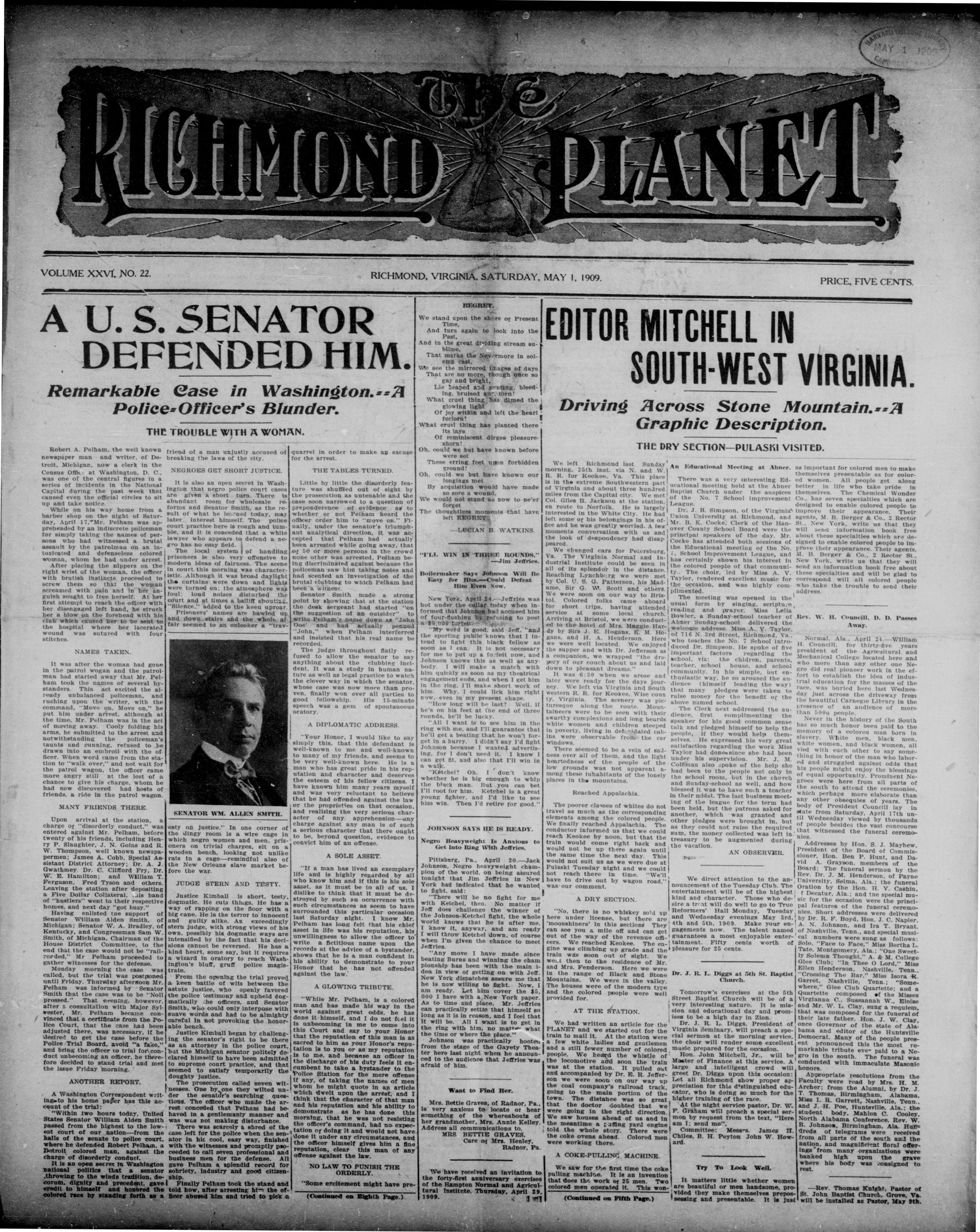
A U.S. SENATOR DEFENDED HIM.
Remarkable Case in Washington.=A Police-Officer's Blunder.
VOLUME XXVI, NO. 22.
A U.S.
DEF
Remarkable
Police
THE
Robert A. Pelham, the well known newspaper man and writer, of Detroit, Michigan, now a clerk in the Census Office at Washington, D. C., was one of the central figures in a series of incidents in the National Capital during the past week that caused even the official circles to sit up and take notice.
While on his way home from a barber shop on the night of Saturday, April 17, Mr. Pelham was apprehended by an indiscrete policeman for simply taking the names of persons who had witnessed a brutal assault by the patrolman on an intoxicated and defenseless colored woman, whom he had under arrest. After placing the nippers on the right wrist of the woman, the officer with bristish instincts proceeded to screw them so that the woman screamed with pain and in her anguish sought to free herself. At her first attempt to reach the officer with her disengaged left hand, he struck her a blow on the forehead with his club which caused her to be sent to the hospital where her lacerated wound was sutured with four stitches.
NAMES TAKEN.
It was after the woman had gone in the patrol wogan and the patrolman had started away that Mr. Pelham took the names of several bystanders. This act excited the already unbalanced policeman, and rushing upon the writer, with the command, "Move on, Move on," he put him under arrest, although at the time, Mr. Pelham was in the act of moving away. Cooly folding his arms, he submitted to the arrest and notwithstanding the policeman's taunts and cunning, refused to be drawn into an embroil with the officer. When word came from the station to "walk over," and not wait for the patrol wagon, the officer came more angry still at the lost of a chance to give his charge, whom he had now discovered had hosts of friends, a ride in the patrol wagon.
MANY FRIENDS THERE
Upon arrival at the station, a charge or "disorderly conduct," was entered against Mr. Pelham, before twenty of his friends, including Henry P. Slaughter, J. N. Goins and R. W. Thompson, well known newspapermen; James A. Cobb, Assistant District Attorney; Dr. A. J. Gwathmey, Dr. C. Clifford Fry, Dr. W. E. Hamilton; and William T. Ferguson, Fred Tyson and others. Leaving the station after depositing a Five Dollar Collateral, his band of "hustlers" went to their respective homes, and next day "got busy." Having enlisted the support of Senator William Alden Smith, of Michigan; Senator W. A. Bradley, of Kentucky; and Congressman Sam W. Smith, of Michigan, Chairman of the House District Committee, to the end that the case would not be "railroced." Mr. Pelham proceeded to gather witnesses for the defense.
Monday morning the case was called, but the trial was postponed until Friday. Thursday afternoon Mr. Pelham was informed by Senator Smith that the case was to be "Noll pressed." That evening, however, after a consultation with Major Sylvester, Mr. Pelham became convinced that a certificate from the Police Court, that the case had been adjusted there, was necessary, if he desired to get the case before the Police Trial Board, avoid a "face," and bring the officer to trial for conduct unbecoming an officer, he therefore decided to stand trial and met the issue Friday morning.
ANOTHER REPORT
A Washington Correspondent writing to his home paper has this account of the trial:
"Within two hours today, United States Senator William Alden Smith passed from the highest to the lowest court of our nation—from the halls of the senate to police court, where he defended Robert Pelham, a Detroit colored man, against the charge of disorderly conduct.
It is an open secret in Washington national politics that a senator throwing to the winds tradition, decorum, dignity and precedent, gave credit to himself and honored the colored race by standing forth as a
THE TROUBLE WITH A WOMAN.
friend of a man unjustly accused of breaking the laws of the city.
NEGROES GET SHORT JUSTICE.
It is also an open secret in Washington that negro police court cases are given a short turn. There is abundant room for wholesale reforms and Senator Smith, as the result of what he learned today, may later interest himself. The police court practice here is rough and tumble, and it is conceded that a white lawyer who appears to defend a negro has no easy field. The local system of handling prisoners is also very offensive to modern ideas of fairness. The scene in court this morning was characteristic. Although it was broad daylight the curtains were down and lights were turned on; the atmosphere was foul; loud noises disturbed the court and at times a balloon shouting "Silence," added to the keen uproar. Prisoners' names are bawled up and down stairs and the whole at fair seemed to an onlooker a "tray
SENATOR WM. ALLEN SMITH.
esty on justice." In one corner of the dingy room is a wire cage in which negro women and men, prisoners on trivial charges, sit on a wooden bench, looking not unlike rats in a cage—remindful also of the New Orleans slave market before the war.
JUDGE STERN AND TESTY.
Justice Kimball is short, testy, dogmatic. He cuts things. He has a way of rapping on the floor with a big cane. He is the terror to innocent and guilty alike. An exceedingly stern judge, with strong views of his own, possibly his dogmatic ways are intensified by the fact that his decisions cannot be reversed. He has a kind heart, some say, but it requires a wizard in oratory to reach Washington's bluff, gruff police magistrate.
From the opening the trial proved a keen battle of wits between the astute justice, who openly favored the police testimony and upheld dogmatically the officers, and Senator Smith, who could only interpose with suave words and had to be almighty careful in not provoking the honorable bench.
Justice Kimball began by challenging the senator's right to be there as an attorney in the police court, but the Michigan senator politely declared himself to have been admitted to supreme court practice, and that seemed to satisfy temporarily the doughty justice.
The prosecution called seven witnesses. One by one they wilted under the senator's searching questions. The officer who made the arrest conceded that Pelham had behaved in a gentlemanly manner and was not making disturbance.
There was scarcely a shred of the case left for the police when the senator in his cool, easy way, finished with the witnesses and promptly proceeded to call seven professional and business men for the defense. All gave Pelham a splendid record for sobriety, industry and good citizenship. Finally Pelham took the stand and told how, after arresting him the officer abused him and tried to pick a
RICHMOND, VIRGINIA, SATURDAY, MAY 1, 1909
quarrel in order to make an excuse for the arrest.
THE TABLES TURNED.
Little by little the disorderly feature was shuffled out of sight by the prosecution as untenable and the case soon narrowed to a question of preponderance of evidence as to whether or not Pelham heard the officer order him to "move on." Finally, under the senator's triumphant analytical direction, it was accepted that Pelham had actually been arrested while going away, that of 50 or more persons in the crowd none other was arrested, Pelham being discriminated against because the policeman saw him taking notes and had scented an investigation of the brutal clubbing to which Pelham had been a witness.
Senator Smith made a strong point by showing that at the station the desk sergeant had started "on the suggestion of an outider" to write Pelham's name down as "John Doe" and had actually penned "John," when Pelham interfered and insisted that his real name be recorded.
The judge throughout flatly refused to allow the senator to say anything about the clubbing incident. It was a study in human nature as well as legal practice to watch the clever way in which the senator, whose case was now more than proven, finally won over all parties to good fellowship. His 15-minute speech was a gem of spontaneous oratory.
A DIPLOMATIC ADDRESS
"Your Honor, I would like to say simply this, that this defendant is well-known to me and well-known to many of my friends, and seems to be very well-known here. He is a man who has great pride in his reputation and character and deserves the esteem of his fellow citizens. I have known him many years myself and was very reluctant to believe that he had offended against the law or the propriettes on that occasion, and realizing the very serious character of any apprehension—any charge against any man is of such a serious character that there ought to be, beyond question, evidence to convict him of an offense.
A SOLE ASSET
"If a man has lived an exemplary life and is highly regarded by all who know him and if this is his sole asset, as it must be to all of us, I dislike to think that it must be destroyed by such an occurrence with such circumstances as seem to have surrounded this particular occasion last Saturday night. I know Mr. Pelham has long felt that his chief asset in life was his reputation, his unwillingness to allow the officer to write a fictitious name upon the records at the advice of a bystander, shows that he is a man confident in his ability to demonstrate to your Honor that he has not offended against the law."
A GLOWING TRIBUTE.
"While Mr. Pelham, is a colored man and has made his way in the world against great odds, he has done it himself, and I do not feel it is unbecoming in me to come into this Court and say to your Honor that the reputation of this man is as sacred to him as your Honor's reputation is to you or as my reputation is to me, and because an officer in the discharge of his duty feels it encumbre to take a bystander to the Police Station for the mere offense if any, of taking the names of men whom he might quote in an article which dwelt upon the arrest, and I think that the character of that man and his reputation and his ability to demonstrate as he has done this morning, that he was not resisting the officer's command, had no expectation or doing it and would not have done it under any circumstances, and the officer himself gives him a fine reputation, clear this man of any offense against the law.
NO LAW TO PUNISH THE ORDERLY.
"Some excitement might have pre- (Continued on Eighth Page.)
"TLL WIN IN THREE ROUNDS."
—Jim Jeffries.
Boilermaker Says Johnson Will Bo
Easy for Him.—Could Defeat
Him Even Now.
New York, April 24. Jeffries was hot under the collar today when informed that Johnson had accused him of four-flipping by refusing to post a $5,000 forfeit.
"My word is good, said Jeff," and the sporting public knows that I intend to fight this black fellow as soon as I can. It is not necessary for me to put up a forfeit now, and Johnson knows this as well as anybody. I will make a match with him quickly as soon as my theatrical engagement ends, and when I get him in the ring, I'll make short work of him. Why. I could lick him right now, even in my present shape.
"How long will he last? Well, if he's on his feet at the end of three rounds, he'll be lucky.
"All I want is to see him in the ring with me, and I'll guarantee that he'll get a beating that he won't live in a hurry. I didn't say I fight Johnson because I wanted advertising, for I don't need it. I know I can get fit, and also that I'll win in a walk.
"Ketchel? Oh. I don't know whether he is big enough to whip the black man. But you can bet I'll root for him. Ketchel is a great young fighter, and I'd like to see him win. Then I'd retire for good."
JOHNSON SAYS HE IS READY
Negro Heavyweight Is Anxious to
Get Into Ring With Jeffries.
Pittsburg, Pa., April 20—Jack Johnson, Negro heavyweight champion of the world, on being assured tonight that Jim Jeffries in New York had indicated that he wanted to fight, said:
"There will be no fight for me with Ketchel, then. No matter if Jeff does challenge the winner of the Johnson-Ketchel fight, the whole world knows that he is after me. I know it, anyway, and am ready. I will throw Ketchel down, of course when I'm given the chance to meet Jeffries.
"Any move I have made since beating Burus and winning the championship has been with the main idea in view of getting on with Jeff. New York dispatches assure me that he is now willing to fight. Now, I am ready. Let him cover the $5,000 I have with a New York paper. As to time and place. Mr. Jeffries can practically settle that himself so long as it is in reason, and I feel that it will be. All I want is to get in the ring with him, no matter what the time or where the place."
Johnson was practically hooted from the stage of the Gayetey Theater here last night when he announced to the audience that Jeffries was afraid of him.
Want to Find Her
Mrs. Bettie Graves, of Radnor, Pa., is very anxious to locate or hear something of the whereabouts of her grandmother, Mrs. Annie Kelley. Address all communications to. MRS. BETTIE GRAVES, Care of Mrs. Henley, Radnor, Pa.
We have received an invitation to the forty-first anniversary exercises of the Hampton Normal and Agricultural Institute, Thursday, April 29, 1909.
EDITOR MITCHELL IN SOUTH-WEST VIRGINIA.
THE DRY SECTION—PULASKI VISITED.
We left Richmond last, Sunday morning, 25th inst. via N. and W. R. R. for Keokee, Va. This place is in the extreme Southwestern part of Virginia and about three hundred miles from the Capital city. We met Col. Giles B. Jackson at the station, en route to Norfolk. He is largely interested in the White City, He had left some or his belongings in his office and he was greatly wortled. A few moments conversation with us and the look of despondency had disappeared.
We changed cars for Petersburg, Va. The Virginia Normal and Industrial Institute could be seen in all of its splendor in the distance. Reaching Lynchburg we were met by Col. U. S. G. Patterson, his Madame, Sir G. W. Scott and others. We were soon on our way to Bristol. Colored folks came aboard for short trips, having attended service at some local church Arriving at Bristol, we were conducted to the hotel of Mrs. Maggie Hardy by Sirs J. E. Hogans, E. M. Hogans, and H. A. Henderson. Here we were well located. We enjoyed the supper and with Dr. Jefferson as a companion, we wrapped "the drapery of our couch about us and laid down to pleasant dreams."
It was 6:30 when we arose and later were ready for the days journey. We left via Virginia and South western R. R. for Keokean. Wise county, Virginia. The scenery was picturesque along the route. Mountaineers were to be seen with their swarty complexions and long beards white women and children steeped in poverty, living in denudated cabins were observable from the car windows.
There seemed to be a vein of sadness over all of them, and the light heartedness of the people of the low grounds was not apparent among these inhabitants of the lonely places in the mountains.
Reached Appalachia.
The poorer classes of whites do not travel as much as the corresponding elements among the colored people. We finally reached Appalachia. The conductor informed us that we could reach Keokee by noon, but that the train would come right back and would not be up there again until the same time the next day. This would not suit us as we were due at Pulaski Tuesday night and we could not reach there in time. "We'll have to drive out by wagon road," was our comment.
A DRY SECTION
"No, there is no whiskey sold up here under license, but there are 'moonshiners' in this section. They can see you a mile off and can get out of the way of the revenue officers. We reached Keokee. The engine was climbing up grade and the train was soon out of sight. We weit then to the residence of Mr. and Mrs. Fenderson. Here we were in the range of Black and Stone Mountains. We were in the valley. The houses were of the modern type and the colored people were well provided for.
AT THE STATION
We had written an article for the PLANET and we started out for the train to mail it. At the station were a few white ladies and gentlemen and a still fewer number of colored people. We heard the whistle of the locomotive and soon the train was at the station. It pulled out and accompanied by Dr. B. R. Jefferson we were soon on our way up the coal company's railroad track, going to the main portion of the town. The distance was so great that the doctor doubted that we were going in the right direction. We saw houses ahead of us and in the meantime a puffing yard engine told the whole story. There were the coke ovens ahead. Colored men were working there.
A COKE-PULLING MACHINE
We saw for the first time the coke pulling machine. It is an invention that does the work or 25 men. Two colored men operated it. This won-
(Continued on Fifth Page.)
An Educational Meeting at Abner.
There was a very interesting Educational meeting held at the Abner Baptist Church under the auspices of the No. 7 School improvement League.
Dr. J. B. Simpson, of the Virginia Union University at Richmond, and Mr. B. K. Cocke, Clerk of the Hanover County School Board were the principal speakers of the day. Mr. Cocke has attended both sessions of the Educational meeting of the No. 7, School Improvement League, and has certainly shown his interest in the colored people of that community. The choir, led by Miss A. V. Taylor, rendered excellent music for the occasion, and was highly complimented.
The meeting was opened in the usual form by singing, scripture reading and prayer. Miss Lella Bowler, a Sunday-school teacher of Abner Sunday-school delivered the welcome address. Miss A. V. Taylor of 716 N. 3rd Street, Richmond, Va. who teaches the No. 7 School introduced Dr. Simpson. He spoke of five important factors regarding the school, viz: the children, parents, teacher, school house, and school community. In his simple, but enthusiastic way, he so aroused the audience (himself leading the way) that many pledges were taken to raise money for the benefit of the above named school.
The Clerk next addressed the audience, first complimenting the speaker for his good common sense talk and pledged himself to help the people, if they would help themselves. He expressed his very great satisfaction regarding the work Miss Taylor had done since she had been under his supervision. Mr. J. M. Colfeman also spoke of the help she had been to the people not only in the school room, but in the church and Sunday-school as well, and how blessed it was to have such a teacher in their midst. The last business meeting of the league for the term had been held, but the patrons asked for another, which was granted and other pledges were brought in, but as they could not raise the required sum, the money collected was left in treasury to be augmented during the vacation.
We direct attention to the announcement of the Tuesday Club. The entertainment will be of the highest kind and character. Those who desire a treat will do well to go to True Reformers' Hall Monday, Tuesday and Wednesday evenings May 3rd, 4th and 5th, 1909. Make your engagements now. The talent named guarantees a most enjoyable entertainment. Fifty cents worth of pleasure for 25 cents.
Dr. J. R. L. Diggs at 5th St. Baptist Church.
Tomorrow's exercises at the 5th Street Baptist Church will be of a very interesting nature. It is mission and educational day and promises to be a high day in Zion.
Dr. J. R. L. Diggs, President of Virginia Seminary, will preach a special sermon at the morning service, the choir will render some excellent music prepared for the occasion.
Hon. John Mitchell, Jr., will be Master of Finance at this service. A large and intelligent crowd will greet Dr. Diggs upon this occasion: Let all Richmond show proper appreciation for this distinguished educator, who is doing so much for the higher training of the race.
At the night service pastor, Dr. W. F. Graham will preach a special sermon by request from the text, "Here am I; send me".
Committee: Messrs. James H. Chiles, B. H. Peyton John W. Howard.
Try To Look Well.
It matters little whether women are beautiful or men handsome, provided they make themselves prepossessing and presentable. It is just
PRICE, FIVE CENTS.
VIRGINIA.
Mountain.==A
ion.
SITED.
as important for colored men to make themselves presentable as for colored women. All people get along better in life who take pride in themselves. The Chemical Wonder Co., has seven specialties which are designed to enable colored people to improve their appearance. Their agents, M. B. Berger & Co., 2 Rector St., New York, write us that they will send information book free about these specialties which are designed to enable colored people to improve their appearance. Their agents, M. B. Berger & Co., 2 Rector St., New York, write us that they will send an information book free about these specialties and will be glad to correspond will all colored people who take the trouble to send their address.
Rev. W. H. Council, D. D. Passes Away.
Normal, Ala., April 24.—William H. Councill, for thirty-five years president of the Agricultural and Mechanical College located here and who more than any other one Negro did real pioneer work in the effort to establish the idea of industrial education for the masses of the race, was buried here last Wednesday just across the driveway from the beautiful Carnegie Library in the presence of an audience of more than 5000 people.
Never in the history of the South has so much honor been paid to the memory of a colored man born in slavery. White men, black men, white women, and black women, all vied with each other to say something in honor of the man who labored and struggled against odds that his people might enjoy the blessings of equal opportunity. Prominent Negroes were here from all parts of the south to attend the ceremonies, which perhaps more elaborate than any other obsequies of years. The body of President Councill lay in state from Saturday, April 17th until Wednesday viewed by thousands of people besides the vast concourse that witnessed the funeral ceremonies.
Addresses by Hon. S. J. Mayhew, President of the Board of Commissioner, Hon. Ben P. Hunt, and David A. Grayson, members of the Board; The funeral sermon by the Rev. Dr. J. M. Henderson, of Payne University, Selma, Ala.; the funeral Oration by the Hon. H. V. Cashin, f Decatur, Ala.; and the special music for the occasion were the principal features of the funeral ceremonies. Short addresses were delivered by Dr. R. F. Boyd, Hon. J. C. Napier, A. N. Johnson, and Ira T. Bryant, of Nashville, Tenn., and special musical numbers were sung as follows: Solo. "Face to Face," Miss Bertha L. Tate, Montgomery, Ala.; "One Sweety Solemn Thought," A. & M. College Glee Club; "In Thee O Lord," Miss Ellen Henderson, Nashville, Tenn. "Crossing The Bar," Miss Isora R. Garret, Nashville, Tenn.; "Somewhere," Glee Club Quartette; and a Quartette composed of the Misses Virgianna C., Sussannah W., Eloise and Mr. W. L. Clay, sung a requiem, that was composed for the funeral of their late father, Hon. J. W. Clay, once Governor of the state of Alabama and editor of the Huntsville Democrat. Many of the people present pronounced this the most remarkable tribute ever paid to a Negro in the south. The funeral was conducted with immaculate Masonic honors.
Appropriate resolutions from the Faculty were read by Mrs. H. M. Archer; from the Alumni, by Dr. J. T. Thomas, Birmingham, Alabama. Miss I. R. Garrett, Nashville, Tenn., and J. H. Poe, Huntsville, Ala.; the student body, Mahlon C. Cooley, North Alabama Conference, Rev. W. B. Johnsom, Birmingham, Ala. Hundreds of telegrams were received from all parts of the south and the nation, and magnificent floral offerings from many organizations were banked high upon the grave where his body was consigned to rest.
—Rev. Thomas Knight, Pastor of St. John Baptist Church, Grove, Va. will be installed as Pastor, May 9th.
2% eR. - oF a * Bey SRS A ne ere. ee ee eee
COQ 5 es
ae '
; ay x
aI Pee \ PY | i ( ( y
a Sam. iy eS ef eC I RC
; (didi CRY eS
j ( . YS eS SS :
(\ Pe \ _— Snat
At \ i in a
ioe ! Wa ss$ BY MARGARET MAYO
wy We
os Oo COPYRIGHT. |1908,BY DODD, MEAD AND COMPANY
| wouldn't make no crack itke that T'm| *yfuyver Sim? Douglas repeated, I seth {Me uncomfortable man ai hi
B the whole thing in that push,” shesald.' gecting that he must recall her to | side. “I never thought I'd be a-talkl
| 4 with an afr of self complacency, “an’ knowledge of bis presence | to ome of you guys. What's yo
with me down-an’ out that show will) “That's what 1 call him,” Polly ex-| name?*
| aa > GOs = T beg your pardon,” was all Doug-| Jim.’ You might not think Jim could| “Ain't yon got no handle to 1?"
a r 2 las could say, confused ty the midden | be a goo mother Just to look at bim.| “Tf you mean tay Christan hae,
| Ry ‘ a a) ] ieee nee eeaniea ae Gael oe ait vigil Bax soa dort wee eee
\~ ce , souk W hcaldmoasintS Wrmeroliion, 8H g j posed they aid
‘ as YO ae eh 4 ¢ ep | "ewny not
cae No, ‘dias Folly, 1 Waive: never msc “T always stpoeed sky pllota was 0
| ey I 2 clreas.” D old her, half regret-| an’ grouchy-like. Youre a'most
ay BY MARGARET DA bigs eat ns aces | | PAN |S eerie, Serre a
\ COPYRIGHT, 1908, BY DODD. MEAD AND COMPANY saline. nae RR, ee Ben mgt rep eigen
Two
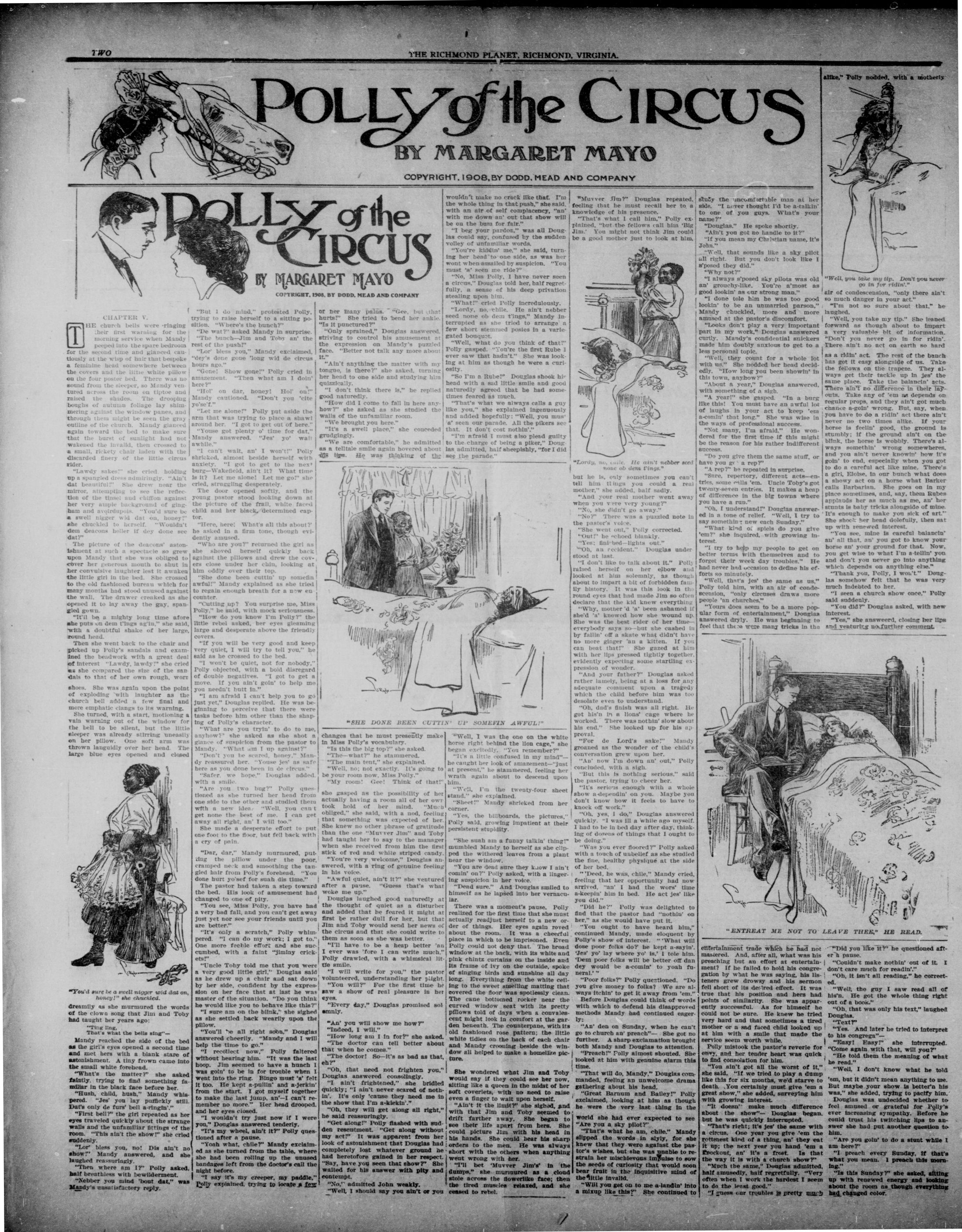
CHAPTER V.
BE church bells were «ringing
their first warning for the
morning service when Mandy
peeped into the spare bedroom
for the second time and glanced cau-
tlously at the wisp of hair that bespoke
@ feminine bead somewhere between
the covers and the litte white pillow
ou the four poster bed. There was uo
sound frois the sleeper, so Mandy ven
tured across the roow on tiptoe and
raised the shades. The drooping
Doughs of autumn foliage lay shim-
mering against the window panes, and
through them might be seen the gray
‘outline of the church. Mandy glanced
again toward the bed to make sure
‘that the burst of sunlight had not
wakened the invalld, then crossed to
@ small, rickety chair laden with the
Aiscarded finery of the little circus
wider.
“Lawdy sakes’ she cried. holding
‘Bp a spangied dress admiringly. “Ain't
@at Leautifl!” Sue drew near the
amirror, attempting to see the reflec
‘tlon of the tinse! and cbiffon against
her very auple background of ging-
fham and avgirdupols. “You'd sure be
@ swell nigger wid dat on, honey!”
he chuckled to herself. “Wouldn't
@em deacons holler if dey done see
dat?”
‘The picture of the deacons’ aston
Jehment at such a spectacle so grew
‘Upon Mandy that she was obliged te
over her generous mouth to shut fy
her convulsive laughter lest it awakes
‘the little girl in the bed. She crossed
‘to the old fashioned bureau which for
many months bad stood unused agalos
‘the wall, The drawer creaked as sh
‘opened it to lay away the gay, span
gled gown.
“Iti be a mighty long time afor
abe puts on dem tings ag’in,” she said
‘with a doubtful shake of ber large
‘round head.
‘Then she went back to the chair an
en up Polly's sandals and exam
the beadwork with a great dea
aL. “Laway, lawdy!" she crie
she compared the size of the san
als to that of her own rough, wor
shoes. She was again upon the poln
of exploding ‘with Inughter as th
church bell added a few final an
more emphatic clangs to its warning.
She turned, with a start, motioning :
‘Yain warning out of the window fo
the bell to be silent, but the littl
sleeper was already stirring uneast!,
on her pillow. One soft arm wa
‘thrown languldly over her head Thy
large blue eyes opened and clase
Lae, \
Sep i.
NU
“le
ASN H
Q ea N\ ie
By 2 ae
Peay |
Lo) Po \|
LE) «| AE
eee Bat
em
pes rf aN "
y Z i nN
ae a \
Gah
ag?
“Yow'd eure be a swell nigger wid dat on,
honey!” she chuckled.
@reamily as she murmured the words
of the clowo song that Jim and Toby
had taught ber years ago:
“Ting ting,
‘That's what the bells sing”—
Mandy reached the side of the bed
as the girl's eyes opened a second time
and met hers with a blank stare of
astonishment. A tiny frown came into
the small white forebead.
“What's the matter?” she asked
faintly, trying to find something fa-
miliar in the black face before ber.
“Hush, child, bush,” Mandy whis-
pered. “Jes’ you lay puffickly still.
Dat's only de furs’ bell a-ringin’.”
“First bell” the girl repeated as her
eyes traveled quickly about the strange
‘walls and the unfamiliar Sittings of the
oom. “This ain't the show!” she cried
suddenly. .
“Lor bless you, no! Dis ain't no
howl” Mandy answered, and she
Taughed reassuringly.
“Then where am I?" Polly asked,
‘bait breathiess with bewllderment.
“Nebber you mind "bout dat,” was
[Mandy's wosatistactory reply.
eaten wee Ee
“De wat?" asked Mandy in surprise
“The bunch—Jim and Toby an’ the
rest of the push!”
“Lor bless you,” Mandy exclaimed,
“dey’s done gone long wid de circus,
hours ago,”
amazement. “Chen what am I doin’
| “Hot on dar, honey! Hol out”
Mandy cautioned. “Don't you ‘cite |
“Let me alone!” Polly put aside the
arm that was trying to place a shaw!
around her. “I got to get out of here.” |
| ‘Youse got plenty o’ time for dat,”
Mandy answered. “Jes’ yo" wal |
shricked, almost beside herself with
anxiety.’ “I got to get to the next
burg—Wakefield, ain't it? What time
4s t? Let me alone! Let me go!” she
cried, struggling desperately
The door opened softly, and the
young pastor stood looking down at
the picture of the frail, white faced
child and her biack,/@etermined eap- |
tor. .
“Here, here! What's all this about? |
he asked in a firm tone, though evi-
dently amused.
“Who are you?" returned the girl as
she shoved herself quickly back
| against the pillows and drew the cov-
ers close under her chin, looking at
him oddly over their top
“She done been cuttin’ up somefin
awful!” Mandy explained as she tried
to regain enough breath for a now ep
counter.
“Cutting up? You surprise we, Miss
Polly,” he said, with mock seriousness.
“How do you know I'm Polly? the
Uttle rebel asked, ber eyes gleaming
large and desperate above the friendly
covers
“If you will be very good and keep
very quiet, I will try to tell you,” be
said as he crossed to the bed
“I won't be quiet, not for nobody,”
Polly objected, with a bold disregard
of double negatives. “I got to get a
move. If you ain't goin’ to help me
you needn't butt in.”
“I am afraid I can't help you to g6
Just yet,” Douglas replied. He was be-
ginning to percelve that there were
tasks before him other than the shap-
ing of Polly's character.
“What are you tryin’ to do to me,
anyhow?” ghe asked as she shot a
glance of suspicion from the pastor to
Mandy. ‘What «im T up against?”
“Don't you be scared, honey,” Man
dy reassured her. “Youse jes’ as safe
here as you done been in de efrcus.”
“Safer, we hope,” Douglas added
with a smile
“are you two bug?" Polly ques
tioned as she turned her head from
‘one side to the other and studied them
with a new iea “Well, you cant
get none the best of me. I can get
away all right, an’ 1 will too.”
She made a desperate effort to put
one foot to the floor, but fell back with
‘8 cry of pain.
“Der, dar,” Mandy murmured, put
dng the pillow under the poor
cramped neck and smoothing the tan
gled hair from Polly's forehead, “You
done burt yo'sef for suah dis time.”
The pastor had taken a step towari
the bed. His look of amusement ha¢
changed to one of pity.
“You see, Miss Polly, you bave ha¢
‘a very bad fall, and you can’t get awa;
Just yet nor see your friends until you
are better.”
“Ite only a seratch,” Polly whim
pered. “I can do my work; I got to.’
One more feeble effort and she suc
cumbed, with a faint “Jiminy crick
ets!"
“Unele Toby told me that you wer
& very good little girl,” Douglas sai
as he drew up a chair and sat dow:
by her side, confident by the expres
sion on her face that at last he wa:
master of the situation. “Do you think
he would like you to behave like this?
“I sure am on the bilnk,” she sighe¢
as she settled back wearily upon th
pillow.
“You'll Se all right sobn,” Dougla:
answered cheerily. “Mandy and I wil
help the time to go.”
| “I recotlect now,” Polly faltered
without bearing him. “It was the las
| hoop. Jim seemed to have a bunch |
was ee ‘in for trouble ian
Ying. Binge twest
Too. ‘He kept 2-puilin’ and a-Jerkin
from the start. I got myself together
to make the last Jamp, an’—I can't re
pryadie more.” Her head drooped.
: “1 wouldn't ‘try just now if I were
: “ite my. wheel, Seat tC rer oe
toned after a
{ “Xoah what, chile?” Mandy exclaim
ed as she turned from the table,
| she had bee ett
. Seek ee eee
NT ait ae
LPO RRs den Pamir ts hs ce od
ae es inh a otf i
SE cee Sasi Gee
YHE RICHMOND PLANET. RICHMOND, VIRGINIA.
WW Warenny phat
i lth nna i, [\ \, |
ff A * | Cl il jj
Ah SNS \\ | Ihe fi i ;
y \ mI Fel |
Ce ee
Lee kee |
SG ae i Seer S
unital (4 4
me | Hip
a | Willi J :
Th ‘a
Di)
| eee E / |
g | Me
Or ber thany palds. ~ “Gee, but that
hurts!” She tried to bend her ankle.
“Is it punctured?”
“Only sprained,” Douglas answered.
striving to control bis amusement at
the expression on Mandy's puzzled
face. “Better not talk any more about
1
“Ain't anything the matter with my
tongne, is there?” she asked, turnin
her head to one side and studying hiro
quizzically.
“1 don't think there is,” he replied
good naturedly.
“How did I come to fall in here any:
how?” she asked as she studied the
walls of the unfamiliar room.
“We brought you here.”
“It’s a swell place,” she conceded
grudgingly.
“We are comfortable,” he admitted
as telltale «mile again hovered about
is Mee. Ho was thinking of the
changes that he must presently make
in Miss Polly's vocabulary
“In this the big top?” she asked.
“The—what?” he stammered.
“The main tent,” she explained.
“Well, no; not exactly. It's going to
be your room now, Miss Polly.”
“My room! Gee! Think of that!
she gasped as the possibility of her
actually having a room all of her owr
took hold of her mind. “Much
obliged,” she sald, with a nod, feeling
that something was expected’ of ber
She knew no other phrase of gratitude
than the one “Muvver Jim” and Toby
had taught her to say to the manager
when she received from him the first
stick of red and white striped candy.
“You're very welcome,” Douglas an
swered, with a ring of genuine feeling
In his voice.
“Awful quiet, ain't it?" she ventured
after a pause. “Guess that's what
woke me up.”
Douglas luughed good naturedly at
the thought of quiet as a disturher
and added that he feared it might at
first be rather dull for her, but that
Jim and Toby would send her news of
the cireus and that she could write t
them as soon as she wns better.
“IT have to be a heap better ‘an
I ever was ’fore I can write much,”
Polly drawied, with a whimsical lit
Ue smile.
“I will write for you," the pastor
volunteered, understanding her pilght.
“You will?” For the first time be
saw a show of real pleasure in her
eyes.
“Every day,” Douglas promised sot
emaly.
“An’ you will show me how?"
“Indeed, I will.”
“How long am I in for?” she asked.
“Phe doctor can tell better about
that when he comes.”
gg? Coctrt Homies as bed as that
r
“Ob, that need not frighten you,”
Douglas answered cousoingly.
“I ain't frightened,” she bridled
quickly; “I ain't never scared of noth-
in’. It's only ‘cause they need me in
the show that I'm a-kiekin’.”
“Ob, they will get along all right,”
he said reassuringly.
“Get along!” Polly flashed with sud.
den resentment. “Get along without
my act!” It was apparent from her
look of astonishment that Dougias had
completely lost whatever ground he
had Soe gained in al
“Bay, have you seen we
roe Be Rae GA A eke
“No.” admitted #oas
| “Well, I should say you ain’t or you
’
2 ied
wouldnt make no crack Ike that. I'm
the whole thing in that push,” she said,
with an air of self complacency, “an’
with me down an' out that show will
be on the bum for fair.”
“I beg your pardon,” was all Dous-
Jas could say, confused by the sudden
volley of unfamiliar words,
“You're kiddin’ me,” she said, turn-
ing her head"to’one side, a8 was her
wont whenassailed by suspicion. “You
must ‘a’ seem me ride?”
“No, Miss Polly, I have never seen
a circus,” Douglas told her, balf regret:
fully, a sense of his deep privation
stealing upon him.
“What! erled Polly ineredulously.
“Lordy, no,-chile. He ain't nebber
seed none ob dem tings," Mandy in-
terrupted as she tried to arrange a
few short stemmed posies in a varie-
gated bonquct.
“Well, what do you think of that!”
Polly gasped. “You're the first Rube i
ever saw that hadn't” She was look-
ing at him as though he were a curi-
sity.
“So I'm a Rube!” Douglas shook hir
head with a sad little smile and good
naturedly agreed that be had some-
times feared as much.
“That's what we always calls a guy
Uke you,” she explained ingenuously
and added hopefully: “Well, you mus*
‘a’ seen our parade. All the pikers sec
that. It don't cost nothin’.”
“('m afratd 1 most also plead guilty
to the charge of being a piker,” Dong.
Ins admitted, half sheepishly, “for I did
gee the parade”
“Well, I was the one on the white
horse right behind the Mon cage,” she
began excitedly, “You remember?”
“Its a ‘onfused in my rind”
he canzbt her look of amazement—"Just
at present,” he stammered, feeling her
wrath agatn about to descend upon
him.
Well, Pm the twenty-four sheet
stand.” ‘he explained
“Sheet!” Mandy abrieked trom ber
“Yes, the billboards, the pictures
Polly said, growing Impatient at their
persistent stupidity.
“She suab am a funny talkin’ thing!”
mumbled Mandy to herself as she cllp.
Ded the withered leaves from a plant
hear the window.
“You are dead sure they kuow I ain't
comin’ on?" Polly asked, with a linger
ing suspicion in her voice.
| “Dead sure.” And Douglas smiled to
himself as he lapged Into her vernacu-
‘lar.
| There was a moment's pause, Polly
realized for the first time that she must
actually readjust herself to a new or.
[der ot things. Tee eyes again Toved
about the room. It was a cheerful
| piace in which to be imprisoned. Even
Polly could not deny that. The broad
[window at the back, with its white and
pink chintz curtains on the inside and
Its frame of ivy om the outside, spoke
of singing birds and sunshine all day
Senge, Everything from the white ceti-
{ing to the sweet amelling matting that
‘covered the floor was spotlessly clean.
‘The cane bottomed rocker near the
curved window seat with its pretty
pillows told of days when « convales-
ent might look in comfort at the gar-
den beneath. The counterpane, with its
old fashioned rose pattern; the little
white tidies on the back of each chair
and Mandy crooning beside the win-
‘dow all helped to make a homeliise pic-
tare.
| Bhe wondered what Jim and Toby
Would say if they could see her now,
sitting like a queen In the midst of her
soft coveriets, with mo need to raise
peers = oo a
“Ain't ft the ims? she sighed,
with that Jim and Toby a's
thetr mee ‘eae oe
see Ute apart
oud picture Jim with his head tx
his hands. She “hear his shary
orders to the men. He was always
‘short with the when anything
s bet * tn ‘the
aera
the : h
‘ceased to rebel. as Wass
*“Murver Sim?" Douglas repeated,
feeling that he must recall her to a
knowledge of bis presence.
“That's what I call him,” Polly ex-
plained, “but the fellows call bin ‘Big
Jim.’ You might not think Jim could
be a god mother just to look at him,
if ) he
|: hy
—
4 ——
heise en
“Lordy, wo, caile, He ain't nebber seed
bat he Is, only sometimes you can't
tal tea things you cou real
mother,” she added, hatf sadly.
“And your real mother went away
when you vere very young?
“No, she ddi't go away.”
“No? ‘There was @ purzled note in
the pastor's: voice
“she went out,” Polly corrected.
| “Out? he schoed blankly.
“Yes; fini-hed—lights out.”
| “On, an recident.” Douglas under
stood ‘at last
“T don’t like to talk about tt" Polly
rated herself on her elbow and
looked at him solemnly, aa thongt|
about to impart a bit of forbidden fam
Hy bistory. Tt was this look fa. th
[round eyes that had made Jim #o often
‘declare that the kid knew everything
“Why, mother “a ‘a’ been ashamed i¢
she'd ‘a’ knowed how she wound ap.
She was the best rider of her the
everybody says's>—bat she cashed in
by fallin’ off a skate what didn’t have
no more gliger ‘an « kitten, If you
ean beat that!” She gazed at him
wien her lps pressed tightly together,
evidently expecting some startling ¢x
Pression of wonder.
“And your father?’ Douglas asked
rather lamely, being at a loss for any
adequate comment upon a tragedy
which the child before him was toc
desolate even to understand
“Oh, dad's Guish was all right. He
got his'a In a long’ cage where he
worked. ‘There was nothin’ slow about
his end.” She looked up for bis ap
proval
| “For de Lord's sake! Mandy
| groaned as the wonder of the child's
| conversation grew upon her.
"An" now Tim down an’ out,” Polly
concluded, with @ sigh.
“But this fs nothing serious.” sald
the pastor, trying to cheer her.
“It's serios enough with a whole
show adependin’ om you. Maybe you
don't know how it feels to have to
knock off work.”
| “On, yes, 1 do,” Dougias answered
quickly. *T was fila while ago myself
I had to be in bed day after day, think-
ing of dovens of things that I ought to
be doing.”
“Was you ever floored?” Polly asked
with a touch of unbelief as she studied
the fine, healthy physiqué at the side
of her bed.
“"Deed, he was, chile,” Mandy cried,
feeling that her opportunity had now
arrived, “an' 1 had the wors’ time
a-keepin’ him in bed. He act Jes’ like
you did.”
“Did be?’ Polly was delighted to
find that the pastor had “nothin’ on
her,” as she would have put it,
“You ought to have heard bim,”
continued Mandy, made eloquent by
Polly's show of interest. “ ‘What will
dose poor folks do? he kept a-sayin’.
‘Jes’ yo" lay where yo" ts,’ I tole him.
‘Dem poor folks will be better off dan
dey would be a-comin’ to yoah fu-
neral’ ”
“Poor folks?” Polly questioned. “Do
you give money to folks? We are al-
ways itchin’ to get it away from ‘em.”
Before Douglas could think of words
with which to defend his disapproved
= Mandy bad continued eager-
“An’ den on Sunday, when he can’t
go to church an’ preach”— She got no
further. A sharp exclamation brought
both Mandy and Douglas to attention.
| “Preach!” Polly almost shouted. She
tooked at him with genuine alarm this
* “That will do, Mandy,” Douglas com-
‘manded, feeling an unwelcome drama
gathering about his head, _
; “Great Barnum and Batley!” Polly
exclaimed, looking at him as ree
he were the very Inst thing in
| vet ae ever expected to seo
RUE eS ST
| gatas wat he a By as
| kr phat 7 against the |
|* ey
[isi ert
erg of sartosity that would soon
BS Phe ustelecg ious al uate apsvdood
_& Seiap Mike thier” | Rho continued’ te
_W t 4 og ees = | ' |
TN wa = KOZ E
eh Mp aes
SINT af
“ENTREAT ME NOT TO LEAVE THEE,” HE RBAD.
study the uncomfortable man ai her
side, “I never thought I'd be a-talkin’
to one of you guys. What's your
name?" < :
“Douglas.” He spoke shortly.
“Ain't you got no handle to it?"
“if you mean my Christian name, it's
John.”
“Well, that sounds like a sky plot
alt right. But you don't took lke I
s®posed they did.”
“Why not?”
“I always s'posed sky pilots was old
‘an’ grouchy-like. You're a'most as
‘good lookin’ as cur strong man,”
“I done tole him he was too good
lookin’ to be an unmarried parson,”
‘Mandy chuckled, more and more
ammsed at the pastor's discomfort.
__ “Looks don’t play a very important
‘Part in my work,” Dougias answered
curtly. Mandy's confidential snickers
made him doubly anxious to get to a
Jess personal tople.
“Well, they count for a whole lot
with us” She nodded her head decid-
ediy. “How long you been showin" in
this town, anyhow?”
|_“About @ year,” Dougias answered,
with something of a sizh.
| “A year!” she gasped. “In a burg
Mke this! You must have an awful lot
of laughs In your act to keep ‘em
a-comin’ that long.” She was wise in
the ways of professional success.
| “Not many, I'm afraid.” He won-
dered for the first time if this might
‘de the reason for his rather indifferent
success.
| “Do yout give them the same stuff, or
have you gv a rep?”
“A rep?” he repeated in surprise.
“Snre, repertory, different acts—en-
tries, some lls "em. Uncle Toby's got
twenty-seven entries. It makes a heap
of difference in the big towns where
you have a run.”
“Oh, T understand!” Douglas answer-
¢d in a tone of relief. “Well, I try to
say somethin: new each Sunday.”
“What kind of splels do you give
*em?” she inquired, with growing in-
terest.
“1 try £0 help my, people to get on
better terms With themselves and to
forget their week day troubles." He
had never had wccasion to define his ef-
forts so minutely.
“Well, that's Jes’ the same as us.”
Polly told him, with an alr of conde-
Scension, “only circuses draws more
people ‘an churches.” .
“Yours does seem to be a more pop-
ular form of entertainment,” Dongiaa
Answered dryly. He was beginning to
feel that the>e were mang tricks in the
eRtertalnment trade which he had not
mastered. And, after all, what was his
Preaching but an effort at entertain-
ment? If he failed to hold his congre-
gation by what he was saying, his lis-
teners grew drowsy and his sermon
fell short of its decired effect. It was
true that his position and hers had
points of similarity. She was appar-
ently successful. As for himself he
could not be sure. He knew he tried
very hard and that sometimes a tired
mother or a sad faced child looked up
at him with a smile that made the
eervice seem worth while,
Polly mistook the pastor's reverie for
envy, and her tender heart was quick
to find consolation for him.
“You ain't got all the worst of It,”
fhe said. “If we tried to play a damp
like this for six months, we'd starve to
death, .You certainly must give ‘em a
great show,” she added, surveying him
with growing interest.
“It doesn’: make much difference
about the show”— Douglas began.
but he was quickly interrupted.
“That's right; It's Jes’ the same with
a cleus, One year you give "em the
tion kind of a thing, an’ they eat
up; the next year you hand ‘em a
Rrockout, an’ it's a frost. Is that
the way it Is with « chureh show?”
“Much the same,” Douglas admitted,
half amusediy, haif regretfully, “Very
‘often when T work the hardest I seem
to do the least. good.”
“J guess cur troubles jp pretty much
Se te, a
= _ #4 ©
£7
La) Pp
gReuff 2
A 7 2
\ fre
\ —
\A a
“Weil, you take my tip. Don’t you never”
go in for ridin.”
alr of condescension, “only there ain't
fo much danger in your act.”
“I'm not so sure about that,” he
laughed.
“Well, you take my tip.” She leaped
forward as though about to impart
A very valuable bit of information.
“Don’t you never go tn for ridin’.
_n ain't mo act on earth so hard
‘a9. tidin’ act. Tho rest of the banch
has got tt easy alongside of us. ‘Take
the fellows on the trapeze. They al-
ways get thelr tackle up In jes’ the
same place. Take the balancin’ acts.
‘There ain't no difference in thelr Tay-
outs. Take any of ‘em as depends on
tegular props, and they ain't got much
chance a-gotn’ wrong, But, say, when
you have to do a ridin’ act there ain't
never no two times alike. If your
[horse is feclin* good, the. groan. is
stumbly; if the ground ain't on the
dink, the horse ts wobbly. ‘There's al-
ways somethin’ wrong somewheres,
and you ain't never knowin’ how It's
goln’ to end, especially when you got
to do a careful act like mine, “There's
a giri, Blolse, in our bunch what does
a showy act on n horse what Barker
calls Barbarian, She goes on in my
place sometimes, and, say, them Rubes
applauds her as much as me, an’ her
stunts is baby tricks alongside of mine.
It's enough to make you sick of art.”
She whoc’ her hend dolefuily, then sat
up with renewed Interest,
“You see, mine is careful balanctn”
‘an’ all that, an’ you got to know your
horse an’ your ground for that. Now,
you get wise to what I'm aellin’ yoo
and don’t you never go Into anything
which depends on anything else.”
“Thank you, Polly, I wou't” Doug
Jas somehow felt that he was very
much Indebted to her.
“I seen a church show once,” Polly
said suddenly.
“You did?” Douglas asked, with new
Interest.
“Yes,” she answeerd, closing her lips
and venturing nafurther comment
“Did you like it?” he questioned aft-
er pause.
“Couldn't make nothin’ out of it x
don’t care mneh for readin’."
“Oh, It isn’t all reading,” he correet-
ed.
“Well, the guy I saw read all of
his'n. He got the whole thing right
‘out of book.”
“Ob, that was only his text,” laughed
Douglas.
“Text?”
“Yes. And later he tried to interpret
to his congrega”—
_“Besy! Easy!” she _tnterrupted.
“Come again, with that, will you?"
“He told them the meaning of what
be read.”
“Well, I don’t know what he told
Yom, but it didn’t mean anything to me.
But maybe your show is better’n his
was,” she added, trying to pactfy him.
Dougias was undecided whether to
fecl amused or grateful for Polly's
ever increasing sympathy, Before he
conid trust his twitching lps to an-
rer she (hed. out another question to
“Are you goin’ to do # stant while
‘am here?”
“I preach every Sanday, if that's
— You mean. 1 preach this morn-
“Is this Sunday?” she
ag “Sa Wea alg i
SATURDAY.....MAY 1, 1909.
"Yes."
"And you got a matinee?" she ex-
claimed incredulously.
"We have services," he corrected,
gently.
"We rest up on Sundays," she said in a tone of deep commiseration.
"Oh, I see," he answered, feeling it no time to enter upon another discussion as to the comparative advantages of their two professions.
"What are you goin' to spiel about today?"
"About Ruth and Naomi."
"Ruth and who?"
"Naomi," he repeated.
"Naomi," she echoed, tilting her head from side to side as she listened to the soft cadences of the word. "I never heard that name before. It 'ud look awful swell on a billboard, wouldn't it?"
"It's a Bible name, honey," Mandy sald, eager to get into the conversation. "Dar's a buful picture bout her. I seed it."
"I like to look at pictures," Polly answered tentatively. Mandy crossed the room to fetch the large Bible with its steel engravings.
"We got a girl named Ruth in our teap of death' stunt. Some of the folks is kinder down on 'er, but I ain't."
She might have told Douglas more of her forlorn little friend, but just then Mandy came to the bed hugging a large, old fashioned Bible, and Douglas helped to place the ponderous book before the invalid.
"See, honey, dar dey is," the old woman said, pointing to the picture of Ruth and Naomi.
"Them's crackerjacks, ain't they?" Polly gasped, and her eyes shone with wonder. "Which one's Ruth?" "Dls one," said Mandy, pointing with her thumb.
"Why, they're dressed just like our charlot drivers. What does it say about 'em?"
"You can read it for yourself," Douglas answered gently. There was something pathetic in the eagerness of the starved little mind.
"Well, I ain't much on readin'-out loud," she faltered, growing suddenly conscious of her deficiencies. "Read it for me, will you?" "Certainly." And he drew his chair nearer to the bed. One strong hand supported the other half of the Bible and his head was very near to hers as his deep, full voice pronounced the solemn words in which Ruth pleaded so many years before. "Entreat me not to leave thee," he read, "or to return from following after thee, for whither thou goest I will go, and where thou loogest I will lodge. Thy people shall be my people and thy God my God." He stopped to ponder over the poetry of the lines. "Kind of pretty, ain't it?" Polly said softly. She felt awkward and constrained and a little overawed. "There are far more beautiful things than that," Douglas assured her enthusiastically as the echo of many such rang in his ears.
"There are?" And her eyes opened wide with wonder.
"Yes, indeed," he replied, pitying more and more the starvation of mind and longing to bring to it floods of light and enrichment.
"I guess I'd like to hear you spiel," and she fell to studying him solemly.
"You would?" he asked eagerly.
"Is there any more to that story?" she asked, ignoring his question.
"Yes, indeed."
"Would you read me a little more?" She was very humble now.
"Where thou diest will I die, and there will I be buried. The Lord do so to me, and more also, if aught but death part me and thee.'"
Their eyes met. There was a long pause. Suddenly the sharp, sweet notes of the church bell brought John Douglas to his feet with a start of surprise.
"Have you got to go?" Polly asked regrettfully.
"Yes, I must, but I'll read the rest from the church. Open the window, Mandy!" And he passed out of the door and quickly down the stairs.
CHAPTER VI
WHEN John Douglas' uncle offered to educate his nephew for the ministry the boy was less enthusiastic than his mother. He did not remonstrate, however, for it had been the custom of generations for at least one son of each Douglas family to preach the gospel of Calvinism, and his father's career as an architect and landscape gardener had not left him much capital. Douglas senior had been recognized as an artist by the few who understood his talents, but there is small demand for the builder of picturesque houses in the little business towns of the middle west, and at last he passed away, leaving his son only the burden of his financial failure and an ardent desire to succeed at the profession in which his father had fared so badly. The hopeless, defeated look on the departed man's face had always haunted the boy, who was artist enough to feel his father's genius intuitively and
human enough to resent the injustice of his fate. Douglas' mother had suffered so much because of the impractical efforts of her husband that she discouraged the early tendencies of the son toward drawing and mathematics and tried to direct his thoughts toward excelses and Bible history. When he went away for his collegiate courses she was less in touch with him and he
was able to steal time from his athletics to devote to his art. He spent his vacations in a neighboring city before a drawing board in the office of a distinguished architect, his father's friend.
Douglas was not a brilliant divinity student, and he was relieved at last when he received his degree in theology, and found himself appointed to a small church in the middle west.
His step was very bright the morning he first went up the path that led to his new home. His artistic sense was charmed by the picturesque approach to the church and parsonage. The view toward the tree encircled spire was unobstructed, for the church had been built on the outskirts of the town to allow for a growth that had not materialized. He threw up his head and gazed at the blue hills, with their background of soft, slow moving clouds. The smell of the fresh earth, the bursting of the buds, the forming of new life, set him thrilling with a joy that was very near to palm.
He stopped halfway up the path and considered the advantages of a new front to the narrow eaved cottage, and when his foot touched the first step of the vine covered porch he was far more concerned about a new portico than with any thought of his first sermon.
His speculations were abruptly cut short by Mandy, who bustled out of the door with a wide smile of welcome on her black face and an unmistakable ambition to take him immediately under her motherly wing. She was much concerned because the church people had not met the new pastor at the station and brought him to the house. Upon learning that Douglas had purposely avoided their escort, preferring to come to his new home the first time alone, she made up her mind that she was going to like him.
Mandy had long been a fixture in the parsonage. She and her worse half, Hasty Jones, had come to know and discuss the weaknesses of the many clergymen who had come and gone the deacons and the congregation, both individually and collectively. She confided to Hasty that she didn't "blame de new parson fer not wantin' to mix up wild dat ar crowd." In the study that night, when she and Hasty helped Douglas to unpack his many boxes of books, they were as eager as children about the drawings and pictures which he showed them. His mind had gone beyond the parsonage front now, and he described to them the advantage of adding an extra ten feet to the church spire. Mandy felt herself almost an artist when she and Hasty bade the pastor good night, for she was still quivering from the contagion of Douglas' enthusiasm. Here, at last, was a master who could do something besides find fault with her.
"I jes' wan' to be on de grou' de first' time dat Mars Douglas and dat ere Deacon Strong clinches," she said to Hasty as they locked the doors and turned out the hall light. "Did you done see his jaw?" she whispered. "He look laughin' enough now, but jes' you wait till he done set dat 'ere jaw o' his'n, and dair n't nobody what's goin' ter unsot it." "Maybe dar dain' goin' ter be no clinchin'," said Hasty, hoping for Mandy's assurance to the contrary. "What?' shrieked Mandy. "Wid dat 'ere sneakin' Widow Willonglihy already a-tellin' de deacons how ter start de new parson a-goin' proper?" "Now, why youse always a-pleick on to dat 'ere widow?' asked Hasty, already enjoying the explosion which he knew his defense of the widow was sure to excite. "I don' like no woman what's allus braggin' 'bout her clean floors,' answered Mandy shortly. She turned out the last light and tiptoed upstairs, trying not to disturb the pastor.
John Douglas was busy already with pencil and paper, making notes of the plans for the church and parsonage, which he would perfect later on. Alas, for Douglas' day dreams! It was not many weeks before he understood with a heavy heart that the deacons were far too dull and uninspired to share his faith in beauty as an aid to man's spiritual uplift.
"We think we've done pretty well by this church," said Deacon Strong, who was the business head, the political boss and the moral mentor of the small town's affairs. "Just you worry along with the preachin', young man, and we'll attend to the buyin' and buildin' operations."
Douglas' mind was too active to content itself wholly with the writing of sermons and the routine of formal pastoral calls. He was a keen humanitarian, so little by little he came to be interested in the heart stories and disappointments of many of the village unfortunate, some of whom were outside his congregation. The mentally slick, the despondent, who needed words of hope and courage more than dry talks on theology, found in him an ever ready friend and adviser, and these came to love and depend on him. But he was never popular with the creed bound element of the church.
Mandy had her wish about being on the spot the first time that the parson's jaw squared itself at Deacon Strong. The deacon had called at the parsonage to demand that Douglas put a stop to the boys playing baseball in the adjoining lot on Sunday. Douglas had been unable to see the deacon's point of view. He declared that baseball was a healthy and harmless form of exercise, that the air was meant to be breathed and that the boys who enjoyed the game on Sunday were principally those who were kept indoors by work on other days. The close of the interview was unsatisfactory both to Douglas and the deacon.
"Dey kinder made me cold an' prickly all up' an' down de back." Mandy said later when she described their talk to Hasty. "Dat 'ere decondon' know nuffin' 'bout gittin' roun' de person." She tossed her head with a feeling of superiority. She knew the way. Make him forget himself with a laugh. Excite his sympathy with some village underdge.
CHAPTER VII.
THE RICHMOND PLANET. RICHMOND. VIRGINIA
the parsonage, at first because of her inborn love of mischief and later because Polly had become second in her heart only to the pastor. She went about her work, crooning softly during the days of Polly's convalescence. The deep, steady voice of the pastor reading aloud in the pretty window overhead was company. She would often climb the stairs to tell them some bit of village gossip and leave them laughing at a quaint comment about some inquisitive sister of the church who had happened to incur her displeasure. As spring came on Douglas carried Polly down to the sunlit garden beneath the window, and Mandy futtered about arranging the cushions with motherly solicitude.
More days slipped by and Polly began to creep through the little, soft leaved trees at the back of the church and to look for the deep, blue, sweet scented violets. When she was able Douglas took her with him to visit some of the outlying houses of the poor. Her woman's instinct was quick to perceive many small needs in their lives that he had overlooked and to suggest simple, inexpensive joys that made them her devoted friends.
Their evenings were divided between making plans for these unfortunate and reading aloud from the Bible or other books.
When Polly gained courage, Douglas sometimes persuaded her to read to him, and the little corrections that he made at these times soon became noticeable in her manner of speech. She was so eager, so starved for knowledge that she drank it as fast as he could give it. It was during their talks about grammar that Mandy generally fell asleep in her rocker, her unfinished sewing still in her lap.
When a letter came from Jim and Toby it was always shared equally by Mandy and Hasty, Polly and the pastor. But at last a letter came from Jim only, and Douglas, who was asked to read it, faltered and stopped after the first few words.
"It's no use my tryin' to keep it from you any longer, Poll," the letter began. "We aln't got Toby with us no more. He didn't have no accident; it wasn't that. He just seemed kinder sick an 'allin' like ever since the night we had to leave you behind. I used to get him warm drinks an' things an 'try to pull him through, but he was always a-chillin' and a'achin'. If it wasn't one thing it was another. I done all I knew you'd 'a', wanted me to, an' the rest of the folks was mighty white to him too. I guess they kinder felt how lonesome he was. He couldn't get no more laughs in the show, so Barker had to put 'on another man with him. That kinder hurt him, too. I s'pose, an' showed him the way that things was a-goin'. It was just after that he wrote the parson a-tellin' him to never let you come back. He seemed to 'a' got an idea in his head that you was happler where you was. He wouldn't let me tell you 'bout his feelin' rocky, 'cause he thought it might mebne
A
As spring came on Douglas carried Polly down to the sunlit garden.
make you come back. 'She's diff runt from us,' he was allus a-sayin. 'I never spected to keep 'er.'
Douglas stopped. Polly was waiting, her face white and drawn. He had not told her of Toby's letter because with it had come a request to "say nothin' ter the kid."
He felt that Polly was controlling herself with an effort until he should reach the end of Jim's letter, so he hurried on.
"The parson's promise didn't get to him none too quick." he read. "That seemed to be what he was waitin' for. He give up the night it come, an' I got him a little room in a hotel after the show an' let one of the other fellers get the stuff out o' town, so' I could stay with him up to the finish. It come round mornin'. There wasn't
much to it—he just seemed tired an' peaceful-like. 'I'm glad he wrote what he did,' he said, meanin' the parson. 'She knows, she allus knows,' he whispered, meanin' you, Poll, an' then he was on his way. He'd already give me what was saved up for you, an' I'm sendin' it along with this"—' A blue money order for $250 had fluttered from the envelope when Douglas opened it.
"I got everything ready afore I went on the next day, an' I went up an' saw the little spot on the hill where they was goin' to stow him. It looked kinder nice, an' the digger's wife said she'd put some flowers on it now an' then. It was you what made me think o' that, Poll, 'cause it seemed to me what you would 'a' done. You was allus so daffy about flowers, you an' him.
"I guess this letter's too long for me to be a-sayin' much about the show, but the 'leap-a-death' girl got her'n last week. She wasn't strong enough for the job nohow. I done what I could for her outside the show, 'cause I knew how you was allus a-feelin' 'bout her. I guess the 'leap-a-death's husband is goin' to jump his job soon, if he gets enough saved up, 'cause him an' Barker can't hit it off no more. We got a good deal o' trouble among the animals too. None o' the snakes
In sheddin' like they ought to, an' Jumbo's a carrylry: a sixteen foot bandage around that trunk o' his'n cause he got too fresh with Trixy's grub the other night, an' the new giraffe's got the croup in that seven foot neck o' his'n. I guess you'll think I got the pip for fair this time, so I just get on to myself now an' cut this short. I'll be writin' you ag'ln when we hit Morgantown.
"YOUR OLD MUVVER JIM."
Douglas laid the letter gently on the table, his hand still resting upon it. He looked helplessly at the little, shrunk-en figure in the opposite chair. Polly had made no sound, but her head had slipped lower and lower, and she now sat very quietly with her face in her hands. She had been taught by Toby and Jim never to whimper.
"What a plucky lot they are!" thought Douglas as he considered these three lonely souls, each accepting whatever fate brought with no rebellion or even surprise. It was a strange world of stoics in which these children of the amusement arena fought and lost. They came and went like phantoms, with as little consciousness of their own best interests as of the great, moving powers of the world about them. They felt no threes of envy, no bitterness. They loved and worked and "went their way."
For once the pastor was powerless in the presence of grief. Both he and Mandy left the room quietly, feeling that Polly wished to be spared the outburst of tears that a sympathetically might bring upon her. They allowed her to remain alone for a time; then Mandy entered softly with a tender good night, and Douglas followed her cheerily as though nothing at all had happened.
It was many weeks before Polly again became a companion to Douglas and Mandy, but they did not intrude upon her grief. They waited patiently for the time when youth should again assert itself and bring back their laughing mate to them.
(To Be Continued.)
THE LANGUAGE OF LOVE.
It was the morning of that feurseum, uncertain day on which the bonds were to be made fast, where a tiny path yet leads back, when each tries to peer into the future and wonders, and doubts, and hesitates. They were alone, and she drew near him, aware, and watchful. "Harold, dearest, in a few hours it will all be over. Can you grasp it all? But did you dream of me last night?"
"Yes, ownest. I saw you as a black, marvelous swan, drifting pluckedly all alone on a mirrored lake, with here and there a flat, floating leaf. And then I an humble, joyous swan, too, began to float out to you. And my soul took fire, dearest, and I thrilled all over as you swung superbly around, and I wished to be a poet with a living, passionate pen, and I wished myself an earth-god, and that a raging wind and destruction would come, would swoop down upon you that I might seize you in my arms and defy the storm-god. And I could smell sweet incense and hear the tinkling of innumerable bells, and could feel the delirium of a burning heart when you swayed your head, and again I wished to be a poet that I might sing—" "But Harold, do you really love me?" He paused, breathed deep, and poured out his soul: "Yes, dearest, I think you are it."
And then she held up her vibrant lips, confident, satisfied.—Homer Croy, in Puck.
Handicapped.
"Look here, young man," said the old millionaire, "don't you think it's about time you began hustling for yourself?" "I'm afraid I can't father," rejoined the son, "You see, I haven't the advantages you had when you were young." "Why, sir, what do you mean?" queried the old man. "Your father was poor, you know," was the reply.-Chicago Daily News.
Logical Figures.
"What does this mean?" roared the
irate employer. "You asked for 48
hours' leave of absence, and you
stayed away a week."
"Oh, that's all right," replied the
clerk, calmly. "You've simply made
a mistake in your calculations. I'm
due here only eight hours a day, you
know, and 48 hours is equal to a
week."—Chicago Daily News.
Morpheus' Mistake.
I dreamed of Mabelle.
And I thought that I kissed her.
I know very well
I dreamed of Mabelle.
Cain appealed
(When I worship her sister)
Why I dreamed of Mabelle.
And I thought that I kissed her?
He started out to claim the earth.
He toiled by day and recharged at night.
He got a few things at their worth.
And took for nothing what he might.
Within its mouth his child at birth,
They tell us, had a golden spoon;
He started out to get the earth.
His boy is crushed or the earth
—Chicago Record-Herald.
Suppleious Circumstances
Suspicious Circumstance.
The grocer had warranted the maple sirup to be the real stuff.
"It doesn't taste like any maple sirup I ever bought," said the customer, who had just sampled it, "and I strongly suspect—"
"Sr!": said the indignant grocer.
"I strongly suspect, in spite of your guarantry, that it's genuine."—Chicago Tribune.
Fill the Bill.
Patience—I see by this paper that to a young dressmaker in Hamburg, Germany, $10,000 was bequeathed on condition that she never marries a man engaged in an intellectual occupation.
Patrice—There's an opportunity for some of those foreign dukes.—Yonkers Statesman.
**Weights and Measures.**
"In our country," said the English tourist, "we reckon money by the pound."
"In this country," rejoined the American trust magnate, "we reckon it by the barrel."—Chicago Daily News.
A Tip
Dusty Rhodes—I wouldn't have to ask for help, but Ive a lot of real estate on my hands that I can't get rid of.
Mrs. Rurall—Try soft soap and boiling water—Life.
Hard to Understand.
Bacon—That's the third time this week I've seen Blinks comink out of that X-ray doctor's.
Veal—Is that so? What in the world do you suppose the doctor can see in that man?
Agreeably Struck
Bill—Were you ever struck by a
wheel?
Jill—Yes, by a Marcel wave.
Discordant.
She (at the piano)—I presume you are a true lover of music, are you not?
He—Yes, I am; but pray don't stop playing on my account.—Judge.
Extremen
"What did Gladys do when George insisted on a positive answer?"
Possible Explanation
"What has become of the 'man with the hoe?'" asked the old-school party. "I believe," rejoiced the modern person, "that the 'man with the hammer' knocked him out."—Chicago Daily News.
Bcoming
Friend—How's business going these days?
Promoter—Flourishing. We've just added two more stories to the rubber stamp of our thirty-eight-story building.
Puck.
At the Aero Club
Redd—Do you know my balloon reminds me very much of my wife.
Greene—I suppose so; always wants to go to a different place from the one you wish it to.—Yonkers Statesman.
Why He Was Eligible.
Superintendent — Well, what have you to recommend you for the place? Mike—Bogorra! Oi owe every man in town that'll thrust me, an' divil a bit more ralson has anny wan fer th' job.
Different Then.
All the world loves a lover, excepting, of course, the people who happen to be subscribers to the same party, but he monopolizes.—Detroit Free Press
Lava River
Lava from the volcano of Savati, in the Samoan islands, which has been in constant eruption for over three years, has formed a river eight miles wide flowing into the ocean.
Interminable Leavetaking.
Hope is born and dies at least 17 times in a man's heart before the woman who is calling on his wife, and has risen to go, reaches the front gate.—Atchison Globe.
MARIE HENRY
Jack—Yes, I am going to propose to Miss Sweet at the skating rink tonight. She is my only opportunity, Fred—Then be careful, old fellow, and don't let your opportunity slip.
What He Wanted.
He said he wanted to be rich. But I've a linking Notion that he wanted more To get rich without working. —Detroit Free Press.
C. & O.
9:00 A. [Fast daily trains to Old Point, |
and
4:00 P. [Newport News and Norfolk.
7:40 A.—Daily. Local to Newport News.
8:00 A.—Daily. Local to Old Point.
8:00 P. [Daily Louisville, Chestnutsti, Chica
and
11:50 P. [go and St. Louis Pullmans.
8:00 A.—Daily. Chville, exc. Sun. O. Forge.
8:00 A.—Daily. Louisville, C. Forge.
10:00 A.—Daily. L'burg, Lexington. C. Forge.
5:15 P.—Week days. To Lynchburg.
TRAINS ARRIVE RICHMOND.
Local from East--8:45 A. M., 8:15 P. M.
Through from West--1:45 A. M., 7:45 P. M.
Local from West--7:30 A. M., 7:45 P. M.
Through--7:30 A. M. and 3:45 P. M.
James River Line--8:25 A. M., 8:25 P. M.
*Daily Except Sunday.*
LINCOLN
HAIR POMADE
MAKES
KINKY
HAIR
SOFT
REMOVES
DANDRUFF
KEEPS
HAIR
FROM
BREAKING
OFF
LINCOLN
HAIR POMADE
KEEPS
SCALP
FRESH
CLEAN AND
WHOLE-
SOME
MAKES
HAIR
GROW
LONG AND
LUXURIOUS
WHICH WAY WOULD YOU RATHER HAVE YOUR HAIR--SOFT AND
LONG SO THAT YOU CAN PUT IT UP IN THE LATEST STYLE
OR SHORT AND RINNY
A WOMAN'S JUST PRIDE IS HER
Agents Wanted Everywhere. Write for particulars. If your dealer does not keep it, send 20 cents in stamps or silver to THE LIN COLN POMADE CO., Department B, Norfolk, Va. and we will send you a bottle by return mail.
The Hawkins-Price Co. hair Growers and Restorers.
(TRADE MARK REGISTERED)
Carries a full line of natural human hair-braids, bangs pompades and the latest styles and colors in black, brown, gray and mixed gray. Those desiring pieces to match the hair must be very sure in stating explication colors desired. It is always said that a sample of hair if possible, so that we may be in a position to match it correctly.
PRICES For Braids, (Natural Hair) $2.50 to $3.00; For all round Pompades, (Natural Hair) $3.00 to $3.50.
For Front Pieces, (Natural Hair) $1.00 to $1.50. This Preparation has proved to be a fortune to many of the un'ortunes, who are to-be delighted with its wonderful results. The merits of this great hair preparation naturally place it in a sphere all of its own, and the glowing terms in which our patrons speak of it are satisfactory results. We can well boast of a large patronage throughout this and other States, and enjoy the commendation of the very best white and colored people in this immediate community.
This Preparation has proved to be a to-day brightened with its wonderful results. It is urally placed in the owner's own, a speak of it, reassure us of its satisfaction, throughout this and other States and also enriched and colored people in this immediate community. We can convince the most skilful HAWKINS PRICE staff in print the photographs of those giving preparation and are to-day among the man. We do not desire the correspondence of the other Preparation is a natural and would not be lacking in the preparation. We will just here remind the public of national patient rights on our hair preparation turn responsible to the government for house cleaning. We will move Dandruff. On Clean Temples or Bali Beauty Masks. The Face Beautifier makes the use of harmless. Sale Price, 25 and 50 cents and it is imposed on all out of city orders. Money or Express Money Order. HAWKINS PRICE
In order to convince the most skeptical readers of the merits and results of the HAWKINS-PRICE HAIR GROWER AND RESTORER, we will from time to time produce in print the photographs of those giving us permission to do so, who have used our preparation and the materials among the bearers witness of the genuine qualities. We do not desire the correspondence of those bearing a miracle or anything unreasonable. Our preparation is a natural and pure compound, the ingredients of which, we would not hesitate to put in print.
Here we remind the public that the United States Government has placed national patent rights to the device which it is protected, and we are in turn responsible to the government for honest testing of the device. It will positively remove Dandruff, Cure the Scalp of all Impurity, Restore Hair on an Temple or Bald Heads, where hee Roots are not Dead. Price, 35 cents per box. The Powder makes the use of powder unnecessary and is perfectly harmless. Sale Price, 20 cents per bottle. A charge of ten cents extra is imposed on all out of city orders. Money can be sent by Post Office Money Order, or Express Money Order. Address all communications to:
HAWKINS-PRICE COMPANY,
'Phone 4001,
616 N. 1st St., Richmond, Va.
RAILROADS.
RAILROADS.
N. & W. NORFOLK & WESTERN
ONLY ALL RAIL LINE TO NORFOLK.
Schedule in Effect April 11, 1909.
Leave Byrd Street Station, Richmond Daily;
For Norfolk - 0:00 A.M. M, 3:00 P.M. M and
6:00 P.M.
For Lynchburg and the West - 0:00 A.M., 12:10
P.M. M, 9:06 P.M.
WHERE RICHMOND.
From Norfolk - 11:45 A.M. M, 6:00 P.M.
From the West - 7:00 A.M. M, 2:05 P.M. M, 8:15
P.M.
Pullman, Parlor and Sleeping Cars. Cafe Din-
W. B. BRYLL.
G. H. BOSLEY,
Gen. Pass. Agent.
District Pass. Agent.
ATLANTIC COAST LINE
TRAINS LEAVE RICHMOND DAILY.
For Florida and South: 8:15 A. M. and 7:25
P. M.
For Norfolk: 9:00 A. M., 8:00 P. M. and 6
P. M.
For N. and W. Ry., West: 9:00 A. M., 12:10
and 9:05 P. M.
For Peterburg: 9:00 A. M., 12:10, 8:00, *8:30
P. M., 6 P. M., 9:00 P. M., 7:25, and 11:15 P. M.
Trains arrive Richmond: *8:30 P. M.
Trains arrive Richmond: *8:38, 11:45 A. M., *10:45 A. M., *1:20 P. M,
2:05, 8:50, 8:00 and 8:15 P. M.
*Except Sunday, *Sunday Only.
Times of arrival and departures and connections
not guaranteed.
C. S. CAMPBELL, D. P. A.
SEABOARD
AIR LINE RAILWAY
SOUTHBOUND TRAINS SCHEDULED TO LEAVE
RICHMOND DAILY.
9:10 A. M.-Local to Norlina, Raleigh, Char-
12:25 P. M.-Sleepers and coaches, Atlanta,
Savannah, Jackoville and Florida polls.
10:55 P. M.-Sleepers and coaches Savannah,
Maryland, Atlanta, Birmingham and
Memphis.
NORTHBOUND TRAINS SCHEDULED TO AR-
RIVE RICHMOND DAILY.
5:30 A. M., 5:06 P. M., 5:46 P. M.
.
'Phone 4601
fortune to many of the unfortunate, who are
the merits of this great hair preparation nat-
ture and the glowing terms in which our patrons
value. We can well boast of a large patronage
joy the commendation of the very best white
unity.
The real readers of the merits and results of
THE STORER, we will from time to time produce
a book so do so who have used our
bearing witness. Our fine qualities
hose expecting a miracle or anything unreuse-
compound, the ingredients of which, we
that the United States Government has placed
on by which it is protected, and we are in
inst methods and square dealings.
are the Scalp of all Impurities, Restore Hair
Roots are not Dead. Price, 35 cents per box.
Roots entirely Amnesiac and is perfectly
1.00 per bottle. A charge of ten cents extra
can be sent by Post Office Money Order,
inquiries to
ICE COMPANY,
616 N. 1st St., Richmond, Va.
Strictly Confidential.
Southern Ry
TRAINS LEAVE RICHMOND.
N. B.-Reworking schedule figures published only as information maintained:
6:20 A. M.-Daily-Local for Charlotte.
11:00 A. M.-Daily-Limited-Buffet Browler to Atlanta, Birmingham, New Orleans, Memphis, Chattanooga, and all the South. Through coach for Phase City, Oxford, Durham.
6:00 P. M.-Ex. Sunday-Livestock Local.
10:00 P. M.-Daily-Limited-Buffetullman ready 9:30 P. M. for all the South.
YORK RIVER LINE.
4:20 P. M.-Sunday-To West Point-connecting for Baltimore Monday, Wednesday and Friday.
2:15 P. M.-Monday, Wednesday and Friday.
4:30 P. M.-Aux. Sunday-Local to West Point.
TRAINS ARRIVE RICHMOND.
From the South: 7:00 A. M., 9:30 P. M., daily (Express).
8:40 A. M., Ex. Sunday: 4:10 P. M., daily.
From West Point: 9:20 A. M., daily: 10:45 A. M., Wednesday and Friday; 5:45 P. M., except Sunday.
S. E. BURGESS, D. P. A., 920 E. Main St., Those 455
JURGEN'S SON
Before making your purchase you would do well to call at the most reliable furniture house in the city and see the fine line of REFRIGERATORS, MATTINGS, OIL-CLOTHS And in fact everything that is needed in house furnishings
RUGS AND CARPETS
Of every description; also the latest designs in ROCKERS and special CHAIRS. Our goods are the best for the price and the price is very low.
ADAMS AND BROAD STREETS.
—Mr. Joseph Evans, our agent at Pittsburg, Pa. desires all his customers whose subscriptions for the Richmond PLANET are past due to call and settle at once.
Subscribe to The PLANET.
THREE
A. B. C. D. E. F. G. H. I. J. K. L. M. N. O. P. Q. R. S. T. U. V. W. X. Y. Z.
THE PLEASER
SATURDAY.....MAY 1, 1909
EDITOR MITCHELL IN SOUTH-WEST VIRGINIA.
derful machine is operated by electricity. It draws the coke from the ovens and loads the cars at the same time. A man on top of a freight car saw it that the coke was properly distributed.
A WHISKEY SUBSTITUTE.
We were deeply interested and then reluctantly went further over in the town. We visited a store and found there the men and the women drinking cocoa cola. They didn't seem to have anything else to drink. A miner who later explained that he was from the Carolinas was fondling a white baby while the nurse with another colored miss was chatting about the events of the day. Our natural conclusion was that the miner was really more interested in the nurse than he was in the baby.
HOLDING THE BABY.
"Here, take this baby." he said, "It's sure getting heat." We went out after Dr. Jefferson. ad purchased cigars and cast a longing, but disgustful glance at those bottles being elevated above the lip line. We went up the plank walk. "Yes," said our miner friend, "you can get over to the settlement this way. Go straight ahead and cross between those two mountains over there. No, you'd better go this other way for there's a bull-dog in that yard over yonder, and he'll bite, he sure will."
OVER THE MOUNTAIN
We took his advice and followed the plank walk, then around the hotel. Men were working industriously levelling out a place for a baseball game. The white people here were very friendly. We were on our way over, when we met Miss Miller, who consented to pilot us over the mountain. Reaching midway, we saw the settlements of the colored people in the valley below.
Water as a Beverage
We accepted her invitation and sat for a while on the front porch of her residence. Dr. Jefferson wanted to drink and water from the spring was forth-coming. We partook of it with apparent appreciation. Hogs were to be seen everywhere. A sow with ten little ones ten days old attracted our attention and afforded us some amusement. It was a case of innocence exemplified.
SLEEPING DOGS
Dogs lay about, seemingly dead. They arose only when trouble was actually upon them. The company had given a dwelling house and it had been converted into a church. The residents here seemed to be propering. It was lonely but the invigorating air, the magnificent scenery had charms for a city man which now appear vividly before us. The supper that night was served by the ladies and we were the honored guest, while Dr. Jefferson, silent and smiling came in for recognition and was happy over this recreation from the routine of his city life.
THE HORSES IN THE MORNING
It was 5 o'clock Tuesday morning when we awoke after having spent a restful night, and yet disliking to get up to begin the day's journey. We ate breakfast and stepped out upon the porch. Away upon the side of the mountain, two horses were being fed by the driver from Appalachia. He had come up the evening before as the mountain roads are too rough and dangerous to be travelled after dark.
A ROUGH ROAD
It was 6 o'clock Tuesday morning when we bid our friends at Keokee adieu and struck out down the mountain road for Appalachia. At one time we were going through the forests, then on the outskirts of plowed ground, then through the "yards" of a saw mill, then through deserted railroad camp. Sometimes the wheels of the six-seat wagon known as a hack were a foot in a mudhole and then again the left wheels were highly elevated above the right ones and Dr. Jefferson was steadily clutching the opposite side of the wagon for support in order to keep from being hurled down the side of the mountain to the rushing waters below.
A DANGEROUS JOURNEY
Sometimes the wheels of the "hack" were not over 18 inches from the edge of a declivity, to fall down which meant serious injury or death. The horses were sure-footed and the driver used the break with a familiarity and precision that were astonishing. There were times when the front part of the hack was almost perpendicular to the rear, but the horses went on.
A MULE BARS THE WAY
They could not trot or run; it was a fast walk. We met a small mule in the roadway. It barred the way of our team but the horses went steadily on. The mule turned around, whinned and kicked up its heels at the approaching team, but was never near enough to do any damage. Finally it went up on the side of the mountain and waited until we passed and then came cantering on behind. Reaching a lower
part of the road, a white boy stopped the mule by throwing rocks at it and forcing it to stop its journey.
PASSING A MOUNTAINEER
It remained standing sullenly, looking in our direction until we had disappeared from view. "Let me pass, please, sir," was the plea from our driver to a white mountaineer, who readily responded. We did not see where and how we could pass as the left of the mountain was on the edge of a declivity that led to the valley below. We passed him and Dr. Jefferson remarked to him that we were trying to make the train, "I think you'll make it," was the remark.
DOWN THE MOUNTAIN
Down the mountain went the hack and again and again did Dr. Jefferson resort to his clutch movement and urge the "general" to bear to the left. We were laughing. The cool mountain air was exhilarating in this no license territory and we could vouch for it that barring the refreshments which had been shipped into Keokee in anticipation of the visits of strangers, all was as "dry" as the mountain stream that trickled below.
FAR FROM RICHMOND
When we reached Innermount, the driver, in reply to a query by Dr. Jefferson announced that it was about two miles to Appalachia. Reaching that station, we vaulted out, somewhat stiff and jaded from our experience but ready to continue the journey. We were about 400 miles from Richmond and we went into the mountain station, took out paper and began to write our account of the journey. Colored folks looked on and white ones gave side glances while Dr. Jefferson walked up and down on the gravel and cinder path viewing the peculiarities of this coal mining region.
A WIFE'S TROUBLES
The Interstate R. R. train from Storega and the L. and N. train from Louisville stopped on its way to Norton, after which the Virginia and Southwestern train backed into the station and a short while later, it was carrying us on to Bristol.
"I am going back to North Carolina." was the statement of a plethoric woman, sitting on the seat behind us as she spoke to the porter. "I am tired of living this way and I wont stand for it. I've worked and worked at Gate City and I find my husband spending everything and leaving me nothing, for I have to pay on the place we bought, with my money. I am just tired of it." "You should go slow," suggested the porter. "You can get a job with Mr.——" No one can get along with his wife. I've tried it." She had given voice to her opinion, vehemently expressed and when we reached Bristol, she moved off to take the train that would carry her on to North Carolina.
Again at Pulaski
We reached Bristol at 12:30 P.M. Tuesday and met friends there after which we were soon enroute to Pulaski. The United States fish hatchery can be seen from the train. Millions of fish are taken from here and distributed In the ponds and rivers of the State. Reaching Pulaski we were met by enthusiastic friends and spent a pleasant time at the Southwestern hotel.
CPPOSED TO LIQUOR
Away in the distance Peak Knob mountain could be seen, kissing the clouds while the town below nestled in perfect security. I don't think that prohibition is doing any good on this town, so far as no license is concerned." was the remark. "I am opposed to liquor. I do not use it myself and I urge everyone else not to use it, but the whiskey comes here just the same. What's the use to try to stop it, if the express companies are to be permitted to ship it here? The company is just coining money.
THOSE SATURDAY SHIPMENTS
"Why, on Saturday, the jugs and the bottles come in piled up high on the trucks. It is carried in the station, the door closed and you can hear it being given out like an auctioneer. Men will send to Roanoke for it. I know a man who bought a quart and a rent and he paid 35 cents expressage on it, which was nearly as much as the kind of whiskey he bought cost him. There is nearly as much whiskey drunk in Pulaski as there was before the town went dry."
DR. JEFFERSON LECTURES
Dr. Jefferson nodded approval and proceeded to give his views on the temperance question while we sank back in a chair near the window and continued our work of writing the article. We left Pulaiaski at 8:44 for Richmond and when we reached Ronnoke sat down in the palatial station to await the arrival of the next train.
A LEATHER WING BAT
There was a commotion in the dining hall. We went to see the cause of the trouble. A leather wing bat had entered the place and was flying about with all of the energy of its kind. An attendant was on top of one of the dining tables, standing on a chair, swinging a broom, vainly attempting to knock down the bat, but with no success. Another was throwing a rag rolled up, ball fashion at the intruder.
CARRIED OFF HIS TROPHY
The white attendant got tired and another one took his place. He missed many times but finally got in a knockout blow and the bat fell to the floor apparently lifeless. The attendant carried out his trophy triumphantly showing it to his observing friends. We left for Richmond and as we nodded and awoke with a start, we saw Dr. Jefferson being disturbed in his seat by a colored lady who wanted him to let her have the seat near the window just for a moment in order to wave her handkerchief to friends she was leaving behind. She
THE RICHMOND PLANET, RICHMOND, VIRGINIA
did not get up afterwards and the Doctor and the widow were soon indulging in a lively conversation on the Scriptures.
A WIDOW'S BEREAVEMENT
We were wide-awake now and ascertained that the lady had been a widow for ten months. The Doctor advised her to ask the Lord for another husband. We think that she followed his advice and from the look out of her eyes at her good-looking companion we are of the opinion that she not only asked the Lord to send her a husband but also named him as the one wanted. All of this is published with apologies to the Doctor for we believe that had he believed such a thing he would be—running yet.
THE END OF THE JOURNEY.
Reaching Petersburg, we changed cars, the widow went on to Norfolk and we came to Richmond where we met Dr. George A. Thompson and the Doctor's carriage boy, both of whom were awaiting our arrival. The buggy was handy, and "Bob," the horse did his best as he hurried us to our office and then to our residence and landed the popular Doctor at St. James and Duval Sts. the place from which he had originally started.
WILL RELINQUISH TITLE.
Ketchel Will No Longer Claim Middleweight Honors.
New York, April 24.—Stanley Ketchel has practically decided to relinquish his claim to the middleweight championship of the world. He won the title when he knocked out Bill Papke in California last year and successfully defended it in the recent bout with Jack O'Brien. For the latter mill Ketchel found it a hardtask to make the middleweight limit of 158 pounds, and since then he has taken on so much weight that he is inclined to the belief that he can never reduce to that figure again.
In fact, Ketchel now that he is matched with Jack Johnson for a twenty-round bout at Cima next October, has started to build up. He is eating three big meals a day, and says he weighs even now close to 180 pounds. He will scale at about the same figure if Johnson fights him, and as he will find it impossible to get back into the middleweight class after that mill he has decided to abandon his present title.
As a result, Hugo Kelly, the Chicago pugilist, and Bill Papke will fight for the middleweight championship when they come together at Colma on May 15, under the supervision of Promoter James Coffroth. Papke wants his battle to be scheduled for 45 rounds, but so far Kelly has insisted on 25.
BELIEVES JOHNSON SINCERE:
Ketchel does not believe that Johnson will refuse to fight him and also forfeit $5,000, which is in the hands of a stakeholder. Promoter Coffroth holds the same opinion, but Johnson is quoted as saying that he will cancel the match and will gladly lose his $5,000 if he can sign articles of agreement binding Jeff to a finish fight.
At the same time Johnson says that he will not believe that Jeff means business until he has posted a $5,000 forfeit, covering a similar amount which the negro says is up. For that matter, there appears to be bluffing on both sides, for there is no record of a Johnson forfeit, while Jeffries declares that he can post no money until after his present theatrical contract expires.
Sam Langford has accepted an offer of a $10,000 purse made by Promoter McCarey, of Los Angeles, for a ten-round bout with Ketchel, to be decided next July. Langford says he will agree to any reasonable terms, including catch weights, and will shorten his European trip if Ketchel will accept. But Ketchel will not meet anybody until he has tackled Johnson in the fall.
Jeff is receiving some hot shots from Western critics for not clinching a fight with Johnson as soon as possible. They say that if Jeff really wanted to get into the ring with the black man he would cancel his theatrical engagements after the 1st of August, sign articles, and go into strict training. They also state that Jeffries could fit himself for a mill inside of three months, and could be ready to fight not later than the first week in November.
McCLURE'S MAGAZINE
Contents for May, 1909
Frontispiece, F. Walter Taylor.
An Answer to the Panama Critics.
Illustrated with photographs. William Howard Taft.
"I'll Do It If You Will" Eden Phillippots. Illustrated by Walter Jack Duncan.
Cleveland's Estimate of His Contemporaries, George F. Parker. Illustrated with photographs.
The National Water Power Trust, Judson C. Welliver.
The Problem of the Black Hand. Arthur Woods.
The Web-foot Engineer, Benjamin Brooks, Illustrated with photographs
The Pipes of Gordon's Men. A Poem, J. Scott Glasgow.
Josephson, Harris Merton Lyon, Illustrations by F. B. Masters.
Invitation to Love. A Poem, Georgiana Goddard King.
The Song of the Vine. A Poem, Herbert Trench.
The Vine in Roman History, Guglielmo, Ferrero.
"Marriage a la Mode" Mrs. Humphry Ward.
Tullymurry Town. A Poem, Charles T. Rogers.
"Extract from a Letter Written a
Few Days After the Messina Disaster."
A Tuscan Lady Living in Sicily.
Mr. Anderson Epps has returned to the city after a successful tour of Virginia with his quartette.
RECEIPT THAT CURES WEAK MEN-FREE.
RECEIPT THAT CURES WEAK MEN-FREE.
Sead Name and Address To-day-
You Can Have It Free and Be
Strong and Vigorous.
I have in my possession a prescription for nervous debility, lack of vigor, weakened manhood, falling memory and lame back, brought on by excesses, unnatural drains or the follies of youth, that has cured so many worn and nervous men right in their own homes—without any additional help or medicine—that I think every man who wishes to regain his manly power and virility, quickly and quietly, should have a copy. So, I have determined to send a copy of the prescription, free of charge, in a plain, ordinary sealed envelope, to any man who will write me for it.
This p prescription comes from a physician who has made a special study of men, and I am convinced it is the surest-acting combination for the cure of deficient manhood and vigor-failure ever put together.
I think I owe it to my fellow man to send them a copy in confidence, so that any man, anywhere who is weak and discouraged with repeated failures may stop drugging himself with harmful patent medicines, secure what, I believe, is the quickest-acting, restorative, upbuilding, SPOTTOUCHING remedy ever devised, and so, cure himself at home quietly and quickly. Just drop me a line like this: Dr. A. E. Robinson, 3895 Luck Bldg., Detroit, Mich., and I will send you a copy of this splendid receipt, in a plain, ordinary sealed envelope, free of charge.
THOUSANDS MASSACRED
25,000 Dead in Adana and Other Places Burned and People Stain.
Beirut, April 26.—The situation in Asiatic Turkey is one of extreme gravity. How many thousands have been massacred cannot even be estimated, because the disturbances have been so widespread that it is impossible to secure details of the happenings during the past ten days. The latest estimates of the number killed in the villayet of Adana reaches approximately 25,000, and thousands have been done to death in the towns and other districts. The state of siege which several places are undergoing has brought their inhabitants to the verge of starvation, and each day brings its tales of further atrocities and the depths of misery and despair to which the savagery of the fanatics has brought the people. Several warships are now in these waters, but the disorders are so far reaching that the efforts of the powers to restore normal conditions have as yet hardly been felt.
LOCKED IN CAR FOUR DAYS
Was Without Food or Water; Looked Like a Ghost When Released. Elimira, N. Y., April 28.—Locked in a box car for four days and nights, without any food or water, Charles Conners, of Chester Springs, Can, looked like a ghost when he was helped from a Lackawanna train here. Conners had been working in Chicago as a laborer. On Saturday night he had something to eat there about 6 o'clock. He went to the railroad yards and climbed into a box car, intending to go as far as Kingston, Ont. He fell asleep, and when he awoke he found the car had been locked and sealed and had started for the east. Tuesday a brakeman heard hammering and shouting inside the car and Connera' rescue followed.
USED WIFE'S NAME IN LOVE NOTE SWINDLE
USED WIFE'S NAME IN LOVE NOTE SWINDLE
Husband Goes to Jail For Mulcting Man Out of $500.
Kansas City, Mo., April 28.—Chester M. Hamsher, in the federal court here, pleaded guilty to a charge of signing his wife's name to love letters which he wrote to Neil Johnson, a wealthy man, of Atchison, Kan., and he was sentenced to a year in jail.
The postoffice department could have made no objection to the love letters if Hamsher had not been mercury in his motives. "Please send $10 by return mail—here are a million kisses for you"—that was the objectionable part of the letters.
The correspondence lasted for six months and Johnson was mulcted of nearly $500 before he became aware of the deception. Hamsher's wife knew nothing of the affair until her husband was exposed.
GIVES LIFE FOR BROTHER
Sixteen-Year-Old Girl Heroically Returns to Blazing House.
Buffalo, Feb. 28.—Helen Steifler, a sixteen-year-old girl, lost her life in a heroic effort to save her eleven-year-old brother Carl from burning to death in their home at Blaisdell, near here. In the excitement which followed the breaking out of the fire the boy, who was in bed with a broken leg, was temporarily forgotten. Helen heard his cries and rushed into the house, calling: "I am coming, Carl." When the firemen arrived neither the boy nor girl was in sight. The lad was brought out alive later, but it took several minutes to locate the girl, and when found she was dead.
NEW TRIAL CEFUSED
Colonel Cooper and Son Appeal to Tennessee Supreme Court.
Nashville, Tennessee, April 28. — Judge Hart overruled the motion for a new trial in the case of Colonel Duncan B. Cooper and his son Robin, who are under sentence of twenty years' imprisonment for the murder of ex-Senator Carmack.
An appeal was taken to the Tennessee supreme court by attorneys for the Coopers.
HORTICULTURE
GROWING ONIONS
The Most Profitable Crop Which the Farmer Can Raise.
For the new settler in Wisconsin, whose area of cultivated land is small, no crop can be more profitably raised than onions. To the majority of farmers this will seem like an untenable proposition, for it is said, by most of those to whom this statement is mads, that in raising onions the amount of labor involved reduces the net profit. There is no question that this is true when onions are raised by the usual methods. When, however, new methods are employed, by means of which the greatest share of the labor is eliminated, the net profit becomes great and this, too, from a comparatively small patch of land.
There are three conspicuous factors which determine the profit in raising a crop, says the Wisconsin Agriculturalist: the amount of land required the amount of labor necessary, and the price secured. Two of these factors may be immediately dropped, for the area of land required is small and the price is usually good. There remains, therefore, the labor involved to be considered.
As the area of land required for onions is small, the labor expended in plowing and dragging is not great, nor in preparing the crop for market is there nearly so large an amount of work necessary as in preparing such a crop as sugar beets. The principal la-
An Onion Topper.
bor is performed in keeping down the weeds. This work will be greatly less, seeded by seeding with some drill which drops the seeds in a straight line, thus enabling the operator to wheel-hoe up close to the row, reducing the hand work to a minimum. The Planet, Jr. drill proved a boon to us in this respect. But as onions are ordinarily raised, even the use of a good drill and the wheel hoe does not sufficiently reduce the hand work. This can be accomplished in only one way; by keeping from the land all barnyard manure as ordinarily used.
The man who, year after year, prepares his land by seeding it down with a multitude of weeds of all descriptions, including white clover, so difficult to eradicate, and then patiently labors all summer to grow for his folly, needs the charity and charity of his friends. It is almost certain that he will leave, in the fall, a profusion of plants to again sow his land with trouble, to say nothing of additional manure the spring following.
White clover retains its power to germinate even in a mass of manure which has lain a number of years and has so decayed and crumbled that it is nothing more than a heap of very black dirt. This assertion is made not through a call upon my imagination, but as a result of examinations of actual conditions. Only last spring I removed from an old, abandoned barn, black manure which had not been disturbed for several years, and the decay of which, on account of a very leaky roof, had received the facilities of shade and moisture. A careful examination of this dirt revealed the small yellow clover seeds, which upon being planted, grew up into a very nice stand of white clover. And this is what the average gardener deliberately places in his soil and then wearily labors to remove.
Surely it seems that there would naturally arise in his mind the idea of separating from the fertilizer and using that which benefits him and discarding that which injures him. We learn, upon inquiry, from farmers in general, that the liquid manure is the best, and yet this liquid manure is generally lost. Let this liquid manure be preserved and utilized on the onion patch. There will then be no immense crop of weeds, greater than the crop of onions, to remove before the crop of onions can be made a certainty.
If no liquid manure can be secured, there still remains the commercial fertilizers, and also common ashes, which generally helps to give a good crop.
But, I hear someone say, the use of such fertilizers soon results in a hard soil in which nothing can be worked, and in which nothing will grow. To which I answer, plow in some clean straw which has passed through a good separator.
By means of the above methods the amount of labor usually expended on a given area of land in the production of onions should be reduced one-half, thus enabling the producer to almost double the area.
The average crop of onions raised by the methods in common use should not be less than 600 bushels to the acre, as we have proved here, and by the better methods above described, should be considerably more.
Accompanying is an illustration of a home-made onion topper which we found very convenient. As will be noticed, the knife is an ordinary corn cutter.
A flustered man and a flustered horse are sure to get warm under the collar. There is plenty of time to do everything even in the busiest season, if we go about our work calmly and with an eye to the task immediately ahead of us.
PRUNING THE ORCHARD.
The Form of the Tree is the First Thing to Work For.
The form of the tree is the first object for which the pruner works, and if he produces the vase or inverted cone form he will at the same time accomplish several other objects, says the Farmers' Review, to-wit:
1. He will thereby facilitate tillage. If the little tree be headed high, four or five feet, the growth of the branches will tend outward in a horizontal direction. This will be aggravated when the tree comes into bearing, so that the horse will pass under with difficulty. It will also be necessary to prop up these horizontal branches with many props to keep the limbs from breaking down completely. If he has the inverted cone form a single prop in the center close to the trunk and ropes from this prop to the different loaded branches will hold them in form and allow cultivation to within six inches of the trunk at any time during the fruiting season without removing any props or danger of breaking the limbs.
2. He will by this form of tree facilitate spraying, thinning and harvesting of fruit.
3. By this form, pruning will be made much easier. The strong tendency toward the forming of a leader or leaders is more completely broken up. All orchardists know how carefully these leaders must be watched in other forms of trees. It will also be easier by this form to make a proper distribution of the branches and to have the largest possible bearing surface with all the spaces between branches for air and sun of a size to suit the needs of the tree. There is, we believe, no other form of tree more easily kept within manageable shape and limits. The subsequent pruning of such trees after the second year will consist in shortening each year's growth from one-third to one-half and cutting out so that the branches shall not be crowded.
The first thing the pruner must do is to examine the leader. Perhaps there will be six or more main branches. Perhaps two of these are twice as thick as the others. They are deflecting the nourishment from the other branches. The side branches of these leaders must be severely thinned. The leader itself must be cut back severely. Heroic pruning must be done and the energy of the trees so deflected that all the remaining branches shall get their share of the plant food. The air and sunshine must be let in.
Ordinary pruning may be done at any time when the tree is dormant. The best time is from February till April. But summer pruning for fruit has a special season. It must be done before the tree is dormant or has completed its growth, and yet not so early in the summer that there will be new shoots. About the first of August we find is the right time. This pruning consists simply in removing an inch or two of the season's growth. It is best done with the long clippers. The effect of this pruning is the arresting of sap and turning back to follow the cambium downward to enter into lower buds and to induce a metamorphosis—that is, changing a leaf bud into a fruit or flower bud. By this operation young fruit trees may be made to bear two or three years earlier than trees which are not so treated. It may be that this summer pruning has been done a little early, and that the buds next to the cut surface will shoot up and continue the growth. Should this be the case, pinch these back also.
A SPRAYING PLANT
Suggestive Thoughts from the Plan of One Orchardist.
I am planning to build a spraying plant in the near future, writes a correspondent of the Rural New Yorker. We have found it a hard and disagreeable job to fill our tanks from the house well. It also leaves a "mussy" place around the well. Poison gets spilled, and altogether it is an unsuitable place. Then the drought was so bad last year that when we came to do our fall spraying we found there was not water enough to fill our tank once, so we were forced to go to a nearby creek. The diagram gives a general idea of what I have in mind. It so happens that the creek which
Plan of the Outfit
is never dry, runs about ten rods from the orchard. The water would have to be elevated ten or fifteen feet. The plant to be inclosed would be 10x18 feet, with an open platform 6x18 feet, the whole to be elevated about thirty inches from ground, or on a level with spraying wagon. The tank to be elevated high enough so water would flow from bottom naturally to strainer at top of spraying tank. A two-inch rubber hose could be used for this. In one end of building a water heater could be placed if warm water should be needed. At one side there would be room for various barrels of lime, sulphur, blue vitriol, oil, etc. No provision is made of course in this plant for bolling the lime sulphur solution, although the self-bollen could be easily made. I plan to have the storage tank hold from 300 to 400 gallons. The force pump and power for same must be at the creek.
SLAVES OF FASHION.
The most meek and willing slaves on the face of the earth are the slaves of fashion. They will spend their last cent for new masters and new chains. Fashion is the art of which "do it now" is the motto, of which "get the money" is the science, of which having money is the luck, of which getting rid of it the philosophy, of which making a splurge is the point, of which being a leader of fashion is the summum bonum. Formerly to be fashionable was to wear what others were wearing, but the fashions change, even in fashions. To be fashionable now, in the age of speed and nervous prostration, is to wear what everybody is going to wear and quit wearing it before everybody else begins—Ellis O. Jones, in Life.
FIVE
A ROUND DAIRY BARN.
Takes Less Material to Build and I* More Convenient.
I send a photograph of the round dairy barn on the Faywood farms in Grand Isle county, Vermont, owned by Maj. A. H. Davis of Onondaga county, New York, explains a correspondent of Breeders' Gazette. The barn is 90 feet in diameter, having stanchions on the ground floor for about 75 head.
A round silo holding nearly 400 tons extends from the ground to the roof
A Vermont Dairy Barn.
under the cupola. There are no cross beams except those supporting the floor above the cows, so nothing is in the way when storing hay. The separator and power room is located behind the inclined road leading to the upper doors. A manure shed is seen at the back. Economy of lumber and convenience in feeding are claimed for round barns.
COWS, HOGS AND HENS.
There is a Growing Appreciation of the Value of the First Named.
There is a growing appreciation of the dairy cow. Not long ago a farmer expressed himself to the writer as a friend of the cow that gives lots of milk, simply because she furnished him with skim milk and buttermilk for his hogs. He is in the hog business and is very successful. We don't like this kind of an expression of appreciation of the cow, but it is better than none. Had he said that he appreciated the hog because it enabled him to realize more from his dairy, it would have suited the writer better, but that is simply because the cow is first in our esteem, says the Northwestern Agriculturalist. But the fact remains the same anyway. In order to realize greatest returns from the dairy cow the farmer should make good use of the by-products. Hogs and poultry will make handsome returns for these. As our farmers turn their attention from exclusive grain raising to diversified farming they will from year to year more appreciate the value of that great combination, good cows, good hogs and good poultry.
TO MAKE GOOD BUTTER.
You Need Good Cows and Then They Must Be Handled Right.
Good cows, proper feed and drink, and thorough care of the dairy come before the management of milk in the production of butter. But after the milk is produced absolute cleanliness of material and utensils is essential, writes a New York correspondent of the Orange Judd Farmer. I make only about 12 pounds of butter a week, put up in two, five and eight-pound jars, to be sold direct to private customers. For the butter of ordinary cattle I use about two teaspoonfuls of commercial coloring to 100 pounds, but for that of Jerseys less, as their butter is more highly colored. Butter should be worked until all the water is well out, but no more. The old rule of one ounce of salt to the pound may be all right for large packages to put in storage, but for small packages for the consumers, three-quarters of an ounce is better. My experience and close observation of half a century convinces me that among farmers much butter is spoiled by keeping the cream too long and by overworking and oversalting.
Handling the Calves
Young calves are coming daily on farms where many cows are kept, and as fast as one arrives it usually finds itself in the "calf pen," away from the mother. This means more milking and more milk. When grass grows green again, the milk flow will be still further increased. However, there seems little danger of overdoing the trade, for folks must have the products of the dairy. Meat products are high, which always helps along the sale of butter. As production cheapens, the price lowers accordingly, but there seems no danger of the present ratio of cost and selling price being disturbed.
The Butter Trade.
The only way the local butter trade can be put upon a paying basis to the producer is to quit butter making for a time and adopt the cream selling plan. Anything less than 20 cents, present price of feed considered, leaves no profit to the maker of butter, and dairy folks should quit producing a product on a no-profit basis. It is bad for the business in general. The laborer is certainly worthy of his hire.
Cows must be kept in good working condition or the game is a losing one.
Too Much Required
Miss Oldgirl—I wish my flance was a hero!
Brother Jack—Good heavens, what more do you want of a man? Didn't he ask you to marry him?—Baltimore American.
Not What He Wanted
"You advertised 'Satisfaction guaranteed or money refunded,'" said the irate gentleman. "Then give me my money."
"Wait a minute," snapped the shrewd vender. "Wait a minute. I'll agree to the conditions. Now, then, if you think you're big enough to get satisfaction, come ahead."
As he squared off, the irate gentleman realized that the guaranteed satisfaction was not the kind he was after—Detroit Free Press.
SIX
=
SATURDAY MAY 1, 1908
PAUL AT
CYPRUS
‘Sanday Scheol Lesson for May 2, 1909
iss SY — gre OPIS) ee, el
LESSON TEXT.—Acts 13:12 Memory
vorses, 22.
GOLDEN TEXT —“Go ye into all the
wortd, and preach the Goepel to every
Sreature.” Maric W615.
TIME.—Probably in the spring and
eummer of A.D.
PLACE—Antioch in Syria, and the is-
land ot Cyprus
RULERS. —Clavdius Caesar, emperor of
Rome, 41-64. Cuspiis Fadue, governor of
Judea. “The Romana are in Britain, weok-
ing to subjugate the country.
Suggestion and Practical Thought.
“The church at Antioch, from
which Paul's missionary journey
started. Jerusalem had before been
the center of influence, its heat and
Mght radiating to Samaria, Joppa,
Ethiopia, Cyrene, Damascus, Tarsus,
Antioch. The ray that reached Anti
och kindled, as it were, a new sun,
which became a center of raifation
for Asia Minor and Europe.
It was a small and struggling chureb.
Paul and Barnabas were the strongest
men in it, the leaders. How could
they be spared? Our modern
churches and Christians need to learn
that it ts not keeping, but giving
away, that enriches and strengthens,
Missionaries Are Your Representa.
tives.—Those whom you have commis-
stoned, the oMcial heads of the church,
have sent the missionaries forth for
you. They are your proxies, When
you joined the church, you made its
enterprises yours, and assumed re-
sponsibility for them. You became a
partner in a business, the greatest
business in the world. If the missions
ot your denomination fall or grow
weak through your neglect, it is as
great a disgrace as for you to become
bankrupt in any other business to
which you have made yourself part
ner.
Lessons for Our Work.—1. Paul
and Barnabas went first to Cyprus,
where they would find a beginning
easiest. Wise workers always work
along lines of least resistance.
2. They worked in the center of in-
fiuence, a large city, where they could
Teach the most people. The church
must never neglect the city.
3. They based ther work upon the
word of God. We shall fall if we do
not do the same.
4. They did not try to do thelr
work alone, but utilized John Mark.
and doubtless all the other helpers
they could find. The most useful
workers are those that know how to
set others to work.
6 ‘They were ignorant, us yet,
that their great work was to be for
the Gentiles, but they followed along
the Itne of providence. “A flower will
often rematn furled for days til! a sun
beam touches it, when instantly it will
expand."—BaringGould. Their mis
sion was preparing for full unfold.
ing.
V. & “Elymas,” not necessarily
Proper name, being merely Aramaic
for magician. He was a Jew: « false
prophet, an impostor pretending to a
knowledge of the future and teaching
untrue doctrines; and he was a “sor.
cerer,” magician or sage, the name
given to the wise men from the East,
the Magi of Matt. 2: 1, 7, 16. In those
days superstition and science were
commingled, and the scholar did not
consider beneath him the arts of the
fortune-teller and the magician.
“There stood before the proconsul
the apostle of truth and the emissary
of falsehood, like Moses and the magi-
clans before Pharaoh."—Dean Vaugh-
an. Victory over the opposition of the
sorcerer was a specimen of all the
missionary victories that have een
won since, in countless numbers, all
‘over the world. It was won by three
means:
1. By the power of the spirit (v.
%). “Saul, (who also ts called Paul’—
and henceforth, to mark his change of
labors, the history drops his Jewish
name, Saul, and uses the Gentile name
solely) was filled with the Holy Ghost.”
“The tense of the. Greek participle
implies a sudden access of spiritual
Dower, showing itself at once in tn-
sight into character, righteous indig.
mation, and prevision of the divine
chastisement.”—Eilicott.
2. By bold speech (v. 10). Paul
never minced matters. He spoke out
his full heart. Thoughts were made
for words, with him! With a stern
face, his eyes fixed intently upon the
sneering sorcerer (¥, 9), he burat out
with stern words: “O fall of all sub-
tility” (R. V. “guile,” receit) “and all
mischief” (the Greek word implies the
easy doing of villainy), “thou child
‘of the devil” (though “named, alas,
BarJesus, child of Jesus!) “thou
enemy of all righteousness” (for the
Greek word devil, means slanderer,
falze accuser, and therefore enemy of
the trai and right), “wilt thou not
cease to Peet eee turn
aside) “the right ( ) ways of
the Lord?” It was frankness and
truth rebuking craftinens and lfes, and
doubtless every one within hearing—
_ and perhaps the wretch’s own con
eclence—recognized the Justice of the
Fee eee
Minds Obedient Unto Christ.
Our minds are dominated constant.
ty by one interest or another; with
some, it Is material things of dierent
sorta; with others, it fs intellectual tn-
forests, eoclal intérests, physical ac:
tivities, and so on. But possessed and
controlied, the mind ts bound to be, by
something; and it Is for us to choose
that something, if we will. Happy te
he who chooses and persistently cultt-
Yates interests that are inexhaustible
in thelr richness, and that grow better
‘and more interesting as he is the more
completely possessed by them.
USEFUL THINGS TO KNow.
Homely Little Rules of Great Value in
the Kitchen.
There are some homely little rules,
bet distinctly new and originai, but ob,
‘0 useful! When the boiling vogeta
ble has caught, don't try to pry it out
of the saucepan and take all the burnt
taste with it, but, rather, plunge the
outside of the saucepan into cold water
& few moments; and when you loosea
the vegetables carefully with a spoon
the hardened burnt portion will re-
main in the pan.
‘When the small cakes In gem pans
have done just a moment too long and
seem inclined to slick to the pans, try
the same plan, only less strenuously.
Hold the under sides of these hot lit
tle pans against a wet tea towel, and
the cakes will loosen at once.
After greasing your cake tins with
lard and before pouring am the cake
batter dredge the bottom of the tins
with flour, shaking out all that does
not stick evenly to the lard. Cake
batter poured in on this dry flour will
rarely stick to the pan after it 1s
baked. Wet the inside of china or tin
‘molds with white of the egg before
pouring in gelatin, cranberry or blanc
mange, and the hardened dessert will
not stick when you are ready to dis
lodge It.
So many things have a disappoint
ing way of sticking, and the house
keeper without a long memory de
spairs without these occasional re
tmindere.
ote
k he HOUSEWIEE |
The addition of a few chopped nuts
and some candied orange :eel is worth
while in making mince meat.
If the knife and fingers are slightly
buttered when seeding ralsins the
work will be robbed of its stickiness
and discomfort *
Use dates instead of raisins when
next making rico pudding, whether
baked or boiled. The change will be
found quite satisfactory.
In cooking macaronl, rice, oyster
stew or milk for a custard, grease the
kettle with a little butter and the
mixture will never stick
Even though currants can now be
bought “cleaned,” the careful cook
washes them through several waters,
dries them on a soft cloth and put
them in a slow oven for a time.
A single meal can be kept warm
with a single gas jet, the small ofie at
the center of the stove. Place a bread
pan over the jet, and put an iron un-
der each end of th pan to hold it above
the flame. Set the small dishes inside
and cover with a pan of similar size
By raising the pan the heat {s evenly
distributed
mae Bake
A delicious German dish. Soak
pluck half an hour in cold water; then
turn off all except heart and lights.
Boil one hour; add onion bay leaf and
some whole allspice, Drain, then press
over night, as it must be cold and hard
to cut properly. Cut in thin slices,
then cut these slices in long, thin
srips. (It takes one hour to cut it.)
To prepare gravy. Large plece but-
ter and flour well browned; add
chopped onion and parsley; then soup
stock to make sufficient gravy. The
Juice of four lemons and grated rind
of one, pepper, salt and a little paprika
and last add a tablespoonful sour
cream,
German home-made noodles with
fried bread crumbs are to be served
with this.
Orange Shortcake.
Pare six sweet oranges, remove the
pith and seeds and cut into small
pleces; cover with a cupful of pow-
dered sugar. Make the pastry as fol-
lows: Into a quart of flour sift a scant
teaspoonful of salt and two teaspoon-
fuls of baking powder, then rub tn
three tablespoonfuls of butter and mix
into a soft dough with sweet milk. But-
ter tin plates and on each place two
layers, with a thick layer of butter be-
twoen each. When brown spread the
orange between and son top. Serve
with whipped cream flavored with or-
ange.
Jweiback.
‘This may be made of plain or slight
ly swectened bread, as preferred. The
bread should be in small loaves and
thoroughly baked. On the second day
after baking, cut in even slices about
half an inch thick and place in baking
pans lined with soft brown paper. Set
4m a cool oven until dried through, then
increase the heat until the slices are
colored a golden brown to the very
enter. When coo! pack in clean bags
ang hang in a cool, dry place.
Rolled Oats Dumpling.
Take two large cups of rolied oats,
& pinch of salt, and one tablespoonful
of wheat flour; mix with just enough
‘good rich meal broth to form in small
‘balla with your hands; flatten out a
little and drop these in boiling broth,
which you should have about three
pints of; boli 15 minutes; serve in
Maid they are bolled in at once.
Hamburg Steak.
Make stesk into flat cakes about
three inches across and one Inch thick.
Broll or pan broil as steak, remember.
ing that it will take longer to cook
through than ordinary steak, Brush
with melted butter and season on re-
moving from fire.
A Soup Economy.
Save water from vegetables and
some of the vegetables themselves for
soup. Gravies added to these will
make enough soup for four people,
which may be strengthened by an egg
—Subscribe to The PLANET.
THE RICHMOND PLANET, RICHMOND, VIRGINIA.
yenaa) Mics
* eNetas eta coger
‘The ae
He towsee ther aber head, =
He romps ory is red,
Tor, wenden’ ofthese Peis
Pe . A
Hie atte ie angwage guft_ and. tow
‘That onty little ‘know,
He paves now and then to ease
Far'oft, a» it “twern In muse,
And then with sudden aigh and start
‘He presses her unto hie heart.
Ho site her highnens on his knees
‘Aid him her ‘auteery slog
He shakes her rattle. jingles
And." oh, much wondrous stories telis:
‘He lifts her little face to lay
Tis seftness on his own and play
Her dimples were the Geeps, wherein
A'thousend. drops of dew. hat been,
And with hie tips: tipon the ‘brink
He'd lean to them to kiss and drink.
He lets her sink upon bis breast,
Hee aings her ito taye of reste
And’ when hor little eyes, are closed
And all hor baby grace reposed
He sits beside. her little cot
Thinking: of things no tong forgot.
80 far adown the lone ago
Wherefrom the tonder echoes flow
Ot songs he heard. of gay love rhyme,
on Tipe whe roses tade bet.
‘Re sill—the shadows fit hie root:
A wrinkled, “lonely. bachelor’s doom
To Yearn for things that Dass bim Dy,
To hold the memory of a sigh.
‘To glimpne the shadow of a face
Once ‘minbright ‘with, Its girlish grace
To tows in play and sing to sleep,
When all the lonely shadows creep
And o'er Ms heart = figure wleame—
The little baby of his dreams!
“Baltimore Sun,
wikis tn bc
‘The word of the Lord by night
To the watching Pilgrims came,
Aa they sat by the seaside
And Aled thelr hearts with Tame,
God said: T am tired of kings,
T suffer them no more;
‘Up to my ear the morning brings
‘The outrage of the poor.
‘Think ye T made this ball
‘A field of havoc and war,
Where tyrants great and tyrants small
Might barry the weak and poor?
‘My angel—his name tx Fryedom—
‘Choose bim to be your king:
‘He shall cut pathways east and weet,
And fend you with his wing.
T shall have never a noble,
No lineage counted great?
Fishers and choppers and plowmen
‘Shall constitute « state.
1 break your bonds and masterships,
And I unchain the slave:
Free be his heart and hand hencefort)
As wind and wandering wave.
To-day unbind the captive,
80 only are ye unbound:
Lift up a people from the dust,
‘Trump of their rescue, sound?
Ralph Waldo Emerson,’ from the Bostos
Hymn, January 1) 186.
‘es iin Gis
He said “good-night.” and he held her
hand
In a healtating way,
And he hoped that her eves would under
mtand
‘What bis tips refused to aay,
He held her hand and he murmured low,
“E'm sorry to go lke this.
It seems xo frigidly cold, you know,
This Mister of ours, and Miss.”
“T thought—perhaps—* and he paused t¢
note,
It she seemed inclined to frown:
‘But the light in ber eyes his heartstrings
smote.
As she Dluxhingly looked down,
She sald no word, but she picked a speci
Of dust from his coat lapel,
Such a small. such a wee tittle tiny fleck
‘Twas a wonder she saw so well.
And Jt brought her face #0 very near,
In that dim, uncertain light,
‘That the thought, unspoken, was mad
quite clear,
And I know "twas a sweet “good-night.
Edward Everett Nelson, in Smart Set.
Ginisediiitien!
High above hate I dwell:
© “storms farewell
‘Though at my alll your daggered thun
ders play,
Lawless and loud to-morrow as to-day,
To 'me they sound more small
‘Than @ young fay's footfall;
‘Soft and far sunken, forty fathoms lov
In Long Ago.
And winnowed into silence on that win
Which takes wars Ike a dust and leave
but loves behind.
Hither Feticity
Doth climb tome,
And bank me in with turf and marjorar
such as bee's lip, or the ne"7-weane
lamb:
‘With golden barberry wreath
And biucts thick beneath:
‘One grosbeak, too, "mid apple buds
Bueat
‘With’ bud-red_broast,
Ts singing. singing! All the holla the
rage
Float less than April fog below our her
f mitage.
laa Louise Imogen Guiney.
: Consider.
Consider
‘he Millen of the Meld whose bloom 1
Drief:
| We are as they;
| Like them we fade away,
As doth a leat
Consider
‘The sparrows of the alr of «mall account
‘Our God doth view
‘Whether they fall or mount
‘He guards us, too.
‘Consider
“The Iles that do neither «pin nor toll,
i Yet are moat fair:
| What profits alt this care,
|And alt this coll?
| Consider
Phe birds that have no bara nor harvest
weeks:
God gives them food:
Much more our Father seeks
ONTO 40 wn good.
Christina Rossettt.
: ‘The Lost Occasion.
Farewell, fair day and fading Nght!
‘The clay-horn, here, with westward sight
Marks the buge sun now downward soar
Farewell. We twain shall mect no more
Farewell, I watch with bursting sigh
My late ‘contemned occasion die,
Tlmger useless in my tent:
Farewell, fair day, #0 foully spent.
Farewell, fair day. If any Goa
‘At all. consider thie poor clod,
Ho who the fair occasion went
Prepared and placed the impediment,
Lat Him diviner vengeance take—
Give me to sleep, give me to wake
Girded and hod, and bid me play
The hero of the coming aay!
=Robert Louls Stevenson,
Professional Advice.
“I declare,” says the housewife, “I
don't know what we are to do, when
round steak costs as much as porter
house. It 4s outrageous.”
“Yes, mum,” agrees the marketman.
“What's @ body going to do if this
‘keeps on?”
“I would advise you, mum, that
bein’ the case, to eat porterhouse.”—
‘Life.
OOOO OOOO SOOO SOS OOOO OOOO OO OOOO OOOO OOS
N. WINSTON, conrectioner.
HEADQUARTERS FOR PURE ICE-CREAM.
WG WATER-ICES, ETC. 9
SPECIAL ATTENTION TO FAMILY TRADE.
Oysters Pee ERVED TO ORDER.
Opened to 12 o'clock every night.
; Special Attention to Dealers
and the Wholesale Trade.
) W7INTSTONT-S
537 Brook Ave. ’Phone, 2253.
PSOOSO6S6666606666660666060666666666566060666066600660
C+ “s ‘(WEACE TOWN
: . maarise
Bi GSe Sk eh io
DOR Sr cistontir neacideGcactroreaaactiomteta seer. we
" DS esse sgrers ete g ewre matter er ae
f OWA ioe Bus Data vacun fata suice seek nee eye
DMA BAUD ces aceee re rey tee ne See ocean eens
OV FR Ra
N i iB FACTORY PRICES {ssn scat toca cabs Saris
NOMEN seis nlso Sivas bo kdr uty stocks neat wepes seem
| Bs EE St oxy Prace until you feceive our catalogues and learn out unheard of factory
TORI gs etc: Saar ageea 8 ST es
HAVO? MAE VOU WILL BE ASTONISHED <os> rng x treme) mgne ans
qh dew fraser we car make you this year. We self the Nehest grate tictclos lot lees oer
Wy AT te Ro em
NW “erosb tn ee
ote a ate Sasa Reo eet at re ba
| OOACTER BBLEES "imeis wheels, imported roller chalne ani pedals, sana’ ‘Cokie aad
S@p50 HEDGETHORN PUNCTURE-PROOF Sg 8°
SELF-HEALING TIRES 4 4sct5 200"
TO INTRODUCE, ONLY
pa el pte |
sctisonastngs tordt eashte thease
NO MORE TROUBLE FROM PUNCTURES
NAIL Tacks or Glass will not let the
at nude ahey tasted pals sth last Jose
Testes cbs meenel ein aoe eas
pepo rom nets ses Riel,
sea utiyel ation wheter tects \
pe eolanenn rt 1 eee T otiee the thiek robber tread
| Gelicusomerseitingtnattelrtiveshaveonizices pened QU cA; Spd Pancture atripe ci,
| Gponceortwiceinawhoteecasca Theyweighnombrethan J S24 “tk- nino rian strip « Hr
See ee REE Se QI) tire will ontiges cnn” otnes
| Tad Facrepspeteeel eects beepetaicca ice pp wake BOFT BLASIO and
Setciuhgpaptyrcaremating asgecitlaconpicets
the ier uly gute pur al steno hipped day eter ractned. Weship ©. 0.D. on
| Seth iene Sead Uanconas of por con ginerser mancioe tae wise QL ed pore oe
scod FULL Case WITH OMOEA "aod cals thle aiverfuacke fox rose Hae
Spi on ‘nde tng ee Yoay We atu a OU erpeone for bmy oan they
Seat Sat'youerdore pai of hese Sse you wt! ea tat they Wil Se euler Tos Taste
Ero tia jon wit btw pend that ‘when you mans aDeyeie yoy Sle of Soe ot
Gewastvmoummmme Sonetter st gues. boise Wloresunesle hooker
Yoo TIRES. sestbes sey tisd st cay prc st you sed tors pat o
fe spc atdacorg price quoted uel sr write for su Ug ice set Sundly Coakagee wal
evand guvtenall mages ard tind ol tc taba aa ie Sea prt
DO WOT WAIT oe pai ote tron sayoue uot yon ence toe new oad went
| (ler we are making Ih only cto s penal ss oare Poeryiblag.” Wiese OWE
d. L. MEAD CYCLE COMPANY, CHICAGO, ILL
John Vaughan,
315-317 N. 18th St, Richmond, Va.
‘First Class Lunch Room. Meals at
All Hours. Furnished Rooms,
Day or by the Week. Low-
est Bates. .
Good Car Service to all Points of City.
————e
A. Hayes
ih im wikg mci,
727 North Second Street
RESIDENCE, 725 N. 2nd St.
Firet-class Macxs od Caskets of
all desertptions. I have a spare
Toom for bodies when. the feBilly
have not s suitable place. All coun.
try orders are given special atten
ed to the new style Oak Caskete
"Pheme, 2778.
JOHN M.
Higgins,
iggins,
Dealer tn
CHOICE. GROCERIES,
| aad CIGARS.
PURE GOODS, FULL VALUE FOR
‘THE MONEY.
4610 East Franklin Street.
(Near Old Market.)
Richmond, Virginia.
THE FRESH-AIR FIEND,
‘The windows must be open wide,
No heat must Fare the room;
No flannet bisnivets on the ded,
‘On straw he'd sloop aa soon.
Each fay he'd walk shout ten miles
‘And to the late weld trip:
And when ‘twas gore weather
He'd take his dativ «tp.
But now old att, Fain afrata,
He doesn't get 'a tot
‘Where Willie's gone I hate to say,
But [ fear "us awcul hot.
Jude.
Her Hammer.
“Pop!”
“Yes, my son."
“What Is a (rip-hammer?
“A triphammer, my son, is the one
your mother brings along when I take
her on an onting.”—Yonkers States-
man.
—_—_—_——_
‘Hise View.
The Maid—-Oh, and how did you ifke
the comedy?
‘The Grouch—It wasn't 2 comedy
It’s m tragedy.
‘The Maid—Why, doesn’t the herd
‘marry the girl?
‘The Grouch—Yes, but he gives up s
fortune to do it.Cleveland Leader.
Rnigbts of Pythias,
6 This organization is one of the most powerful in the coun and its
So Sher ben piccoaieal Tes ad Lodge of Virginia has susie:
ky eS cicton over all of aie cities and counties in’ this state. Thirty males
S| e’ hare required to organize a new lodge. The benefits paid constitute one
a > sey of its strongest features, but the principles «are greater than anything
or tx-4 4 else. Founded on Friendship, based ou Charity and established oa Be
RO nevolence, the respectable, upright people of the state will find it an order
OSE worthy of their heartiest ue
$3ehae It pays an endowment and burial benefit of of $200.00 for all ages. It
Pays $4.00 per week sick dues. The badge costing 75 cents uh is the
only absolutely necessary regalla, For information concerning the orgauzaition of lodges
apply at the main office.
The Courts of Calanthe %
Is the Female Department of the Order. It requires a membership of
thirty pers ms to organize a court. Its members are gees to exhibit
Fidelity, exercise Harmony and prove Love one for the other. It pays
an endowment and burial benefit of $150.00. guyars $3.00 per week sick
dues. The only expense for regalia is the cost e badge, so cents and
arosette, costing 25 cents for funeral occasions.
_ THE BANDS OF CALANTHE or Children’s Department also con-
stitutes a feature and persons cannot do better than to enter the little ones into this mystic
circle. The expense is nominal and the benefits all that could be expected. It pays from
$1.00 to $1.50 sick dues aud death benefits of from $30.9 to $40.00. If yon have noPythian
Lodge or Court or Band in your neighborhood, orgrniz ne.
_ For all information concerning the Children’s Departurent address,
Mrs. ANNA’TayLor, W. M.,
| . 120 W. Hill St., Richmond, Va.
For all information concerning special rates of | JOHN MITCHELL, JR.,
membership in the lodges and courts, address art N. ath St, Richmond, Va
| WISE TAILOR.
Z ¥ 7 >
e a
AA! 2 y/
Ra
My hes
On, Heme AG
a 4 Ss ra
Ty
Oa, Op Sch
Customer—I want @ material that
won't show the dust. I am going to
the races a good bit In the spring.
‘Tatlor—1 presume you have no ob
Jections to paying cash down,
Parentat Advice.
sapere the roa and opall the whilg"—
ctor serene Sovctn
“Don’t spare the child, but spoil the rod
‘Upon his little breeches.” nice:
THE ECONOMY,
303—5 North Third St
SEIN EY
TAILORING
CLEANING, DYEING ANL
REPAIRING
CHITMAN M. WHITE,
PROPRIETOR.
Retablished 1890. "Phone 4168.
JOHN FOXEL,
Dealer in General Line of
FANCY AND STAPLE GROCERIES,
NOTIONS, FRESH MEATS, O1-
GARS, TOBAG%, ICH,
WOOD, COAL, &c.
i 84TH ST. RICHMOND, vA
——
BOARDING & LODGING
Rates Reasonable. All the Comforts
© ottome «4
Orders received by letter or telegraph
MRS. BOOKER LEFTWICH.
PROPRIPTRESS,
816 N.2nd St, Richmond, Vs
BLACKWELL & BRO.
C5 OF THE LEADING PAINTERS
Practical House and Sign Painters,
Graining and Geveral Gostrac-
«ALL WORK GUARANTEED......
Cards, Letters or Orders.
“ann eas ead estou socio
Address, 608 St. Peter Street,
RICHMOND. VA.
"Phone 5688.
reece tere ae
——Nelson,s Hair Dressing can be
bought at Jennings and Brown Drug
Store, Pittsburg, Pa.
Untucky.
Wite—Do you think the hairs in the
head are numbered?
Husband—Certatnly, 1 do.
“Well, I've got dark hair and here's
a blonde one on your coat; what
number is that, do you suppose?”
“I reckon that’s No. 13.—Yonkers
Statesman.
Possible Explanation.
Little Willie—Say, pa, why are some
policemen known as plain-clothes
men?
Pa—I suppose they have to wear
plain clothes, my son, because their
wives refuse to wear that kind—Chi-
cago Daily News.
Much the Same,
“There is @ great difference be-
tween courtship and marriage.”
“I don't know, Before, you go to
court and give her money, and after,
you go to court, and give her alt
mony,”—Baltimore American,
He Never Would.
“Your husband is laboring under «
delusion about me.”
“No, he ain't, If you think he's la
boring, it’s you that’s under the de.
Yusion."—Cleveland Leader.
Rielle besten:
“Don't you think it ts a terrible
thing for a young gifl like that to
spend all her time playing bridge?”
“Well, I don't know. She almost
always wins."—Life.
‘Our Language.
Astor—The play was roasted by the
papers.
Author—Yes, it was a frost—Cleve-
land Leader.
Oratory Not Needed.
“Why do you think he's 6 good can-
didato?”
“Well, he’s a good talker.”
“Don't want him. We need a good
keep-stilier."—Cleveland Leader.
STRAUS’ SPECIAL
SSS SEECIAL
Old Yacht Civb,
Sp rasan cece
Sona eae at ars
un
ISAAC STRAUS & CO.,
422 E. Broad St.,
Richmond, Virginia.
pee rs ae eee
H F Jonathan
FISH, OYSTERS AND
PRODUCE.
120 N. 17TH 8T., RICHMOND, va.
ALL ORDERS WILL RECEIVE
PROMPT ATTENTION.
ne Distance "Phone, 752.
SCHOOL SHOES,
==
Capitol Shoe & Supply
Company,
No. 210 East Broad Street.
A complete stock of Boys,"
Misses,’ Men's, Ladies,’ &
Children’s Shoes. 3
ALL THE LATEST STYLES,
weSees.
DR. P. B. RAMSEY,
DENTIST,
115 East Leigh St.
"PHONE, 816,
60 YEARS’
EXPERIENCE
Parents
Desicne
sages tetera Oona,
megelaacy eter ceae a gees
_ Scieiitic imerican,
porns eumege taccr temas
HN & Co, Serr: New York
SS
Let the PLANET do your Job-work.
S. W. ROBINSON,
NO._23 NORTH 18TH ST.
DRALER IN
FINE WINES, LIQUORS,
CIGARS, &<.
BaF All Stock Sold = Guerauteed.-we
PROMPT ATTENTION.
Your patronage is respecttully solictted.
‘Thoughts ace (he most dangerous
Weapons to carry, but they also ean
be the rarest gists. :
If you will stop worrying about your
neighbor's faults, you will bave more
time to attend to your own.
Satisfaction comes not with a su-
perabundance, but by fitting your
MWdeas regarding luxury to your post-
tion and by helping the many below
you.
No matter what your talents may
be, learn to forget them when you are
“out in the world.” Who is more tire-
some than the clever man, who knows
he Is clever?
Fame and success are two distinct
achievements, The most insignificant
souls, to our worldly sense, may have
gained the highest success in the
most successful way.
How exacting we are with other
people, as regards their littl. manner.
{sms and peculiarities, and how lent-
ent we are with oursclves: about our
own, always finding a most plausible
‘excuse for them.
Ambition and progress are _alto-
gether different. If one says he has
“the ambition to progress” he may
mean entirely different things than
the man who 1s “ambitious,” or the
one.who ts “progressive.”
Don't forgive yourself for badly
done work by comparing it with that
of some one else, who has perhaps
done worse than you bave. If you will
remember that the “some one else”
most Ikely had not the understanding
that you had, or that, perchance; if he
had, he had no desire to do better,
you will then sec that It is essential
for you to live your own life and
reach your own goal without com-
parisons.
RAM’S HORN BROWN.
We can never do our best until cer
tain we are right.
Bilnking at the sun can never maxe
an eagle out of an owl.
It is the moderate drinker who
keeps the saloon going.
When some people have nothing to
say they talk the must.
Putting little thoughts in big words
adds nothing to (heir weight.
It takes more courage to be laughed
at than it docs to be shot at,
‘The Lord will give us credit for
what we would do if we could,
We lose much by looking in the
wrong direction for our happiness.
A politician can see no more of the
public good than he can sce from the
erib.
It ts doubtful if'the man who makes
‘@ long prayer ever expects a quick
answer.
‘The question of what the Lord will
do for us depends upon what we will
trust him to do.
Some people are always down at the
eels because they never ty to hit
any kind of a nail on the head,
It was the disciples who did not go
to the mount of transfiguration who
ould not cast out devils —Indianap-
olis News. -
THE MILD Cynic.
Everybody's business is the gossip's
business.
It’s easy to be a philosopher if you
have « good income.
‘The world is filled with lovers of the
self-love brand.
No girl treats a young man_ etter
than he sees her treat her mother,
Patients are doubly charged when
physicians give them electric treat.
ment.
A man must not expegt to live in
clover simply because he marries a
grass widow.
Some men are like postage stamps;
they lose their vaiue when they get
‘stuck on themselves.
‘The opinions your enemies have of
you are always more matter of fact
‘than the opinions of your friends.
Some men remind us of camels;
while they may go for several days
‘without drinking, they nevertheless get
‘their backs up.
‘WISDOM OF THE ELDERs.
Belshazzar had just invented the
Ranging gardens. “My solution of
rural uplift!” he cried proudly.
Somson's wife had just cut bis hair.
“Alas!” he moaned, “I should have had
it done by a government accountant.”
Goldsmith had just written “The De.
serted Village.” “Got the idea tro;
the town of an ex-president,” be ox-
plained.
Georg? If]. was wondering how the
apple rot in the dumpling. “That's
nothing.” rejoined a suffragette. “How
do the peaches get in jail?”
SAYS THE OWL.
= eae ,
‘fhe moon affects the tide and the
|
|, The one debt that a man generally
‘tries to pay fs a grudge.
| Fortunately ho man can keep bis
Dappiness to himself.
eee ee the
‘of @ vivid imagination.
A successful man’s opportunities
are usually of his own making.
No man is so selfish as to want to
keep ail his popularity to himself.
Some people only mind their own
business when they have nothing else
to do.
Love, perhaps, will find a way, but
it's quite another matter to pay the
way.
A man who can afford a good press
agent can get along very well without
genius.
It takes a great deal of experience
for a fellow to fall in love and land on
his feet.
Every man should have an alm tn
life, but it is astonishing how few
good marksmen there are,
The easiest thing to make is a
Promise, The next easiest is an ex.
euse for not Mving up te it.
QUAKER REFLECTIONS.
Love makes the world go round, but
it's revenge that makes it got square.
As a general thing a man 5 only
ready to turn over a new leaf when
the old one is full.
When a fellow proposes to a giri
fn a cab he probably feels that he Is
doing the hanson! thing.
It fs perhaps better t> hitch your
‘wagon to a star then to trust too im.
Pheitly to an auto.nobile.
| Some mea make more no'se doing a
day's work than other m-a do in or
‘waniaing a billion-dollar trust,
When a fellow isn't capable of earn-
ing a living he should bend all his
efforts toward getting w political job,
A cook Is a ditty every man owes his
wife, but It isn't every man who cares
te discharge a disagreeable duty,
Mr. OMbach—Do you belleve in dl
Voree, Miss Ottsr!?. Miss Oligtrl-o,
you men are Just awful! You haven't
asked me to marry you yet.
‘The Philadelphia gicl was visiting
in Chicago and of course had been
taken to the abattoir. “Isn't It just
tco killing for anything!” she giggled.
“Yes, my memory for faces Is very
bad,” admitted the poet. "So, { should
Judge is your memory for feet,”
shorted the critic, who had just tn:
ished reviewing the poet's book.—
Fhiladelphia Record.
JEST AND EARNEST.
Concelt is a weed that grows best in
a barren gol
No amount of good advice ever
made a bad egg tresh.
No honest man can be as honest as
a clever rascal seems.
Nowadays a brave man's adventures
ts take place in his pocketbook.
On some men opportunity never
calls except to leave P. P. C. cards.
| =
__ Great Jove has made great sacrifices,
which it required a greater love to
accept,
| The barriers which no man can
break down are those which he erects
around himself.
The heart never has room for so
Much more as when it ts filled to
bursting with love
Life's cruciest sarcasm consists in
siving the great things to those who
only ask for the less.
There are many splinters on the
Ladder of Life wich nobody notices
tl he begins to slide down.
‘The impression which most men get
of Love is something Ike that they
have of the gun that wasn’t loaded.
‘The fact that necessity Is the moth-
€r of invention probably explains why
Soesip is the parent of slander—Iilus-
trated Sunday Magazine.
LIFE LINES.
EMiciency ts a glit-édged security.
In working hours, think of nothing
‘but your work, In leisure hours, for
‘got it
Don't think too much of your own
methods. Wateh other people's ways
and learn from them.
Don't be afraid to stop late to make
up arrears of work, even if you get no
extra pay for it.” Willingness Is a
huge asset.
Be careful. it’s much better to soc
@ gtr! doing her work brightly than
plowing through it with a grumble
and s scowl. And you'll do it better,
too,
| Keep your eyes open. Leara the
THE RICHMOND PLANET, RICHMOND, VIRGINIA.
406 of the girl adoye you, so that
when she's away you can do it for
hor. That's the best way to convince
your employer of "your ability.
Don't consider anybody's work be
neath you. Your employer won't mind
licking stamps, if necessary—neither
should you. And if it isn’t necessary
you won't be asked to do it.
Make sure. If you are given instruc-
tions, make a note of them, if neces-
‘sary; remember them if you can. But
make sure you understand them per-
fectly. Get a telephone message re-
peated to you again and again if nec-
essary, until you are certain you have
it right.
REFLECTIONS OF A BACHELOR.
Riches can't make happiness, but
Poverty can unhappiness.
A man can get a good deal of pleas-
ure out of life except on holidays.
Most education by “college men are
acquired after they are graduated.
‘The reason you might as well make
love to a girl is she'll ray you did,
anyhow.
‘The more money a man spends on
smoking the surer be can be it isn’t
bad for the health.
‘When anybody can show a Christian
spirit {2 an argument it’s because he
has all the better of it.
A woman can’t help being suspicious
about a telegram from her hasband
because it isn’t in his handwriting.
‘The man who hates work the most
Will work the hardest trying to get
enough money not to have to do it any
more.
You could never convince a woman
that things could be good to eat with-
out the right kind of doylies on the
table
A girl gets so twisted up about
motives that it seems deceitful to her
to admit she is interested In a man if
she really is.-New York Press,
| DISPATCH.
Hurry works from morning until
night, but works on a tred-wheel,
Dispatch iz the gift or art ov doing
@ thing right quick. Todo a thing
right and do it quick iz an attribute of
senlus.
Hurry Is often mistaken for dis.
pateh; but thare 2 just az much differ.
‘ence az thare iz between a hornet and
& aunt when they are both ov them on
duty, A hornet never takes any steps
backwards, but a aunt alwus travels
just as tho he had forgot sumthing.
Dispatch never undertakes a job
‘without fust marking out the course to
take, and then follows it, right or
wrong, while hurry travels like a blind
hoss, stopping hi and often, and spez te
most ov her tlme in running inie
things, and the balance in backing cn
agin.—Josh Billines,
‘THINGS SELDOM READ oF.
‘The tongue of a wild animal is its
doctor.
A fox can dig faster than a boy with
@ spade.
Most dogs get their full growth in
one year.
A bull in a rage will become quiet at
sounds of a fiddle.
Sheep pastured on hilisides are near.
sighted in one eye,
It sometimes takes a year for the
bite of a rat to heal up,
In getting ts food at night a rabbit
sometimes travels ten miles.
‘The owl can see farther at night
than any other bird or animal.
Sunflower seeds will attract rats
where toasted cheese will fail.
‘The “> found in all mill ponds
lives to vv at least fifty years old,
‘The average boy of ten or twelve
years travels 20 miles in doing his
playing on Saturdays.
ek ie eee ee Re EP eee ee nee
A true friend is one who makes us
do wha we can.—Phelps.
Better ts « little loss than a long
sorrow.—Plers Plowman
There is no grace in a benefit that
sticks to the fingers—Sencea.
Giving means selfenrichment as
well as self-sacrifice.—Woolley.
Be charitable before wealth makes
thee covetous—Sir Thomas Browne.
Giving money will have no value
except we first give ourselves —Mur
ray.
Remember you have once deen
young, and never forget you may one
day be old.—Piggott.
Adversity is @ trial of virtue to the
wise man, and an occasion of sin to
the fool—St. Ambrose.
| Seeking and biundering are so far
00d that it {s by seeking and blunder.
ng that we leara.—Goethe,
eee een
Saale lik aaah
this new collection box,” argued
the inventor, “has sume unique advan
tages. When you drop in a quarter or
more ft doesn't make a sound; drop in
& dime and it tinkled like a bell;
nickel blows a whistle and = penny
fires a shot. And when you don't drop
in anything the box takes your plc
ture.”
“No, thanks,” sald the pastor wear
fly; “I already have pictures of my en.
tire congregation.”--N. Y. Herald.
A Frame and Cement House.
Foundation of Brick, With Hard Wood Hoors—Esti-
mated Cost, About $5,000.
Copyright, 1909, by A. C. Edwards, Cleveland, O.
ae ae ae a
f eas BBS
ik OPS oe i
y GN See
i fe ih aN mn
Nees 33)
oO
apa ee
fore | 1 Beaee en | VP —
tae: bees une taee Se a
os foes y , eet - ome |
gore RTS meager es eee
Hes eee anne Sore ee 4
PERBPROPEVE VIEW..PROM A PROTOGRe OL
=
a {i © cog i F4. i!
Fgh tice
edt AE ep eee
2 ee
on ao
Le) UREY
‘This plan has been built from on a Gifty foot front and can be accomme
dated to a forty-five foot plot. The house shown in the photograph {s fraine.
With the second story covered with cement plastered panels. Dining room
4s finished in Flemish oak, beamed celling, living room In bireh, stained mi
hogany. Entrance hall, vestibule and statrway fuished in golden oak and
Kitchen in Georgia pine, natural. First story floors parquet except the kilche?
which is In maple. Second floor finish Is white enamel, mahogany and dark
oak, with plain onk floors. Plumbing, lighting and heating fixtures and appa.
Fatus are up to date. Contract price, $4,000. A. C. EDWARDS. Architect.
FIRST FLOOR PLAN.
How TOWAKE GOOD EUTTER.
Best Results Are Obtalfied from Cream
‘That is Obtained by Separator.
Hand separator cream produces bet-
ter butter than that separated by any
other method. The dew caa surround
ed by cold water is second best: pans
And crocks are third best, and the water
dilution method comes last
The cream should be kept In as
until enough bas been gathered for a
churning. ‘This should then be soured
or ripened. To riven the cream warm
It to a teniperature of 75 to $0 degrees,
until ft 1s sour enough; then cool down
to a temperature of from 50 to 60 do.
grees, which fs right for churning. Let
It stand at this tomperature for an
hour or so before churning, if possibit
This will cause the butter to come In
better condition, Cream that is being
Hpened should be thoroughly stirred
Several times before it is ready for
churning.
It Is often advisable to save some of
the buttermilk of one churning to be
Used as a starter (the same as yeast tn
bread-mmking) for ihe next batch of
cream. Add a small amount of this
buttermilk to the sweet -eream when
enough has been gathered for a churn
tug; thoroughly stir it, and it will ripen
¥ery much more rapldly. Car> should
be exercised to keep this old butter.
milk in as good condiuon as possible.
One of the main causes for having to
churn from one to five hours is either
too warm or too cool temperature of
the cream. With a temperature of from
55 to 60 degrees, butter should be pro-
duced in from thirty to forty-five min-
‘utes, providing the other conditions
are right.
Strain all cream into the churn, says
Sim Journal of Agriculfure. This will
Femove al! clots and particles of curd,
and there will be no danger of white
specks tn the butter. Do not fill the
churn over one-third to one-half full.
Give the cream room for agitation,
which insures quick churning. Turn
the churn fast enouch to give the
cream the greatest amount of agita-
tion.
|_In order to make a ‘uniformly col-
‘ored butter for the entire year, some
color must necessarily |be used. Very
Uttle will be required during the spring
and summer months, when the cows
are getting green feed. Colored butter
is not only more appetizing, but can
‘be sold on the market for a very much
better price than that which is not col
ered. The color should be added to the
cream in the churn before starting to
cbura.
‘The butter should be gathered until
the grains become about one-half the
size of wheat, Then draw off the but-
termilk through a strainer and wash
the butter in cold water, two or three
times, or untii the wash water {s re
moved practically clear. In washing,
care should be exercised not to bring
the grains together, but rather keep it
in the granular condit!fon. The wash-
ing of the batter removes the butter:
and makes the butter keep for a.
time. It also puts it in better
e for salting.
‘The butter should be taken from the
ident Ueto,
meester rye nosy
SECOND FLOOR PLAN.
Bfty foot front and can be accomme
ase shown in the photograph fs frame,
ement plastered panels. Dining room
ling, living room in bireh, stained nis.
stairway finished in golden oak and
story floors parquet except the klichen
ts white enamel, mahogany and dark
lighting and heating fixtures and appa:
900, A. C. EDWARDS, Architect.
Ea Sate nee
SS
[of butter.
Ones working, at the time of salting,
is usually sufficient, providing the but.
ter is bard enough when removed from
the eburn. If the butter fs somewhat
soft when token out, it can be salted
and set away for a few hours until it
gets hard enough to finish. Butter is
usually worked enough when the water
has been removed so that It will bend
without breaking. Too much working
will spoll Its grain and make it salvy;
while leaving too much water in It
Will spoll {ts keeping qualfties.
Pack or print the butter as soon as
it has been worked suffictently and put
it in a cool place until It Is taken to
the market, Remember that the ap-
pearance of the package, as well as
the way the batter is packed, has a
great deal to do with the selling price.
HOLDER FCR MILK PAILS.
Device Which Will Make the Pall
More Secure,
‘The necessary practice of holding
the pall between the Knices in milking
sown, of for othe parpcem Which
SS
—s
4 (es
a a
aed: (if!
y DN 1
A EX
Sey
CO
‘The Milk Pall Holder.
keep both bands busy, is made much
easier by this vice. ‘The ring, with
its two atlachmy ats or wings so shaped
as to rest easily across the legs just
above the knees, is slipped over the
pall from the botiom wp.
Se
In the Nebraska dairy, where the
machines were ‘ried, two operators
were able to keep up a record of
milking 21 cowa an hour. This would
mean an average of a cow every five
or six minutes for each man. The fa-
ther of a typical Kansas milkmatd
will probably demand a greater sav.
ing in time ee this before be will
consider the pérchase of a machine.
Warning Him.
Sultor—Sir, I dote on your daugh-
ter.
Father—Well, take her. She'll prove
an anti-dote, I reckon.
Too Often.
Husband—You never kiss me except
when you want some money.
Wife—Well, isn't’ that often
enough ?—Judge.
A Queer Way.
“Jack and his wife are going a very
contrary way to get @ home.” ‘
“What sort of @ contrary way?”
“They are going around looking for
@ flat.”—Baltimore American,
€335329935955533d.
Piveinearaethine’
8« FURNITURE 8
FLoor Coverincs
$ SYDNOR & HUNDLEY, INC. 3
2. Leaders. 3
bo
£ = Sa ae pe Ta ooh aaa eT Sees
‘Phone. 577. Richmond, Va
| A. D. PRICE
. e 9
, Funeral Director, Embalmer and Liveryman.
: All orders promptly filled at short noticu by telegraph or tel-
epbone. Halls rented for meetings and nico entertainments.
Plenty of room with all necessary conventences. Large picnic or
} bant wagons for hire at reasonable rates and nothing but fret-
class, carriages, buggtes, etc. Keep constantly on hand fine fun-
eral supplies.
| “sy No. 252 East Leigh Street.
: (Residence Next Door.)
OPEN ALL DAY AND NIGHT.—Man on Duty All Night.
eieinijalioeminaiaiapdieticaesee emcee ewes
St hittetetececetttettetsosooes
me The People’s Restaurant, gy
—— —— 750 North 3rd St., Richmond, Va——————
Se ee
MEALS at All Hours—H® or Colé@. Board by Day, Week
or Month. SOFT DRINKS.
POLITE ATTENTION a GIVE MEA CALL
Mme. SYLVIA L. MITCHELL, Proprietress.
Meee eTe eae SS TSS aaa ht
| W. I. JOHNSON,
Funeral Director and Embalmer,
: Office & Warerooms, 207 N. Foushee St. Cor. Broad.
| HACKS FOR HIRE.
Orders by Telephone or Telegraph filled. Weddings,
Suppers and Entertainments promptly attended.
Telephone, 686. Residence in Building.
IMEC MORE UNICO Ue A RelA eit PAGueR ARNeUGouES
Subscribe to the PLANET,
Qualifications.
“And Mr. Driver ts not admitted ta
the exclusive circles? But why?’
“His chauffeur has never been ar-
Tested for exceeding the speed limit.”
—Cleveland Leader.
aca |
“Got a cigorette?™
Meats es
these things centucily. I've quit buy.
ing ‘em."—Cieveland Leader.
Siompey ee
“That man pever pretends to be
ae
ee
li M4
i ei
Sa a eee Se Ee
Strange, Wonderful, but True are
the awe stricken tests given by The
Great sustralian Medium.
PROF. D. 0. BRUCE, M. D.
the only Living Apostle ef Science
of the Mysteries.
$5000 in Gold to any ene in the
World to compete with him. Pos
sessing more power than any four
mediums combined.
No card, trance or hand humbug
Grentest Hindoo Medium im the
World.
80 GREAT IS HIS POWER that
‘fe can tell yeu while in & Clairvey-
ant state, all you wish to know with
eut a word being spoken. Come,|
all ye unbelievers, ecoffers and jeer-
ers; bring all your skepticism with
you—he will open your eyes te the!
Drivate chamber mystery. Come all)
ye broken hearted wives, all with
low spirits and let him lft the bur-
en from your aching and jealeus/
heart. He challenges the World to/
comely WERRES SS goretes a.cpeed:
y ‘with the ene you love;
uniting the separate! an@ bring|!
SSS
tn aa 8 “
ert EY
——
| A FEMININE APOLOGY.
aie
“Ta like to be a mulfragette,”
She said with truth sublime,
“I ought to claim my rights; and yet
T cannot find the time,
“T have no leisure to go out
‘With speeches brave and strong,
Because of tote, who climb about
To hear the mother song
“TA ke to be extoled and soucht,
With lofty thinkere ranked
But I have girl who must be taught
And boys who must be spanked
“And so admisinely 1 let
My friends ry elim’
Ta like to be
But cannot :
dack the lost one. Traces lost er
stolen goods. Unearths hiddes
treasures. Removes evil influences
Crosses, Spelis, Ill Luck, cures tricks
and Conjurations, gives Luck amt
Success in all you undertake. Cures
the Tobacco and Liquor Habits. Al-
lows the Captive to be set Free.
He is the only one that will gtre
& Written Guarantee to complete
your busi-ess or refund! yeur money
Are you sick? Do you know wha}
the trouble is with you? Come and
Consult Nature's Docter.
Rheumatism, Insomuia, Hysteria
and all Disease: cured. Points giv-
en om Horse Racing and all Games
et Chance,
No matter what ails you, coms
Sod see this wonderful man. Read
er have you noticed that some peo-
ple have @ hard time te get along,
no matter how they toil, walle oth-
ere have success, Many wealth
men and women owe their success te
this wonderful man.
He wiil tell you oo =
marry. Will you happy
will tell yeu who yeur friends and
enemies are. Can you tell? Don’t
take a leap in ¢ dark, but be ad-
vised by this wonderful man. Great
est Prophet Im existenes
He always Secceais when others
fail. Se Some of a lite
time. Don’ pass yeu.
Office hours: 9 A. M. to 9:30 P. mM
Sunday: 2:30 to 7:30 P.M.
‘N. B.—Our sunsultation Fee t
50 cents. peat Chee, all le
ters contatning ‘wit be answa,
{a full.
" ‘MAIN OFFICH:
510 S. ath at, ‘Philadelphia, Pa
BIGH
HEY PLANET
PYTHIANS ENTER KEOKEE.
The Grand Chancellor There. The Candidates Happy. Three Hundred Miles from Richmond. The Great South West.
Keokee, Va., April 27.—There were lively times last night at the organization of a new lodge of Knights of Pythias, by Grand Chancellor, John Mitchell Jr., of Richmond, assisted by Dr. E. R. Jefferson, Grand Medical Register and by Sirs J. N. Gaston, Johnny Lewis, Clint Wolf, Jim Henry, John Henry Williams, Charley Ruffin, John Ingram and William Haley, with Past Chancellor W. G. Fenderson, actively at work. The visitors reached here yesterday at about noon and Grand Chancellor Mitchell and Dr. Jefferson were conveyed to the residence of and Mrs. G. Fenderson where the were made comfortable. Dinner was soon served and then the visitors went over the town of Keokee. The initiation took place at the church building and commenced at 9 o'clock ending an hour and twenty minutes thereafter.
The following officers were installed in the new organization, which will be known as Keokee Banner Lodge, No. 161. Chancellor Commander, W. M. Watterson; Master of Work, L. M. Mitter; Vice Chancellor, M. V. Robinson; Prelate George Pearson, Keeper of Records and Seal, Thomas Miller. Master of Finance, Harry Grady; Master of Exchequer, Richard Hairston, Master at Arms, Walter Lyon; Inner Guard, J. B. Douglass; Outer Guard, Samuel Lyons; Trustees, Joseph Green, George Beal, Will Helskell. Attendees Anderson Carter, Clamp Ganns John Jackson and Arthur Brigmon. The lodge was organized through the efforts of Past Chancellor, W. G Fenderson. He was complimented upon this work.
KNIGHTS OF PYTHIAS
A Company Organized at Pulaski
Pulaski, Va., April 28.—Brigadier General, John Mitchell, Jr., passed through here last Sunday afternoon, accompanied by Dr. E. R. Jefferson, enroute to Kookee, Lee County, Va. They returned here last evening at 4:30 o'clock, and were met by a large number of Knights. They were escorted to a carriage and conducted to the South West Hotel, where the proprietress made them comfortable. Dinner was served.
Later they entered the carriage for the Pythian Castle where a company of the Uniform Rank Knights of Pythias was organized with the following officers: Captain, J. F. Turner, First Lieutenant, Jerry Murphy; Second Lieutenant, W. E. Calendar; Recorder, L. J. Russell; Treasurer, J. B. Calfce; Sentinel, Wyle Whittenberg Guard, J. N. Baker; Flag Bearer, Wesley Poole.
There were 31 qualified and Gen. Mitchell, complimented them upon their fine showing. It was nearly train-time when the carriage bore them to the station and at 8:47 they were to Richmond Arrangements were in place to Gen. Mitchell speak here Sunday night but he could not remain over.
$100.00 ENDOWMENT PAID
Newport News, Va., 1909.
This is to certify that I have received from John Mitchell, Jr.,
Grand Worthy Counselor of the Grand Court of Va., Order of Calanthe ($100.00) One Hundred Dollars in payment of the death-claim of Sister Camilla Brim, who was a member of Silver Key Court, No. 75,
of Newport News, Va.
Signed: JAMES BRIM,
Beneficiary.
$100.00 Endowment Paid
Chase City, Va. 1909.
This is to certify that I have received from John Mitchell, Jr., Grand Worthy Counselor of the Grand Court of Va., Order of Calanthe, ($100.00) One Hundred Dollars in payment of the death claim of Sister Ollie L. Jeffress, who was a member of Chase City Court, No. 95 of Chase City, Virginia.
Signed—Mary L. Jeffress.
Beneficiary.
Witnesses:
Susie Ghee, D. D. G. W. C.
Annie Lancaster.
Thomas F. Ghee.
Virginia Business College, 210 East Broad Street.
Can you draw up correctly, checks, notes, drafts, bills of sale, leases, contracts and all other forms or commercial paper? Can you keep a set of books by double entry? If you can do all these things your education has a commercial value and you can use it as a stepping stone to the desirable places that those best qualified will be called upon to fill. If you cannot do these things, we offer you the facilities for rounding up your education, fitting you for the practical duties of life, and putting you in position to seize opportunities for advancement.
R. E. SANDERS, Principal
Miss A. V. Taylor, who has been teaching at Farrington, Va., has closed a very successful school term and is now home on her vacation.
BAR ASSOCIATION DECIDES
TO TRY C. J. & J. L. MOORE
Charges Result From the Dismantling of Home of Judge W. B. Sheppard.
On the complaint of Judge W. B. Sheppard, of the United States court in Florida, Attorneys C. J. and J. L. Moore, who, some time ago, acting in the interests of a negro client, swore out a non-resident levy and dismantled the home of Judge Sheppard, will be placed on trial before the grievance committee of the Atlanta Bar Association, the trial to take place within the next ten days. While C. J. Moore is not a member of the association he has expressed his willingness to stand with his partner. This decision was reached by the grievance committee yesterday afternoon, after hearing the answer submitted by the Moores. They believed there was sufficient ground for a more thorough investigation. Charles Whiteford Smith, chairman of the grievance committee, will act as judge.
The levy on the Sheppard home was made as the result of an auto accident in which the Sheppard machine figured, an old negro, Sam Ozburn, being hurt and beginning suit for damages. This will be the first time in the history of the Atlanta Bar Association that such an action will have been taken against any member, lawyer or lawyers. Members of the committee say that a question of ethics of the legal profession is involved, and that if the trial results against the two lawyers, the bar association will receive a recommendation to take the matter up, and, if necessary institute proceedings to disbar them. In their attorney, Attorneys C. J. and J. L. Moore stoutly claim that they have violated no code of honor, and that the case is an ordinary lawsuit, in which they have represented their client, Sam Ozburn, an old slavery-negro, as honorable men and lawyers should.
NOTHING UNUSUAL IN CASE
Messrs. Moore further declare in their answer that there is nothing unusual or extraordinary about the case except what. Judge Sheppard has injected in the way of a newspaper sensation.
"We believe your honorable committee," states the answer of Messrs. Moore. "will readily agree with us when we suggest that this being an ordinary law suit, is not a matter for your honorable body to pass upon, but that the court of proper jurisdiction is the correct forum in which Judge Sheppard should make his defense. We have not meant to impugn the high dignity of the federal judiciary or the dignity of any other officer or official. We respect the law in all its forms and functions, and we have proceeded against Judge Sheppard, not as an official, but as a plain citizen of this county. We have possibly committed the offense of lee majeste, and it must be that we are proceeded against for this."
Messars. Moore reiterate their statement given for publication at the time of the incident that they extended to Judge Sheppard more courtesy than is customary for a lawyer to extend to a party against whom he is employed to bring suit.
C. J. MOORE WILL STAND TRIAL
Attached to their answer is a complete record of the case of Sam Ozburn against W. B. Sheppard, including the suit for $500 damages filed in the superior court and a copy of the city automobile ordinance.
C. J. Moore, of Moore & Moore, is not a member of the Atlanta Bar Association, but says that "feeling doubly armed by reason of the justice of the cause is ready to submit the same to any fair tribunal, even though it may not have jurisdiction over him."
The two attorneys under fire are brother and have been practicing law in Atlanta for about eight years. They have offices in the Kiser building.
Judge Sheppard lives in Florida, and though he is not a resident of Atlanta, is well known here, as he spends several winter months in this city every year. His daughters attend Agnes Scott college.
"East Lynne."
Many amateurs could have profiled by the very excellent presentation of "East Lynne" that was given at the Dunbar Theatre Tuesday night by a company of young colored people under the direction of Miss Anna Hughes, the colored elocutionist.
Miss Hughes had trained the voices well, and the old yet ever new play was given better than is usually the case even by the most ambitious amateurs.
Those especially worthy of mention are: Miss Hughes herself as "Miss Carlyle," Miss Florence Johnson as the "Lady Isabel," with her acting in every respect excellent; Miss Helen Foley, as "Barbara Hare," Mr. Leroy Godman, who made an extremely polished villain of "Sir Francis Levison," and J. J. Carter, who presented the character of "Archibald Carlyle" in a most satisfactory manner. Other and minor characters were taken by Irvin Johnson, W. H. Buckner, Jr., who did well in a double role; Ray Hughes and Miss Ursel Barnett.
The stage management was very good and the mannerisms of amateurs were most entirely absent. J. W. (Mose) Powell is manager of the Dunbar Stock Company presenting the play, which has a second performance Wednesday evening. — Columbus, Ohio Dispatch
Huntington, W. Va.
The Morning Star gave an entertainment at the 16th Street Baptist Church, Friday night for the benefit of the church. It was a grand affair.
There was baptizing at the 16th Street Baptist Church, April 25, 1909. A large crowd was present.
Subscribe to The PLANET.
THE REALOND PLANET, RICHMOND, VIRGINIA
Gone Before.
Brother James West departed this life April 15, 1909. He leaves a wife, Mrs. Nancy West, two daughters Mrs. Lucy Epps and Mrs. Clara Lightfoot, a brother and two sisters, seven grand children and eight great grand children and relatives.
"The thorns are sharp, yet I can tread on them;
The cup is bitter, yet He makes it sweet."
Passed Away
DIED—On April the fourth, Nancy Johnson, in the 84th year of her age. One more link to the past is covered in the death of this admirable colored woman. Since 1877 she has been uninterrupted in the service of the late Mr. and Mrs. Matthew F. Pleasants and died, as she had lived, the faithful friend and servant of their children, Mrs. Reginald Gillham and Miss Virginia C. Pleasants. Of a stainless integrity and undying loyalty, "Aunt Nancy"—as she was affectionately known, shared in the joys and sorrows or her "family" with the passionate interest of their very own. An accomplished and conscientious servant, there was no domestic emergency to which she tild not rise and her hearty greeting and evident pleasure in the presence of the intimate friends of "The Family" gave a touch of true hospitality which will long be missed.
Nancy leaves one grandson who has been as faithful to her in her age and feebleness as she was to him in his motherless youth and manhood. It may be truly said of her what, rarely be said of the pres-sender, general, or done good and faithful servant, enter thou in to the joy of thy Lord."
PERSONALS AND BRIEFS
—Mrs. Benjamin Jackson has recovered from her recent illness.
—Mr. William H. Isham who has been so ill is improving.
—Mr. W. W. Valentine of White Plains, N. Y. was in the city last week.
—Rev. R. L. Wynn, Pastor Fifth Street Baptist Church, Lynchburg, Va. called on us.
—Editor John Mitchell, Jr. returned to the city last Wednesday morning at 6:55.
—Rev. C. H. Phillips is home from Montgomery, Ala., where he conducted a most successful revival at the Dexter Baptist Church, Rev. R. C. Judkins, D. D., Pastor.
Treachery Among The Orders
We are reliably informed that there are among Chancellor Commanders of Knights of Pythias and secretaries of the Odd Fellows lodges who have been forging the names of doctors to the Medical certificates of persons applying for membership in the order, which places sick and dependent members in our lodges. This is violating the laws of the orders and all other institutions; like ours that carry an endowment.
These treacherous unprinciple devils ought to be caught up with, expelled from the order and given a cell in the penitentiary; whether they be a Pythian, Odd Fellow, Mason, Jacob, or any thing else. Let every member of the various orders among our people use their best efforts to run down these clandestinely, perfidious scoundrels, for they are enemies to society and the common good of any people. These are the kind that are admitting men into our various orders who are known to have from two to three lawful wives. As in a case referred to in the Blade sometime ago, of one Banks in Warren county, Mississippi, who died and left three widows, each filed a certificate of marriage in the Grand Master of Exchequer's office claiming to be the lawful beneficiary. You can readily see why the lawyers get what is due the true widow, orphans, etc. Why? It is because we admit, and allow these unscrupulous hyenas to remain in our societies when they are the ones that are polishing the water and muddying the stream of true brotherhood among us.
The Blade has promised to make it hot for these society vimpires until they are put in their right places - Greenville, Miss. Blade.
Shaw University.
The commencement exercises of Shaw University, at Raleigh, N. C., occur this year from May 9th to 13th inclusive.
On Sunday, May 9th, the baccalaureate sermon will be preached by Rev. C. T. Walker, D. D., of Augusta, Ga. On Monday, May 10th the address before the literary societies of the College Department will be given by James E. Shepard, Ph. G. of Durham, N. C. On Wednesday, Alumni Day, the principal address will be given by Rev. S. N. Vass, D. D. of Raleigh.
The commencement exercises proper occur on Thursday, May 13th and an unusually interesting programme has been prepared. The invocation will be by Rev. J. A. Whitted, D. D. of Winston-Salem, N. C. The degrees will be conferred and the diplomas awarded by Prof. Frank M. Harper, Superintendent of the Raleigh schools. The annual address will be given by Hon. Elmer Ellsworth Brown, U. S. Commissioner of Education. The benediction will be pronounced by Rev. S. N. Vass, D. D. of Raleigh. At the close of the exercises there will be an extensive and attractive industrial exhibit in both the young women's and young men's departments. A large class will be graduated, representing all departments of the institution.
Shaw has had a great growth during the last fifteen years. The average daily attendance has increased from 211 to 49$ and the annual receipts have more than doubled in this time.
A U. S. SENATOR DEFENDED HIM.
Continued From First Page.
valled, I do not doubt it did. I myself have been a witness many times to apprehensions of this character. The people stop and look upon the unfortunate from either curiosity or idleness or interest in the matter, and they have a right to stop. There is no law and there can be none, that would punish a man who is peaceful and orderly, and that is just what these people were. If he was haranguing this crowd; if he had been talking to them boisterously; if he had been proclaiming against the law; if he had been denouncing the officer; if he had raised his hand to stop him in the discharge of his duty, I would not have been found here to say one word in his behalf, but I ask no higher testimonial to this man—provoked beyond measure, humiliated and disgraced by the hand of the officer upon his shoulder and yet his respect for law and order and the proprieties of the occasion were so great, that he walked without resistance, peacefully and quietly, to the patrol box and later to the Police Station.
UNFAIRLY AND UNJUSTLY AP
PREHENDED.
"Now, your Honor, I can not believe that justice would be subserved by writing across the life record of this man in this Court that he has offended against the law. I insist with all the ardor of my nature and with all the sense of Justice with which I am endowed, that his man has been unfairly and unjustly apprehended and that ne is facing your Honor this morning without a scintilla of evidence that he in any way attempted or actually did violate the law. I know that this is a trying position your Honor occupies and I have nothing but respect for the officers of the law whether in uniform or not in uniform, who are doing a most unenviable duty, who are required to meet all classes of people under all circumstances, and who are obliged to use the highest discretion and great courage, oftimes in the face of possible disaster, and my respect for the Police officer and all officers of the law is very great, and I sympathize with your Honor in the daily round of multitudinous and provoking duties that must come before you, but if this causes your Honor any concern, then I mistake my judgment. If the conduct of this man is no so execlary that it is his stall in this hour when, for the first time in his life, he faces a charge in Court. I merely mistake your Honor's disposition or the disposition or the District Attorney.
"There are but two questions arise. Did the officer issue the proclamation? Did this man obey? There is evidence that he did; that he started to walk away when the command was given, and he was prevented for some reason unknown to us and taken away in the excitement of the moment. as is shown by the testimony, so preponderating with your Honor, of these reputable men, those that have been on the stand today, colored though they be, men of reputation who have made their way in life against great odds. I am rather proud of the character of citizens such as we have seen here this morning.
"I am not going to say anything else, and I do not wish your Honor to do anything for courtesy. I came as the prisoner's friend in this city, because I felt sure that he had not offended against the law. A man of good character, a man of intelligence, a man of resources, of self reliance, I bespeak for him in this situation, to the considerate and careful sense of justice and propriety with which your Honor is so liberally endowed."
CONGRATULATED BY JUDGE AND AUDIENCE
Judge Kimball, rising to the situation, discharged Pelham, and calling Senator Smith to the rostrum, shook his hand cordially, saying he hoped to see him here again some time. After a pleasant chat, the policeman, court officials and members of the audience who had been held spellbound, took turns in congratulating Senator Smith and calling on him a friend of the man who is "down and out." Tears in his eyes showed that Senator Smith's heart was keenly touched. "I will go to the limit for a friend," was his comment, as he slowly made his way through the throng toward the elevator.
The news that Senator Smith had appeared in the police court to defend a negro made a sensation later in the day, among his senatorial colleagues, but the senator smiled back, satisfied that he did his duty on the spur of the moment, as he saw it. Veteran correspondents concede that Michigan supplied one of the most original and socially important pieces of news that has come to pass in Washington for many years.
Reporters of southern newspapers especially are keen after the incident and wired full reports. The incident bids fair to become famous as the Booster T. Washington dinner at the White house, with Senator Smith in the role of Roosevelt.
So earnest was Senator Smith that he gave up important morning engagements made his way early to the court house in a torrential rain. He sat among the negro onlookers for at least an hour and a half before his case was called. In the meantime he studied, with increasing surprise, the rough and tumble way in whch negro prisoners are dealt in in Washington police court practice."
the white officer, "Jack" Watts, who so cruelly beat up the woman and so indiscretely interfered with Mr. Pelham is the same officer, who without justification, arrested Ex-Register of the Treasury, Judson W. Lyons, last summer, just prior to the convening of the National Republican Convention of which Mr. Lyons was a member. No case was brought against Mr. Lyons and he "excuse" Watts much to the disgust of ninety-nine out of every hundred citizens. Senator Smith's action in standing by his Michigan constituent is highly commended on all sides and Mr. Pelham's heroically facing a police court trial, before a known hostile
Judge and gaining an acquittal with which to proceed to the Police Trial Board in an action to rid the Washington Police force; of a brutal officer is the talk of the town.
WANTED—A Pharmacist wanted at once good position for right person. For particulars apply to PANEL BROS, Augusta and Prospect Streets, Staunton, Va.
Do You Know Them2
I am desirous of locating some of my people if possible. My mother, Mrs Emeline Ward had five sons, Reece, Blair, Alexander, William and Joseph Ward. Mary Ward is dead. My father, John Ward belonged to Dr. Perry. I left him in Virginia We were sold by Mr. Sam Graham in '59 at Huntsville, Alabama. Address all in formation to ALEXANDER WARD, Asylum, Miss.
Wants to Find His Father
I would like to locate my father Bartlett Braxton. We were separated during slavery and I took my mother's name which was Mitchell. After freedom I lived at Nashville, Tenn. If any one can give me any information as to whether my father is living or dead it will be very thankfully received. Address B. B. MITCHELL. Spring Hill, Kan.
Mousekeepers, Attention
Housekeepers, does this appeal to you?
White granulated sugar, $1.75 per
100 pounds; royal baking powders,
22 cents per lb.; fifteen bars family
soap, "Kirks." 40 cents; four pounds
gold dust, Fairbanks, 10 cts.; 5 pack
ages unedea biscuits, 12 cents; five
bars ivory soap, Proctor and Gambles
12 cents.
1000 other articles at equally low
prices. The sensation of the com-
mercia; world. You can save from
$300 to $500 in purchase of your
groceries in the next five years.
For further particulars drop a card
ROOM 10, 1112 E. MAIN STREET.
RICHMOND, VIRGINIA
VIRGIMA—In the Law and Equity Court of the City of Richmond, Virginia, April 1, 1000.
dayes, Emanuel Plaintiff.
vs.
Hayes, Sallie
Hryes, Salinie Defendant.
The object of this suit is to obtain an absolute divorce by the plaintiff from the defendant.
And an affair having been made and filed that the defendant is a non-resident of this State is ordered that she appear here with fifteen days after due publication of this order to protect her interest herein.
A Copy-Teste:
P. P. WINSTON, Clerk.
R. W. IVEY, p. q.
Great Slaughter in Prices
Bargains in Wood and Coal for cash for the next thirty days;
One-half Cord of Good Soft Pine, $2.50.
One-fourth Cord of Good soft pine,
$1.40.
One-half Cord of Best Pine, $2.75.
One-fourth Cord of Best Pine, $1.50.
One Ton of Best Anthracite Stove
Coal, $6.50.
One ton of best lump splint $4.50.
YOUNG MEN'S BUSINESS ASSOCIATION, INC.
'Phone 5591'
MRS. JOSIE A. GRAHAM
Virginia's Most Successful Hair Culturist.
...PARLORS...
108 E. Leigh St., Richmond,
Phone, 1034.
Private Parlors, Confidential Intro-
views and Correspondence.
The largest and most up-to-date
Hair Dressing Parlors in Richmond.
The very best preparations that can
be made for the hair, scalp, face
and skin.
Graham's Superior Scalp Food for
growing hair on bald heads and
bare temples 25cts. per jar. B
mail, 35cts.
Graham's Superior Orange Flows
Skin Fo' for developing and beauti-
fying the skin, 25cts a jar. By mail
35cts.
Graham's Superior Velvet Liquid
Powder for giving the face a beautiful fair color, 25 cents a bottle.
By mail 56cts.
Graham's Vegetable Hair Dye the best on market giving a rich natural color, $1.00 per bottle. By mail $1.25.
Mrs. Graham makes a specialty of massaging arml beautiful ladies faces for parties and public gatherings, 35 cents.
Mrs. Graham kampoos the head and puts it in a healthy condition 25 cents.
All ladies who attend parties and other social gatherings should taw their finger nails manicured and made beautiful, 25 cents.
Mrs. Graham's preparations sell at sight. Ladies living in other cities and towns can make good money by selling these preparations Write for terms to Mrs. J. A. Graham, No. 108 E. Leigh St., Rieson md. Va.
Adil E. Stevenson Suffere Relapse.
Chicago, April 28.—Friends of former Vice President Adil E. Stevenson fear for his recovery from shocks due to the sudden death of his brother and only sister. Mrs. E. S. Macaughrey, his sister, died April 16. His brother, William W. Stevenson, died two days later. The bereavements affected him seriously, and he is reported to have suffered a relapse at the Presbyterian hospital here, where he has been for some time.
Draa Stree: I have used only one bottle of your pomade and now I would not be without it, for I make my hair so soft and smooth and easy to comb and care it new growth.
MRS. W. P. WALKER, Stia. I-Hartman, Tunn.
Ford's Hair Pomade
Charles Ford Road
on every package.
If your dog requires supply you wish the
genuine, we williss you.
One bottle regular size for . . . $ . 50
three bottles . . . $ . 20
Six . . . $ . 20
One bottle, small . . . $ . 25
The Ozonized Ox Marrow Co.,
132 East Kinsey St.
Chicago, Ill.
WEDNESDAY HAIL NO MADE is made only in Chicago by the above firm.
Agents Wanted Everywhere.
TUR BLE.
WON get dress
is a Just
make liqui
the M.
St., WON
then post
math
THE TUESDAY
Fourth Annual Musi
TRUE REFORMERS'
MONDAY, TUESDAY & WEDD
May, 3rd, 4th and
ORATORIOS, SYMPHONIES A
CASTE:
Susie Bell Anderson, (the only Black M
Bessie Lomax, (a sweet and sympathe
Ida Dean Glover, (of local accomplishm
Loveonia Dorsey, Soprano of Attractive
Eva Evans, (truly the coming colored
Cora Harris, Alto.
Prof. T. M. Crump, (the colored Carus
Dr. Q. W. Moone, (equal in many resp
W. B. Smith, Jr., (just as good as Anto
ROSLYN CARMELLA GROVES, Pri
Trained in Italy, will sing from m
Like a Wood-Bird"
Popular Prices—General Admission, 5
Season Tickets for Three
E
TUESDAY CLUB'S
Annual Music Festival,
ARMERS' OPERA HALL,
BAY & WEDNESDAY EVENINGS,
4th and 5th, 1909.
SOPHONIES AND GRAND OPERA.
CASTE:
Only Black Melba) Soprano.
And sympathetic soloist) Soprano.
Maccomplishments) Soprano.
Of Attractive Attainments.
Being colored Schumann-Heink) Contralto.
Colored Caruso) Tenor.
In many respects to Pól Plancon) Bass.
Good as Antonio Scotti) Baritone.
ROVES, Prima Donna, of Atlanta, Ga.,
Is sing from Grand Opera, "Love is
Wood-Bird" (Carmen.
Admission, $.25; Reserved Seats, $.35;
tents for Three Nights, $1.00.
THE TUESDAY CLUB'S
TRUE REFORMERS' OPERA HALL MONDAY, TUESDAY & WEDNESDAY EVENINGS
Susie Bell Anderson, (the only Black Melba) Soprano. Bessie Lomax, (a sweet and sympathetic soloist) Soprano. Ida Dean Glover, (of local accomplishments) Soprano. Loveonia Dorsey, Soprano of Attractive Attainments. Eva Evans, (truly the coming colored Schumann-Heink) Contralto. Cora Harris, Alto.
ROSLYN CARMELLA GROVES, Prima Donna, of Atlanta, Ga. Trained in Italy, will sing from Grand Opera, "Love is Like a Wood-Bird" (Carmen.
Popular Prices—General Admission, $.25; Reserved Seats, $.35; Season Tickets for Three Nights, $1.00.
ED. ELLIS, JR., Conductor.
Is Your Hair Beautiful
Soft, Silky and Long?
---
Is Your Hair Beautiful
Soft, S
NELSON'S
POMADE
It makes your hair
tangled hair as
It keeps it from
and gives it the
Use Nelson's
Your head will keep clean.
Nelson's
Hair Dressing
NELSON'S HAIR DRESSING is the finest hair
ponde on the face of the earth for colored people.
It makes your hair grow fast it makes stubborn, kinky and
tangled hair as soft and supple as elk. It makes it healthy.
It keeps it from splitting or breaking off. It makes it rich
and gives it that charm so longed for by all true ladies.
Nelson's Hair Dressing and you'll never have dandruff. will keep clean. The roots of your hair will have the necessary scalp disease. You will be delighted with its delicate perfume. Dressing is put up in handsew four-ounce square tin boxes, like the fady holds in her hand. Druggists and box. If you can't get it, send us 30 cents and we will mail it now, or sit right down and write us. Address ACTURING CO., Richmond, Va. Ed. Write Quick for Terms. PICTURE-IT IS 9 IN LONG THE MAGIC SHAMPOO DRIER
amount of oil. You will never have scalp disease. You
Nelson's Hair Dressing is put up
agents everywhere sell it at 25 cents a box. If you can
you a full size box postpaid. Go and buy it now, or sit
NELSON MANUFACTURING
Live Agents Wanted.
The MAGIC is two TIMES LARGER THAN PICTURE - IT IS 9 IN
STEEL HEATING BAR
WASHINGTON DISTRICT NO. 10
ALCOHOL BAR
Nelson's Hair Dressing is put up in handmade four-ounce square tin boxes, like the lady holds in her hand. Drugstain and agents everywhere sell it at 25 cents a box. If you can't get it, send us 30 cents and we will mail you a full size box postpaid. Go and buy it now, or sit right down and write us. Address
NELSON MANUFACTURING CO., Richmond, Va.
Live Agents Wanted. Write Quick for Terms.
THE MAGIC IS TWO TIMES LARGER THAN PICTURE. IT IS SINCE LONG
STEEL HEATING BAR
THE MAGIC SHAMPOO
DRIER
AND HAIR-STRAIGHTENER
STAINLESS GORHS
MAILED ANYWHERE IN U.S. $100
SEND MONEY BY POST OFFICE MONEY ORDER.
Address all letters to Magic Shampoo Drier Co. Minnesota, Mn.
THE GUARDIAN SET FOR YOU.
Geo. O. Brown, PHOTOGRAPHER,
603 North 2nd St., Richmond, Va.
COMMEMORATING THE FIRST PERMANENT BETTLEDOWN OF ENGLISH-SPEAKING PEOPLE IN AMERICA
AWARDED TO GEORGE O. BROWN
Fine Photographs. True to Life. High-class Service. Latest Improvements in Photographic Out-door Work Executed. Reasonable Estimates and Prompt Service...Pictures Enlarged from Old Negatives or Photographs.
Straighten Your Hair
(Formally known as Ozonized Ox Marrew)
Fifty years of success has proved its merits. It was born in New York, born, born, kinky or curis-hair straight, soft and glossy and easy to comb, and arrange hair in a straight, curly, or dandruff, invigorates the scalp, stops the hair from falling out or breaking, it new life and vigor. Absolutely harmless and pleasing results even on the youngest children. Delicately perfumed, its use is a pleasure, as Ford's Hair Pomade has imitators. Don't buy anything else alleged to be "just as good." Ford's Hair Pomade will pay out. Look for this name
—When in need of a good, live and up-to-date newspaper subscribe to the Richmond PLANET. $1.50 per year in advance.
Colored Skin Made Lighter
For centuries the scientific men have been trying to make dark skin lighter colored, not by artificial whitening, but in a natural way. At last the CHEMICAL WONDER CO. of New York has discovered "COMPLEXION WONDER, which does bring a lighter natural color every time it is applied. The effect is not artificial. The lighter coloring is natural. The effect on the colored countenance is magical.
The CHEMICAL WONDER CO. is the best friend the dark race ever had. It has preparations for kinky hair which exactly suit colored people. The WONDER COMB magnetic metallic, helps to straighten hair. It costs only fifty cents and will last a life-time.
The pomade called WONDER UNCURL keeps hair straight and pliable. The WONDER COMB and WONDER UNCURL when used together, will make any kinky hair dress well. If the hair is too short, use WONDER HAIR-GROW. This is a liquid fertilizer for the scalp. Just as fertilizers in the corn field make the corn stalks grow, so this liquid fertilizes the scalp and makes the hair grow longer. M. B. BERGER & CO., 2 Rector St., New York will send any or these WONDERS for fifty cents or all of them for $2.00 delivery free. Send post-office order or money. Information book free. If you desire to improve your appearance we will cheerfully write you without charge and promise that our WONDERS will help to advance colored people socially and commercially. Agents Wanted.
ED. ELLIS, JR., Conductor.
Does it comb easily without breaking?
Is it straight?
Does it smooth out nicely?
Can you do it up in all of the charm-
ing styles, so it will stay, and
make you proud of it?
Is it long and full of life?
If you cannot say YES to all of the
above questions, then you need