Richmond Planet
Saturday, October 23, 1909
Richmond, Virginia
Page text (machine-generated)
THE RICHMOND PLANET
THE AMERICAN BANKERS' ASSO.
The Last Day's Session.==The Guaranteeing of Deposits Condemned==No Postal Savings Bank Wanted.
A COLORED PRIVATE BANKER AND HIS PLACE OF BUSINESS
VOLUME XXVI, NO. 47.
THE AM
BA
The Last Day's
Deposits Co
A COLORED PRIV
(Continued from last week.)
We entered the Auditorium Theatre Friday morning at 10 o'clock to attend the last day's session of the American Banker's Association. We found ourselves much surprised by the change. The dancing floor which the night before had held the thousands or people had disappeared so to speak. The tiers of opera chairs had reappeared and the stage was in its place again. Gangs of white workmen were busily engaged in the work of nailing down the seats. They were giving the last touch to the work.
THE MORNING SESSION
We were so astonished that we asked one of them at what time did they begin work. "At half past twelve o'clock last night," was the reply. It was nearly 11 o'clock before President Reynolds sounded the gavel. Rev. Wm. P. Merrill, pastor of the Sixth Presbyterian Church of Chicago offered prayer. Mr. J. P. McIntosh, president or the Guardian Savings and Trust Company of Cleveland, Ohio, made the report for The Trust Company Section. Mr. W. J. Field of the Commercial Trust Company of Jersey City reported for the standing law committee and Mr. Arthur Reynolds, of Desmoline, Ia., presented the report of the Federal Legislative committee.
CHECKING AND ITS DIFFICULTIES
This committee reported that an effort was being made to pass laws to punish persons for making false statements in order to obtain credit; to punish persons for circulating derogatory statements affecting banks, to fix the liability of a bank to its depositors for payment of forged or raised checks, to punish persons who give checks or drafts on any bank wherein the persons so giving such check or draft have not sufficient funds, or a credit for the payment of the same.
OPPOSED TO BANK
GUARANTEES
The report of the Federal Legislative Committee attracted much attention. It reported against all form and propositions for a central bank. This was a noticeable contrast to the address of President Reynolds who had spoken strongly in its favor. It reported against the guaranteeing of bank deposits by either the state or federal government. It voiced its opposition in the following language: "It taxes conservatism in the interest or profligacy; it compels legitimate business to bear the risks of speculation; it takes away the high ideal involved in establishing character and building up good will; it compels the conservative banker to place his character standing in the community and financial strength at the command of incompetent, venturesome, or dishonest rivals, and thus enables them to buy away his deposits and his business,
A PREMIUM UPON DISHONESTY
It is a premium upon bad banking and unsafe business, and portends disaster to all commercial interests and threatens the welfare of the entire nation.
The applause which greeted these declarations left no doubt in the minds of any one as to the attitude of the Association upon this most vital question. The committee in its report on the proposition that the government establish Postal Savings Bank stated that it had canvassed the banks of the country and found that 98 per cent. of them were opposed to it. The committee asserted that the statistics given out by the advocates of the proposition were misleading and it further declared that in the foreign countries which had established Postal Savings Bank, they were being operated by the government at a loss.
DRASTIC CONDEMNATION
It concluded its report in the following terse language. "To establish Postal Savings Banks would be contrary to the general plan of new government, wherein the origination of the Constitution sought to leave the largest measure of liberty and
freedom to the people to transact their own affairs. Establishment of Postal Savings Banks would be a movement on the part of the government to take from intelligent and progressive citizens the savings bank business of the country and place its control in the hands of any office holding class. The danger of the political use of such a power should cause all patriotic men to hesitate before adopting such a radical measure.
OPPOSED AND PUT TO SLEEP.
The committee recommended the segregation of the savings deposits in national banks and also the designating of certain assets and specifying the class of investments to which these deposits should be devoted. This recommendation met with a storm of protest and it was referred to the Executive Council. It was decided that the meeting of the Association in 1810 be held at Los Angeles, California.
THOSE THREE MONUMENTS
Dr. J. C. Kilgo, president of Trinity College, Durham, N. C., delivered an address on "Our Industrialism and Americanism." He is an able orator. His address was very lengthy. He paid a glowing tribute to Abraham Lincoln. He was equally as laudatory of Gen. Robert E. Lee, and concluded his address by proposing the erection of three monuments: one to Lincoln, one to Lee, and one to the black servants of the Southland.
THE ELECTION OF OFFICERS
The afternoon session was devoted to unfinished business. The election of officers resulted as follows: President, Lewis E. Pierson, president of the Irving National Bank, of New York; Vice-President, F. O. Watts, president of the First National Bank of Nashville, Tenn. Chairman of Executive Committee, William Livingston, president of Dime Savings Bank, of Detroit, Michigan. The officers were installed. President Reynolds was presented with a handsome set silver knives, forks, spoons, etc. A vote of thanks was tendered the people of Chicago and the Association adjourned. It was about 5 o'clock.
A SOCIAL ENGAGEMENT
We had made arrangements to leave Chicago the next morning. We had promised Major General R. R. Jackson to meet him at his headquarters and there we found him. We dined with him and his Madam, while his attractive and accomplished daughter added some gaiety to the occasion by selections upon the piano. Later we visited places of amusement and at about 11:30 we sought that rest so much needed after a strenuous day in the windy city.
THE COLORED PRIVATE BANKER
It may be well to state that we visited the well-equipped establishment of Mr. Jesse Binga, the private banker, who is located on the corner of 34th and State Streets. We enquired of a colored man if he thought he was there at 8 o'clock in the morning. He said he was. As we neared the place, we saw painted in large letters on the side of the building, "Jesse Binga, Banker." We entered the real-estate department. A lady clerk was talking to a colored customer. Every thing was clean and orderly. Mr. Binga was not in, but was expected, "There he is now," was the remark
TOO BUSY TO TALK MUCH
A gentleman of light brown complexion, medium bulb, walked in hurriedly from his automobile. We handed him our card, but it was business before visitors and he made hurried enquiries concerning matters and gave instructions. He went into the banking department and returned. We then had an opportunity to say a few words to him. He had an urgent engagement. He showed us over his fine banking estab-
RICHMOND, VIRGINIA, SATURDAY, OCTOBER 23, 1909.
A
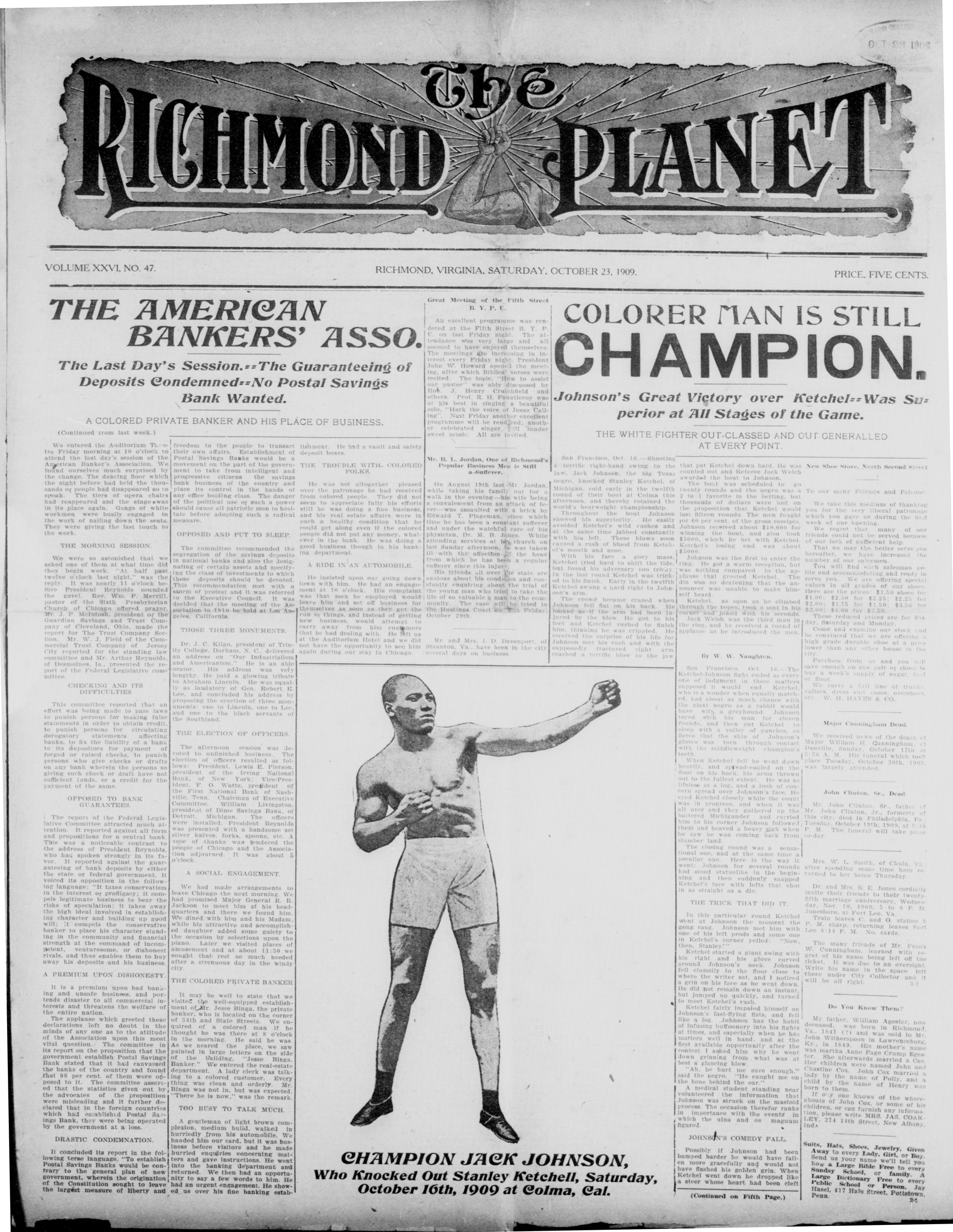
CHAMPION JACK JOHNSON, Who Knocked Out Stanley Ketchell, Saturday, October 16th, 1909 at Colma, Cal.
lishment. He had a vault and safety deposit boxes.
THE TROUBLE WITH. COLORED FOLKS.
He was not altogether pleased over the patronage he had received from colored people. They did not seem to appreciate fully his efforts still he was doing a fine business and his real estate affairs were in such a healthy condition that he could get along even if the colored people did not put any money, whatever in the bank. He was doing a good business though in his banking department.
A RIDE IN AN AUTOMOBILE
He insisted upon our going down town with him. He had an engagement at 10 o'clock. His complaint was that men he employed would leave him and set off business for themselves as soon as they got the run or things, and instead of getting new business, would attempt to carry away from him customers that he had dealing with. He left us at the Auditorium Hotel and we did not have the opportunity to see him again during our stay in Chicago.
Great Meeting of the Fifth Street
B. Y. P. U.
An excellent program was rendered at the Fifth Street B. Y. P. U. on last Friday night. The attendance was very large and all seemed to have enjoyed themselves. The meetings are increasing in interest every Friday night. President John W. Howard opened the meeting after which Biblical verses were recited. The topic, "How to assist our pastor" was aly discussed by Hob. J. Henry Crutchfield and others. Prof. R. H. Fannetleroy was at his best in singing a beautiful solo. "Hark in the voice of Jesus Calling". Next Friday another excellent programme will be read; another celebrated singer will render sweet music. All are invited.
Mr. B. L. Jordan, One of Richmond's Popular Business Men is Still a-Sufferer.
On August 19th last Mr. Jordan, while taking his family out for a walk in the evening—his wife being a convalescent from an attack of fever—was assaulted with a brick by Edward T. Plagman, since which time he has been a constant sufferer and under the watchful care of his physician, Dr. M. B. Jones. While attending services at his church on last Sunday afternoon, he was taken ill with the affection of the head from which he has been a regular sufferer since this injury. His friends all over the state are anxious about his condition and constantly enquiring about the trial of the young man who tried to take the life of so valuable a man to the community. The case will be tried in the Hustings Court on Last Friday, October 29th.
Mr. and Mrs. J. D. Davenport, of Staunton, Va., have been in the city several days on business
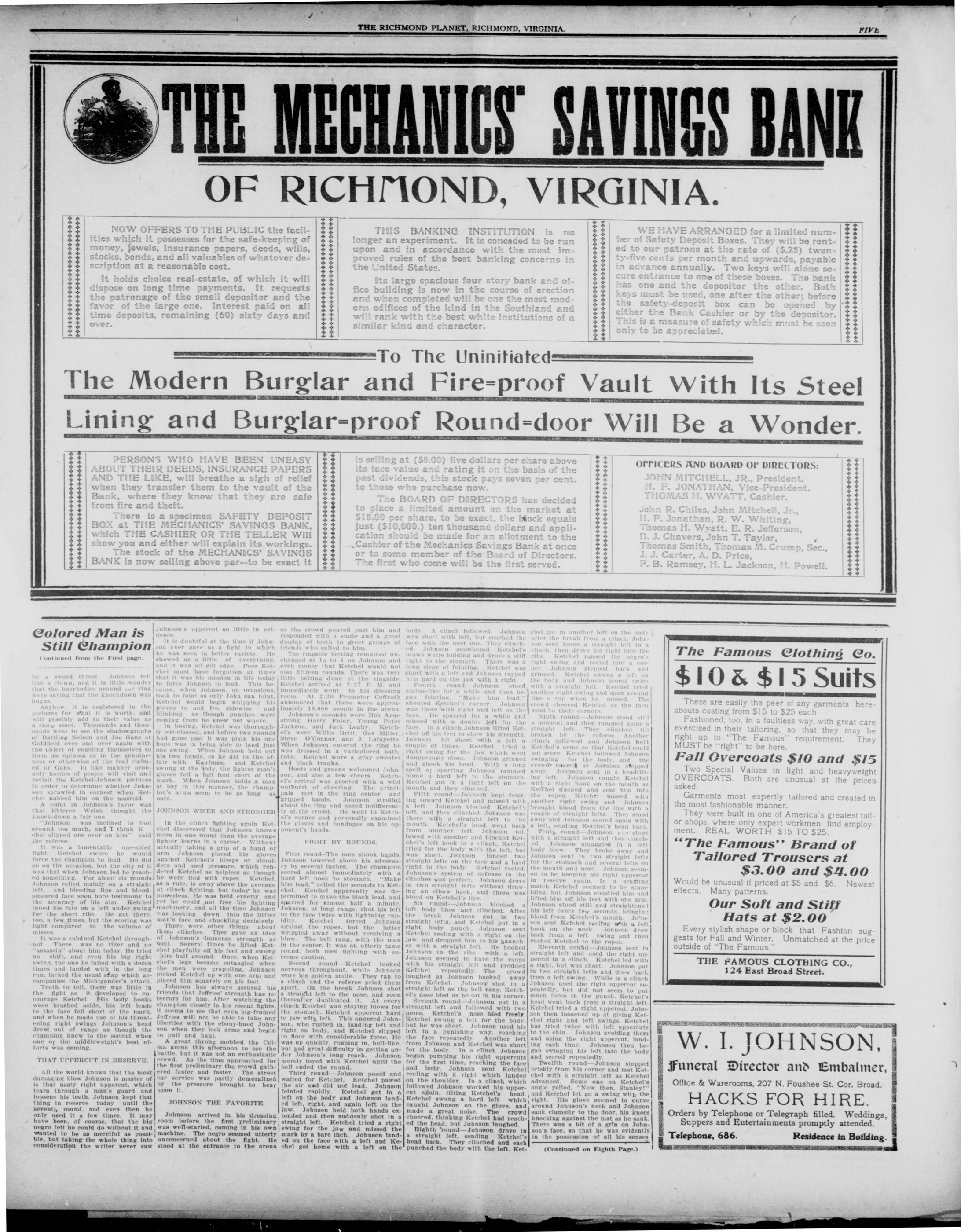
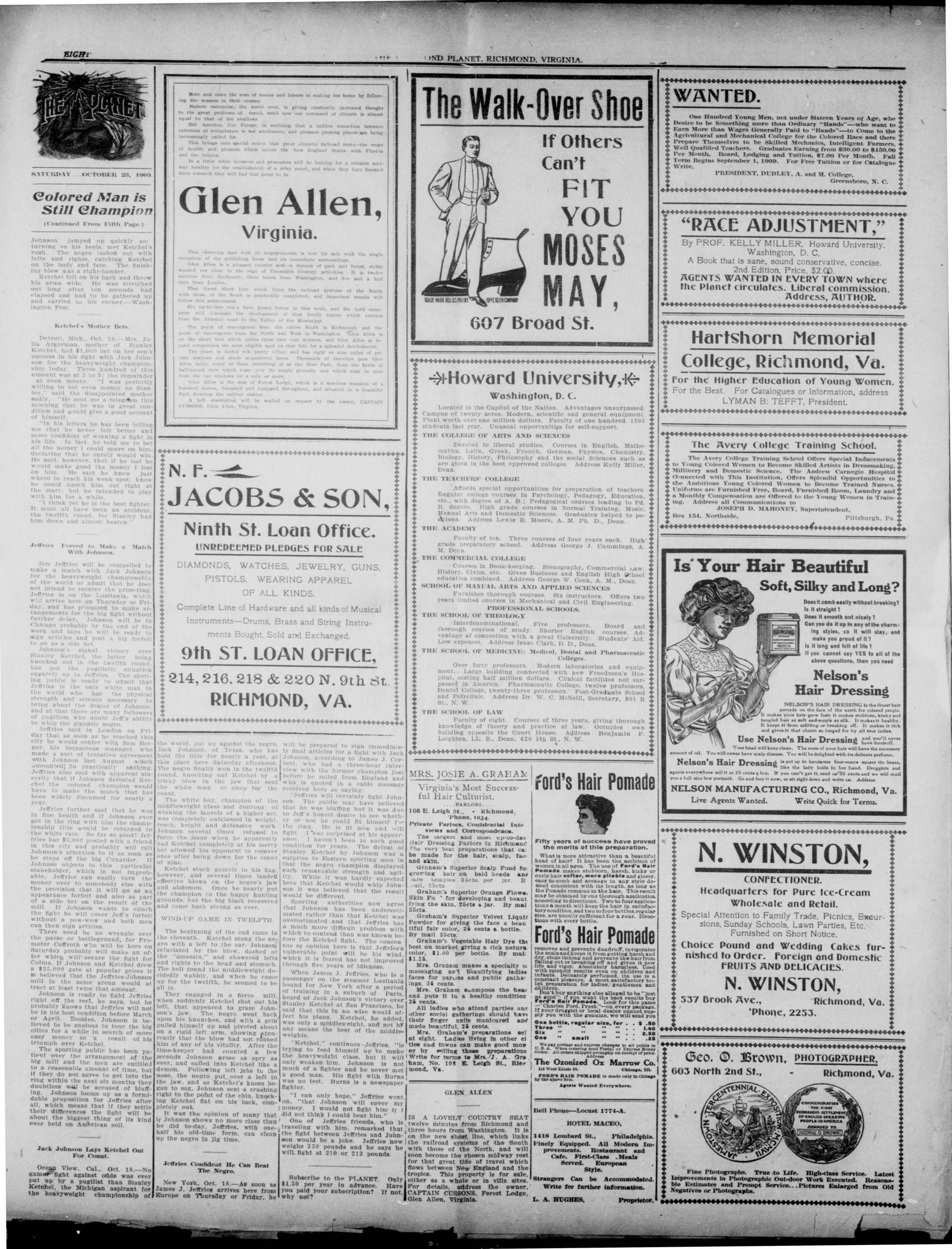
COLORER MAN IS STILL CHAMPION.
Johnson's Great Victory over Ketchel==Was Superior at All Stages of the Game.
THE WHITE FIGHTER OUT-CLASSED AND OUT GENERALLED AT EVERY POINT.
San Francisco, Oct. 16.—Shooting a terrific right-hand swing to the jaw, Jack Johnson, the big Texas negro, knocked Stanley Ketchel, of Michigan, cold early in the twelfth round of their bout at Colma this afternoon, and thereby retained the world's heavyweight championship. Throughout the bout Johnson showed his superiority. He easily avoided Ketchel's wild rushes and at the same time jabbed constantly with his left. These blows soon caused a rush of blood from Ketchel's mouth and nose.
With his face a gory mass, Ketchel tried hard to shift the tide, but found his adversary too tricky. In the last round Ketchel was tricked to his finish. Early in the twelfth Ketchel swung a hard right to Johnson's arm.
that put Ketchel down hard. He was counted out and Referee Jack Welch awarded the bout to Johnson. The bout was scheduled to go twenty rounds and the negro was a 2 to 1 favorite in the betting, but thousands of dollars were lost on the proposition that Ketchel would last fifteen rounds. The men fought for 60 per cent of the gross receipts. Johnson received about $10,000 for winning the bout, and also took $5,000, which he bet with Ketchel. Ketchel's losing end was about $5,000.
Johnson was the first to enter the ring. He got a warm reception, but was nothing compared to the applause that greeted Ketchel. The din was so deafening that the announcer was unable to make himself heard.
New Shoe Store, North Second Street
To our many Friends and Patrons.
We take this medium of thanking you for the very liberal patronage which you gave us during the first week of our opening.
We regret that many of our friends could not be served because of our lack of sufficient help.
That we may the better serve you hereafter, we have increased the number of our salesmen.
You will find each salesman polite and accommodating and ready to serve you. We are offering special values in all grades of our shoes. Here are the prices: $1.50 shoes for
The crowd became crazed when Johnson fell flat on his back. He looked as if the arm had been injured by the blow. He got to his feet and Ketchel rushed to finish him, thinking he was crippled. He received the surprise of his life for Johnson met his rush and with the supposedly fractured right arm crashed a terrific blow to the isw
that put Ketchel down hard. He was counted out and Referee Jack Welch awarded the bout to Johnson. The bout was scheduled to go twenty rounds and the negro was a 2 to 1 favorite in the betting, but thousands of dollars were lost on the proposition that Ketchel would last fifteen rounds. The men fought for 60 per cent. of the gross receipts. Johnson received about $10,000 for winning the bout, and also took $5000, which he bet with Ketchel. Ketchel's losing end was about $5000.
Johnson was the first to enter the ring. He got a warm reception, but was nothing compared to the applause that greeted Ketchel. The din was so deafening that the announcer was unable to make himself heard.
Ketchel, as soon as he climbed through the ropes, took a seat in his corner and joked with his seconds. Jack Welsh was the third man in the ring, and he received a round of applause as he introduced the men.
By W. W. Naughten.
San Francisco, Oct. 16. — The Ketchel-Johnson fight ended as every one of judgment in these matters supposed it would end. Ketchel, who is a wonder when equally matched, had about as much chance with the giant negro as a rabbit would have with a greyhound. Johnson toyed with his man for eleven rounds, and then put Ketchel to sleep with a volley of punches, so fierce that the skin of Johnson's gloves was torn through contact with the middleweight champion's teeth.
When Ketchel fell he went down heavily, and spread-eagled on the floor on his back, his arms thrown out to the fullest extent. He was as lifeless as a log, and a look of concern spread over Johnson's face. He eyed Ketchel closely while the count was in progress, and when it was all over and they gathered up the battered Michigander and carried him to his corner Johnson followed them and heaved a heavy gigh when he saw he was coming back from slumber land.
The closing round was a sensational one, and at the same time a peculiar one. Here is the way it went: Johnson for several rounds had stood statuelike in the beginning and then suddenly snapped Ketchel's face with lefts that shot in as straight as a die.
THE TRICK THAT DID IT
In this particular round Ketchel went at Johnson the moment the gong rang. Johnson met him with one of his left prods and some one in Ketchel's corner yelled: "Now, then, Stanley!" Ketchel started a giant swing with his right and his glove curved around Johnson's neck. Johnson fell clumsily to the floor close to where the writer sat, and I noticed a grin on his face as he went down. He did not remain down an instant, but jumped up quickly, and turned to meet Ketchel's rush. Ketchel fairly impaled himself on Johnson's fast-flying fists, and fell like a log. Johnson has the habit of infusing buffoonery into his fights at times, and especially when he has matters well in hand, and at the first available opportunity after the contest I asked him why he went Down grinning from what was at best a glancing blow. "Ah, he hurt me sure enough," said the negro. "He caught me on the bone behind the ear." A medical student standing near volunteered the information that Johnson was struck on the mastoid process. The occasion therefor ranks in importance with the events in which the ulna and os magnum figured.
JOHNSON'S COMEDY FALL
Possibly if Johnson had been bumped harder he would have fallen more gracefully and would not have flashed his golden grin. When Ketchel went down he dropped like a steer whose heart had been cleft
(Continued on Fifth Page.)
PRICE, FIVE CENTS.
IS STILL
ION.
Cetchel==Was Su=
the Game.
OUT-GENERALLED
New Shoe Store, North Second Street
To our many Friends and Patrons
We take this medium of thanking you for the very liberal patronage which you gave us during the first week of our opening.
We regret that many of our friends could not be served because of our lack of sufficient help.
That we may the better serve you hereafter, we have increased the number of our salesmen.
You will find each salesman polite and accommodating and ready to serve you. We are offering special values in all grades of our shoes. Here are the prices: $1.50 shoes for $1.00; $2.50 for $2.25; $2.25 for $2.00; $1.75 for $1.50; $3.50 for $3.00; $4.00 for $3.50.
These reduced prices are for Friday, Saturday and Monday.
Come and examine our stock and be convinced that we are offering a high grade durable shoes at a price lower than any other house in the city.
Purchase from us and you will save enough on one pair or shoes to buy a week's supply of sugar, tad or flour.
We carry a full line of trunks, vallises, dress suit cases, overshoes, etc. W. H. HAYPS & CO.
Major Cunningham Dead
We received news of the death of Major William H. Cunningham, of Danville, Sunday, October 17th at 5:30 A. M. His funeral which took place Tuesday, October 30th, 1909, was largely attended.
John Clinton, Sr., Dead
Mr. John Clinton, Sr., father of Mr. John Clinton, Jr., formerly of this city, died in Philadelphia, Pa. Tuesday, October 12th, 1909, at 3:15 P. M. The funeral will take place to-day.
Mrs. W. L. Smith, of Chula, Va.
after spending some time here
returned to her home Thursday.
Dr. and Mrs. R. E. Jones cordially
invite their friends to their twenty-
fifth marriage anniversary. Wednesday,
Nov. 10, 1990, 5 to 8 P. M.
Jonesboro, at Fort Lee, Va.
Train leaves C. and O. station 5
P. M. sharp, returning leaves Fort
Lee 8-14 P. M. No cards.
The many friends of Mr. Frank
W. Cunningham, learned with regret
of his name being left off the
ticket. It was due to an oversight.
Write his name in the space left
there under City Collector and it
will be all right.
Do You Know Them?
My father, William Agester, now deceased, was born in Richmond, Va. 1841 (?) and was sold to Mr. John Witerspoon in Lawrenceburg, Ky., in 1849. His mother's name was martha Anne Page Crump Egester. She afterwards married a Cox Her children were named John and Chastine Cox. John Cox married a lady by the name of Polly, and a child by the name of Henry was born to them.
If any one knows of the whereabouts of John Cox, or some of his children, or can furnish any information, please write MRS. JAS. COAKLEY, 214 14th Street, New Albany, Ind.
hits, Hats, Shoes, Jewelry, Given
Away to every Lady, Girl, or Boy.
Send us your name we'll tell you
how a Large Bible Free to every
Sunday School, or family.
A Large Dictionary Free to every
Public School or Person. Jay
Hasel, 417 Hale Street, Pottstown,
Penn.
2 ge 7 een YR sre Te LE, CUERN RN L, Saltl/y yams SUZ. a an wv! a /, Wong,
PN? Patocatevupimges ee / BY a\ = > ; : € “7 S “ae -<
ih WHmrarangs, YSLINE AU A sllzs ~ = z
\ 2 2 : & > = = s
i \> A OL B45, wiwiel/s = RS = SS a s
ANN Th) aia Frappe Grave 3 e = Lae a) =<
SH he a = vy eh’ lee, a . " = i
yee | eae NOVELIZED BY ~ SZ Oy Yanna, ant. aS) =
ee TRAN es THOMPSON BUCHANAN gw 11 RY aN JERE REC ANS ©
Re aa Ness! rs Sw SSE Re ‘ . Se Su aidi> 1g FA ested 911 TF VPS
SS SSS TROM THE SUCCESSFUL PLAY, — Sa a RR ee Da
SS a BY WINCHELL SMITH, FREDERIC THOMPSON AND PAUL ee ne ee oy Nod. Ey Pane Thosticen SSS
SS =~ Sawosse ali SS Caner ioom bp tenes Aioeaneon. 7) Were or
staring at bim re fully. She calls | Yes, or w dressing rodm,” he agree. as a reputation for the highest class | “Don't yell Itke that.” protent
does It” work erpolated Pin nate. strom gun.” keep quiet.” sneered the Invent
If sow ever seen it you'd ub) “he ee tted ber chin prowdiy. “You'll be here forthe forging?” sbr| "Yon ought to want we tkcep Que
Novelized by Thompson Buchanan From the . : for five or | work wen in the works superintending a=| not force, so be put on bis blande
Successfal Play of the Same Name : cren Oftee catia ised Va eed are much a I ¢ Bs | most ingratiating sate
By WINCHELL SMITH, FREDERIC {| that steady stare gets too much res Snresits “ik (oe uy bere weltng te | aces cee cn ae
THOMPSON and PAUL ARMSTRONG $ x t he They bad r 1 the door Kerly, anxiously, watching for you tl this because sou've got an_ entire
Frederic Thompson. Copyright, 1908, by Frederic Thompson. All Rights Reserved. 5 whe a t come with the news that every | wrong idea of me. Ever since th
rwo
CHAPTER Mt.
MR. DURANT comes own,
INCKNEY saw bis chance.
Bo Marsh." he said, kindly taying
his band on the draughtsman’s
arm. “And. really, Lam your friend
T have not told yeu before, but I have
& scheme, and if you trast me ft will
€0 through and everything will end
Tight. You don't know anything about
business, do you?"
“No.” agreed Marsh, “T don't”
“And you have not consulted a law
Yer or anybody about this gun bust.
Ress?" persisted the manager.
The mention of business and law
yers was having {ts effect. Marsh
looked puzzled
“No,” be confessed. “I have said
nothing to anybody.”
Pinckney smiled his superior smite
“Weil, Marsh, if sou bad you would
realize better what a fool you might
have made of yourself. You have work
ed for this company, and we pay you
for your time and your brains. Evers
thing that you do belongs tous. Auy
lawyer would have told you that. It
4s legally correct, but not morally right.
Now, I want to rectify that. 1 am go-
ing to try to get you something on this
gun, Therefore t have patented tt un-
der the name of Rbinestrom. Mr. Du
rant Wwould never consent to pay yon
any royalty. But he would be willing
to pay royalty toa man who does not
work for him. Now, if you will trust
me I will see If I cannot get a royalty
for Rhinestrom and pay it over to
you."
A great bope had dawned on Marsh's
tace.
“You mean you wil do that square?”
he asked
“Of course,” answered Pinckney, “if
we can arrange it. 1 will draw the
royalty for Rhinestrom and pay It over
to you, The business must, of cours
all be done through me or nothing w
come of it. You must trust me.”
“How much will the royalty be?
asked Marsh
The manager hesitated
“Well” he sald firmly, “T think Tear
get you $000 for every six inch ¢
and under and $100 an Inch for ere
gun over six inches turned out at the
factors. It will be a competence for
you, man, and you can quit you
Arudgery and work for the rest of you
life as Sou please on your inventions
Now, 1 have proved myself fale!”
Marsh nodded apologetically
“L wronged you, Mr. Pincknes,”
sald at last. “I see you Intend to do
the fair thing All right. 1 won't say
anything more.”
But. remember." said Pinckney
warningly, “the least word and th:
contract would be off. You must trust
me. And another thing"—be hesitated
& moment, then spoke meaningty
“the contract will be no good on earth
should the Sommers gun turn out to be
better than the Rhinestrom gun.”
Marsh nodded with the confidence of
the inventor in his ewn work.
“That is a chance we bave to take
but I think we will come out all right
‘The Rhinestrom gun ts a winner.”
After the head draughtsman was
gone Pinckney pondered a long time
Finally be called in bis stenographer
and dictated to her‘ contract between
the Durant Steel company and Wil
helm Rhinestrom by which the Durant
Steel company agreed to take over the
Khinestrom patents and pay the tn
Yentor $6,000 royalty on every gun six
inches or under and $1,000 an inch for
every additional inch above six. The
contract he signed as manager of the
steel company. Then be sent a tong
cable explaining what he had done to
Durant, although he knew Durant was
on the ocean and would not receive it.
‘That night in bis own room the man-
ager figured Just what he would make
—on every gun six inches and uader
$5,400 and $000 for every additional
inch above six.
“And at that.” be sald to bimself
with a sneer, “everybody will be hap-
py. ‘That fool Marsh will make bis
$600 and his $100. That ts enough
for him, and Durant can stand the
price. It means wealth and that girl,
too"’—he paused, and a sinister Night
came into bis eyes—“it only that Som
mers gun is a fallure. 1 wonder"—
Ob Gag aes) 8. WV pieces
“George. 1 was ashamed of you—post-
tively ashanied of you. Your first night
home and yon sit up at the table
and talk vothing but steel and ar-
cenary and croop guns and that sort
of thing. and when we have a guest
here too! [don't know what Lieuten-
ant Sommers thought of you.”
Mrs. Durant spoke frritably, but her
husband, who knew her ideas on busi-
‘ness matters from long experience,
merely sintled with toleration.
It was the first night after his return
from a trip abroad on business, and
Sommers and Pinckney had both been
to dinner with the family. ‘
“Now. now. my dear.” the steel man
tered in wo have to mgt
- tBederadi 2!
guess he pald attention because x
are Frances’ father, not for any other
Durant pricked up bis ears at once.
| “Frances' father?" he asked. “How
should that interest this fellow?”
The father was plainly put out. He
bad too long held the idea that the
name of Durant in the steel world
would be perpetuated by the marriage
of Frances snd bis protege, edward
Pinckney, for him to hear with equn.
nimity that a penniless naval officer
“Now, look here, George Durant,”
exclaimed bis wife indignantly, “don't
1 dare to pretend yourself that
Frances Is not attractive!”
1 never pretended any such thing.”
he protested
“You did!” she declared insistently,
“But, my dear”—
“Didn't you say you were surprised
that this naval man was paying her
attention? That's the same thing as
Saying she's not attractive, and t want
to tell son that Frances is the pret
tlest girl in Pittsburg, even if she is
George Durant smiled placidly.
We dear, you see, sbe’s bound
to be pretty. ‘Think of her mother.”
Now, don't try to soft soap me just
because I'm your wife, George. Re
member I've had twenty sears of your
blarney and I recognize It
AN right lear.” he agreed.
We'll let it go at that.” Let the naval
man pay attention to her, It won't
do him any good.
1 should hope not!” exctaimed his
wife plously. “The idea of any girt
Edward ¥ entered from the
Mra. bi em fF hands in
ni eet
Lhave t attors with
1 t this g vented. by
s we are casting for the
government. It won't be much work,
and 1 have my stenograpber and sec
Before the wife cout, ‘protest. far
ther Frances and Sommers entered the
drawing room. ‘The old steel man did
not give his wife a chance to argue.
Ah, Sommers.” be excialmed. gen:
ally. “I was just hoping you'd come
int I owe you an apology, my wife
says, and | wanted to deliver it"
“Apology! For what? excialmed
the Heutenant, mystitied.
Durant winked at him
“Why. Lieutenant Sommers.” he
said, with assumed seriousness, “1
thought 1 owed you an apology for
my conversation at dinner discussing
the truck gun work and steel and gun
making generally—those subjects tn
which you have no interest and could
hot anderstand.”
Sommers, catching the spirit of the
teene, bowed seriously
“Your apology is accepted, Mr. Du-
Fant” be said. “I thought myself tt
was rather strange that you should
choose a subject on a thing nether
one of us knew anything about; but,
of course, as you were host 1 chipped
in and did the best 1 could. 1 hope
my remarks on the subject weren't
altogether foolish.”
Durant turned to bis wife.
“There, my dear. You see I've done
everything you asked. I've apologized.
But really we ouly talked on that sub-
Ject because we both thought it was
the one thing you were interested tn,
#0 we'll bave forgiveness all the way
Found. And now | must get to work.”
“George.” she pleaded.
He paused for one second, his hand
on the door
“Only a litfe while. You'll all ex-
cuse mey"
Sommers and Pinckney bowed, but
Frances laughed out loud.
“Dear old dad, what difference would
{t make whether we excuse you or
not? We know you'll go anyway.”
“Well, I won't be long,” be protest-
ed; “really 1 won't.”
When the door had closed behind
him Mrs. Durant drew a long breath;
then she brought her foot down with
‘emphasis that was almost a stamp.
“Tm going into that stthly,” she de-
clared, “and stay there until I get him
‘out, The idea of bis beginning busi-
ness on the first night home! He
‘Won't stay long after I come in!"
“Indeed he won't.” agreed Frances.
“You know,” she went on, with a
laughing explanation to Sommers,
: work .
ere Se SSN vee ae see
THE RICHMOND PLANET, RICHMOND, VIRGINIA.
staring at him reproachfully. She calls
it moral snasion.”
“But does it work?" asked Sommers.
“Does It work?" Interpolated Pinck-
ney. “If you'd ever seen it you'd um
derstand it would work.”
“Yes, indeed.” exclaimed Frances.
“Father will struggle along for five oF
ten or even fifteen minutes, but at last
that steady stare gets too much for his
nerves. He'll begin to make mistakes
fo his dictating, and at last he'll jump
out of bis chair and stare, and then
mother will heavt a long sigh and say:
‘George, dear, 1 know you are tired.
| Don't you think you'd better stop
| awhile? And he stops.”
' “What a splendid system! laughed
Sommers. “And what do sou do, Mis
Durant, when you want to manage
him?”
The girl smiled.
+ “Ob, that's a secret.” she sald. “l
have my own way of doing tt, but tt
works, doesn’t It, Edward?”
“You're right there,” agreed Pinck-
nes. “1 won't forget Io a burry how
you bandied him on the wireless teleg-
raphy scheme.”
“Wireless telecraphy!” exclaimed the
haval man, “Do you mean to tell me
that you understand wireless telegra-
phy too?
“Not very much,” confessed the girl,
“but I do know something about it
Edward taught me the rudiments, and
then 1 went to work myself. I got
some of the men up from the shops,
and they rigged up a station for me at
the top of the house, Father did not
Know a thing about it until one day 1
brouglit him up there and showed hit
He didn't think it was very nice for a
girl, but what could he do?”
“Oh,” said Sommers, “I see your
system. You do what you please and
then make him agree."
“Don't you think It a good one?” tn
quired the girl innocently.
‘The man smlled and shrugged bis
shoulders.
“Good for ttle things, but how
would It work for a big one?"
The question was lightly put, and all
three were smiling, The smiles on the
men's faces were just a bit set, for
bebind that question both knew there
was a great deal left unsaid,
Frances tossed her bead Ughtly, but
the tone of her answer was vital with
disfavor.
“And on the bis ones, too, Mr. Som
mers 1 do always what seems best
Pinckney turned away sharply, white
the smile In the face of the naval of
cer became more natural and a little
broader
“You know I'd like to see this wire
less room.” he sald. “It must be
bully place
‘Oh, it's a workroom.” the girl Ip
sisted “nothing footlsh mbout tt. 1
not as good yet as Edward at send
and taking, but then T have more tui
to practice. and If be doesn't bustle
TH beat him."
“You flatter me,” sald Pinckney
“Really, Mr. Sommers, she ean beat
me, I think, but we do bave great
fun working over (t.”
“Yes; Edward and 1 are more or
Jess partners—in this,” agreed Frances
“Partners?”
Sommers iried to keep his tone light
ly unpersonal, but a little hardness had
tocreep in, The two men were so nat
urally antagonistic that probably they
must have taken opposite sides on
anything, and the feeling of each for
the girl only tended to bring out more
keenly their inborn antipathy, Since
the afternoon when Pinckney Inter
Tupted the practical iove scene between
| Frances and Sommers on the bill above
the works the tension had been greater
[than ever between the men. Each
treated the other with elaborate cour.
tesy, but it needed only a word on
‘either side to bring about real trouble
The more impulsive and domineering
Pinckney bad been close to the limit
of endurance several times, and on
[each occasion the cool courtesy, the
‘splendid self control and the ‘good
| breeding of the naval officer bad pre-
| vented an outbreak, Sommers realized
his position. He knew that Pinckney
was the manager of the works where
his gun was to be cast. He knew
| also that Pinckney probably in the end
| Would marry the girl they both loved.
‘and In many respects he bad the right
‘of way, All this had made the naval
| man circumspect in bis dealings, He
could not afford to have an open break
with Pinckney.
| An open fight between a naval officer
‘on duty, as Sommers practieally was,
(and a manager of a big gun works
/Anust result in a court martial and the
possible disgrace of the officer, and un-
less the provocation were great it
"Would mean bringing the uniform into
Gisgrace by conduct which might be
construed as unbecoming an officer
| and a gentleman. Pinckney had no one
except Mr. ‘Durant to whom he must
account, and Sommers knew that a
man as clever and as unscrupulous ax
he believed Pinckney in some ways to
be would not hesifhte to do anything
that might put a rival in an embarrass
ing position. However, the naval mar
could not imagine for a moment that
the manager could be guilty of any
conduct that might injure bis work
He considered the matter betwee
Se ee ee enn) ae
ces.
“Yes, or a dressing room,” he agreed.
“That's the sort of thing we might
expect our young women of today to
have”
‘The ciri tilted her chin proudly.
“Well, Mr, Doubter, if you will just
come with me I'll show you it’s a revi
workroom.”
“Indeed I will,” be agreed eagerly.
‘The girl arose.
“Come on. then.”
‘They bad alwost reached the door
when she remembered that Pinckney
had not been Included in ber tnvita-
tion, fe was standing over by the
mantel, both bands stuffed in his pock-
ets, and was grimly looking Into the
fre.
“Ub, 1 forgot!” she exclaimed. “You
What to come too, Edward? Lf you do,
come atead."*
For a second he seemed about to ac-
cept ter invitation, Phen she added
quickly: 7
“But. then, tt wonld bore you. You
ran come up guy time”
‘The manager shrugged bis shoulders
with elaborate carelessness,
“Yes: I bare something to do,” be
confessed
Then, after thes had gone, be turned
back to the Gre angrily with a mut:
tered exclamation
“rn Ox is 3 young cub!”
HAPTER IY,
Sees Sera ene are
around st the complete lttle
worksbop in nmazement, Besides
the Wiroiess outfit, be saw tools
models. sharps, « drawing table, « Itt
tle workberich—everythiog, In’ fact.
that it seemed to tim a mechaoleal
inventor woul! really need,
“You use all these!” be exclaimed.
“Why, of course! she sald. “This ts
my fan. 1 work ap bewe on dark days.
and we have plenty of those in Pitts
burg. you know”
The man could uot have controlted
Ais nstonisyment. He examined ser:
erat of the nindela They were on {m
Provements i» wireless telegraphy, va
rious mecha ies! devices and on even
the model of » tittie gan,
“Gh Me yoatented them an ex
clawed Fratces, “I don't know thn’
any of them amounts to much, but |
patented them just the same, You see
You're not the only gun Inventor, Mr
Sommers” ,
“Then the Sorimers gun has to com
pete with the Frances Durant gun?"
he asked quizaleally.
She shook her head, smiling.
“Noz L'il tell sou a secret. { wouldn'
let them mitke a kun of mine If T cou
patent ft. bat that Is Just a little mode
of the Rhinestrom gun, which Edware
has great faith In. Marsh made the
motel for we.”
“Oh, the Rhinestrom gun!" sald Som
mers, with lifted eyebrows, “I'v
heard something of that around the
S|
Pas eel
* afl °)
(- A at
| \ Ee.
INC
\} ae
EREN the Sommers gun has to compe
with the Brances Durant gun?"
works. Your man Marsh seems ¢
have great faith in it. Who Is thi
Rhinestrom?"
Frances shook ber head.
“I don't know. ‘Think be must bv
some German, Edward just told a
that we had bought the patents aud
controlled them. But that doesn't af
fect your gun any, does it?"
Sommers looked up from the mode!
he had been studying.
“Frankly.” be said. “if this model +
correct it won't affect my gun. ‘The
Sommers gun has the good points of
this one and a new principle which 1
expect will partly revolutionize thing:
for whoever manufactures it.
“It all depends on the forging. 11
By cun ts, forged right and properly
tempered, well”—he paused, then wen!
on with a confident smile—“T don’
want to brag, but honestly I am no!
afraid of any gun that ever was cast
It will all be in the forging, and tomor
row will tell that. We'll put it through
tomorrow night.”
“Ob, | bope {t goes through ai)
right!" cried the girl “It must ge
through! It would be terrible to think
of a failure."
“Yes,” be said grimly, “it would.”
“It would mean.” she asked, “th:
blasting of your hope?”
He shrugged bis shoulders.
“That would be a minor considera
tion. It would mean death to the men
who are handling the gun and cour:
martial and disgrace for me. You sev
why I'm Interested.”
“But there’s no chance of a failure,”
she exclaimed, ber eyes big with alarm
Sommers ianghed.
“Not of the Durant works, I-tbink.”
‘he said. “That's why I was glad when
the government decided to have a gu:
oS ae. SO ee eee ee
basa reputation for the highest cis |
most careful work, so I feel safe, even
if you do own patents on the Rhine
strom gun.” |
“You'll be here for the forging?” ste
asked.
“Of course.” be replied. “I'l be
down in the works superintending ax
much as 1 can.”
| “And 1," murmured the girl, half to
herself, “wil! be up bere waiting ex
gerly, anxiously, watehing for you t
come with the news that everythine
has gove right. Ob. what a pity It i
that you should nveot this gun aud
| not get anything for your brains and
your labor!"
He shook his bead, smiling.
“No.” he said; “it's right. ‘That
part of the contract | made with Unete
Sam when he took me tn at Annapoiis
| He educated me, gave me the ebanes
| to work, and 1 promised to devote my
life to him.
“We're all merely cogs tn the bli
machine, Miss Durant. we fellows
from Annapolis and West Polnt, cox
th the machine that makes the fa:
and the flag's the biggest thing to us
you know. It's bard sometimes. fea:
fully bard. We have to give up a lo.
Rut it's duty, and duty is what we
inust think of."
‘The girl had been looking at bim, ad
miration and Just a hlot of somethinz
more showing In her face.
“Yes.” she said at last; “after atl
you men of the navy nnd the army ary
the real patriots working for your
country. You seem to be about the
only ones who do any reat sacrificing.”
Then her volce becawe more earvest.
“But 1 don’t see why you should sac-
tifice everything.”
‘The wan laughed somewhat grimty.
“That's just it, yormpee,” he said
“We try uot to sacritice everything.
We always try not to sactidce our self
respect, 1 think.”
“Self! respect, fddlesticks! It isn’t
self respect men won't sacrifice,” ste
snapped. “It's generally selfishness
Oh, how you men do love to foot
yourselves! You step back and stand
on your dignity, so proud and hard
[ema cereees Geo ret
fering, Mat you are heroes who won't
sacrifice self respect, and in reality
you are nothing of the kind. You are
simply stupid self deceivers who are
willing to sacrifice your future, bap
pines, everything, on the altar of your
own selfishness—really sacrifice your
selves and sometines™—
Shegaused suddenly, aghast at what
she was nbout to siy.
“And sometimes?” the man question
| ed unsteadity
Aud sometimes girts talk more that
they should.” she ended sharply, ‘Then
she looked at tim with a sudden smile
and quick change of mood that baited
him completely. “I think it's time we
Went back to wireless telegraphy, don't
Baffled, but still somewhat relieved
at being saved from himself, Sommers
turned to the wireless {nstrument,
You can send and take well?" he
asked.
“Of course,” she answered. “Edwant
taught mo originally, but I've learned
a lot since. He's quite an adept too
I learned really because I wanted to
have a wireless plant placed on fa
ther’s yacht. Perhaps some time when
I'm cruising om the yacht I may pick
you up when you are on your battle
ship and have a Uttle chat with you
Do you think you'd be glad to bear
from me?"
“Td be glad to bear from you wo
matter where 1 was,” be exclaimed
eagerly, “and I'd recognize you, too,
Whether the message was directed to
me oF not.”
“I will send it to you," she said, with,
meaning, “and you must recognize It.”
“I will; you may be sure of that,” te
agreed earnestly. “And now I think
T must be going. It’s late.”
He turned within the door and then
started back to the drawing room.
Meantime down in the drawing room
Edward Pinckney had been having an
uncomfortable quarter of an hour
Marsh had come up from the works
determined to see Mr, Durant,
Pinckney had not told the master
draughtsman of the contract which he
had sigued, and Marsh, thoroughiy
imbittered with the prospect of losing
everything be had done, hurried up to
the honse determined to lay bare the
whole matter before the owner of the
works, throw himself on Durant's mer.
cy and beg that at least he be given
eredit for the invention of the Rhine.
strom gun.
Forminately Pinckney bad been tn
the drawing room when the butler
brought in Marsh's name and so bad
been able to intercept the man before
he got to Durant.
“I don’t want to talk to you,” ex.
claimed the Inventor when be entered
and found it was Pinckney and not
Durant he had been shown in to see
“I don’t want any more of your soft
talk. You talk and promise, but you
don't do anything. I ought to have
known better than to trust you the
other day when you fooled me down
at the works with all that stuff about
giving me a chance. J felt in my
heart you weren't going to do tt; but,
Mke a fool, | trusted you, and this ix
‘ied El tla a Sas eee cee
Fa 2 a, Ry PO ore acs eae A nF Te
“You ought to want me to keep quiet ™
Pinckney had regained bis wits now.
He saw it was the time for diplomacy.
not force, so he put on his blandest.
most ingratiating smile.
“Now, listen to ae, Marsh.” be
pleaded. “You're up In the air with
this because sou've got an entirely
wrong idea of me. Ever since that
accident you've acted as if 1 were to
blame.” -
“1 don't want to talk about that.”
exclatmed the inventor. “You can't
sidetrack me with any talk like that.”
“But 1 want son to get a square
deal,” protested Pinckney. “I'm go-
ing to see that you do.”
Marsh looked at bim with @ sneer
“You call it a square deal to give the
credit for all my work to another?”
“Of course it wouldn't be! ex
‘claimed the manager. “That's just tt
T'm going to put It through for you
if you'll only give me a chance.”
| “After what sou said the other day?”
sneered the other.
| “And I've done it.” snapped Pinck.
“ney
| “You've done it?”
‘The general manager nodded
[between Wilhelm Rhinestrom and the
| Durant steel works bax been drawn
| up. signed by Rhinestrom and by me
for the Durant steel works, but only
waits for the approval of Mr. Durant.
and I'it get that tonight”
Marsh “How could Rhinestrom siga
st when there Isn't any Rbinestrom?*
Pinckney looked at bim pityingly
“What do you care who signed tt
for Rhtnestrom tf you get the money?"
he sald. “The name on the contract
ts Wilhelm Rhinestrom.”
| “You forged that name!* gasped
| Marsh
“Shut up!" snapped te other. “Don't
be n fool! You can't forge a man's
hame If the man doesn't exist. Now
take your money and be satisfied
Leave It to me. I'm your friend. I'm
proving myself your friend, and here
You go ahead and kick up © fuss and
risk the whole thing. I've taken a
Uttle risk myself to put this thing
through and give you a square deal,
and this Is what you do in the way
of gratitude. Now, aren't you ashamed
of yourself?”
Marsh looked at the manager apoto-
“I'm sorry, Mr. Pinckney,” he sald.
“I'm always playing the fool, it seems.
You've been a good friend of mine,
sir. and 1 want to thank you for help.
ing me out. I'l be grateful. 1 won't
make any trouble. I'll shut up.”
Pinckney slapped the old man on
the back almost affectionately,
“That's all right, Marsh,” he sata.
“I reatize you don't know anything in
the world about business, realize that
thoroughly. and Tm acting in this
manner for the good bf all. Now, you
trust me, With this order we have
from the government—It ought to keep
vs busy for a year—you'll be rleh
You'll have a fortune, but if it wer
known who was the Inventor we'd
get nothing. You see that?*
Marsh nodded.
“1 understand, str.”
“All right, Marsh. ‘Then be good,"
advised the manager. “Now you'd bet-
ter xo."
‘The little man had got almost to the
door when he paused and turned back.
“Just one thing more, Mr. Pinck-
ney.”
“Well?” said Pinckney impatiently.
“It’s about the casting of the Som-
mers gun tomorrow.”
“What about it?" asked the manager
sharply.
Marsh hesitated.
“It's Just this, sir. I understand that
you're going to put Smith in charge of
the works. You know what sort of a
fellow Smith is?"
“Smith Is\a good man,” sald Pinck-
ney sternly. “Don't criticise fellow
employees, Marsh. I am responsible,
and I know what I'm doing.”
Still the little man, honest at heart,
felt compelled to protest.
“Smith nas been drinking for several
days, sir, and he’s already ugly. ‘The
Jast time he was charged with impor-
tant work he ruined the gun and cost
us a lot of money, besides throwing
and hurting one of the men.
“Now, Sommers, I understand, in-
tends to be down at the works to su-
perintend forging: these guns. If he
‘and Smith get together there'll be trou:
ble and the gun may be ruined, and
that will cost us a lot more money.”
Pinckney looked at him with a sneer,
“Seems to me, Marsh.” he said, “that
the inventor of the Rhinestrom gun is
‘taking an awful interest In the gun of
‘his rival. What do you want te do-
manage the business yourself and spoil
Sommers’ gun?"
“Mr, Pinckney.” exclaimed Marsh in-
ignantly. “you haven't any right to
talk that way to me. I was telling you
something for your own good and the
‘good of the works.”
“Look here, Marsh” — Pinckney's
manner had grown suddenly stern—“1
am the general manager of the Durant
works, and I don't propose to take any
Muterference from you or any other
employee. I have ordered Smith in
charge of that work, and he’s going to
be in charge, and he's going to do it
wight.”
‘Thoroughly cowed, Marsh turned
and left the room just as George Du-
rant entered by another door from bis
study, where be had been dictating.
{to BE contmvxD.}
ADMINISTERING MEDICINE.
‘They Must Swallow tt.
Giving medicine to children is one
of the most difficult that
Joung mothers have to cope for
some little ones have such a horror of
* ouaitlon ‘of oetvoos inane batsee
a of nervous illness before
the medicine gets into thelr stomachs,
and so it frequently nauseates them,
thus making successive doses harder
to give.
‘There ts no question but that if a
child shows a disposRion to rebel
against swallowing medicine the men-
tal tussle must be gone through with
and settled frst. That ts, there is no
use in trying to give the dose while
administering admonitions, The Ut-
tle one’s stomach must be quiet, and
this cannot be If he is in tears or is
screaming.
So when the child refuses it Is es-
seutial to put the medicine aside and
to make him understand that the cure
must be taken, He must not for an
lnstant be permitted to think that be
has gained his potnt and need not
take It. ‘To the contrary, he Is given
to understand that he Is obliged to and
that the sooner he is qulet the better,
Precisely how this is to be accomplish
et depends upon Individual tempera-
ment and the way each parent handles
the babe. Sometimes when the argu-
ment Is prolonged a spanking may be
required, One small girl had three
doses of this materaal discipline be-
fore she became quiet and swallowed
her medicine, There was never any
trouble with her afterward, for she
had been made to accept the fact that
medicine when it was brought her
was to be taken and to fuss only made
the condition worse. Coaxing works
with some little ones; with others pun-
fshment fs required. Each parent
must decide this for herself,
During the time that this matter of
will contest is In progress the medi
cine {x not administered. When the
child has been conquered he must be
xlven a few minutes to qulet sobs or
temper, and then the dose must be
given
If the sick child thinks he cannot
swallow medicine, no matter how
much be may want to, he must be
broken of this Mea, He fs apt to
change bis {dea rather quickly, too,
If be finds that each tle be efects
the medicine a fresh dose Is given.
It takes a clever child only a few
moments to realize that be is simply
prolonging the agony
‘The notion some have that they can
not swallow pilis ts likely to be. im
agination. which ft Is not always well
to give In to If there Is a reason for
Paying heed to it an easy way of ob
Viating it Is to give liquid instead.
for there are few prescriptions that
cannot be administered in this form
The old way of glving pills in Jelly
does not commend Itself to. present
Viens. The sweet, combined with
| medicine, is apt to upset the stomach,
causing nausea.
| To deceive a child about medicine
| and tell him it Is good is great mls
take. ‘This may work once, but he
| will be suspicious ever after, He
should be made to understand that
| medicine is not a Joke, but that it ts
less disagreeable than to be fl, and
that whether be wishes It or not he
| must take tt.
How to Travel Without Fatiaue.
‘The secret of traveling without fa-
tigue ts to abandon thoughts of amuse:
tot let your nerves get the upper hand
of you.” Refrain ss much as possible
froin conversation, for tn the wolse of
travel talhieg "on becomes Uring.
Avold reading, for the tse of the eyes
while the train ts la motion seers, to
induce sick headaches and nausea, AL
this seems to say that you. will have
an unlnterestiog and tresome journey,
tue If sour trip is a short one Laat
this worth while if you cab reach your
destination bright eyed and with an
undaunted spirit, ready €o enter gayly
into anything ‘that ts expected of you?
How to Scatter a Threatened Boil.
A French doctor has had great suc-
cea with scattering bolls by: applying
at the first sign of inflammation com-
Dresses wet with equal parts of tine.
ture of arnica, tincture of fodine and
spirits of camphor, Continue until the
trouble seems to be passed. If with
the compresses onedrinks sulphur wa-
ter or red clover blossom tea it will
help to scatter the boils and overcome
the tendency.
How to Peel Onions Without Tears.
‘The work of skinning onions, which
‘usually ends in tears, can be made a
pleasure by pouring boiling water over
them and covering a few minutes be
fore peeling.
ibn «Ol
Me drinks to get an appetite.
He says, nor seems to think
‘That all he does Is just excite
An appetite for drink.
—Catholle Standard and Times,
Identification.
Knicker—Did you recognize my voice
‘on the phone?
Mrs. Knicker—No, I recognized the
excuse.—New York Sun,
Ri Sedaner Chetiia.
Back home the gay resorter comes,
‘And as he takes a scrub,
“I love those summer Joya." he hums,
“But, /O you tub!
—Detroit Free Press.
Credutous.
Hewitt—Cruct is a credulous fellow.
Jewett— Yes. he even believes io hin.
self.—New York Press.
The Better Way.
‘Just learn to say no,
Young man, and then
You won't always be saying
“Never again.”
—Pittsburg Post.
Atter the Crash.
4 lore my auto. but, of, you sktd!—
Cleveland Piain Deaier.
THE PLANET
SATURDAY...OCTOBER 23, 1900
HINTS FOR FARMERS
The Canada Thistle
Canada thistles are not eradicated by the ordinary system of cultivation that is applied to corn, says the Homestead. They may be cut off three or four times, but there is an opportunity in the fall for the thistles to make considerable growth, and during this time the root system strengthens so that they are ready for business just as strong as ever the following year. There is little danger of scattering the thistles by ordinary culture methods.
Where sheep can be kept this is, possibly the most inexpensive way of getting rid of thistles, because it is a well known fact that they are consumed readily by sheep. Of course it must be borne in mind that where pastures are good sheep will not eat thistles in preference to any other or all kinds of plants, but when pastures dry up a little, during July and August, thistles are usually succulent, and at that time they seem to make rather luscious eating for sheep, and for that reason we recommend the sheep method of destroying this nest.
Swine on the Farm
I am a great believer in keeping swine on the farm and have often wondered why more farmers do not engage in this profitable industry, writes a Maine farmer in the New England Homestead. I have bred swine for many years and am a friend to all, but consider the Berkshire the most profitable for me to keep.
In order to be successful it is necessary to give the hogs considerable care, especially at farrowing time. I put my sows in pens by themselves about two weeks before farrowing time and feed them bran and flour made into a swill. Mix with hot water and occasionally add some salt and a little linseed oil. Give them about all they will eat. Under this treatment I never have any trouble from sows eating their pigs. After pigs are born feed lightly for first week and increase feed as pigs grow older. I generally wean pigs at four to six weeks of age.
Advantages of Draining Soil
Advantages of Draining Soil.
Concerning the subject of drainage, we must not fall to notice some of the incidental advantages it affords the farmer. In the first place, it lengthens the season, because drained ground dries and warms so much earlier in the spring. It lessens the cost of production, because the farmer can do his work more nearly when it ought to be done. He can keep ahead of the weeds and be master of the situation. It oblates the injury to our fields by trampling by stock when wet. It prevents injury to our crops by heaving of the ground by frost and by its cracking open in drying. It does away, as nothing else can, with the uncertainties of agriculture and puts the farmer in a position where he can count, as other business men do, on certain returns from labor and capital invested.—F. L. Allen in Rural New Yorker.
Dairy Cleanliness.
Clean cows, clean clothes and clean dry hands for the milker should be the unvarying rule of every dairy, Special milking suits should be worn and frequently washed. A small topped pail would prevent a large amount of dirt from falling into the milk. Pails, cans, strainers, coolers and every other utensil that comes in contact with the milk should be washed clean and sterilized. Sterilizing means heating to 212 degrees F. It may be done by boiling water or by steam. It cannot be done by starting with boiling water in one can and pouring it from can to can to clean half a dozen. The easiest way to do thorough work is to use steam.-Agricultural Department Bulletin.
Fertilizing Grass Land.
In experiments at the Rhode Island station it was found that a mixture of 400 to 500 pounds per acre of superphosphate and 300 to 350 pounds of mrate of potash and nitrate of soda applied as an annual top dressing from April 15 to 25 would maintain a good yield of timothy without the use of stable manure, which is subject to the objection that the coarser undecomposed material of the manure remaining upon the meadow is likely to be raked up with the hay and that the manure sometimes has the effect of reducing the quality of the grass by causing a rank growth or by the introduction of weeds.
The War Upon Quack Grass
Throughout the northwest quack grass is spreading so rapidly that the better class of farmers are quite concerned. The Minnesota experiment station expects to take one of the worst quack grass farms in the state and try different methods of killing out the quack. It is said that this farm grows nothing but quack and for that reason ought to present a good subject for the experiment. All sorts of methods will no doubt be tried, including close pasturing and digging up the quack roots.
WILLING TO PAY.
The Bridegroom Thought the Bishop Too Impatient.
The right reverend bishop of Delaware tells the following story:
"A young man came to me one day and said, 'Bishop, I want you to mar-
ry me on next Wednesday!
"All right, young man. I'll marry you," I assured him.
"Well, I want the bell to ring," he continued.
"Very well, you can have the bell rung."
"Well, I want the organ to play."
"All right. You can have the organ played."
"And I want everything else that anybody ever had at a church wedding."
"Certainly. You shall have it."
"Well, the night came, the bell rang, the organ played, the church was crowded, and everything went off as the young man wanted it. When the ceremony was over the young couple waited, instead of leaving the chancel. So I held out my hand, shook hands with the bride and then held out my hand to congratulate the bridegroom. He had his hand deep in his trousers pocket, and as I stood with my hand out he said, somewhat impatiently and in a tone that could be heard all over the church:
"Now, don't be in such an all fired hurry, bishop; I'm getting the money out just as fast as I can."
"And everybody in the church gig-gled." Lippincott's.
Thorough Baptism.
In one of the smaller cities of New England there was a church which had two mission chapels, commonly known as the East End mission and the North End mission, from the parts of the city where they were respectively located. One day the rector gave out the notices in his most distinguished high church tone, as follows: "There will be a service at the North End mission at 3 o'clock and at the East End at 5. Children will be baptized at both ends."
Simply Labor Saving.
Broncho Bill was a bad man, proud of his reputation for lightning gun plays, and he had but one eye. One day a young tenderfoot happened into
"LOSE IT BE HANGED!" SAID BILL PEROCIOUSLY.
the mining camp and after getting acquainted ventured to ask politely, "Bill, how did you come to lose that left optic of yours?"
"Lose it!" Bill thundered. "Did you say lose it?"
"Why—er—yes," faltered the tender-foot.
"Lose it be hanged!" said Bill ferociously. "I cut it out so's I wouldn't allus be havin' to shut it in drawin' a bead."
Getting the Most Out of Life.
Make yourselves nests of pleasant thoughts. None of us yet know, for none of us have been taught in early youth, what fairy places we may build of beautiful thought, proof against all adversity—bright fancies, satisfied memories, noble histories, faithful sayings, treasure houses of precious and restful thoughts, which care cannot disturb nor pain make gloomy nor poverty take away from us—houses built without hands for our souls to live in.—John Ruskin.
Followed Instructions
Care and system are the halfway houses to happiness, and If Mrs. McQuillum was anything she was careful and systematic. A little while ago she had occasion to go out and leave the house to take care of itself. But the grocer was expected, and unless he was warned he would leave his commodities on the doorstep and thus advertise the fact that the house was unprotected. Therefore Mrs. McQuillum wrote this note, "All out; don't leave anything," and pinned it on the front door.
When she returned her note was no longer on the front door, and there was a nasty, empty sort of sensation about the greater part of the house. Everything of value had disappeared.
She found her note on the dining table. But a line had been added to it. "Many thinks." It ran. "We haven't left much."
Discouraged at Last
Bill Barlow of Wyoming told of one of the first humorous paragraphs of his former editorial associate, Bill Nye. There had been a railroad accident. The locomotive was lost, two passenger cars were destroyed, the express car was smashed, but no one had been fatally hurt. This is the way Bill Nye described it: "For upward of twenty years repairs have been repeatedly promised the old South bridge. Hoping against hope and waiting until distracted the old bridge became discouraged at last and yesterday just laid down in the gorge with a passenger train."
Brute.
Cyrlic--She knows his footsteps a mile off in the midst of a hundred others, sees him coming from the corner of her eye, pats her hair and smooths her dress and jumps a foot with surprise when he ascends the plaza steps.
Clinic--Who?
Cyrlic--All of 'em.--New York Life.
Oh, the Difference to Him!
Oh, the Difference to Him!
I call a man a dog, and worth with he Starts right in to paw the scenery.
Half removes his waistcoat and his coat
Even makes some passes at my throat.
Things look black for me, but I cry, "Ha
I can remedy my rude faux pas!
Yes, a dog—sad dog!" I quickly add.
My, but he looks pleased and sly and bad.
-New York Times.
THE RICHMOND PLANET, RICHMOND, VIRGINIA
SICK HEADACHE CURES.
How to Relieve This Most Distressing Form of Illness.
Slick headache, while not dangerous, is one of the most disagreeable forms of illness. Some women are subject to it at such frequent intervals that they are incapacitated for several days at a time.
Unless the headache is known to come from some functional disorder it can generally be traced to impaired digestion or a sluggish liver. These must be treated in the interim of the headaches, as at the time nothing but alleviating remedies are possible.
A treatment that is often successful is to abstain from red meats for a time and to be careful about taking foods that ferment easily. One man who had doctored for years for sick headaches was cured by his wife seeing to it that he drank a cup of hot water with a half teaspoonful of salt in it as soon as he arose in the morning.
A half lemon in a glass of cold water taken night and morning is another remedy that has proved helpful to many.
During the attack rest and quiet are imperative. Lie down in a darkened room, drink quantities of hot water and apply either a hot water bottle or an ice bag to the temples and the base of the brain.
Cloths rung out of hot witch hazel often bring quick relief. Headache cologne if rubbed on the temples in time acts as a preventive, while some sufferers are helped by taking a cathartic at the first symptom.
In severe cases five or ten minutes' treatment with an electric battery is invaluable. This is better than massage, as the pressure is sometimes too strong when the headache is bad.
In the first stages of sick headache it can often be averted by taking abdominal and neck exercises and by putting a mustard plaster over the stomach.
How to Make Kitchen Aprons
To the woman who does her own work there is great satisfaction in a neat, well made apron, and such a necessary article may be easily and quickly made at home and prove much more attractive than the ready made ones. An admirable apron is cut with a panel front that extends to the bust and fitted side gores that are finished with a band of buttons around the waist. A blas band around the neck is slightly shaped and buttoned to the panel front, but may be slipped on over the head without unbuttoning. There is a shaped pocket at the side, and if one is desired on the front at the bust it may be added. Denims and percals in solid colors or checked ginghamms are usually chosen for work aprons, but for more elaborate ones dotted or crossbarred muslins are very dainty and launder well. The latter may be touched up with lace edged ruffles put on with beading through which colored ribbons are run, pockets set on with fine featherstitching or embroidery, and instead of the plain belt about the waist ribbon strings may be substituted.
How to Clean White Leather Shoes.
Soft white leather shoes can be cleaned in gasoline, and when not too badly soiled they clean nicely with almost any white powder. Pique or linen shoes should be washed, but often if merely dusty they can be cleaned with white chalk or flour. The regular white shoe polish can be used on them. A white polish is made with whiting and water, made medium thick and applied with a clot. Rub the shoes free from dry powder after they have dried. Chamois bootees clean nicest in rather strong ammonia water. They should be washed in a suds with ammonia in it and rinsed in ammonia water and wiped dry with a towel. Do not dry chamois near artificial heat.
How to Oversee Cooking
How to Overcome Cooking Odors. A volatile oil rich in sulphur is contained on onions, turnips and cabbage. When these vegetables are boiled this oil spreads over the surface of the water and sends its fumes to the far corners of the house. If the vegetables are soaked in salted water for an hour before cooking the trouble will be less. If they are kept at the boiling point for three-quarters of an hour, but not allowed to boil, they will become tender, yet their odor will not permeate the house. If boiling for a short time is preferred as a method of cooking, a crust of very hard bread dropped into the water for ten minutes will absorb most of the oil as it rises, when the crust may be removed.
How to Get Rid of Ants
To get rid of ants in a kitchen use on the floor over which they have to pass a spray composed of coal oil, ninety-five parts, and crystals of carbolic acid, five parts; also spray their nest if it can be found. Persist in this treatment and they will leave the place. Do not get the spray on articles of food. The spray must be exceedingly fine. Several hand sprayers are on the market and are ordinarily used in distributing disinfectants. The vapor from this solution is fatal to the ants.
How to Prevent Rusting.
It is better to use wooden pegs in 'bathrooms or kitchens, where damp towels or cloths are apt to be hung; otherwise the linen may rust from the iron. If iron hooks are already in place and it is not convenient to change them, give them a coat of white enamel paint. It prevents danger of rusting and is much less unsightly against the paper. If the linen has already been rusted it may be removed by rubbing with lemon juice and salt.
Odd Labor Transformation
From sardine packers at one season of the year to Irish lace makers at another is the strange labor transformation which takes place among legions of workers at Bretagne, France. In Auvergne the field laborers turn from their plows at certain times to the manufacture of pillow lace. The Auvergne lacemakers receive but 5 cents a meter for their work, while the lace sells elsewhere for 80 cents a meter.
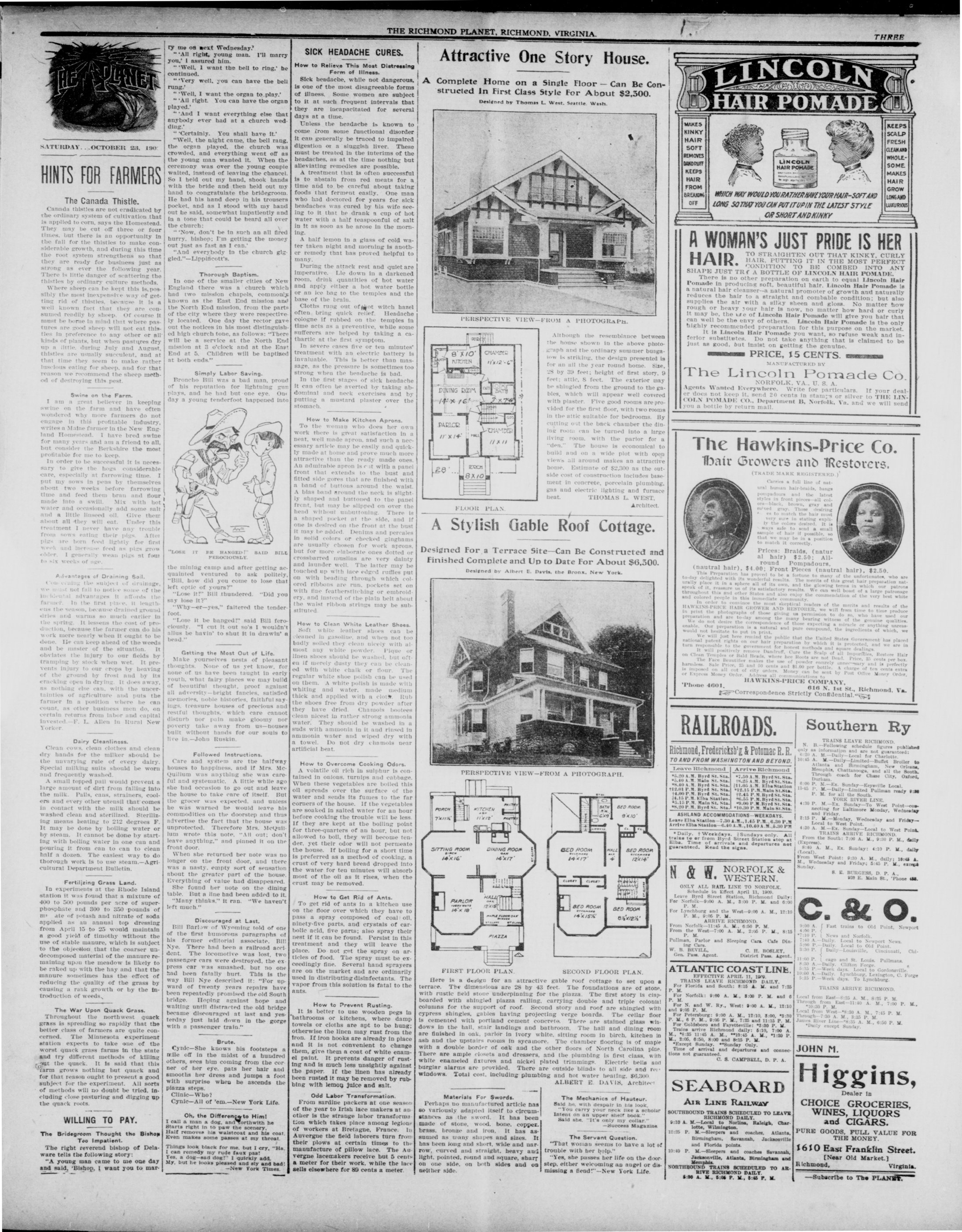
Attractive One Story House.
A Complete Home on a Single Floor - Can Be Constructed In First Class Style For About $2,500.
THE HOME OF THE HOME OF THE HOME
PERSPECTIVE VIEW-FROM A PHOTOGRAPH
A Stylish Gable Roof Cottage.
Designed For a Terrace Site—Can Be Constructed and Finished Complete and Up to Date For About $6,500. Designed by Albert E. Davies, the Bronx, New York.
THE HOME OF THE MAYFIELD MUSEUM
PERSPECTIVE VIEW-FROM A PHOTOGRAPH
PORCH
7'x11'4"
KITCHEN
BATH
11'x12'
PANTRY
PANTRY
SITTING ROOM
BIMEN
14'x16'
DINING ROOM
BIMEN
14'x17'
PARLOR
FIVET WIDE
14'x18'
HALL
OAK
12'x15'
MAPLE FLOOR OAK
ROOM
STYLE
PIAZZA
BATH
BATH
6'x9'
BED ROOM
9'x10'
CL
CL
BED ROOM
VICIUMS
14'x17'
HALL
BATH
4'
BED ROOM
EXCLAMATES
12'x14'
CLOSET
CLOSET
BED ROOM
EXCLAMATES
14'x15'
BED ROOM
8'x12'
Here is a design for an attractive gable roof cottage to set upon a terrace. The dimensions are 28 by 43 feet. The foundations are of stone, with rustic held stone underpinning for the plaza. The first story is cipapboard with shingled plaza rolling, carrying double and triple colonial columns for the support of roof. Second story and roof are shingled with cypress shingles, gables having projecting verge boards. The cellar floor is cemented with portland cement concrete. There are stained glass windows in the hall, stair landings and bathroom. The hall and dining room are finished in oak, parlor in ivory white, sitting room in birch, kitchen in ash and the upstairs rooms in sycamore. The chamber floor is of maple with a double border of oak and the other floors of North Carolina pine. There are ample closets and dressers, and the plumbing is first class, with white enameled fixtures and nickel plated trimmings. Electric bells and burglar alarms are provided. There are outside blinds to all side and rear windows. Total cost, including plumbing and hot water heating, $6,300.
FORAY
8' X 10'
KITCHEN
CHAMBER
11' X 12' - 6'
DINING ROOM
14' X 16'
BATH
7' X 76'
BATH
GROUND
PARLOR
11' X 14'
HALL
CHAMBER
11' X 11'
28'
ROOM
8 X 10
FLOOR PLAN
A Stylish Gabble
Designed For a Terrace Side
Finished Complete and Up
Designed by Albert E. D.
PERSPECTIVE VIEW—
PORCH
7×11'6"
KITCHEN
AISL
11×12'
PANTRY
SITTING ROOM
14×16'
DINING ROOM
14×17'
PARLOR
14×18'
HALL
12×15'
MAPLE FLOOR OAK
ROOM
PIAZZA
FIRST FLOOR PLAN.
Here is a design for an attractive terrace. The dimensions are 28 by 4 with rustic field stone underpinning floors boarded with shingled plaza rolling columns for the support of roof. See cypress shingles, gables having projects cemented with portland cement cows in the hall, stair landings and are finished in oak, parlor in ivory wash and the upstairs rooms in sycamore with a double border of oak and the There are ample closets and dressers, white enameled fixtures and nickel burglar alarms are provided. There are windows. Total cost, including plumbing.
Materials For Swords.
Perhaps no manufactured article has so variously adapted itself to circumstances as the sword. It has been made of stone, wood, bone, copper, brass, bronze and iron. It has assumed as many shapes and sizes. It has been long and short, wide and narrow, curved and straight, heavy and light, pointed, round and square, sharp on one side, on both sides and on neither side.
Although the resemblance between the house shown in the above photograph and the ordinary summer bungalow is striking, the design presented is for an all the year round home. Size, 28 by 39 feet; height of first story, 9 feet; attic, 8 feet. The exterior may be shingled from the ground to the gables, which will appear well covered with plaster. Five good rooms are provided for the first floor, with two rooms in the attic suitable for bedrooms. By cutting out the back chamber the dining room can be turned into a large living room, with the parlor for a "den." The house is economical to build and on a wide plot with open views all around makes an attractive home. Estimate of $2,300 as the outside cost of construction includes basement in concrete, porcelain plumbing, gas and electric lighting and furnace heat. THOMAS L. WEST.
The Roof Cottage.
—Can Be Constructed and
to Date For About $6,300.
Ivis, the Bronx, New York.
FROM A PHOTOGRAPH.
SECOND FLOOR PLAN.
We gable roof cottage to set upon a
feet. The foundations are of stone,
or the plaza. The first story is clap-
carrying double and triple colonial
and story and roof are shingled with
setting verge boards. The cellar floor
accret. There are stained glass win-
bathroom. The hall and dining room
white, sitting room in birch, kitchen in
re. The chamber flooring is of maple
other floors of North Carolina pine,
and the plumbing is first class, with
lated trimmings. Electric bells and
are outside blinds to all side and re-
ing and hot water heating. $6,300.
ALBERT E. DAVIS, Architect
The Mechanics of Hauteur.
Said he, with despair in his look,
"You carry your neck like a scholar
Intent on an upper shelf book."
Said she, "It's only my collar."
—Success Magazine
The Servant Question.
"That woman seems to have a lot of
trouble with her help."
"Yes, she passes her life on the door-
step, either welcoming an angel or dis-
missing a fiend!"—New York Life.
LINCOLN
HAIR POMADE
MAKES
KINKY
HAIR
SOFT
REMOVES
DANDRUFT
KEEPS
HAIR
FROM
BREAKING
OFF
LINCOLN
HAIR POMADE
KEEPS
SCALP
FRESH
CLEAN AND
WHOLE-
SOME
MAKES
HAIR
GROW
LONG AND
LUXURIOUS
WHICH WAY WOULD YOU RATHER HAVE YOUR HAIR-SOFT AND
LONG SO THAT YOU CAN PUT IT UP IN THE LATEST STYLE
OR SHORT AND KINKY
A WOMAN'S JUST PRIDE IS HER
HAIR. TO STRAIGHTEN OUT THAT KINKY, CURLY HAIR, PUTTING IT IN THE MOST PERFECT CONDITION TO BE COMBED INTO ANY SHAPE JUST TRY A BOTTLE OF LINCOLN HAIR POMADE
There is no other preparation on earth to equal Lincoln Hair Pomade in producing soft, beautiful hair. Lincoln Hair Pomade is a natural hair cleanser—a natural promoter of growth and naturally reduces the hair to a straight and combable condition; but also supplies the air with a silky sheen and gloss. No matter how you apply your hair is now, no matter how hard or curly it may be, the Lincoln Hair Pomade will give you hair that can well be the envy of others. Lincoln Hair Pomade is the only highly recommended preparation for this.
It is Lincoln Hair Pomade you want, so refuse weak and inferior substitutes. Do not take anything that is claimed to be just as good, but insist on getting the genuine.
PRICE, 15 CENTS.
MANUFACTURED BY
The Lincoln Pomade Co
NORFOLK, VA., U. S. A.
Agents Wanted Everywhere. Write for particulars. If your dealer does not keep it, send 20 cents in stamps or silver to THE LINCOLN POMADE CO., Department B, Norfolk, Va. and we will send you a bottle to return mail.
The Hawkins-Price Co. Hair Growers and Restorers.
(TRADE MARK REGISTERED.)
Carries a full line of natural human hair-braids, bangs pampouls and the latest styles in front pieces—all colors and textures, gray and mixed gray. Those desiring to match the hair must very sure in stating explicity the colors desired. It is easy to make a small sample of hair if possible so that we may be in a position to match it correctly.
Prices: Braids, (natur al hair) $2.50; All-round Pampouls
Found Press
(nautral hair), $4.00. Front
This Preparation has been a be a to-day delighted with its wonderful result, naturally place it in a sphere all of its own, speak of it, reassure us of its satisfactory through this and be the limitless care and colored people in our community. In order to convince the most skeptical HAWKINS-PRICE HAIR GROWER AND RI in print the photographs of those giving preparation and care to Jamaica. We do not desire the correspondence of the onable. Our preparation is a natural and would not hesitate to put in print. We will positively remove Dandruff, On Clean Towels and the Jamaican hair. The Face Beautifier makes the hair of harmless. Sale Price, 25 and 50 cents and is imposed on all of city orders. More or Express Money Order. Address all commons HAWKINS-PRICE
Phone 4601. Correspondence S
(nautral hair), $4.00; Front Pieces (nautral hair), $2.50.
This Preparation has proved to be a fortune to many of the unfortunate, who are today delighted with its wonderful results. The merits of this great hair preparation naturally put a sphere all of its own, and the glowing terms in which our patrons speak of it, reason and factory results. We can well boast of a large patronage throughout this and other States and have a commendation of the very best white and colored people in this immediate community.
In order to convince the most skeptical readers of the merits and results of the HAWKWELL HAIR GROWER and RESTORER, we will from time to time produce in print the pictures of those giving us permission to do so, who have used our preparation and are the only many bearing witness of the genuine qualities. We do not desire the correspondence of those expecting a miracle or anything unreasonable. Our preparation is a natural and pure compound, the ingredients of which, we would not hesitate to put in print.
Will just here remind the public that the United States Government has placed national public health on our hair preparation by which it is protected, and we are in turn responsible to the government for best methods and square dealings.
It will positively remove Dandruff, Care Itself Impurities, Restore Hair on Clean Temples or Bald Heads, where hee Roes are not Dead, Impurities per capita. The Face Beautifier makes the use of powder entirely unnecessary and is perfectly harmless on all out of city properties and $1.00 per bottle. A charge of ten cents extra is imposed on all out of city properties by Post Office Money Order, or Express Money Order. Address all communications to:
'Phone 4601. 616 N. 1st St., Richmond, Va.
'Correspondence Strictly Confidential.'
RAILROADS.
ASHLAND ACCOMMODATIONS - WEEKDAYS.
Leare Ebla Station - 7.30 A.M. 1.45 A.M. 6.30 P.M.
Arrive Ebla Station - 6.40 A.M. 1.45 A.M. 5.30 P.M.
*Daily. * Weekdays. * Sundays only. * All trains to or from Byid Street Station stop at Ebla Station. * Departures and departures not guaranteed. * Read the sign.
ONLY ALL RAIL LINE TO NORFOLK.
Schedule in Effect April 11, 1909.
Leave Byrd Street Station, Richmond Daily;
For Norfolk - 9:00 A. M. 3:00 P. M. and 6:00
P. M.
For Lynchburg and the West-9:00 A. M., 12:10 P. M., 9:05 P. M.
Pullman, Parlor and Sleeping Cara. Cafe Dining Cars.
ATLANTIC COAST LINE.
INTEGRATIVE AFFILIATE
TRANSFER TO BAYMONT DAILY.
Florida and South: 8:15 A. M. and 7:25
P. M.
For Norfolk: 9:00 A. M., 8:00 P. M. and 6
P. M.
For N. and W. RY., West: 9:00 A. M., 12:10
and 9:05 P. M.
For Petersburg: 9:00 A. M., 12:10, 3:00 *3:30
P. M, 6 P. M, 9:06 P. M, 7:25 and 11:15 P. M.
Goldbobar and Fayetteville: *2:30 P. M.
Trainer, Goldbobar and Fayetteville: 6:10, 7:00
P. M, *8:35 11:45 A. M., *10:45 A. M., *12:00 P. M,
2:05, 6:50, 8:00 and 8:15 P. M.
*Except Sunday. *Sunday Only.
Time of arrival and departures and con-
nections not guaranteed.
C. S. CAMPBELL, D. P. A.
SEABOARD
SOUTHBOUND TRAINS SCHEDULED TO LEAVE
RICHMOND DAILY.
9:10 A. M.-Lewal to Norina, Raleigh, Char-
lotte, Wilmington.
12:25 P. M.-Sleepers and coaches, Atlanta,
Birmingham, Savannah, Jacksonville
and Florida points.
10:40 P. M.-Sleepers and coaches Savannah,
Jacksonville, Atlanta, Birmingham and
Memphis.
NORTHBOUND TRAINS SCHEDULED TO AR-
RIVE RICHMOND DAILY.
6:30 A. M., 6:36 F. M., 6:45 F. M.
MAKES
KINKY
HAIR
SOFT
REMOVES
DANDRUFF
KEEPS
HAIR
FROM
BREAKING
OFF
.
Pieces (nautal hair), $2.50.
fortune to many of the unfortunate, who are
The merits of this great hair preparation nat-
ure and the glowing terms in which our patrons
uits. We can well boast of a large patronage
the commendation of the very best white
unity. Real readers of the merits and results of the
NUTER, we will from time to time produce
a potion to have used our oxy-
bearing witness of the ginniess qualities
hose expecting a miracle or anything unre-
sure compound, the ingredients of which, we
that the United States Government has placed
on by which it is protected, and we are in
inst methods and square dealings.
Potions are not Dead. Piquant, pectin, restore Hair
Roots are not Dead. Piquant, pectin, per cent per box
powder entirely unnecessary and is perfectly
1.00 per bottle. A charge of ten cents extra
can be sent by Post Office Money Order,
unications
CE COMPANY.
616 N. 1st St., Richmond, Va.
Strictly Confidential.
Southern Ry
TRAINS LEAVE RICHMOND
N. R.-Following schedule figures published only as information and are not guaranteed:
Charlotte,
10:45 A. M.-Dallas-Limited-Harlem to Atlanta and Birmingham, New Orleans, Memphis Chattanooga, and all the South. Team coach for Chattanooga, Oxford, Durham.
6:00 P. M.—Ex. Sunday—Keyaville Local.
11:45 P. M. Dollard Local.
11:15 P. M. Daily-Limited Pullman ready 9:20
P. M. New York River LINE.
4:30 P. M. Ex. Sunday-To West Point-connecting
Littalmore West, Wednesday
and Friday.
2:15 P. M.—Monday, Wednesday and Friday
—Local to West Point.
From the South: 7:00 A. M., 9:30 P. M., daily (Express).
8:40 A. M., Ex. Sunday: 4:10 P. M., daily (Local).
[Local]
West Point: 9:30 A. M., daily, 10:30
M. Wednesday and Friday; 5:45 P. M., except
Saturday.
C. & O. 9:00 A. [ Fast trains to Old Point, Newport
Fast trains to Old Point, Newport
4:00 P.
*7:10 P. News and Norfolk.
7:40 A.-Daily. Local to Newport News.
5:00 P.-Daily. Local to Old Point.
3:30 P.-Daily-Louisville, Cincinnati, Chi-
11:00 P. cage and St. Louis. Pullmans.
8:30 A.-Daily. Clifton Forge.
5:10 P.-Week days. Local to Gordonville.
10:00 A.-Daily. Lynchburg, Lexington, C. Forge
5:15 P.-Week days. To Lynchburg.
TRAINS ARRIVE RICHMOND.
Local from East--8:25 A. M., 8:25 P. M.
Through from East--11:40 A. M., 7:00 P. M.,
10:30 P. M.
From West--8:50 A. M., 7:45 P. M.
Through--7:30 A. M., 3:25 P. M.
James River Line--8:53 A. M., 6:50 P. M.
*Daily except Sunday.
JOHN M.
Higgins,
Dealer in
CHOICE GROCERIES,
WINES, LIQUORS
and CIGARS.
PURE GOODS, FULL VALUE FOR
THE MONEY.
Subscribe to The PLANET.
THREE
KEEPS
SCALP
FRESH
CLEAN AND
WHOLE-
SOME
MAKES
HAIR
GROW
LONG AND
LUXURIOUS
[Name]
S. E. BURGESS, D. P. A.
920 E. Maid. St., Phone
FOUR
THE PLANET
TERMS IN ADVANCE.
One Copy, one year, - - - - - $1.50
One Copy, eight months, - - - - - 1.00
One Copy, six months, - - - - - .80
One Copy, four months, - - - - - .50
One Copy, three months, - - - - - .40
Single Copy, - - - - - .05
ADVERTISING RATES
than price is $1.50 per year in advance.
There are four ways by which money can be given to a Post Office, by Bank Check or Draft, or an Express Money Order, and when none of these can be incurred, Registered Letter, a Money Order at your Post Office, payable at the Richmond Post Office and we will be responsible for your late arrival.
MONEY ORDERS can be obtained at any office of the American Express Co., the United States Express Co., and the Wells's Fargo and Oda. Express Company. We will be responsible for money sent by any of these companies, and we will be safe and convenient way for forwarding money.
REGISTERED LETTER—If a Money Order, Post Office or an Express Office is not written, we will send you a Letter you wish to send us on payment of ten cents. Then, if the Letter is lost or stolen, it can be traced. You can send money in this way. We cannot be responsible for money sent in letters in any other way than one of the four ways mentioned above. If you send your money in any other way, you must do it at your own
RENEWALS, ETC.—If you do not want THE PLANET continued for another year after your subscription has run out, you then notify us by e-mail, and we will decide that subscribers to newspapers who do not order their paper discontinued at the expiration of time for which it has been paid are up to date when we oerl r the paper discontinued.
COMMUNICATIONS—When writing to us to request your subscriber or to discontinue your paper, you should give in full otherwise we cannot find your name on our books.
ADDRESS OF SUBSCRIBER—In order to change the address of a subscriber, we must send the former as well as the present address.
DR. WASHINGTON IN THE OUTLOOK.
In reading the very interesting accounts of Dr. Booker T. Washington on "The story of the Negro," an published in the New York Outlook it will be well to note that this distinguished educator has marshalled his facts in a manner of a two horse team. He has harnessed the civilized Negro with the uncivilized one, showing the commendable traits of character and meritorious achievements of both.
He skillfully avoids offending the white men of the South and at the same time he side-steps all questions that might embarrass the white men of the North. To our mind, this grouping of events and dealing with measures are the products of a master-mind drilled in the school or experience to a far greater extent than it has been trained in the school of science.
Here he is at his best in dealing with the African question in Africa, just as though he had eaten and slept upon the soil of the Negro's motherland.
"Nothing, perhaps," says Professor Franz Boas, "is more encouraging than a glimpse of the artistic industries of the native African." A walk through the African museums of Paris and London and Berlin is a revelation. I wish you could see the scepters of African kings, carved of hardwood and representing artistic form; or the dainty basketry made by the people of the Congo River and of the region of the Great Lakes of the Nile, or the grass mats of their beautiful patterns.
"Even more worthy of our admiration," he continues, "is the work of the blacksmith who manufactures symmetrical lance-heads almost a yard long, or axes inlaid with copper and decorated with filigree. Let me also mention in passing the bronze castings of Benin and the West Coast of Africa, which, although perhaps due to Portuguese influences, have so far excelled in technique any European work that they are even now almost inimitable."
"The blacksmith seems to occupy a very important place in the social life of Africa. Travelers have found these smiths at work in the most remote and inaccessible parts of the continent, where they may be seen collecting the native iron and copper ores, smelting and reducing them, and then working them in their primitive forges into hoes, knives, spear and arrow heads, battle-axes, woodworking tools, rings, and hatchets.
"Just as everywhere in the Southern States today, especially in the country districts, at the crossroads or near the country store, one finds the Negro blacksmith, in so some of the remote regions in Africa every village has according to its size, from one to three blacksmiths. Each man has an apprentice, and his art is a craft secret most zealously guarded. "Samuel P. Verner, a Southern white man and missionary of the
Southern Presbyterian Church, says in his book "Pioneering in Central Africa" of these blacksmiths:
"The proficiency of some of these men is astonishing. I frequently have my work done by them, and their skill amazes me. They have the art of tempering copper as well as of making soft steel. Some of the objects of their craft which I placed in the National Museum at Washington are revelations to the uninitiated in their remarkable complexity and variety.
"Mr. Verner's mission station was in the Congo Free State, on the upper courses or the Kasai, in the heart of savage Africa, where the people have never been touched by the influences of either the European or Mohammedan civilizations. Speaking of the carving and wood-working of some of these tribes, Mr. Verner says:
"Some of these Africans are wonderfully adept. They can produce a geometrical figure whose perfection is amazing. Their tools are of the simplest, yet they can carve figures of men and animals, pipes, bowls, cups, platters, tables, and fantastic images. I saw a chair carved out of a solid block of ebony. Their work in ivory is also rare and valuable, and I believe their talent in those lines ought to be developed.
It seems that contact with the white man has caused the Negro to deteriorate in the arts, even if it has improved him in the sciences. No where in the United States to day can be found Negroes who can produce this handiwork of the Dark Continent. He says further:
"Throughout West Africa, wherever the European has not established his trading factory, the native market is an institution which is a constrain source of surprise to travelers. These markets are the native clearing-houses for the produce of the soil and the fabricated articles of the land. They are generally the center of the trading operations of a district ranging from ten to thirty miles. Here will be seen vegetables and fruit, poultry, eggs, live plops, goats, salt of their manufacture, pettery or their own make, strips of cloth, grass-woven mats, baskets, and specimens of embroidery and art work, besides numberless other articles of various sorts and kinds which are essential to African comfort, and well-being. From the small group of native merchants who travel with their wares within a radius of thirty or fifty miles, to the large caravans of the Hausa traders who cross the Desert of Sahara, and at times reach the eastern and western confines of the continent, everywhere in Africa the black man is a trader.
"Among the more primitive tribes, the village markets are confined to two or three hundred buyers or sellers, but in the greater markets, like those of Kano and Upper Nigeria, twenty or thirty thousand traders will be gathered together at certain seasons of the year. It is an interesting fact, as indicating the African's interest in trade, that in many tribes the market-place is considered sacred ground, and, in order that trade may be carried on there without interruption, no strife is permitted within its precincts.
Professor Boas, writing in 1904, said:
"The Negro all over the African continent is either a tiller of the soil or the owner of large herds; only the Bushmen and a few of the dwarf tribes of Central Africa are hunters. Owing to the high development of agriculture, the density or population of Africa is much greater than that of primitive America, and consequently the economic conditions of life are more stable."
It may be safely said that the primitive Negro community, with its fields that are tilled with iron and wooden implements, with its domesticated animals, with its smithers, with its expert wood-carvers, is a model of thrift and industry, and compares favorably with the conditions of life among our own ancestors.
It is the commercial traits which develop a people and in this day and time make a nation. Colored people here are slowly, but surely learning this. The disposition to serve the white man in a servile capacity, rather than work for one's self in an employing capacity is the weakness of a race. We are raising an army of youngsters, whose lives are well-nigh useless in the direction of elevating their own race or people who now, more than ever needs their services.
Dr. Washington could not go far without throwing a bouquet at the southern white man. So far as it relates to the better classes down here, it is well deserved. Here is what he says:
"It is just as true in America as it is in Africa that those who know the Negro intimately and best have been as a rule kindest and most hopeful in their judgments of him. This may seem strange to those who get their notion of the Southern white man's opinion of the Negro from what they see in the press and bear from the platform, during the heat of a political campaign, or from the utterances of men who for one reason or another have allowed themselves to become embittered. Southern opinion of the Negro, particularly as it finds expression in the press and on the platform, is largely controversial. It has been influenced by the fact that for nearly a hundred years the Negro has been the football in a bitter political contest, and there are a good many Southern politicians who have acquired the habit of berating him. The Negro in the South has had very little part in this controversy, either before or since the war, but he has had a chance to hear it all, and it has often seemed to me, if, after all that has taken place, the Negro is still able to discuss his situation calmly, the white man should be able to do so also. But that is another matter.
Where will you find in the realm of logic better illustrations of the points or ideas that Dr. Washington
THE RICHMOND PLANET, RICHMOND, WIRGINIA
wishes to convey? He has reasoned the matter out in such a practical style and manner that even a child may understand. He then calls his intent diplomacy into positive action and soothes the feelings of even the Negro's harshest critics. Here is how he does it:
"Nineteen times out of twenty, I suppose, a stranger coming South who inquires concerning the Negro from people he meets on the train or on the highways will get from these men pretty nearly the same opinion he has read in the newspapers or heard in political speeches. These criticisms of the Negro have been repeated so often that people have come to accept and repeat them again without reflection. The thing that shows this to be true is that the very men who denounced all Negroes are very likely before the conversation is added tell of one and perhaps halt a dozen, individual Negroes in whom they have the greatest confidence.
"A Southern white man may tell you, with the utmost positiveness, that he never knew a single Negro who would not steal—except one. Every white man knows one Negro who is all right—a model of honesty industry, and thrift—and, if he tries to remember, he will think of other Negroes in whom he has the greatest confidence and for whom he has a very genuine respect. Considering that there are a good many more white people in the South than there are Negroes, it seems to follow, logically, that, in spite of what one hears about the Negro in general, there are a good many individual Negroes who are pretty well thought of by their white neighbors.
"It is well to take into consideration, also, that when Southern people express their confidence and their respect for an individual black man, they are speaking of one whom they know; on the contrary, when they denounce in general terms the weakness and the failure of the Negro race, they have in mind a large number of whom they know a great deal less.
Dr. Washington then proceeds to show the martial or war-like spirit of the Negro race by tracing their origin to the leading tribes of the Dark Continent. He says:
"I do not mean to suggest that there is no justification of the criticism of the Negro that one often hears in the South. I have never thought or said that the Negro in America was all that he should be. It does seem to me, however, that the Negro in the United States has done, on the whole, as well as he was able, and as well as, under all the circumstances, could be reasonably expected."
He then traces the history of these Africans as follows:
"Several peoples, of strikingly different characteristics, contributed to form the several loosely connected states which now form the British Colony of Northern Nigeria, of which Kano is the principal city. The most important and interesting of these are the Hausas and the Fulahs, or Fellani, as they are sometimes called. The Fulahs are noted for their military spirit; the Hausas for their commercial enterprise. One has a light complexion, and the other is dark.
"The Fulahs are an equestrian people, with a cavalry, armed with lances and swords. They are zealous Mohammedans, with a knowledge of how to "divide and govern." Their independent character is described by the proverbial saying that "a Fulah man slave will escape or kill his master, and that a Fulah girl slave will rule the harem or die. The Hausas are superior to the Fulahs in the arts of peace. They are possessed or unusual industry, judgment, and intelligence, and have a considerable degree of literary taste. The Hausas carry on the internal trade of the North and Central Sudan. They are well clothed, and have many well-built cities with populations sometimes of from twenty to sixty thousand. Birth in describing Kano, which is, perhaps, to West Africa what Chicago is to the United States, what he commanded on horseback, "rode for several hours round all the inhabited quarters, enjoying at his leisure from the saddle the manifold scenes of public and private life, of comfort and happiness, of luxury and misery or industry and indolence, which were exhibited in the streets, the market-places, and in the interior of the courtyards." Here he saw "a row of shops filled with articles of native and foreign produce, with buyers and sellers in every variety of figure, complexion, and dress." Now an "open terrace of clay with a number of dye-pots and people busily employed in various processes of their hand-craft; here a man stirring the juice and mixing with indigo some coloring wood in order to give it the desired tint, there another drawing a shirt from the dye-pot, there two men beating a well-dyed shirt;" farther on. "a blacksmith busy with his tools in making a dagger, a spear, or the more useful ornaments of husbandry;" and, in another place, "men and women hanging up their cotton thread for weaving."
It will be seen that he has shrewdly confined his researches to "that portion of Africa from which our American slaves were taken." You may say what you will about Booker T. Washington, but a shrewdier, more diplomatic, wiser citizen of color never breathed the air of life upon the American continent. At one time he is open to criticism; at another to wonder.
In the issue of the Outlook under date of September 11, 1909, and under the caption of "The Negro's Life in Slavery," he says:
The market of Kano, said to be the largest in Africa, is celebrated for its cotton cloth and leather goods. Traditions of Kano go back over a thousand years. It is surrounded by walls of sun-dried clay from twenty to thirty feet high and fifteen miles in circumference.
"The greatest chieftain that ever ruled in West Africa. Mohammed Askia, lived in Kano. He became ruler in 1492 and held sway over a region probably as large as the German Empire. Barth tells us that Mohammed Askia was an example of the highest degree to which Negroes have attained in the way of political administration and control. His dynasty, which was entirely or native descent, is the more remarkable if we consider that this Negro king was held in the highest esteem and veneration by the most learned and rigid Mohammedans. Not only did he consolidate and even extend his empire, but he went in 1495 as a pligrimage to Mecca accompanied by 1,500 armed men, 1,000 on food and 500 on horseback, and founded there a charitable institution. He extended his conquests far and wide from what is now the center of Nigeria, westward almost to the borders of the Atlantic Ocean and northward to the south of Morocco. Askia governed the subjected tribes with justice and equity. Everywhere within the borders of his extensive dominions his rule spread well-being and comfort.
"The career of Mohammed Askai is possibly the best example of the influence of Afrikanismanism on that portion of Afrikanism which our American slaves were taken."
Now here is another display of his wisdom and another exhibition of his diplomacy. He seems to be fearful less he was "swung out too far in commending the Negro, and he comes back by charging that the Negro was in a measure responsible for his own enslavement. This will necessarily cause a protest from the citizens of color, who have alligned themselves in the anti Booker T. Washington brigade. They will charge him with trimming, or hedging. This might be true of a ward politician, but it enjoys the designation of diplomatic correspondence in the higher realm of genuine statesmanship. So we will simply say that Dr. Washington is diplomatic in the use of language. He essays to make a distinction with a difference when he says:
"Some years ago one of the frequent subjects of discussion among the white people and the colored people was the question. Who was responsible for slavery in America? Some people said the English Government was the guilty party, because England would not let the colonies abolish the slave trade when they wanted to. Others said the New England colonies were just as deep in the mire as England or the Southern States, because for many years a very large share of the trade was carried on in New England ships.
"As a matter of fact, there were, as near as I have been able to learn, three parties who were directly responsible for the slavery of the Negro in the United States.
"First of all, there was the Negro himself. It should not be forgotten that it was the African who, for the most part, carried on the slave raids by means of which his fellow-African was captured and brought down to the coast for sale. When, some months ago, the Liberian embassy visited the United States, Vice-President Dossen explained to me that one reason why Liberia had made no more progress during the eighty-six years of its existence was the fact that for many years the little State had engaged in a life-and-death struggle with native slave-traders, who had been accustomed for centuries to ship their slaves from Liberian ports and were unwilling to give up the practice. It was only after the slave trade had entirely ceased, he said, that Liberia had begun to exercise an influence upon the masses of the native peoples within its jurisdiction.
The second party to slavery was the lave-trader, who at first as a rule was an Englishman or a Northern white man. During the Colonial period, for instance, Newport, Rhode Island, was the principal headquarters of the slave trade in this country. At one time Rhode Island had one hundred and fifty vessels engaged in the trade. Down to 1860 Northern capital was very largely invested in the slave trade, and New York was the port from which most of the American slave smugglers fitted out.
Finally, there was the Southern white man, who owned and worked the bulk of the slaves, and was responsible for what we now ordinarily understand as the slave system. It would be just as much a mistake, however, to assume that the South was ever solidly in favor of slavery as it is to assume that the North was always solidly against it. Thousands of persons in the Southern States were opposed to slavery, and numbers of them, like James G. Birney, of Alabama, took their slaves North in order to free them, and afterward became leaders in the anti-slavery struggle.
He then skillfully inserts the acc count of the dark side. Here it is:
"As with every other human thing there is more than one side to slavery, and more than one way of looking at it. For instance, as defined in the slave laws in what was known as the Slave Code, slavery was pretty much the same at all times all over the South. The regulations imposed upon master and upon slave were, in several particulars, different for the different States. On the whole, however, as a legal institution, slavery was the same everywhere.
"On the other hand, actual conditions were not only different in every part of the country, but they were likely to be different on every separate plantation. Every plantation was, to a certain extent, a little kingdom by itself, and life there was what the people who were bound together in the plantation community made it. The law and the custom of the neighborhood regulated, to a certain extent, the treatment which the master gave his slave. For instance, in the part of Virginia where I lived both white people and colored people looked with contempt upon the man who had the reputation of not giving his slaves enough
to eat. If a slave went to an adjoining plantation, for something to eat, the reputation of his master was damned in that community. On the whole, however, each plantation was a little independent state and one master was very little disposed to interfere with the affairs of another. The account that one gave of slavery from the laws that were passed for the government of slaves shows that institution on its worst side. No harser judgment was ever passed on slavery, so far as I know, than that which will be found in the decision of a justice of the Supreme Court of North Carolina in summing up the law in a case in which the relations of master and slave were defined.
"The case I refer to, which was tried in 1829, was one in which the master, who was the defendant, was indicted for beating his slave. The decision which acquitted him affirmed the master's right to inflict any kind of punishment upon his slave short of death. The grounds upon which this judgment was based were that in the whole history of slavery there had been no such prosecution of a master for punishing a slave, and, in the words of the decision "against this general opinion in the community the court could not hold.
"It was a mistake, the decision continued, to say that the relations of the master and slave were like those of a parent and child. The object of the parent in training his son was to render him fit to live the life of a free man, and, as a means to that end, he gave him moral and intellectual instruction. In the case of the slave it was different. There could be no sense in addressing moral considerations to a slave."
This is a glimpse of the terrible truth, that which is so vividly and eloquently displayed in Harriet Beecher Stowe's life's work, "Uncle Tom's Cabin." He says:
"There was a very great difference between the life of the slave on the small plantations in the uplands and upon the big plantations along the coasts. To illustrate, the plantation upon which I was born, in Franklin County, Virginia, had, as I remember, only six slaves. My master and his sons all worked together side by side with his slaves. In this way we all grew up together, very much like members of one big family. There was no overseer, and we got to know our master and be to know us. The big plantations along the coasts were usually carried on under the direction of an overseer. The master and his family were away for a large part of the year. Personal relations between them could hardly be said to exist.
John C. Calhoun, South Carolina's greatest statesman, was brought up on a plantation not very different from the one upon which I was raised. One of his biographers relates how Patrick Calhoun, John C. Calhoun's father, returning from his legislative duties in Charleston, brought home on horseback behind him a young African freshly imported in some English or New England vessel. The children in the neighborhood, and, no doubt, some of the older people, had never before seen a black man. He was the first one brought into that part of the country. Patrick Calhoun gave him the name of Adam. Some time later he got for him a wife. One of the children of the black man, Adam, was named Swaney. He grew up on the plantation with John C. Calhoun, and was for many years his playmate.
"The conditions of the Negro slave were harder on some of the big plantations in the far South than they were elsewhere. That region was peopled by an enterprising class of persons, of whom many came from Virginia, bringing their slaves with them. The soil was rich, the planters were making money fast, the country was rough and unsettled, and there was undoubtedly a disposition to treat the slaves as mere factors in the production of corn, cotton, and sugar.
"And yet there were plantations in this region where the relations between master and slave seem to have been as happy as one could ask or expect under the circumstances. On some of the large estates in Alabama and Mississippi which were far removed from the influence of the city, and sometimes in the midst of the wilderness, master and slaves frequently lived together under conditions that were genuinely patriarchal. But on such plantations there was, as a rule, no overseer."
"As an example of the large plantations on which the relations between master and slave were normal and happy I might mention those of the former President of the Confederacy, Jefferson Davis, and his brother Joseph Davis, in Warren County, Mississippi."
"The history of the Davis family and of the way in which their plantations, the "Hurricane" and "Brierfield," came into existence is typical. The ancestors of the President of the Confederacy came originally from Wales. They settled first in Georgia, emigrated thence to Kentucky, and finally settled in the rich lands of Mississippi. In 1818 Joseph Davis, who was at that time a lawyer in Vicksburg, attracted by the rich bottom-lands along the Mississippi, took his father's slave and went down the river, thirty-six miles below Vicksburg, to the place which is now called "Davis's Bend." There he began clearing the land and preparing it for cultivation.
At that time there were no steamboats on the Mississippi River, and the country was so wild that people traveled through the lonely forests mostly on horseback. In the course of a few years Mr. Davis, with the aid of his slaves, succeeded in building up a plantation of about five thousand acres, and became, before his death, a very wealthy man. One day he went down to Natchez and purchased in the market there a young negro who afterward became known as Ben Montgomery. This young man had been sold South from North Catolina and because perhaps, he had heard, as most of the slaves had, of the hard treatment that was to be expected on the big, onesome plantations, had made up his body to remain in the city. The first thing he did, therefore, when Mr. Davis brought him home, was to run away. Mr. Davis succeeded in
I think I owe it to my fellow man to send them a copy in confidence so that any man anywhere who is weak and discouraged with repeated failures may stop drugging himself with harmful patent medicines, secure what I believe is the quickest acting restorative, upbuilding, SPOTTOUCHING remedy ever devised, and so cure himself at home quietly and quickly. Just drop me a line like this: Dr. A. E. Robinson, 3895 Luck Building, Detroit, Mich., and I will send you a copy of this splendid recipe in a plain ordinary envelope free of charge. A great many doctors would charge $3.00 to $5.00 for merely writing out a prescription like this—but I send it entirely free.
"The "Boston American," which is perhaps the leading real estate newspaper of Massachusetts, is reviewing present tendencies on the line of physical development throughout the entire nation.
CHOICE RESIDENCE SECTION IN SOUTH
Glen Allen, in Virginia, Is Being Developed on Large Scale for Home-
A pleasant spot which unites the charm and wholesomeness of country life with city advantages and which, in a little while, is expected to be the capital's choice residential district, is Glen Allen, Virginia, one of the beauty places of the South. Glen Allen is a natural park and forty years of forestry have done the preliminary work for its residential development. The sale of this property, dotted with pretty villas and having eight or nine miles of private avenues and shady lawns is now being conducted by Captain John Cussons, of Glen Allen and many in the North have become interested in the location.
It is situated only twenty minutes from Richmond and on the connecting link between two great railway systems. Thousands of travelers pass Glen Allen daily, many of them describing it as the Deer Park, from the herds of deer which roam over its ample grounds. It is also the seat of Forest Lodge, which is a spacious mansion of a hundred rooms, and situated in a beautiful park fronting the railway station. The growth of Richmond is helping to increase Glen Allen's popularity, for with the changing of the larger city its choice suburb is reaping benefits from investors and home buyers desirous of living out of the city and the latter are securing a beautiful location for an ideal home
This is to certify that I have received from John Mitchell, Jr.
Grand Chancellor of the Grand
Lodge of Virginia, Knights of Pythias,
N. A., S. A., E., A., A. and A.,
($150.00) One Hundred and Fifty
Dollars in payment of the death-
claim of Brother John Canaday, who was a member of Cavalier Lodge,
No. 56, of Newport News, Va.
Signed: MRS. CORA L. CANADAY,
Guardian.
Persell Canaday,
Sadie L. Canaday.
Witnesses:
This is to certify that I have received from John Mitchell, Jr.,
Grand Chancellor of the Grand
Lodge of Virginia, Knights of Pythias,
N. A., S. A., E., A. A, and A.,
($150.00) One Hundred and Fifty
Dollars in payment of the death-
claim of Brother James Dalton, who
was a member of Douglass Lodge,
No. 69, of Martinsville, Va.
Signed: AMANDA DALTON.
Beneficiary.
The Richmond PLANET can be purchased from our agent Mr. I. J. Holden, 974 Ferry Avenue, Camden, N. J.
getting hold of him again, brought him back to the plantation, and then as Isaiah, Benjamin Montgomery's son, has told me, Mr. Davis "came to an understanding" with his young slave.
"Just what that understanding was no one seems now to know exactly, but in any case, as a result of it, Benjamin Montgomery received a pretty fair education, sufficient, at any rate, to enable him in after years, when he came to have entire charge, as he soon did, or Mr. Davis's plantation, to survey the line of the levee which was erected to protect the plantation from the waters of the Mississippi, to draw out plans, and to compute the size of buildings a number of which were erected at different times under his direction."
Dr. Washington is careful not to disturb the nicely balanced scales which he has so skillfully adjusted. It will be seen that he soothes the feelings of the rabid southernners and pours out the unction of his praise even upon the ancestors as well as the person of Jefferson Davis, one time President of the Southern Confederacy. He then shows that the foundation of the South's prosperity is the Negro's labor. Here is what he says:
"The four great crops of the South—tobacco, rice, sugar, and cotton—were all raised by slave labor. In the early days it was thought that no labor except that of the Negro was suited to cultivate these great staples of Southern industry, and that opinion prevails pretty widely still. But it was not merely his quality as a laborer that made the Negro seem so necessary to the white man in the South; it was also these other qualities to which I have referred—his cheerfulness and sympathy, his humor and his fidelity. No one can honestly say that there was anything in the nature of the institution or slavery that would develop these qualities in a people who did not possess them. On the contrary, what we know about slavery elsewhere leads us to believe that the system would have developed qualities quite different, so that I think I am justified in saying that most of the things that made slavery tolerable, both to the white man and to the black man, were due to the native qualities of the African.
Here he is again paying another attribute to his own race. It will be seen that before he is through with his recital that he has woven a masterful story in behalf of his own race. He has the conservative men of the white race in this country on the stage in the rear of him as hearers, with the world in front of him for an audience. We have no doubt given too much now and we shall continue our review in our next is-
We received a programme of the Forty- sixth Anniversary of the Shiloh Baptist Church, of Washington, D. C., Rev. J. Milton Waldron, D. D., Pastor. The exercises were conducted all of this week and the Indications are that the able divine has thoroughly mastered the situation and is leading his flock in a mastery manner.
15 YEARS' SAVINGS STOLEN
Economic Farm Hand Loses $1155 to Sneak Thief.
Mount Holly, N. J., Oct. 20.—By hard work and strict economy in fifteen years Jacob Wessel, a farm hand, managed to save $1155, which he kept in a trunk in his room at the home of Ezra Scattergood, near Columbus.
Before going out to milk at 4 a. m. Wessel looked at his wealth, but when he returned he found his trunk broken open and his money gone. A ladder at the window told him all the knows so far of his stolen fortune.
CONVICT KILLED
He Had Served All But One Year of Long Sentence.
Auburn, N. Y., Oct. 20—After serving all but one year of a twenty-nine-year sentence for rape, Arthur McAllister, a convict from Chemung county, was accidentally killed at the Auburn prison by falling from a scaffold. He was engaged in putting a new roof on the prison kitchen and fell, striking on his head and fracturing his skull.
Wife's Love Worth $25
Lancaster, Pa. Oct. 20.—Wives' affections are not valued very highly by Lancaster county juries. M. B. Redding, of Reemstown, was awarded $25 damage from H. F. Eberly, of the same place, whom he had prosecuted for alienating his wife's affections. Redding's wife was employed in Eberly's box factory. It was alleged by Redding that they became too friendly, and that Mrs. Redding bestowed all her attentions upon the box manufacturer.
The average consumption of beer throughout the German empire works out at about three-quarters of a pint a day for each person.
$100.00 Endowment Paid
Norfolk, Va., October 18, 1909.
This is to certify that I have received from John Mitchell, Jr. Grand Worthy Counsellor of the Grand Court of Virginia, Order of Calanthe ($100.00) One Hundred Dollars in payment of the death-claim of Sister Grace Roane, who was a member of Victoria Court, No. 52, of Norfolk, Va.
Signed: WILLIAM DREWRY,
Beneficiary.
Witnesses:
Annie Monroe, W. C.,
Eliza Bright, R. D.,
Cornelius Skinner.
$3.50 RECIPE CURES WEAR
MEN-FREE
Send Name and Address Today—You Can Have It Free and Be Strong and Vigorous.
I have in my possession a prescription for nervous debility, lack of vigor, weakened manhood, falling memory and lame back, brought on by excesses, unnatural drains, or the tollies of youth, that has cured so many worn and nervous men right in their own homes—without any additional help or medicine—that I think every man who wishes to regain his manly power and virility, quickly and quietly, should have a copy. So I have determined to send a copy of the prescription free of charge, in a plain, ordinary sealed envelope to any man who will write me for it.
This prescription comes from a physician who has made a special study of men and I am convinced it is the surest acting combination for the cure of deficient manhood and vigor failure ever put together.
Here is its allusion to Virginia;
Seekers.
$150.00 Endowment Paid
Newport News, Va., Oct. 8, 1909.
J. H. Ridley, M. of F., Samuel Parker, J. C. Allen, D. D. G. C.
$150.00 Endowment Paid
Martinsville, Va. 1909
L. F. Flood, M. of W. James L. Hill, G. Dept. Frank Harper.
—Subscribe to The PLANET
THE MECHANICS' SAVINGS BANK
The Modern Burglar and Fire=proof Vault With Its Steel Lining and Burglar=proof Round=door Will Be a Wonder.
NOW OFFERS TO THE PUBLIC the facilities which it possesses for the safe-keeping of money, jewels, insurance papers, deeds, wills, stocks, bonds, and all valuables of whatever description at a reasonable cost. It holds choice real-estate, of which it will dispose on long time payments. It requests the patronage of the small depositor and the favor of the large one. Interest paid on all time deposits, remaining (60) sixty days and over.
PERSONS WHO HAVE BEEN UNEASY ABOUT THEIR DEEDS, INSURANCE PAPERS AND THE LIKE, will breathe a sigh of relief when they transfer them to the vault of the Bank, where they know that they are safe from fire and theft. There is a specimen SAFETY DEPOSIT BOX at THE MECHANICS' SAVINGS BANK, which THE CASHIER OR THE TELLER WILL show you and either will explain its workings. The stock of the MECHANICS' SAVINGS BANK is now selling above par--to be exact it
[Picture of a man in a robe, holding a staff].
NOW OFF
ities which it
money, jewels
stocks, bonds,
scription at a
It holds cho
dispose on lom
the patronage
favor of the l
time deposits,
over.
The Mo
Lining
PERSON'S
ABOUT THEIR
AND THE LIN
when they tr
Bank, where
from fire and
There is
BOX at THE
which THE C
show you and
The stock
BANK is now
7
```markdown
```
Colored Man is Still Champion
Continued from the First page.
by a sword thrust. Johnson fell like a clown, and it is little wonder that the busybodies around one ring were saying that the knockdown was bogus.
Anyhow, it is registered in the pictures for what it is worth, and will possibly add to their value as a show asset. Thousands and thousands went to see the shadowgraphs of Battling Nelson and Joe Gans at Goldfield over and over again with the object of enabling themselves to form an opinion as to the genuineness or otherwise of the foul claimled asses. Like many the amiably hordes of people will visit and revisit the Ketchel-Johnson pictures in order to determine whether Johnson sprawled in earnest when Ketchel nabbed him on the mastoid.
A point in Johnson's favor was that Referee Welsh thought the knock-down a fair one.
"Johnson was inclined to fool around too much, and I think Kachel slipped one over on him" said the referee.
It was a lamentably one-sided fight. Ketchel swore he would force the champion to lead. He did so on the occasion, but the city of it was that when Johnson led he reached something. For about six rounds Johnson relied mainly on a straight left, and bleeding lips and blood-smeared face soon bore testimony to the accuracy of his aim. Ketchel inned his fate on a left under swing for the short ribs. He got there, too, a few times, but the scoring was light compared to the volume of misses.
It was a subdued Ketchel throughout. There was no tiger and no "assassin" about him today. He tried no shift, and even his big right swing, the one he failed with a dozen times and landed with in the long run, lacked the usual snap which accompanies the Michigander's attack.
Truth to tell, there was little in the fight as it developed to encourage Ketchel. His body hooks were brushed aside, his left leads to the face fell short of the mark, and when he made use of his threatening right swings Johnson's head fell over the champion knew to the second when one of the middleweight's best efforts was coming.
THAT UPPERCUT IN RESERVE.
All the world knows that the most damaging blow Johnson is master of is that nasty right uppercut, which tears through a man's guard and loosens his teeth. Johnson kept that thing in reserve today until the seventh round, and even then he only used it a few times. It may have been, of course, that the big negro felt he could do without it and wanted to be as merciful as possible, but taking the whole thing into consideration the writer never saw
OF RICHMOND, VIRGINIA.
Johnson's uppercut so little in evidence.
It is doubtful at the time if Johnson ever gave us a fight in which he was seen in better variety. He showed us a little of everything, and it was all gilt edge. Poor Ketchel must have forgotten at times that it was his mission in life today to force Johnson to lead. This because, when Johnson, on occasions, took to feint as only John can feint, Ketchel would begin whipping his gloves to and fro, sidewise, and blinking as though punches were coming from he knew not where.
In boxing, Ketchel was thoroughly out-classed, and before two rounds had gone past it was plain his one hope was in being able to land just one swing. When Johnson held out his two hands, as he did in the affair with Kaufman, and Ketchel swung at the body, the lighter man's shoulder with a well-shift of the mark. When Johnson shot the man at bay in this manner, the champion's arms seem to be as long as ours.
JOHNSON WISER AND STRONGER
In the clinch fighting again Ketchel discovered that Johnson knows more in one round than the average fighter learns in a career. Without actually taking a grip of a hand or arm Johnson placed his gloves against Ketchel's biceps or shoulders and used pressure, which rendered Ketchel as helpless as though he were tied with ropes. Ketchel, as a rule, is away above the average at clinch fighting, but today he was powerless. He was held exactly, and yet he could not free his fighting machinery, and all the time Johnson was looking down into the littler man's face and chuckling derisively. They are other things about those clinches in the manner we gave an idea of Johnson's immense strength as well. Several times he hit Ketchel playfully off his feet and swung him half around. Once, when Ketchel's legs became entangled when the men were grappling, Johnson picked Ketchel up with one arm and placed him squarely on his feet.
Johnson has always assured his friends that Jeffries' strength has no terrors for him. After watching the champion closely in his recent fights, it seems to me that even big-framed Jeffries will not be able to take any liberties with the ebony-hued Johnson when they lock arms and begin to pull and haul.
A great strong mobbed the Colma arena this afternoon to see the battle, but it was not an enthusiastic crowd. As the time approached for the first preliminary the crowd gathered faster and faster. The street car service was partly demoralized by the pressure brought to bear upon it.
JOHNSON THE FAVORITE
Johnson arrived in his dressing room before the first preliminary was well-started, coming in his own machine. The negro seemed utterly unconcerned about the fight. He stood at the entrance to the arena
THE RICHMOND PLANET, RICHMOND, VIRGINIA
THIS BANKING INSTITUTION is no longer an experiment. It is conceded to be run upon and in accordance with the most improved rules of the best banking concerns in the United States.
Its large spacious four story bank and office building is now in the course of erection and when completed will be one the most modern edifices of the kind in the Southland and will rank with the best white institutions of a similar kind and character.
is selling at ($5.00) five dollars per share above its face value and rating it on the basis of the past dividends, this stock pays seven per cent. to those who purchase now. The BOARD OF DIRECTORS has decided to place a limited amount on the market at $15.00 per share, to be exact, the block equals just ($10,000.) ten thousand dollars and application should be made for an allotment to the Cashier of the Mechanics Savings Bank at once or to some member of the Board of Directors. The first who come will be the first served.
```markdown
```
```markdown
```
as the crowd poured past him and responded with a smile and a great display of teeth to greet groups of friends who called to him.
The ringside betting remained unchanged at 10 to 4 on Johnson and even money that Ketchel would not stay fifteen rounds. There was very little betting done at the ringside. Ketchel arrived at 2:27 P. M. and immediately went to his dressing room. At 2:30 Promoter Coffroth announced that there were approximately 10,000 people in the arena. Johnson's seconds were Bob Armstrong, Harry Foley, Young Peter Jackson, and Jack Leahy. Ketchel's were Brittany Gus Miller, Steve O'Connor, and J.Lafayette. When Johnson entered the ring he was dressed in a varicolored bathrobe. Ketchel wore a gray sweater and black trunks
Hoots and groans welcomed Johnson, and also a few cheers. Ketchel's arrival was greeted with a wild outburst of cheering. The principals met in the ring center and gripped hands. Johnson strolled about the ring and gazed indifferently at the crowd. He went to Ketchel's corner, personally examined the gloves and bandages on his opponent's hands.
FIGHT BY ROUNDS
First round--The men shook hands. Johnson towered above his adversary by several inches. The champion scored almost immediately with a hard left hook to stomach. "Make him lead," yelled the seconds to Ketchel. Ketchel apparently was determined to make the black lead, and sparred for almost half a minute. Johnson, at long range, shot his left to the face twice with lightning rapidity. Ketchel forced Johnson against the ropes, but the latter wriggled away without receiving a blow. The bell rang, with the men in the center. It was an utterly tame round, both men fighting with extreme caution.
Second round—Ketchel looked nervous throughout, while Johnson wore his golden smile. They ran to a clinch and the referee pried them apart. On the break Johnson shot a straight left to the nose, and soon thereafter duplicated it. At every clinch Ketchel was playing blows for the stomach. Ketchel uppercut hard to jaw wifl left. This angered Johnson, who rushed in, landing left and right on body, and Ketchel slipped to floor with considerable force. He was up quickly, rushing in, bull-like, but had great difficulty in getting under Johnson's long reach. Johnson merely toyed with Ketchel until the bell ended the round.
Third round—Johnson posed and waited for Ketchel. Ketchel pawed the air and did not lead. Johnson feinted rapidly. Ketchel got in a left on the body and Johnson landed left, right, and again left on the jaw. Johnson held both hands exited and then suddenly shot in a straight. Ketchel tried a right swing for the ball, and marked by a bare inch Johnson landed on the face with a left and Ketchel got home with a left on the
body. A clinch followed. Johnson was short with left, but reached the face with the next one. They clinched. Johnson simothered Ketchel's blows while holding and drove a stiff right to the stomach. There was a long siege of feinting. Ketchel was short with a left and Johnson rapped him hard on the jaw with a right. Fourth round—Johnson stood statue-like for a while and then began feinting. "Make him lead," shouted Ketchel's corner. Johnson was there with right and left on the face. He sparred for a while and missed with a double left for the in clinch Johnson lifted Ketchel of his feet to show his strength. Johnson hit show with a left a couple of times. Ketchel tried a right swing for the jaw which went dangerously close. Johnson grinned and shook his head. With a long spell of sparring Johnson rammed home a hard left to the stomach. Ketchel got in a light left on the mouth and they clinched.
Pifth round—Johnson kept feinting toward Ketchel and missed with a left. Johnson blocked Ketchel's left, and they clinched. Johnson was there with a straight left to the mouth. Ketchel's head went back from another left. Johnson followed with another and blocked Ketchel's left hook in a clinch. Ketchel tried for the body with the left, but was short. Johnson landed two straight lefts on the face and a hard right to the body. Ketchel reeled. Johnson's system of defense in the clinches was perfect. Johnson drove in two straight lefts without drawing an elbow back, and there was blood on Ketchel's lips.
Six round—Johnson blocked a left body blow and clinched. After the break Johnson got in two straight lefts, and Ketchel put in a right body punch. Johnson sent Ketchel reeling with a right on the jaw, and dropped him to his haunches with a straight left. He hooked Johnson in the ribs with a left. Johnson seemed to have the range with his straight left and prodded Ketchel repeatedly. The crowd laughed as Johnson backed away from Ketchel. Johnson shot in a straight left as the bell rang. Ketchel's nose bled freely. Ketchel swung a left for the body, but he was hurt. Johnson used his left in a punishing way, reaching the face repeatedly. Neither left from Johnson and Ketchel was short for the body. In a clinch Johnson began pumping his right uppercuts for the first time, reaching the face and body. Johnson sent Ketchel reeling with a right which landed on the shoulder. In a clinch which followed Johnson worked his upper-cut again, tilting Ketchel's head. Ketchel swung a hard left which caught Johnson on the glove, and made a great noise. The crowd cheered, thinking Ketchel had reached the head, but Johnson laughed.
Eighth round—Johnson drove in a straight left, sending Ketchel's head back. They clinched and each punched the body with the left. Ket-
WE HAVE ARRANGED for a limited number of Safety Deposit Boxes. They will be rented to our patrons at the rate of ($.25) twenty-five cents per month and upwards, payable in advance annually. Two keys will alone secure entrance to one of these boxes. The bank has one and the depositor the other. Both keys must be used, one after the other; before the safety-deposit box can be opened by either the Bank Cashier or by the depositor. This is a measure of safety which must be seen only to be appreciated.
```markdown
```
```markdown
```
chel got in another left on the body after the break from a clinch. Johnson sent home a straight left in a clinch, then drove his right into the ribs. Ketchel missed the negro's right swing and reeled into a corner. Johnson stepped back and grinned. Ketchel swung a left on the body and Johnson scored twice with a straight left. Ketchel tried another right swing and spun around like a top when he missed. The crowd cheered Ketchel as the men went to their corners.
Ninth round—Johnson stood still a moment and then rammed home a straight left. They clinched till broken by the referee. Another clinch followed and Johnson held Ketchel's arms so that Ketchel could not score. Ketchel followed Johnson swinging for the body, and the crowd roared as Johnson stepped away. Johnson sent in a headfitting left. Johnson caught Ketchel with a right hook on the mouth as Ketchel ducked and sent him into the ropes. Ketchel missed with another right swing and Johnson brought blood from the lips with a couple of straight lefts. They stood away and Johnson scored again with a left, sending Ketchel's head back. Tenth round—Johnson was short with a straight left and they clinched. Johnson smuggled in a left body blow. They broke away and Johnson sent in two straight lefts for the stomach and several lefts on the mouth and nose. Johnson seemed to be keeping his right uppercut in reserve again. In a scuffing match Ketchel seemed to be stumbling, but Johnson steadied him and lifted him off his feet with one arm. Johnson still and straightened his left every few seconds, bringing blood from Ketchel's mouth. Johnson sent Ketchel reeling with a left hook on the neck. Johnson drew back from a left swing and then rushed Ketchel to the ropes.
Eleventh round—Johnson sent in straight left and used the right uppercut in a clinch. Ketchel led with a right, but was short. Johnson put in two straight lefts and drew back from a left swing. While in a clinch Johnson used the right uppercut repeatedly, but did not seem to put much force in the punch. Ketchel's head went back from a straight left. Johnson then tried a right uppercut. Johnson then tried a right uppercut at giving Ketchel right and left uppercuts. Ketchel has tried twice with left uppercuts to the chin. Johnson avoiding them and using the right uppercut, landing each time. Johnson then began swinging his left into the body and scored repeatedly.
Twelfth round—Johnson stepped briskly from his corner and met Ketchel with a straight left as Ketchel advanced. Some one on Ketchel's angle yelled, "Now then, Stanley!" and Ketchel let go a swing with the right. His glove seemed to curve around Johnson's neck and Johnson sank clumsily to the floor, knocking against the mat as he sank. There was a bit of a grin on Johnson's face, so that he was evidently in the possession of all his senses.
(Continued on Eighth Page.)
```markdown
```
```markdown
```
OFFICERS AND BOARD OF DIRECTORS:
JOHN MITCHELL, JR., President.
H. F. JONATHAN, Vice-President.
THOMAS H. WYATT, Cashier.
John R. Chiles, John Mitchell, Jr.,
H. F. Jonathan, R. W. Whiting,
Thomas H. Wyatt, E. R. Jefferson,
D. J. Chavers, John T. Taylor,
Thomas Smith, Thomas M. Crump, Sec.,
J. J. Carter, A. D. Price,
P. B. Ramsev, H. L. Jackson, H. Powell
These are easily the peer of any garments hereabouts costing from $15 to $25 each. Fashioned, too, in a faultless way, with great care exercised in their tailoring, so that they may be right up to "The Famous" requirement. They MUST be "right" to be here.
Fall Overcoats $10 and $15
Two Special Values in light and heavyweight OVERCOATS. Both are unusual at the prices asked. Garments most expertly tailored and created in the most fashionable manner. They were built in one of America's greatest tailor shops, where only expert workmen find employment. REAL WORTH $15 TO $25.
Would be unusual if priced at $5 and $6. Newest effects. Many patterns.
Every stylish shape or block that Fashion suggests for Fall and Winter. Unmatched at the price outside of "The Famous." THE FAMOUS CLOTHING CO., 124 East Broad Street.
W. I. JOHNSON,
Funeral Director and Embalmer,
Office & Warerooms, 207 N. Foushee St. Cor. Broad.
HACKS FOR HIRE.
Orders by Telephone or Telegraph filled. Weddings,
Suppers and Entertainments promptly attended.
Telephone, 686. Residence in Building.
THE PANET
SATURDAY OCTOBER 23, 1909
Paul Before Festus and Agrippa
Sunday School Lesson for Oct. 24, 1909
Specially Arranged for This Paper
LESSON TEXT—Acts 25.6-26.32. Mem-
ory verses 27.29.
GOLDEN TEXT—I know whom I
have believed, and am persuaded that he
is able to keep that which I have com-
mitted unto him against that day—"I
Thus It Is."
TIME—Autumn of A. D. 29 or in 60.
PLACE—Cesarea, the Roman capital of
Palestine. Herod Agrippa II. was king
of the regions north of the Sea of Galilee,
with his capital at Cesarea Philippi.
Suggestion and Practical Thought.
Three ways of treating the gospel:
Exemplified by three representative
men—the Apostle Paul; the Roman
Governor Festus; King Herod Agrippa
II.
Preliminary Events. An Interesting Story.—Acts 25:1-12. First. The new governor. At the close of two years in prison under Felix, there was a change of governors, and Porcius Festus entered upon his duties.
We know nothing concerning him except from the Acts and Josephus. "Josephus tells us that he governed his stormy province with a wise, firm rule, putting down the Sicilar (assassins), and other predatory companies, who were then harassing Judea. He finds no fault with Festus."
Second. The Plot to Take Paul's Life.—The first thing the new governor did after landing at Caesarea was to go up to Jerusalem, the Jewish capital, where were centered the most difficult persons and questions with which his administration would have to do.
The Jewish rulers devised an ingenious plot to obtain possession of Paul. They poured into the ears of the new governor all the charges Tertullus had brought against Paul, and these charges were chiefly for breaking the Jewish law. On the way from Caesarea to Jerusalem they proposed to assassinate Paul, just as they had hoped to do two years before, but now with much better chances than before of accomplishing their purpose.
Third. The Appeal to Caesar—On returning to Cesarea, accompanied by the Jewish rulers, Governor Festus summoned Paul into court where they emphasized these (v. 7) "many and grievous complaints," and asked Paul if he were willing to go up to Jerusalem for his trial.
Paul stood up "four square to all the winds that blow" for his rights as a Roman citizen. His independent manhood speaks out: "I defy their charges; I will not go to Jerusalem to be tried by my enemies; I appeal unto Caesar."
1. Paul's Discourse Before King Agrippa; Revealing How He Treated Jesus Christ and His Gospel.—Acts 25: 13-26.23. The Royal Assemblage.—King Herod Agrippa made a visit of congratulation to Governor Festus. With him came the beautiful and fascinating Berrice, who was both his sister and his illegal wife. She was also the sister of Drusilla the wife of Felix and a dissolute.
Festus was puzzled to know what charges to send with Paul to Rome. For Paul was no such criminal as the Jews tried to make him out. He had broken no Roman law. Hence he asked Agrippa, who was a Jew, to help him out of this dilemma.
Paul's strongest argument was the fact that he (v. 19) "was not disobedient unto the heavenly vision," but he practiced what he believed, and gave his whole life, amid labors and perils and weariness, in hunger and thirst, and cold and nakedness, persecution, stonings, stripes above measure, shipwrecks and painfulness (2 Cor. 11), to urging Jews and Gentiles to (v. 20) "repent and turn to God, and do works meet for repentance" as he himself had done.
The charges against Paul were false. For the Jews (v. 21) "were about to kill" him because he proclaimed the very Messiah they were expecting, the fulfillment of their hopes.
22. "Having therefore obtained help of God," "Help" in the Greek means originally an alliance against enemies, such aid as a warrior receives from auxiliary or allied forces. God was Paul's powerful ally. "Witnessing both to small and great," referring to age, rank, and position. Paul treated all alike, rich and poor, learned and unlearned, obscure and famous, despised and honored. "Saying nene other things," etc.
The Decision of the Court—Vs. 30-32. The court decided that Paul was innocent, and might have been set at liberty had he not appealed to Caesar, but that the appeal must stand. "The whole process of two years and more, at Jerusalem and Cesarea, ended in a public and decisive acquittal. Claudius Lysias, Festus and Agrippa, had each declared him innocent; three times was it publicly announced of the apostle, as of his Lord, that he had done (v. 31) "nothing worthy of death." But this decision was the means of bringing him safely to Rone. It made a favorable impression on the Roman officer who took him there, and upon the Roman authorities after his arrival.
Paul's Discourse.—Paul stretched forth his hand, the common gesture of an orator in opening his address and commenced his address with his characteristic union of frankness and courtesy." He appealed to the on-good point of Agrippa's bad character
and life, not only because it was a courteous and fitting thing to do, but because it was the only way to open Agrippa's heart to the gospel. Then for the third time in the Acts is related the story of his conversion, the wondrous change wrought in himself by Jesus Christ.
STARTING THE DAY
DAINTY BREAKFAST TABLE IS IM
PORTANT THING.
A Little Care in Appointments Means Much—Proper Preparation of Various Kinds of Appetizing Dishes.
By JESSICA E. BESACK
(Director Department of Domestic Science and Art National Corn Exposition, Omabaa.)
Daintiness should be the keynote of the breakfast table as well as for the table at other times. Some housekeepers may feel that they do not have time to go into the garden and gather a few dew-laden buds for the early morning meal, but those who do not have time, usually have some one about who could do this if they were asked. Not every housekeeper can have hot-house flowers on her table in mid-winter, but there are very few who could not find the time to pot a few ferns or other greenery that is waiting in the woods to be dug up, if they cared to do so. Such a centerpiece will add both daintiness and cheer to a very plain table and will show that some one about the house thinks of other things than mere existence.
Mahogany furniture is not necessary to make a pretty and attractive tables, but neatness and care will make the plainest table pretty.
Every woman can iron a tablecloth neatly and lay it straight. Plain white dishes, well washed, are within the reach of all, and are infinitely to be preferred to the gaudy colored ones on the market.
Some people have been educated to take delight in a pretty, well-kept table, and to these people an untidy table, littered with part of the evening meal, filled with dirty cusup and other bottles, crumbs and carcass cooking, will take away all desire for food.
A simple breakfast of eggs, toast, coffee and fruit, if daintily served, is good enough for anyone. In making toast there is no reason why the bread should not be trimmed into a neat shape and cut thin and evenly. Heat the bread knife, and you will be surprised to see how easily this is done. The parts cut off can be used otherwise, so there need be no waste. Toast the bread evenly and law it in straight piles on the hot plate and it will all be eaten.
Eggs may be peached in milk for a change and if each egg is broken into a little mold or tiny tin cover, it will keep a pretty shape. They may be slipped into the oven and baked
A pretty way to fry mush is to cut it into cubes and fry it in hot fat, after rolling each piece in flour. If the hot mush is packed into baking powder cans and allowed to cool, then cut evenly and fried carefully, the slices will keep a nice shape. Biscuits are much more attractive if cut with small cutter. It ought to be unnecessary to say anything about the pouring of coffee, yet we see it poured so carelessly sometimes that it runs down the side of the cup and into the saucer, making a very unattractive looking affair. The early morning meal is the beginning of a new day, and if one leaves the table with a satisfied feeling, he is fortified against many of the lils of the day, while a poor breakfast may be responsible for evils difficult to account for.
```markdown
```
Embroidered End for Lawn or Linen Jabot.
To Whiten the Teeth.
Some teeth are of a yellowish tinge naturally and no amount of care can make them glistening white, they can, however, be made a better color by constant brushing with a whitening powder and by occasional bleaching by a dentist who understands his business.
Chewing a twig of althea bush is said to whiten the teeth, but care must be taken that the pulp is not swallowed.
Rubbing the surface occasionally with the inside of a lemon rind is also whitening, nor is it as much of an acid as is usually considered.
The practice of using peroxide of hydrogen on the teeth, as a bleach, should not be indulged in without the advice of your dentist.
THE RICHMOND PLANET, RICHMOND, VIRGINIA
DESIGNED FOR OUTDOOR WEAR
Smart Costume in Dragon-Fly Blue Venetian Cloth—Plaited Skirt is a Feature.
This exceedingly smart costume is in dragon-fly blue Venetian cloth; the skirt has two plats down each side of front, which are stitched about threequarters of the way down; near the
```markdown
```
foot tabs of braid and buttons form a trimming.
The coat, which fastens over in a point, has a wrapped seam down each side of front and back, and is completely edged with braid; a strip of braid is sewn down the outside of arm, and has braid tabs put on either side of it; three of them are also sewn by the fastening in front; black satin forms the collar.
ACCESSORIES OF THE TOILET
Dainty Materials and Supplies That Are in Favor with the Daintily Gowned Girl.
Scented sea salt, lavender perfumed powder and cheesecloth bags holding a mixture of white corn meal and powdered orris root for softening and perfuming the bathing water are included among the toilet accessories which one daintily grown young girl considers necessary for sanitary safety as well as for absolute physical comfort. On the same list are several bath mits of different sizes, face cloths of softest chamals and sponges of superfine quality to be used alternately while the others are being aired, dried and sunned.
Fine French flower scented soaps are used for the hands and face, Castle for general bathing and tar soap for shampooing, but there is also a regular hair fertilizing and scalp cleansing soap, and each one of these cakes is kept in an individual box of silver, crystal or celluloid. Sterilized tooth brushes are kept in stoppered glass cases, and the sanitary tooth paste used upon them issues from the top of a screw covered zinc tube. Violet and rose toilet waters are purchased in perfectly airtight glass bottles and essences of those flowers, as well as lavender smelling salts, in glass stoppered phials cased in hard-wood boxes.
A porcelain jar which holds the cold cream has a glass cover which screws on so tightly that dust cannot possibly reach the preparation. In a leather case are orange sticks, enery boards, cakes of cuttlebone, luster and pumice stone, a tube of ointment and a nail polishing machine to which a buffer is attached.
Sash Worn in Front
On some of the very newest gowns of foulard and ponge sashes are worn in front, swinging free from the gown at the waist line or just above it, and finished with deen slit fringe
One side of the surplice drapery continued from the slightly raised waistline and formed the sash, which was also trimmed on the edge with the narrow embroidery. The sash hung well below the knees and was edged with a deep black silk fringe.
In the Sewing Room
When making buttonholes in material always choose a thread 20 numbers coarser than that which you would naturally use in that material. For instance, if you are sewing a piece of material with No. 80 cotton, you can work the buttonholes with No. 60.
To prevent the thread from knotting when doing hand sewing always make a knot in the end last broken from the spool. This done, stretch the thread by taking the ends and giving several quick pulls.
Feather Stitching.
There is a revival of the simple old fashioned feather stitching as a trimming for negligees.
A Chump.
"Hs is an awful chump, isn't he?"
"Yes, he bought a ticket in an automobile raffle and then built a garage before the drawing came off."
"Well, what do you know about that? Was he disappointed when the drawing came off?"
"Not so you could notice it; he won the auto."
FALL MOTOR COAT
HERE IS A SMART AND ATTRACTIVE MODEL.
Distinction and Style Combined with Simplicity Marks Garment—Designed for the Needs of the Average Woman.
So eccentric are many of the designs put forth by fashion for the up-to-date woman to copy that it is refreshing to come upon such a sane, smart and attractive model as the design for a fall motor coat shown in our illustration. The lines, while possessing all that could be desired in
```markdown
```
Motor Coat for Early Fall.
the way of distinction and style, are nevertheless conservative and suited to the average woman, who does not look her best in strange and unusual designs of coats, gowns and hats.
Light weight cloth, serge, cheviot, etc., would be suitable for this coat for the very early autumn, but for motorizing it is more prudent usually to get a garment of some weight, unless there are to be several in the wardrobe. A fairly heavy cloth usually will not be found too heavy after the middle of September, except in Indian summer days, when the summer coats may be worn. There is much latitude in colors, an effort being made to obtain those that will not be much duplicated. Tan is always correct, but unusual shades of any kind quite as admirable if becoming.
MADE MOST OF SMALL SPACE
Artistic Arrangement of Hall Bedroom Shows What Can Be Accomplished.
Such a cosy little room as it was—the bachelor quarters of the woman who could pay only $3 a week room rent! There seemed to be a place for everything, and such a lot of space left over just to rest your eyes on. And yet, when you looked at the ceiling you saw that it was only a narrow slice of hall bedroom, after all. How came the magic hallucination? Why did you not feel as though you had to walk sidewise to get into the room, and then keep your biggest thoughts from expanding until you got outside again? "I'll tell you the secret," laughs the resourceful woman who wrought the transformation.
"Of course I had to spend just a little on getting the furnishings I wanted, but, then I have to live here year in and year out, and wall paper is cheap when you do your own hanging. You see, the cardinal principles of space, or the appearance of it, are unbroken lines and lightness of color. A large room will look smaller in figured wall paper, and a small room larger in plain. The same is true of carpets and draperies. And light colors give the appearance of largeness, and horizontal lines of breadth. I therefore papered my walls in plain light green, carpeted my floor evenly from wall to wall in unfigured carpet, as light a shade as was practicable, and covered my couch and pillows with unfigured fabrics of harmonizing tints. My couch pillows I even had oblong instead of square, to give the horizontal lines. Nor did I break the floor space with rugs, nor the walls with large pictures. Across my one window I hung a single wide curtain, bordering it deeply and letting it come just to the sill for the sake of those same horizontal lines. Then I arranged my couch crosswise instead of lengthwise, so as to leave a square instead of an oblong space, and I tucked away every single article that I neither needed nor considered necessary to the beauty of the room. The result you have before you," and she smiled with a well earned pride.
Suits for Girls
There have recently been brought out some combination serge and plaid suits for girls and misses that are uncommonly smart in appearance. The plaited skirts are of plaid, in large, bold blocks, but in good colors, and the three-quarter, tightly-fitted coats are of dark blue serge, with cuffs and collar and a broad, turned-up band, held in place by small buttons, made of the plaid. An anchor or smaller emblem is embroidered on the left front of the coat. For those who may possibly think this pretty style too conspicuous there are suits made on the same plan entirely of the serge.
Glorious.
"Well, father," asked the beautiful young heiress, "did the count call on you this morning?"
"Yes."
"What did he say?"
"He asked me if I was able and willing to support him in the style to which he had been accustomed."
"Oh, glorious! Dear old dad, let me kiss you. I am so happy! Doesn't it all seem like a beautiful dream?"
knights of Pythias,
This organization is one of the most powerful in the country and its progress has been phenomenal. The Grand Lodge of Virginia has jurisdiction over all of the cities and counties in this state. Thirty males are required to organize a new lodge. The benefits paid constitute one of its strongest features, but the principles are greater than anything else. Founded on Friendship, based on Charity and established on Benevolence, the respectable, upright people of the state will find it an order worthy of their heartiest support.
It pays an endowment and burial benefit of of $200.00 for all ages. It pays $4.00 per week sick dues. The badge costing 75 cents each is the only absolutely necessary regalia. For information concerning the organization of lodges apply at the main office.
The Courts of Calanthe
The Courts of Calanthe
Is the Female Department of the Order. It requires a membership of thirty persons to organize a court. Its members are pledged to exhibit Fidelity, exercise Harmony and prove Love one for the other. It pays an endowment and burial benefit of $150.00. It pays $3.00 per week sick dues. The only expense for regalia is the cost of the badge, 50 cents and a rosette, costing 25 cents for funeral occasions. THE BANDS OF CALANTHE or Children's Department also con
stitutes a feature and persons cannot do better than to enter the little ones into this mystic circle. The expense is nominal and the benefits all that could be expected. It pays from $1.00 to $1.50 sick dues and death benefits of from $30.00 to $40.00. If you have no Pythian Lodge or Court or Band in your neighborhood, orgniz one.
For all information concerning the Children's Department address
For all information concerning special rates of membership in the lodges and courts, address.
KNIGHTS OF PYTHIAST
F.C.B.
pays $4.00 only absolutely necessary regu apply at the main office.
The Court
Is the Female Department of the thirty persons to organize a co Fidelity, exercise Harmony and an endowment and burial bene dues. The only expense for m a rosette, costing 25 cents for f
THE BANDS OF CALA stitutes a feature and persons a circle. The expense is nomin $1.00 to $1.50 sick dues and d Lodge or Court or Band in you For all information concern
For all information concern membership in the lodges and
TRIMMING UNDER THE ARM
Fashion for Autumn That May or May Not Long Retain Its Popularity.
This autumn will set the fashion for elaborate trimming under the arm in full swing. No one can prophesy these days how long it or any other fashion will remain in style. All one can hope for is that styles won't go hopelessly out of fashion before one can wear the garment they are having made. A dressmaker should really go home with every gown to alter it on its arrival. But this under-arm adornment may be taken off quite easily if style demands it. It is pretty and gives a coat or a gown other lines from those which we have been adopting.
It is a change from that ever-recurring line down middle front and back. Braid, either soutache or the new lace weave, is the most used of all the trimmings. Floral designs are not especially popular. All the so-called Egyptian ones are.
In separate, sleeveless coats, which are still popular, the armhole is decidedly pear-shaped, and the trimming which surrounds it extends to the hem.
Princess frocks, which are even more fashionable than ever, have fantasies of trimming under the arm, narrowing as they go toward the hem. Lace is used, silver and gold braid, insertions of another material, and applied leaves of metal tissues or parne velvet.
The latter is a mediaeval idea that joins hands cordially with all the other ideas we are borrowing from fargone centuries.
PINAFORE DRESS FOR CHILD
Should Be Made Up in Fancy Cotton
—Long-Waisted Bodice
Effect.
Our illustration shows a capital little
pinafore or over-dress to be made
in fancy cotton; it
has a long-walsted
bodice with tucks
turning from the
fronts, giving the
appearance of a
large double box-
plait trimmed each
side with oval butt
buttons and cord
loops; the skirt
has also plaits
each side front
and back; the
armbones and the
"V" shaped neck
are finished with
insertion or galloon; the blouse
worn beneath may
be of spotted muslin
or cambric.
in fancy cotton; it has a long-waisted bodice with tucks turning from the fronts, giving the appearance of a large double box-plait trimmed each side with oval buttons and cord loops; the skirt has also plaits each side front and back; the armholes and the "V" shaped neck are finished with insertion or galoon; the blouse worn beneath may be of spotted muslin or cambric. Materials required: Three yards for pinafore-dress; one yard for plouse.
Their Natural Place
"Did you see where a newly wedded couple were going to spend their honeymoon in a balloon trip?"
"That's nothing. Honeymooners are generally in the clouds, anyway."
In London
"Hasn't she a willowy figure? So slender and sheathy!" "Yes, she's a suffragette and just out of Hollowell jail. Tried to starve herself, you know."
Trained Animal.
The animal trainer having been taken suddenly ill, his wife reported for duty in his stead.
"Have you had any experience in this line?" asked the owner of the circus and menagerie, with some doubt.
"Not just exactly in this line," she said, "but my husband manages the beasts all right, doesn't he?"
"He certainly does."
"Well, you ought to see how easily I can manage him."—Tlt-Bits.
N. A., S. A., E. A., A. AND A.
organization is one of the most power-
has been phenominal. The Grand
over all of the cities and counties in
led to organize a new lodge. The
longest features, but the principles
based on Friendship, based on Cha-
the respectable, upright people of
their heartiest support.
an endowment and burial benefit o
per week sick dues. The badge
galla. For information concerning
hurts of Calant
the Order. It requires a mem-
bler court. Its members are pledged
and prove Love one for the other.
feit of $150.00. It pays $3.00 per
regalia is the cost of the badge, 50
funtal occasions.
ANTHE or Children's Department
cannot do better than to enter the
final and the benefits all that could
death benefits of from $30.00 to $4
our neighborhood, orgrniz one.
ing the Children's Department ad
Mrs. ANNA TAYLOR, W. M.,
120 W. Hill St., Richmond
erning special rates of
courts, address
311 N. 4th St.,
303-5 North Third St
FINE
CLEANING, DYEING AND REPAIRING
CHITMAN M. WHITE,
PROPRIETOR.
BOARDING & LODGING
Rates Reasonable. All the Comforts
of Home
Orders received by letter or telegraph
MRS. BOOKER LEFTWICH.
PROPRIETRESS,
816 N. 2nd St., Richmond, Va.
BLACKWELL & BRO.
ONE OF THE LEADING PAINTERS
Practical House and Sign Painters
Graining and General Contractors.
.....ALL WORK GUARANTEED.....
Cards, Letters or Orders.
.Give us a trial, you will never regret it....
Address, 608 St. Peter Street,
RICHMOND. VA.
.Thone 5088.
JURGEN'S SON
Before making your purchase you would do well to call at the most reliable furniture house in the city and see the fine line of
REFRIGERATORS,
MATTINGS,
OIL-CLOTHS
And in fact everything that is needed in house furnishings.
RUGS AND
CARPETS
Of every description; also the latest designs in ROCKERS and special CHAIRS.
Our goods are the best for the price and the price is very low.
C. G. JURGEN'S SON.
ADAMS AND BROAD STREETS.
John Vaughan,
315-317 N. 18th St., Richmond, Va.
First Class Lunch Room. Meals at
All Hours. Furnished Rooms,
Day or by the Week. Low-
est Rates.
Good Car Service to all Points of City.
A. Hayes
A. Hayes
OFFICE AND WARE-ROOMS,
727 North Second Street
RESIDENCE, 725 N. 2nd St.
First-class Hacks and Caskets of
all descriptions. I have a spare
room for bodies when the family
have not a suitable place. All
country orders are given special attention.
Your special attention is called
to the new style Oak Caskets.
Call and see me and you shall be
waited on individually.
THE ECONOMY
'Phone, $ 778.
ment also con-
the little ones into this mystic
ld be expected. It pays from
$40.00. If you have noPythian
address,
STRAUS' SPECIAL
Old Yacht Club,
PURE WHISKEY
Will Satisfy the lover of the right
kin of stimulant. Special prices.
We have all grades of good liquorz,
Cigars and Tobacco. Call and see us.
ISAAC STRAUS & CO.,
422 E. Broad St.,
Richmond, Virginia.
H F Jonathan
FISH, OYSTERS AND
PRODUCE.
114 N. 17th St., RICHMOND, VA.
ALL ORDERS WILL RECEIVE
PROMPT ATTENTION.
Long Distance 'Phone, 752.
SCHOOL SHOES.
Capitol Shoe & Supply Company,
No. 210 East Broad Street.
A complete stock of Boys,' Misses,' Men's, Ladies, & Children's Shoes.
ALL THE LATEST STYLES.
DR. P. B. RAMSEY,
DENTIST,
115 East Leigh St.
PHONE, 816.
60 YEARS' EXPERIENCE
PATENTS
TRADE MARKS DESIGNS
COPYRIGHTS & C.
Anyone sending a sketch and description may quickly ascertain our opinion free whether an invitation to take part in communications strictly confidential. HANDBOOK commissions sent free. Oldest agency for securing patients. Patients Laken through MUNN & Co. receive special notice, without charge, in the
Scientific American.
A handsomely illustrated weekly. Largest circulation of any patent journal. Perms. $3 a year; four shooters. L. Sold by National patent offices.
MUNN & Co. 361 Broadway, New York
Branch Office, 625 F St., Washington, D.C.
Let the PLANET do your Job-work
S. W. ROBINSON.
NO. 23 NORTH 18TH ST.
FINE WINES, LIQUORS,
CIGARS, &c.
All Stock Sold as Guaranteed.
PROMPT ATTENTION.
Your patronage is respectfully solicited.
```markdown
```
The Conquest’ of the Pole
* "
!
| i
i
4
pe hg |
i é “6 Maa
ae sh ae oe fae
oa pict a4
{ alin ox cab we] Se ee
a ees
| ES ae
} | SS ae eae
| Oe ea Sir A.
as 2 i
(. 2 I ess. a:
| ER Oe Te pai rd
ae SO Wey \
EE EES TE TP AES VORP STOTT TREE
THE MIDNIGHT SUN IN THE ARCTIC.
By Dr. FREDERICK A. COOK
Copvright. 1909, by the New York
Heral4 Company. Redistered In
Canara lo Accordance With Copy-
ritht Act. Copyright In Mex-
ico Unde- Laws af the Republic
of Mexico. All Rights R------4
Oososososososoeososososo
<7 ms ipa hare fii estes tor ee scat bes ioe
Ww Bradley and the officers and
encouraged with a cheer
from Il on board, we left
‘the motherly vacht for our new bome
and m'ssion. The yrcht stood off to
avolé drifting ice and await the re-
‘turn of the motorboat.
When we were set ashore we sat
down and watched with saddened eyes
‘the denartnre cf our friends and the
fevering of the bond which bad held
js to the known world of life and
‘bappiness,
‘The village of Annootok Is placed In
a small bay just inside of Cape Ingle-
field. Its population changes much
from year to year, according to the
known Ick of the chase or the ambi-
tion of the men to obtain new bear-
skin trousers.
Scattered about it were twelve seal-
atin tents, which served as a summer
shelter for an equal number of vigor-
ous families. In other places nearer
the sea were seven stone igloos, Upon
these the work of reconstruction for
owinter shelter bad already begun.
in the Immediate vicinity there were
some turf and moss, but everywhere
else vathin a few bundred feet of the
sea the Innd rose abruptly in steep
slopes of barren rock
To the westward across Smith
sound in a bine haze were seen Cape
Sabine, Bache peuinsula and some of
the land beyond whieh we hoped to
cross in our prospective venture.
The construction of a winter house
and workshop called for immediate at
tention after the wind subsided. Men.
women and children offered strong
hands to gather the stones strewn
along the shor
When the cargo ts packed in this
manver the things can be qafckly
tossed on deck and transported to
Moating ice or land. Later it is possi
ble, with packing boxes of uniform
size as building material, to erect eff
elent shelter wherein the calamities
of arctic disaster can be avoided.
Building Winter Quarters.
‘This precaution agalust ultimate mis
bap now served a very useful purpose.
Inclosing a space 13 by 16 feet, the
cases were quickly piled in, The walls
Were helt together by strips of wood
or the joints seated with pasted paper
with the addition of ‘a few tong boards,
A really good root was made by
using the covers of the boxes as shin.
gles. A blinket of turf over this con.
fined the heat and permitted at the
same tine healthful eitculation of alr. |
We siept under our own root at the!
end of the first day, and our new bouse
had the vers great advantage of con-|
taining within its walls all our posses:
sions within easy rosch at all thes.
‘Ae the winter advanced with ts
stormy fergghiy and frighiful darkness
At Was not necessary to venture out
and dix up suppiles from great depths
of snowdrift. Meat and biubber were
stored in large quantities about the
camp,
Much Work In Sight.
But our expedition was in need of
skins and furs. Furthermore. as men
engaged for the northern venture would
be away during the spring months, the
best hunting season of the year, it was
necessary to make provision for house
needs later. There was therefore much
work before us, for we had noi only to
prepare our equipment, but to provide.
for the families of the workers.
In the polar cycle of the seasons
there are peculiar conditions which ap-
ply to circumstances and movements.
As the word seasons {s ordinarily un-
Gerstood there are but two. a winter
season and a summer season—a winter
Season of nine months and a summer
of three months. |
But for more convenient division of
the yearly periods it fs best to retain |
the usual cycle of four seasons. Eski- |
mos call the winter ookiah, which also
means year. and the summer onsab. |
Days are “sleeps.” The months are.
moons, and the periods are named in
accord with the movements of varions
creatures of the chase.
In early September at Annootok the
nn dips considérably under the north-
era horizon, There is no night At
sunset and at sunrise storm clouds
‘Aide the bursts of color which are the
glory of twilight, and the electric after-
ds generally lost in the dull gray
the torment of the
eI ee
: Marvesting Food and
; Feel For the Polar Trin.
¢ Narwhal Hunting an
¢ Exciting Spert se J
: ITRIRD ARTICLE}
eteteretertetetesesetesese
‘The gloom of the coming winter
night now thickens. The splendor of
the summer day has cone. A day of
six months and 4 night of six months
are often ascribed to the volar regions
a8 a whole, but this is only true of a
‘Yery small area about the pole.
AS we come sovth the sun slips un-
er the horizon for an ever increasing
Part of each twenty-four hours. Pre.
ceding and following the night as we
come from the pole there is a veriod
of day and nieht which lengthens witb
the descent of latitnde.
It is this period which enables us to
retain the names of the usual seasons
—summer for the double days, fall for
the period of the setting sun. This
season begins when the sun first dins
under the ice at midnight for a few
moments.
‘The Arctic Night.
These moments increase rapidly, yet
‘one hardly appreciates that the sun {s
departing until day and night are of
equal length, for the night remains
light, though not cheerful. Then the
day rapidly shortens and darkens, and
the sun einks until at least there Is
hut @ mere glimmer of the glory of
day.
Winter is limited to the long night.
and spring applies to the days of the
rising sun, n period corresponding to
the autumn dass of the setting sun
At Annootok the midnight sun is frst
seen over the sea horizon on April 2
It dips in the sea on Aug. 19. It thus
encireles the horizon, giving summer
and continuous day for 118 days. It
Sets at midday on Oct. 24 and Is ab
seat & period of prolonged night cor
Fesponding to the day and rises on
Feb. 20.
Harvesting Food and Fuel
‘Then follow the eye opening days ut
spring. In the fall, when the harmon
{zing infuence of the sun ts withdrawn,
there begins battle of the elements
which continues its smoky agitation
until stilled by the hopeless frost of
early night
At this time, though feld work was
Palafal, the needs of our venture forced
Us to persistent action in the chase of
walrus, seal, narwhal and white whate
We harvested food and fuel.
Betore winter ice spread over the
hunting grounds ptarmigan, hare and
reindeer were sought to supply the ta
Ble during the long night with deltca
cles, while bear and fox pleased the
palates of the Eskimos and their pelts
clothed all
Many long journeys were made to se
cure an important supply of grass to
pad boots and mittens and also to se.
cure moss, which serves as wick for
the Eskimo lamp. ‘The months of Sep
tember and October were indeed lm:
portant periods of anxious seeking for
Feserve supplies,
Aid From the Eskimos,
‘There was a complex activity sud.
denly stimulated along the Greenland
coast which did not require general #2-
pervision. The Eskimos knew what
Was required without a word from ns
and knew better than we did where to
find the things worth while. An out
line of the polar campaign was sent
from village to village, with a few
general fustractions,
Each local group of natives was to
fill an important duty and bring to
gether the tremendous amount of ma
terial required for our house and sied
equipment. Each Eskimo village bas,
as a rule, certain game advantages.
In some places foxes and hares were
abundant. Their skins were In great
demand for costs and stockings, a
Eskimos must not only gather oo
greatest number pessible, but must
Prepare the sking and make them into
Droverly fitting garments,
In other places reindeer were abnn-
dant. This skin was very much in
demand for sleeping bags, while the
sinew was required for threa¢. In
still other places seal was the luck of
the chase, an¢ its skin was one of our
most imnortant needs. Of it boots
were ordered. and an imménse agnount
of line and Iashings was prepared.
‘Thas in one way or another every
man, woman and most of the children
of this tribe of 250 people were kept
busy In the service of the exped’tion.
The work was well done and with
much better knowledge of the fitness
of things than could be done’ by any
poscihle qathering of white men.
Use of the Narwhal.
‘The quest of the walrus and the nar-
whal came In our own immediate plan
THE RICHMOND PLANET. RICHMOND, VIRGINIA.
Of adventnze. The unicorn, or hat
Whal, does not o%ten come under the
eye of the white man, though one of
the first aniroais to leave our shores.
It gave for a brief spell good results
fm sport and useful material. The
Dlubber fs the pride of every house-
keeper, for it gives a long, hot flame
to the Inmp, with no smoke to spot
the igloo finery. ‘The ekin is regarded
as quite a delicacy. Cut into squares,
ft loots and tastes Mike scallops, with
only a slight aroma of train oll.
‘The meat dries easily and is thus
prized as n appetizer or as a lunch
to be eaten en route in sled or kayak.
In this shape it was an extremely use-
ful thing for us, for it took the place
‘of pemmican for our less urgent jour-
neys.
‘The narwhal, which. apart from ts
usefulness, $s most interesting to den-
fzens of the arctic Jeep, played in
schools far off shore, usually along the
edge of lance fce. Its long trory tusks
Tose under gpouts of breath and spray.
When thiryriad ripht was noted every
kayak abont camp was manned, and
the Eskimos’ skin canoes went like
birds over the water. Some of the
Fiskimos rose to the ice fields and de-
livered harpoons from a secure foot-
ing. Others hid behind floating frag-
ments of heavy ice and made a sudden
rush as the animals passed.
Still others eame up tn the rear, for
the narwhal cannot easily see back-
ward and does not often turn to watch
{ts enemies, tts speed being so fast
that it can easily keep ahead of other
troublesome creatures.
Hunting the Narwhal.
‘The harpoon ts always delivered at
close range. When the dragging float
marked the end of the line in tow of
the frightened creature the Ine of
skin canoes followed. The narwhal le
timid by nature. Fearing to rise for
breath, he plunged along until nearly
strangulated. When it did come up
there were several Exktnios near with
drawn lances, which tnflicted deep
gashes.
Again the narwhal plunged deep
Gown with pnt one breath and burried
along as best It could. But tts speed
“slackened, and a Ine of crimson mark
“ed its hidden path. Loss of blood and
| want of alr did not give it a chance
to fight. Again ft came up with a
spout; again the lances were hurled.
The jartle continued for several
hours, with many exciting adventures
but tn the end the narwhal always suc
cumbed, offering a prize of several
thousand pounds of meat and blubber
Vietory, as a rule. was not gained until
the bunters were far from home. also
far from the shore Ine. But the Es
kitho is a courageous hunter and an
intelligent seawan.
Towing the Carcass.
To the buge carcass frail kayaks
| were hitched in a long line. Towing
is slow, wind and sea combining to
| make the task difficult and dangerous
| Qe
ue |
~ b
‘One sees nothing of the narwha! and
Very little of the kayak, for dashing
Seas wash over the little craft, but the
double biaded paddles seesaw with the
regularity of a pendulum.
Homecoming takes many hours and
engenders a prodigious amount of hard
work, but there Is energy to spare, for
A wealth of meat and fat is the cul
mination of all Eskimo ambition.
Seven of these ponderous antmals
were brought in during five days,
making a heap of more than 40,000
pounds of food and fuel. Then the
harwhals suddenly disappeared, and
We saw no more of them.
‘Three white whales were also obtain.
ed in a simtiar way at Etah at about
the same time.
Thue.
All men at times must toe the mark,
But all men also Know
‘The holes in socks, if left undarned,
Will surely mark the toe.
Detroit Pree Press.
How About Thia?
“Mrs. Hyler says ber busband is a
perfect man.”
“Hub! You know what people say
about a perfect man, as a rule.”—Kan-
sas City Times,
A Psalm of Hair.
Heads of aia men off remind us
‘That our hair would Ge sublime
If the tonic men ‘could nd us
While there yet was lots of time.
Chicago Post
Sibistider Diente
Harker—1 wonder why Coppin gave
up his quarters at the Uppson hotel?
Parker—Probably because be hada't
the dollars to pay for them.—Denver
Republican,
His Version of It.
My wife says her nat’s a dream,
J say vo too, for I'vp a habit
Of creaming the tost horrid dreains
Afier dining on Welsh rabbit.
‘Houston Post.
7 leet
“Bliggins used to say be admired a
clinging woman. Did he marry one?"
“Yes, She bangs on to every cent
of his salary.”"—Washington Star.
PRESIDENT TAETS AUTEN OUTING
+2. al hs
Ba ee SS
: a a ar a
i te t a
“3 7 Vee! .
TRE Cosa emo GO RLONE = FB) a i
= GTAP
: ache sk Seang A
SIDENT TAFT SPEAKING FROM PLATFORM OF HIS CA
The Itinerary to Be Follow.
ed In Making the 13,000
Mile Journey Across the
Continent and Return. ::
HE presidential tour across the
| continent and return by the
! southern route, beginning Sept.
15 and ending Nov. 10, amounts
‘practically to a wide swing around the
[United States covering approximately
|13,000 miles.
| On this tour every modern means of
transportation except the airship will
ibe employed. Starting from the north
\coast of Massachusetts, the route is
direct west from Beverly by motor
into Boston the morning of Sept. 15—
‘Mr. Taft's fifty-second birthday—and
there boarding the car which practical-
ly will be a roving White House for
two months.
‘The president's first stop was ar-
ranged for Chicago, on the mérning
of Sept. 16, spending the afternoon and
evening, leaving at 3 a. m., Friday,
Sept. 17, for Milwaukee, WIS, spend-
ing there the entire forenoon of that
day, leaving there at midday for Wi-
noua, Minn., with a brief stop at La
Crosse, Wis., en ronte. After spending
Friday night at Winona the president
arranged to react Minneapolis early
the morning of Sept. 1S This two
days’ visit was planned to include an
afternoon and evening In St. Paul. On
Sept. 20 five hours will be spent In
Des Moines, and then the president
moves on to Omaha.
At Denver Sept. 21.
Denver will be reached during the
afternoon of Sept. 21, and the presi-
dent will go almost direct from his
train to the state capitol for a recep
tion to be tendered by state officials,
by the chamber of commerce, elvie
“organizations, ete. At 9 p. m. the pres-
“dent will make an address tn the Den-
ver Auditorium, where Mr. Bryan last
\year was nominated for the presi
‘dency. The president and his party
[will breakfast with Thomas F. Walsh
at Wolburst, near Denver, the morn-
ing of Wednesday, Sept. 22, and then
return to toe city for the chamber of
commerce banquet at noon, Leaving
Denver at 5 p. m., Sept, 22 the prest
dent and his party will stop for an
hour's visit at Colorado Springs and
then go ou to Pueblo
The morning of Sept, 2% wilt ind
the president at Glenwood Springs for
@ brief visit, and that afternoon he
will Visit Montrose to have a look at
the great Gunnison tunnel of the west
ern Colorado irrigation project. Ite
turning to Grand Junction to resume
the journey westward, the president
is scheduled to arrive at Salt Lake
City Friday afternoon, Sept, 24, to re-
main there until Sunday afternoon,
the 26th, when the party will leave
over the Oregon Short Line for Poca-
tello, Ida., and Butte, Mont, the latter
city being reached Monday, Sept. 27,
at 640 a.m. After spending balf a
day In Butte there will be a brief ex-
cursion into Helena. Spokane, Wash,
will be reached early Tuesday morn-
ing, the 28th, and the entire day
will be spent tn the clty. The fore.
noon of the 20th will be spent at North
Yakima, and the party will arrive at
Seattle ‘at S:15 o'clock that evening.
‘The president will also visit Tacoma,
At the Seattle Fair.
President Taft will spend two days
Sept. 30 and Oct. 1, “doing” the Alas
ka-Yukon exposition, leaving Seattle
late on the evening of the second day
and arriving at Portland, Ore, Oct. 2,
at 7a. m. Two days will be spent in
Portland, the party leaving there at
6p. m. Sunday, Oct. 3, for a trip down
‘whe famous Shasta route, through the
Siskiyou mountains and in view of
Mount Shasta. to San Francisco.
The president will stop for the even.
ing of Oci. 4 at Sacramento, reaching
Oakland early on the moruing of Oct.
5 He will spend four or five hours
fn and around Oakland and Berkeley
before taking the ferry at 12:20 o'clock
for San Francisco. After an after-
hoon and evening in San Francisco the
President will leave early the morning
Of the 6th for the Yosemite valley.
He will spend the 7th, Sth and 9th
im the valley and, coming out the
ceed to Los Angelo, stopping for three
to Los Angel
hours at Fresno on Sunday afternoon.
‘The president on Monday and Tues-
@ay, Oct. 11 and 12, will be tn Los
Angeles visiting his sister. He wil)
Places to Be Visited Dur-
ing the Fifty-six Days of
President's Grand “Swing
Around the Circle.” :: x
arrive at the Grand canyon the mori-
ing of Oct. 14 and will leave again
that night for Albuquerque, N. M.,
where he will spend the evening of
the 15th, reaching El Paso early the
following morning for the meeting
with President Diaz of Mexico,
‘The president is due to reach San
Antonio Sunday night, Oct. 17, and
‘will spend the forenoon of the follow-
ing day in an inspection of Fort Sam
‘Houston, with the upbullding of which
he had much to do while secretary of
war. Arriving at Corpus Chaist! the
evening of Oct. 18, the president goes
at once to his brother's ranch, where
he will stay through Tuesday, Wednes-
day, Thursday and Friday. Visiting
Houston on the forenoon of Saturday,
Oct. 23, the president proceeds to Dal:
las that afternoon to spend Saturday
evening and Sunday.
Down the Mississippi.
From Dailas the president proceeds
direct to St. Louts to besin his four
days’ trip down that historic water-
way. He Is to reach St. Louis at 7:27
on the morning of Monday, Oct. 25,
and will leave at 4p. m. on the steam:
Doat assigned to him by the Deep Wa.
terways association.
‘The first long stop of the river trip
will be at Cairo, I, at 8:30 a. m.,
Tuesday, Oct. 26. ‘The second stop will
de at Hickman, Ky., at 2:30 p. m., the
president making brief addresses at
both places, Arriving of Mempbis,
‘Tenn., at 8 a. m., Wednesday, Oct. 27,
the president will make an address at
9a. m. and that afternoon at 5 o'clock
will speak at Helena, Ark. On Thurs-
day, Oct. 28, at 2:20 p. m., the president
will make a speech at Vicksburg. New
Orleans will be reached about 4 o'clock
Friday afternoon. The river journey
also will include short stops at Cape
Girardeau, Mo. and Natchez, Miss.
‘The president will remain In New Or-
Teans from Friday afternoon, the 20th,
to Monday morning, Nov. 1. Fe will
address the waterways convention Oct,
30 at 2:30 p. m.
Through States of the South,
From New Orleans the president goes
to Jackson, Miss., spending practicaRy
the entire day of Nov. 1 there. He
Will spend three hours of the following
day at Columbus, Miss.. and will ar-
rive at Birmingham, Ala. that even:
ing at 7:45 o'clock. ‘The president will
remain in Birvalngham until the after-
noon 4% Wednesday, Nov. 3, when he
proceeds to Macon, Ga, arriving there
early the woraing of the 4th. After
spending the forenoon of the 4th at
Macon the president proceeds to Sa
Yannah to spend the evening of the
4th and half of the wext day. Charles-
ton, 8. C., Is next on the ist for a
stop. the evening of Nov. 5. From
Charleston the president will proceed.
on Saturday morning, Nov. 6, to Au-
gusta, where he will spend Saturday
afternoon and Sunday. Columbus,
S, C., will be visited the afternoon of
Nov. 8 and Wilmington, N. C.. will
claim the president for the entire day
of the 9th.
‘The president will spend twelve hours
in Richmond, Va. from 5 a. m. to &
P. m., and will return to Washington
on the night of Nov. 10,
——
When Jonathan said unto Jane.
“To marry you, miss, Lam tain,”
She said, with disdain
“You give me a paint
You're the Kind that stays out tn the
rata.”
—Baltimore American,
Beyond Criticism.
Jack—Those young widows have an
advantage over you single girls Le
cause they know all about men.
Madge—Yes, and because the only
men who know all about them are
@ead.—Boston Transcript.
The Early Arrival.
O14 Hudson's luck was something rare.
‘The craft which he commanded
Found ne'er a customs person there
‘To fret him when he landed.
—Washington Star.
: Recognized the Signs.
‘The Sparrow—Whot makes that rot
ter of & rain crow so bloomin’ certain
hits goin’ to rain?
‘The Robio—Oh, be saw the boarders
all start out for a picnic this morning.
—New York Press.
MORE MONEY—RACE PROGRESS.
If colored people groom themselves daintily, destroy perspiration
odors, remove grease shine from the face and use our new discoveries
for improving the skin and dressing the hair, they will be better received
in the business world, make more money and advance faster.
The Chemical Wonder Company of New York ie the best business
friend colored people have. It Improves thelr bodies as Dr. Booker T.
Washington improves their minds. That company manufactures nine
Chemical Wonders, which will make colored people as attractive as in-
dividual peculiarities will permit. Colored men in New York who use
these Wonders hold better situations In banks, clubs and business house=
and women have better positions, marry better, get along better.
(1) Complexion Wonder Creme will light up any colored face
(black or brown), every time it is used. To prove this on one trial
we send demonstration sample for 19 cents. Regular jar 50 cents post”
paid.
(2) Magneto-Metallic Comb called Wonder Comb. Can be heated
before using to help straighten and dress the hair, Costs 50 cents and
will last @ life time.
(2 Wonder Uncurl, When this pomade dressing is in the hair
the kinks can be uncurled and the hair becomes flexible. When heated
into the scalp and through the hair with a Wonder Comb, any stiff
knotty hair will dress well. 50 cents postpaid
(4) Wonder Hair Grow fertilizes the sealp and makes halr grow
long, just as fertilizers in the soll make corn stalks grow. 50 cents
postpatt. :
(5) Odor Wonder Powder Instantly destroys perspiration odor.
People who neglect such chemical cleansing are obnoxious, 50 cents.
postpald.
(6) Odor Wonder Liquid. This fine toilet water surrounds the
body with delicate perfume. When used with Odor Wonder Powder
the condition of the body becomes perfect. If you can spare 50 cents
extra order this Tuxury. 50. cents postpaid.
(7) Wonder Foot Powder keeps the feet dainty. 50 cents
postpaid.
(8) | Wonder Wash. A shampoo to clean from dandruff and insure
the health of the hair and scalp. 50cents postpaid.
(9) Shell Pink Creme will give light brown girls beautiful pink
cheeks without made up appearance. 50 cents postpald.
We guarantee all theso Wonders as represented. We give ail-
vice free about hair, skin and scalp. Will send book on Attractiveness
free. We will prove trun businest friends of colored people.
We wish one agent for every locality and guarantee agaluat lose.
Only $2 capital required.
Always write to M. 1. BERGER & CO., 2 Rector Street, New York.
We market all the Chemical Wonder Company preparations
366€399959995993093002
Se certo Evcrihatt
a
8« FURNITURE
a —“"w FURNITURE SPECIALTIES == &
3 FLoor Coverincs 2
SE PTT AE A
& SYONOR & HUNDLEY, INC.
@ Leaders. :
a 709 711 713 EAST BROAD STREET. v
935995559335 533 55550 0CCEC6E
ae
; Phone, 577. Richmond, Va |
;
| 4&4. D. PRICE.
1
: e e 9 |
Funeral Director, Embalmer and Liveryman. |
All orders promptly filled at short notice by telegraph or tel- |
fRBone. Halls rented for meetings and nice entertainments, |
Plenty of room with all necessary conveniences. Large picnie or |
Ddand wagons for hire at reasonable rates and nothing but frat. |
class, carriages, buggies, etc. Keep coustantly on hand fine fun. |
eral supplies.
ww No. 252 East Leigh Street. go
) (Residence Next Door.)
: OPEN ALL DAY AND NIGHT.—Man om Duty All Night.
bib ea ey wy Se
POOCPOOSCCOS OE SO OSS OS99 9 O99 OOOOOO0O0OOO0SSOSOSECCEED
POODOSIS ESOS ESOS SS POOSOSD OSS SOOO SSSOSOOSESSSSSOSOSEED
we The People's Restaurant, aay
—— ——- 750 North 3rd St., Richmond, Ya——
MEALS at All Hours—Hot or Cold. Board by Day, Week
or Month. SOFT DRINKS.
POLITE ATTENTION. < GIVE ME A CALL
Mme. SYLVIA L. MITCHELL, Proprietress!®
PPP PPLOL LPL LY LLL DLE LLLP OD OLLOLODO POPE DOOODODEEOSOD
oS
PROP. PD. D. BRUCE, M. D
jreat A M
PROF. D. D. BRUCE, M. D.
Greatest H Medium in th
ee
50 GREAT IS HIS POWER that
he can tell you while in a Clairvoy-
aut state, all you wish to know wich
out a word being spoken. Come,
al! ye unbelievers, scoffers and jeer-
ers: breng all your skepticism with
you—he will open your eyes to the
private chamber mystery. Come all
ye broken heartea wives, all with
low spirits and let him lift the bur-
den from your aching and jealous
heart. He challenges the World to
compete with him in causing a
speedy marriage with the one you
SEVEN
love; uniting the separated and
bring back the lost one. Traces lost
or stolen goods. Unearths hidden
treasures, ‘Removes evil influences
Crosses, Spells, Il] Luck, eures tricks
and Conjurations, gives Luck and
Success in all you undertake. Cures
the Tobacco and Liquor Habits. Al-
lows the Captive to be set Free.
He is the only one that will give
a Written Guarantee to complete
your business or refund your money.
Are you sick? Do ‘ou know what
the trouble is with you? Come alld
Consult Nature's Doctor.
Rheumatism, Insomnia, Hysteria
and all Diseases cured. Points given
on Horse Racing and all Games of
Chance,
No matter what alls you, come
and see this wonderful man. Read-
er have you noticed that some peo-
ple have a hard time to get along,
no matter how they toil, while oth-
ers have success? Many wealthy
men and women owe thelr success
to this wonderful man.
He will tell you whom you will
marry. Will you be happy ? He
will tell you who your friends and
enemies are. Can you tell? Don’t
take a leap in the dark, but be ad-
vised by this wonderful man. Great-
est Prophet In existence.
He always Succeeds when others
fail. This is the chance of a life
time. Don’t let it pass you.
Office hours: 9 A. M. to 9:30 P. Mf
Sunday: 2:30 to 7:20 P. M
N. B.—Our consultation Fee ts
50 cents. Sittings, $1.00. All let-
ters containing $1.00 will be an-
swered in full.
MAIN OFFICE:
510 S. Sth Street, Phitadelphia, Pa.
EIGHT
THE PLANET
SATURDAY...OCTOBER 23, 1909
Colored Man is Still Champion
(Continued From Fifth Page.)
Johnson jumped up quickly and turning on his heels, met Ketchel's rush. The negro lashed out with lefts and rights, catching Ketchel on the body and face. The finishing blow was a right-hander. Ketchel fell on his back and throw his arms wide. He was stretched out long after ten seconds had elapsed and had to be gathered up and carried to his corner—Washington Post.
Ketchel's Mother Bets
Detroit, Mich., Oct. 16—Mrs. Julia Argorman, mother of Stanley Ketchel, had $1,000 bet on her son's success in his fight with Jack Johnson for the heavyweight championship today. Three hundred of this amount was at 3 to 5; the remainder at even money. "I was perfectly willing to bet even money on Stanley," said the disappointed mother sadly. "He sent me a telegraph this morning that he was in great condition and would give a good account of himself.
"In his letters he has been telling me that he never felt better and more confident of winning a fight in his life. In fact, he told me to bet all the money that he could spare on him, declaring that he surely would win. He said, however, that if he lost he would make good the money I lost on him. He said he knew just where to reach his weak spot; knowing he could knock him out right at the start; but he intended to play with him for a while.
"I think yet he is the best fighter. It must all have been an accident the twelfth round, for Stanley had him down and almost beaten."
Jeffries Forced to Make a Match With Johnson.
Jim Jeffries will be compelled to make a match with Jack Johnson for the heavyweight championship of the world or admit that he does not intend to reenter the prize-ring. Jeffries is on the Lusitania, which will arrive here on Thursday or Friday, and has promised to make arrangements for the big fight without further delay. Johnson will be in Chicago probably by the end of the week and says he will be ready to sign articles and post a big forfeit to go as a side bet.
Johnson's signal victory over Stanley Ketchel, the latter being knocked out in the twelfth round, has put the pugilistic situation squareup to Jeffries. The sporting public is ready to admit that Jeffries is the only white man in the world who has the physical strength and scientific necessary to bring about the defeat of Johnson, and at that there are many followers of pugilism who doubt Jeff's ability to whip the gigantic negro.
Jeffries said in London on Friday that as soon as he reached this city he would confer with Sam Berger, his loquacious manager, who made a sort of tentative agreement with Johnson last August which amounted) to practically nothing. Jeffries also said with apparent sincerity that if Johnson defeated Ketchel the champion would have to make the match that has been widely discussed for nearly a year.
Jeffries further said that he was in fine health and if Johnson ever got in the ring with him the championship title would be returned to the white race. So far so good! Jeffries has $5,000 posted with a friend in this city and probably will call Johnson's attention to it as soon as he steps off the big Cunarder. If Johnson objects to this particular stakeholder, which is not improbable, Jeffries can easily turn the money over to somebody else with the provision that it will go as an appearance forfeit and also as part of a side bet on the result of the mill. If Johnson wants to clinch the fight he will cover Jeff's forfeit without a pow-wow and both men can then sign articles.
There need be no wrangle over the purse or battleground, for Promoter Coffroth who will be here on Saturday probably will make an offer which will secure the fight for Colma. If Johnson and Ketchel drew a $35,000 gate at popular prices it is believed that the Jeffries-Johnson mill in the same arena would atract at least twice that amount. Johnson is ready to fight Jeffries right off the reel, he says, but he probably knows that Jeffries will not be in his sees condition before March or April. Boddes, Johnson is believed to be anxious to tour the big cities for a while to search of more easy money as a result of his triumph over Ketchel
The sporting public has been patient over the arrangement of the big mill and the men are entitled to a reasonable amount of time, but if they do not agree to get into the ring within the next six months they doubtless will be accused of bluffing. Johnson looms up as a formidable opposition for Jeffries after all, which they will settle their differences the fighter will be about the biggest thing of its kind ever held on American soil.
Jack Johnson Lays Ketchel Out For Count.
Ocean View, Cal., Oct. 18.—No gamer fight against odds was ever put up by a pugilist than Stanley Ketchel, the Michigan aspirant for the heavyweight championship of
More and more the man of means and leisure is making his home by following the seasons in their courses.
Modern enterprise, the world over, is giving constantly increased thought to the great problems of travel, until now our command of climate is almost equal to that of the swallows.
But America, like Europe, is realizing that a sudden transition between extremes of temperature is not wholesome, and pleasant passing places are being increasingly called for.
This brings into special notice that great climatic railroad route—the route of health and pleasure which unites the New England States with Florida and the tropics.
In a little while investors and promoters will be looking for a suitable midway locality for the establishment of a relay point, and when they have finished their research they will find that point to be
Glen Allen, Virginia.
This charming spot with its improvements is now for sale with the single exception of the publishing house and its immediate surroundings.
Glen Allen is a pleasant country seat—a domain of park and forest, richly wooded yet close to the edge of Twentieth Century activities. It is twelve minutes from Richmond; three hours from Washington, and five and a half days from London.
That Great Short Line which links the railroad systems of the North with those of the South is practically completed; and important results will follow this achievement.
Six up-to-date roads have joined forces in this work, and the hold enterprise will dominate the development of that fertile region which extends from the Atlantic coast to the Valley of the Mississippi.
The point of convergence from the entire South is Richmond; and the point of convergence from the North and West is Washington. Glen Allen is on the short link which unites these two vast systems, and Glen Allen is beyond comparison the most eligible spot on that link for a splendid development.
The place is dotted with pretty villas; and has eight or nine rules of private avenues and shady sequestered laus. Thousands of travelers pass Glen Allen daily, many of them describing it as the Deer Park, from the heirs of half-tamed deer which room over its ample grounds, and which may be seen from the car windows for a mile or more.
Glen Allen is the seat of Forest Lodge, which is a spacious mansion of a hundred rooms, furnished and equipped throughout, and situated in a beautiful Park fronting the railway station.
A full description will be mailed on request by the owner, CAPTAIN CUSSINS, Glen Allen, Virginia.
OF ALL KINDS.
9th ST. LOAN OFFICE
214, 216, 218 & 220 N. 9
RICHMOND, VA.
214, 216, 218 & 220 N. 9th St.
RICHMOND, VA.
the world, put up against the negro, Jack Johnson, of Texas, who has held the title for nearly a year, at this place here Saturday afternoon. The negro finally won in the twelfth round, knocking out Ketchel by a tricky blow in the jaw that sent the white man to sleep for the count.
The white boy, champion of the middleweight class and desirous of winning the laurels of a higher set, was completely outclassed in weight, reach, height and defensive work. Johnson several times refused to force the issue when he apparently had Ketchel completely at his mercy but allowed his opponent to recover once after being down for the count of nine.
Ketchel stuck gamely to his flag, however, and several times landed effective blows on the negro's jaw and abdomen. Once he nearly put the champion to the happy hunting grounds, but the big black recovered and came back strong as ever.
WIND-UP GAME IN TWELFTH.
The beginning of the end came in the eleventh. Ketchel stung the negro with a left to the ear. Johnson, infuriated by the blow, dashed at the "assassin," and showered lefts and rights to the head and stomach. The bell found the middleweight decidedly wabby, and when he came up for the twelfth, he seemed to be all in.
They engaged in a fierce mill, when suddenly Ketchel shot out his left, that appeared to graze Johnson's jaw. The negro went back upon his haunches, and with a grin pulled himself up and pivoted about on a rigid left arm, showing apparently that the blow had not robbed him of any of his vitality. After the time-keeper had counted a few seconds Johnson arose as spry as ever, and sailed into Ketchel like a demon. Following left jabs to the nose, the negro put over a left to the jaw, and as Ketchel's knees began to sag, Johnson sent a crushing right to the point of the chin, knocking Ketchel flat on his back, completely out.
It was the opinion of many that if Johnson shows no more class than he did to-day, Jeffries, with one-half his old-time form, can clean up the negro in fig time.
Jeffries Confident He Can Beat The Negro.
New York, Oct. 18.—As soon as James J. Jeffries arrives here from Europe on Thursday or Friday, he
AN OFFICE,
220 N. 9th St.
ND, VA.
will be prepared to sign immediately final articles for a fight with Jack Johnson, according to James J. Corbett, who had a three-hour interview with the former champion just before he sailed from England and who is quoted in a cable message received here as saying:
"Jeffries will certainly fight Johnson. The public may have believed that he was bluishing but it was due to Jeff's honest desire to see whether or not he could fit himself for the ring. He is fit now and will fight. I was surprised at his appearance. I haven't been in such good condition for years. The defeat of Stanley Ketchel by Johnson was a surprise to Eastern sporting men that the negro champion displayed such remarkable strength and agility. While it was hardly expected here that Ketchel would whip Johnson it was believed that the result would be different. Sporting authorities now agree that Johnson has been underestimated rather than that Ketchel was overestimated and that Jeffries has a much more difficult problem with which to contend than was known before the Ketchel fight. The concern of opinion here is that Jeffries's vulnerable point will be his wind, which it is feared has not improved through five years of idleness.
When James J. Jeffries, who is a passenger on the steamer Lausitania bound for New York after a period of training in a suburb of Paris, heard of Jack Johnson's victory over Stanley Ketchel at San Francisco, he said that this in no wise would affect his plans. Ketchel, he added, was only a middleweight, and not by any means the best of the middleweights.
"Ketchel," continues Jeffries, "is trying to feed himself up to make the heavyweight class, but it will only weaken him. Johnson is not much of a fighter and he never met a good man. His fight with Burns was no test. Burns is a newspaper fighter.
"I can only hope," Jeffries went on, "that Johnson will cover my money. I would not fight him if I did not think I could beat him."
One of Jeffries friends, who is traveling with him, remarked that the fight between Jeffries and Johnson would be a joke. Jeffries now weighs 230 pounds and he says he will fight at 210 or 212 pounds.
Subscribe to the PLANET. Only $1.50 per year in advance. Have you paid your subscription? If not, why not?
OND PLANET, RICHMOND, VIRGINIA
The Walk-Oven
If Other
Can't
F
Y
MO
MA
TRADE MARK REG US PAT OFF
GARF E KEITH COMPANY
607 Broad S
Howard Univer
Over Shoe
If Others
Can't
FIT
YOU
MOSES
MAY,
road St.
The Walk-Over Shoe
If Others
Can't
FIT
YOU
MOSES
MAY,
TRADE MARK REG US PAT OFF
607 Broad St.
Washington, D. C.
Located in the Capitol of the Nation. Advantages unsurpassed. Campus of twenty acres. Modern, scientific and general equipment. Plant worth over one million dollars. Faculty of one hundred. 1205 students last year. Unusual opportunities for self-support.
THE COLLEGE OF ARTS AND SCIENCES
Devoted to liberal studies. Courses in English, Mathematics, Latin, Greek, French, German, Physics, Chemistry, Biology, History, Philosophy and the social Sciences such as are given in the best approved colleges. Address Kelly Miller, Dean.
THE TEACHERS' COLLEGE
Affords special opportunities for preparation of teachers. Regular college courses in Psychology, Pedagogy, Education, etc., with degree of A. B.; Pedagogical courses leading to Pd. B. degree. High grade courses in Normal Training, Music, Manual Arts and Domestic Sciences. Graduates helped to positions. Address Lewis B. Moore, A. M. Ph. D., Dean.
THE ACADEMY
Faculty of ten. Three courses of four years each. High grade preparatory school. Address George J. Cummings, A. M. Dean.
Courses in English, Mathe-
ach, German, Physics, Chemistry,
and the social Sciences such as
ad colleges. Address Kelly Miller.
Utilities for preparation of teachers.
Psychology, Pedagogy, Education.
Pedagogical courses leading to Pd.
courses in Normal Training, Music,
Sciences. Graduates helped to po-
Moore, A. M. Ph. D., Dean.
courses of four years each. High'
Address George J. Cummings, A.
X. Stenography, Commercial Law,
Business and English High School
as George W. Cook, A. M., Dean.
APPLIED SCIENCES
Courses. Six instructors. Offers two
technical and Civil Engineering.
NAL SCHOOLS.
Five professors. Board and
Shorter English courses. Ada
a great University. Students' Ald.
C Clark, D. D., Dean.
Medical, Dental and Pharmaceutical
Colleges.
Modern laboratories and equip-
pected with new Freedmen's Hos-
scolars. Clinical facilities not sur-
spective College, twelve professors.
professors.' Post-Graduate School
W. C. McNeill, Secretary, 901 R.
uses of three years, giving thorough
practice of law. Occupies own
House. Address Benjamin F.
5th St., N. W.
Devoted to liberal studies. Courses in English, Mathematics, Latin, Greek, French, German, Physics, Chemistry, Biology, History, Philosophy and the social Sciences such as are given in the best approved colleges. Address Kelly Miller, Dean.
THE TEACHERS' COLLEGE
Affords special opportunities for preparation of teachers. Regular college courses in Psychology, Pedagogy, Education, etc., with degree of A. B.; Pedagogical courses leading to Pd. B. degree. High grade courses in Normal Training, Music, Manual Arts and Domestic Sciences. Graduates helped to positions. Address Lewis B. Moore, A. M. Ph. D., Dean.
THE ACADEMY
Faculty of ten. Three courses of four years each. High grade preparatory school. Address George J. Cummings, A. M. Dean.
THE COMMERCIAL COLLEGE
Courses in Book-keeping. Stenography, Commercial Law, History, Civics, etc. Glives Business and English High School education combined. Address George W. Cook, A. M., Dean.
SCHOOL OF MANUAL ARTS AND APPLIED SCIENCES
Furnishes thorough courses. Six instructors. Offers two years limited courses in Mechanical and Civil Engineering.
PROFESSIONAL SCHOOLS.
Courses in Book-keeping. Stenography, Commercial Law,
History, Civics, etc. Gives Business and English High School
education combined. Address George W. Cook, A. M., Dean.
SCHOOL OF MANUAL ARTS AND APPLIED SCIENCES
Furnishes thorough courses. Six instructors. Offers two
years limited courses in Mechanical and Civil Engineering.
PROFESSIONAL SCHOOLS.
THE SCHOOL OF THEOLOGY
Interdenominational. Five professors. Board and
thorough courses of study. Shorter English courses. Advantage of connection with a great University. Students' Aid.
Low expenses. Address Isaac Clark, D. D., Dean.
THE SCHOOL OF MEDICINE: Medical, Dental and Pharmacetic
Colleges.
Over forty professors. Modern laboratories and equip-
ment. Large building connected with new Freedmen's Hos-
pital, costing half million dollars. Clinical facilities not sur-
passed in America. Pharmacetic College, twelve professors.
Dental College, twenty-three professors. Post-Graduate School
and Polyclinic. Address Dr. W. C. McNell, Secretary, 901 R
St., N. W.
Interdenominational. Five professors. Board and thorough courses of study. Shorter English courses. Advantage of connection with a great University. Students' Aid. Low expenses. Address Isaac Clark, D. D., Dean.
THE SCHOOL OF MEDICINE: Medical, Dental and Pharmaceutical Colleges.
Over forty professors. Modern laboratories and equipment. Large building connected with new Freedmen's Hospital, costing half million dollars. Clinical facilities not surpassed in America. Pharmaceutical College, twelve professors. Dental College, twenty-three professors. Post-Graduate School and Polyclinic. Address Dr. W. C. McNeill, Secretary, 901 R St., N. W.
THE SCHOOL OF LAW
Faculty of eight. Courses of three years, giving thorough knowledge of theory and practice of law. Occupies own building opposite the Court House. Address Benjamin F. Leighton, LL. B., Dean, 420 5th St., N. W.
Faculty of eight. Courses of three years, giving thorough knowledge of theory and practice of law. Occupies own building opposite the Court House. Address Benjamin F. Leighton, LL. B., Dean, 420 5th St. N. W.
Ford's Hair Pomade
Fifty years of success have proved the merits of this preparation.
What is more attractive than a beautiful head of hair? It has been the ambition of women in all ages. The use of Ford's Hair Pomade makes stubborn, harsh, kinky or easy to comb and arrange in any style we sired consistent with its length, as long as the Pomade remains in the hair. This result may be obtained by one thorough application according to direction. Two to four applications a month will keep the hair in satisfactory condition, and two to four bottles, regular size, are usually sufficient for a year. Directions with every bottle.
Ford's Hair Pomade invigorates the scalp and keeps it from getting harsh and drying out or breaking off, giving life and vigor. Absolutely harmless. Used on children and infants. Delicately on children and adults. Constant pleasure. A most satisfactory toilet preparation for ladies, gentlemen and
GLEN ALLEN
FORD'S HAIR P
by the above firm.
Agents W
Bell Phone—L
Agents Wanted Everywhere.
Bell Phone—Locust 1774-A.
HOTEL MACEO,
1418 Lombard St., Philadelphia.
Finely Equipped. All Modern Improvements. Restaurant and Cafe. First-Class .Meals Served. European Style.
Strangers Can be Accommodated.
Write for further information.
L. A. HUGHES, Proprietor.
---
THE COMMERCIAL COLLEGE
THE SCHOOL OF THEOLOGY
THE SCHOOL OF LAW
MRS. JOSIE A. GRAHAM
Virginia's Most Successful
Hair Culturist.
.PARLORS.
108 E. Leigh St., - Richmond.
Phone, 1034.
Private Parlors, Confidential Inter-
views and Correspondence.
The largest and most up-to-date
Hair Dressing Parlors in Richmond.
The very best preparations that can
be made for the hair, scalp, face
and skin.
Graham's Superior Scalp Food for
growing hair on head heads and
care temples 25cts, per jar. By
mail, 35cts.
Graham's Superior Orange Flower
Skin Fo' for developing and beauti-
fying the skin, 25cts a jar. By mail
35cts.
Graham's Superior Velvet Liquide
Powder for giving the face a beauti-
tiful fair color, 25 cents a bottle.
By mail 35cts.
Graham's Vegetable Hair Dye the best on market giving a rich natural color, $1.00 per bottle. By mail $1.25.
Mrs. Granam makes a specialty of massaging and beautifying ladies faces for parties and public gatherings, 35 cents.
Mrs. Graham shampoos the head and puts it in a healthy condition 25 cents.
All ladies who attend parties and other social gatherings should have their finger nails manicured and made beautiful, 25 cents.
Mrs. Graham's preparations sell at sight. Ladies living in other cities and towns can make good money by selling these preparations Write for terms to Mrs. J. A. Graham, No. 108 E. Leigh St., Riemond, Va.
GLEN_ALLEN
IS A LOVELY COUNTRY SEAT twelve minutes from Richmond and three hours from Washington. It is on the new short line, which links the railroad systems of the South with those of the North, and will soon become the chosen midway rest for that great tide of travel which flows between New England and the tropics. This property is for sale, either as a whole or in villa sites. For details, address the owner, CAPTAIN CUSSONS. Forest Lodge, Glen Allen, Virginia.
```markdown
```
One Hundred Young Men, not under Sixteen Years of Age, who Desire to be Something more than Ordinary "Hands"—who want to Earn More than Wages Generally Paid to "Hands"—to Come to the Agricultural and Mechanical College for the Colored Race and there Prepare Themselves to be Skilled Mechanics, Intelligent Farmers, Well Qualified Teachers. Graduates Earning from $30.00 to $150.00 Per Month. Board, Lodging and Tuition, $7.00 Per Month. Fall Term Begins September 1, 1909. For Free Tuition or for Catalogue Write,
"RACE ADJUSTMENT."
By PROF. KELLY MILLER, Howard University. Washington, D. C. A Book that is sane, sound conservative, concise. 2nd Edition, Price, $2.00 AGENTS WANTED IN EVERY TOWN where the Planet circulates. Liberal commission. Address, AUTHOR.
For the Higher Education of Young Women. For the Best. For Catalogues or Information, address LYMAN B: TEFFT, President.
The Avery College Training School Offers Special Inducements to Young Colored Women to Become Skilled Artists in Dressmaking, Millinery and Domestic Science. The Andrew Carnegie Hospital Connected with This Institution, Offers Splendid Opportunities to the Ambitious Young Colored Women to Become Trained Nurses. Uniforms are Furnished Free, Board, Furnished Room, Laundry and a Monthly Compensation are Offered to the Young Women in Training. Address all Communications to
Is' Your Hair Beautiful
Soft, Silky and Long?
Does it comb easily without breaking?
Is it straight?
Does it smooth out nicely?
Can you do it up in any of the charming styles, so it will stay, and make you proud of it?
Is it long and full of life?
If you cannot say YES to all of the above questions, then you need
Nelson's
Hair Dressing
NELSON'S HAIR DRESSING is the finest hair pomade on the face of the earth for colored people. It makes your hair grow fast; it makes stubborn, kinky and tangled hair as soft and supple as silk. It makes it healthy. It keeps it from splitting or breaking off. It makes it rich and gives it that charm so longed for by all true ladies.
Use Nelson's Hair Dressing and you'll never have dandruff.
Your head will keep clean. The roots of your hair will have the necessary amount of oil. You will never have scalp disease. You will be delighted with its delicate perfume.
Nelson's Hair Dressing is put up in handsome four-couce square tin boxes, like the lady holds in her hand. Druggists and agents everywhere sell it at 25 cents a box. If you can't get it, send us 30 cents and we will mail you a full size box postpaid. Go and buy it now, or sit right down and write us. Address
NELSON MANUFACTURING CO., Richmond, Va.
Live Agents Wanted. Write Quick for Terms.
N. WINSTON,
N. WINSTON,
Headquarters for Pure Ice-Cream Wholesale and Retail. Special Attention to Family Trade, Picnics, Excursions, Sunday Schools, Lawn Parties, Etc. Furnished on Short Notice. Choice Pound and Wedding Cakes furnished to Order. Foreign and Domestic FRUITS AND DELICACIES.
COMMEMORATING
THE FIRST
PERMANENT SETTLEMENT
OF ENGLISH REALING
PEOPLE IN AMERICA
AWARDED TO
GEORGE O BROWN
Fine Photographs. True to Life. High-class Service. Latest
Improvements in Photographic Out-door Work Executed. Reasonable Estimates and Prompt Service...Pictures Enlarged from Old
Negatives or Photographs.
CONFECTIONER.
Partners for Pure L
Wholesale and Re
on to Family Trade,
Play Schools, Lawn P
nished on Short Not
and Wedding
Order. Foreign an
NTS AND DELICAC
WINSTON
Lve., Ri
'Phone, 2253.
Pittsburgh, Pa.
Beautiful
Day and Long's
comb easily without breaking
straight?
Do it up in any of the charm
styles, so it will stay, and
be you proud of it?
Ging and full of life?
Cannot say YES to all of the
are questions, then you need
Nelson's
Dressing
AIR DRESSING is the finest hair
of the earth for colored people.
It makes stubborn, kinky and
apple as silk. It makes it healthier
for breaking off. It makes it rih-
ghted for by all true ladies.
It makes it more
fresh in her hand. Drugglatt a
home four-ounce square tin box
holds us 30 cents and we will m
and write us. Address
D., Richmond, Va.
Quick for Terms.
TON,
Ice-Cream
Detail.
Picnics, Excur-
Parties, Etc.
Notice.
Cakes fur-
and Domestic
CIES.
ON,
Richmond, Va.
OGRAPHER,
RICHMOND, Va.
ORATING
FIRST
BETTLEMENT
SPEAKING
AMERICA
ED TO
BROWN