Richmond Planet
Saturday, November 6, 1909
Richmond, Virginia
Page text (machine-generated)
THE RICHMOND PLANET
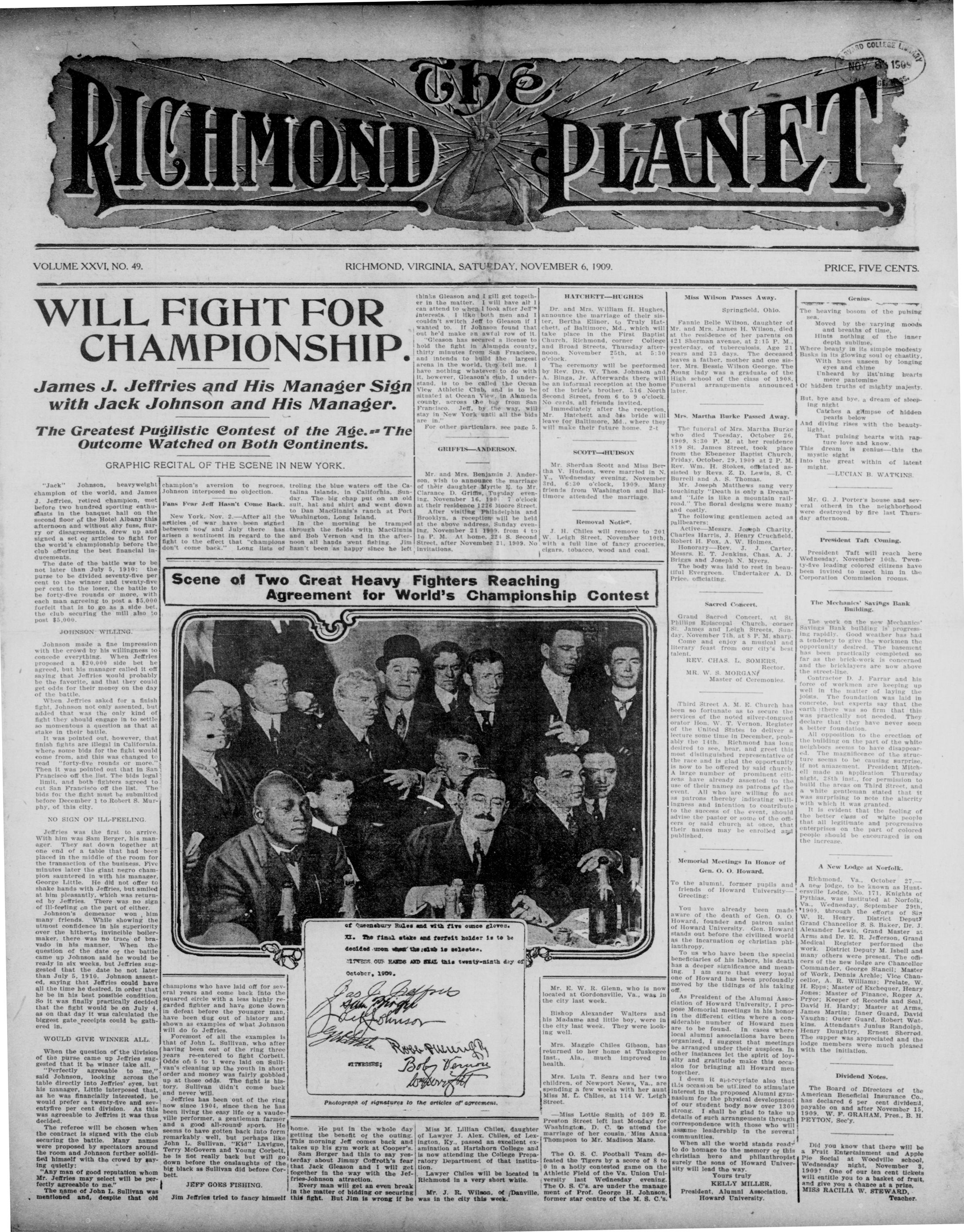
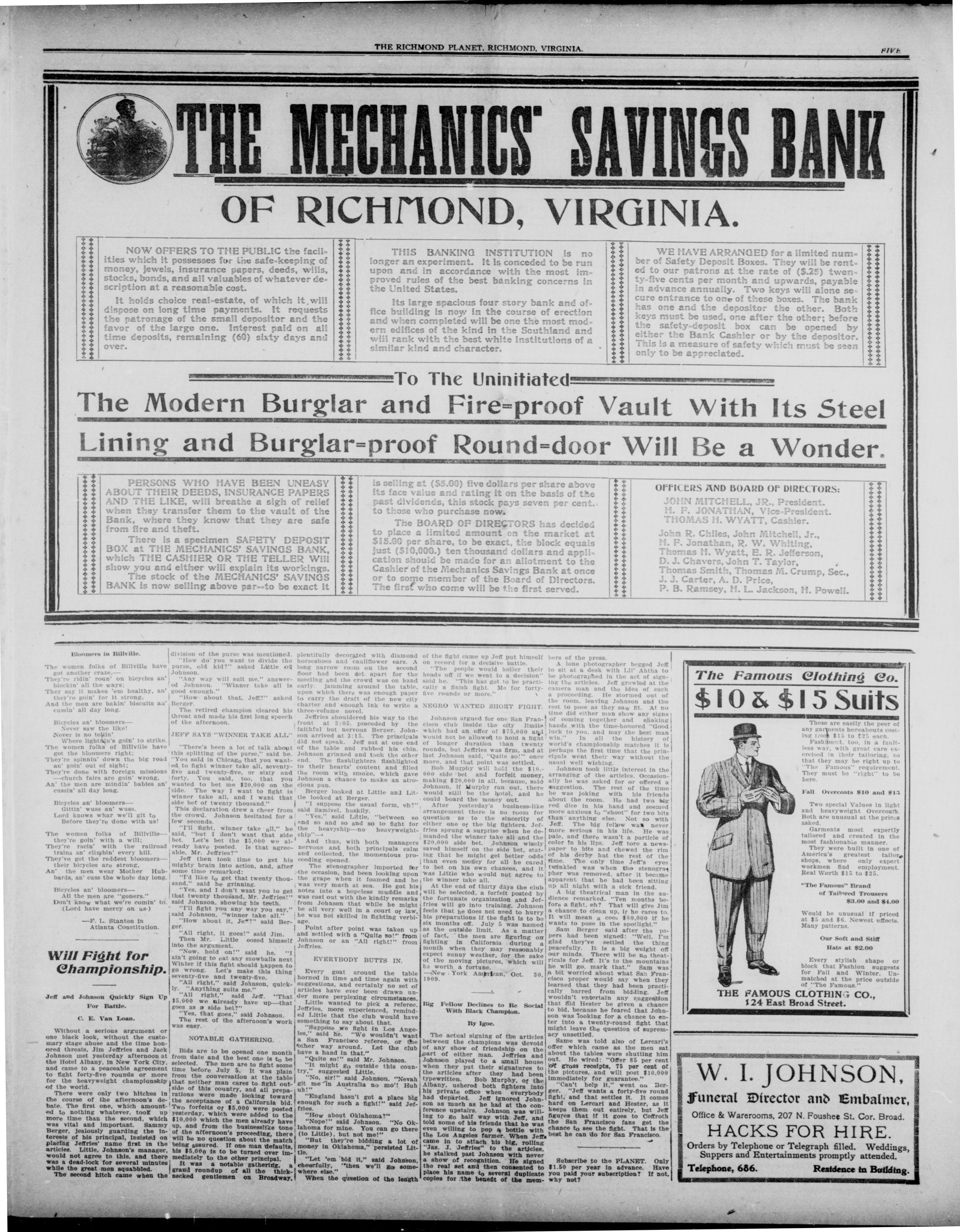
WILL FIGHT FOR CHAMPIONSHIP.
The Greatest Pugilistic Contest of the Age.= The Outcome Watched on Both Continents. GRAPHIC RECITAL OF THE SCENE IN NEW YORK
VOLUME XXVI, NO. 49.
WILL
CHA
James J. Jeff
with Jack J.
The Greatest Pun
Outcome W
GRAPHIC R
"Jack" Johnson, heavyweight champion of the world, and James J. Jeffries, retired champion, met before two hundred sporting enthusiasts in the banquet hall on the second floor of the Hotel Albany this afternoon and without any fuss, flurry or disagreements, drew up and signed a set of articles to fight for the world's championship before the club offering the best financial inducements.
The date of the battle was to be not later than July 5, 1910: the purse to be divided seventy-five per cent to the winner and twenty-five per cent to the loser, the battle to be forty-five rounds or more, with each man agreeing to post a $5,000 forfeit that is to go as a side bet, the club securing the mill also to post $5,000.
JOHNSON WILLING
Johnson made a fine impression with the crowd by his willingness to concede everything. When Jeffries proposed a $20,000 side bet he agreed, but his manager called it off saying that Jeffries would probably be the favorite, and that they could get odds for their money on the day of the battle.
When Jeffries asked for a finish fight, Johnson not only assented, but added that was the only kind of fight they should engage in to settle so momentous a question as that at stake in their battle.
It was pointed out, however, that finish fights are illegal in California, where some bids for the fight would come from, and this was changed to read "forty-five rounds or more." Then it was pointed out that in San Francisco off the list. The bids legal limit, and both fighters agreed to cut San Francisco off the list. The bids for the fight must be submitted before December 1 to Robert S. Murphy, of this city.
NO SIGN OF ILL-FEELING
Jeffries was the first to arrive. With him was Sam Berger, his manager. They sat down together at one end of a table that had been placed in the middle of the room for the transaction of the business. Five minutes later the giant negro champion sauntered in with his manager, George Little. He did not offer to shake hands with Jeffries, but smiled at him pleasantly, which was returned by Jeffries. There was no sign of ill-feeling on the part of either. Johnson's demeanor won him many friends. While showing the utmost confidence in his superiority over the hitherto invincible boiler-maker, there was no trace of bravado in his manner. When the question of the date or the battle came up Johnson said he would be ready in six weeks, but Jeffries suggested that the date be not later than July 5, 1910. Johnson assented, saying that Jeffries could have all the time he desired, in order that he be in his best possible condition. So it was finally practically decided that the fight would be on July 4, as on that day it was calculated the biggest gate receipts could be gathered in.
WOULD GIVE WINNER ALL
When the question of the division of the purse came up Jeffries suggested that it be winner take all. "Perfectly agreeable to me," said Johnson, looking across the table directly into Jeffries' eyes, but his manager, Little interposed that, as he was financially interested, he would prefer a twenty-five and seventy-five per cent division. As this was agreeable to Jeffries it was thus decided.
The referee will be chosen when the contract is signed with the club securing the battle. Many names were proposed by spectators around the room and Johnson further solidified himself with the crowd by saying quietly: "Any man of good reputation whom Mr. Jeffries may select will be perfectly agreeable to me."
The name of John L. Sullivan was mentioned and, despite that obl
Scene of Two Great Heavy Fighters Reaching Agreement for World's Championship Contest
of Queenbury Rules and with five ounce gloves.
XI. The final stake and forfeit holder is to be decided upon when the club is selected.
champion's aversion to negroes. Johnson interposed no objection.
Fans Fear Jeff Hasn't Come Back
New York, Nov. 2.—After all the articles of war have been signed between now and July there has arisen a sentiment in regard to the fight to the effect that "champions don't come back." Long lists of
Scene of Two
Ag
champions who have laid off for several years and come back into the squared circle with a less highly regarded fighter and have gone down in defeat before the younger man, have been dug out of history and shown as examples of what Johnson will do to Jeffries.
Foremost of all the examples is of John L. Sullivan, who after having been out of the ring three years re-entered to fight Corbett. Odds of 5 to 1 were laid on Sullivan's cleaning up the youth in short order and money was fairly gobbled up at those odds. The fight is history. Sullivan didn't come back and never will.
Jeffries has been out of the ring now since 1904, since then he has been living the easy life or a vaudeville performer, a gentleman farmer and a good all-round sport. He seems to have gotten back into form remarkably well, but perhaps like John L. Sullivan, "Kid" Lavigne, Terry McGovern and Young Corbett, he is not really back but will go down before the onslaughts of the big black as Sullivan did before Corbett.
JEFF GOES FISHING.
Jim Jeffries tried to fancy himself
RICHMOND, VIRGINIA, SATURDAY, NOVEMBER 6, 1909
October, 1909.
Gas J. Cottrell
John Pringle
Dick Johnson
WITNESSES:
Bob Vernon
Lorraine Felt
trolling the blue waters off the Catalina islands, in California, Sunday. The big chap put on an old suit, hat and shirt and went down to Dan MacGinnis's ranch at Port Washington, Long Island. In the morning he tramped through the fields with MacGinnis and Bob Vernon and in the afternoon all hands went fishing. Jim hasn't been as happy since he left
of Queensbury Rules
XI. The final stake
decided upon when the
WITNESS. OUR HANDS A
October, 1909.
WITNESSES;
Photograph of signatures to
home. He put in the whole day getting the benefit of the outing. This morning Jeff comes back and takes up his gym work at Cooper's. Sam Berger had this to say yesterday about Jimmy Coffroth's fear that Jack Gleason and I will get together in the way with the Jeffries-Johnson attraction. Every man will get an even break in the matter of bidding or securing this fight. But Jim is wrong if he
thinks Gleason and I gill get together in the matter. I will have all I can attend to when I look after Jeff's interests. I like both men and I couldn't switch Jeff to Gleason if I wanted to. If Johnson found that out he'd make an awful row of it. "Gleason has secured a license to hold the fight in Alameda county, thirty minutes from San Francisco, and intends to build the largest arena in the world, they tell me. I have nothing whatever to do with it, however, Gleason's club, I understand, is to be called the Ocean View Athletic Club, and is to be situated at Ocean View, in Alameda county, across the bay from San Francisco. Jeff, by the way, will stay in New York until all the bids are in."
For other particulars, see page 5.
GRIFFIS—ANDERSON
Mr. and Mrs. Benjamin J. Anderson, wish to announce the marriage of their daughter Myrtle E. to Mr. Clarance D. Griffis, Tuesday evening, November 16, 1901. 7 o'clock at their residence 1226 Moore Street. After visiting Philadelphia and Brooklyn, a reception will be held at the above address, Sunday evening, November 21, 1909. from 4 to 16 P. M. At home, 224 S. Second Street, after November 21, 1909. No invitations.
Fighters Reach
world's Champion
and with five ounce gloves.
e and ferfeit holder is to be
the club is selecete.
END SEAL this twenty-ninth day of
the articles of agreement.
Miss M. Lillian Chiles, daughter of Lawyer J. Alex. Chiles, of Lexington, Ky., passed an excellent examination at Hartshorn College and is now attending the College Preparatory Department of that institution.
Lawyer Chiles will be located in Richmond in a very short while.
Mr. J. R. Wilson, of Danville, was in the city this week.
HATCHETT—HUGHES
Dr. and Mrs. William H. Hughes, announce the marriage of their sister, Bertha Elinor, to Truly Hatchett, of Baltimore, Md., which will take place in the First Baptist Church, Richmond, corner College and Broad Streets, Thursday afternoon. November 25th, at 5:30 o'clock.
The ceremony will be performed by Rev. Drs. W. Thos. Johnson and A. Binga, Jr. Afterwards there will be an informal reception at the home of the bride's brother, 516 North Second Street, from 6 to 9 o'clock. No cards, all friends invited.
Immediately after the reception, Mr. Hatchett and his bride will leave for Baltimore, Md., where they will make their future home. 2-t
SCOTT—HUDSON
Mr. Sherdan Scott and Miss Berrie
tha V. Hudson, were married in N.
Y., Wednesday evening, November
3rd, 6:30 o'clock, 1909. Many
friends from Washington and Baltimore attended the marriage
Removal Notice
J. H. Chiles will remove to 201 W. Leigh Street, November 10th with a full line of fancy groceries cigars, tobacco, wood and coal.
ing
ship Contest
Mr. E. W. R. Glenn, who is now located at Gordonsville, Va., was in the city last week.
Bishop Alexander Walters and his Madame and little boy, were in the city last week. They were looking well.
Mrs. Maggie Chiles Gibson, has returned to her home at Tuskegee Inst., Ala., much improved in health.
Mrs. Lula T. Sears and her two children, of Newport News, Va., are spending a few weeks with her aunt Miss M. L. Chiles, at 114 W. Leigh Street.
—Miss Lottle Smith of 309 E. Preston Street left last Monday for Washington, D. C. to attend the marriage of her cousin, Miss Anna Thompson to Mr. Madison Maze.
The O. S. C. Football Team defeated the Tigers by a score of 8 to 0 in a hotly contested game on the Athletic Field of the Va. Union University last Wednesday evening.
The O. S. C.'s are under the management of Prof. George H. Johnson, former star centre of the M. S. C.'s.
Miss Wilson Passes Away.
Springfield, Ohio
Fannie Belle Wilson, daughter of Mr. and Mrs. James H. Wilson, died at the residence of her parents on 421 Sherman avenue, at 2:15 P. M., yesterday, of tuberculosis. Age 21 years and 23 days. The deceased leaves a father, mother and one sister, Mrs. Bessie Wilson George. The young lady was a graduate of the High school of the class of 1908. Funeral arrangements announced later.
Mrs. Martha Burke Passed Away.
The funeral of Mrs. Martha Burke who died Tuesday, October 26, 1909, 8:30 P. M. at her residence 819 St. James Street, took place from the Ebenezer Baptist Church Friday, October 29, 1909 at 2 P. M. Rev. Wm. H. Stokes, officiated assisted by Revs. Z. D. Lewis, S. C. Burrell and A. S. Thomas.
Mr. Joseph Matthews sang very touchingly "Death is only a Dream" and "Life is like a mountain railroad." The floral designs were many and costly.
The following gentlemen acted as pallbearers:
Active—Messrs. Joseph Charity, Charles Harris, J. Henry Crutchfield, Robert H. Fox, A. W. Holmes.
Honorary—Rev. J. J. Carter, Messrs. E. T. Jenkins, Chas. A. J. Briggs and Joseph N. Myers.
The body was laid to rest in beautiful Evergreen. Undertaker A. D. Price, officiating.
Sacred Concert
Grand Sacred Concert, at St. Phillips Episcopal Church, corner St. James and Leigh Streets, Sunday, November 7th, at 8 P. M. sharp. Come and enjoy a musical and literary feast from our city's best talent.
REV. CHAS. L. SOMERS,
Rector.
MR. W. S. MORGAN
Master of Ceremonies.
Third Street A. M. E. Church has been so fortunate as to secure the services of the noted silver-tongued orator Hon. W. T. Vernon. Register of the United States to deliver a lecture some time in December, probably the 14th. Richmond has long desired to see, hear, and greet this most distinguished representative of the race and is glad the opportunity is now to be offered by said church. A large number of prominent citizens have already assented to the use of their names as patrons of the event. All who are willing to act as patrons thereby indicating willingness and intention to contribute to the success of the event, should advise the pastor or some of the officers or said church at once, that their names may be enrolled appl. published.
Memorial Meetings In Honor of Gen. O. O. Howard.
To the alumni, former pupils and friends of Howard University—Greeting:
You have already been made aware of the death of Gen. O. O. Howard, founder and patron saint of Howard University. Gen. Howard stands out before the civilized world as the incarnation of christian philanthropy.
To us who have been the special beneficiaries of his labors, his death has a deeper significance and meaning. I am sure that every loyal one of Howard has been profoundly moved by the tidings of his taking off.
As President of the Alumni Association of Howard University, I propose Memorial meetings in his honor in the different cities where a considerable number of Howard men are to be found. In cases where local alumni associations have been organized, I suggest that meetings be arranged under their auspices. In other instances let the spirit of loyalty and gratitude make this occasion for bringing all Howard men together.
I deem it appropriate also that this occasion be utilized to stimulate interest in the proposed Alumni gymnasium for the physical development of our student body now over 1300 strong. I shall be glad to take up details of such arrangements through correspondence with those who will assume leadership in the several communities.
When all the world stands ready to do homage to the memory of this christian hero and philanthropist surely the sons of Howard University will lead the way. Yours truly KELLY MILLER, President, Alumni Association, Howard University.
The beaving bosom of the pulsing sea.
Moved by the varying moods and breaths of time.
Hints nothing of the inner depth sublime.
Where beauty in its simple modesty Basks in its glowing soul or chastity.
With hues unseen by longing eyes and chinse
Unheard by list'ning hearts mere pantomine
Of hidden truths of mighty majesty.
But, bye and bye, a dream of sleeping night
Catches a glimpse of hidden pearls below
And diving rises with the beauty-light.
That pulsing hearts with rapture love and know.
This dream is genius—this the mystic sight
Into the great within of latent might.
—LUCIAN B. WATKINS
Mr. G. J. Porter's house and several others in the neighborhood were destroyed by fire last Thursday afternoon.
President Taft Coming
President Taft will reach her
Wednesday, November 10th. Twenty-
-five leading colored citizens have
arrived in the
Corporation, Commission office.
The Mechanics' Savings Bank Building.
The work on the new Mechanics' Savings Bank building is progressing rapidly. Good weather has had a tendency to give the workmen the opportunity desired. The basement has been practically completed so far as the brick-work is concerned, and the bricklayers are now above the street-line.
Contractor D. J. Farrar and his force of workmen are keeping up well in the matter of laying the joists. The foundation was laid in concrete, but experts say that the earth there was so firm that this was practically not needed. They declare that they have never seen a better foundation.
All opposition to the erection of the building on the part of the white neighbors seems to have disappeared. The magnificence of the structure seems to be causing surprise, if not amazement. President Mitchell made an application Thursday night, 28th inst., for permission to build the areas on Third Street, and a white gentleman stated that it was surprising to note the alacrity with which it was granted.
It is evident that the feeling of the better class of white people that all legitimate and progressive enterprises on the part of colored people should be encouraged is on the increase.
A New Lodge at Norfolk
Richmond, Va., October 27.—A new lodge, to be known as Huntersville Lodge, No. 171, Knights of Pythias, was instituted at Norfolk, Va., Wednesday, September 29th, 1909, through the efforts of Sir W. R. Henry. District Deputy Grand Chancellor S. S. Baker, Dr. J. Alexander Lewis, Grand Master at Arms and Dr. E. R. Jefferson, Grand Medical Register performed the work. District Deputy M. Isbell and many others were present. The officers of the new lodge are Chancellor Commander, George Stancil; Master of Work, Dennis Archie; Vice Chancellor, A. R. Williams; Prelate, W. H. Epps; Master of Exchequer, Henry Jones; Master of Finance, Roger A. Pryor; Keeper of Records and Seal, David H. Hardy; Master at Arms, James Martin; Inner Guard, David Vaughn; Outer Guard, Robert Watkins. Attendants Junius Randolph Henry Daughtry, Ernest Sherrod. The supper was appreciated and the lodge members were much pleased with the initiation.
Dividend Notes.
The Board of Directors of the American Beneficial Insurance Co. has declared 6 per cent dividend, payable on and after November 15, 1909. W. F. GRAHAM, Pres., B. H. PEYTON, Sec'y.
Did you know that there will be a Fruit Entertainment and Apple Pie Social at Woodville school, Wednesday night, November 3, 1909? One of our ten cent tickets will entitle you to a basket of fruit, and give you a chance at a prize. MISS RACILIA W. STEWARD.
VIA WIRELESS
NOVELIZED BY
THOMPSON BUCHANAN
FROM THE SUCCESSFUL PLAY,
BY WINCHELL SMITH, FREDERIC THOMPSON AND PAUL ARMSTRONG
VIA WIRELESS
Novelized by Thompson Buchanan From the Successful Play of the Same Name BY WINCHELL, SMITH, FREDERIC THOMPSON and PAUL ARMSTRONG
Frederic Thompson. Copyright, 1908, by Frederic Thompson. All Rights Reserved.
GIRLS who grow up around the steel works do not develop into the fainting kind. Lucy did not shriek nor even cry out loud. Instead she rushed to her lover, put her arms about him and helped to hold him up, begging tenderly:
"Joe, is it bad? How did it happen?"
The blood was streaming over the man's face, and only his great courage kept him up as, resting in her arms, he gasped out the story.
"Smith—he hit me with a hammer when I wasn't looking—he got me. But don't mind me—I'm—all right. Find Sommers."
"Sommers?" the girl asked, surprised. She could not imagine what Sommers had to do with it.
"Yes," he insisted, "find Sommers. There's something crooked going on. I must get Sommers quick. They hit me because I'm on the level, and
A
"Telephone!" he commanded. "There it is. Phone Sommers."
Smith didn't want me around. Find Sommers, Lucy--you must find Sommers!
The girl looked about her blankly. How was she going to find Sommers? And, then, she didn't really care whether she found him or not. Sommers, the gun, everything was secondary to her now, with Joe O'Leary here, maybe dying. But O'Leary had commanded her, and the habit of obedience was strong.
"Where is Sommers, Joe?" she asked. "I don't want to leave you this way. I can't find Sommers."
But the practical assistant foreman, injured though he was, knew what to do.
"There it is. Phone Sommers. Try the Durants. Maybe he is there Hurry! That's the private one to the house. Tell Sommers to come at once."
Reassured now that she did not have to leave him to do his bidding, the girl ran to the private phone. She rang the bell wildly, half crying into the receiver:
"Hello! Is Mr. Sommers there?"—then her face went blank. "He isn't!" she gasped, then turned from the phone to cry to O'Leary, "Oh, Joe, he ain't there!"
"Find out where he is and get him," he commanded.
The girl turned back to the phone, and her voice brightened as she recognized the person at the other end of the wire.
"Oh, is that you. Miss Frances?" she cried. "This is Lucy Smith. Yes, ma'am, I'm at the works. There's been trouble here, and Mr. Sommers must come right away. There's something wrong with the Sommers gun. What? You say come up to your house?"
She looked away from the phone a moment pitifully toward her injured sweetheart, then turned back to the receiver in response to Frances Durant's sharp, anxious command.
"Yes, ma'am. O'Leary made me phone. I want to warn Mr. Sommers. They're trying to spoil his gun. No, ma'am. It ain't sure. We suspect."
Again she hesitated, looking pliffly at her wounded lover. How could she leave him merely to save the lover of the other woman? But discipline is strong about a steel works, and Frances Durant was the daughter of the owner. So poor little Lucy had no alternative but to obey.
"Yes, ma'am." she shouted into the receiver. "I'll come if you wish. I'll get there in five minutes. I'll run. Yes, ma'am. I'll run. Goodby!"
She hung up the receiver, then hurried over to O'Leary. He sank forward in his chair and rested now partly on the desk before it. The girl put her arms about him.
"Oh, I can't leave you if you are hurt bad. dear," she half sobbed.
A. B.
CHAPTER VIII.
With all the strength he could command O'Leary caught her arm.
"Don't trouble about me. Hurry over and do what Miss Frances tells you and don't tell any one else."
Still the girl hesitated, but just then Marsh entered the office from the works.
"Marsh will take care of me," gasped O'Leary.
"Hurry! Do as I told you."
Reluctantly Lucy ran out of the office as the head draughtsman came over to the injured man.
"What's happened, O'Leary?"
The assistant foreman was almost too weak from the shock and loss of blood to reply, but he managed to gasp out faintly:
"Smith cracked me with a hammer when I wasn't looking. He's fighting drunk, Mr. Marsh, and ruining the Sommers gun."
Marsh, experienced about the works.
was examining O'Leary's wounded
"You've got a bad rap, boy. We must rush you to the doctor."
He stepped to the door leading into the works and yelled for two men, then came back to do what he could. Pinckney had almost at the same moment returned from his private office. "What's this?" he exclaimed as he saw the bloody O'Leary half lying across an office table.
The workman, injured though he was, still held to his grim determination to get justice for Sommers. At Pinckney's question he half raised himself on the table.
"It's Smith, sir," he said to the general manager. "He's leaving that gun too long in the furnace. I kicked, and he hit me when my back was turned. I'll fix him."
Pinckney looked at the bloody man coldly.
"You ought to have more sense than to kick," he said. "Smith's in charge of that job. He's responsible. It's none of your business. You ought to have kept your head shut." O'Leary stared at the manager, too amazed to retort. He was still half dazed from the terrific blow he had received or his suspicions would have been immediately aroused. The two men had entered from the works and stood ready. They knew just what to do. "Here," ordered Pinckney, "take this fellow across to the doctor quick. Tell him it's a works case." The two men seized O'Leary, picked him up in their arms and hurried with him out of the office. Marsh turned to the general manager. "We've got to stop this, Mr. Pinckney," he exclaimed. "Smith is fighting drunk." Pinckney nodded carelessly.
"Oh, yes, I understand, but I'll see to Smith. There's something more important on now. I've just got a wire from my agent in Washington."
"About my gun?" asked Marsh anxiously.
"About the Rhinestrom gun," came Pinckney's cold correction.
The head draughtsman nodded acquiescence.
"Yes, that's what I mean," he agreed Pinckney took a telegram out of his pocket.
"Well, there's all sorts of trouble in Washington," he explained. "Tomorrow they'll notify us not to begin on the Rhinestrom order until the Sommers gun is tested."
"What of that?" asked Marsh blankly. "It only means a slight delay."
Pinckney made an impatient gesture.
"Slight delay, nothing! Haven't you sense enough to see it's a game of this toy sailor, Sommers? They'll countermand the order for our gun after they test his just as sure as fate."
Marsh dropped into a chair defectedly.
"Just my luck!" he exclaimed in distress. "That's the end of my royalty. I might have known. It always happens that way with me. I never have any luck."
Pinckney stood looking, a sneering smile on his face.
"That's it." he said contemptuously.
"Lay down. That's the reason your luck is always bad and always will be bad. A quitter can't have any luck. How do you expect to have anything if you drop at the first ditch?"
The inventor looked up, puzzled.
"What can I do?" he asked.
Pinckney smiled pitilyingly on him.
"What can you do? Haven't you sense enough to guess? Here"—he stepped closer to the inventor to in a lower, firmer tone—"this dirty, tricky sailor has got the best of us in Washington, but with Smith drunk I guess we've got the best of him here."
Marsh looked up, startled, amazed. Some slight hint of what Pinckney intended began to dawn on him.
"What do you mean?" he asked slowly in an almost dazed tone.
The general manager looked at him sharply.
"What time did you say Sommers would get here?"
"One-thirty." replied Marsh.
Pinckney's laugh was rich with con-
THE RICHMOND PLANET, RICHMOND, VIRGINIA
ident relief.
"Well, there's lots of time. It isn't 12 yet." he chuckled.
On Marsh's face had come an expression of horror. He knew now what the general manager intended to do. It made him sick to think of it, for Marsh was honest at heart. Only he was an inventor. He loved his work. It was his chance of a lifetime. And, then, he was weak.
"You mean you will ruin his gun?" he half whispered faintly.
The brutal laugh of the other man was answer enough.
"Shut up!" he sneered. "Don't talk as if it was murder. If you're going to get on in this world, Marsh, you must learn there's as much in blocking the other fellow's game as there is in playing your own."
His latent sense of honesty made one last sickening revolt as Marsh started up from his chair, exclaiming wildly:
"It's awful! I won't be a party to any such thing as that, Mr. Pinckney." With all his superior physical and mental strength Pinckney sebzed the weaker man and pushed him back in his chair.
"Don't be a fool, Marsh," he explained, shaking his shoulder fiercely. "You know if we get this order from Washington it means an independent fortune for you. Don't you know that?" The force of the other stronger personality reacted on the weaker man.
"Yes, sir; you say so," he said.
"Think what it means, Marsh. It means the end of this slavery, day after day, at the works. It means you'll have time to work on your inventions.
It's your one chance of a lifetime—your one chance, Marsh, to amount to something in this world and"—he ended most persuasively—and you don't need to have anything to do with this affair. I'll attend to it.
The little man looked up with the gaze of a helpless child.
"What—what do you intend to do?" he asked.
Pinckney smiled, well satisfied.
"Do?" he said. "Nothing. I won't do anything." His look became shrewdly, terribly malevolent as he ended.
"Smith will put that gun in the tempering bath before Sommers gets here."
The little man's eyes grew wide with fearful understanding.
"Put it in at too high a temperature and kill it!" he gasped.
Pinckney laughed cruelly. "Smith has charge of that. If he kills the gun we don't know anything about it," he said. The little man shivered. "This is horrible!" Pinckney's laugh was cold and menacing. "Horrible," he sneered. "What did you invent your gun for but to murder men and disrupt nations? Now, nobody asked you to do anything. Marsh. Just you go out there and send Smith in to me. Attend to your work and don't notice anything that Smith does." Marsh looked up weakly. "Yes, sir," he said, and Pinckney clapped him on the back with real heartiness. "Now, remember, Marsh, it means your fortune and your future. Be quiet." When Marsh had gone Pinckney stood thoughtful for a moment.
"What a pity he's such a weak fool," he muttered to himself. Then another thought made him smile with more satisfaction. "Perhaps it's just as well he is such a fool. I couldn't have got away with him so easy otherwise." Smith came lurching in a little fiercer than before, but Pinckney on occasion knew how to manage even Smith in his fiercest mood. "See here," he exclaimed sharply, "that gun must go into the bath before 1 o'clock. No foolishness now! You're fighting drunk, but I don't want anything out of you. Understand, you get that gun in before 1 o'clock if you're ever going to do any more work around this place." Smith, drunk though he was, recognized that new Pinckney was not the man to fool with. "It's going in in fifteen minutes," he said. "Let no one interfere with you, you understand?" ordered the general manager.
The drunken foreman leered at him.
"You saw what that fellow got that
did interfere, didn't you? Well, they'll
all get that if they fool with Smith."
Pinckney nodded acquiescence.
"You're responsible. Remember, fif
teen minutes, that's all."
"I know my business," retorted the
foreman. "I'll do the job," and he
lurched for the door as fast as he
could go.
Pinckney looked after him, with a
laugh.
"Well, when that fresh navy duck arri-
ves he will find his gun in a thou-
sand gallons of oil, I guess I fixed him
all right."
He was turning away when the
street door opened, and Sommers, cool
and collected as ever, lounged in."
"Hello, Mr. Pinckney."
He smiled at Pinckney's startled
look. "Guess I'm a bit early. Didn't
expect me so soon, did you? I'll just
hang around here till my gun is taken
out of the fire."
CHAPTER 1N
FOR ten minutes Pincney, suppressing his anger and surprise, managed to talk casually in the
office. Then he excused himself on the plea of work and, leaving Sommers, hurried out to see whether Smith had followed directions.
"I'll be out in a few minutes myself," said Sommers as the general manager left. "Expect there is plenty of time, though."
"Oh, yes," Pinckney assured him from the door. "There's plenty of time. Don't hurry. We have our most responsible map in charge of the job."
Out in the furnace room Pinckney found Smith moving about in leisurely fashion, as though he had all the time in the world ahead of him.
"Have you taken out the Sommers gun yet?" demanded the general manager eagerly.
Smith fared up.
"No. I can't do everything at once. What do you think I am? We'll get to it in a few minutes."
"It's got to come out now," declared Pinckney angrily. "Sommers is here in the office. He thinks we aren't able to run this job, and he's come to see his gun go into the bath."
The drunken foreman's face convulsed with rage.
"Oh, he has, has he?" he yelled.
"Well, if he comes bothering around me you know what he'll get? He'll get what O'Leary got. That's what'll be coming to him."
Pinckney shook his head.
"No, that won't do, Smith," he commanded sharply.
Out in the works where he was practically boss the foreman could not be so easily controlled.
"Oh, it won't do, won't it?" he yelled.
"I'll show you whether it'll do or not."
He doubled up one of his big fists, shaking it menacingly. And now Pinckney let him rage without check.
A daring idea had come to the desperate schemer. Perhaps, after all, if Smith attacked Sommers it might not be so bad. It would be up to Smith. He would suffer; no one else. At any rate, Sommers must not see that gun go into the tempering bath. Pinckney decided to irritate his drunken foreman a little more.
"Better be careful, Smith. He's in a position to make trouble for us all. He's an officer of the navy, you know, has a right to inspect the work. We've got to treat him well. Besides, this Sommers is a pretty bad fighter himself. He's got an idea he can lick anybody around these works."
That was enough. Smith's fury was keyed to the fighting stage now. It only needed the presence of Sommers and a little provocation to start real trouble.
"Think's he's a fighter, does he?" he roared. "Let him come in here—I'll show him who's a fighter. I don't have to treat him well. I don't have to treat you well, Pinckney. I don't have to treat anybody well. I'm independent, I am. I don't crawl for nobody."
"Smith, you're drunk," declared the general manager. "You're drunk or you wouldn't talk that way."
"I know I'm drunk," roared the foreman. "But I'm the best man in the outfit, drunk or sober. Just let that navy duck show up."
Inside Pinckney was smiling, well pleased, but he kept a straight, stern face.
"I know you're the best man, Smith," he confessed. "But why do you want to fight with me?"
"Who's fighting with you?" blustered the bully. "There wouldn't be enough of you to carry away if I was fighting with you."
Pinckney laughed powerfully.
"All right," he said. "Now, remember, Sommers must not see that gun come out of the furnace. He's sore on us, and he'll make a bad report on the job if he gets a chance. You know what would happen to you then."
"He tried to get my job," roared the foreman. "Try to take an honest man's living away from him? I'll show him."
Pinckney caught the foreman by the arm.
"Wait a minute; wait, Smith," he commanded. "Here's Sommers now."
The naval lieutenant was coming down the long furnace room, shielding his eyes from the terrific heat and glare of the furnaces as he passed.
Smith lurched out to meet him just as he stopped in front of the furnace which held the Sommers gun. One quick look assured the navy man of the foreman's condition.
"How soon do you take the gun out, Smith?" he asked.
The foreman lurched up, thrusting his face close to the officer's.
"None of your business," he retorted. "I take it out when I get good and ready. Maybe at one time, and then again it may be another."
The answer was enough. Every muscle in Sommers' powerful frame set for action. Already he had the foreman's protruding jaw measured for his right hand, and Pinckney's voice checked him.
"I say, Sommers, come here, please, will you?"
The naval man turned without a word and walked over to the general manager.
"Perhaps you can explain this, Mr. Pinckney?" he demanded sternly.
Pinckney smiled apologetically.
"I hope you won't mind Smith. You can see he's been drinking."
The officer's eyes marrowed. The fighting look was still on his face. "And that's the kind of a man you allow to be in charge of important work?" be demanded.
Copyright, 1908, by Frederie Thompson
Pinckney was still apologetic.
"It doesn't often happen, I'm glad to say," he explained. "But Smith is a
P.
"I don't have to treat anybody well. I'm independent."
very valuable man, one of the best I've ever known. I'd hate to lose him. He is thoroughly competent, even though he seems drunk. Liquor only makes him quarrelsome and impriment. It doesn't affect his ability as a workman.
"He was just the man for this job. That's why I put him in charge and let him stay on even though drunk. You can depend on it, he'll do the work all right."
Sommers accepted the explanation with a shrug.
"Well, you're the general manager, Mr. Pinckney," he said. "If that gun is ruined in your place the Durant works will be responsible. Personally I think, valuable as Smith may be, it would be a good thing to lay him off until he sobers up."
"I understand your feelings," he said, "but I'll stay out here myself to see that the gun goes through all right. Smith's nasty now. It might be as well if you didn't stay any longer. It upsets him to have outsiders about." For the first time a real suspicion of foul play took hold of Sommers. They were all too obviously anxious to get him away.
"Don't worry," he said shortly to Pinckney. "I'll take care of myself. I've got time to get into my working togs, haven't I?"
He turned away and started back to the office just in time to meet Marsh approaching. He had sized up Marsh for an honest, well meaning fellow, so he didn't hesitate to stop him.
"Oh, I say, Marsh, what time did that gun go into the fire?" The head draughtsman looked up and down and everywhere but at Sommers' face.
"I—I don't know, Mr. Sommers, exactly," he hesitated.
"Don't know!" exclaimed the officer. "What's going on here anyhow? It looks to me like there's something wrong. Didn't you tell me that gun went in at 6 o'clock?"
Marsh was thoroughly frightened now.
"Did I say 6 o'clock? I've forgotten, Mr. Pinckney will know. I'll ask him."
Suspicion had become practical certainty in Sommers' mind now. He saw he, too, must be diplomatic. He must not let these people realize what he suspected. He shook his head eagerly.
"Oh, don't bother Pinckney, Marsh. I'll be back in a moment, just as soon as I get on my working clothes."
And, leaving Marsh in a cold sweat of fear, the naval man hurried into the office. As soon as the door had closed after him Pinckney rushed over to Smith.
"Now, Smith, go to it quick," he commanded.
In a moment the roar in the big furnace room had increased tremendously. Smith began to bellow his orders. The men realizing the important time had come went to work with a will. The hugh traveler was rushed over above the trap furnace as fast as it could be moved. The chains were being lowered into the trap to draw out the gun when Marsh caught Pinckney by the arm.
"Mr. Pinckney, don't—don't try it," he exclaimed. "Sommers suspects." Pinckney shook off the restraining touch.
"Let him suspect," he exclaimed contemptiously. "What difference does that make? Once get that gun into the bath without his seeing it, I can beat him, no matter what story he tells in Washington."
"But you can't get it in," expostulated the frightened draughtsman. "He'll be back in a minute. He knew you couldn't beat him or he wouldn't have left. He's gone to put on his working clothes."
For reply Pinckney shook himself free and shouted to Smith:
"Here, Smith, Sommers has just demanded that you be discharged. He says you can't handle the job. He's gone to change his clothes, and he'll be back in a minute to boss the job himself."
That was enough. The drunken foreman's rage was as fierce as one of his own furnaces now.
"He has, he has?" he roared above
the noise of the furnaces and the clanging steel. "If he comes in here I'll throw him in the furnace!" "I don't blame you," supplemented Pinckney. And Smith, seeing now the general manager was behind him in whatever he might attempt, was ready for desperate work. "Here!" he shouted. "Take my signal whistle. I'll go over by the door and wait for that guy. When he shows up you signal the men to take out the gun." "When he comes in!" exclaimed Pinckney, amazed. "How can you stop his seeing you?" The foreman laughed brutally, then, stooping over, picked up from the floor a short piece of iron, already blood stained at one end.
"O'Leary," he said briefly, and, turning with the bar in his hand, lurched across, drunkenly confident, toward the path which Sommers must cross on his way in the office to the trap furnaces that contained the Sommers gun, now ready to be holested and transferred to the tempering bath. Marsh had already hurried away. Possible murder was more than he had counted on when he allowed Pinckney to bully him into becoming his fellow conspirator. Pinckney stood ready with the whistle in his hand, while the men at their places waked, ready to holst when the signal should be given. The trap was laid. All was in readiness when Pinckney saw a raggedly dressed girl with a shawl over her head hurrying down the furnace room from the door through which the men were accustomed to enter.
"Here?" he shouted. "What are you doing here? Who are you? Get out!" Instead of answering the girl ran on until she had come facing him. Then she stopped short and threw back the shawl from her head. Pinckney started back in amazement, for instead of Lucy Smith, as he expected, he looked into the blazing eyes of Frances Durant.
CHAPTER X
PINCKNEY started at first, too amazed to speak. Finally he managed to pull himself together.
"Frances! What are you doing here?" he exclaimed.
The girl's reply was a contemptuous sneer.
"I don't have to ask what you are doing here."
"You know?"
"Yes," she cried. "I know you are trying to ruin Mr. Sommers' gun, and that's why I'm here—to prevent it."
Her hatred of dishonesty, her love for Sommers, her pride in the honor of the Durants, had all combined to drive the girl into a fury of passion that Pinckney had never seen before.
He could not fight against it. He knew that, and so he had to temperize. Instead of showing anger he only smiled with apparent surprise and pity.
"What could have put such a ridiculous notion in your mind, Frances? It's too foolish to discuss. Who told you?" "Don't try to explain, Edward," the girl exclaimed angrily. "Lucy Smith told me. O'Leary told her. He was hurt because he wanted to be honest."
C.
At the bottom of the steps the naval office turned on the manager of the works.
She came to the house to find Mr. Sommers, and I borrowed her dress to come here quickly and warn him."
"And you believe such a story?" he protested in a hurt tone. "Why, my child, O'Leary was delirious. Smith was drunk and struck him while they were fighting—a plain, ordinary fight between hot headed workmen.
"What possible reason could I have for wanting to injure this gun? To have it a success means as much to your father and to me as it does to Sommers. Think of the reputation of the plant, of these works, that your father has spent his life in building up!
"Why, Sommers is here now looking after the gun himself. If he were to hear such a story it might ruin your father's business. You don't want to ruin your father's business on the word of a delirious workman, sore on his foreman for beating him? Don't
you see how wrong you are?"
The girl hesitated. It did seem plausible. O'Leary was hurt. He had been fighting. And then she did not imagint any one could be so contemptible as to fight a rival in the way Pinckney must be doing if he really had planned all that O'Leary charged.
The girl felt that perhaps she had been too hasty. She felt just a bit foolish, coming there in Lucy Smith's clothes and possibly exposing herself to ridicule before the men. She hesitated, looking at Pinckney.
From the other end of the furnace room, where he had gone to intercept Sommers, Smith had made out Lucy, as he supposed, talking to Pinckney. The drunken rage of the forema changed instantly to this new object of attack.
Why should Lucy be taking to Pinckney? What was she doing there? He had warned her time and again to keep away from the works, and especially from Pinckney and the office because Smith knew Pinckney and the advantage which he had taken of his position more than once to injure girls whose fathers and brothers depended on him for their livelihood. The general manager was a little scar in the town. Mr. Durant did not come into close personal relation with the men in the plant, and Pinckney could take or and put off, make and ruin men at his will. He had ruined some, and others, Smith knew, had risen from the works through complaisance and pretended blindness to the actions of the general manager.
But the independent foreman did not propose to put himself in that class. He loved his family when he was sober, and no matter what he might do himself he was determined that his wife and daughter should go straight. No wonder, then, the sight of his daughter talking to Pinckney in the works before all the men enraged him. With the bar in his hand he lurched down the long room.
"Hey, there!" he shouted when he had come close. "What do you mean talking to this fellow? Haven't I told you I didn't want you hanging around the works and not to talk to him? Now, you get out of here quick!"
Frances turned, and Smith stepped back agast.
"Miss Durant!" he exclaimed. "Excuse me, miss. I thought you was Lucy."
"That's all right, Smith," exclaimed Pinckney hastily. "No trouble now remember." And he turned back to Frances. "Come to the office, Frances. Come away from here. I will explain everything to you fully."
Puzzled and a bit uncertain as to Pinckney's real attitude, the girl obediently followed him up a short flight of steps and into a little overseer's office that jutted out into the furnace room. Pinckney closed the door after him.
"Mr. Sommers' gun is just going into the tempering bath." he said. "He is here superintending it. So you understand all must be right. Just wait here a few moments, and then you can see Sommers himself."
The suggestion seemed reasonable. Frances nodded accolescence.
"All right. I will wait," she said. Outside in the furnace room a furious bustle followed the closing of the little office door. Smith gave the signal, and the big gun, caught in the chains from the traveler, began to rise slowly out of the trap furnace and hung suspended, a huge mass of white hot steel.
"Hustle it up, quick, into the bath!" yelled Smith, for already Sommers had appeared at the end of the long furnace room and was coming quickly toward him.
The men, driven on by their drunken boss, worked desperately fast. The huge traveler carrying the Sommers gun moved slowly toward the waiting oil bath. It was halfway there when Smith, the iron bar still in his hand, met Sommers.
"So you're coming to take charge of this job, are you?" he sneered.
The naval officer tried to push by, but Smith got in front of him.
"See here," exclaimed Sommers angrily, "wait until you are sober before you talk to me. Now, get away and attend to your work."
The order enraged Smith all the more.
"Who are you giving orders to?" he yelled.
"Come on, now; get out of here! You'd better beat it up in the office." He jerked his thumb toward the little overseeing office. "Get in there and talk to Pinckney. He's locked up there with a lady friend of yours."
Sommers' quick temper had begun to flare at the insolence of the foreman. He had not come out from the office in time, and he did not know that it was his gun which the traveler was slowly bearing to the waiting oil bath. He saw only in front of him an insolent, drunken workman, who should be discharged for coming on duty in such condition.
"You drunken blackguard! I'll see Plinckney, and if he doesn't discharge you I'll kick you out of here myself!" He flung the foreman aside and, running up the steps to the office, rried the door. It was locked, and his knock brought no response. Down below the men looked at each other and, taking the cue from Smith, laughed at the navy man. Slowly Sommers came down the steps. What was wrong? He could not make out exactly. He saw Marsh, who had been standing uneasily far in the background, and motioned to him. The head draftsman came slowly. He knew how important it was to keep Sommers diverted from the main object and was nerved to play his part until the gun should be disposed of.
"I wouldn't go in there if I were you, Mr. Sommers," he suggested. "Mr. Pinckney's in there with a girl." Sommers had been about the works long enough to know Pinckney's reputation among the men, but this open faunting in their very faces was worse than anything he had imagined. "Who is it?" he asked contemptuously. "I think it's Smith's daughter, Ln-
CUNT ES
Smith on the job, even though be was
drunk. It all seewed stinpie. Smith
must buy Infupuity from pupisbment
in this shamefa) fashion.
Contempt for Pinckuey and rage that
be should run the risk of being ruined
by the dirty work of such men roused
Sommers to perce anger. He turned
back und ran again up the steps to the
litte office, knocking fiercely this time
‘on the doer,
“Pinckney, come cut of there at
once!” be shouted.
The command was so fercety. given
the general manager could vot but
‘obes. He opened the door, coming out
siowly and. iu response to Sommers”
gesture of comumnd, followed bim
down the steps.
Frances, ber face partly covered
With the shawl, eame after Pinckney.
At the bottom of the steps the navel
officer turued ov the manager of the
works with flerce coutempt
“Ne wonder you keep Smith drunk
on the job!" he exciaimed. “Haven't
you got sense of shame enough not to
take bis daughter in that office before
all these men?"
Pinckney ‘understood the mistake,
Dut it wax Anything to gain time now.
“What ‘business Is that of yours?”
he retorted angrily
“Well, Tl make it my business,”
came the ferce reply. “It's my bush
ness when such couduct threatens to
ruin my work as well as ruin a girl's
name. You ought to be ashamed of
yourself, Now, get her out quick.
Then take Suith off this fob."
He turned bis buck contemptuously
on Pinckney and the girt Just in time
to meet the blazing, wrathful face of
Joe O'Leary
‘The assistant foreman had been
fixed up by the doctor and now, with
&@ bandaged hend. had returned to the
Works Just in time to see Pinckney and
the gir! with Sommers at the bottom
of the steps. O'Leary, too, misunder-
stood.
“Mr, Pincknes.” be yelled, “wateh
me! I cross myself. I know what
Fou've done to others, but you can't de
it te wy wie, Lerme myself, and with
Ht goes aur oath tht ae gol to. iit
He rushed eward and Mickey
JWiipedd back vefore bik theroy attack
Hur escape would bave been! hopeless
had not Frances threwing tick te
abaw! from Ger ead, stepped i be
tWern, Me Hutt she faced both Som
tiers and O'Leary
The wounded O'Leary stopped,
aghast
“Miss Durant!" he sald slowly, in
amazement. Sommers stared, startled,
not knowing what to say. ‘Then he
saw the expression on the men’s faces,
and that forced him to speak.
“Mr. Pinckney, explain all this at
once, for the sike of O'Leary and
these amen,”
Pinckney shrugged bis shoulders.
“There's nothing to explatn,” he said,
“Miss Durant wanted to see the Som
mers gun made, and she borrowed one
of Lucy Smith's dresses so as pot to
excite comment, that's all”
His tone was cool, collected, with
Just a touch of surprise fn it that any
‘explanation would be needed.
O'Leary stepped back awkwardly,
“Yes, sir. 1 beg your pardon for me
hasty speech.”
‘The general manager turned to
Frances.
“Come! Let's go, Frances.*
‘The gir! had been looking at Som-
mers and he at her, Both knew that
something more was needed. Some-
thing more must be sald before the
Perfect understanding between them
could be restored.
Finally, with a half sigb, she turned
and started to walk away. Sommers
stepped close to Pinckney.
“It you don’t explain aloud at once
why you attempted to put Miss Du-
rant in an awkward position by lock-
ing that door I'll break your head.
How dared you lock that door? You—
with your reputation about these
works! Speak!”
“The door wasn't locked,” retorted
Pinckney aloud,
Frances beard. She stopped short
her face fushed with shame. Was it
Possible that Sommers thought there
was anything wrong ip her being
there? Then anger at herself for com-
ing and at him for letting himself pro-
Yoke a scene swept her to action. She
turned and stepped back quickly to
the two men.
“Don't say a word, Mr. Pinckney,”
‘she ordered sharply. “I forbid you to
‘speak, Lieutenant Sommers can think
for a moment what his manner seems
to imply, 1 refuse to give him any
‘explanation. 1 must also refuse to
‘even see him in the future.”
Sommers fooked at ber aghast,
“Miss Durant, you don’t under-
stand.” he exclaimed. a
‘The girl looked him coldly up and
down.
“I do understand, Mr. Sommers.
Good day.” And, turning, she walked
quickly away.
Sommers looked Ibi for a
moment, then, seeing the bopeless-
‘ness of the misunderstanding, turned
back to the furnaces. As be did 90
for the frst time he noticed bis gun
hates teeter % Ge temetee
with him, wasn't She? Lots of chance
you stand against the genera! man-
ager when she'll lock berself tp the
office with bim.”
As the iast jeering word came out
Sommers swung wildly. Smith stax-
gered. then came back with the iron
bar raised in an instant he had
brought it crashing down upon the
Neutenant’s head) Then. ax the naval
officer fell, in rage Smith bent over
and seized him
“What are you doing?" shouted
Pinckney.
But Smith, insane from rage and the
sight of blood, wex beyond managing
b
He lifted the halt dazed satior amt stag
gered with htm toward an open furnace
He lifted the half dazed Sailor and
staggered with him toward an open
furnace.
Naval men are used to bard knocks.
Sommers came to. He had dodged
partly, and the bar caught bim only a
glancing blow. Now he realized his
danger and with a desperate effort
tore himself loose.
Smith bad dropped the bar. It was
an even thing now. Wildly the fore-
man rushed, but a straight left stop
ped him, and then a fierce tizht upper:
eut, delivered close, brought him to
his knees.
He arose only to meet another swing
that dropped him senseless, and as he
fell bis bead struck the ground just
under the big trip hammer.
‘The hammer was coming down when
Sommers with a quick jerk dragged
his man out just tp time. Then as he
Stood above his senseless antagonist
he heard the volee of Pinckney joyous-
ly trimpbant:
“All right! The Sommers gun is in
the bath!"
The dirty trick bad been safely
turned.
[v0 BE corTrNvED.)
CONDENSED NEWS ITEMS.
Thureday, October 21.
The dody bf a woman about thirty
years of age was found tn Sugar creck,
fifteen miles southwest of Canton, 0,
with an amulet containing scriptural
quotations in Itallan around her neck.
James McCrea, preaident of the
Pennsylvania Railroad company, an:
nounces plans for the erection of a
new Chicago union passenger station
and terminal in Chicago to cost not
less than $25,000,000.
Lehigh university, at South Bethle
hom, Pa., according to the new regis
tration, has an enrollment of 680 stu.
dents, divided as follows: Graduate
students, 27; seniors, 160; Juniors, 145;
sophomores, 157; freshmen, 174; spe-
clal students, 7%. \
Friday, October 22,
Dr. James H. Carlisle, eighty-four
years old, president emeritus of Wot-
ford college. died at Spartansburg, 8. C.
H. 8, Mcallister has been appointed
superintendent of construction of pub-
lic buildings in the treasury depart
ment at Washington
‘The General Education Board in
New York aunounced a conditional ap-
propriation of $125,000 to Ohio Wee.
leyan university, at De taware, O.
‘Twenty-five persons were drowned,
following the bursting of a dam at
Lake Derkos, thirty miles northwest
of Constantinople, which supplies wa-
ter for ‘the Turkish capital.
Saturday, October 23.
Andrew Williams, colored, was hang-
ea at Chicago for the murder of his
wife two years ago. Williams observed
to the guard: “Well, it’s a fine morn-
Ing to die.”
One murder, two riots, scores of
street fights and the severance of
three business partnerships is the re-
sult of four days of political strife at-
tendant upon the election of the first
mayor of Gary, Ill.
Louis Balam, a negro preacher, was
hanged at Grove Hill, Ala, for the
murder of a deputy sheriff last August.
David Taft Robinson, aged ninety:
‘four years, a cousin of President Taft,
died at Richwood, O.
Edward W. Pecker, a shoe manv-
‘facturer of Boston and Lynn, Mass.,
died at the University hospital at Bal-
timore from the effects of injuries re-
ceived when his automobile turned
turtle near Savage, Md.
Monday, October 25,
A slight earthquake shock at Mem-
phis, Tenn. did no damage.
Toney Tomalitus and wife were ar
rested at Chicago on charges of coun-
terfeiting.
Charged with stealing $500 from his
eighty-yearold grandfather, Jesse C.
Evans was arrested at Altoona, Pa
Salvatore Pinello, of Chicago, made
a dying statement that Black Hand-
ers, whose demands he refused, had
shot him.
Returning to his home at Pottstown,
Pa., from the firemen’s celebration at
Phoenixville, Harry McCrea, a member
of the Philadelphia Fire company, was
found dead in bed at his boarding-
house, with the gas turned on.
Tuesday, October 26.
‘Mathias Collins, aged fifty years, a
‘well known farmer near Laurel, Del.,
committed suicide by shooting at his
"Shite _teapondent from it health,
THE RICHMOND PLANET, RICHMOND, VIRGINIA
$: ci einen
“How long did it take Nooh to
Build the Arh?”
| “The questjon will be decided Dec. 20. 1909.
Faerie ceted by mall, Anazticigon the mabe
sens pecs eae,
igri, Pomc ae ek Sek en
Sis, Gites, | Sphere
ae Mascle Aches os
Beacons ¢ oe
WOAH REMEDY CO,
sschainan ta
Henry C. Carpenter, cashier of the
Queen's County Savings Institution, at
71 Broadway, Flushing, N. ¥., shot and
Killed himself in the vault of the bank.
Fear that his family would have him
adjudged tnsane led Martin C. Thayer,
aged sixty-seven years, a laborer, of
Hutehinson, Kan. to shoot his wife,
Mary A. Thayer, and then shoot and
Kill himsett. s
Austin Wright, of Hightstown, N. J,
attending the convention of the Unf.
Yersalist church with her huaband at
Detroit, Mich, was selzed with pul-
monary. apoplexy while walking on
Cass avenue and died in a hospital.
Wednesday, October 27.
Jacob Dold, aged eighty-three years,
head of the packing house which bears
his name, died at Buffalo, N.Y.
The dying wish of Francisco An.
dreola was gratified when he had the
Diggest funeral ever seen here, and
which cost $1200,
Leonard Kobler, an electriction, was
cremated fn a fire that destroyed the
car barns of the Poorla, 111, Terminal
Railway company. Loss, $69,000.
Without fear and expressing his for
giveness for all the officials, Rocco
Racco, a well known Italian, alleged
leader of a Black Hand organization,
and convicted of the murder of Selec
Houk, a state kame warden, a year
ago, was hanged in the county jail
yard at New Castle, Pa.
U. S, SUES THE
Filing of Suit Costs More Than
the Reparation Demanded,
does not overlook the pennies, al-
inVOlving reparation to the United
amount of the reparation demanded,
adelphia & Reading Railway company
and the New England Navigation com-
delphi by Newport: 1. aut retare
"The regsiar fare for the Yond tin
according to the published tariffs, is
$8.50. The fare collected was $9. *
‘The government, through W. P. Pot-
ter, acting secretary of the navy, de-
mands a refund of 50 cents, and the
chances are that it will get it.
FIVE CHILDREN CREMATED
Killed tn Fire at Orphans’ Home at
Lyechbure, Va.
Lynchburg, Va, Oct. 27.—Five chil:
aren, all inmates of the nursery, were
burned to death In a fire which de-
stroyed Shelton cottage, the home for
girls, at the Virginia Synod Presby.
terian Orphans’ home.
The children were all on the second
floor of the wing of the building and
they were caught by the fire in a mar
ner that made thelr rescue impossible.
Ruby Moorefield was taken out of the
building, but when she ascertained
that her younger sister was still in
side she ran back Into the flames anc
lost her life, The other little inmates
escaped by Jumping from the building.
‘What He Might Have Done.
A story is told of a little girl In the
east end of London who was being
examined on the story of the prodigal
son. She told about his having eaten
husks with swine and the teacher ask.
ed, “What else could he have done?"
| “He might have pawned his little
girl's boots,” replied the child, sophis-
teated in the ways of the modern
poor man.
| In old Holland when a couple ap
plied for a divorce they ere locked
Up in a one room, trying out cabin
| with one dish and one spoon. If after
@ month they had not come to an
agreement they got the writ, which
was scldom asked for after this trea!
ment.
“How did you bappen to marry that
man, Imra? Did he please you so
well?”
“Oh, on the contrary! But when |
told him the reasons why 1 wouldn't
marry bim he listened to me, without
interrupting me. for two hours, #0 a
last I accepted bim?”
4. UMOGESt COIONIAl.
A Very Attractive Design, Yet Economical to Build
Architect's Estimate of Cost About $3,000.
Designed by PT. Mactagun, Newark. N. J
Ps : — A i ee Pe iT 5
Ne
ee We uy ie re E Se
| ie, |
yr, UBT Te) A
jee SECS pie: 252-2? ieee
oe ated "4
= ae i <<<.
ae seen as
Sea ee 1 ONC Ae
PERSPECTIVE VIEW-FROM A PHOTOGRAPH.
=e Wecere sear ‘ 7
emis | >
J ones | : Reo nm fele.| Ben Ra
E = Tininis tut wore Pope} anie
yi ree (KR go
alge » CE FF
eases Fy $ :
eae Panton | | "Y Beo ralcl teorn
me car j UX, nr
Ws pe
He. ee .
| BSRen slant nese
oe _ nti}
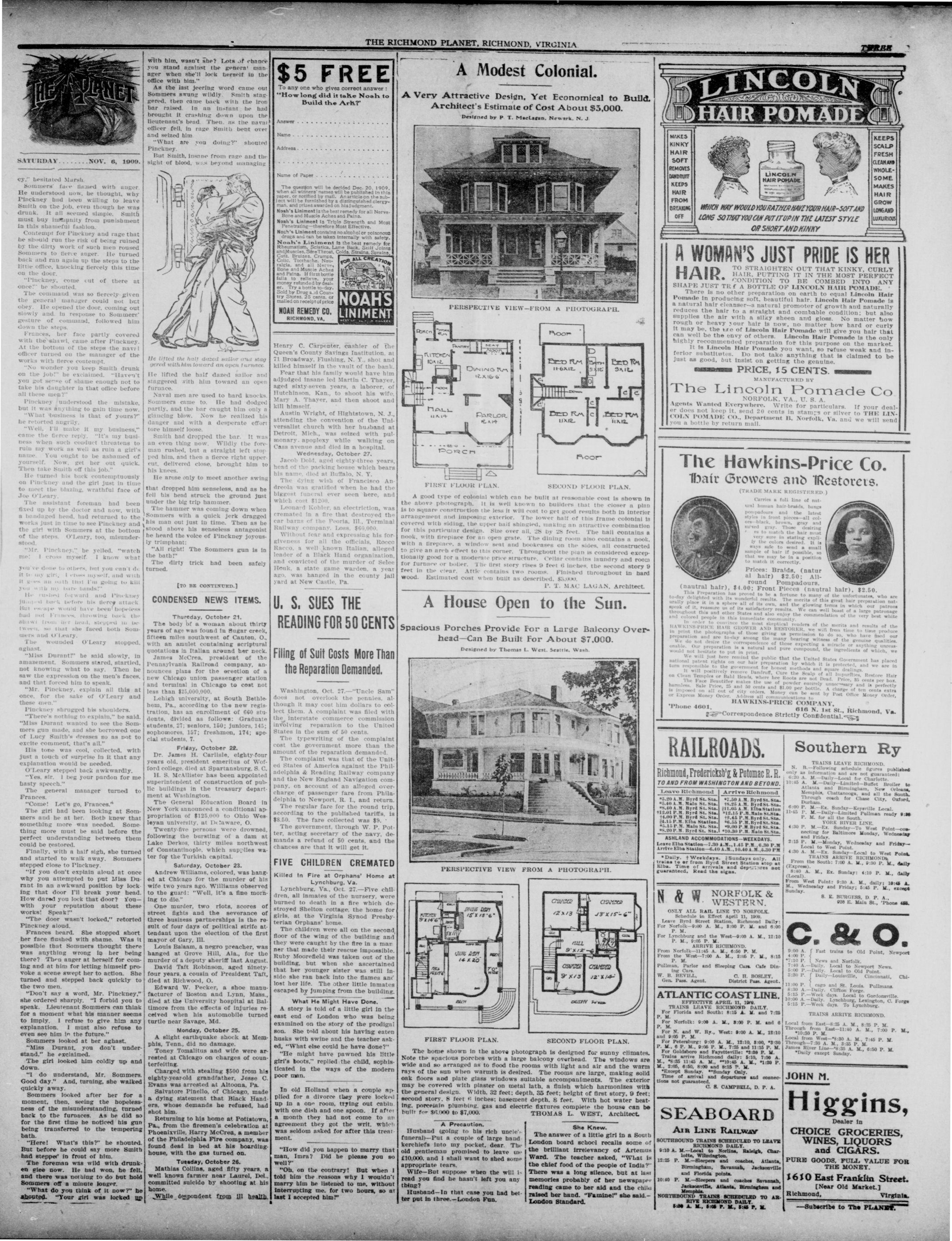
A good trpe of colanial which can be bulit at reasonable cost is shown in
the above photograph. it Is well known to builders that the closer a plan
is to square construction the less it will cost to get good results both in interior
arrangement and imposing exterior. The lower half of this frame colonial is
covered with siding, Uhe upper baif shingled, making an attractive combination
for this particular design. Size over all, 28 by 2S feet. The hall contains a
Hook, with Hrepiace for an open grate, ‘The dining room also contains a nook,
with a firepiace. a window seat and bookcases on the sides, all constructed
to give an arch effect to this corner. ‘Throughout the pian is considered excep-
Uonally good tor a moderate price structure. Cellar contains faundry and room
for furnace or bolier. ‘The Grst story rises 9 feet 6 inches, the second story 9
feet in the clear. Attic contains two rooms. Finished throughout in bard
wood. Estimated cost when built as deseribed, $5,000.
Pp. T. MAC LAGAN, Architect.
eee ee ee
A House Open to the Sun.
Spacious Porches Provide For a Large Balcony Over-
head—Can Be Built For About $7,000.
Designed by Thomas L. West. Seattle. Wash,
mr.
é ae ae
ce Pal | eS
Bape Fics eee aa
eam ra ra Vee eae
ey he a) 7
a Bec Se $5:
a gm ah ty;
Bene i EY i o | ] |
: == 3|
oe z oe ‘
SuikeaNia “View a0m A. PHOROODAPE.
The home shown in the above photograph is designed for sunny climates.
Note the spacious porebes with a large balcony overhead. The windows are
wide and so arranged as to flood the rooms with light and air and the warm
Tays of the sun when warmth is desired. The rooms are large, making solid
oak floors and plate gliss windows suitable accompaniments. The exterior
may be covered with plaster on metal lath, a Suish which harmonizes with
the general design. Width, 32 feet: depth, 35 feet; beight of frst story, 9 feet;
second story. § feet f inches; basement depth, § feet. With hot water beat-
ing. poreeiain plumbing. gas and electric fixtures complete the house can be
Dollt for $f.000 to $7,000. THOMAS L. WEST. Architect.
FIRST FLOOR PLAN.
| awe om \)
PBs sx s'6*
Of }|
=p rs
ox (#20
tt — H >
2 Z)
FIRST FLUOR PLAN.
‘The home shown in the above phe
Note the spacious porcbes with a lary
wide and so arranged as to flood the
rays of the sun when warmth is dest:
oak floors and plate glass windows :
may be covered with plaster on mete
the genera! design. Width, 32 feet: de
second story. 8 feet f inches; baseme
Ing, porceiain plumbing. gas and elec
bullt for $4,000 to $7,000.
<=.
Husband (going to bis rich uncle’.
faneral)—Put a couple of large hand
kerehiefs into my pocket, dear. The
old gentleman promised to leave uv
£10,000, and | shall want to shed some
appropriate tears.
Wite—But suppose when the will i:
read you find be hasn't left you any
thing?
Husband—In that case you bad bet.
ter put in three.—London Fun.
SECOND FLOOR PLAN.
ip cones
B ssxis-6"
4 }
=e i tn
teh
qd pa
s= ee
= = Be or)
9x03] sexe
y ts
SECOND FLOOR PLAN.
graph is designed for sunny climates,
balcony overbead. The windows are
oms with light and air and the warm
d. The rooms are large, making solid
itable accompaniments. The exterior
lath, a Snish which harmonizes with
th, 35 feet; height of first story, 9 feet;
depth, & feet. With bot water beat-
tc fixtures complete the house can be
THOMAS L. WEST, Architect.
She Knew.
‘She Knew.
‘The answer of a Uttle girl in a South
London board schoci recalls some of
the brilliant frrelevancy of Artemus
Ward. The teacher asked, “What is
the chief food of the people of India?”
‘There was a long silence, but at last
memories probably of her newspaper
Feading came to her aid and the chilu
raised ber band. “Famine!” she said.—
‘London Standard.
——Saa Vy af 2 CS
jf jp eee a
iD HATR POMADE @
mee ee l=
wnerl| See Ap |\scap
ce] Gee rt BD [ee
coer] eae [awcaee| Sas imo
KEEPS fa | ees Jeme\ Nhanes
we | AOS [eee we
FROM —=_ crow
aacawne|| WICH WAY WOULD YOU RATHER KANE YoUR HAIR-—SOFT AAD \\\onens
OFF 4ONG SOTHAT YOU GN PUT ITUPIN THE LATEST STYLE — \\uanurioss}
== OP SHORT AND KINKY —
A WOMAN'S JUST PRIDE IS HER
TO STRAIGHTEN OUT THAT KINKY, CURLY
HAIR HAIR, PUTTING IT IN THE MOST PERFECT
* CONDITION TO BE COMBED INTO ANY
SHAPE JUST TR¢ A BOTTLE OF LINCOLN HAIR POMADE.
There is no other preparation on earth to equal Lineolt, Hair
Pomade in producing soft, beautiful hatr. Lincoln Hair Pomade te
© natural hair cleanser-a natural promoter of growth aati natecelig
reduces the hair to a straight and combable condition; but also
supplies the air with a silky sheen and gloss. No matter how
rough or heavy your hair ts now, no matter how hard or cocly
it may be, the we of Lincoln Hair Pomade will give you hair that
can well be the envy of others. Lincoln Hair Pomade is the only
highly recommended preparation for this purpose on the market.
It is Lincoln Hair Pomade you want, 80 refuse weak and in-
ferlor substitutes. Do not take anything that is claimed to be
Just as good, but insist on setting the genuine.
ommnmm=s PRICE, 15 CENTS. sam
MANUFACTURED ny
.
The Lincoln Pomade Co
NORFOLK, VA., U.S.A
Agents Wanted Everywhere. Write for particulars. If your deal-|
er does not keep It, send 20 conte in staines or allver ke Fane Wee
COLN POMADE CO., Department I, Norfolk, Vac nd we ett ae
The Hawkins-Price Co.
air Growers and Restorers.
| NBR eit
La). i
a ess
\ ae OF Shot we vay to tse peace
NI orice: pratt, Cantar
Nas al hair) $2.50; All-
(nautral hatr), $4.00; Front Pieces (nautral hair), $2.50.
tot eget ait ie wonton ete, Seame, ta manta the wert ‘who are
| Septskont, Sie aed her Hates tec Say ie semen a ee ee ee
nn on ee a |
“Phone 4801 seen N, at Bt, Htichmond, Va. |
taF°Correspondence Strictly Confidential qqoy /
Tn ee
7 a
Richmond, Fredericksh’g & Potomac R. R.
TO AND FROM WASHINGTON AND BEYOND.
Leeve Richmond_| Arrive Richmond.
{20 AH. Byrd Se. Sta.| 7.50 4.m1. Byrd. Stn.
S240 008. Male Sc Nea] faces Am. Byres Stas
e400. Byrd Sc Sta] 1105 4.- Hoa Station
1101 BOW Byrd Se Sta] 15-15 PN Main estas
HORM. Byrd Nc Sta] 2-45 PM-nyra testa:
HENGE MC Kiba Sestton:] Se:ka Pw mprasteste,
SUSE M. Malo Seta] 9.00 P-MCByra St bea
S520 8-M. Byrd St. Stacl 670.30 PM Nain BCStaL
'RSHLAND ACCOMMODATIONS - WEEKDAYS.
Leave Elba Statlon—7.30 4.M.,1.45 P.M. 6.30 P.
Arrive Elbe Station 6-40 -4.9.,10.40 4690 Pt
_SDally. ? Weekdays. }Sundays only. all
gush iS of hem Lae sheet ‘Sistion tion" at
Time of arrivals and dep=scires a.
guaranteed, Read the signs. war =
Sanne
N & W NORFOLK &
- WESTERN.
ONLY ALL RAM. LINE TO NORFOLK.
Schedule in E@ect April 11, 10.
Leave Dyed Street Station, Richmoo! Daily:
Por Noriko" A. MC, in PM and 8:00,
.
For Lynchturg and the West—0:00 A. M., 12:20
PM, O06 P.M
‘ARRIVE RICHMOND.
From Norfolk 15 A.M, 6:00PM
Prot the West T:00 A. Hs Ras Ps a, 88
Pullman, Parlor and Sleeping Car Cafe Din-
‘a Care.
Ww. p REVEL, ©. H. nosty,
‘Gen. Pass. Agent. District Pas. Agect.
ATLANTIC COAST LINE,
EFFECTIVE APRIL 11, 1000.
TRAINS LEAVE RICHMOND. DAILY.
Yor Florida snd South: 8:18 A. M- and 7:25
PM
For Norfolk: 9:00 A. ML, 8:00 P.M. and ¢
P
For X. and W. Ry., West: 0:00 A. M., 18:10
and 9:05 Pee
For Petersburg: 9:00 A. M., 18:10, 8:00, *8:30
P.M, OFM, 0:06 P. M., 735 and 116 P.M
Fer’ Goldsboro and Fayeiterille: 2:99 P.M
‘Traina arrive Richmond. daily! 6:10, 7:20" A.
Mi, *5:85 he ALM, OBS AL Mey “1:80 P.
M28, 620, 9300 ad 8
Jexcept ‘Sunday. **Sunday Only.
Time of arrival and departures and connec
tons tot guaranteed,
© & CAMPRELL, D. P. A.
—_——________.
Are Lins Ranway
SOUTHBOUND TRAINS SCHEDULED TO LEAVE
20 A. a GEMOND BAILY,
1 ean Wiese tN Chae
‘12:35 P. M—Sleepers and coaches, Atlanta,
‘Birmingham, Savannah, Jacksonville
| sod Florida polnte.
10:40 P. M—Sleepers snd coaches Savannah,
Jacksonvifie, Atlante, Birminghem and
Nonrapound. Ti an
RIVE ‘DAILY. sy
mwa MM, Pr is a
TRREE
TRAINS LEAVE micHMOND,
H, n_Falloning suiéule Beene peblahed
only an information and ore ‘not Seteantenns
clo 4. ‘Be Dale-Lacal tar Canteens
10:68 A, M—DallyLiitedSeaee roller te
‘tanta tnd” Birmleghaims New Orieant
Newt, "Citanogn, and a ie Bonde
rough’ coach tor Chane ‘Clty, Ontont
4:00 FM's, Sunday Reyerille Lace.
U5 P. M—Daily—Lintited Pullman weedy 9:00
FM ter aoe aan
York ive Lise.
4:20 P, Mee tandagone West Polat—come
Scting for Taleinore Monday, WeleaSiag
Soa ida.
2:18 Pe WcMowdey, Wedeenlay and Friday
Toca to Wea False
4120 A Mn Be Sunday Local to West Peta
IQ At Beko
From the South: 7:00 A. M., 9:30 P. M., daily
moran
aaa A. M, Bx. Sunday: 4:10 P.M, daily
ase
Frocs Wevt Plots 9:20 A.M, dally) 18s A,
Me, Wednesday: and Pray: 645 Pees
Ai 8 E BURGESS, DP. A,
Sk Mele Ge ASece ae.
Cc. Se Oo.
9:00 A. f Fast trains to Old Point, Newport
00 P.
“7:10 P. | News and Norfolk
7:0 A.—Daily. Local to Newport News
6:00 P.—Daily. Local to Old Point
3:80 PL [ Dally—Loulevitle, Cincionati, Chi
11:00 P. | cago and St. Louie, Pullmans
8:30 A—Dally. ‘Clifton Forge:
5:15 P.—Week days. Local to Gordonsville.
10:00 A—Dally, Lynchburg, Lexington, C. Forge
6:15 Pl—Week day. To Lynchburg.
TRAINS ARRIVE RICHMOND.
Local from East—8:25 A. M.. 8:25 P.M.
Through from. Kast—11:40 A.M, 7:00 P.M,
10:90 P.M,
Local from West—*8:30 A. M., 7:5 P.M
Parough—7:30 A. M., 8:35 P.M
James River Line—8:35 A.M, 6:50 P.M.
“Daily except. Sunday.
JOHN M.
Higgi
Iggins,
Dealer in
CHOICE GROCERIES,
WINES, LIQUORS
and CIGARS.
PURE GOODS, FULL VALUE FOR
‘THE MONEY.
4610 East Franklin Street.
(Near Old Market.)
Richmond, Virginia,
FOUR
THE PLANET
Published every Saturday by JOHN MITCHELL,
JR., at 311 N. Fourth Street, Richmond, Va.
JOHN MITCHELL, JR., - EDITOR.
All communications intended for publication
should be sent so as to reach us by Wednesday.
TERMS IN ADVANCE
One Copy, one year, - - - - - $1.50
One Copy, eight months, - - - - - 1.00
One Copy, six months, - - - - - .80
One Copy, four months, - - - - - .54
One Copy, three months, - - - - - .40
Single Copy, - - - - - .00
ADVERTISING RATES
For one inch, one insertion . . . $ .50
For one inch each subsequent insertion . . . 40
For two inches, three months . . . 6.00
For two inches, six months . . . 10.00
For two inches, twelve months . . . 20.00
Marriage and Funeral Notices, one inch . . . 5.0
Standing and Transient Notices per line . . . 10
POSTAGE STAMPS OF A HIGHER DENOMINATION THAN TWO CENTS NOT RECEIVED ON SUBSCRIPTIONS.
THE PLANET is issued weekly. The subscription price is $1.50 per year in advance.
BENEWALS, ETC.—If you do not want THE PLANET continued for another year after your subscription has run out, you then notify us by Fax Card to discontinue it. That we have decided that subscribers to newspapers who do not order their paper discontinued at the expiration of time for which it has been paid are held liable for the payment of the subscription on date when they cried r the paper discontinued.
COMMUNICATIONS.—When writing to us to renew your subscription or to discontinue your payment we should give your name and address in full otherwise we cannot find your name on our books.
CHANGE OF ADDRESS.—In order to change the address of a subscriber, we must be sent the former as well as the present address.
Entered at the Post Office at Richmond, Va. as second class matter.
SATURDAY.....NOV. 6, 1909.
We have received the speech of Hon. Gustav Kustermann of Wisconsin on "How to Build Our Merchant Marine Without Subsidies." It is an able presentation of the subject.
We received the very able annual address of Rev. E. C. Morris, D. D., President of the National Baptist Convention. This able pulpit orator stands high in the religious world as a gentleman and a scholar. His conservatism and sound judgment have made for him hosts of friends and placed him in an enviable position before the religious people of the world. This great organization has made no mistake in continuing him as its executive head and his future promises to be fraught with as much prosperity as his past has been filled with success to the cause which he represents.
"THE STORY OF THE NEGRO."
Dr. Booker T. Washington has certainly assumed the role of the historian in his rather remarkable dissertation upon the Negro. At times, it is difficult to comprehend and hard to believe that he himself is one of the despised race whom he so impartially describes and that he has felt the oppression of slavery at the hands of some of the white people upon whom he lavishes praise.
For diplomacy and good judgment this contribution $t_0$ literature will rank among the favorite preductions of the age. He says:
"A disposition to free slaves for personal considerations of one kind or another began at a very early period. In York and Henriced Counties, Virginia, as far back as the middle of the seventeenth century we find records of the emancipation of Negro slaves. For example, Thomas Whitehead, of York, emancipated his slave John, and bequeathed to him, among other things two cows and the use of a house and as much ground as he could cultivate. He further showed his confidence in the discretion and the integrity of this Negro slave by appointing him guardian of Mary Rogers, a ward of Mr. Whitehead. He also made him trustee of her property, but the court refused to allow him to fill either one or the other of these positions. Another instance recorded about this time was that of John Carter, or Lancaster, Virginia, who was one of the largest slaveholders in the colony. He gave freedom to two of his Negro slaves who were married to each other. To each he gave a cow and a calf and three barrels of Indian corn. He also instructed his heirs to allow them the use of convenient firewood, timber, and as much land as they could cultivate. He provided that the two
daughters of this couple should receive their liberty when they reached their eighteenth year, and, as a provision for them when they reached that age, he gave each a yearling with its increase, which was to be permitted to run with the cattle of his wife after his death."
He then devotes attention to the condition of the Free Negroes. Here is what he says:
"During the early years of slavery the free Negroes seem to have had about the same rights under the law that other free persons had, except, as I have already stated, they were not allowed to hold persons or white blood as bond-servants. It appears that, until after the Revolution, Negro freemen were allowed to vote in every State except Georgia and South Carolina. Between 1792 and 1834 the four bordering States Delaware, Maryland, Virginia, and Kentucky denied the suffrage to the Negro. In North Carolina, Negroes who paid a public tax took part in the election until 1835, when a new Constitution excluded them from the suffrage. New Jersey took away the suffrage of the Negro in 1807, Connecticut in 1814, and Pennsylvania in 1828. New York, in 1821, required from Negroes an unusually high property qualification."
In order to be absolutely fair, he tells of the handicaps of the free Negroes. Here is the way he describes the unjust treatment meted to them:
"The effect of the agitation for abolition seems to have been that the condition of the free Negroes grew steadily worse, particularly in the Southern States. In some of these States they were forbidden to sell drugs, in others they might not sell wheat and tobacco, and in still others to peddle market produce or own a boat was against the law. In several States it was against the law for a free Negro to cross the State line; in others, a slave who was emancipated was compelled immediately to leave the State.
It will be seen though that Dr Washington ascribes this treatment or them indirectly to the abolitionists and he does not set it down as the result of normal conditions. He minimizes this in the following language:
"Notwithstanding the hardships and difficulties under which the free Negro population labore" both in the North and in the South, those who have had occasion to study the local history of the Southern States have found that the number of Negroes who had succeeded in making some impression upon their community, either by their native qualities or by their success in business, was more considerable than is usually imagined. Solomon Humphreys, for instance, after purchasing his freedom, became a well-known business man in Georgia. Benjamin Lundy found at San Antonio a Negro who, after purchasing his own freedom and that of his wife and family, had become the owner of several houses and lots."
"Among the descendants of the free colored people of New Berne, North Carolina, with whom I am personally acquainted is the Hon. John P. Green, who was for twelve years a justice of the peace in Cleveland, Ohio, four years a member of the Ohio House of Representatives, two years a member of the State Senate, and for nine years at the head of the Postage Stamp Distribution Bureau of Washington, filling in the intervals or his public service with practice at the Cleveland bar. His father was a matter tailor in New Berne, and a member of a family of free colored people whose traditions go back something more than one hundred years.
Charles W. Chestnut, author of "The Conjure Woman" and other popular stories of Southern Life, descended from free colored people in Fayetteville, North Carolina. Mr. Chestnut informs me that a colored man by the name of Matthew Leary who before the war was the owner of him was obstructing the streets, but considerable land, a number of slaves a brick store in the business part of the town, and a handsome residence in a good neighborhood. His sons gained some prominence in North Carolina during the Reconstruction era. Matthew Leary, Jr., went into politics and afterwards became a clerk in one of the Government offices in Washington. A younger brother, Hon. John S. Leary, was the first colored man in North Carolina to be admitted to the bar, of which he remained a respected member until he died, at Charlotte, N. C. He was, I understand, at one time a member of the North Carolina Legislature.
"Another of the successful free colored people of North Carolina was James D. Sampson, who began life as a house carpenter, and became in the course of time a man of considerable wealth and some local distinction. I have been informed that the Legislature passed a bill granting his family special privileges which were not permitted to other free people of color. His children John, Benjamin, and Joseph, were all educated in the North. Benjamin graduated from Oberlin College, and afterward became a teacher at Wilberforce, Ohio. John P. Sampson published, at Cincinnati, during the war the Colored Citizen. After the war he was commissioned by General Howard to look after the colored schools established by the Freedmen's Bureau in the Third District of North Carolina. He was elected treasurer and assessor of Wilmington, and was a candidate for Congress, but was defeated because of the fact, it is said, that his father had been the owner of slaves before the war. While it was true that James D. Sampson owned a number of slaves, it is said that many, if not all of them, were held in trust in order to secure them practical freedom. Recently, George M. Sampson, a grandson of James D. Sampson, visited Tuskegee. He is now a teacher in the State Normal School at Tallahassee, Florida.
"There is no reason to believe that the colored people of North Carolina made more progress in a material way than they did in some of the other States in the South. For instance, in the city of Charl
THE RICHMOND PLANET, RICHMOND, VIRGINIA
ton, South Carolina there was a colony of "free persons of color" who were proud of the fact that they sprang from a generation of free ancestors going back to before the Revolutionary War. In the list of taxpayers in the city of Charleston for 1860 the names of three hundred and sixty "persons of color" whose property was assessed in that year are given. They owned real estate which was valued for taxation at $724,570. Of these three hundred and sixty taxpayers, one hundred and thirty owned slaves, aggregating three hundred and ninety in number. The largest number of slaves held by a colored person was fourteen. In this list of "persons of color" thirteen are classed as Indians, but it is quite certain that these so-called Indians were largely mixed with Negro blood. Like so many other communities, there were Indians in Charleston who had been but partially absorbed by colored people with whom they had been associated."
This was a direct tribute to the ability of the free Negroes and a "back-handed compliment to the white slave-owners among whom they lived. He then tells us that free Negroes owned Slave Negroes and that they held many others in trust, thus saving them from ownership by white slave-owners. He says:
"There were a number of other slaves held in trust by the free colored people of Charleston. The wealthiest family in Charleston among the free colored people were the Westons. They had among the various members of the family taxable property to the amount of $80,000. They also owned thirty-six slaves, nine of whom they held as trustees. It is said that the number of slaves held by St. Philip's Church, which was the aristocratic church of the city, amounted to somewhat over one hundred. These consisted for the most part of slaves who had actually bought their freedom and whom the church held in trust."
The entire recital will be published in book form. Still, these extracts will be a storehouse of information to the ordinary citizen of color $ \mathrm{w h}_{0} $ will hear what he has possibly heard before, and learn much that he never thought to have brought $ \mathrm{t}_{0} $ his attention by the magic pen of the distinguished founder of Tuskegee Institute, Alabama.
"DRYS" WIN IN ILLINOIS
Only Five of the Thirty-three Towns Carried by the "Wets."
Springfield, Ill., Nov. 3.—The hardest jolt the liquor interests have received in central and southern Illinois since the anti-saloon agitation started two years ago was administered. Almost a clean sweep was made by the foes of the liquor traffic in the thirty-three towns in which the local option proposition was submitted. Only five of the thirty-three were carried by the "wets."
The "drys" were victorious in Petersburg, Menard county; Meredosl Morgan county; South Winchester; Scott county; Naples, Scott county; Richwoods, Calhoun county, and Gol conda. Pope county, all of which had been "wet."
The bitterst campaign in the history of Jacksonville was waged at that place, with the result that the city remains anti-saloon territory, although the majorities of the "drys" was cut down 700 votes.
SLAYS-RIVAL AT KENTUCKY POLLS
Son of Candidate Kills After He is Wounded.
Jackson, Ky., Nov. 3. — Predictions made on the street that "only a man or two" would be killed during the voting in Breathitt county were justified in the Spring Fork precinct and in a dramatic manner.
Tilden Blanton, with a left hand shot, instantly killed Demonthenes Noble after Noble had crippled Blanton's right arm with a bullet. Noble had previously, according to Blanton, put a pistol at the breast of two of Blanton's brothers.
Noble was a member of a powerful feudal family, a former employee of Judge Hargis, and complications are expected. Blanton, whose father was Democratic candidate for county attorney, was acting as challenger.
The shots were fired while Blanton was leaning from the window of the voting place. He was carried into Jackson to the home of his father and there tacitly arrested.
Anti-Saloon People Gain In Kentucky Lexington, Ky., Nov. 3. The anti-saloon people in Kentucky are claiming that they have won a great victory. At the last session of the state legislature the Anti-Saloon League needed but a few votes of being strong enough to pass the county unit bill. They claim to have gained ten votes by the election throughout the state and to be able now to pass any temporary legislation desired. The leaders of the movement say the county unit bill will be voted upon first, but that soon they hope to put the state wide question before the legislature The league before the election had every candidate to declare himself and they feel assured that the majority of the men who pledged themselves have won.
Waterways in Alaska navigable by steamers approximate 4,000 miles, of which nearly 2,700 are in the watershed of the Kano river.
REPUBLICANS CARRY PENNA.
Entire State Ticket Elected by Good Margins.
MUNSON MADE GOOD BUN
Democratic Candidate For Supreme Court Judgeship Made Gains In Counties, But Not Enough to Overcome Republican Vote In Philadelphia and Allegheny.
Philadelphia, Nov. 3.—Senator Penrose's Republican state ticket, like others that have gone before it, was accepted by a majority of the Pennsylvania voters. Jeremiah A. Stober, of Lancaster, will be the next state treasurer; Arthur E. Sisson, of Erle, the next auditor general, and Judge Robert von Moszcziksker, of Philadelphia, the next justice of the supreme court.
A feature of the election was the remarkable run made by C. LaRue Munson, of Lycoming county, Democratic nominee for supreme court justice. Munson swept county after county of Republican territory in the interior of the state.
While returns on the supreme court judgship is meager and may not be
P. R. S.
ROBERT VON MOSCHZISKER
known with any degree of accuracy for a day or two, it can be taken as a fact that the heavy straight Republican vote in the big machine counties of Philadelphia and Allegheny has smothered Munson's country majorities.
When Berry, Democrat, won the state treasurership four years ago by 88,000 plurality he had a plurality of 34,000 in Philadelphia. The Republican nominee for the supreme court has a much larger Philadelphia majority than that, while Munson's country majorities don't seem to run an high as Berry's.
Stober, for state treasurer, and Sisson, for auditor general, are elected by good margins, though they received nowhere near the normal Republican vote.
No attempt was made to gather returns through the state on the ten proposed constitutional amendments, but it is regarded as pretty certain that they have carried, with the possible exception of number seven, which carried a provision allowing the appointment of election officers in cities. Number seven was cut heavily everywhere.
Pittsburg Elects Lone Senator.
Pittsburg, Nov. 3.—One state senator was elected in Pennsylvania to fill a vacancy caused by the death of John W. Crawford, of the Forty-fifth
[Picture of a man with a mustache and a suit].
district, which is composed of a part of Allegheny county. James L. Adams, Republican, a member of the house of Representatives, was elected to fill the vacancy.
BOND ISSUE WINS
Penrose Wins In Fight With Opponents In Smoky City.
Pittsburg, Nov. 3.—By a small majority Pittsburg decided in favor of a bond issue of $6,775,000 for improvements to the city. The bond issue was a favorite move of Mayor W. A. Magee and H. C. Frick.
There was much opposition shown to the bond ordinance by those who lived far from the center of the city that United States Senator Boles Penrose came to Pittsburgh last week to look over the ground himself. Up until his arrival it did not seem that the bond issue had a chance, but with the two days spent by Penrose new life was put into the matter and it has won.
Defeat of the bond issue meant much to Pennsylvania politics, and it
was admittedly a test of strength
J. B.
JOHN E. STOBER.
Penrose and his opponents in western Pennsylvania. Already there is forming a party, to be headed by State Treasurer John O. Sheatz to attempt the wrestling of power from Penrose.
RETURNS ON JUDGES
Democrats Elect Both In Berks County, Pa.
Harrisburg, Pa., Nov. 3. — There were fifteen judicial elections in thirteen counties of Pennsylvania.
Adams and Berks each elected two judges.
Returns indicate the election of the following judges:
Allegheny—*Livingston L. Davis, Rep. and Dem.
Armstrong—*Willis D. Patton, Rep. Berks—*Gustave A. Endlich, Dem.; G. Wagner, Dem.
nester—*Joseph Hemphill, Dem. Fayette—*Robert E. Umbel, Dem. Lancaster—*Charles I. Landis, Rep. Luzerne—John M. Garman, Dem., but ran on all tickets.
Westmoreland—*Lucien W. Doty, Dem.
*Re-elected.
Associate Judges.
Adams—W. H. Dicks and Leo Sneer-inger, Dem.
Bedford—S. J. N. Foor, Rep.
Forest—Samuel Aul, Rep. and Dem.
Perry—Lucius C. Wix, Rep.
Snyder—J. R. Hendrieks, Rep.
AUCTIONEER NOMINEE WINS
Samuel L. Shank Elected Mayor of Indianapolis. [Indianapolis, Ind., Nov. 3.]—Samuel Lewis Shank, the auctioneer candidate of the Republicans, who began his business life as the driver of a delivery wagon, was selected mayor of this city by a majority of about 1500 over Charles Gauss, his Democratic opponent. The entire Republican ticket is elected.
The closing days of the campaign centered entirely upon the moral aspects of the race, and the temperance people generally came gradually to the support of Shank, under the belief that the election of Gauss would mean the triumph of the brewery element and give that class complete control of the city.
The most notable Republican victory in Indiana appears to have been won in the city of Fort Wayne, where the Berghoff brewery interests nominated a man by the name of Schmidt for mayor on the Democratic ticket. The Republicans nominated a man named Grice. The campaign was "waged against the saloon influences that have so lonf dominated that city, and the Republicans elected their candidate by a majority of about 800.
TOM JOHNSON DEFEATED
Cleveland's Three-Cent Street Car Fare Champion Loses Mayoralty.
Cleveland, O., Nov. 3.—M mayor Tom L. Johnson, 3-cent street car fare champion, mayor of Cleveland since 1901, was defeated by Herman C. Baehr, Republican nominee, by a plurality of 6500. The Republican managers claim the election of twenty-two of the twenty-five city councilmen, giving the Republican control of the city government and predicting a solution of the traction problem speedily after eight years of warfare. The balance of the Republican ticket is elected.
Salt Lake City, Utah, Nov. 3.—Salt Lake went American by a large plurality. The American party, formed to combat the Mormon church in politics, not only repeated its victory of two years ago, but strengthened its control of the city. Bransford, for mayor, has over 8000 plurality and a majority of about 2000 over both Democratic and Republican nominees.
HENEY BEATEN IN FRISCO
Union Labor Candidate For Mayor Elected by Safe Majority.
San Francisco, Nov. 3.—The Chronicle and Call concede the election of P. H. McCarthy, union labor candidate, as mayor of San Francisco, the Chronicle estimating his majority at 5000 to 7500, and the Call estimating it at 10,000. They both concede Fickert's election by 15,000 majority over Heney.
Rhode Island Elects Republican Ticket Providence, R. L. Nov. 3.—Governor Aram J. Pothier is re-elected with a plurality of 8000, and the whole Republican state ticket is elected with pluralities larger than those of last year. Three proposed amendments to the constitution were the principal issues.
Nebraska Goes Republican.
Lincoln, Neb., Nov. 3.—The Republic can state ticket has been elected by majorities ranging from 8000 up. The returns are unusually slow in being sent in owing to the general apathy prevailing.
LANDSLIDE IN PHILADELPHIA
Republicans Elect Ticket By Large Pluralities.
Republicans Elect Ticket By Large Pluralities.
THUGGERY AND FRAUD ALLEGED
It Is Declared the Organization Restorted to Brute Strength and Many Independent Voters Were Beaten and Sent to Hospitals — $500,000 "War Fund" Was Used.
Philadelphia, Nov. 3.—Samuel P. Rotan was re-elected district attorney of Philadelphia over D. C. Gibboney by a plurality of about 35,000.
David Martin was elected register of whis over Edwin O. Lewis by a plurality of 40,000.
Murrell Dobbina was elected city treasurer over John J. Murphy by a plurality of 38,000.
The Republican state ticket candidates, Robert von Moschzisker for supreme court judge, Sisson for auditor general, and Stober for state treasurer, carried Philadelphia over the Democratic candidates, Munson, Clark and Kipp, by pluralities estimated to exceed 60,000.
It was a landslide for Rotan and the rest of the RRepublican candidates. Not only did the organization ticket receive tremendous majorities in all the "stalwart" wards, but Gibboney and the William Penn ticket failed to hold their ground in the usual "reform" wards. Germantown, the north west and West Philadelphia partied in the general slump. In the Kensington district and the northeast wards generally, where the "workingmen's vote" was expected by
PETER H.
SAMUEL P. ROTAN.
the Penn party to be heavy for Gibboney, Murphy and Lewis, the organization ticket was triumphant. The wards in the northeast that gave Gibboney-big maorities over Rotan in the June primaries completely somersaulted into the Rotan column.
All over the city the Ryan-Donnelly Democrats worked openly for the organization ticket and Thomas J. Ryan's Sixth ward, the only Democratic ward in the city, led the pace with a plurality of 1036 for Rotan.
The Republican organization conducted the most determined battle it has ever waged at the polls.
Thuggery and Fraud.
In the downtown and river wards the organization piled up its majorities by simple brute strength, combined with the most flagrant and daring "inside" work by election boards. Every polling place was managed by a swarm of policemen in plain clothes, office holders and others with rolls of money. Voters were intimidated, beaten arrested and in thousands of cases among the naturalized foreigners, browbeaten into voting the organization ticket.
Many independents were sent to the hospitals as a result of injuries received in assaults where they were victims.
It is said that from Saturday until Monday a "war fund" approximating $500,000, which would average $425 to an election division, was distributed among the wards. At the Republican city committee headquarters it was common gossip that the campaign has cost the organization nearly $1,000,000 in cash, of which one-half was held in reserve to be poured out on election day.
Cape May Elects Democratic Mayor.
Cape May, N. J., Nov. 3.—Cape May county re-elects Senator Robert E. Hand, Republican, by a small majority and elects Christopher S. Hand, Republican, to assembly. A Democratic coroner is elected and a Democratic county clerk is also chosen. Frederick J. Melvin, Democrat, is chosen mayor, and William Porter, Democrat, is elected recorder.
Democrats Carry Bayonne, N. J.
Bayonne, N. J., Nov. 3.—The Democrats swept the city and elected John Cain, candidate for mayor, over Garrett L. Post, Republican, by a majority of 1379. The Republicans have been in control of the city government four years.
Buffalo Has Democratic Mayor.
Buffalo, N. Y., Nov. 3.—Fuhrmann, Democrat, was elected mayor of Buffalo by 1246. The remainder of the Republican city ticket is elected.
Trenton Goes Democratic.
Trenton, N. J., Nov. 3.—Mayor Madden's (Democrat) re-election is assured. Democratis Tax Receiver Berrien is also returned.
$3.50 RECIPE CURES WEAK
MEN—FREE
Send Name and Address Today—
You Can Have It Free and Be
Strong and Vigorous.
I have in my possession a pres-
cription for nervous debility, lack of
vigor, weakened manhood, falling
memory and lame back, brought on
by excesses, unnatural drains, or the
follicles of youth, that has cured so
many worn and nervous men right
in their own homes—without any any
additional help or medicine—that I
think every man who wishes to regain
his manly power and virility,
quickly and quietly, should have a
copy. So I have determined to send
a copy of the prescription free of
charge, in a plain, ordinary sealed
envelope to any man who will write
me for it.
This prescription comes from a physician who has made a special study or men and I am convinced it is the surest acting combination for the cure of deficient manhood and vigor failure ever put together.
I think I owe it to my fellow man to send them a copy in confidence so that any man anywhere who is weak and discouraged with repeated failures may stop drugging himself with harmful patent medicines, secure what I believe is the quickest-acting restorative, upbuilding, SPOTTOUCHING remedy ever devised, and so cure himself at home quietly and quickly. Just drop me a line like this: Dr. A. E. Robinson, 3895 Luck Building, Detroit, Mich., and I will send you a copy of this splendid recipe in a plain ordinary envelope free of charge. A great many doctors would charge $3.00 to $5.00 for merely writing out a prescription like this—but I send it entirely free.
"The "Boston American," which is perhaps the leading real estate newspaper of Massachusetts, is reviewing present tendencies on the line of physical development throughout the entire nation. Here is its allusion to Virginia:
CHOICE RESIDENCE
SECTION IN SOUTH
Glen Allen, in Virginia, Is Being Developed on Large Scale for Home- Seekers.
A pleasant spot which unites the charm and wholesomeness of country life with city advantages and which, in a little while, is expected to be the capital's choicest residential district, is Glen Allen, Virginia, one of the beauty places of the South. Glen Allen is a natural park and forty years of forestry have done the preliminary work for its residential development.
The sale of this property, dotted with pretty villas and having eight or nine miles of private avenues and shady lawns is now being conducted by Captain John Cussons, of Glen Allen and many in the North have become interested in the location.
It is situated only twenty minutes from Richmond and on the connecting link between two great railway systems. Thousands of travelers pass Glen Allen daily, many of them describing it as the Deer Park, from the herds of deer which roam over its ample grounds.
It is also the seat of Forest Lodge, which is a spacious mansion of a hundred rooms, and situated in a beautiful park fronting the railway station. The growth of Richmond is helping to increase Glen Allen's popularity, for with the changing of the larger city its choice suburb is reaping benefits from investors and home buyers desirous of living out of the city and the latter are securing a beautiful location for an ideal home.
Something New.
The Sacred Union Correspondence Club, the first and only of its kind to be established and operated by and for the benefit of the Colored people of America.
This club is operated for the purpose of introducing marriageable people of both sex, of every age, rank, religion and circumstance and residing in every part of the country.
No matter where you live, nor what your circumstance may be, if you wish to have lots of fun and correspondents and find your true companion, who is to accompany you through life, write to THE SACRED UNION CORRESPONDENCE CLUB, Howardsville, Va. 3-mo
$100.00 Endowment Paid
Clifton Forge, Va., Oct. 30, 1909.
This is to certify that I have received from John Mitchell, Jr.
Grand Worthy Counsellor of the Grand Court of Virginia, Order of Calanthe ($100.00) One Hundred Dollars in payment of the deathclaim of Sister Lizzie Gilliam, who was a member of Corner Stone Court No. 114, of Clifton Forge, Va.
Signed: CHARLOTTE DOSS,
Beneficiary.
theses:
G. W. Trashol.
J. M. Jones.
Annie M. Banks, D. D.
Independents Win In Toledo, Toledo, O., Nov. 3.-Brand Whitlock, the Independent candidate, was elected mayor over Dave Davies, Republican, by 3000 majority, assuring Whitlock the third term for mayor. The independents elected their entire city ticket.
THE MECHANICS' SAVINGS BANK
The Modern Burglar and Fire=proof Vault With Its Steel Lining and Burglar=proof Round=door Will Be a Wonder.
NOW OFFERS TO THE PUBLIC the facilities which it possesses for the safe-keeping of money, jewels, insurance papers, deeds, wills, stocks, bonds, and all valuables of whatever description at a reasonable cost. It holds choice real-estate, of which it will dispose on long time payments. It requests the patronage of the small depositor and the favor of the large one. Interest paid on all time deposits, remaining (60) sixty days and over.
PERSONS WHO HAVE BEEN UNEASY ABOUT THEIR DEEDS, INSURANCE PAPERS AND THE LIKE, will breathe a sigh of relief when they transfer them to the vault of the Bank, where they know that they are safe from fire and theft. There is a specimen SAFETY DEPOSIT BOX at THE MECHANICS' SAVINGS BANK, which THE CASHIER OR THE TELLER Will show you and either will explain its workings. The stock of the MECHANICS' SAVINGS BANK is now selling above par-to be exact it
VIRGINIA
NOW OFF
ities which it
money, jewels
stocks, bonds,
scription at a
It holds cho
dispose on lon
the patronage
favor of the
time deposits,
over.
The Mo
Lining
PERSONS
ABOUT THEI
AND THE L
when they tr
Bank, where
from fire and
There is
BOX at THE
which THE C
show you and
The stock
BANK is now
```markdown
```
```markdown
```
Bloomers in Billville.
The women folks of Billville have got another craze,—
They're ridin' roun' on bicycles an' blockin' all the ways;
They say it makes 'em healthy, an'
they're gain' for it strong.
they're goin' for it strong.
And the men are bakin' biscuits an' cussin' all day long.
Bicycles an' bloomers—
Never saw the like!
Never is no telkin'
Where lightin'n's goin' to strike.
The women folks of Billville have got the bloomers right;
They're spinnin' down the big road an' goin' out of sight;
They're done with foreign missions—church fairs are goin' wrong.
An' the men are mindin' babies an' cussin' all day long.
Bicycles an' bloomers—
Gittin' wuss an' wuss.
Lord knows what we'll git to
Before they're done with us!
The women folks of Billville—they're goin' with a will:
They're racin' with the railroad trains an' climbin' every hill.
They've got the reddest bloomers—their bicycles are strong.
An' the men wear Mother Hubbards, an' cuss the whole day long
Bicycles an' bloomers—
All the men are "goners."
Don't know what we're comin' to
(Lord have mercy on us-)
—F. L. Stanton in Atlanta Constitution.
Will Fight for Championship.
Will Fight for Championship.
Jeff and Johnson Quickly Sign Up For Battle.
C. E. Van Loan.
Without a serious argument or one black look, without the customary stage abuse and the time honored threats, Jim Jeffries and Jack Johnson met yesterday afternoon at the Hotel Albany, in New York City, and came to a peaceable agreement to fight forty-five rounds or more for the heavyweight championship of the world.
There were only two hitches in the course of the afternoon's debate. The first one, which amounted to nothing whatever, took up more time than the second, which was vital and important. Sammy Berger, jealously guarding the interests of his principal, insisted on placing Jeffries' name first in the articles. Little, Johnson's manager, would not agree to this, and there was a dead-lock for several minutes while the great-men squabbled.
The second hitch came when the
OF RICHMOND, VIRGINIA.
division of the purse was mentioned.
"How do you want to divide the purse, old kid?" asked Little of Johnson.
"Any way will suit me," answered Johnson. "Winner take all is good enough."
"How about that, Jeff?" asked Berger.
The retired champion cleared his throat and made his long speech of the afternoon.
JEFF SAYS "WINNER TAKE ALL"
"There's been a lot of talk about this splitting of the purse," said he.
"You said in Chicago<sub>0</sub> that you wanted to fight winner take all, seventy-five and twenty-five, or sixty and forty. You said, too, that you wanted to bet me $20,000 on the side. The way I want to fight is winner take all, and I want that side bet of twenty thousand."
This declaration drew a cheer from the crowd. Johnson hesitated for a few seconds.
"I'll fight, winner take all," he said, "but I don't want that side bet. Let's bet the $5,000 we already have posted. Is that agreeable, Mr. Jeffries?" Jeff then took time to get his mighty brain into action, and, after some time remarked:
"I'd like to get that twenty thousand," said he grinning.
"Yes, and I don't want you to get that twenty thousand, Mr. Jeffries!" said Johnson, showing his teeth. "I'll fight you any way you say," said Johnson, "winner take all."
"How about it, Jeff?" said Berger.
"All right, it goes!" said Jim.
Then Mr. Little oozed himself into the argument.
"Now, hold on!" said he. "I can't going to eat any snowballs next Winter if this fight should happen to go wrong. Let's make this thing seventy-five and twenty-five.
"All
"All right," said Johnson, quickly. "Anything suits me."
"All right," said Jeff. "That $5,000 we already have up—that goes as a side bet?" "Yes, that goes," said Johnson. The rest of the afternoon's work was easy.
NOTABLE GATHERING
Bids are to be opened one month from date and the best one is $t_0$ be selected. The men are to fight some time before July 5. It was plain from the conversation at the table that neither man cares to fight outside of this country, and all preparations were made looking toward the acceptance of a California bid. Two forfeits or $5,000 were posted yesterday, which were added to the $10,000 which the men already have up, and from the businesslike tone of the afternoon's proceeding, there will be no question about the match being assured. If one man defaults, his $5,000 is to be turned over immediately to the other principal.
It was a notable gathering, a grand roundup of all the thick-necked gentlemen on Broadway
THE RICHMOND PLANET, RICHMOND, VIRGINIA
THIS BANKING INSTITUTION is no longer an experiment. It is conceded to be run upon and in accordance with the most improved rules of the best banking concerns in the United States. Its large spacious four story bank and office building is now in the course of erection and when completed will be one the most modern edifices of the kind in the Southland and will rank with the best white institutions of a similar kind and character.
is selling at ($5.00) five dollars per share above its face value and rating it on the basis of the past dividends, this stock pays seven per cent. to those who purchase now. The BOARD OF DIRECTORS has decided to place a limited amount on the market at $15.00 per share, to be exact, the block equals just ($10,000.) ten thousand dollars and application should be made for an allotment to the Cashier of the Mechanics Savings Bank at once or to some member of the Board of Directors. The first who come will be the first served.
```markdown
```
```markdown
```
plentifully decorated with diamond horseshoes and cauliflower ears. A long narrow room on the second floor had been get apart for the meeting and the crowd was on hand early. jamming around the table, upon which there was enough paper to carry the draft of the new city charter and enough ink to write a three-volume novel.
Jeffries shouldered his way to the front at 3:05, preceded by the faithful but nervous Berger. Johnson arrived at 3:15. The principals did not speak. Jeff sat at one end of the table and rubbed his chin. Johnson grinned and took the other end. The flashlighters lighthit to their hearts' content and filled the room with smoke, which gave Johnson a chance to make an atrocious pun.
Berger looked at Little and Little looked at Berger.
"I suppose the usual form, eh?" said Samivel, huskily.
"Yes," said Little, "between so and so and so and so to fight for the heavyship—no heavyweightship"—
And thus, with both managers nervous and both principals calm and collected, the momentous proceeding opened.
The stenographer imported for the occasion, had been looking upon the grape when it foamed and he was very much at sea. He got his notes into a hopeless muddle and was cast out with the kindly remarks from Johnson that while he might be all very well in a court or law, he was not skilled in fighting verbiage.
Point after point was taken up and settled with a "Quite so!" from Johnson or an "All right!" from Joffries.
EVERYBODY BUTTS IN
Every goat around the table hung in time and time again with suggestions, and certainly no set of articles have ever been drawn under more perplexing circumstances. Little wanted to pick a referee, Jeffries, more experienced, reminded Little that the club would have something to say about that.
"Suppose we fight in Los Angeles," said he. "We wouldn't want a San Francisco referee, or the other way around. Let the club have a hand in that."
"Quite so!" said Mr. Johnson. "It might go outside this country," suggested Little.
"No, sir!" said Johnson. "Nevah git me in Australia no mo!" Huh uh!
"England hasn't got a place big enough for such a fight!" said Jeffries.
"How about Oklahoma?" "Nope!" said Johnson. "No Oklahoma for mine. You can go there (to Little), but not me!"
"But they're bidding a lot of money in Oklahoma," persisted Little.
"Let 'em bid it," said Johnson, cheerfully, "then we'll go somewhere else."
When the question of the length
of the fight came up Jeff put himself on record for a decisive battle.
"The people would holler their heads off if we went to a decision" said he. "This has got to be practically a finish fight. Me for forty-five rounds or more."
NEGRO WANTED SHORT FIGHT
Johnson argued for one San Francisco club inside the city limits which had an offer of $75,000 and would not be allowed to hold a night of longer duration than twenty rounds, but Jeffries was firm, and at last Johnson said, "Quite so!" once more, and that point was settled.
Bob Murphy will hold the $10,-000 side bet and forfeit money, making $20,000 in all, because, said Johnson, if Murphy ran out, there would still be the hotel, and he could board the money out.
After yesterday's business-like arrangement there is no room for question as to the sincerity of either one of the big fighters. Jeffries sprung a surprise when he demanded the winner take all and the $20,000 side bet. Johnson wisely saved himself on the side bet, stating that he might get better odds than even money for all he cared to bet on his own chances, and it was Little who would not agree to the winner take all.
At the end of thirty days the club will be selected, a forfeit posted by the fortunate organization and Jeffries will go into training. Johnson feels that he does not need to hurry his preparations if the fight is to be six months off. July 5 was named as the outside limit. As a matter of fact, 'the men are figuring on fighting in California during a month when they may reasonably expect sunny weather, for the sake of the moving pictures, which will be worth a fortune.
New York American, Oct. 30. 1909.
Big Fellow Declines to Be Social With Black Champion.
By Igoe.
The actual signing of the articles between the champions was devoid of any show of friendship on the part of either man. Jeffries and Johnson played to a small house when they put their signatures to the articles after they had been typewritten. Bob Murphy, of the Albany, ushered both fighters into his private office when everybody had departed. Jeff ignored Johnson as much as he had at the conference upstairs. Johnson was willing to go half way with Jeff, and told some of his friends that he was even willing to pop a bottle with the Los Angeles farmer. When Jeff came in to attach his big, rolling "Jas. J. Jeffries" to the articles, he stalked past Johnson with never a show of recognition. He signed the real set and then consented to place his name to several duplicate copies for the benefit of the mem-
WE HAVE ARRANGED for a limited number of Safety Deposit Boxes. They will be rented to our patrons at the rate of ($.25) twenty-five cents per month and upwards, payable in advance annually. Two keys will alone secure entrance to one of these boxes. The bank has one and the depositor the other. Both keys must be used, one after the other; before the safety-deposit box can be opened by either the Bank Cashier or by the depositor. This is a measure of safety which must be seen only to be appreciated.
```markdown
```
```markdown
```
bers of the press.
A lone photographer begged Jeff to sit at a desk with Lil' Abtha to be photographed in the act of signing the articles. Jeff growled at the camera man and the idea of such a proceeding. He stormed out of the room, leaving Johnson and the rest to pose as they saw fit. At no time did either man show any signs of coming together and shaking hands with the time-honored "Good luck to you, and may the best man win." In all the history of world's championship matches it is perhaps the first time that the principals went their way without the usual well wishing.
Johnson took little interest in the arranging of the articles. Occasionally he was asked for or offered a suggestion. The rest of the time he was joking with his friends about the room. He had two big red dice in his hand and seemed more anxious to "shoot" for two bits than anything else. Not so with Jeff. The big fellow was never more serious in his life. He was pale, and there wasn't a particle of color in his lips. Jeff tore a newspaper to bits and chewed the rim of his derby hat the rest of the time. The only time Jeff's eyes twinkled was when the stenogran pher was removed, after it became apparent that he had been sitting up all night with a sick friend. A big theatrical man in the audience remarked, "Ten months before a fight, eh? That will give Jim a chance to clean up, if he cares to. It will mean a cool $80,000 if he wants to pose in the spotlight."
Sam Berger said after the papers had been signed: "Well, I'm glad they've settled the thing peacefully. It is a big weight off our minds. There will be no theatricals for Jeff. It's to the mountains he will go, mark that." Sam was a bit worried about what San Francisco proper would say when they learned that they had been practically barred from bidding. Jeff wouldn't entertain any suggestion that Sid Hester be given a chance to bid, because he feared that Johnson was looking for a chance to enter into a twenty-round fight that might leave the question of supremacy unsettled.
Same was told also of Lercari's offer which came as the men sat about the tables were shutting him out. He wired: "Offer 85 per cent of gross receipts, 75 per cent of the pictures, and will post $10,000 immediately for guarantee."
"Can't help it," went on Berger. "Jeff wants a forty-five round fight, and that settles it. It comes hard on Lercari and Hester, as it keeps them out entirely, but Jeff figures that if it goes to Coffroth the San Francisco fans get the chance to see the fight. That is the best he can do for San Francisco.
Subscribe to the PLANET. Only $1.50 per year in advance. Have you paid your subscription? If not, why not?
OFFICERS AND BOARD OF DIRECTORS:
JOHN MITCHELL, JR., President.
H. F. JONATHAN, Vice-President.
THOMAS H. WYATT, Cashier.
John R. Chiles, John Mitchell, Jr.,
H. F. Jonathan, R. W. Whiting,
Thomas H. Wyatt, E. R. Jefferson,
D. J. Chavers, John T. Taylor,
Thomas Smith, Thomas M. Crump, Sec.,
J. J. Carter, A. D. Price,
P. B. Ramsey, H. L. Jackson, H. Powell.
The Famous Clothing Co. $10 & $15 Suits
THE FAMOUS CLOTHING CO. 124 East Broad Street.
W. I. JOHNSON,
Funeral Director and Embalmer,
Office & Warerooms, 207 N. Foushee St. Cor. Broad.
HACKS FOR HIRE.
Orders by Telephone or Telegraph filled. Weddings,
Suppers and Entertainments promptly attended.
Telephone, 686. Residence in Building.
1
FIVE
```markdown
```
```markdown
```
These are easily the peer of any garments hereabouts costing from $15 to $25 each. Fashioned, too, in a faultless way, with great care exercised in their tailoring, so that they may be right up to "The Famous" requirement. They must be "right" to be here.
Fall Overcoats $10 and $15
Two special Values in light and heavyweight Overcoats. Both are unusual at the prices asked.
Garments most expertly tailored and created in the most fashionable manner.
They were built in one of America's greatest tailor shops, where only expert workmen find employment. Real Worth $15 to $25.
"The Famous" Brand of Tailored Trousers $3.00 and $4.00
Would be unusual if priced at $5 and $6. Newest effects. Many patterns.
Our Soft and Stiff Hats at $2.00
Every stylish shape or block that Fashion suggests for and Winter. Unmatched at the price outside of "The Famous."
SIX
THE PLANET
SATURDAY.....NOV. 6. 1909
Paul a Prisoner
—The Shipwreck
Sunday School Lesson for Nov. 7, 1909
Specially Arranged for This Paper
LESSON TEXT—Acts 27:27-28:10. Mem
ory verses. 9, 10.
GOLDEN TEXT.—The Lord redemeth the soul of his servants; and none of them trust in him shall be desolate.”—Pas. 34:22
TIME.—Early in November, A. D. 39 or 40
PLACE.—St. Paul's bay on the northeast shore of the Island of Malta, in the Mediterranean sen, 150 miles southwest of the most southerly point of Italy.
Suggestion and Practical Thought.
What the storm and wreck revealed as to the character of Paul, the missionary Hero:
For nearly seven months we have been studying the character of Paul under a great variety of circumstances. We have found him conscientious, consecrated to God, devoted to the good and the salvation of his fellow men, energetic, wise, courageous, joyful, faithful, persevering, independent, unselfish, courteous, of strong feelings, but self-controlled, saintly and true. We have seen him chiefly at his missionary work.
In this storm and wreck we see him from another point of view, connected with bodily interests, physical needs, things pertaining to ordinary human life, as a man among men, not, as one has said, "a long-distance pastor," but in close touch with humanity.
I. The Manly Authority of a Tested Character.—Vs. 27-32. "The fourteenth night" (v. 27) from the time they left Fair Havens in Crete, when the storm began, "Driven up and down," tossed by the waves and "borne along" "in Adria," not the Adriatic sea, but the name then given to the central basin of the Mediterranean. "The shipmen deemed that they drew near to some country."
29. "They cast four anchors out of the stern." Anchoring from the stern is unusual, but much the best under the circumstances, for it would leave them free to sail to either shore when daylight come. During the dreary waiting, while they "wished for the day," the sailors tried to save themselves at the expense of all the rest by means of the boat, the one visible way of reaching the shore. But Paul, noticing the plan, appealed to the centurion and the soldiers to put a stop to it. The sailors had the boat, but the soldiers had the weapons and the power. Paul therefore appealed to the soldiers, for he saw clearly that (v. 31) "except these abide in the ship, ye cannot be saved," as had been promised. Those who went in the boat would doubtless be drowned, and even if they reached the shore, there were none left to manage the ship, especially if the officers of the ship were among those who planned so selfishly for their own safety.
The soldiers put an end to the plan by cutting the ropes and setting the boat adrift.
"Nothing was too good for Paul after that, and when at last the ship broke, and the roll call was made on land, every man, soldier, and sailor sang out cheerily, 'Here.' And when at last Paul got to Rome, Capt. Julius and his soldiers did not soon tire of telling to wife and child and sweet-heart how the little preacher had saved them from the angry deep."
H. Care for the Physical Comfort and Health of His Companions.—Vs. 33-38.
"While the day was coming." As soon as it was light enough to find food. "Continued fasting," took no regular meals.
34. "I pray you take some meat," food; "for your health," safety, they would need to put their bodies in the best condition to give them the strength needed to reach the shore.
35. "He began to eat." To lead them on by his example, he himself did what he advised them to do.
36. "Then were they all of good cheer." "The hearty cheerfulness (is it too colloquial a phrase to say the 'pluck') of the apostle had communicated itself, as by a kind of electric sympathy, to his companions."
III. Paul Doing the Commonest Duties to Help his Companions—Acts 28:1.6. 1. "The knew," recognized, "that the island was called Melita," now shortened into "Malta."
IV. Paul Healing the Sick—Vs. 7-10. Publius, the governor of the island, living not far away, entertained the company for three days till they had time to make other arrangements.
The father of the governor lay critically sick of dysentery. Paul prayed for him and laid his hands on him, and healed him. This gave Paul an opportunity to preach the gospel. For Paul had no credentials that would be of use, and as a prisoner suspicion would be cast upon him. So that God himself gave him the best credentials by bestowing on him miraculous power. Paul healed many others; and as Christ's works of healing showed his kindness and love for men, and revealed the loving nature of our heavenly Father, so Paul's aid for the sick expressed the kindness of the gospel.
Casting Away Cares.
Treat cares as you treat stns. Hand them over to Jesus one by one as they occur. Commit them to him. Roll them upon him. Make them his. By an act of faith look to him, saying: "This, Lord, and this and this, I can
not bear. Thou hast taken my sins.
take my cares. I lay them upon thee
and trust thee to do for me all, and
more than all, I need. I will trust and
be not afraid."—Rev. F. B. Meyer.
To low they build who build beneath the stars—Young.
MADE FOR COMFORT
SIMPLICITY IS KEYNOTE IN JU-
VENILE FASHIONS.
Garments for Small Folk Practically the Same in Cut—Sensible Suggestions for Replenishment of Winter Wardrobe.
Fortunately for the mothers, upon whose patient fingers juvenile wardrobes must largely depend, children's fashions do not show the caprices of the grown-up world with a change of season.
Except for some minor points, which are scarcely worth considering, the little garments now shown for small folk are practically the same in cut. Sleeves are smaller, and there are numerous efforts to make the princess slip entirely succeed all two-piece effects; but one sees still the belted Russian dress, whose plaits and waist-girdling are so universally becoming and childish; the gulpem and sailor dress, and the trock of full skirt and baby bodice, which is so pretty when made of thin white materials and worn with a sash.
All white will still be considered the height of elegance for girls below
1
Simple and Pretty Dress for Girls.
six, though cloth in very pale colors will be equally modish. For practical service, plaids are very much to the fore, and some of the new ones show an effective combination with small dots or solid squares. These are in ginghams, cheviots and soft twilled wools, these last-named materials making up excellently with velvet or ribbon bands.
With a rough cheviot for a girl of eight, a common skirt braid may be used for trimming, put on in rows of three, or to edge a bias of the dress stuff. In fact, with all wool materials, the home-sewing mother may go any time with confidence to her scrap bag, for any bit of contrasting material may be used for garniture.
Children's coats continue to be sensibly loose, those for the smaller malds often being topped by deep cape collars, and those for older ages displaying double-breasted fronts and odd or matching belts.
Juvenile headgear, it is pleasant to announce, shows no madness in the way of size and burdensome trimlings. The hat approved by the mother of taste for girls from the baby age up to ten is small rather than large and very simply trimmed. A number of little felt hats with a soft finish and swathed only with a bright silk scarf with fringed ends, present pleasing, youthful and durable qualities for girls from seven to ten. Little girls of the baby ages—2 to 5—need more fixiness, and for these I would suggest the little felt or lace flats trimmed in a babyish way, with face trimmings and wide strings to tie under the chin. But then such headgear is for wear with the best bib and tucker, of course—for the daintiest wool or silk dress and the smartest coat in the wardrobe.
A simple and pretty little dress like the one illustrated suggests both practical and stylish uses at the first glance. It can be made of wash materials or from wool or silk, and may be scalloped and embroidered, as shown, or else be trimmed with a braid, or ribbon edge, or a blas blinding. In the illustration, a heavy white linen and a red hand embroidery are used, and if a good wash floss is bought this combination stands soap and water excellently.
If the dress is in a pretty wool, the belt, cuffs and front panel, whose ends shape the collar at the back, would be extremely pretty if made of silk in the same tone.
Cashmere in Fashion.
The revival of cashmere in a new and lustrous weave was heralded and somewhat adopted last season. It was more widely used abroad than here, and the designers say it will be the leading style in America this season.
It is exquisite in its present form, and it is so very like crepe de chine that one feels it is a good friend instead of a stranger, or a Rip Van Winkle come to life.
THE RICHMOND PLANET, RICHMOND, VIRGINIA
WANTED.
One Hundred Young Men, not un-
Desire to be Something more than Ore-
Earn More than Wages Generally Paid
Agricultural and Mechanical College in
Prepare Themselves to be Skilled M
Well Qualified Teachers. Graduates B
Per Month. Board, Lodging and Tue-
term Begins September 1, 1909. For
Write,
PRESIDENT, DUDLEY, J.
"RACE ADJUSTMENT
By PROF. KELLY MILLER
Washington,
A Book that is sane, sound
2nd Edition, Prist
AGENTS WANTED IN EVE
the Planet circulates. L.
Ad
Hartshorn M
College, Richn
For the Higher Education
For the Best. For Catalogues
LYMAN B. TEFFT
The Avery College Training School
to Young Colored Women to Become S
Millinery and Domestic Science. The
Connected with This Institution, Offer
the Ambitious Young Colored Women
Uniforms are Furnished Free, Board, I
Monthly Compensation are Offered to
ing. Address all Communications to
JOSEPH D. MAHONEY,
Box 154, Northside,
Is Your Hair B
One Hundred Young Men, not under Sixteen Years or Age, who Desire to be Something more than Ordinary "Hands"—who want to Earn More than Wages Generally Paid to "Hands"—to Come to the Agricultural and Mechanical College for the Colored Race and there Prepare Themselves to be Skilled Mechanics, Intelligent Farmers, Well Qualified Teachers. Graduates Earning from $30.00 to $150.00 Per Month. Board, Lodging and Tuition, $7.00 Per Month. Fall Term Begins September 1, 1909. For Free Tuition or for Catalogue Write,
PRESIDENT, DUDLEY, A. and M. College,
Greensboro, N. C.
"RACE ADJUSTMENT."
By PROF. KELLY MILLER, Howard University. Washington, D. C. A Book that is sane, sound conservative, concise. 2nd Edition, Price, $2.00. AGENTS WANTED IN EVERY TOWN where the Planet circulates. Liberal commission. Address, AUTHOR.
Hartshorn Memorial College, Richmond, Va.
For the Higher Education of Young Women. For the Best. For Catalogues or Information, address LYMAN B. TEFFT, President.
The Avery College Training School Offers Special Inducements to young Colored Women to Become Skilled Artists in Dressmaking, Millinery and Domestic Science. The Andrew Carnegie Hospital Connected with This Institution, Offers Splendid Opportunities to the Ambitions Young Colored Women to Become Trained Nurses. Uniforms are Furnished Free, Board, Furnished Room, Laundry and a Monthly Compensation are Offered to the Young Women in Training. Address all Communications to
Hair Beautiful
---
Is Your Hair Beautiful
Is Your Hair Beautiful
Soft, S
NELS
pomade
It makes your hair
tangled hair as
It keeps it from
and gives it tha
Use Nelson's
Your head will keep clean.
Soft, Silky and Long?
NELSON'S HAIR DRESSING is the finest hair pomade on the face of the earth for colored people. It makes your hair grow fast it makes stubborn, kinky and tangled hair as soft and people as silk. It makes it healthy. It keeps it from splitting or breaking off. It makes it rich and given it that charm so long for by all true ladies. Nelson's Hair Dressing and you'll never have dandruff, will keep clean. The roots of your hair will have the necessary alp disease. You will be delighted with its delicate perfume. Dressing is put up in handsome four-ounce square tin bezels, like the lady holds in her hand. Druggists and box. If you can't get it, send us 30 cents and we will mail it up now, or sit right down and write us. Address ACTURING CO., Richmond, Va.
Use Nelson's Hair Dressing and you'll never have dandruff. Your head will keep clean. The roots of your hair will have the necessary ever have scalp disease. You will be delibrated with its delicate perfume.
amount of oil. You will never have scalp disease. You will never have scalp disease. Nelson's Hair Dressing is put up like the agents everywhere sell it at 25 cents a box. If you can you a full size box postpaid. Go and buy it now, or sit rite NELSON MANUFACTURING Live Agents Wanted. N. WINS
have scalp disease. You will be dressed
Dressing is put up in handles like the lady who
cents a box. If you can't get it, a
and buy it now, or sit right down.
UFACTURING CO
Nelson's Hair Dressing is put up in handsome four-ounce tin boxes, like the lady holds in her hand. Drugglate and agents everywhere sell it at 25 cents a box. If you can't get it, send us 30 cents and we will mail you a full-size box付邮. Go and buy it now, or sit right down and write us. Address
WINST
INSTON,
N. WINSTON,
CONFECTIONER.
Headquarters for Pure I
Wholesale and Ret
Special Attention to Family Trade,
sions, Sunday Schools, Lawn P
Furnished on Short No
Choice Pound and Wedding
nished to Order. Foreign an
FRUITS AND DELICAC
N. WINSTO
537 Brook Ave., Ri
Partners for Pure
Wholesale and Retail
on to Family Trade,
Day Schools, Lawn P
nished on Short No.
and Wedding
Order. Foreign an
NTS AND DELICACY
WINSTO
Live., Ri
Rers for Pure Ice-Cream
Resale and Retail.
To Family Trade, Picnics, Excur-
Schools, Lawn Parties, Etc.
Used on Short Notice.
and Wedding Cakes fur-
r. Foreign and Domestic
AND DELICACIES.
WINSTON,
Richmond, Va.
Headquarters for Pure Ice-Cream Wholesale and Retail. Special Attention to Family Trade, Picnics, Excursions, Sunday Schools, Lawn Parties, Etc. Furnished on Short Notice. Choice Pound and Wedding Cakes furnished to Order. Foreign and Domestic FRUITS AND DELICACIES.
Phone, 2253.
Geo. O. Brown, PHOTO
603 North 2nd St.,
TERCENTENNIAL EXPOSITION MCMVII
AMESTONN
Brown, PHOTO
St.,
OWN, PHOTOGRAPHER,
Richmond, Va.
603 North 2nd St., Richmond, Va.
COMMEMORATING THE FIRST PERMANENT SETTLEMENT OF ENGLISH SPEAKING PEOPLE IN AMERICA
AWARDED TO GEORGE O BROWN
Fine Photographs. True to Life. High-class Service. Latest Improvements in Photographic Out-door Work Executed. Reasonable Estimates and Prompt Service...Pictures Enlarged from Old Negatives or Photographs.
Does it comb easily without breaking?
Is it straight?
Does it smooth out nicely?
Can you do it up in any of the charm-
ing styles, so it will stay, and
make you proud of it?
Is it long and full of life?
If you cannot say YES to all of the
above questions, then you need
Hair Dressing
Write Quick for Terms.
Pittsburgh, Pa.
Nelson's
Knights of Pythias,
This organization is one of the most powerful in the country and its progress has been phenominal. The Grand Lodge of Virginia has jurisdiction over all of the cities and counties in this state. Thirty males are required to organize a new lodge. The benefits paid constitute one of its strongest features, but the principles are greater than anything else. Founded on Friendship, based on Charity and established on Benevolence, the respectable, upright people of the state will find it an order worthy of their heartiest support.
It pays an endowment and burial benefit of of $200.00 for all ages. It pays $4.00 per week sick dues. The badge costing 75 cents each is the only absolutely necessary regalia. For information concerning the organization of lodges apply at the main office.
The Courts of Calanthe
The Courts of Calanthe
Is the Female Department of the Order. It requires a membership of thirty persons to organize a court. Its members are pledged to exhibit Fidelity, exercise Harmony and prove Love one for the other. It pays an endowment and burial benefit of $150.00. It pays $3.00 per week sick dues. The only expense for regalia is the cost of the badge, 50 cents and a rosette, costing 25 cents for funeral occasions.
THE BANDS OF CALANTHE or Children's Department also con-
stitutes a feature and persons cannot do better than to enter the little ones into this mystic circle. The expense is nominal and the benefits all that could be expected. It pays from $1.00 to $1.50 sick dues and death benefits of from $30.00 to $40.00. If you have noPythian Lodge or Court or Band in your neighborhood, orgrniz one.
For all information concerning the Children's Department address
For all information concerning special rates of membership in the lodges and courts, address.
KNICHTS OF PYTHIAST
C. B. F.C.B.
pays $4.00 only absolutely necessary regu apply at the main office.
The Court
Is the Female Department of the thirty persons to organize a co Fidelity, exercise Harmony and an endowment and burial bene dues. The only expense for me a rosette, costing 25 cents for a THE BANDS OF CALA stitutes a feature and persons a circle. The expense is nomin $1.00 to $1.50 sick dues and do Lodge or Court or Band in you For all information concern
For all information concern membership in the lodges and
AUNT JEMIMY'S WISDOM.
De big man ain't allus de one what 'complishes mos' in dis worl'.
Dem whar sings dey own praises needn't expect no oncore.
Don' swalluh yo' pride onless you is sartain yo' digestion is all right.
Dat bride is mighty forchinate dat ma'les de bes' man at huh weddin'.
De cow's big 'nuff to ketch a mouse, but she ain't neuvu kotch one yet.
Dar's some folks dat's slow but suah; en dar's some dat's jes' slow
Whar de hand glass is consarned a 'oman allus look on de bright side.
When hit comes to a long life de black sheep's got de fatted calf skint a mile.
De bes' motto fuh de ma'led man is:
Be suah you is right en den ax yo' wife.
Dar's some folks dat's allus gwineter make hay when de sun shines to morruh.
De husban' knows dat when his wife expresses a wish he's got to stan' fuh de expressage.
De fust chile'll mighty soon larn any mothuh de diffune betwixt will powuh en won't powuh.
Tain't allus well to trus' de man dat's up wid de lark. He mout have kep' de lark up all night.
When a man proposes to a rich gal on his knees hits bekase he hopes she's gwinter sot him on his feet.
When a man's allus gotter back up a statement wid a bet hits a suah sign he ain't 'customed to tellin' de trufe.
Dey say hit ain't pos'ble to buy happiness, but some wimmin comes mighty nigh it when dee's buyin' clo'es.
Ef you don' git de bettuh uv yo'se' looks laik somebody else will.—Good Housekeeping.
WITH THE SAGES
Character is perfectly educated will. —Strand.
To the good the world is very good; to the bad it is bad.—Smiles.
We live truly for ourselves only when we live for others.—Seneca.
It is daily life that tests us—the manner of men we are.—Max Muller.
It is not the gift, but the giving which is most precious and helpful.—Wenn.
The true worth of a man is to be measured by the objects he pursues.—Hilton.
Thy yesterday is thy past; thy today thy future; thy to-morrow is a secret.—The Talmud.
True happiness consists not in the multitude of friends, but in their worth and choice.—Ben Jonson.
A good word is an easy obligation; but not to speak ill requires only our silence, which costs us nothing.—Tillotson.
That is the best obedience that is cheerful, as that is the sweetest honey which drops out of the comb.—Watson.
Happiness, at least, is not solitary; it joys to communicate; it loves others, for it depends on them for its existence the very name and appearance of a happy man breathe of good nature, and help the rest of us to live.—Stevenson.
N. A., S. A., E. A., A. AND A.
organization is one of the most powerful has been phenominal. The Grand
over all of the cities and counties in
ed to organize a new lodge. The
largest features, but the principles
sended on Friendship, based on Chas
the respectable, upright people of
their heartiest support.
an endowment and burial benefit o
per week sick dues. The badge
galla. For information concerning
hurts of Calant
the Order. It requires a memb
court. Its members are pledged
and prove Love one for the other.
feit of $150.00. It pays $3.00 per
regalia is the cost of the badge, 50
funeral occasions.
ANTHE or Children's Department
cannot do better than to enter the
nal and the benefits all that could
death benefits of from $30.00 to $4
our neighborhood, orgriz one.
ing the Children's Department ad
Mrs. ANNA TAYLOR, W. M. 120 W. Hill St., Richmond
mering special rates of JOHN MITCHELL
d courts, address 311 N. 4th St.,
303-5 North Third St
FINE
CLEANING, DYEING ANI
REPAIRING
CHITMAN M. WHITE,
PROPRIETOR.
BOARDING & LODGING
Rates Reasonable. All the Comforts
Orders received by letter or telegraph
MRS. BOOKER LEFTWICH
PROFREPTRESS,
816 N. 2nd N. 1, RICHWICH. L. K.
BLACKWELL & BRO.
Practical House and Sign Palaters
Graining and General Contractors.
.....ALL WORK GUARANTEED.....
Cards, Letters or Orders.
.Give us a trial, you will never regret it.
Address, 608 St. Peter Street,
RICHMOND. VA.
'Phone 5688.
JURGEN'S SON
Before making your purchase you would do well to call at the most reliable furniture house in the city and see the fine line of
REFRIGERATORS,
MATTINGS,
OIL-CLOTHS
And in fact everything that is needed in house furnishings.
RUGS AND
CARPETS
Of every description; also the latest designs in ROCKERS and special CHAIRS.
Our goods are the best for the price and the price is very low.
C. G. JURGEN'S SON.
ADAMS AND BROAD STREETS.
John Vaughan,
315-317 N. 18th St., Richmond, Va.
First Class Lunch Room. Meals at
All Hours. Furnished Rooms,
Day or by the Week. Low-
est Rates.
Good Car Service to all Points of City.
A. Hayes
OFFICE AND WARE-ROOMS,
727 North Second Street
RESIDENCE, 725 N. 2nd St.
First-class Hacks and Caskets of all descriptions. I have a spare room for bodies when the family have not a suitable place. All country orders are given special attention. Your special attention is called to the new style Oak Caskets Call and see me and you shall be waited on individually.
Phone, 2778.
THE ECONOMY
ment also con-
the little ones into this mystic
ld be expected. It pays from
$40.00. If you have noPythian
address.
STRAUS' SPECIAL
Old Yacht Club,
PURE WHISKEY
Will Satisfy the lover of the right
kin of stimulant. Special prices.
We have all grades of good liquors.
Cigars and Tobacco. Call and see us.
ISAAC STRAUS & CO.,
422 E. Broad St.,
Richmond, Virginia.
H F Jonathan
FISH, OYSTERS AND
PRODUCE.
114 N. 17th St., RICHMOND, VA.
ALL ORDERS WILL RECEIVE
PROMPT ATTENTION.
Long Distance 'Phone, 752.
SCHOOL SHOES.
Capitol Shoe & Supply Company,
No. 210 East Broad Street.
A complete stock of Boys,' Misses,' Men's, Ladies,' & Children's Shoes.
ALL THE LATEST STYLES.
DR. P. B. RAMSEY,
DENTIST,
115 East Leigh St.
PHONE, 816.
60 YEARS
EXPERIENCE
PATENTS
TRADE MARKS
DESIGNS
COPYRIGHT & C.
Anyone sending a sketch and description may
change our opinion free whether an
invention is probably patentable. We
inventions strictly confidential. HARDBOOK on Patents
set free. Oldest agency for securing patents.
Laken through Maule & Co. receive
special notice, without charge, in the
Scientific American.
A handwritten illustrated weekly. Largest circulation
of any scientific journal. Four years,
four months. $1. Sold by all newsmen.
MUNN & Co. 3618roadway. New York
Branch Office. 655 F. Washington, D. C.
Let the PLANET do your Job-work
S. W. ROBINSON
NO. 23 NORTH 18TH ST.
FINE WINES, LIQUORS,
CIGARS, &c.
All Stock Sold as Guaranteed.
PROMPT ATTENTION.
Your patronage is respectfully solicited.
```markdown
```
The Conquest of the Pole
COPYRIGHT 1903 BY THE NEW YORK HERALD CO. ALL RIGHTS RESERVED.
SCENE AT THE NORTH POLE. PHOTOGRAPHED BY DR. COOK.
By Dr. FREDERICK A. COOK
Copyright, 1909, by the New York Herald Company. Registered In Canada In Accordance With Copyright Act. Copyright In Mexico Under Laws of the Republic of Mexico. All Rights Reserved
STORMS now came up with such force and frequency that it was not safe to venture out in kayaks. A few wairuses were captured from boats; then sea hunting was confined to the quest of seal through the young ice.
A similar quest was being followed at every village from Annootok to Cape York. But all sea activity would
SCENE AT THE NORTH POLE,
now soon be limited to a few open spaces near prominent headlands.
The scene of the real hunt changed from the sea to the land. We had as yet no caribou meat. The little auks gathered in nets during the summer and elder duck bagged later disappeared fast when used as steady diet. We must procure hare, ptarmigan and reindeer, for we had not yet learned to eat with a relish the fishy, liver-like substance which is characteristic of all marine mammals.
Guns and ammunition were distributed, and when the winds were easy enough to allow one to venture out every man sought the neighboring hills. Francke also took his exercise with a gun on his shoulder.
The combined results gave a long line of ptarmigan, two reindeer and sixteen hares. As snow covered the upper slopes the game was forced down near the sea, where we could still hope to hunt in the feeble light of the early part of the night.
No Anxiety For Winter.
With a larder fairly stocked and good prospects for other tasty meats we were spared the usual anxiety of a winter without winter supplies, and Francke was just the man to use this game to good effect, for he had a way of preparing our primitive provisions that made our dinners seem equal to a Holland House spread.
In the middle of October foxskirn were prime, and then new steel traps were distributed and set near the many caches. By this time the Eskimos had all abandoned their sealskin tents and were smugly settled in their winter igloos. The ground was covered with snow, and the sea was nearly frozen over everywhere.
Everybody was busy preparing for the coming cold and night. The temperature was about 20 degrees below zero. Severe storms were becoming less frequent, and the air, though colder, was less humid and less disagreeable. An ice fort was formed, and the winter sledging was begun by short excursions to bait the fox traps and gather the foxes. All these pursuits, with the work of building and repairing sleds, making dog harness and shaping new winter clothing, kept up a lively interest while the great crust which was to hold down the unruly deep for so many months thickened and closed.
Last Glimpse of the Dying Day.
During the last days of brief sunshine the weather cleared, and at noon on Oct. 24 everybody sought the freedom of the open for a last glimpse of the dying day. There was a charm of color and glitter, but no one seemed quite happy as the sun sank under the southern ice, for it was not to rise again for 118 days.
The Eskimos took this as a signal to enter a trance of sadness, in which the bereavement of each family and the discomforts of the year are enacted in dramatic chants or dances.
But to us the sunset of 1907 was inspiration for the final work in directing the shaping of the outfit with which to begin the conquest of the pole at sunrise of 1908. Most expeditions have had the advantage of the liberal hand of a government or of an ample private fund. We were denied both favors.
But we were not incumbered with a cargo of missifs devised by home
dreamers, nor was the project handi capped by the usual army of novices for white men at best must be regarded as amateurs compared with the expert efficiency of the Eskimo in his own environment. Our food supply contained only the prime factors of primitive nourishment. Special foods and laboratory concoctions did not fill an important space in our larder.
COPYRIGHT: ROB BY THE NEW YORK RENAL CO. ALL RIGHTS RESERVED
POLAR BEAR AND ESKIMO DOG ON THE JOHN R. BRADLEY
Fading Sun Warns Explorer of Coming Long Arctic Winter---Preparing Sled and Boat
[FOURTH ARTICLE]
Nor had we balloons, automobiles, motor sleds or other freak devices. We did, however, have an abundance of the best hickory, suitable metal and all the raw material for the sled and its accessories, which were henceforth to be linked with our destiny. The sled was evolved as the result of careful study of local environment and of the anticipated ice surface northward. We did not copy the Mc
ERALD CO. ALL RIGHTS RESERVED.
PHOTOGRAPHED BY DR. COOK.
Clintock sled, with its wide runners, which has been used by most explorers for fifty years. Nor did we abandon the old fashioned iron shoes for German silver strips.
What a Polar Sled Should Be,
The conditions which a polar sled must meet are too complex to outline here. In a broad sense it seemed that the best qualities of the best wood Yukon sled could be combined with the local fitness of the Eskimo craft with tough hickory fiber and sealskin lashings to make elastic joints. With plenty of native ingenuity to foresee
COPYRIGHTED BY THE NEW YORK REPUBLIC
POLAR BEAR AND ESKIMO DO
and provide for the strain of adaptability and endurance, the possibilities of our sled factory were very good.
For dog harness the Eskimo pattern was adopted, but canine economy is such that when rations are reduced to workable limits the leather strips disappear as food. To overcome this disaster the shoulder straps were made of folds of strong canvas, while the traces were cut from cotton log line. A boat is an important adjunct to every sledge expedition which hopes to venture far from its base of operation. It is a matter of necessity even when following the new coast line, as is shown by the mishap of Myllus Erickson, for if he had had a boat he would himself have returned to tell the story of the Danish expedition to east Greenland.
Need for a boat comes with the changed conditions of the advancing season. Things must be carried for
several months for a chance use in the last stages of the return; but, since food supplies are necessarily limited, delay is fatal. Therefore when open water prevents progress a boat becomes in the nature of a life preserver. Foolish indeed is the explorer who ignores this detail of the problem. Transport of a boat, however, offers many serious objections. Nansen introduced the kayak, and most explorers since have adopted the same device. The Eskimo canoe serves the purpose very well, but to carry it for three months without hopeless destruction requires an amount of energy which stamps the polar venture with failure.
Selecting a Boat.
Sectional boats, aluminium boats, skin floats and other devices have been tried, but to all there is the same fatal
THE RICHMOND PLANET, RICHMOND, VIRGINIA
objection of impossible transportation.
It seems rather odd that the ordinary folding canvas boat has not been pressed into this service.
We found it to fit the situation exactly, selecting a twelve foot Eureka shaped boat with wooden frame. The slats, spreaders and floor pieces were utilized as parts of sleds. The canvas cover served as a floor cloth for our sleeping bags. Thus the boat did useful service for a hundred days and was never in evidence as a cumbersome device.
When at last the craft was spread and covered, in it we carried the sled, in it we camped, in it we sought game, the meat of which took the place of exhausted supplies. Without it we, too, would not have returned.
Preparation of the staple food supply is of even greater importance than means of locomotion. To the success of a prolonged arctic enterprise in transit successive experience is bound to dictate a wise choice of equipment, but it does not often educate the stomach.
From the published accounts of arctic travelers it is impossible to select a satisfactory menu for future explorers, and I hasten to add that perhaps our experience will be equally unsatisfactory to subsequent victims.
Nor is it safe to listen to scientific advice, for the stomach is the one organ of the body which stands as the autocrat over every other human sense and passion and will not easily yield to foreign dictates.
The problem differs with every man. It differ with every expedition, and it is radically different with every nation. Thus when De Gerlache forced Norwegian food into French stomachs he learned that there was a nationality in gastronomics.
Depending on Eskimo Food.
In this respect, as in others, I was helped very much by the people who were to line up my forces. The Eskimo is ever hungry, but his taste is normal. Things of doubtful value in nutrition form no part in his dietary. Animal food, meat and fat, is entirely satisfactory as a steady diet without other adjuncts. His food requires neither salt nor sugar, nor is cooking a matter of necessity. Quantity is important, but quality applies only to the relative proportion of fat. With this key to the gastro-nomics of our lockers, pemmican was selected as the staple food, which also served equally well for the dogs. We had an ample supply of pemmican, made by Armour, of pounded dried beef, sprinkled with a few raisins, some currants and a small quantity of sugar. This mixture was cemented together with heated beef tallow and run into tin cans containing six pounds each.
This combination was invented by an American Indian. It has been used before as part of the long list of food-stuffs in arctic products, but with us it was the whole bill of fare when away from game haunts. Only a few palate surprises were carried, and these will be indicated in the narrative of camp life. The entire
DOG ON THE JOHN R. BRADLEY
Winter and night were spent with busy hands, under direction of Eskimo and Caucasian ingenuity, in working out the clothing and camp comforts with out which we could not invade the forbidden mystery of the polar basin. Although we did not follow closely either the routes or methods of our predecessors, we are nevertheless doubly indebted to them, for their experiences, including their failures, were our stepping stones to success.
How to Wash Windows
How to Wash Windows.
Windows should never be washed while the sun shines directly on them, for this is sure to cause streaks to appear on them. Of course the glass may be wiped dry as soon as it is washed, but this is twice the work, since one must rub until the glass is perfectly dry. This is not necessary if the sun is not shining on the windows, for it does not add anything to the appearance of the windows when finished. If the glass is badly solled and it is necessary to apply a good deal of water to remove the dust and stains, it is better to wash with plenty of water and then let the glass dry and then sponge the window off again. This will remove all the streaks left by the first washing. Should the glass become too dry before you return to finish the drying it may be sponged over again with the sponge wrung dry out of hot water. Always let the window stand for a few minutes after washing it before drying it and it will dry much easier and in-but half the time.
Geraldine--Why did you ask for an introduction to me, and why do you now, knowing so little of me, ask me to be your wife? Gerald--I decided the day that I saw you alight from a street car and noticed that you did not get off backward that you were a remarkable woman--New York Press.
TAFT IS AGAINST THE PORK BARREL
Says Old Method of Improving Waterways Must Cease.
The President Declares In the Future Measures That Are Useful to the Country Will Be Adopted and Not Those Intended to Re-Elect Certain Congressmen—Starts Down the Mississippi River.
President Taft started from St. Louis on his 1200-mile trip down the Mississippi river to the tooting of whistles and the cheers of thousands. Fifteen big Mississippi river steamboats, bearing a notable escort, swung out behind the little United States lighthouse tender Oleander, on which the president is quartered. Included in the escort are the vice president of the United States, two cabinet members, twenty United States senators, four representatives of foreign nations, the speaker of the house of representatives with 176 of his fellow congressmen, and hundreds of prominent business men of the middle west.
It is the greatest show that was ever pulled off in an effort to push legislation through congress. The excursion is running under the auspices of the Lakes to the Gulf Deep Waterways association, and is to end at the annual convention of the association in New Orleans.
The president is accompanied on the Oleander only by his secretaries and the secret service guard. He is scheduled to make slight speeches on the trip down the river, but he will have to spare his voice if he expects to speak above a whisper on the last lap of his trip.
At the mass meeting in the Coliseum President Taft served notice on Speaker Cannon that the old "pork barrel" method of apportioning the harbor and river improvements to the congressmen with the pull will have to cease. The speech caused a sensation among the 177 congressmen at the St. Louis meeting, who regarded it as a direct slap at the speaker.
"And right here," said the president, "I want to clear away a supposition which I am afraid has lodged in a good many minds. The projects for irrigation and for the improvement of waterways in the future are not to be for the purpose of distributing 'pork' to every part of the country. Every measure is to be adopted on the ground that it will be useful to the whole country. They are not to be adopted for sending certain congressmen back to Washington or for making certain parts of the country profitable during the expenditure of the money.
"We should take up every comprehensive project on its merits and determine whether the country where the project is to be carried out has so far developed as to justify the enormous expenditure of money and if it will be useful when done. When we decide in favor of a project I believe in issuing bonds to carry it to completion as rapidly as possible.
"It has been proposed that we issue bonds for $500,000,000 or $100,000,000 and cut it up and parcel the money out in this and that section of the country. I am opposed to any such proposition because it not only smells of the 'pork barrel,' but would be a 'pork barrel.'"
Warrants In Graft Case.
Warrants were issued at the instance of District Attorney Abram Salsberg, at Wilkes-Barre, Pa. for the arrest of the three county commissioners, county controller, two contractors, two inspectors and two architects engaged in the erection of the recently completed $2,000,000 courthouse here. Five of the warrants charge all the accused with conspiracy to defraud the county, and two of them charge the county commissioners and county controller with misdemeanor in office on twenty-five counts. The accused men are County Commissioners George Smith, Walter McAvoy and Silas E. Jones, County Controller James M. Morris, County Inspectors Michael Lynch and Charles Norris, Architects Frederick McCormick and Harry French, Contractors Frank Calrucci, of Scranton, and Creste Formigli, of this city.
The charge of conspiracy is based on allegations that the accused conspired to place in the building cheaper materials than those contracted for, without change in price, it being claimed that the graft amounted to $400,000. The grand jury meeting next week will be asked to indict the accused men.
Jeffries Anxious to Eight.
"I will fight Johnson and I will boat him easily." In response to a volley of questions, James J. Jeffries made this positive assertion as he stepped down the gangplank of the big Cunard line steamer Lusitania in New York. A crowd of fully 5000 persons welcomed the former champion of the world, who has been spending some time in Europe. Jeffries and his wife were met by Sam Berger and several close friends at the pier, while the crowd surged around them, cheering enthusiastically. Jeffries looked to be in far better condition than when he left here last August after a twenty weeks' vaudeville engagement.
It is still the opinion of well posted
sporting men that Promoter Coffroth,
of California, will secure the battle
and that the men will fight for a $50;
$00 purse or a percentage of the gross
receipts.
Girl Swore Falsely Against Man.
Three weeks ago John Worthington,
a well-to-do planter, residing near
Rome, Ga., was convicted of ravishing
Rosa Eilrod, the seventeen-year-old
daughter of a neighbor, and sentenced to the penitentiary for twenty years. Rosa Elrod was practically the only witness against Worthington. She related in detail the story of the outrage, and the jury at once convicted. Worthington stoutly denied the crime and said there was a plot to ruin him. Two days ago Rosa Elrod made an affidavit that she had perjured herself. She said she loved Worthington, but he refused to marry her, and she swore he had outraged her for revenge. Her confession has caused a great sensation and caused so much bitterness against the Elrods that they have left the county.
Ten-Year-Old Boy Kills Big Bear. Dorman Long, a ten-year-old boy, of Sweet Valley, near Wilkes-Barre, Pa., while out hunting with his father, shot and killed a large black bear under circumstances that would have shaken the nerve of an experienced hunter.
The bear, which was wounded by two charges of light birdshot from the father's shotgun, had run into heavy underbrush, and there the boy, running ahead of his father, bravely followed it and shot it again. It fell and, believing it was dead, he rushed upon it, only to find it springing up and turning upon him, whereupon he gave it the second barrel at the distance of a few feet and killed it.
Murdered Man's Body Found In Bushes
Murdered in his lonely hut, near Egg Harbor, N. J., and carted for almost a mile on a wheelbarrow, the body of John Gavron, a recluse, was found in a clump of bushes. Gavron came here from New York several months ago and built a small hut in the wilderness. His neighbors saw him working daily until a few weeks ago.
Just before his disappearance a man named Borzay came to the settlement and also built a hut.
Gavron and Borzay were seen together frequently. When the old man was missed, it is alleged. Borzay said he had gone to a Philadelphia hospital for treatment.
Wife Slayer Confesses Crime
Otto Mueller, who, under the name of Fred Gebhardt, was arrested at Astoria, L. I., for the murder of Anna Luther, whose skeleton was found in the woods near Islip, L. I., was brought over to the New York police headquarters from Brooklyn and had a long talk with Inspector McCaffery. Mueller, white and trembling, told little to the policemen in New York, but later, after he had been taken back to Brooklyn, he confessed that he shot Anna Luther in the woods near Bayshore on April 9, 1908.
Girl Killed by Brother
Sixteen-year-old Margaret Keeler, of near Nordmont, Pa., was accidentally shot and killed by her twelve-year-old brother. The girl was busy getting breakfast for her sick mother, when the boy, believing that he heard a wild turkey in the woods outside, rushed for his rifle. The weapon was discharged, and the bullet pierced the girl's forehead. She fell dead within sight of her mother.
To Speak on Missionary Work
Speak on Missionary Work.
The Reformed church is making preparations to have ex-President Theodore Roosevelt upon his return from Africa to speak upon the subject of Christian missionary progress on that continent. It is understood that officials of some of the Reformed church missionary organizations have received assurance from Mr. Roosevelt that he is not only willing but eager to speak.
Found $10,000 Ruby In Yard.
While Ira M. Young was digging for a sewer, ten feet below the surface, in his back yard at Butler, Pa. his attention was attracted to an unusual pebble. Examination of it by New York specialists in precious stones show it to be a ruby, worth from $7000 to $10,000. The find of Young, who is a poor man, has caused immense excitement among neighboring property owners.
Had $3300: Died of Starvation
Relatives of Mrs. Henry Christie, a recluse, who died at Paterson, N. J., from exposure and the lack of food, claimed the body and will give it proper burial. Although the woman had $3300 on deposit in a bank she denied herself the necessaries of life. Mrs. Christie, who was seventy-seven years old, was the widow of a Civil War veteran and owned the house in which she died.
South Wants to Hear Aldrich
Senator Aldrich, of Rhode Island, has been invited by the Macon (Ga.) Chamber of Commerce to deliver an address on the proposed change in the currency system and the establishment of a central bank.
Justice Peckham Claimed by Death.
Rufus Wheeler Peckham, associate justice of the supreme court of the United States, died at his summer home, Altamount, just outside of Albany, N. Y. He was appointed by President Cleveland in 1895. Death was due to angina pectoris.
Postmaster of Washington Dead
Benjamin Barnes, the postmaster of home of his father-in-law, Jacob Frech, where he had dined. Mr. Barnes was stricken just after the meal was completed and died before a physician could reach his side.
"No," said Stormington Barnes, "I shall never play Hamlet again."
"Why not?" queried his dear friend, Walker Ties.
"My professional pride will not permit it," replied the self acknowledged tragedian. "Why, even the lights went out last night."—Chicago News.
Drummer—And so our friend, your husband, is gone! He dealt with me for twenty years. Weeping Widow—Yes, and if you had come a fortnight earlier you would have found him still among the living. Drummer—Do you think he left any order for me?—Fillegende Blatter.
"He is a mechanical sort of freak." "How is that?" "When his wife steps on his foot he shuts his mouth."—Honest Post
MORE MONEY—RACE PROGRESS
If colored people groom themselves daintily, destroy perspiration odors, remove grease shine from the face and use our new discoveries for improving the skin and dressing the hair, they will be better received in the business world, make more money and advance faster.
The Chemical Wonder Company of New York is the best business friend colored people have. It improves their bodies as Dr. Booker T. Washington improves their minds. That company manufactures nine Chemical Wonders, which will make colored people as attractive as individual peculiarities will permit. Colored men in New York who use these Wonders hold better situations in banks, clubs and business houses and women have better positions, marry better, get along better.
(1) Complexion Wonder Creme will light up any colored face (black or brown), every time it is used. To prove this on one trial, we send demonstration sample for 10 cents. Regular jar 50 cents postpaid.
(2) Magneto-Metallic Comb called Wonder Comb. Can be heated before using to help straighten and dress the hair. Costs 50 cents and will last a life time.
(3) Wonder Uncurl. When this pomade dressing is in the hair the kinks can be curled and the hair becomes flexible. When heated into the scalp and through the hair with a Wonder Comb, any stiff, knotty hair will dress well. 50 cents postpaid.
(4) Wonder Hair Grow fertilizes the scalp and makes hair grow long, just as fertilizers in the soil make corn stalks grow. 50 cents postpaid.
(5) Odor Wonder Powder instantly destroys perspiration odor. People who neglect such chemical cleansing are obnoxious. 50 cents postpaid.
(6) Odor Wonder Liquid. This fine toilet water surrounds the body with delicate perfume. When used with Odor Wonder Powder the condition of the body becomes perfect. If you can spare 50 cents extra order this luxury. 50 cents postpaid.
(7) Wonder Foot Powder keeps the feet dainty. 50 cents postpaid.
(8) Wonder Wash. A shampoo to clean from dandruff and insure the health of the hair and scalp. 50 cents postpaid.
(9) Shell Pink Creme will give light brown girls beautiful pink cheeks without made up appearance. 50 cents postpaid.
We should make up appearance. 50 cents postpaid.
We guarantee all these Wonders as represented. We give advice free about hair, skin and scalp. Will send book on Attractiveness free. We will prove true business friends of colored people.
We wish one agent for every locality and guarantee against loss.
Only $2 capital required.
Always write to M. B. BERGER & CO., 2 Rector Street, New York.
We market all the Chemical Wonder Company preparations.
Everything Everything
IN FURNITURE AND
FURNITURE SPECIALTIES
FLOOR COVERINGS
SYDNOR & HUNDLEY, INC.
Leaders.
709 711 713 EAST BROAD STREET.
Phone, 577. Richmond, Va.
A. D. PRICE,
Funeral Director, Embalmer and Liveryman.
All orders promptly filled at short notice by telegraph or telephone. Halls rented for meetings and nice entertainments. Plenty of room with all necessary conveniences. Large picnic or band wagons for hire at reasonable rates and nothing but first-class, carriages, buggies, etc. Keep constantly on hand fine funeral supplies.
No. 212 East Leigh Street.
(Residence Next Door)
OPEN ALL DAY AND NIGHT—Man on Duty All Night.
MEALS at All Hours—Hot or Cold. Board by Day, Week or Month. SOFT DRINKS.
PROF. D. D. BRUCE, M. D.,
Strange, Wonderful, but True are the awe stricken tests given by The Great Australian Medium.
PROF. D. D. BRUCE, M. D. the only living Apostle of Science of the Mysteries.
$5000 in Gold to any one in the World to compete with him. Possessing more power than any four mediums combined.
No card, trance or hand humbug.
Greatest Hindoo Medium in the World.
SO GREAT IS HIS POWER that he can tell you while in a Claivoyaut state, all you wish to know with out a word being spoken. Come, all ye unbelievers, coffers and jeers; bring all your skepticism with you—he will open your eyes to the private chamber mystery. Come all ye broken hearted wives, all with low spirits and let him lift the burden from your aching and jealous heart. He challenges the World to compete with him in causing a speedy marriage with the one you
SEVEN
love; uniting the separated and bring back the lost one. Traces lost or stolen goods. Unearths hidden treasures. Removes evil influences Crosses, Spells, Ill Luck, cures tricks and Conjurations, gives Luck and Success in all you undertake. Cures the Tobacco and Liquor Habits. Allows the Captive to be set Free.
He is the only one that will give a Written Guarantee to complete your business or refund your money. Are you sick? Do you know what the trouble is with you? Come and Consult Nature's Doctor.
Rheumatism, Insomnia, Hysteria and all Diseases cured. Points given on Horse Racing and all Games of Chance.
No matter what asks you, come and see this wonderful man. Reader have you noticed that some people have a hard time to get along, no matter how they tell, while others have success? Many wealthy men and women owe their success to this wonderful man.
He will tell you whom you will marry. Will you be happy? He will tell you who your friends and enemies are. Can you tell? Don't take a leap in the dark, but be advised by this wonderful man. Greatest Prophet in existence.
He always Succeeds when others fall. This the chance of a life time. Don't let it pass you.
Office halls
Office hours: 9 A.M. to 9:30 P.M.
Sunday: 2:30 to 7:30 P.M.
N. B.—Our consultation Fee is
50 cents. Sittings, $1.00. All
letters containing $1.00 will be
answered in full.
MAIN OFFICE:
510 S. 8th Street, Philadelphia, Pa
St
: ye
SATURDAY. .......NOV. 6, 1909
Flowers.
“Please leave off the flowers,”
As if from the dead,
‘A voice I heard as
A paper TE read.
‘Twas the voice of the friends
Of the well loved departed
It struck me as strange and
1 paused, I started.
I thought of the time of
‘The wonderous creation,
When God formed man and
Of man’s obligation.
To appreciate all things by
His Maker created,
And see that each object
Is properly rated.
To see in each atom
‘That occupies space,
‘The love of his Maker
As well as his face.
‘The Bible, in telling
The beautiful story
Of God and creation,
Of God and His glory.
Tells how He pleased man in
A garden to dress it,
And God himself walked there
To view it and bless it.
‘This garden was filled with
Ripe fruit amd sweet flowers
‘With musical streamlets
‘And coolest of bowers.
And birds of gay plumage
And sweetest of song,
Ceased not their sweet concert
‘The living day long.
‘When Jesus was born on
Fair Bethlehem’s plains ,
A chorus of angels
Sang forth in sweet strains:
Saying “Glory to God!
In the highest!” Amen!
And on earth peace! Heaven's
“Good will toward men.”
When Christ, in his ministry
Preached to the Jews,
And unto the Gentiles He
Brought the glad news.
He showed how the lily
E'n then famed in story
Did out-shine wise Solomon
In all his glory.
E’n down to this day there
Is somehing in flowers
‘That savors of heaven
And heavenly powers.
Their fragrance and form and
Endless variety,
‘Their colors and graces
And lessons of piety
Will lead those who read them
With minds that don’t plod
To look up through nature
Unto Nature's God!
Then, let us have flowers
And music broadcast
God made them, God gave them
May they ever last
Until time be ended
And then may we rest
‘Midst beautiful flowers,
The brightest and best!
—O. M. STEWARD.
Y. M. C. A. Notes.
The Y. M. C. A. Conference met
last Friday evening, and much {n-
terest was manifested by the mem-
bers
All who attended the explanation
on the Sunday schoo! lesson last Sat-
urday enjoyed the hour. New mom-
bers were present. Did you know
that we are expecting you?
The reports from the elty Jail for
last Sunday gave much joy to the
committee. Five prisoners were led
to accept Jesus Christ. Work hard
men.
The city home work for last Sun-
day was very encouraging.
‘The boys’ meeting at the building
was @ great success. Mr. C. B. Gas-
ton addressed the boys.
An over flow meeting last Sun-
day for women and men at the True
Reformers’ Hall. The lecture by
Lieut. Col. Count A. M. Lochwitzxy
Was extremely helpful. Mr. Joseph
Matthews sang from his soul. Watch
for the date of the next lecture.
Men be on time Sunday really for
hard work and the oher man.
Here we are. The Y. M. C. A.
will celebrate her Twentieth Anni-
versary Sunday 3.30 P. M. at the
Ebenezer Baptist Church. | Women
and men are invited. Dr. Thomas H.
White, pastor of the First Baptist
Church of Clifton Forge will preach
the sermon. Subject: “The Life”
The choir of the church will sing.
Led by Director W. H. Trent. Miss
Nannie B. Jones, Organist. Bring a
neighbor. Please be on time.
Watch for the date of the week
of prayer. -
Every home is requested to have
Special prayer for the Y. M. C. A.
To-day 5 P. M. you are invited to
explasation on tie Went. Beant
explanation on
‘Lesson.
Friends Invited.
Dr. and Mrs. R. E. Jones cordially
invite their friends to their twenty.
fifth marriage anniversary, Wednes.
day, Nov. 10, 1909, 5 to $§ P. M.
Jonesboro, at Fort Lee, Va.
‘Train leaves C. and O. station 6
P. M. sharp, returning leaves Fort
Lee 8:14 P. M. No. cards.
SHIPP APPEAL IS LOST
[Sheritt and Five Codefendants Must
‘Sinead atemen,
‘The unusual proceeding of an ar-
raignment for sentence at the bar
of the United States Supreme Court
will be witnessed two Weeks from
yesterday, in accordance with an an-
Rouncement made in the cases of
Joseph H. Shivp. of Chattanooga,
Tenn, and five codefendants, charged
with “contempt. The court yester-
day denied motions for a rehearing
lof the cases. =
‘The cases originated in the courts
deciding in March, 1906, to consider
the appeal of a negro named Ed
Johnson, from a verdict of the Ten-
hessee courts, holding him — guilty
and sentencing him to be hanged on
& charge of assault. The night after
the Wetermination of the Supreme
Court t6 review the proceedings in
the case was wired to Chattanooga,
where Johnson was locked up, a mob
stormed the Jail, took him out, and
lynched him.
The court was much incensed by
the lynching, and at its instance the
Attorney General instituted proceed-
ings against Shipp, who was the
sheriff; the jailer, and 25 others
supposed to have been implicated in
the lynching, charging them with
contempt of the Supreme Court
Many of the accused were oxone-
rated, and in the end only six were
found guilty. These were Sherif
Shipp. his deputy, Jeremiah Gibson,
who was the jailer; Luther Walliams
Nick Nolan, Henry Padgett, and WU-
liam Mayes, residents of Chatta
nooga.
COURT DENIES MOTIONS.
The finding of the court was an-
nounced in May, just before the
close of the last term of the court
but all the defendants entered mo-
tions for a rehearing, ewhich had
the effect of postponing action unti
the present term.
The court yesterday, througt
Chieg Justice Fuller, announced its
denial of the motions, the chie!
Justice stating at the same time the
decision to have the defendants ap.
pear on November 15 to receive sen.
tence.
It will be the duty of Marshal
Wright to present the nten in court
but he said yesterday that he ex.
pected all of them to appear volun.
tarlly to hear the court's verdict
which would relieve him of the
necessity of going to Chattanooga
after them.
‘The court has the discretion either
to fine or imprison the men or tc
inflict both penalties, and no intl.
mation has been given as to what
course may be pursued. It ts knows
only that from the beginning of th
Proceeding, the court has appeare:
‘exceptionally interested in the case
and Is belleved to feel that an ex
ample must be pee prevent othe:
indignities to the @burt.
MAY LESSEN SEVERITY.
| Tt is recalled, however, that sev-
eral of the members of ‘the court,
among whom was the late Justice
Peckham, dissented from the vertict
of the majority, which may have the
effect of lessening the severity of
the sentence.
The only instance of a sentence
for contempt in the court's history
Was in 1875, when John Chiles, who
was concerned in dealings in Texas
indemnity bonds, contrary tg an or-
der of the court, was ordered to pay
& fire of $250. “This time there will
be six men instead of one, and the
proceedings therefore will be unpre-
cedented as regards numbers.
All the defendants asert_inno-
cence. Shipp and Gibson declare
there was no advance indication of
violence to Johnson, and say that
ptherwtse they: would have taken
Detter precaution. Most of the other
men implicated say they were not
present when the negro was killed
by the mob,
CARTER CASE IS HEARD.
pp kecording to Attorney John B.
Daish. the difference between Can
‘Oberlin. M. ‘Carter and’ the, govern:
ment, in the matter of the allowaees
jor fees to Capt. Carter's counsel, is
jah due to the insertion of two eons
| This fact was brought out in the
reply filed in the Supreme Court by
Mr. Daish to the pelition ot the gor,
ernment for a, writ. prohibiting’ the
Talted Statea circuit courte ios
from making farther allowance
counsel fees." The cas involves, ti
aise of abaut $500,900, which
was found in the hands of Capt,
Carter at the time-of his trial on the
charge of embeziling’ gorersmen
funds, and of which the government
is trying to obtain possession on the
ground that it was fraudulently
[procured. The apification for a
probibitory writ was made by
Solicitor General Bowers two weeks
(ago, and at that time the circuit
court was directed to make no fur-
ther Wistribution of the funds,
pending a hearing of the petition.
Mr. Daish agrees with the solicitor
general that the rights of the
parties are dependent on a stipula-
tion, which provides that “the Car-
ters were to turn over to the receiver
at least substantially all of certain
funds.” Quoting this provision, the
solicitor general inserted commas
before and after the clause “at
least substantially,” which were not
Tn the original document, and which,
Mr. Daish said, changes its meaning.
‘TIME IS EXTENDED.
owing to the fact that Judge
Kohisaat, to whom the writ of pro-
hibition would be directed, had ‘not
made reply to the order of ‘the court
‘temporarily prohibiting the distri-
bution of the Carter funds, the term
for the formal return to the rule was
extentled for two weeks.
In the Carter cases proper, involv-
ing the appeal of the government
and the cross appeal of Carter, the
solicitor general moved the advance
of the cases on the docket. ‘The
motion wae taken uniet advisement.
If the Supreme Court grant the
writ asked by the California Devel-
opment Company against the New
Liverpool Salt Company, tt will re-
view the entire proceedings between
these corporations. The suit in-
Yolves a controversy over the ques-
tion of responsibility for the over-
flow of the Colorado River into the
Petersen
Pye eS
z
A eee Te
pig cntnisy vag easenctet
Pa ee cette pers seater
Raa acs
> Aa pias care atts mses
BI J WE WANT A LIVE AGENT
ee WE WANT A LIVE AGENT
eterna Saas eee
srentartel ter. is wore na eek eres
BSc ied noha H8- mone
Nh 9 licsepoe Ametiem Gulom ite'at fae
daticad Wootin is Oe sem
Address, Dept. 390
Salton Sink, in 1905, by which the
eave clase ef tue Uvecesol ontexs
Tare badly, dammact
| It was sald by the salt company
latte Greer ani tee ober
prime Tat” ae aemnireae
fo niger dre
for the Southern ‘district of ‘Call
tent of $456,146
eeniocicr. ‘eowher guebaiines
| The court affirmed the decision of
the court of appeals of the State of
Kentucky In the case of Rand, Me-
Nally & Co., and others against the
Commonwealth of Kentucky, award-
ing to the public schools of Barren
county $10,000 on account of the
failure of the company to deliver
school books of binding equal to that
guaranteed in the company’s bonds.
The petition of the Metropolitan
Securities Company, of New York,
for a writ of certiorari In the case
of Chat company against Willi
W. Ladd, receiver of the New York
City Railway Company, was present,
ed to the court. The’ case involve
a judgment of about $5,000,000 fot
damages alleged to have been suf
fered by the New York City com.
Pany on account of a breach of cer.
tain agreements.
DECISION FOR FILIPINO.
In deciding the case of Reavis
against Fianza favorably to the lat-
ter, the Supreme Court, in effect,
held the orcuwancy of land by a
native of the Philippine islands for
a long number of years to be a su-
perior basis for claim to the land
than settlement by an American.
The property in controversy was
&@ gold mine in Benguet province,
which thad been dperated for 50
years by the Fianza family, who are
Igorrotes, without making any for-
mal Gilling on it. Reavis undertook
to obtain a patent to the mine in
1901. The Philippine courts he
cided in favor of Fianza, and yester-
day's decision sustained that finding.
The opinion was by Justice
Holmes, who sald:
“It sufficiently appears that the
Fianza family had held the place
in Igorrote fashion, and tp deny
them possession in favor of Westerr
intruders probably would be to say
that the natives had no rights un
der the statute that an Americar
was bound to respect.
“It is suggested that the posses
sion of Fianza was not under a clain
of title. since he could have No title
under Spanish law. But whateve
may be the construction of Revise
Statutes, sectfon 2332, the corre.
Sponding section of the Philippine
act cannot be taken to adopt from
the local law any other requiremen
as to the possession than the
length of time for which it mus
have obtained. Otherwise in view
of the Spanish and American laws
before 1902, no rights could be
recognized and the section would be
empty words.”
COAL CASE DISMISSED.
The case of the Fairmount Coal
Company and numerous coal com-
panies of West Virginia against the
Merchants’ Coal Company of that
State was dismissed by the Supreme
our’ on motion of the Fairmount
and the other companies interested
with it
The case grew out of the contro-
versy between the Baltimore and
Ohio Railroad Company and the in-
dependent coal company of West
Virginia, in which the independent
companies sought to compel the
railroads to make an equitable dis-
tribution of {ts cars, which, it fs
contended, it does not now do, but
it did not in reality touch the merits
of that dispute. It was merely an
effort to compel the Merchants’ com-
pany to abide by the final decision
‘of the courts in the case of the Pit.
carn company, which deals with the
equities of the controversy.—Wash:
ington, D. C. Post.
Lame eee ae
$150.00 Endowment. Paid.
Richmond, Va., Nov. 1, 1909.
This is to certify that T have re
ceived from John Mitchell, Jr.
Grand Chancellor of the Grand
Lodge of Virginia, Knights ol
Pythias, N. A. S.A. E., A., A. and
A.. ($150.00) One’ Hundred _ and
Fifty Dollars in payment of the
death-claim of Brother Aaron Gar.
Tet, who was a member of Blooming
Lily Lodge, No. 15, of Richmond.
Va.
Her X Mark
Signed: KATIE GARRETT,
Beneficiary,
Witnesses:
Robert J. Johnson,
8. 8. Baker, D, D. G. Cc.
$150.00 Endowment Paid.
Portsmouth, Va., Oct. 27, 1909.
‘This is to certify that I’ have re-
celved from John Mitchell, Jr.
Grand Chancellor of the Grand
Lodge of Virginia, Knights of
Pythias, N. A. 8. A., E., A., A. and
A.. ($150.00) One Hundred and
Fifty Dollars in payment of the
death-claim of Brother Frank G. El-
Mott, Sr., who was a member of
Pride of the East Lodge, No. 33,
of Portsmouth, Va.
Signed: ALICE Y. ELLIOTT,
Beneficiary.
Witnesses:
J. W._Bracy.
J. NS. Smith.
‘ND PLANET RICHMOND. VIRGINIA.
Application Blank :
For 100,000 to 1,000,000 Volunteers in the
agg Negro Race <i
Who Will Give From One Hour at Least to One Day in Labor Pree
t© Help Promote a Sure Plan to Deliver the Negro People From ¢
Poverty in America, Which is Now So Fast Overtaking the Race. |
: ;
Ss
. (Special to the’ True Light Army Director General.) ‘
: Ofice, 74 Highland St., Boston, Mass.
$ Dear Sir:—I understand that you havo a sure plan to deliver ;
¢ the Negro people of America from the woeful and helpless condi- ;
¢ tion which is so swiftly coming upon us as a race and that tn order ,
4 to get this plan to all the members of the race this year, you have ‘
$ called for 100,000 to ,000,000 volunteer helpers of the raco who
$ are willing to give a day in labor of at least one hour in labor free :
$ to help the True Light Army to get this sure plan for our success ;
Sto all of our people this year. Now, sir my name
ie —. You may call on me at any time
:
$ you will, and 1 will give you one —— free in labor at my home $
$ istrict to help put your plan im the hands of our people. |
:
$ Address me at showste pee
:
OES eee SE OS ee
$ ‘Take siotice, all dear ones in the Negro race who will unite |
$ with the united workers of the True Light Army and help by giving |
$ from one hour to one day in labor free to help get our plans of de- |
$ livering the Negro race from ruination in America.” Pleage Ail out
$ the above blank, and mail it to the True Light Atmy, 74 THightand |
$ Street, Boston, Mass :
$ P.S——The labor will be light and easy. Any one who can walk |
$ 2 mile tm evo hours cin ao the work
5 0000000044440000000060000000000600000800000000008.
$150.00 Endowment Paid.
, Richmond, Va., Nov. 1, 1909.
This is to certify that I have re-
ceived from John Mitchell, Jr.
Grand Chancellor of the Grand
Lodge of Virginia, Knights of
Pythias, NoA., S.A. E., A., A. and
A., ($150.00) One’ Hundred and
Fifty Dollars in payment of the
death-claim of Brother Samuel A.
Clay, who was a member of Planet
Lodge, No. 23, of Richmond, Va.
Signed: | MARY W. CLAY,
Adminisratrix,
Witnesses:
‘Thos. M. Crump, C. C.,
Planet Lodge, No. 23.
8. 8. Baker, D. D. G. C.
The Fifth Street Baptist Church a
Work.
‘There never was a time when
more life, energy and earnestness
were put forth in the work of the
church than is now being done by
the members of the Fifth Street
Baptist Church. They are now ar-
ranging for a rally commencing the
third Sunday In November and end-
ing the Fourth Sunday. Dr. Gra-
ham declares that his church was
never in Detier condition, all de-
partments of the church, the Sunday
School, the B. Y. P. U., the prayer
meeting, the choir, the deacon
board, the trustees and other offi-
cers and the various church clubs
seem to be vieing one with the
other in pushing forward the inter-
ests of the church.
The pastor, Dr. W. F. Graham,
has recently returned from an ex-
tensive trip West, which was given
him by the ehurch as his vacation.
He visited the National Baptist Con-
vention, was chairman of the Finance
Committee and was elected as one
of the delesates to the World's Mis
sionary Alllance, which meets in
Edenboro, Scotland, next June. This
Will be one of the greatest religious
gatherings in the history of chris-
Uanity, and none but the ablest and
most experiéfeed men are supposed
to attend its sessions. From. the
National Baptist Convention, Dr.
Graham swept on through the states
of Ohio, Indiana, Minols, and Mis-
sourl, stopping at the most interest-
ing points and finally spending
the most of his time in his
home state, Arkansas. Here he
enjoyed his stay the more be-
cause be was at home with his
mother and other relatives. He
visited Hot Springs, Little Rock,
and spent the last several days in
the state with Dr. E. ©. Morris,
president of the National Baptist
Convention. From Helena he re-
turned home by way of Memphis
Knoxville and Roanoke, stopping at
each one of these places one night
respectively With Revs. Dr. Hurd, L
A. Carter and J, H. Burks. He fs
now thoroughly wored up over the
Progress of “the great Fifth Stree
Baptist Church. ‘This church now
is better known to the colored peo
ple of this country than any other
colored church in Virginia, by reason
of its stand for the National Baptist
Convention ard the entertainment
of the same in 1900. The members
‘or this church ere proud of their his
tory, therefore it cam be understood
why such united activity char:
acterizes their efforts,
From Littleton, N. c.
Chenare ono OF Wealth,
| Cheers the laboring swains.
|, Located on a level plateau, the
foot hills of Eastern Carolina near-
by the health-giving waters of Pana-
cea, Hygeia and other healing
springs, 100 miles from Norfolk,
Va., Richmond, Va., and 76 3-10
from the capital of the state, the
city of Raleigh.
The Seaboard Air Line runs four
well equipped passenger trains
through our town daily. One of the
leading cotton markets and lumber
shipping points on the Seaboard Air
Line. Containing seven schools,
churches of several denominations,
Littleton Hosiery Mills, doing a
Profitable and first class work. Ster-
ling Manufacturing Co,, engaged in
the manufacture of dressed Iumbers,
mantels, mouldings, brackets, en
kines and bofler repairs.
E. E, Wolletts mill on modern
style that planes, dresses,
moulds lumber, gin for cotton, all
combined makes a deat of, Improve.
ment {o the town, A num
good merchants, physicians and
some of the most loyal citizens of
the South. One can live here cheap-
er than at any other place North or
South. It ts the place for a hustler
with small means to accumulate a
fortune. The Littleton bank, and
Planter’s bank, both have large de-
posits and are doing good business
We’ have timber, farm, and tracts
of pine lands of ail sizes and in all
parts of the United States. We de-
vote our entire time to handling
Hroperties located here and else-
where. We have lots of clients whe
wish to borrow money on valuable
farms and business enterprises with
first mortgage on long terms at ¢
per cent. interest, pafd annually.
We have town and country prop
erty of every description, which can
be purchased on easy terms. Write
us what you want or come to see us
B. W. BROWN,
Littleton, N. C.
PERRY CARSON
Noted as the Negro Political Boss in
the District of Columbia.
Washington, Nov. 1—‘Col.” Per-
ry Carson, the negro politician who
once had a national notoriety as
boss of the negro politics of Wash-
ington and a recurring delegate to
national conventions from the Dis-
trict of Columbia, died last night at
the age of 67. Six feet tall and
elghing 245 pounds, his head cov-
ered with a picturesque shock of
hair, which for the last thirty years
was white, he was q striking figure
in national political gatherings. His
last appearance as a delegate was at
the national convention in 1892 at
Minneapolis, where he voted — for
Blaine.
Born in Maryland, Carson at the
age of 15 was employed by abolf-
tionists to assist fugitive slaves, He
was once arrested for this work, but
released; Prealdent Lincoln knew
or him ‘and provided civil employ-
ment for him with the army in the
civil war until Carson’ enlisted as
& volunteer. He organized — the
Blaine Invineibles, a negro Repub-
lican club, and was So aggressive
that he was once arrested for dis-
playing Blaine’s picture on a pollti-
cal banner stretched on Pennsylva-
nia Avenue. The charge against
him was obstructing the strets, but
he was acquitted after the case had
attracted national attention and en-
Usted the Interest of public men.
Carson held a place as watchman at
the municipal building until
eighteen months ago, when he was
let out.
Timber Decay Costs Millions.
Millions of feet of timber and
finished lumber rot every. year In
railroad ties, bridges, trestles, piles,
farm buildings, fences, poles, and
mine props. The lumber consuming
public of the United States pays per-
haps thirty to forty million dollars
@ year io inake good the loases from
wood decay
These great drains are a source
of more and more concern each year.
Chemists and engineers who have t
do with the uses of wood are work
ing unceasingly on the problem. The
U. S. Forest Service has men’ whe
devote their whole time to it. The
importance of the problem ean no!
be overestimated. Millions of dol-
lars are annually saved by preserva.
tive treatment of timbers, but much
yet remains to be learned,
| Wood decay is caused by fangus
A vegetable growth sometimes se
Small that it can be seen only with
the microscope. Its roots” or
branches, like mizute hairs, foree
‘thelr way into the wood tissues and
‘Absorb ot eat away the solid: parte
The collapse which results is called
decay. Timber 4s artificially pyre
‘served by forcing into its colls ‘and
Pores certain substances which pre-
vent the growth of fungus. As long
ag this substance is present in suff
cient quantity, the germs of decay—
the threads and spores of fungus—
can not enter, and the wood 18 pre-
served. This often means doubling
and sometimes trebling the life of
the timber,
The United States government
considers the investigations of the
Preservative treatment of timber of
Such importance that the business of
One office of the United States For-
est Service, that of wood preserva-
tion, with new headquarters at Mad-
ison, Wis., is given over entirely to
the work of experiments in co-opera-
tion with railroad companies and
other sonporations and individuals
proionging railroad
ties, mine props, bridge timbers,
fence posts and transmission poles,
‘The lengthening of the life of
sands” of dotige” anny nae
Mlotng Seay wite the heavy es
away expense
Of labor and cost of material for re-
newals.
: Pa
3
: :
’
:
:
:
A. ;
N.F. Jacobs & Son,
| Ninth St. Loan Office. |
: UNREDEEMED PLEDGES FOR SALE
: eee ae eres ees
; DIAMONDS, WATCHES, JEWELRY, GUNS, |
PISTOLS. WEARING APPAREL
OF ALL KINDS.
; Complete Line of Hardware and all kinds of Musical ° ;
; Instruments—Drums, Brass and String Instru- :
: ments Bought, Sold and Exchanged. :
; Oth ST. LOAN OFFICE, |
yaar gee tee ee ea eee
214, 216.218 & 220 N. 9th st. :
RICHMOND, VIRGINIA.
POOP OC Os GE ck LOLI OO TERR RRO ODER.
Howard University,
Washington, D. C.
Located in the Capitol of the Nation. Advantages unsurpassed.
Campus of twenty acres. Modern, scientific and general equipment.
Plant worth over one million dollars. Faculty of one hundred. 1205
students last year. Unusual opportunities for self-support.
THE COLLEGE OF ARTS AND SCIENCES
Devoted to liberal studies. Courses in English, Mathe-
matics, Latin, Greek, French, German, Physics, Chemistry,
Biology, History, Philosophy and the social Sciences such as
are given in the best approved colleges. Address Kelly Miller,
Dean. a
‘THE TEACHERS’ COLLEGE
Affords special opportunities for preparation of teachers.
Regular college courses in Psychology, Pedagogy, Education,
ete., with degree of A. B.; Pedagogical courses leading to Pu.
B. degree. High grade courses in Normal Training, Music,
Manual Arts and Domestic Sciences. Graduates helped to po-
; sitions. Address Lewis B. Moore, A. M. Ph. D., Dean.
THE ACADEMY
Faculty of ten. Three courses of four years each. High
grade preparatory school. Avidress George J. Cummings, A.
M. Dean.
THE COMMERCIAL COLLEGE
Courses in Book-keeping. Stenography, Commerctal Law,
History, Civies, ete. Gives Business and English High Sehool
education combined. Address George W. Cook, A. M., Dean.
SCHOOL OF MANUAL ARTS AND APPLIED SCIENCES:
Furnishes thorough courses. Six instructors. Offers two
years limited courses in Mechanical and Civil Engineering.
PROFESSIONAL SCHOOLS.
THE SCHOOL OF THEOLOGY
Interdenominational. Five professors. Board and
thorourh courses of study. Shorter English courses, Ad-
vantage ef connection with a great University. Students’ Aid. :
Low expenses, Address Isaac Clark, D. D., Dean.
THE SCHOOL OF MEDICINE: Medical, Dental and Pharmaceutic
ment. Large building connected with new Freedmen’s Hos.
pital, costing half million dollars. Clinical facilities Rot sur- ;
Dental College, twenty-three professors, Post-Graduate School
and Polyclinic. Address Dr. W. C. McNeill, Secretary, 901 R §
St., N. W. .
knowledge of theory and practice of law. Occuples own q
Leighton, LL: B., Dean, 420 5th St, N. W. ;
19446466666.
MRS. JOSIE A. GRAHAM
Virginia’s Most Success-
ful Hair Culturist.
2:-:PARLORS.
108 B. Leigh St., + Richmond,
"Phone, 1034.
Private Parlors, Confidential Ints
views and Correspondence.
The largest and most up-to-dai
Hair Dressing Parlors in Richmenc
The Yery best preparations that ca
be made for the hair, scalp, fac
and skin.
Grahant's Superior Scalp Food fo
growing hair on bald heads an
bare temples 26cts. per jar. 5
wail, 85eta,
| Graham's Superior Orange Flowe
Skin Fo * for developing and beau!
fying the skin, 26ctsa jar. By mai
35ets.
Graham's Superior Velvet Liqut
Powder for giving the face a beat
tiful fair color, 25 cents a bottle.
By mail s6ets.
| Graham's Vegetable Hair Dye th
dest on market giving a rica natura
color, $1.00 per bottle. By mat
$1.26.
| Mrs. Granam maxes a specialty ©
massaging api beautifying Indien
faces for pares and public gathe,
ings, 36 cents.
‘Mrs. Graham w.ampoos the hea
and puts it in a healthy conditior
26 cents.
All ladies who attend parties an
other social gatherings should tay
their finger nafls manicured an:
marie beautiful, 26 conts. Z
Mrs. Grabam’s a
at sight.” Ladion ving in other e!
ties and towns can make good mor
ex by milling these preparation:
Write for terms te Mrs. J. A. Gre
ham, No. 108 B. Leigh St, Rie
mond, Va.
‘Clairvoyant.
MADAM ELDON—Scientific Palmist,
clairvoyant and astrologist. Free
test reading by mail, Send birth-
date and five 2c. stamps. 414 A
St, Washington, D. C. 4t
———
The Richmond PLANET can be
purchased from ovr agent Mr. I. J.
Holden, 974 Ferry Avenue, Camden,
2. Fy my
rord’s Hair Pomade
Fifty years of success have proved
the merits of this preparation.
Wratis more attractive than o beautiful
head of hair? It has been the ambition of
Women inal ages. ‘The use of Ferd’s wale
Pomade makes stubborn. harsh. kinky or
curly hair softer, mere pilable sad cosy,
easy tocomb and arrange in any stylo de-
‘Sired consistent with its length, as long as
the Pomade remains in the hair, ‘This result
may be obtained by one thorough apolication
according to directions. ‘Two to four applica~
tions a month will keep the hair ia eatistao-
tory condition. and two tofourbotties, reeular
‘ize. are usually sufficient for a year. Direx
Sons with efery bottle.
Ford’s Hair Pomade
De ae oe | oe ee a ea Sac
‘Femoves and prevents dandru‘?. invigorates
doe chopeesnae a8 senate hares
falling gut or orsakine off sud gives it new
te aid vigar.” Absolutely” harmlees. Used
printables did resulte oven on ehilaren and
integse. Delicately perfumed. ite use is a
please. A "moat sabinfactory toi
gt preparation for ladies, geatiemen and
SET paras clag allowed to be“ just
Peete tials’ Pomade. Look Yor this pane
= "Charles Ford, Proet"—on overy package
DIF Fou with the goatine: we will woud oa
One bottle, regular + $80
Force ee ee eee
Behe Stan ae tee 2 eee
One “ emalt Ae are. 2s
we a2 expen te at pote
Se eeeears hae
The Ozonized Ox Marrow Co.
138 Weet Kina 84. htesge, 1
eFQEMS MAIR POMADE ts made only Csags
“Auente Wanted Rverywhere,
Bell Phone—Locust 1774-A.
HOTEL MACEO,
1418 Lombard St., Philadelphia.
Finely Equipped. All Modern Im-
provements. Restaurant and
Cafe, First-Class .Meals
) sie. E
‘Strangers Can be Accommodated.
| ‘Write for further information,
L, A. HUGHES, Proprietor.