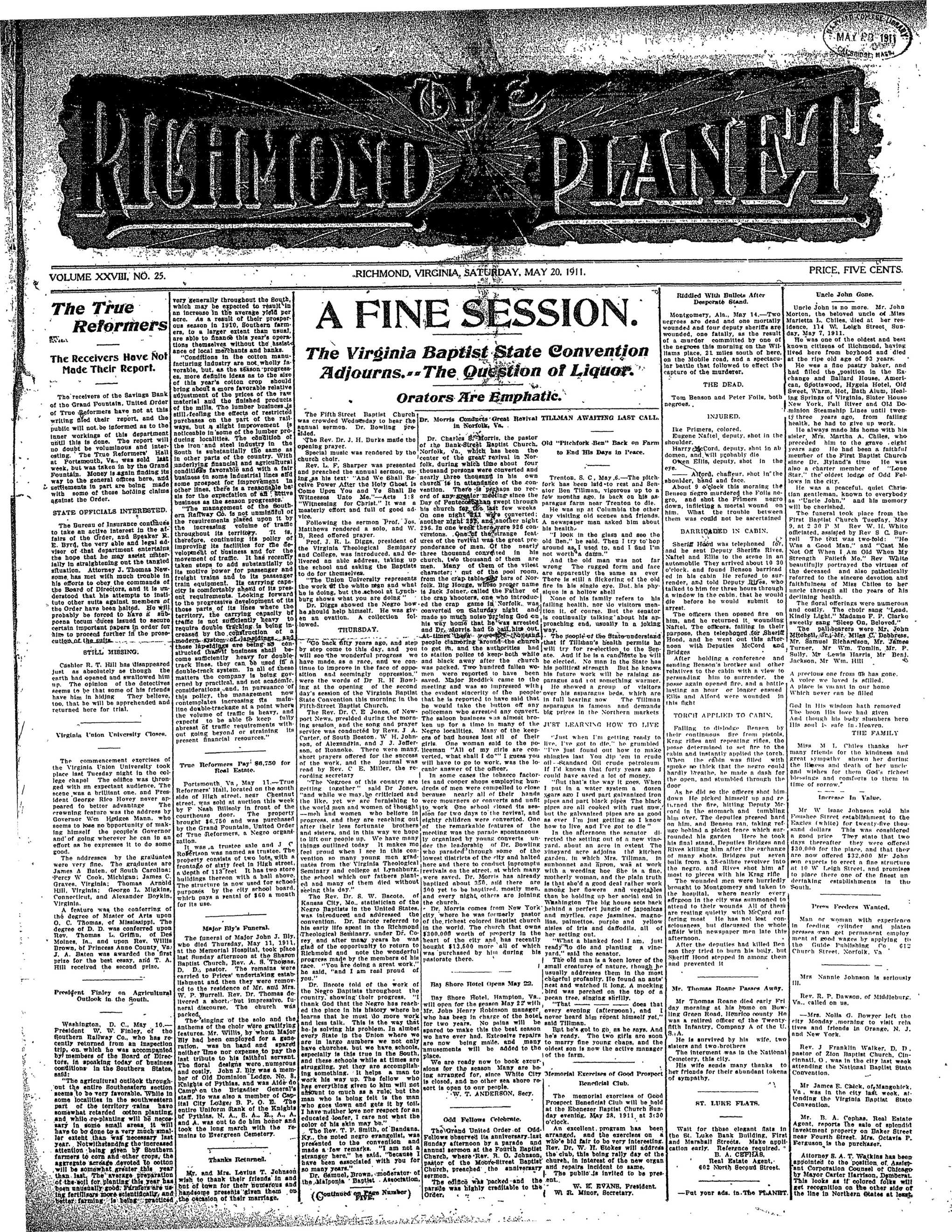
Richmond Planet
Saturday, May 20, 1911
Richmond, Virginia
Page text (machine-generated)
THE RICHMOND PLANET
VOLUME XXVII. NO. 25
RICHMOND, VIRGINIA, SATURDAY, MAY 20, 1911.
PRICE, FIVE CENTS.
The True Reformers
The Receivers Have Not Made Their Report.
The receivers of the Savings Bank of the Grand Fountain, United Order of True Reformers have not at this writing filed their report, and the public will not be informed as to the inner workings of this department until this is done. The report will no doubt be voluminous and interesting. 'The True Reformers' Hall at Portsmouth, Va., was sold last week, but was taken in by the Grand Fountain. Money is again finding its way to the general offices here, and settlements in part are being made with some of those holding claims against the Order.
STATE OFFICIALS INTERESTED.
The Bureau of Insurance continues to take an active interest in the affairs of the Order, and Speaker R. E. Byrd, the very able and legal adviser of that department entertains the hope that he may assist materially in straightening out the tangled situation. Attorney J. Thomas Newsome, has met with much trouble in his efforts to obey the commands of the Board of Directors, and it is understood that his attempts to institute other suits against members of the Order have been halted. He will probably be forced to have a subpoena tocum duces issuod to secure certain important papers in order for him to proceed further in the prosecution of the suits.
STILL MISSING.
Cashier R. T. Hill has disappeared just as absolutely as though the earth had opened and swallowed him up. The opinion of the detectives seems to be that some of his friends have him in hiding. They believe, too, that he will be apprehended and returned here for trial.
Virginia Union University Closes.
The commencement exercises of the Virginia Union University took place last Tuesday night in the college chapel. The edifice was wended with an expectant audience. The scene was a brilliant one, and President George Rice Hovey never appeared to better advantage. The crowning feature was the address by Governor Wm Hpidgeen Mann, who seems to have no opportunity of making himself the people's Governor and of going wherever he can in an effort as he expresses it to do some good.
The addresses by the graduates were very fine. The graduates are James A Baten, of South Carolina; Percy W Cook, Michigan; James C. Graves, Virginia; Thomas Arnold Hill, Virginia; George L. Migkins, Connecticut, and Alexander Boykin, Virginia.
Feature was the conferring of the degree of Master of Arts upon O. C. Thomas, of Mississippi. The degree of D. D. was conferred upon Rev. Thomas L. Grifin, of Des Molines, I. and, upon Rev. Willis Brown, of Princess Anno County, Va. J. A. Baten was awarded the first prize for the best essay, and T. A. Hill received the second prize.
President Finley on Agricultural Outlook in the South.
Washington, D. C., May 10.—President W. W. Finley, of the Southern Railway公司, who has recently returned from an inspection trip, on which he was accompanied by members of the Board of Directors, in speaking today of business conditions in the Southern States, said:
"The agricultural outlook throughout the entire Southern section seems to be very favorable. While in some localities in the southwestern part of the territory rains have somewhat retarded cotton planting, and while re-planting will be necessary in some small areas, it will be the very much smaller extent than was necessary last year. Notwithstanding the increased attention being given by Southern farmers to corn and other crops, the aggregate acreage devoted to cotton will be somewhat greater this year than last. The average preparation of the soil for planting this year has been unusually good. Farmers are using fertilizers more scientifically, and better farming is being practiced
very generally throughout the South, which may be expected to result in an increase in the average yield per acre. As a result of their prosperous season in 1910, Southern farmers, to a larger extent than usual, are able to finance this year's operations themselves without the assistance of local merchants and banks.
"Conditionings in the cotton manufacturing industry are not wholly favorable, but, as the season progresses, more definite ideas as to the size of this year's cotton crop should bring about a more favorable relative adjustment of the prices of the raw material and the finished products of the mills. The lumber business is still feeling the effects of restricted purchases on the part of the railways, but a slight improvement is noticeable in some of the lumber producing localities. The condition of the iron and steel industry in the South is substantially the same as in other parts of the country. With underlying financial and agricultural conditions favorable and with a fair business in some industrial fields some prospect for improvement. In other lines, there is a reasonable basis for the expectation of all active business as the season progresses.
"The management of the Southern Raftway Co. is not unmindful of the requirements placed upon it by the increasing volume of traffic throughout its territory. It is, therefore, continuing its policy of improving its facilities for the development of business and for the movement of traffic. It has recently taken steps to add substantially its motive power for passenger and freight trains and to improve train equipment. Its carrying capacity is comfortably ahead of its present capacity. Looking forward to the progressive development of its those parts of its lines where the territory, the carrying capacity of traffic is not sufficiently heavy to require double tracking, is being increased by the construction of a modern system of jambdings and those jambdings are being constructed so that its business shall come sufficiently heavy for double-track lines, they can be fitted in a double-track system. In all of these matters the company is being governed by practical, and not academic, consideration and, in pursuance of this position, the management now contemplates increasing its mainline volume-trackage at a point where volume of traffic is heavy, and expects to be able to keep fully abreast of traffic requirements without going beyond or straining its present financial resources."
True Reformers Pay $6,750 for Real Estate.
Portsmouth, Va, May 11.—True Reformers' Hall, located on the south side of High street, near Chestnut street, was sold at auction this week by F Nash Billyso in front of the courthouse door. The property brought $6,750 and was purchased by the Grand Fountain, United Order of True Reformers, a Negro organization
It was a trustee sale and J C Robertson was named trustee. The property consists of two lots, with a frontage of sixty feet in High street, a depth of 113 feet. It has two store buildings thereon with a ball above. The structure is now used for school purposes by the city school board, which pays a rental of $60 a month for its use.
Major Bly's Funeral.
The funeral of Major John J. Bly, who died Thursday, May 11, 1911, at the Memorial Hospital, took place last Sunday afternoon at the Sharon Baptist Church, Rev. A. S. Thomas, D. D., pastor. The romanns were carried to Prices' undertaking establishment and then they went to the office of Mr. and Mrs. V. Carroll, Rev. Dr. Thomas delivered a short, but impressive, funeral discourse. The church was packed.
The singing of the solo and the anthems of the choir were gratifying features. Mr. Willis, by whom Major Bly had been employed for a generation, was on hand and spared neither time nor expense, to pay the last tribute to his faithful servant. The floral designs were numerous and costly. John J. Bly was a bar of Old Pompeii. No. B. Knight of Pompeii, and was Aide-de-camp on the Brigadier General's staff. He was also a member of Capital City Lodge; B. P. O. E. The uniform Rank of the Knights of Pythias, N. A., B. A., E. A., A. and A. was out to do him honor and took the long march with the remains to Evergreen Cemetery.
Mr. and Mrs. Levius T. Johnson wish to thank their friends in and out of town for their humorous and handsome presents 'given them on the occasion of their marriage.
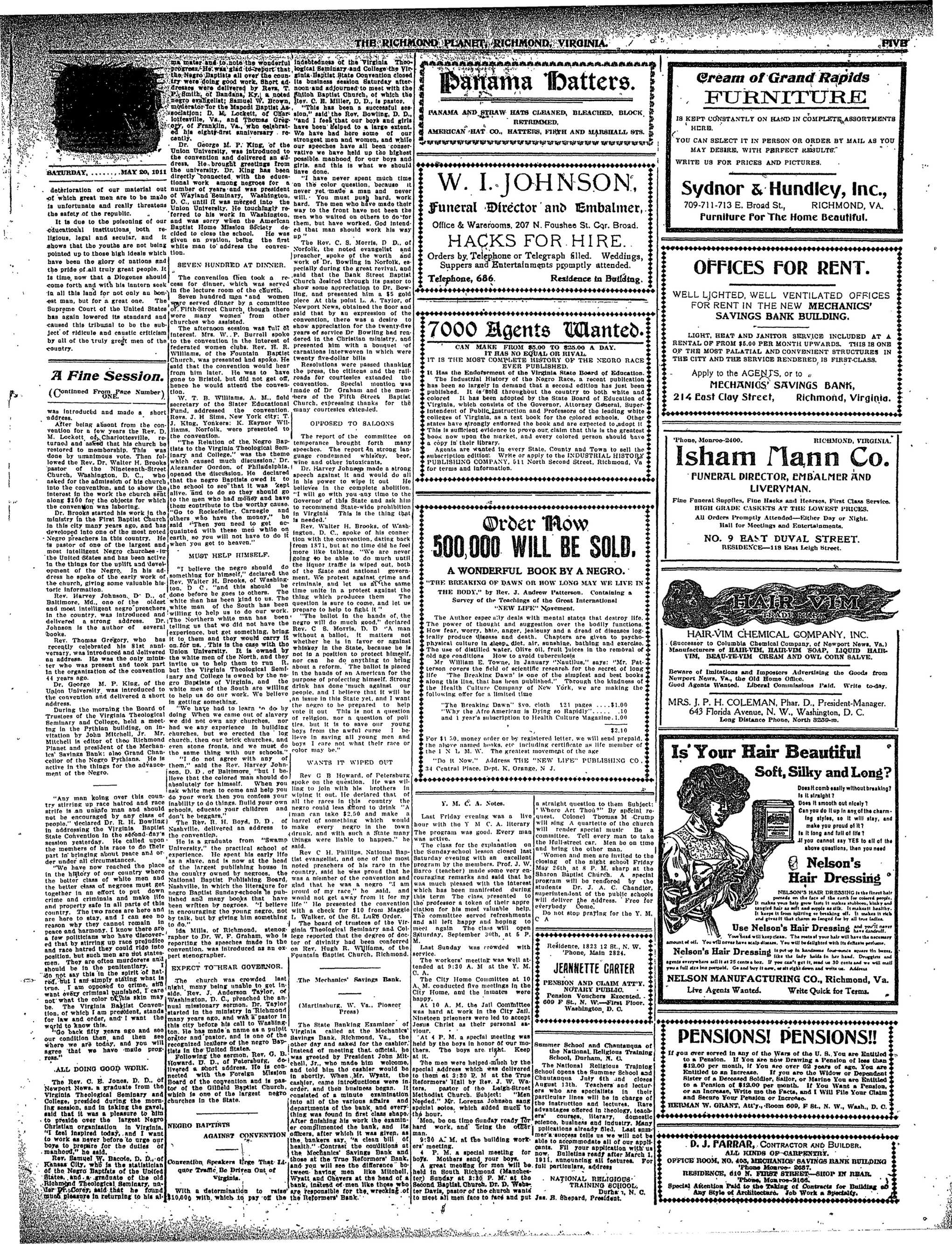
A FINE SESSION. The Virginia Baptist State Convention Adjourns. The Question of Liquor.
The Fifth Street Baptist Church was crowded Wednesday to hear the annual sermon. Dr. Bowling presided.
The Rev. Dr. J. H. Burks made the opening prayer.
Special music was rendered by the church choir.
Rev. L. F. Sharper was presented and preached the annual sermon, using as his text: "And We Shall Receive Power After the Holy Ghost Is Come Upon You and To Shall Be Necesses Valide Me." Acts 1:18 "Witnessing for Christ." It was a masterly effort and full of good advice.
Following the sermon Prof. Jos. Matthews rendered a solo, and W. B. Reed offered prayer.
Prof. J. R. L. Diggs, president of the Virginia Theological Seminary and College, was introduced, and delivered an able address, taking up the school and asking the Baptists to do for themselves.
"The Union University represents the work of the white regn and what he is doing, but the school at Lynchburg shows what you are doing.
Dr. Diggs showed the Negro how he should help himself. He was given an ovation. A collection fol
THURSDAY.
"Go back fifty years ago, and step by step come to this day, and you will see the wonderful progress we have made, as a race, and we continue to improve in the face of opposition and seemingly oppression." the words of Dr R. H. Bowling at the opening of the second day's session of the Virginia Baptist State Convention this morning in the Fifth-Street Baptist Church. The Rev. Dr. C. E. Woolley of Newport News, presided during the morning session, and the song and prayer service was conducted by Revs. J. A. Carter, of Seth Boston, W. H. Johnson, of Alexandria, and J. J. Jefferson, of Renooke. There were many short offers offered for the success of the work, and the journal was read by Rev. C. E. Miller, the recording secretary.
"The Negroes of this country are getting together," said Dr Jones, "and we may we, he criticized and the like, yet we are furnishing to the world men and women of thought—meh and women who believe in progress, and they are reaching out after their less fortunate brothers and sisters, and in this way we hope to lift our people up. We have many things outlined today. It makes me feel proud when I see in this convention so many young men graduates from the Virginia Theological Seminary and college at Lynchburg, the school which our fathers planted and many of them died without seeing this day."
The Rev. Dr. S. W. Bacote, of Kansas City, M. statistician of the Negro Baptists in the United States, was introduced and addressed the convention. Dr. Bacote referred to his early life spent in the Richmond Theological Seminary, under Dr. Corey and after many years he was glad of the opportunity to return to Richmond and note the wonderful progress made by the members of his race. "You are doing a great work," he said, "and I am real proud of you."
Dr. Bacote told of the work of the Negro Baptists throughout the country, showing their progress. "I thank God that the Negro has reached the place in his history where he learns that he must do more work and less talk. This is the way that he is solving his problem. In almost every state in the Union where we are in large numbers we not only have churches, but we have schools, especially is this true in the South, and these schools while at times are struggling, yet they are accomplishing something. We work his way up. The fellow who has given to him will not abstain to much as a rule; but the man who is being felt is the man who goes down and gets it by toil. I have mother love not respect for an educated looter, I care not what the color of his skin may be."
The Rev. T. P. Smith, of Bandana,
Kr., the noted negro erangolist, was
presented to the convention and
made a few remarks. "I am not a
stranger here," he said. "because I
have been associated with you for
so many years."
Dr. Samuel Brown, moderator of
the Malponia Baptist Association,
(Continued on Page Number)
FIVE.
Dr. Morris Conducts 'Great Revival in Norfolk, Va.
Dr. Charles of Morris, the pastor of the Bank-Great Baptist Church, Norfolk, Va., which has been the center of the great revival in Norfolk, during which time about four thousand persons were converted and nearly three thousand in his own church is in attendance of the convention. There is perhaps no record of any guest meeting since the Day of Pentecost than swent through his church for the last few weeks. On one night 291 were converted; another night 295 and another night 296. In one week there were 295 conversions. One of the strange features of the revival was the great preponderance of men. Of the nearly three thousand converted in his church, two thousand of them are men. Many of them of the vilest character; out of the pool room, from the crap table, bars of Norfolk. Big House, whose proper name is Jack Johnson, called the Father of the crap shooters, one who introduced the crap game in Norfolk, was converted on Saturday night and made so much noise printing God on his way home that he was arrested and Dr. Morris had to bail him out.
Old "Pitchfork Ben" Back on Farm to End His Days in Peace.
Trenton, S. C, May 6. The pitchfork has been laid to rest and Sonator Bone Tillman, vigorous up to a few months ago, is back on his paragon farm near Trenton to die. He was up at Columbia the other day visiting old scenes and friends. A newspaper man asked him about his health.
"I look in the glass and see the old Ben," he said. Then I try to荷 as I used to, and I find I'm not worth a damn."
And the old man was not far wrong. The rugged form and face are apparently the same as ever. There is still a flickering of the old in his single eye. But his physique is a hollow shell.
None of his family refers to his failing health, nor do visitors mention it, of course. But the senator is continually talking about his ap proaching end, usually in a jokin' way.
At times these people all joined people clamoring around the church to get fh, and the authorities had to station police to keep both white and black away after the church was packed. Two hundred fallen women were reported to have been saved. Major Roddick came to the meeting and was so impressed with the evident sincerity of the people that he is reported to have said that he would take the button off any policemen who arrested any convert. The saloon business was almost broken up for a time in many of the Negro localities. Many of the keepers of bad houses lost all of their girls. One woman said to the policeman "All of my girls are converted, what shall I do?" I guess you will have to go to work, was the loco answer of the officer.
In some cases the tobacco factories and cooper shops employ hundreds of men were compelled to close because nearly all of their hands were mourners or converts and unit to work. One school closed its session for two days to the revival, and eighty children were converted. One of the remarkable features of the meeting was the parade spontaneously organized by young converts under the leadership of Dr. Bowling who paraded through some of the lowest districts of the city and halted here and there to conduct impromptu revivals on the street, at which many were saved. Dr. Morris has already baptized about 350, and there are 300 yet to be baptized, mostly men, and every night, others are joining the church.
Dr. Morris comes from New York city where he was formerly pastor of the richest colored Baptist church in the world. The church that owns $300,000 worth of property in the heart of the city and has recently bought $13,600 more all of which was purchased by him during his pastorate there.
Bay Shore Hotel Opens May 22.
Bay Shore Hotel, Hampton, Va. will open for the season May 22 with Mr. John Henry Robinson manager, who has been in charge of the hotel for two years. No pain will be spared to make this the best season we have ever had. Excursive repairs are now being made, and many amusements will be added to the place. We are ready now to book excursions for the season Many are being arranged for, since White City is closed, and no other sea shore resort is open to our people. W. T. ANDERSON, Secy.
Odd Fellows Celebrate.
The Grand United Order of Odd
Follies observed its anniversary-last
Sunday afternoon by a parade and
annual sermon at the Fourth Baptist
Church, where Rev. R. O. Johnson,
pastor of the Mobile-Street Baptist
Church, preached the anniversary
sermon.
The edifice was packed and the
parade was highly creditable to the
Order.
Old "Pitchfork Bee" Back on Farm
To End His Days in Peace.
---
Trenton, S. C, May S.—The pitchfork has been laid to rest and Senator Ben Tillman, vigorous up to a few months ago, is back on his asparagus farm near Trenton to die.
He was up at Columbia the other day visiting old scenes and friends. A newspaper man asked him about his health.
"I look in the glass and see the old Ben," he said. Then I try to hop around as I used to, and I find I'm not worth a damn."
And the old man was not far wrong. The rugged form and face are apparently the same as ever. There is still a flickering of the old fire in his single eye. But his physique is a hollow shell.
None of his family refers to his falling health, nor do visitors mention it, of course. But the senator is continually talking about his approaching end, usually in a joking way.
The people of the State understand that if Tillman's health permits he will try for re-election to the Senate. And if he is a candidate he will be elected. No man in the State has his political strength. But he knows his future work will be raising asparagus and not something warmer. He showed a group of visitors over his asparagus beds, which are in full bearing now. The Tillman asparagus is famous and demands big prices in the Northern markets
JUST LEARNING HOW TO LIVE
"Just when I'm getting ready to live, I've got to die" he grumbled. "I've just found out how to make shingles that You dip 'em in crude oil—Standard Oil crude petroleum. If I'd known that forty years ago I could have saved a lot of money. "But that's the way it goes. When I put in a water system a dozen years ago I used part galvanized iron pipes and part black pipes. The black pipes are all cooked with rust now, but the galvanized pipes are as good as ever I'm just getting so I know how to live, and I've got to die."
In the afternoon the senator directed the setting out of a new vineyard, about an acre in extent. The vineyard acre adjoins the kitchen garden, in which Mrs. Tillman, in sunnethorn and apron, was at work with a weeding hoe. She is a fine, motherly woman, and the plain truth is that she'd a good deal rather work among her flowers and vegetables than he holding up her social end in Washington. The big house sets back behind a perfect jungle of japonicas and myrtles, cape jasmines, magnolias, palmetto, purple and yellow aisles of iris and daffodils, all of her setting out.
"What a blanked fool I am, just ready to die and planting a vineyard," said the senator.
The old man is a keen lover of the small creatures of nature, though he usually addresses them in the most charming profuity. He found an anat's nest and watched it long. A mocking bird was perched on the top of a pecan tree, singing shrilly.
"That _____ does that every evening (afternoon), and I never heard him repent himself yet," said Tillman. His'e's at go to as he says. And he's ready. The two girls are soon to marry fine young chaps, and the oldest son is now the active manager of the farm.
Memorial Exercises of Good Prospect
Benedicual Club.
The memorial exercises of Good Prospect Benedictal Club will be held at the Ebonezer Baptist Church Sunday evening, May 28, 1911, at 3:10 o'clock.
An excellent program has been arranged, and the exercises on a who's bldg fair to be very interesting. Rev. Dr. W. H. Stokes will address the club, this being rally day of the church, in interest of the new organ and repairs incident to same.
. The public is invited to be present.
W. E. EVANE, President.
W. R. Minor, Secretary.
Riddled With Bullets After Desperate Stand.
Montgomery, Ala., May 14.—Two negroes are dead and one mortally wounded and four deputy sheriffs are wounded, one fatally, as the result of a murder committed by one of the negroes this morning on the Williams place. 21 miles south of here, on the Mobile road, and a spectacular battle that followed to effect the capture of the murderer.
THE DEAD.
Tom Benson and Peter Foils, both
negroes.
INJURED.
Ike Primers, colored.
Eugene Naftel, deputy, shot in the
shoulder.
Harry Cord, deputy, shot in ab
domen, and will probably die
Owen Ellis, deputy, shot in the eye.
Alfred, chaffeur, shot in the shoulder, hand and face. About 9 o'clock this morning the Benson negro murdered the Folis negro, and shot the Primers negro down, inflicting a mortal wound on him. What the trouble between them was could not be ascertained
DARRIGADED IN CABIN.
Sherif Hood was telephoned for, and he sent Deputy Sherif Rives, Nafelt and Ellis to the scene in an automobile. They arrived about 10 30 o'clock, and found Benson barricaded in his cabin. He refused to surrender, and told Deputy Rives, who talked to him for three hours through a window in the cabin, that he would die before he would submit to arrest.
The officers then opened fire on him, and he returned it, wounding Nafelt. The officers, falling in their purpose, then telephoned for Sherif Hood, and he went out this afternoon with Deputies McCord and Bridges.
After holding a conference and sending Benson's brother and other relatives to the cabin with a view to persuading him to surrender, the pose again opened fire, and a battle lasting an hour or longer ensued Ellis and Afford were wounded in this fight.
TORCH APPLIED TO CARIN.
Falling to dislodge Benson by their continuous fire from pistols, Krag rifles and repeating rifles, the posse determined to set fire to the cabin and instantly applied the torch. When the cabin was filled with spoke so thick that the negro could hardly breathe, he made a dash for the open, and stumbled through the door.
As he did so the officers shot him down. He picked himself up and returned the fire, hitting Deputy McRecord in the stomach and tumbling him over. The deputies pressed hard on him, and Benson ran, taking refuge behold a picket fence which surrounded his garden. Here he took his final stand. Deputies Bridges and Rives killing him after the exchange of many shots. Bridges put seven bullets from a 38-calibre revolver into the negro, and Rives shot him at most to pieces with his Krag rifle.
The wounded men were hurriedly brought to Montgomery and taken to the hospital, where nearly every afighter in the city was summoned to attend to their wounds. All of them are resting quietly with McCord suffering most. He has not lost consciousness, but discussed the whole affair with newspaper men late this afternoon.
After the deputies had killed Benson they tried to burn his body, but Sheriff Hood stepped in among them and prevented it.
Mr. Thomas Ronne Passes Away.
Mr Thomas Roane died early Friday morning at his home on Bowling Green Road, Hemerlo county He was a retired officer of the Twenty-fifth Infantry, Company A of the U. S.A.
He is survived by his wife, two sisters and two brothers.
The interment was in the National Cemetery, this city.
His wife sends many thanks to her friends for their abundant tokens of sympathy.
ST. LUKE FLATS.
Wait for those elegant fats in the St. Luke Bank Building, First and Marshall Streets. Make application early. Reference required.
—Put your ads. in.The PLANET
Uncle John Gone.
Uncle John is no more. Mr. John Morton, the beloved uncle of Miss Marietin L. Chiles, died at her residence, 114 W. Leigh Street, Sunday, May 7, 1911.
He was one of the oldest and best known citizens of Richmond, having lived here from boyhood and died at the ripe old age of 93 years.
He was a fine pastry baker, and had filled the position in the Exchange and Ballard House, American, Spotswood, Hygela Hotel, Old Sweet, Warm, Hot, Bath Alum, Healing Springs of Virginia, Slater House New York, Fall River and Old Dominion Steamship Lines until twenty three years ago, from falling health, he had to give up work.
He always made Ms home with his sister, Mrs. Martha A. Chiles, who preceded him to the grave, eight years ago. He had been a faithful member of the First Baptist Church since Dr. Ryland's time. He was also a charter member of "Lone Star," the oldest lodge of Odd Fellows in the city.
He was a peaceful, quiet Christian gentleman, known to everybody as "Uncle John," and his memory will be cherished.
The funeral took place from the First Baptist Church Tuesday, May 9, at 2 30 P M. Rev W. H. White officiated, assisted by Rev S C. Burrell. The text was two-fold: "He Was a Good Man," and "Cast Me Not Off When I Am Old Whon My Strength Faileth Mo." Rev W beautifully portrayed the virtues of the deceased and also pathotically referred to the sincere devotion and faithfulness of Miss Chiles to her uncle through all the years of his declining health.
The floral offerings were numerous and costly. The choir sang "Loud, Kindly Light." Madamo F. P. Clark sweetly sang "Sleep On, Beloved."
The pallbearers were Mr. John Mochol, Sr., Mr. Miles C. Debbress, Mr. Samuel Winn, Mr. James Turner, Mr. Winn, Tomlin, Mr. P. Sally, Mr. Lewis Hurris, Mr. Benj Jackson, Mr. Wm. Hill
A precious one from his gone. A voice we loved is still. A place is vacant in our home Which never can be filled
God In His wisdom hath removed Theoon His love had given And though his body slumbers hero His soul is safe in Heaven.
THE FAMILY
Miss M. L. Chiles thanks her many friends for the kindness and great sympathy shown her during the illness and death of her uncle and wishes for them God's richest blessings and comforts to them in time of sorrow.
Increase In Value
Mr W Isaac Johnson sold his Poussie Street establishment to the Eagles (white) for twenty-five thousand dollars. This was considered a good price. They state that two days afterward they were offered $30,000 for the place, and that they are now offered $32,000. Mr John Lewis to teach a fine structure at 10 W Street and promises to place there one of the finest and deranking establishments in the South.
Press Foolers Wanted.
Man or woman with experience in feeding cylinder and platen presses can get permanent employment at good wages by applying to the Guide Publishing Co., 612 Church Street, Norfolk, Va.
Mrs. Nannie Johnson is seriously ill.
Rev. R. P. Dawson, of Middleburg, Vn., called on us.
—Mrs. Nolla G. Bowyer left the city Monday morning to visit relatives and friends in Orange, N. J. and New York.
Rev. J Franklin Walker, D. D. pastor of Zion Baptist Church, Cincinnati, O., was in the city last week attending the National Baptist State Convention.
Mr. James E. Chick, of Mangohick, Va., was in the city last week, attending the Virginia Baptist State Convention.
Mr. B. A. Cophas, Real Estate Agent, reports the sale of splendid investment property on Baker Street near Fourth Street. Mrs. Octavia P. Ferguson, in the purchaser.
Attorney S. A. T. Watkins has been appointed to the position of Assistant Corporation Counsel of Chicago by Mayor Carter Harrison, Democrat. This looks as if colored folks will get recognition on the other side of the line in Northern States at least
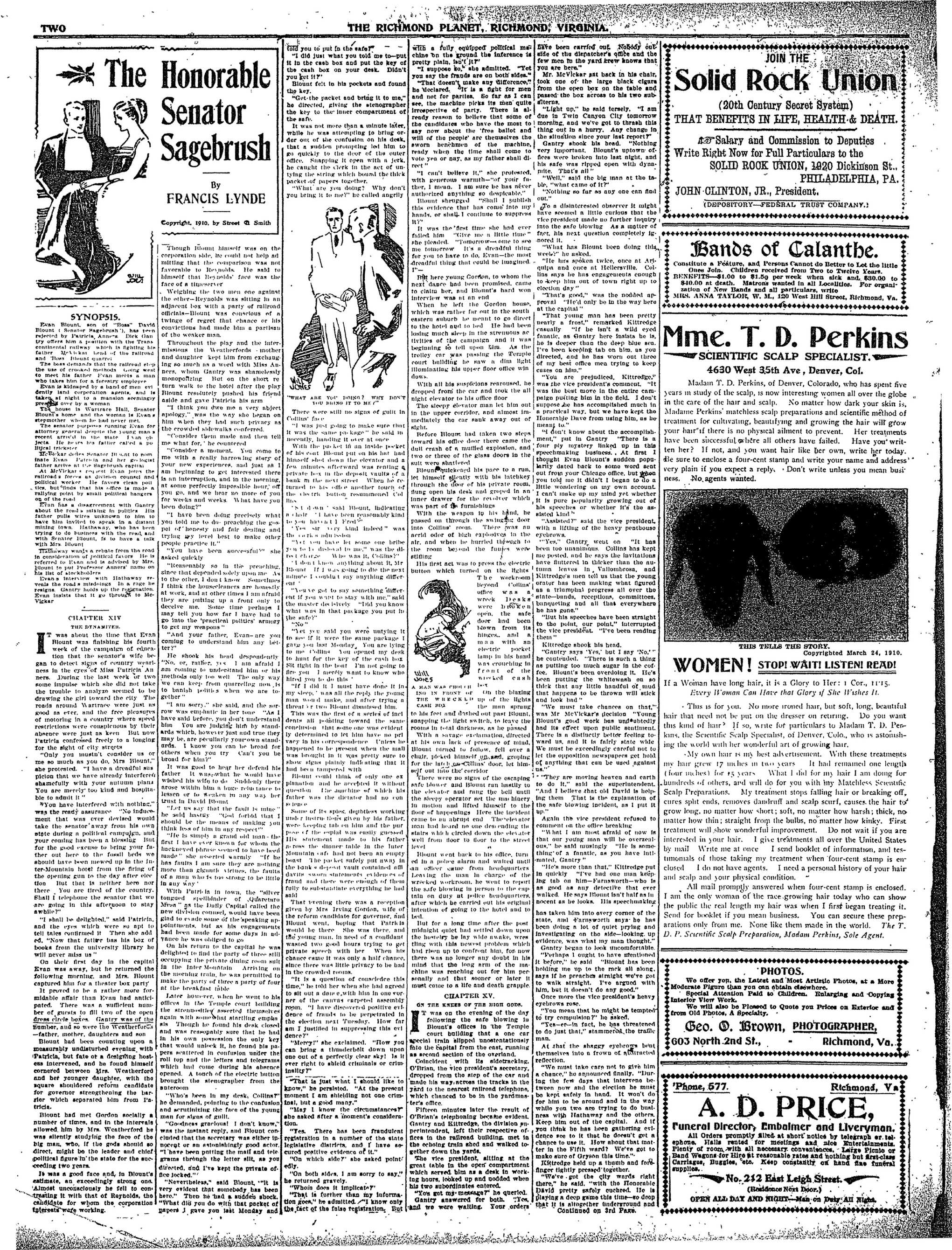
TWO
The
EVIL JOYS
SYNOPSIS.
Evan Blount, son of "Boss" David Blount (Senator Gahresh), has been rejected by Patricia, Annne. Dick Clark offers him a position with the Transcontinental railway which is fighting his father McVickan head of the railroad and the bank that owns the railroad. The boss demands that the railroad stop the use of crooked methods. Going west to meet his father Evan meets a man who takes him for a forestry employee. Evan is kidnapped by a hand of men evidently land corporation agents, and is taken at night to a mansion seemingly owned by the house is Wurtrace Hall. Senator Blount's home and the woman is Evan's stepmother whom he had never met. The senator purpose running Evan for attorney general despite the young man's recent arrival in the state. Evan joins his father called a political trickster. McVickar delites Senator Blount to nominate Evan Patricia and her geologist father arrive at the Sagebrush capital. At McVickar's request Evan joins the railroad's forces as division counsel and political worker. He favors clean politics finds that his office is made a anything but small political hangouts on the road.
Evan has a disagreement with Ganny about the road's mixing in politics. His father pulls wires unknown to him to have him invited to speak in a distant mining town. Hathaway, who has been trying to do business with the road and Mr. Mount, is to have a talk with Mr. Mount.
Hathaway wants a rebate from the road in consideration of political favors. He is referred to Evan and is advised by Mrs. Mount to put Professor Amner's name on his list of stockholders.
Evan's interview with Hathaway resolves the issue. In a race he resigns. Ganny holds up the regimentation. Evan insists that it go through to McVicker.
CHAPTER XIV
THE DYNAMETER
It was about the time that Eran Blount was finishing his fourth week of the campaign of education that the senator's wife began to detect signs of country weariness in the eyes of Miss Patricia Anners. During the last week or two some impulse which she did not take the trouble to analyze seemed to be drawing the girl toward the city. The roads around Wartrace were just as good as ever, and the free pleasures of motoring in a country where speed restrictions were completeness by their absence were just as keen. But now Patricia confessed freely to a longing for the sight of city streets "Only you mustn't consider us or me so much as you do, Mrs Blount," she protested. "I have a dreadful suspicion that we have already interfered shamefully with your autumn plans. You are merely too kind and hospitable to admit it."
"You have interfered with nothing," was the ready assurance "No induction that was ever devised would take the senator away from his own state during a political campaign, and your coming has been a blessing. But for the good excuse to bring your father out here to the fossil beds we should have been mewed up in the Inter-Mountain hotel from the firing of the opening gun to the day after election. But that is neither here nor there. You are tired of the country. Shall I telephone the senator that we are going in this afternoon to stay awake?" "I shall be delighted," said Patricia, and the eyes were so apt to tell tales confirmed It. Then she added, "Now that father has his box of books from the university library he will never miss us."
On their first day in the capital Evan was away, but he returned the following morning, and Mrs. Blount captured him for a theater box party. It proved to be a rather more formidable affair than Evan had anticipated. There was a sufficient number of guests to fill two of the open dress circle boxes. Gantry was of the Bumber, and so were the Weatherfords—father, mother, daughters and son. Blount had been counting upon a measurably undisturbed evening, with Patrick, but fate or a designing hostess intervened, and he found himself cornered between Mrs. Weatherford and her younger daughter, with the square shouldered reform candidate for governor strengthening the barrier which separated him from Patricia.
Blount had met Gordon socially a number of times, and in the intervals allowed, him by Mrs. Weatherford he was silently studying the face of the big man, who, if the gods should so direct, might be the leader and chief political figure in the state for the succeeding two years.
It was a good face and, in Blount's estimate, an exceedingly strong one. Almost unconsciously he fell to contrasting it with that of Rognolds, the candidate for whom the corporation interests were working.
Honorable Senator Sagebrush
Copyright, 1910, by Street a Smith
Though Blount himself was on the corporation side, he could not help admitting that the comparison was not favorable to Reynolds. He said to himself that Reynolds' face was the face of a timeserver. Weighing the two men one against the other—Reynolds was slitting in an adjacent box with a party of railroad officials—Blount was conscious of a twinge of regret that chance or his convictions had made him a partisan of the weaker man.
Throughout the play and the intermissions the Weatherfords -mother and daughter kept him from exchanging so much as a word with Miss Anners, whom Gantry was shamelessly monopolizing. But on the short return walk to the hotel after the play Blount resolutely pushed his friend aside and gave Patricia his arm
"I think you dye me a very object apology," was the way she began on him when they had such privacy as the crowded sidewalks conferred.
"Consider them made and then tell me what for," he countered.
"Consider a moment. You come to me with a really harrowing story of your new experiences, and just as I am beginning to get interested there is an interruption, and in the morning, at some perfectly impossible hour; off you go, and we hear no more of you for weeks and weeks. What have you been doing?"
"I have been doing precisely what you told me to do: preaching the gospel of honesty and fair dealing and trying my level best to make other people practice it."
"You have been successful!" she asked quickly.
"Reasonably so in the preaching, since that depended solely upon me. As to the other, I don't know. Sometimes I think the housecleaners are honestly at work, and at other times I am afraid they are putting up a front only to deceive me. Some time perhaps I may tell you how far I have had to go into the 'practical politics' armory to get my weapons."
"And your father, Evan-are you coming to understand him any better?"
He shook his head despondently. "No, or, rather, yes. I am afraid I am coming to understand him or his methods only too well. The only way we can keep from quarrelling now, to banish politics when we are together."
"I am sorry," she said, and the sorrow was emphatic in her tone "As I have said before, you don't understand him. You are judging him by standards which, however just and true they may be, are peculiarly your own standards. I know you can be broad for others when you try 'Can't you be broad for him?'
It was good to hear her defend his father. It was what he would have wished his wife to do. Suddenly there arose within him a huge reluctance to lessen or to weaken in any way her trust in David Brunt
"Let us say that the fault is mine"
he said hastily "For Godbid that I should be the means of making you think less of him in any respect"
"He is simply a grand old man—the first I have ever known for whom the hackneyed phrase to have heard made" she asserted warmly "If he has faults I am sure they are nothing more than glorious virtues, the faults of a man who is too strong to be little in any way"
With Patricia in town, the "silver tongued spelderlin of Quarreturo Mew" as the Daffy Capital called the new division commute, would have been gird to evade some of the speaking appointments, but as his engagements had been made for some days in advance he was obliged to go.
On his return to the capital he was delighted to find the party of three still occupying the private dining room in the Inter Mountain Arriving on the morning train, he was permitted to make the party of three a party of four at the breakfast table.
Later however, when he went to his offices in the Temple court building the strenuously asserted themselves again with some startling emphasis. Though he found his desk closed and was resuponably sure that he had in his own possession the only key that would unlock it, he found his papers scattered in confusion under the roll top and the letters and telegrams which had come during his absence opened. A touch of the electric button brought the stenographer from the anteroom.
"Who's been in my desk, Collinas?" he demanded, pointing to the confusion and scrutinizing the face of the young man for signs of guilt.
"Goodness gracious! I don't know," was the instant reply, and Blount concluded that the secretary was either incept or an astonishingly good actor. "I have been putting the mail and telegrams through the letter slit, as you directed, and I've kept the private office locked."
"Nevertheless," said Blount. "It is very evident that somebody has been here." Then he had a sudden shock. "What did you do with that packet of papers I gave you last Monday and
THE RICHMOND PLANET, RICHMOND, VIRGINIA.
told you to put in the safe?
"I did just what you told me to—put it in the cash box and put the key of the cash box on your desk. Didn't you get it?"
Blunt felt in his pockets and found the key.
"Get the packet and bring it to me," he directed, giving the stenographer the key to the inner compartment of the safe.
It was not more than a minute later, while he was attempting to bring order out of the confusion on his desk, that a sudden prompt let him to go quickly to the door of the outer office. Snapping it open with a jerk, he caught the clerk in the act of untying the string which bound the thick packet of papers together.
"What are you doing? Why don't you bring it to me?" he called angrily
WILLIAM JORES
"WHAT ARE YOU DOING? WHAT DON'T YOU BUMB IT TO ME?"
There were still no signs of guilt in Collins' face.
"I was just going to make sure that it was the same package" he said in unceasing, handling it over at once.
With the packet 16 in inside pocket of his coat Blount put on his hat had himself shot down the elevator and a few minutes afterward was renting a private box in the deposit vaults of a bank in the next street. When he returned to his office another touch of the electric button resummoned Collins.
"Not down" said Blount, indicating a hair I have been reasonably kind to you have a 1 Fred."
"Yes sir very kind indeed" was the order's admission.
"Let you have let some one bribe you to be dishevel to me," was the direct charge. Who was it, Collins? "I don't know anything about it, Mr Blount. If I was going to die the next minute I could not say anything different."
"We've got to say something different if you want to stay with me," said the master decisively. "Did you know what was in that package you put to the safe?"
"No."
"Let you said you were untying it to see if it were the same package I gave you last Monday. You are lying to me Collins. You opened my desk to hunt for the key of the cash box. Sit tight in the boat. I'm not going to fire you. I merely want to know who hired you to do this."
"If I did it I must have done it in my sleep, was all the reply the young man would make, and after trying a threat or Blount dismissed him.
This was the first of a series of inecdents all pointing toward the same conclusion that some one was evidently determined to let him have no privacy in his correspondence. Unless he happened to be present when the mail was brought in it was pretty sure to show signs plainly indicating that it had been tampered with. Blunt could think of only one explanation and be accepted it without question. The machine of which his father was the dictator had no conscience.
Some of its spies, deputies working under instructions given by his father, were keeping tab on him and the purpose of the deposit was easily guessed. His statement made to his father across the dinner table in the Inner Mountain safe had not been an empty hoist. The packet safely put away in the bank's deposit vault contained all davits sworn statements evidence of fraud and there were enough of them fully to substantiate everything he had said.
That evening there was a reception given by Ms Irving Gordon, wife of the reform candidate for governor, and Blount went, hoping that Patricia would be there. She was there, and the young man, in need of a confident wasted two good hours trying to get private speech with her. When his chance came it was only a half chance, since there was little privacy to be had in the crowded rooms.
"It is a question of conscience this time," he told her when she had agreed to sit out a dance, with him in one corner of the canvas carpeted assembly ropm. "I have discovered positive evidence of frauds to be perpetrated in the election next Tuesday. How far am I justified in suppressing this evil dence?"
"Merry!" she exclaimed. "How you can bring a thunderbolt down upon one out of a perfectly clear skyl! Is it ever right to abide criminals or criminality?"
"That is just what I should like to know," he perished. "At the present moment I am shielding not one criminal, but a good many."
"May I know the circumstances?" she asked after a moment's consideration.
"Yes. There has been fraudulent registration in a number of the state legislative districts, and I have secured positive evidence of it."
"On which side?" she asked pointedly.
"On both sides. I am sorry to say," he returned gravely.
"Whoin does it implicate?"
"That is further than my information goes," he admitted. "I know only the fact of the false registration. But
with a fully equipped political machine on the ground the inference is pretty plain, but it"
"I suppose so," she admitted. "Yet you say the franks are on both sides." "That doesn't make any difference," he declared. "It is a fight for men and not for parites. So far as I can see, the machine picks its man quite irrespective of party. There is already reason to believe that some of the candidates who have the most to say now about the free ballot and will of the people' are themselves the sworn benchmen of the machine, ready when the time shall come to vote you or nay, as my father shall direct"
"I can't believe it," she protested, with generous warmth—"of your father, I mean. I am sure he has never authorized anything so despicable." Blount shrugged. "Shall I publish this evidence that has come into my hands, or shall I continue to suppress it?"
It was the first time she had ever failed him "Give me a little time" she pleaded. "Tomorrow—one to see me tomorrow. It's a dreadful thing for you to have to do. Even—the most dreadful thing that could be tingled. I"
But here young Gordon, to whom the next dance had been promised, came to claim her, and Blount's hard won interview was at an end.
When he left the Gordon house, which was rather far out in the south eastern suburb he meant to go direct to the hotel and to bed. He had been losing much sleep in the strenuous activities of the campaign and it was beginning to tell upon him. As the trotley car was passing the Temple court building he saw a dim light illuminating his upper floor office windows.
With all his suspicions rearoused, he dropped from the car and took the all night elevator to his office floor
The sleepy elevator man let him out in the upper corridor, and almost immediately the car sank away out of sight.
Before Blount had taken two steps toward his office door there came the dull crash of a muffled explosion, and two or three of the glass doors in the suit were shattered.
Blount quickened his pace to a run, let himself glinty with his hatchkey through the door of his private room, fung open his desk and grouped in an inner drawer for the revolver which was part of the furnishings.
With the weapon in his hand, he passed on through the swinging door into Collins' room. There was an acrid odor of high explosives in the air, and when he hurried through to the room beyond the funnels were stuffing.
His first act was to press the electric button which turned on the lights.
The workroom beyond Collins' office was a wreck. Deeks were broken open, the safe door had been down from its hinges, and a man with an electric pocket lamp in his hand was crouching in front of the wrecked cash box.
WILL JOES
A MAN WAR CROUCH
IND IN FRONT OF
THE WRECKED
CASH BOX
on the blazing up of the lights the man sprang
to his feet and dashed out past Blount, snapping the light switch, to leave the rooms in total darkness, as he passed. With a savage exclamation, directed at his own lack of presence of mind, Blount turned to follow, fell over a chair, picked himself up, and groping for the latter. Collins door, let himself out into the corridor. There were no signs of the escaping safe blower and Blount ran hastily to the elevator and rang the bell until the sleepy operator set the machinery in motion and lifted himself to the floor of happenings. Here the incident came to an abrupt end. The elevator man had heard no one desending the stairs which circled down the elevator well from door to door to the street level.
Blunt went back to his office, turned in a police alarm and waited until an officer came from headquarters. Leaving the man in charge of the wrecked workroom, he went to report the safe blowing in person to the cap-tain on duty at police headquarters, after which he carried out his original intention of going to the hotel and to bed.
But for a long time after the post midnight quiet had settled down upon the hostelry he lay wide awake, wrestling with this newest problem which had risen up to confront him, for now there was no longer any doubt in his mind that the long arm of the machine was reaching out for him personally and that sooner or later it must come to a life and death grumble.
CHAPTER XV.
It was on the opening of the day following the safe blowing in Blount's offices in the Temple court building that a one car special train allied uncontentionally into the capital from the east, running as second section of the overland. Conciident with its sidetracking, O'Briain, the vice president's secretary, dropped from the step of the car and made his way across the tracks in the yard to the nearest railroad telephone, which chanced to be in the yardmaster's office. Fifteen minutes later the result of O'Briain's telephoning became evident. Gantry and Kittredge, the division superintendent, left their respective offices in the railroad building, met in the echoing train shed and walked together down the yards. The vice president, slitting at the great table in the open compartment which served him as a desk in working hours, looked up and nodded when his two subordinates entered.
"You got my message?" he queried.
Gantry answered for both. "Yes,
and we were waiting. Your orders
Have been carried out. Nobody outside of the dispatcher's office and the few men in the yard knew that you are here."
Mr. McVlcker sat back in his chair, took one of the large black cigars from the open box on the table and passed the box across to his two subfurnits.
"Light up," he said tersely. "I am due in Twin Canyon City tomorrow morning, and we've got to thrash this thing out in a hurry. Any change in the situation since your last report?"
Gantry shook his head. "Nothing very important. Blount's uptown offices were broken into last night, and his safe was ripped open with dynamite. That's all."
"Well," said the big man at the table, "what came of it?"
"Nothing so far as any one can find out."
To a disinterested observer it might have seemed a little curious that the vice president made no further inquiry into the safe blowing. As a ungretter of fact, his next question completely ignored it.
"What has Blount been doing this week?" he asked.
"He has spoken twice, once at Artiqua and once at Hellersville. Collins says he has engagements enough to keep him out of town right up to election day."
"That's good," was the nodded approval. "He'd only be in the way here at the capital."
"That young man has been pretty nearly a frost," remarked Kittredge casually. "If he isn't a wild eyed fanatic, as Canyon here insists he is, he is deeper than the deep blue sea. I've been keeping tab on him, as you directed, and he has worn out three of my best office men trying to keep cases on him."
"You are prejudiced, Kittredge," was the vice president's comment. "It was the best move in the entire campaign putting him in the field. I don't suppose he has accomplished much in a practical way, but we have kept the Honorable Dave from using him, as he meant to."
"I don't know about the accomplishment," put in Gantry. "There is a four ply mystery linked up in this speechmaking business. At first I thought Evan Blount's sudden popularity dated back to some word sent out from your Chicago office, but when you told me it didn't I began to do a little wondering on my own account. I can't make up my mind yet whether it is pure popularity growing out of his speeches or whether it's the assisted kind."
"Assisted?" said the vice president, with a lifting of the heavy penthouse eyebrows.
"Yes," Gantry went on. "It has been too unanimous. Collins has kept me posted, and he says the invitations have fluttered in thicker than the autumn leaves in Vallombrosa, and Kittredge's men tell us that the young orator has been making what figured as a triumphal progress all over the state—bands,ceptions,committees, banqueting and all that everywhere he has gone."
"But his speeches have been straight to the point, our point," interrupted the vice presideat. "I've been reading them"
Kittredge shook his head.
"Gunny says 'Yes,' but I say 'No.'" he contended. "There is such a thing as putting too much sugar in the coffee. Blount's been overdoing it. He's been putting the whitewash on so thick that any little handful of mud that happens to be thrown will stick and look bad."
"We must take chances on that," was Mr McVickar's decision "Young Blount's good work has undoubtedly had its effect upon public sentiment. There is a distinctly better feeling toward us, and it is fairly state wide. We must be exceedingly careful not to let the opposition newspapers get hold of anything that can be used against us."
* "They are moving heaven and earth to do it," said the superintendent. "And I believe that old David is helping them. That is the explanation of the safe blowing incident, as I put it up."
Again the vice president refused to comment on the office breaking.
"What I am most afraid of now is that our young man will be overcautious," he said musingly. "He is something of a funatic, as you have intimated, Gantry."
"He's more than that," Kittredge put in quickly. "I've had one man keeping tab on him—Farnsworth—who is as good as any detective that ever walked. He says Blount isn't half as innocent as he looks. His speechmaking has taken him into every corner of the state, and Farnsworth says he has been doing a lot of quiet prying and investigating on the side—looking, up evidence, was what my man thought."
Gantry began to look uncomfortable. "Perhaps I ought to have mentioned it before," he said. "Blount has been holding me up to the rack all along, says if he preaches straight we've got to walk straight. I've argued with him, but it doesn't do any good."
Once more the vice president's heavy eyebrows rose.
"You mean that he might be tempted to try compulsion?" he asked.
"Ton—in fact, he has threatened to do just that," stammered the traffic man.
At that the shaggy eyebrows bent themselves into a frown of abstract reflection.
"We must take care not to give him a chance," he announced finally. "During the few days that interruptions between now and the election he must be kept safely in hand. It won't do for him to be around and in the way while you two are trying to do business with Hathaway and the others. Keep him out of the capital. And if you think he has been gathering evidence see to it that he doesn't get a chance to use it. How about that matter in the Fifth ward? We've got to make sure of Gryson this time."
Kittenden hold up a thumb and faint.
Kftedge held up a thumb and forefinger tightly pressed together
"Why are you got the gritty rights right there," he said, "with the Honorable David pretty safely cuched. He is playing a deep game this time—so deep that it is altogether underground and
Continued on 3rd Paxe.
Salary and Commission to Deputies Write Right Now for Full Particulars to the SOLID ROCK UNION, 1920 Dickinson St. PHILADELPHIA, PA JOHN CLINTON, JR., President.
Constitute a Feature, and Persons Cannot do Better to Lot the little Ones Join. Children received from Two to Twelve Years.
BENEFITS—$1.00 to $1.50 per week when sick and, $30.00 to $40.00 at death. Matrons wanted in all Localities. For organization of New Bands and all particulars, write
MRS. ANNA TAYLOR, W. M., 120 West Hill Street, Richmond, Va.
Mme. T. D. Perkins SCIENTIFIC SCALP SPECIALIST
4630 West 35th Ave, Denver, Col.
Madam T. D. Perkins, of Denver, Colorado, who has spent five years in study of the scalp, is now interesting women all over the globe in the care of the hair and scalp. No matter how dark your skin is, Madame Perkins' matchless scalp preparations and scientific method of treatment for cultivating, beautifying and growing the hair will grow your hair if there is no physical ailment to prevent. Her treatments have been successful where all others have failed. Have you written her? If not, and you want hair like her own, write her today. Be sure to enclose a four-cent stamp and write your name and address very plain if you expect a reply. Don't write unless you mean business. No agents wanted.
```markdown
```
If a Woman have long hair, it is a Glory to Her: 1 Cor., 11:15.
Every Woman Can Have that Glory if She Wishes It.
This is for you. No more ironed hair, but soft, long, beautiful hair that need not be put on the dresser on returning. Do you want this kind of hair? If so, write for particulars to Madam T. D. Perkins, the Scientific Scalp Specialist, of Denver, Colo., who is astonishing the world with her wonderful art of growing hair.
My own hair is my best advertisement. With these treatments my hair grew 17 inches in two years. It had remained one length (four inches) for 15 years. What I did for my hair I am doing for hundreds of others, and will do for you with my Matchless Scientific Scalp Preparations. My treatment stops falling hair or breaking off, cures split ends, removes dandruff and scalp scurf, causes the hair to grow long, no matter how short; soft, no matter how harsh; thick, no matter how thin; straight frop the bulbs, no matter how kinky. First treatment will show wonderful improvement. Do not wait if you are interested in your hair. I give treatments all over the United States by mail. Write me at once. I send booklet of information, and testimonials of those taking my treatment when four-cent stamp is enclosed. I do not have agents. I need a personal history of your hair and scalp and your physical condition.
All mail promptly answered when four-cent stamp is enclosed. I am the only woman of the race-growing hair today who can show the public the real length my hair was when I first began treating it. Send for booklet if you mean business. You can secure these preparations only from me. None like them made in the world. The T. D. P. Scientific Scalp Preparation, Madam Perkins, Sole Agent.
'Phone, 577. Richmond. Va
Funeral Director, Embolmer and Liveryman.
All Orders promptly filled at short notices by telegraph or tele-
phone. Halls rented for meetings and nice Entertainments.
Plenty of room with all necessary conveniences. Liree Picnic or
Band Wagons for Hire at reasonable rates and nothing but first-class
Carrigues, Buggies, etc. Keep constant on hand fine funeral
supplies.
HELLO PLANET
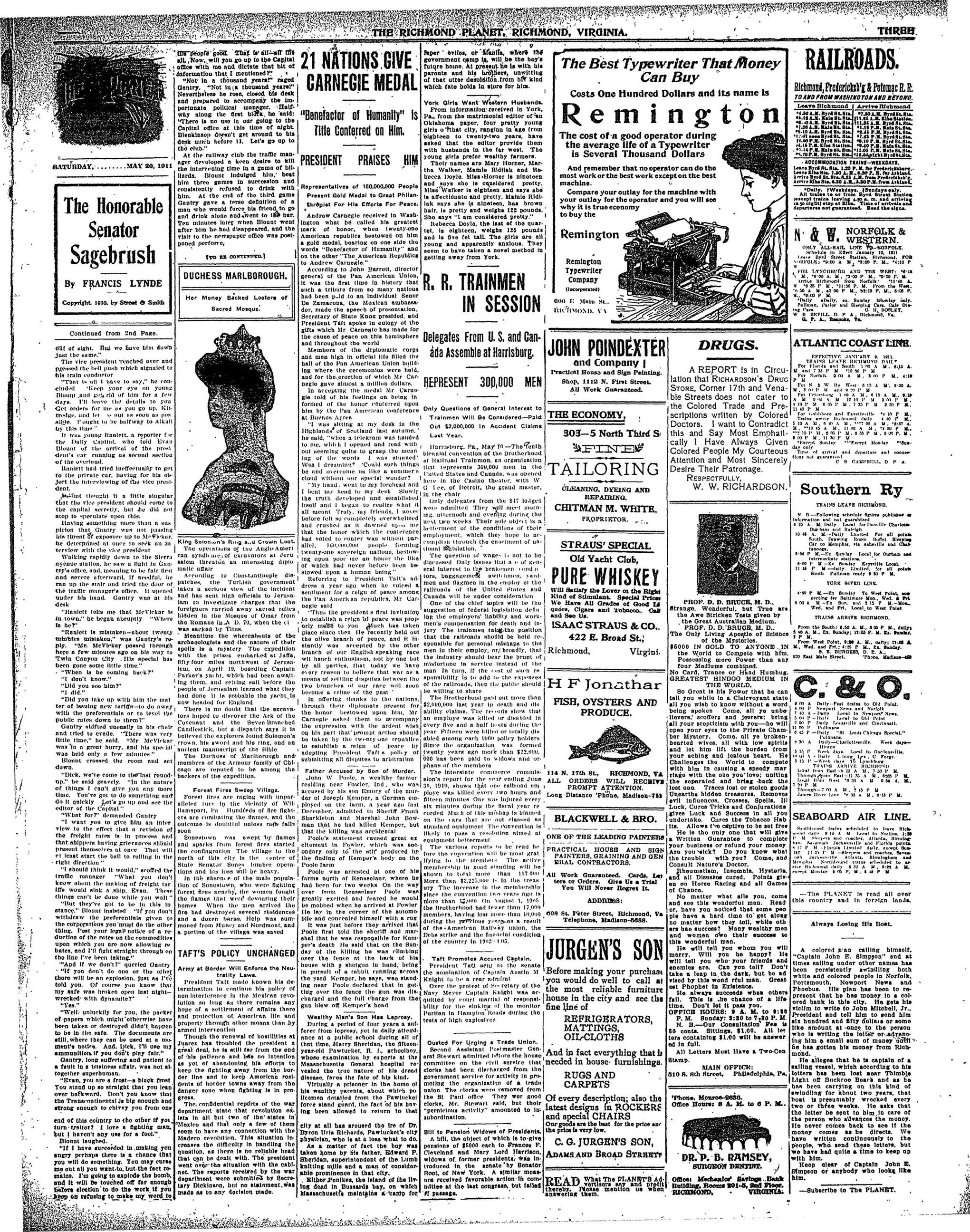
The Honorable Senator Sagebrush
By FRANCIS LYNDE
Copyright, 1910, by Street & Smith
Continued from 2nd Page.
out of sight. But we have him down just the same."
The vice president reached over and pressed the bell push which signaled to his train conductor.
"That is all I have to say," he concluded. "Keep your eye on young Blount and get rid of him for a few days. I'll leave the details to you. Get orders for me as you go up. Kittredge, and let us out as soon as possible. I ought to be halfway to Alkall by this time."
It was young Stanlett, a reporter for the Daily Capital, who told Evan Blount of the arrival of the president's car running as second section of the overland.
Ranlett had tried ineffectually to get to the private car, having for his object the interviewing of the vice president.
Mustard thought it a little singular that the vice president should come to the capital secretly, but he did not stop to speculate upon this.
Having something more than a sus picion that Gantry was not passing his threat of exposure up to McVlekar, he determined at once to seek an intervie w with the vice president. Walking rapidly down to the Sierra agenue station, he saw a light in Gantry's office, and, meaning to be fair first and severe afterward, if needful, he ran up the stair and tried the door of the traffic manager's office. It opened under his hand. Gantry was at his desk.
"Ranlett tells me that McVlekar is in town," he began abruptly. "Where is he?"
"Ranlett is mistaken—about twenty minutes mistaken," was Gantry's reply. "Mr. McVlekar passed through here a few minutes ago on his way to Twain Canyon City. His special has been gone some little time."
"When is he coming back?"
"I don't know."
"Did you see him?"
"I did."
"Did you take up with him the matter of issuing new tariffs—to do away with the preferentials or to level the public rates down to them?"
Gantry shifted uneasily in his chair and tried to erase. "There was very little time," he said. "Mr McVickar was in a great hurry, and his special was held only a few minutes."
Blount crossed the room and sat down.
"Dick, we come to the last round-up," he said gravely. "In the nature of things I can't give you any more time. You've got to do something and do it quickly. Let's go up and see the editor of the Capital."
"I want you to give him an interview to the effect that a revision of the freight rates is in process and that shippers having grievances should present themselves at once. That will it beat start the ball to roll in the right direction."
"I should think it would," scoffed the traffic manager. "What you don't know about the making of freight tariffs would shift a ship. Eran. These things can't be done while you wait."
"But they've got to be in this stance." Blount insisted. "If you don't withdraw the preferentials given to the corporations you must do the other thing. Post your legal notice of a reduction of the rates on the commodities upon which you are now allowing rebates, and I'll fight straight through on the line I've been taking."
"And if we don't?" querted Gentry.
"If you don't do one or the other there will be an explosion, just as I've told you. Of course you know that my safe was broken open last night-wrecked with dynamite?"
"Well, unluckily for you, the packer of papers which might otherwise have been taken or destroyed didn't happen to be in the safe. The documents are still, where they can be used at a moment's notice. And, Dick, I'll use my ammunition if you don't piny fair."
Gantry, long suffering and patient to a fault in a business affair, was not altogether superhuman.
"Evan, you are a frost—a black frost. You stand up so straight that you lean over backward. Don't you know that the Transcontinental is big enough and strong enough to chivvy you from one end of this country to the other if you turn traitor? I love a fighting man, but I haven't any use for a fool."
Blunt laughed.
"If I have succeeded in making you angry perhaps there is a chance that you will do something. You may curse me out all you want to, but the fact remains, I'm going to explode the bomb, and it will be touched off far enough before election to do the work if you keep on refusing to make my word to
the people good. That is all—all the all. Now, you will go up to the Capital office with me and dictate that bit of information that I mentioned!"
"Not in a thousand years" raged Gentry. "Not in a thousand years" Nevertheless he rose, closed his desk and prepared to accompany the important political manager. Half-way along the first block, he said: "There is no use in our going to the Capital office at this time of night. Blinkenius doesn't get around to his desk much before 11. Let's go up to the club."
At the railway club the traffic manager developed a keen desire to kill the intervening time in a game of billiards. Blount indulged him, beat him three games in succession and consistently refused to drink with him. At the end of the third game Gantry gave a tense definition of a man who would force his friend to go and drink alone and avent to the bar. Ten minutes later when Blount went after him he had disappeared, and the visit to the newspaper office was postponed performe.
[TO BE CONTINUED.]
Her Money Backed Looters of Sacred Mosque.
THE QUEEN
King Solomon's Ring and Crown Loot.
The operations of the Anglo-Ameri can syndicate, of excavators at derusalem threaten an interesting diplomatic affair.
According to Constantinople dispatches, the Turkish government takes a serious view of the incident and has sent high officials to Jerusalem to investigate charges that the foreigners carried away sacred relics hidden in the Mosque of Omar from the Romans in A.D. 70, when the cis was seacked by Titus.
Meantime the whereabouts of the archaeologist and the nature of their spoils is a mystery. The expedition with the prizes embarked at Jaffa, fifty four miles northwest of Jerusalem, on April 19, boarding Captain Parker's yacht, which had been awaiting them, and getting sail before the people of Jerusalem learned what they had done it is probable the yacht is now headed for England.
There is no doubt that the excavators hoped to discover the Ark of the Covenant and the Seven Branched Candlestick, but a dispatch says it is believed the explorers found Solomon's crown, his sword and his ring, and an ancient manuscript of the Bible. The Duchess of Marlborough and members of the Armour family of Chicago are reputed to be among the backers of the expedition.
Forest Fire Swep Village.
Forest fires are raging with unparalleled turf in the vicinity of Willhamspart, Pa. Hundreds of fire fighters are combating the flames, and the outcome is doubtful unless rainy falls soon.
Sonestown was swept by flames and sparks from forest fires started the conflagration. The village to the north of this city is the center of State Senator Sones lumber operations and his loss will be heavy.
In the absence of the male population of Sonestown, who were fighting forest fires nearby, the women fought the flames that were devouring their homes. When the men arrived the fire had destroyed several residences and a dozen barns. Help was summoned from Muncy and Nordmont, and a portion of the village was saved
TAFT'S POLICY UNCHANGED
Army at Border Will Enforce the Neutrality Laws.
President Taft made known his determination to continue his policy of non interference in the Mexican revolution so long as there remains any hope of a settlement of affairs there and protection of American life and property through other moans than by armed intervention.
Though the renewal of hostilities at Juarez has troubled the president a great deal, he is still far from the end of his patience and has no intention as yet of abandoning his efforts to keep the fighting away from the border line and to keep American residents of border towns away from the danger zone when fighting is in progress.
The confidential reports of the war department state that revolution exists in all but two of the states in Mexico and that only a few of them seem to have any connection with the Madero revolution. This situation increases the difficulty in handling the question, as there is no reliable head that can be dealt with. The president went over the situation with the cabinet. The reports received by the war department were submitted by Secretary Dickinson, but no statement, was made to any decision made.
21 NATIONS GIVE CARNEGIE MEDAL
Representatives of 100,000,000 People Present Gold Medal to Great Philanthropist For His Efforts For Peace.
Andrew Carnegie received in Washington what he called his greatest mark of honor, when twenty-one American republics bestowed on him a gold medal, bearing on one side the words "Benefactor of Humanity" and on the other "The American Republics to Andrew Carnegie."
According to John Barrett, director general of the Pan American Union, it was the first time in history that such a tribute from so many nations had been paid to an individual Senior De Zamacona, the Mexican ambassador, made the speech of presentation, Secretary of State Knox presided, and President Taft spoke in eulogy of the gifts which Mr Carnegie has made for the cause of peace on this hemisphere and throughout the world.
Members of the diplomatic corps and men high in official life filled the hall of the Pan American Union building where the ceremonies were held, and for the erection of which Mr Carnegie gave almost a million dollars. In accepting the medal Mr Carnegie told of his feelings on being informed of the honor conferred upon him by the Pan American conference at Buenos Ayres.
"I was sitting at my desk in the Highlands' of Scotland last autumn, he said, when a telegram was handed to me, which I opened and read with out seeming quilty to grasp the meaning of the words. I was stunned! Was I dreaming? 'Could such things be and overcome us like a summer's cloud without our special wonder?'
"My hand, went to my forehead and I bent my head to my desk. Slowly the truth developed and established itself and I began to realize what it all meant. Truth, my friends, I never before felt so completely overwhelmed and crushed as it dawned upon me that the honor which the conference had voted to counter was without parallel. 160,000,000 people forming twenty-one sovereign nations, bestowing upon poor me an honor the like of which had never before been bestowed upon a human being."
Referring to President Taft's address a year ago when he voiced a sentiment for a reign of peace among the Pan American republics, Mr Carnegie said
"Thus the president's first invitation to establish a reign of peace was properly made to you, much has taken place since then. He recently held out the olive branch of peace, and it instantly was accepted by the other branch of our English speaking race wilt hush enthusiasm, not by one but by all parties, that today we have every reason to believe that war as a means of settling disputes between the two branches of our race will soon become a crime of the past."
In offering thanks to the nations, through their diplomats present for the honor bestowed upon him, Mr Carnegie asked them to accompany the expression with the ardent wish on his part that prompt action should be taken by the twenty one republics to establish a reign of peace by adopting President Taft a policy of submitting all disputes to arbitration
Father Accused by Son of Murder.
John W Poole, a wealthy farmer residing near Fowler, Ind, who was accused by his son Emory of the murder of Joseph Kemper, a German employed on the farm, a year ago last December, admitted to Sheriff Frank Shackleton and Marshal John Bowman that he had killed Kemper, but that the killing was accidental.
Poole's statement caused great oxtreatment in Fowler, which was secondary only to the stiff produced by the finding of Kemper's body on the Poole farm.
Poole was arrested at one of his farms north of Renosolaar, where he had been for two weeks. On the way over from Renosolaar Poole was greatly excited and feared he would be mobbed when he arrived at Fowler he lay in the corner of the automobile and concealed himself with a rug
It was just before they arrived that Poole first told the sheriff and marshal that he was responsible for Kemper's death. He said that on the Sunday of the killing he was climbing over the fence at the back of his house with a shotgun in hand, being in pursuit of a rabbit running across the yard Kemper, he says, was standing near Poole declared that in getting over the fence the gun was discharged and the full charge from the gun blow off Kemper's head.
Wealthy Man's Son Has Leprosy.
During a period of four years a sufferer from leprosy, you in daily attendance at a public school during all of that time, Harry Sheridan, the fifteen-year-old Pawtucket, R. J., schoolboy, whose examination by experts at the Massachusetts General Hospital revealed the true nature of his dread disease, faces the fate of his kind.
Virtually a prisoner in the home of his wealthy parents, about which poilmen detailed from the Pawtucket force stand guard, the fact of his having been allowed to return to that city at all has aroused the fire of Dr. Bryon Urls Richards, Pawtucket's city physician, who is at a loss what to do. As a matter of fact the boy was taken home by his father, Edward P. Sheridan, superintendent of the Lumb knitting mills and a man of considerable prominence in that city. Either Ponkles, the island of the living dead in Buzzards bay, on which Massachusetts maintains a camp for
paper 'aviles, or 'Munilla, where the government camp is, will be the boy's future home. At present he is with his parents and his brothers, unwitting of that utter dereliation from his kind which rate holds in store for him.
York Girls Want Western Husbands.
From information received in York, Pa. from the matrimonial editor of an Oklahoma paper, four pretty young girls o that city, rangin in age from eighteen to twenty-two years, have asked that the editor provide them with husbands in the far west. The young girls prefer wealthy farmers.
Their names are Mary Horner, Martha Walker, Mamie Ridlak and Rebecca Doyle. Miss Horner is nineteen and says she is considered pretty. Miss 'Walker is eighteen and says she is affectionate and pretty. Mamie Ridlak says she is nineteen, has brown hair, is pretty and weighs 122 pounds. She says "I am considered pretty."
Rebecca Doyle, the last of the quartet, is eighteen, weighs 125 pounds and is five feet tall. The girls are all young and apparently anxious. They seem to have taken a novel method in getting away from York.
R. R. TRAINMEN IN SESSION
Only Questions of General Interest to Trainmen Will Be Considered—Paid Out $2,000,000 in Accident Claims Last Year.
Harrisburg, Pa., May 10—The Fourth biennial convention of the Brotherhood of Railroad Trainmen, an organization that represents 300,000 men in the United States and Canada, was opened here in the Casino theater, with W G Lee, of Detroit, the grand master, in the chair.
Only delegates from the $47 lodges were admitted. They will meet morning, afternoon and evening during the next two weeks. Their sole object is a betterment of the conditions of their employment, which they hope to accomplish through the enactment of national legislation.
The question of wage is not to be discussed Only issues that are of general interest to the brahman condi- tors, bargagements, swiftmen, yardmen and flagmen in the employ of the railroads of the United States and Canada will be under consideration. One of the chief topics will be the suggestion of federal legislation defini- ing the employers' liability and workmen's compensation for death and injury. The trainmen take the position that the railroads should be held responsible for personal missteps to the men in their employ, or broadly, that the industry should hear the brunt of misfortune in service instead of the man. In turn, if the cost of such re sponsibility is to add to the expenses of the railroads, then the public should be willing to share.
The Brotherhood paid out more than $2,000,000 last year in death and disability claims. The records show that an employee was killed or disabled in every five and a half hours during the year. Fifteen were killed or totally disabled among each 1000 policy holders. Since the organization was formed twenty years ago more than $22,000,000 has been paid to widows and orphans of the members.
The interstate commerce commission's report for the year ending June 30, 1910, shows that one railroad employee was killed every two hours and fifteen minutes. One was injured every six minutes during the fiscal year recorded. Much of this misapparition is blamed on the cars that are not classed as standard equipment. The convention is likely to pass a resolution aimed at costumer betrayment.
The various reports to be read before the convention will be most gratifying to the members. The active membership in good standing will be shown to total more than 117,000. More than 42,225,000 in the treasury. The increase in the membership since the convention two years ago is more than 15,000. On August 1, 1905 the Brotherhood had fewer than 17,000 members, having lost more than 10,000 during the previous years as a result of the American Railway union, the Debt strike and the financial condition of the country in 1903-1005.
President Taft sent to the senate the nomination of Captain Austin M Knight to be a rear admiral Over the protest of Secretary of the Navy Meyer Captain Knight was acquitted by court martial of responsibility for the sinking of the monitor Puritan in Hampton Roads during the tests of high explosives
Ousted For Urging a Trade Union.
Second Assistant Postmaster General Stewart admitted before the house committee on the civil service that clerks had been discharged from the government service for activity in promoting the organization of a trade union. The clerks were removed from the St Paul office. They wor good clerks, Mr. Stewart said, but their "pernicious activity" amounted to insubordination.
Bill to Pension Widows of Presidents.
A bill, the object of which is to give pensions of $5000 each to Frances F. Cleveland and Mary Lord Harrison, widows of former presidents; was introduced in the senate by Bonator Root, of New York. A similar measure received favorable action in committee at the last congress, but failed fi passage.
---
Costs One Hundred Dollars and its name is Remington
The cost of a good operator during the average life of a Typewriter is Several Thousand Dollars
And remember that no operator can do the most work or the best work except on the best machine.
Compare your outlay for the machine with your outlay for the operator and you will see why it is true economy to buy the
n
Remington
Remington
Typewriter
Company
(Incorporated)
600 E. Main St.
RICHMOND, VA
JOHN POINDEXTER
and Company
Practical House and Sign Painting.
Shop, 1113 N. First Street.
All Work Guaranteed.
THE ECONOMY,
303-5 North Third St
FINED
CLEANING, DYEING AND REPAIRING.
CHITMAN M. WHITE,
PROPRIETOR.
STRAUS' SPECIAL
Old Yacht Club.
Will Satisfy the Lover on the Right Kind of Simulant. Special Prices We Have All Grades of Good L& quors, Cigars and Tobacco. Call and See Us.
ISAAC STRAUS & CO..
422 E. Broad St.;
Richmond, Virginia.
H F Jonathar
FISH, OYSTERS AND
PRODUCE.
114 N. 17th St., RICOHBOND, VA
ALL ORDERS WILL RECEIVE
PROMPT ATTENTION.
Long Distance 'Phone', Madison-759
BLACKWELL & BRO
PRACTICAL HOUSE AND SIGN
PAINTERS, GRAINING AND GENERAL CONTRACTORS.
All Work Guaranteed. Cards, Letters or Orders. Give Us a Trial You Will Never Regret It.
ADDRESS:
608 St. Peter Street, Richmond, Va.
Telephone, Madison-5688.
JURGEN'S SON
Before making your purchase you would do well to call at the most reliable furniture house in the city and see the fine line of
REFRIGERATORS,
MATTINGS,
OIL-CLOTHS
And in fact everything that is needed in house furnishings.
RUGS AND
CARPETS
Of every description; also the latest designs in ROCKERS and special CHAIRS
Our goods are the best for the price and the price is very low.
C. G. JURGEN'S SON, ADAMS.AND BROAD STREETS
READ What The PLANET'S AD
vertisers say and profit
thereby. Please mention us when
answering them.
DRUGS.
A REPORT is in Circulation that RICHARDSON's DRUCK STORE, Corner 17th and Venable Streets does not cater to the Colored Trade and Prescriptions written by Colored Doctors. I want to Contradict this and Say Most Emphatically I Have Always Given Colored People My Courteous Attention and Most Sincerely Desire Their Patronage.
RESPECTFULLY,
W. W. RICHARDSON.
PROF. D. D. BRUCE, M. D. Strange, Wonderful, but True are the Awe Bricken Tests given by the Great Australian Medium. PROF. D. D. BRUCE, M. D. The Only Living Apostle of Science of the Mysteries. $5000 IN GOLD TO ANYONE IN the World to Compete with him. Possessing more Power than any four Mediums combined. No Carry Trace or bind Humbug. GREATEST HINDOO MEDIUM IN THE WORLD.
So Great is his Power that he can tell you while in a Clairvoyant state all you wish to know without a word being spoken. Come, all you unbelievers; scaffors and jeersers; bring all your scepticism with you—he will open your eyes to the Private Chamber Mystery. Come, all ye broken-hearted wives, all with low spirits and let him lift the burden from your aching and jealous heart. He Challenges the World to compete with him in causing a speedy marriage with the one you love; uniting the separated and bring back the lost one. Traces lost or stolen goods Unearth hidden treasures. Removes evil influences. Crosses, Spills, Ill Luck, Cures Tricks and Conjurations gives Luck and Success in all you undertake. Cures the Tobacco Habits. Allows the captive to be set free. He is the only one that will give a Written Guarantee to complete your business or refund your money Are you sick? Do you know what the trouble with you? Come, and Consult Nature's Doctor.
Rheumatism, Insomnia, Hysteria,
and all Diseases cured. Points given
on Horse Racing and all Games
of Chance.
No matter what ails you, come
and see this wonderful man. Read
or, have you noticed that some peo-
ple have a hard time to get along
no matter how they toll, while oth-
ers have success? Many wealthy men
and women owe their success to
this wonderful man.
He will tell you whom you will
treat you to be happy? He
will tell you who your friends
and enemies are. Can you tell? Don't
take a leap in the dark, but be
advised by this wond rful man. Great
Phophet in Eristence.
He always succeeds when others
fall. This is the chance of a life-
time. Don't let it pass you.
OFFICE HOURS: 4 A. M. to 9:30
OFFICE HOURS: 9 A. M. to 8:50
P. M. Sunday: 2:30 to 7:30 P. M.
N. B.—Our Consultation Fee is
50 cents. Sittings. $1.00. All le
ters containing $1.00 will be answer
ed in full.
All Letters Must Have a Two-Cen
Stamp.
MAIN OFFICE:
510 S. 8th Street, Philadelphia, Pa.
'Phone. Monroe-2636.
Office Hours: 8 A. M. to 6 P. M.
DR. P. B. RAMSEY,
SURGEON DENTIST.
Office: Mechanics' Savings Bank
Building, Rooms 801-8, 2nd Floor,
RICHMOND,
VIRGINIA.
THRBB
RAILROADS.
ACCOMMODATION TRAINS - WEEKDAYS
Lease Byd Rts. S.1a. 1.30 P.M. M from Fredericksbury.
Arrive Byd Rts. S.1a. 8.25 P.M. M from Fredericksbury.
Arrive Byd Rts. S.1a. 8.25 P.M. M from Fredericksbury.
Arrive Byd Rts. S.1a. 8.25 P.M. M from Ashland.
*Daily. *Weeksday. *Sundays only.
All trails to or from Byd Brent Street
(except trails leaving 4.30 a.m. and arriving
departures not guaranteed. Read the sign.
N & W. NORFOLK & WESTERN.
ONLY ALL-RAIL LINE 90-NORFOLK.
Broadway St. Street Station, Norfolk, MN.
Leave Bryn St. Street Station, Norfolk,
MN.
9:30 A.M. 9:30 P.M. 9:40 P.M.
FOR LYNCHBURG AND THE WEST:
9:30 A.M. 9:30 P.M. 9:50 P.M.
Arrive Hirtham from Norfolk: 9:10 A.M.
9:30 A.M. 9:15 P.M. From the West.
9:30 A.M. 9:15 P.M. From the West.
9:30 A.M. 9:15 P.M. 9:40 P.M.
9:30 A.M. 9:30 P.M. 9:50 P.M.
*Daily* abily, abily, e. suz. Sunday only,
*Pullman, parlor and Sleeping Cars, Cafe*
*Dining Car*
W B BEHILL, D P A, N Richmond, Va.
W B BEHILL, D P A, N Richmond, Va.
ATLANTIC COAST LINE
TRANS LEAVE RICHMOND DAILY
For Florida and South 1 A M. 8:15 A M.
and 7 35 P M. 10 30 P M.
For Norfolk 9 00 A M. 8 00 P M. 4:10 P M.
For N & W Ry West. 6 15 A M. 9 00 A M.
3 00 P M. 9 20 P M. 6 15 A M. 8 15 A M.
A M 9 00 A M. 12 10 P M. 8 00 P M.
4 10 P M. 6 00 P M. 7 35 P M. 9 20 P M.
For holidays and Farewells. 4 10 P M.
Trina arrive Richmond daily. 4 40 P M.
5 10 A M. 6 10 A M. ****7 05 A M. 8 37 A M.
5 15 A M. 6 15 A M. ****7 05 A M. 8 37 A M.
2 15 P M. 6 05 P M. 6 35 P M. 9 00 P M.
9 00 P M. 11 30 P M.
Except Sunday. *Except Monday. *Sunday.
Time of arrival and departure and con-
sessions not guaranteed.
Southern Ry
TRANS LEAF RICHMOND.
N B.—Following schedule figures publishes
information and notices to the public.
6 10 A. M. Daily Local for Dauville Charles
Durham and Haleigh
10 46 A. M. Daily Limited For all potsite
Drawing Room Buffet Sleeping
Car to Temple, as Anchorage and Chabonage.
3:00 P M.-Ez Sunday, Local, for Durham and inter介站 stations.
6:00 M Ez. Sunday, Kyprite Local.
11 45 P M.-daily, Limited, for all point South Pullman ready 8:30 P M.
YORK RIVER LINE.
4:50 P M.-Ez Sunday To West Point, now meeting for Baltimore Mon., Wed. & Fr.
6:00 A M.-Ez Sun., and 12 15 P M.-Mon., Wed. and Fr., Local to West Point
TRAINS ARRIVE RIOMOND.
From the South: 0:50 A M. 8:05 P M., daily
40 A. M. Ez. Sunday; 12:35 P M. Ez. Sunday.
2 P M.
From West, Point: 9:20 A M. daily; 11:38 A M., Wed. and Fr.; 4:25 P M., Ez. Sunday.
B. E. BURGERS, D. E. A.
920 East Malo Street. 'Phone, Madison-628
A Daily-Fast trains to Old Point.
P Newport News and Norfolk
A Daily-Local to Newport News.
A Daily-Local to Old Point.
P Daily Louisville and Cincinnati.
11 P Pullman
8:30 A Daly—Charlotteville. Week day-
Hilton
11:00 A Daly. Local to Locustville
A Daly—Daly. Lburg A. C Forges.
15:15 A Week day—Ts Lynchburg.
15:15 A Week day—Ts Lynchburg.
Local from East 11 A 50 P M.
Through from East 11 A 50 P M.
Local from West 8:30 A M 9:04 A M.
Through 7:00 A M 2:45 P M.
SEABOARD AIR LINE
Northland train scheduled to leave Richmond date 9:10 A M Local to Nottingham, 1:30 A M Local to Birmingham, 1:30 A M Local to Birmingham, Savannah Jacksonville and Florida points 8:12 P M - Florida Limited daily, except St. Louis Jacksonville - Milwaukee, Birmingham and Memphis Northland train scheduled to arrive Richmond daily 8:32 A M - 9:22 A M - P M Monday 6:05 P M, 4:48 P M
— The PLANET is read all over this country and in foreign lands.
Always Losing His Boat
A colored man calling himself, "Captain John E. Simpson" and at times sailing under other names has been persistently swirling both white and colored people in Norfolk, Portmouth, Newport News, and Phoebus. His plan has been to represent that he has money in a colored bank in this city. He gets his victim to write to John Mitchell, Jr., and tell him to send him six hundred and fifty dollars or some like amount at -ong to the person who is writing the letter or -adrangling him a small sum of money until he has gotten his money from Richmond.
He alleges that he is captain of a sailing vessel, which according to his letters has been lost near Thimble Light of Buckrook Beach and as he has been carrying on this kind of swindling for about two years, that boat is presumably wrecked every two or three weeks. He asks that the letter be sent to him. In care of the person who advances the money. He never comes back to see if the money comes as he directs. We have written continuously to the people, who send these letters, but we have had quite a time to keep up with him.
Keep clear of Captain John E. Simpson or anybody who looks like him.
— Subscript to The PLANET.
---
Published every Saturday by JOHN MITCHELL,
JR., at 811 N. Fourth Street, Richmond, Va.
JOHN MITCHELL, JR., . . EDITOR
All communications interruled for publication
should be sent as so to reach us by Wednesday.
THESMES IN ADVANCE.
One Copy, eight months 81.50
One Copy, six months 1.50
One Copy, four months 1.00
One Copy, three months .40
Single Copy .00
ADVERTISING HATES.
For one inch, three months 8.50
For one inch, each subsequent inch 10.00
For two inches, three months 6.50
For two inches, six months 10.00
For two inches, nine months 10.00
For two inches, twelve months 10.00
Marriage and Funeral Notices, one inch 6.00
Standing and Transient Notices, per line .10
POSTAGE STAMPS OF A HIGHER DENOMINATION THAN TWO CENTS NOT RECEIVED ON SUBSCRIPTIONS.
THE PLANET is found weeks. The subscription price is $1.50 per week, in advance.
There are four ways by which money can be sent by mail at your request. In a Post Office Money Order, your money is sent to the Post Office Money Order, and when none of these can be procured, in a Registered Letter MONEY ORDERS You can buy a Money Order at your Post Office, the Rithmohan Post Office and we will be responsible for its late arrival. EXPRESS MONEY ORDERS can be obtained at the American Express Co. the United States Express Co. and the Wells Fargo and Co.'s Lifesaving Company. We will be responsible for money sent by any of these companies. The Letter you wish to send us on payment of ten cents. Then, if the Letter is lost or stolen it can be traced. You can send money in this
We cannot be responsible for money sent in letters in any other way than one of the four ways mentioned above. If you send your money in any other way, you must do it at your own desk.
RENEWALS, PTC - if you do not want THE PTC, you do not another year after your subscription has run out, you then notify us by Postal Card to discontinue it. The courts have decided that subscriber will be discharged at the expiration of time for which it has been paid and holdable for the payment of the subscription up to date when they order the paper discount.
COMMUNICATIONS—When writing to us to
renew your subscription or to discontinue your
nature, you should give your name and address
in full, otherwise we cannot find your name on
CHANGE OF ADDRESS—In order to change the address of a subscriber we must be sent the former as well as the present address.
Entered at the Post Office at Richmond, Va.
as second-class matter
SATURDAY, MAY 20, 1911
Parents will do, well to practice good manners themselves and then teach the principles to their children.
Colored folks should not be down hearted Conditions for them are improving, although it doesn't look that way
It seems to us that the colored folks should take some steps towards the reformation of the army of boys and girls now roaming the streets of the cities and the roads of the country
Senator B R. Tillman. Colonel Theodore Robbevelt and President Wm. H. Taft have done more to discredit the colored people in the eyes of the nation than any other individuals in public life.
We have received a handsome and expensive booklet from the Hannibal Forum, of which Mr. Rufus L. Perry, A. B. LL.B, is the honored president. It deals with "Socialism and its Ethical Basis." Rector Goo Frazier Miller, A. M., discusses this subject briefly, but he discloses a knowledge of the subject which will place him in the front rank of the leading thinkers of the day.
Dr. Booker T. Washington is not paying any attention to his enemies and the Ulrich case those days. He is writing about the condition of the white folks in Europe and thus affording consolation to his own people by assuring them that there are some other folks lower down in the pit of poverty than themselves. He remembers that misery likes company, even if that company is about a thousand feet lower down.
The segregation law has not been as yet forced to an issue in this city. The white folks are already very tired of it, and their curses are
loud and deep. Much property is becoming vacant, and as the white people are steadily moving for the West End and outlying districts, the loss upon white property owners will be heavy. If the cofeded people of moans would suspend all purchasing arrangements and let this property remain upon the hands of their owners, the outlook for a settlement of this question would be hastened. We do not see that the issue can be much longer avoided, inasmuch as the September moving day will have a tendency to well nigh break the hearts of the white property-owners.
---
Consulting Engineer Trafford has made the statement that in the erection of electric light poles the colored laborers are most efficient. White men of the anto-bellium type have known this all the time. It seems strange that a class of people comprising one-third of the city's population should be discriminated against in the city government. This discrimination is based wholly upon their race and their color. It is a reflection upon our form of government. The street committee avoided the issue by directing that the erection of these poles be given out by contact
The white contractors will get the cheapest satisfactory labor and thus the results will be accomplished by indirect methods. We do not know how long this situation will continue. We hope that public sentiment will ultimately be raised in our favor and enable us to get that proportion of recognition in the city government to which we are entitled
---
MORE TROUBLE ON STREET CARS
When the unconstitutional "constitutional" segregation law was under discussion its advocates cited the present "Jim Crow" street car law as an example of the highly beneficial effect of segregation. Why they should have done this is surprising as when a colored family lives in one house to itself and the white family lives in another house to itself, even though they are next door neighbors they are already segregated. The likening of public rights to private ones was also out of order, still there are some instances of the beneficial effects of segregation the parties concerned being white.
J. T. Hancock, living on South Pine street, was arrested yesterday afternoon, charged with being disorderly on a street car and refusing to pay his fare. He said that he boarded a Main street car in Fulton, asking for a transfer to an Oakwood and Broad street car south He was given the transfer and directed to get off at Eighteenth street When he boarded a west bound Oakwood car there the transfer was not honored. There were some words with the conductor which led to his arrest. "The confusion arose probably because there are two transfer points to Oakwood car that at Eighteenth street being for north bound cars Mr Hancock wanted one that would transfer him to the First street line, but the paper that he showed was punched for Eighteenth street Whether or not he or the Main street conductor is right is a question that will come out in the Police Court this morning — Times Dispatch. May 12 1911.
It seems that Police Justice Crutchfield is having much trouble brought to his attention and that the street car company will continue to have strenuous times for many years to come. We advise the white folks to take their medicine, do what their own railway, conductors tell them to, or stay off the street cars.
EDITOR CLIFFORD'S OPINION.
The Martinsburg (W. Va.) Pioneer Press has this to say:
Clifford is free, though he lives in a political slave country. He has rights, though they are denied, and he enjoys them.
It is cowardice in Negroes that makes them subject to so many injustices. If not so, how came the white Virginia law markers to rescind the Jim crow law passed that included Indians? Because they want up in a body to demand their rights; to get them or to die. They got them, and that's the determination that the rage must hitch to and die by before they can get their rights.
The facts stated above square with the truths of history. People who do not contend for rights denied can not expect to get them, or if it ten cannot expect to retain them. This is a life of constant struggle, the strong trampling upon the weak. Those of the weak who are strongest must contend for all to which they are entitled, and if they cannot do more they should die tearing the feet of their oppressors as they tread upon them. If the distance is great this agony will make a strong race pause before it goes further—and, in order to avoid much more trouble, may make poace with the
very people whom they have conquered.
Supine submission only affords temporary relief, which is followed by even more vicious tortures. Editor Clifford is right in this, and the agitators are in a way doing the colored people of the country a service. White men respect manhood and they bow down at the shrine of valor. Heaven, in our judgment, if the better resting place when entered through the gates of manhood than when it is approached by the back gate of racial cowardice. The William Tell of West Virginia is all right in the position taken and in the attitude he has assumed.
We have received the following letter, which portrays surprising conditions in New York city:
New York City, May 5, 1911.
43 East 133d Street.
Mr. John Mitchell, Jr. Editor The Richmond Planet, Richmond, Va.
Dear Sir..Through the advice of Mr Jasr Johnson, of 189 West Thirteenth street, this city, I am writing you this letter. As a stranger in your great country, which I yearned to see for many years and practice my trade-to-wit, blacksmithing, it seems to me that I have unfortunately struck the wrong part. I succeeded in obtaining employment in one of the workshops here for about four months after which time the other workmen, who are whites objected to continue to work with a colored fellow worker, meaning me. The boss a fair minded man, regretfully told me that the only alternative was for me to leave as he couldn't close his shop through me. Everywhere else I went to here, the same feelings existed.
Now, sir, as a gentleman of wide experience of things and conditions generally, I shall be glad if you would favor me with your opinion as to my chance of employment at my trade in your State.
We do not know from what part of the world the colored workman halls, but we wrote to him that he can get work in the Southland as a blacksmith. If there are not enough white folks to employ him, then he will find enough colored ones to render ready service. Conditions in the north are getting worse, according to his statement, and it is about time for the colorgolls in the South to know it.
---
THE QUESTION OF LEADERSHIP
our esteemed contemporary, the Mound Bayou (Miss.) Demonstrator says
Editor John Mitchell, Jr. of the Richmond (Va.) Planet has been writing recently an unusually strong series of articles on the question of Negro leadership. There is a disposition in some quarters to throw the mantle of leadership on the strong shoulders of Editor Mitchell, himself
We have noted the tendency of some of our admiring contributors to do this very thing, but under the "rules of the game" we are not "in the running." We have read with interest, though, the comment upon this all important subject, and we note from time to time the disposition of some of our readers to continue the discussion. As a matter of fact, we are too insensely jealous of each other and education seems to intensify this feeling instead of lessening it. It is notable even in the professions, and it is a racial weakness, chargeable direct to the wilting effects of slavery.
We cannot hope to make the progress so essential to our final success until we evolve some scheme of leadership in order to meet the alarming conditions now confronting us. Some of us are too free and some of us are too independent, going to the extent of acknowledging no superior in any of the many lines of endeavor and submitting to no restraint at the hands of any of their own leaders. It makes them feel good as individuals no doubt, but it is death to the aspirations of a faithful and confiding noodle.
Leaders, or rather great leaders are born and not made. It may be that God in His divine wisdom, will raise up such a leader or cause the latent energies in some one of them now upon the field of action, to be developed in such a way as to enable him to take his place at the head of a much troubled people. The trouble with us now is that we have leaders, coming from two schools of thought and one bitterly opposed to the teachings of the other. Our own Dr. Bocker T. W.ington bows at the shrine of expiency, and there is no question but what his mind and his policies have been warped by his contact with certain influential white men in this country.
He possesses wisdom to a remarkable degree, and until recently has been able to scent trouble from 'away off' and keep out of danger. Prof. W. E. Bu Bots is of the other type and he wades in, regardless of his color or of impending danger. He is guild-
1000 Samples At One-third the Original Price!
ed by the standards set by great man of past centuries, and he leaves the results to the Almighty Ho "hews to the line, letting the chips fall where they may" and in this he is being loyalty supported by that drastic leader. Wm Monroe Trotter, who sees nothing but had in an enemy and nothing but good in a friend—the latter must be a devotee of his policies, though.
opinion of the majority of the court. tracts. Counsel in this court has in effect been required to take their passed when this country was facing a crisis. There were great accumulations of capital in a few hands and great combinations had their hands upon the throat of this country, even threatening with extinction many forms of commercial life. The question before Congress was. What shall we do? Finally after deliberation the anti-trust act of 1890 was enacted.
If we will examine the debates
The anti-trust act of 1890 was effect been required to take their seats for arguing in support of this contention. Since the law was enacted attempts have been made practically at every session of Congress since then to have the law amended so as to give a legislative interpretation in support of this contention.
This is the most crashing review of the whole analysis of the case. There is no limit to the number of times the question can come before this court.
Out of this surprising condition we had hoped to be able to bring about a change which would have caused some of these gentlemen to sink petty differences and subordinate personal feelings to the good of the cause. If we have done some good we are gratified if we have failed in our mission—it was not our fault.
JUSTICE HARLAN DISSENTS.
The Supreme Court of the United States has handed down an opinion in the suits of the government against the Standard Oil Company. This opinion is now being unmercifully criticized from all sections of the country. Even President Taft is being quoted as being woefully disappointed, for it carries with it a construction and interpretation of the law, which is not only inconsistent with previous decisions, but absolutely revolutionary, encroaching as it does upon the legislative department of the government, which is admittedly co-ordinate
We regard it as the direct result of the decisions rendered in the cases affecting the colored people in this country and human rights. It has set aside all precedents and even the law in its rulings and now the result is seen in an opinion which will vitally affect not only the rights of labor, but those of the corporations as well. We regard it as the beginning of the end.
The Supreme Court has followed faithfully the recommendations of Hon Theodore Roosevelt, who has more than once contended for this very thing. The trusts while apparently beaten, have nevertheless won a most important victory. It should also be noted that this opinion was rendered by Mr. Justice White, the Southerner, whom President Taft elevated to the highest position in this tribunal.
That great jurist, Mr. Justice Harlan, "rung true" in his dissenting opinion. It roads very much like a man qualified for the position of Chief Justice. Still, President Taft saw fit to supplant him with a southern Dorbocrat, who now hands down an opinion, which shows that he championed the cause of the opportunists, the straddlers, the apologists and that he does not measure up to that high standard set by the Fathers or conform his ideas to the greatest jurists that England ever produced or this country ever saw. Mr. Justice Harlan in his dissenting opinion, agrees with the majority of his colleagues in its findings yet disagrees with them in modifying and nullifying the full effect of the decision. He says:
"I feel it my duty to file my dis- sent to the views expressed in the
opposition of the majority of the court.
"The ant-trust act of 1890 was passed when this country was facing a crisis. There were great accumulations of capital in a few hands and great combinations had their hands upon the throat of this country, even threatening with extinction many forms of commercial life. The question before Congress was, What shall we do? Finally after delibration the ant-trust act of 1890 was enacted.
'If we will examine the Debates in the Congressional Records of that time we will be forced to the conclusion that great men then in Congress had a well defined idea of the conditions prevailing which made the legislation imperative and also the meaning of the language used in the law enacted to meet those conditions. Congress declared every contract in restraint of trade between the States illegal. The first section of the act of 1890 rends 'Every contract'; it does not declare that certain contracts, but that every contract, combination in the form of trust or otherwise, or comprimary, in restraint of trade or commerce among the several States, or with foreign nations, is hereby declared to be illegal' Nothing could be plainer. Every contract in restraint of trade. The lawyers in Congress when that prohibition was framed understood the meaning of the language they employed
Is there a person in the world who could deny the truth of Mr. Justice Marlan's contention? Yet a body of honorable jurists set aside the law, so to speak, by construing into it modifying clauses, which did not exist and which will make it necessary for the Congress of the United States to amend the Sherman Anti-Trust Law specifically for forbidding such a construction Mr Justice Marlan did not stop there. He says further:
"There are many things in this opinion which may well alarm the country. I, 1896 this court rendered its opinion in the so-called Trans Missouri case. This litigation commenced within fifteen years of the enactment of the law. Who were the men then moving about in darkness and who should have the light of reason? Not the men then living who participated in the framing of the law and who knew what was the intention of Congress in enacting it.
This then is a note of warning to all men. We have noted these alarming conditions, which will ultimately place us on a par with some of the Central American Republics. He says further, but diplomatically gives the Chief Justice credit for at least being consistent, although he is gravely wrong in his conclusion. He says:
"This court in that opinion did not attempt to differentiate between reasonable and unreasonable contracts or combinations, in restraint of trade. The learned Chief Justice who has delivered the opinion of the court in the present case has been among those dissenting in cases disposed of by this court under the act of 1890.
He continues:
"If we will stop to examine the names of great lawyers signed to briefs submitted in cases decided uneasily the act of 1890 it cannot be asserted that we have been grapping in darkness. It is true that there has been raised for years the contention that the act of Congress did not restrain reasonable contracts in restraint of trade, but only unreasonable con-
Linen Skirts, $3.00 Value.....$1.25
Lawn Dresses, $2.50 Value.....950.
Silk Plaid, All Colors, $4 Value-$1.75
tracts. Counsel in this court has in effect been required to take their seats for arguing in support of this contention. Since the law was enacted attempts have been made practically at every session of Congress since then to have the law amended so as to give a legislative interpretation in support of this contention. This is the most crushing review of the whole analysis of the case. The Supreme Court, after being reinforced from the outside by new judicial material, makes a complete reversal of itself and leads to the oft-expressed opinion, that it has been packed to accomplish this very purpose. We are free to say that the President of the United States must have been victimized. It cannot be presumed that he willfully and knowingly placed these jurists on the bench for the purpose aforesaid. Mr. Justice Harlan continues:
"But the fact remains that up until this day Congress has been satisfied with the law as written in this respect and today the law stands that every contract in restraint of trade is illegal.
To the law, mind, it would seem that the only thing that the Supreme Court could have done was to rule that every contract in restraint of trade is illegal or to declare the Sherman Act unconstitutional. The great jurist is unmerciful in his criticism and consistent to the point of bluntness. He makes the following astounding declaration of truth and facts and leaves his colleagues in a most embarrassing position before the great legal tribunals of the world here is what he says:
We hear a good deal about the common law, and the argument has frequently been Advanced that the act of 1890 should be interpreted in connection with the common law and that intent should be considered. This court has handed down three important opinions construing the anti trust law, and has consistently held that the law covered all contracts in restraint of trade and allowed no exceptions.
No makes the following positive declaration of facts:
If the law, as written is to be amended Congress is the only constitutional co-ordinate branch of the Government with power to amend it. It does not rest with this court by a process of judicial legislation, wholly unjustifiable, to read into the law words not written there by the legislative branch of the Government.
This is a well known principle of law which has been generally recognized by great judicial bodies for an hundred years or more. He then cites one of the greatest constitutional lawyers this country has ever produced, when he says:
In 1897 that great lawyer George F. Edmunds, who had sat in the Senate when the law was framed, was called as counsel to bring the light of reason into the court.
In this case arguments which have been repeatedly advanced were employed, and again a great man asked this court to decide the same question in direct opposition to the conclusions reached in the Trans-Missouri case.
Certainly there has been no season of Congress since 1896 that somebody in the interests of the opposition to the views of this spirit, has been able to get the law in the Trans-Missouri case, has not come to Congress to get the
law amended. The important fact is that it has never been amended. There is no man in this country today who doesn't know it would not be amended. These people do not give up as long as they can fight. Every time they get a chance they raise the question before us and ask the court for a construction of the act of 1890. There is no limit to the number of times the question can come before this court.
He tears the Roosevelt theory of judicial construction to pieces, when he says:
The most alarming tendency of this day, in my judgment, so far as our institutions are concerned, is the tendency of judicial delay. When men of vast interests are concerned and they cannot get lawmakers to enact amendments to construe the law as they desire, they spare no effort to get some case before the courts in an effort to have the courts construe the Constitution and the statute to mean what they want them to mean. The courts are full of cases which attempt to have laws reconstrued.
We have announced our view upon the law of 1890 and it has been accepted and acted upon. I suppose millions of property has changed hands under the decisions of 1896 and 1898. Prosecutions have been instituted and people have been sent to jail under the act of 1890 as construed by this court. Now the court in the opinion in this case says that this act of Congress applies only to unreasonable restraint. That is what the great combination fifteen years ago said Congress intended. Now we are to change the rule that has so long been laid down and say that an agreement may be made in restraint of interstate trade provided it is lawful restraint."
In a decision today this court has construed the safety appliance law. It has previously construed the same act. the question at issue being the lives of men. The court was asked to write into the law words not found there; it has refused, and has declared that the law must stand as enacted until amended by Congress. In the case of men's lives those interested must go to Congress for relief. In the case of overshadowing.combinations of vast wealth and power which may be a menace to the general business of the country, a law which has bestowed a wholesome rule, it is to be interpreted in such a way that it will not be necessary for those, who have appeared here as defendants to go to Congress to have it amended. There are those who would undermine all law if the court be willing and who would undo the work of the fathers.
There is in our government a feature new in the history of the nations of the world. It is the subdivision of the government into three co-ordinate branches—the legislative, judicial and executive, and under our Constitution neither branch has the right to enforce upon the domain of the other.
The opinion today means that the courts may by mere judicial construction amend the Constitution of the United States and amend the statutory laws.
We do not think that further argument is necessary. The great Kentucky jurist has driven his colleagues in a corner, so to speak, from which they cannot escape, and which will be all the more uncomfortable as the years go by. We are glad that he is left with this tribunal to point out to them the true way and to bring into the calcium light of disapproval that class of legal lights who would bow down to the fallacies of the age and who should great principles upon the altar of errection.
```markdown
```
deborioration of our material out of which great men are to be made is unfortunate and really threatens the safety of the republic. It is due to the poisoning of our educational institutions, both religious, legal and secular, and it shows that the youths are not being pointed up to those high ideals which have been the glory of nations and the pride of all truly great people. It is time, now that a Dologones should come forth and with his lantern seek in all this land for not only an honest man, but for a great one. The Supreme Court of the United States has again lowered its standard and caused this tribunal to be the subject of ridicule and caustic criticism by all of the truly great men of the country.
A Fine Session.
(Continued From Page Number)
was introduced and made a short address.
After being absent from the convention for a few years the Rev. D. M. Lockett of Charlottesville, returned and asked that his church be restored to membership. This was done by unanimous vote. Then followed the Rev. Dr. Walter H. Brooks pastor of the Nineteenth-Street Church Washington, D. C., who asked for the addition of his church into the convention, and to show the interest in the work the church sent along $100 for the objects for which the convention was laboring.
Dr. Brooks started his work in the ministry in the First Baptist Church in this city many years ago, and has developed into one of the most noted Negro preachers in this country. He is pastor of one of the largest and most intelligent Negro churches in the United States and has been active in the things for the uplift and development of the Negro. In his address he spoke of the early work of the church, giving some valuable historic information.
Rev. Harvey Johnson, D' D., of Baltimore, Md., one of the oldest and most intelligent negro preachers in the country, was introduced and delivered a strong address. Dr. Johnson is the author of several books.
Rev. Thomas Gregory, who has recently celebrated his 81st anniversary, was introduced and delivered a address. He was the only minister who was present and took part in the organization of the convention 44 years ago.
Dr. George M. P. King, of the Upsilon University, was introduced to the convention and delivered a short address. During the morning the Board of Trustees of the Virginia Theological Seminary and College, hold a meeting in the Pythian building, on invitation by John Mitchell, Jr. Mr. Mitchell, a mentor of the Richmond and president of the Mechanics' Savings Bank; also Grand Chancellor of the Negro Polytechnics. He is active in the things for the advancement of the Negro.
---
"Any man koloing over this country stirring up race hatred and race strife is an unsafe man and should not be encouraged by any class of people," declared Dr. R. H. Bowling in addressing the Virginia State Convention in the second day's session yesterday in the second called upon the state's race to do their job in bringing about peace and order under all circumstances.
"We have now reached the place in the history of our country where the better class of white men and the better class of negroes must get together in an effort to put down crime and criminals and make life and property safe in all parts of this country. The two races are here and are here to stay, and I can see no reason why they cannot remain in peace and harmony. I know there are a few politicians who have discovered that by stirring up race prejudice and race hatred they could rido into position, but such men are not statement. They are often murderers and should be in the penitentiary. I do not say this in the spirit of hatred, but I am simply stalking what is true. I am opposed to crime, and want every criminal punished, I care not what the color of his skin may be. The Virginia Baskell Convention, of which I am president, stands for law and order, and I want the world to know this.
"Go back fifty years ago and see our condition then and then see where we are today, and you will agree that we have made progress."
ALL DOING GOOD WORK.
The Rev. C. E. Jones, D. D., of Newport News, a graduate from the Virginia Theological Seminary and College, presided during the morning session, and in taking the gavel, said that it was a pleasure to him to preface over the Largest Negro Christian organization in Virginia. "I feel inspired today, and I want to work as never before to urge our boys to prepare for the duties of manhood," he said. Rev. Samuel W. Bacote, D. D., of Kansas City, who is the statistician of the Negro Baptists of the United States, and a graduate of the old Richmond Theological Seminary, under Dr. Corer, said that he found much pleasure in returning to his al-
ma mater and to note the wonderful progress. He was glad to report that the Negro Baptists all over the country were doing good work. Short addresses were delivered by Reva. T. P. Smith, of Bandana, Ky., a noted negro evangelist; Samuel W. Brown, moderator for the Mapoli Baptist Association; D. M. Lockett, of Charlottesville, Va., and Thomas Gregory, of Franklin, Va., who celebrated his eight-first anniversary recently.
Dr. George M. P. King, of the Union University, was introduced to the convention and delivered an address. He brought greetings from the university. Dr. King has been directly connected with the educational work among negroes for a number of years—and was president of Wayland Seminary, Washington, D. C., until it was merged into the Union University. He touchingly referred to his work in Washington, and was sorry when the American Baptist Home Mission Society decided to close the school. He was given an pation, being the first white man to address the convention.
SEVEN HUNDRED AT DINNER.
The convention then took a recess for dinner, which was served in the future room of the church. Seven hundred women were served dinner by a committee of Fifth-Street Church though there were many women' from other churches who assisted.
The afternoon session was full of interest. Mrs. W. P. Burrell spoke to the convention in the interest of federated women clubs. Rev. H. R. Williams, of the Fountain Baptist Church, was presented and spoke. He said that the convention would hear from him later. He was to have gone to Bristol, but did not get off, hence he would attend the convention.
W. T. B. Williams, A. M., field secretary of the Slater Educational Fund, addressed the convention. Reva. J. H Stims, New York city; T. J. King, Yonkers; K. Kaynor Williams, Norfolk, were presented to the convention.
"The Relation of the Negro Baptists to the Virginia Theological Seminary and College," was the theme which caused much discussion. Dr. Alexander Gordon, of Philadelphia, opened the discussion. He declared that the negro Baptists owed it to the school to see" that it was kept alive, and to do so they should to the men who teach and have them come to the worthy cause. Rockefeller, Carnegie and others who have the money," he said "Then you need to get acquainted with these men white on earth, so you will not have to do it when you get to heaven."
MUST HELP HIMSELF.
"I believe the negro should do something for himself," declared the Rev. Walter H. Brooks, of Washington. D. C. "and this should be before he goes to others. The white man has been kind to us. The white man of the South has been willing to help us to do our work. The Northern white man has been telling us that we did not have the experience, but get something, bring it to them and they would carry it on for us. This is the case with the Union University. It is owned by the white men of the North, and they invite us to help them to run R. but the Virginia Theological Seminary and College is owned by the negro Baptists of Virginia, and the white men of the South are willing to help us do our work. We believe in getting something.
"We have had to learn to do by doing. When we came out of slavery we did not own any churches, nor had we any experience in building churches, but we erected the log church, then our brick churches, and even stone fronts, and we must do the same thing with our schools." "I do not agree with any of them," said the Rev. Harvey Johnson, D. D., of Baltimore, "but I believe that the colored man should do absolutely for himself. When you ask white men to come and help you do your work, when you confess your make-up to do things. Build your own schools, educate your children and don't be beggars." The Rev. R. H. Boyd, D. D., of Nashville, delivered an address to the convention.
He is a graduate from "Swamp University," the practical school of experience. He spent his early life as a slave, and is now at the head of the largest publishing house in the country owned by negroes, the National Baptist Publishing Board, Nashville, in which the Literature for negro Baptist Sunday schools is published and many books that have been written by negroes. "I believe in encouraging the young negro, not by talk, but by giving him something to do." Mills, of Richmond, stenographer to Dr. W. F. Graham, who is reporting the speeches made in the convention, was introduced as an expert stenographer.
EXPECT TO HEAR GOVERNOR.
The church was crowded last night, many being unable to get inside. Rev. J. Anderson Taylor, of Washington, D. C., preached the annual missionary sermon. Dr. Taylor started in the ministry in Richmond many years ago, and with a pastor in this city before his call to Washington. He has made a name as a pulpit orator and pastor, and is one of the recognized leaders of the negro Baptists in the United States. Following the sermon, Rev. G. B. Howard, D. D., of Petersburg, delivered a short address. He is connected with the Foreign Mission Board of the congregation and is pastor of the Gillfield Baptist Church, which is one of the largest negro churches in the State.
NEGRO BAPTISTS
Convention Speakers urge That Id quor Traffic. Do Driven Out of Virginia.
indebtedness of the Virginia Theological Seminary and College the Virginia Baptist State Convention closed its business session Saturday afternoon and adjourned to meet with the Bishop Baptist Church, of which the Rev. C. E. Miller, D. D., is pastor.
"This has been a successful session," said the Rev. Bowling, D. D., "and I feel that our boys and girls have been helped to a large extent. We have had here some of our state men and women, and while our speeches have all been conspicuous we have held up the highest possible manhood for our boys and girls, and this is what we should have done.
"I have never spent much time on the color question, because it never yet made a man and never will. You must push hard, work hard. The men who have made their way to the front have not been the men who waited on others to do for them, but have worked. God intended that man should work his way up."
The Roy, C. S. Morris, D. D., of Norfolk, the noted evangelist and preacher spoke of the worth and work of Dr. Bowling in Norfolk, especially during the great revival, and said that the Bank Street Baptist Church Joslred through its pastor to show some appreciation to Dr. Bowling, and presented him a $5 gold piece At this point L. A. Taylor, of Newport News, obtained the door and said that by an expression of the convention, there was a desire to show appreciation for the twenty-five years of service Dr Bowling had rendered in the Christian ministry, and presented him with a bouquet of carnations in which were twenty-five dollar bills. Resolutions were passed thanking the press, the citizens and the railroads for courtesies extended the convention. Special mention was made of Dr Graham and the members of the Fifth Street Baptist Church, expressing thanks for the many courtesies extended.
OPPOSED TO SALOONS
The report of the committee on temperance brought forth many speeches. The report in strong language condemned whiskey, beer, wine and other intoxicants.
Dr. Harvey Johannes made a strong speech against it and would do all in his power to wipe it out. He believes in the complete abolition.
"I will go with you any time to the Governor of this State and ask him to recommend State-wide prohibition in Virginia. This is the thing that is needed."
Rev. Walter H. Brooks, of Washington, D. C., spoke of his connection with the convention, dating back from 1871, but at no time did he feel more like talking. "We are never going to be able to do much until the liquor traffic is wiped out, both of the State and national government. We protest against crime and criminals and let us at the same time unite in a protest against the thing which produces them. The question is sure to come, and let us prepare to help to fight it."
"The ballot in the hands of, the negro will do much good," declared Rev. C S. Morris, D. D "A man without a ballot, it matters not whether he is in favor or against whiskey in the State, because he is not in a position to protect himself, nor can he do anything to bring about a reform. The ballot is placed in the hands of an American for the purpose of protecting himself. Strong drink has done much against our people, and I believe that it will be an issue in this State yet, and I want the negro to be prepared to help vote it out. This is not a question of religion, nor a question of politics, but it is to save our young boys from the awful curse I believe in saving all young men and boys I care not what their race or color may be."
WANTS IT WIPED OUT
Rev G B Howard, of Petersburg spoke on the question. He was willing to join with his brothers in wiping it out. He declared that of all the races in this country the negro could less afford to drink "A man can take $2.50 and make a barrel of something which would make every negro in the town drunk, and with such a State many things were liable to happen." he said.
Rev C H. Phillips, National Baptist evangelist, and one of the most prominent members of his race in the country, said he was proud that he was a member of the convention and glad that he was a negro "I am proud of my race" he said, and would not get away from it for my life." He presented the convention with a check for $10 from Maggie L. Walker, of the St. Luke Order.
The board of trustees of the Virginia Theological Seminary and College reported that the degree of doctor of divinity had been conferred on Rev. Hugh R. Wylliams, of the Fountain Baptist Church, Richmond.
The Mechanics' Savings Bank.
(Martinsburg, W. Va., Pioneer Press)
The State Banking Examiner of Virginia called at the Mechanics' Savings Bank, Richmond, Va., the other day and asked for the cashier, instead of meeting that official, he was greeted by President John Mitchell, Jr., who made him welcome, and told him the cashier would be in shorty. When Mr. Wyatt, the cashier, came introductions were in order, and then business began. It consisted of a minute examination into all of the various affairs and departments of the bank, and everything was found in first class shapo. After finishing his work the examiner complimented the bank, and its officers, after which it was given, as the bankers say, "a clean bill of health." Contrast the conditions at the Mechanics' Savings Bank and those at the True Reformers' Bank, and you will see the difference between having men like Mitchell, Wyatt and Obayers at the head of a bank, instead of men like those who
PANAMA AND STRAW HATS CLEANED, BLEACHED, BLOCK RETRIMMED. AMERICAN HAT CO., HATTERS, FIRTH AND MARSHALL STS.
Orders by. Telephone or Telegraph filled. Weddings, Suppers and Entertainments promptly attended.
7000 Agents Wanted.
CAN MAKE FROM $5.00 TO $25.00 A DAY.
IT HAS NO EQUAL OR RIVAL.
IT IS THE MOST COMPLETE HISTORY OF THE NEGRO RACE
EVER PUBLISHED.
It Has the Endorsement of the Virginia State Board of Education.
The Industrial History of the Nogro Race, a recent publication
has been so largely in demand that a second edition has just been
published. It is held throughout the country to both white and
colored. It has been adopted by the State Board of Education of
Virginia, which consists of the Governor, Attorney General, Super-
intendent of Public Instruction and Professors of the leading white
colleges of Virginia, as a text book for the colored schools. Other
states have strongly endorsed the book and are expected to adopt it.
This is sufficient evidence to prove our claim that this is the greatest
book now upon the market, and every colored person should have
a copy in their library.
Agents are wanted in every State. County and Town to sell the subscription edition: Write or apply to the INDUSTRIAL HISTORY PUBLISHING COMPANY, 611 North Second Street, Richmond, Va for terms and information.
Order Now 500,000 WILL BE SOLD.
A WONDERFUL BOOK BY A NEGRO.
"THE BREAKING OF DAWN OR HOW LONG MAY WE LIVE IN THE BODY," by Rev. J. Andrew Patterson. Containing a Survey of the Teachings of the Great International "NEW LIFE" Movement.
The Author especially deals with mental states that destroy life. The power of thought and suggestion over the bodily functions. How fear, worry, hate, anger, jealousy and a dread of diseases logically produce disease and death. Chapters are given to psychophysical culture in sleep, diet, air, sunshine, bathing and exercise. The use of distilled water, Olive oil, fruit juices in the removal of old age conditions. How to avoid tuberculosis.
Mr William E. Towne, in January "Nautilus," says: "Mr. Paterson covers the field of scientific research for the secret of long life. The Breaking Dawn" is one of the simplest and best books along this line, that has been published." Through the kindness of the Health Culture Company of New York, we are making the following offer for a limited time
"The Breaking Dawn" Svo. cloth 121 pages . . . $1.00
"Why the Afro American is Dying so Rapidly" . . . . 1.00 and 1 year's subscription to Health Culture Magazine. 1.00
$2.10
For $1.50, money order or by registered letter, we will send prepaid, the above named books, including certificate as life member of the I N L M. W. The greatest movement of the age
"Do It Now." Address THE "NEW LIFE" PUBLISHING CO. 34 Central Place. Dept. K, Orange, N J.
Y. M. C. A. Notes.
Last Friday evening was a live hour with the Y M C. A. Literary. The program was good. Every man was active.
The class for the explanation on the Sunday-school lesson closed last Saturday evening with an excellent program by the members. Prof. J. W. Barco (teacher) made some very encouraging remarks and said that he was much pleased with the interest which has been manifested during this term. The class presented to the professor a token of their appreciation for his most valuable help. The committee served refreshments and all left happy and hoping to meet again. The class will open Saturday, September 30th, at 5 P. M.
Last Sunday was crowded with service.
The workers' meeting was well attended at 9:30 A. M at the Y. M. C. A.
The City Home Committee at 10 A. M. conducted five meetings in the City Home, and the inmates were happy.
At 10 A. M. the Jail Committee was hard at work in the City Jail. Nineteen prisoners were led to accept Jesus Christ as their personal saviour.
At 4 P. M. M a special meeting was held by the boys in honor of our mothers. The boys are right. Keep at it.
The men were helped much by the special address which was delivered to them at 3:30 P. M at the True Reformers' Hall by the J. W. We Methodist Church. Subject: "Man Negged." Mr. Lorenza Johnson sang special songs, which added much to the hour.
Mon, be on time Sunday roady for hard work, and Bring the other man.
9:30 A. M. at the building workers' meeting.
4 P. M. a special meeting for boys. Mothers send your boys. A great meeting for men will be held in South Richmond (Manchester) Sunday at 8:30 P. M. at the Second Baptist Church, Dr. D. Webster Davis, pastor of the church wants to meet all men face to face and put
a straight question to them Subject: "Where Art Thou?" By special request, Colonel) Thomas M. Crump will sing a quartetto of the church will render special music. Be a committee. Tell every man to take the Hull-street car. Men be on time and bring the other man. "Women and men are invited to the closing of the night school Friday May 26th, at 8 P. M. sharp at the Sharon Baptist Church. A special program will be rendered by the students Dr. J. A. C. Chandler, superintendent of the public schools will deliver the address. Free for everybody. Domo. Do not stop praying for the Y. M. C A
Residence, 1823 12 St., N. W.
'Phone, Main 2824.
JEANNETTE GARTER
PENSION AND CLAIM ATTY.
NOTARY PUBLIC.
Pension Vouchers Executed.
000 F St., N. W.-First Floor.
Washington, D. C.
Summer School and Chautauqua of
Training School, Durham, N.
The National Religious Training School opens the Summer School and Chauquanau July 6th and closes August 13th. Teachers and lecturers who are specialists in their particular lines will be in charge of the instruction and lectures. Rare advantages offered in theology, teachers' courses, literary and domestic science, business and industry. Many applications already filed. We demand a success tells us we will not be able to accommodate all of our applicants. Fill your application with us now. Bulletins ready after March 1, 1911, announcing all features. For full particulars, address
NATIONAL RELIGIOUS
TRAINING SCHOOL,
Duraz 1, N. C.
Jas. B. Sheen, President
IS KEPT CONSTANTLY ON HAND IN COMPLETE ASSORTMENTS HERE.
YOU CAN SELECT IT IN PERSON OR ORDER BY MAIL AS YOU MAY DESIRE, WITH PERFECT RESULTS.
WRITE US FOR PRICES AND PICTURES.
709-711-713 E. Broad St., RICHMOND, VA. Furniture For The Home Beautiful.
OFFICES FOR RENT.
WELL LIGHTED, WELL VENTILATED OFFICES FOR RENT IN THE NEW MECHANICS' SAVINGS BANK BUILDING.
LIGHT, HEAT AND JANITOR SERVICE INCLUDED AT A RENTAL OF FROM $5.00 PER MONTH UPWARDS. THIS IS ONE OF THE MOST PALATIAL AND CONVENIENT STRUCTURES IN THE CITY AND THE SERVICE RENDERED IS FIRST-CLASS.
Apply to the AGENTS, or to MECHANICS' SAVINGS BANK,
214 East Clay Street, Richmond, Virginia.
Fine Funeral Supplies, Fine Hasks and Hearses, First Class Service.
HIGH GRADE CASKETS AT THE LOWEST PRICES.
All Orders Promptly Attended—Either Day or Night.
Hall for Meetings and Entertainments.
NO. 9 EAST DUVAL STREET.
RESIDENCE—118 East Leigh Street.
HAIR-VIM CHEMICAL GOMPANY, INC. (Successor to Columbia Chemical Company, of Newport News, Va.) Manufacturers of HAIR-VIM, HAIR-VIM SOAP, LIQUID HAIR-VIM, BEAU-TE-VIM CREAM AND OWL CORN SALVE.
Beware of Imitations and Imposters Advertising the Goods from Newport News, Va., the Old Home Office. Good Agents Wanted. Liberal Commissions Paid. Write to-day.
MRS. J. P. H. COLEMAN, Phar. D., President-Manager. 643 Florida Avenue, N. W., Washington, D. C. Long Distance Phone, North 8259-m.
Is' Your Hair Beautiful
Soft, Silky and Long?
Does it comb easily without breaking?
Is it straight?
Does it smooth out nicely?
Can you do it up in any of the charm-
ing styles, so it will stay, and
make you proud of it?
Is it long and full of life?
If you cannot say YES to all of the
above questions, then you need
Nelson's
Hair Dressing
NELSON'S HAIR DRESSING is the finest hair
pomade on the face of the earth for colored people.
It makes your hair grow fast it makes stubborn, kinky and
tangled hair as soft and people as silk. It makes healthy.
It keeps it from becoming soaking. It makes it soft and
gives it that charm so longed for by all true ladies.
Nelson's Hair Dressing is put up in handsome four-square tins brown, like the lady holds in her hand. Drugstores and agents everywhere tall it at 25 cents a box. If you can't get it, get it on 30 cents and we will mail you a full size box postpaid. Go and buy it now, as it right down and write on. Address
PENSIONS! PENSIONS!!
If you ever served in any of the Wars of the U. S. You are Entitled to a Pension. If You are now Drawing a Pension of less than $12.00 per month, if You are over 62 years of age, You are Entitled to an Increase. If you are the Widow or Dependent Sister of a Deceased Soldier, Sailor, or Marine You are Entitled to a Pension of $12.00 per month. If You Want a Pension, or an Increase, Write me the Facts, and I Will File Your Claim and Secure Your Pension or Increase.
HERMAN W. GRANT, Atty., Room 609, F St., N. W., Wash., D. C.
D. J. FARRAR, CONTRACTOR AND BUILDER.
ALL KINDS OF CARPENTRY.
OFFICE ROOM, NO. 405, MECHANICS SAVINGS RANK BUILDING
Phone Monroe-2057.
RESIDENCE, 610 M. FIRST STREET—SHOP IN REAR.
Phone, Monroe-2106.
Special Attention Paid to the Taking of Contracts for Building on
Any Style of Architectural. Job Work a Specially.
---
The Convict Lease System
Deplorable Conditions---A White Lady's Plea--Mrs. Clarissa O. Keeler Makes Startling Disclosures.
(Continued From Last Week)
The witness said, 'After the committee left some of the guards called a number of the boys who had tested before the committee and asked them they said, 'The evil deed of displeasure was first ventured upon the Negro convicts. One of the Negroes who was unable to keep up his row of hoisting in the field was whipped over the head with the hat in the hands of a guard who was trolling a horse. He fastened his hands together on the horn of his saddle so that every time he struck the fellow the horse跑 up and jerked the Negro into the air. As he piled the hikes to the fellow he would holler out. Damn the committee! They are not protecting you I am running this place, and you've got to work! He then went over to the Mexicans rode along among them and pounded them over the dead with his doubled arm.'
After further description showing evidences of almost unbelievable cruelty' and the penalty paid for the slightest complaint made to an inspector the witness says of an officer on whom he smelt whiskey very strongly' He got one of the Negroes down and I never heard such lashes as he gave that Negro He would hit him and say' Committee' You G d son of a b Looking for a committee and you' Those d educated sons of a b can't run it over me' As he kept on whipping he would take a few strokes at the men holding him and they would run away * * After he had finished with the Negroes and Mexicans he went over to the white boys' There has been abundant evidence to show that convicts almost unarmed have been whipped to death others shot to death
MOST APPALLING TALES"
At the female colony on the East an farm **** the committee heard the most appealing testimony. Four or five of the negro women who testified testified to most unappreciable things under former administrations' (which were in existence until two months previous). The women men gave the names of the guards who were in charge of the vice. "The majority of the offenses were committed in the building." The testimony was corroborated.
"The female convict colony is located 20 miles from Huntsville at a remote point in the Trinity bottoms. 16 miles from a railroad and the women are under the exclusive control of men. "No matron is provided. "Children have been born in prison to women whose commitments antedate by several years the date of their children's birth." Dr. Hodges testified that he had seen malnourished children who had been begotten and born in the camp. One child was born in the field where the mother with the other women had been sent in work. The prisoners numbered "To the inmates three whites. They were the inmates' blind and desertered." The women.
worked in the dew and sometimes when the ground is wet irrespective of their condition. The dresses worn by the women were made of coarse striped material and the skirts ended at the knee the sight of which around the indication of the committee. In winter they were furnished with coarse stockings which reached above the ankle leaving a wide space between the tops and the bottom of the dress sirt. A guard sirt. 'When a woman is whipped her skirts are thrown over her head, but she is not displaced.'
There was abundant evidence to prove that the assistant superintendent of the penitentiaries then in charge of Russia prison and who formerly been in control of a convict force on a convict farm had beer not only inhumanly cruel, but that he "habitually drank liquor." When under its influence he used the "beather" with such severity that death sometimes resulted. "The severity of his punishment was described by references to bruised and bloodied bodies lacerated by the lash from shoulder blade to leg calf, upon which wounds as big as a man's hand were formed that adhered to the convict's clothing so tenaciously that when the garmonta were hosed and the scabs would be torn from the sores. These things were seen by today's (Nov. 22, 1909) witnesses during their service on the Burleson and Johns farm under Mr D. m prior to his transference * * * A former guard testified that he had seen Mr D. m strike convict Lemon once sixty-one blows * * * the blood run profusely and formed puddles on the floor D — m said "You are that G — d d d — educated a of a b — ain't you." The Negro boy, when asked "how much is twice S and 1.2," failed to answer correctly and then the bat was applied. The testimony was corroborated
A guard corroborated the testimony of other witnesses in regard to the drunkenness of Sergent D——m He said: D——m d酒 constantly at the Burleson and Johns farm, usually about one quart of liquor a day. I was his distendant and he often asked me to drink with him. When he was drinking he was specially brutal. * * *
"His common word at the building at the * * * farm was 'You G——d——throves from hell.'" (There the testimony is unfit to publish).
"I have heard him style himself 'the King of the Leather.'" The guard, he said, must do as his sorgent wants him if he holds his job.
"A witness explained how sorgents managed to get extra pay from the planner during the busy sugar making season and every "lick of work possible got out of the copricks." This encouraged the use of the strap. One convict was "punished to death." he said.
The guard's story of cruelty was corroborated by another guard, who also was an eye witness and gives instance after instance of the most horrible lashings by Sergueant D--m. He told of seeing the conflict Ethel Jones after the punishment "The court (for a number of days during the work hours la) in the field on his stomach, so sore and lacerated that he could not work. His clothes stuck to him, and when he would undertake to get them loose the blade would come off with the garmette". A witness told of one convict being after the third whipping. Lively's body from the shoulder blades to the calves of his legs was incarcerated some of the wounds being as large as a man's hand. He was never taken to the hospital and subsequently became stone blind.
Another story was told of a white conflict who was whipped one Sunday evening and died shortly afterward. 'The cause of his death was supposed to have been blood poisoning which set up in his wounds.'
The witness saw Sergent D. mounish a Mexican who was afterward obliged to be in the hospital two months. His skin was broken from his shoulders to his heels.
The witness saw pools of blood on the floor while D. mounish construc tions a foot in diameter.
The witness declared, 'D. moundrank at the time and I saw him under the influence of liquor almost all the time. When drinking he was as brutal as a man could be. Dramaress was found to be one great name of the cruelties prailed in the control camps.
A STORY OF PRISON CRUELTY
Among the numerous *loving accounts* of encounters in Texas convicts camps, a citizen gives one unwitting in a State paper which came under his own objection from which I take extracts. He says.
The only evidence of the incident at the present time is a grave that lies on the banks of a creek a mile south of the town of Nacogdoco. Underneath the dirt now level with the ground he nottinged the home of a man who was once a convict and who in his last hours with the thoughts of love and loved ones in his heart begged for an opportunity to live. That opportunity was denied him and one hot night in July while crowded in a box car like rats with other convicts this convict died at Nacogdoco, and was buried in a pine box on the right of way. His name was Jim Palmore.
"In this story is written in letters of blood man's injustice to man the force and cruelty of courts when mis-guided, and the weakness as well as cruelty of the penitentiary lease system as practised by the State of Texas." Palmore had a wife and two small children. The writer after giving a pathetic account of his conviction which was really unjust, says
With a number of other convicts he was leased by the State to the Houston Fast and West Texas Railway in July ** * * * and put to work cutting down the grade ** * * * About the middle of July and on one of the hottest days in the year, while working this cut Palmoyce was taken with a fox. He begged the man in charge of the convicts to allow him to go to the shade and rest but the man would not do so. Finally he fainted and fell in a heap on the hot sand. He was taken out of the way and placed under a small bush on the bank and lay there till the rain was taken to Nacific densely late in the evening That night he died.
Papers for his pardon were before the Governor and had the prisoner lived a few days longer would have been a free man.
The writer adds that this case is but one out of many where neglect or cruelty has resulted in the death of the convict.
BEAUTY IN CHAINS
Newspapers once told the story of a 'fair delicate blue-eyed and gold denhired' German girl living in Texas who had ignorantly taken "an easy way to get a little money." She was a virtuous girl and of a good family, but utterly inexperienced all though naturally bright. She was convicted of forgery and sentenced to the penitentiary for two years. When she was taken to the penitentiary she 'had a chain put about her neck' and then 'yoked to an exceedingly brutal Negro convict who went up for a term of years.' In this way, she was driven through the streets to the depot and probably made the long trip in that condition to Huntsville.
The Austin Statesman issued Oct. 23, told of the committee's report on the Calvert mines.
"Seeing the State convicts in the coal mines near Calvert forced to dig seven tons of coal d day while standing in water half-knee deep, vowing the feet of the men as they had been warped and cracked by continual standing in water, * * * young follows not yet out of their teens flogged with the leather hat for their inability to meet the tasks of seven tons a day, the members of the sub-military investigating the State pententary denounced this mine as an old system hollo hole.
"The men are combed out to their wet shoes outside to the mines as well as in it, and although, the discard their wet suits as soon as they come out of the mine * * * don them again when they go back to work. Generally the clothes are still wet when put on again, except in winter months, when they are frozen.
"Men are frequently compelled to put on frozen clothes when they start out in the winter mornings."
THE RICHMOND PLANET RICHMOND VIRGINIA
*** All have to go through mud and water going to and from the mines.
Many of the fellows who are his asio to make their daily task have been severely flogged. ***
"One convict a few months ago, after having been flogged for failure to dig the required amount, stole away into the deserted tunnels. ***
and was killed there by coal caving in on him.
"One of the often bad been driven back to work after he had been laid up with a broken limb only three days."
One witness testified "that he had seen a four-pound strap made wet with water and drugged through sand and applied to the naked body of a convict held down by four or five men." In this way convicts were flogged for being unable to accomplish an impossible task.
norther made no difference so far as in my heart to endorse the use of an the convict is concerned." At another instrument by which death has been inflicted upon human beings.***
"Many of the fellows who are a third of a squad of sixty or seventy men were the victims of a lothsome disease. *** these convicts were compelled to bathe in the same rough, in the same water and to use the same towels--towel would come neither covering the case.
Mr. Bowman told of an old white man who had been sent to the pontentiary, though innocent for a term of ten years for the alleged crime of rape. There were 152 ridges on his body made by a tissue-cutting lash of a bull whip in the hands of a guard. It's head bore evidence of brutality and inhumanity. Two deuts were exhibited to the prison probers. The prisoner said he could not perform the work allotted to him by his taskmasters. *** The girl at the end made an effort that she now would be a stout to the people who had been killed in the people have been killed to sleep by the siren song of men of avarice and greed and the professional politician. *** trust that this report will sufficiently arouse the people of America to the strenge of the people.
The Independent
A STAUNCH FRIEND OF THE NEGRO
THE INDEPENDENT was founded in 1848 as a Weekly Magazine to secure the freedom of American slaves. In the sixty-two years that have followed, it has always been the friend and champion of the Negro Race. We have printed frequent articles from prominent Negroes and have closely followed their activities and successes. This attitude has cost us many thousand subscribers, but we have the courage of our own convictions. We feel we are publishing a Magazine that every Negro should read.
The shirts on some of the men look as if they might have been washed two years ago. There are no buttons on them, they are black and greasy in appearance, all the stripes are obscured in the dirt, grease and grime. The mousers are greasy, dirty muddy and black in appearance, some of them do not fit the men, and they are held up around the waist by horse shoe nails and other contrivances. No belt or suspenders are furnished."
The beds were filthy with bed bugs so bad the men couldn't get much sleep. The straw in the matresses is changed once a year.
"There are 105 convicts at this camp all white men many of them young."
Two towels only were furnished for the men and these were made of old sheets and changed twice a week. There were no religious services and no schools.
An intelligent exconvict in telling of his experience in the mines says: 'The Calvert mines were scenes of horror * * * The convict tollers far beneath the surface were taken down the shaft before playback and not brought up until after sunrise and not taken down we were so scared and our rations poor. If a man tainted in his task he was whipped at night.
SUGAR FARMS
"The Cunningham place is the property of the Texas Sugarland Co. comprised of St Louis capitalists Of its six quarters I land are in sugar cobs and there are three convicts fettered to the town. The prison buildings are old unmade and unsanitary. The building had been repeatedly condemned but the company would not improve the quarters provided for the convicts. A camp B known as Bulldog there were seventy nine negro convicts. The prison building is old ratton and unsanitary." The site is low and muddy "near areas of stagnant water. Foul smelling classes stand within a few feet of the sleeping banks, which take up practically all of the interior leaving little if any available room for circulation. The bathing facilities consist of a few tubs and old sugar kettles kept in a corner of the yard. "" The convicts at this camp reflect the condoms under which they live."
At another camp 'repellant conditions' were reported. The stench arising from "wooden toilets and receiving fubs" was unendurable. The kitchen was dirty and alive with tites. The corn bread which was ready to be served to convicts was nearly three inches thick and was devoid of crust. Took the top it was nothing but dough.
At another camp the committee found 39 Negro and 37 Mexican convicts. About 39 of the convicts showed the cruel effects of the strap one having a sour sly by ten inches another was two inches larger.
A guard who had served over ten years testified that convicts on the State sugar farms worked in the fields no matter how hard it rained, often in the rain sheet snow and water. On one night Chaplaim Hodges was down there to preach to the convicts. The next day the convicts were marched through water up to their waists though it was nearly noon. He said the convicts were forced to walk, because he had short and did not protect them at all from the water in which they are at times compelled to wade. He saidNegroes received more whippings and received worse treatment than whites although Negroes were easier to control
The day's program was invariably this: Up at 10 o'clock in the morning, trot two to five miles to the cane fields work there in squares up till noon, when fifteen to twenty minutes would be allowed for the eating of a cold dinner driven hard during the afternoon and brought back by starlight at night in the same dog trot they went out in the morning. The weak must keep up with the strong in his work or he punished. Convicts slept in their unclothes or naked, as it happened to rain or shine during the day. If it rained they hung up their clothes to dry and slept without. One convict testified that he had frequently taken his clothes from the nail frozen stiff.
One man was on a farm a year and during that time the bed clothes were not washed and were sunned but twice.
The Waco (Texas) Times Herald of Nov 2, 1909, gives the following story told by Hoon J R Bowman a representative and member of the investigating prison committee and who confirmed all that had been printed concerning the treatment of convicts. He told of convicts working in a certain mine who were compelled to work in water almost to the knee. "An abrasion of the skin would result in a running sore that would not heal and convicts were examined whose feet and ankles were corroded with ulcerated sore. At another time a man told there were four towels a work for one hundred men, and these men were permitted to bathe once a week in inert troughs. All the men bathed in this allowance of water, and the four towels were passed around. In the tank from which the water supply was drawn Mr. Bowman saw with his own eyes eleven hogs."
"In another camp sixty or seventy men were compelled to bathe in half barrels with no change of water until the last man had made the dash. This bathing was all in the open. Winter and summer it was the same. The intense heat and the blistering rays of a Texas summer sun and the rigorous blasts of a polarian
northerer no difference so far as the convict is concerned." At anothers ar camp Mr. Bowman says, "one third of a squad of sixty or seventy men wore the victims of a lothous disease. * * * these convicts were compelled to bathe in the same trough, in the same water and to use the same towels—towel would come nearer covering the case." Mr. Bowman told of an old white man who had been, sent to the pontierry, though innocent for a term of ten years for the allied crime of rape. The man ridges on his body made by a dissection lash of a bull whip in the hands a guard. He hood bore evidence of brutality and infirmity. Two dents were exhibited to the prison probers. The prisoner said he could not perform the work allotted to him by his taskmasters. * * * The girl afterward made amused testimony at the trial. The mah was pardoned at Mr Bowman's request but "was practically benefet of his reason."
PRESS COMMENT
Houston (Tex) Post "A sense of shame and humiliation must involuntarily oppress the eight thinking citizenship of Texas because of the deployable conditions in the lignite mines in Robertson county operated by Stato conficts unlawfully ***
* If the State of Texas cannot make the prison system self-maintaining without subjecting the convicts to such unspeakable brutality then it is the duty of the taxpayers ***
* to pay the bill
Ennis (Tex) Daily Post ***
"The findings of the committee reveal cruelty, graft, barbarity, criminal carelessness, inhuman health and unreasonable demands, death traps in which men are worked brutal whiplings and almost every character of cruelty. The men composing the investigating committee cannot be scared or caloled but are reporting conditions as they find them ***
* agents who have gone there made whitewash reports and the authorities have allowed the subject to pass almost unnoticed *
State Senator Thomas W. Pferda in McKinney Courter-Gazette * * *
The fact of a great commonwealth the greatest up the Union—leasing out human beings to private corporations and individuals and allowing them to be treated worse than dogs is a burning shame. The report of the pentagonal investigating committee so far as made public reveals a condition of affairs in different camps that is simply appalling. No one could have believed that such a condition could have existed in this twentieth century, the hair of all the ages and foremost in the lives of the past, but its existence has been established * * * second the shadow of a doubt. By such a system the important human of our prisoners are put in direct competition with free labor, and they are worked to the limit of human endurance heeded like cattle propped with poor and insufficient food dirty bunks in which to sleep and scarcely no aid for the sick and weak. The great State of Texas has no right in justice law or morals to wring blood money from those who are paying penalty for violated laws * * * they should be treated like human beings and not like beasts."
Dallas (Tex) Times Herald "It is the men in charge more than the system that is to blame. There is no sort of a system that would justify gambling the barbarous heating of convict * * * and the illegitimate child industry that has been shown to etiol."
Hillshire (Tex) Record * * *
The law as it is written the control of pententery and its convicts are are obscured in the hands of the Governor. He now only appoints the pententery commissioners and officers from guards to pententendent, but all the proceedings * * * must be approved by him."
Austin Tribune * * * * Now no one * * * would for a moment contend that committalism should rule our courts and that the verdict should go to the man with the fattest purge. Yet this is precisely the theory which controls in the penitentiary. With his sweat and by his blood the convict rendered so by some infringement of the statutes, is made to yield a profit * * * to a capitalist big or little, who uses him at work scorned or shunned by free labor. 'There is nothing corrective about this. The man who passes through several years of this hell on earth beneath lash and goad is all but justified in taking revenge upon a society which permitted it. Compared to this African slavery war, so far as the individual conceived, a trivial thing, for the slave represented a large sum of money * * *
"In this twentieth century slavery the slave is nothing and his labor everything. He must work in all kinds of weather, despite physical exhaustion, and is it any wonder that pushed too far, some die in their tracks while others court death at the hands of armed guards?" another editor says.
"Witness after witness told of the horrors in the camps—of old men and boys born to death, of starvation, neglect of the slaves and of slave-driving methods of overwork, and hard treatment. The stories related could have been supposed to be Congo or Turkey atrocities."
After months of careful investigation the Texas committee issued a lengthy report condemning the prince on system and its brutality in the strongest terms. Concerning the use of the strap, they said: "It knocks the last vestige of respect and manhood out of the being; it erodes a spirit of revenge not only against the penal system, but against society that only dies with the culprit . . . . If a mother at the birth of her babe, knowing the hellish conditions provalling on some of the Texas penitentiary farms, camps and coal mines, could see that her darling would, in course of time, be condemned to one of these places, she would perform a charitable act to emulate the mocking-bird, when it failing to liberate its unnamed young one, brings it a poisonous berry, utters a chirping cry, vanishes into space and mourns."
Hon. E. B. Hudepeth, a member of the committee, said: "After, wil-
nessing with my own eyes accounts of brutality, and hearing with my own ears tales of atrocities and brutal treatment . . . I cannot and it
In my heart to endorse the use of an instrument by which death has been inflicted upon pugian beings. I would as soon lend my official sanction ** whereby a sergeant might be permitted to punish a convict by shooting him ** with a 45-calibre pistol and take chances on same resulting in death.
"In making this minority report," said Senator Hudspeth, "I do not wish to convey the idea * * * that there are not some humane officers connected with the system. * * * Their hands are tied by an antiquated and vicious system, the foul odors from which have permeated this State for fifty years. * * * but the people have been lulled to sleep by the siren song of men of avarice and greed and the professional politician * * * trust that this report will sufficiently arouse the people of Texas to the atrocities daily heaped upon the mass of 3,600 breathing human souls, wards of the State, to such an extent that the people will rise and demand a called session of the legislature * * * whereby this organized hell and 'black hole of Calcutta' will be * * * a ghastly memory in the minds of the people."
STATE RAILROAD CAMP.
"Nowhere in our findings is there any report of the State railroad camp. * * * * The evidence will show that the brutality of the guards and sergeants in this camp exceed that of any visited by this committee, that the convicts were poorly fgd, half clofted and that they were driven to their work with the lash, like galley slaves from early dawn until the bomber shadows of evening put an end to their sufferings and gave them relief from the bull whip. From the evidence of incidence before the committee I believe that over spike upon this road was driven in human blood, every tie and rail was put there at the barter of the bones and muscle of these poor unfortunates by men in high power in this great commonwealth
'In our State prisons are men
* * * often superior to the guards
who lash them. What hope is there
for the repagation of such convicts
* * * to be beaten like a dog during
the week and then to listen on the
Sabbath day to a lecture on charity,
brotherly love and merry. It would
be a gladly mockery on their misfortunes.
In giving a summary of the conditions Mr H盎浦 said in part: "The history of our peasantities for the last thirty years shows a terrible treatment of the gavels during all that time. Twenty-six years ago a legislative committee took forty convicts' housed in one board room on the Wynn farm, some of them sick with pneumonia, and with but one stove in the coldest weather ever felt in Texas until then. We saw that farm and it is still a bad place. At that time, in midsummer men were confined in box cars at night and some pulled out dead next morning from that Calcutta death box. A State Senator (Mr Gibbs of Dallas) described the method of housing convicts while working on railroads. A few green logs across a railroad ditch, under which the men entered by a hole, and over which the sergeant watched, gun in hand, until next morning, as one would have a den of snakes. Men were lashed into insensibility then as they are still by brutal sergeants, and yet the system went on. Seven years ago a committee sent by the legislature revealed a condition of sickening barbarity. They reported having seen many whose backs were lacerated by the lash Men were of ten chained up by the head and lashed into unconsciousness. Others could under the lash whose backs they could not see. Still the system went on, and the legislators who reported those conditions were called 'the smelling committee' and their report kicked about the legislative halls as though It had been a foot ball. The whole system is televil and corrupt which permits brutal guards to lacerate the backs and kill men under the lash and to receive bribes from planters to do it."
George Waverly Briggs says "Texas returns 21 per cent of its criminals to prison. New York percentage of repeaters is less than half that figure." Mr Briggs says "The ultimate consequence of corporal punishment is revealed by one of two conditions. The victim is either broken in spirit and pride or petrified in criminal incinnations. If the former, his manhood and self respect are lost. If the latter he is eventually graduated from the penal system with a master's degree of crime. Returned to society broken in spirit and without pride, he becomes a burden and a cost. Illiterated with vengeance upon the system that humiliated him grawning at his heart strings, he becomes a constant menace to society and institutions. These are irreaffable truths which have been revealed by cold unsentimental statistics compiled by experts who have devoted lives and energies to the study of crime.
treatment.
Mr. Briggs says: "The great argument against eliminating the strap is the high percentage of nongroes in the nonintentional hore. Between 60 and 70 per cent of Texas convicts are nongroes. The testimony of witnesses before the investigating committee from employers showed that nongroes were more tractable than white and needed the strap less."
The following extracts are taken from the San Antonio Express of January 10, 1810.
"PEONAGE IN TEXAS."
The Government expects to prove:
"That men are mercifully beaten.
"That they are held far beyond the terms of their sentence
of these farms.
"That man and women are housed together.
"That Negro women are made the sport of motley crowds.
"Reports that poaching is widespread in the county (misdemeanor) convict camps of Texas, especially in the Brazos and Colorado River counties, whore unhealthful conditions make it hard for farm labor, have affirmed the Federal officers at Washington into activity.
(To be Continued)
The Independent A STAUNCH FRIEND OF THE NEGRO
THE INDEPENDENT was founded in 1848 as a Weekly Magazine to secure the freedom of American slaves. In the sixty-two years that have followed, it has always been the friend and champion of the Negro Race. We have printed frequent articles from prominent Negroes and have closely followed their activities and successes. This attitude has cost us many thousand subscribers, but we have the courage of our own convictions. We feel we are publishing a Magazine that every Negro should read.
SEND $1.00 FOR SIX MONTHS
To acquaint you with the character and policy of THE INDEPENDENT, we shall be glad to accept a six months subscription for one dollar. Our regular price is $3 a year. We believe that by reading THE INDEPENDENT you will realize our fair attitude and position. Remember, THE INDEPENDENT is an Illustrated Weekly Magazine, and that you will therefore receive 26 copies for about four cents each. Use this blank.
THE INDEPENDENT
130 FULTON STREET
NEW YORK
Regular Subscription Price
$3.00 a Year
closed find One Dollar for which please send
INDENT every week for Six Months.
Enclosed find One Dollar
INDEPENDENT every week for
Enclosed find One Dollar for which please send me THE
INDEPENDENT every week for Six Months.
In answering please mention The PLANET.
Nothing on earth is so valuable as a
at great trouble and even much more a
polishing that the schools can give it. The
youth. Who would choose a poor physician
And who would choose an inferior school
increase the strength of character and o
usefulness?
earth is so valuable as a human mind. If a diamond is worth and cost, much more is the mind of a boy or young man in the schools can give it. The best education is not too good, should choose a poor physician to save a few dollars when health choose an inferior school to save a few dollars when a better strength of character and of mind for life and prepare success.
Nothing on earth is so valuable as a human mind. If a diamond is worth polishing as great trouble and cost, much more is the mind of a boy or young man worth all the polishing that the schools can give. The best education is not too good for a promising youth. Who would choose a poor physician to save a few cents whose health is its damage. And who would choose an inferior school to save a few dollars what is better school will increase the strength of character and of mind for life and prepare one for a larger usefulness?
Dormitory, Virginia Union University.
Va. Union
Offers the Best H
COLORED V
I. AAB A FINE ACADEMY course in
completed common school subjects.
ITS COLLEGE COURSE is broad and
as high as any college for white
of the Carnegie Board.
ITS THEOLOGICAL COURSE has for me
Baptist Schools. Hebrew, Greek and gil
are given here. One hundred students for
of the school.
ITS NINE GRANTEE BUILDINGS, a
of 12,000 volumes, its able faculty and its
University to offer colored young men an
of other races.
For further information, address the Pr
VIRGIN
n. Union University
masters the Best Higher Education
COLORED YOUNG MEN.
FINE ACADEMY course including manual training for the
school subject schools.
THE COURSE is broad and complete. Its requirements and
of all colleges for white youth in the State, according to
Board.
OLOGICAL COURSE has for many years been the standard course
Hebrew, Greek and all the regular subjects given in North
One hundred students for the ministry are enrolled in different
GRANITE BUILDINGS. #s Really equipped science laboratories,
its able faculty and its full courses of study enable Virtu-
color young men an education equal to that enjoyed by
information, address the President,
VIRGINIA UNION UNIVERSITY
RICHMOND, VIRGINIA
Va. Union University Offers the Best Higher Education to COLORED YOUNG MEN
THIS COLLEGE COURSE is broad and complete. Its requirements and standing are as follows: Any college for youth in the State, according to the rating of the Carnegie Breads.
ITS THIOLOGICAL COURSE has for many years been the standard course for colored Baptist Schools. Hebrew and Greek and it the regular subjects given in Northern Seminaries and One hundred bandles for the ministry are enrolled in different departments of the school. ITS NINE ORNATE BUILDINGS, #1 fully equipped science laboratories, its library of books, and its courses of study enable Virginia Union University to offer colored young men an education equal to that enjoyed by the favored of other races.
Higgins,
DEALER IN
CHOICE GROCERIES,
WINES, LIQUORS
and CIGARS.
PURE GOODS, FULL VALUE FOR
THE MONEY.
1610 East Franklin Street.
(Near Old Market.)
80 YEARS' EXPERIENCE
PATENTS
TRADE MARKS
DESIGNS
Copyrights &..
A warning within which and description may quickly warn our question. Free whether an invention is probably patentable. Communication is free. Overtake and publish. Free service. Free agent for securing patent. Entries taken through Munn & Co. receives special fees without charge. In the Scientific American. A handsome illustrated weekly, largest on publication of any scientific journal. Tracts. $2 a year. Monthly agency. $1. paid by all powers held by MUNN & Co. 301 Broadway, New York Branch O. C. on F. St. Washington, D.C.
E. Hayes,
Omco and Ware-Rooms,
727 NORTH SECOND STREET.
Residence, 725 N. 2nd St.
First-class Hacks and Caskets of All Descriptions. I have a Spare Room for BODIES when the Family have not a suitable Place. All country Orders are Given Special Attention. Your Special Attention is called to the New Style OAK CASKETS. Call and See Me and You shall be Waited on Individually. Phone, Madison 2748.
SUBSCRIBE TO THE
BE TO THE RICHMOND PLACE
JOHN M.
Regular Subscription Price
$3.00 a Year
For which please send me The
Six Months.
human mind. If a diamond is worth polishing the mind of a boy or young man worth all the back education, is not too good for a promising to save a few costs when health is in danger! to save a few dollars when a better school will mind for life and prepare one for a larger
University
Higher Education to
YOUNG MEN.
including manual training for those who have
complets. Its requirements and standing are
youth in the State, according to the rating
any years been the standard course for colored
regular subjects given in Northern Seminaries
the ministry are enrolled in different departments
likely equipped science laboratories, its library
full courses of study enable Virginia Union
education equal to that enjoyed by the favored
resident,
UNIA UNION UNIVERSITY.
RICHMOND, VIRGINIA.
Alpheus Scott
Church Hill
FUNERAL, DIRECTOR AND EM-
BALMER
Open Day and Night.
Office and Warerooms:
800614 P Street
Office 'Phone, 2887-L
Residence 'Phone, 6619;
1224 St. John Street,
RICHMOND, VA.
WM. CARTER
721 N. SECOND ST.
For Correct Plumbing,
Steam and Gas Fitting:
Phone, Monroe-1210.
—Gend in your Subscription to
The PLANET to-day.
S. W. ROBINSON
19 & 21 N. 18TH St.
Dealer in
Fine Wines, Liquors,
Cigars, &c.
ALL STOCK SOLD
AS GUARANTEED.
PROMPT ATTENTION.
Your Patronage is Respectfully
Bolstered.
RICHMOND PLANET.
HIGH GRADE JOB WORK
THE PLANET is the Leading Journal in the Country
We Do Linotype Work for the Trade.
We print CALENDARS. Our prices are as low as is consistent with First Class Work. We furnish Invitations for Balls, Weddings and Special Entertainments.
We have a Stock Room here in which we carry Book Paper, Bond Paper, Flat Writings, Manilla Paper, Envelopes. Card Board, Wedding Stock. in fact, Every thing in the Printing Line.
HUNDREDS HAVE BEEN KILLED
Many Americana Stain In Flerce Street Fight and Bullets Stay and Wound Non-Combatants In Center of El Paso.
The third day's fighting in Juarez opened with a desporate onslaught by Madero's insurrection in the strongholds in the center of the city held by General Navarro's garrison. It is said hundreds have been killed and wounded in the fighting.
Supported by superior artillery, the loyal troops held the robbs in check most of the day, but the latter, pouring into the city from the foothills and from every direction and advancing by rushes, occupying houses in their advance, finally gained the center of the city.
Many Americans enrolled in the robel ranks were killed and a number were shot in El Paso, despite efforts of the United States troops to keep the crowds of spectators back from the banks of the Rio Grande, the natural international border.
Throughout the day the fighting did not cease for a minute Thousands of cartridges were expended, hundreds of shrapnel shells were exploded between the Mexican brothers in an endeavor each to exterminate the other. Back and forth they fought, first the insurrectos gaining and carrying a trench, then falling back under the heavy fire of the rallying federalists. The insurrectos fought their way into the heart of the town, captured the bull ring and Cowboy park. Then they advanced slowly against the main-stronghold of the federalists in the old church, the postoffice, the fall and the municipal buildings, all grouped around the Hildago plaza.
Every inch of the route was contested, and it was a slow, steady fight. Darting from behind one adobe wall to the other, the insurrectors advanced. Falling back from one roof to another, the federalists retreated into the big buildings that gave them safety.
Rebels Fire Buildings.
The insurrectos used their two homo-made cannon with splendid effect, except that they had black powder and their smoko easily drew the fire of the fedorais. The insurrectos were able to sill, i.e. the federal big guns in most instances, after they got into the city, and for a time the federais had nothing more than their rides and hand grenades for the defense of the town. In the middle of the afternoon the federais got a field gun onto the roof of the old church and drove the insurrectos back from the old plaza to the tronches ndar the river, firing shrapnel at them as they fled. Two of the shrapnel shells fell into El Paso, one in the yard of the El Paso, laundry and one into the Santa Fe stock yards. The burning shrapnel scattered the insurrectos and killed and wounded many of them. As the insurrectos fell back they began to set fire to the buildings about
the plaza. The torch was applied to the postoffice The fire spread rapidly and soon started in another part of the city. Throughout the fighting the casualties were heavy on both sides, and the wounded and dying were left in the hot sun, without food, water or medical attention There were two doctors with either command, and as the fighting was at close quarters the wounded fell thick. On an arrangement between Colonel Steever, of the United States army, commanding the border guard, and Senator Torres, Mexican consul in El Paso, many of the wounded, who had managed to reach the international bridges and had been held back by the United States troops, were allowed to come to El Paso hospitals These included several Americans
The contending forces in Juarez have no hospital organization or medical corps, so that the wounded are for the most part left without any more attention than can be had from their unskilled comrades.
Dead and Wounded Lie in Streets.
Lying in the streets, under the broiling sun, begging for water, gaping wounds draining their life blood and stalting the ground crimson, scores of fighting men of both armies give tragic evidence of devotion to a cause and loyalty to a purpose—the last and highest devotion of which human kind is capable.
Death has already claimed several hundred, it is declared Literally shot to pieces, brains scattered, organs blown out, the dead lie where they have falleen.
So fierce is the fighting that neither side will permit a moment's truce for a hospital corps under a white flag to remove the wounded and dead bodies from the zone of fire.
The city of Juarez is practically deserted except for the federals and the rebels. The American patrol on the El Paso side of the river permits women and children to come across at any time in any numbers soaking safety.
The Juarez snusage factory, a new industry, was burned, as was a big building cast of Juarez. These were followed by the burning of the post-office and other buildings.
Bulllets have been falling in El Paso
all day and another El Pasoan was killed. Vincent Pasedes, nineteen years old, a barber, standing in the door of his home in the International rooming house, was shot through the heart and killed immediately by a ball from the Mexican side of the river. His sister was standing near him when he was shot. Mrs. Macedonia Garcia, while standing in a room at her home on Ninth street, was struck in the shoulder by a stray bullet from the Mexican side. It came out of her neck. While on her way to church, Ynez Murola, aged eight-four years, was struck in the head by a stray bullet and severely injured. Dolmionle Alarcón, who Ilivos near Washington Park, was struck in the
THE RICHMOND PLANET, RICHMOND, VIRGINIA.
Bill-Heads, Letter and Note Heads, Envelopes, Business @ Visiting Cards, Policies, Medical Blanks, Insurance Blanks, Financial Cards, Lodge Books, Labels, Checks, Check Books, Minutes, Pamphlets, Whole Sheet Posters, Handbills, Placards.
We have a supply of Fine Commencement Folders for Graduates of our Educational @ Hospital Institutions. They are here for Your Inspection.
Devoted to the Interests of the Citizens of Color.
GENERAL NAVARRO.
Mexican Offier In Command
of Federal Troops at Juarez.
back while standing in an alley. He may not recover. Jesus Varela, a girl, eleven years of age, was struck by a stray bullet while in bed at her home on Seventh street. She is not seriously injured.
REBELS CAPTURE TIA JUANA
Take Town in Lower California After a Long Fight.
Tia Juanna, Lower California, near the California line, was captured by the insurrection after a fight which lasted a day and a night.
Many are dead and wounded on both sides. It is impossible to learn definitely how many have been killed, as the United States troops at the line refuse to allow any one to cross into the Mexican town.
The attack was a complete surprise to the federal forces. Confident that the flanking party of forty mon sent out of Tia Juanna and forced the rebels to retreat, the defenders were resting in supposed security when the assault came. All but one or two of the federal flanking party are thought to have been killed or wounded. The federal force pressed on and was drawn into a trap and practically exterminated.
Refuse Rail For McNamara
The application of John J. McNamara for the fixing of ball on the charge of dynamiting was disallowed by Superior Judge Bordwell in Los Angeles, without prejudice and with leave to renew it at any time.
You will receive courteous attention and your patronage is earnestly solicited. Out of Town Orders Promptly Attended. If our prices are higher, you can go elsewhere if you can better them in the same grade and class of work. If our prices are lower, we stand ready to accept the business.
PUBLIC 10 GET BIG
PANAMA BOND ISSUE
MacVeagh Will Make Loan a Popular One.
It was indicated that Secretary of the Treasury MacVough will call for popular bids on an issue of $50,000,000 of Panama bonds within the next few days. The securities will be dated June 1, and if the treasury is unable to deliver them by that time they will carry accrued interest. The interest rate fixed by law will be 3 per cent. As they will not be available to national banks for the basis of circulation, the treasury expects that the entire offer will be subscribed by investors.
Secretary MacVance as far as is known, has not changed his intention of making the loan a popular one and giving preference to the smaller subscriptions. Much interest attaches to the price the treasury will accept. The new bonds could sell as high as 108 and return to the higher the highest net proceeds of any government bond now outstanding.
---
Found Drowned After 17 Days.
The body of Eugene Gould, of East Stillwater, was found in Swartwood lake, near Newton, N.J., after a hunt of seventeen days it was believed that he had been drowned with a coin pauison, but no trace of the bodies of either was discovered until Squire Unangst discovered Gould's body.
Thirty-six More Postal Savings Banks.
Postmaster General Hitchcock has designated thirty-six additional post offices as postal savings depositories, which, including the ones previously selected, will make a total of 129 depositories established since Jan. 1. Among the offices just designated were Steelton, Pa., and Staundon, Va.
Rather Disconcerting.
"Mamma," said little Ethel, with a discouraged look on her face. "I ain't going to school any more."
"Why, my dearie, what's the matter?" the mother gently inquired.
"Cause it ain't no use at all. I can never learn to spell. The teacher keeps changing the words on me all the time."-Success Magazine.
That Chinese Trait.
Patrice—1 understand that, even among the poorest classes a considerable portion of each day is devoted by the Chinese child to the study of etiquette. Patrice—At just what age does the child become imbued with the idea that he or she must split on the clothes?—Xekers Statesman.
A VERY MOURNFUL BALLAD.
"BEWARE," said the bird with a
doubled rear
As he wept by the willow tree
That, gnarly and hoar, by the
surging shore
Looks sadly out to sea.
"For false is his heart as the supple ice
That glides on the raging main
And nips at the tails of the silky snails
That slither and shriek in pain.
"For never again, though rollosome rocks
Leap high in the sounding surf.
Shall you twist the neck of the key that
locks
Thy love in the sheeted turf
"Far better to trust in the simple dust
That swirls' o'er the murky marsh
Than to seek at noon by the low red
moon
And she lashed the rocks with her long black locks
Till the billows foamed like tea.
While the golden braid of the tortured maid
Flood up in its wild despair
As she tried in vain to assuage her pain
By eating her own back hair
As the pain, cold dawn of the summer morn
The fishermen came and found
Both sea and shore where they were before
And her hirtips strewn around
-D. V. 11. Van tluren in New York Bun.
"I guess we are discovered, pa"
"What do you mean?"
"The teacher had today that some more chicks was missing from the blackboard and then asked if any little boy's father was a milkman."—New York Press
"Why are you and your wife quarrelling?"
"Oh, I acknowledged that I'd made a fool of myself in my latest deal, and she's mad because she has no chance to argue with me about it."—Cleveland Leader.
The Crusher.
The Elder—Miss Rambo, will you please to remove dat hencoop what you dane got on yo' head so dat I can observe de preacher?
Miss Rambo—Coop, Mistah Spooner
It dat strikes you as being a honeoop,
den i sartinly will remove it, for wild
you in do vicinity day isn't a bird safe
what's on it.
We Do Press Work for the Trade.
We have a full line of the
Stationery to be obtained and
the United States. We sup-
ply Paper and Envelopes.
In the Court
And your patronage is earnest.
If our prices are higher, you
are grade and class of work.
The business.
Street, Richmond
Monroe-2213.
We have a full line of the Finest Stationery to be obtained anywhere in the United States. We supply Mourning Paper and Envelopes.
AGENTS FOR THE PLANET.
RICHMOND, VA
W H White 501 W Leigh Street
Loris Thompson 422 E Marshall
Street
R H Simpson 523 N 2d St
R I Nivor 406 W Leigh St
Wol H Scott 221 N E Main St
Miss Rory Cary 1018 N 2d St
W Winston 537 Brook Ave.
J S M Singleton, 25th and 9 Mile
Rond
James Faulkner 209 N 1st St
J T Thompson 1109 Hull Street
Washington Ward
Washington Ward
William B Smith, 3 W Leigh St.
Tom Bird
Thomas Page 815 State Street.
R G Bockner 619 N 2nd Street.
V Lagnison 1 00 N 2nd St
Virgil Minns, 522 N. 2d Street
James L. Stewart, 126 Brook Ave.
T D Brown 911 E Cary Street
A W Page, 821 N 30th St
Daydyl Page, Sr. 922 N 31st St.
LONG BRANCH
HACKENSACK, N. J.
O. Hassell, R. R Ave, Nr Clay St
SALT LAKE CITY UTAH
Charles Ludwig P O Box 1776
PITTUSHURG PA
Jos Evans, 2815 Webster Ave
PHILADELPHIA, PA
W shure, 1215 Pine Street
E P Marsens 1116 Pine Street
James E Warwick 254 S 11th St
Mrs Lawnia Aldridge, 521 S 12th
Street
Young & Olda 1006 South St
Rev W Henry Robinson, 420 S 11th
Street
NEWPORT NEWS, VA
Freddie Smith 1358 29th St
O J Harris, 1128 30th St.
DANVILLE, VA.
Harry A Clark, 117 Craighead St
George Thompson, 720 Monroe St.
PROVIDENCE R I
Douglass A A, P. A., 910 Westminster
Ter街.
NEW YORK, N Y.
E A Williams, 200 W 63d St
J E Schmidt, 263 W 35th St.
Anthony Burrell 131 W, 830 St
John Dow, 75 E, 116th Street.
BALTIMORE, MD.
Mrs. O. H. Carter, 502 W Biddle St.
BUFFALO, N. Y.
A. Conley, 7 Potter Street.
ST LOUIS, MO.
W. Ar Price, 6 N. 14th St.
HUNTINGTON, W. VA.
Wm. C. Claybrook, 821 18th St.
DRAKEB BRANCH, VA.
Clem Grobn.
ly.
Finest Sta-
anywhere in
ply Mourn-
entry
tly solicited.
you can go else-
If our prices
nd, Va.
LOS ANGELES, CAL.
A D Lacey, 790 San Pedro St.
PASADENA, CAL.
W D Dent, 12 S. Fair Oaks Ave.
FREEMAN, W VA.
Langston H Thompson.
ATLANTRU CITY) N J
A E Edwards, 1908 Arctic Ave.
NEW ORLEANS, LA.
A O Smith, 202 S. Rampart St.
ASBURY PARK, N. J
Rouzeberry Bell, 115 Sylvan Ave.
NEWARK N J
E W Russell 82 Stone St.
ELLISVILLE MISS.
D J Randolph
BOSTON, MASS
J W White 812 Tremont St
C Branum 677 Shawmut Ave
BROOKLYN, N Y.
Wm A Datney 745 Hortner St.
John S Ashby 47 Lexington Ave
Sahuel Williams, 51 Fleet Place.
TARBORO, N C.
V H Howard
WILMINGTON, N C
Wm H Moore
NORFOLK, VA
John DeLuna 610 Church St
Thomas E W Perry, 2 Jones
Place
ATLANTA, GA
Hockins Book Concern
L S Gibson 219 Auburn Ave
STAUNTON VA
J H Allen 120 S Augusta St
A C Mabrey, 127 E Main St.
FARMVILLE, VA.
Rev R G Adams, 218 South St.
TOLEDO, OHIO.
Green Caton, 616 E. Central Avo.
DEMOPOLIS, ALA
Miss Annie L. Spencer, Box 224
CHICAGO IL..
R M Marvey 3824 State Street.
CLIFTON FORGE, VA
John N Thomas, 30 E Main.
Harry Taylor
OKLAHOMA
Jos A Jones, 900 S Robinson St.
WINSTON, N C
Lennuel Banks, 3267 1-2 St
DALLAS, TEXAS
Gilmdre & Baltimore.
717 Fairmount Street
CINCINNATI, O.
H H Brooks, 510 Y. 6th St.
MINNEAPOLIS, MINN.
M O. Ratledge, Sr. 214 S. 3d St
WASHINGTON, D. C.
Thomas L. Leatherwood, 1616-14th
Street.
Columbia News Agency, 921-D St.
· N. W.
SO. EMPORIA, VA.
W. H. Weaver, Box 86.
LIFE
Allen's News Bureau,
New York City, May 16, 1921.
Rev Dr. W. P. Hayes, a noted Richmond divino, and a former in structur in Virginia Union University, has been called as supply pastor of Mt Olivet Baptist Church, the largest Negro church in the North. Although Dr. Hayes has been called as supply, all indications point that he will be permanently called, Dr. Hayes succeeds Rev. Dr. M. W. Gilbert, who resigned to engage in educational work in the South. Dr Hayes was called to Mt Olivet by the Board of Deacons of the church in a recent session, after realizing the necessity of having a strong and influential pastor of the church. Dr. Hayes comes well recommended to his new field. He is a North Carolinian by birth and was educated at Bennett College, in Greensboro. N.C. He afterwards took the theological course at Virginia Union University in Richmond, Va.
Instead of taking up active pastorate work he became an instructor at the university holding the Chair of Public Speaking. He was an instructor at the university when called to Mit Oliver<sup>22</sup>.
Dr Hayes is well known in Richmond and stands in clergy circles there. He has preached before large congregations in Richmond and the South Dr Hayes has already found friend in the Metropolis, who are wishing him success in his new field. The announcement of the coming of Dr Hayes to the Metropolis has created considerable interest here. Last Sunday the largest crowds seen at the church since the famous Dr Walker was pastor attended the services Dr. Hayes took his text from the second chapter of Peter, 3:16 verses. His subject was "Christian Growth." He began by saying that all growth is dependent upon life, and that growth is simply a manifestation of life.
One candidate joined the church At the vesper service Dr Hayes' subject was, "The Strength of the Church" Dr. Hayes made reference to the thought "That what the world needed was not the soup and soap program of reform, but the teaching and preaching of the gospel, as emphasized by the primitive church Communion was administered In the afternoon Dr Hayes spoke at the Y. M. C. A.
THE CLEFF CLUB.
The Cleff Club, an incorporated musical organization composed of famous colored composers and musicians, gave their third semi-annual society and musical event last Thursday evening at Manhattan Casino. This event is looked upon as the crowning social and musical event of the season in the Metropolis and brings out a large and spectacular gathering of representative people. Fully ten thousand people crowded the big casino to witness the event and not a more picturesque gathering ever assembled to do an organization homage. They came from as far away as Balti-
more Washington, Chicago and Boston. Well known men and women of national reputation looked down upon the assemblage from boxes. The Cleff Club put on a specially elaborate program for the occasion, which consisted of a minstrel me lange and classical number, in which 150 well trained stage artists appeared, assisted by the famous Cleff Club Symphony Orchestra of 128 members, under the direction of Jas Reese Europe. The assistant conductors were Wm. Tyers and Will Marlon Cooke. The Cleff Club Orchestra presented 50 mandolins, 10 violins, 10 'cellos', 25 harp guitars, 10 banjos, 2 flutes, 10 organs, 5 bass violins, 2 clarinets, 3 tympans and drums and 10 planos. Special music was composed for the occasion by James Reese Europe. Will Marlon Cooke. Will Tyers and other members of the company.
The program lasted for three hours, and so thrilling was the rendition until not a dull number was allowed to intervene. The Clef Club is one of the most popular musical clubs of the country. Its members are well trained composers and musicians, who have made a high reputation in their profession The club has as some of its members well known musicians like Harry T. Burleigh, Will Dixon, James Reese Europe and Will Marlon Cooke. The officers of the Clef Club are: President, James Reese Europe; Vice President, Daniel Kildare, Financial Secretary, Frank Price, Recording Secretary, Chandler Ford, Treasurer, Wm. C. Thomas; Sorgent-at-Arms, John Barnes, Chairman House Committee, Wm. Jordan, and Librarian, Percy Robinson.
The Cloff Club has its headquarters at 134 West 53d street, where comfortable quarters are maintained. A white newspaper writer present at the event said that the Cloff Club was a credit, not only to the Negro, but to New York city. It will be a long time before society circles will forget the brilliant event of the Cloff Club.
PEQUITA.
Pequita is the stage name of a cultured colored young woman who is well known in the Metropolis as a classic character dance. She is constantly in demand at fashionable musicals in New York as an entertainer with classical dance poses, in which character and expression are shown. Her appearance thus far has been only before prominent white families, many of whom stand high in society circles here.
*Feguita in her dances never sug-
gesta the vulgar but adheres, strictly
to what she terms the art. Few young colored women have worked harder to maintain a standard in her profession as Pequita. She appeared recently at a musical at which were present Caruso, the great Italian tenor, and Madame Tottarini, the world's famous prima donna. Pequita is a representative member of the race, and stands well in professional circles in New York. She comes from a good family and is a thoroughly accomplished and cultured young woman. Before taking to the stage Pequita was a school teacher in Boston. Further reference will be made of this wonderful young woman in another issue.
GENERAL NOTES.
Cleveland G Allen, manager of Allen's News Bureau and National Newspaper Correspondent, has been assigned to cover the New England Conference of the A. M. E. Zion Church, that meets in New Haven the week of May 24. Blahop Walters presides at the conference.
Arthur A. Myers has opened a song shop at 14 W 135th street, where the latest sheet music is kept. The song shop is a credit to Harlan E. V. Taylor, a leading caterer of Baltimore, is in New York on business. He is stopping at the Marshall Hotel.
Memorial services were held last Sunday afternoon at St. Marks Lyceum, in honor of Mrs. George W. Allen, who died March 21st Rev Dr. Brooks presided the audience sang "Abide With Me." Prayer by Chaplain Arthur Handy gave Bryants thanatopsis, the Barnette Quartette sang several selections, Resolutions were read by Mrs. Edith Leonard and C G Allen. Mrs. M C Lawton read a tribute to Mrs. Allen on the ideal Woman Miss Irene L. Moorman sang Thomas Bell secretary of the Y M C A. made a short eulogy, and the memorial services closed with an address by Roscoe Conkling Simmons editor of the New York Age James L. Curtis a prominent young lawyer, will be one of the speakers during anniversary week at the Y M C A. The Richmond Planet holds its own in the Metropolis
From Drakes Branch Va
Drg F L. Hall filled his appointment at St Michael Church Sunday preaching from Jos. 623. The occasion was the funeral of Joseph Lee who died in Lynchburg a few weeks ago.
Mrs Jane Shepperson has a hen that lays twice a day. She says she is going to set all of the eggs.
Miss Mildred Green and Miss Moss Brooks are here from the burg School also Miss Carrie Mitchell from the Keysville Mission School.
"Show Me the Way to Go House" was heard in the park Friday night and a severe electric storm, and Miss Kate electric storm, and torn into threads and her umbrella wrested from her grasp high bulled home no more to go spooning in the moonlight. Miss Brogden doesn't know how long she was unconscious from the shock, but says she lost no time going home when she recovered
There was no lion on Jackson's Branch Saturday but 17 year old Walter Spencer armed with a shotgun and some shells, turned things topsy turvy in that part of Drake's Branch for a few hours. The boy's parents went to Charlotte Courthouse to spend the day with their sister, and in their absence Walter looked too long upon the wine when it was red.
The shots went wild and he one was hurt.
When Mr. and Mrs. Spencer returned Walter was in the clutches of Pollenman Carter but was sober. A compromise was effected and the boy beheaded before him.
Much talk is in the air about the appearance of locus. Some say seven years others say 17 years since they were here. The little things with blood in their eyes and Ws on their wings look as though they represent something.
Collector for Capitol Shoe Company
Richmond Ma May 17, 1911.
To Whom It May Concern
This is to certify that Mr. Bernard C Allen, a student of the Virginia Union University, has been engaged as collector for the Capitol Shoe & Supply Co. all parties indebted to the store will please pay Mr. Bernard C Allen or pay at the store No 200 E Park Street.
Respectfully,
Capitol Shoe & Supply Co. (Inc.)
With reference to the above, I wish to state to my friends and the public generally, and especially to the patrons of the Capitol Shoe and Supply Co. (Inc), that I am a student at the Virginia Union University and that the Capitol Shoe and Supply Co. (Inc) is helping me through school by furnishing me with employment during vacation. You will help me by paying me promptly when I call to collect, and I shall also be glad to serve my friends and the patrons at the store, as I will be in after 3 P. M. daily, and all day Saturdays.
Respectfully,
BERNARD C. ALLEN.
8150.00 ENDOWMENT PAID.
Lexington, Va., March 23, 1911. This is to certify that I have received from John Mitchell, Jr. Grand Chancellor of the Grand Lodge of Virginia, Knights of Pythias, N. A.; S. A., E. A., A. and A. ($160.00) One Hundred and Firty Dollars, in payment of the death claim of Brother Henry C. Holmes, who was a member of Lexington Lodge, No. 104, of Lexington, Va.
BALLIE HOLMES
Administratrix
Witness:—
Richard Gooch, C. G.
Jerry B. Roane, M. W.
John W. Brooks, D. D., G. G.
$3.50 Recipe Free.
For Weak Men.
Send Name and Address To-day
You Can Have It Free and Be
Strong and Vigorous.
I have in my possession a prescription for nervous debility, lack of vigor, weakened manhoo, falling memory and lame back, brought on by excesses, unnatural drains, or the follies of youth, that has cured so many worn and nervous men right in their own homes—without any additional help or medicine—that Fakhir every man who wishes to regain his manly power and viability, quickly and quietly, should have a copy. So I have determined to send a copy of the prescription free of charge, in a plain ordinary sealed envelope to any man who will write me for it.
This prescription comes from a physician who has made a study of men and I am convinced it is the surest-acting combination for the cure of deficient manhood and vigor failure even, nut together.
I think I owe it to my fellow man to send me owe it in confidence so that any man anywhere who is weak and discouraged with repeated failures may stop drugging himself with harmful patent medicines, secure what I believe is the quickest-acting restorative, upbuilding, SPOT TOUCH ING Remedy ever devised, and so cure himself at home quietly and quickly. Just drop me a line like this: DR. A. E. ROBINSON, 3896 Luck Building, Detroit Mich., and I will send you a copy of this splendid recipe in a plain ordinary envelope, free of charge. A great many doctors would charge $3.00 to $6.00 for merely writing out a prescription like this—but I send it entirely free.
ORGANIZE FIGHT ON TYPHOID FEYER.
State Health Officers Assigned Work in Coming Campaign.
Richmond, Va. May 18, 1911.—In order that Virginia may conduct the fight on typhoid fever in the most effectual manner during the coming summer, Commissioner Will Hams has organized his fighting force and announces that every epidemic typhoid fever in the State will be investigated by his reports if prompt notice of the outbreak is reported.
Dr Allen W Freeman, director of rural sanitation, will be in immediate charge of the typhoid work and will investigate special epidemics of a general character. He will be assisted in water borne epidemics by the sanitary engineer of the department Mr Richard Messer, while Dr. R K Flannagan will at once begin a general sanitary inspection of the small towns of the State where much of the typhoid fever occurs. In addition the department expects to keep an expert employed in an investigation of typhoid in ruralGetaoetaoa "Not every epidemic of typhoid fever can be stopped at once," said Health Commissioner Williams, in making his announcement today, but almost all of them can be reduced and many can be effectually stopped if prompt report is made and the investigation is begun without delay. We have no law in the State which gives us an immediate report of every suspicious outbreak of typhoid fever and are forced to rely on the physicians and on strong public sentiment. We can do nothing more than state the facts to the people and urge them to inform the department of even the epidemic as soon as possible. Of course, we cannot investigate individual cases, but we can and will study community outbreaks as soon as they are reported. It is not too much to say that we may expect a notable reduction in the number of typhoid cases in the State if work on these epidemics can be started early in their course. I cannot too strongly urge upon health officers town authorities and the public generally to keep us advised of the typhoid situation in their locality. Without cooperation, the forces of the department cannot perform their best pubi life service."
---
COLORED LABOR IS MOST EFFICIENT.
Engineer Trafford Aks Instruction as to Employment of Men to Exect Poles.
(Times Dispatch, May 17, 1911)
In his report to the Committee on Electricity that night, Consulting Engineer Trafford, discussing the erection of pole lines for the municipal plant, asked instructions from the committee as to whether or not any discrimination should be made in hiring white or colored labor for putting up the poles. He said his experience had been that colloidal labor in this class of work employed the most effectuall service for several reasons. Asked for a recommendation, he stated that he preferred to leave the matter entirely to the committee.
There was some discussion of the question, in which members of the committee were non-committal, Councilman Lynch, who had some time before relinquished the chair to Sub-Chairman Don Leavy, bridged over the embarrassing situation by moving that the consulting engineer be allowed to advertise for bids on the pole lines, for which the members voted with avidity. There is no race legislation among the contractors, and such a move relieves the committee of the responsibility.
WANTS TO LOCATE HER MOTHER
I would like to know the where-abbuts of my mother, Beadie Allen. She went away in 1892 from Oberlan, N. C.? two miles from Raleigh, N. C. She was last heard from last October. That was the first time since she went away. She has five children, and I am the youngest daughter that is trying to locate her. My name is SUGIE ALLEN. 912 Walnut Street, Philadelphia, Pa.
On and after JULY 1st, 1911 every one receiving mail will be required to have a mail box or a letter slot in their door which will facilitate the prompt delivery of mail.
the only SHOE STORE in RICHMOND, owned and run by COLORED PEOPLE, has at quite some expense, designed and had made up three thousand (3,000) black enameled mall boxes, regular size, and beautifully, lettered in gold—they would cost about seventy-five cents.
FREE TO OUR PATRONS. While they last each customer buying $1.50 and over for cash, will be given one free. Those owing the store will be given one free on paying their accounts.
SPECIAL SALE FOR ONE WEEK:
Beginning SATURDAY, MAY 20th, 1911.
Ladles' Oxfords, pumps, straps and ties, in all leathers,regular $3.00 values our price $1.45
Ladles' Oxfords, pumps, straps and ties, white canvass goods value $3.00 our price, $1.35
Men's oxfords, tan, pat. leather, and gunmetal, regular $4.50 and $5.00 value, our price $2.25
Other shoes and oxfords for ladles and gentlemen from $1.50 to $5.00.
See our line of slippers, barefoot sandals and oxfords for children.
Capitol Shoe & Supply Co. Inc. 210 E. Broad Street Richmond, Va.
---
```markdown
```
On and after JULY in their door which will fail
The Cap
the only SHOE STORE we designed and had made us tered in gold—they would
FREE TO customer buy one free. T paying their a
SP
Ladies' Oxford, pumps, s leathers, regular $3
Ladies' Oxford, pumps, s canvass goods v
See our line
Capito
210
Improved Service on the Chesapeake Steamship Company's York River Line
Owing to the steadily increasing truce between Baltimore, York river landings and Richmond, Va., and the consequent demand for greater passenger and freight accommodations the management of the Chesapeake Steamship Co has found it necessary to place the steamship "Columbia," one of the finest vessels of its fleet, in service on this popular route between Baltimore Md., and the capital of the Old Dominion. The Columbia relieves the steamer Atlanta, and left Baltimore at 5 00 P. M yesterday for her initial trip on the York River.
The steamer, Columbia is practically a new ship, having been built by the New York Shipbuilding Co. of Camden, N. J. in the spring of 1907, and turned over to the company at the time of the opening of the Jamestown Exposition. For the past four years she has been the mainstay of the company's Baltic more-Norfolk ship and was with it for that time, and for the only month in order to make way for the latest additions to the fleet, the "City of Bajulmore" and the "City of Norfolk."
She is constructed of steel throughout and 1 2s 5Stee(ue ta throughout and is 285 feet in length, with a beam of 47 feet and a moulded depth of 17 12 feet Her gross tonnage is 2,582 tons. She is equipped with four cylinder triple expansion engines, furnishing 3,500 horse power, and without being pushed is capable of making a speed of 18 knots. She has 87 staterooms, 48 being located on the saloon deck forward, and will easily accommodate fifty persons at one sitting. During the interval between the time she was withdrawn from the Baltimore-Norfolk service and when she took up her new duties on the York River Line, the Columbia has undergone a thorough overhauling, and looks very fine in her new clothes. Her velvet carpet of the finest grade has replaced the old on both the saloons and in all state rooms. Handmade new bedsteads of dull brass have been placed in all of the bed rooms.
The Columbia as is now the case with all of the company's steamers in active service, is equipped with United Wiredless Telegraph.
Fight to Exterminate the Fly.
"Richmond, Va., May 18, 1911.—"Dethic to the fly and extermination to the mosquito" is the slogan of the annual proclamation of war is issued by the State Health Department in urging the people of Virginia to take prompt steps in preventing the breeding and spread of mosquitoes, flies and like summer pests.
Within the next ten days, announces the department, the number of files will increase very rapidly, and within three weeks swarms of the pests will invest every neighborhood. Those must be kept from the house, if the safety of the family is to be regarded, say the health officers, and this can best be done by preventing their breeding. Acknowledging that it is impossible to completely rid a farm of files, the department urges that all waste and manure be promptly disposed of and that every house be screened against the invader. It is likewise declared that if all stagnant water be drained and care be taken around the premises to keep water from gathering, mosquitoes can be completely graduated. "If there is no stagnant water there can be," mosquitoes," concludes the pronunciamento.
The Question of Leadership.
(Washington, D.C., Bee) If have a leadership? If so, when and what is it? Is the young Negro improving his condition or is he degenerating? Is the so-called educated Negro, under our so-called Negro leadership, exercising any manhood? If so, where is it? Is our government, doing anything to encourage the so-called Negro leadership? If so, what has been its development? Is not the height and ambition of our present leadership for the emolument of office? In short is not the race being deceived by the trimmers and apologists who constitute our alleged Negro leadership? Is it not the policy of the white man to advance those Negroes who can be used for their own aggran diment? If we have no leader, where can one be found? If one can be found, what shall be his duty to the race? Are not the representatives of the race being used to prevent the advancement of the race?
Harrison Memorial College held its graduating exercises last Thursday. President Lyman B. Tefft presiding. The session marked the conclusion of one of the most successful terms in the history of the organization.
8100.00 ENDOWMENT PAID
Petersburg, Va., May 12, 1911.
This is to certify that we have
received from John Mitchell, Jr.
Grand Worthy Counselor of the
Grand Court of Virginia, Order of
Calantha ($100.00), One Hundred
Dollars, in payment of the death-
claim of Sister Millie Williams, who
was a member of Auxiliary Court,
No 46, of Petersburg, Va.
Signed:—
VIRGINIA SPENCER,
LUCY A. SPENCER,
SAMUEL SPENCER,
Beneficiaries
Witnesses:—
Lottie E White
E. W. Wood, D. D. G. C
Mary A Morton
Martha Harris, D. D., G. W. C.
Colored Man Killed.
John Thomas, colored, known as "68," on his shift, was instantly killed at 4:30 o'clock last Wednesday afternoon, when a window frame from the Chamber of Commerce building, now being dismantled, crashed down on him. Charles Harris and Jack Monroe, also colored, were working beside him in removing the frame, but escaped as if fell.
News of the accident went forth quickly, and a crowd gathered about the building. The city ambulance was rushed to the scene, but did not stay. Coroner Taylor arrived and the body was turned over to Undertaker A. D. Price.
The frame fell as it was being removed. In the work of demolition, from a wall on the third floor, Thomas was standing directly in front of it. Dislodgement came sooner than expected, and the frame, made heavier by numerous weights, crashed down and bore him to the flooring.
Section Owners Association to Meet.
An 'important public meeting of
The Section Owners' Association will
be held at the Third-Street A. M. E.
Church, next Tuesday night, May
23d, at 8 o'clock, for the purpose
of electing officers and arranging
a program for memorial day at the
cemetery near Barton Heights.
All interested are cordially invited
to attend.
Men's oxfords, tan, pat. leather, and gunmetal, regular $4.50 and $5.00 value, our price $2.25 Other shoes and oxfords for ladies and gentlemen from $1.50 to $5.00.
I don't wish to follow the popular
Installment Plan
of Real Estate Development and therefore withdraw my property from sale to COLORED PEOPLE John Cussons, Glen Allen, Va.
Boys Rowdy on Car.
H L. Lee, fourteen, and Robert Eubank, fifteen years of age, were arrested last night charged with being disorderly on a street car. The boys, it is alleged, have been in the habit of jumping on cars, to the great annoyance of the crowds, because they were held in the station house until their parents gave ball — Times Dispatch, May 12, 1911.
FULTON PARK.
Seven Miles from Richmond, on the
Seven Pines Car Line.
The largest and best resort for colored People in Virginia. Better than ever.
Season 1911, opens May 15th. A most delightful place for a day's outing.
New attractions and amusements.
Large dancing pavilion. Scenic railway. Shooting gallery. Swings.
Baseball field. Minstrel shows. Bowling alley and various other amusements.
It only costs 5 cents car fare from Richmond to this park.
Special offer to churches, Sunday schools, societies, circles and clubs.
Excursions from other points in Virginia and North Carolina are welcome.
No admission fee to Park.
Arrange your dates now.
Call or write
MANAGER,
510 North Second Street.
Richmond, Va.
Wanta To Find His Sister.
I have a sister living in the United States, just where I cannot say. She married a man by the name of Henry Wright, from the South. Her name is Anna Z. Wright. During 1878 she lived on Twenty-fourth street, between Seventh and Eighth avenue, New York city.
She was a member of Rev. Spellman's Church, of New York city.
Any information in regard to her whereabouts would be very satisfactory to her brother.
WM. J. KELLEY,
26 Bruce Street,
Port Jervis, N. Y.
THE OLD RELIABLE DRESSING FOR KINNY OR CURY HAIR, ITS USE MAKES STUBBORN, HARSH HAIR SOFTER, MORE PLIABLE AND GLOSSY, EASY TO CARE AND PUT UP IN ANY STYLE THE LENGTH WILL PERMIT, WRITE FOR TEXTILES, TELLING HOW THIS REMARKABLE REMINDY MAKES SHORT, KINNY HAIR GROW LONG AND WAY, BEST POND ON THE MARKET FOR DANDRUFF, ITINING OF THE SCALP AND PALLING OUT OF THE HAIR, BEWARE OF IMITATIONS, GET THE GENERINE, PUT UP IN 25+ AND 50+ BOTTLES WITH CHARLES FORD'S NAME ON EVERY PACKAGE.
SOLD BY DRUGGISTS.
IF YOUR DRUGGIST CANNOT SUPPLY
YOU WE WILL SEND IT TO YOU DIRECT
AT THE FOLLOWING PRICES SIZED
BOTTLE, 254 LARGE SIZED BOTTLE,50
THE OZONIZED OX MARROW CO.
216 LAKE ST. DEPT. 108 CHICAGO,ILL.
AGENTS WANTED.
EXECUTOR'S NOTICE.
Having been appointed executor of the estate of the late Nicholas Norman, notice is hereby given to all persons who have claims against his estate to present the same to me for payment, at No. 412 North Third Street. Any one who owes the estate anything will also make payment to me at the same address.
THORNTON R. SCOTT
Executor.
—Nelson's Hair Dressing can be secured from the Agent, Mr. Joseph Evans, 2602 Webster Aventure, Pittsburgh, Pa.