Richmond Planet
Saturday, July 8, 1911
Richmond, Virginia
Page text (machine-generated)
RICHMOND PLANET
VOLUME XXVIII, NO. 32.
RICHMOND, VIRGINIA, SATURDAY, JULY 8, 1911.
PRICE, FIVE CENTS.
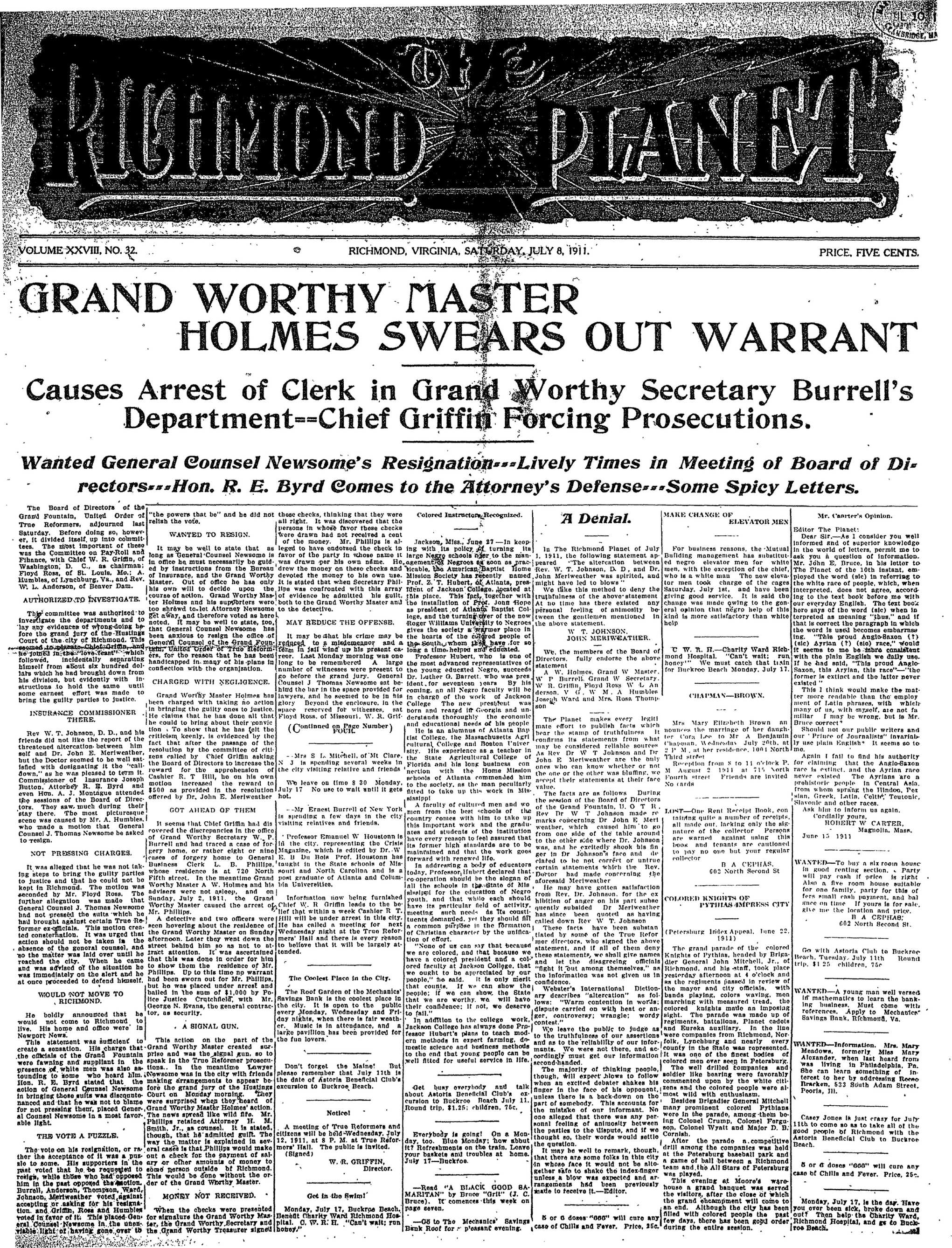
GRAND WORTHY MASTER HOLMES SWEARS OUT WARRANT
Causes Arrest of Clerk in Grand Worthy Secretary Burrell's Department==Chief Griffin Forcing Prosecutions.
Wanted General Counsel Newsome's Resignation—Lively Times in Meeting of Board of Directors—Hon. R. E. Byrd Comes to the Attorney's Defense—Some Spicy Letters.
The Board of Directors of the Grand Fountain, United Order of True Reformers, adjourned last Saturday. Before doing so, however, it divided itself up into committees. The most important of these was the Committee on Pay-Roll and Finance, with Chief W. R. Griffin, of Washington, D. C., as chairman; Floyd Ross, of St. Louis, Mo.; A. Humbles, of Lynchburg, Va., and Rev. W. L. Anderson, of Denver Dam.
"the powers that be" and he did not relish the vote.
WANTED TO RESIGN.
It may be well to state that as long as General Counsel Newsome is in office he must necessarily be guided by instructions from the Bureau drew the money on these checks and vicious, the American Baptist Home Mission Society has recently named John Merlweather was spirited, and might have led to blows.
Colored Instructor Recognized.
Jackson, Miss., June 27—In keeping with its policy, of turning its large Negro schools over to the management of Negroes as soon as appeared. The alteration between Rev. W. T. Johnson, D. D., and Dr. John Merlweather was spirited, and might have led to blows.
A Denial.
In The Richmond Planet of July 1, 1911, the following statement appeared: "The alteration between Rev. W. T. Johnson, D. D., and Dr. John Merlweather was spirited, and might have led to blows."
MAKE CHANGE OF ELEVATOR MEN
For business reasons, the Mutual Building management has substituted negro elevator men for white men, with the exception of the chief, who is a white man. The new elevator men took charge of the cages to the white race of people, which, when employed the word (sic) in referring to the white race of people, which, when
AUTHORIZED TO INVESTIGATE.
This committee was authorized to investigate the departments and to lay any evidences of wrong-doing before the grand jury of the Hustings Court of the city of Richmond. This seemed to appease Chief Orman, and he joined in the "love feast" which followed, incidentally separating himself from about six hundred dollars which he had brought down from his division, but evidently with instructions to hold the same until some earnest effort was made to bring the guilty parties to justice.
INSURANCE COMMISSIONER
THERE.
Rev W. T. Johnson, D. D., and his friends did not like the report of the threatened altercation between himself and Dr. John E. Merlweather, but the Doctor seemed to be well satisfied with designating it the "call-down," as he was pleased to term it. Commissioner of Insurance Joseph Button, Attorney R. E. Byrd and even Hon. A. J. Montague attended the sessions of the Board of Directors. They saw much during their stay there. The most picturesque scene was caused by Mr. A. Humbles, who made a motion that General Counsel J. Thomas Newsome be asked to resign.
NOT PRESSING CHARGES
It was alleged that he was not taking steps to bring the guilty parties to justice and that he could not be kept in Richmond. The motion was seconded by Mr. Floyd Ross. The further allegation was made that General Counsel J. Thomas Newcombe had not pressed the suit which he had brought against certain True Reformer ex-criminals. This motion created consternation. It was urged that action should not be taken in the absence of the general counsel, and so the matter was laid over until he reached the city. When he came and was advised of the situation he was immediately on the alert and he at once proceeded to defend himself.
WOULD NOT MOVE TO RICHMOND.
He boldly announced that he would not come to Richmond to live. His home and office were in Newport News. This statement was sufficient to create a sensation. His charge that the officials of the Grand Fountain were fawning and supplant in the presence of white men was also astounding to some who heard him. Hon. R. E. Byrd stated that the action of General Counsel Newsome in bringing those suits was discounted and that he was not to blame for not pressing their, placed General Counsel Newsome in a most favorable light.
THE VOTE A PUZZLE.
The vote on his resignation, or rather the acceptance of it was a pledge to some. His supporters in the past voted that he be requested to resign, while those who had opposed him in the past opposed the motion. Burrell, Anderson, Thompson, Ward, Johnson, Meriweather voted against accepting or asking for his resignation, and Griffin, Rose and Humbles voted in favor of it. This placed General Counsel Newsome in the unavailable light of having gone over to
"the powers that be" and he did not relish the vote.
WANTED TO RESIGN.
It may be well to state that as long as General-Counsel Newsome is in office he must necessarily be guided by instructions from the Bureau of Insurance, and the Grand Worthy Master. Out of office he has only his own will to decide upon the course of action. Grand Worthy Master Holmes and his supporters were too shrewd to let Attorney Newsome get away, and therefore voted as here noted. It may be well to state, too, that General Counsel Newsome has been anxious to resign the office of General Counsel of the Grand Foundation, United Order of True Reformers, for the reason that he has been handicapped in many of his plans in confection with the organization.
CHARGED WITH NEGLIGENCE.
Grand Worthy Master Holmes has been charged with taking no action in bringing the guilty ones to justice. He claims that he has done all that he could to bring about their conviction. To show that he has felt the criticism keenly, is evidenced by the fact that after the passage of the resolution by the committee of citizens called by Chief Griffin asking the Board of Directors to increase the reward for the approhension of Cashier R. T Hill, on his own motion increased the reward to $500 as provided in the resolution offered by Dr. John E. Merweather
GOT AHEAD OF THEM
It seems that Chief Griffin had dis covered the discrepancies in the office of Grand Worthy Secretary W. P. Burrell and had traced a case of forgery home, or rather eight or nine cases of forgery home to General Business Clerk L. B. Phillips, whose residence is at 720 North Fifth street. In the meantime Grand Worthy Master A W. Holmes and his advisers were not agile, and on Sunday, July 2, 1911, the Grand Worthy Master caused the arrest of Mr. Phillips. A detective and two officers were seen hovering about the residence of the Grand Worthy Master on Sunday afternoon. Later they went down the street behind him so as not to attract attention. It was ascertained that this was done in order for him to show them the residence of Mr. Phillips. Up to this time no warrant had been sworn out for Mr. Phillips, but he was placed under arrest and bailed in the sum of $1,000 by Police Justice Crutchfield, with Mr. George N. Evans, the general contractor, as security.
A SIGNAL GUN.
This action on the part of the Grand Worthy Master created surprise and was the signal gun, so to speak in the True Reformer prosecutions.. In the meantime Lawyer Newsome was in the city with friends making arrangements to appear before the grand jury of the Hustings Court on Monday morning. They were surprised when they heard of Grand Worthy Master Holmes' action. The news spread like wildfire. Mr. Phillips retained Attorney H. M. Smith, Jr., as counsel. It is stated, though, that he admitted guilt. The way the matter is explained in several cases is that Phillips would make out a check for the payment of salary or other amounts of money to some person outside of Richmond. This would be done without the order of the Grand Worthy Master.
MONEY NOT RECEIVED.
When the chocks were presented for signature the Grand Worthy Master, the Grand Worthy Secretary and the Grand Worthy Treasurer signed
those checks, thinking that they were all right. It was discovered that the persons in whose favor those checks were drawn had not received a cent of the money. Mr. Phillips is alleged to have endorsed the check in favor of the party in whose name it was drawn por his own name. He drew the money on these checks and devoted the money to his own use. It is stated that when Secretary Phillips was confronted with this array of evidence he admitted his guilt, both to the Grand Worthy Master and to the detective.
MAY REDUCE THE OFFENSE
It may be that his crime may be reduced to a misdeanor and a form in jail wind up his present career. Last Monday morning was one long to be remembered A large number of witnesses were present to go before the grand jury. General Counsel J Thomas Newcome sat behind the bar in the space provided for lawyers, and he seemed to be in his glory Beyond the enclosure, in the space reserved for witnesses, sat Floyd Ross, of Missouri, W. R. Griff
(Continued on Page Number
FOUR.)
--Mrs S L. Mitchell, of Mt Clare,
N J is spending several weeks in
the city visiting relative and friends.
We leave on time 8 30 Monday,
July 17. No use to wait until it gets
hot.
--Mr Ernest Burrell of New York
is spending a few days in the city
visiting relatives and friends.
Professor Emanuel W Houston is
in the city, representing the Crisis
Magazine, which is edited by Dr. W.
E. B Du Bols Prof. Houston has
taught in the State schools of Missouri
and North Carolina and in a post
graduate of Atlanta and Columbia
Universities.
Information now being furnished
Chief W. R Griffin loads to the bob-
belief that within a week Cashier R. T.
will be under arrest in this city.
He has called a meeting for next
Wednesday night at the True Reformers' Hall and there is every reason
to believe that it will be largely attended.
The Coolest Place in the City.
The Roof Garden of the Mechanics Savings Bank is the coolest place in the city. It is open to the public every Monday, Wednesday and Friday nights, when there is fair weather. Music is in attendance, and a large pavilion has been provided for the fun lovers.
Don't forget the Malne! But please remember that July 11th is the date of Astoria Beneficial Club's excursion to Buckroe Beach.
A meeting of True Reformers and citizens will be held-Wednesday, July 12, 1911, at 8 P. M. at True Reform meeting. The public is invited. (Shandi)
Get in the Swim!
Monday, July 17, Buckpore Bench,
Benefit Charity Ward Richmond Hospital.
C. W. R. H. "Can't wait; run hockey."
Jackson, Miss., June 27—In keeping with its policy, of turning its large Negro schools near to the management of Negroes up as practicable, the American Baptist Home Mission Society has recently named Prof. Z. T. Hubert, of Atlanta, president of Jackson' College, located at this place. This fact, together with the installation of Prof. John Hope as president of Atlanta Baptist College, and the turning over of the new Roger Williams University to Negroes gives the society a warmer place in the hearts of the colored people of the South, whom this have for so long a time helped and educated. Professor Hubert, who is one of the most advanced representatives of the young educated Negro, succeeds Dr. Luther G. Barrett, who was president, for seventeen years. By his coming, an all Negro faculty will be in charge of the work of Jackson College. The new president was born and reared in Georgia and understands thoroughly the economic and educational needs of his people. He is an alumnus of Atlanta Baptist College, the Massachusetts Agricultural College and Boston University. His experience as a teacher in the State Agricultural College of Florida and his long business connection with the Home Mission schools of Atlanta commended him to the society, as the man peculiarly fitted to take up this work in Mississippi.
A faculty of cultured men and women from the best schools of the country comes with him to take up this important work and the graduates and students of the institution have every reason to feel assured that its former high standards are to be maintained and that the work goes forward with renewed life.
In addressing a body of educators today, Professor Hubert declared that co-operation should be the slogan of all the schools in the State of Mississippi for the education of Negro youth, and that while each should have its particular field of activity, meeting such needs as Its constituents demanded, yet they should fill a common purpose in the formation of Christian character by the unification of effort.
"None of us can say that because we are colored, and that because we have a colored president and a colored faculty at Jackson College, that we ought to be appreciated by our people," he said. It is only merit that counts. If we can show the people; if we can show the State that we are worthy, we will have their confidence; if not, we deserve to fall."
In addition to the college work, Jackson College has always done Professor Hubert's plans to teach modern methods in expert farming, domestic science and business methods to the end that young people can be well fitted for useful service in life.
Get busy everybody and talk about Astoria Beneficial Club's excursion to Buckroe Beach July 11. Round trip, $1.25; children, 75c.
Everybody is going! On a Monday, too. Blue Monday; how about it? Refreshments on the train. Leave your baskets and troubles at home. July 17—Bucktoes.
—Road "A BLACK GOOD SA-
MARITAN" by Bruce "Grit" (J. C.
Bruce). It comences this week on
page seven.
—GB to The Mechanics' Savings
Bank for a pleasant evening.
A Denial.
In The Richmond Planet of July 1, 1911, the following statement appeared "The alteration between Rev. W. T. Johnson, D. D, and Dr. John Merlweather was spirited, and might have led to blows." We like this method to deny the trufficfulness of the above statement. At no time has there existed any personal feeling of animosity between the gentlemen mentioned in the above statement.
We, the members of the Board of Directors, fully endorse the above statement
A W. Holmes, Grand W Master,
W P Burrell, Grand W Secretary,
W R. Grimlin, Floyd Ross, W L Anderson, V G. W M. A Humbles Joseph, Ward and Mrs. Rosa Thompson
The Planet makes every legitimate effort to publish facts which bear the stamp of truthfulness. It confirms its statements from what may be considered reliable sources As Rev Dr W T Johnson and Dr John E Meriweather are the only ones who can know whether or not the one or the other was bluffing, we accept their statements at their face value.
The facts are as follows During the session of the Board of Directors of the Grand Fountain, U. O T R. Rev Dr W T Johnson made remarks concerning Dr John E Meriweather, which caused him to go from one side of the table around to the other side where Dr Johnson was, and he excitedly shook his finger in Dr Johnson's face and declared to be not correct or untrue certain statements which the Rev. Doctor had made concerning the aforesaid Meriweather
He may have gotten satisfaction from Rev. Dr. Johnson, for the exhibition of anger on his part subsequently subsided Dr Meriweather has since been quoted as having called down Rev W T Johnson
These facts have been substantiated by some of the True Reform directors, who signed the above statement, and if all of them deny these statements, we shall give names and let the disagreeing officials "fight it out among themselves." as the information was not given us in confidence.
Webster's International Dictionary describes "altercation" as follows: "Warm contention in words; dispute carried on with heat or anger, controversy; wrangle; wordy contest."
We leave the public to judge as to the truthfulness of our assertions and as to the reliability of our informants. We were not there, and accordingly must get our information second-handed.
The majority of thinking people, though, will expect blows to follow when an excited debater shakes his finger in the face of his opponent, unless there is a back-down on the part of somebody. This accounts for the mistake of our informant. No one alleged that there was any personal feeling of animosity between the parties to the illusure, and if we thought so, their words would settle the question.
It may be well to remark, though, that there are some folks in this city in whose face it would not be altogether safe to shake the index-finger unless a blow was expected and arrangements had been previously made to receive it.—Editor.
B or G doses: "066" will cure any case of Chills and Fever. Price, 25c.
For business reasons, the Mutual Building management has substituted negro elevator men for white men, with the exception of the chief, who is a white man. The new elevator men took charge of the cages Saturday, July 1st, and have been giving good service. It is said the change was made qwiling to the general opinion that negro help of this kind is more satisfactory than white help
---
C W. R. H.—Charity Ward Richmond Hospital. "Can't wait; run honey!" We must catch that train for Buckroe Beach Monday, July 17.
CHAPMAN—BROWN.
Mrs Mary Elizabeth Brown announces the marriage of her daughter Cora Lee to Mr A Benjamin Chapman, Wednesday July 20th, at 2 P M, at her residence, 1004 North Third street
Reception from 8 to 11 o'clock P M August 2 1911 at 715 North Fourth street Friends are invited No cards
---
LOST—One Rent Receipt Book, con-
taining quite a number of receipts,
all made out, lacking only the sig-
nature of the collector. Persons
are warned against using this
book and tenants are cautioned
to pay no one but your regular
collector
B A CEPHAS.
602 North Second St
---
COLORED KNIGHTS OF
PYTHIAS IMPRESS CITY
(Petersburg Index Appeal, June 22, 1911)
The grand parade of the colored Knights of Pythias, headed by Brigadier General John Mitchell, Jr., of Richmond, and his staff, took place yesterday afternoon at 4 o'clock and as the regiments passed in review of the mayor and city officials, with bands playing, colors waving, mon marching with measured tread, the colored knights made an imposing sight. The parade was made up of regiments, battallons, Planet cadets and Eurokra auxiliary. In the line were companies from Richmond, Norfolk, Lynchburg and nearly every county in the State was represented. It was one of the finest bodies of colored men over seen in Petersburg. The well drilled companies and soldier like bearing were favorably commented upon by the white citizens and the colored people were almost wild with enthusiasm.
Besides Brigadier General Mitchell many prominent colored Pythians were in the parade, among them being Colonel Crump, Colonel Ferguson, Colonel Wyatt and Major D. B. Cornish.
After the parade a competitive drill among the companies was held at the Potersburg baseball park and a game of ball between a Richmond team and the All Stars of Potersburg was played.
This evening at Moore's warehouse a grand banquet was served the visitors, after the close of which the grand encampment will come to an end. Although the city has been filled with colored people the past few days, there has been good order during the entire session.
Mr. Carter's Opinion.
Editor The Planet:
Dear Sir,—As I consider you well informed and of superior knowledge in the world of letters, permit me to ask you a question of information. Mr. John E. Bruce, in his letter to the Planet of the 10th instant, employed the word (slc) in referring to the white race of people, which, when interpreted, does not agree, according to the text book before me with our everyday English. The text book here says of the word (slc) when in interpreted as meaning "thus," and if that is correct the paragraph in which the word is used becomes embarrassing. "This proud Anglo-Saxon (?) (slc) Ayrian (?) (sio) race," would it seem to me be inhra consistent with the plain English we daily use. If he had said, "This proud Anglo-Saxon, this Ayrian, this race"—the former is extinct and the latter never existed."
This I think would make the matter more readable than the employment of Latin phrases, with which many of us, with myself, are not familiar. I may be wrong, but is Mr. Bruce correct?
Should not our public writers and our 'Prince of Journalists' invariably use plain English? It seems so to me.
Again I fail to find his authority for claiming that the Anglo-Saxon race is extinct, and the Ayrian race never existed. The Ayrians are a prohistoric people in Central Asia, from whom spring the Hindoo, Persian, Greek, Latin, Celtic, Teutonic, Slavonic and other races.
Ask him to inform us again.
Cordially yours,
ROBERT W CARTER,
Magnolia, Mase.
June 15, 1911
---
WANTED—To buy a six room house in good renting section. Party will pay cash if price is right. Also a five room house suitable for one family, party for this of fers small cash payment, and hal once on time. If you are for sale, give me the location and price.
B A CEPHAB:
602 North Second, St.
Go with Astoria Club to Buckroe Beach, Tuesday, July 11th Round trip, $1.25 children, 75c
WANTED—A young man well versed in mathematics to learn the banking business. Must come with references. Apply to Mechanical Savings Bank, Richmond, Va.
WANTED—Information. Mrs. Mary
Mendows, formerly Miss Mary
Alexander, when last heard from
was living in Philadelphia, Pa.
She can learn something of interest
to her by addressing Rocco
Bracken, 533 South Adam Street,
Pearlia, Ill.
Casey Jones is just crazy for July 11th to come so as to take all of the good people of Richmond with the Astoria Beneficial Club to Buckroe Beach.
5 or 6 doses "000" will cure any case of Chills and Fever. Price, 25c.
Monday, July 17, is the day. Have you over been sick, broke down and out? Then help the Charity Ward, Richmond Hospital, and go to Buckroe Beach.
---
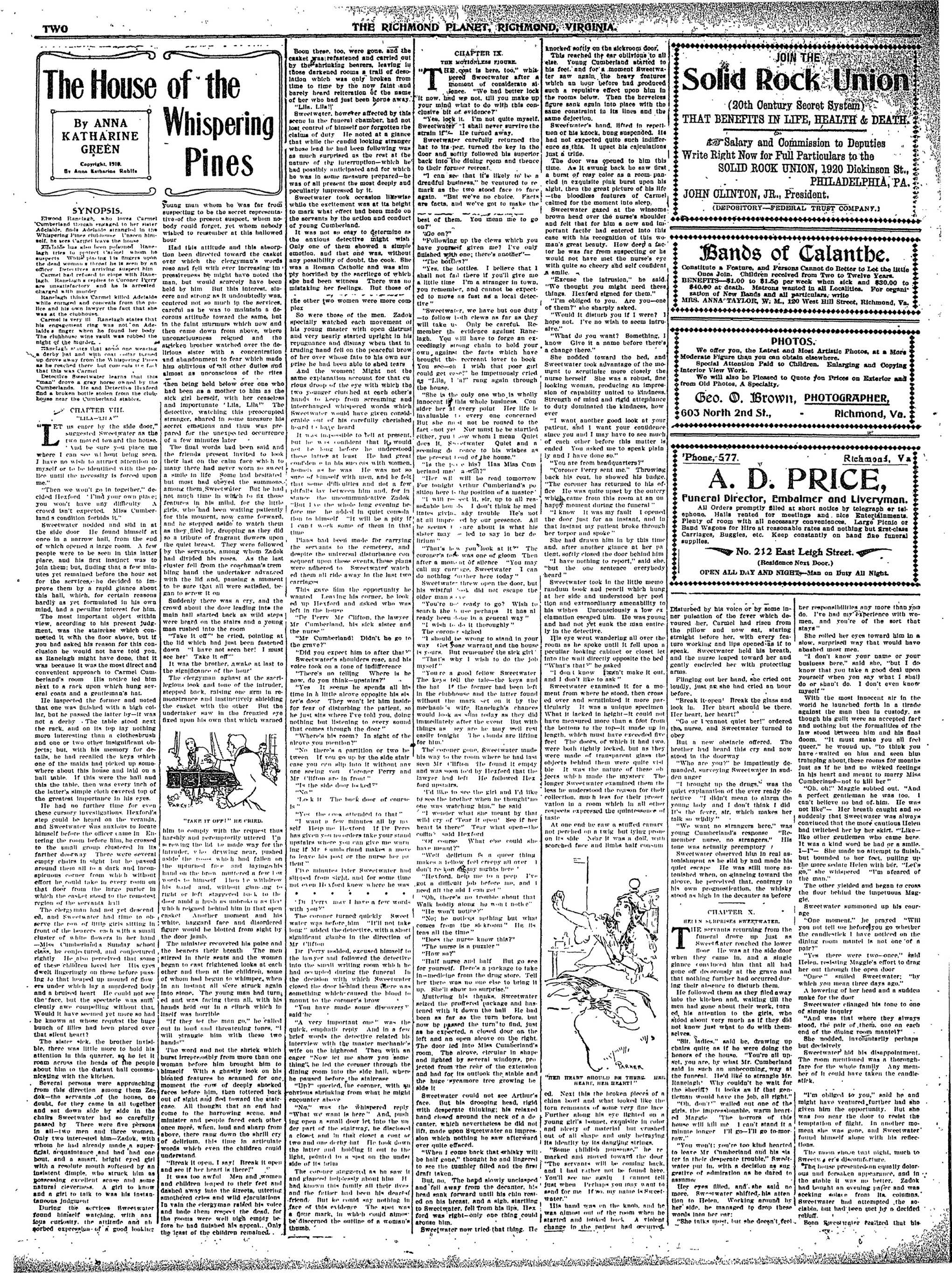
work was over for the night and planned to leave. But there was one point to be settled first. Was there any other means of exit from these grounds save that offered by the ordinary driveway?
He had an impression that in one of his strolls about he had detected the outlines of a door in what looked like a high brick wall in the extreme rear. If so it were well worth his while to know where that door led. It might be as well to try the lock, but he would have to cross a very wide strip of moonlight in order to do so, and he feared to attract attention to his extreme ingenuity.
Advancing in a quiet, sliding way he had, he laid his hand on the small knob above the lock and quickly turned it. The door was unlocked and swing under his gentle push. An alloy-wrapped before him leading to what appeared to be another residence street. He was about to test the truth of this surmise when he heard a step behind him and, turning, encountered the heavy figure of the coachman advancing toward him with a key in his hand.
Zadok was of an 'easy turn, but he had been norely tried, that day, and his limit had been reached.
"You snooper!" he bawled. "What do you want here? Won't the run of the house, content you? Come! I want to lock that door. It's my last duty before going to bed."
P.
Sweetwater assumed the innocent.
"And I was just going this way. It looks like a short road into town. It is, isn't it?"
"No! Yes!" growled the other.
"Whichever it is, it isn't your road tonight. That's private
"YOU ENOOPER!" HE That's private
HAWLED property, air.
The alley you see belongs to was neighbors. No one passes through there but myself and—
He caught himself in time with a sullied grunt which may have been the result of fatigue or of that latent instinct of loyalty which is often the most difficult obstacle a detective has to encounter.
"And Mr. Ranelagh, I suppose you would say?" Was sweetwater's easy finish.
No answer. The conchman simply locked the door and put the key in his pocket.
Sweetwater made no effort to deter him. More than he desolated from further questions, though he was dying to ask where this key was kept at night and whether it had been in its usual place on the evening of the murder. He had gone far enough, he thought. Another step and he might arouse this man's suspicion, if not his culpity. But he did not leave the shadows into which he again receded until he had satisfied himself that the key went into the stable with the coachman, where it probably remained for this night at least. It was after 10 when Sweetwater re-entered the house to say good night to Hyford. He found him on watch in the upper hall, and the man, Clarke, below. He had a word with the former:
"What is the purpose of the little door in the wall back of the stable?" "It connects these grounds with those of the Fultons. The Fultons live on Husted street."
"Are the two families intimate?"
"Very. Mr. Cumberland is sweet on the young lady there." "He uses that door, then?" Sweet-water pursued.
"Probably"
"Did he use it that night?"
"He didn't visit her."
"Where did he go?"
"We can't find out. He was first seen on Garden street, coming home after a night of dehauch. He had drunk hard. Asked where he got the liquor, he mandered out something about a saloon, but none of the places which he usually frequented had seen him that night. I have tried them all and some that weren't in his books. It was no good."
"That door is supposed to be locked at night. Zadok says that's his duty. Was it locked that night?"
"Can't say. Perhaps the coroner can. You see, the inquiry run in such a different direction at first that a small matter like that may have been overlooked."
Sweetwater subdued the natural resort and, reverting to the subject of the saloons, got some specific information in regard to them. Then he passed thoughtfully downstairs, only to come upon Helen, who was just extinguishing the front hall light.
"Good night," he said in passing.
"Good night. Mr. Sweetwater."
There was something in her tone which made him stop and look back. She had stepped into the library and, was blowing out the lamp there. He paused a moment and sighed softly.
Then he started toward the door, only to stop again and cast another look back. She was stalling in one of the doorways, anxiously watching him and twisting her fingers in and out in an irresolute way truly significant in one of her disposition.
He folt his heart leap.
Returning softly, he took up his stand before her, looking her straight in the eye.
"Good night" he repeated, with an old emphas.
"Good night" she answered, with equal force and meaning.
But the next moment she was speaking rapidly, earnestly.
"I can't sleep," she said. "I never can when I'm not certain of my duty. Mr. Ranslash is an injured man. Ask what was said and done at their last dinner here. I can't tell you. I didn't listen, and I didn't see what happened, but it was something out of the ordinary. Three broken wingglasses lay on the tablecloth when I went in to clear away. I heard the clatter when they fell and smashed, but I said nothing. I have said nothing since, but I know there was a quarrel, and that Mr. Ranslash was not in it, for his glass was the only one which remained unbroken. Am I wrong in telling you? I wouldn't if- if it were not for Mr. Ranslash. He didn't do right by Miss Cumberland, but he doesn't deserve to be in prison, and so would Miss Carmel tell you if she knew what was going on and could speak. She loved him and—I've said enough—I've said enough." The agitated girl protested as he leaned eagerly toward her. "I couldn't tell the priest any more. Good night." And she was gone.
He hesitated a moment, then pursued his way to the side door and so out of the house into the street. Soon he returned to his old habit of muttering to himself.
"One thing I will solve, and that is where this miserable fellow spent the hours between this dinner they speak of and the time of his return next day. Hexford has failed at it. Now well see what a blooming stranger can do."
CHAPTER XI.
SWEETWATER was soon at the bottom of the hill, where the street, taking a turn, plunged him at once into a thickly populated district. As this was still the residence quarter, he passed on until he gained the heart of the town and the region of the saloons. Here he slackened pace and consulted a memorandum he had made while talking to Hexford.
It was not his intention to revitalize the places so thoroughly overhaul by the police. He carried another list, that of certain small groceries and quiet, unobtrusive hotels, where a man could find a private room in which to drink alone. It being Sweetwater's conviction that in such a place, and in such a place only, would be found the tokens of those solitary hours spent by Arthur Cumberland between the time of his sister's quarrel and his reappearance the next day.
He asked the first passby the way to Hubbell's alley.
It was a mile off of "That settles it," muttered Sweetwater "Besides, I doubt if he would go into an alley, The man has sank low, but hardly so low as that. What's the next address I have? Cuthbert road. Where's that?"
Espying a policeman eying him with mofo or less curiosity from the other side of the street, he crossed over and requested to be directed to Cuthbert road.
"Cuthbert road! That's where the markets are. They're closed at this time of light." was the somewhat suspicious reply.
Evidently the location was not a savory one
"Is there nothing but markets there?"
Inquired Sweetwater quite innocently. It was his present desire not to be recognized as a detective even by the men on beat. "I'm looking up a friend. He keeps a grocery or some kind of small hotel. I have his num ber, but I don't know how to get to Cuthbert road."
"Then turn straight about and go down the first street, and you'll reach it before the trolley car you see there can strike this corner. But first sow up your pockets. There's a bad block between you and the markets."
Sweetwater slapped his trousers and laughed.
"I wasn't born yesterday," he cried and, following the officer's directions, made straight for the road. Sixty-two was not far off.
He hesitated when he reached it. Some houses invite and some repel. This house repelled. Yet there was nothing shabby or mysterious about it. There was the decent entrance, lighted, but not too brilliantly; a row of dark windows over it, and above it all a sloping roof in which another sparkle of light drew his attention to an upper row of windows, this time of the old dormer shape. An alley ran down one side of the house to the stables, now locked, but later to be thrown open for the use of the farmers who begin to gather here as early as 4 o'clock. Nothing wrong in its appearance, everything shapelike and yet—"I shall find some strange characters here." was the Sweetwater comment with which our detective opened the door and walked into the house.
It was an unusual hour for guests and the woman whom he saw bending over a sort of desk in one corner of the room he strode into looked up hastily, almost suspiciously.
"Well, and what is your business?" she asked.
"I want a room," he rapidly confided to her, "in which I can drink and drink till I cannot see—whisky, just whisky. Give me a room. I'll be quiet."
"I'll give you nothing." She was not hot and angry and full of distrust. "This house is not for such as you. It's a farmers' lodging—honest men, who'd store and go und to see a foliar like you about. Go along, I tell you, or I'll call Jim. He'll know what to do with you."
"Then he'll know more I do my self," mumpled the detective, with a crushed and discouraged air. "Money and not a place to spend it in. Why can't I go in there?" he peevishly inquired with a trumulous feature toward a half-open door through which a glimpse could be got of a nest little anuggery. "Nobody'll see me. Give me a glass and leave me till I rap for you in the morning. That's worth a river. Don't you funk it, missus? And well, begin by passing over, the river."
THE RICHMOND PLANET. RICHMOND. VIRGINIA.
"THIS HOUSE IS NOT FOR SUCH AS YOU." "No."
She was mighty peremptory, and, what was more, she was in a great hurry to get rid of him. This haste and the anxious car she turned toward the hall enlightened him as to the situation. There was some one within fearing or liable to come within hearing who possibly was not so stiff under temptation.
Changing his tactics, he turned his back on the sungery and surveyed the offended woman with just a touch of mandolin sentiment.
"I say," he cried, just loud enough to attract the attention of any one within ear shot, "you're a mighty fine woman and the boas of this here establishment, that's evident. I'd like to see the man who could say no to you. He's never sat in that 'ore cashier's seat where you be, of that I'm dead sure. He wouldn't care for Sweers if you didn't, nor for lens either." He began to edge toward the door, always eying her and always speaking loudly in admirably acted tipe unconsciousness of the fact. "I'm a man who likes my own way as well as anybody, but I never quarrel with a woman. I'm going, missus; I'm going. Ohl." The man who had entered was small almost to the point of being a mankin, and, more than that, he was weaken of face and all balanced on his two thir, ridiculous legs.
"Is she making a fool of herself?" naked the little man in a voice as shrill as it was weak. "Do your business with me. Women are no good." And he stalked into the room as only little man can.
Sweetwater took out his bill, pointed to the snuggery and tapped his breast pocket. "Whisky here." he confided.
"Bring me a glass. I don't mind your farmers. They won't bother me. What I want is a locked door and a bill mouth in your head. I want to booze to my heart's content, with nobody by to count the glasses. You've known such fellers before, and that cozy little room over there has known them too. Just add me to the list. It won't harm you."
The man's hand closed on the bill. Sweetwater noted the action out of the corner of his eye, but his direct glance was on the woman. Her back was to him, but she had started as he mentioned the snuggery and made as if to turn, but thought better of it and bent lower over her books.
"I two struck the spot," he murmured exultantly to himself. "This is the place I want, and here I'll spend the night; but not to booze my wits away; oh, no." Nevertheless it was a night virtually wasted. He learned nothing more than what was revealed by that one slight movement on the part of the woman.
The driving in of the farmers, and the awakening of life in the market and all the stir it occasioned inside the house and out, prevented sleep over if he had been inclined that way. Boomer than was expected of him, sooner than was wise, perhaps, he was on his feet and peering out of the one small window this most diagonal day room contained. He had not mistaken the outlook. It gave on to the alley and all that was visible from behind the curtains where he stood was the high brick, windowless wall of the neighboring house. He turned back into the room, disgusted, then crept to the window again, and, softly rating the sash, cast one of his lightening glances on and down the alley. He闪然 let the sash fall again and retreated to the center of the room, where he stood for a moment with a growing smile of intelligence and hope on his face. He had detected close against the side of the wall a box against cart full of empty bottles. It gave him an idea. With an impetuosity he would have criticized in another man he dung himself out of the room in which he had been for so many hours confined and, coming face to face with the landlady standing in unexpected watch-before the door, found it a strain on his nerves to instantly as some the sullen, vaguely abused air with which he had decided to leave the house. Nevertheless he made the attempt, and if he did not succeed to his own satisfaction he evidently did to hers, for also made no effort to stop him as he stumped out, and in his final look, which he managed with some address to intercept, he perceived nothing but relief. What had been in her mind-fear for him or fear for themselves? He could not decide until he had rummaged that cart of bottles. But how was he to do this with out attracting attention to himself in a way he still felt to be undesirable?
When later in the day a certain old peddler went his rounds through this portion of the city a disreputable looking fellow accompanied him, whom even the sharp landlord in Cuthbert road would have failed to recognize as the same man who had occupied the smuggle the night before. He was many hours on the road and bad many new experiences with human nature. But he gained little else and was considering with what words he should acknowledge his defeat at police headquarters when he found himself again at the markets and a minute later in the alley where the cart stood, the contours of which he had seen earlier in the day.
He had followed the puddier here because he had followed him to every other back door and alley. But he was tired and had small interest in the cart which looked quite undisturbed and in exactly the same condition as when he turned his back upon it to the morning. But when he drew nearer and boomed to lead a hand in removing the bottle to the wagon he discovered that a bottle had been added to the pile and that this bottle bore the label which marked it as being one of the two which had been taken from the clubhouse on the night of the murder.
Mme McNairdee GIFTED CLAIRVOYANT
武平
The gifted clairvoyant, the double (caul) veil. She is one voyant of New Orleans. She is one mist. She tells plainly what is touching your brain and mind. With a course of influence to enable has made thousands of homes in verse of St. Matthews: "Blessed be called the children of God." Peace where there is confusion, heart will never forsake you, sooner if you will only heed the several ladies of your city say: us. My husband and I separate since called on you lady, be happy. I called young lady says: write me. I called on this lady can't afford to miss consulting read characters. She challenges love, losses, business, family and separated, causes speedy marriages cards allowed in her place of being strictly a Christian lady, and to if you are painful or alluring, to see her. She spent eight years traveled through 34 State Road St. John, 9th chapter, 33 God, he could do nothing.
"I, for one, as one in the mild treatment of my husband and the time and money, until I should soon be a year. Through her today he presents me with a home. Tonguo can't praise her. Thousands are flocking to a powerful consultation when heed of all who called. Don't put out of enjoy future happiness. You m. Don't delay. Highly endorsed by lawyers and doctors, and comes leading lodges, the S. M. T. U. Calathan Court. The church the name United Sisters of and loved by all. God has endorsed slug to aid humanity. She deals.
She wants to hear from me.
Address MADAM McAIRDEE ind.
Positively no attention paid closed.
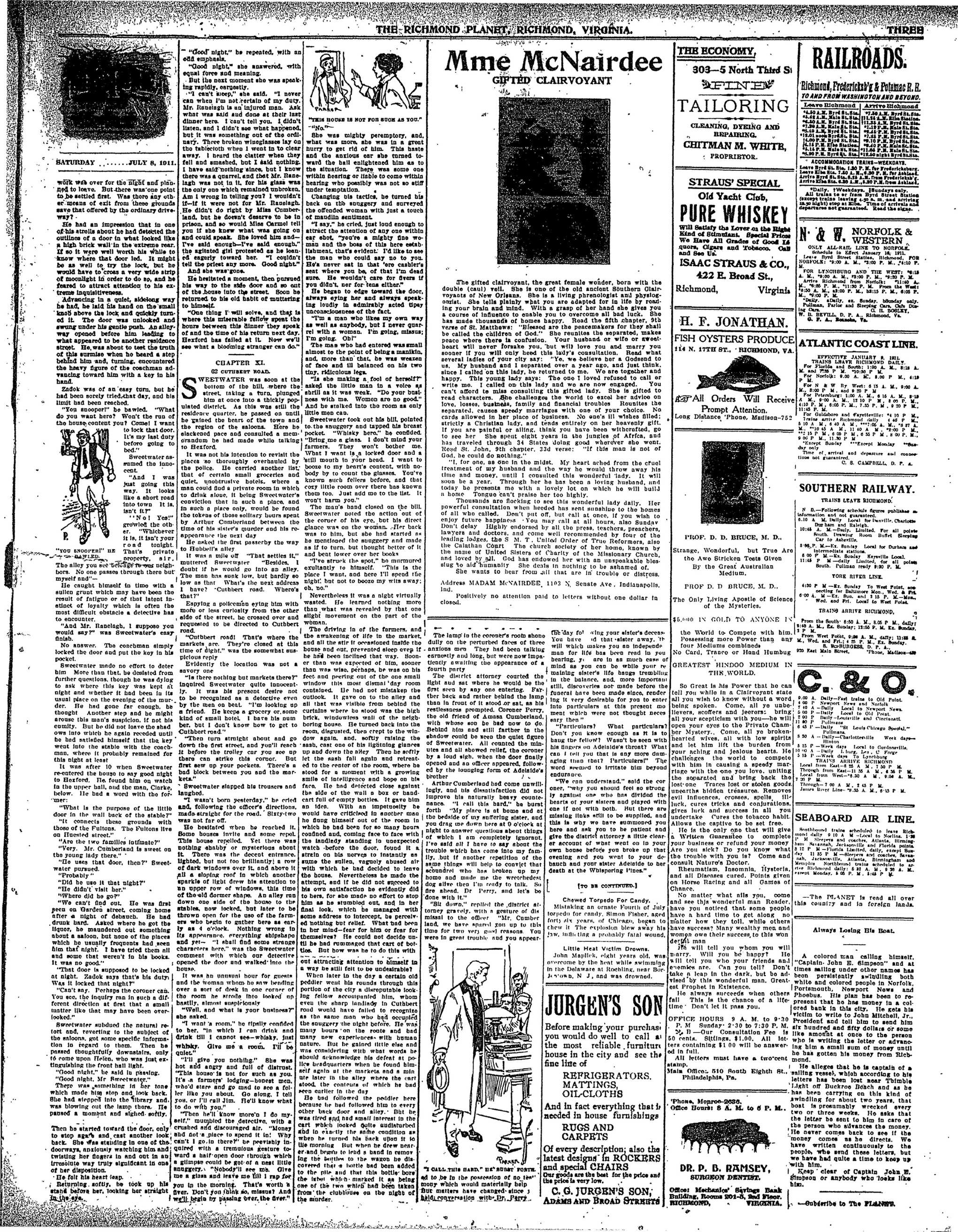
The gifted clairvoyant, the great female wonder, born with the double (cault) veil. She is one of the old ancient Southern Glairvoyants of New Orleans. She is a living phrenologist and physiologist. She tells plainly what you are adapted for in life by reading your brain and mind. With a grasp of her hand she gives you a course of influence to enable you to overcome all bad luck. She has made thousands of homes happy. Read the fifth chapter, 9th verse of St. Matthews: "Blessed are the peacemakers for they shall be called the children of God." She reunites the separated, makes peace where there is confusion. Your husband or wife and sweetheart will never forsake you, but will love you and marry you sooner if you will only head this lady's consultation. Read what several ladies of your city say: "We, we believe her a Godsend to us. My husband and I separated over a year ago, and just think, since I called on this lady, he returned to me. We are together and happy. This young lady says: The one I loved refused to call or write me. I called on this lady and we are now engaged. You can't afford to miss consulting this gifted lady. She is gifted to read characters. She challenges the world to excel her advice on love, losses, business, family and financial troubles. Routines the separated, causes speedy marriages with one of your choice. No cards allowed in her place of business. No one's ill wishes filled; strictly a Christian lady, and tends entirely on her heavenly gift. If you are painful or allying, think you have been withered, to see her. She spent eight years in the jungles of Africa, and has traveled through 34 States doing good wherever she wont. Read St. John, 9th chapter, 33d verse: "If this man is not of God, he could do nothing."
"I, for one, as one in the midst. My heart ached from the cruel treatment of my husband and the way he would throw away his time and money, until I consulted this wonderful lady. It will soon be a year. Through her he has been a loving husband, and today he presents me with a lovely lot on which he will build a home. Tongue can praise her too highly.
Thousands are flocking to see this wonderful lady daily. Her powerful consultation when heeded has sent sunshine to the homes of all who called. Don't put off, but call at once, if you wish to enjoy future happiness. You may call at all hours, also Sunday. Don't delay. Highly endorsed by all the press, teachers, preachers, lawyers and doctors, and come well recommended by four of the leading lodges, the S. M. T., United Order of True Reformers, also Catholic Court. The church society of her home, known by the name of United Sisters of Charity of the Missionary Church, and loved by all. God has endowed her with an unspoakeable blessing to aid humanity. She deals in nothing to be ashamed of.
She wants to hear from all that are in trouble or distress.
Address MADAM McNAIRDEE, 1103 N. Senate Ave., Indianapolis, ind.
Positively no attention paid to letters without one dollar in closed.
The lamp in the corner's room shone dully on the perturbed faces of three anxious men. They had been talking earnestly and long, but were now impatiently awaiting the appearance of a fourth party.
The district attorney courted the light and sat where he would be the first seen by any one entering. Farther back and rather behind the lamp than in front of it stood or sat, as his restlessness prompted. Coroner Perry, the old friend of Amasa Cumberland, with whose son he had now to do. Behind him and still farther in the shadow could be seen the quiet figure of Sweetwater. All counted the minutes and all showed relief, the coroner by a loud sigh, when the door finally opened and an officer appeared, followed by the lounging form of Adolide's brother.
Arthur Cumberland had come unwillingly, and his dissatisfaction did not improve his naturally heavy countenance. "I call this hard," he burst forth. "My place is at home and at the bedside of my suffering sister, and you drag me down here at 0 o'clock at night to answer questions about things of which I am completely ignorant. I've said all I have to say about the trouble which has come into my family, but if another repetition of the same things will help to convict that ackundrel who has broken up my home and made me the wretchestest dog alive then I'm ready to talk. So fire ahead. Dr Perry, and let's be done with it." "Sit down," replied the district attorney gravely, with a gesture of dismissal to the officer. "Mr. Cumberland, we have spared you up to this time for two very good reasons. You were in great trouble and you appear
P. M.
"I CALL THIS HARD" HE BURST FORTH
and to be in the possession of no terny
mony which would materially help
but matters have changed - since
hold conversation with Dr. Parry.
the great female wonder, born with the one of the old ancient Southern Clairmont is a living phrenologist and physiologist are adapted for in life by reading a grasp of her hand she gives you to overcome all bad luck. She is happy. Read the fifth chapter, 9th and are the peacemakers for they shall be. She reunites the separated, makes you. Your husband or wife or sweetheart, but will love you and marry you to this lady's consultation. Read what is: "Ye, we believe her a Godsend to ted over a year ago, and just think, returned to me. We are together and The one I loved refused to call or lady and we are now engaged. You got this gifted lady. She is gifted to see the world to excel her advice on and financial troubles. Rounthes the flags with one of your choice. No business. No one's ill wishes filled; tends entirely on her heavenly gift, think you have been withered, go years in the jungles of Africa, and does doing good wherever she went. 33d verse: "If this man is not of oldst. My heart ached from the cruel way the he would throw away his cultured this wonderful lady. It will has been a loving husband, and lovely lot on which he will build her too highly. See this wonderful lady daily. Her has sent sunshine to the homes off, but call at once, if you wish to may call at all hours, also Sunday by all the press, teachers, preachers, we well recommended by four of the United Order of True Reformers, also church society of her home, known by Charity of the Missionary Church, dowed her with an unspakeable blessings in nothing to be ashamed of, call that are in trouble or distress.
1103 N. Senate Ave. Indianapolis.aid to letters without one dollar in
The day for taking your sister's decease. You have to that sister away. The will which makes you an independent man for life has been read in you bearing, you are in as much case of mind as you can be while your remaining sister's life hangs trembling in the balance, and more important still, discoveries not made before the funeral have been made since, rendering it very desirable for you to enter into particulars at this present moment which were not thought necessary then"
"Particulars? What particulars? Don't you know enough as it is to hang the fellow? Wasn't you seen with his fingers on Adelinda's throat? What can I tell you that is any more damaging than that? Particulars!" The word seemed to irritate him beyond endurance.
"We can understand," said the coner, "why you should feel so strong against one who has divided the hearts of your sisters and played with one if not with both. But there are missing links still to be supplied, and this is why we have summoned you here and ask you to be patient and give the district attorney a little cleaner account of what went on in your own house before you broke up that evening and you went to your debauch and your sister Adelinde to her death at the Whispering Lines."
[TO BE CONTINUED.]
Chewed Torpedo For Candy.
Mistaking an ornate Fourth of July torpedo for candy, Simon Fisher, aged forty six years, of Chicago, began to chew it. The explosion blew away his jaw, inflicting a probably fatal wound.
Little Heat Victim Drowns.
John Mapleik, eight years old, was overcome by the heat while swimming in the Delaware at Roobling, near Bordown, N J, and was drowned.
JURGEN'S SON
Before making your purchase you would do well to call as the most reliable, furniture house in the city and see the fine line of
REFRIGERATORS,
MATTINGS,
OIL-CLOTHS
And in fact everything that is needed in house furnishings
RUGS AND
CARPETS
Of every description; also the latest designs in ROCKERS and special CHAIRS
Our goods are the best for the price and the price is very low.
C. G. JURGEN'S SON;
ADAMS AND BROAD STREETS
THE ECONOMY
303-5 North Third St
FINE
CLEANING, DYEING AND
RBFAIRING.
CHITMAN M. WHITE,
PROPRIETOR.
Old Yacht Club.
Will Satisfy the Lover on the Right Kind of Stimulant. Special Prices We Have All Grades of Good L& quora, Cigars and Tobacco. Call and See Us.
ISAAC STRAUS & CO.,
422 E. Broad St.,
Richmond, Virginia
H. F. JONATHAN.
FISH OYSTERS PRODUCE
114 N. 17TH ST., RICHMOND, VA.
All Orders Will Receive
Prompt Attention.
Long Distance 'Phone, Madison-752
PROF. D. D. BRUCE, M. D.,
Strange, Wonderful, but True Are
the Awo Stricken Teets Glon
By the Great Australian
Medium.
PROF. D. D. BRUCE, M. D.,
The Only Living Apostle of Science
of the Mysteries.
$5,000 IN GOLD TO ANYONE IN
the World to Compete with him.
Possessing more Power than any
four Mediums combined
No Card, Trones on Head, Humbug
GREATEST HINDO MEDIUM IN
THE WORLD.
So Great is his Power that he can tell you whilo in a Clairvoyant state all you wish to know without a word being spoken. Come, all yo unbelievers, scoffers and jeerers: bring all your scapellism with you—he will open your eyes to the Private Chamber Mystery. Come, all yo broken-hearted wives, all with low spirits and let him lift the burden from your aching and jealous hearts. He challenges the world to compete with him in causing a speedy marriage with the one you love, uniting the separated and bring back the lost one Traces lost or stolen goods unearths hidden treasures. Removes evil influences, crones, spells, ill-luck, cures tricks and conjurations, gives luck and success in all you undertake. Cures the tobacco habit. Allows the captive to be set free.
He is the only one that will give a Written Guarantee to complete your business or refund your money Are you sick? Do you know what the trouble with you is? Come and consult Nature's Doctor.
Rheumatism, Insomnia, Hysteria,
and all Diseases cured. Points given
on Horse Racing and all Games of
Chance.
No matter what alls you, come
and see thjs wonderful man Reader,
have you noticed that some people
have a hard time to get along no
matter how they tell, while others
have success? Many wealthy men and
women own their success, to this won-
derful man.
He will tell you whom you will
marry. Will you be happy? He
will tell you who your friends and
enemies are. Can you tell? Don't
take a leap in the dark, but be
advised by this wonderful man. Greatest Prophet in Existence.
He always succeeds when others
fall. This is the chance of a lifetime.
Don't let it pass you.
OFFICE HOURS 9 A. M. to 9:30
P. M. Sunday 2:30 to 7:30 P. M.
B — Our Consultation Fee is
50 cents. Sittings, $1.00. All
letters containing $100 will be
answered in full.
All letters must have a two-cent
stamp.
ain Office: 510 South Eighth St.
Philadelphia, Pa.
Phone: Monroe-2036.
Office Hours: 8 A. M. to 6 P. M.
DR. P. B. RAMSEY,
SURGEON DENTIST.
Office: Mechanics' Savings Bank
Building, Rooms 201-8, Bad Pier,
RICHMOND,
VIRGINIA.
RAILROADS.
ACCOMMODATION TRAINING - WEEKDAYS.
Leave Bydr Bld. 1.30 A.M. P.M. for Frederickburgh.
Arrive Bydr Bld. 6.25 A.M. P.M. Frederickburgh.
Arrive Bydr Bld. 6.25 A.M. P.M. Frederickburgh.
Arrive Bydr Bld. 6.25 A.M. P.M. Ashland.
*Daily* 7 weekdays. $ Sundays only.
All train to or from Bydr Strait Station
(except trains leaving 4.50 a.m. m. and arriving
departure departures not specified. Read the
instructions.
N & W. NORFOLK & WESTERN
ONLY ALL-RAIL LINE TO NORPOLE
Schedule in Effect January 18, 1911.
Lee Byrd Street States, Richmond, FOB
NORPOLE: "9:00 A. M." "7:00 P. M." "4:10 P.
M.
FOR LYONJIBURG AND THE WEST: *8:18 A. M.; *9:00 A. M.; *13:00 P. M.; *12:30 P. M. Richmond, M.; *10:40 M. Herford; *11:40 A. M.; *8:55 A. M.; *11:30 P. M.; *8:55 A. M.; *10:50 A. M.; *13:00 P. M.; *11:15 P. M.; *8:05 P. M.; *9:00 P. M. s. Sunday, bidayday only, Pulman, Parlor and Sleeping Car, Oake Dining Car. Q. H. BOSLEY, W. B. BYLL, D. P. A. Richmond, Va.
ATLANTIC COAST LINE
EXPECTIVE JANUARY 9, 1921
THE LOVE HAVE RICHMOND DAILY.
For Florida 9:00 A.M. 10:30 M. 8:18
M and 7:53 P.M. 10:30 M. 8:18
For Norfolk: 9:00 A.M. 8:00 M. 4:18
For N & W By West: 8:15 A.M. 9:00
M and 8:00 P.M. 9:20 P.M.
For Peterburg: 1:00 A.M. 8:16 A.M. 8:18
9:00 A.M. 12:10 P.M. 8:05 P.M.
4:10 P.M. 10:30 P.M. 7:35 P.M. 9:20
11:45 P.M.
For Goldbore and Fayetteville: "410 P.M.
Train arrive Richmond daily 4:40 P.M.
**104 P.M. 11:40 A.M. "27:00 P.M.
"115 P.M. 6:05 P.M. 6:55 P.M. 8:00 P.M.
9:00 P.M. 11:30 P.M.
*Except Sunday ****Except Monday ****Sunday only
SOUTHERN RAILWAY.
TRAINS LEAD RIGHMOND.
N D.—Following schedule figures publishes
information and not guaranteed.
6.10 A. M. Daily Local for Ivanville, Charlottesville
6.10 A. M. Daily Local for Dunville, Charlotte
Durham and Raleigh.
10:48 A. M.-Daily. Limited. For all poles
and parking. Room Buffet Sleeping
Car to Aberdeen.
8-98 P. M.-K. Sunday Local for Durham and
intermediate stations.
M.-K.K. Bouldy Keyville Local.
P. Property Limited, for all poles
in the city.
YORK RIVER LINE
4:30 P. M - Ez. Sunday To West Point, acco-
necting for Baltimore Mall, Wed. & Fr.
6:00 A. M - Ez. Sun. and. 3 15 P. M - Mom.
Wed. and. Fr. Local to West Windsor.
TRAING ARRIVE RICHMOND.
From the South: 8:50 A. M. 8:05 M. D. daly;
E. M. Ex. Sunday; 12:50 P. M. E. Ex. Sunday;
1 P. M.
From Wet Point: 9:35 A. M. daly; 11:35 E. M.
Wed. and Sun.; 12:50 E. M. Ex. Sunday;
Brighton Point.
920 East Main Street. Phoze, Madison-48
C. & O.
9:00 A. Daily-Fast trains to Old Point.
4:00 P Newport News and Norfolk
4:00 A- Daily Local to Newport News.
5:00 A- Daily Local to Old Point.
2:00 P Daily-Louisville and Cincinnati.
11:00 P Pullman.
6 45 P —Dilly "Get Louis Chicago Special."
8 50 A —Dilly —Charlotteville Week days—
Hinton
8 15 P —days —Local to Gordonaville.
10 10 A —Ljurup. Ljurup. Ljurup.
15 P —Week days To Lynchburg
TRAINS ARRIVE RICHMOND
Through from East—11 35 A M 9 35 P M
Through from West—8 30 A M 9 66 A M
M
Through 7 00 A M 2 45 P M
Janua River Line—8 35 A M 9 15 P M
SEABOARD AIR LINE
Boothbond trains scheduled to leave Richmond daily 9 10 A M - Local to Norfolk, 11 10 A M - Sacramento and coaches, Atlanta, Birmingham, Sacramento 12 P M - Florida Limited, daily, except day 11 35 P M - Sherpa and coaches, Sacramento, Jacksonville, Atlanta, Birmingham and coaches, Richmond daily 11 P M - trains scheduled to arrive Richmond daily 8 P M - Marmora, M. arcevot Monday, 05 P M, P. M. 14 P M.
--The PLANET is read all over this country and
Always Losing His Boat.
A colored man calling himself "Captain- John E. Simpson" and at times calling under other names has been persistently swirling both white and colored people in Norfolk Portsmouth, Newport News and Phoebus. His plan has been to represent that he has money in a colored bank in this city. He gets his victim to write to John Mitchell, Jr., and tell him to send him six hundred and fifty dollars or some amount like it. The person who is writing the letter is grunting him a small sum of money until he has gotten his money from Richmond.
He alleges that he is captain of a sailing vessel, which according to his letters has been lost near Thimble Light off Buckroe Bohch and as he has been carrying on this kind of swindling for about two years, that boat is presumably wrecked every two or three weeks. He asks that the letter be sent to him in care of the person who advances the money. He never comes back to see if the money comes as he directs. We have written continuously to the people, who send these letters, but we have had quite a time to keep up with him.
Keep clear of Captain John E.
Simpson or anybody who looks like
him.
— Subserbe to The PLANER.
THE FIELD
Published every Saturday by JOHN MITCHELL,
JR., at 811 N. Fourth Street, Richmond, Va.
F
JOHN MITCHELL, JR., ... EDITOR
All communications intended for publication
should be sent so as to reach us by-the-nowday.
TERMS IN ADVANCE
One Copy, per year $1.50
One Copy, eight months 1.00
One Copy, six months 80
One Copy, four months 90
One Copy, three months 40
Single Copy .05
ADVERTISING RATES.
For one inch, one insertion . . . $ .50
For one inch each subsequent insertion . . . 6.00
For two inches, three months . . . 6.00
For two months . . . 10.00
For two months, nine months . . . 10.00
For two inches, twelve months . . . 20.00
Marriage and Funeral Notices, one inch . . . 5.0
Stapling and Transient Notices, per list . . . 10.00
PONTAGE STAMPS OF A HIGHER DENOMINATION THAN THE STAMPS RECEIVED ON SUBSCRIPTIONS.
THE PLANET is issued weekly. The subscription price is $1.50 per year, to advance.
There are four ways by which money can be sent by mail at our risk. In a Post Office Money Unit, by Hank Check or Draft, or an Express Money Order. If a Registered Letter can be procured, in a Registrated Letter.
MONEY ORDER—You can buy a Money Order at your Post Office, payable at the Richmond Post Office, and we will be responsible for its late arrival.
File for money sent by any of these companies. The Express Money Order is a safe and convenient way for forwarding money.
EXPRESS MONEY OLDERS can be obtained at any office of the American Express. Co. the United States Express Co. and the Wells Fargo and Co. a Express Company. We will be responsible.
REGISTERED LETTER—If a Money Order, Post Office or any Express Office is not with you, you'll need to send us a letter to the Letter you wish to send on payment of ten cents. Then, if the Letter is lost or stolen, it can be travel. You can send money to this manner at our risk.
We cannot be responsible for money sent in letters in any other way than one of the four ways mentioned above. If you sent your money in any other way, you must do it at your own risk.
REMEMBALS, ETC. - If you do not want THE PLANET continued for another year after your subscription has run out, you then notify us by Calls and send us information. For counts has decided that subscribers to newspapers who do not order their paper discontinued at the expiration of time for which it has been paid are eligible for the payment of the subscription up to date when they order the paper discontinued.
COWNICATIONS. When writing to us to enquire your subscription or to discontinue your paper, you should give your name and address in full otherwise we cannot find your name on our books.
CHANGE OF ADDRESS. In order to change the address of a subscriber we must be sent the letter as well as the present address.
Interested at the Post Office at Richmond, Va., as second class gratter.
SATURDAY JULY 10, 1911
THE QUESTION OF EDUCATION.
The Richmond (Va.) Times Daily patch, one of the most liberal Democratic dailies in the Southland, saw fit in its issue of June 25, 1911, to discuss the colored folks of the country under the caption of Educating the Negroes." It said
Certain negro leaders of Lexington Ky., having sought to stir up discontent among the members of their race because of the provision made for the education of negroes by the School Board of that community Alderman Skinner made a statement in the local newspapers giving some facts which would appear to dispose effectively of the complaint made by the colored people
We are surprised to know that a writer of the legal ability and economic knowledge should have drawn any such an erroneous conclusion. It continued:
The negroes of Lexington pay taxes on property valued at $774.735. The school tax rate of the State is 35 cents on each one hundred dollars. The school taxes, therefore, paid by the negroes of Lexington for the support of the schools amount to $2,711.63. The State tax rate for public school purposes is 22 cents on each one hundred dollars, and the amount contributed by the negroes of Lexington for the State school is $1,701.41, making a total of $4,415.99, which the negroes of Lexington contribute to the cause of public education.
The negro schools in Lexington last year received $24,971.35, of which amount the negroes paid $4,415.99. The white citizens of Lexington pay taxes on $22,000,000 of property, or $77,000, which is about eighteen times the amount contributed by the colored citizens of Lexington.
We would beg leave to inquire of our very able and good-natured contemporary if he can cite us any section in the Kentucky statutes where the amount of taxes paid by a citizen is the basis for the quality of education he shall receive.
We should also like for him to cite us to that section of law in the Constitution of Kentucky, or of any other state of the Union where the color of a citizen constitutes the basis for the expenditure of the
We do not believe that there will be any controversy over the statement that no such statute exists. What authority of law, then, has Alderman Skinner for making this an excuse for the refusal of the City Fathers to make adequate provisions for the children of the colored citizens?
If his argument was sound, then an inquiry should be made as to the amount of taxes paid by the relatives of the inmates of the lunatic any lums of the State. As a matter of fact, the education of the children, both white and colored, is accomplished for the benefit of the municipalities, the counties and the State, and not primarily for the benefit of the citizen. It is presumed that the money so expended will return, an hundredfold in the increased intelligence of the body politic, and its ability to add to the material wealth of the community in which it thrives
That the argument advanced is fallacious and in direct conflict with the economic principles of a republic is evident for carried to its logical conclusion, the rich have a right to decline to be taxed to educate the poor. The doctriné associated by the Kontuckian and approved by the Times-Dispatch is antagonistic to the maxim of "the injury to one is the concern of all."
Still, we have Mr John D Rockefeller, Mr. Andrew Carnégle and numerous other millionaires contributing of their wealth for the education of white and colored poor people, whom they have never seen. The Government of the United States is furnishing good roads, good harbors dredging rivers, deepening water ways and expending millions of dollars in sections of the country where the taxation of the citizens would not pay one thousandth part of the cost. The Kentuckian and the Times Dispatch seem to be opposed to this system of the public service.
The beneficent advantages of being a citizen are felt by the tax payers and by the tax dodger. But in order to grouse race prejudice and to justify a rank species of injustice the appeal is made to the money paid by colored citizens for the care of the government
Is this fair? Is it just? If it is, why are flaming circulars in many languages being distributed broad cast over Europe, with the promise of free school and free rural delivery and with every other form of nationalism known to civilized government?
These immigrants are strangers in a strange land. They have never added one dollar to the material wealth of the country, but all of their labor has been utilized in producing wealth in the countries from which they hall
But these colored people these
Americans these Negroes have
given two hundred and fifty years of
their labor to the country and to the
white men who claimed to have
owned them. The value of this labor
is in the treasury of the country
and in the pockets of the slave-owner.
The only compensation these Negroes received was "wetlands and clothes." We have produced figures in these columns showing that, the Negroes of the country produced and added six hundred million dollars per annum to the wealth of the country.
These producers are not entitled in schools of K kind in keeping with their productive power but the foreigners are no entitled. Is this fair? Is it just? Is it in keeping with the divine command of the Scriptures? Carried to its logical conclusion, why should parents care for children, provide them with food and drink and furnish to them ralment, when they produce absolutely nothing? It is done to save the life of the raco and to build up a strong constituency for the future welfare of the republic.
It may be well to state, too, that the producer, the renter pays the taxes. When I purchase a house and rent it to a citizen, that citizen who is not an owner pays not only the taxes of the owner, but a profit to the owner as well. What right then has this owner of property to deny to the children of the renter, who pays the taxes of the owner, the right to ample school facilities and privileges in the neighborhood? In the face of these facts our able contemporary remarked.
These are very striking figures, and dispose of the complaint made by the negro leaders.
How can it do so, for in the very next breath it anticipated our argument and in a way gave "a backhanded lick" to the fallacious argument of this Negro-hating Kontuukian:
Yet education is not a thing that is to be measured in its value to the community by the sources from which the revenue received for educational purposes comes. In every community large sums are paid for police protection, for the promotion of the public health and for other community purposes, and the greater part of the money paid out for such purposes is derived from those who are not so much in
tercated, directly, as other people people in the community, who do not contribute nearly so much for the support of its public activities.
It concludes as follows:
The negro should be educated, of course, for the protection of the rest of the community as well as for his own advantage, and the negro who will think about it a minute will come to the conclusion doubtless that his welfare is to be conserved best not by idle and fodish complaints of what has been done for his elevation, but by some sense of appreciation and gratitude for the kindness with which he has been treated generally by his white follow citizens.
The colored citizen who does not appreciate the kindly attitude of some of our fellow-citizens is blind indeed. Every effort should be made to emphasize this appreciation. Still it is well for gentlemen of this Kentuckian type to understand and know that we are well posted as to our rights and privileges.
It can do no good to tolerate these kind of white folks. If they give us separate schools, they should be equal in kind and quality to those of the white folks, and the denial to us of educational facilities should not be justified along the lines indicated. In proportion to our personal and real estate holdings, we pay the same taxes that a white man pays, and we are not accorded three-fourths of the protection which we enjoy. Still, we will not at this time cavil over that. The better class of white people down here are mighty good to us, the worst class of white people are about as mean as the Devil, and we don't care who knows it.
Alderman. Skinner, "God pity his name," seems to be in the category with those who "would skin a flea for his hide." Certain he is trying to skin the colored folks of Kentucky of their educational rights, and if they are "warning the wax in his ears" we have no tears to shed, and for God's sake, Mr. Editor of the TimesDispatch, do not give him any encouragement or consolation in the merciless fight he is waging upon who of the kindiest races of people on the face of the globe. Selah
in 5th cent. round.
AD WOLGAST KNOCKS
; OUT OWEN MORAN
Britisher Challenger Goes Down
In 13th-Round.
Champion A Wolgast, fighting true to form a trained his title by knocking out Owen Moran, of Birmingham, England, in the thirteenth round of their scheduled twenty round battle in the Eighth street open air arena in San Francisco.
Wolgast knocked out the Englishman in the first minute of the fighting in this round. The lightwelkts had been going at a terrific pace up to the end, with the honors first with one and then with the other.
Wolgast, running the Britsher into a neutral corner in the thirteenth, ripped a right hand uppercut into the stomach at close quarters, following with two similar punches, that sent the game little Englishman to the canvas helpless and gasping, while the arm of the referee toiled off the ten seconds.
New Counterfelt $100 BILL
A new counterfeit $100 gold certificate, so well made that the secret service regards it as highly dangerous was found in a shipment of money from a bank in Louisville to its correspondent in New York. A careful examination of the back is likely to betray it.
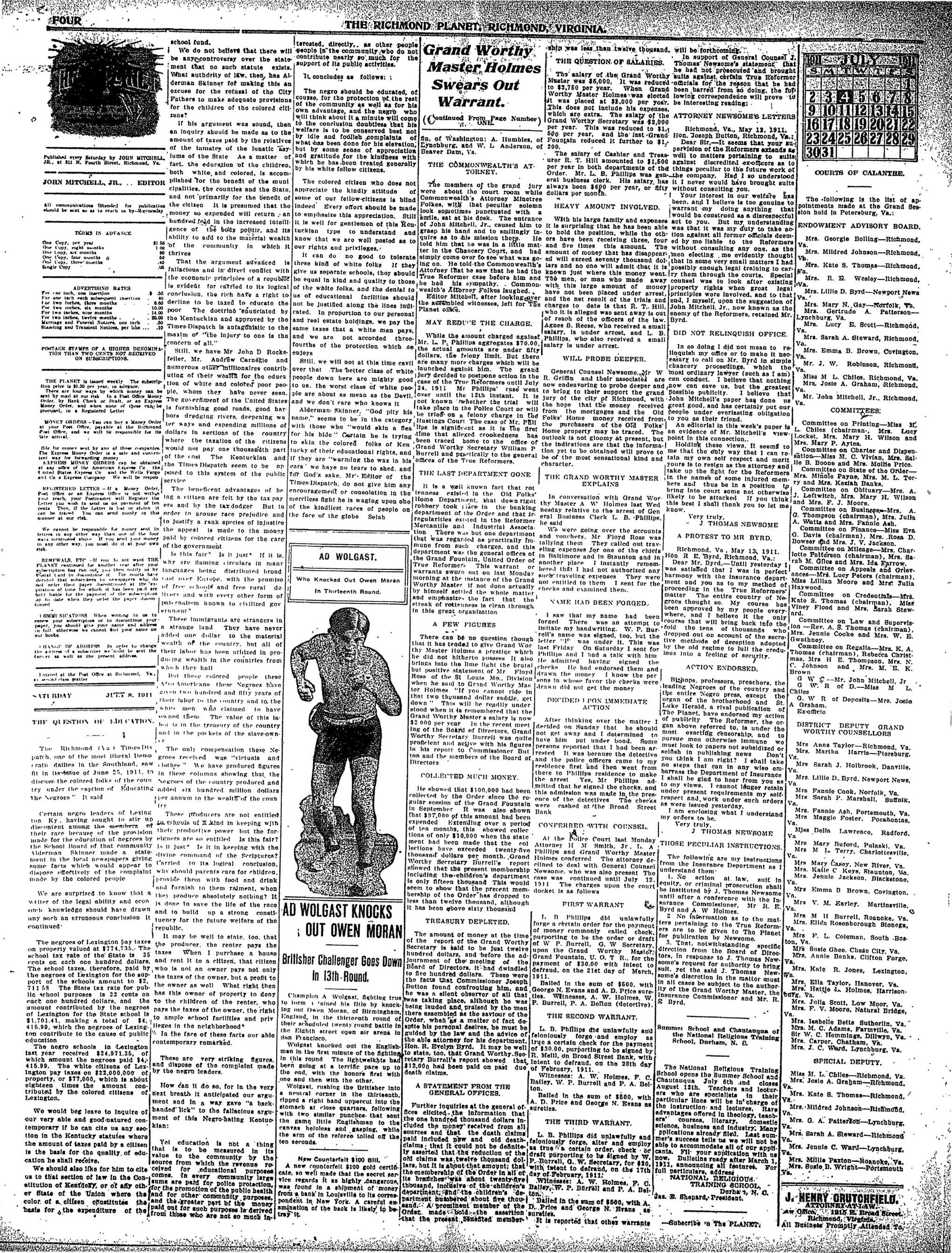
Grand Worthy Master Holmes Swears Out Warrant.
Grand Worthy Master Holmes Swears Out Warrant.
(Continued From Page Number)
fn, of Washington; A. Humbles, of
Lynchburg, and W. L. Anderson, of
Beaver Dam, Va.
THE COMMONWEALTH'S ATTORNEY.
The members of the grand jury were about the court room while Commonwealth's Attorney Mintree Folkes, with that peculiar solemn look sometimes punctuated with a smile, sat at his desk. The entrance of John Mitchell, Jr., caused him to grasp his hand and to smilingly inquire as to his mission ther. He told him that he was in a little matter in the Chancery Court, and had simply come over to see what was going on. He told the Commonwealth's Attorney that he saw that he had the True Reformer case before him and he had his sympathy. Commonwealth's Attorney Folkes laughed.
Editor Mitchell, after looking over
and witnessed witnesses, left for the
Planet of Olliv
MAY REDUCE THE CHARGE.
While the amount charged against Mr. L. P. Phillips aggregates $70.00 the actual amounts are under fifty dollars, the felony limit. But there are many more charges which will be launched against him. The grand jury decided to postpone action in the case of the True Reformers until July 24, 1911 Mr Phillips' case went over until the 12th instant. It is not known whether the trial will take place in the Police Court or will be tried on a felony charge in the Hustings Court. The case of Mr. Phillips is significant as it is the first time that alleged crookedness has been traced home to the office of Grand Worthy Secretary William P Burrell and practically to the general offices of the True Reformers.
THE LAST DEPARTMENT QQNE
It is a well known fact that rottenness existed in the Old Folks' Home Department, that down right robbery took place in the banking department of the Order and that irregularities existed in the Reformer Mercantile and Industrial Association. There was but one department that was regarded as practically immune from such charges, and this department was the general offices of the Grand Fountain, United Order of True Reformers. This warrant or warrants sworn on on last Monday morning at the instance of the Grand Worthy Master If not done actually by himself settled the whole matter and emphasizes the fact that the streak of rottenness is clean through in this great organization.
A FEW FIGURES
There can be no question though that it has tended to give Grand Worthy Master Holmes a prestige which he did not hitherto possess. It also brings into the line light the brutal but positive statement of Mr. Floyd Ross of the St Louis Mo., Division when he said to Grand Worthy Master Holmes "If you cannot ride in that two thousand dollar saddle, get down." This will be readily understood when it is remembered that the Grand Worthy Master's salary is now $2,000 per year. In the recent meeting of the Board of Directors, Grand Worthy Secretary Burrell was quite proficient and active with his figures in his report to Commissioner Button and the members of the Board of Directors.
COLLECTED MUCH MONEY
He showed that $100,000 had been collected by the Order since the regular session of the Grand Fountain in September. It was also shown that $97,000 of this amount had been expended. Extending over a period of ten months, this showed collections of only $10,000 when the statement had been made that the collections have exceeded twenty-five thousand dollars per month. Grand Worthy Secretary Burrell's report showed that the present membership including the children's department is only fifteen thousand. This would seem to show that the present membership of the Order has dropped to less than twelve thousand, although it has been above sixty thousand.
TREASURY DEPLETED
The amount of money at the time of the report of the Grand Worthy Secretary is said to be just twelve hundred dollars, and before the adjournment of the meeting of the Board of Directors, it had dwindled to five hundred dollars. These were the facts that Commissioner Joseph Button found confronting him, and he was a silent observer of all that was taking place, although he was being lauded and praised by the men there assembled as the saviour of the Order, when as a matter of fact despite his personal desires, he must be guided by the law and the advice of the able attorney for his department, Hon. R. Evelyn Byrd. It may be well to state, too, that Grand Worthy-Secretary Burrell's report showed that $12,000 had been paid on past due death claims.
A STATEMENT FROM THE GENERAL OFFICES.
Further inquiries at the general offices elicited the information that the one hundred thousand dollars included the money received from all sources and that the death claims paid included new and old death claims; that it could not be definitely asserted that the reduction of the old claims was twelve thousand dollars, but it is about that amount; that the membership of the Order in all of its branches was about twenty-five thousand, inclusive of the children's department; and that the children's department husbarded about five thousand. A prominent member of the Order made bold the assertion that the present Benefited member
THE QUESTION OF SALARIES.
The salary of the Grand Worthy Muster was $6,000. It was reduced to $3,750 per year. When Grand Worthy Master Holmes was elected it was placed at $2,000 per year. This does not include his expenses, which are extra. The salary of the Grand Worthy Secretary was $2,000 per year. This was reduced to $1,500 per year, and the last-Grand Fountain reduced it further to $1,200.
The salary of Cashier and Treasurer R. T. Hill amounted to $1,500 per year in both departments of the Order. Mr. L. B. Phillips was general business clerk. His salary, has always been $600 per year, or fifty dollars per month.
HEAVY AMOUNT INVOLVED
With his large family and expenses it is surprising that he has been able to hold the position, while the others have been receiving three, four and five times this amount. The amount of money that he has disappeared ed will exceed seventy thousand dollars and no one will admit that it is known just where this money went. The men, or man who made away with this large amount of money have not been placed under arrest, and the net result of the trials and charges to date is that R. T. Hill, who it is alleged was sent away is out of reach of the officers of the law. Agnes B. Reese, who received a small salary, is under arrest, and L. B. Phillips, who also received a small salary is under arrest.
WILL PROBE DEEPER
General Counsel Newcomo, Mr W R. Griffin and their associated are now endeavoring to probe deeper and to bring to their support the grand jury of the city of Richmond, with the hope that the money received from the mortgages and the Old Folks' Home money received from the purchasers of the Old Folks' Home property may be traced. The outlook is not gloomy at present, but the indications are that the information yet to be obtained will prove to be of the most sensational kind and character.
THE GRAND WORTHY MASTER
EXPLAINS
In conversation with Grand Worthy Master A W Holmes last Wednesday relative to the arrest of General Business Clerk L. B. Phillips, he said
We were going over the accounts and vouchers, Mr Floyd Ross was tallying them. They called out traveling expenses for one of the chiefs in Baltimore and in Staunton and in another place. I instantly remembered that I had not authorized any such traveling expenses. They were not entitled to them. I sent for the checks and examined them.
NAME HAD BEEN FORGED
I saw that my name had been forged. There was an attempt to imitate my handwriting. W. P. Burrell's name was signed, too, but the letter "F" was under it. This was last Friday. On Saturday I sent for Phillips and I had a talk with him. He admitted having signed the checks. He had endorsed them and drawn the money. I know the persons in whose favor the checks were drawn did not get the money.
DECIDED UPON IMMEDIATE ACTION
After thinking over the matter I decided on Sunday that he should not get away and I determined to have him put under bond. Some persons reported that I had been arrested. It was because the detective and the police officers came to my residence first and then went from there to Phillips residence to make the arrest Yes, Mr Phillips admitted that he signed the checks, and this admission was made in the presence of the detectives. The checks were cashed at the Broad Street Bank
CONFERRED WITH COUNSEL
At the Police Court last Monday
Attorney H M Smith, Jr. L. A
Phillips and Grand Worthy Master
Holmes conferred The attorney de-
lined to deal with General Counsel
Newsonie, who was also present The
case was continued until July 12,
1911 The charges upon the court
docket is as follows
FIRST WARRANT
J. B Phillips did unlawfully forge a certain order for the payment of money commonly called check, purporting to be the order or draft of W P. Burrell, G. W Secretary, upon the Grand Worthy Master; Grand Fountain, U. G. T R., for the payment of $30.00 with intent to defraud, on the 21st day of March, 1911.
Balled in the sum of $500, with George N. Evans and A. D. Price sureties. Witnesses, A. W. Holmes, W. P. Burrell, P. A. Bolton (detective).
THE SECOND WARRANT.
L. B. Phillips did unlawfully and feloniously forge and employ as true a certain check for the payment of $30.00, purporting to be signed by R. Meilil, on Broad Street Bank, with Intent to defraud, on the 28th day of February, 1911.
Witnesses: A. W. Holmes, F. C. Bailey, W. P. Burrell and P. A. Bolton.
Balled in the sum of $500, with A. D. Price and George N. Evans as sureties.
THE THIRD WARRANT.
L. B. Phillips did unlawfully and feloniously forge, alter and employ as true a certain order, check or draft purporting to be signed by W. P. Burrell, G. W. Secretary, for $30, with intent to defraud, on the 17th day of February, 1911:
Witnesses: A. W. Holmes, P. C. Bailey, W. P. Burrell and P. A. Ballton.
Bailed in the sum of $500, with A. D. Price and George N. Erans as sureties.
It is reported that other witnesses.
in support of General Counsel J. Thomas, Newsome's statement, that he had not prosecuted and brought suits against certain True Reformor officials for the reason that he had been barred from so doing, the following correspondence will prove to be interesting reading:
ATTORNEY NEWSOME'S LETTERS
Richmond, Va., May 13, 1911.
Hon. Joseph Button, Richmond, Va.:
Hon. Joseph Button, Richmond, Va.:
Dear Sir,—It seems that your supervision of the Reformers extends as well to matters pertaining to suits against discredited ex-officiers as to things peculiar to the future work of the company. Had I so understood it I never would have brought suits without consulting you.
Your interest in our welfare has been, and I believe is too genuine to warrant my doing anything that would be construed as a disrespectful act to you. But my understanding was that it was my duty to take action against all former officials deemed by me liable to the Reformers without consulting any one, as the men electing, me evidently thought that in some very small matters I had possibly enough legal training to carry them through the courts. Special counsel was to look after existing property rights when great legal principles were involved, and to that end, I myself, upon the suggestion of John Mitchell, Jr., now known as the enemy of the Reformers, retained Mr. Byrd.
DID NOT RELINQUISH OFFICE.
In so doing I did not mean to re-llablish my office or to make it no-essential to call on Mr. Byrd in simple chancery proceedings, which the most ordinary lawyer (such as I am) can conduct. I believe that nothing now can save us, but the greatest possible publicity. I believe that John Mitchell's paper has done us great good, and has certainly put our people under evaporating obligation to you as their friend.
An editorial in this week's paper is an evidence of Mr. Mitchell's viewpoint in this connection.
Holding these views, it seems to me that the only way that I can retain my own self respect and morit yours is to resign as the attorney and take up the fight for the Reformers in the names of some injured members and thus be in a position to bring into court some not otherwise likely to be attacked. If you think this best I shall thank you to let me know.
A PROTEST TO MR BYRD
Richmond, Va. May 13, 1911.
Hon R E. Byrd. Richmond, Va.
Dear Mr. Dyrd., Until yesterday I was satisfied that I was in perfect harmony with the insurance department and you as to my method of proceeding in the True Reformers' matter. The entire country of Negroes thought so. My course has been approved by my people everywhere, and I believe it the only course that will bring back into the fold the tens of thousands who dropped out on account of the secretive methods of deception adopted by the old regime to full the credulous into a feeling of security.
ACTION ENDORSED
Bishop, professors, preachers, the leading Negroes of the country, and the entire Negro press, except the organ of the brotherhood and St Luke Herald, a rival publication of The Planet, have endorsed my action of publicity. The Reformer, the organ above referred to, is under the most exacting censorship, and to pursue mine otherwise immune we must look to papers not subdued or selfish in publishing news. Don't you think I am right? I shall take no steps that can in any wise embarrass the Department of Insurance I shall be glad to hear from you as to my views. I cannot longer retain under present requirements my self-respect and, work under such orders as were issued yesterday. I am enclosing what I understand my orders to be.
THOSE PECULIAR INSTRUCTIONS
The following are my instructions from the Insurance Department as I understand them:
1. No action at law, suit in equity, or criminal prosecution shall be instituted by J. Thomas Newsome until after a conference with the Insurance Commissioner, Mr R. E. Byrd and A W Holmes.
2. No information as to the matters pertaining to the True Reformers are to be given to The Planet for publication by Newsome.
3. That, notwithstanding specific direction from the Board of Directors, in response to J. Thomas Newswone's request for authority to bring suit, yet the said J. Thomas Newswone's discretion in the matter must in all cases be subject to the authority of the Grand Worthy Master, the Insurance Commissioner and Mr. R. E Byrd.
Summi School and Chautauqua of the National Religious Training School, Durham, N. D.
The National Religious Training School opens the Summer School and Chautauqua July 6th and closes August 13th. Teachers and lecturers who are specialists in their particular lines will be in'charge of the instruction and lectures. Rare advantages offered in theology, teachers' courses, literary, domestic science, business and industry. Many applications already filed. Last summer's success tells us we will not be able to accommodate all of our applicants. Fill your application with us now. Bulletins ready after March 1, 1911, announcing all features. For full particulars, address.
- Subscribe to The PLANET.
JULY
S M T W T F S
1
2 3 4 5 6 7 8
9 10 11 12 13 14 15
16 17 18 19 20 21 22
23 24 25 26 27 28 29
30 31
The following is the list of appointments made at the Grand Session held in Petersburg, Va.::
ENDOWMENT ADVISORY BOARD
Mrs. Georgie Bolling—Richmond,
Va.
Mrs. Mildred Johnson—Richmond,
Va.
Mrs. Kato S. Thomas—Richmond,
Va.
Mrs. R. E. Wosley—Richmond,
Va.
Mrs. Lillie D. Byrd—Newport News
Va.
Mrs. Mary N. Gay—Nortfolk, Va.
Mrs. Gertrudo A. Patterson—
Lynchburg, Va.
Mrs. Lucy E. Scott—Richmond,
Va.
Mrs. Sarah A. Steward, Richmond,
Va.
Mrs. Emma B. Brown, Covington,
Va.
Mr. J. W. Robinson, Richmond,
Va.
Miss M L. Chiles, Richmond, Va.
Mrs. Josie A. Graham, Richmond,
Va.
Mr. John Mitchell, Jr., Richmond,
Va.
COMMITTEES:
Committee on Printing—Miss M. L. Chiles (chairman-, Mrs. Lucy Locket, Mrs. Mary H. Wilson and Mrs. Mary P. Aytos.
Committee on Charter and Dispensation—Miss M. C. Vlvian, Mrs. Salile B. Boone and Mrs. Mollie Price.
Committee on State of the Order—Mrs. Minkle Payne, Mrs. M. L. Terry and Mrs. Kesiah Banks.
Committee on Obstuary—Mrs. A. J. Leftwitch, Mrs. Mary H. Wilson and Mrs. F. J. Moore.
Committee on Business—Mrs. A. G. Thompson (chairman), Mrs. Julia G. Watts and Mrs. Fannie Ash.
Committee on Finance—Miss Eva G. Davis (chairman), Mrs. Rosa D. Bowser and Mrs. J. V. Jackson.
Committee on Mittenge—Mrs. Charlotte Patterson (chairman), Mrs. Sarah M. Giles and Mrs. Ida Earrow.
Committee on Appeals and Grievances—Mrs. Lucy Peters (chairman), Miss Lillian Moore and Mrs. Julia Haywood.
Committee on Credenthils—Mrs. Kate S. Thomas (chairman), Miss Viney Flood and Mrs. Sarah Steward.
Committee on Law and Supervision—Rev. A. S. Thomas (chairman), Mrs. Jennie Cooke and Mrs. W. E. Gwathney.
Committee on Regalia—Mrs. K. A. Thomas (chairman), Rebecca Christmas, Mrs H. E. Thompson, Mrs N. C. Johnson and Mrs. M. E. K. Brown
G W. C—Mr. John Mitchell, Jr.
G W. R of D—Miss M L. Chiles
G W. R of Deposits—Mrs. Joele A Graham.
Ex-officio
DISTRICT DEPUTY GRAND
WORTHY COUNSELLORS
Mrs. Anna Taylor—Richmond, Va.
Mrs. Martha Harris—Plorsburg, Va.
Mrs. Sarah J. Holbrook, Danville, Va.
Mrs. Lillie D. Byrd, Newport News, Va
Mrs. Fannie Cook, Norfolk, Va.
Mrs. Sarah P. Marshall, Suffolk, Va.
Mrs. Fannie Ash, Portamouth, Va.
Mrs. Maggie Foster, Pocahontas, Va.
MJsss Della Lawrence, Radford, Va
Mrs. Mary Buford, Pulaski, Va.
Mrs. M L. Terry, Charlottesville, Va
Mrs. Mary Casey, New River, Va.
Mrs. Katie C. Keys, Staunton, Va.
Mrs. Jennie Jackson, Blackstone, Va.
Mrs. Emma B Brown, Covington, Va
Mrs. V. M. Earley, Martinsville, Va.
Mrs. M H Burrell, Roanoke, Va.
Mrs. Ellidon Rosonborough Stonega, Va.
Mrs. F. L. Coleman, South Boston, Va.
Mrs. Susie Ghee, Chase City, Va.
Mrs. Annie Banks, Clifton Forge, Va.
Mrs. Kale R. Jones, Lexington, Va.
Mrs. Ella Taylor, Hanover, Va.
Mrs. Hattie J. Holmes, Harrisonburg, Va.
Mrs. Julia Scott, Low Moor, Va.
Mrs. F. V. Moore, Natural Bridge, Va.
Mrs. Isabelle Betts Sutherlin, Va.
Mrs. M. C. Adams, Farmville, Va.
Sr W. C. Hommings, Dillwyn, Va.
Mrs. Carper, Chatham, Va.
Mrs. J. C. Ward, Lynchburg, Va.
Miss M. L. Chiles—Richmond, Va.
Mrs. Josio A. Grayham—Richmond,
Va.
Mrs. Kate S. Thomas—Richmond,
Va.
Mrs. Mildred Johnson—Richmond,
Va.
Mrs. G. A. Patterton—Lynchburg,
Va.
Mrs. Sarah A. Steward—Richmond
Va.
Mrs. Jennie C. Ward—Lynchburg,
Va.
Mrs. Millie Paxton—Roanoke, Va.
Mrs. Susie B. Wright—Portsmouth
Va.
J. HENRY GRUTCHFIELD.
ATTORNEY AT LAW.
SATURDAY . . . . JULY 8, 1911.
D. B. Fulton's Phillipic.
(Delivered at Bridge-Sfreet A. M. E. Church, Brooklyn, N. Y., June 25, 1911)
There comes in the mind of man no sweeter memories than the recollections of childhood, whether that childhood has been spent in palace or cabin; in the giddy, whirling vortex of city life or of the simple life of the farm. Yet sweetest of all memories are those that can revert to the farm, to woodland romps and to sport beside some rippling stream. The sweetest music that rings in the ear of memory is the song of the bird, of the plowman and of the rill. The greatest poets of our times are those who have lived nearest to nature, and the poems that will live longest are those whose thorns is forest and stream, that carry us to mountain peaks to listen to the roar of the torrents, of gushing streams, the songs of the birds and the murmuring of the brooks. Blessed is that man or woman who has a vivid recollection of such a life and over whom those homely influences have the longest away.
THE CLOSE OF THE CIVIL WAR.
The close of the Civil War brought the South to a crisis far more grave than was ever dreamed of by the sanguine accessionists; it brought us face to face with three million and a half of freedmen unprepared for the proper appreciation of the newly bestowed boom. It was feared by the conscience stricken master of the bolded by the presence of the Tanker orgy the first thought he vengeance on his former oppressor. The flocking to the cities and towns throughout the South of the younger element of the race for the fuller enjoyment of the intoxicating draught
of freedom was to the average white person a grave and menacing aspect. During that period of reconstruction Wilmington, N. C. had its furious of this feeling of the apprehension it infused of rural inhabitation, and had been alarmingly reinforced by the hordes of rotufues that followed the army. The American Missionary Association had established its work among the freedmen in Wilmington before the sinister from the shattered parapets of Fort Fisher had lifted; and far back in the rural districts of the State from whence some of these people had come union soldiers with the rigors of war over, worse than Bible spelling of the ignorance and superstition of the newly freed Negro. And to the happy disappointment of the whites, there was a greater thirst for knowledge than for revenge—a stronger desire to emulate the virtues of the other race than its vices.
THE VALUE OF BOOKS.
To a goodly number of these young people, books were more congenial company than that of irresponsible rowdies; gangs of praise and thanksgiving sweeter music than the shrieks of frantic mothers, and the cry of innocent babies. Foremost among that host of young men and women who came into Wilmington at that time to grow up there to allay the feeling of unrest, to silence the tongue of the slandered and false prophet and to give Wilmington an invaded place among the cities of the world, was Robert W. Richardson. The simple, mellowing influences of his rural life never lost their hold upon this lad; they had the whole-some effect of tempering his mind for the proper appreciation of the blessing that came to him in afflictive life. He was one of a demonstrative, noisy temperament; the sober, the intelligent the thoughtful were always his company, and his favorite rendezvoux the church, the Sunday-school, the literary circle, the keenest enjoyment outside of his home and lodge room was the literary circle, he loved-dubates, the discussion of live and interesting topics, and into these he entered with all the intensity of his soul.
THE ABILITY TO ARGUE.
In these controversies he went at his adversary in full armour and waged war beyond the skirmish line. It mattered not how long and bitter the fight however, Robert W. Richardson could at the close of the contest grasp the hand of his opponent and leave it all behind him. In the latter days of his life he seemed more hugely to enjoy the proposing of questions, the selecting of disputants and witnessing the contest.
. . . .
The boast of the first families of Virginia is of their noble and aristocratic English lineage. A feeling of pride and haughtiness permeates the soul of even the poorest white Virginiaian who is ready to trace his lineage to Washington or Jefferson, Patrick Henry, Marshall, Randolph, Patrick or Joe. The whole country colonized by the settlers of old Commonwealth of Virginia. In days of old, no Roman citizen was received and treated with greater homage and deference in other sections of his country than the honoude citizen, of Virginia, Historians and writers of fiction, when they wish to give to the world stories of the South's greatness, her chivalry, her glory and her wealth, the part she has played in the making of a great
THE WHITE VIRGINIAN'S BOAST.
The boast of the white, Virginian of his royal and aristocratic lineage can also be the boast of the Virginia Negro, and justly so. The African slaves landed at Jamestown were not all of the skim skinned Hottentot type, enticed into captivity by the display of a red rag. Thore was a sufficient percentage of Akwamus and Kumulai aristocrats and warlike Zulua to "leave the lump" and give the Virginia Negro the distinction of being foremost in love of liberty, in freedom, in pride, in thrift, and independence. Inspired by the eloquence of Patrick Henry and The teachings of Thomas Jefferson, the Virginia Negro was among the first pioneers who in quest of freedom Gought with blood hounds as they trudged northward, guided by the North Star. It is claimed that the Virginian of color is the only Afro-American that can trace his lineage back through generations in an unbroken line. This is due to the fact that there was less soling of slaves among the rich slave-holders of that State than was the base in other States, and therefore less breaking up of families in the slave states. The royal and aristocratic blood flowed in one uninterrupted stream from the Runding of the first cargo of African slaves at Jamestown in 1619 to the Gabriel Insurrection in that State. In 1806, So the Virginia Negro is the only genuine blue blooded aristocrat of the race in America.
THE OVER-FLOW OF THE MO
THER STATE.
Now the North Carolina Negroes and the Maryland Negroes are in the main the overflow of Virginia, so that North Carolina and Maryland can lay claim to this royal and aristocratic lineage. Maryland produced a Benjamin Bannaker, a Frederick Douglass, a John Bruce; North Carolina produced a Revels, first United States Senator, and the famous Dr. Travers. Undoubtedly the blood of the Kumisal aristocrat and that of the high-minded and intrepid Zulu flowed profusely in the veins of Robert Hoe. He was a man of lonely idolats, of noblesmith, always ready to exclaim, "Not so Lord, I've never eaten any thing common or unclean!" Then again he was brave and had the courage of his convictions. In the year 1898 an unprecedented wave of race antipathy spread over this entire country and parently. Each section it seemed was trying to see which could perform the most revolting acts of bar bargum. The New Orleans riots were followed by one under similar circumstances in New York. Then there came a series of race disturbances in Illinois and Indiana, where Dixon and Tillman had been on a race hatred. The wave of disfurchment and Annillment that had begun in the Gulf States gradually crept northward, until it had spread over North Carolina and on until the borders of Pennsylvania were threatened.
THE TROUBLE AT WILMINGTON
It was in November of the year '88 that the climax was reached in Wilmington, N. C., and the fatal clashing of races took place. This was the crucial point in the lives of the colored citizens of that once most tranquilly governed city, it was a day of trial, a test of strength. I doubt if there is another community in the United States that contained such a large number of men and women of the race with such a high sense of honor, whose love of liberty was so strong that they would choose exile with freedom rather than remain in comparative comfort under the domination of the criminal and awful. Then the awful man not excelsiored among Robert W. Richardson was among the first to step over the line. "But Robert, there was never any harm intended to such as you; it's the lawless Negro, the politician, the disturbance maker, we are after. You stay here, we guarantee that you shall be protected."
But he saw that those who were making such promises were powerless to do a single thing for him, like hounds the poor white element had been given the lead, and they were revelling in blood. He had seen good men shot down and banished and women fugaited, and he was not the man to accept "protection" while others of his race suffered. Whore he could not protect his wife and children from insult and danger was not the place for Robert W. Richardson.
"A STRANGER IN A STRANGER LAND."
It is by no manna an easy thing to sover ones self from his home surroundings; to give up life from friendships; to leave the accumulations of a lifetime. Yet what are those to the real man when his civil and political rights are denied? Here in the North in less congenial surroundings, this enforced exile was not without its pangs. Not very long ago there was buried from this church a woman who, leaving nor indolent husband, fled north with her daughters to save them from the Ancrochmont and insult of uncircumcised Philliatines. A hornoine was she, a martyr to the cause of freedom and human rights. A visit to Wilmington now to note the changes there is indeed painful. Although the city is more crowded than gorghus over before with people of our face, to the dondee gilten it is as barren of the desert. It is where are now the merry day. Although others have dwelt upon that sagred episode with bitterness at Robert W. Richardson seldom referred to the very unpleasant subject. "There is a divinity that shapes our ends, rough how them as we may," was his conclusion—and he endeavored to leave it all behind him. Yet in spite of those resolutions his mind must have often reverted to those scenes of happier life, to that faraway sunny home of true hospitality, where everybody is your neighbor, and where we are never in too big a hurry to inquire after our neighbor's health.
THIS CLIMATE OF A SOUTHERN CITY.
11E RICHMOND PLANET, RICHMOND, VIRGINIA.
contrasts with northern apathy.
The climate of Wilmington is temperate; but its winters are not sufficiently mild to attract the northern tourist seeking warmer climates. But the summers there are truly delightful. The cool ocean breezes, sweetened by the odor of the pine tree, the jasmine, the shrub, the honeysuckle and golden rod, make its warmest, seasons, enjoyable. It’s a place where the swallows linger when chill winds herald the approach of winter, loath to take leave of scenes so enchanting. Should we wonder that the heart and mind of the exile involuntarily went back to Wilmington, brought to mind earlier scenes, the scenes of childhood; he heard again the plowman's song, the tinkling of the cowbells, the lowing of the hords, the murmur of the brooks, the songs of the birds:
"There, mother sings at the twilight fall.
The song of the hills more sweet than all:
She sings it under her own green tree.
To the babe half slumbering on hor knee."
Such scenes the black smoke of revolution could not shut out from the vision; such music the exultant yell of the mob could not hush. Robert W. Richardson was a true Southerner; the cold winds of the north could not blow away that characteristic sweet temperament. If in his home conversation with a visitor was prolonged unto the meat hour, there was no shouting of doors to keep out the tempting odors wafted from the kitchen.
HAD A BROAD INTELLECT.
The family did not take turns in entertaining while the meal was devoured in installments; neither was the visitor treated with that modern blunt courteous which says to the stranger "excuse us while we eat."
"Sit up, old boy, sit up, and share with us what we have." This was one of his speeches of welcome, all of which came from a heart full of good will. He believed that the God who gave the morsel also give the abundance. As a race man, Robt W. Richardson was extraordinarily broad. As an American he took no stock in the doctrine of "America for Americans"—that shut the door of hope in the face of the stranger The old "Know Nothing" party of long ago was pushed Into The Background by men of saner views, who saved the country from stagnation by opening wide the gates that the European states might come in to be assimilated and made into true Americans, to increase the strength of the nation informally, physically and morally. He said that this flood of humanity flooding daily into the country was all white, not a single African crossed over from the other side. He, therefore, regarded the West Indian Islands as the source from which his race might be reinforced and assisted to hold its own against the flood tide of white immigration in the United States, and he welcomed these dusky children without the thought of what he or his might possibly lose by their coming.
INTERESTING QUESTIONS
The woman who was gathering sticks to cook bob last measure of meal hesitated not to divide it with a stranger, and thereby obtained a blessing. To Robert W. Richardson the West Indian was not a stranger. The slave catcher had no consideration for family ties, and in crowding their chattels into the ships mothers were separated from children, brothers from brothers, sisters from sisters, husbands from wives. A ship bearing one relative sailed for the West Indies to distribute its cargo among the islands of that group, Jamaica, Barbados or Haytil or Cuba. A ship bearing the other relative touched the shores of Virginia or North Carolina or Georgia. Is it not reasonable, therefore, to appreciate the fact that we are the relations of those sunny island inhabitants? Are they not our brothers, our sisters, our mothers? And are they not aiding us by their intelligence, their industry and thrift? This is the way Robert W. Richardson reasoned out the question, and by boldly standing by his convictions he bound them to him as with bands of steel. He was a North Carolina whose love for his people was broader than his State. He permitted no former affiliations to influence him in deciding any point. It mattered not where a man hailed from. If it was contending for the right Robert W. Richardson was with him: but it owed the love of a brother could good him into sanctioning the wrong. Upon this rock he stood, and if no head with him he stood uncompromisingly alone—if no one cared to walk with him, he walked alone, and with head erect.
MUSIC HIS SOUL-MATE
That this good man loved his wife and childre nearly is without question. But as a husband and father he was never over demonstrative. In his home he provided every comfort within his means without parade be show. But Robert W. Richardson and music were soulmates, inseparable companions—music permeated every fibre of his being. In this love he was indeed demonstrative. In the education of his children he beloved music to be the indispensable adjunct to the mastery of other studies. And he persistently and stubbornly stamped the time with his feet and scolded until both wife and childre had mastered both the brgan and piano. This was the reward of labor; a home made sweet and hollowed by music. Among his keenest joyments was to hear his boy play his wife and daughter sing. Few father-rehearses thus blest; for few families are so identical in taste in the selection of music. I do not suppose any man enjoyed his home life better than he; and no man half a home that was more tranquil and sweet. Robert W. Richardson was a missionary, an evangelist, the Bankey of the African Methodist Episcopal Church, who from the choir lott lived with the pulpit in seeking, to reach the hearts of men. His instructions to his choir were that in their singing they were rendering service unto God; and it should be as soullful as their prayers
and class-room testimonies.
And now the sun shines in the west and the weary, the tired and footsore welcomes the close of a day that has been one of hardships, of strivings and contendings as it were with the beasts of Ephesus. This once strong man, a Hercules in strength and resolution, is a child again. With that joy and strength, the om of the companion of his joys and sorrows, he welcomes the rest the day's faithful service makes sweet. Night is here, but
"There'll be no darkness in the Val-
ley."
"I fear no foo with thee at hand to
bless."
Ils have no weight and tears no bitterness.
Where death thy ating? Where grave thy victory?
I triumph still, if thou abide with me.
Hold thou thy cross before my closing eyes:
In life, in death, O Lord, abide with me."
The Sunday school will miss this light hearted schoolboy; the choir will miss the man, the philosopher, the teacher; the church the counselor the leader, the champion.
But, oh, in that home! In the evening when the lamps are lighted, when the organ shall, peal forth the music that makes hallowed the night, that loving hand will be missed, whose delight it was to beat time, and the voice that joined in the song. "And the stately ships go on To their haven under the lilim! And, Q, for the sign of a vanquished hand, And the sound of a voice that is still."
100 Pounds of Ice on His Back
100 Pounds of Ice on His Back
AND TEN POUNDS ON HIS HEAD.
He said the weather was so hot
he was trying to keep cool. After
talking with the gentleman, we said
to him, if you go to 314 B. Broad
Street and buy one of those cool
Alpaca or Sorge Coats you will throw
away your ice burden, as these goods
will keep you cool while the weather
is hot.
You will find there an up-to-date
line of underwear in Balbriggan, B.
V. D. and Porosknit, short or long
sleeves, ranging in price from 50c.
to 75c. and $1.00 per suit; and also
the Pepparell Joan Drawers, elastic
soams, 35c. and 50c. per pair.
We have single summer coats in
Sorges, Alapacas and Worsteda, from
60c. up to $6.50.
Our Straw Hat Department for
boys and men is up to date in all
shapes and styles, from 50c. to $3.00
per hat.
Give us a call; we will treat you
right, and do you good
I. J. MILLER, Prop.
314 E. Broad Street.
Near Corner Third Street.
(Wrong Slide)
STRAY BULLET KILLS BOY
Youth Discharged Revolver While Rid-
Ing Through West Easton, Pa.
Egbert James, the son of Colonel Charles James, manager of the Streltingworth Manufacturing company, discharged a revolver while riding his pony in West Easton, Pa.
The ball passed through a window in the barroom of the McCluskey house and through the body of Charles McCluskey, son of John McCluskey, the proprietor, killing the youth almost instantly.
Young James was unaware that he had killed any one, but returned and surrendered himself. He is nineteen years of age (Charles McCluskey also was nineteen years old).
Young James was committed to jail pending the coroner's inquest. He protests that he did not know his revolver was loaded with a ball.
Fetory Blows Into Atoms
Factory Blown Into Atoms.
Where the Marietta lorpodo company's nitro-glycerine plant stood, three miles from Maletta, Ohio, there is now a hole in the ground big enough to put a dwelling in Six hundred quarts of the explosive were set off by the excessive heat and the plant_ was blown to atoms. The city was considerably shaken and many windows were shattered including expensive stained glass ones in several of the churches. Three men were slightly injured.
To Glay Bears With Arrows.
James M. Challis and E. Z Jackson, attorneys and amateur archers, of Attichan, Kan, left for British Columbia, where they intend to hunt bears with hows and arrows. At Victoria, B. C., they will be polled by Will H Thompson, a Seattle attorney, and Harry Richardson, of Boston, champion archer of the United States.
Dise of Broken Heart:
From shock and a broken heart, due to the death of her husband two weeks ago, Mrs. Lillie Miller, widow of Oscar Miller, died at her home in Allentown, Pa., aged thirty-four years. She was sick in bed when her husband, a railroad engineer, had his legs cut off in an accident.
Find $40,000 Hidden in Cellar.
Search in the collar of the residence of Dr. Rthur H Tiel, Matthew Wh, N. Y., resulted in the discovery of $40,000 in gold coin and currency, which had been placed there. It is believed, by William H. Badaue, who died on March 10, 1911, at the age of eighty, three, leaving an estate of over $50,000. He was supposed to be in only moderate circumstances.
mankind, or no charge, no matter what your disease, sickness or infection may be, and restore you to perfect health. Thousands of people, the best and leading ones in the United States and Europe, will testify that I am one of the most wonderful healers of all complaints in the world. I use nothing but herbs, roots, barks, gums, balances, leaves, seeds, berries, flowers and plants in my medicines. They have cured thousands that the most skilful physicians and the best hospital physicians in America and Europe have given up to die, and said there was no cure for them.
My Medicines Cure the Following Diseases: Heart Disease, Consumption, Blood, Kidney, Bladder, Stricture, Piles in any form, Vertigo, Qutay, Sore Throat, Lung, Dyspepsia, Indigestion, Constipation, Rheu matism in any form, Pains and Aches of any kind, Colds, Bronchial Troubles, Sores, Skin Diseases, all itching sensations, all Female Complaints, La-Grippie or Pneumonia, Ulcer, Carbuncles, Boils, Cancer in the worst form without the use of a knife or instruments, Eczema, Pimples on face and body, Diabetes of Kidneys or Bright's Disease of the Kidneys My Medicines cure any disease, no matter of what nature. Gonorrhoea and Syphilitic troubles a specialty.
Medicines sent anywhere. For full particulars, send write or call in person on
Jack Johnson Goes to England With Diamonds and White Wife
THE FAMILY OF JOHN A. BROWN
ACK JOHNSON, champion heavyweight pugilist, has gone to England with his diamonds and his white wife. After witnessing the coronation festivities he will appear in a London music hall and will then make a
activities we will appear in. He took two American cars with him and a negro chauffeur to run the one belonging to his wife. Johnson will run his own car, the high powered racer that caused, his arrest several times in this country. As France has practically no speed regulations for autos, he expects to "burn up" the roads of that country. Johnson and his wife traveled from New York as first class passengers. The steward of the steamboat arranged a separate table for him and his wife, and the other passengers did not have to associate with them unless they wished to do so. Before the ship sailed Johnson and his wife posed for numerous photographers, and Johnson gravely explained that he did not expect to see King George. One of the reporters who witnessed the departure of the champion said that he was wearing only his "morning jewels, a small memorial window in his shirt, front and several chunks of cut glass on his fingers." The pictures above show Johnson and his wife and a separate view of the pugilist and his famous golden smile.
JOHN H.
mankind, or no charge, no matter what condition may be, and restore you to perfect the best and leading ones in the United States. I am one of the most wonderful healers use nothing but herbs, roots, harks, flowers, flowers and plants in my medicine that the most skilful physicians and the fea and Europe have given up to tide, and My Medicines Cure the Following sumption, Blood, Kidney, Bladder, Stric Quinis, Sore Throat, Lung, Dysppepsia, matism in any form, Pains and Aches of Troubles, Sores, Skin Diseases, all Itch plants, La-Gripe or Pneumonia, Ulcer worst form without the use of a knife on face and body, Diabetes of Kidneys My Medicines cure any disease, no matter and Syphilitic troubles a specialty. Medicines sent anywhere. For further person on
L. J. HAY
220 West Broad Street.
Hartshorn Mem
RICHMOND,
Normal, College Preparatory and Industrial
CAREFUL OVERSIGHT
The Best School for the Best Girl
Application Blank
LYM
Jack Johnson Goes With Diamonds
Photos by American Press Association.
JACK JOHNSON, champion heavyweight with his diamonds and his white wrist festivities he will appear in a London tour of Europe by auto. He took negro chauffeur to run the one belonging own car, the high powered racer that can country. As France has practically no ap to "burn up" the roads of that country. New York is at drat class passengers. The a separate table for him and his wife, an to associate with them unless they wish Johnson and his wife posed for numerous explained that he did not expect to see who witnessed the departure, of the chan his "morning jewels, a small memorial w chunks of cut glass on his fingers." The his wife and a separate view of the pugil
WOMAN IS SHOT NEAR TAFT BOX
Struck by Bullet Before President Begins Speech.
Before President Taft took his seat in the reviewing stand in front of the soldiers' monument in Indianapolis, ind., what is believed by the police to be a spent pistol bullet struck Mrs. Harry D. Tuteviller, who was sitting
Medicines
If so, call and see L. J. Hayden,
Manufacturer of Pure Horn 'Mul-
cines, 220 West Broad Street. My
Medicines cure all Diseases known to
what your disease, sickness or mis- perfect health. Thousands of people, United States and Europe, will testify that all of all complaints in the world. I, gums, balsams, leaves, seeds, ber- ricinis. They have cured thousands of the best hospital physicians in Amer- ies, and said there was no cure for them. Lung Diseases: Heart Disease, Con- stricture, Piles in any form, Vertigo, Asia, Indigestion, Constipation, Rheu- ting of any kind, Colds, Bronchial patching sensations, all Female Com- pleer, Carbuncles, Boils, Cancer in the life or instruments, Eczema, Plimples or Bright's Disease of the Kidneys matter of what nature. Gonorrhoea or full particulars, send write or call in
AYDEN.
Richmond, Va.
Memorial College,
D, VIRGINIA.
and College Courses. Music and
oral Course.
RIGHT FOR THE GIRLS
Girls. Write for Catalogue and
MYMAX B TEFFT, A M, D D.
Station A
goes to England
ands and White Wife
veryweight pugilist, has gone to England
s wife. After witnessing the coronation
London music hall and will then make a book two American cars with him and aaging to his wife. Johnson will run his it caused, his arrest several times in this so speed regulations for autos, he expects
ary. Johnson and his wife traveled from The steward of the steamboat arranged, and the other passengers did not have wished to do so. Before the ship sailed
rons photographers, and Johnson gravely see King George. One of the reporters champion said that he was wearing only a window in his shirt, front and several
The pictures above show Johnson and pugilist and his famous golden smile.
hear the president's box
Mrs. Tutewiler left her seat for a half hour, had the wound dressed and returned in time to witness the parade. Neither the president nor any members of his party were told about the affair, but the police at once began a hunt for the person who dred the shot.
Detectives were sent to the top of the monument, but a search of the persons there and a search of the crowds on neighboring buildings failed to bring to light any revolvers loaded or unloaded. No one seems to have heard the report of a revolver at the time
—Subscribe to The PLANET.
FIVB
RICHMOND, VA.
W. H. White, 501 W. Leigh Street.
Peter Thompson, 423* E. Marshall Street.
R. B. Sampon, 523 N. 2d St.
J. J. Nixon, 405 1-2 W. Leigh St.
Wm. H. Scott, 2218 E. Main St.
Miss Ruth Cary, 1018 N. 2d St.
N. Winton, 537 Brook Ave.
J. S. M. Singleton, 28th and 9-11th Road.
C. O. Grills, 224 S. 2d St.
William B. Smith, 3 W. Leigh St.
Tom Bird.
Thomas Page, 815 State Street.
Booker & Ford, 313 W. Leigh St.
A. Forguson, 1500 N. 28th St.
Virgil Minnis, 533 N. 3d Street.
James L. Stewart, 426 Brook Ave.
A. W. Page, 821 N. 30th St.
David Page, Sr., 922 N. 31st St.
Clarence Williams
1411 Ross Street.
M. C. Waller, 1100 W. Leigh St.
Jesse W. Sbreaves, 88 Liberty St.
HACKENSACK, N. J.
D H. Hassell, R. R. Ave., Nr Clay St.
SALT LAKE CITY, UTAH.
Jos. Evans, 2815 Webster Ave.
PHILADELPHIA, PA.
W. Schure, 1218 Pine Street.
E. P. Mackens, 1116 Pine Street.
James E. Warwick, 254 S. 11th St.
Mrs. Lavinia Aldridge, 521 S. 12th Street.
Young & Olda, 1606 South St.
Rev. W. Horiri Robinson, 420 S 11th Street.
NEWPORT NEWS, VA.
Freddie Smith, 1358 29th St.
O J. Harris, 1128 30th St.
DANVILLE, VA.
Harry A Clark, 137 Craghead St.
PROVIDENCE, R I.
Douglas A. A. P. A., 910 Westminster Street.
NEW YORK, N. Y.
E. A. Williams, 200 W. 63d St.
J E. Schmidt, 263 W. 35th St.
John Dow, 75 E. 116th Street.
Cleveland G. Allen, 266 W. 53d St.
BALTIMORE, MD.
Mrs. G. H. Carter, 502 W. Biddle 84
BUFFALO, N Y.
A. Conley, 7 Potter Street
ST LOUIS, MO.
W A. Price, 5 N. 14th St.
HUNTINGTON; W VA.
Wm C Claybrook, 821 18th St.
DRAKES BRANCH, VA.
Clom Green.
LOS ANGELES, CAL.
A. D Lacey, 790 San Pedro St.
FREEMAN, W VA.
Langston H Thompson.
ATLANTIC CITY, N J.
A. E. Edwards, 1908 Arctic Ave.
J. Herman Wood,
222 Evans Square
NEW ORLEANS, LA.
A. O. Smith, 202 S. Rampart St.
ASBURY PARK, N. J
Rouzeberry Bell, 118 Sylvan Ave.
NEWARK, N J.
E. W. Russell, 52 Stone St.
ELLISVILLE, MISS.
D J. Randolph
BOSTON, MASS.
J. W. White, 832 Tremont St.
C Branum, 657 Shawmut Avo.
BROOKLYN, N. Y.
John S. Anhby, 47 Loxington Ave.
Samuel Williams, 81 Fleet Place.
TARBORO, N C.
V E. Howard.
WILMINGTON, N. C.
Wm. H Moore
NORFOLK, VA.
John DeBona, 610 Church St.
Thomas E W Perry, 2 Jones
Place.
ATLANTA, GA
Hopkins Book Concern.
STAUNTON VA
J H Allen, 120 S. Augusta St.
A C Mabrey, 127 E Main St.
FARMVILLE, VA.
Rev R G. Adams, 218 South St.
TOLEDO, OHIO.
Green Eaton, 646 E. Central Ave.
DEMOPOLIS, ALA.
Miss Annio L. Spencer, Box 224.
CHICAGO, IL.
R. M Harvey, 3824 State Street.
CAPE CHARLES, VA.
J. L. Cabaniss.
WINSTON, N C
Lemuel Banks, 326-7 1-2 St.
DALLAS, TEXAS.
Gilmore & Baltimore.
717 Fairmount Street.
CINCINNATI, O.
H. B. Brooks, 510 Y. 6th St.
MINNEAPOLIS, MINN.
M. G. Rutledge, Sr. 214 R. 8d St.
WASHINGTON, D. C.
Thomas L. Leatherson, 1516-14th
Street.
Columbia News Agency, 921-D St.
N. W.
SO. EMPORIA, VA.
W. H. Weaver, Box 26.
Special Correspondents and Agents
F. Z. S. Perargino,
121 Loop Street,
Cape Town, S. A.
J. S. Moore
26 Rua dos Capitane,
Bahia, Brazil.
The Man Farthest Down
By BOOKER T. WASHINGTON.
[The third Article] in the series called "The Man Farthest Down."
In Prake, the capital of Bohemia I came in contact for the first time with the advance guard, if I may use the expression, of a new race the Slavs. I say a new race, because although the Slavic peoples claim an antiquity as great as that of any other race in Europe the masses of the race seen just now emerging from a condition of life more primitive than that of almost any other people in Europe.
Many little things, not only what I saw with my own eyes, but what I heard from others, gave me the impression, as I traveled southward, that I was entering into a country where the masses of the people lived a simpler and more primitive existence, than any I had seen elsewhere in Europe I remember, for one thing, that I was one day startled to see, in the neighborhood of the mining regions of Bohemia, a half-dozen women engaged in loading a coal bargain—shovelling the coal into wheelbarrows and wheeling them along a narrow plank from the coal wharf to the ship alongside was impressed again by the fact that there were the peoples of the Austrian Empire. Moravians and Ruthenians are an illustration still preserve their old tribal names. Certain other of these peoples still keep not only the tribal names but many of the old tribal customs.
Among most of the Slavic peoples for example custom still gives to the marriage ceremony the character of barter and sale. In fact I found that in one of the large provincial towns in eastern Hungary the old "matrimonial fairs" are still kept up on a certain day in each year hundred of marriageable young women are brought down to this fair by their parents, where they may be seen seated on their trunks and surrounded by the cattle they expect to have for a dowry. Naturally young country to attend this the surrounding country to attend this a lawyer site out under a tree near by prepared to draw up the marriage contract. In some cases as many as forty marriages are arranged in this way in a single day.
Divided into petty kingdoms or provinces each speaking a separate language, living for the most part in the country districts, and held in some sort of political and economic subjection, sometimes by the descendants of foreign conquerors, and sometimes, as in the case of the Doles, by the nobility of their own race the musses of the Slavic peoples in southern Europe have lived for centuries out of touch with the life of cities and to a large extent with the people of the world. Europe is paraded therefore with the peoples of western Europe who are living in the centers of modern life and progress the Slavic peoples are just now on the horizon
In the course of my travels through Austria and Hungary I think I met at one time or another representatives of nearly every branch of the Slavic race in the Empire. In Bohemia I became acquainted as I have said, with the most progressive portion of the race the Czechs. In Gallecia I saw something of the life of the Polish people both in the towns and in the country districts. Again in Budapest and Vienna I learned something of the condition of the laboring and peasant classes, among whom the Slavic peoples are usually in the majority. At Flume the port of Hungary from which forty thousand emigrants sail every year for the United States. I met and talked with Dalmatians, Croats, Slovenians, and Russians in fact of almost every race in Hungary. In the plains of central Hungary and again in Eastern Prussia. I saw ganga of wandering laborers made up of men and women who come to this part of the country from the Slavic countries farther south and east to take part in the harvest on the great estates.
During this time I became acquainted to some extent also with representatives of almost every type of civilization, high and low, among the peoples of southern Europe, from the Dalmatian herdmen, who lead a rude and semi-barbarous existence on the high barren mountains along the Adriatic coast, and energetic artisans of Bohemia and the talented Polish nobility, who are said to be among the most intellectual people in Europe.
I did not, among these classes have mentioned see the most primitive people of the Slavic race, nor the type of the man of that race farther down. In fact I have heard that in the mountain regions of southern Galicia there are people who make their homes in holes in the ground or herd together in little huts built of mud. I did not see, either as I should like to have seen, the life of those Slavic people in southwestern Hungary who still hold their lands in common and live to together in patriarchal communities, several families baneath one roof, under the rule of a "house father" and a "house mother," who are elected annually to govern the community
What little I did see of the life of the different branches of the race gave me the impression, however, of a people of great possibilities, who, coming late into the possession of modern ideas and modern methods, were everywhere advancing, in some places rapidly and in others more slowly, but always making progress.
One thing that has hindered the advancement of the Slave has been the difference in the languages apo-
kon by the different branches of the race. So great an obstacle is this difference of language (that some years ago, when a congress of all the Stavic peoples was held at Prague the representatives of the different branches of the race, having no common tongue, were compelled to speak to each other in the one language that they all professed to hate namely, German
Another thing that has hindered the progress of the Slavs has been the inherited jealousies and the memories they cherish of ancient injuries they have inflicted on one another in times past. In general it seems to be true of the races of Austria Hungary that each race or branch of the race hates and despises every other and this hatred is the more bitter the more closely they are associated. For example, there is a longstanding feud between the Polish peasants and the Polish nobility. This division is so great that the Polish peasants have frequentlyided against the Polish nobility in the contests of the latter with the central government of Austria. Now ever this sentiment of castle which separates the two classes of the Polish people is nothing compared with the contempt with which every Pole whether he be peasant or noble, feels for every Ruthenian, a people with whom the Pole is very closely related by blood, and with whom he has long been in close political association. On the other hand, the Ruthenian in Galicia looks upon the Pole just as the Czech in Bohemia looks upon his German neighbor, as his bitterest enemy. The two peoples refuse to intermingle socially they rarely intermarry. In many cases they maintain separate schools and are represented separately. In the Imperial Parliament each race electing its own representatives. But all are united in hating and despising the law who although he claims for himself no separate part of the Empire and has no language to distinguish himself from the other races about him still clings to tenaciously as any other portion of the population to his own racial traditions and customs.
The Slavs peoples otherwise divided by language and tradition are also divided by religion. People speaking the same language and sharing in other respects the same traditions are frequently just as widely separated by differences of religion as they could be by differences of race. For example, among the southern Slavs the majority of the Slovenes and the Croatians are Roman Catholics, others are Protestants. On the other hand, the majority of the Serbs, their close neighbors are members of the Greeks Orthodox Church while others are Mohammedans. So wide is the division between the Roman Catholic and the Orthodox Slavs that in some cases members of the Eastern and Western branches of the Church be honouring to the same nationality wear a different costume in order to emphasize the differences of religion that might otherwise be forgotten or overlooked.
In Galicia there are not only the Roman and Orthodox branches of the Church, but there are also three or four other minor branches. One of these, the Unlates, which is a compromise between the two and is intended to be a sort of link between the Eastern and Western Churches is now, it is said just as distinct from both as any of the other branches of the Church. In this region which has been the battleground of all the religions in Europe religious distinctions play a much more important role than they do elsewhere because 'the masses of the people have not yet forgotten the bitterness and the harshness of the early struggles of the sects'. The result is that religious differences seem to have intensified rather than to have softened the racial animosities.
In spite of the division and rivalries which exist, there seems to be growing up under the influence of the struggle against the other and dominant races in the Empire, and as a result of the political agitations to which this struggle has given rise a sense of common purpose and interest in the different branches of the Slavic race a sort of racial consciousness as it is sometimes called, which seems to be one of the conditions without which a race that is down is not able to get the ambition and the courage to rise.
It is the presence of this great Slav race in western Europe, grouping its way forward under the conditions and difficulties which I have described that constitutes as well as I am able to define it the race problem of southern Europe.
In many respects the situation of the Slavs in the Austro-Hungarian Empire and in southern Europe generally is 45 more like that of the Negroes in the Southern States than is true of any other class or race in Europe. For one thing, the vast majority of that race are, like the Negroes, an agricultural people. For centuries they have lived and worked on the soil, where they have been the servants of the great landowners, looked down upon by the educated and higher classes as "an inferior race". Although they were not distinguished from the dominant classes, as the Negro was, by the color of their skin, they were distinguished by the language they spoke, and this difference in language seems to have been, as far as mutual understanding and sympathy are concerned, a greater bar than the fact of color has been in the case of the white man and the black man in the South.
Up to a comparatively few years ago an educated Skav did not ordinarily speak, at least in public, the language of the masses of the people. Dr. Clark, the head of the Austrian Mission of the American Board
THE RICHMONE PLANET
in Prague, told me that as recently in all the schools, as thirty years ago, an educated or some other law Czech did not care to speak his own the same time of language on the streets of Prague, Hungary, in Austria. At that time the German language are sound 5,000 was still the language of the education schools, 5,578 offered classes, and all the learning of schools in which Europe was, to a very large extent. Slav dialects, not a closed book to the people who di not speak and read that language. Slav dialects, not a closed book to the people who di not speak and read that language. Today conditions have so changed is taught, and the Dr Clark tells me, that the people is taught. In certain quarters of Prague scolw To in outside at any one who speaks German on purpose of these the street
"When we go to visit an official of the government" said Dr. Clark, "we usually inquire first of all, which language this particular of fictional prefers to speak, German or Czech. It is wise to do this because most of the officials, particularly if they represent the central government of Vienna, speak German, but a Czech who is loyal to his race will not speak the hated German unless he has to do so." Dr. Clark told me, as illustrating the fanaticism of the Bohemian people in this matter of language, that he little girls, who had been educated in German schools and preferred to speak the language among themselves, had more than once been booted at, and even stoned, by Bohemians in the part of the town where he lives, because they spoke a language which the masses of the people had been brought up to hate
Another way in which the situation of the Slavic people resembles to a certain extent, that of the masses of the Negroes in the Southern States is in the matter of their political relations to the dominant races. Both in Austria and in Hungary all the races are supposed to have the same political privileges, and in the case of Austria at least the government seems to have made a real effort to secure equal rights to all. Here again racial and traditional prejudices as well as the wide differences in wealth and culture of the different peoples, have kept the political power in Austria proper in the hands of the Germans and in Hungary in the hands of the Magyars.
What makes the situation more difficult for the dominant races. In these two countries is the fact that the so-called inferior peoples are increasing more rapidly than the other races in numbers and the Germans and Magyars are every year becoming a smaller minority in the mids of the populations which they are at tempting to control. The result has been that the Empire seems to the outside a seething mass of discontent, nothing but the fear of being swallowed up by some of their more powerful neighbors to hold the national ties together.
There is one respect in which the situation of the Negro in America is entirely different from the various nationalities of Austria and Hungary. The Negro is not compelled to get his education through the medium of a language that is foreign to the other or people by whom he is surrounded. The black manh the South speaks the same tongue and professes the same religion as the white people. He is not seeking to set up any separate nationality for himself nor to create any interest for him self which is separate from or an antagonist to the interest of the other people of the United States. The Negro is not seeking to dominate politically at the expense of the white population any part of the country which he inhabits. Although he has suffered wrongs and injustices he has competed unobstructed or fanatical. Competition can be the white race about him he gives Negro an ambition to succeed and make a feel pride in the successes he has already achieved, but he is just as proud to be an American citizen as he is to be a Negro. He cherishes no ambitions that are opposed to the interests of the white people, but is anxious to prove himself a help rather than a hindrance to the success and prosperity of the other race.
I doubt whether there are many people in our Southern States who have considered how much more difficult the situation in the Southern States would be if the masses of the black people spoke a language different from the white people around them, and particularly if, at the same time, they cherished political and social ambitions that were an antagonistic to the interests of the white man.
On the other hand, I doubt whether or the Negro people realize the advantage which they have in speaking one of the great world languages, the language in fact, that is more largely used than any other by the people who are most advanced in science, in the arts, and in all that makes the world better. English is not only a great world language, it is the language of a people and a race among whom the highest are neither afraid nor ashamed to reach down and lift up the lowest, and help them in their efforts to reach a higher and a better life.
In the south of Europe conditions are quite different. The languages spoken there, so far from helping to bring people together, are the very means by which the peoples are kept apart. Furthermore, the masses of the people of Austria speak languages which, until a hundred years ago, had almost no written literature. Up to the beginning of the last century the educated people of Hungary spoke and wrote in Latin, and down to the middle of the century Latin was still the language of the court. Until 1848 there were almost schools in the Czech language in Bohemia. Up to that time there were almost newspapers, magazines or books printed in the language spoken by the masses of the people.
It has been said that the written or literary languages of the Slavic people have been, with one or two exceptions, almost created during the past hundred years. In fact, some of the Slavs, although they have a rich oral literature, still have. I have been told, no written language of their own.
A great change has been brought about in this respect in recent years. At the present time of the 6,000 periodicals printed in Austria-Hungary, about 2,000 are printed in German, 938 in Magyar, 582 in Czech, and the remaining 1,480 are in some five or six other languages. The Magyar language is now taught.
in all the schools of Hungary, whether or some other language is taught at the same time or not. Outside of Hungary, in Austria proper, there are some 5,000 exclusively German schools, 5,578 Czech, and 6,692 schools in which are taught other Slav dialects, not to speak of the 645 schools in which Italian is taught, the 162 schools in which Rumanian is taught, and the 5 in which Magyar is taught.
To an outlier it seems as if the purpose of these schools must be to perpetuate the existing confusion and racial animosities in the Empire. On the other side, it must be remembered that it has been an enormous advantage to be able to read the language which they habitually speak. In fact, the multiplication of these different written languages and of schools in which they are taught, seems to have been the only way of opening to the masses of the people the learning which had been before that time locked up in languages which they sometimes learned to read but rarely spoke.
As I have considered the compilations and difficulties, both political and economic, which not merely Austria but Europe has to face as a consequence of the different languages spoken by the different races I have asked myself what would probably happen in our Southern States if, as some people have suggested, large numbers of these for egn peoples were induced to settle there. I greatly fear that if these people should come in large numbers and settle the colonies outside of the cities, where they would have comparatively few educational advantages and where they would be better able and more disposed to preserve their native customs and languages, we might have a racial problem in the South more difficult and more dangerous than that which is caused by the presence of the Negro. Whatever else one may say of the Negro, he is in everything except his color, more like the Southern white man, more willing and able to absorb the ideas and the culture of the white man and adapt himself to existing conditions than is true of any other race which is now coming into this country.
Perhaps my attempt to compare racial conditions in southern Europe with racial conditions in the South erp United States will seem to some persons a trade strange and out of place, because in the one case the races concerned are both white, while in the other one is white and one is black. Nevertheless I am convinced that a careful study of conditions as they exist in southern Europe will throw a great deal of light upon the situation of the races in our Southern States. More than that strange and irrational as racial conflicts often seem whether in Europe or in America I suspect that at bottom they are merely the efforts of groups of people to readjust their relations under changing conditions. In short they grow out of the efforts of the people who are at the bottom to lift themselves to a higher stage of existence.
If that be so, it seems to me there need be no fear, under a free government where every man is given up opportunity to get an education, where every man is encouraged to develop himself and bring to the service of the community the best that is in him, that racial difficulties should not finally be adjusted, and white man and black man live, each helping rather than hindering the other. The (N Y) Outlook
Send Name and Address To-day
You Can Have It Free and Be
Strong and Vigorous.
I have in my possession a prescription for nervous debility, lack of vigor, weakened manhoo, falling memory and lame back, brought on by exertion, unnatural drains, or the follicles of youth, that has cursed so many men and nervous men right their own homes—without any additional help or medicine—that I think every man who wishes to regain his many power and virility, quickly and quietly, should have a copy. So I have determined to send a copy of the prescription free of charge, in a plain ordinary soiled envelope to any man who will write me for it.
This prescription comes from a physician who has made a study of men and I am convinced it is the surest-acting combination for the cure of deficient manhoo and vigor failure ever put together.
I think I owe it to my fellow-man to send me owe's a copy in confidence so that any man anywhere who is weak and discouraged with repeated failures may stop drugging himself with harmful patent medicines, secure what I believe is t. s. quickest-acting restorative, upbuilding, SPOT-TOUCH ING Remedy ever devised, and so cure himself at home quietly and quickly. Just drop me a line like this: DR. BIRD, 3895 Luck Building, Detroit Mich. and I will send you a copy of this incredible recipe in a plain ordinary envelope free of charge. A great many doctors would charge $3.00 to $6.00 for morely writing out a prescription like this—but I send it entirely free.
WANTS TO LOCATE HER MOTHER
I would like to know the whereabouts of my mother, Beadle Allen. She went away in 1892 from Oberlin, N. C. two miles from Raleigh, N. C. She was last heard from last October, that she was the first time she saw her children, and I am the youngest daughter that is trying to locate her.
My name is SUSIE ALLEN, 913 Walnut Street, Philadelphia, Pa.
OLD PAPERS the per hour
PLANET Office. Send when in good
condition.
In my introductory notes I touched briefly on the condition and general treatment of the black man in his natural habitat, his own home, in South Africa we have not that intelligent classification which obtains in the United States. It is not a case of Negro or Caucasian, as with you, and under one or the other group such must withstand to be counted.
NATURE AND COLORED MAN.
The word nature as understood in South Africa is regarded by a large number as being an approbable term, and generally conveys the meaning of inferiority, and with the result that the mixed multitude (if I may borrow from Friend Bruce Grit) will have none of it, and thus the so-called colored man will not fraternalize with and would regard as being in fra dig. His acceptance of the term as applied to himself and Mr. White Man, of course, sees to it that the discrimination is maintained for purposes of course of keeping the two apart, though he does not hesitate to use some such argument when dealing with the native.
Oh, you are a man; you are the genuine article, and I have regard for you; but the other fellow in a bastard, whom we don't trust. And, by the bye, South Africa is the only country in which I have found that ugly word bastard accepted as applying to a people. This word, on the horizons of which the man in the States will make a move towards his hip pocket, is here more answered to, and is commonly used in the courts for the purposes of identification.
As demonstrating the manner in which the native and the colored man are both jockeyed, I cite an example:
A PRACTICAL ILLUSTRATION.
Sometime ago, or more properly, during the last general election but one, I was honored with the initation to attend and to support the two Progressive Candidates for the Wynberg Division in the Cape Assembly. This was before Union had become an accomplished fact.
Now, the Progressive in South African politics is the prototype of the Republican in American politics. The Progressive represents the British Party - the party of noble traditions, the liberator of the black slave, the defender of the oppressed everywhere especially the black man, always provided that that black man comes in any large numbers. The other party in South African politics is known as the Bond, and is theoretically at least the antithesis of the other, or shair I say is the prototype of the Democrat in the States, who makes no bones as to his hatred of the Nigger. Yet at this meeting of which the auditor was almost exclusively colored, the principal candidate and speaker told his audience among other things "Why, you people are entitled to the same treatment as ourselves. When we speak of the native question we have no reference to you at all. Why, you are from our own joins."
Now I was on that platform, and of course sat behind the speaker, who must have forgotten my presence, and my much vehement traductor and enemy will not accuse me of being in the least tainted with the "Caucasian reinforcement of blood."
THE PROPHEET CURSED INSTEAD OF BLESSED.
1 Now, the part allotted to me was to second the resolution in favor of the candidates., and that duty was performed thus wise
Mr Chairman, Ladies and Gentlemen —
"The candidates had their ladies on hand to lend enchantment to the scene. I am pleased to hear the very high and generous encomium beowed on the colored people by the candidates. I am asked here to support their resolutions, but I am placed in a peculiar position. Now, the gentleman has referred to those of their own joins, to my innocence I could not desist the condement in which category the gentleman would place me. It appears to me that protection is only for those who descended from the loins of certain people. Can I under these circumstances earn your confidence and respect by recommending these candidates?" Etc., etc.
The next meeting was in another section of the district, and to which I was not invited. It is refreshing to know, and to the credit of the colored people who form the majority of voters it may be said that the candidates were both showed under. Cape Town, S. A..
The Y. M. C. A. Literary mode a great hit last Friday evening. The guest was good.
Last Sunday was a day of plenty work.
The workers had a good meeting at 9 a.m. A M at the building.
The committee in the City Home
won two soils for Christ at 10 A M.
The work in the city jail at 10
A M was a great success.
The boys' meeting at 4 P. M. at the Y M C. A. was well attended.
Mr W B Ball gave the men an address at 5:30 P. M that will not be forgotten very soon. Subject "Overbalanced." It was a great hit.
Men, he on time Sunday ready for hard work, and bring the other man.
9:30 A. M. at the Y M. C. A. workers' meeting. Come
All boys are invited to the meeting For boys at 4 P. M at the Y. M. C. A.
5:30 P. M at the building an open meeting for men. Subject "For They Had A Mind to Work." Warm singing. Come and bring the other man.
The cry is still on—3,000,000 boys and men for Christ.
Do not stop praying for the Y. M. C. A.
THE INDEPENDENT was founded in 1848 as a Weekly Magazine to secure the freedom of American slaves. In the sixty-two years that have followed, it has always been the friend and champion of the Negro Race. We have printed frequent articles from prominent Negroes and have closely followed their activities and successes. This attitude has cost us many thousand subscribers, but we, have the courage of our own convictions. We feel we are publishing a Magazine that every Negro should read.
SEND $1.00 FOR SIX MONTHS
To acquaint you with the character and policy of THE INDEPENDENT, we shall be glad to accept a six months subscription for one dollar. Our regular price is $3 a year. We Believe that by reading THE INDEPENDENT you will realize our fair attitude and position. Remember, THE INDEPENDENT is an Illustrated Weekly Magazine, and that you will therefore receive 26 copies for about four cents each. Use this blank.
THE INDEPENDENT
120 FULTON STREET
NEW YORK
Regular Subscription Pr
$2.00 a Year
closed find One Dollar for which please send me THE
INDENT every week for Six Months.
Enclosed find One Don
INDEPENDENT every week
Enclosed find One Dollar for which please send me THE
INDEPENDENT every week for Six Months.
In answering, please mention The F. A. M. F.
Nothing on earth is so valuable as a
at great trouble and cost, much more in
polishing that the schools can give it. The
youth. Who would choose a poor physicist
and who would choose an inferior school
increase the strength of character and
usefulness!
Dormitory, Virgina
Va. Union
Offers the Best B
COLORED
D. HAS A FINE COMMUNICATORY SCORE
completed common school subjects.
ITS COLLEGE COURSE is broad and
as high as those of any college for whil-
of the_argicite Board.
ITS PHILOSOPHICAL COURSE has for our
Baptist Schools. Hebrew, Greek and all th
are given here. One hundred students for
of the school.
ITS HIGH GRANTE BUILDING. It has
of 12,000 volumes, its able faculty and its
University to offer colored young men an
of other races.
For further information, address the Pr
VIRGIN
earth is so valuable as a human mind. If a diamond is worth polishing and cost, much more is the mind of a boy or young man worth all the schools can give it. The best education is not too good for a teenager, but choose a poor physician to save a few dollars when health is in danger. Choose an inferior school to save a few dollars when a better school will length of character and of mind for life and prepare one for a large Dormitory, Virginia Union University.
U. Union University offers the Best Higher Education to COLORED YOUNG MEN.
WINE ACADEMY course including manual training for those who have no school subjects.
COURSE is broad and complete. Its requirements and standing are of any college for while youth in the State, according to the rating Board.
MIGRAL COURSE has for many years been the standard course for colored Hebrew, Greek and all the regular subjects given in Northern Seminaries. The hundred students for the ministry are enrolled in different departments.
MANTEE BUILDING. Its easily equipped satellite laboratories, its library, its able faculty and its full course of study enable Virginia Union colored young men an education equal to that enjoyed by the favored information, address the President.
Nothing on earth is so valuable as a human mind. If a diamond is worth polishing as good trouble and cool, much more is the mind of a boy or young man worth all the polishing that the schools can give it. And best education is not too good for a providing youth. Who would choose a poor physician to save a few cents when health is its danger? And who would choose an inferior school to save a few dollars when a better school will increase the strength of character and of mind for life and prepare one for a larger usefulness!
completed common school subjects.
ITS COLLEGE COURSE is broad and complete. Its requirements and standing are as high as those of any college for white youth in the State, according to the rating of the Carnegie Board.
ITH THEOLOGICAL COURSE has for many years been the standard course for colored Baptist Schools. Hebrew, Greek and all the regular subjects given in Northern Seminaries are given here. One hundred students for the ministry are enrolled in different departments of the school.
THE NINE GRANITE BUILDINGS. Its finally equipped science laboratories, its library of 14,000 volumes to his dutility and its full sources of study enable Virginia Union University to offer colored young men an education equal to that enjoyed by the favored of other races.
For further information, address the President,
VIRGINIA UNION UNIVERSITY.
RHOEMOND, VIRGINIA.
Higgins,
DEALER IN
CHOICE GROCERIES,
WINES, LIQUORS
and CIGARS.
PURE GOODS, FULL VALUE FOR
THE MONEY.
1610 East Franklin Street.
(Near Old Market.)
RICHMOND. VIRGINIA
60 YEARS' EXPERIENCE
PATENTS
TRADE MARKS
DESIGN
COPYRIGHTS & C
Anyone sending a sketch and description may
be charged for the use of the invention is probably patented. Communications
invention is probably patented. Communications
invention is probably patented. Communications
invention is probably patented. OLDER agency for securing patents
patents taken through Munn & Co. receive
special service, without charges, in the
Scientific American.
A handsome, illustrated weekly. Largest citation
of any scientific journal. Terms & conditions
may be found on the back cover by all windows.
MUNN & Co. 361 Broadway, New York
Bronx, NY 10462 O. C. F. W. Washington, D.C.
A. Hayes,
Residence, 725 N. 3rd St.
First-class Hacks and Caskets of
All Descriptions. I have a Spare
Room for BODIBS when the Family
have not a suitable Place. All country. Orders are Given Special Attention. Your Special Attention is called to the New Style OAK OAKKETS. Call and See Me and You shall be Waited on Individually.
Phone, Medicine 2758.
SUBSCRIBE TO THE
BE TO THE RICHMOND PLANET.
SUBSCRIBE TO THE RICHMOND PLANET.
JOHN M.
Phone, Madison R758.
Regular Subscription Price
$2.90 a Year
Alpheus Scott
Church Hill
FUNERAL DIRECTOR AND EM-
BALMER
Open Day and Night.
Office and Warrooms:
80014 P Street
Office 'Phone, 2387-L
Residence 'Phone, 6019;
1224 St. John Street,
RICHMOND, VA.
WM. CARTER
721 N. SECOND ST.
For Correct Plumbing,
Steam and Gas Pitting.
Phone, Monroe-1916.
Send in your Subscription for
The PLANET to-day.
S. W. ROBINSON
19 & 21 N. 18TH St.
Douler in
Fine Wines, Liquors,
Cigars, &c
ALL STOCK BOLD
AS GUARANTEED.
PROMPT ATTENTION.
Your Patronage is Respectfully
Solicited.
THE RICHMOND PLANET, RICHMOND, VIRGINIA. SEVEN
A Black Good Samaritan. (BY J. C. BRUCE.)
---
ruvans got a selve, which he had concealed in the bushes near by, and filling it full of gold bearing sand, washed the sand out and got nearly a teacup full of nuggets, varying in size from a pin head to a marrow fat pen. These he gave to John Daniels because one day John had given him some ship stores a Havelock and a rubber coat John Daniels put the gold in his pocket, after thankking him, and told him he would keep them as souvenirs of his visit to Peru which is one of the richest countries in minerals in South America. Then they went back to the city, and John went aboard ship and preserved a dignified silence as to where he had been and what he had discovered. In the course of two or three days the ship sailed for the home port, which it reached in about sixty days, after encountering a severe storm when she had been out about five days. It
reached home very much the worse for wear, and her crew, among them John Daniels, decided that she was not seaworthy enough to justify them in making another voyage in her, and so six or seven refused to sign for another trip to sea and were paid their wages and were metamorphosed into landmen. in which conditon they remained until an Aner fean whaling vessel came into, port with a cargo of whale oil. They saw the captain and got work on her, and so came to the States in her on her return trip, landing at New Bedford in the early spring with another cargo of whale oil and whale bone. John Daniel was fond of the excitement of the sea, and because of his agility and general knowledge of what to do in a crises he had been detailed as a lookout for sperm whales, and to throw the harpoon into any lavathan within reach.
He gave a good account of himself throughout the voyage; he harpooned no less than five of the biggest whales captured during the trip and handled himself like a veteran at the business. When the vessel reached New Bedford he decided that he had had enough of the sea, and to remain in the United States. Some of the others continued with the vessel, but John Daniel had had enough. He located temporarily in New Bedford and got acquainted with the few colored people there, but did not find them responsive to his ideas as to business. He told them of his voyages around the world, of the wonderful things he had seen (except the placer gold), and tried to awaken them to the beauty and daring which is no characteristic of the white race. They listened, shook their heads, looked at him dubiously and seemed to say by their facial expression: "We don't take any stock in that stuff, it sounds good to be true."
John Daniel soon shook the dust of New Bedford off his feet and set his face toward New York city, where he arrived in two or three days, after making several brief stops enroute. He put up at a lodging house in a part of the city called the Tenderloin and where the principal diet in the eating houses is heghead, chittings, pork chopa and fried bacon. He concluded that the name of this section was a misnomer. He noticed that the colored people were well dressed and appar-
ently prosperous, and decided that he would have but little difficulty in interesting some of the more serious minded among them in his scheme; so he managed to get together about a dozen of them, in a room one week day evening, to whom he told the story of his travels, and pointed out ways by which they could become independent of employers and he masters of themselves. They riddled him with all kinds of questions, and one of them asked him why he had not remained where there was so much natural wealth, get rich himself and then return with the practical proofs of the genuineness of his story. John Daniel replied to this impertinent question by saying that he was an American Negro—and an unselfish one—that he had always loved his race and always would. He knew that the opportunities of the black man in this country were not as good as they might be it not for race prejudice, which he had observed since his return was, more acute than it was when he had left the country many years ago to make the tour of the world.
He had come back not as poor as some men are, with the feeling that he could make earnest, and far sighted men of the race see as he had seen; that with a little money judiciously invested in South American enterprises they would be able to rise to eminence in the industrial and commercial, world a great deal quicker than they could here, and that they would be welcomed as brothers by these South Americans if they proved themselves worthy and well qualified for the work before them.
He had no misgivings as to his own future, financially, as he knew where there was a place in one of these countries where he could go and in a few years become independent rich washing placer gold. He was anxious to get some black men to go with him, but if he could not there are plenty of white men who would jump at the chance gladly.
"Well," said the man who had put the last question, "how much money would you want us to put up, and what kind of guaranty can you give us that our money will be safe?"
"If you twelve men will raise $100 apiece, in the next 30 days, elect one of your number treasurer, deposit the money in a substantial bank in this city, make me your general manager, with full power to act, I will guarantee to go down to South America, secure a mineral concession and put you all on Easy Street in less than four years. I pay my own passage there, but will expect you to honor my drifts when I get there for necessary expenses in the preliminary work."
"Umph!" grunted one member, "to years is a mighty long time to wait. How far is dat place from Noo Yo'k?"
John Daniel told him it was about 2,800 miles to where he wanted to go.
'Ah see well dut place is too far off den' some of us might tie 'tore you got got or could do anything De scheme is a good one—dey aim it no doubt 'bout dut but ah wouldn't lak to put no money in a scheme so far away fum base"
"Well, gentlemen," said John Daniel, "the meeting stands adjourned without day I thank you for coming, and I am sorry I could not convince you that 'I've got a really good thing think you will have reason to regret your action tonight good night, gentlemen"
And with this remark John Daniel bowed himself out of the room and was soon lost in the crowd in Sixth Avenue.
The next morning at 10 30 o'clock he was seated in an office in one of the sky scrapers in the downtown district, engaged in earnest conversation with a prosperous looking white man who called him "Mr Daniel" in soothing toes. On a small table lay nearly a half pint of gold nuggets, virgin gold, which John Daniel had removed from his capacious trouser's pocket to give zest to the conversation and to impress this quick write of man of business that he really had something to talk about. Of course, John Daniel was shrewd enough not to give this man the exact location of the stream where this gold is found, but he told what country it is found and displayed such knowledge of its topography that he drove his hearer to produce a map of the country in question, and with a pencil he traced out the rivers and towns and villages mentioned by John Daniels, and was convinced that he had really been there and knew where he spoke. John Daniel wanted to know if the company of which this man was head would undertake to develop up these properties if he could make it possible for it to secure a concession.
"Come into my private office, Mr. Daniel, and let us get right down to business."
They stepped across the hall into a magnificently appointed private office and renowed their talk in dead earnest. John Daniel said that he know of other places just as productive in gold and other precious metals as the one they were now discussing.
"Suppose, Mr. Daniel, that you make a proposition in writing to us as to what you want us to do."
"Very well, I'll do that, sir, and let you have it by 10 A. M. day after tomorrow."
"I am sure we can handle this business and that we can make you a very generous offer to go down" to South America, with our engineer, who will look over the property for which you any you can get a concession. Won't you join me at lunchcon, Mr. Daniel? It is now my lunch hour."
John Daniel obliged and was taken to the nineteenth floor in an elevator, and with a spacious dining,hall
used exclusively by the tenants in the building. Soating him at his table, his host excused himself for a moment to go and speak to a group of well-bred gentlemen at another table in a far corner of the room, to whom he explained the reasons for the presence of the black man. He returned quickly and ordered his own and John Daniel's luncheon (practically a dinner), after first ascertaining his wishes. While waiting for the livered white servitor to bring their luncheons they renewed the conversation about the South American project, and his host was as attentive to him as though he was an Eastern nobab or one possessed of the wealth of the Indies. John Daniel was slightly embarrassed, but he kept his nerve and did not show outwardly what he felt inwardly.
Travel takes the rough edges off some men and gives them polish, and not soldom a degree of culture which cannot be otherwise acquired. contact with, the world is a privilege which few men know how properly to appreciate. John Daniel was one of the soldom sort, a great adapter, a great observer, and he knew how to be wisely silent when it wasn't profitable to talk overmueh. Associating with educated and refined people in many countries on sea and land, he had acquired that kind of an education which cannot be gotten from books alone. He used good language and was thoroughly familiar with what social sticklers call good form. There was some class to John Daniel, and he carried himself with the dignity and bearing of a, gentleman to the manor born.
Presently the group at the table at the end of the dining hall finished their meal and strolled over to the table at which John Daniel and his host sat. They were introduced to him, and he received the introductions modestly, but graciously, and made a good impression. Four of the gentlemen were bankers, the fifth was a retired millionaire, all expressed the great pleasure it gave them to meet him, and the hope that they would again soon have the opportunity of seeing him. John Daniel thanked them cordially for their friendly greetings and assured them that the pleasure was mutual. After a few commonplaces with his host they withdrew, and John Daniel and the captain of industry resumed their luncheons.
"That large gentleman, Major Adair," said his host "is one of the wealthiest men in the United States. He is president of our developing company and is worth $40,000,000. He has retired from active business but he still retains the office of president - the vicepresident does the work." "Indeed," said John Daniel, "he has money enough to keep the wolf from the door and to eat these kind of luncheons every day in the week."
They finished their luncheon and went down to the office below where after again fixing the hour and the day for their next meeting John Daniel bade his new found friend good afternoon and sauntered out of the building into Williams Street to Nassau Street, where he entered and their large building, occupied chiefly by lawyers. He went to the sixth floor and entered the offices of a firm of lawyers he knew by reputation and was soon in conference with the head of the firm, to whom he made his wishes known.
"Why, I guess we can draw the kind of paper you want sir. You want to protect your interest in these properties, and you want a good percentage from the net earnings of these mines you want so many thousand dollars worth of preferred stock and a guaranty from the company that it will make a five years' contract with you to manage the business at that end as a general superintendent. Do I state the case correctly?"
Yes, sir, you have a clear idea as to what I wish
Very well, we will draw the paper and have it ready for you tomorrow at 11 A.M.
"Thanks, what are your charges for this service?"
"$10,00 one-half down the other when the document is delivered into your hands"
John Daniel handed him a $5,000 gold piece, took a receipt and went out
The next morning at 11 o'clock he was there, and so was the paper neatly typewritten, ready for delivery him. He paid the other two dollars thanked the lawyer for his work and departed.
The following morning at 10 A.M to the minute he was at the office of the Development Company. He gave his name to the messenger who opened the door to the main office and told him to "walk right in sir."
Seated at his desk was the general manager and secretary, who looking up, said cheerfully "Good morning Mr. Danielle. I see you are on time, that is a sign that you are a good business man.
John Danielle acknowledged the complaint marking that he all wanted to be as good as his word, as a man who did not keep his word was not to be trusted.
"Quite correct, sir, quite correct, pray he seated."
"Well, have you brought that prop position"?
"Yes, air. I had my attorney reduce it to writing, and here it is handling him the manifold copy
'Ah 'h' Ah 'i' see," said the general manager, reading it aloud.
"Why. this is all right Mr Danielle. I'll keep this and have our attorney, draw a contract or agreement with you embodying all that this paper contains".
"Now if you will tell me what you so adder a fair percentage from the properties I will. If it meets the approval of our board, have it stated in the agreement, and also the amount of capital stock you want as your share and of preferred stock.
John Daniel said he wanted 48 per cent of the net earnings $10,500 of capital stock. $10,000 worth of preferred stock and $5,000 cash on the delivery of the concession to the Peruvian placer mine by him to the company and that he would undertake to place this document in the hands of the company in twenty or twenty-five days.
The general manager made a memoranda of all this, and assured John
Daniel that he would get his final answer on the following day at 2:30 P. M., and if favorable to him the papers would be ready for signature at that time, and the interview ended.
At 2:30 P. M. the next day John Daniel was there on the minute and was promptly ushered into the presence of the general manager, who, all smiles greeted him effectively, bade him be seated and then informed him that his terms had been accepted by the company and that it only remained for him to give validity to the document by affixing his signature. A notary was sent for immediately and John Daniel on his arrival signed the agreement in duplicate and put the extra copy in his inside pocket. The general manager shook his hand heartily and they both grew more confidential.
John Daniel then revealed the true location of the placer mine, and when he called the name of the town where it is located, the general man eager nearly fell out of his chair.
"Why?" said he, "prospectors have been trying to locate that mine for years, but they have been unable to do so. How comes it that you have found it?"
"I was taken there by natives, sir, who took this gold out while I stood by and watched them."
The general manager stared at Jno Daniel as though he was one risen from the dend, and said
"Mr Daniels, if your plans carry you'll make us independently rich that gold is of the finest in quality in the world. My plans will carry all right, now or fear, sir"
"Well now" said John Daniels. I must be thinking about getting down to South America. I must find a steamer bound for Peru."
The general manager asked when he expected to sail.
"I want to get away as soon as possible, sir."
The general manager called up a stern ship agency and asked when the next steamer sailed for Peru, and at what hour it would sail.
He got for answer that the S S Republic of Peru would leave her dock in New York on Wednesday morning at 11 A M. It was then Friday.
"That suits me exactly," said Jno Daniel. "I'll take second-class passage on her.
Well, you had 'better' go today and secure your ticket and quarters. Mr Daniels. It will cost you $90 for a ticket; are you in funds to cover all your expenses? Don't be timid, my good man; if you need an advance of two or three hundred dollars, I will be glad to accommodate you.
John Daniel said he was much obliged and that he greatly appreciated his thoughtfulness and good intentions but that he must decline the kind offer, for the reason that he had ample funds to carry him down and back from Peru.
"Good good!" said the general manager, who had never before seen a colored man who would refuse to take money. The incident tended to heighten his respect for John Danielle's race, and he said, after he had left the office to purchase his steamship ticket: "That fellow is one of the most thorough and up-to-date colored men I have ever known. If there were only a few thousand more like him I believe this race problem would soon be no memory. David Duncan's ticket that afternoon. On Saturday he began to gather up preparations to packing his personal effects and some curtains which he had gathered in strange lands. On Monday he visited a leading bank in the financial district and purchased a slight draft for $1 200 on the National Bank of Lima. All the cash he took with him was about $75 in gold
On Wednesday for once John Daniel drove to the dock of the Republic of Peru in a taxi and went on board after seeing that his big trunk was all right. At the ship all was bushy and noise. Longshoremen were busy getting aboard of her huge bales and boxes and barrels which were piloted on the deck, the captain and purser stood close by arguing the men to greater "sort as the minutes speed, adding a few choice "tusks words" to accelerate their speed. Finally the last parcel of the ship's cargo is hoisted aboard the gang plank is taken in the rope, is lifted and the whistle blows. The captain stands on the bridge and shouts his orders through a megaphone. Soon the Republic of Peru is stepping on its long journey to the land of the Aztecs.
John Daniel has his last absent exactly three weeks. He be left New York he told the general manager that he would secure a concession for that wonderful peer mine with in twenty days or twenty飞 at most. He kept his word for on the 22d day of the month, June when the general manager of the Development Company in New York went down to his office he found among his mail a cable from John Daniels which read follows: Lima, Peru, June 21, 18---- Concession Granted Send Engineer Letter Follows John Daniels
Mr --- ---
General Manager, Etc ;
Sir..I reached here safely per- ship Republic of Tern and went im- mediately about securing the concessions for the properties here which I have been telling you about I hunted my old, friends, the natives whom I mentioned in our talk in New York, and with their help have succeeded in getting from the govern- ment a concession to develop this and one other mine I am sure it is even better than this. Please let the engineer come down at once, on the first steamer leaving New York, for this place, and I will take him over these properties so that he can exam- then and take back with him samples of ore and free gold for tests. I don't need to tell you that your company has struck it rich, for I believe you realize that, or will when your engineer has the array made.
You're truly JOHN DANIELS.
That the general, manager was
pleased but mildly expressed his feelings. Like Sunny Jim, he wore a smile all that day that simply wouldn't come off.
The next move was to get the president and the directors together for a meeting that afternoon, and this was done by a liberal use of the telephone and telegraph. At 5 P. M. they were all on hand save one, who was in Europe. They were all pleased with the glowing report of the black man down in Peru, and all were ready to do whatever he asked. The manager read the cable and letter from Daniels, which were liberally and generously commented on, and succeeded that, Prof Zwinkler, the eminent engineer late head instructor in the Columbia School of Mines, he employed to make the trip to examine these mines. It took the form of a motion was so put and unanimously adopted. The manager was authorized to communicate with him at once and request him to hold himself in readiness to sail for South America on urgent business. A fee of $5,000 was ordered to be set aside for the professor's expenses and services. The manager accordingly telephoned the professor that night at his house in Grammercy Park what had happened, and the next morning at 10 A.M. the professor was closed to the manager in his private office. When given the name of the placer mine in Peru he was astounded and said that it was one of the oldest mines in the Americas, and one which dozens of prospectors had been unable to locate. He was sure that it would be a rich find. Soon the preliminaries were all arranged, and as there was no ship sailing from New York for Peru for ten days he would go direct to New Orleans and take a ship from that port for Lima. This was agreeable to the manager, and after a few further remarks mostly details as to the business in hand, the professor was given the company's check for $5,000 for his expenses and the preliminary examination. He said he would leave at midnight on the following night. He was given a letter of introduction to John Daniel and the name of the hotel at which he was stopping in Lima. But he was not told that John Daniels was a Negro. When Negroes develop business capacity as moneymakers and show executive ability in the conduct of great enterprises white men forget all about their color - they look at results not at the color of the individual who brings things to pass. It was a pardonable oversight on the part of the manager to omit saying to Prof Zwinkler that the company's representative in Peru was a black man. To him he was simply a man.
(To be Continued)
RESIDENTIAL COLOR LINE.
An ordinance providing for the further segregation of the races in Richmond has been prepared by Councilman A L. Vonderlehr, of Henry Ward, and will be introduced in the Common Council next Monday night.
The measure is designed to preserve order, protect property values and draw the line between residence sections for white and colored people. The full text of the measure is as follows
Do It ordained by the Council of the City of Richmond --
1. That it shall be unlawful for any white person to occupy as a residence or to establish and maintain as a place of public assembly, any house upon any street or alley between two adjacent streets on which a greater number of houses are occupied as residences by colored people than are occupied as residences by white people.
2. That it shall be unlawful for any colored person to occupy as a residence or to establish and maintain as a place of public assembly; any house upon any street or alley between two adjacent streets on which a greater number of houses are occupied as residences by white people than are occupied as residences by colored people.
3 That no person shall construct or locate on any block or square on which there is at that time no residence, any house or other building intended to be used as a residence without declaring in his application for a permit to build whether the house or building so to be constructed is designed to be occupied by white or colored people, and the building inspector of the city of Richmond shall not issue any permit in such case unless the applicant complies with the provisions of this section.
4 That nothing in this ordinance shall affect the location of residences made previous to the approval of this ordinance, and nothing herein shall be so construed as to prevent the occupation of residences by white or colored servants or employees, on the square or block on which they are so employed.
6 Every person, either by himself or through his agent, violating, or any agent for another violating, any one or more of the provisions of this ordinance shall be liable to a fine of not less than one hundred nor more than two hundred dollars, recoverable before the police Justice of the city of Richmond, and, in the direction of the police Justice, such person may, in addition thereto, be confined in the city jail not less than thirty nor more than ninety days.
7 This ordinance shall be in force from its passage.
City Attorney Pollard has reviewed the proposed ordinance and pronounces it constitutional and legal in every way.
(Richmond Va. News Leader, Fob. 4, 1911)
BLACKWELL & BRO.
ONE OF THE LEADING PAINTER
PRACTICAL HOUSE AND SIG
PAINTERS, GRAINING AND GEN
ERAL CONTRACTORS
HAIR-VIM
TRADE MARK
CHEMICAL COMPANY, INC.
Chemical Company, of Newport News, Va.)
HAIR-VIM, HAIR-VIM SOAP, LIQUID HAIR-
M CREAM AND OWL CORN SALVE.
And Imposters Advertising the Goods from
Old Home Office.
Liberal Commissions Paid. Write to-day.
EMAN, Phar. D., President-Manager.
Envenue, N. W., Washington, D. C.
Stage Phone, North 8250-m.
RICHMOND, VIRGINIA.
Mann Co.
Director, EMBALMER AND
DLIVERYMAN.
Fine Hacks and Hearses, First Class Service.
MASKETS AT THE LOWEST PRICES.
Suitly Attended—Either Day or Night.
Meetings and Entertainments.
EAST DUVAL STREET.
NCE—118 East Leigh Street.
RES FOR RENT.
WELL VENTILATED OFFICES
IN THE NEW MECHANICS'
SAVINGS BANK BUILDING.
AND JANITOR SERVICE INCLUDED AT A
1000 PER MONTH UPWARDS. THIS IS ONE
SPECIAL AND CONVENIENT STRUCTURES IN
SERVICE RENDERED IS FIRST-CLASS.
GENTS, or to
MECHANICS' SAVINGS BANK,
Street, Richmond, Virginia.
R, CONTRACTOR AND BUILDER.
KNINDS OF CARPENTRY.
MECHANICS' SAVINGS BANK BUILDING
Phone Monroe-2637.
N. FIRST STREET—SHOP IN REAR.
Phone, Monroe-2100.
On the Taking of Contracts for Building of
Architecture. Job Work a Specialty.
JOHNSON,
Director and Embalmer,
Bras, 207 N. Foushee St. Cor. Broad.
S FOR HIRE.
One or Telegraph alled. Weddings,
Entertainments promptly attended.
Residence in Building.
Gents Wanted.
FROM $5.00 TO $25.00 A DAY.
IS NO EQUAL OR RIVAL.
DELETE HISTORY OF THE NEGRO RACE
OVER PUBLISHED.
of the Virginia State Board of Education.
of the Negro Race, a recent publication
mand that a second edition has just been
throughout the country to both white and
adopted by the State Board of Education of
the Governor. Attorney General, Super
uction and Professors of the leading white
text book for the colored schools. Other
served the book and are expected to adopt it.
to prove our claim that this is the greatest
market, and every colored person should have
every State, County and Town to sell the
gift or apply to the INDUSTRIAL HISTORY
FESTIVAL, 511 North Second Street, Richmond, Va.
HAIR-VIM CHEMICAL COMPANY, INC.
(Successor to Columbia Chemical Company, of Newport News, Va.) Manufacturers of HAIR-VIM, HAIR-VIM SOAP, LIQUID HAIR-VIM, BEAU-TE-VIM CREAM AND OWL CORN SALVE.
Beware of Imitations and Imposters Advertising the Goods from Newport News, Va., the Old Home Office.
Good Agents Wanted. Liberal Commissions Paid. Write to-day.
MRS. J. P. H. COLEMAN, Phar. D., President-Manager.
643 Florida Avenue, N. W., Washington, D. C.
Long Distance Phone, North 8250-m.
Fino Funeral Supplies, Fine Hacks and Heavens, First Class Service.
HIGH ORADE CASKETS AT THE LOWEST PRICES.
All Orders Promptly Attended—Either Day or Night.
Hall for Meetings and Entertainments.
NO. 9 EAST DUVAL STREET.
RESIDENCE—118 East Leigh Street.
OFFICES FOR RENT.
WELL LIGHTED, WELL VENTILATED OFFICES FOR RENT IN THE NEW MECHANICS' SAVINGS BANK BUILDING.
LIGHT, HEAT AND JANITOR SERVICE INCLUDED AT A RENTAL OF FROM $5.00 PER MONTH UPWARDS. THIS IS ONE OF THE MOST PALATIAL AND CONVENIENT STRUCTURES IN THE CITY AND THE SERVICE RENDERED IS FIRST-CLASS.
Apply to the AGENTS, or to MECHANICS' SAVINGS BANK,
21.4 East Clay Street, Richmond, Virginia.
D. J. FARRAR, CONTRACTOR AND BUILDER.
ALL KINDS OF CARPENTRY.
OFFICE ROOM, NO. 405, MECHANICS' SAVINGS BANK BUILDING
'Phone Monroe- 2637.
RESIDENCE, 60 N. FIRST STREET- SHOP IN REAR.
'Phone, Monroe-2100.
Special Attention Gift to the Taking of Contracts for Building of
Any Style of Architecture. Job Work a Specialty.
7000 Agents Wanted.
CAN MAKE FROM $5.00 TO $25.00 A DAY.
IT HAS NO EQUAL OR RIVAL.
IT IS THE MOST COMPLETE HISTORY OF THE NEGRO RACE
EVER PUBLISHED.
It Has the Endorsement of the Virginia State Board of Education.
The Industrial History of the Negro Race, a recent publication
has been so largely in demand that a second edition has just been
published. It is sold throughout the country to both white and
colored. It has been adopted by the State Board of Education of
Virginia, which consists of the Governor, Attorney General, Super
intendent of Public Instruction and Professors of the leading white
colleges of Virginia, as a text book for the colored schools. Other
states have strongly enforced the book and are expected to adopt it.
This is sufficient evidence to prove our claim that this is the greatest
book now upon the market, and every colored person should have
a copy in their library.
Agents are wanted in every State. County and Town to sell the subscription edition Write or apply to the INDUSTRIAL HISTORY PUBLISHING COMPANY, 541 North Second Street, Richmond, Va for terms and information
LADIES LOOK!
Every lady can have a beautiful and insurant head of hair if she uses a hair clipper. A hair clipper, removing the daimurif, it will straighten the furthest head of hair.
The Magic will not burn or failure the hair, because the comb is made of steel heat-treated steel.
The Aluminum Combs easily detached from the heating bar, then after the bar is heated the comb goes back into place and held by a turn of the handle.
For curved hair, the comb can be carried in a hand bag.
Magic Shampoo Drier Box: Magic Alcohol Heater Box: Liberal terms in accents.
Write for Literature today.
I have a sister living in the United States, just where I cannot say. She married a man by the name of Henry Wright, from the South. Her name is Anna Z. Wright. During 1876 she lived on Twenty-fourth street, between Seventh and Eighth avenue, New York city. She was a member of Rev. Spellman's Church, of New York city. Any information in regard to her
whereabouts would be very satisfac-
tory to her brother.
WM. J. KELLEY.
26 Bruce Street.
Port Jervis, N. Y.
—Nelson's Hair Dressing can be
secured from the Agent, Mr. Joseph
Evans, 2602 Webster Avenue, Pitts-
burg, Pa.
—We will send The PLANET to
your friends for $1.50 per year.
MAILED ANYWHERE IN U.S $ 1,000
BEFORE MY WEST COAST MORTGAGE ORDER
Minneapolis, Minnesota.
L
Thousands of colored women work at service for a living, and the majority of them stay at their service places at night. Thousands of these women have children of all ages that must be left alone or with relatives and friends. In most cases the working woman's children look after themselves. Thanks to some good people in some of our large cities, that day nurseries are being established, and many who would otherwise be neglected little ones are being cared for. Those who have not carefully studied the situation are exposed in a way that makes it almost impossible for them to escape the temptations that they meet on every hand. Take for instance, the daughters of the woman who live in lodging or tenement houses. Men and women of all classes dwell there and have no interest whatever in the moral development of these girls. Such girls see things and are sent upon errands fraught with danger and temptation, and the women who stay around these places are responsible for thousands of the girls being led into paths of vice and slime.
DRASTIC CRITICISM.
Such girls are also exposed to the advances of insurance and collecting agents, who, in thousands of cases, seek the best opportunity for getting into these unprotected homes and spending many hours of the day. Oh, that every mother who must be away from her home could realize the danger and keep the installment house collector and insurance agents away from their homes! Why not protect the daughter by having the collectors call at the place of service for their money?
Again, these girls must go to and from school. They know that their mothers are away and they spend the afternoon "coming home." Thousands of them run into the abeller called "home," swallow some gold or stale food, and out into the street they go to spend the entire afternoon in company with the worse girls and boys of the community Cooking, sewing, darning and repairing to be done and yet they live in the streets. Often every garment is buttonless and every pair of stockings full of holes. Nobody to see that this is done. In the face of these conditions surrounding the colored girl, whose mother must work at service for a living, we wonder why so many go astray. Where else can they go? What must we do to help save them? They need a home, certainly not a reform school, certainly not a home for friendless girls, certainly not a mixed school, and certainly not a school that cannot keep them the year round. But a home and school combined
NATIONAL TRAINING SCHOOL.
Since the establishment of the National Training School we have found that there are a large number of our working women who have daughters between the ages of nine and fifteen, and to the credit of these mothers it must be said that many of them are now profiting by the experience of other mothers in trying to rear their children while they live away from home and they are seeking an institution giving itself to the moral, industrial and intellectual development of girls of this age and families for whom thousands of these colored women work do well to contribute to the maintenance of an institution for girls of this age.
We have the ground here upon which a building ample for the accommodation of hundreds could be built. There should be a national home and school for daughters of the working women of the ages mentioned. We have been compelled to take many into our present crowded buildings, but these small girls demand more attention and greater care in training in every detail, and something must be done to help these mothers to save these girls.
CAME LONG DISTANCE.
Just today a working_woman came all the way from Atlanta, Ga., to bring a fourteen-year-old girl to put her in this school, because she felt that this was just the place for her, and tears came into her eyes when we told her that we could not take girls under sixteen years of age. Because we realized that the sending of this girl away might mean the destruction of a life, we dried the tears of the parent by saying "we will take her, and do the best we can"; but we realize the need of a home school, in which these girls will be taught everything that a home should teach. Oh, that friends everywhere could get an opportunity of dealing with this problem in a very practical way and of coming in daily contact with the positive needs of the great mass of colored people.
Let us have on Lincoln Heights a building dedicated to the colored working women, to be used for the training of girls between the ages of nine and fifteen, and out of this school they may go into the institution proper, and will be prepared to take their trade and go forth to make a living and to make a life. Save the daughters of the working women. They are worth as much to the race as the daughters whose mothers do not have to work at service for a living.
SANNIE H. BURROUGHS.
President National Training School,
lincoln Heights.
Washington, D. C.
Washington, D. C.
ASTORIA OUTING TO BUCKROE BEACH. TUESDAY, JULY 11TH, 1911.
Having in the Past Enjoyed the Reputation of Giving the Most POPULAR and ORDERLY Excursion of the Season, We are Sparing Neither Time nor Expense in Attempting to Make This Excursion Eclipse Anything We Have Heretofore Given.
MUSIC AND DANCING FREE TO THE ASTORIA'S FRIENDS AND PATRONS AT BUCKROE On that Date (July 11th). We have made Specia Arrangements to Leave Buckroe at 9 P. M., in order that all may take advantage of the TWILIGHT HOP and the Cool Evening Breezes from the Bay, before leaving for home. This will give all ample time and avoid the usual rushes of earlier departures.
ASTORIA has always Given Attention to Ladies and Children Without Escorts, so have no fears on this account. ASTORIA is running this Excursion Clearly for the Entertainment of Friends and Patrons and a portion of the Proceeds will be Donated to the FRIENDS' ORPHAN ASYLUM.
Train leaves Broad and 106 Streets Tuesday, July 11, 1911 at 8:00 A. M., promptly, Returning leaves
Buckeye at 9:00 P. M. FARE for Adults, $1.25; Children under 12 years of age, 75 cents.
COMMITTEE—W. D. JONES, A. R. DARNEY, BURRELL JACKSON, WILLIAM CRYMES, W. S. BANKS, C. B. GILPIN, WILLIAM H MILLER, W. O. H. JONES, PATRICK WOODSON, JR., FLOYD PRYOR, C. F. FOSTER, SPENCER HARPER, W. H. WALTON, R. B. SAMPSON. W. A. SCOTT, Chair.; MARKS FUNN, Scc.; J. E. HARRIS, Pres.
Clerk for True Reformers Held On
Three Warrants for Grand Jury.
(Richmond, Va., Time-Dispatch,
July 4, 1911)
- After returning sixteen true bills yesterday, the grand jury for the July term adjourned to moot again on July 24, the following month being in-vacation season, when grand juries will not be called. At that time, too, it is expected that there will be further investigation of the business affairs of the Grand Fountain, United Order of True Reformers, the conditions of which are said to be much worse than imagined when Reuben T. Hill, cashier, absconded after the alleged theft of about $25,000 of its funds.
In the present case, L. B. Phillips, of 720 North Fifth street, a clerk in the employ of the True Reformers, who was arrested Sunday afternoon by Acting Captain of Detective Bailey and Detective Belton, was yesterday charged on three warrants with forging checks on R. Melll and W. P. Burrell, secretary of the organization. The first warrant charges that Phillips forged the name of Burrell to a check for $30 on March 21, and on February 17 he is charged with having forged Burrell's name to a check for $20. The other warrant alleges that he forged Melll's name to a check for $30 drawn on the Brond Street Bank.
SERVED IN POLICE COURT
The warrants were served on Phillips in Police Court yesterday morning, and the case was continued to July 12. He was bailed in the sum of $1,000, A. D. Price acting as his bondman. Burrell and A.: W. Holmes afterwards called on Commonwealth's Attorney Minetree Folkes, and it is expected that he will lay the matter before the next grand jury for investigation. Others may be brought into the case. It is said, the allegations being that real estate owned by the
OUTING TUESDAY
Having in the Past Enjoyed the R
of the Season, We are Sparing
Eclipse
MUSIC AND DANCING FREE T
On that Date (July 11th). We
that all may take advantage of
before leaving for home. This
ASTORIA has always Given Atten
account. ASTORIA is running
and a portion of the Proceeds w
Train leaves Broad and 16th Street,
Buckroe at 9:00 P. M. FARE
COMMITTEE—W. D. JONES, A. R.
WILLIAM H. MILLER, W. O. H. JON
W. H. WALTON, R. B. SAMPSON.
Order has been disposed of without the proceeds being turned into the account of the True Reformers.
The sixteen indictments returned yesterday by the grand jury are as follows: Alexander Bright and William Matthews, allas William Ruffin, housebreaking; Robert Brooks, malicious wounding; H. L. Britt, grand larceny; Percy Booker, housebreaking; Joseph Deyault, attempt at criminal assault; C. C. Dargan, malicious wounding; Ramos Green, housebreaking; James Gilliam, grand larceny, G. T. Hewett, forgery; James Johnson, selling caneine; Ashton Mahone, malicious wounding; James Walter Pettis, murder; Thomas Redd, horse-selling; William Stanard, selling caneine; Lucius Tyler, selling caneine; W. F Walters, malicious wounding.
$150.00 ENDOWMENT PAID.
Midlothian, Va., July 4, 1911.
This is to certify that I have received from John Mitchell, Jr., Grand Chancellor of the Grand Lodge of Virginia, Knights of Pythias, N. A., S. A., E., A. and A ($150.00), One Hundred and Fifty Dollars, in payment of the deathclaim of Brother John Mallory, who was a member of Midlothian Lodge, No. 140, of Midlothian, Va.
Beneficiary.
Witness: —
Harry Robinson.
Henry C. Jones.
John Bland, D. D., G. C.
$150.00 ENDOWMENT PAID:
Richmond, Va., June 28, 1911.
This is to certify that I have received from John Mitchell, Jr., Grand Chancellor of the Grand Lodge of Virginia, Knights of Pythias, N. A., S. A., E., A., A. and A. ($150.00). One Hundred and Fifty Dollars, in payment of the death claim of Brother Dennis Williams, who was a member of Samson Lodge, No. 16, of Richmond, Va.
Witness:—
R. D. Brown.
Robert Gray, D. D., G. C.
READ What The PLANET'S Ad-
vertisers say and prefi-
therby. Please mention us when
answering them.
While evidently attempting to board the engine or to jump from it as it started to move out of Elba Station, Robert Benjamin Luck, of 806 West Marshall street, was run over and killed at 9:10 o'clock last night by local train No. 29 of the Richmond, Fredericksburg and Potomac Railroad.
Luck was struck by the engine at almost the point at which it had been standing before moving out of the station. Neither Engineer Frank Chiles nor Fireman F. C. Haislip, who were in charge, saw him, and were not aware of the accident until notified by the telegraph operator at the Byrd Street Station. A negro stated that he saw the young man near the engine, but could not tell how he was struck.
ACCIDENT NOT EXPLAINED.
Luck was dragged from that point to Bevidere and Grace streets, where after the train had passed over his body and had continued on its way to the lower station his body was found by a negro a few minutes later. The upper portion of the body was lying between the rails, the lower portion being twisted around and lying just beyond the north rill. The watchman at the crossing, who had not seen the accident, was notified, and he called the police. Policemen Schleif, Walton and Jacobini were sent to the scene, but the only report they could make was that Luck was dead. They investigated as far as they could, and at the point where Luck was first struck by the train they found his hat, his coat and his shoes, which had evidently been torn from his body as the train rolled him over and over.
CRABS SCATTERED EVERY
WHERE.
A dozen or so of hardshell crabs, which he had evidently just purchased, were found scattered up and
ASTORIA
TO BUCKROSE
SATDAY, JULY 11TH
Reputation of Giving the Most POP
ing Neither Time nor Expense in Atten-
tion. We Have Heretofore c
e TO THE ASTORIA'S FRIENDS
We have made Specia Arrangements to
the TWILIGHT HOP and the Co-
m will give all ample time and avoid the
ention to Ladies and Children Without
giving this Excursion Chiefly for the Ear
will be Donated to the FRIENDS'
events Tuesday, July 11, 1911 at 8:00
h for Adults, $1.25; Children under
10, DARNEY, BURRELL JACKSON, WILLIAM
TONES, PATRICK WOODSON, JR., FLOYD B.
W. A. SCOTT, Chair.; MARKS F.
down between the rails. They were picked up and placed in the hat. It was some time before Coroner Taylor, who had been out on another call of death, could respond, and during the the half-hour interim a curious and morbid crowd gathered around the body. An officer procured a sheet from Bennett's undertaking establishment, behind which the accident occurred, and the body was wrapped from the view of the eager-eyed crowd. The engine, in charge of the same crew, backed up to the crossing, but was not allowed to go by, the police officers not wishing to disturb the body until the coroner had viewed the remains. An official of the railroad asked that the body be removed so as to admit of the passage of the engine, but the officers refused absolutely to touch the remains until they deemed the proper time.
CORONER HAD BODY MOVED
Finally Coroner Taylor arrived, and after viewing the body, permitted it to be taken to Bennett's undertaking rooms, where it will be prepared for burial. Then trains were allowed to pass.
Unless Luck had attempted to board the engine or to jump from it, the accident could not be explained by any one. He had left his home only a half-hour before, and was on his way to Grace street from Elba Station when he was killed.
Luck was twenty-three years of age. He was a plumber by trade, but lately had been in the employ of the city at Monroe Park, to which place he was presumably on his way when overtaken. He is survived by both parents and by one brother, Edward Luck.
Mrs. Luck, who had been ill for some time, was prostrated by the news of her son's tragic death, and it was necessary for her husband to remain by her side.
Coroner Taylor will hold the inquest today.
MR. WM. M. SPRATLEY,
FINE TONSORIAL PARLORS.
Well Equipped for Hair-cutting, Shampooing, Singeing and Massaging by Modern Processes. MR. C. L. CLAYTON, Expert Artist Will Be Found There. Call and See Him.
209 Gill St., Petersburg, Va.
Subscribe to The PLANET.
(Charleston, W. Va., Advocate)
An inquiry has been made, as will be seen from a communication which appears on this page, what the opinion of The Advocate is on the subject of race leadership. The Advocate thinks there has not been, there is not now nor is there likely to be till human nature changes, race leadership in the general acceptance of the term, and it also thinks that the less this question is discussed, the more time the race will have for the consideration of the essentials to its elevation to the plane toward which it is striving.
It were a waste of time to hope that any one man lives or will arise in future years who will, acceptably to all of us, lead on to Canaan. Moses whose steps God guided by a pillar of cloud by day and a pillar of fire by night, saw his leadership repudiated and his counsel set at naught. He hore the seal of approval of the Most High on his brow, still there were those who questioned his ability and scorned his advice. As then is it now, man reserves to himself the God-given right to think and to disluch, if his thoughts lead to conclusions counter to those entertained by his follows
Other people in this country recognize this fact and are governed accordingly. There is no talk of the leaders of the Jews, the Germans, the Italians. The Irish do not cudgel their brains with vain longings for leaders; the Hungarians are mute on this subject. Only the Negro disturbs himself about leaders, with the chances at twenty to one, that given a leader from among Heaven's and entailed, whose descent from on high each and every one of them had witnessed, there would arise among them a considerable body of insurgents willing and prepared at the first opportunity to crucify him.
Negro race leadership, dear Mrs. Jones, is a myth, it is simply a term originating with our white friends and persecuted by us. Did you ever
A
E BEACH.
TH, 1911.
PULAR and ORDERLY Excursion
empting to Make This Excursion
Given.
AND PATRONS AT BUCKRÔE
Leave Buckroe at 9 P. M., in order
pool Evening Breezes from the Bay,
the usual rushes of earlier departures.
but Escorts, so have no fears or this
entertainment of Friends and Patrons
ORPHAN ASYLUM.
A. M., promptly, Returning leaves
12 years of age, 75 cents.
M. CRYMES, W. S. BANKS, C. B. GILPIN,
MORYOR, C. F. FOSTER, SPENCER HARPER,
LUNN, Sec. 5, J. E. HARRIS, Pres.
attempt to investigate the manner in which most of our reputed leaders reached that high degree? If you did, you found that they are mostly numbered among those eternally "spouting" about their sacrifices for the race, or of that number which has been selected from among us to further the political ambitions of some candidate or party. True, there are many men and women, too, who have seen the light and are striving to point it out to others, but the dictum of only a few, of them, is received unquestionably by the others. Each regards the other's light as an ignis fatus leading to hogs unexplored.
As The Advocate sees it the race problem is a problem of the individual, that there are those who can and are pointing the way to its solution, but that he who attempts to bear the whole burden will seek a load heavier than Atlas bore. Each of us can in his own way contribute to the uplift of the whole, but as for any one assuming the leadership—it would be less difficult to dam Niagara Falls with a tootickick. The demand now is not for leaders, but for follows.
$150.06 ENDOWMENT PAID.
Portsmouth, Va., June 28, 1911.
This is to certify that I have received from John Mitchell, Jr., Grand Chancellor of the Grand Lodge of Virginia, Knights of Pythians, N. A., B. A., E., A. A. and A. ($150.00. One Hundred and Fifty Dollars, in payment of the death claim of Brother Henry Hicks, who was a member of Wildow's Friend Lodge, N. 122, of Portsmouth, Va.
Signed:—
MRS. ELLEN HICKS,
Donoficiary.
Witnesses:—
R. J. Kyles.
Wm. Saunders.
Archer Drews, D. D., G. C.
For Good Up-to-the
Minute Tailoring, See
LUTTO, THE TAILOR
Satisfaction Guaranteed.
F.ORD'S
HAIR POMADE
THE OLD, RELIABLE DRESSING FOR KINNY OR CURLY HAIR. IT'S USE NAMES STUBBORN, HARSH HAIR SOFTER, MORE PLIABLE AND GLASSY, EASY TO OMB and PET UP IN ANY STYLE THE LENGTH WILL PERMIT. WRITE FOR TESTIMONES, TELLING HOW THIS REMARKABLE READY MAKES SHORT, KINNY HAIR. GROW LONG AND WAY, BEST POSSESSION ON THE MARKET FOR DURDROFT, TORNING OF THE SCALP AND FALLING OUT OF THE HAIR. BEWARE OF IMITATIONS, GET THE GENERIC UP IN 25 AND 50 BOTTLES WITH CHARLES FORD'S NAME ON EVERY PACKAGE.
SOLD BY DRUGGISTS.*
IF YOUR DRUGGIST CANNOT SUPPLY
YOU WILL SEND IT TO YOU DIRECT
AT THE FOLLOWING PRICES: SALL SIZED
BOTTLE 25* LARGE SIZED BOTTLE 50*
THE OZONIZED OX MARBAGO CO.
216 LAKE ST. DEPT. 107 CHICAGO, IL.
YOUR WANTED.
Special Notice!
Stop paying rent! We will lend you the money to buy. or build homes or to pay off mortgages anywhere in the United States—only 5 per cent, simple annual interest. We give you ten and one-half years to repay loan at the rate of $7.50 per month on each $1,000 borrowed. We will show you it is cheaper to own your own home than to pay rent. Call or write for full information. Call at our office any time; we will be glad to explain our plan to you. Office open every Saturday night until 10 o'clock.
NATIONAL HOME INVESTMENT COMPANY.
1017 Mutual Building, Richmond, Va.
CORONATION PARADE.
First View of King's Drive Through City Received in U. S.
```markdown
```
$ \textcircled{1} $1911, by American Press Association.
GENERAL MARKETS
PHILADELPHIA — FLOUR weak;
winter, clear, $3.49 $3.80; city mills,
ancre, $2.59 $5.89.
RYE FLOUR "dull; at $¢$6.52 bll
EAT quiet; No. 2 res. 89½
90¼ C
CORN firm; No 2 yellow, 65%@85%@1
OATS firm, No 2 white, 49%@85%@10c;
lower grades, 48c;
medium grade, steady, bens, 145%
@11c, old roosters, 10@11c, Dressed
firm; choice fowls, 15c; old roosters,
10c.
CUTTER firm; extra creamy, 28c;
ROGB firm; extra creamy, 28c;
nearby, 18%@c; western, 18%@c;
PATOTERS steady, old, per bush,
90c@$1; new, per bbl, $2@4.
Live Stock Markets
PITTSBURG (Union Stock Yards)—
(Credit) choice, $6.60; $6.60;
$6.60; $6.60; $6.60;
SHEEP steady; prime wothers, $2.80
Q4: culls and common, $1@2; spring
smhs, $4@7.50; ven! calves, $8@8.50.
HOGS higher; prime heavies, $6.65
26.70; mediums, heavy and light
Yorkers, $6.80@6.85; plgs, $6.50@6.60;
roughs, $5.50@5.85.
Notice!
All persons owing Mr. Jos. Evans for The Planot will please settle with dence, 2815 Webster avenue, Pittsburgh by July 18, 1911, at his restburg, Pa. He will also take your subscription and if you fail to get your paper the money will be refunded.
When in TOLEDO, OHIO Please Stop at THE ROBINSON HOTEL, for Rooms & Baths, Furnished Rooms for Rent by Day or Week. Hot and Cold Baths, 20 Conts. Home Phone, A 6222. MISS JULIA ROBINSON, 442-501-508 N. Erie Street, TOLEDO, OHIO.
FIRST-By buying in Car Lots, Direct from the Factories.
SECOND-By Paying Cash and Taking Discounts.
THIRD-By SELLING, Many Times Over the Amount. Sold by the Average Furniture Stores.
WE Want to Heat from Every, Person, Who Wants Furniture at LOWEST PRICES.
Sydnor & Hundley, Inc.,
709-711-713 E. Broad St., RICHMOND, VA.
The Bay Shore Hotel
Open from May to October.
Situated on Chesapeake Bay, three miles from Fortress Monroe, Virginia; connects with Fortress Monroe, Hampton and Newport News by Electric Cars.
A good family Hotel, having twenty-two bed-rooms, spacious parlors and broad plazzas. A fine and safe bathing beach; good fishing, a large pavilion.
A delightful resting place with the best of everything—There is always a breeze here when sleeping time comes.
For terms, address.
The Bay Shore Hotel Co.
P. O. Box 364, Hampton, Va.
PANAMA HATTERS
PANAMA AND STRAW HATS
CLEANED, BLEACHED
BLOCKED, RETRIMMED.
AMERICAN HAT CO., HATTERS,
FIFTH AND MARSHALL STS.
HEAT WAVE KILLS SCORE
Cities Swalter in Unprecedented Temperatures.
VICTIMS IN PHILADELPHIA
Death Reaped Its Greatest Harvest In Chicago and New York — Smaller Towns Also Suffered.
The heat wave which has swept over the eastern part of the United States For the last three days continued to exact a toll of death in Philadelphia and vicinity Tuesday, claiming eight victims by death and prostrating scores of others, many of whom are not expected to survive.
The principal cities of the country had reported 138 deaths directly caused by the heat, and there are probably many more in smaller towns as yet unrecorded. Of this number Philadelphia reported eight.
The cities having the highest temperatures were those in the Mississippi valleys and the Atlantic states, the hot wave being central in Pennsylvania. Death reaped its greatest harvest in Chicago and New York, and from hundreds of towns the wires hore the story of heat fatalities.
It was still all-fired hot to the west, northwest, north and northeast. The maximum temperature at Albany was 104; Boston perspired with 104; Portland achieved a record of 102; Hartford, 100; Kansas City baked under 104, and Louisville and Chicago each had 102.
Not since 1898 has Philadelphia experienced such hot weather on the Fourth of July. At the same time the traditional showers which are supposed to put in an appearance on the Fourth failed to materialize, and relieve conditions.
Although the weather conditions were even more severe than on the two days previous on account of the larger percentage of humidity, the fact that fewer deaths were reported is accounted for because of the national holiday when many were not forced to work.
The temperature, while three degrees lower than the record reached this year, 99 last Monday, was more trying because the humidity was 88 per cent, against 75 per cent the previous day.
Not only in the more congested districts of the city was the high temperature felt in all its severity, but even in the outlying countryside the air became stifling and heat prostrations were numerous. In the more thickly settled parts of the city mothers with small children sought the parks and other open spaces where they might get a whiff of the slight breeze attiring in the lower air strata.
S
ers
Hard Work on Preachers.
To preach the gospel during the hot summer months and keep cool, we would advise you to visit 814 E. Broad Street, where you will find a nice alpaca or Black Gorge Coat, made up especially for the pulpit. With one of these coats on you can preach on the hottest day in July or August without fooling the heat.
These coats range in price from $4.50 to $5.00, $6.00, $7.00 and $8.00. They are guaranteed not to turn red or fall after using them for several seasons.
We also have pants to match, made with large legs, 19 to 20 inches at the bottom.
Dear brothren, please give us a call before making your purchases elsewhere.
I. J. MILLER, Prop.
Near Corner Third Street.
(Wrong Side)
J. S. C. GOODWYN,
JEWELER & OUTFICIAN, THE N. SECOND ST.
RICHMOND, VIRGINIA.
The Only Colored Jewelry Store in the City.
THE
GRANITE . BUILDING . COMPANY
Was Organized in 1880 for the
Purpose of Helping Those having
a Little, but not Enough.
Money
To Purchase HOMES. This Company Since Organization has helped Hundreds and Loaned
$ HUNDREDS OF THOUSANDS $ To Those, Tired of Paying Rent—
DO YOU WISH A.
Home
If You Want to BUILD or PURCHASE, Call at the Office, 1110 East Main Street, City. Our Secretary will be Pleased to Give You All Information. Easy Monthly Return Payments. No Commission. No Bonuses. No Withdrawal Fees. It is to Your Interest to Investigate Before Going Elsewhere.
GRANITE BUILDING CO.,
1110 E. Main Street.
Edward S. Rose, President.
B. P. Lyons, Jr., Sec. & Treas.