Richmond Planet
Saturday, July 22, 1911
Richmond, Virginia
Page text (machine-generated)
THE RICHMOND PLANET
VOLUME XXVIII, NO. 34.
RICHMOND, VIRGINIA, SATURDAY, JULY 22, 1911.
PRICE, FIVE CENTS.
GRAND CHANCELLOR INSTALLS OFFICERS.
Great Outpouring of People at the Fifth Street Baptist Church.
There was a large out-pouring of the officers of the lodge of Knights of Pythias, and the courts of the Order of Calanthe, N. A., B. A., E. A., A. and A. last Tuesday night, 18th inst, at the Fifth Street Baptist Church. Grand Chancellor and Grand Worthy Counsellor John Mitch ell, Jr. presided. More than six hundred officers were installed. The religious exercises were conducted by Rev. W. F. Graham, D. D., pastor of the Fifth Street Baptist Church and by Rev. W. T. Johnson, D. D., pastor of the First Baptist Church.
THE PYTHIAN ODE.
"God. Bless Knightly Band"
was sung, the large assemblage joining
in the melody. Prayer was offered
by Deputy Grand Chancellor O. M. Steward. District Deputy Robert
M. Steward. District Deputy Robert
terat-Arms W. Henry Jones, Mrs. Anna Taylor sat on the lower rostrum.
The Past Officers occupied the front seats.
MANY QUESTIONS ANSWERED.
The choir, under the leadership of Mr. A. McCoy rendered musical selections. Grand Chancellor Mitchell permitted all present, who desired to do so, ask questions. Many availed themselves of the privilege and some amusement was caused by the nature of some of the queries and the quaint but satisfactory way in which the chief officer answered them.
THANKS TENDERED.
The officers were then installed. Grand Chancellor Mitchell then delivered a short address: A vote of thanks, was tendered the Committee of Arrangements; the church and pastor, choir and after this prayer was offered by Rev. W. T. Johnson, D. D., and the benediction was announced by Rev. W. F. Graham, D. D.
MORGAN-LEMAS NUPTIALS
The beautiful wedding of Miss Addie L. Vemas to Mr. John B. Morgan was solemnized Thursday, June 29, 1911 at Fifth Street Baptist Church. The wedding march was played by Miss Edmonia Anderson. The ceremony was performed by her pastor, Rev W F Graham, D. D.
The bride entered the church with her uncle, Mr. Charles Lomas, who gave her away. Her gown was soft satin trimmed in sprangles and crystals with a hobbie train. The veil was arranged with pearls and orange blossoms. She carried a bouquet of white carnations.
Miss Eva Graham acted as her maid of honor. She wore blue mesailline, trimmed in duchess lace and embroidered with pearls. Little Misses Joey Seay and Laura Washington acted as flower girl. The groom entered the church with Mr. James A. Winos who was his host man. The license was borne by her little daughter. The bridges腕袋 were Miss Katie Brown who entered with Mr. Robert Ferrell. She wore orange satin with crystal drapers and duchess lace. Miss Avis Horsley, who entered with Mr. George White wore pink mesailline with beaded drapers and Miss Marlo Ellis who entered with Mr. Alex Oliver. She wore lavender satin with crystal drapes and duchess lace. Mr. Thomas Pleasants, Mr. James Frayer and Mr. William Brooks acted as church ushers.
In Memoriam.
In sad and loving remembrance of our dear mother, Maria L. Harris, who departed this life July 20, 1899:
"Dearest mother thou hast left us. We thy loss most deeply feel, But 'his God who has bereft us, He can all our sorrows heal."
"Asleep in Jesus, blessed sleep From which none ever wakes to weep." Her daughters,
ALICE & MATTE.
Put your money in Real Estate.
It's better than Life Insurance, because you get the benefit of it while you live. It's better than Banking, because there is no failure. B. A. CEPHAS, Real Estate Agent and Notary Public, 602 North 21st Street.
Notice1
To All Whom It May Concern
The output of First Baptist Church
of Pocahontas, Va. is now valid.
For further information, write to J.
M. O'LANABAN, Church Clerk.
While walking on the viaduct of the Chesspake and Ohio Railway between Marshall and Broad streets Thursday night, the 13th instant, about 9:30 o'clock, George Walker colored, thirty-five years old, a coachman the employ of E. D. Hotchkiss, of 7 East Frankin street, lost his footing and fell twenty feet to the ground below. He sustained a fractured skull and probably internal injuries. The city ambulance was called and injured man was attended by Dr. Teresa Tucker. He later taken to the Virginia Hospital. Walker was preparing to take several horses to Charlottesville, where Mr. Hotchkiss has a summer home. He had cared for the animals and was returning to the depot from a livestock car when he fell between the ties of the bridge.
There have been several similar accidents recently at that point.
Colored Man Asphyxiated.
Williamsburg, Va., July 18.—Ned Harris, a colored well-digger, was asphylated in a well he was digging near Holdcroft, in Charles City county, a few days ago, and was dead when taken from the well. He had covered the well the night^ before and upon entering next morning was soon overcome by the deadly fumes that had accumulated during the night. A Mr. Powers, who went to his rescue, was also overcome by the gas, but was restored to consciousness with difficulty.
Property owners who want good tenants, and who want their statements without trouble will do well to see me. Give the best advice you can return. Return to DEPTIA Real Estate Agent and Notary Public, 602 North Street St.
Rev. S. H. Munford Visits Newport
Va.
Rev S H. Munford has just returned from Newport News, where he spent a week with Mr. and Mrs. Thos. Boulding of that city. It was a week of great joy. Many pleasant events occurred and many glad surprises from the Baptist Churches and Pastors of that city.
No collections were asked for but the Churches and brothren, opened their hearts and hands to help the Blind Preacher.
The following Churches gave a collection: First Baptist, $5.80, Sixth Mt. Zion, $80; Salem Baptist, Rev Wm. Fox, pastor, just installed, $5.88; one open air sermon, $3.30.
Goddess the good people of Newport News.
A Card of Thanks.
Mrs Betty Brown (noe Mason) wishes to thank through these columns, her former scholars, viz. Mizsas Rosa B, Yancoy, Bolle V. Miller, Mesdames Fannie R. Carrington, and Fangie C. Brown, and Messra, George W. Gaskins, Fred D. Goodman, Fred H. Jackson, Charles Hamilton, Saml' M. Miller, Robert Archer, Robber Archie B, Hawkins, Jordan A, Jones and Mones M. Morris who no pleasantly surprised her Friday, July 14th with a beautiful loving cup, in affectionate memory of "Bygone days."
Mock Conference
A Mock Annual Conference of the A. M. E. Church will be held at the Third, St. K. M. E. Church July 24-26 1911. The public is invited to attend. Admission free. S. S. Morris, Bishop.
Two Burned to Death.
Lancaster, Va., July 18—A colored woman, Frances Wash, living near Rebothboth Church, and her four-year-old daughter, were burned to death late night. The house in which she and two or three young children were living, caught fire and burned down, without being seen by any other neighbors. This morning, when persons were seen in the house, the remains of the woman and her child in the ashes. The other two children, six and eight years old, were hiding among the bushes in the garden. They were unable to tell how the fire originated or how they managed to escape.
5 or 6 doses "666" will cure any case of Chills and Fever. Price: 25d.
RICHMOND, VIRGINIA, SATURDAY, JULY 22, 1911.
TRUE REFORMER SITUATION.
EX-GRAND MASTER·TAYLOR'S STATEMENT.
The Board of Directors of the Grand Fountain, United Order of True Reformers met at the True Reformer offices on Second Street last Monday. Grand Worthy Master A. W. Hojmes, preading. The primary object of this meeting is to arrange for the coming session of the Grand Fountain which will convene in this city August 22, 1911 and to receive the remainder of the money on the Old Folks' Home property.
THAT TWENTY-THREE THOUSAND DOLLARS.
This "amounts to" twenty-three thousand dollars. It seems thus that there has been a disposition on the part of some of the officials to treat this money as a special fund and not to permit it to go into the hands of Dr. John E. Moriweather, the treasurer of the Grand Fountain. The feeling existing between Chief W. R. E. and the Grand Worthy Master Holmes and his supporters on the other has intensified.
AID PROMISED
It is even alleged that aid has been promised certain True Reformer officials by those men now in authority and that this aid is being tendered. This is indignantly denoted by those men who have been appointed to the office. It will be remembered that the Board of Directors appointed a Committee to prosecute the guilty parties.
THE PROSECUTING COMMITTEE
This committee is composed of W. R. Grifn, chairman, A. Humbles, Floyd Ross and W L. Anderson. General Counsel J. Thomas Newcombe has been severely criticized for not proceeding arguably with the belief Grifn offered the resolution calling for his resignation. The resolution was not adopted.
GENERAL COUNSEL EXPLANA-
TION.
General Counsel J. Thomas Newsome's explanation was that he had proceeded as rapidly as he could under the direction of the officials in authority. He had been directed not to proceed and suits instituted by him were proclaimed. The judge will be seen then that the bitter feeling between the contending factions of the True Reformers is being intensified.
TALKING ABOUT THE MEETING.
The meeting held at the True Reformers' Hall July 15, 1911 is still the subject of discussion, Chief W. R. Griffin made an open attack upon Grand Worthy Master A. W. Holmes, allonging that he was not only too timid in the discharge of his duty, but that his blunders had resulted in great financial loss to the Grand Fountain. He has called another meeting next Monday night at the Sharon Baptist Church. General Causal J. Thomas Newsome is booked to speak there too.
LOCAL FEELING AROUSED.
It is needless to say that they will have an audience. There is a disposition on the part of the officials and their advisers, who are being so mercilessly attacked to arouse a local feeling against the man who are hero pressing these prosecutionals. I understand that he is becoming a reformer who is liable to be either indicted by the grand jury next week or sued by the Grand Pondstone have already retained Hon. H. M. Smith, Jr., who is regarded as being the ablest practitioner of criminal law now before the bar in this city.
AN ATTORNEY'S TASK.
His influence with certain legal ir-
bukehls, in this city is well known.
He is expected, to clear those officials
who can be cleared and to secure the
least punishment for these, who must
be convicted. One feature of the affair is the expense to which the True Reformer officials and ex-officials will be subjected in order to explain away certain discrepancies in the affairs of the Order. The "storm centre" has shifted from the Savings Bank of the Grand Fountain, U. of True Reformers, to the office of the Grand Worthy Secretary.
SECURING BONDSMEN.
It was reported that certain of the True Reformer officials have been busy securing bondage in anticipation of wholesale indictments by the grand jury which, all most next week, General Gortney J. Thomas Nesbaugh and Chief Welfare Griffin are now appealing to unravelling the tangle and with a hope of bringing order out of confusion.
THE GOVERNOR'S LETTER
Efforts have been made to have the reward of $500.00 offered by Grand Worthy Master A. W. Helmes supplemented by the state. The following letter from the Governor in response to efforts of General Counsel J. Thom as Newsome and Mr W. R. Griffin will explain itself:
Commonwealth of Virginia,
Governor's Office.
Richmond, July 17th, 1911.
J. THOS. NEWSEUM. Attorney,
Richmond, Va.
Dear Sir:
I authorize you to increase the reward of $500.00 for the capture of R. T. Hill to $700.00. and the state will pay $200.00 of it. This offer will be good for four months.
Very respectfully,
WM HODGES MANN,
Governor.
WAITING FOR LARGER REWARD
The fact that Cashier R. T Hill was permitted to walk away from this city has only increased the talk that he has sent away by interested parties. When the reward offered has reached its limit, it is believed that Hill will be produced by those who are anxious to obtain the money. His hiding place is said to be well known and he will be produced at the proper time. The offers in some quarters, it is said, are now being devoted to the task of continuing "the community of interests" between the suspected officials and to keep one of them from telling all he knows.
FOUR MORE WARRANTS.
Four more warrants were sworn out against I. B. Phillips last Tuesday afternoon before Magistrate R. T. Duke, Seventh and Marshall Sts. by Chief W. R. Grifflig and General Counsel J. Thomas Newsome. The officers went to Mr. Phillips residence to serve them. Mr. Phillips got in touch with his counsel, Mr. H. M. Smith, Jr. and he in turn called up Judge S. B. Witt and he directed the Chief of Police not to permit the warrants to be served. Mr. Phillips was already under a bond of $8000 with Mr. George E. Evans and Mr. Edward Ellis, Jr. as surrogates. He sent a short time in jail before his bond could be obtained.
A DAILY PAPER'S VERSION.
The following extract from the Richmond, Va. Times-Dispatch of July 19th will prove interesting reading:
Four warrants, charging additional forgeries of checks to the amount of $100.75 were sworn out before Magistrate R. O. Duko last night against L. B. Phillips, book-keeper of the True Reformer's Savings Bank. The complaint was made by W. R. Griffin of this city, and J. Thomas Newsome a colored attorney of Newport News, but on account of an order issued by Judge Witt, of the Hustings Court.
(Considert on Pace Number)
The Troubles of Fifth Baptist Church and Its Pastor Aired Before this City and Southside.
On Wednesday, July 12, 1911, in answer to a call previously made the representatypes from a large majority of the Baptist Churches of this city and vicinity assembled at River View Baptist Church on Jacqueline St., Rev. Howard A. Law, D. Pastor. After roll call Rev. E. Payno, D. D. Pastor of 4th Baptist Church was elected Chairman and Rev. Martin of Union Level Baptist Church, Fulton was elected Secretary, Rev. E. D. Lewis, pastor of the church being next nearest to the Fifth Baptist Church who issued the call for the advisory council stated the object of the call.
Chairman Payne requested the agreeed members of the Fifth Church be heard to state their grievances. Because they came forward in a clean stream they met near read the charges, most of them of a very serious nature both against the Fifth Baptist Church and its pastor, Rev W. H. Dobson, D. D.
SERIOUS CHARGES
Among them were charges of wifebeating, drunkenness, false statement in alleging that he represented the Church at the Convention of the General Association of Virginia when he had been effected and given the money to do the same. More serious against the Pastor and Church, they were charged with excluding (9) nine members without giving a hearing, because they testified in court against the Pastor and Church in the sent the Church at the Convention as he stated to the Church he had done.
After the aggrieved side had been heard from the Fifth Baptist Church was called for and no one responded. A brother who had no right as a legal representative arose and made his way to the front but Chairman Payne ruled him out. The whole matter was then after a little discussion by motion referred to a committee of 5 who brought in resolutions recommending the Church to make serious charges against both the Church and its Pastor, Rev. Dobbins, a committee he appointed to visit them and invite them to meet with the council later on.
WILL MEET AGAIN
The Council adjourned to meet Wednesday, 26th inst. at Moore St. Baptist Church, Rev. R O. Johnson, Pastor.
As we stood on the outside looking in we got the idea the Council was seeking earnestly to do fair toward all partied concerned. We only have to say that Bossiana and Pastoral dictatorship will not longer be tolerated by the members of the Baptist faith and Church. Brothren, the atrovir is arriving. What to watch you do should also have to right that must and shall be respected.
Some of our ablest city and state pastors were present: Dr. A, Binga, Jr. P, F. Morris, Drs. Stokes, Z. D. Lewis, E. Payne, Brown of Fulton, Thomas of Sharon, Mosby, R. O. Johnson and others. EAGLE EYE.
TO FULTON PARK
Thursday, August 10, 1911.
THE WOMAN'S AUXILIARY and the WOMAN'S WORKING GUILDER will give an all day picnic jointly to Fulton-Park on Thursday, August 10, 1911, for the benefit of the above named guilds of St. Philp's Church. A pleasant time is anticipated. Friends and public are cordially invited to spend a day's outing, lasting until midnight. Refreshments will be served on the grounds. Enjoy amusements for the occasion. Guild stand will be afforded. Good order: will be assured. Street car connections will be regular and prompt. Admission fee to the Park, Five Cents.
PERSONAL AND BRIEFS.
—Deacon Benjamin Jackson, who has been indisposed is out again.
—Rev J. B Barrett. Amelia, Va., was in the city and called on us.
Rev. S. W Justus of Fayettoville, N. C. visited our office this week.
—The Sharon Baptist Church, Rev. A. S. Thomas, pastor is being repainted.
Rev. W. P. Curl. of Roxbury, Va., pastor of Elam Baptist Church, and Mr. P. G. Foerrell, of the same place, called on us.
—Mr. and Mrs. William Dandridge of New Work are in the city the guest of Mrs. Mary Smith, 1013 St John St.
I rent and sell anything from a stable to a mansion. No business is too small, none too large B. A. CEPHAS, Real Estate Agent and Notary Public, 602 N. 2nd Street.
Ladies your own hair is much better and handsomer than fake hair. If you have not long,久 hair, hair, Ford's Hair Pomade. Get it at your druggist. Be sure and get Ford's, with the name of Charles Ford written on the package.
—Popular Shirtwaiat Matlace at FULTON PARK. Saturday July 22, 1911 Dancing from 5 to 10 P M Ladies 10c. Gentlemen 15c—That's all.
FOR SALE.
A four-room house on Navy Hill.
Rents for $1100 per month. Torms
easy, say $150 cash and balance in
small notes.
small notes. B. A. GOSHAN, Real
Estate Agent. 602 N. Second Street.
A Card of Thanks.
Mr and Mrs W T White wish to thank their many friends for their kindness and to their great forlorn hope of their late son Emmett Mageon White
Young Men' Get out your duck pants or flannel pants and go to the hirsutale Mottweil at FULTON PARK Saturday, July 22
SURPRISEING DISCRIMINATION.
D. Buchanan & Son Do Not Want
Colored Trade.
An auction sale took place at D Buchanan & Son's old stand. 111 E Broad street, last Saturday afternoon and night. A colored boy was stationed at the door to tell all colored people not to enter as the sale was for white people only. This firm is preparing to move into palatially furnished quarters at the southwest corner of Third and Broad streets. It has many colored patrons, and they will no doubt learn with surprise that they have been thus distinuted against. It will hardly be necessary after this statement to announce that if Messara D Buchanan & Son do not want them to purchase goods at the old stand, it would not be proper to expect them to purchase goods at the new one. There are many fine palatially furnished jewelry stores on Broad street that colored people can patronize, and it is hoped that they will stay away from D. Buchanan & Son's jewelry store, where one of their own color has been stationed to tell them that they are not wanted.
TAKES LAW IN OWN HANDS
Mob Executes Negro Whid Bad
Killed Georgia Sheriff.
Moultrie, Ga., July 13 — Will McGriff, the negro who shot and killed Will Washington, a white man, and wounded two other men, was arrested at Baconton Tuesday afternoon and later killed by a mob estimated at more than 500 armed men, according to information just received by Sheriff Boyd.
The message to Boyd was sent by Deputy Sheriff Crow, of Mitchell county, who stated that he gave the negro up to the mob of armed men, seeing that resistance would be useless. If necessary, he informed resisting of earhook he stated that he heard firing and presumed the negro had made an effort to escape and was killed.
"It is generally believed that the negro has been killed, as, the crowd in pursuit talked freely of lynching him if he was captured.
A New Book by Sutton E. Griggs.
Sutton E. Griggs known to the public as the author of "Imperium In Imperio," "Overshadowed," "Unfettered," "The One Great Question," "The Hindored Hand" and "Pointing the Way" has just completed his eighth book, "Wisdom's Call," which is now ready for distribution. In view of Mr. Griggs reputation as an entertaining writer and original thinker his new book will be welcomed with keen interest.
Some of the ablest minds in America have asserted that Mr. Griggs was too profound a thinker to make him self thoroughly understood in fiction, and following their advice he has written in straight forward way, no longer the story to convey his thoughts, the result of the change is that a genuine sensation is in store for the American people; for Mr Griggs has gone down into the heart of the race question is never before. White and colored, and women, north and south, who have advance sheets of the work any that Mr. Griggs' presentation is so clear, so thorough, so absolutely profound that there is not a shade of doubt as to the tremendous influence the book is compelled to have on the thinking of the American people.
Prof. H. T. Kealing, editor of the A M. E. Review, President of Western University, himself an author of wide repute, having read a portion of Mr. Griggs' latest work in advance of publication in book form wrote Mr. Griggs as follows: "I have been reading your books and miscellaneous writings ever since you committed yourself to that form of service to humanity, but in none of them have you arrested the thought of the American people so much as I believe you will most爱好 production. It has the stamp of great talent that makes one feel that you are bringing a fresh element into the discussion of our country's oldest and most venerable. Your persistence and certitude in the great work prove that you are called of good to do it, and deserve the support, moral and financial, of all lovers of humanity."
---
The new book contains a hundred and sixty odd pages, is neatly printed on good paper and bound in leatherette cover. The introductory price is fifty cents with five cents added for mailing. The book may be bad of the Orion Publishing Company, E. Station, Nashville, Tenn.
---
If your property is for sale or for rent tell me about it. I have a list of property for sale for property and yours may suit. B A C PHIAS, 002 N. 2nd St.
WANTED—Young lady an clerk and waitress in "Confectionery" store. One with some previous experience preferred and good reference required Address, "CLERK," Planet Office, City 24
WANTED—Information. Mrs. Mary
Mendowa, formerly Miss Mary
Alexander, when last heard from
was living in Philadelphia. Pa.
She can learn something of t
tterest to her by addressing Reese
Bracken, 533 South Adam Street,
Poorla, III.
5 or 6 does "000" will cure any case of Chills and Fever. Price. 25c.
We want our readers to patronize those who patronize us—it helps all around. The Ozonized Ox Marrow Co. advertises in this paper, and you can want a first class dressing for kinky hair and unruly hair, go to your registrars and get a bottle of Ford's Hair Poundade—21c, or 50c a bottle.
Spond A Day at Buckroth With the
Thelan Beneficial Glyph
The friends of the Theban Monarchial Club are invited to visit Buckroe Beach on the annual outing of the club which will be given Tuesday, August 8th. We hardly need to call your attention to Buckroe as a convenient and proper summer resort, for you will find there every facility that is necessary for your comfort and pleasure.
We are making special efforts to have a select crowd and we can but assure you that the committee is doing all in its power to make the occasion one that will be enjoyed by all who take advantage of the trip. The rain cannot fall too fast nor the sun shine too long to prevent us from spending a pleasant day at the seashore.
The train will leave 14th & Broad Streets at 8 A. M. Fare, round trip, $1.25 children under 18 years of age, 75 cents.
L. R. EDMONDS, Chalrush.
T. A. HILL, Secretaria
SYNOPSIS.
Rachelamel, who loves Carmel and though engaged to her sister finds Adelaide strangled in the fire three clubhouse. Unseen him, Carmel leaves the house. Adelaide leaves the house. Rachelamel tries to protect Carmel, whom he suspects. While placing his fingers upon the dead woman's throat he is seen by an officer, Detective, arriving, suspect him. Rachelamel is arrested by Adelaide. Rachelamel replies to Corner Perry are unsatisfactory, and he is arrested, charged with murder.
Rachelamel thinks Carmel killed Adelaide while enraged and conceals from the police and believes for the fact that she was at the clubhouse.
Carmel is very ill. Rachelamel states that his engagement ring was not on Adelaide when he found her body. The clubhouse was robbed the night of the murder.
Rachelamel states that some one wearing a deny hat and with coat curls turned up away from the Whispering Pines and conceals the fact that this was Carmel.
Detective Sweetwater learns that this "man" drove a gray horse owned by the Cumberlandia and the Detective Hexford bottle from the clubhouse near the Cumberland stables.
Carmel delirious, repeatedly calls for her sister during the funeral and Arthur, Adelaide's disgustful brother dramatically places his hand upon the murdered woman.
Sweetwater finds the derby and coat worn by Carmel in the Cumberland house. Arthur Cumberland carefully watches his raving sister and rebuffs Sweetwater.
Sweetwater finds a sauna near the Whispering Pines where Arthur became interested the night of the murder.
Sweetwater finds there an empty bottle stater from the Whispering Pines. Arthur of these stater and bottle when questioned introduces his movements.
Arthur confesses that he was at the club when he stabbed the wine vault Sweetwater finds a poison vial at the Whispering Pines.
---
CHAPTER XV
"BREAK IN THE GLASS"
It was some time before I learned the particulars of Carmel's awakening. It had occurred at sunset. With the exception of the doctor and possibly the nurse, only those interested in her as a witness in the most perplexing case on the police annuals were grouped in silent watchfulness about the room of mystery.
It came suddenly, as all great changes come. One moment her lids were down, her face calm, her whole figure quiet in its statue-like repose, the next her big violet eyes had flashed open upon the world, and lips and limbs were moving feebly but certainly in their suddenly recovered freedom. She murmured, half petally.
"Why do you look at me so?" Oh, I remember, I remember. What's the matter? I cannot move as I used to do. I feel-I feel."
"You have been ill" come soothingly from the doctor. "You have been in bed many days. Now you are better and will soon be well. This is your nurse." He said nothing of the others, who were no placed behind screens as to be invisible to her. She continued to gaze first at one then at the biter. As she did so the Bush faded and gave way to an anxious, troubled expression—not just the expression anticipated by those who believed that with returning consciousness would come returning memory of the mysterious scene which had taken place between herself and her sister or between her sister and her brother prior to Adelaide's departure for the Whispering Pines.
"You have the sama kind look for me as always," were her next words as her glance finally settled on the doctor. "But hors-bring me the mirror?" she cried. "Let me see with my own eyes what I have now to expect from every one who looks at me. I want to know before Kila comes in. Why, isn't she so her? Is she with-with—" Then in the shrill tones which will not be deceived she demanded again. "The mirror?" Nurse Duwin brought it. Carmel was still for a long time, during which the nurse carried off the glass. "I—I don't like it." Carmel acknowledged quality to the doctor as he leaned over her with compassionate words. "I shall have to get acquainted with myself all over again. And so I have been fill. I shouldn't have thought a little burn like that would make me ill. How Adelaldo must have worried!"
"Adelaide is—is not well herself. It distressed her to have been out when you fell. Don't you remember that she went out that night?"
"Did she? She was right. Adelaide must have every pleasure. She has
"WHY ISN'T HE HERE?"
earned her good times. I must be the one to stay home now and look after things and learn to be useful. "I don't expect anything different. Call Adelaide and let me tell her how—how satisfied I am." "But she's ill. She cannot come."
of the Whispering Pines
Walt till tomorrow, dear child. Rest is what you need now. Take these drops and drop to go sleep again."
"I can't take it," she protested. "I forget now why, but I can't take anything more from a glass. I've promised not to, I think. Take it away. It makes me feel queer. Where is Adelaide?"
Her memory was defective. She could not seem to take in what the doctor told her. But he tried her again. Once more he spoke of illness as the cause of Adelaide's absence. Her attention wandered while he spoke of it.
"How it did hurt?" she cried. "But I didn't think much about it. I thought only of"— Next moment her voice rose in a shriek, thin, but impetuous, and imbued with a note of excited feeling which made every person there start. "There should be two" she cried. "Two! Why is there only one?" This sounded like raving. The doctors face took on a look of concern, and the nurse stirred uneasily.
"Is not enough! That is why Adelaide is not satisfied. Why does she not come and love and comfort me, as I expected her to? Tell her it is not too late yet, not too late yet, not too late!" The doctor's hand was on her forehead.
"Rest," came in Dr. Carpenter's most soothing tones—"rest, my little Carmel; forget everything and rest." He thought he knew the significance of her revolt from the glass he had offered her. She remembered the scene at the Cumberland dinner table on that fatal night and shrank from anything that reminded her of it. Ordering the medicine put in a cup, he offered it to her again, and she drank it without question. As she quoted under its influence the disappointed latenors, now tiptoeing carefully from the room, heard her murmur in final appeal.
"Cannot Adelaide spare one minute from—from her company downstairs to wish me health and kiss me good night."
Was it weakness or a settled lobular
it was uncomfortable, but that
which it was uncomfortable.
it proved to be a settled inability to take in any new ideas or even to remember much beyond the completion of that dipper. As the days passed and news of her condition came to me from time to time I found that she had not only forgotten what had passed between herself and the rest of the family previous to their departure for the clubhouse, but all that had afterward occurred at the Whispering Pine, even to her own presence there and the ride home. She could not even retain in her mind for any appreciable length of time the idea of Adelade's death. Even after Dr Carpenter with infinite precautions, revealed to her the truth—not that Adelade had been murdered, but that Adelade had passed away during the period of her own illness—Carmel gave but one cry of grief, then immediately burst forth in her old complaint that Adelade neglected her. She had lost her happiness and hope and Adelade would not spare her an hour.
This expression when I heard of it connecited me as I believe it did some others, that her act of self denial in not humming my whim and flying from home and duty that night had made a stronger impression on her mind than all that came after.
She never asked for Arthur. This may have grieved him; but, according to my faithful friend and attorney, it appeared to have the contrary effect and to bring him positive relief. When it was borne in on him, it was so to be borne in on all, that her mind was not what it was he grew noticeably more cheerful and less suspicious in his manner.
With this new shock of Carmel's inability to explain her own part in the tragedy and make me a man again in my own eyes I lost the sustaining power which had previously held me up. I became apathetic, no longer counting the hours and thankful when they passed. Arthur had not been arrested, but he understood or allowed others to see that he understood the reason for the surveillance under which he was now strictly kept.
Of the inquest, which was held in due course, I shall not say much. Only one new fact was elicited by its means, and that of interest solely as making clear how there came to be evidences of poison in Adelide's stomach without the quantity being great enough for more than a temporary disturbance.
Maggie, the second girl, had something to say about this when the visit which had held the poison was handed about for inspection. She had handled that vial many times on the shelf where it was kept. Once she had dropped it, and, the cork coming out, some of the contents had escaped. Frightened at the mishap, she had filled the vial up with water and put it, thus diluted, back on the shelf. No one had noticed the difference, and she had forgotten all about the matter until now. From her description, there must have been very little of the dangerous drug last in the vial and the jury rendered the noncommittal verdict: "Death by strangulation at the hands of some person unknown." I had expected this. The evidence, polishing as it did in two opposing directions, presented a problem, which
THE RICHMOND PLANET, RICHMOND, VIRGINIA.
A confessor's jury could hardly be expected to solve. I was allowed one sweet half hour of freedom; then I was detained to await the action of the grand jury, and so was Arthur.
the other broken love which Cardinal Hall destroyed with her own hand and foot in her memorial of framed passion. adamate had kept them all locked behind him and in full view
or let me go and meet you somewhere and I have not dared. It was so late tonight you have come earlier, and I have slipped out and—oh, Elwood, you won't think badly of me! I'm all about
JOIN THE
Solid Dock Union
When I was informed of this latter fact I made a sword vow to myself. It was this: if it falls to my lot to be indicted for this murderous offense I will continue to keep my own consent. But if I escape and a true bill should be found against Arthur then will I follow my better instinct and reveal what I have nitherto kept concealed; even if the torment of the betrayal drives me to self destruction afterward, for I no longer cherished the smallest doubt that to Carme's sudden rage, and to that alone, the death of Ada's aldea was due.
My reason for this change from troubles to absolute conviction can be easily explained. It dated from the inquest and will best appear in the relation of an interview I held with my attorney, Charles Clifton, very soon after my second incarceration.
We had discussed the situation till there seemed to be nothing left to discuss. I understand him, and he thought he understood me. He believed Arthur guilty and credited me with the same convictions. Thus only could he explain my incomployable reticence on certain points he was very well assured I could make clear if I would. That he was not the only man who had drawn these same conclusions from my attitude both before and during the inquest troubled me greatly and deeply disturbed my conscience. I introduced the topic thus: "You remember the detached sentences taken down by the nurse during the period of Carmel's unconsciousness. They were regarded as senseless ravings, and such they doubleless were, but there was one of them which attracted my attention and of which I should like an explanation. I wish I had that woman's little book here. I should like to read for myself those wondering utterances."
"You can." was the unexpected and welcome reply. "I took them all down in shorthand as they fell from Dr Perry's line. I have not had time since to transcribe them, but I can read some of them to you if you will give me an idea as to which ones you want."
"Read the first—what she said on the day of the funeral. I do not think the rest matter very much."
Clifton took a paper from her pocket and after only a short delay read out these words, among others:
"December the 5th—At 8:40 p. m., as the services neared their close, a violent change took place in her appearance, and she uttered in shrill tones those astonishing words which horrified all below and made us feel that she had a clairvant knowledge of the closing of the casket then taking place.
"Break it open, break it open, and see if her heart in there!"
"Pause there." I said. "That is what I mean. It was not the only time she uttered that cry. If you will glance farther down you will come across a second examination of the like character."
"Yes; here it is. It was while the ubiquitous Sweetwater was mousing about the room"
"Heard the very words he heard. I have a reason. Clifton Humor me for this once"
"Certainly—no trouble. She cried this time. Break it open! Break the glass and look in. Her heart should be there her heart—her heart! Hurrible, but you insisted. Ranaghel"
"I thought I heard that word glass," I muttered, more to myself than to him. Then, with a choking fear of giving away my thought, but unable to resist the opportunity of settling my own fears, I asked. "Was there glass in the casket lid?"
"No; there never is."
"But she may have thought there
was." I suggested neatly. Then before he could reply. "What do you think' the nurse meant by a violent change in her patient?"
"Why, she roused up. I suppose—moved or made some wild or favorite gesture."
"That is what I should like to know. Is the detective, Sweetwater, still in town?"
"I believe so; came up for the inquest, but goes back tonight."
"See him, Clifton. Ask him to relate this scene. He was present, you know. Get him to talk about it. You can, and without rousing his suspicion, keen as they all say he is. And when he talks later and remember what he says. But don't ask questions. Do this for me, Clifton. Some day I may be able to explain my request, but not now."
"I'm at your service," he replied, but he looked burt at being thus set to work in the dark, and I dared say nothing to ease the situation. He came in again toward evening, and this was what he told me:
"I have seen Sweetwater and was more fortunate in my interview than I expected. He talked freely and in the course of the conversation described the very occurrence in which you are so interested. Carmel had been quietly previous to this outbreak, but suddenly started into overtish life, and raising herself up in her bed, pointed straight before her and uttered the words we have repeated. That's all there was to it, and I don't see, for my part, what you have gained by a repetition of the same or why you lay so much stress upon her gesture. What she said was the thing, though even that is immaterial from a legal point of view, which is the only view of any importance to you or to me at this structure."
Boon after this Clifton left me and I could think out my hidious thought undisturbed. Carmel had pointed straight before her, shouting out, "Break in the glass." I knew her room. I had been taken in there, once by Adeliae, as a sequence to a long conversation about Carmel, shortly after her first return from school. Adeliae wished to show me the cabinet on the wall, the cabinet at which Carmel undoubtedly pointed, if her bed stood as it stood then. It was not quite full at that time. It did not contain Adeliae's heart among
the other broken toys which Caroline had destroyed with her own hand and foot in her memorial of framed passion. Adrienne had kept them all locked behind glass and in full view of the child's age night and day, that the shames of those past destructive moments might guard her from their repetition and help her to understand her temper and nerves.
I could not doubt her guilt after this. Whatever paused her forgetfulness had brought, whatever thunder jolled after Adalinda the wild cry of those first few hours are yet the impressions of her awful experience that encumbered to dismay revealed her secret and showed the工作的 of her conscience. It had not been understood by others; it had paused as an awesome episode.
"I DON'T care a zush what you do to me. If you don't believe your own officer who swore be
When these words of Arthur Cumberland were repeated to me I echoed them in my innest soul, I too, cared very little whether I lived or died.
The grand jury reeled off its cases and finally took up sure. To the last I hoped sincerely, I think—I should be the man to suffer indictment. But I hoped in vain. A true bill was brought against Arthur, and his trial was set for Jan. 13.
The first use I made of my liberty was to visit Adalardus grave. In that sacred place I could best review my past and gather strength for the future. The future! Was it under my control? Did-Arthur fate hang upon my word? I believed so. But had I strength to speak that word? I had expected to. I had seen my duty clearly enough before the sitting of the grand jury. But now that Arthur was indicted, now that it was an accepted fact that he would have to stand trial instead of myself, I was conscious of such a recoil from my contemplated action that I lost all confidence in myself and my stolical adherence to what-I considered the claims of justice.
I trusted Arthur; I distrusted Carmel. But she had claims to consideration which he lacked. She was a woman. Her fall would mean infinitely more to her than any disgrace to him. Even he had seemed to recognize this. Miserable and half hearted as his life had been, he had shown him self man enough not to implicate his young sister in the crime laid to his charge. What, then, was I that I should presume to disregard his tend to the difficult maze in which we were both lost? You because of the self-restraint he misaffected he had my sympathy, and I resolved to stand his friend if I saw the case really going against him. Till then I would consider the helpless girl tongue tied by her condition and injured enough already by my misplaced love and its direful consequences.
The only change I now allowed my self was an occasional midnight stroll up Flowered Street. This was as near as I dared approach Carmel's windows. I feared some watchful police警. I perhaps I feared my own hardly to be restrained longings.
This was before Carmel left with her nurse for Lakewood. After that event I turned my bend no more in
taking my midnight stroll. I was not told the day or hour of her departure, happily, perhaps, for us both, for I could never have kept away from the station. I heard later that she was deliberately driven past the Whispering Pines, though the other road was more direct and less free. If anything from possible spectacle they thought. no doubt, that a sight of the place might reawaken whatever memories remained of the last desperate scene preceding her brother and sister's departure for this out of the way spot. They little knew how cruel was the test or what a storm of realization might have overwhelmed her mind as her eye fell on those accursed walls, peering from their bower of snow laden pines. But I did, and I never rested till I learned how she had borne herself in her show drive by the two guarded gateways—mercilly. It seems and with no sign of the remembrances I feared.
One sentence, and one only, reached my ears of all she said before she disappeared from town.
"If Adelade were only going too! But I suppose I shall meet her and Mr Ranlashome somewhere before my return. She must be very happy, but not so peaceful as I am. She will see that when we meet I can hardly wait for the day."
One incident more before I enter upon the serious business of the trial. I started one night for my walk at 10 o'clock instead of 12. I wont the old way, and the old long recording at the one charmed spot on the road. I cast a quick look at the decolated house which, short as it was, roused feelings which kept my head lowered for the remainder of my walk north and to the very moment when, on my return, the same chimneys and overbanging roofs came again into view through the wintry branches. Then habit lifted my head and I pansed to took again, when the low sound of a human voice, suppressed into a moan or sigh, caused me to glance about for the woman or child who had uttered this note of sorrow. No one was in sight, but as I started to move on I heard my name uttered in choked tones from behind the hedge separating the Fulton grounds from the city sidewalk.
Had the voice issued from this isolated point of darkness? I went back to see. A pitiful figure was crouching there, a frail, agitated little being. "Ella Fulton" I exclaimed. "You wish to speak to me?" "Hah!" she prayed, with a frightened gesture toward the house. "No one knows. I am here. Mamma thinks me in bed, and papa, who is out, may come home any minute. Oh, Mr. Ranclagh, I am so much misery, and no one but you can give me any help. I have watched you go by night after night, and I have wanted to call out and begged you to come in and see me.
order her so and meet you somewhere,
and she a have no dared, die you so here
"Touight you go, come earlier, and
he have allotted out and—oh, Blindwood, you
wrong think badly of me? It all about
Arthur, land I shall die if some one
does not help me and tell me how
I can reach him with a message"
She was a girl of pungy pharyque and
nervous manner—the last sort of person
you would expect Arthur Cumberland
to admire or even to have patience
with and the very last sort who could
be expected to endure his rough ways
or find anything congenial to himself in
his disdained and purposeless life. But
PARKER
"NO ONE KNOWS I AM HERE"
the freaks of youthful passion are and less, and it was evident that they loved each other sincerely.
Reassuringly pressing her hand, I was started to find a small piece of paper cuttened convivially within it.
was surprised to find a small piece of paper clutched convulsively within it. "For Arthur," she explained under her breath. "I thought you might find some way of getting to him. Father and mother are so prejudiced. They have never liked him, and now they believe the very worst. They would lock me up if they knew I was speaking to you about him. Mother is very stern and says that all this nonsense between Arthur and myself must stop, that we must never, no matter which er he is cleared or—or—'Bilence, then a little gasp.
1 hardly blamed the mother.
"I—I love Arthur. I don't think him guilty, and I would gladly stand by him if they would let me. I want him to know, this. I want him to get such comfort as he can out of my belief and my desire to serve him. I want to sacrifice myself, but I can't. I can't!" she monned. "You don't know how mother frightens me. When she looks at me the words falter on my tongue and I feel as if it would be easier to die than to acknowledge what is in my heart."
I could believe her. Her Fulton was a strong woman, whom many men shrank from encountering needlessly. "Let your mother is your very best friend." I ventured gently.
"Not in this, not in this," she objected. "I must get a word to Arthur—I must."
I saw that she had some deeper reason than appeared for desiring communication with him. I was debating
how best to meet
the situation and
set her right as
to my ability to
serve her without
breaking down
her spirit too
seriously when I
felt her feverish
hand pressing
her little note
into my unwilling
palm.
P. B.
"Don't read it," she whispered, innocent of all offense and only anxious to secure my good office. "It's for Arthur. I've used the thinest paper, so
"DON'T READ IT." nest paper, so that you can secrete it in something he will be sure to get. Don't disappoint me. I was sorry for you, too, and glad when they let you out. Both of you are old playmates of mine, but Arthur".
I had to tell her. I had to dash her small bopes to the ground.
"Forgive me, Ella," I said, "but I cannot carry him this message or even got it to him secretly. I am watched myself. There is a man who sees him constantly and may be induced to assure Arthur of your belief and continued interest in him. That man is his lawyer, Mr. Mofaf. Any one will tell you how to reach him."
"No, no." she disciplined hurriedly, breathlessly. "My last hope was in you. You wouldn't think the worse of me for- for what I've done, or let mother know. I couldn't tell a stranger even if he went right to Arthur with it." Then, stepping up to my side, she whispered in my ear. "There is some thing I could say which might"—
I stopped her. Right or wrong. I stopped her. She possessed evidence, or thought she did, which might help to clear Arthur. Evidence of what Evidence which would implicate Carmel? The very thought unnerved me. "I had rather not be the recipient of this confidence if it is all important or at all in the line of testimony. Remember the man I mentioned. He will be glad, to hear of anything helpful to his client."
Her distress mounted to passion. "It's--it's something that will destroy my mother's confidence in me. I disobeyed her. I did what she would never have saye to do if she had known. I--I used to meet Arthur in the driveway back, by the barn. I had a key made to the little side door so that I could do it. I used to meet him late. I would get up out of bed when mother was asleep and dress myself, gid up at the window until I
(20th Century Secret System) THAT BENEFITS IN LIFE, HEALTH & DEATH. Salary and Commission to Deputies Write Right Now for Full Particulars to the SOLID ROOK UNION, 1920 Dickinson St. PHILADELPHIA, PA. JOHN CLINTON, JR., President.
Bands of Call
Constitute a Feature, and Persons Cannot do Ours Join. Children received from Two BENEFITS—$1.00 to $1.50 per week when $4.00 at death. Matrons wanted in all Education of New Bands and all particulars, MRS. ANNA TAYLOR, W. M., 120 West Hill.
PHOTOS.
We offer you, the Latest and Most Artistic Moderate Figure than you can obtain elsewhere. Special Attention Paid to Children. Exterior View Work.
We will also be Pleased to Quote you from Old Photos. A Specialty.
Geo. O. Brown, PHOTO
603 North 2nd St.
'Phone, 577
A. D. PR
Funeral Director, Embalmer and
All Orders promptly allied at short notice ephone. Halls rented for meetings and Plenty of room with all necessary convoyant Band Wagons for Hire at reasonable rates and Carriages, Buggies, etc. Keep constantly on supplies.
No. 212 East Leigh St.
(Residence Next Door.)
OPEN ALL DAY AND NIGHT—Man on
CALANTHE.
Can't do Better to Let the little
ed from Two to Twelve Years.
work when sick and $80.00 to
tated in all Localities. For organi-
particulars, write
200 West Hill Street, Richmond, Va.
TOS.
Most Artistic Photos, at a More
children. Enlarging and Copying
Quote you Prices on Exterior and
PHOTOGRAPHER,
Richmond, Va.
Richmond, Va.
PRICE,
Palmer and Liveryman.
At short notice by telegraph or tek-
tings and nices Entertainments.
Every convenience. Large Picnic or
table rates and nothing but first-class
constantly on hand fine funeral
Leigh Street.
(Next Door.)
MAN on Duty All Night.
Bands of Calanthe.
- Constitute a Feature, and Persons Cannot do Better to Let the little Ones John. Children received from Two to Twelve Years.
- BENEFITS - $1.00 to $1.50 per week when sick and $80.00 to $40.00 at death. Matrons wanted in all Localities. For organization of New Bands and all particulars, write MRS. ANNA TAYLOR W. M. 106 West Hartford.
We offer you, the Latest and Most Artistic Photos, at a More
Moderate Figure than you can obtain elsewhere.
Special Attention Paid to Children. Enlarging and Copying
interior View Work.
We will also be Pleaseed to Quote you Prices on Exterior and
from Old Photos. A Specialty.
Funeral Director, Embalmer and Liveryman.
All Orders promptly filled at short notice by telegraph or telephone. Halls rented for meetings and nice Entertainment. Plenty of room with all necessary conveniences. Large Picnic or Band Wagons for Hire at reasonable rates and nothing but first-class Carriages, Buggies, etc. Keep constantly on hand fine funeral supplies.
Trust that, future femopower a bif and give such advice as would relieve us both from immediate fear without compromising Arthur's undoubted rights to justice.
Meenwhile something must be said at once. As soon as she looked my way again I spoke:
"Ella, this is no easy problem you have offered me. I can sympathize with you, possibly as no one else can, but I cannot reach Arthur either by word or by message. Your father is the man to appeal in in case interference becomes necessary and you must speak. You have not quite the same fear of him that you have of your mother. He's a just man. You may shock his fatherly susceptibilities, you may even lose some of his regard, but he will do the right thing by you and Arthur. Will you?"
"I will try. I could only tell father on my knees. but I will do it if- if I must. Now I must go. You have been good. only I asked too much." And with no other farewell she left me and disappeared up the walk. I lingered till I heard the faint click of her key in the door she had secretly made her own; then I moved on. As I did so I heard a rustle somewhere about me on street or lawn. I never knew whence it came, but I felt assured that neither her fears nor nausea had been quite unfounded—that a listener had been posted somewhere near us and that a part, if not all, we had said and had been overheard. I was furious for an instant; then the soothing thought came that possibly Providence had ordained that the Gordian knot should be cut in just this way. But the event bore no oesthetic fruit. The wock ended, and the case of the people against Arthur Gumberland was moved for trial.
I SHALL spare you the opening details of the trial, also much of preliminary testimony. Enough that at the close of the sixth day the outlook was a serious one for Arthur Cumberland. The prosecution appeared to be making good its claims. The quiet and unexpectedly dignified way in which at the beginning the defendant had faced the whole antagonistic courtroom with the simple plea of "Not guilty" was being slowly but surely forgotten in the accumulated proofs of his discontented life under his sister's dominating influence, his desire for independence and a free use of the money held in trust for him by this slater under their father's will, the quarrels which such a situation would naturally evoke between characters cast in such different molds and actuated by such opposing tastes and principles, and the final culmination of the same at the dinner table when Adelaide forced him, as it were, to subscribe to her prohibition of all further use of liquor in their house. Following this evidence of motive came the still more damaging one of opportunity. He was shown to have been in the clubhouse at or near the time of Adelaide's death. The matter of the bottles was gone into and the event in Cumberland roid. Then I was called to the stand and my testimony asked for. I had prepared myself for the ordeal and faced it undiminately. That I might keep intact the one point necessary.
heard him come up the street. Then I would steel down and catch him on his way to the stables. I—I had a good reason for this. Elwood. He know I would be there, and it brought him home earlier and not quite so—so full of liquor. If he was very bad he would come up the other way, and I would sit waiting and crying till 3 o'clock struck, then creep into my bed and try to sleep. Nights and nights I have done this. Nothing else in life seemed so important, for it did hold him back a little, but not so much as if he had loved me more. He loved me some, but he couldn't have loved me very much or he would have sent me some word or seen me, if but for a minute, since Adelaide's death. And he hasn't—he hanked—and that makes it harder for me to acknowledge the watch I kept on him and how I know he never went through our grounds for the second time that night. He went once, about 0, but not later. I am certain of this, for I was looking out for bim till 3 in the morning. If he came back and then returned afterward to town it was through his own street, and that takes so long he would never have been able to get to the place they said he did at the time they have agreed upon. I know that he needs some one to come out boldly in his cause, and I want to be that some one, and I will be, too, whatever happens to me, if—if I must," she falsely added.
I was dumb, but not from lack of interest or from unsympathetic feeling for this brave hearted girl. The significance of the situation was what held me speechless. Here was help for Arthur without my braving all the horrors of Carnegie downfall by any impulsive act of my own. For a moment hope in one burning and renewing game soared high in my breast. I was willing to accept my release in this way. I was willing to shift the load from my own back to the delicate shoulders of this shrinking but ardent girl. Then reason returned if consideration halted, and I asked myself: "But is the help she offers of any practical worth? Would her timid declarations, trembling as she was between her awe of her parents and her desire to serve the man she loved, welch in the balance against the evidence accumulated by the district attorney?"
It seemed doubtful. She would not be believed, and I should have to back up her statement with my own hitherto suppressed testimony—a woman to be sacrificed whichever course I took. Such native chivalry as remained to me urged me to spire this little friend of mine. Then Carmel's image rose be-
force me, glorious, impassioned, driven by the fierce onrush of some mighty inhbreathe force into violent deeds undreamed of by most women, but when thus undriven, gentle in manner, elevated in thought, refined as only a few rare characters are refined, and my heart stood still again with doubt and I could not say: "it is your duty to save him at all hazards. Brave your father, brave your mother, brave public opinion and possibly the wrecking of your whole future, but tell the truth and rid your days of doubt, your nights of remorse." I could not say this. So many things might happen to save Arthur, to save Carmel, to save the little woman before me. I would
ALL THIS STOOD.
fense had fully acted up to his opportunity. But something withheld him. Just at the moment when I feared the truth must come out he beastated and veered gradually away from this subject. In his nervous pacing to and fro before the witness stand his eye had rested for a moment on Arthur, and with this result: The situation was saved, but at a great loss to the defendant.
I began to cherish softened feelings toward Arthur Cumberland from this moment. Was it then or later that he began in his turn to cherish new and less hostile feelings toward my sponsibility drove Carmel's beauty and Carmel's claims temporarily from my mind, and following the direction of Ella's thoughts, if not her glances, I sought in the face of the prisoner a recognition of her presence, if not of the promise this presence brought him. His eye had just fallen on her. I was assured of this by the sudden softening of his expressions—the first real softening I had ever seen in it. It was but a momentary flash, but it was unmistakable in its character, as was his speedy return to his former stolidity. The opening testimony of the day.
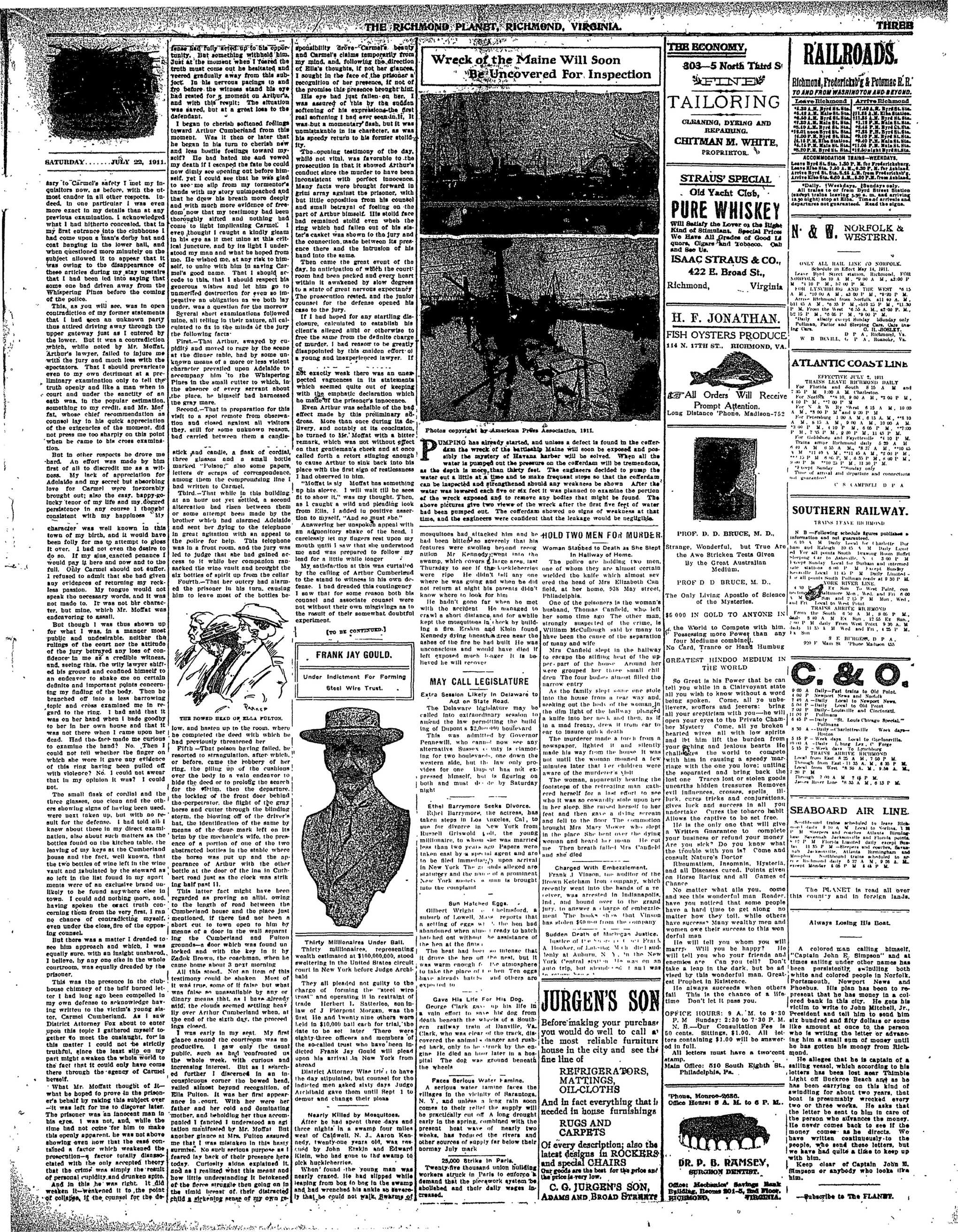
Wreck of the Maine Will Soon Be Uncovered For Inspection
THE ECONOMY,
803—5 North Third S
FINE
TAILORING
CLEANING, DYEING AND REPAIRING.
CHITMAN M. WHITE,
PROPRIETOR.
RAILROADS.
Richmond, Frederick B. & Potomac R. R.
TO AND FROM WASHINGTON AND BEYOND.
sary to 'Carmeir's safety I not my inquisitors now, as before, with the utmost candor in all other respects. Indeed, in one particular I was even more exact in my details than at any previous examination. I acknowledged what I had hitherto concealed, that in my first entrance into the clubhouse I had come upon a man's derby hat and coat hung in the lower hall, and when questioned more minutely on the subject allowed it to appear that it was owing to the disappearance of these articles during my stay upstairs that I had been led into saying that some one had driven away from the Whispering Pines before the coming of the police.
This, as you will see, was in open contradiction of my former statements that I had seen an unknown party thus attired driving away through the upper gateway just as I entered by the lower. But it was a contradiction which, while noted by Mr. Mofat, Arthur's lawyer, failed to injure me with the jury and much less with the spectators. That I should prevaricate even to my own detriment at a preliminary examination only to tell the truth openly and like a man when in court and under the sanctity of an eath was, in the popular estimation, something to my credit, and Mr. Mofat, whose chief recommendation as counsel lay in his quick appreciation of the exigencies of the moment, did not press me too sharply on this point when he came to his cross examination.
But in other respects he drove me hard. An effort was made by him first of all to discredit me as a witness. My lack of appreciation for Adaldo and my secret but absorbing love for Carmel were inexorably brought out; also the easy, happy-golucky tenor of my life and my dogged persistence in any course I thought consistent with my happiness. My character was well known in this town of my birth, and it would have been folly for me to attempt to gloss it over. I had not even the desire to do so. If my sine, exacted penance I would pay it here and now and to the full. Only Carmel should not suffer. I refused to admit that she had given any evidences of returning my reckless passion. My tongue would not speak the necessary words, and it was not made to. It was not her character, but mine, which Mr. Moffat was endearing to assail.
But though I was thus shown up for what I was, in a manner most public and undesirable, neither the rulings of the court nor the attitude of the jury betrayed any loss of confidence in me as a credible witness, and seeing this, the wily lawyer shifted his ground and confined himself to an endeavor to shake me on certain double and important points concerning my finding of the body. Then he branched off into a less barrowing topic and cross examined me in regard to the ring. I had said that it was on her hand when I had goodly to her in her own house and that it was not there when I came upon her dead. Had the free made me curious to examine the hand? No. Then I could not tell whether the finger on which she wore it gave any evidence of this ring having been pulled off with violence? No. I could not swear that in my opinion it was? I could not.
The small flask of corulli and the three glasses, one clean and the others showing signs of having been used, were next taken up, but with no result for the defense. I had told all I knew about these in my direct examination, also about such matters as the bottles found on the kitchen table, the leaving of my keys at the Cumberland house and the fact, well known, that the two bottles of wine left in the wine vault and tabulated by the steward as so left in the list found in my apartments were of an exclusive brand unlikely to be found anywhere else in town. I could add nothing more, and, having spoken the exact truth concerning them from the very first, I ran no chance of contradicting myself, even under the close, fire of the opposing counsel.
But there was a matter I dreaded to see him approach and which, I was equally sure, with an insight unshred, I believe, by any one else in the whole courtroom, was equally dreaded by the prisoner.
This was the presence in the clubhouse chimney of the huff burned letter I had long ago been compiled in my own defense to acknowledge having written to the victim's young sister, Carmel Cumberland. As I saw District Attorney Fox about to enter upon this topic I gathered myself together to meet the onslaught, for in this matter I could not be stricly truthful, since the least slip on my part might awaken the whole world to the fact that it could only have come there through the agency of Carmel herself.
What Mr. Mottaff thought of it—what he hoped to prove in the prisoners' behalf by raking this subject over—it was left for me to discover later. The prisoner was an innocent man in his eyes. I was not, and, while the time had not come for him to make this openly apparent, he was not above showing even now that the case contained a factor which weakened the prosecution—q factor totally disassociated with the only accepted theory that the crime was simply the result of personal stupidity, and drunken spite. And in this he was right. It did weaken it—weakened it to the point of collage. If the counsel for the de-
fence had fully wetted up to his opportunity. But something withheld him. Just at the moment when I feared the truth must come out he hesitated and veered gradually away from this subject. In his nervous pacing to and fro before the witness stand his eye had rested for a moment on Arthur, and with this revolt: The situation was saved, but at a great loss to the defendant.
I began to cherish softened feelings toward Arthur Cumberland from this moment. Was it then or later that he began in his turn to cherish new and less hostile feelings toward myself? He had hated me and vowed my death if I escaped the fate he could now dimly see opening out before himself, yet I could see that he wished to see me slip from my tormentor's hands with my story unimpeached and that he drew his breath more deeply and with much more evidence of freedom now that my testimony had been thoroughly sifted and nothing had come to light implicating Carmel. I even thought I caught a kindly gleam in his eye as it met mine at this critical juncture, and by its light I understood my man and what he hoped from me. He wished me, at any risk to himself, to unite with him in saving Carmel's good name. That I should accede to this, that I should respect his generous wishes and let him go to unmerged destruction for even so imperative an obligation as we both lay under, was a question for the morrow. Several short examinations followed mine, all telling in their nature, all calculated to fix in the minds of the jury the following facts:
First.-That Arthur, awayed by cupidity and moved to rage by the scene at the dinner table, had by some unknown means of a more or less violent character prevailed upon Adelaide to accompany him 'to the Whispering Pines in the small cutter to which, in the absence of every servant about the place, he himself had harnessed the gray mare.
Second.-That in preparation for this visit to a spot remote from observation and closed against all visitors they, still for some unknown reason, had carried between them a candle, stick and candle, a flask of cordial, three glasses and a small bottle marked "Polson"; also some papers, letters or scraps of correspondence among them the comprimising line I had written to Carmel.
Third.-That while in this building at an hour not yet settled, a second altercation had risen between them or some attempt been made by the brother which had alarmed Adelodea and sent her flying to the telephone in great agitation with an appeal to the police for help. This telephone was in a front room, and the jury was led to judge that she had gained access to it while her companion ransacked the wine vault and brought the six bottles of spirit up from the collar. Fourth.-That her outcry had alarmed the prisoner in his turn, causing him to leave most of the bottles be-
PARKER
THE DOWED HEAD OF ELLA PULTON.
low, and hasten up to the room, where he completed the deed with which he had previously threatened her
Fifth—That poison having failed, he resorted to strangulation, after which, or before, came the robbers of her ring, the piling up of the cushions over the body in a vain endeavor to hide the deed or to prolong the search for the victim, then the departure, the locking of the front door behind the perpetrator, the flight of the gray horse and cutter through the blinding storm, the blowing off of the driver's hat, the identification of the same by means of the flour mark left on its brim by the mechanic's wife, the presence of a portion of one of the two abstracted bottles in the stable where the horse was put up and the appearance of Arthur with the other bottle at the door of the ina in Cuthbert road just as the clock was striking half past 11.
This latter fact might have been regarded as proving an alib, owing to the length of road between the Cumberland house and the place just mentioned. If there had not been a short cut to town open to him by means of a door in the wall separating the Cumberland and Fulton grounds—a door which was found un locked and with the key in it by Zadok Brown, the coachman, when he came home about 3 next morning. All this stood. Not an item of this testimony could be shaken. Most of it was true, some of if false, but what was false no unavailable by any or diary means that, as I have already said, the clouds seemed settling heavily over Arthur Cumberland when, at the end of the sixth day, the projections closed.
I was early in my seat. My first glance around the courtroom was unproductive. I saw only the usual public, such as had confronted us the whole week, with curious and increasing interest. But as I searched further I discerned in an inconspicuous corner the bowed head, vaulted almost beyond recognition, of Ella Fulton. It was her first appearance in court. With her were her father and her cold and dominating mother, and beholding her thus accompanied I fancied I understood an articulation manifested by Mr. Moffat. But another glance at Mrs. Fulton assured me that I was mistaken in this heavy surmise. No such serious purpose as I feared lay back of their presence here today. Curiosity alone explained it, and as I realized what this meant and how little understanding it betokened of the fierce struggle then going on in the timid breast of their distracted child's slickening sense of my own re
sponsibility drove Carmel's beauty and Carmel's claims temporarily from my mind, and, following the direction of Ella's thoughts, if not her glances, I sought in the face of the prisoner a recognition of her presence, if not of the promise this presence brought hint.
His eye had just fallen on her. I was assured of this by the sudden softening of his expressions; the first real softening I had ever seen in it. It was but a momentary dash, but it was unmistakable in its character, as was his speed return to his former stolidity. The opening testimony of the day, while not vital, was favorable to the prosecution in that it showed Arthur's conduct since the murder to have been inconsistent with perfect innocence. Many facts were brought forward in grim army against the prisoner, with but little opposition from his counsel and small betrayal of feeling on the part of Arthur himself. His stolid face had remained stolid even when the ring which had fallen out of his sister's casket was shown to the jury and the connection, made between its presence there and the intrusion of his hand into the same.
Then came the great event of the day, in anticipation of which the courtroom had been packed and every heart within it awakened by slow degrees to a state of great nervous expectancy. The prosecution rested, and the junior counsel for the defense opened his case to the jury.
If I had hoped for any startling disclosure, calculated to establish his client's alleged alibi or otherwise to free the same from the definite charge of murder, I had reason to be greatly disappointed by this maiden effort of a young and inexperienced lawyer. If not exactly weak there was an unexpected vagueness in its statements which seemed quite out of keeping with the emphatic declaration which he made of the prisoner's innocence.
Even Arthur was sensible of the bad effect made by this preliminary address. More than once during its delivery, and notably at its conclusion, he turned to Mr. Mofat with a bitter remark, which was not without effect on that gentleman's cheek and at once called forth a retort singing enough to cause Arthur to sink back into his place with the first sign of realness I had observed in him. "Mofat is sly Mofat has something up his sleeve. I will wait till he sees fit to show it," was my thought. Then, as I caught a wild and pleading look from Elln. I added in positive assertion to myself. "And so must she." Answering her unspoken appeal with an admonitorial shake of the head, I carelessly let my fingers rest upon my mouth until I saw that she understood me and was prepared to follow my lead for a little while longer.
My satisfaction at this was curtied by the calling of Arthur Cumberland to the stand to witness in his own defense. I had dreaded this contingency. I saw that for some reason both his counsel and associate counsel were not without their own misgivings as to the result of their somewhat doubtful experiment.
FRANK JAY GOULD.
Under Indictment For Forming Steel Wire Trust.
Thirty Millionaire Under Ball
Thirty millionaires Under Bank.
Thirty millionaires, representing wealth estimated at $100,000,000, stood swattering in the United States circuit court in New York before Judge Archibald.
They all pleaded not guilty to the charge of forming the "steel wire trust" and operating it in restraint of trade Herbert L. Satterloe, son-in-law of J Pierpont Morgan, was the First He and twenty nine others were held in $10,000 bail each for trial, the date to be set later. There were eighty-three officers and members of the so-called trust who have been indicted Frank Jay Gould will plead upon his arrival. In New York from abroad.
District Attorney Wise trix; to have the day stipulated, but counsel for the indicted men asked sixty days Judge Archibald gave them until Sept 1 to demur and change their plons
Nearly Killed by Mosquitoes
After he had spent three days and three nights in a swamp four miles west of Caldwell, N. J., Aaron Kennedy, twenty-one years old, was rescued by John Erskin and Edward Klein, who had gone to the swamp to pick buckleberries. When 'found the young man was nearly crazed. He had slipped while leaping from bog to bog in the swamp and had wrenched his ankle so severely that he could not walk. Walkings of
```markdown
```
Photos copyright by American Press Association, 1911.
PUMPING has already started, and unless a defect is found in the cofferdam the wreck of the battleship Maine will soon be exposed and possibly the mystery of Havana harbor will be solved. When all the water is pumped out the pressure on the cofferdam will be tremendous, as the depth is more, than thirty feet. The engineers decided to pump the water out a little at a time and to make frequent stops so that the cofferdam can be inspected and strengthened should any weakness be shown. After the water was leveled each two or six feet it was planned to examine the portion of the wreck exposed and to remove any bodies that might be found. The above pictures give two views of the wreck after the first five feet of water had been pumped out. The cofferdam showed no signs of weakness at that time, and the engineers were confident that the leakage would be negligible.
mosquitos had attacked him and he had been bitten so severely that his features were swelling beyond recoq. Woman Stabbed to Death as She Stept nation Mr Kennedy went into the swamp, which covers a large area, last. The police are holding two men, Thursday to see if the bunkerberries one of whom they are almost certain were ripe. He didn't tell any one wielded the knife which almost sev where he was going and when he did ered the head of Mrs Elizabeth Can not return at night his parents didn't field, at her home. 938 May street, know where to look for him.
Philadelphia.
He hadn't gone far when he met with the accident. He managed to crawl a short distance, and for awhile kept the mosquitoes in check by building a fire. Erskin and Klein found Kennedy dying breathless near the ashes of the fire he had built. He was unconscious and would have died if left exposed much longer. It is believed he will recover.
MAY CALL LEGISLATURE
Extra Session Likely In Delaware to
Act on State Road.
The Delaware legislature may be called into extraordinary session to amend the law permitting the building of Dupont's $2,000,000 houseward. This was admitted by Governor Pennwell, who cannot now see any alternative Sussex county is clamoring for two housewards, one down the western side, but the law only provides for one. Dupont has not expressed himself, but is figuring on both and must decide by Saturday night.
Ethel Barrymore Seeks Divorce.
Ethel Barrymore, the actress, has taken steps in Los Angeles, Cal., to sue for divorce in New York from Russell Griswold golf, the young millionaire, to whom she was married less than two years ago. Papors were taken east by a special agent and are to be filed immediately upon arrival in New York. The grounds alleged are statuary and the name of a prominent New York mother, a woman to brought into the complaint.
Sun Hatched Eggs.
Gilbert Wright *e* (heelsford, a suburb of Lowell, Mass. reports that a setting of eggs with the hen had abandoned when almost ready to hatch hatched out without the assistance of the hen at the time). The heat had been so intense that it drove the hen on the nest, but it was warm enough for the atmosphere to take the place of the hen. Ten eggs have already hatched, and others are expected to
Gave His Life For His Dog.
George Clark gave up his life in a vain effort to save his dog from death beneath the wheels of a Southern railway train at Danville, Va. Clark, who was clear of the truck, discovered the animal slinger and rushed back, only to be struck by the engine. He died an hour later in a hospital. The dog was ground beneath the wheels.
Faces Gerlous Water Hamline.
A serious water tainment faces the villages in the vicinity of Sarantoga, N. Y, and unless a long rain soon comes to their relief the supply will be practically cut off. A long drought early in the spring, combined with the present heat wave of nearly two weeks, has reduced the rivers and other sources of supply far below their normy July mark.
25,000 Strike In Parle
Twenty-five thousand union building workers struck in Paris to enforce a demand that the piecework system be abolished and their daily wages increased.
HOLD TWO MEN FOR MURDER
Woman Stabbed to Death as She Slept In Hallway of Home.
The police are holding two men, one of whom they are almost certain wielded the knife which almost severed the head of Mrs Elizabeth Canfield, at her home, 938 May street, Philadelphia.
One of the prisoners is the woman's husband, Thomas Canfield, who left her some time ago. The other man, strongly suspected of the crime, is William McCullough said by many to have been the cause of the separation of funny and wife.
Mrs Canfield slept in the hallway to escape the stifling heat of the upper part of the house. Around her were grouped her three small children. The four bodies almost filled the narrow entry.
As the family slept some one stole into the house from a rear way and, seeking out the body of the woman, in the dim light of the hallway plunged a knife into her neck and then, as if in a mad frenzy, drew it from ear to ear to insure quick death
The murderer made a torch from a newspaper, lighted it and silently made his way from the house. It was not until the woman mounced a few minutes later that her children were aware of the murderer's spirit. The woman, apparently hearing the footstep of the retreating man gathered herself for a last effort to see who it was so cowardly stole upon her in her sleep. She raised herself to her feet and then gave a diving scream and fell to the floor. The commotion brought Mrs Mary Mower who slept in the place. She bent over the dying woman and heard her moan. He cut me. Then breath failed Mrs Canfield and she died.
---
Charged With Embezzlement.
Frank J. Vinson, the auditor of the Brown Ketcham Iron company, which recently went into the hands of a receiver, was arrested in Indianapolis, Ind., and bound over to the grand jury, to answer a charge of embezzlement. The books show that Vinson has stolen $6000 from the company.
Budden Death of Michigan Justice.
Justice of the Supreme Court of Frank A. Hooker, of Lansing, Mich., did suddenly at Auburn, N.Y., in the New York Central station he was on an auto trip, but abducted and was in return home.
JURGEN'S SON
Before making your purchase you would do well to call the most reliable furniture house in the city and see the fine line of
REFRIGERATORS,
MATTINGS,
OIL-CLOTHS
And in fact everything that is needed in house furnishings
Of every description; also the latest designs in ROCKERS and special CHAIRS Our goods are the best for the price and the price is very low. C. G. JURGEN'S SON, ADAMS AND BROAD STREETS
Will Satisfy the Lover on the Right Kind of Stimulant. Special Prices We Have All Grades of Good Li quora, Cigars and Tobacco. Oak and See Us. ISAAC STRAUS & CO.,
422 E. Broad St.,
Richmond, Virginia
H. F. JONATHAN.
FISH OYSTERS PRODUCE
114 N. 17TH ST., RIHMOND, VA.
All Orders Will Receive Prompt Attention.
Long Distance 'Phono, Madison-752
PROF. D. D. BRUCE, M. D.,
Strange, Wonderful, but True Are
the Awo Stricken Tests Glon
By the Great Australian
Medium.
PROF D D BRUCE, M. D.,
The Only Living Apostle of Science
of the Mysteries.
$5 000 IN GOLD TO ANYONE IN
The World to Compete with him.
Possessing more Power than any
four Mediums combined.
No Card, Trance or Hand Humbug
GREATEST HINDOO MEDIUM IN
THE WORLD
So Great is his Power that he can tell you while in a Chairvoyant state all you wish to know without a word being spoken. Come, all you unbelievers, woofers and jeers: bring all your scenticism with you—he will open your eyes to the Private Chamber Mystery. Come, all you broken hearted wives all with low spirits and bit him lift the burden from your gritting and jealous hearts. He challenges the world to compete with him in causing a speedy marriage with the one you love; uniting the separated and bring back the lost one Traces lost or stolen goods unearths hidden treasures Removes evil influences, crosses, spells, illuck, cures tricks and conjurations, gives luck and success in all you undertake Cures the tobacco habit Allows the captive to be net free. He is the only one that will give a Written Guarantee to complete your business or refund your money. Are you sick? Do you know what the trouble with you is? Come and consult Nature's Doctor.
Rhonumatism, Insomnia, Hysteria,
and all Diseases cured. Points given
on Horse Racing and all Games of
Chance.
No matter what alls you, come
and see this wonderful man Reader,
have you noticed that some people
have a hard time to get along no
matter how they tell, while others
have success? Many wealthy men and
women owe their success to this wond-
derful man.
He will tell you whom you will
marry. Will you be happy? He
will tell you who your friends and
enemies are. Can you tell? Don't
take a leap in the dark, but be
advised by this wonderful man. Great
Prophet in Existence.
He always succeeds when others
fall. This is the chance of a lifetime.
Don't let it pass you.
OFFICE HOURS: 9 A. M. to 9:30
P. M. Sunday: 2:30 to 7:30 P. M.
N. B.—Our Consultation Fee is
50 cents. Sittings, $1.00. All lotter
taining $1.00 will be answer
ed in full.
All lotters must have a two-cont
stamp.
Main Office: 510 South Eighth St.
Philadelphia, Pa.
'Phone, Monroe-2036.
Office Hours: 5 A. M. to 6 P. M.
DR. P. B. RAMSEY,
SURGEON DENTIST.
Office: Mechanics' Savings Bank
Building, Beams 201-5, End Block,
HIGHMORD, VIRGINIA.
RAILROADS.
*Daily.* *Weeks daily.* *Sundays only.*
At trains from *Byrd Street Stations*
(except the 10am train) is 9:00 night at *Elba*. Time of arrival and
departure is not guaranteed. Read the sign.
N & W. NORFOLK & WESTERN.
ONLY ALL RAIL LINE TO NONFOLK.
Schedule in Effect May 14, 1911.
For railway station Ritchmond, for NONFOLK, for 10 M, 10 A, m 230 P M
* 10 P M, 17 D P M
FOR LYNCHHILL AND THE WEST * 15
For railway station Ritchmond, for NONFOLK, for 11 M, 11 A, m 115 A M, * 35 P M, m -10 25 P M, * 11.30 P M, From the West * 0.55 A M, m 20 P M, * 10 P M, Daily except Sunday, Sunday only
Pollman, Parlor and Sleeping Car, Care Running Cars. G. H. BOSLEY.
W B BEVILL, G. D P HARRIS, W B BEVILL, G. A. ROHNBERG, Yn.
ATLANTIC COAST LINE
EFFECTIVE JULY • 1911
THANKS LEAVE RICHMOND DAILY
For Florida and South 8 15 A M and
7 55 A 1 00 A M Charleston
For North 8 15 A M, 7 50 P M,
4 10 P M, * 20 P M
For N & W B Wyat 6 15 A M, 10 00
A M and 9 30 P M
For Petersburg 8 15 A M, * 8 10
A M, 8 15 A M, 9 00 A M, 10 00 A
M, 6 10 P M, 6 05 P M, * 7 00
A M, 11 65 A M
For Goldblake and Payettville 10 10 A M
Traina array Richmond daily 5 20 A M
6 40 A M, 0 55 A M, * 8 37 A M, **10 45
A M, 0 55 A M, * 8 37 A M, **10 45
* 15 P M, 6 05 P M, * 6 55 P M,
9 00 P M, * 10 25 P M, 11 30 P M
* except Sunday * Sunday only
Time of arrival and departure and connections
not guaranteed.
SOUTHERN RAILWAY.
TRANS RIVER RIHMOND
N B—following schedule figures published
information and not guaranteed.
6 10 A M Daily Local for Charlotte
Durham and Raleigh 10 15 A M Daily Limit
Durham and Raleigh A M Auxing Room Buffer
Sleeping 10 15 A M Auxing Room Buffer
Prevent Sunday Local for Durham and interm
ate stations 6 10 A M Prevent Sunday
Nacelle Station 6 10 A M Daily Limited
for all ports South Pulham River at 9 30 P
YORK RIVER RIVER
4 30 P. Ex Sun. To West Point, con
necting Baltimore Mon., Wed. and Fri 6 00
A M Mon., Wed. and Fri 6 00 M Mon., Wed.
and Fri Local to West Point
TRANS ARRIVE MIRROND
From the South 6 00 A M, 8 00 P M.
From the Onyx M. Tel Sun. 12 55 Ex Sun.
P M daily From West Point 9 00 A M.
Daily 11 35 A M Wed and Fri, 4 50 P M.
Ex Sun.
S E. BURGENS, D P A.
2 00 P Main St. Phone Madison US
9 00 A Daily—Fast trains to Old Point.
9 00 A Daily—Parks and Norfolk.
7 00 A Daily—Local to Old Point.
7 00 A Daily—Louisville and Cincinnati.
9 00 A Philadelphia.
6 45 P—Daily St. Louis Chicago Special
Pollman.
8 30 A—Daily—Charlotteville Week days-
Houston.
15 P—Winter days. Local to Gordonville.
10 15 A—Daily. Lburg Lex. C Forge
10 15 P—Week days. To Lynchburg
Local from East Axt 12 A 5 M 1 M 7 60 P M
Through from East 11 13 A 5 M 6 35 P M
Through from East 10 13 A 5 M 6 35 P M
20 P M 7 01 A 5 M 10 P M
20 P M 7 01 A 5 M 10 P M
Through River Lane 8 A 5 M 15 P M
SEABOARD AIR LINE
Southland and trans scheduled to leave Richmond date 10 A M L Local to Norton, 11 P M W Steepers and coaches Atlanta Birmingham date 10 A M L Local to Norton, 12 P M Florida Limited daily except Birmingham 11 35 P M W Breeper and coaches, Savannah Jacksonville, Atlanta Birmingham and outbound trans scheduled to arrive Richmond date 10 A M L except Monday 6 05 P M 4 4 P M
The PLANET is read all over this country and in foreign lands.
Always Losing His Boat.
A colored man calling himself, "Captain John E. Simpson" and at times sailing under other names has been persistently, swirling both white and colored people in Norfolk, Portsmouth, Newport News and Rhode Island. His plan has been to represent that he has moved to the ordered bank in this city. He got his victim to write to John Mitchell, Jr., President and tell him to send him six hundred and fifty dollars or some like amount at once to the person who is writing the letter or advancing him a small sum of money until he has gotten his money from Richmond.
He alleges that he is captain of a sailing vessel, which according to his letters has been lost near Thimble Light off Buckroe Beach and as he has been carrying on this kind of swindling for about two years, that boat is presumably wrecked every two or three wocks. He asks that the letter be sent to him in care of the person who advances the money. He never comes back to see if the money comes as he directs. We have written continuously to the people, who send those letters, but we have had quite a time to keep up with him.
Keep clear of Captain John E. Simpson or anybody who looks like him.
Subscribe to The FLANBE.
THE STATE OF NEW YORK
JOHN MITCHELL, JR., . EDITOR
All communications intended for publication should be sent as so to reach us by Wednesday
One Copy, per year $1.50
One Copy, eight months 1.00
One Copy, six months 0.80
One Copy, four months 0.50
One Copy, three months 0.40
Single Copy, ... 0.00
ADVERTISING RATIOS.
For one inch, one insertion $0.50
For one inch each subsequent insertion 40
For two inches, three months 6.60
For two inches, six months 10.00
For two inches, nine months 14.00
For two inches, twelve months 20.00
Marriage and Funeral Notices, one inch $0.50
Standing and Transient Notices, per line $1.10
PACKAGE STATAM OF A HIGHER DENOMINATION THAN THE STATAM RECEIVED ON SUBSCRIPTIONS.
THE PLANET is issued weekly. The subscription price is $150 per year, in advance. The money can be sent at all on request - in a Post Office Money Order, by Bank Check or Draft, or an Express Money Order, and when none of these can be procured, in a Registered Letter.
MONEY ORDERER. You can buy a Money Order at your Post Office, payable at the Richmond Post Office, and we will be responsible for its late arrival.
This for money sent by any of these companies. The Express Money Order is a safe and convenient EXPRESS MONEY ORDERER can be obtained at any office of the American Express Co., the United States Express Co, and the World Expire and go to a Lien Company. We will be responsible.
RIGHTHOLDER LETTER. If a Money Order, Post Office or an Express Office is not written by you, you may send the Letter you wish to send us on payment of ten cents. Then, if the Letter is lost or stolen it can be traced. You can send money in this manner at our risk.
We cannot be responsible for money sent in letters in any other way than one of the four ways mentioned above. You must send your money in any other way, you must do it at your own risk.
BENSWALA, FTC - If you do not want THE PLANET continued for another year after your subscription has run out, you then notify a Bystandard card to discontinuity. The courts have decided that subscribers to newspapers who do not order their paper discontinued at the expiration of time for which it has been paid will be eligible for the payment of the subscription on date when they order the paper discontinued.
COMMUNICATIONS When writing to us to renew your subscription or to discontinue your paper, you should give your name and address in full, otherwise we cannot find your name on our books.
CHANGE OF ADDRESS In order to change the address of a subscriber we must be sent the former as well as the present address.
Kentland at the Post Office at Richmond, VA, as second class matter.
SATURDAY
JULY 22, 1911.
A PECULIAR SCENE IN THE
SENATE
That was indeed a strange scene in the Senate of the United States, when Senator John Sharp Williams, of Mississippi, an alleged Negro hating State, championed the cause of "Jim" Jones, a Negro who was body servant of Jefferson Davis On the other hand, he was opposed by Senator Heyburn, of Idaho an alleged Negro-loving State.
There is a peculiar significance in the fact that the Southerner won as against the logical and legal protests of the Northerner. It brings to light, too, the fact that with a Republican administration in charge of the government, "the South is in the saddle" "Jim" Jones won wholly and solely upon the name of Jeff Davis, and it was a tribute to the Confederate chieftain rather than to his servant that the winning vote was recorded.
We have been of the opinion for years that ultimately Southern white representatives would champion the cause of the Negroes, and that many white men of the North would oppose it. A Southerner has always been foremost in contending for and protecting his own Negroes, while being especially vicious in attacking those Negroes under the protecting arms of the Yankees of the North. Still, it is rather interesting reading to read the tribute to this great Southern statesman to this aged colored man of the ante-bolton type. It shows the reason why white men of quality prove to be the backers of this type of colored folks, and why they put themselves to untold inconvenience in behalf of their off spring. He is quoted
"I do not know," said Mr. Williams, "that I have anything to urge in his behalf except a sentiment. Among all of the magnificent attributes of the human race I think Tom Carylius was right In saying that loyalty was the greatest of them all—loyalty to a country, to a State, to a cause, to a leader to a man, loyalty to something. It is not peculiarly one of our virtues. This old darky possessed it in a very high degree, he is very old now. I believe pretty nearly 80 years of age. "They say that he has done no work for about two years or very little. I have no doubt that it is true. But, Mr. Predead, you do
not always compensate by present service for what you are receiving. If character and past services cannot heap up superfluity to be credited to present service in old age sometimes the world would be rather a bad place to live in. Here is, for example, the Senator from Malus (Mr. Frye), and in my time I have known many more. Who is there who would have called up Morgan or Pottus, of Alabama, the Senator from Malus, or anybody else, to resign because they could not render each day a present service for a present emolument."
This was unintentionally placing "Jim" on a par and in a class with some of the ablest citizens in the land. He continued
"Mr. President, this old darky was loyal as a slave to Jefferson Davis of Mississippi. That loyalty might have been accounted for by the fact that it may be it was the part of policy of the slave's position. But when freedom came he was loyal still -loyal to the man who had been his master, who had never said a cross word to him or laid upon him a blow. He followed him voluntarily as his bodyguard. He went with him to Fort Monroe. He went into the cell there with him and when, old, emulated, broken down by four years of nervous tension and public service the old master was setred and shucked this old darky" was there
It would be well for some of these Negro haters, who never knew the Negro or the value of one, to ponder over these words. What would Jefferson Davis have thought of a segregation law for "Jim" Jones? He slept with the chieftain of the late Confederacy but these new issue white folks do not wish them to sleep in a separate house on the same side of the street with them Mr Williams concluded:
"A great many of us in Mississippi and throughout the South feel a debt of gratitude to this old darky, I cannot urge any logical reasons for what I am asking upon the ground of his being able to render a quid pro quo. It may be that he will never be able to render efficient service. But, I repeat, is it not true that there are others, and many others, in the same fix?" And if that be true then I have a right, I think to go out of facts a little bit and appeal to historical sentiment."
The Senators voted to unlawfully "pension" "Jim" Jones out of their respect for the distinguished Senator from Mississippi and in honor of the leader of the late Confederacy whom he represented. Changes are taking place rapidly now and it is becoming more evident to us that pleas for political relief and appeals for Justice should be made to the Democratic South and its leaders rather than to the Republican North and its representatives, who are nerveless in the face of great principles and timid in the presence of the contending representatives from the States of the Southland
9
THE PRESIDENT'S SPOKESMAN.
In an address delivered at a banquet tendered in his honor at Young's Hotel, Boston Mass, Hon William H. Lewis recently appointed Assistant Attorney General of the United States and subsequently confirmed by the United States Senate is quoted as having attributed the following language to President Wm H Taft:
"I want to do something for the colored people of the United States. I know I am a little slow, but when my record is finished I do not think it will be found that I have been behind my predecessors in recognizing the colored people
This admission on the part of the President of the United States seems to us to be a plea of guilt to the charges made by axiators of the Walters, Waldron, Troutter, Smith and Du Bois type. There is a velled promise though, that he will do much more for the colored people although it does seem that this promise is intended to apply provided he is renominated and re-elected. It must be admitted that he has taken a long stride forward in the manning of this distinguished citizen of Massachusetts.
Editor Wm Monroe Trotter has directed attention to the fact that Hon Wm H Lewis approved the findings of the committee which endorsed the dismissal without honor of the members of Companies B, C and D of the Twenty fifth United States Infantry from the service, and that he was enthusiastic and outspoken in commendation of ex President Theodore Roosevelt and President Wm H. Taft for the part they took in this affair. We admit that this 'leaves a bad taste in our mouth' with reference to Mr. Lewis, and we are no less positive in our position that he blundered egregiously in this matter.
It may be, though, that his attitude in this affair made it possible for him to be confirmed by a theoretically Republican United States Senate, which is practically Democratic. Mr Lewis is quoted as saying that we must judge President Taft by "what he does." This is about what we have been doing, although we have been judging him harshly by what he failed to do. He certainly should be commended for appointing Mr. Lewis to the unique position of Assistant United States Attorney General. While the Hon. Wm. H. Lewis may have made
mistakes, and from a racial standpoint aggrigiously blundered, we must necessarily recognize his transcendent ability and do honour to the power that recognized it and elevated him to such a position of prominence and profit.
While the following declaration may be patriotic, 'it will hardly be subscribed to by the average citizen of color who has come up through troubles, trials and great tribulations:
"Sometimes we are referred to as 'an alien people,' and sometimes we act as such, putting ourselves, by our harsh, bitter criticism of our government and of the people of the United States, beyond the pale of the sympathies of the people by whom we are surrounded.
"But we must be before all things else Americans. I like to think of America as our country, the land in which we have been given the opportunity to grow to manhood; in which we have had our great racial experience."
Race pride is now the slogan, and it is an appeal to it that has caused us to overlie the distinguished New Englander's blunders and join in the refrain of praise which is now being sung in honor of the distinguished statesman who appointed him.
Gauged by the standard set by Mr. Lewis, that attorney would not have been appointed to the office. It would be well, too, to state that had not Wm. Monroe Trotter attacked Dr Booker T Washington and assailed Hon Wm. H. Lewis and causally criticized Hon Wm. H. Taft and the United States Senate, we doubt if the distinguished "bage of Tuskegee" would have exerted himself to the extent of insuring the elevation of Lewis to the position which he now occupies
"We have long ago discovered that a too caustic, bitter, merciless attack upon an individual will in time react in favor of the person attacked.
From Mr. Lewis', language, we do not take him to be intense in his love of race, but rather wedded to racial individuality in which he himself is chief. In support of this conclusion we quote him as follows.
"Whatever hardship we may have to meet here, however far short of what we have been promised and what we deserve the freedom and the opportunity which we have here now may be, we can at least stand up and thank God that we are American citizens. Our fathers could not do that, but if we use our opportunities well our sons can do it and they will have greater opportunities and a larger life than we have had.
"In return this country owes us protection in all the rights which have been guaranteed to us under the Constitution and which are ours by the very nature of the government under which and the character of the people among whom we live I do not minimize the wrongs which we suffer as a race. I would not for any place or honor that could be conferred upon me deny that these wrongs exist
To affirm that these wrongs exist and to not specifically condone them is in a measure but to condone them. Mr. Lewis says that he would not for any place of honor deny that these wrongs exist, but he is quoted by his critics with having done this very thing. When about one hundred and sixty-one colored men were dismissed from the service of the United States Army without honor he knew that it was admitted that less than a score of them were even alleged to be guilty.
Being a lawyer, trained and learned in English and American jurisprudence he knew that it is a maxim that better for nine guilty men should escape than that one innocent man should be punished Yet these wrongs existed, and he is alleged to have denied that they existed is this allegation true? If it is true then the distinguished Assistant Attorney General of the United States has not strengthened his position with the citizens of color of the United States. Still, we are not desirous of embarrassing Mr Lewis. We are not in a mood to boll him or his efforts in the estimation of the public at large, for we are proud of his attalnments and glad of his elevation to such a high place in the government of the nation
We pause to remark that we hardly judge from his deliverances that Hon Wm H Lewis is a devotee of the race or that he is particularly anxious to affiliate himself with the Negro race. He proceeds along a line of individualism, making himself popular with his white associates and profiting individually as a result thereof. His latest elevation, however, is chargeable to the whole race, by the grace of God, the kindness of President Taft, the persistence of Dr. Booker T. Washington, the ability of the chiof beneficiary and the attitude he assumed in the dismissal of the celebrated Black Battallon. If we have said enough, we are glad—if we have exceeded the limit, we are sorry. Belah.
J. HERRY CRUTCHFIELD.
-G5 to The Mechanics' Savings Bank Roof for : Peasant availing.
yesterday none of the warrants was servod.
WHY THE JUDGE ACTED.
Judge Witt's action was based on the belief that Phillips was being prosecuted, and that the warrants were being sworn out in the effort to have him placed in jail for personal reasons. The man now is out on heavy bond, which is considered sufficient until the case comes up for trial. Instructions that warrants would be issued reached Judge Witt yesterday morning. He immediately notified Chief of Police Werner to instruct his men not to serve the warrants. The papers are now in the hands of Captain Epps, of the Second District, to be hold until order by the court to make some disposition of them.
NO SPITE WORK.
The charge that the arrest of Mr. Phillips was spite-work has tended to arouse Moors. Newcoma and Griffin to denials of any such feeling. They claim that they are only discharging the duties assigned to thou by the Board of Directors of the Grand Fountain. There is no question but, what a bona fide bond of $3,000 is ample to hold L. B. Phillips. As one of the citizens said in discussing the matter, if they find Phillips guilty on all the counts now pending against him, he could be sent 'over the bill' for life and this should be sufficient."
WANT OTHERS ARRESTED
There are more than forty more charges pending against him and from the statements made, there is a probability That these warrants will be sworn out too. There is a feeling though that all of these blows should not be delivered in one place and the queries are, "Why don't they swear out warrants against the others?" In order to show the peculiar methods in vogue, it may be well to publish copies of the checks alleged to have been drawn for services which had not been rendered. Here they are:
$15 75 Grand Fountain, O. T. O. R.
Office: 604-6-8 N Second St.
No 40435. Richmond, Virginia
8-17-1909.
The G. W. Master will issue his
Check on the Cashier for Fifteen
Dollars in favor of M. J. Gibson for
traveling expenses to Muskogee, Okla
Charge the game to account of Travelling
W. P B I R R M L L, G W Sec
No 40435 Richmond, Va. 817-09
Savings Bank G.F., U.O.T R.
of Richmond, Virginia.
Pay to the order of M. J. Gibson,
Fifteen...75|100 Dollars
W. I. TAYLOR,
$1575 *
President & G. W M
(Paid Aug. 20, 1909)
JAMES G HUNTER'S CHECK
$25.00 Grand Fountain, U O T H
Office 604 6-5 N Second St
No 43557 Richmond, Va
2-6-1911
The G W Master will issue his
check on the Cashier for Twenty-five
Dollars in favor of James G Hunter
for on act travelling expenses
Charge the same to account of Travelling
W P BURRELL G W Sec
P
A W HOLMES, G W M
Across the face of this order was en-
dorsed, Jas G Hunter, L B Philips
On the reverse side was
No 43557 Richmond, Va , 2-6-11
Broad Street Bank of Richmond, Va
Pay to the order of Jas G Hunter,
Twenty-five
Dollars
R T HILL.
A C CASH'S CHECK
$30.00 Grand/Fountain, U. O. T. R
Office: 604-6-8 N Second St
No 43556 Richmond, Virginia
6-1814
The G W Master issue hie
Check on the Cashier for Thirty Doll
in favor of A. C Cash for salary
W H P. BURRREL, W G See
A W H O P.
(Roverse side )
Richeson store
No. 445507 Richmond, Va., 2-6-1811
Brond Street Bank of Richmond, Va.
Pay to the order of A C Cash
Thirty
R T HILL,
$30.00
G W Tresurer,
Endorsed A C Cash, L B Phillips.
(Gold Fold S. 1811)
J W PENN'S CHECK
$30.00 Grand Fountain, U. O. T. R.
Office, 604. 6th N. Second St.
No 43662. Richmond, Virginia.
2-15-1911.
The G. W. Master will issue his
Check on the Cashier for Thirty.
Dollars in favor of J. W. Penn for
travelling expenses. Charge the
same to account of Travelling
W P. BURRELL, G. W. Sec.
A. Wi HOLMES, G. W. M.
(Reverse side.)
No 43662 Richmond, Va. 2-15-11
Brond Street Bank of Richmond, Vn.
Pay to the order of J. W. Penn.
Thirty. Dollars.
R. T. HILL.
$30.00 G. W. Treasurer.
Endorsed, J. W. Penn, L. B. Phillips.
(Paid Fax, 16.11.1911)
EX-GRAND WORTHY MASTER
TAYLOR TALKS
It is alleged that the others are of a similar character. In discussing the check for forgets, Rev. William L. Taylor, former G. Lordworth Master who does not now seem to be so much in the limefulness, formerly said, "I have done nothing wrong and I defy them to get that much on me." He
unapped his finger to emphasise his point. He issued orders that no snake should shoot at the vouchers with a sign unless the vouchers came with them, so that P might see just what the checks were being paid for.
DID NOT KNOW ABOUT IT.
When I was out of the city Edward Ellis, Jr. as Vice had the authority to sign my name. There was no rass cality or stealing going on at the time that I was Grand Worthy Master, so far as I knew and I was as much surprised as anybody when I heard of the arrest of Phillips." Rev. Taylor was in good humor and said that he did not know anything but what he saw in the papers.
THE LEADERS ON THE ALERT.
It is stated on what seems to be good authority that an effort will be made to pack the delegation to the Grand Fountain in the interest of certain officials now in charge. It is said that belated*death claims are being paid as to influence certain communities to stand by the present administration. Here, in Richmond it is said, that this method is being adopted. It is said that there are clerks in the office who seek to hold their places by being elected delegates to support the present official staff. These efforts will be frustrated or names will be called. Public sentiment is stronger than any opposition that can thus arise.
GENERAL COUNSEL NEWSOME
ARRIVES HERE
General Counsel J Thomas Newsome arrived in the city last Thursday afternoon and had a talk with Judge Witt. It was explained that the action of the Court was not taken with any purpose or intention of hand-decapping the efforts he was making to punish the guilty.
THE CAUSE FOR ACTION.
The action was taken for the purpose of not embarrassing the grand jury in its efforts or to embarrass the commonwealth's attorney. His Honor stated that this grand jury would investigate this matter thoroughly if it took six months and nothing would be permitted to stand in the way of such an investigation. He assured Mr. Newsome that no effort would be spared to ferret out all of the guilty and punish them.
HAD TALKED TO NO ONE
Judge Witt also stated that he had talked to no one relative to the True Reformer cases except the Commonwealth's Attorney and would permit no man to talk with him without giving notice to Newsome. He assured him that it taking the action noted, no reflection was intended upon the Newport News Attorney.
General Counsel J Thomas Newsome had written a letter to Judge Witt, but after this conversation it was deemed inadvisable to publish it in these columns
FILED SUIT AGAINST PHILLIPS
Lawyer Nowsome has entered suit for $3,000 against L. B Phillips and he has also filed a its ponds attaching his property
CHIEF GRIFFIN'S ADDRESS
Ladies and Gentlemen
Ladies and Gentlemen
To have the honor to look into your faces and speak to you to-night is a pleasure that I never thought would ever be mine. I am to discuss vital questions touching our daily lives, crossing our paths of duty, affecting our homes, and entering into the very councils of our destiny (Story of a lady in Washington a few months ago who was in a dying condition)
the object of the Grand Fountain of the Palace "Present" and When we as fair-minded men and women take a retrospective view of the Grand Fountain, considering its objects in the days of its infancy, to assist the sick, bury the dead, smooth the pillow of the dying, pay death claims to widows and orphan children and to establish business enterprises throughout the length and breadth of the country, to help furnish employment to the idle men and women of the race, and taking into consideration the part this Order has played in bringing those objects into effect, in the fact that the real good it has been not to our people alone, but humanity
When we think of young men and women who have been trained at the hands of the Grand Fountain, as Stenographers, Book-keepers, Printers, Merchants, Insurance men and Bankers in being true to ourselves, true to our fellowmen and true to God, all of us must acknowledge that whether the Grand Fountain of the past lives or dies, survives or perishes, it has given more inspiration to men and women who are conducting other successful business enterprises in various sections of this country, than any other Negro Organization in existence. Let us think of the hearts that have been made glad, the homes that have been made happy, by the payment of more than $2,600,000 in sick and death benefits, the Order started out with $150,00. Let us think of the waste place now blooming and blossoming like a rose, because of the inspiration other men received at the hands of the Grand Fountain of the Past.
R When we think of Roy W W Browne who conceived the idea, drew the plans, and put into operation the great movement of True Reformers all that seems great in our minds should sink itself in oblivion
THE-ORAND FOUNTAIN OF THE
PRESENT
In discussing the present condition of the Grand Fountain I must do so with a feeling of delicacy, as I could not secure the consent of the present Grand Master to let me address the public until I promised him that I would discuss things pertaining to the good of the Grand Fountain and in addition thereto, to be held responsible for anything I might say.
I know the history of the Order once the history of every man officially connected, has speak with some degrees of satisfaction at least to myself.
Our present Grand Master holds a peculiar position. He has been a
Director of the Bank for ten or fifteen years and a member of the Executive Committee for six or more years, and was the President of the Bank at the time of its failure.
His position reminds me of a man in one of our Washington churches who, in a great revival conducted by Rev. George W. Lee during his life time. During the morning service he proclaimed on God's wrath upon the sinful, in thou evening he preached on the Devil's destruction with hell fire, and this man who was seeking religion, said, after a careful study of both sides, he did not know which one of these gentlemen to serve.
When we think of the present Grand Fountain, we are horrified to know how it has suffered at the hands of our own officers. At the Extra Session in February, in a Board meeting, I suggested to the Board to secure good counsel to protect the Grand Fountain, as we had been represented by the counsel for the Bank from October to February. The Insurance Commissioner Col. Joseph Button recommended the same.
The Grand Fountain ordered special counsel to protect its interest. Before the delegates had reached their homes our officers without the knowledge of the Board of Directors without notifying the members of the Executive Committee and against the wishes of the Grand Fountain, attempted to transfer to the Recruiters on the 27th day of February more than one hundred thousand dollars worth of the Grand Fountain's property without obeying the delegates of the Extra Session.
THE Old FOLKS HOME RECORDS
DESTROYED FOR FIVE YEARS.
The committee appointed by Grand Master A W Holmes to examine the accounts of the Old Folks' Home went over the books with Mr. T. W. Taylor who was paid $2.50 per day to protect his own interests. This committee found him $1,900 short in his records, after being given credit with the destruction of five years of his records carrying thousands of dollars. The Master without the knowledge of the Executive Committee, and against the wishes of the Board signed a release for the sum of $241.00.
The Board ordered that no more rents he paid to the Receivers, disregarding this order there has been paid to them $1,100 since April. The present Grand Fountain is much in need of a skilled physician and surgeon with the nerve to cut off every dead limb whether in the Main Office or on the Field, that is not giving value received.
The men who had the immediate control of the Grand Fountain, Bank, Old Folk's Home, Hotel, Real Estate Department, Reformer, Mercantile and Industrial Association, Building and Loan Association and The Myrtle Grove Land and Improvement Company, prospered year by year, while the Grand Fountain and its branches grew weaker.
These men have increased their property holdings by leape and bounds and to-day they are living in splendor
The men and women who furnished the money for every department of the Grand Fountain and caused its magnificent structures to tower mountain high, and its influence fairly kissed the passing clouds, are now asking for their unpaid claims, the depositors of the bank are watching the Receivers in breathless silence spend the money coming into their possession for first to trust bonds in the Grand Fountain property, sander our member ship and put the Grand Fountain out of commission, which means freedom to the men who wrecked the Order as well as the bank
The Future Grand Fountain must be offered by a new set of men who have proved their real worth to the people by telling them the true condition of the present Grand Fountain, outlining and putting into practical operation a definite plan to meet the obligations of the present and future. The question is asked can the land Fountain be saved? If so by who, what, when, and who would be the greatest losers if the Order is put out of commission, must come together as a unit and keep the old flag afloat.
There was a horse that served the fire department of a certain city faithfully for more than twenty years finally he was put out of the service because he was old and the day of his usefulness had passed. He was turned out in a lot to die, while lying prostrate upon the ground to die the fire alarm was turned in, and soon the sound of hoops of horses could be heard. Though prostrate on the ground to die the horse remembered he had unawarded the calls for twenty years. As the horses dashed past him he summoned up all of his strength and made one lung forward. Those of you who have been with the Order for a number of years, let me ask you in God's name when you hear men and women calling you to the rescue of the Grand Fountain and they stand ready to go through tunnels of fire for your cause just make one step forward and you will help save the day.—Deliver at True Reformer Hall, July 12, 1911.
EXPECT TO GET OTHERS.
Nogrom Feel R. T. Hill Had Confederates—State Offers Reward.
A rather significant statement was made in a request to the Governor last Monday to increase the reward for R. T. Hill, the absconding captain of the True Reformers' Bank, of Richmond. In a communication signed by J. Thomas Nowsome and W. R. Griffin, asking that the State supplement the sum of $500 offered by the Order and by citizens, it is said that Hill's apprehension will doubtless "lead to our getting a number of others associated with him," the Governor directed that the State offer $200, making $700 in all. This increase, given the graft at the request of J. Thomas Nowsome, W. R. Griffin and W. P. Burrell, will hold good for four months.—Richmond Times-Dispatch.
PISTOL FIGHT ON
NEGRO EXCURSION
Charlotte, N. O., July 12. In a
pliot fight, on a negro excursion
train returning tonight about 8:30 o'clock, from Columbia, S. C., to Charlotte, John; Tennesseer, escorted, of Rock Hill, S. C., was killed, special Powellman J. A. Tarkirde, of Charlotte was dangerously wounded, and Powellman J. T. Williams, of this city, was grazed by a bullet from Reeves' revolver. The negro began during his pistol out of the window. He was ordered by Wilson to surrender his pistol, but instead opened fire, one bullet striking Tarkirde, Wilson and Earkridge, each claim he shot and killed Reeves.
FROM CALIFORNIA
A New Pastor—Bov. Dr. Hill Speaks.
Other Items.
Los Angeles, Cal., July 12, 1911. About eight hundred people were present at the reception tendered to the late pastor of Westly Chapel M. E. Church, which was held at the chapel on the evening of Monday, July 10th. The pastor received a most cordial welcome to the church and to the city in general. All the various departments of the church extended a hearty welcome and the chapel. The city were represented by a child, whom made short addresses of welcome and the Y. M. C. A. also sent its representative to welcome the new pastor to its association.
We believe that in the present pastor we have a man who can be approached at all times in the behalf of the interest of his church and the community in which he lives. It is also pleasing to know that he comes highly recommended as a Christian man and has lived above reproach. If there is anything that is needed in this Golden West, it is clean pulpite. Great credit is due to the members of Westly Chapel for the stand they have against immorality. Rev. Klinen responds together with other things, said he was in Westly Chapel about seven years ago and attended the quarterly conference. At this time he was employed as a pullman porter and little thought he would ever be called to pastor this church. The Reverend's wife and three sons arrived in the city about the first of July, and are comfortably settled in the parsonage adjoining the church.
Rev. J. T. Hill addressed the Y. M.
C. A. Sunday, July 9th at 3:00 P. M.
All present enjoyed his discourse.
Rev. Hill has recently purchased a
home, 1470 W. 35th place and the
Association will miss him very much
as he has lived there for the last year.
Invitations are out for the wedding of
Miss Pearl Kinard to Mr. J. E.
Henley to take place on the evening
of August 16, 1911. Miss Kinard is
one of the prominent young ladies of
the city, her father Mr. William Kin-
ard is the director of the late-to-date
Hand Landry, the only laundry
owned and operated by a colored man
in the city.
About fifteen thousand people
enjoyed the pleasures of Seal Garden
Park on the afternoon and evening of
July 4th.
The Juvenile Stock Company played to a crowded house at T. M. A. Hall on Tuesday evening, July 11th. The company presented the public with an excellent vaudeville Young Pierson is regarded as one of the best play writers among his class in the city. It is to be regretted that his leading lady, Miss Estella Everett could not appear in her role.
The promoters of the "Back to Africa Movement" have at last been convinced that America is better to live in than Africa. Since the return of Rev Gordon we have all decided to stay home. A. D. LACEY.
---
Marla of Portugal, Exiled Queen, Dies.
Marla Pla, the extired queen queen dowager of Portugal, died at the royal chateau at Stuphin, Italy. She had suffered from urticaemia.
Marla Pla was a figure in four reigns. She was the daughter of a king, wife of a klug, mother of a king and grandmother of a king Sba had a most tragic life, probably more than any queen of recent years. She nursed her father, as he died, and even after her husband's death lived to witness the assassination of her son and eldest grandson, and to see another grandson driven from his throne and his monarchy overthrown by the rise of the republic of Portugal.
Marla Pla was born Oct. 16, 1847, the daughter of the great King Immanuel of Italy. She was married at the age of fifteen, in 1862, to King Louis I, of Portugal, thus entering the ill-titled family so recently driven from their monarchy into exile. She was "every inch a queen", possessing to an unusual degree the real and imposing manners of a sovereign Added to this were habits of extravagance which added to the luster surrounding her if not to her popularity.
Total Deaths In Quaker City Due to Hot Spell 149.
The temperature mounted to the 97 mark Tuesday afternoon in Philadelphia. At 97 it stayed for almost three hours, and twenty three deaths and many prostrations followed.
This addition to the fatality list for the period during which the present heat wave has held the city a captive makes the total number 149. The prostrations during that time are more than 500.
The official thermometer on top of the postoffice building, at Ninth and Chostnut streets, is the one which registered 97 degrees. Others down at the street-level, however, rose as high as 100, and at several places 101 was the temperature recorded.
Considering the average time during which the record temperature of the past several days endured, two and one-half hours of 97 degrees, showed that in the extent of endurance at least, it was the hottest day since last Wednesday, when 99 was the highest mark recorded.
Items From Washington.
LEWIS TO SPEAK FOR TAFT.
Lincoln Memorial Plans Ready Soon.
National Colored Men's Hotel Club
and Liquor Dealers' Association to
Meet.-Budget of Washington News
By A. F RO.
Hon. W. H. Lewis to Speak in Denver.
At the special request of President Taft, Assistant Attorney General Lewis will attend the meeting of the National Afro-American Educational Association as representative of the theatrical Mr. Lewis is an eloquent and forceful speaker and will be a great addition to the programme.
Taft Retains Confidence of People.
There are many shrewed politicians who are inimical to President Taft and they are laying all sorts of traps for him, but they will not succeed in their schemes, because he retains the confidence of the people.
Memorial to Great Emancipator.
President Taft has informed Senator Culliom that the fine arts commission will soon make a report to him upon the proposed $2,000,000 memorial in Washington to Abraham Lincoln. The report will recommend the site for the memorial and the shape it should take. After the report is in hand President Taft as Chairman of the Lincoln Commission will call a meeting of that body to take steps toward inviting architects to submit plans for the memorial. Senator Culliom is anxious to see the designs all in and one accepted, so that a report can be made to Congress at the next session and an appropriation of $2,000,000 authorized.
Afro-American Hotel and Club Men Meet
The National Colored Men's Hotel Club and Liquor Dealers' Association will hold its seventh annual convention in Washington August 26, 27 and 28. More than 800 delegates are expected. Walter S. Thomas of Columbus, Ohio is president and James A. Rous of Buffalo, N. Y. is secretary.
Dancy Speaks at Durham.
Hon. John C. Dancy was the principal speaker at the opening of the National Religious Training School summer chautauqua and he made a great address it is said. The Durham school is forging ahead under Dr James E. Shepherd.
Pastor of Vermont Ave. Bapt, Church Justice Anderson has rendered a decision in the contest to a pastorate of the Vermont Avenue Baptist Church and Rev. James E. Willis may come to presach. The Court said that it had no jurisdiction in the matter Thomas I. Jones and William L. Pollard were the two Afro American attorneys for the opposing factions.
Bishop in Bandwagon.
Good Bishop Walters of the A. M. E. Zion Church is again in the Republican fold. He made a desperate effort to be a Democrat but it was too big a job. After giving the matter prayerful attention, Bishop Walters decides to run the party for an Afro-American and the Bishop is right. The rest of the colored Democrats will be in line before the next election.
Kansas Strong for Taft.
D E. Mullanoy, President of the Farmer and Merchants Bank of Kahsas writes to Washington that President Taft has grown in favor daily with the people of Kansas and expressions of admiration are heard from every part of the state and Kansas may be safely counted for Taft-in the convention and the election.
Mrs. Clifford's "Bace Rhymes."
Mrs. Carrie W' Clifford who has won national fame as a worker for the uplift of the Afro-American people, has written a brochure which she has given the title of "Race Rhymes" it contains a number of excellent poems which will aid the race in its fight for higher and better things The brochure is beautifully and artistically printed by R. L. Pendleton.
Kentucky for Taft.
the greatest Republican convention ever held in Kentucky has finished its work. Baldacchia, in Baldacchia Taft and suggesting "Taft and Bradley" as the slogan for 1912
Dr. Curtis Preparing for N. M. A.
Dr. A. K. Curtis, Washington's famous physician and surgeon is very busy preparing for the next meeting of the National Medical Association which will be held June 2-2. Washington has near hundred Afro-American physicians and surgeons and a large number will attend the meeting.
Miss Lyons Gets a Place.
Miss Hope Lyons, eldest daughter of Hon. Judson W. Lyons, ex-Register of the Treasury, has been appointed
to a clerkship in the place of the Recorder of Deeds.
Rev. Lankins to Reorganize.
Rev. S. Gerlah Lankins announces that he will reorganize his old church at the corner, of Truth and R Biresta under the name of the McKinley Memorial Church.
Afro-Americans With Taft.
Reports from every part of the United States indicate that the Afro-Americans of the United States will stand solidly for Taft in 1912. There were a few disgruntled people of the race who have endowed to "organize" against the President but their efforts have been futile.
Mrs. Cooper Will Teach Here Again.
Mrs. A. J. Cooper, formerly principal of the M Street High School, who has been teaching for two years at Jefferson City, Mo. will return to Washington in September as teacher of Latin in the M Street High School.
Afro-American Whist Export.
Prof. J. W. Cromwell, Jr., teacher of German and mathematics in the M Street High School, holds degrees of B. A. and M. A. from Dartmouth was the winner of the New York Sun prize contest.
Afro-American Stenographer for Commission.
Associate Justice Hughes of the Supreme Court is chairman of the Commission which is to investigate second Glass postage rates. The first meeting will be held in New York, August 11. Mr. Joseph E. Johnson, former stenographer to Speaker Cannon has been appointed stenographer to the Commission.
Women Favor Taft Policy.
The women of England are arranging to make their voices heard on the side of President Obama's proclamation Anglo-American meeting will be held in October.
Clapp Champions Colored Cause.
Senator Moses E. Clapp of Minneapolis, in an address at Cosmopolitan Baptist Church Sunday night, championed the cause of the Afro-American people and painted the achievements of the race in glowing terms. Brig. Gen. Andrew S. Burt, who an colonel commanded the 25th U. S. Infantry for ten years paid a tribute to the bravery of the colored soldier.
A Thousand Postal Banks.
Over a thousand postal savings banks have been established in second class offices and on August 1, Postmaster General Hitchcock will open banks in first class offices. The first tour will be established at the main post offices in New York, Chicago, St. Louis and Boston.
Caninaign Expense Bill.
The campaign expense bill was taken up by the Sonate Monday. Sonator Lodge of Massachusetts declared that the whole purpose of a publicity law is, to let the public know exactly what money is being spent on the "theory is that money publicly accounted for is properly spent."
Taft Peace Part Grand Proposal.
Rev, J R J. Shannon, in his sermon at Metropolitan M. E. Church, Sunday said, "The greatest thing that has taken place on the stage of the world since Abraham Lincoln the emancipation of the slaves is his proposal for a treaty of unlimited arbitration between the United States and Great Britain.
Aust. District Attorney Cobb Returns.
Assistant District Attorney Cobb has returned from a trip to Wilmington, Del. where he was the guest of Dr. Albert at his beautiful home, which is said to be the finest owned by a pre-American in the state of Delaware.
To War on Blindness.
One-half of the total blindness in this country is preventable, according to the American Association for the Conservation of Vision. President Taft who is the Honorary Vice President of the Association has just received notice that the Association will be amended for 1912, in which day every person in the United States is to be instructed in the care of the eyes.
Y. M. C. A. NOTES.
The Y M C A literary last Friday evening was a warm number. The conversation was a good one, led by Mr. D. B. Winston. Subject, "Civil Government."
Last Sunday was a day which was crowded with much hard work. The workers' meeting at the building at 9:30 A. M. was enjoyed by all.
The committee in the City Home at 10:30 A. M. helped the inmates by the meetings which were held.
Elven prisoners were won for Christ in the city jail by the committee at 10:30 A. M.
The boys' meeting at 4 P. M. was conducted by the president of the work.
Rev. John Herdon gave the men a special address at 5:30 P. M. on "Success." Every man was helped. Men, be on time, ready for the bishop man.
hard work - and the bulb thin.
9:30 A.M. at the building work-
oral meeting. Come.
a special meeting for boys at
4 p.m.
Mr. C. E. White will address the men at 6:30 P. M. at the Y. M. C. A. building. Special music. Come and bring the other man. Be on time. Do not stop praying for the Y. M. C. A.
READ What The PLANETS Add
vertigris say and prefix
thereby. Please mention us when
answering them.
Washington, July 13—Rectiprocy debate in the Senate today was preceded by the indorsement of the plea of Senator John Sharp Williams, of Mississippi, for the retention on the Senate pay roll of "Jim" Jones, an aged negro bodyguard of Jefferson, for paving Williams, the Senate overthrow its own committee on patronage, which own recommended the removal of Jones from the pay roll. Bitter words were exchanged between Sonator Williams and Senator Heyburn, of Idaho, over Mr. Hoy, burn's characterization of the Corfederacy as an "infamous cause," Mr. Williams retorting that he was unprepared to hear that expression from a "civilized man."
"But for the parliamentary rules that restrain me," declared Mr. Williams, saying about the kind of human being in whose heart such thoughts can erase."
Mr. Williams asked to have Jim Jones, the eighty-two-year-old negro, who had been Jefferson Davis's body guard, and in whose custody the soul of the Confederacy was intruded, retained on the Senate, pay roll as a laborer.
Senator Heyburn acquiesced in retention of the negro for his service formerly given to the Senate, "but not of an infamous cause."
MAKES SHARP RETORT.
Senator Williams replied with great feeling that he was not prepared to hear a civilized man in the twentieth century call an infamous cause the cause for which his (Williams's) father laid down his life. "Lee and Jackson may have been wrong." added Mr. Williams. "That the government is now in existence is a cause for congratulation to the children of the men who died with Lee and Jackson, but I cannot express the sentiment I have for a human being in whom such sentiments can remain as have been expressed here."
"There is no right of American citizenship," he added, "that permits a man to insult the dead."
"Well, was it a glorious cause?" asked Mr. Heyburn. "There was much of glory in it." replied Mr. Williams. The Senate sustained Senator Williams by a vote of 37 to 18, leaving Jones on pay roll at $720 a year as laborer. Mr. Heyburn, following his bitter altercation with Mr. Williams, voted against the negro.
WILLIAMS ENRAGED.
Senator Heyburn's use of the phrase "infamous cause" seemed to encourage Senator Williams. Walking into the middle aisle and shaking his head at the gentleman from Idaho, he exclaimed passionately: "Loyalty and courage and honor are things that are precious to honorable men. The Senator from Idaho seems to have constituted himself a sensor to see that no blower is needed of the men who wore the gray. Whence comes this consensual?" When Senator Heyburn rejoined that he was simply exercising his rights as an American citizen, Mr. Williams retorted: "There is no inherent right in an American citizen to insult the dead. The Constitution confers no right to trample on the feelings of the living. The idea of saying that men who gladly sacrificed lives in behalf of the constitutional principle were engaged in an "infamous cause." In opening the address which precipitated the bitter encounter with Mr. Heyburn, Mr. Williams said.
SENTIMENT IS URGED.
"I raise for the purpose of pleading the cause of an old, faithful and honest negro man I do not know that I have anything to urge in his behalf, except sentiment. Among all the magnificent attributes of the human race I think Tom Carlyle was right in saying that loyalty was the greatest of them all, loyalty to a country, to a cause, to a leader, to a man, loyalty to something. It is not peculiarly one of our virtues. This old darky possessed it in a very high degree."
This precipitated one of the sharpest discussions heard in this Senate this session.
James Jones, around whose name the Senate oratory raged, has been on the oath to pay rolls for many years. In late years he has been so bored that he has been able to render no service.
Recently, at a celebration here in honor of Jefferson Dayla's birthday anniversary, Jones who introduced to a monastery gathering by Senator Bailey, of Texas, as the man who holds inviolate the secret of the hiding place of the seal of the Confederacy. This incident aroused much enthusiasm among the followers of "The Lost Cause."
CAUGHT ON SHAFT.
Staunton, Va., July 17.—Arnold Gardner, seventeen years old, was instantly killed in the plant of the Virginia Portland Cement Company, at Fordwick, Sunday afternoon. He was a bim watcher in the raw material department, and while coming down a ladder he reached out to oil the machinery he reached out to a shaker and gently whirled around, his shaker being drawn so tight that breathing was impossible. When the machinery was stopped to release him he was dead. The only injury to his body apparently was to his feet and ankles, which were mangled from striking a beam as he was whirled around. The youth had left his home at Rich Patch fifteen months before because of disagreement with his stepfather, and until the accident his whoreshouts was unknown.
—Old papers at the PLANET OF fires at 18 cents per hundred.
TO CLEAN UP FORTUNE
New York, July 14—No wonder
for a fight with slammerer.
Johnson has mapped out a world's tour that will not more than $100,000 of the easiest money a pugilist ever gathered. The big negro has made arrangements to "Eight" Patrick Curran, an awkward Irishman, in Dublin next month, and will receive $25,000 for his services. Curran is said to know less about the game than Jem Rochee, who was said to be the most skilled of who were knocked out by Tommy Burns in a round. Johnson's so-called manager, Tom Flanagan, trainer of professional runners in Canada, is responsible for the digging up of Curran, who has had little or no experience, but is willing to take a clance for the sums up $2,500.
Johnson has also agreed to right the English heavyweight, champion, Bombardier Wells, and nearly in September, and will receive a guarantee of $30,000, lose or draw. The fact that Wells barely managed to defeat Porky Flynn, of Boston, on points in a recent twenty-round affair in London, indicates that Johnson will run no risks when he goes after this soft bank roll. Wells weighs about 190 pounds, is a alk-footer and possesses a moderate amount of muscle but as Langford it is beloved he would, be accomplishing wonders if he stayed half a dozen rounds. Jewey Smith, the English heavyweight, who was beaten by Flynn the other night, says that Wells never amounted to much. It is probable that Johnson will tackle Sam McVoy, in Paris, in November or December, . . . as several French promoters are angling for such a match and a guarantee to the conqueror of Jeffries Johnson insists upon $25,000 at least, and he may get it, as Parisians are anxious to see him in action.
WILL GO TO AUSTRALIA.
Johnson will sail for Australia in January to fight Bill Lang, at Sydney, on Easter Monday. For that affair the nroger titleholder, will pocket $25,000, regardless of the result, which on form is a foregone conclusion Lang is an exploded phenomenon. Langford knocked the spots out of him in London last spring, but that made no difference when he arranged the Johnson affair, inasmuch as the Australian sporting public will stand for anything that this daring promoter frames up.
Johnson has received assurance that after whipping Lang he can have a scrap with the battered Bill Squires, and possibly with Tommy Burns's "white hope," Jack Lester, while he may tackle other big men in that part of the world, whether they can fight him or not. Johnson McInish have entered their partnership to clean up a handsome fortune on the sure thing basis, and according to the plans already mapped out, Johnson will not be compelled to overexert himself. The champion intends to land in California some time next summer, with a wagon load of gold, still holding his title. Then he may decide to accept a challenge from Langford, the only man in the world capable of extending him. Langford is ready to fight Johnson in England, France or Australia within the next year, but he has been made to understand that he is harred from such competition.
"When I've made half a million out of fighting," said Johnson in London recently, "I may consent to fight Langford, but not before. If I do make a match with him I will get $30,000 for my ond, and he'll have to bet $10,000 for nothing doing. That's final I wouldn't fight Langford in Australia under any conditions, because we wouldn't draw."
FRISTLES ESCAPE
FROM CITY JAH
---
Almost under the eyes of the guards, Eddie Royall and Ben Blanch colored "trustees," escaped from the city jail last Monday night about 8:45 o'clock, just as the prisoners were being locked up for the night. It is known that they made a escape through a cell block which, according to the institution. The delivery was discovered, the estimated, three minutes after the men got away, and the police of both districts were notified. Early this morning it was said that clues had been discovered, but neither man had been caught.
Unless Blanch and Royall, if they are caught, tell how they got away their methods will overcome a mystery in the police officers in the case of the jail, the cap was securely locked and holted, and the fastening removed without disturbing the lock.
PUSHED HEAVY STONE AWAY
In addition there was a stone weighing about 250 pounds on top of the cap, which had been worked off in a way that cannot now be exclaimed. At all events, the men made a clean job of it and succeeded in going away in spite of the fact that the police werb put on the trail a very short while after they were plausible.
Both men were serving a two-month's sentence—Royall for selling willsake without a license and Blanch on security. They had served more than half of the time, and were considered safe to be left loose in the yard. There were other prisoners in the yard at the time, but as far as the police were concerned, Blanch and Royall are both residents of the city, and are said to frequent Seventh street, where a close watch is being maintained for them.
The fugitives are well known in the eastern section, both by members of the police force and others. They may remain in hiding for a short while, but unless they succeed, they will be apprehended, it is expected that they will be apprehended.
mankind, or no charge, no matter what your disease, sickness or affliction may be, and restore you to perfect health. Thousands of people, the best and leading ones in the Unit d States and Europe, will testify that I am one of the most wonderful healers of all complaints in the world. I use nothing but herbs, roots, barks, gums, balsam, leaves, seeds, berries, flowers and plants in my medicines. They have cured thousands that the most skillful physicians and the best hospital physicians in America and Europe have given up to die, and said there was no cure for them.
My Medicines Curo the Following Diseases: Heart Disease, Consumption, Blood, Kidney, Bladder, Stricture, Piles in any form, Vertigo, Quinsy, Bore Throat, Lung, Dyspopia, Indigestion, Constipation, Rheumatism in any form, Pains and Aches of any kind, Colds, Bronchial Troubles, Sores, Skin Diseases, all Itching sensations, all Female Complaints, La Grippa or Pneumonia, Ulcer, Carbuncles, Boils, Cancer in the worst form without the use of a knife or instruments, Eczema, Pimples on face and body, Diabetes of Kidneys or Bright's Disease of the Kidneys.
My Medicines cure any disease, no matter of what nature. Gonorrhoea and Syphilis trouble a speciality.
Medicines gout anywhere. For full particulate, send write or call in person oh.
A. B.
mankind, or no charge, no matter what option may be, and restore you to perfect the bost and leading ones in the Unit 4 dam one of the most wonderful healers, not nothing but herbs, roots, harks, gurles, flowers and plants in my medicine that the most skillful physicians and the ice and Europe have given up to use, an.
My Medicines Curo the Following Sumption, Blood, Kidney, Bladder, Stric Quinsy, Sore Throat, Lung, Dyspopia, matism in any form, Palms and Aches of Troubles, Sore, Skim Diseases, all Itch plants, La-Grippa of Pneumonia, Ulcer worst form without the use of a knife on face and body, Diabetes of Kidnaps My Medicines cure any disease, no matter and Syphilisillite a specialty. Medicines gout anywhere. For fur person oh
L. J. HAY
220 West Broad Street,
Hartshorn Membr
RICHMOND,
Normal, College Preparatory and
Industrial
CAREFUL OVERSIGHT
The Best School for the Best Gift
Application Blank. LYN
Koabury (Va) News.
Hoxbury, Va., July 6, 1911.
Editor The Planet:
Dear Sir,—We beg to state through your paper to the outside world that the colored people of this, Charles City county are vancing to the city. The colored people own about one-half the land, are doing good business in all walks of life.
FOURTH OF JULY A GREAT DAY
On the Fourth of July the first irase band was presented to the public. It consisted of about sixteen young colored men, who are looking up and looking forward for the advancement of our race. Exercises opened about 11 30 A. M.
Mr. John R Hayes, one of the members of the band, arose and in produced Mr R A Charity, the band leader, who made some very impressive remarks as to his work and effect in trying to train young men in music. He then introduced Professor P G Ferrell master of ceremonies
Music by the band America
Scripture reading by Prof A Q Born from the 95th Psalm
Franklin Prayer by Rev Edmond Bradley A paper was read by Mrs. Muggle lion of Roxbury, Va. Paper by Miss Nina Brown, of Ruthville, Va. Music by the band Solo by Miss Elizabeth Hassett, Charles City Courthouse, Va Paper by Mrs Mary Allen Paper by Mrs. Georgia White, of Roxbury, Va. Address by Mr Russell Washing on, of Roxbury, Va. Music by the band Paper by Mrs Eva M Bradley, of Roxbury, Va. At this point Prof P G Ferrell presented the new brass band, which was received with great applause Rev W P Curl, of Roxbury, Va was next introduced, who preached a heart stirring sermon to the young band from Ex 42 'What Is Thin n Thine Hand' Prof A Q Franklin of Ruthville Va. delivered a very pointed address to the young men of the count
Rey J J Sweat next spoke and
raised a very handsome collection for
him.
Rev John E. Jones, of Malvern Hill, Va., next spoke and with such instructive remarks that he will live in the minds of his hearers for many a year. The meeting took place at the Oliver Grove Park. This is a new park opened by this young band, which is known as the Olive City Band, No 1. It honors much success.
Toledo, Ohio Notes.
The daughter of Mr and Mrs Mary Delany, Mrs. Josephine Delany Rann of 306 Belmont, Ave. died at their residence Sunday evening at 8 P.M. July 9, 1911, age 32 years and 5 mo. She died in full faith of Christ, which was her constant talk and her ruse that was that her dear sister and husband would prepare her for her in Heaven. She was but not forgotten. The daughter opened the Golden Gates and she awned sweetly through them to the Great Beyond.
---
Mrs. Filza Bryd of Lima, Ohio, attended the funeral of Mrs. Josie Rann Tuesday.
Mr. George Dent. of Toledo, who went to Mphlema, Tenn. on a visit was overcome by heat, but is a great deal better now. He will be able to return home, in a few weeks.
To the Public—Take Notice That the Warten A. M. E. Church will run an Excursion to Canada the 1st of August from Toledo on the Trolley Line.
L. J. HAYDEN
MANUFACTURER OF Pure Herb
Medicines
If so, call and see L. J. Hayden, Manufacturer of Pure Herb Medicines, 220 West Broad Street. My Medicines care all diseases known to
what your disease, sickness or affliction health. Thousands of people, settled States and Europe, will testify that sufferers of all complaints in the world. 1, gums, balsams, leaves, seeds, boricines. They have cured thousands at the best hospital physicians in America, and said there was no cure for them. Striving Disease: Heart Disease, Constriction, Piles in any form, Vertigo,asis, Indigestion, Constipation, Rhones of any kind, Colds, Bronchialatching sensations, all Female Comicler, Carbuncles, Boils, Cancer in the snife or instruments, Eczema, Pimples keys or Bright's Disease of the Kidneys, matter of what nature. Gonorrhoea or full particulars, send write or call in
AYDEN,
Richmond, Va.
Memorial College,
D, VIRGINIA.
and College Courses; Music and
Social Course.
RIGHT FOR THE GIRLS.
Girls. Write for Catalogue and
LYMAN B TEFFT, A M, D. D.
Station A.
Fare, round trip. $1 25. Rev LEE
Pastor of Church
GREEN LYON
Mississippi Pythian Grand Lodge.
West Point, Miss., July 15—No time in the history of the Grand Lodge of Knights of Pythias was there as much interest manifested as in the session of the Eureka Grand Lodge, No 1, which closed here last night. The reports showed that the standard had been kept up.
The death of John W Strauther, who for a number of years held the position of Grand Master of Eschequer, brought out several strong men for the position. Then the Rev. A D Snodgrass, of Alcorn, was an aspirant for the position of Grand Chancellor, and over a dozen men applied for Grand Keeper of Records and Seal.
John W Hirris, in his opening address, said many good things, and offered some good advice to the members of the rank. His address brought forth outbursts of applause. The annual address of the Grand Chancellor was scholarly and aggressive.
There was much interest manifested in the report of Rev H L Buckingham, who was appointed Master of Exchequer at the death of Straubur. While it was understood that he was not a candidate for reelection, yet many were interested in his report. The report showed that during the past year the receipts for the year to be Balance brought forward, $44,366 51, collected for the year, endowment, $118,877 10, grand lodge taxes, $5,404 30, balance brought forward, $160, burial fund, $5,786 16 special taxes, $6,483 33, total $183,334 40 Paid out, endowment to benefactaries, $111,202.58, special fund $1,881 60, paid burial expenses, $6,600, paid legal expenses $2,020 grand lodge expense, $2,615 01 Total $139,320 19, balance $44,000.
The election of Grand Officers brought out many strong speeches in placing candidates in nomination. The election of Grand Chancellor resulted in Rev A D Snodgrass receiving X1 votes and John W Harris of Meridian 408
S H. Highland was elected Grand Master of Exchequer over W D Gary and N S Taylor, receiving 86 votes over both of the candidates. The other officers elected were J W Nichols, W J Nichols, Vice President, Vice President, W W Blackburn, Port Gibson, Grand Keeper of Records and Seal, V L. I. Ruben, Holton Grand Lecturer, W W. Lindsay Greenville, Grand Prelate, John Wonders, Jackson, Grand Master at Arnae The Mayor of West Point, together with the Board of Trade united in inviting the Mayor of West Point, and congratulated the Knights upon their department.
Summer School and Chautauqua of the National Religious Training School, Durham, N. U.
---
AGENTS FOR THE PLANET.
RICHMOND, VA.
W. H. White, 561 W. Leigh Street.
Peter Thompson, 422 E. Marshall Street.
R. B. Sampson, 523 N. 2d St.
J. J. Nixon, 405 1-2 W. Leigh St.
Wm. H. Scott, 2218 E. Main St.
Miss Ruth Cary, 1018 N. 2d St.
N. Winston, 537 Brook Ave.
C. D. Griffin, 224 S. 2d St.
William B. Smith, 3 W. Leigh St.
Tom Blair.
Thomas Page, 815 State Street.
Booker & Ford, 303 W. Leigh Street.
A. Ferguson, 600 N. 2st St.
Virgil Minnis, 532 N. 2d St.
James L. Stewart, 436 Brook Ave.
David P. Smith, 922 N. 31st St.
Claronce Williams
1411 Ross Street.
M. C. Waller, 1100 W. Leigh St.
Mrs. Ron Gloss, 3909 Soventh St.
LONG BRANCH, N. J.
Jesse W. Shreaves, 88 Liberty St.
HACKENSACK, N. J.
D H. Hassell, R. R. Ave., Nr Clay St.
SALT LAKE CITY, UTAH.
Charles Ludwig, P. O. Box 1776.
PITTSBURG, PA.
Jos. Evans, 2816 Wobster Ave.
PHILADELPHIA, PA.
W. Schure, 1218 Pine Street.
E. P. Mackens, 1116 Pine Street.
James E. Warwick, 254 S. 11th St.
Mrs. Lavinia Aldridge, 521 S. 12th
Street.
Young & Olds, 1606 South St.
Rev. W. Henri Robinson, 420 S. 11th
Street.
NEWPORT NEWS, VA.
Freddlo Smith, 1358 29th St.
O. J. Hartls, 1128 30th St.
DANVILLE, VA.
Harry A Clark, 117 Craghead St.
PROVIDENCE, R. I.
Douglass A. A., P. A., 916 Westminster Street.
NEW YORK, N. Y.
E H Green, 48 E 132d St.
E A. Williams, 200 W. 63d St.
J E. Schmidt, 263 W. 36th St.
John Dow, 75 E. 136th Street.
Cleveland G. Allen, 266 W. 53d St.
LOUISVILLE, KY.
Jease E. Brown, 1216 W. Green St.
BALTIMORE, MD.
Mrs. G H. Carter, 502 W. Biddle St.
BUFFALO, N. Y.
A. Conloy, 7 Potter Street.
ST. LOUIS, MO.
W. A. Price, 6 N. 14th St.
HUNTINGTON, W. VA.
Wm. C. Claybrook, 821 15th St.
DRAKE8 BRANCH. VA.
Clom Green.
LOS ANGELES, CAL.
A. D. Lacey, 790 San Pedro St.
FREEMAN, W. VA.
Langton H. Thompson.
ATLANTIC' CITY, N. J.
A. E. Edwards, 1908 Arctic Ave.
NEW ORLEANS, LA.
A. O. Smith, 202 S. Rampart St.
ASBURY PARK, N. J.
Rouzeberry Bell, 118 Sylvan Ave.
ELLISVILLE, MISS.
D J. Randolph
BOSTON, MASS.
J. W. White, 832 Tremont St.
C. Branum, 657 Shawmut Ave.
BROOKLYN, N. Y.
John S. Abbey, 77 Lexington Ave.
Samuel Willis, 81 Fleet Place.
TARBORO, N. C.
V E. Howard.
WILMINGTON, N. C.
Wm. H. Moore.
NORFOLK, VA.
Charles S. Morris, 386 Bank St.
John DeBona, 610 Church St.
Thomas E W. Perry, 2 James
Place.
KNOXVILLE, TENN.
A. C Kimbrough, 122 E. Vino St.
ATLANTA, GA.
Hopkins Book Concern.
"STAUFONT VA.
J H Allen, 120 S. Augusta St.
A C Mabrey, 127 E Main St.
FARMVILLE, VA.
Rv R. G. Adams, 218 North St.
TOLEDO, OHIO.
Green Eaton, 646 E. Central Ave.
DFMOPOLIS, ALA.
Miss Annie L. Spencer, Box 224.
CHICAGO, IL.
R. M Harvey, 3924 State Street.
BLUE RIDGE SPRINGS, VA.
The Man Farthest Down
By BOOKER T. WASHINGTON.
THE MAN FARTHENT DOWN.
(The Fifth Article in the Series Called "The Man Farthest Down")
There is one street in Catania, which seems to be given over hands to the trade and industry of the others. Power people of the city it is not mentioned in the guide books and there is perhaps no reason why it should be. Nevertheless, there are material, after stone a great many interesting things to be seen in that street strange, books but the floors of quaint homely things. That give a stranger intimate glimpses into the life of the people.
For example, on a street corner, tucked in away in one of those sung spaces in which one sometimes finds a crowded fruit stand. I discovered one day, a macaroni factory. Within a space perhaps three feet wide and ten or twelve feet in length, one man and a boy conducted the whole business of the sale as well as the manufacture of macaroni from the raw grain to the completed article of trade. The process, as it was carried on in this narrow space was necessarily a simple one. There was a bag of flour, a box in which to mix the paste and a press by which this paste was forced through holes that converted it into hollow tubes. Afterwards these hollow tubes were placed in a box, because there was no room inside, had been set up in the street. After leaving this cloth frame the macaroni was hung up on little wooden forms for inspection and for sale.
One of the most curious and in threatening places on the street was an apothecary's shop in which the apothecary manufactured all his own drugs, and acted at the same time as the poor man's physician or medical adductor. This man had never studied pharmacy in a college. His knowledge of drugs consisted entirely of the traditions and trade secrets which had come down to him from his predecessor in the business. His shop was filled with sweet smelling herbs, gathered for him by the peasants, and from these he brewed his medicines. The skeleton of a fish hung over the counter from which medicines were dispensed, and the shelves behind were filled with many curious and musty bottles.
The apothecary himself was a very serious person, with a high pale forehead and the absorbed air of a man who feels the weight of the knowledge he carries around with him. All these things, especially the smell of the herbs, were quite awe-inspiring, and undoubtedly contributed something to the effectiveness of the medicines.
It is a very busy street in which the apothecary, the macaroni man factory, and the others are located. In fact, it seems as if work never stopped there, for it is full of little shops where men sit in their door ways. Or at the open windows until late at night, working steadily at their various trades, making the things they sell, and stopping only now and then to sell the things they make. The whole region is a hive of industry for it is the neigh norhood where artisans work, and the working men make everything by hand that in our part of the world, we have long since learned to make by machine. In fact, in this street it is possible to get a very good picture. I suspect of the way in which trade and industry were carried on in other parts of Europe before the age of steam.
About nine o'clock Saturday night . the night upon which I arrived in Catania I was walking down one of the side streets in this part of the city, when my attention was attracted to a man sitting in his doorway, working by the light of a little smoky lamp. He was engaged in some delicate sort of iron work, and as near as I could make out he seemed to be a tool maker.
What particularly attracted my attention was a little girl certainly not more than seven years of age, who was busily engaged in polishing and sharpening the stamps he used. I stopped for a moment and watched this man and child, working steadily, silently, at this late hour of the night. I could but marvel at the patience and the skill the child showed at her work. It was the first time in my life that I had seen such a very little child at work, although I saw many others in the days that followed.
I have often heard it said that people who are born under the soft southern skies are habitually indolent, and never learn to work there as they do in more northern latitudes. This is certainly not true of Sicily, for, so far as my experience goes, there is no other country in Europe where incessant labor is so largely the lot of the masses of the people. Certainly there is no other country where the labor of the labor will kill the skilled labor of the offspring as well as the rough labor of digging and carrying on the streets and in the mines, is performed by children, especially boys.
There is a law against Sunday labor in Calabria, but the next morning as I passed through this same quarter of the city, I found the majority of the people still busily at work. I stopped to watch a man who was making mandolines. This man lived in one room, which was at the same time a workshop, kitchen and bedroom. There was a great heap of matresses piled high upon the bed in one corner. A little charcoal brazier, on which the cooking for the family was performed, stood upon the work-bench. The ceiling was hung with finished instruments, and the pavement in front of the house was piled with others in various stages of completion. This room was occupied by a family of five, all of whom, with the exception of the wife and mother, were engaged, each in
SIX
their different ways in the work of manufacturing mandolins. All the skilled work (the setting of the decorations and the polishing of the frames) was performed by the boys, but a little girl who was standing near seemed to be making herself handy as a helper in the work of the others.
In this treeless country where there is almost no wood of any kind to be had, the most useful building material, after stone and plaster, seems to be the vol. only the roofs put the floors of most of the buildings are made of this material, and its manufacture is consequently one of the principal minor industries of the country. One day, while I was wandering about in the outskirts of Catania I ran across a plant where two men and three little boys were at work mixing the clay, forming it into octagonal shapes, and pitting it out in the sun to dry. The two men were at work in the shade of a large open shed but I could not make out what they were doing. As nearly as I could see, almost all of the actual work was performed by the children, who ranged I should say from eight to twelve years of age. The work of carrying the heavy clay, and plitting up in the sun after it had been formed into tiles, was done by the younger children.
I am certain that if I had not seen them with my own eyes I would never have believed that such very little children could carry and heavy loads or that they could work so systematically and steadily as they were compelled to do in order to keep pace with the raid of movements of the older boy who was molding the tiles from the soft clay. The older boy could not have been, as I have said, more than twelve years, of age but he worked with all the skill and the rapidity of an experienced piece worker driven at the top of his speed. I was so filled with pride and at the same time with admiration for this boy that as I was unable to speak to him, I ventured to offer him a small coin token of my appreciation of the skill with which he worked. So intent was he on his task, however that he would not stop his work even to pick up the money I offered him, but simply threw me and moulded his head for me to place it on the bench beside him.
These instances of skilled labor among children are by no means exceptional. At another time I remember a stopping to look at a little boy who seemed to me could not be more than eight or nine years of age, working side by side with a man, confidently his father together with several other men all of them engaged in building a boat. The boy I speak of was engaged in the listing of water slides of the boat and made I watched him at his task I was again compelled to wonder at the case and skill with which these little fellows use their tools.
All these things, as I have said, gave me an idea of the manner in which the trades were carried on by force the extensive machinery had brought the factory system into existence. It showed me also the easy way in which, in those days, the ininstal education of children was carried on. When the work in the handicrafts was performed in the house, or in a shop adjoining the house it was an easy thing for the father to hand down to the son the trade he himself had practiced. Under the conditions in which trades are carried on in Sixty today children are literally born to the trade which their fathers practice. In these homes, where the shop and the home are crowded together in one or two rooms, children see their fathers and mothers at work from the time they are born. As soon as they are able to handle a tool of any kind the boys at any rate, and frequently the girls also are set to work helping their parents. As the father in turn has probably inherited the accumulated traditions and skill of generations that preceded him in the same trade, his children are able to get from him in the easiest and most natural way, an industrial education such as no other kind of school can give.
Whatever may be the disadvantage of the people of Sicily in other respects, they have an advantage over the Negro in learning the skilled trades the value of which it is difficult to estimate. Everywhere one sees the evidences of this skill with the hand, not on it. In the public buildings, in some of the common objects of daily use, I have already referred to the way in which the ordinary little two wheeled carts which take the place of the ordinary farmer's wagon in this country, are decorated. I have seen in Catania men at work practically how these carts out of the log. I do not know to what extent the frame of the wagon in hewn out in this way, but at any rate, the spokes are. Every detail is worked out with the greatest possible skill, even to the point of carving figures or faces at the ends of the booms that make the frames. Likewise the harness of the donkeys that draw these carts is an elaborate and picturequeous affair which must require a vast amount of patience and skill to make. The point I wish particularly to emphasize here is that all this skill in the handcrafts, which has become traditional in a people, is the best kind of preparation for every kind of higher education. In this respect the Italian, like the Japanese and Chinese, as well as every other race which has had centuries in training in the handcrafts, has an advantage over the Negro that can only be overcome when the masses of the Negro people have secured a training of the hand and a skill in the crafts that correspond to those of other
THE RICHMOND PLANET, RICHMOND, VIRGINIA.
Not only are children, especially boys, employed at a very early age in all the trades I have mentioned, but young boys from fourteen to sixteen perform, as I have said, in the mines and elsewhere An incredible amount of the crude, rough work of the community.
of the remember one day in Palermo seeking for the first time in my life, boys, who were certainly not more than fourteen years of age, engaged in carrying on their backs earth from i cellar that was being excavated for a building. Men did the work of digging, but the more drudgery of carrying the earth from the bottom of the excavation to the surface was performed by these boys. It was not simply the fact that more children were engaged in this heavy work that impressed me. It was the slow, dragging steps, the fixed and unalterable expression of weariness that showed. in every line of their bodies. Later I learned to recognize this as the habitual manner and expression of the curse, which is the name that the Italians give to those boys who are employed in the sulphur mines to carry the crude ore up from the mines where it is dug and to load it in the cars by which it is conveyed to the surface.
The work in a sulphur mine is organized in many respects, I learned like that of a coal mine. The actual work of digging the sulphur is performed by the miner, who is paid by the amount of crude are he succeeds in getting out. He, in his turn has a man or a boy, sometimes two or three of them to assist him in getting the ore out of the mine to the smelter where it is melted and refined. As I myself had had some experience as a boy in work similar to this in the mines of West Virginia, I was interested in learning all I could in regard to those boys and the conditions under which they worked.
In the case of boys employed for this work the Sicilians have a custom of binding out their children to the miner or pleconero, as he is called. Such a boy is then called in the language of the country, a caruso. As a matter of fact, a pleconero who buys a boy from his parents to employ him as a caruso actually purchases a slave. The manner in which the purchase is made is as follows. In Sicily, where the masses of the people are so wretchedly poor in everything else, they are nevertheless especially rich if children and as often happens, the family that has the largest number of months to till has the least to put in them. It is from these families that the caruso are recruited. The father who turns his child over to a miner receives in return a sum of money in the form of a loan. The sum usually amounts to from eight to thirty dollars according to the age of the boy, his strength and general usefulness. With the payment of this sum the child is turned over absolutely to his master. From this slavery there is no hope of freedom, because neither the parents nor the child will ever have sufficient money to repay the original loan.
Strange and terrible stories are told about the way in which these boys ships have been treated by their masters. Before coming to Sicily I had met and talked with persons who described to me the processions of half naked boys their bodies bowed under the heavy weight of the leeds they carried, groning and cursing as they made their way up out of the hot and sulphurous holes in the earth as they carried the ore from the mine to the smelter. All that I had heard elsewhere was confirmed later by the details furnished by official reports and special studies of conditions in the mining regions, of persons who had been by farent persons. In these reports I learned that the mines had been in the past the refuge of a dehased and criminal population, whose vices made the bleak, sulphur-smitten region where the mines are located as much like hell as it looks
The cruelties to which the child slaves have been subjected, as related by those, who have studied them are as bad as anything that was ever reported of the cruelties of Negro slavery. These boy slaves were frequently beaten and pinched, in order to wring from their overburdened bodies the last Trap of strength they had in them. When beating did not suffice, it was the custom to since the calves of their legs with lanters to put them again on their feet. If they sought to escape from this slavery in flight, they were captured and beaten—sometimes even killed.
As they climbed out of the hot and poisonous atmosphere of the mines their bodies, naked to the waist and dripping with sweat, were clilled by the cold draughts in the corridors leading out of the mines and this sudden transition was the frequent cause of pneumonia and tuberculosis.
In former years children of age, six and seven years of age were employed at these crushing and terrible tasks under the heavy burdens (averageing about forty pounds) they were compelled to carry, they often became deformed, and the number of cases of curvature of the spine and deformations of the bones of the chest reported was very large. More than that, these children were frequently made the victims of the lust and unnatural vices of their masters. It is not surprising, therefore, that they early gained the appearance of gray old men, and that it has become a common saying that a carousel rarely reaches the age of twenty five.
It was with something of all this in my mind that I set out from Palermo, a little before daylight one morning in September to visit the mines at Campo Franco, on the southern side of the island, in the neighborhood of Girgensi. My misgirl were considerably increased when, upon reaching the railway station to take the train, I found that the guide and interpreter who had been employed the night before, to accompany us on the trip had not made his appearance. We waited until all the porters at the station and the guards on the train were fairly in a fever of excitement in their well meant efforts to get us and our baggage on the train. Then, at the last moment, with the feeling that we
were taking a desperate chance, we scrambled aboard and started bif into a wild unknown, which no guidebook had charted, and, so far as I knew, no tourist had ever visited. The train carried us for some distance along the dillite plain between the sea and the hills. It was just possible to make out in the twilight of the early morning the dim outlines of the, little, towns we passed, At length, just as we were able to catch the first glimpse of the morning sun along the crests of the mountains, the, railway turned abruptly southward and the train plunged into a wide valley between the brown and tarren hills.
At Rocca Palomba we left the main line of the railway, which turns eastward from there in the direction of Catania, and continued our journey with the somewhat ruder comforts of an accommodation trunk. From this point on the way grew rougher, the country wilder and the only companions of our journey were the rude country folk, with an occasional sprinkling of miners. At the little town of Lorcara we entered the zone of the sulphur mines. From now on at nearly every station we passed I saw great masses of the bright yellow substance, piled in cars, waiting to be carried down to the port of Girgenti for shipment to all parts of the world, and-partition early to the United States, which is still the largest market for this Sicilian gold.
The nearer the train approached our destination, the more uncomfortable I grew about the prospect that was before us. I felt very sure that I should be able to reach Campo Franco and perhaps see something of the min. but whether I should ever be able to get out again and what would become of me if I were compelled to seek shelter in some of the unpromising places I saw along the way was very uncertain.
Fortunately, Dr Robert E. Park, of Boston, who was traveling with me and who accompanied me on nearly all of my excursions of this kind, was with me on this trip. Dr. Park had a pretty thorough mastery of the German language, and could speak a little French, but no Italian. He had, however an Italian grammar in his satchel, and when we finally found ourselves at sea, in a region where neither English, German nor French was of any help to us, he took that grammar from his satchel and set to work to learn enough Italian between Palermo and Campo Franco to be able to make at least our most urgent wants known. For four hours he devoted himself industriously to the study of that beautiful and necessary language it was a desperate case, and I think I am safe in saying that Dr Park studied grammar more industriously during these four hours than he ever did before in his life. At any rate by the time the train had crossed the rocky crest of the mountains which divide the north and south sides of Sicily, and before we disembarked at the jonesome little station of Campo Franco, he could speak enough Italian, mixed with German, French and English, to make himself understood. Perhaps another reason for Dr Park's success was the fact that the Italians understand the sign language pretty well.
The mines at Campo Franco are on the slope of the mountain just above the railway station. A mile or more across the great empty valley, high up on the slope of the opposite mountain, is the village from which the mines get their name, a little cluster of low stone and cement buildings, clinging to the mountainside as if they were in imminent danger of slipping into the valley below.
A few hundred yards above the station great banks of refuse had been dumped into the valley, and a phase where on the side of the mountain the furnaces milk smelters were located. The great rows of kilns, like great pots, half buried in the earth, in which the ore is melted and then run off into forms where it is cooled and allowed to harden.
I confess that I had been very dubious as to the way that we were likely to be received at the mines, seeing that we did not know the customs nor the people, and had very scant supply of Italian in whilc to make known our wants. The manager however who proved to be a very polite and dignified man, could speak a little French and some English. He seemed to take a real pleasure in showing us about the works. He explained the methods by which the sulphur was extracted, insisted upon our drinking a glass of wine, and was even kind enough to loan me a horse and guide, when I exspassed a desire to rent one of the passing donkeys to convey me to some of the more inaccessible places farther up the mountain, where I could see the miners had burrowed into the earth in search of sulphur. On the vast slope of the mountain and at a distance they looked like ants running in and out of little holes in the earth.
It was at the mouth of one of these entwines to the mines that I got my first definite notion of what sulphur miners look like—those unfortunate creatures who wear out their lives amid the poisonous fumes and the furnace heat of these underground hells. There was a rumble of a car, and presently a man, almost stark naked, stepped out of the dark passageway. He was worn, haggard and gray, and his skin had a peculiar grayish white tinge. He spoke in a husky whisper, but I do not know whether that is one of the characteristic effects of the work in the mines or not. I was told that, in addition to other dankens, the sulphur has a bad effect upon the lungs. It was explained to me that the sulphur dust gets into the lungs and clogs them up, and that is what accounts for the groans of the carousel, so frequently spoken of, when they are tugging up the sleep and winding passageways with the heavy burdons of crude ore on their backs.
It had been, many years since I had been in a mine, but as I entered the dark, damp gallery and felt the sudden underground chill, the memories of my early experiences all came back to me. As we got farther into the mine, however, the air seemed to grow warmer. Suddenly, a door at the side of the gallery opened; a blast of hot air, like that from a furnace, burst out into the corridor, and another of those
self-sanked into water, with both
aspiration, stepped out.
We passed at intervals along the main corridor a number of those doors, which as I discovered, let down into parts of the mine where the men were at work. It seemed incredible to me that any one could live and work in such heat, but I had come there to see what a sulphur mine was like, so I determined to try the experiment.
The side passage which I entered was, in fact, little more than a burrow, twisting and winding its way, but going constantly deeper and deeper into the dark depths of the earth. I had known what it was to work deep down under the earth, but I never before so thoroughly realized what it meant to be in the bowels of the earth, as I did while I was groping my way through the dark and winding passages of this sulphur mine
It is down at the bottom of these holes, and in this steaming atmosphere that the miners work. They loosen the ore from the walls of the seams and it is found, and then it is carried out of these holes in rocks by the carousel.
In the mine which I visited the work of getting the ore to the surface was performed in a modern and comparatively humane way. It was simply necessary to carry the ore from the different points where it immedited to the car, by which it is then transported to the smelter. In those mines, however, where the work is still carled on in the old, traditional fashion, which has been in vogue as far back as any one can remember, all the ore is carled on the backs of boys. In cases where the mine descended to the depth of two, three or four hundred feet the task of carrying these loads of ore to the surface is simply heartbreaking. I can well understand that persons who have seen conditions at the worst should speak of the children who have been condemned to this slavery as the most unhappy creatures on earth.
From all that I can learn, however, the conditions, changed for the better in recent years. In 1902 a law was passed which forbade the employment of children under thirteen years in underground work, and to this was added a little later a provision which forbade, after 1905, the employment of children under fifteen in the mines.
So far as I am able to say, this provision was carried out in the mine I visited, for I did not see any where inside the mine children at work I saw a number of the poor little creatures at work in the dumps outside the mine. However They were carrying refuse ore in bags on their backs, throwing it on screens, and then loading the finer
(Continued on Eighth Page.)
$3.50 Recipe Free.
For Weak Men.
Send Name and Address To-day
You Can Have It Free and Be
V Strong and Vigorous.
I have in my possession a prescription for nervous debility, lack of vigor, weakened manhoo, falling memory and lame back, brought on by excesses, unnatural drains, or the follies of youth, that bag cursed so many worn and nervous men right in their own homes—without any additional help or medicine—that I think every man who wishes to regain his many power and virility, quickly and quietly, should have a copy. So I have determined to send a copy of the prescription free of charge, in a plain ordinary scaled envelope to any man who will write me for it.
This prescription comes from a physician who has made a special study of men and I am convinced it is the surreal-acting combination for the cure of doctored manhood and vigor failure ever put together.
I think I owe it to my fellow man to send them a copy in confidence so that any man anywhere who is weak and discouraged with repeated failures may stop drugging himself with harmful patent medicines, secure what I believe is the quickest-acting restorative, upbuilding, SPOR-TOUCH ING. Remedy ever devised and so harmful that men quack and quickly. Just drop me on this: DR. A. E. ROBINSON, $899 Luck Building, Detroit Mich., and I will send you a copy of this splendid recipe in a plain ordinary envelopes, free of charge. A great many doctors would charge $8.00 to $5.00 for merely writing out a prescription like this—but I send it entirely free.
Nelson a hair Dressing can be secured from the Aken, Mr. Joseph Evann, 2602 Webster Avenue, Pittsburg, Pa.
WANTS TO LOCATE HER MOTHER
I would like to know the whereabouts of my mother, Bendle Allen. She went away in 1882 from Oborian, N. C., two miles from Raleigh, N. G. She was last heard from last October. That was the first time since she went away. She has five children, and I am the youngest daughter that is trying to locate her.
My name is SUSIE ALLEN. 913 Walnut Street, Philadelphia, Pg.
OLD PAPERS 15c per hundred at The PLANET Office. Send when is need.
BLACKWELL & BRO.
ONE OF THE LEADING PAINTERS
PRACTICAL HOUSE AND SIGN PAINTERS, GRAINING AND GENERAL CONTRACTORS.
All Work Guaranteed. Catch. Letters or Orders. Give Us a Trial You Will Never Regret It. ADDRESS: 808 St. Peter Street, Richmond, Va. Telephone: Madison-808.
THE INDEPENDENT was founded in 1848 as a Weekly Magazine to secure the freedom of American slaves. In the sixty-two years that have followed, it has always been the friend and champion of the Negro Race. We have printed frequent articles from prominent Negroes and have closely followed their activities and successes. This attitude has cost us many thousand subscribers, but we have the courage of our own convictions. We feel we are publishing a Magazine that every Negro should read.
SEND $1.00 FOR SIX MONTHS
To acquaint you with the character and policy of THE INDEPENDENT, we shall be glad to accept a six months subscription for one dollar. Our regular price is $3 a year. We believe that by reading THE INDEPENDENT you will realize our fair attitude and position. Remember, THE INDEPENDENT is an Illustrated Weekly Magazine, and that you will therefore receive 26 copies for about four cents each. Use this blank.
One Dollar for which please send me Tue
y week for Six Months.
ing please mention The PLANET.
alibaba so a human mind. If a diamond is worth polishing
break work is the mind of a boy or young man works all the
give Rt. The best education is not too good for a presiding
poor physician to save a few cents when health is in danger!
further school to save a few dollars when a better school will
character and of mind for life and prepare one for a larger
history, Virginia Union University.
Union University
The Best Higher Education to
COLORED YOUNG MEN.
EMY courses including manual training for those who have
objects.
is broad and complete. Its requirements and standing are
elege for white youth in the State, according to the rating.
USE has for many years been the standard course for colored
back and all the regular subjects given in Northern Seminaries
institutes for the ministry are enrolled in different departments.
BUILDINGS. It's finely equipped science laboratories. Its library
faculty and its full courses of study enable Virginia Union
young men an education equal to that enjoyed by the favored
Address the President,
Enclosed find One Dollar
INDEPENDENT every week for
In answering please
Nothing on earth is so valuable as a
at great trouble and cost, much more is the
polishing that the schools can give it. The
youth. Who would choose a poor physician
and so would choose an interior school that
increase the strength of character and of
unselflessness.
Dormitory, Virginia
Va. Union
Offers the Best H
COLORED V
F. HAS A FINE ACADEMY course in
completed common school subjects.
ITS COLLEGE COURSE is broad and
as high as those of any college for white
of the Carnegie Board.
ITS THEROLOGICAL COURSE has for me
Baptist Schools. Hebrew, Greek and all that
are given here. One hundred students for the
school.
ITS NINE GRANITE BUILDINGS, its
of 12,000 volumes, its able faculty and its
University to offer colored young men an
of other races.
For further information, address the Pro-
VIRGINIA
JOHN M.
Higgins,
DEALER IN
CHOICE GROCERIES,
WINES, LIQUORS
and CIGARS.
PURE GOODS, FULL VALUE FOR
THE MONEY.
1610 East Franklin Street.
(Near Old Market.)
RICHMOND, VIRGINIA
Enclosed find One Dollar for which please send me THE
INDEPENDENT every week for Six Months.
Nothing on earth is so valuable as a human mind. If a diamond is worth polishing at great trouble and cost, much more is the 'mind of a boy or young man worth all the polishing that the schools can give it. The best adjective is not too good for a promising youth. Who would choose a good physician to save a few years when health is in danger and who would choose an inferior school to save a few dollars when a better school will increase the strength of character and of mind for life and prepare one for a larger usefulness!
Va. Union University Offers the Best Higher Education to COLORED YOUNG MEN.
T. ABS A FINE ACADEMY subject including manual training for those who have completed a common school subject.
TUIS A FINE Broad and complete. Its requirements and standing are as high as those of any college for whites youth in the State, according to the rating of the Carnegie Board.
ITS THIOLOGICAL COURSE has for many years been the standard course for colored Baptist Schools. Hebrew, Greek and all the regular subjects given in Northern Seminaries are given here. One hundred students for the ministry are enrolled in different departments of the school.
ITS NINE GRANITE BUILDINGS, it's easily equipped science laboratories, its library of 12,000 volumes, its able faculty and its full courses of study enable Virginia Union University to offer colored young men an education equal to that enjoyed by the favored of other races.
For further information, address the President:
VIRGINIA UNION UNIVERSITY,
RICHMOND, VIRGINIA.
A. Hayes,
Office and Ware-Rooms,
727 NORTH SECOND STREET.
Residence, 725 N. 2nd St.
First-class Hacks and Caskets of All Descriptions. I have a Spare Room for BODIES when the Family have not a suitable Place. All country Orders are Given Special Attention. Your Special Attention is called to the New Style OAK CASKETS. Call and See Me and You shall be Waited on Individually.
SUBSCRIBE TO THE
O THE RICHMOND PLANET.
SUBSCRIBE TO THE RICHMOND PLANET.
THE INDEPENDENT
130 FULTON STREET
NEW YORK
60 YEARS' EXPERIENCE
PATENTS
TRADE MARKS
DESIGN
COPYRIGHTS & CO.
Anyone seeking a sketch and description may quickly ascertain our quoin free from whether an artist has signed their portfolio. KANBOKO on our Patentes is served fromimental. KANBOKO on our Patents is served fromimental. Patience taken from Munn on our receive special notices, without charges. In the Scientific American. a handbook of scientific journals. Terms, a year, four months, all. Bld. by all new editions. MUNN & Co. 301 Broadway. New York Branch O. V. G. V. W. Washington, I. O.
Residence, 725 N. 2nd St.
Regular Subscription Price
$2,00 a Year
Alpheus Scott
Church Hill
FUNÉRAL DIRECTOR AND EM-
BALMER
Open Day and Night.
Office and Warcrooms:
8008 1/4 P Street
Office 'Phone, 2387-L
Residence 'Phone, 6019;
1224 St. John Street,
RICHMOND, VA.
WM. CARTER
721 N. SECOND ST.
For Correct Plumbing,
Steam and Gas Fitting.
Phone, Monroe-1216.
—Send in your Subscription for
The PLANET to-day.
S. W. ROBINSON
19 & 21 N. 18TH ST.
Dealer in
Fine Wines, Liquors,
Cigars, &c
ALL STOCK SOLD
AS GUARANTEED.
PROMPT ATTENTION.
Your Patronage is Respectfully
Solidified.
EIGHT
SATURDAY.....JULY 22, 1011.
The Man Farthest Down
(Continued from Sixth Page )
particles back into the cars. Once having seen these gangs of boys at work I could never mistake their slow, dragging movements and the expression of dull despair upon their faces.
It is said that the employment of boys in the sulphur mines is decreasing. According to law, the employment of children under fifteen years of age has been forbidden since 1905. As is well known, however, in Italy as in America it is much easier to make laws than to enforce them. This is especially true in Sicily. The only figures which I have been able to obtain upon the subject show that from 1880 to 1898 there was an enormous increase in the number of children employed in and about the mines. In 1880 there were 2,419 children under fifteen years working there among whom were eight girls. Of those 88 were eight girls and 163 were eight years of age, while twelve cent of the whole number were
per cent of the whole number
under nine years of age. In 1998,
however, the number of children
under fifteen years of age was 7,032,
of whom 5,232 were at work inside
the mines. At this time the government
had already attempted to put
some restrictions on the employment
of children in the mines, but the age
limit had not been fixed as high as
fifteen years.
The sulphur mines are located on the southern slopes of the mountains that cross Slicly from east to west. About ten miles below Campo Franco co the two branches of the railway, one running directly south from Rocca Palomba, and the other running southwest, from Calantisetta, come together a few miles above Griorgi. On the slopes of the broad valleys through which these two branches of the railway run are located nearly all sulphur mines in Italy, these mines, which furnish something like seventy percent, of the world's supply of sulphur, a constant stream of this yellow ore flows down to the sea at the port of Grienten.
After leaving Campo France I traveled through this whole region. In many places the mountain slopes are fairly honeycombed with holes, where the miners in years past have dug their way into the mountain in search of the precious yellow mineral. Foremany mines in every direction the vegetation has been blasted by the poisonous smoke and vapors from the smelters, and the whole country has a blotched and serpulous appearance which is depressive to look upon, particularly when one considers the amount of misery and the mundane of human lives it has to create this condition. I have never in my life seen any place that seemed to come so near meeting the description of the "abolination of desolation" referred to in the Bible. There is even a certain grandeur in the desolation of this country which looks as if the curse of God rested upon it.
I am not prepared just now to say to what extent I believe in a physical hell in the next world, but a sulphur mine in Sicily is about the nearest thing to a hell that is coneivable in my opinion. In the mine in which I went I found the heat the sulphur and the people' with these three elements there seemed nothing lacking to constitute a hell.
As I have already said, however, there are indications that in the sulphur mines, as elsewhere in Sicily, the situation of the man far theest down is improving. I pray God that it is so, for I could not picture an exaltance more miserable than the slow torture of this crushing in horror in the hot, and poisonous air of these sulphur mines.
Let me say also that I came away from the sulphur mines and from Sicily with a very much better opinion of the people than when I entered. I went to Italy, with the notion that the Sicilians were a race of brigands, a sullen and irritable people who were disposed at any moment to be swept off their feet by violent and murderous pains. I came away with a feeling, that, at the very least, more slain against than sinning, and that they deserve the sympathy rather than the condemnation of the world.
The truth is that, as far as my personal experience goes, I was new or treated more kindly in my whole life than I was the day when, coming as a stranger, without an introduction of any kind, I ventured to visit the region which has the reputation of being the most wicked, and is certainly the most beautiful. I am the region around and north of Girgent, which is the seat at once of the sulphur quines and the Mafna.
If any one had told me before I went to Sicily that I would be willing to intrust my life to Sicilians away down in the darkness of a sulphur mine, I should have believed that such a person had lost his mind. I had read and heard so much of murders, of the Mana in Sicily, that for a long time I had had a horror of the name of Sicilians — but when I came in contact with them, before I knew it, I found myself trusting them absolutely to such an extent that I willingly followed them into the bowels of the earth; into a hot, narrow, dark sulphur mine where, without a moment's warping, they might save demanded my life or beld me, if they cared to, for a random. Nothing of this kind occurred on the other
hand, I repeat, every Sicilian with whom I came in contact in the sulphur pH mine treated me in the most kindly manner, and I came away from their country having the highest respect for them.
I did not meet while I was there a single person, from the superintendent to the lowest laborer at the mines, who did not seem not only willing, but even anxious, to assist me to see and learn everything I wanted to know. What is more, Campo Franco was the only place in Europe where I met men who refused to accept money for a service rendered me
—The (N Y) Outlook.
From Boston.
Boston, Mass., July 4 — Dr Chas W. Eliot, president emeritus of Harvard University, delivered a remarkable oration at the patriotic exercises in Faneuil Hall this morning. He said all men are not created equal, nor have they any inalienable rights to life, liberty and the pursuit of happiness. Dr Eliot reviewed the Declaration of Independence, saying "The Declaration of Independence made some general affirmations which were not of English origin, and never have been universally accepted by political philosophers, but nevertheless have had great influence on the policies and aspirations of the people of the United States.
The statement that all men are created equal is manifestly not true in every sense. Men are not born equal in capacities, powers or dispositions, and under a regime of liberty the inborn diversities of capacity and character in different individuals increase as life goes on and inevitably produce great inequalities in regard to property and general conditions of life.
Nother have all men any unfailable rights of life liberty and the pursuit of happiness. We and all preceding generations have constantly seen men deprived of liberty, the pursuit of happiness and even of life. Any rights of that sort with which men have been endowed by nature are clearly allenable in practice.
Moreover, we Americans have often been in doubt whether government really does derive its powers from the consent of the governed, for we have seen in power minority government as results of elections and also governments under elective forms which really were governments by force.
We ourselves at this moment are governing the Filipinos without their consent. If a new declaration of independence were written today it would deal chiefly with social and industrial rights. The extraordinary dependence of each individual on many other individuals which modern means of transportation have developed throughout society, did not exist in 1776, and the collective action of the community which now so frequently overrides individual rights did not yet been imagined.
The Fourth of July should always be called Independence Day, for it commemorates a bold public act by competent representatives of people extraordinarily independent in their habits of thought and life.
How different is the situation of the American people today. Dependence on wages or salaries is the rule instead of the exception. The huge monopolistic industrial combinations the combinations among financial institutions which put great masses of capital within the control of a few persons and the large scale retail establishments in which capitals are few and subordinates many all too to diminish the personal independence of the average man or woman.
The trades unions take a strong hand in reducing the personal independence and practical liberty of the courneymen in their respective trades.
"In short, it is impossible that the lepers, operatives, salemen and trades unionists of today should be a independent, self-reliant and en-
abled labor force, the pioneers, farmers, shepherds and unrollable mecha-
ces of 1776 were."
Los Angeles News.
---
Los Angeles, Cal . July 6, 1911
Mr Wm Bown, who a few weeks ago shot and killed Mackie Mackron has lost his mind, and on the evening of June 29th he was discovered butting his head against the iron bars of his cell with terrific force the blood streaming down his face and over his clothing. He is now in the hospital.
Mrs Lena, Mason is holding the city of Pasadena under the spell of her magnetic religious powers. May great be accomplished.
About twelve hundred people assembled at the Westly Chapel M. E. Church on the evening of Prilary, June 30th, and enjoyed to the high at the elaborate reception and commencement exercises for the numerous young women graduates of Los Angeles and vicinity.
The association spared no pain in making the occasion one of the grandest affairs of the season.
The principal speaker of the evening was Attorney W. O. Troy, who delivered his address with as much excellence and dignity as that of a stateman. It is remarkable to know that this able young lawyer has connected himself with the Y. M. C. A. and is an active worker, as well as one of the users of the A. M. E. Church.
We need more of this type of young men in the golden West.
A. D. LACEY.
Monday, July 81, 1911
Adulta, $1.00
LEV. E. PAYNE, D. B. Pastor.
THE RICHMOND PLANET, RICHMOND, VIRGINIA.
FROM SOUTH AFRICA
(By K. Z. S. Poregrino
(By K. Z. S. Poregrino)
We are in all the turnout and exe
clement over an industrial war here
and have been for the past four
Works
There is in South Africa a Typographical Union, whose headquarters are at Johannesburg, with branches throughout the other provinces, including of course, the Cape Colony. The largest printing plant here is that of the Cape Times Company, with the Argus a close second. Then comes the South African news and the Onsland, the last two being under one management, and Onsland—meaning 'Ourland'—published in the Dutch language. Our meaning, of course, the Dutch exclusively, since neither the original native in any other people have any claim to the land
THE PIECE DE RESISTANCE.
The cause, or the initial cause, of the trouble is found in the presence at the Cape Times works of a composter by the name of Stone, who is a non-unionist, and who by all accounts has succeeded in earning for himself the sobriquet of "blackleg," or "strikebreaker." Stone has, it is said, but himself on other occasions for purposes inimical to the interests of organized labor, and therefore the men at those works would have none of him unless he would recount—in other words, join the Union and pay the usual assessments levied on those who act. To this arrangement, it is said, that Stone agreed, going so far as to pay one or two installments of the amount assessed.
This was during the session of Parliament, when all the officers were busy—a period of which advantage might have been taken by the men, did good generalship obtain. Shortly after this the Houses of Legislature adjourned, and Stone turned in his card refusing to pay further. It is said he was urged to that course by card refusing to pay further. It is said he was urged to that course by the masters, which is the word used here to define the employers. However it may be, did the men possess equal perspicacity to have struck when the iron was in the fire? They may have made a coup.
A STATE OF CHAOS
The Times men struck, followed by the lockout of the men on the News, Argus and Ousland, who refused to handle any of the orders from the Times office. The printing trade was at once paralyzed, all other business indirectly following. The two morning papers were issued alternately with such hands as remained on, assisted by apprentices, etc. from Port Elizabeth and other centers. Meanwhile the cables were at work, searching for hands from England, and with the result that each steamer coming in, since a fortnight of the initiation of the strike has brought its true Britians, who never, never, never shall be slaves. And these are promptly installed, while the strikers are looking on from the outside, cooling their heels while the imported ones are being regaled within the offices, with good board, lodgings, and it is whispered good booze also, at the expense of the employers.
Meanwhile the plants are all run ning smoothly, the papers coming out regularly. A few of the strikers had the temerity to insult—mark 'ou, not assault—some of the newly imported, and were promptly brought to court and fined. Of course, such a thing may be done with impunity in the States, but they must not here ook cross or apply any language to he undefiled which may not be used in class meeting
A PECULIAR POSITION
The position, however, is, in nasal as the colored brother is concerned, a very peculiar one. The strikers are composed of quiteelsmetaacetol There are among them those of the mixed variety, in whom the proportion of the tainted fluid is such as to enable them successfully to defy detection and pass in a crowd for white (Brother Mitchell, pray excuse this part if it is offensive). Demu's my sentiments, anyhow. True here are among them, good, stalwart nany colored men, with the big "M" as well as the little folks. There is a good proportion of English and some Dutch—an heterogeneous mass of a massive sable crowd. A happy family. True it is a misfortune that nakes us acquainted with strange bed-fellows.
HEADS, I WIN, TAILS, YOU LOSE
Now I have stated that the heads quarters of the B. A. T. U. is at Jorburg. There also is the home of the political labor party, the principal plank in which platform is "White South Africa," the meaning whorebe being not a country wherein a white man may live side by side with the original owner of the soil, but, where the former may lord it over the latter, who shall be but the hower of wood and drawer of water only
Aside from the glaring inconstance implied the abnormal gall contained in the proposition that a few origners, many of whom leave their country for the benefit of that country, who have not as yet lost the offensive affinity of the storage which impregnate their clothing and having the offerritory to suggest an ding against the nature of the country, the very suggestion would be laughed at. But strangely enough, these wretches are taken seriously here, politicians even of the respectable order appear to be afraid of them and they are at least tolerated. Now, owing to the more liberal policies which obtain generally in this Colony and owing to the fact too that he is, or rather would be, did he really appreciate his position, the master of the situation, the colored man is at the eleventh hour received in the Union and is thus, while being useful as an auxiliary in the conflict in the proud position in the conflict to contribute to the sustenance of a Union, where he is but half a member, since he is not and cannot be permitted under any cir
stock of ladies, gentlemen and children shoes, regardless of cost. Every pair of summer shoes in stock reduced in price.
MEN'S $4.00 to $5.00 Oxford in all Leathers
for ..... $2.85
WOMEN'S $4.00 Tie, Pat. Oxford and Pumps
for ..... $2.45
MEN'S $3.00 to $3.50 Oxford in all Leathers
for ..... $1.85
WOMEN'S $3.00 and $3.50 Ties, Pumps and
Oxford for ..... $1.85
MEN'S $2.50 to $3.00 Oxford in all Leathers
for ..... $1.45
WOMEN'S $2.00 to $2.50 Ties, Gravenetts and
Velvet Pumps for ..... $1.35
200. PAIRS WOMEN'S SHOES and OXFORDS, Irregular Sizes that Sold for $2.50 to $4.00, If You find Your Size You Get a BARGAIN—As They GO AT THIS SALE FOR 500. A PAIR.
300 Pairs Children Barefoot Sandals at
45c, 55c, 85c, $1.00 $1.20 $1.50
200 Pairs Roman Sandals for Girls, Misses and Ladies for..... 95c, $1.15, $1.75
200 Pairs Boys' and Men's Rubber Bottom Tennis that sold for 75c. & $1.00 for...45c & 52c a pr.
Capitol Shoe & Supply Co.,
---
#
CAPITOL S
stock of ladies
cost. Every
MEN'S $4.00 to $5.00
for ...
MEN'S $3.00 to $3.50
for ...
MEN'S $2.50 to $3.00
for ...
200 PAIRS WOMEN'S
Your Size You
300 Pairs Children Bars
45c, 5c
200 Pairs Roman Sams
Ladies for...
200 Pairs Boys' and M
that sold for 75c. & S
Capi
210 E. Bro
cumstances should be go North in quest of work rub shoulders with his white confessors of the North. (To be continued.)
POLICE PATROL
BADLY SMASHED
Struck by street car No. 30, of the Forest Hill Line, at the other end of the Free Bridge, the police automobile patrol was last night so badly damaged that it had to be towed back to the Second Station by a truck coached by the Gordon Motor Company, and Chauffeur Wilson who was in charge of the car, was slightly hurt by being violently hurled against his teering wheel.
The patrol had been called to the box on Seventh street, at the far end if the bridge, to take Willie Sheperson, a prisoner charged with curing and abusing Mrs. H B Rudder, o the Third Station. The automobile, Mr Wilson stated last night, had passed the street car on its way over, and was standing on the street ar tracks waiting for the prisoner o he placed inside when the street car struck it with full force from behold. Mr. J. W. Robertson and J. B. Woolridge were in charge of the car. It is said that the motorman crossed the bridge at a speed approaching fifteen miles an hour, the law providing that the limit shall be not more than eight. It is also alleged that the watchman at this point, seeing the collision, waved the motorman down, and the latter entirely disregarded its warning signal.
Ernest Thompson, who has charge of all the police mechanical apparatus, and Bicycle Policeman Reid wore in the patrol wagon at the time they jumped as they saw that a collision was inevitable, and waved to be incoming car. Chauffeur Wilson stuck to his seat. The machine was truck with heavy forces, and is said to have been hurled ninety feet from the point at which it was standing. The street at this point is very narrow, with a steep embankment on one side, and there is not room enough on either side for the automobile to stand, and it was, therefore compelled to rest on the street car tracks. The automobile was badly smashed up, but it was impossible last night or Chauffeur Wilson to estimate the damage.—Times-Dispatch, July 11, 1911.
EXCURSION TO ASHEVILLE
Black Mountain, Hendersonville, Hot Springs, Wayneville and Lake Baxaway, N. C.
SOUTHERN RAILWAY announces its "Annual Mountain Excursion to Western North Carolina, August 3d, 1911. Two weeks in the glorious "Land of the Sky"—"Sapphire Country," at very small cost. Round freight from Richmond to tshoville $7.60; proportionately low rates from points West Point to Dana River. Very good on a trains August 3d, in Colorado or illinois, and returning until August 17, 1911. Through sleeping cars at 10: 45 A. M. and 11:45 P. M., August 2, 1911.
For detailed information, booklets,
Pullman reservations, etc., consult
ticket agents, or write S. E. BURGESS, D. P. A., Richmond, Va.
$50.00 ENDOWMENT PAID.
Burkoville, Va., 1911.
This is to certify that I have recelved from John Mitchell, Jr.
Grand Worthy Counselor of the Grand Court of Virginia, Order of Calantha (90000), Fifty Dollars, in payment of the death claim of Bister-Camille Quarles, who was a member of Childred's Court, No. 243, of Richmond, Va.
Signed:
HATTIE C. FOWLKES,
Lawrie Fowlkes, Guardian
Guardian.
SPECIALS.
SHOES and OXFORDS, Irr
You Get a BARGAIN—As The
Firefoot Sandals at
95c, 85c, $1.00 $1.20 $1.50
Sandals for Girls, Misses and
..... 95c, $1.15, $1.75
Men's Rubber Bottom Tennis
$1.00 for... 45c & 52c a pr.
itol Shoe
road St.
Go With
FIFTH STREET BAPTIST S. 6.
On Its annual All-Day Picnic to
Fulton Park,
WEDNESDAY, JULY 26, 1911.
Novel Base-ball Series Between Boys
and Girls.
B. H. Peyton, Supt.; R. C. Mitchell,
Secty., J. Henry Crutchfield Chair.
FORD'S
HAIR POMADE
THE OLD RELIABLE DRESSING FOR KINNY OR CURLY "HAIR ITS USE MAKES STUBBORN, HARSH HAIR SOFTER, MORE PLIABLE AND GLOSSY, EASY TO CUMB AND PUT UP IN ANY STYLE THE LENGTH WILL PERMIT WRITE FOR TESTINIRES, HOW THIS REMARKABLE REMEDY MAKES SHORT, KINNY HAIR GROW LONG AND WAVY, BEST PONDE ON THE MARKET FOR DANBUFF, NOTHING OF THE SCALP AND FALLING OUT OF THE HAIR. BEWARE OF IMITATIONS, GET THE GENIURE,PUT UP IN 25* AND 50* BOTTLES WITH CHARLES FORD'S NAME ON EVERY PACKAGE.
SOLD BY DRUGGISTS.
IE YOUR DRUGGIST CANNOT SUPPLY
YOUR WE WILL SEND IT TO YOU DIRECT
AT THE FOLLOWING PRICES, SMALL SIZED
BOTTLE, 25* LARGE SIZED BOTTLE, 50*
THE OZ OUNCED OX MARGIN CO.
216 LAKE ST. DEPT.
CHICAGO, IL.
AGENTS WANTED.
When in TOLEDO, OHIO Please Stop at THE ROBINSON HOTEL, for Rooms & Baths. Furnished Rooms for Rent by Day or Week. Hot and Cold Baths, 20 Conts. Homp 'Phon, A 5222: MISS JULIA ROBINSON, 442-501-503 N. Erie Street, TOLEDO, OHIO.
Match Any Shade in the Latest Styles of Human Hair From 25 Cents Up. Complete Stock Wholesale or Retail Straightening Irons & Combs, 25 Cents Up. Best Hair Tones and Face Preparations at HUGHES' HAIR MANUFACTURERS. 200 North Third Street. Monroe-1850.
WOMEN'S $4.00 Tie, Pat. Oxfords and Pumps
for ..... $2.45
WOMEN'S $3.00 and $3.50 Ties, Pumps and
Oxfords for ..... $1.85
WOMEN'S $2.00 to $2.50 Ties, Gravenetts and
Velvet Pumps for ..... $1.35
Regular Sizes that Sold for $2.50
BY GO AT THIS SALE FOR $5
200 Pairs Girls' White Canvass
that sold for $3.50—This
200 Pairs Girls' White Canvass
that sold for $1.50—This
100 Pairs Children's White
Canvass Oxfords, were $
& Supply
Shoes for the
How We
You Mow
FIRST—By buying in Car Lots
SECOND—By Paying Cash and
THIRD—By Selling Many T
the Average Furniture S
WE Want to Hear from Every
at LOWEST PRICES.
Sydnor & H
709-711-713 E. Broad St
The Bay S
Open from M
Situated on Chesapeake
tress Monroe, Virginia; conn
Hampton and Newport New
A good family Hotel, ha
spacious parlors and broad
bathing beach, good fishing,
A delightful resting p
thing—There is always a
time comes.
200 Pairs Girls' White Canvass Shoes and Slippers that sold for $3.50-This Sale..... $1.75
200 Pairs Girls' White Canvass Shoes and Slippers that sold for $1.50-This Sale..... 850 and 950
100 Pairs Children's White, Gray, Pink and Blue Canvass Oxfords, were $1.50-This Sale 250 pr.
Shoes for the whole family.
How We Save You Money.....
FIRST-By buying in Car Lots, Direct from the Factories. SECOND-By Paying Cash and Taking Discounts
THIRD—By SELLING Many Times Over the Amount Sold by the Average Furniture Stores.
WE Want to Hear from Every Person, Who Wants Furniture at LOWEST PRICES.
Sydnor & Hundley, Inc.,
709-711-713 E. Broad St., RICHMOND, VA.
The Bay Shore Hotel
Open from May to October.
Situated on Chesapeake Bay, three miles from Fortress Monroe, Virginia; connects with Fortress Monroe, Hampton and Newport News by Electric Cars.
A good family Hotel, having twenty-two bed-rooms, spacious parlors and broad plazzas. A fine and safe bathing beach, good fishing, a large pavilion.
A delightful resting place with the best of everything—There is always a breeze here when sleeping time comes.
For terms, address.
---
Special Notice
Stop paying rent! We will lend you the money to buy or build homes or to pay off mortgages anywhere in the United States—only 5 per cent, simple annual interest. We give you ten and one-half years to repay loan at the rate of $7.50 per month on each $1,000 borrowed. We will show you it is cheaper to own your own home than to pay rent. Call or write for full information. Call at our office any time; we will be glad to explain our plan to you. Office open every Saturday night until 10 o'clock.
NATIONAL HOME INVESTMENT COMPANY.
1017 Mutual Building,
itchmond, Va.
LIFE'S MYSTERIES REVEALED.
By the Greatest Psychic Palmist, PROFESSOR
RAPHAEL. He reads your life from cradle to old
child. Paint, sell, write, play. He is a man of
patience about Fire, marriage, family affinity,
chance, business success, all prospectus; removes
evil influences. Great gift. He is a psychic
of the Good Luck CHARM FREE.
Hours. 9 to 1. Consult PROF. RAPHAEL, 1019
East Clay Street, Richmond, Virginia. If unable
a call send fee and birthdata.
J. S. C. GOODWYN,
JEWELER & BOTTOM, N. SECOND FLOOR,
BROOKLYN, NEW YORK. The Only Certified Jewelry Store in the City.
P. O. Box 364, Hampton, Va.
Notice!
We will lend
to buy or build
mortgages any
and States—only 5
annual interest. We
one-half years to
THE
GRANITE .BUILDING .COMPANY
Was Organized in 1886 for the
Purpose of Helping Those having
a Little, but not Enough
Money
To Purchase HOMES. This Company Since Organization has helped Hundreds and Loaned
Hurtures and Loaned
$ HUNDREDS OF THOUSANDS $
To Those, Tired of Paying Rent—
DO YOU WISH A
Home
If You Want to BUILD or PURCHASE, Call at the Office, 1110 East Main Street, City... Our Secretary will be Pleased to Give You All Information. Easy Monthly Return Payments. No Commission. No Bonuses. No Withdrawal Fees. R is to Your Interest to Investigate Before Going Elsewhere.
GRANITE BUILDING CO.,
1110 E. Main Street.
Edward S. Rose, President.
E. P. Lynch Jr., Sec. & Treas.
Read what our Advertisers say.