Richmond Planet
Saturday, May 11, 1912
Richmond, Virginia
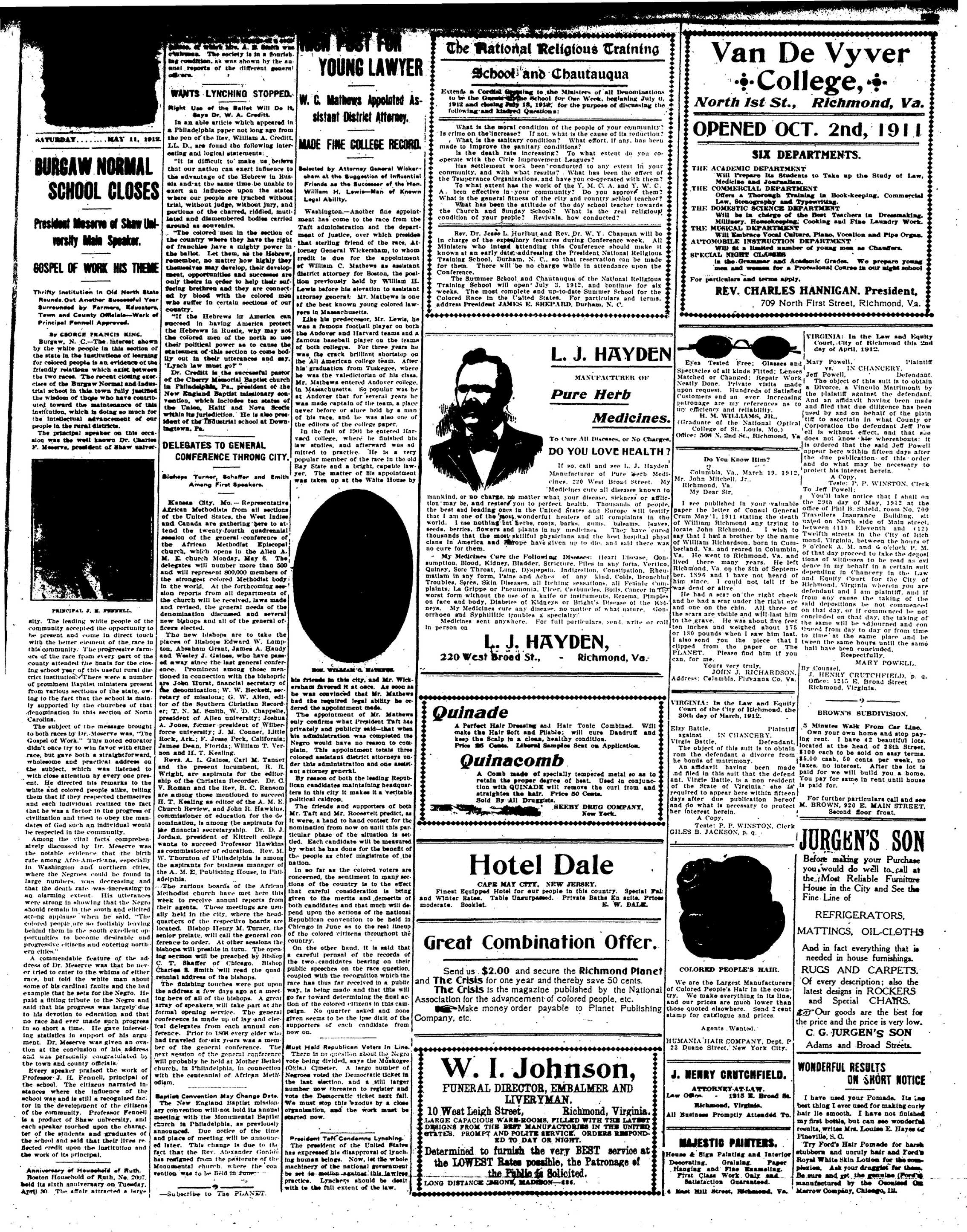
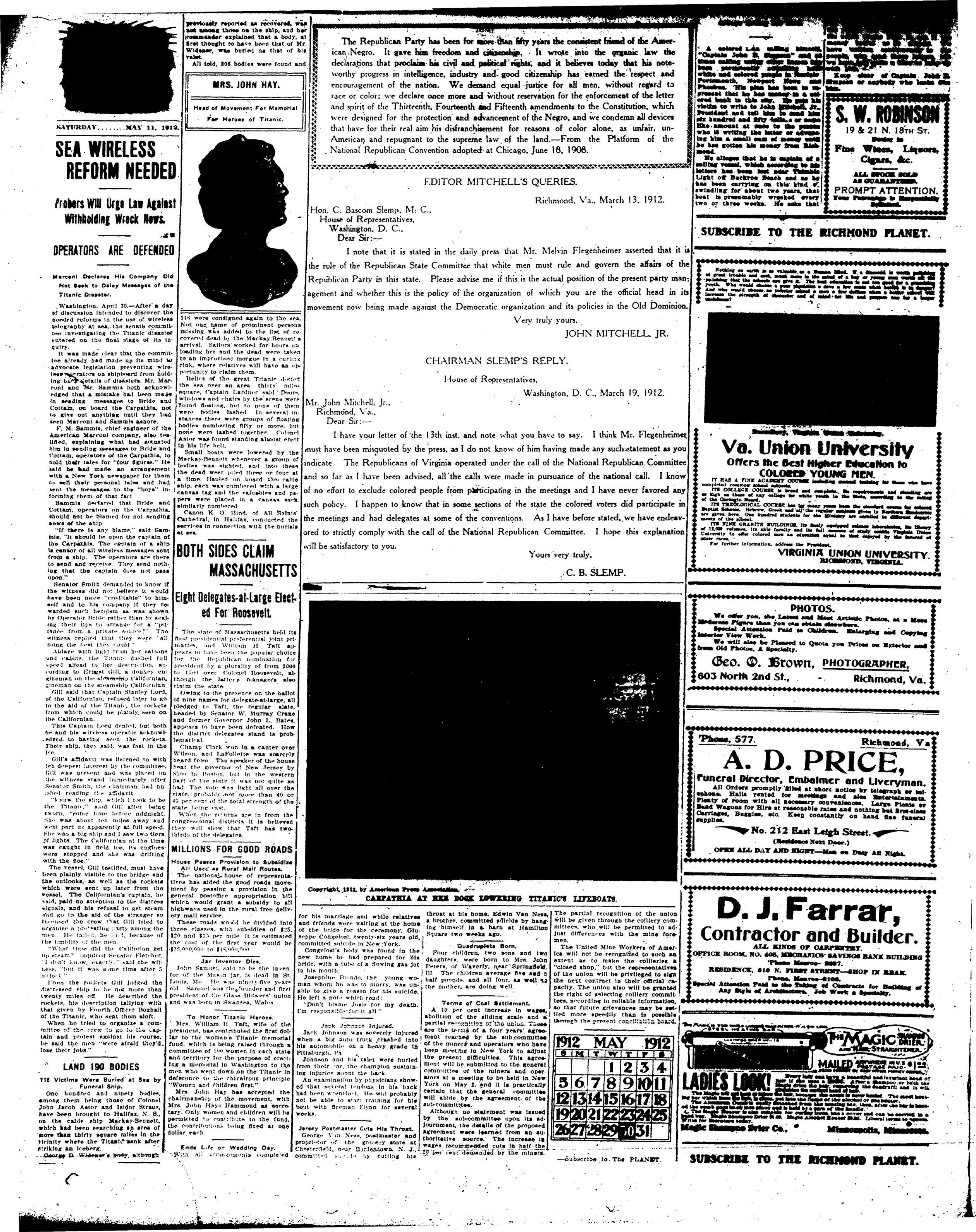

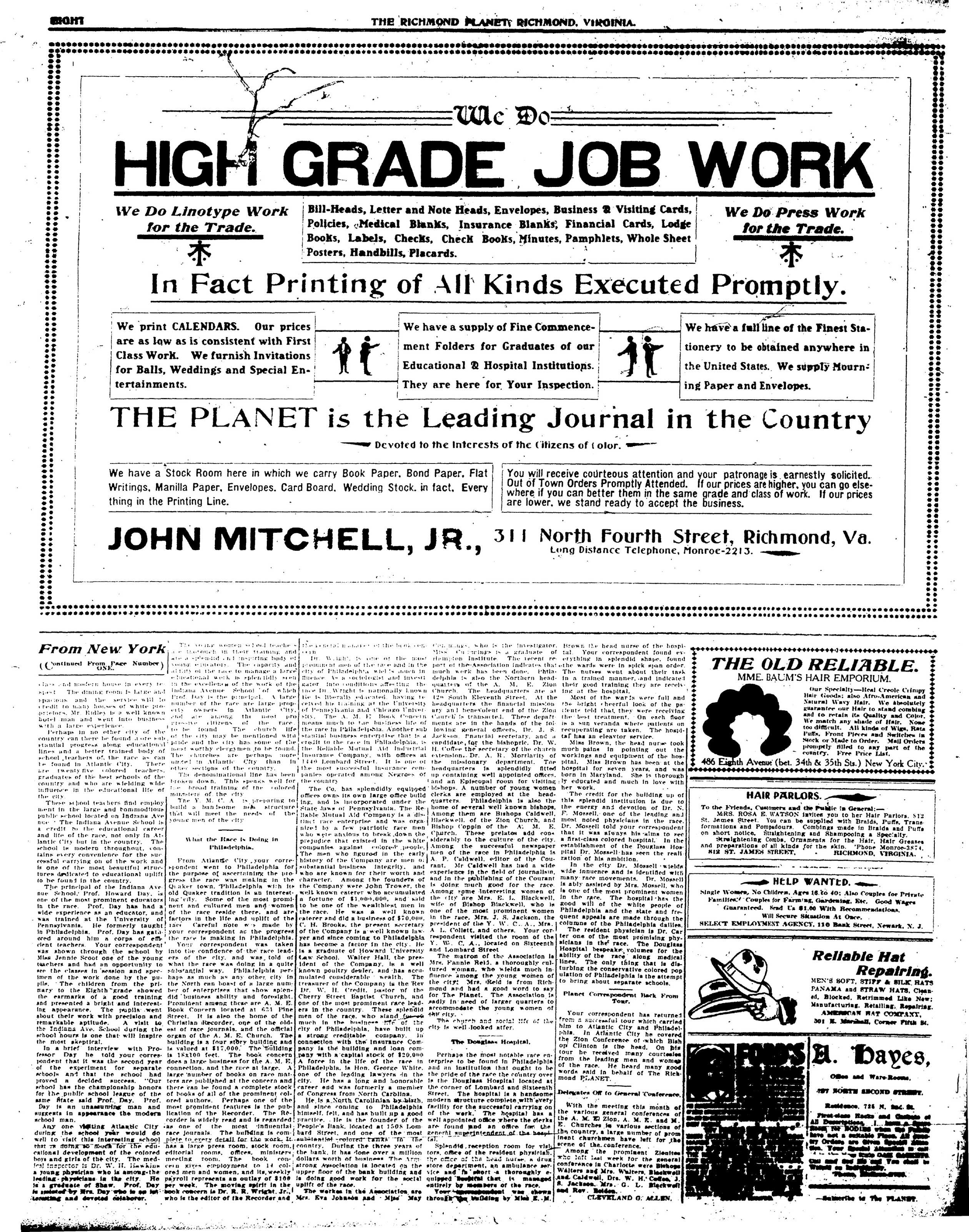
Page text (machine-generated)
Wife Returns Only to Leave Again—
Husband Obligate—On to the
Last Chapter.
"AND THE CAT CAME BACK."
The following clipping from the
Richmond., Va., News-Leader is the
sequel to the recital of marital
troubles as published in our last
issue.
VIRGINIA
In the Law and Equity Court of the
City of Richmond, May 1, 1912.
George W. Bragg ..... Plaintiff
vs.
Lula Pearl Bragg ..... Defendant
(In Chancery.)
The object of this suit is to obtain
a divorce, a vinculo matrimonii by
the plaintiff from the defendant
upon statutory grounds.
And an affidavit having been made
and filed that due diligence has been
exercised by and on behalf of the
plaintiff to ascertain in what county
or corporation of this State the def
dendant is without effect, it is
ordered that she appear here within
fifteen days after the publication of
this order and do whatever is neces-
sary to protect her interest in this
suit.
A copy—Teste:
P. P. WINSTON, Clerk.
J. R. Pollard, p. q.
On last Tuesday morning, a carriage stopped at the door of the thoroughly distracted husband and the cringing wife alighted and entered the home which she had previously deserted. The scene which followed has not been described. That steps were taken to have her leave now admits of no question.
WILL BE A MAN.
It is reported that the husband says that he intends to be a man. He spent Tuesday night at the residence of his brother, so it is said. Wednesday, another carriage was before this same door and the wife was soon in it en route to the depot. Some say that she was sent to her mother in Roanoke, Va. She wanted to take her child with her, but this privilege was denied. The husband's most serious charge against her, that which aroused him almost to a frenzy was the fact that she had deserted her child, that she did not even tell it goodbye.
THE QUESTION OF AN OPINION.
So ends the second chapter in this remarkable case. The third and last chapter will, soon be a matter of record. Whether the husband will hold out in his determination, "not to take her back" is a mooted question. The facta in the case have created a sensation and as is usual in such cases "outsiders" are apparently as much interested in the case as are those directly connected. But then "tis his and her business" and right here we let the subject rest.
The True Reformer Trials
The May term of the Huntingts Court of this city began last Monday with Judge R. H. Wells presiding. The cause of the indicted ex-officials of the Savings Bank, Grand Fountain, U. O. True Reformers were not set for trial.
It is not known definitely when they will be taken up again. It is the intention of the prosecution led by Commonwealth's Attorney Mine-tree Folkes to press the indictments at an early date.
It is now stated that on the first ballot of the jury which heard the evidence in the case of ex-Grand Worthy Secretary W. P. Burrell, seven were in favor of acquittal and were for conviction.
COMMENCEMENT WEEK AT VIRGINIA UNION UNIVERSITY.
Commencement week at the University promises to be of more than usual interest this year. The classes to graduate are decidedly above the average. The College Class, though small in numbers is exceptionally strong in character and scholarship. It has done more work in several subjects than any class before it. The Theological Class is both large in numbers and excellent in ability. One half of its numbers are B. A. men, and others will be men of note. The Academy Class is one of the largest, perhaps the largest ever graduated from the school. The Academy graduating class has increased in twenty years from four to above twenty. The exercises of the week will be as follows:
Thirteenth Annual Commencement of the University and Forty-seventh Anniversary of the School.
Sunday, May 12, 3:30 P. M., Baccalaureate Sermon before Hartshorn Memorial College and Virginia Union University in Coburn Hall, by Rev. A. A. Graham, B. D., Phoebus, Va.
Monday, May 13, 8:15 P. M., Graduting Exercises of the Academy.
Tuesday, May 14, 3:00 P. M., Business Meeting of Alumni Association.
6:00 P. M., Annual Dinner of Alumni, former Students and friends.
Wednesday, May 15, 10 A. M., Meeting of Social Study Club. Paper on the Conservation of Negro Children, by Prof. J. M. Gandy, A. M. Peterburg.
8:15 P. M., Commencement.
All friends are invited to be present. The University will provide board and lodging as far as possible for those who come from 4 distances.
JOHNSON-WILLIAMS
A prominent wedding of the year took place at 1:30 o'clock on Wednesday night, the 17th of April, when Mrs. E. J. Williams became the bride of Mr. D. W. Johnson. The ceremony was performed by Rev. Z. P. Lewis and was followed by a reception at Mrs. Harrison's, 1203 N. First Street. Mrs. Williams has long held a prominent position with the St. Luke's of Richmond, and also Deputy of same order. Mr. Johnson is one of Richmond's most energetic men, and has long been in the livery service catering to the public. After the wedding they were joined by the family and a limited number of friends.
Marriage Announcement
You are cordially invited to attend the marriage announcement of Miss Maria Banks to Mr. James H. Barrett Tusaday. May the fourteenth, nineteen hundred and twelve from 8 to 11 P. M. at 525 North Third Street, Richmond, Virginia. Friends are invited. No cards.
—Rev. R. G. Adams of Farmville Va. called on us. He was enroute to the General Association meeting at Norfolk, Va.
—Major B. F. Jackson, Third Bat tailon, Second Regiment, K. of P., of Virginia who has been confined to his room for three weeks with a sprained ankle is able to be at his post again.
It would be well for Anna King and Drucilla Thomas, the daughters of Royal Smith, deceased, who formerly lived in Heartico Co., Va. to communicate with Giles B. Jackson, Attorney-at-Law, 511 N. Second-St. Richmond, Va., as there are matters in Virginia which are of great interest to them and need their im mediate attention.
—The Rev. R. J. McCray, D. D. of Newport, Ky. is visiting Richmond and old friends, and preached at 6th Mt. Zion Baptist Church, Rev. R. V. Peyton, D. D. Pastor at morning service and served for the Dr. Manuel of the Fifth St. Baptist Church on Sunday night.
—We learned with downright regret of the death of our friend and loyal supporter of The Planet, Mr. Henry Adams of Washington, D. C. He died March 19, 1912. He was always urging the payment of the depositors of the defunct Freedmen's Savings Bank and went to his reward before realizing the full extent of his efforts of many years.
Rev. Dr. W. F. Graden was in the city this week on route to the session of the Virginia Baptist State Convention at Salem, Va.
Your truly,
Mr. Hodges Manny.
George W. Lyons, of Negro Descent
Prefers to Pose an White.
"Oh, Miss Liza Green, you has never
seen
A culled gent dat has changed like me.
Now we can happy be mornin', noon and 'night.
George Primrose, the minstrel, used to sing that refrain with great success a few seasons ago. It was the chorus of a ballad which told the story of an ambilious "culud" swain who went to the skin doctors for treatment because his yaller gall had spurned his attention, he being shades darker than she.
With a skin as fair as the light olive complexion of a Neapolitan, hair as straight and black as an Indian's, finely chiseled features and a well-knit, athletic figure that might well stir the envy of a grand opera tenor, George W. Lyons, formerly of Richmond, now about 45 years old, will pass for a white man anywhere his antecedents are unknown.
That's why the lawyers and others
You are truly,
Mr. Hudgins
Governor Mann at the Auditorium.
Governor William Hodges Mann delivered an able address at the City Auditorium to a large and enthusiastic audience. He was introduced by Rev. D. W. Davis, D. D. His Excellency is a fine orator and his method and manner won the spontaneous approval of those who had assembled to hear him. His popularity among the colored people has been one of the features of these much needed lectures and the mention of his name causes the multitude to stop and listen and voice
Interested in the singular case of George W. Lyons advance the theory that George is wilfully and presumably running away from his heirship to an estate here worth more than $10,000.
They do protest that George is objectionable by vanity greater than $10,600 and that he is hiding behind his vanity.
They say they have reason to believe that George, who is the son of a full-blooded negro woman, Mary Susan Lyons by name, and the daughter of a plantation negro slave, is aware of the value of the estate, but has been recognized as a white man on the Pacific coast; and rather than to acknowledge his real identity and surrender his social standing, will allow the estate to sequester to the commonwealth of Virginia.
ESTATE IS IN RICHMOND.
The estate includes the house and lot at 310 North Third Street. The facts in the unusual race have come to light through condemnation proceedings brought by City Attorney Pollard to acquire for the city an alley way from Second to Third street, between Broad and Marshall. The house was until recently the home of the Ven de Ven Clube, a negro social club.
- The title of the condemnation suit
which has been entered in the hustings court, is "City of Richmond against Mary Brown Lyons, etc." Another suit is pending in the chancery court under the title of Crubbe and Williams against George W. Lyons."
Had not Lawyer Alfred E. Cohen brought out evidence by a search of court records dating back as far as 1850 to complicate matters the property involved would have been surrendered to the State in all probability, without challenge. As the situation now stands the case is taking unexpected turns. Mr. Cohen, who is acting as counsel for some of the interested parties, having dug up from musty records evidence. Richmond, Va. News Leader
Richmond, Va., May 3, 1912.
To the Public:
At a regularity the meeting of
the Richmond A. M. Social Club,
Mr. E. A. Ranger has appointed
Manager, vice chitman M.
White who declares on account of
business.
W. C. H. President.
W. H. ANDERSON Secretary.
July,
Edgar Mansy.
words of commendation and utterances noted for their wisdom and devoid of any objectional sentiments which would tend to linger in the mind after the speaker has returned to his usual field of labor.
The distinguished official is still upon the mission, the purpose of his life to go and speak in order that he may "do some good."
General Secretary S. C. Burrell has been instrumental in ynishing the public with many literary treats but the Y. M. C. A. was at its best when it again secured the services of the distinguished Chief Executive of the Old Dominion.
Nunnah's Happening
Susan, April 29.--Lily Saturday
Miss Evans of Boston, who attended
the Hampton Anniversary took a
trip through our neighborhood. Miss
Evans is a well cultured Northern
lady and through the assistance of
Mrs. Hudgins our school teacher,
she gave a very nice talk in our
school house to both parents and
children at 1:30 P. M.
Yesterday, being a big day at one
of our neighboring churches.
The Ashermen are all shouting
since big school of circus or
hard head of circus
Mr. Joseph Dean was the guest of
Mr. and Mrs. Frank Brown last even
ing.
If you want to catch the news,
subscribe to The Richmond PLANET
F. E. BROWN.
WANTED—I have a great demand for renting property. If you have any vacant property, or any that you expect to be vacant, communicate with me at once. B. A. CEPHAS, 602 N. Second Street.
FOR RENT—A few small houses of three rooms each. Clearing rent. Apply to B. A. CEPHAS 602 N. Second Street.
DRAKES BRANCH, VA. NEWS
Robert Green, son of Clem Green died of heart failure in Allbush, VT and his body was shipped here for burial Saturday. He was employed in the Pullman service of the Rutland R. R. Co. operating between Ogendisg, N. Y. and Chicago, Ill. which position he held for 18 years. Flave and Clem, Jm. brothers of the deceased attended the funeral. The latter is employed by Mrs. N. V. Randolph of Richmond, Va. Mr Clem Green will leave Saturday for Allbush, Vt. to look after his son's belongings.
An affray between Joe McCargo and Sam Taylor Tuesday in which McCargo proved himself a real Jack Johnson was aired today before Magistrate M. A. Tucker, Joe paying the cost of court. It seemed that Taylor had plowed too close to some fruit trees belonging to McCargo and when he refused to hear, McCargo as quick as a flash, sent a left hand swing to Taylor's head. The punch was so effective that Taylor was glad to fall, but his memory was not very good afterwards. Joe remembered a woman pulling him off Sam but was sorry Sam made him do it. McCargo is $2.00 poorer by having such a wild fort.
Mrs. Pollie Bedford is much indsposed at this time.
True man was found against Real Brothers of Charlotte Courthouse. Monday for illegal selling of liquor but they could not be found and are believed to have left for parts unknown. Mrs. Fannie Fore is here visiting her sick mother. She continues quite ill. Eddie Hicks of Sparrows Point is visiting his father at Charlotte C. H. A new restaurant has opened on Main Street, Organ Hill. Miss Alice Susie ad Annie Sheperson welcome friends to their new business.
WHO WILL IT BE ROOSEVELT OR TAFT?
It is claimed that Rosevelt is in the leaf and a man that can lead the people will win.
We are in the lead in men's, boy's and children's suits, underwear, hats and caps, single pants, etc.
Men's suits from $5.00 to $18.00, already in stock. Boy's and children's suits from $1.00 to $7.50, in sizes up to 18. We have boy's knee pants up to 18 size, prices 50 cents to $2.00 per pair.
We defy competition in our 25 and 50 cents underwear for boys and men. We also make clothing to order, the only guarantee is "no fit, no take," from $15.00 to $45.00 per suit.
So you have no excuse for not trading with us. The only excuse may be is that we are colored people.
L. J. MILLER, Prop...
209 N. Second St.
Just around the corner from Broad
Colored Minstrels Elect Officer.
At a meeting of the Colored Amateur Minstrels, held Tuesday night, May 7, 1912, the following officers were elected:
S. W. Robinson, Jr., Business Manager; Chitman M. White, Property Manager; Frank Mayo, Stage Manager; Charles G. (Gipiyi) Smith, Leader of Orchestra; J. Wilmer Turner, Treasurer.
The show given at the Academy last week was a tremendous success. The minstrel will tour the Eastern section of the State, soon.
Removal Notice.
Mrs. M. E. Burrell has removed her Beauty Parlors from Room 304 Mechanica' Bank to No. 34 West Leigh Street, where she will be pleased to continue to serve her many friends and customers.
$30,000 To Erect Colored Memorial League Hospital.
The Ladies' Auxiliary of the League Hospital have organized and started a campaign to raise $20,000 to erect a colored hospital for the benefit of the colored people The Ladies of this Auxiliary are holding meetings at the offices of Dr. R. E. Jones, 533 N. 2nd St. and W. I. Johnson, 10 W. Leigh St.
To those who wish to contribute to the cause or take an active part can get information at these places. From May 20th to 28th a station will be at 1205 E. Main Street to receive contribution. The hospital will be known as the League Memorial Hospital.
MRS. BALLIE LINDSAY, Prost.
MRS. PANNIE OLIVER, Stew.
From New York
Dr. Washington Speaks at Notable Meeting of the Men and Beloved Forward Movement.—Nored Educator says Mission of the Church is to Keep the Negro Where He Has the Best Chance.—Says Negro is at his Worst in Cities.—Speaks along with ex-Governor Northern of Georgia.—Carnegie Hall Packed with a Large Representative Audience.—Tankerhouse Gets Oration. What the Race is Doing in Atlantic City and Philadelphia.—Signs of Progress Seem.—Douglas Hospital in Philadelphia a Credit to the Race.—Observations Made by the Planet Correspondent while Visiting these Cities.—Delegates off to Various General Conferences. Planet Correspondent Back from Successful Tour.—General News.
(Allen's National News Bureau,
252 West 53rd Street.)
Dr. Booker T. Washington, the noted educator, who has spoken be fore large and representative audiences both in America and in Europe on many important occasions, addressed a large audience that packed the capacity of Carnegie Hall Sunday afternoon, April 21st, under the auspices of the Men and Religion Forward Movement.
Dr. Washington in a most thrilling address that rang out over the beautiful auditorium and that brought forth frequent applause from the large audience told of the Negro's place in the great religious movements of the world" urged that the Negro combine practical ideas with Christianity, and said one of the duties of the church is to help keep the Negro where he has the best chance. Dr. Washington spoke along with ex-Governor Norton of Georgia and shared in the honors of the meeting.
Dr. Washington spoke as follows:
"The Negro problem is to a very considerable extent the problem of rural life. So long too as the Negro in the rural districts is fed upon the old worn out theological dogmas, instead of getting from the pulpit inspiration and direction in practical and progressive movement in for improvement of the home and community life, so long will be forsake the land and flee to the city."
Continuing, Dr. Washington said, "If we would save the Negro, 25 percent of whom, as I have said, live in the country, he must be taught that when the Bible says, 'The earth is full of thy riches,' it means that the earth is full of corn, potatoes, peas, cotton, chickens and cows and that these riches should be gotten out by the hand of men and turned into beautiful building and a rightous useful living.
"When I was in London, England recently," said Dr. Washington, "I found that the churches and other philanthropic agencies of that city alone were spending $50,000 annually, not to keep people on their feet and help them to make greater progress in positive constructive directions but to save the drunkard, the gambler, the loafer, the pauper and destitute after they had fallen in the ditch."
Speaking optimistically, Dr. Washinton said, "Happily the Negroes of America have not as yet fallen into the ditch, and I pray that as a result of this great Forward Movement a way may be provided through the Negro church and Sunday school, that the Negro, while it is yet a new, fresh and vigorous race, may as the old plantation hymn puts it, 'be kept from sinking down.' In the rural districts the Negro, all things considered, is at his best in body and mind and soul. In the city he is usually at his worst."
Closing his address, Dr. Washington said, "Plainly one of the duties of the church is to help keep the Negro where he has the best chance. From a money point of view it is much cheaper to keep men form falling than it is to lift them after they are down."
The address of Dr. Washington was one of the strongest heard before the meetings of the Forward Movement.
What the Race is Doing in Atlantic City.
Your correspondent has just made a short tour, taking in Atlantic City and Philadelphia. While visiting these cities he made careful observations as to the progress the race is making along educational, moral and business lines. In Atlantic City your correspondent was pleased to note that the race is making substantial progress and can boast of a splen tid and energetic body of colored citizens.
It was your correspondent's pleasure to meet the leading professional and business men and women of the city, many of whom are graduates of the best institutions, in the country, and who are making a name for themselves and the race. The race has entered all phases of business in Atlantic City, and is making a success in their endeavors.
There are several first-class released hotels owned and managed by
MAY 12 191
CAMBRIDGE, MA
PRICE, FIVE CENTS.
colored men, two well kept drug stores, two newspapers, a first-class modern public school, carried on by colored teachers and a colored prinicipal, a clothing store and a number of various enterprises like small shops, restaurants, etc.
Some of the most prominent race leaders in the country reside in Atlantic City and are factors in the life of the race. Among the prominent professional men of the race in Atlantic City who is making a high reputation in his chosen profession is Lawyer I. H. Nutter, who has an office in the Union Bank Building one of the best office buildings in the city.
Mr. Nutter has the rare distinction of practicing with one of the most prominent white jurists in the country, ex-Judge Crandall. Ex-Judge Crandall is a staunch friend to the Negro and has written and spoken much in the defense of the race.
Mr. Nutter is one of the most prominent lawyers in the city and has figured notably in many cases. He is a member of the Mayor's cabinet, being the first colored man of the race to be so honored. As a member of the cabinet Mr. Nutter advises the Mayor on all important matters coming up before him. This gives the race an unusual advantage in having a colored member of the Mayor's cabinet to look out for the interest of the race.
Mr. Nutter is prominent in all movements having for their alma the betterment of the race, as a political factor. He represented the colored people of Atlantic City in opposing the appointment of Judge Hook to the Supreme Court Bench. At the recent meeting of the colored voters convention at Atlantic City, April 17th. Mr. Nutter offered a strong resolution advising colored men of the race not to support any man for one who did not pledge support to the race.
In the city Mr. Nutter wields wide influence and is an inspiration to young men of the profession who have the energy to aspire. Mr. Nut has a wide acquaintance among the prominent men of the race, among them being Dr. Washington, of Tuskegee, who always stops at the residence of Mr. Nutter when he is in Atlantic City. Mr. Nutter is a graduate of Howard University Law school and went to Atlantic City several years ago to practice.
In the same building where the office of Mr. Nutter is located is the office of the Atlantic Advocate one of the strongest and most promising of our race journals. The editor of the Advocate is James A. Lightfoot, one of the best trained newspapermen of the race.
Mr. Lightfoot has worked on some of the leading dailies of the country, including the Washington Post, and has come in contact with some of the best trained white newspapermen of the country. This gives Mr. Lightfoot superior advantage in the management and conducting of his newspaper. Mr. Lightfoot is a force in the city and takes a keen interest in all matters pertaining to the political welfare of the race.
He was educated in the public schools of Cleveland, Ohio, the St. Paul Normal School of St. Paul, Minnesota and the Law School at Howard University. Mr. Lightfoot is putting his whole newspaper training into practical effect in the publishing of the Advocate.
T. S. Boone, who is the owner and publisher of the Atlantic City Messenger is also doing splendid work as a newspaperman.
One of the most creditable race enterprises in Atlantic City is the handsome drug store conducted by Dr. James Bourne at 1811 Arctic Avenue. Dr. Bourne is a young pharmacist who is making good in his line, and has easily one of the leading and most attractive drug stores in Atlantic City or in the country.
He graduated from Lincoln University in 1905 and later entered the Philadelphia College of Pharmacy from which he graduated in 1909. Shortly after graduation in the year 1909 he went to Atlantic City and opened a drug store. He has built up a good trade. Dr. Bourne is one of the most prominent men in the business and professional life of the city. The Hotel Ridley of which C. A. Ridley is the proprietor is a first-
(Continued on Page Number) EIGHT.
Mm. Hattle Brown Passed Away.
Toledo, Ohio, May 7.—Mrs. Hattie Brown of Amesberg, Ontario, a resident of 1887 and now of Toledo Ohio, departed this life May 5th 1912. She was well known for her active Christian work. Age. 54 years.
WANTED -- A Nicely Furnished
Room with Bath, for one or two
quat young men. Price reas-
onable. Call before 9 A. M., or be-
tween 1 and 2, or any hour after
5 P. M., 406 N. First Street,
Second Street.
P.
SYNOPSIS
John Cowlese of Virginia kisses his neighbor, Miss Grace R希伦, and meets Gordon Orma, a mysterious Englishman.
Cowlese whip a man for affronting Grace Orma challenges him to a wrestling bout to supervise contest follow, resulting in a fight.
The south is threatening to scare Cowlese, saves Grace from an infuriated ball and becomes engaged to her.
Cowlese' father, who is involved in a big land deal, is robbed and murdered. Cowlese starts west to see Colonel Merlwether, his father's partner in the deal.
In St. Louis he again meets Orma, and they are matched in a pigeon shoot. At an army ball Cowlese meets a masked girl named Ellen.
Cowlese, forgetting Grace, tells Ellen that he will be with her heart. He does not know her full name. The pigeon match begins.
Dencounting the brutal sport, Ellen Merlwether, stope the pigeon shooting match. She is Colonel Merlwether's daughter. Cowlese steamboat is wrecked. He receives Mandy McDovais and a girl.
Cowlese and Aubery, a plainman, move forward to find Merlwether. Blox are taken by Orma, Mandy, the girl and soldiers.
The girl is Ellen Meriwether. Cowles
child in love with her. Orme treacherous
shoots a Sioux chief.
The Sloux makes an attack. An arrow
penetrates Cowies' neck. Orme, with
Cowies' consent, cuts out the arrowhead,
saving Cowies' life.
Orme, whom Ellen has learned to dislike,
displays wonderful power as a magician.
Ellen seeks Cowies' company.
She distrusts and avoids Orme, who
tells Cowies he proposes to marry her.
The men become open enemies.
Cowies and Ellen become separated from
their party and are lost. Indians near by
alarm them. Cowies becomes ill.
Ellen nurses him and shoots a buffalo
for food. Cowies slowly gains strength,
and his love for Ellen grows.
Day and night they are together. He
tells her of his love, but she holds him at
a distance.
The Betrothel
STRENGTH came to us as we had need, and gradually even the worker of us two became able to complete the day's journey without the exhaustion it at first had cost her. Summer was now upon us, and the heat at midday was intense, although the nights, as usual, were cold. Deprived of all pack animals except our dog, we were performed to the lightest of gear, and discomfort was our continual lot. Food, however, we could still secure, abundant meat and sometimes the roots of plants which I dug up and tested, though I source knew what they were. We moved steadily on toward the west and northwest, but although we crossed many old Indian trails, we saw no more of these savage travelers of the plains.
It would be hoofless to pass beyond Larame into the mountains, and our next course, I thought, must be toward the south. I did not know that we were then perhaps a hundred miles or more northwest of Larame, deep in a mountain range far north of the transcontinental trail. For the time, however, it seemed to tarry here for rest and recruiting. I threw down the pack. "Now," said I to her, "we rest." Yes, she replied, turning her face to the south. "Larame is that way now. If we stop here my father will come and find us. But, then, how could he find us, little as we are, in this big country? Our trail would not be different from that of Indians even if they found it fresh enough to read. Suppose they never found us!" "Then," said I, "we should have to live here forever and ever." She looked at me curiously. "Could we'r she asked.
"Until I was too old to hunt, you too weak to sew the robes or cook the food."
"What would happen then?"
"We would die," said I. "The world would end, would have to begin all ever again and wait twice ten million years until man again was evolved from the amoeba, the reptile, the ape. When we died, this dog here would be the only hope of the world."
It was understood that we should stay here for at least two days, to mend our clothing and prepare food for the southern journey. The next day she came to me as I eat by our meager fireplace. Without leading of mine she began a manner of speech until now foreign to her.
"What is marriage, John Cowles? The asked of me, abruptly, with no pretense."
"It is the plan," I answered appetitiously, also pondered for a time.
THE WAY OF A MAN
Copyright, 1997, by the Guild Publishing Company
pets, toys?
"Yes." I said to her. "A man is a joy. Love was born before man was created, before animals or plants. Atom ran to stom, sucking. It was love." She pondered yet a while.
"And what is it, then, John Cowles,
that woman call 'wrong'?"
"Very often what is right." I said to
her, apathetically "When two love
the crime is that they shall not wed
When they do not love, the crime
when they do wed."
"But without marriage," she best
tated, "the home"
"It is the old question," I said. "The
home is built on woman's virtue, but
virtue is not the same where there is
no home, no property, where there is
PABLO PICASSO
"What is marriage, John Cowles?" she asked of me.
no society. It is an artificial thing, learn of compromise, and grown strong et by custom of the ages of property owning man."
I saw a horror come across her eyes.
"What do you say to me, John Cowles? That what a woman prize is not right, is not good? No, that I shall not think!" She drew apart from me.
"Because you think just as you do. I love you," I said.
"Yet you say so many things. I have taken life as it come, just as other girls do, not thinking. It is not piece, it is not clean, that girls should study over these things. That is not right."
"No; that is not right," said I dully.
"Then tell me what is marriage, that one thing a girl dreams of all her life Is it of the church?"
"It is not of the church," I said.
"Then it is the law."
"It is not the law," I said.
"Then what is it?" she asked. "John Cowles, tell me what makes a wedding between two who really and truly love." Can marriage be of but two?"
"Yes," said I.
"But there must be witnesses, there must be ceremony, also there is no marriage," she wept on. Her woman's brain clung to the safe, sane groove which alone can guide progress and civilization and society—that great cruel, kind, imperative compromise of marriage without which all the advancement of the world would be as naught. I loved her for it. But for me, I say I had gone savage. I was at the beginning of all this, whereas it remained with her as she had left it.
"Witnesses?" I said. "Look at those." I pointed to the mountains. "Marrigues, many of them, have been made with no better witnesses than those."
My heart stopped when I saw now far she had jumped to her next speech. "Then we (we are all the people left in the world, John Cowles). When I am old will you cast me off? When another woman comes into this valley, when I am bent and old and cannot see, will you cast me off and, being stronger than I am, will you go and leave me?" I could not speak at first. "We have talked too much. I said to her presently. But now it was she who would not desist. "You see, with a woman it is for better, for worse, but with a man"— "With a Saxon man." I said, "It is also for better, for worse. It is one woman." She sat and thought for a long time. "Suppose," she said, "that no one ever came."
Now with swift remorse I could see that in her own courage she was feeling her way, haltingly, slowly, toward solution of problems which most women take ready soiled from others. But, as I thank God, a filmy soft, softening, refining, always lay between her and reality. In her intentions she laid hold upon my arm, her two hands clapping.
"Suppose two were here, a man and a woman, and he wore before these strangers whatness that he would not carry any thing she was dead."
and laid away up in the room to cry away and blow off into the air and go back"—
"Into the flowers." I added, checking.
"You, into the trees and the flowers,
so that when she was dead and he was dead and they were both gone back into the flowers, they would still know each other forever and ever and never be ashamed—would that be a marriage before God, John Cowlese?"
What had I brought to this girl's creed of life, herefore always no sweet and usual? I did not answer.
She shook at my arm. "Tell me," she said, but I would not tell her.
"Suppose they did not come," she said once more. "It is true, they may not find us. Suppose we two were to live here alone all this winter, just as we are now, some of my people or yours near us. Could we go on?"
"God! Woman, have you no mercy!"
She sat and pondered for yet a time as though seriously weighing some question in her mind.
"But you have taught me to think,
John Cowley. It is you who have begin my thinking, so now I must think.
I know we cannot tell what may happen.
I ask you, John Cowley, if we brought to that state which we both know might happen—if we were here all alone and no one came, and if you me-ah, then would you promise forever and forever to love me till death did us part—till I was gone back into the flowers? I remember what they say at weddings. They cling one to the other, foraking all others, till death do them part. Could you promise me in that way? Could you promise me, clean and solvent?
Because I would not promise you unless it was solvent and clean and unless it was forever."
"It seemed that I saw into her heart,
I dropped my hands from my eyes and
looked at her strangely, my own brain
in a whirl, my legic gone. All I knew
was that then or elsewhere, whether
or not rescue ever came for me, whether
we died now or later, there or any-
where in all the world, I would, indeed,
love her and her only, forking all
others until, indeed, we were gone
back into the sky and flowers, until we
whispered again in the froes, one unto
the other. Marriage or no marriage,
together or apart, in darkness or in
health—so there come to me the stern
conviction love could knock no more
at my heart, where once she had stood
in her courage and her cleanness. Rey,
erence, I say, was now the one thing
left in my heart. Still we sat and
watched the sun shine on the distant
white topped peaks. I turned to her
slowly at length.
"Ellen," I said, "do you indeed love me?"
"How can I help it, John Cowles?" she answered bravely. My heart stopped short, then raced on, bursting all control. It was long before I could be calm as she.
"You have helped it very long," I said at last quietly. "But now I must know. You would love me anywhere, in any circumstances, in spite of all I am grateful, you because you are, You not because you are here. I must be loved in the same way always."
She looked at me now silently and I leaned and kissed her full on the mouth.
She did not rob or draw away, but there was that on her face, I say, which left me only recept. Her hand fell into mine. We sat there plighted, in our rags and misery and want and solitude. Though I should live twice the allotted span of man never should I forget what came into my soul that hour.
After a time I turned from her and from the hills and from the sky and looked about us at the poor belongings with which we were to begin our world. All at once my eye fell upon one of our lighter robes, now fairly white with much working. I drew it toward me, and with her still leaning against my shoulder I took up a charred stick, and so laboriously I wrote upon the surface of the hide these words of our covenant:
"I, John Cowies, take thee, Ellen Meriwether, to be my lawful wedded wife, in sickness and in health, for better or for worse, till death do us part."
And I signed it and made a seal after my name.
"Write," said I to her; "write as I have written."
She took a fresh brand blackened at the end and in lesser characters wrote slowly letter by letter:
"I, Ellen Meriwether, take thee, John Cowles, to be my lawful, wedded husband"—She paused, but I would not urge her, and it was moments before she resumed—in sickness and in health, for better or worse." Again she paused, thinking, and so concluded, "till death do us part."
"It means," she said to me simply as a child, "until we have both gone back into the flowers and the trees."
I took her hand in mine. Maybay book and bell and organ peal and vestured choir and high ceremony of the church may be more solemn, but I, who speak the truth from this very knowledge, think it could not be.
"When you have signed that, Ellen," I said to her at last, "we two are man and wife, now and forever, here and any place in the world. That is a binding ceremony, and it endows you with your share of all my property, small or large, as that may be. It is a legal wedding, and it holds us with all the powers the law can have. It is a contract."
"Do not talk to me of contracts," she said. "I am thinking of nothing but our—wedding."
Still mystical, still enigma, still man, she would have it that the stars, the mountains—the witnesses—and not ourselves, made the wedding. I left it so, sure of nothing so much as that, whatever her way of thought might be, it was better than my own.
"But if I do not deny this," she ask.
"But if I do not sign, this?" she ask
ed at length.
"Then we are not married."
She sighed and laid down the pen
"Then I shall not sign it-yet," she said.
I caught up her hand as though I
would write for her.
"No," she said; "it shall be only our
engagement, our truth between us,
this will be our way. I have not put
from sufficiently wound. John Cousin* I looked up her hair and it seemed to me I saw there something of the game light I had seen when the war the madness exquisite of the army ball—the yawning, the melancholy, the suspicion, the challenge, the invitation and the doubling—ah, she will say what there is in a woman's eye. But I saw also what had been in her eyes each time I had seen her since that hour. I left it so, knowing that her way would be best.
"When we have escaped," she went on, "if ever we do escape, then this will will be our truth, will it not, John Cowley." "Ten, and our marriage when you have signed, new or any other time." "But if you had ever signed words like these with any other woman, then
RADKER
Again, she paused, and so concluded
"Till death do us part."
It would not be our marriage nor our
troth, would it, John Cowles?
"No." I said. And then I felt my
face grow nasty cold and pale in one
sudden breath:
"But why do you look so sad?" she
asked of me suddenly. "Is it not well
to wait?"
"Yes, it is well to wait," I said. She
was so absorbed that she did not look
at me closely at that instant.
Again she took up the charred stick
in her little hand and hastened. "See?"
she said. "I shall sign one letter of my
name each week until all my name is
written." Till that last letter we shall
be engaged. After the last letter, when
I have signed it of my own free will
and clean and solemn-clean and solemn John Cowles—then we will be
Oh, take me home—take me to my father, John Cowles! This is a hard
place for a girl to be!
Suddenly she dropped her face into
her hands, sobbing.
She bid her head on my breast, now Mistressed now. She was gidd that she might now be more free, needing a manner of friend, but she was still-what? Still woman? Poor Saxon I must have been had I not sworn to love her severely and singly all my life. But yet—
I looked at the robe, now fallen loose upon the ground, and saw that she had affixed one letter of her name and stopped. She smiled wanly. "Your name would be shorter to sign a little at a time," she said, "but a girl must have time. She must wait. And see." she said. "I have no ring. A girl always has a ring."
This lack I could not solve, for I had none.
"Take mine," she said, removing the ring with the rose seal. "Put it on the other finger—the right one."
I did so, and I kissed her. But yet-
She was weary and strained now. A pathetic doop came to the corners of her mouth. The palm of her little hand turned up loosely as though she had been tired and now was resting "We must wait," she said, as though to herself.
But what of me that night? When I had taken my own house and bed beyond a little thicket that she might be alone, that night I found myself breathing hard in terror and dread, gazing up at the stars in agony, benting my hands on the ground at the thought of the ruin I had wronged, the crime that I had done in gaining this I had sought.
I had written covenants before! The strength and sweetness of all this strange new life with her had utterly wiped out my past, had put away as though forever the world I once had known. Until the moment Ellen Meriwether began the signing of her name I swear I had forgotten that ever in the world was another by name of Grace Rebecca. I may not be believed—I cannot not to be believed—but this is the truth, and the truth by what measures my love for Ellen Meriweth or was bright and fired, as much as my promise to the other had been ill advised and wrong.
Far rather had I been beneath the soul that moment, for I knew, since I loved Ellen Meriwether, she must not complete the signing of her name upon the scroll of her covenant!
The Lost of Paradise
THE question of food over grows for settlement, and early the peas morning I put out upon a short exploring expedition There were trot in our little moon tain stream, and although we had no books or linen, I managed to take a few of those in my hands, chasing them under the storm. I shook the bullet porch at my bolt and found it light. We had barely two down bollers out, and row hatters would promise themselves over a down bolt of big game for twice as many shoots. I can about me in search of red cedar that I might make a bow. I searched the yellow thicket for arrow shirts and
grew up among little kids and peel all clothes on the shores of our ocean swimming arrow pebbles. In family appeared to me that we might not have for a time and be shady to make a living in some way. Then, as I was obliged to admit, we would need to hurry on to the southward. But again she had its way with me, setting aside all plans. When I returned to our campment, instead of seeing Ellen come out to meet me as I expected, I found her lying in the shade of the little tapes.
"You are hurt!" I cried. "What has happened."
"My foot," said she, "I think it is broken!" She was unable to stand Walking along the steep creek bank she had slipped, and her manoeuvred foot, caught in the narrow crack between two rocks, had been held fast as she fell forward.
So now it was my turn to be surgeon. Tenderly as I might, I examined the foot, now badly swollen and rapidly becoming discolored. In spite of her protest, although I know it hurt me more than herself, I foxed the joints and found the ankle at least safe. Alas! A little grating in the smaller bones, just below the instep, told me of a fracture.
"Ellen," said I to her, "the foot is broken here—two bones, I think, are gone."
She sank back upon her robe with an exclamation as much of horror as pain.
"What shall we do?" she murmured. "I shall be crippled; I cannot walk. We shall perish."
"No," I said to her; "we shall mend it. In time you will not know it has happened." Thus we gave courage to each other.
Now, when she was thus helpless and suffering, needing all her strength, how could I find it in my heart to tell her that secret which it was my duty to tell? How could I inflict upon her a still more poignant suffering than this physical one? Each morning I said to myself: "Today, if she is better, I will tell her of Grace Sheraton. She must know." But each time I saw her face I could not tell her.
Each day she placed a clean white pebble in a little pile at her desk. Presently there were seven.
"John Cowley," she said to me that morning, "bring me our writing, and bring me my pen. Today I must sign another letter." Aud, amiling, she did so, looking up into my face with love showing on her own. Had the charcoal been living flame and bad she written on my bare heart she could not have hurt me more.
On the fifth week she called once more for her charcoal pen and signed the last letter of her Christian name. "See, there," she said; "it is all my girl name, E-ll-en." I looked at it her hand in mine. "Ellen!" I murmured. "It is all nature enough, because you are the only Ellen in the world." But she put away my hand gently and said, "Wolf." She asked me now to get her some sort of cut branch for a crutch, saying she was going to walk. And walk she did, though resting her foot very little on the ground. After that daily she went farther and farther, watched me as I gudded for trout in the stream.
aided me as I picked berries in the thickets, helped me with the deer I brought into camp.
"You are very good to me," she said,
"and you hunt well. You work. You
are a man, John Cowles. I love you."
But hearing words so sweet as these
to me, still I did not tell her what
secret was in my soul. Each day that
other world seemed vaguer and farther
away.
Each day, too, it seemed less worth
while to speak. Now I could not endure the thought of losing her.
One day we wandered in a dense
berry thicket, out of which rose here
and there chokecherry trees, and we
began to gather some of these sour
fruits for use in the penniman which
we planned to manufacture.
All at once our dog began to growl and erect his hair, sniffing not at the foot scent, but looking directly into the thicket just ahead. He began then to bark, and as he did so there rose, with a sollen sort of grunt and a champing of jaws like a great hog, a vast yellow-gray object, whose head topped the bushes that grew densely all about. The girl at my side uttered a cry of terror and turned to run as best she might, but she fell and lay there covering.
The grizzly stood looking at me viciously with little eyes, its ears back its faws working, its paws swinging loosely at its side, the claws white at the lower end, as though newly sharpened for plangering. I saw then that it was ingested by the sight of the dog and would not leave us. Each moment I expected to bear it crash through the bush in its charge. Once down in the brush, there would be small chance of delivering a fatal shot, where now, as it swung its brood head slightly to one side, the best possible opportunity for killing it present itself immediately. Without hesitation I swung up the heavy barrel and drew the small silver head directly on the base of the car where the side bones of a bear's head are datter and thinner, directly alongside the brain. The vicious crack of the rife sounded loud there in the thicket, but there came no answer in response to it have a crashing and slipping and a breaking down of the bush as the vast carcass fell at full length. The little ball had done its work and found the brain.
We were two avengers, successful now in the chase-successful, indeed, in winning the capital price of all avengers, for few Indians will attack the grimity it can be avoided. She laid her hand wonderingly upon the barrel of the rife, looking at it curiously, that it had been so deadly as to stay a crew ture as vast as this. Then she bounced contentedly against my side, and as we ant there for a time, "John Gowan," she said, "you are very much a man I am not afraid when you kill me." I put my arm about her. The world seemed wild and fair and sweet to me. Life, avenger, storm, through all my valuation. We were very badly engaged in running up the unchained grimity, when all at once
we stepped and looked in each other in clothes. We had heard a sound. To me it sounded like a mite shot. We thinned. It came again, with many others. There was a valley of several sheens, sounds certain beyond any number of question. Her eyes were huge and started. I caught her bloody hand in my bloody one, and for an instant I believed both me and the flight deeper into the wilderness.
"It may not be any one we know," I said. "It may be Indian."
"No," said she. "It is my father. They have found me. We must get John—she turned toward me and put her hands on my breast—"John" I saw terror and regret and reserve look out of her eyes, but not joy at the difference. No, it was not joy that disappeared in her eyes. None the less the ancient yoke of society being offered, we bowed our mugs against faces and slaves, representing freedom, joy, concern, as those that were our duty.
Bluntly made our way toward the edge of the thicket where it faced upon the open valley.
Almost as we paused I saw coming forward the stooping figure of an Indian trailer, half naked, beleggedged moaned, following our fresh tracks at a trot.
I carefully covered him with the little silver bead, minded to end his quest. But before I could estimate his errand or prepare to receive him closely in case he proved an enemy, I saw approaching around a little point of tim her other men, white men, a half dosen of them, one a tall man in dosy garments, with boots and hat and gloves.
And then I saw her, my promised wife, leave my side and limp and stagger forward, her arms outstretched. I saw the yoke of sublimation, the core nent of society, once more accepted.
"Father! she cried."
They gathered about us. I saw him look down at her with half horror on his face. I noticed that she was clad in fringed skins, that her head covering was a bit of hide, that her hait was burned yellow at the ends that her foot coverings were unscrutched that her hands and arms were brown where not stained red by the blood in which they had dabbled. I looked down also at myself and saw then that I was tall, brown, gaunt, bearded ragged, my clothing of wool well tight gone, my limbs wound in putte band-of-hide; my hands large, horny, black ened, rough. I was a savage new drawn from my cave. I dragged behind me the great griselled hide of the dead bear clutched in one hairy hand. And somber and sullen as any savage brutal and silent in resentment at being disturbed. I stared at them. "Who are you?" demanded the man of me sternly, but still I did not answer. The girl's hands tugged at
his shoulders. "It is my friend," she said. "He saved me. It is Mr. John Cowles, father of the Virginia Cowles family. He has come to see you." But he did not bear her or show that he heard. His arm about her, supporting her as she limped, he turned back down the valley, and we others followed slowly. "Presently he came to the rude shelter which had been our home. Without speaking he walked about the camp, pushed open the door of the little ragged teepet and looked within. The floor was very narrow. There was one menger bed of hidea. There was one fire. "Come with me," he said at length to me. And so I followed him apart, where a little thicket gave us more privacy. "You are John Cowles, air, then?" he said to me at length quietly. "Lieutenant Beknap told me something of this when he came in with his men from the east." I nodded and waited.
"Are you aware, str, of the seriousness of what you have done?" he broke
V. VANESSA
"Father!" she cried.
out. "Why did you not come on to the settlements? What reason was there for you not coming back at once to the valley of the Platte? Here you are, a hundred miles out of your way, where a man of any intelligence, it seems to me, would naturally have turned back to the great trail. Hundreds of wagons pass there every day. There is a wagon line with daily coach, stations, horses. A telegraph line runs from one end of the valley to the other. You could not have missed all this had you stricth south. A feel would have known that. But you took my girl"—He choked out and pointed to me nagged and uncoot.
"Good God! Colonial Morrweather," I cried out at length, "you are not so greeting that I brought her through." "Almost, sir," he said, setting his lips together—aimed.
"Do you regret that that do brought me through—that I owe my little to
"Almost, she," he reported. "I almost regret it."
"Then you go back—have me report on what I wrote and neverly."
"She is like her mother," said he quietly. "She was too good for this girl, you have done my family a grievous wrong. You have ruined my daughter's life."
"I stuck my hand hard on his shoulder and looked him full in the eye. "Oculus Mortwother," I said to him. "I am ashamed of you."
"What do you mean?" He frowned calmly and shook of my hand.
"I brought her through," I said, "and if it would do any good, I would lie down here and die for her. If what I say is not true, draw up your men for a firing squad and let us end it. I don't care to go back to Laramea."
"What good would that do?" he said. "It's the girl's name that is compromised, man! Why, the news of this is all over the country—the wires have carried it both sides of the mountain; the papers are full of it in the east. You have been gone nearly three months together, and all the world knows it. Don't you suppose all the world will talk? Did I not see?" he motioned his hand toward our encampment. "I know men."
"Yes," I said. "I would have been no man worth the name had I not loved your daughter. And I admit to you that I shall never love another woman not in all my life."
In answer, he dung down on the ground in front of me something that he carried—the scroll of our covenant signed by my name and in part by her.
"What does this mean?" he asked.
"It means," said I, "what it says; that here or anywhere, in sickness or in health, in adversity or prosperity; until I lie down to die and she beside me in her time, we two are in the ear of God married; and in the eye of man would have been, here or wherever else we might be."
I saw my face pale, but a somber dame came into his eyes. "And you say this—you, after all I know regarding you!"
I saw my guilt once more, horrible as though an actual presence. I remembered what Ellen Mertwether had said to me regarding any other or earlier covenant. I recalled my truth, plighted earlier, before I had ever seen her—my faith, bledged in another world. I turned to him with no pride in my bearing.
"So I presume Gordon Orme has told you," I said to him. "You know of Grace Sheraton back there?" His lips butted closed the tighter. "Have you told her—have you told this to my girl?" he asked.
---
"Draw up your file!" I cried. springing to my feet. "Execute me! I deserve it. No. I have not told her. I planned to do so—I should never have allowed her to sign her name there before I had told her everything—been fair to her as I could. But her accident left her weak. I could not tell her—a thousand things delayed it. Yet it was my fault."
He looked me over with contempt. "You are not fit to touch the shoe on my girl's foot," he said slowly. "But now, since this thing has begun, since you have thus involved her and compromised her, and as I imagine in some foul way have engaged her affections—now, I say, it must go on. When we get back to Laramie, sir, you shall marry that girl. And then out you go, and never see her face again."
"Colonel Meriwether," said I to him finally, "if it would do her any good! I would give up my life for her. But her father can neither tell me how nor when my marriage ceremony runs, nor can he tell me when to leave the side of the woman who is my wife. I am subject to the orders of no man in the world."
"You refuse to do what you have planned to do? Sir, that shows you as you are. You proposed to—to live with her here, but not be bound to her elsewhere!"
"It is not true." I said to him in somber anger. "I proposed to put before her the fact of my own weakness, of my own self deception, which also was deception of her. I propose to do that now."
"If you did she would refuse to look at you again."
"I know it, but it must be done. I must take my chances."
"And your chances mean this alternative—either that my girl's reputation shall be ruined all over the country—all through the army, where she is known and loved—or else that her heart must be broken. This is what it means, Mr. Cowles. This is what you have brought to my family." "Yes, I said to him slowly, "this is what I have brought." "Then which do you choose, sir?" he demanded of me. "I choose to break her heart," I answered, "because that is the truth, and that is right. I only know one way to ridle, and that is straight." He smiled at me coldly in his frosty beard. "That sounds well from you!" he said bitterly. "Ellen!" he raised his voice. "Ellen, I say, come here at once."
She came before us slowly, halting, leaning on her crutch. A soft fumb above through the brown upon her cheeks. I shall not forget in all my life the picture of her as she stood. Then, leavable in her rage, beautiful in her savagery, the gentleness of generations of culture in all her man in spite of her rude surroundings, she stepped up and laid her hand upon her father's shoulder, one finger half pointing at the rigged scroll of hide which lay upon the ground before us. I loved her—ah, how I loved her then!
"I dread that, ladder," she said gently. "I was going to sign it little by little, a letter each week. We were engaged, nothing more. But here all anywhere, some time I intend to study her. Cowman. This I have preached on my own face. Will. He has long
SATURDAY..... MAY 11, 1912.
man and gentleman, father. I love
him."
I heard the groan which came from
his throat. Sbo sprang back.
"What!" she cried. "You object! Listen. I will sign my name now. I will blah it. Give me—give me!" She sought about on the ground for something which would leave a mark "I say I have not been his, but will be father, as I like, when I like, now, this very night if I choose, forever. He has done everything for me. I trust him I know he is a man of honor; thus he'— Her voice broke as she looked at my face.
"But what—what is it?" she demanded ed brokenly.
"Ellen, child, Mr. Cowles has some thing to tell you."
Then some one in a voice which sounded like mine, but was not mine told her—told her the truth, which sounded so like a lie. Some one, my self, yet not myself, went on cruel, blackening all the sweet blue sky for her. Some one—I suppose it was my self, late free—felt the clamp of an iron upon his neck.
I saw her knees sink beneath her but she shrunk back when I would have reached out an arm to her as old.
"I hate that woman!" she blazed "Suppose she does love you. Do I no love you more? Let her lose—some must lose." But the next moment I saw her face change.
"It is not that you loved another girl," she whispered, "but that you have deceived me—here, when I was in your power. Oh, it was not right. How could you? Oh, how could you John Cowles!"
Then once more she changed. The flame of her thoroughbred soul came back to her. Her courage saved her from shame. Her face flushed; she stood straight. "I hate you!" she cried to me. "Go! I will never see you any more."
Still the bright sun above on. A lit the bird trilled in the thicket near.
PUTS HIM IN ANANIAS CLUB
Declares His Predecessor is a Menace to the Entire Business Community and Acquires Him of Breach of Faith.
President Taft, speaking in Boston, discharged what he characterized as one of the most painful duties of his life. He broke his long silence on Roosevelt and told just what he thinks of his predecessor and his one-time friend.
President Taft thereupon charged Roosevelt with deliberate misrepresentation of his (Taft's) speeches, with making false statements in regard to the president's attitude toward Lormer, with changing front on the question of reciprocity in an effort to win the farmers' vote, with having made false charges of fraud against the president of the United States, with having repudiated his own trust record and with having proven himself disloyal as a friend.
President Taft disclosed the fact that Roosevelt approved of the support which he (Taft) gave to Cannon in his candidacy for reelection as speaker, although Mr. Roosevelt now seeks to use the president's action in that matter as a political asset. President Taft reluctantly characterized his predecessor as "a menace to the entire business community," and in effect accused him of insincerity and a breach of faith in the matter of his third term.
"Who one so lightly regards constitutional principles, and especially the independence of the judiciary, one who is so naturally impatient of legal restraints and of due legal procedure, and who has so misunderstood what liberty, regulated by law, is, could not," said President Taft, "safely be entrusted with successive presidential terms."
The president produced documentary evidence showing that Colonel Roosevelt had absolute knowledge that the president was opposed to the seating of Senator Lorimer. This evidence was in the form of a letter which President Taft himself wrote to Colonel Roosevelt. Colonel Roosevelt has been, industriously creating the impression that President Taft was one of the Lorimer supporters. President Taft produced further confidential letters that passed between himself and Roosevelt, shooting that Roosevelt had given an unqualified endorsement of Canadian reciprocity which he is now criticizing.
Theodore Roosevelt has deceived the people and is still deceiving a large part of them now, and I can't keep silent, because the cause I represent is entitled to have my defense.
"Colonel Roosevelt says that I favor an allegarchy of bosses. That I represent special interests, and that I am not progressive; that I am reactionary; that I am gleaming delegates to
One of the Latest Scapephots of the President.
the convention, and using dirty implements in the primaries, and that the patronage of the government is being shamelessly spent to secure my renomination.
"I have got to take up those charges. Colonel Roosevelt uses the maximus of the sporting world. One of these is the 'Square deal for all.' I ask you what you think of the square deal, as he gives it to me. He garbled my Toledo speech and twisted it so as to make me say I believe in a government by he few. I never said any such thing. That's his idea of a square deal I ask you if Abraham Lincoln, whom Theodore Roosevelt likens himself to would do anything like that?"
Roosevelt gives Taft the lie.
Colonel Theodore Roosevelt, replying in Worcester, Mass., to President Taft's broadside against him, declared the president guilty of "the grossest and most astounding hypocrisy" in declaring that he had never been disloyal to Roosevelt, gave the lie to the president several times, asserting at one time that the president was "gullity of a crooked deal," at another that the president's conduct in opening up the harvester trust correspondence "obviously to influence the Massachusetts primary," represents the very crookedest kind of a crooked deal, and declared that the act of the administration in not applying the circuit court in the tobacco case to the supreme court "was incompatible with the theory that the administration was acting in good faith."
Asserting that "Mr. Taft is president only because I kept my promise in spite of infinite pressure to break it," and relating that President Taft wrote after he became president, "I can never forget that the power I now exercise was voluntarily transferred from you to me," the colonel shouted to his hearsens: "It is a bad trait to bite the hand that feeds you." He had been defending his interpretation of his promise not to accept a third term, having referred to a "consecutive" term, insisting that if he had raised his little finger in 1908 he could have had the nomination, but had steadily refused it, for Mr. Taft. Colonel Roosevelt declared that the president in the Ballinger-Pinchot affair, especially in connection with that part of it in connection with which important documents were mis-
dated," was guilty of conduct, "which, if he had been the head of a bank would have gotten him into serious trouble with the bank examiner, and possibly even with the district attorney.
Summing up his attitude of opposition to the president, the colonial snapped out these sentences: "I do not believe he has given the people a square deal. I believe he has yelled to bosses and to the great privileged interests. I think he has done this through feebleness, not through viciousness. I am sincerely sorry for him and only regret that he did not have the strength of character to make good his promises to the American people.
Duel With Shotguns Fatal
One man is dead and another is in a dying condition in a Philadelphia hospital, following a duel with shotguns, caused, it is thought, by the infatuation of both men over the same girl. John Larkins, twenty-one years old, and Frank Roddy, thirty years old, met in a field at Martin's Village, a surburb, and fired at each other at a distance of fifty yards. Larkins fell at the first volley mortally wounded, but he crawled to his knees and fired before he lost consciousness, the charge of buckshot tearing a hole in his rival's jaw. For half an hour the two men lay in the field, nearby residents fearing to approach them. Larkins died after being taken to a hospital. Roddy, it is thought, cannot live.
The two men had some words about a girl engaged in a fist fight. The result was unsatisfactory and they agreed to fight it out with shotguns. Accompanied by two friends they took their guns to a field, measured off fifty paces and began firing. Roddy's first shot tore a terrible hole in Larkin's abdomen, and only by a painful exertion was the latter able to get to his knees and fire the shot that laid Roddy low.
The seconds disappeared after the first shot. The police have not yet found out who they were, nor have they been able to locate the girl over whom the fight is said to occured. Both men were popular in the village.
Child Falls. From Train
Kenneth Welss, twenty-months old, the son of Mr. and Mrs. Harry Welss, of Trenton, N. J., was killed in a
Hawkins-Johnson MANUFACTURING CO., Hair Grower and Restorer,
616 R. 1st Street. Richmond, Va.
Will positively remove all Dandruff and cure the scalp of all impurities. It will restore Hair on clean Temples and Bald Heads where the Roots are not dead.
THE HAWKINS-JOHNSON M'f'g Co's Hair Grower and Restorer is now being used in this State and other States with phenomenal success. Its reputation for growing and restoring hair leaps into prominence wherever it is used.
MADAM HAWKINS-JOHNSON is known as the Hair Grower. Give her a fair trial and be convinced that she can do all that she claims, or money refunded. We are now in a position to sell the best hair for less money than ever before and can match all hair perfect. In ordering Hair, send sample. Transformations, $3.00, $4.00, $5.00 to $20.00. Braids, $2.50, $3.00 and $4.00.
strange accident.
The infant, was being passed from the mother to the father or the father to the mother, the stories differing, one of them behind the other, in a Central Railroad of New Jersey train at Somerset, when the child slipped and fell out of the window.
In falling the baby's head struck a tie and the skull was fractured. The child was rushed to the Easton hospital, but died in a few hours.
"Lifer" Preva He Is Honest.
There is one honest man among the "lifers" who are serving time in the Marquette, Mich., prison. At least Mrs. A. J. Straus, of Cincinnati, believes so. Nell Sinclair, of Chippwa county, is the prisoner. After Mrs. Straus visited the prison she missed two diamond rings, which she valued at $1000. Sinclair found the jewels in the prison yard and they were at once returned to the owner.
It is reported in Los Angeles, Cal. that the United States cruiser Maryland was struck by a torpedo during target practice. The torpedo is said to have pierced one of the plates, flooding a compartment. The Maryland is inside the breakwater and has a decided list to starboard.
Cannon's Body Home From Nicaragua. The body of Leroy Cannon, one of the two Americans shot in Nicaragua in 1909 by orders of President Zelaya, was received at the residence of his parents in New Cumberland, near Harrison, Pa. The body of Cannon, who was executed without trial, was recovered through Secretary of State Knox.
Body Snatchers at Dowle's Grave.
The discovery was made that a trench several feet deep had been dug about the grave of John Alexander Dowle, at Zion City, near Chicago, and the officials declared that some one had attempted to steal the body. Guards have been placed about the grave.
Electric Co. Official Killed by Auto.
Hinsdill Parsons, vice president and general counsel of the General Electric company, of Schenectady, N. Y., was killed in an automobile accident on the Pittfield road a few miles east of Albany. The chauffeur was badly injured.
NEW JERSEY BANKER HELD AS EMBEZZLER
Robert M. Petty, president of the Washington National bank, in Warden county, New Jersey, was placed under arrest by United States Marshal Snowden on a bench warrant following his indictment, and was held in the United States Court in $1,000 ball on a charge of embezzlement. Petty is specifically accused of embezzlement of $30,295 of the funds of the bank. The charge is made that he obtained this money by virtue of his position as president of the bank, and applied it to his own uses. The coproller of the currency at Washington, became suspicious of the bank when he went over the official report of the institution. He made an investigation and then ordered the bank closed. A further investigation resulted in the indictment of Petty. It is alleged that Petty took the money from the bank during the past year.
60 YEARS' EXPERIENCE
PATENTS
Trade Marks
Deserves
Copyrights & Co.
Assured patenting advice and permission may
be obtained from the Patent Office of the
United States. The Patent Office is located at
100 Fifth Avenue, New York, N.Y.
Scientific American,
Mint & Co. 90 W. 12th Street, New York, N.Y.
Telephone. Madison-4601.
move all Dandruff and cure the
Hair on clean Temples and
dead.
GUARANTEED. PRICE.
S-JOHNSON M'f'g Co's Hair Gro
e and other States with phenomenal
ing hair leaps into prominence where
KINS-JOHNSON is known as the H
ced that she can do all that she claim
position to sell the best hair for less mo
fect. In ordering Hair, send
$5.00 to $20.00. Braids, $2.50, $3.
Cash, P. O. Money Order or Express
HARVESTER TRUST
SUIT BROUGHT
Begin Action Against Combine
After 5 Years' Delay.
FIGURED IN THE CAMPAIGN
Government Files Bill in Equity at St. Paul, Asking Disolution of $140,000,000 Concern.
Suit under the Sherman law against the International Harvester company, a $140,000,000 concern, charging it with being a monopoly in restraint of trade, and asking that it be dissolved, was brought by the government in the United States district court in St. Paul, Minn.
The defendants will have until June 3 to enter their pleadings, and until July 1 to answer the petition of the government, and it is said the trials will probably be set for the October term of court.
To accomplish the disintegration of the so-called trust the government asks the court to issue injunctions to bar from interstate commerce the products of the International Harvester company, or the international Harvester Company of America, its selling agency.
The appointment of receivers to take charge of the property and wind up the business "if the court should be of the opinion that the public interests will be better served thereby" is suggested.
The filing of the suit comes as the climax of five years of investigation by the government. Lately the case has figured prominently in political discussions between President Taft and Colonel Theodore Roosevelt, regarding certain instructions which Mr. Roosevelt, while president in 1907, gave to his attorney general, Charles J. Bonaparte, concerning the prosecution of the concern.
The government alleges that the International Harvester company controls at least 90 per cent of the trade In the United States in harvesters or grain binders, 75 per cent of the mowers, and more than 50 per cent of the binder twine; that there are only three or four manufacturers of harvesting machinery in the United States other than the International, and that in many sections of the country the International has a complete monopoly. The government contends that the corporation has eliminated competition by securing control of a great majority of the retail implement dealers in the United States, who are made their exclusive selling agents. The government charges that the defendants have absorbed competing companies, but concealed their ownership, permitting them to be advertised as wholly independent and without connection with them.
The bill contains these charges:
"Defendants have resorted to unfair trade methods, have made inaccurate and misleading statements concerning rival machines or concerning the credit of competitors; have, by misrepresentation, sought to induce competitors' agents and dealers to abandon them, and in divers unfair ways have endeavored to destroy them, and for the purpose of destructive competition have reduced prices of their machines in some localities below the cost of production and distribution, while keeping prices up in other localities."
Judae Diea In Aesylum.
James Bradley Beavis, sixty-four years old, former chief justice of the supreme court of Washington, died at the Washington State Asylum for the Insane at Seattle.
Suicide With Dynamite
John Keator, superintendent of highways of the township of Hardenburg, Ulster county, N. Y., blew himself to pieces with dynamite. He had been acting strangely for some time.
223 Miners Entombed.
Penetrating the expedition of the damp in the coal mine of the Hokkaido Coal company at Yubari, Japan. 223 miners are repoled entombed.
AGENTS FOR THE PLANET
RICHMOND, VA.
Mrs. Annie Walbarrow, 4th & Broad
W. H. White, 501 W. Leigh Street.
Peter Thompson, 422 E. Marshal
Street.
Wm. H. Scott, 2218 E. Main St.
Miss Ruth Cary, 1013 N. 2d St.
R. B. Sampson, 523 N. 2d St.
V. J. Nickerson, 34 W. Leigh Street.
N. Winston, 537 Brook Ave.
C. D. Griffin, 224 S. 2d St.
William B. Smith, 3 W. Leigh St.
Tom Bird.
Thomas Page, 815 State Street.
James L. Stewart, 426 Broph Ave.
David Page, Sr., 922 N. 81st St.
Clarence Williams
1411 Rose Street.
M. C. Waller, 1100 W. Leigh St.
E. Dandridge, 107 W. Baker Street.
W. H. Brown, 405 W. Leigh St.
LONG BRANCH, N. J.
fense W. Shreaves, 132 Belmont Ave.
HACKENBACK, N. J.
D. H. Hassell, R. R. Ave., Nr Clay St.
OAKLAND, CAL.
P. L. Saulter, 1025-8th Avenue.
J. W. Nuby, 1736-7th St.
PORTSMOUTH, VA.
J. T. P. Cross, 2621 Eminingham St.
NEWPORT NEWS, VA.
Richard Robertson, 1810 River-road.
J. C. Allen, 2107 Marshall Ave.
Charles G. Davis, 504-25th St.
CLEVELAND, O.
E. F. Boyd, 2604 Central Ave.
Jas. H. Jackson, 3315 Central Ave.
BOSTON, MASS.
C. Branum, 657 Shawmut Ave.
BROOKLYN, N. Y.
John H. Ashby, 135 Steuben St.
ATLANTIC CITY, N. J.
Charles M. Thomas 40 N. Indiana Av
Harold P. Douglas, 11 N. Kentucky
Avenue.
Oscar Henry, 21 N. Kentucky Ave.
TARBORO, N. C.
V. E. Howard.
WILMINGTON, N. C.
Wm. H. Moore.
NORFOLK, VA.
John DeBona, 610 Church St.
Thomas E. W. Perry, 2 Jones
Place.
STAUNTON 9A.
J. H. Allen, 120 S. Augusta St.
A. C. Mabrey, 127 E. Main St.
Wendall Derritt, 714 Nelson St.
FARMVILLE, VA.
Rev. R. O. Adams, 318 South St.
CHICAGO, IL.
R. M. Harvey, 3924 State Street.
W. Gaughan, 2636 State Street.
D. Bishop, 512 E. 35th St.
BLUE RIDGE SPRINGS, VA.
Miss Marion Minter.
DALLAS, TEXAS.
Gilmore & Baltimore,
717 Fairmount Street.
E. P. Mackens, 1116 Pine Street.
James E. Warwick, 254 S. 11th St.
Mrs. Lavinia Aldridge, 521 S. 12th
Street.
PLAINFIELD, N. J.
Rev. J. A. Carter, 532 E. 3rd Street.
BALT. LAKE CITY, UTAH.
Charlee Ludwig, P. O. Box 1776.
LOUISVILLE, KY.
Jesse E. Brown, 1216 W. Green St.
ST. LOUIS MO.
W. A. Price, 5 N. 14th St.
DRAKES BRANCH, VA.
Clem Green.
LOB ANGELES, CAL.
For N. & W. Ry. West: 6:15 A. M., 18:00 A. M., *2:00 P. M. and 9:20 P. M.
For Petersburg: 1:08 A. M., 6:16 A. M., *0:10 A. M., 8:15 A. M., 6:00 A. M., 10:00 A. M., 12:00 P. M., 4:10 P. M., 6:05 P. M., 7:00 P. M., 7:35 P. M., 9:00 P. M., 11:05 P. M., 12:00 P. M., 13:00 P. M., 14:00 P. M., 15:00 P. M., 16:00 P. M., 17:00 P. M., 18:00 P. M., 19:00 P. M., 20:00 P. M., 21:00 P. M., 22:00 P. M., 23:00 P. M., 24:00 P. M., 25:00 P. M., 26:00 P. M., 27:00 P. M., 28:00 P. M., 29:00 P. M., 30:00 P. M., 31:00 P. M., 32:00 P. M., 33:00 P. M., 34:00 P. M., 35:00 P. M., 36:00 P. M., 37:00 P. M., 38:00 P. M., 39:00 P. M., 40:00 P. M., 41:00 P. M., 42:00 P. M., 43:00 P. M., 44:00 P. M., 45:00 P. M., 46:00 P. M., 47:00 P. M., 48:00 P. M., 49:00 P. M., 50:00 P. M., 51:00 P. M., 52:00 P. M., 53:00 P. M., 54:00 P. M., 55:00 P. M., 56:00 P. M., 57:00 P. M., 58:00 P. M., 59:00 P. M., 60:00 P. M., 61:00 P. M., 62:00 P. M., 63:00 P. M., 64:00 P. M., 65:00 P. M., 66:00 P. M., 67:00 P. M., 68:00 P. M., 69:00 P. M., 70:00 P. M., 71:00 P. M., 72:00 P. M., 73:00 P. M., 74:00 P. M., 75:00 P. M., 76:00 P. M., 77:00 P. M., 78:00 P. M., 79:00 P. M., 80:00 P. M., 81:00 P. M., 82:00 P. M., 83:00 P. M., 84:00 P. M., 85:00 P. M., 86:00 P. M., 87:00 P. M., 88:00 P. M., 89:00 P. M., 90:00 P. M., 91:00 P. M., 92:00 P. M., 93:00 P. M., 94:00 P. M., 95:00 P. M., 96:00 P. M., 9
MONESSEN, PA.
Smith & Williams, 603 Smith St.
FARMVILLE, VA.
J. C. Carter, Box 13$.
LEESBURG, VA.
Miss Cora L. Wright.
NEWARK, N. J.
Wm. H. Nelson, 99. High St.
FLORENCE, S. C.
E. B. Webster.
DURHAM, N. C.
J. Victor Adams, 405 Mobile Ave.
WINSTON-SALEM, N. C.
Royal Puryear, 713 E. 2nd St.
JETERSVILLE, VA.
Mrs. L. B. Clarkson, R. F. D. No. 1.
Box 77.
Dumham and Kaleigh. 10:45 A.M. Daily-Limited-
For all points South. Drawing
Sleeping Car to Amurville, M. O. 2:00 P. M.
Except Sunday—Local for Durham and Inter-
mediate and Birmingham. M. I-aily—For Birmingham,
Atlanta and Birmingham. With Electric-Light-
Drawing Room Sleeping Car. M. 11:45 A.M. Daily-
Limited-For all points South—Pullman ready
at 8:00 P. M.
YORK RIVER LINK.
4:30 P. M. To Sunday—To West Point, con-
necting for Baltimore Sunday and 9:00
Friday. 6:08 A. M. Except Sunday and 9:00
P. M. Monday, Wednesday and Friday—Locat-
to West Point.
TRAINS ARRIVK RICHMOND.
8:00 P. M.; daily 12:00 E. M.; 8:40 A. M.
8:00 P. M.; daily 12:00 E. M.; 8:40 A. M.
m. daily. From West Point; 9:00 M. daily.
11:35 A. M. Wednesday and Friday; 4:30 P. M.
Except Sunday.
C. & O.
0:00 A. Daily-First trains to Old Point.
0:00 P. Newport News and Norfolk.
7:00 A. Daily. Local to Newport News.
7:00 P. Daily. Local to Old Point.
8:00 P. Daily. Louisville and Ocklawaha.
11:00 P. Pullman.
6:45 P. Daily. "St. Louis Chicago Special."
Pullman.
8:00 A. Downtown-Charlotteville. Week days-
Hinton.
8:15 P. Week days. Local to Gordowell.
10:00 A. Daily. L'burg. Let., C. Forgu.
8:15 P. Week days. To Lynchburg.
THRANS ARRIVE RICHMOND.
Local from East Jail. A. M., 7:50 P. M.
Through from Kidd. 11:20 A. M., 6:55 P. M.
Local from West-8:30 A. M., 8:50 P. M.
7:30 P. M.
Through-7:00 A. M., 8:55 P. M.
Jones River Line-7:30 A. M., 8:55 P. M.
SEABOARD AIR LINE
Outbound train schedules to: Lehigh
Mnoonday daily: 8:10 A. M.- Local to Norfolk, 11:20
A. M.- Local to New York, 11:30 A. M.
ham, Ravannah, Jacksonville and Florida
1:12 P. M.- Florida Limited, daily, except
Memphis, Jacksonville, Atlanta, Hirschman,
havanah, Jacksonville, Atlanta, Hirschman,
Memphis, Northbound train schedules to
Nichmond daily: 8:25 A. M., 8:38 A. M.
except Monday, 8:45 P. M., 8:48 P. M.
ALPHEUS SCOTT
CHURCH HILL
Funeral Director and
Embalmer.
OPEN DAY AND NIGHT.
Office and Warrooms:
2006% P Street.
Office 'Phone, Madison 2837-L.
Residence — 1224 St. John St.
'telephone, Madison 6819.
LADY ATTENDANT.
Richmond, Virginia.
OLD PAPERS 15c per hour.
PLANET Office. Send when in need.
JOHN M.
Higgins,
DEALER IN
CHOICE GROCERIES,
WINES, LIQUORS
and CIGARS.
PURE GOODS, FULL, VALUE FOR
THE MONEY.
1610 East Franklin Street.
(Near Old Market.)
All Orders Will Receive
Prompt Attention,
Long Distance Phone, Madison-751.
Subscribe to THE PLANET.
I.
N. B. Blount, 22 W. Worth St.
PHILADELPHIA, PA.
J. A. Stokes, 1011 Fitzwater St.
DANVILLE, VA.
Harry A. Clark, 117 Craghead St.
PROVIDENCE, R. I.
Douglass A. A., P. A., 910 Westminster Street.
BUTLER, PA.
Walter Mills, 204 Mulberry St.
CAMDEN, N. J.
C. N. Green, 821 Kalighn Avenue.
PETERSBURG, VA.
E. H. Evans, 258 Harrison St.
HARTFORD, CONN.
George M. Hall, 150 Albany Ave.
ST. PAUL MINN.
W. J. Utley, 94 E. 5th Street.
W. W. Anderson, 2182-5th Avenue.
Anthony Burrell, 121 W. 53rd St.
Mrs. Leanna Hamilton, S W 185th St.
Edward Gibson, 114 W. 125th St.
Samuel Nobbs, 228 E. 127th St.
E. A. Williams, 200 W. 69th St.
E. J. Schmidt, 268 W. 35th St.
A. D. Lacey, 790 San Pedro St.
NEW ORLEANS, LA.
World's News Co. Box 1134.
A. O. Smith, 202 S. Rampart St.
Special Correspondents and Agents
F. Z. S. Peregrine,
121 Loop Street,
Cape Town, S. A.
J. S. Moore
26 Kaa dos Capitane.
Bahia, Brazil.
THE ECONOMY
316 North Third Street. FINE
CLEANING, DYING AND REPAIRING.
CHITMAN M. WHITE,
PROPRIETOR.
STRAUS' SPECIAL
Old Yacht Club.
Will Society the Lover on the Night
Kind of Stimuliant. Special Prize
We Have All Grades of Good Liquor,
Oignure and Xenonice. Ouil
and See Us.
ISAAC STRAUS & CO.,
422 E. Broad St.,
H. F. JONATHAN.
鱼
RAILROADS.
*Daily* 1 Weekdays. 1 Sundays only.
All trains to and from Brady Street Station stop at Elba. Time of arrival and departure not guaranteed. Read the plane.
N. & W. NORFOLK
ONLY ALL RAIL LINE TO NORPOLK.
Schedule in Effect May 14, 2011.
Leave Byrd Street station, Richmond, FOR
NORPOLK: 8:10 A. M., 9:30 A. M., 6:30 P.
M., 11:30 P. M., 8:70 P. M.
FOR LYON CO. AND ARRH WEST: 9:30
A. M., 10:30 A. P. M., 9:30 P. M.
Arrive Richmond from Norfolk: 9:30 A. M.
8:14 A. M., 9:35 P. M., 8:35 P. M., 9:15
P. M. From the West: 9:35 A. P., 8:35 P. M.
8:15 P. M., 9:35 P. M., 9:30 P. M.
*Daily, dally except Sunday, b Sunday only.
Pollman, Parlor and Hospital Owner, Oak During
Corn.
D. P. A. BOLLEY.
ATLANTIC COAST LINE
TRAINS LEAVE RICHMOND DAILY.
For Florida and South: 8:18 A. M. and
7:40 A. M. for Charleston.
For Norfolk: **8:10 A. M.**; **7:40 P. M.**
4:10 P. M.; **7:40 P. M.**
SOUTHERN RAILWAY.
Premier Carrier of the South
Published every Saturday by JOHN MITCHELL,
Ft., at RI N. Fourth Street, Richmond, Va.
all communications intended for publication
should be sent so as to reach us by Wednesday.
One Copy, per year ..... $1.50
One Copy, eight months ..... 1.00
One Copy, six months ..... 0.80
One Copy, four months ..... 0.60
One Copy, three months ..... 0.40
Single Copy ..... 0.20
ADVERTISING RATE: $0.00
For one inch of insertion.....8
For one inch each subsequent insertion.....40
For two inches, three months.....0.00
For two inches, six months.....10.00
For two inches, nine months.....14.00
For two inches, twelve months.....32.00
Marriage and Funeral Notice, one inch.....50
Breathing and Transient Notice, pet line.....10
POSTAGE STAMPS OF A HIGHER DENOMINATION THAT ARE RECEIVED ON SUBSCRIPTIONS.
THE PLANET is issued weekly. The subscription
is $10 per year. In advance.
tion price is $1.50 per year, which money can be by mail at our risk: In a Post Office Money Order, by Hank Check or Dr. or an Expired Money Order, and when there is them.
MONEY ORDERS—You can buy a Money Order at your Post Office, payable at the Richmond Post Office, and we will be responsible for its late arrival.
MONEY MONEY ORDERS can be obtained at the office of the American Express Co., the United States Express Co., and the Wells Fargo and Co.'s Express Company. You will be required for money, by which your Postmaster will register the Express Money Order is a safe and convenient way for forwarding money.
REGISTERED LETTER—If a Money Order, Post Office or Express Office is not within yourouch, your Postmaster will register the Letter you wish to send us on payment of ten cents. Then, if the Letter is lost or stolen, can be traced. You can send money in this manner at our risk.
We cannot be responsible for money sent in letters in any other way than one of your letters mentioned above, or you may send money in any other way, you must do it at your own risk.
RENEWALS, ETC.—If you do not want THE PLANET continued for another year after your subscription has run out, you then modify us by Postal Card to discontinue it. The courses we have decided that subscribers to newsgroups who do not order their paper discontinued at the expiration of time for which it has been paid are held liable for the payment of the subscription up to date when they order the paper discontinued.
COMMUNICATIONS—When writing to us to renew your subscription or to discontinue your paper, you should give your name and address in full, otherwise we cannot toll your name on our books.
CHANGE OF ADDRESS—In order to change the address of a subscriber we must be sent the former so well as the present address.
Entered at the Post Office at Richmond, Va., as second-class matter.
SATURDAY..... MAY 11, 1912.
COLORED FOLKS AND MEXICO.
The prospect of a war with Mexico is creating some uneasiness in sections adjacent to the Mexican boundary line. The following letter received from a well-to-do citizen of color, will explain itself:
Boulta, Arizona.
"Dear Mitchell:
"We are about to become wedged between the Mexicans and white people here in Arizona. In case of an intervention by the United States in Mexico, the Mexicans want my sons to join them. But as our property and homes are here in the United States, we will defend our interest and defend all Americans at any cost. I have four sons and we own three farms, houses and stock and these Mexicans don't own a foot of land and only a few ponies, and I will leave for Clifton and Morenci in a few days and advise all colored men accordingly.
"There are a large number of Mexican soldiers, "deserters" under the Diaz government living in Cliffton and Morenci and nearly every one have Winchester and ammunition. They number about 15 Mexicans to one American and the government should be careful moving on Mexico, unless they have plenty of troops in these valleys. "Hundreds of new comers are just now coming in from all over the world and would not know what they are into until too late.
"I am leasing land to some Mexicans myself and they are going to drop everything and go to war with the United States if she goes into Mexico. That note to Madero and Orozco has greatly encouraged the Mexicans here and everywhere."
It would seem then that with the expense of a war with Mexico on the one hand and the liabilities of the Panama Canal on the other, this government in such a crisis would be just where the European countries would like to see the most successful republic in the history of the world.
We believe that the administration is thoroughly cognizant of existing conditions and it will hardly care to risk a war with a country, where it has all to lose and nothing to gain by even a signal victory.
THE RESULT IN MARYLAND.
The fact that Maryland has been placed in the Roosevelt census had
---
that another prize seemed to be moored to the Taft wharf has broken away and is now in the hands of his chief competitor for presidential honors, but emphasizes the opinion previously expressed in these columns. It is no longer a question as to how to renominate President Taft, but how to prevent the nomination of ex-President Roosevelt.
That he can be defeated, should all elements within the Republican Party, representing other Republican aspirants combine against him is highly probable. His laconic declaration, "My hat is in the ring," is now deeply significant although at the time the words were uttered, they were regarded with ridicule by many of his critics.
President Taft's weakness is everywhere apparent. He has as President discarded party lines. He given some of the best positions at his disposal to his political enemies has ignored party friends. He has and they are both unwilling and unable to help him.
Office-holders who see the aggressive bulky figure of Theodore Roosevelt looming up in the distance and the menacing "big stick" which he knows so well how to wield on the heads of his enemies are already making terms with his manager with a hope that his success will not spell disaster for them.
This means that in securing more delegates, President Taft must also devote his energies to keeping those in line which he has already obtained. He must keep his eye in front and in the rear at about 12 same time.
His recent speeches, which contain language no foreign to him, usually spoken by him shows that he is "rattled" and worried, that he views with alarm the rising House itself title of approval and that he scents defeat at the meeting of the National Republican Convention at Chicago.
ASTROLOGY.
If in doubt about the future consult Professor Lee, spiritual adviser on all affairs of life gets true results. He tells of friends and encounters. Life's mysteries revealed, delineates your character by the stars and Planets is consulted by the best people. Special low rates. Come early.
PROT. DOUGLASS LEE.
716 East Franklin St.
FARMVILLE, (VA.), NEWS.
May 6, 1912.
The Fourth Anniversary Services of the Pastor of First Baptist Church. Rev. Robert G. Adams, began April 20, 1912, through May the fifth.
The following divines were programmed to preach during these exercises.
Tuesday At 8 P. M. sermon—Rev. R. J. Butts, pastor of Bulah A. M. E. Church, Farmville, Va.
Wednesday—At 8 P. M. sermon—Rev. A. C. Griggs, Farmville, Va.
Thursday—At 8 P. M. sermon—Rev. J. E. Jones, pastor A. M. E. Church, Prospect, Va.
Friday—At 8 P. M. sermon—Rev. W. T. Johns.
Sunday—At 11 A. M. sermon—Rev. L. O. Lewis, Eighth Street Baptist Church, Lynchburg, Va.
The following committees will serve refreshments.
Tuesday--Mrs. Sallie A. Hughes Bettie Brown, Sallie Anderson, Fannie Scott, M. C. Adams, Nancy Brown, Ann Mason, Margarite Johnson, Adeline Deane, Katherine Palge, Mary Palge, Mattie Allen, Mary Petts, Susie B. Foster, Admanda Branch, Mary Coles, Rosa Horrace, Maria Clark.
Wednesday -- Misses Schuyler Bland, Lottie M. Pelle, Belle Foster, Gertrude Thornton, Blanche Miller, Irma Adams, Lavania Robinson, Janie B. and Etta M. Thornton, Pearl F. Hilton, Estell Price, Lizzie Heid.
Thursday--Deacon Board and Trustees assisted by Messrs. Geo. Allen, Thomas Richardson, J. D. Brown, J. A. Brown, James Brown, John Allen, George Price, Robert Coles, R. J. Palge, Mat Branch, German Baker, Chas. Ward.
Friday -- Messrs. John Branch, Joseph Foster, John Baker, Joseph Jordon, Charlie Robinson, Henry Anderson, Dr. Baker, Jackson Glaze, W. M. Redd and Dr. A. S. Mason. Sunday--At morning service an original poem on the "Titanic" by Mrs. Pearl Madden. An address by Deacon P. H. Hilton. "The duty of officers of the Christian Church. At S. P. M. Pastor will speak of the work during his administration. And an address by Bro. J. D. Brown, representing the church.
The church sends as delegates to the General Association of Virginia to Norfolk, Va., the pastor and deacon, J. H. Hudson.
The writer of this article saw in the Farmville letter of last week, an inquiry as to the whereabouts of "Mr. Rambler". We have been informed that "Mr. Rambler's" attention has been called to note other things for a few weeks and will be on hand again in short, to look after things around Farmville.
In answer to an inquiry we would say thank God that "Mr. Rambler" was not on the "Titanic", and had he been there he would have been among the saved.
Mrs. L. Watkins has been ill, but is on the mend.
Mrs. George Price of Budda Hill, is quite ill.
Rev. R. G. Adams left for Norfolk, Va. by way of Richmond, Va. to spend a few hours with Rev. and Mrs. A. S. Thomas of 816 N. Fourth Street
—Subscribe to The PLANET
William H. Berry For Treasurer, Robert E. Cresawell For Auditor General—Talk of Fusion With the Keystoner.
Pennsylvania Democracy cleaned house in Harrisburg on Tuesday. The operation was the most thorough in the history of the party. Gufey, Hall, Donnellly, Dowah, Brennan, Ritter and all their associates were thrown into the political discard, and with them went all the methods and machinery that became part of the Democratic party when control of the state organization passed into their hands a score of years ago.
In their stead have come new leaders, new ideas, new methods. A little band of militant Democrats, headed by the one-time captain of Yale's football team, Vance C. McCormick, of Harrisburg, routed the old guard after a two years' fight.
*The following ticket was nominated: State Treasurer.
Congressman-at-Large.
George B. Shaw, Greenburg.
Joseph Howley, Pittsburgh.
George R. McLean, Wilkes-Barre.
Elmer E. Greenwalt, Lancaster.
Delegates to Large.
A. Mitchell Palmer, Stroudsburg.
Vance C. McCormick, Harrisburg.
Lot W. Reiff, Oley, Berks county.
Roland S. Morrle, Philadelphia.
George W. Guthrie, Pittsburgh.
Charles S. Duncan, Gottsburg.
Warren Worth Halley, Johnstown.
E. J. Lynott, Scranton.
Charles R. Kurtz, Bellefonte.
John A. Thornton, Philadelphia.
Henry H. Wilson, Heaver.
W M. Fairman Jefferson
E B. Rhodes, Delaware
L. N. Spencer, Lancaster
S E. Walker, Warren
George W. Guthrie, of Pittsburgh, was elected state chairman.
Although the convention named William H. Berry, of Chester, for state treasurer, and Robert Emmet Crosswell, of Johnstown, for auditor general, signs are not wanting which point to fusion with the Keystone party. It is suggested quietly that, in the event of a fusion arrangement, the name of Mr. Crosswell will be withdrawn and a strong independent Republican from the western part of the state, preferably from Pittsburgh, substituted That, however, is a matter for negotiations and one that will not come to pass for several weeks.
From first to last the convention was in absolute control of the reorganizers. This was demonstrated upon the only test vote of the day, that of permanent chairman.
Everything for which the reorganizers have fought is no war accomplished fact. A. Mitchell Palmer has succeeded James M. Guffey as Pennsylvania's representative in the Democratic national convention.
Much play was made by both sides upon the name of Woodrow Wilson, and Thomas J. Ryan, of Philadelphia, backed by Judge Gordon, forced an amendment to the resolution instructing for the New Jersey governor, by which the delegates to the national convention must vote for Wilson as long as his name remains before the national convention.
The platform adopted by the convention declares for the initiative and referendum, but ignores the recall of judges or judicial decisions.
While the Roosevelt theory for the recall of judicial decisions is not mentioned specifically, what seems to be the principle is contained in a plank declaring "that the courts should cease from interfering with the discretion of the legislature in the exercise of the police power and shall be relieved from all executive functions." In addition the platform attacks the present and past Republican administrations in state and nation and endorses the candidacy of Governor Woodrow Wilson, of New Jersey, for the Democratic presidential nomination. It also pledges the Democratic party, if empowered with the governmental reins, to make sweeping reforms in election laws and in the acts of administration.
Woman suffrage is an important plank in the platform, which promises the immediate submission of the question to a vote of the people of the state. It stands for a separation of the judicial and legislative functions of government; favors the election rather than the appointment of legislative committees; advocates the abolition of classified cities, and pledges economy in all state and national affairs.
It points to the Republican state platform as an indictment against the course of that party and an acknowledgment of Republican failure. It refers with pride to the work of the Democratic house of representatives, especially in its work toward the di-
HE'S GOING ON!
WE DONT
ELECT YOU TO
RUN OUR STATE
OVER THE LONG
DISTANCE TELLO
PHONE!
Nominated For State Treasurer By Pennsylvania Democrat.
M.
rect election of a united States senators
The present industrial discontent and political unrest result. It declares, from Republican rule. This rule has been, it says, under special privilege control, has tended toward a loose interpretation of the constitution, and its attitude toward the tariff has resulted in the enrichment of the money interests to the detriment of the working classes and brought about the present high cost of living.
The platform refers to destruction of representative government through control of state and national legislation by agents of special interests.
It says that loosely and dishonest constitutional interpretation has turned fundamental laws against the proper regulation of corporate wealth.
That protective tariff has swollen the fortunes of a few.
Underpaid workers and people are burdened with unjust taxation.
It declares the Republican party of Pennsylvania has issued a pronunciation, "miscalled a platform, every item of which is an indictment of the Republican party in the state and nation."
"Three great issues oxershadow all others," continues the platform, which says:
"Representative government must be restored; the judiciary must be restricted to its proper sphere; the eras of the tariff system must be corrected."
TAFT TO FIGHT HARD FOR VICTORY IN OHIO Loss of Maryland Spurs the President On.
President Taft's home state, Ohio, bids fair to become the battle ground where the president and Colonel Theodore Roosevelt will fight to a finish one of the decisive "actions" of the present campaign for the Republican presidential nomination.
Friends of the president with him on his visit to Cincinnati declared that the Roosevelt victory in the Maryland primaries made it certain that the struggle for Ohio would be hard and fierce.
Determined that the president shall spend more time campaigning in his own state than he did in Maryland, where he spoke only one day, his secretary, C. D. Hilles, announced that Mr. Taft would return to Ohio next week for a four or five days' season of stumping.
He will visit most of the principal
Souls and cities not touched on the
present trip. The president is going to
show his own state that he is ready
to fight, his friends say, and they expect
a campaign full of red-hot speeches.
The Ohio campaign will end only a
few days before the primaries, May
21, and from his home state the president
probably will turn his attention
to New Jersey, which gives her opinion
of the presidential candidates one week later. So far no invasion by the president of other states in which the primaries are to be held has been planned.
Empress Eugene is 88.
Empress Eugenia, widow of Nano
Gregg in Atlanta Constitution
Ison III., the deposed emperor of
France, celebrated her eighty-sixth
birthday in London, Eng. She received
innumerable congratulations from all
quarters of the world.
City to Fight Mosquitos.
St. Louis annual apprehilation bill
provides $1000 for a campaign against
mosquitos.
Burglar Rob Postoffice.
The postoffice at Black River, near
Watertown, N. Y., was robbed of $1000
in stamps and $1 in cash.
Compulsory Education For Alaska.
A bill requiring compulsory education
in Alaska passed the senate.
Inherits Father's Estate and Becomes Head of Family.
1920
Photo by American Press Association.
Miners Reject Peace Plan.
The anthracite miners' representatives in conference in New York with the operators turned down the peace plan submitted by the subcommittee of the operators and miners to settle the controversy over the question of increased wages and other questions in the anthracite region.
The committee of the union officials was opposed to the yage increase proposition, which nominally would advance the pay of the workers 10 per cent, but in reality only meant about $5^{2}$ per cent, because the sliding scale was to be abolished.
the conference of operators and workers, which was expected by the subcommittee to take favorable action upon the agreement, adjourned subject to the call of the chairman. It was announced that the suspension of work throughout the anthracite fields would continue.
The operators approved the tentative proposition reported by the subcommittee of four union officials and four operators. There is consequently another breach between the miners and operators, and the joint session, over which George F. Baser presided, ended in another deadlock. The operators proposed no conciliatory plans, but stated they would meet the union officials at any time in the future the latter suggest.
M. E. Church May Life Amusement Ban "The American people are too far advanced longer to be restricted by church rules as to what their amusements shall be. The rule prohibiting dancing, card playing, gambling and going to theaters, circuses and horse races, therefore, should be abolished." This is the gist of a report presented to the general conference of the Methodist Episcopal church in Minneapolis, Minn., by the board of bishops.
In recommending this radical change, the twenty-four active bishops stipulated that the church, however, should not be indifferent on these subjects, but that the people should be left to judge for themselves what is right or wrong in amusements, having before them only the injunction of John Wesley, which forbid "the taking of such diversions as cannot be taken in the name of the Lord Jesus."
The bishops declared the church restated its opposition to theater going and gambling, but the rule in force since 1872 could not fix a point between 'the turf and the stock market.'
President's Chairman insists That His Friends Will Control Republican Convention
Complete unofficial returns from the Maryland. primaries gave Theodore Roosevelt sixty-six delegates, or one more than the number necessary to control the state convention.
Democratic primary returns, with only five precincts missing, gave Clark 51, Wilson 44, and Harmon 4.
President Taft's friends express a doubt about only one county credited by these returns to Colonel Roosevelt.
John B. Hanna, chairman of the Republican state central committee and a Taft leader, said that he was in doubt about the figures received from Howard county, which on the face of the returns went for Colonel Roosevelt by a majority of eighty. The Taft managers had no other figures to offer, but said they wishes to investigate the count there more closely.
Complete returns from Howard county received from separate sources by the three Baltimore newspapers give Roosevelt a majority, varying from 80 to 89.
All the other counties carried by Colonel Roosevelt gave him majorities running from 400 to 1700.
Mr. Hanna said he had received no evidence that warranted asking for a recount and let it be understood that he made no claims for Taft outside of the possible doubts he felt about the result in Howard county. He expressed the opinion, however, that the president's friends would control the state convention.
While not admitting this, the Roosevelt velt assert that the personality of the state delegates will cut no figure. It is impossible to make any clean-cut division of the state delegation, because the primary tickets carried the delegates' names without designation to show their sympathies for one candidate or the other, and many of them are uncommitted.
Colonel Roosevelt's supporters point out that sixty-six delegates to the state convention will insure him sixteen votes at Chicago, and declare that the instruction that these delegates shall continue to vote for him utilit they consequently believe he cannot be nominated, are as binding as the instructions imposed upon national delegates from any other state. Only one county, Garrett, remained in doubt on the Democratic count, and the result there cannot change the result. If this county goes for Clark, as is now indicated, he will have eighty-one delegates compared with forty-four for Governor Wilson and four for Governor Harmon. Clark's majority in the state convention on this basis would be thirty-three. Later estimates slightly reduced Roosevelt's popular majority on the statewide preference to 3000 and Clark's plurality over Wilson to 11,500.
The Republican delegates chosen at the primaries will name sixteen delegates to Chicago at the state convention, May 14. The Democratic state convention, on May 16, will select thirty-two national delegates, each with half a vote.
UPHOLD MRS. EDDY'S WILL
Court Declares $2,000,000 Christian Science Fund is a "Valid Trust." The clause of the will of Mrs. Mary Baker G. Eddy, founder of the Christian Science church, bequeathing the residue of her estate, valued at about $2,000,000, to the First Church of Christ, Scientist, of Boston, creates a "valid trust" in the opinion of the supreme court of New Hampshire in Concord.
The court holds that "the residuary clause is not a gift to a church, but a gift for religious purposes sustainable as a charitable trust."
FALLING BUILDING KILLS 2:
Were Raising Structure With Screw Jacks When It Fell.
Joseph Yonkowski and Charles Dunlavare, of Gladville, near Pottville, Pa., were killed Tuesday when a two-and-a-half story building which they were raising with screw jacks slipped and fell upon them.
The men had failed to put blocking under the structure, which was being raised to dig a cellar.
Boy Chokes on a Peanut and Dies.
James Purcell, a two-year-old boy, of 43 West One Hundred and Ninety-eighth street, New York city, died in St. Luke's hospital as the result of choking on a peanut several days ago.
It was found that the nut had passed into the windpipe and disintegrated, and small grains of it were carried into the lungs.
Lynch Negro Who Shot Woman.
George Edd, a negro, accused of
having shot and wounded Mrs. Thomas
Dec, wife of a planter, and her son.
Thomas Dec, Jr., was captured by a
poison of citizens and hanged in
Columbus, Miss.
ENDS LIFE IN HAIN BARREL.
Letting himself down head first in
a barrel of rain water under the
caves of his home in Arcadia, Md.
Rox. Charles Moore committed suicide.
He was sixty years old and had
been a minister of the Christian
church thirty years. Lately he had
shown signs of insanity.
I have in my experience a prescription for medical disability, both of oror, unkempt shabby, failing memory and lame hands, brought on by success, unnatural drains, or the follicles of youth, that has wound me many worms and nerves man right in their own house—without any additional help or medicine—that I think every man who wishes to remain his many power and virility, quietly and quietly, should have a copy. So I have determined to send a copy of the prescription free of charge, in a plain ordinary sealed envelope to any man who will write me for it.
This prescription comes from a physician who has made a special study of men and I am convinced it is the surest acting combination for the cure of deficient menhood and vigor failure ever met together.
I think I owe it to my fellow man to send them a copy in confidence so that any man anywhere who is weak and discouraged with repeated failures may stop dragging himself with harmful patent medicine, secure what I believe is to a quickening restorative, upholding, BODY TOUCH ING Remedy ever devised and so cure himself at home quietly and quickly. Just drop me a line like this: DR. A. R. BROBINSON, $395 Lack Building, Detroit Mich., and I will send you a copy of this splendid recipe in a plain ordinary envelope. free of charge. A great many doctors would charge $2.06 to $5.00 for merely writing out a prescription like this—but I send it entirely free.
SON GETS THE ASTOR FORTUNE
$5.000.000 FOR DAUGHTER
Mrs. Ava Willing Astor, His First Wife, Was Not Mentioned — Other Bequests.
The will of John Jacob Astor, disposing of an estate valued roughly at $100,000,000, was summarized in New York by Lewis Cass Ledyard, the lawyer who drew it.
Mr. Astor, following the example of his father and grandfather, did not split up his estate. He left it almost intact to his son, William Vincent Astor; who is not yet twenty-one years of age. Not much more than $8,000,000 can in any event be diverted from the main Astor line. Mrs. Ava Willing Astor, his first wife, was not mentioned.
The bulk of the will concerned the restrictions which will bind, his executors and the trustees of the Astor estate, James Roosevelt, Douglas Robinson, Nicholas Biddle and Vincent Astor, who begins to serve as soon as he comes of age six months hence.
The precise value of the estate was not mentioned. A man who has been familiar with Mr. Astor's affairs said the value lies probably between $75,000,000 and $125,000,000.
To his son William Vincent Astor he leaves outright all the lands personal property at Rhinebeck; the house and grounds at Newport, with all personal property therein; all the pictures and statuary left to him for life by his father's will; all his jewelry, wearing apparel, personal effects, yachts and boats.
To his widow, Madeline Force Astor, the town house and stables at the corner of Fifth avenue and Sixty-fifth street, together with the printed books, paintings, pictures, engravings, statuary and all household effects, useful and ornamental; also a trust fund of $5,000,000, of which she is to receive the income. The house and stables, contents and income from the trust fund are to be hers during her life and as long as she remains his widow. Upon her death or remarriage all this property is bequeathed to the testator's son, William Vincent Astor. The will in addition to this leaves the widow an outright legacy of $100,000, payable immediately upon the testator's death.
These provisions for his widow, according to the will, are made in lieu of dower and all other claims upon his estate, and until a trust fund of $5,000,000 is met up the executors are directed to pay to her an income at the rate of $200,000 a year.
A trust of $5,000,000 is created for the benefit of his daughter, Ava Alice Muriel Astor, and so much of the income as the trustees shall determine to be proper is to be applied to her maintenance and education during her minority. Upon attaining the age of twenty-one years she is to receive this fund with its accumulations absolutely. In case of her death and in default of a will by her the fund reverts to William Vincent Astor.
A trust fund of $3,000,000 is created for the benefit of each child who shall survive the testator other than his son, William Vincent Astor, and his daughter, Muriel, to be held in trust for such child until attaining the age of twenty-one years.
Among other bequests are the following: To St. Paul's school, at Concord, N. H., $30,000; to his brother-in-law, James Roosevelt, $20,000; to his friend, Douglas Robinson, $20,000; to his friend, Nicholas Biddle, $20,000; to his secretary, William A. Dobyns, $25,000; to his steward, Thomas Hade, $10,000; to Herbert A. Plukham, the superintendent of his country place at Ribneck, $10,000.
All the rest, residues and remalder of his estate and of all property over which he has any power of Testamentary disposition is given outright to his son, William Vincent Astor.
1. 2. 3. 4. 5. 6. 7. 8. 9. 10. 11. 12. 13. 14. 15. 16. 17. 18. 19. 20. 21. 22. 23. 24. 25. 26. 27. 28. 29. 30. 31. 32. 33. 34. 35. 36. 37. 38. 39. 40. 41. 42. 43. 44. 45. 46. 47. 48. 49. 50. 51. 52. 53. 54. 55. 56. 57. 58. 59. 60. 61. 62. 63. 64. 65. 66. 67. 68. 69. 70. 71. 72. 73. 74. 75. 76. 77. 78. 79. 80. 81. 82. 83. 84. 85. 86. 87. 88. 89. 90. 91. 92. 93. 94. 95. 96. 97. 98. 99. 100.
President Moserve of Shaw University Main Speaker. GOSPEL OF WORK HIS THEME
Thrifty Institution in Old North State Rounds. Out Another Successful Year Surrounded by Farmers, Educators, Town and County Officials—Work of Principal Fennell Approved.
By GBORGE PRANCIS KING.
Burgaw, N. C.—The interest shown by the white people in this section of the state in the institutions of learning for colored people is an evidence of the friendly relations which exist between the two races. The recent closing exercises of the Burgaw Normal and Industrial school in this town fully justified the wisdom of those who have contributed toward the maintenance of this institution, which is doing so much for the intellectual advancement of our people in the rural districts.
The principal speaker on this occasion was the well known Dr. Charles F. Moores, president of Shaw university.
PRINCIPAL J. H. FENKELL.
alty. The leading white people of the community accepted the opportunity to be present and come in direct touch with the better element of the race in this community. The progressive farmers of the race from every part of the county attended the binais for the closing school year of this useful rural district institution. There were a number of prominent Baptist ministers present from various sections of the state, owing to the fact that the school is mainly supported by the churches of that denomination in this section of North Carolina.
The subject of the message brought to both race by Dr. Moserre was, "The Gospel of Work." This noted educator didn't once try to win favor with either race, but gave both a straightforward, wholesome and practical address on the subject, which was listened to with close attention by every one present. He directed his remarks to the white and colored people alike, telling them that if they respected themselves and each individual realized the fact that he was a factor in the progress of civilization and tried to obey the mandates of God such an individual would be respected in the community.
Among the vital facts comprehensively discussed by Dr. Menevie was the notable evidence that the birth rate among Afro-Americans, especially in Washington and northern cities, where the Negroes could be found in large numbers, was decreasing and that the death rate was increasing to an alarming extent. His utterances were strong in showing that the Negro should remain in the south and elicited strong applause when he said, "The colored people are so foolishly leaving behind them in the south excellent opportunities to become desirable and progressive citizens and entering northern cities."
A commendable feature of the address of Dr. Moserve was that he never tried to enter to the whims of either race, but told the white man about some of his cardinal faults and the bad example that he sets for the Negro. He paid a fitting tribute to the Negro and said that his progress was largely due to his devotion to education and that no race had ever made such progress in so short a time. He gave interesting statistics in support of his argument. Dr. Moserve was given an ovation at the conclusion of his address and was personally congratulated by the town and county officials.
Every speaker praised the work of Professor J. IL Fennell, principal of the school. The citizens narrated instances where the influence of the school was and is still a recognized factor in the development of the citizens of the community. Professor Fennell is a product of Shaw university, and each speaker touched upon the character of the students and graduates of the school and said that their lives reflected credit upon the institution and the work of its principal.
Anniversary of Household of Ruth.
Boston Household of Ruth, No. 2007,
hold its sixth anniversary on Tuesday.
April 20. The affair attracted a large
pistons, of which Mrs. A. B. Smith was christened. The society is in a flourishing condition, as was shown by the annual reports of the different general officers.
WANTS LYNCHING STOPPED.
Right Use of the Ballet Will Do It. Says Dr. W. A. Creditt.
In an able article which appeared in a Philadelphia paper not long ago from the pen of the Rev. William A. Creditt, LL. D., are found the following interesting and logical statements:
"It is difficult to make us believe that our nation can exert influence to the advantage of the Hebrew in Russia and at the same time be unable to exert an influence upon the states where our people are lynched without trial, without judge, without jury, and portions of the charred, riddled, mutilated and dismembered bodies carried around as souvenirs.
"The colored men in the section of the country where they have the right of franchise have a mighty power in the ballot. Let them, as the Hebrew, remember, no matter how highly they themselves may develop, their development, opportunities and successes are only theirs in order to help their suffering brethren and they are connected by blood with the colored man who suffer in certain sections of our country.
"If the Hebrews in America can succeed in having America protect the Hebrews in Russia, why may not the colored men of the north so use their political power as to cause the statesmen of this section to come bodily out in their utterances and may, 'Lynch law must go'."
Dr. Crediti is the successful pastor of the Cherry Memorial Baptist church in Philadelphia, Pa., president of the New England Baptist missionary convention, which includes ten states of the Union, Haiti and Nova Scotia within its jurisdiction. He is also president of the Industrial school at Downingtown, Pa.
DELEGATES TO GENERAL CONFERENCE THRONG CITY.
Bishop Turner, Sohaffer and Smith Among First Speakers.
Kansas City, Mo.—Representative African Methodists from all sections of the United States, the West Indies and Canada are gathering here to attend the twenty-fourth quadrennial session of the general-conference of the African Methodist Episcopal church, which opens in the Allen A. M. E. church Monday, May 6. The delegates will number more than 500 and will represent 800,000 members of the strongest colored Methodist body in the world. At the forthcoming session reports from all departments of the church will be received, laws made and revised, the general needs of the denomination discussed and several new bishops and all of the general officers elected.
The new bishops are to take the places of Bishops Edward W. Lampton, Abraham Grant, James A. Handy and Wesley J. Galanes, who have passed away since the last general conference. Prominent among those mentioned in connection with the bishopric are John Hurst, financial secretary of the denomination; W. W. Beckett, secretary of missions; G. W. Allen, editor of the Southern Christian Recorder; T. N. M. Smith, W. D. Chappelle, president of Allen university; Joshua A. Jones, former president of Wilberforce university; J. M. Conner, Little Rock, Ark.; F. Jase Peck, California; James Dean, Florida; William T. Veron and H. T. Kealing.
Revs. A. I. Gaines, Carl M. Tanner and the present incumbent, R. R. Wright, are aspirants for the editor ship of the Christian Recorder. Dr. C. V. Roman and the Rev. R. C. Ransom are among those mentioned to succeed H. T. Koaling as editor of the A. M. E. Church Review, and John R. Hawkins, commissioner of education for the denomination, is among the aspirants for the financial secretaryship. Dr. D. J. Jordun, president of Kittrell college wants to succeed Professor Hawkins as commissioner of education. Rev. M. W. Thornton of Philadelphia is among the aspirants for business manager of the A. M. E. Publishing House, in Philadelphia.
The various boards of the African Methodist church have met here this week to receive annual reports from their agents. These meetings are usually held in the city, where the headquarters of the respective boards are located. Bishop Henry M. Turner, the senior prelate, will call the general conference to order. At other sessions the bishops will preside in turn. The opening sermon will be preached by Bishop C. T. Shaffer of Chicago. Bishop Charles S. Smith will read the quadrennial address of the bishops.
The finishing touches were put upon the address a few days ago at a meeting here of all of the bishops. A great array of speakers will take part at the formal opening service. The general conference is made up of lay and clerical delegates from each annual conference. Prior to 1808 every older who had traveled for six years was a member of the general conference. The next session of the general conference will probably be held at Mother Bethel church, in Philadelphia, in connection with the centennial of African Methodism.
Baptist Convention May Change Date.
The New England Baptist missionary convention will not hold its annual meeting with the Monumental Baptist church in Philadelphia, as previously announced. Due notice of the time and place of meeting will be announced later. This change is due to the fact that the Rev. Alexander Gordon has resigned from the pastorate of the Monumental church, where the convention was to be held in June.
Subscribe to The PLANET.
WHEN POST FOR YOUNG LAWYER
MADE FINE COLLEGE RECORD.
Selected by Attorney General Wicker-
sham at the Suggestion of Influential
Friends as the Successor of the Hon.
William H. Lewis—Man of Known
Legal Ability.
Washington.—Another fine appointment has come to the race from the Taft administration and the department of justice, over which presides that sterling friend of the race. Attorney General Wickersham, to whom credit is due for the appointment of William C. Mathews as assistant district attorney for Boston, the position previously held by William H. Lewis before his elevation to assistant attorney general. Mr. Mathews is one of the best known young colored lawyers in Massachusetts.
Like his predecessor, Mr. Lewis, he was a famous football player on both the Andover and Harvard teams and a famous baseball player on the teams of both colleges. For three years he was the crack brilliant shortstop on the All American college team. After his graduation from Tuskegee, where he was the valedictorian of his class, Mr. Mathews entered Andover college, in Massachusetts. So popular was he at Andover that for several years he was made captain of the team, a place never before or since held by a man of his race, and he was also one of the editors of the college paper. In the fall of 1901 he entered Harvard college, where he finished his law studies, and afterward was admitted to practice. He is a very popular member of the race in the old Bay State and a bright, capable lawyer. The matter of his appointment was taken up at the White House by
O
BOS. WILLIAM G. MATHEWS.
his friends in this city, and Mr. Wickersham favored it at once. As soon as he was convinced that Mr. Mathews had the required legal ability he ordered the appointment made.
The appointment of Mr. Mathews only confirms what President Taft has privately and publicly said—that when his administration was completed the Negro would have no reason to complain. This appointment totals three colored assistant district attorneys under this administration and one assistant attorney general.
By reason of both the leading Republican candidates maintaining headquarters in this city it makes it a veritable political caldron.
The friends and supporters of both Mr. Taft and Mr. Rooneyet predict, as it were, a hand to hand contest for the nomination from now on until this particular phase of the situation is settled. Each candidate will be measured by what he has done for the benefit of the people as chief magistrate of the nation.
In so far as the colored voters are concerned, the sentiment in many sections of the country is to the effect that careful consideration is being given to the merits and demerts of both candidates and that much will depend upon the actions of the national Republican convention to be held in Chicago in June as to the real lineup of the colored citizens throughout the country.
On the other hand, it is said that a careful perusal of the records of the two candidates bearing on their public speeches on the race question, coupled with the recognition which the race has thus far received in a public way, is being made and that this will go far toward determining the final action of the colored citizens in this campaign. No quarter asked and none given seems to be the lapse dixit of the supporters of each candidate from now on.
Must Held Republican Voters In Line.
There is no question about the Negro vote being divided, says the Muskogee (Oklahoma) Cimeter. A large number of Negroes voted the Democrat ticket in the last election, and a still larger number now threaten to register and vote the Democrat ticket next fall.
We must stop this exodus by a close organization, and the work must be started now.
---
President Taft Condemns Lynching. The president of the United States has expressed his disapproval of Lynching human beings. Now, let the whole machinery of the national government be set in motion against this lawless practice. Lynchery should be dealt with to the full extent of the law.
School and Chautauqua
Extends a Corridor Opening to be the Guest of the School 1912 and closing July 18, 1913, following and kindred Questions.
What is the moral condition is crime on the increase? If not, what is the sanitary condition made to improve the sanitary condition is the death rate increase operate with the Civile Improve Has settlement work been community, and with what rest the Temperance Organizations. To what extent has the work A. been effective in your country What is the general fitness of the What has been the attitude the Church and Sunday School condition of your people? Rev.
Rev. Dr. Jesse L. Hurlbut in charge of the expedition fea Ministers who intend attending known at an early date, address Training School, Durham, N. C. for them. There will be no ch Conference.
The Summer School and C Training School will open Ju weeks. The most complete and Colored Race in the United S address President JAMES E. S.
In Corollal Grooming to the Ministers of all Denmark the Governor of the School for One Week, beglance and closing July 18, 1918, for the purpose of disclosing and kindled Questions:
What is the moral condition of the people of your country the increase? If not, what is the cause of it? What is the sanitary condition? What effort, if any, improve the sanitary conditions? The death rate increasing? To what extent do with the Civile Improvement Leagues settlement work been conducted to any extent, and with what results? What has been the service Organizations, and have you co-operated with what extent has the work of the Y. M. C. A. and effective in your community? Do you approve the general fitness of the city and country school it has been the attitude of the day school teacher Arch and Sunday School? What is the real of your people? Revivals, how conducted?
Dr. Jesse L. Hurlbut and Rev. Dr. W. Y. Champer of the expedition features during Conference who intend attending this Conference should an early date, addressing the President National School, Durham, N. C., so that reservation can There will be no charge while in attendance.
Summer School and Chautauqua of the National School will open July 3, 1912, and continue the most complete and up-to-date Summer School race in the United States. For particulars are president JAMES E. SHEPARD, Durham, N. C.
Extends a Correlate Giving to the Ministers of all Denominations to be the Governor of the School for One Week, beginning July 0, 1912 and closing July 18, 1918, for the purpose of discussing the following and kindred Questions:
What is the moral condition of the people of your community?
Is crime on the increase? If not, what is the cause of its reduction?
What is the sanitary condition? What effort, if any, has been made to improve the sanitary conditions?
Is the death rate increasing? To what extent do you cooperate with the Civile Improvement Leagues?
Has settlement work been conducted to any extent in your community, and with what results? What has been the effect of the Temperance Organizations, and have you co-operated with them?
To what extent has the work of the Y. M. C. A. and Y. W. C. A. been effective in your community? Do you approve them? What is the general fitness of the city and country school teacher? What has been the attitude of the day school teacher towards the Church and Sunday School? What is the real religious condition of your people? Revivals, how conducted?
Rev. Dr. Jesse L. Hurlbut and Rev. Dr. W. Y. Chapman will be in charge of the expellatory features during Conference week. All Ministers who intend attending this Conference should make it known at an early date, addressing the President National Religious Training School, Durham, N. C., so that reservation can be made for them. There will be no charge while in attendance upon the Conference.
The Summer School and Chautauqua of the National Religious Training School will open July 3, 1912, and continue for six weeks. The most complete and up-to-date Summer School for the Colored Race in the United States. For particulars and terms, address President JAMES E. SHEPARD, Durham, N. C.
```markdown
```
mankind, or no charge, no matter
tion may be, and restores you to
the best and leading ones in the U
that I am one of the most wonder-
world. I use nothing but herbs, re-
seeds, berries, flowers and plants,
thousands that the most skillful p
clans in America and Europe have
no cure for them.
My Medicines Cure the Follow-
sumption, Blood, Kidney, Bladder,
Quinay, Sore Throat, Lung, Dyspe-
matism in any form, Pains and Ad-
t Troubles, Spres, Skin Diseases, all
plants, La Griffe or Pneumonia,
worst form without the use of a k
on face and body, Diabetes of Kid-
neys. My Medicines cure any dis-
orrhoea and Syphilitic troubles a
Medicines sent anywhere. For
in person on
L. J. HZ
220 West Broad St.,
Quinade
A Perfect Hair Dressing a
make the Hair Soft and B
keep the Scalp in a clean
Price 25 Cents. Liberal
Quinacom
A Comb made of
retain the proper d
tion with QUINADE
straightens the hair
Sold By All Drugs
no charge, no matter what your disease, sickness and rester you to perfect health. Thousands leading ones in the United States and Europe are of the most wonderful healers of all complex nothing but herbs, roots, barks, gums, balsam flowers and plants in my medicines. They are the most skillful physicians and the best medicine and Europe have given up to die, and said them.
Medicines Cure the Following Diseases: Heart Kidney, Kidney, Bladder, Stricture, Piles in any form. Throat, Lung, Dyspepsia, Indigestion. Constipation form, Pains and Aches of any kind. Cold Feet, Skin Diseases, All Itching sensations, All Furriage or Pneumonia, Ulcer, Carbuncles, Boils. Cannot without the use of a knife or instruments. Eczema, Diabetes of Kidneys or Bright's Disease. Medicines cure any disease, no matter of what nature. Syphilitic troubles a specialty.
Is sent anywhere. For full particulars, send w.
L. J. HAYDEN,
West Broad St., - Richmond,
made
Perfect Hair Dressing and Hair Tonic Combines
the Hair Soft and Pliable; will cure Dandruff
the Scalp in a clean, healthy condition.
25 Cents. Liberal Samples Sent on Application.
Quinacomb
A Comb made of specially tempered metal to retain the proper degree of heat. Used in application with QUINADE will remove the curl from straighten the hair. Price 50 Cents.
Sold By All Druggists.
SEEBY DRUG COMPANY
New York.
mankind, or no charge, no matter what your disease, sickness or affliction may be, and restores you to perfect health. Thousands of people the best and leading ones in the United States and Europe will testify that I am one of the most wonderful healers of all complaints in the world. I use nothing but herbs, roots, barks, gums, balsams, leaves, seeds, berries, flowers and plants in my medicines. They have cured thousands that the most skillful physicians and the best hospital physicians in America and Europe have given up to die, and said there was no cure for them.
My Medicines Cure the Following Diseases: Heart Disease, Consumption, Blood, Kidney, Bladder, Stricture. Piles in any form, Vertigo, Quinny, Sore Throat, Lung, Dyspepain, Indigestion, Constipation, Rheumatism in any form, Palms and Achess of any kind, Colds, Bronchitis, Troubles, Spraes, Skin Diseases, all Itching sensations, all Female Complaints, La Grippe or Pneumonia, Ulcer, Carbuncles, Bolls, Cancer in the worst form without the use of a knife or instruments, Eczema, Pimples on face and body, Diabetes of Kidneys or Bright's Disease of the Kidneys. My Medicines cure any disease, no matter of what nature. Gonorrhoea and Syphilitic troubles a speciality!
Medicines sent anywhere. For full particulars, send, write or call in person on
A Perfect Hair Dressing and Hair Tonic Combined. Will make the Hair Soft and Pliable; will cure Dandruff and keep the Scalp in a clean, healthy condition. Price 25 Cents. Liberal Samples Scat on Application.
A Comb made of specially tempered metal so as to retain the proper degree of heat. Used in conjunction with QUINADE will remove the curl from and straightens the hair. Price 50 Cents. Sold By All Druggists.
Hotel Dale
CAPE MAY CITY. NEW JERSEY.
Finest Equipped Hotel for our people in this country. Special Falk and Winter Rates. Table Unsurpassed. Private Baths En suite. Prices moderate. Booklet. K. W. DALK.
Finest Equipped Hotel for our
and Winter Rates. Table Unsurpass
moderate. Booklet.
Great Combine
Send us $2.00 and se
d The Crisis for one year a
The Crisis is the magazine
association for the advancement
Make money order n
Skipped Hotel for our people in this country. States. Table Unsurpassed. Private Baths En suoklet. E. W. P
Combination Off
us $2.00 and secure the Richmondsis for one year and thereby save 50 cessis is the magazine published by the for the advancement of colored people, etc. make money order payable to Planet P
Great Combination Offer.
Send us $2.00 and secure the Richmond Planet and The Crisis for one year and thereby save 50 cents. The Crisis Is the magazine published by the National Association for the advancement of colored people, etc.
Make money order payable to Planet Publishing Company, etc.
10 West Leigh Street, Richmond, Virginia. LARGE CAPACIOUS WARD-ROOMS, FILLED WITH THE LATEST DESIGNS FROM THE BEST MANUFACTORIES IN THE UNITED STATES. PROMPT AND POLITE SERVICE. ORDERS RESPONDED TO DAY OR NIGHT. Determined to furnish the very BEST service at the LOWEST Rates possible, the Patronage of the Public is Solicited.
the Ministers of all Denominations
col for One Week, beginning July 0,
ask for the purpose of discussing the
issues:
of the people of your community?
what is the cause of its reduction?
ion? What effort, if any, has been
conditional?
ing? To what extent do you co-
ment Leagues?
conducted to any extent in your
city? What has been the effect of
and have you co-operated with them?
k of the Y. M. C. A. and Y. W. C.
community? Do you approve them?
the city and country school teacher?
of the day school teacher towards
school? What is the real religious
rivals, how conducted?
And Rev. Dr. W. Y. Chapman will be
measures during Conference week. All
this Conference should make it
the President National Religious
so that reservation can be made
while in attendance upon the
Autanqua of the National Religious
July 3, 1912, and continue for six
up-to-date Summer School for the
rates. For particulars and terms,
EPARD. Durham, N. C.
L. J. HAYDEN
MANUFACTURER OF
Pure Herb
Medicines.
To Cure All Diseases, or No Charges.
DO YOU LOVE HEALTH?
If so, call and see L. J. Hayden
Manufacturer of Pure Herb Medicines,
220 West Broad Street. My
Medicines cure all diseases known to
What your disease, sickness or affliction health. Thousands of people, United States and Europe will testify that healers of all complaints in the bots, barks, gums, balsams, leaves, any medicines. They have cured physicians and the best hospital physician given up to die, and said there was
Diseases: Heart Disease, Constriction, Piles in any form, Vertigo,ata, Indigestion, Constipation, Rheumatics of any kind, Colds, Bronchitis, twitching sensations, all Female Complicer, Carbuncles, Boils, Cancer in the face, or Bright's Disease of the Kidney, no matter of what nature, Gon-specialty;
Full particulars, send, write or call
AYDEN,
Richmond, Va.
And Hair Tonic Combined. Willable; will cure Dandruff and healthy condition.
Examples Sent on Application.
mb
Specially tempered metal so as to degree of heat. Used in conjure will remove the curl from and Price 50 Cents.
SEEBY DRUG COMPANY,
New York.
people in this country. Special Fak-
ed. Private Baths En suite. Prices
E. W. DALK.
nation Offer.
secure the Richmond Planet
and thereby save 50 cents.
e published by the National
of colored people, etc.
Van De Vyver College, North 1st St., Richmond, Va.
SIX DEPARTMENTS.
THE ACADEMIC DEPARTMENT
Will Prepare Its Student
Medicine and Journalism
THE COMMERCIAL DEPARTMENT
Offers a Thorough Train
Law, Stenography and T
THE DOMESTIC SCIENCE DEPARTMENT
Will be in charge of the
Military, Housekeeping;
THE MUSICAL DEPARTMENT
Will Embrace Vocal Cultures
AUTOMOBILE INSTRUCTION I
Will at a limited number
SPECIAL NIGHT CLASSES
in the Grammar and Acad
men and women for a Pr
For particulars and terms apply,
REV. CHARLES I
709 North
DEPARTMENT
Share Its Students to Take up the Study of Law,
and Journalism.
DEPARTMENT
Although Training in Book-keeping, Commercial
Geography and Typewriting.
SCIENCE DEPARTMENT
A charge of the Best Teachers in Dressmaking.
Housekeeping, Cooking and Fine Laundry Work.
DEPARTMENT
Face Vocal Culture, Piano, Vocallon and Pipe Organ.
STRUCTION DEPARTMENT
Eliminated number of young men as Chauffers.
CLASSES
Summer and Academic Grades. We prepare young
women for a Professional Course in our night school
and terms apply.
CHARLES HANNIGAN. President,
709 North First Street, Richmond, Va.
THE ACADEMIC DEPARTMENT
Will Prepare Its Students to Take up the Study of Law,
Medicine and Journalism.
THE COMMERCIAL DEPARTMENT
Offers a Thorough Training in Book-keeping, Commercial
Law, Stenography and Typowriting.
THE DOMESTIC SCIENCE DEPARTMENT
Will be in charge of the Best Teachers in Dressmaking,
Millinery, Homeskeeping, Cooking and Fine Laundry Work.
THE MUSICAL DEPARTMENT
Will Embrace Vocal Culture, Piano, Vocallon and Pipe Organs
AUTOMOBILE INSTRUCTION DEPARTMENT
Eyes Tested Free; Glasses and Spectacles of all kinds Fitted; Lenses Matched or Changed; Repair Work Neatly Done. Private visits made upon request. Hundreds of Satisfied Customers and an ever increasing patronage are my references as to my efficiency and reliability.
H. M. WILLIAMS, JR.,
(Graduate of the National Optical
College of St. Louis, Mo.)
Office: 504 N. 2nd St., Richmond, Va
Columbia, Va.. March 19, 1912.
Mr. John Mitchell, Jr..
Richmond, Va.
My Dear Sir.
I see published in your valuable paper the letter of Consul General Crum May 1, 1911 stating the death of William Richmond any trying to locate John Richmond. I wish to say that I hail a brother by the name of William Richardson, born in Cumberland, Va. and reared in Columbia, Va. He went to Richmond, Va. and lived there many years. He left Richmond, Va. on the 8th of September, 1896 and I have not heard of him since. I could not tell if he was dead or alive.
He had a scar on the right cheek
and he had a scar under the right eye
and one on the chin. All three of
the scars are visible and will last him
to the grave. He was about five feet
ten inches and welged about 175
or 180 pounds when I saw him last.
I also send you the piece that I
clipped from the paper or The
PLANET. Please find him if you
can, for me.
Yours very truly.
JOHN J. RICHARDSON.
Address: Columbia, Furryanna Co. Va.
VIRGINIA: In the Law and Equity
Court of the City of Richmond, the
30th day of March, 1912.
Elzy Battle. Plaintiff
against IN CHANCERY.
Virginia Battle. Defendant.
The object of this suit is to obtain from the defendant a divorce from the bounds of matrimony.
An amdavit having been made and filed in this suit that the defendant, Virgile Battle, is a non resident of the State of Virginia; she is required to appear here within fifteen days after due publication hereof and do what is necessary to protect her interest herein.
A Copy.
Teste: P. P. WINSTON, Clerk GILES B. JACKSON, p. q.
```markdown
```
We are the Largest Manufacturers of Colored People's Hair in the country. We make everything in its line, and our prices are much lower than those quoted elsewhere. Send 2 cent stamp for catalogue and prices.
HUMANIA HAIR COMPANY, Dept. F
23 Duane Street, New York City
NFIELD. WONDERFUL RESULTS ON SHORT NOTICE
All Business Promptly Attended To
House & Sign Painting and Interior
Decorating. Graining. Paper
Hanging and Fine Enameling.
First Class Work. Only and
Satisfaction Guaranteed.
4 East Mill Street, Richmond, Va.
Do You Know Him?
My Dear Sir.
Agonts. Wantel.
J. MENRY CRUTCHFIELD.
MAJESTIC PAINTERS.
VIRGINIA: In the Law and Equity
Court, City of Richmond this 2nd
day of April, 1912.
Mary Powell, Plaintiff
vs. IN CHANCERY.
Jeff Powell, Defendant.
Jeff Powell. Defendant
The object of this suit is to obtain
a Divorce, a Vincello Matrimonii by
the plaintiff against the defendant.
And an amdavit having been made
and filed that due diligence has been
used by and on behalf of the plain
tiff to ascertain in what County or
Corporation the defendant Jeff Powell
is without effect, and that sale
does not know whereabouts: it is
ordered that the said Jeff Powell
appear here within fifteen days after
the due publication of this order
and do what may be necessary to
protect his interest herein.
A Copy.
Teste: P. P. WINSTON. Clerk
To Jeff Powell:
You'll take notice that I shall on the 29th day of May, 1912 at the office of Phil B. Shield, room No. 700 Travellers Insurance Building, situated on North side of Main street, between (11) Eleventh and (12) Twelfth streets in the City of Richmond, Virginia, between the hours of 9 o'clock A. M. and 6 o'clock P. M. of that day proceed to take the depositions of witnesses to be read as evidence in my behalf in a certain suit depending in Chancery in the Law and Equity Court for the City of Richmond, Virginia where you are defendant and I am plaintiff, and if from any cause the taking of the said depositions be not commenced on that day, or if commenced be not concluded on that day, the taking of the same will be adjourned and continued from day to day or from time to time at the same place and be between the same hours until the same hall have been concluded.
J. HENRY CRUTCHFIELD, p. q.
Office: 1215 E. Brond Street
Richmond, Virginia.
BROWN'S SUBDIVISION
5 Minutes Walk From Car Line.
Own your own home and stop paying rent. I have 42 beautiful lots.
located at the head of 28th Street.
$100 each to be sold on easy terms.
$5.00 cash, 50 cents per week, no taxes, no interest. After the lot is paid for we will build you a home.
You pay for same in rent until house is paid for.
For further particulars call and see M. BROWN, 920 E. MAIN STREET.
Second floor front.
JURGEN'S SON
Before making your Purchase you would do well to call at the Most Reliable Furniture House in the City and See the Fine Line of
REFRIGERATORS.
And in fact everything that is needed in house furnishings.
RUGS AND CARPETS.
Of every description; also the latest designs in ROCKERS and Special CHAIRS.
Our goods are the best for the price and the price is very low.
C. G. JURGEN'S SON
Adams and Broad Streets.
I have used your Pomade. Its the best thing I ever used for making curly hair lie smooth. I have not finished my first bottle, but can see wonderful results, writes Mrs. Louise E. Hayes of Pineville, S.C.
Try Ford's Hair Pomade for harsh stubborn and unruly hair and Ford's Royal White Skin Lotion for the complexion. Ask your druggist for them. Be sure and get the gummie (Ford's manufactured by the Osoonised On Marrow Company, Chicago, Ill.
```markdown
```
SEA WIRELESS REFORM NEEDED
Marceni Declares His Company Did Not Seek to Delay Messages of the Titanic Disaster.
Washington, April 30.—After a day of discussion intended to discover the needed reforms in the use of wireless telegraphy at sea, the senate committee investigating the Titanic disaster entered on the final stage of its inquiry.
It was made clear that the committee already had made up its mind to advocate legislation preventing wireless operators on shipboard from holding back gatilla of disasters. Mr. Marconi and Mr. Sammis both acknowledged that a mistake had been made in sending messages to Bride and Cottain, on board the Carpathia, not to give out anything until they had seen Marconi and Sammis ashore.
F. M. Sammis, chief engineer of the American Marconi company, also testified, explaining what had actuated him in sending messages to Bride and Cottain, operators of the Carpathia, to hold their tales for "four figures." He said he had made an arrangement with a New York newspaper for them to sell their personal tales and had sent the messages to the "boys" informing them of that fact.
Hammis declared that Bride and Cottani, operators on the Carpathia, should not be blamed for not sending aows of the ship.
"If there is any blame," said Sammis, "it should be upon the captain of the Carpathia. The captain of a ship is sensor of all wireless messages sent from a ship. The operators are there to send and receive. They send nothing that the captain does not pass upon."
Senator Smith demanded to know if the witness did not believe it would have been more "creditable" to himself and to his company if they rewarded such herbalism as was shown by Operator Bride rather than by sealing their lips to arrange for a "pittance" from a private source." The witness replied that they were "all doing the best they could."
Ablaze with light from her saloons and cabins, the Titanic dashed full speed ahead to her destination, according to Ernest Gill, a donkey engineer on the steamship Californian, gineman on the steamship Californian. Gill said that Captain Stanley Lord, of the Californian, refused later to go to the aid of the Titanic, the rockets from which could be plainly seen on the Californian.
This Captain Lord denied, but both he and his wireless operator acknowledged, to having seen the rockets. Their ship, they said, was fast in the ice.
Gill's affidavit was listened to with teh deepest interest by the committee. Gill was present and was placed on the witness stand immediately after Senator Smith, the chairman, had finished reading the affidavit.
"I saw the slip, which I took to be the Titanic," said Gill after being torn, "some time before midnight. She was about ten miles away and went part us apparently at full speed. She was a big ship and I saw two tiers of lights. The Californian at the time was caught in field ice, its engines were stopped and she was drifting with the floe."
The vessel, Gill testified, must have been plainly visible to the bridge and the outlooks, as well as the rockets which were sent up later from the vessel. The Californian's captain, he said, paid no attention to the distress signals, and his refusal to get steam and go to the aid of the stranger so increased the crow that Gill tried to organize a protesting party among the men. He failed, he said, because of the timidity of the men.
"What time did the Califorian get up steam?" inquired Senator Fletcher. "I don't know, exactly." said the witness. "but it was some time after 5 o'clock."
From the rockets Gill judged the distressed ship to be not more than twenty miles off. He described the rockets, his description tallying with that given by Fourth Officer Boxhall of the Titanic, who sent them aloft.
When he tried to organize a committee of the crew to go to the captain and protest against his course, he said the men "were afraid they'd lose their jobs."
LAND 190 BODIES
116 Victims Were Buried at Sea by Funeral Ship.
One hundred and ninety bodies, among them being those of Colonel John Jacob Astor and Isidor Straus, have been brought to Halifax, N. S., on the cable ship Mackay-Bennett, which had been searching an area of more than thirty square miles in the vicinity where the Titanic bank after striking an iceberg.
George D. Widener's body, although
previously reported as recovered, was not among those on the ship, and her commander explained that a body, at first thought to have been that of Mr. Widener, was buried as that of his valet.
All told, 306 bodies were found and
MRS. JOHN HAY.
Head of Movement For Memorial For Heroes of Titanic.
```markdown
```
116 were consigned again to the sea. Not one name of prominent persons missing was added to the list of recovered dead by the Mackay-Bennett's arrival. Sailors worked for hours unloading her and the dead were taken to an improvised morgue in a curling rink, where relatives will have an opportunity to claim them. Relics of the great Titanic dotted the sea over an area thirty miles square, Captain Lardnor said. Doors, windows and chairs by the scene were found floating, but to none of them were bodies lashed. In several instances there were groups of floating bodies numbering fifty or more, but none were lashed together. Colonel Actor was found standing almost erect in his life belt.
Small boats were lowered by the Mackay-Bennett whenever a group of bodies was sighted, and into these the dead wear piled three or four at a time. Hauded on board the cable ship, each was numbered with a large canvas tag and the valuables and papers were placed in a canvas back similarly numbered. Canon K. O. Hind, of All Bailts' Cathedral, in Halifax, conducted the services in connection with the burials at sea.
BOTH SIDES CLAIM MASSACHUSETTS Eight Delegates-at-Large Elect ed For Roosevelt.
The state of Massachusetts held its first presidential preferential joint primaries, and William H. Taft appears to have been the popular choice for the Republican nomination for president by a plurality of from 1000 to 1500 over Colonel Roosevelt, although the latter's managers also claim the state.
Owing to the presence on the ballot of nine names for delegate-at-large, all pledged to Taft, the regular slate, headed by Senator W. Murray Crane and former Governor John L. Bates, appears to have been defeated. How the district delegates stand is problematical.
Champ Clark won in a canter over Wilson, and LaFollette was scarcely heard from. The speaker of the house beat the governor of New Jersey by 5500 in Boston, but in the western part of the state it was not quite as bad. The vote was light all over the state, probably not more than 40 or 45 per cent of the total strength of the state being cast.
When the returns are in from the congressional districts it is believed they will show that Taft has two-thirds of the delegates.
MILLIONS FOR GOOD ROADS
House Passes Provision to Subalize
All Used as Rural Mail Routes
The national house of representatives has aided the good roads movement by passing a provision in the general postoffice appropriation bill which would grant a subsidy to all highways used in the rural free delivery mail service. Those roads would be divided into three classes, with subsidies of $25, $20 and $15 per mile. It is estimated the cost of the first year would be $18,000,000 to $18,000,000.
Jar Inventor Dies.
John Samuel, said to be the inventor of the Mason jar, is dead in St. Louis, Mo. He was ninety-five years old. Samuel was the founder and first president of the Glass Blowers' union and was born in Swansea, Wales.
To Honor Titanic Heroes.
Mrs. William H. Taft, wife of the president, has contributed the first dollar to the woman's Titanic memorial fund, which is being raised through a committee of 100 women in each state and territory for the purpose of erecting a memorial in Washington to the men who went down on the Titanic in deference to the chivalrous principle "Women and children first."
Mrs. John Hay has accepted the chairmanship of the movement, with Mrs. John Haya Hammond as secretary. Only women and children will be permitted to contribute to the fund, the contributions being fixed at one dollar each.
Enda Life on Wedding Day.
With all arrangements completed
The Republican Party has been for more than fifty years the consistent friend of the American Negro. It gave him freedom and citizenship. It wrote into the organic law the declarations that proclaim his civil and political rights; and it believes today that his noteworthy progress in intelligence, industry and good citizenship has earned the respect and encouragement of the nation. We demand equal justice for all men, without regard to race or color; we declare once more and without reservation for the enforcement of the letter and spirit of the Thirteenth, Fourteenth and Fifteenth amendments to the Constitution, which were designed for the protection and advancement of the Negro, and we condemn all devices that have for their real aim his disfranchisement for reasons of color alone, as unfair, un-American and repugnant to the supreme law of the land.—From the Platform of the National Republican Convention adopted at Chicago, June 18, 1908.
I note that it is stated in the daily press that Mr. Melvin Flegenheimer asserted that it is the rule of the Republican State Committee that white men must rule and govern the affairs of the Republican Party in this state. Please advise me if this is the actual position of the present party management and whether this is the policy of the organization of which you are the official head in its movement now being made against the Democratic organization and its policies in the Old Dominion.
I have your letter of the 13th inst. and note what you have to say. I think Mr. Flegenheimer must have been misquoted by the press, as I do not know of him having made any such statement as you indicate. The Republicans of Virginia operated under the call of the National Republican Committee and so far as I have been advised, all the calls were made in pursuance of the national call. I know of no effort to exclude colored people from participating in the meetings and I have never favored any such policy. I happen to know that in some sections of the state the colored voters did participate in the meetings and had delegates at some of the conventions. As I have before stated, we have endeavored to strictly comply with the call of the National Republican Committee. I hope this explanation will be satisfactory to you.
The image provided is too blurry and low-resolution to accurately recognize any text. It appears to be a grayscale photograph with no discernible content. Therefore, no text can be extracted from this image.
Hon. C. Bascom Slemp, M: C.,
House of Representatives.
Washington, D. C.,
Dear Sir:—
I note that it is stated the rule of the Republican State Republican Party in this state. I agement and whether this is the p movement now being made again
Mr. John Mitchell, Jr.,
Richmond, Va.,
Dear Sir:
I have your letter of the 12 must have been misquoted by the p indicate. The Republicans of Virginia and so far as I have been advised of no effort to exclude colored people such policy. I happen to know that the meetings and had delegates at ored to strictly comply with the call will be satisfactory to you.
for his marriage and while relatives and friends wore waiting at the home of the bride for the ceremony, Glaupe Congelosl, twenty-six years old, committed suicide in New York.
Congelosl's body was found in the new home he had prepared for his bride, with a tube of a flowing gas jet in his mouth.
Josephine Blondo, the young woman whom he was to marry, was unable to give a reason for his suicide. He left a note which read:
"Don't blame Josie for my death. I'm responsible for it all."
Jack Johnson Injured
Jack Johnson was severely injured when a big auto truck crashed into his automobile on a heavy grade in Pittsburgh, Pa.
Johnson and his valet were hurled from their car, the champion sustaining injuries about the back.
An examination by physicians showed that several tendons in his back had been wrenched. He will probably not be able to start training for his bout with fireman Flynn for several weeks.
Jersey Postmaster Cuts His Throat.
George Van Neas, postmaster and proprietor of the grocery store at Chesterfield, near Burlentown, N. J., committed suicide by cutting his
---
EDITOR MITCHELL'S QUERIES.
stated in the daily press that Mr. Melvin F. State Committee that white men must rule and Please advise me if this is the actual position of the organization of which you are against the Democratic organization and its purpose.
Very truly yours.
Richmond, Va., March 13, 1912.
Mr. Melvin Flegenheimer asserted that it is in must rule and govern the affairs of the actual position of the present party most of which you are the official head in station and its policies in the Old Dominion truly yours.
REPLY.
ves.
Washington, D. C., March 19, 1912.
you have to say. I think Mr. Flegenheim him having made any such statement as you call of the National Republican Committee in pursuance of the national call. I know the meetings and I have never favored a state the colored voters did participate.
As I have before stated, we have endeavored Committee. I hope this explanation
CHAIRMAN SLEMP'S REPLY.
the 13th inst. and note what you have to say to the press, as I do not know of him having made Virginia operated under the call of the Nation used, all the calls were made in pursuance of people from participating in the meetings and that in some sections of the state the color at some of the conventions. As I have been call of the National Republican Committee
Yours very truly.
AT NEW DOCK LOWERING TITANIC'S L
TITANIC'S LIFEBOATS.
—Subscribe to The PLANET.
Sub:
House of Representatives.
throat at his home. Edwin Van Ness, a brother, committed suicide by hanging himself in a barn at Hamilton Square two weeks ago.
Quadruplets Born.
Four children, two sons and two daughters, were born to Mrs. John Peters, of Waverly, near Springfield. Ill. The children average five and a half pounds, and all four, as well as the mother, are doing well.
Terms of Coal Settlement
A 10 per cent increase in wages, abolition of the sliding scale and a partial recognition of the union. These are the terms of a four year agreement reached by the sub-committee of the miners and operators who have been meeting in New York to adjust the present difficulties. This agreement will be submitted to the general committee of the miners and operators at a meeting to be held in New York on May 2, and it is practically certain that the general committee will abide by the agreement of the sub-committee.
Although no statement was issued by the sub-committee upon its adjournment, the details of the proposed agreement were learned from an authoritative source. The increase in wages recommended cuts in half the 20 per cent demanded by the miners.
JOHN MITCHELL, JR.
C. B. SLEMP.
The partial recognition of the union will be given through the colliery committees, who will be permitted to adjust differences with the mine foremen.
The United Mine Workers of America will not be recognized to such an extent as to make the collieries a "closed shop," but the representatives of the union will be privileged to sign the next contract in their official capacity. The union also will be granted the right of selecting colliery committees, according to reliable information, so that future grievances may be settled more speedily than is possible through the present conciliation board.
1912 MAY 1912
$ M T W T F $
1 2 3 4
5 6 7 8 9 10 11
12 13 14 15 16 17 18
19 20 21 22 23 24 25
26 27 28 29 30 31
SUBSCRIBE TO THE RICHMOND PLANET.
Nothing on earth is so valuable as a Human Mind. It is a diamond in worth painting at great trouble and cost, much more in the mind of a host or person than all the polishing that the schools give it. The best education is not good for a young youth. Who would choose a poor physician or save a few cents when health is in danger? and who would choose an inferior school or save a few dollars when a better school will limit the strength of character and of mind for life and purpose too for a longer timeframe?
Downtown, Wheeling, West Virginia
We offer you, the Latest and Most Artistic Photon, at a More
Moderate Figure than you can obtain elsewhere.
Special Attention Paid to Children. Enlarging and Copying
Interior View Work.
We will also be Pleased to Quote you Prices on Exterior and from Old Photos, A Specialty.
Funeral Director, Embalmer and Liveryman. All Orders promptly filled at short notice by telegraph or telephone. Halls rented for meetings and also Entertainment. Plenty of room with all necessary conveniences. Large Picnic or Band Wagons for Hire at reasonable rates and nothing but first-class Carriages, Buggies, etc. Keep constantly on hand fine funeral supplies.
D. J. Farrar,
Contractor and Builder.
ALL KINDS OF CARPENTRY.
OFFICE ROOM, NO. 405, MECHANICS' SAVINGS BANK BUILDING
'Phone Manroe- 2687.
RESIDENCE, 810 N. FIRST STREET—SHOP IN BRAK.
Phone, Manroe-8108.
Special Attention Paid to the Taking of Contracts for Building of
Any Style of Architecture. Job Work a Specialty.
THE MAGIC SHAMPOO DRIER AND WAX STRAIGHTENER
MAILED AMYWRESE M.U.S. POSTAGE PAID
SOMEONE OR YOUR OWNER HOWEVER.
LADIES LOOK!
Every lady can have a beautiful and luxurious head of hair if she was a hairdresser. After a shampoo or both the hairdresser will be ready to remove the dandruff; and it will be ready to fix the hair. The hairdresser will and have to fix the hair, because the scent is never bound. The steel heating bar which from the hottest element, put into the flame of the alcohol or gas heater.
The Aluminum Crumb is easily extracted from the heating bar, then, after the bar is heated, the hair is taken into place and is held by a turn of the handle.
The Magic Shampoo Drier N.M. Magic Alcohol Reader $8.00. Liberal terms to accept.
Write for literature today.
Magic Shampoo Drier Co.,
Minnesota, Minnesota,
SUBSCRIBE TO THE RICHMOND PLANET.
He alleges that he is captain of a sailing vessel, which according to his letters has been lost near Thimble Light off Buckroos Beach and as he has been carrying on this kind of swindling for about two years, that boat is presumably wrecked every two or three weeks. He asks that
S. W. ROBINSON
19 & 21 N. 18TH ST.
Dedicated to
Fine Wines, Liquors,
Cigars, &c.
ALL STOCK SOLD
AS GUARANTEED.
PROMPT ATTENTION.
Your Purchases is Responsibly
Satisfied.
MECHANICS SAVINGS BANK
Money saved whether Much or Little is Money Earned.
The image provided is too blurry and pixelated to be accurately transcribed. It appears to be a grayscale photograph of a person's face, but the details are not clearly visible. Therefore, no text can be extracted from this image.
We have placed our palatial Banking House at the disposal of the business man as well as the wage-earner. It matters not how poor and humble you may be, you will find a welcome there. Five cents per day means a saving of $182.50 in ten years, not including the compound interest which will be added to it. Try saving: it is the antidote of the Poor House. CALL TO-DAY. to-morrow, the next day and the day thereafter.
THE MUSEUM OF THE WESTERN WESTERN WESTERN
STRENGTH! SAFE Money saved whether Mu
Safe for Deposits.
```markdown
```
```markdown
```
Sound for Finance.
We have placed our palatial Banking as well as the wage-earner. It matters we will find a welcome there. Five cents years, not including the compound interest is the antidote of the Poor House.
THE MUSEUM OF THE WORLD
RELIABILITY! Little is Money Earned.
Safe for Deposits.
```markdown
```
```markdown
```
HIGH GRADE JOB WORK
THE PLANET is the Leading Journal in the Country
---
We Do Linotype Work for the Trade.
We print CALENDARS. Our prices are as low as is consistent with First Class Work. We furnish Invitations for Balls, Weddings and Special Entertainments.
We have a Stock Room here in which we carry Book Paper, Bond Paper, Flat Writings, Manilla Paper, Envelopes. Card Board. Wedding Stock. in fact, Every thing in the Printing Line.
RIGHT
class and modern house in every respect. The dining room is large and spacious and the service will be credit to many houses of white proprietors. Mr. Ridley is a well known hotel man and went into business with a large experience. Perhaps in no other city of the country can there be found a more substantial progress along educational lines and a better trained body of school teachers of the race as can be found in Atlantic City. There are twenty five colored teachers, graduates of the best schools of the country and who are welding wide influence in the educational life of the city.
These school teachers find employment in the large and commodious public school located on Indiana Avenue. The Indiana Avenue School is a credit to the educational career and life of the race, not only in Atlantic City but in the country. The school is modern throughout, contains every convenience for the successful carrying on of the work and is one of the most beautiful structures dedicated to educational uplift to be found in the country.
The principal of the Indiana Avenue School, Prof. Howard Day, is one of the most prominent educators in the race. Prof. Day has had a wide experience as an educator, and was trained at the University of Pennsylvania. He formerly taught in Philadelphia. Prof. Day has gathered around him a corps of efficient teachers. Your correspondent was shown through the school by Miss Jennie Scoot one of the young teachers and had an opportunity to see the classes in session and specimen of the work done by the pupils. The children from the primary to the Eighth grade showed the earmarks of a good training and presented a bright and interesting appearance. The pupils went about their work with precision and remarkable aptitude. A visit to the Indiana Ave. School during the school hours is one that will inspire the most skeptical.
In a brief interview with Professor Day he told your correspondent that it was the second year of the experiment for separate schools and that the school had proved a decided success. "Our school has the championship honors for the public school league of the same state said Prof. Day. Prof. Day is an unassuming man and augments in appearance the modern school man.
Any one visiting Atlantic City during the school year would do well to visit this interesting school that is doing so much for the educational development of the colored boys and girls of the city. The medical inspector is Dr. W. H. Hawkins a young physician who is among the leading physicians in the city. He is a graduate of Shaw. Prof. Day is assisted by Mr. Day who is an art lecturer and devoted collaborator.
The young women school teachers are trained in their training, and are a splendid and inspiring body of young educators. The capacity and ability of the race to manage a large educational work is splendidly seen in the excellence of the work of the Indiana Avenue School of which Prof Day is the principal. A large number of the race are large property owners in Atlantic City, and are among the most pro-operative citizens of the race to be found. The church life of the city may be mentioned with pride and the city has some of the most worthy clergymen to be found. The churches are perhaps more suited in Atlantic City than in other sections of the country.
The denominational line has been broken down. This speaks well for the broad training of the colored minsters of the city. The Y. M. C. A. is preparing to build a handsome new structure that will meet the needs of the young men of the city.
What the Race Is Doing in Philadelphia.
From Atlantic City, your correspondent went to Philadelphia for the purpose of uncertaining the progress the race was making in the Quaker town. Philadelphia with its old Quaker tradition is an interesting city. Some of the most prominent and cultured men and women of the race reside there, and are factors in the life and uplift of the race. Careful note was made by your correspondent as the progress the race is making in Philadelphia. Your correspondent was taken into the confidence of the race leaders of the city, and was, told of what the race was doing in a quite substantial way. Philadelphia perhaps as much as any other city in the North can boast of a large number of enterprises that show splendid business ability and forelight. Prominent among these are A. M. E. Book Concern located at 631 Pine Street. It is also the home of the Christian Recorder, one of the oldest of race journals, and the official building is a four story building and is valued at $17,000. The building is 18x100 feet. The book concern does a large business for the A. M. E. connection, and the race at large. A large number of books on race matters are published at the concern and there can be found a complete stock of books of all of the prominent colored authors. Perhaps one of the most prominent features is the publication of the Recorder. The Recorder is widely read and is regarded as one of the most influential race journals. The building is complete to every detail for the work. It has a large press room, stock room, editorial rooms, offices, ministers meeting room. The book concern gives employment to 14 colored men and women, and its weekly payroll represents an outlay of $100 per week. The moving spirit in the book concern is Dr. R. R. Wright, Jr. who is the editor of the Recorder and
THE RICHMOND PLANET RICHMOND. VINGINIA.
Bill-Heads, Letter and Note Heads, Envelopes, Business & Visiting Cards, Policies, Medical Blanks, Insurance Blanks, Financial Cards, Lodge Books, Labels, Checks, Check Books, Minutes, Pamphlets, Whole Sheet Posters, Handbills, Placards.
Devoted to the Interests of the Citizens of Color.
the general manager of the book center
Dr. Wright is one of the most prominent men of the race and in the city of Philadelphia who's much in finance. As a sociologist and investigator into conditions affecting the race Dr. Wright is nationally known like is liberally educated, having received his training at the University of Pennsylvania and Chicago University. The A. M. H. Book Concern means much to the business life of the race in Philadelphia. Another substantial business enterprise that is a credit to the race in Philadelphia is the Reliable Mutual Aid Industrial Insurance Company, with offices at 1440 Lombard Street. It is one of the most successful insurance companies operated among Negroes of the country
The Co. has splendidly equipped offices owns its own large office building, and is incorporated under the State laws of Pennsylvania. The Reable Mutual Aid Company is a distinct race enterprise and was organized by a few patriotic race men who were anxious to break down the prejudice that existed in the white companies against colored people. The men who figured in the early history of the Company are men of substantial business integrity, and who are known for their worth and character. Among the founders of the Company were John Trower, the well known caterer who accumulated a fortune of $1,000,000, and said to be one of the wealthiest men in the race. He was a well known caterer and did a business of $70,000. C. H. Brooks, the present secretary of the Company is a well known lawyer and since coming to Philadelphia he become a factor in the country. He is a graduate of Howard University Law School. Walter Hall, the president of the Company, is a well known poultry dealer, and has accumulated considerable wealth. The treasurer of the Company is the Rev Dr. W. H. Credit, pastor of the Cherry Street Baptist Church, and one of the most prominent race leaders in the country. These splendid men of the race, who stand much in the business life of the city of Philadelphia, have built up a strong creditable company. In connection with the Insurance Company is the building and loan company with a capital stock of $20,000. A force in the life of the race in Philadelphia, is Hon. George White, one of the leading lawyers in the city. He has a long and honorable career and was formerly a member of Congress from North Carolina.
He is a North Carolina by birth and since coming to Philadelphia himself, felt, and has built up a good practice. He is the founder of the People's Bank, located at 1508 Lombard Street, and one of the most substantial colored banks in the country. During the three years of the bank, it has done over a million dollars worth of business. The Armstrong Association is located on the upper floor of the bank building and is doing good work for the social uplift of the race. The workers in the Association are Mrs. Eva Johnson and Miss May
We have a supply of Fine Commencement Folders for Graduates of our Educational & Hospital Institutions. They are here for Your Inspection.
You will receive courteous attention and your patronage is earnestly solicited. Out of Town Orders Promptly Attended. If our prices are higher, you can go elsewhere if you can better them in the same grade and class of work. If our prices are lower, we stand ready to accept the business.
Counsells, who is the investigator Miss Curtings is a graduate of clumpton Institute. The recent report of the Association indicates that much work has been done. Philadelphia is also the Northern headquarters of the A. M. E. Zion Church. The headquarters are at 42n South Eleventh Street. At the headquarters the financial missionary and benevolent end of the Zion Courcell is transacted. These departments are in the hands of the following general officers, Dr. J. S. Jackson, financial secretary, and a candidate, for the bishopric, Dr. W. H. Coffee the secretary of the church extension, Dr. A. R. Morrallity of the missionary department. The headquarters is splendidly fitted up containing well appointed offices, and an Episcopal room for visiting bishops. A number of young women clerks are employed at the headquarters. Philadelphia is also the home of several well known bishops, Among them are Bishops Caldwell, Blackwell, of the Zion Church, and Bishop Coppin of the A. M. E. Church. These prelates add considerably to the culture of the city. Among the successful newspaper men of the race in Philadelphia is A. P. Caldwell, editor of the Courant. Mr Caldwell has had a wide experience in the field of journalism, and in the publishing of the Courant is doing much good for the race. Among some interesting women of the city are Mrs. E. L. Blackwell, wife of Bishop Blackwell, who is one of the most prominent women in the race. Mrs. J. S. Jackson, the president of the Y. W. C. A., Mrs. A. L. Collett, and others. Your correspondent visited the room of the Y. W. C. A., located on Sixteenth and Lombard Street
The matron of the Association is Mrs. Fannie Reld, a thoroughly cultured woman, who wields much influence among the young women of the city: Mrs. Reld is from Richmond and had a good word to say for The Planet. The Association is sadly in need of larger quarters to accommodate the young women of this city. The church and social life of the city is well looked after.
The Douglas Hospital.
Perhaps the most notable race enterprise to be found in Philadelphia and an institution that ought to be the pride of the race the country over in the Douglas Hospital located at the corner of Lombard and Sixteenth Street. The hospital is a handsome modern structure complete with every facility for the successful carrying on of the work. The hospital has a well appointed office where the clerks are found and an office for the general superintendent of the hospital.
Splendid reception room for visitors, office of the resident physician, the office of the head nurse, a drug store department, an ambulance service and in short a thoroughly equipped hospital that is managed entirely by members of the race.
Your superintendent was shown through the building by Mick E. M.
Brown the head nurse of the hospital. Your correspondent found everything in splendid shape, found the wards were in spiky span order. The nurses went about their task in a trained manner, and indicated their good training they are receiving at the hospital. Most of the wards were full and the bright cheerful look of the patients told that, they were receiving the best treatment. On each floor in a sun veranda where patients on recuperating are taken. The hospital has an elevator service. Miss Brown, the head nurse took much pain in pointing out the workings and equipment of the hospital. Miss Brown has been at the hospital for seven years, and was born in Maryland. She is thoroughly educated and much in love with her work.
The credit for the building up of this splendid institution is due to the energy and devotion of Dr. N. F. Mossell, one of the leading and most noted physicians in the race. Dr. Mossell told your correspondent that it was always his aim to see a first-class colored hospital. In the establishment of the Douglas Hospital Dr. Mossell has seen the realization of his ambition.
In the city Dr. Mossell wields wide influence and is identified with many race movements. Dr. Mossell is ably assisted by Mrs. Mossell, who is one of the most prominent women in the race. The hospital has the good will of the white people of Philadelphia and the state and frequent appeals are made through the columns of the Philadelphia dailies. The resident physician is Dr. Carter one of the most promising physicians in the race. The Douglas Hospital bespeaks volumes for the ability of the race along medical lines. The only thing that is disturbing the conservative colored population of Philadelphia is the attempt to bring about separate schools.
Planet Correspondent Back From Tour.
Your correspondent has returned from a successful tour which carried him to Atlantic City and Philadelphia. In Atlantic City he covered the Zion Conference of which Bishop Clinton is the head. On his tour he received many courtesies from the leading men and women of the race. He heard many good words said in behalf of The Richmond PLANET.
Delegates Off to General Conference.
With the meeting this month of the various general conferences of the A. M. E. Zion, A. M. E. and M. E. Churches in various sections of the country, a large number of prominent churchmen have left for the scene of the conference.
Among the prominent Zionites who left last week for the general conference in Charlotte were Bishop Walters and Mrs. Walters, Blackwell and Caldwell, Dre. W. H. Coffin, J. R. Jackson, Mrs. G. L. Blackwell and Rev. Bolden.
CLEVELAND G. ALLEN,
We Do Press Work for the Trade.
We have a full line of the stationery to be obtained in the United States. We supply Paper and Envelopes.
and your patronage is earned. If our prices are higher, you grade and class of work the business.
Street, Richmo
Monroe-2213.
THE OLD
MME. BAUM'S
Promptly.
we a full line of the Finest Sta-
to be obtained anywhere in
United States. We supply Mourn-
er and Envelopes.
the Country
patronage is earnestly solicited.
prices are higher, you can go else-
e and class of work. If our prices
ness.
t, Richmond, Va.
-2213.
THE OLD RELIAB
MME. BAUM'S HAIR EMPORIUM
We have a full line of the Finest Stationery to be obtained anywhere in the United States. We supply Mourning Paper and Envelopes.
THE OLD RELIABLE. MME. BAUM'S HAIR EMPORIUM.
```markdown
```
486 Eighth Avenue (bet. 34th & 35th St.) New York City:
486 Eighth Avenue (bet. 34
HAIR PARLO
To the Friends, Customers and O
MRS. ROSA E. WATSON I
St. James Street. You can be
formations and Pompadours. O
on short notice, Straightening
Straightening Combs, Orna
and preparations of all kinds f
812 ST. JAMES STREET,
Eighth Avenue (bet. 34th & 35th Sts.) New
HAIR PARLORS.
Friends, Customers and the Public in General:—
RRS. ROSA E. WATSON invites you to her Hair
James Street. You can be supplied with Braids,
tions and Pompadours. Combings made in Braid
short notice, Straightening and Shampooing a Sp
straightening Combs, Ornaments for the Hair, B
preparations of all kinds for the skin. 'Phone
ST. JAMES STREET, RICHMOND, W
MRS. ROSA E. WATSON invited you to her Hair Parlors, S12 St. James Street. You can be supplied with Braids, Puffs, Transformations and Pompadours. Combings made in Braids and Puffs on short notice. Straightening and Shampooing a Specialty.
Straightening Combs, Ornaments for the Hair, Hair Greases and preparations of all kinds for the skin. Phone Monroe-3874. 812 ST. JAMES STREET, RICHMOND, VIRGINIA.
HELP WANTED.
Single Women, No Children, Age
Families! Couples for Farmers
Guaranteed. Send Us $.
Will Secure $.
SELECT EMPLOYMENT AGENCY
Women, No Children, Ages 16 to 40; Also Couple, Illicit Couple for Farming, Gardening, Etc. Go Guaranteed. Send Us $1.00 With Recommendation Will Secure Situation At Once. T EMPLOYMENT AGENCY, 110 Bank Street, N
Single Women, No Children, Ages 18 to 40: Also Couples for Private Families Couples for Farming, Gardening, Etc. Good Wages Guaranteed. Send Us $1.00 With Recommendations. Will Secure Situation At Once.
Gangster
FOODS
tly.
the Finest Sta-
anywhere in
supply Mourn:
es.
untry
nestly solicited.
you can go else-
rk. If our prices
ond, Va.
RELIABLE.
HAIR EMPORIUM.
Our Specialty—Real Creole Crimpy Hair Goods; also Afro-American and Natural Wavy Hair. We absolutely guarantee our Hair to stand combing and to retain its Quality and Color. We match any shade of Hair. None too difficult. All kinds of Wigs, Rata Puffs, Front Pieces and Switches in Stock or Made to Order. Mail Orders promptly filled to any part of the country. Free Price List.
4th & 35th Sts.) New York City.
ORS.
the Public in General:—
invites you to her Hair Parlors. 812
supplied with Braids, Puffs, Trans-
Combings made in Braids and Puffs
and Shampooing a Specially.
aments for the Hair, Hair Greases
for the skin. 'Phone Monroe-3874.
RICHMOND, VIRGINIA.
AGES 16 TO 40: Also Couples for Private
ing, Gardening, Etc. Good Wages
$1.00 With Recommendations.
Situation At Once.
NCY, 110 Bank Street, Newark, N. J.
Reliable Hat
Repairing.
MEN'S SOFT, STIFF & BILK. HATS
PANAMA and STRAW HATS, Cleaned,
Blocked, Retrimmed Like New;
Manufacturing, Retailing, Repairing.
AMERICAN HAT COMPANY,
2001 E. Middletown, NY
A. Hayes,
Office and Ware-Room,
197 NORTH SECOND STREET.
Residence, 726 N. Inc. N.
First class Racks and Custome of All Descriptions, I. have a Spare Room for BODIES when the Public have not a suitable Place. All quantity Orders are Given Special Attention to your Special Attention in call to the Office CALL SCHEDULE. Call and Send Your Ware on individually.
Thomas, Middleton, CT.
- subscribe to The PLANET.